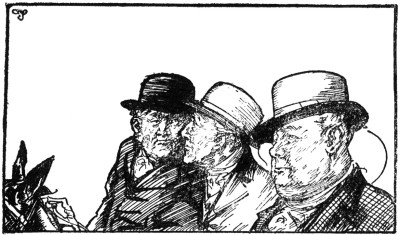
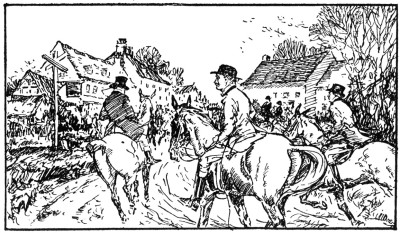
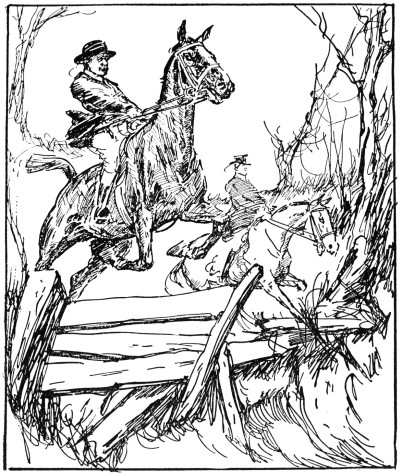
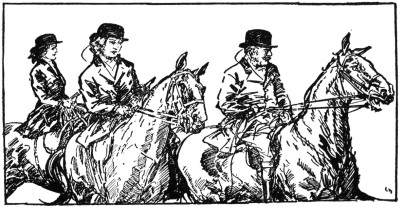
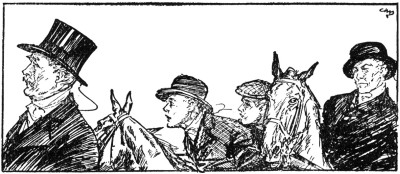
I have been asked to write why I wrote this poem of "Reynard
the Fox." As a man grows older, life becomes more interesting
but less easy to know; for, late in life, even the strongest yields
to the habit of his compartment. When he cannot range through
all society, from the court to the gutter, a man must go where
all society meets, as at the Pilgrimage, the Festival or the Game.
Here in England the Game is both a festival and an occasion of
pilgrimage. A man wanting to set down a picture of the society
of England will find his models at the games.
What are the English games? The man's game is Association
football; the woman's game, perhaps, hockey or lacrosse. Golf
I regard more as a symptom of a happy marriage than a game.
Cricket, which was once widely popular among both sexes has lost
its hold, except among the young. The worst of all these games
is that few can play them at a time.
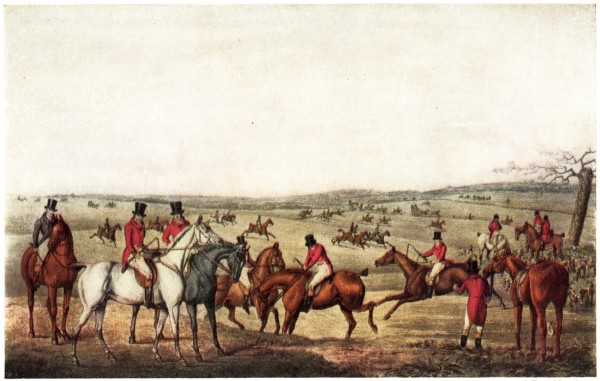
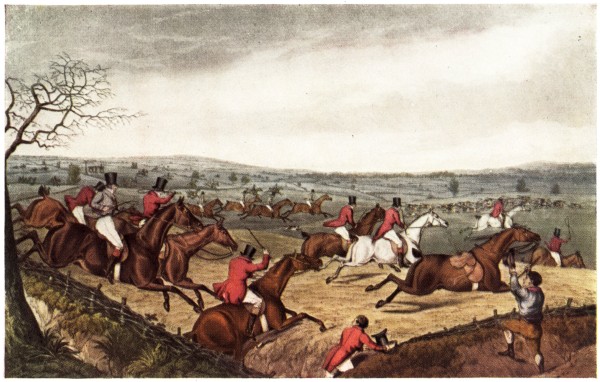
But in the English country, during the autumn, winter and
early spring of each year, the main sport is fox hunting, which
is not like cricket or football, a game for a few and a spectacle
for many, but something in which all who come may take a part,
whether rich or poor, mounted or on foot. It is a sport loved and
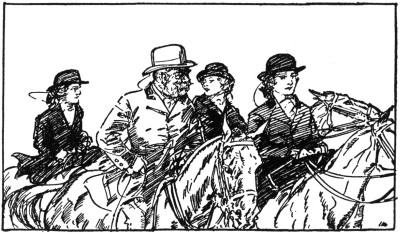
followed by both sexes, all ages and all classes. At a fox hunt,
and nowhere else in England, except perhaps at a funeral, can
you see the whole of the land's society brought together, focussed
for the observer, as the Canterbury pilgrims were for Chaucer.
This fact made the subject attractive. The fox hunt gave an
opportunity for a picture or pictures of the members of an English
community.
Then to all Englishmen who have lived in a hunting country,
hunting is in the blood, and the mind is full of it. It is the most
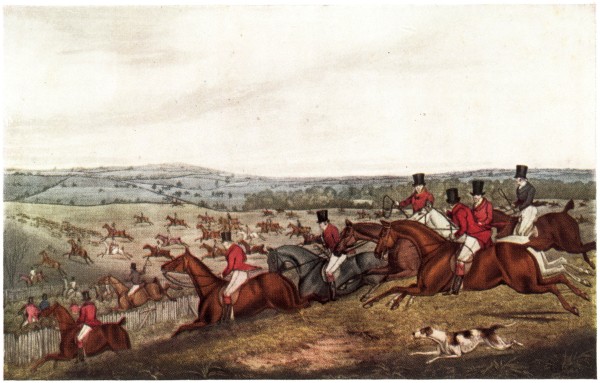
beautiful and the most stirring sight to be seen in England. In
the ports, as at Falmouth, there are ships under sail, under way,
coming or going, beautiful unspeakably. In the country, especially
on the great fields on the lower slopes of the Downland, the
teams of the ploughmen may be seen bowing forward on a sky-line,
and this sight can never fail to move one by its majesty of
beauty. But in neither of these sights of beauty is there the
bright colour and swift excitement of the hunt, nor the thrill of
the horn, and the cry of the hounds ringing into the elements of
the soul. Something in the hunt wakens memories hidden in the
marrow, racial memories, of when one hunted for the tribe, animal
memories, perhaps, of when one hunted with the pack, or was
hunted.
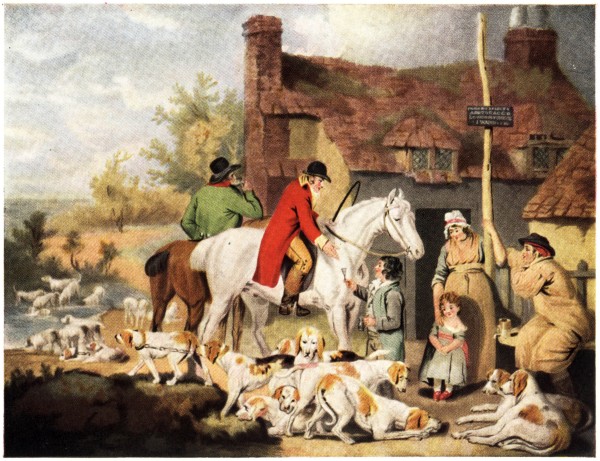
Hunting has always been popular here in England. In ancient
times it was necessary. Wolves, wild boar, foxes and deer had
to be kept down. To hunt was then the social duty of the mounted
man, when he was not engaged in war. It was also the opportunity
of all other members of the community to have a good time in
the open, with a feast or a new fur at the end, to crown the
pleasure.
Since arms of precision were made, hunting on horseback with
hounds has perhaps been unnecessary everywhere, but it is not
easy to end a pleasure rooted in the instincts of men. Hunting
has continued, and probably will continue, in this country and
in Ireland. It is rapidly becoming a national sport in the United
States.
Some have written, that hunting is the sport of the wealthy
man. Some wealthy men hunt, no doubt, but they are not the
backbone of the sport, so much as those who love and use horses.
Parts of this country, of Ireland and of the United States are more
than ordinarily good pasture, fitted for the breeding of horses,
beyond most other places in the world. Hardly anywhere else
is the climate so equable, the soil so right for the feet of colts and
the grass so good. Where these conditions exist, men will breed
horses and use them. Men who breed good horses will ride,
jump and test them, and will invent means of riding, jumping
and testing them, the steeplechase, the circus, the contests at
fairs and shows, the point-to-point meeting, and they will preserve,
if possible, any otherwise dying sport which offers such means.
I have mentioned several reasons why fox hunting should be
popular: (a) that it is a social business, at which the whole community
may and does attend in vast numbers in a pleasant mood of
goodwill, good humour and equality, and during which all may
go anywhere, into ground otherwise shut to them; (b) that it is
done in the winter, at a season when other social gatherings are
difficult, and in country districts where no buildings, except the
churches, could contain the numbers assembled; (c) that it is
most beautiful to watch, so beautiful that perhaps very few of
the acts of men can be so lovely to watch nor so exhilarating.
The only thing to be compared with it, in this country, is the
sword dance, the old heroical dancing of the young men, still
practised, in all its splendour of wild beauty, in some country places;
(d) that we are a horse-loving people who have loved horses as
we have loved the sea, and have made, in the course of generations,
a breed of horse, second to none in the world, for beauty
and speed.
But besides all these reasons, there is another that brings many
out hunting. This is the delight in hunting, in the working of
hounds, by themselves, or with the huntsmen, to find and kill
their fox. Though many men and women hunt in order to ride,
many still ride in order to hunt.
Perhaps this delight in hunting was more general in the mid-eighteenth
century, when hounds were much slower than at
present. Then, the hunt was indeed a test of hounds and huntsman.
The fox was not run down but hunted down. The great
run then was that in which hounds and huntsman kept to their
fox. The great run now is perhaps that in which some few riders
keep with the hounds.
The ideal run of 1750 might have been described thus:—
"Being in the current of Writing, I cannot but acquaint your
Lorp of ye great Hunt there was, this Tuesday last there was a
a Week. Sure so great a day has not been seen here since The
Day your Lorp's Father broke his Collar Bone at ye Park Wall.
As Milton says:—
"Well have we speeded, and o'er Hill and Dale
Forest and Field and Flood ...
As far as Indus east, Euphrates west."
"We had but dismle Weather of it, and so cold, as made Sir
Harry observe, that it was an ill wind blew no-one any good.
We met at ye Tailings. I had out my brown Horse. There was
present Sir Anthony Smoaker; Mr. Jarvis of Copse Stile; William
Travis; John Hawbuck; your Lorp's Friend, Dick Fancowe, and
two of ye Red Coats from ye Barracks. Ye fair Sex was dismayed,
it was said, by ye rudeness of ye Elements; they did not
venture it.
"On coming to draw Tailings Wood, Glider spoke to it, and
Tom viewed him away for the Valley, being the old Dog Fox,
with the white Mask, that beat us at Fubb's Field, the day your
Lorp road Bluebell.
"Now spoke the chearful Horn; and tuneful Hounds
Echoed, and Red Coats gallopped; stirring Scean,
Rude Health and Manly Wit together strive.
"We went with the extream of Violence from Tailings Wood
to ye small Coppice at Nap Hill where a Fellow put him from his
Point, which gave Occasion to Sir Anthony to correct him. Ye
little magpie Hound made it out in ye bog at ye back of ye Coppice,
when again Hounds went at head through Long Stone Pastures
as far as Tainton. Here we was delayed in ye Dear Park,
the effluvia of ye Dear being extream strong and doubtless puzzling
to the Noses of ye Hounds. And here I cannot but remark the
skill with which ye Hounds worked it out till they had hit it
off, a sight, as Mr. Jarvis remarked to me, worthy of the Admiration
of an antient Philosopher, and of the eloquence of a most
elegant Wit, or Poet. Leaving ye Dear Park, He made for Norton
Cross, which he left on his left Hand, as though deciding for ye
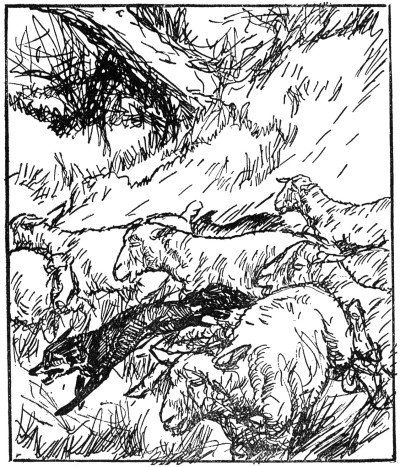
Hill. Crossing ye Hill, in Spite of ye Sheep, he was a little staggered
by his being run by one of ye Shepherd's Doggs, a part of
Creation that should not be tolerated, except in ye vision of ye
Poet, as in a Pastoral or so. Here Joe Phillips, our Huntsman,
made unavailing Casts, but by lifting to the Vineyard recovered
him, when Hounds run him to Cow's Crookham, on your Lorp's
Aston Estate.
"By this Time, your Lorp will understand our Distress. Dick
Fancowe was in ye Brook at Norton, Mr. Jarvis' grey Horse had
cast a Shoe, and one of ye Red Coats had broak his Liver in falling
at a Fence. For a time we went about to recover him:—
"Now with attentive Nose the restless Hound
Endeavours on the Scent, now here, now there,
Scorning adulterat scents of lesser Prey.
Now gloomy care invades the Huntsman's Face;
And Sportsmen (jovial erst) on weary steeds
Sit pensive."
Here might well be seen the Advantages of a judicious Breeding in
Hounds, that neglects not the intellectual Part, but aims rather
at a complete Animal than alone at Sinews and Corporeal Structure.
That Blood of the Old Berkshire Glorious, which your
Lorp's Father was wont to observe, was what he most stood by,
next to our Constitution and the Protestant Succession, here
stood us in good stead, for it was to Glorious ye Ninth, as well
as to Growler and Glider (all of ye same royal strain) that we
was indebted to ye happy Conclusion. They pushed him out of
ye Stubbings at Cow's Crookham, where it seems he had taken
Refuge in the Hollow of a decayed Tree. We chac't him thence
upon ye Grass to Shepherd's Hey. Here he began to run short,
being not a little apprehensive, lest his Foes should triumph, and
snatch from him that Life, which he had so long nefariously
pampered.
On courtly Cock with all his household Train
Of Hens obsequious, by the Hen Wife mourned.
"The Sun, coming out from among ye Clouds, where he had been
too long hid, made (as was elegantly pretended by Sir Anthony), a
Brightness, animating indeed to us, who carried the Sword of
Justice, but, to the Criminal of our Pursuit, infinitely distressing.
Then had your Lorp seen the gay Ardor of the Pack, as they came
to the View, which they did about Stonepits, your Lorp would
have said with the late elegant Poet:
"Now o'er the glittering grass the sinewy Hound
Shakes from his Feet the Dew and makes ye Woods resound."
"To be brief, we killed in the Back Yard of ye Rummer and Glass
after two and three quarters Hours of a Hunt such as (all are
agreed) is not lightly to be parallelled. There was present at
ye Death, beside Joe Phillips and Tom, Sir A. Smoaker, Mr. Wm. Travis
and myself, all so extream distresst, Men and Beasts, that
it was observed, it was a Marvel ye Horses were not dead. Such
an Hunt, it was agreed, should be celebrated by an annual Dinner,
at which the Toast of ye Chase might be rendered more than
ordinary. Ye Hunt was upwards of Fifteen Miles in Length, and
hath been the Subject of a Song, by a Member of Ye Hunt,
which, as it would take long to transcribe, I forbear, hoping that
we may sing it to your Lorp before (as ye Poet says)
"Ye vixen hath laid up her Cubs
In snuggest Cave secure, when balmy Spring
Wakens ye Meadows."
"But to pass now from Celestial Pleasures to Worldly Cares, I
have to acquaint your Lorp that your Lorp's Sister's Son, Mr.
Parracombe, hath been killed by a Fall from his Horse, after
Dinner with some Gentlemen, his particular Friends, an Affliction
indeed great, humanly regarded, were it not also considered, how
much happier his Lot must be, than in this Vale of Tears, etc.
Ye Young Hounds thrive apace, and it is thought the forward
Season will be very favourable for their future Prey. I am, your
Lorp's most obedient, Charles Cothill."
Perhaps the ideal run of the present time would be described
as follows:—
"A large field attended the Templecombe on Tuesday last at
the popular meet at Heydigates. Will Mynors, late of the Parratts,
carried the horn, in place of Tom Carling, now with
Mr. Fletchers. A little time was spent in running through the
shrubberies in the garden at Heydigates and then the word was
given for the Cantlows. Will had no sooner put hounds into
this famous cover than the dog pack proclaimed the joyous news.
The fox, a traveller, was at once viewed away for the Three Oaks,
across the rather heavy going of the pasture land. Coming to
the Knock Brook, he swam it near Parson's Pleasure, going at
a pace that let the knowing ones know that they were in for something
out of the common. Keeping Snib's Farm on his right, he
ran dead straight for Gallow's Wood, where some woodmen with
their teams disturbed him. Swinging to his left, he went up the
hill, through Bloody Lane, as though towards Dinsmore, but was
again deflected by woodmen. Turning down the hill, he ran
for the valley, passing Enderton Schoolhouse, the scholars of
which were much cheered by the near prospect of the hunt. It
was now evident that he was going for the Downs. Some of
the less daring began to express the hope that he might be headed.
"Scent from the first was burning and the pace a cracker.
After leaving Enderton he made straight for the Danesway, past
Snub's Titch and the Curlews, the green meadows of the pasture
being sprinkled for miles with the relics of the field. He crossed
the Roman Road at Orm's Oak and at once entered the Danesway,
going at a pace which all thought could not last.
"At the summit of the Danesway, known as the Gallows Point,
hounds were brought to their noses, owing to the crossing of the
line by sheep. A man working nearby was able to give the line
and Will, lifting beyond the Lynchets, at once hit him off, and
the hounds resumed their rush. From this point, they went almost
exactly straight from the head of the Danesway to the fir copse
by Arthur's Table. All this part of the run being across a rolling
grass land, was at top speed, such as no horse could live with.
At Arthur's Table, he was put from his earth by shooters who
were netting the warren. As he could not get through them nor
across the highway, then busy with traffic, He doubled down across
the Starvings, where Will, the only man up at this point, although
now three hundred yards behind hounds, caught sight of him on
the opposite slope, romping away from hounds as though he would
never grow old. On coming to the level, past Spinney's End,
some of those who had been left at the Lynchets were able to
rejoin, but were soon again cast out by the extreme violence of
the going, which continued back across the Downs on a line obliquely
parallel with his former track though a mile further to the
south. It was supposed that he was going for the main earth
in Bloody Acre Copse. Some workers in the strip at the edge of
the copse headed him from this point. He swung left-handed past
Staves acre, and so down to the valley by the shelving ground
near Monk's Charwell. Here, for some unaccountable reason,
the scent, which had been breast high, became catchy, and hounds
lost their fox in the Osier cars at Charwell Springs. Later in the
afternoon, while jogging home, a second fox was chopped in Mr.
Parsloe's cover at Prince's Charwell. Hounds then went home.
"The run from the Cantlows was not remarkable for any quality
of hunting, but extremely so for pace and length. The distance
run, from Cantlows Wood to the Osiers cannot have been less than
thirteen miles, most of it indeed on the best going in the world,
but at a racing pace, with nothing that can be called a check,
the whole way. Some wished that the hounds might have been
rewarded and others that Will Mynors might have crowned his
opening gallop with a kill, but the general feeling was one of
satisfaction that so game a fox escaped."
My own interest in fox hunting began at a very early age.
I was born in a good hunting country, partly woodland, partly
pasture. My home, during my first seven years, was within
half a mile of the kennels. I saw hounds on most days of my life.
Hounds and hunting filled my imagination. I saw many meets,
each as romantic as a circus. The huntsman and whipper-in
seemed, then, to be the greatest men in the world, and those
mild slaves, the hounds, the loveliest animals.
Often, as a little child, I saw and heard hounds hunting in and
near a covert within sight of my old home. Once, when I was,
perhaps, five years old, the fox was hunted into our garden, and
those glorious beings in scarlet, as well as the hounds, were all
about my lairs, like visitants from Paradise. The fox, on this
occasion, went through a woodshed and escaped.
Later in my childhood, though I lived less near to the kennels,
I was still within a mile of them, and saw hounds frequently at
all seasons. In that hunting country, hunting was one of the
interests of life; everybody knew about it, loved, followed,
watched and discussed it. I went to many meets, and followed
many hunts on foot. Each of these occasions is now distinct in
my mind, with the colour and intensity of beauty. I saw many
foxes starting off upon their runs, with the hounds close behind
them. It was then that I learned to admire the ease and beauty
of the speed of the fresh fox. That leisurely hurry, which romps
away from the hardest trained and swiftest fox hounds without a
visible effort, as though the hounds were weighted with lead,
is the most lovely motion I have seen in an animal.
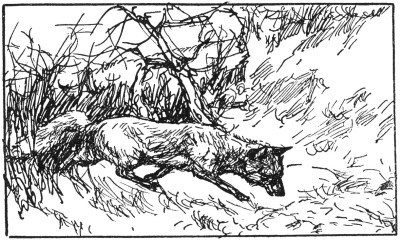
No fox was the original of my Reynard, but as I was much in
the woods as a boy I saw foxes fairly often, considering that they
are night-moving animals. Their grace, beauty, cleverness, and
secrecy always thrilled me. Then that kind of grin which the
mask wears made me credit them with an almost human humour.
I thought the fox a merry devil, though a bloody one. Then he
is one against many, who keeps his end up, and lives, often snugly,
in spite of the world. The pirate and the nightrider are nothing
to the fox, for romance and danger. This way of life of his makes
it difficult to observe him in a free state at close quarters.
Once in the early spring in the very early morning, I saw a
vixen playing with her cubs in the open space below a beech tree.
Once I came upon a big dog-fox in a wheel-wright's yard, and
watched him from within a few paces for some minutes. Twice
I have watched half-grown cubs stalking rabbits. Twice out hunting,
the fox has broken cover within three yards of me. These are
the only free foxes which I have seen at close quarters. Foxes
are night-moving animals. To know them well one should have
cat's eyes and foxes' habits. By the imagination alone can men
know foxes.
When I was about halfway through my poem, I found a dead
dog-fox in a field near Cumnor Hurst. He was a fine full-grown
fox in perfect condition; he must have picked up poison, for he
had not been hunted, nor shot. On the pads of this dead fox, I
noticed for the first time, the length and strength of a fox's claws.
Some have asked, whether the Ghost Heath Run is founded on
any recorded run of any real Hunt. It is not. It is an imaginary
run, in a country made up of many different pieces of country,
some of them real, some of them imaginary. These real and
imaginary fields, woods and brooks are taken as they exist, from
Berkshire, where the fox lives, from Herefordshire where he was
found, from Trapalanda, Gloucestershire, Buckinghamshire, Herefordshire,
Worcestershire and Berkshire, where he ran, from Trapalanda,
where he nearly died, and from a wild and beautiful
corner in Berkshire where he rests from his run.
Some have asked when the poem was written. It was written
between January 1 and May 20, 1919.
Some have asked, whether hunting will soon be abolished.
I cannot tell, but I think it unlikely. People do not willingly
resign their pleasures; men who breed horses will want to gallop
them across country; hunting is a pleasure, as well as an opportunity
to gallop; it is also an instinct in man. Some have thought
that if "small holdings," that is "produce gardens," intensively
cultivated, of about an acre apiece, became common, so that the
country became more rigidly enclosed than at present, hunting
would be made almost impossible. The small holding is generally
the property of the small farmer (like the French cultivateur) who
fences permanently with wire and cannot take down the wire
during the hunting season, as most English farmers do at present.
Small holdings will probably increase in number near towns, but
farmers seem agreed that they can never become the national
system of farming. The big farm, that can treat the great tract
with machines, seems likely to be the farm of the future.
Even if the small holdings system were to prevail, it would
hardly prevail over the sporting instincts of the race. Beauty
and delight are stronger than the will to work. I am pretty sure
that a pack of hounds, coming feathery by, at the heels of a whip's
horse, while the field takes station and the huntsman, drawing
his horn, prepares to hunt, would shake the resolve of most small
holders, digging in their lots with thrift, industry and self-control.
And then, if the huntsman were to blow his horn, and the hounds
to feather on it and give tongue, and find, and go away at head,
I am pretty sure that most of the small holders of this race would
follow them. It is in this race to hunt.
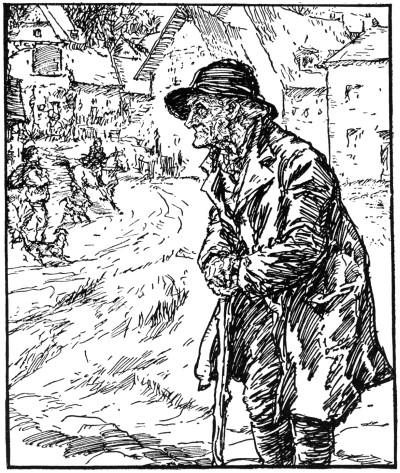
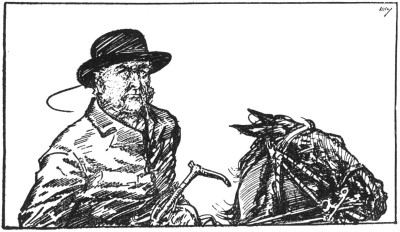
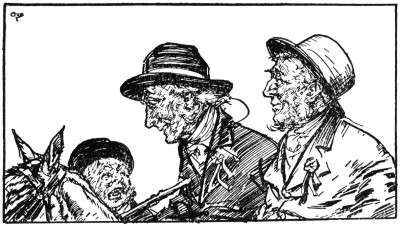
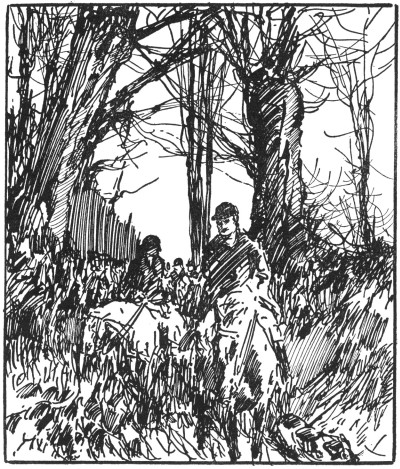
I will conclude with a portrait of old Baldy Hill, the earth-stopper,
who in the darkness of the early morning gads about on
a pony, to "stop" or "put to" all earths, in which a hard-pressed
fox might hide. In the poem, he enters when the hunt is about
to start, but he is an important figure in a hunting community,
and deserves a portrait. He may come here, at the beginning,
for Baldy Hill is at the beginning of all fox hunts. He dates from
the beginning of Man. I have seen many a Baldy Hill in my life;
he never fails to give me the feeling that he is Primitive Man
survived. Primitive Man lived like that, in the woods, in the
darkness, outwitting the wild things, while the rain dripped, and
the owl cried, and the ghost came out from the grave. Baldy
Hill stole the last litter of the last she-wolf to cross them with the
King's hounds. He was in at the death of the last wild-boar.
Sometimes, in looking at him, I think that his ashen stake must
have a flint head, with which, on moony nights, he still creeps
out, to rouse, it may be, the mammoth in his secret valley, or
a sabretooth tiger, still caved in the woods. Life may and does
shoot out into exotic forms, which may and do flower and perish.
Perhaps when all the other forms of English life are gone, the
Baldy Hill form, the stock form, will abide, still striding, head
bent, with an ashen stake, after some wild thing, that has meat,
or fur, or is difficult or dangerous to tackle.
Old Baldy Hill, the game old cock,
Still wore knee-gaiters and a smock.
He bore a five foot ashen stick
All scarred and pilled from many a click
Beating in covert with his sons
To drive the pheasants to the guns.
His face was beaten by the weather
To wrinkled red like bellows leather
He had a cold clear hard blue eye.
His snares made many a rabbit die.
On moony nights he found it pleasant
To stare the woods for roosting pheasant
Up near the tree-trunk on the bough.
He never trod behind a plough.
He and his two sons got their food
From wild things in the field and wood,
By snares, by ferrets put in holes,
By ridding pasture-land of moles;
By keeping, beating, trapping, poaching
And spaniel-and-retriever-coaching.
He and his sons had special merits
In breeding and in handling ferrets
Full many a snaky hob and jill
Had bit the thumbs of Baldy Hill.
He had no beard, but long white hair.
He bent in gait. He used to wear
Flowers in his smock, gold-clocks and peasen;
And spindle-fruit in hunting season.
I hope that he may live to wear spindle-fruit for many seasons
to come. Hunting makes more people happy than anything I
know. When people are happy together, I am quite certain
that they build up something eternal, something both beautiful
and divine, which weakens the power of all evil things upon this
life of men and women.