RESEARCHES IN ELECTRIC TELEPHONY.
By Professor Alexander Graham Bell.
Professor Bell: Mr. President and
Gentlemen of the Society of Telegraph Engineers. It is to-night my
pleasure, as well as duty, to give you some account of the telephonic
researches in which I have been so long engaged. Many years ago my
attention was directed to the mechanism of speech by my father,
Alexander Melville Bell, of Edinburgh, who has made a life-long study
of the subject. Many of those present may recollect the invention
by my father of a means of representing, in a wonderfully accurate
manner, the positions of the vocal organs in forming sounds. Together
we carried on quite a number of experiments, seeking to discover
the correct mechanism of English and foreign elements of speech,
and I remember especially an investigation in which we were engaged
concerning the musical relations of vowel sounds. When vowel sounds are
whispered, each vowel seems to possess a particular pitch of its own,
and by whispering certain vowels in succession a musical scale can be
distinctly perceived. Our aim was to determine the natural pitch of
each vowel; but unexpected difficulties made their appearance, for many
of the vowels seemed to possess a double pitch—one due, probably, to
the resonance of the air in the mouth, and the other to the resonance
of the air contained in the cavity behind the tongue, comprehending the
pharynx and larynx.
I hit upon an expedient for determining the pitch which at that time
I thought to be original with myself. It consisted in vibrating a
tuning-fork in front of the mouth while the positions of the vocal
organs for the various vowel sounds were silently taken. It was found
that each vowel position caused the reinforcement of some particular
fork or forks.
I wrote an account of these researches to Mr. Alex. J. Ellis, of
London, whom I have very great pleasure in seeing here to-night. In
reply he informed me that the experiments related had already been
performed by Helmholtz, and in a much more perfect manner than I had
done. Indeed, he said that Helmholtz had not only analysed the vowel
sounds into their constituent musical elements, but had actually
performed the synthesis of them.
He had succeeded in producing, artificially, certain of the vowel
sounds by causing tuning-forks of different pitch to vibrate
simultaneously by means of an electric current. Mr. Ellis was kind
enough to grant me an interview for the purpose of explaining the
apparatus employed by Helmholtz in producing these extraordinary
effects, and I spent the greater part of a delightful day with him in
investigating the subject. At that time, however, I was too slightly
acquainted with the laws of electricity fully to understand the
explanations given; but the interview had the effect of arousing my
interest in the subjects of sound and electricity, and I did not rest
until I had obtained possession of a copy of Helmholtz’ great
work,[1]
and had attempted, in a crude and imperfect manner it is true, to
reproduce his results. While reflecting upon the possibilities of
the production of sound by electrical means, it struck me that the
principle of vibrating a tuning-fork by the intermittent attraction of an
electro-magnet might be applied to the electrical production of music.
I imagined to myself a series of tuning-forks of different pitches,
arranged to vibrate automatically in the manner shown by Helmholtz,
each fork interrupting at every vibration a voltaic current; and the
thought occurred, “Why should not the depression of a key like that of
a piano direct the interrupted current from any one of these forks,
through a telegraph wire, to a series of electro-magnets operating the
strings of a piano or other musical instrument, in which case a person
might play the tuning-fork piano in one place and the music be audible
from the electromagnetic piano in a distant city?”
The more I reflected upon this arrangement the more feasible did it
seem to me; indeed, I saw no reason why the depression of a number of
keys at the tuning-fork end of the circuit should not be followed by
the audible production of a full chord from the piano in the distant
city, each tuning-fork affecting at the receiving end that string of
the piano with which it was in unison. At this time the interest which
I felt in electricity led me to study the various systems of telegraphy
in use in this country and in America. I was much struck with the
simplicity of the Morse alphabet, and with the fact that it could be
read by sound. Instead of having the dots and dashes recorded upon
paper, the operators were in the habit of observing the duration of the
click of the instruments, and in this way were enabled to distinguish
by ear the various signals.
It struck me that in a similar manner the duration of a musical note
might be made to represent the dot or dash of the telegraph code, so
that a person might operate one of the keys of the tuning-fork piano
referred to above, and the duration of the sound proceeding from the
corresponding string of the distant piano be observed by an operator
stationed there. It seemed to me that in this way a number of distinct
telegraph messages might be sent simultaneously from the tuning-fork
piano to the other end of the circuit, by operators each manipulating
a different key of the instrument. These messages would be read by
operators stationed at the distant piano, each receiving operator
listening for signals of a certain definite pitch, and ignoring all
others. In this way could be accomplished the simultaneous transmission
of a number of telegraphic messages along a single wire, the number
being limited only by the delicacy of the listener’s ear. The idea of
increasing the carrying power of a telegraph wire in this way took
complete possession of my mind, and it was this practical end that I
had in view when I commenced my researches in Electric Telephony.
In the progress of science it is universally found that complexity
leads to simplicity, and in narrating the history of scientific
research it is often advisable to begin at the end.
In glancing back over my own researches I find it necessary to
designate, by distinct names, a variety of electrical currents by means
of which sounds can be produced, and I shall direct your attention to
several distinct species of what may be termed “telephonic” currents of
electricity. In order that the peculiarities of these currents may be
clearly understood, I shall ask Mr. Frost to project upon the screen a
graphical illustration of the different varieties.
The graphical method of representing electrical
currents here shown is the best means I have been able to devise of
studying in an accurate manner the effects produced by various forms
of telephonic apparatus, and it has led me to the conception of that
peculiar species of telephonic current here designated as undulatory,
which has rendered feasible the artificial production of articulate
speech by electrical means.
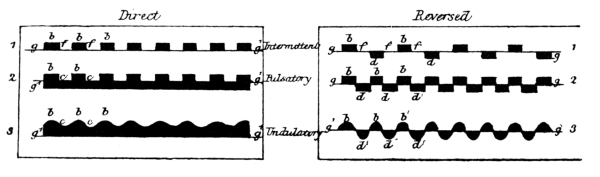
Fig. 1.
A horizontal line (g g´) is taken as the zero of current, and
impulses of positive electricity are represented above the zero line,
and negative impulses below it, or vice versâ.
The vertical thickness of any electrical impulse (b or d), measured
from the zero line, indicates the intensity of the electrical current
at the point observed, and the horizontal extension of the electric
line (b or d) indicates the duration of the impulse.
Nine varieties of telephonic currents may be distinguished, but it will
only be necessary to show you six of these. The three primary varieties
designated as “intermittent,” “pulsatory,” and “undulatory,” are
represented in lines 1, 2, and 3.
Sub-varieties of these can be distinguished as “direct” or “reversed”
currents according as the electrical impulses are all of one kind or
are alternately positive and negative. “Direct” currents may still
further be distinguished as “positive” or “negative,” according as the
impulses are of one kind or of the other.
An intermittent current is characterised by the alternate presence
and absence of electricity upon the circuit;
A pulsatory current results from sudden or instantaneous changes in
the intensity of a continuous current; and
An undulatory current is a current of electricity, the
intensity of which varies in a manner proportional to the velocity of the motion
of a particle of air during the production of a sound: thus the curve
representing graphically the undulatory current for a simple musical tone is
the curve expressive of a simple pendulous vibration—that is, a sinusoidal curve.
‡ Telephonic currents of electricity may be:
(written vertically in first column) |
| ‡ |
 |
Intermittent |

|
Direct |
 |
Positive 1 |
Positive |
intermittent current |
| Negative 2 |
Negative |
” ” |
| —— |
|
Reversed 3 |
Reversed |
” ” |
Pulsatory |
Direct |
|
Positive 4 |
Positive |
pulsatory current |
| Negative 5 |
Negative |
” ” |
| —— |
|
Reversed 6 |
Reversed |
” ” |
Undulatory |
Direct |
|
Positive 7 |
Positive |
undulatory current |
| Negative 8 |
Negative |
” ” |
| —— |
|
Reversed 9 |
Reversed |
” ” |
And here I may remark, that, although the conception of the undulatory
current of electricity is entirely original with myself, methods of
producing sound by means of intermittent and pulsatory currents have
long been known. For instance, it was long since discovered that
an electro-magnet gives forth a decided sound when it is suddenly
magnetized or demagnetized. When the circuit upon which it is placed is
rapidly made and broken, a succession of explosive noises proceeds from
the magnet. These sounds produce upon the ear the effect of a musical
note when the current is interrupted a sufficient number of times
per second. The discovery of “Galvanic Music,” by Page,[2]
in 1837, led inquirers in different parts of the world almost simultaneously
to enter into the field of telephonic research; and the acoustical
effects produced by magnetization were carefully studied by Marrian,[3]
Beatson,[4]
Gassiot,[5]
De la Rive,[6]
Matteucci,[7]
Guillemin,[8]
Wertheim,[9]
Wartmann,[10]
Janniar,[11]
Joule,[12]
Laborde,[13]
Legat,[14]
Reis,[15]
Poggendorff,[16]
Du Moncel,[17]
Delezenne,[18]
and others.[19]
It should also be mentioned that Gore[20]
obtained loud musical notes from mercury, accompanied by singularly beautiful
crispations of the surface during the course of experiments in electrolysis;
Page[21]
produced musical tones from Trevelyan’s bars by the action of the galvanic
current; and further it was discovered by Sullivan[22]
that a current of electricity is generated by the vibration of a wire composed
partly of one metal and partly of another. The current was produced so long as the wire
emitted a musical note, but stopped immediately upon the cessation of the sound.
For several years my attention was almost exclusively directed to
the production of an instrument for making and breaking a voltaic
circuit with extreme rapidity, to take the place of the transmitting
tuning-fork used in Helmholtz’ researches. I will not trouble you
with the description of all the various forms of apparatus that were
devised, but will merely direct your attention to one of the best of
them, shown in fig. 2. In the transmitting instrument T, a steel reed
a is employed, which is kept in continuous vibration by the action of
an electro-magnet e and local battery. In the course of its vibration
the reed strikes alternately against two fixed points m, l, and
thus completes alternately a local and a main circuit. When the key
K is depressed an intermittent current from the main battery B is
directed to the line-wire W, and passes through the electro-magnet E of
a receiving instrument R at the distant end of the circuit, and thence
to the ground G. The steel reed A is placed in front of the receiving
magnet, and when its normal rate of vibration is the same as the reed
of the transmitting instrument it is thrown into powerful vibration,
emitting a musical tone of a similar pitch to that produced by the reed
of the transmitting instrument, but if it is normally of a different
pitch it remains silent.
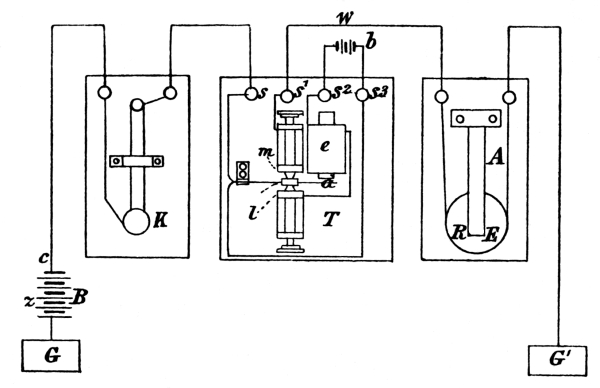
Fig. 2.
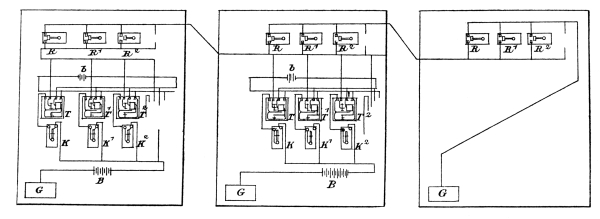
Fig. 3.Fig. 4.Fig. 5.
A glance at figs. 3, 4, and 5 will show the arrangement of such
instruments upon a telegraphic circuit, designed to enable a number
of telegraphic despatches to be transmitted simultaneously along the
same wire. The transmitters and receivers that are numbered alike have
the same pitch or rate of vibration. Thus the reed of T´ is in unison
with the reeds T´ and R´ at all the stations upon the circuit, so that
a telegraphic despatch sent by the manipulation of the key K´ at the
station shown in fig. 3 will be received upon the receiving instruments
K´ at all the other stations upon the circuit. Without going into
details, I shall merely say that the great defects of this plan of
multiple telegraphy were found to consist, firstly, in the fact that
the receiving operators were required to possess a good musical ear in
order to discriminate the signals; and secondly, that the signals could
only pass in one direction along the line (so that two wires would be
necessary in order to complete communication in both directions). The
first objection was got over by employing the device which I term a
“vibratory circuit-breaker,” shown in the next diagram, whereby musical
signals can be automatically recorded.
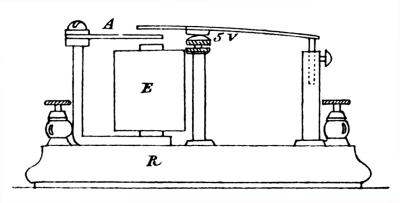
Fig. 6.
Fig. 6 shows a receiving instrument R, with a vibratory circuit-breaker
v attached. The light spring-lever v overlaps the free end of
the steel reed A, and normally closes a local circuit, in which may be
placed a Morse-sounder or other telegraphic apparatus. When the reed
A is thrown into vibration by the passage of a musical signal, the
spring arm v is thrown upwards, opening the local circuit at the
point 5. When the spring-arm v is so arranged as to have normally a
much slower rate of vibration than the reed A1, the local circuit
is found to remain permanently open during the vibration of A, the
spring-arm v coming into contact with the point 5 only upon the
cessation of the receiver’s vibration. Thus the signals produced by the
vibration of the reed A are reproduced upon an ordinary telegraphic
instrument in the local circuit.
Fig. 7 shows the application of electric telephony to autographic telegraphy.
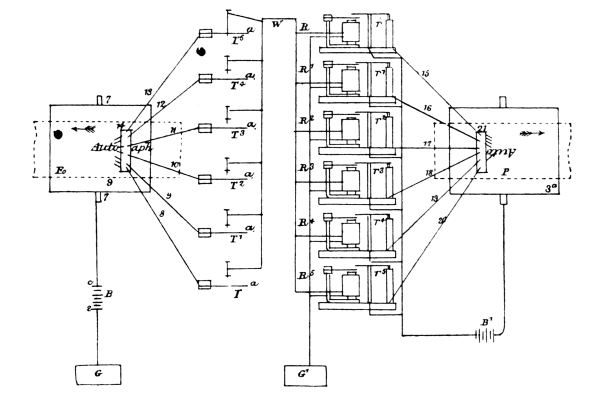
Fig. 7.
T, T´, &c., represent the reeds of transmitting instruments of
different pitch, R, R´, &c., the receivers at the distant station
of corresponding pitch, and, r, r´, &c., the vibratory
circuit-breakers attached to the receiving instruments, and connected
with metallic bristles, 21, resting upon chemically prepared paper
P. The message, or picture, to be copied, is written upon a metallic
surface, F_0, with non-metallic ink, and placed upon a metallic
cylinder 7, connected with the main battery B; and the chemically
prepared paper P, upon which the message is to be received, is placed
upon a metallic cylinder connected with the local battery B´ at the
receiving station. When the cylinders at either end of the circuit are
rotated in the direction of the arrows—but not necessarily at the same
rate of speed—a fac simile of whatever is written or drawn upon the
metallic surface F_0 appears upon the chemically prepared paper P.
The method by means of which the musical signals may be sent
simultaneously in both directions along the same circuit is shown in
our next illustration, figures 8, 9, and 10. The arrangement is similar
to that shown in figures 3, 4, and 5, excepting that the intermittent
current from the transmitting instruments is passed through the
primary wires of an induction coil, and the receiving instruments are
placed in circuit with the secondary wire. In this way free earth
communication is secured at either end of the circuit, and the musical
signals produced by the manipulation of any key are received at all the
stations upon the line. The great objection to this plan is the extreme
complication of the parts and the necessity of employing local and main
batteries at every station. It was also found by practical experiment
that it was difficult, if not impossible, upon either of the plans
here shown, to transmit simultaneously the number of musical tones
that theory showed to be feasible. Mature consideration revealed the
fact that this difficulty lay in the nature of the electrical current
employed, and was finally obviated by the invention of the undulatory current.
It is a strange fact that important inventions are often
made almost simultaneously by different persons in different parts of the world,
and the idea of multiple telegraphy as developed in the preceding
diagrams seems to have occurred independently to no less than four
other inventors in America and Europe. Even the details of the
arrangements upon circuit—shown in figures 3, 4, 5, and 8, 9, 10—are
extremely similar in the plans proposed by Mr. Cromwell Varley of
London, Mr. Elisha Gray of Chicago, Mr. Paul La Cour of Copenhagen, and
Mr. Thomas Edison of Newark, New Jersey. Into the question of priority
of invention, of course, it is not my intention to go to-night.
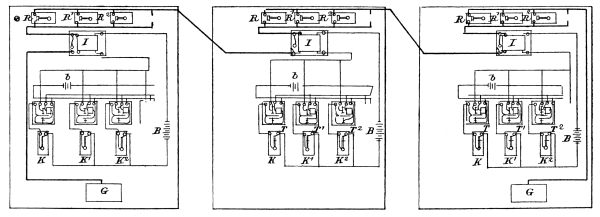
Fig. 8.Fig. 9.Fig. 10.
That the difficulty in the use of an intermittent current may be more
clearly understood, I shall ask you to accompany me in my explanation
of the effect produced when two musical signals of different pitch
are simultaneously directed along the same circuit. Fig. 11 shows an
arrangement whereby the reeds a a´ of two transmitting instruments
are caused to interrupt the current from the same battery, B. We shall
suppose the musical interval between the two reeds to be a major third,
in which case their vibrations are in the ratio of 4 to 5, i.e.,
4 vibrations of a are made in the same time as 5 vibrations of
a1. A2 and B2 represent the intermittent currents produced,
4 impulses of B2 being made in the same time as 5 impulses of A2.
The line A2 + B2 represents the resultant effect upon the main line
when the reeds a and a1 are simultaneously caused to make and
break the same circuit, and from the illustration you will perceive
that the resultant current, whilst retaining a uniform intensity,
is less interrupted when both reeds are in operation than when one
alone is employed. By carrying your thoughts still further you will
understand that when a large number of reeds of different pitch or of
different rates of vibration are simultaneously making and breaking the
same circuit the resultant effect upon the main line is practically
equivalent to one continuous current.
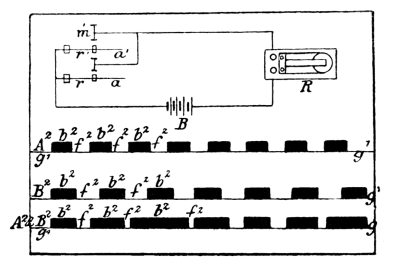
Fig. 11.
It will also be understood that the maximum number of musical
signals that can be simultaneously directed along a single wire
without conflict depends very much upon the ratio which the
“make” bears to the “break;” the shorter the contact made, and
the longer the break, the greater the number of signals that can
be transmitted without confusion, and vice versâ. The apparatus
by means of which this theoretical conclusion has been verified is
here to-night, and consists of an ordinary parlour harmonium, the
reeds of which are operated by wind in the usual manner. In front of
each reed is arranged a metal screw, against which the reed strikes
in the course of its vibration. By adjusting the screw the duration
of the contact can be made long or short. The reeds are connected
with one pole of a battery, and the screws against which they strike
communicate with the line-wire, so that intermittent impulses from the
battery are transmitted along the line-wire during the vibration of the reeds.
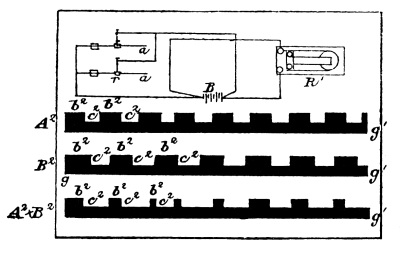
Fig. 12.
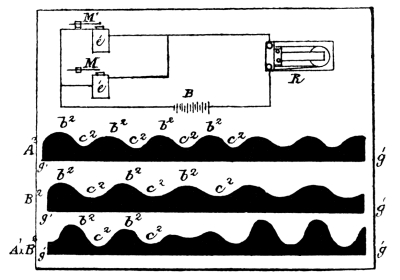
Fig. 13.
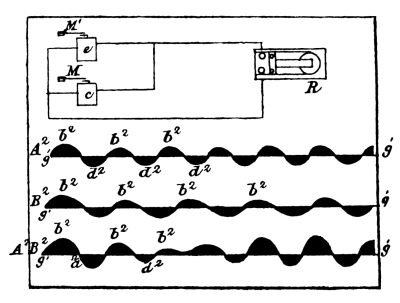
Fig. 14.
We now proceed to the next illustration. Without entering
into the details of the calculation you will see that with a pulsatory
current the effect of transmitting musical signals simultaneously is
nearly equivalent to a continuous current of minimum intensity—see
A2 + B2, fig. 12; but when undulatory
currents are employed the effect is different—see fig. 13. The current
from the battery B is thrown into waves by the inductive action of
iron or steel reeds M M´, vibrated in front of electro-magnets e e´,
placed in circuit with the battery; A2 and B2
represent the undulations caused in the current by the vibration of the
magnetised bodies, and it will be seen that there are four undulations
of B2 in the same time as five undulations of A2.
The resultant effect upon the main line is expressed by the curve
A2 + B2, which is the algebraical sum
of the sinusoidal curves A2 and B2. A similar
effect is produced when reversed undulatory currents are employed as
shown in fig. 14, where the current is produced by the vibration of
permanent magnets M M´ in front of electro-magnets (e e´), united
upon a circuit without a voltaic battery. It will be understood from
figs. 13 and 14 that the effect of transmitting musical signals
of different pitches simultaneously along a single wire is not to
obliterate the vibratory character of the current as in the case of
intermittent and pulsatory currents, but to change the shapes of the
electrical undulations. In fact, the effect produced upon the current
is precisely analogous to the effect produced in the air by the
vibration of the inducing bodies M M´. Hence it should be possible to
transmit as many musical tones simultaneously through a telegraph wire
as through the air. The possibility of using undulatory currents for
the purposes of multiple telegraphy enabled me to dispense entirely
with the complicated arrangements of the circuit shown in figs. 3, 4, 5,
and 8, 9, 10, and to employ a single battery for the whole
circuit, retaining only the receiving instruments formerly shown. This
arrangement is represented in figs. 15, 16, and 17. Upon vibrating the
steel reed of a receiver R, R´, at any station by any mechanical means,
the corresponding reeds at all the other stations are thrown into
vibration, reproducing the signal. By attaching the steel reeds to the
poles of a powerful permanent magnet, as shown in fig. 19, the signals
can be produced without the aid of a battery.
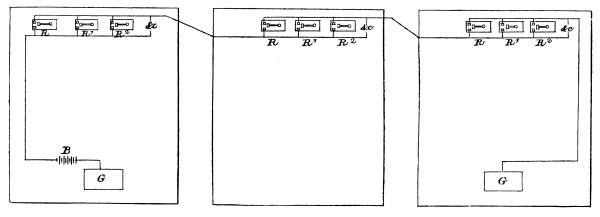
Fig. 15.Fig. 16.Fig. 17.
I have formerly stated that Helmholtz was enabled to produce vowel
sounds artificially by combining musical tones of different pitches
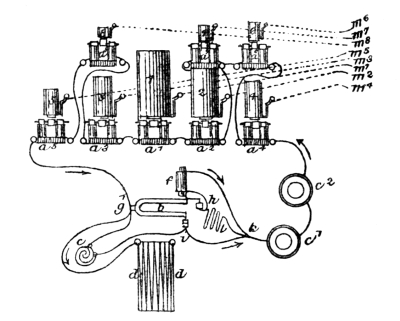
and intensities. His apparatus is shown in fig. 18. Tuning-forks of
different pitch are placed between the poles of electro-magnets (a1,
a2, &c.), and are kept in continuous vibration by the action of an
intermittent current from the fork b. Resonators 1, 2, 3, &c. are
arranged so as to reinforce the sounds, in a greater or less degree,
according as the exterior orifices are enlarged or contracted.
Thus it will be seen that upon Helmholtz’s plan the
tuning-forks themselves produce tones of uniform intensity, the loudness
being varied by an external reinforcement; but it struck me that the same
results would be obtained, and in a much more perfect manner, by
causing the tuning-forks themselves to vibrate with different degrees
of amplitude. I therefore devised the apparatus shown in fig. 19, which
was my first form of articulating telephone. In this figure a harp of
steel rods is employed attached to the poles of a permanent magnet
N.S. When any one of the rods is thrown into vibration an undulatory
current is produced in the coils of the electro-magnet E, and the
electro-magnet E´ attracts the rods of the harp H´ with a varying
force, throwing into vibration that rod which is in unison with
that vibrated at the other end of the circuit. Not only so, but the
amplitude of vibration in the one will determine the amplitude of
vibration in the other, for the intensity of the induced current
is determined by the amplitude of the inducing vibration, and the
amplitude of the vibration at the receiving end depends upon the
intensity of the attractive impulses. When we sing into a piano,
certain of the strings of the instrument are set in vibration
sympathetically by the action of the voice with different degrees of
amplitude, and a sound, which is an approximation to the vowel uttered,
is produced from the piano. Theory shows, that, had the piano a very
much larger number of strings to the octave, the vowel sounds would be
perfectly reproduced. My idea of the action of the apparatus, shown in
fig. 19, was this: Utter a sound in the neighbourhood of the harp H,
and certain of the rods would be thrown into vibration with different
amplitudes. At the other end of the circuit the corresponding rods of
the harp H´ would vibrate with their proper relations of force, and the
timbre of the sound would be reproduced. The expense of constructing
such an apparatus as that shown in fig. 19 deterred me from making the attempt,
and I sought to simplify the apparatus before venturing to have it made.
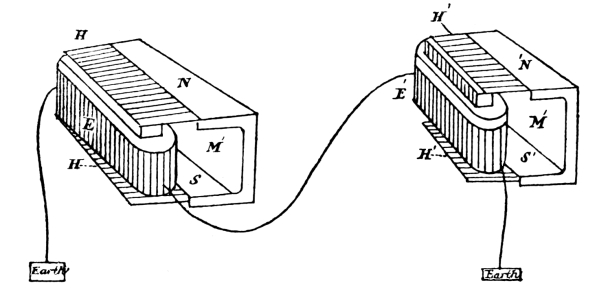
Fig. 19.
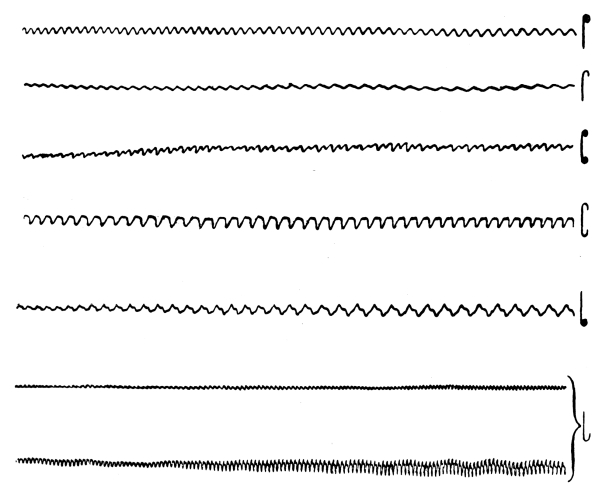
Fig. 20.
I have before alluded to the invention by my father of a system of
physiological symbols for representing the action of the vocal organs,
and I had been invited by the Boston Board of Education to conduct a
series of experiments with the system in the Boston school for the deaf
and dumb. It is well known that deaf mutes are dumb merely because
they are deaf, and that there is no defect in their vocal organs to
incapacitate them from utterance. Hence it was thought that my father’s
system of pictorial symbols, popularly known as visible speech, might
prove a means whereby we could teach the deaf and dumb to use their
vocal organs and to speak. The great success of these experiments
urged upon me the advisability of devising methods of exhibiting the
vibrations of sound optically, for use in teaching the deaf and dumb.
For some time I carried on experiments with the manometric capsule
of Koenig, and with the phonautograph of Léon Scott. The scientific
apparatus in the Institute of Technology in Boston was freely placed at
my disposal for these experiments, and it happened that at that time
a student of the Institute of Technology, Mr. Maurey, had invented an
improvement upon the phonautograph. He had succeeded in vibrating by
the voice a stylus of wood about a foot in length which was attached to
the membrane of the phonautograph, and in this way he had been enabled
to obtain enlarged tracings upon a plane surface of smoked glass. With
this apparatus I succeeded in producing very beautiful tracings of the
vibrations of the air for vowel sounds. Some of these tracings are
shown in fig. 20. I was much struck with this improved form of
apparatus, and it occurred to me that there was a remarkable likeness
between the manner in which this piece of wood was vibrated by the
membrane of the phonautograph and the manner in which the ossiculæ
of the human ear were moved by the tympanic membrane. I determined
therefore to construct a phonautograph modelled still more closely
upon the mechanism of the human ear, and for this purpose I sought
the assistance of a distinguished aurist in Boston, Dr. Clarence J.
Blake. He suggested the use of the human ear itself as a phonautograph,
instead of making an artificial imitation of it. The idea was novel and
struck me accordingly, and I requested my friend to prepare a specimen
for me, which he did. The apparatus, as finally constructed, is shown
in fig. 21. The stapes was removed and a stylus of hay about an
inch in length was attached to the end of the incus. Upon moistening
the membrana-tympani and the ossiculæ with a mixture of glycerine and
water, the necessary mobility of the parts was obtained; and upon
singing into the external artificial ear the stylus of hay was thrown
into vibration, and tracings were obtained upon a plane surface
of smoked glass passed rapidly underneath. While engaged in these
experiments I was struck with the remarkable disproportion in weight
between the membrane and the bones that were vibrated by it. It
occurred to me that if a membrane as thin as tissue paper could control
the vibration of bones that were, compared to it, of immense size and
weight, why should not a larger and thicker membrane be able to vibrate
a piece of iron in front of an electro-magnet, in which case the
complication of steel rods shown in my first form of telephone, fig. 19,
could be done away with, and a simple piece of iron attached to a
membrane be placed at either end of the telegraphic circuit.
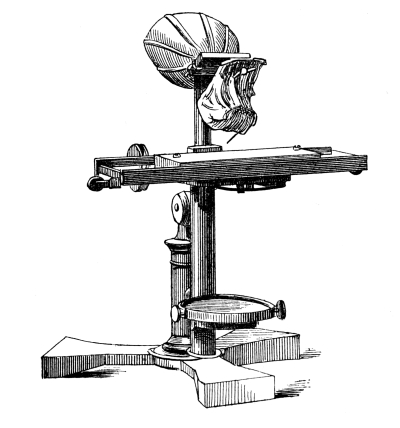
Fig. 21.
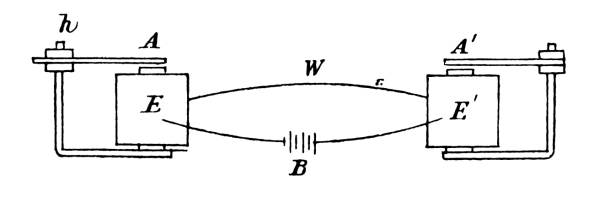
Fig. 22.
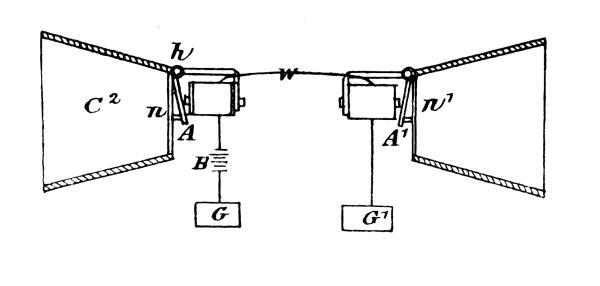
Fig. 23.
Fig. 22 shows the form of apparatus that I was then employing for
producing undulatory currents of electricity for the purposes of
multiple telegraphy. A steel reed A was clamped firmly by one extremity
to the uncovered leg h of an electro-magnet E, and the free end of
the reed projected above the covered leg. When the reed A was vibrated
in any mechanical way, the battery current was thrown into waves, and
electrical undulations traversed the circuit B E W E´, throwing into
vibration the corresponding reed A´ at the other end of the circuit.
I immediately proceeded to put my new idea to the test of practical
experiment, and for this purpose I attached the reed A (fig. 23)
loosely by one extremity to the uncovered pole h of the magnet, and
fastened the other extremity to the centre of a stretched membrane
of goldbeaters’ skin n. I presumed that upon speaking in the
neighbourhood of the membrane n it would be thrown into vibration
and cause the steel reed A to move in a similar manner, occasioning
undulations in the electrical current that would correspond to the
changes in the density of the air during the production of the sound;
and I further thought that the change of the intensity of the current
at the receiving end would cause the magnet there to attract the reed
A´ in such a manner that it should copy the motion of the reed A, in
which case its movements would occasion a sound from the membrane n´
similar in timbre to that which had occasioned the original vibration.
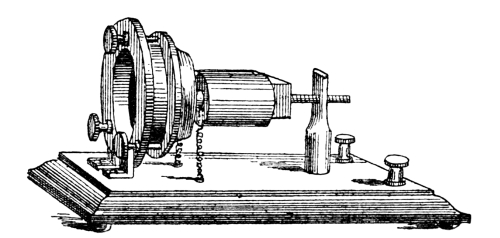
Fig. 24.
The results, however, were unsatisfactory and discouraging. My friend
Mr. Thomas A. Watson, who assisted me in this first experiment,
declared that he heard a faint sound proceed from the telephone at
his end of the circuit, but I was unable to verify his assertion.
After many experiments attended by the same only partially-successful
results, I determined to reduce the size and weight of the spring as
much as possible. For this purpose I glued a piece of clock spring,
about the size and shape of my thumbnail, firmly to the centre of the
diaphragm, and had a similar instrument at the other end (fig. 24);
we were then enabled to obtain distinctly audible effects. I remember
an experiment made with this telephone, which at the time gave me
great satisfaction and delight. One of the telephones was placed in my
lecture-room in the Boston University, and the other in the basement
of the adjoining building. One of my students repaired to the distant
telephone to observe the effects of articulate speech, while I uttered
the sentence, “Do you understand what I say?” into the telephone placed
in the lecture-hall. To my delight an answer was returned through
the instrument itself, articulate sounds proceeded from the steel
spring attached to the membrane, and I heard the sentence, “Yes,
I understand you perfectly.” It is a mistake, however, to suppose
that the articulation was by any means perfect, and expectancy no
doubt had a great deal to do with my recognition of the sentence;
still, the articulation was there, and I recognised the fact that the
indistinctness was entirely due to the imperfection of the instrument.
I will not trouble you by detailing the various stages through which
the apparatus passed, but shall merely say that after a time I produced
the form of instrument shown in fig. 25, which served very well as
a receiving telephone. In this condition my invention was exhibited
at the Centennial Exhibition in Philadelphia. The telephone shown in
fig. 24 was used as a transmitting instrument, and that in fig. 25 as
a receiver, so that vocal communication was only established in one direction.
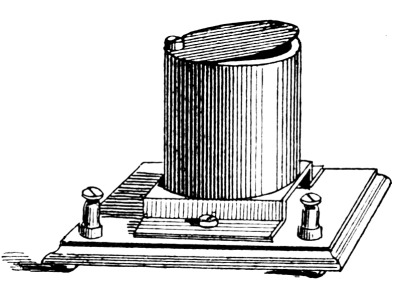
Fig. 25.
Another form of transmitting telephone exhibited in Philadelphia
intended for use with the receiving telephone (fig. 25) is represented
by fig. 26.
A platinum wire attached to a stretched membrane completed a voltaic
circuit by dipping into water. Upon speaking to the membrane,
articulate sounds proceeded from the telephone in the distant room. The
sounds produced by the telephone became louder when dilute sulphuric
acid, or a saturated solution of salt, was substituted for the water.
Audible effects were also produced by the vibration of plumbago in
mercury, in a solution of bichromate of potash, in salt and water, in
dilute sulphuric acid, and in pure water.
The articulation produced from the instrument shown in fig. 25 was
remarkably distinct, but its great defect consisted in the fact that it
could not be used as a transmitting instrument, and thus two telephones
were required at each station, one for transmitting and one for
receiving spoken messages.
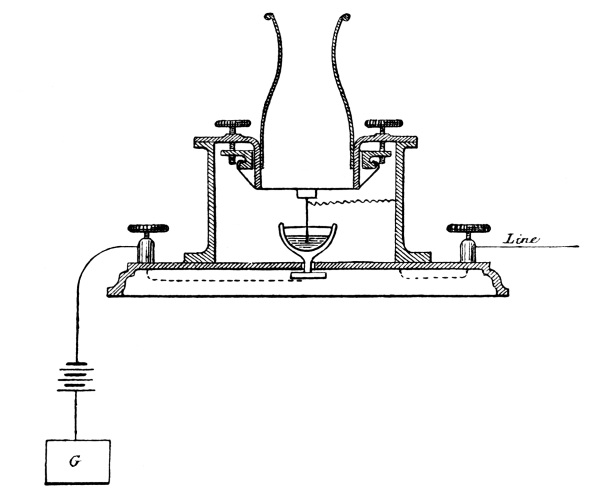
Fig. 26.
It was determined to vary the construction of the telephone
shown in fig. 24, and I sought by changing the size and tension
of the membrane, the diameter and thickness of the steel spring,
the size and power of the magnet, and the coils of insulated wire
around their poles, to discover empirically the exact effect of each
element of the combination, and thus to deduce a more perfect
form of apparatus. It was found that a marked increase in the
loudness of the sounds resulted from shortening the length of the
coils of wire, and by enlarging the iron diaphragm which was
glued to the membrane. In the latter case, also, the distinctness
of the articulation was improved. Finally, the membrane of goldbeaters’
skin was discarded entirely, and a simple iron plate was
used instead, and at once intelligible articulation was obtained.
The new form of instrument is that shown in fig. 27, and, as had
been long anticipated, it was proved that the only use of the
battery was to magnetize the iron core of the magnet, for the
effects were equally audible when the battery was omitted and a
rod of magnetized steel substituted for the iron core of the magnet.
It was my original intention, as shown in fig. 19, and it was always
claimed by me, that the final form of telephone would be operated by
permanent magnets in place of batteries, and numerous experiments had
been carried on by Mr. Watson and myself privately for the purpose of
producing this effect.
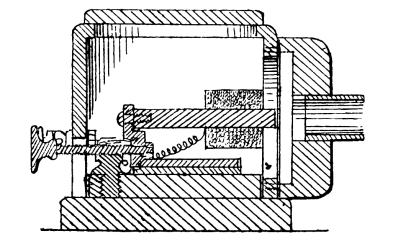
Fig. 27.
At the time the instruments were first exhibited in public the results
obtained with permanent magnets were not nearly so striking as when a
voltaic battery was employed, wherefore we thought it best to exhibit
only the latter form of instrument.
The interest excited by the first published accounts of the operation
of the telephone led many persons to investigate the subject, and I
doubt not that numbers of experimenters have independently discovered
that permanent magnets might be employed instead of voltaic batteries.
Indeed one gentleman, Professor Dolbear, of Tufts College, not only
claims to have discovered the magneto-electric telephone, but I
understand charges me with having obtained the idea from him through
the medium of a mutual friend.
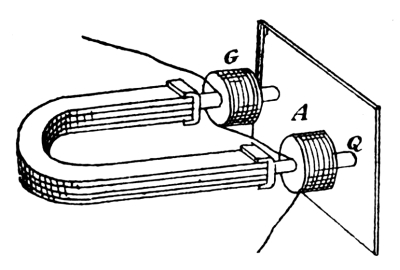
Fig. 28.
A still more powerful form of apparatus was constructed by using a
powerful compound horse-shoe magnet in place of the straight rod which
had been previously used (see fig. 28). Indeed the sounds produced by
means of this instrument were of sufficient loudness to be faintly
audible to a large audience, and in this condition the instrument was
exhibited in the Essex Institute, in Salem, Massachusetts, on the 12th
Feb. 1877, on which occasion a short speech shouted into a similar
telephone in Boston, sixteen miles away, was heard by the audience in
Salem. The tones of the speaker’s voice were distinctly audible to an
audience of 600 people, but the articulation was only distinct at a
distance of about 6 feet. On the same occasion, also, a report of the
lecture was transmitted by word of mouth from Salem to Boston, and
published in the papers the next morning.
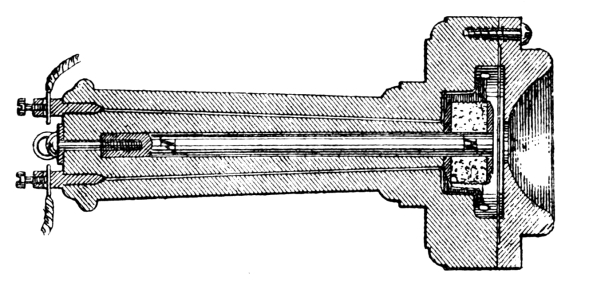
Fig. 29.
From the form of telephone shown in fig. 27
to the present form of the instrument (fig. 29) is but a step. It is
in fact the arrangement of fig. 27 in a portable form, the magnet F H
being placed inside the handle and a more convenient form of mouthpiece
provided. The arrangement of these instruments upon a telegraphic
circuit is shown in fig. 30.
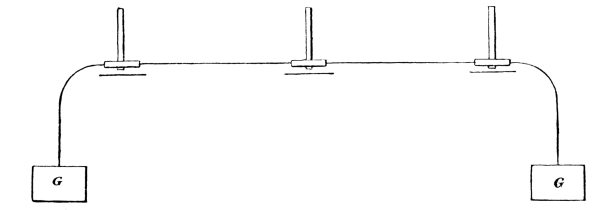
Fig. 30.
And here I wish to express my indebtedness to several scientific
friends in America for their co-operation and assistance. I would
specially mention Professor Peirce and Professor Blake, of Brown
University, Dr. Channing, Mr. Clarke, and Mr. Jones. In Providence,
Rhode Island, these gentlemen have been carrying on together
experiments seeking to perfect the form of apparatus required, and
I am happy to record the fact that they communicated to me each new
discovery as it was made, and every new step in their investigations.
It was, of course, almost inevitable that these gentlemen should
retrace much of the ground that had been gone over by me, and so it
has happened that many of their discoveries had been anticipated by
my own researches; still, the very honourable way in which they from
time to time placed before me the results of their discoveries entitles
them to my warmest thanks and to my highest esteem. It was always my
belief that a certain ratio would be found between the several parts of
a telephone, and that the size of the instrument was immaterial; but
Professor Peirce was the first to demonstrate the extreme smallness
of the magnets which might be employed. And here, in order to show
the parallel lines in which we were working, I may mention the fact
that two or three days after I had constructed a telephone of the
portable form (fig. 29), containing the magnet inside the handle, Dr.
Channing was kind enough to send me a pair of telephones of a similar
pattern, which had been invented by the Providence experimenters. The
convenient form of mouthpiece shown in fig. 29, now adopted by me, was
invented solely by my friend Professor Peirce. I must also express
my obligations to my friend and associate, Mr. Thomas A. Watson, of
Salem, Massachusetts, who has for two years past given me his personal
assistance in carrying on my researches.
In pursuing my investigations I have ever had one end in view, the
practical improvement of electric telegraphy; but I have come across
many facts which, while having no direct bearing upon the subject of
telegraphy, may yet possess an interest for you.[24]
For instance, I have found that a musical tone proceeds from a piece of
plumbago or retort-carbon when an intermittent current of electricity is
passed through it, and I have observed the most curious audible effects
produced by the passage of reversed intermittent currents through the
human body. A rheotome was placed in circuit with the primary wires of
an induction coil, and the fine wires were connected with two strips
of brass. One of these strips was held closely against the ear, and a
loud sound proceeded from it whenever the other slip was touched with
the other hand. The strips of brass were next held one in each hand.
The induced currents occasioned a muscular tremor in the fingers. Upon
placing my forefinger to my ear a loud crackling noise was audible,
seemingly proceeding from the finger itself. A friend who was present
placed my finger to his ear, but heard nothing. I requested him to hold
the strips himself. He was then distinctly conscious of a noise (which
I was unable to perceive) proceeding from his finger. In this case a
portion of the induced currents passed through the head of the observer
when he placed his ear against his own finger: and it is possible that
the sound was occasioned by a vibration of the surfaces of the ear and
finger in contact.
When two persons receive a shock from a Ruhmkorff’s coil by clasping
hands, each taking hold of one wire of the coil with the free hand, a
sound proceeds from the clasped hands. The effect is not produced when
the hands are moist. When either of the two touches the body of the
other a loud sound comes from the parts in contact. When the arm of
one is placed against the arm of the other, the noise produced can be
heard at a distance of several feet. In all these cases a slight shock
is experienced so long as the contact is preserved. The introduction
of a piece of paper between the parts in contact does not materially
interfere with the production of the sounds, but the unpleasant effects
of the shock are avoided.
When an intermittent current from a Ruhmkorff’s coil is passed through
the arms a musical note can be perceived when the ear is closely
applied to the arm of the person experimented upon. The sound seems to
proceed from the muscles of the fore-arm and from the biceps muscle.
Mr. Elisha Gray[25]
has also produced audible effects by the passage of electricity through the human body.
An extremely loud musical note is occasioned by the spark of a
Ruhmkorff’s coil when the primary circuit is made and broken with
sufficient rapidity; when two rheotomes of different pitch are caused
simultaneously to open and close the primary circuit a double tone
proceeds from the spark.
A curious discovery, which may be of interest to you, has been made
by Professor Blake. He constructed a telephone in which a rod of
soft iron, about six feet in length, was used instead of a permanent
magnet. A friend sang a continuous musical tone into the mouthpiece of
a telephone, like that shown in fig. 29, which was connected with the
soft iron instrument alluded to above. It was found that the loudness
of the sound produced in this telephone varied with the direction in
which the iron rod was held, and that the maximum effect was produced
when the rod was in the position of the dipping-needle. This curious
discovery of Professor Blake has been verified by myself.
When a telephone is placed in circuit with a telegraph line, the
telephone is found seemingly to emit sounds on its own account. The
most extraordinary noises are often produced, the causes of which
are at present very obscure. One class of sounds is produced by the
inductive influence of neighbouring wires and by leakage from them, the
signals of the Morse alphabet passing over neighbouring wires being
audible in the telephone, and another class can be traced to earth
currents upon the wire, a curious modification of this sound revealing
the presence of defective joints in the wire.
Professor Blake informs me that he has been able to use the railroad
track for conversational purposes in place of a telegraph wire, and
he further states that when only one telephone was connected with the
track the sounds of Morse operating were distinctly audible in the
telephone, although the nearest telegraph-wires were at least forty
feet distant.
Professor Peirce has observed the most curious sounds produced from
a telephone in connection with a telegraph wire during the aurora
borealis; and I have just heard of a curious phenomenon lately observed
by Dr. Channing. In the city of Providence, Rhode Island, there is an
overhouse wire about one mile in extent with a telephone at either end.
On one occasion the sound of music and singing was faintly audible
in one of the telephones. It seemed as if some one were practising
vocal music with a pianoforte accompaniment. The natural supposition
was that experiments were being made with the telephone at the other
end of the circuit, but upon inquiry this proved not to have been the
case. Attention having thus been directed to the phenomenon, a watch
was kept upon the instruments, and upon a subsequent occasion the same
fact was observed at both ends of the line by Dr. Channing and his
friends. It was proved that the sounds continued for about two hours,
and usually commenced about the same time. A searching examination of
the line disclosed nothing abnormal in its condition, and I am unable
to give you any explanation of this curious phenomenon. Dr. Channing
has, however, addressed a letter upon the subject to the editor of
one of the Providence papers, giving the names of such songs as were
recognised, with full details of the observations, in the hope that
publicity may lead to the discovery of the performer, and thus afford a
solution of the mystery.
My friend Mr. Frederick A. Gower communicated to me a curious
observation made by him regarding the slight earth connection required
to establish a circuit for the telephone, and together we carried on a
series of experiments with rather startling results. We took a couple
of telephones and an insulated wire about 100 yards in length into a
garden, and were enabled to carry on conversation with the greatest
ease when we held in our hands what should have been the earth wire, so
that the connection with the ground was formed at either end through
our bodies, our feet being clothed with cotton socks and leather boots.
The day was fine, and the grass upon which we stood was seemingly
perfectly dry. Upon standing upon a gravel walk the vocal sounds,
though much diminished, were still perfectly intelligible, and the same
result occurred when standing upon a brick wall one foot in height, but
no sound was audible when one of us stood upon a block of freestone.
One experiment which we made is so very interesting that I must speak
of it in detail. Mr. Gower made earth connection at his end of the line
by standing upon a grass plot, whilst at the other end of the line I
stood upon a wooden board. I requested Mr. Gower to sing a continuous
musical note, and to my surprise the sound was very distinctly audible
from the telephone in my hand. Upon examining my feet I discovered that
a single blade of grass was bent over the edge of the board, and that
my foot touched it. The removal of this blade of grass was followed by
the cessation of the sound from the telephone, and I found that the
moment I touched with the toe of my boot a blade of grass or the petal
of a daisy the sound was again audible.
The question will naturally arise, Through what length of wire can the
telephone be used? In reply to this I may say that the maximum amount
of resistance through which the undulatory current will pass, and yet
retain sufficient force to produce an audible sound at the distant end,
has yet to be determined; no difficulty has, however, been experienced
in laboratory experiments in conversing through a resistance of 60,000
ohms, which has been the maximum at my disposal. On one occasion, not
having a rheostat at hand, I may mention having passed the current
through the bodies of sixteen persons, who stood hand in hand. The
longest length of real telegraph line through which I have attempted
to converse has been about 250 miles. On this occasion no difficulty
was experienced so long as parallel lines were not in operation. Sunday
was chosen as the day on which it was probable other circuits would
be at rest. Conversation was carried on between myself, in New York,
and Mr. Thomas A. Watson, in Boston, until the opening of business
upon the other wires. When this happened the vocal sounds were very
much diminished, but still audible. It seemed, indeed, like talking
through a storm. Conversation though possible could be carried on with
difficulty, owing to the distracting nature of the interfering currents.
I am informed by my friend Mr. Preece that conversation has been
successfully carried on through a submarine cable, sixty miles in
length, extending from Dartmouth to the Island of Guernsey, by means of
hand telephones similar to that shown in fig. 30.