INTRODUCTION.
In consequence of the discovery of the
respirability and extraordinary effects of nitrous oxide, or the dephlogisticated nitrous
gas of Dr. Priestley, made in April 1799, in a manner to be particularly described
hereafter,[1]
I was induced to carry on the following investigation concerning its
composition, properties, combinations, and mode of operation on living beings.
In the course of this investigation, I have met with many difficulties;
some arising from the novel and obscure nature of the subject, and
others from a want of coincidence in the observations of different
experimentalists on the properties and mode of production of the gas.
By extending my researches to the different substances connected
with nitrous oxide; nitrous acid, nitrous gas and ammoniac; and by
multiplying the comparisons of facts, I have succeeded in removing the
greater number of those difficulties, and have been enabled to give a
tolerably clear history of the combinations of oxygene and nitrogene.
By employing both analysis and synthesis whenever these methods were
equally applicable, and comparing experiments made under different
circumstances, I have endeavoured to guard against sources of error;
but I cannot flatter myself that I have altogether avoided them. The
physical sciences are almost wholly dependant on the minute observation
and comparison of properties of things not immediately obvious to the
senses; and from the difficulty of discovering every possible mode of
examination, and from the modification of perceptions by the state
of feeling, it appears nearly impossible that all the relations of
a series of phænomena can be discovered by a single investigation,
particularly when these relations are complicated, and many of the
agents unknown. Fortunately for the active and progressive nature
of the human mind, even experimental research is only a method of
approximation to truth.
In the arrangement of facts, I have been guided as much as possible by
obvious and simple analogies only. Hence I have seldom entered into
theoretical discussions, particularly concerning light, heat, and other
agents, which are known only by isolated effects.
Early experience has taught me the folly of hasty generalisation. We
are ignorant of the laws of corpuscular motion; and an immense mass of
minute observations concerning the more complicated chemical changes
must be collected, probably before we shall be able to ascertain even
whether we are capable of discovering them. Chemistry in its present
state, is simply a partial history of phænomena, consisting of many
series more or less extensive of accurately connected facts.
With the most important of these series, the arrangement of the
combinations of oxygene or the antiphlogistic theory discovered by
Lavoisier, the chemical details in this work are capable of being
connected.
In the present state of science, it will be unnecessary to enter into
discussions concerning the importance of investigations relating to
the properties of physiological agents, and the changes effected in
them during their operation. By means of such investigations, we arrive
nearer towards that point from which we shall be able to view what is
within the reach of discovery, and what must for ever remain unknown to
us, in the phænomena of organic life. They are of immediate utility, by
enabling us to extend our analogies so as to investigate the properties
of untried substances, with greater accuracy and probability of success.
The first Research in this work chiefly relates to the
production of nitrous oxide and the analysis of nitrous gas and nitrous acid.
In this there is little that can be properly called mine; and if by
repeating the experiments of other chemists, I have sometimes been able
to make more minute observations concerning phænomena, and to draw
different conclusions, it is wholly owing to the use I have made of
the instruments of investigation discovered by the illustrious fathers
of chemical philosophy,[2]
and so successfully applied by them to the discovery of truth.
In the second Research the combinations and composition
of nitrous oxide are investigated, and an account given of its decomposition
by most of the combustible bodies.
The third Research contains observations on the action
of nitrous oxide upon animals, and an investigation of the changes effected
in it by respiration.
In the fourth Research the history of the respirability
and extraordinary effects of nitrous oxide is given, with details of
experiments on its powers made by different individuals.
I cannot close this introduction, without acknowledging my obligations
to Dr. Beddoes. In the conception of many of the following experiments,
I have been aided by his conversation and advice. They were executed
in an Institution which owes its existence to his benevolent and
philosophic exertions.
Dowry-Square, Hotwells, Bristol.
June 25th, 1800.
RESEARCH I.
concerning the analysis of
NITRIC ACID and
NITROUS GAS
and the production of
NITROUS OXIDE.
Pl. I.
MERCURIAL AIRHOLDER and BREATHING MACHINE.
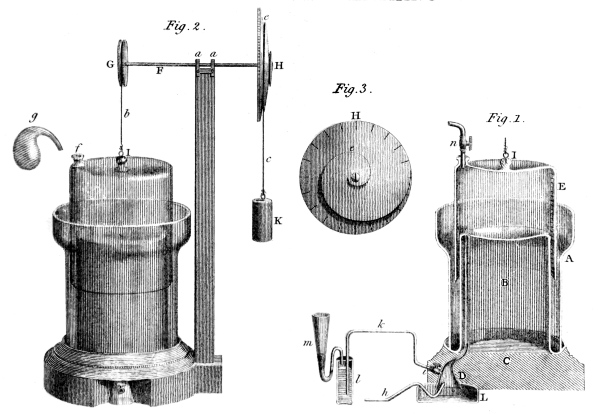
Lowry sculpᵗ.
RESEARCH I. — DIVISION I. — DIVISION II. — DIVISION III. — DIVISION IV. — DIVISION V.
INTO THE PRODUCTION AND ANALYSIS OF
NITROUS OXIDE,
AND THE AËRIFORM
FLUIDS RELATED TO IT.
EXPERIMENTS and OBSERVATIONS on the composition of
NITRIC ACID, and on its combinations with Water
and Nitrous Gas.
I. Though since
the commencement of Pneumatic Chemistry, no substance has been more the
subject of experiment than Nitrous Acid; yet still the greatest
uncertainty exists with regard to the quantities of the principles
entering into its composition.
In comparing the experiments of the illustrious Cavendish on the
synthesis of nitrous acid, with those of Lavoisier on the decomposition
of nitre by charcoal, we find a much greater difference in the results
than can be accounted for by supposing the acid formed, and that
decomposed, of different degrees of oxygenation.
In the most accurate experiment of Cavendish, when the nitrous acid
appeared to be in a state of deoxygenation, 1 of nitrogene combined
with about 2,346 of oxygene.[3]
In an earlier experiment, when the acid was probably fully oxygenated,
the nitrogene employed was to the oxygene nearly as 1 to 2,92.[4]
Lavoisier, from his experiments on the decomposition of nitre, and
combination of nitrous gas and oxygene, concludes, that the perfectly
oxygenated, or what he calls nitric acid, is composed of nearly 1
nitrogene, with 3,9 of oxygene; and the acid in the last state of
deoxygenation, or nitrous acid, of about 3 oxygene with 1 nitrogene.[5]
Great as the difference is between the estimations of these
philosophers, we find differences still greater in the accounts of the
quantities of nitrous gas necessary to saturate a given quantity of
oxygene, as laid down by very accurate experimentalists. On the one
hand, Priestley found 1 of oxygene condensed by 2 of nitrous gas, and
Lavoisier by 1⅞. On the other, Ingenhouz, Scherer, and De la Metherie,
state the quantity necessary to be from 3 to 5.[6]
Humbolt, who has lately investigated Eudiometry with great ingenuity, considers
the mean quantity of nitrous gas necessary to saturate 1 of oxygene, as about
2,55.[7]
II. To reconcile these different results is impossible,
and the immediate connection of the subject with the production of nitrous
oxide, as well as its general importance, obliged me to search for
means of accurately determining the composition of nitrous acid in its
different degrees of oxygenation.
The first desideratum was to ascertain the nature and composition of a
fluid acid, which by being deprived of, or combined with nitrous gas,
might become a standard of comparison for all other acids.
To obtain this acid I should have preferred the immediate combination
of oxygene and nitrogene over water by the electric spark, had it
been possible to obtain in this way by a common apparatus sufficient
for extensive examination; but on carefully perusing the laborious
experiments of Cavendish, I gave up all thoughts of attempting it.
My first experiments were made on the decomposition of nitre,
formed from a known quantity of pale nitrous acid of known specific
gravity, by phosphorus, tin, and charcoal: but in those processes,
unascertainable quantities of nitrous acid, with excess of nitrous gas,
always escaped undecompounded, and from the non-coincidence of results,
where different quantities of combustible substances were employed, I
had reasons for believing that water was generally decomposed.
Before these experiments were attempted, I had analized nitrous gas
and nitrous oxide, in a manner to be particularly described hereafter;
so that a knowledge of the quantities of nitrous gas and oxygene
entering into the composition of any acid, enabled me to determine the
proportions of nitrogene and oxygene it contained. In consequence of
which I attempted to combine together oxygene and nitrous gas, in such
a manner as to absorb the nitrous acid formed by water, in an apparatus
by which the quantities of the gases employed, and the increase of
weight of the water, might be ascertained; but this process likewise
failed. It was impossible to procure the gases perfectly free from
nitrogene, and during their combination, this nitrogene made to pass
into a pneumatic apparatus communicating with a vessel containing the
water carried over with it, much nitrous acid vapor, of different
composition from the acid absorbed.
After many unsuccessful trials, Dr. Priestley’s experiments on nitrous
vapor[8]
induced me to suppose that oxygene and nitrous gas, made to
combine out of the contact of bodies having affinity for oxygene, would
remain permanently aëriform, and on throwing them separately into an
exhausted glass balloon, I found that this was actually the case;
increase of temperature was produced, and orange colored nitrous acid
gas formed, which after remaining for many days in the globe, at a
temperature below 56°, did not in the slightest degree condense.
This fact afforded me the means not only of forming a standard acid,
but likewise of ascertaining the specific gravity of nitrous acid in
its aëriform state.
III. Previous to the experiment, for the purpose of correcting
incidental errors, I was induced to ascertain the specific gravity of
the gases employed, particularly as I was unacquainted with any process
by which the weight of nitrous gas had been accurately determined. Mr.
Kirwan’s estimation, which is generally adopted, being founded upon
the comparison of the loss of weight of a solution of copper in dilute
nitrous acid, with the quantity of gas produced.[9]
The instruments that I made use of for containing and measuring my
gases, were two mercurial airholders graduated to the cubic inch of
Everard, and furnished with stop-cocks.[10]
They were weighed in a glass globe, of the capacity of 108 cubic
inches, which with the small glass stop-cock affixed to it, was equal,
when filled with atmospheric air, to 1755 grains. The balance that I
employed, when loaded with a pound, turned with less than one eighth of
a grain.
Into a mercurial airholder, of the capacity of 200 cubic inches, 160
cubic inches of nitrous gas were thrown from a solution of mercury in
nitrous acid.
70 measures of this were agitated for some minutes in a solution of
sulphate of iron,[11]
till the diminution was complete. The nitrogene
remaining hardly filled a measure; and if we suppose with
Humbolt[12]
that a very small portion of it was absorbed with the nitrous gas, the
whole quantity it contained may be estimated at 0,0142, or ¹/₇₀.
75 cubic inches received from the airholder into an exhausted balloon,
increased it in weight 25,5 grains; thermometer being 56°, and
barometer 30,9. And allowing for the small quantity of nitrogene in the
gas, 100 cubic inches of it will weigh 34.3 grains.
One hundred and thirty cubic inches of oxygene were procured from oxide
of manganese and sulphuric acid, by heat, and received in another
mercurial airholder.
10 measures of it, mingled with 26 of the nitrous gas, gave, after
the residuum was exposed to solution of sulphate of iron, rather more
than one measure. Hence we may conclude that it contained about 0,1 nitrogene.
60 cubic inches of it weighed 20,75 grains; and accounting for the
nitrogene contained in these, 100 grains of pure oxygene will weigh
35,09 grains.
Atmospherical air was decomposed by nitrous gas in excess; and the
residuum washed with solution of sulphate of iron till the Nitrogene
remained pure; 87 cubic inches of it weighed 26,5 grains, thermometer
being 48°, barometer 30,1; 100 will consequently weigh 30,45.
90 cubic inches of the air of the laboratory not deprived of its
carbonic acid, weighed 28,75 grains; thermometer 53, barometer 30: 100
cubic inches will consequently weigh 31,9.[13]
16 measures of this air, with 16 nitrous gas, of known composition,
diminished to 19. Hence it contained about,26 oxygene.[14]
In comparing my results with those of Lavoisier and Kirwan, the
estimation of the weights of nitrogene and oxygene is very little
different, the corrections for temperature and pressure being made,
from that of those celebrated philosophers. The first makes oxygene to
weigh[15]
34,21, and nitrogene 30,064 per cent; and the last, oxygene
34,[16] and nitrogene 30,5.
The specific gravity of nitrous gas, according to Kirwan, is to that of
common air as 1194 to 1000. Hence it should weigh about 37 grains per
cent. This difference from my estimation is not nearly so great as I
expected to have found it.[17]
IV.[18]
The thermometer in the laboratory standing at 55°, and the
barometer at 30,1, I now proceeded to my experiment. The oxygene that
I employed was of the same composition as that which I had previously
weighed. The nitrous gas contained,0166 nitrogene.
For the purpose of combining the gases, a glass balloon was procured,
of the capacity of 148 cubic inches, with a glass stop-cock adapted to
it, having its upper orifice tubulated and graduated for the purpose of
containing and measuring a fluid. The whole weight of this globe and
its appendages, when filled with common air, was 2066,5 grains.
It was partially exhausted by the air-pump, and lost in weight just
32 grains. From whence we may conclude that about 15 grains of air
remained in it.
In this state of exhaustion it was immediately cemented to the
stop-cock of the mercurial airholder, and the communication being made
with great caution, 82 cubic inches of nitrous gas rushed into the
globe, on the outside of which a slight increase of temperature was
perceived, while the gases on the inside appeared of a deep orange.
Before the common temperature was restored, the communication was
stopped, and the globe removed. The increase of weight was 29,25
grains; whence it appeared that 1,14 grains of common air, part of
which had been contained in the stop-cocks, had entered with the
nitrous gas.
Whilst it was cooling, from the accidental loosening of the stopper of
the cock, 3 grains more of common air entered.[19]
The communication was now made between the globe and the mercurial
airholder containing oxygene. 64 cubic inches were slowly pressed in,
when the outside of the globe became warmer, and the color on the
inside changed to a very dark orange. As it cooled, 6 cubic inches more
slowly entered; but no new increase of temperature, or change of color
took place.
The globe being now completely cold, was stopped, removed, and weighed;
it had gained 24,5 grains, from whence it appears that 0,4 grains of
common air contained in the stop-cocks, had entered with the oxygene.[20]
To absorb the nitrous acid gas, 41 grains of water were introduced by
the tube of the stop-cock, which though closed as rapidly as possible,
must have suffered nearly,5 grains of air to enter at the same time,
as the increase of weight was 41,5 grains. The dark orange of the globe
diminished rapidly; it became warm at the bottom, and moist on the
sides. After a few minutes the color had almost wholly disappeared.
To ascertain the quantity of aëriform fluid absorbed, the globe was
again attached to the mercurial air apparatus, containing 140 cubic
inches of common air. When the communication was made, 51 cubic inches
rushed in, and it gained in weight 16,5 grains.
A quantity of fluid equal to 54 grains was now taken out of the globe.
On examination it proved to be slightly tinged with green, and occupied
a space equal to that filled by 41,5 grains of water. Its specific
gravity was consequently 1,301.
To ascertain if any unabsorbed aëriform nitrous acid remained in the
globe, 13 grains of solution of ammonia were introduced in the same
manner as the water, and after some minutes, when the white vapor had
condensed, the communication was again made with the mercurial
airholder containing common air. A minute quantity entered, which could
not be estimated at more than three fourths of an inch, and the globe
was increased in weight about 13,25 grains.[21]
Common air was now thrown into the globe till the residual gases of
the experiment were judged to be displaced; it weighed 2106,5 grains,
that is, 40 grains more than it had weighed when filled with common air
before the experiment.[22]
And if from those 40 grains we take 13 for the solution of ammonia
introduced, the remainder, 27, will be the quantity of solution of
nitrous acid in water remaining in the globe, which added to 54, equals
81 grains, the whole quantity formed; but if from this be taken 41
grains, the quantity of water, the remainder 40 grains, will be the
quantity of nitrous acid gas absorbed in the solution.
To find the absolute quantity of nitrous acid formed, we must find
the specific gravity of that absorbed; but as during, and after its
absorption, 17 grains of air, equal to 53,2 cubic inches entered, it
evidently filled such a space. 53,2 cubic inches of it consequently
weigh 40 grains, and 100 cubic inches 75,17 grains. Then,75 cubic
inches weigh,56 grains, and this added to 40, makes 40,56 grains,
equal to 53,95 cubic inches, the whole quantity of aëriform nitrous
acid produced.
But the quantity of nitrous gas entering into this, allowing for the
nitrogene it contained, is 27,6 grains, equal to about 80,5 cubic
inches; and the oxygene is 40,56-27,6 = to 12,96 grains, or 36,9 cubic
inches.
V. There could exist in this experiment no circumstance connected with
inaccuracy, except the impossibility of very minutely determining
the quantities of common air which entered with the gases from the
stop-cocks. But if errors have arisen from this source, they must be
very inconsiderable; as will appear from a calculation of the specific
gravity of the nitrous acid gas, founded on the volume of the gases
that entered the globe.
| The air that remained in the globe |
|
| after exhaustion was 15 grains
= |
47[23] |
cub. in. |
| The nitrous gas introduced was |
82 |
|
| Common air |
13 |
|
| Oxygene |
70 |
|
| Common air |
1 |
|
| |
—— |
|
| Whole quantity of air thrown into the globe |
213 |
|
| From which subtract its capacity |
148 |
|
| |
—— |
|
| The remainder is |
65 |
|
And this remainder taken from 80,5 nitrous gas +
36,9 oxygene, leaves 52,4 cubic inches, which is the space occupied by
the nitrous acid gas, and which differs from 53,95 only by 1,55 cubic
inches.
I ought to have observed, that before this conclusive experiment,
two similar ones had been made. In comparing the results of one of
them, performed with the assistance of my friend, Mr. Joseph
Priestley, Dr. Priestley’s eldest son, and chiefly
detailed by him in the journal, I find a coincidence greater than could
be even well expected, where the processes are so complex. According to
that experiment, 41,5 grains of nitrous acid gas fill a space equal to
53 cubic inches, and are composed of nearly 29 nitrous gas, and 12,5 oxygene.
We may then conclude, First, that 100 cubic inches of nitrous acid,
such as exists in the[24]
aëriform state saturated with oxygene, at temperature 55°, and
atmospheric pressure 30,1 weigh 75,17 grains.
Secondly, that 100 grains of it are composed of 68,06 nitrous gas, and
31,94 oxygene. Or assuming what will be hereafter proved, that 100
parts of nitrous gas consist of 55,95 oxygene, and 44,05 nitrogene, of
29,9 nitrogene, and 70,1 oxygene; or taking away decimals, of 30 of the
one to 70 of the other.
Thirdly, that 100 grains of pale green solution of nitrous acid in
water, of specific gravity 1,301, are composed of 50,62 water, and 49,38
acid of the above composition.
VI. Having thus ascertained the composition of a standard acid,
my next object was to obtain it in a more condensed state, as it was otherwise
impossible to saturate it to its full extent with nitrous gas. But this
I could effect in no other way than by comparing mixtures of known
quantities of water, and acids of different specific gravities and
colors, with the acid of 1,301.
For the purpose of combining my acids with water, I made use of a
cylinder about 8 inches long, and,3 inches in diameter, accurately
graduated to grain measures, and furnished with a very tight stopper.
The concentrated acid was first slowly poured into it, and the water
gradually added till the required specific gravity was produced;[25]
the cylinder being closed and agitated after each addition, so as to
produce combination without any liberation of elastic fluid.
After making a number of experiments with acids of different colors
in this advantageous way, I at length found that 90 grains of a deep
yellow acid, of specific gravity 1,5, became, when mingled at 40° with
77,5 grains of water, of specific gravity 1,302, and of a light green
tinge, as nearly as possible resembling that of the standard acid.
Supposing, then, that these acids contain nearly the same relative
proportions of oxygene and nitrogene, 100 grains of the deep yellow
acid of 1,5, are composed of 91,9 grains true nitrous acid,[26]
and 8,1 grains of water.
To ascertain the difference between the composition of this acid,
and that of the pale, or nitric acid, of the same specific gravity,
I inserted 150 grains of it into a small cylindrical mattrass of the
capacity of,5 cubic inches, accurately graduated to grain measures,
and connected by a curved tube with the water apparatus. After heat had
been applied to the bottom of the mattrass for a few minutes, the color
of the fluid gradually changed to a deep red, whilst the globules of
gas formed at the bottom of the acid, were almost wholly absorbed in
passing through it. In a short time deep red vapour began to fill the
tube, and being condensed by the water in the apparatus, was converted
into a bright green fluid, at the same time that minute globules of
gas were given out. As the heat applied became more intense, a very
singular phænomenon presented itself; the condensed vapor, increased
in quantity, at length filled the curvature of the tube, and when
expelled, formed itself into dark green spherules, which sunk to the
bottom of the water, rested for a moment, and then resolved themselves
into nitrous gas.[27]
When the acid was become completely pale, it was suffered to cool, and
weighed. It had lost near 15 grains, and was of specific gravity 1,491.
2 cubic inches and quarter of nitrous gas only were collected.
From this experiment evidently no conclusions could be drawn, as the
nitrous gas had carried over with it much nitrous acid (in the form of
what Dr. Priestley calls nitrous vapor) and was partially dissolved
with it in the water.[28]
To ascertain, then, the difference between the pale and yellow acids, I
was obliged to make use of synthesis, compared with analysis, carried
on in a different mode, by means of the following apparatus.
VII. To the stop-cock of the upper cylinder of the mercurial airholder,
a capillary tube was adapted, bent so as to be capable of introduction
into an orifice in the stopper of a graduated phial similar to that
employed for mingling acids with water, and sufficiently long to reach
the bottom. With another orifice in the stopper of the phial was
connected a similar tube curved, for the purpose of containing a fluid,
and of increased diameter at the extremity.[29]
50 cubic inches of pure nitrous gas[30]
were thrown into the mercurial apparatus. The graduated phial,
containing 90 grains of nitric acid, of specific gravity 1,5, was
placed on the top of the airholding cylinder, and made to communicate
with it by means of the stop-cock and first tube. Into the second
tube a small quantity of solution of potash was placed. When all the
junctures were carefully cemented, by pressing on the airholder, the
nitrous gas was slowly passed into the phial, and absorbed by the
nitrous acid it contained; whilst the small quantities of nitrogene
evolved, slowly drove forward the solution in the curved tube; from the
height of which, as compared with that of the mercury in the conducing
tube, the pressure on the air in the cylinder was known.
In proportion as the nitrous gas was absorbed, the phial became warm,
and the acid changed color; it first became straw-colored, then pale
yellow, and when about 7½ cubic inches had been combined with it,
bright yellow. It had gained in weight nearly 3 grains, and was become
of specific gravity 1,496.
This experiment afforded me an approximation to the real difference
between nitric and yellow nitrous acid; and learning from it that
nitric acid was diminished in specific gravity by combination with
nitrous gas, I procured a pale acid of specific gravity 1,504.[31]
After this acid had been combined in the same manner as before, with about 8
cubic inches of nitrous gas,[32]
it became nearly of specific gravity 1,5, and had gained in weight about 3 grains.
Assuming the accuracy of this experiment as a foundation for
calculation, I endeavoured in the same manner to ascertain the
differences in the composition of the orange colored acids, and the
acids containing still larger proportions of nitrous gas.
93 grains of the bright yellow acid of 1,5 became, when 6 cubic inches
of gas had been passed through it, orange colored and fuming, whilst
the undissolved gas increased in quantity so much as to render it
impossible to confine it by the solution of potash. When 9 cubic inches
had passed through, it became dark orange. It had gained in weight
2,75 grains, and was become of specific gravity 1,48 nearly. Hence it
was evident that much nitrous gas had passed through it undissolved.
25 cubic inches more of nitrous gas were now slowly sent through it:
it first became of a light olive, then of a dark olive, then of a
muddy green, then of a bright green, and lastly of a blue green. After
its assumption of this color, the gas appeared to pass through it
unaltered, and large globules of fluid, of a darker green than the
rest, remained at the bottom of the cylinder, and when agitated, did
not combine with it. The increase of weight was only 1 grain, and the
acid was of specific gravity 1,474 nearly.
In this experiment it was evident that the unabsorbed nitrous gas
had carried over with it a considerable quantity of nitrous acid. I
endeavoured to correct the errors resulting from this circumstance,
by connecting the curved tube first with a small water apparatus, and
afterwards with a mercurial apparatus; but when the water apparatus
was used, the greater part of the unabsorbed gas was dissolved with
the nitrous acid it held in solution, by the water; and when mercury
was employed, the nitrous acid that came over was decomposed, and the
quantity of nitrous gas evolved, in consequence increased.
As it was possible that a small deficiency of weight might arise from
the red vapor given out during the processes of weighing and examining
the acid in the last experiment, 35 cubic inches of nitrous gas were
very slowly passed through 90 grains of pale nitrous acid, of specific
gravity 1,5: it became of similar appearance to that just described,
had gained in weight 6,75 grains, and was become of specific gravity
1,475.
These experiments did not afford approximations sufficiently accurate
towards the composition of deoxygenated acids, containing more nitrous
gas than the dark orange colored. To obtain them, a solution consisting
of 94,25 grains of blue green, or perfectly nitrated acid, (if we
may be allowed to employ the term), of specific gravity 1,475, was
inserted into a graduated phial, and connected by a curved tube, with
the mercurial airholder; in the conductor of which a small quantity of
water was inserted to absorb the nitrous acid which might be carried
over by the gas. Heat was slowly applied to the phial, and nitrous gas
given out with great rapidity. When 4 cubic inches were collected, the
acid became dark olive, when 9 dark red, when 13 bright orange, and
when 18 pale. It had lost 31 grains, and when completely cool, was
of specific gravity 1,502 nearly. The water in the apparatus was
tinged of a light blue; from whence we may conclude that some of the
nitrous gas was absorbed by it with the nitrous acid: but it will be
hereafter proved that the orange colored acid is the most nitrated acid
capable of combining undecompounded with water, and that the color it
communicates to a large quantity of water, is light blue. If then we
take 6,1 grains, the quantity of gas collected, from 31 the loss, the
remainder is 24,9, which reasoning from the synthetical experiment,
may be supposed to contain nearly 3 cubic inches of nitrous gas.
Consequently, 94,25 grains of dark green acid, of specific gravity
1,475, are composed of nearly 21 cubic inches, or 7,2 grains of nitrous
gas, and 87,05 grains of pale nitrous acid, of 1,504.
VIII. Comparing the different synthetical and analytical experiments,
we may conclude with tolerable accuracy, that 92,75 grains of bright
yellow, or standard acid of 1,5, are composed of 2,75 grains of nitrous
gas, and 90 grains of nitric acid of 1,504; but 92,75 grains of
standard acid contain 85,23 grains of nitrous acid, composed of about
27,23 of oxygene, and 58, nitrous gas: now from 58, take 2,75, and the
remainder 55,25, is the quantity of nitrous gas contained in 90 grains
of nitric acid of 1,504; consequently, 100 grains of it are composed
of 8,45 water, and 91,55 true acid, containing 61,32 nitrous gas, and
30,23 oxygene; or 27,01 nitrogene, and 64,54 oxygene: and the nitrogene
in nitric acid, is to the oxygene as 1 to 2,389.
IX. My ingenious friend, Mr. James Thomson,
has communicated to me some observations relating to the composition of nitrous acid
(that is, the orange colored acid), from which he draws a conclusion
which is, in my opinion, countenanced by all the facts we are in
possession of, namely, “that it ought not to be considered as a
distinct and less oxygenated state of acid, but simply as nitric or
pale acid, holding in solution, that is, loosely combined with, nitrous
gas.”[33]
It is impossible to call any substance a simple acid that is incapable
of entering undecompounded into combination with the alkalies, &c; but
it will appear hereafter that the salts called in the new nomenclature
nitrites, cannot be directly formed. If, indeed, it could be
proved, that the heat produced by the combination of nitrous acid with
salifiable bases, was the only cause of the partial decomposition of
it, and that when this process was effected in such a way as to prevent
increase of temperature, no nitrous gas was liberated, the common theory
might have some foundation; but though dilute phlogisticated nitrous
acid combines[34]
with alkaline solutions without decomposition, yet no excess of nitrous
gas is found in the solid salt: it is either disengaged in proportion
as the water is evaporated, or it absorbs oxygene from the atmosphere,
and becomes nitric acid.
In proportion as the nitrous acids contain more nitrous gas, so in
proportion do they more readily give it out. From the blue green acid
it is liberated slowly at the temperature of 50°, and from the green
likewise on agitation. The orange coloured and yellow acids do not
require a heat above 200° to free them of their nitrous gas; and all the
colored acids, when exposed to the atmosphere absorb oxygene, and
become by degrees pale.
If the nitrous vapour, i. e. such as is disengaged during the
denitration of the colored acids, was capable of combining
with the alkalies, it might be supposed a distinct acid, and called
nitrous acid; and the acids of different colors might be considered
simply as compounds of this acid with nitric acid; but it appears to be
nothing more than a solution of nitric acid in nitrous gas, incapable
of condensation, undecompounded, and when decompounded and condensed,
constituting the dark green acid, which is immiscible with water,[35]
and uncombinable with the alkalies.[36]
It seems therefore reasonable, till we are in possession of new lights
on the subject, to consider, with Mr. Thomson, the deoxygenated or
nitrous acids simply as solutions of nitrous gas composed of sulphuric
acid, metallic oxides, and nitrous gas.[37]
Supposing the truth of these principles according to the logic of the
French nomenclature, there is no acid to which the term nitrous acid
ought to be applied; but as it has been used to signify the
acids holding in solution nitrous gas, it is perhaps better still to
apply it to those substances, than to invent for them new names. A
nomenclature, accurately expressing their constituent parts, would be
too complex, and like all other nomenclatures founded upon theory,
liable to perpetual alterations. Their composition is known from their
specific gravity and their colors; hence it is better to denote it
by those physical properties: thus orange nitrous acid, of specific
gravity 1,480, will signify a solution of nitrous gas in nitric acid,
in which the nitric acid is to the nitrous gas, nearly as 87 to 5, and
to the water as 11 to 1.
X. The estimation of the composition of the yellow and orange
colored nitrous acids given in the following table, may be considered as
tolerably accurate, being deduced from the synthetical experiments
in the sixth section, compared with the analytical ones. But as
in the synthetical experiment, when the acid became green, it was
impossible to ascertain the quantity of nitrous gas that passed through
it unabsorbed, and as in the analysis the quantity of nitrous gas
dissolved by the water at different periods of the experiment could not
be ascertained, the accounts of the composition of the green acids must
be considered only as very imperfect approximations to truth.
TABLE I.
Containing Approximations to the quantities of
NITRIC ACID, NITROUS GAS, and WATER in NITROUS ACIDS, of different
colors and specific gravities.
| |
| 100 Parts |
|
Specific
Gravity |
|
Nitric
Acid |
Water |
Nitrous
gas |
| Sol. Nitric Acid |
|
1,504 |
c |
91,55 |
8,45 |
— — |
| Yellow Nitrous[38] |
|
1,502 |
o |
90,5 |
8,3 |
1,2 |
| Bright Yellow |
o |
1,500 |
n |
88,94 |
8,10 |
2,96 |
| Dark Orange |
f |
1,480 |
t |
86,84 |
7,6 |
5,56 |
| Light Olive‡ |
|
1,479 |
a |
86,00 |
7,55 |
6,45 |
| Dark Olive‡ |
|
1,478 |
i |
85,4 |
7,5 |
7,1 |
| Bright Green‡ |
|
1,476 |
n |
84,8 |
7,44 |
7,76 |
| Blue Green[39] |
|
1,475 |
|
84,6 |
7,4 |
8,00 |
| ‡ = “FOOTNOTE [38]” |
TABLE II.
Binary Proportions of OXYGENE and NITROGENE in
NITRIC and NITROUS ACIDS.[40]
| |
| 100 Parts |
|
Oxygene |
Nitrogene |
|
Nitrogene |
Oxygene |
| Nitric Acid |
c |
70,50 |
29,50 |
|
1 |
2,389 |
| |
o |
|
|
|
|
|
| Bright yellow Nitrous |
n |
70,10 |
29,90 |
Proportions. |
1 |
2,344 |
| |
t |
|
|
Nitrogene. |
|
|
| Orange coloured |
a |
69,63 |
30,37 |
Unity. |
1 |
2,292 |
| |
i |
|
|
|
|
|
| Dark Green |
n |
69,08 |
30,92 |
|
1 |
2,230 |
| |
XI. I have before mentioned that dilute nitric acids are incapable
of dissolving so much nitrous gas in proportion to their quantities of
true acid, as concentrated ones. During their absorption of it, they
go through similar changes of color; 330 grains of nitric acid, of
specific gravity 1,36, after 50 cubic inches of gas had been passed
through it, became blue green, and of specific gravity 1,351. It had
gained in weight but 3 grains; and when the nitrous gas was driven from
it by heat into a water apparatus, but 7 cubic inches were collected.[41]
From the diminution of specific gravity of nitric acid by combination
with nitrous gas, and from the smaller attraction of nitric acid for
nitrous gas, in proportion as it is diluted, it is probable that the
nitrated acids, in their combinations with water, do not contract so
much as[42]
nitric acids of the same specific gravities. The affinities
resulting from the small attraction of nitrous gas for water, and its
greater attraction for nitric acid, must be such as to lessen the
affinity of nitric acid and water for each other.
Hence it would require an infinite number of experiments to ascertain
the real quantities of acid, nitrous gas, and water, contained in the
different diluted nitrous acids; and after these quantities were
determined, they would probably have no important connection with the
chemical arrangement. As yet, our instruments of experiment are not
sufficiently exact to afford us the means of ascertaining the ratio
in which the attraction of nitric acid[43]
for water diminishes in its progress towards saturation.
The estimations in the following table, of the real quantities of
nitric acid in solutions of different specific gravities, were deduced
from experiments made in the manner described in section VI, except
that the phial employed was longer, narrower, and graduated to half
grains. The temperature, at the time of combination, was from 40° to 46°.
TABLE III.
Of the Quantities of True NITRIC ACID in solutions
of different SPECIFIC GRAVITIES.
| |
100 Parts Acid
of specific gravity |
|
True Acid[44] |
Water |
| 1,5040 |
|
91,55 |
8,45 |
| 1,4475 |
c |
80,39 |
19,61 |
| 1,4285 |
o |
71,65 |
28,35 |
| 1,3906 |
n |
62,96 |
37,04 |
| 1,3551 |
t |
56,88 |
43,12 |
| 1,3186 |
a |
52,03 |
47,97 |
| 1,3042 |
i |
49,04 |
50,96 |
| 1,2831 |
n |
46,03 |
53,97 |
| 1,2090 |
|
45,27 |
54,73 |
| |
XII. The blue green spherules mentioned in section V. produced by
the condensation of nitrous vapor, and by the combination of nitric
acid with nitrous gas, may be considered as saturated solutions of
nitrous gas in nitric acid. The combinations of nitric acid and nitrous
gas containing a larger proportion of nitrous gas, are incapable of
existing in the fluid state at common temperatures; and, as appears
from the first experiment, an increase of volume takes place during
their formation. They consequently ought to be looked upon as solutions
of nitric acid in nitrous gas, identical with the nitrous vapor of
Priestley.
From the researches of this great discoverer, we learn that nitrous
vapor is decomposable, both by water and mercury. Hence it is almost
impossible accurately to ascertain its composition. In one of his
experiments,[45]
when more than 130 grains of strong nitrous acid were
exposed for two days to nearly 247 cubic inches of nitrous gas, over
water: about half of the acid was dissolved, and deposited with the gas
in the water.[46]
XIII. In comparing the results of my fundamental experiment on the
composition of nitrous acid, with those of Cavendish, the great
coincidence between them gave me very high satisfaction, as affording
additional proofs of accuracy. If the acid formed in the last
experiment of this illustrious philosopher be supposed analogous to the
light green acid formed in my first experiment, our estimations will be
almost identical.
Lavoisier’s account of the composition of the nitric and nitrous
acids, has been generally adopted. According to his estimation, these
substances contain a much larger quantity of oxygene than I have
assigned to them.
The fundamental experiments of this great philosopher were made at an
early period of pneumatic chemistry,[47]
on the decomposition of nitre by charcoal; and he considered the
nitrogene evolved, and the oxygene of the carbonic acid produced in
this process, as the component parts of the nitric acid contained in
the nitre.
I have before mentioned the liberation of nitrous acid, in the
decomposition of nitre by combustible bodies; and I had reasons for
suspecting that this circumstance was not the only source of inaccuracy.
That my suspicions were well founded, will appear from the following
experiments:
EXPERIMENT a. I introduced into a strong glass tube, 3 inches
long, and nearly,3 wide, a mixture of 10 grains of pulverised, well
burnt charcoal, and 60 grains of nitre. It was fired by means of
touch-paper, and the tube instantly plunged under a jar filled with dry
mercury. A quantity of gas, clouded with dense white vapor was
collected. When this vapor was precipitated, so that the surface of the
mercury could be seen, it appeared white, as if acted on by nitrous
acid. On introducing a little oxygene into the jar, copious red fumes
appeared.
EXP. b. A similar mixture was fired[48]
under the jar, the top of the mercury being covered with a small
quantity of red cabbage juice, rendered green by an alkali. This juice,
examined when the vapor was precipitated, was become red, and on
introducing to it a little carbonate of potash, a slight effervescence
took place.
EXP. c. Five grains of charcoal, and 20 of nitre, were now fired
in the same manner as before, the mercury being covered with a stratum
of water. After the precipitation of the vapor on the introduction of
oxygene, no red fumes were perceived.
EXP. d. 30 grains of nitre, 5 of charcoal, and five of silicious
earth,[49]
were now mingled and fired. The gas received under mercury
was composed of 18 carbonic acid, and nearly 12 nitrogene.[50]
A little muriatic acid was poured on the residuum in the tube; a slight
effervescence took place.
EXP. e. The top of the mercury in the jar was now covered with
a little diluted muriatic acid, and a small glass tube filled with a
mixture of 3 grains of charcoal, and 20 nitre. After the deflagration,
the tube itself with the residuum it contained, were thrown into the
jar. The carbonic acid was quickly detached from them by the muriatic
acid, and the whole quantity of gas generated in the process, obtained;
it measured 15 cubic inches.
4 cubic inches of it exposed to solution of potash, diminished to
1⁴/₁₀; 7 of the remainder, with 8 of oxygene, gave only 12.
EXP. f. 60 grains of nitre, and 9 of charcoal were fired, the
top of the mercury in the jar being covered with water. After the
deflagration, the tube that had contained them was introduced, and
the carbonic acid contained by the carbonate of potash, disengaged by
muriatic acid. 30 measures of the gases evolved were exposed to caustic
potash; 20 exactly were absorbed, the 10 remaining, with 10 of oxygene,
diminished to 17.
EXP. g. A mixture of nitre and charcoal were deflagrated over
a little water in the mercurial jar: after the precipitation of the
vapor, the water was absorbed by filtrating paper. This filtrating
paper, heated in a solution of potash, gave a faint smell of ammoniac.
EXP. h. Water impregnated with the vapor produced in the
deflagration, was heated with quicklime, and presented separately to
three persons accustomed to chemical odors. Two of them instantly
recognised the ammoniacal smell, the other could not ascertain it.
Paper reddened with cabbage juice was quickly turned green by the vapor.
These experiments are sufficient to shew that the decomposition of
nitre by charcoal is a very complex process, and that the intense
degree of heat produced may effect changes in the substances employed,
which we are unable to estimate.
The products, instead of being simply carbonic acid, and nitrogene, are
carbonic acid, nitrogene, nitrous acid, probably ammonia, and sometimes
nitrous gas. The nitrous acid is disengaged from the base by the
intense heat. Concerning the formation of the ammonia, it is useless to
reason till we have obtained unequivocal testimonies of its existence;
it may be produced either by the decomposition of the water contained
in the nitre, by the combination of its oxygene with the charcoal, and
of its nascent hydrogene with the nitrogene of the nitric acid; or from
some unknown decomposition of the potash.
As neither Lavoisier nor Berthollet found nitrous gas produced in
the decomposition of nitre by charcoal, when a water apparatus was
employed; and as it was not uniformly evolved in my experiments, the
most probable supposition is, that it arises from the decomposition of
a portion of the free nitrous acid intensely heated, by the mercury.
In none of my experiments was the whole of the nitre and charcoal
decomposed, some of it was uniformly thrown with the gases into the
mercurial apparatus. The nitrogene evolved, as far as I could ascertain
by the common tests, was mingled with no inflammable gas.
If we consider experiment f as accurate, with regard to the
relative quantities of carbonic acid and nitrogene produced, they are
to each other nearly as 20 to 8; that is, allowing 2 for the nitrous
gas, and consequently, reasoning in the same manner as Lavoisier,
concerning the composition of nitric acid, it should be composed
of 1 nitrogene to 3,38 oxygene. But though the quantity of oxygene in
this estimation is far short of that given in his, yet still it is too
much. From whatever source the errors arise, whether from the evolution
of phlogisticated nitrous acid, or the decomposition of water, or the
production of nitrous gas, they all tend to increase the proportion of
the carbonic acid to the nitrogene.
I am unacquainted with any experiment from which accurate opinions
concerning the different relative proportions of oxygene and nitrogene
in the nitric and nitrous acids could be deduced. Lavoisier’s
calculation is founded on his fundamental experiment, and on the
combination of nitrous gas and oxygene.
Dr. Priestley’s experiment mentioned in section 12, on the absorption
of nitrous gas by nitrous acid, from which Kirwan[51]
deduces the composition of the differently colored nitrous acids, was made over
water, by which, as is evident from a minute examination of the
facts[52],
the greater portion of the nitrous gas employed was absorbed.
XIV. The opinions heretofore adopted respecting the quantities of
real or true acid in solutions of nitrous acid of different specific
gravities, have been founded on experiments made on the nitro-neutral
salts, the most accurate of which are those of Kirwan, Bergman, and
Wenzel. The great difference in the results of these celebrated men,
proves the difficulty of the investigation, and the existence of
sources of error.[53]
Kirwan deduces the composition of the solutions
of nitrous acid in water, from an experiment on the formation of
nitrated soda. In this experiment, 36,05 grains of soda were saturated
by 145 grains of nitrous acid, of specific gravity 1,2754. By a
test experiment, he found the quantity of salt formed to be 85,142
grains.[54]
Hence he concludes that 100 parts of nitrous acid, of specific gravity
1,5543, contain 73,54 of the strongest, or most concentrated acid.
Supposing his estimation perfectly true, 100 parts of the aëriform acid
of 55° would be composed of 74,54 of his real acid, and 25,46 water. In
examining, however, one of his later experiments,[55]
we shall find reasons for concluding, that the acid in nitrated soda
cannot contain much less water than the aëriform acid. A solution of
carbonated soda, containing 125 grains of real alkali, was saturated
by 306,2 grains of nitrous acid, of specific gravity 1,416. The
evaporation was carried on in a temperature not exceeding 120°, and
the residuum exposed to a heat of 400° for six hours, at the end of
which time it weighed 308 grains. Now according to my estimation, 306
grains of nitric acid, of 1,416, should contain 215 true acid; and we
can hardly suppose, but that during the evaporation and consequent long
exposure to heat, some of the nitrated soda was lost with the water.
Bergman estimates the quantity of water in this salt at 25, and the
acid at 43 per cent; but his real acid was not so concentrated as
Kirwan’s, consequently the nitric acid in nitrated soda should contain
more water than my true acid.
Wenzel, from an experiment on the composition of nitrated soda,
concludes that it contains 37,48 of alkali, and 62,52 of nitrous acid;
and 1000 of this acid, from Kirwan’s calculation, contain 812,6 of his
real acid; consequently, 100 parts of my aëriform acid should contain
93,28 of Wenzel’s acid, and 6,72 of water.
I saturated with potash 54 grains of solution of nitric acid, of
specific gravity 1,301. Evaporated at about 212°, it produced 66 grains
of nitre. This nitre exposed to a higher temperature, and kept in
fusion for some time, was reduced to 60 grains.
Now from the table, 54 of 1,301, should contain 26,5 of true acid. But
according to Kirwan’s estimation, 100 parts of dry nitre contain 44[56]
of his real acid, with 4 water; consequently 60 should contain 26,4.
Again, 90 grains of acid, of specific gravity 1,504, saturated with
potash, and treated in the same manner, gave 173 grains of dry nitre.
Consequently, 100 parts of it should contain 47,3 grains of true acid.
Now Lavoisier[57] allows about 51 of dry acid to 100 grains of nitre,
and Wenzel 52.
From Berthollet’s[58] experiments, 100 grains of nitre, in their
decomposition by heat, give out nearly 49 grains of gas.[59]
Hence it appears that the aëriform acid, that is, the true acid of my
table, contains rather less water than the acid supposed to exist in nitre.
EXPERIMENTS and OBSERVATIONS on the
composition of AMMONIAC and on its combinations with WATER and NITRIC ACID.
I. Analysis of AMMONIAC or VOLATILE ALKALI.
The formation and
decomposition of volatile alkali in many processes, was observed by
Priestley, Scheele, Bergman, Kirwan, and Higgins; but to Berthollet we
owe the discovery of its constituent parts, and their proportions to
each other. These proportions this excellent philosopher deduced from
an experiment on the decomposition of aëriform ammoniac by
the electric spark:[60]
a process in which no apparent source of error exists.
Since, however, his estimations have been made, the proportions of
oxygene and hydrogene in water have been more accurately determined.
This circumstance, as well as the conviction of the impossibility
of too minutely scrutinizing facts, fundamental to a great mass of
reasoning, induced me to make the following experiments.
A porcelain tube was provided, open at both ends, and well glazed
inside and outside, its diameter being about,5 inches. To one end of
this, a glass tube was affixed, curved for the purpose of communicating
with the water apparatus. With the other end a glass retort was
accurately connected, containing a mixture of perfectly caustic slacked
lime, and muriate of ammoniac.
The water in the apparatus for receiving the gases had been previously
boiled, to expel the air it might contain, and during the experiment
was yet warm.
When the tube had been reddened in a furnace adapted to the purpose,
the flame of a spirit lamp was applied to the bottom of the retort. A
great quantity of gas was collected in the water apparatus; of this the
first portions were rejected, and the last transferred to the mercurial trough.
A small quantity examined, did not at all diminish with nitrous gas,
and burnt with a lambent white flame, in contact with common air.
2¾ of this gas, equal to 110 grain measures, were fired with 2, equal
to 80, of oxygene, in a detonating tube, by the electric spark. They
were reduced to 2¼, or 90. On introducing to the remainder a solution
of strontian, it became slightly clouded on the top, and an absorption
of some grain measures took place.
It was evident, then, that in this experiment, charcoal[61]
had been somehow present in the tube; which being dissolved by the nascent
hydrogene, had rendered it slightly carbonated, and in consequence made
the results inconclusive.
A tube of thick green glass carefully made clean, was now employed,
inclosed in the porcelain tube. Every other precaution was taken to
prevent the existence of sources of error, and the experiment conducted
as before.
140 grain measures of the gas produced, fired with 120 of oxygene,
left, in two experiments, nearly 110. Solution of strontian placed in
contact with the residuum, did not become clouded, and no absorption
was perceived.
Now 150 measures of gas were destroyed, and if we take Lavoisier’s
and Meusnier’s estimation of the composition of water, and suppose
the weight of oxygene to be 35 grains, and that of hydrogene 2,6 the
hundred cubic inches; the oxygene employed will be to the hydrogene
as 243 to 576. Put x for the oxygene, and y for the hydrogene.
Then
x + y = 150
x : y :: 243 : 576
819y = 86400
y = 105 x = 45
And
140 - 105 = 35
Consequently, the nitrogene in ammoniac is to the hydrogene as 35: 105
in volume: and 13,3 grains of ammoniac are composed of 10,6 nitrogene,
(supposing that 100 cubic inches weigh 30,45 grains) and 2,7 hydrogene.
According to Berthollet, the weight of the nitrogene in ammoniac is
to that of the hydrogene as 121 to 29.[62]
The difference between this estimation and mine is so small as to
be almost unworthy of notice, and arises most probably from the
slight difference between the accounts of Lavoisier and Monge, of the
composition of water, and the different weights assigned to the gases employed.
We may then conclude, that 100 grains of ammoniac are composed of about
80 nitrogene, and 20 hydrogene.
The decomposition of ammoniac by heat, as well as by the electric
spark, was first discovered by Priestley. In an experiment[63]
when aëriform ammoniac was sent through a heated tube from a caustic
solution of ammoniac in water, this great discoverer observed that an
inflammable gas was produced, though in no great quantity, and that a
fluid blackened by matter, probably carbonaceous, likewise came over.
In my experiments the whole of the ammoniac appeared to be decomposed;
the quantity of gas generated was immense, and not clouded, as is
usually the case with gases generated at high temperatures. It is
possible, that the larger quantity of water carried over in his
experiment, by its strong attraction for ammoniac in the aëriform
state, might have, in some measure, retarded the decomposition. It is
however, more probable to suppose, that a fissure existed in the
earthen tube he employed, through which a certain quantity of gas
escaped, and coaly matter entered.
Priestley found that the metallic oxides when strongly heated,
decomposed ammoniac, the metal being revivified and water and nitrogene
produced.[64]
The estimations of the composition of ammoniac that may be deduced from
his experiments on the oxide of lead, differ very little from those
already detailed.
II. Specific gravity of Ammoniac.
From the great solubility of ammoniac in water, it is difficult to
ascertain its specific gravity in the same manner as that of a gas
combinable to no great extent with that fluid. It is impossible to
prevent the existence of a small quantity of solution of ammoniac in
the mercurial airholder,[65]
or apparatus containing the gas; and during the diminution of the pressure
of the atmosphere on this solution,[66]
a certain quantity of gas is liberated from it, and hence a source of error.
To ascertain, then, the weight of ammoniac, I employed an apparatus
similar to that used for the absorption of nitrous gas by nitric acid.
50 cubic inches of gas were collected in the mercurial airholder, from
the decomposition of muriate of ammoniac by lime; thermometer being
58°, and barometer 29,6.
100 grains of diluted sulphuric acid were introduced into the small
graduated cylinder, which after being carefully weighed, was made to
communicate with the airholder, the curved tube containing a small
quantity of water. The gas was slowly passed into the fluid, and the
globules wholly absorbed before they reached the top; much increase of
temperature being consequent. When the absorption was compleat, the
phial was increased in weight exactly 9 grains.
This experiment was repeated three times. The difference of weight,
which was probably connected with alterations of temperature and
pressure, never amounted to more than one sixth of a grain.
We may then conclude, that at temperature 58°, and atmospheric pressure
29,6, 100 cubic inches of ammoniac weigh 18 grains.
According to Kirwan, 100 cubic inches of alkaline air[67]
weigh 18,16 grains; barometer 30°, thermometer 61. The difference between
these estimations, the corrections for temperature and pressure being made,
is trifling.
III. Of the quantities of true
Ammoniac in Aqueous Ammoniacal Solutions, of different specific
gravities.
To ascertain the quantities of ammoniac, such as exists in the aëriform
state, saturated with moisture, in solutions of different specific
gravities, I employed the apparatus for absorption so often mentioned.
Thermometer being 52°, the mercurial airholder was filled with
ammoniacal gas, and the graduated phial, containing 50 grains of pure
water, connected with it. During the absorption of the gas, the phial
became warm. When about 30 cubic inches had been passed through, it was
suffered to cool, and weighed: it had gained 5,25 grains, and the fluid
filled a space equal to that occupied by 57[68] grains of water.
Consequently, 100 grains of solution of ammoniac in water of specific
gravity,9684 contain 9,502 grains of ammoniac.
The apparatus being adjusted as before, 50 grains of pure water were
now perfectly saturated with ammoniac. They gained in weight 17
grains, and when perfectly cool, filled a space equal to 74 of water.
Consequently 100 grains of aqueous ammonial solution of specific
gravity,9054 contain 25,37 grams of ammoniac.
The two solutions were mingled together; but no alteration of
temperature took place. Consequently the resulting specific gravity
might have been found by calculation.
On mingling a large quantity of caustic solution of ammoniac with ¼ of
its weight of water, of exactly the same temperature, no alteration of
it was perceptible by a sensible thermometer.—Hence the two
experiments[69]
being assumed as data, the intermediate estimations in the following
table, were found by calculation.
TABLE IV.
Of approximations to the quantities of AMMONIAC,
such as exists in the aëriform state, saturated with water at 52°, in
AQUEOUS AMMONIACAL SOLUTIONS of different specific gravities.
| |
100
Specific Gravity. |
|
Ammoniac. |
Water. |
| 9054 |
|
25,37 |
74,63 |
| 9166 |
|
22,07 |
77,93 |
| 9255 |
|
19,54 |
80,46 |
| 9326 |
c |
17,52 |
82,48 |
| 9385 |
o |
15,88 |
84,12 |
| 9435 |
n |
14,53 |
85,47 |
| 9476 |
t |
13,46 |
86,54 |
| 9513 |
a |
12,40 |
87,60 |
| 9545 |
i |
11,56 |
88,44 |
| 9573 |
n |
10,82 |
89,18 |
| 9597 |
|
10,17 |
89,83 |
| 9619 |
|
9,60 |
90,40 |
| 9684 |
|
9,50 |
90,50 |
| 9639 |
|
9,09 |
90,91 |
| 9713 |
|
7,17 |
92,83 |
| |
As yet no mode has been discovered for obtaining
gases in a state of absolute dryness; consequently we are ignorant of
the different quantities of water they hold in solution at different
temperatures. As far as we are acquainted with the combinations of
ammoniac, there is no state in which it exists so free from moisture,
as when aëriform, at low temperatures.
That no considerable source of error existed in the two experiments,
is evident from the trifling difference between the estimations of the
quantities of real ammoniac, in the solution of,9684, as found in the
first experiment, and as given by calculation from the last.
The quantity of ammoniac in a solution of specific gravity not in
the table, may be thus determined—find the difference between the
two specific gravities nearest to it in the table; d, and the
difference between their quantities of alkali, b; likewise the
difference between the given specific gravity and that nearest to it,
c.
then
d : b :: c : x
and
Which, added to the quantity of the lower specific gravity, is the
alkali sought.
The differences in specific gravity of the solutions of ammoniac at
temperatures between 4O° and 65°[70]
are so trifling as to be hardly ascertainable, by our imperfect instruments,
and consequently are unworthy of notice.
It is possible at very low temperatures to obtain ammoniacal solutions
of less specific gravity than,9, but they are incapable of being kept
for any length of time under the common pressure of the atmosphere.
IV. Combinations of Ammoniac with
Nitric Acid,
Composition of Nitrate of Ammoniac, &c.
200 grains of ammoniacal solution, of specific gravity,9056, were
saturated by 385,5 grains of nitric acid, of specific gravity 1,306.
The combination was effected in a long phial, the nitrous acid added
very slowly, and the phial closed after every addition, to prevent any
evaporation in consequence of the great increase of temperature.[71]
The specific gravity of the solution, when reduced to the common
temperature, was 1,15. Evaporated at a heat of 212°,[72]
it gave 254 grains of salt of fibrous crystalization. This salt was
dissolved in 331 grains of water; the specific gravity of the solution
was 1,148 nearly.
Hence it was evident that some of the salt had been lost during the
evaporation.
To find the quantity lost, fibrous nitrate of ammoniac was dissolved
in small quantities in the solution, the specific gravity of which was
examined after every addition of 3 grains. When 16 grains had been
added to it, it became of 1,15.
Consequently, the solution composed of 200 grains of ammoniacal, and
of 385,5 of nitric acid solution, contained 262 grains of salt of
fibrous crystalization, and of this salt 8 grains were lost during the
evaporation.
But the alkali in 200 grains of ammoniacal solution of,9056 = 50,5
grains. And the true nitric acid in 385,5 grains of solution of
1,306 = 190 grains.
Then 262-240,5 = 21,5, the quantity of water.
And 262 grains of fibrous crystalized nitrate of ammoniac, contain 190
grains true acid, 50,5 ammoniac, and 21,5 water. And 100 parts contain
72,5 acid. 19,3 ammoniac, and 8,2 water.
In proportion as the temperature employed for the evaporation of
nitro-ammoniacal solutions, is above or below 212°, so in proportion
does the salt produced contain more or less water than the fibrous
nitrate. But whatever may have been the temperature of evaporation, the
acid and alkali appear always to be in the same proportions to each other.
Of the salts containing different quantities of water, two varieties
must be particularly noticed. The prismatic nitrate of ammoniac,
produced at the common temperatures of the atmosphere, and containing
its full quantity of water of crystalisation; and the compact nitrate
of ammoniac, either amorphous, or composed of delicately needled
crystals, formed at 300°, and containing but little more water than
exists in nitric acid and ammoniac.
To discover the composition of the prismatic nitrate of ammoniac, 200
grains of fibrous salt were dissolved in the smallest possible quantity
of water, and evaporated in a temperature not exceeding 70°. The
greater part of the salt was composed of perfectly formed tetrahædral
prisms, terminated by tetrahædral pyramids. It had gained in weight
about 8,5 grains.
Consequently 100 grains of prismatic nitrate of ammoniac may be
supposed to contain 69,5 acid, 18,4 ammoniac, and 12,1 water.
To ascertain the composition of the compact nitrate of ammoniac, I
exposed in a deep porcelain cup, 400 grains of the fibrous salt, in a
temperature below 300°. It quickly became fluid, and slowly gave out
its water without any ebullition, or liberation of gas. When it was
become perfectly dry, it had lost 33 grains. I suspected, that in this
experiment some of the salt had been carried off with the water; to
determine this, I introduced into a small glass retort, 460 grains of
fibrous salt; it was kept at a heat below 320°, in communication with a
mercurial apparatus, in a regulated air-furnace, till it was perfectly
dry: it had lost 23 grains. No gas, except the common air of the retort
came over, and the fluid collected had but a faint taste of nitrate of
ammoniac.
Though in this experiment I had removed all the fluid retained in the
neck of the retort, still a few drops remained in the head, and on
the sides, which I could not obtain. It was of importance to me to be
accurately acquainted with the composition of the compact salt, and for
that reason I compared these analytical experiments with a synthetical one.
I saturated 200 grains of solution of ammoniac, of,9056 with acid,
ascertained the specific gravity of the solution, evaporated it at
212°, and fused and dried it at about 300°-260°. It gave 246 grains
of salt, and a solution made of the same specific gravity as that
evaporated, indicated a loss of 9 grains. Consequently, 255 grains of
this salt contain 50,5 grains alkali, 100 grains acid, and 14,5 grains
water.
We may then conclude, that 100 parts of compact nitrate of ammoniac
contain 74,5 acid, 19,8 alkali, and 5,7 water.
V. Decomposition of Carbonate of
Ammoniac by Nitric Acid.
In my first experiments on the production of nitrate of ammoniac, I
endeavoured to ascertain its composition by decompounding carbonate
of ammoniac by nitric acid; and in making for this purpose, the
analysis of carbonate of ammoniac, I discovered that there existed
many varieties of this salt, containing very different proportions of
carbonic acid, alkali, and water; the carbonic acid and water being
superabundant in it, in proportion as the temperature of its formation
was low, and the alkali in proportion as it was high: and not only
that a different salt was formed at every different temperature, but
likewise that the difference in them was so great, that the carbonate
of ammoniac formed at 300° contained more than 50 per cent alkali,
whilst that produced at 60° contained only 20.[73]
I found 210 grains of carbonate of ammoniac, which from comparison with
other salts previously analised, I suspected to contain about 20 or
21 per cent alkali, saturated by 200 grains of nitric acid of 1,504.
But though the carbonate was dissolved in much water, still, from the
smell of the carbonic acid generated, I suspect that a small portion
of the nitric acid was dissolved, and carried off by it. The solution,
evaporated at about 200°, and afterwards exposed to a temperature below
300°, gave 232 grains of compact salt. But reasoning from the quantity
of acid in 200 grains of nitric acid of 1,504, it ought to have given
245. Consequently 13 were lost by evaporation; and this loss agrees
with that in the other experiments.
VI. Decomposition of
Sulphate of Ammoniac by Nitre.
As a cheap mode of obtaining nitrate of ammoniac, Dr. Beddoes
proposed to decompose nitre by sulphate of ammoniac, which is a well
known article of commerce. From synthesis of sulphate of ammoniac,
compared with analysis made in August 1799,[74]
I concluded that 100 grains of prismatic salt were composed of about
18 grains ammoniac, 44 acid, and 38 water; and supposing 100 grains
of nitre to contain 50 acid, 100 grains of sulphate of ammoniac will
require for their decomposition 134 grains of nitre, and form 90,9
grains of compact nitrate of ammoniac.
To ascertain if the sulphate of potash and nitrate of ammoniac could be
easily separated, I added to a heated saturated solution of sulphate of
ammoniac, pulverised nitre, till the decomposition was complete. After
this decomposition, the solution contained a slight excess of sulphuric
acid, which was combined with lime, and the whole set to evaporate at
a temperature below 250°. As soon as the sulphate of potash began to
crystalise, the solution was suffered to cool, and then poured off from
the crystalised salt, which appeared to contain no nitrate of ammoniac.
After a second evaporation and crystalisation, almost the whole of
the sulphate appeared to be deposited, and the solution of nitrate of
ammoniac was obtained nearly pure: it was evaporated at 212°, and gave
fibrous crystals.
VII. Non-existence of Ammoniacal Nitrites.
I attempted in different modes to combine nitrous acids with
ammoniac, so as to form the salts which have been supposed to exist, and
called nitrites of ammoniac; but without success.
I first decomposed a solution of carbonate of ammoniac by dilute olive
colored acid; but in this process, though no heat was generated, yet
all the nitrous gas appeared to be liberated with the carbonic acid.[75]
I then combined a small quantity of nitrous gas, with a solution of
nitrate of ammoniac. But after evaporating this solution at 70°-80°,
I could not detect the existence of nitrous gas in the solid salt; it
was given out during the evaporation and crystalisation, and formed
into nitrous acid by the oxygene of the atmosphere. I likewise heated
nitrate of ammoniac to different degrees, and partially decomposed it,
to ascertain if in any case the acid was phlogisticated by heat: but in
no experiment could I detect the existence of nitrous acid in
the heated salt, when it had been previously perfectly neutralised.
When nitrate of ammoniac, indeed, with excess of nitric acid, is
exposed to heat, the superabundant nitric acid becomes phlogisticated,
and is then liberated from the salt, which remains neutral.[76]
We may therefore conclude that nitrous gas has little or no affinity
for solid nitrate of ammoniac, and that no substance exists to which
the name nitrite of ammoniac can with propriety be applied.
VIII. Of the sources of error in Analysis.
To compare my synthesis of nitrate of ammoniac with analysis, I
endeavoured to separate the ammoniac and nitric acid from each other,
without decomposition. But in going through the analytical process, I
soon discovered that it was impossible to make it accurate, without
many collateral laborious experiments on the quantities of ammoniac
soluble in water at different temperatures.
At a temperature above 212°, I decomposed, by caustic slacked lime,
50 grains of compact nitrate of ammoniac in a retort communicating with
the mercurial airholder, the moisture in which had been previously
saturated with ammoniac. 22 cubic inches of gas were collected at 38°,
and from the loss of weight of the retort, it appeared that 13 grains
of solution of ammoniac in water, had been deposited by the gas.
Now evidently, this solution must have contained much more alkali in
proportion to its water than that of 55°, otherwise the quantity of
ammoniac in 50 grains of salt would hardly equal 8 grains.[77]
IX. Of the loss of Solutions of Nitrate
of Ammoniac
during evaporation.
The most concentrated solution of nitrate of ammoniac capable of
existing at 60°, is of specific gravity 1,304, and contains 33 water,
and 67 fibrous salt, per cent. When this solution is evaporated at
temperatures between 60° and 100, the salt is increased in weight by
the addition of water of crystalisation, and no portion of it is lost.
During the evaporation of solutions of specific gravity 1,146 and 1,15,
at temperatures below 120°, I have never detected any loss of salt.
When the temperature of evaporation is 212°, the loss is generally from
3 to 4 grains per cent; and when from 230° to the standard of their
ebullition, from 4 to 6 grains.
In proportion as solutions are more diluted, their loss in evaporation
at equal temperatures is greater.
Decomposition of NITRATE of AMMONIAC: preparation of
RESPIRABLE NITROUS OXIDE; its ANALYSIS.
I. Of the heat required for the decomposition
of
NITRATE of AMMONIAC.
The decomposition of nitrate of ammoniac has been supposed by
Cornette[78]
to take place at temperatures below 212°, and its sublimation at 234°.
Kirwan, from the non-coincidence in the accounts of its composition,
has imagined that it is partially decomposable, even by a heat of
80°.[79]
To ascertain the changes effected by increase of temperature in this
salt, a glass retort was provided, tubulated for the purpose of
introducing the bulb of a thermometer. After it had been made to
communicate with the mercurial airholder, and placed in a furnace,
the heat of which could be easily regulated, the thermometer was
introduced, and the retort filled with the salt, and carefully luted;
so that the appearances produced by different temperatures could be
accurately observed, and the products evolved obtained.
From a number of experiments made in this manner on different salts,
the following conclusions were drawn.
1st. Compact, or dry nitrate of ammoniac, undergoes little or no change
at temperatures below 260°.
2dly. At temperatures between 275° and 300°, it slowly sublimes,
without decomposition, or without becoming fluid.
3dly. At 320° it becomes fluid, decomposes, and still slowly sublimes;
it neither assuming, or continuing in, the fluid state, without decomposition.
4thly. At temperatures between 340° and 480°, it decomposes rapidly.
5thly. The prismatic and fibrous nitrates of ammoniac become fluid at
temperatures below 300°, and undergo ebullition at temperatures between
360° and 400°, without decomposition.
6thly. They are capable of being heated to 430° without decomposition,
or sublimation, till a certain quantity of their water is evaporated.
7thly. At temperatures above 450° they undergo decomposition, without
previously losing their water of crystalisation.
II. Decomposition of Nitrate of
Ammoniac; production of
respirable Nitrous Oxide; its properties.
200 grains of compact nitrate of ammoniac were introduced into a glass
retort, and decomposed slowly by the heat of a spirit lamp. The first
portions of the gas that came over were rejected, and the last received
in jars containing mercury. No luminous appearance was perceived in
the retort during the process, and almost the whole of the salt was
resolved into fluid and gas. The fluid had a faint acid taste, and
contained some undecompounded nitrate. The gas collected exhibited the
following properties.—
a. A candle burnt in it with a brilliant flame, and crackling
noise. Before its extinction, the white inner flame became surrounded
with an exterior blue one.
b. Phosphorus introduced into it in a state of inflammation,
burnt with infinitely greater vividness than before.
c. Sulphur introduced into it when burning with a feeble blue
flame, was instantly extinguished; but when in a state of active
inflammation (that is, forming sulphuric acid) it burnt with a
beautiful and vivid rose-colored flame.
d. Inflamed charcoal, deprived of hydrogene, introduced into it,
burnt with much greater vividness than in the atmosphere.
e. To some fine twisted iron wire a small piece of cork was
affixed: this was inflamed, and the whole introduced into a jar of the
air. The iron burned with great vividness, and threw out bright sparks
as in oxygene.
f. 30 measures of it exposed to water previously boiled, was
rapidly absorbed; when the diminution was complete, rather more than a
measure remained.
g. Pure water saturated with it, gave it out again on
ebullition, and the gas thus produced retained all its former properties.
h. It was absorbed by red cabbage juice; but no alteration of
color took place.
i. Its taste was distinctly sweet, and its odor slight, but
agreeable.
j. It underwent no diminution when mingled with oxygene or
nitrous gas.
Such were the obvious properties of the Nitrous Oxide, or
the gas produced by the decomposition of nitrate of ammoniac in a
temperature not exceeding 440°. Other properties of it will be
hereafter demonstrated, and its affinities fully investigated.
III. Of the gas remaining
after the absorption of
Nitrous Oxide by Water.
In exposing nitrous oxide at different times to rain or spring water,
and water that had been lately boiled, I found that the gas remaining
after the absorption was always least when boiled water was employed,
though from the mode of production of the nitrous oxide, I had reason
to believe that its composition was generally the same.
This circumstance induced me to suppose that some of the residuum might
be gas previously contained in the water, and liberated from it in
consequence of the stronger affinity of that fluid for nitrous oxide.
But the greater part of it, I conjectured to consist of nitrogene
produced in consequence of a complete decomposition of part of the
acid, by the hydrogene. It was in endeavoring to ascertain the relative
purity of nitrous oxide produced at different periods of the process of
the decomposition of nitrate of ammoniac, that I discovered the true
reason of the appearance of residual gas.
I decomposed some pure nitrate of ammoniac in a small glass retort;
and after suffering the first portions to escape with the common air,
I caught the remainder in three separate vessels standing in the same
trough, filled with water that had been long boiled, and which at
the time of the experiment was so warm that I could scarcely bear my
hands in it. The different quantities collected gave the same intense
brilliancy to the flame of a taper.
26 measures of each of them were separately inserted into 3 graduated
cylinders, of nearly the same capacity, over the same boiled water.
As the water cooled, the gas was absorbed by agitation. When the
diminution was complete, the residuum in each cylinder filled, as
nearly as possible, the same space; about two thirds of a measure.
To each of the residuums I added two measures of nitrous gas; they gave
copious red vapor, and after the condensation filled a space rather
less than two measures.
Hence the residual gas contained more oxygene than common air.
I now introduced 26 measures of gas from one of the vessels into a
cylinder filled with unboiled spring water of the same kind.[80]
After the absorption was complete, near two measures remained. These added to
two measures of nitrous air, diminished to 2,5 nearly.
These experiments induced me to believe that the residual gas was not
produced in the decomposition of nitrate of ammoniac, but that it was
wholly liberated from the water.
To ascertain this point with precision, I distilled a small quantity of
the same kind of water, which had been near an hour in ebullition, into
a graduated cylinder containing mercury. To this I introduced about one
third of its bulk, i. e. 12 measures of nitrous oxide, which had been
carefully generated in the mercurial apparatus. After the absorption,
a small globule of gas only remained, which could hardly have equalled
one fourth of a measure. On admitting to this globule a minute quantity
of nitrous gas, an evident diminution took place.
Though this experiment proved that in proportion as the water was free
from air, the residuum was less, and though there was no reason to
suppose that the ebullition and distillation had freed the water from
the whole of the air it had held in solution, still I considered a
decisive experiment wanting to determine whether nitrous oxide was the
only gas produced in the slow decomposition of nitrate of ammoniac, or
whether a minute quantity of oxygene was not likewise evolved.
I received the middle part of the product of a decomposition of nitrate
of ammoniac, under a cylinder filled with dry mercury, and introduced
to it some strong solution of ammoniac. After the white cloud produced
by the combination of the ammoniacal vapor with the nitric acid
suspended in the nitrous oxide, had been completely precipitated, I
introduced a small quantity of nitrous gas. No white vapor was produced.
Now if any gas combinable with nitrous gas had existed in the cylinder,
the quantity of nitrous acid produced, however small, would have
been rendered perceptible by the ammoniacal fumes; for when a minute
globule of common air was admitted into the cylinder, white clouds were
instantly perceptible.
It seems therefore reasonable to conclude,
1. That the residual gas of nitrous oxide, is air previously contained
in the water, (which in no case can be perfectly freed from it by
ebullition), and liberated by the stronger attraction of that fluid for
nitrous oxide.
2. That nitrate of ammoniac, at temperatures below 440°, is
decompounded into pure nitrous oxide, and fluid.
3. That in ascertaining the purity of nitrous oxide from its absorption
by water, corrections ought to be made for the quantity of gas dispelled
from the water. This quantity in common water distilled under mercury
being about ¹/₅₀; in water simply boiled, and used when hot, about
¹/₃₆; and in common spring water, ¹/₁₂.
IV. Specific gravity of Nitrous Oxide.
To understand accurately the changes taking place during the
decomposition of nitrate of ammoniac, we must be acquainted with the
specific gravity and composition of nitrous oxide.
90 cubic inches of it, containing about ¹/₃₅ common air, introduced
from the mercurial airholder into an exhausted globe, increased it in
weight 44,75 grains; thermometer being 51°, and atmospheric pressure 30,7.
106 cubic inches, of similar composition, weighed in like manner,
gave at the same temperature and pressure nearly 52,25 grains; and in
another experiment, when the thermometer was 41°, 53 grains.
So that accounting for the small quantity of common air contained in
the gases weighed, we may conclude, that 100 cubic inches of pure
nitrous oxide weigh 50,1 grains at temperature 50°, and atmospheric
pressure 30,7.
I was a little surprised at this great specific gravity, particularly
as I had expected, from Dr. Priestley’s observations, to find it less
heavy than atmospherical air. This philosopher supposed, from some
appearances produced by the mixture of it with aëriform ammoniac, that
it was even of less specific gravity than that gas.[81]
V. Analysis of Nitrous Oxide.
The nitrous oxide may be analised, either by charcoal or hydrogene;
during the combustion of other bodies in it, small portions of nitrous
acid are generally formed, as will be fully explained hereafter.
The gas that I employed was generated from compact nitrate of ammoniac,
and was in its highest state of purity, as it left a residuum of ¹/₃₈
only, when absorbed by boiled water.
10 cubic inches of it were inserted into a jar graduated to,1 cubic
inches, containing dry mercury. Through this mercury a piece of
charcoal which had been deprived of its hydrogene by long exposure
to heat, weighing about a grain, was introduced, while yet warm. No
perceptible absorption of the gas took place.[82]
Thermometer being 46°, the focus of a lens was thrown on the charcoal,
which instantly took fire, and burnt vividly for about a minute, the
gas being increased in volume. After the vivid combustion had ceased,
the focus was again thrown on the charcoal; it continued to burn for
near ten minutes, when the process stopped.
The gas, when the original pressure and temperature were restored,
filled a space equal to 12,5 cubic inches.
On introducing to it a small quantity of strong solution of
ammoniac[83],
white vapor was instantly perceived, and after a short time the
reduction was to about 10,1 cubic inches; so that apparently, 2,4 cubic
inches of carbonic acid had been formed. The 10,1 cubic inches of gas
remaining were exposed to water which had been long in ebullition,
and which was introduced whilst boiling, under mercury. After the
absorption of the nitrous oxide by the water, the gas remaining was
equal to 5,3.
But on combining a cubic inch of pure nitrous oxide with some of the
same water, which had been received under mercury in a separate vessel,
nearly ¹/₂₂ remained. Consequently we may conclude, that 5,1 of a gas
unabsorbable by water, was produced in the combustion.
This gas extinguished flame, gave no diminution with oxygene, and the
slightest possible with nitrous gas. When an electric spark was
passed through it, mingled with oxygene; no inflammation, or
perceptible diminution took place.[84]
We may consequently conclude that it was nitrogene, mingled with a
minute portion of common air, expelled from the water.
The charcoal was diminished in bulk to one half nearly, but the loss of
weight could not be ascertained, as its pores were filled with mercury.
Now 5 cubic inches of nitrous oxide were absorbed by the water,
consequently 5 were decompounded by the charcoal; and these produced
5,1 cubic inches of nitrogene; and by giving their oxygene to the
charcoal, apparently 2,4 of carbonic acid.
But 5 cubic inches of nitrous oxide weigh 2,5 grains, and 5,1 cubic
inches of nitrogene 1,55; then 2,5-1,55 =,95.
So that reasoning from the relative specific gravities of nitrogene and
nitrous oxide, 2,5 grains of the last are composed of 1,55 nitrogene,
and,95 oxygene.
But from many experiments made on the specific gravity of carbonic
acid, in August, 1799, I concluded that 100 cubic inches of it weighed
47,5 grains, thermometer being 60,1°, and barometer 29,5. Consequently,
making the necessary corrections, 2,4 cubic inches of it weigh
1,14 grains; and on Lavoisier’s and Guyton’s[85]
estimation of its composition, these 1,13 grains contain 8,2 of oxygene.
So that, drawing conclusions from the quantity of carbonic acid formed
in this experiment, 2,5 grains of nitrous oxide will be composed of,82
oxygene, and 1,68 nitrogene.
The difference between these estimations is considerable, and yet not
more than might have been expected, if we consider the probable sources
of error in the experiment.
1. It is likely that variable minute quantities of hydrogene remain
combined with charcoal, even after it has been long exposed to a red
heat.
2. It is probable that the nitrogene and carbonic acid produced were
capable of dissolving more water than that held in solution by the
nitrous oxide; and if so, they were more condensed than if saturated
with moisture, and hence the quantity of carbonic acid under-rated.
We may consequently suppose the estimation founded on the quantity of
nitrogene evolved, most correct; and making a small allowance for the
difference, conclude, that 100 grains of nitrous oxide are composed of
about 37 oxygene, and 63 nitrogene; existing in a much more condensed
state than when in their simple forms.
The tolerable accuracy of this statement will be hereafter demonstrated
by a number of experiments on the combustion of different bodies in
nitrous oxide, detailed in Research II.
VI. Minute examination
of the decomposition of Nitrate of Ammoniac.
Into a retort weighing 413,75 grains, and of the capacity of 7,5
cubic inches, 100 grains of pulverised compact nitrate of ammoniac
were introduced. To the neck of this retort was adapted a recipient,
weighing 711 grains, tubulated for the purpose of communicating with
the mercurial airholder, and of the capacity of 8,3 cubic inches.
Temperature being 50° and atmospheric pressure 30,6, the recipient
was inserted into a vessel of cold water, and made to communicate
with the airholder. The heat of a spirit lamp was then slowly applied
to the retort: the salt quickly began to decompose, and to liquify.
The temperature was so regulated, as to keep up an equable and slow
decomposition.
During this decomposition, no luminous appearance was perceived in the
retort; the gas that came into the airholder was very little clouded,
and much water condensed in the receiver.
After the process was finished, the communication between the mercurial
airholder and the recipient was preserved till the common temperature
was restored to the retort.
The volume of the gas in the cylinder was 85,5 cubic inches. The
absolute quantity of nitrous oxide in those 85,5 cubic inches, it was
difficult to ascertain with great nicety, on account of the common air
previously contained in the vessels.
45 measures of it, exposed to well boiled water, diminished by
agitation to 8 measures. So that reasoning from the quantity of air,
which should have been expelled from the water by the nitrous oxide, we
may conclude that the 85,5 cubic inches were nearly pure.
The retort now weighed 419,25 grains, consequently 5,5 grains of salt
remained in it. This salt was chiefly collected about the lower part of
the neck, and contained rather more water than the compact nitrate, as
in some places it was crystalised.
The recipient with the fluid it contained, weighed 759 grains. It had
consequently gained in weight 48 grains.
Now the 85,5 cubic inches of nitrous oxide produced, weigh about 42,5
grains; and this added to 48 and 5,5, = 96 grains; so that about 4
grains of salt and fluid were lost, probably by being carried over and
deposited by the gas.[86]
As much of the fluid as could be taken out of the recipient, weighed
46 grains, and held in solution much nitrate of ammoniac with
superabundance of acid. This acid required for its saturation, 3⅛ of
carbonate of ammoniac (containing, as well as I could guess), about 20
per cent alkali.
The whole solution evaporated, gave 18 grains of compact nitrate of
ammoniac. But reasoning from the quantity of carbonate of ammoniac
employed, the free nitric acid was equal to 2,75 grains, and this must
have formed 3,56 grains of salt. Consequently the salt pre-existing in
the solution was about 14,44 grains.
But besides the fluid taken out of the recipient, 2 grains remained in
it: let us suppose this, and the 4 grains lost, to contain 2 of salt,
and,6 of free acid.
Then the undecompounded
| salt is 5,5 + 14,4 + 2 = |
21,9 |
| The free acid 2,75 + ,6 = |
3,35 |
| Gas |
42,5 |
| Water |
32,25 |
| |
100 |
Now about 78,1 grains of salt were decompounded, and formed into 42,5
grains of gas, 3,35 grains acid, and 32,25 grains water.
But there is every reason to suppose, that in this process, when the
hydrogene of the ammoniac combines with a portion of the oxygene of the
nitric acid to form water, and the nitrogene enters into union with the
nitrogene and remaining oxygene of the nitric acid, to form nitrous
oxide; that water pre-existing in nitric acid and ammoniac, such
as they existed in the aëriform state, is deposited with the water
produced by the new arrangement, and not wholly combined with the
nitrous oxide formed. Hence it is impossible to determine with great
exactness, the quantity of water which was absolutely formed in this
experiment.
78,1 grains of salt are composed of 15,4 alkali, 58 acid, and 4,7 water.
And reasoning from the different affinities of water for nitric acid,
ammoniac, and nitrous oxide, it is probable that ammoniac, in its
decomposition, divides its water in such a ratio, between the nitrogene
furnished to the nitrous oxide, and the hydrogene entering into union
with the oxygene of the nitric acid, as to enable us to assume, that
the hydrogene requires for its saturation nearly the same quantity of
oxygene as when in the aëriform state; or that it certainly cannot require less.
But 15,4 alkali contain 3,08 hydrogene, and 12,32 nitrogene;[87]
and 3,08 hydrogene require 17,4 of oxygene to form 20,48 of water.
Now 32,5 grains of water existed before the experiment; 4,7 grains of
water were contained by the salt decomposed, and 32,5-4,7 = 27,8: and
27,8-20,48, the quantity generated, = 7,52, the quantity existing in
the nitric acid.
But the nitric acid decomposed is 58ᵍ-3,35 = to 54,7; and 54,7-7,5
= 47,2, which entered into new combinations. These 47,2 consist of 33,2
oxygene, and 14, nitrogene. And 33,2-17,4, the quantity employed
to form the water, = 15,8, which combined with 14,0, nitrogene of
the nitric acid, and 12,32 of that of the ammoniac, to form 42,12 of
nitrous oxide. And on this estimation, 100 parts of nitrous oxide would
contain 37,6 oxygene, and 62,4 nitrogene; a computation much nearer the
results of the analysis than could have been expected, particularly as
so many unavoidable sources of error existed in the process.
The experiment that I have detailed is the most accurate of four, made
on the same quantity of salt. The others were carried on at rather
higher temperatures, in consequence of which, more water and salt were
sublimed with the gas.
To Berthollet, we owe the discovery of the products evolved during the
slow decomposition of nitrate of ammoniac; but as this philosopher
in his examination of this process, chiefly designed to prove the
existence of hydrogene in ammoniac, he did not ascertain the quantity
of gas produced, or minutely examine its properties; from two of
them, its absorption by water and its capability of supporting the
vivid combustion of a taper, he inferred its identity with the
dephlogisticated nitrous gas of Priestley, and concluded that it was
nitrous gas with excess of pure air.[88]
VII. Of the heat
produced during the decomposition
of nitrate of ammoniac.
To ascertain whether the temperature of nitrate of ammoniac was
increased or diminished after it had been raised to the point essential
to its decomposition, during the evolution of nitrous oxide and water;
that is, in common language, whether heat was generated or absorbed
in the process; I introduced a thermometer into about 1500 grains of
fibrous nitrate of ammoniac, rendered liquid in a deep porcelain cup.
During the whole of the evaporation, the temperature was about 380°,
the fire being carefully regulated.
As soon as the decomposition took place, the thermometer began to rise;
in less than a quarter of a minute it was 410°, in two minutes it was 460°.
The cup was removed from the fire; the decomposition still went on
rapidly, and for about a minute the thermometer was stationary. It then
gradually and slowly fell; in three minutes it was 440°, in five
minutes 420°, in seven minutes 405° in nine minutes 360° and in
thirteen minutes 307°, when the decomposition had nearly ceased, and
the salt began to solidify.
From this experiment, it is evident that an increase of temperature
is produced by the decomposition of nitrate of ammoniac: though the
capacity of water and nitrous oxide for heat, supposing the truth of
the common doctrine, and reasoning from analogy, must be considerably
greater than that of the salt.
VIII. Of the decomposition
of Nitrate of Ammoniac
at high temperatures, and production of
Nitrous gas, Nitrogene, Nitrous Acid, and Water.
At an early period of my investigation relating to the nitrous oxide,
I discovered that when a heat above 600° was applied to nitrate of
ammoniac, so that a vivid luminous appearance was produced in the
retort, certain portions of nitrous gas, and nitrogene, were evolved
with the nitrous oxide. But I was for some time ignorant of the
precise nature of this decomposition, and doubtful with regard to
the possibility of effecting it in such a manner as to prevent the
production of nitrous oxide altogether.
I first attempted to decompose nitrate of ammoniac at high
temperatures, by introducing it into a well coated green glass retort,
having a wide neck, communicating with the pneumatic apparatus, and
strongly heated in an air-furnace. But though in this process a
detonation always took place, and much light was produced, yet still
the greater portion of the gas generated was nitrous oxide; the nitrous
gas and nitrogene never amounting to more than one third of the whole.
After breaking many retorts by explosions, without gaining any accurate
results, I employed a porcelain tube, curved so as to be capable of
introduction into the pneumatic apparatus, and closed at one end.
The closed end was heated red, nitrate of ammoniac introduced into it,
and all the latter portions of gas produced in the explosion, received
in the pneumatic apparatus, filled with warm water.
Three explosions were required to fill a jar of the capacity of 20
cubic inches. The gas produced in the first, when it came over, was
transparent and dark orange, similar in its appearance to the nitrous
acid gas produced in the first experiment; but it speedily became white
and clouded, whilst a slight diminution of volume took place.
When the second portion was generated and mingled with the clouded
gas, it again became transparent and yellow for a short time, and then
assumed the same appearance as before.
The water in the trough, after this experiment, had an acid taste, and
quickly reddened cabbage juice rendered green by an alkali.
6 cubic inches of the gas produced were exposed to boiled water, but
little or no absorption took place. Hence, evidently, it contained no
nitrous oxide.
They were then exposed to solution of sulphate of iron: the solution
quickly became dark colored, and an absorption of 1,6 took place on
agitation.[89]
The gas remaining instantly extinguished the taper, and was
consequently nitrogene.
This experiment was repeated, with nearly the same results.
We may then conclude, that at high temperatures, nitrate of ammoniac is
wholly resolved into water, nitrous acid, nitrous gas, and nitrogene;
whilst a vivid luminous appearance is produced.
The transparency and orange color produced in the gas that had been
clouded, by new portions of it, doubtless arose from the solution of
the nitric acid and water forming the cloud, in the heated nitrous
vapor produced, so as to constitute an aëriform triple compound; whilst
the cloudiness and absorption subsequent were produced by the
diminished temperature, which destroyed the ternary combination, and
separated the nitrous acid and water from the nitrous gas.
From the rapidity with which the deflagration of nitrate of ammoniac
proceeds, and from the immense quantity of light produced, it is
reasonable to suppose that a very great increase of temperature takes
place. The tube in which the decomposition has been effected, is always
ignited after the process.
IX. Speculations on the
decompositions of
Nitrate of Ammoniac.
All the phænomena of chemistry concur in proving, that the affinity of
one body, A, for another, B, is not destroyed by its combination with a
third, C, but only modified; either by condensation, or expansion, or
by the attraction of C for B.
On this principle, the attraction of compound bodies for each other
must be resolved into the reciprocal attractions of their constituents,
and consequently the changes produced in them by variations of
temperature explained, from the alterations produced in the attractions
of those constituents.
Thus in nitrate of ammoniac, four affinities may be supposed to exist:
1. That of hydrogene for nitrogene, producing ammoniac.
2. That of oxygene for nitrous gas, producing nitric acid.
3. That of the hydrogene of ammoniac for the oxygene
of nitric acid.
4. That of the nitrogene of ammoniac for the nitrous gas
of nitric acid.
At temperatures below 300°, the salt, from the equilibrium between
these affinities, preserves its existence.
Now when its temperature is raised to 400°, the attractions of
hydrogene for nitrogene,[90]
and of nitrous gas for oxygene,[91]
are diminished; whilst the attraction of hydrogene for
oxygene[92]
is increased; and perhaps that of nitrogene for nitrous gas.
Hence the former equilibrium of affinity is destroyed, and a new one
produced.
The hydrogene of the ammoniac combines with the oxygene of the nitric
acid to generate water; and the nitrogene of the ammoniac enters into
combination with the nitrous gas to form nitrous oxide: and the water
and nitrous oxide produced, most probably exist in binary combination
in the aëriform state, at the temperature of the decomposition.
But when a heat above 800° is applied to nitrate of ammoniac, the
attractions of nitrogene and hydrogene for each other, and of oxygene
for nitrous gas,[93]
are still more diminished; whilst that of nitrogene for nitrous gas
is destroyed, and that of hydrogene for oxygene increased to a great
extent: likewise a new attraction takes place; that of nitrous gas for
nitric acid, to form nitrous vapor.[94]
Hence a new arrangement of principles is rapidly produced; the nitrogene of
ammoniac having no affinity for any of the single principles at this
temperature, enters into no binary compound: the oxygene of the nitric
acid forms water with the hydrogene, and the nitrous gas combines
with the nitric acid to form nitrous vapor. All these substances most
probably exist in combination at the temperature of their production;
and at a lower temperature, assume the forms of nitrous acid, nitrous
gas, nitrogene, and water.
I have avoided entering into any discussions concerning the light
and heat produced in this process; because these phænomena cannot be
reasoned upon as isolated facts, and their relation to general theory
will be treated of hereafter.
X. On the preparation
of Nitrous Oxide
for experiments on Respiration.
When compact nitrate of ammoniac is slowly decomposed, the nitrous
oxide produced is almost immediately fit for respiration; but as one
part of the salt begins to decompose before the other is rendered
fluid, a considerable loss is produced by sublimation.
For the production of large quantities of nitrous oxide, fibrous
nitrate of ammoniac should be employed. This salt undergoes no
decomposition till the greater part of its water is evaporated, and in
consequence at the commencement of that process, is uniformly heated.
The gas produced from fibrous nitrate, must be suffered to rest at
least for an hour after its generation. At the end of this time it is
generally fit for respiration. If examined before, it will be found
to contain more or less of a white vapor, which has a disagreeable
acidulous taste, and strongly irritates the fauces and lungs. This
vapor, most probably, consists of acid nitrate of ammoniac and water,
which were dissolved by the gas at the temperature of its production,
and afterwards slowly precipitated.
It is found in less quantity when compact nitrate is employed,
because more salt is sublimed in this process, which being rapidly
precipitated, carries with it the acid and water.
Whatever salt is employed, the last portions of gas produced, generally
contain less vapor, and may in consequence be respired sooner than the first.
The nitrate of ammoniac should never be decomposed in a metallic
vessel,[95]
nor the gas produced suffered to come in contact with any metallic
surface; for in this case the free nitric acid will be decomposed, and
in consequence, a certain quantity of nitrous gas produced.
The apparatus that has been generally employed in the medical pneumatic
institution, for the production of nitrous oxide, consists
1. Of a glass retort, of the capacity of two or three quarts,
orificed at the top, and furnished with a ground stopper.
2. Of a glass tube, conical for the purpose of receiving the
neck of the retort; about ,4 inches wide in the narrowest
part, 4 feet long, curved at the extremity, so as to be
capable of introduction into an airholder, and inclosed by
tin plate to preserve it from injury.
3. Of airholders of Mr. Watt’s invention, filled with water
saturated with nitrous oxide.
4. Of a common air-furnace, provided with dampers for the
regulation of the heat.
The retort, after the insertion of the salt, is connected with the
tube, carefully luted, and exposed to the heat of the furnace, on a
convenient stand. The temperature is never suffered to be above 500°.
After the decomposition has proceeded for about a minute, so that the
gas evolved from the tube enlarges the flame of a taper, the curved end
is inserted into the airholder, and the nitrous oxide preserved.
The water thrown out of the airholders in consequence of the
introduction of the gas, is preserved in a vessel adapted for the
purpose, and employed to fill them again; for if common water was to
be employed in every experiment, a great loss of gas would be produced
from absorption.
A pound of fibrous nitrate of ammoniac, decomposed at a heat not above
500°, produces nearly 5 cubic feet of gas; whilst from a pound of
compact nitrate of ammoniac, rarely more than 4,25 cubic feet can be
collected.
For the production of nitrous oxide in quantities not exceeding 20
quarts, a mode still more simple than that I have just described may be
employed. The salt may be decomposed by the heat of an argands lamp, or
a common fire, in a tubulated glass retort, of 20 or 30 cubic inches in
capacity, furnished with a long neck, curved at the extremity; and the
gas received in small airholders.
Thus, if the pleasurable effects, or medical properties of the nitrous
oxide, should ever make it an article of general request, it may be
procured with much less time, labor, and expence,[96]
than most of the luxuries, or even necessaries, of life.
EXPERIMENTS and OBSERVATIONS on
the COMPOSITION of NITROUS GAS, and on its ABSORPTION by different bodies.
I. Preliminaries.
In my account of the
composition of nitric acid, in Division I.
I gave an estimation of the quantities of oxygene and nitrogene
combined in nitrous gas: I shall now detail the experiments on which
that estimation is founded.
At an early period of my researches relating to nitrous oxide, from
the observation of the phænomena taking place during the production of
this substance, I had concluded, that the common opinion with regard
to the composition of nitrous gas, was very distant from the truth. I
had indeed analysed nitrous gas, by converting it into nitrous oxide,
before I attempted to ascertain its composition by immediately
separating the constituent principles from each other: and my first
hopes of the possibility of effecting this, were derived from Dr.
Priestley’s experiments on the combustion of pyrophorus in nitrous gas,
and on the changes effected in it, by heated iron and charcoal.
This great philosopher found, that pyrophorus placed in contact with
nitrous gas, burnt with great vividness, whilst the gas was diminished
in volume to about one half, which generally consisted of nitrogene
and nitrous oxide. He likewise found, iron heated by a lens in nitrous
gas, increased in weight, whilst the gas was diminished about ½, and
converted into nitrogene.[97]
He heated common charcoal, and charcoal of copper,[98]
in nitrous gas by a lens. When common charcoal was employed, the gas was neither
increased or diminished in bulk, but wholly converted into nitrogene;
when charcoal of copper was used, the volume was a little increased,
and the gas remaining consisted of ⁵/₇ nitrogene, and ²/₇ carbonic acid.
In his experiments on the iron and pyrophyrus, the nitrous gas
was evidently decomposed. From the great quantity of nitrogene
produced in those on the charcoal, it seems likely that both the
common charcoal,[99]
and the charcoal of copper employed contained atmospherical air, which
being dispelled by the heat of the lens, was decomposed by the nitrous
gas: indeed, till I made the following experiment, I suspected that the
carbonic acid produced, when the charcoal of copper was employed, arose
from a decomposition of the nitrous acid, formed in this way.
I introduced a piece of well-burnt charcoal, which could hardly have
weighed the eighth of a grain, whilst red hot, under a cylinder filled
with mercury, and admitted to it half a cubic inch of nitrous gas. A
slight absorption took place.
The sun being very bright, I kept the charcoal in the focus of a
small lens for near a quarter of an hour. At the end of this time
the gas occupied a space nearly as before the experiment, and a very
minute portion of the charcoal had been consumed. On introducing
into the cylinder a small quantity of solution of strontian, a white
precipitation was perceived, and the gas slowly diminished to about
three tenths of a cubic inch. To these three tenths a little common air
was admitted, when very slight red fumes were perceived.
This experiment convinced me, that the attraction of charcoal for the
oxygene of nitrous gas, at high temperatures, was sufficiently strong
to effect a slow decomposition of it.
To be more accurately acquainted with this decomposition, and to learn
the quantities of carbonic acid and nitrogene produced from a known
quantity of nitrous gas, I proceeded in the following manner.
II. Analysis of Nitrous Gas by Charcoal.
A quantity of nitrous gas was procured in a water apparatus, from
the decomposition of nitrous acid by mercury. A portion of it was
transferred to the mercurial trough. After the mercury and the jar
had been dried by bibulous paper, 40 measures of this portion were
agitated in a solution of sulphate of iron. The gas remaining after the
absorption was complete, filled about a measure and half; so that the
nitrous gas contained nearly ¹/₂₆ nitrogene.
Thermometer being 53°, a small piece of well-burnt charcoal, the
weight of which could hardly have equalled a quarter of a grain,
was introduced ignited, into a small cylinder filled with mercury,
graduated to,10 grain measures; to this, 16 measures, equal to 160
grain m. of nitrous gas, were admitted. An absorption of about one
measure and half took place. When the focus of a lens was thrown on the
charcoal, a slight increase of the gas was produced, from the emission
of that which had been absorbed.
After the process had been carried on for about a half an hour, the
charcoal evidently began to fume, and to consume very slowly, though no
alteration in the volume of the gas was observed.
The sun not constantly shining, the progress of the experiment was
now and then stopped: but taking the whole time, the focus could not
have been applied to it for less than four hours. When the process was
finished, the gas was increased in bulk nearly three quarters of a measure.
A drop of water was introduced into the cylinder, by means of a small
glass tube, on the supposition that the carbonic acid, and nitrogene,
might be capable of holding in solution, more water than that contained
in the nitrous gas decomposed; but no alteration of volume took place.
When 20 grain measures of solution of pale green[100]
sulphate of iron were introduced into the cylinder, they became rather yellower
than before, but not dark at the edges, as is always the case when nitrous
gas is present. On agitation, a diminution of nearly half a measure was
produced, doubtless from the absorption of some of the carbonic acid by
the solution.
A small quantity of caustic potash, much more than was sufficient to
decompose the sulphate of iron, was now introduced. A rapid diminution
took place, and the gas remaining filled about 8 measures. This gas was
agitated for some time over water, but no absorption took place. Two
measures of it were then transferred into a detonating cylinder with
two measures of oxygene. The electric spark was puffed through them,
but no diminution was produced. Hence it was nitrogene, mingled with no
ascertainable quantity of hydrogene: consequently little or no water
could have been decomposed in the process.
Now supposing, for the greater ease of calculation, each of the
measures employed, cubic inches.
16 of nitrous gas—¹/₂₆ = 15,4 were decomposed, and these weigh, making
the necessary corrections, 5,2; but 7,4 nitrogene were produced, and
these weigh about 2,2. So that reasoning from the relative specific
gravities of nitrous gas and nitrogene, 5,2 grains of nitrous gas will
be composed of 3 oxygene, and 2,2 nitrogene.
But 8,7 of carbonic acid were produced, which weigh 4,1 grains, and
consist of 2,9 oxygene, and 1,2 charcoal.[101]
Consequently, drawing conclusions from the quantity of carbonic acid formed,
5,2 grains of nitrous gas will consist of 2,9 oxygene, and 2,3 nitrogene.
The difference in these estimations is much less than could have been
expected; and taking the mean proportions, it would be inferred from them,
that 100 grains of nitrous gas, contain 56,5 oxygene, and 43,5 nitrogene.
I repeated this experiment with results not very different, except that
the increase of volume was rather greater, and that more unabsorbable
gas remained; which probably depended on the decomposition of a minute
quantity of water, that had adhered to the charcoal in passing through
the mercury.
As nitrous gas is decomposable into nitrous acid, and nitrogene, by the
electric spark; it occurred to me, that a certain quantity of nitrous
acid might have been possibly produced, in the experiments on the
decomposition of nitrous gas, by the intensely ignited charcoal. To
ascertain this circumstance, I introduced into 12 measures of nitrous
gas, a small piece of charcoal which had been just reddened. The sun
being very bright, the focus of the lens was kept on it for rather more
than an hour and quarter. In the middle of the process it began to fume
and to sparkle, as if in combustion. In three quarters of an hour, the
gas was increased rather more than half a measure; but no alteration of
volume took place afterwards.
The mercury was not white on the top as is usually the case when
nitrous acid is produced. On introducing into the cylinder a little
pale green sulphate of iron, and then adding prussiate of potash, a
white precipitate only was produced. Now, if the minutest quantity of
nitric acid had been formed, it would have been decomposed by the pale
green oxide of iron, and hence, a visible quantity of prussian blue[102]
produced, as will be fully explained hereafter.
III. Analysis of Nitrous Gas by Pyrophorus.
I placed some newly made pyrophorus, about as much as would fill a
quarter of a cubic inch, in a jar filled with dry mercury, and
introduced to it, four cubic inches of nitrous gas, procured from
mercury and nitric acid.
It instantly took fire and burnt with great vividness for some moments.
After the combustion had ceased, the gas was diminished about three
quarters of a cubic inch. The remainder was not examined; for the
diminution appeared to go on for some time, after; in an half hour,
when it was compleat, it was to 2 cubic inches. A taper, introduced
into these, burnt with an enlarged flame, blue at the edges; from
whence it appeared, that they were composed of nitrogene and nitrous
oxide.
I now introduced about half a cubic inch of pyrophorus to two cubic
inches of nitrous gas; the combustion took place, and the gas was
rapidly diminished to one half; and on suffering it to remain five
minutes to one third nearly; which extinguished flame.
Suspecting that this great diminution was owing to the absorption of
some of the nitrogene formed, by the charcoal of the pyrophorus, I
carefully made a quantity of pyrophorus; employing more than two thirds
of alumn, to one third of sugar.
To rather more than half of a cubic inch of this, two cubic inches of
nitrous gas, which contained about ¹/₄₀ nitrogene, were admitted. After
the combustion, the gas remaining, apparently filled a space
equal to 1,2 cubic inches; but, as on account of the burnt pyrophyrus
in the jar, it was impossible to ascertain the volume with nicety, it
was carefully and wholly transferred into another jar. It filled a
space equal to 1,15 cubic inches nearly.
When water was admitted to this gas no absorption took place. It
underwent no diminution with nitrous gas, and a taper plunged into it
was instantly extinguished. We may consequently conclude that it was
nitrogene.
Now 2 cubic inches of nitrous gas weigh,686 grains, and 1,1 of
nitrogene—,05, the quantity previously contained in the gas = to 1,05,
3,19. Hence,686 of nitrous gas would be composed of,367 oxygene, and
,319 nitrogene; and 100 grains would contain 53,4 oxygene, and 46,6 nitrogene.
IV. Additional observations
on the combustion of bodies in Nitrous Gas,
and on its Composition.
Though phosphorus may be fused, and even sublimed, in nitrous gas,
without producing the slightest luminous appearance,[103]
yet when it is introduced into it in a state of active inflammation, it burns with
almost as much vividness as in oxygene.[104]
Hence it is evident, that at the heat of ignition, phosphorus is capable
of attracting the oxygene from the nitrogene of nitrous gas.
I attempted to analise nitrous gas, by introducing into a known
quantity of it, confined by mercury, phosphorus, in a vessel containing
a minute quantity of oxygene.[105]
The phosphorus was inflamed with an ignited iron wire, by which, at the
moment of the combustion, the vessel containing it was raised from the
mercury into the nitrous gas. But after making in this way, five of six
unsuccessful experiments, I desisted. When the communication between
the vessels was made before the oxygene was nearly combined with
the phosphorus, nitrous acid was formed, which instantly destroyed
the combustion; when, on the contrary, the phosphorus was suffered
to consume almost the whole of the oxygene, it was not sufficiently
ignited when introduced, to decompose the nitrous gas.
In one experiment, indeed, the phosphorus burnt for a moment in the
nitrous gas; the diminution however was slight, and not more than ¼ of
it was decomposed.
Sulphur, introduced in a state of vivid inflammation, into nitrous gas,
was instantly extinguished.
I passed a strong electric shock through equal parts of hydrogene
and nitrous gas, confined by mercury in a detonating tube; but no
inflammation, or perceptible diminution, was produced.
19,2 grain measures of hydrogene were fired by the electric shock,
with 10 of nitrous oxide, and 6 of nitrous gas; the diminution was to
17; and pale green sulphate of iron admitted to the residuum, was not
discolored. Consequently the nitrous gas was decomposed by the
hydrogene, and as will be hereafter more clearly understood, nearly as
much nitrogene furnished by it, as would have been produced from half
the quantity of nitrous oxide.
Suspecting that phosphorated hydrogene might inflame with nitrous
gas, I passed the electric spark through 1 measure of phosphorated
hydrogene, and 4 of nitrous gas; but no diminution was perceptible. I
likewise passed the electric spark through 1 of nitrous gas, with 2 of
phosphorated hydrogene, without inflammation.
Perhaps if I had tried many other different proportions of the gases, I
should have at last discovered one, in which they would have inflamed;
for, as will be seen hereafter, nitrous oxide cannot be decomposed by
the compound combustible gases, except definite quantities are employed.
From Dr. Priestley’s experiments on iron and pyrophorus, and from the
experiments I have detailed, on charcoal, phosphorus, and hydrogene, it
appears that at certain temperatures, nitrous gas is decomposable by
most of the combustible bodies: even the extinction of sulphur, when
introduced into it in a state of inflammation, depends perhaps, on the
smaller quantity of heat produced by the combustion of this body, than
that of most others.
The analysis of nitrous gas by charcoal, as affording data for
determining immediately the quantities of oxygene and nitrogene,
ought to be considered as most accurate; and correcting it by mean
calculations derived from the decomposition of nitrous gas by
pyrophorus and hydrogene, and its conversion into nitrous oxide, a
process to be described hereafter, we may conclude, that 100 grains
of nitrous gas are composed of 55,95 oxygene, and 44,05 nitrogene; or
taking away decimals, of 56 oxygene, and 44 nitrogene.
This estimation will agree very well with the mean proportions that
would be given from Dr. Priestley’s experiments on the decomposition of
nitrous gas by iron; but as he never ascertained the purity of his
nitrous gas,[106]
and probably employed different kinds in different experiments, it is
impossible to fix on any one, from which accurate conclusions can be drawn.
Lavoisier’s estimation of the quantities of oxygene and nitrogene
entering into the composition of nitrous gas, has been generally
adopted. He supposes 64 parts of nitrous gas to be composed of 43½ of
oxygene, and 20½ of nitrogene.[107]
The difference between this account and mine is very great indeed;
but I have already, in Division 1st, pointed
out sources of error in the experiments of this great man, on the
decomposition of nitre by charcoal; which experiments were fundamental,
both to his accounts of the constitution of nitrous acid, and nitrous gas.
V. Of the absorption
of Nitrous Gas by Water.
Amongst the properties of nitrous gas noticed by its great discoverer,
is that of absorbability by water.
In exposing nitrous air to distilled water, Dr. Priestley found a
diminution of the volume of gas, nearly equal to one tenth of the bulk
of the water; and by boiling the water thus impregnated, he procured
again a certain portion of the nitrous gas.
Humbolt, in his paper on eudiometry, mentions the diminution of
nitrous gas by water. This diminution, he supposes to arise from the
decomposition of a portion of the nitrous gas, by the water, and the
consequent formation of nitrate of ammoniac.[108]
I confess, that even before the following experiments were made, I
was but little inclined to adopt this opinion: the small diminution
of nitrous gas by water, and the uniform limits of this diminution,
rendered it extremely improbable.
a. To ascertain the quantity of nitrous gas absorbable by pure
water, and the limits of absorption, I introduced into a glass retort
about 5 ounces of water, which had been previously boiled for some
hours. The neck of the retort was inverted in mercury, and the water
made to boil. After a third of it had been distilled, so that no air
could possibly remain in the retort, the remainder was driven over,
and condensed in an inverted jar filled with mercury. To three cubic
inches of this water,[109]
confined in a cylinder graduated to,05 cubic inches, 5 cubic inches
of nitrous gas, containing nearly one thirtieth nitrogene, were
introduced.
After agitation for near an hour, rather more than ⁴/₂₀ of a cubic inch
appeared to be absorbed; but though the process was continued for near
two hours longer, no further diminution took place.
The remaining gas was introduced into a tube graduated to,02 cubic
inches. It measured ¹⁴/₅₀; hence ¹¹/₅₀ had been absorbed.
Consequently, 100 cubic inches of pure water are capable of absorbing
11,8 of nitrous gas. In the water thus impregnated with nitrous gas I
could distinguish no peculiar taste;[110]
it did not at all alter the color of blue cabbage juice.
b. To determine if the absorption of nitrous gas was owing, to
a decomposition of it by the water, as Humbolt has supposed, or to a
simple solution; I procured some nitrous gas from nitrous acid and
mercury, containing about one seventieth nitrogene. ,5 cubic inches
of it, mingled with ,25, of oxygene, from sulphuric acid and manganese
left a residuum of,03. 5 cubic inches more were introduced to 3 of
water, procured in the same manner as in the last experiment, in the
same cylinder.
After the diminution was complete, the cylinder was transferred in a
small vessel containing mercury, into a water bath, and nearly covered
by the water.
As the bath was heated, small globules of gas were given out from the
impregnated water, and when it began to boil, the production of gas was
still more rapid. After an hour’s ebullition, the volume of heated gas
was equal to 1,4 cubic inches nearly.
The cylinder was now taken out of the bath, and quickly rendered cool
by being placed in a water apparatus. At the common temperature the gas
occupied, as nearly as possible, the space of,5 cubic inches: these,5
mingled with,25 of oxygene, of the same kind as that employed before,
left a residuum nearly equal to,03.
From this experiment, which was repeated with nearly the same results,
it is evident,
1. That nitrous gas is not decomposable by pure water.
2. That the diminution of volume of nitrous gas placed
in contact with water, is owing to a simple solution
of it in that fluid.
3. That at the temperature of 212°, nitrous gas is
incapable of remaining in combination with water.
Humbolt’s opinion relating to the decomposition of nitrous gas by
water, is founded upon the disengagement of vapor from distilled water
impregnated with nitrous gas, by means of lime, which became white in
the proximity of the muriatic acid. But this is a very imperfect, and
fallacious test, of the presence of ammoniac. I have this day, April
2, 1800, heated 4 cubic inches of distilled water, impregnated with
nitrous gas, with caustic lime; the vapor certainly became a little
whiter when held over a vessel containing muriatic acid; but the vapor
of distilled water produced precisely the same appearance,[111]
which was owing, most likely, to the combination of the acid with the
aqueous vapor. Indeed, when I added a particle of nitrate of ammoniac,
which might have equalled one twentieth of a grain, to the lime and
impregnated water, the increased whiteness of the vapor was but barely
perceptible, though this quantity of nitrate of ammoniac is much more
considerable than that which could have been formed, even supposing the
nitrous gas decomposed.
VI. Of the absorption
of Nitrous Gas by
Water of different kinds.
In agitating nitrous gas over spring water, the diminution rarely
amounts to more than one thirtieth, the volume of water being taken as
unity. I at first suspected that this great differcnce in the quantity
of gas absorbed by spring water, and pure water, depended on carbonic
acid contained in the last, diminishing the attraction of it for
nitrous gas: but by long boiling a quantity of spring water confined
by mercury, I obtained from it about one twentieth of its bulk of air,
which gave nearly the same diminution with nitrous gas, as atmospheric air.
This fact induced me to refer the difference of diminution to the
decomposition of the atmospheric air held in solution by the water,
the oxygene of which I supposed to be converted into nitric acid, by
the nitrous gas, whilst the nitrogene was liberated; and hence the
increased residuum.
a. I exposed to pure water, that is, water procured by
distillation under mercury, nitrous gas, containing a known quantity of
nitrogene. After the absorption was complete, I found the same quantity
of nitrogene in the residuum, as was contained in a volume of gas equal
to the whole quantity employed.
b. Spring water boiled for some hours, and suffered to cool
under mercury, absorbed a quantity of nitrous gas equal to one
thirteenth of its bulk; which is not much less than that absorbed by
pure water.
c. I exposed to spring water, 10 measures of nitrous gas; the
composition of which had been accurately ascertained; the diminution
was one twenty-eighth, the volume of water being taken as unity. On
placing the residuum in contact with solution of sulphate of iron,
the nitrogene remaining was nearly one twentieth more than had been
contained by the gas before its exposure to water.
d. Distilled water was saturated with common air, by being
agitated for some time in the atmosphere. Nitrous gas placed in contact
with this water, underwent a diminution of ¹/₁₈; the volume of water
being unity. The gas remaining after the absorption contained about one
twenty-seventh nitrogene more than before.
e. Nitrous gas exposed to water combined with about one fourth
of its volume of carbonic acid, diminished to ¹/₃₂[112]
nearly. The remainder contained little or no superabundant nitrogene.
From these observations it appears, that the different degrees of
diminution of nitrous gas by different kinds of water, may depend upon
various causes.
1. Less nitrous gas will be absorbed by water holding in solution
earthy salts, than by pure water; and in this case the diminution of
the attraction of water for nitrous gas will probably be in the ratio
of the quantities of salt combined with it. a. b.
2. The apparent diminution of nitrous gas in water, holding in solution
atmospheric air, will be less than in pure water, though the absolute
diminution will be greater; for the same portion will be absorbed,
whilst another portion is combined with the oxygene of the atmospheric
air contained in the water; and from the disengagement of the nitrogene
of this air, arises an increased residuum. c. d.
3. Probably in waters containing nitrogene, hydrogene, and other gases,
absorbable only to a slight extent, the apparent diminution will be
less, on account of the disengagement of those gases from the water, by
the stronger affinity of nitrous gas for that fluid.
4. In water containing carbonic acid, and probably some other acid
gases, the diminution will be small in proportion to the quantity of
gas contained in the water: the affinity of this fluid for nitrous gas
being diminished by its greater affinity for the substance combined
with it. e.
The different diminution of nitrous gas when agitated in different
kinds of water, has been long observed by experimenters on the
constituent parts of the atmosphere, and various solutions have been
given of the phænomenon; the most singular is that of Humbolt.[113]
He supposes that the apparent diminution of nitrous gas is less in spring
water than distilled water, on account of the decomposition of the
carbonate of lime contained in the spring water, by the nitrous acid
formed from the contact of nitrous gas with the water; the carbonic
acid disengaged from this decomposition increasing the residuum.
This opinion may be confuted without even reference to my observations.
It is, indeed, altogether unworthy of a philosopher, generally acute
and ingenious. He seems to have forgotten that carbonic acid is
absorbable by water.
VII. Of the absorption of
Nitrous Gas, by solution
of pale green Sulphate of Iron.
a. The discovery of the exact difference between the sulphates
of iron, is owing to Proust.[114]
According to the ingenious researches of this chemist, there exist
two varieties of sulphate of iron, the green and the red. The oxide
in the green sulphate contains ²⁷/₁₀₀ oxygen. This salt, when pure,
is insoluble in spirit of wine; its solution in water is of a pale
green color; it is not altered by the gallic acid, and affords a white
precipitate with alkaline prussiates.
The red sulphate of iron is soluble in alcohol and uncrystalizable; its
oxide contains ⁴⁸/₁₀₀ oxygene. It forms a black precipitate with the
gallic acid, and with the alkaline prussiates, a blue one.
The common sulphates of iron generally consist of combinations of these
two varieties in different proportions.
The green sulphate may be converted into the red by oxygenated muriatic
acid or nitric acid. The common sulphate may be converted into green
sulphate, by agitation in contact with sulphurated hydrogene.
The green sulphate has a strong affinity for oxygene, it attracts it
from the atmosphere, from oxygenated marine acid, and nitric acid. The
alkalies precipitate from it a pale green oxide, which if exposed to
the atmosphere, rapidly becomes yellow red.
The red sulphate of iron has no affinity for oxygene, and when
decomposed by the alkalies, gives a red precipitate, which undergoes no
alteration when exposed to the atmosphere.[115]
b. The absorption of nitrous gas by a solution of sulphate of
iron, was long ago discovered by Priestley. During this absorption, he
remarked a change of color in the solution, analogous to that produced
by the mixture of it with nitric acid.
This chemical fact has been lately applied by Humbolt, to the discovery
of the nitrogene generally mingled with nitrous gas.
Vauquelin and Humbolt have published a memoir, on the causes of the
absorption[116]
of nitrous gas by solution of sulphate of iron. They
saturated an ounce and half of sulphate of iron in solution, with 180
cubic inches of nitrous gas.
Thus impregnated it strongly reddened tincture of turnsoyle; when
mingled with sulphuric acid, gave nitric acid vapor; and saturated with
potash, ammoniacal vapor.
By analysis, it produced as much ammoniac as that contained in 4 grains
of ammoniacal muriate, and a quantity of nitric acid equal to that
existing in 17 grains of nitre. Hence they concluded, that the nitrous
gas and a portion of the water of the solution, had mutually decomposed
each other; the oxygene of the water combining with the oxygene and a
portion of the nitrogene of nitrous gas to form nitric acid; and its
hydrogene uniting with the remaining nitrogene, to generate ammoniac.
They have taken no notice of the nature of the sulphate of iron
employed, which was most probably the common or mixed sulphate; nor of
the attraction of the oxide of iron in this substance for oxygene.
c. Before I was acquainted with the observations of Proust, the
common facts relating to the oxygenation of vitriol of iron induced
me to suppose, that the attraction of this substance for oxygene was
in some way connected with the process of absorption. The comparison
of the experiments of Humbolt and Vauquelin, with the observations of
Proust, enabled me to discover the true nature of the process.
I procured a solution of red sulphate of iron, by passing oxygenated
muriatic acid through a solution of common sulphate of iron, till it
gave only a red precipitate, when mingled with caustic potash. To
nitrous gas confined by mercury, a small quantity of this solution was
introduced. On agitation, its color altered to muddy green; but the
absorption that took place was extremely trifling: in half an hour it
did not amount to,2, the volume of the solution being unity, when it
had nearly regained the yellow color.
I now obtained a solution of green sulphate of iron, by dissolving iron
filings in diluted sulphuric acid. The solution was agitated in contact
with sulphurated hydrogene, and afterwards boiled; when it gave a white
precipitate with prussiate of potash.
A small quantity of this solution agitated in nitrous gas, quickly
became of an olive brown, and the gas was diminished with great
rapidity; in two minutes, a quantity equal to four times the volume of
the solution, had been absorbed.
These facts convinced me that the solubility of nitrous gas in common
sulphate of iron, chiefly depended upon the pale green sulphate
contained by it; and that the attraction of one of the constituents of
this substance, the green oxide of iron, for oxygene, was one of the
causes of the phænomenon.
d. Green sulphate of iron rapidly decomposes nitric acid. It was
consequently difficult to conceive how any affinities existing between
nitrous gas, water, and green sulphate of iron, could produce the
nitric acid found in the experiments of Vauquelin and Humbolt.
To ascertain if the presence of a great quantity of water destroyed the
power of green sulphate of iron to decompose nitric acid, I introduced
into a cubic inch of solution of green sulphate of iron, two drops of
concentrated nitric acid.
The solution assumed a very light olive color; prussiate of potash
mingled with a little of it, gave a dark green precipitate. Hence the
nitric acid had been evidently decomposed. As no nitrous gas was given
out, which is always the case when nitric acid is poured on crystalised
sulphate of iron, I suspected that a compleat decomposition of the
acid had taken place; but when the solution was heated, a few minute
globules of gas were liberated, and it gradually became slightly clouded.
Having often remarked that no precipitation is ever produced during the
conversion of green sulphate of iron into red, by oxygenated muriatic
acid, or concentrated nitric acid, I could refer the cloudiness to no
other cause than to the formation of ammoniac.
To ascertain if this substance had been produced, a quantity of slacked
caustic lime was thrown into the solution. On the application of heat,
the ammoniacal smell was distinctly perceptible, and the vapor held
over orange nitrous acid, gave dense white fumes.
e. When I considered this fact of the decomposition of nitric
acid and water by the solution of green sulphate of iron, and the
change of color effected in it by the absorption of nitrous gas,
exactly analogous to that produced by the decomposition of nitric acid;
I was induced to believe that the nitric acid found in the analysis
of Vauquelin and Humbolt, had been formed by the combination of some
of the nitrous gas thrown into the solution with the oxygene of the
atmosphere: and that the absorbability of nitrous gas, by solution of
green sulphate of iron, was owing to a decomposition produced by the
combination of its oxygene with the green oxide of iron, and of its
nitrogene with the hydrogene disengaged from water, decompounded at
the same time.
To ascertain this, I procured a quantity of nitrous gas: it was
suffered to remain in contact with water for some hours after its
production. Transferred to the mercurial apparatus, it gave no
white vapor when placed in contact with solution of ammoniac; and
consequently held no nitric acid in solution.
Into a graduated jar filled with mercury, a cubic inch of concentrated
solution of pure green sulphate of iron was introduced, and 7 cubic
inches of nitrous gas admitted to it. The solution immediately became
dark olive at the edges, and on agitation this color was diffused
through it. In 3 minutes, when near 5¾ cubic inches had been absorbed,
the diminution ceased. The solution was now of a bright olive brown,
and transparent at the edges. After it had rested for a quarter of an
hour, no farther absorption was observed; the color was the same, and
no precipitation could be perceived. A little of it was thrown into a
small glass tube, under the mercury, and examined in the atmosphere.
Its taste was rather more astringent than that of solution of green
sulphate; it did not at all alter the color of red cabbage juice. When
a little of it was poured on the mercury, it soon lost its color, its
taste became acid, and it quickly reddened cabbage juice, even rendered
green by an alkali.
To the solution remaining in the mercurial jar, a small quantity of
prussiate of potash was introduced, to ascertain if any red sulphate of
iron had been formed; but instead of the production of either a blue,
or a white precipitate, the whole of the solution became opaque, and
chocolate colored.
Surprised at this appearance, I was at first induced to suppose,
that the ammoniac formed by the nitrogene of the nitrous gas and the
hydrogene of the water, had been sufficient to precipitate from the
sulphuric acid, the red oxide of iron produced, and that the color of
the mixture was owing to this precipitation. To dissolve any uncombined
oxide that might exist in the solution, I added a very minute quantity
of diluted sulphuric acid; but little alteration of color was produced.
Hence, evidently, no red oxide had been formed.
This unexpected result obliged me to theorise a second time,
by supposing that nitrate of ammoniac had been produced, which
by combining with the white prussiate of iron, generated a new
combination. But on mingling together green sulphate of iron, prussiate
of potash, and nitrate of ammoniac in the atmosphere, the mixture
remained perfectly white.
To ascertain if any nitric acid existed, combined with any of the
bases, in the impregnated solution, I introduced into it an equal bulk
of diluted sulphuric acid: it became rather paler; but no green or blue
tinge was produced.
That the prussic acid had not been decomposed, was evident from the
bright green produced, when less than a grain of dilute nitric acid was
admitted into the solution.
f. From these experiments it was evident, that no red sulphate
of iron, or nitric acid, and consequently no ammoniac, had been
produced after the absorption of nitrous gas by green sulphate of iron.
And when I compared them with the observations of Priestley, who had
expelled by heat a minute quantity of nitrous gas from an impregnated
solution of common sulphate of iron, and who found common air
phlogisticated by standing in contact with it, I began to suspect that
nitrous gas was simply dissolved in the solution, without undergoing
decomposition.
g. To determine more accurately the nature of the process, I
introduced into a mercurial cylinder 410 grains of solution of green
sulphate of iron, occupying a space nearly equal to a cubic inch and
quarter; it was saturated with nitrous gas, by absorbing 8 cubic
inches. This saturated solution exhibited the same appearance as
the last; and after remaining near an hour untouched, had evidently
deposited no oxide of iron, nor gained any acid properties.
Into a small mattrass filled with mercury, having a tight stopper
with a curved tube adapted to it, the greater part of this solution
was introduced; judging from the capacity of the mattrass, about 50
grains of it might have been lost. To prevent common air from coming in
contact with the solution, the stopper was introduced into the mattrass
under the mercury; the curved tube connected with a graduated cylinder
filled with that substance; and the mattrass brought over the side of
the mercurial trough. But in spite of these precautions a large globule
of common air got into the top of the mattrass, from the curvature of
the tube. When the heat of a spirit lamp was applied to the solution,
it gave out gas with great rapidity, and gradually lost its color. When
5 cubic inches were collected it became perfectly pale green, whilst a
yellow red precipitate was deposited on the bottom of the mattrass.
On pouring a little of the clear solution into prussiate of potash, it
gave only white prussiate of iron.
But on introducing a particle of sulphuric acid into the solution,
sufficient to dissolve some of the red precipitate, and then pouring
a little of it into a solution of prussiate of potash, it gave a fine
blue prussiate of iron.
Hence the red precipitate was evidently red yellow oxide of iron.
I now examined the gas, suspecting that it was nitrous oxide. On
mingling a little of it with atmospheric air, it gave red vapor, and
diminished. Solution of sulphate of iron introduced to the remainder,
almost wholly absorbed it: the small residual globule of nitrogene
could not equal one thirtieth of a cubic inch.
Consequently it was nitrous gas, nearly pure.
Caustic potash was now introduced into the solution, till all the
oxide of iron was precipitated. The solution, when heated, gave a strong
smell of ammoniac, and dense white fumes when held over muriatic acid.
It was kept at the heat of ebullition till the evaporation had been
nearly compleated. Sulphuric acid poured upon the residuum gave no
yellow fumes, or nitric acid vapor in any way perceptible; even when
heated and made to boil, there was no indication of the production of
any vapor, except that of the sulphuric acid.
h. This experiment, compared with the others, seemed almost to
prove, that nitrous gas combined with solution of pale green sulphate
of iron, at the common temperature, without decomposition; and that
when the impregnated solution was heated, the greater portion of gas
was disengaged, whilst the remainder was decompounded by the green
oxide of iron; which attracted at the same time oxygene from the
water and the nitrous gas; whilst their other constituent principles,
hydrogene and nitrogene, entered into union as ammoniac.
Whilst, however, I was reasoning upon this singular chemical change,
as affording presumptive proofs in favor of the exertion of simple
affinities by the constituent parts of compound substances, a doubt
concerning the decomposition of the nitrous gas occurred to me. As
near as I could guess at the quantity of nitrous gas contained by
the impregnated solution, at least ¾ of it must have been expelled
undecompounded.
More than a quarter of a cubic inch of common air had been present in
the mattrass: the oxygene of this common air must have combined with
the nitrous gas, to form nitric acid. Might not this nitric acid have
been decomposed, and furnished oxygene to the red oxide of iron, and
nitrogene to the small quantity of ammoniac found in the solution, as
in d?
i. I now introduced to a solution of green sulphate confined
by mercury, nitrous gas, perfectly free from nitric acid. When the
solution was saturated, a portion of it was introduced into a small
mattrass filled with dry mercury, in the mercurial trough. The curved
tube was closed by a small cork at the top, and filled with nitrous
gas; it was then adapted to the mattrass, which was raised from the
trough, and the solution thus effectually preserved from the contact of
the atmosphere.
When the heat of a spirit lamp was applied to the mattrass, it began to
give out gas with great rapidity. After some time the solution lost its
dark color, and became turbid. When the production of nitrous gas had
ceased, it was suffered to cool. A copious red precipitate had fallen
down; which, examined by the same tests as in the last experiment,
proved to be red oxide of iron.
The solution treated with lime, as before, gave ammoniac; but with
sulphuric acid, not the slightest indications of nitric acid.
k. Having thus procured full evidence of the decomposition of
nitrous gas in the heated solution, in order to gain a more accurate
acquaintance with the affinities exerted, I endeavoured to ascertain
the quantity of nitrous gas decomposed by a given solution, under known
circumstances.
Into a cylinder of the capacity of 20 cubic inches, inverted in
mercury, 1150 grains of solution of green sulphate of iron, of specific
gravity 1,4, were introduced. Nitrous gas was admitted to it, and after
some time 21 cubic inches were absorbed.
The impregnated solution was thrown into a mattrass, in the same manner
as in the last experiment, and the same precautions taken to preserve
it from the contact of atmospheric air. A quantity was lost during
the process of transferring, which, reasoning from the space occupied
in the mattrass by the remaining portion, as determined by experiment
afterwards, must have amounted nearly to 240 grains.
The curved tube from the mattrass was now made to communicate with the
mercurial airholder. By the application of heat 12,5 cubic inches
of nitrous gas were collected, after the common temperature had been
restored to the mattrass; which was suffered to remain in communication
with the conducting tube.
The solution was now pale green, that is, of its natural color, and a
considerable quantity of red oxide of iron had been deposited.
Solid caustic potash was introduced into it, till all the green oxide
of iron had been precipitated, and till the solution rendered green,
red cabbage juice.
A tube was now accurately connected with the mattrass, bent, and
introduced into a small quantity of diluted sulphuric acid. Nearly half
of the fluid in it was slowly distilled into the sulphuric acid, by
the heat of a spirit lamp. The impregnated acid evaporated at a heat
above 212°, and gave a small quantity of crystalised salt, which barely
amounted to two grains and quarter: it had every property of sulphate
of ammoniac. Sulphuric acid in excess was poured on the residuum, and
the whole distilled by a heat not exceeding 300°, into a small quantity
of water. This water, after the process, tasted strongly of sulphuric
acid; it had no peculiar odor. Tin thrown into it when heated, was not
perceptibly oxydated; mingled with strontitic lime water, it gave a
copious white precipitate, and after the precipitation became almost
tasteless. Hence it evidently contained no nitric acid.
The 12,5 cubic inches of undecompounded gas that came over were
examined; and accounting for the small quantity of common air
previously contained in the airholder, must have been almost pure.
l. Now supposing 927 grains of the impregnated solution
(including the weight of the nitrous gas), to have been operated upon,
this must have contained about 16,7 cubic inches of nitrous gas. But
12,5 cubic inches escaped undecompounded: hence 4,2 were decomposed;
and these weigh 1,44 grains, and are composed of,8 oxygene, and,64
nitrogene.[117]
Consequently, the nitrous gas must have furnished,8 of oxygene to the
green oxide of iron.
But,64 of nitrogene require,15 of hydrogene to form,79 of
ammoniac:[118]
consequently 1 of water was decompounded, and this furnished,85 of
oxygene to the green oxide of iron.
The green oxide of iron contains ²⁷/₁₀₀ oxygene; the red ⁴⁸/₁₀₀. But
the whole quantity of oxygene supplied from the water and nitrous
gas is 0,8 + 0,85 = 1,65; and calculating on the difference of the
composition of the red and green oxide of iron, 5,7 grains of red oxide
must have been deposited, and consequently these would saturate as much
acid as,79 grains of ammoniac, or 4,1 grains of green oxide of iron.[119]
And supposing the ammoniac in sulphate of ammoniac to be to the acid as
1 is to 3,[120]
3.2 grains of sulphate of ammoniac must have been formed,
containing about 2,4 grains acid; and then 6,5 grains of green
sulphate of iron must have been decomposed.
Hence we gain the following equation:
| 6,5 green s. |
= 2,41 sul. acid + 4,1 gr. ox. iron. |
| + |
| 1,44 nit. gas |
= ,64 nitrogene + ,8 oxygene. |
| + |
| 1 water |
= ,85 oxygene, + ,15 hydrogene, |
equal
|
| 3,2 sul. am. |
= 2,41 s. acid + ,64 nit. + ,15 hyd. |
| + |
| 5,7 r. ox. iron |
= 4,1 gr. ox. iron + 1,6 oxyg. |
Though the estimation of the quantities in this equation must not
be considered as strictly accurate, on account of the degree of
uncertainty that remains concerning the exact numerical expression of
the quantities of the constituents of water, ammoniac, and the other
compound bodies employed; yet as founded on a simple quantity, that is,
the nitrous gas decomposed, it cannot be very distant from the truth.
The sulphate of ammoniac given by experiment, is considerably less
than that which was really produced; much of it was probably carried
off during the evaporation of the superabundant acid.
The conclusions that may be drawn from this experiment, afford a
striking instance of the importance of the application of the science
of quantity to the chemical changes: for the data being one chemical
fact, the decomposition of a given quantity of nitrous gas by known
agents; the composition of nitrous gas, of water, ammoniac, the oxides
of iron, and sulphate of ammoniac; we are able not only to determine
the quantities of the simple constituents that have entered into new
arrangements, but likewise the composition of two compound bodies, the
green and red sulphates of iron.[121]
m. Though from the experiments in e it appeared that no
decomposition of nitrous gas had been produced during or even after its
absorption by solution of sulphate of iron at the common temperature;
yet a suspicion that it might take place slowly, and that indications
of it might be given by deposition, induced me to examine minutely
two impregnated solutions, one of which had been at rest, confined by
mercury, for 19 hours, and the other for 27. In neither of them could I
discover any deposition, or alteration of color, which might denote a change.
Two cubic inches of oxygene were admitted to half a cubic inch of one
of these solutions. The oxygene was slowly absorbed, and the solution
gradually lost its color.
To ascertain if during the conversion of the nitrous gas held in
solution by sulphate of iron, into nitric acid, by the oxygene of the
atmosphere at the common temperature, any water was decomposed; I
suffered an impregnated solution, weighing nearly two ounces, to remain
in contact with the atmosphere at 57°-62°, till it was become perfectly
pale. It then had a strong acid taste, effervesced with carbonate of
potash, and gave a blue precipitate with prussiate of potash.—It was
saturated with quicklime, and heated: slight indications of the
presence of ammoniac were perceived.
As in this experiment the nitric acid had been most probably decomposed
by the green oxide of iron, as in f, I sent oxygenated muriatic
acid through an impregnated solution, till all the green oxide of iron
was converted into red, and all the nitrous gas into nitric acid.
This solution saturated with potash, and heated, gave no ammoniacal smell.
From these experiments we may conclude,
1st. That solution of red sulphate of iron has little or no affinity
for nitrous gas[122];
and that solution of common sulphate absorbs nitrous gas only in
proportion as it contains green sulphate.
2dly. That solutions of green sulphate of iron dissolve nitrous gas in
quantities proportionable to their concentration, without effecting any
decomposition of it at common temperatures. And the solubility of
nitrous gas in solution of green sulphate, may be supposed to depend
on an equilibrium of affinity, produced by the following simple
attractions:
1. That of green oxide of iron for the oxygene of nitrous gas and
water.
2. That of the hydrogene of the water for the nitrogene of the
nitrous gas.
3. That of the principles of the sulphuric acid, for nitrogene and
hydrogene.
3dly. That at high temperatures, that is, from 200° to 300°, the
equilibrium of affinity producing the binary combination between
nitrous gas and solution of green sulphate of iron is destroyed; the
attraction of the green oxide of iron for oxygene being increased;
whilst probably that of nitrogene for hydrogene is diminished.
Hence the nitrous gas is either liberated,[123]
in consequence of the affinity between oxygene and hydrogene, and
oxygene and nitrogene not following the same ratio of alteration on
increased temperature; or decomposed, because at a certain temperature
the green oxide exerts such affinities upon water and nitrous gas, as
to attract oxygene from both of them to form red oxide; whilst the
still existing affinity between the hydrogene of the one, and the
nitrogene of the other, disposes them to combine to form ammoniac.
4thly. That the change of color produced by introducing nitric acid
to solution of common sulphate of iron, exactly analogous to that
occasioned in it by impregnation with nitrous gas, is owing to the
decomposition of the acid, by the combination of its oxygene with the
green oxide of iron, and of its nitrous gas with the solution.
5thly. That nitrous gas in combination with solution of green sulphate
of iron, is capable of exerting a strong affinity upon free or loosely
combined oxygene, and of uniting with it to form nitric acid.
n. The products obtained from a solution of sulphate of iron
saturated with nitrous gas, by Vauquelin and Humbolt, and their
consequent mistake with regard to the nature of the process of
absorption,[124]
must have arisen from exposure of their impregnated solution
to the atmosphere.
Indeed, from the acidity of it, on examination, from the small portion
of ammoniac, and the large quantity of nitric acid obtained, it appears
most probable that the whole of the nitrous gas employed was converted
into nitric acid, by combining with atmospheric oxygene; for no nitric
acid could have been obtained in the mode in which they operated,
unless the green oxide of iron in the solution had been previously
converted into red.
VIII. On the absorption
of Nitrous Gas by
solution of green Muriate of Iron.
a. The analogy between the affinities of the constituents of
the muriate and sulphate of iron, induced me to conjecture that they
possessed similar powers of absorbing nitrous gas; and I soon found
that this was actually the case; for on agitating half a cubic inch
of solution of muriated iron, procured by dissolving iron filings
in muriatic acid, in nitrous gas, the gas was absorbed with great
rapidity, whilst the solution assumed a deep and bright brown tinge.
b. Proust,[125]
who as I have before mentioned, supposes the existence of two
oxides of iron only, one containing ²⁷/₁₀₀ oxygene, the other ⁴⁸/₁₀₀,
has assumed, that the muriatic acid, and most other acids as well as
the sulphuric, are capable of combining with these oxides, and of
forming with each of them a distinct salt. He has, however, detailed no
experiments on the muriates of iron.
As these salts are still more distinct from each other in their
properties than the sulphates, and as these properties are connected
with the phænomenon of the absorption and decomposition of nitrous gas,
I shall detail the observations I have been able to make upon them.
c. When iron filings have been dissolved in pure muriatic acid,
and the solution preserved from the contact of air, it is of a pale
green color, and gives a white precipitate with alkaline prussiates.
The alkalies throw down from it a light green oxide of iron.
When evaporated, it gives crystals almost white, which are extremely
soluble in water; but insoluble in alcohol.
The solution of green muriate of iron has a great affinity for oxygene,
and attracts it from the atmosphere, from nitric acid, and probably
from oxygenated muriatic acid.
When red oxide of iron is dissolved in muriatic acid, or when nitric
acid is decomposed by solution of green muriate of iron; the red
muriate of iron is produced. The solution of this salt is of a deep
brown red, its odor is peculiar, and its taste, even in a very diluted
state, highly astringent. It acts upon animal and vegetable matters in
a manner somewhat analogous to the oxygenated muriatic acid, rendering
them yellowish white, or yellow.[126]
Sulphuric acid poured upon it, produces a smell resembling that of
oxygenated muriatic acid. Evaporated at a low temperature, it gives an
uncrystalisable dark, orange colored salt, which is soluble in alcohol,
and when decomposed by the alkalies, gives a red precipitate. With
prussiate of potash it gives prussian blue.
The common muriate of iron consists of different proportions of these
two salts. It may be converted into red muriate by concentrated nitric
acid, or into green by sulphurated hydrogene.
d. To ascertain if solution of red muriate of iron was capable
of absorbing nitrous gas, I introduced into a jar filled with mercury,
a cubic inch of nitrous gas, and admitted to it nearly half a cubic
inch of solution of red muriate of iron. No discoloration took place.
By much agitation, however, an absorption of nearly,2 was produced,
and the solution became of a muddy green. But this change of color, and
probably the absorption, was in consequence of the oxydation of either
the mercury, or some imperfect metals combined with it, by the oxygene
of the red muriate. For I afterwards found, that precisely the same
change of color was produced when a solution was agitated over mercury.
e. I introduced to a cubic inch of concentrated solution of
green muriate of iron, 7 cubic inches of nitrous gas, free from
nitric acid; the solution instantly became colored at the edges, and
on agitation absorbed the gas with much greater rapidity than even
sulphate of iron; in a minute, only a quarter of a cubic inch remained.
The solution appeared of a very dark brown, but evidently no
precipitation had taken place in it, and the edges, when viewed against
the light, were transparent and puce colored.
Five cubic inches more of nitrous gas were now dissolved in the
solution. The intensity of the color increased, and after an hour no
deposition had taken place. A little of it was then examined in the
atmosphere; it had a much more astringent taste than the unimpregnated
solution, and effected no change in red cabbage juice. When prussiate
of potash was introduced into it, its color changed to olive brown. A
few drops of the solution, that had accidentally fallen on the mercury,
soon became colorless, and then effervesced with carbonate of potash,
and tasted strongly acid.
The remainder of the impregnated solution, which must have nearly
equalled,75 cubic inches, was introduced into a mattrass, having a
stopper and curved tube, as in the experiments on the solution of
sulphate of iron; great care being taken to preserve it from the
contact of air.
The mattrass was heated by a spirit lamp, the curved tube being in
communication with a mercurial cylinder. Near 8 cubic inches of nitrous
gas were collected, when the solution became of a muddy yellow. It was
suffered to cool, and examined. A small quantity of yellow precipitate
covered the bottom of the mattrass; the fluid was pellucid, and
light green. A little of it thrown on prussiate of potash, gave a
white precipitate, colored by streaks of light blue. When the yellow
precipitate was partly dissolved by sulphuric acid, a drop of the
solution, mingled with prussiate of potash, gave a deep blue green.
Hence, evidently, the precipitate was red oxide of iron.
Caustic potash in excess was introduced into the remainder of the
solution, and it was heated. It gave an evident smell of ammoniac, and
dense white fumes, when held over strong phlogisticated nitrous acid.
When half of it was evaporated, sulphuric acid in excess was poured on
the remainder; muriatic acid was liberated, not perceptibly combined
with any nitric acid.
f. In an experiment that I made to ascertain the quantity of
nitrous gas capable of combining with solution of green muriate of
iron; I found that,75 cubic inches of saturated solution absorbed
about 18 of nitrous gas, which is nearly double the quantity combinable
with an equal portion of the strongest solution of sulphate of iron.
A part of this impregnated solution, heated slowly, gave out more
gas in proportion to the quantity it contained, than the last, and
consequently produced less precipitate; so that I am inclined to
suppose it probable, that at a certain temperature, all the dissolved
nitrous gas may be dispelled from a solution.
From these experiments we may conclude,
1st. That the solution of green muriate of iron absorbs nitrous gas in
consequence of nearly the same affinities as solution of green sulphate
of iron; its capability of absorbing larger quantities depending
most probably on its greater concentration (that is, on the greater
solubility of the muriate of iron), and perhaps, in some measure, on a
new combining affinity, that of muriatic acid for oxygene.
2dly. That at certain temperatures nitrous gas is either liberated from
solution of green muriate, or decomposed, by the combination of its
oxygene with green oxide of iron, and of its nitrogene with hydrogene,
produced from water decompounded by the oxide at the same time.
IX. Absorption of Nitrous Gas by
Solution of Nitrate of Iron.
a. As well as two sulphates and two muriates of iron, there
exist two nitrates.[127]
When concentrated nitric acid is made to act upon iron, nitrous gas is
disengaged with great rapidity, and with great increase of temperature:
the solution assumes a yellowish tinge, and as the process goes on, a
yellow red oxide is precipitated.
Nitrate of iron made in this way, gives a bright blue mingled with
prussiate of potash, and decomposed by the alkalies, a red precipitate.
Its solution has little or no affinity for nitrous gas.
b. When very dilute nitric acid, that is, such as of specific
gravity 1,16, is made to oxydate iron, without the assistance of heat,
the solution gives out no gas for some time, and becomes dark olive
brown: when neutralised it gives, decomposed by the alkalies, a light
green precipitate; and mingled with prussiate of potash, pale green
prussiate of iron.
It owes its color to the nitrous gas it holds in solution. By exposure
to the atmosphere it becomes pale, the nitrous gas combined with it
being converted into nitric acid.
It is then capable of absorbing nitrous gas, and consists of pale
nitrate of iron, mingled with red nitrate.
I have not yet obtained a nitrate of iron giving only a white
precipitate with prussiate of potash, that is, such as contains
only oxide of iron at its minimum of oxydation; for when pure
green oxide of iron is dissolved by very dilute nitric acid, a small
quantity of the acid is generally decomposed, which is likewise the
case in the decomposition of nitre by green sulphate of iron. The
solutions of nitrate of iron, however, procured in both of these modes,
absorb nitrous gas with rapidity, and by sulphurated hydrogene might
probably be converted into pale nitrate.
As it is impossible to obtain concentrated solutions of pale nitrate
of iron, chiefly containing green oxide, its powers of absorbing nitrous
gas cannot be compared with the muriatic and sulphuric solutions,
unless they are made of nearly the same specific gravity.
Nitrous gas is disengaged by heat from the impregnated solution of
nitrate of iron, at the same time that much red oxide of iron is
precipitated. Whether any nitrous gas is decomposed, I have not yet
ascertained; for when unimpregnated pale nitrate of iron is heated,
a part of the acid, and of the water of the solution, is decomposed
by the green oxide of iron;[128]
and in consequence ammoniac, and red nitrate of iron formed,
whilst red oxide is precipitated.
X. Absorption of
Nitrous Gas by other
Metallic Solutions.
a. White prussiate of iron in contact with water absorbs nitrous
gas to a great extent, and becomes dark chocolate.[129]
b. Concentrated solution of sulphate of tin, probably at
its minimum of oxydation, absorbs one eighth of its bulk of nitrous
gas, and becomes brown, without deposition.
c. Solution of sulphate of zinc absorbs about one tenth of its
volume of nitrous gas, and becomes green.
d. Solution of muriate of zinc[130]
absorbs nearly the same quantity, and becomes orange brown.
e. These are all the metallic substances on which I have
experimented. It is more than probable that there exist others
possessing similar powers of absorbing nitrous gas.
Whenever the metals capable of decomposing water exist in solutions at
their minimum of oxydation, the affinities exerted by them on nitrous
gas and water, will be such as to produce combination. The powers of
metallic solutions to combine with nitrous gas at common temperatures,
as well as to decompose it at higher temperatures, will probably be
in the ratio of the affinity of the metallic oxides they contain, for oxygene.
XI. The action of
Sulphurated Hydrogene on solution of
Green Sulphate of Iron,
impregnated with Nitrous Gas.
a. In an experiment on the absorption of nitrous gas by
solution of green sulphate of iron, I introduced an unboiled solution
of common sulphate, deprived of red oxide of iron by sulphurated
hydrogene, into a jar filled with nitrous gas; the absorption took
place as usual, and nearly six of gas entered into combination, the
volume of the solution being unity. On applying heat to a part of this
impregnated solution, the whole of the nitrous gas it contained
(as nearly as I could guess), was expelled undecompounded, and no yellow
precipitate produced. Prussiate of potash poured into it gave only
white prussiate of iron; and when it was heated with lime, no
ammoniacal smell was perceptible.
I could refer this phænomenon to no other cause than to the existence
of a small quantity of sulphurated hydrogene in the solution. That this
was the real cause I found from the following experiment.
b. One part of a solution of green sulphate of iron, formed by
the agitation of common sulphate of iron in contact with sulphurated
hydrogene, was boiled for some minutes to expel the small quantity of
gas retained by it undecompounded. It had then no peculiar smell, and
gave a white prussiate of iron with prussiate of potash; the other
part had a faint odor of sulphurated hydrogene, and gave a dirty white
precipitate with prussiate of potash. Nearly equal quantities of each
were saturated with nitrous gas, and heated. The unboiled impregnated
solution gave out all its nitrous gas undecompounded; whilst in the
boiled solution it was partly decomposed, yellow precipitate and
ammoniac being formed.
c. This singular phænomenon of the power of a minute quantity
of sulphurated hydrogene, in preventing the decomposition of nitrous
gas and water, by green oxide of iron, will most probably take place in
other impregnated solutions. It seems to depend on the strong affinity
of the hydrogene of sulphurated hydrogene for oxygene.
XII. Additional Observations.
a. For separating nitrous gas from gases absorbable to no great
extent by water; a well boiled solution of green muriate of iron
should be employed. Nitrous gas agitated in this is rapidly absorbed,
and it has no affinity for, or action on, nitrogene, hydrogene, or
hydrocarbonate.
b. Nitrous gas carefully obtained from mercury and nitric acid,
when received under mercury, or boiled water, and absorbed by solution
of green muriate, or sulphate of iron, rarely leaves a residuum of
¹/₂₀₀ of its volume: preserved over common water, and absorbed, the
remainder is generally from ¹/₄₀ to ¹/₉₀, from the nitrogene disengaged
by the decomposition of the common air contained in the water.
c. The nitrous gas carefully obtained from the decomposition of
nitric acid of 1,26, by copper, I have hardly ever found to contain
more than from ¹/₃₀ to ¹/₅₀ nitrogene, when received through common
water: when boiled water is employed, the residuum is nearly the same
as that of nitrous gas obtained from mercury.
d. Consequently the gas from those two solutions may be used
in common. It is more than probable, that the small quantities of
nitrogene generally mingled with nitrous gas from copper and mercury,
arise either from the common air of the vessels in which it was
produced, or that of the water over which it was received. There is no
reason for supposing that it is generated by a complete decomposition of
a portion of the acid.[131]
e. Whenever nitrous oxide is mingled with nitrous gas and
nitrogene, it must be separated by well boiled water; and after the
corrections are made for the quantity of air disengaged from the water,
the nitrous gas absorbed by the muriatic solution.
EXPERIMENTS and OBSERVATIONS on the production of
NITROUS OXIDE from NITROUS GAS and NITRIC ACID, in different modes.
I. Preliminaries.
a.
The opinions of
Priestley[132]
and Kirwan,[133]
relating to the causes of the conversion of nitrous gas into nitrous oxide,
were founded on the theory of phlogiston. The first of these philosophers
obtained nitrous oxide by placing nitrous gas in contact with moistened
iron filings, or the alkaline sulphures. The last by exposing it to
sulphurated hydrogene.
The Dutch chemists,[134]
the latest experimentalists on nitrous oxide, have supposed that the
production of this substance depends upon the simple abstraction of
a portion of the oxygene of nitrous gas. They obtained nitrous oxide
by exposing nitrous gas to muriate of tin, to copper in solution of
ammoniac, and likewise by passing it over heated sulphur.
The diminution of volume sustained by nitrous gas during its conversion
into nitrous oxide, has never been accurately ascertained; it has
generally been supposed to be from two thirds to eight tenths.
b. Nitrous gas may be converted into nitrous oxide in two modes.
First, by the simple abstraction of a portion of its oxygene, by bodies
possessing a strong affinity for that principle, such as alkaline
sulphites, muriate of tin, and dry sulphures.
Second, by the combination of a body with a portion both of its
oxygene and nitrogene, such as hydrogene, when either in a nascent
form, or a peculiar state of combination.
c. Each of these modes will be distinctly treated of; and to
prevent unnecessary repetitions, I shall give an account of the general
manner in which the following experiments on the conversion of nitrous
gas into nitrous oxide, have been conduced.
Nitrous gas, the purity of which has been accurately ascertained by
solution of muriate of iron, is introduced into a graduated jar filled
with dry mercury. If a fluid substance is designed for the conversion
of the gas into nitrous oxide, it is heated, to expel any loosely
combined air which might be liberated during the process; and then
carefully introduced into the jar, by means of a small phial. After the
process is finished, and the diminution accurately noted, the nitrous
oxide formed is absorbed by pure water. If any nitrous gas remains, it
is condensed by solution of muriate of iron; other residual gases are
examined by the common tests. The quantity of nitrous oxide dissolved
by the fluid is determined by a comparative experiment; and the
corrections for temperature and pressure being guessed at, the
conclusions drawn.
If a solid substance is used, rather more nitrous gas than that
designed for the conversion, is introduced into the jar. The substance
is brought in contact with the gas, by being carried under the mercury;
and as a little common air generally adheres to it, a small portion
of the nitrous gas is transferred into a graduated tube, after the
insertion, and its purity ascertained. In other respects the process is
conducted as mentioned above.
II. Of the conversion
of Nitrous gas into Nitrous Oxide,
by Alkaline Sulphites.
The alkaline sulphites, particularly the sulphite of potash, convert
nitrous gas into nitrous oxide, with much greater rapidity than any
other bodies.
At temperature 46°, 16 cubic inches of nitrous gas were converted, in
less than an hour, into 7,8 of nitrous oxide, by about 100 grains of
pulverised sulphite of potash, containing its water of crystalisation.
No sensible increase of temperature was produced during the process,
no water was decomposed, and the quantity of nitrogene remaining after
the experiment, was exactly equal to that previously contained in the
nitrous gas.
The nitrous oxide produced from nitrous gas by sulphite of potash, has
all the properties of that generated from the decomposition of nitrate
of ammoniac. It gives, as will be seen hereafter, the same products by
analysis. Phosphorus, the taper, sulphur, and charcoal, burn in it with
vivid light. It is absorbable by water, and capable of expulsion from
it unaltered, by heat.
Nitrous gas is converted into nitrous oxide by the alkaline sulphites
with the same readiness, whether exposed to the light, or deprived of
its influence.
The solid sulphites act upon nitrous gas much more readily than their
concentrated solutions; they should however always be suffered to
retain their water of crystalisation, or otherwise they attract
moisture from the gas, and render it drier, and in consequence more
condensed than it would otherwise be. In case perfectly dry sulphites
are employed, the gas should be always saturated with moisture after
the experiment, by introducing into the cylinder a drop of water.
The sulphites, after exposure to nitrous gas, are either found wholly,
or partially, converted into sulphates. Consequently the conversion of
nitrous gas into nitrous oxide by these bodies, simply depends on the
abstraction of a portion of its oxygene; the nitrogene and remaining
oxygene assuming a more condensed state of existence.
If we reason from the different specific gravities of nitrous oxide
and nitrous gas, as compared with the diminution of volume of nitrous
gas, during its conversion into nitrous oxide, 100 parts of nitrous
gas, supposing the former estimation of the composition of nitrous
oxide given in Division III, accurate,
would consist of 54 oxygene, and 46 nitrogene; which is not far from
the true estimation. Or assuming the composition of nitrous gas, as
given in Division IV, it would appear from the
diminution, that 100 parts of nitrous oxide consisted of 38 oxygene,
and 62 nitrogene.
III. Conversion of Nitrous Gas
into Nitrous Oxide,
by Muriate of Tin, and dry Sulphures.
a. Nitrous gas exposed to dry muriate of tin, is slowly
converted into nitrous oxide: during this process the apparent
diminution is to about one half; but if the products are nicely
examined, and the necessary corrections made, the real diminution of
nitrous gas by muriate of tin, will be the same as by the sulphites;
that is, 100 parts of it will be converted into 48 of nitrous oxide.
During this conversion, no water is decomposed, and no nitrogene
evolved. Solution of muriate of tin converts nitrous gas into nitrous
oxide; but with much less rapidity than the solid salt.
b. Nitrous gas exposed to dry and perfectly well made sulphures,
particularly such as are produced from crystalised alumn[135]
and charcoal not sufficiently inflammable to burn in the atmosphere, is
converted into nitrous oxide by the simple abstraction of a portion of
its oxygene, and consequently undergoes a diminution of ⁵²/₁₀₀.
It is probable, that all the bodies having strong affinity for oxygene
will, at certain temperatures, convert nitrous gas into nitrous oxide.
Priestley, and the Dutch chemists, effected the change by heated
sulphur. Perhaps nitrous gas sent through a tube heated, but not
ignited, with phosphorus, would be converted into nitrous oxide.
IV. Decomposition of Nitrous Gas,
by Sulphurated Hydrogene.
a. When nitrous gas and sulphurated hydrogene are mingled
together, a decomposition of them slowly takes place. The gases are
diminished, sulphur deposited, nitrous oxide formed, and signs of the
production of ammoniac[136]
and water perceived.
In this process no sulphuric, or sulphureous acid is produced;
consequently none of the sulphur is oxydated, and of course the changes
depend upon the combination of the hydrogene of the sulphurated
hydrogene, with different portions of the oxygene and nitrogene of the
nitrous gas, to form water and ammoniac, the remaining oxygene and
nitrogene assuming the form of nitrous oxide.
This singular exertion of attractions by a simple body, appears
highly improbable a priori, nor did I admit it, till the formation of
ammoniac, and the non-oxygenation of the sulphur, were made evident by
many experiments.
In those experiments, the diminution of the nitrous gas was not
uniformly the same. It varied from ¹¹/₂₀ to ¹⁴/₂₀. In the most accurate
of them, 5 cubic inches of nitrous gas were converted into 2.2 of
nitrous oxide. Consequently the quantity of ammoniac formed was,047 grains.
In experiments on the conversion of nitrous gas into nitrous oxide, by
sulphurated hydrogene, the gases should be rendered as dry as possible.
The presence of water considerably retards the decomposition.
b. The sulphures[137]
dissolved in water convert nitrous gas into nitrous oxide. This
decomposition is not, however, produced by the simple abstraction of
oxygene from the nitrous gas to form sulphuric acid. It depends as well
on the decomposition of the sulphurated hydrogene dissolved in the
solution, or liberated from it. In this process sulphur is deposited on
the surface of the fluid, sulphuric acid is formed, and the diminution,
making the necessary corrections, is nearly the same as when free
sulphurated hydrogene is employed.
It is extremely probable that sulphurated hydrogene, in combination
with the alkalies, as well as with water, is capable of being slowly
decomposed by nitrous gas.
V. Decomposition of
Nitrous Gas by Nascent Hydrogene.
a. When nitrous gas, is exposed to wetted iron filings, a
diminution of its volume slowly takes place; and after a certain time,
it is found converted into nitrous oxide.
In this process ammoniac[138]
is formed, and the iron partially oxydated.
The water in contact with the iron is decomposed by the combination of
its oxygene with that substance, and of its hydrogene with a portion
of the oxygene and nitrogene of the nitrous gas, to form water and ammoniac.
That the iron is not oxydated at the expence of the oxygene of the
nitrous gas, appears very probable from the analogy between this
process, and the mutual decomposition of nitrous gas and sulphurated
hydrogene. Besides, dry iron filings effect no change whatever in
nitrous gas, at common temperatures.
I have generally found about 12 of nitrous gas converted into 5 of
nitrous oxide in this process; which is not very different from the
diminution by sulphurated hydrogene. It takes place equally well in
light and darkness; but more rapidly in warm weather than in cold.
b. Nitrous gas exposed to a large surface of zinc, in contact
with water, is slowly converted into nitrous oxide; at the same time
that ammoniac is generated, and white oxide of zinc formed. This
process appears to depend, like the last, upon the decomposition of
water by the affinities of part of the oxygene and nitrogene of nitrous
gas, for its hydrogene, to form ammoniac and water; and by that of
zinc for its oxygene. Zinc placed in contact with water, and confined
by mercury,[139]
decomposes it at the common temperature. Zinc, when perfectly dry, does
not in the slightest degree act upon nitrous gas.
I have not been able to determine exactly the diminution of volume of
nitrous gas, during its conversion into nitrous oxide by zinc. In one
experiment 20 measures of nitrous gas, containing about,03 nitrogene,
were diminished to 9, after an exposure of eight days to wetted zinc;
but from an accident, I was not able to ascertain the exact quantity of
nitrous oxide formed.
c. It is probable that most of the imperfect metals will be
found capable of oxydation, by the decomposition of water, when its
hydrogene is attracted by the oxygene and nitrogene of nitrous gas.
I have this day (April 14, 1800), examined two portions of nitrous
gas, one of which had been exposed to copper filings, and the other to
powder of tin, for twenty-three days.
The gas that had been exposed to copper was diminished nearly two
fifths. The taper burnt in it with an enlarged flame, blue at the
edges. Hence it evidently contained nitrous oxide.
The nitrous gas in contact with tin had undergone a diminution of one
fourth only, and did not support flame.
VI. Miscellaneous Observations
on the conversion
of Nitrous Gas into Nitrous Oxide.
a. Dr. Priestley found nitrous gas exposed to a mixture of iron
filings and sulphur, with water, converted after a certain time, into
nitrous oxide. Sulphurated hydrogene is always produced during the
combination of iron and sulphur, when they are in contact with water;
and by the hydrogene of this in the nascent state, the nitrous gas is
most probably decomposed.
b. Green oxide of iron moistened with water, exposed to nitrous
gas, slowly gains an orange tinge, whilst the gas is diminished.
Most likely it is converted into nitrous oxide; but this I have not
ascertained.
c. I exposed nitrous gas, to the following bodies over mercury
for many days, without any diminution, or apparent change in its
properties. Alcohol, saccharine matter, hydrocarbonate, sulphureous
acid, and phosphorus.
d. Crystalised sulphate, and muriate of iron, absorb a small
quantity of nitrous gas, and become dark colored on the outside; but
after this absorption, (which probably depends on their water of
crystalisation,) has taken place, no change is effected in the gas
remaining.
e. The power of iron to decompose water being much increased by
increase of temperature, nitrous gas is converted into nitrous oxide
much more rapidly when placed in contact with a surface of heated iron,
than when exposed to it at common temperatures. During the
decomposition of nitrous gas in this way, ammoniac[140]
is formed.
f. The curious experiments of Rouppe,[141]
on the absorption of gases by charcoal, compared with the phænomena
noticed in this Division, render it probable that hydrogene in a state
of loose combination with charcoal, will be found to convert nitrous
gas into nitrous oxide.
VII. Recapitulation of conclusions
concerning the
conversion of Nitrous Gas into Nitrous Oxide.
a. Certain bodies having a strong affinity for oxygene, as the
sulphites, dry sulphures, muriate of tin, &c. convert nitrous gas into
nitrous oxide, by simply attracting a portion of its oxygene; whilst
the remaining oxygene enters into combination with the nitrogene, and
they assume a more condensed state of existence.
b. Nitrous gas is converted into nitrous oxide by hydrogene, in
a peculiar state of existence, as in sulphurated hydrogene; and that
by a series of very complex affinities. Both oxygene and nitrogene are
attracted from the nitrous gas by the hydrogene, in such proportions
as to form water and ammoniac, whilst the remaining oxygene and
nitrogene[142]
assume the form of nitrous oxide.
c. Nitrous gas placed in contact with bodies, such as iron and
zinc decomposing water, is converted into nitrous oxide, at the same
time that ammoniac is formed. It is difficult to ascertain the exact
rationale of this process. For either the nascent hydrogene produced by
the decomposition of the water by the metallic substance may combine
with portions of both the oxygene and nitrogene of the nitrous gas; and
thus by forming water and ammoniac, convert it into nitrous oxide. Or
the metallic substance may attract at the same time oxygene from the
water and nitrous gas, whilst the nascent hydrogene of the water seizes
upon a portion of the nitrogene of the nitrous gas to form ammoniac.
The degree of diminution, and the analogy between this process and the
decomposition of nitrous gas by sulphurated hydrogene, render the first
opinion most probable.
VIII. The production
of Nitrous Oxide during the
oxydation of Tin, Zinc, and Iron,
in Nitric Acid.
a. Dr. Priestley discovered, that during the solution of
tin, zinc, and iron, in nitric acid, certain portions of nitrous
oxide were produced, mingled with quantities of nitrous gas, and
nitrogene, varying in proportion as the acid employed was more or
less concentrated.
It has long been known that ammoniac is formed during the solution of
tin, zinc, and iron, in diluted nitric acid. Consequently, in these
processes water is decomposed.
I had designed to investigate minutely these phænomena, so as to
ascertain the quantities of water and acid decompounded, and of the new
products generated. But after going through some experiments on the
oxydation of tin without gaining conclusive results, the labor, and
sacrifice of time they demanded, obliged me to desist from pursuing the
subject, till I had completed more important investigations.
I shall detail the few observations which have occurred to me, relating
to the production of nitrous oxide from metallic solutions.
b. When tin is dissolved in concentrated nitric acid, such
as of 1.4, nitrous oxide is produced, mingled with generally more
than twice its bulk of nitrous gas. In this process but little free
nitrogene is evolved, and the tin is chiefly precipitated in the form
of a white powder. If the solution, after the generation of these
products, is saturated with lime, and heated, the ammoniacal smell is
distinct.
When nitric acid of specific gravity 1.24, is made to act upon tin;
in the beginning of the process, nearly equal parts of nitrous gas
and nitrous oxide are produced; as it advances, the proportion of
nitrous oxide to the nitrous gas increases: the largest quantity of
nitrous oxide that I have found in the gas procured from tin is ¾, the
remainder being nitrous gas and nitrogene.
When tin is oxydated in an acid of less specific gravity than 1.09, the
quantities of gas disengaged are very small, and consist of nitrogene,
mingled with minute portions of nitrous oxide, and nitrous gas.
Whenever I have saturated solutions of tin in nitric acid of different
specific gravities, with lime, and afterwards heated them, the
ammoniacal smell has been uniformly perceptible, and generally most
distinct when diluted acids have been employed.
c. When zinc is dissolved in nitric acid, whatever is its
specific gravity, certain quantities of nitrous oxide are produced.
Nitric acids of greater specific gravity than 1.2, act upon zinc with
great rapidity, and great increase of temperature. The gases disengaged
from these solutions consist of nitrous gas, nitrous oxide, and
nitrogene; the nitrous oxide rarely equals one third of the whole.
When nitric acid of 1,104 is made to dissolve zinc, the gas obtained in
the middle of the process consists chiefly of nitrous oxide. From such
a solution I obtained gas which gave a residuum of one sixth only when
absorbed by water. The taper burnt in it with a brilliant flame, and
sulphur with a vivid rose-colored light.
100 grains of granulated zinc, during their solution in 300 grains
of nitric acid, of 1,43, diluted with 14 times its weight of water,
produced 26 cubic inches of gas. Of this gas ⁷/₃₆ were nitrous, ¹⁷/₃₆36
nitrous oxide, and the remainder nitrogene. The solution saturated with
lime and heated, gave a distinct smell of ammoniac.
d. During the solution of iron in concentrated nitric acid,
the gas given out is chiefly nitrous; it is however generally mingled
with minute quantities of nitrous oxide. When very dilute nitric acids
are made to act upon iron, by the assistance of heat, nitrous oxide
is produced in considerable quantities, mingled with nitrous gas
and nitrogene; the proportions of which are smaller as the process
advances.[143]
The fluid remaining after the oxydation and solution of iron in
nitric acid, always contains ammoniac.
e. As during the solution of tin, zinc, and iron, in nitric
acid, the quantity of acid is diminished in proportion as the process
advances, it is reasonable to suppose that the relative quantities
of the gases evolved are perpetually varying. In the beginning of a
dissolution, the nitrous gas generally predominates, in the middle
nitrous oxide, and at the end nitrogene.
f. During the generation of nitrous gas, nitrous oxide, and
ammoniac, from the decomposition of solution of nitric acid in water,
by tin, zinc, and iron, very complex attractions must exist between
the constituents of the substances employed. The acid and the water
are decomposed at the same time, and in proportions different as the
solution is more concentrated, by the combination of their oxygene with
the metallic body.
The nitrous gas is produced by the combination of the metal with
³²/₁₀₀ of the oxygene of the acid. The nitrous oxide is most probably
generated by the decomposition of a portion of the nitrous gas
disengaged, by the nascent hydrogene of the water decompounded; some
of it may be possibly formed from a more complete decomposition of the acid.
The production of ammoniac may arise, probably from two causes; from
the decomposition of the nitrous gas by the combination of the nascent
hydrogene of the water, with portions of its oxygene and nitrogene at
the same time; and from the union of hydrogene with nascent nitrogene
liberated in consequence of a complete decomposition of part of the
acid.
IX. Additional Observations
on the production
of Nitrous Oxide.
a. When nitric acid is combined with muriatic acid, or
sulphuric acid,[144]
the quantities of nitrous oxide produced from its decomposition by tin,
zinc, and iron, are rather increased than diminished. The nitrous oxide
obtained from these solutions is, however, never sufficiently pure for
physiological experiments. It is always mingled with either nitrous
gas, nitrogene, or hydrogene, and sometimes with all of them.
b. From the solutions of bismuth, nickel, lead, and copper, in
diluted nitric acid, I have never obtained any perceptible quantity
of nitrous oxide: the gas produced is nitrous, mingled with different
portions of nitrogene. Antimony and mercury, during their solution in
aqua regia, give out only nitrous gas.
Probably none of the metallic bodies, except those that decompose
water at temperatures below ignition, will generate nitrous oxide from
nitric acid. On cobalt and manganese I have never had an opportunity of
experimenting: manganese will probably produce nitrous oxide.
c. During the solution of vegetable matters[145]
in nitric acid, by heat, very minute portions of nitrous oxide are
sometimes produced, always however mingled with large quantities of
nitrous gas, and carbonic acid.
When nitric acid is decompounded by ether, fixed oils, volatile oils,
or alcohol, towards the end of the process small quantities of nitrous
oxide are produced, and sometimes sufficiently pure to support the
flame of the taper.[146]
d. When green oxide of iron is dissolved in nitric acid, nitrous
oxide is produced, mingled with nitrogene and nitrous gas.
e. During the conversion of green sulphate, or green muriate
of iron into red, by the decomposition of dilute nitric acid, nitrous
oxide is formed, mingled with different proportions of nitrous gas and
nitrogene.
f. When solution of green nitrate of iron is heated, a part of
the acid is decomposed, red oxide is precipitated, red nitrate formed,
and impure nitrous oxide evolved.
g. When iron is introduced into a solution of nitrate of copper,
the copper is precipitated in its metallic state, whilst nitrous oxide,
mingled with small portions of nitrogene, is produced.[147]
Both zinc and tin precipitate copper in its metallic form from solution
in the nitric acid. During these precipitations, certain quantities of
nitrous oxide are generated, mingled however with larger quantities of
nitrogene than that produced from decomposition by iron. In all these
processes ammoniac is formed, and water consequently decomposed.
The decomposition of water and nitric acid, during the precipitation
of copper from solution of nitrate of copper, by tin, zinc, and iron,
depends upon the strong affinity of those metals for oxygene, and their
powers of combining with a larger quantity of it than copper.
X. Decomposition of
Aqua Regia by Platina, and
evolution of a Gas analogous to
Oxygenated
Muriatic Acid, and Nitrogene.
a. De la Metherie, in his essay on different airs, has asserted
that the gas produced by the solution of platina in nitro-muriatic
acid, is identical with the dephlogisticated nitrous gas of Priestly.
He calls it nitrous gas with excess of pure air, and affirms that it
diminishes, both with nitrous gas and common air.
b. I introduced into a vessel containing 30 grains of platina,
2050 grains of aqua regia, composed of equal parts, by weight, of
concentrated nitric acid of 1,43, and muriatic acid of 1,16. At the
common temperature, that is, 49°, no action between the acid and
platina appeared to take place. On the application of the heat of a
spirit lamp, the solution gradually became yellow red, and gas was
given out with rapidity. Some of this gas received in a jar filled
with warm water, appeared of a bright yellow color. On agitation,
the greater part of it was absorbed by the water, and the remainder
extinguished flame. When it was received over mercury, it acted upon it
with great rapidity, and formed on the surface a white crust.
As the process of solution advanced, the color of the acid changed
to dark red, at the same time that the production of gas was much
increased; more than 40 cubic inches were soon collected in the water apparatus.
Different portions of the gas were examined, it exhibited the following
properties:
1. Its color was orange red,[148]
and its smell exactly resembled that of oxygenated muriatic acid.
2. When agitated in boiled water, it was rapidly absorbed, leaving a
residuum of rather more than one twelfth.
3. The taper burnt in it with increased brilliancy, the flame being
long, and deep red at the edges.
4. Iron introduced into it ignited, burnt with a dull red light.
5. Green vegetables exposed to it were instantly rendered white.
6. It underwent no diminution, mingled with atmospheric air.
7. When mingled with nitrous gas, it gave dense red vapor, and rapid
diminution.
c. From the exhibition of these properties, it was evident that
the gas produced during the solution of platina in aqua regia, chiefly
consisted of oxygenated muriatic acid, or of a gas highly analogous to
it. It was, however, difficult to conceive how a body, by combining
with a portion of the oxygene of nitro-muriatic acid, could produce
from it oxygenated muriatic acid, apparently mingled with very small
portions of any other gas.
d. To ascertain whether any permanent gas was produced during
the ebullition of aqua regia, of the same composition as that used for
the solution of the platina; I kept a large quantity of it boiling for
some time, in communication with the water apparatus; the gas generated
appeared to be wholly nitro-muriatic, and was absorbed as fast as
produced, by the water.
e. To determine whether any nitrous oxide was mingled with the
peculiar gas, as well as the nature and quantity of the unabsorbable
gas, nitrous gas was gradually added to 21 cubic inches of the gas
produced from a new solution, till the diminution was complete: the gas
remaining equalled 2,3 cubic inches; it was unabsorbable by water, and
extinguished flame.
In another experiment, when the last portions of gas from a solution
were carefully received in water previously boiled, 12 cubic inches
agitated in water left a residuum of 1.3; whilst the same quantity
decomposed by nitrous gas, containing,02 nitrogene, left about 1.5.
Hence it appeared that the aëriform products of the solution consisted
of the peculiar gas analogous to oxygenated muriatic acid, and of a
small quantity of nitrogene.
f. Consequently a portion of the nitric acid of the aqua regia
had been decomposed; but if it had given oxygene both to the platina
and muriatic acid, the quantity of nitrogene evolved ought to have been
much more considerable.
g. To ascertain if any water had been decomposed, and the
nitrogene condensed in the solution by its hydrogene, to form ammoniac,
I saturated a solution with lime, and heated it, but no ammoniacal
smell was perceived.
h. To determine if any nitrogene had entered into chemical
combination with muriatic acid and oxygene, so as to form an aëriform
triple compound, analogous in its properties to oxygenated muriatic
acid, I exposed some of the gas to mercury, expecting that this
substance, by combining with its oxygene, would effect a complete
decomposition; and this was actually the case: for the gas was at
first rapidly diminished, and the mercury became oxydated; its volume,
however, soon increased; and the residual gas appeared to be nitrous,
mingled with much nitrogene. The exact proportions of each, from an
accident, I could not determine.
This experiment was inconclusive, because the nitro-muriatic acid
suspended in the peculiar gas, from which it can probably be never
perfectly freed, acted in common with it upon the mercury, and produced
nitrous gas: and this nitrous gas, at the moment of its production,
formed nitrous acid by combining with the oxygene of the peculiar gas;
and the nitrous acid generated[149]
was again decomposed by the mercury; and hence nitrous gas evolved,
and possibly some nitrogene.
i. Peculiar circumstances prevented me at this time from
completely investigating the subject. It remains doubtful whether
the gas consists simply of highly oxygenated muriatic acid and
nitrogene,[150]
produced by the decomposition of nitric acid from the
coalescing affinities of platina and muriatic acid for oxygene;
or whether it is composed of a peculiar gas, analogous to
oxygenated muriatic acid, and nitrogene, generated from some unknown
affinities.[151]
XI. On the action of
the Electric Spark on a mixture
of Nitrogene and Nitrous Gas.
Thinking it possible that nitrous gas and nitrogene might be made to
combine by the action of the electric spark, so as to form nitrous
oxide, I introduced 20 grain measures of each of them into a small
detonating tube, graduated to grains, standing over mercury, and
containing a very small quantity of cabbage juice rendered green by an
alkali. After electric sparks had been passed through the gases for an
hour and half, they were diminished to about 32, and the cabbage juice
was slightly reddened. On introducing about 10 measures of hydrogene,
and passing the electric spark through the whole, no inflammation or
diminution was perceptible. Hence the condensation most probably arose
wholly from the formation of nitrous acid,[152]
by the more intimate union of the oxygene of nitrous gas with some of
its nitrogene, as in the experiments of Priestley.
As the nascent nitrogene, in the decomposition of nitrate of ammoniac,
combines with a portion of oxygene and nitrogene, to form nitrous
oxide; it is probable that nitrous oxide may be produced during the
passage of nitrous gas and ammoniac through a heated tube.
XII. General Remarks.
There are no reasons for supposing that nitrous oxide is formed in
any of the processes of nature; and the nice equilibrium of affinity by
which it is constituted, forbids us to hope for the power of composing
it from its simple principles. We must be content to produce it, either
directly or indirectly, from the decomposition of nitric acid. And as
in the decomposition of nitrate of ammoniac, not only all the nitrogene
of the nitric acid enters into the composition of the nitrous oxide
produced, but likewise that of the ammoniac, this process is by far the
cheapest, as well as the most expeditious. A mode of producing ammoniac
at little expence, has been proposed by Mr. Watt. Condensed in the
sulphuric acid, it can be easily made to combine with nitric acid,
from the decomposition of nitre by double affinity. And thus, if the
hopes which the experiments at the end of those researches induce us to
indulge, do not prove fallacious, a substance which has been heretofore
almost exclusively appropriated to the destruction of mankind, may
become, in the hands of philosophy, a means of producing health and
pleasurable sensation.
RESEARCH II. — DIVISION I. — DIVISION II.
INTO THE COMBINATIONS OF NITROUS OXIDE,
AND ITS
DECOMPOSITION BY
COMBUSTIBLE BODIES.
EXPERIMENTS and OBSERVATIONS on the
COMBINATIONS of NITROUS OXIDE.
I. Combination of Water with Nitrous Oxide.
a. The discoverer of nitrous oxide first observed its solubility
in water; and it has since been noticed by different experimentalists.
Dr. Priestley found that water dissolved about one half of its bulk
of nitrous oxide, and that at the temperature of ebullition, this
substance was incapable of remaining in combination with it.[153]
b. I introduced to 9 cubic inches of pure water, i. e. water
distilled under mercury, 7 cubic inches of nitrous oxide, which
had been obtained over mercury, from the decomposition of nitrate
of ammoniac, and in consequence was perfectly pure. After they had
remained together for 11 hours, temperature being 46°, during which
time they were frequently agitated, the gas remaining was 2,3;
consequently 4,7 cubic inches had been absorbed. And then, 100 cubic
inches, = 25300 grains of water, will absorb 54 cubic inches, = 27
grains, of nitrous oxide.
c. The taste of water impregnated with nitrous oxide, is
distinctly sweetish; it is softer than common water, and, in my
opinion, much more agreeable to the palate. It produces no alteration
in vegetable blues, and effects no change of color in metallic solutions.
d. Thinking that water impregnated with nitrous oxide might
probably produce some effects when taken into the stomach, by giving
out its gas, I drank, in June, 1799, about 3 ounces of it, but without
perceiving any effects.
A few days ago, considering this quantity as inadequate, I took at two
draughts nearly a pint, fully saturated; and at this time Mr. Joseph
Priestley drank the same quantity.
We neither of us perceived any remarkable effects.
Since that time I have drank near three pints of it in the course of a
day. In this instance it appeared to act as a diuretic, and I imagined
that it expedited digestion. As a matter of taste, I should always
prefer it to common water.
e. Two cubic inches of pure water, that had been made to absorb
about 1,1 cubic inches of nitrous oxide; when kept for some time in
ebullition, and then rapidly cooled, produced nearly 1 of gas. Sulphur
burnt in this gas with a vivid rose-colored flame.
In another experiment, in which the gas was expelled by heat from
impregnated water, and absorbed again after much agitation on cooling;
the residuum was hardly perceptible, and most likely depended upon some
gas which had adhered to the mercury, and was liberated during the
ebullition. Hence it appears that nitrous oxide is expelled unaltered
from its aqueous solution by heat.
f. I have before mentioned, Division III,
that nitrous oxide, during its combination with spring water, expels the common
air dissolved in it. This common air generally amounts to one sixteenth,
the volume of the water being unity. A correction on account of this
circumstance must be made for the apparent deficiency of diminution,
and for the common air mingled in consequence, with nitrous oxide
during its absorption by common water.
g. Water impregnated with nitrous gas absorbed nitrous oxide;
but the residual gas was much greater than that of common water, and
gave red fumes with atmospheric air. Nitrous gas agitated for a long
while over water highly impregnated with nitrous oxide, was not in the
slightest degree diminished, in one experiment indeed it was rather
increased; doubtless from the liberation of some nitrous oxide from the
water by the agitation.
h. Nitrous oxide kept in contact with aqueous solution of
sulphurated hydrogene and often agitated, was not in the slightest
degree diminished.
Sulphurated hydrogene, introduced into a solution of nitrous oxide, was
rapidly absorbed, and as the process advanced, the nitrous oxide was
given out.
i. Water impregnated with carbonic acid, possessed no action
upon nitrous oxide, and did not in the slightest degree absorb it. When
carbonic acid was introduced to an aqueous solution of nitrous oxide;
the aëriform acid was absorbed, and the nitrous oxide liberated.
k. From these observations it appears that nitrous oxide has
less affinity for water, than even the weaker acids, sulphurated
hydrogene and carbonic acid; as indeed one might have conjectured a
priori from its degree of solubility: likewise that it has a stronger
attraction for water than the gases not possessed of acid or alkaline
properties; it expelling from water nitrous gas, oxygene, and common
air; probably hydrocarbonate, hydrogene, and nitrogene.
II. Combinations of
Nitrous Oxide with
Fluid Inflammable Bodies.
a. Vitriolic ether absorbs nitrous oxide in much larger
quantities than water.
A cubic inch of ether, at temperature 52°, combined with a cubic inch
and seven tenths of nitrous oxide.
Ether thus impregnated was not at all altered in its appearance; its
smell was precisely the same, but the taste appeared less pungent, and
more agreeable. Nitrous oxide is liberated unaltered from ether at a
very low temperature, that is, at about the boiling point of this fluid.
For expelling nitrous oxide from impregnated ether, and for
ascertaining in general the quantity of gases combined with fluids, I
have lately made use of a very simple method, which it may not be amiss
to describe.
The impregnated fluid is introduced into a small thin tube, graduated
to,05 cubic inches, through mercury. The quantity of fluid should
never equal more than a fifth or sixth of the capacity of the tube.
The lower part of the tube is adapted to an orifice in the shelf of
the mercurial apparatus, so as to make an angle of about 40° with the
surface of the mercury.
The flame of a small spirit lamp is then applied to that part of the
tube containing the fluid; and after the expulsion of the gas from it,
the heat is raised so as to drive out the fluid through the orifice of
the tube. Thus the liberated gas is preserved in a state proper for
accurate examination.
Impregnated ether, during its combination with water, gives out the
greater part of its nitrous oxide. During the liberation of nitrous
oxide from ether, by its combination with water, a very curious
phænomenon takes place.
If the water employed is colored, so that it may be seen in a stratum
distinct from the impregnated ether, at the point of contact a number
of small spherules of fluid will be perceived, apparently repulsive
both to water and ether; these spherules become gradually covered
with minute globules of gas, and as this gas is liberated from their
surfaces, they gradually disappear.
b. Alcohol dissolves considerable quantities of nitrous oxide.
2 cubic inches of alcohol, at 52°, combined with 2,4 cubic inches of
nitrous oxide. The alcohol thus impregnated had a taste rather sweeter
than before, but in other physical properties was not perceptibly altered.
Nitrous oxide is incapable of remaining in combination with this fluid
at the temperature of ebullition; it is liberated from it unaltered by heat.
Impregnated alcohol, during its combination with water, gives out the
greater part of its combined nitrous oxide: on mingling the two fluids
together, at the point of contact the alcohol becomes covered with an
infinite number of small globules of gas, which continue to be generated
during the whole of the combination, and in passing through the fluid
render it almost opaque.
c. The essential oils absorb nitrous oxide to a greater extent
than either alcohol or ether.
,5 cubic inches of oil of carui combined with 1,2 cubic inches of
nitrous oxide at 51°. The color of the oil thus impregnated was rather
paler than before.
Nitrous oxide is expelled unaltered from impregnated oil of carui,
by heat.
1 of oil of turpentine absorbed nearly 2 of nitrous oxide, at 57°. Its
properties were not sensibly altered from this combination, and the gas
was expelled from it undecompounded, by heat.
d. As well as the essential oils, the fixed oils dissolve
nitrous oxide at low temperatures, whilst at high temperatures they do
not remain in combination.
1 of olive oil absorbed, at 61°, 1,2 of nitrous oxide, but without
undergoing any apparent physical change.
III. Action of
Fluid Acids on Nitrous Oxide.
a. Nitrous oxide exposed to concentrated sulphuric acid,
undergoes no change, and suffers no diminution, that may not be
accounted for from the abstraction of a portion of its water by the
acid.
b. Nitrous oxide is scarcely at all soluble in nitrous acid,
and exposed to that substance, undergoes no alteration.
c. Muriatic acid, of specific gravity 1,14 absorbs about a third
of its bulk of nitrous oxide. It suffers no apparent change in its
properties from being thus impregnated, and the gas is again given out
from it on the application of heat.
d. Acetic acid absorbs nearly one third of its bulk of nitrous oxide.
e. Aqua regia, that is, the nitro-muriatic acid, absorbs a very
minute portion of nitrous oxide.
f. Nitrous oxide was exposed to a new compound acid, consisting
of oxygenated muriatic acid, and sulphuric acid, which I discovered in
July, 1799, and of which an account will be shortly published; but it
was neither absorbed or altered.
I have before mentioned that the aqueous solutions of sulphurated
hydrogene and carbonic acid, neither dissolve or alter nitrous oxide.
IV. Action of Saline Solutions,
and other Substances,
on Nitrous Oxide.
a. Nitrous oxide exposed to concentrated solution of green
sulphate of iron, at 58°, underwent no perceptible diminution; not even
after it had been suffered to remain in contact with it for half an hour.
b. It underwent diminution of nearly,2 when agitated in contact
with a solution of red sulphate of iron, the volume of the solution
being unity.
c. Solution of green sulphate of iron, fully impregnated with
nitrous gas, did not in the slightest degree absorb nitrous oxide, and
appeared to have no action upon it.
d. Solution of green muriate of iron, whether impregnated with
nitrous gas, or unimpregnated, has no affinity for, or action upon,
nitrous oxide.
e. Solution of red muriate of iron in alcohol, absorbed nearly
one fifth of its bulk, of nitrous oxide.
f. Solution of prussiate of potash absorbed nearly one third of
its volume, of nitrous oxide, which was again expelled from it by heat.
g. Solution of nitrate of copper appeared to have no affinity
for nitrous oxide.
h. Concentrated solution of nitrate of ammoniac, at 58°,
absorbed one eighth of its bulk of nitrous oxide.
i. Solutions of alkaline sulphures absorb nitrous oxide in
quantities proportionable to the water they contain; it is expelled
from them unaltered by heat. None of the hydro-sulphures dissolve more
than half their bulk of nitrous oxide.
k. Concentrated solutions of the sulphites possess little or no
action on nitrous oxide; diluted solutions absorb it in small quantities.
l. Concentrated solution of muriate of tin absorbs about one
eighth of nitrous oxide; more dilute solutions absorb larger quantities.
From these observations we learn, that neutro-saline solutions in
general, have very feeble attractions for nitrous oxide; and as
solutions of green muriate, and sulphate of iron, whether free from
nitrous gas, or impregnated with it, possess no action upon nitrous
oxide, nitrous gas may be separated from this substance by those
solutions with greater facility than nitrous oxide can be separated
from nitrous gas, by water or alcohol.
Charcoal absorbs nitrous oxide as well as all other gases; and it
is disengaged from it by heat.
I have as yet found no other solid body, not possessed of alkaline
properties, capable of absorbing nitrous oxide in any state of
existence.
The bodies possessing the strongest affinity for oxygene, the dry
sulphites, muriate of tin, the common sulphures, white prussiate of
potash, and green oxide of iron, do not in the slightest degree act on
nitrous oxide at common temperatures.
V. Action of different
Gases on Nitrous Oxide.
a. 12 measures of muriatic acid gas were mingled with 7 measures
of nitrous oxide at 56°. After remaining together for a minute, they
filled a space equal to 19½ measures. When water was introduced to
them, the muriatic acid was absorbed much more slowly than if it had
been unmingled.
In another experiment, when the gases were saturated with water, 9
measures of each of them, when mingled and suffered to remain in
contact for a quarter of an hour, filled a space nearly equal to 19;
and after the muriatic acid had been absorbed by potash, the nitrous
oxide remained unaltered in its properties.
From the expansion, it appears most probable that aëriform muriatic
acid, and nitrous oxide, have a certain affinity for each other, and
that they combine when mingled together; for in the last experiment,
the increase of volume cannot be accounted for by supposing that
nitrous oxide undergoes less change of volume than muriatic acid,
by aëriform combination with water, and that the expansion depended
upon the solution of some of its combined water by the muriatic acid.
That muriatic acid and nitrous oxide have a slight affinity for each
other, likewise appears from the absorption of nitrous oxide by aqueous
solution of muriatic acid.
Thinking that nitrous oxide might attract muriatic acid from its
solution in water, I exposed a minute quantity of fluid muriatic acid
to nitrous oxide; but no alteration of volume took place in the gas.
b. 6 measures of nitrous oxide were mingled with 11 measures of
sulphureous acid, saturated with water; after remaining at rest for six
minutes, they filled a space nearly equal to 18 measures. Exposed to
water, the sulphureous acid was absorbed, but not nearly so rapidly as
when in a free state. Sulphur burnt with a vivid flame in the residual
nitrous oxide. 7 measures of sulphureous acid were now mingled with
8 of nitrous oxide. They filled a space nearly equal to 15¾, and no
farther expansion took place afterwards.
From these experiments it appears probable that sulphureous acid, and
nitrous oxide, have some affinity for each other.
c. 11 measures of carbonic acid were mingled with 8 of nitrous
oxide; they filled a space nearly equal to 19 measures. On exposing
the mixture to caustic potash, the carbonic acid was absorbed, and the
nitrous oxide remained pure. Hence it appears that carbonic acid and
nitrous oxide do not combine with each other.
d. Oxygenated muriatic acid, and nitrous oxide, were mingled in
a water apparatus: there was a slight appearance of condensation; but
this was most probably owing to absorption by the water; on agitation,
the oxygenated muriatic acid was absorbed, and the greater part of the
nitrous oxide remained unaltered.
e. Sulphurated hydrogene and nitrous oxide, mingled together,
neither expanded or contracted; exposed to solution of potash, the
acid[154]
only was absorbed.
f. 10 measures of nitrous gas were admitted to 12 of nitrous
oxide at 59°. They filled a space equal to 22, and after remaining
together for an hour, had undergone no change. Solution of muriate of
iron absorbed the nitrous gas without affecting the nitrous oxide.
g. Nitrous oxide was successively mingled with oxygene,
atmospheric air, hydrocarbonate, phosphorated hydrogene, hydrogene,
and nitrogene, at 57°; it appeared to possess no action on any of them,
and was separated by water, the gases remaining unaltered.
h. As nitrous oxide was soluble in ether, alcohol, and the other
inflammable fluids, it was reasonable to suppose that its affinity for
those bodies would enable them to unite with it in the aëriform state.
At the suggestion of Dr. Beddoes I made the following experiment:
To 12 measures of nitrous oxide, at 54°, I introduced a single drop of
ether; the gas immediately began to expand, and in four minutes filled
a space equal to sixteen measures and a quarter. When an inflamed taper
was plunged into the gas thus holding ether in solution, a light blue
flame slowly passed through it.
A considerable diminution of temperature is most probably produced,
from the great expansion of nitrous oxide during its combination with
ether.
A drop of alcohol was admitted to 14 measures of nitrous oxide. In five
minutes, the gas filled a space equal to fifteen and a third; but no
farther diminution took place afterwards.
A minute quantity of oil of turpentine was introduced to 14 measures
of nitrous oxide; it filled, in 4 minutes, a space rather less than
14; and no farther change took place afterwards. Most likely this
contraction arose from the precipitation of the water dissolved in the
gas by the stronger affinity of the oil for nitrous oxide. To ascertain
with certainty if any oil had been dissolved by the gas, I introduced
into it a small quantity of ammoniac. It immediately became slightly
clouded, most probably from the formation of soap, by the combination
of the dissolved oil with the ammoniac.
From these experiments we learn, that when nitrous oxide is mingled
with either carbonic acid, oxygene, common air, hydrocarbonate,
sulphurated hydrogene, hydrogene, or nitrogene, they may be separated
from each other without making any allowance for contraction or
expansion; but if a mixture of either muriatic acid, or sulphureous
acid gas, with nitrous oxide, is experimented upon; in the absorption
of the acid by alkalies, the apparent volume of gas condensed will be
less than the real one, by a quantity equal to the sum of expansion
from combination. Consequently a correction must be made on account of
this circumstance.
Though alcohol, ether, essential oils, and the fluid inflammable
bodies in general, dissolve nitrous oxide with much greater rapidity
than water, yet as we are not perfectly acquainted with their action on
unabsorbable gases, it is better to employ water for separating nitrous
oxide from these substances; particularly as that fluid is more or less
combined with all gases, and as we are acquainted with the extent of
its action upon them.
By pursuing the subject of the solution of essential oils in gases,
we may probably discover a mode of obtaining them in a state of
absolute dryness. For if other gases as well as nitrous oxide, have a
stronger affinity for oils than for water, water most probably will
be precipitated from them during their solution of oils; and after
their saturation with oil, it is likely that they are capable of being
deprived of that substance by ammoniac.
VI. Action of aëriform
Nitrous Oxide in the Alkalies.
History of the discovery of the
combinations
of Nitrous Oxide with the Alkalies.
a. When nitrous oxide in a free state is exposed to the solid
caustic alkalies and alkaline earths, at common temperatures, it is
neither absorbed nor acted upon; when it is placed in contact with
solutions of them in water, a small quantity is dissolved; but this
combination appears to depend on the water of the solution, for the gas
can be expelled unaltered, at the temperature of ebullition.
b. Caustic potash was exposed to nitrous oxide for 13 hours:
the diminution was not to one fiftieth, and this slight condensation most
probably depended upon its combination with the water of the gas.
Concentrated solution of potash absorbed a fourth of its bulk of
nitrous oxide. When the impregnated solution was heated, globules of
gas were given out from it rapidly; but the quantity collected was too
small to examine.
Soda, whether solid or in solution, exhibited exactly the same
phænomena with nitrous oxide. The solution of soda absorbed near a
quarter of its bulk of gas.
c. 11 measures of ammoniacal gas were mingled with 8 measures of
nitrous oxide over dry mercury, both of the gases being saturated with
water. No change of appearance was produced by the mixture, and they
filled, after two minutes, a space equal to 19. On the introduction
of a little water, the ammoniac was absorbed, and the nitrous oxide
remained unaltered, for it was dissolved by water as rapidly as if it
had never been mingled with ammoniac.[155]
7 measures of nitrous oxide, exposed to 6 measures of solution of
ammoniac in water, was in an hour diminished to 4½ nearly. When the
solution was heated over mercury, permanent gas was produced, which
was unabsorbable by a minute quantity of water, and soluble in a large
quantity; consequently it was nitrous oxide.
d. Nitrous oxide was exposed to dry caustic strontian; it
underwent a diminution of nearly one fortieth, which most likely was
owing to the combination of the strontian with its water.
11 measures of nitrous oxide were agitated in contact with 8 of
strontian lime water: nearly 4 measures were absorbed. The impregnated
solution exposed to heat, rapidly gave out its gas; 3 measures were
soon collected, which mingled with a small quantity of hydrogene, and
inflamed by the taper, gave a smart detonation.
e. Nitrous oxide exposed to lime and argil, both wet and dry,
was not in the slightest degree acted upon.
From these experiments it is evident that nitrous oxide in the aëriform
state cannot be combined either with the alkalies, or the alkaline
earths. That a combination may be effected between nitrous oxide and
these substances, it must be presented to them, in the nascent
state.
The salts composed of the alkalies and nitrous oxide, are not
analogous to any other compound substances, being possessed of very
singular properties. Before these properties are detailed, it may not
be amiss to give an account of the accidental way in which I discovered
the mode of combination.
In December, 1799, designing to make a very delicate experiment, with
a view to ascertain if any water was decomposed during the conversion
of nitrous gas into nitrous oxide, by sulphite of potash, I exposed
200 grains of crystalised sulphite of potash, containing great
superabundance of alkali, to 14 cubic inches of nitrous gas, containing
one eighteenth nitrogene. The alkali was employed to preserve any
ammoniac that might be formed, in the free state, as it would otherwise
combine with sulphureous acid.[156]
The volume of gas diminished with great rapidity; in two hours and ten
minutes it was reduced to 6⁴/₅, which I considered as the limit of
diminution. Accidentally, however, suffering it to remain for three
hours longer, I was much surprised by finding that not quite 2 cubic
inches remained, which consisted of nitrous oxide, mingled with the
nitrogene that existed before the experiment.
In accounting theoretically for this phænomenon, different suppositions
necessarily presented themselves.
1st, It was possible, that though sulphite of potash, and potash,
separately possessed no action on free nitrous oxide, yet in
combination they might exert such affinities upon it as either to
absorb it, or make it enter into new combinations.
2dly. It was more probable that the caustic potash, though incapable
of condensing aëriform nitrous oxide, was yet possessed of a strong
affinity for it when in the nascent state, and that the nitrous
oxide condensed in the experiment had been combined in this state with
the free alkali.
To ascertain if the compound of potash and sulphite of potash with
sulphate, was capable of acting upon nitrous oxide, I suffered a
quantity of this substance to remain in contact with the gas for near a
day: no change whatever took place.
To determine whether the diminution of nitrous oxide depended upon its
absorption in the nascent state, by the peculiar compound of potash and
sulphite of potash, or if it was simply owing to the alkali.
I mingled a solution of sulphite of potash with caustic soda; the
salt, after being evaporated at a low temperature, was exposed to
nitrous gas. The nitrous oxide formed was absorbed, but in rather less
quantities than when alkaline sulphite of potash was employed.
Hence it was evident that the alkali was the agent that had condensed
the nitrous oxide in those experiments, for soda is incapable of
combining either with sulphate, or sulphite of potash.
To ascertain whether any change in the constitution of the nitrous
oxide had been produced by the condensation, I introduced a small
quantity of sulphite of potash, with excess of alkali, that had
absorbed nitrous oxide, into a long and thin cylindrical tube filled
with mercury; and inclining it at an angle of 35° with the plane of the
mercury, applied the heat of a spirit lamp to that part of the tube
containing the salts; when the glass became very hot, gas was given out
with rapidity; in less than a minute the tube was full. This gas was
transfered into another tube, and examined; it proved to be nitrous
oxide in its highest state of purity;[157]
for a portion of it absorbed by common water, left no more than a
residuum of ¹/₁₅, and sulphur burnt in it with a vivid rose-colored flame.
Being now satisfied that the alkalies were capable of combining with
nitrous oxide; to investigate with precision the nature of these new
compounds, I proceeded in the following manner.
VII. Combination of
Nitrous Oxide with Potash.
a. Into a solution of sulphite of potash, which had been made by
passing sulphureous acid gas from a mercurial airholder into caustic
potash dissolved in water, I introduced 17 grains of dry potash. The
whole evaporated at a low temperature, gave 143 grains of salt. This
salt was not wholly composed of sulphite of potash and potash;
it contained as well, a minute quantity of carbonate, and sulphate of
potash, formed during the evaporation.[158]
120 grains of it finely pulverised, and retaining the water of
crystalisation, were exposed to 15 cubic inches of nitrous gas, over
mercury. The nitrous gas diminished with great rapidity, and in three
hours a cubic inch and nine tenths only remained, which consisted of
nearly one third nitrous oxide, and two thirds nitrogene that had
pre-existed in the nitrous gas. The increase of weight of the salt
could not be determined, as some of it was lost by adhering to the
vessel in which the combination was effected, and to the mercury. It
presented no distinct series of crystalisations, even when examined
by the magnifier; rendered green vegetable blues, and its taste was
very different from that of the remaining quantity of salt that had
been exposed to the atmosphere. A portion of it strongly heated over
mercury, gave out gas with great rapidity, which had all the properties
of the purest nitrous oxide.
When water was poured upon some of it, no gas was given out, and the
whole was equably and gradually dissolved. Alcohol, as well as ether,
appeared incapable of dissolving any part of it.
When muriatic acid was introduced into it, confined by mercury, a
rapid effervescence took place. Part of the gas disengaged was
sulphureous acid, and carbonic acid; the remainder was nitrous oxide.
b. I made a number of experiments upon salts procured in the
manner I have just described, with a view to obtain the compound of
nitrous oxide and potash, free from admixture of other salts.
When the mixed salt was boiled in alcohol or ether, no part of it
appeared to be dissolved. Finding that little or no gas was given out
during the ebullition of concentrated solutions of the mixed salts,
I attempted to separate the sulphate, sulphite, and carbonate of
potash, from the combination of nitrous oxide and potash, by successive
evaporations and crystalisations. But though in this way it was nearly
freed from sulphate of potash, yet the extreme and nearly equal
solubility of the other salts, prevented me from completely separating
them from each other.
By exposing, however, very finely pulverised sulphite of potash,
mingled with alkali, for a great length of time to nitrous gas, it was
almost wholly converted into sulphate; and after the separation of
this solution, evaporation, and crystalisation, at a low temperature,
I obtained the new combination, mingled with very little carbonate of
potash, and still less of sulphite.
The minute quantity of sulphite chiefly appeared in very small
crystals; distinct from the mass of salt, which possessed no regular
crystalisation, and was almost wholly composed of the new compound,
intimated mingled with a little carbonate. The new compound, as nearly
as I could estimate from the quantity of nitrous oxide absorbed,
consisted of about 3 alkali, to 1 of nitrous oxide, by weight.
It exhibited the following properties:
1. Its taste was caustic, and possessed of a pungency different from
either potash or carbonate of potash.
2. It rendered vegetable blues green, which might possibly depend upon
the carbonate of potash mixed with it.
3. Pulverised charcoal mingled with a few grains of it, and inflamed,
burnt with flight scintillations. Projected into zinc in a state of
fusion, a slight inflammation was produced.
4. When either sulphuric, muriatic, or nitric acid was introduced to
it under mercury, it gave out nitrous oxide, mingled with a little
carbonic acid.
5. Thrown into a solution of sulphurated hydrogene, gas was disengaged
from it, but in quantities too minute to be examined.
6. When carbonic acid was thrown into a solution of it in water, gas
was disengaged; on examination it proved to be nitrous oxide.
7. A concentrated solution of it kept in ebullition in a cylinder,
confined by mercury, gave out a few globules of gas, which were too
minute to be examined, and probably consisted of common air previously
contained in the water.
c. In the experiments made to ascertain these properties all
the salt was expended, otherwise I should have endeavoured to ascertain
what quantity of gas would have been liberated by heat from a given
weight; and likewise what would have been the effects of admixture
of it with oil. When some of the mixed salt was mingled with oil of
turpentine, part of it was dissolved, and the fluid became white; but
no gas was given out. On this coarse experiment, however, I cannot
place much dependance. If the combination of nitrous oxide and potash
is capable of combining with oil without decomposition, barytes and
strontian[159]
will probably separate the oil from it, and thus it may
possibly be obtained in a state of purity.
In a rough experiment made on the conversion of nitrous gas into
nitrous oxide, by concentrated solution of sulphite of potash with
excess of alkali, very little of the nitrous oxide was absorbed. Hence
it is probable that water lessens the affinity of potash for nascent
nitrous oxide.
VIII. Combination of
Nitrous Oxide with Soda.
The union of nitrous oxide with soda is effected in the same manner
as with potash. The alkali, mingled by solution and evaporation, with
either sulphite of soda, or of potash, is exposed to nitrous gas; the
nitrous oxide is condensed by it at the moment of generation, and the
combination effected.
As far as I have been able to observe, nitrous oxide is not absorbed to
so great an extent by soda, as potash.
I have not yet been able to obtain the combination of nitrous
oxide with soda in its pure state. To the attainment of this end,
difficulties identical with those noticed in the last section present
themselves. It is extremely difficult to procure the soda perfectly
free from carbonic acid, and though by using sulphite of potash
the sulphate formed is easily separated, yet still evaporation and
crystalisation will not disengage the sulphite and carbonate from the
new compound.
The compound of soda and nitrous oxide, mingled with a little sulphite
and carbonate of soda, was rapidly soluble, both in warm and cold
water, without effervescence. Its solution, heated to ebullition, gave
out no gas. The taste of the solid salt was caustic, and more acrid
than that of the mixture of carbonate and sulphite of soda. When cast
upon zinc in fusion, it burnt with a white flame. When heated to 400°
or 500°, it gave out nitrous oxide with rapidity. Nitrous oxide was
expelled from it by the sulphuric, muriatic, and carbonic acids, I
believe, by sulphurated hydrogene.[160]
IX. Combination of
Nitrous Oxide with Ammoniac.
I attempted to effect this combination by converting nitrous gas into
nitrous oxide, by sulphite of ammoniac, wetted with strong solution of
caustic ammoniac; but without success; for the whole of the nitrous
oxide produced remained in a free state.
When I exposed sulphite of potash, mingled by solution and evaporation
with highly alkaline carbonate of ammoniac,[161]
to nitrous gas, the diminution was nearly one fourth more than if pure
sulphite of potash had been employed. Hence it appears most likely that
ammoniac is capable of combination with nitrous oxide in the nascent state.
In the experiments on the conversion of nitrous gas into nitrous oxide,
by nascent hydrogene, and by sulphurated hydrogene, Res. I. Divis. V.
probably the water formed at the same time with the ammoniac and
nitrous oxide, prevented them from entering into combination;
possibly the peculiar compound was formed, but in quantities so
minute as not to be distinguished from simple ammoniac;[162]
for even the existence of ammoniac in these processes, is but barely perceptible.
If it should be proved by future experiments, that in the decomposition
of nitrous gas by nascent hydrogene, a peculiar compound of nitrous
oxide, water and ammoniac, is formed, it will afford proofs in favor of
the doctrine of predisposing affinity;[163]
for then this decomposition might be supposed to depend upon the
disposition of oxygene, hydrogene and nitrogene to assume the states
of combination in which they might form a triple compound, of water,
nitrous oxide, and ammoniac.
Nitrous oxide might probably be made to combine with ammoniac by
exposing a mixture of nitrous gas and aëriform ammoniac, to the
sulphites.
It is probable that nitrous oxide may be combined with ammoniac,
by means of double affinity. Perhaps sulphate of ammoniac and the
combination of potash with nitrous oxide mingled together in solution,
would be converted into sulphate of potash and the compound of nitrous
oxide, and ammoniac.
X. Probability of forming
Compounds of Nitrous Oxide
and the Alkaline Earths.
I attempted to combine nitrous oxide with lime and strontian, by
exposing sulphites of lime and strontian with excess of earth, to
nitrous gas; but this process did not succeed: the diminution took
place so slowly as to destroy all hopes of gaining any results in
a definite time. Sulphite of potash is decomposable by barytes,
strontian, and lime;[164]
consequently it was impossible to employ this substance to effect the
combination.
As the dry sulphures, when well made, convert nitrous gas into nitrous
oxide, it is probable that the union of the earths with nascent nitrous
oxide may be effected by exposing nitrous gas to their sulphures,
containing an excess of earth.
Perhaps the combination of nitrous oxide with strontian may be effected
by introducing the combination of potash and nitrous oxide into
strontian lime water.
It is probable that nitrous oxide may be combined with clay and
magnesia, by exposing these bodies, mingled with sulphite of potash or
soda, to nitrous gas.
XI. Additional Observations
on the combinations
of Nitrous Oxide with the Alkalies.
A desire to complete physiological investigations relating to nitrous
oxide, has hitherto prevented me from pursuing to a greater extent, the
experiments on the combination of this substance with the alkalies, &c.
As soon as an opportunity occurs, I purpose to resume the subject.
The observations detailed in the foregoing sections are sufficient
to show that nitrous oxide is capable of entering into intimate union
with the fixed alkalies: and as the compounds formed by this union are
insoluble in alcohol, decomposable by the acids, and heat, and
possessed of peculiar properties, they ought to be considered as a new
class of saline substances.
If it is thought proper, on a farther investigation of their
properties, to signify them by specific names, they may, according to
the usually adopted fashion of nomenclature, be called nitroxis:
thus the nitroxi of potash would signify the salt formed by the
combination of nitrous oxide with potash.
Future experiments must determine the different affinities of nitrous
oxide for the alkalies, and alkaline earths.
With regard to the uses of these new compounds it is difficult to
form a guess. When they are obtained pure, and fully saturated with
nitrous oxide, on account of the low temperature at which their gas is
liberated, they will probably constitute detonating compounds. From
their facility of decomposition by the weaker acids, they may possibly
be used medicinally, if ever the evolution of nitrous oxide in the
stomach should be found beneficial in diseases.
XII. The properties
of Nitrous Oxide resemble those of Acids.
If we were inclined to generalise, and to place nitrous oxide among
a known class of bodies, its properties would certainly induce us
to consider it as more analogous to the acids than to any other
substances; for it is capable of uniting with water and the alkalies,
and is insoluble in most of the acids. It differs, however, from the
stronger acids, in not possessing the sour taste,[165]
and the power of reddening vegetable blues: and from both the stronger
and weaker acids, in not being combinable when in a perfectly free
state, at common temperatures, with the alkalies. If it should be
proved by future experiments, that condensation by cold gave it the
capability of immediately forming neutro-saline compounds with the
alkalies; it ought to be considered as the weakest of the acids.
Till those experiments are made, its extraordinary chemical and
physiological properties are sufficient to induce us to consider it as
a body sui generis.
It is a singular fact that nitrous gas, which contains in its
composition a quantity of oxygene so much greater than nitrous oxide,
should nevertheless possess no acid properties. It is uncombinable with
alkalies, very little soluble in water, and absorbable by the acids.
On the DECOMPOSITION of NITROUS OXIDE by
COMBUSTIBLE BODIES. Its ANALYSIS. OBSERVATIONS on the different
combinations of OXYGENE and NITROGENE.
I. Preliminaries.
From the phænomena mentioned
in Res. I. Divis. III.[166]
it appears that the combustible bodies burn in nitrous oxide at certain
temperatures. The experiments in this Division were instituted for the
purpose of investigating the precise nature of these combustions, with
a view of ascertaining exactly the composition of nitrous oxide.
It will be seen hereafter that very high temperatures are required for
the decomposition of nitrous oxide, by most of the combustible bodies,
and that in this process heat and light are produced to a very great
extent. These agents alone are possessed of a considerable power of
action on nitrous oxide; of which it is necessary to give an account,
that we may be able to understand the phænomena in the following sections.
II. Conversion of Nitrous Oxide
into Nitrous Acid,
and a Gas analogous to Atmospheric Air, by Ignition.
a. Dr. Priestley asserts, that nitrous oxide exposed for
a certain time to the action of the electric spark, is rendered
immiscible with water, and capable of diminution with nitrous gas,
without suffering any alteration of volume; and likewise that the
same changes are effected in it by exposure to ignited incombustible
bodies.[167]
The Dutch chemists state, that the electric spark passed through
nitrous oxide, occasions a small diminution of its volume, and that the
gas remaining is analogous to common air.[168]
They conclude that this change depends on the separation of its
constituent parts, oxygene and nitrogene, from each other.
None of these chemists have suspected the production of nitrous acid in
this process.
b. Nitrous oxide undergoes no change whatever from the simple
action of light. I exposed some of it, confined by mercury, for many
days to this agent, often passing through it concentrated rays by
means of a small lens. When examined it appeared, as well as I could
estimate, of the same degree of purity as at the beginning of the experiment.
c. A temperature below that of ignition effects no alteration in
the constitution of nitrous oxide. I passed nitrous oxide from a retort
containing decomposing nitrate of ammoniac, through a green glass
tube, strongly heated in an air-furnace, but not suffered to undergo
ignition. The gas, received in a water apparatus exhibited the same
properties as the purest nitrous oxide; some of it absorbed by water,
left a residuum of not quite one thirteenth.
d. The action of the electric spark for a long while continued,
converts nitrous oxide into a gas analogous to atmospheric air, and
nitrous acid.
I passed about 150 strong shocks from a small Leyden phial, through 7
ten grain measures of pure nitrous oxide. After this it filled a space
rather less than six measures: the mercury was rendered white on the
top, as if it had been acted on by nitric acid. Six measures of nitrous
gas mingled with the residual gas of the experiment, over mercury
covered by a little water, gave red fumes, and rapid diminution. In
five minutes the volume of the gases nearly equalled ten. Thermometer
in this experiment was 58°.
Electric sparks were passed for an hour and half through 7 ten grain
measures of nitrous oxide over mercury covered with a little red
cabbage juice, previously saturated with nitrous oxide, and rendered
green by an alkali. After the process the gas filled a space equal
to rather more than six measures and half, and the juice was become
of a pale red. The gas was introduced into a small tube filled with
pure water, and agitated; no absorption was perceptible: 7 measures
of nitrous gas added to it gave red fumes, and after six minutes a
diminution to 9¼ nearly. 6½ measures of common air from the garden,
with 7 of nitrous gas, gave exactly 9.
In this experiment it was evident that nitrous oxide was converted
into a gas analogous to atmospheric air, at the same time that an acid
was formed. There could be little doubt but that this was the nitrous
acid. To ascertain it, however, with greater certainty, the electric
spark was passed through 6 measures of nitrous oxide, over a little
solution of green sulphate of iron, confined by mercury. As the process
went on, the color of the solution became rather darker. When the
diminution was complete, a little prussiate of iron was added to the
solution. A precipitate of pale blue prussiate of potash was produced.
c. Nitrous oxide was passed from decomposing nitrate of
ammoniac, through a porcelain tube well glazed inside and outside,
strongly ignited in an air-furnace, and communicating with the water
apparatus. The gas collected was rendered opaque by dense red vapor.
It appeared wholly unabsorbable by water. After the precipitation of
its vapor, a candle burnt in it with nearly the same brilliancy as in
atmospheric air. 20 measures of it that had been agitated in water
immediately after its production, mingled with 40 measures of nitrous
gas, diminished to about 47.5; whereas 20 measures that had remained
unagitated for some time after their generation, introduced to the same
quantity of nitrous gas, gave nearly 49. 20 measures of atmospheric
air, with 40 of the same nitrous gas, were condensed to 46.
The water with which the gas had been in contact, was strongly acid. A
little of it poured into a solution of green sulphate of iron, and then
mingled with prussian alkali, produced a green precipitate. Hence the
acid it contained was evidently nitrous.
That no source of error could have existed in this experiment from
fissure in the tube, I proved, by sending water through it whilst
ignited, after the process, from the same retort in which the nitrate
of ammoniac had been decomposed; a few globules of air only were
produced, not equal to one tenth of the volume of the water boiled, and
which were doubtless previously contained in it.
I have repeated this experiment two or three times, with similar
results; whenever the air was agitated in water immediately after its
production, it gave almost the same diminution with nitrous gas
as common air; when, on the contrary, it has been suffered to remain
for some time in contact with the phlogisticated nitrous acid suspended
in it, the condensation has been less with nitrous gas by five or
six hundred parts. Hence I am inclined to believe, that if it were
possible to condense all the nitrous acid formed, immediately after
its generation, so as to prevent it from absorbing oxygene from the
permanent gas, this gas would be found identical with the air of the
atmosphere.
The changes effected by fire on nitrous oxide are not analogous to
those produced by it in other bodies; for the power of this agent seems
generally uniform, either in wholly separating the constituent
principles of bodies from each other, or in making them enter into more
intimate union.[169]
It is a singular phænomenon, that whilst it condenses one part of the
oxygene and nitrogene of nitrous oxide, in the form of nitrous acid; it
should cause the remainder to expand, in the state of atmospheric air.
Does not this fact afford an inference in favor of the chemical
composition of atmospheric air?
III. Decomposition of
Nitrous Oxide by Hydrogene,
at the temperature of Ignition.
In the following experiments on the decomposition of nitrous oxide
by hydrogene, the gases were carefully generated in the mercurial
apparatus, and their purity ascertained by the tests mentioned in
Research I. They were measured in small tubes
graduated to grains, and then transferred into the detonating tube,
which was eight tenths of an inch in diameter, and graduated to ten
grain measures.
The space occupied by the gases being noted after the inflammation by
the electric shock, green muriate of iron, and prussiate of potash,
were successively introduced, to ascertain if any nitrous acid had been
formed. The absorption, if any took place, was marked, and the gases
transferred into a narrow grain measure tube, and their bulk and
composition accurately ascertained.
b. The hydrogene employed was procured from water by means of
zinc and sulphuric acid. 50 grain measures of it fired by the electric
spark, with 30 grain measures of oxygene containing one eleventh
nitrogene, gave a residuum of about 4. Nitrous gas mingled with those
4, indicated the presence of rather less than 1 of unconsumed oxygene.
In another experiment 23 of it, with 20 of the same oxygene left rather
more than 6 residuum.
The nitrous oxide was apparently pure, for it left a remainder of about
,05 only, when absorbed by common water.
c. 30 of hydrogene were fired with 40 of nitrous oxide; the
concussion was very great, and the light given out bright red; no
perceptible quantity of nitrous acid was formed; the residual gas
filled a space equal to 52. No part of it was absorbable by water, it
gave no diminution with nitrous gas, when it was mingled with a little
oxygene, and again acted on by the electric spark, an inflammation and
slight diminution was produced.
d. 33 of hydrogene were fired with 35 of nitrous oxide: nitrous
acid was produced in very minute quantity; the gas that remained was
not absorbable by water, and filled a space equal to 37 grains. Nitrous
gas mingled with these, underwent a very slight diminution.
e. 46 hydrogene were fired with 46 nitrous oxide. The quantity
of nitrous acid formed was just sufficient to tinge the white prussiate
of potash. The gases filled a space equal to 49, gave no perceptible
diminution with nitrous gas, and did not inflame with oxygene.
f. 40 hydrogene were fired with 39 nitrous oxide; no perceptible
quantity of nitrous acid was formed. The residual gas filled a space
equal to 41; was unabsorbable by water, underwent no diminution when
mingled with nitrous gas; or when acted on by the electric spark in
contact with oxygene.
g. 20 hydrogene were fired with 64 nitrous oxide; after
detonation the expansion of the gases was greater in this experiment
than any of the preceding ones; dense white fumes were observed in
the cylinder, and a slow contraction of volume took place. After a
little green muriate of iron had been admitted, the gases filled a
space equal to 73: prussiate of potash mingled with the muriate, gave a
deeper blue than in any of the preceding experiments. The residual gas
was unabsorbable by water: 65 of it, mingled with 65 of nitrous gas,
diminished to 93; whilst 65 of common air, with 65 of nitrous gas, gave 84.
h. 8 of hydrogene were fired with 54 of nitrous oxide; the same
phænomena as were observed in the last experiment took place; nitrous
acid was formed; after the absorption of which the residual gas filled
a space equal to 55. 50 of this, with an equal quantity of nitrous gas,
diminished to 76. In these processes the temperatures were from 56° to 61°.
These experiments are selected as the most accurate of nearly fifty,
made on the inflammation of different quantities of nitrous oxide and
hydrogene.
As Mr. Keir found muriatic acid in the fluid, produced by the
inflammation of oxygene and hydrogene in closed vessels, in Dr.
Priestley’s experiments, I preserved the residual gas of about 3 cubic
inches of nitrous oxide, that had been detonated at different times
with less than a cubic inch and half of hydrogene; but solution of
nitrate of silver was not clouded when agitated in this gas, nor when
introduced into the detonating tube in which the inflammation had been
made.
From these experiments we learn that nitrous oxide is decomposable at
the heat of ignition, by hydrogene, in a variety of proportions.
When the quantity of hydrogene very little exceeds that of the nitrous
oxide, both of the gates disappear, water is produced, no nitrous acid
is formed, and the volume of nitrogene evolved is rather greater than
that of the nitrous oxide decomposed.
When the quantity of hydrogene is less than that of the nitrous oxide,
water, nitrous acid, oxygene and nitrogene, are generated in different
proportions; one part of the nitrous oxide is most probably wholly
decomposed by the hydrogene, and the other part converted into nitrous
acid and atmospheric air, in consequence of the ignition.
From experiments c, d, and e, the composition of
nitrous oxide may be deduced. In experiment d, 39 of nitrous
oxide were decomposed by 40 of hydrogene, and converted into 41 of nitrogene.
Now from b it appears that 40 of hydrogene require for their
condensation about 20.8 of oxygene in volume; so that founding the
estimation upon the quantity of hydrogene consumed, 100 parts of
nitrous oxide would consist nearly of 63.1 of nitrogene, and 36.9 of
oxygene. But 41 of nitrogene weigh 12.4, Res. I. Div. I.
Consequently, deducing the composition of nitrous oxide from the quantity of nitrogene
evolved, 100 parts of it would consist of 63.5 nitrogene, and 36.5 oxygene.
These estimations are very little different from those which may be
deduced from the other experiments, and the coincidence is in favor of
their accuracy.
From the following experiment it appears that the temperature required
for the decomposition of nitrous oxide by hydrogene must be higher
than that which is necessary to produce the inflammation of hydrogene
with oxygene. I introduced into small tubes filled with equal parts of
nitrous oxide and hydrogene, standing on a surface of mercury, iron
wires ignited to different degrees, from the dull red to the vivid
white heat. The gases were always inflamed by the white and vivid
red heats; but never by the dull red heat, though the last uniformly
inflamed mixtures of oxygene and hydrogene, and atmospheric air and
hydrogene.
Dr. Priestley[170]
first detonated together nitrous oxide and hydrogene; his experiment was
repeated by the Dutch chemists, who found that when a small quantity of
hydrogene was employed, the nitrous oxide was partially converted into
a gas analogous to common air. Their estimation of its composition,
which is not far removed from the truth, was founded on this
phænomenon.[171]
IV. Decomposition of
Nitrous Oxide by Phosphorus.
a. Phosphorus introduced into pure nitrous oxide at common
temperatures, is not at all luminous. It is capable of being fused,
and even sublimed in it, without undergoing acidification, and without
effecting any alteration in its composition.
About 2 grains of phosphorus were fused, and gradually sublimed, in 2
cubic inches of pure nitrous oxide, over mercury, by the heat of a
burning lens. No alteration was produced in the volume of gas, and a
portion of it absorbed by water, left a residuum of one twelfth only.
Phosphorus was sublimed in pure nitrous oxide over mercury, in a dark
room, by an iron heated nearly to ignition; but no luminous
appearance was perceptible, nor was any gas decomposed.
b. Phosphorus decomposes nitrous oxide at the temperature of
ignition, with greater or less rapidity, according to the degree of
heat. We have already seen, that when phosphorus in active inflammation
is introduced into nitrous oxide, it burns with intensely vivid light.
Phosphorus was sublimed by a heated wire in a jar filled with nitrous
oxide, standing over warm mercury. In this state of sublimation an iron
heated dull red was introduced to it by being rapidly passed through
the mercury; a light blue flame surrounded the wire, and disappeared as
soon as it ceased to be red.
To phosphorus sublimed as before, in nitrous oxide, over warm mercury,
a thick wire ignited to whiteness was introduced; a terrible detonation
took place, and the jar was shattered in pieces.
By employing thick conical jars,[172]
containing only a small quantity of nitrous oxide, I effected the
detonation several times with safety; but on account of the great
expansion of the elastic products, the jar was generally either raised
from the mercury, or portions of gas were thrown out of it. Hence I
was unable to ascertain the exact changes produced by this mode of
decomposition.
c. As my first attempts to ascertain the constitution of nitrous
oxide were made on its decomposition by phosphorus, I employed many
different modes of partially igniting this substance in it over
mercury, so as to produce a combustion without explosion.
The first method adopted was inflammation by means of oxygenated
muriate of potash. A small particle of oxygenated muriate of potash was
inserted into the phosphorus to be burnt. On the application of a wire,
moderately hot, to the point of insertion, the salt was decomposed by
the phosphorus, and sufficient fire generated and partially applied
by the slight explosion, to produce the combustion of the phosphorus,
without the previous sublimation of any part of it.
The second way employed was the ignition of a part of the phosphorus,
by means of the combustion of a small portion of tinder of cotton,[173]
or paper, in contact with it, by the burning glass.
The third, and most successful mode, was by introducing into the
graduated jar containing the nitrous oxide, the phosphorus in a small
tube containing oxygene, so balanced as to swim on the surface of the
mercury, without communicating with the nitrous oxide. The phosphorus
was fired in the oxygene with an ignited iron wire, by which at the
moment of combustion, the tube containing it was raised into the
nitrous oxide, and thus the inflammation continued.
d. In different experiments, made with accuracy, I found that
the whole of a quantity of nitrous oxide was never decomposable by
ignited phosphorus; the combustion always stopped when the nitrous
oxide remaining was to the nitrogene evolved as about 1 to 5; likewise
that the volume of nitrogene produced was rather less than that of
the nitrous oxide decomposed, and that this deficiency arose from the
formation of nitrous acid by the intense ignition produced during the
process.
Of one experiment I shall give a detail.
Temperature being 48°, two cubic inches of pure nitrous oxide, which
had been generated over mercury, were introduced into a jar of the
capacity of 9 cubic inches, graduated to,1 cubic inches, and much
enlarged at the base. A grain of phosphorus was inserted into a small
vessel about one third of an inch long, and half an inch in diameter,
containing about 15 grain measures of very pure oxygene; this vessel,
which swam on the surface of the mercury, was carefully introduced
into the jar containing the nitrous oxide. The phosphorus was fired by
means of a heated wire, and before the oxygene was wholly consumed, the
vessel containing it elevated into the nitrous oxide. The combustion
was extremely vivid and rapid. After the atmospheric temperature was
restored, the gas was rendered opaque by dense white vapor. When this
had been precipitated, and the small vessel removed from the jar, the
gas filled a space nearly equal to 1.9 cubic inches. On introducing to
it a little solution of green muriate of iron, and prussiate of potash,
green prussiate of iron was produced: hence, evidently, nitrous acid
had been formed.
On the admission of pure water, an absorption of rather more than,3
took place.
The 16 measures remaining underwent no perceptible diminution with
nitrous gas; the taper plunged into them was instantly extinguished.
To ascertain if the phosphoric acid produced in the experiments made
under mercury did not in some measure prevent the decomposition of
the whole of the nitrous oxide by the phosphorus, I introduced into a
mixture of 5 nitrogene and 1 nitrous oxide, ignited phosphorus: but it
was immediately extinguished.[174]
The Dutch Chemists found that phosphorus might be fused in nitrous
oxide without being luminous. They assert that phosphorus in a state of
inflammation, introduced into this gas, was immediately extinguished;
though when taken out into the atmosphere, it again burnt of its own
accord.[175]
It is difficult to account for their mistake.
V. Decomposition of
Nitrous Oxide by
Phosphorated Hydrogene.
a. It has been mentioned in Res. II. Div. I.
that phosphorated hydrogene and nitrous oxide posses no action on each other, at
atmospheric temperatures.
Phosphorated hydrogene mingled with nitrous oxide, is capable of being
inflamed by the electric spark, or by ignition.
b. E. 1. 10 grain measures of phosphorated hydrogene, carefully
produced by means of phosphorus and solution of caustic alkali, were
mingled with 52 measures of nitrous oxide. The electric spark passed
through them, produced a vivid inflammation. The elastic products were
clouded with dense white vapor, and after some minutes filled a space
nearly equal to 60. On the introduction of water, no absorption took
place. When 43 of nitrous gas were admitted, the whole diminished to 70.
E. 2. 25 of nitrous oxide were fired with 10 of phosphorated
hydrogene, by the electric spark. After detonation[176]
they filled a space exactly equal to 25. On the admission of solution of green
sulphate of iron, and prussiate of potash, no blue or green precipitate
was produced. On the introduction of water, no diminution was
perceived. 25 of nitrous gas mingled with them, gave exactly 50.
E. 3. 10 of nitrous oxide, mingled with 20 of phosphorated
hydrogene, could not be inflamed.
25 of nitrous oxide, with 20 phosphorated hydrogene, inflamed. The
gas after detonation, was rendered opaque by dense white vapor, and
filled a space nearly equal to 45. No absorption took place when
water was introduced. On admitting a little oxygene no white fumes,
or diminution, was perceived. The electric spark passed through the
mixture, produced an explosion, with great diminution.
c. From E. 1 it appears, that when a small quantity of
phosphorated hydrogene is inflamed with nitrous oxide, both the
phosphorus and hydrogene are consumed; whilst the superabundant
nitrous oxide, is converted into nitrous acid and atmospheric air,
by the ignition; or a certain quantity is partially decomposed into
atmospheric air by the combination of a portion of its oxygene with the
combustible gas.
From E. 2 we learn, that when the phosphorated hydrogene
and nitrous oxide are to each other as 25 to 10 nearly, they both
disappear, whilst nitrogene is evolved, and water and phosphoric acid
produced. Reasoning concerning the composition of nitrous oxide from
this experiment, we should conclude that it was composed of about 38
oxygene, and 62 nitrogene.
The result of E. 3 is interesting; we are taught from it that
the affinity of phosphorus for the oxygene of nitrous oxide is stronger
than that of hydrogene, at the temperature of ignition; so that when
phosphorated hydrogene is mingled with a quantity of nitrous oxide, not
containing sufficient oxygene to burn both its constituent parts, the
phosphorus only is consumed, whilst the hydrogene is liberated.
In repeating the experiments with phosphorated hydrogene that had
remained for some hours in the mercurial apparatus, I did not gain
exactly the same results; for a larger quantity of it was required to
decompose the nitrous oxide, than in the former experiments; doubtless
from its having deposited a portion of its phosphorus. They confirm,
however, the above mentioned conclusions.
In the course of experimenting, I passed the electric spark, for
a quarter of an hour, through about 60 measures of phosphorated
hydrogene. It underwent no alteration of volume. Phosphorus was
apparently precipitated from it, and it had wholly lost its power of
inflaming, in contact with common air.
VI. Decomposition of
Nitrous Oxide by Sulphur.
From the phænomena before mentioned,[177]
relating to the combustion of sulphur in nitrous oxide, it was evident
that this gas was only decomposable by it, at a much higher temperature
than common air.
I introduced into sulphur in contact with nitrous oxide, over mercury
heated to 112°-114°, a wire intensely ignited. It lost much of its heat
in passing through the mercury, but still appeared red in the vessel.
The sulphur rapidly fused, and sublimed without being at all luminous.
This experiment was repeated five or six times, but in no instance
could the combustion of sulphur, by means of the ignited wire, be
effected.
I inflamed sulphur in nitrous oxide in the same manner as phosphorus;
namely, by introducing it into the small vessel filled with oxygene,
and igniting it by means of the heated wire. In these experiments the
sulphur burnt with a vivid rose-colored light, and much sulphuric, with
a little sulphureous acid, was formed.
Experimenting in this way I was never, however, able to decompose more
than one third of the quantity of nitrous oxide employed; not only the
nitrogene evolved, but likewise the sulphuric and sulphureous acids
produced, stopping the combustion.
I found that sulphur in a state of vivid inflammation, when introduced
into a mixture of one fourth nitrogene, and three fourths nitrous
oxide, burnt with a flame very much enlarged, and of a vivid rose
color. In one third nitrogene, and two thirds nitrous oxide, it burnt
feebly with a yellow flame. In equal parts of nitrous oxide and
nitrogene, it was instantly extinguished.
Sulphur burnt feebly, with a light yellow flame, when introduced
ignited into a mixture of 5 nitrous gas, and 6 nitrous oxide. In one
third nitrous oxide, and two thirds nitrous gas, it was instantly
extinguished. From many circumstances, I am inclined to believe that
sulphur is incapable, at any temperature, of slowly decomposing nitrous
oxide, so as to burn in it with a blue flame, forming sulphureous acid
alone. It appears to attract oxygene from it only when intensely
ignited, so as to form chiefly sulphuric acid, and that with great
rapidity, and vivid inflammation.
VII. Decomposition
of Nitrous Oxide by
Sulphurated Hydrogene.
a. Though nitrous oxide and sulphurated hydrogene do not act
upon each other at common temperatures, yet they undergo a mutual
decomposition when mingled together in certain proportions, and ignited
by the electric spark.
From more than twenty experiments made on the inflammation of
sulphurated hydrogene in nitrous oxide, I select the following as the
most conclusive and accurate. The temperature at which they were made
was from 41° to 49°.
b. E. 1. About 35 measures of nitrous oxide were fired
with 10 of sulphurated hydrogene; the expansion during inflammation was
very great, and the flame sky-blue. Immediately after, the gases filled
a space equal to 48 nearly. White fumes were then formed, and they
gradually contracted to 40. On the admission of a little strontian
lime water, a slight absorption took place, with white precipitation;
and the volume occupied by the residual gas nearly equalled 37. On
admitting nitrous gas to these, no perceptible diminution took place.
E. 2. 20 sulphurated hydrogene, with 25 nitrous oxide, could not
be inflamed.
30 nitrous oxide, with 22 sulphurated hydrogene, could not be inflamed.
35 nitrous oxide, with 20 sulphurated hydrogene, inflamed with vivid
blue light, and great expansion. After the explosion, the gases filled
exactly the same space as before the experiment; no white fumes were
perceived, and no farther contraction occurred. On the addition of
strontian lime water, a copious precipitation, with diminution, took
place; and the residual gas filled a space nearly equal to 35½.
E. 3. 47 nitrous oxide, and 14 sulphurated hydrogene, inflamed.
After the explosion, the gases filled a space nearly equal to 65;
then white fumes formed, and they gradually diminished to 52. On the
introduction of muriate of strontian, a copious white precipitate was
produced; and on the addition of water, no further absorption took
place. To the residual 52, about 20 of nitrous gas were added; they
filled together a space equal to about 67.
c. In none of the experiments made on the inflammation of
sulphurated hydrogene and nitrous oxide, could I ascertain with
certainty the precipitation of sulphur. In one or two processes the
detonating tube was rendered a little white at the points of contact
with the mercury; but this was most probably owing to the oxydation
of the mercury, either by the heated sulphuric acid formed, or from
nitrous acid produced by the ignition. The presence of nitrous acid I
could not ascertain in these processes by my usual tests, because the
combustion of sulphur over white prussiate of iron, converts it into
light green.
When I introduced an inflamed taper into about 3 parts of sulphurated
hydrogene, and 2 parts of nitrous oxide, in which proportions they
could not have been fired by the electric spark, a blue flame passed
through them, and much sulphur was deposited on the sides of the
vessel. But this sulphur most probably owed its formation to the
decomposition of a portion of sulphurated hydrogene not burnt, by the
sulphureous acid formed from the combustion of the other portion.
We may then conclude with probability, that sulphurated hydrogene
and nitrous oxide will not decompose each other, when acted on by the
electric spark, unless their proportions are such as to enable the
whole of the sulphurated hydrogene to be decomposed, so that both of
its constituents may become oxygenated, by attracting oxygene from the
nitrous oxide: likewise, that when the sulphurated hydrogene is at its
maximum of inflammation, the hydrogene and sulphur form with
the whole of the oxygene of nitrous oxide, water and sulphureous acid;
E. 2: whereas at its minimum they produce water, and
chiefly, perhaps wholly, sulphuric acid; at the same time that
the nitrous oxide partially decomposed, is converted into nitrogene,
and a gas analogous to atmospheric air, or into nitrogene, nitrous
acid, and atmospheric air. E. 1. E. 3.
By pursuing those experiments, and using larger quantities of gas,
we may probably be able to ascertain from them with accuracy, the
composition of sulphuric and sulphureous acids.
I own I was disappointed in the results, for I expected to have been
able to ascertain from them, the relative affinities of sulphur, and
hydrogene for the oxygene of nitrous oxide, at the temperature of
ignition. I conjectured that nitrous oxide, mingled with excess of
sulphurated hydrogene, would have been decomposed, and one of the
principles of it evolved unaltered, as was the case with phosphorated
hydrogene.
If we estimate the composition of nitrous oxide from the quantity
of nitrogene produced in E. 2, it is composed of about 61
nitrogene, and 39 oxygene.
VIII. Decomposition of
Nitrous Oxide by Charcoal.
An account of the analysis of nitrous oxide by charcoal is given
in Res. I. Div. III. I have lately made two
experiments on the combustion of charcoal in nitrous oxide, in which
every precaution was taken to prevent the existence of sources of
error. Of one of these I shall give a detail.
E. Temperature being 51°, about a grain of charcoal, which
had been exposed for some hours to a red heat, was introduced whilst
ignited, under mercury, and transferred into a graduated jar, containing
3 cubic inches of pure nitrous oxide, standing over dry mercury.
The focus of a burning lens was thrown on the charcoal; it instantly
inflamed, and burnt with great vividness for near a minute, the gas
being much expanded. The focus was continually applied to it for ten
minutes, when the process appeared at an end. The gases, when the
common temperature and pressure were restored, filled a space equal to
4,2 cubic inches.
On introducing into them a few grain measures of solution of green
muriate of iron, for the double purpose of saturating them with
moisture, and ascertaining if any nitrous acid had been formed, no
change of volume took place; and prussiate of potash gave with the
muriate a white precipitate only.
On the admission of a small quantity of concentrated solution of
caustic potash, a diminution of the gas slowly took place; when it was
complete the volume equalled about 3.05 cubic inches. By agitation
in well boiled water, about,9 of these were absorbed; the remainder
appeared to be pure nitrogene.
The difference between the estimation founded upon the nitrogene
evolved, and that deduced from the carbonic acid generated in this
experiment, is not nearly so great as in that Res. I. Div. III.
Taking about the mean proportions, we should conclude that nitrous oxide was
composed of about 38 oxygene, and 62 nitrogene.
Charcoal burnt with greater vividness than in common air, in a mixture
of one third nitrogene and two thirds nitrous oxide. In equal parts
of nitrous oxide and nitrogene, its light was barely perceptible.
In one third nitrous oxide, and two thirds nitrogene, it was almost
immediately extinguished.
As charcoal burns vividly in nitrous gas, when it has been previously
ignited to whiteness, I introduced it into a mixture of equal parts of
nitrous oxide and nitrous gas; it burnt with a deep and bright red.
IX. Decomposition of
Nitrous Oxide
by Hydrocarbonate.
Nitrous oxide, and hydrocarbonate, possess no action on each other,
except at high temperatures. When mingled in certain proportions, and
exposed to the electric shock, a new arrangement of their principles
takes place.
E. 1. Temperature being 53°, 35 of nitrous oxide, mingled with
15 of hydrocarbonate, were fired by the electric spark; the
inflammation was very vivid, and the light produced, bright red. After
the explosion, the space occupied by the gases equalled about 60. On
the admission of solution of strontian, a copious white precipitate was
produced, and the gas diminished by agitation, to rather more than 35.
When 36 of nitrous gas were added to these, white fumes appeared and
the whole diminished to 62. When a little muriatic acid was poured on
the white precipitate from the solution of strontian, gas was evolved
from it, and it was gradually dissolved.
E. 2. 22 nitrous oxide were inflamed with 20 hydrocarbonate;
after the explosion, they filled a space equal to 45; when strontian
lime water was introduced, white precipitation took place, and the
diminution was to 31.
To these 31, 14 of nitrous oxide were admitted, and the electric spark
passed through them; an inflammation took place: carbonic acid was
formed, after the absorption of which, the gas remaining filled a space
equal to 43, and did not diminish with nitrous gas.
The hydrocarbonate employed in these experiments, was procured from
alcohol by means of sulphuric acid. In another set of experiments made
with less accuracy, the same general results were obtained. Whenever
hydrocarbonate inflamed with nitrous oxide, both its constituents were
oxygenated; in all cases carbonic acid was formed, and in no instance
free hydrogene evolved, or charcoal precipitated.
In the decomposition of nitrous oxide by hydrocarbonate, the residual
nitrogene is less than in other combustions. This circumstance I am
unable to explain.
Reasoning from analogy, there can be little doubt, but that when
hydrocarbonate is inflamed with excess of nitrous oxide, it will be
only partially decompounded, or converted into nitrogene, nitrous acid,
and atmospheric air.
The Dutch Chemists have asserted, that charcoal does not burn in
nitrous oxide, except in consequence of the previous decomposition of
the gas by the hydrogene always contained in this substance; and
likewise, that when hydrocarbonate and nitrous oxide were mingled
together, and fired by the electric spark, the hydrogene only was
burnt, whilst the charcoal was precipitated.
It is difficult to account for these numerous mistakes. Their theory of
the non-respirability of nitrous oxide was founded upon them.
They supposed that the chief use of respiration was to deprive the
blood of its superabundant carbon, by the combination of atmospheric
oxygene with that principle; and that nitrous oxide was highly fatal to
life, because it was incapable of de-carbonating the blood[178]!!
X. Combustion of Iron
in Nitrous Oxide.
I introduced into a jar of the capacity of 20 cubic inches, containing
11 cubic inches of nitrous oxide, over mercury, a small quantity of
fine iron wire twisted together, and having affixed to it a particle
of cork. On throwing the focus of a burning glass on the cork, it
instantly inflamed, and the fire was communicated to the wire, which
burnt with great vividness for some moments, projecting brilliant white
sparks. After it had ceased to burn the gas was increased in volume
rather more than three tenths of an inch. The nitrous acid tests were
introduced, but no acid appeared to have been formed. On exposing the
gas to water, near 4,2 cubic inches were absorbed: the 7,1 remaining
appeared to be pure nitrogene.
From this experiment it is evident that iron at the temperature of
ignition, is capable of decomposing nitrous oxide; likewise that it
is incapable of burning in it when it contains more than three fifths
nitrogene.
I attempted to inflame zinc in nitrous oxide, in the same way as iron;
but without success. By keeping the focus of a burning glass upon
some zinc filings, in a small quantity of nitrous oxide, I converted
a little of the zinc into white oxide, and consequently decomposed a
portion of the gas.
XI. Combustion of
Pyrophorus in Nitrous Oxide.
Pyrophorus, which inflames in nitrous gas, and atmospheric air, at or
even below 40°, requires for its combustion in nitrous oxide a much
higher temperature. It will not burn in it, or alter it, even at 212°.
I have often inflamed pyrophorus in nitrous oxide over mercury, by
means of a wire strongly heated, but not ignited. The light produced
by the ignition of pyrophorus in nitrous oxide is white, like that
produced by it in oxygene: in nitrous gas it is red.
When pyrophorus burns out in nitrous oxide, a little increase of the
volume of gas is produced. Strontian lime water agitated in this gas
becomes clouded; but the quantity of carbonic acid formed is extremely
minute. I have never made any delicate experiments on the combustion of
pyrophorus in nitrous oxide.
XII. Combustion of
the Taper in Nitrous Oxide.
It has been noticed by different experimentalists, that the taper burns
with a flame considerably enlarged in nitrous oxide: sometimes with a
vivid light and crackling noise, as in oxygene; at other times with a
white central flame, surrounded by a feeble blue one.
My experiments on the combustion of the taper in nitrous oxide, were
chiefly made with a view to ascertain the cause of the double flame.
When the inflamed taper is introduced into pure nitrous oxide, it burns
at first with a brilliant white light, and sparkles as in oxygene. As
the combustion goes on, the brilliancy of the flame diminishes; it
gradually lengthens, and becomes surrounded with a pale blue cone of
light, from the apex of which much unburnt charcoal is thrown off, in
the form of smoke. The flame continues double to the end of the process.
When the residual gases are examined after combustion, much nitrous
acid is found suspended in them; and they are composed of carbonic
acid, nitrogene, and about one fourth of undecompounded nitrous oxide.
The double flame depends upon the nitrous acid formed by the ignition;
for it can be produced by plunging the taper into common air containing
nitrous acid vapor, or into a mixture of nitrous oxide and nitrogene,
through which nitrous acid has been diffused. It is never perceived in
the combustion of the taper, till much nitrous acid is formed.
In attempting to respire some residual gas of nitrous oxide, in which
a taper had burnt out, I found it so highly impregnated with nitrous
acid, as to disable me from even taking it into my mouth.
The taper burns in a mixture of equal parts nitrous oxide and
nitrogene, at first with a flame nearly the same as that of a candle in
common air; white. Before its extinction the interior white flame, and
exterior blue flame, are perceived.
The taper is instantly extinguished in a mixture of one fourth nitrous
oxide, and three fourths nitrogene.
In a mixture of equal parts nitrous oxide and nitrous gas, the taper
burns at first with nearly as much brilliancy as in pure nitrous oxide;
gradually the double and feeble flame is produced.
XIII. On the Combustion
of different
Compound Bodies in Nitrous Oxide.
All the solid and fluid compound inflammable bodies on which I have
experimented, burn in nitrous oxide, at high temperatures. Wood,
cotton, and paper, are easily inflamed in it by the burning glass.
During their combustion, nitrous acid is always formed, carbonic acid,
and water produced, and nitrogene evolved, rather less in bulk than the
nitrous oxide decomposed.
I have already mentioned that alcohol and ether are soluble in nitrous
oxide. When an ignited body is introduced into the solution of alcohol,
or ether in nitrous oxide, a slight explosion takes place.
XIV. General Conclusions
relating to the Decomposition
of Nitrous Oxide, and to its Analysis.
From what has been said in the preceding sections, it appears that
the inflammable bodies, in general, require for their combustion in
nitrous oxide, much higher temperatures than those at which they burn
in atmospheric air, or oxygene.
When intensely heated they decompose it, with the production of much
heat and light, and become oxygenated.
During the combustion of solid or fluid bodies, producing flame, in
nitrous oxide, nitrous acid is generated, most probably from a new
arrangement of principles, analogous to those observed in Sect. II, by
the ignition of that part of the gas not in contact with the burning
substance. Likewise when nitrous oxide in excess is decomcomposed by
inflammable gases, nitrous acid, and sometimes a gas analogous to
common air, is produced, doubtless from the same cause.
Pyrophorus is the only body that inflames in nitrous oxide, below the
temperature of ignition.
Phosphorus burns in it with the blue flame, probably forming with its
oxygene only phosphoreous acid at the dull red heat, and with the
intensely vivid flame, producing phosphoric acid at the white heat.
Hydrogene, charcoal, sulphur, iron, and the compound inflammable
bodies, decompose it only at heats equal to, or above, that of
ignition: probably each a different temperature.
From the phænomena in Sect. V. it appears, that at the temperature of
intense ignition, phosphorus has a stronger affinity for the oxygene of
nitrous oxide than hydrogene; and reasoning from the different degrees
of combustibility of the inflammable bodies, in mixtures of nitrous
oxide and nitrogene, and from other phænomena, we may conclude with
probability, that at about the white heat, the affinity of the
combustible bodies for oxygene takes place in the following order.
Phosphorus, hydrogene, charcoal,[179]
iron, sulphur, &c.
This order of attraction is very different from that obtaining at the
red heat; in which temperature charcoal and iron have a much stronger
affinity for oxygene than either phosphorus or hydrogene.[180]
The smallest quantity of oxygene given in the different analyses of
nitrous oxide just detailed, is thirty five hundred parts; the greatest
proportion is thirty-nine.
Taking the mean estimations from the most accurate experiments, we may
conclude that 100 grains of the known ponderable matter of nitrous
oxide, consist of about 36,7 oxygene, and 63,3 nitrogene; or taking
away decimals, of 37 oxygene to 63 nitrogene; which is identical with
the estimation given in Research I.
XV. Observations on
the combinations of
Oxygene and Nitrogene.
During the decompositions of the combinations of oxygene and nitrogene
by combustible bodies, a considerable momentary expansion of the acting
substances, and the bodies in contact with them is generally produced,
connected with increased temperature; whilst light is often generated
to a great extent.
Of the causes of these phænomena we are at present ignorant. Our
knowledge of them must depend upon the discovery of the precise nature
of heat and light, and of the laws by which they are governed. The
application of general hypotheses to isolated facts can be of little
utility; for this reason I shall at present forbear to enter into any
discussions concerning those agents, which are imperceptible to the
senses, and known only by solitary effects.
Analysis and synthesis clearly prove that oxygene and nitrogene
constitute the known ponderable matter of atmospheric air, nitrous
oxide, nitrous gas, and nitric acid.
That the oxygene and nitrogene of atmospheric air exist in chemical
union, appears almost demonstrable from the following evidences.
1st. The equable diffusion of oxygene and nitrogene through every part
of the atmosphere, which can hardly be supposed to depend on any other
cause than an affinity between these principles.[181]
2dly. The difference between the specific gravity of atmospheric
air, and a mixture of 27 parts oxygene and 73 nitrogene, as found by
calculation; a difference apparently owing to expansion in consequence
of combination.
3dly. The conversion of nitrous oxide into nitrous acid, and a gas
analogous to common air, by ignition.
4thly. The solubility of atmospheric air undecompounded in water.
Atmospheric Air, then, may be considered as
the least intimate of the combinations of nitrogene and oxygene.
It is an elastic fluid, permanent at all known temperatures, consisting
of,73 nitrogene, and,27 oxygene. It is decomposable at certain
temperatures, by most of the bodies possessing affinity for oxygene. It
is soluble in about thirty times its bulk of water, and as far as we
are acquainted with its affinities, incapable of combining with most of
the simple and compound substances. 100 cubic inches of it weigh about
31 grains at 55° temperature, and 30 atmospheric pressure.
Nitrous Oxide is a gas unalterable in its constitution,
at temperatures below ignition. It is composed of oxygene and nitrogene,
existing perhaps in the most intimate union which those
substances are capable of assuming.[182]
Its properties approach to those of acids. It is decomposable by the
combustible bodies at very high temperatures, is soluble in double
its volume of water, and in half its bulk of most of the inflammable
fluids. It is combinable with the alkalies, and capable of forming
with them peculiar salts. 100 grains of it are composed of about 63
nitrogene, and 37 oxygene. 100 cubic inches of it weigh 50 grains, at
55° temperature, and 30 atmospheric pressure.
Nitrous Gas is composed of about,56 oxygene, and,44
nitrogene, in intimate union. It is soluble in twelve times its bulk
of water, and is combinable with the acids, and certain metallic
solutions; it is possessed of no acid properties, and is decomposable
by most of the bodies that attract oxygene strongly, at high
temperatures. 100 cubic inches of it weigh about 34 grains, at the mean
temperature and pressure.
Nitric Acid is a substance permanently aëriform at common
temperatures, composed of about 1 nitrogene, to 2,3 oxygene. It is
soluble to a great extent in water, and combinable with the alkalies,
and nitrous gas. It is decomposable by most of the combustible bodies,
at certain temperatures. 100 cubic inches of it weigh, at the mean
temperature and pressure, nearly 76 grains.
RESEARCH III. — DIVISION I. — DIVISION II.
RELATING TO THE RESPIRATION OF NITROUS OXIDE, AND OTHER GASES.
EXPERIMENTS and OBSERVATIONS on the EFFECTS produced
upon ANIMALS by the RESPIRATION of NITROUS OXIDE.
I. Preliminaries.
The term
respirable, in its physiological application, has been
differently employed. Some times by the respirability of a gas has been
meant, its power of supporting life for a great length of time, when
repeatedly applied to the blood in the lungs. At other times all gases
have been considered as respirable, which were capable of introduction
into the lungs by voluntary efforts, without any relation to their vitality.
In the last sense the word respirable is most properly employed. In
this sense it is used in the following sections.
Non-respirable gases are those, which when applied to the external
organs of respiration, stimulate the muscles of the epiglottis in inch
a way as to keep it perfectly close on the glottis; thus preventing
the smallest particle of gas from entering into the bronchia, in spite
of voluntary exertions; such are carbonic acid, and acid gases in
general.[183]
Of respirable gases, or those which are capable of being taken into the
lungs by voluntary efforts.
One only has the power of uniformly supporting life;—atmospheric air.
Other gases, when respired, sooner or later produce death; but in
different modes.
Some, as nitrogene and hydrogene, effect no positive change in the
venous blood. Animals immersed in these gases die of a disease produced
by privation of atmospheric air, analogous to that occasioned by their
submersion in water, or non-respirable gases.
Others, as the different varieties of hydrocarbonate, destroy life by
producing some positive change[184]
in the blood, which probably immediately renders it incapable of
supplying the nervous and muscular fibres with principles essential to
sensibility and irritability.
Oxygene, which is capable of being respired for a much greater length
of time than any other gas, except common air, finally destroys life;
first producing changes in the blood, connected with new living
action.[185]
After experiments, to be detailed hereafter, made upon myself and
others, had proved that nitrous oxide was respirable, and capable of
supporting life for a longer time than any of the gases, except
atmospheric air and oxygene, I was anxious to ascertain the effects of
it upon animals, in cases where its action could be carried to a full
extent; and to compare the changes occasioned by it in their organs,
with those produced by other powers.
II. On the respiration
of Nitrous Oxide
by warm-blooded Animals.
The nitrous oxide employed in the following experiments, was procured
from nitrate of ammoniac, and received in large jars, filled with water
previously saturated with the gas. The animal was introduced into the
jar, by being carried under the water; after its introduction, the jar
was made to rest on a shelf, about half an inch below the surface of
the water; and the animal carefully supported, so as to prevent his
mouth from resting in the water.
This mode of experimenting, either under water or mercury, is
absolutely necessary, to ascertain with accuracy the effects of
pure gases on living beings. In some experiments that I made on the
respiration of nitrous oxide, by animals that were plunged into jars
of it opened in the atmosphere, and immediately closed after their
introduction, the unknown quantities of common air carried in, were
always sufficient to render the results perfectly inaccurate.
Animals suffer little or nothing by being passed through water.
That the phænomena in these experiments might be more accurately
observed, two or three persons were always present at the time of their
execution, and an account of them was noted down immediately after.
a. A stout and healthy young cat, of four or five months old,
was introduced into a large jar of nitrous oxide. For ten or twelve
moments he remained perfectly quiet, and then began to make violent
motions, throwing himself round the jar in every direction. In two
minutes he appeared quite exhausted, and sunk quietly to the bottom of
the jar. On applying my hand to the thorax, I found that the heart beat
with extreme violence; on feeling about the neck, I could distinctly
perceive a strong and quick pulsation of the carotids. In about three
minutes the animal revived, and panted very much; but still continued
to lie on his side. His inspirations then became longer and deeper, and
he sometimes uttered very feeble cries. In four minutes the pulsations
of the heart appeared quicker and feebler. His inspirations were at
long intervals, and very irregular; in five minutes the pulse was
hardly perceptible; he made no motions, and appeared wholly senseless.
After five minutes and quarter he was taken out, and exposed to the
atmosphere before a warm fire. In a few seconds he began to move, and
to take deep inspirations. In five minutes he attempted to rise on his
legs; but soon fell again, the extremities being slightly convulsed.
In eight or nine minutes he was able to walk, but his motions were
staggering and unequal, the right leg being convulsed, whilst the other
was apparently stiff and immoveable; in about half an hour he was
almost completely recovered.
b. A healthy kitten, of about six weeks old, was introduced
into nitrous oxide. She very soon began to make violent exertions,
and in less than a minute fell to the bottom of the receiver, as if
apoplectic. At this moment, applying my hand to her side, I felt the
heart beating with great violence. She continued gasping, with long
inspirations, for three minutes and half; at the end of five minutes
and half she was taken out completely dead.
c. Another kitten of the same breed was introduced into nitrous
oxide, the day after. She exhibited the same phænomena, and died in it
in about five minutes and half.
d. A small dog that had accidentally met with a dislocation of
the vertebræ of the loins, and was in great pain, as manifested by his
moaning and whining, was introduced into a large jar of nitrous oxide.
He immediately became quiet, and lay on his side in the jar, breathing
very deeply. In four minutes his respiration became noisy, and his eyes
sparkled very much. I was not able to apply my hand to the thorax. In
five minutes he appeared senseless, and in seven minutes was perfectly dead.
e. A strong rabbit, of ten or twelve months old, was introduced
into nitrous oxide. He immediately began to struggle very much, and in
a minute fell down senseless: in two minutes the legs became convulsed,
and his inspirations were deep and noisy: in less than five minutes he
appeared perfectly dead.
f. A rabbit of a month old introduced into nitrous oxide, became
senseless in less than a minute; the pulsations of the heart were very
strong at this moment: they gradually became weaker, and in three
minutes and half the animal was dead.
g. Another rabbit of the same breed, after being rendered
senseless in nitrous oxide in a minute and half, was taken out. He soon
became convulsed; in a minute began to breathe quickly; in two minutes
attempted to rise, but staggered, and fell again on his side. His hinder
legs were paralytic for near five minutes. In twenty he had almost recovered.
h. A middle sized guinea-pig was much convulsed, after being in
nitrous oxide for a minute. In two minutes and half he was senseless.
Taken out at this period, he remained for some minutes by the side of
a warm fire, without moving; his fore legs then became convulsed; his
hind legs were perfectly paralytic. In this state he continued, without
attempting to rise or move, for near an hour, when he died.
i. A large and old guinea-pig died in nitrous oxide, exhibiting
the same phænomena as the other animals, in about five minutes and
quarter. A young one was killed in three minutes and half.
j. A small guinea-pig, after breathing nitrous oxide for a
minute and half, was taken out, and placed before a warm fire. He was
for a few minutes a little convulsed; but in a quarter of an hour got
quite well, and did not relapse.
k. A large mouse introduced into nitrous oxide, was for a few
seconds very active. In half a minute he fell down senseless; in a
minute and quarter he appeared perfectly dead.
l. A mouse taken out of nitrous oxide, after being in it for
half a minute, continued convulsed for some minutes, but finally recovered.
m. A young hen was introduced into a vessel filled with nitrous
oxide. She immediately began to struggle very much; fell on her breast
in less than half a minute, and in two minutes was quite dead.
n. A goldfinch died in nitrous oxide in less than a minute.
In each of these experiments a certain absorption of the gas was always
perceived, the water rising in the jar during the respiration of the
animal. From them we learn
1st. That nitrous oxide is destructive when respired for a certain time
to the warm-blooded animals, apparently previously exciting them to a
great extent.
2dly. That when its operation is stopped before compleat exhaustion is
brought on, the healthy living action is capable of being gradually
reproduced, by enabling the animal to respire atmospheric air.
3dly. That exhaustion and death is produced in the small animals by
nitrous oxide sooner than in the larger ones, and in young animals of
the same species, in a shorter time than in old ones, as indeed Dr.
Beddoes had conjectured a priori would be the case.
Most of the animals destroyed in these experiments were examined after
death; the appearances in their organs were peculiar. To prevent unnecessary
repetitions, an account of them will be given in the fourth section.
III. Effects of the respiration
of Nitrous Oxide upon animals,
as compared with those produced by their
immersion
in Hydrogene and Water.
Before the following experiments were made, a number of circumstances
had convinced me that nitrous oxide acted on animals by producing some
positive change in their blood, connected with new living action of the
irritable and sensitive organs, and terminating in their death.
To ascertain however, the difference between the effects of this gas
and those of hydrogene and non-respirable gases, I proceeded in the
following way.
a. Of two healthy rabbits of about two months old, of the same
breed, and nearly of the same size.
One was introduced into nitrous oxide. In a half a minute, it had
fallen down apparently senseless. On applying my hand to the thorax,
the action of the heart appeared at first, very quick and strong, it
gradually became weaker, and in two minutes and half, the animal was
taken out quite dead.
The other was introduced into a jar of pure hydrogene through water.
He immediately began to struggle very much, and in a quarter of a
minute fell on his side. On feeling the thorax, the pulsations of the
heart appeared very quick and feeble, they gradually diminished; his
breathing became momentarily shorter, and in rather more than three
quarters of a minute, he was taken out dead. Dr. Kinglake was present at
this experiment, and afterwards dissected both of the animals.
b. Of two similar rabbits of the same breed, nearly three
months old. One was introduced into nitrous oxide, and after being
rendered senseless by the respiration of it for nearly a minute and
half, was exposed to the atmosphere, before a warm fire. He recovered
gradually, but was occasionally convulsed, and had a paralysis of one
of his hinder legs for some minutes: in an hour he was able to walk.
The other, after being immerged in hydrogene for near half a minute,
was restored to the atmosphere apparently inanimate. In less than a
minute he began to breathe, and to utter a feeble noise; in two minutes
was able to walk, and in less than three minutes appeared perfectly
recovered.
c. A kitten of about two months old, was introduced into a jar
of nitrous oxide, at the same time that another of the same breed was
plunged under a jar of water. They both struggled very much. The animal
in the nitrous oxide fell senseless before that under water had ceased
to struggle, and to throw out air from its lungs. In two minutes and
three quarters, the animal under water was quite dead: it was taken
out and exposed to heat and air, but did not shew the slightest signs
of life. At the end of three minutes and half, the animal in nitrous
oxide began to gasp, breathing very slowly; at four minutes and three
quarters it was yet alive; at the end of five minutes and quarter it
appeared perfectly dead. It was taken out, and did not recover.
From these experiments it was evident, that animals lived at least
twice as long in nitrous oxide as in hydrogene or water. Consequently
from this circumstance alone, there was every reason to suppose that
their death in nitrous oxide could not depend on the simple privation
of atmospheric air; but that it was owing to some peculiar changes
effected in the blood by the gas.
IV. Of the changes effected
in the Organisation of
warm-blooded Animals, by the respiration
of Nitrous Oxide.
The external appearance of animals that have been destroyed in nitrous
oxide, is very little different from that of those killed by privation
of atmospheric air. The fauces and tongue appear of a dark red, and the
eyes are dull, and a little protruded. Their internal organs, however,
exhibit a very peculiar change. The lungs are pale brown red, and
covered here and there with purple spots; the liver is of a very bright
red, and the muscular fibre in general dark. Both the auricles and
ventricles of the heart are filled with blood. The auricles contract
for minutes after the death of the animal. The blood in the left
ventricle, and the aorta, is of a tinge between purple and red, whilst
that in the right ventricle is of a dark color, rather more purple than
the venous blood. But these appearances, and their causes, will be
better understood after the following comparative observations are read.
a. Of two similar rabbits, about eight months old, one A, was
killed by exposure for near six minutes to nitrous oxide, the other, B,
was destroyed by a blow on the head.
They were both opened as speedily as possible. The lungs of B were
pale, and uniform in their appearance; this organ in A was redder, and
every where marked with purple spots. The liver of A was of a dark and
bright red, that of B of a pale red brown. The diaphragm of B, when
cut, was strongly irritable; that of A rather darker, and scarce at all
contractile. All the cavities of the heart contracted for more than 50
minutes in B. The auricles contracted for near 25 minutes with force
and velocity in A: but the ventricles were almost inactive. The vena
cava, and the right auricle, in A, were filled with blood, apparently a
shade darker than in B. The blood in the left auricle, and the aorta,
appeared in A of a purple, a shade brighter than that of the venous
blood. In the left auricle of B it was red.
I opened the head of each, but not without injuring the brains, so that
I was unable to make any accurate comparison. The color of the brain in
A appeared rather darker than in B.
b. Two rabbits, C and D, were destroyed, C by immersion in
nitrous oxide, D in hydrogene: they were both dissected by Dr.
Kinglake. The blood in the pulmonary vein and the left auricle of C was
of a different tinge, from that in D more inclined to purple red. The
membrane of the lungs in C was covered with purple spots, that of D was
pale and uniform in its appearance. The brain in C was rather darker
than in D; but there was no perceptible effusion of blood into the
ventricles either in D or C. The liver in C was of a brighter red than
in health, that in D rather paler.
c. In the last experiment, the comparative irritability of the
ventricles and auricles of the heart and the muscular fibre in the
two animals, had not been examined. That these circumstances might be
noticed, two rabbits, E and F were killed; E under water in about a
minute, and F in nitrous oxide in three minutes. They were immediately
opened, and after a minute, the appearance of the heart, and organs of
respiration observed.
Both the right and left ventricles of the heart in F contracted but
very feebly; the auricles regularly and quickly contracted; the aorta
appeared perfectly full of blood. In E, a feeble contraction of the
left sinus venosus and auricle was observed; the left ventricle did not
contract: the right contracted, but more slowly than in F. In a few
minutes, the contractions of the ventricles in F had ceased, whilst
the auricles contracted as strongly and quickly as before. The blood
in the pulmonary veins of F was rather of a redder purple than in E;
the difference of the blood in the vena cava was hardly perceptible,
perhaps it was a little more purple in F. The membranous substance of
the lungs in F was spotted with purple as from extravasated blood,
whilst that in E was pale. The brain in F was darker than in E. On
opening the ventricles no extravasation of blood was perceptible. The
auricles of the heart in F contracted strongly for near twenty minutes,
and then gradually their motion became less frequent; in twenty-eight
minutes it had wholly ceased. The right auricle and ventricle in E,
occasionally contracted for half an hour. The livers of both animals
were similar when they were first opened, of a dark red; that of F
preserved its color for some time when exposed to the atmosphere;
whilst that of E almost immediately became paler under the same
circumstances.
The peristaltic motion continued for nearly an equal time in both
animals.
d. The sternum of a young rabbit was removed so that the heart
and lungs could be perceived, and he was introduced into a vessel
filled with nitrous oxide; the blood in the pulmonary veins gradually
became more purple, and the heart appeared to beat quicker than before,
all the muscles contracting with great force. After he had been in
about a minute, spots began to appear on the lungs, though the
contractions of the heart became quicker and weaker; in three minutes
and half he was quite dead; after death the ventricles contracted very
feebly, though the contractions of the auricles were as strong almost
after the end of five minutes as at first. This animal was passed
through water saturated with nitrous oxide; possibly this fluid had
some effect on his organs.
Besides these animals, many others, as guinea-pigs, mice and birds,
were dissected after being destroyed in nitrous oxide; in all of them
the same general appearance was observed. Their muscular fibre almost
always appeared less irritable than that of animals destroyed, by
organic læsion of part of the nervous system, in the atmosphere. The
ventricles of the heart in general, contracted feebly and for a very
short time; whilst the auricles continued to act for a great length of
time. The lungs were dark in their appearance, and always suffused here
and there with purple; the blood in the pulmonary veins when slightly
observed, appeared dark, like venous blood, but when minutely examined,
was evidently much more purple. The blood in the vena cava, was darker
than that in the pulmonary veins. The cerebrum was dark.
In a late experiment, I thought I perceived a slight extravasation of
blood in one of the ventricles of the brain in a rabbit destroyed in
nitrous oxide; but as this appearance had not occurred in the animals
I had examined before, or in those dissected by Dr. Kinglake, and Mr.
King, Surgeon, I am inclined to refer it to an accidental cause. At my
request, Mr. Smith, Surgeon, examined the brain of a young rabbit that
had been killed in his presence in nitrous oxide; he was of opinion
that no effusion of blood into the ventricles had taken place.
In comparing the external appearance of the crural nerves in two
rabbits that had been dissected by Dr. Kinglake, having been destroyed
one in hydrogene, the other in nitrous oxide, we could perceive no
perceptible difference.
It deserves to be noticed, that whenever the gall bladder and the
urinary bladder have been examined in animals destroyed in nitrous
oxide, they have been always distended with fluid; which is hardly ever
the case in animals killed by privation of atmospheric air.
In the infancy of my experiments on the action of nitrous oxide upon
animals, I thought that it rendered the venous blood less coagulable;
but this I now find to be a mistake. The blood from the pulmonary
veins of animals killed in nitrous oxide, does not sensibly differ in
this respect from the arterial blood of those destroyed in hydrogene,
and both become vermilion nearly in the same time when exposed to the
atmosphere.
In describing the various shades of color of the blood in the preceding
observations on the different dissected animals, the poverty of the
language of color, has obliged me to adopt terms, which I fear will
hardly convey to the mind of the reader, distinct notions of the
differences observable by minute examination in the venous and arterial
blood of animals that die of privation of atmospheric air, and of those
destroyed by the action of nitrous oxide. This difference can only be
observed in the vessels by means of a strong light; it may however be
easily noticed in the fluid blood by the introduction of it from the
arteries or veins at the moment of their incision, between two polished
surfaces of white glass,[186]
so closely adapted to each other, as to prevent the blood from coming
in contact with the atmosphere.
Having four or five times had an opportunity of bleeding people in
the arm for trifling complaints, I have always received the blood in
phials, filled with various gases, in a mode to be described hereafter.
Venous blood agitated in nitrous oxide, compared with similar blood in
common air, hydrogene, and nitrogene, was always darker and more purple
than the first, and much brighter and more florid than the two last,
which were not different in their color from venous blood, received
between two surfaces of glass. It will be seen hereafter, that the
coagulum of venous blood is rendered more purple when exposed to
nitrous oxide, whilst the gas is absorbed; likewise that blood altered
by nitrous oxide, is capable of being again rendered vermilion, by
exposure to the air.
The appearances noticed in the above mentioned experiments, in the
lungs of animals destroyed in nitrous oxide, are similar to those
observed by Dr. Beddoes, in animals that had been made to breathe
oxygene for a great length of time.
There were many reasons for supposing that the large purple spots
in the lungs of animals destroyed in nitrous oxide, were owing to
extravasation of venous blood from the capillary vessels; their coats
being broken by the highly increased arterial action. To ascertain
whether these phænomena existed at a period of the action of nitrous
oxide, when the animal was recoverable by exposure to the atmosphere.
I introduced a rabbit of six months old, into a vessel of nitrous
oxide, and after a minute, when it had fallen down apparently
apoplectic, plunged him wholly under water; he immediately began to
struggle, and what surprised me very much, died in less than a minute
after submersion. On opening the thorax, the blood in the pulmonary
veins was nearly of the color of that in animals that have been simply
drowned. The lungs were here and there, marked with a few points;
but there were no large purple spots, as in animals that have been
wholly destroyed in nitrous oxide: the right side of the heart only
contracted. In this experiment, the excitement from the action of the
gas was probably carried to such an extent, as to produce indirect
debility. There are reasons for supposing, that animals after having
been excited to but a small extent by the respiration of nitrous oxide,
will live under water for a greater length of time, than animals
previously made to breathe common air.
V. Of the respiration of
mixtures of Nitrous Oxide,
and other gases, by warm-blooded Animals.
a. A rabbit of near two months old, was introduced into a
mixture of equal parts hydrogene and nitrous oxide through water. He
immediately began to struggle; in a minute fell on his side; in three
minutes gasped, and made long inspirations; and in four minutes and
half, was dead. On dissection, he exhibited the same appearances as
animals destroyed in nitrous oxide.
b. A large and strong mouse was introduced into a mixture of
three parts hydrogene to one part nitrous oxide. He immediately began
to struggle very much, in half a minute, became convulsed, and in about
a minute, was quite dead.
c. Into a mixture of one oxygene, and three nitrous oxide, a
small guinea-pig was introduced. He immediately began to struggle, and
in two minutes reposed on his side, breathing very deeply. He made
afterwards no violent muscular motion; but lived quietly for near
fourteen minutes: at the end of which time, his legs were much
convulsed. He was taken out, and recovered.
d. A mouse lived apparently without suffering, for near ten
minutes, in a mixture of 1 atmospheric air, and 3 nitrous oxide, at the
end of eleven minutes he began to struggle, and in thirteen minutes
became much convulsed.
e. A cat of three months old, lived for seventeen minutes,
in a very large quantity of a mixture of 1 atmospheric air, and 12
nitrous oxide. On her first introduction she was very much agitated
and convulsed, in a minute and half she fell down as if apoplectic,
and continued breathing very deeply during the remainder of the time,
sometimes uttering very feeble cries. When taken out, she appeared
almost inanimate, but on being laid before the fire, gradually began to
breathe and move; being for some time, like most of the animals that
have recovered after breathing nitrous oxide, convulsed on one side,
and paralytic the other.
f. A goldfinch lived for near five minutes in a mixture of equal
parts nitrous oxide and oxygene, without apparently suffering. Taken
out, he appeared faint and languid, but finally recovered.[187]
VI. Recapitulation of
facts relating to
the respiration of Nitrous Oxide,
by warm-blooded Animals.
1. Warm-blooded animals die in nitrous oxide infinitely sooner than in
common air or oxygene; but not nearly in so short a time as in gases
incapable of effecting positive changes in the venous blood, or in
non-respirable gases.
2. The larger animals live longer in nitrous oxide than the smaller
ones, and young animals die in it sooner than old ones of the same species.
3. When animals, after breathing nitrous oxide, are removed from it
before compleat exhaustion has taken place, they are capable of being
restored to health under the action of atmospheric air.
4. Peculiar changes are effected in the organs of animals by the
respiration of nitrous oxide. In animals destroyed by it, the arterial
blood is purple red, the lungs are covered with purple spots, both the
hollow and compact muscles are apparently very inirritable, and
the brain is dark colored.
5. Animals are destroyed by the respiration of mixtures of nitrous
oxide and hydrogene nearly in the same time as by pure nitrous oxide;
they are capable of living for a great length of time in nitrous oxide
mingled with very minute quantities of oxygene or common air.
These facts will be reasoned upon in the next division.
VII. Of the
respiration of Nitrous Oxide
by amphibious Animals.
As from the foregoing experiments, it appeared that the nitrous oxide
destroyed warm-blooded animals by increasing the living action of
their organs to such an extent, as finally to exhaust their
irritability and sensibility; it was reasonable to conjecture that the
cold-blooded animals, possessed of voluntary power over respiration,
would so regulate the quantity of nitrous oxide applied to the blood
in their lungs as to bear its action for a great length of time. This
conjecture was put to the test of experiment; the following facts will
prove its error.
a. Of two middle sized water-lizards, one was introduced into
a small jar filled with nitrous oxide, over moist mercury, by being
passed through the mercury; the other was made to breathe hydrogene, by
being carried into it in the same manner.
The lizard in nitrous oxide, in two or three minutes, began to make
violent motions, appeared very uneasy, and rolled about the jar in
every direction, sometimes attempting to climb to the top of it. The
animal in hydrogene was all this time very quiet, and crawled about the
vessel without being apparently much affected. At the end of twelve
minutes, the lizard in nitrous oxide was lying on his back seemingly
dead; but on agitating the jar he moved a little; at the end of fifteen
minutes he did not move on agitation, and his paws were resting on his
belly. He was now taken out stiff and apparently lifeless, but after
being exposed to the atmosphere for three or four minutes, took an
inspiration, and moved his head a little; he then raised the end of his
tail, though the middle of it was still stiff and did not bend when
touched. His four legs remained close to his side, and were apparently
useless; but on pricking them with the point of a lancet, they became
convulsed. After being introduced into shallow water, he was able to
crawl in a quarter of an hour, though his motions were very irregular.
In an hour he was quite well. The animal in hydrogene appeared to have
suffered very little in three quarters of an hour, and had raised
himself against the side of the jar. At the end of an hour he was taken
out, and very soon recovered.
b. Some hours after, the same lizards were again experimented
upon. That which had been inserted into hydrogene in the last
experiment, being now inserted into nitrous oxide.
This lizard was apparently lifeless in fourteen minutes, having tumbled
and writhed himself very much during the first ten minutes. Taken out
after being in twenty-five minutes, he did not recover. The other
lizard lived in hydrogene for near an hour and quarter, taken out after
an hour and twenty minutes, he was dead.
These animals were both opened, but the viscera of the nitrous oxide
lizard were so much injured by the knife, that no accurate comparison
of them with those of the other could be made, I thought that the lungs
appeared rather redder.
c. Of two similar large water-lizards, one was introduced into
a vessel standing over mercury, wholly filled with water that had been
long boiled and suffered to cool under mercury.
The animal very often rose to the top of the jar as, if in search
of air, during the first half hour; but shewed no other signs of
uneasiness. At the end of three quarters of an hour, he became very
weak, and appeared scarcely able to swim in the water. Taken out at the
end of fifty minutes, he recovered.
The other was inserted into nitrous oxide. After much struggling,
he became senseless in about fifteen minutes, and lay on his back.
Taken out at the end of twenty minutes, he remained for a long time
motionless and stiff, but in a quarter of an hour, began to move some
of his limbs.
From these experiments, we may conclude, that water-lizards, and most
probably the other amphibious animals, die in nitrous oxide in a much
shorter time than in hydrogene or pure water; consequently their death
in it cannot depend on the simple privation of atmospheric air.
At the season of the year in which this investigation was carried on, I
was unable to procure frogs or toads. This I regret very much.
Supposing that cold-blooded animals die in nitrous oxide from positive
changes effected in their blood by the gas, it would be extremely
interesting to notice the apparent alterations taking place in their
organs of respiration and circulation during its action, which
could easily be done, the membranous substance of their lungs being
transparent. The increase or diminution of the irritability of their
muscular fibre, might be determined by comparative galvanic experiments.
VIII. Effects of
solution of nitrous oxide
in water on Fishes.
a. A small flounder was introduced into a vessel filled with
solution of nitrous oxide in water over mercury. He remained at rest
for ten minutes and then began to move about the jar in different
directions. In a half an hour he was apparently dying, lying on his
side in the water. He was now taken out, and introduced into a vessel
filled with water saturated with common air, he very soon recovered.
b. Of two large thornbacks,[188]
equally brisk and lively. One, A, was introduced into a jar containing
nearly 3 cubic inches of water, saturated with nitrous oxide, and which
previous to its impregnation had been long boiled; the other, B, was
introduced into an equal quantity of water which had been deprived of
air by distillation through mercury.
A, appeared very quiet for two or three minutes, and then began to move
up and down in the jar, as if agitated. In eight minutes his motions
became very irregular, and he darted obliquely from one side of the jar
to the other. In twelve minutes, he became still, and moved his gills
very slowly. In fifteen minutes he appeared dead. After sixteen minutes
he was taken out, but shewed no signs of life.
B was very quiet for four minutes and half. He then began to move
about the jar. In seven minutes he had fallen on his back, but still
continued to move his gills. In eleven minutes he was motionless; taken
out after thirteen minutes, he did not recover.
c. Of two thornbacks, one, C was introduced into about an ounce
of boiled water in contact with hydrogene, standing over mercury. The
other, D, was introduced into well boiled water saturated with nitrous
oxide, and standing in contact with it over mercury. C lived near
thirteen minutes, and died without being previously much agitated. D
was apparently motionless, after having the same affections as A in the
last experiment, in sixteen minutes. At the end of this time he was
taken out and introduced into common water. He soon began to move his
gills, and in less than a quarter of an hour was so far recovered as to
be able to swim.
The last experiment was repeated on two smaller thornbacks; that in the
aqueous solution of nitrous oxide lived near seventeen minutes, that in
the water in contact with hydrogene, about fifteen and half.
The experiments in Res. I. Div. 3, prove
the difficulty, and indeed almost impossibility of driving from water
by boiling, the whole of the atmospheric air held in solution by it;
they likewise show that nitrous oxide by its strong affinity for water,
is capable of expelling air from that fluid after no more can be
procured from it by ebullition.
Hence, if water saturated with nitrous oxide had no positive effects
upon fishes; they ought to die in it much sooner than in water deprived
of air by ebullition. From their living in it rather longer;[189]
we may conclude, that they are destroyed not by privation of atmospheric
air, but from some positive change effected in their blood by the gas.
A long while ago, from observing that the gills of fish became rather
of a lighter red during their death, in the atmosphere; I conjectured
that the disease of which they died, was probably hyperoxygenation
of the blood connected with highly increased animal heat. For not
only is oxygene presented to their blood in much larger quantities in
atmospheric air than in its aqueous solution; but likewise, to use
common language, in a state in which it contains much more latent
heat. Without however laying any stress on this supposition, I
had the curiosity to try whether thornbacks would live longest in
atmospheric air or nitrous oxide. In one experiment, they appeared to
die in them nearly in the same time. In another, the fish in nitrous
oxide lived nearly half as long again as that in atmospheric air.
IX. Effects of
Nitrous Oxide on Insects.
The winged insects furnished with breathing holes, become motionless
in nitrous oxide very speedily; being however possessed of a certain
voluntary power over respiration, they sometimes recover, after having
been exposed to it for some minutes, under the action of atmospheric air.
A butterfly was introduced into a small jar, filled with pure nitrous
oxide, over mercury, He struggled a little during the first two or
three seconds; in about seven seconds, his legs became convulsed, and
his wings were wrapt round his body; in about half a minute he was
senseless; taken out after six minutes, he did not recover.
Another butterfly introduced into hydrogene, became convulsed in about
a quarter of a minute, was senseless in twenty seconds, and taken out
after five minutes, did not revive.
A large drone, after being in nitrous oxide for a minute and a quarter,
was taken out senseless. After being for some time exposed to the
atmosphere, he began to move, and at last rose on his wings. For some
time, however, he was unable to fly in a straight line; and often after
describing circles in the air, fell to the ground as if giddy.
A large fly, became motionless in nitrous oxide after being convulsed,
in about half a minute. Another was rendered senseless in hydrogene, in
less than a quarter of a minute.
A fly introduced into hydrocarbonate, dropt immediately senseless;
taken out after about a quarter of a minute, he recovered; but like the
fly that had lived after exposure to nitrous oxide, was for some time
vertiginous.
Flies live much longer under water, alcohol, or oil, than in
non-respirable gases, or gases incapable of supporting life. A certain
quantity of air always continues attached in the fluid to the fine
hairs surrounding their breathing holes, sufficient to support life for
a short time.
Snails and earth-worms, live in nitrous oxide a long while, they die in
it however, much sooner than in water or hydrogene; probably from the
same causes as the amphibious animals.
Of the CHANGES effected in NITROUS OXIDE, and other
GASES, by the RESPIRATION of ANIMALS.
I. Preliminaries.
As soon as I had
discovered that nitrous oxide was respirable, and possessed of
extraordinary powers of action on living beings, I was anxious to
be acquainted with the changes effected in it by the venous blood.
To investigate these changes, appeared at first a simple problem; I
soon however found that it involved much preliminary knowledge of
the chemical properties and affinities of nitrous oxide. After I had
ascertained by experiments detailed in the preceding Researches, the
composition of this gas its combinations, and the physical changes
effected by it in living beings, I began my enquiry relating to the
mode of its operation.
Finding that the residual gas of nitrous oxide after it had been
breathed for some time in silk bags, was chiefly nitrogene, I at first
conjectured that nitrous oxide was decomposed in respiration in the
same manner as atmospheric air, and its oxygene only combined with the
venous blood; the following experiments soon however convinced me of my
error.
II. Absorption of
Nitrous Oxide by venous blood.
Changes effected in the blood
by different Gases.
a. Though the laws of the coagulability of the blood are
unknown, yet we are certain that at the moment of coagulation, a
perfectly new arrangement of its principles takes place; consequently,
their powers of combination must be newly modified. The affinities of
living blood can only be ascertained during its circulation in the
vessels of animals. At the moment of effusion from those vessels,
it begins to pass through a series of changes, which first produce
coagulation, and finally its compleat decomposition.
Consequently, the action of fluid blood upon gates out of the vessels,
will be more analogous to that of circulating blood in proportion as it
is more speedily placed in contact with them.
b. To ascertain the changes effected in nitrous oxide by fluid
venous blood.
A jar, six inches long and half an inch wide, graduated to,05
cubic inches, having a tight stopper adapted to it, was filled with
nitrogene, which is a gas incapable of combining with, and possessing
no power of a action upon venous blood. A large orifice was made in
the vein of a tolerably healthy man, and the stopper removed from the
jar, which was brought in contact with the arm so as to receive the
blood, and pressed close against the skin, in such a way as to leave an
orifice just sufficient for the escape of the nitrogene, as the blood
flowed in. When the jar was full, it was closed, and carried to the
pneumatic apparatus, the mercury of which had been previously a little
warmed. A small quantity of the blood was transferred into another
jar to make room for the gas. The remaining quantity equalled exactly
two cubic inches; to this was introduced as speedily as possible,
eleven measures equal to,55 cubic inches of nitrous oxide, which
left a residuum of ¹/₃₂ only, when absorbed by boiled water, and was
consequently, perfectly pure. On agitation, a rapid diminution of the
gas took place.
In the mass of blood which was opaque, but little change of color could
be perceived; but that portion of it diffused over the sides of the
jar, was evidently of a brighter purple than the venous blood.
It was agitated for two or three minutes, and then suffered to rest; in
eight minutes it had wholly coagulated; a small quantity of serum had
separated, and was diffused over the coagulum. This coagulum was dark;
but evidently of a more purple tinge than that of venous blood; no gas
had apparently been liberated during its formation.
The nitrous oxide remaining, was not quite equal to seven measures;
hence, at least four measures of it had been absorbed.
To ascertain the nature of the residuum, it was necessary to transfer
it into another vessel, but this I found very difficult to accomplish,
on account of the coagulated blood. By piercing through the coagulum
and removing part of it by means of curved iron forceps, I at last
contrived to introduce about 4½ measures of the gas into a small
cylinder, graduated to,25 cubic inches, in which it occupied of
course, nearly 9 measures; when a little solution of strontian was
admitted to these, it became very slightly clouded; but the absorption
that took place did not more than equal half its bulk. Consequently,
the quantity of carbonic acid evolved from the blood, or formed, must
have been extremely minute.
On the introduction of pure water, a rapid absorption of the gas took
place, and after agitation, not quite 3 measures remained. These did
not perceptibly diminish with nitrous gas; their quantity was
too small to be examined by any other test; but there is reason to
suppose that they were chiefly composed of nitrogene.
From this experiment, it appeared that nitrous oxide is absorbed when
placed in contact with venous blood; at the same time, that a very
minute quantity of carbonic acid and probably nitrogene is produced.
c. In another similar experiment when nearly half a cubic inch
of nitrous oxide was absorbed by about a cubic inch and three quarters
of fluid blood, the residual gas did not equal more than ⅛, the
quantity absorbed being taken as unity. This fact induced me to suppose
that the absorption of nitrous oxide by venous blood, was owing to a
simple solution of the gas in that fluid, analogous to its solution in
water or alcohol.
To ascertain if nitrous oxide could be expelled from blood impregnated
with it, by heat; I introduced to 2 cubic inches of fluid blood taken
from the medial vein, about,6 cubic inches of nitrous oxide. After
agitation, in seven minutes nearly,4 were absorbed. In ten minutes,
after the blood had completely coagulated, the cylinder containing it,
was transferred in contact with mercury, into a vessel of solution of
salt in water; this solution was heated and made to boil. During its
ebullition, the whole of the blood became either white or pale brown,
and formed a solid coherent mass; whilst small globules of gas were
given out from it. In a few minutes, about,25 of gas had collected.
After the vessel had cooled, I attempted to transfer this gas into
a small graduated jar in the mercurial apparatus, but in vain; the
mass in the jar was so solid and tough, that I could not remove it.
By transferring it to the water apparatus, I succeeded in displacing
enough of the coagulum to suffer the water to come in contact with
the gas; an absorption of nearly half of it took place; hence,
I conjecture, that nitrous oxide had been given out by the
impregnated blood.
d. Some fresh dark coagulum of venous blood, was exposed to
nitrous oxide. A very slight alteration of color took place at the
surface of the blood, perceptible only in a strong light, and a minute
quantity of gas was absorbed. A taper burnt in the remaining gas as
brilliantly as before, hence, it had apparently suffered no alteration.
e. To compare the physical changes effected in the venous
blood by nitrous oxide, with those produced by other gases, I made
the following experiments.—I filled a large phial, containing near
14 cubic inches, with blood from the vein of the arm of a man, and
immediately transferred it to the mercurial apparatus. Different
portions of it were thrown into small graduated cylinders, filled with
the following gases: nitrogene, nitrous gas, common air, oxygene,
nitrous oxide, carbonic acid, and hydrocarbonate.
The blood in each of them was successively agitated till it began to
coagulate; and making allowances for the different periods of agitation,
there was no marked difference in the times of coagulation.
The color of the coagulum in every part of the cylinder, containing
nitrogene, was the same very dark red. When it was agitated so as to
tinge the sides of the jar, it appeared exactly of the color of venous
blood received between two surfaces of glass; no perceptible absorption
of the gas had taken place.
The blood in nitrous gas was dark, and much more purple on the top than
that in nitrogene. When agitated so as to adhere to the jar as a thin
surface, this purple was evidently deep and bright. An absorption of
rather more than ⅛ of the volume of gas had taken place.
The blood in oxygene and atmospheric air, were of a much brighter
tinge than that in any of the other gases. On the top, the color was
vermilion, but no perceptible absorption had taken place.
The coagulum in nitrous oxide, when examined in the mass was dark,
and hardly distinguishable in its color from venous blood; but when
minutely noticed at the surface where it was covered with serum, and in
its diffusion over the sides of the jar, it appeared of a fine purple
red, a tinge brighter than the blood in nitrous gas. An absorption had
taken place in this cylinder, more considerable than in any of the others.
In carbonic acid, the coagulum was of a brown red, much darker than the
venous blood, and a slight diminution of gas had taken place.
In the hydrocarbonate,[190]
the blood was red, a shade darker than the oxygenated blood, and a very slight
diminution of the gas[191]
was perceptible.
f. To human blood that had been saturated with nitrous oxide
whilst warm and constantly agitated for four or five minutes, to
prevent its uniform coagulation, oxygene was introduced; the red purple
on the surface of it, immediately changed to vermilion; and on
agitation, this color was diffused through it. On comparing the tinge
with that of oxygenated blood, no perceptible difference could be
observed. No change of volume of the oxygene introduced, had taken
place; and consequently, no nitrous oxide had been evolved from the
blood.
g. Blood, impregnated with nitrous gas, was exposed to oxygene;
but after agitation in it for many minutes, no change of its dark
purple tinge could be observed, though a slight diminution of the
oxygene appeared to take place.
h. Blood that had been rendered vermilion in every part by long
agitation in atmospheric air, the coagulum of which was broken and
diffused with the coagulable lymph through the serum, was exposed to
nitrous oxide; for some minutes no perceptible change of color took
place; but by agitation for two or three hours, it evidently affirmed a
purple tinge, whilst a a slight absorption of gas took place. It never
however, became nearly so dark as venous blood that had been exposed to
nitrous oxide.
i. Blood, oxygenated in the same manner as in the last
experiment, the coagulum of which had been broken, was exposed to
nitrous gas. The surface of it immediately became purple, and by
agitation for a few minutes, this color was diffused through it. A
slight diminution of the gas was observed. On comparing the tinge with
that of venous blood that had been previously exposed to nitrous gas,
there was no perceptible difference.
k. Blood exposed to oxygenated muriatic acid is wholly altered
in its constitution and physical properties, as has been often noticed;
the coagulum becomes black in some parts, and brown and white in
others. Venous blood, after agitation in hydrogene or nitrogene,
oxygenates when exposed to the atmosphere in the same manner as simple
venous blood. I had the curiosity to try whether venous blood exposed
to hydrogene, would retain its power of being oxygenated longer than
blood saturated with nitrous oxide: for this purpose some similar black
coagulum was agitated for some time in two phials, one filled with
hydrogene, the other with nitrous oxide. They were then suffered to
rest for three days at a temperature from about 56° to 63°. After being
opened, no offensive smell was perceived in either of them, the blood
in hydrogene was rather darker than at the time of their exposure,
whilst that in nitrous oxide was of a brighter purple. On being
agitated for some time in the atmosphere, the blood in nitrous oxide
became red, but not of so bright a tinge as oxygenated venous blood.
The color of the blood in hydrogene did not at all alter.
l. To ascertain whether impregnation with nitrous oxide
accelerated or retarded the putrefaction of the blood; I exposed venous
blood in four phials, the first filled with hydrocarbonate, the second
with hydrogene; the third with atmospheric air, and the fourth with
nitrous oxide. Examined after a fortnight, the blood in hydrogene and
common air were both black, and stunk very much; that in hydrocarbonate
was red, and perfectly sweet; that in nitrous oxide appeared purple and
had no disagreeable smell.
In a second experiment, when blood was exposed for three weeks to
hydrocarbonate and nitrous oxide, that in nitrous oxide was darker than
before and stunk a little; that in hydrocarbonate was still perfectly
sweet. The power of hydrocarbonate to prevent the putrefaction of
animal matters, was long ago noticed by Mr. Watt.
m. Having accidentally cut one of my fingers so as to lay bare a
little muscular fibre, I introduced it whilst bleeding into a bottle of
nitrous oxide; the blood that trickled from the wound evidently became
much more purple; but the pain was neither alleviated or increased.
When however, the finger was taken out of the nitrous oxide and exposed
to the atmosphere, the wound smarted more than it had done before.
After it had ceased to bleed, I inserted it through water into a vessel
of nitrous gas; but it did not become more painful than before.
From all these observations, we may conclude,
1st. That when nitrous oxide is agitated in fluid venous blood, a
certain portion of the gas is absorbed; whilst the color of the blood
changes from dark red to red purple.
2dly. That during the absorption of nitrous oxide by the venous
blood, minute portions of nitrogene and carbonic acid are produced,
either by evolution from the blood, or from a decomposition of part of
the nitrous oxide.
3dly. That venous blood impregnated with nitrous oxide is capable of
oxygenation; and vice versa; that oxygenated blood may be combined with
nitrous oxide.
When blood separated into coagulum and serum, is exposed to nitrous
oxide, it is most probable that the gas is chiefly absorbed by the
serum. That nitrous oxide however is capable of acting upon the
coagulum, is evident from d. In the fluid blood, as we shall see
hereafter, nitrous oxide is absorbed by the attractions of the whole compound.
III. Of the changes effected
in Nitrous Oxide
by Respiration.
To ascertain whether the changes effected in nitrous oxide by the
circulating blood acting through the moist coats of the pulmonary
veins of living animals, were highly analogous to those produced in
it by fluid venous blood removed from the vessels, I found extremely
difficult.
I have before observed, that when animals are made to respire nitrous
oxide, a certain absorption of the gas always takes place; but the
smaller animals, the only ones that can be experimented upon in the
mercurial apparatus, die in nitrous oxide so speedily and occasion so
slight a diminution of gas, that I judged it useless to attempt to
analise the residuum of their respiration, which supports flame as well
as pure nitrous oxide, and is chiefly absorbable by water.
In the infancy of my researches, I often respired nitrous oxide in a
large glass bell, furnished with a breathing tube and stop-cock, and
poised in water saturated with the gas.
In two or three experiments in which the nostrils being closed after
the exhaustion of the lungs, the gas was inspired from the bell and
respired into it, a considerable diminution was perceived, and by the
test of lime water some carbonic acid appeared to have been formed; but
on account of the absorption of this carbonic acid by the impregnated
water, and the liberation of nitrous oxide from it, it was impossible
to determine with the least accuracy, the quantities of products after
respiration.
About this time likewise, I often examined the residuum of nitrous
oxide, after it had been respired in silk bags. In these experiments
when the gas had been breathed for a long time, a considerable
diminution of it was observed, and the remainder extinguished flame and
gave a very slight diminution with nitrous gas. But the great quantity
of this remainder as well as other phænomena, convinced me that though
the oiled silk was apparently air-tight when dry, under slight
pressure, yet during the action of respiration, the moist and warm gas
expired, penetrated through it, whilst common air entered through the
wetted surface.
To ascertain accurately, the changes effected in nitrous oxide by
respiration, I was obliged to make use of the large mercurial airholder
mentioned in Research I. of the capacity of 200
cubic inches. The upper cylinder of it was accurately balanced so as
to be constantly under the pressure of the atmosphere. To an aperture
in it, a stop-cock having a very large orifice was adapted, curved
and flattened at its upper extremity, so as to form an air-tight
mouth-piece.
By accurately closing the nose, and bringing the lips tight on the
mouth-piece, after a few trials I was able to breathe oxygene or common
air in this machine for two minutes or two minutes and half, without
any other uneasy feeling than that produced by the inclination of the
neck and chest towards the cylinder. The power of uniformly exhausting
the lungs and fauces to the same extent, I did not acquire till after
many experiments. At last, by preserving exactly the same posture
after exhaustion of the lungs before the inspiration of the gas to be
experimented upon, and during its compleat expiration, I found that I
could always retain nearly the same quantity of gas in the bronchial
vessels and fauces; the difference in the volume expired at different
times, never amounting to a cubic inch and half.
By connecting the conducting pipe of the mercurial airholder, during
the respiration of the gas, with a small trough of mercury by means of
a curved tube, it became a perfect and excellent breathing machine.
For by exerting a certain pressure on the airholding cylinder, it was
easy to throw a quantity of gas after every inspiration or expiration,
into tubes filled with mercury standing in the trough. In these tubes
it could be accurately analised, and thus the changes taking place at
different periods of the process ascertained.
Whenever I breathed pure nitrous oxide in the mercurial airholder,
after a compleat voluntary exhaustion of my lungs, the pleasurable
delirium was very rapidly produced, and being obliged to stoop on the
cylinder, the determination of blood to my head from the increased
arterial action in less than a minute became so great, as often to
deprive me of voluntary power over the muscles of the mouth. Hence, I
could never rely on the accuracy of any experiment, in which the gas
had been respired for more than three quarters of a minute.
I was able to respire the gas with great accuracy for more than half
a minute; it at first, rather increasing than diminishing the power
of volition; but even in this short time, very strong sensations
were always produced, with sense of fulness about the head, somewhat
alarming; a feeling which hardly ever occurs to me when the gas is
breathed in the natural posture.
In all the numerous experiments that I made on the respiration of
nitrous oxide in this way, a very considerable diminution of gas always
took place; and the diminution was generally apparently greater to the
eye during the first four or five inspirations.
The residual gas of an experiment was always examined in the following
manner. After being transferred through mercury into a graduated
cylinder, a small quantity of concentrated solution of caustic potash
was introduced to it, and suffered to remain in contact with it for
some hours; the diminution was then noted, and the quantity of gas
absorbed by the potash, judged to be carbonic acid. To the remainder,
twice its bulk of pure water was admitted. After agitation and rest for
four or five hours, the absorption by this was noticed, and the gas
absorbed considered as nitrous oxide. The residual unabsorbable gas
was mingled over water with twice its bulk of nitrous gas; and by this
means, its composition, whether it consisted wholly of nitrogene, or of
nitrogene mingled with small quantities of oxygene, ascertained.
From a number of experiments made at different times on the respiration
of nitrous oxide, I select the following as the most accurate.
E. 1. At temperature 54°, I breathed 102 cubic inches of nitrous oxide,
which contained near ¹/₅₀ common air, for about half a minute, seven
inspirations and seven expirations being made. After every expiration,
an evident diminution of gas was perceived; and when the last full
expiration was made, it filled a space equal to 62 cubic inches.
These 62 cubic inches analised, were found to consist of
| Carbonic acid |
3,2 |
| Nitrous oxide |
29,0 |
| Oxygene |
4,1 |
| Nitrogene |
25,7 |
| |
62,0 |
|
|
Hence, accounting for the two cubic inches of common air previously
mingled with the nitrous oxide, 71 cubic inches had disappeared in this
experiment.
In the last respirations, the quantity of gas was so much diminished,
as to prevent the full expansion of the lungs; and hence the apparent
diminution was very much less after the first four inspirations.
E. 2. At temperature 47°, I breathed 182 cubic inches of nitrous oxide,
mingled with 2½ cubic inches of atmospheric air, which previously
existed in the airholder, for near 40 seconds; having in this time
made 8 respirations. The diminution after the first full inspiration,
appeared to a by-stander nearly uniform. When the last compleat
expiration was made, the gas filled a space equal to 128 cubic inches,
the common temperature being restored. These 128 cubic inches analised,
were found to consist of
| Carbonic acid |
5,25 |
| Nitrous oxide |
88,75 |
| Oxygene |
5,00 |
| Nitrogene |
29,00 |
Consequently, in this experiment, 93,25 cubic inches of nitrous oxide
had disappeared.
In each of these experiments, the cylinder was covered with condensed
watry vapor exactly in the same manner as if common air had been
breathed in it. It ought to be observed that, E. 1. was made in the
morning, four hours and half after a moderate breakfast; whereas, E.
2. was made but an hour and quarter after a plentiful dinner; at which
near three fourths of a pint of table-beer had been drank.
From these experiments we learn, that nitrous oxide is rapidly absorbed
by the venous blood, through the moist coats of the pulmonary veins.
But as after a compleat voluntary exhaustion of the lungs, much
residual air must remain in the bronchial vessels and fauces, as
appears from their incapability of compleatly collapsing, it is evident
that the gas expired after every inspiration of nitrous oxide mast be
mingled with different quantities of the residual gas of the lungs;[192]
whilst after a complete expiration, much of the unabsorbed nitrous
oxide must remain as residual gas in the lungs. Now when a complete
expiration is made after the breathing of atmospheric air, it is
evident that the residual gas of the lungs consists of nitrogene,[193]
mingled with small portions of oxygene and carbonic acid. And these are
the only products found after the respiration of nitrous oxide.
To ascertain whether these products were partially produced, during
the process of respiration, as I was inclined to believe from the
experiments in the last section, or whether they were wholly the
residual gases of the lungs, I found extremely difficult.
I at first thought of breathing nitrous oxide immediately after my
lungs had been filled with oxygene; and to compare the products
remaining after the full expiration, with those produced after a full
expiration of pure oxygene; but on the supposition that oxygene and
nitrous oxide, when applied together to the venous blood, must effect
changes in it different from either of them separately, the idea was
relinquished.
I attempted to inspire nitrous oxide, after having made two
inspirations and a complete expiration of hydrogene; but in this
experiment the effects of the hydrogene were so debilitating, and the
consequent stimulation by the nitrous oxide so great, as to deprive
me of sense. After the first three inspirations, I lost all power of
standing, and fell on my back, carrying in my lips the mouth-piece
separated from the cylinder, to the great alarm of Mr. Patrick Dwyer,
who was noting the periods of inspiration.
Though experiments on successive inspirations of pure nitrous oxide
might go far to determine whether or no any nitrogene, carbonic acid
and oxygene were products of respiration, yet I distinctly saw that it
was impossible in this way to ascertain their quantities, supposing
them produced, unless I could first determine the capacity of my lungs;
and the different proportions of the gases remaining in the bronchial
vessels after a compleat expiration, when atmospheric air had been
respired.
In some experiments (that I made on the respiration of hydrogene,
with a view to determine whether carbonic acid was produced by
the combination of carbon loosely combined in the venous blood, with
the oxygene respired, or whether it was simply given out as
excrementitious by this blood) I found, without however being able to
solve the problem I had proposed to myself, that in the respiration of
pure hydrogene, little or no alteration of volume took place; and that
the residual gas was mingled with some nitrogene, and a little oxygene
and carbonic acid.
From the comparison of these facts with those noticed in the last
section and in R. III. Div. I. there was every reason to suppose
that hydrogene was not absorbed or altered when respired: but only
mingled with the residual gases of the lungs. Hence, by making a full
expiration of atmospheric air, and afterwards taking six or seven
respirations of hydrogene in the mercurial airholder, and then making
a compleat expiration, I conjectured that the residual gas and the
hydrogene would be so mingled, as that nearly the same proportions
should remain in the bronchial vessels, as in the airholder. By
ascertaining these proportions and calculating from them, I hoped to be
able to ascertain with tolerable exactness, the capacity of my fauces
and bronchia, as well as the composition of the gas remaining in them,
after a complete expiration of common air.
IV. Respiration
of Hydrogene.
The hydrogene that I employed, was procured from the decomposition of
water by means of clean iron filings and diluted sulphuric and muriatic
acids. It was breathed in the same manner as nitrous oxide, in the
large mercurial airholder.
After a compleat voluntary exhaustion of my lungs in the usual posture,
I found great difficulty in breathing hydrogene for so long as half a
minute, so as to make a compleat expiration of it. It produced uneasy
feelings in the chest, momentary loss of muscular power, and sometimes
a transient giddiness.
In some of the experiments that I made; on account of the giddiness,
the results were rendered inconclusive, by my removing my mouth from
the mouth-piece after expiration, before the assistant could turn the
stop-cock.
The purity of the hydrogene was ascertained immediately before the
experiment by the test of nitrous gas, and by detonation with oxygene
or atmospheric air; generally 12 measures of atmospheric air were fired
with 4 of the hydrogene, and if the diminution was to ten or a little
more, the gas was judged to be pure.
After the experiment, when the compleat expiration had been made and
the common temperature restored; the volume of the gas was noticed,
and then a small quantity of it thrown into the mercurial apparatus by
means of the conducting tube, to be examined. The carbonic acid was
separated by from it by means of solution of potash or strontian; the
quantity of oxygene it contained, was ascertained by means of nitrous
gas of known composition; the superabundant nitrous gas was absorbed
by solution of muriate of iron; and the proportions of hydrogene
and nitrogene in the remaining gas, discovered by inflammation with
atmospheric air or oxygene in the detonating tube by the electric spark.
a. The two following experiments made upon quantities of
hydrogene, equal to those of the nitrous oxide respired in the
experiments in the last section, are given as the most accurate of five.
E. 1. I respired at 59° 102 cubic inches of hydrogene apparently pure,
for rather less than half a minute, making in this time seven quick
respirations.
After the complete expiration, when the common temperature was
restored, the gas occupied a space equal to 103 cubic inches nearly.
These analised were found to consist of
| Carbonic acid |
4,0 |
| Oxygene |
3,7 |
| Nitrogene |
17,3 |
| Hydrogene |
78,0 |
| |
103,0 |
Now as in this experiment, the gas was increased in bulk only a cubic
inch; supposing that after the compleat expiration the gas in the
lungs, bronchia and fauces was of nearly similar composition with
that in the airholder, and that no hydrogene had been absorbed by the
blood, it would follow that 24 cubic inches of hydrogene remained in
the internal organs of respiration, and consequently, by the rule of
proportion, about 7,8 of the mixed residual gas of the common air.
And then the whole quantity of residual gas of the lungs, supposing
the temperature 59°, would have been 31,8 cubic inches; but as its
temperature was nearly that of the internal parts of the body, 98°, it
must have filled a greater space; calculating from the experiments of
Guyton and Vernois,[194] about 37,5[195]
cubic inches.
From the increase of volume, it would appear that a minute quantity
of gas had been generated during the respiration, and this was, as we
shall see hereafter, most probably carbonic acid.[196]
Likewise there is reason to suppose, that a little of the residual oxygene must
have been absorbed. Making allowances for those circumstances, it would
follow, that the 37,5 cubic inches of gas remaining in my lungs, after
a compleat expiration of atmospheric air at animal heat 98°, equal to
31,8 cubic inches at 59°, were composed of
| Nitrogene |
21,9 |
| Carbonic acid |
4,9 |
| Oxygene |
5,0 |
| |
31,8 |
E. 2. I respired for near a half a minute in the mercurial airholder at
61°, 182 cubic inches of hydrogene; having made during this time, six
long inspirations. After the last expiration, the gas filled a space
nearly equal to 184 cubic inches, and analised, was found to consist of
| Carbonic acid |
4,8 |
| Oxygene |
4,6 |
| Nitrogene |
21,0 |
| Hydrogene |
153,6 |
| |
184,0 |
Now in this experiment, reasoning in the same manner as before, 28,4
cubic inches of hydrogene must have remained in the lungs, and likewise
5,5 of the atmospheric residual gas. Consequently, the whole residual
gas was nearly equal to 34 cubic inches at 61°, which at 98° would
become about 40,4 cubic inches. And reasoning as before, it would
appear from this experiment, that the quantity of gas remaining in my
lungs after a compleat voluntary respiration, equalled at 98, about 40
cubic inches, and at 61°, 34 nearly: making the necessary corrections;
that after common air had been breathed, these 34 cubic inches
consisted of
| Carbonic acid |
4,1 |
| Oxygene |
5,5 |
| Nitrogene |
24,4 |
b. It would have been possible to prove the truth of the
postulate on which the experiments were founded, by respiring common
air or oxygene after the compleat expiration of the hydrogene, for the
same time as the hydrogene was respired and in equal quantities.
For if portions of hydrogene were found in the airholder equal to those
of the residual gases in the two experiments, it would prove that a
uniform mixture of residual gas with the gas inspired, was
produced by the respiration. That this mixture must have taken place,
appeared, however, so evident from analogous facts, that I judged the
experimental proof unnecessary.
Indeed, as most gases, though of different specific gravities, when
brought in contact with each other, assume some sort of union, it
is more than probable, that gas inspired into the lungs, from being
placed in contact with the residual gas on such an extensive surface,
must instantly mingle with it. Hence, possibly one deep inspiration
and compleat expiration of the whole of a quantity of hydrogene, will
be sufficient to determine the capacity of the lungs after compleat
voluntary exhaustion, and the nature of the residual air.
That two inspirations are sufficient, appears probable from the
following experiment.
E. 3. After a compleat voluntary expiration of common air, I made two
deep inspirations of 141 cubic inches of hydrogene. After the compleat
expiration, they filled a space equal to rather more than 142 cubic
inches, and analised, were found to consist of
| Carbonic acid |
3,1 |
| Oxygene |
4,5 |
| Nitrogene |
18,8 |
| Hydrogene |
115,6 |
| |
142,0 |
Now calculating on the exhausted capacity of my lungs from this
experiment, supposing uniform mixture, they would contain after
expiration of common air, about 30,7 cubic inches at 58°, equal to 36
at 98°, composed of about
| Nitrogene |
20,9 |
| Oxygene |
5,8 |
| Carbonic acid |
4,0 |
| |
30,7 |
One should suppose a priori that in this experiment much less of the
residual oxygene of the lungs must have been absorbed, than in Expts. 1
and 2; yet there is no very marked difference in the portions evolved.
That a tolerably accurate mixture took place, appears from the quantity
of nitrogene. The smaller quantity of carbonic acid is an evidence in
favour of its evolution from the venous blood.
c. It is reasonable to suppose that the pressure upon the
residual gas of the exhausted lungs, must be nearly equal to that of
the atmosphere. But as aqueous vapour is perpetually given out by the
exhalents, and perhaps evolved from the moist coats of the pulmonary
vessels, it is likely that the residual gas is not only fully saturated
with moisture at 98°, but likewise impregnated with uncombined vapor;
and hence its volume enlarged beyond the increment of expansion of
temperature.
Considering all these circumstances, and calculating from the mean
of the three experiments on the composition of the residual gas, I
concluded,
1st. That the exhausted capacity of my lungs was equal to about 41
cubic inches.
2dly. That the gas contained in my bronchial vessels and fauces, after
a compleat expiration of atmospheric air, was equal to about 32 cubic
inches, its temperature being reduced to 55°.
3dly. That these 32 cubic inches were composed of about
| Nitrogene |
23,0 |
| Carbonic acid |
4,1 |
| Oxygene |
4,9 |
d. In many experiments made in the mercurial airholder on the
capacity of my lungs under different circumstances, I found that I
threw out of my lungs by a full forced expiration at temperatures from
58° to 62°
| |
cub. in. |
cub. in. |
| After a full voluntary inspiration, from |
189 to |
191 |
| After a natural inspiration, from |
78 to |
79 |
| After a natural expiration, from |
67 to |
68 |
So that making the corrections for temperature, it would appear, that
my lungs in a state of voluntary inspiration, contained about 254
cubic inches; in a state of natural inspiration about 135; in a state
of natural expiration, about 118; and in a state of forced expiration
41.[197]
As the exhausted capacity as well as impleted capacity of the internal
organs of respiration must be different in different individuals,
according as the forms and size of their thorax, fauces, and bronchia
are different, it would be almost useless to endeavour to ascertain a
standard capacity. It is however probable, that a ratio exists between
the quantities of air inspired in the natural and forced inspiration,
those expired in the natural and forced expiration, and the whole
capacity of the lungs. If this ratio were ascertained, a single
experiment on the natural inspiration and expiration of common air,
would enable us to ascertain the quantity of residual gas in the lungs
of any individual after a compleat forced expiration.[198]
V. Additional observations
and experiments
on the Respiration of Nitrous Oxide.
a. Having thus ascertained the capacity of my lungs, and the
composition of the residual gas of expiration, I proceeded to reason
concerning the experiments in section III, on the respiration of
nitrous oxide.
In Exp. I. nearly 100 cubic inches of nitrous oxide, making the
corrections on account of the common air, were respired for half a
minute. In this time, they were reduced to 62 cubic inches, which
consisted of 3,2 carbonic acid, 29 nitrous oxide, 4,1 oxygene, and 25,7
nitrogene.
But, as appears from the last section, there existed in the lungs
before the inspiration of the nitrous oxide, about 32 cubic inches of
gas, consisting of 23 nitrogene, 4,1 carbonic acid, and 4,9 oxygene,
temperature being reduced to 59°. This gas must have been perfectly
mingled with the nitrous oxide during the experiment; and consequently,
the residual gas in the lungs after the experiment, was of the same
composition as that in the airholder.
Supposing it as before, to be about 32 cubic inches: from the rule
of proportion, they will be composed of
| Nitrous oxide |
14,7 |
| Nitrogene |
13,3 |
| Carbonic acid |
1,9 |
| Oxygene |
2,1 |
And the whole quantity of gas in the lungs and the airholder, supposing
the temperature 59°, will equal 94 cubic inches, which are composed of
| Nitrous oxide |
43,7 |
| Nitrogene |
39,0 |
| Carbonic acid |
5,2 |
| Oxygene |
6,1 |
| |
94 |
But before the experiment, the gas in the lungs and airholder equalled
134 cubic inches, and these, reckoning for the common air, were
composed of
| Nitrous oxide |
100 |
| Nitrogene, |
24,3 |
| Carbonic acid |
4,1 |
| Oxygene |
5,6 |
Hence, it appears, that 56,3 cubic inches of nitrous oxide were
absorbed in this experiment, and 13,7 of nitrogene produced, either by
evolution from the blood, or decomposition of the nitrous oxide. The
quantities of carbonic acid and oxygene approach so near to those
existing after the respiration of hydrogene, that there is every reason
to believe that no portion of them was produced in consequence of the
absorption, or decomposition of the nitrous oxide.
b. In Exp. 2, calculating in the same manner, before the first
inspiration, a quantity of gas equal to 216,5 cubic inches at 47°,
existed in the lungs and airholder, and these 216,5 cubic inches were
composed of
| Nitrous oxide, |
182,0 |
| Nitrogene |
24,9 |
| Carbonic acid |
4,1 |
| Oxygene |
5,5 |
| |
216,5 |
After the compleat expiration, 160 cubic inches remained in the lungs
and airholder, which was composed of
| Nitrous oxide |
110,6 |
| Nitrogene |
36,3 |
| Carbonic acid |
6,8 |
| Oxygene |
6,3 |
Hence, it appears, that 71,4 cubic inches of nitrous oxide were
absorbed in this experiment, and about 12 of nitrogene produced. The
quantity of carbonic acid and oxygene is rather greater than that which
existed in the experiments on hydrogene.
c. From these estimations, I learned that a small quantity
of nitrogene was produced during the absorption of nitrous oxide in
respiration. It remained to determine, whether this nitrogene owed its
production to evolution from the blood, or to the decomposition of a
portion of the nitrous oxide.
Analogical evidences were not in favour of the hypothesis of
decomposition. It was difficult to suppose that a body requiring the
temperature of ignition for its decomposition by the most inflammable
bodies, should be partially absorbed and partially decompounded at 98°,
by a fluid apparently possessed of uniform attractions.
It was more easy to believe, that from the immense quantity of
nitrogene taken into the blood in nitrous oxide; the system soon became
overcharged with this principle, which not being wholly expended in new
combinations during living action, was liberated in the aëriform state
by the exhalents, or through the moist coats of the veins.
Now if the last rationale were true, it would follow, that the
quantity of nitrogene produced in respiration, ought to be increased
in proportion as a greater quantity of nitrous oxide entered into
combination with the blood.
d. To ascertain whether this was the case, I made after full
voluntary exhaustion of my lungs, one full voluntary inspiration and
expiration of 108 cubic inches of nitrous oxide. After this, it filled
a space nearly equal to 99 cubic inches. The quantities of carbonic
acid and oxygene in these were not determined; but by the test of
absorption by water, they appeared to contain only 18 nitrogene; which
is very little more than should have been given from the residual gas
of the lungs.
In a second experiment, I made two respirations of 108 cubic inches of
nitrous oxide nearly pure. The diminution was to 95. On analysing
these 95, I found to my great surprise, that they contained only 17
nitrogene. Hence, I could not but suspect some source of error in the
process.
I now introduced into a strong new silk bag, the sides of which were
in perfect contact, about 8 quarts of nitrous oxide. From the mode of
introduction, this nitrous oxide must have been mingled with a little
common air, not however sufficient to disturb the results.
I then adapted a cork cemented to a long curved tube to my right
nostril; the tube was made to communicate with the water apparatus; and
the left nostril being accurately closed, and the mouth-piece of the
silk bag tightly adapted to the lips, I made a full expiration of the
common air of my lungs, inspired nitrous oxide from the bag, and by
carefully closing the mouth-piece with my tongue, expired it through
the curved tube into the water apparatus. In this way, I made nine
respirations of nitrous oxide. The expired gas of the first respiration
was not preserved; but part of the gas of the second, third, fifth,
seventh and ninth, were caught in seperate graduated cylinders. The
second, analised by absorption, consisted of about 29 absorbable gas,
which must have been chiefly nitrous oxide; and 17 unabsorbable gas,
which must have been chiefly nitrogene; and the third of 22 absorbable
gas, and 8 unabsorbable. The fifth was composed of 27 to 6; the seventh
of 23 to 7, and the ninth of 26 to 11.
e. Though the results of these experiments were not so
conclusive as could be wished; yet, comparing them with those of the
experiments in section III. it seemed reasonable to conclude, that
the production of nitrogene was increased, in proportion as the blood
became more fully impregnated with nitrous oxide.
From this conclusion, compared with the phænomenon noticed in section
2, and in Div. I. section 4, I am induced to believe that the
production of nitrogene during the respiration of nitrous oxide, is not
owing to the decomposition of part of the nitrous oxide, in the aëriform
state immediately by the attraction of the red particles of
venous blood for its oxygene; but that it is rather owing to a new
arrangement produced in the principles of the impregnated blood, during
circulation; from which, becoming supersaturated with nitrogene, it
gives it out through the moist coats of the vessels.
For if any portion of nitrous oxide were decomposed immediately by the
red particles of the blood, one should conjecture, that the quantity of
nitrogene produced, ought to be greater during the first inspirations,
before these particles became fully combined with condensed oxygene.
If on the contrary, the whole of the nitrogene and oxygene of the
nitrous oxide were both combined with the blood, and carried through
the pulmonary veins and left chamber of the heart to the arteries;
then, supposing the oxygene chiefly expended in living action, whilst
the nitrogene was only partially consumed in new combinations, it would
follow, that the venous blood of animals made to breathe nitrous oxide,
hyper-saturated with nitrogene, must be different from common venous
blood; and this we have reason to believe from the phænomena in Div. I.
section 4, is actually the case.
f. Besides the nitrogene generated during the respiration
of nitrous oxide, we have noticed the evolution of other products,
carbonic acid,[199]
and water.
Now as nearly equal quantities of carbonic acid are produced, whether
hydrogene or nitrous oxide is respired, provided the process is carried
on for the same time; there is every reason to believe, as we have said
before, that no part of the carbonic acid produced, is generated from the
immediate decomposition of nitrous oxide by carbon existing in the blood.
Consequently, in these experiments, it must be either evolved from the
venous blood; or formed, by the slow combination of the oxygene of the
residual air of respiration with the charcoal of the blood.
But if it was produced by the decomposition of residual atmospheric
air, it would follow, that its volume must be much less than that of
the oxygene of the residual air, which had disappeared; for some of
this oxygene must have been absorbed by the blood, and during
the conversion of oxygene into carbonic acid by charcoal, a slight
diminution of volume is produced.
In the experiments when nitrous oxide and hydrogene were respired for
about half a minute, the medium quantity of carbonic acid produced, was
5,6 cubic inches nearly.
Now we will assume, that the quantity of carbonic acid produced, is
in the ratio of the oxygene diminished; and there is every reason to
believe, that in the expiration of atmospheric air, the expired air and
the residual air are nearly of the same composition.
Hence, no more carbonic acid can remain in the lungs or be produced
from the residual gas after the compleat expiration of common air, than
that which can be generated from a volume of atmospheric air equal to
the residual gas of the lungs.
The residual gas of the lungs, after compleat expiration, equals at
55°, 32 cubic inches, and 32 cubic inches of common air contain 8.6
cubic inches of oxygene.
But in the experiments on the respiration of hydrogene, not only
5.6 cubic inches of carbonic acid were produced, but more than 4 of
residual oxygene remained unabsorbed.
Hence it appears impossible that all the carbonic acid evolved from the
lungs during the respiration of nitrous oxide or hydrogene could have
been produced by the combination of charcoal in the venous blood with
residual atmospheric oxygene: there is consequently every reason to
believe that it is wholly or partially liberated from the venous blood
through the moist coats of the vessels.
g. The water carried out of the lungs in solution by the expired
gas of nitrous oxide, could neither have been wholly or partially
formed by the decomposition of nitrous oxide. The coats of the vessels
in the lungs, and indeed in the whole internal surface of the body, are
always covered with moisture, and the solution of part of this moisture
by the inspired heated gas, and its deposition by the expired gas, are
sufficient causes for the appearance of the phænomenon.
There are no reasons for supposing that any of the residual atmospheric
oxygene is immediately combined with fixed or nascent hydrogene, or
hydrocarbonate, in the venous blood at 98°, by slow combustion, and
consequently none for supposing that water is immediately formed in
respiration.
The evolution of water from the vessels in the lungs, is almost certain
from numerous analogies.
h. As from the experiments in section II. it appeared that
nitrous oxide was capable of being combined with oxygenated blood,
and vice versa, blood impregnated with nitrous oxide capable of
oxygenation; I was curious to ascertain what changes would be effected
in nitrous oxide when it was respired, mingled with atmospheric air or
oxygene. For this purpose, without making a very delicate experiment,
I breathed in the large mercurial airholder about 112 cubic inches of
nitrous oxide, mingled with 44 of common air, for near half a minute,
in the usual mode. The gas, after expiration, filled a space nearly
equal to 119. I did not exactly ascertain the composition of the
residual gas; it supported flame rather better than common air, and
after the nitrous oxide was absorbed, gave much less diminution with
nitrous gas than atmospheric air.
i. I breathed a mixture of four quarts of nitrous oxide with
three quarts of hydrogene, in a dry silk bag, for near a minute;
an evident diminution was produced; but on account of the mode of
experimenting it was impossible to determine the quantity of nitrous
oxide absorbed, or the exact nature of the products. When a taper was
introduced into a little of the residual gas, it inflamed with a very
feeble explosion. Now a mixture of 4 parts nitrous oxide and 3
hydrogene, detonates when inflamed with very great violence.
k. Nitrous oxide can be respired without danger by the human
animal for a much longer time than that required for the death of the
smaller quadrupeds in it.
I have breathed it two or three times in a considerable state of
purity, in a dry silk bag, for four minutes and quarter and four
minutes and half: some diseased individuals have respired it for
upwards of five minutes.
In the infancy of my experiments, from general appearances, I thought
that the proportion of nitrous oxide absorbed in respiration was
greater in the first inspirations than the last; but this I have since
found to be a mistake. In the last respirations the apparent absorption
is indeed less; but this is on account of the increased evolution of
nitrogene from the blood. When nitrous oxide is respired for a long
time, the last inspirations are always fuller and quicker than the
first; but the consumption by the same individual is nearly in the
ratio of the time of respiration. Three quarts, i. e. about 174 cubic
inches, are consumed so as to be unfit for respiration, by an healthy
individual with lungs of moderate capacity, in about a minute and
quarter; six quarts, or 348 cubic inches, last generally for two
minutes and half or two minutes and three quarters; eight quarts, or
464 cubic inches, for more than three minutes and half; and twelve, or
696 cubic inches, for nearly five.
The quantities of nitrous oxide absorbed by the same individual, will,
as there is every reason to suppose, be different under different
circumstances, and will probably be governed in some measure by the
state of the health. It is reasonable to suppose, that the velocity of
the circulation must have a considerable influence on the absorption
of nitrous oxide; probably in proportion as it is greater a larger
quantity of gas will be consumed in equal times.
I am inclined from two or three experiments, to believe that nitrous
oxide is absorbed more rapidly after hearty meals or during stimulation
from wine or spirits, than at other times. As its absorption appears to
depend on a simple solution in the venous blood; probably diminution of
temperature will increase its capability of being absorbed.
l. The quantities of nitrous oxide absorbed by different
individuals, will probably be governed in some measure by the size
of their lungs and the surface of the blood vessels, all other
circumstances being the same.
From the observations that I have been able to make on the absorption
of nitrous oxide, as compared with the capacity of the lungs, the range
of the consumption of different individuals does not extend to more
than a pint, or 30 cubic inches at the maximum dose.
We may therefore conclude, that the medium consumption of nitrous oxide
by the respiration of different individuals, is not far from two cubic
inches, or about a grain every second, or 120 cubic inches, or 60
grains every minute.
m. When nitrous oxide is breathed in tight silk bags, towards
the end of the experiment as the internal surface becomes moist, as I
have before mentioned, a certain quantity of common air penetrates
through it and becomes mixed with the residual gas of the experiment;
but this quantity is always too small to destroy any of the effects of
the nitrous oxide. The residual gas of the common air, the nitrogene
and carbonic acid produced in the process, and the residuum of the
admitted atmospheric air, hardly ever amount after the experiment,
to one half of the volume of the nitrous oxide absorbed. There is
consequently, a perfect propriety in successively inspiring and
expiring the whole of a given quantity of nitrous oxide, till it is
nearly consumed. In the respiration of nitrous oxide as the gas is
absorbed and not decomposed, little will be gained in effect, by
perpetually inspiring and expiring new portions, whilst an immense
quantity of gas will be idly wasted, and this circumstance, considering
the expence of the substance, is of importance.
VI. On the respiration
of Atmospheric Air.
Having thus ascertained the absorption of nitrous oxide in respiration,
and the evolution of nitrogene and carbonic acid from the lungs during
its absorption: considering atmospheric air as a compound in which
principles identical with those in nitrous oxide existed, though in
different quantities and looser combination, I was anxious to compare
the changes effected in this gas by respiration, with those produced in
nitrous oxide and oxygene; particularly as they are connected with the
health and life of animals.
The ingenious experiments of Lavoisier and Goodwyn, prove the
consumption of oxygene in respiration, and the production of carbonic
acid. From many experiments on the respiration of common air, Dr.
Priestly suspected that a certain portion of nitrogene, as well as
oxygene, was absorbed by the venous blood.
b. In the following experiments on the respiration of
atmospheric air in the mercurial airholder; the composition of the
gas before inspiration and after expiration, was ascertained in the
following manner.
Forty measures of it were agitated over mercury in solution of caustic
potash, and suffered to remain in contact with it for two or three
hours. The diminution was noted, and the gas absorbed judged to be
carbonic acid. Twenty measures of the gas, freed from carbonic acid,
were mingled with thirty of nitrous gas, in a tube of,5 inches
diameter; they were not agitated,[200]
but suffered to rest for an hour or an hour and half, when the volume
occupied by them was noticed: and 50-m the volume occupied,
divided by 3 considered as the oxygene x, and 20-x
considered as the nitrogene.
c. To ascertain the changes effected in atmospheric air by
single inspirations,
I made, after a compleat voluntary exhaustion of my lungs, at
temperature 61°, one inspiration and expiration of 141 cubic inches of
atmospheric air. After expiration, they filled a space equal to 139
cubic inches nearly. These 139 cubic inches analised were found to
consist of
| Nitrogene |
101 |
| Oxygene |
32 |
| Carbonic acid |
6 |
The 141 cubic inches before inspiration, were composed of 103
nitrogene, 1 carbonic acid and 37 oxygene. The time taken to perform
the inspiration and full expiration, was nearly a quarter of a minute.
I repeated this experiment seven or eight times, and the quantity of
oxygene absorbed was generally from 5 to 6 cubic inches, the carbonic
acid formed from 5 to 5,5, and the quantity of nitrogene apparently
diminished by from 1 to 3 cubic inches.
E. 2. I made, after a voluntary expiration of common air, one
inspiration and full expiration of 100 cubic inches of atmospheric air.
It was diminished nearly to 98¾ or 99 cubic inches, and analised, was
found to consist of
| Nitrogene |
71,7 |
| Oxygene |
22,5 |
| Carbonic acid |
4,5 |
This experiment I likewise repeated four or five times, with very
little difference of result, and there always seemed to be a small
diminution of nitrogene. I made no corrections on account of the
residual air of the lungs in these processes, because there was every
reason to suppose that it was always of similar composition.
c. Before I could ascertain whether similar changes were
effected in atmospheric air, by natural inspirations as by forced ones,
I was obliged to practise respiration in the mercurial airholder, by
differing the conducting tube to communicate with the atmosphere till I
had attained the power of breathing in it naturally, without labor or
attention; I then found by a number of experiments, that I took into my
lungs at every natural inspiration, about 13 cubic inches of air, and
that I threw out of my lungs at every expiration,[201]
rather less than this quantity; about 12¾ cubic inches.
The mean composition of the 13 cubic inches of air inspired, was
| |
cub. in. |
| Nitrogene |
9,5 |
| Oxygene |
3,4 |
| Carbonic acid |
0,1 |
That of the 12,7 of air expired
| Nitrogene |
9,3 |
| Oxygene |
2,2 |
| Carbonic acid |
1,2 |
These results I gained from more than 20 experiments, so that I could
not possibly entertain any doubt of this accuracy.
I found, by making a person observe my respirations when I was
inattentive to the process, that I made about 26 or 27 natural
inspirations in a minute. So that calculating from the above
estimations, it would follow, that 31,6 cubic inches of oxygene were
consumed, and 5,2 inches of nitrogene lost in respiration every minute,
whilst 26,6 cubic inches of carbonic acid were produced.
To collect the products of a great number of natural expirations so
as to ascertain whether their composition corresponded with the above
accounts, I proceeded in the following manner.
I fastened my lips tight on the mouth-piece of the exhausted airholder,
and suffering my nostrils to remain open, inspired naturally through
them, throwing the expired air through my mouth into the airholder.
In many experiments, I found that in about a half a minute, I made in
this way 14 or 15 expirations. The mean quantity of air collected was
171 cubic inches, and consisted of
| |
cub. in. |
| Nitrogene |
128 |
| Oxygene |
29 |
| Carbonic acid |
14 |
Comparing these results with the former ones, we find the mean
quantities of air respired in equal terms rather less; but the
proportions of carbonic acid, nitrogene and oxygene in the respired
air, nearly identical.
e. To ascertain the changes effected in a given quantity of
atmospheric air by continued respirations, I breathed after a compleat
expiration, at temperature 63°, 161 cubic inches of air for near a
minute, making in this time, 19 deep inspirations. After the compleat
expiration, which was very carefully made, the gas filled a space
nearly equal to 152 cubic inches, so that 9 cubic inches of gas had
disappeared.
The 152 cubic inches analised, were found to consist of
| |
cub. in. |
| Nitrogene |
111,6 |
| Oxygene |
23, |
| Carbonic acid, |
17,4 |
The 161 cubic inches before inspiration, were composed of
| |
cub. in. |
| Nitrogene |
117,0 |
| Oxygene |
42,4 |
| Carbonic acid |
1,6 |
But the residual gas in the lungs before the experiment, was of
different composition from that remaining in the lungs after the
experiment. Making corrections on account of this circumstance, as in
section IV. it appears that about 5,1 of nitrogene were absorbed in
respiration, 23,9 of oxygene consumed, and 12 of carbonic acid produced.
I repeated this experiment three times; in each experiment the
diminution after respiration, was nearly the same; and the residual
gas making the necessary allowances, of similar composition. So that
supposing the existence of no source of error in the experiments from
which the quantity and composition of the residual gas of the lungs
were estimated in section IV. the absorption of nitrogene by the venous
blood, appears almost demonstrated.
f. To compare the changes effected in atmospheric air by
respiration of the smaller quadrupeds, with those in the experiments
just detailed, I introduced into a jar of the capacity of 20 cubic
inches filled with mercury in the mercurial trough, 15 cubic inches of
atmospheric air which had been deprived of its carbonic acid by long
exposure, to solution of potash.
Temperature being 64°, a healthy small mouse was quickly passed under
the mercury into the jar, and suffered to rest on a very thin bit of
cheese, which was admitted immediately after.
He continued for near 40 minutes without apparently suffering,
occasionally raising himself on his hind legs. At the end of 50
minutes, he was lying on his side, and in 55 minutes was apparently
dying. He was now carefully taken out through the mercury by the tail,
and exposed before the fire, where he soon recovered. After the cheese
had been carefully removed, the gas in the jar filled a space nearly
equal to 14 cubic inches; so that a diminution of a cubic inch had
taken place. These 14 cubic inches analised, were found to consist of
| |
cub. in. |
| Carbonic acid |
2,0 |
| Oxygene |
1,4 |
| Nitrogene |
10,6 |
The 15 cubic inches before the experiment, consisted of
| |
cub. in. |
| Oxygene |
4 |
| Nitrogene |
11 |
Hence it appeared, that 2,6 cubic inches of oxygene had been consumed,
2 cubic inches of carbonic acid produced, and about 0,4 of nitrogene lost.
The relation between the quantities of oxygene consumed in this
experiment, and the carbonic acid produced, are nearly the same as
that of those in the experiments just detailed; but the quantity of
nitrogene lost is much smaller.
VII. Respiration of Oxygene.
The gases before and after respiration, were analised in these
experiments in the manner described in the last section, except that 3
of nitrous gas were always employed to one of oxygene.
E. I. At temperature 53°, after a full forced respiration, I respired
in the mercurial airholder, for half a minute, 102 cubic inches of
oxygene, making seven very long and deep inspirations. After the
compleat expiration, the gases filled a space equal to 93 cubic inches;
these 93 cubic inches analised, were found to consist of
| |
cub. in. |
| Carbonic acid |
5,9 |
| Nitrogene |
33,8 |
| Oxygene |
53,3 |
The 102 cubic inches before the experiment, were composed of
| |
cub. in. |
| Oxygene |
78 |
| Nitrogene |
24 |
The residual gas in the lungs before the experiment, was 32 cubic
inches, and composed of about 23 nitrogene, 4,1 carbonic acid, and 4,9
oxygene, Section IV. The residual gas after
expiration, was composed of 18,2 oxygene, 2 carbonic acid, and 11,8 nitrogene.
Hence the whole of the gas in the lungs and airholder before
inspiration, was 134 cubic inches, composed of
| |
cub. in. |
| Oxygene |
82,9 |
| Nitrogene |
47,0 |
| Carbonic acid |
4,1 |
And after respiration, 125 cubic inches, consisting of
| |
cub. in. |
| Oxygene |
71,5 |
| Nitrogene |
45,6 |
| Carbonic acid |
7,9 |
So that comparing the quantities, it appears, that 11,4 of oxygene and
1,4 of nitrogene, were consumed in this experiment, and 3,8 of carbonic
acid produced.
I was much surprised at the small quantity of oxygene that had been
consumed in this experiment. This quantity was less than that expended
during the respiration of atmospheric air for half a minute: the
portion of carbonic acid evolved was likewise smaller. I could detect
no source of inaccuracy, and it was difficult to suppose that the
greater depth and fulness of the inspirations could make any difference.
E. 2. I now respired at the same temperature, after a full expiration,
162 cubic inches of gas, composed of 133 oxygene and 20 nitrogene for
two minutes, imitating as much as possible, the natural respiration.
After the experiment, they filled a space equal to 123 cubic inches.
And when the analysis and calculations had been made as in the last
experiment, it appeared that 57 cubic inches of oxygene, and 2 of
nitrogene had been absorbed, whilst 21 cubic inches of carbonic acid
had been formed.
Now from the estimations in the last section, it appears that 63 cubic
inches of oxygene are consumed, and about 52 cubic inches of carbonic
acid produced every two minutes during the natural respiration of
common air. So that supposing the experiment accurate, 6 cubic inches
of oxygene less are absorbed, and 30 cubic inches less of carbonic acid
produced every minute, when oxygene nearly pure is respired, than when
atmospheric air is respired.
Both these experiments were made in the morning, at a time when I was
in perfect health; so that there could be apparently no source of error
from accidental circumstances.
The uncommon and unexpected nature of the results, made me however,
very sceptical concerning them; and before I would draw any inferences,
I resolved to ascertain the comparative consumption of atmospheric air
and oxygene by the smaller quadrupeds, for which purpose, I made the
following experiment.
E. 3. Of two strong and healthy small mice, apparently of the same
breed, and exactly similar.
One was introduced into a jar containing 10 cubic inches and half of
oxygene, and 3 cubic inches of nitrogene, and made to rest on a bit of
cheese.
The other was introduced into a jar containing fifteen cubic inches and
half of atmospheric air, and made to rest in the same manner on cheese.
The mouse in oxygene began apparently to suffer in about half an hour,
and occasionally panted very much; in about an hour he lay down on his
side as if dying. The jars were often agitated, that the gases might be
well mingled.
The mouse in atmospheric air became very feeble in 40 minutes, and at
the end of 50 minutes was taken out through the mercury alive, but
unable to stand.
The mouse in oxygene was taken out in the same manner after an hour and
quarter, alive, but motionless, and breathing very deeply.
The gas in the jars was examined. That in the oxygene jar filled a
space exactly equal to 12,7 cubic inches, and analised, was found to
consist of 1,7 carbonic acid, 2,6 of nitrogene, and 8,4 of oxygene. So
that absolutely, 2,1 cubic inches of oxygene and,4 of nitrogene had
been consumed, and 1,7 of carbonic acid produced.
The gas in the atmospheric air jar was diminished nearly to 14,4,
and consisted of 2,1 carbonic acid, 1,4 oxygene; and 10,9 nitrogene.
So that 2,7 of oxygene and,5 of nitrogene, had been consumed by the
mouse; and 2,1 of carbonic acid produced.
Hence it appears, that the mouse in atmospheric air consumed nearly
one third more oxygene and produced nearly one fourth more carbonic
acid in respiration in 55 minutes, than the other in an hour and
quarter in oxygene. And if we consider the perpetual diminution of the
oxygene of the atmospheric air; from which at last it became almost
incapable of supporting the life of the animal; we may conclude, that
the quantity of oxygene consumed by it, had the air been perpetually
renovated, would have been much more considerable.
I design very shortly, to repeat these experiments, and to make others
on the comparative consumption of oxygene and atmospheric air, by the
larger quadrupeds. Whatever may be the results, I hope to be able to
ascertain from them, why pure oxygene is incapable of supporting life.
VIII. Observations on the changes effected
in the blood, by
atmospheric air and oxygene.
From the experiments of Mr. Cigna and Dr. Priestley,[202]
it appears that the coagulum of the venous blood becomes florid at its
surface when exposed to the atmosphere, though covered and defended
from the immediate contact of air by a very thick stratum of serum.
Hence it is evident, that serum is capable of dissolving either the
whole compound atmospheric air, or the oxygene of it.
Supposing what indeed is most probable from numerous analogies, that it
dissolves the whole compound; it would follow, that the coloring of the
coagulum of blood under serum, depended upon the decomposition of the
atmospheric air condensed in the serum, the oxygene[203]
of it combining with the red particles, and the nitrogene either
remaining dissolved in the fluid, or being liberated through it into
the atmosphere.
Now the circulating blood consists of red particles, floating in and
diffused through serum and coagulable lymph.
In natural respiration, the red particles are rendered of a brighter
tinge during the passage of the blood through the pulmonary veins. And
as we have seen in the last sections, during respiration atmospheric
air is decomposed; all the oxygene of it consumed, apparently
a small portion of the nitrogene lost, and a considerable quantity of
carbonic acid produced.
It seems therefore reasonable to suppose, that the whole compound
atmospheric air passing through the moist coats of the vessels is first
dissolved by the serum of the venous blood, and in its condensed state,
decomposed by the affinity of the red particles for its oxygene; the
greater part of the nitrogene being liberated unaltered; but a minute
portion of it possibly remaining condensed in the serum and coagulable
lymph, and passing with them into the left chamber of the heart.
From the experiments on the respiration of nitrous oxide and hydrogene,
it appears that a certain portion of the carbonic acid produced in
respiration, is evolved from the venous blood; but as a much greater
quantity is generated during the respiration of common air and oxygene,
than during that of hydrogene in equal times, it is not impossible but
that some portion of it may be formed by the combination of charcoal in
the red particles with the oxygene dissolved in the serum; but this can
only be determined by farther experiments.
Supposing that no part of the water evolved in solution by the expired
gas of common air is formed immediately in respiration, it will follow
that a very considerable quantity of oxygene must be constantly
combined with the red particles, even allowing the consumption
of a certain portion of it to form carbonic acid; for the carbonic acid
evolved, rarely amounts to more than three fourths of the volume of the
oxygene consumed.
Perhaps the serum of the blood is capable of dissolving a larger
quantity of atmospheric air than of pure oxygene. On this supposition,
it would be easy to explain the smaller consumption of oxygene in the
experiments in the last section.
IX. Observations on
the respiration
of Nitrous Oxide.
The experiments in the first Division
of this Research, prove that nitrous oxide when respired by animals,
produces peculiar changes in their blood and in their organs, first
connected with increased living action; but terminating in death.
From the experiments in this Division, it appears, that nitrous oxide
is rapidly absorbed by the circulating venous blood, and of course its
condensed oxygene and nitrogene distributed in the blood over the whole
of the system.
Concerning the changes effected in the principles of the impregnated
blood during circulation and its action upon the nervous and muscular
fibre; it is useless to reason in the present state of our knowledge.
It would be easy to form theories referring the action of blood
impregnated with nitrous oxide, to its power of supplying the nervous
and muscular fibre with such proportions of condensed nitrogene,
oxygene and light or etherial fluid, as enabled them more rapidly
to pass through those changes which constitute their life: but such
theories would be only collections of terms derived from known
phænomena and applied by loose analogies of language to unknown things.
We are unacquainted with the composition of dead organised matter; and
new instruments of experiment and new modes of research must be found,
before we can ascertain even our capabilities of discovering the laws
of life.
RESEARCH IV. — DIVISION I. — DIVISION II. — DIVISION III.
RELATING TO THE EFFECTS PRODUCED BY
THE RESPIRATION OF NITROUS OXIDE.
HISTORY of the DISCOVERY.—Effects
produced by the RESPIRATION of different GASES.
A short time after I began the study of Chemistry,
in March 1798, my attention was directed to the dephlogisticated nitrous gas of
Priestley, by Dr. Mitchill’s Theory of Contagion.[204]
The fallacy of this Theory was soon demonstrated, by a few coarse
experiments made on small quantities of the gas procured from zinc and
diluted nitrous acid. Wounds were exposed to its action, the bodies of
animals were immersed in it without injury; and I breathed it mingled
in small quantities with common air, without remarkable effects. An
inability to procure it in sufficient quantities, prevented me at
this time, from pursuing the experiments to any greater extent. I
communicated an account of them to Dr. Beddoes.
In 1799, my situation in the Medical Pneumatic Institution, made it my
duty to investigate the physiological effects of the aëriform fluids,
the properties of which presented a chance of useful agency. At this
period I recommenced the investigation.
A considerable time elapsed before I was able to procure the gas in a
state of purity, and my first experiments were made on the mixtures of
nitrous oxide, nitrogene and nitrous gas, which are produced during
metallic solutions.
In the beginning of March, I prepared a large quantity of impure
nitrous oxide from the nitrous solution of zinc. Of this I often
breathed the quantities of a quart and two quarts generally mingled
with more than equal parts of oxygene or common air. In the most
decisive of those trials, its effects appeared to be depressing, and
I imagined that it produced a tendency to fainting: the pulse was
certainly rendered slower under its operation.
At this time, Mr. Southey respired it in an highly diluted state; it
occasioned a slight degree of giddiness, and considerably diminished
the quickness of his pulse.
Mr. C. Coates likewise respired it highly diluted, with similar effects.
In April, I obtained nitrous oxide in a state of purity, and
ascertained many of its chemical properties. Reflections upon these
properties and upon the former trials, made me resolve to endeavour
to inspire it in its pure form, for I saw no other way in which its
respirability, or powers could be determined.[205]
I was aware of the danger of this experiment. It certainly would never
have been made if the hypothesis of Dr. Mitchill had in the least
influenced my mind. I thought that the effects might be possibly
depressing and painful, but there were many reasons which induced me
to believe that a single inspiration of a gas apparently possessing
no immediate action on the irritable fibre, could neither destroy or
materially injure the powers of life.
On April 11th, I made the first inspiration of pure nitrous oxide;
it passed through the bronchia without stimulating the glottis, and
produced no uneasy feeling in the lungs.
The result of this experiment, proved that the gas was respirable, and
induced me to believe that a farther trial of its effects might be made
without danger.
On April 16th, Dr. Kinglake being accidentally present, I breathed
three quarts of nitrous oxide from and into a silk bag for more than
half a minute, without previously closing my nose or exhausting my lungs.
The first inspirations occasioned a slight degree of giddiness. This
was succeeded by an uncommon sense of fulness of the head, accompanied
with loss of distinct sensation and voluntary power, a feeling
analogous to that produced in the first stage of intoxication; but
unattended by pleasurable sensation. Dr. Kinglake, who felt my pulse,
informed me that it was rendered quicker and fuller.
This trial did not satisfy me with regard to its powers; comparing it
with the former ones I was unable to determine whether the operation
was stimulant or depressing.
I communicated the result to Dr. Beddoes, and on April the 17th, he was
present, when the following experiment was made.
Having previously closed my nostrils and exhausted my lungs, I breathed
four quarts of nitrous oxide from and into a silk bag. The first
feelings were similar to those produced in the last experiment; but
in less than half a minute, the respiration being continued, they
diminished gradually, and were succeeded by a sensation analogous to
gentle pressure on all the muscles, attended by an highly pleasurable
thrilling, particularly in the chest and the extremities. The objects
around me became dazzling and my hearing more acute. Towards the last
inspirations, the thrilling increased, the sense of muscular power
became greater, and at last an irresistible propensity to action was
indulged in; I recollect but indistinctly what followed; I know that my
motions were various and violent.
These effects very soon ceased after respiration. In ten minutes,
I had recovered my natural state of mind. The thrilling in the extremities,
continued longer than the other sensations.[206]
This experiment was made in the morning; no languor or exhaustion was
consequent, my feelings throughout the day were as usual, and I passed
the night in undisturbed repose.
The next morning the recollections of the effects of the gas were
very indistinct, and had not remarks written immediately after the
experiment recalled them to my mind, I should have even doubted of
their reality. I was willing indeed to attribute some of the strong
emotion to the enthusiasm, which I supposed must have been necessarily
connected with the perception of agreeable feelings, when I was
prepared to experience painful sensations. Two experiments however,
made in the course of this day, with sceptism, convinced me that the
effects were solely owing to the specific operation of the gas.
In each of them I breathed five quarts of nitrous oxide for rather a
longer time than before. The sensations produced were similar, perhaps
not quite so pleasurable; the muscular motions were much less violent.
Having thus ascertained the powers of the gas, I made many experiments
to ascertain the length of time for which it might be breathed with
safety, its effects on the pulse, and its general effects on the health
when often respired.
I found that I could breathe nine quarts of nitrous oxide for three
minutes, and twelve quarts for rather more than four. I could never
breathe it in any quantity, so long as five minutes. Whenever its
operation was carried to the highest extent, the pleasurable thrilling
at its height about the middle of the experiment, gradually diminished,
the sense of pressure on the muscles was lost; impressions ceased to be
perceived; vivid ideas passed rapidly through the mind, and voluntary
power was altogether destroyed, so that the mouth-piece generally dropt
from my unclosed lips.
Whenever the gas was in a high state of purity, it tasted distinctly
sweet to the tongue and palate, and had an agreeable odor. I often
thought that it produced a feeling somewhat analogous to taste, in
its application to my lungs. In one or two experiments, I perceived a
distinct sense of warmth in my chest.
I never felt from it any thing like oppressive respiration: my
inspirations became deep in proportion as I breathed it longer;
but this phænomenon arose from increased energy of the muscles of
respiration, and from a desire of increasing the pleasurable feelings.
Generally when I breathed from six to seven quarts, muscular motions
were produced to a certain extent; sometimes I manifested my pleasure
by stamping or laughing only; at other times, by dancing round the room
and vociferating.
After the respiration of small doses, the exhilaration generally lasted
for five or six minutes only. In one or two experiments when ten quarts
had been breathed for near four minutes, an exhilaration and a sense of
slight intoxication lasted for two or three hours.
On May 3d. To ascertain whether the gas would accelerate or retard the
progress of sleep, I breathed at about 8 o’clock in the evening, 25
quarts of nitrous oxide, in quantities of six at a time, allowing but
short intervals between each dose. The feelings were much less
pleasurable than usual, and during the consumption of the two last
doses, almost indifferent; indeed the gas was breathed rather too soon
after its production and contained some suspended acid vapour which
stimulated the lungs so as to induce coughing.
After the experiments, for the first time I was somewhat depressed and
debilitated; my propensity to sleep however, came on at the usual hour,
and as usual was indulged in, my repose was sound and unbroken.
Between May and July, I habitually breathed the gas, occasionally three
or four times a day for a week together; at other periods, four or five
times a week only.
The doses were generally from six to nine quarts; their effects
appeared undiminished by habit, and were hardly ever exactly similar.
Sometimes I had the feelings of intense intoxication, attended with but
little pleasure; at other times, sublime emotions connected with highly
vivid ideas; my pulse was generally increased in fulness, but rarely in velocity.
The general effects of its operation upon my health and state of mind,
are extremely difficult of description; nor can I well discriminate
between its agency and that of other physical and moral causes.
I slept much less than usual, and previous to sleep, my mind was long
occupied by visible imagery. I had a constant desire of action, a
restlessness, and an uneasy feeling about the præcordia analogous to
the sickness of hope.
But perhaps these phænomena in some measure depended on the interest
and labour connected with the experimental investigation relating
to the production of nitrous oxide, by which I was at this time
incessantly occupied.
My appetite was as usual, and my pulse not materially altered.
Sometimes for an hour after the inspiration of the gas, I experienced
a species of mental indolence[207]
pleasing rather than otherwise, and never ending in listlessness.
During the last week in which I breathed it
uniformly, I imagined that I had increased sensibility of touch: my
fingers were pained by any thing rough, and the tooth edge produced
from slighter causes than usual. I was certainly more irritable, and
felt more acutely from trifling circumstances. My bodily strength was
rather diminished than increased.
At the end of July, I left off my habitual course of respiration;
but I continued occasionally to breathe the gas, either for the sake
of enjoyment, or with a view of ascertaining its operation under
particular circumstances.
In one instance, when I had head-ache from indigestion, it was
immediately removed by the effects of a large dose of gas; though it
afterwards returned, but with much less violence. In a second instance,
a slighter degree of head-ache was wholly removed by two doses of gas.
The power of the immediate operation of the gas in removing intense
physical pain, I had a very good opportunity of ascertaining.
In cutting one of the unlucky teeth called dentes sapientiæ, I
experienced an extensive inflammation of the gum, accompanied with
great pain, which equally destroyed the power of repose, and of
consistent action.
On the day when the inflammation was most troublesome, I breathed
three large doses of nitrous oxide. The pain always diminished after
the first four or five inspirations; the thrilling came on as usual,
and uneasiness was for a few minutes, swallowed up in pleasure. As the
former state of mind however returned, the state of organ returned
with it; and I once imagined that the pain was more severe after the
experiment than before.
In August, I made many experiments with a view of ascertaining whether
any analogy existed between the sensible effects of the different gases
which are sooner or later fatal to life when respired, and those of
nitrous oxide.
I respired four quarts of Hydrogene[208]
nearly pure produced from zinc and muriatic acid, for near a minute,
my lungs being previously exhausted and my nostrils carefully closed.
The first six or seven inspirations produced no sensations whatever;
in half a minute, I perceived a disagreeable oppression of the chest,
which obliged me to respire very quickly; this oppression gradually
increased, till at last the pain of suffocation compelled me to leave
off breathing. I felt no giddiness during or after the experiment; my
pulse was rendered feebler and quicker; and a by-stander informed me
that towards the last, my cheeks became purple.
In a second experiment, when the hydrogene was procured from iron and
diluted sulphuric acid, I was unable to respire it for so long as three
quarters of a minute; a transient giddiness and muscular debility
were produced, the pulse was rendered very feeble, and the pain of
suffocation was greater than before.
I breathed three quarts of Nitrogene mingled with a very small
portion of carbonic acid, for near a minute. It produced no alteration in my
sensations for the first twenty seconds; then the painful sense
of suffocation gradually came on, and increased rapidly in the
last quarter of the minute, so as to oblige me to desist from the
experiment. My pulse was rendered feebler and quicker. I felt no
affection whatever in the head.
Mr. Watt’s observations on the respiration of diluted Hydrocarbonate
by men, and Dr. Beddoes’s experiments on the destruction of animals by
pure hydrocarbonate, proved that its effects were highly deleterious.
As it destroyed life apparently by rendering the muscular fibre
inirritable without producing any previous excitement, I was anxious
to compare its sensible effects with those of nitrous oxide, which at
this time I believed to destroy life by producing the highest possible
excitement, ending in læsion of organisation.
In the first experiment, I breathed for near a minute, three quarts of
hydrocarbonate mingled with nearly two quarts of atmospheric air.[209]
It produced a slight giddiness and pain in the head, and a momentary loss
of voluntary power: my pulse was rendered much quicker and feebler.
These effects however, went off in five minutes, and I had no return of
giddiness.
Emboldened by this trial, in which the feelings were not unlike those
I experienced in the first experiments on nitrous oxide, I resolved to
breathe pure hydrocarbonate.
For this purpose, I introduced into a silk bag, four quarts of gas
nearly pure, which was carefully produced from the decomposition of
water by charcoal an hour before, and which had a very strong and
disagreeable smell.
My friend, Mr. James Tobin, Junr. being present, after a forced
exhaustion of my lungs, the nose being accurately closed, I made
three inspirations and expirations of the hydrocarbonate. The first
inspiration produced a sort of numbness and loss of feeling in the
chest and about the pectoral muscles. After the second inspiration,
I lost all power of perceiving external things, and had no distinct
sensation except a terrible oppression on the chest. During the
third expiration, this feeling disappeared, I seemed sinking into
annihilation, and had just power enough to drop the mouth-piece from
my unclosed lips. A short interval must have passed during which I
respired common air, before the objects about me were distinguishable.
On recollecting myself, I faintly articulated, “I do not think
I shall die.” Putting my finger on the wrist, I found my pulse
thread-like and beating with excessive quickness.
In less than a minute, I was able to walk, and the painful oppression
on the chest directed me to the open air.
After making a few steps which carried me to the garden, my head
became giddy, my knees trembled, and I had just sufficient voluntary
power to throw myself on the grass. Here the painful feeling of the
chest increased with such violence as to threaten suffocation. At this
moment, I asked for some nitrous oxide. Mr. Dwyer brought me a mixture
of oxygene and nitrous oxide. I breathed this for a minute, and
believed myself relieved. In five minutes, the painful feelings
began gradually to diminish. In an hour they had nearly disappeared,
and I felt only excessive weakness and a slight swimming of the head.
My voice was very feeble and indistinct. This was at two o’clock in the
afternoon.
I afterwards walked slowly for about half an hour, with Mr. Tobin,
Junr. and on my return, was so much stronger and better, as to believe
that the effects of the gas had disappeared; though my pulse was 120
and very feeble. I continued without pain for near three quarters of an
hour; when the giddiness returned with such violence as to oblige me
to lie on the bed; it was accompanied with nausea, loss of memory, and
deficient sensation. In about an hour and half, the giddiness went off,
and was succeeded by an excruciating pain in the forehead and between
the eyes, with transient pains in the chest and extremities.
Towards night these affections gradually diminished. At ten,[210]
no disagreeable feeling except weakness remained. I slept sound, and
awoke in the morning very feeble and very hungry. No recurrence of the
symptoms took place, and I had nearly recovered my strength by the evening.
I have been minute in the account of this experiment because it
proves, that hydrocarbonate acts as a sedative, i. e. that it
produces diminution of vital action, and debility, without previously
exciting. There is every reason to believe, that if I had taken four
or five inspirations instead of three, they would have destroyed life
immediately without producing any painful sensation. Perhaps most of
the uneasy feelings after the experiment, were connected with the
return of the healthy condition of organs.[211]
About a week after this experiment, I attempted to respire Carbonic
acid, not being at the time acquainted with the experiments of Rosier.
I introduced into a silk bag four quarts of well washed carbonic acid
produced from carbonate of ammoniac[212]
by heat, and after a compleat voluntary exhaustion of my lungs,
attempted to inspire it. It tasted strongly acid in the mouth and
fauces, and produced a sense of burning at the top of the uvula. In
vain I made powerful voluntary efforts to draw it into the windpipe;
at the moment that the epiglottis was raised a little, a painful
stimulation was induced, so as to close it spasmodically on the
glottis; and thus in repeated trials I was prevented from taking a
single particle of carbonic acid into my lungs.
I tried to breathe a mixture of two quarts of common air and three of
carbonic acid, without success; it stimulated the epiglottis nearly in
the same manner as pure carbonic acid, and was perfectly non-respirable.
I found that a mixture of three quarts of carbonic acid with seven of
common air was respirable, I breathed it for near a minute. At the
time, it produced a slight degree of giddiness, and an inclination to
sleep. These effects however, very rapidly disappeared after I had
ceased to breathe,[213]
and no other affections followed.
During the course of experiments on nitrous oxide, I several times
breathed Oxygene procured from manganese by heat, for from three to
five minutes.
In respiring eight or ten quarts; for the first two or three minutes
I could perceive no effects. Towards the end, even when I breathed
very slowly, my respiration became oppressed, and I felt a sensation
analogous to that produced by the want of fresh air; though but little
of the oxygene had been consumed.
In one experiment when I breathed from and into a bag containing 20
quarts of oxygene for near six minutes; Dr. Kinglake felt my pulse,
and found it not altered in velocity, but rather harder than before. I
perceived no effects but those of oppression on the chest[214].
Having observed in my experiments upon venous blood, that Nitrous gas
rendered that fluid of a purple tinge, very like the color generated
in it by nitrous oxide; and finding no painful effects produced by
the application of nitrous gas to the bare muscular fibre, I began to
imagine that this gas might be breathed with impunity, provided it were
possible in any way to free the lungs of common air before inspiration,
so as to prevent the formation of nitrous acid.
On this supposition, during a fit of enthusiasm produced by the
respiration of nitrous oxide, I resolved to endeavour to breathe
Nitrous gas.
114 cubic inches of nitrous gas were introduced into the large
mercurial airholder; two small silk bags of the capacity of seven
quarts were filled with nitrous oxide.
After a forced exhaustion of my lungs, my nose being accurately closed,
I made three inspirations and expirations of nitrous oxide in one
of the bags, to free my lungs as much as possible from atmospheric
oxygene; then, after a full expiration of the nitrous oxide, I
transferred my mouth from the mouth-piece of the bag to that of the
airholder, and turning the stop-cock, attempted to inspire the nitrous
gas.—In passing through my mouth and fauces, it tasted astringent and
highly disagreeable; it occasioned a sense of burning in the throat,
and produced a spasm of the epiglottis so painful as to oblige me to
desist instantly from attempts to inspire it. After moving my lips from
the mouth-piece, when I opened them to inspire common air, aëriform
nitrous acid was instantly formed in my mouth, which burnt the tongue
and palate, injured the teeth, and produced an inflammation of the
mucous membrane which lasted for some hours.
As after the respiration of nitrous oxide in the experiments in the
last Research, a small portion of the residual atmospheric air remained
in the lungs, mingled with the gas, after forced expiration; it is
most probable that a minute portion of nitrous acid was formed in this
experiment, when the nitrous gas was taken into the mouth and fauces,
which might produce its stimulating properties. If so, perhaps I owe my
life to the circumstance; for supposing I had taken an inspiration of
nitrous gas, and even that it had produced no positive effects, it is
highly improbable, that by breathing nitrous oxide, I should have freed
my lungs from it, so as to have prevented the formation of nitrous acid
when I again inspired common air. I never design again to attempt so
rash an experiment.
In the beginning of September I often respired nitrous oxide mingled
with different proportions of common air or oxygene. The effects
produced by the diluted gas were much less violent than those produced
by pure nitrous oxide. They were generally pleasant: the thrilling was
not often perceived, but a sense of exhilaration was almost constant.
Between September and the end of October, I made but few experiments
on respiration, almost the whole of my time being devoted to chemical
experiments on the production and analysis of nitrous oxide.
At this period my health being somewhat injured by the constant labour
of experimenting, and the perpetual inhalation of the acid vapours of
the laboratory, I went into Cornwall; where new associations of ideas
and feelings, common exercise, a pure atmosphere, luxurious diet and
moderate indulgence in wine, in a month restored me to health and vigor.
Nov. 27th. Immediately after my return, being fatigued by a long
journey, I respired nine quarts of nitrous oxide, having been precisely
thirty-three days without breathing any. The feelings were different
from those I had experienced in former experiments. After the first six
or seven inspirations, I gradually began to lose the perception of
external things, and a vivid and intense recollection of some former
experiments passed through my mind, so that I called out “what an
amazing concatenation of ideas!” I had no pleasurable feeling
whatever, I used no muscular motion, nor did I feel any disposition
to it; after a minute, when I made the note of the experiment, all
the uncommon sensations had vanished; they were succeeded by a slight
soreness in one of the arms and in the leg: in three minutes these
affections likewise disappeared.
From this experiment I was inclined to suppose that my newly acquired
health had diminished my susceptibility to the effects of the gas.
About ten days after, however, I had an opportunity of proving the
fallacy of this supposition.
Immediately after a journey of 126 miles, in which I had no sleep the
preceding night, being much exhausted, I respired seven quarts of gas
for near three minutes. It produced the usual pleasurable effects, and
slight muscular motion. I continued exhilarated for some minutes
afterwards: but in half an hour found myself neither more or less
exhausted than before the experiment. I had a great propensity to sleep.
I repeated the experiment four or five times in the following week,
with similar effects. My susceptibility was certainly not diminished. I
even thought that I was more affected than formerly by equal doses.
Though, except in one instance, when indeed the gas was impure, I had
experienced no decisive exhaustion after the excitement from nitrous
oxide, yet still I was far from being satisfied that it was unanalogous
to stimulants in general.—No experiment had been made in which the
excitement from nitrous oxide had been kept up for so great a length of
time and carried to so great an extent as that in which it is uniformly
succeeded by excessive debility under the agency of other powers.
It occurred to me, that supposing nitrous oxide to be a stimulant of
the common class, it would follow that the debility produced in
consequence of excessive stimulation by a known agent, ought to be
increased after excitement from nitrous oxide.[215]
To ascertain whether this was the case, I made on December 23d, at
four P. M. the following experiment. I drank a bottle of wine in
large draughts in less than eight minutes. Whilst I was drinking,
I perceived a sense of fulness in the head, and throbbing of the
arteries, not unanalogous to that produced in the first stage of
nitrous oxide excitement. After I had finished the bottle, this fulness
increased, the objects around me became dazzling, the power of distinct
articulation was lost, and I was unable to walk steadily. At this
moment the sensations were rather pleasurable than otherwise, the sense
of fulness in the head soon however increased so as to become painful,
and in less than an hour I sunk into a state of
insensibility.[216]
In this situation I must have remained for two hours or two hours and half.
I was awakened by head-ache and painful nausea. The nausea continued
even after the contents of the stomach had been ejected. The pain in
the head every minute increased; I was neither feverish or thirsty; my
bodily and mental debility were excessive, and the pulse feeble and quick.
In this state I breathed for near a minute and half five quarts of gas,
which was brought to me by the operator for nitrous oxide; but as it
produced no sensations whatever, and apparently rather increased my
debility, I am almost convinced that it was from some accident, either
common air, or very impure nitrous oxide.
Immediately after this trial, I respired 12 quarts of oxygene for near
four minutes. It produced no alteration in my sensations at the time;
but immediately after I imagined that I was a little exhilarated.
The head-ache and debility still however continuing with violence, I
examined some nitrous oxide which had been prepared in the morning, and
finding it very pure, respired seven quarts of it for two minutes and half.
I was unconscious of head-ache after the third inspiration; the usual
pleasurable thrilling was produced, voluntary power was destroyed, and
vivid ideas rapidly passed through my mind; I made strides across the
room, and continued for some minutes much exhilarated. Immediately
after the exhilaration had disappeared, I felt a slight return of the
head-ache; it was connected with transient nausea. After two minutes,
when a small quantity of acidified wine had been thrown from the
stomach, both the nausea and head-ache disappeared; but languor and
depression not very different in degree from those existing before the
experiment, succeeded. They however, gradually went off before bed
time. I slept sound the whole of the night except for a few minutes,
during which I was kept awake by a trifling head-ache. In the morning,
I had no longer any debility. No head-ache or giddiness came on after I
had arisen, and my appetite was very great.
This experiment proved, that debility from intoxication was not
increased by excitement from nitrous oxide. The head-ache and
depression, it is probable, would have continued longer if it had not
been administered. Is it not likely that the slight nausea following
the effects of the gas was produced by new excitability given to the
stomach?
To ascertain with certainty, whether the most extensive action
of nitrous oxide compatible with life, was capable of producing debility,
I resolved to breathe the gas for such a time and in such quantities,
as to produce excitement equal in duration and superior in intensity to
that occasioned by high intoxication from opium or alcohol.
To habituate myself to the excitement, and to carry it on gradually.
On December 26th, I was inclosed in an air-tight breathing-box,[217]
of the capacity of about 9 cubic feet and half, in the presence of Dr. Kinglake.
After I had taken a situation in which I could by means of a curved
thermometer inserted under the arm, and a stop-watch, ascertain the
alterations in my pulse and animal heat, 20 quarts of nitrous oxide
were thrown into the box.
For three minutes I experienced no alteration in my sensations, though
immediately after the introduction of the nitrous oxide the smell and
taste of it were very evident.[218]
In four minutes I began to feel a slight glow in the cheeks, and a
generally diffused warmth over the chest, though the temperature of the
box was not quite 50°. I had neglected to feel my pulse before I went
in; at this time it was 104 and hard, the animal heat was 98°. In ten
minutes the animal heat was near 99°, in a quarter of an hour 99.5°,
when the pulse was 102, and fuller than before.
At this period 20 quarts more of nitrous oxide were thrown into the
box, and well-mingled with the mass of air by agitation.
In 25 minutes the animal heat was 100°, pulse 124. In 30 minutes,
20 quarts more of gas were introduced.
My sensations were now pleasant; I had a generally diffused warmth
without the slightest moisture of the skin, a sense of exhilaration
similar to that produced by a small dose of wine, and a disposition to
muscular motion and to merriment.
In three quarters of an hour the pulse was 104, and animal heat not
99,5°, the temperature of the chamber was 64°. The pleasurable feelings
continued to increase, the pulse became fuller and slower, till in
about an hour it was 88, when the animal heat was 99°.
20 quarts more of air were admitted. I had now a great disposition to
laugh, luminous points seemed frequently to pass before my eyes, my
hearing was certainly more acute and I felt a pleasant lightness and
power of exertion in my muscles. In a short time the symptoms became
stationary; breathing was rather oppressed, and on account of the great
desire of action, rest was painful.
I now came out of the box, having been in precisely an hour and quarter.
The moment after, I began to respire 20 quarts of unmingled nitrous
oxide. A thrilling extending from the chest to the extremities was
almost immediately produced. I felt a sense of tangible extension
highly pleasurable in every limb; my visible impressions were dazzling
and apparently magnified, I heard distinctly every sound in the room
of my situation.[219]
By degrees as the pleasurable and was perfectly aware sensations
increased, I lost all connection with external things; trains of vivid
visible images rapidly passed through my mind and were connected with
words in such a manner, as to produce perceptions perfectly novel.
I existed in a world of newly connected and newly modified ideas. I
theorised; I imagined that I made discoveries. When I was awakened
from this semi-delirious trance by Dr. Kinglake, who took the bag from
my mouth, Indignation and pride were the first feelings produced by
the sight of the persons about me. My emotions were enthusiastic and
sublime; and for a minute I walked round the room perfectly regardless
of what was said to me. As I recovered my former state of mind, I felt
an inclination to communicate the discoveries I had made during the
experiment. I endeavoured to recall the ideas, they were feeble and
indistinct; one collection of terms, however, presented
itself: and with the most intense belief and prophetic manner, I
exclaimed to Dr. Kinglake, “Nothing exists but thoughts!—the
universe is composed of impressions, ideas, pleasures and pains!”
About three minutes and half only, had elapsed during this experiment,
though the time as measured by the relative vividness of the
recollected ideas, appeared to me much longer.
Not more than half of the nitrous oxide was consumed. After a minute,
before the thrilling of the extremities had disappeared, I breathed the
remainder. Similar sensations were again produced; I was quickly thrown
into the pleasurable trance, and continued in it longer than before.
For many minutes after the experiment, I experienced the thrilling
in the extremities, the exhilaration continued nearly two hours. For
a much longer time I experienced the mild enjoyment before described
connected with indolence; no depression or feebleness followed. I ate
my dinner with great appetite and found myself lively and disposed to
action immediately after. I passed the evening in executing experiments.
At night I found myself unusually cheerful and active; and the hours
between eleven and two, were spent in copying the foregoing detail
from the common-place book and in arranging the experiments. In bed
I enjoyed profound repose. When I awoke in the morning, it was with
consciousness of pleasurable existence, and this consciousness more or
less, continued through the day.
Since December, I have very often breathed nitrous oxide. My
susceptibility to its power is rather increased than diminished. I
find six quarts a full dose, and I am rarely able to respire it in any
quantity for more than two minutes and half.
The mode of its operation is somewhat altered. It is indeed very
different at different times.
I am scarcely ever excited into violent muscular action, the emotions
are generally much less intense and sublime than in the former
experiments, and not often connected with thrilling in the extremities.
When troubled with indigestion, I have been two or three times
unpleasantly affected after the excitement of the gas. Cardialgia,
eructations and unpleasant fulness of the head were produced.
I have often felt very great pleasure when breathing it alone, in
darkness and silence, occupied only by ideal existence. In two or three
instances when I have breathed it amidst noise, the sense of hearing
has been painfully affected even by moderate intensity of sound. The
light of the sun has sometimes been disagreeably dazzling. I have once
or twice felt an uneasy sense of tension in the cheeks and transient
pains in the teeth.
Whenever I have breathed the gas after excitement from moral or
physical causes, the delight has been often intense and sublime.
On May 5th, at night, after walking for an hour amidst the scenery
of the Avon, at this period rendered exquisitely beautiful by bright
moonshine; my mind being in a state of agreeable feeling, I respired
six quarts of newly prepared nitrous oxide.
The thrilling was very rapidly produced. The objects around me were
perfectly distinct, and the light of the candle not as usual dazzling.
The pleasurable sensation was at first local and perceived in the
lips and about the cheeks. It gradually however, diffused itself
over the whole body, and in the middle of the experiment was for a
moment so intense and pure as to absorb existence. At this moment, and
not before, I lost consciousness; it was however, quickly restored,
and I endeavoured to make a by-stander acquainted with the pleasure
I experienced by laughing and stamping. I had no vivid ideas. The
thrilling and the pleasurable feeling continued for many minutes;
I felt two hours afterwards, a slight recurrence of them, in the
intermediate state between sleeping and waking; and I had during the
whole of the night, vivid and agreeable dreams. I awoke in the morning
with the feeling of restless energy, or that desire of action connected
with no definite object, which I had often experienced in the course of
experiments in 1799.
I have two or three times since respired nitrous oxide under similar
circumstances; but never with equal pleasure.
During the last fortnight, I have breathed it very often; the effects
have been powerful and the sensations uncommon; but pleasurable only in
a slight degree.
I ought to have observed that a desire to breathe the gas is always
awakened in me by the sight of a person breathing, or even by that of
an air-bag or an airholder.
I have this day, June 5th, respired four large doses of gas. The
first two taken in the morning acted very powerfully; but produced
no thrilling or other pleasurable feelings. The effects of the third
breathed immediately after a hearty dinner were pleasant, but neither
intense or intoxicating. The fourth was respired at night in darkness
and silence after the occurrence of a circumstance which had produced
some anxiety. This dose affected me powerfully and pleasantly; a slight
thrilling in the extremities was produced; an exhiliration continued
for some time, and I have had but little return of uneasiness. 11 P. M.
From the nature of the language of feeling, the preceding detail
contains many imperfections; I have endeavoured to give as accurate an
account as possible of the strange effects of nitrous oxide, by making
use of terms standing for the most similar common feelings.
We are incapable of recollecting pleasures and pains of sense.[220]
It is impossible to reason concerning them, except by means of terms which
have been associated with them at the moment of their existence, and
which are afterwards called up amidst trains of concomitant ideas.
When pleasures and pains are new or connected with new ideas, they can
never be intelligibly detailed unless associated during their existence
with terms standing for analogous feelings.
I have sometimes experienced from nitrous oxide, sensations similar to
no others, and they have consequently been indescribable. This has been
likewise often the case with other persons. Of two paralytic patients
who were asked what they felt after breathing nitrous oxide, the first
answered, “I do not know how, but very queer.” The second said,
“I felt like the sound of a harp.” Probably in the one case, no
analogous feelings had ever occurred. In the other, the pleasurable
thrillings were similar to the sensations produced by music; and hence,
they were connected with terms formerly applied to music.
DETAILS of the EFFECTS produced by the RESPIRATION
of NITROUS OXIDE upon different INDIVIDUALS furnished by THEMSELVES.
The experiments
related in the following details, were made in the Medical Pneumatic
Institution.
Abstracts from many of them have been published by
Dr. Beddoes.[221]
I. Detail of
Mr. J. W. Tobin.
Having seen the remarkable effects produced on Mr. Davy, by breathing
nitrous oxide, the 18th of April; I became desirous of taking some.
A day or two after I breathed 2 quarts of this gas, returning it back
again into the same bag, after two or three in inspirations, breathing
became difficult, and I occasionally admitted common air into my
lungs. While the respiration was continued, my sensations became more
pleasant. On taking the bag from my mouth, I staggered a little, but
felt no other effect.
On the second time of making the experiment, I took nearly four quarts,
but still found it difficult to continue breathing long, though the air
which was left in the bag was far from being impure.
The effects however, in this case, were more striking than in the
former. Increased muscular action was accompanied by very pleasurable
feelings, and a strong desire to continue the inspiration. On removing
the bag from my mouth, I laughed, staggered, and attempted to speak,
but stammered exceedingly, and was utterly unable to pronounce some
words. My usual state of mind, however, soon returned.
On the 29th, I again breathed four quarts. The pleasant feelings
produced at first, urged me to continue the inspiration with great
eagerness. These feelings however, went off towards the end of the
experiment, and no other effects followed. The gas had probably been
breathed too long, as it would not support flame. I then proposed to
Mr. Davy, to inhale the air by the mouth from one bag, and to expire
it from the nose into another. This method was pursued with less than
three quarts, but the effects were so powerful as to oblige me to take
in a little common air occasionally. I soon found my nervous system
agitated by the highest sensations of pleasure, which are difficult of
description; my muscular powers were very much increased, and I went on
breathing with great vehemence, not from a difficulty of inspiration,
but from an eager avidity for more air. When the bags were exhausted
and taken from me, I continued breathing with the same violence, then
suddenly starting from the chair, and vociferating with pleasure,
I made towards those that were present, as I wished they should
participate in my feelings. I struck gently at Mr. Davy and a stranger
entering the room at the moment, I made towards him, and gave him
several blows, but more in the spirit of good humour than of anger. I
then ran through different rooms in the house, and at last returned
to the laboratory somewhat more composed; my spirits continued much
elevated for some hours after the experiment, and I felt no consequent
depression either in the evening or the day following, but slept as
soundly as usual.
On the 5th of May, I again attempted to breathe nitrous oxide, but
it happened to contain suspended nitrous vapour which rendered it
non-respirable.
On the 7th, I inspired 7 quarts of pure gas mingled with an equal
quantity of common air, the sensations were pleasant, and my muscular
power much increased.
On the 8th, I inspired five quarts without any mixture of common air,
but the effects were not equal to those produced the day before; Indeed
there were reasons for supposing that the gas was impure.
On the 18th, I breathed nearly six quarts of the pure nitrous oxide. It
is not easy to describe my sensations; they were superior to any thing
I ever before experienced. My step was firm, and all my muscular powers
increased. My senses were more alive to every surrounding impression;
I threw myself into several theatrical attitudes, and traversed the
laboratory with a quick step; my mind was elevated to a most sublime
height. It is giving but a faint idea of the feelings to say, that they
resembled those produced by a representation of an heroic scene on the
stage, or by reading a sublime passage in poetry when circumstances
contribute to awaken the finest sympathies of the soul. In a few
minutes the usual state of mind returned. I continued in good spirits
for the rest of the day, and slept soundly.
Since the 18th of May, I have very often breathed nitrous oxide. In
the first experiments when pure, its effects were generally similar to
those just described.
Lately I have seldom experienced vivid sensations. The pleasure
produced by it is slight and tranquil, I rarely feel sublime emotions
or increased muscular power.
J. W. Tobin.
October, 1799.
II. Detail of
Mr. Wm. Clayfield.
The first time that I breathed the nitrous oxide, it produced feelings
analogous to those of intoxication. I was for some time unconscious of
existence, but at no period of the experiment experienced agreeable
sensations, a momentary nausea followed it; but unconnected with
languor or head-ache.
After this I several times respired the gas, but on account of the
fulness in the head and apparent throbbing of the arteries in the
brain,[222]
always desisted to breathe before the full effects were
produced. In two experiments however, when by powerful voluntary
efforts I succeeded in breathing a large quantity of gas for some
minutes, I had highly pleasurable thrillings in the extremities, and
such increase of muscular power, as to be obliged to exert my limbs
with violence. After these experiments, no languor or depression followed.
William Clayfield.
III. Letter from
Dr. Kinglake.
In compliance with your desire, I will endeavour to give you a faithful
detail of the effects produced on my sensations by the inhalation of
nitrous oxide.
My first inspiration of it was limited to four quarts, diluted with an
equal quantity of atmospheric air. After a few inspirations, a sense of
additional freedom and power (call it energy if you please) agreeably
pervaded the region of the lungs; this was quickly succeeded by an
almost delirious but highly pleasurable sensation in the brain, which
was soon diffused over the whole frame, imparting to the muscular power
at once an encreased disposition and tone for action; but the mental
effect of the excitement was such as to absorb in a sort of
intoxicating placidity, and delight, volition, or rather the power
of voluntary motion. These effects were in a greater or less degree
protracted during about five minutes, when the former state returned,
with the difference however of feeling more cheerful and alert, for
several hours after.
It seemed also to have had the further effect of reviving rheumatic
irritations in the shoulder and knee-joints, which had not been
previously felt for many months. No perceptible change was induced in
the pulse either at or subsequent to the time of inhaling the gas.
The effects produced by a second trial of its powers, were more
extensive, and concentrated on the brain. In this instance, nearly six
quarts undiluted, were accurately and fully inhaled. As on the former
occasion, it immediately proved agreeably respirable, but before the
whole quantity was quite exhausted, its agency was exerted so strongly
on the brain, as progressively to suspend the senses of seeing,
hearing, feeling, and ultimately the power of volition itself. At this
period, the pulse was much augmented both in force and frequency;
slight convulsive twitches of the muscles of the arms were also
induced; no painful sensation, nausea, or languor, however, either
preceded, accompanied, or followed this state, nor did a minute elapse
before the brain rallied, and resumed its wonted faculties, when
a sense of glowing warmth extending over the system, was speedily
succeeded by a re-instatement of the equilibrium of health.
The more permanent effects were (as in the first experiment) an
invigorated feel of vital power, improved spirits, transient
irritations in different parts, but not so characteristically rheumatic
as in the former instance.
Among the circumstances most worthy of regard in considering the
properties and administration of this powerful aërial agent, may be
ranked, the fact of its being (contrary to the prevailing opinion[223])
both highly respirable, and salutary, that it impresses the brain
and system at large with a more or less strong and durable degree
of pleasurable sensation, that unlike the effect of other violently
exciting agents, no sensible exhaustion or diminution of vital power
accrues from the exertions of its stimulant property, that its most
excessive operation even, is neither permanently nor transiently
debilitating; and finally, that it fairly promises under judicious
application, to prove an extremely efficient remedy, as well in the
vast tribe of diseases originating from deficient irritability and
sensibility, as in those proceeding from morbid associations, and
modifications, of those vital principles.
If you should deem any thing contained in this cursory narrative
capable of subserving in any degree the practical advantages likely to
result from your scientific and valuable investigation of the genuine
properties of the nitrous oxide, it is perfectly at your disposal.
I am
Your sincere friend,
Robert Kinglake.
Bristol, June 14th, 1799.
To Mr. Davy.
IV. Detail of
Mr. Southey.
In breathing the nitrous oxide, I could not distinguish between the
first feelings it occasioned and an apprehension of which I was unable
to divest myself. My first definite sensation was a dizziness, a
fulness in the head, such as to induce a fear of falling. This was
momentary. When I took the bag from my mouth, I immediately laughed.
The laugh was involuntary but highly pleasurable, accompanied by
a thrill all through me; and a tingling in my toes and fingers, a
sensation perfectly new and delightful. I felt a fulness in my chest
afterwards; and during the remainder of the day, imagined that my taste
and hearing were more than commonly quick. Certain I am that I felt
myself more than usually strong and chearful.
In a second trial, by continuing the inhalation longer, I felt a thrill
in my teeth; and breathing still longer the third time, became so full
of strength as to be compelled to exercise my arms and feet.
Now after an interval of some months, during which my health has been
materially impaired, the nitrous oxide produces an effect upon me
totally different. Half the quantity affects me, and its operation is
more violent; a slight laughter is first induced,[224]
and a desire to continue the inhalation, which is counteracted by fear from
the rapidity of respiration; indeed my breath becomes so short and quick,
that I have no doubt but the quantity which I formerly breathed, would
now destroy me. The sensation is not painful, neither is it in the
slightest degree pleasurable.
Robert Southey.
V. Letter from
Dr. Roget.
The effect of the first inspirations of the nitrous oxide was that of
making me vertiginous, and producing a tingling sensation in my hands
and feet: as these feelings increased, I seemed to lose the sense of
my own weight, and imagined I was sinking into the ground. I then felt
a drowsiness gradually steal upon me, and a disinclination to motion;
even the actions of inspiring and expiring were not performed without
effort: and it also required some attention of mind to keep my nostrils
closed with my fingers. I was gradually roused from this torpor by
a kind of delirium, which came on so rapidly that the air-bag dropt
from my hands. This sensation increased for about a minute after I had
ceased to breathe, to a much greater degree than before, and I suddenly
lost sight of all the objects around me, they being apparently obscured
by clouds, in which were many luminous points, similar to what is often
experienced on rising suddenly and stretching out the arms, after
sitting long in one position.
I felt myself totally incapable of speaking, and for some time lost all
consciousness of where I was, or who was near me. My whole frame felt
as if violently agitated: I thought I panted violently: my heart seemed
to palpitate, and every artery to throb with violence; I felt a singing
in my ears; all the vital motions seemed to be irresistibly hurried on,
as if their equilibrium had been destroyed, and every thing was running
headlong into confusion. My ideas succeeded one another with extreme
rapidity, thoughts rushed like a torrent through my mind, as if their
velocity had been suddenly accelerated by the bursting of a barrier
which had before retained them in their natural and equable course.
This state of extreme hurry, agitation, and tumult, was but transient.
Every unnatural sensation gradually subsided; and in about a quarter of
an hour after I had ceased to breathe the gas, I was nearly in the same
state in which I had been at the commencement of the experiment.
I cannot remember that I experienced the least pleasure from any of
these sensations. I can however, easily conceive, that by frequent
repetition I might reconcile myself to them, and possibly even receive
pleasure from the same sensations which were then unpleasant.
I am sensible that the account I have been able to give of my feelings
is very imperfect. For however calculated their violence and novelty
were to leave a lasting impression on the memory, these circumstances
were for that very reason unfavourable to accuracy of comparison with
sensations already familiar.
The nature of the sensations themselves, which bore greater resemblance
to a half delirious dream than to any distinct state of mind capable
of being accurately remembered, contributes very much to increase the
difficulty. And as it is above two months since I made the experiment,
many of the minuter circumstances have probably escaped me.
I remain,
Yours, &c.
P. Roget.
To Mr. Davy.
VI. Letter from
Mr. James Thomson.
The first time I respired nitrous oxide, the experiment was made
under a strong impression of fear, and the quantity I breathed not
sufficient, as you informed me, to produce the usual effect. I did not
note very accurately my sensations. I remember I experienced a slight
degree of vertigo after the third or fourth inspiration; and breathed
with increased vigor, my inspirations being much deeper and more
vehement than ordinary. I was enabled the next time I made the
experiment, to attend more accurately to my sensations, and you have
the observations I made on them at the time.
After the fourth inspiration, I experienced the same increased action
of the lungs, as in the former case. My inspirations became uncommonly
full and strong, attended with a thrilling sensation about the chest,
highly pleasurable, which increased to such a degree as to induce a fit
of involuntary laughter, which I in vain endeavoured to repress. I felt
a slight giddiness which lasted for a few moments only. My inspirations
now became more vehement and frequent; and I inhaled the air with an
avidity strongly indicative of the pleasure I received. That peculiar
thrill which I had at first experienced at the chest, now pervaded
my whole frame; and during the two or three last inspirations, was
attended with a remarkable tingling in my fingers and toes. My feelings
at this moment are not to be described: I felt a high, an extraordinary
degree of pleasure, different from that produced by wine, being
divested of all its gross accompaniments, and yet approaching nearer to
it than to any other sensation I am acquainted with.
I am certain that my muscular strength was for a time much increased.
My disposition to exert it was such as I could not repress, and the
satisfaction I felt in any violent exertion of my legs and arms is
hardly to be conceived. These vivid sensations were not of long
duration; they diminished insensibly, and in little more than a quarter
of an hour I could perceive no difference between the state I was then
in, and that previous to the respiration of the air.
The observations I made on repeating the experiment, do not differ from
the preceding, except in the circumstance of the involuntary laughter,
which I never afterwards experienced, though I breathed the air several
times; and in the following curious fact, which, as it was dependent on
circumstances, did not always occur.
Having respired the same quantity of air as usual, and with precisely
the same effects, I was surprised to find myself affected a few minutes
afterwards with the recurrence of a pain in my back and knees, which I
had experienced the preceding day from fatigue in walking. I was rather
inclined to deem this an accidental coincidence than an effect of the
air; but the same thing constantly occurring whenever I breathed the
air, shortly after suffering pain either from fatigue, or any other
accidental cause, left no doubt on my mind as to the accuracy of the
observation.
I have now given you the substance of the notes I made whilst the
impressions were strong on my mind. I cannot add any thing from
recollection that will at all add to the accuracy of this account, or
assist those who have not respired this air, in forming a clearer idea
of its extraordinary effects. It is extremely difficult to convey to
others by means of words, any idea of particular sensations, of which
they have had no experience. It can only be done by making use of such
terms as are expressive of sensations that resemble them, and in these
our vocabulary is very defective. To be able at all to comprehend
the effects of nitrous oxide, it is necessary to respire it, and
after that, we must either invent new terms to express these new and
particular sensations, or attach new ideas to old ones, before we can
communicate intelligibly with each other on the operation of this
extraordinary gas.
I am &c.
James Thomson.
London, Sept. 21, 1799.
To Mr. Davy.
VII. Detail of
Mr. Coleridge.
The first time I inspired the nitrous oxide, I felt an highly
pleasurable sensation of warmth over my whole frame, resembling that
which I remember once to have experienced after returning from a walk
in the snow into a warm room. The only motion which I felt inclined to
make, was that of laughing at those who were looking at me. My eyes
felt distended, and towards the last, my heart beat as if it were
leaping up and down. On removing the mouth-piece the whole sensation
went off almost instantly.
The second time, I felt the same pleasurable sensation of warmth, but
not I think, in quite so great a degree. I wished to know what effect
it would have on my impressions; I fixed my eye on some trees in the
distance, but I did not find any other effect except that they became
dimmer and dimmer, and looked at last as if I had seen them through
tears. My heart beat more violently than the first time. This was after
a hearty dinner.
The third time I was more violently acted on than in the two former.
Towards the last, I could not avoid, nor indeed felt any wish to avoid,
beating the ground with my feet; and after the mouth-piece was removed,
I remained for a few seconds motionless, in great extacy.
The fourth time was immediately after breakfast. The few first
inspirations affected me so little that I thought Mr. Davy had given me
atmospheric air: but soon felt the warmth beginning about my chest, and
spreading upward and downward, so that I could feel its progress over
my whole frame. My heart did not beat so violently; my sensations were
highly pleasurable, not so intense or apparently local, but of more
unmingled pleasure than I had ever before experienced.[225]
S. T. Coleridge.
VIII. Detail of
Mr. Wedgwood.
July 23, I called on Mr. Davy at the Medical Institution, who asked
me to breathe some of the nitrous oxide, to which I consented, being
rather a sceptic as to its effects, never having seen any person
affected. I first breathed about six quarts of air which proved to be
only common atmospheric air, and which consequently produced no effect.
I then had 6 quarts of the oxide given me in a bag undiluted, and
as soon as I had breathed three or four respirations, I felt myself
affected and my respiration hurried, which effect increased rapidly
until I became as it were entranced, when I threw the bag from me and
kept breathing on furiously with an open mouth and holding my nose
with my left hand, having no power to take it away though aware of
the ridiculousness of my situation. Though apparently deprived of all
voluntary motion, I was sensible of all that passed, and heard every
thing that was said; but the most singular sensation I had, I feel it
impossible accurately to describe. It was as if all the muscles of the
body were put into a violent vibratory motion; I had a very strong
inclination to make odd antic motions with my hands and feet. When the
first strong sensations went off, I felt as if I were lighter than the
atmosphere, and as if I was going to mount to the top of the room. I
had a metallic taste left in my mouth, which soon went off.
Before I breathed the air, I felt a good deal fatigued from a very long
ride I had had the day before, but after breathing, I lost all sense of fatigue.
IX. Detail of
Mr. George Burnet.
I had never heard of the effects of the nitrous oxide, when I breathed
six quarts of it. I felt a delicious tremor of nerve, which was
rapidly propagated over the whole nervous system. As the action of
inhaling proceeds, an irresistible appetite to repeat it is
excited. There is now a general swell of sensations, vivid, strong,
and inconceivably pleasurable. They still become more vigorous and
glowing till they are communicated to the brain, when an ardent flush
overspreads the face. At this moment the tube inserted in the air-bag
was taken from my mouth, or I must have fainted in extacy.
The operation being over, the strength and turbulence of my sensations
subsided. To this succeeded a state of feeling uncommonly serene and
tranquil. Every nerve being gently agitated with a lively enjoyment.
It was natural to expect that the effect of this experiment, would
eventually prove debilitating. So far from this I continued in a state
of high excitement the remainder of the day after two o’clock, the
time of the experiment, and experienced a flow of spirits not merely
chearful, but unusually joyous.
George Burnet.
X. Detail of
Mr. T. Pople.
A disagreeable sensation as if breaking out into a profuse
perspiration, tension of the tympanum, cheeks and forehead; almost
total loss of muscular power; afterwards increased powers both of
body and mind, very vivid sensations and highly pleasurable. Those
pleasant feelings were not new, they were felt, but in a less degree,
on ascending some high mountains in Glamorganshire.
On taking it the second time, there was a disagreeable feeling about
the face. In a fewseconds, the feelings became pleasurable; all the
faculties absorbed by the fine pleasing feelings of existence without
consciousness; an involuntary burst of laughter.
Thomas Pople.
XI. Detail of
Mr. Hammick.
Having never heard any thing of the mode of operation of nitrous oxide,
I breathed gas in a silk bag for some time, and found no effects, but
oppression of respiration. Afterwards Mr. Davy told me that I had been
breathing atmospheric air.
In a second experiment made without knowing what gas was in the bag, I
had not breathed half a minute, when from the extreme pleasure I felt,
I unconciously removed the bag from my mouth; but when Mr. Davy offered
to take it from me, I refused to let him have it, and said eagerly,
“let me breathe it again, it is highly pleasant! it is the strongest
stimulant I ever felt!“ I was cold when I began to respire, but had
immediately a pleasant glow extending to my toes and fingers. I
experienced from the air a pleasant taste which I can only call sweetly
astringent; it continued for some time: the sense of exhilaration was
lasting. This air Mr. Davy told me was nitrous oxide.
In another experiment, when I breathed a small dose of nitrous oxide,
the effects were slight, and sometime afterwards I felt an unusual
yawning and languor.
The last time that I breathed the gas, the feelings were the most
pleasurable I ever experienced; my head appeared light, there was a
great warmth in the back and a general unusual glow; the taste was
distinguishable for some time as in the former experiment. My ideas
were more vivid, and followed the natural order of association. I could
not refrain from muscular action.
Stephen Hammick, Junr.
Sept. 15th.
XII. Detail of
Dr. Blake.
Dr. Blake inhaled about six quarts of the air, was affected during
the process of respiring it with a slight degree of vertigo, which
was almost immediately succeeded by a thrilling sensation extending
even to the extremities, accompanied by a most happy state of mind and
highly pleasurable ideas. He felt a great propensity to laugh, and
his behaviour in some measure appeared ludicrous to those around him.
Muscular power seemed agreeably increased, the pulse acquired strength
and firmness, but its frequency was somewhat diminished. He perceived
rather an unpleasant taste in the mouth and about the fauces for
some hours afterwards, but in every other respect, his feelings were
comfortable during the remainder of the day.
December, 30th.
To Mr. Davy.
XIII. Detail of
Mr. Wansey.
I breathed the gas out of a silk bag, believing it to be nitrous oxide,
and was much surprised to find that it produced no sensations. After
the experiment, Mr. Davy told me it was common air.
I then breathed a mixture of common air and nitrous oxide. I felt a
kind of intoxication in the middle of the experiment, and stopping to
express this, destroyed any farther effects.
I now breathed pure nitrous oxide; the effect was gradual, and I at
first experienced fulness in the head, and afterwards sensations so
delightful, that I can compare them to no others, except those which
I felt (being a lover of music) about five years since in Westminster
Abbey, in some of the grand choruses in the Messiah, from the united
powers of 700 instruments of music. I continued exhilarated throughout
the day, slept at night remarkably sound, and experienced when I awoke
in the morning, a recurrence of pleasing sensation.
In another experiment, the effects was still greater, the pulse was
rendered fuller and quicker, I felt a sense of throbbing in the head
with highly pleasurable thrillings all over the frame. The new feelings
were at last so powerful as to absorb all perception. I distinguished
during and after the experiment, a taste on the tongue, like that
produced by the contact of zinc and silver.
Henry Wansey.
XIV. Detail of
Mr. Rickman.
On inhaling about six quarts, the first altered feeling was a tingling
in the elbows not unlike the effect of a slight electric shock. Soon
afterwards, an involuntary and provoking dizziness as in drunkenness.
Towards the close of the inhalation, this symptom decreased; though the
nose was still involuntary held fast after the air-bag was removed. The
dose was probably an undercharge, as no extraordinary sensation was
felt more than half a minute after the inhalation.
J. Rickman.
XV. Detail of
Mr. Lovell Edgworth.
My first sensation was an universal and considerable tremor. I then
perceived some giddiness in my head, and a violent dizziness in my
sight; those sensations by degrees subsided, and I felt a great
propensity to bite through the wooden mouth-piece, or the tube of the
bag through which I inspired the air. After I had breathed all the air
that was in the bag, I eagerly wished for more. I then felt a strong
propensity to laugh, and did burst into a violent fit of laughter, and
capered about the room without having the power of restraining myself.
By degrees these feelings subsided, except the tremor which lasted
for an hour after I had breathed the air, and I felt a weakness in my
knees. The principal feeling through the whole of the time, or what I
should call the characteristical part of the effect, was a total
difficulty of restraining my feelings, both corporeal and mental, or in
other words, not having any command of one’self.
XVI. Detail of
Mr. G. Bedford.
I inhaled 6 quarts. Experienced a sensation of fulness in the
extremities and in the face, with a desire and power of expansion of
the lungs very pleasurable. Feelings similar to intoxication were
produced, without being disagreeable. When the bag was taken away, an
involuntary though agreeable laughter took place, and the extremities
were warm.
In about a quarter of an hour after the above experiment, I inhaled 8
quarts. The warmth and fulness of the face and extremities were sooner
produced during the inspiration. The candle and the persons about me,
assumed the same appearances as took place during the effect produced
by wine, and I could perceive no determinate outline. The desire and
power to expand the lungs was increased beyond that in the former
experiment, and the whole body and limbs seemed dilated without
the sense of tension, it was as if the bulk was increased without
any addition to the specific gravity of the body, which was highly
pleasant. The provocation to laughter was not so great as in the former
experiment, and when the bag was removed, the warmth almost suddenly
gave place to a coldness of the extremities, particularly of the hands
which were the first to become warm during the inspiration. A slight
sensation of fulness not amounting to pain in the head, has continued
for some minutes. After the first experiment, a sensation in the wrists
and elbows took place, similar to that produced by the electric shock.
G. C. Bedford.
March 30th, 1800.
XVII. Detail of
Miss Ryland.
After having breathed five quarts of gas, I experienced for a short
time a quickness and difficulty of breathing, which was succeeded by
extreme languor, resembling fainting, without the very unpleasant
sensation with which it is usually attended. It entirely deprived me of
the power of speaking, but not of recollection, for I heard every thing
that was said in the room during the time; and Mr. Davy’s remark “that
my pulse was very quick and full.“ When the languor began to subside,
it was succeeded by restlessness, accompanied by involuntary muscular
motions. I was warmer than usual, and very sleepy for several hours.
XVIII. Letter from
Mr. M. M. Coates.
I will, as you request, endeavour to describe to you the effect
produced on me last Sunday fe’nnight by the nitrous oxide, and will at
the same time tell you what was the previous state of my mind on the subject.
When I sat down to breathe the gas, I believed that it owed much of
its effect to the predisposing agency of the imagination, and had no
expectation of its sensible influence on myself. Having ignorantly
breathed a bag of common air without any effect, my doubts then arose
to positive unbelief.
After a few inspirations of the nitrous oxide, I felt a fulness in
my head, which increased with each inhalation, until, experiencing
symptoms which I thought indicated approaching fainting, I ceased to
breathe it, and was then confirmed in my belief of its inability to
produce in me any pleasurable sensation.
But after a few seconds, I felt an immoderate flow of spirits, and an
irresistible propensity to violent laughter and dancing, which, being
fully conscious of the violence of my feelings, and of their irrational
exhibition, I made great but ineffectual efforts to restrain; this was
my state for several minutes. During the rest of the day, I experienced
a degree of hilarity altogether new to me. For six or seven days
afterwards, I seemed to feel most exquisitely at every nerve, and was
much indisposed to my sedentary pursuits; this acute sensibility has
been gradually diminishing; but I still feel somewhat of the effects of
this novel agent.
Your’s truly,
M. M. Coates.
To Mr. Davy.
June 11th, 1800.
ABSTRACTS from ADDITIONAL DETAILS.—OBSERVATIONS
on the EFFECTS of NITROUS OXIDE, by Dr. BEDDOES.—CONCLUSION.
I. Abstracts from additional Details.
The trials related in the following abstracts, have been chiefly made
since the publication of Dr. Beddoes’s Notice. Many of the individuals
breathed the gas from pure curiosity. Others with a disbelief of its powers.
Mr. Wynne, M. P. breathed five quarts of diluted nitrous
oxide, without any sensation. Six quarts produced fulness in the chest,
heat in the hands and feet, and sense of tension in the fingers, slight
but pleasant sensations. Seven quarts produced no new or different effects.
Mr. Mackintosh several times breathed nitrous oxide. He had
sense of fulness in the head, thrillings, tingling in the fingers, and
generally pleasurable feelings.
Mr. John Cave, Junr. from breathing four quarts of nitrous
oxide, felt sensations as from superior wine, and general pleasant
feelings.
Mr. Michael Castle, from five quarts, experienced sensations
of heat and thrilling, general spirits heightened considerably as from
wine; afterwards, slight pain in the back of the head.
Mr. H. Cardwell, from five quarts, had feelings so pleasurable
as almost to destroy consciousness; almost convulsed with laughter; for
a long time could not think of the feeling without laughing; sensation
of lightness for some time after.
Mr. Jarman, from five quarts, great pleasure, laughter,
certainly better spirits, glow in the cheeks which continued long.
The gentleman who furnished the preceding detail, had heard of
the effects of nitrous oxide, and was prepared to experience new
sensations: I therefore gave him a bag of common air which he respired,
believing it to be nitrous oxide; and was much surprised that no
effects were produced. He then breathed five quarts of nitrous oxide,
and after the experiment, gave this account of his sensations.
Rev. W. A. Cane, after inhaling the gas, felt
the most delicious sensations accompanied by a thrill through every part of
his body. He did not think it possible so charming an effect could
have been produced. He had heard of the gas; but the result of the
experiment far exceeded his expectations.
May 6th, 1800.
Mr. Joseph Priestley from breathing nitrous oxide, generally
had unpleasant fulness of the head and throbbing of the arteries, which
prevented him from continuing the respiration.
Dr. Beddoes mentioned in his Notice, that Mr. Josiah
Wedgwood and Mr. Thomas Wedgwood experienced rather
unpleasant feelings from the gas. Mr. Josiah Wedgwood has
since repeated the trial, the effects were powerful, but not in the
slighted degree pleasant.
Mr. R. Boulton and Mr. G. Watt
have been much less affected than any individuals.
Many other persons have respired the gas, but as their accounts contain
nothing unnoticed in the details, it is useless to particularise them.
The cases of all the males who have been unpleasantly affected since
we have learnt to prepare the gas with accuracy, are related in this
Section and in the last Division. Those who
have been pleasurably affected after a fair trial and whose cases are
not noticed, generally experienced fulness in the head, heat in the
chest, pleasurable thrillings, and consequent exhilaration.
To persons who have been unaccustomed to breathe through a tube, we
have usually given common air till they have learnt to respire with
accuracy: and in cases where the form of the mouth has prevented the
lips from being accurately closed on the breathing tube, by the advice
of Mr. Watt, we have used a tin plate conical mouth-piece fixed to the
cheeks, and accurately adapted to the lips; by means of which
precautions, all our later trials have been perfectly conclusive.
II. Of the effects of
Nitrous Oxide upon persons
inclined to hysterical and nervous affections.
The case of Miss—— N. and other cases, detailed by Dr. Beddoes
in his Notice, seemed to prove that the action of nitrous oxide was
capable of producing hysterical and nervous affections in delicate and
irritable constitutions.
On this subject, we have lately acquired additional facts.
Miss E. a young lady who had been subject to hysteric fits, breathed
three quarts of nitrous oxide mingled with much common air, and felt no
effects but a slight tendency to fainting. She then breathed four
quarts of pure nitrous oxide: her first inspirations were deep, her
last very feeble. At the end she dropt the bag from her lips, and
continued for some moments motionless. Her pulse which at the beginning
of the experiment was strong, appeared to me to be at this time,
quicker and weaker. She soon began to move her hands and talked for
some minutes incoherently, as if ignorant of what had passed. In less
than a quarter of an hour, she had recovered, but could give no account
of her sensations. A certain degree of languor continued through the day.
A young lady who never had hysterical attacks, wished to breathe the
gas. I informed her of the disagreeable effects it had sometimes
produced, and advised her if she had the slightest tendency to nervous
affection, not to make the trial. She persisted in her resolution.
To ascertain the influence of imagination, I first gave her a bag of
common air, which she declared produced no effect. I then ordered for
her a quart of nitrous oxide mingled with two quarts of common air; but
from the mistake of the person who prepared it, three quarts of nitrous
oxide were administered with one of common air. She breathed this for
near a minute, and after the experiment, described her sensations as
unpleasant, and said she felt at the moment as if she was dying. The
unpleasant feelings quickly went off, and a few minutes after, she had
apparently recovered her former state of mind. In the course of the
day, however, a violent head-ache came on, and in the evening after she
had taken a medicine which operated violently, hysterical affections
were produced, followed by great debility. They occasionally returned
for many days, and the continued weak and debilitated for a great
length of time.
Mrs. S. a delicate lady, liable to nervous affections who had heard of
the cases just detailed, chose to breathe the gas. By three quarts she
was thrown into a trance, which lasted for three or four minutes. On
recovering, the could give no account of her feelings, and had some
languor for half an hour afterwards.
These phænomena have rendered us cautious in administering the gas to
delicate females. In a few instances however, it has been taken by
persons of this class, and even by those inclined to hysterical and
nervous complaints with pleasurable effects.
Miss L. a young lady who had formerly had hysterical fits, breathed a
quart of nitrous oxide with three quarts of common air without effects.
Two quarts of nitrous oxide with one of common air produced a slight
giddiness; four quarts of nitrous oxide produced a fit of immoderate
laughter, which was succeeded by slight exhilaration, her spirits were
good throughout the day, and no depression followed.
Miss B. Y—— and Miss S. Y—— both delicate but healthy young
ladies, were affected very pleasantly; each by three quarts of nitrous oxide,
the first time of respiring it. Miss B Y—— continued exhilarated and
in high spirits for some hours after the dose. Miss S. Y—— had a
slight head-ache, which did not go off for some hours.
Mrs. F. inclined to be hysterical, breathed four quarts of nitrous
oxide mingled with common air. She was giddy and described her feelings
as odd; but had not the slightest languor after the experiment.
III. Observations on
the effects of Nitrous Oxide,
by Dr. Beddoes.
Neither my notes nor my recollection supply much in addition to what
I formerly stated in the Notice of Observations at the Pneumatic
Institution. Longman. The gas maintains its first character
as well in its effects on me, as in the benefit it confers on some of
the paralytic, and the injury it does or threatens to the hysterical
and the exquisitely sensible. I find that five or six quarts operate
as powerfully as ever. I seem to make a given quantity go farther by
holding my breath so that the gas may be absorbed in a great degree
without returning into the bag, and therefore, be as little heated
before inspiration as possible.—This may be fancy.
After innumerable trials, I have never once felt lassitude or
depression[226].
Most commonly I am sensible of a grateful glow circum
præcordia. This has continued for hours.—In two or three instances
only has inhalation failed to be followed by pleasurable feeling, it
has never been followed by the contrary. On a few occasions before the
gas was exhausted, I have found it impossible to continue breathing.
The pulse at first becomes fuller and stronger. Whenever, after
exposure to a cold wind, the warmth of the room has created a glow in
the cheeks, the gas has increased this to strong flushing—which common
air breathed in the same way, failed to do.
Several times I have found that a cut which had ceased to be painful
has smarted afresh, and on taking two doses in succession, the smarting
ceased in the interval and returned during the second respiration. I
had no previous expectation of the first smarting.
The only time I was near rendering myself insensible to present
objects by very carefully breathing several doses in quick succession,
I forcibly exclaimed, TONES!—In fact, besides
a general thrilling, there seemed to be quick and strong alterations in the
degree of illumination of all surrounding objects; and I felt as if
composed of finely vibrating strings. On this occasion, the skin seemed
in a state of constriction and the lips glued to the mouth-piece,
and the mucous membrane of the lungs contracted, but not painfully.
However, no constriction or corrugation of the skin could be seen.
I am conscious of having made a great number of observations while
breathing, which I could never recover.
Immediately afterwards I have often caught myself walking with a
hurried step and busy in soliloquy. The condition of general sensation
being as while hearing chearful music, or after good news, or a
moderate quantity of wine.
Mr. John Cave, Junr. and his three friends, as well as others, compared
the effects to Champagne. Most persons have had the idea of the effect
of fermented liquors excited by the gas. It were to be wished that we
had, for a standard of comparison, observations on the effect of these
liquors as diversified and as accurate as we have obtained concerning
the gas; nor would more uniformity in the action of these substances be
observed if the enquiry were strictly pursued. Opium and spirits seem,
in particular states to sicken and distress in the first instance; how
differently does wine at an early hour and fasting act upon those who
are accustomed to take it only after dinner!
I thought it might be an amusing spectacle to see the different tints
of blood flowing from a wound by a leech in consequence of breathing
different airs. The purple from the nitrous oxide was very evident.
Oxygene, we thought, occasioned a quicker flow and brighter color in
the blood. In another experiment, an inflamed area round the puncture
from a leech applied the day before, was judged by several spectators
to become much more crimson on the respiration of about 20 quarts of
oxygene gas, which possibly acts more powerfully on inflamed parts.[227]
These and many similar experiments, require to be repeated on the blood
of single arteries opened in warm and cold animals.
It has appeared to me that I could hold my breath uncommonly long when
respiring oxygene gas mixed with nitrous oxide. While trying this
to-day, (17th June), I thought the sense of smell much more acute after
the nitrous oxide than before I began to respire at all; and then I
felt conscious that this increased acuteness had before repeatedly
occurred—a fact very capable, I apprehend, of a pneumatological
interpretation.
Time by my feelings has always appeared longer than by a watch.
I thought of trying to observe whether while I alternately breathed
quantities of nitrous oxide and oxygene gas and common air, I could
observe any difference in the operation of a blister beginning to
bite the skin. It would be of consequence to ascertain the effect
of regulating by compression the flow of blood, while stimulants of
various kinds (and heated bodies among the rest) were applied to or
near the extremities—because in erisipelas and various inflammatory
affections, a ready and pleasant cure might be effected by partial
compression of the arteries going to the diseased part; and a great
improvement in practice thus obtained.
But I should run into an endless digression, were I to enumerate
possible physiological experiments with artificial airs, or to
speculate on the mechanical improvement of medicine, which at present
as far as mechanical means of affecting the living system are concerned,
is with us in a state that would almost disgrace a nation of savages.
IV. Conclusion.
From the facts detailed in the preceding pages, it appears that
the immediate effects of nitrous oxide upon the living system, are
analogous to those of diffusible stimuli. Both increase the force of
circulation, produce pleasurable feeling, alter the condition of the
organs of sensation, and in their most extensive action destroy life.
In the mode of operation of nitrous oxide and diffusible stimuli,
considerable differences however, exist.
Diffusible stimuli act immediately on the muscular and nervous fibre.
Nitrous oxide operates upon them only by producing peculiar changes in
the composition of the blood.
Diffusible stimuli affect that part of the system most powerfully to
which they are applied, and act on the whole only by means of its
sympathy with that part. Nitrous oxide in combination with the blood,
is universal in its application and action.
We know very little of the nature of excitement; as however, life
depends immediately on certain changes effected in the blood in
respiration, and ultimately on the supply of certain nutritive matter
by the lymphatics; it is reasonable to conclude, that during the action
of simulating substances, from the increased force of circulation, not
only more oxygene and perhaps nitrogene must be combined with the blood
in respiration,[228]
but likewise more fluid nutritive matter supplied to it in circulation.
By this oxygene and nutritive matter excitability may be kept up: and
exhaustion consequent to excitement only produced, in consequence of a
deficiency of some of the nutritive principles, which are supplied by
absorption.
When nitrous oxide is breathed, nitrogene (a principle under common
circumstances chiefly carried into the blood by the absorbents in fluid
compounds) is supplied in respiration; a greater quantity of oxygene
is combined with the blood than in common respiration, whilst less
carbonic acid and probably less water are evolved.
Hence a smaller quantity of nutritive matter is probably required from
the absorbents during the excitement from nitrous oxide, than during
the operation of stimulants; and in consequence, exhaustion from the
expenditure of nutritive matter more seldom occasioned.
Since Research III. has been printed, I have
endeavoured to ascertain the quantities of nitrogene produced when
nitrous oxide is respired for a considerable time. In one experiment,
when I breathed about four quarts of gas in a glass bell over
impregnated water for near a minute, it was diminished to about two
quarts; and the residuum extinguished flame.
Now the experiments in Research II. prove that
when nitrous oxide is decomposed by combustible bodies, the quantity
of nitrogene evolved is rather greater in volume than the pre-existing
nitrous oxide. Hence much of the nitrogene taken into the system
during the respiration of nitrous oxide, must be either carried into
new combinations, or given out by the capillary vessels through the skin.
It would be curious to ascertain whether the quantity of ammoniac in
the saline matters held in solution by the secreted fluids is increased
after the respiration of nitrous oxide. Experiments made upon the
consumption of nitrous oxide mingled with atmospheric air by the
smaller animals, would go far to determine whether any nitrogene is
given out through the skin.
The various effects of nitrous oxide upon different individuals and
upon the same individuals at different times, prove that its powers are
capable of being modified both by the peculiar condition of organs, and
by the state of general feeling.
Reasoning from common phænomena of sensation, particularly those
relating to heat, it is probable that pleasurable feeling is uniformly
connected with a moderate increase of nervous action; and that this
increase when carried to certain limits, produces mixed emotion or
sublime pleasure; and beyond those limits occasions absolute pain.
Comparing the facts in the last division, it is likely that individuals
possessed of high health and little sensibility, will generally be
less pleasurably affected by nitrous oxide than such as have more
sensibility, in whom the emotions will sometimes so far enter the limits
of pain as to become sublime;[229]
whilst the nervous action in such as have exquisite sensibility, will
be so much increased as often to produce disagreeable feeling.
Modification of the powers of nitrous oxide by mixture of the gas
with oxygene or common air, will probably enable the most delicately
sensible to respire it without danger, and even with pleasurable
effects: heretofore it has been administered to such only in its pure
form or mingled with small quantities of atmospheric air, and in its
pure form even the most robust are unable to respire it with safety for
more than five minutes.
The muscular actions[230]
sometimes connected with the feelings produced by nitrous oxide,
seem to depend in a great measure upon the particular habits of the
individual; they will usually be of that kind which is produced either
by common pleasurable feelings or strong emotions.
Hysterical affection is occasioned by nitrous oxide, probably only in
consequence of the strong emotion produced, which destroys the power of
the will, and calls up series of automatic motions formerly connected
with a variety of less powerful but similar feelings.
The quickness of the operation of nitrous oxide, will probably render
it useful in cases of extreme debility produced by deficiency of common
exciting powers. Perhaps it may be advantageously applied mingled with
oxygene or common air, to the recovery of persons apparently dead from
suffocation by drowning or hanging.
The only diseases in which nitrous oxide has been hitherto employed,
are those of deficient sensibility.—An account of its agency in
paralytic affections, will be speedily published by Dr. Beddoes.
As by its immediate operation the tone of the irritable fibre is
increased, and as exhaustion rarely follows the violent muscular
motions sometimes produced by it, it is not unreasonable to expect
advantages from it in cases of simple muscular debility.
The apparent general transiency of its operation in the pure form
in single doses has been considered as offering arguments against
its power of producing lasting changes in the constitution. It will,
however, be easy to keep up excitement of different degrees of
intensity for a great length of time, either by administering the
unmingled gas in rapid successive doses, or by preserving a permanent
atmosphere, containing different proportions of nitrous oxide and
common air, by means of a breathing chamber.[231]
That single doses nevertheless, are capable of producing permanent
effects in some constitutions, is evident, as well from the hysterical
cases as from some of the details—particularly that of Mr. M. M.
Coates.
As nitrous oxide in its extensive operation appears capable of
destroying physical pain, it may probably be used with advantage during
surgical operations in which no great effusion of blood takes place.
From the strong inclination of those who have been pleasantly affected
by the gas to respire it again, it is evident, that the pleasure
produced, is not lost, but that it mingles with the mass of feelings,
and becomes intellectual pleasure, or hope. The desire of some
individuals acquainted with the pleasures of nitrous oxide for the gas
has been often so strong as to induce them to breathe with eagerness,
the air remaining in the bags after the respiration of others.
As hydrocarbonate acts as a sedative,[232]
and diminishes living action as rapidly as nitrous oxide increases it, on the common theory of
excitability[233]
it would follow, that by differently modifying the
atmosphere by means of this gas and nitrous oxide, we should be in
possession of a regular series of exciting and depressing[234]
powers applicable to every deviation of the constitution from health: but
the common theory of excitability is most probably founded on a false
generalisation. The modifications of diseased action may be infinite
and specific in different organs; and hence out of the power of agents
operating on the whole of the system.
Whenever we attempt to combine our scattered physiological facts, we
are stopped by the want of numerous intermediate analogies; and so
loosely connected or so independant of each other, are the different
series of phænomena, that we are rarely able to make probable
conjectures, much less certain predictions concerning the results of
new experiments.
An immense mass of pneumatological, chemical, and medical information
must be collected, before we shall be able to operate with certainty,
on the human constitution.
Pneumatic chemistry in its application to medicine, is an art in
infancy, weak, almost useless, but apparently possessed of capabilities
of improvement. To be rendered strong and mature, she must be nourished
by facts, strengthened by exercise, and cautiously directed in the
application of her powers by rational scepticism.
APPENDIX.
No. I.
Effects of Nitrous Oxide on Vegetation.
In July 1799, I
introduced two small plants of spurge into nitrous oxide, in contact
with a little water over mercury; after remaining in it two days, they
preserved their healthy appearance, and I could not perceive that any
gas had been absorbed. I was prevented by an accident, from keeping
them longer in the gas.
A small plant of mint introduced into nitrous oxide and exposed to
light, in three days became dark olive and spotted with brown; and in
about six days was quite dead.—Another similar plant, kept in the dark
in nitrous oxide, did not alter in color for five days, and at the end
of seven days, was only a little yellower than before. I could not
ascertain whether any gas had been absorbed.
I introduced into nitrous oxide through water, a healthy budding rose,
thinking that its colors might be rendered brighter by the gas. I was
disappointed, it very speedily faded and died; possibly injured by the
solution of nitrous oxide in water.
Of two rows of peas just appearing above ground; I watered one with
solution of nitrous oxide in water, and the other with common water
daily, for a fortnight. At the end of this time, I could perceive no
difference in their growth, and afterwards they continued to grow
equally fast.
I introduced through water into six phials, one of which contained
hydrogene, one oxygene, one common air, one hydrocarbonate, one
carbonic acid, and one nitrous oxide, six similar plants of mint, their
roots being in contact with water and their leaves exposed to light.
The plant in carbonic acid began to fade in less than two days, and
in four was dead. That in hydrogene died in less than five days; that
in nitrous oxide did not fade much for the first two days, but on
the third, drooped very much, and was dead at the same time as that
in hydrogene. The plant in oxygene for the first four days, looked
flourishing and was certainly of a finer green than before, gradually
however, its leaves became spotted with black and dropped off one by
one, till at the end of ten days they had all disappeared. At this
time the plant in common air looked sickly and yellow, whilst that in
hydrocarbonate was greener and more flourishing than ever.
I have detailed these experiments not on account of any important
conclusions that may be drawn from them; but with a view of inducing
others to repeat them, and to examine the changes effected in the
gases. If it should be found by future experiments, that hydrocarbonate
generally increased vegetation, it would throw some light upon the use
of manures, containing putrefying animal and vegetable substances, from
which this gas is perpetually evolved.
The chemistry of vegetation though immediately connected with
agriculture, the art on which we depend for subsistence, has been but
little investigated. The discoveries of Priestley and Ingenhousz, seem
to prove that it is within the reach of our instruments of experiment.
No. II.
APPROXIMATIONS TO THE
Composition and Weight of the aëriform
COMBINATIONS of NITROGENE
At temperature 55°, and atmospheric pressure 30.
| |
| |
|
100 Cubic In. |
|
grains |
|
Nitrogene |
Oxygene |
| N |
With
oxygene |
Nitrogene |
|
30.04 |
100
grains
are
composed
of |
|
|
| i |
Oxygene |
|
35.06 |
|
|
| t |
Atmospher. air |
w |
31.10 |
73.00 |
27.00 |
| r |
Nitrous oxide |
e |
50.20 |
63.30 |
36.70 |
| o |
Nitrous gas |
i |
34.26 |
44.05 |
55.95 |
| g |
Nitric acid |
g |
76.00 |
29.50 |
70.50 |
| e |
|
h |
|
Nitrogene |
Hydrogene |
| n |
With
hydrogene |
Ammoniac |
|
18.05 |
80.00 |
20.00 |
| e |
|
|
|
|
| |
No. III.
Additional Observations.
a. In Res. 1st. Div. IV. Sect. III.
in the analysis of nitrous gas by pyrophorus, as no absorption took
place when the residual nitrogene was exposed to water, I inferred that
if any carbonic acid was formed it was in quantity so minute, as to be
unworthy of notice. A few days ago, I compleatly decomposed a quantity
of nitrous gas by pyrophorus, when the residual nitrogene was exposed
to solution of strontian, the fluid became slightly clouded; but no
perceptible absorption took place.
b. If there was the least probability in any of Dr. Girtanner’s
speculations on the composition of Azote,[235]
the experiments on the exhausted capacity[236]
of the lungs in Res. III. might be supposed inconclusive. But there
appears to be no more reason for supposing that hydrogene is converted
into nitrogene by respiration, than for supposing that it is converted
into water, carbonic acid or oxygene; for all these products are
evolved when that gas is respired. From the comparison of Exp. 1 with
Exp. 3, Res. iii. Div. ii. Sec. 4, it is
almost demonstrated that no ascertainable change is effected in
hydrogene by respiration. The experiment of the accurate Scheele in
which hydrogene after being respired thirty times in a bladder wholly
lost its inflammability, may be easily accounted for from its mixture
with the residual gases of the lungs.
About a fortnight ago, I respired, after forced voluntary exhaustion of
my lungs, my nose being accurately closed, three quarts of hydrogene in
a silk bag, at four intervals, for near five minutes. After this it was
highly inflammable, and burnt with a greenish white flame in contact
with the atmosphere; but was not so explosive as before.[237]
c. From what we have lately heard of the curious experiments of
Mr. Volta and Mr. Carlisle, it is very probable that the conversion of
nitrous gas into nitrous oxide when exposed to wetted zinc, copper and
tin, in contact with mercury, as described in Res. I. Div. V.
may in some measure depend on the action of the galvanic fluid. Whilst I was
engaged in the experiments on this conversion, Dr. Beddoes[238]
mentioned to me some curious facts noticed by Humboldt and Ritter, relating
to the oxydation of metals by the decomposition of water, which induced
me to examine the phænomena with more attention than I should have
otherwise done.—I recollect observing that some of the wetted zinc
filings in nitrous gas on the side of the jar not in contact with the
surface of mercury, were very slowly oxydated. Whilst on the surface
of the mercury where small globules of that substance were mingled with
the filings of zinc, the decomposition went on much more rapidly;
possibly through the medium of the moisture, a series of galvanic
circles were formed.
d. In Res. II. Div. I. it is stated,
that nitrous oxide during its solution by common water, expels about
¹/₁₆ of atmospheric air the volume of the water being unity.
From the delicate experiments of Dr. Pearson, on the passage of the
electric spark through water, it appears however probable, that much
more than ¹/₁₆ of atmospheric air is sometimes held in solution by that
fluid,[239]
possibly the whole of the air is not expelled by nitrous oxide, owing
to some unknown law of saturation by which an equilibrium of affinity
is produced, forming a triple compound.
No. IV.
DESCRIPTION OF A MERCURIAL AIRHOLDER.
Suggested by an inspection of Mr. Watt’s Machine for
containing Factitious Airs.
By WILLIAM CLAYFIELD.
Several modes of
counteracting the pressure of a decreasing column of mercury having
been thought of in conjunction with Mr. W. Cox, the following was at
last adopted as the most simple and effectual.
Plate 1 Fig. 1, represents a section of the
machine, which consists of a strong glass cylinder A cemented to one of
the same kind B, fitted to the solid block C, into which the glass tube
D is cemented for conveying air into the moveable receiver E.
The brass axis F, Fig. 2, having a double bearing at a,
a, is terminated at one end by the wheel G, the circumference of
which is equal to the depth of the receiver, so that it may be drawn to
the surface of the mercury by the cord b in one revolution; to
the other end is fitted the wheel H, over which the balance cord
c runs in an opposite direction in the spiral groove e, a
front view of the wheel H is shewn at Fig. 3.
Having loaded the receiver with the weight I, something heavier than
may be necessary to force it through the mercury, it is balanced by
the small weight K, which hangs from that part of the spiral where the
radius is equal to that of the wheel G, from this point the radius
of the spiral must be increased in such proportion, that in every
part of its circuit, the weight K may be an exact counterpoise to the
airholder. In this way, so little friction will be produced, that
merely plunging the lower orifice of the tube D under mercury contained
in the small vessel L, will be sufficient to overcome every resistance,
and to force the gas discharged from the beak of a retort into the
receiver, where whatever may be its quantity, it will be subjected to a
pressure exactly corresponding to that of the atmosphere. The edge of
the wheel H being graduated, the balance cord c may be made to
indicate its volume.
Should it at any time be necessary to reduce the pressure to the medium
standard of the barometer, it may easily be done by graduating the
lower end of the tube D, and adding to the weights I or K, as may be
found necessary; the surface of the mercury in the tube pointing out
the increase or diminution.
The concavity at the top of the internal cylinder is intended to
contain any liquid it may be thought proper to expose to the action of
the gas.
The upper orifice f, with its ground stopper, is particularly
useful in conveying air from the retort g, with its curved neck,
into the receiver, without its passing through the tube D. In all cases
where a rapid extrication of gas is expected the retort g,
should be firmly luted to the orifice and the weight I, removed from
the top of the receiver, this by diminishing the pressure, will admit
the gas to expand freely in the airholder at the instant of its
formation, and prevent an explosion of the vessels. The same caution
must be observed whenever any inflammation of gas is produced by the
electric spark.
The air may be readily transferred through water or even mercury by the
tube h, Fig. 1.
To prevent an absorption of mercury in case of a condensation taking
place in the retort made use of for generating air, Mr. Davy has
applied the stop-cock i, to which the neck is firmly luted. This
stop-cock is likewise of great service in saturating water with acid
or alkaline gases, which may be effected by luting one end of the tube
k to the stop-cock, and plunging the other into the fluid in the
small vessel l, cemented at top, and terminating in the bent
funnel m—the tube h having been previously removed,
and the lower orifice of the tube D either sunk to a considerable depth
in mercury, or closed with a ground stopper. The bend of the funnel
m, may be accurately closed by the introduction of a few lines
of mercury.
The application of the stop-cock n, has enabled Mr. Davy to
perform some experiments on respiration with considerable accuracy.
Note. This apparatus was first described
in the third part of Dr. Beddoes’s Considerations; its relation to Mr.
Davy’s experiments with the improvements it has lately received, may
probably be deemed sufficient to excuse the re-printing it.—The
weight I. Fig. 2, having been omitted in the
plate, the reader must supply the deficiency.
W. C.
PROPOSALS
FOR THE PRESERVATION OF
ACCIDENTAL OBSERVATIONS
IN
MEDICINE.
In times beyond the
reach of history, the medicinal application of substances could have
arisen from no other source than accident. Among articles of the
materia medica of known origin, we are indebted to accident for some of
the most precious.
Accident is every day presenting to different individuals the spectacle
of phænomena, arising from uncommon quantities of drugs on the one
hand, and on the other, from uncommon conditions of the system, where
ordinary powers only have been knowingly or recently applied. What is
said of drugs may be extended to natural agents and mental affections.
From conversation with a variety both of medical practitioners and
unprofessional observers, the author of this proposal is persuaded
that such authentic occurrences only, as have presented themselves to
persons now living would, if they could be brought together, compose
a body of fact, so instructive to the philosopher, and useful to the
physician, that he despairs of finding a term worthy to characterize it.
In some cases, the influence of unsuspected powers would be detected.
In others, resources available to the purpose of restoring health in
desperate situations would be directly presented, or could be detected
by a short and easy process of reasoning. Some anomalous observations,
by shewing the absence or agency of contested causes, would perform the
office of experimenta crucis—Unusual affections occur of which
an exact account would be among the means of removing from physic its
opprobrious uncertainty: for this uncertainty frequently depends upon
our inability to distinguish the subtler differences in cases which
resemble each other in their grosser features.
No striking fact can be accurately stated, in conjunction with its
antecedent and concomitant circumstances, without improving our
acquaintance with human nature. Our acquisitions in this most important
branch of knowledge, may be compared to a number of broken series, of
which we have not always more than one or two members. But every new
accession bids fair to fill up some deficiency; and a large supply
would contribute towards connecting series apparently independent, and
working up the whole into one grand all-comprehending chain.
There are complaints, and those by far too frequent, where no known
process has a claim to the title of remedial. Here the whole
chance of preservation depends on the physician’s capacity for bringing
together facts that have heretofore stood remote. But no power of
combination can avail where there are no ideas to combine.
Every new observation therefore, may be considered as a standard trunk,
sending forth analogies as so many branches crowned with blossoms, some
of which cannot fail to be succeeded by salutary fruits. And were it
not absurd to extend the illustration of so plain a point, it might be
added, that when by the continual interposition of new trunks, the
branches are brought near together, the produce of each will be
ennobled by the action of their respective principles of fecundation.
Whenever the author has been able to obtain certain information
concerning any unusual appearance in animal nature, it has been his
custom to preserve it; and among his papers he has memorandums which
prove that to our present circumscribed ideas concerning the dose of
medicines may be sometimes imputed failures in practice; that certain
signs are not to be taken in the received signification; and that many
measures are adopted or omitted to the detriment of invalids, because
it is assumed that circumstances are necessarily connected which may
exist separately, or that one given natural operation is inconsistent
with another, to which it may really be synchronous or next in order.
Assiduous observation of the daily states of the human microcosm will
be the unfailing consequence of attention to its striking phænomena.
Such is the progress of curiosity. Such the origin of all the sciences.
The more uniformly clear the sky under which they tended their flocks,
the less likely were the shepherds of Chaldæa, to found the science of
the stars. And however the disposition to study astronomy might have
been strengthened by the coincidence between the heliacal rising of
Sirius and the overflowing of the Nile, it must, I conceive, have been
awakened by the aspect of meteors and eclipses.
Whatever minute and authentic information this imperfect statement
may produce, as soon as it shall amount to a certain mass, the author
will present it to the public arranged. He flatters himself that
no correspondent will eke out by supposition the defect of genuine
observation, without clearly distinguishing the one from the other.
He still more confidently hopes that none will be instigated by this
advertisement to exercise his invention in the manner of Psalmanasar
and Chatterton. Whether any literary forgery can be innocent is
questioned—but a forged medical report is a drawn dagger which the
arm of a credulous physician may any day plunge into the heart of his
defenceless patient. The author has heard some inconsiderate wits avow,
that they have transmitted to the venders of quack medicines imaginary
cures, attested by fictitious signatures; and it is not without
apprehension from the propensity of men to display ingenuity and to
relate wonders that he announces the present design. But he shall be on
his guard, and hopes to baffle attempts at imposition.
THOMAS BEDDOES.
Rodney-Place, Clifton, June 1800.
END.