The Passerines (from passer, the Latin name for Sparrow)
form the least natural group of the class Aves. Here one seeks
in vain for the homogeneous characteristics which distinguish
the preceding races. Indeed, it is difficult to detect the bonds
which connect them together. For example, where is the link
which unites the Crow to the Swallow or to the Humming-birds?
Nevertheless, all these winged creatures, though so
different externally, belong to the Passerinæ. It may be said
that this order presents only negative characteristics, bringing
together in a somewhat odd assemblage all birds which are
neither web-footed, wading, gallinaceous, climbing, nor rapacious.
The only physical feature on which much stress can be laid, which
is common to all Passerines, and even that not of much value, is
that the outward toe is united to the middle one in a more or less
extended manner. Their food consists of seeds, insects, and fruit.
They live singly or in pairs; they fly gracefully and easily; their
walk consists of a leap; and they build their nests and take their
rest under the thick foliage of trees, or under the eaves of
buildings.
In this extensive group we find most of the songsters whose
melodious voices so charmingly wake the echoes of the woodlands.
Some of them have even the gift of imitating to a certain
extent the human voice, as well as the cries of wild animals.
Many are remarkable for their brilliant plumage; others are
appreciated for their delicacy on the table. Man has reduced
numbers of them to comparative tameness, but has altogether
failed in bringing them to a domestic state.
Cuvier divides the Passerinæ into five great families—the Syndactyles,
Tenuirostres, Conirostres, Fissirostres, and Dentirostres.
The first is based on the structure of the feet; the other four on
the formation of the bill. But this classification is very arbitrary,
as it is not always possible to assign a place to certain groups by
an inspection of the beak alone. We shall, however, follow this
distribution, as being that generally adopted.
The Syndactyles (having the toes united) have the external
toe nearly as long as the middle one, and united to it up to the
last articulation. The birds which constitute this group have
little analogy with each other, the physical characters which we
shall have occasion to notice being purely artificial as a means of
classification. The family includes the Hornbills (Buceros, Linn.),
the Fly-catchers (Muscicapidæ), the King-fishers (Alcedo, Linn.),
the Bee-eaters (Merops, Linn.), and the Momots (Prionites, Ill.).
The Hornbills, or Calaos, are remarkable for their enormous
development of beak, which is long, very wide, compressed,
and more or less curved and notched, and in some species
surmounted by a large helmet-like protuberance. This immense
beak is nevertheless very light, being cellulose, as in the Toucans.
The Hornbills have in some respects the bearing of the
Crow: this led Bontius to class them among the Crows, under
the name of Indian Crow (Corvus indicus). They walk with
difficulty, and their flight is clumsy, their favourite position being
on a perch at the summit of lofty trees. Great flocks of these
haunt the forests of the warmer regions of the Old World,
especially Africa, India, and the Oceanic Archipelago. They
build their nests in the hollows of trees. They are omnivorous,
and the fruits, seeds, and insects of those regions are their principal
food; yet they feed also on flesh. In India they are
domesticated, their services in destroying rats and mice being
much appreciated. The plumage of the Hornbill is black or
grey, of various shades; but there is a species described by Dr.
Latham and Dr. Shaw, under the name of the Crimson Hornbill,
which Mr. Swainson thinks may prove to be a link between
Toucans and Hornbills, and thus combine the beauty of plumage
of the former with the peculiarity of form of the latter. Their
flesh is delicate, especially when fed on aromatic seeds. Many
species are described, varying in size, among which the Rhinoceros
Hornbill (Buceros rhinoceros), Fig. 200, is the most worthy of
notice. This bird is so named from the singular protuberance
with which its bill is surmounted: this is a smooth horny casque
or helmet, curving upwards from the bill, somewhat resembling
the horn of the rhinoceros. It is a native of India and the
islands of the Indian Ocean.
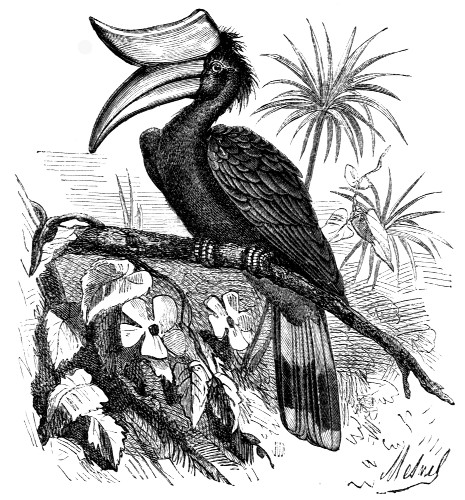
Fig. 200.—Rhinoceros Hornbill (Buceros rhinoceros, Gould).
The Fly-catchers (Muscicapidæ) are a family of insectivorous
birds, many of which are British, comprehending, according to
Temminck, the Todies (Todus), distinguished by long, broad, and
very flat bills, contracting suddenly at the tip. Characteristics:—Tail
short, slender, and rounded; legs long and weak; toes short,
the outer one more or less united to the middle one. T. viridis,
the only species, according to Temminck, has a bright green
plumage above, whitish beneath; a scarlet throat; sides rose
colour; and the tail-coverts yellow. It is a native of South
America and the Antilles; and Sir Hans Sloane, under the name
of "Green Humming-bird," describes it as "one of the most
beautiful small birds he ever saw." Mr. Browne states that
it is a familiar little bird, and will often let a man come within
a few feet to admire it before becoming alarmed. "It keeps
much about the houses in country parts," he adds, "flies slow, and
probably may be easily tamed."
It lives almost entirely on the ground, feeding on insects, which
it catches in the evening. It builds its nest in the crevices
on river banks, or in the soft rocks, in which it hollows out a
dwelling by means of its bill and feet.
The King-fishers (Alcedo), the Martin-fishers of some authors,
form a highly interesting group, of which Alcedo ispida (Linn.)
is the only known species indigenous to Britain. M. Vigors
finds an intimate resemblance between them and the Todies.
The King-fishers are very singular birds. Their bill is strong,
straight, and angular, being of immense length compared with their
size; the tip of both mandibles acute; the commissure perfectly
straight; the head strong and elongated; wings and tail of
moderate size; tarsi short, and placed far back (Fig. 201). The
King-fisher (A. ispida) has behind each eye a patch of light
orange brown, succeeded by a white one; from each corner of the
mandible proceeds a line of rich blue, tinged with green; the crown
of the head is deep olive green; the feathers are tipped with a
verdigris shade; chin and throat with yellowish white; breast,
belly, and vent with orange brown; tail a bluish green; shafts
of the feathers black; and the legs a pale brick red. This beautiful
bird is as interesting in manners as in appearance. Living on
the banks of rivers, they feed almost exclusively on fish. The
King-fisher watches patiently from a fixed station, generally a
naked twig overhanging the water, or a stone projecting above
the surface, for its prey: in this position it will sometimes
wait for hours, absolutely immovable. When the fish comes
within reach, with great rapidity it pounces upon it, seizing it
in its powerful mandibles, and after destroying it by compression,
or by knocking it against a stone or the trunk of
a tree, it swallows it head foremost. When fish is scarce it
feeds also upon aquatic insects, which it seizes on the wing.
Its aërial movements are rapid and direct, but weakly maintained,
being performed by a series of quick, jerking beats of
the wings, generally close to the surface: the action of the
wings is so rapid as to be scarcely perceptible. The short tarsi
render the King-fisher a bad walker.
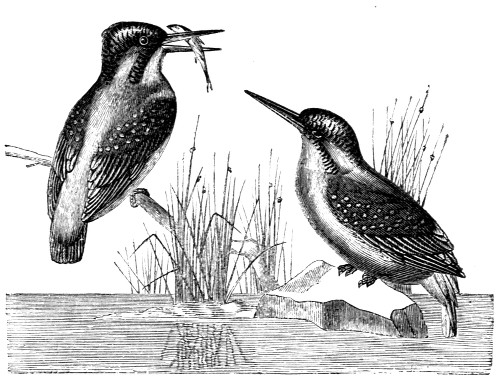
Fig. 201.—King-fishers (Alcedo ispida, Linn.).
The King-fisher is a solitary bird, living generally in secluded
places, and is rarely seen even with birds of its own species,
except in the pairing season. Like the Todies, they build their
nests in the steep banks of rivers, either in the natural crevices,
or in holes hollowed out by water rats; and these dwelling-places
are generally disfigured by the fragments of their repast.
Father and mother sit alternately, and when the young are
hatched they feed them with the produce of their fishing. The
bird has a shrill and piercing note, which it utters on the wing.
Their flesh is very disagreeable.
The King-fisher is the Halcyon of the ancients, who attributed
to it after death the power of indicating the winds. The
seven days before and the seven days after the winter solstice
were the Halcyon days, during which the bird was supposed to
build its nest, and the sea remained perfectly calm. To its dead
body the attributes of turning aside thunder-bolts, of giving beauty,
peace and plenty, and other absurdities were ascribed. Even now,
in some remote provinces of France, the dead birds are invested
with the power of preserving woollen stuffs from the attack of the
moth; hence they are called Moth Birds by drapers and shopkeepers.
They are inhabitants of almost every region of the
globe, and comprehend a great number of species, spread over
Asia, Africa, and America.32
Europe possesses one species not
larger than a Sparrow, and which is remarkable for the rich
colouring of its feathers. What, indeed, can surpass the brilliancy
of the King-fisher as it suddenly darts along some murmuring
brook, tracing a thread of azure and emerald? Some
authors separate the King-fishers, properly so called, or riverside
birds, from the Bee-eaters and other Fissirostral birds, which,
while they resemble each other in many physical characteristics,
differ essentially in their habits; in short, while the one haunts
the river, feeds upon its inhabitants, and nests upon its margin,
the other keeps to the woods and forests, feeds upon insects, and
builds in holes in trees.
The Ceyx Meninting of Lesson (Alcedo Biru of Horsfield) very
closely resembles the King-fisher of Europe in its habits; it darts
in short, rapid flight along the surface of lakes and rivulets, emitting
shrill, discordant sounds; it perches on trees on the river
banks, and feeds on small fishes and aquatic insects. The tarsus is
smooth, the inner toe suppressed; in other respects its habits
are those of the King-fisher.
The Bee-eaters (Meropidæ) have the beak long, thin, slightly
curved, and pointed, the mandible having a trenchant edge; the
tarsi short; the wings long and pointed; the tail well developed,
tapering, or forked. They are slender, light, and clamorous;
their cries are incessant, while they skim through the air on
rapid wing with well-sustained flight. Their name of Bee-eaters
they take from their principal food, which consists of various
Hymenoptera, especially bees and wasps. They seize their prey
either on the wing, like the Swallows, or they hide themselves at
the opening of their hives, and snatch up all that enter or depart.
They are skilful in avoiding their sting. Living together in
numerous flocks, they rapidly clear a district of wasps and wild
bees.
They build their nests in the banks of rivers or rivulets, in
holes which they excavate to the depth of six or seven feet.
Some species are highly esteemed as table delicacies by the
French.
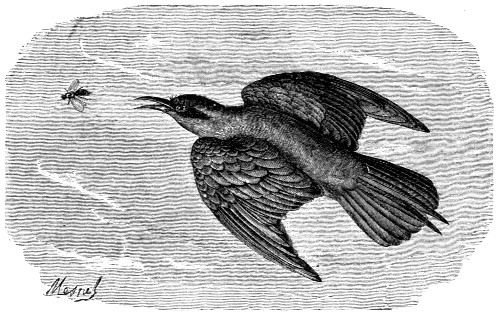
Fig. 202.—Common Bee-eater (Merops apiaster, Sw.).
The Bee-eaters inhabit the warmer regions of the Old World,
such as Bengal, the west coast of Africa, the Cape of Good Hope,
Morocco, and Malta. One species alone is found in Europe, the
Common Bee-eater (Merops apiaster), Fig. 202. From the coast
of Africa it migrates in small flocks into the countries skirting the
northern shores of the Mediterranean. Some individuals proceed
into France, Switzerland, and Germany; others spread themselves
over Turkey and the southern parts of Russia. In England it is
occasionally met with in Cornwall, Devonshire, and along the
Hampshire coast. It has been shot in the Mull of Galloway. In
France it arrives in the month of May, and remains but a short
time. As a rule it rarely ventures further north than the South
of France.
The Momots (Prionites, Illiger) are birds still very imperfectly
known. They are remarkably massive in form, heavy and slow
on the wing. They are placed by systematists near the Toucans
(Ramphastos), from similarity of habits, and especially from the
structure of the tongue, which is in both long, and so much
ciliated at the sides as to resemble a feather. The feet, however,
are totally different from those of the Toucans. In the Momots
the beak is long, robust, and crenated at the edge. They are
very wild, and lead an isolated life in the thick forests of South
America, where they build in holes in trees.
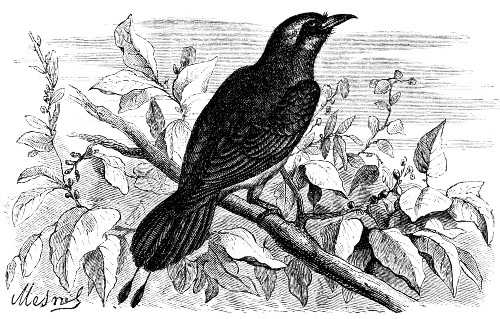
Fig. 203.—Momot (Prionites, Sw.).
The Passerine Tenuirostres are characterised by a long slender
beak, straight or curved, but always without indentation. They
are insectivorous, and comprise the Hoopoes, Humming-birds,
Creepers, and Nuthatches.
The Hoopoes (Upupa, Linn.) have the beak long, slender, triangular,
and slightly curved. This group, which Mr. Gray
designates the Upupidæ, includes a number of birds whose general
form presents the greatest analogy, but which possess their own
peculiarities of plumage and special physiognomy. This has
necessitated its subdivision into sub-genera, of which the Hoopoes
(Upupa), the Promerops (Brisson), and the Epimachus are worthy
of notice.
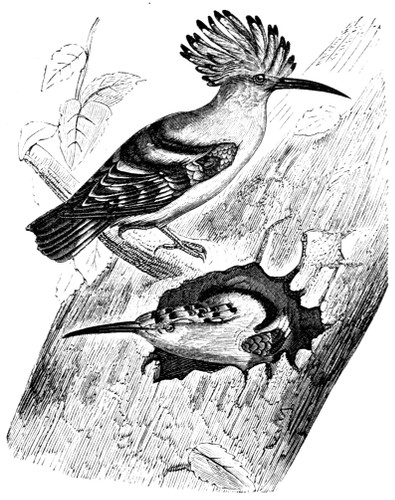
Fig. 204.—Hoopoes (Upupa epops, Linn.).
The Hoopoes are easily recognised from the double range of
plumes which form an arched crest on their head, which they
have the power of raising at pleasure. These feathers are, in
the Common Hoopoe, of a ruddy buff colour, tipped with black.
They are solitary birds, living by preference in low grounds
and humid places, where they prey on the worms, insects, and
terrestrial mollusks. They are migratory, and are occasionally
found in the British Islands in autumn: instances have occurred
of their breeding there. They take their departure for warmer
regions in September. They have a light and graceful walk, and
nearly pass their existence on the ground, rarely perching, and
flying with visible effort. They have no song, and only utter
two notes, which may be rendered by the syllables zi, zi; houp,
houp. They nest in the clefts of rocks or walls, and in holes
in the trunks of trees. When captured young, they become very
tame, and seem to be susceptible of great attachment to those
who take care of them.
The Hoopoe (Fig. 204) is found in summer as far north as
Denmark and Sweden; and southward, in France and Italy,
at Gibraltar and Ceuta, and in Egypt, where it breeds, as it
probably does over Northern Africa. It has been seen occasionally
at Madeira, and is abundant at Trebisond, whence it
comes every year to pass the summer season in Europe. During
the spring and summer it abounds all over France. At the period
of its departure—that is to say, in the month of September—it
is plump enough to be a choice morsel for the table, as its flesh
is very delicate.
The Epimachus are remarkably beautiful birds. When at maturity the
side-feathers develop themselves in delicate lines or elegant panicles,
while their plumage, richly coloured, is brilliant with diaphanous
metallic reflections. Little is known of their habits. They are natives
of Australia and New Guinea. The very remarkable species, E. multifil
(Fig. 205), has six long fillets on each side of its body. The equally
striking species, E. magnus, has the elongated side-feathers raised
and curling, of a glittering steel blue, azure, and emerald green; the
breast and belly lustrous with the same diaphanous tints. This bird is
an inhabitant of New Guinea.
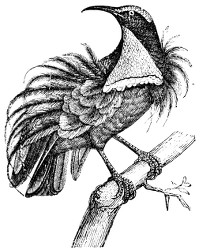
Fig. 205.—Epimachus (Epimachus multifil).
The Promerops are distinguished from the other Upupinæ by
the absence of the crest, by their very long tail, and by their
forked and extensible tongue. They are natives of Africa, and
their habits, like those of the former, are little known.
The Colibri of Cuvier may be divided into Humming-birds
(Trochilidæ), or species having the beak straight, and true Colibri,
having the beak curved. With this slight difference, the Trochilidæ
and Colibri closely resemble each other. They have the same
slight, elegant figure, the same brilliancy of plumage, and the
same habits—describe the one, and you describe the other. We
must be permitted, therefore, to treat of them together.
The Humming-birds (Trochilidæ) are the most lovely of the
winged race. Nature seems to have endowed them with her rarest
gifts. In creating them she surpassed herself, and exhausted all
the charms at her disposal; for she imbued them with grace,
elegance, rapidity of motion, magnificence of plumage, and indomitable
courage. What can be more delightful than the sight
of these little feathered beauties, flashing with the united fires
of the ruby, the topaz, the sapphire, and the emerald, flying
from flower to flower amid the richest tropical vegetation? Such
are the lightness and rapidity of some of the smaller species, that
the eye can scarcely follow the quick beat of the wings. When
they hover they seem perfectly motionless, and one might fancy
they were suspended by some invisible thread.
Specially adapted for an aërial life, they are unceasingly in
motion, searching for their food in the calyx of flowers, from
which they drink the nectar with so much delicacy and address
that the plant is scarcely stirred. But the juice and honey of
flowers, as some authors affirm, are not their only food—such unsubstantial
diet would be insufficient to sustain the prodigious
activity displayed almost every moment of their existence.
The tongue of the Humming-bird is a microscopic instrument
of marvellous arrangement. It is composed of two half-tubes
placed one against the other, capable of opening and shutting like
a pair of pliers. Moreover, it is constantly moistened by a glutinous
saliva, by which it is enabled to seize and hold insects—an
arrangement not without its analogy in the Woodpeckers.
Proud of their gay colours, the Humming-birds take the greatest
care to protect their plumage. They frequently dress themselves
by passing their feathers through their bills. Their vivacity
often amounts to petulance, and they frequently manifest belligerent
propensities not to be expected in such minute creatures.
They attack birds much larger than themselves, harassing and
pursuing them without intermission, threatening their eyes, and
always succeeding in putting them to flight. They frequently
contend with each other. If two males meet on the calyx of a
flower, bristling with anger, and uttering their cry, they rush on
one another. After the conflict is over the conqueror returns to
reap the reward of his valour.
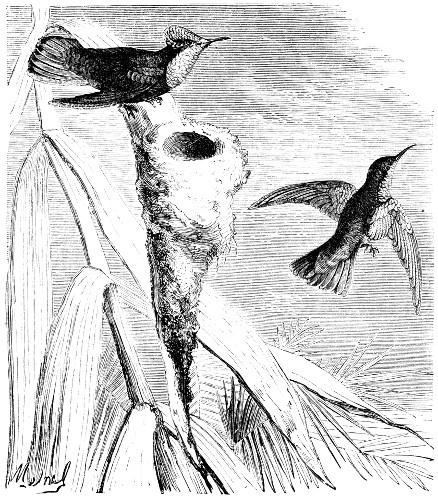
Fig. 206.—Nest of Humming-bird.
The nest of the Humming-bird (Fig. 206) is a masterpiece.
It is about the size of half an apricot. The materials are brought
by the male, and arranged by the female. These consist of
lichens, and are most artistically interwoven, the crevices being
closed up with the bird's saliva: the interior is padded with the
silky fibres furnished by various plants. This pretty cradle is
suspended to a leaf, sometimes to a small branch, bundle of rushes,
or even to the straw roof of a hut. The hen bird lays twice a year
a pair of eggs of a pure white, about the size of a pea.
After an incubation of six days the young are hatched; a week
later they are capable of flight. During the breeding season the
males are tender and demonstrative, and both parents show much
affection for their progeny.
These little creatures are universally admired for their elegance
and beauty, and the names given them are generally descriptive
of their excessive minuteness. The creoles of the Antilles call
them Murmurers; the Spaniards Picaflores; the Brazilians Chupaflores,
or Flower-suckers; finally, the Indians call these darlings
Sunbeams.
Humming-birds are much sought after—not for their flesh,
which is valueless from its minute quantity, but for their feathers:
these ladies turn to various uses, such as collars, pendants for
the ears, &c. Some of the Indian races which have been converted
to Christianity employ them to decorate the images of
their favourite saints. The Mexicans and Peruvians formerly
employed them for trimming mantles. The French soldiers who
shared in the Mexican expedition report that pictures with the
feathers of the Humming-bird are fresh, brilliant, and effective.
Humming-birds cannot be preserved in captivity—not that
they do not become familiar and affectionate, but their extreme
delicacy unfits them for confinement, and in spite of the
utmost care that can be bestowed on them, they will die in a
few months. In their habitat they are killed with very small
shot or with the sarbacane: if desired alive, they are taken with
a butterfly net.
Among the most formidable enemies of the Trochilidæ may be
reckoned the Monster Spider (Mygale avicularia), which spins its
web round their nests, and devours eggs or little ones; even the
old birds are sometimes its victims. Humming-birds are scattered
over the whole of South and North America, even as far north as
Canada; but in Brazil and Guiana they are most abundant. At
least five hundred species are known. Cuvier included them in his
genus Colibri. Mr. Gould has described three hundred of which
he has actual specimens; these he divides into fifty-two genera.
Among the more remarkable species we may note the Topaz-throated
Trochilus (T. pella, Gould), a native of Brazil; the Sickle-winged
Humming-bird (Trochilus falcatus, Sw.); Gould's Humming-bird
(Ornismya Gouldii, Less.); the Double-crested Humming-bird
(Trochilus cornutus, Wied.); Cora Humming-bird
(Ornismya cora, Less.); the Giant Humming-bird, which attains
the size of the Swallow; the Dwarf Humming-bird, whose size
does not exceed that of a bee; the Bar-tailed Humming or
Sapho Bird of Lesson (Fig. 207), a native of Eastern Peru; and the
Racket-tailed Humming-bird, so named from the shape of its
tail, which spreads out at the extremity in the form of a racket.
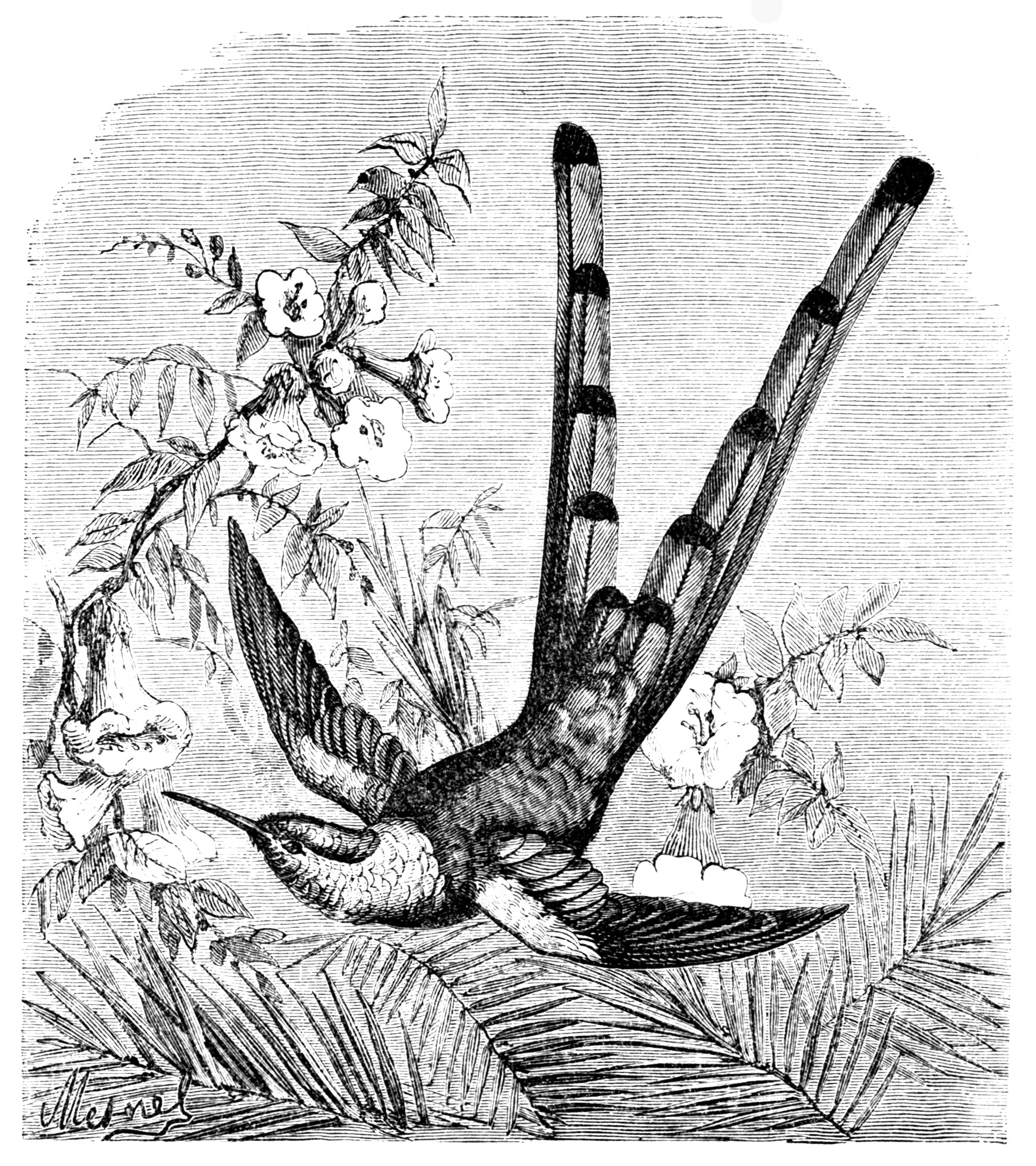
Fig. 207.—Bar-tailed Humming-bird (Trochilus sparganurus, Lesson).
The Climbers (Scansores, Vig.) among birds, such as the Woodpeckers,
are characterised by an arched beak and a stiff pointed
tail. The family comprehends several genera and sub-genera, of
which the principal are the Climbers, properly so called, as the
Creepers (Certhia), the Wall-Creepers (Tichodroma), the Picumnus,
the Furnarius, the Sucriers, the Soui-mangas, and the Nuthatches
(Sitta).
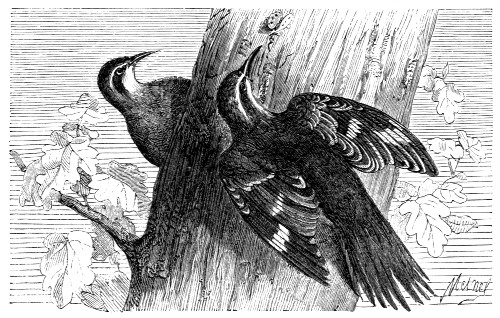
Fig. 208.—The Creeper (Certhia familiaris, Linn.).
The Creepers (Certhia) are small Climbing birds which live
and build their nests in the holes they bore in the trunk or in
the natural hollows of trees: the insects to be found under the
bark are their food. Looking at the form of their slender beak, it
is difficult to imagine how it can penetrate the hard covering
of an oak, for which they exhibit a marked preference. The Tree-Creeper
(Certhia familiaris) is spread over nearly every European
country, and is very common in France. The Wall-Creeper
(Tichodroma muraria, C. Bonap.), called also Wall-Climber (the
Grimpereau des Murailles of French authors), owes its name to
its habit of climbing the walls of dwellings. Supporting-points
are not found in their tails, as in the Woodpeckers. Grasping
the tree with their claws, they assist their feet by a slight movement
of the wings. They feed on insects, and lead a solitary
life on the mountains, only descending into the plains with the
early frosts of winter. They are found diffused over all the South
of Europe.
The Picumnus (Climacteris picumnus, Temm.) have form and
habits very similar to the Creeper, but the beak is stronger and
more boldly curved. They are natives of Brazil and Guiana.
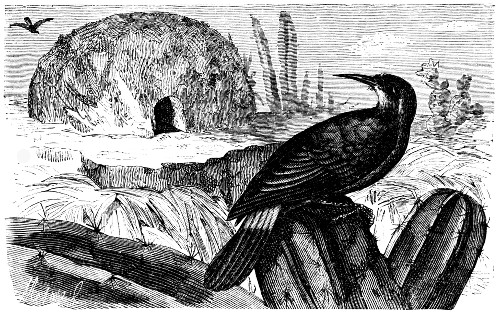
Fig. 209.—Furnarius (Furnarius, Lesson).
The Furnarius (Furnarius figulus, Spix.) live singly or in
pairs in the plains of Chili, Brazil, and Guiana. They feed principally
on seeds, but also on insects. They take up their residence
with much confidence in the neighbourhood of man. Their nests
(Fig. 209) are remarkable for their construction, being in the form
of an oven, whence their name. This structure it builds upon
trees, on palisades, or on the window of a house. It is remarkable
for its size as compared with its inhabitant, measuring not less
than from twelve to fourteen inches in diameter; it is entirely
formed of clay, and the interior is divided by a partition into two
compartments, the outer and inner, the latter being that in which
the female lays her eggs. The male and female alternately bring
small balls of earth, out of which the edifice is constructed, and
they labour so industriously that it is sometimes finished in two
days. Some species construct their nests on trees, interlacing
them with spiny branches, and providing one or many openings;
that of the Annumbi is fifteen inches in diameter by twenty
inches in height.
The Sucriers (Cinnyridæ) are American birds, so called from
their attachment to saccharine substances. They feed on honey
they extract from flowers, and the sap from the sugar-cane, the
juice of which they suck through crevices in the stem. Like
the Humming-birds, they have the tongue divided into two
parts, by which they are enabled to seize insects, which form a
part of their food. They are small in size, and their plumage is
brilliantly coloured. Among the Cinnyridæ we find the Guits-guits,
ingenious little creatures which construct a nest in the form of a
horn, which is suspended from the flexible branches of a shrub:
in order to protect their young from the attacks of earwigs, the
opening is below.
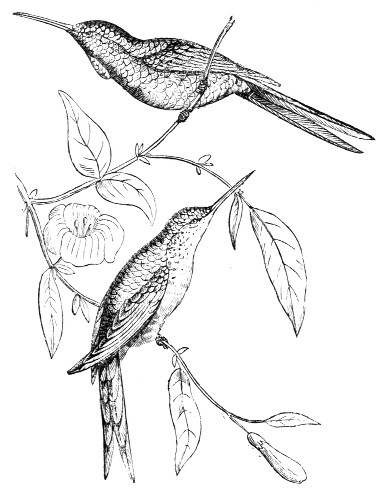
Fig. 210.—Sun-birds (Certhia chalybeia, Linn.).
The Soui-mangas (Fig. 210) have the same partiality for
sugar exhibited by the last, justifying their name, which signifies
"sugar-eater" in the Malagash tongue. They are natives of
Southern Africa and India, and represent in the Old World
the Humming-birds of the New. They are gay and sprightly,
and decked in the most
brilliant colours. Like the
other Cinnyridæ, they love
to plunge their tongue into
the corolla of flowers and
extract its sweets. Their
most brilliant colours are displayed
in the breeding season.
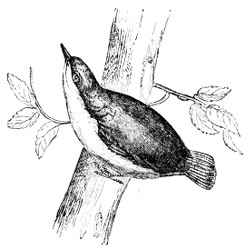
Fig. 211.—Common Nuthatch (Sitta europæa, Gould).
The Nuthatches (Sitta),
Fig. 211, have the beak
straight, pyramidal, and
pointed, covered at the base
with small feathers directed
forward; the long toes are
furnished with claws strong
and crooked; their habitat resembles that of the Creepers. The
Nuthatch is found in Oceania.
The Conirostral Passerinæ are characterised by a strong, robust
beak, more or less conical, and without notches. They are
generally granivorous, but some species are insectivorous or carnivorous.
This group includes the Birds of Paradise, Crows,
Rollers, Starlings, Sparrows, Tits, and Larks.
The Birds of Paradise have the beak straight, compressed, and
strong, the nostrils covered with velvety feathers. In brilliancy of
colouring, and in graceful, pendent, gossamer-like plumage, they
take precedence in the feathered creation.
They have a very restricted habitat, being only found in New
Guinea, Ternate, and in the island of Papua, situated to the north
of Australia: there they dwell in the thick forests, feeding on
fruit and insects. Occasionally they are found living in solitude,
but more frequently are to be met in large flocks, altering their
residence with the change of the monsoon.
Their flight is very swift, and has been frequently compared by
Europeans resident in the East to that of a Swallow; in consequence,
they have bestowed on the Bird of Paradise the name
of Swallow of Ternate.
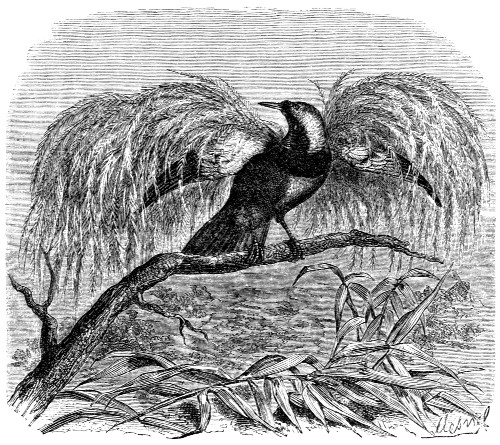
Fig. 212.—The Great Emerald (Paradisea apoda, Linn.).
It is owing to the long lateral plumes, which they most perfectly
control in the air, that they are so buoyant; at the same time, this
unusual amount of plumage almost entirely stops their progression
against a head wind.
When the Bird of Paradise was first spoken of in Europe few
believed that it existed. Nor is this to be wondered at, when
we remember that it was affirmed that these gorgeous birds were
without legs, and hung on to the branches of trees by their
long aërial plumes; that the female deposited her eggs under the
feathers on the back of the male; that they passed the breeding
season in Paradise; and many other stories equally absurd.
The inhabitants of Papua capture these birds, for their plumage
is of great commercial value. The method they adopt is to place
themselves in the tops of the highest trees: when thus concealed,
they attract the birds within reach of their blow-pipes by whistling.
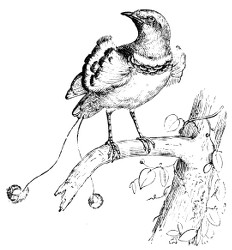
Fig. 213.—King Bird of Paradise (Cincinnurus regius, Vieillot).
The Birds of Paradise are divided by Vieillot into Parotia,
Lophorina, Cincinnurus, and Samalia. The most remarkable
among these is Paradisea apoda, the Great Emerald, as it
is sometimes called (Fig. 212), the throat and neck of which
are of a bright emerald green, from which circumstance it has
received one of its popular
names, while on its sides are
shaded tufts of yellow feathers
which float on the breeze,
forming an elegant aërial
plume, and giving the bird
a meteor look as it shoots
through the air. They live
in flocks in the vast Papuan
forests. When prepared for
migration—for they change
their quarters with the monsoons—the
females assemble
in small flocks on the tops of
the loftiest trees, and utter
their call to the males, each
flock of fourteen or fifteen being attended by one male.
The King Bird of Paradise (Paradisea regia, Linn.), Fig. 213,
is an inhabitant of the Molucca Islands, where it is scarce. Little
is known of its habits. The beak, which is furnished at the
base with small feathers pointing forward, is slender, convex, and
slightly compressed at the sides. The hypochondrial feathers are
broad, elongated, and truncated.
In the Superb (Lophorina superba), Fig. 214, the beak is furnished
with elongated feathers, extending half its length; the
feathers of the neck, rising just behind the head, expand into a
wing-like form.
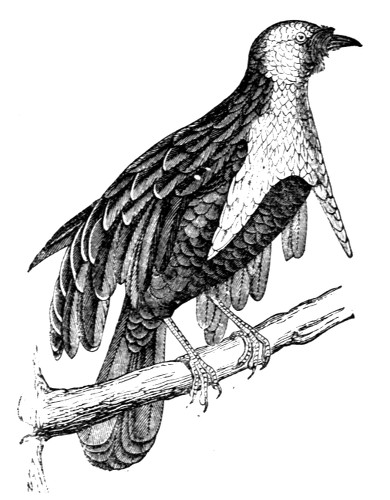
Fig. 214.—The Superb (Paradisea superba, Latham).
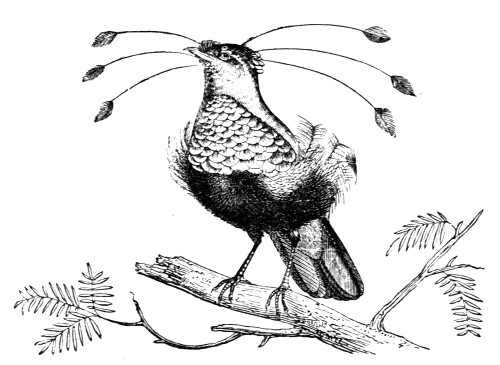
Fig. 215.—Golden-throated Sifilet (Paradisea aurea, Gmelin).
In the Sifilets (Parotia) the beak is furnished with short
feathers for half its length, and is slender, compressed laterally,
notched and curved at the tip; they have long, broad, and loose
plumes covering the sides and abdominal part. Of this group
the Gold-throated Sifilet of Buffon (Parotia sexsetacea, Latham),
Fig. 215, is a fine example. It obtains its name from the three
thread-like feathers on each side of the head expanding into a
lancet shape at the extremity, and which form a very striking
ornament.
The birds which constitute the Crows (Corvidæ) are characterised
by a very strong beak with cutting edges, broad at the
base, flattened laterally, and hooked towards the point; the nostrils
covered with stiff feathers directed forward; also by strong
claws and long pointed wings. They are divided into four groups
or sub-genera—namely, Corvus, the Crows properly so called;
the Magpies (Pica); the Jays (Garrulus); and the Nut-cracker
(Nucifraga).
The genus Corvus, as limited by modern naturalists, comprehends
the Raven (C. corax, Lesson), the Carrion Crow (C. corone,
Temm.), the Royston Crow (C. cornix, Selby), the Rook (C. frugilegus,
Linn.), the Jackdaw (C. monedula, Linn.).
All these species have in many respects the same characteristics,
the same aptitude, and the same habits. With the exception of
the Raven and Magpie, which live in pairs, the others reside
together in large flocks, whether they are in quest of their daily
food or roosting at night. They are all possessed of the same
intelligence, the same cunning, the same mischievous habits, the
same gift of imitation, though in different degrees, and the same
provident habit of amassing provisions in secret places. This
last peculiarity in tamed birds degenerates into a mania, which
leads them to carry off and hide everything that attracts their
attention, especially gems and bright articles of metal. The
whole group are susceptible of domestication.
The Crows, especially the Raven and the Carrion Crow, are
pre-eminently omnivorous. Living or dead flesh, fish cast up on
the shore, insects, eggs, fruit, seeds—nothing comes amiss to them.
Their depredations are enormous. Thus Ravens, not content
with raising a tribute on moles, wood-mice, and leverets, venture
into poultry-yards, and without ceremony appropriate chickens,
ducklings, &c. Buffon even asserts that in certain countries
they fasten upon the backs of buffaloes, and after having put
out their eyes, devour them. As for the Carrion Crows, according
to Lewis, it is certain that they attack the flocks in Scotch
and Irish pastures. Lastly, all Crows delight in digging up
newly-sown ground, eating with avidity the germinating seed.
On this account the agricultural population are generally their
bitterest enemies, destroying them when opportunity offers.
In certain parts—Norway, for instance—laws were made ordering
their extermination. But this policy was short-sighted:
if they did harm, they also did good, for the quantity of
noxious grubs and larvæ formerly devoured by them, and consequently
kept in check, became most formidable foes to the
farmer, and most difficult to overcome. How is it that men
will not use their brains—that they actually destroy the animals
provided by a bounteous Creator, and whose utility is most conspicuous?
The flesh of the Raven and the Carrion Crow exhales a very
bad odour, doubtlessly caused by the quantities of putrid animal
matter they consume; consequently, it is unfit for human food.
Not so, however, with the Rook. This bird, when taken young,
is not only eatable, but by some deemed a delicacy.
Crows possess a vigorous and sustained flight; they have a keen
sense of smell, and excellent vision. By exercising these latter
qualities they become aware where food is to be obtained, and as
they wing their way towards it they constantly utter their cry,
as if inviting their companions to join them: this croak, as it is
called, is very harsh and dissonant. The plumage being of a
sombre funereal black, and the voice so unmusical, have doubtless
been the reasons why they have long been considered birds of
ill omen. When taken young, they are tamed with great facility,
even to permitting them to go at large, for they will neither
rejoin their own race nor desert the neighbourhood where they
have been kindly treated. True, they may go into the fields to seek
for food, but when the increasing shadows predict the approach
of night, their familiar resting-place in the house of their protector
will be sought. They become much attached to those who take
notice of them, and will recognise them even in a crowd. Their
audacity and their malice are incredible. When they take an
antipathy to any one, they immediately show it. They suffer
neither cats nor dogs to approach them, but harass them incessantly,
tearing from them their very food. Finally, they choose
secret hiding-places, where they store up all that tempts their
cupidity or excites their covetousness. They even learn to repeat
words and phrases, and to imitate the cries of other animals. These
facts are confirmed by numerous anecdotes related by naturalists
of undoubted veracity.
Pliny speaks of a Raven which established itself in one of the
public places of Rome, and called out the name of each passer-by,
from the emperor to the humblest citizen. We have all laughed
heartily at the recital of an adventure which happened to an
awkward horseman who lost his seat, while a Raven perched
on a branch of a tree above him cried out with solemn voice,
"How silly!"
Dr. Franklin thus speaks of a Raven of his acquaintance which
had been brought up at a country inn:—"It had," he says,
"great recollection of persons, and knew perfectly all the coachmen,
with whom it lived on the greatest intimacy. With its
special friends it took certain innocent liberties, such as mounting
on the top of their carriage and riding out with them until it met
some other driver with which it was on terms of similarly close
friendship, when it would return home." The same Raven had
unusual sympathy with dogs in general, and especially those
which happened to be lame. These it loaded with the most
delicate attentions, keeping them company and carrying them
bones to gnaw. This excessive kindness to animals which are
rarely in the good graces of Ravens arose from this bird having
been reared along with a dog, for which it entertained such strong
regard, that it attended it with unremitting assiduity when it
had the misfortune to break its leg.
The same author mentions another Raven which was captured
in Russia, and came to be confined in the Jardin des Plantes, of
Paris. It recognised Dr. Monin when he stopped accidentally
before its cage. It had belonged to him ten years before, and
when brought before its old master it leaped upon his shoulder
and covered him with caresses. The doctor reclaimed his property,
and the bird was henceforth an ornament to his house near Blois,
where it learnt to address the country-people as "great hogs."
Dr. Franklin raised one of these birds himself which showed
wonderful powers of imitation. "He called himself Jacob. Sometimes
it made such a noise at the bottom of the stairs that you
could only imagine it was caused by a party of three or four
children quarrelling with great violence; at other times it would
imitate the crowing of a cock, the mewing of a cat, the barking
of a dog, or the sound produced by a rattle for frightening away
birds from a wheat-field; then a silence would ensue; but soon
after the crying of a child of two years of age would be mimicked;
'Jacob! Jacob!' its own name, probably it would then call,
repeating the cry at first in a grave tone, then with shriller intonation
and more vociferously; again another silence; but after a
pause, a man seems to knock at the gate; if it is opened, enter
Jacob, who runs about the room, and finally mounts on the table.
Unfortunately, Jacob was a thief—and that was not his least
fault; spoons, knives, forks, even plates, disappeared, with meat,
bread, salt, pieces of money—especially if new; he carried off
everything, and hid all in some secret hole or corner. A
washerwoman of the neighbourhood was accustomed to dry her
linen near our window, fixing the clothes on the line with
pins; the bird would labour with a perseverance truly wonderful
to detach these, the woman chasing him off with bitter maledictions
about her fallen linen; but he would only fly over into
his own garden for safety, where he would indulge in a few
malicious croakings. One day I discovered, under some old
timber, Jacob's hiding-place. It was full of needles, pins, and all
manner of glittering objects."
Mr. Charles Dickens was partial to keeping Ravens in his youth,
and has related some of his experiences in the preface to "Barnaby
Rudge." He had two great originals. "The first was in the bloom
of his youth, when he was discovered in a humble retreat in London
and given to me. He had from the first, as Sir Hugh Evans says
of Anne Page, 'good gifts,' which he improved by study and attention
in a most extraordinary manner. He slept in a stable—generally
on horseback—and so terrified a Newfoundland dog by
his preternatural sagacity that he has been known, by the mere
superiority of his genius, to walk off unmolested with the dog's
dinner from before his face. He was increasing in intelligence
and precocity when, in an evil hour, his stable was newly painted.
He observed the workmen closely, saw that they were careful of
their pigments, and immediately burned to possess some of them.
On their going to dinner, he ate up all they left behind, consisting
of a pound or two of white-lead. Alas! this youthful indiscretion
terminated in death.
"Whilst yet inconsolable for the loss, another friend of mine,"
adds Mr. Charles Dickens, "discovered an older and more gifted
Raven at a village inn, which he prevailed upon the landlord to part
with for a consideration. The first act of this sage was to administer
to the effects of his predecessor, by disinterring all the cheese and
halfpence he had buried in the garden—a work of immense labour
and research, to which he devoted all the energies of his mind.
When he had achieved this task, he applied himself to the acquisition
of stable language, in which he soon became such an adept that
he would perch outside any window and drive imaginary horses all
day long, with great skill in language. Perhaps I never saw him
at his best, for his former master sent his duty with him, and
said, 'if I wished the bird to come out very strong, to be so good
as show him a drunken man;' which I never did, having (unfortunately)
none but sober people at hand. But I could hardly have
respected him more, whatever the stimulating influence of this
sight might have been. He had not the least respect for me, I
am sorry to say, in return, or for anybody but the cook, to whom he
was attached—but, I fear, only as a policeman might have been.
Once I met him unexpectedly, about half a mile off, walking down
the middle of the public street, attended by a pretty large crowd,
and spontaneously exhibiting the whole of his accomplishments.
His gravity under this trying ordeal I never can forget, nor the
extraordinary gallantry with which, refusing to be brought home,
he defended himself behind a pump until overpowered by numbers.
It may have been that he was too bright a genius to live long, or
it may have been that he took something pernicious into his bill,
and thence into his maw—which is not improbable, seeing he new-pointed
the greater part of the garden-wall by digging out the
mortar, broke countless squares of glass by scraping away the
putty all round the frames, and tore up and swallowed in splinters
the greater part of a wooden staircase of six steps as well as the
landing—but after some three years he was taken ill, and died
before the kitchen fire. He kept his eye to the last upon the
meat as it roasted, and suddenly turned over on his back with the
sepulchral cry of 'Cuckoo.'"
Crows (Corvus) are universally diffused over the globe. The
Raven (Corvus corax), Fig. 216, and the Carrion Crow (Corvus
corone), are sedentary birds, and never voluntarily abandon
the place they have elected for their home. The Hooded Crow
(Corvus corone), the Rook (Corvus frugilegus), and the Jackdaw
(Corvus monedula), are migratory in their habits, only visiting
the countries of Southern Europe on the approach of winter.
The Royston Crow (Corvus cornix) inhabits the lofty mountain
regions of Europe, descending into the plains during winter.
Finally, the Senegal Crow (C. senegalensis, Temm.) is exclusively
confined to Africa.
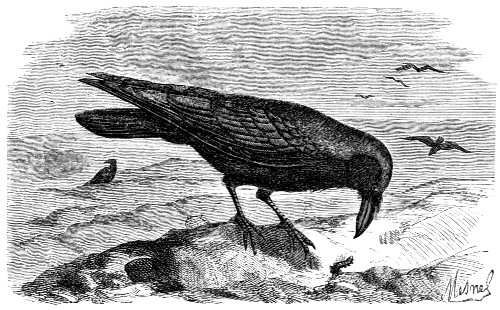
Fig. 216.—The Raven (Corvus corax, Lesson).
The Magpies are distinguished from the Crows by their
shorter wings, longer tail, and by their variegated plumage;
but for this difference, they greatly resemble the previously
described in appearance and habits. Like the Crows, they are
omnivorous, but they generally avoid dead prey; they have the
same desire, whether in the wild or domestic state, to store away
provisions and hide glittering objects. Their instinctive habit of
appropriating all sorts of plunder is one of the causes of their
popularity. Every one has heard the true story on which the
drama of The Maid and the Magpie is founded—how Ninette
was accused and pronounced guilty of robbing her master, and
when executed found to have been innocent, the true culprit being
the pet Magpie of the house.
The Magpie is a bold, impudent bird, which is easily put to
flight by man, but will fearlessly harass a dog, a fox, or any of the
smaller birds of prey. Having caused one of these to retreat,
it pursues it vigorously, rousing by its cries all the birds of its
kind; and what with its own energy and the combined efforts
of its kindred, it generally succeeds in utterly discomfiting the
intruder. Its action is unceasing, its movement short and jerky;
but it is heavy on the wing. It cries and chatters incessantly.
Hence the proverb to "chatter like a Magpie." It builds its nest
of withered shrubs, dry sticks, and sand, on the highest branch
of some lofty tree, it is and equally remarkable for its form,
size, and solidity. This fabric has many beginnings: the
foundation of the last and permanent structure is laid with
infinite precautions, to avert observation. This care is taken,
according to M. Nordmann, in order to mislead those who are
spies on its actions; for it is in this last nest that the female
deposits her eggs. If this fact were clearly established, it would
show a great amount of cunning in the bird.
The Magpie lays seven eggs, which the parent birds hatch with
care, each bird sitting alternately. They show great attachment
to their progeny, and continue to exercise their protection and
solicitude until the young are well advanced towards maturity.
The Magpie is tamed with facility, and soon becomes familiar,
assiduously following its master everywhere, and eagerly seeking
his caresses, so that it is necessary sometimes to shut it up to get
rid of its importunities. It readily learns to repeat a few words,
"mag" being the favourite in its vocabulary. The ability to
pronounce words is said to be increased by extending the soft
fibrous slit which binds the lower part of the tongue to the palate.
But, compared with the beautiful glossy bird of the thicket, the
domesticated Magpie, draggled and mutilated, is a miserable-looking
object.
The Common Magpie (Pica melanoleuca), Fig. 217, abounds in
all parts of the world. Cultivated valleys with natural or artificial
woodlands on their slopes; low ground diversified with fields;
pastures and moors partially covered with plantations; fertile
plains fenced in with wooded hedgerows, and studded with farm-houses
and cottages, are the type of landscape they prefer. In
spring plumage the Magpie is a fine bird, the feathers of the
back being of velvety black, while the breast and a part of the
wings are pure white.
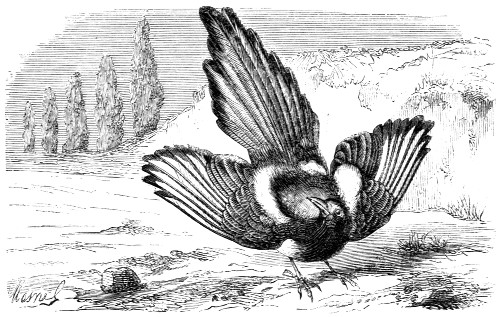
Fig. 217.—Common Magpie (Corvus pica, Linn.).
In the Brazils and Paraguay we find another species, whose
whole plumage is a fine cerulean blue, with the exception of the
head and throat, which are black. In China there is also a Magpie
of beautiful cobalt-blue plumage; its two centre tail feathers
are very long, barred with black, and tipped with pure white; the
bill and legs are red. It is extremely shy, and occasionally seen
in flocks. By the inhabitants it is frequently taught to speak.
The Jays (Corvus glandarius) have short bills, which are
slightly notched at the tip; head rather large; feathers on the
upper and anterior part of the head erectile when the bird is irritated;
those feathers at the base of the upper mandible are stiff,
with short barbs. It is not less shy than other members of the
family, although it frequents gardens, where it feeds on beans
and peas, of which it seems to be particularly fond. Its food,
however, is not confined to fruit and vegetables, as it picks up
worms, insects, the eggs of small birds, and crustacea, after the
manner of Crows and Magpies. Naturally irascible and quarrelsome,
they are nevertheless easily tamed when taken young,
and soon learn to pronounce a few words. They abound in
Europe and the Indies. The European Jay (Garrulus glandarius),
Fig. 218, is a pretty bird of soft and blended plumage, the
feathers of the fore part of the head elongated, oblong, and
erectile: its general colour is a delicate brownish red tinged with
grey, approaching to purple on the back. The most conspicuous
trait of the plumage is the patch of ultramarine blue, banded with
blackish blue, on the primary coverts.
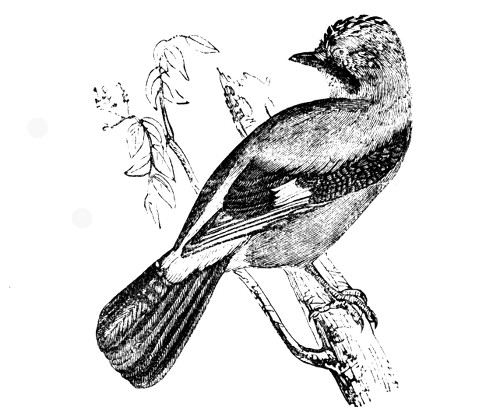
Fig. 218.—European Jay (Garrulus glandarius, Belon).
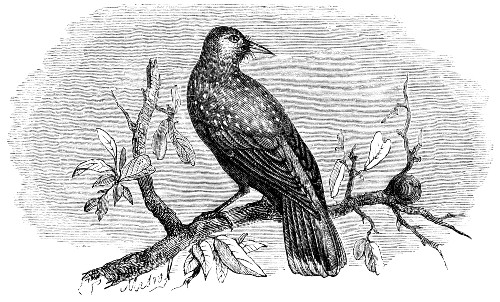
Fig. 219.—The Nut-cracker Crow (Nucifraga, Briss.).
The American variety of Jay is not quite as large as the
European representative. Its plumage is less brilliant. In
characteristics they are much alike, being equally mischievous and
dreaded by the smaller feathered denizens at the period of nesting.
The Nut-cracker (Nucifraga caryocatactes) is furnished with a
long, strong, and straight bill, with which it can penetrate under
the bark of trees when in search of insects, and open the cones of
firs and pines, on the kernels of which it feeds; failing these, it eats
the hazel-nut and wild fruit, from which circumstance its name is
derived. They inhabit the mountain forests of Europe and Asia,
building their nests in the trunks of trees, to which they are
capable of clinging, but not of climbing.
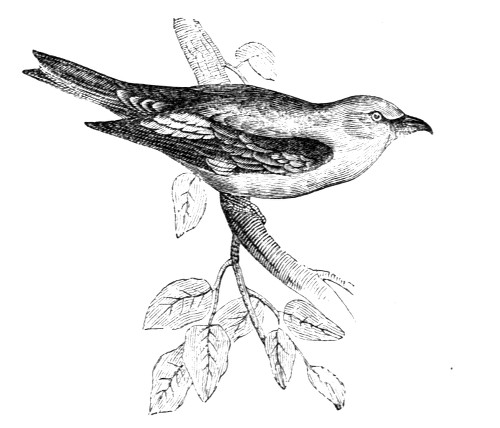
Fig. 220.—European Roller (Galgulus, Briss.).
The Rollers (Coracias garrula), Fig. 220, have in their general
appearance and habits considerable resemblance to the Jays; but
they differ from the beak being more robust, and the nostrils
uncovered; they are also more timid, withdrawing into the
thickest parts of the woods, which are their favourite haunts. When
taken young from the nest it is tameable. Dr. Meyer, of Offenbach,
and others, have succeeded in rearing them; but although
they become so tame as to know those who attend to their wants,
they never grow familiar. Their favourite food consists of
insects and their larvæ, worms, and the smaller reptiles; but in
their absence they feed on berries, seeds, and certain roots.
The bill of the Roller is black towards the point, becoming
brown at the base, with a few bristles; the irides are formed of
yellow and brown circles; the head, neck, breast, and belly present
various shades of bluish verditer, changing to a palish green; the
plumage of the upper part of the body is a brilliant azure blue
on the shoulders, and reddish brown on the back; rump feathers
purplish. Wing primaries dark bluish black, lighter on the
edge; tail feathers pale greenish blue. They abound in Europe,
Africa, and Southern Asia. Although the natural habitat of
the bird is oak and beech forests, M. Vieillot tells us that in
Malta, where trees are scarce, the bird nests on the ground. In
Barbary it has been observed to build on the banks of the rivers,
and Pennant observes that where trees are wanting it builds its
nest in clayey banks.
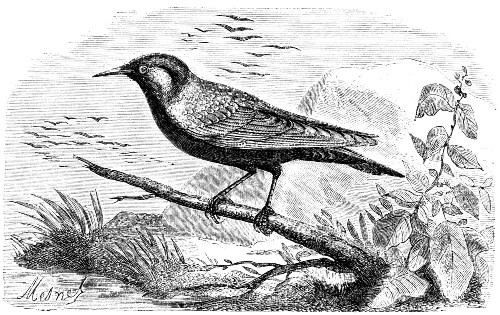
Fig. 221.—Starling (Sturnus vulgaris, Swainson).
The Starlings (Sturnidæ) are characterised by a straight bill,
depressed towards the point. They are remarkable for their
vivacity, and grave, sombre plumage, lit up with brilliant metallic
reflections of green and blue. They are sociable birds, living
in numerous flocks, being, says Selby, "particularly abundant
in the fenny parts of Leicestershire and Nottinghamshire, where
they roost among the reeds. Before retiring to rest they perform
numerous manœuvres in the air, the whole colony frequently
describing rapid counter-flights round a common centre. They
will sometimes continue repeating the eccentric evolutions for half
an hour before they finally settle for the night." Their favourite
food is seeds and berries, and occasionally insects, worms, and small
terrestrial mollusks. They choose for their nests well-protected
places, such as the hollows of decaying trees, crevices of walls,
the belfries of old churches, the ledges of roofs, and sometimes even
the interior of pigeon-houses. The nest is formed of dry grass,
in which it lays five light blue eggs. The Starling is accused of
seeking the shelter of the dovecot for the purpose of sucking the
inhabitants' eggs, but this is now found to be a calumnious
error." They are diffused over all quarters of the globe. There
are two species described among European birds—Sturnus vulgaris
(the Common Starling), and Sturnus unicolor (the Sardinian Starling),
which is black, and without spots, with the anterior feathers
very long, tapering, and drooping from the base of the neck. It
is found in Algeria among the rocks, where it builds. It passes
the winter on the African coast of the Mediterranean, in company
with the Common Starling. Its flesh is bitter, and consequently
unpleasant to the taste, but it is sought after for its docility, and
for the ease with which it is taught to speak.
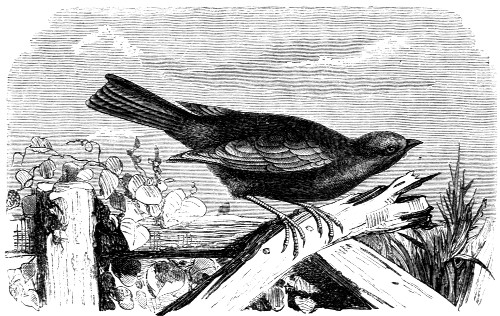
Fig. 222.—The Pensile or Baltimore Oriole (Icterus baltimorus, Wood).
The Baltimore Orioles (Xanthornis baltimorii, Sw.) have the
bill broad at the base, nearly conical and pointed; the upper
mandible has the dorsal line slightly arched, the ridge narrow,
the sides flat and sloping at the base. They are chiefly American
birds, and have considerable resemblance in form and habit to the
European Starlings. Like them, they are sprightly, light, and
very rapid on the wing, live together in large flocks throughout
the year, feeding on seeds, berries, and especially insects, and frequently
committing ravages on cultivated fields and orchards.
Some of this genera exhibit remarkable industry and skill in
the construction of their nests: the most ingenious represents
a kind of purse, about a yard in length and a foot in diameter,
the mouth or entrance being placed sometimes at the upper
extremity, sometimes on the side. Naturalists have subdivided
them into many smaller groups or genera, the most important
being the one here described, and which may well be taken as
an example. They are confined entirely to North America.
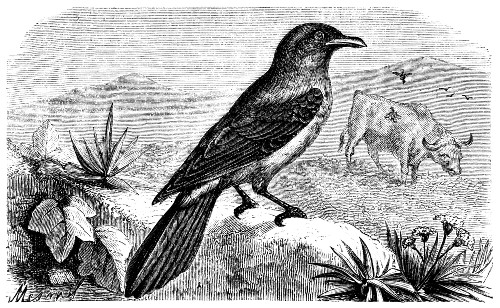
Fig. 223.—The Beef-eater (Buphaga africana, Levaill.).
The Beef-eaters (Buphagus, Briss.), Fig. 223, owe their name
to a singular habit they have of lighting on the backs of ruminating
mammalia, and picking off the insects or extracting the
larvæ of Œstri which infest them—an operation which cattle
submit to with great pleasure. Their food is not confined to the
larvæ of the Œstri; they feed also upon the wood-bug and locusts:
hence they are likewise called Locust Hunters. They generally
unite in small flocks of six or eight. They are very wild, and
take flight with a sharp cry of alarm on any one approaching
their haunts.
Among the congeners of the Beef-eater may be placed the
Colius (Briss. and Linn.), which, like that bird, is an inhabitant
of Africa. They are small, about the size and shape of the
Yellow-hammer, and have a tuft on the head. They live in
flocks of from twelve to twenty, which nest in common, and
feed on fruit and young birds. According to Levaillant, they
creep on the branches of trees, with the head downwards; and,
strange to say, even sleep in this peculiar position, pressing one
against the other. Their flesh is said to be very delicate.
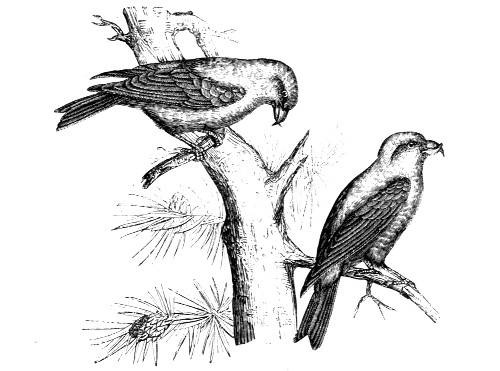
Fig. 224.—Crossbills (Loxia curvirostra, Linn.).
The Crossbills (Loxiadæ) are remarkable for the form of their
bill, the mandibles being compressed and recurved, crossing
each other in contrary directions, the terminations being hooked,
forming an instrument admirably adapted for dividing the scales of
fir-cones so as to disclose the germs, which are favourite portions
of their food. They are sometimes found near orchards, feeding
on the kernels of apples, which their bill readily cuts. They are
said to commit great ravages on the fruits of Normandy when
they pass through that province, which they annually do in great
flocks. This family present this peculiarity, which is almost
unique among birds—that they build their nests and lay at all
seasons. The Crossbills haunt the wooded mountains of the North
of Europe and America.
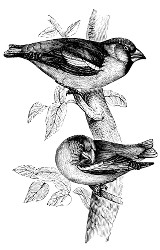
Fig. 225.—Grosbeak, or Hawfinch (Loxia coccothraustes, Linn.).
The Sparrow (Passer) is, perhaps, the best-characterised genus
among the Passerine Conirostres. In it are included a great
number of species with bills
more or less thick at the base.
Coming to the most remarkable
of them, we have the
Grosbeak (Fringilla coccothraustes,
Temm.), Fig. 225,
which is the type of the genus,
for it is distinguished by
the possession of a bill which
is about three-quarters of an
inch long, not less than half
an inch in thickness at the
base, and of immense strength
when the size of the bird is
considered, which scarcely exceeds
that of the Thrush. It
feeds on seeds, berries, and
insects; the kernels of the
hardest fruit cannot resist the
powerful implement with
which it is provided. Widely
diffused throughout Europe,
it is always met with in England during autumn, continuing
with us till April, but it has not been recorded as breeding here.
It is constantly found in France, where it appears in open country
or woods, according to temperature. It is a quarrelsome and
unsociable bird; and if placed in confinement with others, it will
undoubtedly maltreat, and perhaps kill them.
The Americans possess many species of Fringilla, some of them
having plumage of a fine rose colour.
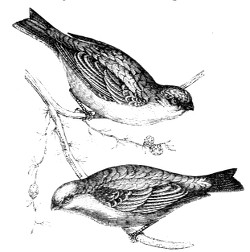
Fig. 226.—Bullfinches (Loxia pyrrhula, Penn.).
The Bullfinches (Pyrrhula vulgaris, Gould), Fig. 226, are
pretty little birds. Their
cheeks, breast, and belly
are a bright crimson,
shaded with orange red;
grey round the shoulders,
with black head. They
feed on various kinds of
seeds or berries. They
are easily tamed, being
of a gentle, docile disposition.
Their attachment
to their master,
and the ease with which
they are taught to pipe,
are their principal recommendations.
In their
natural state they construct their nest in the most inaccessible
part of the thicket, usually in a black or white thorn bush. This
is composed of small dry
twigs, lined with fibrous
roots.
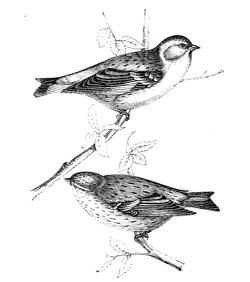
Fig. 227.—Siskins (Fringilla spinus, Penn.).
The Siskin (Carduelis
spinus, Yarrell), Fig. 227, may be mentioned
among the numerous
songsters which charm
with their melodious
notes. It is very pretty,
although less richly coloured
than the Goldfinch
and others, its congeners.
It is neat and
compact in form; its bill
resembles that of the
Goldfinch, but is more
compressed, the two mandibles
in some specimens meeting only at the base. The plumage
is soft, blended, and glossy.
The House Sparrow (Passer domesticus, Yarrell), Fig. 228, is
among the most interesting of the Passerinæ. It abounds all over
Europe, from its most southern regions up to extreme north.
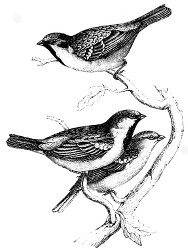
Fig. 228.—House Sparrows (Fringilla domestica, Penn.).
Every one is acquainted with this little bird; lively, pert,
and cunning, the true gamin of the winged race. It lives in
flocks in the neighbourhood of dwelling-houses, and even in the
heart of large towns; it is familiar, but its familiarity is circumspect
and sly. It haunts our streets and public places, but is
careful to keep men and boys at a respectful distance. It has a
notion that the friendship
of the great is dangerous,
and its prudence counsels
it to avoid intimacies which
might have troublesome
consequences; it is only
after multitudinous proofs
of good offices that the
Sparrow will form an unreserved
treaty of friendship
with man. The Sparrow
quoted by Buffon, which
not only followed its soldier
master everywhere, but
would recognise him from
all the others in the regiment,
proves they are both
intelligent and capable of
affection.
Sparrows are eminently sociable, seeking their food and building
their nests near each other, whether it be in crevices of walls
or under the eaves of houses, in hedges or trees, or in the deserted
nests of Swallows, which they have the effrontery to appropriate.
In their nest, which is a bulky, soft, and warm structure, lined
with wool, bristles, and hair, the female deposits from four to six
eggs three times a year; their fecundity is consequently very great.
They are omnivorous, but prefer seeds and the larvæ of insects to
all other food.
Oceans of ink have flowed to prove the ravages committed by
Sparrows on the corn-fields, and to demonstrate that they should be
exterminated by the farmer. But it is now generally agreed that
the Sparrow is a benefactor, and belongs to the list of useful
birds. Have we not seen in the Palatinate that after the Sparrow
was proscribed and exterminated, the inhabitants were under the
necessity of reimporting them in order to arrest the ravages of
insects, which, in consequence of this bird's absence, had multiplied
in a frightful manner?
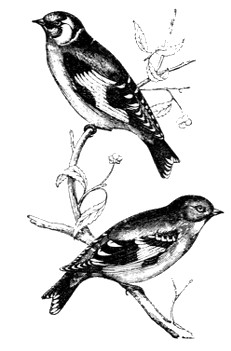
Fig. 229.—Goldfinches (Fringilla carduelis, Linn.).
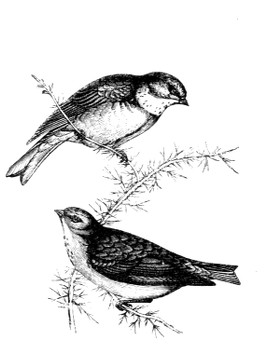
Fig. 230.—Linnets (Fringilla linota, Penn.).
The Goldfinch (Carduelis elegans, Yarrell), Fig. 229, is at the
same time the most gentle and peaceful of birds, and one of the
prettiest of European races. It has the back brown, the face red,
with a bright yellow spot upon each cheek; its voice is full, sweet,
and harmonious; it is exceedingly docile, easily tamed and raised
as a cage-bird; in the aviary it soon becomes familiar, testifying
great attachment to those who take charge of it; it readily learns
to sing and go through various exercises, such as drawing up
the vessel containing its food and drink, firing a miniature cannon,
and other similar tricks.
The Linnets (Linota cannabina, Yarrell), Fig. 230, have considerable
analogy to the Goldfinch. They are, like them, extremely
sociable, except at the period of incubation; that duty over,
the individuals begin to muster in small flocks towards the end of
autumn, which increase as the winter advances, when they betake
themselves to sheltered districts, and to the neighbourhood of
villages and farm-houses in search of food. They associate with
various species, such as the Mountain Linnet, Green Linnet, and
other small birds. The nest of the Linnet is generally placed in a
bush of furze or heath. It is a neat structure, formed externally
of blades of grass intermingled with moss and wool, and lined
with hair of various kinds; sometimes with thistle-down. The
female lays from four to six eggs, of an oval form, colour bluish
white, marked with distinct spots of brownish black, purplish
grey, and reddish brown. Should the nest be destroyed during
incubation, the pair will build again, and lay two or three sets of
eggs if needful; but the male is said to take no part in the
building or incubation, although he watches the female with great
solicitude, supplying her with food during the process.
The Linnets feed principally on hemp and linseed, whence their
popular name. In the winter season, in the absence of their
favourite food, they attack the young buds of trees, and pick up
the stray seeds about farm-yards. Their song in confinement
is remarkably sweet, brilliant, and varied, but will not compare
with the thrilling voice of the Blackbird or Thrush. The species
are numerous, both in Europe and America, but there is a tendency
to reduce their number, and to regard them as seasonal
varieties of the species under consideration.
The Chaffinch (Fringilla cœleb, Linn.) Fig. 231, lives in flocks,
except when breeding, like the Goldfinch and Linnets. But they
differ from these members of the group in this—that their wing
is less compact, and that they disperse themselves more in search
of food than their congeners. Chaffinches are met with all over
Europe, either as birds of passage or as permanent residents.
They feed on various kinds of seeds and larvæ of insects, the latter
of which they obtain in the early mornings of summer and autumn
by searching the lower surface of the leaves of oak, ash, and other
trees. They inhabit indifferently the woods, gardens, or high
mountain ridges. In the early days of spring the mellow, modulated
"tweet, tweet, tweet" of the Chaffinch is exceedingly pleasant
to hear; but its monotony is apt to fatigue, for its eternal refrain
makes it seem an affectation of gaiety, whence probably the French
proverb, Gai comme un pinson.
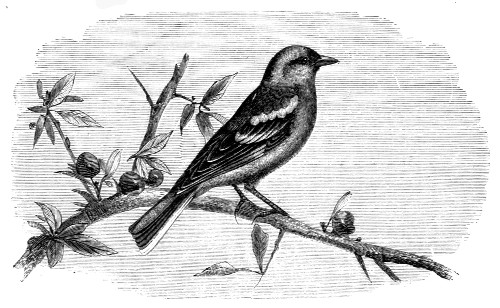
Fig. 231.—The Chaffinch (Fringilla, Gesner).
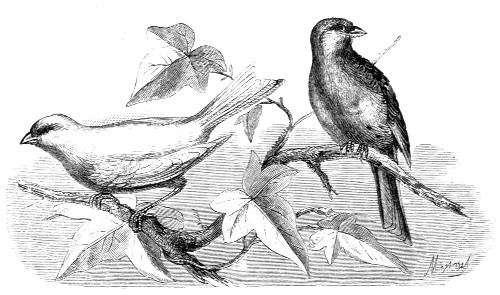
Fig. 232.—Canaries (Carduelis canaria, Wood).
The Canaries (Fringilla canaria, Linn.), are only known by us
as cage-birds, where they are recognised by their yellow plumage,
more or less varied with green, although the facility with which
they breed with the Linnet, Goldfinch, and others of the group, has
introduced great varieties of colouring. Originally from the
Canary Islands, they were first imported into Europe in the
fifteenth century, and such was the charm of their song, added to
their natural docility and gay plumage, that every one was eager
to possess them. Buffon says, in his elegant manner, that if the
Nightingale is the songster of the woods, the Canary is the
chamber musician. Their race propagates, moreover, so rapidly
that the poorest can afford to possess them; for these elegant
little creatures are to be found among every grade of society,
pouring out their joyous melody in the garret of the poor workman
with as much energy as in the gorgeous saloons of the
wealthy.
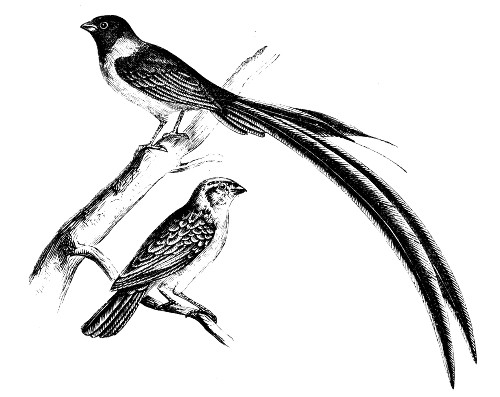
Fig. 233.—Whidah Finch, or Widow Birds (Emberiza paradisea, Linn.).
There are two distinct species of the Canary, the Plain and
Variegated, or, as the bird-fanciers designate them, the Mealy, or
Spangled, and Jonquils; but between these innumerable varieties
have sprung up from cross-breeding with the Goldfinch, Linnet,
and Siskin. These cross-breeds are often charming songsters;
but, like all mules, they are completely sterile. Bechstein is of
opinion that our Domestic Canary has a cross of the Siskin in it:
this belief for a long time existed, but most naturalists now are of
opinion that the Siskin belongs to a different genus.
The Widow Birds, or Whidah Finches (Vidua, Sw.), Fig. 233,
are among the most remarkable of the hard-billed, seed-eating
birds to which they belong. The long, drooping tail feathers
which adorn the males in the breeding season give them a very
singular appearance. The upper part of their plumage is of a
faded blackish brown, assuming a paler hue on the wings
and lateral tail feathers. The whole body is tinged with this
faded black, gradually narrowing as it descends to the middle of
the breast; a broad, rich orange-brown collar proceeds from the
back of the neck, uniting with a tinge of the same colour on the
sides of the breast, this last hue passing into the pale buff colour
of the body, abdomen, and thighs, and the under tail coverts
being of the same colour as the upper ones—a hue to which
the bird is indebted for its popular and scientific name. The
tail feathers are black; the four lateral ones on each side slightly
graduated, and rather longer than the one immediately above.
The next two are the long, drooping feathers, externally convex,
so conspicuous in the male bird, which, in fine specimens, measure
a foot in length from base, and about three-quarters of an inch in
width. The body of the bird is about the size of a Canary. They
are natives of South Africa and Senegal.
Near to the Widow Birds in the system we may place the
Java Sparrow, Rice Bird, or Paddee Bird of the East Indies and
Eastern Archipelago (Fringilla oryzivora, Sw.), Fig. 234. They
are eagerly sought for as pets, in consequence of their brilliant
plumage, and the facility with which they learn innumerable
tricks.
The Weaver Birds (Ploceus, Cuvier) close the series of Fringillidæ.
They live in flocks in the interior of Africa, where
they feed on the cereals and the young of weaker birds. They
chirp, but have no song; and they owe their name to the inimitable
art which they display in constructing their nests. These
vary in form according to the species, and are composed of grass,
rushes, and straw. They are usually suspended from the branches
of a tree, the entrance being below. Sometimes they are spiral-shaped,
occasionally round; in fact, they are of every imaginable
outline. Mr. Swainson describes the nest of a species of
Loxia built on a branch extending over a river or a pool of
water, shaped like a chemist's retort suspended from the head,
while the shank was eight or ten inches long, at the bottom of
which was the entrance, all but touching the water.
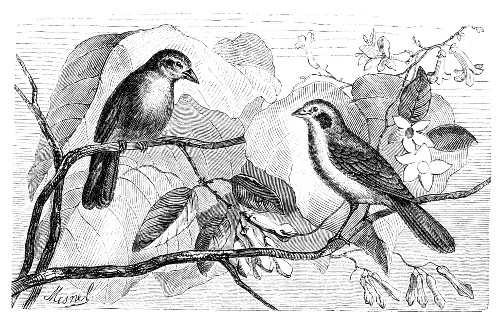
Fig. 234.—Java Sparrows, or Rice Birds (Loxia oryzivora, Linn.).
Another species of the Ploceinæ construct their nests in a clump
under one roof or cover, each nest having a separate entrance
on the under side, but not communicating with that next it.
Another variety is said each year to attach a new nest to that of
the previous year, and nothing is more picturesque than these
groups of nests thus suspended to the branches of a tree.
But the most curious of birds, in respect to nidification, are the
Republican Weaver Birds (Loxia socia, Latham). These establish
themselves, to the number of five or six hundred, upon the same
tree, constructing their nests under a common roof, the one backing
against the other, like the cells of a bee-hive, all living
together in the happiest manner.
The Buntings (Emberizidæ) are intimately associated with the
Passerine birds. They are characterised by a short, stout, conical
bill, the upper mandible narrower than the lower, its dorsal outline
nearly straight, sides convex, edges inflected, the tip acute; the
lower mandible has the angle short, broad, and rounded. In the
palate is a hard, bony knob to bruise the seed which forms
their principal food. Their general habitat is the fields and
hedges upon the margin of woods; some few species haunt the
banks of rivers. They build their nests on the ground, or on
low bushes, and in this they deposit four or five eggs. The young,
when hatched, are blue. Their plumage is deficient in brilliancy,
but their song is not without attractions. In autumn, when
they leave the colder regions to go south, fattened with the rich
produce of the harvest-fields, they have a rich, delicate flavour,
and are then in France eagerly sought after for the table, and
frequently brought to market along with Larks and Ortolans.
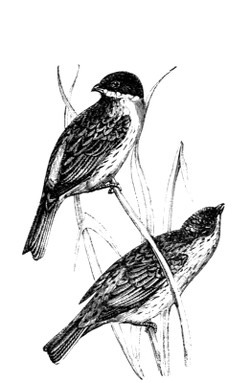
Fig. 235.—The Reed Bunting (Emberiza schœniclus, Yarrell).
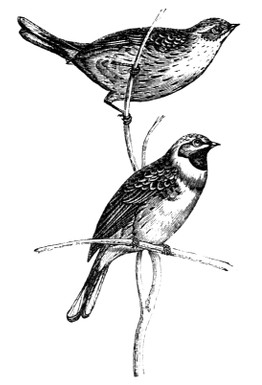
Fig. 236.—The Cirl Bunting (Emberiza cirlus, Yarrell).
The Buntings are divided into the Buntings properly so called,
in which the claw of the back toe is short and hooked, and the
Spurred or Lark Buntings (Plectrophanes, Meyer), in which it is
long, straight, compressed, and slightly arched. To the first of
these divisions belongs the Reed Bunting (Emberiza schœniclus,
McGillivray), Fig. 235, which may be considered the type of
the group, and is a constant resident all the year round in
France and England, but migratory in Scotland and other
northern countries.
The Cirl Bunting (E. cirlus), Fig. 236, on the other hand,
although found in Devon and Cornwall, and other parts of
England, is only plentiful in the southern parts of Europe,
and does not migrate into the colder regions.
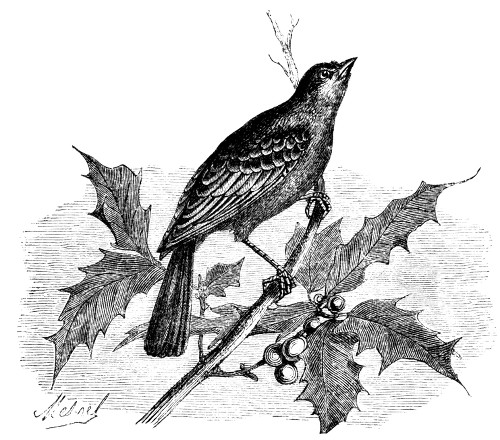
Fig. 237.—The Ortolan Bunting (Emberiza hortulana, McGillivray).
The Ortolan Bunting (E. hortulana, Yarrell), Fig. 237, so
well known to gourmets and pot-hunters of Southern Europe,
migrates periodically. Some have been found in various parts of
England, but they were evidently stragglers, driven there by
accidental circumstances. They abound on the northern shores
of the Mediterranean, in Western Central Asia, in France, and
as far north as Norway, where they are known to breed. Their
favourite resorts, according to Meyer, are the borders of woods,
hedges, and fields, near a water-course, clothed with low willows
and bushes. They are very shy: still great numbers are captured
in nets, when they are kept in confinement, and crammed for
the table.
The Snow Bunting (Plectrophanes nivalis, Gould) rarely shows
itself in France, and Montagu describes them as rare in England,
but McGillivray found them in considerable flocks all over Scotland,
from the Outer Hebrides to the Lothians. On the 4th of August,
1830, being on the summit of Ben-na-muic-dhu, one of the loftiest
mountains in Scotland, he observed a beautiful male flitting about
in the neighbourhood of a drift of snow, and some days after,
in descending from Lochnagar on a botanising expedition, he
noticed a flock of eight individuals flying about among the
granite rocks of a corry, evidently a family. "It is, therefore,"
he thinks, "very probable that it breeds on the higher Grampians."
The Conirostral Passerines include the family of Paridæ, or
Tits. The Titmice, as they are sometimes called, are small birds,
seldom attaining the size of the Common Sparrow. Their general
form is moderately full, the head large in proportion, and broadly
ovate. Their bill is straight, short, and tapering, furnished with
hairs at the base, but their individuality is distinguished by their
specific peculiarities rather than by physiognomy. A characteristic
feature is their audacity, almost approaching to impudence,
and their courage, the instinctive result of their sociability.
These qualities secure for them a well-defined place in the group
under consideration.
Who discovers the Owl during the day? Who besieges him
with its clamours? Who pursues him with unintermitting blows
of his bill? Who rouses the whole tribe of small birds against
the nocturnal tyrant? It is the Titmouse. Bellicose as bird can
be, it gives full scope to its most warlike instincts whenever a
suitable occasion presents itself, its want of physical power being
compensated for by the vigour of its assault. The Tit is, indeed, the
incarnation of motion; it is continually on the qui vive, skipping
from branch to branch, at one moment piercing the crevices of
the bark with its bill in search of food, the next hanging suspended
from a branch, to which it clings with its claws, while
it picks off the insects which occupy the lower surface of the
leaves.
Nevertheless, it varies its food according to seasons and circumstances.
Not only does it devour all kinds of insects, not
excepting wasps and bees, but even cereals and fruits. It is
even carnivorous, for it has been known to kill weak or sickly
birds in order to devour them. Some species have a most unnatural
partiality for grease, and devour it whenever opportunity
offers. They are sociable birds, inhabiting thickets or woods,
living in flocks the greater part of the year, and showing strong
attachment to each other, so that a flock of them will suffer themselves
to be decimated, and even altogether destroyed, rather than
desert a wounded companion. In the spring they pair, and each
isolated couple now seek out a suitable place in which they may
rear their future progeny.
The position of the nest varies with the species. The Great
Tit, or Oxeye (Parus major, Selborne), builds in the hole of
some wall, or in a cavity formed in a decayed tree. It is usually
composed of moss, hair, and feathers. The Blue Tit (P. cæruleus,
Selborne) occasionally builds its nest in very insecure places.
Mr. Duncan, one of Mr. McGillivray's correspondents, in a MS.
note now before us, says, "In the year 1836 I discovered the nest
of a pair of Blue Tits in the shaft of a pump well, which was
drenched and partly carried away every time water was drawn;
still they persevered in building. Gladly would I have left them
there, but they kept the water in a continually muddy state, and
their removal became absolutely necessary." The Coal Tit (P.
ater, Selborne) chooses the crevice of a wall or decayed tree.
So does the Marsh Tit (P. palustris, Selborne). The Crested
Tit (P. cristatus, Selborne), Fig. 238, is a retiring, solitary
little bird, provided with plumage both brilliant and beautifully
blended. They are rarely seen in England, but several flocks
are recorded as appearing in Scotland. They are said to breed
annually in plantations near Glasgow, in the forest of Glenmore,
and near the Spey two were killed in 1836. In the North of
Ireland, in autumn, they are not uncommon wherever plantations
of larch trees are to be found. Their nest, according to Temminck,
occurs in holes of trees, the oak being preferred, in rocks, or in a
deserted Crow's or Squirrel's nest.
The nest of the Long-tailed Tit, or Mufflin (P. caudatus),
is, perhaps, the most skilful specimen of construction. It is
oval in form, and has two openings, one for entrance, the other
for exit—an arrangement which the long tail of the bird renders
necessary. This singular bird—the most diminutive of our birds
except the Kinglets—differs from the Tits in its softer and more
bulky plumage and tail. Its flight is undulating and rapid; its
long tail and body muffled up to the chin in dense plumage giving
the observer the idea of an arrow flying through the air.
The Tits abound throughout Europe, and are also found in
America; some of them remaining all the year with us, although
they are all birds of passage.
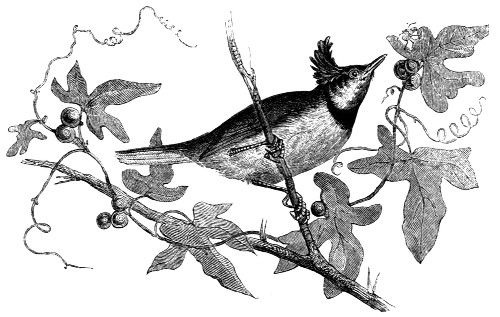
Fig. 238.—The Crested Tit (Parus cristatus, Selborne).
The Larks (Alaudinæ) complete the Conirostral Passerinæ.
They are distinguished by the great muscularity of their gizzard,
and their elongated and slightly-curved claws, which are sometimes
longer than the toe itself, indicative of a ground-bird; in short,
they pass their lives on the ground, in the bosom of great grassy
plains, or soaring in the air. This family renders eminent service
to agriculturists by the enormous quantity of worms, caterpillars,
and grasshoppers it daily devours.
The Lark builds its nest in a furrow, or between two clods of
earth, without much skill it is true, but with sufficient intelligence
to know that it is necessary it should be concealed. Here
it lays four or five eggs, spotted or freckled; in favourable seasons
three sets of eggs in the year are sometimes hatched. The
young birds break the shell after fifteen days' incubation, and
are in a condition to leave their cradle at the end of fifteen
more; but the mother still continues her surveillance, guides
their steps, satisfies their wants, and continually hovers near
them until the demands of another brood take her away, when
they are abandoned to themselves, being now so fully fledged as
no longer to require maternal care.
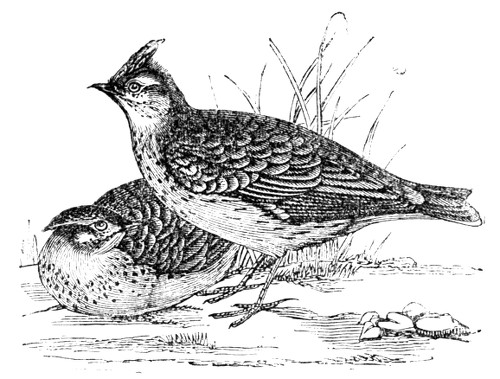
Fig. 239.—The Crested Lark (Alauda cristata, Linn.).
The Lark is the living emblem of happy, peaceful labour, the
songster of the cultivated earth. In the early dawn the male
bird rises aloft, and with soaring wing fills the air with his
joyous notes, and calls the husbandman to his labour. Higher and
higher he mounts, until he is lost to sight; but his voice is still
heard. The song is significant; it is the hymn of good fellowship—a
call to all the dwellers of the plain.
The season of incubation over, the Larks assemble in numerous
flocks, having now only their food to think of; and that being
plentiful, they soon get plump and fat. In countries like France
this is the signal for their destruction, for persons assemble
from all quarters to make a razzia on these valuable innocents,
using every means to accomplish their work of death; and unless
the legislature interfere in their behalf by passing laws for
their preservation, it will finish probably by exterminating the
race.
Taking Larks by means of a mirror is a ruse based upon the
natural curiosity of this species, which leads it irresistibly towards
any reflected light. The slaughterer places a glass, or any
object that will reflect the sun's rays, in a field, concealing himself
in its neighbourhood. The Larks, attracted by the light,
come within reach of his blows, and fall around the mirror,
undismayed by the fate of their companions.
In this family the only species which lives in confinement is
the Sky-lark, and that only by very great care. It sings unceasingly
in a cage, and even imitates the song of other birds.
Larks are found all over the Old World, especially in Europe
and Asia. The principal species are the Sky-lark (Alauda
arvensis), the Crested Lark (Alauda cristata), the Wood Lark
(Alauda arborea), and the Shore Lark (Alauda alpestris).
The Crested Lark (Alauda cristata), Fig. 239, abounds on the
continent of Europe, but is rare in this country, one or two
specimens only being recorded. It is migratory, moving northward
in spring, and again toward the south on the approach
of winter. It is a handsome bird, about the size and appearance
of the Sky-lark, having a few feathers on the crown forming
a crest pointing backwards.
The Fissirostral Passerinæ are characterised by a broad, short
bill, flattened horizontally, and slightly hooked; mandibles slightly
concave; mouth very wide. They are essentially insectivorous. They
comprehend three genera:—1. Swallows (Hirundo). 2. House
Martins (Chelidon). 3. Sand Martins (Cotyle).
The Swallows are recognisable by their long pointed wings,
forked tail, and excessively short tarsi. The air is the true
element of these birds; they fly with a facility, lightness, and
rapidity quite inconceivable; indeed, their existence is one eternal
flight. They even feed their young on the wing when the latter
first begin to fly. Watch them in the air, and they will be seen to
rise and fall, tracing the shortest curves, crossing and interlacing
each other's course, moderating their pace suddenly when at their
utmost speed in order to follow the eccentric course of some winged
insect which they have doomed for their food. Such, indeed, is the
rapidity of their progress that some of the species have been known
to travel at the rate of thirty leagues an hour.
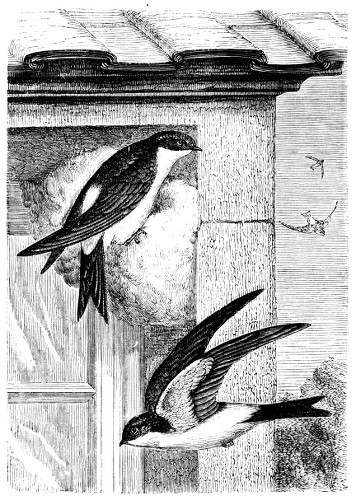
Fig. 240.—Window Swallows (Hirundo rustica, Linn.).
This wonderful power, however, is only developed at the
sacrifice of another locomotive faculty, for they are bad walkers.
With their short limbs, activity on their feet is impossible; and
if by chance they are placed on the ground, with difficulty they
rise again on the wing. On the other hand, their sight is
excellent—equal to even that of the Eagle or Falcon. According
to Spallanzani, who made numerous experiments on the Swallows,
the Martin perceives the winged fly passing through the air at the
distance of more than a hundred and twenty yards.
Swallows are celebrated for their migratory journeys. In the
early days of spring they reach Europe, not in flocks, but as isolated
individuals or in pairs. They occupy themselves almost
immediately either in repairing their last year's nests, or, if these
have been destroyed, in constructing new ones. Among the arrivals
are many young birds of the previous year which have not had
nests, and yet it is not a little extraordinary that these, after six
months' absence, return with unerring certainty to the old dwelling
where hatched. This fact has been too often recorded to admit of
any doubt on the subject.
The form, structure, and locality of the Swallow's nest vary
with the species. The Common Swallows (H. rustica), Fig. 240,
build theirs in the upper angles of the window of some country
house, under the eaves of a roof, or on the interior wall of a
chimney. A chimney seems an odd place to select for such a
purpose; and White of Selborne relates, not without some expressions
of wonder at such a choice, that near the middle of May
one of these little birds began to form her nest about five or six
feet down a chimney adjoining the kitchen fire. Their nests consist
of a crust or shell of mud mixed with straw, and lined with
fine grass and feathers. Other species, sometimes in vast numbers,
establish themselves in the clefts of dead trees. Audubon estimated
at the incredible number of eleven thousand the quantity of
Swallows which had taken up their dwelling in a sycamore tree
(familiarly known there as a button wood) near Louisville, Kentucky,
United States. Some Swallows prefer rocks or caverns,
and hollow out in steep escarpments a gallery from two to three
feet in depth, at the extremity of which they place their nest.
Sometimes the nest is formed of twigs torn by the bird from the
dead branches of trees, and bound together by a viscous liquid
which flows from the bird's mouth.
When, after a month's labour, the Swallows have finished their
dwellings, the female deposits from four to six eggs. Incubation
commences, and continues from twelve to fifteen days, during
which the male bird exhibits intense interest in the proceedings,
carrying food continually to his mate, and passing the night in
her immediate vicinity, twittering and chirping all day long to
cheer the mother at her task. Two or three times in the season
they thus raise a family.
From the time when the little ones are hatched the parent birds
attend them with all the care their feebleness demands, and
often exhibit remarkable proofs of affection. When the young
Swallows feel strong enough to try their wings, the old ones tenderly
guide them on their first attempts at flight, and teach them
how pursuit of insects in the air is successfully performed. Boerhaave
quotes an instance where a Swallow, returning from some
distant excursion, found the house in which it had built its nest
in flames. It did not hesitate an instant to throw itself into
the fire in order to save its young.
Swallows generally prefer the proximity of a lake or river,
the surface of water being always the rendezvous of crowds of
insects, among which they can reap a plentiful harvest. Swallows
are extremely sociable; they assemble in large flocks, and appear
to be bound together by strong attachment, for they aid each
other in trying circumstances.
"I have seen a Swallow," says Dupont de Nemours, "which
was unfortunate, and had, I know not how, entangled its foot in
a ball of string, one end of which was attached to the roof of the
College of the Four Nations; its strength was exhausted, and it
hung uttering painful cries at the end of the string, only endeavouring
to release itself occasionally by fluttering attempts at
flight. All the Swallows between the Tuileries and the Pont
Neuf, and perhaps for a much greater distance, were assembled to
the number of many thousands, forming a perfect cloud, uttering
cries of alarm. All that came flew past, giving a peck of their
bill at the fatal string; these blows, being frequently repeated,
and always directed at the same spot, were finally successful,
for in half an hour the string was cut and the captive set at
liberty."
Another fact, related by the great naturalist Linnæus, proves how
strong is the spirit of brotherhood with these birds. When the
Window Swallows returned in spring to take possession of their
nests, a certain number of them were found occupied by Sparrows.
One of the more legitimate proprietors, thus despoiled of his property,
endeavoured by every possible means to recover possession,
but all was unavailing. Under these circumstances the assistance
of its companions was demanded. The whole assembly proceeded
to besiege the intruder. It resisted, intrenching itself in its fort,
and in revenge the ousted Swallows brought mud in their bills,
and actually walled up the entrance to the citadel and entombed
the interloper in his cell. The truth of this account, which is
repeated by many naturalists, has been denied; but Mr. McGillivray,
than whom we have no more reliable author, records three
well-authenticated similar instances.
The Swallow generally leaves us in the month of September in
order to seek a milder climate, and one providing more abundant
food in winter. Some time before their departure their cries are incessant,
and great agitation is seen in their ranks; they assemble in
some elevated place, as if to hold council and deliberate over their
journey, and fix the date of their departure; finally, a day is
decided on, which when it arrives, all the Swallows of the neighbourhood
mass at an appointed place, and after certain evolutions,
intended, no doubt, to determine the route, they advance in one
mass towards the shores of the Mediterranean, whence they pass
into Africa. Although they are of all birds the strongest on the
wing, and best adapted for a long journey, they cannot accomplish
this without rest if adverse winds should arise. Ships
passing are frequently boarded by stragglers which light on
the rigging; and both at Gibraltar and Tangiers large flocks are
occasionally seen to arrive in a state of great exhaustion. Those
stragglers which, through weakness or the duties of maternity,
are prevented from joining the great flocks, depart some days
later in smaller parties. Occasionally, however, a few individuals
seem to remain with us all the year round, contriving to survive
the most severe winters, which has given rise to the supposition
that the Swallow has the power of hibernating, or of remaining
in a state of torpor during the winter, and returning to animation
in the spring. This much-controverted point has now been consigned
among the mythical legends to which it belongs.
Swallows have in all ages possessed the sympathies of mankind,
some of the ancients regarding them as sacred birds; nor
are they ungrateful for the good feeling they excite. The
services they render in destroying vast quantities of noxious
insects, not to speak of their gentle habits, mutual attachment
to each other, and the happy presage they bring with them
of spring's advent, contribute to make them welcome visitors.
Nevertheless there are instances where these proper sentiments
yield to the love of destruction—where their innocent confidence
is rewarded by death.
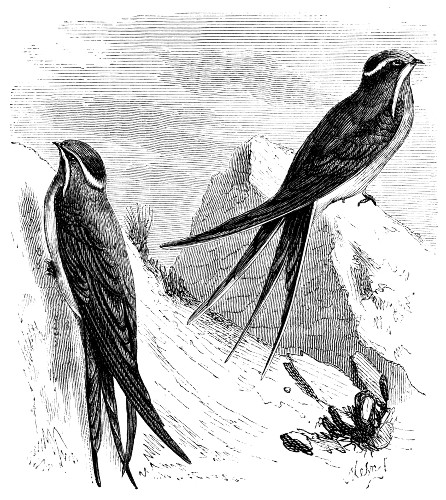
Fig. 241.—The Cliff Swallow (Hirundo fulva, Gin.).
Swallows generally have the breast and belly white, and the
upper parts of the body black, tinted with a reflected blue or peach
colour. There are about sixty species spread over the globe, of
which six only are natives of Europe. They are divided into
Swallows proper (Hirundo), Martins (Chelidons), Sand Martins
(Cotyle), and Swifts (Cypselus). The Martins are larger in size
than the true Swallows; have the wings longer, and consequently
their powers of flight are greater and their speed more sustained;
their claws are more robust and hooked.
The principal species we have already named. It is only necessary
to mention the Cliff Swallow (Fig. 241), the Chimney Martin,
the Bank Martin, and the Alpine Swift (Cypselus alpinus),
Fig. 242.
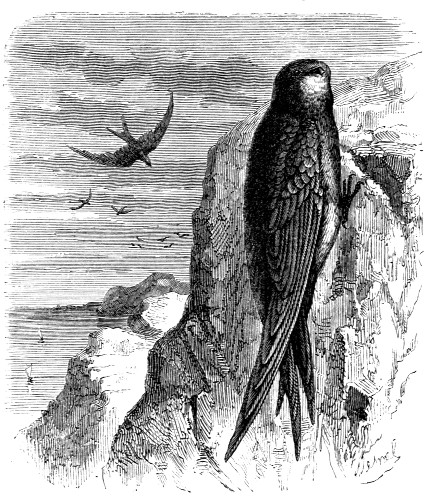
Fig. 242.—The Alpine Swift (Cypselus melba, Wood).
Among the foreign species the Salangane Swallow (Fig. 243)
may be mentioned, so famous over the world for its edible nest.
This bird inhabits the rocks and caverns of the sea-shore in
Sumatra and Java. When building it eats of the plant called
fucus, which abounds in these regions; this is metamorphosed in
the bird's stomach, and afterwards disgorged, to fabricate the
walls of its nest. The fucus thus devoured forms the nutritive
substance so eagerly sought after by the Eastern gourmet. The
consumption of the nest of the Salangane (Fig. 244) in China, in
spite of its high price, is very considerable. From the days of
Buffon there have been exported from the coast of Cochin China
four millions of them annually; and the proprietors of one cavern
in the island of Java receive annually fifty thousand florins for
rent alone.
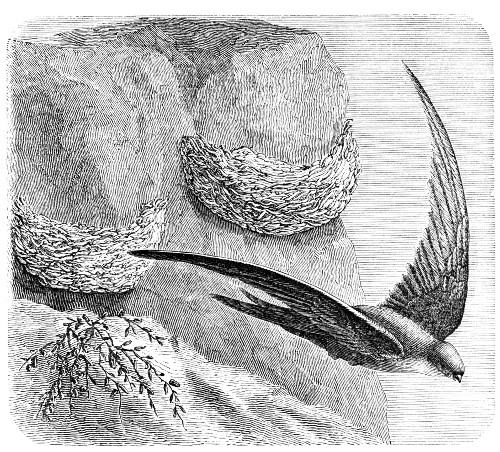
Fig. 243.—The Salangane Swallow (Hirundo esculenta, White).
The distinctive features of the Goatsuckers (Caprimulgus) are a
short, much-depressed bill; the body small in proportion to the
plumage; the neck short; the head large, broad, and depressed;
the eyes very large and broad; the feet very small; tarsi
partially feathered; toes four, the lower surface broad and
flattened, the anterior toes connected by basal membranes; claws
moderate, arched, and compressed. The plumage is full, soft,
downy, and blended, like the Owl's; the wings have the second
and third quills longest; tail long and rounded. Almost all the
species have strong bristles along the base of the upper mandible,
and some have the feathers of the face radiated, like those of the
Owls.
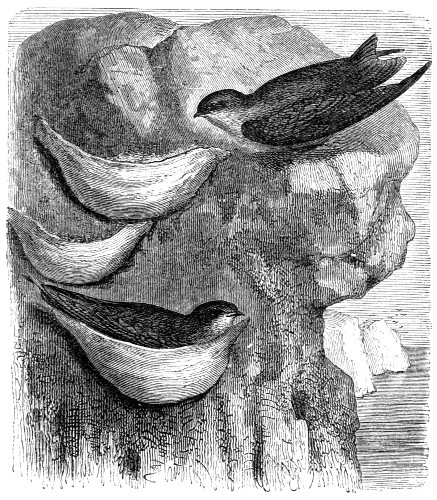
Fig. 244.—Nest of the Salangane Swallow.
The Goatsuckers are solitary birds, living generally in pairs,
sleeping during the day, and issuing from their nest with the
setting sun, or possibly earlier in gloomy weather, to chase the
crepuscular and nocturnal insects on which they feed. They
move silently and with great rapidity. Some authors say that
when on the wing they keep the mouth open; but this is not
supported by facts, and is opposed to reason. The insects they
principally devour are moths, dragon-flies, beetles, crickets, cockchafers,
and mosquitoes. Their usefulness, therefore, is nearly
equal to that of the Swallow. As they get very plump and
fat in the autumn, they fall a sacrifice to the gunner, and in
their turn are eaten by gourmets greater than themselves.
They are migratory birds, travelling only during the night.
They are readily distinguished by the bristles at the base of the
bill, and by the claws of the middle toe, which is toothed.
The object of this toothed appendage has been the subject of
speculation. Some writers fond of the marvellous even surmise
that it is intended to comb and smooth the head feathers. Mr.
Vigors is of opinion that it may be useful as a further power
of prehension, citing, in support of his view, the family of the
Ardeidæ among the Wading birds, which exhibit an analogous
construction in the middle nail.
Through Europe, Asia, Africa, America, and Australia the
Goatsuckers are diffused, and naturalists have divided them into
several sub-genera, such as Podargus, represented by Podargus
humeralis of the Gold River, and Podargus javanensis, the Chabba-wonno
of Java, and the Guacharo Bird, Steatornis villot of Humboldt
and Bonpland.
The typical species of Caprimulgus is the Night-jar (C. europæus),
Fig. 245. It is about the size of a Thrush; and
Montagu states that he observed on one occasion a flock of eight
or ten on the wing together, in the dusk of the evening, skimming
over the surface of the ground, after the manner of Swallows, in
pursuit of insects. Its nest is of the simplest kind, for it deposits
its eggs on the bare ground, or upon a few dry leaves. These
eggs, in number only two, are hatched by the female in fourteen
days.
The Common Night-jar is chiefly found on furzy commons,
wild bushy heaths, and broken hilly ground in the neighbourhood
of thickets and woods. During the day it lies concealed in the
scrub, issuing forth in the balmy summer evenings to pursue its
insect prey on the wing.
On the prairies of North America, especially those intersected
by sloughs, dozens of these birds may be seen at the
hour of sunset, their swift, powerful, and graceful flight being
worthy of the greatest admiration. They are there called Bull
Bats, and are often accused by the ignorant of the crime of sucking
milk from cows—about as probable as snakes being guilty of the
same offence; yet there are hundreds who believe in such impossibilities.
The Night-jar is a bird of evil omen in the estimation of our
rural population: such it has been considered since the days of
Aristotle, and possibly even further back. The reverse should be
the case, for the benefit it produces by clearing the air of noxious
insects is incalculable.
The Guacharos are singular birds, which were first described
by MM. Humboldt and Bonpland as being found in the interior
of a vast Columbian cavern—the Grotto of Caripe. Their hooked
bill and general aspect are more robust than the Night-jars, for
they more resemble birds of prey. They inhabit in thousands the
deep recesses of the caverns of the Cumana Chain, hanging to
the walls by their pointed claws. In these caves, which they
only leave during the night, they build their nests. Unlike
their congeners, they feed only on grain and seeds. The Indians
of Caripe enter these sombre domains from time to time, and make
raids upon their ranks, for they are deservedly esteemed as great
delicacies.
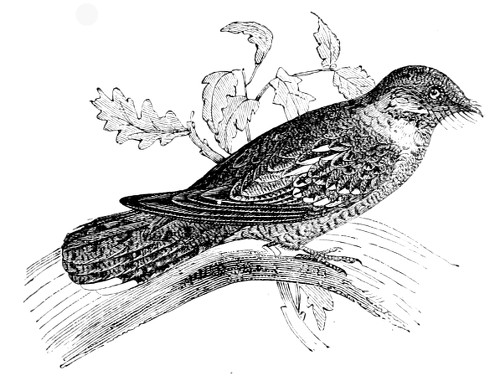
Fig. 245.—The Night-jar (Caprimulgus europæus, Sw.).
The Passerine Dentirostres are characterised by a bill more or
less strong, compressed on each side of the point. They feed on
berries and insects, and comprehend numerous genera, including
the Fly-catchers (Muscicapidæ), the Manakins (Piprinæ), the
Warblers (Sylvinæ), the Lyres (Lyra), the Orioles (Oriolus), the
Philedons (Meliphagidæ), the Dippers (Cucelus), the Thrushes
(Turdus), the Tanagers (Tanagrinæ), the Caringas (Coracina), and
the Butcher Birds (Lanius).
M. Lesson thinks the Muscicapidæ should consist of the genera
Tyrannus, Monacha, Eurylaimus, Platyrhynchus, Todus, Myiagra,
Muscicapa, Alectrurus, Drymophila, Formicivora, Rhipidura,
Seisura, Psophodes, and Euicurus. Of these, Eurylaimus have a
very large, depressed, and cleft bill. They are of more elegant
form than plumage; for their colouring is devoid of brilliant
tints. They live a retiring life in marshes, and upon the banks
of lakes and rivers, feeding upon the worms and insects which
abound in such localities. They are about the size of the Thrush,
and they inhabit the isles of Oceania.
The Manakins (Piprinæ, Sw.) have the bill rather short; the
upper mandible much curved, and pierced with large nostrils;
the feet longish, slender, and weak; the external toes reverted
towards the middle. These birds are natives of South America,
and are gifted with brilliant plumage.
The Rupicola (Briss.), or Cock of the Rock, is remarkable for
the lively and delicate shades of the colour of its plumage,
and for a graceful crest which decorates its crown. It prefers
sombre localities, and retires into clefts and caverns when pursued.
It is very wild, and only issues from its hiding-place in search
of the fruits which form its food. Under the most favourable
circumstances these birds are difficult to approach, taking flight
at the slightest appearance of danger. Their name comes from
their size, and also from their habit of scratching up the earth, and
flapping their wings like the Domestic Cock. They are natives of
South America and Malaya. The best-known species, Rupicola
aurantia (Vieillot), is a native of Guiana; its plumage is bright
orange, and the crest is formed by two rows of feathers, so
arranged as to form a semicircle.
The Warblers (Sylvianæ, Sw.) are readily recognised by their
short, slender, and tapering bill, constituting a numerous series of
birds, among which we note the Fauvette (Sylvia hortensis), Gold-crested
Wren (Regulus auricapellus), the Wren (Troglodytes), the
Whin Chats (Saxicola), and many other genera.
All these are of small size, and have the singular property
of imparting a vibratory motion to their tails. They are chiefly
denizens of our woods, thickets, and gardens, where they fill
the air with their melody. They are generally migratory,
arriving in the spring, and departing at the fall of the leaf.
Living, except in autumn, almost exclusively on insects and
their larvæ, they render in this respect eminent services to
man; but it is a curious fact that at that period these birds
cease to be insectivorous, and feed on fruits—among others, figs
and grapes, whence the name of Bec-figues applied to them
in the South of France. There they are most eagerly sought
for, the attraction being their flesh, which is considered most
delicate.
Warblers prefer the woods and sloping hill-sides, or the banks
of rivers, clothed with trees and shrubs, for their residence.
In the first rank of the Warblers stands the Nightingale
(Philomela luscinia, Selby), Fig. 246, celebrated all over the world
for its song, which is superior, without any doubt, to that of all
other birds. In size it is somewhat greater than the Garden
Warbler, which it resembles in its homely attire. Many have been
the attempts made to describe this far-famed bird. Naturally
shy, the Nightingale retires into the freshest and most sheltered
places, rarely exposing itself to observation. Brushwood and
thickets, witch-elms and evergreen trees, growing on the banks
of some retired water-course, are its favourite dwelling. It is
among these that it establishes its nest, built without care, at
irregular height, and sometimes even on the ground. It possesses
this peculiarity—that it sings not only during the day, but also
in the night; but let any alarming noise approach its retreat,
and it stops instantly. It seems to love solitude above all things.
Audubon, the American naturalist, has described some of the distinctive
characteristics of the bird with a few graphic touches.
He has left his downy couch, and sallied forth to watch the
eventful moment when nature arises, fresh, blooming, and full of
renovated vigour. In his wanderings he comes upon a Nightingale.
"In the midst of a thicket," he says, "I now see a solitary bird,
humble in its attire, and of most modest mien, peeping at me with
a caution so uncommon, and yet so inviting, that I feel tempted to
seek its acquaintance. With care I approach the feathered
stranger. Its form is somewhat elongated, yet not incompact;
its eyes are large, and of peculiar mildness; it stands rather high,
on a pair of light flesh-coloured, and, as it were, transparent legs;
its wings, which are of moderate length, droop, and seem at
intervals to tremble; and, as it moves from one twig to another,
I see it hops, or leaps, and does not walk step by step, like many
other birds. Its colour is a dull brownish olive, but the hind
part of the back and the tail are of a richer tint, though corresponding
with the general hue. At this moment it flies lightly to
the ground, hops a few steps, picks up a grub, and returns to its
former station."
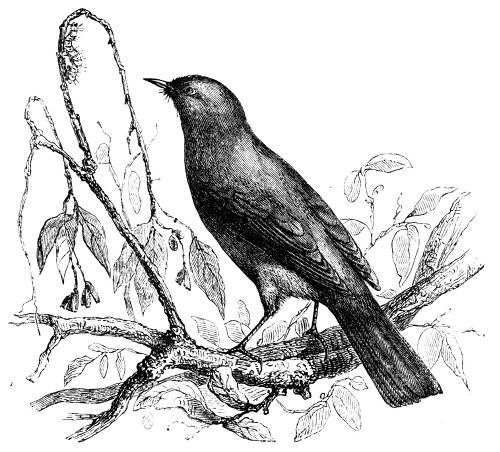
Fig. 246.—The Nightingale (Luscinia Philomela, Wood).
"The Nightingale," says McGillivray, "which in summer is
spread over the greater part of the Continent, extending its
migrations to Sweden and the temperate parts of Russia, arrives
in the South of England about the middle of April, or a few days
later, should the weather be severe. The females, according to
various observers, come from a week to ten days after the males.
Individuals settle in the southern counties, including part of
Devonshire, in the eastern and midland districts, and as far north
as York and Carlisle; but none are to be seen in Cornwall, Wales,
or the north-western parts of England, although it is found much
farther north on the Continent." It is alleged that the migration of
the Nightingale does not extend into Scotland. Mr. Duncan, one of
Mr. McGillivray's most reliable correspondents, states that a pair
of Nightingales arrived in Calder Wood, in West Lothian, in the
early part of the summer of 1826. "Before and about midnight,
when the full moon shone bright and clear, the warble of the male
was first heard; it soon attracted a number of admiring listeners,
who hastened to the spot. The owner of the wood was anxious
to preserve them, thinking they might breed; but, in spite of his
care, the male was shot, upon which the female left the wood."
In France they arrive singly, and
depart alone about the middle
of August, in order to pass into
Africa or Asia.
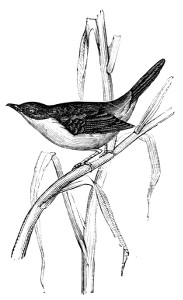
Fig. 247.—The Night Warbler (Salicaria arundinacea, Yarrell).
The Sedge Warbler (Salicaria
phragmites, Yarrell) is a
delicate, lively little bird, haunting
the margins of streams and
pools overgrown with weeds,
sedges, and other aquatic plants,
in the midst of which it seeks
its food, and nestles so secretly
that it very frequently eludes
observation. Mr. McGillivray
found a nest of this species on
the marshy borders of Duddingston
Loch, near Edinburgh.
It was placed in the midst of
a large clump of Solanum dulcamara,
supported by the branches,
and so hidden that he only found
it after cutting off a great number of flowering twigs. This nest
was composed of leaves, grasses, and other slender plants, loosely
but neatly put together.
The Night Warbler (Salicaria arundinacea, Yarrell), Fig. 247,
closely resembles the preceding in form and size. Its song is
loud, cheerful, and much diversified, night being generally
selected for the display of its vocal powers. Its nest is composed
of blades and stalks of grasses, lined with finer plants and hair;
is of a conical form, with the apex downwards; in depth from
four to five inches externally, and three in the interior, and as
much in breadth at the top; and is fastened to the stalks of several
reeds, placed some distance above the ground—"an arrangement,"
says Montagu, "which gives security to the eggs," which
are four or five in number, of an oblong shape, greyish-brown
colour, spotted with dark olive, and usually marked with one
or two blackish, irregular lines.
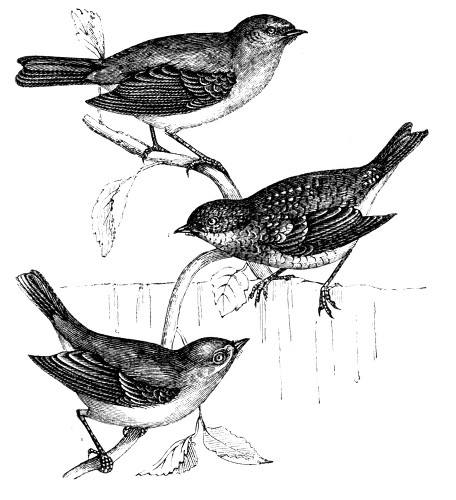
Fig. 248.—The Robin, or Redbreast (Erythaca rubecula, Yarrell).
The Warbler known to French writers as la Fauvette Couturière
is the most curious of all in respect to the manner of
building its nest. Aided by bill and claws, it stretches out into
a thread fibres gathered from the trees; selecting broad resistant
leaves, it drills them with its bill, sews them together with the
cotton which it has prepared, and in this manner constructs a
bag which serves the purpose of completely hiding its nest from
the observation of enemies. This species belongs to India and the
islands of the Indian Ocean, and is unknown in Europe.
Among other well-known species we may mention the Garden
Warbler (Carruca hortensis, Selby), known also as the Whitethroat,
Greater Prettychaps, and other pet names; also the Blackcap
(Sylvia atricapilla), both of which abound near dwelling-houses
surrounded by gardens.
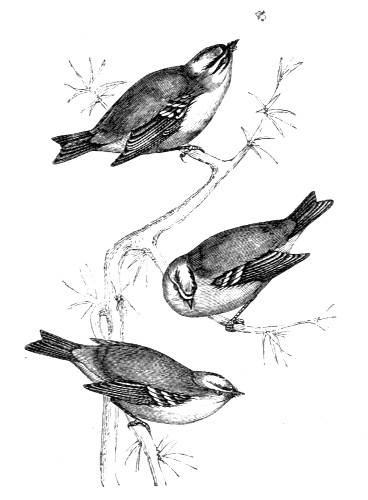
Fig. 249.—Wrens (Regulus cristatus, Temm.).
The Robin, or Redbreast (Fig. 248), is too familiar a friend
to require description. It is lively, pert, pugnacious, cheerful,
and a universal favourite. In April the Robin betakes itself
to the woods and thickets, where it rears its brood. On the
approach of winter it returns to civilised life, when, as M. Figuier
informs us, it constitutes excellent game! No doubt it is edible;
but where is the consumer of such to be found? Not in the
British Islands, we hope.
The Wrens (Motacilla) are the smallest of European birds.
The Golden-crested Kinglet (Motacilla regulus, Linn.), Fig. 249,
inhabits the woods and thickets of the cold and temperate
regions of the earth, where, among the twigs, with great agility
it searches for insects, on which it feeds. While thus occupied
it emits a single shrill, feeble note, too often accepted by heartless
boys as a tell-tale of its whereabouts.
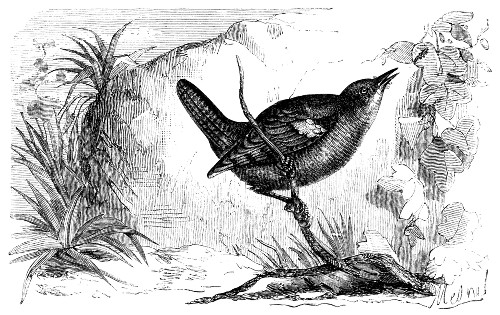
Fig. 250.—The Common or European Wren (Motacilla troglodytes, Linn.).
The European Wren (Troglodytes europæus, Cuvier), Fig. 250, is
widely diffused over Europe, from Greenland to the southern parts
of Italy, and from Trebizond to the west coast of Ireland. Like
the Robin, it has become, in a sense, a sacred bird, and few
venture to commit any outrage on the familiar little creature.
Its nest is found in all kinds of situations; a favourite one
being under the turfed summit of a stone wall skirting a brook,
or on the edge of a wood or shrubbery. It is an elegant
structure, oval in form, and dome-shaped, with the entrance
at the side, the materials varying with the locality; but the
lining generally is soft, downy feathers.
The Wood Warbler, or Wood Wren (Motacilla trochilus, Bewick),
Fig. 251, is a delicate, active little bird, pretty generally diffused.
It is of retiring and unobtrusive manners, its favourite haunt being
among the willows and osiers which skirt some sluggish stream.
While flitting about in such localities it emits a small chirping
noise; but during the months of May and June it is often heard
chanting a soft, mellow, and very pleasing song. In autumn
great numbers of them may be seen gliding among the fruit trees
and bushes.
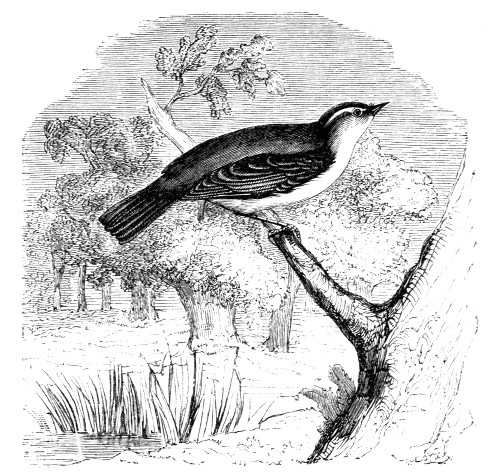
Fig. 251.—The Wood Warbler, or Wood Wren (Sylvia sibilatrix, Bechstein).
The Stone Chat (Saxicola rubicola, Temm.), Fig. 252, has the head
and throat black in the male, the breast brownish red, the sides of
the neck white, a white spot on the wings, the upper parts brownish
black, and the feathers edged with brownish red. In the female the
head and upper parts are streaked with brownish red, the throat
yellowish grey, the breast dull brownish red, a white spot on the
wings, and the upper tail coverts yellowish red. "In April," says
McGillivray, "it forms its nest, generally under some furze bush,
or other shrub, or among rank grass; it is formed of stems and
blades of grasses, intermixed with moss, and lined with finer
straws, fibrous roots, hair, and wool, as well as feathers. These
birds manifest intense anxiety should any one approach their nest,
fluttering and flitting about, and incessantly emitting their sharp,
snapping note, while endeavouring to lead the intruder off in
pursuit of themselves."
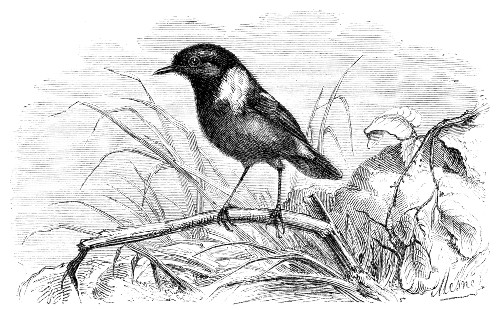
Fig. 252.—The Stone Chat (Saxicola rubicola, Temm.).
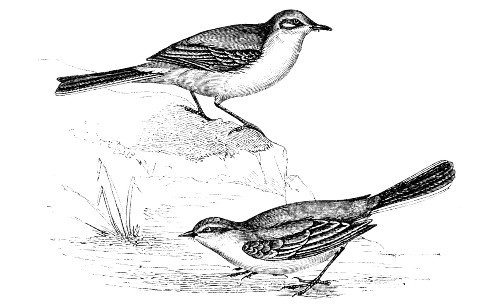
Fig. 253.—The Pied Wagtail (Motacilla Yarrelli, Gould.).
The Wagtails (Motacilla, Cuvier) are remarkable for their slender,
elegant form; the neck of moderate length; the head ovate, small,
and narrow; plumage soft and blended; the wings long, broad,
and pointed; tail long, straight, slender, consisting of twelve
weak, narrow feathers. The Wagtails are intimately allied to the
Pipits, and resemble them in many of their habits, differing
chiefly in the lengthened tail and shorter claws. Both are
remarkable for the vibratory motion of their body while standing
or walking, which their long tail renders a conspicuous
feature.
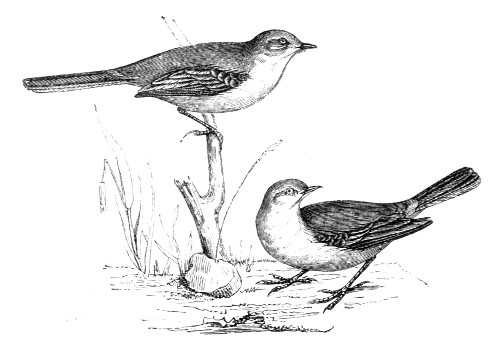
Fig. 254.—Quaketails (Motacilla flava, Temm.).
The Pied Wagtail (Motacilla cinerea, Gmelin), Fig. 253, which
is generally distributed in England, seems to have been confounded
with the White Wagtail (Motacilla alba, Linn.) by naturalists
until both species were examined by Mr. Gould. In form
and proportion the two species closely resemble each other, the Pied
Wagtail being the smaller. Mr. Gould states, in the "Magazine
of Natural History," that while preparing his work on the Birds
of Europe he was surprised to find that the sprightly Pied Wagtail,
so common in our island at all seasons, could not be referred
to any described species, and that its habitat was limited to the
British Islands, Norway, and Sweden. The true Motacilla alba
of Linnæus, on the other hand, is abundant in France, particularly
in the neighbourhood of Calais, but has never been discovered
on the opposite Kentish coast.
The Quaketails (Budytes, Cuv.), Fig. 254, form the transition
from the Pipits to the Wagtails, but incline more to the latter.
They are the Bergeronnettes of French authors. The claw on the
hind toe, which is long, and greatly resembles that of the Larks,
distinguishes them from Wagtails. They are said to follow
flocks of sheep; hence the name given them in France.
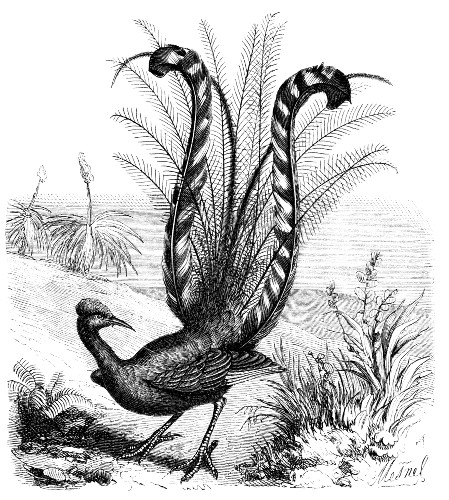
Fig. 255.—The Lyretail (Mænura paradisea, Vieill.).
The Titlarks, or Pipits (Anthus), the Farlouses of French
writers, approach the Larks by the same characteristics which
distinguish the Quaketails, and might be confounded with them
were it not for their compressed bill. Hence their name of Meadow
Larks. They feed on autumnal fruits. Anthus trivialis, the Tree
Pipit; A. pratensis, the Meadow Pipit; A. aquaticus; and A.
Ricardi are the British species figured by Mr. Gould.
The Lyretail (Mænura superba, Swainson), Fig. 255, is a
bird of New Holland, about the size of a common Fowl, and has
been classed by some naturalists among Gallinaceous birds; but
Temminck places it in his Insectivorous order, among the Thrushes,
and between Cuculus and Pitta. Cuvier places it among the Passerines.
Vigors places it in the order Rasores, and in the family of the
Cracidæ. This curious bird has a long compressed bill, triangular at
the base. It owes its name to the peculiar disposition of its tail, which
in the male has the exact form of a lyre. The singular development
of the feathers of the tail is its chief attraction, for the
plumage is dull and sombre in colour. In Australia it inhabits the
forests of Eucalyptus; builds its nest in trees, a short distance from
the ground; and feeds upon worms and insects, which it seeks
for under the dried leaves and the surface of the soil. Its song is
described as not unpleasant.
The Orioles (Oriolus, Linn.) have the bill long, stout, nearly
straight, rather broad at the base, the dorsal line arched, and the
tarsi very short. They are found in all the warmer parts of the
Old World, and in the islands of Oceania. Their plumage is
richly coloured, shades of yellow and black blending in great
variety.
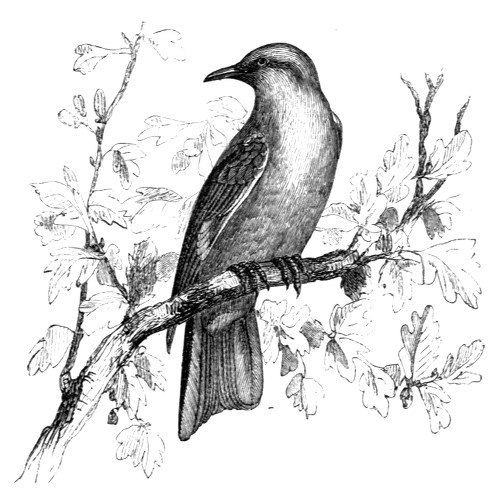
Fig. 256.—The Golden Oriole (Oriolus galbula, Sw.).
The Golden Oriole (Oriolus galbula, Wood), Fig. 256, is about
the size of the Blackbird, which it much resembles in form. The
plumage is of a bright yellow; the feathers are oblong, with disunited
barbs; those on the fore part of the head very short. The
wings, when closed, reach to within an inch of the end of the tail;
hence its flight is easy and sustained; while the form of its
feet is equally well adapted for hopping on the ground and gliding
among the branches. It is a shy, solitary bird, and is approached
with great difficulty. In the countries where it is a constant
visitor it arrives in May, and departs in August; but while
it arrives singly, on its return migration it departs in whole
families. It establishes itself on the borders of woods, or on the
banks of some water-course; especially is it found where there
are large trees, such as oaks and poplars, in which it builds its
nest. The bird is common in the South of France. It lays
from four to six eggs, and during incubation feeds on insects'
larvæ and caterpillars, and is especially fond of the more delicate
fruits of the sunny South, such as mulberries, cherries, and figs.
This food gives a delicious flavour to its flesh, which causes it to
be much sought after. The Oriole will not live in confinement.
It is the Beccafica of the Italians.
The Mino (Eulabes javanses, Vieill.), Fig. 257, has been assigned
to various families. Swainson places it among the Sturnidæ, Gray
in the sub-family of Graculinæ, under the family of Corvidæ.
However, we prefer placing it as we have. They are sought
after by the Orientals in consequence of their gentle habits, and
the facility with which they imitate, like the Parrakeets, all sorts
of phrases, and even airs. Their song is very agreeable.
The Minos have a bill analogous to that of the Orioles; but
their general form and habits approximate more to the Starlings,
among which they ought to be ranged. They are eminently
social in their habits, searching for their food in large flocks,
and passing the night in numbers on the same or on neighbouring
trees. Their natural disposition being peaceful, lively,
and confiding, they appear to prefer the vicinity of man's residence,
and the cultivated fields that surround his dwelling.
They frequently attend upon flocks of sheep, to feed upon the
insects that infest these ruminants' skins. In countries where
locusts abound, they are of great service to man by feeding upon
them.
The Isle of Bourbon was at one time so infested with locusts
that it threatened to become uninhabitable. The idea was entertained
of introducing some Minos, and these birds multiplied so
fast that in a few years the pests had disappeared. Unfortunately,
the services of the Minos had to be paid for dearly, for they
showed a penchant for fruit, and made great havoc among the
cherries, mulberry trees, &c. When insects became scarce they
even attacked the cereals and other crops.
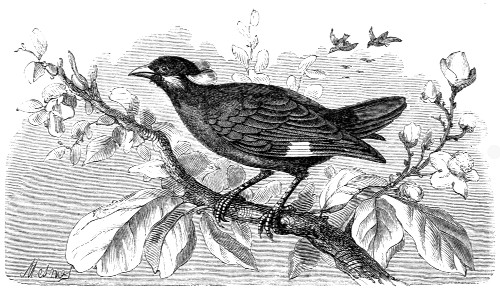
Fig. 257.—The Mino Bird (Gracula religiosa, Linn.).
These Passerines readily habituate themselves to confinement,
and in a short time become as tame as Starlings. Like these
birds, too, they possess the talent of remembering and repeating
words and various cries. They inhabit Africa, Asia, and Java.
In their migrations they sometimes visit the southern countries
of Europe; but they are rarely seen in France.
The Honey-suckers (Meliphagidæ) are remarkable for having a
thin tuft of hair at the end of their tongue, and for the fleshy
pendants which adorn the beaks of some species. Their plumage
is in general brilliant, and ornamented with tufts or collars.
The voice of some kinds is very melodious, but little or nothing
is known of their habits.
We now come to the Rose-coloured Ouzel, which is called in
France Merle Rose, because it combines the shape of the Blackbird
with a breast and back of a lovely rose colour.
The characteristics of the Ouzels are a straight and slender bill;
large and stout toes, furnished with strong and hooked claws; and
short wings and tail. The decidedly aquatic habits of these birds
form a curious exception to the rest of the Passerine order. They
live constantly on the edge of the water, or in the water itself,
hunting for the insects which constitute their food. Although their
toes are not webbed, they may often be noticed diving and moving
about under water, by extending their wings and using them as
fins. They are frequently to be seen flying along streams, and
catching the winged insects skimming over the surface of the
water. They live a solitary life, except during the pairing season.
Ouzels principally frequent the banks of mountain streams, especially
in rocky and precipitous countries.
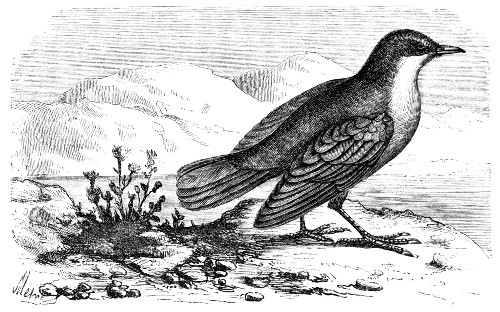
Fig. 258.—The Dipper, or Water Ouzel (Cinclus aquaticus, Bechst.).
The European species, called the Dipper, or Water Ouzel
(Hydrobata cinclus, Wood), Fig. 258, is met with in Great Britain,
France, the Alps, Pyrenees, and other mountain chains in the
South, West, and North of Europe.
Fig. 259.—The Wood Thrush (Turdus melodus, Wilson).
The Solitary or Wood Thrushes (Turdus mustillinus, Gm.),
Fig. 259, are distinguished from the other Dentirostral Passerines
by their long and slender tarsi. They are natives of America,
and, in the midst of its vast forests, busy themselves in hunting
ants, on which they feed. Other insects are not refused
by them; but, first and foremost, they are formicivoræ. They
fly indifferently, but in
running and hopping they
are very nimble. Generally
speaking, they do
not take the trouble of
building a nest, preferring
to lay their eggs on
the ground, on a bed of
dry leaves. Their song is
of a strange character,
differing in its nature in
the various species. Some
of them have received the
name of "Bell-ringer,"
&c., from the similarity of their note to the sound of a bell.
They are wild and shy, and dash their heads against the bars
when they are shut up in a cage. Their flesh is appreciated for
the table.
The Merulidæ genus is characterised by a flattened, curved, and
slightly denticulated bill, and is one of the most numerous of the
family, embracing as it does no less than one hundred and fifty
species spread plentifully over the whole surface of the globe.
Birds of this genus are, generally speaking, migratory, and
travel in more or less numerous flocks. They feed on berries,
fruits, and insects, and are endowed with very harmonious powers
of song. They have been divided into two great sections, the
division being based on the particular arrangement of their colours.
First, the section of Merulæ, which embraces all the species the
plumage of which is of a uniform colour; next, that of Turdi,
which contains those of speckled plumage, that is, marked with
small dark spots on the breast.
The principal species of the first section are the Common Blackbird,
the Rock Blackbird, the Solitary Blackbird, and the Mocking
Bird, or Polyglot Thrush.
The Common Blackbird (Merula vulgaris, Ray), Fig. 260, is so
called on account of its plumage, which in the cock bird is of a
uniform bright black colour. It delights in neighbourhoods
covered with groves and thickets situated in the vicinity of
water. When a sufficiency of food is to be found it seldom
leaves the district it has frequented. In nearly all the countries
of the European continent it is to be met with the year round.
These birds appear to be less numerous in winter than in summer,
and it is only exceptionally that they are sedentary.
The Blackbird is shy and artful by nature, and shows extreme
caution in approaching any object of suspicion. It rarely allows
itself to be surprised by man, except when its voracity and greediness
lead it into danger; but still, notwithstanding its shyness,
it is disposed to frequent public and private gardens, and
the vicinity of habitations. When taken young it easily becomes
accustomed to captivity.
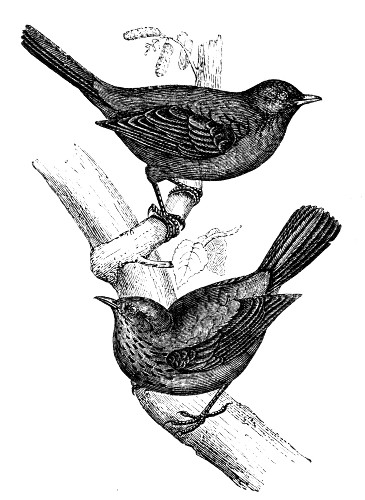
Fig. 260.—The Common Blackbird (Turdus merula, Linn.).
It builds its nest at a short distance from the ground, on trees
or bushes, the hen bird only participating in the labour of building.
She lays from four to six eggs.
In the South of Europe this species is much sought after, on
account of the exquisite flavour which its flesh acquires from
living on myrtle and juniper berries.
The Ring Blackbird (Merula torquata, Gould) differs from the
kind we have just noticed in being of larger size, and in the predilection
which it shows for mountainous countries. It sings very
agreeably, and in France is found on the high summits of the
Vosges, the Alps, and the Pyrenees.
The Solitary Blackbird (Merle Bleu of the French) is remarkable
for the deep blue colour of its plumage. It frequents the same
regions as the bird last described, and its habits are nearly the
same; but it is wilder in its nature, and its song is even still more
charming. We read in the chronicles of his time that Francis I.
was never weary of listening to the strains of one he possessed.
This bird is common in the South of Europe and the whole of
the Levant, and when it is tamed acquires considerable value.
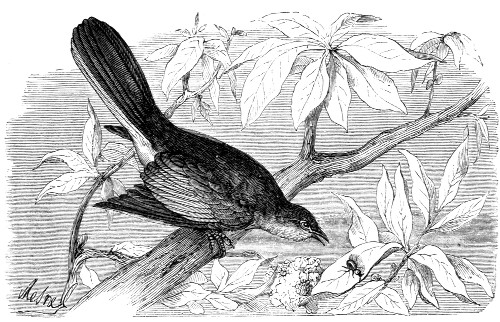
Fig. 261.—The Mocking Bird, or Polyglot Thrush (Mimus polyglottus, Briss.).
Of all the various species of the Merulidæ the one which is
unquestionably the most favoured, as regards its vocal qualities,
is the Mocking Bird, or Polyglot Thrush (Turdus polyglottus,
Linn.), Fig. 261, a native of North America, and chiefly of the
Southern States. Its notes are so melodious that the conscientious
Audubon does not hesitate to rank them far above those of the
Nightingale. In addition to this, it possesses the wonderful
faculty of imitating the songs of other birds, and even the cries of
the mammals which make their abode near it. For this reason the
Indians call it the "Bird with Four Hundred Tongues." Being
protected by the inhabitants of Louisiana, it does not seem to dread
the presence of man, and builds its nest with the utmost publicity
in the vicinity of dwellings. When it is captured before leaving
the nest it becomes very tame.
The principal species of the Thrush are the Song Thrush, the
Redwing, the Mistletoe, and the Fieldfare.
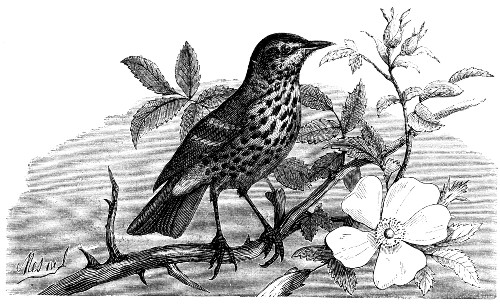
Fig. 262.—The Song Thrush (Turdus musicus, Linn.).
The Song Thrush, Mavis of the Scotch (Fig. 262), has enjoyed,
ever since the days of antiquity, great reputation, not, as we might
have desired, for its vocal powers, but for the delicacy of its flesh.
The Romans appreciated these birds to such a degree that they were
in the habit of fattening them by thousands in immense aviaries,
cleverly combining the privation of light with a suitable diet.
Nowadays, Thrushes are not fattened artificially, because they
take very good care to fatten themselves in their autumnal visit
to the South of Europe; for they gorge themselves to such an
extent with grapes, figs, and olives, that they attain an incredible
pitch of obesity, causing them to be sought after with avidity,
to gratify the fastidious palate of the gourmand. It is even said
that Thrushes intoxicate themselves among the vines, which has
given rise to the French proverb, "As drunk as a Thrush," in
speaking of a man who has been indulging too freely in wine.
But this is absurd; although the Thrush may be unable in the
autumn to fly away with its usual agility, the only cause is its
increased weight.
The Redwing shares both the good qualities and the defects of
the Song Thrush, and it is likewise much esteemed by epicures.
The two other species are of less importance in an edible point of
view. They are all natives of Europe, and visit the centre and
South of France.
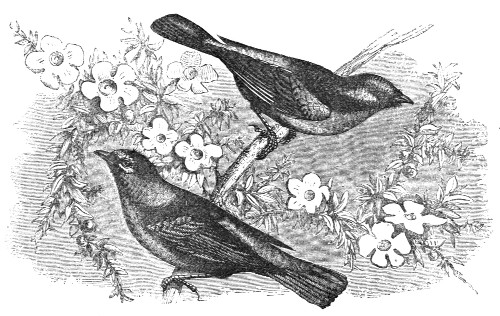
Fig. 263.—Tanagers (Tanagra rubra, Nutt.).
The Tanagers (Tanagrinæ) form a genus of birds peculiar to the
hot regions of America. They are remarkable for a bill which is
tapering and triangular at the base, and for the brilliant colours of
their plumage. They are allied by their habits to the Warblers
and the Sparrow. They are lively, constantly in motion, and
but seldom settle down on the ground. In general life they
resort about among trees and bushes to collect berries, seeds,
and insects. According to the species, they live either solitarily, in
families, or in flocks. Some kinds have an agreeable song; among
these are the Euphones (beautiful voices), or Bullfinch Tanagers.
Those which are most richly endowed, as regards the splendour of
their dress, are the Scarlet Tanager, the Cardinal Tanager, the
Bishop Tanager, and the Black-throated Tanager.
The Grosbeak Tanager (Tanagra magna, Cuvier) is remarkable
for the sociability of its nature. It has received this name because,
with the help of its companions, it is in the habit of building on
the top of a palm tree a vast construction, divided into a certain
number of compartments, which are portioned out to so many
couples, to hold their nests and young broods.
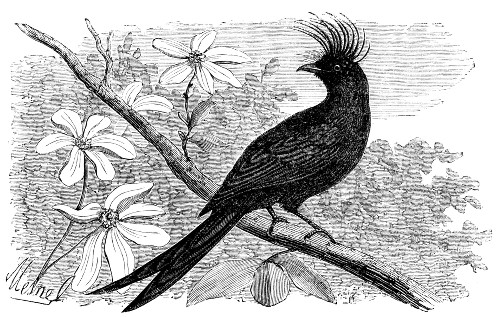
Fig. 264.—The Tufted Drongo (Tephrodomis, Sw.).
The Drongo Shrikes (Dicrurinæ, Sw.) resemble a Crow in their
shape and a Blackbird in their size. They have a carinated beak,
pretty strongly curved, and a forked tail. The ground of their
plumage is black, with a green or blue metallic reflection. They
live in small flocks in the forests of India, Polynesia, and South
Africa. They are great destroyers of bees. The better to accomplish
this, they post themselves, at morning and evening, at the
skirts of a wood, on a tree which is dead or bare of leaves, and
watch for them as they leave or regain their retreats. When
they attack their prey, they fly down from their post of observation,
and from their great activity make terrible massacre of the
unfortunate insects.
Their turbulent and noisy nature has been the means of gaining
for them among the Hottentots, who look upon them as birds of
evil omen, the name of "Devil-birds." Their flesh is of no value;
but some species are said to sing in a way which is not unpleasing.
In the Broad-tailed Drongo the two outside feathers of the tail are
long filaments, terminating in square-pointed feathers. We give
(Fig. 264) the representation of another species, the Tufted
Drongo.
The genus Cotinga is characterised by a short, flattened, curved,
and stout bill. It embraces as sub-genera the Cotinga proper,
the Caterpillar-eaters, and the Chatterers.
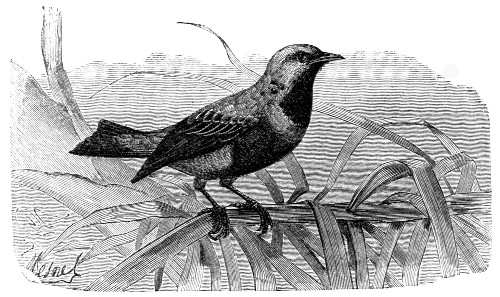
Fig. 265.—The Brilliant Cotinga (Coracina scutata, Temm.).
The Cotinga or Coracina proper is a bird about the size of a
Thrush; it inhabits Brazil and Guiana, and is remarkable, during
the pairing season, for its brilliant and variegated plumage. It
frequents damp localities in the midst of great forests, and its
food consists of seeds, fruit, and insects. It is very shy in its
nature, and cannot habituate itself to captivity. Its rich colours
alone cause it to be admired, for its voice is by no means
melodious, and its flesh is too bitter for human food. The
most beautiful species are the Pompadour Cotinga and the
Brilliant Cotinga (Fig. 265).
Caterpillar-eaters (Ceblepyrinæ) owe their name to the
source from which they derive their principal sustenance; but
they also feed on flies and the larvæ of insects. They differ from
the preceding kinds both in their habitat and in the more sombre
colour of their plumage. The Cotingas are only met with in
America; and the Caterpillar-eaters are not found except in
Southern Africa and the Indian Archipelago.
The Chatterers (Ampelidæ) are sociable birds, living together
in flocks the whole of the year, except during the breeding season.
They feed on buds, berries, and insects; they even catch flies on
the wing. They are, nevertheless, extremely indolent, and do not
move about more than is necessary to satisfy the requirements
of appetite. The greater part of their time they remain hid in
the recesses of woods, and are rarely seen; they settle little on
the ground, for their gait is awkward and constrained. Not
endowed, properly speaking, with any powers of song, their only
utterance is a feeble twittering, which, in some species, is very
prolonged. The Bohemian Waxwing is noisy at all seasons;
and this is probably the origin of the name Chatterer, which is
given to the whole genus. They are tamed with great facility,
and, as they are adorned with a brilliant plumage, they are often
reared in cages. These birds are found in Europe, North America,
and Japan.
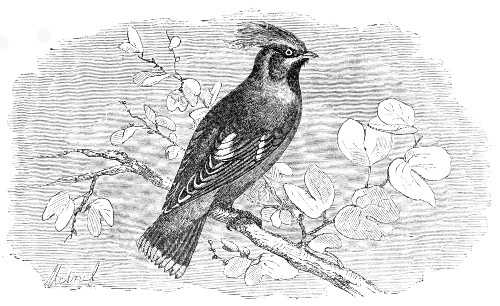
Fig. 266.—Bohemian Waxwing (Ampelis garrulus, Wood).
The European species (Fig. 266) breeds in northern countries,
and migrates to Germany at the approach of winter. It is rarely
met with in France. It is a very pretty bird, carrying a floating
tuft on the top of its head.
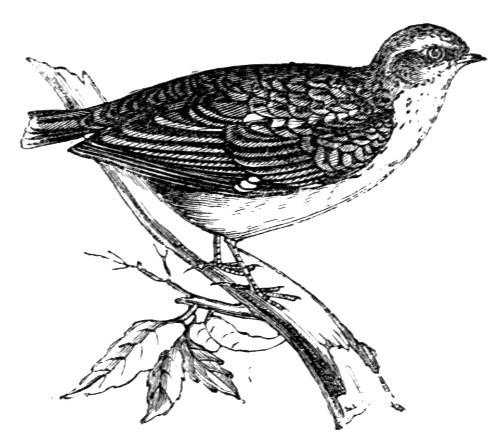
Fig. 267.—The Spotted Fly-catcher (Muscicapa grisola, White).
The birds belonging to the Fly-catcher genus (Muscicapidæ)
have a flattened and hooked bill, furnished with a projecting
edge, and with stiff hair at the base. They are divided into
Fly-catchers proper, Tyrants, and Eurylaiminæ.
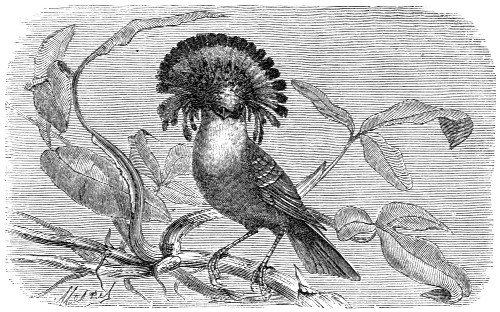
Fig. 268.—King Fly-catcher (Eurylaimus serilophus, Sw.).
The Fly-catcher proper feeds on insects, which it catches
on the wing with a vivacity and agility which are extraordinary.
It sometimes adds to its fare caterpillars and ants, and it
never settles on the ground except when in pursuit of prey. They
are birds of taciturn and solitary habits, frequenting alone the
depths of forests, or the margin of sluggish streams. They are
silent even during the pairing season, and are rather negligent in
their mode of building, taking no care to hide their nests from the
view of their enemies. According to the species, they build either
on trees and bushes, or in the crevices of walls, rocks, or under the
eaves of roofs. The hen bird lays from three to six eggs once a
year in Europe, but more frequently in other parts of the world.
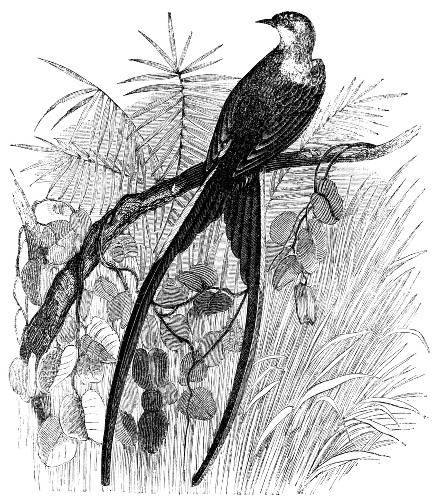
Fig. 269.—The Long-tailed Tyrant (Milvulu, Sw.).
The Fly-catchers are not larger than the Warblers. They are
birds of passage, and various species of them are spread over the
whole surface of the globe. Some are natives of Europe, among
which we will name the Spotted Fly-catcher (Fig. 267), and the
Pied Fly-catcher. The latter bird is very fond of fruit, and in
the South of France it is killed for the delicacy of its flesh. The
common name there given it, Bec-figue, is also applied to a species
of the Warbler genus.
The Fan-tailed Fly-catchers (Rhipidura flabellifera, Latham) are
birds of the same size and with the same habits as the Fly-catchers
proper. They differ in nothing but their plumage, which is much
more brilliant, their more fully developed tail, and the beautiful
tufts which adorn the heads of some species. They are natives of
Africa, India, Polynesia, and America. The species which may
serve as a type is the Eurylaimus serilophus (Fig. 268), on account
of a magnificent red tuft, edged with black, which spreads out
round its head, and resembles a splendid diadem. It is a native of
South America, and is a very rare bird in collections.
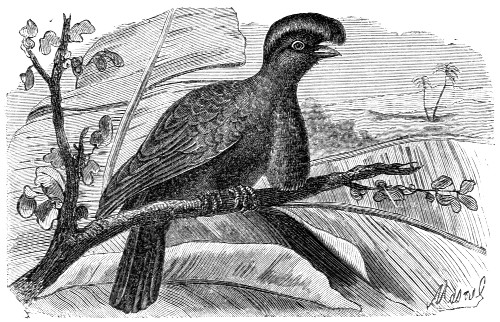
Fig. 270.—Cephalopterus ornatus (Coracina cephaloptera, Vieill.).
The Tyrants (Fig. 269) owe their name to their courageous,
audacious, and quarrelsome character, which leads them to attack
birds more powerful than themselves, such as some of the smaller
birds of prey, and even the White-headed Eagle. It must be
added, too, that they more often than not succeed in forcing these
robbers to quit the neighbourhood in which the Tyrant's young
brood is reposing. They feed on insects, small reptiles, and some
times very small fish. They are found in South America only,
and principally in Brazil and Guiana.
The Cephalopterus ornatus (Less.), Fig. 270, has some resemblance
to Crows, both in size and plumage. Their name, which in Greek
signifies "winged-head," is given them on account of a wide crest
which spreads out above their heads like a parasol. Added to this,
the front of the neck is bare, but the lower part is furnished with
a thick tuft of feathers, which hang down over the breast. These
birds are natives of the forests of Brazil, but little or nothing is
known as to their habits. The wide shape of the bill would
suggest that they feed chiefly on berries and fruit.
The Shrike genus concludes the Passerine order. It comprises
a certain number of birds with tapering or flattened bills,
more or less hooked at the point, and deeply indented, and which
resemble the Rapacious order in their quarrelsome nature, and in
their taste for live flesh. Among them are classed the Great Grey
Shrike, the Red-backed Shrike, the Vangas, and the Cassicus.
The Shrikes proper possess the instinct of destruction in the
very highest degree. They delight in shedding blood and in
spreading death wherever they go; indeed, their evil disposition
has become proverbial. Not satisfied with killing with a view of
satisfying the lawful needs of hunger, they sacrifice, as if for mere
pleasure, insects, birds, and small mammals. They afterwards
impale them upon the thorns of bushes and hedges.
But still we must not condemn these birds with too great a
degree of severity. No doubt there is, to some extent, cruelty in
their actions; but, first and foremost, we are bound to recognise
the foresight which they show. These victims are stored as
a supply in time of need. It is a mistake to think that all
creatures which they attack are smaller than themselves.
Although not large, they are not afraid of a contest with Ravens,
Magpies, and even some of the birds of prey, when called upon to
defend their young.
Shrikes generally inhabit extensive woods. During the daytime
they post themselves in the top branches of the trees, from
which they pounce down upon their prey. They fly rather
indifferently, but hover with great ease. Their twittering is continual,
and some of their melodies are not entirely devoid of charm.
They are remarkable for their talent of imitation, and reproduce
the songs of all the other birds with such similarity as to be mistaken
for them. Some even go so far as to assert that they
abuse this faculty by deceiving small birds, whose song they
imitate.
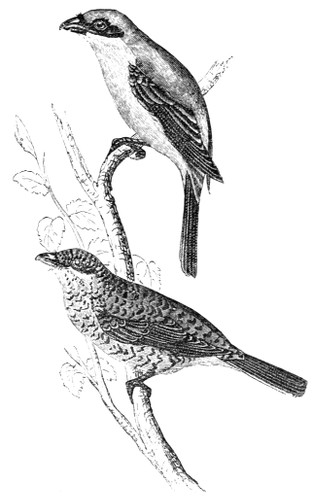
Fig. 271.—The Great Grey Shrike (Lanius excubitor, Wood).
They migrate every year, and at the time of their journey are
much sought after for the table; for their flesh, being covered with
abundant layers of fat, is very rich. It is a curious fact that, in
spite of their cross-grained nature, they are very easily tamed.
They cannot, however, accommodate themselves to close captivity,
their active natures requiring a more extended field of action;
such, for instance, as a large aviary affords. When kept in a
place of this kind, they become very friendly, and appear to be
fully sensible of the caresses of their master.
Shrikes are common in all parts of the globe. Seven species
are known in Europe, the principal of which are the Great
Grey Shrike (Fig. 271), the Red-backed Shrike (Fig. 272),
and the Southern Shrike. In France these birds are hardly
ever found, except in the southern departments.
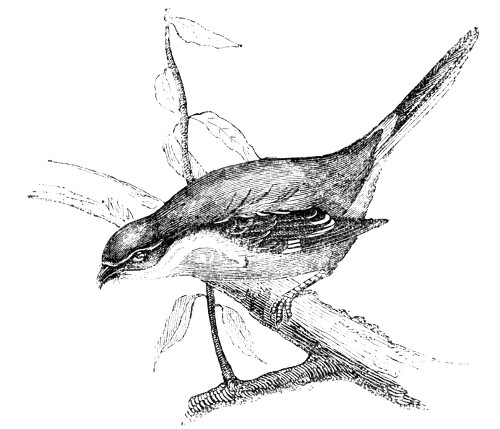
Fig. 272.—The Red-backed Shrike (Lanius collurio, Wood).
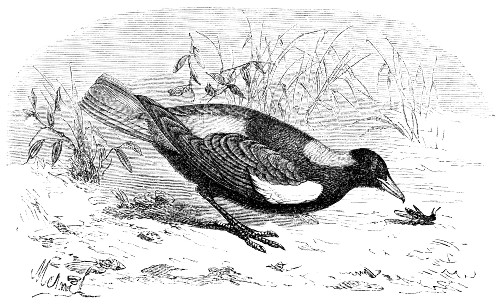
Fig. 273.—The Cassicus.
The Falcon Shrikes are sometimes called Swallow Shrikes,
because they fly with as much ease as the Swallow, and, like the
latter bird, pursue insects on the wing. Their habits, however,
differ but little from those of the true Shrike. They are natives
of Africa, India, and the Southern Archipelago.
The Vangas (Buffon) bear a still greater similarity to the Shrike
proper. Their habits of life are altogether the same; but they
are found only in South Africa, Madagascar, Australia, and New
Guinea.
Lastly, the Cassicus (Fig. 273) belongs to America, and holds
an intermediate place between the Shrike and the Crow, the
latter of which it resembles in its gait, size, and plumage. In
its habits it is clamorous, turbulent, and omnivorous. It may
be readily recognised by its long bill and the feathers in front
of its head.


