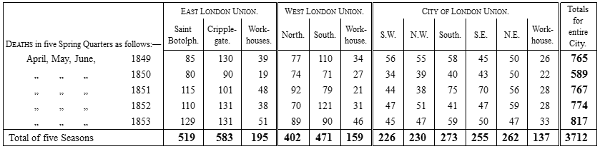
TO THE HON. THE COMMISSIONERS OF SEWERS OF THE CITY
OF LONDON.
November 26th, 1850.
Gentlemen,
In obedience to that clause in your Act of Parliament
under which my office is constituted, and which enjoins on
your Officer of Health that he shall ‘report periodically
upon the Sanitary condition of the City,’ I now submit
to your Hon. Court my annual statement on this subject.
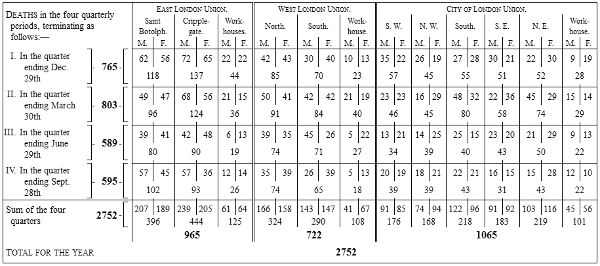
During the fifty-two weeks, dated from September 30th,
1849, to September 28th, 1850, there died of the population
under your charge 2752 persons. The rate of mortality,
estimated from these data, for a population[30] of 125,500,
would indicate somewhat less than twenty-two deaths (21·92)
out of every thousand living persons.
Last year it was my painful duty to record the ravages of
pestilence, then indeed hardly terminated, under the pressure
of which our general death-rate had arisen to the alarming
height of thirty in the thousand. On this present occasion,
I have the happier task of laying before you the evidences
of a mortality lessened considerably below its habitual
average; and I rejoice in congratulating your Hon.
Court on the testimony thus borne to the success of your
sanitary exertions. For although, without question, some
large share of this striking improvement may have depended
on circumstances beyond our cognizance or control; although
it may in part be but an instance of that tendency to periodical
alternations of activity and repose which we recognise
in disease, as in other operations of nature; although I
should be over-sanguine if I believed, and premature if I
stated, that your sanitary measures during the past twelve
months had wrought such a change in the City as to ensure
a continuance of this year’s comparative healthfulness; yet
I may venture without hesitation to assure you, that the
labours of the Commission have been fruitful of real and
demonstrable advantage to the health of the people; that a
sensible diminution has occurred in the physical causes of disease;
and that, from various and disinterested sources, I hear
grateful mention of improvements which you have effected.
In confirmation of this assurance, I may inform your
Hon. Court that, in collecting my materials for the present
statement, I solicited from the Union-Surgeons of the whole
City of London certain particulars of information which
they were peculiarly able to furnish; I inquired of them,
namely, whether, during the past year, there had prevailed
among the poorer classes in their several districts more or
less than the ordinary pressure of epidemic, endemic, and
infectious disease; and whether, in case of such difference
having been observed, they could refer it, either for better
or worse, to any changes recently wrought in the physical
conditions of their respective neighbourhoods. They have
had the kindness to furnish me with the information requested
of them; and their replies testify with remarkable
uniformity, both to the abatement of disease within their
several provinces of practice, and to the considerable dependence
of that improved condition of health on sanitary
works effected under your auspices.
In order to form a correct estimate of the average mortality
in any district, it is indispensable that one’s records
should extend over many years. Thus only is it that fallacies
can be avoided which arise from the alternate pressure and
remittance of epidemic disease. The havoc effected by a
periodical visitation of influenza, cholera, or plague, varies,
in like manner as the ordinary death-rate varies, in different
localities; and its variation contributes importantly to fix
the healthiness or unhealthiness of such localities. But
obviously, if we wish for practical purposes to calculate an
annual rate of mortality, and to decide, in respect of any
district, what are the chances of life for its population, we
must distribute the peculiar mortality of the pestilence-period
over those years which intervene between visitations of the
pestilence.
Hitherto, in respect of the City of London, I have the
record of only two years; two years differing from one
another in the proportion of 30 to 22, and the mean mortality
deduced from that biennial period would be 26 per
thousand per annum.[31] I am,
of course, unable to tell you
with certainty whether that ratio be the true average death-rate
of the City; but I incline to believe that an average
calculated from a longer period, with less abrupt fluctuations,
would give a lower figure as the accurate one.
In future years, so long as I may have the honour of reporting
to the Commission, I purpose proceeding, step by
step, to the construction of a cyclical average from the
materials which will constantly be increasing; and I trust
that many years may elapse before any approach shall again
be made to the high death-rate with which the cycle
commenced.
It may be useful, for the sake of comparison, that I
should remind your Hon. Court of some of the more important
differences which prevail throughout the country,
in regard to the local rates of mortality. The extreme
rates recorded in the Registrar-General’s last publication,
relating to the septennial period 1838-44, give 14 per
thousand per annum as the lowest average, and 331⁄2 as the
highest average, for a population male and female in equal
proportion. The low average belongs to a district in Northumberland,
numbering 27-28,000 inhabitants; the high
average is assigned to Liverpool. For the whole south-east
division of England (comprising more than a million and a
half of inhabitants) the death-rate is but 19; while in
parts of the division it falls very considerably below this
average. I have thrown these and some similar comparisons
into a tabular form, which may perhaps be interesting
to you.[32]
Possibly it may occur to you that these comparisons are
devoid of practical application—that it is unreasonable to
suppose we can mitigate our London death-rate to the likeness
of a selected country mortality—that the circumstances
of the two populations are essentially and unalterably dissimilar—that
the advantages of the one cannot be given to
the other—that the traditional ‘threescore years and ten’
of human life are allotted only to rustic existence—that the
right of participating in the higher civilisation of the metropolis,
or of trading in its larger market, is not too dearly
purchased by the tax of half or a third of one’s fair
expectation of life.
On general grounds I should not hesitate to combat this
objection, and should feel sure of convincing you of its
invalidity. I should argue (as indeed I have already argued
here) that the main conditions which constitute the unhealthiness
of towns are definite, palpable, removable evils;
that dense over-crowding of a population—that intricate
ramification of courts and alleys, excluding light and air—that
defective drainage—that the products of organic decomposition—that
contaminated water and a stinking atmosphere,
are distinct causes of disease and death; that each admits of
being definitely estimated in its numerical proportion to the
total mortality which it contributes to cause; that each is
susceptible of abatement or removal, which will at once be
followed by diminution of its alleged effects on the health
of the population. Likewise, I should argue, that if there
indeed exist, attached to a metropolitan residence, some
really unavoidable and necessary disadvantages to life (a
point which however I am not prepared to concede) there are
likewise, as respects the poor, some peculiar advantages to
counterbalance those evils; that in urban communities the
operations of charitable relief are largest and least remitting;
that the resources of medicine for curing what cannot be
prevented are likewise readiest and most effective.
On all these general grounds I should be prepared to
maintain that a lowness of mortality which has been attained
in any considerable rustic population, may be
attained by an urban population, if only the removable
evils be removed, if only the practicable good be made
practical.
Surely too, above all, I would maintain this possibility in
respect of our capital—the treasury as she is of all means
for progress in civilisation, the stronghold of all applicable
knowledge. Let but the wealth, the science, the energy,
and the benevolence of the metropolis deal with removable
causes of death as they have dealt with subjects infinitely
more difficult, infinitely less promising, and certainly of not
greater importance; and few competent persons will doubt
that the mortality of London might speedily be reduced to
the level of any district-mortality yet recorded by the
Registrar-General.
There may be those in your Hon. Court who will hesitate
to accept for themselves the firm conviction which I
entertain on this subject; or who, at least, will withhold
their assent from the line of argument which I have advanced.
To them, what I have now to state may be more
conclusive than any other consideration: viz., during the
year on which I am reporting, there was one sub-district of
the City of London Union—one comprising from twelve to
thirteen thousand inhabitants, in which (after including a
due proportion of deaths which had occurred in the union-workhouse
at Mile-end) the mortality stood only at 15 in the
thousand; one in which, if those extramural deaths had been
excluded, the local death-rate for the year would have been
only 13·32.[33]
For an illustration of low and enviable death-rates, I
need then no longer appeal to Northumberland, or to our
south-eastern counties—though, no doubt, their septennial
periods of low mortality are valuable corroborations of any
inference which could be drawn from our more restricted
experience;—but I may point to the last year’s death-rate in
the north-west sub-district of the City of London Union
as one of rare excellence, and may content myself with
wishing that that partial rate might become universal for
the City, and might be the permanent expression of its
average mortality.
A detailed consideration of our sickness and mortality
during the last year suggests to me a few other remarks,
which may, I think, be of practical utility to your Hon.
Court.
First, as regards the ages at which death occurs; the
respective proportions of timely and untimely deaths may,
generally speaking, be inferred from the local death-rates.
In general terms, we know a high death-rate indicates that
many die before their time—indicates that a proportion of
the population, more or less considerable, instead of reaching
old age, becomes prematurely blighted and extinguished.
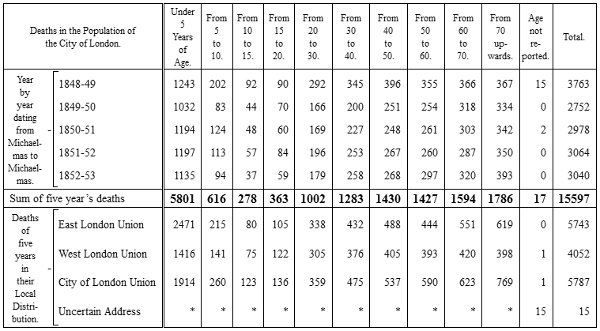
In order to illustrate this subject to you more exactly, I
append a table in which the deaths of the last two years
are classified according to the ages at which they occurred.
Of 3763 persons whose deaths are recorded in my last
Report, 1243 died under the age of five years: of 2752
deaths registered in the present year, 1032 belong to the
same early period of life.
The City of London appears peculiarly fatal to infant life.
Reference to the Registrar-General’s last septennial record
shows that of every 1000 male children under five years of
age within the City of London (aggregately) nearly 113 die
in each year; and the portion of this rate which is deduced
from the East and West London Unions is as high as 119
in the thousand. In the subjoined table,[34]
which illustrates
some points of comparative mortality, I have endeavoured
to show the extreme and disproportionate amount of
this pressure on infant life. In referring (for instance, in
regard of the City of London Union) to the last three
columns of that table, you will observe that the mortality
of children at the age stated, during the septennial period,
was 1⁄2·66 of the entire mortality, although their class numerically
constituted only 1⁄11·09 of the entire population; so
that they died at more than four times (4·17) the rate
which would have fallen to them as simple participators in
the average mortality of their district. The actual infant
mortality of the past year holds the same proportion to the
general mortality as in the Registrar-General’s septennial
period, being 1⁄2·66 of the whole.
Lest any undue importance should be ascribed to the influence
of bad or inappropriate articles of diet in producing
this large infant mortality, I may inform you that the rate
of death is highest during that very early period of life
when the child depends for nourishment on its mother; so
that, of a thousand male children in the first year of life
there die within the district of the City of London Union
242; within that of the East and West London Unions,
276.
The causes which thus decimate the young population of
London are the common conditions of district unhealthiness—the
conditions which it lies within the scope of sanitary
legislation to amend. But, inasmuch as the few days of
these wretched children are passed mainly within doors,
so their high mortality constitutes the readiest and least
fallacious evidence of the unwholesomeness of the dwellings
in which they die: and hence I am acquainted with no
correcter material for estimating the sanitary condition of a
district than is afforded by the death-rate of its infant
population.
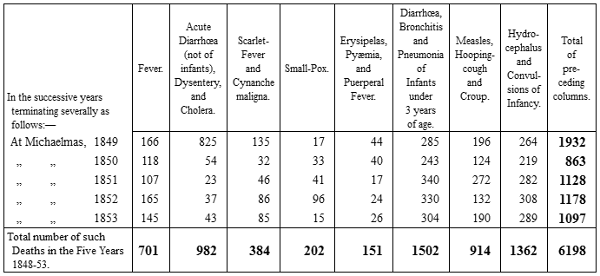
Secondly, with regard to the alleged particular causes of
death; I have extracted from our general registry, and have
grouped in a separate table, those cases of death from acute
disease which seem peculiarly due to physical causes affecting
large numbers of persons.
There are deaths by cholera, epidemic diarrhœa, and
dysentery, of which during the biennial period we have had
nearly 900; by fever, of which we have had 284; by
erysipelas and puerperal fever, of which we have had 84;
by small-pox, of which we have had 50; and cases of this
sort partake of the nature of deaths by violence, not only
because they are abrupt and untimely, but because they are
avoidable. If in the instances which I have specified it were
possible to make inquiry into the antecedent circumstances
of the dead, you would find irrefragable evidence that life
was lost in each individual instance by the operation of
removable causes—by the foolhardy neglect of some familiar
precaution, or by the obstinate retention of some notorious
ill. The death of a child by small-pox would in most
instances call for a verdict of ‘homicide by omission’
against the parent who had neglected daily opportunities of
giving it immunity from that disease by the simple process
of vaccination; the death of an adult by typhus would
commonly justify still stronger condemnation (though with
more difficulty of fixing and proportioning the particular
responsibility) against those who ignore the duties of property,
and who knowingly let, for the occupation of the
poor, dwellings unfit even for brute tenants, dwellings absolutely
incompatible with health. In addition to the diseases
which I have named, there are others which owe their chief
malignity and numerical largeness of fatality, though not
their existence, to local and removable causes. The proportionate
mortality from scarlatina, measles, and hooping-cough,
is greatest when the general death-rate is greatest.
Under similar circumstances, too, we find among the infant
population a frequency and fatality of other diseases, not
commonly accounted specific, which warrant us in considering
them to be mainly of endemic and avoidable origin. Such
are the hydrocephalus and convulsions, the diarrhœa,
bronchitis, and pneumonia of infants; often indeed referred
to the irritation of teething, but prevailing in different
localities with so marked a proportion to the causes
of other endemic disease that we may be sure of their
partial and considerable dependence on those local and
obviable causes. I dwell on this aspect of the subject, and
particularly invite the attention of your Hon. Court to the
table[35] which illustrates it, because it is in respect of these
diseases that your exertions have already effected valuable
improvements for the health of the City, and because the
future registry of such cases will attest year by year the
further progress of your sanitary reforms. In examining
this index of preventable deaths you will notice that those
from fever are fewer by 29 per cent. in the year just terminated
than in the previous twelve months; that those from
scarlatina are 75 per cent. fewer; those from infantile
zymotic disorders nearly 40 per cent. fewer; those from
erysipelas and puerperal fever 9 per cent. fewer. Small-pox,
it is true, is doubled; but the prevention of this
disease rests, out of your jurisdiction, in the exercise of
individual discretion. Under the item of infantile diarrhœa
(included in the tenth column) there is likewise an increase
of nearly a third;[36] an exception probably dependent on the
fact that, during last year, many deaths which might have
swelled this column were (on account of the then prevalent
influence) catalogued under the head of epidemic diarrhœa
or cholera.
I should be misleading your Hon. Court, and practising
a deception which next year’s registry would expose, if I
pretended that the striking difference between the two
years’ several totals of preventable deaths (a difference
which, leaving cholera out of the question, probably
amounts to a diminution of 30 per cent. on the sum of last
year) had resulted wholly, or even chiefly, from sanitary
improvement, and could be interpreted as the evidence of
permanent physical changes around the dwellings of our
poorer population. I guard you against this impression
now, because, however satisfactory it might be as a momentary
belief, it would lead to subsequent disappointment;
and any future rise in the proportion of these deaths would
induce the erroneous, but disheartening, supposition that
your later sanitary steps had been less successful than the
first. In all these matters, and especially in analysing the
details of a death-registry, it is requisite (as I have already
stated) to deal with cycles of many years. Periods of
pestilence are habitually followed by periods of diminished
mortality: partly because population is diminished, and
especially that share of the population which suffers most
from obviable causes of disease; partly because the great
alarm of death has induced vigilance and precaution, public
and private, against the occasions and beginnings of
illness. And, beyond both these circumstances, there are
others which we cannot analyse or explain, though we have
scientific certainty of their operation; circumstances which
seem to ensure a comparative quiescence of the ordinary
causes of zymotic disease during those periods which next
succeed the prevalence of certain fatal epidemics.[37]
Nevertheless, that the sanitary condition of the City has
undergone considerable improvement within the last two
years is a fact which no one can gainsay; and that a considerable
share of the mitigation in mortality arises from
this improvement cannot reasonably be questioned. If even
a third of the mitigation in question, if a reduction of ten
per cent. on the preventable mortality of the City, may be
inferred from the materials which I lay before you, it is
indeed matter for the utmost congratulation; and a continuance
of the same reduction year by year, perpetuated
(as doubtlessly it may be) by a continuance of the same
exertions, would soon raise the City of London above all fear
of comparison, on the ground of healthiness, with urban or
suburban populations.
Thirdly, I would beg the attention of your Hon.
Court to those very important local differences of death-rate
which may be deduced from a study of our death-register.
I have already had the pleasure of citing to you the low
rate of mortality which has prevailed during the last year in
the north-west sub-district of the City of London Union.
The rate of death in the north division of the West London
Union was nearly double that proportion; and between
these extreme terms of disparity there were many intermediate
degrees.
Similar inequalities of mortality were observable in last
year’s record. In the healthiest sub-district of the City the
year’s death-rate was about 22 in the thousand; while in
the worst it stood above 41; and for the whole West
London Union exceeded 38.[38]
Mainly and essentially these local differences of mortality
depend on the proportion in which preventable deaths enter
into the total; the differences, however partial, depending
on the operation within certain districts, of removable deleterious
influences which do not exist in certain other
districts.
In classifying for your consideration the deaths which,
during the last two years, have depended on epidemic,
endemic, and infectious diseases, I have thought it desirable
to distribute them according to the municipal divisions
of the City. Strongly believing, as I have endeavoured
to express, that this class of deaths is for the main part
preventable, I have thought it would interest the representatives
of the several Wards, and would more directly enlist
their sympathies for sanitary progress, if I could enable
them at a glance to recognise the ratio in which their
respective constituencies contribute to this annual death-roll.
I have included in the table, under eight different
heads, all those acute diseases which depend in an important
degree on local causation, either for their existence or
for their fatality. It will be obvious, even to the unprofessional
reader, that local causes are not of equal prevalence
in respect of all the diseases there tabulated. Some (as
fever and cholera) would not be known at all under perfect
sanitary arrangements; others (as scarlatina, measles, and
hooping-cough) would be far less malignant in their
attacks; others (as those classified in the tenth and twelfth
columns) would no doubt exist under the most perfect
physical circumstances, but would probably prevail in
numbers quite inconsiderable as compared with those
actually observed.
On consulting this table[39], it will be observed that in
Cordwainers’ Ward, during the last year, not a single death
occurred from the causes referred to, and in the preceding
year of epidemic visitation, only five; that in Cornhill
Ward there have been only two such deaths in each of these
years; that in Coleman-street they have been 66; in Queenhithe,
59; in Portsoken, 143; in Aldersgate Within, 30;
in Aldersgate Without, 179; in Cripplegate Within, 80;
in Cripplegate Without, 299; in Bishopsgate Within, 60;
in Bishopsgate Without, 329; in Farringdon Within, 153;
in Farringdon Without, 845.
I am unable to state with accuracy, in these several
instances, what proportion subsists between the preventable
mortality and the number of living persons, for I have no
means of ascertaining precisely the population of the
separate Wards; and without this knowledge it is impossible
to arrange them in a scale of comparative healthiness.
I need hardly remind your Hon. Court that the Wards
differ very considerably in their magnitude; so that the
largest majority of cases occurring in one Ward (as in
Farringdon Without) must not unconditionally be taken to
imply that the Ward, in proportion to its population, suffers
more deaths than one in which the apparent number is less
considerable. In the table to which these remarks refer, I
have endeavoured to give you the means of comparing (at
least approximatively) the healthiness of your several
departments, by entering against the name of each Ward
the number of holdings for which it stands assessed to your
rate. This entry, with some trifling modifications specified
in the table, may be taken to express the number of houses
contained in each Ward of the City: thus it furnishes indirectly
the means for estimating the local population.
It will be noticed, that the more glaring inequalities
which I have adduced are in some degree due to the
epidemic of last year, which did not press uniformly on all
parts of the City. It may, however, likewise be observed,
that the chief operation of that epidemic was to exaggerate,
but not importantly to misrepresent, the features of each
locality; that the habitual sanitary proportions of districts
to each other were for the most part preserved; that (with
a qualification to which I shall presently revert) the Wards
numbering fewest deaths last year numbered also fewest
this year.
In my last Report, when the cholera had scarcely subsided,
when men’s minds were full of apprehension on the
subject, and when it seemed only too possible that, with the
recurrence of autumn, we might again suffer from its
invasion, I was unwilling to dwell too pointedly on the
wonderful pertinacity with which that disease fixes itself on
particular localities, and tends to re-appear in them on each
new occasion of its rise. Believing that no extemporaneous
measures could counteract these local preferences of the
epidemic, I refrained from a course which would have produced
no good result (unless indeed it had depopulated
certain spots of the City), and which might have caused unavailing
and hurtful alarm. Now, however, I think it right
to tell you that the local predilections of this dreadful
disease are so marked and so obstinate, that we may almost
certainly predict in what parts of the metropolis it would
tend to arise on any renewed visitation. We may anticipate
that at any such time its latent power of destruction
will kindle again in the districts, the streets, the houses,
perhaps even in the very rooms, where it recently prevailed,
unless the determining local conditions shall previously have
been annulled.
It would be ridiculous if I should pretend to carry you
into any medical consideration of this subject, or should
make my present Report the vehicle of a professional argument;
but I may very briefly acquaint you with such generalisations
as will justify you in pursuing a particular course
with respect to the haunts of cholera. While doing so, I
hope your Hon. Court will believe that I have devoted to
this very serious subject the best consideration of which I
am capable, and have done my utmost to arrive at conclusions
which may be fruitful of practical good.
Cholera visited no localities of which it could be said,
that they were generally healthy; but still there seemed to
be something peculiar and specific in the kind of local
unhealthiness which determined its invasion. On the one
hand, it is unquestionably true that many habitual seats of
fever were visited by cholera; on the other hand, many of
the worst fever-nests in the whole metropolis were unaffected
by it; and it struck with extreme severity in a class of
houses habitually exempt from fever. See, for instance,
how malignantly it prevailed along the line of Farringdon
and New Bridge streets, and in Fleet-street and Ludgate
hill, where their line intersects that just mentioned; and
here, you will observe, not only in those obscure and ill-ventilated
courts and by-ways, where fever is the familiar
visitant of a hungry and crowded population; but also, and
very strikingly, in spacious and airy houses, situate along
the main thoroughfare of the City, and inhabited by opulent
tradesmen, by members of the various professions, or by
officers of assurance-companies. Other infective diseases
which habitually desolate the former class of dwellings are
almost unknown in the latter. Cholera came as a startling
exception. Within the infected district (fulfilling the classical
description of pale death) it trod with equal foot the
gates of rich and poor.[40]
Personal peculiarities, or vicious habits, or temporary
indiscretion, may often have determined its choice of a
victim; low nourishment—even temporary emptiness and
exhaustion, very manifestly invited its attack; but, speaking
generally, I may say that it was a disease prevailing
over a certain patch of ground, and (within this limit)
tending to strike equally, or nearly equally, in all classes of
habitations. Crowdedness of dwellings, defective ventilation,
squalor of inhabitants, and many forms of local
nuisance, which are omnipotent in giving occasion to fever,
and in adding malignity to many disorders of its class, did
not by themselves exert so marked and specific a power in
determining the onset of cholera.
What then were the conditions determining its local
preference? Consideration of its statistics, or inspection
of a cholera-map, enables one, with some confidence, to
answer—a peculiar condition of soil, of which dampness
is one sure and invariable character, and organic
decomposition (promoted by dampness) probably another.[41]
Its local affinities have much analogy to those of
ague, and often appear identical in their range with the sphere
of malarious infection. Our entire metropolis, built down
to the very margins of a large river—of a river, too, which,
at each retreating tide, exposes acres of mud saturated
with the reeking sewage of an immense population, is
placed generally in circumstances not unfavourable to the
development of the disease; and its several parts will be
liable to suffer especially, in proportion as they are exposed
to these general circumstances, or to special circumstances
of their own of a like nature. The lower level of districts
on the south side of the river, their attendant failure of
natural land-drainage, the consequent soddenness of a soil
from which likewise the materials of house refuse were
never efficiently removed, accounted sufficiently for the
frightful epidemic mortality which prevailed in those quarters
of the metropolis.
If you now look to the disease as it raged within your
own jurisdiction, you will observe its fatality in two
especial directions. First, in the line I have indicated to
you, northward from Blackfriars Bridge, in a band of two
or three hundred yards width; there, in the parallelogram
which lies along the main road, from Stonecutter-street to
Bridewell Hospital, were 76 deaths; there, in the little
clump of houses forming the angle of Farringdon-street
and Holborn-hill, were 17 deaths; there, in a square space
behind twenty-seven shop fronts in Fleet-street, were 57
deaths; there, in the small parish of St. Ann’s, Blackfriars,
were deaths at the rate of 25 to every thousand of its
population. This was incomparably the most afflicted
portion of your territory. Those who are acquainted with
the ancient geography of the City will readily conjecture a
reason; they will remember when ‘the course of water
running at London under Old-bourne bridge and Fleet
bridge, into the Thames, was of such bredth and depth
that ten or twelve ships, navies at once with merchandises,
were wont to come to the foresaid bridge of Fleet, and some
of them unto Old-bourne bridge;’ they will remember how
this broad river (like the Thames of our day) was thronged
on both sides with population; how (again like the Thames)
it was a draining river, probably with wide banks of putrefying
mud; how many fruitless attempts were made to cleanse
and preserve its channel; but how (in Stow’s day) ‘the
brooke, by meanes of continuall incrochments upon the
banks, and casting of soylage into the stream, was become
worse cloyed than ever it was before.’ Where that soylage
was cast, and where, since the days referred to, so many
habitations have arisen that no sign of stream remains
visible to the wayfarer above ground, its traces still remain
below. Throughout at least a large portion of this district,
the sub-soil (your Surveyor informs me) consists of black
mud, the bed of the ancient river, in which are set the
foundations of the modern houses. The river, which centuries
ago fulfilled for a large population those vile uses
which now pollute the Thames, has gradually yielded its
foul banks to the residence of a growing population; and
the sanitary relations of that population are exactly such as
might be imitated, if the volume of the Thames were henceforth
slowly reduced, and if those banks of mud which are
now exposed only at low water, were simultaneously converted
into the site of permanent habitations.
The history of the stream at Walbrook is, I believe, not
dissimilar; but there is this marked difference between the
two cases, that the comparative declivity of the latter district
has allowed its soil to acquire a dryness and healthiness
which have never been reached on the banks of the Fleet.
For, owing to the extreme lowness of level in this district,
the tidal influence of the Thames is very inconveniently
felt; the cellars of houses are habitually exposed to dampness,
even to flooding; and probably the whole porous sub-soil,
at least as far north as your jurisdiction extends, is
maintained in a sodden and malarious state.
With respect to the second part of the City in which considerable
groups of cholera cases were observed, it has a
not dissimilar peculiarity. I refer to that northern part of
the City which extends (on the other side of London Wall)
from Bishopsgate to Aldersgate. The epidemic prevailed
there with far less severity than in the Fleet district, but
still with a preference which easily shows itself in a cholera-map.
At the intersection of Whitecross-street by Beech-lane,
in a space that the point of one’s finger would hide in
Wyld’s large map, there were 12 deaths: in that small
portion of the City which lies north of Barbican and Beech-street
there were 40 deaths: in the immediate vicinity of
Half-moon-street, Bishopsgate, 60 deaths, of which more
than half were in the workhouse. Now, certainly, in all
this space (and probably still further in both directions,
east and west) without the former gates of the City, there
is a marked local character. It is a reclaimed marsh.[42]
Throughout this district, in the olden times of the City,
there lay (says Stow) ‘a moorish rotten ground, unpassable
but for cawswaies purposely made to that intent;’ and one
reads how ‘divers dikes were cast, and made to drein the
waters of the said Moorefields, with bridges arched over
them, whereby the said field was made somewhat more commodious,
but yet it stood full of noisome waters;’ till
gradually ‘by divers sluces was this fenne or moore made
maine and hard ground, which before, being overgrowne
with flagges, sedges, and rushes, served to no use;’ while
‘the farther grounds beyond Finsbury Court were so over-heightened
with laystalls of dung, that divers windmills
were thereon set, the ditches were filled up, and the bridges
overwhelmed.’
It is not as matter of literary curiosity that I quote these
passages of your old historian, but simply that I may avail
myself of his accurate local knowledge for the explanation
and the cure of a serious existing evil. For if, as I believe,
the unfortunate preference for certain localities evinced by
the recent epidemic be, primâ facie, a reason for doubting
the effectiveness of their sub-soil drainage, and if the
ancient records of the City assure one that these very localities
are such as, from conditions then in active operation,
would be liable to retain, perhaps for an indefinite period,
the materials of malarious poison, useful and practical
deductions may be drawn. And as the liability to this
severe recurrent epidemic is an extreme detriment to the
population of such localities—one too, which, if unremoved,
must inevitably lead to the deterioration of property, as
well as to the sacrifice of life, I know that your Hon. Court
will be solicitous to adopt whatever remedial measures are
possible.
To those measures I shall presently return, having here
dealt with the question only as it relates to the distribution
of our mortality, and explains the preponderance of a large
class of deaths in some special districts of the City.
In the Tables which accompany this portion of my
Report, I have arranged in a synoptical form, convenient
for reference, the chief facts of our sanitary statistics to
which I have invited your attention.
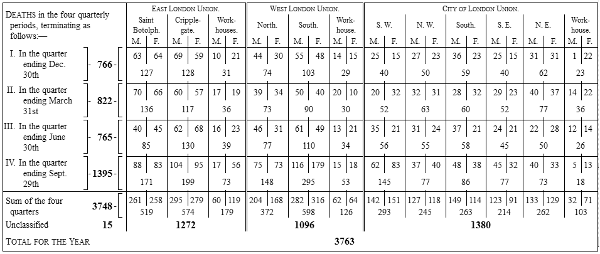
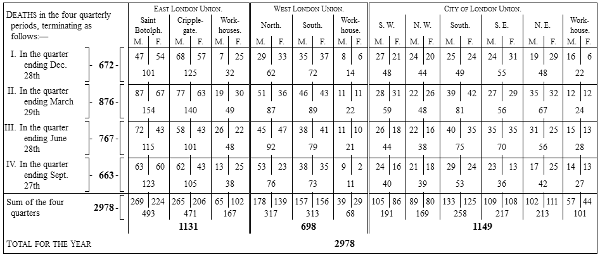
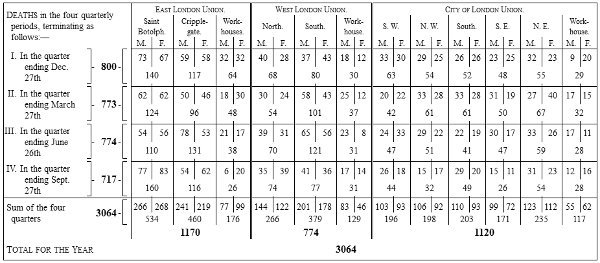
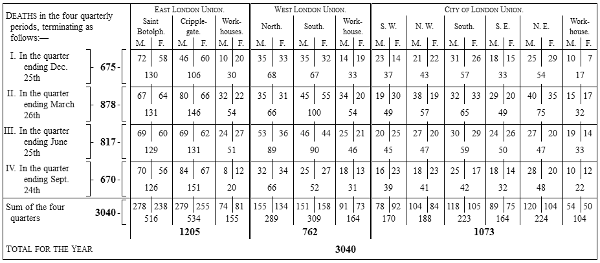
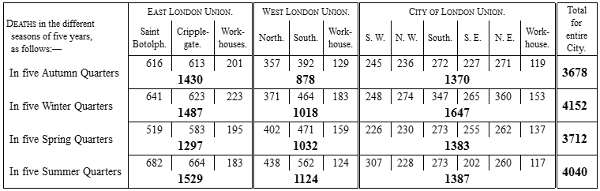
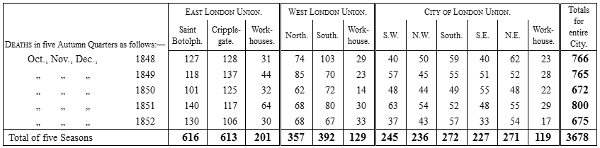
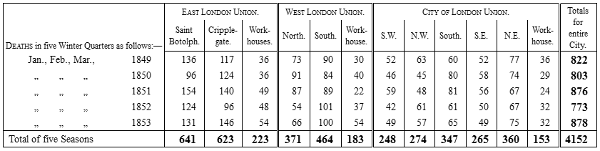
In the first[43] you will read a summary of the deaths as
they have occurred, male and female, in the several districts
and sub-districts of the City, during each quarter of the
past year.
In the second[44] table the deaths of the year are classified
according to the ages at which they befell.
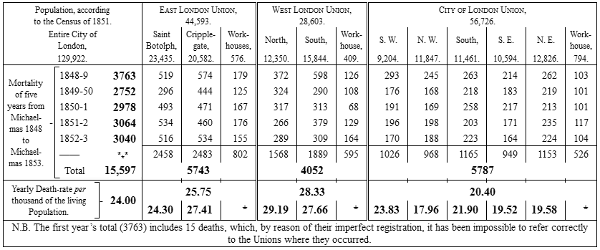
In the third table,[45] for the sake of comparison in
respect both of general and of infant mortality, I have
arranged the statistics of certain other localities side by
side with our own.
In the fourth[46] (to which I have already especially referred)
is contained an enumeration, according to the several
Wards of the City, of those deaths, during the last two
years, which have arisen in consequence of acute disease
partially or entirely preventable.
In tables of this nature perfection is at present impossible;
partly because of trifling changes in the population
which often occur, but rarely can be estimated; partly
because of the slovenly manner in which deaths are occasionally
recorded. While, therefore, I would not consider
myself responsible for their absolute and infinitesimal accuracy
(consisting as they do of so many and so various
details) I may assure your Hon. Court that all proper pains
have been taken to render them for every useful purpose
correct and trustworthy: and that I believe them, in all
essential particulars, truthfully to represent whatsoever I
have sought to embody in them.
The annual ratio of deaths within your district; the
local differences of that ratio; the proportion of infantile
mortality; the amount of preventable disease; and, in all
these respects, a comparison of parts of the City with each
other, and of the whole City with other inhabited districts,—these
are the materials on which your judgment must be
formed as to the necessity of sanitary measures, whether
for the entire City, or for its component parts: and as a
main object of the appointment which I have the honour to
hold is that I should furnish you with materials for forming
that judgment, so I may probably stand excused for
troubling you with these considerations at such great
length.
According to the method adopted in my last Annual
Report, I now proceed to offer you such observations as
another year’s experience may justify, on those physical
influences which prevail against life within the City of
London, and on such remedial measures as seem aptest to
remove them.
1. In respect of drainage, I have already adverted to
those unwholesome conditions which prevail along the low-lying
valley of the ancient Fleet, and have mentioned to
you that frequent incursions of the river aggravate whatever
mischief is inherent in the soil, by maintaining it as a perpetual
swamp, and by favoring in it a constant succession
of putrefactive changes. I have likewise illustrated
to you the probability that, in some of the higher portions
of the City, chiefly in the Out-Wards of Cripplegate and
Bishopsgate, there still survive some properties of that old
malarious fen, from which these districts were originally
reclaimed. Stow seems in his day to have had misgivings
on this subject; for after describing the improvements that
had been effected there, and the gradual levelling and
heightening of the ground, he adds, ‘it seemeth to me
that if it be made level with the battlements of the city
wall, yet will it be little the dryer, such was then the moorish
nature of that ground.’
From a consideration of this former geography of the
place, and from observation of the diseases which prevail
there, I am led to think it highly probable, that some of
its sanitary defects depend less on defective house-drainage
than on a still marshy undrained condition of the ground
itself, and that these defects would be removed by an
efficient application of sub-soil drainage.
I would therefore respectfully recommend to you, under
this head, that the state of soil in the specified districts be
referred to competent authorities, and that such measures
be adopted as inquiry may prove requisite, for relieving
those parts where the sub-soil drainage is imperfect, and
for protecting the house-foundations, and sewers, and sub-soil
adjacent to the river, from being soaked or flooded
by the tide.
2. With respect to house-drainage, I have no addition
to offer to those remarks which I submitted to you in my
last Report. Your Hon. Court has fully recognised that
immense peril to life which is connected with the presence
of cesspools beneath houses, and which depends on
their poisonous emanations. At the commencement of
the present year, your Surveyor stated that he might
take ‘5414, as a fair approximation of the number of cesspools’
then in existence within the square mile of the
City of London. This proportion, dangerously large as
without doubt it is, presented an important diminution
from the number which existed a year previously, when
your Commission first obtained from the Legislature authority
to enforce their closure; and it may reasonably be
anticipated that at the termination of this present year, a
still further abatement will be recorded in the magnitude
of that destructive nuisance.
3. Notwithstanding the variety of stink-traps to which
you have given trial, and notwithstanding the fact (recorded
by your Committee of Health on the Surveyor’s authority)
that ‘there does not exist within your jurisdiction a single
gully which is untrapped,’ there continue to be frequent
complaints of offensive exhalations from the sewers.
The mechanical difficulties in this matter of trapping
have appeared to be, from the nature of the case, almost
insuperable. It may, indeed, easily be conceived, how
incompatible are the common uses of a gully-hole with such
fineness of adjustment and delicacy of balance as would
render the apparatus air-tight from within, and effectually
preclude an escape of the gaseous contents of a sewer.
Under such circumstances, your Hon. Court has desired
that I should express my opinion, how far a different course
might be adopted in respect of these exhalations; how far,
namely, they might be neutralised within the sewers; how
far it might be chemically feasible, and in a sanitary point
of view expedient, that a systematic use should be made of
deodorising agents; so that any gas escaping from the
sewers should at least be divested of its original smell.
On this subject, I would submit to you the following
considerations. As respects its feasibility (putting aside
as foreign to my province all questions of the expense, and
all details of the daily arrangement) a first and obvious
objection is this: Granted in the abstract, that sewer-gases
can be converted by appropriate agents into inodorous
compounds; in the practical application of these agents,
you would find impediments with which you are already
familiar. Theoretically, there may be no difficulty in providing
air-tight traps; practically there is said to be every
difficulty. Just as that mechanical problem has defeated
you in practice, so would the chemical one; and for the
same reason. The fulfilment of either problem is a matter
of nice adjustment. In proportion as your gully-hole is
exquisitely trapped, it becomes liable to obstruction; it
loses its use as an inlet to the sewer, nearly in the same
measure as it becomes an effective obstacle to regurgitant
gases. Similarly, in proportion as these alleged deodorisers
might succeed in completely stifling the characteristic
odour of sewage, they would be liable to diffuse perfumes
peculiarly their own, and to establish, in the vicinity of
gully-holes, the alternation of a new nuisance with the old.
To proportion with accuracy the introduction of these
chlorinous preparations to the amount of refuse traversing
the sewers—an amount varying most considerably at different
hours of the day, seems to me quite a visionary
hope. Failing such accurate proportions, I am not prepared
to say that the result would be useful; and I accordingly
consider the scheme as not chemically feasible.
Further—as involving an important sanitary principle, I
would say, that the great object which must be aimed at is
not the mere chemical neutralisation of certain stinks which
arise within your jurisdiction, but the closest possible
limitation, and the promptest possible removal of all those
materials which are decomposed into fœtid products. Admirable,
no doubt, is that arrangement by which Nature,
stationing a sense of smell at the inlet of our breath, cautions
us by this vigilant sentinel against the inhalation of
many poisonous airs; but, in respect of organic decomposition,
I am in no degree satisfied that its odorous products
are its only, if even its principal, agents of injury; nor
have I any reason to suppose that the real detriment to
health which arises from breathing the miasms of sewers or
marshes, of cesspools, burial-grounds, or slaughter-houses,
would in any important degree be lessened by the mere mitigation
of fœtor in their effluvia. Offensive as these are,
they at least answer the useful purpose of warning us
against the other poisons with which they are associated.
Let me likewise take the opportunity of correcting a misapprehension,
which, by the use of an inappropriate word, is
sometimes shown to exist on this subject. The agents in
question are spoken of as dis-infectant. As there is no
scientific reason whatever for believing that they in any
degree interfere with the spread of epidemic or infectious
disease, and as an erroneous opinion on this point may lead
to the neglect of measures which are truly precautionary
and useful, I think it well to state explicitly, for your
information, that I have no evidence of their possessing
any other utility, in the respects under consideration, than
simply and singly that of removing stink from the atmosphere
around them.
For reducing to a minimum the exhalations which arise
from sewers and house-drains, it appears to me that the
following are the essential principles: First, to render the
current through them as rapid as possible; and, above all,
by every care for their form, their junctions, their slope,
and their material, to provide against the occurrence of
obstructions and deposit: Secondly, to employ in their construction,
so far as may be possible, such substances as are
porous in the least procurable degree; such as consequently
will be least apt to imbibe and retain in their interstices any
considerable impregnation from the fœtid fluids running
over them at intervals; such, too, as will be least likely to
permit soakage into the surrounding soil: Thirdly, by
reducing the size of drains and sewers to the lowest dimensions
compatible with a full performance of their uses, to
diminish to the utmost the extent of their interior evaporating
surface, and of those large chambers which they now
offer for the evolution, retention, and diffusion of gases.
To the application of these principles (together with a
sufficient and appropriate distribution of water) far more
than to chemical agents, or to the invention of mechanical
traps, I believe that you must look for rendering inodorous
the vicinity of your numerous gully-holes. I content myself
with stating them to you, as a practical deduction from
physical laws, without venturing to offer any opinion on the
degree in which they are applicable within your jurisdiction,
or on the manner in which they should be applied. For
although, as principles, they have their foundation in
physics, and although their importance to sanitary improvement
is beyond measure great, all details relating to their
application lie out of my province, and belong to a class of
subjects in which your Surveyor’s opinion will, of course,
be infinitely more useful to you than mine.
During the past year, as in the preceding one, I have
given frequent consideration to the subject of water-supply
within the City.
I have already endeavoured to convey to you the deep
sense which I entertain of its importance, and I have
every reason to believe that your Hon. Court recognises,
at its full weight, the necessity of providing for the City
of London a supply of water which in quantity shall be
ample, in quality pure, in distribution constant and accessible.
In my former Annual Report, and in some remarks subsequently
addressed to your Committee of Health, I dwelt
especially on such defects of our present system as relate
to the quantity and distribution of water; endeavouring to
illustrate the insufficiency of its supply to the poorer tenements
of the City, and the extreme inconvenience which
is entailed on their inmates, sometimes by dependence on
a common tap, sometimes by the troublesome, expensive,
and unwholesome necessity of storing water.
In reverting to this subject, I may correct a fallacy
which is apt to prevail with respect to the abundance of
supply. I have no reason whatever to doubt that a very
liberal allowance of water is daily pumped into the City—enough,
or more than enough, so far as I know, to fulfil all
necessary purposes.
But those purposes are not fulfilled by it. A certain
large figure is stated as representing the average quantity
daily driven through the mains of the City; this quantity is
divided by the number of residents within your area, and
the inference is drawn that each individual inmate of the
City has at his disposal 25 gallons a day; or (after deduction
for public purposes and the like) 211⁄4 for his domestic
supply. As an arithmetical conclusion from the premises
this may be true: nothing can be less accurate as a practical
representation of the facts. An average amount of
three million gallons per diem may, or may not, be pumped
through the mains of the City: but to calculate the available
water-supply from this dividend, without previous
deduction for the immense escape of un-available water by
waste-pipes or otherwise, gives a most fictitious result. The
large waste which naturally arises in the system of intermittent
supply has been well illustrated by some evidence
given by Mr. Lovick before the late Metropolitan Commission
of Sewers, in respect of a particular block of
nearly 1200 houses.[47] Some of the houses were of the
higher, and many of the poorer class, but the average might
be stated to be of the middle class, and to present a fair
example of an urban population. The drainage of all these
houses was discharged through one main sewer. The run
of water through this sewer was carefully watched and
gauged every hour, during the night as well as the day,
on days when the water was on, that is to say, when the
intermittent supplies were delivered, and also on the ordinary
days, when the consumption of the houses was from
butts and cisterns, into which the intermittent supplies were
delivered. The gaugings of the discharge of waste water
into the sewer were checked by gaugings of the consumption
of water from the butts and cisterns, during the
interval of the delivery of the supply by the company. It
was ascertained that the average quantity discharged per
diem through the sewers was 441⁄2 gallons per house; but
it appeared that, on the days when the intermittent supplies
of water were on, the quantity discharged per diem
was 209 gallons per house. The waste in this district
from defects in house apparatus of distribution, incident
to an intermittent supply of water, was, on the water days,
three and three quarter times greater than the consumption
on those days.
No similar gaugings have, I believe, been made within
the City; so I am unable to tell you with accuracy what
are the proportions of waste and consumption. In an
interview with your Committee on Health, when they were
collecting information on the subject, Mr. Mylne, the
engineer of the New River Company, stated (as a reason
against fulfilling some object desired by the Committee)
that within the City of London, in connexion with its
distributing apparatus, there existed for the escape and
waste of water, during the period of supply, ‘at least 10,000
open cocks.’
Assuming the accuracy of this statement, I doubt whether
the average available supply of water for domestic purposes
within the City can possibly exceed a quarter of its alleged
quantity; and I am persuaded that there must be large
numbers of persons to whom the enjoyment even of that
reduced average is utterly unknown. Your Hon. Court,
observing the incalculable waste, and knowing that the cost
of water-supply (as of all other commodities) must of necessity
vary according to the quantity supplied, can appreciate
the consequences of so much fruitless expenditure.
I would beg likewise to observe to you that this unapplied
flood of water is in itself not unobjectionable. It would
be of questionable advantage if the drainage of the City
were so perfect as to carry all away without inundation
of the soil; while under opposite circumstances, in every
quarter where drainage is absent or faulty, evil must arise
from the extensive and habitual infiltration of moisture.
On the extreme inconvenience which attends the storage
of water in the poorer habitations of the City, I have
already reported to you, and will now only add that increased
experience has given much confirmation to my
view. Their receptacles are generally such as contribute
to the contamination of water, and are constantly so
arranged as to invite an admixture of the most varied
impurities.
In the large proportion of them, which are open casks,
one sees habitually a film of soot floating on the surface;
one sees (if indeed one can see so deeply into water which
is often turbid and opaque) that filth and rubbish lie at the
bottom; one sees the interior of the cask itself dirty and
mouldering.
I now merely glance at this part of the subject, because
you have already on other occasions allowed me to state
my knowledge at greater length. But there is one evil in
particular to which I would beg leave to advert. Those
works of drainage which are established under your orders
depend for their efficiency on a proper supply of water; and
in every case where you enforce the construction of house-drains,
you order that those drains shall be served efficiently
with water. Your wishes on this subject are nominally
complied with by those on whom your orders are served,
but are often virtually evaded by a filthy and ineffectual
contrivance. The butt or cistern of the house—that on
which the inmates depend for their supply of fresh and pure
drinking-water, is placed in immediate contiguity to the
privy, so as to reduce the requisite length of connecting
pipe to the fewest possible number of inches; the application
of water is not made discretionary on the users of the privy,
nor are any of the cheap and common self-acting contrivances
introduced; but the waste-pipe of the butt or
cistern is conducted into the discharge-pipe of the privy,
so that, periodically, with a frequency varying according to
the arrangements of the water-company, the arrears of
excrement are removed, so far as the overflow of the
water-receptacle may have power to dislodge and propel
them. Frequent evidence has been before me of the insufficiency
of this arrangement: and, in addition to its actual
failure (on the reasons of which your Surveyor can speak
more competently than I) there is strong reason to object
to its prevalence on other grounds. Water, as you probably
know, is a very active absorbent of many gaseous materials;
and the open butts, which are thus placed in immediate
contact and communication with privies, must rapidly become
infected by their foulness. I need not explain to you
how injurious an addition this is to the other objectionable
incidents of water-storage, or how unattractive as a beverage
to the poor inhabitants of the City must be this vapid,
privy-flavoured stuff.
For this arrangement I can suggest to your Hon. Court
no easy alternative or remedy, so long as the distribution of
water continues to be on its present intermittent plan: but
it is matter for extreme regret that, by circumstances over
which you have no control, the success of your sanitary
measures should be seriously diminished. By the enforcement
or execution of house-drainage, your Hon. Court has
conferred great advantages on many districts of the City;
but it is my duty to tell you that, in my judgment, the
present condition of the water-trade contributes to neutralise
those advantages, and constitutes a restriction on your
power of doing good.
As respects the evils to which I have just adverted,
unquestionably they admit of abatement by devoting separate
water-receptacles to the very different uses of diet and
drainage. But the expense of additional cisterns in tenements
so poor cannot be considered trifling; and I believe
that your Hon. Court would hesitate, even if you have the
power, to enforce this double burthen on the owners of
house-property, at a time when one may reasonably hope
that the necessity for cisterns will be superseded.
There can be no doubt on the extreme degree in which it
is desirable for the poor of the City of London, that water
should be delivered to their houses on the principle of constant
supply, and that they should thus be relieved from the
expensive and unwholesome necessity of storing it in small
quantities and in improper receptacles. That it is desirable
is a certainty within my official knowledge and on which
therefore I can give an opinion of my own. That it is
practicable is not within my official knowledge; for in this
part of the question are involved various considerations of
hydraulic engineering, on which I am incompetent to offer
an opinion. But I cannot ignore the fact, that in many
parts of England and Scotland the practicability of a
constant supply has been evinced by the very conclusive
evidence of its success. To some such instances I alluded
in my last Report, and from the present year I can quote
you a striking additional one. At Wolverhampton, in 1849,
the system of supply, which had previously been intermittent,
was made continuous. Instead of waste ensuing on the
change, its immediate effect was a reduction of 22 per cent.
on the quantity consumed. So great had been the unpopularity
of the intermittent system of supply, that at the time
of the change the company had not more than 600 customers.
Immediately on the adoption of the new system,
their customers increased, and within ten months had risen
to 1400. This increase was continuing up to the date of
the Report (May 4th, 1850), at which time they were adding
to the number of their customers at the rate of 50 each
week. The above facts (as is well observed by the resident
engineer, Mr. Marten) may be taken as a fair test that the
system of continuous supply is one of superior adaptation to
the domestic wants of the public.
This case is but an inconsiderable fraction of the evidence
which lies before the public on the subject of continuous
supply. With such evidence before me, in contrast to what
I observe of the distribution of water within the City of
London, I cannot refrain from repeating to your Hon. Court
my confirmed and deliberate opinion that our method of
supply is essentially bad, and that it withholds from the
poorer population of the City a large proportion of those
sanitary advantages which it is the object of water to confer.
No doubt it will occur to you that against evils of this
nature—evils arising in the conflictive interests of water-buyer
and water-seller, the first principles of commerce
imply a resource; and that in this matter, as in others of
the sort, a customer holds in his own hands the remedy for
his dissatisfaction. But although the supply of water, in
the hands of the powerful companies who vend it, is in many
respects a common transaction of trade, and as such is in
theory open to competition, yet I would beg to point out to
your Hon. Court that, in regard of the City under your jurisdiction,
no such check and no such stimulus as competition
can virtually be said to exist. In every practical sense the
sale of water is a monopoly. The individual customer,
dwelling in Cripplegate or in Farringdon, who is dissatisfied
with his bargain in water, can go to no other market; and
however legitimate may be his claim to be supplied with
this prime necessary of life at its cheapest rate, in the most
efficient manner, and of the best possible quality, your
Hon. Court, hitherto, possesses no power to enforce it.
All who have given impartial consideration to the subject
seem to concur as to the advantages which result from a
control over the supply and distribution of water being
possessed by those who are responsible for the drainage and
cleanliness of a district. These different duties are in such
essential relation to each other that they would seem almost
of necessity to require a single direction and control.
House-drainage pre-supposes water-supply; water-supply
pre-supposes house-drainage; the efficiency of either implies
their mutual adaptation; just as the circulation of blood
within an animal body implies uninterrupted continuity of
arteries and veins, each harmonising with the uses of the
other, to ensure the efficiency of the whole. But while the
works of drainage executed under your orders lose much of
their sanitary usefulness for want of an effectual water-supply,
your Hon. Court has no power of interference in
the matter, closely associated as it is with the performance
of your other functions. These anomalies would be removed,
and a most beneficial power over the distribution of
water would be vested in the hands of your Commission, if
in the renewal of your Act of Parliament you procured
authority to represent the citizens in this matter. All the
advantages which could possibly be gained by competition,
together with many benefits which no competition could
ensure, would thus be realised to the population under your
charge; if, namely, a clause were inserted in your Bill, empowering
you, at your discretion, to contract corporately
with any person or any company for the supply of water to
the City of London.
In the Public Health Act (passed simultaneously with
yours) an enactment of this nature exists, authorising local
boards of health to ‘provide their district with such a
supply of water as may be proper and sufficient,’ and for
this purpose ‘to contract with any person whomsoever to
do and execute all such works, matters, and things as shall
be necessary and proper, and to require that houses shall
be supplied with water,’ and to ‘make and levy water
rates upon the premises, at a rate not exceeding twopence
per week.’ With a power like this in your hands, you
would easily enforce for the City of London whatever
method of supply you might deliberately believe to be best;
and you would then be enabled and entitled, in the application
of other clauses in your Act, to require of landlords
acting under your orders, a far completer, though less
expensive, improvement of their property than you are yet
in a position to obtain.
In submitting to your Hon. Court my views as to the
expediency of your having a controlling power over the
supply of water, I am glad to find myself supported by the
recorded opinion of the present Lord Mayor, himself formerly
the Chairman of a Commission of Sewers; and I am
induced to believe that such an addition to your functions
might not be objectionable to the water companies, as I
observe that Sir William Clay, the chairman of two metropolitan
companies, has expressed himself strongly on its
‘great and obvious convenience.’
2. Of equal importance with anything which relates to
the distribution of water are those momentous questions
which relate to its quality, and which tend to determine its
fitness for human consumption.
Considering the great share of public attention which
these questions at present very properly obtain, the many
projects which are broached for improving the quality of
our metropolitan supply, and the importance of your being
in a position to decide as to the merits of any plan which
may affect the City of London, I have thought it desirable
in this Report to submit to you some general observations
on the subject. During the last few months, I have accordingly
been collecting such information as might, in my
judgment, be useful for this purpose. In pursuing one
portion of my inquiry—that which relates to the chemical
constitution of certain waters, I have availed myself of
the permission of your Hon. Court to procure a limited
amount of assistance from some one more conversant than myself
with the practice of analysis. For this purpose I have
addressed myself to Mr. Thomas Taylor, lately Lecturer on
Chemistry at St. Thomas’s Hospital, a gentleman on whose
skill and impartiality I can implicitly trust. His account
of the very careful analyses which he has made is subjoined
to my Report.[48] Concurrently with the experience of other
chemists, it has furnished me with material for many of the
conclusions which I am about to lay before you.
The water which is supplied by the New River and East
London companies for the consumption of the City of
London is substantially of one kind. The River Lea, on
which the East London Company entirely depends, furnishes
likewise much of the supply conveyed by the New
River.[49] The springs in which the latter originate are of
the same chemical kind as those which contribute to the
Lea; and the artificial aqueduct runs its forty miles of
course through much the same country as the natural river.
Chemically, therefore, one description may apply to both;
and I the rather speak of them conjointly, as any extension
of its resources for our supply which the New River might
obtain, would apparently be provided by increasing considerably
its present draught from the Lea.
The pipe-water consumed in the City has for its general
chemical character, that it contains a considerable quantity
of carbonate of lime, held in solution by an excess of carbonic
acid. To this and another salt of lime (the sulphate)
the water chiefly owes the property which is complained of
under the name of hardness: it is by reason of these salts,
namely, that it decomposes a certain large proportion
of whatever soap is used with it; preventing the formation
of a lather, till those salts are exhausted by a
wasted proportion of soap, by boiling or otherwise, and
hindering to that extent the several purposes for which soap
is employed. You are probably aware that soda is extensively
used in the laundry, as an antidote to this objectionable
quality of hard waters; and the excess of its employment
tends, by corrosion, very observably to hasten the
destruction of washed articles of dress. In the same measure
as water possesses the property of decomposing soap,
its utility as an universal solvent is impaired; it extends to
various other substances which one seeks to dissolve in it
(especially to many vegetable matters) that same disposition
to waste them in the form of insoluble precipitates. Its
conveniences for the purposes of cooking and manufacture
are pari passu diminished.
Of the actual extent of which these disadvantages are
sustained within the City of London, I have no means of
forming an exact opinion; but statements are before the
public (from the general correctness of which I have no
reason to withhold reliance and belief) rating the pecuniary
loss to the metropolis, in the two articles of soap and tea,
at a very high figure. You will see from Mr. Taylor’s
observations the proportion in which waste occurs, as
regards one of these articles; namely that, for the production
of a lather in washing, the pipe-water of the City of
London, used without boiling, consumes from 13 to 19
times as much soap as distilled water would consume.[50]
The chemical constitution of these waters occasions
another inconvenience. Their carbonate of lime is held in
solution (in the chemical form of bicarbonate) by an excess
of carbonic acid: under the influence of heat this excess
is gradually disengaged and driven off; consequently, as
they approach the boiling point, they begin to precipitate
the earthy salt which that gas was instrumental in dissolving.
Each gallon of water under these circumstances
would deposit from ten to fifteen grains of earthy matter
on the interior of whatever vessel might contain it, or on
the surface of whatever solid—linen or mutton, might be
contained in the boiler. Hence arises the well-known
furring of vessels in which such waters have habitually
been boiled.
I refrain from dwelling on the economical considerations
which arise in these points of the subject, as very obvious
inferences from the result of chemical analysis; and I pass
to other matters more strictly within my own province of
observation.
Is water thus constituted in any degree detrimental to
the health of those who drink it? It is not in a single
word that this question can be fairly answered. Almost
insuperable difficulty belongs to it, from the absence of any
statistical method by which we might isolate the water-drinking
portion of our population, and might compare
them, in regard of the diseases to which they are liable,
with similar sections of population in soft-water districts and
in harder-water districts. Obviously, no other method of comparison
can be unobjectionable; and, in arguing the subject
from such materials as I have, I can pretend to nothing
more than a rational approximation to truth.
Except in the comparatively few instances where active
medicinal agents are naturally dissolved in a water, its
effects, if injurious, would be so slow as to elude ordinary
observation. If, as is exceedingly probable, the same
constitution of water as impairs its solvency out of the
body, do likewise operate against its being the most eligible
menstruum or dissolvent for processes occurring within the
body—such processes I mean as attend the act of digestion;
if the lime and other hardening ingredients which waste
soap in our laundries, and tea in our parlours, do similarly
waste within us those organic agencies by which our food
is dissolved and converted; any result arising from this
source would be of gradual operation, would not easily
admit of being traced to its source, and (except in susceptible
persons) would rarely produce such symptoms as
might immediately draw attention to their cause. The ill
effects (whatever they may be) arising from the use of hard
waters must be looked for in chronic impairment of digestion,
and in those various derangements of nutrition in
distant parts (the skin and teeth particularly) which follow
as secondary results on such chronic disorder. It would
be ridiculous to look for the operation of an ill-chosen
water, after its habitual use during two centuries, as though
one were inquiring for the symptoms of an acute poison.
The signs that are to be ascertained among a population,
if such signs exist, are those which would evidence a premature
exhaustion of the power of digestion, and would
testify that the machine on which we depend for that power
had been exposed to unnecessary and avoidable fatigue.
This, I believe, is the utmost which Medicine, proceeding
from theoretical grounds, would venture to say on the
subject.
Perhaps I need not inform you that indigestion, with all
that follows from it, is so frequent in the metropolis, in
persons after the first strength of youth, that, for large
classes of society, a perfect discharge of the natural process
of digestion (such a discharge of it as a lecturer would
describe to be the exact type and intention of Nature), is
exceptional and rare. Unquestionably, in large numbers of
cases, wine and beer and spirits, rather than water, have to
do with this effect. Unquestionably, other influences of
metropolitan life—and, not least, the mental wear and tear
which belong to its large excitement, contribute immensely
to this chronic derangement of health; but there are reasons
likewise for believing, that the quality of water consumed
is not a matter of indifference to the result. We cannot
but give it an important place among those influences of
health or unhealth which we consider local; and we cannot
refuse to recognise the fact, that in recommending our
patients (as we do often recommend them) to try ‘change
of air’ for complaints which baffle us by their obstinacy, so
long as the subject of them remains in London, the course
on which we rely for success implies ‘change of water,’
equally with that other change to which more popular
importance is attached.
In illustration of this view, I may quote to you the
experience of two other towns. Dr. Sutherland stated, in
evidence before the General Board of Health, that having
lived for a number of years at Liverpool (where the water is
said to be of about the same degree of hardness as ours),
he had long entertained a conviction that ‘the hard water,
in a certain class of constitutions, tends to produce visceral
obstructions; that it diminishes the natural secretions, produces
a constipated or irregular state of the bowels, and
consequently deranges the health. He had repeatedly
known these complaints to vanish on leaving the town, and
to re-appear immediately on returning to it, and it was such
repeated occurrences which fixed his attention on the hard
selenitic water of the new red sandstone as the probable
cause, as he believed it to be, of these affections.’ (Rep.
p. 51). And Dr. Leach, of Glasgow, stated before the
same Board, as the result in that town of two years’ experience
of a substitution of soft for hard drinking-water, that
in his opinion, ‘dyspeptic complaints had become diminished
in number;’ and that it had ‘been observed,
since this change, urinary diseases have become less frequent,
especially those attended by the deposition of gravel.’
Inferences useful for ourselves cannot be drawn from
statements like the above, on the fullest assumption of their
accuracy, without comparing the waters referred to with
our own, more completely than is done by the one characteristic
of ‘hardness;’ and there may likewise be other
qualifications requisite for an application of the analogy.
But those disorders of health which are specified by the
gentlemen quoted, as produced by the use and diminished
by the disuse of hard waters, are such as might very
probably stand in the relation of effect to their alleged
cause; results, namely, primary and secondary, of disordered
digestion.
Practically, I may tell you, that there are many individuals
whose stomachs are extremely sensitive to the impression
of hard water, who derive immediate inconvenience
from its use, and who refuse to drink it without artificial
reduction of its objectionable quality. I may likewise
inform you that a physician, recently deceased, whose
knowledge of indigestion and its chronic effects (especially
in relation to the skin and urinary organs) was most profound
and accurate, and whose consulting practice in such
disorders was for many years almost a monopoly (I mean
Dr. Prout) was in the habit of enjoining on his patients the
use of distilled water. He evidently considered that the
consumption of such waters as are habitually drunk in the
metropolis was detrimental, at least to an enfeebled digestion.
This is an opinion which, I have reason to believe,
is generally entertained by medical practitioners in London.
It may not be irrelevant to mention to you (since the
influence of imagination or of artificial habits can have little
to do with this result) that horses are liable to be much
inconvenienced by hard water, if unaccustomed to its use;
and it is, I believe, notorious that grooms in charge of
racers habitually take the trouble of conveying with them,
to their temporary racing stables, a supply of the accustomed
water. Veterinary surgeons say that under the
continued use of hard water, which horses will avoid if
possible, their coats become rough and staring;—an effect,
I may observe, analogous to those skin-disorders of the
human subject which are apt to occur from impairment of
the digestive functions.
Taking into account all these considerations, together
with others of a more technical description; and believing
that water is eligible for human consumption in proportion
as it is free from the admixture of any material foreign to
its simple elementary constitution—exception being made
only of so much dissolved air as will render it sparkling and
palatable; I entertain no doubt that a water, devoid of
considerable hardness, would (cæteris paribus) for the purposes
of cooking and drinking, be far preferable to that
which the companies now distribute through the City of
London.
Hitherto, however, I have spoken of the waters supplied
to the City, merely as regards that large impregnation of
earthy material which they gather from their source; and
I have criticised them only in respect of that admixture.
Their essential chemical quality is one native to the soil
from which they are derived; and whatever censure thus
far belongs to them could only have been avoided by
the selection of a different source. Chemistry, in the days
of Morrys and Myddleton, was not sufficiently advanced to
inform the water-merchants of a city on those different conditions
which determine the fitness of a soil to serve as the
natural or artificial gathering-ground of a supply; and by
which (as they vary in different localities) hardness is
imparted to the rain-fall of one district, while softness is
preserved for that of another.
But there are other evils belonging to these waters, less
appreciable indeed by chemistry, but open to universal
observation, and meriting unqualified blame. They are
conducted to the metropolis in open channels; they receive
in large measure the surface-washing, the drainage, and
even the sewage of the country through which they pass;
they derive casual impurities from bathers and barges;
they are liable to whatever pollutions mischievous or filthy
persons may choose to inflict on them; and then on their
arrival in the metropolis (after a short subsidence in reservoirs,
which themselves are not unobjectionable) are distributed,
without filtration, to the public. Whatever chemistry
may say on this subject (and I need not remind you of very
powerful causes of disease which lie beyond its cognisance), I
cannot consider it matter of indifference, that we drink—with
whatever dilution, or with whatever imperfect oxidation,
the excremental and other impurities which mingle
in these sources of our supply. Such admixtures, though
in their quantity less, are in their quality identical with
those which render Thames-water, as taken at London
Bridge, inadmissible for domestic consumption, and which
occasion it, when stored for sea-use, to undergo, before it
becomes fit to drink, a succession of offensive changes
strictly comparable to putrefaction.
In this slovenly method of conveyance and distribution
there is a neglect of common precaution for the purity and
healthfulness of the supply, which I must report to you as
highly objectionable: and this—the method of supply to
our great metropolis, strikes one the more with astonishment
and disgust, as one reflects on the long experience
and admirable models which past centuries in foreign countries
have supplied; and especially, as one remembers those
colossal works which, more than two thousand years ago,
were constructed under the Roman government, for the
cool and cleanly conduction of water.
The present imperfections of knowledge forbid me to cite,
as definite causes of disease, the contaminations to which I
have adverted: I cannot say to you—pointing to our classified
list of sickness and mortality, this depends on drinking
the diluted drainage of Hertford, that on the contributions
of Ware. Indeed I know that, under the influence of the
river and the atmosphere, very considerable changes occur
in the materials thus furnished, tending eventually to render
them inert; and if injury to life occur from their ingestion,
it is probably only under peculiar and exceptional
conditions, increasing their quantity, or delaying their
oxidation. In protesting against their continued distribution
as articles of diet, I therefore insist less on inferences
deducible from medicine, and shall probably have the concurrence
of your Hon. Court in grounding my appeal on the
common principles of taste.
On the incidental contaminations to which the pipe-water
consumed within the City becomes liable, by reason of its
storage in receptacles both foul in themselves and surrounded
by causes of foulness, I have already addressed
you; and I have shown to you the dependence of this evil
on the system of intermittent supply as adapted to the
houses of the poor.
Of other sources of water-supply existing within the City
of London, there are many of small extent in the form of
superficial springs. These are eagerly sought after, sometimes
from a distance, on account of their coolness and
sparkling condition. In the Appendix[51] you will find an
account of one of these waters—that in the vicinity of
Bishopsgate church, which is very much drunk in that
quarter of the City. Any praise given to it illustrates exceedingly
the fallacy of popular judgment on such subjects,
and shows how easily those qualities of coolness and freshness,
which are absent from stored waters, impose on the
palate, and induce a preference to be given to waters which
are relatively most objectionable.
The chemical faults which belong to our London pipe-water
are possessed in a far greater degree by this water of
Bishopsgate pump, and the latter has moreover some vices
which are absent from the former; but the vapidity and
fustiness of water which has been stored in cisterns are so
repugnant to the taste, that the water chemically preferable
is not in practice preferred.
To the use of waters of this description, within a large
city, there is always much objection. In addition to extreme
hardness, which in London they universally possess,
they are liable, in a dangerous degree, to become contaminated
by the leakage of drains, and by other sources of
impurity; as, for instance, where situated within the immediate
vicinity of grave-yards they derive products of animal
decomposition from the soil.[52] Very recently, a celebrated
pump within the City of London, that adjoining St. Bride’s
church-yard, has been abandoned on account of such
impregnations. Or perhaps I should rather say (for the
difference again illustrates the readiness with which the
palate is deceived or corrupted) that it was not abandoned—for
till almost the last moment the neighbours adhered to
it with fondness; but the parochial authorities—alarmed
by the proximity of cholera—caused its handle to be
locked.
As an available source of supply to the City of London,
the use of deep (Artesian) wells has been recommended:
the clearness and softness of these waters, together with
their freedom from organic matters, having concurred to
suggest their employment. I feel bound to express the
strongest opinion against the fitness of these waters for the
purpose of beverage. They uniformly contain a considerable
proportion of medicinal ingredients; they are capable
of exerting definite and demonstrable influence over the
natural actions of the body; and information is before me
of various injury to health, affecting large numbers of
persons, arising from the continued dietetic use of such
waters.
In addressing your Hon. Court on the subject of water-supply
for the City, it is impossible that I should do otherwise
than advert to the fact, that, during the last few months,
under the auspices of Her Majesty’s government, as represented
for sanitary purposes by the General Board of Health,
a plan has been gradually maturing itself, for the supply of
the entire metropolis with pure soft water. Founding itself
on very extensive investigations as to the qualities of water,
as to the influence of soils on its chemical composition, as
to the relation between streams and rain-fall, as to the
hydraulic principles of distribution, and the like, this plan
proposes to gather water in certain silicious soils, which can
impart to it the least possible admixture of foreign ingredients;
to conduct it in closed channels, with every
precaution for its perfect purity; and to distribute it
throughout the metropolis, at a rate which shall be from 30
to 50 per cent. less than our present water-charges. The
proposed area for the collection of this supply is in the extensive
range of sandy soil in the south of Surrey, extending
around Farnham, about ten miles in each direction.
Since the publication of the first Report made on this
subject by the General Board of Health, unremitting inquiry
has been advancing, under their direction, into all details of
the plan; and the Hon. William Napier, who, with others,
has been engaged in the investigation of the proposed
sources, has advocated an important modification, which
promises to reduce very considerably the anticipated expense
of the undertaking. The essential and most important
principles which governed the Board, in arranging
their plan, were, first, to seek their supply in a silicious
soil, where little soluble material could exist for its contamination;
secondly, to take possession of the water so near
to its source that all its original purity might be preserved;
and, during conduction, to isolate it from those contaminations
which are incidental to the onward passage of a stream
through miles of promiscuous country. To fulfil these
indications, there were two conceivable courses; and studious
local inquiries could alone determine which of them
was preferable: on the one hand, if the streams which represent
the natural drainage of the country should be found
uniformly pure and copious, they might admit of being conducted
bodily into the artificial river of supply: on the
other hand, it might be requisite to carry the interference of
art still further, to absorb the filtering moisture of this large
sand-district before it had become confluent into streams,
and thus from day to day, by extensively ramified works of
artificial sub-drainage, to derive immediately from the soil,
the varying contributions of rain-fall and dew. The Board,
apparently solicitous for the completer security of their plan,
preferred to estimate its cost on the latter very expensive
supposition; they allowed apparently for the diffusion of
drain-pipes over 150 square miles of country, and for a
reservoir which should contain storage of water equivalent
to a very long metropolitan consumption. The later examination,
made by Mr. Napier and confirmed by others, tends
and appears to show, that these large sources of expense
may be avoided; that the waters may be collected of unusual
purity and softness, where they have united themselves into
rivulets of considerable volume; that the gauged and estimated
discharge of these rivulets is sufficient day by day
for the needs of the metropolis, according to the largest
construction of those needs; that capillary drain-pipes and
very extensive storage-room may thus be dispensed with;
and that under the modification of arrangement suggested
by these facts, some very large reduction might be inferred
for the total estimate of this comprehensive plan.
Many of these particulars are already before the public;
but in a matter of so much importance to the health of the
City, as that of participating in a supply of pure water, collected
and distributed on the soundest principles, and sold at
the cheapest rate, I did not think it would become me, as
your Officer of Health, to remain an indolent auditor. I
have felt it my duty to inform myself, so far as I could, on
the real merits of this scheme, and on its probable relation
hereafter to the sanitary condition of the metropolis. I have
spent three days on the site of the proposed sources, and
many other days in informing myself on all the bearings of
the subject. I have likewise collected water from a proposed
tributary of the future supply, which has been analysed,
and which shows (as my Appendix will illustrate to
you) a remarkable and rare excellence. On one occasion of
visiting the country, I was accompanied by Mr. T. Taylor,
and we made on the spot a sufficient number of extemporaneous
examinations, to assure us that the essential features,
shown in the more elaborate analysis, are (as geological
considerations would lead us to believe) the general
characters of water throughout the district.
On any other than the sanitary relations of this subject I
can have nothing officially to say; but, confining myself to
these relations, I may certify to your Hon. Court that
the water in question is, in my judgment, of a quality admirably
suited for domestic purposes; that its distribution
through the City of London would conduce to the health
and comfort of the population; and that the principles,
proposed by the Board for its collection and conveyance,
appear to me such as sanitary science, in its present condition,
should counsel for the water-service of the metropolis.
There is, however, one aspect of the subject which must
not pass unconsidered. Water that is free from earthy
ingredients requires a peculiar distributory apparatus. If
conveyed in leaden pipes with access of air, or if stored in
leaden cisterns, it corrodes the metal of which they are
composed, and is liable to derive from this source an impregnation
very hazardous to life. Under certain circumstances,
especially under alternations of air and water (such
as occur in the intermittent supply), or where organic impurities
are held in solution or suspension, or probably
where from any cause uncombined carbonic acid is present,
even the hardest waters are not free from this risk. Speaking
generally, however, it affects soft water chiefly; distilled
water most of all: and the Farnham water (in common with
all pure water) is decidedly liable to this empoisonment, if
used with leaden apparatus of conduction and storage. In
my Appendix you will find some interesting particulars on
this head; and you will observe that with experiments conducted
by Mr. Taylor in imitation of the constant supply
(i. e. with total submersion of the metal) the formation of
carbonate of lead in the Farnham water was exceedingly
gradual. This concurs with the alleged experience of
Aberdeen, where it is said by Professor Clark to have been
found (to my mind, by a somewhat dangerous trial) that
pure and soft water, distributed on the principle of constant
supply, does not exert on the leaden pipes any action injurious
to the health of the population. You will likewise
observe, that when hard water, as at present employed in
the City, is softened by boiling, it acquires this property of
pure water, and becomes capable of acting on lead; and
here is an important observation, as it has been proposed by
similar artificial means, employed on a very large scale, to
soften all the water now distributed in the metropolis.
Obviously, as regards one and all of the many proposals
for supplying water destitute of hardening ingredients, any
chemical process, or any change of source, which might lead
to the distribution of such pure water through the metropolis,
could not be considered as a single and separate
reform, but must be undertaken conjointly with such alterations
in the distributive arrangements as might be requisite
for removing from the new plan any chance, however slight
or remote, of injuring the population by metallic poison.
What those alterations must be, it would now be premature
to decide. The experience of Aberdeen might seem
to suggest, that the system of constant supply (on all other
accounts so eminently desirable for the metropolis) would
in itself, if accompanied by the total disuse and prohibition
of leaden cisternage, give sufficient security against the
danger in question; or, on the other hand, further inquiry
may show it to be quite indispensable for a safe distribution
of the new supply, that leaden pipage should be entirely
superseded by the use of some non-metallic material, as
earthenware or glass. Should this change become necessary,
its adoption would no doubt be facilitated by the comparative
cheapness of these preferable materials.
With respect to offensive or injurious trades and occupations
pursued within the City of London, you were reminded
by your Committee of Health, in their Report of March
26th, ‘that upon your attempting to put in force the powers
of your Act of Parliament in reference thereto, it was found
that considerable difficulties were opposed to your efforts.
Sufficient powers (the Report proceeds to say) are not given
by the City of London Sewers Act to meet some of the cases
alluded to, while other legal and technical objections presented
themselves to the enforcement of the powers in
question.’ The Committee concluded their Report by
‘pointing out to you the necessity, when the question of
renewing your Act should come into consideration, of procuring
additional powers which may enable you effectually
to remedy those evils.’
On the grounds thus expressed by your Committee, I
avail myself of the present opportunity for bringing the
subject again under your notice.
In my former Report I spoke particularly of those trades
and occupations which deal with animal substances liable to
decomposition; and in expressing my knowledge of their
danger to the health of an urban population, I argued that
no occupation which ordinarily leaves a putrid refuse, nor
any which consists in the conversion or manufacture of
putrescent material, ought, under any circumstances, to be
tolerated within a town. To that subject I now revert, only
to assure your Hon. Court that the past year has given me
no reason to alter my opinion. But the trades to which I
wish, on this occasion, more especially to request your
attention, are those which are complained of on the ground
of their offensiveness, rather than of their injury to health—as
nuisances rather than as poisons. During the year,
I have received a very considerable number of complaints of
this nature; some of them perhaps frivolous, but many
well-founded and reasonable.
At the head of this class of evils stands the flagrant
nuisance of smoke. Those members of the Court who have
visited foreign capitals where other fuel than coal is employed,
will remember the contrast between their climate
and ours—will remember (for instance even in Paris) the
transparence of air, the comparative brightness of all colour,
the visibility of distant objects, the cleanliness of faces and
buildings, instead of our opaque atmosphere, deadened
colours, obscured distance, smutted faces, and black architecture.
Those, even, who have never left our metropolis,
but who, by early rising or late going to rest, have had opportunities
of seeing a London sunrise, can judge, as well
as by any foreign comparison, the difference between London
as it might be, and London as it is. Viewed at dawn and
at noon-day, the appearances contrast as though they were
of different cities and in different latitudes. Soon after daybreak,
the great factory shafts beside the river begin to
discharge immense volumes of smoke; their clouds soon
become confluent; the sky is overcast with a dingy veil; the
house-chimneys presently add their contributions; and by
ten o’clock, as one approaches London from any hill in the
suburbs, one may observe the total result of this gigantic
nuisance hanging over the City like a pall.
If its consequences were confined to rendering London
(in spite of its advantages) the unsightliest metropolis in
Europe, to defacing all works of art, and rendering domestic
cleanliness expensive, I should have nothing officially to say
on the subject; but inasmuch as it renders cleanliness more
difficult, and creates a despair of cultivating it with success,
people resign themselves to dirt, domestic and personal, which
they could remove but so temporarily: or windows are kept
shut, in spite of immeasurable fustiness, because the ventilation
requisite to health would bring with it showers of
soot, occasioning inconvenience and expense. Such is the
tendency of many complaints which have reached me, and
of their foundation in truth and reason I have thorough
conviction and knowledge.
I would submit to your Hon. Court that these evils are
not inconsiderable; and that beside the injury to property
(with which I have nothing to do) the detriment to health,
if only indirect, claims to be removed. Yet, while I am
cautious to speak of this latter injury, as though it were
only indirect—only by its obstruction of healthy habits, I
ought likewise to tell you, that there are valid reasons for
supposing that we do not with impunity inhale day by day
so much air which leaves a palpable sediment; that many
persons of irritable lungs find unquestionable inconvenience
from these mechanical impurities of the atmosphere; and
(gathering a hint from the pathology of vegetation) that
few plants will flourish in the denser districts of London,
unless the air which conduces to their nourishment be previously
filtered from its dirt.
If the smoke of London were inseparably identified with
its commercial greatness, one might willingly resign oneself
to the inconvenience. But to every other reason against its
continuance must be added as a last one, on the evidence of
innumerable competent and disinterested witnesses, that the
nuisance, where habitual, is, for the greater part or entirely,
voluntary and preventable; that it indicates mismanagement
and waste; that the adoption of measures for the
universal consumption of smoke, while relieving the
metropolis and its population from injury, would conduce
to the immediate interest of the individual consumer, as
well as to indirect and general economy. For all the smoke
that hangs over us is wasted fuel.
The consumption of smoke in private houses is unfortunately
a matter to which hitherto little attention has been
given; and it would be vain to hope that the reform should
begin with those, whose individual contributions to the
public stock of nuisance are comparatively trifling. With
the progress of knowledge on these subjects, a time will
undoubtedly arrive, and at no distant period, when chimneys
will cease to convey to the atmosphere their present immense
freight of fuel that has not been burnt, and of heat
that has not been utilised; when each entire house will be
uniformly warmed with less expenditure of material than
now suffices to its one kitchen fire; and our successors[53] will
wonder at the ludicrous ingenuity with which we have so
long managed to diffuse our caloric and waste our coal
in the directions where they least conduce to the purposes
of comfort and utility.
But, while the arrangements of private establishments
may, perhaps wisely, be left to the operation of this
spontaneous reform, I would venture to recommend in
regard to furnaces, employed for steam-engines and otherwise
for manufactures within the City, that you should
endeavour to control the nuisance of smoke.
The members of your Hon. Court are probably cognisant
of the great mass of evidence on this subject,
collected by two separate committees of the House of
Commons, and of the almost unanimous conclusions to
which that evidence led; ‘that opaque smoke issuing
from steam-engine chimneys may be so abated as no
longer to be a public nuisance; that a variety of means
are found to exist for the accomplishment of this object,
simple in construction, moderate in expense, and applicable
to existing furnaces and flues of stationary steam-engines;
that a sufficient body of evidence has been adduced,
founded upon the experience of practical men, to
induce the opinion that a law, making it imperative upon
the owners of stationary steam-engines, to abate the issue
of opaque smoke is desirable for the benefit of the community;’[54]
‘that the expense attendant on putting up whatever
apparatus may be required to prevent smoke arising
from furnaces is very trifling, and (as some of the witnesses
observed) the outlay may be repaid within the year, by the
diminished consumption of fuel; that the means of preventing
smoke might also be applied to the furnaces of steam-boats,
but such application would be attended with rather
more expense than on land, from the occasional want of
space, and the setting of boilers in a steam-vessel. No
doubt, however, existed, in the opinions of those examined,
that the prevention of smoke could be accomplished in
steam-vessels.’[55]
In two local improvement Acts (those of Leeds and
Manchester) clauses have been introduced in accordance
with the sense of these conclusions; and in order to render
them as little oppressive as possible to those whose interests
might be affected by their operation, the enactments (which
apply to every variety of furnace) have been so framed as to
enforce penalties for the issuing of smoke only when it
should appear (as no doubt it commonly would appear)
that the proprietor had refrained from “using the best
practicable means for preventing or counteracting such
annoyance.”
Surely if such applicable means exist, it is a just and
reasonable thing that the public should be defended against
offence and injury, arising in the mere indifference or
obstinacy of those who inflict them; and I venture to hope
that your Hon. Court, in renewing your application to
Parliament, may procure the enactment of a clause, giving
you control over so much of the nuisance as is wanton and
avoidable.
There are still under the present head, some points to
which I am anxious to advert. During the two years that
your Act has been in operation, various complaints have
been made with respect to nuisances arising in particular
trades; and with many of the causes of complaint you have
been unable effectually to contend. Soap-makers, tallow-melters,
gut-spinners, naphtha-distillers, preparers of patent
manure, dealers in soot, exposers of stinking hides, wire-makers,
dealers in kitchen-stuff, fish-curers, tripe-boilers,
type-founders, gold-refiners, slaughterers, varnish-makers,
roasters of coffee and chicory, whalebone-boilers, iron and
brass-founders, keepers of cattle-sheds, makers of printing-ink,
dealers in camphine, cookers of cats’-meat, and manufacturing
chemists, have all, at different times and in various
degrees, been complained of.
In respect of those of the enumerated trades which deal
in the manufacture or sale of organic materials in a putrid
or putrescent state, I have already submitted to you my
opinion that the City of London, the home of a large and
crowded population, is no place for them. With regard to
the many other occupations, it would obviously be absurd,
in the present state of society, to think of banishing them
from the City which their industry has contributed to enrich,
and where immemorial custom has given sanction to their
continuance, unless you could with certainty affirm of them,
that they cause direct and inevitable detriment to their
neighbourhood. Every useful purpose, as regards the
health of the City, might be fulfilled by the enactment of
some moderate restriction.
Manifestly, it is opposed to the spirit of your Act of
Parliament, that any trader or manufacturer should possess
the right of diffusing in the vicinity of his house, to the
detriment and disgust of his neighbours, any product
(whether in the form of running fluid, or volatile dust, or
vapour, or smoke, or odour) which is either disagreeable to
the senses or may be hurtful to the health. Many of
the instances which I have enumerated fall within this
description, and yet remain unaffected by the restrictive
sections of your Act.
I would submit to the consideration of your Hon.
Court, whether, in the renewal of your Act, some comprehensive
clause might not be introduced, which should
deal with these difficulties, as well as with the nuisance of
smoke—and deal with them, too, on the same principle: a
clause, which (without enumerating all trades which have
been, or possibly may become, sources of nuisance in the
City, and without specifying too narrowly the nature of the
nuisances to be guarded against) should empower your
Commission generally, in respect of every trade practised
within the City, to require that its operations shall be conducted
with the least possible amount of inconvenience to
the neighbourhood; and which should enable you to enforce
penalties in case of every nuisance arising in such operations,
unless it should be distinctly shown on the part of
the proprietor, that every practicable measure for abatement
of the inconvenience had been constantly and thoroughly
employed.[56]
I would beg to express my conviction that your possession
of the authority with which such a clause would
invest you, would very largely increase your powers of
utility, in respect of many acknowledged grievances hitherto
beyond your control; and the influence of your example,
in the achievement of this great municipal purpose, would,
I doubt not, speedily lead to the adoption of general
measures throughout the metropolis, for the total suppression
of smoke, and for the mitigation of other nuisances
which now exist around your territory no less than
within it.[57]
In my last year’s Report I had occasion to represent to
your Hon. Court the evils of intramural sepulture. I testified
to that large accumulation of human remains, by which,
in numerous parts of the City, the soil of burial-grounds
has been raised many feet above its original level; and I
advised you of the injury which must accrue to health from
the constant organic decomposition thus suffered to proceed
in the midst of our crowded population. I likewise invited
your attention to the still greater evil of burial in vaults; I
explained and endeavoured to remove the misconception
which commonly prevails, as to the preservation of bodies
under those circumstances; and I showed you how unfailingly,
sooner or later after such burial, the products of
putrefaction make their way from within the coffin (whatever
may have been its construction) and diffuse themselves
offensively and injuriously through the air. I concluded
by expressing to you my strong conviction of the necessity
that some comprehensive measure should be undertaken, for
abolishing, at once and for ever, all burial within the City
of London.
During the session of Parliament that has intervened
between that Report and my present one, an event has
occurred, which promises to remove effectually the evils on
which I then addressed you. Her Majesty’s government,
acting at the instigation of the General Board of Health,
carried through Parliament a Bill, enacting that the Queen,
by Order in Council, may prohibit further burials within
any district of the metropolis, so soon (after the close of
this year) as the General Board of Health should have provided
the means of extramural interment. The operation
of this Act of Parliament is such as, I have every reason to
believe, you will welcome within the City of London: and I
look forward to the complete cessation of burial within
your territory, as a matter for warm congratulation among
all who are interested in the cause of sanitary improvement.[58]
From the terms of the Act in question I find that Her
Majesty’s Order in Council is to be preceded by a Report
from the General Board of Health, stating their opinion of
the expediency, that (in any particular case reported on)
burial should forthwith be discontinued. Accordingly, in
the present state of the law, it will devolve on that Board to
initiate whatever measures may be necessary for the prohibition
of further interment in the City.
Two clauses of your Act of Parliament, which have
hitherto been inoperative, may perhaps come into requisition
whenever Her Majesty’s Order in Council closes the burial-grounds
of the City; viz., clause 89, which empowers your
Commission, if you shall “think fit, to provide fit and
proper places, in which the poor, under proper rules and
regulations, may be permitted to deposit the bodies of their
dead previous to interment;” and the following clause,
which authorises your Officer of Health, in case of necessity,
and for protection of the living, to cause any dead
body to be removed at your expense, to whatever building
may have been provided for the reception of the dead,
previous to interment. It may hardly be necessary that I
should trouble you with any remarks on the subject of
these clauses, till such time as they are likely to come into
operation.
With respect to the burial-grounds within the City, which
will fall into disuse so soon as the new Interment Act becomes
operative, I trust that your Hon. Commission will
procure the power of regulating and supervising their maintenance,
so that they may no longer be hurtful to the
health of their vicinity. The arrangement of them, which
would be most advantageous to their locality, would be that
of planting them with whatever trees or shrubs may be
made to flourish in a London atmosphere. The putrefactive
changes, which for some years longer must proceed in these
saturated soils, will be rendered comparatively harmless
and imperceptible, if at the same time there advance in the
ground a sufficiency of vegetation, which for its growth
would gradually appropriate, as fast as they are evolved, the
products of animal decay.
It seems almost superfluous for me to observe, that, from
the time when burials are discontinued, no unnecessary disturbance
of the soil should be allowed; nor any attempts at
levelling or the like, except under the direct sanction of
your Hon. Court.
Another point in connexion with these burial-grounds, to
which I may here advert (though I must recur to it hereafter)
is, that while great advantage may be expected from
the discontinuance of their former uses, if their several
areas be left open and without building, so as to subserve
the ventilation of their neighbourhood, all that advantage
would be lost, and a heavier evil inflicted on the neighbourhood
than that of which it purports to be relieved, if these
spaces were at any time to be covered with houses; and I
trust it may be found within the province of your Hon.
Court to obtain authority for preventing any encroachment
of this nature on the limited breathing-spaces of the City.
In my last Report (under its fifth and sixth heads) I
particularly solicited the attention of your Hon. Court to
certain circumstances connected with the dwellings and
habits of the poor, which, though they then lay apparently
out of your jurisdiction, as defined by the Act of Parliament,
yet appeared to me of immeasurable weight in the sanitary
fluctuations of the City, as tending in their operation constantly
to thwart your endeavours for improvement, and to
neutralise day by day whatever good you could achieve.
I reported to you that there were sanitary defects, inherent
in certain large proportions of your municipal cure,
which the most absolute control of drainage and water-supply
would do nothing to amend,—constructional defects
of houses and of courts, whereby their crowded inhabitants
were excluded from a sufficiency of light and air, and were
constrained, without remission or change, to breathe an
atmosphere fetid with their own stagnant exhalations. I
reported to you that, however unexceptionable might be the
arrangement of such localities in matters already within your
control—however clean their pavements, however pure their
water, however effective their drainage, yet fever and the
allied disorders could never be absent from their population;
while under opposite arrangements, with nuisances around
them, with organic poisons rising from the soil or mingling
in the water, their mortality would rise to the horrors of
pestilence, and might easily renew the most awful precedents
in history. I described to you the class of miserable dwellings
alluded to—‘Courts and alleys with low, dark, filthy,
tenements, hemmed in on all sides by higher buildings,
having no possibility of any current of air, and (worst
of all) sometimes so constructed, back to back, as to
forbid the advantage of double windows or back doors,
and thus to render the house as perfect a cul-de-sac out of
the court, as the court is a cul-de-sac out of the next
thoroughfare:’ I affirmed that ‘this could never be otherwise
than a cause of sickness and mortality to those whose
necessities allot them such residence;’ and assured you of
the ‘incontrovertible fact, that subsistence in closed courts
is an unhealthy and short-lived subsistence, in comparison
with that of the dwellers in open streets.’
In habitations of this kind the death-rate would of necessity
be high, even if the population were distributed thinly
in the district. A single pair of persons, with their children,
having such a court for their sole occupancy, would hardly
be otherwise than unhealthy; the infants would die teething,
or would live pallid and scrofulous; or a parent would
perish prematurely—the father, perhaps, with typhus, the
mother with puerperal fever. Judge then, gentlemen, how
the mortality of such courts must swell your aggregate
death-rate for the City, when I tell you that their population
is in many instances so excessive, as, in itself, and by its
mere density, to breed disease.
Statistics can give you no conception of this crowding.
If you refer to the results of the last census, you find the
average population per house, in the City of London Union
to be 7·1; in the East and West London Unions, 8·8; for
the construction of these averages, the most dissimilar
materials are blended together; and the density of population
is apparently reduced by the very large number of
business-houses which have no resident inmates, beyond
the porter or the housekeeper who has charge of them. If
you turn from the deceptions of an average to the exact
analysis of detail, you will find many single rooms in the
City with a larger number of inmates than you might otherwise
ascribe to entire houses. Instances are innumerable,
in which a single room is occupied by a whole family—whatever
may be its number, and whatever the ages and
sexes of the children; where birth and death go on side by
side; where the mother in travail, or the child with small-pox,
or the corpse waiting interment, has no separation
from the rest.
This is evil enough; but worse remains behind. It is no
uncommon thing, in a room of twelve feet square or less,
to find three or four families styed together (perhaps with
infectious disease among them) filling the same space night
and day—men, women, and children, in the promiscuous
intimacy of cattle.[59]
Of these inmates it is nearly superfluous
to observe, that in all offices of nature they are gregarious
and public; that every instinct of personal or sexual
decency is stifled; that every nakedness of life is uncovered
there. Such an apartment is commonly hired in the first
instance by a single pair, who sub-let a participation in the
shelter, probably to as many others as apply. Sometimes
a noxious occupation is carried on within the space: thus,
I have seen mud-larks (chiffonniers) sitting on the floor with
baskets of filth before them, sorting out the occasional bit of
coal or bone, from a heterogeneous collection made along
the bed of the river, or in the mouths of the sewers; and
this in a small room, inhabited night and day by such a
population as I have described.
Who can wonder at what becomes, physically or morally,
of infants begotten and born in these bestial crowds?
In my former Report, I drew your attention to this pestilential
heaping of human beings, and suggested to you its
results; and on many occasions, during the past year, complaints
have been before your Hon. Court which have had
their real origin in this uncontrolled evil. I revert to it
because of its infinite importance. While it maintains
physical filth that is indescribable, while it perpetuates
fever and the allied disorders, while it creates mortality
enough to mask the results of all your sanitary progress, its
moral consequences are too dreadful to be detailed. I
have to deal with the matter only as it relates to bodily
health. Whatever is morally hideous and savage in the
scene—whatever contrast it offers to the superficial magnificence
of the metropolis—whatever profligacy it implies
and continues—whatever recklessness and obscene brutality
arise from it—whatever deep injury it inflicts on the community—whatever
debasement or abolition of God’s image
in men’s hearts is tokened by it—these matters belong not
to my office, nor would it become me to dwell on them.
Only because of the physical sufferings am I entitled to
speak; only because pestilence is for ever within the circle;
only because Death so largely comforts these poor orphans
of civilisation. To my duty it alone belongs, in such
respects, to tell you where disease ravages the people under
your charge, and wherefore; but while I lift the curtain to
show you this—a curtain which propriety might gladly
leave unraised, you cannot but see that side by side with
pestilence there stalks a deadlier presence; blighting the
moral existence of a rising population; rendering their
hearts hopeless, their acts ruffianly and incestuous; and
scattering, while society averts her eyes, the retributive
seeds of increase for crime, turbulence, and pauperism.
While I refer to these painful topics, I may remind your
Hon. Court of the Report of your Committee on Health, in
respect of the same heads in my previous communication,
and may strengthen myself with their testimony: ‘We feel
it due to Mr. Simon to add, from the result of personal
investigation, that the statements contained in his Report
under this subject, distressing as they are, are not exaggerated:’
and, as regards whatever I may have recapitulated
from that Report, I would beg leave to add, that my experience
during the past year has confirmed the opinions
which I then expressed; assuring me more and more, that
the correction of these crying evils must advance simultaneously
with the other labours of sanitary reform.
Recently, while having the honour to attend your Committee
of Health in their deliberations on your Act of Parliament,
I have submitted to them, as my view of what is
desirable for legislation on the subject of my present section,
substantially the same suggestions as I formerly laid before
your Hon. Court. As their recommendations must shortly
come before you for consideration, and as I entertain the
deepest conviction that the subject is of paramount importance
to the cause in which you are interested, I have
hoped you would excuse my recurrence to it, and my brief
repetition of those suggestions which the incompleteness
of your Act of Parliament has hitherto prevented your
adopting.
1. There are within the City some blocks of houses which
are, I fear, irremediably bad and pestilential from such
errors of construction as I have already described; and
which, further, are so dilapidated, as to show at a glance
their little pecuniary value. In many instances the destruction
of such a block of houses would confer a sensible
advantage on the population of a considerable district. Of
this class I could hardly give you a better illustration than
would be seen in the ground-plan of Seven-step alley.
There are other instances (frequent in Cripplegate) where
the removal of a single house at the extremity of a court or
passage would make a material difference to the ventilation
of several houses, and to the health of a numerous population.
2. Again, in very many parts of the City, you find illustrations
of a constructional error to which I have adverted
as in the highest degree pernicious to health. You find a
number of courts, probably with very narrow inlets, diverging
from the open street in such close succession, that their
backs adjoin with no intermediate space whatsoever. Consequently,
each row of houses has but a single row of windows,
facing into the confined court; and thus there is no
possibility of ventilation, either through the court generally,
or through the houses which compose it. In the
Out-Wards of Cripplegate, Farringdon, and Bishopsgate,
examples of this arrangement are both most numerous, and
I believe, most removable: but they may likewise be found
in considerable numbers in the In-Wards of the City; e.g.,
in the neighbourhood of Printing-house-square, of Great
Bell-alley, of Leadenhall-street, of Aldgate, of Skinner-street,
and of St. Martin’s-le-Grand.
In many of these cases, if the management of the property
were under a single control, it is possible that effectual
relief might be given, by converting any two rows of houses
which are back to back, each having windows only on one
side, into a single row of houses, with doors and windows
both before and behind: and if changes of this nature were
accompanied by the removal of an occasional house, or
other impediment to the circulation of air, I would guarantee
to your Hon. Court that the next year’s register
would show a very large diminution in the local amount of
preventable sickness and mortality.
3. In other cases, the immediate impediment to ventilation
apparently consists in the operation of the window-tax.
Your Hon. Court, at various times, has heard how unfortunate
for the health of cities is this ill-chosen method of
taxation, assessing the amount of rate for houses in proportion
to their means of ventilation. You can easily
conceive how much it would impede your endeavours to
promote health and cleanliness within the City, if an additional
direct tax were levied on houses by reason of their
drainage; or if the assessor regulated his rate according
to the consumption of water for household purposes. The
working of the window-tax is on this principle; and although
it may be very true that health is the greatest of
treasures, and that, on this ground, its means and appliances
are eligible for taxation, I cannot but regret that a
struggling population should be tempted by the hope of
some small saving, to make a sensible diminution in their
chances of life, by retrenching within the narrowest measures
their inlets of ventilation and light.
In reference to the more important constructional errors
which I have described to you, as affecting the courts and
alleys of the City, it will be obvious, from the remedies
which I have suggested, that no hope of alteration can be
expected from landlords. To throw together the adjoining
houses of two different courts, or to remove one house for
the advantage of certain others, or to destroy a whole block
of houses for the sake of its neighbourhood, could evidently
be undertaken, as a matter of private enterprise, only where
property of very considerable extent, and close juxtaposition,
happened to be in the hands of a single individual;
and, as regards the City of London, this is rarely or
never the case. The only manner, then, it occurs to me, in
which the requisite remedies could be applied, would be
through the wealth and benevolence of the Corporation. If
there were vested in your Hon. Court (or in any other
authority of the Corporation) the power to make compulsory
purchases of house-property, on the ground of its unfitness
for human habitation, it would be easy to correct the
extreme errors which exist; and, under a single large landlordship
of this nature, it might not improbably be found
that measures such as I have described would give to the
localities in which they might be effected as much improvement
in value as in health. After the necessary alterations,
such houses would no longer need to continue under tenure
of the Corporation, and the proceeds of their sale might
again be applied to the reclamation of similar property in
other parts of the City.
In throwing out this suggestion to your Hon. Court, I, of
course, do not pretend to offer you any details for its realisation.
These can more fitly be supplied by others; nor should
I have introduced even this general mention of a plan, but
for the vividness with which its practicability and usefulness
have struck me. During my period of office, I have seen
distinctly that what seems incurable in the dark intricacies
of our worst courts and alleys often depends for its difficulty
on the number of landlords, and on their mutual independence.
The conviction had thus been forced on me, which
I have endeavoured briefly to express to you; that the only
available cure for such evils would consist in the Corporation
assuming to itself (if only for a time, and in gradual
succession) the proprietage of such wretched tenements, and
fulfilling towards them those large and liberal duties of
landlordship, which now remain unperformed through the
multiplicity and neediness of petty owners. And, as a precedent
for one species of such improvement, I may mention
to your Hon. Court, that in such property as I have
described to you, situated in other parts of the metropolis,
private societies have already effected purchases which have
enabled them to convert bad and unwholesome residences
into the form of model lodgings for the working classes.
Before leaving the consideration of evils, in which over-density
of building and defective ventilation form such
important parts, I would avail myself of the opportunity to
observe, that it is of incalculable importance to preserve, for
the health of the City, every open space which at present
exists. The density of buildings within the City of London
Union is very great, and in the East and West London
Unions, is very considerably greater than in any other part
of the metropolis; and not merely are the houses closely
packed together, but (as I have already described them) very
thickly inhabited. Within the City of London Union, each
human being, on an average, has less than an eighth part of
the space he would have if residing in the district of Islington;
and, small as is this pittance, it is more than double
what he would enjoy if he were living in the district of the
East and West London Unions. With such density of
population, it would, of course, be advantageous if any
space now occupied by buildings should hereafter become
vacant, so as to increase the breathing-room of the neighbourhood;
and your Hon. Court will see the imperative
necessity of discountenancing, so far as may be, the erection
of additional houses on the few unoccupied spaces which
remain. In order to do this effectually, it would be desirable
to procure the enactment of a clause, giving you absolute
prohibiting power in this respect, whenever, for sanitary
reasons, you might think it right to interfere.
With respect to those evils which I have set before you,
as arising from the unrestricted accumulation of persons of
both sexes, and of all ages, within a single sleeping-room—dreadful
as they are, I do not consider them irremediable.
In the first place, I would beg you to observe, that the very
restricted definition of a ‘lodging-house’ given in your
Act of Parliament, has hitherto rendered it impossible, in
any degree, to regulate dwellings of the description referred
to. An amendment of that definition might bring them
within your control, and might enable you, not only in these
instances, but in many others, to restrict the numbers of
inmates, to compel the removal of persons with infectious
disease, and to enforce provisions of decency, cleanliness,
and ventilation.
Not, however, alone to restrictive and compulsory measures
do I look for the social improvement of numbers,
now so destitute and miserable. That our entire industrial
population within the City might, in such respects, gain
great advantage from an enlightened supervision and guidance,
I formerly endeavoured to show. I sought (from
other experience) to illustrate the benefits they would derive,
not only from your exercising habitual inspection, and possessing
a more extensive control, in many matters relative to
their dwellings and mode of life; but likewise, from the
establishment, under the auspices of the Corporation, of
institutions which, raising before them a higher standard of
civilisation, would improve their social habits by an indirect
educational influence, and would elevate the general tone
and character of their class.
On the subject of Model Dwellings for the labouring
classes, and of Public Baths and Wash-houses, as illustrating
this view, I dwelt at some length in my former
Report; and, deeply convinced of the boon which their
establishment would confer on the poor, I explained, to the
best of my ability, the nature and the extent of their
usefulness.
I now recur to the subject, only that I may repeat my
profound conviction of its importance; and that in doing
so, I may congratulate your Hon. Court, and may utter my
deep thankfulness for the labouring and suffering poor of
this great community, that, in compliance with the Standing
Orders of Parliament, formal notice has been given on the
part of the Corporation of the City of London, of their
intention, in the approaching session of the Legislature, to
apply for authority which may enable them to achieve, for
their dependent fellow-citizens, this almost incalculable
good.[60]
I cannot too strongly express the importance I attach to
this implied intention of the Corporation, to establish
model dwellings for the industrial population of the City.
But the first and immediate operation of such an Act will,
from the nature of things, hardly reach to those very destitute
and degraded classes of which I have spoken. Model
lodgings of the ordinary character will become the residence
of men, who now pay from two to five shillings a week for
such space as they occupy, and who have the habit of
sleeping in beds. To them the gain will be very great;
and the example of improved domestic habits will be beneficial
to their entire class. But among the lowest order
which I have described to you, as it subsists in thronged
and pestilent heaps within your worst quarters, there is little
knowledge of beds. The first hirer of the room may possibly
have a pile of rags on which he lies, with his wife and
children, in one corner of the tenement; but the majority of
his sub-tenants (paying for their family-lodging from sixpence
to ten-pence a week) lie on straw, or on the bare
boards. It will be obvious to you, that no Model Lodging-house
could be reduced to the level of their means. By
those restrictions to which I have adverted, something may
be done, no doubt, for improving the arrangement of houses
so tenanted—something to prevent the more glaring outrages
of decency which at present prevail—something to
maintain comparative cleanliness, and to check the spread of
disease. I fear that no further remedy than this would
prove effectual, unless it were universal for the metropolis.
Unquestionably, it would be possible, with persons even of
the lowest sort above pauperism, to proceed on the same
principle as in the establishment of model-lodgings for the
working orders; to provide for them, namely, under respectable
control and supervision, the best accommodation which
their price could purchase, of the kind to which they have
been habituated; to give them the means of lying down,
free from damp or cold, partitioned from one another, and
with isolation of sexes, in a building constructed or arranged
for the purpose, where the ventilation and the facilities
for cleanliness might be complete. There seems little
room to doubt that this might be done, on a very large
scale, at a rate considerably less than the poorest now pay
for the right of lairage amid vermin, filth, obscenity, and
fever; and with such dormitories, obviously, there might be
connected other arrangements for giving comfort and cleanliness
to the very poor and destitute, at the lowest possible
price. Of gratuitous reception I do not speak, because that
is already provided, under certain regulations, in all the
work-houses of the metropolis. But while I conceive that
such a measure, if generally adopted throughout London,
would defray its own cost, and would remove evils and
miseries horrid to contemplate, I cannot but feel that it
would be inadmissible (in its cheapest form) as a local
measure. For if the price of reception—for instance, here,
were so low as to allure the wretched population in question
from their places of present resort within the City, it cannot
be doubted that its influence would extend beyond your jurisdiction,
and would throng your dormitories with the destitute
of other districts. As the evil is metropolitan, so
ought the remedy to be; and if there were thus instituted
within each Union of the metropolis, a Ragged Dormitory
of the nature described, I am persuaded, from my knowledge
of the poorest classes, that its establishment would be of
infinite advantage in improving the habits, and diminishing
the mortality of those who would become its inmates.
Finally, gentlemen, considering that you are about to
procure a renewal of your Act of Parliament, and that you
contemplate strengthening it with such additional clauses
as may render it effective for the eradication of all preventable
disease within the City of London, I would ask permission,
in this point of view, to submit to you in a connected
series, such modifications as in my judgment would
contribute to that purpose. Most of these I have already
had the advantage of suggesting to your Committee on
Health; and to many of them I have adverted by anticipation,
in previous passages of my Report. I would beg to
enumerate the desiderata under the following heads, viz.
1. A clause, which would give you control over the
supply and distribution of water, would enable you in your
corporate capacity to contract with any person or any company
for the total service of the City; and would authorise
you to defray the expenses of such contract by certain
specified rates.
2. A clause empowering you to require, that every trade
or manufacture practised within the City shall be carried on
with such precautions, and with such available improvements,
from time to time, as shall reduce to the lowest
practicable amount whatever nuisance or inconvenience to
the neighbourhood is apt to arise therefrom.
3. Such change in the definition affixed to your 91st
clause as would render this operative for the regulation and
improvement of a larger number of houses; and such addition
to the clause as would enable you, on the joint certificate
of your Officer of Health and Surveyor, to enforce
the making of additional windows, where requisite for the
proper ventilation of houses.
4. A clause permitting and empowering you, on sufficient
medical testimony, to remove, or to call upon the Board of
Guardians to remove, from any lodging-house, within the
new definition of your Act, any person diseased with fever
or other infectious malady, whose continuance there would
endanger the lives of other inmates.
5. A clause prohibiting the occupation of under-ground
cellars for the purposes of dwelling.
6. A clause prohibiting the keeping of cattle in or under
dwelling-houses.
7. A clause vesting in the Commission a right to purchase
houses by jury valuation, in any case where they shall
determine that such houses are permanently unwholesome
and unfit for human habitation, or that their alteration or
removal is necessary for the public health.
8. A clause enabling the Commission to control all further
encroachments on spaces which are now open within
the City; so that on ground now unoccupied by buildings,
no future erection shall be made, except with the sanction
of the Commission.
9. A clause to protect the purity and wholesomeness of
human food, as sold within the City, by affixing penalties to
its exposure for sale in any adulterated, decayed, or corrupted
condition, which may impair its fitness for consumption.
These are the heads under which it has appeared to me
that the most useful additions might be made to your Act
of Parliament, in matters within the scope of my official
observation. There are some other minor modifications,
which I have submitted to your Committee of Health, and
which, as they relate merely to detail, it is unnecessary
for me to bring before you. All the recommendations which
I have made on this subject result from a careful scrutiny
of the operation of your present Act, during the two years
that I have had the honour of serving you. Each separate
paragraph of my enumeration founds itself upon a distinct
recollection of occasions, sometimes numerous, wherein, for
want of such enactments, nuisances which you were anxious
to suppress have eluded your authority, or advantages
which you were desirous to realise have stood beyond your
attainment.
It was in the nature of things that this should be so; for
the period has been one of experiment. When the City
Sewers Act became law for a period of two years, every one
interested in its success must have felt the advantage of
that limited duration, and have rejoiced in the opportunity,
thus afforded, of rendering it eventually the most perfect
embodiment of sanitary law.
Parts of the Act have abundantly fulfilled your intention.
In the all-important particular of house-drainage—in the
enforcement of water-supply, so far as circumstances rendered
possible—in the effective preservation of exterior
cleanliness—in the abatement of innumerable nuisances—in
the provision and maintenance of sewerage and paving
and lighting throughout the City—the public has seen your
Hon. Court exercising very large powers with very unusual
success. And this, let me add, during a time of no ordinary
difficulty: a time when, day by day, the vast importance of
sanitary improvement has been gaining ground among the
educated classes of the country, as a deep and settled conviction;
a time when the feelings of all classes have been
powerfully excited, and when the metropolis especially has
been convulsed with alarm, in the anticipation and in the
aspect of a pestilence.
In some other respects the Act has been less operative,
and for an obvious reason. To legislate for health was new
to you. It was only through the gradual investigation of
officers, appointed under the Act, that you could become
adequately informed of those sanitary requirements on
which your ultimate legislation for the City must found
itself. Only by their slow experience, only by failure as
well as by success, was it possible that correct knowledge
could be obtained of the powers really needful for fulfilling
your sanitary intentions.
In carefully watching the fluctuations of health amid
your population; in investigating the causes which determine
them; and in testing, on every occasion, how far
these causes are amenable to the control of your Act of
Parliament, I have arrived at the conclusions submitted to
you in the present and in my previous Report.
To excuse the length at which I have addressed you, I
have but another word to say. My apology consists in the
assurance, which again I lay before you, that in spite of all
your exertions, untimely and preventable death still prevails
most largely in the population under your charge. If the
deliberate promises of Science be not an empty delusion, it
is practicable to reduce human mortality within your jurisdiction
to nearly the half of its present prevalence.
It is the sad prerogative of my Profession to have such
knowledge of death as cannot lie within your experience.
Knowing all that is implied in each one separate instance of
its visitation—how much pain and sorrow, often how much
bereavement and destitution, we, perhaps better than others,
learn to appreciate that vast amount of social misery which
has its symbol in the high death-rate of a population.
It is from this practical point of view that I have ever estimated
the importance of your functions, and have fixed the
obligations of my own humbler office. Notwithstanding all
that Medicine can achieve, to succour the body as it
struggles against actual disease—notwithstanding those resources
of drugs and handicraft, by which the physician or
surgeon opposes death or mitigates pain in the detailed
exercise of his art, all past experience, and every transaction
of our daily practice, confirm the popular adage that
prevention is better than cure. If this be true in any particular
case, much more is it true in the largest application.
While Curative Medicine—ministering step by step to the
individual units of a population, can produce only minute
and molecular changes in the health of society; Sanitary
Law, embodying the principles of Preventive Medicine,
may ensure to the aggregate masses of the community prolongation
of life and diminution of suffering: in the working
of some single enactment, it may affect the lives of
generations of men, and may moderate in respect of
millions the sources of orphanage and poverty.
Surely, it is no common epoch in the history of the
metropolis when you are appealing to the Legislature, on
behalf of the Corporation, for the grant of additional powers
towards the accomplishment of so great a beneficence. To
me it has always been an act of the deepest and most
anxious responsibility to address you; and it would ill have
become me now, in the attempt to discharge so grave a
duty, if I had spared any pains or withholden any conviction.
While endeavouring in this, and in my previous Report,
faithfully and in detail to depict for you the actual condition
of human life within the City, and while seeking to deduce
for you, from reason and experience, those sanitary principles
which are applicable for its improvement, I have had
no trivial or easy task; and you will pardon me, I hope,
both if I have incompletely surmounted the difficulties of so
large a subject, and if, by the length of my Report, I have
made too great claims on your indulgence.
I have the honour to remain,
&c., &c.
Note to Column I.
Speaking generally, this column may be taken to express the
number of houses in each Ward. Exception must be made, however,
in respect of the four wards marked with asterisks; for in them
the real number of houses somewhat exceeds the number of assessments.
This discrepancy depends on the fact that, in the specified
wards, a court containing several houses is often assessed by composition
as a single property. Mr. Daw informs me that in order
to correct on this score the numbers which stand opposite the Wards
in question, addition should be made as follows:—to Bishopsgate
Without, 80—raising its number to 1100; to Cripplegate Without,
150—raising its number to 1112; to Farringdon Without, 100—raising
its number to 3633; to Portsoken, 150—raising its number
to 1408. This would raise the total number to 16,384, which is
about the estimated number of houses in the City. From the results
of the last census it appeared that the population of the City was
distributed as follows:—within the district of the City of London
Union on an average of 7·1 persons to each house; within the district
of the East and West London Unions on an average of 8·8
persons to each house.
Comparative prevalence, in the several Wards of the City, of such Deaths as particularly
depend on local circumstances.
| I. |
II. |
III. |
IV. |
V. |
VI. |
VII. |
VIII. |
IX. |
X. |
XI. |
XII. |
Number
of
Assess-
ments.
vide
Note. |
WARDS. |
Total
for the
biennial
period,
from
Oct. 1,
1848,
to
Sept.
28,
1850. |
Separate
Totals
of the
two years
ending
respec-
tively
Sept. 29. |
Cholera,
Dysentery,
Epidemic
Diarrhœa.
Year
ending
Sept. |
Fever, &c.
Year
ending
Sept. |
Small Pox,
&c.
Year
ending
Sept. |
Erysipelas,
Puerp.
Fever,
Pyæmia,
&c.
Year
ending
Sept. |
Scarlet
Fever,
Cynanche
Maligna,
&c.
Year
ending
Sept. |
Diarrhœa,
Pneumonia,
&
Bronchitis
of Infants.
Year
ending
Sept. |
Infantile
Zymotic
Dis.
Hooping-
cough,
Croup,
Measles,
&c.
Year
ending
Sept. |
Hydro-
cephalus,
Con-
vulsions,
&c.
Year
ending
Sept. |
| |
|
|
1849 |
1850 |
1849 |
1850 |
1849 |
1850 |
1849 |
1850 |
1849 |
1850 |
1849 |
1850 |
1849 |
1850 |
1849 |
1850 |
1849 |
1850 |
| 184 |
Aldersgate Within |
30 |
15 |
15 |
1 |
... |
1 |
1 |
... |
... |
... |
1 |
4 |
2 |
3 |
7 |
2 |
2 |
4 |
2 |
| 572 |
Aldersgate Without |
179 |
122 |
57 |
32 |
4 |
15 |
5 |
1 |
5 |
4 |
3 |
14 |
... |
27 |
12 |
13 |
9 |
16 |
19 |
| 809 |
Aldgate |
102 |
66 |
36 |
3 |
1 |
7 |
7 |
2 |
... |
2 |
2 |
5 |
2 |
18 |
9 |
9 |
5 |
20 |
10 |
| 133 |
Bassishaw |
7 |
5 |
2 |
3 |
... |
... |
1 |
... |
... |
1 |
... |
... |
... |
... |
... |
... |
... |
1 |
1 |
| 314 |
Billingsgate |
33 |
28 |
5 |
15 |
... |
2 |
... |
... |
... |
2 |
... |
3 |
... |
2 |
1 |
4 |
... |
... |
4 |
| 334 |
Bishopsgate Within |
60 |
43 |
17 |
20 |
... |
1 |
3 |
... |
... |
1 |
1 |
2 |
... |
3 |
5 |
6 |
5 |
5 |
3 |
| *1020 |
Bishopsgate Without |
329 |
231 |
98 |
88 |
7 |
18 |
13 |
4 |
5 |
3 |
5 |
10 |
3 |
41 |
19 |
32 |
15 |
35 |
31 |
| 251 |
Bread Street |
22 |
16 |
6 |
2 |
... |
3 |
... |
... |
... |
1 |
1 |
... |
... |
6 |
3 |
... |
... |
4 |
2 |
| 205 |
Bridge |
18 |
12 |
6 |
4 |
... |
... |
... |
... |
... |
... |
1 |
2 |
1 |
3 |
1 |
2 |
1 |
1 |
2 |
| 536 |
Broad Street |
42 |
29 |
13 |
7 |
... |
4 |
1 |
... |
... |
1 |
... |
3 |
3 |
4 |
6 |
7 |
1 |
3 |
2 |
| 194 |
Candlewick |
13 |
12 |
1 |
7 |
... |
... |
... |
... |
... |
... |
... |
... |
... |
... |
... |
2 |
... |
3 |
1 |
| 499 |
Castlebaynard |
103 |
75 |
28 |
28 |
... |
5 |
5 |
1 |
... |
1 |
... |
4 |
... |
6 |
11 |
10 |
5 |
20 |
7 |
| 341 |
Cheap |
32 |
22 |
10 |
4 |
1 |
3 |
... |
... |
... |
2 |
1 |
2 |
... |
5 |
3 |
... |
2 |
5 |
3 |
| 626 |
Coleman Street |
66 |
42 |
24 |
1 |
3 |
8 |
3 |
... |
... |
2 |
... |
3 |
... |
10 |
9 |
6 |
2 |
12 |
7 |
| 294 |
Cordwainer |
5 |
5 |
... |
2 |
... |
... |
... |
... |
... |
... |
... |
... |
... |
... |
... |
... |
... |
3 |
... |
| 158 |
Cornhill |
4 |
2 |
2 |
... |
... |
... |
... |
... |
... |
... |
... |
... |
... |
2 |
... |
... |
1 |
... |
1 |
| 471 |
Cripplegate Within |
80 |
50 |
30 |
8 |
... |
4 |
1 |
... |
... |
2 |
2 |
3 |
... |
12 |
8 |
7 |
7 |
14 |
12 |
| *962 |
Cripplegate Without |
299 |
207 |
92 |
86 |
11 |
15 |
6 |
3 |
7 |
3 |
3 |
17 |
... |
33 |
29 |
31 |
15 |
19 |
21 |
| 232 |
Dowgate |
25 |
20 |
5 |
12 |
... |
... |
... |
... |
2 |
... |
... |
1 |
1 |
2 |
... |
1 |
1 |
4 |
1 |
| 961 |
Farringdon Within |
153 |
117 |
36 |
67 |
... |
9 |
4 |
1 |
1 |
1 |
1 |
4 |
1 |
15 |
17 |
9 |
2 |
11 |
10 |
| *3533 |
Farringdon Without |
845 |
613 |
232 |
370 |
19 |
48 |
40 |
2 |
10 |
13 |
12 |
34 |
10 |
56 |
72 |
33 |
31 |
57 |
38 |
| 409 |
Langbourn |
29 |
12 |
17 |
3 |
1 |
1 |
2 |
1 |
... |
... |
2 |
1 |
1 |
1 |
2 |
3 |
2 |
2 |
7 |
| 166 |
Lime Street |
8 |
4 |
4 |
1 |
... |
... |
... |
... |
... |
... |
... |
... |
... |
1 |
1 |
... |
2 |
2 |
1 |
| *1258 |
Portsoken |
143 |
82 |
61 |
29 |
5 |
7 |
14 |
... |
2 |
2 |
1 |
9 |
1 |
14 |
10 |
12 |
10 |
9 |
18 |
| 343 |
Queenhithe |
59 |
36 |
23 |
14 |
1 |
2 |
4 |
2 |
1 |
1 |
1 |
7 |
2 |
5 |
4 |
4 |
4 |
1 |
6 |
| 611 |
Tower |
46 |
22 |
24 |
9 |
... |
4 |
3 |
... |
... |
1 |
3 |
1 |
2 |
3 |
8 |
... |
1 |
4 |
7 |
| 253 |
Vintry |
14 |
11 |
3 |
5 |
... |
2 |
1 |
... |
... |
... |
... |
1 |
... |
1 |
... |
1 |
... |
5 |
2 |
| 235 |
Walbrook |
24 |
15 |
9 |
3 |
1 |
... |
2 |
... |
... |
... |
... |
2 |
2 |
4 |
3 |
1 |
1 |
5 |
... |
| |
City of London Union |
25 |
18 |
7 |
1 |
... |
7 |
2 |
... |
... |
1 |
... |
2 |
1 |
3 |
3 |
1 |
... |
3 |
1 |
| |
|
|
|
|
|
|
|
|
|
|
|
|
|
|
|
|
|
|
|
|
| 15904 |
The Deaths from all
causes within same
period were 6551 |
|
- |
2795 |
1932 |
863 |
825 |
54 |
166 |
118 |
17 |
33 |
44 |
40 |
135 |
32 |
285 |
243 |
196 |
124 |
264 |
219 |
| 480 |
| 16384 |
|
2795 |
879 |
284 |
50 |
84 |
167 |
528 |
320 |
483 |
| |
|
|
|
|
|
|
|
|
|
|
| I. |
II. |
III. |
IV. |
V. |
VI. |
VII. |
Number
of
Assess-
ments.
vide
Note. |
WARDS. |
Total
for the
biennial
period,
from
Oct. 1,
1848,
to
Sept.
28,
1850. |
Separate
Totals
of the
two years
ending
respec-
tively
Sept. 29. |
Cholera,
Dysentery,
Epidemic
Diarrhœa.
Year
ending
Sept. |
Fever, &c.
Year
ending
Sept. |
Small Pox,
&c.
Year
ending
Sept. |
| |
|
|
1849 |
1850 |
1849 |
1850 |
1849 |
1850 |
1849 |
1850 |
| 184 |
Aldersgate Within |
30 |
15 |
15 |
1 |
... |
1 |
1 |
... |
... |
| 572 |
Aldersgate Without |
179 |
122 |
57 |
32 |
4 |
15 |
5 |
1 |
5 |
| 809 |
Aldgate |
102 |
66 |
36 |
3 |
1 |
7 |
7 |
2 |
... |
| 133 |
Bassishaw |
7 |
5 |
2 |
3 |
... |
... |
1 |
... |
... |
| 314 |
Billingsgate |
33 |
28 |
5 |
15 |
... |
2 |
... |
... |
... |
| 334 |
Bishopsgate Within |
60 |
43 |
17 |
20 |
... |
1 |
3 |
... |
... |
| *1020 |
Bishopsgate Without |
329 |
231 |
98 |
88 |
7 |
18 |
13 |
4 |
5 |
| 251 |
Bread Street |
22 |
16 |
6 |
2 |
... |
3 |
... |
... |
... |
| 205 |
Bridge |
18 |
12 |
6 |
4 |
... |
... |
... |
... |
... |
| 536 |
Broad Street |
42 |
29 |
13 |
7 |
... |
4 |
1 |
... |
... |
| 194 |
Candlewick |
13 |
12 |
1 |
7 |
... |
... |
... |
... |
... |
| 499 |
Castlebaynard |
103 |
75 |
28 |
28 |
... |
5 |
5 |
1 |
... |
| 341 |
Cheap |
32 |
22 |
10 |
4 |
1 |
3 |
... |
... |
... |
| 626 |
Coleman Street |
66 |
42 |
24 |
1 |
3 |
8 |
3 |
... |
... |
| 294 |
Cordwainer |
5 |
5 |
... |
2 |
... |
... |
... |
... |
... |
| 158 |
Cornhill |
4 |
2 |
2 |
... |
... |
... |
... |
... |
... |
| 471 |
Cripplegate Within |
80 |
50 |
30 |
8 |
... |
4 |
1 |
... |
... |
| *962 |
Cripplegate Without |
299 |
207 |
92 |
86 |
11 |
15 |
6 |
3 |
7 |
| 232 |
Dowgate |
25 |
20 |
5 |
12 |
... |
... |
... |
... |
2 |
| 961 |
Farringdon Within |
153 |
117 |
36 |
67 |
... |
9 |
4 |
1 |
1 |
| *3533 |
Farringdon Without |
845 |
613 |
232 |
370 |
19 |
48 |
40 |
2 |
10 |
| 409 |
Langbourn |
29 |
12 |
17 |
3 |
1 |
1 |
2 |
1 |
... |
| 166 |
Lime Street |
8 |
4 |
4 |
1 |
... |
... |
... |
... |
... |
| *1258 |
Portsoken |
143 |
82 |
61 |
29 |
5 |
7 |
14 |
... |
2 |
| 343 |
Queenhithe |
59 |
36 |
23 |
14 |
1 |
2 |
4 |
2 |
1 |
| 611 |
Tower |
46 |
22 |
24 |
9 |
... |
4 |
3 |
... |
... |
| 253 |
Vintry |
14 |
11 |
3 |
5 |
... |
2 |
1 |
... |
... |
| 235 |
Walbrook |
24 |
15 |
9 |
3 |
1 |
... |
2 |
... |
... |
| |
City of London Union |
25 |
18 |
7 |
1 |
... |
7 |
2 |
... |
... |
| |
|
|
|
|
|
|
|
|
|
|
| 15904 |
The Deaths from all
causes within same
period were 6551 |
|
- |
2795 |
1932 |
863 |
825 |
54 |
166 |
118 |
17 |
33 |
| 480 |
| 16384 |
|
2795 |
879 |
284 |
50 |
| |
|
|
|
|
|
|
| I. |
II. |
VIII. |
IX. |
X. |
XI. |
XII. |
Number
of
Assess-
ments.
vide
Note. |
WARDS. |
Erysipelas,
Puerp.
Fever,
Pyæmia,
&c.
Year
ending
Sept. |
Scarlet
Fever,
Cynanche
Maligna,
&c.
Year
ending
Sept. |
Diarrhœa,
Pneumonia,
&
Bronchitis
of Infants.
Year
ending
Sept. |
Infantile
Zymotic
Dis.
Hooping-
cough,
Croup,
Measles,
&c.
Year
ending
Sept. |
Hydro-
cephalus,
Con-
vulsions,
&c.
Year
ending
Sept. |
| |
|
1849 |
1850 |
1849 |
1850 |
1849 |
1850 |
1849 |
1850 |
1849 |
1850 |
| 184 |
Aldersgate Within |
... |
1 |
4 |
2 |
3 |
7 |
2 |
2 |
4 |
2 |
| 572 |
Aldersgate Without |
4 |
3 |
14 |
... |
27 |
12 |
13 |
9 |
16 |
19 |
| 809 |
Aldgate |
2 |
2 |
5 |
2 |
18 |
9 |
9 |
5 |
20 |
10 |
| 133 |
Bassishaw |
1 |
... |
... |
... |
... |
... |
... |
... |
1 |
1 |
| 314 |
Billingsgate |
2 |
... |
3 |
... |
2 |
1 |
4 |
... |
... |
4 |
| 334 |
Bishopsgate Within |
1 |
1 |
2 |
... |
3 |
5 |
6 |
5 |
5 |
3 |
| *1020 |
Bishopsgate Without |
3 |
5 |
10 |
3 |
41 |
19 |
32 |
15 |
35 |
31 |
| 251 |
Bread Street |
1 |
1 |
... |
... |
6 |
3 |
... |
... |
4 |
2 |
| 205 |
Bridge |
... |
1 |
2 |
1 |
3 |
1 |
2 |
1 |
1 |
2 |
| 536 |
Broad Street |
1 |
... |
3 |
3 |
4 |
6 |
7 |
1 |
3 |
2 |
| 194 |
Candlewick |
... |
... |
... |
... |
... |
... |
2 |
... |
3 |
1 |
| 499 |
Castlebaynard |
1 |
... |
4 |
... |
6 |
11 |
10 |
5 |
20 |
7 |
| 341 |
Cheap |
2 |
1 |
2 |
... |
5 |
3 |
... |
2 |
5 |
3 |
| 626 |
Coleman Street |
2 |
... |
3 |
... |
10 |
9 |
6 |
2 |
12 |
7 |
| 294 |
Cordwainer |
... |
... |
... |
... |
... |
... |
... |
... |
3 |
... |
| 158 |
Cornhill |
... |
... |
... |
... |
2 |
... |
... |
1 |
... |
1 |
| 471 |
Cripplegate Within |
2 |
2 |
3 |
... |
12 |
8 |
7 |
7 |
14 |
12 |
| *962 |
Cripplegate Without |
3 |
3 |
17 |
... |
33 |
29 |
31 |
15 |
19 |
21 |
| 232 |
Dowgate |
... |
... |
1 |
1 |
2 |
... |
1 |
1 |
4 |
1 |
| 961 |
Farringdon Within |
1 |
1 |
4 |
1 |
15 |
17 |
9 |
2 |
11 |
10 |
| *3533 |
Farringdon Without |
13 |
12 |
34 |
10 |
56 |
72 |
33 |
31 |
57 |
38 |
| 409 |
Langbourn |
... |
2 |
1 |
1 |
1 |
2 |
3 |
2 |
2 |
7 |
| 166 |
Lime Street |
... |
... |
... |
... |
1 |
1 |
... |
2 |
2 |
1 |
| *1258 |
Portsoken |
2 |
1 |
9 |
1 |
14 |
10 |
12 |
10 |
9 |
18 |
| 343 |
Queenhithe |
1 |
1 |
7 |
2 |
5 |
4 |
4 |
4 |
1 |
6 |
| 611 |
Tower |
1 |
3 |
1 |
2 |
3 |
8 |
... |
1 |
4 |
7 |
| 253 |
Vintry |
... |
... |
1 |
... |
1 |
... |
1 |
... |
5 |
2 |
| 235 |
Walbrook |
... |
... |
2 |
2 |
4 |
3 |
1 |
1 |
5 |
... |
| |
City of London Union |
1 |
... |
2 |
1 |
3 |
3 |
1 |
... |
3 |
1 |
| |
|
|
|
|
|
|
|
|
|
|
|
| 15904 |
The Deaths from all
causes within same
period were 6551 |
|
- |
44 |
40 |
135 |
32 |
285 |
243 |
196 |
124 |
264 |
219 |
| 480 |
| 16384 |
84 |
167 |
528 |
320 |
483 |
| |
|
|
|
|
|
|
Letter by Mr. Thomas Taylor, Lecturer on Chemistry
at the Medical School of the Middlesex Hospital, on
the Chemical Qualities of certain Waters.
4, Vere-street, Oxford-street,
November, 1850.
Dear Sir,
Having, by your desire, submitted the following samples
of water to chemical analysis, I now beg leave to lay before you the
result; and also, at the same time, to reply to certain questions
which you likewise proposed.
The samples of water taken for examination were derived from
the following sources:—
- A. Water supplied by the New River Company.
- B. Water supplied by the East London Company.
- C. Water from a spring in the neighbourhood of Haslemere, Surrey.
- D. Water from a well in Bishopsgate-street.
A. This water was taken from an upright pipe in a court-yard of
the Guildhall. It was slightly opalescent, inodorous, and tasteless;
numerous small particles floated in it, which took a considerable
time to subside. The matter deposited was of a rust colour, and
consisted of peroxide of iron, with a little sulphate and carbonate
of lime, and organic matter. It is to be observed that, as the water
from this pipe is seldom used, these impurities collect in the pipe,
and are therefore in some measure accidental, although, prior to collecting
the water, a considerable quantity had been allowed to run
away. The water was allowed to free itself from these impurities
by subsidence, before being submitted to analysis.
By evaporation to dryness, an imperial gallon left a solid residue,
weighing 17·33 grs., which consisted of—
| Carbonate of lime, with a little oxide of iron |
11·12 |
| Carbonate of magnesia |
0·60 |
| Sulphate of lime |
1·56 |
| Chloride of sodium |
2·40 |
| Silicic acid |
0·37 |
| Organic matter |
1·19 |
| |
17·24 |
When heated, this water became turbid; and, by continued boiling
for two hours in an apparatus so arranged that the whole of the
steam was condensed and returned to the water, 10·95 grs. of the
earthy carbonates, coloured by oxide of iron, were deposited.
The relative hardness of this water, as determined by the soap
test, distilled water being taken as unity, was 13·3.
B. The second sample of water was taken from a small tap in
the house of Mr. Hall, Bishopsgate-street. The tap was attached to
the main.
This water was without smell or taste, and free from floating
matter. After standing some time, it deposited a very small quantity
of oxide of iron. Although clear and transparent, it was not
bright.
It contained 19·10 grs. of solid matter in the imperial gallon. The
solid matter consisted of—
| Carbonate of lime, with a little oxide of iron |
14·58 |
| Carbonate of magnesia |
0·44 |
| Sulphate of lime |
1·54 |
| Chloride of sodium |
1·71 |
| Silicic acid |
0·32 |
| Organic matter |
0·72 |
| |
19·31 |
Like the preceding water it became turbid when heated to the
boiling point, and by continued ebullition for two hours, 12·90 grs.
of carbonate of lime, coloured by oxide of iron, were precipitated.
Hardness in reference to distilled water as unity = 19.
C. This water was taken by ourselves from a spring-head near
Haslemere, Surrey. The spring issued from the foot of a low sand-hill
covered with bushes, and was received into a natural basin about
four or five feet in diameter, the bottom of which was lined with
pebbles and small gravel. From this basin the water flowed into a
large shallow pond.
The temperature of the spring at its source was 49° Fahr., that of
the air being 56° Fahr.
This water was perfectly clear and brilliant, but not sparkling. It
had no appreciable taste, but was peculiarly soft and agreeable. It
did not contain carbonic acid in a free state, for when mixed with a
solution of chloride of calcium and of ammonia not the slightest turbidity
was produced. When boiled it did not lose its transparency,
nor produce any deposit, until concentrated to about one-sixth of its
volume, when glittering scales of hydrated silicic acid separated.
An imperial gallon, when evaporated to dryness, left a solid
residue, which weighed 5·24 grs.
This residue was perfectly white when dried at 300° Fahr.; when
heated to low redness, it charred slightly at the edges. The quantity
of organic matter was therefore exceedingly small.
Hardness in reference to distilled water as unity = 2·4.
On analysis, an imperial gallon was found to contain—
| Carbonate of lime |
2·00 |
| Chloride of sodium |
1·46 |
| Sulphate of soda |
0·407 |
| Silicic acid |
1·143 |
| Organic matter |
0·23 |
| |
5·24 |
Traces of an alkaline nitrate were also detected.
During the short visit I made with you to Farnham, we examined
several other springs near to their sources. In their general characters
these waters closely resembled the preceding sample, all of
them being remarkably soft, clear, transparent, inodorous, and free
from any excess of organic matter, or of oxide of iron.
By your desire two samples were subsequently sent to me; one
marked ‘Barford,’ the other ‘Boorley.’
The water marked Barford contained 6·30 grs. of solid matter in
the imperial gallon; when evaporated, scales of silicic acid separated
from it in the same manner as from the water taken at Haslemere.
Neither of these waters contained any trace of carbonic acid.
Their relative hardness (distilled being unity) was—Barford 2·4,
Boorley 1·5.
D. The fourth sample of water was drawn from the pump near
the church in Bishopsgate-street.
This water was selected as exemplifying the general composition
of the shallow well-water of the City of London, when the well
is situated near to a burial-ground, as is frequently the case with the
parochial wells.
The water from this well is perfectly bright, clear, and even brilliant;
it has an agreeable soft taste, and is much esteemed by the
inhabitants of the parish, although, as will be seen by the subjoined
analysis, it is an exceedingly hard water, and the large quantity of
earthy salts it contains renders it unfit for all culinary and for most
domestic purposes.
When heated to the boiling point, this water becomes turbid, and
by continued boiling of an imperial gallon of the water for two hours,
23·03 grs. of solid matter were deposited, consisting of 22·15 grs.
carbonate of lime, and 0·88 carbonate of magnesia, with a trace of
phosphate of lime.
An imperial gallon of this water, when evaporated to dryness and
the residue dried at a temperature of about 300° Fahr., left a residue
which amounted to 88·07 grs. From another sample of the same
water taken a month afterwards, 84·53 grs. of solid residue were
obtained.
By an analysis, an imperial gallon of the water gave—
| Carbonate of lime |
28·97 |
| Carbonate of magnesia |
2·61 |
| Sulphate of lime |
17·85 |
| Chloride of sodium |
16·95 |
| Nitrate of potass |
12·40 |
| Nitrate of soda |
1·50 |
| Nitrate of magnesia |
4·92 |
| Nitrate of ammonia |
4·01 |
| Silica |
0·80 |
| Phosphate of lime |
traces |
| Organic matter |
|
| |
90·01 |
The residue left by evaporation was of a light brown colour; when
calcined at a low red heat it became slightly charred; but I could
not, with any degree of certainty, determine the precise quantity of
organic matter it contained: it was certainly very small.
The excess of solid matter, as shown by the analysis, over the
quantity obtained by evaporating the water to dryness, is owing to
the decomposition of the nitrate of ammonia.
The quantity of alkaline and earthy nitrates in this water is very
remarkable. These salts are doubtless derived from the decomposition
of animal matter in the adjacent churchyard. Their presence,
conjoined with the inconsiderable quantity of organic matter which
the water contains, illustrates in a very forcible manner the power
the earth possesses of depriving the water that percolates it of any
animal matter it may hold in solution; and moreover shows in how
complete and rapid a manner this process is effected.
In this case the distance of the well from the churchyard is little
more than the breadth of the footpath, and yet this short extent of
intervening ground has, by virtue of the oxidizing power of the
earth, been sufficient wholly to decompose and render inoffensive the
liquid animal matter that has oozed from the putrefying corpses in
the churchyard.
The result of these analyses confirms the general statement that
the water derived from the sandy districts of Farnham and Bagshot
is of eminent purity, and therefore peculiarly fitted for all those
purposes of domestic and manufacturing economy which require the
use of a very soft water.
When regarded in conjunction with the analyses made by other
chemists, of the water taken from the streams, pools, and other collections
of water in the same locality, it also points out that, if it be
desirable to secure the water in its utmost state of purity, it should
be collected at its very source, before it has had time to become impregnated
with the various mineral and saline ingredients of the
different soils through which it would have to pass. The total
absence of free carbonic acid in these waters is a very remarkable
fact, and one which I believe has not been hitherto noticed.
It will also be perceived that the principal solid constituent of the
water supplied by the New River and the East London companies
is carbonate of lime, held in solution by an excess of carbonic acid,
an opinion already expressed by several chemists. These waters
also contain an appreciable quantity of oxide of iron.
When the water from these sources is boiled, or simply brought
to the boiling temperature, the excess of carbonic acid is driven off,
and the carbonate of lime being thus deprived of its solvent, the
greater portion of it, together with the oxide of iron, is thrown down
in the form of an insoluble crystalline powder, while the water is
rendered comparatively soft and pure.
Were it therefore possible that means could be devised by which
the quantity of water necessary for the daily supply of London
could be deprived of its excess of earthy carbonates in a manner
sufficiently economic, comprehensive, and effectual, the citizens of
the metropolis would enjoy the advantage of a tolerably pure soft
water, free from those inconveniences which attend the use of the
present hard-water supply.
Confining myself wholly to a chemical view of the subject, the
principal disadvantages attending the use of hard river waters are—
First, The precipitation of earthy matter on the inside of vessels
in which the water is heated. This furring of the vessel, as it is
called, leads to its more rapid destruction, and has also the inconvenience
of rendering it more difficult to cleanse, so that the flavour
and odour of the various substances cooked in it are not readily
removed. From the non-conducting power of the earthy crust, an
increased consumption of fuel is also required for the due heating of
the vessel.
Secondly, The admixture of the earthy salts with the various articles
of food submitted to the action of hot water.
Thirdly, Diminished solvent power, as required for the purposes
of the chemist, the brewer, and for many domestic purposes, as in
the making of tea, soups, &c.
Fourthly, Diminished cleansing power, both as regards the direct
solvent action of the water, and also as causing the decomposition of
soap, and consequent increased consumption of that article. I must,
however, remark that the annual loss reported to arise from this
cause appears to me considerably overrated, since water is rarely
used for the washing of linen until previously boiled, and the
common practice of adding carbonate of soda to the water completely
destroys the ill effects resulting from the hardness of the
water. The additional expense of the carbonate of soda, thus
added, is too trifling to merit notice; but when this salt is used in
excess, as is generally the case, it produces the more serious evil of
materially impairing the strength of the fabric submitted to its
action.
The only real advantage which hard water possesses over soft
(and in the present state of things one of considerable importance),
is, that it does not act upon or erode the lead of the pipes and
cisterns in which it is contained.
There are also some particular cases of minor importance in which
hard water is preferred; thus dyers prefer hard water for rinsing
of their goods, soft water extracting too much of the colour; but
these cases are comparatively rare, and might be easily accomplished
by an artificial hardening of the water.
The following Table indicates the relative hardness of the different
waters as determined by the Soap test; distilled water being
taken as unity, as proposed by Professor Brande. It also shows the
effect of boiling in reducing the hardness of the water. The numbers
express the direct quantity of an alcoholic solution of soap,
which an equal bulk of each water requires in order to form a lather
remaining permanent for from five to ten minutes.
| Distilled water |
1·0 |
| Water from |
Haslemere |
2·4 |
| |
Boorley |
1·5 |
| |
Barford |
2·4 |
| Water of the New River Company |
13·3 |
| Ditto |
after being boiled |
4·7 |
| Water of the East London Company |
19·0 |
| Ditto |
after being boiled |
5·6 |
| Water from the well in Bishopsgate-street |
47·4 |
| Ditto |
after being boiled |
26·0 |
The experiments which I have recently made on the action of
pure water upon lead, clearly point out the necessity of keeping the
pipes always full, especially in those instances in which the water
has a tendency, however slight, to erode the lead. As the importance
of this part of the question does not appear to have been sufficiently
appreciated by the advocates of a constant instead of an
intermittent supply, I will briefly recount the facts of the case,
although I do not offer them as presenting anything particularly
novel. If a piece of bright lead be placed in a stoppered bottle, completely
filled with recently distilled water, so that the access of air
be wholly excluded, the lead is but very slightly acted upon, and it
is only after the lapse of three or four days that its surface becomes
spangled with a few minute crystals of carbonate of lead.
If the stopper of the bottle be now removed, the lead still remaining
beneath the surface of the water, the erosive action of the water
on the lead proceeds more rapidly, but still slowly. But if now a
portion of the water be poured off, so as to leave the lead only partially
immersed, rapid action on the lead immediately commences.
In the course of thirty-six or forty-eight hours, its surface becomes
coated with crystalline scales of carbonate of lead, which, falling off,
are succeeded by others, so that after the lapse of a few days an
abundant deposit of carbonate and hydrated oxide of lead is found
at the bottom of the vessel. If the experiment be made with distilled
water that has been previously agitated with air, so as to completely
aërate it, the lead is more rapidly acted upon, even in a closed
vessel, thus clearly showing how much the action of the water upon
the lead depends upon the presence or absence of atmospheric air.
Now, in a minor degree, this is precisely what takes place in a
leaden pipe conveying water capable of eroding lead. While the
pipe is full, comparatively but little action occurs; but when the
pipe is filled alternately with air and with water, it is placed under
the most favourable circumstances to ensure a rapid erosion of its
substance, and consequent contamination of the water.
The rush of water necessarily produced by an intermittent flow
must also detach portions of carbonate of lead from the sides of the
pipe, even in those cases where the water has no very decided action
on lead, and it is therefore far from improbable that in this manner
the poison of lead is occasionally conveyed into our kitchens, and
becomes mixed with our food.
According to your desire, I have examined the action of the
waters from the above-mentioned sources on clean lead, and have
arrived at the following conclusions:—the water from Haslemere
has a slow though decided action upon the metal, no effect taking
place until the lead had been partially immersed for four or five
days. After that time, a small deposit of carbonate of lead was perceptible
at the bottom of the vessel, although none could be detected
in solution. The absence of carbonic acid in the water from Haslemere,
Boorley, and Barford, would in all probability prevent their
acting upon lead, were atmospheric air at the same time excluded.
A piece of lead that had been kept for a week in a closed bottle
filled with water from Haslemere did not exhibit the least trace of
carbonate of lead, nor could the presence of lead be detected in the
water.
It is scarcely necessary to add, that the water as drawn from the
pipes of the New River and East London Companies does not exhibit
the least solvent action upon lead; when, however, purified by boiling,
and placed in contact with lead, crystals of carbonate of lead
were observable after the lapse of three days in the water of the
New River Company, while, owing to its greater hardness, the water
of the East London Company did not exhibit any traces of carbonate
of lead until the expiration of more than a week, and even then only
in a slight degree. The same waters purified by the patented process
of Clark did not exhibit so decided an action upon lead as when
purified by boiling; but after evaporating to dryness the water in
which lead had been immersed for three weeks, and dissolving the
residue in dilute nitric acid, the presence of a minute quantity of
lead was rendered evident.
It therefore appears that if leaden pipes, and especially if leaden
cisterns, are to be employed in the distribution and storage of
water, on the system of interrupted supply, it will be a necessary
safeguard, that the water thus conveyed and stored should not be
of less hardness than from six to seven degrees, compared with
distilled water as unity; and conversely, it also follows, that if the
inhabitants of the metropolis are to gain the advantage of using a
still purer and softer water, it will be requisite to do away with the
existing leaden pipes and cisterns, and to substitute for them some
material which shall not communicate any poisonous or noxious
ingredient to the water. As matters now stand, we escape daily
poisoning by the use of water loaded with earthy salts, and are thus
compelled to drink an impure water on account of the impurity of
our vessels. Would it not be better, and is it impossible, to drink
the pure element from a pure cup?
I remain, dear sir, with much respect,
Yours obediently,
Thomas Taylor.
To John Simon, Esq., F.R.S.,
Officer of Health to the City of London.