INTERMENTS IN TOWNS. — Injuries to the Health of Survivors occasioned by the delay of Interments. — Expenses of Funerals and their effects on the Living. — Specific Effects of the Expenses of Funerals, and Associations to defray them amongst the Labouring Classes. — Total Expenses of Funerals to different Classes of Society. — Failure of the objects of the common Expenditure on Funerals. — Means of diminishing the evil of the retention of the Remains of the Dead amidst the Living. — Proposed Remedies by means of separate Parochial Establishments in Suburban Districts. — Practicability of ensuring for the Public superior Interments at reduced Expenses. — Examples of successful Legislation for the Improvement of the Practice of Interment. — Experience in respect to the sites of Places of Burial, and sanitary precautions necessary in respect to them. — Extent of Burial Grounds existing in the Metropolis. — Moral influence of seclusion from thronged places, and of decorative Improvements in National Cemeteries, and arrangements requisite for the satisfactory performance of Funeral Rites. — Necessity and nature of the superior agency requisite for private and public protection in respect to interments. — Jurisprudential value of the appointment of Officers of Health. — Advantages to Science from the Improvement of the Mortuary Registration. — Proximate Estimate of the comparative Expense of Interments under arrangements for National Cemeteries. — I. As to the Evils which require Remedies. — II. As to the Remedies available for the Prevention or Mitigation of these Evils.
1
To the Right Honourable Sir James Graham, Bart.,
&c., &c., &c.
In compliance with the request which I have had the
honour to receive from you, that I would examine the evidence
on the practice of interment, and the means of its improvement,
and prepare for consideration a Report thereon, I now submit the
facts and conclusions following:—
It has been remarked, as a defect in the General Report on the
evidence as to the sanitary condition of the labouring population,
that it did not comprise any examination of the evidence as to
the effects produced on the public health, by the practice of interring
the dead amidst the habitations of the town population. I
wish here to explain that the omission arose from the subject
being too great in its extent, and too special in its nature, to allow
of the completion at that time, of any satisfactory investigation
in relation to it even if it had not then been under examination
by a Committee of the House of Commons, whose Report is now
before the public.
To obtain the information on which the following report is
founded, I have consulted, as extensively as the time allowed and
my opportunities would permit, ministers of religion who are called
upon to perform funereal rites in the poorer districts: I have made
inquiries of persons of the labouring classes, and of secretaries and
officers of benefit societies and burial clubs, in the metropolis and
in several provincial towns in the United Kingdom, on the practice
of interments in relation to those classes, and on the alterations and
improvements that would be most in accordance with their feelings:
I have questioned persons following the occupation of undertaker,
and more especially those who are chiefly engaged in the interment
of the dead of the labouring classes, on the improvements
which they deem practicable in the modes of performing that
service: I have consulted foreigners resident in the metropolis, on
the various modes of interment in their own countries: I have
2examined the chief administrative regulations thereon in Germany,
France, and the United States: and I have consulted
several eminent physiologists as to the effects produced on the
health of the living, by emanations from human remains in a state
of decomposition. I need scarcely premise that the moral as
well as the physical facts developed in the course of this inquiry
are often exceedingly loathsome; but general conclusions can
only be distinctly made out from the various classes of particular
facts, and the object being the suggestion of remedies and preventives,
it were obviously as unbecoming to yield to disgusts or to
evade the examination and calm consideration of those facts, as
it would be in the physician or the surgeon, in the performance
of his duty with the like object, to shrink from the investigation
of the most offensive manifestations of disease.
§ 1. It appears that the necessity of removing interments from
the midst of towns is very generally admitted on various considerations,
independently of those founded on the presumed
injurious effects arising from the practice to the public health.
I believe an alteration of the practice is strongly desired by many
clergymen of the established church, whose incomes, even with the
probable compensation for the loss of burial dues, might be expected
to be diminished by the discontinuance of intra-mural interments.
Exemptions from a general prohibition of such interments are,
however, claimed in favour of particular burial-grounds, situate
within populous districts, of which grounds it is stated that they
are not over-crowded with bodies, and of which it is further alleged
that they have not been known, and cannot be proved, to be injurious
to the public health.
The statements as to the innocuousness of particular graveyards
are supported by reference to the general testimony of a number
of medical witnesses of high professional position, by whom it
is alleged that the emanations from decomposing human remains
do not produce specific disease, and, further, that they are not
generally injurious. The practical consequences of these doctrines
extend beyond the present question, and are so important in their
effects on the sanitary economy of all towns, as apparently to
require that no opportunity should be lost of examining the statements
of facts on which they are founded.
The medical evidence of this class has generally been given in
answer to complaints made by the public, of the offensiveness, and
the danger to health which arises from the practice of dissection in
schools of anatomy amidst crowded populations. The chief fact
alleged to prove the innocuousness of emanations from the dead is
that professors of anatomy experience no injury from them. Thus,
Dr. Warren, of Boston, in a paper cited by M. Parent Duchâtelet,
states, that he has been accustomed all his life to dissecting-rooms,
in which he has been engaged night and day. “It has sometimes
happened to me,” he observes, “after having dissected bodies
3in a state of putrefaction, to have experienced a sort of weakness
and the loss of appetite; but the phenomena were never otherwise
than transient. During the year 1829, the weather being excessively
hot, decomposition advanced with a degree of rapidity
such as I have rarely witnessed: at that season the emanations
became so irritating, that they paralyzed the hands, producing
small pustules and an excessive itching, and yet my general
health was in nowise affected.”
Again, whilst it is stated by M. Duchâtelet that students
who attend the dissecting-rooms are sometimes seriously injured,
and even killed by pricks and cuts with the instruments of dissection,
yet it is denied that they are subject to any illness from
the emanations from the remains “other than a nausea and a
dysentery for two or three days at the commencement of their
studies.” Fevers the students of medicine are confessedly liable
to, but he says it is only when they are in attendance on the
living patients in the fever wards.
Sir Benjamin Brodie pointed out to me, that from the precautions
taken, by the removal of such portions of the viscera as might be
in an advanced state of decomposition, and from the ventilation
of dissecting-rooms being much improved, the emanations from
the bodies dissected are not so great as might be supposed;
nevertheless, he observes:—
There is no doubt that there are few persons who during the anatomical
season are engaged for many hours daily in a dissecting-room for a considerable
time, whose health is not affected in a greater or less degree; and
there are some whose health suffers considerably. I have known several
young men who have not been able to prosecute their studies in the dissecting-room
for more than three or four weeks at a time, without being
compelled to leave them and go into the country. The great majority,
however, do not suffer to that extent, nor in such a way as to cause interruption
to their studies; and, altogether, the evil is not on a sufficiently
large scale to attract much notice, even among the students themselves.
A writer on public health, Dr. Dunglison, maintains that “we
have no satisfactory proof that malaria ever arises from animal
putrefaction singly;” and as evidence of this position he
adduces the alleged fact of the numbers of students who pass
through their education without injury; yet he admits—
In stating the opinion that putrefaction singly does not occasion
malarious disease, we do not mean to affirm that air highly charged with
putrid miasmata may not, in some cases, powerfully impress the nervous
system so as to induce syncope and high nervous disorder; or that, when
such miasmata are absorbed by the lungs in a concentrated state, they may
not excite putrid disorders, or dispose the frame to unhealthy erysipelatous
affections. On the contrary, experiment seems to have shown that they
are deleterious when injected; and cases are detailed in which, when
exhaled from the dead body, they have excited serious mischief in those
exposed to their action. According to Percy, a Dr. Chambon was required
by the Dean of the Faculté de Médecine of Paris to demonstrate the liver
and its appendages before the faculty on applying for his licence. The
decomposition of the subject given him for the demonstration was so far
advanced, that Chambon drew the attention of the Dean to it, but he was
4required to go on. One of the four candidates, Corion, struck by the putrid
emanations which escaped from the body as soon as it was opened, fainted,
was carried home, and died in seventy hours; another, the celebrated
Fourcroy, was attacked with a burning exanthematous eruption; and two
others, Laguerenne and Dufresnoy, remained a long time feeble, and the
latter never completely recovered. “As for Chambon,” says M. Londe,
“indignant at the obstinacy of the Dean, he remained firm in his place,
finished his lecture in the midst of the Commissioners, who inundated
their handkerchiefs with essences, and, doubtless, owed his safety to his
cerebral excitement, which during the night, after a slight febrile attack,
gave occasion to a profuse cutaneous exhalation.”
An eminent surgeon, who expressed to me his belief that no injury
resulted from emanations from decomposing remains, for he
had suffered none, mentioned an instance where he had conducted
the post mortem examination of the corpse of a person
of celebrity which was in a dreadful state of decomposition, without
sustaining any injury; yet he admitted, as a casual incident
which did not strike him as militating against the conclusion, that
his assistant was immediately after taken ill, and had an
exanthematous eruption, and had been compelled to go to the sea
side, but had not yet recovered. Another surgeon who had lived
for many years near a churchyard in the metropolis, and had
never observed any effluvia from it, neither did he perceive any
effects of such emanations at church or anywhere else; yet he
admitted that his wife perceived the openings of vaults when
she went to the church to which the graveyard belonged, and
after respiring the air there, would say, “they have opened a
vault,” and on inquiry, the fact proved to be so. He admitted
also, that formerly in the school of anatomy which he attended,
pupils were sometimes attacked with fever, which was called “the
dissecting-room fever,” which, since better regulations were adopted,
was now unknown.
§ 2. In proof of the position that the emanations from decomposing
remains are not injurious to health at any time, reference is
commonly made to the statements in the papers of Parent Duchâtelet,
wherein he cites instances of the exhumation of bodies
in an advanced stage of decomposition without any injurious consequences
being experienced by the persons engaged in conducting
them.
At the conclusion of this inquiry, and whilst engaged in the
preparation of the report, I was favoured by Dr. Forbes with
the copy of a report by Dr. V. A. Riecke, of Stuttgart. “On the
Influence of Putrefactive Emanations on the Health of Man,” &c.,
in which the medical evidence of this class is closely investigated.
In reference to the statements of Parent Duchâtelet on this question,
Dr. Riecke observes—
When Parent Duchâtelet appeals to and gives such prominence to the
instance of the disinterments from the churchyard of St. Innocens, and
states that they took place without any injurious consequences, although at
last all precautions in the mode of disinterring were thrown aside, and that it
5occurred during the hottest season of the year, and therefore that the putrid
emanations might be believed to be in their most powerful and injurious
state, I would reply to this by asking the simple question, what occasion
was there for the disinterment? Parent Duchâtelet maintains complete
silence on this point; but to me the following notices appear worthy of
attention. In the year 1554, Houlier and Fernel, and in the year 1738,
Lemery, Geoffroy, and Hunaud, raised many complaints of this churchyard;
and the two first had asserted that, during the plague, the disease had
lingered longest in the neighbourhood of the Cimetière de la Trinité, and
that there the greatest number had fallen a sacrifice. In the years 1737
and 1746 the inhabitants of the houses round the churchyard of St.
Innocens complained loudly of the revolting stench to which they were
exposed. In the year 1755 the matter again came into notice: the inspector
who was intrusted with the inquiry, himself saw the vapour rising
from a large common grave, and convinced himself of the injurious effects
of this vapour on the inhabitants of the neighbouring house.[1] “Often,”
says the author of a paper which we have before often alluded to, “the
complexions of the young people who remain in this neighbourhood grow
pale. Meat sooner becomes putrid there than elsewhere, and many persons
cannot get accustomed to these houses.” In the year 1779, in a cemetery
which yearly received from 2000 to 3000 corpses, they dug an immense
common grave near to that part of the cemetery which touches upon
the Rue de la Lingerie. The grave was 50 feet deep, and made to receive
from 1500 to 1600 bodies. But in February, 1780, the whole of the
cellars in the street were no longer fit to use. Candles were extinguished
by the air in these cellars; and those who only approached the apertures
were immediately seized with the most alarming attacks. The evil was
only diminished on the bodies being covered with half a foot of lime, and
all further interments forbidden. But even that must have been found
insufficient, as, after some years, the great work of disinterring the bodies
from this churchyard was determined upon. This undertaking, according
to Thouret’s report, was carried on from December, 1785, to May, 1786;
from December, 1786, to February, 1787; and in August and October of
the same year: and it is not unimportant to quote this passage, as it clearly
shows how little correct Parent Duchâtelet was in his general statement,
that those disinterments took place in the hottest seasons of the year. It
is very clear that it was exactly the coldest seasons of the year which were
chosen for the work; and though in the year 1787 there occurs the exception
of the work having been again begun in August, I think it may be
assumed that the weather of this month was unusually cold, and it was
therefore thought the work might be carried on without injurious effects.
It does not, however, appear to have been considered safe to continue the
work at that season, since the report goes on to state that the operations
were again discontinued in September.
Against those statements of Parent Duchâtelet, as to the innocuousness
6of the frequent disinterments in Père La Chaise, statements which are supported
by the testimony of Orfila and Ollivier, in regard to their experience
of disinterments, I would here place positive facts, which are not to be
rejected. “I,” also remarks Duvergie, “have undertaken judicial disinterments,
and must declare that, during one of these disinterments at
which M. Piedagnel was present with me, we were attacked with an illness,
although it was conducted under the shade of a tent, through which there
was passing a strong current of wind, and although we used chloride of
lime in abundance, M. Piedagnel was confined to his room for six weeks.”
Apparently, Duvergie is not far wrong when he states his opinion that
Orfila had allowed himself to be misled by his praiseworthy zeal for the
more general recognition of the use of disinterments for judicial purposes,
to understate the dangers attending them, as doubtless he had used all the
precautions during the disinterments which such researches demand: and
to these precautions (which Orfila himself recommended) may be attributed
the few injurious effects of these disinterments. It, however, deserves mentioning,
that, if Orfila did undertake disinterments during the heat of
summer, it must have been only very rarely; at least, amongst the numerous
special cases which he gives, we find only two which took place in
July or August, most of the cases occurred in the coldest season of the
year. I cannot refrain from giving, also, the information which Fourcroy
gained from the grave-diggers of the churchyard of St. Innocens. Generally
they did not seem to rate the danger of displacing the corpses very
high: they remarked, however, that some days after the disinterment of the
corpses the abdomen would swell, owing to the great development of gas;
and that if an opening forced itself at the navel, or anywhere in the region
of the belly, there issued forth the most horribly smelling liquid and a
mephitic gas; and of the latter they had the greatest fear, as it produced
sudden insensibility and faintings. Fourcroy wished much to make further
researches into the nature of this gas, but he could not find any grave-digger
who could be induced by an offered reward to assist him by finding
a body which was in a fit state to produce the gas. They stated, that, at
a certain distance, this gas only produced a slight giddiness, a feeling of
nausea, languor, and debility. These attacks lasted several hours, and
were followed by loss of appetite, weakness, and trembling. “Is it not
very probable,” says Fourcroy, “that a poison so terrible that when in
a concentrated state, it produced sudden death, should, even when diluted
and diffused through the atmosphere, still possess a power sufficient to
produce depression of the nervous energy and an entire disorder of their
functions? Let any one witness the terror of these grave-diggers, and also
see the cadaverous appearance of the greatest number, and all the other
signs of the influence of a slow poison, and they will no longer doubt of the
dangerous effects of the air from churchyards on the inmates of neighbouring
houses.”
After having strenuously asserted the general innocuousness
of such emanations, and the absence of foundation for the complaints
against the anatomical schools, Parent Duchâtelet concludes
by an admission of their offensiveness, and a recommendation in the
following terms:—
“Instead of retaining the ‘debris’ of dissection near the theatres of
anatomy, it would certainly be better to remove them every day: but as
that is often impracticable, there ought, on a good system of ‘assainissement,’
to be considered the mode of retaining them without incurring the
risk of suffering from their infection.”
After describing the mode of removing the “debris,” he concludes—
7“Thus will this part of the work be freed from the inconveniences which
accompanied and formed one of the widest sources of ‘infection,’ and of the
disgust which were complained of in the theatres of anatomy.”
§ 3. The statements of M. Duchâtelet respecting the innocuousness
of emanations from decomposing animal and vegetable
remains, observed by him at the chantiers d’équarrissage, or
receptacle for dead horses, and the dépôts de vidange, or receptacle
of night soil, &c., at Montfaucon, near Paris, are cited in
this country, and on the continent, as leading evidence to sustain
the general doctrine; but as it is with his statements of the direct
effects of the emanations from the grave-yards, so it is with
relation to his statements as to the effects of similar emanations
on the health of the population; the facts appear to have been
imperfectly observed by him even in his own field of observation.
In the Medical Review, conducted by Dr. Forbes, reference is
made to the accounts given by Caillard of the epidemic which
occurred in the vicinity of the Canal de l'Ourcq near Paris in
1810 and subsequent years:—
In the route from Paris to Pantin (says he), exposed on the one side to
the miasmatic emanations of the canal, and on the other, to the putrid effluvia
of the voiries, the diseases were numerous, almost all serious and obstinate.
This disastrous effect of the union of putrid effluvia with marsh
miasmata, was especially evident in one part of this route, termed the Petit
Pont hamlet, inhabited by a currier and a gut-spinner, the putrid waters from
whose operations are prevented from escaping by the banks of the canal,
and exposed before the draining to the emanations of a large marsh. This
hamlet was so unhealthy, that of five-and-twenty or thirty inhabitants I
visited about twenty were seriously affected, of whom five died.
In the carefully prepared report on the progress of cholera at
Paris, made by the commission of medical men, of which Parent
Duchâtelet was a member, it is mentioned, as a singular incident,
that in those places where putrid emanations prevailed, “le
cholera ne s'est montré ni plus redoutable ni plus meurtrier que
dans autres localities.” Yet the testimony cited as to this point
is that of the Maire, “whose zeal equalled his intelligence,”
and he alleges the occurrence of the fact of the liability to fevers
which M. Duchâtelet elsewhere denies.
“I have also made some observations which seem to destroy the opinions
received at this time, as to the sanitary effect of these kinds of receptacles;
for,
“1st. The inhabitants of the houses situated the nearest to the depôt,
and which are sometimes tormented with fevers, have never felt any indisposition.”
§ 4. To prove the innocuousness of emanations from human remains
on the general health, evidence of another class is adduced,
consisting of instances of persons acting as keepers of dissecting
rooms, and grave-diggers, and the undertakers’ men, who it is stated
have pursued their occupations for long periods, and have nevertheless
maintained robust health.
The examination of persons engaged in processes exposed to
8miasma from decomposing animal remains in general only shows
that habit combined with associations of profit often prevents or
blunts the perceptions of the most offensive remains. Men
with shrunken figures, and the appearance of premature age, and
a peculiar cadaverous aspect, have attended as witnesses to attest
their own perfectly sound condition, as evidence of the salubrity of
their particular occupations. Generally, however, men with robust
figures and the hue of health are singled out and presented as examples
of the general innocuousness of the offensive miasma generated
in the process in which they are engaged. Professor Owen mentions
an instance of a witness of this class, a very robust man, the
keeper of a dissecting room, who appeared to be in florid health
(which however proved not to be so sound as he himself conceived),
who professed perfect unconsciousness of having sustained any injury
from the occupation, and there was no reason to doubt that he
really was unconscious of having sustained or observed any; but
it turned out, on inquiry, that he had always had the most offensive
and dangerous work done by an inferior assistant; and that
within his time he had had no less than eight assistants, and that
every one had died, and some of these had been dissected in the
theatre where they had served. So, frequently, the sextons of grave-yards,
who are robust men, attest the salubrity of the place; but
on examining the inferiors, the grave-diggers, it appears, where
there is much to do, and even in some of the new cemeteries,
that as a class they are unhealthy and cadaverous, and, notwithstanding
precautions, often suffer severely on re-opening graves,
and that their lives are frequently cut short by the work.[2] There
are very florid and robust undertakers; but, as a class, and with
all the precautions they use, they are unhealthy; and a master
undertaker, of considerable business in the metropolis, states, that
“in nine cases out of ten the undertaker who has much to do with
the corpse is a person of cadaverous hue, and you may almost
always tell him whenever you see him.” Fellmongers, tanners, or
the workmen employed in the preparation of hides, have been instanced
by several medical writers as a class who, being exposed
to emanations from the skins when in a state of putrefaction, enjoy
good health; but it appears that all the workmen are not engaged
in the process when the skins are in that state, and that those of
them who are, as a class, do experience the common consequences.
The whole class of butchers, who are much in the open air and have
very active exercise, and who are generally robust and have florid
health, are commonly mentioned as instances in proof of the
innocuousness of the emanations from the remains in slaughter-houses;
but master butchers admit that the men exclusively
9engaged in the slaughter-houses, in which perfect cleanliness and
due ventilation are neglected, are of a cadaverous aspect, and
suffer proportionately in their health.
Medical papers have been written in this country and on the continent
to show that the exposure of workmen to putrid emanations
in the employment of sewer cleansing has no effect on the general
health; and when the employers of the labourers engaged in such
occupations are questioned on the subject, their general reply is,
that their men “have nothing the matter with them:” yet when the
class of men who have been engaged in the work during any length
of time are assembled; when they are compared with classes of
men of the same age and country, and of the like periods of service
in other employments free from such emanations, or still more
when they are compared with men of the same age coming
from the purer atmosphere of a rural district, the fallacy is visible
in the class, in their more pallid and shrunken aspect—the evidence
of languid circulation and reduced “tone,” and even of vitality—and
there is then little doubt of the approximation given me by
an engineer who has observed different classes of workmen being
correct, that employment under such a mephitic influence as that
in question ordinarily entails a loss of at least one-third of the
natural duration of life and working ability.
The usual comment of the employers on the admitted facts of
the ill-health and general brevity of life of the inferior workmen
engaged in such occupations is, “But they drink—they are a
drunken set;” and such appears frequently, yet by no means invariably,
to be the case. On further examination it appears that
the exposure to the emanations is productive of nervous depression,
which is constantly urged by the workmen as necessitating the
stimulus of spirituous or fermented liquors. The inference that
the whole of the effects are ascribable to the habitual indulgence in
such stimuli is rebutted by the facts elicited on examination
of other classes of workmen who indulge as much or more, but
who nevertheless enjoy better health, and a much greater average
duration of life. It is apt to be overlooked that the weakly rarely
engage in such occupations, or soon quit them; and that, in general,
the men are of the most robust classes, and have high wages
and rather short hours of work, as well as stimulating food. A
French physician, M. Labarraque, states in respect to the tanners,
that, notwithstanding the constant exposure to the emanations from
putrid fermentations, it has not been “remarked” of the workmen
of this class that they are more subject to illness than others. A
tanner, in a manual written for the use of the trade, without
admitting the correctness of this statement, observes: “Whatever
may be the opinion of M. Labarraque on this point, we do not
hesitate to declare the fact that this species of labour cannot be
borne by weakly, scrofulous, or lymphatic subjects.”[3]
10§ 5. So far as observations have been made on the point (and the
more those reported upon it are scrutinized, the less trustworthy
they appear to be), workmen so exposed do not appear to be
peculiarly subject to epidemics; many, indeed, appear to be
exempted from them to such an extent as to raise a presumption
that such emanations have on those “acclimated” to them an
unexplained preservative effect analogous to vaccination. That
one miasma may exclude, or neutralize, or modify the influence
of another, would appear to be primâ facie probable. But
it is now becoming more extensively apparent that the same
cause is productive of very different effects on different persons,
and on the same persons at different times; as in the case mentioned
by Dr. Arnott of the school badly drained at Clarendon
Square, Somers’ Town, where every year, while the nuisance
was at its height, and until it was removed by drainage, the
malaria caused some remarkable form of disease; one year,
extraordinary nervous affection, exhibiting rigid spasms, and then
convulsions of the limbs, such as occur on taking various poisons
into the stomach; another year, typhoid fever; in another,
ophthalmia; in another, extraordinary constipation of the bowels,
affecting similar numbers of the pupils. Such cases as the one
before cited with respect to the depôt for animal matter in Paris,
where the workmen suffered very little, whilst the people living near
the depôt were “tormented with fevers,” are common. The effects
of such miasma are manifested immediately on all surrounding
human life (and there is evidence to believe they are manifest in
their degree on animal life[4]), in proportion to the relative strength
of the destructive agents and the relative strength or weakness of
11the beings exposed to them; the effects are seen first on infants;
then on children in the order of their age and strength; then on
females, or on the sickly, the aged, and feeble; last of all, on the
robust workmen, and on them it appears on those parts of the body
that have been previously weakened by excess or by illness. Whilst
M. Parent Duchâtelet was looking for immediate appearances of
acute disease on the robust workmen living amidst the decomposing
animal effluvium of the Montfaucon, I have the authority of Dr.
Henry Bennett for stating that he might have found that the influence
of that effluvium was observable on the sick at half a mile distant.
“When I was house surgeon at St. Louis,” says Dr. Bennett,
“I several times remarked, that whenever the wind was from the
direction of the Montfaucon, the wounds and sores under my care
assumed a foul aspect. M. Jobert, the surgeon of the hospital, has
told me that he has repeatedly seen hospital gangrene manifest itself
in the wards apparently under the same influence. It is a fact known
to all who are acquainted with St. Louis, that the above malady is
more frequent at that hospital than at any other in Paris, although
it is the most airy and least crowded of any. This, I think, can
only be attributed to the proximity of the Montfaucon. Indeed,
when the wind blows from that direction, which it often does for
several months in the year, the effluvium is most odious.” As an
instance of a similar influence of another species of effluvium,
not observed by the healthy inhabitants of a district, it is stated
that at a large infirmary in this country, when the piece of ornamental
water, which was formerly stagnant in front of the edifice,
had a greenish scum upon it, some descriptions of surgical operations
were not so successful as at other times, and a flow of fresh water
has been introduced into the reservoir to prevent the miasma.
The immediate contrasts of the apparent immunity of adults to
conspicuous attacks of epidemics, may perhaps account for the
persuasion which masters and workmen sometimes express,
that they owe an immunity from epidemics to their occupation,
and that the stenches to which they are exposed
actually “purify” the atmosphere. Numbers of such witnesses
have heretofore been ready to attest their conviction of the preservative
effect, and even the positive advantages to health, of the
effluvia generated by the decomposition of animal or of vegetable
matter, or of the fumes of minerals, of smoke, soot, and coal gas.
But though they do not peculiarly suffer from epidemics, it is
usually found that they are not exempted. In a recent return of
the state of health of some workmen engaged in cleansing sewers,
whilst it appeared that very few had suffered any attack from fever,
nearly all suffered bowel attacks and violent intestinal derangement.
If the effects of such emanations invariably appeared in
the form of acute disease, large masses of the population who
have lived under their influence must have been exterminated.
In general the poison appears only to be generated in a sufficient
degree of intensity to create acute disease under such a conjunction
12of circumstances, as a degree of moisture sufficient to facilitate decomposition,
a hot sun, a stagnant atmosphere, and a languid
population. The injurious effects of diluted emanations are constantly
traceable, not in constitutional disturbance at any one time;
they have their effect even on the strong, perceptible over a space
of time in a general depression of health and a shortened period
of existence. This or that individual may have the florid hue of
health, and may live under constant exposure to noxious influences
to his sixtieth or his seventieth year; but had he not been so
exposed he might have lived in equal or greater vigour to his
eightieth or his ninetieth year. A cause common to a whole
class is often, however, not manifest in particular individuals, but
is yet visible in the pallor and the reduced sum of vitality of the
whole class, or in the average duration of life in that class, as
compared with the average duration of life of another class similarly
situated, in all respects except in the exposure to that one
cause.[5] The effects of a cause of depression on a class are sometimes
visible in the greater fatality of common accidents. An
excess of mortality to a class is almost always found, on examination,
to be traceable to an adequate cause. From the external
circumstances of a class of the population, a confident expectation
may be formed of the sum of vitality of the class, though nothing
could be separately predicated of a single individual of it. If the
former vulgar notions were correct as to the salubrity of the
stenches which prevail in towns, the separate as well as the combined
results of these several supposed causes of salubrity must
be to expel fevers and epidemics from the most crowded manufacturing
districts, and to advance the general health of the inhabitants
above that of the poorer rural population; but all such
fallacies are dissipated by the dreadful facts on the face of the
mortuary records showing a frequency of deaths, and a reduction
of the mean duration of life, in proportion to the constancy and the
intensity of the combined operation of these same causes.[6]
§ 6. The observations of the effects of such emanations on the
13general health of classes of human beings have been corroborated
by experiments on animals.
§ 7. Another doctrine more extensively entertained than that above
noticed, is, that although putrid emanations are productive of injury,
they are not productive of specific disease, such as typhus.
The medical witnesses say, that they were exposed to such emanations
in dissecting-rooms, where bodies of persons who have
died of small-pox, typhus, scarlatina, and every species of disease,
are brought; that they pursued their studies in such places, and
were unaware of typhus or other disease having been taken by
the students in them, though that disease was frequently caught
by students whilst attending the living in the fever wards.[7]
The strongest of this class of negative evidence appears to be
that of undertakers, all of whom that I have seen state that
neither specific disease nor the propagation of any disease was
known to occur amongst them, from their employment. Neither the
men who handle, or who “coffin,” the remains; nor the barbers
who are called in to shave[8] the corpses of the adult males; nor
the bearers of the coffins, although, when the remains are in an
advanced state of decomposition, the liquid matter from the corpse
frequently escapes from the coffin, and runs down over their
clothes, are observed to catch any specific disease from it, either in
their noviciate, or at any other time. When decomposition is very
far advanced, and the smell is very offensive, the men engaged in
putting the corpse into the coffin smoke tobacco; and all have
recourse to the stimulus of spirituous liquor. But it is not known
that, by their infected clothes they ever propagate specific disease
in their families, or elsewhere. Neither does this appear to be
observed amongst the medical men themselves.[9]
§ 8. On the other hand, the undertakers observe such instances,
as will be stated in their own words in a subsequent part of the
14report, where others have caught fever and small-pox, apparently
from the remains of the dead, and they mention instances of persons
coming from a distance to attend funerals, who have shortly
afterwards become affected with the disease of which the person
buried had died. Of the undertakers it is observed, that being
adults, they were likely to have had small-pox. Dr. Williams,
in a work stated to be of good authority, on the effects of morbid
poisons, relates the case of four students infected with small-pox by
the dead body of a man who had died of this disease, that was
brought into the Windmill-street Theatre, in London, for dissection.
One of them saw the body, but did not approach it; another was
near it, but did not touch it; a third, accustomed to make sketches
from dead bodies, saw this subject, but did not touch it; the fourth
alone touched it with both his hands; yet all the four caught the
disease. Sir Benjamin Brodie mentions cases which occurred
within his own knowledge, of pupils who caught small-pox after
exposure to the emanations in the dissecting-room from the bodies
of persons who had died of that disease.
Dr. Copeland, in his evidence before the Committee of the
House of Commons, adduced the following remarkable case,
stated to be of fever communicated after death:—
About two years ago (says he) I was called, in the course of my profession,
to see a gentleman, advanced in life, well known to many members
in this house and intimately known to the Speaker. This gentleman one
Sunday went into a dissenting chapel, where the principal part of the
hearers, as they died, were buried in the ground or vaults underneath. I
was called to him on Tuesday evening, and I found him labouring under
symptoms of malignant fever; either on that visit or the visit immediately
following, on questioning him on the circumstances which could have
given rise to this very malignant form of fever, for it was then so malignant
that its fatal issue was evident, he said that he had gone on the
Sunday before (this being on the Tuesday afternoon) to this dissenting
chapel, and on going up the steps to the chapel he felt a rush of foul air
issuing from the grated openings existing on each side of the steps; the
effect upon him was instantaneous; it produced a feeling of sinking, with
nausea, and so great debility, that he scarcely could get into the chapel.
He remained a short time, and finding this feeling increase he went out,
went home, was obliged to go to bed, and there he remained. When I
saw him he had, up to the time of my ascertaining the origin of his
complaint, slept with his wife; he died eight days afterwards; his wife
caught the disease and died in eight days also, having experienced the
same symptoms. These two instances illustrated the form of fever arising
from those particular causes. Means of counteraction were used, and the
fever did not extend to any other members of the family.
Assuming that that individual had gone into a crowded hospital with
that fever, it probably would have become a contagious fever. The disease
would have propagated itself most likely to others, provided those others
exposed to the infection were predisposed to the infection, or if the apartments
where they were confined were not fully ventilated, but in most
cases where the emanations from the sick are duly diluted by fresh air,
they are rendered innocuous. It is rarely that I have found the effects
from dead animal matter so very decisive as in this case, because in the
usual circumstances of burying in towns the fetid or foul air exhaled from
the dead is generally so diluted and scattered by the wind, as to produce
15only a general ill effect upon those predisposed; it affects the health of
the community by lowering the vital powers, weakening the digestive
processes, but without producing any prominent or specific disease.
Mr. Barnett, surgeon, one of the medical officers of the Stepney
Union, who has observed the symptoms observable in those persons
who are exposed to the emanations from a crowded grave-yard,
thus describes them:—
They are characterized by more or less disturbance of the whole system,
with evident depression of the vital force, as evinced throughout the
vascular and nervous systems, by the feeble action of the heart and arteries,
and lowness of the spirits, &c. These maladies, I doubt not, if surrounded
by other causes, would terminate in fever of the worst description. The
cleanliness, &c., of the surrounding neighbourhood, perhaps, prevents this
actually taking place.
Some years since a vault was opened in the church-yard (Stepney), and
shortly after one of the coffins contained therein burst with so loud a report
that hundreds flocked to the place to ascertain the cause. So intense was
the poisonous nature of the effluvia arising therefrom, that a great number
were attacked with sudden sickness and fainting, many of whom were a
considerable period before they recovered their health.
The vaults and burial ground attached to Brunswick chapel, Limehouse,
are much crowded with dead, and from the accounts of individuals
residing in the adjoining houses, it would appear that the stench arising
therefrom, particularly when a grave happens to be opened during the
summer months, is most noxious. In one case it is described to have produced
instant nausea and vomiting, and attacks of illness are frequently
imputed to it. Some say they have never had a day’s good health since
they have resided so near the chapel-ground, which, I may remark, is
about five feet above the level of the surrounding yards, and very muddy—so
much so, that pumps are frequently used to expel the water from the
vaults into the streets.
The bursting of leaden coffins in the vaults of cemeteries,
unless they are watched and “tapped” to allow the mephitic
vapour to escape, appears to be not unfrequent. In cases of rapid
decomposition, such instances occur in private houses before the
entombment. An undertaker of considerable experience states:—
“I have known coffins to explode, like the report of a small gun, in the
house. I was once called up at midnight by the people, who were in great
alarm, and who stated that the coffin had burst in the night, as they
described it, with ‘a report like the report of a cannon.’ On proceeding
to the house I found in that case, which was one of dropsy, very rapid
decomposition had occurred, and the lead was forced up. Two other cases
have occurred within my experience of coffins bursting in this manner. I
have heard of similar cases from other undertakers. The bursting of lead
coffins without noise is more frequent. Of course it is never told to the
family unless they have heard it, as they would attribute the bursting to
some defective construction of the coffins.”
The occurrence of cases of instant death to grave-diggers, from
accidentally inhaling the concentrated miasma which escapes from
coffins, is undeniable. Slower deaths from exposure to such miasma
are designated as “low fevers,” and whether or not the constitutional
disturbances attendant on the exposure to the influence of
such miasma be or not the true typhus, it suffices as a case
16requiring a remedy, that the exposure to that influence is apt to
produce grievous and fatal injuries amongst the public.
§ 9. Undertakers state that they sometimes experience, in particularly
crowded grave-yards, a sensation of faintness and nausea without
perceiving any offensive smell. Dr. Riecke appears to conclude,
from various instances which are given, that emanations
from putrid remains operate in two ways,—one set of effects being
produced through the lungs by impurity of the air from the
mixture of irrespirable gases; the other set, through the olfactory
nerves by powerful, penetrating, and offensive smells. On the
whole, the evidence tends to establish the general conclusion that
offensive smells are true warnings of sanitary evils to the population.
The fact of the general offensiveness of such emanations
is adduced by Dr. Riecke also as evidence of their injurious
quality.
Another circumstance which must awaken in us distrust of putrid emanations,
is the powerful impression they make on the sense of smell. It certainly
cannot be far from the truth to call the organ of smell the truest sentinel
of the human frame. “Many animals,” observes Rudolphi, “are entirely
dependent on their sense of smell for finding out food that is not injurious;
where their smell is injured they are easily deceived, and have often fallen
a sacrifice to the consequent mistakes.” Amongst all known smells,
there is, perhaps, no one which is so universally, and to such a degree revolting
to man, as the smell of animal decomposition. The roughest
savage, as well as the most civilized European, fly with equal disgust from
a place where the air is infected by it. If an instinct ever can be traced
in man, certainly it is in the present case: and is instinct a superfluous
monitor exactly in this one case? Can instinct mislead just in this one
circumstance? Can it ever be, that the air which fills us with the greatest
disgust, is the finest elixir of life, as Dumoulins had the boldness to maintain
in one of his official reports. Hippolyte Cloquet, in his Osphrestologie
has attempted to throw some light on the effect of smell on the human
frame, and though we must entirely disregard many of the anecdotes
which he has blended into his inquiry, yet the result remains firmly
proved that odours in general exert a very powerful influence on the
health of men, and that all very acutely impressing smells are highly to
be suspected of possessing injurious properties.
§ 10. I beg leave on this particular topic to submit the facts
and opinions contained in communications from two gentlemen
who have paid close and comprehensive attention to the subject.
Dr. Southwood Smith, who, as physician to the London Fever
Hospital, and from having been engaged in several investigations
as to the effects of putrid emanations on the public health, must
have had extensive means of observation, states as follows:—
1. That the introduction of dead animal matter under certain conditions
into the living body is capable of producing disease, and even death, is
universally known and admitted. This morbific animal matter may be the
product either of secretion during life or of decomposition after death. Familiar
instances of morbific animal matter, the result of secretion during
life, are the poisons of small-pox and cow-pox, and the vitiated fluids
formed in certain acute diseases, such as acute inflammations, and particularly
of the membranes that line the chest and abdomen. On the examination
17of the body a short time after death from such inflammations, the
fluids are found so extremely acrid, that even when the skin is entirely
sound, they make the hands of the examiner smart; and if there should
happen to be the slightest scratch on the finger, or the minutest point not
covered by cuticle, violent inflammation is often produced, ending, sometimes
within forty-eight hours, in death. It is remarkable, and it is a proof
that in these cases the poison absorbed is not putrid matter, that the most
dangerous period for the examination of the bodies of persons who die of
such diseases is from four to five hours after the fatal event, and while the
body is yet warm.
That the direct introduction into the system of decomposing and putrescent
animal matter is capable of producing fevers and inflammations,
the intensity and malignity of which may be varied at will, according to the
putrescency of the matter and the quantity of it that is introduced, is
proved by numerous experiments on animals; while the instances in
which human beings are seized with severe and fatal affections from the
application of the fluids of a dead animal body to a wounded, punctured, or
abraded surface, sometimes when the aperture is so minute as to be invisible
without the aid of a lens, are of daily occurrence. Though this fact
is now well known, and is among the few that are disputed by no one, it
may be worth while to cite a few examples of it, as specimens of the
manner in which the poison of animal matter, when absorbed in this
way, acts; a volume might be filled with similar instances.
The following case is recorded by Sir Astley Cooper:—Mr. Elcock,
student of anatomy, slightly punctured his finger in opening the body of a
hospital patient about twelve o’clock at noon, and in the evening of the
same day, finding the wound painful, showed it to Sir Astley Cooper after
his surgical lecture. During the night the pain increased to extremity, and
symptoms of high constitutional irritation presented themselves on the ensuing
morning. No trace of inflammation was apparent beyond a slight
redness of the spot at which the wound had been inflicted, which was a
mere puncture. In the evening he was visited by Dr. Babington, in conjunction
with Dr. Haighton and Sir Astley Cooper; still no local change
was to be discovered, but the nervous system was agitated in a most
violent and alarming degree, the symptoms nearly resembling the universal
excitation of hydrophobia, and in this state he expired within the period of
forty-eight hours from the injury.
The late Dr. Pett, of Hackney, being present at the examination of the
body of a lady who had died of peritoneal inflammation after her confinement,
handled the diseased parts. In the evening of the same day, while
at a party, he felt some pain in one of his fingers, on which there was a
slight blush, but no wound was visible at that time. The pain increasing,
the finger was examined in a stronger light, when, by the aid of a lens, a
minute opening in the cuticle was observed. During the night the pain
increased to agony, and in the morning his appearance was extremely
altered; his countenance was suffused with redness, his eyes were hollow
and ferrety; there was a peculiarity in his breathing, which never left him
during his illness; his manner, usually gay and playful, was now torpid,
like that of a person who had taken an excessive dose of opium, he
described himself as having suffered intensely, and said that he was completely
knocked down and had not the strength of a child, and he sunk
exhausted on the fifth day from the examination of the body.
George Higinbottom, an undertaker, was employed to remove in a shell
the corpse of a woman who had died of typhus fever in the London Fever
Hospital. In conveying the body from the shell into the coffin, he observed
that his left hand was besmeared with a moisture which had oozed
from it. He had a recent scratch on his thumb. The following morning
this scratch was inflamed; in the evening of the same day he was attacked
with a cold shivering and pain in his head and limbs, followed the next by
18other symptoms of severe fever; on the fourth day there was soreness in
the top of the shoulder and fulness in the axilla; on the fifth the breast
became swollen and efflorescent; on the seventh delirium supervened, succeeded
by extreme prostration and coma, and death took place on the tenth
day.
A lady in the country received a basket of fish from London which had
become putrid on the road. In opening the basket she pricked her finger,
and she slightly handled the fish. On the evening of this day inflammation
came on in the finger, followed by such severe constitutional symptoms as
to endanger life, and it was six months before the effects of this wound
subsided and her health was restored.
Among many other cases, Mr. Travers gives the following, as displaying
well the minor degrees of irritation, local and constitutional, to which
cooks and others, in handling putrid animal matter with chapped and
scratched fingers, are exposed:—A cook-maid practised herself on a stale
hare, for the purpose of learning the mode of boning them, in spite of being
strongly cautioned against it. A few days afterwards two slight scratches,
which she remembered to have received at the time, began to inflame; one
was situated on the fore-finger and the other on the ring-finger. This inflammation
was accompanied with a dull pain and feeling of numbness,
and an occasional darting pain along the inside of the fore-arm. The next
day she was attacked with excruciating pain at the point of the fore-finger,
which throbbed so violently as to give her the sensation of its being about
to burst at every pulsation. The following morning constitutional symptoms
came on; her tongue was white and dry; she had no appetite; there
was great dejection of spirits and languor, and a weak and unsteady pulse.
After suffering greatly from severe pain in the finger, hand, and arm, and
great constitutional derangement and debility, the local inflammation disappeared
in about three weeks, and she then began to recover her appetite
and strength.
2. It is proved by indubitable evidence that this morbific matter is as
capable of entering the system when minute particles of it are diffused in
the atmosphere as when it is directly introduced into the blood-vessels by
a wound. When diffused in the air, these noxious particles are conveyed
into the system through the thin and delicate walls of the air vesicles of the
lungs in the act of respiration. The mode in which the air vesicles are
formed and disposed is such as to give to the human lungs an almost
incredible extent of absorbing surface, while at every point of this surface
there is a vascular tube ready to receive any substance imbibed by it and
to carry it at once into the current of the circulation. Hence the instantaneousness
and the dreadful energy with which certain poisons act
upon the system when brought into contact with the pulmonary surface.
A single inspiration of the concentrated prussic acid, for example, is
capable of killing with the rapidity of a stroke of lightning. So rapidly
does this poison affect the system, and so deadly is its nature, that more
than one physiologist has lost his life by incautiously inhaling it while
using it for the purpose of experiment. If the nose of an animal be
slowly passed over a bottle containing this poison, and the animal happen
to inspire during the moment of the passage, it drops down dead instantaneously,
just as when the poison is applied in the form of a liquid
to the tongue or the stomach. On the other hand, the vapour of chlorine
possesses the property of arresting the poisonous effects of prussic acid;
and hence when an animal is all but dead from the effects of this acid, it is
sometimes suddenly restored to life by holding its mouth over the vapour
of chlorine.
During every moment of life in natural respiration a portion of the air of
the atmosphere passes through the air vesicles of the lungs into the blood,
while a quantity of carbonic acid gas is given off from the blood, and is
transmitted through the walls of these vesicles into the atmosphere. Now
19that substances mixed with or suspended in atmospheric air may be conveyed
with it to the lungs and immediately enter into the circulating mass,
any one may satisfy himself merely by passing through a recently painted
chamber. The vapour of turpentine diffused through the chamber is transmitted
to the lungs with the air which is breathed, and passing into the
current of the circulation through the walls of the air vesicles, exhibits its
effects in some of the fluid excretions of the body, even more rapidly than
if it had been taken into the stomach.
Facts such as these help us to understand the production and propagation
of disease through the medium of an infected atmosphere, whether on
a large scale, as in the case of an epidemic which rapidly extends over a
nation or a continent, or on a small scale, in the sick chamber, the dissecting
room, the church, and the church-yard.
Thus it is universally known that, when the atmosphere is infected with
the matter of small-pox, this disease is produced with the same and even
with greater certainty than when the matter of small-pox is introduced by
the lancet directly into a blood-vessel in inoculation.
It is equally well known that, when the air is infected by particles of
decomposing vegetable and animal matter, fevers are produced of various
types and different degrees of intensity; that the exhalations arising from
marshes, bogs, and other uncultivated and undrained places, constitute a
poison chiefly of a vegetable nature, which produces principally fevers of
an intermittent or remittent type; and that exhalations accumulated in
close, ill-ventilated, and crowded apartments in the confined situations of
densely-populated cities, where little attention is paid to the removal of
putrefying and excrementitious matters, constitute a poison chiefly of an
animal nature, which produces continued fever of the typhoid character.
There are situations in which these putrefying matters, aided by heat and
other peculiarities of climate, generate a poison so intense and deadly, that
a single inspiration of the air in which they are diffused is capable of producing
almost instantaneous death; and there are other situations in which
a less highly concentrated poison accumulates, the inspiration of which for
a few minutes produces a fever capable of destroying life in from two to
twelve hours. In dirty and neglected ships, in damp, crowded, and filthy
gaols, in the crowded wards of ill-ventilated hospitals filled with persons
labouring under malignant surgical diseases or bad forms of fever, an atmosphere
is generated which cannot be breathed long, even by the most
healthy and robust, without producing highly dangerous fever.
3. The evidence is just as indubitable that exhalations arise from the
bodies of the dead, which are capable of producing disease and death.
Many instances are recorded of the communication of small-pox from the
corpse of a person who has died of small-pox. This has happened not
only in the dwelling-house before interment, but even in the dissecting
room. Some years ago five students of anatomy, at the Webb-street
school, Southwark, who were pursuing their studies under Mr. Grainger,
were seized with small-pox, communicated from a subject on the dissecting-table,
though it does not appear that all who were attacked were actually
engaged in dissecting this body. One of these young men died. There is
reason to believe that emanations from the bodies of persons who have
died of other forms of fever have proved injurious and even fatal to individuals
who have been much in the same room with the corpse.
The exhalations arising from dead bodies in the dissecting room are in
general so much diluted by admixture with atmospheric air, through the
ventilation which is kept up, that they do not commonly affect the health
in a very striking or marked manner; and by great attention to ventilation,
it is no doubt possible to pursue the study of anatomy with tolerable
impunity. Yet few teachers of anatomy deny that without this precaution
this pursuit is very apt to injure the health, and that, with all the precaution
that can be taken, it sometimes produces such a degree of diarrhœa,
20and at other times such a general derangement of the digestive organs, as
imperatively to require an absence for a time from the dissecting room and
a residence in the pure air of the country. The same statements are uniformly
made by the professors of Veterinary anatomy in this country. The
result of inquiries which I have personally made into the state of the
health of persons licensed to slaughter horses, called knackers, is, that
though they maintain their health apparently unimpaired for some time,
yet that after a time the functions of the nutritive organs become impaired,
they begin to emaciate, and present a cadaverous appearance, slight
wounds fester and become difficult to heal, and that upon the whole they
are a short-lived race.
The exhalations arising from dead bodies interred in the vaults of
churches, and in church-yards, are also so much diluted with the air of
the atmosphere, that they do not commonly affect the health in so immediate
and direct a manner as plainly to indicate the source of these noxious
influences. It is only when some accidental circumstances have favoured
their accumulation or concentration in an unusual degree, that the effects
become so sensible as obviously to declare their cause. Every now and then,
however, such a concurrence of circumstances does happen, of which there
are many instances on record; but it may suffice for the present to
mention one, the particulars of which I have received from a gentleman
who is known to me, and on the accuracy of whose statements I can
rely.
Mr. Hutchinson, surgeon, Farringdon-street, was called on Monday
morning, the 15th March, 1841, to attend a girl, aged 14, who was labouring
under typhus fever of a highly malignant character. This girl was the
daughter of a pew-opener in one of the large city churches, situated in
the centre of a small burial ground, which had been used for the interment
of the dead for centuries, the ground of which was raised much above its
natural level, and was saturated with the remains of the bodies of the
dead. There were vaults beneath the church, in which it was still the
custom, as it had long been, to bury the dead. The girl in question had
recently returned from the country, where she had been at school. On the
preceding Friday, that is, on the fourth day before Mr. Hutchinson saw her,
she had assisted her mother during three hours and on the Saturday during
one hour, in shaking and cleansing the matting of the aisles and pews of
the church. The mother stated, that this work was generally done once in
six weeks; that the dust and effluvia which arose, always had a peculiarly
fœtid and offensive odour, very unlike the dust which collects in private
houses; that it invariably made her (the mother) ill for at least a day afterwards;
and that it used to make the grandmother of the present patient
so unwell, that she was compelled to hire a person to perform this part of
her duty. On the afternoon of the same day on which the young person
now ill had been engaged in her employment, she was seized with shivering,
severe pain in the head, back, and limbs, and other symptoms of commencing
fever. On the following day all these symptoms were aggravated,
and in two days afterwards, when Mr. Hutchinson first saw her, malignant
fever was fully developed, the skin being burning hot, the tongue dry and
covered with a dark brown fur, the thirst urgent, the pain of the head,
back, and extremities severe, attended with hurried and oppressed
breathing, great restlessness and prostration, anxiety of countenance, low
muttering delirium, and a pulse of 130 in the minute.
In this case it is probable that particles of noxious animal matter progressively
accumulated in the matting during the intervals between the
cleansing of it; and that being set free by this operation and diffused in the
atmosphere, while they were powerful enough always sensibly to affect even
those who were accustomed to inhale them, were sufficiently concentrated to
produce actual fever in one wholly unaccustomed to them, and rendered
increasingly susceptible to their influence by recent residence in the pure
21air of the country; for it is remarkable that miasms sometimes act with
the greatest intensity on those who habitually breathe the purest air.
The miasms arising from church-yards are in general too much diluted
by the surrounding air to strike the neighbouring inhabitants with sudden
and severe disease, yet they may materially injure the health, and the
evidence appears to me to be decisive that they often do so. Among others
who sometimes obviously suffer from this cause, are the families of clergymen,
when, as occasionally happens, the vicarage or rectory is situated
very close to a full church-yard. I myself know one such clergyman’s
family, whose dwelling-house is so close to an extremely full churchyard,
that a very disagreeable smell from the graves is always perceptible in
some of the sitting and sleeping rooms. The mother of this family states
that she has never had a day’s health since she has resided in this house,
and that her children are always ailing; and their ill health is attributed,
both by the family and their medical friends, to the offensive exhalations
from the church-yard.
Dr. Lyon Playfair states as follows in his communication—
There are two kinds of changes which animal and vegetable matters
undergo, when exposed to certain influences. These are known by the
terms of “decay” and “putrefaction.” Decay, properly so called, is a
union of the elements of organic matter with the oxygen of the air; while
putrefaction, although generally commencing with decay, is a change or
transformation of the elements of the organic body itself, without any
necessary union with the oxygen of the air. When decay proceeds in a
body without putrefaction, offensive smells are not generated; but if the
air in contact with the decaying matter be in any way deficient, the decay
passes into putrefaction, and putrid smells arise. Putrid smells are rarely if
ever evolved from substances destitute of the element nitrogen.
Both decaying and putrefying matters are capable of communicating their
own state of putrefaction or of decay to any organic matter with which they
may come in contact. To take the simplest case, a piece of decayed wood,
a decaying orange, or a piece of tainted flesh is capable of causing similar
decay or putrefaction in another piece of wood, orange, or flesh. In a
similar manner the decaying gases evolved from sewers occasion the
putrescence of meat or of vegetables hung in the vicinity of the place from
which they escape. But this communication of putrefaction is not confined
to dead matter. When tainted meat or putrescent blood-puddings are
taken as food, their state of putrefaction is frequently communicated to the
bodies of the persons who have used them as food. A disease analogous to
rot ensues, and generally terminates fatally. Happily this disease is little
known among us, but it is of very frequent occurrence in Germany.
The decay or putrefaction communicated by putrid gases or by decaying
matters does not always assume one form, but varies according to the
organs to which their peculiar state is imparted. If communicated to the
blood it might possibly happen that fever may arise; if to the intestines,
dysentery or diarrhœa might result; and I think it might even be a question
worthy of consideration, whether consumption may not arise from
such exposure. Certainly it seems to do so among cattle. The men who
are employed in cleaning out drains are very liable to the attacks of dysentery
and of diarrhœa; and I recollect instances of similar diseases occurring
among some fellow-students, when I attended the dissecting-rooms.
The effects produced by decaying emanations will vary according to the
state of putrefaction or decay in which these emanations are, as well as
according to their intensity and concentration. Thus it occurs frequently
that persons susceptible to contagion may be in the vicinity of a fever
patient without acquiring the disease. I know one celebrated medical man
who attends his own patients in fever without danger, but who has never
been able to take charge of the fever-wards in an infirmary, from the circumstance
22of his being unable to resist the influence of the contagion under
such circumstances. This gentleman has had fever several times. This
shows that the contagion of fever requires a certain degree of concentration
before it is able to produce its immediate effects. A knowledge of this
circumstance has induced several infirmaries (the Bristol infirmary, for
example) to abolish altogether fever-wards and to scatter the fever cases
indiscriminately through the medical wards. Owing to this distribution,
cases in which fever is communicated to other patients or nurses in the
infirmary are very unfrequent, although they are far from being so in those
hospitals where the fever cases are grouped together.
I consider that the want of attention to the circumstance of the concentration
of decaying emanations is a great reason that the effects of miasmata
in producing fever is still a questio vexata. Thus there may be many
church-yards and sewers evolving decaying matter, and yet no fever may
occur in the locality. Some other more modified effect may be produced,
according to the degree of concentration of the decaying matter, such as
diarrhœa or even dysentery; or there may be no perceptible effects produced,
although the blood may still be thrown into a diseased state which
will render it susceptible to any specific contagion that approaches. It
must be remembered that decaying exhalations will not always produce
similar effects, but that these will vary not only according to the concentration,
but also according to the state of decomposition in which the
decaying matters are.
The rennet for making cheese is in a peculiar state of decay, or rather is
capable of a series of states of decay, and the flavour of the cheese manufactured
by means of it varies also according to the state of the rennet.
Just so with the diseases produced by the peculiar state or concentration of
decaying matters or of specific contagions. When the Asiatic cholera
visited this country many of the towns were afflicted with dysentery before
the cholera appeared in an unquestionable form. In like manner the
miasmata evolved from church-yards may produce injurious effects which
may not be sufficiently marked to call attention until they assume a more
serious form by becoming more concentrated. But notwithstanding the
absence of marked effects, it is extremely probable that constant exposure to
miasmata may produce a diseased state of the blood. Thus I had occasion
to visit and report upon, amongst other matters, the state of slaughter-houses
in Bristol. These are generally situated in courts, very inefficiently
ventilated, as all courts are. I remarked that the men employed in the
slaughter-houses had a remarkably cadaverous hue, and this was participated
in a greater or less degree by the inhabitants of the court. So
much was this the case, that in a court where the smells from the
slaughter-house were so offensive that my companion had immediately to
retire from sickness, I immediately singled out one person as not belonging
to the court from a number of people who ran out of their houses to inquire
the object of my visit. The person who attracted my attention from her
healthy appearance compared with the others, had entered this court to pay
a visit to a neighbour.
§ 11. That conclusions respecting such immensely important
effects can only be established by reasonings on facts frequently
so scattered over distant times and places as to require much research
to bring them together; that those conclusions are still
open to controversy, and have hitherto been maintained only by
references to statements of distant observations, whilst regularly
sustained examinations of the events occurring daily in our large
towns might have placed them beyond a doubt; may be submitted
as showing the necessity of some public arrangements to
23ensure constant attention, and complete information on these subjects,
as the basis of complete measures of prevention.
§ 12. The conclusions, however, which appear to be firmly established
by the evidence, and the preponderant medical testimony,
are on every point, as to the essential character of the physical
evils connected with the practice of interment, so closely coincident
with the conclusions deduced from observation on the continent,
that from Dr. Riecke’s report (and to which a prize was awarded
by an eminent medical association), in which the preponderant
medical opinions are set forth, they may be stated in the following
terms:—
“The general conclusions from the foregoing report may be
given as follows:
“The injurious effect of the exhalations from the decomposition
in question upon the health and life of man is proved by a
sufficient number of trustworthy facts;
“That this injurious influence is by no means constant, and depends
on varying and not yet sufficiently explained circumstances;
“That this injurious influence is manifest in proportion to the
degree of concentration of putrid emanations, especially in confined
spaces; and in such cases of concentration the injurious influence
is manifest in the production of asphyxia and the sudden
and entire extinction of life;
“That, in a state less concentrated, putrid emanations produce
various effects on the nerves of less importance, as fainting,
nausea, head-ache, languor;
“These emanations, however, if their effect is often repeated, or
if the emanations be long applied, produce nervous and putrid
fevers; or impart to fevers, which have arisen from other causes,
a typhoid or putrid character;
“Apparently they furnish the principal cause of the most developed
form of typhus, that is to say, the plague (Der Bubonenpest).
Besides the products of decomposition, the contagious material
may also be active in the emanations arising from dead bodies.”
§ 13. Such being the nature of the emanations from human
remains in a state of decomposition, or in a state of corruption,
the obtainment of any definite or proximate evidence of
the extent of the operation of those emanations on the health of
the population nevertheless appears to be hopeless in crowded
districts. In such districts the effects of an invisible fluid have
not been observed, amidst a complication of other causes, each
of a nature ascertained to produce an injurious effect upon the
public health, but undistinguished, except when it accidentally
becomes predominant. The sense of smell in the majority of
inhabitants seems to be destroyed, and having no perception even
of stenches which are insupportable to strangers, they must be
unable to note the excessive escapes of miasma as antecedents to
disease. Occasionally, however, some medical witnesses, who
24have been accustomed to the smell of the dissecting-room, detect
the smell of human remains from the grave-yards, in crowded
districts; and other witnesses have stated that they can distinguish
what is called the “dead man’s smell,” when no one else can,
and can distinguish it from the miasma of the sewers.
In the case of the predominance of the smell from the grave-yard,
the immediate consequence ordinarily noted is a head-ache.
A military officer stated to me that when his men occupied
as a barrack a building which opened over a crowded burial-ground
in Liverpool, the smell from the ground was at times exceedingly
offensive, and that he and his men suffered from dysentery. A
gentleman who had resided near that same ground, stated to me
that he was convinced that his own health, and the health of his
children had suffered from it, and that he had removed, to avoid
further injury. The following testimony of a lady, respecting the
miasma which escaped from one burial-ground at Manchester, is
adduced as an example of the more specific testimony as to the
perception of its effects. This testimony also brings to view the
circumstance that in the towns it is not only in surface emanations
from the grave-yards alone that the morbific matter escapes.
You resided formerly in the house immediately contiguous to the burying-ground
of —— chapel, did you not?—Yes I did, but I was obliged
to leave it.
Why were you so obliged?—When the wind was west, the smell was
dreadful. There is a main sewer runs through the burying-ground, and
the smell of the dead bodies came through this sewer up our drain, and
until we got that trapped, it was quite unbearable.
Do you not think the smell arose from the emanations of the sewer, and
not from the burying-ground?—I am sure they came from the burying-ground;
the smell coming from the drain was exactly the same as that
which reached us when the wind was west, and blew upon us from the
burying-ground. The smell was very peculiar; it exactly resembled the
smell which clothes have when they are removed from a dead body. My
servants would not remain in the house on account of it, and I had several
cooks who removed on this account.
Did you observe any effects on your health when the smells were bad?—Yes,
I am liable to head-aches, and these were always bad when the smells
were so also. They were often accompanied by diarrhœa in this house.
Before I went there, and since I left, my head-aches have been very trifling.
Were any of the other inmates of the house afflicted with illness?—I had
often to send for the surgeon to my servants, who were liable to ulcerated
sore throats.
And your children, were they also affected?—My youngest child was
very delicate, and we thought he could not have survived; since he came
here he has become quite strong and healthy, but I have no right to say
the burying-ground had any connexion with his health.
§ 14. In the course of an examination of the Chairman and Surveyor
of the Holborn and Finsbury Division of Sewers, on the
general management of sewers in London, the following passage
occurs:—
“You do not believe that the nuisance arises in all cases from the main
sewers? (Mr. Roe)—Not always from the main sewers. (Mr. Mills)—Connected
25with this point, I would mention, that where the sewers came in
contact with church-yards, the exudation is most offensive.
“Have you noticed that in more than one case?—Yes.
“In those cases have you had any opportunities of tracing in what
manner the exudation from the church-yards passed to the sewer?—It must
have been through the sides of the sewers.
“Then, if that be the case, the sewer itself must have given way?—No;
I apprehend even if you use concrete, it is impossible but that the adjacent
waters would find their way even through cement; it is the natural
consequence. The wells of the houses adjacent to the sewers all get dry
whenever the sewers are lowered.
“You are perfectly satisfied that in the course of time exudations very
often do, to a certain extent, pass through the brick-work?—Yes; it is
impossible to prevent it.
“Have you ever happened to notice whether there was putrid matter in
all cases where the sewer passed through a burial-ground?—The last
church-yard I passed by was in the parish of St. Pancras, when the sewer
was constructing. I observed that the exudation from it into the sewer
was peculiarly offensive, and was known to arise from the decomposition of
the bodies.
“At what distance was the sewer from the church-yard where you found
that?—Thirty feet.”
Mr. Roe subsequently stated—
“Mr. Jacob Post, living at the corner of Church-street, Lower Road,
Islington, stated to our clerk of the works, when we were building a sewer
opposite Mr. Post’s house, that he had a pump, the water from the well
attached to which had been very good, and used for domestic purposes;
but that, since a burying-ground was formed above his house, the water
in his well had become of so disagreeable a flavour as to prevent its being
used as heretofore: and he was in hopes that the extra depth of our sewer
would relieve him from the drainage of the burying-ground, to which he
attributed the spoiling of his water.”
Professor Brande states that he has “frequently found the
well-water of London contaminated by organic matters and ammoniacal
salts,” and refers to an instance of one well near a
church-yard, “the water of which had not only acquired odour
but colour from the soil;” and mentions other instances of which
he has heard, as justifying the opinion, that as “very many of
these wells are adjacent to church-yards, the accumulating soil of
which has been so heaped up by the succession of dead bodies
and coffins, and the products of their decomposition, as to form
a filtering apparatus, by which all superficial springs must of
course be more or less affected.” Some of the best springs in
the metropolis are, fortunately, of a depth not likely to be considerably
affected by such filtration. In Leicester, and other
places, I have been informed of the disuse of wells near church-yards,
on account of the perception of a taint in them. The
difficulty of distinguishing by any analysis the qualities of the
morbific matter when held in solution or suspension in water, in
combination with other matters in towns, and the consequent
importance of the separate examination already given to those
qualities, may be appreciated from such cases as the following,
which are by no means unfrequent. In the instance of the water
26of one well in the metropolis, which had ceased to be used, in
consequence of an offensive taste (contracted, as was suspected,
from the drainage of an adjacent church-yard), it was doubted
whether it could be determined by analysis what portion of the
pollution arose from that source, what from the leakage of adjacent
cesspools, and what from the leakage of coal-gas from
adjacent gas-pipes. In most cases of such complications, the
parties responsible for any one contributing source of injury are
apt to challenge, as they may safely do, distinct proof of the separate
effect produced by that one. Popular perceptions, as well as
chemical analysis, are at present equally baffled by the combination,
and complaints of separate injuries are rarely made. If,
therefore, the combined evil is to remain until complaints are
made of the separate causes, and their specific effects on the health,
and until they can be supported by demonstration, perpetual immunity
would be ensured to the most noxious combinations.
The effects of unguarded interments have, however, as will
subsequently be noticed, been observed with greater care on
the continent, and the proximity of wells to burial-grounds has
been reported to be injurious. Thus it is stated in a collection
of reports concerning the cemeteries of the town of Versailles,
that the water of the wells which lie below the church-yard of
St. Louis could not be used on account of its stench. In consequence
of various investigations in France, a law was passed,
prohibiting the opening of wells within 100 metres of any place of
burial; but this distance is now stated to be insufficient for deep
wells, which have been found on examination to be polluted at a
distance of from 150 to 200 metres. In some parts of Germany,
the opening of wells nearer than 300 feet has been prohibited.
§ 15. Where the one deleterious cause is less complicated with
others, as in open plains after the burial of the dead in fields of
battle, the effects are perceived in the offensiveness of the surface
emanations, and also in the pollution of the water, followed by
disease, which compels the survivors to change their encampments.
The fact is thus adduced in the evidence of Dr. Copeland:—
“It is fully ascertained and well recognized that the alluvial
soil, or whatever soil that receives the exuviæ of animal matter,
or the bodies of dead animals, will become rich in general; it will
abound in animal matter; and the water that percolates through
the soil thus enriched will thus become injurious to the health
of the individuals using it: that has been proved on many occasions,
and especially in warm climates, and several remarkable
facts illustrative of it occurred in the peninsular campaigns. It
was found, for instance, at Ciudad Rodrigo, where, as Sir J. Macgregor
states in his account of the health of the army, there
were 20,000 dead bodies put into the ground within the space of
27two or three months, that this circumstance appeared to influence
the health of the troops, inasmuch as for some months afterwards
all those exposed to the emanations from the soil, as well as
obliged to drink the water from the sunk wells, were affected by
malignant and low fevers and dysentery, or fevers frequently
putting on a dysenteric character.”
§ 16. In the metropolis, on spaces of ground which do not exceed
203 acres, closely surrounded by the abodes of the living, layer
upon layer, each consisting of a population numerically equivalent
to a large army of 20,000 adults, and nearly 30,000 youths
and children, is every year imperfectly interred. Within the period
of the existence of the present generation, upwards of a million
of dead must have been interred in those same spaces.
§ 17. A layer of bodies is stated to be about seven years in decaying
in the metropolis: to the extent that this is so, the decay
must be by the conversion of the remains into a gas, and its
escape, as a miasma, of many times the bulk of the body that
has disappeared.
§ 18. In some of the populous parishes, where, from the nature of
the soil, the decomposition has not been so rapid as the interments,
the place of burial has risen in height; and the height of many of
them must have greatly increased but for surreptitious modes of
diminishing it by removal, which, it must be confessed, has diminished
the sanitary evil, though by the creation of another and
most serious evil, in the mental pain and apprehensions of the
survivors and feelings of abhorrence of the population, caused by
the suspicion and knowledge of the disrespect and desecration of
the remains of the persons interred.
§ 19. The claims to exemption in favour of burial-grounds which
it is stated are not overcrowded would perhaps be most favourably
considered by the examination of the practice of interment in the
new cemeteries, where the proportion of interments to the space
is much less.
§ 20. I have visited and questioned persons connected with several
of these cemeteries in town and country, and I have caused the
practice of interments in others of them to be examined by more
competent persons. The inquiry brought forward instances
of the bursting of some leaden coffins and the escape of mephitic
vapour in the catacombs; the tapping of others to prevent similar
casualties; injuries sustained by grave-diggers from the escapes
of miasma on the re-opening of graves, and an instance was
stated to me by the architect of one cemetery, of two labourers
having been injured, apparently by digging amidst some impure
water which drained from some graves. No precedent examination
of the evils affecting the public health, that are incident to
the practice of interment, appears to have been made, no precedent
scientific or impartial investigation appears to have been thought
necessary by the joint-stock companies, or by the Committees of
28the House of Commons, at whose instance privileges were conferred
upon the shareholders: no new precautionary measures or improvements,
such as are in use abroad, appear consequently to
have been introduced in them; the practice of burial has in
general been simply removed to better looking, and in general,
better situated places. The conclusion, however, from the examination
of these places (which will subsequently be reverted to) is,
that if most of the cemeteries themselves were in the midst of the
population, they would, even in their present state, often contribute
to the combination of causes of ill health in the metropolis, and
several of the larger towns.
§ 21. It has been considered that all danger from interments in
towns would be obviated if no burials were allowed except at a depth
of five feet. But bodies buried much deeper are found to decay;
and so certain as a body has wasted or disappeared is the fact
that a deleterious gas has escaped. In the towns where the grave-yards
and streets are paved, the morbific matter must be diffused
more widely through the subsoil, and escape with the drainage.
If the interments be so deep as to impede escapes at the surface,
there is only the greater danger of escape by deep drainage and
the pollution of springs.
Dr. Reid detected the escape of deleterious miasma from
graves of more than 20 feet deep. He states—
In some churchyards I have noticed the ground to be absolutely saturated
with carbonic acid gas, so that whenever a deep grave was dug it was
filled in some hours afterwards with such an amount of carbonic acid gas
that the workmen could not descend without danger. Deaths have, indeed,
occurred occasionally in some churchyards from this cause, and in a series
of experiments made in one of the churchyards at Manchester, where deep
graves are made, each capable of receiving from 20 to 30 bodies, I found in
general that a grave covered on the top at night was more or less loaded
with carbonic acid in the morning, and that it was essential, accordingly,
to ventilate these grave-pits before it was safe to descend.
This I effected on some occasions by means of a small chauffer placed at
the top, and at one end of the grave a tube or hose being let down from it
to the bottom of the grave. The fire was sustained by the admission of a
small portion of fresh air at the top, and the air from the bottom of the
grave was gradually removed as the upper stratum was heated by the fire
around which it was conveyed; and when it had been once emptied in this
manner a small fire was found sufficient to sustain a perpetual renewal of
air, and prevent the men at work in the grave-pits from being subject to the
extreme oppression to which they are otherwise liable, even when there
may be no immediate danger. A mechanical power might be used for the
same purpose; and chemical agents, as a quantity of newly slaked lime, are
frequently employed, as they absorb the carbonic acid. From different circumstances
that have since occurred, it appears to me probable that numerous
examples of strata or superficial soil containing carbonic acid may
be more frequently met with than is generally suspected, and that while in
churchyards the presence of large quantities of carbonic acid may be frequently
anticipated, its presence must not always be attributed solely to
the result of the decomposition of the human body.
The amount of carbonic acid that collects within a given time in a deep
grave-pit intended to receive 20 or 30 bodies, is much influenced by the
29nature of the ground in which it is dug. In the case referred to, the porous
texture of the earth allowed a comparatively free aerial communication
below the surface of the ground throughout its whole extent. It was, in
reality, loaded with carbonic acid in the same manner as other places are
loaded with water; it was only necessary to sink a pit, and a well of
carbonic acid was formed, into which a constant stream of the same gas
continued perpetually to filter from the adjacent earth, according to the
extent to which it was removed. From whatever source, however, the carbonic
acid may arise, it is not the less prone to mingle with the surrounding
air, and where the level of the floor of the church is below the level of the
churchyard, there the carbonic acid is prone to accumulate, as, though it
may be ultimately dispersed by diffusion, it may be considered as flowing
in the same manner in the first instance as water, where the quantity is
considerable.
Again, where the drainage of the district in which the church may be
placed is of an inferior description, and liable to be impeded periodically
by the state of the tide, as in the vicinity of the Houses of Parliament,
where all the drains are closed at high water, the atmosphere is frequently
of the most inferior quality. I am fully satisfied, for instance, not only
from my own observation, but from different statements that have reached
me, and also from the observations of parties who have repeatedly examined
the subject at my request, that the state of the burying-ground
around St. Margaret’s church is prejudicial to the air supplied at the
Houses of Parliament, and also to the whole neighbourhood. One of
them, indeed, stated to me lately that he had avoided the churchyard for
the last six months, in consequence of the effects he experienced the last
time he visited it. These offensive emanations have been noticed at all
hours of the night and morning; and even during the day the smell of the
churchyard has been considered to have reached the vaults in the House
of Commons, and traced to sewers in its immediate vicinity. When the
barometer is low, the surface of the ground slightly moist, the tide full,
and the temperature considerable—all which circumstances tend to favour
the evolution of effluvia both from the grave-pits and the drains—the most
injurious influence upon the air is observed. In some places not far from
this churchyard fresh meat is frequently tainted in a single night, on the
ground-floor, in situations where at a higher level it may be kept without
injury for a much longer period. In some cases, in private houses as well
as at the Houses of Parliament, I have had to make use of ventilating
shafts, or of preparations of chlorine, to neutralize the offensive and deleterious
effects which the exhalations produced, while, on other occasions,
their injurious influence has been abundantly manifested by the change
induced in individuals subjected to their influence on removing to another
atmosphere. No grievance, perhaps, entails greater physical evils upon
any district than the conjoined influence of bad drainage and crowded
churchyards; and until the drainage of air from drains shall be secured
by the process adverted to in another part of this work, or some equivalent
measures, they cannot be regarded as free from a very important defect.
The drainage of air from drains is, indeed, desirable under any circumstances;
but when the usual contaminations of the drain are increased by
the emanations from a loaded churchyard, it becomes doubly imperative to
introduce such measures; and if any one should desire to trace the progress
of reaction by which the grave-yards are continually tending to free
themselves of their contents, a very brief inquiry will give him abundant
evidence on this point. My attention was first directed to this matter in
London ten years ago, when a glass of water handed to me at an hotel,
in another district, presented a peculiar film on its surface, which led
me to set it aside; and after numerous inquiries, I was fully satisfied that
the appearance which had attracted my attention arose from the coffins in
a churchyard immediately adjoining the well where the water had been
30drawn. Defective as our information is as to the precise qualities of the
various products from drains, church-yards, and other similar places, I think
I have seen enough to satisfy me that in all such situations the fluids of
the living system imbibe materials which, though they do not always
produce great severity of disease, speedily induce a morbid condition,
which, while it renders the body more prone to attacks of fever, is more
especially indicated by the facility with which all the fluids pass to a state
of putrefaction, and the rapidity with which the slightest wound or cut is
apt to pass into a sore.
Mr. Leigh, surgeon and lecturer of chemistry at Manchester,
confirms the researches made by Dr. Reid in that town, and observes
on this subject—
But the decomposition of animal bodies is remarkably modified by external
circumstances where the bodies are immersed in or surrounded by water,
and particularly, if the water undergo frequent change, the solid tissues
become converted into adipocire, a fatty spermaceti-like substance, not
very prone to decomposition, and this change is effected without much
gaseous exhalation. Under such circumstances nothing injurious could
arise, but under ordinary conditions slow decomposition would take place,
with the usual products of the decomposition of animal matters, and here
the nature of the soil becomes of much interest. If the burial-ground be
in damp dense compact clay, with much water, the water will collect round
the body, and there will be a disposition to the formation of adipocire,
whilst the clay will effectually prevent the escape of gaseous matter. If
on the other hand the bodies be laid in sand or gravel, decomposition will
readily take place, the gases will easily permeate the superjacent soil and
escape into the atmosphere, and this with a facility which may be judged
of when the fact is stated, that under a pressure of only three-fourths of an
inch of water, coal gas will escape by any leakage in the conduit pipes
through a stratum of sand or gravel of three feet in thickness in an exceedingly
short space of time. The three feet of soil seems to oppose scarcely
any resistance to its passage to the surface; but if the joints of the pipes
be enveloped by a thin layer of clay, the escape is effectually prevented.
If bodies were interred eight or ten feet deep in sandy or gravelly soils,
I am convinced little would be gained by it; the gases would find a ready
exit from almost any practicable depth.
§ 22. He also expresses an opinion concurrent with that of other
physiologists, that the effects of these escapes in an otherwise
salubrious locality, soon attract notice, but their influence in
obedience to the laws of gaseous diffusion, developed by Dalton
and Graham, is not the less when scattered over a town, because
in a multitude of scents they escape observation. In open rural
districts these gases soon intermix with the circumambient air,
and become so vastly diluted that their injurious tendency is
less potent.
Other physical facts which it is necessary to develope in respect
to the practice of interment may be the most conveniently considered
in a subsequent portion of this report, where it is necessary
to adduce the information possessed, as to the sites of places
of burial, and the sanitary precautions necessary in respect to
them.
§ 23. From what has already been adduced, it may here be stated
as a conclusion,
31That inasmuch as there appear to be no cases in which the emanations
from human remains in an advanced stage of decomposition
are not of a deleterious nature, so there is no case in which
the liability to danger should be incurred either by interment (or
by entombment in vaults, which is the most dangerous) amidst the
dwellings of the living, it being established as a general conclusion
in respect to the physical circumstances of interment, from which
no adequate grounds of exception have been established;—
That all interments in towns, where bodies decompose, contribute
to the mass of atmospheric impurity which is injurious to
the public health.
In order to understand the state of feeling of the labouring
classes, and the general influence upon them, and even the effects
on their health, of the practice of interment, it will be necessary
to submit for consideration those circumstances which immediately
precede the interment, namely, the most common circumstances
of the death.
§ 24. In a large proportion of cases in the metropolis, and in some
of the manufacturing districts, one room serves for one family of
the labouring classes: it is their bed-room, their kitchen, their washhouse,
their sitting room, their dining room; and, when they do
not follow any out-door occupation, it is frequently their work
room and their shop. In this one room they are born, and
live, and sleep, and die amidst, the other inmates.
§ 25. Their common condition in large towns has been developed
by various inquiries, more completely than by the census. As an
instance, the results may be given of an inquiry lately made, at the
instance and expense of Lord Sandon, by Mr. Weld, the secretary
of the Statistical Society, as to the condition of the working classes
resident in the inner ward of St. George’s, Hanover Square, and
in the immediate vicinity of some of the most opulent residences
in the metropolis. It appeared that 1465 families of the labouring
classes had for their residence 2175 rooms, and 2510 beds.
The distribution of rooms and beds was as follows:—
| Dwellings. |
Number of Families. |
Beds. |
Number of Families. |
| Single rooms for each family |
929 |
One bed to each family |
623 |
| Two rooms for each family |
408 |
Two beds to each family |
638 |
| Three rooms for each family |
94 |
Three beds to each family |
154 |
| Four rooms for each family |
17 |
Four beds to each family |
21 |
| Five rooms for each family |
8 |
Five beds to each family |
8 |
| Six rooms for each family |
4 |
Six beds to each family |
3 |
| Seven rooms for each family |
1 |
Seven beds to each family |
1 |
| Eight rooms for each family |
1 |
Dwellings without a bed |
7 |
| Not ascertained |
3 |
Not ascertained |
10 |
| |
|
|
|
| Total |
1,465 |
Total |
1,465 |
32Out of 5945 persons 839 were found to be ill, and yet the season
was not unhealthy. One family in 11 had a third room (and that
not unoccupied) in which to place a corpse. This, however, appears
to be a favourable specimen. From an examination made
by a committee of the Statistical Society into the condition of the
poorer classes in the borough of Marylebone, it appeared that the
distribution of rooms amongst the portion of population examined
showed that not more than one family in a hundred had a third
room.
| No. occupying part of a room, |
159 families, and |
196 single persons. |
| No. occupying one room |
382 families, and |
56 single persons. |
| No. occupying two rooms |
61 families, and |
2 single persons. |
| No. occupying three rooms |
5 families, and |
7 single persons. |
| No. occupying four rooms |
1 families, and |
0 single persons. |
§ 26. Mr. Leonard, surgeon and medical officer of the parish
of St. Martin’s-in-the-Fields, gives the following instances of the
circumstances in which the poorest class of inhabitants die, which
may be adduced as exemplifications of the dreadful state of circumstances
in which the survivors are placed for the want of adequate
accommodation for the remains immediately after death, and previous
to the interment:—
There are some houses in my district that have from 45 to 60 persons
of all ages under one roof, and in the event of death, the body often occupies
the only bed till they raise money to pay for a coffin, which is often
several days. They are crowded together in houses situate in Off-alley,
the courts and alleys opening from Bedfordbury, Rose-street, Angel-court,
courts and alleys opening from Drury-lane and the Strand, and even in
places fitted up under the Adelphi arches; even the unventilated and
damp underground kitchens are tenanted. Of course the tenants are
never free from fevers and diarrhœa, and the mortality is great. The last
class live, for the most part, in lodging-rooms, where shelter is obtained,
with a bed or straw, for from 2d. to 4d. per night, and where this is not
obtainable, the arches under the Adelphi afford a shelter. In the lodging-rooms
I have seen the beds placed so close together as not to allow room
to pass between them, and occupied by both sexes indiscriminately. I
have known six people sleep in a room about nine feet square, with only
one small window, about fifteen inches by twelve inches; and there are
some sleeping-rooms in this district in which you cannot scarcely see your
hand at noon-day.
How long is the dead body retained in the room beside the living?—If
the person has subscribed to a club, or the friends are in circumstances to
afford the expense of the funeral, it takes place, generally, on the following
Sunday, if the death has occurred early in the week; but if towards the
end of the week, then it is sometimes postponed till the Sunday week after,
if the weather permit; in one case it was twelve days. In the other cases I
have known much opposition to removal till after a subscription had been
collected from the affluent neighbours; and in some instances, after keeping
the body several days, I have been applied to to present the case to the
relieving officer, that it might be buried by the parish. Amongst the Irish
it is retained till after the wake, which “is open to all comers” as long as
there is anything dacent to drink or smoke; but I must bear witness, also,
to the frequent exhibition, in a large majority of the poor, of those affectionate
attentions to the mortal remains of their relatives, which all are
anxious to bestow, and which, notwithstanding the danger and want of
accommodation, make them loth to part with them.
33In what condition is the corpse usually, or frequently, retained?—Amongst
the Irish, it does not signify of what disease the person may have
died, it is retained often for many days, laid out upon the only bed, perhaps,
and adorned with the best they can bestow upon it, until the coronach has
been performed. Thus fevers and other contagious diseases are fearfully
propagated. I remember a case of a body being brought from the Fever
Hospital to Bullin-court, and the consequences were dreadful; and this
spring I removed a girl, named Wilson, to the infirmary of the workhouse,
from a room in the same court. I could not remain two minutes in it; the
horrible stench arose from a corpse which had died of phthisis twelve days
before, and the coffin stood across the foot of the bed, within eighteen
inches of it. This was in a small room not above ten feet by twelve feet
square, and a fire always in it, being (as in most cases of a like kind) the
only one for sleeping, living, and cooking in. I mention these as being particular
cases, from which most marked consequences followed; but I have
very many others, in which the retention of the body has been fraught with
serious results to the survivors.
Will you describe the consequences of such retention?—Upon the 9th of
March, 1840, M—— was taken to the Fever Hospital. He died there, and
without my knowledge the body was brought back to his own room. The
usual practice, in such cases, is to receive them into a lock-up-room, set
apart for that purpose in the workhouse. I find that upon the 12th his
step-son was taken ill. He was removed immediately to the Fever Hospital.
Upon the 18th the barber who shaved the corpse was taken ill, and died in
the Fever Hospital, and upon the 27th another step-son was taken ill, and
removed also.
Upon the 18th of December, 1840, I—— and her infant were brought, ill
with fever, to her father’s room in Eagle-court, which was ten feet square,
with a small window of four panes; the infant soon died. Upon the 15th of
January, 1841, the grandmother was taken ill; upon the 2nd of February the
grandfather also. There was but one bedstead in the room. They resisted
every offer to remove them, and I had no power to compel removal. The
corpse of the grandmother lay beside her husband upon the same bed, and
it was only when he became delirious and incapable of resistance that I
ordered the removal of the body to the dead-room, and him to the Fever
Hospital. He died there, but the evil did not stop here: two children, who
followed their father’s body to the grave, were, the one within a week and
the other within ten days, also victims to the same disease. In short, five
out of six died.
In October, 1841, a fine girl, C——, died of cynanche maligna: her
body was retained in a small back room. Upon the 1st of November
another child was taken ill, and upon the 4th two others were also seized
with the same disease.
Upon the 2nd of February, 1843, H——, in Heathcock-court, died of
fever. I recommended the immediate removal of the body from the attic
room of small dimensions, but it was retained about ten days, the widow
not consenting to have it buried by the parish, and not being able to collect
funds sooner: their only child was seized with fever, and was several
weeks ill.
Upon the 3rd of March, 1843, B—— died of a fever in Lemontree-yard;
the body was retained some days, in expectation of friends burying it, but
in the mean time a child of B——, and one of a lodger in the same house,
were infected.
Upon the 13th March, 1843, I saw a family in Hervey’s-buildings, which
is more open, and the rooms of a better class than those in some other situations.
I found there the corpse of a person who had died of a fever; the
father and mother were just taken ill, and a child was taken ill soon after.
The foot of the coffin was within ten inches of the father’s head as he lay upon
his pillow. I caused it to be removed as soon as possible, and the three cases
34terminated favourably. In the case in Bullin-court, mentioned before, the
girl Wilson was affected with nausea vertigo, general prostration of strength,
and trembling, the usual symptoms in these cases. Soon after her removal,
the mother of the deceased was seized with typhus, and is now only so far
recovered as scarcely to be able to go about and attend to another son,
who is at present ill of the same disease. These are a few cases only in
which serious evils followed on retention of the body. I could multiply
them, if necessary; but they will suffice to show that there should be
power of removal to some recognized place of safety given to the district
medical officer for the benefit of the individuals concerned and the public
at large. The rooms are often most wretched in which these cases occur;
the neighbourhood is badly ventilated and drained, or often not drained at
all, and if the medical officer were responsible for his acts, and bound to
report regularly, there would be a sufficient guarantee that no unnecessary
harshness would be exercised in the performance of a duty absolutely
required for the preservation of the public health, and the safety of those
dearest to the sufferers themselves.
Comparing the effects of the practice of retaining the bodies before interment,
with the effects of emanations from the dead after interment, when
buried in crowded districts, which appears to you to be the most pernicious
practice?—When a body is retained in a small room, badly ventilated, and
often with a fire in it, the noxious gases evolved in the process of decomposition
are presented to persons exposed to them in a highly concentrated
form, and if their health is in a certain state favourable to receive the contagion,
the effect is immediate. In crowded burial-grounds in which I have
never seen a body at a less depth than three feet from the surface (allowing
for the artificial building up of the ground to give apparent depth to the
grave), the gases having this thickness of earth to penetrate, arrive at the
surface in a divided state, and by small quantities at a time mix so gradually
with the atmosphere, that it becomes comparatively harmless by dilution,
and is scarcely perceptible. In confined situations, where the ground is
limited in extent, the long continuance of gradual evolutions of noxious
matter would, doubtless, be a cause of debility to surrounding inhabitants;
but such instances, I think, are rare. I have made inquiry in the immediate
neighbourhood of grave-yards, and I form my opinion from the result.
There can be no doubt whatever as to the propriety of burial beyond the
limits of towns, and if the corpse of the poor man could be deposited at a
distance, without entailing a greater expense upon him, I think it would
improve the health of our large towns very much; but I believe the retention
of the corpse in the room with the living is fraught with greater danger
than that produced by the emanations from even crowded grave-yards.
§ 27. The condition in which the remains are often found on the
occurrence of a death at the eastern part of the metropolis are thus
described by Mr. John Liddle, the medical officer of the Whitechapel
district of the Whitechapel Union.
What is the class of poor persons whom you, as medical officer, are
called upon to attend to?—The dock labourers, navigators, bricklayers’
labourers, and the general description of labourers inhabiting Whitechapel
and lower Aldgate.
On the occurrence of a death amongst this description of labourers, what
do you find to be the general condition of the family, in relation to the
remains. How is the corpse dealt with?—Nearly the whole of the labouring
population there have only one room. The corpse is therefore kept in
that room where the inmates sleep and have their meals. Sometimes the
corpse is stretched on the bed, and the bed and bed-clothes are taken off,
and the wife and family lie on the floor. Sometimes a board is got on
which the corpse is stretched, and that is sustained on tressels or on chairs.
35Sometimes it is stretched out on chairs. When children die, they are frequently
laid out on the table. The poor Irish, if they can afford it, form
a canopy of white calico over the corpse, and buy candles to burn by it, and
place a black cross at the head of the corpse. They commonly raise the
money to do this by subscriptions amongst themselves and at the public-houses
which they frequent.
What is the usual length of time that the corpse is so kept?—The time
varies according to the day of the death. Sunday is the day usually
chosen for the day of burial. But if a man die on the Wednesday, the
burial will not take place till the Sunday week following. Bodies are
almost always kept for a full week, frequently longer.
What proportion of these cases may be positively contagious?—It
appears from the Registrar-General’s Report (which, however, cannot be
depended on for perfect accuracy, as the registrar’s returns are very incorrect,—I
do not think I have been required to give a certificate of death upon
more than three occasions), that in the year 1839, there were 747 deaths
from epidemic diseases which formed about one-fifth of the whole of the
deaths in the Whitechapel Union.
Have you had occasion to represent as injurious this practice of retaining
the corpse amidst the living?—I have represented in several communications
in answer to sanitary inquiries from the Poor Law Commission Office,
that it must be and is highly injurious. It was only three or four days ago
that an instance of this occurred in my own practice, which I will mention.
A widow’s son, who was about 15 years of age, was taken ill of fever.
Finding the room small, in which there was a family of five persons living,
I advised his immediate removal. This was not done, and the two other
sons were shortly afterwards attacked, and both died. When fever was
epidemic, deaths following the first death in the same family were of frequent
occurrence. In cases where the survivors escape, their general health
must be deteriorated by the practice of keeping the dead in the same
room.
Do you observe any peculiarity of habit amongst the lower classes
accompanying this familiarity with the remains of the dead?—What I
observe when I first visit the room is a degree of indifference to the presence
of the corpse: the family is found eating or drinking or pursuing
their usual callings, and the children playing. Amongst the middle classes,
where there is an opportunity of putting the corpse by itself, there are
greater marks of respect and decency. Amongst that class no one would
think of doing anything in the room where the corpse was lying, still less
of allowing children there.
Mr. Byles, surgeon, of Spitalfields, states, that the above
description is generally applicable to the condition of the dwellings
of the labouring classes, and to the circumstances under
which the survivors are placed on the occurrence of a death in
that district. He observes, moreover—
In the more malignant form of fever, especially scarlatina, the instances
of death following the first case of death are frequent. The same holds
good in respect to measles, and in respect to small-pox in families where
vaccination has been neglected. I have also known instances of children
who had been vaccinated becoming the subject of fever apparently from
the effluvia of the body of a child who had died of the small-pox. I have
often had occasion urgently to represent to the parish and union officers the
necessity of a forcible interference to remove bodies. Coffins have been
sent and the bodies removed and placed in a vault under the church until
interment, and the rooms limewashed at the expense of the parish.
Were such removals resisted?—Not generally; they were in some few
instances.
36§ 28. Mr. Bestow, a relieving officer of the adjacent district of
Bethnal Green, who is called upon to visit the abodes of those
persons of the labouring classes, who on the occurrence of death
fall into a state of destitution, thus exemplifies the common consequences
of the retention of the corpse in the living and working
rooms of the family:—
Is the corpse generally kept in the living or in the working room?—In
the majority of cases the weavers live and work in the same room; the
children generally sleep on a bed pushed under the loom. Before a coffin
is obtained, the corpse is generally stretched on the bed where the adults
have slept. It is a very serious evil in our district, the length of time
during which bodies have been kept under such circumstances. I have
frequently had to make complaint of it. We are very often complained to
by neighbours of the length of time during which the bodies are kept. We
have very often had disease occasioned by it. I have known, in one case,
as many as eight deaths, from typhus fever, follow one death; there were
five children and two or three visitors whose illness and deaths were
ascribed to the circumstance.
In January, 1837, a man named Clark, in George Gardens, in this parish,
having been kept a considerable length of time unburied (I was informed
beyond a fortnight), I was directed to visit the case, and I found the
house consisted of two small rooms, wherein resided his wife and seven
children. I remonstrated with them upon the impropriety of keeping the
body so long, and offered either to bury, or to remove it, as it was then
becoming very offensive. I was informed it would be buried on the following
Sunday, as it would not be convenient for the whole of the relatives to
attend the funeral earlier, and I understood a very great number did attend.
I find that on the 30th of the same month (January) I was called again to
visit Ann Clark, one of the family, in the same miserable abode, who was
lying upon some rags, very ill of fever. I had her removed, but she ultimately
died; and I again remonstrated with the family remaining in the
same house, and offered to take them into the workhouse, which was
declined, stating, it was their intention to remove in a few days to another
house. And on the 20th of February, my attention was called to the same
family, who had then removed to No. 3, Granby Row, not far from their
former abode, and here I found the mother and the whole of the children
(as I had predicted to them, if they persisted in their habits), all ill of fever
without much hopes of their recovery. I had five removed to the London
Fever Hospital immediately; but out of seven who were affected, two died.
My attention was shortly afterwards directed to Henry Clark, of Barnet
Street, who was a relative, and had taken fever (it was stated) by having
attended the funeral of his friend; he, it seems, communicated it to his
wife and two children, one of whom died; next followed Stephen Clark,
of Edward Street, who, having visited the above-named relative, and
attended the funeral of their infant shortly afterwards, had fever; also his
wife and three children, one of whom died also. In August, 1837, I was
called to visit the case of Sarah Masterton, No. 11, Suffolk Street, whose
husband lay dead of fever; she was with two children in the same room,
and the corpse not in a coffin. They were in the most deplorable condition,
and so bad with fever that none of the neighbours would venture to
enter the room with me. I had the dead body removed in a shell to our
dead-house, and the woman and children to the infirmary in the workhouse.
Two of them ultimately recovered; one died. In the same house, and in
the upper room, I next found Robert Crisp, with a wife and child, upon
whom I could not prevail to leave the place, and my urgent entreaties were
treated with contempt and bad language. Ultimately, however, his child
37died, and not until then could I persuade him to get another place, neither
would he have the infant removed, or come into the workhouse himself.
William Procktor, residing in a miserable hut in Camden’s Gardens, of
only one room, with a wife and two children, when visited, was found badly
affected with fever, of which the wife died, and the body was kept in the
same place wherein all the family resided and slept, for more than a week.
The man was next attacked, and then the children; and for a considerable
time they were attended by our medical officer, but I believe they all ultimately
recovered.
His report book contained frequent instances of cases of the
like description.
§ 29. Mr. T. Abraham, surgeon, one of the Registrars for the
City of London, who has had much practice as a parochial medical
officer, was asked upon this subject—
In the course of your practice, have you had occasion to believe that
evil effects are produced by the retention of the corpse in the house?—Yes;
I can give an instance of a man, his wife, and six children, living in
one room in Draper’s Buildings. The mother and all the children successively
fell ill of typhus fever: the mother died; the body remained in the room.
I wished it to be removed the next day, and I also wished the children to
be removed, being afraid that the fever would extend. The children were
apparently well at the time of the death of the mother. The recommendation
was not attended to: the body was kept five days in the only room
which this family of eight had to live and sleep in. The eldest daughter
was attacked about a week after the mother had been removed, and, after
three days’ illness, that daughter died. The corpse of this child was only
kept three days, as we determined that it should positively be removed. In
about nine days after the death of the girl, the youngest child was attacked,
and it died in about nine days. Then the second one was taken ill; he lay
twenty-three days, and died. Then another boy died. The two other
children recovered.
By the immediate removal of the corpse, and the use of proper preventive
means, how many deaths do you believe might have been prevented?—I
think it probable that the one took it from the other, and that,
if the corpse of the first had been removed, the rest would have escaped,
although I, of course, admit that the same cause which produced the disease
in the mother might also have produced it in the children. I believe
that, in cases of typhus, scarlatina, and other infectious diseases, it frequently
happens that the living are attacked by the same disease from the
retention of the body.
Mr. Blencarn, surgeon, one of the medical officers of the City
of London Union, was asked—
Have you observed any evil effects following the practice of the long
retention of the corpse in the house amidst the living?—Yes; I have
observed effects follow, but I cannot say produced by them, though they
were perhaps increased by them. In those cases which I have had, where
there has been a succession of cases of fever in the same family, after a
death it has generally occurred that the parties affected have complained
two or three days before that they felt very unwell. Generally this has
been the case. I have in such instances ordered them medicine immediately.
Since the Union has been established, we have immediately
removed all fever cases to the fever hospital.
The retention of the corpse amidst the living, under such circumstances,
must aggravate the mortality, must it not?—There cannot be a moment’s
doubt about it.
§ 30. Mr. Barnett, surgeon, one of the medical officers of the
Stepney Union, thus exemplifies the effects of the practice in his own
38district. After speaking of the prevalence of nervous depression,
ascribable to the contiguity to a crowded grave-yard, he says:—
Similar symptoms are observable when the dead are kept any length
of time in crowded apartments. I well recollect a child dying, during
the summer months, of scarlet fever, and the parents persisted in
keeping the corpse for a considerable period, notwithstanding the entreaties
of the rest of the inmates to the contrary, all of whom complained of being
ill therefrom. The result was the production of several cases of typhoid
fever and much distress. A short time ago, I was requested to attend a
family consisting of five persons; they resided in a room containing about
500 cubic feet, with but little light and much less ventilation. One child
was suffering from small-pox, and died in a day or two: the corpse was
allowed to remain in the room. The two other children were soon attacked
by the disease, as well as a child belonging to a person residing in the
same house, who was imprudent enough to bring it into this apartment,
though cautioned not to do so. The stench arising from the living and
dead was so intolerable that it produced in myself severe head-ache, and
my friend, who accompanied me, complained of sudden nervousness. The
parents of these children (one of whom is since dead) are suffering great
debility.
The similarity of symptoms produced in these cases might perhaps lead
us to the conclusion that the cause was probably the same in all; consequently,
whether this poison be diluted or concentrated, it should, at
all times, be carefully avoided. For this purpose, I should recommend the
early removal of the dead from such apartments, and a check to be put to
the baneful practice of burying the dead so near the surface in crowded
districts.
§ 31. The accounts given by the medical practitioners and persons
who are chiefly in attendance on the parties before death, are
corroborated by the evidence of undertakers and others engaged in
providing goods and services for the performance of the last rites
for artisans of a condition to defray the funeral expenses.
Mr. Wild, an undertaker, residing in the Blackfriars Road,
London, who inters between 500 and 600 bodies annually, of
which about 350 are of the working classes, states, that the time
during which the corpse is kept in the house varies from five to
twelve days.
The greater proportion of the working men in London live and sleep in
one room only, do they not?—Three-fourths of the rooms we have to visit
are single rooms; the one room is the only room the poor people have.
When you visit the room, in what condition do you find the corpse? How
is it laid out?—Generally speaking, we only find one bed in the room, and
that occupied by a corpse. It frequently happens that there is no sacking
to the bedding; when they borrow a board or a shutter from a neighbour,
in order to lay out the corpse upon it; they have also to borrow other convenient
articles necessary, such us a sheet. The corpse of a child is usually
laid out on the table. The Irish poor have a peculiar mode of arranging
the corpse; they place candles around the bed, and they have a black cross
placed at the head of the bed.
Is the practice of keeping bodies in the place of abode for a long time
much altered in cases where the death has occurred from fever or any
contagious disease?—Very seldom; they would keep them much longer if
it were not for the undertaker, who urges them to bury them. In cases of
rapid decomposition of persons dying in full habit there is much liquid; and
the coffin is tapped to let it out. I have known them to keep the corpse
after the coffin had been tapped twice, which has, of course, produced a
39disagreeable effluvium. This liquid generates animal life very rapidly;
and within six hours after a coffin has been tapped, if the liquid escapes,
maggots, or a sort of animalculæ, are seen crawling about. I have frequently
seen them crawling about the floor of a room inhabited by the
labouring classes, and about the tressels on which the tapped coffin is sustained.
In such rooms the children are frequently left whilst the widow
is out making arrangements connected with the funeral. And the widow
herself lives there with the children. I frequently find them altogether
in a small room with a large fire.
Have you known instances of the spread of disease amongst the members
of the family residing in the same room where the corpse is kept?—Some
medical men have said that corpses of persons who have contagious diseases
are not dangerous; but my belief is, that in cases of small-pox and scarlatina
it is dangerous; and only the other day a case of this nature occurred,—a
little boy, who died of the small-pox. Soon after he died, his sister, a little girl
who had been playing in the same room, was attacked with small-pox and
died. The medical attendant said, the child must have touched the corpse.
A poor woman, a neighbour, went over to see one of these bodies, and was
much afflicted and frightened, and I believe touched the body. She was
certainly attacked with the small-pox, and, after lingering some time, died
a few days since. The other day at Lambeth, the eldest child of a person
died of scarlet fever. The child was about four years old; it had been ill a
week. There were two other children, one was three years old and the other
sixteen months. When the first child died there were no symptoms of
illness for three days afterwards, the corpse of the eldest was kept in the
house; here it was in a separate room, but the medical man recommended
early interment, and it was buried on the fourth day. The youngest
child had been taken by the servant into the room where the corpse was,
to see it, and this child was taken ill just before the burial and died in
about a week. The corpse of this child was retained in the house three
weeks. It is supposed that the other child had also been taken into the
room to see the corpse and touch it, and at the end of the three weeks it also
died. The medical attendant was clearly of opinion that had the first child
been early removed, it would have been saved. The undertaker’s men
who have to put into coffins the corpses of persons who have died from
any contagious disease, are sometimes sick and compelled to take instantly
gin or brandy; and they will feel sickly for some hours after, but they are
not known to catch the disease. I have often heard the men say on the
morning following, “I have been able to take no breakfast to-day,” and
have complained of want of appetite for some time after.
Mr. Jeffereys, an undertaker, residing in Whitechapel, gives a
similar account of the dreadful effects of this practice.
It is stated that the practice of keeping the body in the house is a very
great evil; how long have you known bodies to be kept in the house
before interment?—I have known them to be kept three weeks: we every
week see them kept until the bodies are nearly putrid: sometimes they
have run away almost through the coffin, and the poor people, women and
children, are living and sleeping in the same room at the same time. In
some cases there is superstition about the interments, but it is not very frequent.
Then when the corpse is uncovered, or the coffin is open, females
will hang over it. A widow who hung over the body of her husband,
caught the disease of which he died. The doctor told her he knew she must
have kissed or touched the body: she died, leaving seven orphans, of whom
four are now in an orphan asylum. A young man died not long since, and
his body rapidly decomposed. His sister, a fine healthy girl, hung over
the corpse and kissed it; in three weeks after she died also.
§ 32. The descriptions given by the labouring classes themselves
of the circumstances precedent to the removal of the body for interment,
40are similar to those in the instances above cited. They are
thus described by John Downing, one of several respectable
mechanics examined:—
You, as secretary [of a burial society] are called upon to attend the funeral;
are you not?—Yes, I am. It is part of our rules, also, that the secretary shall
see the body and identify it. When old members, whom I have known,
have been sick, I have visited them, although I am not obliged to do it.
What in the case of death is the condition in which you generally find
the corpse?—It is generally stretched out on a shutter, with a sheet over
it. Children are generally laid out on the table.
In how many cases do you find that those whom you visit, who may
perhaps be considered to be of the class of respectable mechanics, do you
find them occupying more than one room?—About one case in six.
Have you observed any effects from the long retention of the body in the
same room as the family?—Yes, I have known children to have taken the
disease and die; I have also known the widow who has hung over the body
and kissed it, become ill and die through it. I have known other cases
where there has been severe illness. I have myself been made ill by
visiting them; I have felt giddy in the head and very sick, and have gone
to the nearest house of refreshment to get some brandy. I have felt the
effects for two or three days.
§ 33. The next class of witnesses, who receive the remains at the
place of burial, attest the fact that the smell from the coffin is frequently
powerfully offensive, and that it is by no means an uncommon
occurrence that the decomposing matter escapes from it, and
in the streets, and in the church, and in the church-yard, runs
down over the shoulders of the bearers.
§ 34. So far as the inquiry has proceeded in the provincial towns,
it appears that the practice of keeping the corpse in the crowded
living rooms does not differ essentially from the practice in the
metropolis. Mr. R. Craven, a surgeon residing at Leeds, who has
had great experience amongst that population, states—
The Irish almost universally live huddled together in great numbers in a
small space. I have often known as many as twenty human beings lodged
and fed in a dirty filthy cottage with only two rooms. Great many live in
cellar dwellings. I have frequently seen a cellar dwelling lodge a family
of seven to ten persons, and that in close confined yards. I have seen a
cellar dwelling in one of the most densely-populated districts of Leeds in
which were living seven persons, with one corner fenced off and a pig in
it; a ridge of clay being placed round the fence to prevent the wet from the
pigsty running all over the floor, and to this cellar there was no drainage.
I believe that a much larger proportion of the Irish attacked by fever,
die, than of English. Children they do not make so much parade of, as
here is greater difficulty of obtaining the funds for their burial. It is no
uncommon thing to see a corpse laid out in a room where eight to twelve
persons have to sleep, and sometimes even both sleep and eat.
He also states also that—
Amongst the hand-loom weavers there is some difference. They generally
live in cottages consisting of two small rooms or cellar dwellings;
these have always a large space occupied by the loom; and in cottages
of two rooms I have frequently seen two families residing having in the
upper room two looms. When deaths occur in this class the corpse
cannot be laid out without occupying the space where the family have
to work (the father or mother weaving, and children winding or rendering
other assistance), or in the room where they live and eat. This, I am
of opinion, has a very debasing effect on the morals of this class of the
41community, making especially the rising generation so familiar with death
that their feelings are not hurt by it: it has also a very injurious physical
effect, frequently propagating disease in a rapid manner and to an immense
extent.
§ 35. Mr. Christopher Fountaine Browne, one of the parochial
surgeons of Leeds, whose district comprehends a population of
45,000 persons, chiefly of the working classes, states that:—
The people amongst whom I practise generally occupy one room where
they live in, and a bed-room above; but I have known many instances of a
family, say a man, his wife, and from three to six children, having only
one bed and one apartment for all purposes. But a great many dwellings
there consist of only one room, and in many of the lodging-houses I have
seen five or six beds in one small room, in which it has been acknowledged
that from 12 to 14 persons have passed the night, and the air has been so
bad that I have been compelled to stand at the window whilst visiting the
patient.
He also states, that—
He has seen many deaths take place in such houses when the body remains
in the bed where it died; and I have known it remain two or three
nights before interment. In Irish cases they keep them longer. I have
seen a child lie in a down-stairs room in a corner, dead of small-pox, and
another dying, and the house full of lodgers eating their meals. The
length of time that a corpse is kept varies very much according to the disposition
of the relatives and the means of procuring a burial, as there are
no restrictions as to the length of time bodies are to be kept.
I have observed, that in cases of small-pox disease frequently follows
in rapid succession on different members of the same family. I have frequently
known cases of a low typhoid character arise where many persons
sleep in the same room: the addition of a death from any such cause of
course increases the danger to the living.
In Manchester and in several northern districts, it appears that
by custom the corpse seldom remains unburied more than three or
four days, but during that time it remains in the crowded rooms
of the living of the labouring classes. Every day’s retention of
the corpse is to be considered an aggravation of the evil; but
the evidence is to be borne in mind that the miasma from the
dead is more dangerous immediately after death, or during the
first and second day, than towards the end of the week. In a
proportion of cases decomposition has commenced before the vital
functions have ceased; immediately after death decomposition often
proceeds with excessive rapidity in the crowded rooms, which have
then commonly larger fires than usual.
§ 36. It is observed by some of the witnesses that usually,
and except by accident, and in few cases, the miasma from the remains
of the dead in grave-yards can only reach the living in a state
of diffusion and dilution; and that large proportions of it probably
escape without producing any immediately appreciable evil.
The practice, however, of the retention of the remains in the one
room of the living brings the effluvium to bear directly upon the
survivors when it is most dangerous, when they are usually exhausted
bodily by watching, and depressed mentally by anxiety
and grief—circumstances which it is well known greatly increase
42the danger of contagion. The males of the working-classes in
general die earlier than the females, and in the greater number of
cases the last duties fall to the widow; and the prevalence of fatal
disease chiefly amongst the children is frequently attributed to the
circumstance, that she is aroused from the stunning effect of the
bereavement by the necessity of going abroad and seeking pecuniary
aid, and making arrangements for the funeral, whilst the children
are left at home in the house with the corpse.
In Scotland, from an aversion to sleeping in the presence of the
corpse, it is the practice to sit up with it, and there is then much
drinking of ardent spirits. Mr. W. Dyce Guthrie speaks strongly
of the evils attendant upon the practice of the unguarded retention
of the body under such circumstances, and of the instances
known by himself where persons have come from a distance to
attend the funeral of a departed friend, and have returned infected
with a disease similar to that which terminated the friend’s existence.
The concurrent and decided opinion of himself and a
number of other medical witnesses is, that the public health is
much more affected by the pestiferous influence of the corpse
during the interval of time that occurs from the moment of death,
up to the hour of the funeral, than it commonly is or can be after
interment.
§ 37. Of the deaths which take place in the metropolis, it will be
seen that more than one-half are the deaths of the labouring classes.
The following table, taken from the Mortuary Registries during
the year 1839, shows the numbers of deaths amongst the chief
classes of society, and the proportions of deaths from epidemic
diseases. At least four out of five of the deaths of the labouring
classes, it will be remembered, are stated to occur in the single living
and sleeping room, that is to say, upwards of 20,000 annually.
|
Number of Deaths of each Class. |
Ratio of Deaths of Children to Total Deaths. |
Number of Deaths from Epidemic, Endemic, and Contagious Diseases. |
Ratio of Deaths from Epidemic, Endemic, and Contagious Disease to Total Deaths. |
Average Age at Death of the whole Class, including Children. |
| Adults. |
Children under 10 Years. |
Total. |
| Gentry, Professional Persons, & their Families |
1,724 |
529 |
2,253 |
1 in 43
10 |
210 |
1 in 107
10 |
44 |
| Tradesmen, Clerks, & their Families |
3,979 |
3,703 |
7,682 |
1 in 21
10 |
1,428 |
1 in 54
10 |
25 |
| Undescribed |
2,996 |
2,761 |
5,757 |
1 in 21
10 |
1,051 |
1 in 55
10 |
28 |
| Labourers and their Families |
12,045 |
13,885 |
25,930 |
1 in 19
10 |
5,469 |
1 in 48
10 |
22 |
| Paupers |
3,062 |
593 |
3,655 |
1 in 62
10 |
557 |
1 in 66
10 |
49 |
| Total |
23,806 |
21,471 |
45,277 |
1 in 21
10 |
8,715 |
1 in 52
10 |
27 |
In making up this table, all who were not distinguished as master
43tradesmen were entered as mechanics. This circumstance would
give to the labouring classes an appearance of a higher average age
of death than is gained by them. On the other hand, some of the
labouring classes will be found to have died in the workhouse, which
would perhaps keep the average where it now stands, whilst if the
registration were more accurate, the average age of death of the
middle classes might be found to be about 27. The average age
of death of 27 given for the whole metropolis is not made as an
average of the averages, but from the average of the whole. The
apparent high average of the age of death of paupers arises from
the smaller proportion of children amongst them: and the larger
proportion of aged adults who seek refuge in the workhouse.[10]
§ 38. The deaths registered from epidemic, endemic, and contagious
diseases during the year 1839, which was by no means an
unhealthy year, were as follows in Liverpool, Manchester, Leeds,
and Birmingham:—
|
Total Number of Deaths. |
Deaths from Epidemic, Endemic, and Contagious Diseases. |
Ratio of Deaths from Epidemic Disease to the Total Number of Deaths. |
| Liverpool |
7,435 |
1,844 |
1 in 4 |
| Manchester |
6,774 |
2,006 |
1 in 34
10 |
| Leeds |
4,388 |
965 |
1 in 45
10 |
| Birmingham |
3,639 |
747 |
1 in 49
10 |
The numbers of deaths which occurred during that year amongst
the labouring classes are not distinguished, but they were for the
next year as follows. And in the three first-named towns, I
conceive that the proportion of cases of deaths amongst those
classes where the corpse is kept in the living room, is in all probability
as great as in the metropolis.
| Liverpool |
5,597 |
| Manchester |
4,629 |
| Leeds |
3,395 |
| Birmingham |
2,715 |
I am unaware of any data existing in the towns in Scotland
from which any estimate can be made of the extent to which the
evils in question are prevalent there. In the recent Report on
the Census, sufficient is shown of the condition of the labouring
population in the towns in Ireland to prove, that in them, the evils
must fall with at least as great severity as they are described to
occur in the worst, conditioned districts in England.[11]
§ 39. If the returns and the statements of witnesses acquainted
with the crowded districts be correct, that four out of five
families of the labouring classes have each but one room, then
44every unit of upwards of 20,000 deaths per annum which occur
in the metropolis, every unit of 4600 deaths of the labouring
classes which occur annually at Liverpool, must be taken as representing
a horrible scene of the retention of the corpse amidst
the family in the manner described in the testimony of those
who have witnessed it;—and every unit of some 4000 deaths
from epidemics in the metropolis, and every third or fourth recorded
death in other towns, and even in crowded villages, represents
a distressing scene, and moreover a case of peculiar danger
and probable permanent injury to the survivors amongst whom it
takes place. Great, however, as may be the physical evils to them,
the evidence of the mental pain and moral evil generally attendant
on the practice of the long retention of the body in the rooms
in use and amidst the living, though only noticed incidentally, is
yet more deplorable.
§ 40. The duty which attaches to male relations, or which a
benevolent pastor, if there were the accommodation, would exercise
on the occurrence of the calamity of death to any member of a
family, is to remove the sensitive and the weakly from the
spectacle, which is a perpetual stimulus to excessive grief, and
commonly a source of painful associations and visible images
of the changes wrought in death, to haunt the imagination
in after-life. When the dissolution has taken place under circumstances
such as those described, it is not a few minutes’ look
after the last duties are performed and the body is composed in
death and left in repose, that is given to this class of survivors, but
the spectacle is protracted hour after hour through the day and
night, and day after day, and night after night, thus aggravating
the mental pains under varied circumstances, and increasing the
dangers of permanent bodily injury. The sufferings of the survivors,
especially of the widow of the labouring classes, are often protracted
to a fatal extent. To the very young children, the greatest danger
is of infection in cases of deaths from contagious and infectious disease.
To the elder children and members of the family and inmates,
the moral evil created by the retention of the body in their presence
beyond the short term during which sorrow and depression
of spirits may be said to be natural to them is, that familiarity
soon succeeds, and respect disappears. These consequences are
revealed by the frequency of the statements of witnesses, that the
deaths of children immediately following, of the same disease of
which the parent had died, had been accounted for by “the
doctor,” or the neighbours, in the probability that the child had
caught the disease by touching the corpse or the coffin, whilst
playing about the room in the absence of the mother. Dr.
Reicke, in the course of his dissertation on the physical dangers
from exposure to emanations from the remains, mentions an instance
where a little child having struck the body of the parent
which had died of a malignant disease, the hand and arm of the
45child was dangerously inflamed with malignant pustules in consequence.
The mental effects on the elder children or members of
the family of the retention of the body in the living room, day
after day, and during meal times, until familiarity is induced,—retained,
as the body commonly is, during all this time in the
sordes of disease, the progress of change and decomposition disfiguring
the remains and adding disgust to familiarity,—are
attested to be of the most demoralizing character. Such deaths
occur sooner or later in various forms in every poor family; and
in neighbourhoods where there are no sanitary regulations, where
they are ravaged by epidemics, such scenes are doubly familiar
to the whole population.
§ 41. Astonishment is frequently excited by the cases which
abound in our penal records indicative of the prevalence of habits
of savage brutality and carelessness of life amongst the labouring
population; but crimes, like sores, will commonly be found to be
the result of wider influences than are externally manifest; and
the reasons for such astonishment, will be diminished in proportion
as those circumstances are examined, which influence the minds
and habits of the population more powerfully than precepts or
book education. Among these demoralizing circumstances, which
appear to be preventible or removable, are those which the
present inquiry brings to light. Disrespect for the human form
under suffering, indifference or carelessness at death,—or at that
destruction which follows as an effect of suffering—is rarely found
amongst the uneducated, unconnected with a callousness to others’
pain, and a recklessness about life itself. A known effect on
uneducated survivors of the frequency of death amongst youth or
persons in the vigour of life, is to create a reckless avidity for
immediate enjoyment. Some examples of the demoralization
attendant on such circumstances cannot but be apparent in the
evidence arising in the course of this inquiry into other practices
connected with interments.
§ 42. On submitting the above to a friend, a clergyman, whose
benevolence has carried him to alleviate the sufferings in several
hundred death-bed scenes in the abodes of the labouring classes,
and who has been present, perhaps, at every death in his own
flock, in a wretchedly crowded parish, he writes in the following
terms his confirmation:—
“The whole of this I can testify, from personal knowledge, to
be just. With the upper classes, a corpse excites feelings of awe
and respect; with the lower orders, in these districts, it is often
treated with as little ceremony as the carcase in a butcher’s
shop. Nothing can exceed their desire for an imposing funeral;
nothing can surpass their efforts to obtain it; but the deceased’s
remains share none of the reverence which this anxiety for their
becoming burial would seem to indicate. The inconsistency is
entirely, or at least in great part, to be attributed to a single
46circumstance—that the body is never absent from their sight—eating,
drinking, or sleeping, it is still by their side; mixed up
with all the ordinary functions of daily life, till it becomes as
familiar to them as when it lived and moved in the family circle.
From familiarity it is a short step to desecration. The body,
stretched out upon two chairs, is pulled about by the children,
made to serve as a resting-place for any article that is in the
way, and is not seldom the hiding-place for the beer-bottle or the
gin if any visitor arrives inopportunely. Viewed as an outrage
upon human feeling, this is bad enough; but who does not see
that when the respect for the dead, that is, for the human form
in its most awful stage, is gone, the whole mass of social sympathies
must be weakened—perhaps blighted and destroyed?
At any rate, it removes that wholesome fear of death which is the
last hold upon a hardened conscience. They have gazed upon
it so perpetually, they have grown so intimate with its terrors,
that they no longer dread it, even when it attacks themselves,
and the heart which vice has deadened to every appeal of religion
is at last rendered callous to the natural instinct of fear.”
That it is possible by legislative means to stay the progress of
this dreadful demoralization, which must, if no further heed be
taken of it, go on with the increased crowding of an increasing
population; that it is possible to abate the mental and physical
suffering; to extend to the depressed urban districts an acceptable
and benign and elevating influence on such impressive occasions;
may be confidently affirmed, and will in a subsequent stage of this
Report be endeavoured to be shown by reference to actual examples
of successful measures.
§ 43. The practice of the long retention of the dead before burial
being the one from which the greatest evil accrues, the circumstances
by which the practice is chiefly influenced are the first
submitted for consideration.
The causes which influence this practice amongst the greatest
number of the population appear to be, first, the expense of funerals—next,
the delay in making arrangements for the funeral,—the
natural reluctance to part with the remains of the deceased,
and occasionally a feeling of apprehension, sometimes expressed
on the part of the survivors, against premature interment.
The expense of interments, though it falls with the greatest
severity on the poorest classes, acts as a most severe infliction on
the middle classes of society, and governs so powerfully the questions
in respect to the present and future administrative arrangements,
and involves so many other evils, as to require as complete
an exposition as possible of its extent and operation.
The testimony of witnesses of the most extensive experience is of
47the following tenor in London and the crowded town districts of
England. Mr. Byles, the surgeon, of Spitalfields, in reference
to the delay of interments, states—
The difficulty of raising the subscription to bury the dead, is I apprehend
one chief cause of the delay. When, in the instance of the death
of a child, I ask why it cannot be interred earlier, the usual reply is, we
cannot raise the money earlier.
Mr. Wild, the undertaker, states—
The time varies from five to twelve days. This arises from the difficulty
of procuring the means of making arrangements with the undertaker,
and the difficulty of getting mourners to attend the funeral. They have
a great number to attend, neighbours, fellow-workmen, as well as relations.
The mourners with them vary from five to eight couple; it is always an
agreement for five couple at the least.
One of the witnesses of the labouring classes, who had acted as
secretary to an extensive burial society, gives the following account
of the causes which operate to produce the delay.
What is the average length of time they remain unburied?—Never less
than a week. If they die in the middle of the week they are generally kept
until the Sunday week. I have known instances, however, where they
have been kept as long as a fortnight.
What have been the causes of this retention of the body?—In general it
has been the want of money to defray the dues. In some cases, however,
the widow has been reluctant to part with the corpse.
In what proportion of cases has this occurred?—It may have been in one
case in thirty, as far as I can recollect.
§ 44. Mr. Baker, the coroner, stated to me that he has met with
some cases where inquests have been promoted in consequence of suspicions
excited amongst neighbours on account of the delay of interments;
it turned out that the deaths had been natural, and that the
delay had arisen from the difficulty of procuring money to defray
the funeral expenses. Mr. Bell, who for several years acted as clerk
to Mr. Stirling, the late coroner for Middlesex, even cites several
dreadful cases of children found dead in the metropolis, in which,
on inquiry, it was proved that the deaths were natural, but that
the bodies had been actually abandoned in consequence of the difficulty
of raising the money for interment, and the reluctance to
apply for parochial aid.
§ 45. The nature of the expenses of interments in London, and
their operation on the whole practice, are most fully developed
in the examination of Mr. Wild.
Supposing the expenses of interment reduced, and the conveniences
increased, do you think that there would be much or any reluctance to early
interment, on account of any general feeling of dislike on the part of the survivors
to earlier removals or interments?—No, I do not think there would
be any reluctance.
In cases where the obstacles arising from the expense and the inconvenience
preventing the attendance of friends do not exist, is there a frequent
reluctance expressed to early interment?—It is not frequent. Sometimes,
but very seldom, the deceased may have expressed a wish not to be hurried
out of the house soon after he was dead.
Do you find that there is less delay amongst the higher and middle classes?—There
48is certainly much less delay amongst them; but with them the
corpses are early placed either in lead or in double coffins, and the delay is
of less consequence.
Amongst the poorer classes, is not the widow often made ill during the
protracted delay of the burial?—Yes, very often. They have come to me
in tears, and begged for accommodation, which I have given them. On
observing to them, you seem very ill: a common reply is, “Yes, I feel very
ill. I am very much harassed, and I have no one to assist me.” I infer
from such expressions that the mental anxiety occasioned by the expense, and
want of means to obtain the money, is the frequent cause of their illness. My
opinion is, that unless the undertaker gave two-thirds of them time or accommodation
for payment, they would not be able to bury the dead at all.
Do you consider that funerals in general are made unnecessarily expensive?—Yes,
they are, even under their present system unnecessarily expensive.
The average price of funerals amongst the working classes for adults will
be about 4l. This sum generally provides a good strong elm coffin, bearers
to carry the corpse to the grave, pall and fittings for mourners. For children
the average cost is 30s., but these charges do not include ground and burial
fees.
Are they so even when the funerals are provided by burial societies, and
made the subject of special attention?—In benefit societies and burial clubs
there is generally a certain sum set aside for the burial, which sum is, I
consider, frequently most extravagantly expended. This arises from the
secretary, or some other officer of the club being an undertaker. When a death
takes place the club money is not paid directly: it is usually paid on the club or
quarterly night following. The member dying seldom leaves any money
beyond the provision in his club to bury him, consequently the widow or
nominee makes application to the secretary, who tells her that he cannot give
any money to purchase mourning for herself and family until the committee
meets; this may be three months after the death; but, says the secretary,
“give me the funeral, I will advance you a few pounds upon my own account;”
so that the widow is obliged to submit to any charge he may think fit to
make. I do not mean to be understood that this is always the case—I am
sorry to say it is of frequent occurrence.
In general, are not the expenses of burial in the Dissenters’ burial-grounds
less than those of burial in the grounds belonging to the Established
Church?—On the average one-third less.
On the occasion of burial in Dissenters’ burial-grounds, is any question
ever raised as to whether the deceased was a subscribing member of the
community to which the grounds belong?—No question is ever asked.
Of corpses of the labouring classes whom you yourself have buried in the
burial-grounds of Dissenters, how many will have been of subscribing members
of the community to which the grounds belong?—Not one in twenty.
Then the preference arises from the greater cheapness of the burial in
those grounds?—Yes, and the greater convenience. The burial, instead of
being fixed at one particular hour, as in cases of burials in the Church, may
be had within a range of three hours. This convenience has a great influence
on the choice of places of burial.
Have burials in the Dissenters’ grounds been increasing of late?—Very
much: their places of burial are in general no better; they are, indeed, in
some instances worse than the grounds belonging to the parish churches,
but they would, probably, have enlarged and improved them, and, at the
rate at which they have proceeded, they would soon have three-fourths of
all the burials;—chiefly on account of the increased cheapness and accommodation
attendant on their burials.
Are the ordinary expenses and inconveniences of funerals generally
severely oppressive to persons of the middle classes?—Very generally: it
often occurs that a poor widow is crippled in her means through life by
the expense of a funeral. An ordinary funeral, burial fees and all, will cost
49from 50l. to 70l., which will deprive her of 5l. a year from ten to fourteen
years, besides the interest.
Without any deductions of the solemnity, for how much less might such a
funeral be performed?—For about 50 per cent. less. Indeed, I have proved
that practically for some time past.
Is not much of the accompaniments of funerals which, as at present conducted,
are deemed part of the solemnity, questionable in its effect as well
as appropriateness? Is it not the effect of custom, rather than any choice
or wish of the parties?—Merely customary: the term used in giving orders
is, “provide what is customary.”
Are you aware that the array of funerals, commonly made by undertakers,
is strictly the heraldic array of a baronial funeral, the two men who stand
at the doors being supposed to be the two porters of the castle, with their
staves, in black; the man who heads the procession, wearing a scarf, being
a representative of a herald-at-arms; the man who carries a plume of
feathers on his head being an esquire, who bears the shield and casque,
with its plume of feathers; the pall-bearers, with batons, being representatives
of knights-companions-at-arms; the men walking with wands being
supposed to represent gentlemen-ushers, with their wands:—are you aware
that this is said to be the origin and type of the common array usually provided
by those who undertake to perform funerals?—No; I am not aware
of it.
It may be presumed that those who order funerals are equally unaware of
the incongruity for which such expense is incurred?—Undoubtedly they are.
What is the cost of porters, the men who bear staves covered with black?—The
cost of the mutes varies from 18s. to 30s. In some cases of respectable
persons, where silk scarfs or fittings, including hat-bands and gloves, are used,
5l. 5s. is charged to families for those fittings. To parties in moderate
circumstances, two guineas would be charged for the fittings and the pay.
What is the charge for the person who walks with a scarf?—The usual
charge to a respectable family would be a guinea, besides fittings, scarfs,
gloves, and hat-bands, which would altogether amount to about two guineas
and a half for this man.
What is the charge for the plume of feathers borne on the head before
the hearse?—The charge for the feathers would be about two guineas; then
there is the man’s gloves, scarf, and fittings, which make it about three
guineas and a-half.
What is the charge per man bearing batons?—The charge, including
silk fittings, will be about 22s. each man.
What is the charge for each man bearing a wand?—About the same price.
How many men of this description would be required for what is deemed
a respectable funeral?—About twenty men; for if the coffin be a leaden one
it would require about eight men to bear it.
What other charges are there of the same kind?—There are velvets
attached to the hearse, including feathers, and feathers to the horses, which
makes from ten to fifteen guineas more.
What is charged for the pall?—From one to four guineas would be
charged for the use of the pall.
What is it usual to give to the clergyman?—A silk scarf of three yards
and a half, a silk hatband, and black kid gloves.
What may be the expense of this?—About two guineas to the parties.
Is anything usually given to the clerk?—Yes, the same as to the minister.
Is anything given to the sexton?—Yes, they do in respectable families, or
rather the undertaker does so, for his own gain. The cost of the whole,—minister,
sexton, and undertaker, will be about seven guineas to a respectable
family, but it is usual to compound the matter by giving them money;
I generally give the minister 18s., and the clerk 15s., and the sexton,
perhaps, 15s.
Is such an array as that described adopted in the case of the funerals of
50tradesmen as well as of other classes?—They have frequently the same
number of men.
A clergyman’s widow, who has solicited aid for her sons, whom she
has found it difficult to educate, states that the expenses of her husband’s
funeral were upwards of 110l. On being asked how she could incur such
an expense, she states that she considered it her duty to have a respectable
funeral, and ordered the undertaker to provide what was respectable; that she
knew not what she ordered in that condition, and merely gave general orders.
Now is not this a frequent case, and is not the undertaker’s usual interpretation
of respectability that which is expensive, the parties knowing
little about it?—Yes, that is frequently so.
In the case of funerals of persons of moderate respectability costing, say
about 60l., how many of such men as those described would there be
attending it?—About fourteen.
For a curate, or person of that condition, would there be that number and
array?—Yes.
What would be the expense of the funeral of a person of the condition of
an attorney?—From 60l. to 100l.; but this would not include the expense
of tomb or monument, or burial-fees.
If a person of such a condition were buried, would it be of about twenty
attendants, with such an array as that described?—Yes; for such a person
the cost would be about 100 guineas, exclusive of the burial-fees.
There would then be the same number of attendants as those mentioned,
about twenty men?—Yes, about twenty men.
The funeral being ordered of an upholsterer, is it not usually provided by
an undertaker?—Yes.
In how many cases of funerals will there be “the second profit?”—In
nearly two-thirds of the cases of burial in the upper classes.
Is the same observation applicable to the funerals amongst the middle
classes?—Yes; I think in nearly the same proportion.
How much of the profit will be the profit of the upholsterer?—Nearly
half: if the funeral costs 50l. to the upholsterer from the undertaker, it will
cost about 100l. from the undertaker to the family.
Is there much credit given in the business to respectable families?—Not
much; for as soon as letters of administration are taken out the funeral
expenses are discharged.
The average expense of the funeral of an adult of the labouring class
being about 4l., exclusive of the burial fees, and that of a child about 30s.,
what may be stated to be the ordinary expense of the funeral of a tradesman
of the lowest class, as ordinarily conducted?—Of the very lowest class—of a
class in condition not much beyond that of a mechanic, the funeral expenses
might be from 10l. to 12l.
What would be the ordinary expense for the funeral of a child of a person
of this class?—The ordinary expense would be about 5l.
What would be the ordinary expense of the funeral of a tradesman of a
better class?—From 70l. to 100l.
What do you consider would be a low average for the ordinary expense
of the whole class of tradesmen’s funerals?—About 50l. would, I consider,
be a low average for the whole class.
What may be considered the average of ordinary expenses of the funerals
of children of the class dying below 10 years of age?—About 14l.
Might 100l. be taken as the average expense of the funeral of a person
of the condition of a gentleman?—No; they range from 200l. to 1,000l.
I think that 150l. would be a low average.
What may be considered the ordinary expense of the funeral of a child of
this class?—About 30l. would be the average.
What may be the ordinary expense of the funerals of persons of rank or
title?—The expense varies from 500l. to 1500l. A large part of this expense
has, however, commonly been for the removal of the remains from
51town to the family vault by a long cavalcade moving by very slow stages;
but the conveyance by railway makes as much as 500l. difference in the expense
of a funeral of this class.
What may be the average expense of the funeral of a child of this class?—About
50l.
Do you believe it to be practicable, by proper regulations, greatly to reduce
the existing charges of interments?—Yes; a very great reduction
indeed may be made, at least 50 per cent.
May it be confidently stated that under such reductions, whatever of
respectability in exterior is now attached to the trappings, or to the mode of
the ceremony, might be preserved?—Oh, yes; I should say it might, and
that they could scarcely fail to be increased.
§ 46. Mr. Dix, an undertaker, who inters from 800 to 1000 persons
annually, of whom about 300 are of the class of independent
labourers, being questioned on this topic, stated as follows:—
The lowest average expense of a poor man’s burial, from extensive
evidence, is stated to be about 5l.; but that is where it is done, as it
usually is, second or third hand. I frequently perform funerals three deep:
that is, I do it for one person, who does it for another who does it for the
relatives of the deceased, he being the first person applied to.
The people then generally apply to the nearest person?—Yes, they do.
Everybody calls himself an undertaker. The numerous men employed as
bearers become undertakers, although they have never done anything
until they have got the job. I have known one of these men get a new suit
of clothes out of the funeral of one decent mechanic.
§ 47. The conclusions in respect to the unnecessary expense of
funerals appear to be applicable, with little variation, to the most
populous provincial towns. In the rural districts the expense
of funerals of the class of gentry appears to be even more expensive.
In most of the provincial towns the expense of the
funerals of the more respectable class of tradesmen does not
appear to be much less than in London. In Scotland, the expenses
of the funerals of persons of the middle classes appear,
from a communication from Mr. Chambers, to vary from 12l.
to 25l. In Glasgow the expenses of funerals of persons of the
middle class appear to vary from 12l. to 50l.
§ 48. To persons of the condition of the widows of officers in the
army or navy, or of the legal profession, or of persons of the rank of
gentry who have but limited incomes, the expenses of the funerals
often subject them to severe privations during the remainder of
their lives. The widow is frequently compelled to beg pecuniary
assistance for the education of her children, which the superfluous
expenses of the funerals of the adult members of the family
would have supplied; and these expenses are incurred often in
utter disregard of express requests of the dying, that the funerals
should be plain, and divested of unnecessary expense. The expenses
are often incurred equally against the wishes of the survivors.
The cause of this appears to be that the funeral arrangements,
and the determination of what is proper, and what customs shall
be maintained, fall, as shown by the evidence, to those who have
a direct interest,—and when the nature of their separate establishments
52are considered, are commonly acting under a strong necessity,—in
maintaining a system of profuse expenditure. The
circumstances of the death do not admit of any effective competition
or any precedent examination of the charges of different
undertakers, or any comparison and consideration of their
supplies; there is no time to change them for others that are less
expensive, and more in conformity to the taste and circumstances
of the parties. An executor who had ordered a coffin and
service of the “most simple description,” conformably to the
intentions of the deceased, expecting the coffin to cost not more
than five pounds, having, under peculiar circumstances, occasion
to call for the bill previously to the interment, found, to his surprise,
that instead of five the charge for the coffin amounted to
nearly twenty pounds. “What,” he says, “could be done? we
could not turn the body out of the coffin: I would have paid
double rather than have disturbed the peace of the house on that
solemn occasion, by a dispute, or by an objection either to
that charge, or to the disgusting frippery with which those who
attended the dead were covered against their tastes.” The
survivors, however, are seldom in a state to perform any
office of every-day life; and they are at the mercy of the first
comer. The supplies of the funeral goods and services, are,
therefore, a multiform monopoly, not apparently on the parts of
the chief undertakers, or original and real preparers of the
funeral materials and services, but of second or third parties
living in the immediate neighbourhood,—persons who assume
the business of an undertaker, and who obtain the first orders.
The reason why the charges are seldom or ever disputed after
interment is that, however severe or extortionate they may be,
it would be more severe for the widow, or survivor, or friends,
to scrutinise the items, or resist the payment of the total
amount. Nor can it be expected of any individual to break
through such customs, however generally they may be disliked.
All isolated efforts to simplify the supplies and use of the goods
and materiel,—all objections to the demands for them are exposed
to the calumny that proper respect to the deceased is begrudged.
A late right reverend bishop, who thought it a moral
duty to resist an extortionate charge for such service, and he did
so even in a court of law,—the well-intended, but isolated effort,
was fruitless. Another reason for the impunity of the extortion is,
that much of the funeral expenses are from trust-funds of the
higher and middle classes, who influence the practice of the lower
classes; and the trustees have but weak motives and means to defend
them. In so far as the funeral expenses are concerned, such
funds, as will appear in respect to the funds raised for burial
amongst the labouring classes, are an exposed prey.
§ 49. If there be any sort of service, which principles of civic
polity, and motives of ordinary benevolence and charity, require
53to be placed under public regulation, for the protection of the
private individual who is helpless, it is surely this, at the time of extreme
misery and helplessness of the means of decent interment.
On inspecting the condition of the whole class of persons engaged
in the performance of the service of undertakers, it may be confidently
stated that the class who only act as agents, could not suffer,
and must gain morally and socially, and ultimately pecuniarily by
a change that would be beneficial to the public. No class can
be otherwise than benefited by change, from an occupation in
which they are kept waiting and dependent on profits which
fall to them at wide and irregular intervals. Notwithstanding
the immensely disproportionate profits of these persons in some
cases, and the immense aggregate expenditure to the public,
there appear to be very few wealthy undertakers. They are
described by one of them, “as being some few of them very respectable,
but the great majority as men mostly in a small
grubbing way of business.” In this trade we have now the
means of knowing to an unit, from the mortuary registration, the
amount of service required; and we have some means of obtaining
a proximate estimate of the number of persons engaged in
its performance.
§ 50. The number of deaths per diem in the metropolis (inclusive
of the death of those who die in the workhouses, whose interment
being provided for by the parish and union officers, are not cases
for every-day competition) is on an average of three years 114.
The number of persons whose sole business is that of undertakers,
whose names are enumerated in the Post-office Directory for the
year 1843 for the metropolis is 275. Besides these there are
258 “undertakers and carpenters,” 34 “undertakers and upholsterers,”
56 “undertakers and cabinet-makers,” 51 “undertakers
and builders,” 25 “undertakers and appraisers,” 19 “undertakers
and auctioneers,” 7 “undertakers and house-agents,” 3 “undertakers
and fancy cabinet-makers,” 2 “undertakers and packing-case
makers;” making in all no less than 730 persons for the 114
deaths, or between six and seven undertakers waiting for the
chance of every private funeral. But these are masters who, whether
they act as agents or principals, have shops and establishments,
and the list does not include the whole of them, as the
Directory is not understood to include all the masters residing in
bye-streets and places. Some have two and three funerals per
diem, and some eight or ten; and it is apparent, even under the
existing imperfect arrangements, the undertaker’s service might
be better performed by forty or fifty than by the 275 principals,
who have no other occupation, and whose establishments and expenses,
as well as the cost of their own maintenance, must, if
the business be equally distributed, be charged on little more than
two funerals a-week. If the business be not equally distributed,
and a minority have (as will have been perceived) a much
54larger share of the funerals than the rest, the majority will
be the more severely driven, as they are in fact, to charge their
expenses on a much smaller number of funerals. When the additional
number of tradesmen of mixed occupations are brought
as waiters for the chances of employment, the number of burials
distributed amongst them all is reduced to 10 funerals to every
master in 11 weeks, or less than one a-week each. It is stated,
that much larger numbers than are named in the Directory
retain the insignia of undertakers in their shop-windows, for the
sake of the profits of one or two funerals a-year. They merely
transmit the orders to the furnishing undertaker, who supplies
materials and men at a comparatively low rate; and it is
stated that the real service is rendered by about sixty tradesmen
of this class, who compete with each other in furnishing the supplies
to a multitude of inferior tradesmen, probably exceeding
1000, amongst whom the excessive profits arising from extortionate
charges are thus irregularly distributed. The profits of
these agents or second parties are often, however, divided with
others by the system (which pursues the head of the family to
the last) of corrupting servants for their “good word” or influence
by bribes or allowances, against which the only effectual
defence is care to secure purchases at prices so low as to preclude
them. Physicians of great eminence have expressed their
horror at the facts of which they have been informed, of large
sums of money having been promised and given to head servants
to secure to the particular tradesman the performance of the
funeral. The undertakers who were questioned on the subject
admitted explicitly that such is “an occasional but not an
universal practice,” and that such sums as 10l., 20l., and even 50l.,
have been known to have been given for such orders, according to
the scale of expense and profit of the funeral. One undertaker stated
that whenever a medical man took the trouble to bring him an
order for a funeral, he always, as a matter of course, paid him a
fee; and he believed it was a common practice. It was, however,
only the inferior practitioners who brought these orders. Physicians
usually carefully abstain from giving any recommendations
of tradesmen in such cases.
§ 51. Such being the state of the service as respects the multitude
of principals; the state of the service as respects the inferior dependents
is, that as at present conducted it is, as far as it goes, demoralizing.
The journeymen, who form the superfluous retinue of attendants for
whom so much expense is incurred, gain very little by their extravagant
pay. “They are,” says one master undertaker, “kept long
waiting, and are taken away to a distance from their homes, and are
put to great expense in drinking at public-houses, and acquiring very
bad habits.” The accounts given by undertakers themselves of the
conduct of the men composing the hired retinue of funerals, as at
present conducted, are corroborative of the following instance
55given by a gentleman who was a witness of the scene described:—
“If the relatives of one who has been honoured with what is called a
respectable funeral could witness the scenes which commonly ensue, even
at the very place where the last ceremony has been performed, they would
be scandalized at the mockery of solemnity which has preceded the disgusting
indecency exhibited at the instant when the mourners are removed.
An empty hearse, returning at a quick pace from a funeral, with half a
dozen red-faced fellows sitting with their legs across the pegs which held
the feathers, is a common exhibition. But let the relatives see what has
preceded the ride home of the undertaker’s men. In the spring of 1842,
two friends walked into a village inn about twelve miles from London, for
the purpose of dining. One had recently sustained a severe domestic
calamity. The inn is generally distinguished for its neatness and quiet.
All now seemed confusion. The travellers were shown up-stairs to a comfortable
room. But the shouts, the laughing, the rapping the tables, the
ringing the bells, in an adjoining room were beyond endurance; and when
the landlady appeared with her bill of fare, she apologized for what was so
different from the ordinary habit of her guests. “Is it a club feast?”
“Oh, no, gentlemen; they are the undertaker’s men—blackguards I should
say. They have been burying poor Lord——; he was much beloved
here. Shame on them. But they will soon go back to town, for
they are nearly drunk.” The travellers left the house till it was cleared of
these harpies.”
§ 52. Men of the class who are every day to be seen stopping
in parties at public houses on their return from the places of
burial, are intrusted without care or selection to perform what
may be shown to be important sanitary and civil ministrations of
enshrouding and preparing the body for burial. The impressions
created by the bearing of these coarse, unknown, unrespected,
irresponsible hands, add to the revolting popular associations with
death.
The extent of the public interests affected by so much of the
practice of interment, as the undertaker’s service embraces, will be
better appreciated in a subsequent stage of this report, and after
the consideration of the facts unfolded in the course of an examination
of the influence of the expenses of funerals specifically on
the states of mind, social habits and economy of the labouring
classes in towns of England.
§ 53. The desire to secure respectful interment of themselves and
their relations is, perhaps, the strongest and most widely-diffused
feeling amongst the labouring classes of the population. Subscriptions
may be obtained from large classes of them for their
burial when it can be obtained neither for their own relief in
sickness, nor for the education of their children, nor for any
other object. The amount of the twenty-four millions of deposits
in the savings’ banks of the United Kingdom is 29l. each
56depositor. Judging from particular investigations, it would appear
that upwards of 5l. of each deposit may be considered a
sum devoted to defray the expenses of burial, and about as much
more to provide mourning and other expenses. From six to
eight millions of savings may be considered as devoted to these
objects.
§ 54. The following is an answer to some inquiries on the subject
from the secretary of the St. Martin’s Lane Provident Institution,
an institution in which the deposits amount to 1,168,850l., and
the depositors, amounting to upwards of 32,000, comprehend some
of the most frugal and respectable of the labouring classes:—
As you wished me to mention any facts within my knowledge, arising
out of this institution and its concerns, bearing upon the question of
sepulture, I would first state, that the average annual number of deaths
occurring amongst our depositors (now about 32,000 in number) in the
course of the last nine years, has been 231; these, taking the last of such
years for an example, are divisible under the classes shown by the subjoined
statement. By reference to this statement it will be seen how large
a class of our depositors consists of individuals of the poorer or labouring
population; and amongst that class, in regard to the question of sepulture,
from the opportunity afforded me of inspecting the charges made for
funerals, I should say that the expenses incurred for the funeral and interment
alone are seldom so little as 4l., generally amount to 5l. and
upwards, and not unfrequently exceed 6l.
It is, I may observe, no uncommon practice for parties to leave deposits
in their names, about the amount I have stated, for the very purpose of
providing for the expenses of their interment, so as to ensure for themselves,
under any change of circumstances, a decent burial; this feeling has
prevailed so strongly in instances within my own knowledge, that, upon the
happening of the death, the party has been found to have died at last an
inmate of a poor house, and destitute of every kind of property, save only
the little fund appropriated for the purpose I have stated. This feeling is
not confined solely to the poorest class of our depositors: an instance lately
occurred in which a depositor to the amount of 32l., made a special request
that 20l. of this money might, in the event of her death, be paid only to
her undertaker on production of his account and of her burial certificate,
and the balance to be paid to her relatives. The depositor died in the
following year, and her wishes were accordingly carried into effect, with
the concurrence of a relative, to whom it appeared she had communicated
the arrangement she had thus made in regard to her money deposited with
this institution.
| Total Number of Deaths in the Year ending 31st of March, 1842. |
Total Effects of such deceased Depositions, certified as under the following Amounts, viz:— |
| £50 |
£100 |
£200 |
£300 |
£400 |
£450 |
£600 |
£800 |
Amount to £1000 and upwards. |
| 232 |
133 |
32 |
23 |
10 |
1 |
5 |
6 |
6 |
16 |
Occurrences such as those above alluded to are not unfrequent.
Those who, as paupers, have led a life of dissipation, and have saved
nothing for other objects, have yet reserved and concealed a small
57hoard to provide interment in a mode agreeable to their feelings.
Besides the immense amount of money reserved for this purpose in
the savings’ banks, it forms the great object of the benefit clubs:
in most large towns there are burial clubs instituted for no other
purpose. In the town of Preston nearly 30,000 persons, men,
women, and children, are associated in six large societies for the
purpose of burial; the chief of these clubs comprehends 15,164
members, and has since its commencement expended upwards of
1,000l. per annum, raised in weekly contributions, from a halfpenny
and a penny to three-halfpence and two-pence per week.
A benevolent officer, in giving an account of this club, expresses
a hope that it may be practicable, in connexion with it, to get up
some provision for the living, in the shape of medical attendance
for the sick, an object which appears to have been entirely lost
sight of in these societies. Besides the burial societies, of which
the funds are deposited in the savings’ banks, there are others in
which the funds are placed out in the hands of private persons,
traders, who pay interest upon them.
§ 55. As an example of the allowances in the provincial clubs, it
may be mentioned, that on an examination of the rules of 90
friendly societies at present existing in the borough and town of
Walsall, comprising upwards of 5000 members, it appeared
that the allowances insured for funerals were as follows:—that
| |
For the Funeral of the Husband. |
|
For the Funeral of the Wife. |
| 22 societies |
pay £10 |
36 societies |
pay £3 |
| 12 |
8 |
16 |
5 |
| 8 |
7 |
14 |
4 |
| 3 |
16 |
9 |
8 |
| |
|
3 |
6 |
| |
|
3 |
7 |
The burial allowances in the others were not specified.
§ 56. It must be premised, that it appears to be a serious error to
regard the arrangements of all of this class of clubs as the arrangements
of the poor people themselves; the arrangements are
evidence only of the intensity of their feelings on the subject of
interment, of their ignorance and their extensive need of information
and trustworthy guidance.
There are, for example, in Westminster, Marylebone, Finsbury,
the City, and the Tower Hamlets, districts of the metropolis,
about 200 of such societies, composed chiefly of the labouring
classes, comprising from 100 to 800 members each, possessing
aggregate amounts of deposits of from 90l. to 1000l. each;
raised in contributions of from three-halfpence to two-pence
per week, and paying on the death of a member from 5l. to 10l.
Besides these, there are clubs of a higher description, mostly
amongst the smallest class of tradesmen, where the sums insured
extend to sums as high as 200l., payable at the member’s death,
58and are understood to be chiefly devoted to the payment of the funeral
expenses. The burial clubs for the labouring classes are generally
got up by an undertaker and by the publican at whose house
the club is held. The state of feeling addressed in the formation of
these societies is denoted by the terms of the placards issued at
the joint expense of the publican or of the undertaker, or rather
of some mechanic or person of another trade, who gets the business
done by an undertaker. These placards are frequently
headed “In the midst of life we are in death;” and the addresses
are in such terms as the following, which is taken from “The
United Brothers’ and Sisters’ Burial Society,” held at the Old
Duke William public house, Ratcliffe Highway:—
“In contemplating the many vicissitudes and changes incident to all
persons of every station in life, and the many anxieties that crowd about
our advancing years, more particularly the labouring class, through the
uncertainty of employment, by long illness, or for want of friends reduced
to extreme distress, and after a long and miserable life, and in expectation
of that awful change which we must one time or other undergo, without
ever providing for a decent interment, it will be some alleviation to our
sufferings to remember that we bring no pecuniary burthen on our commiserating
friends and relations, that at least we have divested our suffering
families of that anxiety respecting our mortal remains which would add
another pang to their already lacerated hearts: it too frequently occurs to
the sorrow of many a feeling heart, who mourns over the deplorable loss of
a beloved husband, wife, or friend; to obtain this desirable object, this
society offers to the public, on easy terms, advantages worthy the consideration
of persons in all stations of life.”
The terms of insurance are—
“That to defray the necessary expenses of printing books, bills, &c., that
members of the first class, if under the age of 55 years, shall pay 1s.
entrance, and contribute 1s. per month to the box and 2d. per quarter to the
secretary; and members of the second class, under the age of 55 years,
shall pay 6d. entrance, and 6d. per month to the box, and 2d. per quarter to
the secretary; and every person above the age of 55 years, and members
of the first class, to pay 2s. entrance, and contribute 1s. 6d. per month to the
box, and 2d. per quarter to the secretary; and every member of the second
class to pay 1s. entrance, and contribute 1s. per month to the box, and 2d.
per quarter to the secretary. No more than 20 members will be admitted
above the age of 60 years. They to be free in 12 months; nor shall any
article that may be hereafter made exclude them.”
The benefits insured are to be—
“That at the death of a free member, immediate notice shall be given to
T. Scotcher, undertaker, who shall perform the funeral, and he shall inform
one of the committee, and the first meeting night after the burial, his or her
relation, next of kin, or nominee, on producing satisfactory evidence, will
be entitled (if a member of the first class) to the sum of 10l.; if a member
of the second class, and above seven years, to 5l.; if under the age of seven
years, to 3l.; but when the stock of this society amounts to 150l. in the
public funds, if a member in the first class admitted ten years, 12l. will be
allowed; and if a member admitted ten years in the second class, 6l. will
be allowed, deducting all arrears on the books; and for the credit of the
society, the committee shall see the undertaker’s bill discharged.”
The publican is secured by a provision that the box shall not be
59removed to any other public house; and the office of “J. Scotcher,
undertaker and founder of the Society,” is made permanent. An
arbitrary rule, in such terms as the following, is so couched (the
officers being judges) as to suppress complaint. This rule is
common to other societies:—
That if any member charge the committee, or any member thereof, or
trustees, or secretary, with any improper practice in the management of the
society, and cannot make it appear just, he or she shall be fined 5s., or be
excluded.
It is to be observed that the high and exclusive spirit of some
of the rules would seem to show how little the body of the members
are consulted in the preparation of them. Thus, in the
“Ancient Friendly Society,” it is provided that “if any man sits
down to drink with the stewards to pay sixpence, whether a
member or not.” It is provided in the rules of the “Loyal
United Friends,” that “if any person sit down to drink with the
committee he is to pay sixpence;” and it is the same with a large
proportion of the others.
In what is called an “improved burial society,” of the date of
1841, called the East London Burial Society, held at the Swan
public house, Bethnal Green, the terms are:—
That the members of this society shall pay their contributions weekly or
monthly, and shall pay 1d. per quarter extra, to defray other expenses
attending the society. Every member shall pay 1d. per week for the first
class, from two to fifty-five years; the second class, from ten to fifty-five
years, 2d. per week; the third class, from ten to fifty-five years, shall pay
3d. per week.
Richard Crafer appears to be the president, and William Duggan
secretary; then Richard Crafer afterwards appears as the
undertaker. With respect to him the following is inserted as a
fundamental rule of the society:—
That Richard Crafer, being the founder of this Society, shall be the
undertaker, and no future articles shall remove him, so long as he gives
general satisfaction to the society, and in case of his death, his eldest son
shall claim the same for the benefit of the widow, and at her decease the
same shall devolve on the eldest son living.
Mr. William Duggan is appointed secretary, and for his attendance
and services he shall be allowed the sum of 1d. per quarter, for as many
members as there are on the society’s books: he will assist the society with
his best advice, and register good and healthy members, and post the
books. He shall be allowed 3d. each for all notices he may deliver on the
society’s business, but not obliged to go more than two miles from the club-house.
This is preceded by the usual rule, that—
Any member coming to the society’s meeting-house in liquor, so as
to disturb the proceedings, shall be fined 1s., and ordered to leave the
room; and should any member charge the committee, secretary, president,
trustees, or landlord with any unjust proceedings relative to the society,
and cannot substantiate the same, he or she shall pay a fine not exceeding
10s. to the stock, or be excluded.
60In the society of “United Brewers and Draymen,” of which
J. Guy is secretary and undertaker, one of the fundamental rules
is, that—
At the funeral of a member, the secretary shall provide fittings for
porters and six pall bearers, for which he shall be allowed 1l., whether
they are used or not, provided such member dies and is interred within
three miles of any meeting-house.
The particulars of the provision commonly held out, is stated
in the following rule of the General Burial Society:—
That the landlord for the time being shall be treasurer, and when there
is sufficient cash, above what is necessary to supply the exigencies of
the society, the same shall be vested in the public funds, in the names of
the trustees appointed by the committee. The landlord, as treasurer, &c.,
shall give proper security for the due performance of his offices.
An evil entailed beyond the excessive amount of subscriptions
paid for an object that is but poorly obtained, is the impulse given
by it to the vice of drinking; to the destruction of real friendly sympathy
amongst the working classes, by making the announcement
of the death to be received as the demoralizing announcement
of a coming carousal. Such expenses can only be incurred in
the absence of proper feeling, in the face of destitute orphan
children. The secretary of one of the better ordered burial clubs,
a working man, thus speaks of the regulations which tend to
drinking. He was asked—
What number of members have you?—Two hundred, who pay sixpence
per month.
What is the publican’s advantage out of this?—The allowance is sixpence
spending-money from each committee-man. I do not like this, and
have wanted to change the place of meeting to a coffee-house, for the members
frequently add a shilling to the sixpence spending-money, and are
then not in a condition to begin business; but I find it is part of the rules
of this, as well as of the other societies, that they shall be held at public
houses.
On the occasion of the funeral is there no drinking?—Yes, there is; that
is another great evil, and I wish there was a way of remedying it. The
family provide themselves with drink, and the friends coming also drink. I
have known this to be to such excess, that the undertaker’s men, who
always take whatever drink is given them, are frequently unfit to perform
their duty, and have reeled in carrying the coffin. At these times it is very
distressing. The men who stand as mutes at the door, as they stand out in
the cold, are supposed to require most drink, and receive it most liberally.
I have seen these men reel about the road, and after the burial we have
been obliged to put these mutes and their staves into the interior of the
hearse and drive them home, as they were incapable of walking. After the
return from the funeral, the mourners commonly have drink again at the
house. This drinking at the funeral is a very great evil.
Besides the regulations of meeting which lead to expenditure
for drinking, besides express regulations for allowances of drink,
the “funeral allowances” are sometimes read by the publican to
mean “expenditure” with him. The officers of a club in Liverpool
61having been summoned before Mr. Rushton, the magistrate, for
the non-payment of a sum allowed by the rules, for funeral expenses,
the steward of the club attended, and in answer to the
claim, stated that the complainant had refused to take 4s. worth
of whiskey at the house where the club meetings were held, a
quantity which had been used and allowed in that and other
clubs, as forming part of the “funeral expenses.” Notwithstanding
the usage, the magistrate refused to sanction the steward’s
reading of the term; and decided that the whole of the payment
of expenses must be in money and not in whiskey.
It is difficult to ascertain the amount spent in drink, but it appears
from the amount cited of the expenditure in the 90 societies at
Walsall, that the required allowance was 2d. per month, in others
3d., and the aggregate sum spent in those clubs (if it were only
limited to the rule), must have amounted to 981l. 13s. 4d.; but
besides these prescribed portions of drink, there are prescribed
annual feasts, at from 2s. 3d. to 3s. 6d. per member, amounting
to an annual sum of 257l. 10s., making a total of 1239l. 3s. 4d.
per annum, expended in such expenses. Besides these, there are
decoration expenses, in which one society alone expended between
70l. and 80l. Seventeen of the societies had lost 1500l., and one
of them 600l., through various causes (such as the defalcations of
secretaries), either directly or indirectly, attributable to an inefficient
system of management. If the one year’s expenditure on
drink, feast, and decoration money, were placed out in the savings’
bank, at interest, together with the amount of losses from mismanagement,
the amount due to the contributors, to this small
group of societies, would, at the end of 10 years, have amounted
to the sum of 5328l. 19s. 3d.
§ 57. To prevent frauds, some of the rules provide that the secretary
shall see the body. For this service, in the society called the
“Frugal Society,” where 7l. is allowed for the interment, a fee of
2s. 6d. is allowed to him, and 4s. if he have to go from two to
five miles for the purpose. It is to be observed, that this is the
usual fee provided by such societies for any inspection of the body.
The publican is generally made the treasurer, and usually the
money is placed by him into the hands of his brewer, by whom
from four to five per cent. interest is paid for its use as capital.
In other instances it forms a capital for the publican himself; in
some instances it is lent to other tradesmen. Though failures of
societies have occurred from the failure of those to whom their
funds have been lent, they do not appear to have been so frequent
as the failures from the erroneous bases in respect to insurance on
which they are generally founded.
§ 58. Believing that if the sums insured for burial in most of
the burial clubs were received in money, the premiums paid by the
members of these clubs are excessive, as compared with the premiums
62paid in the higher classes of insurance offices, I have submitted
a number of their regulations, which may be considered
specimens of the common terms of assurance, to Mr. Jenkin
Jones, the actuary of the National Mercantile Life Assurance
Society. His conclusions, which are confirmed by Mr. Griffith
Davies, the actuary of the Guardian Office, show that for a risk,
for which, if the Northampton tables were taken as the basis of
the assurance, that in the large society at Preston, where an annual
premium of 3s. 9d. would be taken for one risk by an assurance
office, 7s. 10d. is taken from the contributors by the club. The
General Friendly Society, for a risk for which 3s. 9d. would suffice
on the Northampton table, receives 11s. 5d. Instead of an
average premium of 5s. 2d., the “Friendly Society” takes 11s. 1d.
If we add 25 per cent., to the premium that would be charged
according to the Northampton rate (which is supposed to represent
a higher mortality than the average) for expenses of
management, including books, stationery, &c., and to cover the
loss of interest occasioned by weekly or monthly contributions,
instead of annual premiums payable at the beginning of each
year, in nearly all these clubs the poor man pays an excess for
burial of, at least, one-third,—besides the expense of liquor more
than he would otherwise drink, which he is induced to take at the
time of his multiplied attendances to pay his weekly subscriptions.
There are various causes (which it would require a long
report to specify) for the failure of these clubs, and for the loss
of the savings devoted to their objects. The chief manager,
the undertaker, has commonly an immediate interest in the
admission of bad lives, which bring him quick funerals. The
younger members often begin to perceive that they are subjected
to unduly heavy charges, and when they are in the
majority, they break up the society and divide the stock among
them equally, and the older members who have contributed from
the commencement are mercilessly deprived of the consolation
for which they have during a great part of their lives made
the most constant sacrifices. Independently of the excessive
rates charged by these societies, the principle upon which
the charges are made is a very unjust one, viz.—that of
charging the same rate to each member, without reference
to age.
§ 59. It will be seen from the following table that the “Friendly”
Society’s premium (11s. 1d.) is rather more than double the
average of the Northampton (5s. 2d.), and the premium by the
Northampton rates for ages 15 and 45 are 3s. 10d., and 7s. 9d.;
the premiums of the “Friendly” Society, therefore, according to
their own average, ought not to be more for these ages than about
twice these amounts, or for age 15, 7s. 8d.; age 45, 15s. 6d.;
but members between these ages pay alike (11s. 1d.), the
63younger member therefore pays 3s. 5d. more than he ought, and
the older member 4s. 5d. less than he ought.
| Age. |
“Friendly” Society Premium. |
Average Premium according to the Northampton Rate. |
Premium according to the Northampton Rate. |
|
s. |
d. |
s. |
d. |
s. |
d. |
| 7–45 |
11 |
1 |
5 |
2 |
|
|
| 15 |
|
|
|
|
3 |
10 |
| 45 |
|
|
|
|
7 |
9 |
And by the Northampton rate (upon the principle adopted by
the society), the younger member would have to pay 1s. 4d. more
and the elder member 2s. 7d. less than he ought. As an exemplification
of the instability of such societies, Mr. Tidd Pratt
mentioned to me that at a recent election of a poor man to a vacancy
in the Metropolitan Benefit Societies’ Asylum, a condition
of which is that the candidate must be above sixty years of age,
and have been a member of a benefit society more than ten years,
there were 32 candidates, from whose documents it appeared
that the societies of no less than 14 out of the 32 had been dissolved,
and that some of them had belonged to two societies, and
that both had failed them. Such societies are nevertheless constantly
renewed on the old and unsafe foundations; and so
intense is the prevalent feeling on the subject of respectful interment,
that to secure it, a large proportion of the working population
pay the same extravagant premiums to several of these clubs,
in the hope that one, at least, may at the last avail them. On
the death of a mechanic, the first business of an experienced undertaker
is to ascertain of how many societies the deceased was a
member, and to arrange the funeral accordingly. I am informed
that it is not unfrequent that such sums as fifteen, twenty, thirty,
and even forty pounds’ expenses are incurred for a mechanic’s
funeral under these circumstances. When two or three of the
undertakers of different clubs meet on the same search, and
when they cannot agree to “settle” between them their shares in
the performance of the funerals, very complex questions arise,
which, it is stated, the magistrates have great difficulty in settling.
§ 60. The exercise, on the parts of the lowest classes, of the feeling,
in itself so laudable and apparently susceptible of great moral
good, under proper guidance, has, in those districts where the
burial societies are conspicuous and numerous, led to dreadful
incidental consequences, displaying, amongst other things, the
dangers of disturbing natural responsibilities, and allowing
interests to be placed in operation against moral duties.
§ 61. The insecurity of the burial societies has, under the anxiety
of feeling of the working classes, lest they might fail of their
object from the failure of the club, led to multiplied insurances
for adults, thence for families, and for children; and thence has
64arisen high gains on the death of each child,—in other words, a
bounty on neglect and infanticide. Those who are aware of the
moral condition of a large proportion of the population, will
expect that such an interest would, sooner or later, have its
operation on some depraved minds to be found in every class.
§ 62. Mr. Robert Hawksworth, the Visitor to the Manchester
and Salford District Provident Society, recently stated to me,—“Here,
the mode of conducting the funerals—the habits of drinking
at the time of assemblage at the house, before the corpse is
removed, renewed on the return from the funeral, when they
drink to excess, the long retention of the body in the one room,
are all exceedingly demoralizing. The occasion of a funeral is
commonly looked to, amongst the lowest grade, as the occasion of
‘a stir;’ the occasion of the drinking is viewed at the least with
complacency.” A minister in the neighbourhood of Manchester
expressed his sorrow on observing a great want of natural feeling,
and great apathy at the funerals. The sight of a free flow of
tears was a refreshment which he seldom received. He was, moreover,
often shocked by a common phrase amongst women of the
lowest class—“Aye, aye, that child will not live; it is in the
burial club.”
The actual cost of the funeral of a child varies from 1l. to 30s.
The allowances from the clubs in that town on the occurrence of
the death of a child are usually 3l., and extend to 4l. and 5l. But
insurances for such payments on the deaths of children are made
in four or five of these burial societies; and an officer mentioned to
me an instance where one man had insured such payments in no less
than nineteen different burial-clubs in Manchester. Officers of these
societies, relieving officers, and others whose administrative duties
put them in communication with the lowest classes in those
districts, express their moral conviction of the operation of such
bounties to produce instances of the visible neglect of children, of
which they are witnesses. They often say—“You are not treating
that child properly; it will not live; is it in the club?” and the
answer corresponds with the impression produced by the sight.
Mr. Gardiner, the clerk to the Manchester Union, in the course
of his exercise of the important functions of registering the causes
of death, deemed the cause assigned by a labouring man for the
death of a child unsatisfactory, and on staying to inquire found
that popular rumour assigned the death to wilful starvation:—
The child (according to a statement of the case) had been entered in at
least ten burial clubs; and its parents had six other children, who only
lived from nine to eighteen months respectively. They had received
20l. from several burial clubs for one of these children, and they expected
to receive at least us much on account of this child. An inquest
was held at Mr. Gardiner’s insistence when several persons, who had
known the deceased, stated that she was a fine fat child shortly after
her birth, but that she soon became quite thin, was badly clothed,
and seemed as if she did not get a sufficiency of food. She was mostly
in the care of a girl six or seven years of age: her father bore the
65character of a drunken man. He had another child, which was in several
burial clubs, and was a year old when it died; the child’s mother stated
that the child was more than ten months old, but she could not recollect the
day of her birth; she thought its complaint was convulsions, in which it
died. It had been ill about seven weeks; when it took ill, she had given it some
oil of aniseeds and squills, which she had procured from Mr. Smith, a druggist.
Since then she had given it nothing in the way of medicine, except some
wine and water, which she gave it during the last few days of its life, when
it could not suck or take gruel. It was in three burial clubs; her husband
told her that they had received upwards of 20l. from burial clubs in which
the other child had been entered; none of her children who had died were
more than eighteen months old.
A surgeon stated, that he made a post-mortem examination of the body
of deceased; it was then in an advanced state of decomposition, but not so
far gone as to interfere with the examination. There was no appearance of
external violence on the body, but there was an extreme degree of emaciation.
The brain was healthy, and gave no indication of convulsions having been
the cause of death; the process of teething had not commenced; had such
been the case, it might have led to the supposition that fits might have
occurred; the lungs, heart, stomach, and intestines were in a natural and
healthy state.
The jury having expressed it as their opinion that the evidence of the
parents was made up for the occasion, and entitled to no credit, returned the
following verdict:—“Died through want of nourishment; but whether
occasioned by a deficiency of food, or by disease of the liver and spine,
brought on by improper food and drink, or otherwise, does not appear.”
No further steps were taken upon this verdict; and the man
enforced payments upon his insurances from ten burial clubs, and
obtained from them a total sum of 34l. 3s. for the burial of this
one child. Two similar cases came under the notice of Mr. Coppock,
the Clerk and Superintendent-Registrar of the Stockport
Union, in both of which he prosecuted the parties for murder. In
one case, where three children had been poisoned with arsenic, the
father was tried, with the mother, and convicted at Chester, and
sentenced to be transported for life, but the mother was acquitted.
In the other case, where the judge summed up for a conviction,
the accused, the father, was, to the astonishment of every one,
acquitted. In this case the body was exhumed after interment,
and arsenic was detected in the stomach. In consequence of the
suspicion raised upon the death, on which the accusation was made
in the first case, the bodies of two other children were taken up
and examined, when arsenic was found in the stomach. In all
these cases payments on the deaths of the children were insured
from the burial clubs: the cost of the coffin and burial dues would
not be more than about 1l., and the allowance from the club is 3l.
§ 63. It is remarked, on these dreadful cases, by the Superintendent
Registrar, that the children who were boys, and therefore
likely to be useful to the parents, were not poisoned; the female
children were the victims. It was the clear opinion of the medical
officers that infanticides have been committed in Stockport to obtain
the burial money.[12] Cases of the culpable neglect of children
66who were insured in several clubs had been observed at Preston.
The collector of a burial society, one of the most respectable in
Manchester, stated to me strong grounds for believing that it had
become a practice to neglect children for the sake of the money
allowed. The practice of insuring in a number of these clubs
was increasing. He gave the following description of the frauds
to which the clubs were exposed:—
A great number of individuals have themselves and family in two or
more societies, and by that means realize a great sum of money at the death
of any one of them; and I have no doubt at all in saying that a great many
deaths are occasioned through neglect, when there is a great sum to be
obtained at their decease. Such cases as these generally happen amongst
the lower orders of society.
In reference to cases of undoubted imposition, I will just name a few out
of a great many. A person residing in Manchester wished to enter herself
and grandchild into our society. We went to the house, and there were from
ten to twelve individuals present, the greater part of them children,—two of
them somewhere about three months old. I asked who it was that was going to
enter? The mistress of the house spoke up, and said it was herself and her grandchild.
I asked which was her grandchild? She took a very fine child in her
arms and said that was it, and asked me would it do?—to which I answered,
yes. The other was a very thin ghastly-looking child. I asked what was the
matter with it? She said they could not tell; it had been so from the time it
was born. I assure you, sir, it was an awful sight to look at. A thought
struck me when I came out, that if that child died they might say it was the
child I entered, so I determined to keep my eye on it every time I called,
which was once a fortnight. In four months afterwards this thin child died,
and according to my anticipations they brought a notice of death for the
child I had not entered. I went down to visit, and on looking at it, and
examining it, I pronounced it not the child I had entered. She said it was,
and a great contest arose for about an hour, during which time I asked her
were there not two children about the same age when first I came into her
house? which she denied at first, but afterwards admitted it. I then asked
her was not one of them a very fine and the other a very thin child? to which
she answered, yes. I then asked her whether it was the finest or the thin
one I entered? She answered, the finest one. I then asked her was that the
fine one? She said, yes. I then asked her where was the thin child? She
pointed to one that was sleeping in a bed, and said that was it. I looked at
it, and said this was the child I entered. I then asked her how it was that
this child which was sleeping had become so fat and the other so thin? to
which she said she could not tell. Now I said to her, it is clear enough how
you have done this; you showed me that living child, and gave me the name
of the one that is dead, which she denied having done; and so we were compelled
to give her the money because we had no means of finding it out but
by some one in the house telling of her. But since, a little light has been
thrown on it by her husband uttering a saying when he was drunk one day
when I was there. This was the saying:—“A bright set of boys you are, burying
the living for the dead!”—meaning that we gave burial money for a living
child; but he was immediately stopped by his wife.
Another case, a woman in Salford, entered herself and two sons, and
one of them was far gone in consumption; this we discovered and on asking,
why she did it, she said she thought she could get a few pounds to bury
him. Another, a man entered his wife, and she lay dying at the same
67time. When we asked him where his wife was, he pointed to a woman that
was sitting by the fireside, and said that was her; but his wife died before
she became a member. Another person, in order to obtain the funeral
money, kept his child three weeks, until it was in a state of decomposition.
The last case, out of many more that might be named, is rather ludicrous.
A man and his wife, residing in Cotton-street, agreed that one of them,
namely, the husband, should pretend to be dead, in order that the wife
might receive his funeral money; accordingly the wife proceeds in due form
to give notice of his death; the visiting officer on behalf of the society, whose
duty it was to see the corpse, repairs to the house, enters the chamber, and
inquires for the deceased; the should-be disconsolate widow points him to
the body of her late husband, whose chin was tied up with a handkerchief
in the attitude of death; he surveys the corpse—the eyelids seem to move; he
feels the pulse, the certain signs of life are there: the officer pronounceth him
not dead; she in return says, he is dead, for there has not been a breath in
him since 12 o’clock last night. The neighbours are called in; a discussion
ensues between the wife and the officer: some declare they saw the husband
at the door that morning giving a light. He (the officer) requires her to
bring a doctor; she goes, and says she can’t get one to come; the officer
goes and brings one, who ordered him to be raised up in the bed, and
having obtained some water, the doctor, while the man was sitting up,
dashed it in his face.
The man was apprehended and taken before the magistrates
for the fraud. Sir Charles Shaw, the Commissioner of Police,
directed that he should be produced in court in the same dress in
which he had been laid out and was apprehended, which produced
a very salutary effect.
§ 64. The evidence in respect to the crimes committed under such
circumstances may be carried into wider ramifications. Some of
the better constituted societies have perceived the evil of insurances,
carried to the extent of entirely removing responsibilities, or creating
bounties, to the promotion of the event insured against, and
have endeavoured to abate the evil, as far as they could, by the
adoption of a condition, that no payment should be made where a
party was found to have been a member or to have insured in
another club.
§ 65. The collector of the society, whose exemplification of one
class of frauds is above cited, stated, that they were about to adopt
the common rule of the insurance societies, that all claims should be
forfeited for an act of suicide; for they had even instances which
showed that men held their own lives on so loose a tenure as to
throw them away on apparently slight motives. In one instance
a man went to the secretary, and asked whether, if he were to
commit suicide, his widow would be entitled to the burial money?
The secretary stated that, there being no rule against it, he thought,
the survivor would be entitled. The man, having fully satisfied himself
on this point, went away and took poison. The amount of burial
money gained was supposed to be 50l. In another case, the letter
announcing to the widow the benefit he had secured, grew indistinct
from the working of the poison and the sinking of life whilst the
man was writing it, until it was nearly illegible. But the occurrence
of such facts, showing a recklessness of life, with a degree of
68strength of domestic affections which induces them to encounter
violent deaths for the sake of the survivors, is not confined to one
class of society. Soon after the practice of insuring from insurance
companies, the payment of large sums on the deaths of parties began
to extend as a mode of providing for families, instances occurred
where tradesmen and persons of the higher and middle classes,
having effected insurances on their own lives, committed suicide
with the view apparently of securing to their families the benefit
of the sums insured. It is understood that the experience of such
cases, and the obvious inducement which persons having in view
to commit suicide to effect insurances on their lives, and thus defraud
the offices, led to the precaution, now almost universal, of
inserting the condition, which, however, is confined to insurance
by persons on their own lives; that “if the assured shall die by
his own act, whether sane or insane,” the policy shall be void.
Yet frauds are occasionally committed by persons who must know
that they have not long to live.
§ 66. Multiplied payments on one death are contrary to the spirit,
at the least, of the law. A payment of a sum certain to parish
officers, to be relieved from any future payments in respect to an
illegitimate child, has been declared to be illegal. “One of the
principles on which that decision is founded is, that the payment
of a large sum for the support of a child gives the parish a degree
of interest in the child’s death, and might have a tendency to
induce the officers to relax in their duty towards it.”[13]
§ 67. In the higher order of life insurances, the legislature has
endeavoured to arrest the dangerous tendency of insuring beyond
the interest, by providing, by statute 14 Geo. III., c. 48, that persons
insuring the lives of others shall have an interest in such lives;
and it is a principle of insurance law that where a risk paid for
has not been run, the premiums shall be returned; and it would
seem to be a principle of common law that insurances beyond the
actual interest are void. In the case of Fauntleroy, the banker,
who insured his life in the Amicable Office for 6000l., the claim
was resisted on the fact that he had been attainted, convicted, and
executed for forgeries committed since the insurance, and the House
of Lords held the insurance to be void on the plainest principles of
public policy. The Lord Chancellor, in delivering the judgment
of the house, said—“Is it possible that such a contract could be
sustained? Is it not void upon the plainest principles of public
policy? Would not such a contract (if available) take away one
of those restraints operating on the minds of men against the commission
of crimes,—namely, the interest we have in the welfare and
prosperity of our connexions? Now, if a policy of that description,
with such a form of condition inserted in it in express terms, cannot,
on grounds of public policy, be sustained, how is it to be contended
that in a policy expressed in such terms as the present, and after
69the events which have happened, that we can sustain such a
claim?”[14]
§ 68. The Benefit clubs in large towns cannot easily take effectual
measures against the multiplication of insurances, which
indeed their own instability to some extent justifies, and they may
find their account, in paying sums beyond the legal authority, as
the higher insurance offices avowedly do, in paying on policies to
parties who have had no legal interest in the life insured. An
officer of one of these large insurance establishments declared,
that if they had acted upon the decision of the courts in the case
of Godson v. Boldero, “they might as well have shut their
doors.”
§ 69. Although the practice referred to, of multiplied insurances
of sums payable on the death of children, appears happily to have
broken out into infanticides only in the districts mentioned, yet
as the means and the temptation are left equally open in all, the
necessity of preventing them, as far as a direct legislative act may,
is submitted, by a short provision prohibiting payments beyond the
actual cost of interment, and directing the return of the premiums
or subscriptions where they have been given to more than one club.
§ 70. The means for the most direct protection of infantile life,
and for giving additional security for life in general, will be subsequently
submitted for consideration, with the evidence as to the
means and the necessity of the appointment of medical officers
for the protection of the public health.
§ 71. A collateral means of security, and of the abatement of other
evils incidental to the practice of interments, will be found in the
practicable administrative measures for reducing the unnecessary
expense of interments, and, by consequence, of the temptations to
crime constituted by the apparent expediency of the insurance of
the payment of large sums to meet that expense.
It will, moreover, on further examination, become apparent, in
this as in some other branches of public expenditure, that a course
which attains increased efficiency with the popular desiderata in
respect to interments is a course of economy.
70
§ 72. In the following table is given a proximate estimate of the
total expenses of funerals of the persons of each class in the metropolis:—
| Class. |
Total Number of Funerals of each Class that have taken place in the Metropolis in the Year 1839. |
Number of Children under 10 Years of Age. |
Expenses of Each Funeral of Each Class, Inclusive of Burial Dues. |
Total Expenses of the Funerals of all the Persons of each Class, inclusive of Children. |
Annual Expenses of Funerals in England and Wales: estimating the proportions of Deaths of each Class to be the same as in the Metropolis, and the Average Expenses of each Class to be the same. |
| Adults. |
Children. |
|
|
|
£. |
s. |
£. |
s. |
£. |
£. |
| Gentry, &c. |
2,253 |
529 |
100 |
0 |
30 |
0 |
188,270 |
1,735,040 |
| Tradesmen, 1st cls. |
5,757 |
2,761 |
50 |
0 |
14 |
0 |
250,792 |
2,370,379 |
| Tradesmen, 2nd cls. and undescribed |
7,682 |
3,703 |
27 |
10 |
7 |
15 |
103,728 |
|
| Artisans, &c. |
25,930 |
13,885 |
5 |
0 |
1 |
10 |
81,053 |
766,074 |
| |
|
|
|
|
|
|
|
|
| Paupers |
3,655 |
593 |
13s. |
2,761 |
|
| |
|
|
|
|
| |
|
Total expense for the Metropolis |
626,604 |
|
| |
|
|
|
| |
|
Proximate Estimate of the Expense for the Total Number of Funerals in one Year, England and Wales |
4,871,493 |
The above, which can only be submitted as a proximate estimate,
certainly shows an amount of money annually thrown into
the grave, at the expense of the living, which exceeded all previous
anticipations; and yet, from the information derived from
the inspection of collections of undertakers’ bills for funerals,
I cannot but consider it an under rather than an over estimate,
and that the actual expenses of interment in the metropolis
would be found, on a closer inquiry, to be nearly a million
per annum. Hypothetical estimates of the amount of money
which must be expended to maintain so large a body of men as
that engaged in the business and service of the undertaker are
confirmatory of this view. Even in Scotland the expense of the
decent burial of a labouring man is not less than 5l., exclusive of
the expense of mourning. I have been shown the payments on
account of burials of an affiliated association of a convivial and
benevolent character called the “Odd Fellows,” which has upwards
of 150,000 affiliated members, chiefly of the better class of
artisans, in different parts of the country. With them, the payments
usually amount to 10l. per funeral. The expenses of
burial of some of the smaller descriptions of shopkeepers may
not much exceed the expense of the undescribed class, which is
taken us an average between the sum set down for labourers and
that for tradesmen; but the latter is certainly a low average for
the metropolis. All the information tends to show that the expenses
of the funerals of persons in the condition of gentry are,
71on the average (inclusive of burial dues), much higher than the
sum stated. From inquiries I have made as to the practice in the
offices of the Masters in Chancery, where executors’ accounts are
examined, I learn that if an undertaker’s bill is 60l. or 70l. (exclusive
of burial dues), for a person whose rank in life was that of
the clergy, officers of the army or navy, or members of the legal
or medical professions, “it would, according to all usage, be
allowed as of course, and notwithstanding it should turn out that
the estate was insolvent.”[15] The cost of the funerals of persons of
rank and title, it will have been seen, varies from 1500l. to 1000l.,
or 800l., or less, as it is a town or country funeral. The expenses
of the funerals of gentry of the better condition, it will have been
seen, vary from 200l. to 400l., and are stated to be seldom so low
as 150l. § 45.
§ 73. The average cost of funerals of persons of every rank above
paupers in the metropolis may, therefore, be taken as 14l. 19s. 9d.
per head. In some of the rural districts, and in the smaller provincial
towns, where the distinct business of an undertaker has not
arisen, coffins are made by carpenters, and services are supplied
at a very moderate cost; but the allowances from the benefit and
burial clubs throughout the country, of which instances have been
given, may be stated as instances of the general expense to
the labouring classes. To persons of the middle or higher
classes, who give orders to undertakers in the metropolis, for
funerals to be performed in the country, the expense is further
enhanced by the extra expense of carriage; so that there is
ground for believing that the same average prevails throughout
Great Britain, and that the total annual expense of funerals cannot
be much less than between four and five millions per annum.
§ 74. Out of 5l. expended for the common funeral of an adult artisan
in the metropolis, about 15s. will be the burial dues. Of this
15s. about 3s. may be stated as the amount the clergyman will
receive. The surplice fees vary in different places from 2s. for
the lowest class, rising with the condition to 5l. 5s., or more; but
taking the average of all cases which occur in the metropolis, and
on the experience of the ministers of several parishes, the burial
fees, which form their chief emolument, that which was anciently
denominated “Soul Scot,” might perhaps be fairly taken as at
7s. 2d. per case, which is the average of the burial fees in some
of the principal parishes in London.[16]
Different proportions of the Expenses of Burials to the Community
in healthy and unhealthy Districts.
§ 75. It is a prevalent popular error, not unsanctioned by doctrines
held by several eminent public writers, that “as one disease
72disappears so another springs up,” that the positive “amount
of mortality, the common lot,” is the same to all classes. But
death, besides differing in the period to different individuals,
differs widely in the numbers of burials, and in the consequent
expenses to different families, classes, and districts. It is the
number as well as the separate expense of each of the funerals
which occur during the year to each class of persons, or to different
districts, which determines the total expense of burial to the class
or district. Thus, to the poorer classes, living in wretched habitations,
as those comprised in Bethnal Green and Whitechapel, there
is one burial to every 31 of the inhabitants, whilst in the contiguous
district of Hackney there is only one burial to every 56 of the
inhabitants yearly. In Liverpool there is one burial per annum
to every 30 of the inhabitants, whilst in the county of Hereford
there is one burial only to every 55 of the inhabitants. If the
existing charge of burial, at the above rates of expense to each
class of individuals, were commuted for an annual payment,
commencing at birth, as a premium for the payment of 100l.,
50l., and 5l., payable at the undermentioned periods respectively,
it would in the metropolis and the county of Hereford be nearly
as follows:—
| CLASS. |
METROPOLIS. |
HEREFORDSHIRE. |
| Average Age at Death. |
Annual Payment for Burial to every Individual. |
Average Age at Death. |
Annual Payment for Burial to every Individual. |
|
Years. |
£. |
s. |
d. |
Years. |
£. |
s. |
d. |
| Gentry |
44 |
1 |
1 |
10 |
45 |
1 |
1 |
0 |
| Tradesmen or Farmers |
25 |
1 |
6 |
8 |
47 |
0 |
9 |
9 |
| Labourers |
22 |
0 |
3 |
2 |
39 |
0 |
2 |
9 |
| |
|
|
|
|
| Average of all Classes |
27 |
|
39 |
|
Supposing each member of the family to have been assured
at birth, a labourer’s family in Herefordshire consisting of five
persons would have to pay yearly 13s. 9d., and there a farmer’s
family of the same number would have to pay 2l. 8s. 9d. yearly;
whilst in London for an artisan’s family of five, the yearly payment
would be 15s. 10d. and for a tradesman’s family it would
be 6l. 13s. 4d. per annum. To insure the payment of the average
cost of funerals, 14l. 7s. 5d. at the end of 27 years, on the metropolitan
chances of life, the annual payment would be 7s., whilst
on the Herefordshire chances of life of 39 years to all born high
or low the sum would be only 4s. Or to take another form of
displaying the comparative burthen; the general average cost of
each burial being 14l. 7s. 5d., and the annual proportions of
deaths being different from the average duration of life—being 1
of every 40 in the metropolis, a poll-tax to defray the burial
73expenses must there be 7s. 2¼d.; whilst in Hereford the proportions
of deaths being one in every 55, the poll-tax on all of
the inhabitants to meet the charge would be 5s. 3d. per head.
§ 76. It appears, therefore, that in considering the means of relief
from the evils connected with the number and expenses of
burial, it should at the same time be borne in mind that the primary
means of abatement and relief of the misery of frequent
funerals will be found in the means of the removal of the developed
and removable causes of premature mortality. Had the annual
mortality amongst the population in the high, open, and naturally-drained
district of Hackney been the same proportionate amount
of mortality as that in the contiguous, but low, ill-drained, ill-cleansed,
and ill-ventilated district of Bethnal Green and Whitechapel,
instead of 759 deaths per annum, Hackney would have
upwards of 1138 deaths, and an expense of 5448l. more for funerals
during the year than it has. So the county of Hereford, if it
were afflicted with the same amount of mortality as that which
prevails in Liverpool, would have 1488 more deaths annually and
an additional expenditure of 21,390l. per annum in burials.
How directly, certainly, and powerfully, defective sanitary measures
in respect of drainage and cleansing, bear upon health and
life, and, by consequence, on the frequency of burials, will be seen
in the latter portions of the examination of Mr. Blencarne, surgeon,
one of the medical officers of the City of London Union,
and of Mr. Abraham, surgeon, one of the Registrars of Deaths in
the same Union; which I select as an instance, because the City
stands high in wealth, in endowed charities, and in supposed
immunity from the removable or preventible causes of disease.[17]
§ 77. Two individual cases which were narrated by the physician
who attended them, will serve to convey a conception of a
large proportion of the common cases denoted by the units of the
statistical evidence derived from towns, and will illustrate more
clearly the economy of the prevention of sickness and death, as a
superior economy of the incidents of sickness as well as of
funerals.
One case was that of an intelligent industrious man who had
been foreman to a tradesman, and having married and established
himself as a master tradesman, had a family of children. To
diminish the expense of his family he took a house which he let off
to lodgers, retaining to himself only the garrets and the underground
or kitchen floor. He had five children who became unhealthy
and were attacked with cachectic diseases and scald head;
and the expense of an apothecary to the family during one year
was 59l.: but still more serious disease afterwards appearing, a
physician was called in, who perceiving the impure air of the
apartments, pointed out the causes of the varied illness which
had prevailed, and the remedy—removal from the house.
74In another case the foreman of a brewery married a healthy
wife, who gave birth to seven children, of whom six died at various
ages, while young, from diseases evidently springing from impure
air. The source of this impure air was an ill-constructed cesspool
in the lower part of the house, the stench of which was pointed out
by the physician, who happened to have a perception of such causes,
and advised the immediate removal of the family. Since that
time they have had two other children, who with the third which
escaped, are now living in their better lodging in the enjoyment
of good health; the last of the children who died, when “ailing,”
was sent to the purer atmosphere of a rural district, and returned
in robust health, but soon after his exposure to the impure
atmosphere was attacked with fever, of which he died within a
fortnight.
It was in the power of neither of these persons to obtain an
amendment of the general system of drainage, which occasioned
the atmospheric impurity under which they suffered; but the
actual expenses of structural measures of prevention would not, as
an entire outlay, have amounted to half the apothecary’s bill for
drugs in the first case, or of the expenses of the funerals (superadded
to the expenses of drugs) in the second case; but if the
expenses of those structural arrangements were defrayed by an
annual payment of instalments of principal and interest, spread
over a period of 30 years, or a period coincident with the benefit,
the expense of the extended or combined measure of prevention
would not be more than 1l. 5s. 10d. per tenement, or perhaps a
small proportion of that sum, to the individual family.[18]
§ 78. But to return to collective examples. Mr. Blencarne, on a
view of the sanitary condition of the population, and the causes
of mortality within his district, expresses a confident opinion that
in that district the average amount of mortality might be reduced
one-third by efficient sanitary measures. The saving by
a reduction of 71 funerals yearly, or one-third of the burials in
that district, at the average expense of funerals for the metropolis,
would amount to nearly 1020l. per annum. If, as appears
to be practicable, there were a reduction of one-half of
the expenses of the other two-thirds of the average number of
funerals, the total saving from this source would be 2040l. per
annum to the population inhabiting, according to the last census,
1416 houses. Now the annual share of the expense of the chief
structural sanitary arrangements, supposing every house in the
district to be deficient, would, on the proximate estimate, amount
to a sum of 1829l., or less than the amount saved by the reduction
75of the funeral expenditure, giving the health and longevity, and
all the moral and social savings, plus the mere pecuniary
saving; these remoter savings being in themselves unquestionably
far greater than can be represented by the pecuniary items directly
economised.
§ 79. Whosoever will carefully examine what has been done in
scattered and fortuitous instances amongst persons of the same
class, following the same occupation, living in the same neighbourhoods,
and deriving the same amount of incomes, and will from
such examinations judge of the inferences as to what may be
done by the more systematised application of the like means,
will not deem the representation extravagant, that the same
duration of life may be given to the labouring classes that
is enjoyed by professional persons of the first class; or that it is
possible to attain for the whole of a town population such average
durations of life as are attained by portions of existing towns;
or say, such an average as is attained by the population of the
old town of Geneva, that is to say of 45 years, or six years higher
than appears to be attained by the whole population of the
county of Hereford, which, as we have seen, is 39 years.
§ 80. To take another example. If the proportion of deaths to
the population in the Whitechapel Union were reduced to the proportion
of deaths to the population in Herefordshire, then, instead
of 2307 burials, there would only be 1305 burials per annum; and
if the cost of the remaining burials were reduced 50 per cent. of
the average present cost, then the saving of funeral expenses to the
Whitechapel district would be at the rate of more than 23,000l., or
nearly 3l. per house on the inhabited houses of the district; about
half that sum being deemed sufficient to defray the expense of the
proposed structural improvements. The funeral expenses in the
parish of Hackney on the proportion of burials amongst them, are
at the rate of 5s. 2d. per head on the living population. Were the
burials in Liverpool reduced to the same proportion, 1 in 56
instead of 1 in 30,[19] at the rate of expenses for funerals in London,
nearly 50,000l. per annum would be saved to the population of
Liverpool, being more than sufficient to enable them to pay 30
years’ annual instalments, the principal and interest, at five per
cent., of a sum of 845,065l. sterling for structural arrangements.
§ 81. Strong barriers to the improvement of the sanitary condition
of the population are created by the common rule and practice
of levying the whole expense of permanent works, immediately
or within short periods, on persons who conceive they have no immediate
interest in them, or whose interest is really transient, and
who under such circumstances will see no per contra of benefit
to themselves to compensate for the expenditure. It may
76be of use to exemplify the contra of advantage to the inhabitants
at least, to make it a good economy to them to pay the
proportions of rates required for the additional expenditure in
efficient means of preventing sickness and mortality.
The following may be given as an instance of the superior
economy of prevention, by the appliance of vaccination, afforded
by the experience obtained under the partial operation of the
Vaccination Act in the metropolis as compared with the experience
in Glasgow, to which the same arrangements do not extend. In
the metropolis, in the year 1837, the deaths from small-pox were
1520. The deaths from small-pox in the metropolis, and in
Glasgow for the years after the Vaccination Act came into operation
are thus compared in a report by Dr. R. D. Thompson.
| |
| Deaths from Small-Pox. |
|---|
| |
|
Glasgow. |
|
London. |
| Population |
282,134 |
Population |
1,875,493 |
|
| |
|
|
|
|
| 1838 |
388 |
|
3,090 |
Epidemic. |
| 1839 |
406 |
|
634 |
[20] |
| 1840 |
413 |
|
1,233 |
|
| 1841 |
347 |
|
1,053 |
|
| 1842 |
334 |
|
350 |
|
| |
|
|
|
|
| Mean |
377, |
or about one inhabitant daily dies of small-pox in Glasgow. |
A confident opinion is expressed that the decrease of small-pox
in the metropolis is ascribable to the extension of vaccination.
The rate of reduced mortality from that disease has continued
during the present year; and the average of the present rate, as
compared with the average preceding the extension of vaccination,
would give a reduction of 946 deaths and funerals from 1652 annually.
But as not one attack in ten of small-pox usually proves
fatal, the reduction of the number of deaths may be taken as representing
a reduction of some 9,460 cases of sickness. The
amount paid from the poor-rates for vaccination in the metropolis
was 1701l., which at the average fee gives 22,680 of the worst
conditioned and most susceptible cases out of about 56,000, in
which vaccination was successfully performed. The attention
directed to the subject has also promoted the extension of vaccination,
by others than the appointed vaccinators. The various
expenses of each case of sickness to the sufferers, inclusive of medicines,
may perhaps, on a low estimate, be represented at 1l.
each case; and taking half the average expenses of funerals for the
946 funerals saved, the total expense of funerals and of sickness
saved by the expenditure of the sum stated of 1701l. in well-directed
measures of prevention, would exceed 16,000l. in the
metropolis alone. Throughout the whole country, the deaths
from small-pox in 1840 were 10,434, as compared with 16,268
77in 1838, on which, if the reduction may be ascribed to the extension
of vaccination solely, pounds of immediate expenses must
have been saved by the expenditure of half crowns,—in other words,
upwards of 90,000l. in money has been saved by the expenditure
of about 12,000l. in vaccination.
The excess of deaths in the metropolis above the healthy
standard of Islington or Herefordshire, of 1 in 55, is 11,266 (vide
returns, Appendix); the expense of burial of this excessive number,
at the average cost, is 168,990l. per annum, which (without taking
into account the expenses of the corresponding excess of sickness)
as an instalment, would in 30 years liquidate the principal and
interest, at 5 per cent., of a loan of 2,856,168l. towards house
drainings and the structural improvements and arrangements, by
which the excess might be prevented. To the charge of the excessive
deaths must be added the charge of the births which take
place to make up the ravages of the mortality in the most depressed
districts. Taking the proportion of the births to the
population in the Hackney Union, 1 in 42, as the standard of
proportion of births in a healthy district, the excess of births for
the whole metropolis during that year was upwards of 8000: or
52,609 instead of 44,541.[21]
§ 82. The grounds will hereafter be submitted which appear to
sustain the position that all the solemnity of sepulture may be increased,
and solemnity given where none is now obtained, concurrently
with a great reduction of expense to all classes.—Vide
post, § 113 to § 120.
In considering the expenses of funerals, the arrangements
and consequent expenses of the funerals of the wealthy are of importance,
less perhaps for themselves than as governing by
example the arrangements and expenses of the poorest classes,
even to the adoption of such arrangements, and consequently expensive
outlay as to have hired bearers and mutes with silk fittings
even at the funerals of common labourers. The expenditure by
the wealthy, in compliance with supposed demands at which their
own taste revolts, for a transient effect which is not gained,[22] would
78suffice to produce permanent effects of beneficence and taste worthy
of their position in society. A gentleman who recently, in distaste
of the ordinary undertaker’s arrangements, reduced them on
the occasion of the burial of his daughter, applied the money in
erecting to her memory, and partly endowing, a small school for
25 children of a village, in which, as the tablet on the school
recorded, the deceased had, when alive, taken a kindly interest.
Where no such objects are offered for the surplus expenditure,
that which would be unsuccessfully thrown away for the transient
effect would suffice for a statue or some work of art that would
ensure permanent admiration. The aggregate waste on funerals
in the metropolis would, in the course of a short time, suffice for
the endowment of educational or other institutions, that would go
far to retrieve the condition of the poorer classes. The waste of
two years in the metropolis would suffice for the erection of a magnificent
cathedral, and of a third year for its endowment for ever.
§ 83. In justification of the funeral exactions from the labouring
classes, it is sometimes alleged that if they did not expend the
money in the funereal decorations, they would expend it in drink.
But this would only occur in a minority of cases, and in those
only for a time. The reduction would be an immediate and most
important relief in an immense number of cases of widowhood,
and especially in those cases where there has been no insurance,
where the widow incurs debts which often reduce her to destitution
and dependence on the poor’s rates, or on charity. It forms
a large part of the business of some of the small-debt courts
in the metropolis to enforce payments of the undertakers’ bills,
incurred under such circumstances. For all classes, what is
deemed by them respectful interment is to be considered a necessity;
and in general the expenditure beyond what is necessary to
ensure such interment competes not with extravagancy, but with
high moral obligations. By the arrangements which throw the
savings of the poor family into the grave, children are left destitute,
and creditors are often defrauded, and heavy taxes levied on the
sympathies of neighbours and friends.[23]
79
§ 84. Notwithstanding the immense sacrifices made by the labouring
classes for the purpose, neither they nor the middle classes obtain
solemn and respectful interment, nor does it appear practicable
that they should obtain it by any arrangement of the present
parochial means of interment in crowded districts.
§ 85. Few persons can have witnessed funeral processions passing
in mid-day through the thronged and busy streets of the metropolis,
without being struck with the extreme inappropriateness of the
times and places chosen for such processions. This want of regulation
as to appropriate times is the subject of complaints, which
must attach, even to a greater extent, to numerous processions,
without regulation, from the centre of the populous town districts
to the suburbs.
Mr. Wild, the undertaker, was asked—
What besides the expense, and the objection to the ground, do you find is
the objection entertained to the existing mode of burial in the crowded
80districts of the metropolis?—One very common objection, is the inconvenient
time; the average time is about 3 o’clock, but it varies from 2 to 4 o’clock.
This is very inconvenient for persons in business, who wish to attend as
mourners. From this cause, interments are frequently delayed; at this
time, also, the streets are very much crowded; sometimes boys crowd round
the gates, and shout as ill-educated boys usually do; sometimes there are
mobs; I have known the service interrupted more than once during the
ceremony; sometimes the adults of the mob will make rude remarks. I
have heard them call out to the clergyman, “Read out, old fellow;” sometimes
I have known them make rude remarks in the hearing of the
mourners; on the clergyman frequently; but this has been on the week
days, when, of course, the numbers attending are very great. At times, the
adults and mob at the gates have an idle and rude curiosity to hear the
service. I have known them rush in past the mourners, and go in indiscriminately.
It is part of my business to see the mourners and corpse safe
in, before I go in; and I have been sometimes severely hustled, and have
had great difficulty in getting in myself.
Are the crowds in the town, or districts, ever characterized by any
reverence for the dead?—Not the slightest: quite the contrary, and it
makes part of the annoyance of interments in town to have to encounter
them.
Are you not aware that on the Continent it is generally the custom for
passengers of every condition in the streets, to stop and take off the hat, on
the approach, and during the passage of the dead?—I have met with several
instances of persons stopping in our streets in London, and taking off their
hats. On looking at them, I had reason to believe they were foreigners.
Have you ever known carriages or common coaches, or carts or waggons,
stop in the streets on the approach of a funeral?—I have seen gentlemen
pull their check-strings, or tap at their windows, and stop their coachmen in
towns; but, if the carriage were empty, there was no stoppage. But none
of the common conveyances ever stop. I have several times ran the risk of
being knocked down by them. I have known cabmen and omnibus men
drive through the procession of a walking funeral, and separate the mourners
from the corpse. These characters display complete indifference to such
scenes.
§ 86. In the rural districts the population appears to be so far better
instructed and more respectful; but, according to the testimony of
living persons, the same indifference has not always characterized
labouring classes in the town districts, even of the metropolis.
It is described as an unavoidable consequence of the increasing
numbers of funerals, and familiarity with them arising from the neglect
of appropriate general arrangements, a neglect from which not
only the relations and parties engaged in such services, but strangers
have to complain, that their feelings are not duly regarded.
In a rural parish, the deceased who is interred is generally
known, and the single funeral arrests attention and excites
sympathy. In crowded districts neighbourship diminishes; a
vast portion of the population of the metropolis pass their lives
without knowing their next-door neighbours, or even persons
living in the same building; the great majority of burials are, to
the mass of the population, burials of strangers, for whom no personal
sympathies can be awakened; the inopportune and unexpected
passage of small funeral processions through busy and unprepared
crowds of the young and active, create a familiarity that
81stifles all respectful or reverential feelings, whilst the numbers of
separate funerals make undue demands on the sympathies, and
harass the minds of the sickly and the solitary by their continued
passage, and the perpetual tollings of the passing bells. Examples
in some of the German cities might be cited of refined and successful
arrangements by which the feelings of all are consulted,
by interments either in the quiet of evening or of early morning,
or by the selection of retired routes for the processions. The
funeral processions to the cemetery of Frankfort are generally
held at early morning for the labouring classes.
§ 87. The celebration of religious ceremonies in a satisfactory
manner at some of the populous parishes, appear to be often extremely
difficult, if not impracticable. Mr. Wild further answers:—
What are the matters objected to that are of common experience in our
burials, when the corpse and attendants have arrived within the church-yard?—In
certain seasons of the year, when the mortality is greater than
usual, a number of funerals, according to the present regulation of the
churchyards, are named for one hour. During last Sunday, for example,
there were fifteen funerals all fixed during one hour at one church. Some
of these will be funerals in the church; those which have not an in-door
service must wait outside. At the church to which I refer, there were six
parties of mourners waiting outside. My man informed me, that all these
parties of mourners were kept nearly three-quarters of an hour waiting
outside, without any cover, and with no boards to stand upon. The weather
last Sunday was dreadfully inclement. I have seen ten funerals kept
waiting in the church-yard from twenty minutes to three-quarters of an hour.
I have known colds caught on the ground by parties kept waiting, and more
probably occurred than I could know of. It is the practice on such occasions
to say the service over the bodies of children and over the bodies of the
adults together, and sometimes the whole are kept waiting until the
number is completed. Even under these circumstances, the ceremony is
frequently very much hurried.
How many are there in some parochial burial grounds to be buried at one
time?—Sometimes fifteen.
With such a number to bury is it physically possible that the separate
service should be other than hurried, and in so far as it is hurried unsatisfactory
to the mourners?—According to the present system I do not see that
it is at all times practicable to be other than hurried and unsatisfactory.
Would not an in-door service be acceptable to the labouring classes?—I
conceive highly so. In some parishes, as at Camberwell, the custom is
to give an in-door service to all, whether rich or poor. This is considered
highly acceptable. Where the labouring classes are excluded they not only
feel the inconvenience of having to wait, but they feel very much the exclusion
on account of their poverty. They frequently complain to me, and
question me as to whether it is right, and ask me the reason.
What other inconveniences are experienced in the service in church-yards?—It
is a frequent thing that a grave-digger, who smells strongly of
liquor, will ask of the widow or mourners for something to drink, and, if
not given, he will follow them to the gates and outside the gates, murmuring
and uttering reproaches.
Is that ordinarily the last thing met with before leaving the church-yards?—Yes,
that is the last thing.
That closes the scene?—Yes, that closes the scene.
Mr. Dix was asked—
In the crowded districts is the funeral ceremony often impeded?—Besides
82the state of the parochial burial grounds, the mode of performing the
ceremony is very objectionable, in consequence of the crowd and noise and
bustle in the neighbourhood. I have had burials to perform in St. Clements
Danes’ burial ground, when the noise of the passing and the repassing of the
vehicles has been such that we have not heard a third of the service, except
in broken sentences.
§ 88. On this very important subject it is observed, by the Reverend
William Stone, the rector of Spitalfields:—
It must, I think, be admitted, that, in a crowded population, the parochial
system, as it generally stands at present, is utterly inadequate to meet the
demand for interment—the demand, I mean, which would exist, if that
system were universally acquiesced in, and all our parishioners were brought
for interment to our parochial burial grounds. To say nothing of the inability
of many parishes to provide adequate grounds, there could not be an
adequate supply of clergymen or of churches. Indeed, it has always seemed
to me, that, in practice, this has been admitted; for, in London, that considerable
and important part of the burial service which is performed within
the church, unless specially desired and paid for, has, from time almost immemorial,
been left out; and I think that the highest ecclesiastical authorities
could hardly have introduced or sanctioned such an anti-rubrical omission,
had it not served some more popular or more necessary purpose than
that of merely raising the fees of the church. From this consideration,
added to the frequent inconvenience of my burial services, I have been led
to regard the fees for the in-church service, like the payments for the erection
of monuments and tablets in our churches, as a kind of necessary preventive
duty. And certain it is, that unless our burial services were limited
by some such restrictive system, they would be not only overwhelmingly
laborious, but absolutely impracticable and incompatible with our other professional
engagements. How, for instance, could the densely-built parish of
Christchurch, Spitalfields, yielding a clerical income less than 380l. a-year,
possessing one burial-ground, and one church attached to that burial-ground,
accommodate, in any enlarged sense of the word, an interrable population of
23,642, with the addition of the many proprietors of our vaults and graves,
who must always be resident at a distance? Even now, with our present
very scanty demand for interment, I sometimes find, as I have intimated,
extreme inconvenience from this part of my duties. For obvious reasons
the working classes make choice of Sunday for their burials; the very day,
above all others, when the clergy and the church are almost wholly pre-engaged
for other purposes. No wonder, then, that one purpose should
often clash with another—that burials in church should clash with burials
out of it—that clergymen should be hurried, discomposed, and exhausted—and
mourners kept waiting in a cold, damp burial-ground, so as to verify the
old objection urged by the Puritans against our service there, that “in burying
the dead we kill the living.” On other days, too, the clergy have other
engagements, so as to render it necessary to appoint burials for a particular
hour—an appointment, however, often more necessary to the clergy than
agreeable to the undertakers and their employers. And yet, with every precaution,
the clergyman is most seriously incommoded; for, however he may
try to accommodate, by allowing parties to fix their own hour of burial, his
time and patience are fearfully encroached upon. Burials are very seldom
punctual. They arrive from 20 minutes up to an hour and a half after the
hour fixed. Mourners linger at home over their cups. The undertaker
pleads that he “couldn’t get them to move.” Sometimes he has another
“job” in hand elsewhere—nay, an undertaker has had two “jobs” in my
own burial ground—he has fixed them for the same hour; yet, after having,
with my assistance, completed one of them, he has coolly left me to wait till
he could fetch the other; so that, what with wasted time, exhausted patience,
and trials of temper owing to incivility and other annoyances from such persons
83as a clergyman is thus brought into contact with, he has, to say the
least, as much inconvenience as the public have to complain of.
Among the inconveniences which the necessities of our parochial system
impose upon the working-classes, may be mentioned the practice just now
alluded to, viz., the omission of the in-church service in all cases where it
is not specially paid for. Looking at my parishioners in a religious light,
and at a moment when all ranks and conditions are literally levelled in the
dust, I feel this to be an invidious distinction between rich and poor; and I
think it but natural that the poor should prefer burial in places where such
a distinction is less strongly marked.
In another part of his highly important communication, he
observes—
In the course of my remarks I have adverted to our inadequate parochial
provision for the burial of the dead in populous places, and to the consequent
inconvenience which has placed the churchyard in unfavourable contrast
with the dissenting ground. There is another inconvenience, however, which
attaches to both, and which is inseparable from the burial of the dead in a
crowded population: I mean the impossibility of maintaining a due solemnity
on such an occasion.
If the working-classes of a populous city are less awfully affected by the
sight of death, from an unavoidable familiarity with it in their own homes,
it is to be feared that they and others meet with much to prevent or impair a
wholesome sensibility upon it in public; for there the touching associations
of a burial, and the sublime spirituality of our burial office are broken in
upon by the exhibition of the most vulgar and even ludicrous scenes of daily life.
The eastern end of my parish ground, for instance, abuts upon Brick-lane,
one of our most crowded and noisy thoroughfares, and at one corner stands
a public-house, which, of course, is not without its attraction to all orders of
street minstrels. In performing the burial service, I have left the church,
while the organ has been playing a beautiful and impressive requiem movement,
and proceeded to the grave, where it was purely accidental if I did
not hear the very inappropriate tune mentioned by my medical friend.
Indeed, as my church extends along one side of another crowded street, I
have had most inappropriate musical accompaniments, even during that part
of the burial service which is performed within the church. My burial
ground is partially exposed to the street at the west end also; and there, as
at the east, it is liable to be invaded by sounds and sights of the most incongruous
description. Boys clamber up the outside of the wall, hang upon
the railing, and, as if tempted by the effect of contrast, take a wanton delight
in the noisy utterance of the most familiar, disrespectful, and offensive expressions;—of
course, all attempts to put down this nuisance from within the
burial ground serve only to aggravate it, and nothing could put it down but
a police force ordered to the outside every time that a burial takes place.
To this wilful disturbance is added the usual uproar of a crowded thoroughfare,—whistling,
calling, shouting, street-cries, and the creaking and rattling
of every kind of vehicle—the whole forming such a scene of noisy confusion
as sometimes to make me inaudible. On all these occasions, indeed, I
labour under the indescribable uneasiness of feeling myself out of place.
Amidst such a reckless din of secular traffic, I feel as if I were prostituting
the spirituality of prayer, and profaning even the symbolical sanctity of my
surplice. And yet, the exposure of my burial-ground is but partial, and is
little or nothing compared with that of many others. The ground is hardly
less desecrated by the scenes within it; on Sundays, especially, it is the
resort of the idle, who pass by the church and its services to lounge and gaze
in the churchyard. It is made a play-ground by children of both sexes, who
skip and scamper about it, and, if checked by our officers, will often retort
with impertinence, abuse, obscenity, or profaneness. I generally have to
force my way to a grave through a crowd of gossips, and as often to pause in
84the service, to intimate that the murmurs of some or the loud talk of others
will not allow me to proceed. I hardly ever witness in any of these crowds
any indication of a religious sentiment. I may sometimes chance to observe
a serious shake of the head among them; but, with these rare exceptions, I
see them impressed with no better feeling than the desire to while away their
time in gratifying a vulgar curiosity. On the burial of any notorious
character,—of a suicide, of a man who has perished by manslaughter, of a
woman who has died in child-birth, or even of a child who has been killed by
being run over in the street, this vulgar excitement rises to an insufferable
height. If, in such a case, the corpse is brought into my church, this sacred
and beautiful structure is desecrated and disfigured by the hurried intrusion
of a squalid and irreverent mob, and clergyman, corpse, and mourners are
jostled and mixed up with the confused mass, by the uncontrollable pressure
from without. I will not, indeed, venture to say that, on these occasions,
the mourners always feel and dislike this uproar, for I believe that among
the working classes they often congratulate themselves upon it. There is an
éclat about it which ministers to the love of petty distinction before alluded
to; but, whether through the operation of this feeling or the many other
abominable mischiefs attending the burial of the dead in populous places,
there is much to counteract or impair the solemn and impressive effect of
religious obsequies.
§ 89. The feeling of a large proportion of the population appears
to be dissatisfaction with the intra-mural parochial interments,
less on sanitary grounds than from an aversion to the profanation
arising from interment amidst the scenes of the crowd and bustle
of every-day life. This feeling is manifested in the increasing
numbers who abandon the interments, even in parishes where the
places of burial are neatly kept, where, if there be nothing to satisfy,
there is nothing to offend the eye, where the service is solemnly
and attentively performed, and where the amount of the burial
fees cannot be supposed to influence the choice. The increasing
feeling of aversion is indeed manifested by acts less liable to error
than any verbal testimony, by the increasing abandonment of
parochial family-vaults by the gentry and middle classes of the
population, by payments from the labouring classes, even of increased
burial dues for interments in places apart from the profanation
of every-day life. The feeling manifested may be stated
to be a national one, and to call for measures of a corresponding
extent and character.
The most predominant of the physical, if not of the moral evils
which follow the train of death, to the labouring classes, being the
long retention of the corpse in their one room, the means of altering
this practice claims priority in the consideration of remedies.
§ 90. The delay of interment, it has been shown, is greatly increased
by the expense of the funerals; but in a considerable proportion
of cases, where the expense is provided for, the delay still occurs,
chiefly from feelings which require to be consulted,—the fear of
interment before life is extinct.
85§ 91. It has been proposed by an arbitrary enactment, without
qualification or provision of securities, to forbid all delay of interments
beyond a certain number of hours. Such a provision would,
in the shape proposed, and without other securities, run counter to
the feelings of the population, and standing as a self-executing
law it would have but little operation.
The proposed compulsory clause stood thus in the bill of the
session of 1842 without any qualification:—
“And be it enacted, That from and after the First day of October, One
thousand eight hundred and forty, if any dead body shall continue
unburied between the First day of May and the Thirty-first day of October,
both days inclusive, more than hours, or between the First day of November
and the Thirtieth day of April, both days inclusive, more than
hours, the executors or administrators to the estate and effects of such
deceased person, or the friends or relatives of the same, or any one of such
friends or relatives present at the burial, or the occupier of the house
from which such dead body shall be removed to be buried, shall forfeit the
sum of Twenty shillings for every Twenty-four hours after the expiration
of such respective periods.”
From the closeness of the rooms in which the poorer classes
die, and from large fires being on such occasions lighted in them,
decomposition often proceeds with as much rapidity in winter as
in summer. The mental sufferings from the prolonged retention
of the body amidst the living, §§ 26, 3, 39, and the moral objections
to it also, § 42, would be as intense in the winter as in the
summer, or more so.
§ 92. In several of the continental states, about half a century
ago, similar enactments were passed; but it was found necessary to
accompany them with various securities; and where these securities,
such as the medical inspection and certificate before interment,
have been loose, events have occurred which have convinced the
public of the necessity of strengthening them. In a recent report
on the subject at Paris, by M. Orfila, he adduces an instance.
“In October, 1837, M. Deschamps, an inhabitant of la Guillotière, at
Lyons, died at the end of a short indisposition. His obsequies were ordered
for the next day. On the next day the priests and the vergers, the corpse-bearers
and conductors of funerals, attended. At the moment when they
were about to nail down the lid of the coffin, the corpse rose in its shroud,
sat upright, and asked for something to eat. The persons present were
about to run away in terror, as from a phantom, but they were re-assured
by M. Deschamps himself, who happily recovered from a lethargic sleep,
which had been mistaken for death. Due cares were bestowed upon him,
and he lived. After his recovery he stated that in his state of lethargy he
had heard all that had passed around him, without being able to make any
movement, or to give any expression to his sensations. * * * It is
fortunate for M. Deschamps that the funeral, which was to have taken place
in the evening, was deferred until the morning, when the lethargic access
terminated, otherwise he would have been interred alive.” * *
In the last number of the Annales d’Hygiene, the following
recent instances are cited, as proving the necessity of a regular
verification throughout the kingdom of the fact of death:—
A midwife of the commune of Paulhan (Hérault) was believed to be
86dead and was put in a coffin. At the expiration of twenty-four hours she
was carried to the church and from thence to the cemetery. But during its
progress the bearers felt some movement in the coffin, and were surprised and
frightened. They stopped and opened the coffin, when they found the unfortunate
woman alive! she had merely fallen into a lethargy. She was
carried back to her home, but in consequence of the shock she received
she only survived a few days the horrible accident.
It is stated from Bergerac (Dordogne), of the date of the 27th
of December, 1842, that—
An individual of the Commune d’Eymet, who suffered from the continued
want of sleep, having consulted a medical practitioner, took on his
prescription a potion which certainly caused sleep; but the patient slept
always, and the prolongation of the repose created great anxiety, and occasioned
his being bled. The blood flowed feebly, drop by drop. Then
he was declared to be dead. At the expiration of a few days, however, the
potion given to the patient was remembered, and an uneasy sensation that
it might have been the cause of an apparent death, caused the exhumation
of the body. When the coffin was opened the horrible fact was apparent
to all present that the unfortunate man had really been buried alive; he
had turned round in the coffin! His distorted limbs showed that he had
long struggled against death.
In the “Journal des Débats,” bearing date February 21, 1843,
a letter is given from Caen of the 17th February, informing us
“that Madame * * * dwelling in the Rue Saint-Jean, appeared,
after a long sickness, to expire on Tuesday evening. The sad
functions of preparing her for the tomb were performed during
the night. On the Thursday morning the coffin was brought, and
as the two men were about to lay her in it, she moved in their
hands, and woke up from the profound lethargy in which she was
plunged. Madame * * * is in a state of health which leaves
little hope. We shudder to contemplate the horrible end which
awaited her if the trance had continued some hours longer.”
§ 93. I am informed of one case, which occurred in a private family
in this country, of a disentombment, made under very similar
circumstances to those of the case related from Bergerac, which
revealed a similarly horrible event, the body being found turned
in the coffin. The belief of the occurrence of such cases in this
country is sometimes founded on statements of the bodies being
found out of their proper position in the coffins; but nothing is
more probable than the discomposure of the body from its recumbent
position, by jolting at the time of its removal down steep and
narrow staircases. Sir Benjamin Brodie observes:—“Mistakes
such as these here alluded to must be very rare, and can be the
result only of the grossest neglect. The movements of respiration
are always perceptible to the eye, and cannot be overlooked
by any one who does not choose to overlook them, and there is no
doubt that the heart never continues to act more than four or
five minutes after respiration has entirely ceased. But it is not
always easy to say what is the exact moment at which death hath
taken place, as in some instances the inspirations for some time
previously are repeated at very long intervals. Thus I have
87watched a dying person, and supposed that he was dead, when,
after a minute’s interval, there has been a fresh inspiration; then
one or two more presently afterwards; then another long interval,
and so on. I have no doubt that persons in this condition
are often sensible, and even hear and understand all that is said.
“It may be doubtful whether sensibility is always immediately
extinguished when the heart has ceased to act. In persons who
have died of the Asiatic cholera convulsive movements of the body
have been observed even several hours after apparent death. If
the nervous system has remained in such a state as this implies,
who can say that it did not retain its sensibility? There is no
account of persons in whom such convulsions (after apparent
death) have taken place having recovered; but this occurrence,
even without chance of recovery, forms a strong argument against
the immediate burial of persons who have died of the cholera.”[24]
88§ 94. The extreme ignorance and terror of the lowest class of
the population on the occurrence of a death which they may never
have witnessed before, must be expected to stand in the place of
gross neglect. Of the lower class of officers in public establishments,
when unsuperintended by well qualified and responsible
persons, the occurrence of gross neglect must be anticipated.
Cases have recently occurred, and have at other times, though
rarely, occurred, where the sick are laid out for dead, who have
afterwards recovered. “To the skilful medical practitioner,” says
Dr. Paris, (Paris and Fonblanque’s Medical Jurisprudence, vol. ii.,
p. 44,) “we apprehend such signs must ever be unequivocal, but
we are not prepared to say that common observers may not be
deceived by them.” And he adduces instances where they have
been. He cites the testimony of Howard, who, in his work on
prisons, says, “I have known instances where persons supposed
to be dead of the gaol fever, and brought out for burial, on being
washed with cold water have shown signs of life, and have soon
afterwards recovered.”
Dr. Paris also states that—
At the period when the small-pox raged with such epidemic fury, and
physicians so greatly aggravated its violence by their stimulating plan of
cure, there can be no doubt but that many persons were condemned as
dead who afterwards recovered; amongst the numerous cases that might
be cited in support of this opinion, the following may be considered as well
authenticated:—the daughter of Henry Lawrens, the first president of the
American Congress, when an infant was laid out as dead, in the small-pox;
upon which the window of the apartment, that had been carefully closed
during the progress of the disease, was thrown open to ventilate the chamber,
when the fresh air revived the supposed corpse, and restored her to
her family; this circumstance occasioned in the father so powerful a dread
of living interment, that he directed by will that his body should be
burnt, and enjoined on his children the performance of this wish as a
sacred duty. We can also imagine, that women after the exhaustion consequent
on severe and protracted labours may lie for some time in a state
so like that of death, as to deceive the by-standers; a very extraordinary
case of this kind is related in the Journal de Savans, Janvier 1749.
Dr. Gordon Smith, in his work on Forensic Medicine, has observed,
that in cases of precipitancy or confusion, as in times of public sickness,
the living have not unfrequently been mingled with the dead, and that in
warm climates, where speedy interment is more necessary than in temperate
and cold countries, persons have been entombed alive. We feel no hesitation
in believing that such an event may be possible; but the very case
with which the author illustrates his position is sufficient to convince us
that its occurrence would be highly culpable, and could only arise from the
most unpardonable inattention: “I was,” says Dr. Smith, “an eye witness
89of an instance in a celebrated city on the continent, where a poor
woman, yet alive, was solemnly ushered to the margin of the grave in broad
day, and whose interment would have deliberately taken place, but for the
interposition of the by-standers.” If the casual observer was thus able to
detect the signs of animation, the case is hardly one that should have been
adduced to show the difficulty of deciding between real and apparent
death.
Although the chances may be as millions to one against such a
horrible occurrence, yet the existence of the painful feeling of the
possibility of such an event, even if the apprehended possibility
were utterly unreal, is as valid ground for the adoption of measures
to prevent and alleviate the painful feeling, as if the danger
were real and frequent. A large proportion of the population,
especially in Scotland, are deeply impressed with the horror of
being buried alive. Amongst the working-classes the feeling is
sometimes manifested in a dying request that they may not be
“hurried at once to the grave.”
One consequence of abandoning the rite of burial, as a trade
and source of emolument to persons without instruction or qualification,
who employ for important ministrations agents of the lowest
class, § 51, is, that only the superficial, ceremonial, and profitable
portions of the service are usually attended to, and that important
private and public securities are lost. One of the proper
ministrations after death, a purification or ablution of the body, is
generally omitted. On inquiring, as to the effects produced
amongst the lower class of Irish by the retention of the body
amidst the survivors under circumstances of imminent danger, a
comparative immunity has been ascribed to the practice which
they maintain of washing the corpse immediately after death.
Amongst the lower class of the English and Scotch population
of the towns, this important sanitary rite is extensively neglected,
and the corpse is generally kept (except the face) with the sordes
of disease upon it. The occurrence of such cases as have
already been mentioned, § 31 and § 40, of the propagation by
contact of diseases of a malignant character, may probably
be sometimes ascribed to this neglect. The ablution, whether
with tepid or cold water, as a general practice, is a protection
against cases of protracted syncope or suspended animation.
Besides these cases, there are others of a judicial nature
which cannot be termed extraordinary amidst a population
where deaths from accidents or one description of violence or
other, a large proportion of them involving criminality, amount
in England and Wales alone to between 11,000 and 12,000 per
annum. Cases have occurred of violent deaths discovered on
exhumation, and on judicial examination where marks of violence
have been covered by the shroud, and where the coffin has been
closed on primâ facie evidence of murder.
90Between the every-day dangers arising from the undue retention
of the dead amidst the living, and all real dangers and painful
apprehensions, a course of proceeding has been taken at Franckfort,
and several cities in Germany, which has hitherto been perfectly
successful as a sanitary measure, and highly satisfactory to the
population.
§ 95. A case is stated to have occurred at Franckfort, where, on
taking to the grave a child which had died immediately after its
mother, who had been just interred, on opening her coffin the
eye of the supposed corpse moved, and she was taken out and recovered.
She stated that she retained sensation, but had utterly
lost all power of volition, even when the coffin was closed, and she
heard the earth fall upon it.
§ 96. This case, and some others which have undoubtedly
occurred in Germany, led to the establishment of houses at
Franckfort and Munich for the reception and care of the dead
until their interment; and similar establishments have now been
attached to a large proportion of the German cities, under regulations
substantially the same. The State regulations of interments
at Munich (translations of which, and of those at Franckfort, together
with plans showing the construction of the houses of reception,
I have given in the Appendix) have this recital:—
“Whereas it is of importance to all men to be perfectly assured
that the beings who were dear to them in life are not torn
from them so long as any, the remotest, hope exists of preserving
them,—so death itself becomes less dreadful in its shape when one
is convinced of its actual occurrence, and that a danger no
longer exists of premature interment.
“To afford this satisfaction to mankind, and to preclude the
possibility of any one being treated as dead who is not actually so;
to prevent the spread of infectious disorders as much as possible;
to suppress the quackeries so highly injurious to the health of
the people; to discover murders committed by secret violence;
and to deliver the perpetrators over to the hands of justice;—is
the imperative duty of every wise government; and in order to
accomplish these objects, every one of which is of the greatest
importance, recourse must be had to the safety, that is to say
the medical police, as the most efficient means, by a strict medical
examination into the deaths occurring, and by a conformable inspection
of the body.”
The regulations provide that, on the occurrence of the death,
immediate notice shall be given to the authorities, who shall cause
the body to be removed to the house of reception provided (which at
Munich is a chapel where prayers are said) for its respectful care.
At the edifice of the institution at Franckfort, an appropriate apparatus
is provided for the requisite ablutions with warm or tepid
water: the body is received, if it be of a female, by properly
91appointed nurses, who perform, under superior medical superintendence,
the requisite duties. The spirit of the regulations of
these institutions (vide Appendix) may be commended to attention;
for if it be a high public duty, which is not questioned, to
treat the remains of the dead with respect and reverence, it follows
that public means should be taken in every stage of proceeding,
to protect individuals against the violation of that duty; where
private individuals are, as they almost always are and must be,
especially in populous districts, compelled to call in the aid of
strangers for the performance of such ministrations as those of
purifying and enshrouding the corpse, such securities as are exemplified
in these regulations should be taken that those duties are
confided to hands invested with responsibilities, and having a
character of respectability, if not of sanctity. At Munich, they
are intrusted to a religious order of Nuns. At Franckfort a
private room is appropriated for the reception of each corpse,
where regular warmth and due ventilation and light, night and
day, are maintained. Here it may be visited by the relations or
friends properly entitled. On a finger of each corpse is placed a
ring, attached to which is the end of a string of a bell,[25] which on
the slightest motion will give an alarm to one of the watchmen
in nightly and daily attendance, by whom the resident physician
will be called. Each body is daily inspected by the responsible
physician, by whom a certificate of unequivocal symptoms of death
must be given before any interment is allowed to take place.
The legislative provisions of the institution of the house of reception
at Franckfort are thus stated:—
The following are the regulations regarding the use of the house for the
reception and care of the dead, which are here made known for every one’s
observance.
(1.) The object of this institution is—
a. To give perfect security against the danger of premature interment.
b. To offer a respectable place for the reception of the dead, in order
to remove the corpse from the confined dwellings of the survivors.
(2.) The use of the reception-house is quite voluntary, yet, in case the
physician may consider it necessary for the safety of the survivors that the
dead be removed, a notification to this effect must be forwarded to the
Younger Burgermeister to obtain the necessary order.
(3.) Even in case the house of reception is not used the dead cannot
be interred, until after the lapse of three nights, without the proper certificate
of the physician that the signs of decomposition have commenced.
In order to prevent the indecency which has formerly occurred, of preparing
too early the certificate of the death, the physician shall in future
sign a preliminary announcement of the occurrence of death, for the sake
of the previous arrangements necessary for an interment, but the certificate
of death is only to be prepared when the corpse shows unequivocal signs of
decomposition having commenced. For the dead which it is wished to
place in the house of reception, the physician prepares a certificate of removal.
92This certificate of removal can only be given after the lapse of
the different periods, of six hours; in sudden death, of twelve hours; and
in other cases, twenty-four hours.
§ 97. A German merchant, now resident in London, who took
great interest in the institution, informs me that he visited it in
company with his friend, one of the inspecting physicians of this
house of reception. His attention was there attracted by the
corpse of a beautiful child:—that child turned out not to be dead,
and he himself saw it alive and recovered. No such event is
known to have occurred at Munich.
This gentleman, and Mr. Koch, our consul at Franckfort, who
obtained for this Report the plans of the house of reception and
the regulations for interment in that city, both attest from extensive
knowledge of its population, that the effect of this institution,
of which all classes avail themselves, is, on the part of the poorest
and most susceptible classes, to allay all feelings of reluctance to
part with the remains, and to create, on the contrary, a general
desire for their removal from the private house early after death,
that they may be placed under the care of skilful and responsible
officers. The aggravation and extension of disease to the living
is thus prevented; the protraction of the pain of the weaker and
more susceptible of the survivors, arising from the undue retention
of the remains, and the demoralizing effect of familiarity with
them on the parts of the younger, and those of the least susceptible
of the survivors, are equally avoided.
The following is an extract from an official report made for
this inquiry through the English Ambassador, on the operation
of similar regulations at Munich:—
“The arrangements made for the speedy removal of the body
after death are considered highly beneficial in a sanative point of
view, as tending to check the spread of contagious and unclean
disorders, more particularly in the crowded parts of the town.
“At the same time the great care and attention paid to the
bodies in the place where they are deposited, the precautions taken
in cases of re-animation, and the ascertaining beyond a doubt the
actual occurrence of death, are sufficiently satisfactory to the surviving
relations.
“The examinations also which take place immediately after
death have been found equally useful in detecting the employment
of violent or improper means in causing death, as well as in discovering
the existence of any contagious disease against which it
is of importance to guard.
“There is only one burial ground for the whole city of Munich,
on a scale sufficiently large for the population, and open to Protestants
as well as Catholics, without distinction.”
§ 98. The practical means for the accomplishment of such an
alteration of custom in the mode of keeping the remains of the
deceased, preparatory to interment, in the towns of England, may
93be further considered in connexion with the remedial measures, for
the reduction of the great and unnecessary expense of funerals.
Mr. Hewitt states the practical need of some such accommodation
of survivors for the temporary reception of the dead in the
crowded districts, independently of the high considerations on which
the intermediate houses of reception at Franckfort and Munich
and other parts of Germany were established.
The house in which my foreman lives is seldom unoccupied by a corpse.
During the last week there were three at one time. The poor people speak
of the inconvenience of having the corpse in their house, where they have
only one room for their family. It is customary for me to say, “Very well,
then, you may be accommodated; the body may be brought to our house,
and kept until the time of the funeral, when you and your friends may
come to the house and put on your fittings and follow the body to the
ground.” This is done: men and women come to the house, put on hoods,
scarves, coats, and hatbands, and follow the body to the ground. The body
is sometimes removed under these circumstances from the room of the
private house where the death has taken place, but it is most frequently
done when the death of a poor person has occurred in an hospital, a workhouse,
or a prison, and it is wished to bury them respectably, but where
it would be inconvenient to remove them to the only room which the family
have to live in. I believe that all the undertakers receive deceased persons
in their houses and keep them for burial.
Judging from the particular instances coming within your own experience,
do you believe that if arrangements of a superior order were made
for the reception of bodies and keeping them under medical care previous
to interment, the accommodation would be deemed a boon?—Yes; it
would be a boon to a great many classes, especially the poorest. It would
be a great accommodation also to many persons of the middle classes—shopkeepers,
who only keep the under part of their houses and let off the
upper parts. On the occurrence of a death these classes are as much inconvenienced
by the presence of a corpse as are persons of the labouring
classes. And yet there are few who like to have a burial take place in less
time than a week. To such persons as these it would certainly be a very
great accommodation to have an intermediate house of reception for the
due care of the body until the proper time of interment.
Mr. Thomas Tagg, jun., an undertaker of extensive business in
the city of London, states, that “besides the poorest classes who
die at hospitals and are buried by their friends, and are sometimes
taken to the undertaker’s premises, when more convenient
to the relatives of the deceased than to be removed to their own
houses, that respectable persons also from the country, who die at
an hotel or inn, or in apartments, are occasionally removed to the
undertaker’s until the coffins are made, and they can be conveyed
to the residence of their family, or their vaults in the country.”
§ 99. Mr. Wild gives other examples of the practice; and states
that instances sometimes occur of persons of respectable condition
in life who cannot bear the painful impressions produced by the
long continued presence of the corpse in the house, and who quit
it, and return to attend the funeral.
§ 100. Mr. P. H. Holland, surgeon and registrar of Chorlton-on-Medlock,
in Manchester, states an instance where a mother
94who had lost two of her children from small-pox (as she conceived,
from the retention in the house of the corpse of a child belonging
to another woman which had also died of the small-pox) stated
that it would be a great boon to the poorer classes to provide
proper places to receive bodies until the convenient time of interment.
The extent of benefit which such a provision would confer,
and which is attested by other witnesses of extensive experience,
will indeed be sufficiently manifest on consideration of the circumstances
under which they are placed.
§ 101. It is only submitted that suitable accommodation should
be provided for the removal and care of bodies, and given, as it
would be, as a boon. Confident statements are frequently made
that the removal of the deceased from private houses to any public
place of reception would be resisted; but it appears on an examination
of the cases in which resistance was made, that in most of
them the arrangements were really offensive, coarse-minded, and
vulgar, and such as to prove that the feelings of the relations and
survivors were little cared for by those who ought to have understood
and consulted them. In some cases of the lowest paupers
the retention of the body has been proved to have arisen from a
desire to raise money, on the pretext of applying it to defray the
expenses of the funeral long after it had been provided for; but
the objection of the respectable portions of the labouring classes
are objections not to the removal itself, but to the mode and sort
of place in which it is commonly performed on the occurrence of a
death from contagious disease, in a bare parish shell, by pauper
bearers, to the “bone-house” or other customary receptacle for
suicides, deserted or relationless, or, as they are sometimes termed,
“God-forsaken people.” On the occurrence of the cholera little
difficulty was interposed by any class to the immediate removal
of the dead. The success of such a measure would depend entirely
on the mode in which it is conducted.
§ 102. In reference to all such alterations, it may here be premised
that very serious practical errors are frequently created by
taking particular manifestations of feeling or prejudice, and assuming
those prejudices to be impregnable, and assuming, moreover,
that any or every prejudice pervades the entire population.
Not only does the extent of the prejudices which are supposed to
stand in the way of regulations of the practice of interments, but the
difficulties of overcoming them, appear, from an examination of the
evidence, to be commonly much exaggerated; but it appears that
the nature of the objections themselves is much mistaken: it appears,
for example, that the prejudice against dissection often arises
less from a desire to preserve the remains in their living form than
to preserve them from profanation and disrespect. In no part of the
country has a more intense feeling been manifested to preserve the
remains of the dead from dissection than in Scotland, where the
expense of safes made of iron bars, strongly riveted down, and
95of a watchman to watch it, forms a prominent item of the funeral
charges. Yet when the studies of the schools of anatomy were
allowed to depend chiefly on the supplies of subjects stolen from
the graves, it is stated by practitioners who, whilst students, were
themselves driven to that mode of procuring subjects, that their labours
were frequently frustrated by the precautions the survivors had
taken to render the use of the remains for dissection impossible,
by putting quick lime into the coffin to destroy them. The same
precaution has been known to have been sometimes taken for the
same purpose in London; and yet by proper care and attention
to the feelings of the survivors, the practice of post-mortem
examinations has been extended, and the consent to the use of the
remains even for dissection in the schools has been frequently
obtained from the survivors. A witness of peculiar and extensive
opportunities of experience in several thousand cases was asked on
this point—
Have you had any reason to believe, that by careful and kind treatment
of the labouring classes, their prejudices may be extensively overcome?—Yes,
certainly. There was no prejudice stronger or more general
than that to post-mortem examinations, or to any dissection; yet by care,
and by the inducement of the allowance of a better funeral, that prejudice
has been extensively overcome. The teachers of the medical schools, after
dissection of a body, and its use for the advancement of medical knowledge,
have made a liberal allowance for the interment of the remains;
such sums as three or four pounds have been allowed for that service.
When the relations of the poorest classes have expressed the common
aversion to a pauper funeral, and their pain at having to submit to it on account
of their necessity, I have told them if they would allow the remains
to be taken to a medical school, and be examined, the teachers would allow
them such a respectable funeral as they wish; I have sometimes added, “It
is for the advancement of science; persons of the highest rank and condition
in society have directed their remains to be examined, and I do not see
what sound objection there can be to any of the poorest classes doing so.”
Whenever I have made the offer under such circumstances it has generally
been accepted.
Of course after the examination at the schools, the remains were properly
and respectfully interred?—Yes they were, wherever the parties requested,
whether in or out of the parish.—They frequently chose places
of interment out of the parish, and in some instances places two or three
miles distant, and almost always out of the town.
Why was the burial mostly chosen out of the parish?—Generally from
a dislike to the places and mode in which paupers were buried; to their
being put into a hole, where, perhaps, fifty others were, instead of having
a separate grave. They frequently made it a main condition, that the
remains should be buried out of the parish.
The means to ensure voluntary compliance with all salutary
regulations for the better ordering of interments, are those which
ensure real respect to the remains of the interred, and thus to the
feelings of the survivors. The widows’ and the mothers’ feelings
of reluctance to part with the corpse would, from such measures,
receive appropriate alleviation.
96
§ 103. A set of remedies, as proposed in the Committee of the
House of Commons, and agreed to, has been before the public, and
the chief part of them embodied in a bill proposed to the House at
the close of the Session of Parliament of 1842. All the evidence
of disinterested persons which I have met with, all paid and experienced
officers connected with parishes, whose interests would
perhaps be the least disturbed by parochial establishments, concur
in the conclusion that the measures proposed for creating such
establishments would not diminish, but would rather diffuse, and
might even aggravate the evils intended to be remedied.
By the first clause it was proposed to enact—
That the rector, vicar, or incumbent, and the church-wardens of every
parish, township, or place in every such city, town, borough, or place
respectively, shall form a parochial committee of health for every such
parish, township, or place.
§ 104. The first observation which occurs on this proposal is, that it
involves the formation of “a committee of health,” for the execution
of a sanitary measure, requiring the application of a very high
degree of the science applicable to the protection of the public
health, and omits all provision of services of the nature of those
which would be required from a well-qualified medical officer. A
provision on a parochial scale would indeed preclude the regular
application of such service, except at a disproportionate expense.
As a remedy against undue charges on the smaller parishes, a
power of forming unions for the purpose is provided by the clause.
Or it shall be lawful for the rectors, vicars, or incumbents and church-wardens
of any two or more parishes, townships, or places therein, to form
such parishes, townships, or places into a Union for the purposes of this
Act; and in such cases the rectors, vicars, or incumbents, and church-wardens
of each parish, township, or place so united, shall form a parochial
committee of health for such Union; and all the powers hereinafter given
to any such committee may be executed by the majority of the members of
any such committee at any meeting.
It is agreed by the most experienced public officers, that even
a compulsory power to form unions of two parishes, but leaving the
union beyond that number optional, would be equivalent to a provision,
that two and no more shall unite; but that a merely permissive
power to unite would be nugatory, except perhaps in the
case of the smallest parishes: in other words, since there are in
the district to which the enactment would apply, in the metropolis,
upwards of 170 parishes, it would imply the establishment
of upwards of 100 places of burial in such places as the following
clauses would enable the parishes to provide.
And be it enacted, that every such committee may provide a convenient
site of land for the burial of the dead of the district for which such committee
shall be formed, which land shall not be in or within the distance of
97two miles from the precincts or boundaries of the city of London or Westminster,
or the borough of Southwark, or in or within one mile of any other
city, town, borough, or place; and no land which shall be purchased for
such purpose shall be within 300 yards of any house of the annual value of
50l., or having a plantation or ornamental garden or pleasure-ground occupied
therewith (except with the consent in writing of the owner, lessee, and occupier
of such house).
An undertaker who has an extensive business, states that he has
for some time been desirous of purchasing a piece of ground for
interments in the suburbs of the metropolis, as a private speculation
of his own, and that he had been three years in looking out for a
plot that was suitable and purchasable, but has hitherto been unable
to procure one. Other witnesses, on similar grounds, doubt the
practicability of parishes procuring land, unless at enormous prices.
Supposing it were possible to procure separate plots for all the
parishes which will require them in the suburbs, there are preliminary
objections to the plan which relate to the suburbs themselves.
§ 105. The suburbs, it may be submitted, not only require
careful protection on their own account, but on account of the
population of the crowded districts of the metropolis, which are
relieved by the growth of the suburbs. The progress of the new increments
to towns is, therefore, as a sanitary measure, entitled to
favourable protection. But the appropriation of vacant places,
without reference to any general plan, must create very frequent
impediments to the regular or systematic growth of the suburbs,
and can scarcely fail ultimately to deteriorate them. And by
the proposed measure the place of interments being removed, not
only without any securities for the adoption of new measures of
precaution, such as will be shown to be requisite in the formation,
and also in the management, of places of burial for a large population,
and the proposed machinery being such as to render it very
nearly certain that no improved arrangements can be executed in
such burial-grounds, the measure would simply effect the transference
of common grave-yards from the old to the midst of new
suburbs; and this transference must be accompanied by the
creation of a new and apparently economical, but really extravagantly
expensive and permanently inferior, agency, for the management
of the new ground.
§ 106. These results admit of proof derived from the actual trial of
a system of parochial interments apparently differing in no essential
point, and especially in the nature of the agency and the scale of
establishments, from the plan proposed.
In the parishes of St. Giles-in-the-Fields, St. George, Hanover-square,
St. James, Westminster, and St. Martin’s-in-the-Fields,
over-crowding of the burial grounds within the parish, between
forty and fifty years ago, led the parish officers to obtain local
acts for the establishment of burial grounds in the suburbs. The
spaces then obtained were apart from any buildings. They are
98all now closely surrounded by them. The burial grounds of the
parish of St. Giles-in-the-Fields having been the subject of an
investigation before the Committee of the House of Commons,
I have not made any inquiries with relation to them. In the
suburban burial ground which belongs to the parish of St.
George, Hanover-square, which consists of two acres of land,
the interments have been for many years at the rate of about
1000 corpses per annum. It is now in the centre of a dense town
population. It has become the subject of complaints similar to
those made in respect to burial grounds in the ancient parts of the
metropolis; and it appears that there are equally good grounds
for the discontinuance of the practice of interment there, and for the
selection of a burial place at a greater distance, notwithstanding
that the payments from individuals produce to the collective funds
of that parish a surplus beyond the expenditure of the management
of the ground.
§ 107. The arrangements for burial in the parishes of St. Martin-in-the-Fields,
which has a population of 25,000, and of St. James,
Westminster, which has a population of 37,000, where the suburban
burial grounds have not been crowded to the same extent, may be
adduced as a high class of examples of a change of practice to
extra-mural or suburban burials, and of management by a parochial
machinery. In the parish of St. James, Westminster—
The gross expenditure of the chapel and ground between the years 1789
and 1835 (46 years) amounted to £73,879 1s. 11d., and it is estimated that
the cost of maintaining the chapel and ground during that period over and
above the receipts was not less than £50,000, the whole of which was
drawn from the churchwardens under authority of the Act of Parliament.
But the chapel attached to the burial ground of this parish has
been converted into a chapel of ease, for the accommodation of
the inhabitants of the parish where it is situate. The vestry clerk
of the parish states—
The pew rents, which formerly averaged only £150, now amount to
upwards of £500 per annum, while the burial fees have decreased, and are
still decreasing in amount.
The interments of the middle class and more wealthy among the inhabitants
of the parish of St. James, which do not take place either in
the vaults or grounds of or belonging to the parish, are presumed to be
made in the neighbouring cemeteries, while the labouring class resort
chiefly, as I am informed, to the burial ground in Spa Fields, where the
fees are less by 2s. 9d. than at the Hampstead Road ground, the undertaker’s
charges being the same for each.
Is the church to be considered part of the burial ground?—Yes; it is.
The Act apparently contemplated only a place for the performance of a
service over the dead, not for services to regular congregations. The
minister has a house on the ground, and derives a portion of his emoluments
from pew rents, derived from persons who attend the chapel from
the immediate neighbourhood—parishioners of St. Pancras parish; very
few, if any, of the parishioners of St. James, have pews there. The minister,
Dr. Stebbing, has a moiety of the pew rents, which now amount to
nearly £500 per annum. His proportion of the burial fees may be about
£70 per annum.
99Since the commencement, has the income defrayed the expenses of the
burial ground?—Since Dr. Stebbing has been the minister it has only just
paid the expenses; but I am apprehensive that it will not continue to do
so. By the Act for the regulation of the chapel, any deficiency in the expenditure
is directed to be made good out of the moneys in the churchwardens’
hands. Since the establishment of the chapel it has been a drag
on the funds: a very severe one.
When the chapel was established were there any houses round it?—Not
any.
What is its condition in that respect now?—It is now in the midst of
houses which are increasing in numbers.
When asked, what was the condition of the burial ground, notwithstanding
the expenditure made upon it, he states that—
The ground, consisting of four acres, is in a very watery condition, but
is considered capable of being effectually drained, the expense being the
only obstacle.
Is it considered that the ground will hold more than it does?—Many
more; and a much larger amount of burials for a number of years.
What are the objections to the ground?—One objection among the
higher classes, and a very serious one, is that it is very wet. After a grave
has been dug, the water in it has risen, and the coffin is lowered into the
water.
Has there been any expenditure upon it for rendering it attractive by
planting or ornamenting it?—In former years it was planted with trees or
shrubs; but as compared with the cemeteries it cannot pretend to any
attractions.
Is there anything in the circumstances of the establishment of the burial
ground and chapel for St. James which do not render it a fair example of
any similar measure for an equivalent population in these times?—There
appear to be no circumstances to prevent it being considered a fair
example.
§ 108. The following is the account of the St. Martin’s suburban
burial ground, given by Mr. Le Breton, the clerk to the guardians
of the parish:—
What is the provision made for the burial of the poorer classes in the
parish of St. Martin-in-the-Fields?—The burial ground in Drury-lane in
1804 was considered to be full, when four acres of ground, situate at
Camden-town, were purchased and used as a cemetery. The plot was
then in what was considered the country: the distance of the spot is rather
more than two miles from the workhouse. Since its institution it has
been completely surrounded by houses, and they are now building close
against the wall of the burial ground. Originally it was designed as a
better sort of burial ground, but since loss has been incurred by it and it
has not been found to be attractive; two hundred pounds have recently
been expended upon it in planting it. Formerly it was so wet that when
persons went to funerals there they often found that the coffin was let
down several feet in water or mire. This created an unpleasant sensation,
and the ground was drained at a great expense into the Fleet-ditch. The
objection as to the wetness of the ground does not now exist.
What have been the expenses, and the numbers of interments and
charges of the burial ground?—(The following statement was given in
answer to this question.)
| The original cost of forming ground, &c., was about |
£2,000 |
| The price is a perpetual rent-charge of, for the 4 acres, per annum |
£100 = £3,000 |
| 100Establishment Charges:— |
|
| |
Chaplain’s salary per annum |
£60 |
| |
Sexton’s salary per annum |
£50 |
| |
Keeping up ground by gardener |
£20 |
| |
Paving rate per annum |
£30 |
| |
Compensation to St. Pancras |
£5 |
| The chaplain and sexton have houses to dwell in, which are kept in repair, insured, and the taxes paid by the parish at a considerable expense |
£30 |
A private Act of Parliament was obtained, but at what cost does not
appear.
The burial ground was formed in 1804, and the charges of it to this date
have exceeded £10,000 beyond the fees received.
| From 20th March, 1806, to 1st December, 1842. |
|---|
| |
| Total number of burials at Camden-town since the formation of the ground |
10,982 |
| |
Of these were non-parishioners |
1,987 |
| |
Of these were paupers |
4,624 |
| |
Of these were buried in the cheapest ground where monuments are not allowed |
1,062 |
| All burials for St. Martin in the Fields, 1841 |
522 |
| Registered deaths, 1841 |
589 |
Beyond the expense of the establishment, have any inconveniences been
the subject of complaint by the parishioners?—Yes; that the hours appointed
by the chaplain are not those most suited for interments; that
they are often driven off until late in the evening, and in consequence of the
time being limited the service is performed in a hurried manner. In
respect to position, the cemetery appears to be convenient, and no one
within the district complains of any offence arising from it. My own view
is that there ought to be a central or some other supervision over cemeteries:
if there be not there will only be abuses and grounds of dissatisfaction.
Do you conceive that the experience of the parish of St. Martin, of a
separate parochial cemetery, is applicable as an index to the general
charge upon the rate-payers in the other parishes of the metropolis, resulting
from the simple prohibition of interments in the town, and the permission
to any two or more parishes to provide cemeteries for; in other words,
to the transference of burial grounds from the centre of the town to the
midst of the suburbs?—Yes, I do consider it applicable: moreover, that
at the present time, it would be still more difficult to obtain sites within a
reasonable distance than it was in 1804: the expenses of separate
parochial grounds must therefore be much more considerable.
§ 109. The Rev. Wm. Stone, the rector of Spitalfields, whose position,
as the minister of a large and populous parish, possessing one
of the best managed places of burial in the metropolis, gives him
peculiar opportunities of judging of the most advantageous administrative
arrangements, and entitles his observations to peculiar
weight, concludes his testimony in the following terms:—
1. As the clergyman of a poor and populous parish, I should regret the
necessity of imposing any additional rate upon my parishioners, especially
any one which was likely to be regarded as a church rate; and I feel certain,
that a rate assessed for the burial of the dead, and collected under the
authority of the rector and churchwardens, would be so regarded. Under
our present system, the burial of the dead is a source of profit; it yields an
annual surplus towards defraying the other expenses of the church; and it
101thus conspires with other circumstances to make the church-rate fall light
upon my parishioners. But in a population like mine any additional
impost would be felt; and confounded, as in such a population it certainly
would be, with church-rate, it might operate mischievously or even fatally
against the church establishment of my parish. The same objection
would apply in principle to all poor and populous parishes. As a clergyman,
too, I might add more personal considerations; for, though the incumbent,
as the only permanent member of the committee of health, might
have some local prominence and weight, more, perhaps, than might everywhere
be satisfactory to dissenters; yet, in imposing pecuniary charges on
his parishioners, and levying penalties for the non-payment of those charges,
he would have duties unpopular enough to outweigh the advantage of any
distinction conferred on him.
2. If it is said, that a rate of 1d. in the pound would be too light to be
felt; it may be said also that it would be too much so to answer its purpose.
It is commonly calculated, that, in my parish, a rate of 6d. in the
pound realizes barely 500l., yet the population to be provided with interment
is above 20,000. And as all the parishes about us are in much the same
circumstances this objection would apply equally to a union of parishes.
3. There is much that is objectionable in the proposed local committees
of health.
A local board would be less likely to possess the confidence of the
people. Indeed, it would be exposed to the influence of personal interest
and local partialities; and still more so, if the majority of its members
were in office for a year or two only. A board of this kind may be said to
exist already in my own parish, where a local Act of Parliament places
the burial ground in the hands of the parish officers. And it is but a few
years since my attention was forcibly called to the insecurity of this local
arrangement by one of my parishioners. This parishioner, who was intimately
and practically acquainted with the working of our parochial
system, represented to me the necessity of adopting increased precautions
for the protection of our burial ground, “for,” said he, “a partial or interested
parish officer might do almost anything he pleased with it;” and he
proceeded to name an individual, who had even intimated his intention to
do so as soon as he should come into office. There can be no doubt,
indeed, that any individual might do so. It is impossible to say, to what
extent a tradesman so disposed might oblige his friends and customers, and
benefit himself; for as senior officer of the year he would have the sole
disposal of the burial ground, and receive all payments for burials, private
graves, vaults, and the erection of monumental tablets, without any demand
upon those receipts, but a limited sum payable to the rector, and without
any inspective control over them but that of a board of auditors chosen
from his brother vestrymen. From my own observation, I do not think
that parish auditors are generally very accurate in their investigations.
But on a subject like the one in question, they hardly could be so. Even
supposing what is seldom, if ever, the case, that they had a practical knowledge
of the subject, and conducted their investigations with the authorized
table of fees before them, they might in many instances be eluded. During
the first four years of my incumbency, the parish officers reported their
receipts for burials at the average amount of 215l. a-year, which sum,
after the deduction of 125l. secured to the rector, left an annual surplus of
90l. At that time it was generally held to be a point of official honour,
that the amount of this surplus should be kept secret out of doors. It was
kept secret even from the rector; and it may serve at once to show the impolicy
of secrecy, and the extent to which local authorities are distrusted,
that my predecessor always had his misgivings on the subject. Though
remarkable for the mildness and amiability of his disposition, he could
never surmise any more innocent misapplication of this surplus, than that
it was alienated from the church for the relief of the poor rate.
102A constant change in the majority of a local board would be most unfavourable
to uniformity of system, efficiency, and economy. Upon this
ground I believe the church to be a great loser by the office of churchwarden.
An individual charged with raising and expending the ecclesiastical
finances of a parish for a year only is little likely to perform those
duties as well as if he had a more permanent authority. To say nothing
of his having more temptation to indolence, and to an ostentatious or interested
profusion, he labours under the unavoidable disadvantage of
inexperience. By the time that he becomes efficient in his office, he is
called upon to retire from it.
A local board would want many other advantages of a more publicly
constituted authority. Supplied with members by the casualties of
parochial office, it could not always command a high order of intelligence.
It would necessarily be limited in its opportunities of observation; and, as
it could not make its purchases and regulate its current expenditure to the
same advantage as if it acted on a more extensive scale, it would, of course,
prove less economical to the public.
In fact, from all my local observation, I am led to hope that, in removing
the interment of the dead from populous towns, the Legislature
will adopt not a parochial but a comprehensive national plan for the
purpose.
Mr. Drew, the vestry clerk and superintendent registrar of
Bermondsey, makes similar objections to the proposed machinery;
that “the persons nominated to carry out such a measure in
parishes would not be satisfactory to the inhabitants, even if they
were disposed to act.”
Mr. Corder, the clerk to the Strand Union, was asked upon
this subject—
What do you believe to be the prevailing opinion in your Union on the
subject of town interments?—I believe there is a strong and growing
opinion against the practice of interring in London and its immediate environs.
I believe that public feeling generally is opposed to that custom,
as being prejudicial to health, and often more distressing to the feelings
of the survivors than interments would be in a more distant and less
familiar and frequented spot.
Do you think the parishioners of London parishes would approve of
separate and distinct parochial cemeteries?—No, I think they would prefer
having one or more cemeteries on a very extensive scale to having parochial
cemeteries which, in the neighbourhood of the metropolis, would, I
think, be found almost impracticable.
Do you think that parishes generally would object to the expense of providing
cemeteries?—I think that if separate parochial cemeteries were
established, the expense incurred would be so serious as to induce parishes
almost to submit to the evils resulting from town interments rather than
incur so heavy an expenditure. One of the advantages of having one or
more cemeteries on a large scale would be that the expense would be
thereby proportionably and very considerably diminished.
George Downing, a mechanic, and secretary to a burial society,
it will be found, represents sentiments extensively prevalent
amongst persons of his own class in the metropolis.
Do you conceive that any arrangements for the improvement of interments
would be carried on more acceptably to the labouring classes if
they were conducted by officers connected with the parish, or by a larger
and superior agency?—The working people would sell their beds from
103under them sooner than have any parish funerals: it is heart-rending to
them, and they would prefer any other officers to the parish officers.
Do you find that they are prepared to have interments in the towns prohibited?—Yes,
it has been very much debated upon since the scenes in the
churchyards are made known, and they wish the bill to be carried. I am
confident that every man in our club would petition to have the bill carried,
so that such scenes may be put a stop to. I find the opinion of the working
men on the subject is quite universal about it. They expect that Government
will provide the grounds and some means of conveyance.
Mr. Dix was asked—
Is it the expectation of the labouring and poorer classes that large public
cemeteries will be provided?—Yes, that I think is the general opinion.
Do you conceive that large cemeteries, on a national scale, will be more
acceptable to the labouring classes than parochial burial grounds, whether
in the present grounds or in burial grounds in the suburbs of the metropolis?—I
think the national cemeteries will be much more popular.
If the burials of the working population could be performed in the more
ornamented and attractive cemeteries, such as those at Highgate and Kensal
Green, at the same expense as in any of the grounds within the town, would
there be any who would not be buried there?—I think very few.
Unequivocal proof is given of the dispositions of the labouring
classes in this respect by the fact that the number of interments
of persons of those classes in cemeteries is increasing, even under
increased charges. For example, on examining the mortuary
registries of the Westminster cemetery, to see what were the class
of persons interred, it appeared that the majority of the persons
interred in that, which is the cemetery most heavily charged
with burial fees, was of the labouring classes from St. George’s,
Hanover-square. The fees for interment, in the suburban
burial ground in the Bayswater-road, belonging to their own
parish, were 15s.; and interments in the trading burial grounds
might have been obtained at lower rates: but the fees paid
for interment at the more distant cemetery are 30s. for each
burial. The registries contained similar evidence in an increasing
number of interments of the labouring classes from immediately
adjacent suburban parishes, such as Chelsea, Brompton, and
Kensington, of a disposition to make sacrifices, to obtain interments
in places that are more free from offensive associations
to them than those which attach to the parochial burial
grounds.
Mr. Wild was asked—
So far as your experience goes, does the practice of interment in cemeteries
result from motives of economy or from choice of situation?—From choice
of situation, or from dislike of the parochial burial-grounds; in nine cases
out of ten from preference of the situation and mode of interment in cemeteries;
the choice would indeed be general, if it were not for the increased
charges made by undertakers. The undertakers have generally increased
the funeral charges at the cemeteries above one-third. The number of men
taken out, whose whole day is occupied, make up the increased charge.
You state, that but for the increased charge, the custom of interment in
cemeteries would be general; has the strength of the attachments to the
parochial churchyards diminished?—Yes, under the recent inquiries and exposures
104of the state of the churchyards they have almost vanished. But at
no time was the attachment to the parochial churchyards in town so strong
as in the country. In the country, even the poorer classes will pay the
sexton a fee of from 1s. 6d. to 2s. 6d., for “keeping up the grave.” This
cannot be the case in the towns for want of space; parties who appoint their
places of burial, generally select a place on account of its quiet.
Do you believe that the wish to be buried where kindred are buried, is,
or would continue to be stronger, than a desire to be buried in well-provided
cemeteries?—No; this is shewn by the increasing frequency with which
parties who have family vaults, desire to be buried in the cemeteries. Very
recently I performed the funeral of a lady belonging to a family who had a
vault in a church at Westminster—her husband had been buried in it. By
her will she desired to be buried at Kensal Green, and she had requested
that if the churchyard at Westminster was closed, her husband’s remains
might be brought and placed next to hers in the cemetery. There were
other members of the family besides her husband buried in the family vault.
Such instances are now becoming very frequent.
Inasmuch as interments in cemeteries have generally increased the
charges of interment, is it not to be apprehended that unless some regulations
on a larger scale than of small localities be adopted, the inconvenience
arising in towns will increase the charges of these calamities to the poorest
of the middle classes and to the working classes, not to speak of the charges
on the poor’s rates, for the interments of paupers will also be increased by
districts?—Yes; it has occurred to me that it will be so.
He expresses his conviction, however, that so strong is the
feeling at present against parochial interments, that if there should
be no legislative provision or interference for the public protection,
the parochial burial places being left open to the competition of
private and trading burial grounds, in a very short time not one-third
of the present number of burials would take place in the
parochial grounds.
§ 110. The expense to the rate-payers of parishes for the transference
of the interments to the suburbs would be necessarily very
high; the expense of numerous separate parochial establishments,
if only on the scale of the establishments for the performance of
the funeral ceremony, and for such imperfect care of the ground as
that given in those described would be, at the least, between 25 and
30,000l. per annum. The proposed regulation of the distance of
cemeteries from human habitations—that they shall in every case
be two miles, not from houses, but from the metes and bounds of
London and Westminster, and “of any other city, town, or
borough,” as defined by the Municipal Act, and “which shall
contain more than 500 houses, the occupiers of which shall be
rated to the relief of the poor more than 10l. or upwards,” appear
to be made without any local examination, or reference to
proper observations or experience.—Vide post, §§ 162, 163, and
164. The metes and bounds of several towns and places include
common lands and sites, sufficiently distant from any collections
of houses, to be the most eligible sites, and suitable soils for
cemeteries, which according to the best ascertained rule, should be
at distances proportioned to the numbers of inhabitants and probable
burials, varying according to these numbers, from 150 to
105500 paces. All unnecessary increase of distance must be attended
with proportionately increased charges of interment to the poorer
classes: arrangements for preventing an increase of the expense of
conveyance of the remains to distant places of interment, though
practicable under general regulations for large national cemeteries,
would be impracticable on the plan of numerous places of
interment with small separate establishments. Mr. Jeffryes, an
undertaker, who chiefly inters the poorest classes in the Whitechapel
district, where the parochial interments are generally
diminishing, was more particularly questioned on this topic.
What has been your experience in respect to the interment of people of
the working classes at cemeteries, and at a distance from their residence, as
compared with burials near their residence? At what cemeteries have you
interred persons?—At Mr. Barber Beaumont’s cemetery, which is about
a mile and a half from Whitechapel; and also at the cemetery which is at
the Cambridge Heath, Cambridge Road. I have attended, but not on my
own account, funerals at all the other cemeteries—Highgate, Kensal Green,
and others.
Supposing that interments within towns be prohibited for all classes, and
that funerals for the future must be performed beyond the gas lamps or
the pavements; judging from the cases you have already had, what must
be the effect on the funerals of the labouring classes;—supposing that no
other arrangements are made than that of allowing parishes, or any two of
them, to provide cemeteries at a distance from town?—It will certainly increase
the expenses to the labouring classes, and increase the expenses to
the parishes generally. I perform funerals for the working classes at one-third
less than most others; yet I find that the extra expense of a funeral
only a mile or a mile and a quarter distance, is about one pound per funeral
extra; this consists chiefly of the extra expense of conveyance.
Have you seen carriage conveyances or hearses for the conveyance of
bodies to the cemeteries without the use of bearers?—Yes, I have: but to
get a coffin out of the house, which sometimes has to be got down stairs,
and is very heavy, four men at the least will be required, and then four
men will be required to take it from the hearse at the cemetery, so that
men’s labour cannot be much less, even if they provide bearers at the
cemeteries, which is talked of: there will still be the extra expense of the
carriage, whatever that is.
§ 111. From the practical evidence already cited, §§ 87, 88,
it will be perceived, that notwithstanding this increase of expense,
the chaplain or curate, if unaided, cannot be expected to perform
the service in a manner that will be more satisfactory to the survivors
than in those parochial grounds which are now the subject
of complaint. The numerous successive services that may be expected
to arrive on the Sunday must often unavoidably have the
appearance of being hurried over, and without assistance and appropriate
superintendence will sometimes really be so, whilst the
funeral of the person of better condition which takes place separately,
and at an appointed time, has its separate attention under
circumstances, giving rise to the appearance and creating the feeling
of an undue “acceptation of persons,” which it is said ought not
to be, and which the examination of practical examples will show,
need not be. Inasmuch as, in the present mode, the clergyman’s
106attention must be absorbed with his own clerical duties, the
grave-yard and the material offices connected with it must be left
to be managed, as it is now, by a sexton and common gravedigger.
No multiplication of the numbers of such poor men in
numerous extra-mural and parochial establishments will give
them education, or elevate their minds to act without superintendence,
up to the solemnity and delicacy of the duties to be
performed in any proposed alteration of custom. In such hands
the institution and service for the reception and care of the dead,
(which, with all its appliances, is one of the most elevated that
can adorn the civic economy of a large and civilized community,)
would be impracticable, or would become a common “dead-house,”
or a revolting charnel. It may be confidently affirmed,
that to accomplish what is needed to satisfy the feelings of the
population, on the points on which they are so painfully susceptible,
and to gain the public confidence requisite to carry
out all the sanitary appliances and improvements that are requisite
in connexion with the practice of interment, would task the zeal
and ability, and unremitting attention of any, the best staff of
educated medical men that could be procured for such a service.
The improvements which appear to be practicable, may be perceived
on a consideration of the information hereafter submitted,
as to what is already gained under arrangements of a comprehensive
character.
§ 112. The chief conclusions in respect to the proposed suburban
parochial interments deducible from the present experience appear
then to be,
1. That the change of the practice of interments on the plan
of suburban parochial or establishments of separate unions of
parishes, while it gave immediate relief to the centre of the town,
would create impediments to the regular growth of the suburbs,
and, ultimately, as the interments increase, diminish the salubrity
of the suburbs. §§ 107, 108.
2. That it would not ultimately diminish any injurious effects
arising from the practice of interments amidst the abodes of the
living; and that its chief effect would be to transfer such evils
from the districts where they now prevail to the midst of the
population of other districts. §§ 105, 110.
3. That these results would only be obtained at a considerable
expense to the rate-payers of the parishes from whence the
practice of interments is transferred. §§ 107, 108.
4. That if burial in parochial grounds were transferred to such
a distance as not to interfere with the growth of the suburbs,
the increased distance of interments would occasion a proportionate
increase of the expense of interments to the labouring
classes of the community. § 110.
5. That inasmuch as the difficulty of obtaining the means of
defraying the expense of such classes of interments is frequently a
107powerful means of increasing the evil of the long delay of the
interments, the measures proposed would tend to increase the
most extensive and direct source of injury to the health and
morals of the survivors of the labouring classes—the long retention
of the corpse in their crowded and ill-ventilated places of
abode. §§ 43, 44.
6. That interment by a parochial agency would aggravate or
leave untouched the other objections to the present practice of
interments in the metropolis. §§ 98, 99, 111.
The subject which may next be presented for consideration
is how far the pecuniary burthens may be reduced consistently
with the sentiments expressed by Jeremy Taylor, who deems
it “a great act of piety, and honourable, to inter our friends and
relatives according to the proportions of their condition, and so
to give testimony of our hope of their resurrection. So far is
piety; beyond, it may be the ostentation and bragging of grief
to serve worse ends. In this, as in everything else, as our piety
must not pass into superstition or vain expense, so neither must
the excess be turned into parsimony, and chastised by negligence
and impiety to the memory of their dead.”
§ 113. It appears, from detailed inquiries, made of tradesmen of
experience and respectability, who have answered explicitly the
questions put to them, that the expense of the materials at present
supplied for funerals admit of a reduction under general arrangements
of, at the least, 50 per cent. The practical experience of
these witnesses would justify a dependence on their testimony as to
the possible reduction of expenses, especially in case the public
feeling should be gained to change from the practice of having
processions through the town to the practice of processions nearer
to the cemeteries, by which the expenses of conveyance included
in Mr. Wild’s estimate would be diminished. It is stated by
the latter that the disposition evinced by the higher classes, is to
reduce expensive trappings. He states:—
Is it not an occurrence of increasing frequency amongst the respectable
classes to express in their wills a wish to be buried plainly, and at moderate
expense?—Yes, it is; and they sometimes fix sums. They fix such a sum
as £150, where it has been usual to expend such sums as £400 or £500.
Parties of respectability now begin to object to wearing cloaks and long
hatbands. They are also beginning to object to the use of feathers, and to
the general display. The system of performing funerals by written contract
is also becoming very prevalent. It is so frequent with me that I must
have some printed forms.
Mr. J. Browning of Manchester, member of the large society
alluded to, as comprehending 150,000 members, states that they
have evinced similar tendencies.
I have belonged to the Odd Fellows’ Society and to the Foresters’ Society,
108and have served office in both in this town, Manchester. I have belonged
to them about 13 years.
Do you find any alteration in the dispositions of the members of those
societies in respect to the ceremonies observed and the array at funerals?—Yes,
a very great alteration.
In what respect?—In Manchester and Liverpool it used to be the practice,
when a member of either society died, that the members and the
officers attended decorated with their regalia, and followed the corpse in
procession. They used to assemble in bodies, as many as two or three
hundred, and there was a great deal of drinking. Now these sort of processions
are put a stop to by members, and there is no regalia or processions
used. Only a few members attend the deceased member, and they
attend only with black scarfs, white gloves, and a black silk hatband, which
is considered respectful. But in some of the country places they still follow
the practice, and they will have the processions.
But the general tendency is to render the ceremony more simple?—Yes,
and there is much less drinking in the towns.
§ 114. These manifestations are ascribable to a consciousness of
the incompatibility of funereal displays through the crowded streets
of populous districts, and are consistent with the desire to obtain
proper respect for the deceased, shown in the objections to brief,
meagre, and hurried services, and in the selection of secluded and
decorated places of burial; it is shown, indeed, by the removal of
the meretricious trappings, which have lost their effect, and the
preference of a more quiet simplicity which, under such circumstances,
forms a better means of ensuring that respect.
§ 115. Assuming the practicability of the accomplishment in this
country of administrative arrangements such as have been accomplished,
and are in habitual execution, abroad, to the great satisfaction
of every class of society, a primary regulation, which would
be practicable, would be to obtain for the public the opportunity
of obtaining, at various scales, supplies of goods and services for
funerals. To Mr. Wild the following questions were put:—
Do you believe it to be practicable, by proper regulations, greatly to
reduce the existing charges of interments?—Yes, a very great reduction
indeed may be made—at least 50 per cent.
May it be confidently stated that under such reductions, whatever of
respectability in exterior is now attached to the trapping, or to the mode of
the ceremony, might be preserved?—Oh, yes; I should say it might, and
that they could scarcely fail to be increased.
Might not the expenses of the funerals of the labouring classes be greatly
reduced without any reduction of the solemnity, or display of proper and
satisfactory respect?—Very considerable reductions may be made, and attention
to propriety very greatly increased. One large item of expense is the
expense of bearers: they cost, for a walking funeral of an adult, 12s. Nine
shillings of this expense would be dispensed with if the burial were at a
cemetery. This would go towards the expense of conveyance, and contribute
to the compensation: besides, it would avoid for the mourners the inconvenience
and annoyance of walking through the crowded streets, often in wet
weather. One circumstance attending burial in cemeteries would be, a diminution
of the number of mourners: this would occasion a diminution of the
expense of funeral fittings.
What is the lowest price for which a coffin is made?—The lowest priced
coffin at this time, is the adult pauper’s coffin, with a shroud, but with no
109cloth or nails, or name-plate or handles, and costs 3s. 6d.; the contract is
usually for deal, inch thick, but they never are; if they were, they could not
be supplied under 4s.; they often break when taken to the grave.
What would be the price of a coffin deemed respectable by the labouring
classes, with name-plate and appropriate fittings complete, if manufactured
for an extensive supply?—The average price of such coffins is now about
35s.; but the same quality of coffin might be supplied on a large scale for
about 17s.
What would be the price of coffins for persons of the middle class, if
supplied on a similar scale?—The prices vary with them from 3l. to 10l.;
they have frequently double coffins; the same coffins might be supplied
from 30s. to 5l., or 50 per cent. less.
§ 116. Mr. Hewitt, whose testimony has already been referred to,
states, that under general arrangements, it would be practicable
to alleviate the evil of the expense to an extent which would
appear incredible. He says—
I have so far carefully considered the subject, that I should be ready to
take a contract for the performance of burials at the following rates:—For
a labouring man, 1l. 10s. without burial fees; for a labourer’s child, 15s.,
for a tradesman, 2l. 2s.; for a tradesman’s child, 1l. 1s.; for a gentleman,
6l. 7s. 6d.; for a gentleman’s child, 3l. 10s. These expenses are for
“walking funerals;” the expenses of hearses and carriages would depend
on the distance, and would make from one to two guineas each carriage
extra.
All these, with the same descriptions of coffins, and with the same
respectability of attendance?—Yes, on the scale of about half the existing
burials in the metropolis; if it were for the whole, it might be done much
better, and in some instances perhaps at a greater rate of reduction.
§ 117. Mr. Wild gives, on similar grounds, the following estimate
of the practicable rates of expenses of interment with all decent
appliances:—
|
Tradespeople. |
Mechanics. |
|
Adults. |
Children. |
Adults. |
Children. |
|
From. |
To. |
From. |
To. |
From. |
To. |
From. |
To. |
|
£. |
s. |
£. |
s. |
£. |
s. |
£. |
s. |
£. |
s. |
£. |
s. |
£. |
s. |
£. |
s. |
| Coffin |
1 |
5 |
4 |
4 |
0 |
15 |
1 |
10 |
0 |
17 |
1 |
5 |
0 |
10 |
0 |
15 |
| Fittings, &c. |
0 |
15 |
2 |
0 |
0 |
10 |
1 |
0 |
0 |
10 |
0 |
15 |
0 |
5 |
0 |
10 |
| Sundries |
|
|
|
|
|
|
|
|
|
|
|
|
|
|
|
|
| Conveyance |
1 |
1 |
4 |
4 |
1 |
1 |
2 |
2 |
0 |
17 |
1 |
1 |
0 |
10 |
1 |
1 |
| Totals |
3 |
1 |
10 |
8 |
2 |
6 |
4 |
12 |
2 |
4 |
3 |
1 |
1 |
5 |
2 |
6 |
§ 118. Next to the arrangements practicable for the regulation of
the supplies of goods, the most important practicable arrangements
for reduction of expense are those which may regulate the services
necessary for interments. The item set forth in the above estimate
of the charge for conveyance is on the supposition of separate
conveyance in the present mode to the distant cemetery. With
reference to the charge for the poorer classes, Mr. Wild was
asked—
Might not several sets of mourners be carried in one conveyance?—Yes;
110that has often occurred to me, and it would tend to reduce the expense
materially. When two or three children have died in one street, and they
have had to be buried in the same cemetery, I have asked the parents
whether, as they had to go to the same place, they objected to go in the
same conveyance, and they have frequently stated that they had no objections.
These were of the more respectable classes of mechanics.
In the fittings up of the coffins, is it considered that these would be as
good as those now used?—Quite as good.
§ 119. One large item in the expense of funerals in the metropolis
and populous districts is the expense of hearers, § 115, who are provided
for each separate funeral. This expense is about 12s. for a
set of bearers for the funeral of an adult of the working classes.
Formerly common bearers were provided by the several parishes
in the metropolis. Any arrangements of a national character
would include the provision of a better regulated class of bearers
at a greatly reduced expense. In the course of the examination
of Mr. Dix, the following information was elicited:—
It has been suggested that, if the hearse were always used, the expense
of bearers would be dispensed with in walking funerals. What do you
conceive would be the case?—I conceive that that would not be the case,
inasmuch as it would require bearers to remove the body from the house to
the hearse, and from the hearse to the grave. But this difficulty might, I
would suggest, be, to a great extent, obviated by the establishment of
public bearers, who should have the exclusive right of removing all corpses,
and whose rate of payment should be fixed.
What is the present rate of payment of bearers to the grave for the
labouring classes?—It is 2s. 6d. each.
If public bearers were appointed, what might be the expense?—Much
less than one-half.
Do you think that this principle of management would be satisfactory to
the working classes?—It is in fact an old method. Formerly there were
bearers in all parishes, appointed by the churchwardens. In the parish of
St. Margaret’s, Westminster, and in most of the city parishes, the practice
continues to this day. In the form of bills of the various parish dues the
charge for bearers remains to the present day.
Were these parish bearers less expensive than others?—No; they were
not.
Why were they discontinued?—In consequence of these bearers often
becoming undertakers themselves, which created a jealousy amongst the
trade, who refused to employ them, and the parishes had no power to
compel their employment. Also in consequence of the men being elected
by the churchwardens; they were seldom elected until they became of an
age that rendered them incapable of performing the duties properly. They
were not properly dressed, and were under no control. In recommending
public bearers, I presume they would be under a different control than a
parochial one or than the churchwardens. I would add, however, that
as one set of bearers cannot carry a corpse more than a mile, I would
only propose them in aid of the hearses.
§ 120. Mr. Wild, who had previously volunteered the suggestion
as to the means of reducing the expenses of conveyance, by arrangements
on an extensive scale, observes, further, in reference to the
bearers—
“My first view as to the possible economy of funerals, was derived from
seeing that parish bearers were often made use of. The present charge for
111bearers for mechanics is 12s. for the adults, or 3s. per bearer. I was
asking one of the parish bearers what he was allowed, as the charge was
included in the burial dues, which were 1l. 5s. 6d. He told me they were
paid 6d. per bearer, or 2s. the set. He told me that they had borne six to
the grave that morning, and he had earned 3s. himself. This at the usual
charge would have been 3l. 12s.; but properly provided bearers at the
cemetery might reduce the charges still further, perhaps to 3d. each
case.”
§ 121. Before submitting for consideration any detailed arrangements
for securing, in a manner satisfactory to the people,
better funerals at less oppressive charges, it is necessary to
premise, that there appear to be no grounds to expect the
extensive spontaneous adoption of improved regulations by the
labouring classes without aid ab extra. The labour of communicating
information to them, to be attended to at the time
it is wanted, would be immense. Their sources of information
on the occurrence of such events are either poor neighbours,
as ignorant as themselves, or persons who are interested in
misleading them and profiting by their ignorance, to continue
expensive and mischievous practices. As against such an evil as
the undue retention of the bodies amidst the living the usual
mode of effecting a change would be simply by a prohibitory
ordinance, § 91, of which information would be conveyed practically
by the enforcement of penalties for disobedience of the law,
which it is assumed they know. The appointment of a responsible
agency, which would be respected, to convey the information of
what may be deemed requisite for the protection of the living
and exercise influence to initiate a change of practice, appears to
all the practical witnesses examined, § 102, to be a preferable
course, as being the most suitable to the temper of the people,
and as being the least expensive, as well as the most efficient.
The very desolate and unprotected condition of the survivors of
the poorest classes, on the occurrence of a death in large towns,
appears to render some intervention for their guidance and protection
at that moment peculiarly requisite, as a simple act of
beneficence. Mr. Wild was asked—
Amongst the poorer classes, is not the widow often made ill during the
protracted delay of the burial?—Yes, very often. They have come to me
in tears, and begged for accommodation, which I have given them. On
observing to them, you seem very ill; a common reply is, “Yes, I feel very
ill. I am very much harassed, and I have no one to assist me.” I infer
from such expressions that the mental anxiety occasioned by the expense, and
want of means to obtain the money, is the frequent cause of their illness. My
opinion is, that unless the undertaker gave two-thirds of them time or accommodation
for payment, they would not be able to bury the dead at all.
You state that they have no persons to assist them; do they frequently,
or ever, on such occasions, see any persons of education, or of influence, from
whom they might receive aid or advice?—I never hear of such persons
unless they happen to be connected with some local association, when the
survivors are visited and get advice, and sometimes relief.
If any gentleman were to visit them as a public officer, as the officer of
a board of health, would his recommendations have influence with them?—Very
112great: the doctor now has the greatest influence with them, but he
does not attend them after the death.
John Downing, a mechanic, the secretary of a Burial Society,
whose duty it was to visit the remains of the deceased members,
was asked—
After the death of the party have you ever, in visiting the deceased, met
any professional person or any gentleman attending to give advice or consolation
to the widow?—No. Never to my knowledge.
Then on what advice will the widow act on the occurrence of a death?—On
the advice of the poor people in the neighbourhood, or of any friends or
relatives that may chance to call upon them; but I never knew either
medical man or minister attend professionally to give advice or consolation.
Is any notice of the death sent to the minister?—The working-classes
never think of that; the first thing and the only thing thought of by them
is to scrape together the money for the funeral.
Do you think that a medical officer, an officer of public health, attending
gratuitously to inspect the body and register the cause of death, and to give
advice as to the proper means of conducting the funeral, and the steps to
be taken for the health of the living would be respectfully received and have
influence?—I am very confident that he would have a very hearty welcome.
I think a deal of benefit would be derived from it to the feelings as
well as the health of the parties.
§ 122. The curate of a populous district mentioned to me, as illustrative
of the practice in the crowded neighbourhoods in the metropolis,
that he had for a time lived in a house let off in lodgings to
respectable persons in the middle ranks of life, and though his
profession was known in the house, yet three deaths had taken place
in it of which he had no notice whatever, and only knew of them at
the time of the funeral. All the witnesses who have had experience
amongst the labouring classes, concur in the expression of confidence
that the visits and intervention of a public officer would at
such a time be well received by the poorest classes.
Mr. Hewitt was asked—
Do you conceive that respectable officers visiting the house of all classes
of the deceased immediately after the death, as medical officers and officers
of public health, to inquire as to the causes of death and register them,
would long fail to acquire powerful influence in the suggestion of voluntary
and beneficial sanitary arrangements?—I think that an officer appointed
from the first class of physicians would be better received than a
local medical man—as an officer of the public health, whose opinions would
be more prized, and consequently would be sure to be received by all most
respectfully. Such an officer is calculated to do more good than can easily
be conceived, and would be able to execute such duties over an extensive
district.
Would they have that sort of faith in a physician that they would not have
in any local medical officer?—They would receive well any gentleman, and
would act upon his advice.
On the occurrence of a death, is there any one person of education, or
of superior condition in life, who comes near the working classes?—Not
one that I am aware; no one attends for such a purpose; if any such
person comes it must be accidental.
It may perhaps be presumed that it is rare that any death occurs without
some medical man or medical officer having attended the case?—Very
few, and in those cases inquests are usually held.
113In the majority of cases, therefore, the labouring classes, on the occurrence
of a death, are left either to the advice of any interested person who
may come amongst them, or to the influence of their equally uninformed
neighbours?—Yes, certainly, that is the case.
§ 123. The principle of the measure proposed, i. e. a certificate of
the fact, and the cause of death, given on view of the body, and the
non-interment without such certificate, has been in operation perhaps
during two centuries. In the year 1595, orders were issued by
the Privy Council to the justices, enjoining them, that wherever the
plague appeared, they would see that the ministers of the church,
or three or four substantial householders, appointed persons to view
the bodies of all who died, before they were suffered to be buried.
They were to certify to the minister or the churchwarden, of what
disease it was probable each individual had died. The minister or
the churchwarden was to make a weekly return of the numbers in
his parish that were infected, or had died, and the diseases of
which it was probable they had died. These returns were to be
made to the neighbouring justices, and by them to the clerk of the
peace, who was to enter them in a book to be kept for the purpose.
The justices, who assembled every three weeks, were to forward
the results to the Lords of the Privy Council. It is supposed
that this scheme of registration gave rise to the bills of mortality,
which have been preserved without interruption from the year
1603 until the present period. It is conjectured also, that the
appointment of “searchers” originated at the same time. The
alarm of the plague having subsided, the office of searcher was,
until the recent appointments of registrars under the new Registration
Act, given by the parish officers to two old women in each
parish, frequently pew-openers, who, having viewed the body,
demanded a fee of two shillings, in addition to which they expected
to be supplied with some liquor, and gave a certificate of the fact
and cause of death as they were informed of it, and this certificate
was received by the minister as a warrant for the interment.
§ 124. The Rev. Mr. Stone observes on this topic—
It would be well if the burial of the dead could be expedited by
some agency created for the purpose; something, for instance, like the
obsolete office of searcher. I never heard but one person make an objection
even to those inferior functionaries, and that one was an educated person,
who would probably have withdrawn the objection, had the agency been
one of a more refined, intelligent, and conciliatory character. It might be
a more delicate matter to secure the removal of the corpse to be deposited
elsewhere for any considerable time before the burial; though, judging
from one practice, which has fallen under my observation, I feel justified
in supposing, that even this would not be met with universal repugnance.
A similar thing is now often done spontaneously from a pecuniary
motive, and for the purpose of evading burial dues. In my parish ground,
and, I believe, in others, the fees for the burial of a non-parishioner,
or person dying out of the parish, are double those payable for a parishioner.
But, if the undertaker employed is a parishioner, this extra
payment is easily evaded, by his accommodating the corpse on his own
premises. It is brought there some time before the burial, and frequently
114from a considerable distance; it then becomes a resident parishioner, and
forthwith claims the privilege of a parishioner. It claims to be admitted
into our burial ground at single fees; and, of course, the claim so made
cannot easily be disallowed. Indeed, by a little management, this
smuggling of dead bodies may be effected so that my clerk and sexton,
the only officers in my preventive service, may themselves know nothing
about it. It is probable, however, that such sanitary arrangements as
those adverted to would be best facilitated, and it is certain that much
mischief would be entirely prevented, by a reduction in the amount of
burial expenses. Indeed these expenses ought, if possible, to be reduced
for the sake of all classes, whether they arise from too high a rate of
burial fees, from the prejudices of the people, or from the advantage that
may be taken of those prejudices or other circumstances by a class so
directly and deeply interested as the undertakers.
§ 125. Several physicians of eminence in the metropolis, who are
conversant with the state and feelings of families of the middle
and higher classes on the occurrence of a death, have expressed
their confidence, that the most respectable families, who are
stunned by the blow, and are ignorant of the detail of the steps to
be taken when a death has occurred, would gladly pay for the
attendance of any respectable and responsible person, on whose
information they might, under such circumstances, rely. As
already stated, the physician takes no cognizance of the arrangements
for interments, and knowing the feelings that commonly
arise when the undertaker’s bill is presented, carefully avoids
giving advice, or doing anything that may implicate him with the
arrangements for the interment.
§ 126. In opening the consideration of remedial measures, it
appears incumbent to represent that there are many who, viewing
what has been accomplished abroad, and the inconvenience experienced
in the metropolis in respect to the oldest private trading
burial grounds, object on principle to the abandonment of acknowledged
public functions and services, and to leaving the necessities
of the public as sources of profit to private, and (practically for
every-day purposes) irresponsible associations. They submit, that
if the steps in this direction cannot be retraced, the public have
claims that at all events they shall be stayed. Such opinions
may, perhaps, be the best represented in the following portion of
the communication from the Rev. Wm. Stone.
It may be thought that, in alluding to these private burial grounds, I
have expressed myself strongly, and indeed I am not anxious to disavow
having done so. The subject seems to me to justify such a tone of expression.
In all ages and nations, the burial of the dead has been invested with
peculiar sanctity. As the office that closes the visible scene of human
existence, it concentrates in itself the most touching exercise of our affections
towards objects endeared to us in this life, and the most intense and
stirring anxieties that we can feel respecting an invisible state. And, appealing
thus to common sympathies of our nature, it has been universally
marked by observances intended to give it importance or impressiveness.
The faith and usage of Christians have given remarkable prominence to
this duty. The ecclesiastical institutes of our own country indicate a jealous
115solicitude for the safe and religious custody of the receptacles of the dead;
and there are few of us, perhaps, to whom those receptacles are not hallowed
by thoughts and recollections of the deepest personal interest. It is reasonable,
then, that the reverential impressions thus accumulated within us
should shrink from the contact of more selfish and vulgar associations. And
one may be excused for thinking and speaking strongly in reprobation of a
system which degrades the burial of the dead into a trade. Throughout
the whole scheme and working of this system, there is an exclusive spirit
of money-getting, which is revoltingly heartless; and in some of its details
there is an indecency which I have felt myself compelled to allude to in the
tone of strong condemnation.
It is surely desirable that a state of things so vulgar and demoralizing,
should be put an end to, but at present there seems no prospect of it. Of
course, during the continuance of a competition such as I have described,
our parishioners will never return to our parish burial grounds, and I have
already remarked, that if they did, they might not get interment there,
inasmuch as it would, perhaps, be found impossible to make our parochial
system meet the wants of any crowded population. There is little better
chance of the present offensive system of burial being superseded by the
joint stock cemeteries; for to the mass of our population these cemeteries
hold out hardly any advantages which are not possessed by the private
burial grounds, while they have to compete with those grounds under
disadvantages greater, in some instances, than those which our churchyards
have to contend with.
Indeed, even if it were practicable, I should be sorry to see our people
handed over for burial to a joint stock company. I am very far from saying
this out of any sympathy with the popular, and often indiscriminate and
unreasonable jealousy felt towards all joint stock companies. Nay, I see
obvious reasons why the cemeteries of such companies should be a great
improvement upon the present system of private speculation in burial
grounds. And it may be thought that, as a clergyman and an interested
party, I may naturally prefer these cemeteries, because their proprietors,
unlike the private speculators, are required to indemnify the clergy for loss
of fees by some amount of pecuniary compensation. But I do sympathize
with the common repugnance to consign to joint stock companies the solemnities
of Christian burial; and I believe that this repugnance is not
more common than it is strong. “And so,” said a highly intelligent
gentleman, pointing to a cemetery of this class, “the time is come when
Christian burial is made an article of traffic.” And since the legislature
has been reported to be contemplating the removal of burials from populous
places, it has been commonly suspected of having been led to entertain the
measure through the influence of joint stock cemetery proprietors. In fact
the repugnance in question is no more than what I have already adverted
to. It is the state of feeling which shrinks from associating the touching
and impressive solemnities of burial with the profits of trade. So far as the
trading principle is involved, the joint stock company is no better than the
private speculator. However disinterested may have been the motives
which have induced some to become shareholders in these companies, and I
have been assured upon authority which I respect, that many have done so
without any expectation or hope of profit upon their shares, yet the primary
and effective character of these associations is undeniably that of trading
associations, and they cannot be rescued from that character by even numerous
individual exceptions. Their managers, like the proprietors of the
private grounds, are assiduous in soliciting attention to their lists of prices;
and affiches, painted in large letters, and placed at various outlets of the
metropolis, with genuine mercantile officiousness, direct the public, as in a
case close by my own parish, “To the E. L. Cemetery, only one mile and
a-half.” Surely we may say, that this system also involves much that is
inconsistent with reverential impressions of the sanctity of burial, much that
116must either offend or deteriorate the better feeling of our population. Then
again, as regards burial services, and other details in the working of the
system, with what security can we consign these to the tender mercies of a
trading company? Why should not the money-getting principle eventually
come to operate upon these points also, and, as in the private burial
grounds, tempt shareholders to sanction indecent and mischievous condescensions
to the interests, habits, tastes, and caprices of the people? What
security, at least, is there equal to that which is afforded by a clergy and
parochial establishments, responsible to the civil and ecclesiastical authorities
of the country, or which would be afforded by what, for reasons before
mentioned, I should think still preferable, a national plan of burial, placed
under a departmental control of Government?
The remedial measures hereafter submitted for consideration
have been deduced directly from the actual necessities experienced
within the field of inquiry, and such only are submitted as clearly
suggested themselves without reference to any external experience.
The following preliminary view of the experience of
other nations is presented for consideration on account of the
confirmatory evidence which it contains, as well as the instances to
be avoided.
§ 127. It appears that the evil of the expensive interments consequent
on the monopoly which the nature of the event, and the feelings
of survivors, gives to the person nearest at hand for the performance
of the undertaker’s service, is checked by special arrangements in
America. In Boston, and most of the large towns in America, there
is a Board of Health which nominates a superintendent of burial
grounds, who is invariably a person of special qualifications,
and generally a medical man. All undertakers are licensed by
the Board of Health, by whom the licence may at any time be
revoked. The sexton of the church which the deceased attended
is usually the undertaker. The bills of the undertaker are made
out on a blank form, furnished by the public superintendent of interment,
to whom all bills are submitted, and by whom they are
audited and allowed, before they are presented for payment to
the relations or friends of the deceased. Previous to interment, the
undertaker must obtain from the physician who last attended the
deceased, a certificate specifying the profession, age, time of
illness, and cause of death of the deceased. This certificate is
presented to the superintendent of funerals. An abstract of these
certificates, signed by the superintendent of funerals, is printed every
week in the public journals of the city. The cost of a funeral for a
person in the position of life of the highest class of tradesmen in
Boston, is about fifty dollars, or 10l. English, exclusive of the
cost of the tomb. The price of a good mahogany coffin would
be fifteen dollars, or 3l. 5s. The price of a most elegant mahogany
coffin would be perhaps double that price. The price of a
pine coffin, such as are used for the persons of the labouring classes,
117would be about four dollars. There is a peculiarity in the coffins
made in the United States,—that a portion of the lid, about a foot
from the upper end, opens upon a hinge. This, when opened,
exposes to view the face of the deceased, which is covered with glass.
The survivors are thus enabled at the last moment to take a view
of the deceased, without the danger of infection. In Germany,
the coffins are nailed down, every blow of the hammer frequently
drawing a scream from the female survivors.
§ 128. In the chief German states it is adopted as a principle,
that provision shall be made, and it is made successfully, for meeting
the necessities of the population in respect to the undertakers’
supplies of service and materials; and that on the occurrence of a
death, those necessities shall not be given up as the subject of common
trading profits to whatsoever irresponsible person may obtain
the monopoly of them. At Franckfort provision is made for these
services and supplies of material at the lowest cost to the public
as part of a series of arrangements comprehending the verification
of the fact of death on view of the body, the edifice for the reception
and care of the dead previous to interment, and the public
cemeteries, all under the superintendence of superior and responsible
medical officers. The expenses of the supplies of materials
are reduced so low under these arrangements, that they no longer
enter into serious consideration as a burthen to be met on such
occasions.
§ 129. At Berlin, a contract is made by the Government with
one person to secure funeral materials and services for the public
at certain fixed scales of prices. The materials and services are
stated to be of a perfectly satisfactory character; and yet the undertaker’s
charge for a funeral such as would here cost for an
artisan 4l. and upwards, is not more than 15s. English money;
the charge for a middle class funeral is about 2l., and for a
funeral of the opulent class of citizens is about, 10l. And yet I
am assured that the contractors’ profits on the extensive supplies
required are deemed too high, and that the Government will, on
the renewal of the contract, find it necessary to protect the poorer
classes by a contract at a lower rate.
§ 130. At Paris, interments are made the subject of a fisc; but
a contract is made with one head to secure services and supplies
to the private individual at reduced rates, and so far the system
works advantageously to the public.
§ 131. The whole of the interments are there performed, and
the various burial and religious dues collected and paid under one
contract, by joint contractors for the public service at regulated
prices, called the Service des Pompes Funèbres. This establishment
annually buries gratis, upwards of 7000 destitute persons, or
nearly one-third of all who die in the city. The funerals and
religious services are divided into nine classes, comprehending
various settled particulars of service, for which a price is fixed.
118The appointed service for any of these classes may be had on the
terms specified in a tariff. This is found to be a great benefit to
testators and survivors, as it enables them to settle the ceremonial
with certainty, and without the possibility of any extortion. The
first class of funerals are of great pomp: they include bearers,
crosses, plumes, eighteen mourning coaches and attendants, grand
mass at church, 120 lbs. of wax tapers, an anniversary service, and
material of mourning cloth; and also the attendance of Monsieur
le Curé, two vicars, twenty-one priests, six singers and ten chorister
boys, and two instrumental performers, at a cost of 145l., for a
funeral superior in magnificence perhaps to any private funeral in
England. The charge for the service and materials of the ninth
class, in which there is the attendance of a vicar and a priest, and
of a bass singer or chorister for the mass, is about 15s. of English
money. In the service ordinaire there is less religious service, and
that is performed gratuitously. The only charge made is the
price of the coffin, which is five or seven francs, according to the
size: the coffin is covered by a pall, and carried on a plain hearse,
drawn by two black horses. This funeral is conducted by a superintendent
and four assistants, exclusive of the driver. The following
is the scale of charges, and the numbers interred under
each, during two years:—
|
1st Class. |
2nd Class. |
3rd Class. |
4th Class. |
5th Class. |
6th Class. |
7th Class. |
8th Class. |
9th Class. |
Total of the nine Classes. |
Service Ordinaire. |
General Total. |
|
£. |
£. |
£. |
£. |
£. |
s. |
£. |
£. |
£. |
s. |
s. |
|
|
|
| Religious Funeral Service |
24 |
19 |
11 |
8 |
5 |
10 |
2 |
1 |
0 |
16 |
11 |
|
|
|
| Anniversary Religious Service |
26 |
20 |
12 |
9 |
6 |
0 |
3 |
|
|
|
|
|
|
|
| Undertaker’s Material and Service |
95 |
83 |
49 |
23 |
14 |
10 |
5 |
3 |
1 |
11 |
4 |
|
|
|
| Total Expenses |
145 |
122 |
72 |
40 |
26 |
0 |
10 |
4 |
2 |
7 |
15 |
|
|
|
| Number of { 1839 |
23 |
52 |
138 |
256 |
828 |
1,457 |
2,523 |
141 |
530 |
5,958 |
14,087 |
20,045 |
| Burials { 1841 |
30 |
47 |
188 |
201 |
816 |
1,655 |
2,377 |
78 |
715 |
6,107 |
14,185 |
20,292 |
§ 132. On the number of burials in Paris for 1841, the gross
income would be about 80,000l. per annum. Out of this sum the
contractor pays the fixed salaries of the staff of officers, which consists
of a chief inspector of funeral ceremonies, of 27 other directors
besides, 78 bearers, one inspector of cemeteries and four
keepers; officers chiefly appointed by the municipality. The
total amount of the salaries which he pays is 5862l., English
money. He keeps an establishment of 30 hearses and 76 carriages,
with suites of minor attendants properly clothed, and inters
the 7000 of the pauper class gratuitously. The last contractor
paid annually to the municipality 17,000l., which sum was chiefly
devoted to ecclesiastical objects. The large profits which he
realized led to considerable competition, and a new contract was
119recently sealed for nine years, securing for public purposes an
annual income of 28,000l.
Besides this amount, there is a revenue of about 20,000l. per
annum derived by the municipality from the sale of tombs, and
from the tax on interments, which is twenty francs for the interment
of every adult, and ten francs upon children under seven
years of age. One-fifth of this revenue, or about 4000l., is
devoted to the hospitals.
§ 133. The remains of those who die in the public hospitals in
Paris, and are not claimed by their friends, are, after dissection,
merely enclosed in a coarse cloth and deposited in the ground,
without any funereal rites. This number amounts, as stated, to
no less than 7000 annually. The total average deaths in Paris is
from 28,000 to 30,000 annually. This, in a population of 900,000,
gives about one burial to every thirty of the population annually,
which is nearly as large a proportion of annual deaths and burials
as that in Manchester. The deaths and burials in the British metropolis
(though varying in different parts, from 1 in 28, as in Whitechapel,
to 1 in 56, as in Hackney, chiefly according to the condition
of the locality) average for the entire population of 1,800,000
inhabitants, one death or burial in every forty-two of the inhabitants,
or one-fourth less of burials than at Paris in proportion to the population.
In Paris the average number of inhabitants to every house
is 36. If the mortality were there in the proportion of London
there would be 7,000 fewer burials yearly. An assertion may be
ventured, that more than this excess of mortality is ascribable to
the still lower sanitary condition of the labouring population in
Paris, which has its concomitant in a still lower moral condition
than yet prevails amongst the population of our large towns.[26]
120§ 134. In Paris the law requires that the dead shall be interred
within twenty-four hours after the decease, but this law may be
evaded by neglect to give notice of the death. The general practice,
121however, appears to be, that interments take place within
two days.
§ 135. In America, the later regulations manifest the tendency of
the general experience to connect the regulations of interment with
the general regulations for the protection of the public health,
122and to do this by single, specially qualified, paid, and responsible
officers, rather than by Boards, or by any unskilled and honorary
agency. The revised statutes of Massachusetts introduce the
alternative of the appointment of a single officer. Every town is
empowered to appoint a Board of Health, “or a health officer:”
and the Board so appointed may appoint “a physician to the
Board.” The Board acting by such officer may destroy, remove,
or prevent, as the case may require, all nuisances, sources of filth,
and causes of sickness. “Whenever any such nuisance or source
of filth, or cause of sickness shall be found on private property,
the Board of Health, or health officer, shall order the owner or
occupant thereof at his own expense to remove the same within
twenty-four hours, and if the owner or occupant shall neglect so
to do, he shall forfeit a sum not exceeding one hundred dollars,”
c. 21, s. 10. In cases of the refusal of entry into private property,
on complaint to a magistrate, the magistrate may thereupon
issue his warrant, “directed to the sheriff, or either of his deputies,
or to any constable of such town, commanding them to take sufficient
aid, and being accompanied by two or more members of
the said Board of Health, between the hours of sunset and sunrise,
to repair to the place where such nuisance, source of filth, or
cause of sickness complained of may be, and to destroy, remove,
or prevent, the same, under the direction of such members of the
Board of Health.” The cleansing of the streets and houses is in
most cases included in the functions of the Board of Health, or of
the health officer, who regulates the removal of all refuse. Sec.
14, c. 21.
Every householder, when any of his family are taken ill, is required,
on a penalty of one hundred dollars,—and every physician
in the like penalty, on ascertaining that any person whom he visits
is infected with the small-pox, or other disease dangerous to the
public health,—to give immediate notice to the officers of public
health, and they may, “unless the condition of such person is
such as not to admit of his removal without danger of life,”
remove him at once to the public hospital, whatever may be his
station in life. Sec. 43 and 44, c. 21.
I have been favoured by Dr. Griscom, the inspector of interments
at New York, with the copy of a report on the sanitary
condition of the population of that city; which points out the great
extent of deaths that are preventible by the adoption of means
similar to those recommended in the General Report for the improvement
of the sanitary condition of the population in Great
Britain. This report, revealing extensive causes of death in New
York, of which a large proportion of the population must have
been unaware, may be adduced in proof of the immense services
derivable from such an office, when zealously executed, in guarding
against evils more destructive than wars.[27]
123§ 136. In Munich, and in other towns in Germany, the visits and
verification of the fact of death as the warrant for interment, is felt
to be an important public security, and is highly popular; but one
cause of its popularity is the jurisprudential functions of the officer
of health, as means of preventing premature interments, and the
escape of crime; for comparatively little attention appears yet to
have been given to the practical means afforded by the office of
tracing out and removing the causes of disease. The difficulty
appears to be in respect to the jurisprudential functions of the
officers of health to satisfy the public anxiety for the exercise of
solemn care in every case of a multitude, where only one case in
that multitude will, on the doctrine of chances, be a case calling
for intervention; and where it is not provided, as it may and ought
to be, that the discovery of that one shall be a matter of deep personal
interest, instead of a mere source of trouble to the officer
himself, his examinations may be expected to degenerate into a
routine in which the intended security will fail in the less obvious
cases.
In later times very comprehensive regulations as to the sites
and management of cemeteries, and the service of officers of
health, who have charge of the cemeteries, have been adopted
throughout the Austrian dominions, and it is stated that they
work very satisfactorily. On the occasion of every death by accident
or violence, or of suspicion, a close inquiry as to the causes
is made by the town physician. In Vienna a strict inquiry is
made into every such death by the following officers, who all
attend for that purpose;—namely, the town physician, the surgeon
in chief, the professor of pathological anatomy, a lawyer, and in
some cases, when analyses are required, a chemist. The results
of their examinations are set forth in a “protocol,” a carefully prepared
document, “bien motivé,” which sometimes takes two or
three days in drawing up. The effect of this inquiry is the prevention,
to a great extent, of crimes of violence, and the production
of public confidence. It is stated to be highly popular.
§ 137. In Paris some cases have of late occurred, which have
created much public uneasiness by the evidence they afforded of the
defective organization of the service of the officers of health, and occasioned
it recently to undergo an examination with the view to the
adoption of better securities. It appears that, from a very early
period, to satisfy the public solicitude, the law required the fact of
the reality of a death to be verified by the personal visit and
inspection of the Maire of the district of the city where the
death had taken place. Subsequently, the Maires were allowed to
delegate this duty to officers of their own nomination, persons qualified
for the duties by a medical education, and who were called
Officiers de Santé. But the appointments thus made by the
Maires did not give public satisfaction; and in the year 1806 it
was required that the persons appointed as “officiers de santé” by
124the Maires, should be chosen by them from amongst the doctors in
medicine and surgery who were attached to the public hospitals.
They appear, however, to have been mostly chosen without reference
to public qualifications, from their own medical friends in private
practice. This arrangement of appointing persons in private practice
appears to have prevailed in other countries, and to have frustrated
much of the benefits otherwise derivable from the institution.
Thirty-five of these private practitioners are now appointed to perform
the duty. Reports have gained ground that from negligent
discharge of the duty, persons had even been buried alive, and
that the verification had been given in cases of murder. On a recent
commission of inquiry, the celebrated surgeon, M. Orfila, thus
speaks of the necessity of the verification of the fact of the decease.
“It is possible to be interred alive! Interments may take place after
murder, committed with the knife or by means of poison, without a suspicion
being created that the death has been occasioned by violence. Ignorance
or malevolence may attribute to crime deaths that have occurred from
natural causes!”
After referring to ancient cases in which evidence was recorded
of parties having been buried alive, he adduces the following
recent instances of parties having been interred without due verification
of the cause of death by the Officier de Santé:—
“We all know the case of the death of the grocer in the Rue de la Paix,
who died of poison by arsenic. The interment took place after the verification
of the death. In about a month afterwards I was called upon to
examine the body as to the poison. Although the putrefaction of the
corpse of the person who was of a very full habit had been much advanced, I
was enabled to discover the presence of the arsenic by which the crime had
been perpetrated.
“The widow Danzelle, of the Rue Beauregard, was found dead in her
bed on the 1st of January, 1826. The certificate of the decease was given
in due form to the relations to authorise the interment. In that certificate,
given to M. le Commissaire de Police, the medical practitioner declared,
‘the death has taken place, and it appears that it has been occasioned by
a commotion of the brain with hæmorrhage.’ ‘The deceased’ added he,
‘lived alone; she was found dead in her chamber, where she appeared to
have fallen down.’ The municipal authorities caused the interment to be
adjourned, and required a new examination of the body in the presence of
the Commissioner of Police, assisted by two doctors in medicine. The result
of the examination was, ‘that Madame the widow Danzelle had fallen
under the blows of an assassin; the corpse bore five recent wounds in the
neck, made with a cutting instrument, and the carotid artery had been
divided.’
“In the month of July, a child of Dame Revel, Rue de Seine Saint Germain,
died very suddenly. The authorities being informed that the child had
been the subject of much ill-treatment on the part of the parents, ordered
an inquiry and une expertise medico-legale. The examination of the body
showed that the rumours as to the barbarous conduct of Dame Revel, the
mother, were but too well-founded. Dr. Olivier testified to the fact, that
the body bore twenty-seven recent contusions on the body and members, and
a fracture of nearly five inches in extent, which almost entirely broke
through one of the bones of the cranium.
“The death of this poor child, which was three years and three months
old, awakened suspicions which had arisen on the death of its eldest brother,
125of eight years of age, which had been interred on the 28th of February
preceding. The body was disinterred, and Dr. Olivier, to whom this
second examination was confided, notwithstanding the length of time that
had occurred since the death, found traces of numerous contusions on the
body and members, and a wound above the right ear, with a fracture and
disjunction of the bones of the cranium.”
And notwithstanding in this, as in the other case, the interment
was effected without observations.[28]
After giving instances where the innocent were justified or suspicions
were allayed by post mortem examinations, which proved
that deaths suspected to have been from murder had occurred
from natural causes, M. Orfila concludes by stating:—
“I do not believe that it often happens that persons are interred alive in
Paris, though I must admit that such events may take place; but I am
convinced that the earth has covered and continues to cover crimes without
any suspicion being raised in respect to them.”
§ 138. Another report imputes the neglects of the “officiers de
santé,” to the forgetfulness of duties, the force of habit or routine,
the results of age and infirmities; and the chief remedy recommended,
and now apparently in course of adoption in Paris, is
the erection on the unsubstantial foundation of service by a number
of private practitioners, of two additional stages as securities, namely,
of three paid medical officers, who are to devote their time to the superintendence
of the performance of the public duties by the private
practitioners, and, secondly, a certain number of high honorary
officers, who are to superintend both classes of paid officers. This
is an example of one of those superficial alterations, in which, from
want of firmness on the part of the legislature to compensate fairly
and amply the interests which it is obviously necessary to disturb,
and from not duly regarding and estimating the immense amount of
pain and public evil which requires measures of alleviation of corresponding
extent and efficiency; consequently from allowing that
amount of pain and mortality to weigh as dust against local patronage
and latent sinister interests,—that evil is only masked, and
more widely and deeply spread by the intended remedy. Of a certainty
the attention of every private practitioner, as he gains practice,
whilst acting as a public officer, must every hour of the day be
from his public duties, and with the means of adding to his emoluments.
That the least possible time may be taken from them,
the public duties are slurred over, conclusions are snapped from
the readiest superficial incidents; extensive and removable, but
latent causes of evil, the development of which would require sustained
and laborious examination, are perpetuated, by being
stamped authoritatively as “accidental” or arbitrarily classed
under some general term assigning the evils as the results of
some inscrutable cause. The three superior paid inspectors
will not long be able to stimulate the thirty-five private practitioners
126to a close attention to their public duties against their
paramount and ever-pressing interests, or will soon tire of doing
so. The service will become one of mere routine and of short
and easy acquiescence in all except the most extraordinary cases
which present an appearance of danger to the officer himself if
he overlook them. Under such arrangements, the functions of
the office degenerates into a highly prejudicial form, protracting
the evil, by creating an impression from the fact of the existence
of the office, that all has been done in the way of prevention or
remedy that can be done by such an officer. The admixture of
private practice with important public duties in such cases, is attended
with further evil in depriving the public of much volunteer
service from the whole class of private practitioners, for many who
would give information to advance science, or to aid the public service,
can scarcely be expected to give cordial aid that may add to the
credit and promote the interests of a rival. To the people themselves
such services, from a locally connected private practitioner, are
generally less acceptable than those of an independent and responsible
public officer. The official service must, in time, fail to inspire
confidence, for it must fail to elicit evidence to justify public confidence.
The additional expense of the three additional officers
will only have created an additional interest, in slurring over cases
that may have been overlooked by the other class of officers, involving
blame for remissness to the superior officers. When
exposures do take place, these two classes of officers will only add
to the means of perplexing public attention, and of dividing and
weakening responsibility. If less than half the number of officers,
devoting their whole time to the service, would be sufficient (as
will be shown they would), for the efficient discharge of these
highly important duties in London, less than one-third of the
number would suffice in Paris.
§ 139. Except in the regulation of the expenses of the funerals,
there appears to be nothing in the practice of interments in Paris,
that deserves to be considered with a view to imitation. Indeed,
the whole arrangements there are now under revision, and exertions
are being made for their improvement. The little account that
appears to have been at any time made of the feelings of the labouring
classes, and the burial after dissection, of the poor dying in
hospitals, without funereal rites, the almost total omission of any
marks of sympathy or respect towards their remains,—cannot but
have a most demoralizing effect on the survivors. The mode in
which the evil of the retention of the corpse amidst the living is provided
for by the law, which requires that interments shall take place
within twenty-four hours after notice, must frequently oppress the
feelings of the dying and of survivors, and harass them with alarms
which the medical inspection provided, as we have seen, § 137, is
not of a character to allay. The intermediate stage of removal provided
at Franckfort and other German towns; the retention of the
127corpse in a separate room warmed and ventilated, and watched at
all hours, and lighted during the night; the regular medical attendance
and inspection, and other cares bestowed until there are unequivocal
signs of dissolution, and the minds of all classes are
satisfied, appears to be a superior arrangement, salutary in its effect
and principle.[29] Beyond these benevolent arrangements may be
commended the acts of real good will and charity by which the
feelings of the labouring classes are consulted and satisfied by community
of sepulture, and the benevolent care and spirit of good
will in which it appears to be maintained.
There appear to be very important questions connected with
the consideration of the site of the place of burial to populous
districts.
§ 140. The question of the distance of places of burial (irrespective
of convenience of conveyance) appears to be dependent
on the numbers buried,—on the composition and preparation of
the ground,—on the elevation or depression of the place of burial,—and
its exposure to the atmosphere and the direction of the prevalent
winds for the avoidance of habitations.
§ 141. The extent of burial ground requisite for any district will
be determined by the rate of decomposition.
§ 142. At Franckfort and Munich, and in the other new cemeteries
on the continent, where qualified persons have paid attention
to the subject, the general rule is not to allow more than one body
in a grave. The grounds for this rule are,—that, when only one
body is deposited in a grave, the decomposition proceeds regularly,—the
emanations are more diluted and less noxious than
when the mass of remains is greater; and also that the inconvenience
of opening the graves, of allowing escapes of miasma, and
the indecency of disturbing the remains for new interments, is
thereby avoided; and in the case of exhumations, the confusion
and danger of mistaking the particular body is prevented.
§ 143. The progress of the decay of the body is various, according
to the nature of the soil and the surrounding agencies. Clayey
soils are antiseptic; they retain the gases, as explained by Mr.
Leigh; they exclude the external atmosphere, and are also liable to
the inconvenience of becoming deeply fissured in hot weather and
then allowing the escape of the emanations which have been retained
in a highly concentrated state. Loamy, ferruginous, and aluminous
soils, moor earth, and bog, are unfavourable to decomposition;
sandy, marly, and calcareous soils are favourable to it. Water, at a
low temperature, has the tendency, as already explained, to promote
only a languid decomposition, which sometimes produces adipocire
128in bodies: a high and dry temperature tends to produce the consistency
and permanency of mummies. A temperature of from
65 degrees Fahrenheit and upwards, and a moist atmosphere, is
the most favourable to decomposition. The remains of the young
decompose more rapidly than those of the old, females than
males, the fat than the lean. The remains of children decompose
very rapidly. On opening the graves of children at a period of six
or seven years, the bodies have been found decomposed, not even
the bones remaining, whilst the bodies of the adults were but
little affected. The process of decomposition is also affected by
the disease by which the death was occasioned. The process is
delayed by the make of some sorts of coffins. The extreme variations
of the process under such circumstances as those above recited
is from a few months to 30 years or half a century. Bones
often last for centuries.
§ 144. The regulation of the depth of the graves has been found
to be a subject requiring great attention, to avoid occasioning too
rapid an evolution of miasma from the remains, and at the same
time to avoid its retention and corruption, to avoid the pollution of
distant springs, and also to avoid rendering increased space for
burial requisite by the delay of decomposition usually produced
by deep burial, for the ground usually becomes hard in proportion
to the depth, and delays the decomposition. Attention to
these circumstances by qualified persons in Germany has led to
different regulations of the depth of graves at different ages.
At Stuttgart the different depths are as follows: for bodies of
persons—
|
ft. |
in. |
| Under 8 years |
3 |
9 |
| 8 to 10 years |
4 |
7 |
| 10 to 14 years |
5 |
7 |
| Adults |
6 |
7 |
At the Glasshutte, in the Erzgebirge, the depths are as follows:
|
ft. |
in. |
| Under 8 years |
3 |
8 |
| 8 to 14 years |
4 |
7 |
| Adults |
5 |
0 |
At Franckfort the average depth prescribed for graves is
5 ft. 7 in.; at Munich 6 ft. 7 in.; in France 4 ft. 10 in. to 6 ft.; in
Austria 6 ft. 2 in., if lime be used.
§ 145. Space between graves is also a matter requiring attention
to avoid the uncovering of the coffin in one grave in opening
another, and to avoid the accidents arising from the falling in of the
sides of the graves: this space must vary according to the consistency
of the ground and the depth of the graves. At Munich
and Stuttgart the space prescribed, is in round numbers, rather
more than 32 square feet to each adult. To avoid treading
129on the graves, and to allow the access of friends, spaces must be
allowed also for walks.
These circumstances considered, the space requisite for the interments
in a town may be determined by the multiplication of
the average square superficies of a grave, by the average yearly
mortality, and the period of years which the grave is to remain
closed. “As an example,” says Dr. Reicke, “of the mode of calculating
the necessary space for the burial ground of a populous
district, I will take a town of 35,000 inhabitants. Accordingly of
this number it may be reckoned there will yearly die 1000. Of
the number 500 will be adults, 50 children, from 7 to 14, and
450 children from 0 to 7 years. For the adults, allowing more
than the most economical space, I calculate graves of 48 square
feet Wirtemburg (i. e. 54·72 square feet English); for the children
between 7 and 14 years, 24 square feet (27·36 English
feet); and for those under 7, 20 square feet (22·80 English).
For the adults I take a period of 10 years, for the youth 8 years,
for the infants 7 years, as the time during which periods the grave
must not be opened.” According to this calculation the space required
for the interment of the several classes would be—
|
English Square Feet. |
|
Numbers Dead. |
|
Years. |
|
English Square Feet. |
| 1. Adults. |
54·72 |
× |
500 |
× |
10 |
= |
273,600 |
| 2. Youth. |
27·36 |
× |
50 |
× |
8 |
= |
10,944 |
| 3. Infants. |
22·80 |
× |
450 |
× |
7 |
= |
71,820 |
| |
|
|
|
|
|
|
|
| |
|
|
Total |
|
|
|
356,364 |
“According to the usual calculation the requisite space would
be:—
39·90 × 1,000 × 10 = 399,000.
So that, by the above calculation and classification, there is a
saving of 42,636 square feet.
“I must, however, beg to be understood that this calculation is
only meant to serve as an example, and that the factors on which
it is grounded must undergo the necessary variations, according
as the soil is more or less favourable to decomposition, and therefore
requiring a longer or shorter period of rest; and according to
the greater or less consistency of the soil, and therefore requiring
the space between the graves to be greater or less; and, lastly,
according as the average mortality varies, and especially the rate
of mortality of the three classes of ages.”
These factors would give different results for different populations,
according to their different proportions of death. As an
example of a town population, in Whitechapel the proportion of
deaths for every 35,000 of the population will be 1125 deaths
yearly. As an example of a rural population, for every 35,000
of the population in Hereford, there will only be 562 deaths
annually, and the space required for interments for the two populations
130will be as follows, at the actual rate of deaths per 35,000
amongst the population in the Whitechapel Union in 1839:
|
English Square Feet. |
|
Number of Deaths. |
|
Age of Grave. |
|
Total Area in Square Feet. |
Average Square Feet. |
| 1. Adults. |
54·72 |
× |
568 |
× |
10 |
= |
310,810 |
|
| 2. Youths. |
27·36 |
× |
31 |
× |
8 |
= |
6,785 |
|
| 3. Children. |
22·80 |
× |
524 |
× |
7 |
= |
83,639 |
|
| |
|
|
|
|
|
|
|
|
| |
|
|
1,123 |
|
|
|
401,234 |
39·07 |
| |
|
|
|
|
|
|
|
|
Rate of deaths per 35,000 in the Herefordshire Unions in 1839:
|
English Square Feet. |
|
Number of Deaths. |
|
Age of Grave. |
|
Total Area in Square Feet. |
Average Square Feet. |
| 1. Adults. |
54·72 |
× |
382 |
× |
10 |
= |
209,030 |
|
| 2. Youths. |
27·36 |
× |
16 |
× |
8 |
= |
3,502 |
|
| 3. Children. |
22·80 |
× |
164 |
× |
7 |
= |
26,174 |
|
| |
|
|
|
|
|
|
|
|
| |
|
|
562 |
|
|
|
238,706 |
44·62 |
| |
|
|
|
|
|
|
|
|
| |
| This gives for a rural population |
976 graves per acre. |
| For a town population |
1,117 graves per acre. |
But in consequence of the smaller proportion of children dying in
the rural district, a larger space is requisite than would appear
from a comparative number of the interments if the graves were
of the same size. The average size of the different graves may
be taken as an epitome of the strength of the same numbers of the
two populations: that of the town grave being in round numbers
39 feet, while the rural grave is 44 feet.
Nevertheless, the extent of land requisite for cemetery, on a
decennial period of renewal, for a population of 20,000 in a rural
district would be only 44
10 acres, whilst for 20,000 of such a town
population as that of Whitechapel, it would be 74
10 acres.
§ 146. In 1838 the deaths in the metropolis were nearly 52,000;
and for round numbers the average maybe taken as 50,000 annually.
Such an amount of mortality would require on the scale proposed
by Dr. Riecke, for the several classes of graves, about 48 acres,
or a space of nearly the size of St. James’s Park within the rails,
annually. On the same scale, supposing the interments generally
renewable in decennial periods, the space required for national
cemeteries in the metropolis would be 444 acres, or a space coextensive
with Hyde Park, which has 350 acres, and the Green
Park and St. James’s Park put together; or rather more than
one-fourth more than the Regent’s Park, which has 350 acres;
or one-fourth less space than the Hyde Park and Kensington
Gardens taken together. But besides the spaces for the cemeteries,
spaces would be requisite as belts of land surrounding them,
and to be kept clear of houses.
§ 147. The proper distance of places of interment from houses,
is calculable according to the number of interments. On this subject
there have been some, though not complete observations.
131There is a church-yard at Stuttgart, in which 500 bodies are interred
yearly, at depths varying with the age, according to the
scale of regulations stated, with no more than one corpse in each
grave, yet a north-west wind renders the emanations from the
ground perceptible in houses distant from 250 to 300 paces. The
stench of the carrion pits at Montfaucon is almost insupportable
to a person not used to it, at a distance of 6500 feet, and with certain
winds at double that distance, and under some circumstances
even to the distance of five miles. Besides the surface emanations,
the pollution of the subsoil drainage and springs have to be
regarded. Captain Vetch states, that on some plains in Mexico,
where animals have been slaughtered and buried in pits in permeable
ground, the effects on vegetation were to be seen along
the edges of a brook for a distance of three-quarters of a mile.
In some parts they actually slaughtered and buried animals for
the purpose of influencing the surrounding vegetation. By the
best regulations in Germany, as already stated, wells are forbidden
to be sunk near grave-yards, except at certain distances,
such as 300 feet. Ante, §§ 13, 14.
§ 148. On such data as have been obtained, the distance of a cemetery
ought to vary according to its size, or the number of the
population for whom burial is required. The cemetery for a small
population of from 500 to 1000 inhabitants, should, Dr. Reicke
considers, be not less than 150 paces; for 1000 to 5000 inhabitants,
not less than 300 paces; for above 5000, not less than
500 paces. In Prussia, the distance from houses at which cemeteries
may be built, is fixed at not less than 500 paces; at
Stralsund, in Prussia, at 1000 paces.
§ 149. It is recommended that in general public cemeteries should
be placed at the east or the north, or the north-east of a town: the
south and south-west winds, being usually moist, hold the putrefactive
gases in solution more readily than the north, or north-east
winds, which are dry. The higher the elevation of a cemetery,
the nearer may it be permitted to a city, as putrefactive gases
are lighter than the atmosphere and ascend. For the same
reason, cemeteries lower than the houses should be at a greater
distance. A site, with a slope to the south, is deemed the best,
as it will be drier and warmer, and facilitate decomposition.
§ 150. Competent witnesses declare, that by a careful preparation
of the ground, and without any appliances that would be otherwise
than acceptable to the most fastidious minds, the escape of miasma
may be so regulated as to avoid all injury to the health, and
springs may be protected from pollution by drainage; and that by
these means the necessity of far distant sites, and the inconvenience
and expense of conveyance of the remains, and obstructions
to the access of friends to the place of burial, may be avoided.
§ 151. Amongst these means, one for preventing the escape of
emanations at the surface by absorbing and purifying them, is
132entirely in accordance with the popular feeling. The great body
of English poetry, which it has been remarked is more rich
on the subject of sepulture than the poetry of any other nation,
abounds with reference to the practice of ornamenting graves
with flowers, shrubs, and trees. A rich vegetation exercises a
powerful purifying influence, and where the emanations are
moderate, as from single graves, would go far to prevent the
escape of any deleterious miasma. It is conceived that the
escapes of large quantities of deleterious gasses by the fissuring of
the ground would often be in a very great degree prevented by
turfing over the surface, or by soiling, that is, by laying vegetable
mould of five or six inches in thickness and sowing it carefully with
grasses whose roots spread and mesh together. At the Abney Park
Cemetery, where the most successful attention is paid to the vegetation,
this is done; but in some districts of towns it marks the
impurity of the common atmosphere that even grass will not thrive;
and that flowers and shrubs which live on the river side, or in
spaces open to the breeze, become weakly and die rapidly in the
enclosed spaces in the crowded districts. Several species of evergreens,
and the plants which have gummy or resinous leaves, that
are apt to retain soot or dust, die quickly. The influence, therefore,
of a full variety of flowers and a rich vegetation, so necessary
for the actual purification of the atmosphere, as well as to remove
associations of impurity, and refresh the eye and soothe the mind,
can only be obtained at a distance from most towns. It occasionally
happens that individuals incur expense to decorate graves
in the town churchyards with flowers, and more would do so,
even in the churchyards near thoroughfares, but that they perish.
§ 152. Mr. Loudon recommends for planting in cemeteries, trees
chiefly of the fastigiate growing kinds, which neither cover a large
space with their branches nor give too much shade when the sun
shines, and which admit light and air to neutralize any mephitic
effluvia. Of these are, the Oriental Arbor Vitæ, the Evergreen
Cypress, the Swedish and Irish Juniper, &c. For the same
reason, trees of the narrow conical forms, such as the Red Cedar,
and various pines and firs are desirable. In advantageously
situated cemeteries, some of the larger trees, such as the Cedar of
Lebanon, the Oriental Plane, the Purple Beech, the dark Yew,
and the flowering Ash, sycamores, Mountain Ash, hollies, thorns,
and some species of oaks, such as the Evergreen Oak, the Italian
Oak, with flowering trees and shrubs, would find places in due
proportion.
§ 153. There is one point of view in which the site of cemeteries
does not appear to have been considered on the continent, and perhaps
in no place could it be of so much importance as in London,
namely, the convenience of access for processions, including in the
consideration the protection of the inhabitants of particular
quarters from an excess of funereal processions, and the mourners
133from the conflicting impressions consequent on a passage through
thoroughfares crowded by a population unavoidably inattentive.
It might be found on a survey that the banks of the river present
several eligible sites for national cemeteries, and one pre-eminent
recommendation of such sites would be the superior and economical
means of conveyance they would afford by appropriate
funereal barges, for uninterrupted and noiseless passage over what
has been denominated “The Great Silent Highway.”
§ 154. The rule, as deduced (§ 142.) from the German practice,
would give an average of 110 burials per acre per annum in a
town district.
§ 155. In 1834, some returns of the extent of burial grounds and
the number of burials during the three years preceding, in the
places of burial within the diocese of the Bishop of London and the
bills of mortality, were laid before the House of Commons. From
those it appeared that the ground occupied as burial ground
within the diocese amounted to 103 acres, and that the average
number of burials was 22,548, or 219 per acre, being from 108 to
117 more per acre than the preceding rule would give. In some
grounds the number of interments were as high as 891 per acre.
But that return did not include the burials in the whole of the
metropolis. From the results of a systematic inquiry which has
been recently made throughout the whole district of the metropolis
(as defined in the report of the Registrar-General) into the
extent of the burial-grounds and the average weekly number of
burials at each place, it appears that the total area now occupied
as burial ground, including the new cemeteries, and the annual
rate of burial in each class, is, as nearly as can be ascertained, as
follows:—
| Burial Grounds in the Metropolis. |
Area in Acres. |
Annual Number of Burials, exclusive of Vault Burials. |
Average Annual Number of Burials per Acre. |
Highest Number of Burials per Acre in any Ground. |
Lowest Number of Burials per Acre in any Ground. |
| Parochial Grounds |
1763
10 |
33,747 |
191 |
3,073 |
11 |
| Protestant Dissenters’ Grounds |
87
10 |
1,715 |
197 |
1,210 |
6 |
| Roman Catholics |
03
10 |
270 |
1,043 |
1,613 |
814 |
| Jews |
92
10 |
304 |
33 |
52 |
13 |
| Swedish Chapel |
01
10 |
10 |
108 |
|
|
| Undescribed |
109
10 |
3,197 |
294 |
1,109 |
5 |
| Private Grounds |
126
10 |
5,112 |
405 |
2,323 |
50 |
| Total of Intra-mural Grounds |
2181
10 |
44,355 |
203 |
1,080 |
46 |
| Total of New Cemeteries |
2605
10 |
3,336 |
13 |
155 |
4 |
| Vault Burials |
|
789 |
|
|
|
134The total numbers of burials, as ascertained by verbal inquiry
at each graveyard, approximate so nearly to the total numbers of
deaths as to afford a presumption in favour of the general
accuracy of these returns.[30]
§ 156. The most crowded burial grounds, on the average, are,
it appears, the grounds which belong to private individuals, usually
undertakers. In these places an uneducated man generally acts as
minister, puts on a surplice, and reads the church service, or any
other service that may be called for. These grounds are morally
offensive, and appear to be physically dangerous in proportion to
the numbers interred in them. In one of them the numbers interred
appears to be at the rate of more than 2,300 per acre per annum.
Names are given to these places by the owners, importing connexion
with congregations, but without any apparent authority for
doing so. They are repudiated by the most respectable Dissenters.
On this point it appears to be just to submit an extract from
a communication (on his individual responsibility) from the Rev.
John Blackburn, Pentonville, one of the secretaries of the Union
of Congregational Dissenters:—
I have no facts to communicate relating to the physical effects produced
by the present crowded state of the old grave-yards, but I am sure the moral
sensibilities of many delicate minds must sicken to witness the heaped soil,
saturated and blackened with human remains and fragments of the dead,
exposed to the rude insults of ignorant and brutal spectators. Immediately
connected with this, allow me to mention that some spots that have been
chosen both by episcopalians and dissenters, are wet and clayey, so that
the splash of water is heard from the graves, as the coffins descend, producing
a shudder in every mourner. I may with confidence disclaim the
imputation that the grave-yards of dissenters were primarily and
chiefly established with a view to emolument. Many grave-yards that are
private property, purchased by undertakers for their own emolument,
are regarded as dissenting burial grounds, and we are implicated in the
censures that are pronounced upon the unseemly and disgusting transactions
that have been detected in them.—These are not dissenting but
general cemeteries: dissenters use them for the reasons already stated
[which are omitted, being the objections urged by dissenters against the
indiscriminate use of the burial service.] The pastor of the bereaved
family accompanies them to the grave, or meets them there, adapts his
ministrations to their known circumstances, and without fee or reward—except
in rare cases—discharges them as part of his pastoral work. By far
the greatest portion of the persons buried in these grounds are not dissenters
at all; and to meet the feelings of their connections the proprietors of these
grounds obtain the services of men, who, without scruple, ape the clergyman,
assume the surplice, and read the service of the church; a fact which is
sufficient to show that they are not dissenters themselves, nor seeking to
conciliate dissenting objections. The congregational or independent denomination,
to which I belong, have about 120 chapels in and around London,
and I believe there is not more than a sixth part of them that have grave
yards attached, and all those are not in the hands of trustees appointed by
the people. But, as far as I know and believe, there are but very few of
these open to the sweeping censures that have been pronounced upon them.
135At a recent meeting of the congregational ministers of the metropolis they
resolved, “That this board will always hail with satisfaction the adoption
of any efficient means to correct abuses connected with burial grounds, as
well general as parochial, where such abuses are proved to exist;” and I
trust that the character of dissenters in general for good citizenship, is sufficient
to assure you that they will never permit their private interests to
oppose any great measures for our social improvement that are really
national in their spirit and design.
As the sufficiency of the burial grounds existing within the metropolis
does not properly come into question under the general conclusion
that there ought to be none there, the only observation I
at present submit upon the space of ground now occupied is that it
would serve hereafter advantageously to be kept open as public
ground.
§ 157. The well considered regulations then, give about 1452 common
graves per acre for a town population. § 145. In the arrangements
made for cemeteries belonging to a joint stock company, it is
calculated that every acre of ground filled with vaults and private
graves, will receive no less than 11,000 bodies. On the average
size of coffins of 6 feet 3 by 1 foot 9, the common estimate is that
the floor of an acre will receive 3,887 coffins laid side by side.
§ 158. Another calculation for the produce of a company’s
cemetery, is that each grave will be 6 feet by 2 feet, or 12 square
feet, or 3630 graves to the acre (which contains 43,560 square
feet), and that every grave shall contain 10 coffins in each grave.
Twenty-five shillings is charged for each coffin interred: hence
each acre is calculated to produce, when filled (without reference
to the public health), a gross sum of 45,375l. In one instance,
where the burials in a company’s cemetery were five deep, the
sales of graves actually made were at a rate of 17,000l. per acre,
gross produce.
§ 159. The retention of bodies in leaden coffins in vaults is objected
to, as increasing the noxiousness of the gases, which sooner
or later escape, and when in vaults beneath churches, create a
miasma which is apt to escape through the floor, whenever
the church is warmed.[31] In Austria, and in other states,
136interment in lead is prohibited. In the majority of cases in
England, burial in lead, as well as in other expensive coffins,
appears to be generally promoted by the undertakers, to whom
they are the most profitable. The Emperor Joseph, of Austria,
on the knowledge of the more deleterious character of concentrated
emanations from the dead, forbade the use even of coffins, and
directed that all people should be buried in sacks; but this
excited discontent amongst his subjects, who agreed in the sanitary
principle of the measure, but complained that, putting them in
sacks, was treating them as the Turks would do, and the regulation
was altered for burial in coffins made of pine, which decays rapidly.
§ 160. It is to be observed as an improved direction of the public
mind in the British metropolis, that on the part of persons who
have the means of defraying the expenses of vaults, an increasing
preference of inhumation is manifested, and that it is found by
cemetery companies that catacombs prepared for sale are not
so much in demand as was anticipated from the proportion in
which they were in demand in the parochial burial grounds. The
state of some of the places of common burial has evidently been
such as to lead to the practice of entombment in preference to
inhumation. The associations commonly expressed with inhumation
(redditur enim terræ corpus, et ita locatum ac situm, quasi
operimento matris obducitur, Cic. de legibus) were with a purer
earth. In the most carefully regulated cemeteries in Germany the
sale of any portions in perpetuity is entirely prohibited. The recent
investigation of the disorders which have arisen in the management
of the Parisian cemeteries, has led to a conclusion for the adoption
of the same regulation, it having been found that, in time, families
become extinct, or fall into decay; that a proportion of the tombs
and vaults are neglected and fall into ruins, and detract from the
general good keeping of the rest. Under such circumstances
the private tombs too frequently raise associations of a character
the very opposite of those intended by the purchasers. Their
numbers at the same time increase and continually encroach on
the spaces for general burial, and would ultimately occupy the
whole of the cemeteries; and in the progress of population would
absorb and hold large tracts of most important land near towns,
in what would literally be one of the worst species of mortmain.[32]
It has, therefore, been found necessary to restrict the sale of perpetuities
in vaults or graves, and to give only what may be called
leases for years, renewable on conditions, for the public protection.
137§ 161. In the common grave-yards in the metropolis, the bones
are scattered about, or wheeled away to a bone-house, where they
are thrown into a heap. The feeling of the labouring classes
at the sight of the removal of the bones from an overcrowded
churchyard was expressed in a recent complaint, that those in
charge of the place “would not give the poor bones time to
decay.” In Paris it is the custom to arrange skulls and bones, in
various forms, in catacombs: but they are offensive objects;
and the feelings of the poor man must be but ill consulted in
presenting to him, in these decayed and debased remains, the
prospect of the use of his own skull and bones to form part of a
great and revolting monument. A more beneficial arrangement
is that in the better regulated German cemeteries, where it is
the invariable rule to remove from the sight and to re-inter
carefully, all bones, the object being to preserve the associations
of a gradual, inoffensive, and salutary restoration of the material
elements.
§ 162. By the Code Napoleon any one was permitted to be interred
in his own garden, or wheresoever he pleased. By the better
considered jurisprudence in Germany this liberty is withheld:
because if the practice were to become general, such decomposing
remains would be spread about without order, to the injury of the
public health: it would facilitate the burial of persons murdered;
many by precipitate and ill-regulated burial would be buried
alive; many would be buried in this mode to evade proper
inquiries. An examination of the circumstances of private and
speculative burial grounds in this country developes many facts,
in corroboration of the soundness of the German jurisprudence
on this subject.
§ 163. The information with relation to material arrangements
of the public cemeteries in Germany is submitted, as showing
how much there is in their details of important questions of
scientific appliances for consideration, which, in the new cemeteries
as well as in the old burial grounds in this country, have generally
been overlooked: appliances which, even if they were practicable on
a parochial scale of management, would surely be little understood
by the ordinary class of parochial officers. Though the practice
in Germany appears to be on most points in advance, the inquiry
has elicited various suggestions of probable important improvements
upon it, which it is thought unnecessary to discuss, as
being more fitted for investigation when new cemeteries have been
determined upon than at present. It may for the present suffice
to state, that a confident expectation is entertained by the best
informed witnesses, that were the attention of the most competent
persons who have hitherto been scared away, secured to the subject,
still further useful improvements would be in a very short
time effected.
§ 164. The following portion of evidence from Dr. Lyon Playfair,
which adverts to the management of the evil in the common
138grave-yards, may however be adduced as an example of the
character of some of the improvements already suggested.
You have examined into the state of certain church-yards with reference
to their sanitary effects; have you not?—I have examined various
church-yards and burying-grounds for the purpose of ascertaining whether
the layer of earth above the bodies is sufficient to absorb the putrid gases
evolved. The carbonic acid gas would not in any case be absorbed, but it
is not to this that the evil effects are to be attributed. The slightest inspection,
however, shows that the putrid gases are not thoroughly absorbed
by soil lying over the bodies. I know several church-yards from which
most fœtid smells are evolved, and gases with similar odour are emitted
from the sides of sewers passing in the vicinity of church-yards, although
they may be above 30 feet from them. If these gases are thus evolved
laterally they must be equally emitted in an upward direction. The worst
burying-grounds which have come under my notice are those belonging to
private persons, generally undertakers, who make their livelihood by interring
at a cheap rate. I visited one of these only a few days since. It
was about 150 feet long and about 30 broad, and had been used for 80
years as a burying ground, and was still a favourite place of interment
among the poor. Of course many bodies are placed in one grave, and
when the ground becomes too much raised by bodies, it is levelled, and
the boxes, &c., exhumed during the levelling, are thrown into a large
cellar fitted to receive them. This whole ground was a mass of corruption,
as may well be supposed, and it is situated in a densely populated
neighbourhood. I mention this case as one among many other
similar cases of private burying-grounds, in order to suggest that attention
should be paid in any alteration respecting the laws regulating
interments, to prevent burying-grounds being kept as objects of pecuniary
speculation, at least within towns; for this practice gives much inducement
to violate every feeling of decency and regard for public health in the
desire for gain.
Can you suggest any method for preventing the escape of miasmata
from graves, or from places for the interment of the dead?—I cannot
suggest any methods as the results of experiment; but, at the same time,
I think it possible that the evil might be much abated by the use of
certain materials. For example, in a theoretical point of view, chloride
of lime would be quite effectual, but it might not be applicable in practice,
both from its expense, and from its great tendency to be decomposed. A
cheap method of absorbing putrid effluvia, is by a mixture of charcoal from
burnt tar, burnt clay, and gypsum. When such a mixture is mixed with
putrid matter, all smell is immediately removed, and the matter is rendered
inoffensive to health. When this mixture is strewed over decomposing
animal and vegetable matter, it ceases to emit disagreeable odours. In
like manner, if a layer of such a cheap mixture as this were thrown around
and over a coffin, it would absorb probably the greatest part, if not all, of the
putrid miasmata arising from the decomposition of the body. It possesses
also this advantage, that it would not impair by keeping, even though the
coffin did not burst for some years. I beg, however, again to state, that I
throw this out as a mere suggestion, as I have never tried it in the case
of graves, although I think it would be well worthy of a trial. Vegetation
also ought to be encouraged over the graves. The legitimate food of
plants is derived from decaying animal matter; for indeed all the food
existing in the air, from which they derive their nutriment, is furnished to
the atmosphere by the decay of organic matter. Plants assist in absorbing
the emanations which escape from graves.
§ 165. It has been mentioned as an objection entertained in Germany
to the use of clayey soils, on the ground that they retain the
gases, and prevent that regular access of air which is necessary
139(as explained in a portion of evidence already adduced) to allow
decay to proceed without putrefaction, which is the most dangerous
condition. Good sand and good gravel are of value in the
metropolis. It is stated by a gentleman connected with one of
the cemeteries, and it is here mentioned to show the prevalent
want of knowledge, that it is the common practice when sand and
gravel are dug out to form a grave, not to return it, but to fill in
with the cheap and coarse, but retentive, London clay. Now the
grave-diggers frequently suffer severely in re-opening the graves
which are thus filled in by the retentive clay, and require to be
stimulated to their work by ardent spirits; and their ghastly
appearance, as Mr. Loudon observes, attests the sufferings which
they undergo. In another new cemetery, where the grass was
very poor, the turf-mounds covering some of the graves was
trodden down; on inquiring the reason, it was stated that sheep
had been let in to eat the grass, to save the expense of cutting it.
Some of the trees and shrubs first planted had not thriven well,
and the officers stated that they had not yet been able to persuade
the directors to go to the expense of renewing them. In most
other cemeteries the plantations were in very good order, and
several presented points of improvement, in the architectural arrangements.
But, as observed by Mr. Loudon, “nearly all the
new London cemeteries, and most of the provincial cemeteries,
adopt the practice of interring a number of bodies in the same
grave, without leaving a sufficient depth over each coffin, to
absorb the greater part of the gases of decomposition.” It may
indeed be confidently affirmed that there is scarcely one of the
new cemeteries in which one or other of the well established principles
of management, in the choice of the site, or the preparation
of the soil, or in the drainage, or in the mode of burial, or in the
numbers interred in one grave, or in respect to the precautions to
prevent the undue corruption of the remains and escapes of dangerous
morbific matter, or in the service and officers, or in jurisprudential
securities, is not overlooked. (§ 20.)
§ 166. In the cemetery at Liverpool, where Mr. Huskisson is
interred, it is the practice to pile the coffins of the poorest class in
deep graves or pits, one coffin over the other, with only a thin covering
of earth over each coffin until the pit is filled, when it holds
upwards of thirty, as the sexton expressed it, about “thirty-four
big and little.” The observation of several of the joint stock cemeteries,
and their estimates of future amounts of interments, not of
one body in one grave, but of bodies piled one over the other by
five and even ten deep, without any new precautions in respect
to the emanations, the general experience of the difficulty of effecting
any change through commercial associations that does not
promise an immediate return for the expense incurred, prove
that, although they may be kept in a better condition to the
eye, there is no security that they will not be as injurious as any
common burial grounds, and stand as much in need of some
140regulations for the protection of the inhabitants of the dwellings
which in time may be driven closer around them.
§ 167. Besides the improvements in formation of the cemeteries
and management of the interments, the regulations of the Franckfort
and Munich cemeteries present instances which it may here be
proper to submit for consideration, of the advantages derivable in
aid of the religious service from a better organized staff of officers
in maintaining superior order in the grounds on all occasions of
solemnity.
§ 168. It will have been perceived how little support the
clergymen have in any appointed staff of officers to maintain
order in the burial-grounds of the more populous parishes. §§ 87,
88, and 111. On occasions of several interments taking place in
burial-grounds in the metropolis at the same time, the master
undertakers will volunteer their services to get the crowd of
by-standers into some order, and show how much might be done
by other and better superintendence to add to the impressiveness
of the last scene. The inferior attendants, the grave-diggers,
at the interments which I have witnessed at the new cemeteries,
attended, as they usually do at the parochial grounds, in a disorderly
condition—unshaven, dirty in person, in dirty shirts and
in the old and the common filthy dress. During the burial
service the undertakers’ men only concerned themselves in removing
the feathers from the hearse and preparing for an immediate
return; all the attendants began talking on other matters,
and went their different ways immediately the coffin was lowered;
the mourners were left with the utmost unconcern, except by
the grave-diggers, who followed them in the attitude of the usual
solicitations of money for drink.
§ 169. A conception of the alterations required and practicable
in public establishments for conducting such a ceremony with
due regard to the feelings of the survivors and the public, may be
formed by inspecting the regulations of the cemetery at Franckfort,
from which it will be perceived that the superintendence of
the cemetery, and of the sextons in their various employments, is
given to a cemetery inspector, whose duties are described in the
second section of the regulations, and who must be a person of
medical education, an officer of public health, examined by the
Sanitary Board, and found by them to be qualified. It is specified
as an important duty that he shall be present at the interment,
“in order that by his presence nothing may be done by his
subordinates, or by any other person, which should be contrary to
the dignity of the interment or to the regulations.”
The regulations also provide as follows:—
(3.) For the performance of all the necessary arrangements preceding
the interment, commissaries of interments are appointed to take the place
of the so called undertakers. These commissaries have to arrange every
thing connected with the funeral, and are responsible for the proper fulfilment
of all the regulations given in their instructions.
(4.) In order to prevent the great expense which was formerly occasioned
141by the attendance with the dead to the grave, bearers shall be
appointed who shall attend to the cemetery all funerals, without distinction
of rank or condition.
To these bearers shall be given assistants, who shall be equally under
the control of the interment commissaries.
The commissary must see that the bearers are always cleanly and respectably
dressed in black when they appear at a funeral, and must be
particularly careful that they conduct themselves seriously, quietly, and
respectably.
He must also see that the carriage of the dead is not driven quickly
either in the town or beyond it, but that it is conducted respectably at a
proper quiet pace.
When the dead is covered, and not until then, the commissary and the
bearers shall leave the cemetery in perfect silence.
For any impropriety which may, through the conduct of the bearers, arise
during the interment, the commissary is responsible.
(35.) The sextons must always be respectably dressed in black during
the interment, and those who go to the house of mourning must always
appear in neat and clean attire, and must be studious at all times, whether
engaged within or without the churchyard, to preserve a modest and proper
behaviour. Drunkenness, neglect of duty, or abuse of their services, will
be punished by the Church Yard Commission, and on repetition of the
offence, the offender will be dismissed.
A Christian attention and civility to all is required from the
highest public officer, without any fees or expense, and mendicancy
on the part of the inferior attendants, and the rapacity of the
uneducated and of the ill-educated, which always rushes in most
strongly on the helpless, are equally prohibited. Of the inspector
himself, it is by these regulations provided:—
(17.) It is the duty of the inspector to treat all who have to apply to
him with politeness and respect, and to give the required information unweariedly
and with ready good will.
Under no pretext is he allowed either to demand or receive any payment,
as he has a sufficient salary.
And in respect to the other officers:—
(40.) Besides, or in addition to the authorised payment printed in the tax
roll, and determined by the Cemetery Commission as the sufficient remuneration
of the Inspector, Commissioners of Interments, the bearers and
sextons, no one is on the occasion of a death, either to give money, or to
furnish food and drink.
The practice of furnishing crape, gloves, lemons, &c., by the friends of the
dead, is also given up, and the persons engaged in conducting the interment,
must take all the requisites with them, without asking or receiving any
compensation, under pain of instant dismissal.
§ 170. It is now a prevalent complaint, which, so far as the
present inquiry has proceeded, appears to be a just one, that in the
management of the common grave-yards in this country, human
remains are literally treated as earth, by the sextons and gravediggers,
and ignorant men to whom that management falls. The
popular sentiments are offended by such open practices as that of
using an iron borer, to bore down and ascertain whether the
ground is occupied by a coffin, and whether it and the contents
are sufficiently decayed for removal. Were proper registries kept
of all interments and their sites, these, and a knowledge of natural
142operations, would render such offensive processes unnecessary.
There appear to be few parochial grounds in which the remains
of any individual of the poorer classes could be found with certainty,
for exhumation, or for judicial or other purposes.
§ 171. In the German regulations cited as examples, the public
feeling is carefully consulted, and the general principle is acted
upon, that the remains, so long as they last, are sacred, and must
even be dealt with as sentient. Year after year the regulations
for the care of the dead in the house of reception preparatory to
interment are scrupulously maintained, on the presumption that
a revival may take place, and the action upon the presumption is
not relaxed, although perhaps there is no actual probability of
such an event taking place. Persons are kept in attendance at
the cemetery on this presumption, and with respect to them it is
expressly provided:—
(7.) If roughness be shown by a nurse to the dead, he must be punished
with instant dismissal, and a notification of the same must be given by the
Cemetery Commission, to the police, in order that proper inquiry and punishment
be given.
§ 172. The images presented to the mind by the visible arrangements
for sepulture, are inseparably associated with the ideas of
death itself to the greater proportion of the population. Neglected
or mismanaged burial grounds superadd to the indefinite terrors
of dissolution, the revolting image of festering heaps, disturbed
and scattered bones, the prospect of a charnel house and its
associations of desecration and insult. With burial grounds that
are undrained, for example, the associations expressed by the
labouring classes on the occasion of burial there, are similar to
those which would arise on plunging a sentient body into a
“watery grave.” Where there is nothing visible to raise such
painful associations, a feeling of dislike is manifested to the “common”
burial grounds in crowded districts, or to their “dreariness”
in the districts which are the least frequented.
The Rev. H. H. Milman, the rector of St. Margaret’s, Westminster,
probably adverts to these associations when questioned
before the Committee of the House of Commons with reference to
the expediency of discontinuing burial in his own parish.
2744. In reference to the churchyard of St. Margaret’s, is that full or
not?—It is very full.
2745. Can you with convenience inter there?—My own opinion is, that
interment ought to be discontinued there for several reasons; not because
I have ever heard of any noxious effect upon the health of the neighbourhood,
but on account of the public situation; it is a thoroughfare, and, in
point of fact, it has been a cemetery so long, and it is so crowded, that interment
cannot take place without interfering with previous interments.
143Mr. Wordsworth, in a paper first published by Mr. Coleridge,
has thus expressed the same sentiments, and the feelings, which
it is submitted, are entitled to regard, in legislating upon this
subject:—
“In ancient times, as is well known, it was the custom to bury
the dead beyond the walls of towns and cities, and among the
Greeks and Romans they were frequently interred by the way sides.
“I could here pause with pleasure, and invite the reader to
indulge with me in contemplation of the advantages which must
have attended such a practice. We might ruminate on the beauty
which the monuments thus placed must have borrowed from the
surrounding images of nature, from the trees, the wild flowers,
from a stream running within sight or hearing, from the beaten
road, stretching its weary length hard by. Many tender similitudes
must these objects have presented to the mind of the
traveller, leaning upon one of the tombs, or reposing in the coolness
of its shades, whether he had halted from weariness, or in
compliance with the invitation, ‘Pause traveller,’ so often found
upon the monuments. And to its epitaph must have been supplied
strong appeals to visible appearances or immediate impressions,
lively and affecting analogies of life as a journey—death as
a sleep overcoming the tired wayfarer—of misfortune as a storm
that falls suddenly upon him—of beauty as a flower that passeth
away, or of innocent pleasure as one that may be gathered—of
virtue that standeth firm as a rock against the beating waves, of
hope undermined insensibly like the poplar by the side of the river
that has fed it, or blasted in a moment like a pine tree by the
stroke of lightning on the mountain top—of admonitions and
heart-stirring remembrances, like a refreshing breeze that comes
without warning, or the taste of the waters of an unexpected
fountain. These and similar suggestions must have given formerly,
to the language of the senseless stone, a voice enforced
and endeared by the benignity of that nature with which it was in
unison.
“We in modern times have lost much of these advantages; and
they are but in a small degree counter-balanced to the inhabitants
of large towns and cities, by the custom of depositing the dead
within or contiguous to their places of worship, however splendid
or imposing may be the appearance of those edifices, or however
interesting or salutary may be the associations connected with
them. Even were it not true, that tombs lose their monitory virtue
when thus obtruded upon the notice of men occupied with the
cares of the world, and too often sullied and defiled by those cares;
yet still, when death is in our thoughts, nothing can make amends
for the want of the soothing influences of nature, and for the absence
of those types of renovation and decay which the fields and
woods offer to the notice of the serious and contemplative mind.
To feel the force of this sentiment, let a man only compare, in
144imagination, the unsightly manner in which our monuments are
crowded together in the busy, noisy, unclean, and almost grassless
churchyard of a large town, with the still seclusion of a Turkish
cemetery in some remote place, and yet further sanctified by the
grove of cypress in which it is embosomed.”
§ 173. Careful visible arrangements, of an agreeable nature,
raise corresponding mental images and associations which diminish
the terrors incident to the aspect of death. Individuals who have
purchased portions of decorated cemeteries for their own interment
in the metropolis, make a practice of visiting them for the sake,
doubtless, of those solemn but tranquil thoughts which the place
inspires as personally connected with themselves. The establishment
of a cemetery at Highgate was strongly opposed by the
inhabitants, but when its decorations with flowers and shrubs and
trees, and its quiet and seclusion were seen, applications were
made for the purchase of keys, which conferred the privilege of
walking in the cemetery at whatever time the purchaser pleased.
If the chief private cemeteries in the suburbs of the metropolis
were thrown open on a Sunday, they would on fine days be often
thronged by a respectful population. Such private cemeteries
as have been formed, though pronounced to be only improvements
on the places of burial in this country, and far below
what it would yet be practicable to accomplish, have indisputably
been viewed with public satisfaction, and have created desires of
further advances by the erection of national cemeteries. Abroad
the national cemeteries have obtained the deepest hold on the
affections of the population. I have been informed by an accomplished
traveller, who has carefully observed their effects, that
cemeteries have been established near to all the large towns in
the United States. To some of these cemeteries an horticultural
garden is attached; the garden walks being connected with the
places of interment, which, though decorated, are kept apart.
Those cemeteries are places of public resort, and are there observed,
as in other countries, to have a powerful effect in
soothing the feelings of those who have departed friends, and in
refining the feelings of all. At Constantinople, the place of promenade
for Europeans is the cemetery at Pera, which is
planted with cypress, and has a delightful position on the
side of a hill overlooking the Golden Horn. The greatest public
cemetery attached to that capital is at Scutari, which forms a
beautiful grove, and disputes in attraction, as a place for readers,
with the fountains and cloisters of the Mosques.
§ 174. In Russia, almost every town of importance has its burial
place at a distance from the town, laid out by the architect of the
government. It is always well planted with trees, and is frequently
ornamented with good pieces of sculpture. Nearly every German
town has its cemetery at a distance from the town, planted with
trees and ornamented with public and private monuments. Most of
145the cemeteries have some choice works of art or public monument,
which alone would render them an object of attraction. For instance,
at Saxe Weimar, the cemetery contains the tombs of
Goethe and Schiller placed in the mausoleum of the ducal family.
In Turkey, Russia, and Germany the poorer classes have the
advantages of interment in the national cemeteries. In Russia it
is the practice to hold festivals twice a-year over the graves of their
friends. In several parts of Germany similar customs prevail. At
Munich, the festival on All Saints’ Day (November the 1st) is
described as one of the most extraordinary spectacles that is to be
seen in Europe.[33] The tombs are decorated in a most remarkable
manner with flowers, natural and artificial, branches of trees,
canopies, pictures, sculptures, and every conceivable object that
can be applied to ornament or decorate. The labour bestowed on
some tombs requires so much time, that it is commenced two or
three days beforehand, and protected while going on by a temporary
roof. During the whole of the night preceding the 1st of
November, the relations of the dead are occupied in completing
the decoration of the tombs, and during the whole of All Saints’
Day and the day following, being All Souls’ Day, the cemetery
is visited by the entire population of Munich, including the king
and queen, who go there on foot, and many strangers from
distant parts. Mr. Loudon states that, when he was there, it was
estimated that 50,000 persons had walked round the cemetery
in one day, the whole, with very few exceptions, dressed in
black. On November the 3rd, about mid-day, the more valuable
decorations are removed, and the remainder left to decay
from the effects of time and weather.
§ 175. A review of the circumstances influencing the public feeling,
and of the tendencies marked by the recent changes of practice
in this country, and of the effects of the public institutions for interment
amongst other civilised nations, enforce the conclusion
that those arrangements to which the attention of the population is
so earnestly directed, should be made with the greatest care,
and that places of public burial demand the highest order of
art in laying out the sites, and decorating them with trees and
146architectural structures of a solemn and elevating character.
National arrangements with such objects, would be followed up
and supported by the munificence of private individuals, and by
various communities. It is observable in the metropolis, and in
the larger towns that the direction of private feeling in the choice
of sepulture is less affected by locality or neighbourhood, than
by classes of profession or occupation, or social communion when
living, and that such feeling would tend to association in the grave
and monumental decoration. A proposal has been in circulation
for the purchase of a portion of one of the new cemeteries, for the
erection of a mausoleum for persons of the naval and military
professions—members of the United Service clubs. At the public
cemetery of Mayence are interred 150 veteran soldiers, officers
and privates, natives of the town, who were buried in one spot,
denoted by a monument on which each man’s name and course of
service is inscribed in gold letters, and the monument is surmounted
by a statue of the general under whom they served.
At Berlin there is a cemetery connected with the Invaleiden haus
founded by Frederick the Great, in which many of the generals
are buried with the private soldiers. The ground is well laid
out, and ornamented with monuments, the latest of which are
executed by Tieck, and other celebrated sculptors. This
cemetery forms the favourite walk of the old soldiers. The
great moral force, and the consolation to the dying and the incentive
to public spirit whilst living, derivable from the natural regulations
of a public cemetery, is almost entirely lost in this country,
except in the few cases where public monuments are provided in
the cathedrals. In the metropolis it would be very difficult to find
the graves of persons of minor fame who have advanced or adorned
any branch of civil or military service, or have distinguished
themselves in any art or science. Yet there are few occupations
which could not furnish examples for pleasurable contemplation
to the living who are engaged in them, and claim
honour from the public. The humblest class of artisans would
feel consolation and honour in interment in the same cemetery
with Brindley, with Crompton, or with Murdoch, the artisan who
assisted and carried out the conceptions of Watt; or with
Emerson, or with Simpson, the hand-loom weaver, who became
professor of mathematics at Woolwich; or with Ferguson, the
shepherd’s son; or with Dollond, the improver of telescopes,
whose earliest years were spent at a loom in Spitalfields; or with
others who “have risen from the wheelbarrow” and done honour
to the country, and individually gained public attention from
the ranks of privates; such for example as John Sykes, Nelson’s
cockswain, an old and faithful follower, who twice saved the life of
his admiral by parrying the blows that were aimed at him, and at
last actually interposed his own person to meet the blow of an
enemy’s sabre which he could not by any other means avert,
147and who survived the dangerous wound he received in this act
of heroic attachment. The greater part of the means of honour
and moral influence on the living generation derivable from the
example of the meritorious dead of every class, is at present
in the larger towns cast away in obscure grave-yards and offensive
charnels. The artisans who are now associated in communities
which have from their beneficent objects a claim to public regard,
might if they chose it have their spaces set apart for the members
of their own occupation, and whilst they derive interest from
association with each other, they would also derive consolation
from accommodation within the same precincts as the more public
and illustrious dead.
§ 176. It is due to the memory of Sir Christopher Wren, to state
that extra-mural or suburban cemeteries formed part of his plan
for the rebuilding of London after the great fire. “I would
wish,” says he, “that all burials in churches might be disallowed,
which is not only unwholesome, but the pavements can never be
kept even, nor pews upright: and if the church-yard be close
about the church, this is also inconvenient, because the ground
being continually raised by the graves, occasions in time a descent
by steps into the church, which renders it damp, and the walls
green, as appears evidently in all old churches. It will be inquired
where, then, shall be the burials?—I answer, in cemeteries
seated in the outskirts of the town; and since it has become the
fashion of the age to solemnize funerals by a train of coaches (even
where the deceased are of moderate condition), though the cemeteries
should be half a mile or more distant from the church, the
charge need be little or no more than usual; the service may be
first performed in the church: but for the poor and such as must
be interred at the parish charge, a public hearse of two wheels and
one horse may be kept at small expense, the usual bearers to lead
the horse, and take out the corpse at the grave. A piece of ground
of two acres, in the fields, will be purchased for much less than
two roods amongst the buildings. This being enclosed with a strong
brick wall, and having a walk round, and two cross walks, decently
planted with yew trees, the four quarters may serve four parishes,
where the dead need not be disturbed at the pleasure of the sexton,
or piled four or five upon one another, or bones thrown out to gain
room. In these places beautiful monuments may be erected; but
yet the dimensions should be regulated by an architect, and not left
to the fancy of every mason; for thus the rich with large marble
tombs would shoulder out the poor: when a pyramid, a good
bust, or statue on a proper pedestal will take up little room in the
quarters, and be properer than figures lying on marble beds: the
walls will contain escutcheons and memorials for the dead, and
the real good air and walks for the living. It may be considered,
further, that if the cemeteries be thus thrown into the fields, they
148will bound the excessive growth of the city with a graceful border
which is now encircled with scavenger’s dung-stalls.”[34]
§ 177. I might submit the concurrent opinions of several distinguished
clergymen, communicated in reference to the general view
of the importance of a large change in the practice of town interments,
and the formation of suburban cemeteries, as being indeed
conformable to the practice of the Jews and early Christians, and
recognised in the words “There was a dead man carried out.”
It was the ancient practice, as is perhaps indicated in the term
exsequies, to bury outside of the town.[35] To this practice it is
clear that the earliest Christians conformed. It was their custom
to assign to the martyrs the most conspicuous places, over which
altars or monuments were erected, where the believers used to
assemble for nightly worship, so that it may rather be said of
them that their burial places were their churches, than that their
churches were their burial places.[36] When the temples of the
heathen gods were converted into Christian churches, the bones or
relics of these illustrious persons, together with the altars, were
removed and placed within the churches. The early practice of
burial in the cemeteries near the earthly remains of those holy
persons, being deemed a great privilege when those remains were
removed, naturally led to the idea of its continuation, by the interment
of bodies in or about the first accustomed objects of worship.
Nevertheless, interment in the interior of the church was held to
be an unusual piece of good fortune, and when the Emperor Constantine,
who had constituted Christianity the religion of the state,
had granted to him a grave within the porticos of the church, it was
esteemed the most unheard-of distinction. The ancient Greeks
and Romans thought that a corpse contaminated a sacred place,
and this idea as to the corpse was retained by the early
Christians. When some persons in Constantinople began to
make an invasion upon the laws, under pretence that there was no
express prohibition of burying in churches, Theodosius, by a new
law, equally forbade them burying in cities and burying in
churches; and this whether it was only the ashes or relics of any
bodies kept above ground in urns or whole bodies laid in coffins;
for the same reasons that the old laws had assigned, viz., that they
149might be examples and memorials of mortality and the condition
of human nature to all passengers, and also that they might not defile
the habitations of the living but leave it pure and clean to them.
St. Chrysostom, in one of his homilies upon the martyrs, says,
“As before when the festival of the Maccabees was celebrated all
the country came thronging into the city; so now when the festival
of the martyrs who lie buried in the country is celebrated, it
was fit the whole country should remove thither.” In like manner,
speaking of the festival of Drossis the martyr, he says, “Though
they had spiritual entertainment in the city, yet their going out to
the saints in the country afforded them both great profit and pleasure.”
The Council of Tribur, in the time of Charlemagne, to
prevent the abuse of burying within churches, decreed that no layman
should thenceforth be buried within a church; and that if
in any church graves were so numerous that they could not be
concealed by a pavement the place was to be converted into a
cemetery, and the altar to be removed elsewhere and erected
in a place where sacrifice could be religiously offered to God.
Amongst the distinct clerical orders of the Primitive Church,
Bingham (book iii. chap. 7) reckons the Psalmistæ, the Copiatæ,
and the Parabolani. The Psalmistæ, or the canonical singers, were
appointed to retrieve and improve the psalmody of the church. The
business of the Copiatæ was to take care of funerals and provide for
the decent interment of the dead. St. Jerome styles them Fossarii,
from digging of graves; and in Justinian’s Novels they are called
Lecticarii, from carrying the corpse or bier at funerals. And St.
Jerome, speaking of one that was to be interred, “The Clerici,” says
he, “whose office it was, wound up the body, digged the earth,” and
so, according to custom, “made ready the grave.” Constantine
incorporated a body of men to the number of 1100 in Constantinople,
under the name of Copiatæ, for the service in question, and
so they continued to the time of Honorius and Theodosius, junior,
who reduced them to 950; but Anastatius augmented them again
to the first number, which Justinian confirmed by two novels,
published for that purpose. Their office was to take the whole
care of funerals upon themselves, and to see that all persons had
a decent and honourable interment. Especially they were obliged
to perform this last office to the poorer people without exacting anything
of their relations upon that account. The Parabolani were
incorporated at Alexandria to the number of 500 or 600, who
were deputed to attend upon the sick, and take care of their bodies
in time of weakness.[37] [Cod. Theod., leg. 43:—“Parabolani, qui
ad curanda debilium corpora deputantur, quingentos esse ante
præcipimus; sed quia hos minus sufficere in præsenti cognovimus,
pro quingentis sex centos constitui præcipimus,” &c.] They were
called Parabolani from their undertaking (Παραβολον ἔργον) a most
150dangerous office in attending the sick. The foundation of a great
city like Constantinople must have brought the magnitude of the
service of the burial of the whole population distinctly under view,
and have necessitated comprehensive and systematic arrangements
of a corresponding extent, by the superintendence of superior
officers through the gradations of duty of a disciplined force,
which, even with the Eastern redundance of service, could scarcely
have failed to be efficient and economical as compared with
numerous separated and isolated efforts. A great prototype was
thus gained, and the well-considered gradations of duty and service
of the great city was carried out as far as practicable in the
small parish. In some churches, where there was no such standing
office as the Copiatæ or the Parabolani, the Penitents were
obliged to take upon themselves the office and care of burying
the dead; “and this by way of discipline and exercise of humility
and charity which were so becoming their station.” Bingham,
book xviii. cap. 2. The state of administrative information in
these our times may surely be deplored, when any views can be
entertained of making the small parish and the rude and barbarous
service (multiplied, at an enormous expense) of the really
unsuperintended common gravedigger and sexton, the prototypes
for this most important and difficult branch of public administration
of the greatest metropolis in the modern world.
On a full consideration I think it will be apparent that the exclusion
of the burial of corpses in churches or in churchyards, and
the adoption of burials in cemeteries, and the conspicuous interment
there of all individuals whose lives and services have graced
communities, will, in so far as it is carried out, be in principle a
return to the primitive practice, restoring to the many the privilege,
of which they are necessarily deprived by burials in churches, of
association in sepulture with the illustrious dead, and giving to these
a wider sphere of attention and honour, and beneficent influence.
On the immediate question of the arrangements for sepulture
I beg leave to submit for consideration the following extracts
from a communication from the Rev. H. Milman, which is more
peculiarly due to him, as his examination before the Committee
of the House of Commons does not appear to have elicited his
full and matured opinions on the important subject:—
I cannot but consider the sanitary part of the question, as the most
dubious, and as resting on less satisfactory evidence than other considerations
involved in the inquiry. The decency, the solemnity, the Christian
impressiveness of burial, in my opinion, are of far greater and more undeniable
importance.
It must unquestionably be a government measure in its management as
well as its organization. If you have understood my evidence as recommending
parochial, rather than a general administration, such was not my
intention. I thought that I had left that point quite open. When I stated
(2729) the alternative of cemeteries provided by the national funds, and by
parochial taxation, I represented the unpopularity of the latter mode of
taxation: and (in 2782) I suggested certain advantages to be derived from
151the more general and public administration. The Committee, however,
who seemed to incline strongly towards the parochial system, went off in
that direction, and the questions turned rather on the practicability of that
system, and the manner in which it might be organized.
Further reflection leads me to the strong conviction that the parochial
system, even if there were no difficulties in forming the union of the smaller
parishes for this object, could only furnish so loose and uncertain a superintendence
over an affair of such magnitude, and requiring such constant
vigilance, as to be altogether inadequate to the purpose. It is not easy,
with their present burthens and responsibilities, to fill the parochial offices
with men competent to the duty, and with sufficient leisure to devote to
it. They are usually filled by men in business of some kind, with considerable
sacrifice of their time, and of that attention which is required by
their personal concerns. These duties, however are confined, onerous as
they sometimes are, to their own immediate neighbourhood. But if we add
to their responsibilities, the care of a remote and large churchyard, with all
its complicated management, we impose upon them duties so arduous
and so incompatible with their own interests and avocations, that the
conscientious would shrink from undertaking them, and they would fall
into the hands of a lower class of busy persons, anxious for notoriety, or
with some remote view of advantage to themselves. It will be absolutely
necessary to relieve the parish officers from a burthen which they cannot
undertake without a sacrifice, which is more than can be expected from men
engaged in business or in some of the active professions. Besides all this,
the administration would be constantly passing from one to another; the
objection to the whole parochial system, that a man no sooner learns the
duty of his office, than he is released from it, would apply in a tenfold degree
to an affair of such magnitude. The only way to secure the proper organization
and conduct of a remote cemetery, would be by officers, judiciously
selected, and adequately paid, who should devote their whole time to the
business. Many of these objections, as the want of sufficient time without
neglecting more serious duties, would apply to the clergyman of a large
town parish, and if the cemetery be made an object of parochial taxation,
the less he is involved in it the better.
On the wise and maturely considered organization, and on the provisions
for the careful, constant, and vigilant superintendence of the whole system,
will depend entirely its fulfilment of its great object, the re-investment of
the funeral services, and of the sacred abode of the dead, in their due solemnity
and religious influence. Nothing can be more beautiful, more
soothing under the immediate influence of sorrow, or at all times more
suggestive of tranquil, yet deep religious emotion, than the village churchyard,
where the clergyman, the squire, or the peasant, pass weekly or more
often by the quiet and hallowed graves of their kindred and friends, to the
house of prayer, and where hereafter they expect themselves to be laid at
rest under a stone perhaps, on which is expressed the simple hope of resurrection
to eternal life, and where all is so peaceful, that the tomb may
almost seem as if it might last undisturbed to that time. I am inclined to
think that some of the unbounded popularity of Gray’s Elegy, independent
of its exquisite poetic execution, may arise from these associations. Of these
tranquillizing and elevating influences, so constantly refreshed and renewed,
the inhabitants of large cities are of necessity deprived. The churchyard,
often very small, always full, and crowded with remains of former interments,
either carelessly scattered about, or but ill concealed, is in some
cases a thoroughfare, where the religious service is disturbed by the noises,
if not of passing and thoughtless strangers, with those of the din and traffic
of the neighbouring street; and the new made grave, or the stone, which
has just been fixed down, is trampled over by the passing crowd, or made
the play-place of idle children. Where, as in some of the larger parishes in
the west of London, the burial place is not contiguous to the church, it is
152more decent, but then it is secluded within high walls, or perhaps by houses,
and is only open for the funeral ceremony, at other times inaccessible to the
mourning relatives.
But will it not be possible, as we cannot give to the population of the
metropolis, and other crowded towns, the quiet, the sanctity, the proximity
to the church of the village place of sepulture, to substitute something at
least decent, and with more appearance of repose and permanence; if not
solemn, serious, and religiously impressive? The poor are peculiarly
sensible of these impressions, and to them impression and custom form
a great part, the most profound and universal influence of religion; and to
them they cannot be given but by some arrangement under the sanction,
and with the assistance, of the Government. Private speculation may give
something of this kind to the rich, but private speculation looks for a
return of profit for its invested capital. To my mind there is something
peculiarly repugnant in Joint-Stock Burial and Cemetery Companies.
But, setting that aside, they are and can be of no use to the people of the
metropolis and the large towns. There always has been, and probably
always will be, some distinction in the burial rites (I beg to say that to the
credit of my curates, they refuse to make any difference between rich and
poor in the services of the church) and in the humbler or more costly grave
of rich and poor—
Here lie I beside the door,
Here lie I because I am poor;
Further in the more they pay,
Here lie I as well as they.
But it may be a question whether the very numbers of funerals, which
must take place for a large town, with the extent of the burial places, may
not be made a source of solemnity and impressiveness, which may in some
degree compensate for the individual and immediate interest excited by
a funeral in a small parish. That which at present, when left to a single
harassed and exhausted clergyman, and one sexton, and a few wretched
assistants, can hardly avoid the appearance of hurry and confusion, might
be so regulated as to impose, from the very gathering of such masses of
mortality, bequeathed together to their common earth, not (let me be
understood) in one vault or pit, but each apart in his decent grave. The vast
extent of cemetery which would be required for London (suppose six or
eight for the whole metropolis and its suburbs), if properly kept, and with
such architectural decorations, and the grand and solemn shade of trees
appropriate to the character of the ground, could scarcely fail to impress
the reflective mind, and even to awe the more thoughtless. Our national
character, and our more sober religion, will preserve us, probably, from the
affectations and fantastic fineries of the Père la Chaise ground at Paris.
From some of the German cemeteries we may learn much as to regulation,
and the proper character to be maintained in a cemetery of the dead.
National sepulture is a part, and a most important part of national religion;
of all the beautiful services of our Church, none is more beautiful
(I might wish, perhaps, two expressions altered) than our service for burial.
I could have wished that the Church had taken the initiative in this great
question. I trust that she will act, if the State can be prevailed upon to
move, in perfect harmony with the general feeling on the subject. It is
fortunate, that in the Bishop of London we have not merely a person of
liberal mind, and practical views, but one who brings the experience of the
parish priest of a large London living to his Episcopal authority and influence.
One further practical suggestion occurs to me as likely most materially
to diminish the expenditure of funerals of all classes, and therefore to
render any great scheme more feasible. A funeral procession through the
streets of a great and busy town can scarcely be made impressive. Not
even the hearse, in its gorgeous gloom, with all the pomp of heraldry, and
followed by the carriages of half the nobility of the land, will arrest for an
153instant the noise and confusion of our streets, or awaken any deeper impression
with the mass than idle curiosity. While the poor man, borne on
the shoulders of men as poor as himself, is jostled off the pavement; the
mourners, at some crossing, are either in danger of being run over or separated
from the body; in the throng of passers no sign of reverence, no
stirring of conscious mortality in the heart. Besides this, if, as must be the
case, the cemeteries are at some distance, often a considerable distance,
from the homes of the deceased, to those who are real mourners nothing
can be more painful or distressing than this long, wearisome, never-ending—perhaps
often interrupted—march; while those who attend out of compliment
to the deceased while away the time in idle gossip in the mourning
coach, to which perhaps they endeavour to give—but, if their feelings are
not really moved, endeavour in vain to give—a serious turn. Abandon,
then, this painful and ineffective part of the ceremony; let the dead be conveyed
with decency, but with more expedition, under trustworthy care, to
the cemetery; there form the procession, there assemble the friends and
relatives; concentrate the whole effect on the actual service, and do not
allow the mind to be disturbed and distracted by the previous mechanical
arrangements, and the extreme wearisome length of that which, if not irreverent
and distressing, cannot, from the circumstances, be otherwise than
painfully tedious.
It may be worth observing that, in London, even the passing bell seems
almost lost in the din and confusion. This is the case even in the old
churches, which retain their deep, full, and sonorous bells. The quick
shrill gingle, or the feeble tone of those which are placed in the chapels of
the more recent burial-grounds, instead of deepening to my ear, are utterly
discordant with the solemnity of the service. In the country nothing can
be finer than the tolling from some old grey church tower—
Over some wide watered shore,
Swinging slow with solemn roar.
What would be the effect of a bell as large as St. Paul’s, heard at stated
times, or in the event of the funeral of some really distinguished persons,
from the distant cemetery?
§ 178. The formation of national cemeteries would give the means
of more special and appropriate service for the interment of the dead
than it is now possible to provide by small parochial establishments.
In the more populous parishes, the service is unavoidably
hurried. In all, the feelings of survivors require the most full,
respectful, and impressive service. In many of the rural districts,
the friends and fellow-workmen of the deceased accompany the
remains to the grave, and one object of subscriptions to burial and
general benefit clubs is to secure the advantages of arrangements
for the attendance of fellow-workmen, who are members of
the same club. When a waterman dies, to whom his brethren
would pay respect, the body is conveyed by them in an eight-oared
cutter, to the churchyard by the water-side. On their
return, the seat which the deceased would have occupied is left
vacant, and his oar, tied with a piece of crape, is placed across
the boat. One of the most popular and impressive of funeral
ceremonies is that on the interment of a private soldier. When
a private of the metropolitan police dies, a number of members of
the force, and a superior officer, attend his funeral in their uniforms.
It is not unfrequent when a member has been invalided and left
the force, that he will make it a dying request that his funeral
154may be attended by the officer and men with whom he served.
This request is generally complied with. Old soldiers who have
been invalided frequently make it a dying request to the commanders
of the regiments in which they have served that they may
be buried as if they had died in the service; and unless there be
an exception to the respectability of their conduct, the honour and
consolation is bestowed.
§ 179. In Scotland, it is a subject of intense desire on the part
of the labouring classes to gain the attendance of some person of
higher condition at their funerals. When an aged and exemplary
member of a congregation dies, it is not unfrequent that the
minister’s eldest son will pay respect, by acting as one of the
bearers of the corpse. In many of the rural districts in England,
the persons composing the procession will sing hymns. In the
churches, anthems are still sung, and funeral discourses given
in the manner described by the Rev. Dr. Russell, the rector of
Bishopsgate.
When I was a boy (says the reverend gentleman), nothing was more
common, in the parish of which my father was rector, than for the body to
be brought into church before the commencement of the evening service
on Sundays. The psalms and lessons appointed for the burial service were
read instead of the psalms and the second lesson of the evening. At the
time of singing, a portion of those psalms which have reference to the shortness
of life was sung; and sometimes an ambitious choir would attempt a
hymn—‘Vital spark of heavenly flame,’ or the like. Since I have been in
orders, I have myself occasionally, in the country, buried persons with a
similar service. Sometimes funeral sermons were preached.
§ 180. The natives of the provinces, when they attend the remains
of their friends to the grave in London, frequently express a wish to
have anthems or such solemnities as those to which they have
been accustomed.[38]
§ 181. The formation of national cemeteries would enable the
ecclesiastical authorities to provide means for complying with the
desire thus expressed. Under general arrangements, with reduced
expenses, it will be seen that ample pecuniary provision for
it may be made to give to the funerals of the many the most impressive
155solemnity. On this subject, the Rev. Mr. Stone, rector
of Spitalfields, observes—
Should the legislature determine upon removing the burial of the dead
from populous places, it would get rid of these mischiefs; and should it
adopt a national system of burial instead of the highly objectionable parochial
system sketched out in Mr. Mackinnon’s Bill, it might do much
more—it might greatly add to the solemnity of our burial obsequies, and
so make them at once more impressive and more attractive. This might
be done by concentration; instead of the parochial clergyman, hurried to
the performance of this affecting service, when his time, attention, and
sympathies are engaged by other duties, summoned desultorily to it, and
often compelled to repeat it over and over again at the same grave, just as
the interest or the convenience of undertakers, the caprice, the bigotry, or
the carousals of mourners may choose to prescribe, let ministers appointed
to officiate in national cemeteries perform the service over great numbers at
once, and at two or three stated hours in every day. But the performance of
the burial service over great numbers at the same time would add incalculably
to its solemnity. In the present state of things, simultaneous interments
are supposed, as they certainly are primarily intended, merely to save the
time and labour of the clergy; and they may sometimes be hurried through
in a manner so careless, slovenly, and unfeeling, as not even the necessities
of the clergy can excuse. But it is quite a confusion of ideas to
suppose that the practice itself is slovenly and unfeeling. On the contrary,
I find it more impressive in its effect upon myself; and I think it
must prove so to others. Two or three coffins, placed with their sable
draperies in the body of the church, are in themselves an awful spectacle;
and the attendant mourners, occupying the surrounding pews clothed in
the same livery of death, form a congregation at once appropriate, and
large enough to give effect to a religious service. By their numbers, too,
they operate against the intrusion of idle gossips and inquisitive gazers,
and, associated as they are with each other in a bereavement of the same
kind, they are thus brought into a contact calculated to kindle emotions of
social sympathy and religious sensibility. Assembled in the burial ground
round the same grave, or disposed in groups by the side of graves within
a reasonable distance of each other, they form a picture of the same
affecting and impressive character. If the sympathy of a public assembly
is perceptible or intense in proportion to the numbers that compose it,
this aggregation of burials need only be limited by the effective power of
the human voice.
Judging from an experiment of my own, I think that these salutary
effects would be heightened to a thrilling degree by music. And from the
practice of the highest civil and ecclesiastical authorities, I presume that
the introduction of music into the burial office is not inconsistent with the
rubric. At a burial already alluded to, I acceded to a special request by
allowing the introduction of some organ-music; and, having no rubrical
directions on the point, I selected two parts of the service as those in
which music seemed to me to be most admissible, and most likely to prove
impressive. After the officiating minister has preceded the corpse from
the entrance of the church and read the introductory sentences, there is an
interval, during which he ascends the desk, the mourners take their places
in the pews assigned to them, and the corpse is deposited in the body of
the church; and there is a still longer interval, during which the melancholy
procession leaves the church for the burial ground. I found that
both these intervals, which are unavoidably disturbed by somewhat
bustling and noisy arrangements, were most usefully and effectively filled
up by the introduction of music. The subjoined scheme of the music
performed at royal burials will prove that I was not mistaken in supposing
music consistent with the rubric, nor much so in selecting those
156parts of the service, at which I prescribed its introduction. It will also
serve to show to what an extent music might be made to give effect and
attractiveness to a national burial of the dead.
| Parts of the Service. |
|
Musical Composer. |
| “I am the resurrection,” &c. |
Sung |
Croft. |
| “I know that my Redeemer liveth,” &c. |
Ditto |
Croft. |
| “We brought nothing into this world,” &c. |
Ditto |
Croft. |
| The Psalms are chanted |
Chant in G minor Purcell. |
After the lesson, and before the removal of the corpse from its station
in the choir, an anthem is introduced ad libitum.
| “Man that is born of a woman,” &c. |
Sung |
Croft. |
| “In the midst of life,” &c. |
Ditto |
Croft. |
| “Yet, O Lord God, most holy,” &c. |
Ditto |
Croft. |
| “Thou knowest, Lord, the secrets,” &c. |
Ditto |
Purcell. |
| “I heard a voice from heaven,” &c. |
Ditto |
Croft. |
Immediately before the Collect, “O merciful God,” or sometimes, though
very seldom, before “the grace of our Lord Jesus Christ,” an anthem is
introduced ad libitum.
At the close of the service, while the mourners are moving off, the Dead
March in Saul is played on the organ.
The anthems usually selected are two of the following:—
| “When the ear heard,” &c. |
Handel. |
| “I have set God always before me,” &c. |
Blake. |
| “The souls of the righteous,” &c. |
Dupuis. |
| “Hear my prayer,” &c. |
Kent. |
On the burial of esteemed members of the cathedral choirs,
the other choristers have sung the highest and most solemn of the
church music.
§ 182. Where the circumstances described, in respect to the Protestant
population, have prevented compliance with the popular
desire for hymns or anthems to be sung or sermons to be spoken
at the burial at the parochial churches in London, interment has
been purchased for the express purpose of obtaining them at the
trading burial grounds. And yet it may be submitted that the
desire is consistent with the earliest recognized practice for all
classes,[39] and that a system of national cemeteries would in proportion
157to the numbers interred in them, furnish valuable cases
as examples for its beneficial exercise, and must, to a great
extent, prevent the misapplication of the service to such cases as
have apparently caused it to fall in public esteem.
“The honour,” says Hooker, “generally due unto all men
maketh a decent interring of them to be convenient, even for very
humanity’s sake. And therefore so much as is mentioned in the
burial of the widow’s son, the carrying him forth upon a bier
and accompanying him to the earth, hath been used even amongst
infidels, all men accounting it a very extreme destitution not to
have at least this honour due to them.” * * * * “Let any man
of reasonable judgment examine whether it be more convenient for
a company of men, as it were, in a dumb show to bring a corpse
to a place of burial, there to leave it, covered with earth, and so
end, or else to have the exsequies devoutly performed with
solemn recitals of such lectures, psalms, and prayers, as are
purposely framed for the stirring up of men’s minds into a
careful consideration of their estate both here and hereafter.
“In regard to the quality of men, it hath been judged fit to
commend them unto the world at their death amongst the heathen
in funeral orations; amongst the Jews in sacred poems; and why
not in funeral sermons amongst Christians? Us it sufficeth that
the known benefit hereof doth countervail millions of such inconveniences
as are therein surmised, although they were not
surmised only, but found therein.” * * * “The care no
doubt of the living, both to live and die well, must needs be somewhat
increased when they know that their departure shall not be
folded up in silence, but the ears of many be made acquainted
with it. The sound of these things do not so pass the ears of
them that are most loose and dissolute in life, but it causeth
them one time or other to wish, ‘Oh that I might die the death
of the righteous, and that my end might be like his.’ Thus much
peculiar good there doth grow at those times by speech concerning
the dead; besides the benefit of public instruction common
unto funeral with other sermons.”—Hooker, Ecclesiastical Polity,
b. v. ch. lxxv.
“When thou hast wept awhile,” says Jeremy Taylor, in his
Holy Dying, “compose the body to burial; which, that it be done
gravely, decently, and charitably, we have the example of all nations
to engage us, and of all ages of the world to warrant; so that it is
against common honesty and public fame and reputation not to do
this office.”—“The church, in her funerals of the dead, used to
158sing psalms and to give thanks for the redemption and delivery
of the soul from the evil and dangers of mortality.”—“Solemn
and appointed mournings are good expressions of our dearness to
the departed soul, and of his worth and our value of him, and it
hath its praise in nature, and in manners, and in public customs;
but the praise of it is not in the gospel, that is, it hath no direct
and proper uses in religion; for if the dead did die in the Lord,
then there is joy to him, and it is an ill expression of our affection
and our charity to weep uncomfortably at a change that hath
carried my friend to the state of a huge felicity.”—“Something
is to be given to custom, something to fame, to nature and to
civilities, and to the honour of deceased friends; for that man is
esteemed to die miserable for whom no friend or relation sheds a
tear, or pays a solemn sigh. I desire to die a dry death, but am
not very desirous to have a dry funeral; some flowers sprinkled
on my grave would do well and comely; and a soft shower, to
turn those flowers into a springing memory or a fair rehearsal,
that I may not go forth of my doors, as my servants carry the
entrails of beasts.” * * * *
“Concerning doing honour to the dead the consideration is not
long. Anciently the friends of the dead used to make their
funeral oration, and what they spake of greater commendation
was pardoned on the accounts of friendship; but when Christianity
seized on the possession of the world, this charge was devolved
on priests and bishops, and they first kept the custom of the
world and adorned it with the piety of truth and of religion; but
they also ordered it that it should not be cheap; for they made
funeral sermons only at the death of princes, or of such holy
persons ‘who shall judge the angels.’ The custom descended,
and in the channels mingled with the veins of earth, through which
it passed; and now-a-days, men that die are commended at a
price, and the measure of their legacy is the degree of their virtue.
But these things ought not so to be; the reward of the greatest
virtue ought not to be prostitute to the doles of common persons,
but preserved like laurels and coronets to remark and encourage
the noblest things. Persons of an ordinary life should neither be
praised publicly, nor reproached in private; for it is an offence
and charge of humanity to speak no evil of the dead, which I
suppose, is meant concerning things not public and evident; but
then neither should our charity to them teach us to tell a lie, or
to make a great flame from a heap of rushes and mushrooms, and
make orations crammed with the narrative of little observances,
and acts of civil, necessary, and eternal religion. But that
which is most considerable is, that we should do something
for the dead, something that is real and of proper advantage.
That we perform their will, the laws oblige us, and will see
to it; but that we do all those parts of personal duty which our
dead left unperformed, and to which the laws do not oblige us,
159is an act of great charity and perfect kindness.”—“Besides this, let
us right their causes and assert their honour:” * * “and certainly
it is the noblest thing in the world to do an act of kindness to
him whom we shall never see, but yet hath deserved it of us, and
to whom we would do it if he were present; and unless we do so,
our charity is mercenary, and our friendships are direct merchandise,
and our gifts are brocage: but what we do to the dead,
or to the living for their sakes, is gratitude, and virtue for virtue’s
sake, and the noblest portion of humanity.”
§ 183. Having given a view of the evils arising from the
existing practice in respect to interments in towns, and an outline
of what appears to be justly desired as necessary objects to supply
the wants of the population, I now beg leave to submit for consideration
the information collected as to the practical means of
obtaining them.
§ 184. The most pressing of the evils being physical or sanitary
evils, the first means of amendment required is the appointment
and arrangement of the qualifications, powers, and duties and responsibilities
of an officer of health, to whom the requisite changes
of practice may be most safely confided.
The functions of such an officer, as marked out by the evidence
of existing necessities, may be divided into the ordinary and the
extraordinary. The immediate necessities are those which arise
from the want of a trustworthy person who maybe looked up to for
counsel and direction to survivors in the event of a death, §§ 121,
122, 123, 124, and guide a change of the practice of interment.
It is only by an arrangement that will carry a man of education,
a responsible officer, to the house of even the poorest person in the
community, just at the time when a competent and trustworthy
person is most needed to give advice, that the effect of ignorant or
interested suggestions may be prevented, and the beneficent intentions
of the legislature, or the salutary nature of any public arrangement
for the general advantage can be made known with certainty.
§ 185. The ordinary service of such an officer would consist of
the verification of the fact and cause of death, and its due civic
registration. From the exercise of these duties would follow the
extraordinary duties of directing measures of immediate precaution
and prevention, which it is to be feared whatsoever general
sanitary measures might be adopted would, at the outset, and for
too long a period, constitute ordinary and every-day duties. Out
of the ordinary duties of the officer of health, would arise extraordinary
jurisprudential duties of protecting the interests of
the community in cases of deaths which have occurred under
circumstances of suspicion or of manifest criminality.
160§ 186. Assuming the necessity of the establishment of adequate
national cemeteries at proper sites, it is proposed that a body of
officers properly qualified by service, as in the example § 185,
should have charge of the material arrangements, and take the
place of the churchwardens and overseers in respect to all places
of burial, and be responsible for the control of the servants of the
establishment, and shall, moreover, be enabled to regulate and
contract for supplies, at reduced prices, of materials and service of
the nature of those now supplied by the undertaker. §§ 150, 153,
154, 155.
§ 187. In order that the officer of public health may be brought
to the spot, it is proposed that the last medical attendant on the
deceased should, on a small payment, be required to give immediate
notice of the death, in a form to be specified, or in case
there happened to be no medical attendant, it should then be
incumbent on the occupier of the house, or the person having
charge of the body, to give the required notice.
Before particularising the course of practice of such an officer,
it appears requisite to state other grounds on which intervention
appears requisite for the verification of the fact of death, and
the mode of death, by the inspection of the body previously to
interment.
§ 188. It is admitted that some additional arrangements are yet
wanting for the complete attainment of the proper civic and technical
purposes of registration:—as depositaries of pre-appointed
evidence of the fact of death, to determine questions of private
rights:—as depositaries of evidence for purposes of medical science
and public health, to show the extent and prevalence of common
causes of disease incident to different occupations and different localities—and
of the data for tables of insurance, as well as for the
recovery of sums assured, where the proof of age is not admitted in
the policy. Any one who is unknown to the local registrar may go
and register as a fact his own death, of which a certified copy of
the registry will, according to the 38th clause of the Act, be
evidence in a court of law. Cases of the registration of false
statements have already been detected; some have been made with
the view to successions and to the obtainment of property. False
registrations have been made amongst the labouring classes as to
the place of death, to gain interments in distant parishes at cheaper
rates. Fictitious deaths have been registered to defraud burial
societies, and the registrar’s certificate of such deaths have got in
use by vagrants as a means of obtaining alms. In Manchester a
woman having obtained and used one certificate of a fictitious
death, soon after obtained another similar certificate, and in order
to deter parties from visiting the house, she got the cause of death
registered as “malignant fever.”
§ 189. On the continent, wherever the mortuary registers are well
kept, and arrangements are made for the protection of the public
161health, the fact and time of death, and the identity of the deceased,
is verified on the spot, by inspection of the body by a competent
responsible officer of public health. Vide instance and effects at
Geneva, stated in the General Sanitary Report, p. 174.
§ 190. It is proposed that the verification of the fact of death, and
ascertaining its cause, by inquiry on the spot, should be confided
to the officer proposed to be appointed as an officer of public
health. The present local registrars might act as auxiliaries; the
proposed appointment would be an additional security for the
accuracy of the mortuary registration, and would improve that
branch of the local machinery for registration.
Postponing the consideration of other collateral grounds for the
appointment of a district officer of health, and to illustrate more
clearly the course of alteration of the practice of interments, we
will suppose the physician or officer of health brought by the
proper notice to the habitation where the body lies in the presence
of the survivors.
§ 191. In visiting the habitations of the labouring classes, he
would be more careful to denote his office, profession, and condition,
by his dress, and in his address, even than with other classes.
On his arrival at the place of abode of a person of the working
class, he would, after announcing his office and duty, inspect the
body, and then require the name, age, occupation, and circumstances
of the death of the deceased, enter them, and
take the attestations of witnesses present. If the death occurred
from any ordinary cause, he would, nevertheless, speak of the expediency
of the early removal of the body to the chapel or house
of reception, where it would be placed under proper care until the
appointed time of the attendance of the relations and friends at
the interment. The exercise of a summary power of removal in
the case of rapid decomposition of the corpse, or in case of
deaths from epidemic disease, for the protection of the living, is
frequently suggested and claimed by neighbours. On inquiry in
Manchester as to the periods during which the bodies of persons
dying in the poorest districts were retained in the rooms where they
died, the superintendent-registrar, Mr. Gardiner, observed, “they
are not retained so long in these districts, because the houses to
which the rooms belong are generally inhabited by several families,
and those other families feel the inconvenience of the retention
of the body amongst them, and they press for an early interment.”
With females or survivors who cannot endure to part with the
remains, the exercise of a friendly will would sometimes be necessary,
and if properly exercised would generally be effectual. The
name of an officer of public health would carry with it very general
voluntary obedience to whatever he recommended, and in a
majority of cases the prostrate survivors would be glad that he
should order everything, and would feel it a relief if he were to do
so. He would be prepared with a tariff of the prices of burial, and
162with instructions as to the regulations adopted for the public convenience,
and for the more respectful performance of the ceremony
of interment, and should be empowered and required, on the
assent or application of the parties, to carry them out completely,
as he might do with very little inconvenience or expenditure of
time. He might be empowered to take such a course as this.
Speaking to the widow or survivor of the lowest class, he might
say—
“The inspectors of public health have been empowered to regulate
the practice and the charges for interment, and to contract for
and on behalf of the public to ensure the means of burial in a proper
and respectful manner for the highest, as well as for the most humble
classes. Formerly, the charge for the funeral of a person of the
condition in life of your husband was four or five pounds, but by
the new regulations, an equally respectable interment is secured
to you for little more than half the amount. You are, nevertheless,
at liberty to obtain the means of burial from any private undertaker.
You may also, if you prefer it, have burial in any private
cemetery, or elsewhere.”
§ 192. It is anticipated that, except on private canvass, and that
only for a time, interment under the auspices of a public officer
would be preferred in the great majority of cases, if the business
were conducted with moderate care, in a manner really satisfactory,
and if the minor but really important conveniences of
all classes were duly consulted. For example, one frequent cause
of the delay of interments amongst the poorer classes in crowded
districts, is the delay of notification of deaths to distant relatives
and friends, whose attendance may be required. More than one-half
of the poor cannot write, and many of all classes who can
write are unable to collect their thoughts even for a simple announcement
of the event. The poorer classes generally get some
one to write for them; and the regular payment for each letter is
fourpence and a glass of liquor, or sixpence, exclusive of paper
and postage. In the charges for funerals of the labouring classes
in Scotland, five shillings is set down as the item of expense of
letters of notification of the death of an artisan, and fifteen shillings
for the notifications of the deaths of persons of the middle
ranks of life. Under practicable regulations, such notifications
might be prepared in a manner suitable to persons of every condition,
at the rate of threepence per letter, or at one-half the ordinary
rate of payment, paper, and envelope, and postage stamp
included. The service might be rendered at an expense of a few
minutes’ time to the officer in taking down a list of the names
and addresses of the persons to be sent to. This list he would
on his return to his office, hand to a clerk, by whom they would
be immediately prepared and despatched in proper and well
considered form. The Inspector might, therefore, add—
“If you will give me the names and addresses of those relatives
163and friends who may be desired to attend the funeral, I will
cause notice of the time and places of attendance to be sent to
them. Amongst the highest classes it is now the practice to
diminish the number of followers to the grave, and to commit
that duty only to a few; and it is desirable, for the sake of preventing
unnecessary expense, that too many should not be invited.
All the friends of the deceased who attend at the national cemetery
will have an opportunity of joining in with the procession.
Besides, the requests to attend, I can also, if you wish it, and will
give me the names and addresses, cause notifications of the fact of
the death to be sent to any persons in any part of the country.”
In the cases of illness amongst the survivors, or of a death from
epidemic disease, indicating an infected atmosphere, he might
add—
“For the protection of your own health, and the health of your
children and of your neighbours, it is requisite that the body be
immediately removed to a place where it will be kept under the
care of a physician, and inspected until the appointed time of
interment, when it will be received by the friends and relations
who attend.”
§ 193. It is considered that, in general, this course would be complied
with, but it is considered by physicians, that if it were found
necessary in the first instance, in the case of the poorest and most
ignorant and highly-excitable people, to concede the point, the
officer might give directions to have the body enclosed with cloth
of a material to resist the immediate escape of effluvia, and to be
closed down, which might be done at a few shillings extra expense.
Mr. R. Baker, the surgeon, who has paid great attention
to the means for the improvement of the sanitary condition of the
population at Leeds, observes—
I believe that where persons die of epidemic diseases, there is not much
regard paid to the necessity of early interment. There is what is called
the making up of the body, which is often done very early after death,
and even in some cases of supposed contagion, before it is absolutely
necessary. But an application is used in coffins of those whose friends
can afford it which deserves naming, because it is at once safe and economical,
and renders any sanitary precautions unnecessary, where there
is a desire from any requisite family arrangements to keep the body; it is
to place the body in a deal shell, and then to place this shell within the
coffin, between which and the shell are affixed at the sides and bottom, a
few pieces of circular wood about the thickness of two crown pieces,
here and there, to keep the shell and coffin apart, forming a considerable
interstice, which is filled in with boiling pitch. The lid of the shell is
then laid on, having a glass over the face, and over this is poured more
pitch till the shell is incased in a pitch coffin between the wooden ones.
The cost of this process, which is next to that of embalming, is about
9s. 6d., and is easily paid out of the seven or ten pounds which the club
supplies. I would only add that this experiment deserves well of every
one’s consideration, being far superior to lead, and equally useful, in all
ordinary interments, and admirable for the purpose of avoiding contagion,
while it admits the opportunity of keeping the body for any arrangement
that is required to be made. If this plan could be enforced upon all
164occasions where death had occurred from contagious disease, I look upon
it, that a great benefit would be conferred upon the community.
§ 194. In the cases where decomposition, as sometimes occurs,
commences even before death and proceeds with extreme rapidity
after it, even an immediate removal is not effected without producing
depressing effects on the bearers; and when there is an
in-door church service, in some districts in the metropolis, it is not
unfrequently necessary to have the body left at the church door,
on account of the extremely offensive smell which escapes from the
coffin. These coffins are generally constructed without knowledge,
or care, or adaptation to the circumstances of the remains, or to any
sanitary service. Mr. W. Dyce Guthrie, surgeon, who has paid
much attention to some of the structural means for the protection
of the public health, specifies various modes in which the evils
arising before interment, as well as after, may be prevented, at a
cost so inconsiderable as not to be sensibly felt, even by the poorest
classes, and yet be as efficient as the most expensive arrangements
now in use. For example: “Coffins may,” he says, “be rendered
perfectly impervious to the escape of all morbific matter, at
an expense not exceeding 1s. 6d. or 2s. each, by coating the
interior over with a cement composed of lime, sand, and oil,
which soon sets and becomes almost as hard and resisting as
stone. Pitch, applied hot, would answer the same purpose as the
compound I have mentioned, but it would be more expensive.”
In the cases of such rapid decomposition as bursts leaden coffins,
or renders “tapping” necessary, he recommends the application,
at a few shillings expense, of safety-tubes to the foot of the coffin,
so as to secure and carry away into a chimney flue, or a current
created by a chauffer, the mephitic matter. These are adduced as
instances of the detailed appliances of which the officer of health
would judge in each case on the spot and suggest to the survivors,
and if necessary write directions, or a prescription, for their
appliance.
§ 195. A cause of the delay of interments might, it is stated, be
diminished by arrangements, under which coffins of every size
being kept prepared, one might be brought to the house, with
the name of the deceased, and his obituary duly inscribed on a
plate, in about one-third the time that is now usually employed
for the purpose. By this service, the rapid progress of decomposition,
and the escape of noxious effluvia would be arrested.
§ 196. Before leaving the abode of the deceased, the officer of
health would, in the case of death from diseases likely to have been
originated or precipitated by local causes, inspect the premises,
inquire closely as to the antecedent circumstances of the decease;
and note directions to be given in respect to the premises to officers
having charge of drainage or sewerage, or public works, for cleansing
and lime-washing the premises, at the charge of the owner, before
renewed occupation.
165In respect to the poorest classes, those who stand the most in
need of protection: the measure of prohibiting burial, except on
a verification of the fact and cause of death, by a certificate
granted on the sight and identification of the body at the place
where the death occurred, has its chief importance as being the
means of carrying a person of education into places rarely, if ever
entered, by them, except by accident. The functions of the officer
of health when there are marked out by instances of acts done by
force of humanity and charity, which as yet have no authority in
law, or in administrative provision. For example, in the following
instance, of a house owned by a landlord of the lowest class.
Shepherd’s-court consists of about six houses. It was notorious that
fever had prevailed to a great extent in this court; in the house in question,
several cases of fever had occurred in succession. The house is small,
contains four rooms,—two on the ground-floor and two above; each of
these rooms was let out to a separate family. On the present occasion, in
one of the rooms on the ground-floor there were four persons ill of fever;
in the other room, on the same floor, there were, at the same time, three
persons ill of fever; and in one of the upper rooms there were also at the
same time three persons ill of fever; in the fourth room no one was ill at
that time. It appeared that different families had in succession occupied
these rooms, and become affected with fever; on the occasion in question,
all the sick were removed as soon as possible by the interference of the
parish officers. An order was made by the board of guardians to take the
case before the magistrates at Worship-street. The magistrates at first
refused to interfere, but the medical officer stated that several cases of
fever had occurred in succession in this particular house; that one set of
people had gone in, become ill with fever, and were removed; that another
set of people had gone in, and been in like manner attacked with fever;
that this had occurred several times, and that it was positively known that
this house had been affected with fever for upwards of six weeks before the
present application was made. On hearing this, the magistrate sent for
the owner of the house, and remonstrated with him for allowing different
sets of people to occupy the rooms without previously cleansing and
whitewashing them; telling him that he was committing a serious offence
in allowing the nuisance to continue. The magistrate further gave the
house in charge to the medical officer, authorizing him to see all the rooms
properly fumigated, and otherwise thoroughly cleansed; and said that, if
any persons entered the house before the medical officer said that the place
was fit to be inhabited, they would send an officer to turn them out, or
place an officer at the door to prevent their entrance. The landlord became
frightened, and allowed the house to be whitewashed, fumigated,
and thoroughly cleansed. Since this was done the rooms have been occupied
by a fresh set of people; but no case of fever has occurred.[40]
This occurred seven years since, and on a very recent inquiry
made at this same house, it was stated that comparative cleanliness
having been maintained, no fever had since broken out, no
more such deaths have been occasioned, no more burthens had
been cast upon the poor’s rates from this house. The law already
authorizes the house to be condemned, and its use arrested,
when it is in a condition to endanger life by falling; if it be deemed
that the principle should be applied to all manifest causes of
disease or death, or danger to life, then, instead of the remote
166and practically useless remedy by the inspection of an unskilled
and unqualified ward inquest (Vide General Sanitary Report,
p. 300), the skilled and responsible medical officer, with such
summary powers and duties of immediate interference, as were
successfully exercised in the case above cited, should be appointed.
§ 197. It is proper to observe, that it occurs not unfrequently that
such scenes arise from negligences and dilapidations of a succession
of bad tenants, of which the chief landlord is himself unaware:
but whether aware of it or not, the prompt intervention of an
officer of health in such cases would not be without its compensation
to the owner. A bricklayer, who himself owned some small
houses occupied by artisans, which he had himself built, was
asked in the course of another inquiry:—
In what periods do you collect the rents?—Some monthly; about one-third
monthly; the rest we collect quarterly.
What may be your losses on the collections?—They will average, perhaps,
about one-fifth; we lose rather the most on the quarterly tenements.
What are the chief causes of your losses from this class of tenants?—Loss
of work first; then sickness and death; then frauds.
Are the frauds considerable?—Not so much as the inabilities to pay. I
find the working classes, if they have means, as willing to pay and as
honourable as any other class. Within the last 18 months there have been
a great many people out of work; at other times there is as much loss to
the landlord from sickness as from any other cause. Three out of five of
the losses of rent that I now have, are losses from the sickness of the
tenants, who are working men.
When children are sick, there is of course no immediate interruption to
the payment of rent?—Very seldom.
What sort of sicknesses are they from which the interruption to work
and to the payment of rent occurs?—Fevers, nervous disorders, and sickness
that debilitates them.
Then anything which promotes the health of the tenants will tend to
prevent losses of rent to the owners of the lower class of houses?—Yes, I
have decidedly found that rent is the best got from healthy houses.
In some of the cellar dwellings in Manchester the losses of rent,
chiefly from sickness, amounted to 20 per cent.
§ 198. In all cases of deaths from epidemic diseases, one of the
first duties of the officer of health would be to inquire whether there
were any other persons in the house attacked with disease, and
examine them. In all such cases as those cited, §§ 26, 27, 28,
29, 30, 31, he should have adequate power, which, that it may be
efficient must be summary, to take measures to protect the
parties affected and others, by ordering their immediate removal
to fever wards. It is only in a deplorable state of ignorance of the
nature of the evils which depress such districts that there could be
any hesitation in granting such powers from the fear of abuse;
the most serious legislative difficulty would be to ensure their
constant and efficient application. Mr. S. Holmes, the builder of
the Stockport viaduct, and formerly an active member of the
Liverpool town council, gives the following illustration of the
extreme miseries witnessed in that town, and it is certainly not an
exaggerated description of the scenes to which the officer of health
167must at the commencement of his duties be frequently carried on
the occurrence of deaths.
The melancholy facts elicited by the corporation clearly show that Liverpool
contains a multitude of inhabited cellars, close and damp, with no
drain nor any convenience, and these pest-houses are constantly filled with
fever. Some time ago I visited a poor woman in distress, the wife of a
labouring man. She had been confined only a few days, and herself and
infant were lying on straw in a vault through the outer cellar, with a clay
floor, impervious to water. There was no light nor ventilation in it, and
the air was dreadful. I had to walk on bricks across the floor to reach
her bed-side, as the floor itself was flooded with stagnant water. This is
by no means an extraordinary case, for I have witnessed scenes equally
wretched; and it is only necessary to go into Crosby-street, Freemasons’-row,
and many cross streets out of Vauxhall-road, to find hordes of poor
creatures living in cellars, which are almost as bad and offensive as charnel-houses.
In Freemasons’-row, about two years ago, a court of houses,
the floors of which were below the public street, and the area of the whole
court, was a floating mass of putrified animal and vegetable matter, so
dreadfully offensive that I was obliged to make a precipitate retreat. Yet
the whole of the houses were inhabited!
§ 199. In cases of epidemics the saving of life by the prompt
intervention of an officer of health, on the occurrence of the first
death, and the immediate removal of the survivors affected, would
be very considerable. In cases of fever, on the removal of patients
to the fever hospital, they are often received in a state of violent
delirium, or in a state of coma succeeding to violent delirium.
After they have been washed in a bath, and placed in a clean bed,
in the spacious and well-ventilated ward of the hospital, in a few
hours, often before the visit of the physician, the violent delirium
has subsided, or the state of coma having passed away consciousness
has returned. Although in a great majority of cases the
patients are only sent to the hospital in the last stage of disease,
this mere change in the locality and external circumstances of the
sufferers diminishes the proportion of deaths from one in five to
one in seven. Supposing the cases occurred in equal numbers
daily, the functions of registration in the metropolis would carry
the officers of health to upwards of 20 cases per diem of deaths
from epidemic disease, for the most part in the most wretched
districts.
§ 200. The principle of this part of the proposed arrangement is
in necessitating visits of inspection, and thence necessitating the
initiation of measures of relief where there has hitherto been,
and whence it may safely be said there will be, no complaint
or initiation of measures of relief by the sufferers themselves. It
is observed by Dr. Southwood Smith, in confirmation of the observations
made on the demoralizing effects of the physical evils
which depress the bodily condition of large classes that, as they
have not the bodily vigour, so they have not the intelligence of
a healthy class. One of the most melancholy proofs of this, he
observes, is, that they make no effort to get into happier circumstances;
168their dulness and apathy indicate an equal degree of
mental as of physical paralysis. And this has struck other
observers who have had opportunities of becoming acquainted with
the real state of these people. “The following statement impressed
my mind the more, because it recalled to my recollection
vividly similar cases witnessed by myself. ‘In the year 1836,’
says one of the medical officers of the West Derby Union, ‘I
attended a family of thirteen, twelve of whom had typhus fever,—without
a bed in the cellar, without straw or timber shavings—frequent
substitutes. They lay on the floor, and so crowded that
I could scarcely pass between them. In another house I attended
fourteen patients: there were only two beds in the house. All
the patients lay on the boards, and during their illness never had
their clothes off. I met with many cases in similar conditions;
yet amidst the greatest destitution and want of domestic comfort,
I have never heard, during the course of twelve years’ practice, a
complaint of inconvenient accommodation.’ Now this want of complaint,
under such circumstances, appears to me to constitute a
very melancholy part of this condition. It shows that physical
wretchedness has done its worst on the human sufferer, for it has
destroyed his mind. The wretchedness being greater than humanity
can bear, annihilates the mental faculties—the faculties
distinctive of the human being. There is a kind of satisfaction in
the thought, for it sets a limit to the capacity of suffering which
would otherwise be without bound.”
§ 201. In respect to any such services proposed, involving inquiry
on the spot, an objection is apt to be suggested, that the
exercise of such functions would be unpopular and objected to.
By the sufferers it certainly would not, § 122. With portions of
the population, in such a deplorable state of ignorance as that
manifested, even in this country, at the time of the invasion of the
cholera, when they imbibed the notion that the wells had been
poisoned by the medical men, the creation of any monstrous impressions
by others must be admitted to be possible; but the existence
of that notion would have been no justification for closing
the hospitals, for staying the work of beneficence, and suspending
the performance of medical duties. Such an objection, however,
implies a very large misconception as to the general state of intelligence
of the working classes. There is, on this point, as regards
the metropolis, the direct and decisive evidence of experience.
In consequence of the difficulty of dealing satisfactorily with common
hearsay evidence, some of the local registrars have, with
praiseworthy care, proceeded to verify the facts of the death by
inquiries made at the house where it took place, which inquiries
are strictly supererogatory. The following evidence, though in
part substantially a repetition of scenes already described, is
here adduced less for the descriptions of places visited than as
showing the manner in which these officers were received.
169Mr. James Murray, the registrar of births, deaths, and marriages
for the Hackney Road district of Bethnal Green, having
stated that sometimes he made inquiries on the spot for the registration
of deaths, speaking of the poorer population of that district,
states that they have usually only a single room, and that
“they never speak of occupying the same house, but the ‘same
room.’”
In what proportion of cases do the bodies of those persons remain in the
room in which the persons live and sleep?—It would depend upon the part
of the district, for part of the higher district is highly respectable. In that
district nine-tenths of them have only a single room, and no opportunity of
placing the body elsewhere.
In nine-tenths of the cases the body remains in the same room?—It must
be so, they have no other room.
In a coffin?—Yes; I have seen it so repeatedly.
Is the retention of the body injurious?—I think so.
When you go to register the deaths is it deemed an intrusion, or are you
received with civility?—I am always received with civility in all cases.
It is not considered an intrusion?—Not at all. I myself have rather cultivated
the good feeling and opinion of the working classes; they know me
exceedingly well, and I have never met with any instance of incivility among
them.
Mr. John Johnson, the registrar of one part of the Shoreditch
district, was asked—
Of the labouring classes, what proportion of the families have more than
two rooms?—I cannot say the number; but there is a vast number who
occupy one room, and some occupy two rooms; some occupy a kitchen and
one room, or a little parlour and kitchen, and some two rooms up-stairs,
some one room; perhaps if they have two rooms up-stairs they have a family
in each.
Do you find, on visiting those places, upon the occurrence of a death, that
the dead body is retained in the living and sleeping room?—Frequently we
find it so.
And the family are eating and pursuing the ordinary offices of life in the
room where the body lies?—Yes.
Have you found the body retained for a long time?—No, they do not
usually keep it longer than five or six days; but I have known instances
where the body has been kept two and three weeks.
But in that time does it not acquire a putrid smell?—Yes, and in rooms
where I have gone to register births I have found the effluvia so bad that I
have been obliged to go out of the house without effecting the register.
It had an effect upon your health for the time being?—Yes.
When you go to register deaths at the houses of the labouring classes,
are you on the whole well received?—Generally very well; they consider
we pay them a compliment by calling upon them.
They do not deem your registration or inquiry an intrusion?—Not at all.
Mr. W. H. Wheatley, the registrar for the Old Church district
of Lambeth, was asked—
You think it necessary, in order to ascertain the causes of death with correctness,
to go to the spot and ascertain the fact on the spot?—Yes: I get
much more correct information in that way than from parties calling upon
me.
If you were to remain at your desk, without local inquiry, do you conceive
170your registration would be at all correct, or would it not be widely different
from the fact?—I do not think it would be correct. I think in every case of
death the registrar ought to go to the house, not only for the purpose of
registering the death, but that there ought to be some means of ascertaining
from what cause the party died; that the body ought to be seen by the registrar,
or some authorized person, or that it should be compulsory to produce
a medical certificate, certifying the precise cause of death. The searchers,
who were two women, appointed in open vestry, under an old Act of Parliament,
to call and investigate every case of death that occurred, and to
examine the body and see that the party had come fairly by his or her death,
have been done away with since the passing of the Registration Act, and
there is now no means of ascertaining how the party has met with his death.
Can you state to the Commissioners instances of error which you have
obviated or prevented by going and inquiring upon the spot, that would have
occurred by your not going?—I cannot mention individual cases; but it has
come under my knowledge that parties have called upon me to register a
death, and when I have asked the cause they have said, “I do not exactly
know what it was, I believe it was a fever, or something of that kind.” I
have said, “I must trouble you to get me a medical certificate, or I will call
at the house.” I have gone to the house, and found it widely different in
many cases from the statement they gave to me, from error on their parts.
Are you satisfied from the experience of your office, though it has been
short, that there can be no correct registration without examination on the
spot, and a sight of the body?—I think so; it would entail upon the registrars
a very arduous and a very unpleasant office, but that the registration
would be more perfect, and it would be a check upon crime, I have very
little doubt.
Do you find any obstruction given on the part of the poorer classes to your
going to the spot and making inquiries?—Not the slightest. My opinion
is that the poorer classes pay more attention to the registration than the
middling classes.
Have you met with any manifestation of prejudice or bad feeling from the
poorer classes?—No, not the slightest, but really a wish that the registration
should be effective.
They do not view the registrar as an intrusive officer?—Not in the least.
In the worst conditioned places the only persons who are seen
as public officers are policemen and the rate-collectors or the tax-gatherers.
When commissioners of inquiry have been seen taking
notes in them, the popular impression was that they were tax-gatherers,
an impression which it required some trouble to remove.
In a little time the officer of health would be most
popular and would exercise extensive and beneficial influence.
The practical evidence of the registrars was of an uniform tenor,
establishing, as far as actual experience may establish, not only
the acceptability of the more elevated and extensive service proposed,
but that it must develope most important civil as well as
medical facts, the correct knowledge of which is necessary for the
relief of the most afflicted portions of the population.
§ 202. In the lamentable state of the population, which in England
and Wales produces annually upwards of 700 committals to
prison for crimes of passion, and of these 450 for murder, manslaughter,
171and attempts upon life, it may scarcely be deemed
necessary to adduce many particular examples of the importance of
the extraordinary jurisprudential services and securities for life to
the community obtainable by the exercise in all cases of the ordinary
functions of the verification, as far as may be, of the fact as well
as the cause of death. On examining the grounds of the fears
of life and suspicions of the poorer classes, inhabiting the worst
conditioned districts, it is evident that obstructions to crime, or
safeguards, which are carefully preserved in the well regulated
communities (marked by security of life and the rarity of crimes
of violence) are here absent, and that wide openings are left for
the escape of the darkest crimes. Had there been an officer of public
health, and a verification of the cause of death by him on inspection,
as at Geneva, Munich, or other towns on the continent, and
inquiry for registration of the causes of death, it is probable that,
with the certainty of such inspection, the murders of the children
at Stockport or at Little Bolton would not have been attempted;
or, if perpetrated, they might have been detected in the first case.
The whole class of murders verified on examination after disinterment
may be cited as coming within the same category. The
crime of burking, which appears to have originated in Scotland,
and was extended to England, could scarcely have been attempted
systematically, except under the temptation of the absence of such
a security; and with such service as that proposed, it is highly
improbable that it could have been carried on to the extent there
is reason to believe it was.
On this point Mr. Corder, the superintendent registrar of the
Strand Union, gives important testimony.
From your knowledge of the actual state of much of the population in
the worst part of the metropolis, derived from your experience in the
several local offices you have held, and especially your experience as a
superintendent registrar, do you believe that the inspection of the body to
verify the fact of death, and, as far as inspection and inquiry on the spot
may do so, to determine the cause of death, would be important securities
not merely for the truth of the registration, but valuable securities for life
itself?—Most certainly I do. Had there been such an inspection and
verification prior to the year 1831, the horrible system of destroying human
beings for the purpose of selling their bodies could not have been carried
on to the extent to which I know it existed at that period. Being then the
vestry clerk of St. Paul, Covent Garden, the officers of which were bound
over to prosecute Bishop, Williams, and May, for the murder of the Italian
boy, the duty of conducting the prosecution entirely devolved upon me.
In the course of my inquiries, I elicited beyond all doubt that the practice
of burking, as it was then called, had prevailed to a considerable extent
in the metropolis.
Would inspection, do you conceive, and proper inquiry as to the cause
of death, have prevented such murders?—Most effectually so, I conceive.
I may mention that they took out the teeth of the younger subjects, and
sold them to the dentists. The Italian boy, it would have been seen, had
no teeth; the teeth had been punched out in such a manner as to have
been remarkable.
172Though the motives to such dreadful practices are removed under the
securities for the public safety imposed in connexion with the Anatomy
Act, yet in cases of other attempts against life, do you consider that the
requiring a certificate of the fact of death, verified on inspection before
burial, would interpose useful practical obstacles for the prevention of
murder, and the protection of life?—Most assuredly.
Mr. Partridge, the surgeon of King’s College, at whose instance
the murderers were taken into custody, in the cases referred to,
expresses a similar opinion as to the importance of the proposed
verification of the fact and cause of death by a proper officer.
§ 203. It may here be stated that only a small proportion of the
local registrars are either medical officers or members of the medical
profession; but the short experience of those registrars who
have those qualifications has elicited abundant indications of the
extent to which proper securities are wanting for the protection of
life in this country. Nearly all who have for any length of time
exercised their functions have had occasion to arrest cases of primâ
facie suspicion on the way to interment that had escaped the
only existing security and initiative to investigation, the suspicion
of neighbours and popular rumour. Mr. Abraham, surgeon and
registrar of deaths in the City of London Union, was asked on
this subject—
You are Registrar of Deaths in the City of London Union. Since you
have been Registrar, have you had occasion to send notice to the coroner
of cases where the causes of death stated appeared suspicious?—Yes, in
about half-a-dozen cases. One was of an old gentleman occupying apartments
in Bell Alley. His servant went out to market, and on her return,
in less than an hour, found him dead on the bed, with his legs lying over
the side of it. He had been ailing some time, and was seized occasionally
with difficulty of breathing, but able to get up, and when she left him she
did not perceive anything unusual in his appearance. I went to the house
myself, and made inquiries into the cause of death; and although I did not
discover anything to lead to the suspicion of his having died from poison
or other unfair means, I considered it involved in obscurity, and referred
the case to the coroner for investigation. Another case was of a traveller
who was found dead in his bed at an inn. The body was removed to a
distance of forty miles before a certificate to authorize the burial was
applied for. His usual medical attendant certified to his having been for
several years the subject of aortic aneurism, which was the probable cause
of his sudden death, although the evidence was imperfect and unsatisfactory,
and could not be otherwise without an examination of the body, and
I therefore refused to register it without notice from the coroner.
A third case occurred a few days ago. A medical certificate was presented
to me of the death of a man from disease of the heart and aneurism
of the aorta. He was driven in a cab to the door of a medical practitioner
in this neighbourhood, and was found dead. He might have died from
poison, and, without the questions put on the occasion of registering the
cause of death, the case might have passed without notice. There was
not in this case, as in others, any evidence to show that death was
occasioned by unfair means, but the causes were obscure and unsatisfactory,
and I felt it to be my duty to have them investigated by the coroner.
But for anything known, you may have passed cases of murder?—Certainly;
and there is at present no security against such cases. The
173personal inspection of the deceased would undoubtedly act as a great
security.
Mr. P. H. Holland, surgeon, registrar for Chorlton-on-Medlock:—
My district is of the better description, inhabited either by the higher
classes or by respectable working men, in which cases of deaths from crime
are not very likely to occur; yet suspicious cases have from time to time
happened (say six or eight annually in my district), to which I have
thought it necessary to call the attention of the coroner. In one case, for
example, a father, a labouring man, came to me to report the death of his
infant child, stating the cause to be sickness and purging; there was then
no cholera prevalent, and the rapidity of the disease was unusually great.
My suspicion was excited as to the cause of the death, of which the father
could give no clear account, and I sent word to the coroner that I thought
the case was one which required inquiry. An inquest was held, and it
turned out that the child had taken arsenic. The jury were of opinion that
the death was entirely accidental,—that there had been no criminal intention.
Had not the cause of the accident been developed by the inquiry,
others of the family might have suffered in the same way. The other cases,
which had escaped inquiry, have been chiefly those of accident, in which
the death occurred at long periods subsequently, such as five or six weeks.
I have found that it is a common practice to represent children as “still-born,”
who were born alive, it not being necessary to register still-born
children. By passing them off as still-born, burial is obtained for a smaller
fee. But by this means cases of infanticide might be concealed. The fact
of a married woman having been pregnant, and no proof existing as to the
issue may hereafter be of legal importance. I have heard of many suspected
cases of the wilful neglect of children, on whose deaths sums were
obtainable from different burial societies. I cannot doubt that by inquiring
much infantile death, which occurs from ignorance and incorrect treatment,
would be prevented.
Inspection on the spot would, I consider, operate much more powerfully
in prevention than in detection of crime. It would also occasion the stoppage
of many existing but unsuspected causes of death. I have had
reason to believe in the existence of a large amount of the preventible causes
of death, with respect to which I have had no means of inquiry.
I was, during four years, apothecary to the Chorlton-on-Medlock Dispensary,
during which time cases of sickness occurring in houses unfit for
healthful habitation were constantly coming under my observation; many
particular localities, affording far more than their due proportion of disease,
owing to imperfect drainage and ventilation. Any one who had gone
to inspect the body on the occurrence of death in those places, with powers
to enforce sanitary measures, such as the removal of the survivors, the
drainage and cleansing and ventilation of the premises, would, undoubtedly,
have had the means of preventing much mortality.
§ 204. Mr. Leigh, the surgeon, whose testimony has already been
cited, acts as one of the registrars of Manchester, and adverts to
one source of mortality amongst infants which appears to be
widely extended in the town districts. It is a practice with
mothers who go to work to leave their children in the care of
the cheapest nurses, who commonly neglect the infants, and have
recourse to Dalby’s Carminative in large quantities to quiet them.
It is his opinion that a large number of them fall a sacrifice to
this and other improper modes of treatment. For example, says
Mr. Leigh,
174There is one evil of the extent of whose existence I had no conception,
till I had for some time held the office of registrar. In decrying
this, I would beg distinctly to disavow any private professional feeling.
I allude to the great number of cases in which either no medical treatment
at all, or what is nearly as bad, improper medical treatment, had been
resorted to. I think, in nearly one-fourth of the deaths of infants reported
to me, on inquiry I find that the little patients had been attended
by incompetent and unqualified practitioners, chiefly retail druggists.
Cases of croup and inflammation of the lungs which are eminently benefited
by medical treatment, and in which prompt and decisive measures
often preserve life, are treated by them, and I have reason to know by
inquiry into the details of the cases that bleedings, calomel, and the remedies
absolutely requisite in such cases are never, or very rarely,
employed, whereas, under proper medical treatment, most of such cases
would recover. Under these circumstances, these men themselves become
fertile sources of mortality to the young.
In a subsequent communication, he states—
I find that in the month of January just passed I registered the deaths
of 33 children under 4 years of age, of these 9 were attended by druggists;
I believe all by one who has received no medical education: this is at the
rate of 108 per annum. Three of the children had no assistance at all,
making 12 out of 33 that might possibly have been saved. This number
33, however, is below the average of the year, for in the three months preceding
there died in the district, of children under 4 years, 133, or 44 per
month; and during the quarter ending 30th September, 1842, 169, or 56
per month; and the general number of those having no attendance, or
being attended by druggists, is fully one-third, so that 100 per annum is
much below the truth. I some time ago requested Mr. Bennet, the
registrar for the Ancoats district, to make similar notes on the cases
reported to him, and on inquiry from him I have reason to believe that the
evil exists to as great an extent in his district as in mine.
I find that in most of the cases no efficient medical treatment was
adopted. Cases of pneumonia are seldom or never bled, or proper remedies
applied: the disease is probably not recognized, and if it were, the treatment
and extent to which it should be pursued is not known to the parties
prescribing.
A similar practice appears to be prevalent also in the mining districts
of Staffordshire and Shropshire. (Vide Reports of the Sub-Commissioners
for inquiring into employment in Mines, vol. I.,
pp. 22, 23; articles 182–6; and pp. 38, 39; pp. 305 to 315, and
the recent report respecting the employment of children at Nottingham.)
In the course of some recent inquiries by Dr. Lyon Playfair
he found the increasing sale of opium in the manufacturing towns
was ascribable to the increasing use of it in the form of carminative,
or as it was named “quietness” for children, and that
the consumption of opium by adults had diminished. On inquiring
from the druggists who sold the opium what was the cause of the
diminished consumption by the adults, the uniform answer was,
the “distress of the times,” which compelled them to dispense
with luxuries. He however ascertained clearly that from this
terrible practice great numbers of children perish, sometimes suddenly
from an overdose, but more commonly slowly, painfully,
175and insidiously. He was struck, however, with the fact of the
increased proportions and rapidity of the births in the places
where this infantile mortality was prevalent. It was remarked by
the people themselves. So that there was no diminution of the
numbers of children, but a woeful diminution of their strength
and a proportionate increase of their burdensomeness. Those
who escaped with life, became pale and sickly children, and it was
very long before they overcame the effects arising from the pernicious
practice; if indeed they ever did do so.[41]
The most serious consequences, arise from the omission of proper
administrative securities for the safety of life in Scotland.
On these Dr. Scott Alison states:—
In Scotland there is full opportunity for the perpetration of murder and
burial without investigation by any responsible officer. There is no
coroner and no inquest. I have known cases of the occurrence of deaths
from culpable negligence, to say the least of it, which required public proceedings
to be taken, but where interment took place without the slightest
notice. I had myself a young man of about 20 years of age under treatment
who, in my opinion, died from culpable maltreatment whilst in prison.
He had in a drunken frolic committed an assault, and was imprisoned in
a damp cold cell without a fire. He certainly died of disease which was
very likely to be produced by the cold which he then endured, and to
which he ascribed it. Before his imprisonment he was a remarkably
strong, fine healthy man. No inquiry was made or thought of in the case.
I have known several cases, and they were not uncommon. I remember
two, within two or three days, of children having been overlaid and killed
by their parents when in a state of drunkenness. They were buried
without any notice being taken of the circumstance by any party, though
if punishment were not inflicted upon them public notice would have been
of importance for the sake of the morals of the population.
I have known deaths of grown up people from burning when in a state
of intoxication, and deaths from intoxication take place without inquiry;
also deaths from accidents, such as falling into coal pits, deaths from
machinery, as to which in many cases no public inquiry whatsoever was
ever made. I have known cases of children burned to death who were left
without any care. It was a common case in Tranent for persons to drink
for a wager who would drink most. I know of the case of three tradesmen
who drank for a wager; two of them died within a few days, and the
widow of one of them committed suicide shortly afterwards; and I was
informed that they were all buried without any notice being taken of the
fact. There is certainly a facility for the perpetration of murder in Scotland
from the absence of securities, and for protection of life against culpable
negligence. The visits of an officer of public health would be of very
great utility.
Mr. William Chambers observes:—
It seems to me not a little surprising that in Scotland, which is signalized
for its general intelligence, love of order, and I may add really beneficent
176laws, the country should be so far behind in everything connected with
vital statistics. I have already noticed that it possesses no coroner’s inquest.
This is a positive disgrace. Deaths are continually occurring from
violence, but of which not the slightest notice is taken by procurators
fiscal, magistrates, or police; indeed, these functionaries seldom interfere
except when a positive complaint is lodged. Some time ago, the medical
gentleman who attends my family, mentioned to me incidentally that that
morning he had been called to look at, and if possible recover, a lady who
had been found hanging in her bed-room. His efforts were ineffectual;
the lady was stone dead; and it was announced by her relatives that she
had died suddenly. In the usual course of things, she was buried. Now,
in this case, not the slightest inquiry was made by any public officer, and
whether it was a death from suicide or from murder nobody can tell. The
procurator fiscal, whose duty it is to take cognizance of such deaths, is,
of course, not to blame, for he has not the faculty of omniscience.
The preventive and detective functions of the officer of health
would be the more efficient from the exercise of any such functions
being incidental to ordinary functions of acknowledged
every day importance, which must lead his visits and inspection
to be regarded as primâ facie services of beneficence and kindness
to all who surround the deceased. The comparative inefficiency
of officers whose functions are principally judiciary is well exemplified
in some remarks made by Mr. Hill Burton, Advocate,
in a communication on the subject of interments in Scotland.
A prominent defect (as he observes) in the means of inquiry into the
causes of death in Scotland consists in the circumstance that before any
investigation can be entered on there must be ostensible reasons for presuming
the existence of violence and crime. On the occasion of a death
having occurred in circumstances out of the ordinary course, the only
person authorized to make any inquiry as to its cause is the officer whose
proper and ostensible duty it is to prosecute to conviction. It hence arises
that the simple institution of an inquiry is almost equivalent to a charge of
crime, and that the proper officer, knowing the serious position in which he
places those concerned, by taking any steps, is very reluctant to move,
until the public voice has pretty unequivocally shown him that the matter
comes within his province as a public prosecutor. There is no family in
Scotland that would not at present feel a demand by a Procurator Fiscal, or
by any individual to inspect a body within their house, as very nearly equivalent
to a charge of murder; and I should think it is of very rare occurrence,
that any such inspection takes place, in a private house, unless when
a prosecution has been decided on.
The absence of any machinery, through which an inquiry can be calmly
and impartially made into the cause of death, without in itself implying
suspicion of crime, is frequently illustrated in the creation of excitement
and alarm in the public mind, which the authorities cannot find a suitable
means of allaying. I remember some years ago being present at a trial for
murder, which, as it involved no point in law, has unfortunately not been
reported. It was a trial undertaken by the Crown for the mere purpose of
justifying an innocent man. Two butchers were returning tipsy from a
fair; some words arose between them, and soon after, one of them was
found stabbed to the heart by one of the set of knives which both carried.
On investigation, it appeared that the deceased had fallen on his side, from
the effects of drunkenness, and that one of the knives which hung at his
side, dropping perpendicularly with its heavy handle to the ground, pierced
through his ribs to his heart as he fell. It was impossible, however, to
satisfy the public that such was the case. The feeling of the neighbourhood
177ran high, and the Crown was induced, out of humanity, or from a
desire to preserve the public peace, to concede the formality of a trial. I
know it to be of the most frequent occurrence, especially in the north of
Scotland, that suspicions which must be destructive to the peace of mind
of those who are the objects of them, take wing through society, and can
never be set effectually at rest.
§ 205. Mr. W. Dyce Guthrie, after reciting several cases of
strong suspicion which came under his observation whilst acting as
a medical practitioner in Scotland concludes by observing—
Whether on an inquest before a coroner the real truth would have been
elicited I cannot determine, but I think there can be but one opinion as to
the propriety of having all obstacles removed which may presently stand in
the way of arriving at the truth of all circumstances connected with sudden
and suspicious deaths. Were it necessary, I could cite many instances of
sudden deaths attended by circumstances of such a nature as not only
rendered an investigation highly proper in a legal point of view, but necessary
in charity to those individuals whose characters were tarnished by the
cruelly unjust insinuations of some black-hearted enemies. The business
not having been thoroughly probed at the time of its occurrence leaves
great latitude for the villanous conjectures of parties whose interest it
may be to damage others in the estimation of the public.
§ 206. Besides supplying the defect of administrative arrangements
in respect to the cases of suspicion which at present escape
inquiry, the proposed appointment of officers of health presents as a
further incidental advantage the means of abating an evil which has
been the subject of much complaint, namely, the grievous pain inflicted
on the relations and survivors, and the expense to the public
by the holding of inquests, which the subsequent evidence and
the terms of the verdicts have shown to have been unnecessary.
In the metropolis, and in many extensive districts inquests
are chiefly moved on the representations of common parish beadles,
or by common parish constables, to whom the inquest is usually
a source of emolument. This will be admitted to be one of the
least secure and satisfactory agencies in towns that could well be
employed for so important a purpose. I have been informed of
instances where they have been paid to avoid the annoyance of
inquests in cases where from sudden but natural deaths, as from
apoplexy, inquests might have been held, and that there is reason
to believe that such payments have not been unfrequent. Such
agency cannot be said to be a secure one either as to integrity or
discretion.
§ 207. I am informed by Mr. Payne, the coroner for the city of
London, that he has in some cases felt it to be his duty to send a
confidential person to make inquiries for him, before he would act
on the ordinary sources of information in holding inquests. I have
also been informed that other coroners adopt the same laudable
practice, and frequently incur the trouble and expense of previous
inquiries by more trustworthy persons, in cases where the alleged
cause of death is not manifest. The appointment of medical
officers of health might be made without the exercise of any new
178or anomalous powers to relieve the coroners from such necessity,
and at the same time give the public cause to be better satisfied
that no really suspicious cases were shrouded and concealed,
and that none escaped from inadvertence.[42] I believe that on the
uses to be derived from the appointment of the officers in question
most coroners would concur in the opinions expressed in the following
answer received from Mr. Payne.
In reply to your inquiry (respecting the Medical Registrars of Deaths
giving notice to the Coroner of such deaths as may appear to them to
inquire to be investigated by him), I beg to say that I have long felt
there has been something wanting in the machinery by which inquiries
into deaths are, or ought to be regulated.
In cases of death from external violence, where the injury is apparent,
the constable of the district is fully aware of the necessity of applying to
the coroner; but in cases of sudden or other deaths where there is no
cause apparent to a common observer, there is a necessity for some
qualified person forming a judgment as to the expediency of a judicial
inquiry into the cause of death, and I know of none so well qualified to
form such a judgment as a member of the medical profession. The office
of searcher, when properly carried out, was useful as far as it could be in
the hands of old women, but that could only apply to cases in which external
violence was apparent to the view on searching the body. I believe,
however, that the office has now ceased to exist, and the present mode of
registering deaths does not supply any means of detecting unnatural or
violent deaths. I am therefore quite of opinion that a Medical Registrar
(chosen for his ability and discretion) who would not unnecessarily annoy
the feelings of private families, and yet make himself acquainted with the
death by personal knowledge, would be a valuable addition to the present
mode of ascertaining and registering deaths.
§ 208. Extending the view from the private and public immediate
and extraordinary necessities which may be met by a staff
of well qualified public officers, exercising the duties and powers
proposed, to the ordinary but higher public wants, it will be found
they may in that position obtain in years, or even in months,
indications of the certain means of prevention of disease, for which
the medical experience of ages has supplied no means of cure,
and only doubtful means of alleviation.
§ 209. There is not one medical man who has acted as a
registrar of deaths who has been consulted on this subject, who
does not state as a result of his short experience under the registration
of the fact of deaths, and even of the distant and imperfect
statements of the causes of death, that it has given them such a
knowledge as no private practice could give of the effect of habits
of life and of locality in producing disease.
§ 210. As a practical instance of the immediate advantages of
179placing the business of registration under the guidance of medical
knowledge, may be cited the following from the statement of Mr.
Jones, a medical officer, who acts as registrar of the Strand
Union. Speaking of the working of the registration, he says—
I find that neither my experience as a medical officer, for many years in
the parish, nor my experience as a private practitioner, give me the same
extended view of the causes of death as the mortuary registration. It
brings to my knowledge cases which I could not know as a private practitioner:
for example, as to the occurrence of small-pox or epidemics. In
such instances, it is of use to me, as it sometimes enables me to go to
places where I believe children have not been vaccinated, and suggest to
the family the necessity of vaccination as a measure of prevention. When
I have received information of one or two cases of small-pox, I have
looked to the register of births, and sent to other people to warn them of
the necessity of vaccination.
§ 211. On the advantages which inquiries for the registration
of death would give, the concurrent opinions of several eminent
medical men may be expressed in the terms used by Dr. Calvert
Holland, of Sheffield, who observes that, “From an inquiry
on the spot concerning the train of symptoms preceding death,
the general examination of the body, or from conversation
with the medical attendant, the cause of death, with few exceptions,
would probably be assigned with as much accuracy as
by any plan that can possibly be devised. We should hail such an
appointment as one of great value. Even in those instances in
which it is difficult, from the obscurity or undefined character of
the symptoms, to say precisely what is the cause of death, the
inquiry would tend to dissipate the doubts or obscurity in which
it might be involved. The duties of the officer, if he possessed
first-rate professional abilities, would give to him a power of
analyzing symptoms, of tracing cause and effect, which few
practitioners possess or can acquire in a long life of professional
exertions. Were the causes of death analyzed and recorded by
one having no other duties, and fitted by his accomplishments to
undertake the task, the medical and statistical inquirer would
possess a body of information on the influence of general local
circumstances as well as on particular agents in connexion with
manufactures, the just value of which it is not possible to appreciate.”
§ 212. For the promotion of the new science of prevention,
and the knowledge of causes necessary to it, a primary requisite
is to bring large classes of cases as may be duly observed,
under the eye of one observer. It would be a practicable arrangement,
on the receipt of the notices of deaths, to direct the
visits of one officer chiefly to cases of the same class, for the
purpose of collecting information as to the common causes or
antecedents. The amount of remuneration included in the estimate
hereafter given might be made the means of obtaining
additional time and services for carrying the inspections of the
180officers of health still further into the circumstances of the living;
as in cases of consumption or fever, where numbers came from
the same place of work or occupation, to visit and ascertain
whether there was any overcrowding or any latent cause of
disease.
§ 213. In an important paper which Dr. Calvert Holland has
written “On the Diseases of the Lungs from mechanical causes,” he
gives an account of the physical and moral condition of the cutlers’
dry grinders of Sheffield, whose case may be cited not only as
further exemplifying the large evils, § 200, which, in the absence
of protective public arrangements, will pass without complaint
from the immediate sufferers, but as showing the advantages derivable
from any arrangements which bring large classes of
cases within one intelligent view, i. e. before an officer of health,
in presenting clearly common causes of evil, and in suggesting
means of prevention, which in single cases or smaller groups of
cases might not have challenged attention or justified any confident
conclusions as to the remedies available.
It is known that the steel and stone dust arising in the processes
of grinding cutlery, is peculiarly injurious to the class of workpeople
engaged in it, and that those who continue at the work are generally
cut off before they are thirty-five or forty-five years of age.
Formerly the same workmen completed several processes in the
making of knives, of which processes grinding was only one. At
that time the “grinders’ disease” was very little known, and the men
lived to about the average age, and were considered the most
respectable class of the Sheffield workmen. As the manufacture
advanced the labour became subdivided, and one class of workmen
were wholly occupied with the destructive process of grinding.
Whether their numbers were kept down by the excessive mortality,
or a monopoly were maintained by the destructive effects of the
process, wages were so high as to allow them to play during a
part of the week. Then arose that avidity for immediate and
reckless enjoyment, common to all uneducated minds under the
perception of a transient existence. When trade was good they
would only work a part of the week; they spent the remainder
in the riot and the dissipation characteristic of soldiers after a
siege. Many of them each kept a hound, and had it trained by
a master of the hunt, and their several hounds formed a pack
with which they hunted lawlessly, and poached over any grounds
within their reach. The grinders pack is still kept up amongst
them. They became reckless in their marriages. “The more
destructive the branch of work,” says Dr. Holland, “the more
ignorant, reckless, and dissipated are the workmen, and the
effects may be traced in the tendency to marry, and generally at
exceedingly early ages.” He further observes of one class of them,
that amongst them “nature appears not only precocious but extremely
fruitful.” Their short and improvident career is attended
181by a proportionately large amount of premature and wretched
widowhood and destitute orphanage.
This one class of cases was brought fortuitously under the
observation of Dr. Holland, and he has done what a competent
officer of health could scarcely have omitted to attempt to do,—to
devise means of prevention and reclaim their execution.
One benevolent inventor proposed the adoption of a magnetic
guard, or mouth-piece, the efficiency of which consisted in the
attraction of the metallic particles evolved in the process of grinding.
But the dust to which the grinder was exposed consisted of the
gritty particles of the stone as well as of the metallic particles of the
instruments ground, and if the invention had been adopted, it would
still have left the men exposed to the gritty particles. It was not,
however, adopted, nor does it appear that any efficient preventive
would be voluntarily adopted by these reckless men. Dr. Holland
invented another mode, which acts independently of the men, and
which is very simple, and, it is confidently stated, that after a trial of
some years, it has proved equal to the complete correction of the
evil. It consists of an arrangement by which a current of air,
directed over the work, carries from the workman clear out of the
apartment all the gritty as well as all the metallic particles. The
expense of the apparatus would scarcely exceed the proportion of
a sovereign to each grinder. But it is not adopted; and Dr. Holland
is in the position of an officer of health, on behalf of mothers
and children, to reclaim authoritative intervention and the interests
of society to arrest the suicidal and demoralizing waste of life.
Having consulted his experience on the advantages of such an
office as that in question to the working classes, he speaks in
strong and confident terms of the benefits to be derived from it:—
Perhaps in no manufacturing community is human life, in large classes
of men, so shortened or accompanied with such an amount of suffering or
wretchedness as in this town, in connection with certain staple manufactures.
Were the legislature to interfere and enforce the correction of the
evils, by a system of ventilation, which is neither difficult nor expensive to
put in operation, the duties of this officer, if directed to the superintendence
of this system, would save numerous lives and prevent an incalculable
amount of misery. At present, in consequence of these evils, a majority
of the artisans is killed off from twenty-five to thirty-five years of age, and
numbers annually leaving widows and children in great destitution, and, in
most cases, dependent on the parish. The evils are not inseparably connected
with the occupation; they admit of redress. An officer of health,
by maintaining the system of ventilation in efficient operation, would save
numerous lives, would create a better tone of mind among the artisans—for
wretchedness is closely allied with ignorance and immorality—would diminish
the high rate of mortality amongst the young under five years of age—left
by the premature death of the parent unprovided for, and lastly, would
greatly relieve the parish funds. The officer, having the power to remove
at once any case of fever from a densely populated locality, as well as to
enforce measures of prevention, such as the removal of accumulated filth,
stagnant pools of water, or the correction of any other local circumstances,
would perform duties which would redound considerably to the advantage
of the community.
182§ 214. In confirmation of the views of the benefits derivable to
medical science from such arrangements as those proposed, § 211,
various instances might be adduced besides the last cited, § 213,
and that already given in the General Report, p. 355, of the discoveries
made, on an examination of 1000 cases, by M. Louis,
on the nature of consumption, now generally recognized as presenting
facts at variance with all ancient and previous modern
opinions: but in respect of the views there stated, as to the great
public importance of well-ascertained medical statistics, I submit
the high confirmation derivable from the following statement contained
in the recently published outlines of pathology and practice
of medicine, by Dr. W. Pulteney Alison, fellow and late president
of the College of Physicians at Edinburgh, and professor of the
practice of medicine in the University of Edinburgh:—
“The living body,” he observes, “assumes, in many cases,
different kinds of diseased action, varying remarkably in different
periods of life, without any apparent or known cause; but in the
greater number of cases it is generally believed that certain circumstances
in the situation or condition of patients, before diseases
appear, can be assigned with confidence as their causes. The
efficacy of these, however, is seldom established in any other way
than simply by the observation that persons known to be exposed
to their influence become afflicted with certain diseases in a proportion
very much greater than those who are not known to be
so exposed.
“This kind of evidence is in many individual cases very liable
to fallacy, in consequence of the great variety of the circumstances
capable of affecting health, in which individuals are
placed, and of the difficulty of varying these so as to obtain such
observations, in the way of induction or exclusion, as shall be
decisive as to the efficacy of each. Hence the importance of the
observations intended to illustrate this matter being as extensively
multiplied as possible; and hence also the peculiar value, with
a view to the investigation of the causes of diseases, of observations
made on large and organized bodies of men, as in the experience
of military and naval practitioners. All the circumstances
of the whole number of men whose diseases are there observed,
are in many respects exactly alike; they are accurately known to
the observer, and are indeed often to a certain degree at his disposal;
they are often suddenly changed, and when changed as to
one portion of the individuals under observation, they are often
unchanged as to another; and therefore the conditions necessary
to obtaining an experimentum crucis as to the efficacy of an
alleged cause of disease are more frequently in the power of such
an observer than of one who is conversant only with civil life.
“But when the necessary precautions as to the multiplication
of facts, and the exclusion of circumstances foreign to the result in
question, are observed, the efficacy of the remote causes of disease
183may often be determined statistically, and with absolute certainty;
and the knowledge thus acquired as leading directly to the prevention
of disease, is often of the greatest importance, especially
with a view to regulations of medical police. And if the human
race be destined, in future ages, to possess greater wisdom and
happiness in this state of existence than at present, the value of
this knowledge may be expected to increase in the progress of
time; because there are many diseases which the experience of
ages has brought only partially within the power of medicine,
but the causes of which are known, and under certain circumstances
may be avoided; and the conditions necessary for avoiding
them are in a great measure in the power of communities, though
at present beyond the power of many of the individuals composing
these.
“There are, indeed, various cases, of frequent occurrence, in
which the study of the remote causes of disease is as practically
important as anything that can be learnt as to their history, or
the effects of remedies upon them. This is particularly true of
epidemic diseases, and of diseases to which a tendency is given by
irremediable constitutional infirmities.”
Having had the honour to be associated with the late Dr.
Cowan of Glasgow, Dr. Alison, and some other gentlemen, in a
committee to consider of the means of obtaining a system of mortuary
registration for Scotland, and having conversed with many
qualified persons who have also paid much attention to the
subject, I may state confidently that the exposition above given
of the advantages derivable to the public service from the improvement
of vital statistics would meet with extensive concurrence,
independently of the very high sanction conferred by any
expression of an opinion on such a subject from Dr. Alison. The
towns where the greatest mortality prevails present precisely the
opportunities so highly appreciated, of observations on large and
organized bodies of men, § 213, often as similar in the chief circumstances
which govern their condition, as the classes presented
to the observation of medical officers in the army or in the navy.
Lord Bacon observes, in his suggestions for an inquiry into the
causes of death—“And this inquiry, we hope, might redound to
a general good, if physicians would but exert themselves and raise
their minds above the sordid considerations of cure; not deriving
their honour from the necessities of mankind, but becoming ministers
to the Divine power and goodness both in prolonging and
restoring the life of man; especially as this may be effected by
safe, commodious, and not illiberal means, though hitherto unattempted.
And certainly it would be an earnest of Divine favour
if, whilst we are journeying to the land of promise, our garments,
those frail bodies of ours, were not greatly to wear out in the wilderness
of this world.” It would accord with his great views that
adequate public provision and arrangement should be made to
184enable physicians to render the services desired. From the earliest
time to the present, when the subject of sanitary evil and desecration
of grave-yards was brought before the public by the long-continued
exertions of Mr. Walker, members of the medical profession
have made the most strenuous exertions and sacrifices for
the attainment of such objects.
It is submitted that, in whatsoever place a proper system of the
verification and registration of the fact and cause of death has not
been introduced, as in Ireland and Scotland, and in all populous
and increasing districts, that the appointment of an officer of
health, having charge and regulations of all interments, would be
the most economical as well as the most efficient mode of introducing
it: in every place it must be a measure of paramount
importance.
§ 215. As an instance of the incompatibility of such duties as
those of the proposed officer of public health, with service in connexion
with any existing local administrative body, it may be mentioned
that every local Board in such a town as Sheffield would comprehend
some of the chief householders, who would most probably
be the chief manufacturers and employers of the class of workmen,
and that even the official connexion would to such minds as the
workmen expose him to suspicion, and diminish his influence, for
the effectuation of any voluntary changes of practice. On other
grounds, such as the absence of qualification in such Boards to give
superior directions; and such grounds as those specified in p. 322
and p. 349 and 350 of the General Report, it is submitted that the
functions of the officer of health would be the best exercised,
independently of any other local administrative body. He would,
in an independent capacity, be the most powerful auxiliary of any
well-intended and zealous administration of local works, and as
his functions must bring him at once to the chief spots where the
consequences of neglects and omissions would be often manifest in
fatal events, he would, as an independent and yet responsible
officer, exercise an extensive influence and an efficient check on
behalf of the public at large.
§ 216. Every efficient measure of improvement of the sanitary
condition of the population, must be in its mere pecuniary results
a measure of a large economy (§ 80). Physicians and medical
officers are of opinion that all the ordinary and extraordinary duties
specified, and even more, may be done by an officer of health
with the same average expenditure of time (taking one case with
another), that occurs to a physician in visiting a patient, examining
the case, writing out a prescription and giving instructions
to attendants. I shall be able to show that it may be accomplished
at a charge no greater than that now paid by the labouring
classes to one of their body as a steward or officer of their
burial clubs who is required to inspect and identify the body of a
deceased member.
185
Having shown the chief desiderata in respect to the improvement
of the practice of interment, and the means of protecting the
public health, I proceed to submit the substance of the information
collected as to the means of obtaining them.
§ 217. In submitting for consideration a proximate estimate of
the extent to which it is practicable to carry that reduction of
the expense of interments, which is so important to the middle
and lower classes, the expense of interments of gentry and persons
of the middle class of life is taken at double the amount
at which persons of great experience in providing for the interment
of large numbers have estimated they may be executed
for without any reduction of the essentials to a decent solemnity.
§ 218. The estimate takes the existing scale of burial fees
of the parish of St. James, Westminster, as fees to be continued,
which would, if received in a fee fund, not only provide compensation
for vested interests, but go far to provide the expense of new services.
§ 219. To the estimate of the expenses of interment is superadded
a fee to defray the expenses of medical officers of a board of public
health. The reduction of that great source of waste and expense,
the payment of two or three stages of profits, for materials, &c.
of funerals (by placing them under general arrangements), would
admit of this charge, which is really a means to a still greater
economy, the economy of health and life, and consequently of
the number of funerals themselves. Objection to these charges
would scarcely have place where the pecuniary economy is
immediate. The medical service proposed may be procured to
the working classes (supposing it were necessary to charge the
expense on the funeral) at all distances, for the same sum as that
which they now pay to the unlearned inspectors, officers of their
clubs, for inspection within short distances, namely, 2s. 6d. It is
declared by competent witnesses, that a respectable officer of
public health, a physician, performing such services as those described,
would be welcomed in most families on such a charge as
10s. 6d. for the middle classes, and 1l. 1s. for the higher classes,
186charged as a part of the reduced funeral expenses.
| Estimated Scale of Charges for Interments in the Metropolis, inclusive of Compensations; the payment for the purchase of new Cemeteries; and new Establishment Charges. |
|---|
| |
|
|
Existing Burial Dues. |
Proposed Charge for Officer of Health and Registration of Death. |
Scale of Expense for Undertaker’s Materials and Services. |
Charge for New Cemeteries and Establishments. |
Total estimated Scale of Expense of Burials. |
Annual Number of Cases of each Class. |
Total estimated Expense of Interments to each Class per annum. |
|
|
£. |
s. |
d. |
£. |
s. |
d. |
£. |
s. |
d. |
£. |
s. |
d. |
£. |
s. |
d. |
|
£ |
| |
|
|
|
|
|
|
|
|
|
|
|
|
|
|
|
|
|
|
| Gentry |
{Adults |
10 |
10 |
0 |
1 |
0 |
0 |
21 |
0 |
0 |
6 |
0 |
0 |
38 |
10 |
0 |
1,724 |
66,374 |
| |
{Children |
5 |
5 |
0 |
1 |
0 |
0 |
3 |
10 |
0 |
4 |
5 |
0 |
14 |
0 |
0 |
529 |
7,406 |
| |
|
|
|
|
|
|
|
|
|
|
|
|
|
|
|
|
|
|
| 1st Class |
{Adults |
2 |
10 |
0 |
0 |
10 |
0 |
10 |
10 |
0 |
3 |
0 |
0 |
16 |
10 |
0 |
3,979 |
65,655 |
| Tradesmen |
{Children |
1 |
5 |
0 |
0 |
10 |
0 |
2 |
10 |
0 |
2 |
0 |
0 |
6 |
5 |
0 |
3,703 |
23,144 |
| |
|
|
|
|
|
|
|
|
|
|
|
|
|
|
|
|
|
|
| 2nd Class |
}Adults |
1 |
12 |
9 |
0 |
6 |
3 |
6 |
0 |
0 |
1 |
10 |
0 |
9 |
9 |
0 |
2,996 |
28,312 |
| Tradesmen |
}Children |
0 |
16 |
9 |
0 |
6 |
3 |
1 |
12 |
6 |
0 |
10 |
0 |
3 |
5 |
6 |
2,761 |
9,042 |
| (Undescribed)} |
|
|
|
|
|
|
|
|
|
|
|
|
|
|
|
|
|
|
| |
|
|
|
|
|
|
|
|
|
|
|
|
|
|
|
|
|
|
| Artisans |
{Adults |
0 |
15 |
6 |
0 |
2 |
6 |
1 |
10 |
0 |
0 |
2 |
0 |
2 |
10 |
0 |
12,045 |
30,113 |
| |
{Children |
0 |
8 |
9 |
0 |
2 |
6 |
0 |
15 |
0 |
0 |
1 |
9 |
1 |
8 |
0 |
13,885 |
19,439 |
| |
|
|
|
|
|
|
|
|
|
|
|
|
|
|
|
|
|
|
| Paupers |
{Adults |
} |
|
|
|
|
|
|
|
|
|
|
|
0 |
13 |
0 |
3,655 |
2,376 |
| |
{Children |
} |
|
|
|
|
|
|
|
|
|
|
|
|
|
|
|
|
| |
|
|
|
|
|
|
|
|
|
|
|
|
|
|
|
|
|
|
| |
Totals |
251,861 |
| |
|
| Or an annual saving on the estimated total expense of the interments and parochial charges for the whole metropolis |
374,743 |
§ 220. In this estimate the expense of the funerals of the classes
“undescribed” in the mortuary registries may be taken as representing
the second or third class of tradesmen. In the estimate of the
expense of funerals of persons of the first class, no account is taken
for a long cavalcade of mourning coaches; but those who are
conversant with the details agree that several may be supplied,
with a full retinue of hired mourners, and the expense be yet kept
below one-half the present amount of charges. A confident
opinion is expressed that interments might be performed, under
general arrangements, with all the advantages specified, and
full compensation be given, at a rate of between 5l. and 6l. each
funeral, instead of about 15l., the present average.
§ 221. On the eight chief cemeteries opened in the metropolis by
private companies, and comprising about 260 acres, or considerably
more than the space occupied by all the parochial and private
burial grounds whatever, a capital of about 400,000l. has been invested.
The expenses of litigation and of procuring Acts of Parliament,
and purchasing grounds, must have been excessively
heavy; and it appears probable that, for an amount not much
greater or not exceeding it by more than one-fifth, superior
national cemeteries, with houses of reception and appropriate
chapels, may be formed on the present scale of expenditure of
these companies, and in a style commensurate with what is
due to the metropolis of the empire. If the charge of the purchase
of the land and the structural arrangements be spread
over 30 years, and the payment of the money charged, with interest,
on the burials of persons of the higher and middle
classes, the amount might be included in the total charges
187for funerals above estimated for the several classes, which charges,
though so much below the amount at present usually paid, are
yet higher than asserted to be necessary by respectable tradesmen,
ready to verify their assertions by sureties to supply the
materials and service of an equal or of a better description for the
public than that which they now obtain. If the charges of the
new cemeteries and establishments at such rates as those suggested
were taken as substitutes for the existing rates of charge for
graves, the new rates would be for the middle and higher classes
greatly below the charges usually found in undertakers’ bills and
executors’ accounts. If those new expenses were levied in the shape
of a poll tax, or as burial dues, a sum of about 5d. per head per
annum (exclusive of the expense of collection) would suffice in the
metropolis to repay the principal and interest of purchase-money
in 30 years, and also to defray the annual establishment charges.
§ 222. The establishment charges of the existing eight principal
cemeteries amount, it is stated, to about 7500l. per annum. I believe,
that by appropriate arrangements of a public establishment a far more
efficient service might be obtained for national cemeteries for the
same money. Assuming that the greatest solemnity and the highest
cathedral service is due to funerals, four full choirs of 20 choristers
and four organists to lead them might be obtained for less than
10,000l. per annum for four national cemeteries to meet the wishes
of those who desire a service of the highest solemnity. The
lowest aggregate charge for the separate establishments of parochial
and suburban burial grounds, if only on the scale of that of
St. Martin’s-in-the-Fields, must be at the least 25,000l., and
would probably extend to 30,000l. or 40,000l. per annum. Such
an amount in connexion with national cemeteries would suffice to
maintain, in addition to the superior religious establishments above
described, a superior description of intermediate houses of reception
for the dead, with houses and offices for the residence of the
officers of public health in care of them: it would beyond that suffice
to provide the means for accommodation, on a large scale, for the
reception and treatment of all persons labouring under infectious
diseases. It might also suffice for the establishment of public
baths, in which the metropolis is also deficient.
§ 223. The number of the officers of health requisite for the due
execution of the service could only be determined by experience;
but, judging from analogous experience, a much smaller staff than
on the first view might be expected would suffice for the performance
of all the duties specified, if their whole time were
devoted to them. Medical officers of dispensaries, within their
districts, visit, examine, and treat twenty or thirty cases per diem;
physicians in full practice, and driving to distant parts of the
town, on the average (which includes cases of short visits of a few
minutes and cases where a long attendance would be required),
visit about three cases in the hour. This appears to be the best
188analogous experience. On this experience, and considering that
it would be good economy to provide each officer with a one-horse
vehicle, he may be expected to visit fifteen cases a-day, one day
with the other, out of the daily number of deaths. The two
public medical departments, the navy and the army, have rendered
the highest, if not the only, public service in the prevention of
disease—the navy medical department especially; which service
it has been enabled to achieve from having the subjects of its
care under the most complete control. The scale of remuneration
to these officers, who, whatever diploma they may possess,
are required to undergo, and do undergo, a special re-examination,
is taken for estimating the expense. There are various
grounds that, at all events at the outset, and for their superior
responsibility, this class of officers should be selected. The proposed
staff would be as follows:—
|
Per Annum. |
|
£. |
s. |
d. |
| An inspector of public health, of the rank of an inspector-general of hospitals in the army, or of fleets in the navy, at full pay of 1l. 16s. per diem, at the rate given after ten years’ service |
657 |
0 |
0 |
| |
| A deputy inspector-general, at the rate of the army full pay of 1l. 4s. per diem |
438 |
0 |
0 |
| |
| Eight inspectors of public health, of the rank of staff surgeon, at the rate of the army full pay of 19s. per diem |
2,774 |
0 |
0 |
| |
| Two supernumeraries, of the pay of regimental surgeons, at the rate of the army pay of 15s. per diem |
547 |
10 |
0 |
| |
| Ten single horse vehicles, and ten drivers, at 1l. 1s. per week, total 3l. 3s. per week each |
1,638 |
0 |
0 |
| |
|
|
|
| Total |
6,054 |
10 |
0 |
| |
|
|
|
Ten officers, visiting fifteen cases per diem, would suffice to
take order such as described, for the burial of 45,000 persons.
They will also be enabled in upwards of 8,000 cases to direct
measures for the protection of the survivors and their neighbours
from the spread of contagious disease. Supposing that each
class of deaths occurred daily, with the same regularity that they
occur yearly, the distribution of the duties of verification and
examination may be seen from the following table, made from
the Registrar-General’s returns.
| 189 |
|
Metropolis Pop. 1,870,727 |
Liverpool Pop. 223,045 |
Manchester Pop. 192,408 |
Leeds Pop. 168,627 |
|
Daily Number of Deaths of Children under 15. |
Daily Number of Deaths of Adults. |
Total Number Daily. |
Weekly Number of Deaths in Liverpool. |
Weekly Number of Deaths in Manchester. |
Weekly Number of Deaths in Leeds. |
| Epidemic, Endemic, and Contagious Diseases |
18 |
42
10 |
222
10 |
526
10 |
348
10 |
203
10 |
| Sporadic Diseases:— |
|
|
|
|
|
|
| Nervous Disease |
146
10 |
66
10 |
212
10 |
287
10 |
18 |
156
10 |
| Diseases of the Respiratory Organs |
132
10 |
256
10 |
386
10 |
468
10 |
346
10 |
24 |
| Diseases of the Organs of Circulation |
|
24
10 |
27
10 |
18
10 |
11
10 |
8
10 |
| Diseases of the Digestive Organs |
55
10 |
38
10 |
93
10 |
105
10 |
95
10 |
61
10 |
| Other Sporadic Diseases |
54
10 |
127
10 |
181
10 |
135
10 |
16 |
102
10 |
| Old Age |
|
94
10 |
94
10 |
51
10 |
57
10 |
56
10 |
| Violent Deaths |
1 |
24
10 |
34
10 |
38
10 |
49
10 |
27
10 |
| Causes not specified |
2
10 |
3
10 |
5
10 |
|
|
1 |
| Total |
581
10 |
672
10 |
|
1628
10 |
1248
10 |
863
10 |
| Total Deaths Daily |
|
|
1254
10 |
232
10 |
178
10 |
123
10 |
Note.—The data upon which this Table is calculated are taken from the Registrar-General’s
Fourth Annual Report—the Metropolis, p. 330; Liverpool, p. 281;
Manchester, p. 281; Leeds, p. 283. The Metropolis is calculated on the average of
the years 1840 and 1841, the other places on the year 1840.
§ 224. The total number of funerals and deaths requiring verification
daily would be—for Birmingham about 12, for Nottingham
5, for Leicester 3, for Derby 3. From the data above given it will
be seen at how small an expenditure of time a well directed force
for the prevention as well as the alleviation of misery—vast interests
of the population, that are now neglected—may be placed, under
responsible superintendence, and on the most sordid views of
economy of money, immense savings, under proper regulations, be
made. In Liverpool alone, in the business of cure or alleviation
there are now engaged 50 physicians, and 250 surgeons, apothecaries,
and druggists, and not one responsible public officer to
investigate the causes of disease with a view to prevention. Nor
has the city of London, with a population of 125,000, one such
officer, though it has an expenditure of 72,000l. per annum in
hospitals and endowed medical charities alone, for the alleviation
of disease.
§ 225. There is much experience to establish the conclusion that
very special qualifications are requisite for the performance of the
duties of an officer of the public health. The only safe proof of the
possession of such qualifications is the fact of a person having investigated
successfully some scientific question on the prevention of
disease to a practical end, by which the main qualification, the
190habit of practical investigation, and zeal and ability for the service
of prevention may be placed beyond doubt. It would be no imputation
on the merits of a general medical practitioner that he was
found unsuited to the performance of the duties devolving on an
officer of public health. The working of the Parisian administrative
arrangements shows the injury done to the public service
by the difficulty of retrieving any mistaken appointment, and
suggests the desirableness of an arrangement to facilitate changes
of the officers of health even where there is the security of a previous
special examination as to the qualifications for the office.
Cases would occur where officers would themselves choose to
withdraw from such a service, for which they felt unsuited, if
they might retire without imputation and without any severe
sacrifice. If, therefore, officers of health were chosen from amongst
those who had long served with honour in the army or navy
medical department, the advantage would be gained of a facility
of retirement being given to the officer of health (an office, indeed,
which would often be trying to the constitution), and without loss
of rank or of the means of livelihood.
§ 226. The arrangements for the performance of the funereal
rites in public cemeteries would, of course, fall to the proper ecclesiastical
authority. The architectural arrangements, and the decoration
of the cemeteries, may claim the highest aid that art can
give to the production of solemn religious impressions. Public
monuments and works of art have of late been extensively thrown
open to the population, and there is evidence that this course of proceeding
has been productive of beneficial effects on those of the
lower classes who have had opportunities of viewing such monuments
during their holidays. But the place of burial is the object
to which the views of almost every individual of that class, as well
as of others, is ever most intently directed. All the structural and
decorative arrangements of the national cemetery should, therefore,
be made by the highest talent that can be procured, with the
purpose of interesting the feelings, under the conviction that in
rendering attractive that place we are preparing the picture which
is most frequently present to the minds of the poorest, in the
hours of mental and bodily infirmity, and the last picture on earth
presented to his contemplation before dissolution.
§ 227. It will have been seen that if the tendency of the public
mind be followed out by the economical regulation of funeral expenses,
and if the public be protected from the extortions of undertakers,
considerable reductions of expense may be effected, and
munificent provision may yet be made for permanent decorations.
These reductions would, also, under practicable regulations of the
mode and practice of interment, admit of full and liberal compensation
to all legal and proper interests affected by the proposed
change of the practice, and to whom Parliament might determine
that compensation should be awarded.
191§ 228. In the case of the ministers of the Established Church in
large towns, the surplice fees, including the burial dues, are to be
considered as the main parts of their incomes. They have no tithes,
and no other means of livelihood. But the burial dues are so variously
regulated—in some places by custom, in other places by
local Acts—that it is scarcely practicable to lay down any one scale
in respect to them that would not operate unequally and unjustly.
Complaints from cemetery companies are made in respect to the
existing scales of compensation, which did not appear to be
within my province to investigate. It appeared to me that the only
satisfactory mode of determining the amount of compensation
would be an adjudication and examination of the case of each
parish. This would be a service, which the Commissioners for
the Commutation of Tithes would be competent to render.
§ 229. The claims of families who have purchased the privilege
of interment in private vaults are not, that I find, maintained
to any extent by the possessors, but are rather suggested as
obstacles by others. That which at the time of purchase was
deemed a privilege is now proved to be an injury to the community
at large, not to speak of the very families by whom
the right of interment in the church which they attend is exercised.
When the fact is known of the deleterious character of
the miasma which arises wherever bodies waste away, it were
inconsistent with all religious feeling to maintain, as a privilege,
the right of endangering the health of their families, friends, or
neighbours. The same observation is applicable to grave-yards
attached to chapels belonging to Dissenting congregations. Burial
there is an injury to the congregations themselves, and the removal
of interments a benefit to them; and although any one may choose
to put up with the injury, or refuse to admit the evidence of it,
they can scarcely claim to continue the injury at the expense of
others, or against the conviction of the majority of the community
and the opinions and customs of all civilized nations by whom the
practice of interments in towns is prohibited. The overwhelming
evidence that what is deemed a privilege is really an injury, precludes
all claim to compensation as for a loss. No claim is set forth by
any congregation for compensation as for the loss of a gainful trade
of burial. Setting aside, then, the question of right, it may be
submitted in respect to the owners of private vaults in parochial
burial grounds, whether claimants, within a given time, may not be
allowed an equal space in the national cemeteries, and be allowed
to transfer the remains of their ancestors thither, and erect suitable
monuments to them. It may also be submitted that the sites
occupied as burial grounds may be re-purchased from the congregations
on liberal terms of compensation, to be kept as open spaces
for the public use, and that those congregations may have equivalent
spaces allotted to them at a distance from town in
the new cemeteries. The authorities carrying out the change,
192should be enabled, on the like terms, to re-purchase from private
companies such cemeteries as may be deemed eligible for the
public, and engage their officers in the public service, or otherwise
compensate them. The success of national cemeteries,
would doubtlessly occasion loss to those who have subscribed
capital in what was at the time a public improvement, and it is
further submitted for consideration, whether the power of re-purchase
for the public, from the proceeds of a reduced burial expenditure,
might not be extended to the re-purchase of such sites
even where they would not be found eligible for national cemeteries.
§ 230. If it be decided that the protection so much needed by
all classes, especially by the poorest, in respect to the expense of
interments shall be given, by empowering officers of health to
carry out regulations the same in principle as those which have
given relief and satisfaction in well regulated communities, it
may then be submitted for consideration, whether the cases of the
tradesmen who have devoted themselves entirely to the business
of supplying funereal materials and service, and who will be
wholly superseded, could not be brought within any legitimate
principles and precedents of compensation, for the loss of their
existing multiform monopoly by the whole or any portion of the
supply having been transferred to officers responsible to the public.
By means of such transference, the public gain will, in proportion
to its completeness, be immense. Without it there is no apparent
means of change or compensation that will not increase the
existing expenses, and also increase the train of existing evils
consequent on those expenses. Whatever may be the sacrifice or
inconvenience experienced by this class of tradesmen from such a
transference, it were a lamentable misdirection of sympathy to
sustain their pecuniary interests at the expense of the perpetuation
of the enormous pecuniary sacrifices of the poorest and most
helpless classes. But it may be submitted that the large work
of charity and justice to the public from the change proposed,
need not be accomplished by the sacrifice of the real principals
in the business of undertaking. If the alterations proposed were
not made, it is nevertheless probable that this business will be
considerably changed. The practicability and advantage of the
consolidation of the business of the supply of funereal materials
and services under one general management with the cemetery,
and the acceptability of the institution of a place for the reception
and care of the dead previous to interment, are attested by the
fact of which I am informed, that in consequence of the proposed
measures having been necessarily developed by the course of the
present inquiry from a multitude of witnesses, joint stock companies
are now preparing to adopt, as a source of emolument, similar
arrangements. To those persons who are not really principals in
the business, as they professed, but agents, whose only service
193consisted in conveying orders to real principals, and who extorted
large profits from those who employed them; to those carrying on
the business of undertaker only as an addition to their chief trade,
and to whom the orders for a funeral was “an occasional job”—to a
large proportion of these classes, the change would cause no ultimate
loss, and to many it must be an eventual gain. The
business as at present conducted is in principle similar to a lottery
in the excessive emoluments of death, amounting to upwards of
half a million of money in the metropolis alone, and which is
chiefly wrested from the poorer and depressed classes. Such an
amount is annually distributed in prizes, which fall with the deaths,
in sums varying from a few pounds to several hundreds, amongst
a crowd of expectants, which even, under the existing management,
is five times more numerous than is necessary (and under
the proposed arrangements ten times the number requisite),
leaving the greater number poorly paid for all their waiting, notwithstanding
the large sums exacted from the suffering survivors.
It may confidently be pronounced, that to the majority of the
class of inferior labourers, the change of system must be an
eventual and very early benefit.
§ 231. As various religious communities would participate in the
provision of public cemeteries, it appears preferable, for the avoidance
of jealousy and any pretext for dissatisfaction, and that such
different parties may be freely communicated with, that land should
be purchased, and the structural arrangements made, on due consultation
by the Commissioners of Woods and Forests.
§ 232. The sites for national cemeteries would be determinable
on consideration of circumstances affecting public health, and by
convenience of access, which the responsible officers of public health
should be required to investigate on a view or survey of the circumstances
of the metropolis in these respects as a whole. They would
also set forth the arrangements necessary for the preparation of the
ground for interment, for drainage, and the protection of the springs;
and the prevention of the escape of miasma; from which regulations
no class of interments and no places should be exempted.
§ 233. If the whole of the arrangements for sepulture were begun
de novo, the most eligible principle for defraying all the public
charges, and perhaps most of those charges which are now private
charges, would be, as respects persons of the lower and middle
ranks, by annual payments approximating to an insurance.
With the wealthy classes payment at the time of interment partakes
of the nature of a legacy duty, and is then made most conveniently.
With the lower and a large part of the middle classes
of society, the death of an adult member of the family is frequently
the loss of the most productive member of the family, which occurs
at a time when the family has, in almost every case, incurred
severe expenses for medical treatment during illness. The charges
for interment and for the mourning which custom requires, then
194press most grievously. A large proportion of the middle and
lower classes endeavour to alleviate this pressure by spreading it
over long periods by means of insurance, and amongst others
by such expensive and uncertain modes as those displayed in the
regulations of burial clubs. The commutation of the charge of
insurance into an annual charge would be a public insurance,
possessing the advantages of superior security, and the means
of superior efficiency as well as of economy. The chief obstacle
that stands in the way of such an arrangement is the want of a
machinery for the annual collection of such a tax. It has been proposed
to throw upon the poor’s rates some of the additional charges
supposed to be necessary, and, in the event of the change being
made by means of numerous extra-mural parochial establishments,
that certainly would be necessary. But the imposition of such
a charge in such a mode as to follow the incidents of the poor’s-rates
would be unequal and unjust. Large districts of cottage
tenements, which are now, chiefly to the benefit of the landlords of
those tenements and at the expense of the other rate-payers,
exempted from poor’s-rates, would escape contribution, and it is
precisely in such districts that the deaths are most frequent and
the burial charges would be the most burthensome. Lodgers
would extensively escape the charges; strangers and foreigners,
and the fluctuating population in large districts, would escape them.
If there were a machinery for collection, it is submitted that the
most equitable mode of levying such charges would be, like those
of a burial club, i. e. of the nature of a poll-tax, or burial dues
payable, per head, on the number of persons inhabiting each house.
These might be fixed for the whole community at a minimum
rate, leaving it to the friends of the deceased to pay for any higher
class of funeral which they think proper.
§ 234. It is, however, to be borne in mind that in burial clubs,
and in savings’ banks, large sums are now actually set apart by the
labouring classes for the payment of funeral charges. Provision is,
no doubt, also made by will, by other classes for defraying such
charges. In the plan proposed, even including the expense of the
new agency of officers of health the consideration of new sources of
additional payments is rendered unnecessary. On the whole,
therefore (although if bodies are immediately removed from the
premises in cases where the removal is requisite for the protection
of the lives of the survivors, attempts will be made to shift the
expense to the public), it may be recommended that all new
charges and compensations should, for the present, at least, still be
defrayed from burial dues levied upon each interment. And in so
far as any new expenses are for objects obviously beneficial (not
to speak of those immediate charges being for the most efficient
means of reducing the aggregate expenses), it will meet with
ready acquiescence. I have consulted intelligent persons of the
labouring classes, and discussed with them step by step the proposed
195changes. They have unanimously declared that these
changes would all be a great gain to them, especially the proposed
reduction of the expenses of interments. They have moreover
urged that if they were enabled to have the funerals performed in
a satisfactory manner, at a reduced expense, the applications for
parochial aid would be proportionately diminished, the poorest
relations would then subscribe to avert the disgrace of a parochial
interment; a large proportion of the applications for such aid
being now made by others than regular paupers, and in consequence
of the hopelessness of their being enabled to defray the
heavy expenses which are at present necessary.
§ 235. The conclusions before stated are deduced principally
from the facts obtained by inquiries in the metropolis and the
chief towns in the manufacturing districts. The information
obtained by correspondence from Edinburgh, Glasgow, Bristol,
Birmingham, Coventry, and several towns in Ireland, tends
to the conclusion that the leading principles set forth in this
report are applicable to all crowded town districts, with but few
modifications. In all the practice of interments in towns, the
crowded state of the places of burial, the apparent want of seclusion
and sanctity pollute the mental associations, and offend the sentiments
of the population, irrespective of any considerations of the
public health; in almost all, this state of feeling is manifested by
the increasing resort of persons of the higher and middle classes
to such cemeteries as have been formed out of the towns by private
individuals who have associated, and taken advantage of the
feelings to procure subscriptions for the formation of more acceptable
places of sepulture. In Manchester and Edinburgh, and
a few other towns, the business of the undertaker does not appear
to be on the same footing as in the metropolis; the expenses of the
funerals to the labouring classes appear nevertheless to be no less
oppressive, and the whole arrangements to stand in pressing need
of regulation. In nearly all the towns where the grave-yards are
crowded by the burials of an increasing population, evidence was
tendered of outrages perpetrated upon the feelings of the population
by the gravediggers in the disposal of undecomposed remains
to make space for new interments. And it follows, from the circumstances
that these men will not allow their own means of livelihood
to be curtailed, and will, if they be permitted, or be unwatched,
make way by any means for new interments. The desecrations
are suspected, and from time to time are discovered. It
requires a high order of education and mental qualification to
maintain habitually respect for the inanimate remains of the dead
and regard to the feelings of the living connected with them. In
the uneducated, any common feelings of respect soon give way to
every-day conveniences, and are at once obliterated by any strong
necessities. The common tendencies in this respect are attested
by the examples cited, of careful arrangements made to guard
196against them. (§ 169.) In all the populous provincial towns the need
of the superior superintendence of the material arrangements
for interment, and the exercise of such functions as those described
as falling to a superior officer of public health, appear to be even
more urgent than in the metropolis. It is, however, an error to
suppose that the evils of the existing practice of interment are confined
to the larger towns. The burial-ground at Southampton, for
example, is represented to me to be full; it is moreover not more
than one-half of the extent requisite for the population of that town,
which is about 28,000, and rapidly increasing. The authorities
there are desirous of obtaining grounds and establishing a public
cemetery in or near the town, and would, if practicable, do so without
the expense of a private Act of Parliament. The grave-yard
of the cathedral of Ely, for the burials arising from a population
of about 7,000 is reported to be inconveniently full, and the
very reverend the dean is stated to be extremely desirous of
closing it and procuring a burial-ground at a distance. I have
been informed by several ecclesiastical authorities, that the clergy
are often much distressed by the inadequacy of the old grave-yards
to meet the necessities of burial for an increasing population.
The data already given as to the space required for
interments will serve to show the adequacy or inadequacy of the
existing burial-grounds for any population. It may be submitted
that provision might be made for the relief of any district on
the inspection and under the authority of properly appointed
officers of health, for the provision of new and separate places of
burial, on applications showing the inadequacy or unsuitableness
of the existing grave-yards.
It were a reproach to the country, and its institutions and its
government, and to its administrative capacity, to suppose that
what is satisfactorily done in the German states may not, now
that attention is directed to the subject, be generally done at least
as well and satisfactorily in this country; or that the higher classes
would not in whatever depends on their voluntary aid, exhibit as
good and practical an example of community of feeling in taking
a lead in the adoption of all arrangements tending to the common
benefit, as that displayed in the states which have achieved
the most satisfactory improvement of the practice of interment, by
well-appointed officers of public health.
§ 236. I have thought it unnecessary to occupy attention with
many details which would appear to follow the adoption of the general
principles deducible from the information collected. I have
given that information so fully in the text, that I have avoided
extending the bulk of the Report by repeating it with prefatory
or connecting matter in the Appendix.
I would now beg leave to recapitulate the chief conclusions
which the information obtained under this inquiry appears to establish.
They are—
197
§ 237. That the emanations from human remains are of a nature
to produce fatal disease, and to depress the general health of whosoever
is exposed to them; and that interments in the vaults of
churches, or in grave-yards surrounded by inhabited houses, contribute
to the mass of atmospheric and other impurities by which
the general health and average duration of life of the inhabitants
is diminished. (§ 1 to 23.)
§ 238. That the places of burial in towns or crowded districts
are usually destitute of proper seclusion or means for impressive
religious service, and are exposed to desecrations revolting to the
popular feelings; and that feelings of aversion are manifest in the
increasing removals or abandonment of family vaults and places
of burial, and the preference, often at increased expense, of interments
in suburban cemeteries, which are better fitted to raise
mental associations of greater quiet, respect, and security as places
of repose. (§ 109.)
§ 239. That the greatest injury done by emanations from decomposing
remains of the dead to the health of the living of the labouring
classes, in many populous districts, arises from the long retention
of the body before interment in the single rooms in which families
of those classes live and have their meals, and sleep, and where
the deaths, in the greater number of instances, take place; and that
closely successive deaths of members of the same family, from the
same disease, are very frequent amongst the labouring classes;
and that, where the disease has not been occasioned by the emanations
from the first dead body, as sometimes appears to have
been the case, or where the disease has either arisen from a common
cause, or may have been communicated before death from
the living person, the diseases are apparently rendered much more
fatal by this practice of the retention of the dead body in the one
living room previous to interment. (§ 24 to 39.)
§ 240. That this practice of the prolonged retention of the
dead in such crowded rooms, besides being physically injurious,
is morally degrading and brutalizing. (§ 40 to 42.)
§ 241. That this practice is frequently the most powerfully influenced
by the difficulty of raising the expenses of funerals, which
in this country press grievously on the labouring and middle classes
of the community, and are extravagant and wasteful to all classes,
and occasion severe suffering and moral evil. (§ 43 to 71.)
§ 242. That, on the best proximate estimates which have been
made, the total amount of the whole of the yearly expenses of funerals
in the metropolis cannot be less than between six and seven
hundred thousand pounds, and for the whole of Great Britain
between four and five millions sterling per annum. (§ 72 to 74.)
§ 243. That it appears, upon examination in the metropolis, that
notwithstanding the great expense of funerals, the existing
198arrangements for conducting them are on an unsatisfactory footing,
and that great difficulties stand in the way of any efficient
amendment, whilst the practice of interment in the crowded districts
is retained. (§ 84 to 89.)
§ 244. That on the occurrence of a death amongst the poorest
classes or amongst strangers, the survivors are commonly destitute
of means of precaution against oppressive charges and of trustworthy
advice or counsel, as to the modes of burial such as are
afforded by the civic arrangements of other civilized countries.
(§§ 121, 122, and vide Appendix, No. 1.)
§ 245. That on the occurrence of deaths from preventible
causes of disease, there are no appointed means for the detection
and removal of those causes, and that strangers and new-comers,
having no warning, are successively exposed, and frequently fall
victims to them. (§ 196.)
§ 246. That common causes of diseases which ravage the community,
of the extent of operation of which causes it has a deep
interest in knowing, pass unexamined and undetected; moreover,
that in many districts there are wide opportunities for the escape
of crimes, by which life is also rendered insecure, chiefly by the
omission of efficient arrangements for the due verification of the
fact and causes of death. (§§ 205 to 215.)
§ 247. That the numbers of funerals, and intensity of the misery
attendant upon them, vary amongst the different classes of society
in proportion to the internal and external circumstances of their
habitations: that the deaths and funerals vary in the metropolis
from 1 in every 30 of the population annually (and even more
in ill-conditioned districts), to 1 in 56 in better-conditioned districts;
from 1 death and funeral in every 28 inhabitants in an ill-conditioned
provincial town district, to 1 in 64 in a better-conditioned
rural district: such differences of the condition of the
population being accompanied by still closer coincidences in the
variation of the span of life, the average age of all who die in
some ill-conditioned districts of the metropolis being 26 years
only, whilst in better-conditioned districts it is 36 years: the variations
of the age of deaths being in some provincial towns, such as
Leicester, from 15 years in the ill-conditioned to 24 years in the
better-conditioned districts: and as between town and rural districts
17 or 18 years for the whole population of Liverpool, and 39 years
for the whole population of Hereford; and that the total excess
of deaths and funerals in England and Wales alone, above the
commonly attained standards of health, being at the least between
thirty and forty thousand annually. (§ 75 to § 80, and district
returns: Appendix.)
§ 248. That the most effectual and principal means for the
199abatement of the evils of interments are those sanitary measures
which diminish the proportionate numbers of deaths and funerals,
and increase the duration of life. § 75 to § 82, and General
Report, p. 370. But—
§ 249. That on the several special grounds, moral, religious,
and physical, and in conformity to the best usages and authorities
of primitive Christianity, § 177, and the general practice of the
most civilized modern nations, the practice of interments in towns
in burial places amidst the habitations of the living, and the
practice of interment, in churches, ought for the future, and without
any exception of places, or acceptation of persons, to be
entirely prohibited. (§ 1 to § 23.)
§ 250. That the necessities of no class of the population in
respect to burial ought to be abandoned as sources of private
emolument to commercial associations, but that national cemeteries
of a suitable description ought to be provided and maintained
(as to the material arrangements), under the direction of
officers duly qualified for the care of the public health. (§ 126.)
§ 251. That for the avoidance of the pain, and moral and
physical evil arising from the prolonged retention of the body
in the rooms occupied by the living, and at the same time to
carry out such arrangements as may remove the painful apprehensions
of premature interments, institutions of houses for the
immediate reception, and respectful and appropriate care of the
dead, under superior and responsible officers, should be provided
in every town for the use of all classes of the community. (§ 90 to
§ 101.)
§ 252. That for the abatement of oppressive charges for funereal
materials, decorations, and services, provision should be made
(in conformity to successful examples abroad) by the officers
having charge of the national cemeteries, for the supply of the
requisite materials and services, securing to all classes, but especially
to the poor, the means of respectable interment, at reduced
and moderate prices, suitable to the station of the deceased, and
the condition of the survivors. (§ 186, § 115 to § 120.)
§ 253. That for these purposes, and for carrying out the physical
arrangements necessary for the protection of the public health in
respect to the practice of interment, officers of health qualified by
medical education and special knowledge should be appointed.
(§ 223.)
§ 254. That in order to abate the apprehensions of premature
interment, § 92 to § 96, to bring responsible aid and counsel, and
protection within the reach of the most destitute survivors, §§ 121
and 122 and § 198, to protect the people against continued exposure
to ascertained and preventible causes of disease and death,
the principle of the early appointment of searchers be revived,
and no interment be allowed to take place without the verification
200of the fact and cause of death by the officer of health. (§ 123, 124,
125, 126, to § 216.)
§ 255. That in all clear and well ascertained cases of deaths
from immediately removable causes of disease and death, the
officers of health be invested with summary powers, and be responsible
for exercising them, for the removal of those causes,
and for the protection of strangers from continued exposure and
suffering from them.
§ 256. That the expenses of national cemeteries should be raised
by loans bearing interest.
§ 257. That the repayment of the principal and interest should
be spread over a period of [thirty years?]—and be charged as
part of the reduced expenses for future interments.
§ 258. That all burial fees and existing dues be collected on
interment, and form a fund from whence be paid the compensations
which Parliament may award to such existing interests
as it may be necessary to disturb, including the payment of
the establishment charges, and the principal and interest of the
money expended for the erection of new cemeteries; and that any
surplus which may thereafter accrue may be applied to the means
of improving the health of the living.
§ 259. That, on consulting the experience of those cities abroad
where the greatest attention has been given to the arrangements
for the protection of health connected with interments, it appears
that by the appointment of medical officers, unencumbered by
private practice, as officers of health, and qualified by the possession
of appropriate science for the verification of the fact and
causes of death, and by committing to them the regulation of the
service of interments in national cemeteries, the several defects
above specified may be remedied, and that new and comparatively
salubrious places of burial may be procured, together with appropriate
religious establishments, wherein the funeral service may
be better solemnized, and that the expense of funerals may be reduced,
in the metropolis, at the least, to one-half of the existing
amount, and full compensation be given to all who may have
legitimate claims for compensation for losses on the alterations of
the existing practice. (§ 219 to § 225.)
§ 260. That the agency of properly qualified officers of health
necessary for abating the evils of the practice of interments would
also serve powerfully to promote the application of those sanitary
measures which in some districts would, there is reason to believe,
save more than their own pecuniary expense, merely in the diminished
numbers combined with reduced expenses of funerals, consequent
on the practical operation of comprehensive measures of
sanitary improvement. (§ 201.)
§ 261. The advantages which the measures proposed offer to the
201classes who now stand most in need of a beneficent intervention,
may be thus recapitulated. To take the poorest class: the labouring
man would (in common with the middle and higher classes)
gain, on the occasion of his demise, protection for his widow and
surviving children, that is to say;
Protection from the physical evil occasioned by the necessity
of the prolonged retention of his remains in the living
and sleeping room:
Protection against extortionate charges for interment, and
against the impositions of unnecessary, expensive, and
unseemly funereal customs, maintained against the wishes
of private individuals and families:
Protection and redress to his survivors or the living against
any unfair or illegal practices, should any such have led to
the death:
Protection against any discoverable causes of ill health, should
any have attached to his abode or to his place of work:
Protection from the painful idea (by arrangements preventive
of the possibility) of a premature interment:
Protection of the remains from profanation, either before or
after interment:
Protection such as may be afforded by the information and
advice of a responsible officer, of knowledge, and station,
in the various unforeseen contingencies that occur to perplex
and mislead the prostrate and desolate survivors on such
occasions. (§ 191 to § 207.)
Added to these will be the relief from the prospect of interment,
in a common grave-yard or charnel, by the substitution of a public
national cemetery, on which the mind may dwell with complacency,
as a place in which sepulture may be made an honour and a
privilege.
§ 262. The advantages derivable to the public at large have
already been specified, in the removal of causes of pain to the feelings
of the living connected with the common burial places; they
would also gain in the several measures for protection against the
causes of disease specified as within the province of an officer of
the public health to remove; and they would also gain in the
steps towards the creation of a science of the prevention of disease,
and in a better registration of the fact and the causes of death.
To use the words of a great Christian writer,—that all this, which
constitutes the last office of the living, “to compose the body to
burial,” should be done, and that it should be done well and
“gravely, decently, and charitably, we have the example of all
civilized nations to engage us, and of all ages of the world to
warrant:—so that it is against common honesty, and public fame
and reputation not to do this office.”
I would, in conclusion, beg leave to repeat and represent urgently
that Her Majesty’s Government, should only set hands to this
202great work, when invested with full powers to effect it completely:
for at present there appears to be no alternative between doing it
well or ill; between simply shifting the evil from the centre of the
populous districts to the suburbs, and deteriorating them; fixing
the sites of interments at inconvenient distances, forming numerous,
separate, and weak, and yet enormously expensive, establishments;
aggravating the expense, and physical and moral evils of the
delay of interment; diminishing the solemnities of sepulture;
scattering away the elements of moral and religious improvement,
and increasing the duration and sum of the existing evils:—there
appears to be no distinct or practicable alternative between these
results and effecting such a change as, if zealously carried out, will
soothe and elevate the feelings of the great bulk of the population,
abate the apprehensions of the dying, influence the voluntary
adoption of beneficial changes in the practice of obsequies, occasion
an earlier removal of the dead from amidst the living to
await interment and ensure the impressiveness of the funeral service,
give additional securities against attempts on life, and trustworthy
evidence of the fact of death, with the means of advancing
the protection of the living against the attacks of disease; and at
a reduced expense provide in well arranged national cemeteries
places for public monuments, becoming the position of the empire
amongst civilized nations.
I have the honour to be, Sir,
APPENDIX. — No. 1. REGULATIONS FOR PUBLIC INTERMENT AT FRANCKFORT, PASSED 1829. — Section I. — Section II. — The duties of the Cemetery Inspector. — Section III. — On the Interment Commissaries. — Section IV. — Of the Grave-diggers. — Section V. — The Regulations with regard to the House for the reception of the Dead. — No. 2. REGULATIONS FOR THE EXAMINATION AND CARE OF THE DEAD, AND FOR RELIEVING THE APPREHENSIONS OF PREMATURE INTERMENTS, PROVIDED AT MUNICH. — Regulations for the Examination of the Dead. — Regulations for the Guards or Watchers at the House for the reception of the Dead near the Burial Ground at Munich, with reference to the Inspection of Dead Bodies. — Regulations for the Proceedings at the Second Examination of the Corpses by the proper nominated Surgeon of the Police. — Instructions to the Soul-Nuns as to their Duties in regard to the Inspection of the Dead. — No. 3. DEFECTIVE ARRANGEMENTS FOR THE VERIFICATION OF THE CAUSES OF DEATH. — Thomas Abraham , Esq., Surgeon. — No. 4. THE PROPORTIONS OF DEATHS AND FUNERALS PREVENTIBLE BY SANITARY MEANS. — Henry Blenkarne , Esq., South West District Surgeon of the City of London Union. — No. 5. — Dr. Wray , Medical Officer of the West London Union. — No. 6. — Mr. Thomas Porter , Surgeon to the St. Botolph’s Bishopsgate District. — No. 7. — Mr. John H. Paul , Surgeon, Medical Officer of the City of London Union. — No. 8. — Effects observed of Dark, Ill-ventilated, and Ill-drained Localities on the Moral and Physical Condition of the Population of Paris. — No. 9. NOTE TO PAGE 128, ON SIR CHRISTOPHER WREN’S PLAN FOR EXTRA MURAL INTERMENTS, AND FOR EXCLUDING GRAVEYARDS ON THE REBUILDING OF THE CITY OF LONDON. — No. 10. LETTER FROM THE TOWN CLERK OF STOCKPORT, ON INFANTICIDES COMMITTED PARTLY FOR THE SAKE OF BURIAL MONEY. — No. 11. A RETURN OF THE AVERAGE AGES AT WHICH DEATHS AND FUNERALS OCCURRED DURING THE YEAR 1839 TO THE SEVERAL CLASSES OF SOCIETY IN THE SEVERAL SUPERINTENDENT REGISTRARS’ DISTRICTS OF THE METROPOLIS. — No. 12. EXAMPLES OF ORDINARY UNDERTAKERS’ BILLS IN THE METROPOLIS. — Exposition of the English Law in respect to Perpetuities in Public Burial Grounds. — No. 13.
203
205
The transference of the cemetery to the outside of the town required the
herewith enacted abolition of the ancient mode and custom of interring the
dead, and the substitution of another and more suitable arrangement.
For this purpose the following regulations for Sachsenhausen [the suburbs
of Franckfort], as well as Franckfort, are published for general observance:—
(1.) The mixed Church and School Commission has the chief superintendence
of all church, cemetery, and interment affairs.
The regulation of all matters relating to interments is conferred upon
the legally-appointed Church and Cemetery Commission.
All officers employed in connection with interments are placed under the
control of the said Commission, and it will be its duty to report yearly to
the mixed Church and School Commission on the expenses and receipts,
and the general progress of the institution.
(2.) The superintendence of the cemetery, of the sextons in their various
employments, and of the house of reception, is given to an inspector, whose
duties are hereafter described in the 2nd section.
(3.) For the performance of all the necessary arrangements preceding
the interment, commissaries of interments are appointed to take the place
of the so-called undertakers. These commissaries have to arrange everything
connected with the funeral, and are responsible for the proper fulfilment
of all the regulations given in their instructions.
(4.) In order to prevent the great expense which was formerly occasioned
by the attendance with the dead to the grave, bearers shall be
appointed who shall attend to the cemetery all funerals, without distinction
of rank or condition.
To these bearers shall be given assistants, who shall be equally under
the control of the interment commissaries.
(5.) A sufficient number of sextons and assistants shall be appointed
to form the graves and assist at the interment.
(6.) There are four classes of funerals and interments. Every house
of mourning may choose the class of funeral on paying the sum fixed for
that class to the Church and Cemetery Commission.
All Christian interments, without distinction, can be conducted only
according to these interment regulations. It remains open to the friends
of the dead to attend the burial either in carriage or on foot; but this must
be without expense to the house of mourning. The funerals of the town
guards and of the soldiers of the line remain the same, but are only to cost
a fixed sum.
If it be the wish of a family, the clergyman may attend the funeral, and
he may perform a service either at the side of the grave, or, in case of bad
weather, in the house of reception.
206All interments whatsoever, except in extraordinary cases, where the
police determines the time, must take place early—in summer before nine,
in winter before eleven o’clock, in the morning.
The blowing of trumpets from the steeples, the attendance of women with
napkins, the bearings of crosses, the attendance of the old-fashioned mourning
coach, and also the use of the so-called “chariot of Heaven,” and the
following of young handicraftsmen, which generally were an immense
expense, are all given up. New carriages of a simpler and more respectable
form, and such as are better suited to the object and to the greater distance
of the cemetery from the town, shall be built.
The bodies of adults who are taken direct from the house of mourning to
the grave, must be borne in the funeral carriage to the gate of the cemetery,
where the bearers will convey the coffin to the grave.
The dead who have been placed in the house of reception must be borne
in the same manner to the grave.
In exceptional cases, the dead may be borne to the grave by other persons;
but this is only allowed when there is any particular cause of
sympathy with the dead, or with the surviving family, and it must be free of
all expense.
(7.) A complete and exact plan of the new cemetery shall be prepared,
and all the graves shall be marked upon it.
Every place of interment must be numbered, which number must be
engraved upon the plan as soon as it is taken.
The actuary of the Cemetery Commission shall keep a book, in which is
entered, along with the number of the grave, the rank, age, name, and
surname of the deceased.
(8.) Those who possess family vaults, family graves, or monuments,
receive from the Cemetery Commission a document attesting their right,
and they must also follow the regulations which are contained in it.
(9.) No grave can be opened till after the lapse of 20 years.
Hence, if a family grave-plot is full, and the oldest grave has not been
closed 20 years on the occurrence of another death in the family, if it
cannot be placed in the grave-plot of any other relative, it must be interred
in the general interment ground, in the regular order and course.
(10.) The printed table of the cost of interment determines what sum
is to be paid for funerals to the Church and Cemetery Commission.
(11.) He is chosen by the Church and Cemetery Commission, and the
appointment is confirmed by the mixed Church and School Commission.
In case the latter commission should find reason to delay the ratification,
the grounds of the delay are to be reported to the senate, which will then
order what is requisite.
The oath of the Cemetery Inspector must be taken before the younger
Herr Bürgermeister, but his dismissal must be conducted in the same
manner as his appointment.
He must be examined by the Sanitary Board, and must be found by them
to be qualified. He must also be a burgher.
The Cemetery Inspector retains his situation during good behaviour,
exact obedience to the interment regulations, and all other matters contained
in his instructions.
(12.) The sextons and their assistants are under the control of the
Cemetery Inspector.
He has to enforce the regulation that all those employed in the solemnities
of funerals, or in the house of mourning, shall appear in good black clothes,
and that no disorder, negligence, or defect, is permitted in the cemetery.
He has further to see that on the part of the sextons, or the gardeners,
207the neatness of the paths of the cemetery is restored after interments, as
also that of the plantations and flower borders, as quickly as possible, and
also that the mounds on the graves in the common ground are covered with
green turf and kept in a pretty form.
(13.) The interments are to be notified by writing to the inspector of
the cemetery by the Interment Commissary. This notification must be
signed by the Church and Cemetery Commission, otherwise the inspector
may not venture to order the sextons to form a grave.
One of the principal duties of the inspector is to keep a register of all the
interments from these notifications, which register he must weekly lay
before the Church and Cemetery Commission.
(14.) The coffins must, without any distinction, be lowered into the
graves, and the inspector has to see that the necessary ropes are always in
proper condition.
No less important is it for the inspector to be present at an interment, in
order that by his presence nothing may be done by his subordinates, or by
any other person, which should be contrary to the dignity of the interment
or to the regulations.
(15.) The inspector must also inspect the family vaults, graves, and
monuments, and keep a book, in which he enters statements of any repairs
which may be necessary, and a notification of this is immediately to be sent
to the Church and Cemetery Commission, without whose permission no
alteration can be made in the graves.
(16.) The inspector has also the superintendence of the house of reception.
(17.) It is the duty of the inspector to treat all who have to apply to
him with politeness and respect, and to give the required information
unweariedly and with ready good will.
Under no pretext is he allowed either to demand or receive any payment,
as he has a sufficient salary.
(18.) On the motion of the Church and Cemetery Commission, the
Consistory names four Interment Commissaries for the Lutheran community.
For the reformed church in Franckfort two Interment Commissaries are
chosen by the reformed consistory from those proposed by the Church and
Cemetery Commission. Amongst those persons proposed by this commission,
there must be included not only the present clergymen of the two
reformed communities, but the clergyman at all times must be proposed.
The Catholic has also an Interment Commissary, chosen by the Church
and School Commission from those proposed by the Church and Cemetery
Commission.
The list proposed for every such appointment must include, at least,
three burghers, fit to fill the situation.
The appointment is given during good behaviour, and the commissary
must take an oath that he will truly and exactly follow the regulations, and
that he feels it his duty to perform all these and any other particular instructions
which he may receive.
(19.) To each of the three Interment Commissaries of the Lutheran
community four districts are given, in which they must superintend all that
has to be done from the death to the interment in their community.
The two Reformed commissaries, as well as the Catholic, have to take
care of everything connected with interment in their communities.
(20.) In order that illness or any other unavoidable obstacle may not
easily interfere with the function of these commissaries, two Lutheran, one
Reformed, and one Catholic commissaries, shall be appointed as substitutes,
and shall have the same duties and obligations as their superiors.
208(21.) These commissaries must notify to each other at what hour they
have an interment in charge, in order that many interments at the same
time may be avoided.
(22.) The commissary is to be informed immediately as soon as a death
has occurred. Thereon the commissary acquaints the family of the deceased
with all that is to be done or observed with regard to the interment.
The commissary must then send to the proper officer a notification of the
death, and receive the interment certificate, signed by the Church and
Cemetery Commission. If the hour and day of the interment is fixed by
the family of the deceased, the interment commissary informs the bearers
of it the day before, so that if many funerals occurred on one day, it may
be so arranged that no delays or annoyances should take place.
Timely warning is to be given to the friends of those who are placed in
the house of reception, of the hour and day of interment, in order that they
may, if desirous of doing so, attend the funeral.
(23.) The bearers alone, without any exception, must place the coffin
in the ground.
The commissary must see that the bearers are always cleanly and respectably
dressed in black when they appear at a funeral, and must be
particularly careful that they conduct themselves seriously, quietly, and
respectably.
He must also see that the carriage of the dead is not driven quickly
either in the town or beyond it, but that it is conducted respectably at a
quiet pace.
When the dead is covered, and not until then, the commissary and the
bearers shall leave the cemetery in perfect silence.
For any impropriety which may, through the conduct of the bearers, arise
during the interment, the commissary is responsible.
(24.) The commissary must keep a register of the deaths which occur
in his district. He must close it every month with his signature, and
present it in the first three days of the following month to the Church and
Cemetery Commission.
(25.) If desired by the family of the deceased to communicate the event
to the friends, the commissary shall do so, and for this he is to be paid
according to the tax. But it is by no means necessary that he should be
employed, as any other person may be employed to announce the death.
(26.) The substitute must receive half of the sum fixed by the tax-roll
as belonging to the commissary, whose place he fills.
If the substitute is employed to announce the death, he receives the
whole of the remuneration for that service.
Of the Bearers or Attendants of the Funerals.
(27.) The coffin bearers are chosen by the Church and School Commission,
according to the sect for which they are to be employed.
The appointment of attendants on funerals and their assistants depends
on good conduct.
They are bound by oath, truly and exactly, to do all that is prescribed by
the interment regulations, as also all that may further be committed to
them by the Church and Cemetery Commission.
(28.) For the interment of the Reformed and Lutheran sects in Franckfort,
there shall be appointed thirty-six attendants of funerals and twelve
assistants.
The community in Sachsenhausen has also twelve attendants and six
assistants.
These attendants and their assistants are chosen from both these evangelical
sects, without regard, however, to the particular number which
there may be belonging to the one or the other sect.
They are summoned by writing to the performance of their duties at the
209four different classes of funeral by the Interment Commissioner belonging
to that community, and are subject to the strictest inspection by that commissioner.
The Catholic community has also twelve attendants and six assistants.
The whole of the attendants and assistants must be citizens or burghers of
Franckfort, or from the neighbourhood, and of unquestionable reputation.
(29.) On the occasion of every death, whenever they are required, these
bearers must appear in a neat and clean dress, and conduct themselves
respectfully and quietly.
The dress consists of a frock coat, vest, trousers, a round hat, stockings,
and shoes or boots, all of black.
In winter is added a black cloak.
The whole of the dress must be of a particular form and make.
(30.) The bearers shall neither eat nor drink in the house of mourning:
they shall neither ask nor receive, under the strongest penalty, any sum for
that purpose, since they and their assistants have a fixed and sufficient
salary, according to the interment regulations; any breach of this regulation
will be punished by dismissal.
The assistant will pay half the rate to the bearer. That assistant who
has signalized himself by the exact fulfilment of his duties, shall be the
first to be promoted as bearer in case of a vacancy.
Neglect of duty on the first occasion shall be punished by the Church
and Cemetery Commission with suspension from the office for a certain
length of time, and on a repetition of the neglect, with dismissal.
It is before this commission that the bearers have to bring their complaints,
which may sometimes occur, against the Interment Commissary,
under whose immediate control they are placed, and the matter is there
settled.
(31.) The Church and Cemetery Commission has to name from
amongst the attendants of the Lutheran and Catholic funerals those who
are to be cross-bearers. These, as well as the bearers, must fulfil most exactly
and conscientiously the orders of the Commissioner of Interments,
and must only attend when required by him.
(32.) The Church and Cemetery Commission appoints the sextons and
their assistants, who are bound by oath to fulfil the regulations and necessary
arrangements of the Commission.
(33.) The Church and Cemetery Commission appoints one of the sextons
as chief, who must always live in the town, and to whom the Interment
Commissioner must make known the event of a death, in order that it may
be notified to the Church and Cemetery Inspector, who thereupon orders
the preparation of a grave.
This chief sexton has a register, in which he enters all the notifications
of interments that have been sent to him, and which, when asked for, he
must lay before the Church and Cemetery Commission.
No grave can be prepared, unless the warrant for it has been signed by
the Church and Cemetery Commission.
Every grave must be six feet deep, three feet and a-half wide, and seven
feet long for an adult.
The measurement for children is regulated by the Church and Cemetery
Inspector on each separate occasion. Between the graves in the ordinary
course there must be an interval of one foot.
(34.) The whole of the sextons, in which is included their assistants,
are under the inspection of the Church and Cemetery Inspector, who must
keep them to their duty, and who is answerable for any misdemeanor,
or offence or neglect of the sextons.
210(35.) The sextons must always be respectably dressed in black during
the interment, and those who go to the house of mourning must always
appear in neat and clean attire, and must be studious at all times, whether
engaged within or without the churchyard, to preserve a modest and proper
behaviour. Drunkenness, neglect of duty, or abuse of their services, will
be punished by the Church and Cemetery Commission, and on repetition of
the offence the offender will be dismissed. The sextons are forbidden, on
pain of dismissal, from making any alteration in any family vault, or grave,
or in the ordinary graves, without especial orders. They shall, on the other
hand, keep all the flowers, borders, and shrubs in the neatest order, and
one of the sextons must be an excellent gardener, whose office it shall be to
keep the plantations and borders in good condition.
Any assistant who has been guilty of any fault which has led to the
dismissal of the sexton, shall not be able to be employed again as sexton.
(36.) The salary for the making of a grave is settled by the Church and
Cemetery Commissioners, on the roll, and no more than this sum can
either be demanded or received, under pain of dismissal.
An assistant who has to perform the work of a sexton on account of
sickness, must give the sexton half the remuneration. In case the sexton
allows the assistant to do his work, or, on occasion of increased work
requiring the employment of an assistant, the assistant must receive the
full pay.
That assistant who has signalized himself by the exact and excellent
performance of his duties, shall be the first to be promoted when a vacancy
occurs.
When the qualifications are equal, the assistant of the longest standing
shall be promoted, and when this is equal, the oldest shall be made sexton.
The complaints of the sextons and assistants against the Inspector or
amongst themselves are to be settled by the Church and Cemetery Commission.
Of the Cost of Interment.
The Church and Cemetery Commission undertake to conduct the interments
at the price fixed by them in the tax roll.
The whole rates could only be made so moderate, by making all interments
to depend on the Church and Cemetery Commission, therefore the
solemnities of interment can be superintended by no one except the said
Commission, under the regulation of the printed orders.
The Interment Commissioner, on the occasion of a death, must call the
attention of the friends to these orders. It depends entirely on the choice
of the friends to which of the four classes of prices the funeral shall belong.
(39.) The Commission of Interments has to receive the payment for the
interment from the friends, and must immediately pay it over to the
Church and Cemetery Commission.
(40.) Besides, or in addition to the authorized payment printed in the
tax roll, and determined by the Church and Cemetery Commission as the
sufficient remuneration of the Inspector, Commissioner of Interments, the
bearers and sextons, no one is, on the occasion of a death, either to give
money or to furnish food and drink.
The practice of furnishing crape, gloves, lemons, &c., by the friends of
the dead, is also given up, and the persons engaged in conducting the
interment, must take all the requisites with them, without asking or receiving
any compensation, under pain of instant dismissal.
The time which these orders are to remain in force.
(41.) Experience will best show what alteration is necessary in these
regulations, and they are therefore after some years to be laid by the mixed
211Church and School Commission before the Senate for revision, and further
regulation.
The rate of Interment for the Christian communities of the free town of Franckfort.
The following, by order of the Legislative Assembly, of the 31st May,
1836, is the table of the rate of interment, which is here made known for
every one’s observance and obedience.
The interments of adults are divided into four classes:—
|
English Money. |
|
£. |
s. |
d. |
| The 1st class costs 50 florins = |
4 |
7 |
6 |
| The 2nd class costs 36 florins = |
3 |
3 |
0 |
| The 3rd class costs 22 florins = |
1 |
18 |
6 |
| The 4th class costs 15 florins = |
1 |
6 |
3 |
The interment of children are also of four classes:—
| |
| First Class. |
|
English Money. |
|
|
|
£. |
s. |
d. |
| Children from 10 to 15 |
22 florins |
= |
1 |
18 |
6 |
| Children from 5 to 10 |
16 florins |
= |
1 |
8 |
0 |
| Children from 0 to 5 |
12 florins |
= |
1 |
1 |
0 |
| |
| |
| Second Class. |
|
|
|
|
| |
| Children from 10 to 15 |
16 florins |
= |
1 |
8 |
0 |
| Children from 5 to 10 |
11 florins |
= |
0 |
19 |
3 |
| Children from 0 to 5 |
8 florins |
= |
0 |
14 |
0 |
| |
| |
| Third Class. |
|
|
|
|
| |
| Children from 10 to 15 |
10 florins |
= |
0 |
17 |
6 |
| Children from 5 to 10 |
8 florins |
= |
0 |
14 |
0 |
| Children from 0 to 5 |
4 florins |
= |
0 |
7 |
0 |
| |
| |
| Fourth Class. |
|
|
|
|
| |
| Children from 10 to 15 |
6 florins |
= |
0 |
10 |
6 |
| Children from 5 to 10 |
5 florins |
= |
0 |
8 |
9 |
| Children from 0 to 5 |
2 florins 30 kruitzers |
= |
0 |
4 |
4 |
For the funeral of all the city militia and officers of the line, twelve florins
must be paid for the cross, the pall, and the making of the grave, inclusive
of the carriage, by the friends of the dead.
The interment of a pauper will cost six florins, eight kruitzers.
The expenses of the interments of the institution for paupers are settled
by the Church and Cemetery Commission, with the officers of that institution.
If the Interment Commissary be employed by the friends of the deceased,
to announce the occurrence of the death, he is to receive three guilders per
day.
The following are the regulations regarding the use of the house for the
reception and care of the dead, which are here made known for every one’s
observance.
212(1.) The object of this institution is—
a. To give perfect security against the danger of premature interment.
b. To offer a respectable place for the reception of the dead, in order
to remove the corpse from the confined dwellings of the survivors.
(2.) The use of the reception-house is quite voluntary, yet, in case the
physician may consider it necessary for the safety of the survivors that the
dead be removed, a notification to this effect must be forwarded to the
younger burgermeister to obtain the necessary order.
(3.) Even, in case the house of reception is not used, the dead cannot
be interred until after the lapse of three nights, without the proper certificate
of the physician that the signs of decomposition have commenced.
In order to prevent the indecency which has formerly occurred, of preparing
too early the certificate of the death, the physician shall in future
sign a preliminary announcement of the occurrence of death, for the sake
of the previous arrangements necessary for an interment, but the certificate
of death is only to be prepared when the corpse shows unequivocal signs of
decomposition having commenced. For the dead which it is wished to
place in the house of reception, the physician prepares a certificate of removal.
This certificate of removal can only be given after the lapse of
the different periods, of six hours; in sudden death, of twelve hours; and
in other cases, twenty-four hours.
In case of the thermometer being below 10 degrees of Reaumur,
(30 Fahrenheit), removal can only take place when there are unequivocal
signs of death, and under the certificate of death from the physician.
(4.) The custody and treatment of the dead in the house of reception is
the same for all ranks and conditions.
(5.) The superintendence of the house of reception is conferred upon the
Inspector of the Church Yard. He must possess the requisite medical and
surgical knowledge, and must be examined by the Sanitary Board with
regard to his qualification for the office, and must be instructed according
to their direction.
(6.) The guardians of the dead are under the control of the inspector,
and must receive a special instruction with regard to their duties.
(7.) The dead which are placed in the house of reception must not be
interred until unequivocal signs of decomposition have appeared.
The inspector determines the time of interment.
(8.) The dead, on arrival at the house of reception, are immediately
placed in separate rooms, which are built for that purpose, and which are
numbered, and there receive all the proper means of security.
(9.) In the house of reception, there are besides these rooms two other
chambers; one is used as the animating chamber, the other, as a bath room.
The kitchen, which is also near at hand, is used to furnish hot water, or
whatever may be required.
(10.) In case a body gives signs of re-animation, it must be brought
immediately into the chamber used for that purpose, when all the means
will be applied by the inspector, according to the instructions he has received.
(11.) This chamber, in which there is a bed, must always be carefully
locked, in order that it may never be used for any other purpose. The
inspector alone has possession of the key of this chamber.
(12.) There must be in this chamber every necessary provision of medicines,
and of means of resuscitation and proper ventilation of the air,
according to the instruction of the Sanitary Board, and all these arrangements
must be kept in most perfect order by the inspector.
(13.) If any particular case occurs in the house of reception, the Sanitary
Board must immediately have information of it, and the Board must from
time to time examine into the state of the house.
213(14.) Permission to friends and relatives to enter the rooms of the dead
is not granted unconditionally, on account of considerations of health, but
it depends upon the consent of the inspector. Entrance into the waiting
hall, from which the rooms in which the dead are deposited range, is at
all times allowed to the relatives of the dead.
(15.) A register is kept in the house of reception, in which is entered the
rank and name of the dead, the age, the last disease, the day and hour of
the death, the placing in the house of reception, and the time of interment,
and the name of the last physician. Every registration is signed by
the inspector.
(16.) No payment is made for reception and guarding of the dead in the
house of reception, nor for the services of the inspector or nurses, nor for
the heating of the chambers. These expenses are defrayed from the
Interment Fund.
(17.) The inspector and nurses are strictly forbidden to allow any persons
to visit them in the buildings of the burial ground.
(18.) When the inspector has been examined by the Sanitary Board, as
to his special qualifications, and has passed, the oath is administered to him
by the younger burgermeister.
Instructions to the Inspector in regard to the House of Reception.
(1.) The inspector must be examined as to his medical and surgical
knowledge, by the Sanitary Board, and as to his treatment of suspended
animation, in which he is specially instructed by the Sanitary Board, and
is then sworn in by the younger burgermeister.
(2.) The inspector has to instruct his assistants, and must see that his
instructions are strictly followed.
(3.) He must answer for all that is out of order in the house of reception.
(4.) As long as there are corpses in the house, the inspector must not
leave his house.
(5.) He has to keep a register, in a form which is prescribed, and must
punctually and clearly fill up all the heads of the form.
(6.) As soon as a corpse is brought to the house, the inspector must
determine in which of the rooms it is to be placed, and order all the necessary
arrangements and means of security, and the attendance of guardians,
and must not leave the dead until everything has been arranged for its
proper protection and care.
(7.) The Cemetery Inspector must superintend the attendants night and
day.
(8.) No corpse can be interred until unequivocal signs of decomposition
have appeared. On this matter the inspector has to act according to the
instructions of the Sanitary Board.
(9.) Should the case arise, that the dead sets in motion the alarum, or
that the nurses perceive a slight colour in the cheek, or a slight breathing,
or a movement in the eye-lid, the inspector must immediately arrange that
the body be brought into the fresh air of the re-animating chamber, which
is properly warmed, and he will there adopt all the other means, on which
he has received instructions from the Sanitary Board.
(10.) When these signs of life have appeared, the inspector must immediately
give information of the circumstance by a messenger to the physician
who last attended the person, in order that a notification of the same may
be made to the Physikat.
The tidings of the re-animation shall be conveyed to the house of mourning
by the physician alone, and then only when there is no longer any doubt
of the resuscitation.
(11.) One of the first essentials in the house is cleanliness. The Cemetery
Inspector has therefore strictly to watch that everything which belongs
to the house is kept most perfectly clean by the nurses.
214In order to preserve the purity of the air, he must see that the arrangements
for ventilation are kept in perfect order.
(12.) He must also see that the rooms are properly warmed during the
cold weather.
(13.) The Cemetery Inspector is not specially paid for his services in the
house of reception, but has a house free, besides the salary determined by
the Cemetery Commission, and printed in the salary table.
Instructions in respect to the Watchers or Nurses.
(1.) The nurses, amongst which the sextons may be sometimes employed,
are named and appointed by the Church and Cemetery Commission,
on good behaviour.
(2.) They are under the superintendence of the Cemetery Inspector, and
must obey his orders with the greatest exactitude and alacrity.
(3.) As soon as a corpse is brought to the house the nurses must convey
it immediately into the room pointed out by the inspector, and afterwards
do all that is required of them by him.
(4.) They must be instructed in all their duties by the inspector.
(5.) He, whose week it is to watch in the warder’s chamber, must never
leave the chamber when there are corpses in the rooms, on pain of instant
dismissal; but if anything requires him to leave the chamber, he must
first summon with a bell, one of the other nurses to take his place.
(6.) The nurses must keep everything in the house in the greatest cleanliness.
Any one who has frequently to be reminded of his duties through
carelessness shall be dismissed from the situation.
(7.) If roughness be shown by a nurse to the dead, he must be punished
with instant dismissal, and a notification of the same must be given by the
Church and Cemetery Commission to the police, in order that proper
inquiry and punishment be given.
(8.) In case the alarum is set in motion, or any other sign of life is perceived,
the nurse must immediately inform the Inspector, and quietly and
gently fulfil all his directions.
(9.) The nurses are forbidden to use tobacco in the house.
(10.) They are forbidden to receive any visits in the house, and more
especially to allow any person to come during the night into the ward-chamber.
(11.) There shall be in the warder’s chamber a clock, which, by a certain
mechanism, can tell when, and how long a nurse may have slept during the
night. Frequent negligence of this kind will be punished by dismissal.
215

FRONT ELEVATION OF THE ENTRANCE, AND THE BUILDINGS ATTACHED TO THE ENTRANCE, OF THE CHRISTIAN CEMETERY AT FRANCKFORT-ON-THE-MAINE.
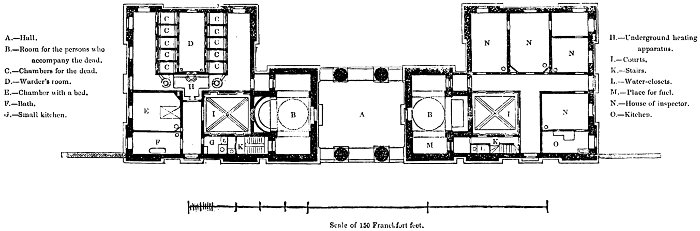
GROUND PLAN OF THE ENTRANCE OF THE INSTITUTION FOR THE RECEPTION AND CARE OF THE DEAD, ATTACHED TO THE CEMETERY.
216
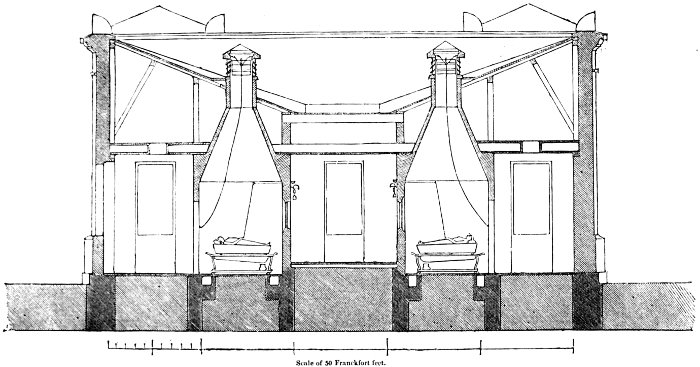
TRANSVERSE SECTION OF THE PROBATIONARY HOUSE OF RECEPTION AND CARE OF THE DEAD PREVIOUS TO INTERMENT AT THE CEMETERY.
217
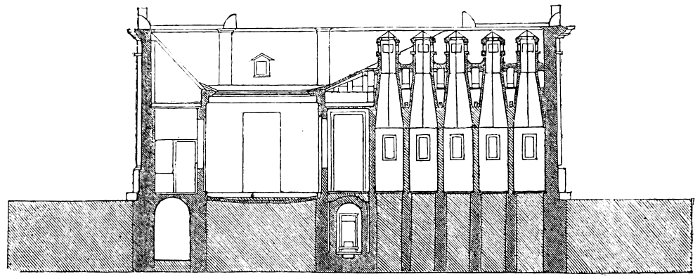
LONGITUDINAL SECTION OF THE PROBATIONARY HOUSE OF RECEPTION AND CARE OF THE DEAD PREVIOUS TO INTERMENT AT THE CEMETERY.
218
Whereas it is of importance to all men to be perfectly assured that the
beings who were dear to them in life are not torn from them so long as
any, the remotest, hope exists of preserving them; so is death less dreadful
in its shape when one is convinced of its actual occurrence, and no
longer a danger exists of being buried alive.
In order to afford this satisfaction to mankind, and to preclude the possibility
of any one being considered as dead who is not actually so; that the
spread of infectious disorders be avoided as much as possible; that the
quackeries so highly injurious to health may be suppressed; that murders
committed by secret violence may be discovered, and the perpetrators delivered
over to the hands of justice, is the imperative duty of every wise
government; and in order to accomplish these objects, every one of which
is of infinite importance, recourse must be had to the Safety Police as the
most efficient means, by a strict medical examination into the deaths occurring,
and a conformable view of the body.
In consideration of which, the orders already existing on this subject will
undergo a strict examination, and, with the august consent of the government
of the Isar-Circle, the following general regulations have been fixed upon:—
1. An examination of all dead bodies, at two different times, and this
without exception to rank, is henceforth to take place in the metropolitan
city of Munich, and the suburbs belonging thereto.
2. The first examination is to be held immediately after death has taken
place, and the second shortly before the interment.
3. At the public hospitals, both examinations are intrusted to the acting
physician, who has however strictly to observe those regulations relating
to the certificates for the examination of the dead.
4. The first examination is to take place at the very spot where death has
taken place, or where any dead body may be discovered, by the sworn surgeon
of the district: the second examination, however, by the surgeon appointed
by and belonging to the Police Establishment.
5. The city of Munich, with the suburbs, are to be divided into Eight
Districts; for each of these districts a separate surgeon is hereby appointed,
viz.:—
[Here follow the eight districts, with the names and residences of the
Surgeons appointed for each district.]
6. As soon as a death takes place, immediate notice must be given by
the Soul-nuns, Midwife, &c., &c., or by any such person charged with the
arrangements for the burial. This said notice must state the street, the
number of the house, and of the floor where the dead body is lying;
whereupon the said surgeon has immediately to go there, and conduct the
investigation according to his instructions.
7. Previous to this, and before the first examination has taken place, it is
neither permitted to undress nor to clean the dead body: nor is the body
allowed (in cases of natural death) to be carried out of that room where
death has taken place, or to be removed from the spot; and it is not even
permitted to remove the cushions from under the head of the dead body.
Every violation of this decree will be punished with a fine of from 5 to 15
florins, or with imprisonment from one to three days.
8. Those regulations issued by the examining surgeon respecting the
treatment of the dead body, or which relate to the clothes and other objects
of the deceased, must be strictly obeyed.
9. After the examining surgeon has convinced himself that every hope of
re-animation has disappeared, he fills up the certificate of examination according
219to his instructions; but be it observed at the same time, that if a
medical man has attended the deceased, such is bound to enter in the said
certificate the description of the disease, and to certify it by his signature.
10. If the dead body remains in the dwelling-house until the burial takes
place, the second examination by the surgeon from the Police must be
held there; and for this reason the certificate must be forwarded into his
hands as soon as possible.
11. But if the dead body after the first examination has been removed to
the house for the reception of the dead, in order to remain there, this said
certificate should previously, or at the delivery, be taken to the Inspector of
his Institution, in order that no obstacle may arise to its reception.
12. The utmost cleanliness and greatest order is to prevail in this said
house for the reception of the dead, where the dead bodies removed there
are to be placed under a perpetual and proper watch; and the Police Surgeon
is bound to call at the Institution twice every day, namely, in the
morning and in the evening, to institute a very minute examination of the
dead bodies there; and in case of any signs of re-animation, to render speedy
and the most serviceable assistance.
13. If the medical man who conducts the second examination perceives
those signs in a corpse which do not leave any doubt whatsoever that a death
has taken place, he then enters the verification in the certificate, which
thereupon is taken to the Directory of Police, who then grant the permission
for the interment.
14. Without such a legal certificate permitting it, no body is allowed to
be buried; and that Priest or Clergyman who will assist at any burial
without having seen this certificate forfeits a sum from 15 to 30 florins.
15. Proper arrangements have been made that the Printed Forms for the
decreed Certificates may always be obtained at the Directory of Police, and
will be delivered gratis to the officiating medical men of the Public Hospitals,
as well as to the Examining Surgeons; a receipt however must be
given for them.
16. All those persons nominated for the execution of these measures, as
the Soul-nuns, Midwives, attendants at the house for the reception of the
dead; the Inspector of such House, the Examining Surgeons, the Surgeons
of the Police, &c., &c., will be supplied with the printed regulations, as
well as the most minute instructions, for which purpose they will be sworn,
and be ever subject to a rigorous inspection.
[The regulations which follow this are chiefly as to the different prices of different degrees of the religious service.]
1. There must be at least two health-worthy and active men, as trusty as
possible, appointed as Body Watchers, and specially sworn in by the Police.
2. When a body is intended to be placed in the house for the reception
of the dead, it must be previously notified to the Inspector of the same,
and the before-mentioned “Examination Ticket,” or a special official order,
be delivered over to him.
3. It is forbidden to the Body Watchers to place any body there without
the previous knowledge and concurrence of the Inspector.
4. Should no obstacle arise, the corpse is then received by the Body
Watchers, and deposited in the place appropriated to it.
5. The cover of the coffin must then be immediately withdrawn, the face
of the deceased uncovered, and the hands and feet disengaged from the
bandages attached to them.
6. The place where the bodies are watched must be kept warm day and
night, and lighted during the night without interruption.
2207. Great cleanliness is to be observed, and a supply of pure air to be kept up.
8. The Watchers must constantly remain in the watch-room, and frequently
by day and night enter the room for the reception of the dead, in
order carefully to observe the bodies lying there.
9. The Police Surgeons will particularly instruct the Body Watchers as
to what signs or appearances they are especially to observe, and how they are
to act with regard to them. On this point they are to take the greatest care.
10. Should any sign or appearances which may betoken re-animation
proceed from any body, it must be immediately brought into the watch-room
with every care and precaution, and placed on the bed provided with
mattrasses and blankets for that purpose.
11. On such an event occurring, not only the Inspector must be informed
of it, but the Police Surgeon must be called in without a moment’s delay.
12. As to the treatment of the body until the arrival of the Surgeon, the
Inspector and Body Watchers are informed by the Police Surgeon. In all
cases must warm water be prepared, and the safety apparatus arranged.
13. The body, thus awakened from its sleep, must be treated with extreme
care, and everything must be avoided likely to create any strong impression
on it.
14. No coffin wherein a body is placed must be closed, nor must any
preparation for the burial take place, until the distinct permission from the
Police Surgeon is issued.
15. The entrance into the room for the reception of the dead is allowed
to every one under proper restrictions, care being taken that the quiet and
good order there are not disturbed.
16. Any Body Watcher who shall be convicted of any neglect in the performance
of his duties, will be punished with a proportional fine and imprisonment,
and dismissed on a repetition of the offence.
Munich, Nov. 20, 1821. Royal Police Direction.
1. The second examination of the deceased must be performed by the
appointed Police Surgeon, who must, however, take particular pains to
satisfy himself that the first examination has been duly executed, that the
certificates were properly drawn up, that the Soul-nuns have fulfilled their
various duties, and that both the Inspector, as well as the appointed
Watchmen belonging to the house for the reception of the dead, have duly
discharged the duties with which they are intrusted, and that, moreover,
nothing has been undertaken or omitted that should not be in accordance with
the various intents and purposes of the decreed examination of the bodies.
2. This said Surgeon must be supplied with a copy of all the regulations
relating to the examination of the bodies, as well as copies of all such regulations
for the guidance of all others charged with the performance of any
of these duties.
3. If the Surgeon who is appointed by the Police feels convinced that by
one person or other any act has been performed contrary to the prescribed
duties, or that any negligence in the execution of the service exists, he
must, on pain of personal responsibility, give immediate notice to the Police.
4. The same (the Police Surgeon) is bound to issue proper instructions,
more particularly to the Soul-nuns, to the Inspector of the house for the
reception of the dead, and to the Watchers and attendants of the said institution,
as well as to all individuals assisting at any of the examinations;
which said instructions relate to the method of proceeding, and treatment
of the dead bodies, especially in such a case where re-animation might again
take place, and repeated caution must be given on this subject.
5. The second examination with which he is charged must either be
undertaken in that house where death has taken place, or in the house for
the reception of the dead. In the first case, when, for instance, the deceased
221is kept at the house where death has taken place until the final interment,
the Police Surgeon must receive the necessary information through the
medium of the examining ticket, which has been issued and signed by the
medical man of the district, and which ticket must be forwarded to him,
either through the Soul-nun, or through any such person charged to
attend the deceased.
6. The stated sickness, or the manner how death ensued, as also the time
in which deceased is to be buried; all of which, having been entered on the
ticket, must serve him for guidance whether the second examination must
be more or less accelerated. In all cases, however, such must be undertaken
as timely as possible, so that generally interment may take place
after 48 hours.
7. He has, accordingly, to go to that place stated in the certificate of
examination, examine the corpse with due minuteness, and, in case the
burial may be proceeded with, he has to state it in the certificate; such is
then to be forwarded to the Royal Police, where the permission for interment
is granted.
8. If it is intended to remove the body to the house for the reception of
the dead, such may take place without any hesitation after the proceedings
of the first examination; and in this case the Police Surgeon must find both
the body and certificate at that place.
9. The Police Surgeon is bound to attend twice every day at the house
for the reception of the dead of the burial-ground, viz., every morning from
9 to 10 o’clock, and in the afternoon from 3 to 4 o’clock. On his arrival,
such dead bodies, with their certificates, which have been examined, must be
shown to him; he examines them, and signs those certificates which do not
admit of any delay; which certificates are afterwards forwarded to the Royal
Police authorities, in order to procure the certificate of permission for the
burial.
10. Of all such dead bodies having undergone the second examination
by the Police Surgeon, and which have been considered by him proper for
burial, minute lists must be kept by him containing the consecutive numbers,
as well as the statement of that day on which the interment has been
ordered, and all such observations which have been entered in the certificate
of examination.
11. Such corpses which from the manner of their death are subject to
any judicial examination or dissection, will, after their previous dissection,
be received by the proper judicial authorities, and the interment is to take
place according to the existing orders.
12. Should information be forwarded to the Police Surgeon that signs of
re-animation have been observed in any body, it is to be his first and most
sacred duty to attend instantly at the place and spot, in order to conduct all
attempts at restoration, and to issue orders about the mode of treatment of
the re-animated body.
13. Attending minutely to his duties, it is certain that he may perceive
divers symptoms which are not only important to him as Examining Surgeon,
but also as surgeon to the Police; he has therefore to attend minutely
to such observations, and, together with his own, communicate such to his
superior authorities.
14. In case the Police Surgeon should be prevented, either by indisposition,
absence, or any other cause, from conducting the examinations with
which he is intrusted, he is forthwith to give immediate notice to the Royal
Police, in order to provide for a proper substitute, whom he may himself
propose.
15. It is fully expected from the Surgeon of the Police, that, impressed
with the importance of the business he is charged with, he will do all in
his power to attain the manifold important objects belonging to it. Any
negligence of which he may be guilty will be rigorously punished, and
on a repetition of the offence he will be discharged.
Royal Police Direction, Munich.
222
(1.) As soon as a person is dead, or appears to be so, the nurse or sister
of charity in attendance is immediately to give information of the same to
the medical man appointed to the district.
(2.) For this purpose she obtains the form of notification for conducting
the inspection of the dead, which contains the divisions of the districts of
inspection, and the names of the physicians appointed to each district.
(3.) In order that the physician may inspect immediately, and without
the slightest delay, the case of death in his district, the name of the street,
the number and floor of the house in which the death occurs is to be given
with exactness, so that he may not in any way be hindered in going to the
place and making the earliest possible inspection.
(4.) Before this inspection has taken place, it is expressly forbidden to
undress the corpse, or wash it, or, if the death is a natural one, to remove
it from the bed or room in which the death took place, or even to take
away or alter the position of the pillow.
(5.) Any disobedience to this law will be punished by a fine of from
5 to 15 florins, or by a three days’ imprisonment.
(6.) The physician will make a note of all the circumstances of the first
inspection, according to his instructions. If he should consider that particular
arrangements are necessary, they are to be adopted immediately.
(7.) His note of remarks shall be left at the house, in the charge of the
soul-nun, and through them the signature of the physicians attending the
person who had died, if such there has been, shall be procured.
(8.) If the dead is retained at the house till the time of interment, the
note of inspection must be directly handed over to the public surgeon, in
order that he may make the second inspection, and determine further what
is necessary with regard to the interment.
(9.) If after a certain length of time he sees no reason to postpone the
interment, he will make a note to that effect and give it to the police direction,
and from them is procured the sanction for the interment.
This sanction will be given in to the clergyman’s office belonging to the
district, and thence handed over to the officer who has the care of the
house for the reception of the dead previous to interment. Without this
sanction no corpse can be interred.
(10.) The corpse must be retained until interment in an apartment
where there is fresh and pure air. The coffin must not be closed, nor the
face covered till after the second inspection, and the hands and feet must
not be bound.
If any signs of life should be observed, the district physician is immediately
to be called.
(11.) If the corpse is conveyed into the house for the reception of
the dead, the second inspection must be made there. The district physician’s
note of inspection is to be given to the officer of the house for the
reception of the dead at the time, or before the corpse being brought
there, and that officer is to hand over the note to the public surgeon.
Without this note of inspection, no corpse can be received into the house
for the reception of the dead.
(12.) The soul-nuns, or midwives, or whoever is intrusted with this office,
must wait for the second inspection, and for the time when the public surgeon
shall pronounce that the interment is necessary. For this purpose
the surgeon will make the requisite certificate, which must then be given to
the proper officer, who immediately gives the sanction for the interment.
(13.) As the second inspection in the house for the reception of the dead
must take place, according to the regulations, in the morning between
9 and 10, and in the afternoon between 3 and 4, the sanction for interment
may be procured between 11 and 12 in the morning, and 4 and 5 in the
afternoon.
223
You are Registrar of Deaths in the City of London Union. Since you
have been Registrar, have you had occasion to send notice to the coroner
of cases where the causes of death stated appeared suspicious?—Yes, in
about half-a-dozen cases. One was of an old gentleman occupying apartments
in Bell Alley. His servant went out to market, and on her return,
in less than an hour, found him dead on the bed, with his legs lying over
the side of it. He had been ailing some time, and was seized occasionally
with difficulty of breathing, but able to get up, and when she left him she
did not perceive anything unusual in his appearance. I went to the house
myself, and made inquiries into the cause of death; and although I did not
discover anything to lead to the suspicion of his having died from poison
or other unfair means, I considered it involved in obscurity, and referred
the case to the coroner for investigation. Another case was of a traveller
who was found dead in his bed at an inn. The body was removed to a
distance of forty miles before a certificate to authorize the burial was applied
for. His usual medical attendant certified to his having been for
several years the subject of aortic aneurism, which was the probable cause
of his sudden death, although the evidence was imperfect and unsatisfactory,
and could not be otherwise without an examination of the body, and
I therefore refused to register it without notice to the coroner.
A third case occurred a few days ago. A medical certificate was presented
to me of the death of a man from disease of the heart and aneurism
of the aorta. He was driven in a cab to the door of a medical practitioner
in this neighbourhood, and was found dead. He might have died from
poison, and, without the questions put on the occasion of registering the
cause of death, the case might have passed without notice. There was
not in this case, as in others, any evidence to show that death was
occasioned by unfair means, but the causes were obscure and unsatisfactory,
and I felt it to be my duty to have them investigated by the coroner.
But for anything known, you may have passed cases of murder?—Certainly;
and there is at present no security against such cases. The
personal inspection of the deceased would undoubtedly act as a great security.
In the course of your practice, have you had occasion to believe that evil
is produced by the retention of the corpse?—Yes; I can give an instance
of a man, his wife, and six children, living in one room, in Draper’s Buildings.
The mother and all the children successively fell ill of typhus fever:
the mother died; the body remained in the room. I wished it to be
removed the next day, and I also wished the children to be removed, being
afraid that the fever would extend. The children were apparently well at
the time of the death of the mother. The recommendation was not
attended to: the body was kept five days in the only room which this
family of eight had to live and sleep in. The eldest daughter was attacked
about a week after the mother had been removed, and, after three days’
illness, that daughter died. The corpse of this child was only kept three
days, as we determined that it should positively be removed. In about
nine days after the death of the girl, the youngest child was attacked, and it
died in about nine days. Then the second one was taken: he lay twenty-three
days, and died. Then another boy died. The two other children recovered.
By the immediate removal of the corpse, and the use of proper preventive
means, how many deaths do you believe might have been prevented?—I
think it probable that the one took it from the other, and that
if the corpse of the first had been removed the rest would have escaped;
224although I, of course, admit that the same cause which produced the disease
of the mother might also have produced it in the children. I believe
that, in cases of typhus, scarlatina, and other infectious diseases, it frequently
happens that the living are attacked by the same disease from the
retention of the body.
Have you had occasion to observe the effects of cesspools in your district?—Yes,
and that they are very injurious to the health. In the states
of the weather when offensive emanations arise from the cesspools and
drains, I have often heard people complain of headache, giddiness, nausea,
languor, and an indisposition for exertion of any kind; and I have known
a walk or a ride in the open air to remove those symptoms, but in an hour
or two after their return home they have found themselves as bad as
before. Their sleep brings them little or no refreshment; in truth, they
have inhaled, during the whole of the night, the noxious atmosphere, which
is very depressing, and will fully account for their rising, as they often say,
as tired as when they went to bed. As an example, I may mention the
case of a compositor, residing in Draper’s Buildings—a narrow, confined,
and filthy place, where there was always a disgusting stench in every house.
He was the subject of disordered stomach and liver, which might have been
induced by his night-work and intemperance: the stinking hole in which
he resided contributed its share towards it, without doubt. This man
remained at home for a week, when he was getting better, but had
scarcely any appetite. I advised him to walk in Finsbury Circus two or
three times a-day, as long as he could without fatigue; and on several
occasions, when he returned to his dinner, he said, “Now, if I had had my
dinner in Finsbury Circus I could have eaten a hearty one, but now I do
not seem to care anything about it.” I believe that if I had entered that
man’s house with a good appetite for a dinner, and had remained there for
an hour, that I should have cared no more about eating than he did,—which
I attribute to the nauseating and depressing effects of the effluvia
from the cesspools, drains, and general filthiness of the place.
Are you aware whether this state of things arose from the cesspools or
the state of the sewers?—I conceive the worst have been cesspools; but
the drains, if they open, are just as bad. I was called upon to visit a patient
living in a court in Whitecross Street, ill of typhus fever; in the centre of
it was a gully-hole, which was untrapped and smelt horribly. The fever
went through the whole of that court. I gave it as my opinion at the time,
that the case I visited was occasioned by the gully-hole, and that the fever
would go through the court, which it did.
Have you perceived the present state of the drains in the city of London?—At
times they smell very strongly, which scarcely any one can fail
to notice; but I have heard country-people complain of them at times when
they have not attracted any particular notice from me.
Are you aware that decomposing matter is allowed to accumulate in
them?—Yes; very recently they took up the refuse in our street, Old
Broad Street; it smelt very badly, and it was black and horribly filthy.
How long before had the sewer been cleansed?—I do not know. I do
not remember its having been cleansed, before the last September, since
I have been there, which is about nine years.
Do you remember to have perceived the smell from the sewers before
the last September?—Yes; there is a gully-hole near my own house from
which there was constantly an offensive smell: it was much worse after a
thaw in winter, or a shower of rain in summer. A neighbour living two doors
from me being more annoyed by it than I, made great efforts, and at length
succeeded in getting it trapped; and I have not since perceived any smell
from it, though I observe it now in other places. The gully-holes are
trapped now in most of the respectable streets, but in the bye and poor
streets they are not trapped.
From the evidence which has come before you, have you any doubt that
225the existing state of sewers in the City are the latent cause of much disease
and death?—I have not the least doubt of it in the world.—A great deal
of active disease, which creeps on gradually and insidiously, may be traced
to that cause.
In the poorer districts, in what state is the surface-cleansing of the
streets?—Even the best streets are very badly cleansed, but in the poorer
streets of the city the cleansing is very bad indeed—horribly bad! Take
Duke’s Place, for example; you will see cabbage-stalks and rotten oranges
that have been thrown away, and they often remain there for several days.
We do not get our streets swept oftener than once a-week.
If there were a perfect system of drainage and cleansing in the city, do
you think that the health and the duration of life of the inhabitants would
be extended?—I think there would be a considerable extension.
What is the physical condition of the children born in London of parents
who are natives of the rural districts, as compared with the physical condition
of children who are born in the country of parents of the same class?—The
children born and bred up in London are more frequently of small
stature and have slender limbs, are deficient in stamina and powers of endurance,
are of irritable frames and prone to inflammatory attack, than
children born and bred up in the country. An impure atmosphere is immeasurably
more injurious to children than adults. Children also suffer
more from want of opportunities of exercise in the open air. The beneficial
effects of pure air and exercise on children who have been born and pent up
in London are most marked: a weakly child, and which, if kept in London,
would perhaps always continue weakly, would most likely become strong
and healthy if sent into the country. I cannot doubt that children born of
healthy parents, and bred up in the country, would be more robust and
stronger than children born of the same class of parents and bred up in
London, and that this difference may be justly ascribable to atmospheric
influence.
When children are weakly, what is the effect on the temper and character?—The
temper and character of weakly children are generally found
to correspond with, and are most probably derived from, the character of
their constitution: their temper is quick and irritable, their passions ardent,
their perception keen, and their imagination predominant over their
judgment.
You are speaking, of course, of the general characteristics of individuals
as specimens of the population brought up under such circumstances?—Yes,
of persons coming under my own observation.
Have you, as Registrar of Deaths, noticed the larger proportion of infant
mortality in the city?—There is, I conceive, all over the kingdom, a large
proportion of infant deaths; but I have no doubt that a considerable proportion
of the excess of infant deaths in London is ascribable to atmospheric
influences.
It appears, from the Mortuary Registration, that of deaths in the city of
London, about one-half are deaths of children under ten years of age;
whilst in a rural district, take the county of Hereford for example, only
one-third of the deaths are deaths of children.
Do you conceive it probable that this different rate of infant mortality
is to be traced chiefly to the difference of the atmospheric influence, the
average age of all of the labouring classes being, in Herefordshire, 39 years,
whilst in the City of London the average age of the deaths of all the
labouring classes is only 22 years?—I am decidedly of opinion that a
greater proportion of the excess of infant mortality in London, and the reduced
duration of life, are ascribable to atmospheric impurity.
If all cesspools were removed, and water-closets substituted; if water were
introduced into the houses of the poorest classes; if the sewers were regularly
flushed weekly, or oftener, so as to prevent accumulations of deposit
and the escape of miasma, such as you have described; if the carriage
226and foot pavements were more frequently and completely cleansed; if these
several public duties were performed with practicable efficiency, can you
express a confident opinion that decrease and premature deaths would be
considerably diminished?—I am quite confident that the adoption of such
measures would not only diminish disease of every kind, but greatly improve
the moral as well as the physical condition of the inhabitants.
Have you in your district perceived any effects resulting from interments
in the parochial burying places?—I have no cognizance of any bad effects
resulting from those interments. The first twenty years of my life I lived
close to a burial-ground, and never was aware or heard of any prejudicial
consequences arising. I may observe, however, that when a relation of
mine has attended the church she has been enabled to perceive whenever a
vault underneath the church has been opened. She has said, “I feel they
have opened a vault;” and on inquiry it has turned out to have been so.
Have you observed any evil effects following the practice of the long
retention of the corpse in the house amidst the living?—Yes, I have observed
effects follow, but I cannot say produced by them, though they
were perhaps increased by them. In those cases which I have had where
there has been a succession of cases of fever in the same family, after a
death it has generally occurred that the parties affected have complained
two or three days before that they felt very unwell. Generally this has
been the case. I have, in such instances, ordered them medicine immediately.
Since the Union has been established we have immediately
removed all fever cases to the Fever Hospital.
The retention of the corpse amidst the living, under such circumstances,
must aggravate the mortality, must it not?—There cannot be a moment’s
doubt about it.
What, from the observations in your district, has been the actual state
of the sewerage, and cleansing dependent upon it, as the cleansing of the
cesspools?—There has been great improvement in the city of London by
the improvement of the sewerage, in so far as it has removed the cesspools.
When you went into a respectable house formerly, you could, in
the city, tell the state of the weather by the smell from the cesspools.
Where water-closets are substituted, the health of the inhabitants has undoubtedly
been improved. In the poorer neighbourhoods, where they have
still cesspools, they are still very bad. I constantly tell them, if you get
rid of that nasty cesspool you’ll get well and keep well; it is of no use my
giving you physic until that is done. Where there have been deposits
accumulating in the sewers, and the drains have been choked up, the
effect has been just the same as if there had been cesspools.
You are aware that in respect to sewerage it is the practice to allow deposits
to accumulate in the sewers, and then, when the private drains are
stopped up, to open the sewer and get out the deposit by means of buckets,
and remove it in carts?—Yes, I am.
Have you seen any illness result from this practice?—I cannot state a
case, though I have no doubt of its highly injurious effects; but can decidedly
speak to illness arising from the accumulations. The illness is
just the same as from cesspools: a low depressing nervous fever, most like
that which is described to be the form of the jungle fever. In November
227or December last, they were taking up the deposits from the sewers near
Broken Wharf, in Upper Thames-street: the stench from it was quite sufficient
to have produced any fever: it was not within my district, and I do
not know what were the effects. Fortunately there was clear weather, and
the wind blew towards the river.
Have you any doubt that the removal of such refuse, as well as the accumulation,
must be attended with danger to life?—Yes; if any person in
a state of mental or bodily depression were exposed to such an influence,
it would produce low fever; it would be dangerous in proportion as it was
stagnant.
In passing through the city, have you been assailed with smells from gully-holes?—Only
yesterday, in passing through the city, the smells from many
of the gully-holes were very offensive; and several medical friends agree
with me in attributing extremely prejudicial consequences as arising from
this cause.
The following case is related on the authority of Dr. Good, as having
occurred within the city of London, and is mentioned by Mr. Fuller, in a
letter from a surgeon who has paid great attention to the influence of
sewerage, and who adduces the facts of the case in evidence that typhus
may be produced by the miasma from sewers:—“Soon after the closing
of the Parliamentary Committee, I learned, from the late Dr. Hope, the
particulars of a case which, to my mind, has completely proved the production
of typhus fever from it, and was so much in the character of an experimentum
crucis, that I did not consider it necessary to prosecute the inquiry
any further. The case is as follows:—“A family in the city of London,
who had occupied the same house for many years, enjoying a good state of
health, had a nursery-maid seized with typhus fever; the young woman
was removed from the house and another substituted in her place. In a
short time the new nurse-maid was attacked with typhus fever, and was
also sent away. A few weeks after one of the children was seized with the
same fever: an inquiry was now instituted by the medical man in attendance,
in order to ascertain, if possible, the cause of this frequent recurrence
of typhus fever, when the following facts were brought to light:—The
nursery was situated on the upper floor but one of the house, and
about a fortnight or three weeks before the first case of fever occurred, a
sink was placed in the corner of the nursery for the purpose of saving the
labour of the servants; this was found to communicate with the common
sewer, and to be quite open, or untrapped; they ordered it immediately to
be effectually trapped, and then no other case of fever occurred, although
it continued to be occupied as before; and, when I learned the case, more
than a twelvemonth had passed.””
Have you met with cases analogous to the one here stated?—I have met
with several such cases. I know of an instance where a room in an old
house had an offensive stench, and the health of the person living in it was
always bad. A stench was perceived in the room, which it was guessed
might arise from the decay of dead rats in the wainscot. The party
went to much expense to pull down the wainscot, when it was found that
there was an opening which communicated with the cesspool below.
The hole was properly cemented and stopped up, and the room has since
that time become quite habitable and healthy; and where I have directed
the cesspools to be emptied, as the predisposing cause, the general result
has been that the sick have immediately got well. From my knowledge of
the local causes I can predicate, with certainty, what will be the general
effect on the health in the case of removal of the parties.
Besides the houses of the labouring classes, are there many houses of the
middling classes in your district in the city of London that are provided
with cesspools?—Many houses that I go into are provided with cesspools.
I mentioned the other day to a lady that I should never be enabled to keep
her well so long as there was a cesspool in the house; I told her that the
228expense of continued medical attendance would pay for a communication
with the common sewer and better cleansing.
Are you aware that a new practice has arisen of preventing the accumulation
of deposits in the sewers, by flushes of water, which remove all
deposits weekly, and so far prevent the year’s accumulation and corruption
of deposits in the sewers. If this system were enforced in the city, have
you any doubt as to the extensive prevention of disease and mortality
which would be thereby effected amongst all classes?—Certainly it would
be a great boon, in a sanitary point of view, to the population of the city
of London. I am so much convinced of this, that in my own house I put
a stick under the handle of the water-closet, so as to have a continued flow
or flush of water for some length of time; this I do to remove any accidental
accumulation. Of course the flushing of the common sewers would
have the same effects.
Besides the accumulations in the sewers, is there at this time no decomposing
refuse from the defective cleansing of the courts and bye-streets,
and poorer districts?—Yes; in the poorer districts there is accumulation.
In one court, for example, called Harrow-court, Thames-street, where there
is almost always low fever, there is always dirt and filth, and I am constantly
exhorting the people to remove the filth; but the great difficulty
with the poor people is commonly how to get the water. There is a court
in Cornhill which a man was cleansing the other day by applying a hose
to the water-cock (which is used in case of fire), in order to cleanse the
pavement. An officer belonging to the water company coming by, said,
“If I see you doing that again, I shall indict you.”
Are you aware that the streets are swept oftener than weekly in the city
of London?—My impression is—not oftener.
It has been proposed that water should be laid on, and kept at high
pressure in the streets, so as to enable the courts and alleys, the foot and
the carriage pavements, to be washed daily by means of a hose attached to
the water-pipes. This, which has been proposed for protection against fire,
as well as for cleansing the streets more completely, has, I am informed,
been done in Philadelphia. If the system were carried out in the city of
London, what do you conceive would be the effect on the health of the
population in the poorer districts?—I should certainly say that it would
tend greatly to prolong life amongst the population.
From the mortuary registries it appears that the average duration of life
among the professional persons and gentry in the city of London, who live
in better cleansed and ventilated houses, and better cleansed streets, is, on
the average of the whole class, about 43 years, and 6 per cent. of the
deaths are deaths from epidemic disease; whilst among the labouring
classes the proportion of deaths from epidemic disease is 19 per cent., and
the average age of all who die is only 22 years. With such sanitary regulations
as are under the public control of the public authorities, to what
extent do you think it probable the duration of life amongst the labouring
classes may be extended?—So far as I can judge, without examination of
the particular cases, I should say that the average might be extended one-half
at the least.
The majority of the cases of epidemic diseases may decidedly be ascribed
to the want of cleanliness and ventilation. On looking over the mortuary
registry of the deaths occurring in Upper Thames-street and the district
attached to it, I find the causes of death most frequently registered are
“low fever,” “low fever,” occurring one after the other. This recurrence
of low fever corresponds with my experience of sickness, which so often
assumes the character of low typhoid nervous depression. The medicine
I use in the greatest quantity is ammonia, as an active diffusive stimulus.
For all classes this medicine is in constant use. In damp weather we have
always much increase of this illness: the dampness produces a depression
which lays them open to the atmospheric poison.
229Have you had instances where better cleansing has taken place and
illness diminished?—Yes; for example, in Ireland-yard, containing a large
number of families of coal-heavers and others, a place which I never
was out of from continued illnesses: the yard has been much better
cleansed, the houses put in better order, and now there is very little illness
there. I know for a fact, that in the neighbourhood of London-wall, where
recently great improvements have taken place in the sewerage and ventilation,
disease has greatly diminished, especially low fever. Formerly
they had a sewer which used to be stopped up and overflowed; they have
had of late a new sewer, which now works better; they have no stink or
stench in the kitchens, as formerly, and they have nothing of the same kind
of disease going on there that they used to have before.
Are the houses in Ireland-yard occupied by the same inhabitants?—Just
by the same class. The habits of coal-heavers are reputed to be none of
the best in respect to general cleanliness or temperance.
Have you observed any alteration in their habits?—Not in the least.
Have you observed what is the personal condition of the natives of
London?—The real cockney is generally of stunted growth.
Have you observed whether the children born in London of parents who
have come from the rural districts are as tall or as strong as the parents?—Generally
shorter children, though some of them are as tall, but all are of
comparatively weakly constitutions; they are particularly predisposed to
strumous disease. I have been so impressed with the effect of children
living in a London atmosphere, that I have been anxious to send them out
of it when possible.
Does not defective cleansing, as causing atmospheric impurity, not only
tend to produce disease and shorten the duration of life, but depress the
physical condition of the population?—Decidedly.
You have read what is stated by Mr. Blencarne, and by Mr. Abrahams—do
you generally agree with them as to the effects of defective cleansing, on
the condition of the population?—I agree with the whole of what they state;
it perfectly accords with my own experience, which has been about 25 years
in this district. I have during that time observed a great falling off in the
condition of the children; they are stunted, squalid, poor-looking things,
and there is a great deal of deformity amongst them.
Have you observed moral effects attendant on the physical depression?—Yes;
I have observed a great deal in our neighbourhood. I think the
females of the poorer classes who are not strong for work, are more apt to
take to courses of livelihood other than by work;—that very many of them
go upon the town.
Have you observed any emanations from the sewers in your district?—In
Liverpool-street there is now a cleansing of the sewers by opening the
top, taking the soil out, and carting it away.
What is the effect of this process?—It vitiates the atmosphere to a considerable
extent.
Have you observed any effects from it?—I have often found headache
to result from it to myself, and parties have complained to me of the same
effects.
230What is the state of the drainage?—There are some districts, such as
Halfmoon-street, which are imperfectly drained, where the cesspools are
suffered to overflow and run along the kennels at the sides of the street,
causing fœtid and deleterious exhalations; in this street and the alleys
opening into it, especially Thompson’s-court, Thompson’-rents, Baker’s-court,
Providence-place, and Campions-buildings, fever prevails nearly
the whole year round. It also prevails very much in Bligh’s-buildings,
Lamb-alley, Dunning’s-alley, Sweet Apple-court, Montague-court, Artillery-lane,
Rose-alley, and Catherine-wheel-alley. These places, all of
which are badly drained and not regularly cleansed, are seldom without
fever for any length of time.
In these places are there any water-closets?—No; they have nothing but
common necessaries, which are usually allowed to run over before they are
emptied, and it is impossible to enter the tenements without being assailed
by the disagreeable and unhealthy effluvia thence arising.
Have they water laid on in the rooms of the several tenements?—Seldom
in the rooms; generally in some place in the court to which they all
go. Many have not that even, and they resort to the common street
pumps. I do not remember an instance where water is properly laid on
in any house of the labouring classes.
What rents are paid for houses in this condition?—Rent for one room
is from 1s. 6d. to 4s. 6d. per week. The rents are very high in proportion
to the size and accommodation of the rooms.
You say you have observed emanations from the sewers within your
district?—Yes; they are frequently very offensive in moist warm weather.
You may, indeed, almost tell the condition of the weather from the smells
from the public sewers. Recently in returning from Islington along the
City-road from the Canal bridge to Finsbury-square, and along Sun-street,
I noticed in passing near the gratings, as every person must have noticed,
a peculiarly offensive effluvium.
Within the city itself have you perceived the same effluvium on passing
the gratings of the sewers?—Frequently; it is so general that no particular
place is distinguished by being free from it.
Suppose a tradesman or a merchant returning from Change in a state
of depression from anxiety passing through a street, exposed to a succession
of smells and breathing the effluvium from such sewers; what is
likely to be the effect upon him?—A low nervous fever, with considerable
gastric derangement. The greater part of fever cases which I have to
treat are of this description.
Is that with every class of persons?—Yes, with every rank of life. They
are mostly of the low or typhoid type, and do not bear depletion. In my
ordinary course of treatment I generally begin by emptying the stomach
and bowels, and by lowering the diet. I then use a moderately stimulating
treatment with a perfect absence of solid food.
Is gross feeding or excess very common amongst the people of your
district?—Not very common. Excess from drinking is more frequent than
excess from eating.
In what proportion will there be of excess from eating or drinking in
such cases?—Amongst the labouring classes perhaps there may be one
case in ten from excess of drinking, and one case in thirty from excess of
eating.
If these excesses had taken place in a purer atmosphere, do you conceive
the results in disease would have followed?—In most instances the
system in a pure atmosphere would have thrown off the inconvenience
without fever.
Then excess or depression both predispose to the attacks of disease
from atmospheric impurity, and especially to the direct influence of the
effluvium in question?—Yes, certainly; excess of watching, want of rest,
mental anxiety, every depressing cause predisposes to an attack.
231Besides the defects in respect to the cleansing of the cesspools and the
drains, are there not defects in respect to other portions of cleansing, such
as dust-bins neglected?—Yes, in those places there is no person to regulate
or to see that done which ought to be done; consequently the dustmen
and scavengers duty is much neglected, and places are filled with decomposing
remains, which remain there two or three weeks in summer and
much longer in winter. The carelessness of the people themselves as to
cleanliness is also deplorable, as it operates very injuriously on their health
and comfort; the floors of their rooms, the passages, stairs, and landings
are often suffered to remain unwashed for weeks and months, and the
walls and ceilings are seldom cleansed or whitened, so that what with
filthiness of one kind or other they present an appearance of wretchedness
beyond all description.
What is the condition of the children born or kept in courts or places of
the condition you describe, with badly cleansed drains, with privies, and
without water or conveniences for cleansing introduced into their habitations?—The
children are, for the most part, of delicate or weak frame,
and subject to struma. The health of children depends partly whether
they were born in such places or not, whether their parents on each side
are Londoners, as there appears to be a gradual decline in physical power
by a long continuance in a vitiated atmosphere, which passes from parent
to progeny, and partly also in a family where one part of the children
have been born and brought up in the country and the other in town;
those born in the country, and not coming into London until they are five
years of age, will have comparatively strong frames, and will resist such
influences, whilst those born in town will be comparatively of delicate
frame, weakly and strumous, liable to glandular disease, and diseased
affections of the joints and the spine. Generally they are shorter in
stature, sometimes they are taller, but then they are slender and very
delicate, in which case they are likely to have bending of the limbs.
What is the condition of females born under such circumstances?—I
have observed that the females are less depressed than the males, and are
reared with less difficulty.
Why is this so?—I have not been able to determine. It may be that
the male requires more extensive and powerful exercise, and that in pure
air, than the female, and consequently that the female suffers less from
the want of it.
What are the moral characteristics of the population brought up under
these depressing physical circumstances?—They have decided unwillingness
to labour. They are not so strenuous as the more healthy people
from the country. They are more apt to resort to subterfuge to gain their
ends without labour. Light employments they do not object to, and do
comparatively well in. But it is difficult to keep a native of London,
either male or female to heavy work; they will avoid it if they can. The
cause is in most cases physical from the deficiency of ability to labour.
The greatest part of them are mentally irritable and impatient under moral
restraint.
Is any similar difference marked on the condition of the children of
tradespeople between those children of tradespeople brought up in London
and those born in the country?—Yes, there is a similar difference perceptible,
but less in degree. Amongst tradesmen, too, it is the extensive
practice of the parents to send their children out of town to school or on
visits, which may powerfully affect them beneficially. In the tradesman’s
family they have better sleeping rooms, and greater cleanliness in person,
and in bed and body linen, and also a better regulated dietary.
What is the effect of such atmospheric impurities as those described in
the chances of recovery from attacks of disease?—It lessens the chances
of recovery and greatly impedes convalescence. Indeed, in many instances,
very little progress can be made until the patient is sent out into the
232country. In a case of fever which occurred to a strong healthy man,
aged 24, a carman, in a close neighbourhood, the house being without
drains and ill ventilated; no progress could be effected until he was removed
into the country, although the fever had decidedly subsided. I
believe that in this case something else would have supervened, had he
not been removed. I frequently remove patients in a respectable condition,
finding no chance of recovery without it. Many of the better conditioned
houses being badly adapted for the treatment of fevers, having low ceilings
and insufficient ventilation.
What will be the difference in respect to the time of cure or convalescence
between a well and an ill-cleansed neighbourhood?—A difference of
perhaps one-half.
Suppose the rooms of each house supplied with water, the privies and
cesspools removed, drains from the houses to sewers, and the sewers so
constructed as to be cleansed, and to convey away daily such refuse as that
which is allowed to remain decomposing in the close courts during weeks.
Supposing the surfaces of the streets cleansed as frequently after the
manner in use in Philadelphia and other towns where they are cleansed
with water daily, to what extent do you conceive disease would be reduced?—Of
fevers two-thirds certainly, and other diseases would be considerably
lessened.
In what condition in respect to cleanliness are the courts and other places
within your district, chiefly inhabited by the labouring classes?—The
cleansing of the courts and alleys in my district is defective. I agree with
what Mr. Blenkarne says in respect to cesspools. For instance, in one
room in a house in Sugar Loaf-court, Garlick-hill, next to their common
cesspool, I have frequently attended patients, and before going, I surmise
that whatever disease they are primarily affected with, it will generally run
into one of low character with tendency to typhus. In the interval of little
more than a twelvemonth, I have attended several occupants of the house,
one after the other, who have all been, to a certain extent, similarly affected.
I have generally improved their health by giving diffusive stimuli, and
have occasionally prevailed on them to remove.
How many visits in the year may you have paid to this same house?—Upwards
of forty visits. But there are other houses where there are similar
evils, where I have had occasion to visit them still more frequently.
In one house in Star-court, Bread Street-hill, which is similarly situated,
where almost the whole of the inmates were laid up with fever, and where
I had to visit it three times a day for upwards of three weeks. There
were deaths on each floor of that house. Fever assumed, at one time, so
malignant an aspect, that there appeared to be no possibility of saving
them, except by removal. I do not remember one case of a removal in
time where death ensued. The ward inquest had the inhabitants removed,
and the house cleansed.
But was the cesspool removed?—Emptied but not removed.
Then in time you will have a recurrence of the same evils in the place
in question?—Yes, certainly.
What is the condition of children brought up in such places?—Generally
pale and emaciated, scrofulous, and apt to mesenteric disease.
You were medical attendant at the Norwood school, where the pauper
children from the city of London are taken. Do you think, that on a view
of the children, and without any positive knowledge of the sort of residences
of the parents of the children, you could on the view select from
the rest, the children who came from the courts and alleys, such as
233you have described in the city of London?—I have but little doubt of it,
though generally speaking the children from the city were of rather a better
description than those from more crowded localities. Indeed, the courts and
alleys of my district are superior to those in other quarters of the metropolis.
They are situated near the banks of the Thames with a considerable fall
towards the river. Some parents also take their children much out into
the open air, and in these the influence of the place would not be so visible,
but with the majority there would be but very little mistake. Whilst at
Norwood, my chief trouble arose from this sick and diseased class of children,
who generally improved very much after being there some little time.
What was the moral condition of these physically depressed children, as
compared with other pauper children, whose position had been less unfavourable?—The
moral condition of this depressed class of children was
generally worse also.
Dr. la Chaise, in his Medical Topography of Paris, which is an early
attempt to investigate the influence of localities on the moral and physical
condition of a population, gives the following description of the physical
condition of the short-lived population bred up in the narrow and dark streets,
and ill-cleansed and badly ventilated houses of Paris, which description
may serve for comparison with those given of the native population in the
crowded and badly cleansed districts of London.
“The Parisian,” he says, “in stature is often below what is commonly
termed middle-size. His fair skin, soft to the touch, forms a striking contrast
to that of the inhabitant of small towns, and, above all, to the countryman,
who is more exposed to the various changes of the weather, and to
the action of the sun and light. The hair of the Parisian is generally fair or
light brown, and his eyes blue. His muscular frame is little developed, so
that the form has on the whole a feminine appearance. In the labouring
class the muscles of the lower limbs are sometimes developed, but irregularly
and incompletely, which is explained by the exercise given exclusively
to certain muscles by their employment or handicraft; these irregularities
of development are much less frequent in the rural districts where the
movements, and consequently muscular actions, are much more equally
divided. The temperament, that is to say the physical constitution peculiar
to the Parisian, differs, as is perceived, from each of the distinct and
determined forms admitted by physiologists. He seems to partake of the
union of many,—to be intermediate between those which are recognized
under the names nervous, bilious, and lymphatic-sanguine; the first seems,
however, to predominate.
“It is not, however, rare to meet in Paris with physical constitutions entirely
in the extremes and contrasted with each other; that is to say, there
are here, as in other large towns, large numbers of weakly and debilitated,
vulgarly called sickly, and others with hollow chest and tall slim figure.
“The women of Paris are rather pretty than handsome; without regular
features, they owe to the development of the cellular tissue, and to the fairness
and fineness of the skin, a certain softness of form which is very graceful;
and a quick and spiritual eye makes one forget the paleness of their cheeks.
“Considered morally, the portrait of the Parisian presents colours which
are not impossible to seize, notwithstanding their great variety. He may
be said generally to be lively, spiritual, industrious, and deserving the
name of frivolous. Much less perhaps is given him. He is inquisitive,
and carries into his work a taste, an ardent imagination, and inventive
234mind, which he is willing to believe should compensate for sustained
activity. There necessarily results from this a great nervous susceptibility,
an encéphalique predominance, which it is important to the physician never
to overlook.
“If a sound and firm organization allows a few to resist the effects of
this premature exercise of the organ of thought, a rapid increase in its
functions always shows itself in the injury done to the other organs, and
generally to the muscular system, which bear the marks of feebleness and
often of deplorable languor. In this life, too active morally and too indolent
physically, the nervous system acquires not what is vulgarly called a
feebleness or delicacy, but a susceptibility, or rather a predominance, which
is affected by the least shock. Hence that fickleness, and that vivacity of
desires, that changeableness in the tastes, in a word that coquetry, that
unequal and whimsical moody character, those caprices and vapours. The
character is not alone affected by this excess of susceptibility; all the
organs, the whole of the economy of the body feels it in turn; the nervous
system acts particularly on the uterus, developes it prematurely; thus the
women generally arrive at puberty much earlier at Paris than in the provinces,
and especially than in the country. It is not unfrequent to find
young girls of 12 or 13 fully formed and capable of becoming mothers,
whilst in the country, even in the south, they do not attain that period till
the age of 15 or 16.”
Whosoever examines the various modern plans for the improvement
of the metropolis, and compares them with the plan of the architect of
St. Paul’s, will see in them only small approximations to his conceptions,
and that they only provide for a few large openings, without reference to
any general sanitary considerations, and without providing for the mass of
the population, whereas he was for “excluding all narrow dark alleys
without thoroughfares, and courts,” such as are commonly left untouched
in the new lines of streets; and he had provided that not only “all church
yards,” but “all trades that use great fires, or yield noisome smells, be
placed out of town.” If, as is confidently maintained on such evidence as
that before referred to, ante p. 22 and 25, the proportions of death might even
now be reduced by one-third in the city of London by better drainage and
other sanitary measures (independently of the removal of those courts and
alleys, &c.), on the evidence of the proportions of mortality actually prevalent
in districts such as he would have constructed, facilitating, and
almost necessitating by regular lines an early and more systematic drainage
below the streets, as well as a free and copious flow of fresh air from above,
it may be as confidently maintained that the mortality and numbers of
burials would have been reduced in like proportions from the period of the
rebuilding of the city. The whole of the deformed area stands as a monument
of the disasters incurred to the living generation, by a weak and careless
yielding, not of the present to the future, but of the present itself, to blind
and ignorant impulses, which have entailed immense demoralization, waste
of health, and life and money, and a large proportion of the evil which now
depresses the sanitary condition of the population of that particular district
which his improvements would have covered. “The practicability of this
whole scheme,” says the Parentalia, “without loss to any man or infringement
of any property, was at that time fully demonstrated, and all material
objections fully weighed and answered; the only, and as it happened, insurmountable
235difficulty, was the obstinate averseness of a great part of the
citizens to alter their old properties, and to recede from building their
houses again on the old ground and foundations, as also the distrust in
many, and unwillingness to give up their properties, though for a time
only, into the hands of public trustees or commissioners, till they might
be dispensed to them again, with more advantages to themselves than
otherwise was possible to be effected; for such a method was proposed,
that by an equal distribution of ground into buildings, leaving out churchyards,
gardens, &c. (which are to be removed out of the town), there
would have been sufficient room both for the augmentation of the streets,
disposition of the churches, halls, and all public buildings, and to have
given every proprietor full satisfaction; and although few proprietors
should happen to have been seated again directly upon the very same
ground they had possessed before the fire, yet no man would have been
thrust any considerable distance from it, but been placed, at least, as
conveniently, and sometimes more so, to their own trades than before.”
“By these means the opportunity, in a great degree, was lost of making
the new city the most magnificent, as well as commodious, for health and
trade of any upon earth, and the surveyor being thus confined and cramped
in his designs, it required no small labour and skill to model the city in the
manner it has since appeared.” The plan was approved by the King and
the Parliament, but opposed by the corporation, who, it is stated in a history
of the city institutions, by one of its officers, conceived that they would
have lost population and trade by the plan; i. e., they would have been
spread beyond its jurisdiction. But on both points this policy was dreadfully
mistaken. Only a burthensome population is obtained by overcrowding,
that is to say, a larger than the natural proportions of the young and
dependent, of widowhood, and early and destitute orphanage, and of sickly
and dependent, and prematurely aged adults. As an example of the
coincidence of pecuniary economy with enlarged sanitary measures, it may be
mentioned, that it is shown in a report on a survey made for sanitary purposes
by Mr. Butler Williams of the College of Civil Engineers, Putney,
that a loss of not less than 80,000l. per annum is now incurred in carriage
traffic alone on two main lines of street, namely, Holborn Hill to the Bank,
and Ludgate Hill to the same point, being made crooked and with steep
acclivities instead of straight and level, as Sir Christopher Wren designed
them. It is to be regretted that the discussions on the rebuilding of
Hamburg have presented an instance of a similar conflict of local interests,
which, in a few instances, has been so far successful as to preserve several
dense masses of crowded and unwholesome habitations for the poorer classes,
in the face of the recent experience of the sort of population which, to
the surprise of the better classes of inhabitants, issued out of them and
made the city at the time of its destruction a scene of plunder and anarchy
more terrible than the fire itself.
| Dear Sir, |
Stockport, 25th January, 1843. |
I have no doubt that infanticide to a considerable extent has been
committed in the borough of Stockport; and I have been professionally
engaged in prosecuting two distinct charges of infanticide, of which I give
you the following summary:—
The first case was against Robert Standring, by trade a hatter. He had
236a female child about sixteen years of age, who, from imbecility, was not
very likely to obtain her own living. One morning, about five o’clock, he
sent her to call up a labouring hatter, with whom he (the father) was going
to work during the day; but, previous to his so sending her, he gave the
child some coffee. After the child’s return she was seized with vomiting,
and all the usual symptoms of illness caused by mineral poison, and died
during the course of that day. The coroner (the late Mr. Hollins) held an
inquest on the body, but refused to allow any surgical examination; and
charging the jury that the death was a natural one, such a verdict was
returned. In about three months afterwards, the case, and some suspicious
circumstances, came to the knowledge of the Stockport police; and I was
consulted as town-clerk and clerk to the justices. The magistrates
issuing a warrant for the exhumation of the body, I attended with a competent
surgeon and chemist (Mr. John Rayner), and a large—very large
quantity of arsenic was found in the stomach, and all parts of the body
which could be affected by arsenic taken internally were remarkably preserved
from putrefaction. Standring, being apprehended, was tried before
Mr. Justice Coleridge at the Chester Assizes. The judge apparently
summed up for a conviction; but the jury, after a long deliberation, returned
a verdict of acquittal. The verdict was an extraordinary one, and
can only be accounted for by the general feeling against capital punishments,
which enables so many criminals (capitally indicted) to escape any
punishment.
The inducement for this murder, so far as it could be ascertained, was
of a twofold character; partly to obtain money from the burial friendly
societies, in which Standring had entered his child as a member, and from
which he received about 8l., and partly to free himself from the future
burthen of supporting the child. The judge, in summing up the case for
the consideration of the jury, remarked upon the apparent inadequacy of
the motives for the murder; but, with all due deference to his lordship,
when it is known to be an established fact that Mr. Ashton, a manufacturer
of Hyde, was murdered by two miscreants whose only inducement was
10l. divided between them, there can be no scale laid down to indicate the
lowest price for murder.
The other case involved no less than three distinct cases of murder.
Robert Sandys, and Ann his wife, and George Sandys, and Honor his wife,
were brothers and sisters-in-law, living in Stockport, in two adjoining
cellars. They were bear or mat makers. Robert had two sons and two
daughters, all young children, and George had a female child also very
young. Two of the female children of Robert Sandys were one morning
taken very ill, and one of them died the same day, under very suspicious
circumstances, the neighbours publicly declaring that the children must be
poisoned. These two girls (along with their brother, a little boy about
five years of age) having been in the morning of the illness in the company
of Bridget Ryley (a girl of inoffensive but imbecile mind), their mother,
Ann Sandys, after the neighbours said the children must have been
poisoned, said, “Oh, Bridget Ryley must have given them something.”
Bridget Ryley had given them some cold cabbage, which Ann Sandys well
knew, and the boy who had been with them was not at all unwell. Bridget
Ryley was apprehended, and by accident I was present at the coroner’s
inquest. I came in just at its termination, Bridget Ryley being in custody,
and Ann Sandys being about to close her examination. After she had
concluded her examination, which was very strong against Bridget Ryley,
she began to apologize for Bridget, saying, She did not think the poor girl
(as she called her) intended any harm to the child; and she evidently
wished to make it appear that the poisoning was all a matter of accident.
Bridget Ryley was then asked to say what she knew about the business,
and she earnestly protested her innocence, saying the child had died of the
same complaint as another child of Ann Sandys had died of three weeks
237before. It appeared strange that the mother of the child should both
criminate and exculpate Bridget Ryley, and I thought I could perceive a
watchful restlessness in her eye, which ill accorded with the probable grief
of a bereaved parent; I therefore communicated to the coroner my
opinion that the mother of the children might be the murderess, and that
if so, the child which had been buried three weeks before would also
prove poisoned. The coroner thought it a very proper inquiry, and adjourned
the inquest, directing this other child to be exhumed; and it
proved to have been poisoned by arsenic. Whilst this exhumation was
taking place, Honor Sandys met one of the constables, and she expressed
a wish that they would not disturb her dear little infant. The constable
told me this, and directions were consequently given for its immediate exhumation.
Arsenic had also caused the death of this child. Ann Sandys
then said that Bridget Ryley must have poisoned them all, and that a child
which Bridget Ryley had nursed had died in a similar way. (This was after
Ann Sandys was in custody and charged with this murder.) This last
child so nursed by Bridget Ryley was exhumed, but it had died a natural
death. Now all these three children so poisoned were in friendly burial
societies, and their parents would receive for their funerals about 3l. for
each child. The expense of the funeral would be about 1l., and the profit
on each murder 2l., and the liberation from the future expense of keeping
the child.
At the ensuing assizes for Chester Mr. Justice Coltman postponed the
trial to enable the boy, the son of Ann Sandys, to be educated for examination.
This boy would have proved some very material facts as to the
mode in which the poison was administered, but as this did not come out
in evidence, as the boy was not considered capable of being examined at
the subsequent assizes, it is hardly fair now to state them.
Mr. Justice Erskine tried the cases, and Robert Sandys was convicted,
but his wife Ann Sandys acquitted. I afterwards was told by one of the
jury that they acquitted her because they thought she acted under the
control of her husband, and they thought that justified her acquittal.
The judge and counsel had been silent on this point, satisfied with their
own knowledge, that in murder the wife, though acting with her husband,
is guilty and punishable, and thinking the jury as wise as themselves.
In consequence of an objection to the admissability of a statement made
by Ann Sandys before the coroner, and also to the form of the indictment,
judgment was respited to the following assizes. The judges determined for
the Crown on both points, and sentence of death was passed on Robert
Sandys. Afterwards, and without any communication to the parties prosecuting,
the sentence of death was commuted to transportation for life.
George and Honor Sandys were not tried, as the evidence was not so
conclusive against them, and Robert and Ann were believed to be the
principals in these murders.
I know it to be the opinion of some of the respectable medical practitioners
in Stockport that infanticides have been commonly influenced by
various motives—to obtain the burial moneys from the societies in question,
and to be relieved from the burthen of the child’s support. The parties
generally resort to a mineral poison, which, causing sickness, and sometimes
purging, assumes the appearance of the diseases to which children
are subject; and as they then take the child to a surgeon who prescribes
after a very cursory examination, they thus escape any suspicion on the
part of their neighbours. Each child in Sandys’ case was so treated, but
they took care not to administer the physic obtained.
How to prevent these infanticides is a question of great difficulty. I
think these societies are of great use if under proper regulation and inspection.
These cases may be good argument for requiring the due
inspection, after death, of each child in a burial society by a surgical
examiner, who might judge, in most cases, whether a post-mortem
238examination were advisable or not; but as these societies are very useful
on the whole, the partial misuse of them cannot avail against their general
use. Probably an application to these societies of the law applicable to
life assurance companies might tend to prevent the crime of infanticide.
The object of these burial societies is the decent interment of the deceased
member. In life insurance companies no person is by law allowed to
recover from an insurance company more money than the value of his
interest in the life of the person whose life is insured: for instance, should
his interest in a life lease be worth 500l. he may insure and recover 500l.,
but not 600l. He therefore receives by the policy that which he loses
by the death, and no more. If he has no interest the policy is void. Now,
applying this principle to these burial societies would make it necessary
that some officer of the society should prepare for and superintend the
interment of the child, and that no further sum than requisite for the decent
interment should be expended, and no money in any case should be paid to
the friends of the deceased; also, no party should be insured in more than
one society.
None of our registrars of births and deaths are medical men, and no
case of infanticide has been discovered through the instrumentality of the
Registration Act.
I shall be glad to furnish you with the briefs in these cases of murder,
should you desire them, or with any further information in my power.
In all four deaths each child was in a burial society, and arsenic was
indisputably the cause of death.
I may also mention that each death was of a female child. The male
children, more likely to be useful to their parents, were in each case
spared.
I have the honour to be,
Your most obedient servant,
Henry Coppock,
Town Clerk of Stockport, and
Clerk to the Stockport Union.
[In answer to a subsequent inquiry, Mr. Coppock stated that at the time
the offences detailed in the above letter were committed, both the parties
were in employment. Standring was a hatter, in full work, and making
with industry 20s. a-week; the Sandys, Robert and George, were mat-makers,
not making more than from 7s. to 10s. per week each; the women
contributing, it is presumed, to the earnings of the family.]
239
Also of the Proportionate Numbers of Deaths to the Population of each such
District: setting forth the excess in Numbers of Deaths and Funerals in each such
District above the proportionate Numbers of Deaths and Funerals in healthy and
well-conditioned Town Districts: setting forth also the amount of Reduction of the
ordinary Duration of Life of each Class in the District, as compared with the
standards of Longevity afforded by the Insurance Tables deduced from the experience
of the Population of Carlisle, and of the County of Hereford.
The explanations given in respect to the totals inserted at § 37 are
applicable to the annexed district returns, which are only submitted as the
best approximations that can be obtained in the present state of the
registration. The practical bearing of the consideration of the ages of
deaths as well as the proportionate numbers of deaths on the subject of
provision for funerals is shown in §§ 72, 75, 76, 78, 79, 80, 81, also §§ 160,
161, 163, 169, 173, and note to § 150, also § 205. For the sake of those
who are engaged as members of committees in the investigation of the
health of the populous towns and the causes of mortality, it may be of
public use to give full explanations of the principles on which returns
should be made to measure the relative pressure of those causes in different
localities, or amongst different classes of the community: it may also be of
use to show the necessity of careful provisions for the registration of facts
which are of great importance to every community.
Dr. Price, in his work on Annuities and Reversionary Payments, states
that in his time the proportion of deaths in London within the bills of
mortality was rather more than 1 to 22 of the population annually, which
he states as an equivalent proposition to saying that the average duration
of life to all who died was 22 years. Again he observes that—
“One with another, then, they will have an expectation of life of 22½
years; that is, one of 22½ will die every year.” p. 255.
In p. 274, that—
“In the dukedom of Wurtemberg, the inhabitants, Mr. Susmilch says,
are numbered every year; and from the average of 5 years, ending in
1754, it appeared that taking the towns and country together, 1 in 32 died
annually. In another province which he mentions, consisting of 635,998
inhabitants, 1 in 33 died annually. From these facts he concludes, that,
taking a whole country in gross, including all cities and villages, mankind
enjoy among them about 32 or 33 years each of existence. This very probably
is below the truth; from whence it will follow, that a child born in a
country parish or village has at least an expectation of 36 or 37 years;
supposing the proportion of country to town inhabitants, to be as 3½ to 1,
which, I think, this ingenious writer’s observations prove to be nearly the
case in Pomerania, Brandenburg, and some other kingdoms.”
By Mr. Milne, in his work on Annuities, and in his article on Mortality
in the last edition of the Encyclopedia Britannica, by Dr. Bissett Hawkins,
and by nearly all statistical writers, the proportions of deaths to
the population, and the average ages of death, are treated as equivalent.
Dr. Southwood Smith has been misled to adopt the same view. He states
in his work on the Philosophy of Health, p. 135, that “There is reason to
believe that the mortality at present throughout Europe, taking all countries
together, including towns and villages, and combining all classes into one
aggregate, is 1 in 36. Susmilch, a celebrated German writer, who
240flourished about the middle of the last century, estimated it at this average
at that period. The result of all Mr. Finlaison’s investigations is, that the
average for the whole of Europe does not materially differ at the present
time.” “It has been shown that the average mortality at present at
Ostend is 1 in 36, which is the same thing as to assert that a new-born
child at Ostend has an expectation of 35½ years of life.”
Having of late had occasion to make rather extensive observations on
this subject, it appears to be a public duty to state, that in no class of
persons, in no district or country, and in no tract of time, has the fact
hitherto appeared to be in coincidence with this hypothesis; and also that
returns of the proportions of deaths to the population, when taken singly
as the exponents of the average duration of life, are often mischievously
misleading, exaggerating those chances of life sometimes to the extent of
double the real amount. If Dr. Price, instead of resting satisfied with
Susmilch’s hypothesis, had taken the actual ages of the dying within the
bills of mortality, he would have found only a casual approximation to the
hypothesis for the whole metropolis; and if he had taken the worst
conditioned districts, that, as applied to them, it was in error full one-half.
On Mr. Milne’s own data it appears that the proportions of deaths
to the population at Carlisle, instead of coinciding with the ascertained
average ages of death, 38·72, were in the year 1780, 1 in 35; in 1787, they
were 1 in 43; and in 1801, they were 1 in 44. Having caused an average
to be deduced from the actual ages of 5,200,141 deaths which occurred in
the Prussian States from 1820 to 1834, instead of 36 years, the actual average
age of deaths was only 28 years and 10 months. The average ages of death
in France, as deduced from Duvillard’s table, founded on the experience of
one million of deaths, instead of being 36 years, was 28 years and 5 months.
The public errors created and maintained by taking the proportions of
deaths as exponents of the average ages of death, or of the chances of
life to the population, may be illustrated by reference to the actual experience
amongst nearly two millions of the population, or upwards of forty-five
thousand deaths in thirty-two districts, equivalent to as many populous
towns, which the Registrar-General has obligingly enabled me to examine
for the year 1839.
The Carlisle table is taken as the standard for the duration of life, to measure
the loss of life in the several districts, as it gives the probability of life
from infancy, well ascertained for one town, and nearly coincides with the experience
of the annuity offices on the select class of lives insured by them, and
with the results which I have obtained from the mortuary registries showing
the average age of death in the county of Hereford. Each of the recognized
insurance tables may, however, be used. If the Carlisle table be taken,
the chances of life at infancy would be 38·72; by the Chester table it would
be 36·70; by the Northampton, 25·18; by the Montpellier table, 25·36; by
the last Swedish table, 39·39; by the experience of Geneva, 40·18. After
the attainment of twenty years of age these several tables give the chances
of life as follows:—by the Carlisle table it would be 41·46; by the Chester
table, 36·48; by the Northampton table, 33·43; by the Montpellier table,
37·99; by the Swedish table, 39·98; by the Geneva experience, 37·67; and
by the experience of the Equitable Society, 41·67. For civic purposes in
this country, the most important period for considering the chances of life
is after coming of age, or after the attainment of twenty-one years; the
average ages of all who die above that age in each district of the metropolis
are therefore given to illustrate the extent of loss of life to each class of
adults, which is the more important to be observed, as it has been hastily
supposed that the pressure of the more common and removable causes of
disease is almost exclusively upon the infant population.
In illustration of the errors occasioned by taking the proportions of
deaths as the exponent of the duration of life; if we take the proportions
of deaths in the district of Islington, with its population of
24155,720, we find the deaths for the year only 1 to every 55 of the population,
which would appear to be a highly healthy standard; whereas,
when we examine the average age of death of all of that population who
have died during that year, we find it to be only 29 years: in other words,
we find that the average duration of the period of existence has even in that
district been shortened by at least nine years to all, and to an extent of at
least six years on the average to the class of adults. If we examine the
pressure of the causes of death upon each class of the community, in the
same district, we find that the class of artisans, instead of attaining 39 years,
have, on the average, been cut off at 19 years; and hence that children and
adults, and on the average all those of the labouring classes who have died,
have been deprived of 20 years of the natural expectation of life; and that
even the class of adults who have died have been deprived of 15 years of
working ability, involving extensive orphanage and premature widowhood.
If we take such a district as Bethnal Green, inhabited by weavers and a
badly conditioned population, the returns of the proportionate number of
deaths to the population (1 in 41) would lead to the supposition of an average
vitality of nearly double the real amount, which appears from this year’s
return to be only 22 years for the whole population. For the working
classes in that district it is no more than 18 years. If we carry investigations
closer, and into the local causes of the mortality, we have them developed
in such evidence as that given by Mr. T. Taylor, one of the registrars
of that district;—or in other districts by such information as that given
by Mr. Worrell, the registrar of St. Pancras, or by registrars of St. George’s,
Hanover Square, or by the registrar of a district of Marylebone, where we
find the state of overcrowding (noted in § 26), combined with the insufficient
supplies of water, the defective drainage and neglect of cleansing which is
described in the answers—attended by a reduction of 12 years’ duration of
life to the adult artisans. In the opulent parish of St. George’s, Hanover
Square, it is attended by a loss of 16 years; in Marylebone and in St. Pancras,
by a loss of 17 years. The external and internal circumstances of the
labouring population, where such results have been obtained, vary widely,
and the results are commonly the mean of extreme differences. For example,
in the parish of St. Margaret’s, Leicester, which has a population of
22,000, almost all of whom are artisans engaged in the manufacture of stockings,
where the average age of death in the whole parish was, during the
year 1840, 18 years, I succeeded in obtaining the ages of death in the
different streets, when it appeared that this average was made up as
follows:—Average age of deaths in the streets that were drained (and
that by no means perfectly) 23½ years; in the streets that were partially
drained, 17½ years; in the streets that were entirely undrained, 13½ years.
Though the defective drainage and cleansing was the main cause, it was
doubtless not the only cause of this variation. That, however, was a year of a
heavy mortality, and the average age of death in that and another district
during the years 1840, 1841, and 1842, was in the streets drained 25½ years;
in those partly drained 21, and those not drained, 17 years. The general
average was 21 years. The proportions of death to the population in
Leicester were during the same period, 1 in 36½. The inquiries promoted in
the districts of other towns have developed instances of large masses of population
amongst whom even lower average duration of life than any noted
in the first report is attendant on the circumstances described as causes.
So far as estimates of the number of the people before a census was
taken may be depended upon, it appears that the proportionate numbers of
deaths in the metropolis were, at the commencement of the last century,
1 to 20. At the time the first census was taken (1801) the proportion
of deaths to the population within the bills of mortality appeared to be
1 to 39. At the present time it appears to be 1 to 40. Having had the
average ages of death within the bills of mortality in the metropolis
calculated from the earliest to the later returns published, they appear to be,
242as far as they can be made out from the returns, which are only given in
quinquennial and decennial periods, as follows:—
Of all returned as having died during the
|
The average Age was |
|
Years, |
Months. |
| 22 years, from 1728 to 1749 |
25 |
1 |
| 25 years, from 1750 to 1774 |
25 |
6 |
| 25 years, from 1775 to 1799 |
26 |
0 |
| 25 years, from 1800 to 1825 |
29 |
0 |
| 6 years, from 1826 to 1830 |
29 |
10 |
Thus, whilst it would appear from the proportionate numbers of deaths
to the population that the average duration of life in the metropolis has
doubled during the last century, it appears from the returns of the average ages
themselves that it has only increased four years and nine months, or about
one-fifth. The district of the old bills of mortality comprehends little more
than one-half of the metropolis. The average age of death for the year
1839 for the whole metropolis, it will have been seen, is only 27 years. So
far as an average for that year for the old district can be made out from
the several recent district returns, it would appear to be no more than 26
years. But the earlier mortuary registration was known to be extremely
defective, especially in the registration of deaths in the poorer districts, and
the recent lower averages are ascribable to the closer registration of the
infantile mortality in those districts. The earlier returns are only to be
regarded in so far as the errors from period to period are likely to have
compensated each other; they are only adduced as indicating the degree
of proportionate progression, correspondent with the general physical improvements
of the population. But the slow general improvement, made
up by the great improvements of particular classes, is consistent with the
positive deterioration of others. The average age of death of the whole of
the working classes we have seen is still no more than 22 years in the
whole of the metropolis. In large sub-districts, if we could distinguish
accurately the classes of deaths, the average would be found to be not
more than half that period: a rate of mortality ascribable to increased
over-crowding and stationary accommodation, greatly below anything that
probably existed at the commencement of the century. The chief errors
in the existing returns are errors which cause the extent of the evils
which depress the sanitary condition of the population, and the mortality
consequent on those evils to be under estimated.
The erroneous conclusions as to the ages of the populations from the
proportions of deaths, have perhaps arisen from assumptions of the existence
of states of things rarely, if ever, found, namely, perfectly stationary
populations and perfectly stationary causes of death. I have been asked
“If 1 out of 40 die yearly, must not the average age of all who die be
40 years?” The answer, by actual experience, as we have seen, is, that it
is often not 30 years; and perhaps the reason why it is not so will be most
conveniently illustrated by hypothetical cases. For example, let it be
assumed that in any given year 40 persons die out of 1600, which is in
the proportion of 1 to 40, and in consequence of an unusual prevalence of
measles, or some disease to which children are subject, the greater number
of deaths occur amongst the infant portion of the population, and hence,
out of the 40 deaths, 20 occur at 5 years of age, 10 at 25, and 10 at 60.
Then the total existence had, would have been (20 × 5) + (10 × 25)
+ (10 × 60) = 100 + 250 + 600 = 950 years, and this divided by 40, the
number who died would give 950
40 = 24 years nearly as the average duration
of life to each of the 40 who died.
On the other hand, suppose a severe winter, in which the peculiar causes
of mortality may have pressed unusually heavy upon the older lives, and
let the numbers who died have been 20, at 60 years of age; 10 at 40; and
10 at 5; in such case, the total existence enjoyed would have been
243(20 × 60) + (10 × 40) + (10 × 5) = 1200 + 400 + 50 = 1650 years, which,
divided by 40, would give 1650
40 = 41¼ years as the average duration of life to
each.
And again, where, in fact, the proportion of death in one year may be
represented as 1 death out of 20 of the population; the average existence
enjoyed may be greater than when 1 in 40 died for the reason given in the
former case. As for example, in the year when 1 in 20 died, it may have
happened that the deaths were among the older lives, and that, taking one
with another, the average age of all who died might be 50; while in the
other case the mortality might have been amongst the infant population,
when the average age might have been 20. If the proportion of 1 in 40,
or 1 in 20, were to obtain each year continuously, taking one life with
another, the average duration to a population just born, of whom 1 in 40
died, and whose place should be supplied each year by a new birth, would
be about 20 years to each life, or one-half; and of a similar population, of
whom 1 out of 20 died annually, the average duration of life to each
would be about 10 years, or one-half the period at the expiration of which
all the lives would have expired.
When these examples are considered, it will be understood that the
average age of death may remain stationary, or may go on increasing,
whilst the proportions of death remain the same, or vary. The actual
mortality of most districts is found to be coincident chiefly with its physical
condition, and is most accurately measured by the years of vitality
which have been enjoyed, i. e., by the average age of death. The numbers
of deaths increase or diminish considerably, and frequently create erroneous
impressions, whilst the average ages of death are found to maintain a
comparatively steady course, always nearest to the actual condition of the
population, and give the most sure indications.
The chief test of the pressure of the causes of mortality is then the
duration of life in years: and whatever age may be taken as the standard
of the natural age or the average age of the individual in any community
may be taken to correct the returns of the proportions of death in that same
community. For example, in the returns of the St. George’s, Hanover
Square district, it appears that in 1839, the proportions of deaths was
1 to 50 of the population; but the average number of years which 1325
individuals who died during that year had lived, was only 31 years, or 8
years below the average period of life in Carlisle. There was then in that
district during that year a total loss of 10,600 years of life, which at 39
years may be considered as equal to an excess of deaths of 272 persons,
and in a healthy state the proportions of deaths should have been 1 in 63
instead of 1 in 50 of the population. The excess in numbers of deaths in
the metropolis has been measured by this standard, the total number
of years of life, would in a healthy community have been divided in portions
of not less than 39 years to every individual who died.
The effect of migration or of emigration, in disturbing the results of
returns of the average ages of death in particular localities appears to be
commonly much exaggerated.
As formerly, when navy surgeons, overlooking the filth of their ships,
which has since been removed, and not perceiving the effects of the atmospheric
impurities arising from the overcrowding, which have since been
diminished by better ventilation, directed their whole attention to supposed
distant causes and mysterious agencies, and were wont to ascribe the whole
of the fever which ravaged a fleet to infection from some casual hand, who
was found to have been received on board from some equally filthy and ill
kept prison where the “gaol fever” had been prevalent; so now, in some of
our towns, we find much ingenuity exercised to avoid the immediate force of
the facts presented by such returns, by a search for collateral and incidental
defects in them. Thus in Liverpool the whole of its vast excess of mortality
has been charged upon the poorer passengers who pass through the
244port. In other towns also, all the excess of deaths from epidemic or infectious
disease is charged upon the vagrant population. In New York and
some of the American cities, where inquiries have been stimulated by the
example of the sanitary inquiry in this country, a common observation made
on the proved excess of mortality is, that a large proportion of “foreigners”
frequent the city. An inquiry into the cases themselves would generally
show that if, instead of the proportion of the immigrant population being: a
small per-centage, it formed a very large proportion of the population included:
still the proportion per cent. of sickness and mortality, from consumption
and other diseases, amongst the resident population, is the greatest; and
that even in lodging-houses the disease roost frequently appears first in the
occupants who are stationary, and last in the new comers. In some badly
conditioned districts, where there is a very severe mortality observable on
children, a less proportionate amount of mortality prevails amongst the
adults who are migrant, than on other adults resident in somewhat less depressed
districts, but who are more stationary. Of all classes (unless it
be the higher classes who resort to watering-places) it is not the sickly
and the weakly who travel for subsistence as handicraftsmen, or for
subsistence in commerce, but the healthy and robust. In so far as the general
results of mortuary registration of any district are disturbed by a population
who are migrant (who are not only above the average strength, but
who generally come with the additional advantage of health by travel in
the open air and in a purer atmosphere), they are usually disturbed by unduly
raising and giving the locality an appearance of an average of health,
and the fatally deceptive chances of longevity that do not belong to it
Whilst therefore the localities gain by the average health and strength of
the migrant population, other districts have the credit of a share of the
excess of disease and mortality which really belong to unhealthy localities.
In other words, the population migrating through such districts carry away
more disease and mortality from the crowded districts than they take into
them. If there had been a mortuary registration at Walcheren, or any
pestilential stations productive of an excessive mortality in the army, the
registries probably would not have given the localities credit for more
than half the mortality which belonged to them. The real sickness and
mortality of the more depressed town districts are often made to appear
lower than they are by the number of cases treated in distant workhouses,
hospitals, and dispensaries, for which no credit is given to the locality
where the cause of death occurred.
It would doubtless proportionately enhance the value of such returns as
those in question, if the rule were fully carried out that “the population
enumerated must always be precisely that which produces the deaths registered;”
the grand desideratum being, as expressed by Mr. Milne, for insurance
purposes, “to determine the number of annual deaths at each age
which takes place among the living at the same age;”[43] but the facts cited
of the greater proportion of adults, and of health in those adults who are immigrant,
will answer the objections to the superior applicability to local or
class insurance tables, deduced from actual local observation of the local rate
of mortality prevalent amongst that population, whether migrant or stationary,
and without reference to the actual ages of the living (though that were
desirable), compared with deductions from any general insurance table, i. e.
the experience of a distant and wholly unconnected population. Deductions
from tables, however correctly made from the experience of other towns,
must he, and are proved, by such experience as that hereafter cited, to be
merely “guess-work.” Vide ‘General Sanitary Report,’ pp. 218, 219. For
myself, I make it a general rule of precaution neither to receive nor adduce
statistical returns as evidence without previous inquiry, wherever it is possible,
into the particulars on which they are founded, or with which they are
245connected. I adduce them less as principal evidence, proving anything by
themselves, than as proximate measures, or as indications of the extent of
the operation of causes substantiated by distinct investigations. The general
conclusions which the facts that have come to my knowledge tend to establish
on the subject of the experience of mortality are, that there is no general
law of mortality yet established that is applicable to all countries or to all
classes, or to all times, as commonly assumed; that every place, and
class, and period has rather its own circumstances and its own law, varying
with those circumstances; that the actual experience of any class or place,
or period, even with the disturbance of any ordinary amount of migration,
or immigration, or any ordinary influx of young lives from births, is a
safer guide than any experience deduced from the experience of another
people living at another time and place, or any assumed general law.
For many public purposes, I have submitted it as a desideratum that
population returns should give not merely the numbers of each class, or of
those engaged in each distinct occupation, which only enables us to resort
to the fallacious standard of the proportionate numbers of deaths, to judge
of the mortality incidental to the class, but the total ages of each class,
which would serve as an index of alterations in the sanitary condition of
that same class. Such returns of the total ages should, for the public use,
be reduced to their simplest proportions. In the form in which they are
usually given, only in intervals of quinquennial or decennial periods, they
are extremely meagre, and involve so much inaccuracy in any attempts
that might be made to use them, for the purpose of comparing district
with district, as to be generally useless. Whereas, if the ages of any
class, or of the general population living in any district, and the ages of
those of them who die, were reduced to the simplest proportions—that is,
if the total years of age, whether of the living or dying, were divided by the
total number of individuals from which the returns were made, the public
would be enabled to make comparisons between district and district, and to
judge of the relative degrees of pressure, in each, of the causes of mortality.
As the simple proportions of average ages of the living have not yet, that
I am aware of, been used, or even calculated in any instance, I beg leave
to exemplify them.
Mr. Griffith Davies is theoretically of opinion, on a formula of De
Moivre, that in general the average age of death in any community is
necessarily higher than the average age of those living in the same community:
and that in a stationary population the average age of death will,
under ordinary circumstances, be in the ratio of 3 to 2 higher than the
average age of the living. I have had the average age of the living population,
on which the experience embodied in the Carlisle Insurance table
was founded, calculated: and if that may be considered to have been a stationary
population, the proportion of the ages of the living to those of the
dying was practically as about 3 to 4: for whilst the average age of the
dying was 383
10, the average age of the living population was 329
10. The
average age of the dying in Hereford, in which the increase of population
had been very slight, was 39. But the average age of the living population,
so far as it can be made out from quinquennial returns, was 28
years and 5 months. On this and all returns of the ages of the living,
in the mode in which the returns have been collected, allowance must be
made for understatements of ages by some of the adult members of the
community. On the whole, the proportion of the ages of the living to the
dying appears to be in an ordinarily healthy and stationary community,
as about 3 to 4.
As yet the observations have not been on a sufficiently wide basis; but it
appears that wherever there is any divergence between the average ages
of the living and the average ages of the dying, the divergence beyond
their natural proportions may be taken as indicating the proportionate
246operation of some disturbing cause upon either line, as by some extraordinary
increase of births, or by immigration or emigration, on the average
ages of the living, and on the line of the average ages of the dead.
So far as I have been enabled to observe or collect from the extremely
imperfect data at present available to the public service, the line of the
average ages of the living is comparatively steady; the disturbances by
migration and immigration which often compensate each other, for the
same place and period, being much the same at different periods, and
seldom affect the results materially, whilst the variations in the pressure
of the causes of death from year to year, are usually considerable, and
warrant the assumption that in general the disturbances occasioning the
divergence described, are from the operations of causes of death upon
that line. Wherever the pressure of the causes of death has yet been
observed to be very great, there the line of mortality, or the average
age of death, is below, what may be called, the line of vitality constituted
by the average age of the living; and wherever there is on the whole any
diminution of those causes of death, as by better ventilation, or by widening
streets, opening new thoroughfares, better supplies of water, sewering and
cleansing, and improvements in the general habits of the population, there
the line of mortality, the infantile mortality especially, diminishes, the
average age of each adult class, up to sexagenarians or octogenarians,
increases, and the average age of death ascends above the average age
of the living. The means of observation are as yet too few to elicit more
than indications for the guidance of sustained investigation, to determine
whether the divergence of the two lines may be reduced to any rule.
In Liverpool,—where the investigations into the condition of the resident
cellar population certainly show an increase of the causes of death,—overcrowding,
defective ventilation, bad supplies of water, and increased filth,—the
average age of death is, for the whole town, 17 or 18 years only, whilst the
average age of the living population, so far as it can be made out from
the mode in which the census is prepared, is 24 years. As far as can be
ascertained by reference to previous registries of one large parish, where
the ages of the dead were formerly entered, the average duration of life in
that town has gradually fallen. The average ages of all who were buried
in St. Nicholas parish between the years 1784 and 1809 was 25.
In Manchester, the average age of the living is 25 years, but the average
age of the dying is only 18. In Leeds, the average age of the living is also
25 years, but the average age of the dying is only 21.
|
Years. |
Months. |
| The average age of all who live in the town parishes of Middlesex, so far as they can be made out from the only available materials,—the returns in quinquennial periods,—is only |
26 |
2 |
| But the average age of all who die, judging from one year’s return, appears to be about |
27 |
0 |
If, however, we allow for the understatement of ages, the two lines for
the whole metropolis would be nearly coincident. On the experience of
Carlisle and Hereford, the average age of death should be twelve years
higher.
Arranging the several districts of the metropolis, in the order of the
average age of deaths, we find the average age of the living decrease
with the average age of the dying; and the proportion of births to the
population increase with the decrease of the average age of death. The
excess in the proportionate number of births beyond the proportions in
such a county as Hereford (1 to 44), where the average age of death is
much higher, and proportionate number of deaths to the population, afford
important indicia.
| 247 |
| Districts in which average Age of Death of the whole Population is |
Average Age of Death in the District, of all Classes. |
Average Age of all who live in the District. |
Proportions of Births to the Population. |
Proportions of Deaths to the Population. |
Excess above County of Hereford in the Number of: |
| Deaths and Funerals. |
Births. |
|
Years. |
yrs. |
mon. |
|
|
|
|
| Highest (Comprising 2 Districts.) Population 120,678. |
35 |
27 |
11 |
1 to 41 |
1 to 42 |
966 |
145 |
| 1. Intermediate (6 Districts.) Population 311,022. |
30 |
27 |
5 |
1 to 39 |
1 to 46 |
1,836 |
639 |
| 2. Intermediate (12 Districts.) Population 774,937. |
27 |
26 |
11 |
1 to 33 |
1 to 40 |
7,457 |
5,718 |
| Lowest (12 Districts.) Population 663,290. |
23 |
26 |
5 |
1 to 30 |
1 to 41 |
5,705 |
6,822 |
It will be observed that in the least healthy districts where the pressure
of the causes of mortality is the most extensive, the average age of death
falls nearly three years and a half below the average age of the living,
whilst in the higher districts the line of mortality rises towards the natural
position, or nearly four years above it. But it must still be borne in mind,
in the inspection of the returns from the highest district, that the average
is made up of districts which are probably retrograding, connected with
others which are advancing,—of districts such as are developed by Mr.
Worrell, registrar, in his note on one of the returns from St. Pancras,
comprising streets, the connected courts and alleys from which are widely
as separate and distinct in condition,—and, if I may use such an illustration,
as little appropriate for any average that could be represented by numerals—as
were the conditions of Lazarus and Dives.
Even the lowest proportion of deaths to the population presented in the
district returns, that of Hackney, where it is only 1 to 56. appears to be
a proportion in excess by nearly one-eighth, i. e. the deaths from epidemics,
as well as the excess of more than one-third in the deaths of children under
10 years of age. The return, from the healthiest district in the returns, of
the average age of deaths gives an average of 7 years’ loss of life for the
whole population; whilst for the adults of the middle classes it gives 10
years, and for the adults of the working classes 7 years’ premature loss of
life. Even in the county of Hereford where there is a proportion of deaths
of 1 to 64 of the population, and the standard of the Carlisle table of insurance
where an average age of 39 years of death is attained, it will
be observed that even this average includes a large proportion (542), or
nearly 1-third in the number of deaths under 10 years of age, and 123 or
1–14th deaths from epidemics, besides others involving deaths from preventible
causes. Only 329, or 1 in 5 of the deaths in this very healthy
county, were deaths registered as from old age. By the removal of this
excess of deaths, the excess of births which replace them would even in
these districts be of course still further diminished.
It may be conjectured that if there were the means of distinguishing
accurately the various classes of the living amongst whom these deaths
fall, the irregularity of the proportionate number of deaths which probably
arise amongst the labouring classes would be accounted for. The present
returns of the number of births do not distinguish the classes amongst
whom the births occur. Taking the districts in the order of the average
age in which deaths occur to the labouring classes, and comparing the proportions
of the deaths and funerals with the proportions which occur in
Hereford, the excess of deaths and funerals was in 1839 as follows:—
| 248 |
| Districts in which average Age of Death of Artisans, &c., is |
Average Age of Death of Artisans, &c. in the Districts. |
Excess in Number of Deaths of Artisans, &c., in the District above the Deaths of Agricultural Labourers in Herefordshire. |
| 1. Highest number of the class (comprising 2 Districts.) |
38 |
483 |
| 2. Intermediate (1) number of the class (5 Districts.) |
27 |
548 |
| 3. Intermediate (2) number of the class (10 Districts.) |
23 |
1,773 |
| 4. Lowest number of the class (15 Districts.) |
20 |
4,121 |
The totals of the subjoined district returns for the metropolis are as
follows:—
|
Number of deaths of each class. |
Number of deaths from Epidemic disease. |
Average age at death of all who die above 21. |
Average age at death of the whole class, including children. |
| Adults. |
Children under 10 years. |
Total. |
| Gentlemen |
1724 |
529 |
2253 |
210 |
60 |
44 |
| Tradesmen |
3970 |
3703 |
7682 |
1428 |
51 |
25 |
| Labourers |
12045 |
13885 |
25930 |
5469 |
49 |
22 |
| Paupers |
3062 |
593 |
3655 |
557 |
60 |
49 |
| Undescribed |
2996 |
2761 |
5757 |
1051 |
56 |
28 |
| Totals |
23806 |
21471 |
45277 |
8715 |
53 |
27 |
The following totals of the mortuary registration of the several registrars’
districts in Hereford for the same year are given for comparison:—
|
Number of deaths of each class. |
Number of deaths from Epidemic disease. |
Average age at death of all who die above 21. |
Average age at death of the whole class, including children. |
| Adults. |
Children under 10 years. |
Total. |
| Gentlemen |
49 |
19 |
68 |
2 |
65 |
45 |
| Farmers, &c. |
205 |
45 |
250 |
14 |
60 |
47 |
| Labourers |
833 |
324 |
1157 |
87 |
58 |
39 |
| Paupers |
26 |
11 |
37 |
1 |
71 |
51 |
| Undescribed |
124 |
143 |
267 |
19 |
68 |
30 |
| Totals |
1237 |
512 |
1779 |
123 |
60 |
39 |
The total number of births registered in the several districts in the
metropolis, where it is yet far from complete, in the year 1839, was 51,232,
or 1 to 37 of the population. The total number of births registered in
Hereford during the same year was 2579, or 1 to 44.
The positions advanced in the Sanitary Report of the greater proportion
of births in the districts where the deaths are the most frequent, is confirmed
in respect to the metropolis by a more recent return with which I
have been obligingly favoured by the Registrar-General, in which he
shows,—
| 249 |
|
Proportion per cent. |
Ratio of deaths to births. |
| Deaths. |
Births. |
| “Unhealthiest sub-districts |
3·14 |
3·66 |
1 to 1·17 |
| Less unhealthy sub-districts |
2·68 |
3·18 |
1 to 1·19 |
| Average sub-districts |
2·43 |
3·35 |
1 to 1·38 |
| Healthier sub-districts |
2·17 |
2·64 |
1 to 1·22 |
| Healthiest sub-districts” |
1·87 |
2·47 |
1 to 1·32 |
| “The mortality is 68 per cent. higher in the unhealthy than in the healthy sub-districts: the proportion of births is 48 per cent. greater in the unhealthy than in the healthy sub-districts.” |
If the deaths in the metropolis during 1839 had been in the same proportion
to the population as they were in Hereford, there would have been
8866 funerals less during that year.
If the proportion of births in the metropolis during that year had been
the same as in Hereford, there would have been 16,053 births the less.
Or to vary the illustration:—
If the deaths in Hereford had been in the same proportion as the deaths
in the metropolis, the community in that county would during that year
have had 977 funerals the more.
If the births in Hereford had been in the same proportion as in the
metropolis, there would during that year have been 540 births the more.
If the deaths in the whole of England and Wales had been in the proportions
attained in some districts, and attainable in all, namely, 1 in 50,
there would during the year have been 31,866 funerals less, and more than
ten times that amount of cases of sickness the less.
If the proportions of births in the whole kingdom had been the same as
those occurring in average healthy districts—such as that of the town district
of Hackney, for example, of 1 to 42—there would have been 139,958
births the less to make up for the excess of deaths.
The importance of the subject will justify the reference to other examples.
The commissioners for taking the census of Ireland have bestowed considerable
labour to effect various improvements, with a view to determine
more accurately the actual condition and progress of the population. They
have attempted, amongst other improvements, to ascertain not merely the
total number of houses, but the number of each description of houses in
each district. From the want of any system of mortuary or birth registration
in Ireland their attempts to ascertain correctly the proportions of
deaths and births to the population appear to have been to some degree
frustrated; and the return of the average age of death must be received as
an approximation, giving higher than the real chances of life in that country.
From the mode which the commissioners adopted of collecting the ages of
the living, by taking the actual age of each individual with precautions, it
appears probable that their returns on this head are more trustworthy
than those obtained in England.
The proportions of births to the population obtained by the Census Commissioners
in Ireland are, I conceive, below the real amount; the proportions
of deaths are confessedly so. The proportions of deaths and several
other results may however serve for comparison between one province and
another and between one county and another. I have taken the following results
from several of their tables, or have had them calculated from their data.
I submit them as indications of the momentous public truths that still lie
open for investigation, of which truths the most important are the extent of
the operation of the causes of mortality, which can only be correctly ascertained
on the spot by inquiries for a mortuary registration, by responsible
officers of superior qualifications and intelligence as officers of health.
The fractional numbers are omitted in the returns from the provinces.
| 250 |
|
LEINSTER. |
MUNSTER. |
ULSTER. |
CONNAUGHT. |
IRELAND. |
| RURAL. |
TOWN. |
RURAL. |
TOWN. |
RURAL. |
TOWN. |
RURAL. |
TOWN. |
RURAL. |
TOWN. |
| Houses. |
Families. |
Houses. |
Families. |
Houses. |
Families. |
Houses. |
Families. |
Houses. |
Families. |
Houses. |
Families. |
Houses. |
Families. |
Houses. |
Families. |
Houses. |
Families. |
Houses. |
Families. |
| First Class houses |
2 |
2 |
24 |
33 |
1 |
1 |
12 |
14 |
1 |
1 |
10 |
9 |
·5 |
·6 |
7 |
10 |
1·3 |
1·4 |
15·9 |
21· |
| “Good farm-houses, or in towns houses in a small street, having from 5 to 9 rooms and windows” |
21 |
21 |
37 |
39 |
13 |
13 |
44 |
49 |
21 |
21 |
56 |
60 |
8 |
8 |
30 |
33 |
16·8 |
17·2 |
43·6 |
46·6 |
| |
|
|
|
|
|
|
|
|
|
|
|
|
|
|
|
|
|
|
|
|
| “A better description of cottage, still built of mud, but varying from 2 to 4 rooms and windows” |
47 |
46 |
23 |
16 |
34 |
34 |
30 |
25 |
45 |
45 |
23 |
21 |
39 |
39 |
36 |
33 |
41·9 |
41·7 |
26·8 |
21·7 |
| |
|
|
|
|
|
|
|
|
|
|
|
|
|
|
|
|
|
|
|
|
| “All mud cabins having only one room” |
28 |
28 |
14 |
10 |
50 |
49 |
13 |
10 |
32 |
32 |
9 |
8 |
51 |
50 |
25 |
22 |
40· |
39·7 |
13·7 |
10·7 |
|
Males. |
Females. |
Males. |
Females. |
Males. |
Females. |
Males. |
Females. |
Males. |
Females. |
Males. |
Females. |
Males. |
Females. |
Males. |
Females. |
Males. |
Females. |
Males. |
Females. |
| Average age at death |
32· |
31·5 |
25· |
25·4 |
28·2 |
27· |
23·6 |
23·7 |
31·8 |
32· |
23·8 |
23·6 |
26·1 |
24·3 |
22·6 |
22·4 |
29·6 |
28·9 |
24·1 |
24·3 |
| |
\/ |
\/ |
\/ |
\/ |
\/ |
\/ |
\/ |
\/ |
\/ |
\/ |
| |
32 |
25 |
28 |
24 |
32 |
24 |
25 |
23 |
29 |
24 |
| |
\/ |
\/ |
\/ |
\/ |
\/ |
| |
30 |
27 |
31 |
24 |
28 |
| Average term of premature loss of life as compared with the experience of Carlisle or the county of Hereford |
7 |
14 |
11 |
15 |
7 |
15 |
14 |
16 |
10 |
15 |
| |
\/ |
\/ |
\/ |
\/ |
\/ |
| |
9 |
12 |
8 |
15 |
11 |
| |
|
|
|
|
|
| Annual proportion of deaths to the mean population |
1 in 32·3 |
1 in 29·5 |
1 in 31·1 |
1 in 28 |
1 in 30·3 |
| |
|
|
|
|
|
| Average age of all who lived in 1841 |
25 |
24 |
24 |
23 |
24 |
| |
|
|
|
|
|
| Proportion of widows to every 100 of the population above 17 years old |
13 |
17 |
12 |
16 |
12 |
15 |
12 |
17 |
12 |
16 |
| |
|
|
|
|
|
|
|
|
|
|
| |
|
|
|
|
|
| Rate of increase on population since 1831 |
3·35 |
7·59 |
4·36 |
5·58 |
5·25 |
| |
|
|
|
|
|
| Excess of number of births to every 10,000 of the population above the proportion of births in Hereford |
73 |
95 |
84 |
117 |
90 |
| |
|
|
|
|
|
| Positive numbers of births in excess above the proportion of births in Hereford |
14,515 |
22,875 |
20,003 |
16,624 |
74,016 |
The proportion of widowhood (which would generally be attended by
its proportion of orphanage) to the short duration of life in the worst
conditioned districts is submitted as confirmatory of the principles expounded
in the General Sanitary report on the condition of the labouring
population in Great Britain. Vide p. 188, et seq.
Conformity of the rate of increase of population with the ages of the living
and dying was not to be expected in the returns where the emigration
from the different provinces is (probably) variable; but in the two provinces
where the household condition appears to be the worst, and the proportion
of mud cabins the greatest, there we find the mortality is the highest.
Where the pressure of the causes of mortality is the greatest; where
the average age of death is the lowest, and the duration of life is the shortest,
there the increase of population is the greatest. The proportion of children
is great because life is short and the generation transient; the middle aged
and the aged are swept away in large proportions; and marriages are disproportionately
early. But, says a political economist in an essay in support
of Mr. Malthus’s original view, “The effect of wars, plagues, and epidemic
disorders, those terrible correctives, as they have been justly termed by
Dr. Short, of the redundance of mankind on the principle of population, sets
its operation in the most striking point of view. These scourges tend to place
an old country in the situation of a colony. They lessen the number of inhabitants,
without, in most cases, lessening the capital that is to feed and
maintain them.” What I apprehend the actual facts when examined, place
in a striking point of view, is the danger of adopting conclusions deeply
affecting the interests of communities, on hypothetical reasonings, and without
a careful investigation whether the facts sustain them: the facts themselves,
251when examined, show that (be it as it may with war) epidemic disorders
do not lessen the number of inhabitants; and that they do in all cases
that have been examined lessen the capital that is to feed and maintain them.
They lessen the proportion of productive hands and increase the proportion
of the helpless and dependent hands. They place every community, new or
old, in respect to its productive economy in the position which the farmer will
understand by the like effects of epidemics upon his cattle, when in order to
raise one horse two colts must be reared, and the natural period of work of
the one reared is, by disease and premature death, reduced by one-third or
one-half. The exposition already given, vide General Report p. 176, et seq.
p. 200, of the dreadful misery and disease-sustaining fallacy which erects
pestilence into a good, is further illustrated by the effects of the proportions
of the dependent populations of Ireland. Thus in England, the population
above 15 and under 50 years of age in every ten thousand is 5025, and
this five thousand have 3600 children below 15 years of age dependent
upon them. In Ireland, the population above 15 years of age is 4900—in
other words, there are 125 less of adults in every ten thousand; and
this smaller proportion of living adults, with eight or ten years’ span less
of life or working ability, have 4050, or four hundred and fifty more
children dependent upon them. In England there are 1,365 persons in
every ten thousand, or 13½ per cent. above 50 years old to exercise the
influence of their age and experience upon the community. In Ireland
there are only 10 per cent., or 1050 in every ten thousand of the population
above 50 years of age.
It appears from a report which the Census Commissioners give on the
sanitary condition of Dublin, that the mortality in the different localities of
that city varies with their physical condition in the lower districts, and
coincides with the description already cited in the general report, from the
report of Dr. Speer, the physician to the Dublin Fever Hospital (vide
General Sanitary Report, p. 96). The like consequences follow to the
lower Irish population settled in the English towns with the like habits,
which permit them to accumulate refuse round their dwellings, and live in
an atmosphere compounded of the miasma of a pigsty and a privy, and the
smoke of a chimney in a crowded room. The Census Commissioners of
Ireland have endeavoured to obtain returns of the chief causes of the
mortality; and it appears from the report upon them, that hitherto, notwithstanding
all that has been said and written, that fever has returned
nearly decennially in periods, irrespective of any general distress in that
country, and has extended its ravages to classes who were exposed to the
miasma, but who suffered no distress. “Cases of starvation,” it is stated,
“have been registered from returns at almost every age, 79 of them took
place in the rural district, or 1 death in 11,539 of the general mortality of
the open country, and minor towns and villages: 18 in the civic, or 1 in
13,009 of the deaths in towns of or above 2000 people; and 20 occurred
in hospitals; the patients having been admitted when suffering from want
of food, or in such a destitute condition as subsequently produced death
from exhaustion. Including the deaths in hospitals with those in the
civic districts, to which they properly belong, it appears that the deaths
from want and destitution in the larger towns have been 1 in 7240 to the
total mortality of these places. During the first 5-year period, these deaths
were on an average but 6 per annum, and in the last 5-year period (that
ending June, 1841) they had increased to the yearly average of 18.”
The dependency of the duration of life upon the physical condition of the
population, and the connexion of several classes of moral and economical
facts, with the proportionate mortality, may be further exemplified. Taking
the four counties in Ireland in which the proportions of mud hovels are
the greatest; and the four counties in which the proportions of such tenements
are the least;[44] I have added the average ages of death as additional
proofs and exemplifications of the conclusions stated in pp. 128 and 129,
and other parts of the General Report.
| 252 |
|
|
The four Counties where the average proportion of mud hovels, as habitations, is the lowest. |
The four Counties where the average proportion of mud hovels, as habitations, is the highest. |
|
|
Down. |
Wexford. |
Kilkenny. |
Monaghan. |
Kerry. |
Mayo. |
Clare. |
Cork. |
| Proportion per cent. of families occupying habitations which are mud cabins having only one room[45] |
24·7 |
29·4 |
30·9 |
31·5 |
66·7 |
62·8 |
56·8 |
56·7 |
| 29 |
61 |
| Proportion of deaths from epidemic disease to every 10,000 of the population |
36 |
28·5 |
36·8 |
40·4 |
50·2 |
51·0 |
53·1 |
43·3 |
| 35·5 |
47·8 |
| Average age of all who have died during the 10 years ended 6th June, 1841 |
33·6 |
34·10 |
33·2 |
31·4 |
24·10 |
23·2 |
24·5 |
28·8 |
| 33·4 |
26·8 |
| Average age of all the living in 1841 |
24·10 |
25·10 |
24·8 |
24·2 |
23·1 |
23·0 |
22·9 |
24·0 |
| 24·11 |
23·5 |
| Proportions of births to the population |
1 in 33·4 |
1 in 34·3 |
1 in 33·6 |
1 in 32·5 |
1 in 28·8 |
1 in 28· |
1 in 28·7 |
1 in 31·8 |
| 1 in 33·4 |
1 in 29·9 |
| Increase per cent. of the population since 1831 |
2·7 |
10·6 |
7·9 |
2·5 |
11·7 |
6·2 |
10·9 |
9·9 |
| 5·0 |
8·7 |
| Per cent. of the population, 15 years and under |
39·7 |
35·6 |
37·8 |
40·9 |
42·4 |
43·1 |
42·4 |
39·7 |
| 38·8 |
41·9 |
| Above 50 years |
12·0 |
12·5 |
10·9 |
10·9 |
9·4 |
9·4 |
8·7 |
10·4 |
| 11·6 |
9·5 |
| Proportion per cent. of male and female population, 17 years and upwards. |
|
|
|
|
|
|
|
|
| Unmarried |
42 |
44½ |
45½ |
41 |
37 |
36 |
40½ |
42 |
| 43¼ |
39 |
| Married |
49 |
47 |
45½ |
49½ |
55 |
56 |
51½ |
50 |
| 47¾ |
53 |
| Per cent. of the population 5 years old and upwards, who can neither read nor write |
27·5 |
41·3 |
51·2 |
51·3 |
70·4 |
79·0 |
63·1 |
65·6 |
| 42·8 |
69·7 |
| Proportions of crimes[46] of violence or passion to each 10,000 of the population on an average of 8 years to 1812:— |
|
|
|
|
|
|
|
|
| Murders and Manslaughters |
Proportions |
·11 |
·20 |
·44 |
·55 |
·71 |
·87 |
1·08 |
·52 |
| Positive Numbers. |
31 |
35 |
83 |
88 |
166 |
271 |
249 |
316 |
| Proportions |
|
·32 |
·72 |
| Rapes and Assaults, with intent to commit |
Proportions |
·06 |
·15 |
·22 |
·35 |
·71 |
·51 |
·46 |
·28 |
| Positive Numbers. |
15 |
22 |
31 |
58 |
166 |
159 |
108 |
178 |
| Proportions |
|
·17 |
·44 |
253The general sanitary condition of the population of Scotland and the pressure
of the preventible causes of death appears to be lower than in England,
and higher than in Ireland, and so it appears from the recent census is the
average age of the living.
It may be conceived that the low average age of the living in these cases
is ascribable mainly to an increasing proportion of children incidental to an
increasing population. Not so, however: the average age of the living
is more powerfully influenced by disturbing causes affecting the population
of adults, each with accumulated years, than by causes affecting the
infantile population. One adult of 50 years added to the living is equal to
the addition of 50 infants, and so with the average ages of deaths. The
average ages of the living appear to have increased and not diminished
with the increasing population. Be the sanitary condition of the poorest
classes and the amount of disease and death what it may, as compared
with former periods (and there is direct evidence that it is in populous
districts increasing), there has been some improvement in the residences of
the middle and higher classes; household drainage and cleanliness has in
some districts been improved; the quantity of town and land drainage and
cultivation has of late increased in various proportions in each country;
and the decrease in the causes of mortality appears to have been followed
by an increase of the average age of the living, of particular classes at the
least, sufficient to present an increase, though a dreadfully slow one, in the
average age of the adults living. The increase of the proportion of adults
may be represented as follows:—
|
England. |
Ireland. |
Scotland. |
|
1821 |
1841 |
1821 |
1841 |
1821 |
1841 |
| Percentage of Population of 15 Years and under |
39·09 |
36·07 |
41·06 |
40·44 |
41·0 |
36·4 |
| Over 15 Years |
60·91 |
63·93 |
58·94 |
59·56 |
59·0 |
63·6 |
| |
Yrs. M. |
Yrs. M. |
Yrs. M. |
Yrs. M. |
Yrs. M. |
Yrs. M. |
| Average age of each living individual |
25·3 |
26·7 |
2·37 |
24·0 |
25·1 |
25·9 |
In abundance of employment, in high wages, and the chief circumstances
commonly reputed as elements of prosperity of the labouring classes, the
city of New York is deemed pre-eminent. I have been favoured with a
copy of “The Annual Report of the Interments in the City and County of
New York for the Year 1842,” presented to the Common Council by Dr.
John Griscom, the city inspector, in which it may be seen how little those
circumstances have hitherto preserved large masses of people from physical
depression. He has stepped out of the routine to examine on the spot the
circumstances attendant on the mortality which the figures represent. He
finds that upwards of 33,000 of the population of that city live in cellars,
courts, and alleys, of which 6618 are dwellers in cellars. “Many,” he
states, “of these back places are so constructed as to cut off all circulation
of air, the line of houses being across the entrance, forming a cul de
sac, while those in which the line is parallel with, and at one side of the
entrance, are rather more favourably situated, but still excluded from
any general visitation of air in currents. As to the influence of these
localities upon the health and lives of the inmates, there is, and can be,
no dispute; but few are aware of the dreadful extent of the disease and
suffering to be found in them. In the damp, dark, and chilly cellars,
fevers, rheumatism, contagious and inflammatory disorders, affections of
the lungs, skin, and eyes, and numerous others, are rife, and too often successfully
combat the skill of the physician and the benevolence of strangers.
“I speak now of the influence of the locality merely. The degraded
habits of life, the filth, the degenerate morals, the confined and crowded
apartments, and insufficient food, of those who live in more elevated rooms,
comparatively beyond the reach of the exhalations of the soil, engender a
different train of diseases, sufficiently distressing to contemplate, but the
254addition to all these causes of the foul influences of the incessant moisture
and more confined air of under-ground rooms, is productive of evils which
humanity cannot regard without shuddering.”
He gives instances where the cellar population had been ravaged by
fever whilst the population occupying the upper apartments of the same
houses were untouched. In respect to the condition of these places, he
cites the testimony of a physician, who states that, “frequently in searching
for a patient living in the same cellar, my attention has been attracted
to the place by a peculiar and nauseous effluvium issuing from the door
indicative of the nature and condition of the inmates.” A main cause of
this is the filthy external state of the dwellings and defective street cleansing,
and defective supplies of water, which, except that no provision is made
for laying it on the houses of the poorer classes, is now about to be remedied
by a superior public provision.
|
Years. |
Months. |
| The average age of the white population living in New York, according to the census, is |
23 |
3 |
| But the average age of all who die there is only |
20 |
0 |
Or an excess of deaths over the ages of the living of more than three years
and three months; denoting, if the like excess prevailed from year to year,
an increasing pressure of the causes of mortality. If the mortality be the
same from year to year the chances of life would appear to be lower in New
York than in Dublin, where, according to the data given by the Census
Commissioners, it would appear to be 25 years 6 months.
In America little attention and labour appear to have been bestowed
in any of the rural districts on general land drainage. Yet nature inflicts
terrible punishment for the neglect of the appointed and visible
warnings and actual premonitory scourges, amongst which are the mosquitoes
and the tribes of insects that only breed in stagnant water and
live in its noxious exhalations. The cleansing and the general sanitary
condition of the American towns appear to be lower than in England or
Scotland, whilst the heat there at times is greater and decomposition more
active; pestilence in the shape of yellow fever, ague, and influenza is there
more rife, the deaths in proportion to the population more numerous, and
the average age of death (so far as there is information) amongst the
resident population much lower.
|
Years. |
Months. |
| The average age of the whole of the living population in America, so far as it can be deduced from the returns at the periods given in the census, is only |
22 |
2 |
Notwithstanding the earlier marriages, and the extent of emigration, and
the general increase of the population, the whole circumstances appear to
me to prove this to be the case of a population depressed to this low age
chiefly by the greater proportionate pressure of the causes of disease and
premature mortality. The proportionate numbers at each interval of age in
every 10,000 of the two populations are as follows:—
|
United States of America. |
England and Wales. |
| Under 5 years |
1744 |
1324 |
| 5 and under 10 |
1417 |
1197 |
| 10 and under 15 |
1210 |
1089 |
| 15 and under 20 |
1091 |
997 |
| 20 and under 30 |
1816 |
1780 |
| 30 and under 40 |
1160 |
1289 |
| 40 and under 50 |
732 |
959 |
| 50 and under 60 |
436 |
645 |
| 60 and under 70 |
245 |
440 |
| 70 and under 80 |
113 |
216 |
| 80 and under 90 |
32 |
59 |
| 90 and upwards |
4 |
5 |
| |
|
|
| |
10,000 |
10,000 |
| |
| Average age of all the living |
22 years 2 months |
26 years 7 months. |
255Here it may be observed, that whilst in England there are 5025 persons
between 15 and 50 who have 3610 children or persons under 15; in America
there are 4789 persons living between 15 and 50 years of age who
have 4371 children dependent upon them. In England there are in every
ten thousand persons 1365 who have obtained above 50 years’ experience;
in America there are only 830.
The moral consequences of the predominance of the young and passionate
in the American community are attested by observers to be such
as have already been described in the General Sanitary Report as characteristic
of those crowded, filthy, and badly administered districts in England
where the average duration of life is short, the proportion of the very
young great, and the adult generation transient.
The difference does not arise solely from the greater proportion of children
arising from a greater increase of population, though that is to
some extent consistent with what has been proved to be the effect of
a severe general mortality; the effects of the common cause of depression
is observable at each interval of age: the adult population in America is
younger than in England, and if the causes of early death were to remain
the same, it may be confidently predicted that the American population
would remain young for centuries.
|
Years. |
Months. |
| The average age of all alive above 15 in America is |
33 |
6 |
| The average age of all alive above 15 years in England and Wales is |
37 |
5 |
| The average age of all above 20 years in America is |
37 |
7 |
| In the whole of England the average of all above 20 years is |
41 |
1 |
The difference at the different stages of age appear also to prevail in proportion
to the different pressure of the causes of disease and mortality in
different districts in England: e. g. In the town parishes of Middlesex the
average age of the living above 15 years is 35 years and 10 months; but in
Hereford it is 39 years and 2 months. In Middlesex the average age of
the adult population, that is of all above 20 years, is 38 years and 8 months;
whilst in Hereford it is 42 years and 1 month.
The comparative amount of disease and death elsewhere it need scarcely
be said, in no way affects the positive amount of evil in this country, or
dispenses with the duty of adopting such practical measures as may be
preventive of a single one of the cases of preventable deaths which abound
in masses in the large districts having the least unfavourable averages.
The instances have been adduced to exemplify the suggestions of amendment
in the mode of measuring the amount and influence of mortality, and
more especially to show the importance of giving the average age as well
as the numbers of deaths and the average age of the living in each class of
the community.
The subsequent district returns and the notes extracted from the reports
made by the local registrars to the Registrar-General, in corroboration of
the General Sanitary Report, will show the immense importance to the
community of the facts that require investigation. It cannot be too
urgently repeated that it is only by examinations, case by case, and on the
spot, that the facts from which sound principles may be correctly distinguished.
They can only be well classed for general conclusions and public
use by persons who have large numbers brought before their actual view
and consideration, and who have thus brought before them impressively
the common circumstances for discrimination, which no hearsay, no ordinary
written information will present to their attention. The attainment
of this immensely important public service might properly have been submitted
as a principal instead of a collateral object, to the improvement of
the practice of interment, for the appointment of such a small well qualified
agency as that proposed, § 225, of some five or six trustworthy officers of
public health for each million of a town population with the requisite
256powers and responsibilities for ascertaining the actual amount of the preventible
causes of death, and informing the local officers and the public of what is to be
done for their removal.
The districts are placed in the order of the average age of death of the whole
population during the year 1839, commencing with the highest average.
| District. |
Class. |
Number of Deaths of each Class. |
Deaths from Epidemic. |
Average Age at Death of all who die above 21. |
Average Age at Death, including Children. |
Years’ Average premature loss of Life by |
Proportionate Number of Deaths to Population. |
Excess in Number of Deaths above a Healthy standard. |
| Adults. |
Children under 10. |
Total. |
Deaths above Age of 21. |
Deaths of all Classes. |
|
|
No. |
No. |
No. |
No. |
Years. |
Years. |
Years. |
Years. |
No. |
No. |
| Greenwich. Population 80,811. |
Gentry |
62 |
18 |
80 |
9 |
62 |
48 |
|
} |
|
|
| Tradesmen |
150 |
97 |
247 |
42 |
54 |
31 |
8 |
8 } |
|
|
| Artisans, &c. |
947 |
414 |
1,361 |
227 |
56 |
36 |
6 |
3 } |
1 in 39 |
159 |
| Undescribed |
141 |
110 |
251 |
35 |
58 |
30 |
4 |
9 } |
|
|
| Paupers |
109 |
21 |
130 |
17 |
62 |
52 |
|
} |
|
|
| Totals and |
1,409 |
660 |
2,069 |
330 |
|
|
|
|
|
|
| Averages. |
|
|
|
|
57 |
36 |
5 |
3 |
|
|
| |
|
No. of Births |
1,780 |
Age of Living |
28 |
Births |
1 in 45 |
|
| Camberwell. Population, 39,867. |
Gentry |
58 |
23 |
81 |
11 |
58 |
38 |
4 |
1 } |
|
|
| Tradesmen |
111 |
86 |
197 |
35 |
54 |
28 |
8 |
11 } |
|
|
| Artisans, &c. |
137 |
134 |
271 |
54 |
51 |
26 |
11 |
13 } |
1 in 51 |
100 |
| Undescribed |
98 |
37 |
135 |
13 |
61 |
42 |
1 |
} |
|
|
| Paupers |
92 |
6 |
98 |
7 |
62 |
56 |
|
} |
|
|
| Totals and |
496 |
286 |
782 |
117 |
|
|
|
|
|
|
| Averages. |
|
|
|
|
57 |
34 |
5 |
5 |
|
|
| |
|
No. of Births |
709 |
Age of Living |
27·5 |
Births |
1 in 44 |
|
| Hackney. Population 42,274. |
Gentry |
50 |
11 |
61 |
6 |
61 |
47 |
1 |
} |
|
|
| Tradesmen |
134 |
94 |
228 |
21 |
52 |
29 |
10 |
10 } |
|
|
| Artisans, &c. |
117 |
120 |
237 |
35 |
55 |
27 |
7 |
12 } |
1 in 56 |
155[47] |
| Undescribed |
80 |
102 |
182 |
36 |
60 |
25 |
2 |
14 } |
|
|
| Paupers |
46 |
4 |
50 |
1 |
67 |
61 |
|
} |
|
|
| Totals and |
427 |
331 |
758 |
99 |
|
|
|
|
|
|
| Averages. |
|
|
|
|
57 |
31 |
5 |
8 |
|
|
| |
|
No. of Births |
995 |
Age of Living |
26·10 |
Births |
1 in 42 |
|
| St. George. Hanover Square. Population 66,433. |
Gentry |
110 |
28 |
138 |
12 |
59 |
45 |
2 |
} |
|
|
| Tradesmen |
112 |
79 |
191 |
23 |
50 |
29 |
12 |
10 } |
|
|
| Artisans, &c. |
528 |
344 |
872 |
130 |
47 |
27 |
15 |
12 } |
1 in 501 |
272[48] |
| Undescribed |
18 |
17 |
35 |
3 |
61 |
32 |
1 |
7 } |
|
|
| Paupers |
77 |
12 |
89 |
8 |
59 |
51 |
3 |
} |
|
|
| Totals and |
845 |
480 |
1,325 |
176 |
|
|
|
|
|
|
| Averages. |
|
|
|
|
50 |
31 |
12 |
8 |
|
|
| 257 |
|
No. of Births |
1,260 |
Age of Living |
28·3 |
Births |
1 in 53 |
|
| Rotherhithe. Population 13,916. |
Gentry |
6 |
|
6 |
1 |
57 |
49 |
5 |
} |
|
|
| Tradesmen |
12 |
2 |
14 |
2 |
50 |
40 |
12 |
} |
|
|
| Artisans, &c. |
70 |
14 |
84 |
2 |
51 |
40 |
11 |
} |
1 in 41 |
79[49] |
| Undescribed |
78 |
121 |
199 |
50 |
52 |
19 |
10 |
20 } |
|
|
| Paupers |
33 |
5 |
38 |
3 |
68 |
56 |
|
} |
|
|
| Totals and |
199 |
142 |
341 |
58 |
|
|
|
|
|
|
| Averages |
|
|
|
|
54 |
30 |
8 |
9 |
|
|
| |
|
No. of Births |
385 |
Age of Living |
26·7 |
Births |
1 in 36 |
|
| St. Olave. Population 18,427. |
Gentry |
4 |
|
4 |
|
64 |
|
|
} |
|
|
| Tradesmen |
55 |
46 |
101 |
24 |
48 |
25 |
14 |
14 } |
|
|
| Artisans, &c. |
603 |
215 |
818 |
107 |
43 |
30 |
19 |
9 } |
1 in 19 |
229[50] |
| Undescribed |
5 |
14 |
19 |
7 |
50 |
16 |
12 |
23 } |
|
|
| Paupers |
47 |
4 |
51 |
8 |
59 |
54 |
3 |
} |
|
|
| Totals and |
714 |
279 |
993 |
146 |
|
|
|
|
|
|
| Averages |
|
|
|
|
45 |
30 |
17 |
9 |
|
|
| 258 |
|
No. of Births |
519 |
Age of Living |
27·0 |
Births |
1 in 36 |
|
| Kensington, (including Chelsea). Population 114,952. |
Gentry |
193 |
50 |
243 |
17 |
60 |
45 |
2 |
} |
|
|
| Tradesmen |
204 |
120 |
324 |
33 |
50 |
30 |
12 |
9 } |
|
|
| Artisans, &c. |
559 |
619 |
1,178 |
223 |
53 |
24 |
9 |
15 } |
1 in 51 |
582[51] |
| Undescribed |
202 |
181 |
383 |
47 |
58 |
30 |
4 |
9 } |
|
|
| Paupers |
106 |
36 |
142 |
24 |
61 |
44 |
1 |
} |
|
|
| Totals and |
1,264 |
1,006 |
2,270 |
344 |
|
|
|
|
|
|
| Averages |
|
|
|
|
55 |
29 |
7 |
10 |
|
|
| |
|
No. of Births |
2,782 |
Age of Living |
27·5 |
Births |
1 in 41 |
|
| Islington. Population 55,720. |
Gentry |
83 |
35 |
118 |
11 |
61 |
42 |
1 |
} |
|
|
| Tradesmen |
151 |
121 |
272 |
43 |
50 |
26 |
12 |
13 } |
|
|
| Artisans, &c. |
177 |
260 |
437 |
108 |
47 |
19 |
15 |
20 } |
1 in 55 |
261 |
| Undescribed |
106 |
27 |
133 |
9 |
61 |
46 |
1 |
} |
|
|
| Paupers |
49 |
10 |
59 |
3 |
60 |
49 |
2 |
} |
|
|
| Totals and |
566 |
453 |
1,019 |
174 |
|
|
|
|
|
|
| Averages |
|
|
|
|
54 |
29 |
8 |
10 |
|
|
| |
|
No. of Births |
1,177 |
Age of Living |
26·11 |
Births 1 in 47 |
|
|
| St. Martin in the Fields. Population 25,195. |
Gentry |
23 |
4 |
27 |
2 |
57 |
46 |
3 |
} |
|
|
| Tradesmen |
60 |
47 |
107 |
22 |
45 |
24 |
17 |
15 } |
|
|
| Artisans, &c. |
165 |
137 |
302 |
82 |
48 |
26 |
14 |
13 } |
1 in 36 |
200 |
| Undescribed |
89 |
112 |
201 |
42 |
51 |
21 |
11 |
18 } |
|
|
| Paupers |
68 |
4 |
72 |
4 |
65 |
60 |
|
} |
|
|
| Totals and |
405 |
304 |
709 |
152 |
|
|
|
|
|
|
| Averages |
|
|
|
|
52 |
28 |
10 |
11 |
|
|
| |
|
No. of Births |
601 |
Age of Living |
28·4 |
Births |
1 in 4 |
|
| Poplar. Population 31,091. |
Gentry |
16 |
7 |
23 |
2 |
61 |
43 |
1 |
} |
|
|
| Tradesmen |
44 |
40 |
84 |
18 |
51 |
26 |
11 |
13 } |
|
|
| Artisans, &c. |
235 |
240 |
475 |
80 |
53 |
25 |
9 |
14 } |
1 in 47 |
186 |
| Undescribed |
19 |
10 |
29 |
2 |
63 |
36 |
|
3 } |
|
|
| Paupers |
45 |
3 |
48 |
2 |
64 |
53 |
|
} |
|
|
| Totals and |
359 |
300 |
659 |
104 |
|
|
|
|
|
|
| Averages |
|
|
|
|
55 |
28 |
7 |
11 |
|
|
| 259 |
|
No. of Births |
1,106 |
Age of Living |
25·10 |
Births |
1 in 28 |
|
| Marylebone. Population 137,955. |
Gentry |
156 |
40 |
196 |
20 |
59 |
46 |
3 |
} |
|
|
| Tradesmen |
198 |
172 |
370 |
57 |
51 |
27 |
11 |
12 } |
|
|
| Artisans, &c. |
682 |
759 |
1,441 |
251 |
48 |
23 |
14 |
16 } |
1 in 45 |
857[52] |
| Undescribed |
347 |
324 |
671 |
104 |
54 |
27 |
8 |
12 } |
|
|
| Paupers |
288 |
73 |
361 |
61 |
54 |
42 |
8 |
} |
|
|
| Totals and |
1,671 |
668 |
3,039 |
493 |
|
|
|
|
|
|
| Averages |
|
|
|
|
52 |
28 |
10 |
11 |
|
|
| |
|
No. of Births |
3,511 |
Age of Living |
27·9 |
Births |
1 in 39 |
|
| Stepney. Population 90,657. |
Gentry |
64 |
9 |
73 |
3 |
65 |
56 |
|
} |
|
|
| Tradesmen |
169 |
104 |
273 |
47 |
53 |
31 |
9 |
8 } |
|
|
| Artisans, &c. |
568 |
591 |
1,159 |
247 |
48 |
23 |
14 |
16 } |
1 in 41 |
620[53] |
| Undescribed |
203 |
274 |
477 |
101 |
56 |
22 |
6 |
17 } |
|
|
| Paupers |
189 |
28 |
217 |
28 |
63 |
54 |
|
} |
|
|
| Totals and |
1,193 |
1,006 |
2,199 |
426 |
|
|
|
|
|
|
| Averages |
|
|
|
|
53 |
28 |
9 |
11 |
|
|
| |
|
No. of Births |
2,502 |
Age of Living |
26·6 |
Births |
1 in 36 |
|
| St. Mary, Newington. Population 54,607. |
Gentry |
79 |
13 |
92 |
6 |
62 |
50 |
|
} |
|
|
| Tradesmen |
75 |
64 |
139 |
23 |
50 |
26 |
12 |
13 } |
|
|
| Artisans, &c. |
325 |
420 |
745 |
162 |
52 |
22 |
10 |
17 } |
1 in 46 |
338 |
| Undescribed |
75 |
76 |
151 |
31 |
59 |
30 |
3 |
9 } |
|
|
| Paupers |
64 |
6 |
70 |
1 |
60 |
55 |
2 |
} |
|
|
| Totals and |
618 |
579 |
1,197 |
223 |
|
|
|
|
|
|
| Averages |
|
|
|
|
55 |
28 |
7 |
11 |
|
|
| 260 |
|
No. of Births |
1,620 |
Age of Living |
26·8 |
Births |
1 in 34 |
|
| St. Pancras. Population 129,711. |
Gentry |
151 |
49 |
200 |
15 |
61 |
45 |
1 |
} |
|
|
| Tradesmen |
349 |
286 |
635 |
108 |
50 |
27 |
12 |
12 } |
|
|
| Artisans, &c. |
622 |
674 |
1,296 |
287 |
47 |
22 |
15 |
17 } |
1 in 43 |
934[54] |
| Undescribed |
269 |
354 |
623 |
199 |
55 |
23 |
7 |
16 } |
|
|
| Paupers |
232 |
49 |
281 |
47 |
61 |
50 |
1 |
} |
|
|
| Totals and |
1,623 |
1,412 |
3,035 |
656 |
|
|
|
|
|
|
| Averages |
|
|
|
|
53 |
27 |
9 |
12 |
|
|
| |
|
No. of Births |
3,264 |
Age of Living |
26·10 |
Births |
1 in 46 |
|
| West London. Population 33,629. |
Gentry |
12 |
4 |
16 |
2 |
58 |
38 |
4 |
1 } |
|
|
| Tradesmen |
83 |
103 |
186 |
41 |
49 |
22 |
13 |
17 } |
|
|
| Artisans, &c. |
393 |
381 |
774 |
186 |
46 |
22 |
16 |
17 } |
1 in 27 |
337[55] |
| Undescribed |
149 |
17 |
166 |
23 |
47 |
38 |
15 |
1 } |
|
|
| Paupers |
99 |
16 |
115 |
26 |
64 |
55 |
|
} |
|
|
| Totals and |
736 |
521 |
1,257 |
278 |
|
|
|
|
|
|
| Averages |
|
|
|
|
49 |
27 |
13 |
12 |
|
|
| 261 |
|
No. of Births |
698 |
Age of Living |
27·7 |
Births |
1 in 48 |
|
| Whitechapel. Population 71,758. |
Gentry |
17 |
4 |
21 |
58 |
47 |
4 |
|
} |
|
|
| Tradesmen |
142 |
130 |
272 |
42 |
50 |
26 |
12 |
13 } |
|
|
| Artisans, &c. |
741 |
637 |
1,378 |
261 |
48 |
25 |
14 |
14 } |
1 in 31 |
768[56] |
| Undescribed |
116 |
313 |
429 |
107 |
58 |
16 |
4 |
23 } |
|
|
| Paupers |
166 |
37 |
203 |
38 |
63 |
51 |
|
} |
|
|
| Totals and |
1,182 |
1,121 |
2,303 |
448 |
|
|
|
|
|
|
| Averages |
|
|
|
|
51 |
26 |
11 |
13 |
|
|
| |
|
No. of Births |
2,103 |
Age of Living |
26·2 |
Births |
1 in 34 |
|
| St. James Westminster. Population 37,407. |
Gentry |
27 |
9 |
36 |
1 |
57 |
42 |
5 |
} |
|
|
| Tradesmen |
68 |
66 |
134 |
23 |
51 |
26 |
11 |
13 } |
|
|
| Artisans, &c. |
161 |
190 |
351 |
59 |
46 |
21 |
16 |
18 } |
1 in 50 |
251 |
| Undescribed |
52 |
83 |
135 |
28 |
52 |
20 |
10 |
19 } |
|
|
| Paupers |
81 |
15 |
96 |
7 |
58 |
49 |
4 |
} |
|
|
| Totals and |
389 |
363 |
752 |
118 |
|
|
|
|
|
|
| Averages |
|
|
|
|
51 |
26 |
11 |
13 |
|
|
| |
|
No. of Births |
844 |
Age of Living |
28·2 |
Births |
1 in 44 |
|
| East London. Population 39,655. |
Gentry |
14 |
3 |
17 |
|
63 |
50 |
|
} |
|
|
| Tradesmen |
134 |
164 |
298 |
76 |
53 |
23 |
9 |
16 } |
|
|
| Artisans, &c. |
265 |
391 |
656 |
145 |
51 |
21 |
11 |
18 } |
1 in 36 |
372 |
| Undescribed |
36 |
10 |
46 |
1 |
50 |
38 |
12 |
1 } |
|
|
| Paupers |
87 |
11 |
98 |
18 |
65 |
57 |
|
} |
|
|
| Totals and |
536 |
579 |
1,115 |
240 |
|
|
|
|
|
|
| Averages |
|
|
|
|
54 |
26 |
8 |
13 |
|
|
| |
|
No. of Births |
1,235 |
Age of Living |
27·0 |
Births |
1 in 32 |
|
| Holborn. Population 39,720. |
Gentry |
36 |
9 |
45 |
3 |
58 |
47 |
4 |
} |
|
|
| Tradesmen |
144 |
164 |
308 |
75 |
52 |
24 |
10 |
15 } |
|
|
| Artisans, &c. |
231 |
353 |
584 |
149 |
50 |
19 |
12 |
20 } |
1 in 36 |
367 |
| Undescribed |
21 |
6 |
27 |
2 |
54 |
41 |
8 |
} |
|
|
| Paupers |
105 |
32 |
137 |
35 |
60 |
46 |
2 |
} |
|
|
| Totals and |
537 |
564 |
1,101 |
254 |
|
|
|
|
|
|
| Averages |
|
|
|
|
53 |
26 |
9 |
13 |
|
|
| 262 |
|
No. of Births |
969 |
Age of Living |
27·2 |
Births |
1 in 41 |
|
| Shoreditch. Population 83,552. |
Gentry |
63 |
23 |
86 |
14 |
65 |
47 |
|
} |
|
|
| Tradesmen |
153 |
150 |
303 |
63 |
47 |
23 |
15 |
16 } |
|
|
| Artisans, &c. |
498 |
802 |
1,300 |
271 |
51 |
19 |
11 |
20 } |
1 in 38 |
732[57] |
| Undescribed |
150 |
75 |
225 |
34 |
57 |
37 |
5 |
2 } |
|
|
| Paupers |
234 |
49 |
283 |
56 |
57 |
46 |
5 |
} |
|
|
| Totals and |
1,098 |
1,099 |
2,197 |
438 |
|
|
|
|
|
|
| Averages |
|
|
|
|
54 |
26 |
8 |
13 |
|
|
| |
|
No. of Births |
3,058 |
Age of Living |
26 |
Births |
1 in 27 |
|
| City London. Population 55,967. |
Gentry |
32 |
12 |
44 |
3 |
63 |
43 |
|
} |
|
|
| Tradesmen |
247 |
244 |
491 |
84 |
48 |
23 |
14 |
16 } |
|
|
| Artisans, &c. |
213 |
270 |
483 |
94 |
50 |
22 |
12 |
17 } |
1 in 50 |
403 |
| Undescribed |
77 |
29 |
106 |
15 |
58 |
39 |
4 |
} |
|
|
| Paupers |
|
|
|
|
|
|
|
} |
|
|
| Totals and |
569 |
555 |
1,124 |
196 |
|
|
|
|
|
|
| Averages |
|
|
|
|
51 |
25 |
11 |
14 |
|
|
| |
|
No. of Births |
1,210 |
Age of Living |
27·7 |
Births |
1 in 46 |
|
| St. John & St. Margaret, Westminster. Population 56,718. |
Gentry |
37 |
14 |
51 |
9 |
55 |
42 |
7 |
} |
|
|
| Tradesmen |
82 |
102 |
184 |
47 |
46 |
20 |
16 |
19 } |
|
|
| Artisans, &c. |
458 |
581 |
1039 |
264 |
48 |
21 |
14 |
18 } |
1 in 39 |
521[58] |
| Undescribed |
38 |
24 |
62 |
9 |
56 |
49 |
6 |
} |
|
|
| Paupers |
97 |
19 |
116 |
17 |
57 |
46 |
5 |
} |
|
|
| Totals and |
712 |
740 |
1,452 |
346 |
|
|
|
|
|
|
| Averages |
|
|
|
|
50 |
25 |
12 |
14 |
|
|
| 263 |
|
No. of Births |
1,730 |
Age of Living |
26·11 |
Births |
1 in 33 |
|
| St. James, Clerkenwell. Population 56,709. |
Gentry |
52 |
15 |
67 |
8 |
60 |
46 |
2 |
} |
|
|
| Tradesmen |
99 |
109 |
208 |
50 |
49 |
23 |
13 |
16 } |
|
|
| Artisans, &c. |
324 |
533 |
857 |
183 |
50 |
19 |
12 |
20 } |
1 in 43 |
474 |
| Undescribed |
82 |
17 |
99 |
6 |
59 |
44 |
3 |
} |
|
|
| Paupers |
76 |
14 |
90 |
2 |
60 |
50 |
2 |
} |
|
|
| Totals and |
633 |
688 |
1,321 |
249 |
|
|
|
|
|
|
| Averages |
|
|
|
|
53 |
25 |
9 |
14 |
|
|
| |
|
No. of Births |
1,771 |
Age of Living |
25·11 |
Births |
1 in 32 |
|
| St. George in the East. Population 41,351. |
Gentry |
18 |
3 |
21 |
|
63 |
54 |
|
} |
|
|
| Tradesmen |
66 |
72 |
138 |
29 |
49 |
23 |
13 |
16 } |
|
|
| Artisans, &c. |
313 |
481 |
794 |
158 |
46 |
18 |
16 |
12 } |
1 in 36 |
408[59] |
| Undescribed |
62 |
14 |
76 |
3 |
60 |
46 |
2 |
} |
|
|
| Paupers |
93 |
14 |
107 |
14 |
61 |
52 |
1 |
} |
|
|
| Totals and |
552 |
584 |
1,136 |
204 |
|
|
|
|
|
|
| Averages |
|
|
|
|
51 |
25 |
11 |
14 |
|
|
| |
|
No. of Births |
1,404 |
Age of Living |
26·6 |
Births |
1 in 29 |
|
| St. Giles and St. George. Population 54,250. |
Gentry |
66 |
32 |
98 |
15 |
60 |
40 |
2 |
} |
|
|
| Tradesmen |
119 |
114 |
233 |
44 |
52 |
26 |
10 |
13 } |
|
|
| Artisans, &c. |
280 |
584 |
864 |
221 |
51 |
17 |
11 |
22 } |
1 in 36 |
528[60] |
| Undescribed |
42 |
20 |
62 |
9 |
53 |
35 |
9 |
4 } |
|
|
| Paupers |
208 |
34 |
242 |
53 |
54 |
46 |
8 |
} |
|
|
| Totals and |
715 |
784 |
1,499 |
342 |
|
|
|
|
|
|
| Averages |
|
|
|
|
53 |
25 |
9 |
14 |
|
|
| 264 |
|
No. of Births |
1,622 |
Age of Living |
27·9 |
Births |
1 in 33 |
|
| Strand. Population 43,894. |
Gentry |
47 |
21 |
68 |
8 |
59 |
40 |
3 |
} |
|
|
| Tradesmen |
129 |
132 |
261 |
58 |
51 |
25 |
11 |
14 } |
|
|
| Artisans, &c. |
299 |
382 |
681 |
178 |
48 |
21 |
14 |
18 } |
1 in 41 |
413[61] |
| Undescribed |
26 |
19 |
45 |
4 |
55 |
28 |
7 |
11 } |
|
|
| Paupers |
15 |
5 |
20 |
|
65 |
49 |
|
|
|
|
| Totals and |
516 |
559 |
1075 |
248 |
|
|
|
|
|
|
| Averages |
|
|
|
|
51 |
24 |
11 |
15 |
|
|
| |
|
No. of Births |
957 |
Age of Living |
27·3 |
Births |
1 in 46 |
|
| Lambeth. Population 115,883. |
Gentry |
141 |
64 |
205 |
19 |
58 |
37 |
4 |
2 } |
|
|
| Tradesmen |
340 |
452 |
792 |
174 |
50 |
21 |
12 |
18 } |
|
|
| Artisans, &c. |
452 |
704 |
1,156 |
245 |
49 |
19 |
13 |
20 } |
1 in 46 |
979[62] |
| Undescribed |
113 |
68 |
181 |
27 |
59 |
35 |
3 |
4 } |
|
|
| Paupers |
173 |
38 |
211 |
37 |
56 |
44 |
6 |
} |
|
|
| Totals and |
1,219 |
1,326 |
2,545 |
502 |
|
|
|
|
|
|
| Averages |
|
|
|
|
52 |
24 |
10 |
15 |
|
|
| |
|
No. of Births |
3,782 |
Age of Living |
26.2 |
Births |
1 in 31 |
|
| St. George, Southwark. Population 46,622. |
Gentry |
32 |
9 |
41 |
5 |
61 |
45 |
1 |
} |
|
|
| Tradesmen |
66 |
53 |
119 |
18 |
54 |
30 |
8 |
9 } |
|
|
| Artisans, &c. |
371 |
591 |
962 |
248 |
53 |
20 |
9 |
19 } |
1 in 39 |
492[63] |
| Undescribed |
35 |
15 |
50 |
10 |
50 |
30 |
12 |
9 } |
|
|
| Paupers |
22 |
6 |
28 |
2 |
58 |
45 |
4 |
} |
|
|
| Totals and |
526 |
674 |
1,200 |
283 |
|
|
|
|
|
|
| Averages |
|
|
|
|
53 |
23 |
9 |
16 |
|
|
| 265 |
|
No. of Births |
1,574 |
Age of Living |
26·5 |
Births |
1 in 30 |
|
| St. Luke. Population 49,982. |
Gentry |
21 |
6 |
27 |
3 |
56 |
38 |
6 |
1 } |
|
|
| Tradesmen |
62 |
52 |
114 |
17 |
49 |
25 |
13 |
14 } |
1 in 40 |
538 |
| Artisans, &c. |
391 |
569 |
960 |
306 |
49 |
20 |
13 |
19 } |
|
|
| Undescribed |
85 |
49 |
134 |
17 |
58 |
35 |
4 |
4 } |
|
|
| Paupers |
|
|
|
|
|
|
|
} |
|
|
| Totals and |
559 |
676 |
1,235 |
343 |
|
|
|
|
|
|
| Averages |
|
|
|
|
50 |
22 |
12 |
17 |
|
|
| |
|
No. of Births |
2,271 |
Age of Living |
25·11 |
Births |
1 in 22 |
|
| Bermondsey. Population 34,847. |
Gentry |
3 |
5 |
8 |
|
51 |
20 |
11 |
19 } |
|
|
| Tradesmen |
66 |
59 |
125 |
16 |
48 |
25 |
14 |
14 } |
|
|
| Artisans, &c. |
202 |
373 |
575 |
144 |
51 |
18 |
11 |
21 } |
1 in 42 |
364[64] |
| Undescribed |
24 |
26 |
50 |
6 |
45 |
21 |
17 |
18 } |
|
|
| Paupers |
62 |
14 |
76 |
15 |
57 |
47 |
5 |
} |
|
|
| Totals and |
357 |
477 |
834 |
181 |
|
|
|
|
|
|
| Averages |
|
|
|
|
51 |
22 |
11 |
17 |
|
|
| |
|
No. of Births |
1,151 |
Age of Living |
24·7 |
Births |
1 in 30 |
|
| Bethnal Green. Population 74,087. |
Gentry |
39 |
11 |
50 |
4 |
61 |
46 |
|
1 } |
|
|
| Tradesmen |
110 |
136 |
246 |
56 |
53 |
24 |
9 |
15 } |
|
|
| Artisans, &c. |
468 |
874 |
1,342 |
369 |
51 |
18 |
11 |
21 } |
1 in 41 |
791[65] |
| Undescribed |
69 |
19 |
88 |
6 |
57 |
44 |
5 |
} |
|
|
| Paupers |
76 |
19 |
93 |
19 |
65 |
49 |
|
} |
|
|
| Totals and |
762 |
1,059 |
1,821 |
454 |
|
|
|
|
|
|
| Averages |
|
|
|
|
54 |
22 |
8 |
17 |
|
|
| 266 |
|
No. of Births |
2,674 |
Age of Living |
25·2 |
Births |
1 in 28 |
|
| St. Savior´s. Population 32,980 |
Gentry |
9 |
1 |
10 |
1 |
52 |
47 |
10 |
} |
|
|
| Tradesmen |
45 |
43 |
88 |
17 |
52 |
26 |
10 |
13 } |
|
|
| Artisans, &c. |
250 |
248 |
498 |
93 |
45 |
22 |
17 |
17 } |
1 in 36 |
422 |
| Undescribed |
89 |
198 |
287 |
65 |
51 |
15 |
11 |
24 } |
|
|
| Paupers |
23 |
9 |
32 |
4 |
59 |
40 |
3 |
} |
|
|
| Totals and |
416 |
499 |
915 |
180 |
|
|
|
|
|
|
| Averages |
|
|
|
|
48 |
21 |
14 |
18 |
|
|
| |
|
No. of Births |
1,143 |
Age of Living |
27·3 |
Births |
1 in 29 |
|
267
| No. 1. |
£. |
s. |
d. |
| Elm coffin, lined, ruffled, mattrass, sheet, and pillow |
3 |
11 |
0 |
| Leaden coffin, plate of inscription, 5 men with ditto |
6 |
15 |
0 |
| Outside case, brass engraved plate, 5 men with ditto, & making-up |
9 |
9 |
6 |
| Pall 7s. 6d., 2 porters, scarfs, staves, covers, bands, & gloves, 38s. |
2 |
5 |
6 |
| Four gentlemen’s crape scarfs, bands, and gloves |
6 |
12 |
0 |
| Seventeen silk ditto ditto |
41 |
5 |
0 |
| Hearse, 4 horses, feathers and velvets for ditto |
5 |
16 |
0 |
| Five coaches, pairs, ditto for ditto |
9 |
15 |
0 |
| Six coach cloaks, bands, and gloves, 60s., truncheons & wands 6s. |
3 |
6 |
0 |
| Eighteen pages and bearers, silk bands, and gloves |
11 |
14 |
0 |
| Attending and assistance, 63s.; scarf, band, and gloves for minister, 5s. |
5 |
18 |
0 |
| Hatband and gloves for clerk and sexton, 30s.; grave-digger, &c. 3s. 6d. |
1 |
13 |
6 |
| Paid vault dues 4l. 12s. 6d.; letters 20s.; fetching company 4s. 6d. |
5 |
17 |
0 |
| Two crape bands and gloves for servants 20s.; 8 silk do. do. 5s. |
6 |
0 |
0 |
| Thirty-four men’s allowance 28s. |
1 |
8 |
0 |
| |
|
|
|
| |
£ 121 |
5 |
0 |
| |
|
|
|
| |
| |
| No. 2. |
|
|
|
| |
| Elm shell, lined, ruffled, mattrass, sheet, and pillow |
3 |
8 |
0 |
| Leaden coffin, plate of inscription, and 5 men with do., & making up |
6 |
3 |
0 |
| Outside case, engraved plate, 5 men with ditto |
8 |
13 |
0 |
| Pall 7s.; 2 porters’ scarfs, staves, bands, and gloves |
2 |
7 |
0 |
| Lid of feathers 21s.; 3 men with do., and bands and gloves 45s. |
3 |
6 |
0 |
| Hearse, 4 horses 2l. 14s.; feathers and velvets for ditto, 2l. 6s. |
5 |
0 |
0 |
| Two coaches, pairs 2l. 14s.; ditto ditto 1l. 2s. |
3 |
16 |
0 |
| Three coachmen’s cloaks, bands, and gloves |
1 |
11 |
6 |
| Ten pages and bearers 40s.; bands and gloves for ditto. 5l.; truncheons and wands 4s. |
7 |
4 |
0 |
| Eight gentlemen’s cloaks 8s.; 4 crape bands, &c., 40s.; 6 silk ditto 6l. 6s. |
8 |
14 |
0 |
| Two bands and gloves for clerk and sexton 30s.; 2 ditto for private servants 17s. |
2 |
7 |
0 |
| Attending 21s.; 18 men’s allowances 18s.; letters of invitation 4s. |
2 |
4 |
0 |
| Paid dues 7l. 14s. 6d.; pew-opener, &c. 2s.; fetching company 2s. |
7 |
18 |
6 |
| |
|
|
|
| |
£ 62 |
11 |
0 |
| |
|
|
|
| |
| |
| No. 3. |
|
|
|
| |
| Covered coffin, lined, ruffled, plate of inscription, mattrass, sheet and pillow |
4 |
19 |
0 |
| Pall 7s. 6d.; 2 porters, gowns, staves, and for bands & gloves 30s. |
1 |
19 |
6 |
| Four gentlemen’s cloaks, crape bands and gloves 1l. 18s.; attending ceremony 20s. |
2 |
18 |
0 |
| Hearse and coach, pairs 3l. 12s.; velvets for ditto 21s.; 2 cloaks and bands 11s. |
5 |
4 |
0 |
| Six pages, bands, gloves, truncheons, wands, 62s.; fetching company 9s. |
3 |
11 |
0 |
| Paid 10 men’s allowance 25s.; stone 10s.; turnpike, gravedigger 4s. |
1 |
19 |
0 |
| |
|
|
|
| |
£ 20 |
10 |
6 |
| |
|
|
|
| |
| |
| No. 4. |
|
|
|
| |
| 268Smooth elm, polished nails, inscription, lined, mattrass, sheet, and pillow |
4 |
10 |
0 |
| Pall 7s.; 4 crape bands; 6 ladies’ hoods and gloves |
2 |
17 |
0 |
| Attending 5s.; dues at church 18s.; 5 men’s allowance 6s. 6d. |
1 |
9 |
6 |
| |
|
|
|
| |
£ 8 |
16 |
6 |
| |
|
|
|
| |
| |
| To the Executor of —— ——, Esq. |
|
|
|
| Dr to —— ——. |
|
|
|
| |
| For the Funeral of —— ——, Esq., died 19th February, aged 80, N. 5 and 84 B., Cemetery, All Souls. |
|
|
|
| |
| To a 6 ft. × 22 elm coffin, lined and ruffed with fine cotton |
2 |
10 |
0 |
| Wool bed |
0 |
10 |
6 |
| Fine sheet and pillow |
0 |
18 |
0 |
| Lead coffin, solder, and workmanship |
6 |
18 |
0 |
| Lead plate of inscription |
0 |
5 |
0 |
| Inch and a half oak coffin, made to receive the above, covered with fine black cloth, 3 rows of brass nails, 4 pair of large handles, star and serpent, and finished with rays |
15 |
15 |
0 |
| Brass plate of inscription |
2 |
8 |
0 |
| To the use of the best velvet pall |
0 |
10 |
6 |
| Three crape hatbands |
0 |
12 |
0 |
| Three crape scarfs |
3 |
0 |
0 |
| Silk scarf, hatbands, and gloves, the Rev. Mr. Lynarn |
2 |
6 |
0 |
| Seven silk scarfs |
10 |
10 |
O |
| Seven silk hatbands |
4 |
7 |
6 |
| Five silk scarfs, hatbands, and gloves, Rev. Mr. Rue, Mr. Hawes Smith, Rule Field |
11 |
10 |
O |
| Eleven pair of kid gloves |
1 |
18 |
6 |
| Two porters, with silk dressings |
0 |
16 |
0 |
| Two hatbands and gloves for ditto |
0 |
15 |
0 |
| The plume of ostrich feathers |
1 |
1 |
0 |
| Man carrying ditto |
0 |
6 |
6 |
| Silk hatbands and gloves for ditto |
0 |
7 |
6 |
| Hearse and four |
3 |
10 |
0 |
| Feathers and velvets for ditto |
2 |
18 |
0 |
| Three mourning coaches and four |
10 |
10 |
0 |
| Feathers and velvets for ditto |
2 |
14 |
0 |
| Four coachman’s cloaks |
0 |
4 |
0 |
| Silk hatbands and gloves for ditto |
1 |
10 |
0 |
| Eight hearse pages, with truncheons |
1 |
16 |
0 |
| Silk hatbands and gloves for ditto |
3 |
0 |
0 |
| Six coach pages, with wands |
1 |
7 |
0 |
| Silk hatbands and gloves for ditto |
2 |
5 |
0 |
| Silk hatband and gloves for clerk at the ground |
0 |
12 |
6 |
| Four hatbands and gloves for servants of the two carriages |
2 |
10 |
0 |
| One hatband and gloves for terrace beadle |
0 |
10 |
6 |
| One hatband and gloves for man servant |
0 |
7 |
6 |
| Four pair of habit gloves |
0 |
12 |
0 |
| Attending the funeral |
1 |
1 |
0 |
| Silk hatband and gloves |
0 |
16 |
0 |
| Twenty-six men’s expenses as customary |
1 |
19 |
0 |
| Turnpikes |
0 |
6 |
6 |
| Paid dues at the cemetery |
22 |
7 |
6 |
| Silk scarf, hatband, and gloves (Mr. Owen) |
2 |
6 |
0 |
| Paid for the bell |
0 |
6 |
6 |
| |
|
|
|
| |
£ 130 |
16 |
0 |
| |
|
|
|
| 269 |
| The Funeral Expenses of Mary Maria ——, |
|
|
|
|
|
|
| |
| Performed by ——, ——. |
|
|
|
|
|
|
| |
| Nov. 15, 1834. |
|
|
|
£. |
s. |
d. |
| |
| 5 ft. 9 inch. 17 elm, lined, ruffed super linen |
|
|
|
2 |
5 |
0 |
| Tufted mattrass |
|
|
|
0 |
14 |
0 |
| No. 10 shroud, sheet, cap, and pillow |
|
|
|
2 |
5 |
0 |
| Stout lead coffin, soldering up |
|
|
|
7 |
7 |
0 |
| Lead plate ditto |
|
|
|
0 |
5 |
0 |
| Six men with lead coffin |
|
|
|
0 |
18 |
0 |
| Two men attending on the surgeons |
|
|
|
0 |
6 |
0 |
| Making up—plumbers |
|
|
|
0 |
5 |
0 |
| Elm case, covered with fine black cloth, set 2 rows all round, No. 1 nails; 4 pair cherub tin handles, gripes and drops; 8 screws, black |
|
|
|
7 |
7 |
0 |
| Brass engraved plate, fine lacquered |
|
|
|
2 |
12 |
6 |
| Six men in with case moving down stairs |
|
|
|
0 |
18 |
0 |
| |
| Nov. 21:— |
|
|
|
|
|
|
| |
| Best pall, lid of feathers |
|
|
|
1 |
8 |
0 |
| Four fine cloaks |
|
|
|
0 |
6 |
0 |
| Nine rich silk bands for gentlemen |
|
|
|
6 |
6 |
0 |
| Nine pair gentlemen’s best kid gloves |
|
|
|
1 |
16 |
0 |
| Two porters and furniture 16s. |
|
|
|
0 |
18 |
0 |
| Featherman, 2 pages and wands |
|
|
|
0 |
12 |
6 |
| Hearse and 4 horses |
|
|
|
2 |
12 |
0 |
| Feathers and velvets for ditto |
|
|
|
3 |
3 |
0 |
| Six hearse pages and truncheons |
|
|
|
1 |
5 |
0 |
| Mourning coach and four horses |
|
|
|
2 |
12 |
0 |
| Feathers and velvets for ditto |
|
|
|
1 |
1 |
0 |
| Two coach pages and wands |
|
|
|
0 |
8 |
6 |
| Two coachmen’s cloaks |
|
|
|
0 |
2 |
0 |
| Two velvet hammercloths |
|
|
|
0 |
6 |
0 |
| Attending funeral |
|
|
|
0 |
7 |
6 |
| Fifteen silk bands for 2 porters, 8 pages, 3 feathermen, and 2 coachmen |
|
|
|
6 |
0 |
0 |
| Fifteen pair gloves for ditto |
|
|
|
1 |
2 |
6 |
| Paid dues at St. Margaret’s |
2 |
9 |
6 |
|
|
|
| Lead fees ditto |
0 |
16 |
7 |
|
|
|
| Bell and searchers |
0 |
8 |
0 |
|
|
|
| Bearers |
0 |
3 |
0 |
|
|
|
| Sexton |
0 |
3 |
0 |
|
|
|
| Extra digging |
0 |
15 |
0 |
|
|
|
| Grave-maker |
0 |
3 |
0 |
|
|
|
| Men’s allowance, coffin case and funeral |
0 |
12 |
6 |
|
|
|
| |
|
|
|
|
|
|
| |
|
|
|
5 |
10 |
7 |
| |
|
|
|
|
|
|
| |
|
|
|
£ 60 |
19 |
1 |
| |
|
|
|
|
|
|
[From the decision in the case of Gilbert v. Buzzard and Boyer, 2nd Haggard’s
Reports of Cases argued and determined in the Consistory Court of London,
containing the Judgments of the Right Hon. Lord Stowell.]
In what way the mortal remains are to be conveyed to the grave, and
there deposited, I do not find any positive rule of law, or of religion, that
prescribes. The authority under which the received practices exist, is to
be found in our manners, rather than in our laws: they have their origin
270in natural sentiments of public decency and private affection; they are
ratified by common usage and consent; and being attached to a subject of
the gravest and most impressive nature, remain unaltered by private caprice
and fancy, amidst all the giddy revolutions that are perpetually varying
the modes and fashions that belong to the lighter circumstances of human
life. That bodies should be carried in a state of naked exposure to the
grave, would be a real offence to the living, as well as an apparent indignity
to the dead. Some involucra, or coverings, have been deemed necessary
in all civilized and Christian countries; but chests or trunks containing
the bodies, descending along with them into the grave, and remaining there
till their own decay, cannot plead either the same necessity, or the same
general use.
The rule of law which says, that a man has a right to be buried in his
own church-yard, is to be found, most certainly, in many of our authoritative
text writers; but it is not quite so easy to find the rule which gives
him the right of burying a large chest or trunk in company with himself.
That is no part of his original and absolute right, nor is it necessarily
involved in it. That right, strictly taken, is to be returned to his parent
earth for dissolution, and to be carried thither in a decent and inoffensive
manner. When these purposes are answered, his rights are, perhaps, fully
satisfied in the strict sense in which any claim, in the nature of an absolute
right, can be deemed to extend.
It has been argued, that the ground once given to the body is appropriated
to it for ever; it is literally in mortmain unalienably; it is not only,
the domus ultima, but the domus æterna, of that tenant, who is never to
be disturbed, be his condition what it may; the introduction of another
body into that lodgment at any time, however distant, is an unwarrantable
intrusion. If these positions be true, it certainly follows, that the question
of comparative duration sinks into utter insignificance.
In support of them, it seems to be assumed, that the tenant himself is
imperishable; for, surely, there can be no inextinguishable title, no perpetuity
of possession, belonging to a subject which itself is perishable.
But the fact is, that “man” and “for ever” are terms quite incompatible
in any state of his existence, dead or living, in this world. The time must
come when “ipsæ periere ruinæ,” when the posthumous remains must
mingle with, and compose a part of, that soil in which they have been
deposited. Precious embalmments, and costly monuments may preserve
for a long time the remains of those who have filled the more commanding
stations of human life; but the common lot of mankind furnishes no such
means of conservation. With reference to them, the domus æterna is a
mere flourish of rhetoric; the process of nature will speedily resolve them
into an intimate mixture with their kindred dust; and their dust will help
to furnish a place of repose for other occupants in succession. It is objected,
that no precise time can be fixed at which the mortal remains, and
the chest which contains them, shall undergo the complete process of dissolution,
and it certainly cannot; being dependent upon circumstances
that vary, upon difference of soils, and exposures of seasons and climates;
but observation can ascertain them sufficiently for practical use. The experience
of not many years is required to furnish a sufficient certainty for
such a purpose.
Founded on such facts and considerations, the legal doctrine certainly is,
and has remained, unaffected; that the common cemetery is not res unius
ætatis, the property of one generation now departed, but is, likewise, the
common property of the living, and of generations yet unborn, and is subject
only to temporary appropriations. There exists in the whole a right of
succession, which can be lawfully obstructed only in a portion of it, by
public authority, that of the ecclesiastical magistrate, who gives occasionally
271an exclusive title, in such portion, to the succession of some family, or
to an individual, who has a fair claim to be favoured by such a distinction;
and this, not without a just consideration of its expedience, and a due
attention to the objections of those who oppose such an alienation from
the common property. Even a bricked grave, granted without such an
authority, is an aggression upon the common freehold interests, and carries
the pretensions of the dead to an extent that violates the rights of the
living.
If this view of the matter be just, all contrivances that, whether intentionally
or not, prolong the time of dissolution beyond the period at which
the common local understanding and usage have fixed it, is an act of injustice,
unless compensated in some way or other. In country parishes,
where the population is small, and the cemetery is large, it is a matter less
worthy of consideration; more ground can be spared, and less is wanted;
but, in populous parishes, in large and crowded cities, the indulgence of an
exclusive possession is unavoidably limited; for, unless limited, evils of
most formidable magnitude take place. Churchyards cannot be made
commensurate to the demands of a large and increasing population; the
period of decay and dissolution does not arrive fast enough in the accustomed
mode of depositing bodies in the earth, to evacuate the ground for
the use of succeeding claimants: new cemeteries must be purchased at an
enormous expense to the parish, and to be used at an increased expense to
families, and at the inconvenience of their being compelled to resort to very
incommodious distances for attending on the offices of interment.
In this very parish three additional burial-grounds are alleged to have
been purchased, and to be now nearly filled. This is the progress of
things in their ordinary course; and if to this is to be added the general
introduction of a new mode of interment, which is to ensure to bodies a
much longer possession, the evil will become intolerable, and a comparatively
small portion of the dead will shoulder out the living and their posterity.
The whole environs of this metropolis will be surrounded with a
circumvallation of church-yards, perpetually increasing, by becoming
themselves surcharged with bodies, if indeed land-owners can be found who
will be willing to divert their ground from the beneficial uses of the living
to the barren preservation of the dead, contrary to the humane maxim
quoted by Tully from Plato’s Republic:—“Quæ terra fruges ferre, et, ut
mater, cibos, suppeditare possit, eam ne quis nobis minuat, neve vivus neve
mortuus.”
272
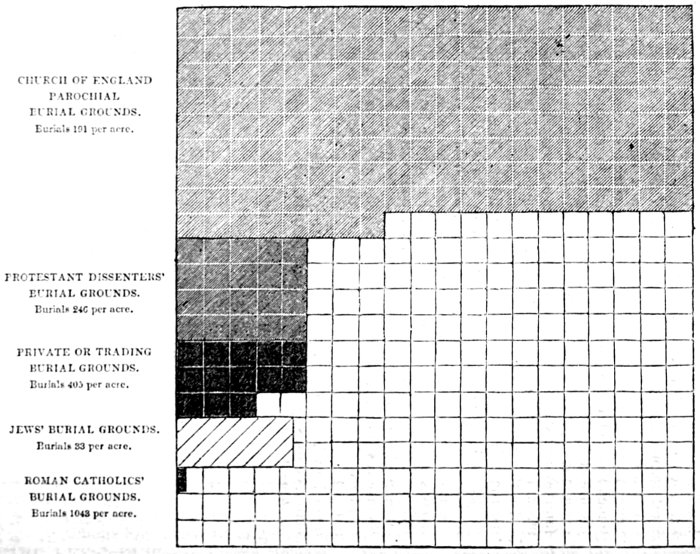
VIEW OF THE EXTENT OF INTRA-MURAL BURIAL GROUND PROVIDED, AS COMPARED WITH THE QUANTITY REQUIRED FOR THE METROPOLIS, AT THE STANDARD OF 110 PER ACRE.—Vide Report, § 159, § 160, § 161, § 171.
The plan represents the statistical facts and proportions of space after the mode used by Mr. Sopwith, the engineer. Each square of the subjoined plate represents an acre. The extent of squares coloured shows the extent of ground occupied by each religious denomination. The blank spaces show the extent of deficiency of public ground for the burial of the population in single graves.
| 273 |
| BURIAL FEES.—A Return of the Amount of the Burial Fess received by the Clergymen of several of the Parishes of the Metropolis was given in to the Committee of the House of Commons by the Bishop of London. The following Table gives the same Amount of Fees divided by the Returns of the Number of Burials, in the Years 1830, 1831, and 1832, returned from the several Parishes, to an order of the House of Commons made in the Year 1834. |
|---|
| |
| PARISHES. |
No. of Burials in 1830. |
No. of Burials in 1831. |
No. of Burials in 1832. |
Average of the three Years. |
Amount of Burial Fees in 1838. |
Amount of Burial Fees in 1839. |
Amount of Burial Fees in 1840. |
Average Burial Fees, 1838–9–40. |
Average Fee per Burial. |
|
|
|
|
|
£. |
s. |
d. |
£. |
s. |
d. |
£. |
s. |
d. |
£. |
s. |
d. |
£. |
s. |
d. |
| St. James, Westminster |
1,063 |
1,168 |
1,087 |
1,106 |
329 |
0 |
0 |
298 |
0 |
0 |
246 |
0 |
0 |
291 |
0 |
0[66] |
0 |
5 |
3 |
| St. Botolph, Bishopsgate |
248 |
300 |
319 |
289 |
36 |
1 |
2 |
42 |
7 |
2 |
23 |
9 |
10 |
33 |
19 |
4 |
0 |
2 |
3 |
| St. George the Martyr |
158 |
218 |
147 |
174 |
70 |
12 |
6 |
59 |
5 |
10 |
59 |
0 |
8 |
62 |
19 |
8 |
0 |
7 |
3 |
| St. John, Westminster |
815 |
893 |
984 |
897 |
123 |
7 |
0 |
93 |
19 |
8 |
105 |
13 |
7 |
107 |
13 |
5 |
0 |
2 |
5 |
| St. George in the East |
705 |
681 |
802 |
729 |
101 |
15 |
0 |
101 |
8 |
6 |
74 |
8 |
6 |
92 |
10 |
8 |
0 |
2 |
6 |
| St. Bride |
162 |
223 |
175 |
187 |
51 |
6 |
8 |
51 |
2 |
0 |
81 |
2 |
4[67] |
61 |
3 |
8 |
0 |
6 |
7 |
| St. Giles and St. George, Bloomsbury |
1,296 |
1,669 |
1,934 |
1,633 |
1,038 |
4 |
0 |
768 |
4 |
0 |
870 |
15 |
0 |
892 |
7 |
8 |
0 |
10 |
11 |
| St. Dunstan, Westminster |
115 |
113 |
122 |
117 |
39 |
9 |
2 |
24 |
0 |
8 |
35 |
5 |
10 |
32 |
18 |
7 |
0 |
5 |
8 |
| St. Clement Danes |
395 |
524 |
494 |
471 |
121 |
14 |
9 |
112 |
19 |
10 |
86 |
3 |
4 |
106 |
19 |
4 |
0 |
4 |
6 |
| Bethnal Green |
617 |
951 |
1,064 |
877 |
71 |
4 |
0 |
67 |
4 |
0 |
62 |
3 |
6 |
66 |
17 |
2 |
0 |
1 |
6 |
| St. Botolph, Aldersgate |
140 |
169 |
160 |
156 |
60 |
8 |
4 |
58 |
2 |
8 |
45 |
10 |
0 |
54 |
13 |
8 |
0 |
7 |
0 |
| St. George, Hanover Sq. |
1,224 |
1,389 |
1,389 |
1,334 |
597 |
17 |
0 |
423 |
8 |
2 |
488 |
11 |
2 |
503 |
5 |
5 |
0 |
7 |
7 |
| St. Giles, Cripplegate |
231 |
225 |
307 |
254 |
87 |
9 |
6 |
66 |
6 |
10 |
56 |
14 |
10 |
70 |
3 |
9 |
0 |
5 |
6 |
| St. Andrew, Holborn |
587 |
586 |
847 |
673 |
306 |
0 |
1 |
324 |
14 |
1 |
223 |
15 |
2 |
284 |
16 |
5 |
0 |
8 |
6 |
| St. Catherine Cree |
36 |
33 |
40 |
36 |
75 |
3 |
6 |
43 |
16 |
6 |
56 |
13 |
6 |
58 |
11 |
2 |
1 |
12 |
6 |
| St. Olave, Hart Street |
22 |
19 |
28 |
23 |
60 |
8 |
0 |
37 |
4 |
0 |
32 |
2 |
0 |
43 |
4 |
8 |
1 |
17 |
7 |
| Allhallows Barking |
50 |
64 |
66 |
60 |
31 |
9 |
6 |
7 |
19 |
0 |
15 |
16 |
6 |
18 |
11 |
8 |
1 |
6 |
2 |
| Total |
7,864 |
9,224 |
9,965 |
9,016 |
3,202 |
0 |
2 |
2,580 |
2 |
11 |
2,563 |
5 |
9 |
2,781 |
16 |
3 |
0 |
6 |
2 |
| N.B.—This List specifics only the Clergyman’s Fees, not those paid to the Churchwardens, Clerk, or Sexton. |
| 274 |
| PAROCHIAL BURIAL-GROUNDS IN THE METROPOLIS. |
|---|
| |
| PLACES OF BURIAL. |
Population in 1841. |
Estimated Extent in Square Yards. |
Annual Number of Burials. |
No. of Burials per Acre. |
| Allhallows Barking, Great Tower Street |
1,924 |
825 |
50 |
293 |
| All hallows, Bread Street |
263 |
100 |
‘Scarcely any’ |
|
| Allhallows, Lombard Street |
516 |
350 |
‘Seldom used.’ |
|
| Allhallows, London Wall |
1,620 |
615 |
24 |
189 |
| Allhallows, Staining Lane |
502 |
619 |
20 |
156 |
| Allhallows-the-Great, Thames Street |
672 |
346} |
50 |
319 |
| Allhallows-the-Less, ditto |
181 |
412} |
|
|
| Alphage, St. London Wall |
976 |
388 |
50 |
624 |
| Andrew’s. St |
35,301 |
4,840 |
250 |
250 |
| Andrew’s, St. Burial-ground, Gray’s Inn Lane |
|
9,258 |
312 |
163 |
| Andrew’s, St. Undershaft |
1,163 |
265 |
70 |
1,278 |
| Andrew’s, St. Wardrobe, and St. Ann, Blackfriars |
3,596 |
657 |
100 |
737 |
| Anne, St. and St. Agnes within Aldersgate |
513 |
1,650 |
70 |
205 |
| Ann’s, St. Limehouse |
19,337 |
24,500 |
150 |
30 |
| Anne’s, St. Soho |
16,480 |
2,732 |
200 |
354 |
| Augustine’s, St. and St. Faith’s. |
1,070 |
3,700 |
30 |
39 |
| Bartholomew, St. the Great |
3,414 |
783 |
100 |
618 |
| Bartholomew, St. the Less |
744 |
183 |
8 |
212 |
| Benet, St. Fink |
383 |
277 |
6 |
105 |
| Benet, St. Paul’s Wharf |
588 |
297 |
36 |
587 |
| Bennet, St. Sherehog |
145 |
145 |
‘Seldom used.’ |
|
| Botolph, St. Aldersgate |
5,906 |
1,918 |
250 |
631 |
| Botolph, St. Aldgate |
9,525 |
1,545 |
250 |
783 |
| Botolph, St. Bishopsgate |
10,969 |
3,034 |
250 |
399 |
| Botolph, St. by Billingsgate |
278 |
266 |
3 |
55 |
| Bride’s, St. Fleet Street } |
6,126 |
1,472 |
130 |
427 |
| Ditto, Ground in Farringdon Street } |
|
|
|
|
| [68]Bridewell Chapel |
529 |
2,400 |
10 |
20 |
| Broadway Chapel of Ease to St. Margaret’s and St. John |
|
7,220 |
500 |
335 |
| Catherine, St. Coleman Street |
322 |
388 |
36 |
449 |
| Catherine, St. Cree, or Christchurch |
1,740 |
1,100 |
100 |
440 |
| Chapel Royal, Tower |
|
525 |
4 |
37 |
| Charlton Church |
|
2,150 |
30 |
68 |
| Chelsea Hospital Burial-ground |
Vide St. Luke. |
6,696 |
55 |
40 |
| Chelsea Old Church |
Vide St. Luke. |
1,210 |
6 |
24 |
| Christ Church, Blackfriars Road |
|
8,448 |
520 |
298 |
| Christ Church, Newgate Street |
2,446 |
1,934 |
30 |
75 |
| Christ Church, Spitalfields |
20,436 |
6,413 |
350 |
264 |
| Clement, St. Danes |
15,459 |
1,736 |
100 |
279 |
| Clement, St. Danes, 2nd Ground, Portugal Street |
|
1,422 |
300 |
1,021 |
| Cripplegate Poor-ground, Warwickplace, St. Luke’s |
|
1,400 |
100 |
346 |
| Dionis, St. Backchurch |
806 |
132 |
20 |
733 |
| Dunstan, St. Fleet Street |
3,266 |
851 |
208 |
1,182 |
| Dunstan, St. in the East |
1,010 |
600 |
150 |
1,210 |
| Dunstan, St. Stepney |
63,723 |
21,795 |
200 |
44 |
| East India Company’s Chapel Yard, High Street Poplar |
|
6,447 |
60 |
45 |
| Edmund, St. the King |
391 |
164 |
‘Seldom used.’ |
|
| Ethelburga, St. |
669 |
240 |
30 |
605 |
| 275Fulham Church |
9,319 |
12,000 |
200 |
81 |
| George’s, St. Bloomsbury |
16,981 |
12,100 |
300 |
120 |
| George, St. Botolph Lane |
235 |
76 |
2 |
127 |
| George’s, St. District Church, Camberwell |
39,868 |
11,640 |
100 |
42 |
| George, St. Hanover Square, Burial-ground, Uxbridge Road |
66,453 |
21,200 |
1,200 |
240 |
| George, St. in the East |
41,350 |
15,000 |
500 |
161 |
| George, St. the Martyr |
Vide St. Andrew’s. |
12,100 |
200 |
80 |
| George, St. Burial-ground, Old Kent Road |
46,644 |
1,368 |
130 |
460 |
| George, St. the Martyr, Southwark |
|
4,050 |
470 |
562 |
| Giles, St. Camberwell |
39,868 |
16,000 |
500 |
151 |
| Giles, St. Cripplegate |
13,255 |
4,700 |
200 |
206 |
| Giles, St. in the Fields |
37,311 |
4,958 |
400 |
390 |
| Ditto, Burial-ground, St. Pancras |
|
24,200 |
1,560 |
312 |
| Greenwich Church |
29,755 |
2,740 |
700 |
1,236 |
| [69]Greenwich Hospital Burial-ground |
|
22,480 |
300 |
65 |
| Gregory, St. by St. Paul’s |
1,444 |
1,095 |
100 |
442 |
| Grosvenor Chapel, South Audley Street |
|
6,000 |
36 |
29 |
| [69]Guy’s Hospital Ground, Snow’s Fields |
|
3,120 |
85 |
132 |
| Hackney, South |
Vide St. John |
3,300 |
100 |
145 |
| Hackney, West |
Vide St. John |
6,534 |
200 |
148 |
| Helen, St. Great |
659 |
779 |
30 |
186 |
| Holy Trinity, Brompton |
9,515 |
26,524 |
100 |
18 |
| Islington Chapel of Ease |
|
17,659 |
416 |
114 |
| James, St. Chapel of Ease, Clerkenwell |
|
3,500 |
350 |
484 |
| James, St. Clerkenwell |
56,756 |
2,000 |
400 |
968 |
| James, St. Burial-ground, Ray Street, Clerkenwell |
|
800 |
150 |
907 |
| James, St. Clerkenwell, 2nd Ground |
|
1,000 |
300 |
1,452 |
| James, St. Duke’s Place |
964 |
338 |
15 |
215 |
| James, St. Garlickhithe |
520 |
162 |
20 |
598 |
| James, St. New Church |
|
8,100 |
260 |
155 |
| James, St. Piccadilly |
|
4,840 |
60 |
60 |
| Ditto, Burial-ground, Hampstead Road |
|
26,620 |
624 |
113 |
| John, St. Baptist, Savoy |
414 |
600 |
50 |
403 |
| John’s, St. Chapel of Ease |
|
26,000 |
1,560 |
290 |
| John’s. St. Chapel, Walworth |
|
6,400 |
150 |
113 |
| John’s, St. Church, Waltham Green |
|
3,600 |
15 |
20 |
| John’s, St. Clerkenwell |
Vide St. James |
315 |
200 |
3,073 |
| Ditto, Burial-ground, Benjamin Street |
|
1,079 |
12 |
54 |
| John, St. the Evangelist |
108 |
7,260 |
500 |
333 |
| John, St. the Evangelist, Horslydown |
|
9,740 |
250 |
124 |
| John, St. the Evangelist, Great Waterloo Street |
|
5,924 |
400 |
327 |
| John’s, St. Hackney |
37,771 |
31,000 |
700 |
108 |
| John, St. the Baptist |
367 |
363 |
12 |
160 |
| John, St. High Street, Wapping |
4,108 |
6,600 |
250 |
183 |
| John’s, St. Hoxton |
|
6,050 |
600 |
480 |
| John, St. Zachary |
183 |
905 |
6 |
32 |
| 276King’s Road, Chelsea |
|
4,840 |
130 |
130 |
| Lawrence, St. Jewry |
625 |
200 |
35 |
847 |
| Leonard’s, St. Ground, Hackney Road |
|
2,000 |
225 |
544 |
| Leonard’s, St. Shoreditch |
83,432 |
8,000 |
300 |
181 |
| Luke’s, St. Burial-ground, Bath Street |
|
1,240 |
200 |
781 |
| Luke, St. Chelsea, New Church |
40,179 |
19,360 |
468 |
117 |
| Luke’s, St. Old Street |
49,829 |
9,287 |
500 |
261 |
| Magnus, St. |
239 |
44 |
6 |
660 |
| Margaret’s. St |
|
5,000 |
50 |
48 |
| Margaret, St. Lothbury |
189 |
291 |
12 |
300 |
| Margaret, St. Pattens, with } |
553 |
81 |
‘Closed’ |
|
| St. Gabriel, Fenchurch Street } |
|
473 |
4 |
41 |
| Mark’s, St. Kennington |
|
8960 |
500 |
270 |
| Martin, St. in the Fields, Burial-ground, Camden Town |
|
19,360 |
832 |
208 |
| Ditto, Burial-ground, Drury Lane |
|
1,269 |
40 |
153 |
| Martin, St. Orgars |
353 |
99 |
‘Seldom used’ |
|
| Martin. St. Outwich |
135 |
123 |
12 |
472 |
| Martin, St. Vintry |
288 |
450 |
3 |
32 |
| Mary, St. Abbotts, Kensington |
26,834 |
6,620 |
330 |
241 |
| Mary, St. Abchurch, with St. Lawrence Pountney |
907 |
566 |
6 |
51 |
| Mary, St. Aldermanbury |
751 |
313 |
30 |
464 |
| Mary’s, St. Burial-ground |
|
2,776 |
200 |
349 |
| Mary, St. Aldermary |
494 |
173 |
8 |
224 |
| Mary, St. at Hill |
987 |
167 |
40 |
1,159 |
| Mary, St. at Bow |
|
2,716 |
52 |
93 |
| Mary, St. Chapel, Hammersmith |
|
8,960 |
20 |
11 |
| Mary, St. Haggerstone |
|
7,260 |
100 |
67 |
| Mary, St. Lambeth |
115,888 |
2,400 |
250 |
504 |
| Mary, St. Islington |
55,690 |
7,450 |
750 |
487 |
| Mary, St. le-Strand, Burial-ground, Russell Court |
|
473 |
90 |
921 |
| Mary, St. le-Strand |
2,520 |
200 |
12 |
290 |
| Mary. St. Love Lane |
|
100 |
‘Seldom used’ |
|
| Mary Magdalen, St |
|
288 |
12 |
202 |
| Mary Magdalen, St. Bermondsey |
34,947 |
9,184 |
600 |
316 |
| Mary’s, St. Newington |
54,606 |
8,160 |
350 |
208 |
| Mary’s, St. Paddington |
25,173 |
20,116 |
936 |
222 |
| Mary’s, St. Rotherhithe, and |
13,917 |
11,800 } |
345 |
139 |
| Trinity District Church |
|
200 } |
|
|
| Mary, St. Somerset |
375 |
389 |
‘Seldom used’ |
|
| Mary. St. Staining |
268 |
423 |
|
|
| Mary’s, St. Stoke Newington |
|
3,000 |
50 |
81 |
| Mary’s, St. Whitechapel |
34,053 |
4,219 |
150 |
172 |
| Ditto. Workhouse-ground |
|
2,776 |
200 |
349 |
| Mary, St. Woolnoth |
317 |
33 |
‘Very few’ |
|
| Mary, St. Woolwich |
25,785 |
12,800 |
600 |
227 |
| Mary-le-bone, St. |
138,164 |
13,500 |
520 |
186 |
| Mary-le-bone, St. Old Church, High Street |
1138,164 |
12,000 |
36 |
87 |
| Mary-le-Bow, St |
346 |
250 |
30 |
581 |
| Matthew, St. Bethnal Green |
74,088 |
12,100 |
600 |
240 |
| Matthew, St. Friday Street |
160 |
208 |
21 |
489 |
| Michael, St. Bassishaw |
687 |
222 |
30 |
654 |
| Michael, St. Cornhill |
454 |
240 |
6 |
121 |
| Michael, St. Queenhithe |
647 |
266 } |
30 |
342 |
| Ditto, Burial-ground, Trinity Lane |
|
158 } |
|
|
| Mildred, St. Bread Street |
351 |
242 |
‘Seldom used’ |
|
| 277Mildred, St. Poultry |
280 |
84 |
|
|
| Nicholas, St. Acon |
194 |
287 |
|
|
| Nicholas, St. Cole Abbey |
254 |
67 |
‘Never used’ |
|
| Nicholas, St. Olave |
431 |
334 |
20 |
290 |
| Pancras, St. Old Church |
129,763 |
24,200 |
400 |
80 |
| Paradise Row Burying-ground |
|
8,532 |
1,040 |
590 |
| [70]Paul’s, St. Cathedral |
|
3,745 |
‘Seldom used’ |
|
| Paul’s. St. Covent Garden |
5,718 |
4,064 } |
200 |
129 |
| Ditto. Burial-ground contiguous to workhouse |
|
3,455} |
|
|
| Paul’s, St. Deptford |
|
12,000 |
360 |
145 |
| Paul’s, St. Hammersmith |
9,888 |
6,888 |
200 |
141 |
| Paul’s, St. Shadwell |
10,060 |
3,000 |
250 |
403 |
| [71]Penitentiary Burial Ground |
|
432 |
10 |
112 |
| Peter, St. Cheap, corner of Wood St |
227 |
96 |
‘Never used’ |
|
| Peter, St. Cornhill |
656 |
287 |
40 |
674 |
| Peter, St. District Church, Walworth |
|
7,800 |
300 |
186 |
| Peter-le-Poor, St. |
559 |
48 |
‘Seldom used’ |
|
| Peter’s, St. New Church, Hammersmith |
3,565 |
1,210 |
50 |
200 |
| Peter, St. Paul’s Wharf |
341 |
292 |
‘Seldom used’ |
|
| Poplar New Church |
20,342 |
14,686 |
300 |
99 |
| Olave, St. Hart Street |
816 |
462 |
36 |
377 |
| Olave, St. Jewry |
168 |
306 |
‘Seldom used’ |
|
| Olave, St. Silver Street |
972 |
335 |
‘Never used’ |
|
| Olave’s, St. Tooley Street |
6,745 |
770 |
200 |
1,257 |
| Saviour’s, St |
18,219 |
2,700 } |
|
|
| Ditto, Cross Bones Ground, Red Cross Street } |
|
4,500 } |
244 |
143 |
| Ditto. College Park Street |
|
1,040 } |
|
|
| Sepulchre, St |
|
1,746 } |
|
|
| Ditto, in Church Lane |
12,325 |
1,785 } |
256 |
293 |
| Ditto, in Durham Yard |
|
702 } |
|
|
| Stephen, St. Walbrook |
322 |
306 |
50 |
791 |
| Swithin’s, St. Cannon Street |
389 |
241 |
20 |
402 |
| Ditto, 2nd Ground |
|
66 |
24 |
1,760 |
| Temple Church, St. Mary’s |
|
400 |
‘Very few’ |
|
| Thomas Apostle, St. |
648 |
340 |
‘Seldom used’ |
|
| [71]Thomas, St. Hospital Ground, Snow’s Fields |
|
1,449 |
84 |
282 |
| Trinity Church, Minories |
579 |
302 |
7 |
112 |
| Vedast, St |
427 |
108 |
|
179 |
| 278 |
| PROTESTANT DISSENTERS’ BURIAL-GROUNDS AND OTHERS. |
|---|
| |
| PLACES OF BURIAL. |
Estimated Extent in Sq. Yards. |
Annual Number of Burials. |
No. of Burials per Acre. |
| Episcopalians. |
|
|
|
| |
|
|
|
| St. Leonard’s, Chapel, Bromley |
270 |
52 |
932 |
| St. George’s, Chapel, New Road |
3,250 |
125 |
186 |
| |
|
|
|
| Presbyterians. |
|
|
|
| |
|
|
|
| Gravel Pit Chapel, Hackney |
3,300 |
100 |
147 |
| St. Andrew’s, Scotch Church |
900 |
100 |
538 |
| |
|
|
|
| Congregationalists or Independents. |
|
|
|
| |
|
|
|
| Independent Chapel, Greenwich |
1,000 |
100 |
484 |
| Pulling’s Chapel, Deptford |
400 |
50 |
605 |
| Wickliffe Chapel, Stepney |
600 |
150 |
1,210 |
| Ebenezer Chapel, Shadwell |
680 |
120 |
854 |
| Dr. Burder’s, Hackney |
3,168 |
100 |
153 |
| Meeting House, Old Gravel Lane |
60 |
4 |
23 |
| Esher Street, Lambeth |
1,210 |
72 |
288 |
| Brunswick Chapel, Three Colts Street |
480 |
72 |
524 |
| Collier’s Rents, Borough |
970 |
50 |
249 |
| Abney Chapel, Stoke Newington |
780 |
36 |
223 |
| Mile End Chapel |
2,420 |
52 |
104 |
| Trinity Chapel, Poplar |
1,200 |
36 |
145 |
| Stockwell Green |
725 |
‘Very few’ |
|
| |
|
|
|
| Baptists. |
|
|
|
| |
|
|
|
| Enon Chapel, Woolwich |
112 |
25 |
1,080 |
| Worship Street Chapel |
720 |
30 |
202 |
| Regent Street, Lambeth |
320 |
12 |
181 |
| Cox’s, Dr., Chapel, Hackney |
824 |
26 |
153 |
| Maze Pond |
650 |
10 |
74 |
| East Street Chapel |
140 |
2 |
69 |
| Hammersmith |
2,420 |
30 |
60 |
| |
|
|
|
| Wesleyan Methodists. |
|
|
|
| |
|
|
|
| Methodist Chapel, Woolwich |
1,226 |
100 |
395 |
| City Road Chapel |
2,148 |
150 |
338 |
| Stafford Street, Peckham |
336 |
16 |
230 |
| Wesleyan Chapel, Hammersmith |
2,430 |
18 |
36 |
| Southwark Chapel, Long Lane, Borough |
780 |
‘Very few’ |
|
| |
|
|
|
| Roman Catholics. |
|
|
|
| |
|
|
|
| Parker Row, Dockhead |
300 |
100 |
1,613 |
| Moorfields |
120 |
30 |
1,210 |
| Poplar |
833 |
140 |
813 |
| |
|
|
|
| Quakers. |
|
|
|
| |
|
|
|
| Long Lane, Bermondsey |
2,728 |
60 |
106 |
| Coleman Street |
4,759 |
35 |
35 |
| Hammersmith |
1,210 |
1 or 2 |
6 |
| 279 |
|
|
|
| Jews. |
|
|
|
| |
|
|
|
| Mile End Road |
4,840 |
52 |
52 |
| North Street, Mile End Road |
24,200 |
200 |
40 |
| Chelsea |
4,800 |
22 |
22 |
| Grove Street |
10,890 |
30 |
13 |
| |
|
|
|
| Foreign. |
|
|
|
| |
|
|
|
| Swedish Chapel |
450 |
10 |
108 |
| |
|
|
|
| Undescribed. |
|
|
|
| |
|
|
|
| Union Chapel, Woolwich |
1,500 |
100 |
323 |
| Cannon Street Road |
2,400 |
550 |
1,109 |
| Paradise Row, Lambeth |
8,532 |
1,040 |
590 |
| New Bunhill Fields, Islington |
4,300 |
520 |
585 |
| Ebenezer Chapel, Long Lane |
265 |
20 |
365 |
| Bunhill Fields |
18,150 |
600 |
160 |
| Zion Chapel, High Street, Borough |
210 |
2 |
46 |
| Poplar Chapel |
8,000 |
52 |
31 |
| Maberly Chapel |
270 |
3 |
54 |
| Brook Street, Ratcliffe Highway |
700 |
2 or 3 |
21 |
| Millyard Chapel |
960 |
1 |
5 |
| Whitfield’s Chapel, St. Pancras |
4,650 |
300 |
312 |
| York Street Chapel, Lock’s Fields |
1,860 |
‘Very few’ |
|
| Denmark Row, Cold Harbour Lane |
400 |
|
|
| Salem Chapel, Woolwich |
360 |
‘Seldom any’ |
|
| Little Alie Street, Goodman’s Fields |
‘Small’ |
6 |
|
| GENERAL BURIAL-GROUNDS. |
|---|
| |
| PLACES OF BURIAL. |
Estimated Extent in Sq. Yards. |
Annual Number of Burials. |
No. of Burials per Acre. |
| [72]Bunhill Fields, City |
8,000 |
1,000 |
605 |
| [72]Bunhill Fields, New |
3,250 |
1,560 |
2,323 |
| [72]John’s, St., Borough |
1,440 |
142 |
477 |
| [72]London, North East |
24,200 |
250 |
50 |
| [72]Sheen’s New Ground |
9,680 |
600 |
300[72] |
| Spa Fields |
14,520 |
1,560 |
520 |
| CEMETERIES. |
|---|
| |
| PLACES OF BURIAL. |
Estimated Extent in Sq. Yards. |
Annual Number of Burials. |
No. of Burials per Acre. |
| Highgate Cemetery |
101,640 |
220 |
10 |
| Nunhead ditto |
242,000 |
208 |
4 |
| East London ditto, Beaumont Square, Mile End |
26,620 |
850 |
154 |
| City of London and Tower Hamlets ditto, Mile End |
135,520 |
624 |
22 |
| West of London and Westminster ditto, Earls Court, Brompton |
193,600 |
254 |
6 |
| South Metropolitan ditto, Norwood |
193,600 |
180 |
5 |
| Kensal Green. All Souls’ Cemetery |
222,640 |
800 |
17 |
| Abney Park Cemetery |
145,200 |
200 |
7 |
280LONDON:
Printed by William Clowes and Sons, Stamford-street.
For Her Majesty’s Stationery Office.