This chapter sets forth the findings of the Commission as to
whether Lee Harvey Oswald had any accomplices in the
planning or execution of the assassination. Particularly
after the slaying of Oswald by Jack Ruby under the circumstances
described in the preceding chapter, rumors and suspicions developed
regarding the existence of a conspiracy to assassinate President
Kennedy. As discussed in appendix XII, many of these rumors
were based on a lack of information as to the nature and extent
of evidence that Oswald alone fired the shots which killed President
Kennedy and wounded Governor Connally. Others of the more
widely publicized rumors maintained that Oswald must have received
aid from one or more persons or political groups, ranging
from the far left to the far right of the political spectrum, or from
a foreign government, usually either the Castro regime in Cuba
or the Soviet Union.
The Commission faced substantial difficulties in determining
whether anyone conspired with or assisted the person who committed
the assassination. Prior to his own death Oswald had neither admitted
his own involvement nor implicated any other persons in the assassination
of the President. The problem of determining the existence or
nonexistence of a conspiracy was compounded because of the possibility
of subversive activity by a foreign power. Witnesses and evidence
located in other countries were not subject to subpena, as they would
have been if they had been located in the United States. When evidence
was obtained from a foreign nation, it could not be appraised as
effectively as if it had been derived from a domestic source. The
Commission has given the closest scrutiny to all available evidence
which related or might have related to a foreign country. All such
evidence was tested, whenever possible, against the contingency that
it had been fabricated or slanted to mislead or confuse.
In order to meet its obligations fully, the Commission has investigated
each rumor and allegation linking Oswald to a conspiracy which
has come to its attention, regardless of source. In addition, the Commission
has explored the details of Lee Harvey Oswald’s activities and
life, especially in the months immediately preceding the assassination,
in order to develop any investigative lead relevant to the issue of
conspiracy. All of Oswald’s known writings or other possessions
which might have been used for code or other espionage purposes have
been examined by either the Federal Bureau of Investigation or the
National Security Agency, or both agencies, to determine whether
they were so used.C6-1
In setting forth the results of this investigation, the first section of
this chapter reviews the facts related to the assassination itself, previously
considered in more detail in chapter IV. If any conspiracy
did exist, it might have manifested itself at some point during
Oswald’s preparation for the shooting, his execution of the plan, or his
escape from the scene of the assassination. The Commission has
therefore studied the precise means by which the assassination occurred
for traces of evidence that Oswald received any form of assistance in
effecting the killing.
The second section of the chapter deals more broadly with Oswald’s
life since 1959. During the period following his discharge from the
Marines in 1959, Oswald engaged in several activities which demand
close scrutiny to determine whether, through these pursuits, he developed
any associations which were connected with the planning or
execution of the assassination. Oswald professed commitment to
Marxist ideology; he defected to the Soviet Union in 1959; he attempted
to expatriate himself and acquire Soviet citizenship; and he
resided in the Soviet Union until June of 1962. After his return to the
United States he sought to maintain contacts with the Communist
Party, Socialist Workers Party, and the Fair Play for Cuba Committee;
he associated with various Russian-speaking citizens in the Dallas-Fort
Worth area—some of whom had resided in Russia; he traveled
to Mexico City where he visited both the Cuban and Soviet Embassies
7 weeks before the assassination; and he corresponded with the Soviet
Embassy in Washington, D.C. In view of these activities, the Commission
has instituted a thorough investigation to determine whether
the assassination was in some manner directed or encouraged through
contacts made abroad or through Oswald’s politically oriented activities
in this country. The Commission has also considered whether
any connections existed between Oswald and certain right-wing activity
in Dallas which, shortly before the assassination, led to the publication
of hostile criticism of President Kennedy.
The final section of this chapter considers the possibility that Jack
Ruby was part of a conspiracy to assassinate President Kennedy.
The Commission explored Ruby’s background and his activities in the
months prior to the assassination, and especially his activities in the
2 days after the assassination, in an effort to determine whether there
was any indication that Ruby was implicated in that event. The Commission
also sought to ascertain the truth or falsity of assertions that
Oswald and Ruby were known to one another prior to the assassination.
In considering the question of foreign involvement, the Commission
has received valuable assistance from the Department of State,
the Central Intelligence Agency, the Federal Bureau of Investigation,
and other Federal agencies with special competence in the field of foreign
investigation. Some of the information furnished by these agencies
is of a highly confidential nature. Nevertheless, because the
disclosure of all facts relating to the assassination of President Kennedy
is of great public importance, the Commission has included in
this report all information furnished by these agencies which the
Commission relied upon in coming to its conclusions, or which tended
to contradict those conclusions. Confidential sources of information,
as contrasted with the information itself, have, in a relatively few
instances, been withheld.
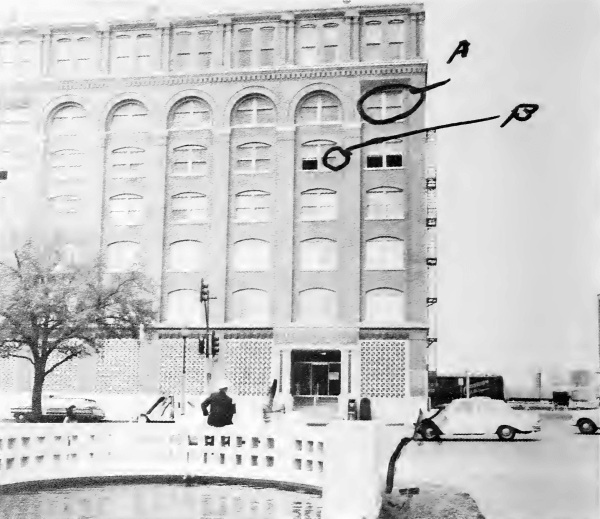
Earlier chapters have set forth the evidence upon which the Commission
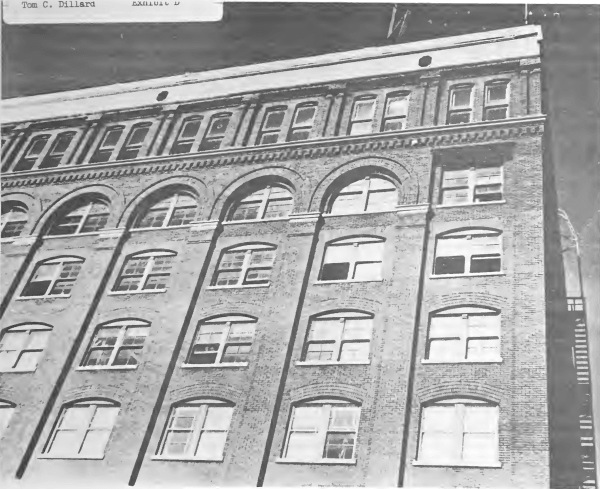
concluded that President Kennedy was fired upon from a
single window in the southeast corner of the sixth floor of the Texas
School Book Depository, and that Lee Harvey Oswald was the person
who fired the shots from this point. As reflected in those chapters,
a certain sequence of events necessarily took place in order for the
assassination to have occurred as it did. The motorcade traveled past
the Texas School Book Depository; Oswald had access to the sixth
floor of the building; Oswald brought the rifle into the building;
the cartons were arranged at the sixth-floor window; and Oswald escaped
from the building before the police had sealed off the exits. Accordingly,
the Commission has investigated these circumstances to
determine whether Oswald received help from any other person in
planning or performing the shooting.
The factors involved in the choice of the motorcade route by the
Secret Service have been discussed in chapter II of this report.C6-2 It
was there indicated that after passing through a portion of suburban
Dallas, the motorcade was to travel west on Main Street, and then to
the Trade Mart by way of the Stemmons Freeway, the most direct
route from that point. This route would take the motorcade along the
traditional parade route through downtown Dallas; it allowed the
maximum number of persons to observe the President; and it enabled
the motorcade to cover the distance from Love Field to the Trade
Mart in the 45 minutes allocated by members of the White House staff
planning the President’s schedule in Dallas. No member of the Secret
Service, the Dallas Police Department, or the local host committee
who was consulted felt that any other route would be preferable.
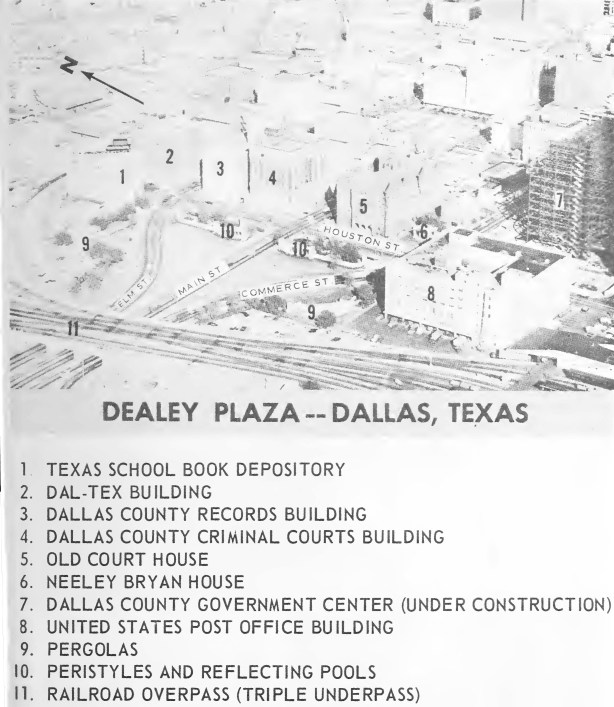
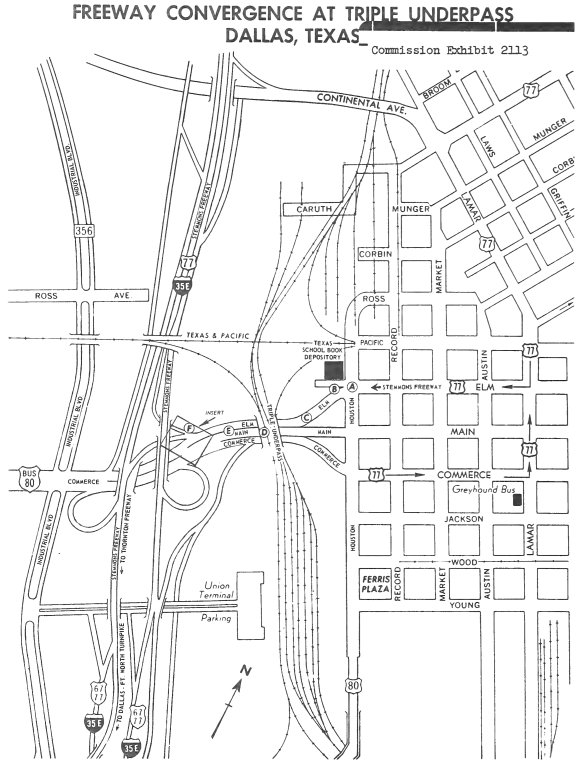
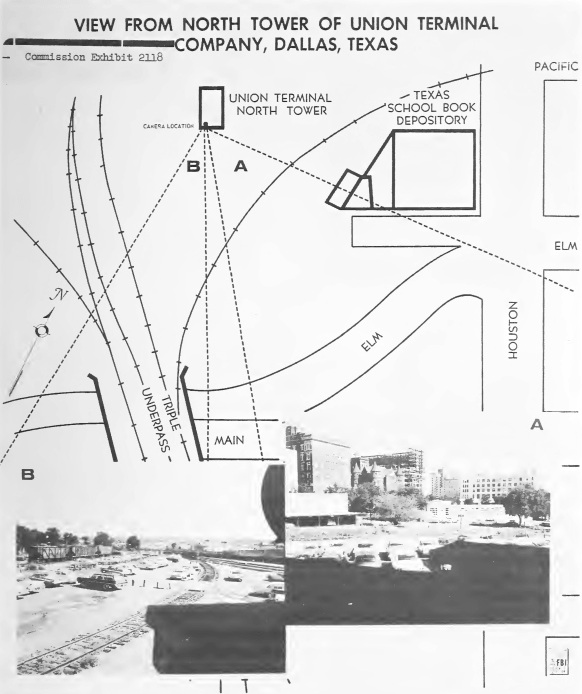
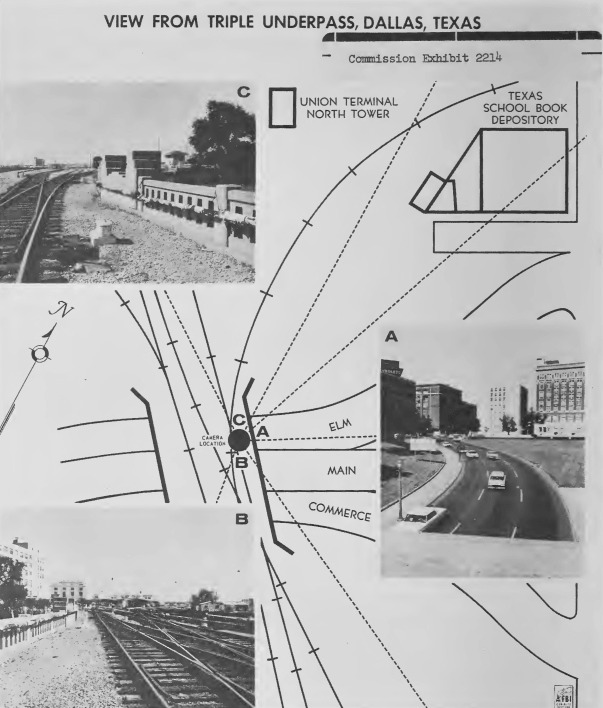
To reach Stemmons Freeway from Main Street, it was determined
that the motorcade would turn right from Main Street onto Houston
Street for one block and then left onto Elm Street, proceeding through
the Triple Underpass to the Stemmons Freeway access road. This
route took the motorcade past the Texas School Book Depository
Building on the northwest corner of Elm and Houston Streets. Because
of the sharp turn at this corner, the motorcade also reduced its
speed. The motorcade would have passed approximately 90 yards
further from the Depository Building and made no turn near the building
if it had attempted to reach the Stemmons Freeway directly from
Main Street. The road plan in Dealey Plaza, however, is designed
to prevent such a turn. In order to keep motorists from reaching
the freeway from Main Street, a concrete barrier has been erected
between Main and Elm Streets extending beyond the freeway entrance.
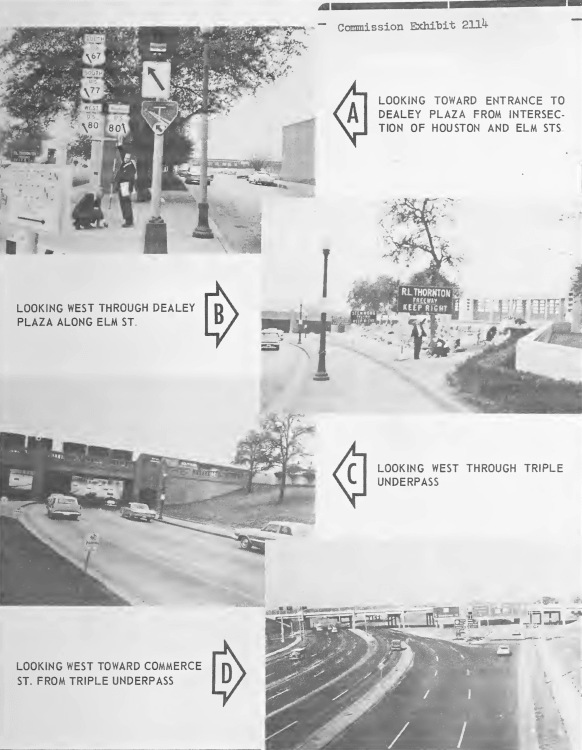
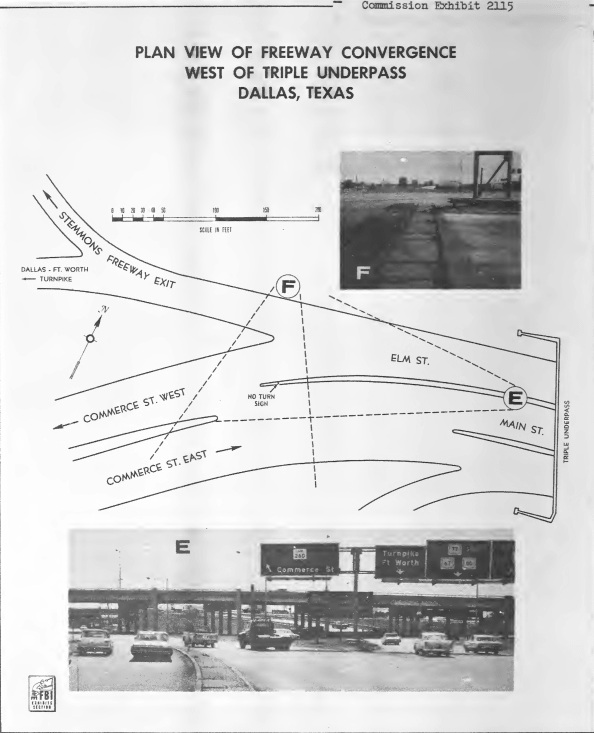
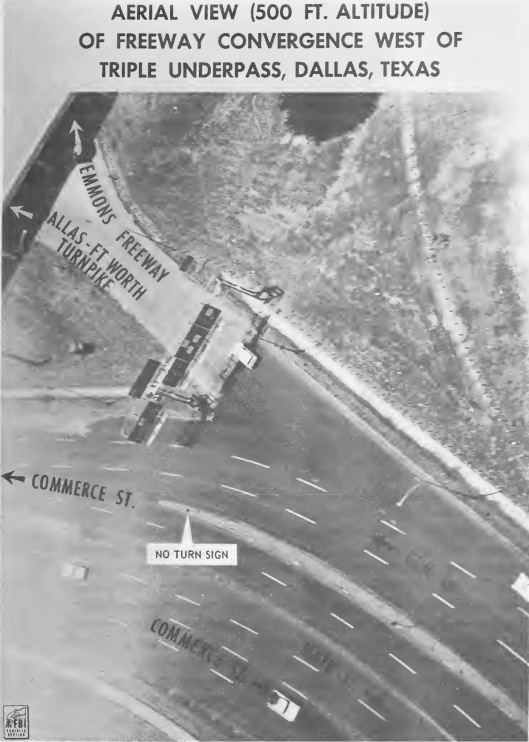
(See Commission Exhibits Nos. 2114-2116, pp. 35-37.) Hence, it
would have been necessary for the motorcade either to have driven
over this barrier or to have made a sharp S-turn in order to have entered
the freeway from Main Street. Selection of the motorcade route
was thus entirely appropriate and based on such legitimate considerations
as the origin and destination of the motorcade, the desired opportunity
for the President to greet large numbers of people, and normal
patterns of traffic.
Oswald’s presence as an employee in the Texas School Book Depository
Building was the result of a series of happenings unrelated to
the President’s trip to Dallas. He obtained the Depository job after
almost 2 weeks of job hunting which began immediately upon his
arrival in Dallas from Mexico on October 3, 1963.C6-3 At that time he
was in poor financial circumstances, having arrived from Mexico City
with approximately $133 or less,C6-4 and with his unemployment compensation
benefits due to expire on October 8.C6-5 Oswald and his wife
were expecting the birth of their second child, who was in fact born on
October 20.C6-6 In attempting to procure work, Oswald utilized normal
channels, including the Texas Employment Commission.C6-7
On October 4, 1963, Oswald applied for a position with Padgett
Printing Corp., which was located at 1313 Industrial Boulevard, several
blocks from President Kennedy’s parade route.C6-8 Oswald favorably
impressed the plant superintendent who checked his prior job
references, one of which was Jaggars-Chiles-Stovall, the firm where
Oswald had done photography work from October 1962 to April 1963.C6-9
The following report was written by Padgett’s plant superintendent
on the reverse side of Oswald’s job application: “Bob Stovall does not
recommend this man. He was released because of his record as a
troublemaker.—Has Communistic tendencies.”C6-10 Oswald received
word that Padgett Printing had hired someone else.C6-11
Oswald’s employment with the Texas School Book Depository came
about through a chance conversation on Monday, October 14, between
Ruth Paine, with whom his family was staying while Oswald was
living in a roominghouse in Dallas, and two of Mrs. Paine’s neighbors.C6-12
During a morning conversation over coffee, at which Marina
Oswald was present, Oswald’s search for employment was mentioned.
The neighbors suggested several places where Oswald might
apply for work. One of the neighbors present, Linnie Mae Randle,
said that her brother had recently been hired as a schoolbook order
filler at the Texas School Book Depository and she thought the Depository
might need additional help. She testified, “and of course
you know just being neighborly and everything, we felt sorry for
Marina because her baby was due right away as we understood it, and
he didn’t have any work * * *.”C6-13
When Marina Oswald and Mrs. Paine returned home, Mrs. Paine
promptly telephoned the Texas School Book Depository and spoke
to Superintendent Roy Truly, whom she did not know.C6-14 Truly agreed
to interview Oswald, who at the time was in Dallas seeking employment.
When Oswald called that evening, Mrs. Paine told him of her
conversation with Truly.C6-15 The next morning Oswald went to the
Texas School Book Depository where he was interviewed and hired
for the position of order filler.C6-16
On the same date, the Texas Employment Commission attempted
to refer Oswald to an airline company which was looking for baggage
and cargo handlers at a salary which was $100 per month higher than
that offered by the Depository Co.C6-17 The Employment Commission
tried to advise Oswald of this job at 10:30 a.m. on October 16, 1963.
Since the records of the Commission indicate that Oswald was then
working,C6-18 it seems clear that Oswald was hired by the Depository Co.
before the higher paying job was available. It is unlikely that he ever
learned of this second opportunity.
Although publicity concerning the President’s trip to Dallas appeared
in Dallas newspapers as early as September 13, 1963, the planning
of the motorcade route was not started until after November 4,
when the Secret Service was first notified of the trip.C6-19 A final decision
as to the route could not have been reached until November 14, when the
Trade Mart was selected as the luncheon site.C6-20 Although news reports
on November 15 and November 16 might have led a person to believe
that the motorcade would pass the Depository Building, the route was
not finally selected until November 18; it was announced in the press
on November 19, only 3 days before the President’s arrival.C6-21 Based
on the circumstances of Oswald’s employment and the planning of the
motorcade route, the Commission has concluded that Oswald’s
employment in the Depository was wholly unrelated to the President’s
trip to Dallas.
On the basis of the evidence developed in chapter IV the Commission
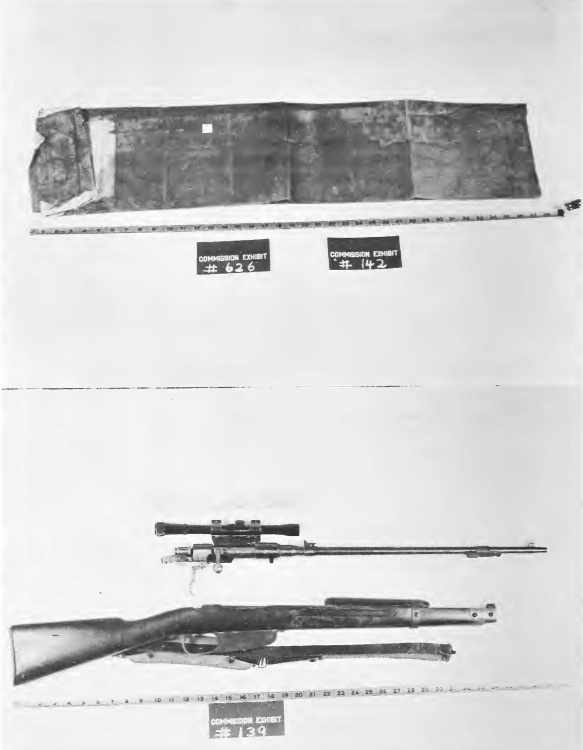
concluded that Lee Harvey Oswald carried the rifle used in the
assassination into the Depository Building on Friday, November 22,
1963, in the handmade brown paper bag found near the window from
which the shots were fired.C6-22 The arrangement by which Buell Wesley
Frazier drove Oswald between Irving and Dallas was an innocent
one, having commenced when Oswald first started working at
the Depository.C6-23 As noted above, it was Frazier’s sister, Linnie May
Randle, who had suggested to Ruth Paine that Oswald might be able
to find employment at the Depository. When Oswald started working
there, Frazier, who lived only a half block away from the Paines,
offered to drive Oswald to and from Irving whenever he was going
to stay at the Paines’ home.C6-24 Although Oswald’s request for a ride to
Irving on Thursday, November 21, was a departure from the normal
weekend pattern, Oswald gave the explanation that he needed to
obtain curtain rods for an “apartment” in Dallas.C6-25 This served also
to explain the long package which he took with him from Irving to
the Depository Building the next morning.C6-26 Further, there is no
evidence that Ruth Paine or Marina Oswald had reason to believe that
Oswald’s return was in any way related to an attempt to shoot the
President the next day. Although his visit was a surprise, since he
arrived on Thursday instead of Friday for his usual weekend visit,
both women testified that they thought he had come to patch up a
quarrel which he had with his wife a few days earlier when she learned
that he was living in Dallas under an assumed name.C6-27
It has also been shown that Oswald had the opportunity to work in
the Paines’ garage on Thursday evening and prepare the rifle by disassembling
it, if it were not already disassembled, and packing it in
the brown bag.C6-28 It has been demonstrated that the paper and tape
from which the bag was made came from the shipping room of the
Texas School Book Depository and that Oswald had access to this material.C6-29
Neither Ruth Paine nor Marina Oswald saw the paper bag or
the paper and tape out of which the bag was constructed.C6-30 If
Oswald actually prepared the bag in the Depository out of materials
available to him there, he could have concealed it in the jacket or shirt
which he was wearing.C6-31 The Commission has found no evidence which
suggests that Oswald required or in fact received any assistance in
bringing the rifle into the building other than the innocent assistance
provided by Frazier in the form of the ride to work.
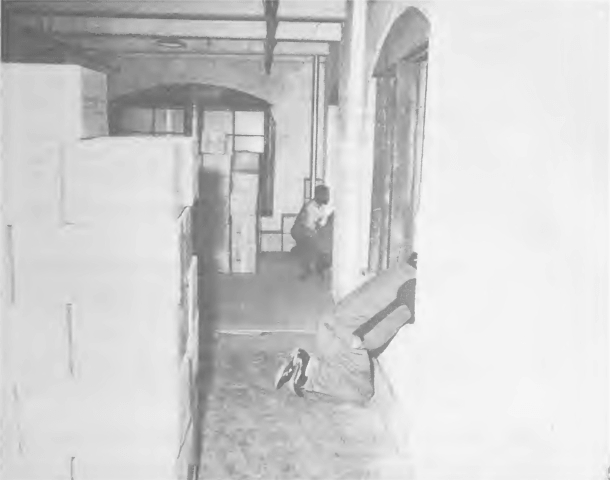
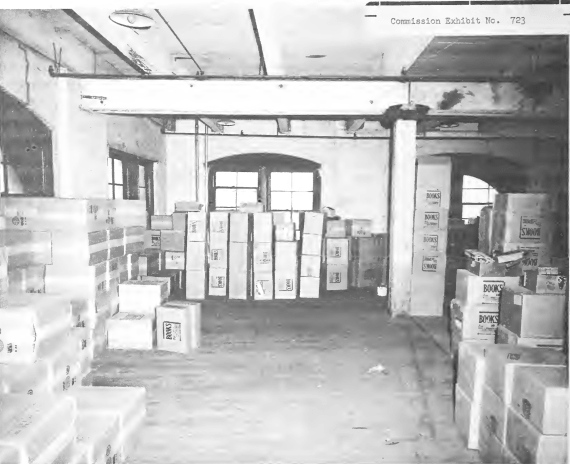
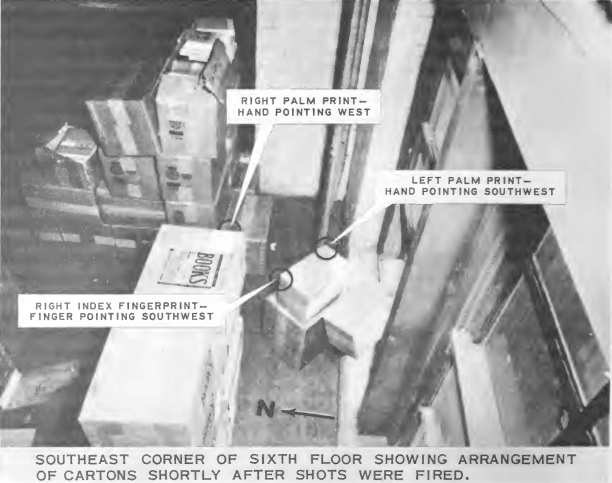
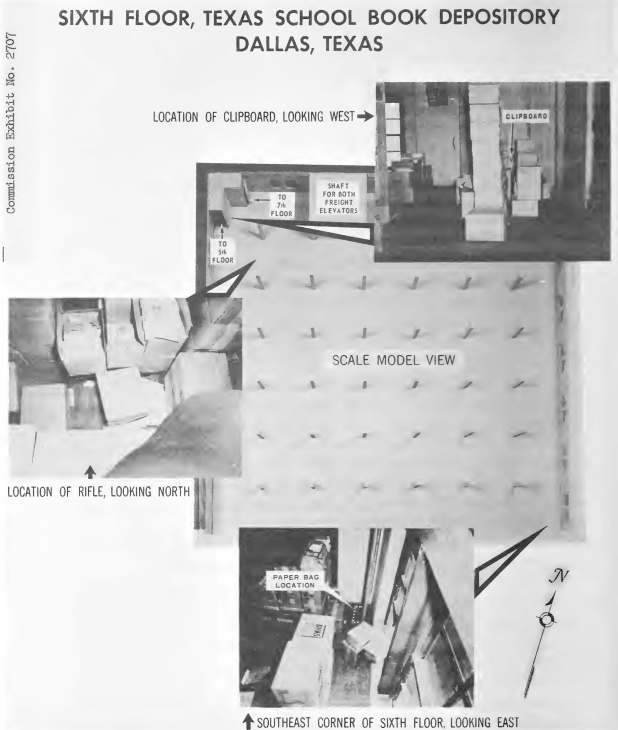
The arrangement of boxes at the window from which the shots
were fired was studied to determine whether Oswald required any
assistance in moving the cartons to the window. Cartons had been
stacked on the floor, a few feet behind the window, thus shielding
Oswald from the view of anyone on the sixth floor who did not attempt
to go behind them.C6-32 (See Commission Exhibit No. 723,
p. 80.) Most of those cartons had been moved there by other employees
to clear an area for laying a new flooring on the west end
of the sixth floor.C6-33 Superintendent Roy Truly testified that the floor-laying
crew moved a long row of books parallel to the windows on
the south side and had “quite a lot of cartons” in the southeast corner
of the building.C6-34 He said that there was not any particular pattern
that the men used in putting them there. “They were just piled up there
more or less at that time.”C6-35 According to Truly, “several cartons”
which had been in the extreme southeast corner had been placed on top
of the ones that had been piled in front of the southeast corner window.C6-36
The arrangement of the three boxes in the window and the one
on which the assassin may have sat has been described previously.C6-37
Two of these four boxes, weighing approximately 55 pounds each, had
been moved by the floor-laying crew from the west side of the floor to
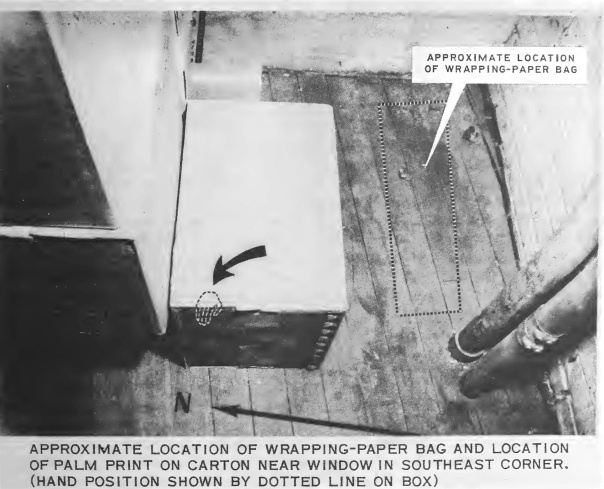
the area near the southwest corner.C6-38 The carton on which the assassin
may have sat might not even have been moved by the assassin at all.
A photograph of the scene depicts this carton on the floor alongside
other similar cartons. (See Commission Exhibit No. 1301, p. 138.)
Oswald’s right palmprint on this carton may have been placed there
as he was sitting on the carton rather than while carrying it. In any
event both of these 55-pound cartons could have been carried by one
man. The remaining two cartons contained light block-like reading
aids called “Rolling Readers” weighing only about 8 pounds each.C6-39
Although they had been moved approximately 40 feetC6-40 from their
normal locations at the southeast corner window, it would appear that
one man could have done this in a matter of seconds.
In considering the possibility of accomplices at the window, the
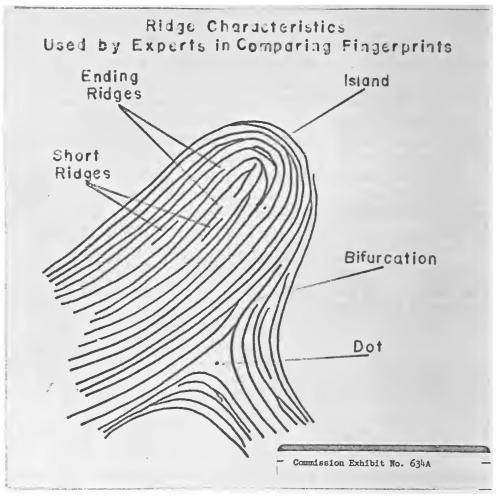
Commission evaluated the significance of the presence of fingerprints
other than Oswald’s on the four cartons found in and near the window.
Three of Oswald’s prints were developed on two of the cartons.C6-41
In addition a total of 25 identifiable prints were found on
the 4 cartons.C6-42 Moreover, prints were developed which were considered
as not identifiable, i.e., the quality of the print was too fragmentary
to be of value for identification purposes.C6-43
As has been explained in chapter IV, the Commission determined
that none of the warehouse employees who might have customarily
handled these cartons left prints which could be identified.C6-44 This
was considered of some probative value in determining whether Oswald
moved the cartons to the window. All but 1 of the 25 definitely
identifiable prints were the prints of 2 persons—an FBI employee and
a member of the Dallas Police Department who had handled the
cartons during the course of the investigation.C6-45 One identifiable
palmprint was not identified.C6-46
The presence on these cartons of unidentified prints, whether or not
identifiable, does not appear to be unusual since these cartons contained
commercial products which had been handled by many people
throughout the normal course of manufacturing, warehousing, and
shipping. Unlike other items of evidence such as, for example, a ransom
note in a kidnaping, these cartons could contain the prints of
many people having nothing to do with the assassination. Moreover,
the FBI does not maintain a filing system for palmprints because,
according to the supervisor of the Bureau’s latent fingerprint section,
Sebastian F. Latona, the problems of classification make such a system
impracticable.C6-47 Finally, in considering the significance of the unidentified
prints, the Commission gave weight to the opinion of Latona to
the effect that people could handle these cartons without leaving prints
which were capable of being developed.C6-48
Though the fingerprints other than Oswald’s on the boxes thus
provide no indication of the presence of an accomplice at the window,
two Depository employees are known to have been present
briefly on the sixth floor during the period between 11:45 a.m., when
the floor-laying crew stopped for lunch, and the moment of the assassination.
One of these was Charles Givens, a member of the floor-laying
crew, who went down on the elevator with the others and then,
returned to the sixth floor to get his jacket and cigarettes.C6-49 He saw
Oswald walking away from the southeast corner, but saw no one else
on the sixth floor at that time. He then took one of the elevators back
to the first floor at approximately 11:55 a.m.C6-50
Bonnie Ray Williams, who was also working with the floor-laying
crew, returned to the sixth floor at about noon to eat his lunch and
watch the motorcade.C6-51 He looked out on Elm Street from a position
in the area of the third or fourth set of windows from the east wall.C6-52
At this point he was approximately 20-30 feet away from the southeast
corner window. He remained for about “5, 10, maybe 12 minutes”
eating his lunch which consisted of chicken and a bottle of soda pop.C6-53
Williams saw no one on the sixth floor during this period, although
the stacks of books prevented his seeing the east side of the building.C6-54
After finishing his lunch Williams took the elevator down because
no one had joined him on the sixth floor to watch the motorcade.C6-55 He
stopped at the fifth floor where he joined Harold Norman and James
Jarman, Jr., who watched the motorcade with him from a position
on the fifth floor directly below the point from which the shots were
fired. Williams left the remains of his lunch, including chicken bones
and a bottle of soda, near the window where he was eating.C6-56
Several witnesses outside the building claim to have seen a person
in the southeast corner window of the sixth floor. As has already been
indicated, some were able to offer better descriptions than others and
one, Howard L. Brennan, made a positive identification of Oswald as
being the person at the window.C6-57 Although there are differences
among these witnesses with regard to their ability to describe the person
they saw, none of these witnesses testified to seeing more than one
person in the window.C6-58
One witness, however, offered testimony which, if accurate, would
create the possibility of an accomplice at the window at the time of
the assassination. The witness was 18-year-old Arnold Rowland, who
testified in great detail concerning his activities and observations on
November 22, 1963. He and his wife were awaiting the motorcade,
standing on the east side of Houston Street between Maine and Elm,C6-59
when he looked toward the Depository Building and noticed a man
holding a rifle standing back from the southwest corner window on
the sixth floor. The man was rather slender in proportion to his
size and of light complexion with dark hair.C6-60 Rowland said that his
wife was looking elsewhere at the time and when they looked back
to the window the man “was gone from our vision.”C6-61 They thought
the man was most likely someone protecting the President. After
the assassination Rowland signed an affidavit in which he told of seeing
this man, although Rowland was unable to identify him.C6-62
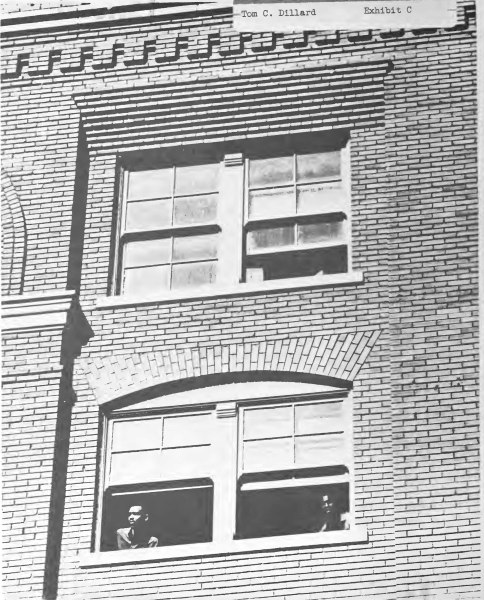
When Rowland testified before the Commission on March 10, 1964,
he claimed for the first time to have seen another person on the sixth
floor. Rowland said that before he had noticed the man with the
rifle on the southwest corner of the sixth floor he had seen an elderly
Negro man “hanging out that window” on the southeast corner of the
sixth floor.C6-63 Rowland described the Negro man as “very thin, an
elderly gentleman, bald or practically bald, very thin hair if he wasn’t
bald,” between 50 and 60 years of age, 5 feet 8 inches to 5 feet 10 inches
tall, with fairly dark complexion.C6-64 Rowland claimed that he looked
back two or three times and noticed that the man remained until 5 or 6
minutes prior to the time the motorcade came. Rowland did not see
him thereafter. He made no mention of the Negro man in his affidavit.C6-65
And, while he said he told FBI agents about the man in the
southeast corner window when interviewed on the Saturday and Sunday
following the assassination,C6-66 no such statement appears in any
FBI report.C6-67
Mrs. Rowland testified that her husband never told her about seeing
any other man on the sixth floor except the man with the rifle
in the southwest corner that he first saw. She also was present during
Rowland’s interview with representatives of the FBIC6-68 and said
she did not hear him make such a statement,C6-69 although she also said
that she did not hear everything that was discussed.C6-70 Mrs. Rowland
testified that after her husband first talked about seeing a man with
the rifle, she looked back more than once at the Depository Building
and saw no person looking out of any window on the sixth floor.C6-71
She also said that “At times my husband is prone to exaggerate.”C6-72
Because of inconsistencies in Rowland’s testimony and the importance
of his testimony to the question of a possible accomplice, the Commission
requested the FBI to conduct an inquiry into the truth of
a broad range of statements made by Rowland to the Commission.
The investigation showed that numerous statements by Rowland concerning
matters about which he would not normally be expected to
be mistaken—such as subjects he studied in school, grades he received,
whether or not he had graduated from high school, and whether
or not he had been admitted to college—were false.C6-73
The only possible corroboration for Rowland’s story is found in
the testimony of Roger D. Craig, a deputy sheriff of Dallas County,
whose testimony on other aspects of the case has been discussed in
chapter IV. Craig claimed that about 10 minutes after the assassination
he talked to a young couple, Mr. and Mrs. Rowland,
* * * and the boy said he saw two men on the sixth floor of the
Book Depository Building over there; one of them had a rifle with
a telescopic sight on it—but he thought they were Secret Service
agents or guards and didn’t report it. This was about—oh, he
said, 15 minutes before the motorcade ever arrived.C6-74
According to Craig, Rowland said that he looked back a few minutes
later and “the other man was gone, and there was just one man—the
man with the rifle.”C6-75 Craig further testified that Rowland told him
that when he first saw the two men, they were walking back and
forth in front of the window for several minutes. They were both
white men and one of them had a rifle with a scope on it.C6-76 This report
by Craig is contradicted by the testimony of both the Rowlands,
and by every recorded interview with them conducted by law enforcement
agencies after the assassination.
As part of its investigation of Rowland’s allegation and of the
general question of accomplices at the scene of the assassination, the
Commission undertook an investigation of every person employed
in the Texas School Book Depository Building. Two employees
might possibly fit the general description of an elderly Negro man,
bald or balding. These two men were on the first floor of the building
during the period before and during the assassination.C6-77 Moreover,
all of the employees were asked whether they saw any strangers
in the building on the morning of November 22.C6-78 Only one employee
saw a stranger whom he described as a feeble individual who had
to be helped up the front steps of the building. He went to a public
restroom and left the building 5 minutes later, about 40 minutes
before the assassination.C6-79
Rowland’s failure to report his story despite several interviews until
his appearance before the Commission, the lack of probative corroboration,
and the serious doubts about his credibility, have led the
Commission to reject the testimony that Rowland saw an elderly
balding Negro man in the southeast corner window of the sixth floor
of the Depository Building several minutes before the assassination.
The Commission has analyzed Oswald’s movements between the time
of the assassination and the shooting of Patrolman Tippit to determine
whether there is any evidence that Oswald had assistance in his flight
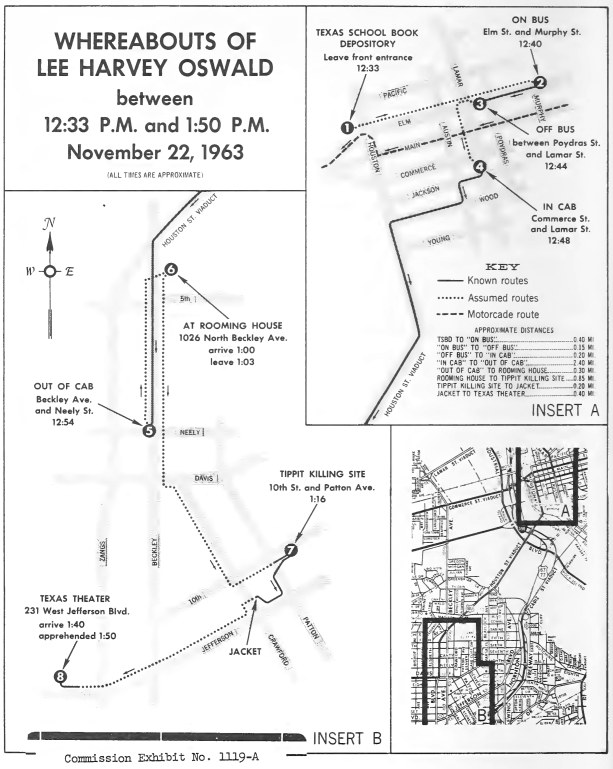
from the building. Oswald’s activities during this period have been
traced through the testimony of seven witnesses and discussed in
detail in chapter IV.C6-80 (See Commission Exhibit No. 1119-A, p.
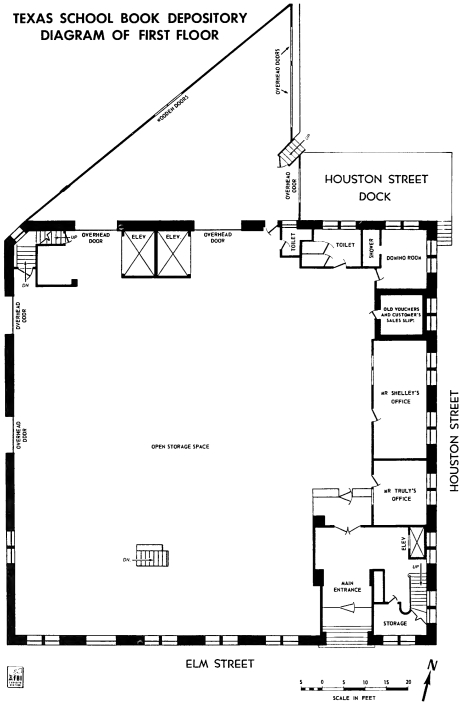
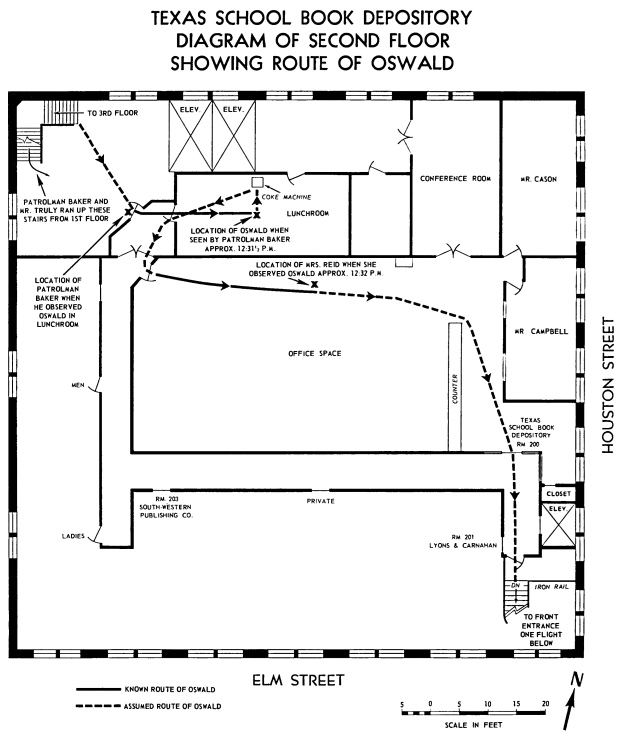
158 and Commission Exhibit No. 1118, p. 150.) Patrolman M. L.
Baker and Depository superintendent Roy Truly saw him within 2
minutes of the assassination on the second floor of the building.
Mrs. R. A. Reid saw him less than 1 minute later walking through
the second-floor offices toward the front of the building. A busdriver,
Cecil J. McWatters, and Oswald’s former landlady, Mrs. Mary Bledsoe,
saw him board a bus at approximately 12:40 p.m., and get off
about 4 minutes later. A cabdriver, William W. Whaley, drove
Oswald from a cabstand located a few blocks from where Oswald
left the bus to a point in Oak Cliff about four blocks from his roominghouse;
and Earlene Roberts, the housekeeper at Oswald’s roominghouse,
saw him enter the roominghouse at about 1 p.m. and leave a few
minutes later. When seen by these seven witnesses Oswald was always
alone.
Particular attention has been directed to Oswald’s departure from
the Depository Building in order to determine whether he could have
left the building within approximately 3 minutes of the assassination
without assistance. As discussed more fully in chapter IV, the building
was probably first sealed off no earlier than 12:37 by Inspector
Herbert Sawyer.C6-81 The shortest estimate of the time taken to seal off
the building comes from Police Officer W. E. Barnett, one of the officers
assigned to the corner of Elm and Houston Streets for the Presidential
motorcade, who estimated that approximately 3 minutes elapsed between
the time he heard the last of the shots and the time he started
guarding the front door.C6-82 According to Barnett, “there were people
going in and out” during this period.C6-83 The evidence discussed in
chapter IV shows that 3 minutes would have been sufficient time for
Oswald to have descended from the sixth floor and left the building
without assistance.C6-84
One witness, James R. Worrell, Jr., claims to have seen a man running
from the rear of the building shortly after the assassination, but
in testimony before the Commission he stated that he could not see
his face.C6-85 Two other witnesses who watched the rear of the building
during the first 5 minutes after the shooting saw no one leave.C6-86
The claim of Deputy Sheriff Roger Craig that he saw Oswald leave the
Depository Building approximately 15 minutes after the assassination
has been discussed in chapter IV.C6-87 Although Craig may have seen
someone enter a station wagon 15 minutes after the assassination, the
person he saw was not Lee Harvey Oswald, who was far removed from
the building at that time.
The possibility that accomplices aided Oswald in connection with
his escape was suggested by the testimony of Earlene Roberts, the
housekeeper at the 1026 North Beckley roominghouse.C6-88 She testified
that at about 1 p.m. on November 22, after Oswald had returned to
the roominghouse, a Dallas police car drove slowly by the front of
the 1026 North Beckley premises and stopped momentarily; she said
she heard its horn several times.C6-89 Mrs. Roberts stated that the occupants
of the car were not known to her even though she had worked
for some policemen who would occasionally come by.C6-90 She
said the policeman she knew drove car No. 170 and that this was not
the number on the police car that honked on November 22. She
testified that she first thought the car she saw was No. 106 and
then said that it was No. 107.C6-91 In an FBI interview she had stated
that she looked out the front window and saw police car No.
207.C6-92 Investigation has not produced any evidence that there was a
police vehicle in the area of 1026 North Beckley at about 1 p.m. on November
22.C6-93 Squad car 207 was at the Texas School Book Depository
Building, as was car 106. Squad cars 170 and 107 were sold in April
1963 and their numbers were not reassigned until February 1964.C6-94
Whatever may be the accuracy of Mrs. Roberts’ recollection concerning
the police car, it is apparent from Mrs. Roberts’ further testimony
that she did not see Oswald enter a car when he hurriedly left the
house. She has stated that when she last saw Oswald, shortly after
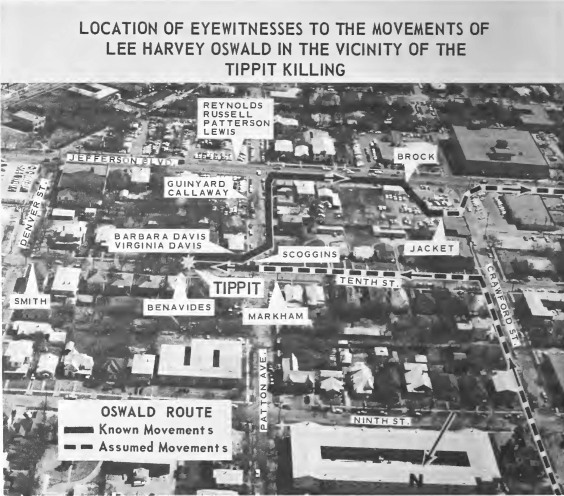
1 p.m., he was standing at a bus stop in front of the house.C6-95 Oswald
was next seen less than 1 mile away, at the point where he shot Patrolman
Tippit. Oswald could have easily reached this point on foot by
about 1:16 p.m., when Tippit was shot. Finally, investigation has produced
no evidence that Oswald had prearranged plans for a means to
leave Dallas after the assassination or that any other person was to
have provided him assistance in hiding or in departing the city.
Finding no evidence in the circumstances immediately surrounding
the assassination that any person other than Lee Harvey Oswald
was involved in the killing of the President, the Commission directed
an intensive investigation into his life for the purpose, among others,
of detecting any possible traces that at some point he became involved
in a conspiracy culminating in the deed of November 22, 1963. As a
product of this investigation, the Commission has compiled a detailed
chronological biography of Oswald which is set forth as appendix
XIII. Study of the period from Oswald’s birth in 1939 to his military
service from 1956 to 1959 has revealed no evidence that he was
associated with any type of sinister or subversive organization during
that period. Though his personality and political views took
shape during these early years, the events of that period are significant
primarily to an understanding of the personality of Lee Harvey
Oswald and are discussed in that connection in chapter VII.
Beginning with his preparation for defection to the Soviet Union in
1959, however, Oswald engaged in several activities which required
close scrutiny by the Commission. In an appraisal of Oswald’s actions
since 1959 for the purpose of determining whether he was part of
a conspiracy, several aspects of his background and character must
be borne in mind. He was young, inexperienced, and had only a
limited education. As will be more fully discussed in chapter VII,
he was unable to establish relationships with others and had a resentment
for authority and any discipline flowing from it. While he
demonstrated the ability to act secretively and alone, without regard
to the consequences to himself, as in his defection to the Soviet Union,
he does not appear to have been the kind of person whom one would
normally expect to be selected as a conspirator.
Lee Harvey Oswald was openly committed to Marxist ideology, he
defected to the Soviet Union in 1959, and resided there until June
of 1962, eventually returning to the United States with a Russian
wife. In order to evaluate rumors and speculationsC6-96 that Oswald may
have been an agent of the Soviet Union, the Commission investigated
the facts surrounding Oswald’s stay in Russia. The Commission
was thus fulfilling its obligation to probe all facts of possible relevance
to the assassination, and does not suggest by this investigation
that the rulers of the Soviet Union believed that their political interests
would be advanced by the assassination of President Kennedy.
On this question, the Secretary of State testified before the Commission
on June 10, 1964 as follows:
I have seen no evidence that would indicate to me that the
Soviet Union considered that it had an interest in the removal
of President Kennedy or that it was in any way involved in
the removal of President Kennedy.
* * * * *
I have not seen or heard of any scrap of evidence indicating
that the Soviet Union had any desire to eliminate President
Kennedy nor in any way participated in any such event.
Now, standing back and trying to look at that question objectively
despite the ideological differences between our two
great systems, I can’t see how it could be to the interest of the
Soviet Union to make any such effort.
* * * * *
I do think that the Soviet Union, again objectively considered,
has an interest in the correctness of state relations. This would
be particularly true among the great powers, with which the
major interests of the Soviet Union are directly engaged.
* * * * *
I think that although there are grave differences between
the Communist world and the free world, between the Soviet
Union and other major powers, that even from their point of
view there needs to be some shape and form to international
relations, that it is not in their interest to have this world structure
dissolve into complete anarchy, that great states and particularly
nuclear powers have to be in a position to deal with
each other, to transact business with each other, to try to meet
problems with each other, and that requires the maintenance of
correct relations and access to the leadership on all sides.
I think also that although there had been grave differences between
Chairman Khrushchev and President Kennedy, I think
there were evidences of a certain mutual respect that had developed
over some of the experiences, both good and bad, through
which these two men had lived.
I think both of them were aware of the fact that any Chairman
of the Soviet Union, and any President of the United States,
necessarily bear somewhat special responsibility for the general
peace of the world. Indeed without exaggeration, one could almost
say the existence of the northern hemisphere in this nuclear
age.
* * * * *
So that it would be an act of rashness and madness for Soviet
leaders to undertake such an action as an active policy. Because
everything would have been put in jeopardy or at stake in connection
with such an act.
It has not been our impression that madness has characterized
the actions of the Soviet leadership in recent years.C6-97
The Commission accepts Secretary Rusk’s estimate as reasonable
and objective, but recognizes that a precise assessment of Soviet intentions
or interests is most difficult. The Commission has thus examined
all the known facts regarding Oswald’s defection, residence in the
Soviet Union, and return to the United States. At each step the
Commission sought to determine whether there was any evidence
which supported a conclusion that Soviet authorities may have directly
or indirectly influenced Oswald’s actions in assassinating the
President.
Oswald’s entry into the Soviet Union.—Although the evidence
is inconclusive as to the factors which motivated Oswald to go to the
Soviet Union, there is no indication that he was prompted to do so
by agents of that country. He may have begun to study the
Russian language when he was stationed in Japan, which was intermittently
from August 1957 to November 1958.C6-98 After he arrived
in Moscow in October 1959 he told several persons that he had been
planning his defection for 2 years, which suggests that the decision
was made while he was in the Far East.C6-99 George De Mohrenschildt,
who met Oswald after his return from the Soviet Union, testified that
Oswald once told him much the same thing: “I met some Communists
in Japan and they got me excited and interested, and that was one of
my inducements in going to Soviet Russia, to see what goes on
there.”C6-100 This evidence, however, is somewhat at variance with
Oswald’s statements made to two American newspaper reporters in
Moscow shortly after his defection in 1959,C6-101 and to other people in
the United States after his return in 1962.C6-102 Though his remarks
were not inconsistent as to the time he decided to defect, to these
people he insisted that before going to the Soviet Union he had “never
met a Communist” and that the intent to defect derived entirely from
his own reading and thinking. He said much the same to his brother
in a letter he wrote to him from Russia explaining why he had defected.C6-103
Which of Oswald’s statements was the more accurate remains
unknown.
There is no evidence that Oswald received outside assistance in
financing his trip to the Soviet Union. After he arrived in Moscow,
Oswald told a newspaper correspondent, Aline Mosby, that he had
saved $1,500 out of his Marine Corps salary to finance his defection,C6-104
although the news story based upon Oswald’s interview with Aline
Mosby unaccountably listed the sum of $1,600 instead of $1,500.C6-105
After this article had appeared, Marguerite Oswald also related the
$1,600 figure to an FBI agent.C6-106 Either amount could have been
accumulated out of Oswald’s earnings in the Marine Corps; during
his 2 years and 10 months of service he received $3,452.20, after all
taxes, allotments and other deductions.C6-107 Moreover Oswald could
certainly have made the entire trip on less than $1,000. The ticket on
the ship he took from New Orleans to Le Havre, France, cost
$220.75;C6-108 it cost him about $20 to reach London from Le Havre;
his plane fare from London to Helsinki, where he received his visa,
cost him $111.90; he probably purchased Russian “tourist vouchers”
normally good for room and board for 10 days for $300; his train fare
from Helsinki to Moscow was about $44; in Moscow he paid only $1.50
to $3 a night for his room and very little for his meals after his tourist
vouchers ran out;C6-109 and apparently he did not pay his hotel bill at all
after November 30, 1959.C6-110 Oswald’s known living habits indicate that
he could be extraordinarily frugal when he had reason to be, and it
seems clear that he did have a strong desire to go to the Soviet Union.
While in Atsugi, Japan, Oswald studied the Russian language,
perhaps with some help from an officer in his unit who was interested
in Russian and used to “talk about it” with Oswald occasionally.C6-111
He studied by himself a great deal in late 1958 and early 1959 after
he was transferred from Japan to California.C6-112 He took an Army
aptitude test in Russian in February 1959 and rated “Poor.”C6-113 When
he reached the Soviet Union in October of the same year he could
barely speak the language.C6-114 During the period in Moscow while
he was awaiting decision on his application for citizenship, his diary
records that he practiced Russian 8 hours a day.C6-115 After he was
sent to Minsk in early January 1960 he took lessons from an interpreter
assigned to him for that purpose by the Soviet Government.C6-116
Marina Oswald said that by the time she met him in March 1961 he
spoke the language well enough so that at first she thought he was
from one of the Baltic areas of her country, because of his accent.
She stated that his only defects were that his grammar was sometimes
incorrect and that his writing was never good.C6-117
Thus, the limited evidence provides no indication that Oswald was
recruited by Soviet agents in the Far East with a view toward defection
and eventual return to the United States. Moreover, on its face
such a possibility is most unlikely. If Soviet agents had communicated
with Oswald while he was in the Marine Corps, one of the least probable
instructions they would have given him would have been to
defect. If Oswald had remained a Marine radar specialist, he might
at some point have reached a position of value as a secret agent.
However, his defection and the disloyal statements he made publicly
in connection with it eliminated the possibility that he would ever
gain access to confidential information or programs of the United
States. The very fact that he defected, therefore, is itself persuasive
evidence that he was not recruited as an agent prior to his defection.
The Commission has investigated the circumstances under which
Oswald obtained a visa to enter the Soviet Union for possible evidence
that he received preferential treatment in being permitted to enter the
country. Oswald left New Orleans, La., for Europe on September 20,
1959,C6-118 having been released from active duty in the Marine Corps on
September 11, 1959.C6-119 He went directly to Helsinki, Finland, by way
of Le Havre, France, and London, England, arriving at Helsinki on
Saturday, October 10, 1959.C6-120 Oswald probably arrived in Helsinki
too late in the evening to have applied for a visa at the Soviet Union
consulate that night.C6-121 In light of the rapidity with which he made
connections throughout his entire trip,C6-122 he probably applied for a
visa early on Monday, October 12. On October 14, he was issued
Soviet Tourist Visa No. 403339, good for one 6-day visit in the
U.S.S.R.C6-123 He left Helsinki on a train destined for Moscow on
October 15.C6-124
The Department of State has advised the Commission that it has
some information that in 1959 it usually took an American tourist in
Helsinki 1 to 2 weeks to obtain a visa,C6-125 and that it has other information
that the normal waiting period during the past 5 years has been
a week or less.C6-126 According to the Department’s information, the
waiting period has always varied frequently and widely, with one
confirmed instance in 1963 of a visa routinely issued in less than
24 hours.C6-127 The Central Intelligence Agency has indicated that visas
during the 1964 tourist season were being granted in about 5 to 7
days.C6-128
This information from the Department of State and the Central
Intelligence Agency thus suggests that Oswald’s wait for a visa may
have been shorter than usual but not beyond the range of possible
variation. The prompt issuance of Oswald’s visa may have been
merely the result of normal procedures, due in part to the fact that
the summer rush had ended. It might also mean that Oswald was
unusually urgent in his demands that his visa be issued promptly.
Oswald himself told officials at the American Embassy in Moscow on
October 31, when he appeared to renounce his citizenship, that he had
said nothing to the Soviets about defecting until he arrived in Moscow.C6-129
In any event, the Commission has found nothing in the circumstances
of Oswald’s entry into the Soviet Union which indicates
that he was at the time an agent of the U.S.S.R.
Defection and admission to residence.—Two months and 22 days
elapsed from Oswald’s arrival in Moscow until he left that city to take
up residence in Minsk. The Commission has considered the possibility
that Oswald was accepted for residence in the Soviet Union and sent
to Minsk unusually soon after he arrived, either because he had been
expected or because during his first weeks in Moscow he developed
an undercover relationship with the Soviet Government. In doing
so, the Commission has attempted to reconstruct the events of those
months, though it is, of course, impossible to account for Oswald’s
activities on every day of that period.
Oswald’s “Historic Diary,”C6-130 which commences on October 16, 1959,
the date Oswald arrived in Moscow, and other writings he later prepared,C6-131
have provided the Commission with one source of information
about Oswald’s activities throughout his stay in the Soviet Union.
Even assuming the diary was intended to be a truthful record, it is not
an accurate guide to the details of Oswald’s activities. Oswald seems
not to have been concerned about the accuracy of dates and names,C6-132
and apparently made many of his entries subsequent to the date the
events occurred. Marina Oswald testified that she believed that her
husband did not begin to keep the diary until he reached Minsk, 3
months after his arrival in Russia,C6-133 and scraps of paper found in
Oswald’s possession, containing much the same information as appears
in his diary,C6-134 suggest that he transcribed the entries into the diary at a
later time. The substance of Oswald’s writings has been carefully
examined for consistency with all other related information available
to the Commission. In addition, the writings have been checked for
handwriting,C6-135 and for consistency of style, grammar, and spelling
with earlier and later writings which are known to be his.C6-136 No indication
has been found that entries were written or coached by other
persons.C6-137
However, the most reliable information concerning the period
Oswald spent in Moscow in the latter part of 1962 comes from the
records of the American Embassy in Moscow,C6-138 the testimony of Embassy
officials,C6-139 and the notes of two American newspaper reporters,
Aline Mosby C6-140 and Priscilla Johnson,C6-141 who interviewed Oswald during
this period. Oswald’s correspondence with his brother and mother
has also been relied upon for some relatively minor information.
The findings upon which the Commission based its conclusion concerning
Soviet involvements in the assassination were supported by
evidence other than material provided by the Soviet UnionC6-142 or
Oswald’s writings. The Central Intelligence Agency has also contributed
data on the normal practices and procedures of the Soviet
authorities in handling American defectors.
The “Historic Diary” indicates that on October 16, 1959, the day
Oswald arrived in Moscow, he told his Intourist guide, Rima
Shirokova, that he wished to renounce his American citizenship and
become a Soviet citizen. The same day, the guide reportedly helped
Oswald prepare a letter to the Soviet authorities requesting citizenship.C6-143
The diary indicates, however, that on October 21 he was
informed that his visa had expired and that he would be required to
leave Moscow within 2 hours.C6-144 During the preceding days, according
to the diary, he had been interviewed once and perhaps twice by
Soviet officials.C6-145 During this period the KGB,B the agency with
primary responsibility for examining defectors arriving in Russia,
undoubtedly investigated Oswald as fully as possible. In 1959, virtually
all Intourist guides were KGB informants, and there is no
reason to believe that this was not true of Oswald’s guide.C6-146
According to Oswald’s diary he attempted suicide when he learned
his application for citizenship had been denied.C6-147 If true, this would
seem to provide strong evidence that, at least prior to October 21,
there was no undercover relationship between Oswald and the Soviet
Government. Though not necessarily conclusive, there is considerable
direct evidence which indicates that Oswald did slash his
wrist. Oswald’s autopsy showed that he had a scar on his left
wrist and that it was of the kind which could have been caused by a
suicide attempt.C6-148 The medical records from the Botkinskaya Hospital
in Moscow, furnished by the Soviet Government, reveal that
from October 21 to October 28 he was treated there for a self-inflicted
wound on the left wrist.C6-149 The information contained in these records
is consistent with the facts disclosed by the autopsy examination
relating to Oswald’s wrist and to other facts known about Oswald.
Although no witness recalled Oswald mentioning a suicide attempt,C6-150
Marina Oswald testified that when she questioned her husband about
the scar on his wrist, he became “very angry,” and avoided giving
her a reply.C6-151 Oswald’s character, discussed in the following chapter,
does not seem inconsistent with a suicide or feigned suicide attempt,
nor with his having failed to disclose the suicide attempt.
Many witnesses who testified before the Commission observed that he
was not an “open” or trusting person, had a tendency toward arrogance,
and was not the kind of man who would readily admit weaknesses.C6-152
Oswald appeared at the American Embassy in Moscow on October
31, 1959, 3 days after his release from the Botkinskaya Hospital.C6-153
He did not give the officials at the Embassy any indication that
he had recently received medical treatment.C6-154 Oswald’s appearance
was the first notification to the American Government that he was
in Russia, since he had failed to inform the Embassy upon his arrival,C6-155
as most American tourists did at the time.C6-156 In appendix XV, Oswald’s
dealings with the Embassy in 1959 until his return to the United
States in 1962 are described in full, and all action taken by the American
officials on his case is evaluated. His conduct at the Embassy has
also been considered by the Commission for any indication it may
provide as to whether or not Oswald was then acting under directions
of the Soviet Government.
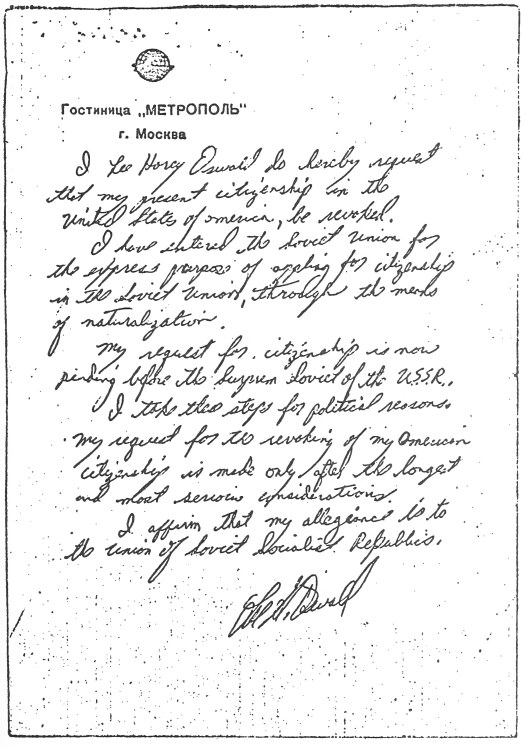
Commission Exhibit No. 913
NOTE HANDED BY OSWALD TO THE AMERICAN
EMBASSY IN MOSCOW ON OCT. 31, 1959
At the Embassy, Oswald declared that he wished to renounce his
U.S. citizenship,C6-157 but the consul to whom he spoke, Richard E.
Snyder, refused to accept his renunciation at that time, telling him
that he would have to return to complete the necessary papers.C6-158
However, Oswald did give the consul his passportC6-159 and a handwritten
statement requesting that his American citizenship be “revoked”
and “affirm[ing] [his] * * * allegiance” to the Soviet
Union.C6-160 (See Commission Exhibit No. 913, p. 261.) The FBI has
confirmed that this statement is in Oswald’s handwriting,C6-161 and
Snyder has testified that the letter’s phrases are consistent with the
way Oswald talked and conducted himself.C6-162 During the approximately
40-minute interview, Oswald also informed Snyder that he
had been a radar operator in the Marine Corps, intimating that he
might know something of special interest, and that he had informed
a Soviet official that he would give the Soviets any information concerning
the Marine Corps and radar operation which he possessed.C6-163
Although Oswald never filed a formal renunciation, in a letter to
the Embassy dated November 3, 1959, he again requested that his
American citizenship be revoked and protested the refusal to accept
his renunciation on October 31.C6-164 (See Commission Exhibit No.
912, p. 263.)
While at the Embassy,C6-165 and in a subsequent interview with an
American journalist,C6-166 Oswald displayed familiarity with Communist
ideological arguments, which led those with whom he spoke to speculate
that he may have received some instruction from Soviet authorities.
Oswald’s familiarity with the law regarding renunciation of
citizenship, observed by both Embassy officials,C6-167 could also be construed
as a sign of coaching by Soviet authorities. However, Oswald
is known to have been an avid readerC6-168 and there is evidence that he
had read Communist literature without guidance while in the Marine
Corps and before that time.C6-169 After his arrival in Moscow, Oswald
most probably had discussions with his Intourist guide and others,C6-170
but none of the Americans with whom he talked in Moscow felt that
his conversations necessarily revealed any type of formal training.C6-171
The “Historic Diary” indicates that Oswald did not tell his guide that
he intended to visit the Embassy because he feared she would disapprove.C6-172
(See Commission Exhibit No. 24, p. 264.) Though Oswald
gave Snyder the impression “of an intelligent person who spoke
in a manner and on a level, which seemed to befit his apparent level of
intelligence,”C6-173 correspondent Priscilla Johnson, who spent about 5
hours talking with him,C6-174 received a much less favorable impression:
He liked to create the pretense, the impression that he was
attracted to abstract discussion and was capable of engaging in it,
and was drawn to it. But it was like pricking a balloon. I had
the feeling that if you really did engage him on this ground, you
very quickly would discover that he didn’t have the capacity for
a logical sustained argument about an abstract point on
economics or on noneconomic, political matters or any matter,
philosophical.C6-175
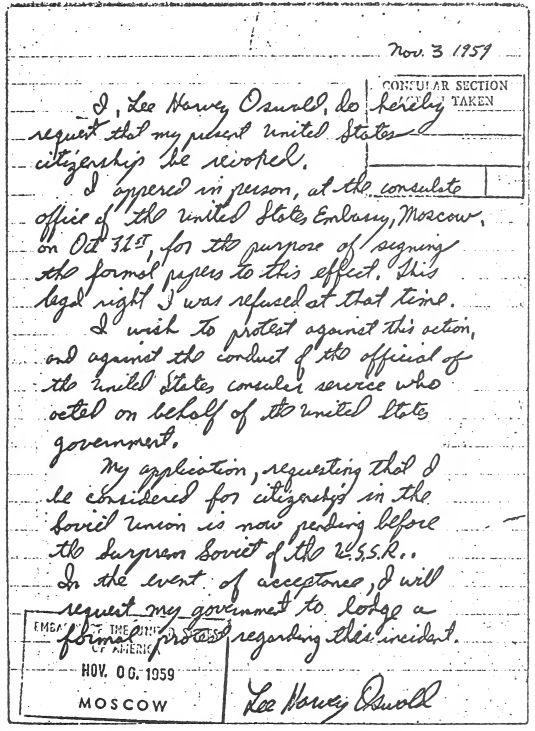
Commission Exhibit No. 912
LETTER MAILED BY OSWALD TO THE AMERICAN
EMBASSY IN MOSCOW.
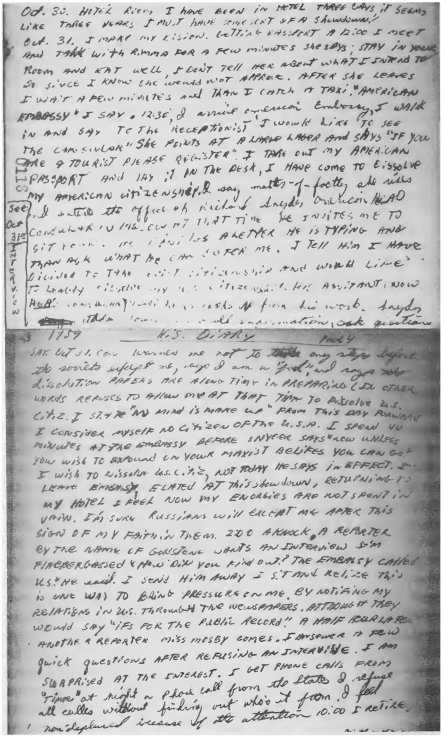
Commission Exhibit No. 24
OSWALD’S OWN ACCOUNT OF HIS MEETING AT THE
AMERICAN EMBASSY IN MOSCOW OCT. 31, 1959
Excerpts from his “Historic Diary”
A comparison of the formal note Oswald handed SnyderC6-176 and his
letter of November 3C6-177 with the provisions of section 349(a) of the
Immigration and Nationality ActC6-178 suggests that Oswald had read
the statute but understood it imperfectly; he apparently was trying to
use three out of the four ways set out in the statute to surrender his
citizenship, but he succeeded in none.
Moreover, persuasive evidence that Oswald’s conduct was not carefully
coached by Soviet agents is provided by some of his actions
at the Embassy. The single statement which probably caused Oswald
the most future trouble was his declaration that he had already
volunteered to a Soviet official that he would, if asked, tell the Soviet
Government all that he knew about his job in radar as a Marine.
Certainly a statement of this type would prejudice any possibility
of his being an effective pro-Communist agent.
Further, though unquestionably evidencing anti-American sentiments,
Oswald’s behavior at the Embassy, which brought him exceedingly
close to expatriation, was unlikely to have increased his
value in any capacity to the Soviet Union. Richard E. Snyder, the
official who interviewed Oswald on October 31, testified that he “had
every reason to believe” that Oswald would have carried through
a formal—and therefore effective—renunciation of his American
citizenship immediately if he had let him.C6-179 However, as a defector,
Oswald could have had considerable propaganda value without expatriating
himself; and if he had expatriated himself his eventual
return to the United States would have been much more difficult
and perhaps impossible. If Snyder’s assessment of Oswald’s intentions
is accurate, it thus tends to refute the suggestion that Oswald
was being coached by the Soviets. In addition, reporters noticed
Oswald’s apparent ambivalence in regard to renouncing his citizenship—stormily
demanding that he be permitted to renounce while
failing to follow through by completing the necessary papersC6-180—behavior
which might have detracted from his propaganda value.
According to Oswald’s “Historic Diary”C6-181 and the documents furnished
to the Commission by the Soviet Government,C6-182 Oswald was
not told that he had been accepted as a resident of the Soviet Union
until about January 4, 1960. Although on November 13 and 16 Oswald
informed Aline MosbyC6-183 and Priscilla JohnsonC6-184 that he had been
granted permission to remain in the country indefinitely, the diary
indicates that at that time he had been told only that he could remain
“until some solution is found with what to do with me.”C6-185 The diary
is more consistent with the letter Oswald wrote to his brother Robert
on December 17, saying that he was then, more than a month after he
saw Johnson and Mosby, about to leave his hotel,C6-186 and with some later
correspondence with his mother. Oswald mailed a short note to his
mother which she received in Texas on January 5; that same day she
mailed a money order to him in Moscow, but it apparently got there
too late, because she received it back, unopened, on February 25.C6-187
Oswald’s conflicting statement to the correspondents also seems reconcilable
with his very apparent desire to appear important to others.
Moreover, so long as Oswald continued to stay in a hotel in Moscow,
the inference is that the Soviet authorities had not yet decided to
accept him.C6-188 This inference is supported by information supplied
by the CIA on the handling of other defectors in the Soviet Union.C6-189
Thus, the evidence is strong that Oswald waited at least until November
16, when he saw Miss Johnson, and it is probable that he was
required to wait until January 4, a little over 2½ months from October
16, before his application to remain in Russia was granted. In
mid-November Miss Johnson asked Oswald whether the Russians
were encouraging his defection, to which Oswald responded: “The
Russians are treating it like a legal formality. They don’t encourage
you and they don’t discourage you.”C6-190 And, when the Soviet Government
finally acted, Oswald did not receive Soviet citizenship, as
he had requested, but merely permission to reside in Russia on a year-to-year
basis.C6-191
Asked to comment upon the length of time, 2 months and 22 days,
that probably passed before Oswald was granted the right to remain
in the Soviet Union, the CIA has advised that “when compared to five
other defector cases, this procedure seems unexceptional.”C6-192 Similarly,
the Department of State reports that its information “indicated
that a 2-month waiting period is not unusual.”C6-193 The full response
of the CIA is as follows:
Oswald said that he asked for Soviet citizenship on 16 October
1959. According to his diary, he received word a month later
that he could stay in the USSR pending disposition of his request,
but it was another month and a half before he was given
his stateless passport.
When compared to five other defector cases, this procedure
seems unexceptional. Two defectors from US Army intelligence
units in West Germany appear to have been given citizenship
immediately, but both had prior KGB connections and fled
as a result of Army security checks. Of the other three cases,
one was accepted after not more than five weeks and given a
stateless passport apparently at about the same time. The
second was immediately given permission to stay for a while,
and his subsequent request for citizenship was granted three
months later. The third was allowed to stay after he made
his citizenship request, but almost two months passed before he
was told that he had been accepted. Although the Soviet Ministry
of Foreign Affairs soon after told the US Embassy that
he was a Soviet citizen, he did not receive his document until
five or six months after initial application. We know of only
one case in which an American asked for Soviet citizenship but
did not take up residence in the USSR. In that instance, the
American changed his mind and voluntarily returned to the
United States less than three weeks after he had requested Soviet
citizenship.C6-194
The Department of State has commented as follows:
The files of the Department of State reflect the fact that
Oswald first applied for permission to remain in Russia permanently,
or at least for a long period, when he arrived in Moscow,
and that he obtained permission to remain within one or two
months.
A. Is the fact that he obtained permission to stay within this
period of time usual?
Answer—Our information indicates that a two months waiting
period is not unusual. In the case of [name withheld] the
Supreme Soviet decided within two months to give Soviet citizenship
and he was thereafter, of course, permitted to stay.
B. Can you tell us what the normal procedures are under
similar circumstances?
Answer—It is impossible for us to state any “normal” procedures.
The Soviet Government never publicizes the proceedings
in these cases or the reasons for its action. Furthermore, it
is, of course, extremely unusual for an American citizen to
defect.C6-195
The information relating to Oswald’s suicide attempt indicates
that his application to remain in the Soviet Union was probably rejected
about 6 days after his arrival in Moscow. Since the KGB
is the Soviet agency responsible for the initial handling of all defectors,C6-196
it seems likely that the original decision not to accept Oswald
was made by the KGB. That Oswald was permitted to remain
in Moscow after his release from the hospital suggests that another
ministry of the Soviet Government may have intervened on his
behalf. This hypothesis is consistent with entries in the “Historic
Diary” commenting that the officials Oswald met after his hospital
treatment were different from those with whom he had dealt before.C6-197
The most plausible reason for any such intervention may
well have been apprehension over the publicity that would follow
the rejection of a devout convert to the Communist cause.
Oswald’s Life in Minsk.—According to the “Historic Diary”C6-198 and
documents received from the Soviet Government,C6-199 Oswald
resided in the city of Minsk from January 1960 until June 1962.
Oswald’s life in Minsk is the portion of his life concerning
which the least is known. The primary sources of information
are Oswald’s own writings and the testimony of Marina Oswald.
Other evidence, however, establishes beyond doubt that Oswald
was in fact located in Minsk on at least two occasions. The
Commission has obtained two photographs which were taken by
American tourists in Minsk in August 1961 in which Oswald appears.C6-200
The tourists did not know Oswald, nor did they speak
with him; they remembered only that several men gathered near
their car.C6-201 (See Kramer Exhibit 1, p. 268.) In addition, Oswald
was noticed in Minsk by a student who was traveling with
the University of Michigan band on a tour of Russia in the
spring of 1961.C6-202 Oswald corresponded with the American Embassy
in Moscow from Minsk,C6-203 and wrote letters from Minsk
to his family in the United States.C6-204 Oswald and his wife
have many photographs taken of themselves which show Minsk backgrounds
and persons who are identifiable as residents of Minsk.C6-205
After he returned to the United States, Oswald conversed about the
city with Russian-born American citizens who were familiar with it.C6-206
Marina Oswald is also familiar with the city.C6-207 The Commission has
also been able independently to verify the existence in Minsk of many
of the acquaintances of Oswald and his wife whom they said they
knew there.C6-208 (See Commission Exhibits Nos. 1392, 1395, 2606, 2609,
2612 and 2623, pp. 270-271.)
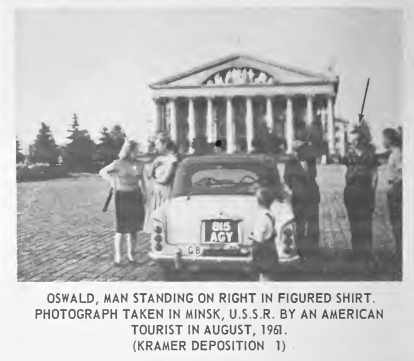
OSWALD, MAN STANDING ON RIGHT IN FIGURED SHIRT.
PHOTOGRAPH TAKEN IN MINSK, U.S.S.R. BY AN AMERICAN
TOURIST IN AUGUST, 1961.
(KRAMER DEPOSITION 1)
Once he was accepted as a resident alien in the Soviet Union, Oswald
was given considerable benefits which ordinary Soviet citizens
in his position in society did not have. The “Historic Diary” recites
that after Oswald was informed that he could remain in the Soviet
Union and was being sent to Minsk he was given 5,000 rublesC ($500)
by the “Red Cross, * * * for expenses.” He used 2,200 rubles to pay
his hotel bill, and another 150 rubles to purchase a train ticket. With
the balance of slightly over 2,500 rubles, Oswald felt, according to the
diary, like a rich man.C6-209 Oswald did not receive free living quarters,
as the diary indicates the “Mayor” of Minsk promised him,C6-210 but about
6 weeks after his arrival he did receive an apartment, very pleasant by
Soviet standards, for which he was required to pay only 60 rubles
($6.00) a month. Oswald considered the apartment “almost rent
free.”C6-211 Oswald was given a job in the “Byelorussian Radio and
Television Factory,” where his pay on a per piece basis ranged from
700 to 900 rubles ($70-$90) a month.C6-212 According to his wife, this
rate of pay was average for people in his occupation but good by
Soviet standards generally.C6-213 She explained that piecework rates
throughout the Soviet Union have generally grown out of line with
compensation for other jobs.C6-214 The CIA has confirmed that this condition
exists in many areas and occupations in the Soviet Union.C6-215 In
addition to his salary, Oswald regularly received 700 rubles ($70) per
month from the Soviet “Red Cross.”C6-216 The well-paying job, the
monthly subsidy, and the “almost rent-free” apartment combined to
give Oswald more money than he needed. The only complaint recorded
in the “Historic Diary” is that there was “no place to spend
the money.”C6-217
The Commission has found no basis for associating Oswald’s preferred
income with Soviet undercover activity. Marina Oswald testified
that foreign nationals are commonly given special treatment in
the Soviet Union,C6-218 and the Central Intelligence Agency has confirmed
that it is standard practice in the Soviet Union for Americans
and other foreign defectors from countries with high standards
of living to be “subsidized.”C6-219 Apparently it is Soviet practice
to attempt to make life sufficiently pleasant for a foreign defector so
that he will not become disillusioned and return to his native country.
The Commission has also assumed that it is customary for Soviet intelligence
agencies to keep defectors under surveillance during their
residence in the Soviet Union, through periodic interviews of neighbors
and associates of the defector.C6-220 Oswald once mentioned that the
Soviet police questioned his neighbors occasionally.C6-221
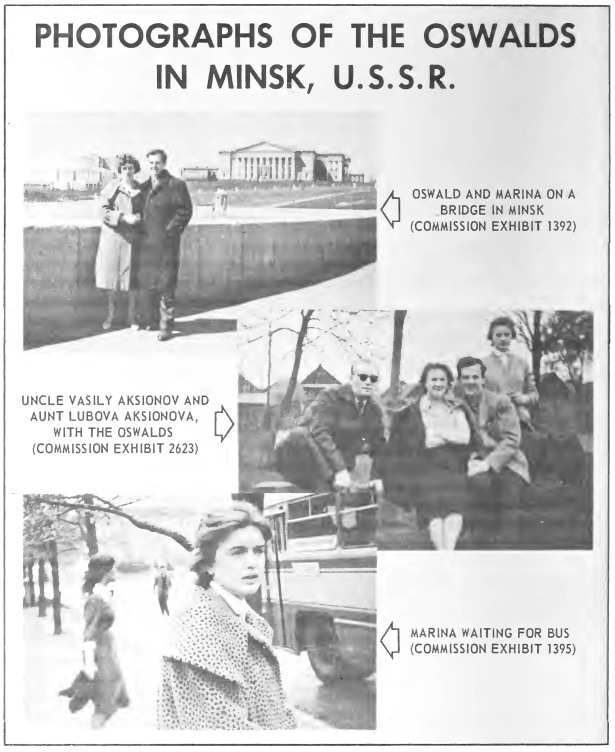
PHOTOGRAPHS OF THE OSWALDS
IN MINSK, U.S.S.R.
(COMMISSION EXHIBIT 1392)
OSWALD AND MARINA ON A
BRIDGE IN MINSK
(COMMISSION EXHIBIT 2623)
UNCLE VASILY AKSIONOV AND
AUNT LUBOVA AKSIONOVA,
WITH THE OSWALDS
(COMMISSION EXHIBIT 1395)
MARINA WAITING FOR BUS
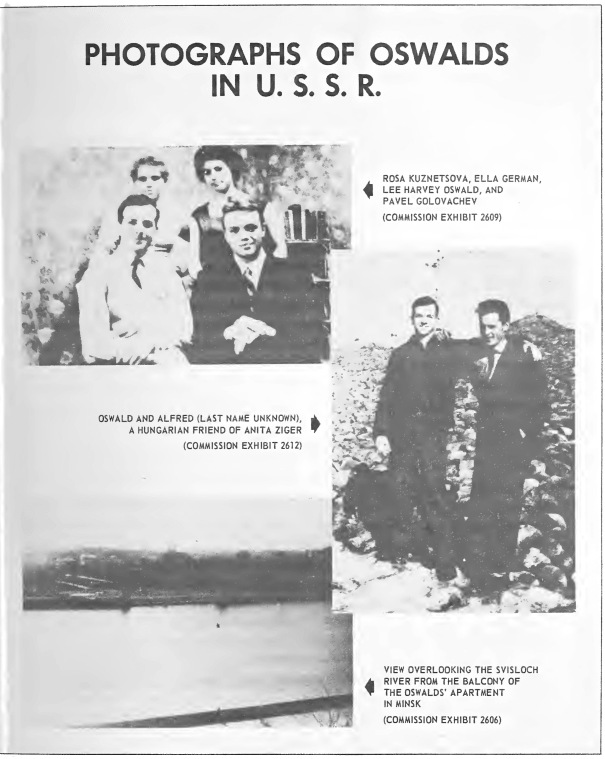
PHOTOGRAPHS OF OSWALDS
IN U. S. S. R.
(COMMISSION EXHIBIT NO. 2609)
ROSA KUZNETSOVA, ELLA GERMAN,
LEE HARVEY OSWALD, AND
PAVEL GOLOVACHEV
(COMMISSION EXHIBIT NO. 2612)
OSWALD AND ALFRED (LAST NAME UNKNOWN),
A HUNGARIAN FRIEND OF ANITA ZIGER
(COMMISSION EXHIBIT NO. 2606)
VIEW OVERLOOKING THE SYISLOCH
RIVER FROM THE BALCONY OF
THE OSWALDS’ APARTMENT
IN MINSK
Moreover, it is from Oswald’s personal writings alone that the Commission
has learned that he received supplementary funds from the
Soviet “Red Cross.” In the notes he made during the return trip
to the United States Oswald recognized that the “Red Cross” subsidy
had nothing to do with the well-known International Red Cross. He
frankly stated that the money was paid to him for having “denounced”
the United States and that it had come from the “MVD.”C6-222 Oswald’s
papers reveal that the “Red Cross” subsidy was terminated
as soon as he wrote the American Embassy in Moscow in February
1961 asking that he be permitted to return.C6-223 (See Commission Exhibit
No. 25, p. 273.) Marina Oswald’s testimony confirmed this;
she said that when she knew Oswald he no longer was receiving the
monthly grant but still retained some of the savings accumulated in
the months when he had been receiving it.C6-224 Since she met Oswald in
March and married him in April of 1961, her testimony was consistent
with his records.
The nature of Oswald’s employment while in Minsk has been examined
by the Commission. The factory in which he worked was a
large plant manufacturing electronic parts and radio and television
sets. Marina Oswald has testified that he was an “apprentice machinist”
and “ground small metallic parts for radio receivers, on a
lathe.”C6-225 So far as can be determined, Oswald never straightforwardly
described to anyone else in the United States exactly what
his job was in the Soviet Union.C6-226 Some of his acquaintances in
Dallas and Fort Worth had the impression that he was disappointed
in having been given a menial job and not assigned to an institution
of higher learning in the Soviet Union.C6-227 Marina Oswald confirmed
this and also testified that her husband was not interested in his work
and not regarded at the factory as a very good worker.C6-228 The documents
furnished to the Commission by the Soviet government were
consistent with her testimony on this point, since they included a report
from Oswald’s superior at the factory which is critical of his
performance on the job.C6-229 Oswald’s employment and his job performance
are thus consistent with his known occupational habits in
this country and otherwise afford no ground for suspicion.
Oswald’s membership in a hunting club while he was in the Soviet
Union has been a matter of special interest to the Commission. One
Russian emigre testified that this was a suspicious circumstance because
no one in the Soviet Union is permitted to own a gun for
pleasure.C6-230 The Commission’s investigation, however, has established
that this is not so. The Central Intelligence Agency has
advised the Commission that hunting societies such as the one to
which Oswald belonged are very popular in the Soviet Union.C6-231 They
are frequently sponsored by factories for their employees, as was
Oswald’s.C6-232 Moreover, Soviet citizens (or foreigners residing in the
Soviet Union) are permitted to own shotguns, but not rifles, without
joining a society; all that is necessary is that the gun be registered
at the local militia office immediately after it has been purchased.C6-233
Experts from the Central Intelligence Agency have examined Oswald’s
club membership certificate and gun permit and expressed
the opinion that its terms and numbers are consistent with other information
the CIA has about the Soviet Union.C6-234
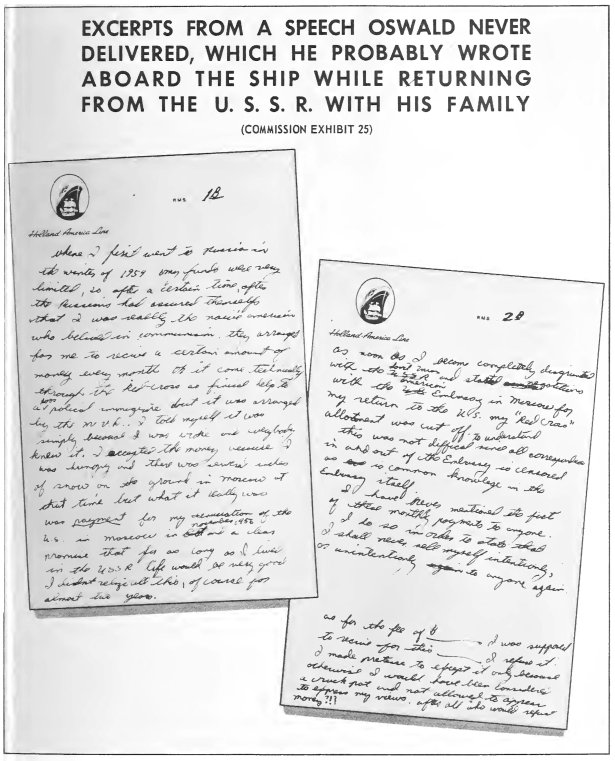
(COMMISSION EXHIBIT NO. 25)
EXCERPTS FROM A SPEECH OSWALD NEVER
DELIVERED, WHICH HE PROBABLY WROTE
ABOARD THE SHIP WHILE RETURNING
FROM THE U. S. S. R. WITH HIS FAMILY
Marina Oswald testified that her husband went hunting only on one
occasion during the time of their marriage.C6-235 However, Oswald
apparently joined the Byelorussian Society of Hunters and Fishermen
in the summer of 1960C6-236 and did not marry until April 30, 1961,C6-237
so he could have been more active while he was still a bachelor.
Oswald made no secret of his membership in the hunting club. He
mentioned it on occasion to friends after he returned to the United
States;C6-238 discussed it at some length in a speech at a Jesuit Seminary
in Mobile, Ala., in the summer of 1962;C6-239 included it in his correspondence
with his brother Robert;C6-240 and kept his membership certificateC6-241
and gun permitC6-242 until the day he was killed. In view of
these facts, it is unlikely that Oswald’s membership in a hunting club
was contrived to conceal some sort of secret training. Moreover, the
CIA has informed the Commission that it is in possession of considerable
information on the location of secret Soviet training institutions
and that it knows of no such institution in or near Minsk
during the time Oswald was there.C6-243
Oswald’s marriage to Marina Prusakova on April 30, 1961,C6-244 is itself
a fact meriting consideration. A foreigner living in Russia cannot
marry without the permission of the Soviet Government.C6-245 It seems
unlikely that the Soviet authorities would have permitted Oswald to
marry and to take his wife with him to the United States if they
were contemplating using him alone as an agent. The fact that he
had a Russian wife would be likely, in their view, to increase any
surveillance under which he would be kept by American security
agencies, would make him even more conspicuous to his neighbors as
“an ex-Russian,” and would decrease his mobility. A wife’s presence
in the United States would also constitute a continuing risk of disclosure.
On the other hand, Marina Oswald’s lack of English training
and her complete ignorance of the United States and its customsC6-246
would scarcely recommend her to the Soviet authorities as one
member of an “agent team” to be sent to the United States on a difficult
and dangerous foreign enterprise.
Oswald’s departure from the Soviet Union.—On February 13, 1961,
the American Embassy in Moscow received a letter from Oswald
postmarked Minsk, February 5, asking that he be readmitted to the
United States.C6-247 This was the first time that the Embassy had heard
from or about Oswald since November 16, 1959.C6-248 The end of the
15-month silence came only a few days after the Department of State
in Washington had forwarded a request to the Moscow Embassy on
February 1, 1961, informing the Embassy that Oswald’s mother was
worried about him, and asking that he get in touch with her if possible.C6-249
The simultaneity of the two events was apparently coincidental.
The request from Marguerite Oswald went from Washington
to Moscow by sealed diplomatic pouch and there was no
evidence that the seal had been tampered with.C6-250 The officer of the
Department of State who carried the responsibility for such matters
has testified that the message was not forwarded to the Russians after
it arrived in Moscow.C6-251
Oswald’s letter does not seem to have been designed to ingratiate
him with the Embassy officials. It starts by incorrectly implying
that he had written an earlier letter that was not answered, states
that he will return to the United States only if he can first “come to
some agreement” on there being no legal charges brought against
him, and ends with a reminder to the officials at the Embassy that
they have a responsibility to do everything they can to help him, since
he is an American citizen.C6-252
The Embassy’s response to this letter was to invite Oswald to come
personally to Moscow to discuss the matter.C6-253 Oswald at first protested
because of the difficulty of obtaining Soviet permission.C6-254 He
wrote two more protesting letters during the following 4 months,C6-255
but received no indication that the Embassy would allow him to handle
the matter by mail.C6-256 While the Department of State was clarifying
its position on this matter,C6-257 Oswald unexpectedly appeared in Moscow
on Saturday, July 8, 1961.C6-258 On Sunday, Marina Oswald flew to
Moscow,C6-259 and was interviewed by officials in the American Embassy
on Tuesday.C6-260
The Commission asked the Department of State and the Central
Intelligence Agency to comment on whether the Oswalds’ travel to
Moscow without permission signified special treatment by the Soviet
Union. From their responses, it appears that since Marina Oswald
possessed a Soviet citizen’s internal passport, she did not require prior
approval to make the trip.C6-261 Although Soviet law did require her
husband, as the holder of a “stateless passport,” to obtain advance
permission for the trip, his failure to do so would not normally have
been considered a serious violation. In this respect, the CIA has
advised the Commission as follows:
OSWALD’S travel from Minsk to Moscow and return in July
1961 would normally have required prior authorization. Bearers
of a Soviet “passport for foreigners” (vid na zhitelstov v. SSSR
dlya innostrantsa) are required to obtain travel authorization
from the Visa and Registration Department (OVIR) (or Passport
Registration Department (PRO) in smaller towns) if they
desire to leave the city (or oblast) where they are domiciled.
This same requirement is believed to apply to persons, such as
OSWALD, holding Soviet “stateless passports” (vid na zhitelstvo
v. SSSR dlya lits bez grazhdanstva).
The practicality of even “unauthorized” travel was demonstrated
by events related by a United States citizen who defected
in 1960, and subsequently was sent to Kiev to study. After repatriating
this defector told U.S. authorities he had made a total
of seven unauthorized trips from Kiev during his stay in the
USSR. He was apprehended on two of his flights and was returned
to Kiev each time, the second time under escort. On both
occasions he was merely reprimanded by the deputy chief of the
institute at which he was studying. Since Marina had a Soviet
citizen’s internal passport there would have been no restrictions
against her making the trip to Moscow.C6-262
The answers of the Department of State, together with the Commission’s
specific questions, are as follows:
B. Could resident foreigners normally travel in this manner
without first obtaining such permission?
Answer—There are only a few U.S. nationals now living in
the Soviet Union. They include an American Roman Catholic
priest, an American Protestant minister, a number of correspondents,
some students and technical advisers to Soviet businesses.
We know that the priest, the minister, the correspondents and
the students must obtain permission from Soviet authorities before
taking any trips. The technical advisers notify officials of
their project before they travel and these officials personally
inform the militia.
C. If travel of this type was not freely permitted, do you believe
that Oswald normally would have been apprehended during
the attempt or punished after the fact for traveling without
permission?
Answer—Based on the information we have, we believe that if
Oswald went to Moscow without permission, and this was known
to the Soviet authorities, he would have been fined or reprimanded.
Oswald was not, of course, an average foreign resident. He was
a defector from a foreign country and the bearer of a Soviet
internal “stateless” passport * * * during the time when he was
contemplating the visit to Moscow to come to the Embassy * * *
The Soviet authorities probably knew about Oswald’s trip even
if he did not obtain advance permission, since in most instances the
Soviet militia guards at the Embassy ask for the documents of
unidentified persons entering the Embassy grounds * * *
An American citizen who, with her American citizen husband,
went to the Soviet Union to live permanently and is now trying
to obtain permission to leave, informed the Embassy that she had
been fined for not getting permission to go from Odessa to Moscow
on a recent trip to visit the Embassy.
D. Even if such travel did not have to be authorized, do you
have any information or observations regarding the practicality
of such travel by Soviet citizens or persons in Oswald’s status?
Answer—It is impossible to generalize in this area. We understand
from interrogations of former residents in the Soviet Union
who were considered “stateless” by Soviet authorities that they
were not permitted to leave the town where they resided without
permission of the police. In requesting such permission they
were required to fill out a questionnaire giving the reason for
travel, length of stay, addresses of individuals to be visited, etc.
Notwithstanding these requirements, we know that at least one
“stateless” person often traveled without permission of the authorities
and stated that police stationed at railroad stations
usually spotchecked the identification papers of every tenth
traveler, but that it was an easy matter to avoid such checks.
Finally, she stated that persons who were caught evading the
registration requirements were returned to their home towns by
the police and sentenced to short jail terms and fined. These
sentences were more severe for repeated violations.C6-263
When Oswald arrived at the Embassy in Moscow, he met Richard
E. Snyder, the same person with whom he had dealt in October of
1959.C6-264 Primarily on the basis of Oswald’s interview with Snyder on
Monday, July 10, 1961, the American Embassy concluded that Oswald
had not expatriated himself.C6-265 (See app. XV, pp. 752-760.) On the
basis of this tentative decision, Oswald was given back his American
passport, which he had surrendered in 1959.C6-266 The document was
due to expire in September 1961,C6-267 however, and Oswald was informed
that its renewal would depend upon the ultimate decision by the Department
of State on his expatriation.C6-268 On July 11, Marina Oswald
was interviewed at the Embassy and the steps necessary for her to
obtain an American visa were begun.C6-269 In May 1962, after 15 months
of dealings with the Embassy, Oswald’s passport was ultimately renewed
and permission for his wife to enter the United States was
granted.C6-270
The files on Oswald and his wife compiled by the Department of
State and the Immigration and Naturalization Service contain no
indication of any expert guidance by Soviet authorities in Oswald’s
dealings with the Department or the Service. For example, the
letters from Minsk to the Embassy in Moscow,C6-271 which are in his
handwriting,C6-272 display the arrogant attitude which was characteristic
of him both before and after he lived in Russia, and, when compared
with other letters that were without doubt composed and
written by him,C6-273 show about the same low level of sophistication,
fluency, and spelling. The Department officer who most frequently
dealt with Oswald when he began negotiations to return to the
United States, Richard E. Snyder, testified that he can recall nothing
that indicated Oswald was being guided or assisted by a third party
when he appeared at the Embassy in July 1961.C6-274 On the contrary,
the arrogant and presumptuous attitude which Oswald displayed in
his correspondence with the Embassy from early 1961 until June
1962,C6-275 when he finally departed from Russia, undoubtedly hindered
his attempts to return to the United States. Snyder has testified that
although he made a sincere effort to treat Oswald’s application objectively,
Oswald’s attitude made this very difficult.C6-276
In order to leave Russia, it was also necessary for the Oswalds to
obtain permission from the Soviet Government. The timing and
circumstances under which the Oswalds obtained this permission
have also been considered by the Commission. Marina Oswald, although
her memory is not clear on the point, said that she and Oswald
first made their intentions to go to the United States known to
Soviet officials in Minsk in May, even before coming to Moscow in
July for the conference at the American Embassy.C6-277 The Oswalds’
correspondence with the Embassy and the documents furnished the
Commission by the Soviet Government show that the Oswalds made
a series of formal applications to the Soviets from July 15 to August
21.C6-278 Presumably the most difficult question for the Soviet
authorities was whether to allow Marina Oswald to accompany her
husband. She was called to the local passport office in Minsk on
December 25, 1961, and told that authority had been received to
issue exit visas to her and Oswald.C6-279 Obtaining the permission of
the Soviet Government to leave may have been aided by a conference
which Marina Oswald had, at her own request, with a local MVD official,
Colonel Aksenov, sometime in late 1961. She testified that she
applied for the conference at her husband’s urging, after he had tried
unsuccessfully to arrange such a conference for himself.C6-280 She believed
that it may have been granted her because her uncle with whom
she had lived in Minsk before her marriage was also an MVD official.C6-281
The correspondence with the American Embassy at this time reflected
that the Oswalds did not pick up their exit visas immediately.C6-282
On January 11, 1962, Marina Oswald was issued her Soviet exit visa.
It was marked valid until December 1, 1962.C6-283 The Oswalds did
not leave Russia until June 1962, but the additional delay was caused
by problems with the U.S. Government and by the birth of a child in
February.C6-284 Permission of the Soviet authorities to leave, once given,
was never revoked. Oswald told the FBI in July 1962, shortly after
he returned to the United States, that he had been interviewed by
the MVD twice, once when he first came to the Soviet Union and
once just before he departed.C6-285 His wife testified that the second
interview did not occur in Moscow but that she and her husband dealt
with the MVD visa officials frequently in Minsk.C6-286
Investigation of the circumstances, including the timing, under
which the Oswalds obtained permission from the Soviet Government
to leave Russia for the United States show that they differed in no
discernible manner from the normal. The Central Intelligence
Agency has informed the Commission that normally a Soviet national
would not be permitted to emigrate if he might endanger Soviet
national security once he went abroad.C6-287 Those persons in possession
of confidential information, for example, would constitute an important
category of such “security risks.” Apparently Oswald’s
predeparture interview by the MVD was part of an attempt to
ascertain whether he or his wife had access to any confidential
information. Marina Oswald’s reported interview with the MVD
in late 1961, which was arranged at her request, may have served the
same purpose. The Commission’s awareness of both interviews
derives entirely from Oswald’s and his wife’s statements and letters
to the American Embassy, which afford additional evidence that the
conferences carried no subversive significance.
It took the Soviet authorities at least 5½ months, from about July
15, 1961, until late December, to grant permission for the Oswalds
to leave the country. When asked to comment upon the alleged rapidity
of the Oswalds’ departure, the Department of State advised the
Commission:
* * * In the immediate post-war period there were about fifteen
marriages in which the wife had been waiting for many years
for a Soviet exit permit. After the death of Stalin the Soviet
Government showed a disposition to settle these cases. In the
summer of 1953 permission was given for all of this group of
Soviet citizen wives to accompany their American citizen husbands
to the United States.
Since this group was given permission to leave the Soviet Union,
there have been from time to time marriages in the Soviet Union
of American citizens and Soviet citizens. With one exception, it
is our understanding that all of the Soviet citizens involved have
been given permission to emigrate to the United States after waiting
periods which were, in some cases from three to six months
and in others much longer.C6-288
Both the Department of State and the Central Intelligence Agency
compiled data for the Commission on Soviet wives of American citizens
who received exit visas to leave the Soviet Union, where the relevant
information was available. In both cases the data were consistent
with the above conclusion of the State Department. The Department
of State had sufficient information to measure the timespan in 14 cases.
The Department points out that it has information on the dates of
application for and receipt of Soviet exit visas only on those cases
that have been brought to its attention. A common reason for bringing
a case to the attention of the Department is that the granting of
the exit visa by the Soviet Union has been delayed, so that the American
spouse seeks the assistance of his own government. It therefore
appears that the sampling data carry a distinct bias toward lengthy
waiting periods. Of the 14 cases tested, 6 involve women who applied
for visas after 1953, when the liberalized post-Stalin policy was in
effect. The approximate waiting periods for these wives were, in
decreasing order, 13 months, 6 months, 3 months, 1 month, and 10
days.C6-289 Of the 11 cases examined by the Central Intelligence Agency
in which the time period is known or can be inferred, the Soviet wives
had to wait from 5 months to a year to obtain exit visas.C6-290
In his correspondence with the American Embassy and his brother
while he was in Russia,C6-291 in his diary,C6-292 and in his conversations
with people in the United States after he returned,C6-293 Oswald claimed
that his wife had been subjected to pressure by the Soviet Government
in an effort to induce her not to emigrate to the United States. In the
Embassy correspondence, Oswald claimed that the pressure had been
so intense that she had to be hospitalized for 5 days for “nervous exhaustion.”C6-294
Marina Oswald testified that her husband exaggerated
and that no such hospitalization or “nervous exhaustion” ever
occurred.C6-295 However, she did testify that she was questioned on the
matter occasionally and given the impression that her government
was not pleased with her decision.C6-296 Her aunt and uncle in Minsk did
not speak to her “for a long time”; she also stated that she was dropped
from membership in the Communist Youth Organization (Komsomol)
when the news of her visit to the American Embassy in
Moscow reached that organization.C6-297 A student who took Russian
lessons from her in Texas testified that she once referred to the days
when the pressure was applied as “a very horrible time.”C6-298 Despite all
this Marina Oswald testified that she was surprised that their visas
were granted as soon as they were—and that hers was granted at all.C6-299
This evidence thus indicates that the Soviet authorities, rather than
facilitating the departure of the Oswalds, first tried to dissuade
Marina Oswald from going to the United States and then, when she
failed to respond to the pressure, permitted her to leave without undue
delay. There are indications that the Soviet treatment of another
recent defector who left the Soviet Union to return to the United
States resembled that accorded to the Oswalds.C6-300
On the basis of all the foregoing evidence, the Commission concluded
that there was no reason to believe that the Oswalds received unusually
favorable treatment in being permitted to leave the Soviet Union.
The Russian-speaking community.—Shortly after his return from
Russia in June 1962, Oswald and his family settled in Fort Worth,
Tex., where they met a group of Russian-born or Russian-speaking
persons in the Dallas-Fort Worth area.C6-301 The members of this community
were attracted to each other by common background, language,
and culture. Many of them were well-educated, accomplished, and
industrious people, several being connected with the oil exploration,
production, and processing industry that flourishes in the
Dallas-Fort Worth area.C6-302 As described more fully in chapter VII
and in appendix XIII, many of these persons assisted the Oswalds
in various ways. Some provided the Oswalds with gifts of such
things as food, clothing, and baby furniture.C6-303 Some arranged
appointments and transportation for medical and dental treatment,
and assumed the cost in some instances.C6-304 When Oswald undertook
to look for employment in Dallas in early October of 1962 and
again when marital difficulties arose between the Oswalds in November
of the same year, Marina Oswald and their child were housed at times
in the homes of various members of the group.C6-305 The Commission
has examined the background of many of these individuals and has
thoroughly investigated Oswald’s relationship with them.
There is no basis to suppose that Oswald came to Fort Worth upon
his return from Russia for the purpose of establishing contacts with
the Russian-speaking community located in that area. Oswald had
spent several of his grammar-school years in Fort Worth.C6-306 In 1962,
his brother Robert lived in Fort Worth and his mother resided in
nearby Vernon, Tex. In January of that year, Oswald indicated to
American officials in Russia that he intended to stay with his mother
upon his return to the United States; however, sometime after mid-February,
he received an invitation to stay with Robert and his
family until he became settled, and he did spend the first several weeks
after his return at Robert’s home.C6-307 In July, Oswald’s mother moved
to Fort Worth and Oswald and his wife and child moved into an
apartment with her.C6-308 While in that apartment, Oswald located a
job in Fort Worth and then rented and moved with his family into
an apartment on Mercedes Street.C6-309
Upon his arrival in 1962, Oswald did not know any members of the
relatively small and loosely knit Russian-speaking community.C6-310
Shortly after his arrival Oswald obtained the name of two Russian-speaking
persons in Fort Worth from the office of the Texas Employment
Commission in that city.C6-311 Attempts to arrange a prompt visit
with one of them failed.C6-312 The second person, Peter Paul Gregory,
was a consulting petroleum engineer and part-time Russian-language
instructor at the Fort Worth Public Library. Oswald contacted him
in order to obtain a letter certifying to his proficiency in Russian
and Marina Oswald later tutored his son in the Russian language.C6-313
Gregory introduced the Oswalds to George Bouhe and Anna Meller,
both of whom lived in Dallas and became interested in the welfare of
Marina Oswald and her child.C6-314 Through them, other members of the
Russian community became acquainted with the Oswalds.C6-315
The Oswalds met some 30 persons in the Russian-speaking
community, of whom 25 testified before the Commission or its staff;
others were interviewed on behalf of the Commission.C6-316 This range of
testimony has disclosed that the relationship between Lee Harvey
Oswald and the Russian-speaking community was short lived and
generally quite strained.C6-317 During October and November of 1962
Marina Oswald lived at the homes of some of the members of the Russian-speaking
community.C6-318 She stayed first with Elena Hall while
Oswald was looking for work in Dallas.C6-319 In early November, Marina
Oswald and the baby joined Oswald in Dallas, but soon thereafter,
she spent approximately 2 weeks with different Russian-speaking
friends during another separation.C6-320 Oswald openly resented the
help Marina’s “Russian friends” gave to him and his wife and the
efforts of some of them to induce Marina to leave him.C6-321 George
Bouhe attempted to dissuade Marina from returning to her husband
in November 1962, and when she rejoined him, Bouhe became displeased
with her as well.C6-322 Relations between the Oswalds and the
members of the Russian community had practically ceased by the end
of 1962. Katherine Ford, one of the members of the group, summed
up the situation as it existed at the end of January 1963: “So it was
rather, sort of, Marina and her husband were dropped at that time,
nobody actually wanted to help. * * *”C6-323
In April of 1963, Oswald left Fort Worth for New Orleans, where
he was later joined by his wife and daughter, and remained until
his trip to Mexico City in late September and his subsequent return
to the Dallas-Fort Worth area in early October of 1963.C6-324 With only
minor exceptions,C6-325 there is no evidence that any member of the
Russian-speaking community had further contact with Oswald or
his family after April.C6-326 In New Orleans, Oswald made no attempt
to make new Russian-speaking acquaintances for his wife
and there is no evidence that he developed any friendships in that
city.C6-327 Similarly, after the return from New Orleans, there seems
to have been no communication between the Oswalds and this group
until the evening of November 22, 1963, when the Dallas Police
enlisted Ilya Mamantov to serve as an interpreter for them in their
questioning of Marina Oswald.C6-328
George De Mohrenschildt and his wife, both of whom speak Russian
as well as several other languages, however, did continue to see the
Oswalds on occasion up to about the time Oswald went to New Orleans
on April 24, 1963. De Mohrenschildt was apparently the only
Russian-speaking person living in Dallas for whom Oswald had appreciable
respect, and this seems to have been true even though De
Mohrenschildt helped Marina Oswald leave her husband for a
period in November of 1962.C6-329
In connection with the relations between Oswald and De Mohrenschildt,
the Commission has considered testimony concerning an event
which occurred shortly after Oswald shot at General Walker. The
De Mohrenschildts came to Oswald’s apartment on Neely Street for
the first time on the evening of April 13, 1963, apparently to bring an
Easter gift for the Oswald child.C6-330 Mrs. De Mohrenschildt testified
that while Marina Oswald was showing her the apartment, she
saw a rifle with a scope in a closet. Mrs. De Mohrenschildt then
told her husband, in the presence of the Oswalds, that there was a
rifle in the closet.C6-331 Mrs. De Mohrenschildt testified that “George,
of course, with his sense of humor—Walker was shot at a few days ago,
within that time. He said, ‘Did you take a pot shot at Walker by any
chance?’”C6-332 At that point, Mr. De Mohrenschildt testified, Oswald
“sort of shriveled, you see, when I asked this question. * * * made
a peculiar face * * * [and] changed the expression on his face” and
remarked that he did targetshooting.C6-333 Marina Oswald testified that
the De Mohrenschildts came to visit a few days after the Walker incident
and that when De Mohrenschildt made his reference to Oswald’s
possibly shooting at Walker, Oswald’s “face changed, * * * he almost
became speechless.”C6-334 According to the De Mohrenschildts, Mr.
De Mohrenschildt’s remark was intended as a joke, and he had no
knowledge of Oswald’s involvement in the attack on Walker.C6-335
Nonetheless, the remark appears to have created an uncomfortable
silence, and the De Mohrenschildts left “very soon afterwards.” They
never saw either of the Oswalds again.C6-336 They left in a few days on
a trip to New York City and did not return until after Oswald had
gone to New Orleans.C6-337 A postcard from Oswald to De Mohrenschildt
was apparently the only contact they had thereafter.C6-338 The
De Mohrenschildts left in early June for Haiti on a business venture,
and they were still residing there at the time they testified on April 23,
1964.C6-339
Extensive investigation has been conducted into the background
of both De Mohrenschildts.C6-340 The investigation has revealed that
George De Mohrenschildt is a highly individualistic person of varied
interests. He was born in the Russian Ukraine in 1911 and fled Russia
with his parents in 1921 during the civil disorder following the
revolution. He was in a Polish cavalry military academy for 1½ years.
Later he studied in Antwerp and attended the University of Liege
from which he received a doctor’s degree in international commerce
in 1928. Soon thereafter, he emigrated to the United States; he became
a U.S. citizen in 1949.C6-341 De Mohrenschildt eventually became
interested in oil exploration and production; he entered the University
of Texas in 1944 and received a master’s degree in petroleum geology
and petroleum engineering in 1945.C6-342 He has since become active as a
petroleum engineer throughout the world.C6-343 In 1960, after the death
of his son, he and his wife made an 8-month hike from the United
States-Mexican border to Panama over primitive jungle trails. By
happenstance they were in Guatemala City at the time of the Bay of
Pigs invasion.C6-344 A lengthy film and complete written log was prepared
by De Mohrenschildt and a report of the trip was made to the
U.S. Government.C6-345 Upon arriving in Panama they journeyed to
Haiti where De Mohrenschildt eventually became involved in a Government-oriented
business venture in which he has been engaged continuously
since June 1963 until the time of this report.C6-346
The members of the Dallas-Fort Worth Russian community and
others have variously described De Mohrenschildt as eccentric, outspoken,
and a strong believer in individual liberties and in the U.S.
form of government, but also of the belief that some form of undemocratic
government might be best for other peoples.C6-347 De Mohrenschildt
frankly admits his provocative personality.C6-348
Jeanne De Mohrenschildt was born in Harbin, China, of White
Russian parents. She left during the war with Japan, coming to
New York in 1938 where she became a successful ladies dress and
sportswear apparel designer. She married her present husband in
1959.C6-349
The Commission’s investigation has developed no signs of subversive
or disloyal conduct on the part of either of the De Mohrenschildts.
Neither the FBI, CIA, nor any witness contacted by the
Commission has provided any information linking the De Mohrenschildts
to subversive or extremist organizations.C6-350 Nor has there
been any evidence linking them in any way with the assassination of
President Kennedy.
The Commission has also considered closely the relations between
the Oswalds and Michael and Ruth Paine of Irving, Tex. The
Paines were not part of the Russian community which has been discussed
above. Ruth Paine speaks Russian, however, and for this
reason was invited to a party in February of 1963 at which she became
acquainted with the Oswalds.C6-351 The host had met the Oswalds
through the De Mohrenschildts.C6-352 Marina Oswald and Ruth Paine
subsequently became quite friendly, and Mrs. Paine provided considerable
assistance to the Oswalds.C6-353 Marina Oswald and her child
resided with Ruth Paine for a little over 2 weeks while Oswald sought
a job in New Orleans in late April and early May 1963.C6-354 In May,
she transported Marina Oswald to New Orleans, paying all of the
traveling and other expenses.C6-355 While the Oswalds were in New
Orleans, the two women corresponded.C6-356 Mrs. Paine came to New
Orleans in late September and took Marina Oswald and her child
to her home in Irving.C6-357
Since Oswald left for Mexico City promptly after Mrs. Paine and
his family departed New Orleans,C6-358 the Commission has considered
whether Ruth Paine’s trip to New Orleans was undertaken to assist
Oswald in this venture, but the evidence is clear that it was not. In
her letters to Ruth Paine during the summer of 1963, Marina Oswald
confided that she was having continuing difficulties with her husband,
and Mrs. Paine urged Marina Oswald to live with her in Irving; the
letters of the two women prior to Mrs. Paine’s arrival in New Orleans
on September 20, 1963, however, contain no mention that Oswald was
planning a trip to Mexico City or elsewhere.C6-359 In New Orleans,
Mrs. Paine was told by Oswald that he planned to seek employment in
Houston, or perhaps Philadelphia. Though Marina Oswald knew
this to be false, she testified that she joined in this deception.C6-360 At no
time during the entire weekend was Mexico City mentioned.C6-361 Corroboration
for this testimony is found in a letter Mrs. Paine wrote
her mother shortly after she and Marina Oswald had returned to
Irving on September 24, in which she stated that Marina Oswald
was again living with her temporarily and that Oswald was job-hunting.C6-362
When Oswald arrived at the Paine home on October 4,
he continued his deception by telling Mrs. Paine, in his wife’s presence,
that he had been unsuccessful in finding employment.C6-363 At Oswald’s
request, Marina Oswald remained silent.C6-364
Marina Oswald lived with Ruth Paine through the birth of her
second daughter on October 20, 1963, and until the assassination of
President Kennedy.C6-365 During this period, Oswald obtained a room
in Dallas and found employment in Dallas, but spent weekends with
his family at the Paine home.C6-366 On November 1 and 5, Ruth Paine
was interviewed by agents of the FBI who were investigating Oswald’s
activities since his return from the Soviet Union, as set forth
in greater detail in chapter VIII. She did not then know Oswald’s
address in Dallas.C6-367 She was not asked for, nor did she volunteer,
Oswald’s telephone number in Dallas, which she did know.C6-368 She
advised the Bureau agent to whom she spoke of Oswald’s periodic
weekend visits, and she informed him that Oswald was employed at
the Texas School Book Depository Building.C6-369
On November 10, Ruth Paine discovered a draft of Oswald’s letter
written the day before to the Soviet Embassy in Washington, in
which he indicated that he had journeyed to Mexico City and conferred
with a “comrade Kostine in the Embassy of the Soviet Union,
Mexico City, Mexico.”C6-370 (This letter is discussed later in this
chapter.) Mr. and Mrs. Paine testified that although they initially
assumed the letter was a figment of Oswald’s imagination, the letter
gave Mrs. Paine considerable misgivings.C6-371 She determined that if
the FBI agents returned she would deliver to them the copy of a draft
of the letter which, unknown to Oswald, she had made.C6-372 However,
the agents did not return before the assassination.C6-373 On November
19, Mrs. Paine learned that Oswald was living in his Dallas rooming-house
under an assumed name.C6-374 She did not report this to the
FBI because, as she testified, she “had no occasion to see them, and
* * * did not think it important enough to call them after that until
the 23d of November.”C6-375
The Commission has thoroughly investigated the background of
both Paines. Mrs. Paine was born Ruth Hyde in New York City on
September 3, 1932. Her parents moved to Columbus, Ohio, in the
late 1930’s.C6-376 They were divorced in 1961.C6-377 Ruth Paine graduated
from Antioch College in 1955.C6-378 While in high school she first
became interested in Quaker activities; she and her brother became
Quakers in 1951.C6-379 In 1952, following completion of her sophomore
year at Antioch College, she was a delegate to two Friends conferences
in England.C6-380
At the time the Paines met in 1955, Mrs. Paine was active in the
work of the Young Friends Committee of North America, which, with
the cooperation of the Department of State, was making an effort to
lessen the tensions between Soviet Russia and the United States by
means of the stimulation of contacts and exchange of cultures between
citizens of the two nations through “pen-pal” correspondence and
exchanges of young Russians and Americans.C6-381 It was during
this period that Mrs. Paine became interested in the Russian language.C6-382
Mrs. Paine participated in a Russian-American student exchange
program sponsored by the Young Friends Committee of North
America, and has participated in the “pen-pal” phase of the activities
of the Young Friends Committee.C6-383 She has corresponded until
recently with a schoolteacher in Russia.C6-384 Although her active interest
in the Friends’ program for the lessening of East-West tensions
ceased upon her marriage in December 1957, she has continued to hold
to the tenets of the Quaker faith.C6-385
Michael Paine is the son of George Lyman Paine and Ruth Forbes
Paine, now Ruth Forbes Young, wife of Arthur Young of Philadelphia,
Pa.C6-386 His parents were divorced when he was 4 years of
age. His father, George Lyman Paine, is an architect and resides in
California.C6-387 Michael Paine testified that during his late grammar
and early high school days his father participated actively in the
Trotskyite faction of the Communist movement in the United States
and that he attended some of those meetings.C6-388 He stated that his
father, with whom he has had little contact throughout most of his
life, has not influenced his political thinking. He said that he has
visited his father four or five times in California since 1959, but their
discussions did not include the subject of communism.C6-389 Since moving
to Irving, Tex., in 1959, he has been a research engineer for Bell
Helicopter Co. in Fort Worth.C6-390 Mr. Paine has security clearance for
his work.C6-391 He has been a long-time member of the American Civil
Liberties Union.C6-392 Though not in sympathy with rightist political
aims, he has attended a few meetings of far-right organizations in
Dallas for the purpose, he testified, of learning something about those
organizations and because he “was interested in seeing more communication
between the right and the left.”C6-393
The Commission has conducted a thorough investigation of the
Paines’ finances and is satisfied that their income has been from legitimate
and traceable sources, and that their expenditures were consistent
with their income and for normal purposes. Although in the course of
their relationship with the Oswalds, the Paines assumed expenses for
such matters as food and transportation, with a value of approximately
$500, they made no direct payments to, and received no moneys
or valuables from, the Oswalds.C6-394
Although prior to November 22, Mrs. Paine had information relating
to Oswald’s use of an alias in Dallas, his telephone number, and his
correspondence with the Soviet Embassy, which she did not pass on to
the FBI,C6-395 her failure to have come forward with this information
must be viewed within the context of the information available to
her at that time. There is no evidence to contradict her testimony
that she did not then know about Oswald’s attack on General Walker,
the presence of the rifle on the floor of her garage, Oswald’s ownership
of a pistol, or the photographs of Oswald displaying the firearms.C6-396
She thus assumed that Oswald, though a difficult and disturbing
personality, was not potentially violent, and that the FBI was
cognizant of his past history and current activities.C6-397
Moreover, it is from Mrs. Paine herself that the Commission has
learned that she possessed the information which she did have. Mrs.
Paine was forthright with the agent of the FBI with whom she spoke
in early November 1963, providing him with sufficient information to
have located Oswald at his job if he had deemed it necessary to do
so,C6-398 and her failure to have taken immediate steps to notify the
Bureau of the additional information does not under the circumstances
appear unusual. Throughout the Commission’s investigation,
Ruth Paine has been completely cooperative, voluntarily producing
all correspondence, memoranda, and other written communications in
her possession that had passed between her and Marina Oswald both
before and after November 22, 1963.C6-399 The Commission has had the
benefit of Mrs. Paine’s 1963 date book and calendar and her address
book and telephone notation book, in both of which appear many entries
relating to her activities with the Oswalds.C6-400 Other material of
a purely personal nature was also voluntarily made available.C6-401 The
Commission has found nothing in the Paines’ background, activities,
or finances which suggests disloyalty to the United States,C6-402 and it
has concluded that Ruth and Michael Paine were not involved in any
way with the assassination of President Kennedy.
A fuller narrative of the social contacts between the Oswalds
and the various persons of the Dallas-Fort Worth community is
incorporated in chapter VII and appendix XIII, and the testimony
of all members of the group who testified before the Commission is
included in the printed record which accompanies the report. The
evidence establishes that the Oswalds’ contacts with these people were
originated and maintained under normal and understandable circumstances.
The files maintained by the FBI contain no information
indicating that any of the persons in the Dallas-Fort Worth community
with whom Oswald associated were affiliated with any Communist,
Fascist, or other subversive organization.C6-403 During the course
of this investigation, the Commission has found nothing which suggests
the involvement of any member of the Russian-speaking community
in Oswald’s preparations to assassinate President Kennedy.
Upon his return from the Soviet Union, Oswald had dealings with
the Communist Party, U.S.A., the Socialist Workers Party, and the
Fair Play for Cuba Committee, and he also had minor contacts with
at least two other organizations with political interests. For the purpose
of determining whether Oswald received any advice, encouragement,
or assistance from these organizations in planning or executing
the assassination of President Kennedy, the Commission has conducted
a full investigation of the nature and extent of Oswald’s relations
with them. The Commission has also conducted an investigation
to determine whether certain persons and organizations expressing
hostility to President Kennedy prior to the assassination had any connection
with Lee Harvey Oswald or with the shooting of the President.
Communist Party, U.S.A.; Socialist Workers Party.—In August of
1962, Oswald subscribed to the Worker, a publication of the Communist
Party, U.S.A.C6-404 He also wrote the Communist Party to obtain
pamphlets and other literature which, the evidence indicates, were
sent to him as a matter of course.C6-405
Oswald also attempted to initiate other dealings with the Communist
Party, U.S.A., but the organization was not especially responsive.
From New Orleans, he informed the party of his activities in connection
with the Fair Play for Cuba Committee, discussed below, submitting
membership cards in his fictitious chapter to several party
officials.C6-406 In a letter from Arnold S. Johnson, director of the information
and lecture bureau of the party, Oswald was informed that although
the Communist Party had no “organizational ties” with the
committee, the party issued much literature which was “important
for anybody who is concerned about developments in Cuba.”C6-407 In
September 1963 Oswald inquired how he might contact the party
when he relocated in the Baltimore-Washington area, as he said he
planned to do in October, and Johnson suggested in a letter of September
19 that he “get in touch with us here [New York] and we will
find some way of getting in touch with you in that city [Baltimore].”C6-408
However, Oswald had also written asking whether, “handicapped
as it were, by * * * [his] past record,” he could “still * * *
compete with antiprogressive forces, above ground or whether in your
opinion * * * [he] should always remain in the background, i.e.,
underground,” and in the September 19 letter received the reply that
“often it is advisable for some people to remain in the background,
not underground.”C6-409
In a letter postmarked November 1, Oswald informed the party that
he had moved to Dallas, and reported his attendance at a meeting at
which General Walker had spoken, and at a meeting of the American
Civil Liberties Union; he asked Johnson for the party’s “general
view” of the latter organization and “to what degree, if any, [he]
should attempt to highten its progressive tendencies.” According to
Johnson, this letter was not received by the Communist Party until
after the assassination.C6-410 At different times, Oswald also wrote the
Worker and the Hall-Davis Defense Committee, enclosing samples of
his photographic work and offering to assist in preparing posters; he
was told that “his kind offer [was] most welcomed and from time to
time we shall call on you,” but he was never asked for assistance.C6-411
The correspondence between Oswald and the Communist Party, and
with all other organizations, is printed in the record accompanying
this report.
When Oswald applied for a visa to enter Cuba during his trip to
Mexico City, discussed below,C6-412 Senora Silvia Duran, the Cuban
consular employee who dealt with Oswald, wrote on the application
that Oswald said he was a member of the Communist Party and
that he had “displayed documents in proof of his membership.”C6-413
When Oswald went to Mexico, he is believed to have carried
his letters from the Soviet Embassy in Washington and from
the Communist Party in the United States, his 1959 passport,
which contained stamps showing that he had lived in Russia for 2½
years, his Russian work permit, his Russian marriage certificate, membership
cards and newspaper clippings purporting to show his role
in the Fair Play for Cuba Committee, and a prepared statement of
his qualifications as a “Marxist.”C6-414 Because of the mass of papers
Oswald did present showing his affinity for communism, some in the
Russian language, which was foreign to Senora Duran, and because
further investigation, discussed below, indicated that Oswald was not
a member of the party, Senora Duran’s notation was probably
inaccurate.
Upon his arrest after the assassination, Oswald attempted to
contact John J. Abt, a New York attorney, to request Abt to represent
him. Abt was not in New York at the time, and he was
never reached in connection with representing Oswald. Abt has
testified that he at no time had any dealings with Oswald and that
prior to the assassination he had never heard of Lee Harvey Oswald.C6-415
After his return from the Soviet Union, Oswald also carried on a
limited correspondence with the Socialist Workers Party. In October
of 1962 he attempted to join the party, but his application
was not accepted since there was then no chapter in the Dallas area.C6-416
Oswald also wrote the Socialist Workers Party offering his assistance
in preparing posters. From this organization too he received the
response that he might be called upon if needed. He was asked for
further information about his photographic skills, which he does not
appear to have ever provided.C6-417 Oswald did obtain literature from
the Socialist Workers Party, however, and in December 1962 he entered
a subscription to the affiliated publication, the Militant.C6-418 Apparently
in March of 1963 Oswald wrote the party of his activities and
submitted a clipping with his letter. In response, he was told that
his name was being sent to the Young Socialist Alliance for further
correspondence, but the files of the alliance apparently contain no
reference to Oswald. Neither the letter nor the clipping which Oswald
sent has been located.C6-419
Investigation by the Commission has produced no plausible evidence
that Lee Harvey Oswald had any other significant contacts with the
Communist Party, U.S.A., the Socialist Workers Party, or with any
other extreme leftist political organization. The FBI and other
Federal security agencies have made a study of their records and
files and contacted numerous confidential informants of the
agencies and have produced no such evidence.C6-420 The Commission
has questioned persons who, as a group, knew Oswald during virtually
every phase of his adult life, and from none of these came any indication
that Oswald maintained a surreptitious relationship with any
organization. Arnold S. Johnson, of the American Communist Party;
James T. Tormey, executive secretary of the Hall-Davis Defense
Committee; and Farrell Dobbs, secretary of the Socialist Workers
Party, voluntarily appeared before the Commission and testified under
oath that Oswald was not a member of these organizations and that a
thorough search of their files had disclosed no records relating to
Oswald other than those which they produced for the Commission.C6-421
The material that has been disclosed is in all cases consistent with
other data in the possession of the Commission.
Socialist Labor Party.—Oswald also wrote to the Socialist Labor
Party in New York in November 1962 requesting literature. Horace
Twiford, a national committeeman at large for the party in the State
of Texas, was informed by the New York headquarters in July 1963
of Oswald’s request, and on September 11, 1963, he did mail literature
to Oswald at his old post office box in Dallas.C6-422 On his way to Mexico
City in September 1963, Oswald attempted to contact Twiford at his
home in Houston; Oswald spoke briefly with Twiford’s wife, identifying
himself as a member of the Fair Play for Cuba Committee, but
since Twiford was out of town at the time, Oswald was unable to speak
with him.C6-423 Arnold Peterson, national secretary and treasurer of the
Socialist Labor Party, has stated that a search of the records of the
national headquarters reveals no record pertaining to Oswald; he explained
that letters requesting literature are routinely destroyed.C6-424
The Socialist Party-Social Democratic Federation has also advised
that a review of its records fails to reflect any information or correspondence
pertaining to Oswald.C6-425
Fair Play for Cuba Committee.—During the period Oswald was
in New Orleans, from the end of April to late September 1963, he was
engaged in activity purportedly on behalf of the now defunct Fair
Play for Cuba Committee (FPCC), an organization centered in New
York which was highly critical of U.S. policy toward the Cuban
Government under Fidel Castro. In May 1963, after having obtained
literature from the FPCC,C6-426 Oswald applied for and was granted
membership in the organization.C6-427 When applying for membership,
Oswald wrote national headquarters that he had
* * * been thinking about renting a small office at my own expense
for the purpose of forming a F.P.C.C. branch here in New
Orleans.
Could you give me a charter?C6-428
With his membership card, Oswald apparently received a copy of the
constitution and bylaws for FPCC chapters, and a letter, dated May
29, which read in part as follows (with spelling as in original):
It would be hard to concieve of a chapter with as few
members as seem to exist in the New Orleans area. I have just
gone through our files and find that Louisiana seams somewhat
restricted for Fair Play activities. However, with what is there
perhaps you could build a larger group if a few people would
undertake the disciplined responsibility of concrete organizational
work.
We certainly are not at all adverse to a very small Chapter but
certainly would expect that there would be at least twice the
amount needed to conduct a legal executive board for the Chapter.
Should this be reasonable we could readily issue a charter
for a New Orleans Chapter of FPCC. In fact, we would be
very, very pleased to see this take place and would like to do
everything possible to assist in bringing it about.
* * * * *
You must realize that you will come under tremendous pressures
with any attempt to do FPCC work in that area and that
you will not be able to operate in the manner which is conventional
here in the north-east. Even most of our big city Chapters
have been forced to Abandon the idea of operating an office
in public. * * * Most Chapters have discovered that it is easier
to operate semi-privately out of a home and maintain a P.O.
Box for all mailings and public notices. (A P.O. Box is a must
for any Chapter in the organization to guarnatee the continued
contact with the national even if an individual should
move or drop out.) We do have a serious and often violent opposition
and this proceedure helps prevent many unnecessary incidents
which frighten away prospective supporters. I definitely would
not recommend an office, at least not one that will be easily identifyable
to the lunatic fringe in your community. Certainly,
I would not recommend that you engage in one at the very beginning
but wait and see how you can operate in the community
through several public experiences.C6-429
Thereafter Oswald informed national headquarters that he had opened
post office box No. 30061, and that against its advice he had decided “to
take an office from the very beginning”; he also submitted copies
of a membership application form and a circular headed “Hands Off
Cuba!” which he had had printed, and informed the headquarters
that he intended to have membership cards for his chapter printed,
which he subsequently did.C6-430 He wrote three further letters to the
New York office to inform it of his continued activities.C6-431 In one he
reported that he had been evicted from the office he claimed to have
opened, so that he “worked out of a post office box and by useing street
demonstrations and some circular work * * * sustained a great deal of
interest but no new members.”C6-432
Oswald did distribute the handbills he had printed on at least three
occasions.C6-433 Once, while doing so, he was arrested and fined for
being involved in a disturbance with anti-Castro Cuban refugees,C6-434
one of whom he had previously met by presenting himself as hostile to
Premier Castro in an apparent effort to gain information about anti-Castro
organizations operating in New Orleans.C6-435 When arrested, he
informed the police that his chapter had 35 members.C6-436 His activities
received some attention in the New Orleans press, and he twice appeared
on a local radio program representing himself as a spokesman
for the Fair Play for Cuba Committee.C6-437 After his return to Dallas,
he listed the FPCC as an organization authorized to receive mail at
his post office box.C6-438
Despite these activities, the FPCC chapter which Oswald purportedly
formed in New Orleans was entirely fictitious. Vincent T.
Lee, formerly national director of the Fair Play for Cuba Committee,
has testified that the New York office did not authorize the creation
of a New Orleans chapter, nor did it provide Oswald with funds
to support his activities there.C6-439 The national office did not write
Oswald again after its letter of May 29. As discussed more fully in
chapter VII, Oswald’s later letters to the national office purporting to
inform it of his progress in New Orleans contained numerous exaggerations
about the scope of his activities and the public reaction to
them.C6-440 There is no evidence that Oswald ever opened an office as he
claimed to have done. Although a pamphlet taken from him at the
time of his arrest in New Orleans contains the rubber stamp imprint
“FPCC, 544 CAMP ST., NEW ORLEANS, LA.,” investigation has
indicated that neither the Fair Play for Cuba Committee nor Lee Harvey
Oswald ever maintained an office at that address.C6-441 The handbills
and other materials bearing the name of the Fair Play for Cuba Committee
were printed commercially by Oswald without the approval of
the national headquarters.C6-442 Oswald’s membership card in the “New
Orleans chapter” of the committee carried the signature of “A. J.
Hidell,” purportedly the president of the chapter, but there is no
evidence that an “A. J. Hidell” existed and, as pointed out in chapter
IV, there is conclusive evidence that the name was an alias which
Oswald used on various occasions. Marina Oswald herself wrote the
name “Hidell” on the membership card at her husband’s insistence.C6-443
No other member of the so-called New Orleans chapter of the committee
has ever been found. The only occasion on which anyone other
than Oswald was observed taking part in these activities was on
August 9, 1963, when Oswald and two young men passed out leaflets
urging “Hands Off Cuba!” on the streets of New Orleans. One of
the two men, who was 16 years old at the time, has testified that Oswald
approached him at the Louisiana State Employment Commission and
offered him $2 for about an hour’s work. He accepted the offer but
later, when he noticed that television cameras were being focused on
him, he obtained his money and left. He testified that he had never
seen Oswald before and never saw him again. The second individual
has never been located; but according to the testimony of the youth
who was found, he too seemed to be someone not previously connected
with Oswald.C6-444 Finally, the FBI has advised the Commission that its
information on undercover Cuban activities in the New Orleans area
reveals no knowledge of Oswald before the assassination.C6-445
Right-wing groups hostile to President Kennedy.—The Commission
also considered the possibility that there may have been
a link between Oswald and certain groups which had bitterly denounced
President Kennedy and his policies prior to the time of the
President’s trip to Dallas. As discussed in chapter II, two provocative
incidents took place concurrently with President Kennedy’s visit
and a third but a month prior thereto. The incidents were (1) the
demonstration against the Honorable Adlai E. Stevenson, U.S. Ambassador
to the United Nations, in late October 1963, when he came
to Dallas on United Nations Day; (2) the publication in the Dallas
Morning News on November 22 of the full page, black-bordered paid
advertisement entitled, “Welcome Mr. Kennedy”; and (3) the distribution
of a throwaway handbill entitled “Wanted for Treason”
throughout Dallas on November 20 and 21. Oswald was aware of
the Stevenson incident; there is no evidence that he became aware of
either the “Welcome Mr. Kennedy” advertisement or the “Wanted
for Treason” handbill, though neither possibility can be precluded.
The only evidence of interest on Oswald’s part in rightist groups
in Dallas was his alleged attendance at a rally at the Dallas Auditorium
the evening preceding Ambassador Stevenson’s address on
United Nations Day, October 24, 1963. On the evening of October 25,
1963, at the invitation of Michael Paine, Oswald attended a monthly
meeting of the Dallas chapter of the American Civil Liberties Union
in which he was later to seek membership.C6-446 During the course of
the discussion at this meeting, a speaker mentioned Maj. Gen. Edwin
A. Walker (Resigned, U.S. Army). Oswald arose in the midst of the
meeting to remark that a “night or two nights before” he had attended
a meeting at which General Walker had spoken in terms that led
Oswald to assert that General Walker was both anti-Catholic and
anti-Semitic.C6-447 General Walker testified that he had been the speaker
at a rally the night before Ambassador Stevenson’s appearance, but
that he did not know and had never heard of Oswald prior to the
announcement of his name on radio and television on the afternoon of
November 22.C6-448 Oswald confirmed his attendance at the U.S. Day
rally in an undated letter he wrote to Arnold Johnson, director of the
information and lecture bureau of the Communist Party, mailed
November 1, 1963, in which he reported:
On October 23rd, I had attended a ultra-right meeting headed
by General Edwin a. Walker, who lives in Dallas.
This meeting preceded by one day the attack on a. e. Stevenson
at the United Nations Day meeting at which he spoke.
As you can see, political friction between ‘left’ and ‘right’ is
very great here.C6-449
In the light of Oswald’s attack upon General Walker on the evening
of April 10, 1963, discussed in chapter IV,C6-450 as well as Oswald’s known
political views,C6-451 his asserted attendance at the political rally at which
General Walker spoke may have been induced by many possible
motives. However, there is no evidence that Oswald attended any
other rightist meetings or was associated with any politically conservative
organizations.
While the black-bordered “Welcome Mr. Kennedy” advertisement
in the November 22 Dallas Morning News, which addressed a series
of critical questions to the President, probably did not come to
Oswald’s attention, it was of interest to the Commission because of
its appearance on the day of the assassination and because of an allegation
made before the Commission concerning the person whose
name appeared as the chairman of the committee sponsoring the advertisement.
The black-bordered advertisement was purported to be
sponsored by “The American Fact-Finding Committee,” which was
described as “An unaffiliated and nonpartisan group of citizens who
wish truth.” Bernard Weissman was listed as “Chairman” and a
post office box in Dallas was the only address. (See Commission
Exhibit No. 1031, p. 294.)
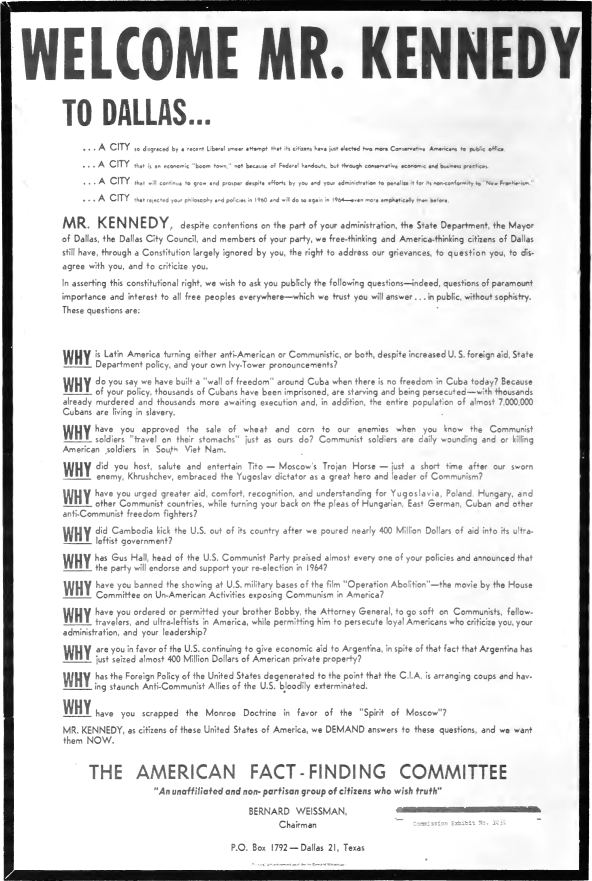
Commission Exhibit No. 1031
The Commission has conducted a full investigation into the genesis
of this advertisement and the background of those responsible for it.
Three of the four men chiefly responsible, Bernard W. Weissman, William
B. Burley III, and Larrie H. Schmidt, had served together in
the U.S. Army in Munich, Germany, in 1962. During that time
they had with others devised plans to develop two conservative organizations,
one political and the other business. The political
entity was to be named Conservatism—USA, or CUSA, and the business
entity was to be named American Business, or AMBUS.C6-452 While
in Munich, according to Weissman, they attempted to develop in their
“own minds * * * ways to build up various businesses that would support
us and at the same time support our political activities.”C6-453 According
to a subsequent letter from Schmidt to Weissman, “Cusa was
founded for patriotic reasons rather than for personal gain—even
though, as a side effect, Ambus was to have brought great return, as
any business endeavor should.”C6-454 To establish their organizations,
Weissman testified that they:
* * * had planned while in Munich that in order to accomplish
our goals, to try to do it from scratch would be almost impossible,
because it would be years before we could even get the funds
to develop a powerful organization. So we had planned to
infiltrate various rightwing organizations and by our own efforts
become involved in the hierarchy of these various organizations
and eventually get ourselves elected or appointed to various
higher offices in these organizations, and by doing this bring in
some of our own people, and eventually take over the leadership
of these organizations, and at that time having our people in
these various organizations, we would then, you might say, call
a conference and have them unite, and while no one knew of the
existence of CUSA aside from us, we would then bring them all
together, unite them, and arrange to have it called CUSA.C6-455
Schmidt was the first to leave the service; settling in Dallas in
October 1962, he became a life insurance salesman and quickly engaged
in numerous political activities in pursuit of the objectives devised in
Munich.C6-456 He became affiliated with several organizations and prepared
various political writings.C6-457
Upon their release from the military, Weissman and Burley did not
immediately move to Dallas, though repeatedly urged to do so by
Schmidt.C6-458 On October 1, 1963, Schmidt wrote Weissman: “Adlai
Stevenson is scheduled here on the 24th on UN Day. Kennedy is
scheduled in Dallas on Nov. 24th. There are to be protests. All the
big things are happening now—if we don’t get in right now we may
as well forget it.”C6-459 The day of the Stevenson demonstration,
Schmidt telephoned Weissman, again urging him to move to Dallas.
Recalling that conversation with Schmidt, Weissman testified:
And he said, “If we are going to take advantage of the situation
* * * you better hurry down here and take advantage of the
publicity, and at least become known among these various right-wingers,
because this is the chance we have been looking for to
infiltrate some of these organizations and become known,” in other
words, go along with the philosophy we had developed in
Munich.C6-460
Five days later he wrote to Weissman and Burley to report that as
the “only organizer of the demonstration to have publicly identified
himself,” he had “become, overnight, a ‘fearless spokesman’ and ‘leader’
of the rightwing in Dallas. What I worked so hard for in one year—and
nearly failed—finally came through one incident in one night!”
He ended, “Politically, CUSA is set. It is now up to you to get
Ambus going.”C6-461
Weissman and Burley accepted Schmidt’s prompting and traveled
to Dallas, arriving on November 4, 1963.C6-462 Both obtained employment
as carpet salesmen. At Schmidt’s solicitation they took steps to
join the John Birch Society, and through Schmidt they met the fourth
person involved in placing the November 22 advertisement, Joseph P.
Grinnan, Dallas independent oil operator and a John Birch Society
coordinator in the Dallas area.C6-463
Within a week to 10 days after Weissman and Burley had arrived in
Dallas, the four men began to consider plans regarding President
Kennedy’s planned visit to Dallas.C6-464 Weissman explained the reason
for which it was decided that the ad should be placed:
* * * after the Stevenson incident, it was felt that a demonstration
would be entirely out of order, because we didn’t want anything
to happen in the way of physical violence to President
Kennedy when he came to Dallas. But we thought that the conservatives
in Dallas—I was told—were a pretty downtrodden lot
after that, because they were being oppressed by the local liberals,
because of the Stevenson incident. We felt we had to do something
to build up the morale of the conservative element, in
Dallas. So we hit upon the idea of the ad.C6-465
Weissman, Schmidt, and Grinnan worked on the text for the advertisement.C6-466
A pamphlet containing 50 questions critical of American
policy was employed for this purpose, and was the source of the militant
questions contained in the ad attacking President Kennedy’s
administration.C6-467 Grinnan undertook to raise the $1,465 needed to
pay for the ad.C6-468 He employed a typed draft of the advertisement
to support his funds solicitation.C6-469 Grinnan raised the needed money
from three wealthy Dallas businessmen: Edgar R. Crissey, Nelson
Bunker Hunt, and H. R. Bright, some of whom in turn collected
contributions from others.C6-470 At least one of the contributors would
not make a contribution unless a question he suggested was inserted.C6-471
Weissman, believing that Schmidt, Grinnan, and the contributors were
active members of the John Birch Society, and that Grinnan eventually
took charge of the project, expressed the opinion that the advertisement
was the creation of the John Birch Society,C6-472 though
Schmidt and Grinnan have maintained that they were acting “solely
as individuals.”C6-473
A fictitious sponsoring organization was invented out of whole
cloth.C6-474 The name chosen for the supposed organization was The
American Fact-Finding Committee.C6-475 This was “Solely a name,”
Weissman testified; “* * * As a matter of fact, when I went to place
the ad, I could not remember the name * * * I had to refer to a piece
of paper for the name.”C6-476 Weissman’s own name was used on the ad
in part to counter charges of anti-Semitism which had been leveled
against conservative groups in Dallas.C6-477 Weissman conceived the
idea of using a black border,C6-478 and testified he intended it to serve the
function of stimulating reader attention.C6-479 Before accepting the
advertisement, the Dallas Morning News apparently submitted it to
its attorneys for their opinion as to whether its publication might
subject them to liability.C6-480
Weissman testified that the advertisement drew 50 or 60 mailed
responses.C6-481 He took them from the post office box early on Sunday
morning, November 24.C6-482 He said that those postmarked before the
attack on President Kennedy were “favorable” in tone;C6-483 those of
later postmark were violently unfavorable, nasty, and threatening;C6-484
and, according to a report from Schmidt, those postmarked some
weeks later were again of favorable tone.C6-485
The four promoters of the ad deny that they had any knowledge of
or familiarity with Lee Harvey Oswald prior to November 22, or Jack
Ruby prior to November 24.C6-486 Each has provided a statement of his
role in connection with the placement of the November 22 advertisement
and other matters, and investigation has revealed no deception.
The Commission has found no evidence that any of these persons was
connected with Oswald or Ruby, or was linked to a conspiracy to
assassinate President Kennedy.
The advertisement, however, did give rise to one allegation concerning
Bernard Weissman which required additional investigation.
On March 4, 1964, Mark Lane, a New York attorney, testified before
the Commission that an undisclosed informant had told him that
Weissman had met with Jack Ruby and Patrolman J. D. Tippit at
Ruby’s Carousel Club on November 14, 1963. Lane declined to
state the name of his informant but said that he would attempt to
obtain his informant’s permission to reveal his name.C6-487 On July 2,
1964, after repeated requests by the Commission that he disclose the
name of his informant, Lane testified a second time concerning this
matter, but declined to reveal the information, stating as his reason
that he had promised the individual that his name would not be revealed
without his permission.C6-488 Lane also made this allegation during
a radio appearance, whereupon Weissman twice demanded that
Lane reveal the name of the informant.C6-489 As of the date of this
report Lane has failed to reveal the name of his informant and has
offered no evidence to support his allegation. The Commission has
investigated the allegation of a Weissman-Ruby-Tippit meeting and
has found no evidence that such a meeting took place anywhere at
any time. The investigation into this matter is discussed in a later
section of this chapter dealing with possible conspiracies involving
Jack Ruby.
A comparable incident was the appearance of the “Wanted for
Treason” handbill on the streets of Dallas 1 to 2 days before President
Kennedy’s arrival. These handbills bore a reproduction of a front
and profile photograph of the President and set forth a series of inflammatory
charges against him.C6-490 Efforts to locate the author and
the lithography printer of the handbill at first met with evasive
responsesC6-491 and refusals to furnish information.C6-492 Robert A. Surrey
was eventually identified as the author of the handbill.C6-493 Surrey,
a 38-year-old printing salesman employed by Johnson Printing Co.
of Dallas, Tex., has been closely associated with General Walker
for several years in his political and business activities.C6-494 He is president
of American Eagle Publishing Co. of Dallas, in which he is a
partner with General Walker.C6-495 Its office and address is the post office
box of Johnson Printing Co. Its assets consist of cash and various
printed materials composed chiefly of General Walker’s political and
promotional literature,C6-496 all of which is stored at General Walker’s
headquarters.C6-497
Surrey prepared the text for the handbill and apparently used
Johnson Printing Co. facilities to set the type and print a proof.C6-498
Surrey induced Klause, a salesman employed by Lettercraft Printing
Co. of Dallas,C6-499 whom Surrey had met when both were employed at
Johnson Printing Co.,C6-500 to print the handbill “on the side.”C6-501 According
to Klause, Surrey contacted him initially approximately 2 or
2½ weeks prior to November 22.C6-502 About a week prior to November
22, Surrey delivered to Klause two slick paper magazine prints of
photographs of a front view and profile of President Kennedy,C6-503
together with the textual page proof.C6-504 Klause was unable to make
the photographic negative of the prints needed to prepare the photographic
printing plate,C6-505 so that he had this feature of the job done
at a local shop.C6-506 Klause then arranged the halftone front and profile
representations of President Kennedy at the top of the textual
material he had received from Surrey so as to simulate a “man wanted”
police placard. He then made a photographic printing plate of the
picture.C6-507 During the night, he and his wife surreptitiously printed
approximately 5,000 copies on Lettercraft Printing Co. offset printing
equipment without the knowledge of his employers.C6-508 The next day
he arranged with Surrey a meeting place, and delivered the handbills.C6-509
Klause’s charge for the printing of the handbills was, including
expenses, $60.C6-510
At the outset of the investigation Klause stated to Federal agents
that he did not know the name of his customer, whom he incorrectly
described;C6-511 he did say, however, that the customer did not resemble
either Oswald or Ruby.C6-512 Shortly before he appeared before the
Commission, Klause disclosed Surrey’s identity.C6-513 He explained that
no record of the transaction had been made because “he saw a chance
to make a few dollars on the side.”C6-514
Klause’s testimony receives some corroboration from Bernard Weissman’s
testimony that he saw a copy of one of the “Wanted for Treason”
handbills on the floor of General Walker’s station wagon shortly after
November 22.C6-515 Other details of the manner in which the handbills
were printed have also been verified.C6-516 Moreover, Weissman testified
that neither he nor any of his associates had anything to do with the
handbill or were acquainted with Surrey, Klause, Lettercraft Printing
Co., or Johnson Printing Co.C6-517 Klause and Surrey, as well as
General Walker, testified that they were unacquainted with Lee Harvey
Oswald and had not heard of him prior to the afternoon of November
22.C6-518 The Commission has found no evidence of any connection
between those responsible for the handbill and Lee Harvey Oswald or
the assassination.
Eight weeks before the assassination, Oswald traveled to Mexico
City where he visited both the Cuban and Soviet Embassies.D Oswald’s
wife knew of this trip before he went,C6-519 but she denied
such knowledge until she testified before the Commission.C6-520 The Commission
undertook an intensive investigation to determine Oswald’s
purpose and activities on this journey, with specific reference to reports
that Oswald was an agent of the Cuban or Soviet Governments.
As a result of its investigation, the Commission believes that it has
been able to reconstruct and explain most of Oswald’s actions during
this time. A detailed chronological account of this trip appears in
appendix XIII.
Trip to Mexico.—Oswald was in Mexico from September 26, 1963,
until October 3, 1963.C6-521 (See Commission Exhibits Nos. 2478, 2481, p.
300.) Marina Oswald testified that Oswald had told her that the purpose
of the trip was to evade the American prohibition on travel to
Cuba and to reach that country.C6-522 He cautioned her that the trip and
its purpose were to be kept strictly secret.C6-523 She testified that he had
earlier laid plans to reach Cuba by hijacking an airliner flying out of
New Orleans, but she refused to cooperate and urged him to give it up,
which he finally did.C6-524 Witnesses who spoke with Oswald while he
was on a bus going to Mexico City also testified that Oswald told
them he intended to reach Cuba by way of Mexico, and that he hoped
to meet Fidel Castro after he arrived.C6-525 When Oswald spoke to
the Cuban and Soviet consular officials in Mexico City, he represented
that he intended to travel to the Soviet Union and requested
an “in-transit” Cuban visa to permit him to enter Cuba on September
30 on the way to the Soviet Union. Marina Oswald has
testified that these statements were deceptions designed to get him to
Cuba.C6-526 Thus, although it is possible that Oswald intended to continue
on to Russia from Cuba, the evidence makes it more likely that
he intended to remain in Cuba.C6-527
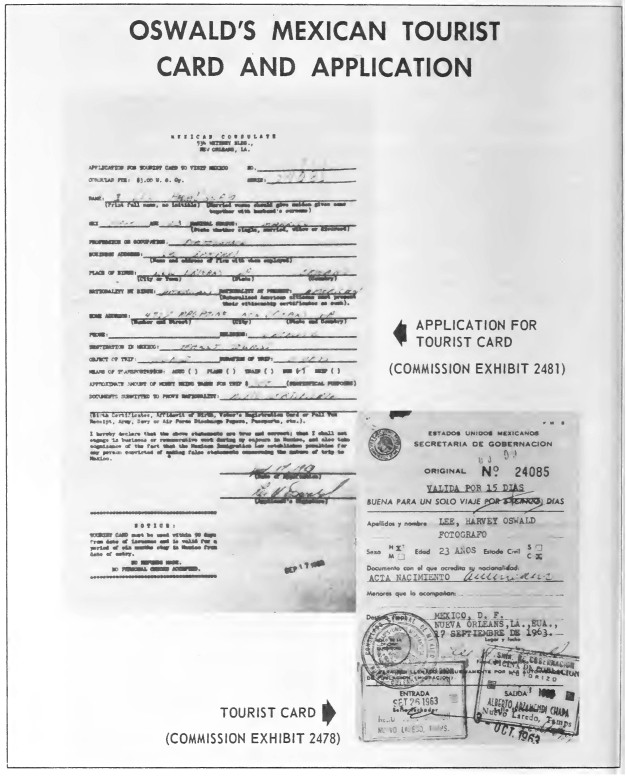
OSWALD’S MEXICAN TOURIST
CARD AND APPLICATION
(COMMISSION EXHIBIT 2481)
APPLICATION FOR
TOURIST CARD
(COMMISSION EXHIBIT 2478)
TOURIST CARD
Oswald departed from New Orleans probably about noon on September
25 and arrived in Mexico City at about 10 a.m. on September
27.C6-528 In Mexico City he embarked on a series of visits to the
Soviet and Cuban Embassies, which occupied most of his time during
the first 2 days of his visit. At the Cuban Embassy, he requested
an “in-transit” visa to permit him to visit Cuba on his way to the
Soviet Union.C6-529 Oswald was informed that he could not obtain
a visa for entry into Cuba unless he first obtained a visa to enter
the U.S.S.R.,C6-530 and the Soviet Embassy told him that he could not
expect an answer on his application for a visa for the Soviet Union
for about 4 months.C6-531 Oswald carried with him newspaper clippings,
letters and various documents, some of them forged or containing
false information, purporting to show that he was a “friend” of
Cuba.C6-532 With these papers and his record of previous residence in
the Soviet Union and marriage to a Soviet national, he tried to
curry favor with both Embassies.C6-533 Indeed, his wife testified that
in her opinion Oswald’s primary purpose in having engaged in
Fair Play for Cuba Committee activities was to create a public record
that he was a “friend” of Cuba.C6-534 He made himself especially unpopular
at the Cuban Embassy by persisting in his demands that as a
sympathizer in Cuban objectives he ought to be given a visa. This
resulted in a sharp argument with the consul, Eusebio Azque.C6-535
By Saturday, September 28, 1963, Oswald had failed to obtain visas
at both Embassies.C6-536 From Sunday, September 29, through Wednesday
morning, October 2, when he left Mexico City on a bus bound for
the United States, Oswald spent considerable time making his travel
arrangements, sightseeing and checking again with the Soviet Embassy
to learn whether anything had happened on his visa application.C6-537
Marina Oswald testified that when she first saw him after
his return to the United States he was disappointed and discouraged
at his failure to reach Cuba.C6-538
The general outlines of Oswald’s activities in Mexico, particularly
the nature and extent of his contacts at the Cuban Embassy, were
learned very early in the investigation. An important source of information
relating to his business at the Cuban Embassy was Senora
Silvia Tirado de Duran, a Mexican national employed in the visa section
of the Cuban Embassy, who was questioned intensively by Mexican
authorities soon after the assassination.C6-539 An excerpt from the report
of the Mexican Government summarized the crucial portion of Senora
Duran’s recollection of Oswald. In translation it reads as follows:
* * * she remembered * * * [that Lee Harvey Oswald] was the
name of an American who had come to the Cuban Consulate to
obtain a visa to travel to Cuba in transit to Russia, the latter part
of September or the early part of October of this year, and in
support of his application had shown his passport, in which it was
noted that he had lived in that country for a period of three years;
his labor card from the same country written in the Russian language;
and letters in that same language. He had presented evidence
that he was married to a Russian woman, and also that he
was apparently the leader of an organization in the city of New
Orleans called “Fair * * * [Play] for Cuba,” claiming that he
should be accepted as a “friend” of the Cuban Revolution. Accordingly,
the declarant, complying with her duties, took down
all of the information and completed the appropriate application
form; and the declarant, admittedly exceeding her responsibilities,
informally telephoned the Russian consulate, with the intention
of doing what she could to facilitate issuance of the Russian
visa to Lee Harvey Oswald. However, they told her that
there would be a delay of about four months in processing the case,
which annoyed the applicant since, according to his statement,
he was in a great hurry to obtain visas that would enable him to
travel to Russia, insisting on his right to do so in view of his background
and his loyalty and his activities in behalf of the Cuban
movement. The declarant was unable to recall accurately
whether or not the applicant told her he was a member of the
Communist Party, but he did say that his wife * * * was then
in New York City, and would follow him, * * * [Senora Duran
stated] that when Oswald understood that it was not possible to
give him a Cuban visa without his first having obtained the Russian
visa, * * * he became very excited or angry, and accordingly,
the affiant called Consul Ascue [sic], * * * [who] came out
and began a heated discussion in English with Oswald, that concluded
by Ascue telling him that “if it were up to him, he would
not give him the visa,” and “a person of his type was harming
the Cuban Revolution rather than helping it,” it being understood
that in their conversation they were talking about the Russian
Socialist Revolution and not the Cuban. Oswald maintained
that he had two reasons for requesting that his visa be
issued promptly, and they were: one, that his tourist permit in
Mexico was about to expire; and the other, that he had to get to
Russia as quickly as possible. Despite her annoyance, the declarant
gave Oswald a paper * * * in which she put down her
name, “Silvia Durán,” and the number of the telephone at the
consulate, which is “11-28-47” and the visa application was processed
anyway. It was sent to the Ministry of [Foreign] Relations
of Cuba, from which a routine reply was received some
fifteen to thirty days later, approving the visa, but on the condition
that the Russian visa be obtained first, although she does
not recall whether or not Oswald later telephoned her at the
Consulate number that she gave him.C6-540
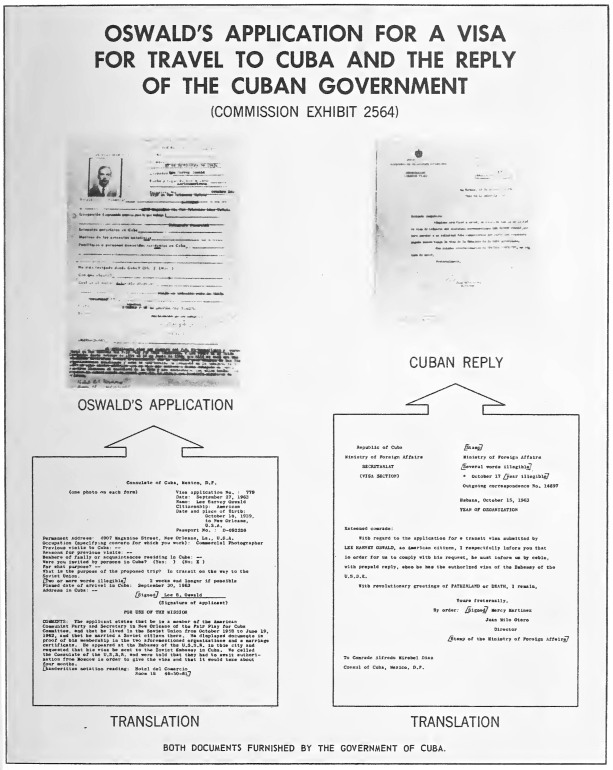
OSWALD’S APPLICATION FOR A VISA
FOR TRAVEL TO CUBA AND THE REPLY
OF THE CUBAN GOVERNMENT
(COMMISSION EXHIBIT 2564)
OSWALD’S APPLICATION ——> TRANSLATION
CUBAN REPLY ——> TRANSLATION
BOTH DOCUMENTS FURNISHED BY THE GOVERNMENT OF CUBA.
With the dates of Oswald’s entry into and departure from Mexico,
which had been obtained from the records of the Mexican Immigration
Service very shortly after the assassination, the Government of
Mexico initiated a thorough investigation to uncover as much information
as possible on Oswald’s trip.C6-541 Representatives of U.S. agencies
worked in close liaison with the Mexican law enforcement
authorities. The result of this investigative effort was to corroborate
the statements of Senora Duran and to verify the essentials of Oswald’s
activities in Mexico as outlined above.
Senora Duran is a well-educated native of Mexico, who was 26
years old at the time of her interrogation. She is married to Senor
Horacio Duran Navarro, a 40-year-old industrial designer, and has
a young child. Although Senora Duran denies being a member of the
Communist Party or otherwise connected with it, both Durans have
been active in far left political affairs in Mexico, believe in Marxist
ideology, and sympathize with the government of Fidel Castro,C6-542
and Senor Duran has written articles for El Dia, a pro-Communist
newspaper in Mexico City.C6-543 The Commission has reliable evidence
from a confidential source that Senora Duran as well as
other personnel at the Cuban Embassy were genuinely upset upon
receiving news of President Kennedy’s death. Senora Duran’s
statements were made to Mexican officials soon after the assassination,C6-544
and no significant inaccuracies in them have been detected.
Documents fitting the description given by Senora Duran of the
documents Oswald had shown her, plus a notation which she said
she had given him, were found among his possessions after his
arrest.C6-545
The Cuban Government was asked to document and confirm the
essentials of Senora Duran’s testimony. Its response, which has been
included in its entirety in this Report, included a summary statement
of Oswald’s activities at the Cuban Embassy;C6-546 a photograph of the
application for a visa he completed there,C6-547 and a photograph of the
communication from Havana rejecting the application unless he could
first present a Soviet visa.C6-548 (See Commission Exhibit No. 2564,
p. 306.) The information on these documents concerning Oswald’s
date of birth, American passport number and activities and statements
at the Embassy is consistent with other information available to the
Commission.C6-549 CIA experts have given their opinion that the handwriting
on the visa application which purports to be Oswald’s is in
fact his and that, although the handwritten notations on the bottom
of the document are too brief and faint to permit a conclusive determination,
they are probably Senora Duran’s.C6-550 The clothes which
Oswald was wearing in the photograph which appears on the application
appear to be the same as some of those found among his effects
after the assassination, and the photograph itself appears to be from
the same negative as a photograph found among his effects.C6-551 Nothing
on any of the documents raises a suspicion that they might not be
authentic.
By far the most important confirmation of Senora Duran’s testimony,
however, has been supplied by confidential sources of extremely
high reliability available to the United States in Mexico. The information
from these sources establishes that her testimony was truthful
and accurate in all material respects. The identities of these sources
cannot be disclosed without destroying their future usefulness to the
United States.
The investigation of the Commission has produced considerable
testimonial and documentary evidence establishing the precise time
of Oswald’s journey, his means of transportation, the hotel at which
he stayed in Mexico City, and a restaurant at which he often ate.
All known persons whom Oswald may have met while in Mexico, including
passengers on the buses he rode,C6-552 and the employees and
guests of the hotel where he stayed,C6-553 were interviewed. No credible
witness has been located who saw Oswald with any unidentified person
while in Mexico City; to the contrary, he was observed traveling alone
to and from Mexico City,C6-554 at his hotel,C6-555 and at the nearby restaurant
where he frequently ate.C6-556 A hotel guest stated that on one occasion
he sat down at a table with Oswald at the restaurant because no empty
table was available, but that neither spoke to the other because of the
language barrier.C6-557 Two Australian girls who saw Oswald on the
bus to Mexico City relate that he occupied a seat next to a man who
has been identified as Albert Osborne, an elderly itinerant preacher.C6-558
Osborne denies that Oswald was beside him on the bus.C6-559 To the
other passengers on the bus it appeared that Osborne and Oswald had
not previously met,C6-560 and extensive investigation of Osborne has
revealed no further contact between him and Oswald. Osborne’s
responses to Federal investigators on matters unrelated to Oswald
have proved inconsistent and unreliable, and, therefore, based on the
contrary evidence and Osborne’s lack of reliability, the Commission
has attached no credence to his denial that Oswald was beside
him on the bus. Investigation of his background and activities, however,
disclose no basis for suspecting him of any involvement in the
assassination.C6-561
Investigation of the hotel at which Oswald stayed has failed to
uncover any evidence that the hotel is unusual in any way that could relate
to Oswald’s visit. It is not especially popular among Cubans, and
there is no indication that it is used as a meeting place for extremist
or revolutionary organizations.C6-562 Investigation of other guests of
the hotel who were there when Oswald was has failed to uncover anything
creating suspicion.C6-563 Oswald’s notebook which he carried with
him to Mexico City contained the telephone number of the Cuban Airlines
Office in Mexico City;C6-564 however, a Cuban visa is required by
Mexican authorities before an individual may enplane for Cuba,C6-565 and
a confidential check of the Cuban Airlines Office uncovered no evidence
that Oswald visited their offices while in the city.C6-566
Allegations of conspiracy.—Literally dozens of allegations of a conspiratorial
contact between Oswald and agents of the Cuban Government
have been investigated by the Commission. Among the claims
made were allegations that Oswald had made a previous trip to
Mexico City in early September to receive money and orders for the
assassination,C6-567 that he had been flown to a secret airfield somewhere in
or near the Yucatan Peninsula,C6-568 that he might have made contacts in
Mexico City with a Communist from the United States shortly
before the assassination,C6-569 and that Oswald assassinated the President
at the direction of a particular Cuban agent who met with him in
the United States and paid him $7,000.C6-570 A letter was received from
someone in Cuba alleging the writer had attended a meeting where
the assassination had been discussed as part of a plan which would
soon include the death of other non-Communist leaders in the Americas.C6-571
The charge was made in a Cuban expatriate publication that in
a speech he delivered 5 days after the assassination, while he was under
the influence of liquor, Fidel Castro made a slip of the tongue and said,
“The first time Oswald was in Cuba,” thereby giving away the
fact that Oswald had made one or more surreptitious trips to that
country.C6-572
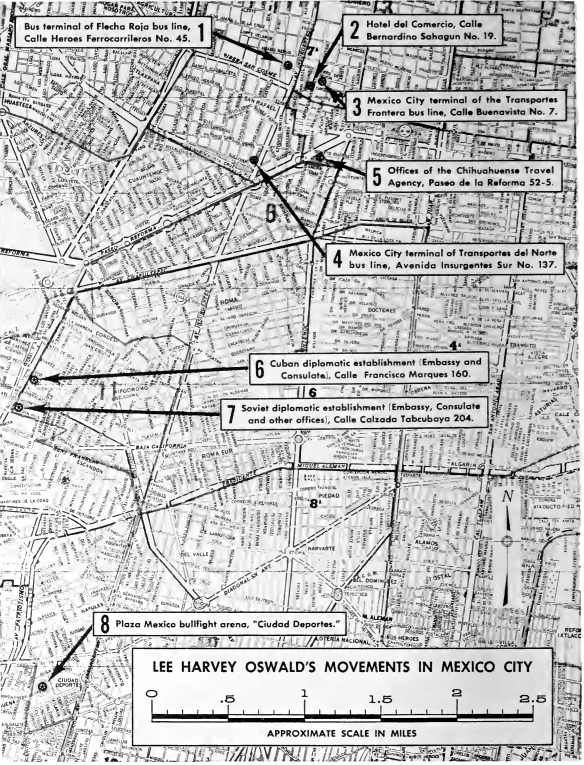
Commission Exhibit No. 1400
LEE HARVEY OSWALD’S MOVEMENTS IN MEXICO CITY
Some stories linked the assassination to anti-Castro groups who
allegedly were engaged in obtaining illicit firearms in the United
States, one such claim being that these groups killed the President as
part of a bargain with some illicit organizations who would then
supply them with firearms as payment.C6-573 Other rumors placed
Oswald in Miami, Fla., at various times, allegedly in pro-Cuban activities
there.C6-574 The assassination was claimed to have been carried
out by Chinese Communists operating jointly with the Cubans.C6-575
Oswald was also alleged to have met with the Cuban Ambassador in
a Mexico City restaurant and to have driven off in the Ambassador’s
car for a private talk.C6-576 Castro himself, it was alleged, 2 days after
the assassination called for the files relating to Oswald’s dealings with
two members of the Cuban diplomatic mission in the Soviet Union;
the inference drawn was that the “dealings” had occurred and had
established a secret subversive relationship which continued through
Oswald’s life.C6-577 Without exception, the rumors and allegations of
a conspiratorial contact were shown to be without any factual basis,
in some cases the product of mistaken identification.
Illustrative of the attention given to the most serious allegations
is the case of “D,” a young Latin American secret agent who approached
U.S. authorities in Mexico shortly after the assassination
and declared that he saw Lee Harvey Oswald receiving $6,500 to kill
the President. Among other details, “D” said that at about noon on
September 18, waiting to conduct some business at the Cuban consulate,
he saw a group of three persons conversing in a patio a few
feet away. One was a tall, thin Negro with reddish hair, obviously
dyed, who spoke rapidly in both Spanish and English, and another
was a man he said was Lee Harvey Oswald. A tall Cuban joined the
group momentarily and passed some currency to the Negro. The
Negro then allegedly said to Oswald in English, “I want to kill the
man.” Oswald replied, “You’re not man enough, I can do it.” The
Negro then said in Spanish, “I can’t go with you, I have a lot to do.”
Oswald replied, “The people are waiting for me back there.” The
Negro then gave Oswald $6,500 in large-denomination American bills,
saying, “This isn’t much.” After hearing this conversation, “D” said
that he telephoned the American Embassy in Mexico City several
times prior to the assassination in an attempt to report his belief that
someone important in the United States was to be killed, but was
finally told by someone at the Embassy to stop wasting his time.
“D” and his allegations were immediately subjected to intensive
investigation. His former employment as an agent for a Latin American
country was confirmed, although his superiors had no knowledge
of his presence in Mexico or the assignment described by “D.” Four
days after “D” first appeared the U.S. Government was informed by
the Mexican authorities that “D” had admitted in writing that his
whole narrative about Oswald was false. He said that he had never
seen Oswald anyplace, and that he had not seen anybody paid money
in the Cuban Embassy. He also admitted that he never tried to telephone
the American Embassy in September and that his first call to
the Embassy was after the assassination. “D” said that his motive in
fabricating the story was to help get himself admitted into the United
States so that he could there participate in action against Fidel Castro.
He said that he hated Castro and hoped that the story he made up
would be believed and would cause the United States to “take action”
against him.
Still later, when questioned by American authorities, “D” claimed
that he had been pressured into retracting his statement by the Mexican
police and that the retraction, rather than his first statement,
was false. A portion of the American questioning was carried on
with the use of a polygraph machine, with the consent of “D.” When
told that the machine indicated that he was probably lying, “D” said
words to the effect that he “must be mistaken.” Investigation in the
meantime had disclosed that the Embassy extension number “D” said
he had called would not have given him the person he said he spoke
to, and that no one at the Embassy—clerks, secretaries, or officers—had
any recollection of his calls. In addition, Oswald spoke little, if
any, Spanish. That he could have carried on the alleged conversation
with the red-headed Negro in the Cuban Embassy, part of which was
supposed to have been in Spanish, was therefore doubtful. “D” now
said that he was uncertain as to the date when he saw “someone who
looked like Oswald” at the Cuban Embassy, and upon reconsideration,
he now thought it was on a Tuesday, September 17, rather than September
18. On September 17, however, Oswald visited the Louisiana
State Unemployment Commission in New Orleans and also cashed a
check from the Texas Employment Commission at the Winn-Dixie
Store No. 1425 in New Orleans. On the basis of the retractions made
by “D” when he heard the results of the polygraph examination, and
on the basis of discrepancies which appeared in his story, it was
concluded that “D” was lying.C6-578
The investigation of the Commission has thus produced no evidence
that Oswald’s trip to Mexico was in any way connected with the assassination
of President Kennedy, nor has it uncovered evidence that the
Cuban Government had any involvement in the assassination. To
the contrary, the Commission has been advised by the CIA and FBI
that secret and reliable sources corroborate the statements of Senora
Duran in all material respects, and that the Cuban Government had
no relationship with Lee Harvey Oswald other than that described by
Senora Duran. Secretary of State Rusk also testified that
after the assassination “there was very considerable concern in Cuba
as to whether they would be held responsible and what the effect of
that might be on their own position and their own safety.”C6-579
Contacts with the Soviet Embassy in the United States.—Soon after
the Oswalds reached the United States in June 1962 they wrote to
the Soviet Embassy in Washington, D.C. Oswald requested information
about subscriptions to Russian newspapers and magazines and
ultimately did subscribe to several Russian journals. Soviet law required
Marina Oswald, as a Soviet citizen living abroad, to remain in
contact with her nation’s Embassy and to file various papers occasionally.C6-580
In 1963, after Oswald had experienced repeated employment
difficulties, there were further letters when the Oswalds sought
permission to return to the Soviet Union. The first such request was a
letter written by Marina Oswald on February 17, 1963. She wrote that
she wished to return to Russia but that her husband would stay in the
United States because “he is an American by nationality.”C6-581 She
was informed on March 8, 1963, that it would take from 5 to 6 months
to process the application.C6-582 The Soviet Union made available to the
Commission what purports to be the entire correspondence between
the Oswalds and the Russian Embassy in the United States.C6-583 This
material has been checked for codes and none has been detected.C6-584
With the possible exception of a letter which Oswald wrote to the
Soviet Embassy after his return from Mexico City, discussed below,
there is no material which gives any reason for suspicion. The implications
of all of this correspondence for an understanding of Lee
Harvey Oswald’s personality and motivation is discussed in the
following chapter.
Oswald’s last letter to the Soviet Embassy in Washington, D.C.,
dated November 9, 1963, began by stating that it was written “to
inform you of recent events since my meetings with Comrade Kostin
in the Embassy of the Soviet Union, Mexico City, Mexico.”C6-585 The
envelope bears a postmark which appears to be November 12, 1963.C6-586
Ruth Paine has testified that Oswald spent the weekend at her home
working on the letter and that she observed one preliminary draft.C6-587
A piece of paper which was identified as one of these drafts was found
among Oswald’s effects after the assassination. (See Commission
Exhibits Nos. 15, 103, p. 311.) According to Marina Oswald, her
husband retyped the envelope 10 times.C6-588
Information produced for the Commission by the CIA is to the
effect that the person referred to in the letter as “comrade Kostin” was
probably Valeriy Vladimirovich Kostikov, a member of the consular
staff of the Soviet Union in Mexico City. He is also one of the KGB
officers stationed at the Embassy.C6-589 It is standard Soviet procedure
for KGB officers stationed in embassies and in consulates
to carry on the normal duties of such a position in addition to the
undercover activities.C6-590 The Commission has identified the Cuban
consul referred to in Oswald’s letter as Senor Eusebio Azque (also
“Ascue”), the man with whom Oswald argued at the Cuban Embassy,
who was in fact replaced. The CIA advised the Commission:
We surmise that the references in Oswald’s 9 November letter
to a man who had since been replaced must refer to Cuban Consul
Eusebio Azque, who left Mexico for Cuba on permanent transfer
on 18 November 1963, four days before the assassination. Azque
had been in Mexico for 18 years and it was known as early as
September 1963 that Azque was to be replaced. His replacement
did arrive in September. Azque was scheduled to leave in October
but did not leave until 18 November.
We do not know who might have told Oswald that Azque or
any other Cuban had been or was to be replaced, but we speculate
that Silvia Duran or some Soviet official might have mentioned
it if Oswald complained about Azque’s altercation with him.C6-591
When asked to explain the letter, Marina Oswald was unable to add
anything to an understanding of its contents.C6-592 Some light on its
possible meaning can be shed by comparing it with the early
draft. When the differences between the draft and the final document
are studied, and especially when crossed-out words are taken
into account, it becomes apparent that Oswald was intentionally beclouding
the true state of affairs in order to make his trip to Mexico
sound as mysterious and important as possible.
For example, the first sentence in the second paragraph of the letter
reads, “I was unable to remain in Mexico indefinily because of my
mexican visa restrictions which was for 15 days only.” The same sentence
in the draft begins, before the words are crossed out, “I was
unable to remain in Mexico City because I considered useless * * *”
As already mentioned, the Commission has good evidence that Oswald’s
trip to Mexico was indeed “useless” and that he returned to
Texas with that conviction. The first draft, therefore, spoke the
truth; but Oswald rewrote the sentence to imply that he had to leave
because his visa was about to expire. This is false; Oswald’s tourist
card still had a full week to run when he departed from Mexico on
October 3.C6-593
The next sentence in the letter reads, “I could not take a chance on
reqesting a new visa unless I used my real name, so I returned to the
United States.” The fact is that he did use his real name for his
tourist card, and in all dealings with the Cuban Embassy, the Russian
Embassy and elsewhere. Oswald did use the name of “Lee” on the
trip, but as indicated below, he did so only sporadically and probably
as the result of a clerical error. In the opinion of the Commission,
based upon its knowledge of Oswald, the letter constitutes no more
than a clumsy effort to ingratiate himself with the Soviet Embassy.
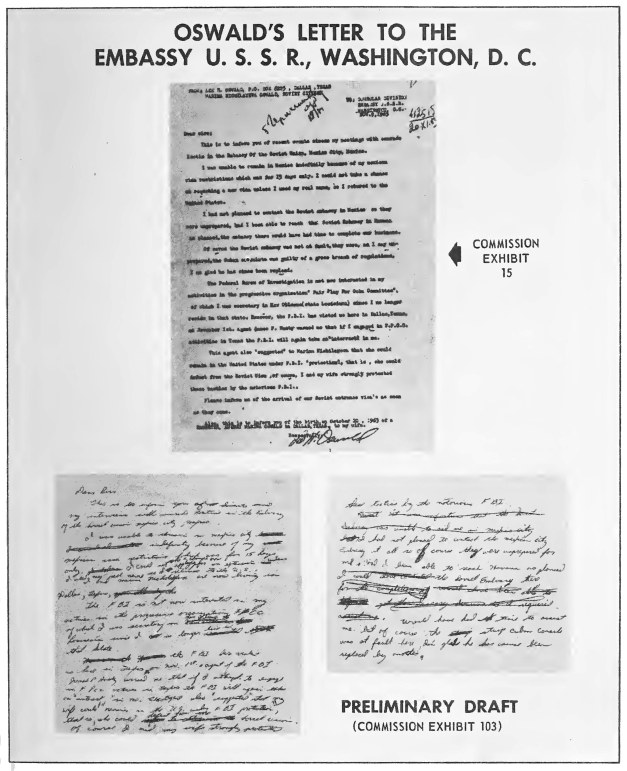
COMMISSION EXHIBIT 15
OSWALD’S LETTER TO THE
EMBASSY U. S. S. R., WASHINGTON, D. C.
(COMMISSION EXHIBIT 103)
PRELIMINARY DRAFT
Oswald’s use of post office boxes and false names.—After his return
from the Soviet Union, Lee Harvey Oswald is known to have received
his mail at post office boxes and to have used different aliases on numerous
occasions. Since either practice is susceptible of use for clandestine
purposes, the Commission has directed attention to both for
signs that Oswald at some point made undercover contact with other
persons who might have been connected with the assassination.
Oswald is known to have opened three post office boxes during 1962
and 1963. On October 9, 1962, the same day that he arrived in Dallas
from Fort Worth, and before establishing a residence there, he opened
box No. 2915 at the Dallas General Post Office. This box was closed
on May 14, 1963, shortly after Oswald had moved to New Orleans.C6-594
That portion of the post office box application listing the names of
those persons other than the applicant entitled to receive mail at the
box was discarded in accordance with postal regulations after the box
was closed; hence, it is not known what names other than Oswald’s
were listed on that form.C6-595 However, as discussed in chapter IV,
Oswald is known to have received the assassination rifle under the
name of A. Hidell and his Smith & Wesson revolver under the name
of A. J. Hidell at that box.C6-596 On June 3, 1963, Oswald opened box
No. 30061 at the Lafayette Square Substation in New Orleans.
Marina Oswald and A. J. Hidell were listed as additional persons
entitled to receive mail at this box.C6-597 Immediately before leaving
for Mexico City in late September, Oswald submitted a request to
forward his mail to the Paines’ address in Irving, and the box was
closed on September 26.C6-598 On November 1, 1963, he opened box No.
6225 at the Dallas Post Office Terminal Annex. The Fair Play for
Cuba Committee and the American Civil Liberties Union were listed
as also being entitled to receive mail at this box.C6-599
Oswald’s use of post office boxes is consistent with other information
known about him. His frequent changes of address and receipt of
Communist and other political literature would appear to have provided
Oswald reason to have rented postal boxes. These were the
explanations for his use of the boxes which he provided Postal Inspector
H. D. Holmes on November 24.C6-600 Moreover, on October 14,
1963, he had moved into a room on Beckley Avenue under the name of
O. H. LeeC6-601 and it would have been extremely difficult for Oswald
to have received his mail at that address without having disclosed his
true name. The boxes cost Oswald only $1.50 or less per month.C6-602
Although the possibilities of investigation in this area are limited,
there is no evidence that any of the three boxes was ever used for the
surreptitious receipt of messages or was used by persons other than
Oswald or his family. No unexplainable notes were found among
Oswald’s possessions after his arrest. Oswald’s box on the day
of the assassination, No. 6225, was kept under constant personal surveillance
by postal inspectors from about 5 p.m. November 22 until
midnight November 24. A modified surveillance was maintained thereafter.
No one called for mail out of this box; indeed the only mail in
the box was a Russian magazine addressed to Oswald. The single outstanding
key was recovered from Oswald immediately after he was
taken in custody.C6-603
In appraising the import of Oswald’s rental of post office boxes, it is
significant that he was not secretive about their use. All three boxes
were rented by Oswald using his true name.C6-604 His application for
box No. 2915 showed his home address as that of Alexandra De
Mohrenschildt (Taylor), whose husband had agreed to allow Oswald
to use his address.C6-605 His application for the New Orleans box
listed his address as 657 French Street; his aunt, Lillian Murret, lived
at 757 French Street.C6-606 On the application for box No. 6225, Oswald
gave an incorrect street number, though he did show Beckley Avenue,
where he was then living.C6-607 He furnished the box numbers to his
brother, to an employer, to Texas and New Orleans unemployment
commissions, and to others.C6-608 Based on all the facts disclosed by its
investigation, the Commission has attached no conspiratorial significance
to Oswald’s rental of post office boxes.
Oswald’s use of aliases is also well established. In chapter IV, the
evidence relating to his repeated use of the name “A. J. Hidell,” and
close variants thereof, is set forth.C6-609 Because Oswald’s use of this
pseudonym became known quickly after the assassination, investigations
were conducted with regard to persons using the name Hidell
or names similar to it. Subversive files, public carrier records, telegraph
company records, banking and other commercial records, and
other matters investigated and persons interviewed have been examined
with regard to Oswald’s true name and his known alias.C6-610 No
evidence has been produced that Oswald ever used the name Hidell
as a means of making undercover contact with any person. Indeed,
though Oswald did prepare a counterfeit selective service card and
other identification using this name, he commonly used “Hidell” to
represent persons other than himself, such as the president of his
nonexistent Fair Play for Cuba Committee chapter, the doctor whose
name appeared on his counterfeit international certificate of vaccination,
and as references on his job applications.C6-611
Alwyn Cole, questioned document expert for the Treasury Department,
testified that the false identification found on Oswald upon his
arrest could have been produced by employing elementary techniques
used in a photographic printing plant.C6-612 (See app. X, pp. 571-578.)
Though to perform the necessary procedures would have been difficult
without the use of expensive photographic equipment, such equipment
and the needed film and photographic paper were available to Oswald
when he was employed from October 1962 through early April 1963
at Jaggars-Chiles-Stovall, a commercial advertising photography
firm in Dallas.C6-613 While so employed, Oswald is known to have become
familiar with the mechanics of photographic enlargements,
contraction, and image distortion that would have been necessary to
produce his false identification, and to have used the facilities of his
employer for some personal work.C6-614 Cole testified that the cards
in Oswald’s wallet did not exhibit a great deal of skill, pointing out
various errors that had been committed.C6-615 Oswald’s supervisor at
Jaggars-Chiles-Stovall has stated that Oswald seemed unable to perform
photographic work with precision, which was one of the main
reasons for which he was ultimately discharged.C6-616 The retouched
negatives used to make Oswald’s counterfeit certificate of service
identification were found among Oswald’s personal effects after his
arrest, as was a rubber stamping kit apparently employed to produce
his spurious international certificate of vaccination.C6-617 There is strong
evidence, therefore, that Oswald himself made the various pieces of
counterfeit identification which he carried, and there is no reason to
believe that he received assistance from any person in establishing his
alias.
Oswald also used incorrect names other than Hidell, but these too
appear unconnected with any form of conspiracy. Oswald’s last
name appears as “Lee” in three places in connection with his trip to
Mexico City, discussed above. His tourist card was typed by the
Mexican consulate in New Orleans, “Lee, Harvey Oswald.”C6-618 However,
the comma seems to have been a clerical error, since Oswald
signed both the application and the card itself, “Lee H. Oswald.”
Moreover, Oswald seems originally to have also printed his name,
evenly spaced, as “Lee H Oswald,” but, noting that the form instructed
him to “Print full name. No initials,” printed the remainder of his
middle name after the “H.” The clerk who typed the card thus saw
a space after “Lee,” followed by “Harvey Oswald” crowded together,
and probably assumed that “Lee” was the applicant’s last name. (See
Commission Exhibit 2481, p. 300.) The clerk who prepared Oswald’s
bus reservation for his return trip wrote “H. O. Lee.” He stated that
he did not remember the occasion, although he was sure from the
handwriting and from other facts that he had dealt with Oswald.
He surmised that he probably made out the reservation directly
from the tourist card, since Oswald spoke no Spanish, and, seeing the
comma, wrote the name “H. O. Lee.”C6-619 Oswald himself signed the
register at the hotel in Mexico City as “Lee, Harvey Oswald,”C6-620 but
since the error is identical to that on the tourist card and since he
revealed the remainder of his name, “Harvey Oswald,” it is possible
that Oswald inserted the comma to conform to the tourist card, or
that the earlier mistake suggested a new pseudonym to Oswald which
he decided to continue.
In any event, Oswald used his correct name in making reservations
for the trip to Mexico City, in introducing himself to passengers
on the bus, and in his dealings with the Cuban and Soviet Embassies.C6-621
When registering at the Beckley Avenue house in mid-October, Oswald
perpetuated the pseudonym by giving his name as “O. H. Lee,”C6-622
though he had given his correct name to the owner of the previous
roominghouse where he had rented a room after his return from
Mexico City.C6-623 Investigations of the Commission have been conducted
with regard to persons using the name “Lee,” and no evidence
has been found that Oswald used this alias for the purpose of making
any type of secret contacts.
Oswald is also known to have used the surname “Osborne” in ordering
Fair Play for Cuba Committee handbills in May 1963.C6-624 He also
used the false name D. F. Drittal as a certifying witness on the mail-order
coupon with which he purchased his Smith & Wesson revolver.C6-625
He used the name Lt. J. Evans as a reference on an employment application
in New Orleans.C6-626
Oswald’s repeated use of false names is probably not to be disassociated
from his antisocial and criminal inclinations. No doubt he
purchased his weapons under the name of Hidell in attempt to prevent
their ownership from being traced. Oswald’s creation of false names
and ficititious personalities is treated in the discussion of possible
motives set forth in chapter VII. Whatever its significance in that
respect may be, the Commission has found no indication that Oswald’s
use of aliases was linked with any conspiracy with others.
Ownership of a second rifle.—The Commission has investigated a
report that, during the first 2 weeks of November 1963, Oswald had
a telescopic sight mounted and sighted on a rifle at a sporting goods
store in Irving, Tex. The main evidence that Oswald had such work
performed for him is an undated repair tag bearing the name “Oswald”
from the Irving Sports Shop in Irving, Tex. On November 25,
1963, Dial D. Ryder, an employee of the Irving Sports Shop, presented
this tag to agents of the FBI, claiming that the tag was in his handwriting.
The undated tag indicated that three holes had been drilled
in an unspecified type of rifle and a telescopic sight had been mounted
on the rifle and boresighted.C6-627
As discussed in chapter IV, the telescopic sight on the C2766 Mannlicher-Carcano
rifle was already mounted when shipped to Oswald,
and both Ryder and his employer, Charles W. Greener, feel certain
that they never did any work on this rifle.C6-628 If the repair tag
actually represented a transaction involving Lee Harvey Oswald,
therefore, it would mean that Oswald owned another rifle. Although
this would not alter the evidence which establishes Oswald’s ownership
of the rifle used to assassinate President Kennedy, the possession
of a second rifle warranted investigation because it would indicate that
a possibly important part of Oswald’s life had not been uncovered.
Since all of Oswald’s known transactions in connection with firearms
after his return to the United States were undertaken under an
assumed name,C6-629 it seems unlikely that if he did have repairs made at
the sports shop he would have used his real name. Investigation has
revealed that the authenticity of the repair tag bearing Oswald’s name
is indeed subject to grave doubts. Ryder testified that he found the
repair tag while cleaning his workbench on November 23, 1963.C6-630
However, Ryder spoke with Greener repeatedly during the period between
November 22-28 and, sometime prior to November 25, he discussed
with him the possibility that Oswald had been in the store.
Neither he nor Greener could remember that he had been. But despite
these conversations with Greener, it is significant that Ryder never
called the repair tag to his employer’s attention. Greener did not learn
about the tag until November 28, when he was called by TV reporters
after the story had appeared in the Dallas Times-Herald.C6-631 The peculiarity
of Ryder’s silence is compounded by the fact that, when speaking
to the FBI on November 25, Ryder fixed the period during which
the tag had been issued as November 1-14, 1963, yet, from his later testimony,
it appears that he did so on the basis that it must have occurred
when Greener was on vacation since Greener did not remember the
transaction.C6-632 Moreover, the FBI had been directed to the Irving
Sports Shop by anonymous telephone calls received by its Dallas office
and by a local television station. The anonymous male who telephoned
the Bureau attributed his information to an unidentified sack boy at a
specified supermarket in Irving, but investigation has failed to verify
this source.C6-633
Neither Ryder nor Greener claimed that Lee Harvey Oswald
had ever been a customer in the Irving Sports Shop. Neither has
any recollection of either Oswald or his Mannlicher-Carcano rifle,
nor does either recall the transaction allegedly represented by the
repair tag or the person for whom the repair was supposedly made.C6-634
Although Ryder stated to the FBI that he was “quite sure” that he
had seen Oswald and that Oswald may have been in the store at one
time, when shown a photograph of Oswald during his deposition,
Ryder testified he knew the picture to be of Oswald, “as the pictures
in the paper, but as far as seeing the guy personally, I don’t think I
ever have.”C6-635
Subsequent events also reflect on Ryder’s credibility. In his deposition,
Ryder emphatically denied that he talked to any reporters about
this matter prior to the time a story about it appeared in the November
28, 1963, edition of the Dallas Times-Herald.C6-636 Earlier, however,
he told an agent of the U.S. Secret Service that the newspaper had
misquoted him.C6-637 Moreover, a reporter for the Dallas Times-Herald
has testified that on November 28, 1963, he called Ryder at his home
and obtained from him all of the details of the alleged transaction,
and his story is supported by the testimony of a second reporter who
overheard one end of the telephone conversation.C6-638 No other person
by the name of Oswald in the Dallas-Fort Worth area has been found
who had a rifle repaired at the Irving Sports Shop.C6-639
Possible corroboration for Ryder’s story is provided by two women,
Mrs. Edith Whitworth, who operates the Furniture Mart, a furniture
store located about 1½ blocks from the Irving Sports Shop, and Mrs.
Gertrude Hunter, a friend of Mrs. Whitworth. They testified that
in early November of 1963, a man who they later came to believe was
Oswald drove up to the Furniture Mart in a two-tone blue and white
1957 Ford automobile, entered the store and asked about a part for
a gun, presumably because of a sign that appeared in the building advertising
a gunsmith shop that had formerly occupied part of the
premises. When he found that he could not obtain the part, the man
allegedly returned to his car and then came back into the store with
a woman and two young children to look at furniture, remaining in
the store for about 30 to 40 minutes.C6-640
Upon confronting Marina Oswald, both women identified her as the
woman whom they had seen in the store on the occasion in question,
although Mrs. Hunter could not identify a picture of Lee Harvey
Oswald and Mrs. Whitworth identified some pictures of Oswald but
not others. Mrs. Hunter purported to identify Marina Oswald by her
eyes, and did not observe the fact that Marina Oswald had a front
tooth missing at the time she supposedly saw her.C6-641 After a thorough
inspection of the Furniture Mart, Marina Oswald testified that she
had never been on the premises before.C6-642
The circumstances surrounding the testimony of the two women
are helpful in evaluating the weight to be given to their testimony,
and the extent to which they lend support to Ryder’s evidence. The
women previously told newspaper reporters that the part for which
the man was looking was a “plunger,” which the Commission has
been advised is a colloquial term used to describe a firing pin.C6-643
This work was completely different from the work covered by Ryder’s
repair tag, and the firing pin of the assassination weapon does not appear
to have been recently replaced.C6-644 At the time of their depositions,
neither woman was able to recall the type of work which the
man wanted done.C6-645
Mrs. Whitworth related to the FBI that the man told her that the
younger child with him was born on October 20, 1963, which was in
fact Rachel Oswald’s birthday.C6-646 In her testimony before the Commission,
however, Mrs. Whitworth could not state that the man had
told her the child’s birthdate was October 20, 1963, and in fact expressed
uncertainty about the birthday of her own grandchild, which
she had previously used as a guide to remembering the birthdate of
the younger child in the shop.C6-647 Mrs. Hunter thought that the man
she and Mrs. Whitworth believed was Oswald drove the car to and
from the store;C6-648 however, Lee Harvey Oswald apparently was not
able to drive an automobile by himself and does not appear to have had
access to a car.C6-649
The two women claimed that Oswald was in the Furniture Mart on a
weekday, and in midafternoon. However, Oswald had reported to
work at the Texas School Book Depository on the dates referred to by
the women and there is no evidence that he left his job during business
hours.C6-650 In addition, Ruth Paine has stated that she always accompanied
Marina Oswald whenever Marina left the house with her children
and that they never went to the Furniture Mart, either with or
without Lee Harvey Oswald, at any time during October or November
of 1963.C6-651 There is nothing to indicate that in November the Oswalds
were interested in buying furniture.C6-652
Finally, investigation has produced reason to question the credibility
of Mrs. Hunter as a witness. Mrs. Hunter stated that one
of the reasons she remembers the description of the car in which Oswald
supposedly drove to the furniture store was that she was awaiting
the arrival of a friend from Houston, who drove a similar automobile.C6-653
However, the friend in Houston has advised that in November
1963, she never visited or planned to visit Dallas, and that she
told no one that she intended to make such a trip. Moreover the
friend added, according to the FBI interview report, that Mrs. Hunter
has “a strange obsession for attempting to inject herself into any big
event which comes to her attention” and that she “is likely to claim
some personal knowledge of any major crime which receives much publicity.”C6-654
She concluded that “the entire family is aware of these
‘tall tales’ Mrs. Hunter tells and they normally pay no attention to
her.”C6-655
Another allegation relating to the possible ownership of a second
rifle by Oswald comes from Robert Adrian Taylor, a mechanic at a
service station in Irving. Some 3 weeks after the assassination, Taylor
reported to the FBI that he thought that, in March or April of
1963, a man he believed to be Oswald had been a passenger in an automobile
that stopped at his station for repairs; since neither the driver
nor the passenger had sufficient funds for the repair work, the person
believed to be Oswald sold a U.S. Army rifle to Mr. Taylor, using
the proceeds to pay for the repairs.C6-656 However, a second employee
at the service station, who recalled the incident, believed that, despite
a slight resemblance, the passenger was not Oswald.C6-657 Upon reflection,
Taylor himself stated that he is very doubtful that the man was
Oswald.C6-658
Rifle practice.—Several witnesses believed that in the weeks preceding
the assassination, they observed a man resembling Oswald practicing
with a rifle in the fields and wooded areas surrounding Dallas,
and at rifle ranges in that area. Some witnesses claimed Oswald was
alone, while others said he was accompanied by one or more other
persons. In most instances, investigation has disclosed that there
is no substantial basis for believing that the person reported by the
various witnesses was Oswald.C6-659
One group of witnesses, however, believed that they observed Lee
Harvey Oswald at the Sports Drome Rifle Range in Dallas at various
times from September through November of 1963. In light of
the number of witnesses, the similarity of the descriptions of the
man they saw, and the type of weapon they thought the individual was
shooting, there is reason to believe that these witnesses did see the
same person at the firing range, although the testimony of none of
these witnesses is fully consistent with the reported observations of
the other witnesses.
The witnesses who claimed to have seen Oswald at the firing range
had more than a passing notice of the person they observed. Malcolm
H. Price, Jr., adjusted the scope on the individual’s rifle on one
occasion;C6-660 Garland G. Slack had an altercation with the individual
on another occasion because he was shooting at Slack’s target;C6-661
and Sterling C. Wood, who on a third date was present at the range
with his father, Dr. Homer Wood, spoke with his father and very
briefly with the man himself about the individual’s rifle.C6-662 All three
of these persons, as well as Dr. Wood, expressed confidence that the
man they saw was Oswald.C6-663 Two other persons believed they saw
a person resembling Oswald firing a similar rifle at another range
near Irving 2 days before the assassination.C6-664
Although the testimony of these witnesses was partially corroborated
by other witnesses,C6-665 there was other evidence which prevented the
Commission from reaching the conclusion that Lee Harvey Oswald was
the person these witnesses saw. Others who were at the firing range
remembered the same individual but, though noting a similarity to
Oswald, did not believe that the man was Oswald;C6-666 others either
were unable to state whether the man was Oswald or did not recall seeing
anybody who they feel may have been Oswald.C6-667 Moreover, when
interviewed on December 2, 1963, Slack recalled that the individual
whom he saw had blond hair,C6-668 and on December 3, 1963, Price
stated that on several occasions when he saw the individual, he was
wearing a “Bulldogger Texas style” hat and had bubble gum or chewing
tobacco in his cheek.C6-669 None of these characteristics match those
known about Lee Harvey Oswald.
Moreover, the date on which Price adjusted the scope for the
unknown person was September 28, 1963, but Oswald is known to
have been in Mexico City at that time;C6-670 since a comparison of the
events testified to by Price and Slack strongly suggests that they were
describing the same man,C6-671 there is reason to believe that Slack was
also describing a man other than Oswald. In addition, Slack believed
he saw the same person at the rifle range on November 10C6-672 and there
is persuasive evidence that on November 10, Oswald was at the Paine’s
home in Irving and did not leave to go to the rifle range.C6-673 Finally,
the man whom Price assisted on September 28 drove an old car, possibly
a 1940 or 1941 Ford.C6-674 However, there is evidence that Oswald could
not drive at that time, and there is no indication that Oswald ever had
access to such a car.C6-675 Neither Oswald’s name nor any of his known
aliases was found in the sign-in register maintained at the Sports
Drome Rifle Range, though many customers did not sign this
register.C6-676 The allegations pertaining to the companions who reportedly
accompanied the man believed to be Oswald are also inconsistent
among themselvesC6-677 and conform to no other credible information
ascertained by the Commission. Several witnesses noticed a
bearded man at the club when the person believed to be Oswald was
there, although only one witness thought the two men were together;C6-678
the bearded gentleman was located, and he was not found to have any
connection with Oswald.C6-679
It seems likely that the identification of Price, Slack, and the Woods
was reinforced in their own minds by the belief that the man whom
they saw was firing a rifle perhaps identical to Oswald’s Mannlicher-Carcano.
The witnesses agreed that the man they observed was firing
a Mauser-type bolt-action rifle with the ammunition clip immediately
in front of the trigger action, and that a scope was mounted on the
rifle.C6-680 These features are consistent with the rifle Oswald used for
the assassination.C6-681 The witnesses agreed that the man had accurate
aim with the rifle.C6-682
However, the evidence demonstrated that the weapon fired by the
man they observed was different from the assassination rifle. The
witnesses agreed that the barrel of the gun which the individual was
firing had been shortened in the process of “sporterizing” the
weapon.C6-683 In addition, Price and Slack recalled that certain pieces
were missing from the top of the weapon,C6-684 and Dr. Wood and his
son, and others, remembered that the weapon spouted flames when
fired.C6-685 None of these characteristics correspond with Oswald’s
Mannlicher-Carcano.C6-686 Price and Slack believed that the gun did not
have a sling, but the assassination weapon did have one. Sterling
Wood, on the other hand, recalled that the rifle which he saw had a
sling.C6-687 Price also recalled that he examined the rifle briefly for some
indication as to where it had been manufactured, but saw nothing,
whereas the words “MADE ITALY” are marked on the top of
Oswald’s Mannlicher-Carcano.C6-688
The scope on the rifle observed at the firing range does not appear
to be the same as the one on the assassination weapon. Price remembered
that the individual told him that his scope was Japanese, that
he had paid $18 for it, and that he had it mounted in a gunshop in
Cedar Hills, though apparently no such shop exists in that area.C6-689
The scope on the Mannlicher-Carcano was of Japanese origin but it was
worth a little more than $7 and was already mounted when he received
the rifle from a mail-order firm in Chicago.C6-690 Sterling Wood
and Slack agreed that the scope had a somewhat different appearance
from the scope on the assassination rifle.C6-691
Though the person believed to be Oswald retained his shell casings,
presumably for reuse,C6-692 all casings recovered from areas where it is
believed that Oswald may have practiced have been examined by the
FBI Laboratory, and none has been found which was fired from
Oswald’s rifle.C6-693 Finally, evidence discussed in chapter IV tends to
prove that Oswald brought his rifle to Dallas from the home of the
Paines in Irving on November 22, and there is no other evidence which
indicates that he took the rifle or a package which might have contained
the rifle out of the Paine’s garage, where it was stored, prior
to that date.C6-694
Automobile demonstration.—The testimony of Albert Guy Bogard
has been carefully evaluated because it suggests the possibility that
Oswald might have been a proficient automobile driver and, during
November 1963, might have been expecting funds with which to purchase
a car. Bogard, formerly an automobile salesman with a Lincoln-Mercury
firm in Dallas, testified that in the early afternoon of
November 9, 1963, he attended a prospective customer who he believes
was Lee Harvey Oswald. According to Bogard, the customer, after
test driving an automobile over the Stemmons Freeway at 60 to 70
miles per hour, told Bogard that in several weeks he would have the
money to make a purchase. Bogard asserted that the customer gave
his name as “Lee Oswald,” which Bogard wrote on a business card.
After Oswald’s name was mentioned on the radio on November 22,
Bogard assertedly threw the card in a trash can, making the comment
to coemployees that he supposed Oswald would no longer wish to buy
a car.C6-695
Bogard’s testimony has received corroboration.C6-696 The assistant
sales manager at the time, Frank Pizzo, and a second salesman, Eugene
M. Wilson, stated that they recall an instance when the customer described
by Bogard was in the showroom.C6-697 Another salesman, Oran
Brown, recalled that Bogard asked him to assist the customer if he
appeared during certain evenings when Bogard was away from the
showroom. Brown stated that he too wrote down the customer’s name
and both he and his wife remember the name “Oswald” as being on a
paper in his possession before the assassination.C6-698
However, doubts exist about the accuracy of Bogard’s testimony.
He, Pizzo, and Wilson differed on important details of what is supposed
to have occurred when the customer was in the showroom.
Whereas Bogard stated that the customer said he did not wish credit
and wanted to purchase a car for cash,C6-699 Pizzo and Wilson both indicated
that the man did attempt to purchase on credit.C6-700 According to
Wilson, when the customer was told that he would be unable to purchase
a car without a credit rating, substantial cash or a lengthy employment
record, he stated sarcastically, “Maybe I’m going to have to
go back to Russia to buy a car.”C6-701 While it is possible that Oswald
would have made such a remark, the statement is not consistent with
Bogard’s story. Indeed, Bogard has made no mention that the customer
ever spoke with Wilson while he was in the showroom.C6-702 More
important, on November 23, a search through the showroom’s refuse
was made, but no paper bearing Oswald’s name was found.C6-703 The
paper on which Brown reportedly wrote Oswald’s name also has never
been located.C6-704
The assistant sales manager, Mr. Pizzo, who saw Bogard’s prospect
on November 9 and shortly after the assassination felt that Oswald
may have been this man, later examined pictures of Oswald and expressed
serious doubts that the person with Bogard was in fact
Oswald. While noting a resemblance, he did not believe that Oswald’s
hairline matched that of the person who had been in the showroom on
November 9.C6-705 Wilson has stated that Bogard’s customer was only
about 5 feet tall.C6-706 Several persons who knew Oswald have testified
that he was unable to drive,C6-707 although Mrs. Paine, who was
giving Oswald driving lessons, stated that Oswald was showing some
improvement by November.C6-708 Moreover, Oswald’s whereabouts on
November 9, as testified to by Marina Oswald and Ruth Paine, would
have made it impossible for him to have visited the automobile showroom
as Mr. Bogard claims.C6-709
Alleged association with various Mexican or Cuban individuals.—The
Commission has examined Oswald’s known or alleged contacts
and activities in an effort to ascertain whether or not he was involved
in any conspiracy may be seen in the investigation it conducted
as a result of the testimony given by Mrs. Sylvia Odio. The Commission
investigated her statements in connection with its consideration
of the testimony of several witnesses suggesting that Oswald
may have been seen in the company of unidentified persons of
Cuban or Mexican background. Mrs. Odio was born in Havana in
1937 and remained in Cuba until 1960; it appears that both
of her parents are political prisoners of the Castro regime. Mrs.
Odio is a member of the Cuban Revolutionary Junta (JURE), an
anti-Castro organization.C6-710 She testified that late in September
1963, three men came to her apartment in Dallas and asked
her to help them prepare a letter soliciting funds for JURE activities.
She claimed that the men, who exhibited personal familiarity with
her imprisoned father, asked her if she were “working in the underground,”
and she replied that she was not.C6-711 She testified that two
of the men appeared to be Cubans, although they also had some characteristics
that she associated with Mexicans. Those two men did not
state their full names, but identified themselves only by their fictitious
underground “war names.” Mrs. Odio remembered the name of one of
the Cubans as “Leopoldo.”C6-712 The third man, an American, allegedly
was introduced to Mrs. Odio as “Leon Oswald,” and she was told that
he was very much interested in the Cuban cause.C6-713 Mrs. Odio said
that the men told her that they had just come from New Orleans and
that they were then about to leave on a trip.C6-714 Mrs. Odio testified
that the next day Leopoldo called her on the telephone and told her
that it was his idea to introduce the American into the underground
“because he is great, he is kind of nuts.”C6-715 Leopoldo also said that the
American had been in the Marine Corps and was an excellent shot, and
that the American said the Cubans “don’t have any guts * * * because
President Kennedy should have been assassinated after the Bay
of Pigs, and some Cubans should have done that, because he was the
one that was holding the freedom of Cuba actually.”C6-716
Although Mrs. Odio suggested doubts that the men were in fact
members of JURE,C6-717 she was certain that the American who was introduced
to her as Leon Oswald was Lee Harvey Oswald.C6-718 Her sister,
who was in the apartment at the time of the visit by the three men, and
who stated that she saw them briefly in the hallway when answering
the door, also believed that the American was Lee Harvey Oswald.C6-719
By referring to the date on which she moved from her former apartment,
October 1, 1963, Mrs. Odio fixed the date of the alleged visit
on the Thursday or Friday immediately preceding that date, i.e.,
September 26 or 27. She was positive that the visit occurred prior to
October 1.C6-720
During the course of its investigation, however, the Commission
concluded that Oswald could not have been in Dallas on the evening
of either September 26 or 27, 1963. It also developed considerable
evidence that he was not in Dallas at any time between the beginning
of September and October 3, 1963. On April 24, Oswald left Dallas
for New Orleans, where he lived until his trip to Mexico City in late
September and his subsequent return to Dallas. Oswald is known to
have been in New Orleans as late as September 23, 1963, the date on
which Mrs. Paine and Marina Oswald left New Orleans for Dallas.C6-721
Sometime between 4 p.m. on September 24 and 1 p.m. on September
25, Oswald cashed an unemployment compensation check at a store
in New Orleans;C6-722 under normal procedures this check would not
have reached Oswald’s postal box in New Orleans until at least 5 a.m.
on September 25.C6-723 The store at which he cashed the check did not
open until 8 a.m.C6-724 Therefore, it appeared that Oswald’s presence in
New Orleans until sometime between 8 a.m. and 1 p.m. on September
25 was quite firmly established.
Although there is no firm evidence of the means by which Oswald
traveled from New Orleans to Houston, on the first leg of his Mexico
City trip, the Commission noted that a Continental Trailways bus leaving
New Orleans at 12:30 p.m. on September 25 would have brought
Oswald to Houston at 10:50 p.m. that evening.C6-725 His presence on this
bus would be consistent with other evidence before the Commission.C6-726
There is strong evidence that on September 26, 1963, Oswald traveled
on Continental Trailways bus No. 5133 which left Houston
at 2:35 a.m. for Laredo, Tex. Bus company records disclose that
one ticket from Houston to Laredo was sold during the night shift
on September 25-26, and that such ticket was the only one of its
kind sold in the period of September 24 through September 26.
The agent who sold this ticket has stated that Oswald could have
been the purchaser.C6-727 Two English passengers, Dr. and Mrs. John
B. McFarland, testified that they saw Oswald riding alone on this
bus shortly after they awoke at 6 a.m.C6-728 The bus was scheduled to
arrive in Laredo at 1:20 p.m. on September 26, and Mexican immigration
records show that Oswald in fact crossed the border at
Laredo to Nuevo Laredo, Mexico, between 6 a.m. and 2 p.m. on that
day.C6-729 Evidence set out in appendix XIII establishes that Oswald
did not leave Mexico until October 3, and that he arrived in Dallas
the same day.
The Commission noted that the only time not strictly accounted for
during the period that Mrs. Odio thought Oswald might have visited
her is the span between the morning of September 25 and 2:35 a.m.
on September 26. The only public means of transportation by which
Oswald could have traveled from New Orleans to Dallas in time to
catch his bus from Houston to Laredo, would have been the airlines.
Investigation disclosed no indication that he flew between these
points.C6-730 Moreover, it did not seem probable that Oswald would
speed from New Orleans, spend a short time talking to Sylvia Odio,
and then travel from Dallas to Mexico City and back on the bus.
Automobile travel in the time available, though perhaps possible,
would have been difficult.C6-731 The Commission noted, however, that if
Oswald had reached Dallas on the evening of September 25, he could
have traveled by bus to Alice, Tex., and there caught the bus which
had left Houston for Laredo at 2:35 a.m. on September 26, 1963.C6-732
Further investigation in that regard indicated, however, that no tickets
were sold, during the period September 23-26, 1963 for travel from
Dallas to Laredo or points beyond by the Dallas office of Continental
Trailways, the only bus line on which Oswald could have made connections
with the bus on which he was later seen. Furthermore, if
Oswald had traveled from Dallas to Alice, he would not have reached
the Houston to Laredo bus until after he was first reportedly observed
on it by the McFarlands.C6-733 Oswald had also told passengers on the
bus to Laredo that he had traveled from New Orleans by bus, and made
no mention of an intervening trip to Dallas.C6-734 In addition, the Commission
noted evidence that on the evening of September 25, 1963,
Oswald made a telephone call to a party in Houston proposing to visit
a resident of Houston that eveningC6-735 and the fact that such a call
would appear to be inconsistent with Oswald’s having been in Dallas
at the time. It thus appeared that the evidence was persuasive that
Oswald was not in Dallas on September 25, and, therefore, that he was
not in that city at the time Mrs. Odio said she saw him.
In spite of the fact that it appeared almost certain that Oswald
could not have been in Dallas at the time Mrs. Odio thought he was,
the Commission requested the FBI to conduct further investigation
to determine the validity of Mrs. Odio’s testimony.C6-736 The Commission
considered the problems raised by that testimony as important
in view of the possibility it raised that Oswald may have
had companions on his trip to Mexico.C6-737 The Commission specifically
requested the FBI to attempt to locate and identify the two men who
Mrs. Odio stated were with the man she thought was Oswald.C6-738
In an effort to do that the FBI located and interviewed Manuel Ray,
a leader of JURE who confirmed that Mrs. Odio’s parents were
political prisoners in Cuba, but stated that he did not know anything
about the alleged Oswald visit.C6-739 The same was true of Rogelio
Cisneros,C6-740 a former anti-Castro leader from Miami who had visited
Mrs. Odio in June of 1962 in connection with certain anti-Castro
activities.C6-741 Additional investigation was conducted in Dallas and
in other cities in search of the visitors to Mrs. Odio’s apartment.C6-742
Mrs. Odio herself was reinterviewed.C6-743
On September 16, 1964, the FBI located Loran Eugene Hall in
Johnsandale, Calif.C6-744 Hall has been identified as a participant in
numerous anti-Castro activities.C6-745 He told the FBI that in September
of 1963 he was in Dallas, soliciting aid in connection with anti-Castro
activities. He said he had visited Mrs. Odio. He was accompanied
by Lawrence Howard, a Mexican-American from East Los
Angeles and one William Seymour from Arizona. He stated that
Seymour is similar in appearance to Lee Harvey Oswald; he speaks
only a few words of Spanish,C6-746 as Mrs. Odio had testified one of the
men who visited her did.C6-747 While the FBI had not yet completed
its investigation into this matter at the time the report went to press,
the Commission has concluded that Lee Harvey Oswald was not at
Mrs. Odio’s apartment in September of 1963.
The Commission has also noted the testimony of Evaristo Rodriguez,
a bartender in the Habana Bar in New Orleans, to the effect that
he saw Oswald in that bar in August of 1963 in the company of a
Latin-appearing man.C6-748 Rodriguez’ description of the man accompanying
the person he thought to be Oswald was similar in respects to
the description given by Sylvia Odio since both testified that the man
may have been of either Cuban or Mexican extraction, and had a slight
bald spot on the forepart of his hairline.C6-749 Rodriguez’ identification
of Oswald was uncorroborated except for the testimony of the owner
of the bar, Orest Pena; according to Rodriguez, Pena was not in a position
to observe the man he thought later to have been Oswald.C6-750
Although Pena has testified that he did observe the same person as
did Rodriguez, and that this person was Oswald,C6-751 an FBI interview
report indicated that a month earlier Pena had stated that he “could
not at this time or at any time say whether or not the person was identical
with Lee Harvey Oswald.”C6-752 Though when testifying, Pena
identified photographs of Oswald, the FBI report also recorded that
Pena “stated the only reason he was able to recognize Oswald was
because he had seen Oswald’s picture in the news media so often after
the assassination of President John F. Kennedy.”C6-753 When present
at Pena’s bar, Oswald was supposed to have been intoxicated to the
extent that he became ill,C6-754 which is inconsistent with other evidence
that Oswald did not drink alcoholic beverages to excess.C6-755
The Commission has also noted the testimony of Dean Andrews, an
attorney in New Orleans. Andrews stated that Oswald came to his
office several times in the summer of 1963 to seek advice on a less
than honorable discharge from the Armed Forces, the citizenship status
of his wife and his own citizenship status. Andrews, who believed
that he was contacted on November 23 to represent Oswald, testified
that Oswald was always accompanied by a Mexican and was at times
accompanied by apparent homosexuals.C6-756 Andrews was able to locate
no records of any of Oswald’s alleged visits, and investigation has
failed to locate the person who supposedly called Andrews on November
23, at a time when Andrews was under heavy sedation.C6-757 While
one of Andrews’ employees felt that Oswald might have been at his
office, his secretary has no recollection of Oswald being there.C6-758
From the time of his release from the Marine Corps until the assassination,
Lee Harvey Oswald dealt in various transactions with
several agencies of the U.S. Government. Before departing the
United States for the Soviet Union in 1959, he obtained an American
passport, which he returned to the Embassy in Moscow in October
1959 when he attempted to renounce his U.S. citizenship. Thereafter,
while in the Soviet Union, Oswald had numerous contacts with the
American Embassy, both in person and through correspondence. Two
years later, he applied for the return and renewal of his passport,
which was granted him. His application concerning the admittance
of his wife to this country was passed upon by the Immigration and
Naturalization Service of the Department of Justice in addition to
the State Department. And before returning to this country, he
secured a loan from the State Department to help cover his transportation
costs from Moscow to New York. These dealings with the Department
of State and the Immigration and Naturalization Service have
been reviewed earlier in this chapter and are considered in detail in
appendix XV. After his return, Oswald was interviewed on three
occasions by agents of the FBI, and Mrs. Paine was also questioned
by the FBI about Oswald’s activities. Oswald obtained a second
passport in June of 1963. And both the FBI and the CIA
took note of his Fair Play for Cuba Committee activities in New
Orleans and his appearance at the Soviet consulate in Mexico City.
For reasons which will be discussed fully in chapter VIII, Oswald’s
name was never given to the U.S. Secret Service.
These dealings have given rise to numerous rumors and allegations
that Oswald may have been a paid informant or some type of undercover
agent for a Federal agency, usually the FBI or the CIA. The
Commission has fully explored whether Oswald had any official or
unofficial relationship with any Federal agency beyond that already
described.
Oswald’s mother, Mrs. Marguerite Oswald, testified before the Commission
that she believes her son went to Russia and returned as an
undercover agent for the U.S. Government.C6-759 Mrs. Oswald mentioned
the belief that her son was an agent to a State Department
representative whom she visited in January 1961, when she was trying
to locate her son.C6-760 She had been interviewed earlier by FBI Agent
John W. Fain, within some 6 months of Oswald’s departure for Russia,
and did not at that time suggest such an explanation for Oswald’s
departure.C6-761 Though provided the opportunity to present any material
she considered pertinent, Mrs. Oswald was not able to give the
Commission any reasonable basis for her speculation.C6-762 As discussed
later in this chapter, the Commission has investigated Marguerite Oswald’s
claim that an FBI agent showed her a picture of Jack Ruby
after the assassination but before Lee Harvey Oswald had been killed;
this allegation was inaccurate, since the picture was not of Ruby.
After the assassination it was reported that in 1962 Oswald had told
Pauline Bates, a public stenographer in Fort Worth, Tex., that he
had become a “secret agent” of the U.S. Government and that he was
soon going back to Russia “for Washington.”C6-763 Mrs. Bates in her
sworn testimony denied that Oswald ever told her anything to that
effect.C6-764 She testified that she had stated “that when he first said that
he went to Russia and had gotten a visa that I thought—it was just a
thought—that maybe he was going over under the auspices of the State
Department—as a student or something.”C6-765
In order to evaluate the nature of Oswald’s dealings with the Department
of State and the Immigration and Naturalization Service,
the Commission has obtained the complete files of both the Department
and the Service pertaining to Lee Harvey Oswald. Officials who were
directly involved in dealing with the Oswald case on these matters
have testified before the Commission. A critical evaluation of the
manner in which they were handled by these organizations is set forth
in appendix XV. The record establishes that Oswald received no
preferential treatment and that his case involved no impropriety on
the part of any Government official.
Director John A. McCone and Deputy Director Richard Helms of
the Central Intelligence Agency testified before the Commission that
no one connected with the CIA had ever interviewed Oswald or communicated
with him in any way.C6-766 In his supplementing affidavit,
Director McCone stated unequivocally that Oswald was not an agent,
employee, or informant of the CIA, that the Agency never communicated
with him in any manner or furnished him any compensation,
and that Oswald was never directly or indirectly associated with the
CIA.C6-767 The Commission has had access to the full CIA file on Oswald
which is entirely consistent with Director McCone’s statements.
The Director of the FBI, J. Edgar Hoover, Assistant to the Director
Alan H. Belmont, FBI Agents John W. Fain and John L.
Quigley, who interviewed Oswald, and FBI Agent James P. Hosty,
Jr., who was in charge of his case at the time of the assassination,
have also testified before the Commission. All declared, in substance,
that Oswald was not an informant or agent of the FBI, that he did not
act in any other capacity for the FBI, and that no attempt was made
to recruit him in any capacity.C6-768 Director Hoover and each Bureau
agent, who according to the FBI would have been responsible for or
aware of any attempt to recruit Oswald as an informant, have also
provided the Commission with sworn affidavits to this effect.C6-769 Director
Hoover has sworn that he caused a search to be made of the
records of the Bureau, and that the search discloses that Oswald “was
never an informant of the FBI, and never assigned a symbol number
in that capacity, and was never paid any amount of money by the
FBI in any regard.”C6-770 This testimony is corroborated by the Commission’s
independent review of the Bureau files dealing with the
Oswald investigation.
The Commission also investigated the circumstances which led to
the presence in Oswald’s address book of the name of Agent Hosty
together with his office address, telephone number, and license number.C6-771
Hosty and Mrs. Paine testified that on November 1, 1963,
Hosty left his name and phone number with Mrs. Paine so that she
could advise Hosty when she learned where Oswald was living in
Dallas.C6-772 Mrs. Paine and Marina Oswald have testified that Mrs.
Paine handed Oswald the slip of paper on which Hosty had written
this information.C6-773 In accordance with prior instructions from
Oswald,C6-774 Marina Oswald noted Hosty’s license number which she
gave to her husband.C6-775 The address of the Dallas office of the FBI
could have been obtained from many public sources.
Thus, close scrutiny of the records of the Federal agencies involved
and the testimony of the responsible officials of the U.S. Government
establish that there was absolutely no type of informant or undercover
relationship between an agency of the U.S. Government and Lee
Harvey Oswald at any time.
In search of activities or payments demonstrating the receipt of unexplained
funds, the Commission undertook a detailed study of
Oswald’s receipts and expenditures starting with the date of his
return from the Soviet Union on June 13, 1962, and continuing to the
date of his arrest on November 22, 1963. In appendix XIV there
appears a table listing Oswald’s estimated receipts and expenditures
on a monthly basis during this period.
The Commission was assisted in this phase of the investigation by
able investigators of the Internal Revenue Service of the Department
of the Treasury and by agents of the FBI. The investigation extended
far beyond interrogation of witnesses who appeared before the Commission.
At banks in New Orleans, La.; Fort Worth, Dallas, Houston,
and Laredo, Tex., inquiries were made for any record of a checking,
savings, or loan accounts or a safe deposit box rented in the names of
Lee Harvey Oswald, his known aliases, or members of his immediate
family. In many cases a photograph of Oswald was exhibited to
bank officials who were in a position to see a person in the safe deposit
box area of their banks. No bank account or safe deposit boxes were
located which could be identified with Oswald during this period of
his life, although evidence was developed of a bank account which he
had used prior to his trip to the Soviet Union in 1959. Telegraph
companies were checked for the possibility of money orders that may
have been sent to Oswald. All known locations where Oswald cashed
checks which he received were queried as to the possibility of his having
cashed other checks there. Further inquiries were made at Oswald’s
places of employment, his residences and with local credit associations,
hospitals, utility companies, State and local government offices, post
offices, periodicals, newspapers, and employment agencies.C6-776
Marina Oswald testified that she knew of no sources of income
Oswald other than his wages and his unemployment compensation.C6-777
No evidence of other cash income has been discovered.
The Commission has found that the funds known to have been available
to Oswald during the period June 13, 1962, through November 22,
1963, were sufficient to cover all of his known expenditures during this
period. Including cash on hand of $63 when he arrived from the
Soviet Union, the Oswalds received a total of $3,665.89 in cash from
wages, unemployment compensation benefits, loans, and gifts from
acquaintances. His cash disbursements during this period were estimated
at $3,501.79, leaving a balance of $164.10. (See app. XIV.)
This estimated balance is within $19 of the $183.87 in cash which was
actually in Oswald’s possession at the time of his arrest, consisting
of $13.87 on his person and $170 in his wallet left at the Paine house.C6-778
In computing Oswald’s expenditures, estimates were made for food,
clothing, and incidental expenses. The incidental expenses included
telephone calls, the cost of local newspapers, money order and check-cashing
fees, postage, local transportation costs, personal care goods
and services, and other such small items. All of these expenses, including
food and clothing, were estimated at a slightly higher figure
than would be normal for a family with the income of the Oswalds,
and probably higher than the Oswalds actually spent on such items.C6-779
This was done in order to be certain that even if some of Oswald’s
minor expenditures are not known, he had adequate funds to cover
his known expenditures.
During the 17-month period preceding his death, Oswald’s pattern
of living was consistent with his limited income. He lived with his
family in furnished apartments whose cost, including utilities, ranged
from about $60 to $75 per month.C6-780 Witnesses testified to his wife’s
disappointment and complaints and to their own shock and misgivings
about several of the apartments in which the Oswalds lived
during the period.C6-781 Moreover, the Oswalds, particularly Marina,
frequently lived with relatives and acquaintances at no cost. Oswald
and his family lived with his brother Robert and then with Marguerite
Oswald from June until sometime in August 1962.C6-782 As discussed
previously, Marina Oswald lived with Elena Hall and spent a few
nights at the Taylors’ house during October of 1962;C6-783 in November
of that same year, Marina Oswald lived with two families.C6-784
When living away from his family Oswald rented rooms for $7 and
$8 per week or stayed at the YMCA in Dallas where he paid $2.25
per day.C6-785 During late April and early May 1963, Oswald lived
with relatives in New Orleans, while his wife lived with Ruth Paine
in Irving, Tex.C6-786 From September 24, 1963, until November 22,
Marina Oswald stayed with Ruth Paine, while Oswald lived in roominghouses
in Dallas.C6-787 During the period Marina Oswald resided
with others, neither she nor her husband made any contribution to her
support.C6-788
The Oswalds owned no major household appliances, had no
automobile, and resorted to dental and hospital clinics for medical
care.C6-789 Acquaintances purchased baby furniture for them, and paid
dental bills in one instance.C6-790 After his return to the United States,
Oswald did not smoke or drink, and he discouraged his wife from
doing so.C6-791 Oswald spent much of his time reading books which he
obtained from the public library, and periodicals to which he subscribed.C6-792
He resided near his place of employment and used buses
to travel to and from work.C6-793 When he visited his wife and the children
on weekends in October and November 1963, he rode in a neighbor’s
car, making no contribution for gasoline or other expenses.C6-794
Oswald’s personal wardrobe was also very modest. He customarily
wore T-shirts, cheap slacks, well-worn sweaters, and well-used zipper
jackets. Oswald owned one suit, of Russian make and purchase, poor
fitting and of heavy fabric which, despite its unsuitability to the
climates of Texas and Louisiana and his obvious discomfort, he wore
on the few occasions that required dress.C6-795
Food for his family was extremely meager. Paul Gregory testified
that during the 6 weeks that Marina Oswald tutored him he took the
Oswalds shopping for food and groceries on a number of occasions
and that he was “amazed at how little they bought.”C6-796 Their friends
in the Dallas-Fort Worth area frequently brought them food and
groceries.C6-797 Marina testified that her husband ate “very little.” He
“never had breakfast. He just drank coffee and that is all. Not because
he was trying to economize. Simply he never liked to eat.”
She estimated that when he was living by himself in a roominghouse,
he would spend “about a dollar, $1.30” for dinner and have a sandwich
and soft drink for lunch.C6-798
The thrift which Oswald exercised in meeting his living expenses
allowed him to accumulate sufficient funds to meet other expenses
which he incurred after his return from the Soviet Union. From his
return until January of 1963, Oswald repaid the $435.71 he had borrowed
from the State Department for travel expenses from Moscow,
and the $200 loan he had obtained from his brother Robert to fly from
New York to Dallas upon his return to this country. He completed the
retirement of the debt to his brother in October 1962.C6-799 His cash
receipts from all sources from the day of his arrival in Fort Worth
through October 1962 aggregated $719.94; it is estimated that he
could have made the repayments to Robert and met his other known
expenses and still have been left with savings of $122.06 at the end
of the month. After making initial $10 monthly payments to the
State Department, Oswald paid the Government $190 in December
and $206 in January, thus liquidating that debt.C6-800 From his net
earning of $805.96 from November through January plus his prior
savings, Oswald could have made these payments to the State Department,
met his other known expenses, and still have had a balance
of $8.59 at the end of January 1963. In discussing the repayment
of these debts, Marina Oswald testified: “Of course we did not live
in luxury. We did not buy anything that was not absolutely needed,
because Lee had to pay his debt to Robert and to the Government.
But it was not particularly difficult.”C6-801
Included in the total figure for Oswald’s disbursements were $21.45
for the rifle used in the assassination and $31.22 for the revolver with
which Oswald shot Officer Tippit. The major portion of the purchase
price for these weapons was paid in March 1963, when Oswald had
finished paying his debts, and the purchases were compatible with
the total funds then available to him.C6-802 During May, June, and July
of 1963, Oswald spent approximately $23 for circulars, application
blanks, and membership cards for his one-man New Orleans chapter
of the Fair Play for Cuba Committee.C6-803 In August he paid $2 to one
and possibly two young men to assist in passing out circulars and then
paid a $10 court fine after pleading guilty to a charge of disturbing
the peace.C6-804 Although some of these expenses were incurred after
Oswald lost his job on July 19, 1963, his wages during June and July,
and his unemployment compensation thereafter, provided sufficient
funds to enable him to finance these activities out of his own
resources.C6-805
Although Oswald paid his own busfare to New Orleans on April 24,
1963, his wife and the baby were taken there, at no cost to Oswald,
by Ruth Paine.C6-806 Similarly, Ruth Paine drove to New Orleans in
September and brought Marina Oswald and the baby back to Irving,
Tex.C6-807 Oswald’s uncle, Charles Murret, also paid for the short trip
taken by Oswald and his family from New Orleans to Mobile, Ala., on
July 27, 1963.C6-808 It is estimated that when Oswald left for Mexico
City in September 1963, he had accumulated slightly over $200.
Marina Oswald testified that when he left for Mexico City he had
“a little over $100,” though she may not have taken into account the
$33 unemployment compensation check which Oswald collected after
her departure from New Orleans.C6-809 In any event, expenses in
Mexico have been estimated as approximately $85, based on transportation
costs of $50 and a hotel expense of about $1.28 per day.
Oswald ate inexpensively and, allowing $15 for entertainment and
miscellaneous items, it would appear that he had the funds available to
finance the trip.C6-810
The Commission has considered the testimony of Leonard E. Hutchison,
proprietor of Hutch’s Market in Irving, in connection with
Oswald’s finances. Hutchison has testified that on a Friday during
the first week in November, a man he believes to have been Lee Harvey
Oswald attempted to cash a “two-party,” or personal check for $189,
but that he refused to cash the check since his policy is to cash personal
checks for no more than $25.C6-811 Oswald is not known to have received
a check for this amount from any source.
On Friday, November 1, Oswald did cash a Texas Unemployment
Commission check for $33 at another supermarket in Irving,C6-812 so that
a possible explanation of Hutchison’s testimony is that he refused to
cash this $33 check for Oswald and is simply in error as to the amount
of the instrument. However, since the check cashed at the supermarket
was issued by the State comptroller of Texas, it is not likely
that Hutchison could have confused it with a personal check.
Examination of Hutchison’s testimony indicates that a more likely
explanation is that Oswald was not in his store at all. Hutchison
testified that the man who attempted to cash the check was a customer
in his store on previous occasions; in particular, Hutchison recalled
that the man, accompanied by a woman he believes was Marina
Oswald and an elderly woman, were shopping in his store in October
or November of 1963 on a night he feels certain was a Wednesday
evening.C6-813 Oswald, however, is not known to have been in Irving
on any Wednesday evening during this period.C6-814 Neither of the two
checkers at the market recall such a visit by a person matching the
description provided by Hutchison, and both Marina Oswald and
Marguerite Oswald deny that they were ever in Hutchison’s store.C6-815
Hutchison further stated that the man made irregular calls at his
grocery between 7:20 a.m. and 7:45 a.m. on weekday mornings, and
always purchased cinnamon rolls and a full gallon of milk.C6-816 However,
the evidence indicates that except for rare occasions Oswald
was in Irving only on weekends; moreover, Buell Wesley Frazier,
who drove Oswald to and from Irving on these occasions, testified
that on Monday mornings he picked Oswald up at a point which
is many blocks from Hutchison’s store and ordinarily by 7:20 a.m.C6-817
Hutchison also testified that Ruth Paine was an occasional customer
in his store;C6-818 however, Mrs. Paine indicated that she was not in
the store as often as Hutchison testified;C6-819 and her appearance is dissimilar
to the description of the woman Hutchison stated was Mrs.
Paine.C6-820 In light of the strong reasons for doubting the correctness
of Hutchison’s testimony and the absence of any other sign that Oswald
ever possessed a personal check for $189, the Commission was unable to
conclude that he ever received such a check.
The Commission has also examined a report that, not long before
the assassination, Oswald may have received unaccounted funds
through money orders sent to him in Dallas. Five days after the
assassination, C.A. Hamblen, early night manager for the Western
Union Telegraph Co. in Dallas, told his superior that about 2 weeks
earlier he remembered Oswald sending a telegram from the office to
Washington, D.C., possibly to the Secretary of the Navy, and that the
application was completed in an unusual form of hand printing.C6-821
The next day Hamblen told a magazine correspondent who was in
the Western Union office on other business that he remembered seeing
Oswald in the office on prior occasions collecting money orders for
small amounts of money.C6-822 Soon thereafter Hamblen signed a statement
relating to both the telegram and the money orders, and specifying
two instances in which he had seen the person he believed to be
Oswald in the office; in each instance the man had behaved disagreeably
and one other Western Union employee had become involved in assisting
him.C6-823
During his testimony, Hamblen did not recall with clarity the
statements he had previously made, and was unable to state whether
the person he reportedly had seen in the Western Union office was or
was not Lee Harvey Oswald.C6-824 Investigation has disclosed that a
second employee does recall one of the occurrences described by
Hamblen, and believes that the money order in question was delivered
“to someone at the YMCA”; however, he is unable to state whether or
not the man involved was Oswald.C6-825 The employee referred to by
Hamblen in connection with the second incident feels certain that the
unusual episode described by Hamblen did not occur, and that she at
no time observed Oswald in the Western Union office.C6-826
At the request of Federal investigators, officers of Western Union
conducted a complete search of their records in Dallas and in other
cities, for the period from June through November 1963, for money
orders payable to Lee Harvey Oswald or his known aliases and for
telegrams sent by Oswald or his known aliases. In addition, all money
orders addressed to persons at the YMCA in Dallas during October
and November 1963 were inspected, and all telegrams handled from
November 1 through November 22 by the employee who Hamblen
assertedly saw service Oswald were examined, as were all telegrams
sent from Dallas to Washington during November. No indication of
any such money order or telegram was found in any of these records.C6-827
Hamblen himself participated in this search, and was “unable * * * to
pin down any of these telegrams or money orders that would indicate
it was Oswald.”C6-828 Hamblen’s superiors have concluded “that this
whole thing was a figment of Mr. Hamblen’s imagination,”C6-829 and the
Commission accepts this assessment.
Jack Ruby shot Lee Harvey Oswald at 11:21 a.m., on Sunday,
November 24, 1963, shortly after Ruby entered the basement of the
Dallas Police Department. Almost immediately, speculation arose
that Ruby had acted on behalf of members of a conspiracy who had
planned the killing of President Kennedy and wanted to silence
Oswald. This section of chapter VI sets forth the Commission’s investigation
into the possibility that Ruby, together with Oswald
or with others, conspired to kill the President, or that Ruby, though
not part of any such conspiracy, had accomplices in the slaying of
Oswald. Presented first are the results of the Commission’s detailed
inquiry into Ruby’s actions from November 21 to November 24.
In addition, this section analyzes the numerous rumors and suspicions
that Ruby and Oswald were acquainted and examines Ruby’s background
and associations for evidence of any conspiratorial relationship
or motive. A detailed life of Ruby is given in appendix XVI which
provides supplemental information about Ruby and his associations.
The Commission has attempted to reconstruct as precisely as possible
the movements of Jack Ruby during the period November
21-November 24, 1963. It has done so on the premise that, if
Jack Ruby were involved in a conspiracy, his activities and associations
during this period would, in some way, have reflected the conspiratorial
relationship. The Commission has not attempted to determine
the time at which Ruby first decided to make his attack on Lee Harvey
Oswald, nor does it purport to evaluate the psychiatric and related
legal questions which have arisen from the assault upon Oswald.
Ruby’s activities during this 3-day period have been scrutinized, however,
for the insight they provide into whether the shooting of Oswald
was grounded in any form of conspiracy.
The eve of the President’s visit.—On Thursday, November 21, Jack
Ruby was attending to his usual duties as the proprietor of two Dallas
night spots—the Carousel Club, a downtown nightclub featuring striptease
dancers, and the Vegas Club, a rock-and-roll establishment in the
Oaklawn section of Dallas. Both clubs opened for business each day
in the early evening and continued 7 days a week until after midnight.C6-830
Ruby arrived at the Carousel Club at about 3 p.m. Thursday
afternoon, as was his custom,C6-831 and remained long enough to chat
with a friend and receive messages from Larry Crafard, a handyman
and helper who lived at the Carousel.C6-832 Earlier in the day Ruby
had visited with a young lady who was job hunting in Dallas,C6-833 paid
his rent for the Carousel premises,C6-834 conferred about a peace bond he
had been obliged to post as a result of a fight with one of his striptease
dancers,C6-835 consulted with an attorney about problems he was having
with Federal tax authorities,C6-836 distributed membership cards for the
Carousel Club,C6-837 talked with Dallas County Assistant District Attorney
William F. Alexander about insufficient fund checks which a
friend had passed,C6-838 and submitted advertising copy for his nightclubs
to the Dallas Morning News.C6-839
Ruby’s evening activities on Thursday, November 21, were a combination
of business and pleasure. At approximately 7:30 p.m., he
drove Larry Crafard to the Vegas Club which Crafard was overseeing
because Ruby’s sister, Eva Grant, who normally managed the club,
was convalescing from a recent illness.C6-840 Thereafter, Ruby returned
to the Carousel Club and conversed for about an hour
with Lawrence Meyers, a Chicago businessman.C6-841 Between 9:45 and
10:45 p.m., Ruby had dinner with Ralph Paul, his close friend and
financial backer. While dining Ruby spoke briefly with a Dallas
Morning News employee, Don Campbell, who suggested that they go
to the Castaway Club, but Ruby declined.C6-842 Thereafter, Ruby returned
to the Carousel Club where he acted as master of ceremonies for
his show and peacefully ejected an unruly patron.C6-843 At about midnight
Ruby rejoined Meyers at the Bon Vivant Room of the Dallas
Cabana where they met Meyers’ brother and sister-in-law.C6-844 Neither
Ralph Paul nor Lawrence Meyers recalled that Ruby mentioned the
President’s trip to Dallas.C6-845 Leaving Meyers at the Cabana after a
brief visit, Ruby returned to close the Carousel Club and obtain the
night’s receipts.C6-846 He then went to the Vegas Club which he helped
Larry Crafard close for the night;C6-847 and, as late as 2:30 a.m., Ruby
was seen eating at a restaurant near the Vegas Club.C6-848
Friday morning at the Dallas Morning News.—Jack Ruby learned
of the shooting of President Kennedy while in the second-floor advertising
offices of the Dallas Morning News, five blocks from the Texas
School Book Depository, where he had come Friday morning to place
regular weekend advertisements for his two nightclubs.C6-849 On arriving
at the newspaper building at about 11 or 11:30 a.m., he talked briefly
with two newspaper employees concerning some diet pills he had
recommended to them.C6-850 Ruby then went to the office of Morning
News columnist, Tony Zoppi, where he states he obtained a brochure
on his new master of ceremonies that he wanted to use in preparing
copy for his advertisements.C6-851 Proceeding to the advertising department,
he spoke with advertising employee Don Campbell from about
noon until 12:25 p.m. when Campbell left the office.C6-852 In addition to
the business at hand, much of the conversation concerned Ruby’s unhappiness
over the financial condition of his clubs and his professed
ability to handle the physical fights which arose in connection with the
clubs.C6-853 According to Campbell, Ruby did not mention the Presidential
motorcade nor did he display any unusual behavior.C6-854
About 10 minutes after the President had been shot but before word
had spread to the second floor, John Newnam, an advertising department
employee, observed Ruby sitting at the same spot where
Campbell had left him. At that time Ruby had completed the
advertisement, which he had apparently begun to compose when
Campbell departed, and was reading a newspaper.C6-855 To Newnam,
Ruby voiced criticism of the black-bordered advertisement entitled
“Welcome, Mr. Kennedy” appearing in the morning paper and bearing
the name of Bernard Weissman as the chairman of the committee
sponsoring the advertisement.C6-856 (See Commission Exhibit No. 1031,
p. 294.) According to Eva Grant, Ruby’s sister, he had telephoned her
earlier in the morning to call her attention to the ad.C6-857 At about 12:45
p.m., an employee entered the office and announced that shots had been
fired at the President. Newnam remembered that Ruby responded
with a look of “stunned disbelief.”C6-858
Shortly afterward, according to Newnam, “confusion reigned” in
the office as advertisers telephoned to cancel advertising they had
placed for the weekend.C6-859 Ruby appears to have believed that some
of those cancellations were motivated by the Weissman advertisement.C6-860
After Newnam accepted a few telephone calls, he and Ruby
walked toward a room where other persons were watching television.C6-861
One of the newspaper employees recalled that Ruby then appeared
“obviously shaken, and an ashen color—just very pale * * *”C6-862
showed little disposition to converse,C6-863 and sat for a while with a dazed
expression in his eyes.C6-864
After a few minutes, Ruby placed telephone calls to Andrew Armstrong,
his assistant at the Carousel Club, and to his sister, Mrs.
Grant. He told Armstrong, “If anything happens we are going to
close the club” and said he would see him in about 30 minutes.C6-865
During the call to his sister, Ruby again referred to the Weissman
advertisement; at one point he put the telephone to Newnam’s ear,
and Newnam heard Mrs. Grant exclaim, “My God, what do they
want?” It was Newnam’s recollection that Ruby tried to calm her.C6-866
Ruby testified that after calling his sister he said, “John, I will have
to leave Dallas.”C6-867 Ruby explained to the Commission:
I don’t know why I said that, but it is a funny reaction that you
feel; the city is terribly let down by the tragedy that happened.
And I said, “John, I am not opening up tonight.”
And I don’t know what else transpired. I know people were
just heartbroken * * *.
I left the building and I went down and I got in my car and
I couldn’t stop crying. * * * C6-868
Newnam estimated that Ruby departed from the Morning News at
about 1:30 p.m., but other testimony indicated that Ruby may have
left earlier.C6-869
Ruby’s alleged visit to Parkland Hospital.—The Commission has
investigated claims that Jack Ruby was at Parkland Hospital at about
1:30 p.m., when a Presidential press secretary, Malcolm Kilduff, announced
that President Kennedy was dead. Seth Kantor, a newspaperman
who had previously met Ruby in Dallas, reported and later
testified that Jack Ruby stopped him momentarily inside the main entrance
to Parkland Hospital some time between 1:30 and 2 p.m., Friday,
November 22, 1963.C6-870 The only other person besides Kantor who
recalled seeing Ruby at the hospital did not make known her observation
until April 1964, had never seen Ruby before, allegedly saw him
only briefly then, had an obstructed view, and was uncertain of the
time.C6-871 Ruby has firmly denied going to Parkland and has stated
that he went to the Carousel Club upon leaving the Morning News.C6-872
Video tapes of the scene at Parkland do not show Ruby there, although
Kantor can be seen.C6-873
Investigation has limited the period during which Kantor could have
met Ruby at Parkland Hospital on Friday to a few minutes before
and after 1:30 p.m. Telephone company records and the testimony of
Andrew Armstrong established that Ruby arrived at the Carousel
Club no later than 1:45 p.m. and probably a few minutes earlier.C6-874
Kantor was engaged in a long-distance telephone call to his Washington
office from 1:02 p.m. until 1:27 p.m.C6-875 Kantor testified that, after
completing that call, he immediately left the building from which he
had been telephoning, traveled perhaps 100 yards, and entered the
main entrance of the hospital. It was there, as he walked through a
small doorway, that he believed he saw Jack Ruby, who, Kantor said,
tugged at his coattails and asked, “Should I close my places for the
next three nights, do you think?” Kantor recalled that he turned
briefly to Ruby and proceeded to the press conference at which the
President’s death was announced. Kantor was certain he encountered
Ruby at Parkland but had doubts about the exact time and place.C6-876
Kantor probably did not see Ruby at Parkland Hospital in the few
minutes before or after 1:30 p.m., the only time it would have been
possible for Kantor to have done so. If Ruby immediately returned
to the Carousel Club after Kantor saw him, it would have been necessary
for him to have covered the distance from Parkland in approximately
10 or 15 minutes in order to have arrived at the club before 1:45
p.m., when a telephone call was placed at Ruby’s request to his entertainer,
Karen Bennett Carlin.C6-877 At a normal driving speed under normal
conditions the trip can be made in 9 or 10 minutes.C6-878 However, it
is likely that congested traffic conditions on November 22 would have
extended the driving time.C6-879 Even if Ruby had been able to drive
from Parkland to the Carousel in 15 minutes, his presence at the Dallas
Morning News until after 1 p.m., and at the Carousel prior to
1:45 p.m., would have made his visit at Parkland exceedingly brief.
Since Ruby was observed at the Dallas Police Department during a 2
hour period after 11 p.m. on Friday,C6-880 when Kantor was also present,
and since Kantor did not remember seeing Ruby there,C6-881 Kantor
may have been mistaken about both the time and the place that
he saw Ruby. When seeing Ruby, Kantor was preoccupied with
the important event that a press conference represented. Both
Ruby and Kantor were present at another important event, a press
conference held about midnight, November 22, in the assembly room
of the Dallas Police Department. It is conceivable that Kantor’s encounter
with Ruby occurred at that time, perhaps near the small doorway
there.C6-882
Ruby’s decision to close his clubs.—Upon arriving at the Carousel
Club shortly before 1:45 p.m., Ruby instructed Andrew Armstrong,
the Carousel’s bartender, to notify employees that the club would be
closed that night.C6-883 During much of the next hour Ruby talked by
telephone to several persons who were or had been especially close
to him, and the remainder of the time he watched television and spoke
with Armstrong and Larry Crafard about the assassination.C6-884 At
1:51 p.m., Ruby telephoned Ralph Paul in Arlington, Tex., to say that
he was going to close his clubs. He urged Paul to do likewise with his
drive-in restaurant.C6-885 Unable to reach Alice Nichols, a former girl
friend, who was at lunch, Ruby telephoned his sister, Eileen Kaminsky,
in Chicago.C6-886 Mrs. Kaminsky described her brother as completely
unnerved and crying about President Kennedy’s death.C6-887
To Mrs. Nichols, whose return call caused Ruby to cut short his conversation
with Mrs. Kaminsky, Ruby expressed shock over the assassination.C6-888
Although Mrs. Nichols had dated Ruby for nearly 11
years, she was surprised to hear from him on November 22 since they
had not seen one another socially for some time.C6-889 Thereafter, Ruby
telephoned at 2:37 p.m. to Alex Gruber, a boyhood friend from Chicago
who was living in Los Angeles.C6-890 Gruber recalled that in their 3-minute
conversation Ruby talked about a dog he had promised to send
Gruber, a carwash business Gruber had considered starting, and the
assassination.C6-891 Ruby apparently lost his self-control during the
conversation and terminated it.C6-892 However, 2 minutes after that call
ended, Ruby telephoned again to Ralph Paul.C6-893
Upon leaving the Carousel Club at about 3:15 p.m., Ruby drove to
Eva Grant’s home but left soon after he arrived, to obtain some weekend
food for his sister and himself.C6-894 He first returned to the Carousel
Club and directed Larry Crafard to prepare a sign indicating that
the club would be closed; however, Ruby instructed Crafard not to post
the sign until later in the evening to avoid informing his competitors
that he would be closed.C6-895 (See Commission Exhibit 2427, p. 339.)
Before leaving the club, Ruby telephoned Mrs. Grant who reminded
him to purchase food.C6-896 As a result he went to the Ritz Delicatessen,
about two blocks from the Carousel Club, and bought a great quantity
of cold cuts.C6-897
Ruby probably arrived a second time at his sister’s home close to
5:30 p.m. and remained for about 2 hours. He continued his rapid
rate of telephone calls, ate sparingly, became ill, and attempted to get
some rest.C6-898 While at the apartment, Ruby decided to close his clubs
for 3 days. He testified that after talking to Don Saffran, a columnist
for the Dallas Times-Herald:
I put the receiver down and talked to my sister, and I said, “Eva,
what shall we do?”
And she said, “Jack, let’s close for the 3 days.” She said, “We
don’t have anything anyway, but we owe it to—” (chokes up.)
So I called Don Saffran back immediately and I said, “Don,
we decided to close for Friday, Saturday, and Sunday.”
And he said, “Okay.”C6-899
Ruby then telephoned the Dallas Morning News to cancel his advertisement
and, when unable to do so, he changed his ad to read that his
clubs would be closed for the weekend.C6-900 Ruby also telephoned Cecil
Hamlin, a friend of many years. Sounding very “broken up,” he told
Hamlin that he had closed the clubs since he thought most people
would not be in the mood to visit them and that he felt concern for
President Kennedy’s “kids.”C6-901 Thereafter he made two calls to ascertain
when services at Temple Shearith Israel would be held.C6-902 He
placed a second call to Alice Nichols to tell her of his intention to
attend those servicesC6-903 and phoned Larry Crafard at the Carousel to
ask whether he had received any messages.C6-904 Eva Grant testified:
When he was leaving, he looked pretty bad. This I remember.
I can’t explain it to you. He looked too broken, a broken man
already. He did make the remark, he said, “I never felt so bad
in my life, even when Ma or Pa died.”
So I said, “Well, Pa was an old man. He was almost 89
years. * * *”C6-905
Friday evening.—Ruby is uncertain whether he went directly from
his sister’s home to his apartment or possibly first to his club.C6-906 At
least 5 witnesses recall seeing a man they believe was Ruby on the
third floor of police headquarters at times they have estimated between
6 and 9 p.m.;C6-907 however, it is not clear that Ruby was present at
the Police and Courts Building before 11 p.m. With respect to
three of the witnesses, it is doubtful that the man observed was Ruby.
Two of those persons had not known Ruby previously and described
wearing apparel which differed both from Ruby’s known dress that
night and from his known wardrobe.C6-908 The third, who viewed from
the rear the person he believed was Ruby, said the man unsuccessfully
attempted to enter the homicide office.C6-909 Of the police officers on
duty near homicide at the time of the alleged event, only one remembered
the episode, and he said the man in question definitely was not
Ruby.C6-910 The remaining witnesses knew or talked with Ruby, and
their testimony leaves little doubt that they did see him on the third
floor at some point on Friday night; however the possibility remains
that they observed Ruby later in the evening, when his presence is conclusively
established.C6-911 Ruby has denied being at the police department
Friday night before approximately 11:15 p.m.C6-912
In any event, Ruby eventually returned to his own apartment before
9 p.m. There he telephoned Ralph Paul but was unable to persuade
Paul to join him at synagogue services.C6-913 Shortly after 9 p.m., Ruby
called the Chicago home of his oldest brother, Hyman Rubenstein,
and two of his sisters, Marion Carroll and Ann Volpert.C6-914 Hyman
Rubenstein testified that, during the call, his brother was so disturbed
about the situation in Dallas that he mentioned selling his business
and returning to Chicago.C6-915 From his apartment, Ruby drove to
Temple Shearith Israel, arriving near the end of a 2-hour service
which had begun at 8 p.m.C6-916 Rabbi Hillel Silverman, who greeted
him among the crowd leaving the servicesC6-917 was surprised that
Ruby, who appeared depressed, mentioned only his sister’s recent illness
and said nothing about the assassination.C6-918
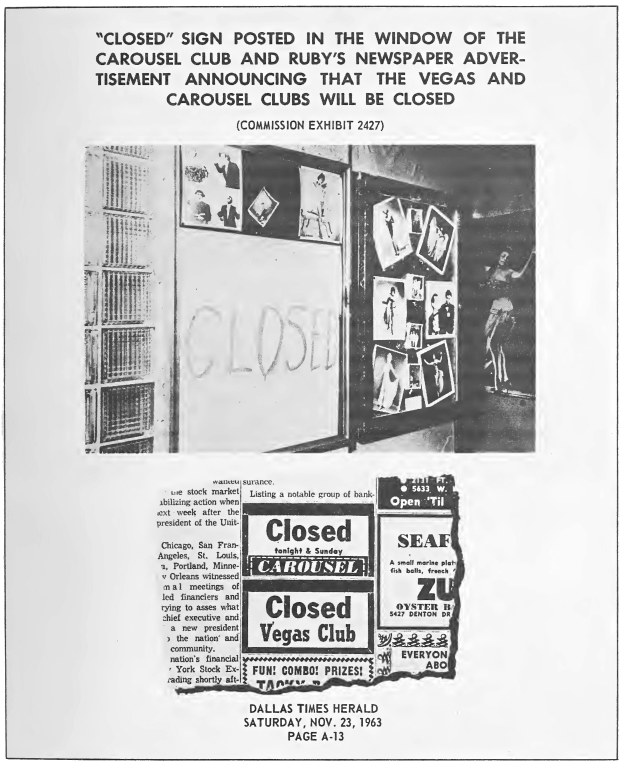
(COMMISSION EXHIBIT 2427)
“CLOSED” SIGN POSTED IN THE WINDOW OF THE
CAROUSEL CLUB AND RUBY’S NEWSPAPER ADVERTISEMENT
ANNOUNCING THAT THE VEGAS AND
CAROUSEL CLUBS WILL BE CLOSED
DALLAS TIMES HERALD
SATURDAY, NOV. 23, 1963
PAGE A-13
Ruby related that, after joining in the postservice refreshments,C6-919
he drove by some night clubs, noticing whether or not they had been
closed as his were.C6-920 He testified that, as he drove toward town, a
radio announcement that the Dallas police were working overtime
prompted the thought that he might bring those at police headquarters
something to eat.C6-921 At about 10:30 p.m., he stopped at a delicatessen
near the Vegas Club and purchased 8 kosher sandwiches and 10 soft
drinks.C6-922 From the delicatessen, he called the police department but
was told that the officers had already eaten.C6-923 He said he then tried to
offer the food to employees at radio station KLIF but failed in several
attempts to obtain the private night line number to the station.C6-924 On
three occasions between phone calls, Ruby spoke with a group of students
whom he did not know, lamenting the President’s death, teasing
one of the young men about being too young for his clubs, borrowing
their copy of the Dallas Times Herald to see how his advertisements
had been run, and stating that his clubs were the only ones that had
closed because of the assassination. He also expressed the opinion, as
he had earlier in the day, that the assassination would be harmful to
the convention business in Dallas.C6-925 Upon leaving the delicatessen
with his purchases, Ruby gave the counterman as a tip a card granting
free admission to his clubs.C6-926 He drove downtown to the police station
where he has said he hoped to find an employee from KLIF who
could give him the “hot line” phone number for the radio station.C6-927
The third floor of police headquarters.—Ruby is known to have
made his way, by about 11:30 p.m., to the third floor of the Dallas
Police Department where reporters were congregated near the homicide
bureau.C6-928 Newsman John Rutledge, one of those who may well
have been mistaken as to time, gave the following description of his
first encounter with Ruby at the police station:
I saw Jack and two out-of-state reporters, whom I did not
know, leave the elevator door and proceed toward those television
cameras, to go around the corner where Captain Fritz’s office
was. Jack walked between them. These two out-of-state reporters
had big press cards pinned on their coats, great big red
ones, I think they said “President Kennedy’s Visit to Dallas—Press”,
or something like that. And Jack didn’t have one, but
the man on either side of him did. And they walked pretty
rapidly from the elevator area past the policeman, and Jack
was bent over like this—writing on a piece of paper, and talking
to one of the reporters, and pointing to something on the piece
of paper, he was kind of hunched over.C6-929
Commission Exhibit No. 2424
Jack Ruby at press conference in basement assembly room about midnight November 22,
1963. (Jack Ruby is the individual in the dark suit, back row, right-hand side,
wearing horn-rimmed glasses.)
Detective Augustus M. Eberhardt, who also recalled that he first
saw Ruby earlier in the evening, said Ruby carried a note pad and
professed to be a translator for the Israeli press. He remembered
Ruby’s remarking how unfortunate the assassination was for the city
of Dallas and that it was “hard to realize that a complete nothing,
a zero like that, could kill a man like President Kennedy * * *.”C6-930
Video tapes confirm Ruby’s statement that he was present on the
third floor when Chief Jesse E. Curry and District Attorney Henry M.
Wade announced that Oswald would be shown to the newsmen at a
press conference in the basement.C6-931 Though he has said his original
purpose was only to locate a KLIF employee, Ruby has stated that
while at the police station he was “carried away with the excitement
of history.”C6-932 He accompanied the newsmen to the basement to
observe Oswald. His presence at the midnight news conference is
established by television tapes and by at least 12 witnesses.C6-933 When
Oswald arrived, Ruby, together with a number of newsmen, was
standing atop a table on one side of the room.C6-934 (See Commission
Exhibit No. 2424, p. 341.) Oswald was taken from the room after a
brief appearance, and Ruby remained to hear reporters question
District Attorney Wade. During the press conference, Wade stated
that Oswald would probably be moved to the county jail at the beginning
of the next week.C6-935 In answer to one question, Wade said that
Oswald belonged to the “Free Cuba Committee.” A few reporters
spoke up correcting Wade and among the voices was that of Jack
Ruby.C6-936
Ruby later followed the district attorney out of the press conference,
walked up to him and, according to Wade, said “Hi Henry * * * Don’t
you know me? * * * I am Jack Ruby, I run the Vegas Club. * * *”C6-937
Ruby also introduced himself to Justice of the Peace David L. Johnston,
shook his hand, gave Johnston a business card to the Carousel
Club, and, upon learning Johnston’s official position, shook Johnston’s
hand again.C6-938 After talking with Johnston, he gave another card to
Icarus M. Pappas, a reporter for New York radio station WNEW.C6-939
From a representative of radio station KBOX in Dallas, Ruby obtained
the “hot line” telephone number to KLIF.C6-940 He then called
the station and told one of the employees that he would like to come up
to distribute the sandwiches and cold drinks he had purchased.C6-941 Observing
Pappas holding a telephone line open and attempting to get
the attention of District Attorney Wade, Ruby directed Wade to
Pappas, who proceeded to interview the district attorney.C6-942 Ruby
then called KLIF a second time and offered to secure an interview with
Wade; he next summoned Wade to his phone, whereupon KLIF recorded
a telephone interview with the district attorney.C6-943 A few
minutes later. Ruby encountered Russ Knight, a reporter from KLIF
who had left the station for the police department at the beginning of
Ruby’s second telephone call. Ruby directed Knight to Wade and
waited a short distance away while the reporter conducted another
interview with the district attorney.C6-944
At radio station KLIF.—When Ruby left police headquarters, he
drove to radio station KLIF, arriving at approximately 1:45 a.m.
and remaining for about 45 minutes.C6-945 After first distributing his
sandwiches and soft drinks, Ruby settled in the newsroom for the 2 a.m.
newscast in which he was credited with suggesting that Russ Knight
ask District Attorney Wade whether or not Oswald was sane.C6-946 After
the newscast, Ruby gave a Carousel card to one KLIF employee,
although another did not recall that Ruby was promoting his club as he
normally did.C6-947 When speaking with KLIF’s Danny Patrick McCurdy,
Ruby mentioned that he was going to close his clubs for the
weekend and that he would rather lose $1,200 or $1,500 than remain
open at that time in the Nation’s history. McCurdy remembered that
Ruby “looked rather pale to me as he was talking to me and he kept
looking at the floor.”C6-948 To announcer Glen Duncan, Ruby expressed
satisfaction that the evidence was mounting against Oswald. Duncan
said that Ruby did not appear to be grieving but, instead, seemed
pleased about the personal contact he had had with the investigation
earlier in the evening.C6-949
Ruby left the radio station accompanied by Russ Knight. Engaging
Knight in a short conversation, Ruby handed him a radio script
entitled “Heroism” from a conservative radio program called “Life
Line.” It was apparently one of the scripts that had come into
Ruby’s hands a few weeks before at the Texas Products Show when
Hunt Foods were including such scripts with samples of their products.C6-950
The script extolled the virtues of those who embark upon
risky business ventures and stand firmly for causes they believe to
be correct.C6-951 Ruby asked Knight’s views on the script and suggested
that there was a group of “radicals” in Dallas which hated
President Kennedy and that the owner of the radio station should
editorialize against this group. Knight could not clearly determine
whether Ruby had reference to persons who sponsored programs like
“Life Line” or to those who held leftwing views.C6-952 Knight gained
the impression that Ruby believed such persons, whoever they might
be, were partially responsible for the assassination.C6-953
Early morning of November 23.—At about 2:30 a.m., Ruby entered
his automobile and departed for the Dallas Times-Herald Building.
En route, he stopped for about an hour to speak with Kay Helen
Coleman, one of his dancers, and Harry Olsen, a member of the
Dallas Police Department, who had hailed him from a parking
garage at the corner of Jackson and Field Streets. The couple were
crying and extremely upset over the assassination. At one point,
according to Ruby, the police officer remarked that “they should cut
this guy [Oswald] inch by inch into ribbons,” and the dancer said
that “in England they would drag him through the streets and would
have hung him.”C6-954 Although Ruby failed to mention this episode
during his first two FBI interviews,C6-955 he later explained that his
reason for failing to do so was that he did not “want to involve
them in anything, because it was supposed to be a secret that he
[the police officer] was going with this young lady.”C6-956 About
6 weeks after the assassination, Olsen left the Dallas Police Department
and married Miss Coleman. Both Olsen and his wife testified
that they were greatly upset during their lengthy conversation with
Ruby early Saturday morning; but Mrs. Olsen denied and Olsen
did not recall the remarks ascribed to them.C6-957 The Olsens claimed
instead that Ruby had cursed Oswald.C6-958 Mrs. Olsen also mentioned
that Ruby expressed sympathy for Mrs. Kennedy and her children.C6-959
From Jackson and Field Streets, Ruby drove to the Dallas Times-Herald,
where he talked for about 15 minutes with composing room
employee Roy Pryor, who had just finished a shift at 4 a.m.
Ruby mentioned that he had seen Oswald earlier in the night, that he
had corrected Henry Wade in connection with the Fair Play for Cuba
Committee, and that he had set up a telephone interview with Wade.
Pryor testified that Ruby explicitly stated to him that he believed he
was in good favor with the district attorney.C6-960 Recalling that Ruby
described Oswald as a “little weasel of a guy” and was emotionally concerned
about the President’s wife and children, Pryor also was impressed
by Ruby’s sorrowful mood and remembered that, as he talked,
Ruby shook a newspaper to emphasize his concern over the
assassination.C6-961
When Pryor left the composing room, Ruby remained and continued
speaking with other employees, including Arthur Watherwax and the
foreman, Clyde Gadash. Ruby, who often visited the Times-Herald
at that early morning hour in connection with his ads, sought Watherwax’s
views on his decision to close his clubs and indicated he was
going to attempt to persuade other club owners to do likewise.
Watherwax described Ruby as “pretty shaken up” about the assassination
and at the same time “excited” that he had attended Oswald’s
Friday night press conference.C6-962
While at the Times-Herald, Ruby displayed to the composing room
employees a “twistboard” he had previously promised to Gadash.C6-963
The twistboard was an exercising device consisting of two pieces of
hardened materials joined together by a lazy susan bearing so that
one piece could remain stationary on the floor while a person stood
atop it and swiveled to and fro.C6-964 Ruby had been trying to promote
sales of the board in the weeks before President Kennedy was killed.C6-965
Considerable merriment developed when one of the women employees
at the Times-Herald demonstrated the board, and Ruby himself,
put on a demonstration for those assembled.C6-966 He later testified:
“* * * not that I wanted to get in with the hilarity of frolicking,
but he [Gadash] asked me to show him, and the other men gathered
around.”C6-967 Gadash agreed that Ruby’s general mood was one of
sorrow.C6-968
At about 4:30 a.m., Ruby drove from the Dallas Times-Herald
to his apartment where he awakened his roommate George Senator.C6-969
During his visit in the composing room Ruby had expressed
the view that the Weissman advertisement was an effort to discredit
the Jews.C6-970 Senator testified that when Ruby returned to the apartment,
he began to discuss the Weissman advertisement and also a signboard
he had seen in Dallas urging that Chief Justice Earl Warren
be impeached.C6-971 Shortly thereafter, Ruby telephoned Larry Crafard
at the Carousel Club.C6-972 He told Crafard to meet him and Senator
at the Nichols Garage adjacent to the Carousel Club and to bring a
Polaroid camera kept in the club.C6-973 After Crafard joined Ruby and
Senator, the three men drove to the “Impeach Earl Warren”
sign near Hall Avenue and Central Expressway in Dallas. There
Ruby instructed Crafard to take three photographs of the billboard.
Believing that the sign and the Weissman newspaper ad might somehow
be connected, Ruby noted on the back of an envelope a name and
post office box number that appeared on the sign.C6-974 According to
George Senator:
* * * when he was looking at the sign and taking pictures
of it, and the newspaper ad, * * * this is where he really wanted
to know the whys or why these things had to be out. He is trying
to combine these two together, which I did hear him say, “This
is the work of the John Birch Society or the Communist Party
or maybe a combination of both.”C6-975
Pursuing a possible connection between the billboard and the newspaper
advertisement, Ruby drove to the post office and asked a postal
employee for the name of the man who had rented the box indicated on
the billboard, but the employee said that he could not provide such
information. Ruby inspected the box, however, and was upset to
find it stuffed with mail.C6-976 The three men then drove to a coffeeshop
where Ruby continued to discuss the two advertisements. After
about 30 minutes, they left the coffeeshop. Crafard was taken to
the Carousel Club; Ruby and Senator returned to their apartment,C6-977
and Ruby retired at about 6 a.m.C6-978
The morning and afternoon of November 23.—At 8 or 8:30 a.m.
Crafard, who had been asked to feed Ruby’s dogs, telephoned Ruby
at his apartment to inquire about food for the animals.C6-979 Ruby
forgot that he had told Crafard he did not plan to go to bed and reprimanded
Crafard for waking him.C6-980 A few hours thereafter Crafard
assembled his few belongings, took from the Carousel cash register $5
of money due him from Ruby, left a receipt and thank-you note, and
began hitchhiking to Michigan. Later that day, Andrew Armstrong
found the note and telephoned Ruby.C6-981
Ruby apparently did not return to bed following Crafard’s call.
During the morning hours, he watched a rabbi deliver on television
a moving eulogy of President Kennedy.C6-982 According to Ruby, the
rabbi:
went ahead and eulogized that here is a man that fought in every
battle, went to every country, and had to come back to his own
country to be shot in the back [starts crying] * * *. That created
a tremendous emotional feeling for me, the way he said that.
Prior to all the other times, I was carried away.C6-983
An employee from the Carousel Club who telephoned Ruby during
the morning remembered that his “voice was shaking” when he spoke
of the assassination.C6-984
Ruby has stated that, upon leaving his apartment some time between
noon and 1:30 p.m., he drove to Dealey Plaza where a police officer,
who noted Ruby’s solemnity, pointed out to him the window from
which the rifleshots had been fired the day before.C6-985 Ruby related
that he inspected the wreaths that had been placed in memory of the
President and became filled with emotion while speaking with the
police officer.C6-986 Ruby introduced himself to a reporter for radio
station KRLD who was working inside a mobile news unit at the
plaza; the newsman mentioned to Ruby that he had heard of Ruby’s
help to KLIF in obtaining an interview with Henry Wade, and Ruby
pointed out to the reporter that Capt. J. Will Fritz and Chief Curry
were then in the vicinity. Thereafter, the newsman interviewed and
photographed the officers.C6-987 Ruby said that he next drove home and
returned downtown to Sol’s Turf Bar on Commerce Street.C6-988
The evidence indicated, however, that sometime after leaving Dealey
Plaza, Ruby went to the Nichols Parking Garage adjacent to the
Carousel Club, where he was seen by Garnett C. Hallmark, general
manager of the garage, and Tom Brown, an attendant. Brown
believed that at about 1:30 p.m. he heard Ruby mention Chief Curry’s
name in a telephone conversation from the garage. Brown also recalled
that, before finally departing, Ruby asked him to inform
acquaintances whom he expected to stop by the garage that the Carousel
would be closed.C6-989 Hallmark testified that Ruby drove into the
garage at about 3 p.m., walked to the telephone, inquired whether
or not a competing burlesque club would be closed that night, and
told Hallmark that he (Ruby) was “acting like a reporter.”C6-990
Hallmark then heard Ruby address someone at the other end of the
telephone as “Ken” and caught portions of a conversation concerning
the transfer of Oswald.C6-991 Hallmark said Ruby never called
Oswald by name but used the pronoun “he” and remarked to the
recipient of the call, “you know I’ll be there.”C6-992
Ken Dowe, a KLIF announcer, to whom Ruby made at least
two telephone calls within a short span of time Saturday afternoon,
confirmed that he was probably the person to whom Hallmark and
Brown overheard Ruby speaking. In one call to Dowe, Ruby asked
whether the station knew when Oswald would be moved; and, in
another, he stated he was going to attempt to locate Henry Wade.C6-993
After Ruby finished his calls, he walked onto Commerce Street, passed
the Carousel Club, and returned a few minutes later to get his car.C6-994
Ruby’s comment that he was “acting like a reporter” and that he
would be at the Oswald transfer suggests that Ruby may have spent
part of Saturday afternoon shuttling back and forth from the Police
and Courts Building to Dealey Plaza. Such activity would explain
the fact that Tom Brown at the Nichols Garage believed he saw Ruby
at 1:30 p.m. while Garnett Hallmark placed Ruby at the garage at
3 p.m. It would also explain Ken Dowe’s receiving two phone calls
from Ruby. The testimony of five news reporters supports the possibility
that Ruby was at the Police and Courts Building Saturday
afternoon.C6-995 One stated that Ruby provided sandwiches for newsmen
on duty there Saturday afternoon, although no news representative
has mentioned personally receiving such sandwiches.C6-996 Another testified
that he received a card to the Carousel Club from Ruby about 4
p.m. that day at the police station.C6-997 A third believed he saw Ruby
enter an office in which Henry Wade was working, but no one else
reported a similar event.C6-998 The remaining two witnesses mentioned
no specific activities.C6-999 None of the persons who believed they saw
Ruby at the police department on Saturday had known him previously,
and no police officer has reported Ruby’s presence on that
day. Ruby has not mentioned such a visit. The Commission, therefore,
reached no firm conclusion as to whether or not Ruby visited
the Dallas Police Department on Saturday.
Shortly after 3 p.m. Ruby went to Sol’s Turf Bar on Commerce
Street where he remained for about 45 minutes. Ruby, a nondrinker,
stated that he visited Sol’s for the purpose of talking with his accountant,
who customarily prepared the bar’s payroll on Saturday
afternoon. The accountant testified, however, that he saw Ruby only
briefly and mentioned no business conversation with Ruby.C6-1000 Ruby
was first noticed at the Turf Bar by jeweler Frank Bellochio, who,
after seeing Ruby, began to berate the people of Dallas for the assassination.C6-1001
Ruby disagreed and, when Bellochio said he might close
his jewelry business and leave Dallas, Ruby attempted to calm him,
saying that there were many good citizens in Dallas.C6-1002 In response,
Bellochio pointed to a copy of the Bernard Weissman advertisement.C6-1003
To Bellochio’s bewilderment, Ruby then said he believed that
the advertisement was the work of a group attempting to create anti-Semitic
feelings in Dallas and that he had learned from the Dallas
Morning News that the ad had been paid for partly in cash.C6-1004 Ruby
thereupon produced one of the photographs he had taken Saturday
morning of the “Impeach Earl Warren” sign and excitedly began to
rail against the sign as if he agreed with Bellochio’s original criticism
of Dallas.C6-1005 He “seemed to be taking two sides—he wasn’t coherent,”
Bellochio testified.C6-1006 When Bellochio saw Ruby’s photographs,
which Bellochio thought supported his argument against
Dallas, he walked to the front of the bar and showed them to Tom
Apple, with whom he had been previously arguing. In Apple’s
presence, Bellochio asked Ruby for one of the pictures but Ruby
refused, mentioning that he regarded the pictures as a scoop.C6-1007
Bellochio testified: “I spoke to Tom and said a few more words to
Tom, and Ruby was gone—never said ‘Goodbye’ or ‘I’ll be seeing
you.’”C6-1008
Ruby may have left in order to telephone Stanley Kaufman, a
friend and attorney who had represented him in civil matters.C6-1009
Kaufman testified that, at approximately 4 p.m., Ruby called him
about the Bernard Weissman advertisement. According to Kaufman,
“Jack was particularly impressed with the [black] border as being a
tipoff of some sort—that this man knew the President was going to
be assassinated * * *.”C6-1010 Ruby told Kaufman that he had tried to
locate Weissman by going to the post office and said that he was attempting
to be helpful to law enforcement authorities.C6-1011
Considerable confusion exists as to the place from which Ruby placed
the call to Kaufman and as to his activities after leaving Sol’s Turf
Bar. Eva Grant stated that the call was made from her apartment
about 4 p.m.C6-1012 Ruby, however, believed it was made from the Turf
Bar. He stated that from the Turf Bar he went to the Carousel and
then home and has not provided additional details on his activities
during the hours from about 4 to 9:30 p.m.C6-1013 Robert Larkin saw him
downtown at about 6 p.m.C6-1014 and Andrew Armstrong testified that
Ruby visited the Carousel Club between 6 and 7 p.m. and remained
about an hour.C6-1015
At Eva Grant’s apartment Saturday evening.—Eva Grant believed
that, for most of the period from 4 until 8 p.m., Ruby was at her apartment.
Mrs. Grant testified that her brother was still disturbed about
the Weissman advertisement when he arrived, showed her the
photograph of the Warren sign, and recounted his argument with
Bellochio about the city of Dallas. Still curious as to whether or not
Weissman was Jewish, Mrs. Grant asked her brother whether he had
been able to find the name Bernard Weissman in the Dallas city
directory, and Ruby said he had not. Their doubts about Weissman’s
existence having been confirmed, both began to speculate that the
Weissman ad and the Warren sign were the work of either “Commies
or the Birchers,” and were designed to discredit the Jews.C6-1016 Apparently
in the midst of that conversation Ruby telephoned Russ Knight
at KLIF and, according to Knight, asked who Earl Warren was.C6-1017
Mrs. Grant has testified that Ruby eventually retired to her bedroom
where he made telephone calls and slept.C6-1018 About 8:30 p.m., Ruby
telephoned to Thomas J. O’Grady, a friend and former Dallas police
officer who had once worked for Ruby as a bouncer. To O’Grady,
Ruby mentioned closing the Carousel Club, criticized his competitors
for remaining open, and complained about the “Impeach Earl Warren”
sign.C6-1019
Saturday evening at Ruby’s apartment.—By 9:30 p.m., Ruby had
apparently returned to his apartment where he received a telephone
call from one of his striptease dancers, Karen Bennett Carlin, who,
together with her husband, had been driven from Fort Worth to Dallas
that evening by another dancer, Nancy Powell.C6-1020 All three had
stopped at the Colony Club, a burlesque nightclub which competed
with the Carousel.C6-1021 Mrs. Carlin testified that, in need of money, she
telephoned Ruby, asked whether the Carousel would be open that
night, and requested part of her salary.C6-1022 According to Mrs. Carlin,
Ruby became angry at the suggestion that the Carousel Club might be
open for business but told her he would come to the Carousel in about
an hour.C6-1023
Thereafter, in a depressed mood, Ruby telephoned his sister Eva
Grant, who suggested he visit a friend.C6-1024 Possibly in response to
that suggestion, Ruby called Lawrence Meyers, a friend from Chicago
with whom he had visited two nights previously.C6-1025 Meyers
testified that, during their telephone conversation, Ruby asked him
what he thought of this “terrible thing,” Ruby then began to criticize
his competitors, Abe and Barney Weinstein, for failing to close their
clubs on Saturday night. In the course of his conversation about the
Weinsteins and the assassination, Ruby said “I’ve got to do something
about this.”C6-1026 Meyers initially understood that remark to refer to
the Weinsteins. Upon reflection after Oswald was shot, Meyers was
uncertain whether Ruby was referring to his competitors, or to the
assassination of President Kennedy; for Ruby had also spoken at
length about Mrs. Kennedy and had repeated “those poor people,
those poor people.”C6-1027 At the conclusion of their conversation,
Meyers declined Ruby’s invitation to join him for a cup of coffee but
invited Ruby to join him at the motel. When Ruby also declined, the
two agreed to meet for dinner the following evening.C6-1028
Meanwhile, Karen Carlin and her husband grew anxious over
Ruby’s failure to appear with the money they had requested.C6-1029
After a substantial wait, they returned together to the Nichols Garage
where Mr. Carlin telephoned to Ruby.C6-1030 Carlin testified that he
told Ruby they needed money in order to return to Fort WorthC6-1031
although Nancy Powell testified that she drove the Carlins home that
evening.C6-1032 Agreeing to advance a small sum, Ruby asked to speak
to Mrs. Carlin, who claimed that Ruby told her that if she needed
more money she should call him on Sunday.C6-1033 Thereafter, at Ruby’s
request, garage attendant Huey Reeves gave Mrs. Carlin $5, and she
signed with her stage name “Little Lynn” a receipt which Reeves time-stamped
10:33 p.m., November 23.C6-1034 (See Commission Exhibit No.
1476, p. 351.)
Inconsistent testimony was developed regarding Ruby’s activities
during the next 45 minutes. Eva Grant testified that she did not see
her brother on Saturday night after 8 p.m. and has denied calling
Ralph Paul herself that night.C6-1035 Nonetheless, telephone company
records revealed that at 10:44 p.m. a call was made to Ralph Paul’s
Bull Pen Drive-In in Arlington, Tex., from Mrs. Grant’s apartment.C6-1036
It was the only call to Paul from her apartment on Friday or Saturday;C6-1037
she recalled her brother making such a call that weekend;C6-1038
and Ralph Paul has testified that Ruby telephoned him Saturday
night from Eva Grant’s apartment and said he and his sister were
there crying.C6-1039
Nineteen-year-old Wanda Helmick, a former waitress at the Bull
Pen Drive-In, first reported in June, 1964 that some time during the
evening she saw the cashier answer the Bull Pan’s pay telephone and
heard her call out to Paul, “It is for you. It is Jack.”C6-1040 Mrs. Helmick
claimed she overheard Paul, speaking on the telephone, mention
something about a gun which, she understood from Paul’s conversation,
the caller had in his possession. She said she also heard Paul
exclaim “Are you crazy?”C6-1041 She provided no other details of the
conversation. Mrs. Helmick claimed that on Sunday, November 24,
after Oswald had been shot, she heard Paul repeat the substance of the
call to other employees as she had related it and that Paul said Ruby
was the caller.C6-1042 Ralph Paul denied the allegations of Mrs.
Helmick.C6-1043 Both Paul and Mrs. Helmick agreed that Paul went
home soon after the call, apparently about 11 p.m.C6-1044
Shortly after 11 p.m., Ruby arrived at the Nichols Garage where he
repaid Huey Reeves and obtained the receipt Mrs. Carlin had
signed.C6-1045 Outside the Carousel, Ruby exchanged greetings with
Police Officer Harry Olsen and Kay Coleman, whom he had seen late
the previous night.C6-1046 Going upstairs to the club, Ruby made a
series of five brief long-distance phone calls, the first being to the
Bull Pen Drive-In at 11:18 p.m. and lasting only 1 minute.C6-1047 Apparently
unable to reach Paul there, Ruby telephoned Paul’s home in
Arlington, Tex., for 3 minutes.C6-1048 A third call was placed at 11:36
p.m. for 2 minutes, again to Paul’s home.C6-1049 At 11:44 p.m. Ruby
telephoned Breck Wall, a friend and entertainer who had gone to
Galveston, Tex., when his show in Dallas suspended its performance
out of respect to President Kennedy. The call lasted 2 minutes.C6-1050
Thereafter, Ruby immediately placed a 1-minute phone call to Paul’s
home.C6-1051
Although Ruby has mentioned those calls, he has not provided
details to the Commission; however, he has denied ever indicating to
Paul or Wall that he was going to shoot Oswald and has said he did not
consider such action until Sunday morning.C6-1052 Ralph Paul did not
mention the late evening calls in his interview with FBI agents on
November 24, 1963.C6-1053 Later Paul testified that Ruby called him from
downtown to say that nobody was doing any business.C6-1054 Breck Wall
testified that Ruby called him to determine whether or not the American
Guild of Variety Artists (AGVA), which represented striptease
dancers in Dallas, had met concerning a dispute Ruby was having
with the union.C6-1055 Ruby’s major difference with AGVA during the
preceding 2 weeks had involved what Ruby considered to be AGVA’s
failure to enforce against his 2 competitors, Abe and Barney Weinstein,
AGVA’s ban on “striptease contests” and performances by
“amateurs.”C6-1056 As recently as Wednesday, November 20, Ruby had
telephoned an AGVA representative in Chicago about that complaint
and earlier in November he had unsuccessfully sought to obtain assistance
from a San Francisco gambler and a Chicagoan reputed for his
heavyhanded union activities.C6-1057 Wall testified that Ruby “was very
upset the President was assassinated and he called Abe Weinstein or
Bernie Weinstein * * * some names for staying open * * *.” Wall
added, “he was very upset * * * that they did not have the decency
to close on such a day and he thought out of respect they should
close.”C6-1058
Ruby’s activities after midnight.—After completing the series of
calls to Paul and Wall at 11:48 p.m., Ruby went to the Pago Club,
about a 10-minute drive from the Carousel Club.C6-1059 He took a table
near the middle of the club and, after ordering a Coke, asked the waitress
in a disapproving tone, “Why are you open?”C6-1060 When Robert
Norton, the club’s manager, joined Ruby a few minutes later he expressed
to Ruby his concern as to whether or not it was proper to
operate the Pago Club that evening. Ruby indicated that the Carousel
was closed but did not criticize Norton for remaining open.C6-1061
Norton raised the topic of President Kennedy’s death and said, “[W]e
couldn’t do enough to the person that [did] this sort of thing.”
Norton added, however, that “Nobody has the right to take the life
of another one.”C6-1062 Ruby expressed no strong opinion, and closed the
conversation by saying he was going home because he was tired.C6-1063
Later, Ruby told the Commission: “he knew something was wrong
with me in the certain mood I was in.”C6-1064
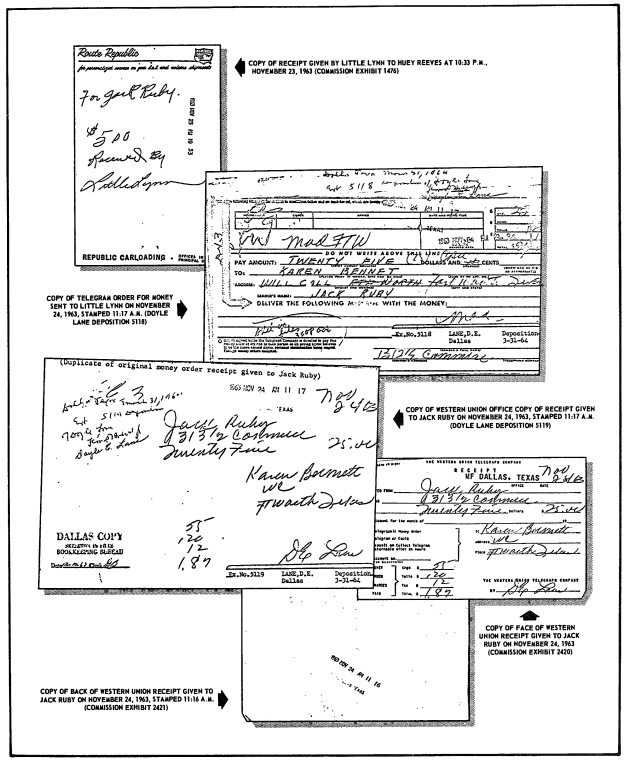
(COMMISSION EXHIBIT 1476)
COPY OF RECEIPT GIVEN BY LITTLE LYNN TO HUEY REEVES AT 10:33 P.M.,
NOVEMBER 23, 1963
(DOYLE LANE DEPOSITION 5118)
COPY OF TELEGRAM ORDER FOR MONEY
SENT TO LITTLE LYNN ON NOVEMBER
24, 1963, STAMPED 11:17 A.M.
(DOYLE LANE DEPOSITION 5119)
COPY OF WESTERN UNION OFFICE COPY OF RECEIPT GIVEN
TO JACK RUBY ON NOVEMBER 24, 1963, STAMPED 11:17 A.M.
(COMMISSION EXHIBIT 2420)
COPY OF FACE OF WESTERN
UNION RECEIPT GIVEN TO JACK
RUBY ON NOVEMBER 24, 1963
(COMMISSION EXHIBIT 2421)
COPY OF BACK OF WESTERN UNION RECEIPT GIVEN TO
JACK RUBY ON NOVEMBER 24, 1963, STAMPED 11:16 A.M.
Ruby testified that he went home after speaking with Norton and
went to bed about 1:30 a.m.C6-1065 By that time, George Senator claimed,
he had retired for the night and did not remember Ruby’s return.C6-1066
Eva Grant testified that her brother telephoned her at about 12:45
a.m. to learn how she was feeling.C6-1067
Sunday morning.—Ruby’s activities on Sunday morning are the
subject of conflicting testimony. George Senator believed that Ruby
did not rise until 9 or 9:30 a.m.;C6-1068 both Ruby and Senator maintained
that Ruby did not leave their apartment until shortly before
11:00 a.m., and two other witnesses have provided testimony which
supports that account of Ruby’s whereabouts.C6-1069 On the other hand,
three WBAP-TV television technicians—Warren Richey, John Smith,
and Ira Walker—believed they saw Ruby near the Police and Courts
Building at various times between 8 a.m. and 11 a.m.C6-1070 But there are
substantial reasons to doubt the accuracy of their identifications.
None had ever seen Ruby on a prior occasion. None looked for an
extended period at the man believed to be Ruby,C6-1071 and all were
occupied with their duties and had no reason to remember the man’s
appearance until they saw Ruby’s picture on television.C6-1072
Smith, for one, was not entirely positive about his identification of
Ruby as the man he saw;C6-1073 and Richey was looking down from atop
a TV mobile unit when he observed on the sidewalk the man he believed
was Ruby.C6-1074 In addition, Richey and Smith provided descriptions
of Ruby which differ substantially from information about Ruby
gathered from other sources. Smith described the man he saw as being
an “unkempt person that possibly could have slept with his clothes
on * * *.”C6-1075 Ruby was characteristically clean and well groomed.C6-1076
In fact, Senator testified that Ruby shaved and dressed before leaving
their apartment that morning, and at the time Ruby shot Oswald he
was dressed in a hat and business suit.C6-1077 Richey described Ruby as
wearing a grayish overcoat,C6-1078 while investigation indicated that
Ruby did not own an overcoat and was not wearing one at the time of
the shooting.C6-1079 (See Pappas Deposition Exhibit No. 1, p. 356.) Although
Walker’s identification of Ruby is the most positive, his certainty
must be contrasted with the indefinite identification made by
Smith, who had seen the man on one additional occasion.C6-1080 Both
Smith and Walker saw a man resembling Ruby when the man, on two
occasions, looked through the window of their mobile news unit and
once asked whether Oswald had been transferred. Both saw only
the man’s head, and Smith was closer to the window; yet Smith would
not state positively that the man was Ruby.C6-1081 Finally, video tapes
of scenes on Sunday morning near the NBC van show a man close
to the Commerce Street entrance who might have been mistaken for
Ruby.C6-1082
George Senator said that when he arose, before 9 a.m., he began
to do his laundry in the basement of the apartment building while
Ruby slept.C6-1083 During Senator’s absence, Ruby received a telephone
call from his cleaning lady, Mrs. Elnora Pitts, who testified that she
called sometime between 8:30 and 9 a.m. to learn whether Ruby wanted
her to clean his apartment that day.C6-1084 Mrs. Pitts remembered that
Ruby “sounded terrible strange to me.” She said that “there was something
wrong with him the way he was talking to me.”C6-1085 Mrs. Pitts
explained that, although she had regularly been cleaning Ruby’s
apartment on Sundays, Ruby seemed not to comprehend who she was or
the reason for her call and required her to repeat herself several
times.C6-1086 As Senator returned to the apartment after the call, he was
apparently mistaken for Ruby by a neighbor, Sidney Evans, Jr.
Evans had never seen Ruby before but recalled observing a man resembling
Ruby, clad in trousers and T-shirt, walk upstairs from the
“washateria” in the basement of their building and enter Ruby’s suite
with a load of laundry. Later in the morning, Malcolm Slaughter who
shared an apartment with Evans, saw an individual, similarly clad, on
the same floor as Ruby’s apartment.C6-1087 Senator stated that it was not
Ruby’s custom to do his own washing and that Ruby did not do so that
morning.C6-1088
While Senator was in the apartment, Ruby watched television, made
himself coffee and scrambled eggs, and received, at 10:19 a.m., a telephone
call from his entertainer, Karen Carlin.C6-1089 Mrs. Carlin testified
that in her telephone conversation she asked Ruby for $25 inasmuch
as her rent was delinquent and she needed groceries.C6-1090 She
said that Ruby, who seemed upset, mentioned that he was going downtown
anyway and that he would send the money from the Western
Union office.C6-1091 According to George Senator, Ruby then probably
took a half hour or more to bathe and dress.C6-1092
Supporting the accounts given by Mrs. Carlin and Mrs. Pitts of
Ruby’s emotional state, Senator testified that during the morning
Ruby:
* * * was even mumbling, which I didn’t understand. And right
after breakfast he got dressed. Then after he got dressed he was
pacing the floor from the living room to the bedroom, from the
bedroom to the living room, and his lips were going. What he
was jabbering I don’t know. But he was really pacing.C6-1093
Ruby has described to the Commission his own emotions of Sunday
morning as follows:
* * * Sunday morning * * * [I] saw a letter to Caroline, two
columns about a 16-inch area. Someone had written a letter to
Caroline. The most heartbreaking letter. I don’t remember the
contents. * * * alongside that letter on the same sheet of paper
was a small comment in the newspaper that, I don’t know how
it was stated, that Mrs. Kennedy may have to come back for the
trial of Lee Harvey Oswald. * * *
I don’t know what bug got ahold of me. I don’t know what it
is, but I am going to tell the truth word for word.
I am taking a pill called Preludin. It is a harmless pill, and it
is very easy to get in the drugstore. It isn’t a highly prescribed
pill. I use it for dieting.
I don’t partake of that much food. I think that was a stimulus
to give me an emotional feeling that suddenly I felt, which was
so stupid, that I wanted to show my love for our faith, being of
the Jewish faith, and I never used the term and I don’t want to
go into that—suddenly the feeling, the emotional feeling came
within me that someone owed this debt to our beloved President
to save her the ordeal of coming back. I don’t know why that
came through my mind.C6-1094
(See Commission Exhibit No. 2426, p. 355.)
Sunday morning trip to police department.—Leaving his apartment
a few minutes before 11 a.m., Ruby went to his automobile taking
with him his dachshund, Sheba, and a portable radio.C6-1095 He
placed in his pocket a revolver which he routinely carried in a bank
moneybag in the trunk of his car.C6-1096 Listening to the radio, he drove
downtown, according to his own testimony, by a route that took him
past Dealey Plaza where he observed the scattered wreaths. Ruby
related that he noted the crowd that had gathered outside the county
jail and assumed that Oswald had already been transferred. However,
when he passed the Main Street side of the Police and Courts
Building, which is situated on the same block as the Western Union
office, he also noted the crowd that was gathered outside that building.C6-1097
Normal driving time for the trip from his apartment would
have been about 15 minutes, but Ruby’s possible haste and the slow
movement of traffic through Dealey Plaza make a reliable estimate
difficult.C6-1098
Ruby parked his car in a lot directly across the street from the
Western Union office. He apparently placed his keys and billfold in
the trunk of the car, then locked the trunk, which contained approximately
$1,000 in cash, and placed the trunk key in the glove compartment
of the car. He did not lock the car doors.C6-1099
With his revolver, more than $2,000 in cash, and no personal identification,
Ruby walked from the parking lot across the street to the
Western Union office where he filled out forms for sending $25 by
telegraph to Karen Carlin.C6-1100 After waiting in line while one other
Western Union customer completed her business,C6-1101 Ruby paid for
the telegram and retained as a receipt one of three time-stamped documents
which show that the transaction was completed at almost exactly
11:17 a.m., c.s.t.C6-1102 (See Commission Exhibits Nos. 1476, 2420,
2421; D. Lane Deposition Exhibits Nos. 5118, 5119, p. 351.) The
Western Union clerk who accepted Ruby’s order recalls that Ruby
promptly turned, walked out of the door onto Main Street, and proceeded
in the direction of the police department one block away.C6-1103
The evidence set forth in chapter V indicates that Ruby entered the
police basement through the auto ramp from Main Street and stood
behind the front rank of newsmen and police officers who were crowded
together at the base of the ramp awaiting the transfer of Oswald to the
county jail.C6-1104 As Oswald emerged from a basement office at approximately
11:21 a.m., Ruby moved quickly forward and, without speaking,C6-1105
fired one fatal shot into Oswald’s abdomen before being subdued
by a rush of police officers.C6-1106
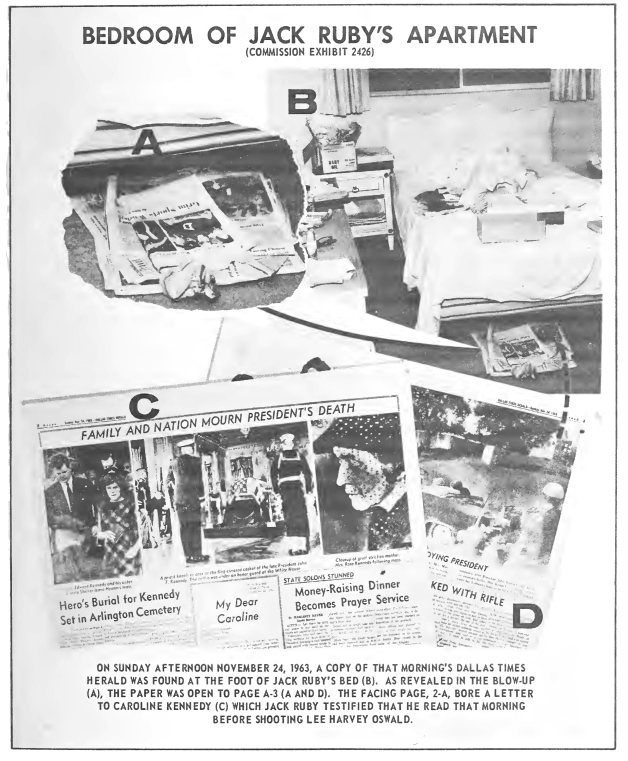
BEDROOM OF JACK RUBY’S APARTMENT
(COMMISSION EXHIBIT 2426)
ON SUNDAY AFTERNOON NOVEMBER 24, 1963, A COPY OF THAT MORNING’S DALLAS TIMES
HERALD WAS FOUND AT THE FOOT OF JACK RUBY’S BED (B). AS REVEALED IN THE BLOW-UP
(A), THE PAPER WAS OPEN TO PAGE A-3 (A AND D). THE FACING PAGE, 2-A, BORE A LETTER
TO CAROLINE KENNEDY (C) WHICH JACK RUBY TESTIFIED THAT HE READ THAT MORNING
BEFORE SHOOTING LEE HARVEY OSWALD.
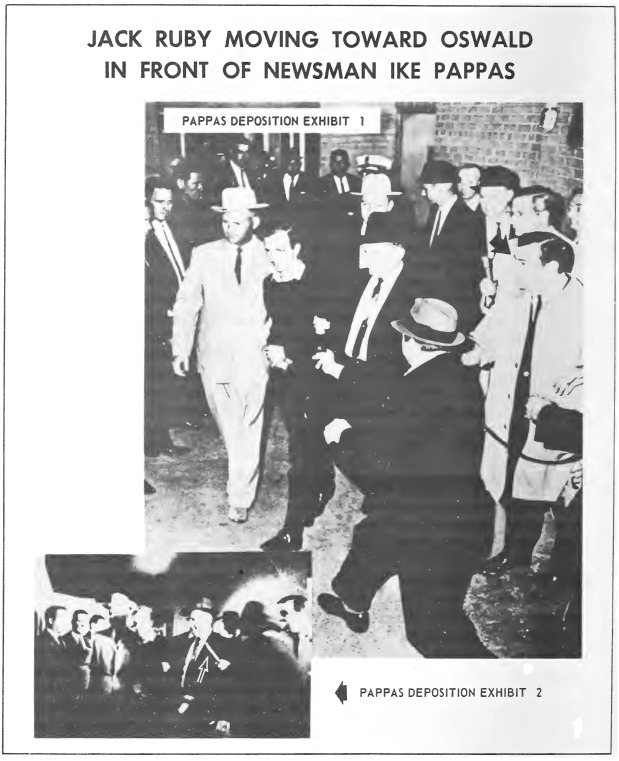
JACK RUBY MOVING TOWARD OSWALD
IN FRONT OF NEWSMAN IKE PAPPAS
PAPPAS DEPOSITION EXHIBIT 1
PAPPAS DEPOSITION EXHIBIT 2
Evaluation of activities.—Examination of Ruby’s activities immediately
preceding and following the death of President Kennedy revealed
no sign of any conduct which suggests that he was involved in the
assassination. Prior to the tragedy, Ruby’s activities were routine.
Though persons who saw him between November 22 and 24 disagree
as to whether or not he appeared more upset than others around him,
his response to the assassination appears to have been one of genuine
shock and grief. His indications of concern over the possible effects of
the assassination upon his businesses seem consistent with other evidence
of his character.C6-1107 During the course of the weekend, Ruby
seems to have become obsessed with the possibility that the Impeach
Earl Warren sign and the Bernard Weissman ad were somehow connected
and related to the assassination. However, Ruby’s interest in
these public notices was openly expressed and, as discussed below, the
evidence reveals no connection between him and any political organization.
Examination of Larry Crafard’s sudden departure from Dallas
shortly before noon on November 23 does not suggest that Ruby was
involved in a conspiracy. To be sure, Crafard started hitchhiking to
Michigan, where members of his family lived, with only $7 in his
pocket.C6-1108 He made no attempt to communicate with law enforcement
officials after Oswald’s death;C6-1109 and a relative in Michigan
recalled that Crafard spoke very little of his association with Ruby.C6-1110
When finally located by the FBI 6 days later, he stated that he left
Ruby’s employ because he did not wish to be subjected to further verbal
abuse by Ruby and that he went north to see his sister, from whom he
had not heard in some time.C6-1111
An investigation of Crafard’s unusual behavior confirms that his departure
from Dallas was innocent. After Oswald was shot, FBI
agents obtained from the Carousel Club an unmailed letter drafted by
Crafard to a relative in Michigan at least a week before the assassination.C6-1112
The letter revealed that he was considering leaving Dallas at
that time.C6-1113 On November 17, Crafard, who had been receiving only
room, board, and incidental expenses, told Ruby he wanted to stop
working for him; however, Crafard agreed to remain when Ruby
promised a salary.C6-1114 Then on the morning of November 23, Ruby
and Crafard had a minor altercation over the telephone.C6-1115 Although
Crafard did not voluntarily make known to the authorities his associations
with Ruby, he spoke freely and with verifiable accuracy when
questioned. The automobile driver who provided Crafard his first
ride from Dallas has been located; his statement generally conforms
with Crafard’s story; and he did not recall any unusual or troubled behavior
by Crafard during that ride.C6-1116
Although Crafard’s peremptory decision to leave Dallas might be
unusual for most persons, such behavior does not appear to have been
uncommon for him. His family residence had shifted frequently
among California, Michigan, and Oregon.C6-1117 During his 22 years, he
had earned his livelihood picking crops, working in carnivals, and
taking other odd jobs throughout the country.C6-1118 According to his
testimony, he had previously hitchhiked across the country with his
then wife and two infant children.C6-1119 Against such a background, it
is most probable that the factors motivating Crafard’s departure from
Dallas on November 23 were dissatisfaction with his existence in
Ruby’s employ, which he had never considered more than temporary,
Ruby’s decision to close his clubs for 3 days, the argument on Saturday
morning, and his own desire to see his relatives in Michigan. There is
no evidence to suggest any connection between Crafard’s departure and
the assassination of the President or the shooting of Oswald.
The allegations of Wanda Helmick raised speculation that Ruby’s
Saturday night phone calls to Ralph Paul and Breck Wall might have
concerned the shooting of Oswald, but investigation has found nothing
to indicate that the calls had conspiratorial implications. Paul was
a close friend, business associate, and adviser to Jack Ruby. Ruby
normally kept in close telephone contact with Paul, who had a substantial
sum of money committed to the Carousel Club.C6-1120 Paul explained
that Ruby called him Saturday evening once to point out his
ads, another time to say that nobody seemed to be doing any business in
downtown Dallas, and a third time to relate that both he and his sister
were crying over the assassination.C6-1121 Between two of those phone
calls to Paul, Ruby telephoned to Galveston, Tex., to speak with Wall,
a friend and former business associate who was an official of the American
Guild of Variety Artists. Wall related that during that call
Ruby criticized the Weinsteins for failing to close their clubs.
Having earlier made the same complaint to Lawrence Meyers to
whom he mentioned a need “to do something about this” it would have
been characteristic for Ruby to want to direct Breck Wall’s attention,
as an AGVA official, to what he regarded as the Weinsteins’ improper
conduct. The view that the calls to Wall and Paul could have had
conspiratorial implications also is belied in large measure by the conduct
of both men before and after the events of November 22-24. A
check of long-distance telephone records reveals no suspicious activity
by either man.C6-1122 Paul, in fact, is not known to have visited Dallas
during the weekend of the assassination except to appear openly in
an effort to arrange counsel for Ruby within a few hours of the attack
on Oswald. Neither the FBI nor the CIA has been able to provide
any information that Ralph Paul or Breck Wall ever engaged
in any form of subversive activity.C6-1123
Moreover, Mrs. Helmick’s reliability is undermined by her failure
to report her information to any investigative official until June 9,
1964.C6-1124 Although a sister-in-law confirms that Mrs. Helmick wrote
her “something about a gun” shortly after the shooting,C6-1125 the only
mention of any statement by Paul which was included in a letter written
by Mrs. Helmick after the Ruby trial was that Paul believed Ruby
was “not in his right mind.”C6-1126 No corroborating witness named by
Mrs. Helmick has been found who remembers the conversations she
mentioned.C6-1127 Both Ruby and Paul have denied that anything was
said, as Mrs. Helmick suggests, about a gun or an intent to shoot
Oswald, and Wall has stated that Ruby did not discuss such matters
with him.C6-1128 Even if Mrs. Helmick is accurate the statements
ascribed to Paul indicate only that he may have heard of a possible
reference by Ruby to shooting Oswald. According to her, Paul’s
response was to exclaim “Are you crazy?” But under no circumstances
does the report of Mrs. Helmick or any other fact support a
belief that Paul or Wall was involved in the shooting of Oswald.
The Commission has conducted an investigation of the telephone
call Ruby received from Karen Carlin at 10:19 Sunday morning to
determine whether that call was prearranged for the purpose of conveying
information about the transfer of Oswald or to provide Ruby
an excuse for being near the police department. The Commission has
examined the records of long-distance telephone calls on Sunday morning
for Jack Ruby,C6-1129 the Carlins,C6-1130 the Dallas police,C6-1131 and several
other personsC6-1132 and has found no sign of any indirect communication
to Ruby through Mr. or Mrs. Carlin. No other evidence showing
any link between the Carlins and the shooting of Oswald has
been developed.
The possibility of a prior acquaintanceship between Ruby and
Oswald has been suggested by some persons who viewed the shooting
on television and believed that a look of recognition appeared on
Oswald’s face as Ruby moved toward him in the jail basement. The
Commission has examined the television tapes and movie films which
were made as Oswald moved through the basement and has observed
no facial expressions which can be interpreted as signifying recognition
of Ruby by Oswald. It is doubtful even that Oswald could have
seen Ruby sufficiently clearly to discern his identity since Oswald was
walking from a dark corridor into “the flash from the many cameras”
and the lights of TV cameramen which were “blinding.”C6-1133 In addition
to such generalized suspicion, there have been numerous specific
allegations that Oswald was seen in the company of Ruby prior to
November 22, often at Ruby’s Carousel Club. All such allegations
have been investigated, but the Commission has found none which
merits credence. In all but a few instances where the Commission was
able to trace the claim to its source, the person responsible for the report
either denied making it or admitted that he had no basis for the original
allegations.C6-1134 Frequently those responsible for the allegations
have proved to be persons of erratic memory or dubious mental stability.C6-1135
In a few instances, the source of the story has remained unidentified,
and no person has come forward to substantiate the
rumor.C6-1136
The testimony of a few witnesses who claim to have seen Ruby with
a person who they feel may have been Oswald warrants further
comment. One such witness, Robert K. Patterson, a Dallas electronics
salesman, has stated that on a date established from sales records
as November 1, 1963, Ruby, accompanied by a man who resembled
Oswald, purchased some equipment at his business establishment.C6-1137
However, Patterson did not claim positively that the man he saw was
Oswald,C6-1138 and two of his associates who were also present at the
time could not state that the man was Oswald.C6-1139 Other evidence indicates
that Ruby’s companion was Larry Crafard. Crafard, who
lived at the Carousel Club while working for Ruby from mid-October
until November 23, 1963, stated that sometime in late October or early
November he accompanied Ruby to an electronics store in connection
with the purchase of electronics equipment.C6-1140 Ruth Paine testified
that Crafard’s photograph bears a strong resemblance to Oswald;
and employment records of the Texas School Book Depository show
that Oswald worked a full day on November 1, 1963.C6-1141
William D. Crowe, Jr., a young nightclub master of ceremonies who
had worked for Ruby on three occasions and had begun a 4- or 5-week
engagement at the Carousel Club on November 11, 1963, was the first
person who reported a possible association between Ruby and
Oswald.C6-1142 While attempting to enter the Carousel Club on November
24, shortly after Oswald was shot, Crowe encountered two news
media representatives who were gathering information on Jack
Ruby.C6-1143 At that time, Crowe, who included a memory act in his
repertoire,C6-1144 mentioned the “possibility” that he had seen Oswald at
the Carousel Club.C6-1145 As a result he was asked to appear on television.
In Crowe’s own words, the story “started snowballing.” He testified:
They built up the memory thing and they built up the bit of
having seen Oswald there, and I never stated definitely, positively,
and they said that I did, and all in all, what they had in
the paper was hardly even close to what I told them.C6-1146
Crowe added that his memory act involved a limited system which
did not, in fact, improve his memory and that his memory might not
even be as good as that of the average person. When asked how certain
he was that the man he saw was Oswald, Crowe testified:
“* * * the face seemed familiar as some faces do, and I had associated
him with a patron that I had seen in the club a week before. That
was about it.”C6-1147
A possible explanation for Crowe’s belief that Oswald’s face seemed
familiar was supplied by a freelance photographer, Eddie Rocco, who
had taken pictures at the Carousel Club for Ruby at about the time
Crowe was employed there. Rocco produced one of those photographs
which depicted a man who might have been mistaken for
Oswald by persons having no reason to remember the man at the time
they saw him.C6-1148 When shown the Rocco photograph, Crowe said
that there was as strong a possibility that the man he recalled seeing
was the man in the photograph as there was that he was Oswald.C6-1149
Crowe’s uncertainty was further underscored by his failure initially
to provide his information about Oswald to David Hoy, a news-media
friend whom Crowe telephoned in Evansville, Ind., less
than 20 minutes after Oswald was shot.C6-1150 By then the possible
recognition had occurred to Crowe,C6-1151 and Hoy said he was quite
surprised that Crowe had given the information first to other news
representatives instead of telling him in that early conversation.C6-1152
After Crowe’s identification had been publicized, four other persons
also reported seeing Oswald at the Carousel Club. One man said
he saw Ruby and Oswald seated at a table together and recalled that
the man resembling Oswald was addressed by a blond-haired waitress
as “Bettit” or “Pettit.” The witness was unable to give any description
of “Pettit” except that he was the man who had been shot
by Ruby. He could not describe the inside of the Carousel and was
unable to give a precise location for the club.C6-1153 Another witness,
a resident of Tennessee, related seeing a man resembling Oswald at
the Carousel Club on November 10.C6-1154 Ruth Paine has testified, however,
that Oswald spent the entire holiday weekend of November 9,
10, and 11 at her home in Irving, Tex.C6-1155 Two of Ruby’s former employees,
Karen Carlin and Billy Joe Willis, also believed they had
seen a person who resembled Oswald. Willis believed he saw the man
at the Carousel Club but did not think the man was Oswald.C6-1156
Mrs. Carlin likewise was not certain that the man was Oswald nor
was she sure where she had seen him.C6-1157 Neither reported any connection
between the man and Ruby. No other employees recalled
seeing Oswald or a person resembling him at the Carousel Club.C6-1158
Wilbryn Waldon (Robert) Litchfield II also claimed to have seen
at the Carousel Club a man resembling Oswald. Litchfield stated
that during a visit to the Carousel Club in late October or early
November 1963, he saw such a man enter Ruby’s office, apparently to
confer with Ruby.C6-1159 Although there is substantial evidence that
Litchfield did see Ruby at the Carousel Club about that time,C6-1160 there
is strong reason to believe that Litchfield did not see Lee Harvey
Oswald. Litchfield described the man he saw as having pockmarks
on the right side of his chin;C6-1161 Oswald did not have such identifying
marks.C6-1162 Moreover, the Commission has substantial doubts concerning
Litchfield’s credibility. Although present at an FBI interview of
another witness on November 29, Litchfield made no mention of his
observation to public officials until December 2, 1963.C6-1163 Litchfield,
who had twice been convicted for offenses involving forged
checks,C6-1164 testified that he first recalled that Oswald resembled the
visitor he saw at the Carousel Club while watching a television
showing on Sunday morning, November 24, of the shooting by
Ruby.C6-1165 At that time Litchfield was playing poker with three
friends, and he testified that he promptly informed them of the resemblance
he observed.C6-1166 However, none of the three poker companions
remembered Litchfield’s making such a remark; and two
added that Litchfield’s statements were often untrustworthy.C6-1167
With regard to all of the persons who claimed to have seen Ruby and
Oswald together, it is significant that none had particular reason to
pay close attention to either man, that substantial periods of time
elapsed before the events they assertedly witnessed became meaningful,
and that, unlike the eyewitnesses who claimed to have seen Oswald
on November 22, none reported their observations soon after Oswald
was arrested. In the course of its investigation, the Commission has
encountered numerous clear mistakes of identification. For example,
at least four persons, other than Crafard, are known to have been
mistaken for Oswald.C6-1168 Other persons have been misidentified as
Jack Ruby.C6-1169 Under all the available evidence there is no substantial
likelihood that the person the various witnesses claimed to have seen
with Ruby was in fact Oswald.
In addition to probing the reported evidence that Ruby and Oswald
had been seen together, the Commission has examined other circumstances
for signs that the two men were acquainted. From the time
Oswald returned from Mexico, both he and Jack Ruby lived in the
Oak Cliff section of Dallas, slightly more than a mile apart. Numerous
neighbors of both Oswald and Ruby were interviewed, and none
knew of any association between the two.C6-1170 Oswald’s work began
at 8 each weekday morning and terminated at 4:45 each afternoon.C6-1171
Jack Ruby usually remained in his apartment until past 9 a.m. each
day.C6-1172 Although both men worked in downtown Dallas, they normally
traveled to their places of employment by different routes.
Ruby owned an automobile, and the shortest route downtown from his
home was via a freeway adjacent to his apartment.C6-1173 Oswald did not
own a car and had, at best, a rudimentary ability to drive.C6-1174 From
his roominghouses on North Beckley Avenue and on Marsalis Street, he
normally took public transportation which did not bring him within
six blocks of either Ruby’s apartment or his downtown nightclub, nor
did Oswald’s route from the bus stop to home or work bring him near
Ruby’s home or business.C6-1175 Persons at Oswald’s roominghouse testified
that he regularly came home promptly after work and remained in
his room.C6-1176 While in Dallas, he is not known to have visited any
nightclub.C6-1177 Ruby was generally at the Carousel Club from 9
o’clock each evening until after 1 a.m.C6-1178 In a few instances, Ruby
and Oswald patronized the same stores, but no indication has been
found that they ever met at such stores.C6-1179 Ruby at one time frequented
a restaurant where Oswald occasionally ate breakfast, but
the times of their patronage were widely separated and restaurant
employees knew of no acquaintance between Ruby and Oswald.C6-1180
Likewise, Ruby has held various memberships in the Dallas YMCA
and Oswald lived there for brief periods; however, there is no indication
that they were there at the same time.C6-1181
Both Ruby and Oswald maintained post office boxes at the terminal
annex of the U.S. post office in Dallas, but there is no indication that
those facts were more than coincidental. On November 1, 1963, Oswald
rented box No. 6225, his third since October 1962.C6-1182 Oswald’s
possible purpose has been discussed previously in this chapter. On
November 7, 1963, Jack Ruby rented post office box No. 5475 because
he hoped to receive mail responses to advertisements for the twistboard
exercise device which he was then promoting.C6-1183 Although it is conceivable
that Oswald and Ruby coincidentally encountered one another
while checking their boxes, the different daily schedules of the
two men render even this possibility unlikely. Moreover, Oswald’s
withdrawn personality makes it improbable that the two would have
spoken if their paths had crossed.
The Commission has also examined the known friends and acquaintances
of Ruby and Oswald for evidence that the two were acquainted,
but it has found very few possible links. One conceivable association
was through John Carter, a boarder at 1026 North Beckley Avenue
while Oswald lived there. Carter was friendly with Wanda Joyce
Killam, who had known Jack Ruby since shortly after he moved to
Dallas in 1947 and worked for him from July 1963 to early November
1963. Mrs. Killam, who volunteered the information about Carter’s
residence during an interview with an agent of the FBI, has
stated that she did not believe Carter ever visited the Carousel Club
and that she did not think Carter knew Ruby.C6-1184 Carter stated that
he had not heard of Ruby until Oswald was shot, had talked briefly
with Oswald only once or twice, and had never heard Oswald mention
Ruby or the Carousel Club.C6-1185 The Commission has no reason to disbelieve
either Mrs. Killam or Mr. Carter.
A second possible link between Oswald and Ruby was through Earlene
Roberts, the housekeeper at 1026 North Beckley Avenue. Bertha
Cheek, the sister of Mrs. Roberts, is known to have visited Jack Ruby
at the Carousel Club during the afternoon of November 18, 1963.
Mrs. Cheek testified that she had met with Ruby and a person whom
Ruby represented to be an interior decorator for the purpose of discussing
the possibility of financially backing Ruby in a new nightclub
which he planned to open. Mrs. Cheek said she had met Ruby
only once, a few years before, and that she had not heard of Oswald
until he shot President Kennedy.C6-1186 Mr. Frank Boerder, the decorator
who was present at the November 18 meeting, confirmed the substance
of the discussion reported by Mrs. Cheek,C6-1187 and other witnesses
establish that Ruby was, in fact, seeking an associate for a new nightclub
venture.C6-1188 There is no evidence that Jack Ruby ever associated
with Earlene Roberts, nor is there any indication that Mrs. Cheek
knew of Lee Harvey Oswald prior to November 22.C6-1189
Oswald’s trips to the home of Mrs. Ruth Paine at 2115 West Fifth
Street in Irving, Tex., presented another possible link to Ruby.
While Oswald’s family resided with Mrs. Paine, William F. Simmons,
pianoplayer in the musical combo which worked at the Carousel Club
from September 17, 1963, until November 21, 1963, lived at 2539 West
Fifth Street, in Irving. Simmons has stated that his only relationship
to Ruby was as an employee, that Ruby never visited him, that
he did not know Oswald, and that he had never seen Oswald at the
Carousel Club.C6-1190 Other persons in the neighborhood knew of no
connection between Ruby and Oswald.C6-1191
The Commission has investigated rumors that Jack Ruby and Lee
Harvey Oswald were both homosexuals and, thus, might have known
each other in that respect. However, no evidence has been uncovered
to support the rumors, the closest acquaintances of both men emphatically
deny them,C6-1192 and Ruby’s nightclubs were not known to
have been frequented by homosexuals.C6-1193
A final suggestion of a connection between Jack Ruby and Lee
Harvey Oswald arises from the testimony of Oswald’s mother, Marguerite
Oswald. When appearing before the Commission, Mrs.
Oswald related that on November 23, 1963, before Ruby shot Oswald,
FBI Agent Bardwell D. Odum showed her a picture of a man she
believed was Jack Ruby, and asked whether the man shown was
familiar to her. Odum had first attempted to see Marina Oswald, but
Marguerite refused to allow Marina to be disturbed at that time.C6-1194
In the course of Marguerite’s testimony, the Commission asked the
FBI for a copy of the photograph displayed by Odum to her. When
Marguerite viewed the photograph provided the Commission, she
stated that the picture was different from the one she saw in November,
in part because the “top two corners” were cut differently and because
the man depicted was not Jack Ruby.C6-1195
The Commission has investigated this matter and determined that
Special Agent Odum did show a picture to Marguerite Oswald for
possible identification but that the picture was not of Jack Ruby.
On November 22 the CIA had provided the FBI with a photograph
of a man who, it was thought at the time, might have been associated
with Oswald. To prevent the viewer from determining precisely
where the picture had been taken, FBI Agent Odum had trimmed the
background from the photograph by making a series of straight cuts
which reduced the picture to an irregular hexagonal shape.C6-1196 The
picture which was displayed by the Commission to Marguerite Oswald
was a copy of the same picture shown her by Agent Odum; however,
in supplying a duplicate photograph for Commission use the FBI
had cropped the background by cutting along the contours of the
body of the man shown,C6-1197 resulting in a photograph without any
background, unlike the first photograph Marguerite viewed on November
23. Affidavits obtained from the CIA and from the two FBI
agents who trimmed the photographs established that the one shown to
Mrs. Oswald before the Commission, though trimmed differently from
the one shown her on November 23, was a copy of the same picture.
Neither picture was of Jack Ruby.C6-1198 The original photograph had
been taken by the CIA outside of the United States sometime between
July 1, 1963, and November 22, 1963, during all of which time Ruby
was within the country.C6-1199
In addition to examining in detail Jack Ruby’s activities from
November 21 to November 24 and his possible acquaintanceship with
Lee Harvey Oswald, the Commission has considered whether or not
Ruby had ties with individuals or groups that might have obviated
the need for any direct contact near the time of the assassination.
Study of Jack Ruby’s background, which is set out more fully in
appendix XVI, leads to the firm conclusion that he had no such ties.
Business activities.—Ruby’s entire life is characteristic of a rigorously
independent person. He moved from his family home soon
after leaving high school at age 16, although a “family” residence has
been maintained in Chicago throughout the years.C6-1200 Later, in 1947,
he moved from Chicago to Dallas and maintained only sporadic contact
with most of his family.C6-1201 For most of his working years and
continuously since 1947, Jack Ruby was self-employed.C6-1202 Although
he had partners from time to time, the partnerships were not lasting,
and Ruby seems to have preferred to operate independently.
Ruby’s main sources of income were his two nightclubs—the Carousel
Club and the Vegas Club—although he also frequently pursued
a number of independent, short-lived business promotions.
(Ruby’s business dealings are described in greater detail in app.
XVI.) At the time of the assassination, the United States claimed
approximately $44,000 in delinquent taxes, and he was in substantial
debt to his brother Earl and to his friend Ralph Paul.C6-1203 However,
there are no indications that Earl Ruby or Ralph Paul was exerting
pressure for payment or that Ruby’s tax liabilities were not susceptible
to an acceptable settlement. Ruby operated his clubs on a cash basis,
usually carrying large amounts of cash on his person; thus there is
no particular significance to the fact that approximately $3,000 in
cash was found on his person and in his automobile when arrested.
Nor do his meager financial records reflect any suspicious activities.
He used his bank accounts only infrequently, with no unexplained
large transactions; and no entries were made to Ruby’s safe-deposit
boxes in over a year prior to the shooting of Oswald.C6-1204 There is
no evidence that Ruby received any sums after his arrest except royalties
from a syndicated newspaper article on his life and small contributions
for his defense from friends, sympathizers, and family
members.C6-1205
Ruby’s political activities.—Jack Ruby considered himself a Democrat,
perhaps in part because his brother Hyman had been active
in Democratic ward politics in Chicago.C6-1206 When Ruby was arrested,
police officers found in his apartment, 10 political cards urging the
election of the “Conservative Democratic slate,”C6-1207 but the Commission
has found no evidence that Ruby had distributed that literature
and he is not known ever to have campaigned for any political candidates.C6-1208
None of his friends or associates expressed any knowledge
that he belonged to any groups interested in political issues, nor did
they remember that he had discussed political problems except on rare
occasions.C6-1209
As a young man, Ruby participated in attacks upon meetings of the
German-American Bund in Chicago, but the assaults were the efforts
of poolhall associates from his predominantly Jewish neighborhood
rather than the work of any political group. His only other known
activities which had any political flavor possessed stronger overtones
of financial self-interest. In early 1942 he registered a copyright for
a placard which displayed an American flag and bore the inscription
“Remember Pearl Harbor.” The placard was never successfully promoted.
At other times, he is reported to have attempted to sell busts
of President Franklin D. Roosevelt.C6-1210 The rabbi of Ruby’s synagogue
expressed the belief that Ruby was too unsophisticated to
grasp or have a significant interest in any political creed.C6-1211 Although
various views have been given concerning Ruby’s attitude
toward President Kennedy prior to the assassination, the overwhelming
number of witnesses reported that Ruby had considerable
respect for the President, and there has been no report of any
hostility toward him.C6-1212
There is also no reliable indication that Ruby was ever associated
with any Communist or radical causes. Jack Ruby’s parents were
born in Poland in the 1870’s and his father served in the Czarist
Russian army from 1893-98. Though neither parent became a citizen
after emigrating to the United States in the early 1900’s, the evidence
indicates that neither Ruby nor his family maintained any
ties with relatives in Europe.C6-1213 Jack Ruby has denied ever being
connected with any Communist activities. The FBI has reported
that, prior to the shooting of Oswald, its nationwide files contained
no information of any subversive activities by Ruby.C6-1214 In addition,
a Commission staff member has personally examined all subversive
activities reports from the Dallas-Fort Worth office of the
FBI for the year 1963 and has found no reports pertaining to Jack
Ruby or any of his known acquaintances.C6-1215
The Commission has directed considerable attention to an allegation
that Jack Ruby was connected with Communist Party activities
in Muncie, Ind. On the day after Oswald’s death, a former resident
of Muncie claimed that between 1943 and 1947 a Chicagoan resembling
Ruby and known to him as Jack Rubenstein was in Muncie on three occasions
and associated with persons who the witness suspected were
Communists. The witness stated that the man resembling Ruby visited
Muncie during these years as a guest of the son-in-law of a now-deceased
jeweler for whom the witness worked.C6-1216 A second son-in-law
of the jewelry store owner suggested that he may have known
Ruby while the two resided in Chicago,C6-1217 but the son-in-law whom
Ruby allegedly visited disclaimed any acquaintanceship with
Ruby.C6-1218 Both sons-in-law denied any Communist activities and
the Commission has found no contrary evidence other than the
testimony of the witness.
On the first two occasions on which Ruby is alleged to have been
in Muncie, military records show him to have been on active military
duty in the South.C6-1219 The witness also said that the man he knew
as Rubenstein owned or managed a nightclub when he met him, but
the Commission has no reliable evidence that Jack Ruby ever owned
or worked in any nightclubs when he lived in Chicago.C6-1220 The witness
further stated that on one occasion he found the name of Jack
Rubenstein, or perhaps a similar name, together with the names of
others he believed were Communists, on a list which had been left
in a room above the jewelry store after a meeting held there. The
witness said he gave the list to his wife’s cousin, now deceased, who
was then the chief of detectives in Muncie.C6-1221 However, neither
the list nor a person identifiable as Jack Ruby has been located after
a thorough search by the FBI of its own files and those of the Muncie
Police Department, the Indiana State Police, and other agencies.C6-1222
The witness did not recall seeing Rubenstein in Muncie during the
period of that meeting, and he had never heard Rubenstein say anything
which would indicate he was a Communist.C6-1223
The FBI has interviewed all living persons who the witness stated
were involved with Ruby in Communist activities in Muncie. One
person named by the witness was known previously to have been
involved in Communist Party activities, but subversive activities files
have revealed no such activities for any of the others.C6-1224 The admitted
former Communist denied knowing Ruby and stated that the
jewelry store owner was not known to him as a Communist and that
Communist meetings were never held above the store.C6-1225 All other
Muncie residents named by the witness as possible associates of Ruby
denied knowing Ruby.C6-1226 Similarly, fellow employees of the witness
whom he did not claim were Communists knew of no Communist
activities connected with the jewelry store owner or any visits of Jack
Ruby, and FBI informants familiar with Communist activities in
Indiana and Chicago did not know of any participation by Ruby.C6-1227
Finally, the witness testified that even though he believed as early as
1947 that all of the persons named by him were Communists he had
never brought his information to the attention of any authority investigating
such activities, except for providing the alleged list to his
cousin.C6-1228 The Commission finds no basis for accepting the witness’s
testimony.
The Commission has also investigated the possibility that Ruby was
associated with ultraconservative political endeavors in Dallas. Upon
his arrest, there were found in Ruby’s possession two radio scripts of
a right-wing program promoted by H. L. Hunt, whose political views
are highly conservative. Ruby had acquired the scripts a few weeks
earlier at the Texas Products Show, where they were enclosed in bags
of Hunt food products. Ruby is reported to have become enraged
when he discovered the scripts, and threatened to send one to “Kennedy.”C6-1229
He is not known to have done anything with them prior to
giving one to a radio announcer on Nevember 23; and on that day he
seemed to confuse organizations of the extreme right with those of the
far left.C6-1230 On November 21, Ruby drove Connie Trammel, a young
college graduate whom he had met some months previously, to the
office of Lamar Hunt, the son of H. L. Hunt, for a job interview. Although
Ruby stated that he would like to meet Hunt, seemingly to establish
a business connection, he did not enter Hunt’s office with her.C6-1231
An allegation that Ruby was a visitor at the home of Maj. Gen.
Edwin A. Walker (Resigned, U.S. Army) appears totally unfounded.
The allegation was made in late May 1964 to an agent of the U.S.
Secret Service by William McEwan Duff. Duff, who was discharged
from military service in June 1964 because of a fraudulent enlistment,
disclaimed any knowledge of Ruby or Oswald when questioned by
FBI agents in January 1964.C6-1232
Another allegation connecting Jack Ruby with right-wing activities
was Mark Lane’s assertion, mentioned previously, that an unnamed
informant told him of a meeting lasting more than 2 hours in
the Carousel Club on November 14, 1963, between Jack Ruby, Patrolman
J. D. Tippit, and Bernard Weissman.C6-1233 Although the name of
Lane’s informant has never been revealed to the Commission, an investigation
has been conducted in an effort to find corroboration for the
claimed Tippit, Weissman, and Ruby meeting. No employee of the
Carousel Club has any knowledge of the meeting described by Lane.C6-1234
Ruby and Weissman both deny that such a meeting occurred, and
Officer Tippit’s widow has no knowledge that her late husband ever
went to the Carousel Club.C6-1235
Some confusion has arisen, however, because early Friday afternoon,
November 22, Ruby remarked that he knew the Tippit who
had been shot by Oswald. Later Ruby stated that he did not
know J. D. Tippit but that his reference was to G. M. Tippit, a member
of the special services bureau of the Dallas Police Department who
had visited Ruby establishments occasionally in the course of his official
duties.C6-1236 Larry Crafard was unable to recognize photographs of
J. D. Tippit and had no recollection of a Tippit, Weissman, and Ruby
meeting at any time.C6-1237 However, uncertainty was introduced when
Crafard identified a photograph of Bernard Weissman as resembling a
man who had visited the Carousel Club and had been referred to by
Ruby as “Weissman.”C6-1238 In a subsequent interview Crafard stated
that he believed Weissman was a detective on the Dallas Police Department,
that his first name may have been Johnny, and that he was in
his late thirties or early forties.C6-1239 As set forth previously, Bernard
Weissman was a 26-year-old New York carpet salesman. Crafard
added “I could have my recollection of a Mr. Weissman mixed up
with someone else”.C6-1240
Ruby’s conduct on November 22 and 23, 1963, corroborates his denial
that he knew Bernard Weissman. Ruby expressed hostility to the
November 22 full-page advertisement to many persons. To none
did he give any indication that he was familiar with the person listed
as responsible for the advertisement.C6-1241 His attempt on November 23
to trace the holder of the post office box shown on the “Impeach Earl
Warren” sign and to locate Weissman’s name in a Dallas city directoryC6-1242
also tends to indicate that in fact he was not familiar with
Weissman. Had he been involved in some type of unlawful activity
with Weissman, it is highly unlikely that Ruby would have called
attention to Weissman as he did.
Investigation has disclosed no evidence that Officer J. D. Tippit was
acquainted with either Ruby or Oswald. Neither Tippit’s wife nor his
close friends knew of such an acquaintanceship.C6-1243 Tippit was not
known to frequent nightclubsC6-1244 and he had no reason during the
course of his police duties to enter Ruby’s clubs.C6-1245 Although at the
time of the assassination Tippit was working weekends in a Dallas
restaurant owned by a member of the John Birch Society, the
restaurant owner stated that he never discussed politics with Tippit.C6-1246
Persons close to Tippit related that Tippit rarely discussed political
matters with any person and that he was a member of no political
organization.C6-1247 Telephone records for the period following September
26, 1963, revealed no suspicious long-distance calls from the Tippit
household.C6-1248
Tippit’s encounter with Oswald following the shooting of the President
is indicative of no prior association between the two men. Police
radio logs show that, as part of general directions issued to all officers
immediately after the assassination, Tippit was specifically directed
to patrol the Oak Cliff area where he came upon Oswald.C6-1249 His
movement from the area which he had been patrolling into the central
Oak Cliff area was also in conformity with the normal procedure
of the Dallas Police Department for patrol cars to cover nearby
districts when the patrol cars in that district became otherwise engaged,
as occurred after the assassination.C6-1250 Oswald fit the general
description, which, 15 minutes after the assassination, was broadcast to
all police cars of a suspect described by a bystander who had seen
Oswald in the sixth-floor window of the Texas School Book Depository.C6-1251
There is thus no basis for any inference that, in approaching
Oswald, Tippit was acting other than in the line of police duty.
Allegations of Cuban activity.—No substantiation has been found
for rumors linking Ruby with pro- or anti-Castro Cuban activities,C6-1252
except for one incident in January 1959 when Ruby made preliminary
inquiries, as a middleman, concerning the possible sale to Cuba of
some surplus jeeps located in Shreveport, La., and asked about the
possible release of prisoners from a Cuban prison. No evidence has
been developed that the project ever became more than a “possibility”.
Ruby explained that in early 1959 United States sentiment toward
Cuba was still favorable and that he was merely pursuing a money-making
opportunity.C6-1253
During the period of the “jeep sale”, R. D. Matthews, a gambler
and a “passing acquaintance” of Ruby, returned to Dallas from Havana
where he had been living. In mid-1959, he returned to Cuba
until mid-1960.C6-1254 On October 3, 1963, a telephone call was made from
the Carousel Club to Matthews’ former wife in Shreveport.C6-1255 No
evidence has been uncovered that Matthews was associated with the
sale of jeeps or the release of prisoners or that he knew of Oswald
prior to the assassination.C6-1256 Matthews’ ex-wife did not recall the
phone call in October of 1963, and she asserted that she did not know
Jack Ruby or anybody working for him.C6-1257
In September 1959, Ruby traveled to Havana as a guest of a close
friend and known gambler, Lewis J. McWillie. Both Ruby and
McWillie state the trip was purely social.C6-1258 In January 1961,
McWillie left Cuba with strong feelings of hostility to the Castro
regime. In early 1963, Ruby purchased a pistol which he shipped to
McWillie in Nevada, but McWillie did not accept the package.C6-1259
The Commission has found no evidence that McWillie has engaged in
any activities since leaving Cuba that are related to pro- or anti-Castro
political movements or that he was involved in Ruby’s abortive jeep
transaction.
The Commission has also received evidence that in April 1962, a
telegram sent to Havana, Cuba, was charged to the business telephone
of Earl Ruby, brother of Jack Ruby.C6-1260 Earl Ruby stated that he
was unable to recall that telegram but testified that he had never traveled
to Cuba nor had any dealings with persons in Cuba.C6-1261 Jack
Ruby is not known to have visited his brother at that time, and during
that period Earl and Jack did not maintain a close relationship.C6-1262
Earl Ruby is not known to have been involved in any subversive
activities.C6-1263
Finally, examination of FBI information relative to Cuban groups
in the Dallas-Fort Worth area for the year 1963 fails to disclose any
person who might provide a link between Ruby and such groups.C6-1264
The Central Intelligence Agency has no information suggesting that
Jack Ruby or any of his closest associates have been involved in any
type of revolutionary or subversive Cuban activity.C6-1265
Possible underworld connections.—The Commission has investigated
Ruby’s possible criminal activities, looking with particular
concern for evidence that he engaged in illegal activities with members
of the organized underworld or that, on his own, he was a promoter
of illegal endeavors. The results of that investigation are more
fully detailed in appendix XVI. Ruby was reared in a Chicago
neighborhood where he became acquainted with local criminals and
with persons who later became criminals. Throughout his life, Ruby’s
friendships with persons of that character were limited largely to
professional gamblers, although his night club businesses brought him
in contact with persons who had been convicted of other offenses.
There is no credible evidence that Ruby, himself, gambled on other
than a social basis or that he had any unpaid gambling debts.C6-1266 He
had never been charged with a felony prior to his attack on Oswald;
his only encounters in Chicago stemmed from ticket scalping and the
unauthorized sale of copyrighted music; and, in Dallas, his law violations,
excluding traffic charges, resulted from the operation of his
clubs or outbursts of temper.C6-1267 Ruby has disclaimed that he was
associated with organized criminal activities, and law enforcement
agencies have confirmed that denial.C6-1268
Investigation of George Senator.—In addition to examining Ruby’s
own activities and background, the Commission has paid careful attention
to the activities and background of George Senator, Ruby’s
roommate and one of his closest friends in Dallas. Senator was interrogated
by staff members over a 2-day period; he provided a detailed
account of his own life and cooperated fully in all aspects of the
Commission’s inquiry into the activities of Jack Ruby.
Senator was 50 years old at the time Ruby shot Oswald. He had
been born September 4, 1913, in Gloversville, N.Y., and had received
an eighth grade education. Upon leaving school, he worked in Gloversville
and New York City until about age 25. For the next few
years he worked in various restaurants and cafeterias in New York
and Florida until enlisting in the Army in August 1941.C6-1269 After his
honorable discharge in September 1945, Senator was employed for
most of the next 13 years selling inexpensive dresses throughout the
South and Southwest. In the course of that employment he moved
to Dallas where he met Jack Ruby while visiting Ruby’s Vegas Club
in about 1955 or 1956.C6-1270 Ruby was one of many who helped Senator
when he encountered financial difficulties during the years 1958 to
1962. For a while in 1962, Ruby provided room and board in exchange
for Senator’s help in his clubs and apartment. In August
1963, Senator was unable to maintain his own apartment alone following
his roommate’s marriage. Ruby again offered to help and on
November 1, 1963, Senator moved into Ruby’s apartment.C6-1271 The
Commission has found no evidence that Senator ever engaged in any
political activities.C6-1272
Against this background the Commission has evaluated Senator’s
account of his own activities on November 22, 23, and 24. When
questioned by Dallas and Federal authorities hours after the shooting
of Oswald, Senator omitted mention of having accompanied Ruby
to photograph the “Impeach Earl Warren” sign on Saturday morning.
Senator stated to Commission staff members that in the interviews of
November 24 he omitted the incident because of oversight.C6-1273 However,
he spoke freely about it in his sworn testimony and no inaccuracies
have been noted in that portion of his testimony. Senator also
failed to mention to the Commission and to previous interrogators
that, shortly after Ruby left their apartment Sunday morning, he
called friends, Mr. and Mrs. William Downey, and offered to visit their
apartment and make breakfast for them.C6-1274 Downey stated, in June
1964, that Senator said he was alone and that, after Downey declined
the offer, Senator remarked that he would then go downtown for
breakfast.C6-1275 When told of Downey’s account, Senator denied it and
explained that the two were not friendly by the time Senator left
Dallas about six weeks after the assassination.C6-1276
The Commission also experienced difficulty in ascertaining the
activities of Senator on November 22 and 23. He was unable to account
specifically for large segments of time when he was not with
Ruby.C6-1277 And, as to places and people Senator says he visited on
those days prior to the time Oswald was shot, the Commission has
been unsuccessful in obtaining verification.C6-1278 Senator admitted that
he had spent much of that time drinking but denied that he was
intoxicated.C6-1279
It is difficult to know with complete certainty whether Senator
had any foreknowledge of the shooting of Oswald. Ruby testified that
at about 10:15 a.m. on Sunday morning, November 24, he said, in
Senator’s presence, “If something happened to this person, that then
Mrs. Kennedy won’t have to come back for the trial.”C6-1280 According to
Ruby, this is the most explicit statement he made concerning Oswald
that morning.C6-1281 Senator denies any knowledge of Ruby’s intentions.C6-1282
Senator’s general response to the shooting was not like that of a person
seeking to conceal his guilt. Shortly before it was known that
Ruby was the slayer of Oswald, Senator visited the Eatwell Restaurant
in downtown Dallas. Upon being informed that Ruby was the attacker,
Senator exclaimed, “My God,” in what appeared to be a genuinely
surprised tone.C6-1283 He then ran to a telephone, returned to gulp
down his coffee, and quickly departed.C6-1284 He drove promptly to the
home of James Martin, an attorney and friend. Martin recalled that
Senator’s concern was for his friend Ruby and not for himself.C6-1285
Martin and Senator drove to the Dallas Police Department where Senator
voluntarily submitted himself to police questioning, and gave interviews
to newspaper and television reporters.C6-1286 The Commission
has concluded, on the basis of its investigation into Senator’s background,
activities, and reaction to the shooting, that Senator did not
aid or conspire with Jack Ruby in the killing of Oswald.
Ruby’s activities preceding President’s trip.—In addition to the
broad investigation into Ruby’s background and associations, the
Commission delved particularly into Ruby’s pattern of activities during
the 2 months preceding President Kennedy’s visit to Dallas in
order to determine whether there was unusual conduct which might
be linked to the President’s forthcoming trip.
The Commission has been able to account specifically for Jack Ruby’s
presence in Dallas on every day after September 26, 1963, except
five—September 29, 30 and October 11, 14, and 24—and there is no evidence
that he was out of the Dallas-Fort Worth area on those days.C6-1287
The report of one person who saw Ruby on September 28 indicates that
Ruby probably remained in Dallas on September 29 and 30,C6-1288 when
Oswald was in Mexico City. The Commission has looked for but has
found no evidence that Ruby traveled to Mexico at that time.C6-1289 Both
Ruby and Ralph Paul have stated that Ruby did not leave the Dallas-Fort
Worth area during September, October, or November 1963.C6-1290
During October and November of 1963, Jack Ruby maintained his
usual vigorous pace of business activities. In particular, he directed
considerable attention to his two nightclubs and to other business
promotions.C6-1291 During the final month before the Kennedy trip, his
time was increasingly occupied with personnel problems at both his
clubs. There is no indication that he devoted less than full attention
to these matters or that he appeared preoccupied with other affairs.
His acquaintances did feel that Ruby seemed depressed and
concerned that his friends were deserting him.C6-1292 However, there
were no signs of secretive conduct.
Scrutiny of Ruby’s activities during the several days preceding
the President’s arrival in Dallas has revealed no indication of any
unusual activity. Ruby is remembered to have discussed the President’s
impending trip with only two persons and only briefly.C6-1293
Two newspapers containing a description of the expected motorcade
routes through Dallas and Fort Worth were found in Ruby’s car at
the time of this arrest. However, such papers circulated widely in
Dallas, and Ruby’s car, like his apartment, was so cluttered with other
newspapers, notebooks, brochures, cards, clothing, and personal
itemsC6-1294 that there is no reason to attach any significance to the papers.
Aside from the results of the Commission’s investigation reported
above, there are other reasons to doubt that Jack Ruby would have
shot Oswald as he did if he had been involved in a conspiracy to carry
out the assassination, or that he would have been delegated to perform
the shooting of Oswald on behalf of others who were involved in
the slaying of the President. By striking in the city jail, Ruby was
certain to be apprehended. An attempt to silence Oswald by having
Ruby kill him would have presented exceptionally grave dangers to
any other persons involved in the scheme. If the attempt had failed,
Oswald might have been moved to disclose his confederates to the
authorities. If it succeeded, as it did, the additional killing might
itself have produced a trail to them. Moreover, Ruby was regarded
by most persons who knew him as moody and unstable—hardly one to
have encouraged the confidence of persons involved in a sensitive conspiracy.C6-1295
Since his apprehension, Jack Ruby has provided the Federal authorities
with several detailed accounts of his activities both preceding
and following the assassination of President Kennedy. Ruby has
shown no reluctance to answer any questions addressed to him. The
accounts provided by Ruby are consistent with evidence available to
the Commission from other sources.
These additional considerations are thus fully consistent with the
results of the Commission’s investigation. Rumors of a connection
between Ruby and Oswald have proved groundless, while examination
of Ruby’s background and associations, his behavior prior to
the assassination, and his activities during the November 22-24 weekend
has yielded no evidence that Ruby conspired with anyone in
planning or executing the killing of Lee Harvey Oswald. Whatever
the legal culpability of Jack Ruby for his act of November 24, the
evidence is persuasive that he acted independently in shooting Oswald.
Based upon the investigation reviewed in this chapter, the Commission
concluded that there is no credible evidence that Lee Harvey
Oswald was part of a conspiracy to assassinate President Kennedy.
Examination of the facts of the assassination itself revealed no indication
that Oswald was aided in the planning or execution of his scheme.
Review of Oswald’s life and activities since 1959, although productive
in illuminating the character of Lee Harvey Oswald (which is discussed
in the next chapter), did not produce any meaningful evidence
of a conspiracy. The Commission discovered no evidence
that the Soviet Union or Cuba were involved in the assassination
of President Kennedy. Nor did the Commission’s investigation of
Jack Ruby produce any grounds for believing that Ruby’s killing
of Oswald was part of a conspiracy. The conclusion that there is no
evidence of a conspiracy was also reached independently by Dean
Rusk, the Secretary of State; Robert S. McNamara, the Secretary of
Defense; C. Douglas Dillon, the Secretary of the Treasury; Robert F.
Kennedy, the Attorney General; J. Edgar Hoover, the Director of the
FBI; John A. McCone, the Director of the CIA; and James J. Rowley,
the Chief of the Secret Service, on the basis of the information
available to each of them.C6-1296