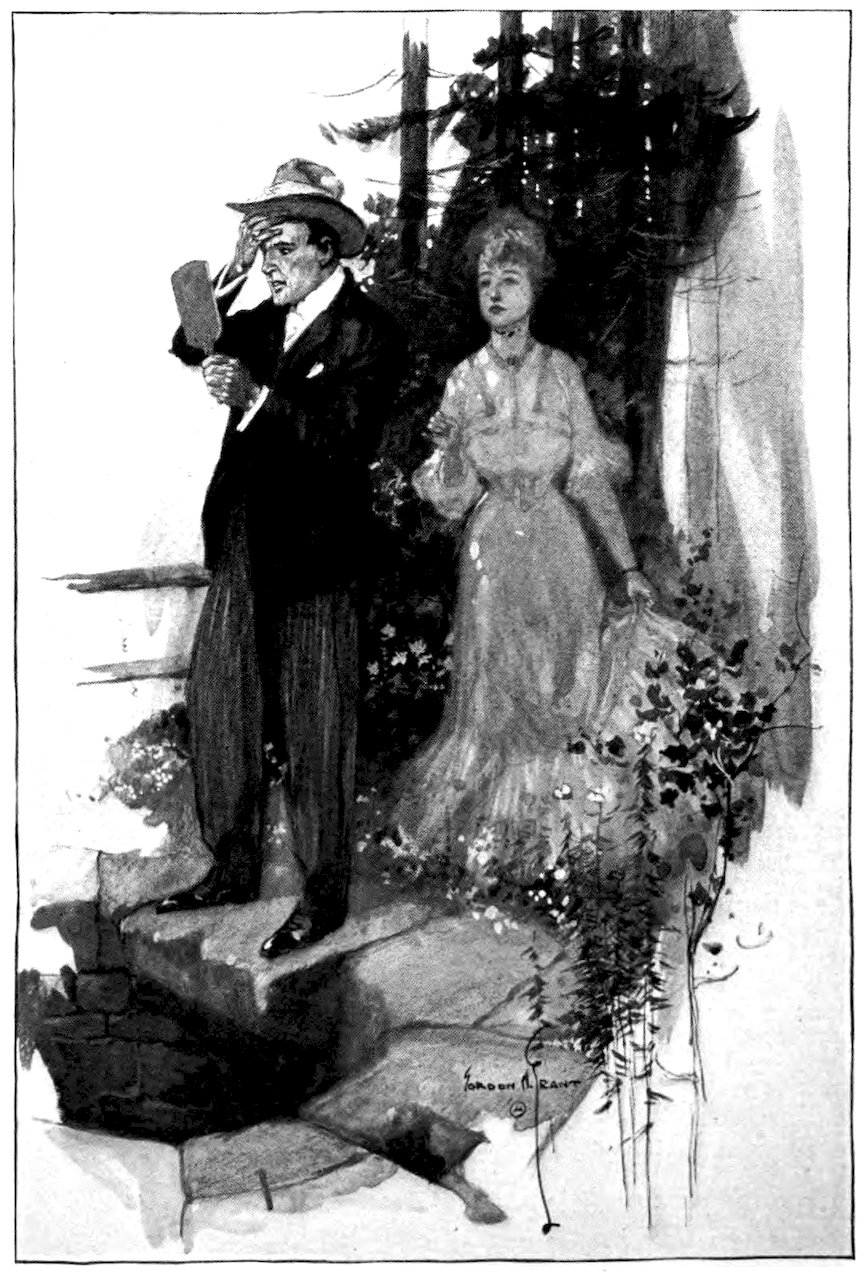
A tall, angular woman, wearing a sun-bonnet and
a big work apron which nearly covered her short
dress, stood on the fence calling, “Charlotte Ann!
Charlotte Ann! Charlotte Ann Parks! Where be
you? Don’t you know it’s ’most noon, and the table
not set? and Miss Bennett’s very partic’lar about her
digester; and there’s a letter from the two summer
boarders who are coming!”
The woman’s voice, strong and clear, went echoing
down a grassy lane which led to a small grove, or
thicket, of pine-woods in which was a shallow well,
now seldom used except during a summer drought,
when the cattle, which fed in the pasture-land around
the woods, were watered from it. The old bucket
and curb had fallen apart, and pieces of them were
lying on the ground; but around the well were large,
flat stones, one of which projected beyond the others
10a foot or more, so that a person standing upon it
could look directly down into the centre of the water
below. And it was on this projection that Charlotte
Ann Parks was standing when her mother’s voice
came warning her that it was nearly noon, that the
table was not set, that Miss Bennett was particular
about her “digester,” and there was a letter from
the summer boarders. Charlotte Ann, or Lottie, as
she was usually called by all except her mother,
heard the call, but paid no attention. Her ear was
strained to catch the first sound of the town clock in
the village two miles away which would tell her that
it was noon, and her eyes were fixed intently upon
the small square mirror she held in her hand as
nearly over the centre of the well as possible. She
was trying a charm, or a trick, as it was designated
in the rural district of Oakfield, where the traditions
of a century ago had been handed down from generation
to generation, and believed in, or discarded, according
to the susceptibility of the people for the
marvellous. Lottie always scoffed at the stories told
of her great-grandmother’s time before the Revolution,
when armies were seen passing and repassing in
the heavens and the snow was like blood in the light
of the Auroras; when houses were haunted and wizened
old witch women rode through the air on
broomsticks, or held their weird vigils in the woods
11which studded the wild New England coast. All
this superstition had mostly died with the old people,
whose gravestones in the Oakfield cemetery were
sunken deep in the ground and so covered with mold
and moss that it was impossible to read the date of
their birth or death. A few oldtime customs, however,
still clung to the young people, because of the
romance attaching to them, rather than from any
real faith in their efficacy. One of these had to do
with the well in the pine-grove and the tragedy connected
with it, the story of which I heard on the
summer afternoon when I alighted at the little country
station of Oakfield, dusty and tired, and wondering
how I was to get to the place of my destination.
I was a stenographer and bookkeeper in a large
city firm, and was overworked in body and brain.
Sleep and appetite had both forsaken me, and I was
sinking into a state of semi-invalidism, with little
strength and less ambition. Rest I must have and
a change of air, and when I saw an advertisement
saying that Mrs. Eli Parks, who lived near the sea-coast
and two miles from town, wanted summer
boarders, and that her rooms were large and cool
and quiet, and her house a hundred years old, I said:
“That is the place for me; the fashionable world
has not invaded Mrs. Parks. I can rest there. I
will write her at once.”
12I did write her, with the result that on a day in
early July I was standing by my trunk and asking the
station master if there was no means of conveyance
for strangers who visited Oakfield?
“Why, yes,” he said; “of course there is. We
ain’t so far behind as that. There’s a ’bus from
town, here mostly for the trains. I don’t know why
’tain’t here now, only there don’t many come at this
hour, or if they are comin’ they telegraph. Want
to go to Miss Parks’? Well, you are in luck. That
young chap there lives next to her. He’ll take you
in his rig and I’ll send your traps bimeby. Hallo,
you Sam! Come here!”
At the agent’s call a young man, or boy, reined up
suddenly, and I was soon driving with him along the
pleasant country road toward Mrs. Parks’. The
agent had introduced him as Sam Walker, and I
found him inclined to be very sociable and ready to
give me many items of interest concerning the
neighborhood and its people.
“See that big stone house on the hill?” he asked,
pointing to a large, gray-looking building in the distance
with tall pillars in front and a square tower on
the corner. “Well, that’s the McPherson place—the
richest man in town—or his half-brother was,
and Mr. Colin has it in trust for a young man—Reginald
Travers—who is visiting there now; some relation
13to old Sandy, I believe, and a big swell. He has
money of his own, they say; and he’ll get a pile more
bimeby. That’s the luck of some folks.”
He was not very lucid in his remarks, but by questioning
him I managed to learn that the house, of
which he seemed very proud, had been the property
of Sandy McPherson, a Scotchman and eccentric old
man, who had lived to be ninety and had died a
few months before, leaving quite a fortune to his
half-brother, Colin, thirty years his junior. Colin
was also to have the use of the house as long as he
lived, and at his death it was to belong to the “swell
young man,” provided he married somebody, Sam
did not know whom. Some girl, he s’posed. Men
mostly did marry girls and anybody would be a fool
to give up the McPherson house and the money
which went with it. “It was an awful funny will
old Sandy made, and had something to do with a
love affair when he was young. Seemed queer that
he could ever have been in love, he looked so old and
his hair was so white, and his head kept shaking, and
hands, too. Awful nice man, though, and had the
biggest funeral you ever seen,” Sam said.
I was not particularly interested in Sandy McPherson’s
funeral, and was silent until Sam asked
suddenly, “Do you believe in tricks?” as he came
in sight of a pine-grove in the distance.
14I said I didn’t know what he meant by “tricks,”
as I had never heard of one, and in a way he explained
what he meant.
“Lots of young people are always trying ’em at
the well in the middle of the woods. There’s a queer
love-story, and a true one—old Sandy’s love-story—connected
with it. Want to hear it?”
I was forty, and presumably past the age of romance,
but I did want to hear the story, which I
afterward heard two or three times, and which I
give in my own words rather than in those of Sam,
who rambled a good deal and threw in various opinions
of his own concerning the parties interested.
Sixty or seventy years before that July day Sandy
McPherson had been a rich young farmer in the
neighborhood and looked up to and respected by
every one. He was not very handsome, with his
light hair and eyes and freckled face, but his money
and great kindness of heart made amends for what
he lacked in his personal appearance, and there was
scarcely a girl in the town who would not gladly
have taken him with his freckled face, light hair and
Scotch brogue. When his choice fell upon Nannie
Wilkes much wonder was expressed at her indifference
to his suit and her preference for Jack Bryan,
a handsome, rollicking young man, who played fast
and loose with all the girls, and with none more so
15than with pretty Nannie Wilkes, until he heard that
in a fit of pique she had accepted Sandy and was to be
married in a month. Then his real love for her
showed itself, and many were the arguments used
to dissuade her from her promise. But Nannie was
firm. She had pledged her word to Sandy and would
keep it. She did not care so very much for him, she
said; he had too many freckles and talked with a
brogue, but her mother was anxious for the match
and he was rich, and could give her a piano and solid
silver tea-set, and carryall with a top to it and two
horses, to say nothing of his handsome house. Jack
could give her nothing but a very humble home with
his half-blind mother and a salary as grocer’s clerk
at eighteen dollars a week. And so the wedding day
drew on apace, and Nannie’s gowns were being made
by a seamstress who went to Boston twice a year and
was consequently posted on fashions.
Nearly every night Sandy went to Nannie’s home,
where the girl’s eyes, full of unshed tears, seldom
met his glance, and her little hands lay in his great
warm ones, cold and passive, with no return of the
loving pressure he gave them. On the nights when
he was not with her Nannie sat in the pine-woods,
with Jack’s arm around her and Jack’s face very
near her own, while he pleaded with her to give
up the marriage with Sandy and take him instead.
16He could not give her a piano nor silver tea-set, nor
carryall with a top to it, but he could buy her a
buggy. One had been offered him at a bargain.
And he’d get her a melodeon, and his mother had
lots of old china, and he would work like a beaver
in the garden and yard to make them more like the
McPherson grounds. But neither the second-hand
buggy, nor the melodeon, nor the old china appealed
to Nannie, who only shook her head.
“I’ll tell you what,” he said to her at last, when
all his arguments had failed to elicit from her anything
more than, “I’ve given my word and I can’t
break it. You should have spoken this way sooner.”
“I’ll tell you what. Try a trick at the well. I know
how they do it. My aunt did it once, and mother,
too. I heard them talking about it, and mother declared
she saw father’s face and nearly fell into the
well. Hold a mirror over the well at exactly noon
when the sun shines down into it, and wish that you
may see the face of the one you are to marry. If
my face looks in the glass by yours, I’m the chap. If
Sandy’s, then Sandy it is, and I’ve no more to say.
Try it to-morrow noon. Will you?”
Nannie had little faith in the experiment, of which
she had heard before, but to please Jack she promised,
and the next day as it drew near the hour of
noon when the oracle was supposed to be propitious,
17she stood leaning over the curb, holding in her hands
a small mirror, into which her white face was looking
anxiously for the one which was to appear beside it
just as the sun touched the meridian and shone down
upon the water. She had said she had no faith in
the charm, but in her room before she started on
her errand she had knelt in an agony of tears and
prayed that it might be Jack instead of Sandy.
Somewhat comforted with a belief that God would
hear her, and it would be Jack, she stole down to the
woods and stood watching and waiting till the noonday
sun shining through a clearing in the pines
struck the waters below.
Jack had fully intended to be on the spot hiding
behind a tree which grew near, and when Nannie
was absorbed in her task he meant to steal cautiously
behind her on the carpet of soft pine-needles, which
would give no sound, and by looking over the curb
let his face appear beside hers in the mirror; then,
before she recovered from her surprise, he could retreat
backward, and when discovered declare he had
just come upon the scene. But an unforeseen accident
kept him away, and only a blackbird and bobolink
among the pines saw the trembling girl, whose
nerves were strained to their utmost, and whose disordered
imagination grew more and more disordered
as floating clouds flitted across the sun, shutting out
18some of its brightness. Then she fancied that shadowy
lineaments were forming upon the mirror, that
a pair of eyes were looking at her, and they were not
the brown laughing eyes of Jack, but the blue ones
of Sandy, whose rugged features spread themselves
beside her own, while she stood riveted to the spot,
her pale lips whispering, “It is Sandy, God help
me!”
After that there was no wavering, and Jack’s arguments
and ridicule had no power to move her. She
knew what she had seen. It was Sandy. She could
not defy fate, and the wedding was appointed for
Thursday night, when the McPherson house was to
be thrown open and the marriage-feast held there
after the ceremony.
Half the town was bidden and Sandy was the happiest
of men, and on Wednesday evening, which he
had spent with Nannie, he told her that the carryall
had come and she was to have her first ride in it when
she went to church as bride the next Sunday. The
piano had also come, and a silver tea-set and a Brussels
carpet for the great room, with lace curtains
and a pier-glass in which she could see herself from
her head to her feet; “and you will be the bonniest
wife in the whole world and I the happiest man,” he
said.
Nannie listened without a word, or smile, or sign
19that she heard. At parting, however, she put her
arms around his neck and kissed him, and said:
“I think you the best man in the world, and I
thank you for all you have done for me. Always remember
that; but I am not good enough for you.”
Sandy laughed his broad, good-humored laugh,
which always grated a little on Nannie, as he paid her
one kiss with many, and held her close for a moment.
“Not good enough for me, my pearl, my lily! I
wish I were half as good as you,” he said, and the
thought kept him laughing during his walk home,
which lay through the woods and past the well, at
which he stopped to look, as his hired man had told
him the curb was a little shaky. “I’ll have it fixed
after the wedding. Just now I can think of nothing
but that and Nannie,” he said, as he continued his
way home, trying to whistle, an accomplishment in
which he was not an expert.
Arrived at home and alone in his room, he said to
himself, “To-morrow at this time she will be here,
my very own,” and he stretched out his arms to embrace
an imaginary form with brown hair and soft-gray
eyes, and cheeks like the summer roses.
Alas for the morrow and the anguish it brought!
and alas for the young girl who at midnight, when
the moon was high in the heavens, stood again by the
fatal well, looking down into its depths with despair
20in her eyes and determination in her face! She
could not marry Sandy, and she could not brave the
world’s censure if she did not, and so she chose the
coward’s part, to die. There was a hurried look
around her, a thought of Jack, and a prayer to be
forgiven, and then the cold, dark waters closed over
her with a splashing, gurgling sound, and Nannie
Wilkes had gone out into the great unknown, away
from Sandy and away from Jack—both dreaming of
her and both waking on the morrow to a horror
which filled them with dismay. A note was found in
her room which read:
“I cannot marry Sandy because I love Jack. I
have wanted to do right and cannot. I tried the
charm at the well, hoping it would be Jack’s face I
saw, but it was Sandy’s which came and stood by
mine in the mirror. I saw it so plain, and I cannot
marry him, and so I must die. I shall not jump into
the well. I can push the curb aside, it is so loose,
and shall slip down the stones into the water, so as
not to be bruised. Tell Sandy I am sorry and hope
he will forget me and take some girl for his wife better
than I am. Tell Jack—but, no, don’t tell him
anything, except that I loved him and died for him.
Good-by.”
It was Sandy who took her from the well and laid
her on the soft bed of needles under the pines, wringing
21the water from her dripping garments and her
long hair which clung to her face and which he put
back behind her ears, saying nothing except, “Poor
little Nannie! If you had told me, you would not
have been lying here dead. Poor Nannie! I wish I
had known.”
He even tried to comfort Jack, whose grief at
first was violent and noisy, but like such grief, was
easily consoled when another pretty face caught his
fancy. They buried Nannie in the McPherson lot,
for Sandy would have it so, and he bought the headstone
and put upon it simply, “Nannie, Aged 19.”
Then he went about his usual business, with a pain
in his heart which time never fully healed. Naturally
domestic in his nature, he wanted a home, with
wife and children in it, and after a few years he married
a Mrs. Travers, a young widow with an only
son. He seemed happy, but Nannie was never forgotten,
and not an hour of his life that he did not
see her in fancy as she was when he kissed her
in the moonlight, and again when he laid her upon
the pine-needles, cold and dead, but with a look of
peace on her face as if at the very last there had
been upon her lips a prayer for forgiveness which
God had heard and answered. When his wife died,
which she did within two years of his marriage, the
great house was so silent and lonely that he soon
22married again, and this time a cousin of Nannie’s,
who, like his first wife, was a widow, with an only
child, a little daughter, so that he had two stepchildren
to whom he gave a father’s care and love.
What came next after his second marriage is not
essential to the story. His wife died. His stepchildren
were married and had families of their own
to the second generation, when they, too, died, and
still old Sandy lived on, his only companion now his
half-brother Colin, who had come from Scotland to
join him. One by one the descendants of his wives
died and were scattered until in his last years, when
nearly ninety, he knew of only one, and that was
Reginald Travers, great-grandson of his first wife,
in whom he felt no particular interest, until Reginald,
who had heard of the rather eccentric old man,
came to call upon him and claim relationship through
the great-grandmother, dead years and years ago.
Something in the young man pleased the older one,
who kept him for weeks and finally conceived the
idea of making him heir to a part of his fortune,
which had grown steadily and was greater than his
brother would care for. Colin, to whom he broached
the subject, and who, being so much younger, was
his right hand and left hand and brain, made no objections,
but said:
“Why leave everything to Reginald? There may
23be some member of the other branch of your family.
You had two wives, you know, and one was Nannie’s
cousin.”
“To be sure; to be sure, I did,” Sandy answered,
rubbing his bald head as if to recall an incident of
more than fifty years ago. “You see I lived with
Susie so short a time, and that girl of hers was married
so young that things slip my mind, and sometimes
it seems as if I was never married at all. Nothing
is real but Nannie, who is as fresh in my mind
as she was that last night when I kissed her for the
last time. Poor little Nannie! and Susie was her
cousin and looked some like her. There must be
somebody somewhere related to her. I wish you’d
hunt it up.”
Colin was accustomed to hunt up things for his
brother, and as a result of this investigation he found
that Irene Burdick, the great-granddaughter of Mrs.
Sandy McPherson the second, who was a relative of
Nannie, was an orphan, with some means of her own,
and was living with her aunt in New York, and also
that she was spending a part of the summer in New
London. Greatly to Colin’s surprise, the morning
after he had imparted this information to his
brother, he found him with his valise packed and
himself dressed for a journey.
“I’m going to New London,” he said, “going,
24incog., for a look at Ireny. She has some of Nannie’s
blood in her. Pretty thin by this time, running
through so many channels, it is true, but if she suits
me, all right; if not, all right, the same.”
He went to New London and registered as Mr. McPherson.
He thought the Sandy might betray him,
forgetting that his name was as strange to Irene Burdick
as hers was to him. She was at the hotel with
her aunt and he saw her in the dining-room and on
the piazza and in the water, where she could swim
like a duck, and he watched her with a strange stir
in his heart as he thought, “She is some relation to
Nannie. Poor little Nannie, dead more than sixty
years ago.”
She was small, and thin, and brown-haired, and
pale-faced, but her dark-gray eyes were wondrously
beautiful, and once, when they flashed upon him as
she ran past him on the beach in her dripping garments,
he saw, or thought he saw, a look like Nannie,
while the voice which said to him, “I beg your pardon,”
as she whisked past him was certainly like the
voice he had never forgotten.
“Nannie’s eyes and voice have come down through
all these years, and Ireny will do,” he said.
He did not make himself known to her, as he
stood a little in awe of her aunt, a typical New York
woman, but he watched the girl for a week, and after
25his return home, made one of the strangest wills
ever put upon record.
To his brother Colin he gave fifty thousand dollars,
with the use of the house and farm until it was
taken possession of by the young people, Reginald
Travers and Irene Burdick, with whom he was to
make his home as long as he lived, and to whom he
willed the remainder of his fortune, in case they
married each other, said marriage not to take place
until both had had plenty of time in which to consider
it and know their own minds. If either of them preferred
some one else, he or she was to receive twenty
thousand dollars, and the rest go to the other party.
If the disaffection was mutual and neither cared for
the other, each was to have ten thousand dollars, and
the remainder of the property was to go half to Colin
and half for the support of different missions named
in the will. If both parties were agreeable to each
other and the one died before the marriage took
place, the survivor was to have the whole.
This will Sandy drew up himself after an immense
amount of thought and many sleepless nights and
consultations with Colin, who knew something of
law and made some corrections and suggestions.
When at last it was finished, duly executed and witnessed,
Sandy put it with his private papers, telling
no one except Colin, who had questioned the propriety
26of a will which might induce the young couple
to marry whether they liked each other or not.
“That’s so,” Sandy said, recalling with a shudder
his experience with Nannie. “They must not only
be agreed, but they must love each other. There
must be no one-sided affair. I’ll make that plain,”
and he wrote a note which he put with his will, addressed
to Reginald and Irene, charging them, as
they hoped for happiness in this world and heaven
in the next, not to enter into matrimony with each
other unless their hearts were in it. “For be ye
well assured that if any persons are joined together
otherwise than as God’s word doth allow, their marriage
is not lawful,” he wrote in conclusion. This
sentence from the prayer-book Sandy knew by heart
as he did the whole of the marriage ceremony. He
had gone through with it twice and had repeated it
to himself many and many a time when he thought
it was to be Nannie standing by his side. This done
he felt that he had performed his duty to his two
wives by trying to bring their great-grandchildren
together and giving them his money. It was due
them, he thought, because Nannie had always stood
between them and himself, and Irene was a distant
relative and had her eyes and voice, and he ought
to leave her something, as he must show respect
to both his wives.
27When he was first engaged to Nannie he had a
very good likeness made of her by an artist sketching
in the neighborhood, and after her death this was
enlarged into a life-sized portrait, said by those who
had known the girl to be very natural, especially the
eyes. This picture hung in the drawing-room between
the portraits of the first and second Mrs.
McPherson, who looked rather stiff and prim and
wholly unlike Nannie, with her soft brown hair and
grayish-blue eyes, which followed one with a wistful,
pathetic look, whose meaning Sandy understood as
he had not when she was living. Many times a day
Sandy stood before the portrait, studying the face
and comparing it with that of the girl seen in New
London. “They are alike,” he would say to himself,
feeling more and more satisfied with his will.
Several cautious inquiries he made at intervals with
regard to Irene, hearing always the same report that
she was sweet and pure and womanly; “not burdened
with brains enough to make her strong-minded,
but she is altogether lovely,” one of her
teachers wrote to him of her; and he was satisfied
in the belief that he had done well for the young
couple, and he was planning to bring them together
without their knowing his intentions, when death
came suddenly, and on his ninetieth birthday he was
found dead in his bed, with a lock of Nannie’s hair
28on the table beside him, and under his pillow a miniature
of her, which had been made in Dresden from
a photograph of the portrait in the drawing-room.
They buried the miniature and the hair with the old
man beside poor Nannie and between her and his
first wife. They found the will and the whole town
buzzed with its contents, wondering who Irene Burdick
was and how she would take it and how Reginald
Travers would take it. Colin wrote to him with
regard to it and invited him to visit the McPherson
place again, but decided to wait before sending a
copy to Irene, who was travelling in Europe. Then
public curiosity abated a little and waited for what
would come next. Nothing came at once. Irene
remained abroad and no one knew anything of her.
Reginald attended to his business, if he had any,
while Colin lived his lonely life at the McPherson
place and the affairs in the town went on as usual.
With Sandy’s death, however, a fresh impetus had
been given to the interest felt by the young people
in the charmed well where Nannie had ended her
life.
“Beats all what fools some of us are,” Sam said,
as he finished his story, adding that the swell young
man visiting at the McPherson place was Reginald
Travers, and “didn’t speak to nobody often, though
when he did he was nice as a pin.”
29Then he stopped for a moment on the top of a
hill for me to look down upon the pine-woods in
which was the well which bore Nannie’s name.
“I don’t believe there’s more than one or two
girls hereabouts, or boys either, who hasn’t tried a
trick at that well,” he said. “Why, there’s a little
box in a hollow pine tree and in it is a small square
mirror to hold over the water when the sun is right
overhead. I call it rot, and I don’t believe Lottie
has ever done such a silly thing.”
“Who is Lottie?” I asked, and the crimson on his
face and the look in his eyes told me what she was
to him before he replied.
“Oh, don’t you know? She’s Charlotte Ann,
Widow Parks’ girl. I call her Lottie for short.
There she is now, in the yard, and that’s the house,
with the li-locks in front, and that is our house beyond,
with the high board fence. Father and Widow
Parks don’t agree very well. Get up, Beauty.”
He chirruped to his horse, who took us quickly to
the old-fashioned house, whose open doors, and windows
with white curtains blowing in and out, and
the odor of roses and pinks and lilacs in the garden
and yard gave promise of the comfort and rest it was
mine to enjoy for two long, happy months.
CHAPTER II THE FARM-HOUSE
30
At the sight of us the girl, who was gathering
flowers, disappeared, and only Mrs. Parks came forward
to meet me, her good-humored face beaming,
and her large, helpful hands stretched out to relieve
me of my bag and umbrella.
“So you brought her?” she said to Sam. “Wall,
I’m glad you was there. I was afraid the ’bus
wouldn’t go this time of day, and I kinder hoped the
McPherson carriage might happen to go down, as I
heard they was expectin’ another visitor up to the
house, but nobody went by but Mr. Travers on hossback.
Come right in. Your room is all ready for
you when Charlotte Ann gets a few more flowers.
Put up your money. Sam don’t want no pay.”
This last was said because I was opening my purse
with a view to ask how much I was indebted to the
young man, who shook his head and nodding a
good-by drove off, after a wistful look at a blue skirt
visible among the rose-bushes in the garden. Then I
began to look around me at the quaint old house,
with big rooms, wide hall, low ceilings, and open fireplaces,
31with pleasant views from every window, of
wooded hills, and grassy valleys, and the pine-grove,
with Nannie’s Well, which was beginning to interest
me so much. But the object which attracted me
most was the stone house on the hill—the McPherson
place. Would the young people, Reginald Travers
and Irene Burdick, ever come together? and how
much truth was there in the story Sam had told me?
I would ask Mrs. Parks when I knew her better, I
thought. She was bustling about my room, a large,
airy chamber, with four windows, a high-post bedstead,
surmounted with what she called a “teaster”
and surrounded with what she called a “balance.”
Everything was old-fashioned, but scrupulously clean
and comfortable to the last degree.
“You might like the south room across the hall
the best,” she said, “and I’d give it to you, only it
jines another, and I’m hopin’ to have two girls who’ll
take the two rooms. Nobody sleeps with nobody
nowadays; everybody must be separate; different
from what it was when I was young, and three sometimes
slep’ together if ’twas necessary; but Charlotte
Ann says the world moves, and I s’pose it does.
I’ve had a letter from them girls askin’ about ’em—the
rooms, I mean.”
I assured her I wanted nothing better than the
32room I had, with the eastern sunshine in the morning
and its cool north breeze all the day.
“Charlotte Ann, Charlotte Ann! Is that you?
Miss Bennett’s come. Sam brought her, but he
didn’t stop,” Mrs. Parks called over the balustrade,
and a young girl came up the stairs with her hands
full of roses, and cheeks which rivalled them in
color, while her eyes at the mention of Sam had in
them a look which reminded me of the boy when I
asked him who Lottie was.
She was very pretty, and within a week we became
great friends and as intimate as a woman of
forty often is with a girl of seventeen. I knew all
about Sam, for whom Lottie cared more than for the
half-dozen other boys whom she called kids and who
annoyed her with attentions. I knew, too, about
Sam’s father, Ephraim Walker, who had quarrelled
with her mother about a line fence and claimed two
feet more land than belonged to him, to say nothing
of his hens, which were always getting into Mrs.
Parks’ garden, until Mr. Walker built a high board
fence which shut out the hens and a view of his
premises as well.
“Mother gave up the two feet for the sake of getting
rid of the hens, and she has never spoken to him
since,” Lottie said, with a snap in her eyes which told
33her opinion of Sam’s father, who, she added, “hates
me like pisen.”
“Hates you! For what?” I asked, and after
some hesitancy she replied, “I don’t mind telling
you that Sam is carrying me now more than the other
boys.”
I did not quite know what carrying her meant,
but ventured to guess in my mind, and she went on—“and
he comes here pretty often, and his father
don’t like it and is crosser than a bear when Sam
takes me out with Black Beauty, and once, when he
found us in the McPherson pines sitting on a log he
threatened to horsewhip Sam if he found him there
again philandering with me. Sam squared up to him
and said, ‘Come on and try it, if you dare.’ He
didn’t dare; I should think not! He whip Sam!
I’d laugh!”
She did laugh a little bitterly, and, reminded, by
her mention of the McPherson pines of Nannie’s
Well, I asked her about it and heard much the same
story Sam had told me, with a few more details concerning
the superstition attaching to the well, and
the number of young people who had tried the trick
at noonday—some with success, they pretended, and
more with none.
“I don’t believe in it, of course,” Lottie said,
“but sometime I mean to try it just for fun. If
34those two girls come maybe they’ll try it, too. I
don’t s’pose you’d care to, you are too——”
She stopped abruptly, not wishing to say “You
are too old,” but I understood her and answered,
“Yes, too old to be looking into a well at noon to
find my future husband.” Then I questioned her
about the girls who might be my neighbors.
“They are cousins,” she said, “and their name is
Burdick; one of them, we suppose, is the girl old
Sandy McPherson wanted Mr. Reginald Travers to
marry. It is the same name and she lives in New
York with her aunt Mrs. Graham, and has just got
home from Europe, and when mother asked Mr. McPherson
if it wasn’t the one, he said he wouldn’t
wonder, and laughed. I can’t imagine why she is
coming here unless she wants to see what kind of
man Mr. Travers is. I should suppose she’d let him
go after her, wouldn’t you?”
I did not express an opinion, but began to feel a
good deal of interest in the romance likely to go on
around me. Mr. Travers was a great swell, Lottie
said, and as that was what Sam had called him, I
was anxious to see him. I did see him the next Sunday
in the little church which, with Mrs. Parks and
Lottie, I attended in the village. It was one of the
oldest churches on the coast, Mrs. Parks said, and it
looked its full age. There were not many Episcopalians
35in town; few of them had much money, except
Colin McPherson, who paid three-fourths of the
rector’s salary and left the rest of the expense to the
other parishioners and summer visitors. The windows
were high, with small panes of glass; the carpet
was faded; the backs of the pews were low; the
seats were narrow and hard, and the small organ
was frightfully out of tune. Accustomed as I was
to city churches, I began to feel homesick in this
shabby place, where the people looked nearly as forlorn
as their surroundings. The organ had just commenced
what was intended as a voluntary, which
set my nerves on edge, when there was a stir near
the door, and the sexton in his creaky boots tiptoed
up the aisle to a square pew with red cushions, which
I had singled out as the McPherson pew. Nearly
every one turned his head, and I with the rest, to
look at the white-haired man carrying himself very
erect, with his gold-bowed glasses on his nose and his
big prayer-book held tightly in his hand. “Stiff,
with a good face,” was my mental comment, and
then I scanned curiously the young man who walked
behind him, with aristocracy and polish and city
stamped all over him from his collar and necktie to
the shape of his shoes. I couldn’t see the latter, it is
true, but I felt sure of them, and that his trousers
were creased as they should be and were of the
36latest fashion. He had a pale, refined face, with
clearly cut features, a mouth which told of firmness
rather than sweetness, and eyes which I was certain
seldom brightened at a joke because they didn’t see
it. And yet there was about him something which I
liked. He might be proud and probably was, but his
presence seemed to brighten the little church wonderfully,
so that I forgot its shabbiness in watching
him, and nearly forgot the service, which the rector
tried to intone, and the harsh notes of the organ and
the discords of the soprano.
What did he think of it all? I wondered. He was
certainly very devout and only once gave any sign
of annoyance, and that was when the organ was galloping
madly through the Te Deum and the soprano
was trying to keep up with the alto, and the bass and
tenor were in full pursuit of the soprano. Then he
shrugged his shoulders very slightly and turned toward
the organ loft so that, for an instant our eyes
met. In his I fancied there was a look of surprise
and half wonder, a second searching glance, and then
he turned to his book more devoutly than ever, and
I heard a full, rich baritone joining with the organ
and soprano and leading them steadily on to the end
of the grand anthem. As he sat down he looked at
me again with something like inquiry in his eyes.
Could it be that he had heard of the expected arrival
37of Irene Burdick at Mrs. Parks’ and wondered
if I were she? If so, I knew he was thinking what
his decision in the matter would be. He couldn’t
marry his grandmother.
Mrs. Parks was one who meant to do her duty by
her boarders, and was a little proud of her acquaintance
with Colin McPherson and liked to show it.
As we left the church she managed to get herself
and myself very near to him, and after asking how
he was and telling him she was pretty well and it
was a fine day she introduced me to him as Miss
Rose Bennett from Albany, while her eyes rested
upon Mr. Travers standing close to him. Mr. McPherson
took the hint and presented him after asking
my name, which he had not quite caught, as he was
rather deaf.
“Miss Benton! oh, yes, Miss Benton; good first-class
name! Any relation to the Colonel? Mr.
Travers, this is Mrs. Parks and Miss Benton,” he
said, while Mrs. Parks grasped the young man’s
hand effusively and said she was glad to know him
and hoped he would call, and that she was expecting
two young ladies, the Miss Burdicks, from New
York.
Then over the cold, proud, pale face there broke
a smile which changed its expression altogether and
made it very attractive. “If he smiles like that on
38Irene she’ll not go back on him,” I thought, as I
walked away after hearing him say something about
being pleased to meet me and call.
That afternoon when dinner was over I went with
Lottie to the pine-woods and saw Nannie’s Well and
the little mirror which Lottie took from its box in
the hollow trunk of the tree and showed to me, saying
it was the very one into which poor Nannie had
looked. It had been sold by the Wilkes family and
bought and sold again and again until some one gave
it to the young people of the town.
“It would be easy for two faces to be seen in it,”
she said. “I wonder if there’s anything in it. I
don’t believe so, but I shall try it to-morrow, if it’s a
bright day. Don’t tell mother. She says it’s all
humbug, but owns that she tried it once.”
I promised, and the next day about twenty minutes
before twelve I saw Lottie going down the lane
in the direction of the pine-woods, and felt a little
curiosity as to the result of her experiment. I had
been a week in the family and had learned their
habits pretty well, while they had learned mine, and
knew that I liked quiet and regular meals because,
as Mrs. Parks said, my “digester was out of kilter
and needed toning up,” and it was my digester which
she used as one argument to hurry up the delinquent
Lottie, when she stood on the rail fence, calling:
39“Charlotte Ann! Charlotte Ann! Charlotte Ann
Parks! Where be you?”
It was nearly half-past twelve when Lottie returned,
looking flushed and excited. Like Sam, I
believed the whole thing rot, but was anxious to
hear what she had to tell me.
“Did you see Sam?” I asked, when we were
alone.
“Yes, bodily,” she answered with a laugh. “He
saw me on the way to the woods and followed, and
just as a shadow was beginning to come on the glass,
or I thought it was, he seized me round my shoulders
and said, ‘Let me see how our faces look together!’
I came near falling into the well, and
should have done so, if he had not held me back.
He just spoiled it, but I mean to try again after the
young ladies are here. They are coming to-morrow.
Mother has a letter. Here it is.”
She handed it to me and I read as follows:
“New York, July —, 18—.
“Mrs. Parks,
“Madam:—You may expect me on Wednesday,
with my cousin Rena.
“Yours, Miss Irene Burdick.”
The note sounded stiff and uppish, as Lottie said,
and I at once conceived a dislike for Miss Irene, and
40a kind of sympathy for Rena, who was probably a
poor relation and would act in the capacity of maid.
Irene, who wrote the note, was of course the Miss
Burdick, and the large corner room across the hall
from mine was assigned to her. It had four windows
and a fireplace, an ingrain carpet and Boston
rocker, a high-post bedstead with “teaster and balance”
like mine. It had a terrible daub of Beatrice
Cenci on the wall, taken there from the parlor because
Miss Burdick had been abroad and would feel
more at home with a picture of the old masters, Mrs.
Parks said, looking admiringly at the yellow-haired
creation which bore but little resemblance to the
original. There was a washstand in the room, with
a hole on the top for the bowl to rest in, a piece of
castile soap, and three towels on a line above the
stand. There was a round cherry table which Mrs.
Parks said was her grandmother’s and which she
could have sold for a big price to some relic hunter,
but Lottie wouldn’t let her, so she kept it, but didn’t
see why there was such a craze for old things. The
room adjoining Irene’s was long and narrow, with
no fireplace. It had a rag carpet and single bedstead
without “teaster” or “balance.” Its bureau of
three drawers served as a washstand, and there were
two towels on a line instead of three. But everything
was clean and comfortable, and on Wednesday
41we filled the rooms with flowers, especially the one
intended for Miss Irene. It was Mrs. Parks’ idea to
put the most there and the best vases. Rena had
broken-nosed pitchers and bowls, and flowers a little
faded, until there came from the McPherson place a
quantity of hot-house roses and lilies for the Misses
Burdick and Miss Bennett. Nixon, who brought
them, further said that the McPherson carriage
would meet the young ladies at the station if Mrs.
Parks would tell him on what train they were expected.
She didn’t know, but it would probably be
at four o’clock, and she nearly lost her head over
the attention from Colin McPherson to her guests,
and wondered how under the sun and moon he knew
they were coming that day.
A young man and friend of Mr. Travers had arrived
at the house the night before, Nixon said, and
I began to think we might have some gay times with
four city people in close proximity to each other.
Mrs. Parks had taken possession of the flowers, and
after giving me what she thought I ought to have,
she put the larger proportion of the remainder in
Irene’s room, saying it was quite proper for her to
have the most from the greenhouse which would
probably be hers. A few roses and lilies were accorded
to Rena and put in a large tumbler which
Mrs. Parks said had been used by her grandfather
42to mix toddy in when the minister called. I was not
satisfied with the allotment to Rena, for whom my
sympathy kept growing; and reserving for myself a
single half-opened rose and one or two lilies, I took
the rest to her room, putting them wherever I could
find a place and in whatever I could find to put them.
This done, the rooms were ready, and we waited with
what patience we could for the train which was to
bring the Burdicks. At half-past three we saw the
McPherson carriage go by with Nixon. Half an
hour later we heard the whistle of the train in the
distance, and fifteen minutes later the McPherson
carriage stopped at the gate, and while Lottie and I
looked cautiously from my window, Mrs. Parks, in a
flutter of pleasure and pride, went down the walk to
meet the occupants of the carriage. The Burdicks
had come.
CHAPTER III RENA’S LETTER TO TOM GILES
43
(With remarks by Tom, as he read it)
“New York, June 10, 18—.
“Dear Old Tom:
“It is an age since I have heard from you. Don’t
you know we have been home from Europe six
weeks, and you haven’t been to see us. What kind
of a cousin is that, I’d like to know? Are you so
busy in your office, earning your bread, as you said
you were when I tried to have you come over to
Paris and meet us? Well, by and by I may be in a
position to give you your daily bread, as you did me
when I was a poor little waif stranded at your
mother’s door before Uncle Reuben left me some
money and Aunt Mary took me up.
“I have a tremendous matrimonial speculation on
hand, with thousands and thousands of dollars in it.”
(“The devil you have!” was Tom’s exclamation,
as he wiped his wet face, for the morning was hot
and Rena’s letter made him hotter. Then he read
on:)
“I never knew about it till a little while ago when
I got the queerest letter from a Mr. Colin McPherson,
enclosing a copy of the stupidest, ridiculousest,
absurdest, craziest will that was ever made. Did
44you ever hear of old Sandy McPherson, of Oakfield,
a little town on the New England coast, with nothing
in it but rocks and ferns and huckleberries and
sumac bushes? I never heard of it or him till I got
his brother’s letter. It seems Sandy was my great-step-grandfather,
who was married twice. His second
wife was a widow, a Mrs. Somebody, who had
a daughter when she married him and she—the
wife—was my great-grandmother. I never knew I
had a great-grandmother, though I suppose I must
have had. I certainly did not know that she married
Sandy McPherson. But to return to the will.
“Sandy McPherson’s first wife was also a widow,
like the second. He was great on widows, and his
first wife had a son, not his, but somebody else’s.
That would make him a stepson just as my grandmother
was a stepdaughter. I hope you follow me.
I had to read the letter over two or three times before
I understood it. Where was I? Oh, I know.
I was telling you about the first wife and her son,
and along this line comes Mr. McPherson’s great-step-grandson,
Reginald Travers.”
(“Lord Harry!” and Tom nearly fell off his chair.
Then straightening himself, he read on:)
“Now what possessed Sandy McPherson to pick
out Reginald Travers and little, insignificant me to
heir his property and marry each other, I don’t know,
but he did!”
(“The old idiot!” from Tom, down whose face
the sweat was running in streams, as he continued
reading:)
45“Aunt Mary has heard about him and says he
had some kind of a love affair before he married. I
don’t know what, but he got a twist in his head that
he owed something to his two wives, or their relations
on account of that love affair, and this is what
he did: He gave one hundred thousand dollars to
Mr. Travers and me in case we married each other
for love. He laid great stress on that. We must
love each other. If we do not, that is, if I love him
and he does not me and draws back, he is to have
only twenty thousand and I eighty thousand. If, on
the other hand, he likes me, and I do not like him,
he is to get eighty and I twenty. If we are indifferent
to each other and want somebody else, each is to
have ten thousand, and the rest goes to some missions
and his brother, who is to live with us if we
marry, and he wishes to.
“Did you ever hear anything so insane? Of
course I shall hate Reginald Travers. That’s a foregone
conclusion. I hate him now, but I want to see
him without his knowing who I am. I am great on
trying experiments, and this is my last, which promises
a lot of fun. I have thought it all out and am
quite excited over it.
“You know my cousin Irene Burdick—your second
cousin, just as I am—but no relation to that
great-grandmother who married Sandy McPherson.
You never liked her very well, but I do. She is so
much cleverer than I am and used to help me so
much in school, and is so nice to me every way. I
persuaded Aunt Mary to let her join us in Europe
46for six months, and you don’t know how much the
travel did for her. She might have royal blood the
way she carried herself,—and was mistaken for a
titled lady once or twice. She is now in her own home
in Claremont—that poky, stuffy home—and is very
unhappy—and why shouldn’t she be? I spent a week
there once, and nearly went crazy with homesickness—factories,
and factory hands—and ceilings so
low I nearly bumped my head, and I am not tall.
Irene, who is tall, had to stoop in her chamber. I am
very sorry for her. Think of Claremont after Paris,
will you?”
(“Don’t you know Irene makes a tool of you for
her own purposes?” Tom growled, and read on:)
“Now this is my plan. I am going to change
places with Irene. Aunt Mary has heard that Mr.
Travers is to visit Colin McPherson in Oakfield, if
he is not there now—going, perhaps, to spy out the
goodly inheritance which may be his, and I mean to
go there too!”
(“To Colin McPherson’s! Great Scott! Rena
mustn’t do that! I won’t allow it!” Tom exclaimed;
but Rena’s next sentence enlightened him as to her
meaning:)
“Quite providentially I saw an ad. in a paper,
saying that a Mrs. Parks in Oakfield would take a
few summer boarders, and the description of her
big old house was so alluring that I said at once ‘I’ll
go there.’ I am not supposed to know that his excellency
is to be in town. I go for quiet and rest.
I am tired of Saratoga and Newport and all those
47places Aunt Mary likes so much, and then I spent
such a lot in Europe that I must retrench, and Oakfield
is the very place in which to do it. Aunt Mary
is willing. I think she wants me to meet Mr. Travers,
hoping I will marry him, but I won’t! So you
see it is all right. I shall take Irene with me and let
her pass as the head of the firm. She will be Miss
Burdick, and I just Rena, a poor relation, if you
please. She is older and so much taller than I am
and handsomer and grander looking every way that
people will naturally think her the girl intended for
Mr. Travers if they have heard of the will, as I dare
say they have. I shall not say so, of course. I would
not tell a lie for anything; you know I would not.
I shall hold my tongue, and let Irene take the lead,
and if any one is rude enough to ask which is which
I shall be rude enough to say ‘That is for you to
find out.’ Mr. Travers, of course, will not ask. If
he does, we shall wriggle out somehow, or Irene will.
I can trust her. I am really getting greatly interested
in the matter. It will be such fun to watch
Mr. Travers thinking Irene is the one he must marry.
When he finds his mistake, if he does, I shall rise to
the occasion and make it all right, trusting in Providence
and Irene to help me out of the scrape. Of
course he can’t fall in love with me, with Irene in the
way, and if he takes to her I shall be glad. What
do you think of my project? Write and tell me, but
don’t try to dissuade me from it. My mind is made
up, and you know I’m a stubborn little mule.
“Did you ever hear of Reginald Travers? Colin
48McPherson wrote that he was a graduate of Princeton.
That’s where you were. Maybe you know him.
If you do, write at once and tell me what manner of
man he is, and if you ever heard of his great-step-grandfather,
Sandy McPherson.
“Your loving cousin Rena.”
CHAPTER IV REGINALD AND TOM
49
Tom Giles, Attorney at Law in Newton, Mass.,
sat in his office one hot summer morning, wondering
if he should accept an invitation he had received by
letter from his friend and college chum, Reginald
Travers, to spend a few weeks with him in Oakfield.
“It is not a very gay town,” Reginald wrote.
“The young persons have mostly emigrated to
fairer fields in the west, and the old ones stay because
they cannot get away and are attached to their rocky
farms and houses and customs of a century ago.
Some of them are as full of superstition as the negroes
of the South, and I am told that what few
young people there are here actually look into wells
at noon and walk round haystacks at night, hoping
to see their future consorts. To you, who are a
descendant of the believers in Salem witchcraft, this
sort of thing will be delightful, and I have no doubt
you will be looking into a well some day at noon.
There is a famous one on Uncle Colin’s farm, with
a story attached to it.
“But no matter about the well, that is the least
attraction. The air is fine and there are some pleasant
drives and views, while Uncle Colin’s house is
50roomy and hospitable, and Uncle Colin the most
genial of hosts. I call him uncle although he is in
no way related to me. His brother, Sandy McPherson,
married my great-grandmother, Mrs. Travers.
She was a widow, with an only son, who was my
grandfather. The Travers family must have been
given to only sons, for my father was one and I am
one, and, as you know, nearly alone in the world.
Some time before Sandy McPherson’s death, which
occurred several months ago, I visited him and was
greatly pleased with the canny old Scotchman. I
think he was pleased with me, for he left a will,
made after I was there, in which I figure conspicuously
and not altogether satisfactorily. When I
have made up my mind I may tell you about it.
Until then don’t bother me. You know I do not
like to discuss my affairs with anybody, and this
affair least of all. It is not pleasant. Don’t fail to
come. I want to see you awfully.
“Reginald Travers.”
When Tom read this letter his first impulse was
that he would accept the invitation. Then he began
to waver. He had not a surplus of money to spend,
and it might be better to stay at home and grind,
as he called his office work. Then, too, he knew
that in New York there was a little, dark-haired,
brown-faced girl, whom he cared more to see than
a dozen Reginalds. This was Rena, the pet name
he had given her, although she was christened Irene.
51He had known her since she was three years old and
her mother had died suddenly at his home where she
was visiting his mother, who was her cousin. There
was no one to care for her, as her father was dead,
and she had stayed on, the darling of the household,
the object of his boyish admiration and then of his
love, as both grew older and the young girl seemed
to know exactly what chords to touch to make him
her slave. At fifteen she had fallen heir to
ten or fifteen thousand dollars from a bachelor
uncle, and as Tom’s mother died about that time
Rena had gone to live with her Aunt Mary in New
York, who, not caring for her when she was a baby,
now found that she wanted just such a bright young
girl to add éclat to her surroundings and keep her
from growing old too fast.
Before she left for New York, Tom’s love for
her got the better of his judgment and he asked her
to be his wife when she was older. There was a look
almost of horror in Rena’s gray eyes as she listened,
and when he finished she began impetuously, “Tom
Giles, are you crazy, making love to me, a child of
fifteen, and you twenty-two and the same as my
brother? I’d as soon marry my brother, if I had
one. It is horrible, and almost makes me hate you.
I shall hate you, if you ever say a word of this kind
again.”
52She burst into a fit of weeping so violent that it
frightened Tom, who tried to make amends for his
blunder by saying that he was a fool and a brute and
everything bad and never would speak to her of love
again, if she would forgive him. That was six
years ago, and the episode had seemingly passed
from Rena’s memory, or if she thought of it, it was
as of something which would never be repeated, for
Tom was one who kept his word. And so she went
on teasing him with her pretty ways and blandishments
and her open show of affection for and trust
in him. He was the dearest old Tom, in whom she
confided all her secrets and troubles, confident that
he would never fail her, and all the while his great
love for her was eating his heart out, and he sometimes
felt that in spite of his word he must speak
again.
“But I’ll wait a while longer,” he thought, “wait
till I see some sign that she wants me to speak. She
likes me now better than any one in the world, she
says, and by and by, who knows?”
With this hope for the by and by, Tom contented
himself, knowing that however much Rena might
brother him, he could never think of her as a sister.
He had soothed her with kisses and candy when her
mother died. She had sat in his lap at her mother’s
funeral. She had cried herself to sleep in his arms
53many a night. She had teased and tyrannized over
him in a thousand ways, but had never given the
slightest sign that he was more to her than dear old
Tom, who was always to do her bidding, no matter
what it was. And he had done it religiously, and was
ready at any time to walk up to the cannon’s mouth,
if she so desired it. He had wanted to join her in
Europe, when she wrote so earnestly for him to do
so, but funds were low and his business must not be
neglected. She was home now. She would be going
somewhere with her aunt, and if possible he meant
to join her. That she was in any way connected
with the will which was not satisfactory to Reginald
he did not dream until he received her letter. He
had been Reginald’s room-mate for two years in college,
and there was a warm friendship between them,
although they were entirely unlike each other. Reginald
was naturally shy and proud, or seemed so, and
awkward in ladies’ society, and reticent to the last
degree; slow to like or show his liking, but firm as
a rock and true as steel when once he cared for a person,
or thought a thing was right. In this respect
Tom was like him, but in scarcely any other. He
was frank and outspoken, fond of fun and joke, and
ready to do a favor to a friend or foe, and knew just
what to say to ladies, no matter what their calibre
might be. Everybody liked Tom Giles, and not
54many liked Reginald Travers until they knew him
intimately, and found that beneath his cold, impassive
exterior there was a heart as warm, perhaps, as
Tom’s, when the right chord was touched. For
women Reginald cared but little, and matrimony
had had no part of his thoughts until he read a copy
of Sandy McPherson’s will. He was glad enough
for the money, if he could have it without the girl.
She troubled him, and yet he never for a moment
thought he should not try to fulfil his part of the
contract. After a while, and he meant to make it a
long while, he would find her, perhaps, and if she
were at all desirable and seemed to fancy him, he
would try conscientiously to manufacture a liking
for her. He did not believe much in love anyway.
Tom Giles went in for that sort of thing strong and
was always mooning about a second cousin, Rena
somebody, he had forgotten the last name, so little
did he care for his friend’s love affairs. When he
read that Irene Burdick was the girl intended for
him, he had a vague idea that he had heard the name
before, but had no idea that it was the Rena Tom
mooned over so much. Since leaving college he had
seen but little of Tom, who was working up a law
business in Newton, while he was attending to some
property he owned in and near Richmond, Va.,
where he was born. But he had not forgotten his
55friend, and after he had been in Oakfield a few
days there came over him a great longing to see him
again, and perhaps tell him about the will, which was
giving him so much trouble. He did not like to
think of it and had, of his own accord, mentioned it
but once to Mr. McPherson, asking him if he knew
where the girl was and if he had ever seen her.
Mr. McPherson never had, “but Sandy saw her,”
he said. “I can’t remember exactly what he thought
of her. I only know he liked her build and fancied
there was a look in her eyes like Nannie, who was
some very distant relative of hers, and whose portrait,
you know, hangs in the drawing-room between
his two wives, one your great-grandmother, the other
Irene’s. She lives in New York with her aunt, a
Mrs. Graham, and has not been home from Europe
a great while.”
“Does she know about the will? and what does she
think of it?” Reginald asked, and Mr. McPherson
replied: “When my brother died, I made some inquiries
about her and heard she was in Europe, so
I concluded not to send her a copy till she came
home, which she did some weeks ago. Then I sent it
at once and her aunt replied that her niece was a
good deal upset by it and would write me what she
thought later on. She has not written, and that is
56all I know. She is probably waiting for you to take
the initiative and find her.”
“Which I shall not do at present. I shall let
Providence direct awhile,” was Reginald’s answer,
and there the conversation dropped.
Reginald had heard of Nannie when he visited
in Oakfield before, and had thought her a very foolish
young girl to drown herself when she might
have been mistress of Sandy’s fine house. Aside
from that he had felt no particular interest in her.
Now, however, if her eyes were like those of the girl
he was to marry, he’d have a look at them. Watching
his opportunity when Colin was out, he went into
the room where the three portraits were hanging,
the two great-grandmothers, his and Irene’s, with
caps on their heads, as was the fashion of those times,
and Nannie, looking very girlish in her low-necked
gown, with her hair falling in long curls on her white
shoulders. She was rather pretty, Reginald thought,
especially her eyes, which followed him whichever
way he turned, and gave him a queer kind of feeling,
making him think of them even in his sleep.
Still he did not speak of her to McPherson a second
time, till the latter startled him one day by saying,
“I saw a Mrs. Parks this morning, who lives in that
big old house near the grove where the well is. She
told me she had received a letter from a Mrs. Graham
57in New York asking her if her niece, Miss Irene
Burdick, and a friend, cousin, I think, could be accommodated
with board at her house a few weeks;
and then she asked if I didn’t suppose it was the Miss
Burdick your grandfather had in view for you. The
will was so queer that it went like wildfire, and
everybody knows about it, and the girl’s name and
where she lives.”
Reginald grew very pale and then very red as he
said, “Do you think it is she?”
Mr. McPherson knew it was, for after Reginald’s
first conversation with him he had received a letter
from Mrs. Graham, making some inquiries concerning
Reginald.
“The old lady is after him, if the girl isn’t,” Colin
had thought, and had at once replied that the young
man was spending the summer with him, and she’d
better come out and see him for herself.
When he heard she had written for board for her
niece at Mrs. Parks’, he had wondered a little that
she, too, did not come as chaperone, but reflected
that it was none of his business and he would let
Providence run it as Reginald was doing. In reply
to Reginald’s question, “Do you think it is she?” he
told of his correspondence with Mrs. Graham, and
added, “I am sure of it, and shall be glad to see
her.”
58After this Reginald grew very nervous and began
to think of writing a second time to Tom, asking
why he neither came nor answered his letter. He
began, too, to wonder when Irene would arrive at
Mrs. Parks’, and when he saw me in church his first
thought was, “she’s come, and she’s old enough to be
my mother,” and this accounted for the expression of
his face when he first caught sight of me. Mrs.
Parks’ introduction reassured him, and his temperature
went down a little. Still he was very anxious
for Tom, who, he felt, would somehow be a help and
a safeguard.
“He’ll know just what to say to her,” he thought.
“He’ll talk to her, while I look on and draw my own
conclusions.”
The next day he received a letter from Tom, very
short and to the point.
“Old chap,” Tom wrote, “Providence permitting
and nothing happening to prevent, I’ll pack my grip
and be in Oakfield Tuesday.
“Tom.”
There was a comfort in this, and Reginald began
to feel better, never dreaming of the state of Tom’s
mind. Knowing Reginald, Tom did not believe Rena
would fancy him, and there was hope in that. Of
Reginald, he had no doubt. He could not help being
interested in Rena, and what the outcome would
59be he could not guess. Irene, he was sure, would
leave nothing undone to attract Reginald and might
possibly succeed.
“Well, let her,” he thought for a moment. “That
will leave Rena for me.” Then his better nature
and his great liking for Reginald came to the surface,
and he continued: “It is unworthy of Rena to
deceive Rex even for a few weeks. Let her go to
Oakfield, if she goes at all, as herself and not as another.
I shall try to persuade her to give up her experiment.”
That day he wrote to her:
“Dear Rena, I was never so shocked in my life as
when I received your letter. You have been up to
a good many escapades, larks, or experiments you
call them, but this last is the craziest of them all;
and I beg you to give it up. It is unworthy of you.
It is unwomanly—excuse me for saying so—it is a
deception, if not a positive lie, and an imposition
upon a good man. I know Reginald Travers. We
were in college together and room-mates for two
years. He is my best friend and I don’t want him
wronged. He is shy and reticent, not at all a ladies’
man. Has no small talk. Knows nothing of girls
and their ways, and does not care to know. But he
is a gentleman and the soul of honor and would
never be guilty of a mean act, and on that account
does not suspect meanness in others, and might be
60easily imposed upon. I do not think he is just your
style, but he is a clean, splendid man, and I do not
want him fooled by Irene. You say I do not like
her, and I admit it. I know she is a fine specimen
of flesh and blood, and as artful as she is beautiful.
There is no deception at which she would stop, if she
hoped to be benefited by it. I am sure of it. It is in
her blood—not on your side of the house, not on the
Burdick side, thank Heaven! but on her mother’s.
She is useful to you because—excuse me, Rena—you
do not like trouble, and she takes it all from
you, and does it in a purring kind of way which
soothes you to sleep, as it were, or shuts your eyes
to her real character. Don’t take her to Oakfield.
Don’t go there yourself. If you do not like the will
and do not mean to have anything to do with it, or
with Reginald, say so at once; or if you have a curiosity
to see him, wait and let him seek you, as he is
sure to do in time, for if he thinks this will imposes
a duty on him he is going to fulfil it. He has invited
me to visit him in Oakfield, and I had about
made up my mind to decline, when I received your
letter. Now, if you still persist in this crazy scheme,
I shall accept Rex’s invitation; for, Rena, O Rena! I
cannot have you compromised in any way? I don’t
know as my presence in Oakfield will help you, but
if you go, I shall go, too, not to betray you, of course.
If you insist upon my keeping silent I promise to do
so, for a while at least.
“Your loving cousin,
“Tom.”
61He sent the letter; and the answer came promptly,
and hotly. Rena was very angry, and addressed
him as “Mr. Thomas Giles,” instead of “Dear old
Tom,” telling him to mind his business and she
would mind hers. She was doing nothing out of the
way. She was not going to lie, as he seemed to
think, nor deceive, either. She was simply not going
to blurt out to Reginald Travers, “I am the girl
you are to marry.” He probably knew she was
coming with her cousin, as her aunt had written
about it to Mr. McPherson, and she was going to let
him find out which was which. If he asked her, or
any one else asked her, she would tell the truth, instead
of saying, “That is for you to find out,” as she
at first intended to do; and she hoped he’d be satisfied
at that. As for Irene, she was to be Miss Burdick,
and Rena was to be Rena. That was all. Then
she went on to say that she thought old Tom might
let her have a little fun, and she didn’t know whether
she was glad he was to be at Oakfield or not. On
the whole, she guessed she was, but he was to hold
his tongue. If questions were put to him he wasn’t
to lie; she could never respect him if he did; but he
must get out of it some way, and if there were
blame she’d take it all upon herself and tell Mr.
Travers it was one of her larks.
62“He is not likely to fancy me, a little, dark,
scrawny thing, when there is Irene in all her blonde
beauty and style,” she wrote, “and if he happens to
fancy her, as I hope he will, the only wrong I can
see is that he will think he is getting fifty thousand
dollars with her, and may be disappointed when he
finds he isn’t; but if he is all you say he is, the
soul of honor, and all that, and his love for Irene
rises above his love of money, I mean to give him
my share, ten thousand dollars. You can’t say that
it is not fair, or that I am such a little cat as your
letter implied. I cried over it and had an awful
headache, and I shall be very cool to you when I
first meet you in Oakfield.
“Rena.”
“P. S.—We are going next week Wednesday.”
When Tom read this letter he decided at once to
go to Oakfield the following Tuesday, and wrote to
Reginald to that effect. Reginald met him at the
station; and, grasping both his hands, said to him: “I
am so glad you have come, more glad than you can
guess.”
He had never shown so much feeling before, and
Tom looked at him curiously, thinking all the time
of Rena, who was to arrive the next day. He knew
Reginald well enough to know he would not speak
of her at present, perhaps not at all in connection
with the will; but in some way he must let it be
known that she was his cousin before she came.
63There could be no betrayal of confidence in that.
Consequently when they were at dinner that night,
he said, very indifferently, “Do you know a Mrs.
Parks, who takes boarders?”
Reginald at once began to get nervous, and his
hands shook as he replied, “I know there is such a
woman. What of her?”
“Nothing much,” Tom answered. “Perhaps you
may remember having heard me speak of my cousin
Rena when we were in college. She lived with my
mother when she was a little girl.”
“Oh, yes. I remember perfectly, but I don’t recall
her last name,” Reginald said.
“Burdick,” Tom replied, with a sidelong look at
his friend, who dropped his knife and fork suddenly
upon his plate as he repeated, “Burdick! That is
not a common name. I have heard it before.”
“Perhaps,” Tom answered. “I have two cousins
by that name, or, rather, second cousins. One I call
Rena, and the other Irene; their fathers were brothers.
I hear from Rena that they have engaged board
for the summer with a Mrs. Parks, and will be here
to-morrow on the four o’clock train.”
Reginald resumed his knife and fork and said,
with an attempt to laugh:
“Oh, yes, I see, and fancy it was Miss Rena who
had something to do with your coming to Oakfield.
64What did you say of the other young lady, Irene you
called her? Is she your cousin, too?”
“Second, I told you, same as Rena,” Tom answered,
beginning to grow hot with a feeling that
he was acting a lie by not telling the truth at once.
“If Rex keeps on I shall tell him in spite of my
promise,” he thought. But Reginald asked no more
questions, nor did he in any way refer to the subject
again that evening. He was, however, more than
usually quiet, and looked the next morning as if he
had not slept well.
“He is taking it hard,” Tom thought, as he
watched him trying to seem natural and talk of what
they would do that day.
“We might go into the billiard-room this morning
and knock the balls round a little,” he said; “then
in the afternoon I’ll take you for a drive over the
hills, and—er—er—perhaps after dinner you will
want to call upon your cousins—upon Miss Rena,
and—er——”
He didn’t say “Irene.” The name seemed to
cleave to the roof of his mouth, and he couldn’t
speak it.
“Certainly,” Tom said. “I’ve not seen Rena
since she came from Europe.”
“Oh-h! was she there with her cousin?” Reginald
asked, and Tom answered:
65“Yes, they were both there awhile,” and felt himself
a worse deceiver than he had charged Rena with
being.
After a moment Reginald looked across the table
to Colin, who had taken no part in the conversation.
Knowing he was a little deaf, Reginald said to him:
“The young ladies, the Misses Burdick, Tom’s
cousins, come this afternoon to Mrs. Parks’.”
“Yes, I know,” Mr. McPherson replied, and Reginald
continued, hesitatingly:
“How would it do to send them some flowers from
the greenhouse? I noticed a good many roses in
bloom yesterday.”
“I think it a good idea,” Mr. McPherson said.
“I’ll have the carriage go for them, too. The village
’bus is a miserable old rattletrap, and may not
be there.”
“Thank you,” Reginald answered, and there were
two red spots on either cheek, while the rest of his
face was very pale, as he finished his breakfast and
went out into the open air and then into the billiard-room.
“He does take it infernally hard,” Tom thought
again, feeling a disposition to laugh at Reginald’s
abstracted manner as he knocked the balls listlessly
about, seldom hitting the mark, and apparently caring
little whether he did or not.
66The roses and lilies were gathered and sent and at
the appointed time the McPherson carriage went to
the station for the expected travellers. Reginald had
asked Tom if he cared to go and meet the young ladies,
and Tom answered:
“I think not. I will wait and we will call this
evening.”
“Yes, certainly; I’ll call, if you think I ought,”
Rex said, and Tom replied:
“No ought about it that I know of. You must
call some time, and may as well have it done with.
You’ll find the young ladies charming.”
“A-all right,” Reginald answered, and the words
sounded like a groan.
CHAPTER V THE BURDICKS
67
When Rena read Tom’s letter she was very angry
for a few moments, and in the height of her passion
commenced her reply, cooling somewhat as she
wrote, but still feeling very sore because Tom had
failed her in this the greatest scheme in which she
had ever embarked.
“It is just for fun I’m doing it,” she said, “and
the horrid old Tom calls me unwomanly and a lot
more names, when I thought he liked me, and I have
liked him so much. I hate him now almost as much
as I do Mr. Travers—Reginald Travers,” she continued,
“what a stiff, stuck-up name, just like its
owner, I know, and not a bit rollicking like Tom
Giles.” Then she read Tom’s letter again, noting
particularly what he said about acting a lie. Rena
prided herself upon being truthful to a fault, and
began to waver a little with regard to the plan of
her campaign. “I’ll give Irene some points,” she
said, and after finishing Tom’s letter she began a
second one to her cousin.
She had written her very fully on the subject,
68telling her what she expected her to do, and Irene
had replied, “I am yours to the death. Where
you lead I follow, your obedient slave; and if you
wish me to entice Mr. Travers to make love to me,
Delilah was never more seductive than I can be. If
you wish me to be simply the Miss Burdick, I can
play the grand lady to perfection. Of course I must
pose as the head of the Burdicks, the one to whom
you defer, and as a starter let me announce our intended
arrival to Mrs. Parks.”
Something in the tone of this letter had struck
Rena unpleasantly, but her infatuation for Irene and
her belief that she could do no wrong was great.
Where Rena loved and trusted, she trusted and loved
with her whole soul, and she trusted and loved Irene,
who, being the stronger character, “twisted her
around her fingers,” Tom said, and having no real
principle did not always influence her for good. In
her second letter to her cousin, Rena began:
“O, Irene! such a horrid letter as I have had
from Tom, calling me unwomanly, accusing me of
deceit, if not of lying, if I let the people in Oakfield
believe I am you and you are me. And he knows Mr.
Travers, who was his room-mate in college two years
and his best friend. Why didn’t he tell me he knew
him? That’s just like a man, and Tom especially,
never telling anything we want to know, and Mr.
69Travers is ten times worse. I am sure he is. Tom
says he is a gentleman. As if I didn’t know that,
or Sandy McPherson would never have selected him
for me. He says, too, he is the soul of honor, and a
lot more things. Let me see what he did say.” Here
she stopped and re-read some part of Tom’s letter
with a rain of tears, which she dashed away and began
to write again. “He said he was bashful and
reticent, not a bit of a ladies’ man; has no small talk;
knows nothing of girls and does not care to. (He
must be horrid.) He would never be guilty of a
mean act, nor suspect treachery in others; might be
easily imposed upon, and isn’t my style, but a clean,
splendid man every way. What did he mean by
that, I’d like to know? Maybe he takes two baths a
day instead of one; and just as if a splendid man
couldn’t be my style! I was mad enough at Tom
for his letter, and I intend to be very snippy at first
in Oakfield, for he is going there ostensibly to visit
his best friend, but really to keep an eye on us and
see that we do not harm Mr. Travers. In view of all
this we must change our programme. We mustn’t
try to make them think we are somebody else. We
will simply go as Miss Irene Burdick and Miss Rena
Burdick, and let them draw their own conclusions;
and if any one asks me square if I am the one meant
in the will, I shall say yes, and you must do the same.
The fun will be spoiled, of course, but Tom will be
satisfied and not think me quite so much of an unwomanly
liar as he intimated in his letter. You can
announce our arrival as you proposed, and I shall
70not take my best Paris gowns, which might seem out
of place on one who was nobody but Rena. I suppose
Tom might say that was a lie, too. Oh, why
did that old man make such a ridiculous will and
put me in it, and why were you not his great-step-granddaughter
instead of me? I fancy you would
suit Mr. Travers perfectly. If he has no small talk
and does not care for ladies’ society, you are just the
one to bring him out. My head aches with crying
so much over old Tom’s letter and I must stop. Shall
expect you on Saturday. Aunt Mary is off for Saratoga
some time next week, and the house will be
closed. With love,
“Rena.”
This letter found Irene Burdick at her home in
Claremont, which she hated, rebelling against it and
the station of life in which she had been born and
resolving to get out of it by marrying for money, if
she could do so, and marrying without it, if she could
not. “And with my face I ought to get money,”
she would say, when contemplating herself in her
mirror, which showed her a grand specimen of beautiful
young womanhood with scarcely a flaw in her
makeup. She was very tall and erect, with a splendid
physique, telling of perfect health and spirits.
Unlike Rena, she was a decided blonde, with regular
features and fair hair, which she wore à la Pompadour,
with wide braids supplemented with false ones
coiled around her head like a coronet. In her neck
71one or two short loose curls occasionally strayed
from the mass of braids as if by accident, and with
no hint of the time spent in giving them their careless
appearance. Everything Irene did was done for
effect, and there was nothing natural about
her. Reared in poverty, she early learned to cater
to the whims and wishes of people whose notice she
wished to attract. What they thought and believed,
she believed and thought; while her skilful hands
and active, well-balanced brain were always ready
to help in any emergency. To Rena’s slightest wish
she was a slave—toady, Tom called her, and Rena
repaid her with a love which saw no fault in her.
Nothing could dissuade her from her faith in and
affection for Irene, who seemed to return the love
bestowed upon her. She had heard of the will which
affected Rena so unpleasantly and like her had
wished that she might have been born the step-great-granddaughter
of Sandy McPherson, instead of one
of many children where there was a constant fight
for daily bread. Her father was overseer in a cotton
mill, where one of her brothers worked and
where she, too, had once been employed for several
months. How she loathed the thought of it, with
the roar of the machinery, the heat and close air,
and the associates around her. “Factory bugs,”
some called them, and she was one of them, and despised
72herself for it, and when after Rena received
her Uncle Reuben’s legacy she wrote offering to pay
her cousin’s expenses at the same school with herself,
she turned her back on Claremont and the factory,
and for three years was a student with Rena at a
young ladies’ school in New York. For nearly every
good which had come into her life she was indebted
to Rena, who had paid for her trip to Europe and
the rather elaborate wardrobe she had bought in
Paris and which was to do her good service now in
the rôle marked out for her. She heard of the plan
with a great deal of pleasure. Nothing would suit
her better than the excitement of it, and then—.
She laughed as she thought, “Give me a chance,
and I will win this Mr. Travers, if what I can learn
of him is satisfactory.” She was very happy now,
for Oakfield opened up to her a wonderful field of
adventure, and she was anticipating it greatly when
Rena’s second letter came, and put a little different
coloring upon the matter.
“It’s all Tom’s work,” she said, “and I dislike
him as much as he dislikes me and always has. Acting
a lie! Of course it is, if one chooses to give it
that harsh name, but are not all our lives a lie? Do
any of us declare our inner thoughts and motives
upon the housetops, or issue daily bulletins with regard
to what we intend to do? If I am to act the
73part of the Miss Burdick, the prospective bride of
Reginald Travers, I shall do it well, or not at all.
There is nothing half-way about me, and if I can
win Reginald Travers, I shall do it. Rena will never
care for him. She is in love with Tom, much as she
says she hates him. I am glad Mr. Travers’ antecedents
are all right. Family is something, when one
has none to boast of.”
On the receipt of Rena’s first letter she had set
on foot inquiries concerning Mr. Travers, and
learned more of him than Rena herself knew. He
belonged to a fine Virginia family, which became
impoverished during the war. He had, however,
inherited something from his parents, both of whom
were dead. There was a house in Richmond, where
he was born, a plantation in tolerably good condition
a few miles from the city, and a small income,
sufficient for him to lead the life of a gentleman of
leisure, if he kept his wants within his means. With
this knowledge Irene was ready to take Mr. Travers
without Sandy McPherson’s money, if he proved at
all desirable. She had the matter fully in hand and
was only anxious to commence operations. As to
Mr. Travers’ character she had not inquired, nor did
she particularly care. An F. F. V. must be correct,
and Rena’s description of him did not disconcert
her in the least, but rather raised her spirits. A
74bashful man who had no small talk and did not care
for ladies’ society, would be easier to manage than
one up to all the tricks of women, she argued, and
she had little fear of the result. If she succeeded
in interesting Reginald in her for herself she knew
exactly the pretty devices she would use in explaining
the mistake when he learned who she really was.
She had rehearsed it more than once in the privacy
of her room. She knew the words she would use,
the gestures she would make in her distress, and
even the expression of her eyes, which could look
unutterable things when she willed to have them.
Her mirror showed her all this and she practised
before it daily, arguing that it was just as much
one’s duty to educate and train the expression of the
eyes and face and smile as to walk and speak correctly.
She had met a good many gentlemen, but
they were either too small fishes for her net, or
they saw through her little deceits and tired of a
beauty behind which there was so much that was
not real. Now, however, she meant to succeed, and
laid her plans accordingly. She was twenty-three;
she was poor; she hated her humble home. She
wanted to marry, and if she could win Reginald
Travers she would do so and lay all the blame of
the deception on Rena, who had persuaded her to it.
There were a few days spent in New York with
75Rena, whom she thought a little mopish and stupid
and not at all like the bright, sunny girl she had
always known. Rena was beginning to wish she
were not going to Oakfield, and that she had written
frankly to Mr. Travers that she withdrew from the
marriage proposition, leaving the field to him. Mingled
with this was a thought of Tom, whose good
opinion was everything to her. She had displeased
him and he had scolded her. “Called me a liar,”
she said often to herself; “and I hate him, and
sometimes I don’t care whether his bosom friend is
wronged or not.”
This was Rena’s attitude and feeling when with
Irene she took her seat in the train which was to
take her to Oakfield, the last place in the world she
would have chosen for her summer outing, if it had
not been for that wretched will. Irene was in high
spirits. Her two large trunks were full of foreign
dresses and a number of articles bought in New
York with Rena’s money. She wore a tailor-made
suit from Redfern’s, London. Her tall collar and
shirt-waist and boots were up to date. The feather,
or quill in her hat was exquisite in its kind; her
manner was à la duchesse to perfection, and had a
stranger been told that here were a grand lady and
maid he would have had no hesitancy in identifying
Irene as the lady and Rena as the maid, in her travelling-dress
76of dark-blue serge, her sailor hat with only
a plain band of ribbon upon it, and her modest and
quiet manner.
Rena was not very happy. The experiment did
not look to her as it did before she received Tom’s
letter. The word liar kept sounding in her ears,
and but for Irene she would have ended the farce.
But Irene’s influence was over her, keeping her silent
and rather moody until the train stopped before the
little way station where the McPherson carriage was
waiting. When “Oakfield!” was shouted at the door
of the car a young man arose and came forward,
offering to take their parcels. It was Sam Walker,
who was returning from a neighboring town. He
had heard from Lottie of the expected arrivals that
day and the moment he entered the car and saw the
two young ladies he said, under his breath, “That’s
them, and gewhitaker-whiz, ain’t she a stunner!”
the “she” referring to Irene, whom he singled out
as the Miss Burdick about whom Lottie was so
curious.
There was no doubt in his mind as to which was
which, and he barely glanced at Rena, who chose
to carry her own umbrella and bag, but whose eyes,
as she declined his services, flashed upon him a smile
which made him think “she ain’t bad, neither; but,
my! what a swell t’other one is!”
77He had Irene’s belongings and helped her from
the car, and when he saw her looking at the McPherson
carriage, he said: “That’s the McPhersons.
I’ll bet it has come for you, if you are Miss
Burdick. There’s nobody else on the train.”
“Oh,” Irene exclaimed, “look, Rena!” and she
nodded toward the handsome turnout and the highly
respectable-looking coachman advancing toward her
and touching his hat as he came.
“Miss Burdick?” he said, without looking at
Rena, and Irene answered:
“I am Miss Burdick—yes.”
The man touched his hat again, and said: “Mr.
McPherson has sent his carriage for you. This way,
please.”
“Oh, thanks! It was very kind in him,” Irene
replied, entirely ignoring Rena, who followed meekly
to the carriage, which Irene entered before her,
while Sam handed in her bag and umbrella, and then
stood a moment while Nixon unhitched the horses
and prepared to mount to his seat.
Seeing Sam there still, he said to him:
“Jump up, Sam. May as well ride as walk this
hot day;” then to the ladies, or rather to Irene,
“You don’t mind my givin’ him a lift. This is
Sam Walker; lives next to the Widow Parks’, where
you are goin’.”
78Irene’s head, which was always held high, went
up a little higher as she nodded condescendingly,
but with an air that would have told Nixon that she
resented being introduced to Sam Walker, if it had
been in his nature to understand it. Rena on the
contrary leaned forward and said: “Certainly, let
him ride; he looks tired and warm,” and again her
beautiful eyes beamed on Sam a look which made
him change his mind a little as to Irene’s superiority
over her. In a moment he was on the seat with
Nixon, but turned toward the ladies, with whom he
was inclined to be sociable, and knowing no reason
why he should not be so. Nor was he at all abashed
by the coolness with which Irene listened to him.
He could see Rena’s eyes and the dimples in her
cheeks and her smile at his loquacity, which amused
her. He told them who lived in the few houses they
passed, and finally pointed out the McPherson place
on the brow of a hill in the distance. Both girls
were now interested and Irene put up her veil and
used her handsome lorgnette, which Sam thought
long-handled spectacles, wondering if her sight were
poor. In her rôle as the Miss Burdick, Irene thought
it hardly becoming to make any comment, especially
as Sam was watching her curiously. Rena on the
contrary stood up a moment to look at the imposing
house, with its spacious grounds sloping down to a
79valley through which a little brook, sometimes dignified
by the name of river, was running.
“It must be very pleasant there,” she said, resuming
her seat, while Sam rejoined:
“Well, you bet! and it or’to be, for Mr. McPherson
spent piles of money on it while he lived. Got
company there now, two of ’em—young men, I
mean.”
“Oh, has he come?” Rena asked, impulsively,
thinking of Tom, while Irene said, under her breath,
“Don’t give yourself away.”
Sam could not hear the words, but something in
Irene’s manner made him think that perhaps he was
too familiar, and he at once turned his back to her.
He would like to have told them of Nannie’s Well,
as they were now on a rise of ground looking down
to the pine-grove, but Irene’s face was not encouraging
to further conversation, and he kept quiet, while
Nixon urged on the horses to a pace which soon
brought them to their destination, where Mrs. Parks
stood ready to greet them.
CHAPTER VI THE FIRST EVENING
80
“Oh, what a cool, pleasant place! I shall like it
here!” Rena exclaimed, her spirits rising as they
drove up to the house with the big maple-trees in
front, the honeysuckle climbing up the lattice, which
shut off the rear of the house, the few roses still in
bloom, with here and there a clump of peonies, which
had not fallen to the ground, and tall stalks of tiger-lilies
flaunting their gay colors in the sunshine.
Irene said nothing. She was accustomed to old
country houses. She was born in one with a slanting
roof and she cared nothing for climbing honeysuckle
and wild clematis and peonies and tiger-lilies. They
were common and old-fashioned. The brick walls of
a city suited her better, with the noise and traffic and
heat. That was life; that was progress, and made
her blood move faster than the finest rural scene.
But Rena loved the country and everything pertaining
to it. Even the ledge of rocks in the pasture
opposite Mrs. Parks’, where the low huckleberry
bushes were growing, was lovely in her eyes, which
sparkled with excitement, as she sprang from the
81carriage and looked around. Irene alighted leisurely,
assisted by Sam, while through the half-closed
blind of my room Lottie and I watched the strangers
and made our comments. There was no doubt in our
minds that the tall, graceful blonde, carrying herself
so proudly, was the Miss Burdick. Everything about
her led to that conclusion.
“She’s handsome, isn’t she?” Lottie said in a
whisper, “and where in the world did they pick up
Sam? and won’t you see him bringing Miss Burdick’s
things up the walk just as polite as he can be? I
wonder what she thinks of him. He has on his good
clothes, anyway.” She was evidently proud of Sam,
and proud that he was favored with the honor of
waiting upon Miss Burdick. “I wonder where their
baggage is?” she continued, and a moment after a
truckman drove up with two large Saratoga trunks,
marked “I. Burdick,” and a smaller one marked
“Burdick.”
Naturally the larger ones belonged to Irene, and
without questioning they were ordered to her room,
while the smaller one was taken to the room intended
for Rena, who had not yet attracted a great share of
our notice. We had seen Miss Irene take Mrs.
Parks’ hand and hold it very high, reminding me
of a picture I once saw of some Congo women shaking
their clenched fists in token of their pleasure at
82meeting each other. What Irene said we could not
hear distinctly, except that it was something about
“being pleased to see you”; then, without a look
at the McPherson coachman, or Sam, who had sprung
to his seat with Nixon, after a glance around for a
sight of Lottie, she came up the walk, followed by
Rena. Unlike her cousin, Rena had stopped a moment
to speak to Nixon, and as her voice was of that
quality which is readily heard at a distance, we heard
her say, “Please tell Mr. McPherson that the Misses
Burdick thank him for his kindness in sending his
carriage for them;” then to Sam: “Good-by, boy. I
don’t remember your name. It was nice in you to
help us and tell us the places.”
“Sam, a boy, and he nineteen! I like that!”
Lottie said, her lip curling scornfully, while Rena
would have fallen in her estimation, if there had
been any estimation to fall from.
She was so overshadowed by her stately cousin
that we had scarcely thought of her except that she
was short and slight and plainly dressed, compared
with Irene, who, if she had had Paris, and London,
and New York placarded on her back, could not
have advertised them better than she did with her
attire. They were in the house by this time, coming
up the stairs, and were soon in their rooms, where
83Mrs. Parks, who was with them, hoped they would
find themselves comfortable.
“I shall like mine,” Rena said, “and such lovely
roses. Did they grow in your garden? I smelled
them the moment I came in.”
She had her face close to the fruit-jar in which I
had put a cluster of the finest roses from my room.
“No, they came from Mr. McPherson. He sent
’em with his compliments,” Mrs. Parks replied, and
instantly Rena’s cheeks were like the flowers whose
perfumes she was inhaling.
“Mr. McPherson,” Irene repeated, beginning to
notice the flowers, for which she did not really care
as Rena did. “What a delightful old man he must
be. I hope we may see him, and perhaps we ought
to send him a note of thanks.”
Rena did not respond. There was a strange feeling
of unrest stirring in her heart as she thought of
the attention which was unquestionably offered because
of herself.
“I almost wish I were myself,” she was thinking,
when Mrs. Parks, who was standing in the door between
the two rooms, asked if there was anything
she could do.
She spoke to Irene, who replied:
“No, thanks; or, yes, if your maid would be so
84good as to bring me a glass of ice-water. I am very
thirsty.”
At the mention of maid Mrs. Parks looked flurried
a moment, then in her straightforward way, she said:
“Certainly, yes; I have no maid. I do my own
work, Charlotte Anne and I—Charlotte Anne is my
daughter. I don’t know where she is, not to come
and be introduced. I will get you some water—not
ice. We don’t have it here in the country, but our
well is the coldest and best in town.”
She left the room for the water, and the moment
she was gone, Rena exclaimed:
“Irene, for pity’s sake, drop your fine-lady airs,
and don’t go to calling for maids and ice-water. You
might have known there were none here.”
Irene laughed and said:
“I must be a fine lady if I play the rôle you have
assigned me, and don’t you go and spoil everything
because of Tom’s letter. Let’s have some fun a little
while. It is not my fault that Mrs. Parks has evidently
mistaken me for you. She has asked no questions
and I have told no lies, and we are not supposed
to know what she thinks. So, soyez tranquille, ma
chère cousine.”
At this point Mrs. Parks returned with the water,
wondering again where Charlotte Anne was that she
didn’t come to be introduced.
85“There’s a Miss Bennett from Albany boarding
here—not as young as you be, but a very nice woman.
I’m sure you’ll like her,” she said, again addressing
herself to Irene, who bowed, but did not manifest
any desire to be presented to either Miss Bennett or
Charlotte Anne, the latter of whom stole quietly down
the back stairs, while I stayed in my room wondering
how I should like the newcomers and if life at the
farmhouse would be as pleasant with them as it had
been without them.
Meanwhile the young ladies were discussing
whether it was worth the trouble to change their
dresses; deciding finally that is was not, as they were
very tired and there were only Mrs. Parks, Charlotte
Anne and Miss Bennett to see them. In the midst of
their discussion there was a knock at Rena’s door.
This time it was Charlotte Anne, who held a note in
her hand directed to Miss Rena Burdick.
“Mr. McPherson’s man brought it. I suppose it’s
for you,” she said, passing it to Rena, who recognized
Tom’s handwriting.
“It is for me—yes,” she said, taking the note in
which were only a few lines to the effect that Tom
and Reginald would call that evening about eight,
or half-past.
“Then I shall change my dress,” Irene said, when
86the note was read to her, and she began at once to
unpack her trunk.
Rena, however, stood by her first decision. She
was tired and her head ached, and she didn’t care for
Tom anyway and less for Mr. Travers. She would
put on a clean shirt-waist, with fresh collar and cuffs,
and that was all. But Irene proceeded to make an
elaborate toilet, taking a great deal of pains with
her hair, which, with the help of a false braid, was
piled higher than usual upon her head and made her
seem as tall as an ordinary man.
“I think I shall wear this,” she said, selecting a
sheer light organdy, with frills and bertha of lace,
and knots of ribbon here and there, tied and placed
as only French fingers could place and tie them.
Before commencing operations she had looked for
a bell and finding none had called over the banister
to Mrs. Parks, whose voice she heard in the hall:
“Will you please show me the way to the bath-room?”
she said.
In a state of great agitation, Mrs. Parks went up
the stairs after a few moments with a pail of hot
water in one hand, a foot-tub in the other, and a
bath towel over her arm.
“I’m awfully sorry,” she said, “but we haven’t
a real bath-room. We or’to have one, I know, and
mean to sometime, but I’ve brought you this,” and
87she put down the pail of hot water and the foot-tub.
“There’s more in the range, and I hope you can
make a sponge do. Miss Bennett does.”
Irene looked surprised, and said:
“No bath-room! How do you live without one,
especially in summer? Yes, I suppose I can make
that do. Please, what time do you dine?”
Again poor Mrs. Parks looked distressed. To
dine at night was not on her programme, and she
replied, apologetically and confusedly:
“We don’t dine in the country—nowhere except
at the McPherson’s. We have tea at six, and dinner
at noon sharp. We are particular about that on account
of Miss Bennett, whose digester is out of kilter
and has to have her meals reg’lar. Will the t’other
one have a sponge, too?”
She nodded toward Rena, who was dashing cold
water over her face and neck and arms, and who
replied:
“No, thanks. I am doing very well.” To Irene,
as soon as they were alone, she said: “Are you
crazy? asking for a bath-room and dinner at night!
When all your life at home you have had your dinner
at noon and bathed in a tin basin or pail. Don’t
drive that woman wild, or I shall certainly shriek out
some day, ‘I am the Miss Burdick and she is only
Irene!’”
88She spoke lightly and laughingly, but Irene, who
felt that she was in earnest, decided to come down
from her stilts and conform to the customs of the
house. She could not, however, divest herself of the
grande duchesse manner, which was in a way natural
to her, and no one would ever have suspected that
the tall, queenly girl, who at about half-past five
sailed into Mrs. Parks’ best room, looking as fresh
as if she had bathed in the sea instead of a foot-tub,
was not to the purple born and always accustomed to
every luxury money could buy. Mrs. Parks was in
the kitchen and Lottie and I were left to introduce
ourselves, which we might have done awkwardly
enough, if it had not been for Rena, who came up
to me at once and said:
“I am sure you are Miss Bennett and this is
Charlotte Anne,” turning to Lottie. “I hope we
shall be friends.”
“Yes,” I replied, “I am Miss Bennett, and this
is Lottie, Mrs. Parks’ daughter, and you are both
Miss Burdick.”
I glanced at Irene, who smiled and bowed her
head, while Rena replied:
“Yes, both Burdicks, and both Irene, but I am
called Rena, for short.”
I think her conscience felt easier after she had
given her real name, which, however, made no impression
89either on myself or Lottie. Our minds were
made up as to the identity of the two young ladies.
The tall blonde was “the” Miss Burdick; the little
dark-haired girl was Rena, a poor relation, probably.
But how she won upon me during the half hour before
supper was announced, and how beautiful I
thought her large, lustrous eyes with the heavy
brows and long lashes, and how sweet her smile,
which brought the dimples to her cheeks, which were
rather pale than otherwise. In a short time I came
to think her more attractive than her cousin, with all
her queenly beauty and her many little graces of
manner. At the supper-table Irene was very gracious,
praising everything and finally declaring herself
more than delighted with her surroundings.
“Just the place for a quiet summer after the
fatigue of Europe and the gaieties of Paris,” she
said, and then Mrs. Parks remarked:
“You have never lived much in the country, I
suppose.”
There was a peculiar look in Rena’s eyes as they
turned toward Irene, who, under the fire of those
eyes, replied:
“Oh, yes, I have. I was born in the country, and
know all about it, but cannot say I like it as well as
the city. I shall like it here, though. Have you
many neighbors—visitors, I mean?”
90“Quite a few,” Mrs. Parks replied. “There’s
Mrs. Ephraim Walker—next door—would run in
any time and bring her work, if it weren’t for her
husband, who dislikes me because I object to his
hens and to his having his line fence two feet on my
land. His boy, Sam, rode home with you from the
station. He comes here pretty often. And there’s
Miss Staples and Upham—nice folks, all of ’em.
Then, there’s Mr. McPherson—different from the
rest of ’em, and the young man visiting him, Mr.
Travers. Maybe you know him?”
This was said to see what effect the mention of Mr.
Travers would have upon Irene, who replied: “I
have not that pleasure,” while Rena’s face was scarlet
for a moment; then the bright color receded, leaving
it pale as before.
When supper was over, I went with the ladies out
upon the piazza, where I usually sat, and tried to
entertain them, finding that Irene was more ready
to talk than Rena, who seemed abstracted, with a
troubled look in her eyes which I could not understand.
At every sound of wheels she started and
looked anxiously down the road as if expecting some
one, while Irene chatted on as composedly as if her
ear, too, were not constantly strained and her eyes
on the alert. As it began to grow dark a lamp was
brought into the parlor where I seldom sat, it was
91so stiff and dreary, with its large-patterned, oldtime
carpet, its haircloth rocker, which threw your
body forward instead of back, its long, black sofa
and six chairs standing in a straight line against the
wall, its centre-table with a red cover, and its mirror,
ornamented with peacock feathers on the sides and
top. It was not a room in which to stay on a hot
night when there was the cool piazza with its comfortable
seats and the scent of the honeysuckle and
roses in the air. Irene, however, seemed to prefer
it, and as soon as the lamp was lighted, arose, saying
to me:
“I think I’ll go in; it is getting damp.” Then
to Rena, who began to protest, she said in a low
tone not designed for me to hear, “Don’t you know
we can’t see how he looks out here? Come in.”
“You can go. I shall stay with Miss Bennett,”
Rena replied, and Irene went in alone, trying the
rocking-chair first, but leaving it at once as altogether
too uncomfortable and too ill suited to the
graceful attitude she meant to assume.
One chair after another was tried until a choice
was made and a position chosen where the lamplight
would fall fully upon her, while she could see
herself in the mirror opposite. She knew she could
bear the strongest light and that she was as near
the perfection of youth and beauty and grace as
92one well could be, as she sat fanning herself and
waiting, while outside the darkness deepened and I
sat talking to Rena, who was waiting and listening
quite as intently as Irene.
“It must be nearly nine,” she said at last; then
started suddenly to her feet and sat down as quickly,
as up the walk two gentlemen came, pausing a moment
at the foot of the steps to take out their cards.
We were in the shadow where they could not see
us, but I could see them, and knowing that Lottie
had stolen out with Sam and that Mrs. Parks was
busy with some domestic duty in the kitchen, I went
forward to meet the strangers.
“Are the ladies—the Misses Burdick in, and yes,
Miss Bennett, too?” Mr. Travers asked, adding me
to the list as he saw who I was.
He had only two cards in his hand, for he had
forgotten me entirely, but it did not matter. I
meant to be present when he first met his intended
bride, and I answered:
“We are all in, or rather Miss Burdick is in the
parlor, and Miss Rena and I are on the piazza, but
we will come in.”
Rena was sitting in the shadow, with her hands
clasped tightly together, but as I turned toward her
she came forward very slowly, until the light streaming
from the window fell upon her and upon the
93other gentleman, now a little in advance of Mr.
Travers, who had fallen behind as if loath to go in
first. Rena had meant to be very cool toward Tom,
whose letter was still rankling, and there was a
slight upward tilt of her nose and chin, as she said.
“O Tom! is it you? How late you are. I had
nearly given you up, and was thinking of going to
bed!”
She was expecting him and knew him then, and
I, who knew nothing of the contents of the note,
or in fact that one had come, stood back in surprise,
while Tom, without replying directly to Rena’s
greeting, took her hand and presented her to Reginald
Travers as “My cousin, Miss Rena Burdick.”
CHAPTER VII THE CALL
94
Reginald had been very nervous all day. He
had played billiards awhile with Tom and been badly
beaten, had gone with him to the stables and through
the grounds, sitting down often in the latter as if
he were tired and wanted to rest.
“The day is very hot, isn’t it?” he said, wiping
the sweat from his face, which was red and pale by
turns.
Tom said the day was hot, but thought:
“Not hot enough, old fellow, to keep you sweating
as you do. What a fool you are, if you did
but know it; and what a charming wife old Sandy
picked out for you; but I hope she will keep as far
from you as you seem now to be from her.”
They took a long drive before lunch and on their
return passed the Parks house, the doors and blinds
of which were closed to keep out the heat. Reginald,
who was driving, said casually, without turning
his head:
“That’s Mrs. Parks’ place.”
95Tom knew perfectly well what he meant, but
feigned ignorance.
“Mrs. Parks,” he repeated; “who is she?”
“Why—er—you know. You asked about her,
and I told you. She is to board the—your cousins—you
know.”
“Oh, yes, I remember,” and Tom looked back
at the house, and wondered which was to be Rena’s
room, and if he would ever sit with her on the circular
seat under the big maple, and if Reginald
would fall in love with her, or would pretend that
he did in order to get the money. “That isn’t like
Rex,” he said to himself. “There isn’t a deceptive
hair in his head, and mine is bristling with them.”
Then he remarked:
“It must be pleasant for Mrs. Parks to have two
young girls with her.”
“Yes, I dare say—and she has an oldish kind of
young lady there now, whose name has slipped my
mind,” Reginald replied, adding after a pause, “I
promised to call upon her, but have not done so.
My sins of omission are very great.”
“You can ask for her to-night when we call upon
the Misses Burdick,” Tom suggested, and he could
see Rex’s hands grow limp and his head droop between
his shoulders, as he said:
“Yes. O Tom! must we call? I believe I’d
96rather jump into the sea. I don’t know what to say
to ladies, especially these from New York.”
“Rex, you are a fool! Yes, an everlasting fool!”
was Tom’s outspoken answer. “Why, there isn’t a
more beautiful girl in the State than Irene, nor a
sweeter, lovelier one than Rena; and as for talk, you
needn’t worry. Irene is a steam-engine and will
probably walk right into you, while Rena—well, she
will listen and not talk so much.”
“I believe then I shall like her the better,” Reginald
said, touching up his horse.
“No, you won’t; you mustn’t,” Tom answered,
almost fiercely, while Reginald looked curiously at
him a moment; then burst into a laugh and replied:
“Oh, I see. I remember; you used to be writing
Rena on bits of note paper, and once you put her
name instead of your own to an exercise. That was
at school before we went to college, and Prof. ——,
who was sometimes guilty of mild profanity, thought
it a joke played on him, and asked who the d—l
Rena was? I know who she was now and will not
trespass on your preserves. I’m not the trespassing
kind. I don’t care for women. I never did. I don’t
believe I ever shall. Rena may be well enough for
you, but, Tom!” he exclaimed vehemently; but if
the intention to confide in his friend had entered
his mind, it left it quickly, and he said no more, until
97Tom, after laughing at the reminiscence of his
school-days when Rena’s name had figured at the
end of one of his exercises, asked:
“Well, Rex, what is it? You said Tom, as if
there were something you wanted to tell me.”
“Oh, nothing, nothing,” Reginald answered, “only
I am a fool, that’s all.”
Tom had called him one two or three times that
morning, and he did not dispute it, and as they had
now reached home the conversation ceased. Tom,
who was full of life and activity, found Reginald
rather a stupid companion that afternoon. His head
ached, in fact it ached most of the time, he said, and
if Tom didn’t mind he would lie down after lunch,
and Tom advised him to do so and rest, by all means,
so as to be fresh for the evening. There was a
hunted look in Reginald’s eyes as they met those of
Tom, who began to pity him, while mentally calling
him weak and a coward.
“He can’t help it, though,” he thought, “any
more than I can help feeling happier with a woman’s
skirt in sight than I am when alone. He was born
that way. Poor Rex! I wonder what the outcome
will be. Not Rena; no, not Rena, for whom I am
acting a lie, and am actually feeling a good deal of
interest in the drama, having this advantage that I
know both sides of the story.”
98What Tom had denounced to Rena as a deception
did not seem quite so black now that he was in it,
and he began to anticipate the evening with a good
deal of interest, anxious to see Rena, and anxious to
witness the meeting between her and Rex.
About four o’clock Reginald left his room and
went down to the piazza, where he sat listening for
the first sound that would herald the approach of the
train at the station, and then watching for Nixon’s
return. Sam Walker was with him when he came.
He had found his father near the road and been sent
on by him with a message for Mr. McPherson. As
the carriage came up Reginald did not speak, but
Tom, who was with him, asked:
“Did the ladies come?”
“Yes, sir!” Sam answered, “and you bet she’s a
buster!”
“Which she? There is more than one,” Tom
said, and Sam replied:
“The tall, fair one, who carries herself so grand.”
“And what of the other?” Tom asked, and Sam
rejoined:
“The little one? Oh, she is some, too, and her
eyes are like stars when she laughs and the holes
show in her cheeks. I b’lieve I liked her best after
all, she was so friendly, while the other held herself
99so stiff and proud like; but she’s a stunner, and no
mistake.”
This last he said because of something he saw in
Reginald’s face which reminded him of the possible
relation in which the stunner stood to him.
When Sam was gone in quest of Mr. McPherson,
Reginald complained again of a headache and went
to his room until dinner was announced, when he appeared
looking paler than before, and more unstrung.
“Better take some brandy to brace you up,” Colin
said, with a twinkle in his eyes as he guessed the
cause of Reginald’s discomposure.
Reginald declined the brandy; said he was hot
enough without it and would be all right when it
was cooler. Tom was in high spirits, and when dinner
was over said cheerily, as they were going upstairs
to make some little change in their toilets:
“Now for the stunner and the girl with holes in
her cheeks and eyes like stars.”
Reginald did not answer, and Tom fancied that he
shut the door with a jerk, as he disappeared in his
dressing-room. Tom was one who scarcely needed
any accessories of dress to add to his personal appearance,
he was so tall and straight and square-shouldered,
with a kind of military air about him,
which made strangers think he belonged to the army.
“If I am half-way in the fashion I am satisfied,”
100he was wont to say in college, where he was always
singled out as the best-looking man in a crowd, while
Reginald was the most aristocratic-looking, and best
dressed.
On this occasion he was immaculate in his attire
when he came down to the hall where Tom was waiting
for him. He had taken a bath—in fact he had
taken two that day, hoping to cool the fever in his
veins, and was literally clean without and within, as
Tom had written of him to Rena. He had also taken
a good deal of pains with his toilet and looked as if
fresh from the hands of his laundress and tailor as
he stood trying to pull on a new glove which stuck at
the thumb.
“Going to wear gloves?” Tom said, in some surprise,
“I am not. It is too hot, and my hands are
too sweaty to get them on if I tried.”
“You think she won’t care?” Reginald asked, removing
the obstinate glove.
“I am sure she won’t; but hurry up. Rena is an
early bird, and I should not be surprised if we found
her in bed,” Tom said.
To hurry Reginald was never an easy matter, and
now he was worse than ever, and lagged so on the
way that Tom stopped once and said:
“What’s the matter, old fellow? You act as if
you were going to be hung.”
101“I feel as if I were,” Reginald replied. “You
know I never could talk to ladies, and this buster,
as that boy called Miss Irene, takes my breath away.
If it were only Rena——”
“Hang Rena!” Tom said, involuntarily, and with
a twinge of jealousy. “She’s a little spitfire when
she tries to be. She is angry with me just now, and
maybe will be sulky, but the other is all amiability
and will be very gracious to you.”
Something in Tom’s tone, as he said “you,” struck
Reginald with sudden alarm. Did Tom know what
he was trying to keep from him and what he hoped
the girl would keep to herself until her mind was
made up?
“Tom,” he said at last, taking his arm. “How
long since you saw your cousin Irene? The buster
I mean.”
“Two years—yes, nearer three,” was Tom’s answer,
and Reginald continued:
“You correspond, of course?”
“Never! Her royal highness does not like me.
We used to fight when we were children, and I teased
her unmercifully. Cut off the head of her rag baby,
or was it Rena’s? Anyway I once put an angle worm
on Irene’s neck and she never forgave me. We are
friends, of course, but nothing more. There’s a free
field for you, if you wish to go in.”
102“Oh, I don’t want to, or, I beg your pardon. I do
not mean any disrespect to your cousin!” Reginald
exclaimed, “but I am not a marrying man like you—never
meant to marry—never thought of it till
lately.”
Here he stopped short with a feeling that he
might be giving himself away, but Tom did not seem
to notice, and Reginald’s spirits rose a little and he
was conscious of a better feeling toward Irene, who
had not told Tom, who replied, “I don’t know what
that has to do with your calling upon two girls. You
are not obliged to marry them because you call.
Don’t be such a coward. Irene won’t hurt you,
or Rena either.”
“That’s so—that’s so. I am a coward where
women are concerned,” Reginald said, trying his best
to keep up with Tom.
They were in sight of the house by this time and
could see the light in the parlor, and as they drew
nearer they could see the graceful figure sitting with
her elbow on the table and her head upon one hand,
while with the other she gently fanned herself.
“That’s she. That’s Irene,” Tom said in a whisper.
“Come on.”
“Oh, yes; hold on a minute till I get my breath
and wipe my face. I was never so hot in my life.
You’ve run me here at a race-horse speed in your
103haste to see Rena,” Reginald gasped, stumbling a
little in the dark and then stopping short, while
Tom laughed softly, knowing how slowly they had
come and what hard work it had been to get Rex
along at a snail’s pace, let alone a race-horse’s.
If he had dared he would have liked to roar at
the ridiculousness of the whole affair, but he was
too near the house for that. Waiting a minute, while
Reginald wiped his face, and mentally cursing himself
for not having given the whole thing up, he said:
“Brace up, there’s nothing to fear, I tell you.”
And Reginald braced up, and was the first on the
piazza and the first to ask if the ladies were in; then
he fell back and stopped, while Tom presented Rena
to him. She was very pale and there was a wistful
look in her eyes which she lifted to Tom as if for
help and then turned full upon Mr. Travers, who
took her slim, white hand in one almost as white and
slim and “horribly cold and clammy” she afterward
confided to Tom, when telling him how Mr. Travers
scarcely looked at her in his eagerness to get to Irene.
That young lady had heard the sound of footsteps
and voices on the piazza, but knowing that her attitude
was perfect she did not move except to push
her loose sleeves a little further up so as to show
more of her round, white arm. She was a born
actress and would have made a success on the stage
104with very little training. She was there to win Reginald
Travers, and no art of which she was mistress
would be left undone to secure the desired result;
and she sat waiting for the first move in the game
she was playing.
As I entered the room, followed by Mr. Travers,
Rena and Tom, the latter of whom had Rena’s hand
and was squeezing it rather hard, while she was trying
to disengage it, Irene exclaimed:
“O Miss Bennett! is that you?” then, with a
pretty gesture of surprise, she rose to her feet and
bowed gracefully as I presented her to Mr. Travers.
She did not offer him her hand, thinking a certain
amount of reserve was befitting her introduction to
him.
“I am very pleased to meet you,” she said. “Pray
be seated. Oh, not in that dreadful chair; they are all
bad enough, but that is the worst of all,” she added,
with a laugh, as Reginald dropped into the haircloth
rocker, saying:
“Thanks, this will do very well.”
He was glad of any haven and did not mind the
poise of the back which threw him forward rather
awkwardly. With his whole soul he was looking at
Irene, who stood so near him that her organdie skirt
just touched his knees and he detected the faint perfume
she always had about her. He hated perfumes
105as a rule, and heliotrope the most of all, but he forgot
it in his surprise at the girl’s beauty.
“Tom didn’t tell me more than half the truth,”
he thought, as she greeted Tom in a most cousinly
manner.
Evidently she had forgotten the angle worm on
her neck, a part of which was bare in front. Reginald
didn’t like bare necks, but this was so much like
a piece of polished marble that he rather admired it,
and watched her while she chided Tom for never
writing to her, or coming to see her for so long a
time. Tom returned her banter playfully, but was
looking at Rena, who was sitting where the lamplight
fell upon her as it did upon Irene, bringing out her
delicate features in profile and showing her beautiful
eyes which rested very often, but very furtively,
upon the man in the rocker. He was ill at ease,
fidgeting a good deal, and acting as if he didn’t know
what to do with his hands or his feet, the latter of
which were stretched out in front of him so far that
it seemed as if he were in danger of slipping to the
floor. To add to his discomfiture Mrs. Parks came
bustling in from the kitchen, pulling down her
sleeves as she came, and exclaiming:
“For the land’s sake, company and only the one
lamp! Where’s Charlotte Anne! Let me light the
reflector.”
106She held a match to the lamp on the wall, and
the room was at once flooded with light which showed
more perfectly the people in it—Tom Giles, with a
comical expression on his handsome face; Mr. Travers,
looking as if he wanted to get out of sight by
sliding down into the cellar; Rena, with a look I
could not understand in her eyes; and Irene, the
central figure, wholly self-possessed, but with an air
of very becoming shyness about her whenever she
looked at Mr. Travers and caught him looking at
her. She and Tom did the talking at first, and when
he saw nothing was expected of him, Mr. Travers
gradually came out of his shell and straightening up
looked more like the elegant gentleman I had seen in
church. He did not talk much, nor was it necessary,
for when Tom, in response to Irene’s question
as to what there was to do or see in the neighborhood,
replied that he had been there too short a time
to know, she must ask Mr. Travers, or better yet,
Mrs. Parks, that lady who had seated herself as if
the call included her, began volubly to descant upon
the different points of interest to be visited. The
drives, the pond, the sea, where there were two or
three bath-houses, the old mine, where a burglar was
once hidden for a week, and at last—Nannie’s Well!
I felt sure she would reach it in time and wondered
if Mr. Travers had heard of it.
107“You know about it, of course, and maybe you
don’t want to hear it again,” she said to him, as she
settled herself more squarely in her chair.
Reginald bowed and said:
“I have heard of it, but don’t mind me if the rest
would like it.”
“Oh, tell it, please!” Irene exclaimed, in the
pretty way of a child asking for a story.
“Very well; but where is Charlotte Anne? She
or’to be here to keep me straight. She knows the
whole thing from A to Izzard, and I surmise has
looked in the well. Most everybody in these parts
has,” Mrs. Parks said, and going to the door she
gave a shrill call for Charlotte Anne, who was down
in the pine-grove with Sam, and did not answer.
Resuming her chair, Mrs. Parks began the story
of Nannie’s tragic death and the superstition which
had clung around the well ever since. She did not
say who the deserted bridegroom was, omitting his
name out of respect to Reginald and Irene, as his
step-descendants. Without the slightest change in
the expression of his face Reginald listened to the
story which he had heard in substance from Colin
McPherson, but not in detail as he heard it now, for
Mrs. Parks gave full particulars and grew quite eloquent
as she described the dead girl lying upon the
pine-needles, with her long, wet hair clinging to her
108white face, and the man who was to have been her
husband bending over her and saying, “Poor little
Nannie! if I had known, you needn’t have drowned
yourself.”
“Oh!” Irene said under her breath, “it makes
one feel cold and creepy and afraid to be alone;” and
she moved a little nearer to Mr. Travers, who must
also have felt cold and creepy, for he, too, hitched a
little nearer to Tom, who at once moved closer to
Rena, shivering as if he were afraid.
In Rena’s wide open eyes there had been a look of
horror as Mrs. Parks described the bringing of the
body from the well to the pines, and the lover’s
lamentations over it. But when Tom feigned nervousness
and fear and clutched her arm as if for protection,
the look changed and there was a laugh in
her eyes which made Reginald start, it was so like
a look in the eyes of the picture on the wall in the
McPherson drawing-room. Colin McPherson had
told him that his brother Sandy had seen the same
look in the girl on the beach. That was Irene, of
course, and he turned toward her to see if in her eyes
he could recognize the look. They were not at all
like Nannie’s nor like Rena’s. They were blue as the
summer sky and never could have laughed like
Rena’s or looked like Nannie’s. “Sandy was mistaken,”
he thought, and then turned his attention
109to Mrs. Parks, and listened patiently while she finished
her narrative, dwelling at some length upon the
superstition which clung around the well, of the
many young people who tried the charm, and of the
mirror in the hollow tree, said to be the same which
poor Nannie had used, when her disordered mind
conjured up a face she did not wish to see.
“That’s jolly,” Tom said, when the story was
ended; “not poor Nannie, of course, but the well,
and the mirror, and the trick—is that what they call
it? You wrote me something about it, Rex, don’t
you remember? Have you ever tried it?”
“I!” Mr. Travis replied in a tone of surprise.
“Do you think me crazy? I do not believe in such
trash. Do you?”
“Believe in it? No,” Tom said, “but I’d try it
for fun. What do you say, Rena?”
“That I mean to try it sometime,” Rena answered.
“I’ve heard of such things before, and it’s
no worse than eating a thimbleful of salt and going
to bed backward so as to dream of some one. I did
that once and had a horrid nightmare and woke myself
up, calling for water which was just in my reach
and which I could not get.”
Everybody laughed except Mr. Travers and Irene,
who, taking her cue from him, smiled a kind of pitying
smile that Rena could be so foolish. Rena saw
110it, and in a spirit of mischief continued, “Irene did
it, too, and slept like a log till I woke her up screaming
for water. You remember it? We were at Miss
Prentiss’ school, and you hurt your ankle against a
rocker, as you were going backward in the dark.”
She looked at Irene, who seemed annoyed, but
laughed as she answered:
“Yes, I do now. There were a lot of us, and we
did some foolish things, as schoolgirls are apt to do.”
“And neither of you dreamed of the coming
man?” Tom asked, while Irene replied:
“Neither. Rena might, perhaps, if she had not
been so thirsty, and I might if she had not woke me
up. I never tried it again.”
At this point Mr. Travers consulted his watch. He
had heard enough about looking in wells, eating salt
and going to bed backward. He knew nothing of
girls and their tricks and did not care to know. Irene
and Rena were rather frivolous, he feared—Rena
more so than Irene, and yet she pleased him the
more, he could not tell why. She was a dainty little
body, whom either he or Tom could hold in his arms,
if he wanted to; and he didn’t blame Tom for being
in love with her, as he undoubtedly was. As for
Irene, she was very beautiful and graceful and
bright, but too tall, with all that hair piled so high
on her head, he thought, as, when he arose, saying
111it was time to go, she too rose and stood beside him.
He liked short women better than tall ones, and
Irene’s height troubled him, but he gave her his
hand and said he hoped she would like Oakfield and
that he should see her again, and then he turned to
Rena.
The moon had risen by this time and was lighting
up the yard and road and fields beyond.
“Oh, what a lovely night, and so cool now! I
almost envy you your walk home,” Irene said, as the
party moved to the door and stood upon the piazza.
“Why not go with us part of the way? and—by
George, that’s just the thing!—let’s go and have a
look at Nannie’s Well. You know the way, Miss
Bennett. You’ll go and chaperon us,” Tom said,
looking at me, who had been but a figure-head, taking
little part in the conversation.
I had only looked on and listened and watched
Mr. Travers and Irene, making up my mind that they
were ill suited to each other, he was so reserved and
cold, and she so full of dash and push. Too much
so, I thought, but possibly contact with him would
tone her down, while contact with her might tone
him up.
“Certainly, I’ll go with you,” I said to Tom, who
repeated his question as to whether I would show
them the way to the well.
112Mrs. Parks, who had left the room a moment in
quest of Charlotte Anne, whom she wished to present
to the gentlemen, came back in time to hear my reply,
and began at once to protest.
“For the land’s sake, Miss Bennett, you don’t
mean you are goin’ out in the damp, with your digester.
You’ll catch your never-get-over. You’d
better let the young folks go alone, though I warn
them there’s a heavy dew and they’ll get wet as
sop.”
“I’ll wrap this around me,” I said, throwing a
knitted shawl over my shoulders, while Rena took
her hat and jacket.
Irene declined Mrs. Parks’ offer of her cape.
“I never take cold,” she said, “nor need any one
unless she chooses. There’s no such thing as a cold.
It’s only a mortal belief.”
“Oh, ho! Christian Science, are you? The last
thing I heard, your fad was Theosophy,” Tom said,
“and the getting into an occult body.”
Reginald looked alarmed. What if Irene should
take to Theosophy, and Christian Science and Spiritualism,
and all the other isms of the day! He believed
he should follow Nannie into the well, or do
something desperate. Well, he needn’t be in a hurry.
The will distinctly gave them time to know their own
minds, and he meant to know his before he made the
113plunge either into the well or into matrimony, or
hinted at the will to Irene, or any one.
As we left the house by the front door Lottie entered
it by the back door, and I caught sight of Sam
vaulting over a low part of the board fence which
divided his father’s premises from Mrs. Parks’. They
had just returned from the grove to which we were
going, I in advance, as I knew the way, Tom and
Rena behind me, he with his hand on her arm and
talking to her in tones I could not understand. At
a little distance from them were Reginald and Irene.
There was no lagging on his part now. He was trying
to keep up with us while Irene was evidently
trying to hold him back. The opportunity was favorable
for a tête-à-tête and she meant to have it, if
possible. Reginald, on the contrary, did not seem
disposed for it. Once as Irene stumbled over a stone
it occurred to him that he ought to offer his arm.
He could not remember when he had offered it to a
girl; never, he believed, but he must do it now, especially
as Irene again struck a small stone in the
path and exclaimed against it.
“Take my arm,” he said; “the road seems rough.”
“No, thanks,” Irene answered. “I must have both
my hands at liberty to hold my dress and keep it
from being draggled. I had no idea the grass was so
wet, or I would not have worn these thin boots.
114They are drenched already, and if you do not mind
waiting I’ll run back and change them for something
thicker. It will not take me long.”
“Certainly not,” Reginald replied. “Let me walk
back with you, or can I go for you?”
“And change my boots? No,” and Irene laughed
merrily. “I shall be gone no time, and we can easily
overtake the others. Tell them not to wait.”
She was off like the wind, and when, as we missed
the sound of her voice, we looked around, she was
not to be seen, and Reginald was sitting alone on a
flat boulder at the side of the lane.
“What has happened?” Tom said. “What’s the
matter? Where’s Irene?”
“She found the grass too wet and has gone to
change her shoes,” was the reply, as Reginald arose
and came toward us.
Just then Irene came flying down the lane, looking
disconcerted when she saw that we were waiting
for her, thus spoiling her little manœuvre to keep
Reginald to herself far behind us.
“Had to change your shoes for fear of taking
cold, did you?” Tom said, as she came up. “I
thought you never took cold.”
“Nor do I,” Irene answered. “It was not a cold
I feared; it was spoiling my boots. They were nearly
115soaked. All the science in the world couldn’t keep
them dry.”
She was holding her white skirts above the tops of
her boots, which looked much like the pair she had
declared drenched with the dew which lay so heavy
upon the grass.
“Didn’t take you long to change them,” Tom said
dryly, with a look Irene understood and hated him
for.
Her plan had failed, and there was nothing to do
but keep with us until the grove was reached. The
moon had risen higher by this time and was casting
broad bars of light upon the trees and ground, and
the well, which Irene spied first, and darting toward
it, exclaimed:
“So, this is the charmed well where Nannie
drowned herself, and into which foolish young people
look, hoping to see their future mates. I wonder
if I could see mine by moonlight.” And standing
on the projecting stone she bent forward and looked
into the well, while Rena called:
“Come away, Irene. You will certainly fall in.”
“Suppose I do, who would go in after me, I wonder,”
Irene answered with a laugh, and Tom replied:
“I suppose I’d have to, but I don’t crave the job.
I should get my shoes wet, too. Come away, Irene.”
She didn’t move, except to straighten herself up
116and turn her face toward us and up to the moonlight;
and such a beautiful face it was, and such a lovely
picture she made, standing over that dark water into
which she might at any moment fall, for the stones
were wet and slippery with the dew. “Is she crazy
as Nannie must have been when she threw herself
into that well?” Reginald thought. She was a distant
relative of Nannie, there might be a taint of
insanity in her blood, and it was his duty to interfere.
Going up to her and taking her hand, he said
authoritatively, rather than entreatingly:
“Come away, Miss Burdick. You make us all
very nervous. Come with me.”
He held her hand in his as he led her to the bench
under the pines, where she sat down very docile and
quiet. She had succeeded in rousing in him some
life and interest. He had held her hand even after
he was sitting on the bench beside her; he was looking
curiously at her as if frightened, or fascinated,
or both, and Tom knew that this was one of the little
flank movements with which she had commenced
her siege against the citadel of Reginald’s heart.
“By George! I didn’t suppose she was going in
so strong,” he thought. “I understood she was to
pass for Rena if people chose to make the mistake,
and here she is walking into Rex within an hour
117after she meets him, and I am aiding and abetting
her by my silence.”
Tom hated himself with great hatred for his part
in the deception, but he had given his promise to
Rena and he would keep it until she released him
from it, as she would do soon, he was sure. She
had tried to be cool and distant at first, and on their
way to the grove had managed to say some sharp
things, at which he had laughed, knowing by a certain
tone in her voice that it was the loss of his
good opinion which had hurt her most.
“I am not acting so big a lie as you seem to
think,” she said. “We have come as the Misses
Burdick, as we are, and I am not obliged to say to
him, ‘I am your girl.’ It would be immodest, and
I shan’t do it. If he is at all bright he will find
out which is which, if he cares to do so.”
“Never mind,” Tom said, soothingly, “I am in
the experiment now, and the partaker is as bad as
the thief. We’ll see it through together for a while.
What do you think of him?”
“Nothing except that he is stiff and shy. I could
never talk to him as I do to you and could never
like him as that will expects me to. Oh, Tom!——”
Her voice was like a child’s cry for something it
wanted, and Tom answered by pressing her arm and
bringing her a little closer to him as they kept on
118their way to the pines, where, after Irene had left
the well, she sat beside him very silent, thinking of
Nannie’s story and trying to remember when or
where she had heard something like it.
“Irene,” he said, at last, “did you ever hear that
one of our ancestors away back ever so many years
ago, drowned herself in a well?”
“Mercy, no!” Irene replied. “I hope it isn’t so,
for if she did she must have been crazy, and her
craziness has trickled down to me, who never stand
looking from a height, whether in doors or out, that
I do not feel a desire to jump, just as now there
came over me a strong temptation to throw myself
into the well; and I might have done so but for Mr.
Travers, who deserves my thanks for breaking the
spell.”
Reginald bowed, but said nothing. He was looking
at Rena, who was now talking to Tom about the
mirror and wishing she could see it, and I was asked
if I knew where it was. I did know, and Tom soon
had it in his hands, examining it carefully, while
Irene reached out for it, saying, “And this is the
famous mirror in which Nannie saw Sandy’s face.
Please let me take it and look in it over the well, to
see how it seems.”
She made a movement as if to rise, but Reginald
held her back, as she meant he should.
119“Sit still,” he said, in the same commanding tone
he had used when he bade her come away from the
well. “You disturb me very much.”
He looked upon her acting as real, and did not
care for any such catastrophe as had happened to
Nannie.
“What a softie he must be,” was Irene’s mental
comment, as she yielded gracefully to his command,
and said, “Thank you, Mr. Travers, for caring what
I do. Few people except Rena have ever cared.”
“You are very fond of your cousin, I see,” Reginald
said.
“Fond of her!” Irene replied, speaking truthfully.
“I rather think I am. How can I help it,
when she is the sweetest, jolliest little girl in the
world?”
The word jolliest grated on Reginald’s ears. In
his ignorance of girls, a jolly one savored of a fast
one, for whom he could have no liking. As yet he
had seen nothing approaching to fast, or jolly, in
Rena, on whose face the moonlight was falling,
bringing out all its beauty and making him wonder
that he had not at first noticed how pretty she was.
Irene, who was watching him, followed the direction
of his eyes and was herself struck with the sweetness
of Rena’s face. “I believe he is admiring her more
than me,” she thought, with a sharp pang of jealousy
120lest she should find Rena a formidable rival in her
path. This would never do, and with her usual
swiftness of action she said:
“Tom shares my opinion of Rena. See how
happy he looks.”
“Yes,” Reginald answered, glancing at Tom, who
did look supremely happy with Rena beside him
brushing some pine-needles from his sleeve; and for
a moment Reginald found himself wondering how
he should feel with Irene brushing his coat-sleeve.
On the whole, he would not care to have her, he
thought, and lest such a thing should happen he
moved from under a pine branch which hung over
him. She was a superb creature, more beautiful than
any woman he had ever seen, and very likely she
would be his wife, when he had made up his mind, if
he ever did. But he was nervous and tired and
wanted to go home, and at last asked Tom if he had
any idea how late it was, and if they were not keeping
the ladies out in the damp air too long. Tom
would willingly have stayed there all night with
Rena near him brushing the pine-needles from his
arm and once picking one from his neck where it
had fallen. He was sitting under the extreme end
of a long branch of a tree and thus caught the dead
needles when they dropped. But he didn’t mind,
and the touch of Rena’s fingers sent the blood rushing
121through his veins at a headlong speed, making
him long to imprison the little hand in his and cover
it with kisses. He did take it as he rose in response
to Reginald’s question, and held it while he said:
“Is it late? I had not thought of the time. I
was enjoying myself so hugely—but, yes, by Jove,
there’s the village clock striking eleven, as I live!
and we really must go.” Then he added: “This is
a jolly place to sit. Let’s come here often, and—”
turning to Rena, “if you ever want to look in the
well, either by moonlight, or starlight, or sunlight,
I am the man to hold the glass and see that you
don’t fall in, and Rex, I am sure, will do the same
for Irene; hey, Rex?”
“I? oh, excuse me,” and Rex started to his feet
with a feeling that he had been sitting in a pool of
water. “I feel rather damp,” he said. “This bench
must have been wet with the dew. I hope you
haven’t taken cold.”
None of us knew to whom this last remark was
addressed, for he did not look at either of us, but
Irene appropriated it and answered:
“Oh, no. I told you I never take cold. It is all
in your mind, and like Tom I have enjoyed being out
of doors immensely.”
“I hope you don’t take cold either, Miss Rena—”
Reginald continued. The last word was spoken involuntarily,
122and with a start he exclaimed: “I beg
your pardon. I should have said, Miss Burdick;
but, you see, there are so many of you, it is rather
confusing. I didn’t know there were two until recently.”
He was talking at random and Tom thought he
had lost his senses, while Irene frowned and bit her
lips with vexation. Rena, on the contrary, laughed
and said:
“Two Miss Burdicks and two Irenes are enough
to rattle any one. Please let me be Miss Rena, if
you like. It will suit me perfectly and is what every
one calls me.”
“Thanks, I will,” Reginald said, keeping rather
close to Tom and Rena as we left the pines.
We had protested against the gentlemen accompanying
us home, as the gate in the lane where they
would leave us for the McPherson place was very near
the house. But they persisted, and when we
reached the yard Tom sat down upon the bench
under the maple as if he intended to spend the night.
Reginald was in a hurry and said so, and gave his
hand to Rena to say good-night, wondering why he
felt such a sudden glow in his whole body. No
dampness now, no thought that he had been sitting
in a pool of water, no thought of anything except
that he was very warm and the warmth was communicated
123to him by the girl’s hand resting in his.
With the pressure of Irene’s hand which he took
next the dampness returned and he could have sworn
that he had sat in a bucket of water all the evening.
Still he was very gracious as he said good-night,
hoping to see her again and asking if she was fond
of driving. She was a coward, afraid even of old
farm-horses, but she answered promptly:
“Oh, so much! There is nothing I like better,
especially in the country,” while visions of a tête-à-tête
with him and no Tom to look on flitted through
her mind. But Rex had no idea of a drive alone
with her, and her illusion was at once dispelled by
his saying:
“I hope your cousin likes it, too. I know Tom
does, and we will go to-morrow, perhaps, if it is fine.
Or, no, not so soon as that, perhaps. You will wish
to get over the fatigue of your journey.”
He was beginning to draw back, thinking he might
be a little too fast in his attentions, but Irene disclaimed
all thoughts of fatigue.
“I am never tired, any more than I take cold,”
she said. “Both are fallacies.”
Reginald looked startled, wondering a second time
if she were given to new fads and isms and what he
should do if she were—he, who was so matter-of-fact
that it took him a long time to believe anything
124out of the ordinary. He was very anxious to get
away, and in his anxiety came near forgetting to bid
me good-night. He remembered it, however, at last,
and lifting his hat to us all walked rapidly away.
“What’s your awful hurry?” Tom said, nothing
loath to linger in the soft night air, with Rena’s
eyes shining on him.
Reginald did not answer, nor turn his head, and
saying good-by to us Tom started down the lane
with long strides which soon brought him up to his
friend.
CHAPTER VIII CONFIDENCES AND COMMUNINGS
125
Irene had not passed a very pleasant evening and
was in a bad humor, and as we entered the house
she complained loudly of the condition of her organdie,
which she declared spoiled with the dew,
beside having a big spot of mud upon it.
“I had no business to sit there so long in that
damp, poky place. I am chilled through, and Mr.
Travers was just as uncomfortable as I was and
wanted to get away.”
Neither of us answered her, and she said no more
until she was in her room, divesting herself of her
limp organdie and wet boots.
“Well!” she began, a little sharply, and Rena,
from her room, answered:
“Well?”
Then there was silence until Irene had unbuttoned
her boots and kicked them off across the floor, when
she continued:
“What did you think of him?”
After a moment Rena replied:
126“It is evident he is not a ladies’ man, but he is
a gentleman.”
“He may be a gentleman, but is the most awkward
specimen I ever saw,” Irene rejoined. “Think
how he sat in the parlor, with his neck bent forward
in that dreadful chair, and his feet sprawled out in
front of him.”
“That was the fault of the chair,” Rena said, and
Irene replied:
“Why didn’t he take another? I tried to have
him, and not make such a spectacle of himself, acting
as if looking for some place in which to hide every
time I spoke to him! I call him a muff, a stone, on
whom I could not make the least impression. Small
talk! He don’t know the meaning of the words, and
I never spent a more stupid time than I did sitting
there in the woods, trying to make him talk.”
Rena was bathing her face as she listened to this
tirade and did not at once reply. She was rather
happy than otherwise. She had made up with Tom,
who had put himself on the same plane with herself
in deception, and Tom’s good opinion was everything
to her. He was her dear old Tom again, although
it did not seem to her she could use that
term as freely as she once had done. She could say
it to herself and think it, but there had come over
her a change removing Tom from her in one way
127and bringing him nearer to her in another, and the
change had been brought about by contrasting him
with Reginald Travers. She had watched the
latter very closely. Nothing had escaped her,
and while saying to herself, “I never could have
loved him,” she had mentally made excuses for what
seemed shy and awkward in him, and had felt a pity
for him that he was being deceived, and a contempt
for herself for deceiving him. “Tom was right; he
is not the man to be tricked,” she thought, while the
peculiar relation in which she stood to him made her
wish to defend him against Irene’s attacks.
“He is certainly a gentleman,” she repeated.
“Not as handsome as Tom, of course; few men
are; but still good-looking. Naturally he would be
nervous under the circumstances. He will appear
better by and by, and I really do not dislike him as I
thought I should, but I wish that horrid will had
never been made, or being made that I had been left
out of it or you put in my place.”
“I!” and Irene spoke scornfully. “Haven’t I
told you that I made no more impression upon him
than if he had been a stone? He was all the time
wanting to get up and run away when we were sitting
under the pines. He did show some concern
when I stood by the well. I wish I had thrown myself
in. I would if I had been sure of not being
128drowned. I am not quite ready yet to go after
Nannie.”
Why Irene should be in such a temper Rena could
not understand. For herself it did not matter what
Mr. Travers was, or how he appeared. He could
never be anything to her. She had settled that before
she saw him, and the conviction had been
strengthened when she walked and sat with Tom
in the moonlight. There was but one man in the
world for her and that was Tom, she thought, as she
bade Irene good-night, and left the young lady stalking
about her room like a restless spirit. She did not
think as badly of Reginald as she had pretended,
and had ridiculed him to Rena with a view to disenchant
her should she by any chance fancy him.
He was bashful and awkward in many respects, and
seemingly wholly impervious to her charms, and that
irritated her. “But I’ll conquer yet, I am resolved,”
she said to herself as she sat down in her
dressing-gown by the open window and looked across
the fields to the hill or plateau on which the McPherson
house stood. She could see its tower and
chimneys and roof and felt sure it was a palace compared
with the house in Claremont, with its ceilings
so low that she could almost touch them as she
walked. How she hated it, with all its dull routine
of duties, its sweeping and dusting and dish-washing
129three times every day, and its terrible Monday’s
wash, and Tuesday’s ironing, and Wednesday’s
baking.
“Ugh!” she said, going over with the list which
her hard-worked mother was left so often to struggle
with alone, while she was enjoying herself in
Europe and elsewhere. “I’ll get out of it, and
through Mr. Travers, if possible, no matter how
cold and stiff he is, and proud. I wonder what he
would say if he knew I had once been a factory bug!
It was horrid—the time I worked there—up in the
cold wintry mornings before light—and hurrying for
fear I should be late and docked—I am worthy of
a better position and I will have it, too—and this
proud Reginald Travers shall yet make love to me
or my name is not Irene.”
Just what the probability was of Reginald’s ever
owning the McPherson place she was not quite sure.
That part of the will was a little hazy in her mind,
except the fact that in any event Mr. Travers was to
have ten thousand dollars of old Sandy’s money.
“That is something with what he already has,” she
said, “and he is worth trying for. He was not
pleased with me and would a great deal rather have
talked with Rena. I saw it and felt it, but I’ll make
him care for me, or at least go so far in his attentions
that when he learns his mistake and how much
130I am interested, he will have too much honor to give
me up, especially as there is no hope of Rena. I
was rather too forward, perhaps, to-night, to suit
his prudish views. Hereafter Barkis will not be quite
as willin’. I’ll try Rena’s kittenish ways, though it
will be something like a cat aping the pranks of its
offspring.”
She laughed as she thought this, and then, conscious
that she was growing cold, she cast a last look
at the tower and roof of the McPherson place, and
kissing her hand to it said softly:
“Good-night, my dear. Sleep well. You will find
an Irene à la Rena next time we meet.”
“Did you speak?” Rena asked, rousing up, and
Irene replied:
“I said ‘good-night, my dear,’ that’s all.”
“Good-night,” Rena answered, drowsily, while
Irene crept to bed and fell asleep with the thought
in her mind: “This is the chance of my life and I
shall improve it.”
Meanwhile at the McPherson place there were
half confidences exchanged between the young men
and secret communings on the part of both. There
had been comparative silence on the way home, Reginald
keeping in advance of Tom, who tried in vain to
keep up.
“Looks as if he were running away from somebody,”
131Tom thought, and once he called out: “Don’t
go so fast. There’s nobody behind you but me.”
Rex did not answer, but kept on until they reached
the house, when he went at once to his room. Tom
stayed outside and lighting a cigar sat down upon
the piazza to enjoy the beauty of the night and think
of Rena’s eyes as they looked at him under the pines
and feel in fancy the touch of her fingers as she
brushed his sleeve and picked a pine-needle from
his neck.
“I believe she is coming to time,” he thought,
“and if it were not for this infernal will business
she’d soon be where I could speak again. But I know
Rena. She’s got it in her little wilful head that she
must study Rex, or some such nonsense. Then there
is this confounded farce with Irene posing as Rena,
and Rena as Irene, and I looking on and compounding
a felony and beginning not to care after all my
high and mighty protests against it. I don’t believe
I want to break it up now, for, by George! Rex
would go in strong for Rena, if he knew she was the
one. I saw his eyes shine two or three times when
she was talking, while Irene never moved him any
more than a fly moves an elephant when it lights on
him. I know what she is up to. She means to make
him so much in love that when he finds his mistake
he’ll stick to her, as he would, if he were half-way
132interested and thought she cared. That’s Rex. Poor
Rex, I shall have to go down on my knees to him
yet. I wonder if he has gone to bed.”
Going to the door of Rex’s room he knocked and
then entered unceremoniously. Rex was standing
with his back to him removing his coat and vest and
did not at once look round.
“I won’t keep you up more than a minute,” Tom
said, “I just wanted to know what you thought of
the girls. You hurried home so fast I couldn’t ask
you. Isn’t Irene a stunner?”
“Why, yes,” Reginald replied, putting on the vest
he had just taken off. “She nearly took my wits
away. I never had many, you know, and I believe
I was more stupid than usual to-night. Why, I
didn’t know anything when Miss Burdick’s eyes were
on me, and it was worse with the little one, Rena
you call her. I caught her looking at me a great
deal. Why did she, I wonder, do you know?”
Tom laughed and said:
“A cat may look at a king. Perhaps Rena admired
you. Irene did, I am sure. I saw it in her
eyes. They are very handsome.”
“Yes,” Rex said, “very handsome and sharp to
see through a fellow and I never felt so small in my
life, or appeared so badly as to-night, sitting in that
abominable chair in that hot room, and again under
133the pines on a damp board. I could not be myself.
Did Rena notice it, or say anything about it?”
“Upon my word he is getting a good deal rattled,”
Tom thought, as Rex removed his vest a second time
and began to put it on again wrong side out. “See
here,” he said, “something has made bad work with
what few brains you have. You’d better go to bed.
No, Rena said nothing about you. Why should she?
Good-night.”
“Good-night,” Rex responded, then added hastily,
“eh, Tom——”
“Well, what is it? Hurry up. I’m half asleep,”
Tom answered, with a feeling that Rex was about
to speak of the will, in which case he felt that he
should tell the truth at all hazards.
Just for a minute it had crossed Rex’s mind to
make Tom his confidant, and had he been encouraged
he might have done so. But Tom’s answer was not
inviting, and he replied:
“Nothing—that is, nothing much; it will keep.
Good-night again.”
He closed the door upon Tom, and long after that
young man was asleep and dreaming of Rena, he sat
by his window, looking across the fields in the direction
of Mrs. Parks’ house, just as Irene was looking
across the fields toward the McPherson place. He
had been anxious to see the girl selected for him
134by Sandy McPherson and had determined to like
her, if possible. In fact he had a kind of morbid
idea that it was his duty to like her, if she seemed
to care for him. There had been no doubt in his
mind as to which was the one. The will had said
distinctly Irene Burdick, not Rena, and he had accepted
Irene without questioning, or a thought that
he was mistaken. Tom had prepared him somewhat
for Irene’s beauty, but not altogether. He had seen
a great many pretty girls north and south, but never
one like her. She had thought him shy and indifferent,
and he was all that, but nothing about her
had escaped him, and her face and figure came up
distinctly before him as he sat by his window, coatless
and half undressed, but never thinking of the
wind which was blowing up from the sea.
“She is superb,” he thought. “Perfect in form
and feature, a little too tall, with too much hair on
the top of her head. Splendid hair, though. I
wonder how she would look with it down. She carries
herself like a queen, and there is no one in
Richmond to compare with her, but there was something
somewhere, I don’t know what, which rasped—yes,
that’s the word—rasped my nerves like a file.
Now the little one rested me and I rather liked meeting
her eyes, which are more like Nannie’s than Miss
Irene’s. I believe I could—no, I don’t believe I
135could, either. I was never cut out to marry any
one, never meant to, and don’t know as I mean to
now. I don’t want to, and I won’t be driven into it,
either, just for money, though that is a consideration,
for I have not a very large bank account and
should like a little more, and if this girl should happen
to fancy me, I shall try my best to reciprocate.
She did look grand, standing on that well curb, with
her arm raised like the goddess of Liberty. She is
beautiful and the next time I see her I shall try
and be more like Tom, who well might look happy,
with no bewildering will to worry him, and the little
one beside him.”
When an idea or name was lodged in Reginald’s
mind it generally stayed there. Rena was the little
one as compared with Irene, and his last conscious
thought as he went shivering to bed was of the little
one whose eyes were like Nannie’s.
CHAPTER IX COLIN McPHERSON’S CALL
136
The next day was hot and sultry, with signs of
rain, which began to fall heavily by eight o’clock,
but not so heavily that Nixon did not get through
it with a basket of cut flowers from Mr. McPherson,
who, he said, would call in the afternoon. There
was also a note from Reginald for Irene saying that
as the rain might continue all day and if it did not
the roads would be very muddy, the proposed drive
must be postponed to some later date. The arrival
of the flowers and note created a little diversion in
the household and helped to clear the atmosphere.
Mrs. Parks, who was usually all amiability, was somewhat
ruffled in spirits. “She felt wrong end up and
didn’t know whether she was on foot or horseback,”
she confided to me, said deplorable state having been
brought about first by the lateness of the hour when
we came in. She did not blame me as much as
she did the young folks. As a rule they were regular
night owls. For her part she could never get to
sleep when she knew anybody was out. She kept
listening for ’em till her hair began to twist, she
137got so nervous. It was nigh on to twelve when we
came in, she said, and the tardiness of the young
ladies at breakfast was another grievance. This
meal, which was usually served with the utmost
regularity at half-past seven, had waited until eight,
and the good woman was greatly distressed for her
muffins and my digester, which was sure to suffer
from the delay.
“Well, set down anyway,” she said, just as Rena
appeared, full of apologies as she took her seat at
the table, her eyes dancing when Mrs. Parks explained
that she was rather particular about her
hours for meals, as things was apt to spile if they
stood, and then Miss Bennett’s digester was bad and
had to be reg’lar.
“I’m sorry if I have spoiled things and injured
Miss Bennett’s digester. It shall not occur again,”
Rena said, with a mischievous look at me which I
understood.
It was fully ten minutes before Irene came down,
seeming languid and dispirited, but brightening when
she took the note and saw the flowers which Nixon
had brought, and heard that Mr. McPherson would
call in the afternoon. It was something to have
Reginald write to her and she read his note two or
three times but not aloud. She merely explained
that the drive was postponed on account of the rain,
138while her manner indicated that there was more she
could tell if she would. The prospect of meeting
Mr. McPherson delighted her. To stand well with
him might be a means of advancing her cause with
Reginald. “Beauty and good dressing take with
every old man,” she thought, and her toilet was
faultless when, after dinner, she came out upon the
piazza where I was sitting with Rena. Her gown,
which fell in soft folds around her perfect figure,
was black, with no color to relieve it except the roses
she had pinned on the bosom of her dress.
“O Irene!” Rena exclaimed, “how lovely you
look! I always like you best in black, and the roses
are the color of your cheeks.”
“Thank you,” Irene said, smiling very graciously
as she took her seat near us and remarked upon the
beauty of the country now that the rain was over.
She was in the best of humors, and during the
half hour which followed I found her intensely
agreeable, as I listened to her animated descriptions
of what she had seen abroad. Occasionally it occurred
to me that Rena’s eyes opened very wide at
some things Irene said and which seemed to me
overdrawn. I did not then know that her theory
was, “if you are telling anything make it interesting,
if you have to add to do so.” She was interesting
me very much with her adventure on the mer-de-glace,
139making up half of it, at least, when there was
the sound of wheels coming down the road and the
McPherson carriage stopped at the gate. It devolved
upon me to present Mr. McPherson to the young
ladies, and I must have spoken their names indistinctly,
or he was more deaf than usual, for he said,
“Which is Miss Burdick, and which is Miss—” he
hesitated and looked at Rena.
“I am Miss Rena; she is Miss Burdick,” and she
motioned toward Irene, who looked regally beautiful
as she bowed and held out her hand, saying:
“Both Burdicks, both Irenes, and both very glad
to meet you and thank you for your thoughtful kindness
in sending your carriage for us to the station—and
for the lovely flowers.”
“Hey, what?” he said, “carriage and flowers?
Rex must have the credit of the flowers yesterday,
but was too modest to have them presented in his
name. Fine fellow—that Rex!”
He looked steadily at Irene, who blushed becomingly,
while Rena seemed troubled as if she felt herself
in the shadow of her brilliant cousin. If so the
feeling only lasted a moment before she smiled again
at something he said. This time his sharp, black eyes
looked quickly at her through his gold rimmed
glasses, scanning her closely. Then, putting his hand
on her shoulder and turning her to the light, he said,
140“Excuse an old man who might be your grandfather;
but, you are more like the picture in our
drawing-room than your cousin, who should resemble
her. Are you both related to Nannie—Nannie
Wilkes, I mean, who drowned herself?”
Mr. McPherson was not one who minced matters
at all, but called a spade a spade when he knew it
was one. He had heard his brother say many times
that the artist had been most happy in getting the
right expression in Nannie’s eyes, and that the eyes
of the girl seen on the beach were like them. He
fancied, too, that Sandy had said she was small, like
Nannie, and yet here was this tall blonde, with eyes
as blue as the waters of Loch Katrine among the
heather hills of Scotland, presented as Miss Burdick.
The Miss Burdick, of course—Rex’s fiancée, if he
would have it so. No look in her eyes like Nannie.
No look like Nannie anywhere in her face. But in
the great gray eyes of the other, there was certainly
a strong resemblance to Nannie. He knew that look
too well to be mistaken. He had seen it for years
in the girlish face of his brother’s first love, and he
expected to find it in Irene, instead of Rena, whom
he would have selected as the great-step-granddaughter,
had he made his choice unaided. Hence
his question, “Are you both relatives of Nannie?”
Both Irene and Rena were puzzled, and it was
141Irene who replied, “We must have the same ancestors
on one side of our family, as we are cousins,
but I never heard of Nannie till I came here.”
“Nor I,” Rena said, “although it seems to me as
if I had heard of some relative away back who
drowned herself like Nannie. Aunt Mary may
know. I’ll write and ask her. Am I really like the
picture? I shall be so glad to see it.”
“You are very like it, dimples and all,” Mr. McPherson
said, looking admiringly at her, while Irene
began to grow hot with envy and anger which she
had the tact to conceal.
It would never do to show her chagrin to this
shrewd man, whose keen eyes made her so uncomfortable.
“I’ll have to win Rex through him,” she thought,
and never was her voice softer, nor her smile sweeter
than during the half hour she sat chatting with
Colin, who asked her at last if, while she was abroad,
she visited Scotland?
“Oh, Scotland!” she exclaimed, remembering
that he was Scotch, “Certainly, I did; and the memory
of it is a joy forever.”
Colin was delighted and said next:
“And Glasgow, where I was born—did you go
there?”
Just for an instant Irene hesitated. Of all the
142cities visited in Europe, Glasgow was the one she
liked the least. She had been there but two days—one
of which was rainy—and in that time she saw
more squalor and hard faces in the streets among
the poor than she had ever seen before in her life,
to say nothing of three street fights, one between a
girl and a newsboy directly in front of the hotel.
She disliked Glasgow and was glad to leave it, but
it would not do to decry Colin’s native city, which
she assured him she enjoyed so much, especially the
parks and drives. In short, Glasgow was charming,
and Scotland still more so.
“And you?” he said, turning to Rena. “Were
you with your cousin, and did you like Glasgow and
Scotland?”
“Scotland, yes, very much; but really, I didn’t
care so much for Glasgow as for some other cities,
Edinburgh, for instance,” was Rena’s truthful answer.
“Umpht!” came a little testily from Mr. McPherson,
who turned again to Irene, listening with
rapt attention while she talked, drawing a good deal
upon her imagination, but doing it so well that Rena
wondered where she was when Irene saw all she was
describing and wished she had seen it, too!
Irene knew how to use her eyes and hands when
talking, and if the former were not like Nannie’s,
143they were so effective and did their work so well that
Mr. McPherson was as fully impressed as she could
have desired. A clause in his brother’s will was to
the effect that although he was to have a life interest
in the house, Reginald was to live there after his
marriage as much of the time as he chose. On this
account Colin was especially interested in the girl
who was to be Reginald’s wife and anxious to see
her.
“She’ll do. She is just the one to grace our house,”
was his mental verdict, as he arose to go.
“By the way,” he said, “I came near forgetting
one part of my errand, I have been so well entertained.
I have arranged to have you to dinner to-morrow
at six. The carriage will come for you at
five, and Miss Rena, and the other lady—Miss Bennett.”
Irene was profuse in her thanks. She would like
to see the McPherson house, of which she had heard
so much, she said.
“You will come, of course. I want to compare
you with Nannie,” Colin said to Rena, putting his
hand on her hair in a caressing kind of way as if she
had been a child he wanted to pet.
She did seem to him much younger than Irene,
she was so short and slim, and the expression of her
face was so frank and open and innocent.
144“Yes, I’ll come,” she said, while I, too, accepted
rather reluctantly, feeling that I might be de trop
with the young people.
Irene seemed very happy the remainder of the
day, talking of the dinner and looking over her wardrobe
and trying on dress after dress to see which was
the most suitable and becoming. She was more fully
resolved than ever upon winning Reginald. Of
Rena as a rival she had but little fear. Tom stood
as a strong wall against any advance from Reginald
and her way seemed comparatively clear, now that
she had sounded the Scotchman and felt tolerably
sure of him as an ally.
“Only talk Glasgow to him and he is all right,”
she thought, wishing she had visited more places of
interest, or that she had some book in which she
could read up and post herself.
Perhaps there was one in the house, she thought.
She would inquire. Fortunately for her, a former
boarder had left a Harper’s Guide Book which Lottie
found for her, and when Rena asked what she was
going to do with that musty old volume she answered,
“Refresh my memory;” and that night after Rena
was asleep she did refresh it to the extent of knowing
all there was in it about the Cathedral and the Royal
Exchange and Royal Bank and Merchants’ Institute,
the Picture Gallery and Museum and Stewart Memorial
145Fountain. She could scarcely recall one of
them, neither had she seen them all, but she had
them at her tongue’s end and felt quite ready to
meet the old Scotchman on his native heather, if he
were disposed to take her there again.
CHAPTER X THE DINNER-PARTY
146
“There’s a girl with a head on her, and as handsome
as they make ’em,” Colin soliloquized on his
way home. “Appreciated Glasgow! About the first
American I ever met who didn’t begin at once to talk
about the dirty people in some of the streets, as if
that was all there was of Glasgow. I don’t believe
she saw ’em. If she did she had the good taste not
to mention ’em. Yes, she has a head on her, and
such a head and face. Rex is in luck to have such a
wife made to hand, and nothing to do but to take
her. I wonder he didn’t tell me how handsome she
was. But that’s his way, not to talk. I don’t believe
he takes very kindly to the will, at least to the girl
there is in it. Isn’t a marrying man. Guess I’ll
have to give him a little boost and tell him what I
think of her.”
He found Reginald reading alone in the library,
Tom having gone for a stroll which he meant should
take him by Mrs. Parks’, where he hoped to see
Rena.
147“By George! Rex,” the old man said, bustling in,
“I’ve seen a girl with a head on her; yes, I have.”
Rex looked up and asked:
“Did you ever see a girl without a head on her?”
“Of course not, but you know what I mean,”
Colin answered. “A girl with no nonsense, and
such a face and such an air and manner. I congratulate
you, my boy; yes, I do. Sandy did well for
you.”
Rex began to feel damp again as he had the night
before, but he closed his book and said:
“You mean Miss Burdick?”
“Certainly. Whom should I mean?” Mr. McPherson
replied. “The other one! What is her
name?”
“Rena,” Rex said, and he went on: “Yes, Miss
Rena is a nice little girl, with wonderful eyes like
Nannie’s, but she can’t hold a candle to Irene. Didn’t
like Glasgow, and told me so, but you ought to hear
the other one talk about Scotland and what she saw
there. You’ll have a chance to-morrow, for she is
coming to dinner.”
“Oh,” and Rex felt the cold chills run down his
back. “She is not coming alone?”
“Alone, no! I have asked Rena and that Miss
Bennett, who seems a sensible woman and does not
talk. That will make six—just enough for the small
148round table which I will have laid in the breakfast-room
as more cozy than the big dining-room. As
Irene is the guest of honor I naturally must take her
in to dinner, and you and Mr. Giles will suit yourselves
with the other two.”
Colin was full of his dinner-party, asking Reginald
which he supposed would suit Irene most, green turtle
soup or ox-tail, and failing to gain any information
from him he hurried away to consult his housekeeper,
Mrs. Fry, as to what he ought to have and
how it should be served, deciding finally upon green
turtle, his favorite soup. Rex tried to seem interested,
and the next morning fortified himself with a
plunge in the sea, although the waves were rolling
high and the undertow carried him farther out than
seemed safe to Tom, who was looking on and did not
feel the need of a bath in that dangerous surf. It
was enough for him that Rena was coming and he
was to take her in to dinner, for so Rex had arranged
it, appropriating Miss Bennett to himself with a
great wrench of self-denial, but planning to have
Rena on his left. The bath did him good, bracing
up his nerves, and by the time he went to his room
in the afternoon to dress, he was outwardly composed,
though inwardly shaking like a leaf. He said
to Tom, who was whistling cheerily in his dressing-room
as he made his toilet:
149“Do I look as if I were all in a tremble at the
thought of meeting three ladies?” Rex asked, standing
a moment in Tom’s door and trying to button his
collar.
“Not a bit of it,” Tom answered, and Reginald
continued:
“But I am. It’s lucky my trousers are so wide,
or you’d see my legs wabbling around in them. I’ve
tried that new fad, you know—denying things. I’ve
said I hadn’t any nerves, nor any legs, nor any
trousers, and couldn’t have, but, by George, I seem
to have all three. Did you ever see such a fool?”
“Never! and I’m ashamed of you,” Tom answered
so decidedly that Reginald began again to
pull himself together with such success that by the
time the carriage, sent at five for the ladies, was driving
into the yard, he was wondering at his own calmness
and self-possession.
Perhaps it was the contempt in Tom’s voice as
he said, “I am ashamed of you,” which wrought
the change and perhaps it was the thought which repeated
itself over and over in his mind: “There is
no hurry. No one can make me marry against my
will, and I have a year or more if I choose in which
to decide. I may get accustomed to thinking of a
wife by that time, though the Lord knows I never
wanted one; and possibly the girl may not want such
150a stick as I am. I hope she won’t. I am not at all
like her.”
Thus reassured, he became quite himself, rather
shy, but a courteous, polished gentleman, as he went
forward to meet their guests. Naturally Irene was
the first to alight. There was a feeling with us all
that she was the guest of honor and she accepted the
situation gracefully. Yesterday she had been all in
black, to-day she was all in white, with a few pink
roses nestling in the fluffy folds of her waist, and
nothing could be more modest than her manner as
she stepped from the carriage and shook hands with
Mr. McPherson, then with Tom and last with Reginald.
She could blush when she chose to do so, and
she blushed now very prettily as she looked up at
him and then let her eyes fall coyly and modestly
as she stood aside for Rena. Of the two girls Rena
had been more nervous about the dinner-party than
Irene. She was anxious to see the place and Nannie’s
picture, but she was feeling herself more and
more an impostor and wishing she had never tried
to deceive Reginald Travers, who, because she was
deceiving him, interested her more than he would
otherwise have done. With her whole heart she
loved Tom, but she pitied Reginald, and her manner
toward him was like that of one who feels he has
done a wrong and is seeking to redress it. She, too,
151was looking her best, in a soft cream-colored cashmere,
with red roses on her bosom and an exquisite
pin of pearls and turquoise at her throat, and Reginald
felt the charm in her manner, and a smile of
genuine pleasure broke over his face as he greeted
her and said he hoped she had suffered no inconvenience
from her visit to the pines two nights before.
“Not the least,” she said, “I’d like to go
again.”
A close observer would have seen Irene’s eyes
glance quickly around at the house and grounds, of
which she seemed a fitting mistress, as she went up
the stone steps, past the Ionic pillars, to the wide
piazza; to which Mr. McPherson had brought rugs
and chairs, and where was a small table, with silver
urn and the daintiest of china cups from which we
were to have coffee after dinner. Here we sat down
to enjoy the view of hills and meadows and a strip
of woods, through which an opening had been cut,
showing a glimpse of the sea in the distance. Taking
a seat by Irene, Mr. McPherson plunged at once into
his favorite theme, Scotland and Glasgow. Irene
was ready for him to a certain extent and discoursed
of the places in Glasgow in which she had become
posted, while Tom listened open-mouthed and Rena
open-eyed, with a recollection of the one rainy day
in Glasgow and the one fair day, and Irene’s disgust
152with the city and haste to get out of it. When it
came to the picture-gallery and Irene was asked
which picture of all she preferred, she found herself
stranded, but said their stay was so limited that they
had not given the gallery as much time as she could
wish and she could hardly recall any one picture better
than the other where all were so fine, and then,
knowing she was at the end of her Glasgow rope, she
gave a most natural turn to the conversation and
swooped down on the Highlands and the Trossachs,
where she felt more at home, growing very eloquent
over Lochs Lomond and Katrine and quoting a line
or two from the “Lady of the Lake,” which she said
she believed she knew by heart and had since she was
a child.
Tom, who was sitting by Rena, whispered to her:
“How many lies is she telling? A pile of them,
I’ll wager.”
“Hush-sh!” Rena answered, fascinated by Irene’s
eloquence, which also interested Reginald.
He had no suspicion of lies and only thought what
a wonderful command of language Irene possessed
and how well her animation became her. When the
Trossachs were exhausted, Tom, who had had enough
of it, began to talk of something else, while Rena
wondered if they were never going to see Nannie’s
picture and that of her great-grandmother. The
153hands of the long clock on the stair-landing in the
hall pointed to six and at the first stroke a maid appeared,
courtesying to the guests, and saying to her
master, “Dinner is served.”
“And, by George! I am ready for it. We didn’t
have much for lunch,” Colin said, offering his arm
to Irene, who seemed more erect and taller than
usual as she walked beside him, and on whose train,
which spread out far behind her, Tom inadvertently
planted his foot. No woman likes to feel her skirt
pulled back suddenly, and Irene was not an exception.
Ordinarily she would have been angry, but now
she was on her good behavior, and to Tom’s “I beg
your pardon; I had no business to be so careless,”
she answered, sweetly: “No matter, it ought to be
stepped on. It is quite too long.”
With a graceful sweep she gathered it up and we
moved on to the breakfast-room and the elegantly
appointed table, with damask and cut glass and silver
and flowers and two servants—a man and a maid—to
serve us. Mr. McPherson was in a joking mood,
and when the soup was brought in, said to Irene:
“I hope you like green turtle, Miss Burdick? I
had to chance it, as I didn’t know your taste. Neither
did Rex when I asked him. But he’ll improve; he’ll
know it by and by.”
154Pleased with his own joke the old man shut one
of his eyes and with the other winked at Irene,
whose blushes were genuine and whose face for a
moment was scarlet, for she felt the bad taste of the
insinuation and knew that Reginald was displeased.
If there was one soup more than another which she
detested it was green turtle, but she declared that
nothing could have suited her better, while taking
it down in gulps, each one of which nauseated her
frightfully. After this the dinner proceeded quietly
and we were again upon the piazza, where Irene presided
at the tea-table and poured coffee, which Reginald
and Tom handed to us, and all the time Rena
was chafing for a sight of the pictures, fearing it
might get too late to see them distinctly. It was
near sunset when Tom, who knew Rena’s anxiety,
said to our host: “Excuse me, Mr. McPherson. It
is delightful out here, but the young ladies want to
see Nannie.”
“Why, yes, bless my soul!” Mr. McPherson exclaimed,
starting up. “I came near forgetting it,
I am enjoying myself so well. Come this way. Rex,
I’ll let you have Miss Burdick a while.”
Rex bowed and gave Irene his arm, thinking as
he did what a fine-looking woman she was, but wishing
she were not quite so tall and wondering if she
wouldn’t look shorter if she did not wear her hair
155coiled in so many braids around her head like a
coronet, which added to her height. He had noticed
her hair when he first saw her, and thought of it
again while taking his coffee, wondering in a vague
kind of way, as he had once before, how long and
thick it was and if it did not take her more time to
arrange it than it took Rena to twist her brown
tresses into the flat knot low in her neck, which he
liked better than Irene’s crown. They were now
in the drawing-room, standing before the three portraits
ranged side by side on the wall, Nannie between
the two Mrs. McPherson’s, with their caps and
puffs of hair. Nannie’s hair was in curls, as she
wore it when Sandy first knew her, and in her low-necked
dress and short sleeves she looked as if she
might have been the daughter of either of the prim
ladies beside her.
“This is Nannie,” Mr. McPherson said, addressing
himself to Irene, “and this Rex’s great-grandmother,
Sandy’s first wife, you know, and this your great-grandmother,
Sandy’s second wife.”
The consciousness of the part she was acting kept
Irene silent, while Mr. McPherson went on: “You
don’t look like her, as I see, nor like Nannie, either,
though Sandy said you did. He saw you on the
beach, you know. You don’t remember him, of
course.” Irene still kept silent, while Colin continued:
156“Your cousin is more like Nannie. The
eyes are much the same,” he added, as he turned to
Rena, who was gazing into Nannie’s beautiful eyes,
which seemed to smile a recognition upon her.
“You are like her,” Reginald said, coming to
Rena’s side and looking at her so earnestly that she
found herself blushing, and moved nearer to Tom.
She, too, was feeling uncomfortable, and wishing
more and more that she had never entered into the
deception.
“I can’t tell now,” she thought. “I must wait
and consult Tom. I wonder how Irene can seem so
composed.”
Irene had recovered from her little pricks of conscience,
and was looking quite unmoved at the portrait
supposed to be her great-grandmother’s and listening
to Mr. McPherson’s question as to what her
maiden name was.
“My memory is so bad it has slipped my mind,”
he said.
Irene had forgotten, too, if she ever knew,
which was doubtful, she said, as she feared she had
not been as anxious about her pedigree as she ought
to be. Then, lest she should be asked more troublesome
questions, she turned from the portraits to
other pictures in the room, the originals of some of
157which she had seen abroad and about which she
could talk fluently.
“Perhaps you’d like to see the rest of the house?”
Mr. McPherson said to her at last, as if she were the
only one present interested in it.
If she were to live there, or spend her summers
there, she must be glad to see her future home, and
he led the way through the rooms of the first floor,
and then to the second, where he stopped at the door
of a large, airy chamber, with a fine outlook over the
grounds and down to the sea.
“This was Sandy’s room,” he said. “Here he
sat a great deal with his two wives, both of whom
died in that bed,” and he pointed to a high poster,
with a lace canopy over it. “His first died on the
right side, and his second on the left, he told me.
Sandy died in it, too,” he added, very reverently;
while Irene stood with her head a little bent and eyes
cast down, like one praying, while in reality she was
trying to repress a smile at the idea of Mrs. McPherson
the first dying on the right side of the bed, and
Mrs. McPherson the second on the left, and Sandy
probably in the middle, she thought.
Tom was thinking the same and whispering it
to Rena, when Colin pointed to the large bay window
at the extremity of the long room.
“The window is kept sacred to Nannie,” he said.
158“That low rocker was bought for her, but she never
sat in it, nor saw it, nor the silver tea-set on the table
by it—her work-table it was to be—nor the piano
crosswise in the window. He had them all brought
to his room after she died, and his two wives let him
keep them here. The second one, though, put a
curtain across the alcove to shut them off when she
felt like it. Nobody ever sat in the chair, that I
know, or used the tea-set, or touched the piano. That
was Sandy’s fad. He said, though, that Rex’s wife
might try it. Shall I open it?”
He was standing by the spindle-legged instrument
and Irene was close to him. Just what answer she
would have given was prevented by Rena, who exclaimed:
“No, oh, no, it would be sacrilege not to
respect the dear old man’s wishes. How he must
have loved poor Nannie.”
There were tears in Rena’s eyes as she followed
Colin to another part of the room, while he went on:
“That was Sandy’s chair over by the desk where he
wrote his will and that chair by the west window was
his first wife’s, and that by the south window was
his second wife’s—your great-grandmother, Miss
Burdick. Sit down in it and see how you look!”
“No!” Rena said again, grasping Irene’s arm as
she was seating herself in the wooden rocking-chair,
with its faded chintz-cover and frill.
159Irene stared at her impatiently; then catching Mr.
McPherson’s look of inquiry, she said, with a laugh:
“I believe Rena is superstitious about sitting in
chairs which have not been used for so long.”
“It isn’t that,” Rena answered. “I hardly know
what it is. I want to get out of this room, which
seems so full of the dead.”
She was very white and Reginald, who was near
her, said to her:
“I think it is grewsome, too. Let’s go out.”
He put his hand on her arm and led her into the
hall, followed by the others, Mr. McPherson bringing
up the rear with Irene. As he was a little deaf
himself he always talked rather loud, and as they
were going down the hall he said so distinctly that
we all heard him:
“It was Sandy’s wish that his room should be kept
as it is. I hope Rex’s wife will respect his wishes.
She can have any other room in the house.”
What Irene’s answer was I could not hear, but
that it was satisfactory was proven by Mr. McPherson’s
hearty:
“Thank you, I was sure you would feel that way.”
Reginald, who still held Rena’s arm, clutched it
so tight that she gave a little cry and wrenched herself
from him.
160“I’ve hurt you,” he said, in great distress. “I am
always doing something stupid. I am so sorry.”
“It does not matter at all,” Rena replied. “Nothing
matters but myself, Mr. Travers.”
She was looking at him with such pleading in her
eyes that he felt sure there was something the matter,
and said to her in a voice she had never heard
from him before:
“What is it? Can I do anything for you?”
She wanted to tell him the truth then and there
without waiting to consult Tom, but her courage
failed her. She couldn’t do it, and it was not the
place either.
“No, thanks,” was her answer. “I am a little
nervous with those chairs and things which belonged
to the dead. That is all, and I think it is time we
were going home. The sun is down, you see.”
Irene was not at all anxious to go, but Rena was
so persistent that the carriage was brought to the
door and we were soon saying good-night to the three
gentlemen, who stood waving their hands to us as
we drove down the avenue, one of them, certainly,
looking relieved that the affair was over.
CHAPTER XI DRIFTING
161
The next morning Tom came to the farmhouse
and sat with Rena under the great tree in Mrs.
Parks’ yard. Irene was not feeling quite well, and
kept her room, leaving Rena alone with Tom. There
had been a few words between herself and Rena with,
regard to the deception which the latter wished to
end and Irene had met the proposal with an insinuation
that it looked very much as if Rena was jealous
of the attentions paid to her by Mr. McPherson and
wished to transfer them to herself. Rena was silenced
but not convinced, and when alone with Tom
she opened her heart to him and asked what she
ought to do!
“Do you think you could care for Rex?” Tom
asked, a great gulp in his throat as he thought of the
possibility.
“Not the way you mean,” Rena answered; “but
I wish you would tell him I am the Irene meant in
the will, but can never care for him except as a
friend; then, everything will be honest and fair, and
162we can have such a good time. I am miserable now.
Will you tell him?”
She put her hand on Tom’s, and he felt every
nerve quiver from the touch of her fingers. Just for
a moment he did not speak, while many conflicting
thoughts ran through his mind. Rex ought to be
told, but he had seen that in his friend which warned
him of danger. Once let him know the truth and
he would turn to Rena, first as a duty, perhaps, and
then for the girl herself, while she—He was not
quite so sure what she might do under pressure, she
was so impulsive, and he could not lose her now.
“Rena,” he said at last, “let it drift for a while
now we are in it. Rex has taken Irene for you without
asking a question. If he speaks to me of the will
I shall tell him the truth. Until he does better let
him alone unless you think you might care for him.
You are sure you could not?”
“Only as a friend,” Rena replied, while for a moment
there was silence between them.
Then, taking her hand, Tom said:
“Is there any one you could care for—me, for
instance?”
There was a look in Rena’s eyes like a startled
fawn as she raised them to Tom’s face, and her lips
quivered as if she were about to cry.
“O Tom!” she said, “don’t ask me now. Everything
163is so mixed and wrong. I don’t know what I
want or who I am exactly. Wait ever so long, and
maybe I shall know.”
“I’ll wait for years,” Tom answered, with a heaving
of his broad chest and a feeling that Rena was as
absolutely his as if her word had been pledged to
him.
After that it seemed easier to tell Rex.
“Let him give me his confidence and my way will
be clear,” Tom thought; and as just then Irene appeared
in the door and came toward them the conversation
between him and Rena ceased. After that
matters drifted as matters usually do where four
young people are concerned, two as good as engaged,
one trying her best to be engaged, and the other
not knowing what he wanted or ought to do. There
were drives along the pleasant country roads, rambles
in the woods, calls at Mrs. Parks’, and five
o’clock teas at the McPherson place, where Irene
was looked upon by Colin as the future mistress of
the house. Greatly to the disgust of the old man,
Reginald gave no special sign of coming to the point.
He was very polite to Irene, who in all the drives and
rambles fell to him naturally, and was never more
fascinating and womanly than now when trying her
best to enslave him. Sometimes she thought she
gained a little, especially as he consulted her once
164with regard to some change Colin thought of making
in the greenhouse, and again about the removal of a
tree which obstructed the view from the window of
his room. As a whole, however, he was always a
quiet, reserved and taciturn man, following obediently
where she led and leaving the most of the talking
to her. No allusion to the will was ever made,
nor did she mean there should be for the present, if
she could help it.
“If he does speak of it I must either tell the
truth, or feign entire ignorance, and so exonerate
myself from all blame, trusting that neither Rena
nor Tom will betray me,” she thought, and with this
conclusion she kept steadily on, bending every energy
and every art to the accomplishment of her
purpose.
Just what Rex thought of her he hardly knew
himself. He was far more at ease with her now
than he had been at first. Once he had perpetrated
some joke upon her, and once when a hairpin had
fallen from her heavy braids, he had picked it up
and rather awkwardly fastened it in its place, making
some remark as he did so about the quality and
quantity of her hair and asking her how long it was.
“Oh, I don’t know,” she said, putting her hands
to her head to see if her false braids were in place
165and wondering what he would say if he knew how
much she took off at night.
Three or four times the young ladies had tried
the sea-bathing near the McPherson bath-house, but
the surf was so heavy and the undertow so strong
that they never ventured far out unless Tom or Rex
were near them. One day, however, Irene, who was
somewhat daring and liked to show her skill, went
out so far that the strong out-going tide took her
with it beyond her depth and was carrying her
further and further away when Rex, who was near
to her, heard her cry, “O Rex, save me!” and
struck out swiftly for her. Exhausted and overcome
with fright, she had sunk once before he reached
her, but just as she was going down a second time he
caught at the mop of hair and holding fast to it
swam quickly to the shore where Tom and Rena,
who had not been in the water, received her and took
her to the bath-house. Returning to the beach Tom
saw Reginald holding in his hand a thick braid of
blonde hair at which he was looking curiously
and turning it over as if greatly perplexed.
“Tom!” he gasped, “see what I have done, and
she never gave a cry, although it must have hurt her
fearfully. I don’t quite understand it.”
“Rex, are you an idiot, that you know nothing of
false hair and girl’s toilets?” Tom said, as he took
166the braid and held it dripping with water before Rex,
who gasped:
“You don’t mean it wasn’t growing there?”
“I don’t mean anything else,” Tom answered.
“Do you suppose any girl could stand having her
scalp pulled off and make no protest? You certainly
are a fool!”
“Yes, I am; but how should I know?” Rex said,
“I, who have no sisters nor mother nor near female
relation, and have scarcely been near a girl until this
summer. Do they all—does the little one wear false
hair?”
“No, sir!” Tom answered promptly. “Many girls
do wear it, though. There is no harm in it that I
see. No girl has as much hair of her own as Irene
wears. You might know that with half an eye; but
come on and change your wet clothes, and not stand
there staring at this hair as if it were a live thing.”
“Yes,” Rex stammered, “but what shall we do
with it?”
“Do with it?” Tom repeated. “Give it to Irene,
of course. It is valuable. False braids like this cost
money.”
“But,” Rex began again. “Will she like to know
that—that we know it? Won’t it mortify her?
Hadn’t we better throw it into the sea and say nothing?
167That will save her feelings. She’ll think she
lost it there.”
“Rex, you are a gentleman, if you don’t know
anything! I should never have thought of sparing
Irene that way,” Tom said, tossing the hair far out
to meet an incoming wave which when it receded
carried with it Irene’s heaviest and most expensive
braid which had given way under Rex’s firm grasp.
“Yes, that’s better than telling her,” Rex said,
standing a moment and watching the hair as it drifted
further and further away until it was lost to view.
“Yes, better be there than on her head; but I’ll confess
I am surprised. I have a great deal to learn
about girls. Yes, a great deal, and I don’t like it,”
was the last Tom heard as they separated at the door
of Rex’s bath-room.
When alone, Tom bent himself double to smother
his laughter, while saying to himself:
“I’d like nothing better than to see Irene’s face
when Rex gave her back her hair, if he had done
so; but then I’m a brute and Rex is a gentleman
through and through, but a good deal of a simpleton.
I believe, though, I’d be as big a one, to have his
kindness of heart and delicacy of feeling which
prompted him not to mortify Irene needlessly.”
Meanwhile Irene had dried and dressed herself
and was sitting out in the sunshine, with little thrills
168of delight in her heart as she thought that Rex had
saved her. Just how or where he had seized her
she did not know, she was so frightened; by her arm,
most likely, and she was waiting for him to appear
and thinking what she should say to thank him, when
Rena came to her side, bringing her hat and umbrella.
In the excitement of caring for her cousin
she had not noticed her hair, but she did now, and
exclaimed:
“Irene, Irene, what has happened? Half your
head is gone! Put up your hand and see.”
Irene sprang to her feet, put her hand to her head,
and realized her loss, while like a flash came the
thought, “Did he see it? Did he pull it off? Does
he know?”
“Oh, heavens!” she said, sinking back to her seat.
“I’ve lost my beautiful braid of hair, for which I
gave so much. I must look like a guy. Do you
think he saw it? Mr. Travers, I mean. I don’t care
for Tom! Put on my hat, quick, before they come.”
She seemed in great distress, while Rena tried to
comfort her, saying: “He must have pulled it off,
but I would not care.”
“I think you look better without it, and at least
two inches shorter.”
Irene was proud of her height and proud of her
crown, and that was gone—where, she could not
169guess, but she hoped anywhere so that Reginald did
not see it, though that was unlikely. She was a
good deal upset and very nervous, and had intended
to play the rôle of an invalid in order to have him
go home with her, but she changed her mind, and
when he appeared with Tom, he found her as erect
as ever, declaring herself none the worse for her
fright, and thanking him very graciously for coming
to her aid, and saying she was beginning to see stars
when he grasped her.
“You had a loud call, that’s a fact. Didn’t you
lose your head, nor anything?” Tom asked, with a
twinkle in his eyes which made Irene suspect at once.
“The wretch!” she thought. “I believe he knows
something about it.” Then, with her ready tact, she
replied, “I didn’t lose my head, but I did a switch
which I sometimes wear. It was made from my hair
cut when I had fever and it began to come out. Did
you see it? It does not matter, though, for I only
cared for it because it was a part of myself.”
Rena had never heard of the fever and looked
astonished, while Tom whistled softly and turned
away to keep from laughing. Reginald, however,
felt relieved. In his ignorance of a lady’s toilet anything
false struck him unpleasantly. He had heard
of powder and paint and false hair, but had always
associated them with actresses and second class people,
170and never with people like Irene, who might,
perhaps, be his wife. This case, however, was different.
The lost braid was a part of Irene. It had
once grown on her head and not on that of some
frowsy foreigner. He could forgive the falseness,
especially as Irene had been so frank about it, but inwardly
he was glad that the thing was riding the
waves of the Atlantic. He was very attentive and
insisted upon going home with her, and made her
take his arm, as he was sure she must feel weak and
the road was not very smooth, and he was so kind
and thoughtful that Irene would have felt repaid for
her fright, if it were not for the loss of her hair
and wishing to know where it was. That troubled
her, and when they reached the house and Reginald
stepped into the garden to see a species of hibiscus
just in blossom, of which Mrs. Parks was very proud,
she turned to Tom and said:
“Where is my hair? I am sure you know by your
looks. Is it in your pocket?”
“No, madam,” Tom answered, with a comical
smile. “The last I saw it was drifting out to sea. It
is miles away by this time, if some mermaid has not
appropriated it.”
CHAPTER XII TOM AND RENA AT THE WELL
171
In spite of her assertion that she could not take
cold, Irene took one, which, with the nervous shock,
confined her to the house for a few days, greatly to
her annoyance and the discomfort of the family generally.
She was not the most amiable of invalids
and was very exacting in her demands upon Rena,
who was kept going up and down stairs after things
Irene wanted or fancied she did. Every day inquiries
for her had come from the McPhersons, with
flowers; and every day Tom had called in person to
ask after her, and to talk with Rena when she could
be spared from her office as nurse; and it was Tom
who saw Irene first on the piazza, looking a little pale
from her recent illness. He had received a letter
from one of his clients which made it necessary for
him to go home for a week or so, and as he was to
leave that night he had come to say good-by to his
cousins. I told him Rena had gone for a walk, adding
that I thought she was down in the pine-grove,
by Nannie’s Well, as that was her favorite resort.
“Gone to look in?” Tom asked, and I replied,
172“Possibly. I heard her say she meant to try it sometime.”
“All right. I’ll find her and look in, too,” Tom
answered. “But I must see Irene first. Where
is she?”
I told him, and he was soon with her, and saying:
“I am glad to see you in so good order. I didn’t
know for a minute but you were a goner when you
went out of sight, and I began to think of all the
mean things I ever did and said to you, even to the
angleworm I put on your neck years ago. I really
did, and if you had been drowned I believe I should
have worn crêpe. I should have jumped in after
you if Rex had not got ahead of me. He swims like
a fish and the way he brought you to land was beautiful
to see. And, I say, that ducking improved your
looks, if they could be improved. The loss of your
topknot was a good thing.”
“What do you mean?” Irene asked, and Tom
replied:
“I mean that you look better with that Eifel
tower off your head. It made you too tall.”
“Five feet nine, that’s all,” Irene answered, a
little crisply.
“In reality, perhaps; but five ten in appearance—taller
than Rex, and that won’t do,” was Tom’s rejoinder,
while Irene asked:
173“Did he ever criticise my height?”
“Why, no; not exactly,” Tom replied, with a
feeling that he was getting into hot water. “He
has said something about your being rather tall, but
with your hair as it is now, and that topknot half-way
across the Atlantic, as it must be by this time, you
are all right, and I never saw you look so well.”
Irene knew Tom meant all he said, and her face
brightened a little, but there was still a shadow on it
as she said:
“Do please be serious and sensible for once, and
tell me if Mr. Travers saw the braid I lost?”
For a moment Tom hesitated; then he replied:
“Saw it? of course he did. How could he help it
when he pulled it off your head and thought he had
a part of your scalp with it? You never saw so distressed
a fellow as he was holding it gingerly as if it
were a live thing, and he was so relieved when I told
him it had never grown on the top of your head, ‘the
place where the wool ought to grow.’ You know
that medley.”
“O Tom! why will you worry me so?” Irene
asked, and Tom replied:
“I’m not worrying you. I’m only telling you how
badly Rex felt when he thought he had torn off part
of your head in trying to save you, and how relieved
he was when I set him right. You see he lost his
174mother when he was a baby, and never had any sisters,
or cousins, or aunts—was reared by an old
mammy, who was once a slave in the family, and he
knows nothing of girls’ little arts and make-ups, and
supposed, of course, that every hair of that steeple
was natural. I think he is glad it was not and that
a part of it has gone to the mermaids. I am.”
Tom was sitting very close to Irene, with his hand
on the arm of her chair, and was talking to her as he
did not often talk. His compliments pleased her and
she was thinking him not so bad a cousin, after all,
when he startled her by saying:
“I say, Irene, how long are we going to keep up
this farce of deceiving Rex?”
Irene bridled at once, and the chords in her neck
began to show as they did when she was getting
angry, and little red spots came out on her face.
“That’s for you and Rena to decide,” she said.
“It was none of my getting up. I should never have
thought of it. I am simply Rena’s tool and doing her
bidding and you are as deep in it as I am, and
deeper.”
“That’s so,” Tom answered, good-humoredly. “I
got into it and could not very well get out, but it
seems to me it has gone far enough. I had thought
I’d wait till Rex told me of the will. This he does
not seem disposed to do, although I have tried to lead
175up to it a dozen times. He always sheers off as if
he hated to speak of it. I don’t believe he takes to
it kindly. I am going home to-night on business,
and when I come back I have concluded to tell Rex
of his mistake and take every whit of the blame myself.
Don’t look so scared,” he continued, as he saw
how white Irene turned. “If Rex Travers cares for
you he is not the man to give you up because there
is no money with you. And, Irene, pardon me, my
great friendship for Rex is my excuse for what I’m
about to say. If he does care for you, will you try
your best to make him a good, true wife?”
“What do you mean? What do you take me for?
A good, true wife, indeed! As if I’d be anything
else!” Irene answered, hotly, and Tom replied:
“I’ve put my foot in it and I may as well be plain.
We never agreed very well. I know you thoroughly.
You have your good points. You are very clever
and handsome. Yes, the handsomest woman I ever
saw.” Irene’s face began to soften, but clouded
again as Tom went on: “You can be an angel when
you feel like it, and something else when you don’t.
You are not open as the day, and it would hurt Rex
cruelly to find you in any little underhand tricks
such as you practice. You know you do. You study
every act with a view to the result. Rex never told
a lie in his life, nor acted one, and could scarcely forgive
176his wife if he caught her in one. Then you are
pretty peppery, and Rex hasn’t a bit of that condiment
in his makeup, and your voice, which can be
like a turtle-dove when you choose, would frighten
him if he heard it as croaky as I have heard it.”
Tom was saying pretty hard things, and Irene was
thoroughly angry for a moment, and there was not
much of the turtle-dove in her voice as she said:
“Tom Giles, you are insulting me!”
“I believe my soul I am,” Tom answered, “and I
beg your pardon, and I don’t know why I have
been so plain, except that I want Rex to be happy.”
Irene knew that Tom could help or hinder her
cause, and with a great effort she controlled herself
and said:
“It is not probable that Mr. Travers will ever ask
me to be his wife. If he does I shall accept him and
try to be to him all even you could wish me to be,
and—Tom—” she hesitated, while the tears began to
fill her eyes—“and, Tom, don’t throw obstacles in
my way. You will get Rena and be happy. She
does not want Mr. Travers. If she did I believe she
could get him. She wants you. Take her and let me
be happy, too. I have not much that is pleasant in
my home life. You know I haven’t.”
She was a good deal agitated, and Tom was not
proof against the pathetic look in her eyes.
177“Don’t worry,” he said. “I shall let Rex paddle
his own canoe after he knows which canoe he is in,
but I shall tell him the truth when I come back. And
now I must be going. It is getting toward noon, and
I must find Rena.”
Bidding her good-by, he walked rapidly away in
the direction of the pine-grove, where he found Rena
with the mirror in her hand.
“Upon my word,” he thought, “I believe she is
going to look in the well. I wish I could hide and
steal up behind her.”
He couldn’t do this, for Rena saw him nearly as
soon as he saw her and involuntarily dropped the
mirror as she went forward to meet him.
“I’ve caught you,” he said, passing his arm around
her. “You were about to look into the well. Go
ahead, and if you see anybody or don’t, I’ll take a
hand after you.”
“O Tom!” Rena cried, trying to extricate herself
from him. “I was going to take a peep in the well,
the day is so fine, and the sun so bright. Just for
fun, you know. I don’t believe a thing in it. And
now you’ve spoiled everything.”
“No, I haven’t,” Tom answered. “I tell you go
ahead, and when you are through I’ll try my luck.
Hurry up! You’ve only a minute before noon, and
you ought to be there now working yourself into
178a proper frame of mind to receive the spectre. Be
sure you don’t fall in.”
He had released her, and was holding his watch in
one hand, while with the other he picked up the mirror,
wiped a speck of dirt from it, and handed it to
her. She took it rather reluctantly and said:
“Do you think you ought to be here?”
“Certainly,” he answered. “Wouldn’t it be
rather uncanny for you to be alone when a man’s
face comes staring at you in the mirror—Rex’s, for
instance.”
“Tom!” was Rena’s only answer, as she stepped
upon the stone projecting over the well.
“See that you don’t fall when he comes,” Tom
said. “You have just ten seconds before he ought
to be starting. Shall I count?”
He began counting very deliberately and loudly,
while Rena held her breath wishing he would stop.
He did stop just as the village bell began to strike
the hour of noon.
“Now for it,” he said. “Look close; don’t miss
him. Do you see him yet? I believe I hear a rustling
in the air.”
Rena did not reply, and after a moment Tom
called again. “Time he was there unless you are to
be an old maid.”
“Tom Giles, will you stop!” Rena exclaimed,
179“How can I keep in a proper frame of mind if you
go on like that?”
For half a minute Tom was silent; then he called
again:
“Has he come?”
“No, and never will with you here bothering me
so,” was the answer, while Tom drew stealthily
nearer to her, and with a quick movement threw
his arm around her and put his head down until his
face touched hers and was reflected in the mirror beside
her.
“Do you see him now?” he asked. “I do!”
There was a little scream and Rena fell back, pale
and trembling.
“How dare you frighten me so and spoil it all!”
she said. “Just for a moment when the shadow of
a great bushy head began to come in sight I thought
somebody was really coming, and it was only you,
after all.” This was not very reassuring, but Tom
didn’t mind. He knew Rena, and keeping his arm
around her he led her to the seat under the pines,
where he sat with her the first night of their visit
to the well and she picked the needles from his sleeve
and neck.
“Rena,” he began, and there was no banter in the
tone of his voice, which was low and earnest and
made Rena’s heart beat faster than it did when she
180first saw the shadow on the glass, “suppose I had
not been here and my great bushy head had appeared
beside you just the same and you had known it was
I—old Tom you used to call me—would you have
been more ready to say yes to me than you are now
that I am here in flesh and blood, loving you with
my whole soul, as I have done ever since you were
a little toddling girl whose hand I held to steady her
walk? It was such a little fat, dimpled hand, and
the fingers clung to mine so confidingly that I feel
the touch yet. That hand is a woman’s now, and I
want it for my own. I said I would wait for years
for your answer, if necessary, but I can’t do it, and
I ask you now to be my wife; but think first how
the matter stands. I have not much to offer you.
With Rex you would get fifty thousand dollars in
your own right, and this, you know, you lose if you
marry me, who have very little beside my profession
to depend upon. You will be a poor man’s wife.”
“There’s that ten thousand I am to have of Sandy
McPherson’s money, no matter whom I marry;
that’s something, besides what I already have. We
shall not starve,” came in a smothered voice from
Tom’s bosom, against which Rena’s face was pressed,
and Tom knew the victory was won.
She had not said she would be his wife, but he was
satisfied, and kissed her passionately again and again,
181and might have gone on kissing her if his Elysium
had not been broken in upon by a shrill voice shouting,
“Miss Rena, Miss Rena! where be you? It’s
half-past twelve, and dinner is getting cold.”
It was Mrs. Parks calling as she had once called
for Charlotte Anne. Dinner was ready and Miss
Bennett’s digester in danger of getting more out of
kilter by waiting than it already was. “I must
go,” Rena said, freeing herself from Tom and
smoothing her rumpled hair and collar. Tom did
not try to detain her, but told her he was going to
Newton that night, and should tell Rex before he left
of his engagement. Then they parted and Rena hurried
to the house, her cheeks like roses and her eyes
bright as stars, as she took her seat with us at the
table and apologized for being so late. Irene watched
her curiously, and when they were alone in their
room she said, “Miss Bennett told Tom you had gone
to the well. Did you look in?”
“Yes,” Rena answered, “I looked in.”
“And you saw——?”
“Tom!” was Rena’s prompt reply.
“Really?” Irene exclaimed in astonishment.
“Yes, really; but a flesh-and-blood Tom, not a
spirit,” Rena said, repeating some of the incidents of
her adventure, while Irene listened with keen interest.
182“And didn’t you hear him at all as he came up
behind you?” she asked.
“No, not at all,” Rena replied. “The ground is
soft, you know, and the pine-needles so thick that his
step made no sound. I half believe old Sandy played
that same trick on poor Nannie, though she would,
of course, have seen him a moment after and known
he was there. He could do it.”
“Yes,” Irene said, slowly and thoughtfully, “and
was Tom’s face distinct beside yours?”
“Not all of it, but enough for me to have known
it was Tom if he had vanished in air instead of seizing
my arm.”
Irene was more interested in the well business
than in Rena’s engagement, the news of which she
received with no surprise. She had expected it, she
said, and congratulated Rena and hoped she would
be happy. Then, saying she was tired and must
rest, she shut the door of her room and gave herself
up to a train of thought, which she meant should
bear fruit. If she could bring Rex to a proposal before
Tom came back and spoiled everything, she believed
he would keep faith with her, especially as
Rena was lost to him. With her quick intuition she
always felt that Rena attracted Rex more than she
did, but that did not matter now; Rena was engaged,
and there was nothing in the way of her own
183advancement. She could explain the deception into
which she had been persuaded so that Rex would
not blame her, and she began to feel very happy and
confident.
Meanwhile Rex was in Tom’s room watching him
as he packed his valise, and telling him how sorry
he was to have him go. Tom had told him of his
engagement, and like Irene he heard the news without
much surprise.
“I fancied it was already settled,” he said, “and
I congratulate you and know you will be happy.
How long will you be gone at the farthest?”
“A week anyway, perhaps two,” Tom replied.
“Make it one, if possible,” Rex answered. “I am
nothing without you—and—and—I may want to
consult you about something when you get back.”
“Why not consult me now?” Tom asked; and
Rex replied, “It will take too long and involves too
much, and I must feel surer of myself than I do
now. The fact is this hot weather or something is
affecting my head, which feels at times as if there
was a hornet’s nest in it, and I get so hot and then
so cold. I believe it is malarious here. Anyhow,
I do not feel like myself. I do not seem to have
any courage or life left in me.”
Tom looked at him and saw what he had not before
noticed, that he did look very worn and tired.
184“It’s that confounded will,” he thought, “and
the sooner he gets it off his mind the better. I’ll
hurry back and have it out with him. There is not
time now.”
At this point Mr. McPherson was heard in the
hall, asking if Rex were going to the station with
Tom, in which case he would order the carriage;
otherwise he would send Nixon with the buggy.
“I’m going, yes. The drive will do me good,”
Rex answered; and Irene saw the McPherson carriage
go by with Tom and Rex in it, both lifting their
hats to Rena, who was upon the piazza, and Tom
kissing his hand to her as he looked back.
Half an hour later the carriage stopped at the
gate while Rex alighted, and, after saying a few
words to Nixon, who nodded and drove on, he came
up the walk and rang the bell, asking for Miss
Burdick.
CHAPTER XIII REX AND IRENE
185
Rex was in a bad way mentally and physically.
The hot weather was telling upon a constitution
never very strong, and every day he felt a recurrence
of the pain in his head which he likened to a hornet’s
nest, and the trouble was intensified by thoughts
of the will and what he ought to do.
“I’ll speak to her about it to-day,” he said to
himself, when returning from the station after bidding
Tom good-by. “I ought to have done so at
once and found out her opinion of it, and should,
if it had not been for my wretched shyness and—and—Rena.”
He said the name hesitatingly, with a feeling that
always between him and Irene there had been a
thought of Rena. Now, however, when he knew
absolutely that the latter was engaged his thoughts
turned to Irene, and he could remember the expression
of the white frightened face in the water, and
the voice which called to him, “Rex, save me!”
as the blonde head was going down. The look and
voice had appealed to him strangely, awakening a
186throb of something he had never felt before for
her. She had claimed his protection and in so doing
had in a way claimed him, and he would be a dastard
to pay no attention to her.
“Yes, I’ll call and see her and speak of the will.
I guess I have made up my mind to accept it if she
can,” he said, as Mrs. Parks’ house came in view.
“Perhaps with no Rena in the foreground and no
Tom to depend upon I shall get on better.”
He did get on a great deal better, and only
felt his heart giving a few thumps as he sat waiting
for Irene on the piazza, where he had seated himself.
He had not asked for Rena. It was Miss Burdick
he wished to see, and she came at once, looking
a little languid but more attractive than he had ever
seen her before. Her tea-gown was very becoming
and the soft shawl around her shoulders was worn
with a grace peculiar to herself. Her hair was a
story or two lower and made her seem less formidable
as he stood up to greet her. She gave him
her hands, and a smile a little less than angelic
was on her face as she said: “Oh, Mr. Travers, I
am so glad to see you and thank you again for saving
me from drowning. I didn’t know I was so shaken
at the time, and even now I dream about it every
night, and wake myself calling to you, as I did call,
didn’t I?”
187He still had her hands, and not knowing exactly
what to do with them he continued to hold them,
while he replied, “You called me, yes; or I might
not have seen you until it was too late. I am glad
I was there. Sit down. You do not seem very
strong.”
He had backed towards the chair from which he
had risen, and into which Irene sank as if exhausted.
In this way he was rid of her hands, and felt better
as he took another chair near her and began to examine
her more critically than he had ever done
before. She was perfect in form and feature, with
a complexion smooth and fair as marble. Her voice
was very sweet, and in her eyes there was a look
which seemed asking him to break the silence and
put an end to the strained relations between them.
“I believe I’ll take the plunge, but how shall I
begin? What must I say first? Speak of the will,
or ask her to marry me without any reference to
it? I wish I knew,” he thought, and had drawn a
long breath preparatory to the effort when Rena
appeared in the doorway. “Thank God,” he said
under his breath as he rose with a good deal of
alacrity to meet her.
She did not know that he was there, and as something
in Irene’s face warned her that she was de trop,
she stopped only a moment and then walked away.
188But the spell was broken. Rex could not recall
what he was going to say, and did not feel inclined
to say it if he could. “Another time will do,” he
thought, and then remembered the cool shade in
the grove and the seat under the pines. That was
the place where there was no danger of interruption,
and he asked Irene if she had been there lately.
“No,” she replied; and, as if reading his thoughts,
continued: “to-morrow, if it is fine, I am going to sit
under the pines. I think it will do me good; it is so
cool there and hot here.”
Providence certainly was leading him, and Rex
hastened to say, “I will come round and go with
you, if you like.”
“Oh, thank you, I shall be most happy, if it will
not trouble you too much,” and Irene’s face was
beaming with a smile which would have stirred any
man, it was so glad and winsome and frank. “Come
about eleven,” she said, “that is the best part of the
day.”
“All right,” Rex answered, rising to go, while
Irene did not try to detain him. Her hopes were
high and her spirits, too, and there was no sign of
languor or weakness about her as she moved around
the house singing snatches of old love songs, rallying
Rena for feeling lonesome with Tom gone, and
saying amiable things to all of us.
189The next morning at the hour named Rex appeared,
looking bright and almost hilarious for him.
He had made up his mind that when alone in the
shadow of the pines near Nannie’s well it would be
easy to lead up to the will by speaking of Nannie
and Sandy McPherson, and he would do it. There
was no use in playing the coward any longer. He
would be a man. Anybody would be proud of a
wife like Irene. He was very loverlike in his
attentions, offering her his arm on the way to the
grove, and fanning her with his hat after they
reached it.
“What a quiet, restful place this is,” Irene said,
leaning against a tree which grew behind the bench
on which she was seated. “Pity so much superstition
should linger around the spot on account
of poor Nannie, who must have been a little unsettled
in her mind.”
She was taking the initiative and Rex kept silent
and let her go on till she said, “I am not at all
superstitious and have no faith in the well; and yet
do you know I have heard so much about it that I
really want to look in it myself. Do you think me
very foolish? Rena tried it with Tom. Did you
know it?”
She turned her eyes upon Rex, who answered in
190some surprise, “Tom and Rena tried it! No, I
did not know it; and did that lead to their engagement?”
“Oh, no,” Irene replied. “That was bound to
come without the help of the well. They did it for
a joke, just as we shall, for you will try first, won’t
you? The day is very propitious, and it is near the
time when the spectre appears.”
“I!” Rex gasped, “I look in the well? What
for?”
“Oh, to please me,” Irene said, and Rex continued,
“But I have no faith in it.”
“Neither have I,” Irene replied. “It is all foolishness,
but I feel like being foolish to-day and
having a lark, just as I did when I ate the salt
at school. Rena told you about it. Let’s try it.
Tom looked in the well to please Rena. You will
do as much for me. Won’t you?”
She knew she was lying with regard to Tom, but
Rex did not, and her eyes were very bright and her
smile very sweet as she talked to him.
“I’ll get the mirror,” she continued, going to the
tree and taking it from the box. Wiping it carefully
with her handkerchief she handed it to him saying,
“It is perfectly clean, with all the faces which have
ever looked in it rubbed off. If you don’t see anyone
you may rest assured you are to live single all
191your life, and never give matrimony another
thought.”
She spoke playfully, but Rex caught eagerly at
her words and said, “Do you think so? Are you
sure?”
“Yes, sure. Don’t be afraid; you will see nothing,”
Irene answered.
“All right; but don’t tell Tom or anyone. I feel
half ashamed,” Rex said, with a feeling that he did
not quite know what he was saying or doing as he
took the mirror and started for the well. One idea,
however, was very distinct in his mind. He should
see nothing, and if he did not Irene had said he
need never trouble himself about matrimony. He
would try it, and just as the village clock began to
strike twelve he stepped rather airily upon the projecting
stone, with a feeling that he was about to
shake off that incubus of the will which had haunted
him so long.
“Take your time. It will make no difference if
I do not look till after twelve, so I’ll sit here and
shut my eyes so as not to watch you,” Irene said
to him, and her voice had a sound as if she were far
away.
Every thing began to seem far away and strange
and his real self the strangest and farthest away of
all. He had scoffed mentally at the well and thought
192every one weak who looked in it. And now here he
was holding the mirror which, for aught he knew,
might have been wrong side out. And yet his eyes
were intently fixed upon it and he half closed them
as a ray of strong sunlight fell upon it and dazzled
him, bringing back the pain he had complained of to
Tom and with it the buzzing of the hornets so loud
now that he could not have heard a much more distinct
footstep than the one which approached him
cautiously across the soft bed of pines and moss.
The figure standing close behind him scarcely
breathed as it bent forward close to him. If he
caught her she had only to call it a joke, such as
Tom had played on Rena. But he would not catch
her. He was too much absorbed and she stood looking
over his shoulder until the half of a face was
reflected in the mirror beside his own, and Rex saw
it with a sensation he could not define except that
the solid foundations seemed to be moving from
under him and he was in danger of falling as he
stood paralyzed and fascinated with wonder and
something akin to fear. He had expected nothing
and yet there surely was a face beside his which he
knew so well, although only half of it was visible.
He could not be mistaken in the blonde hair a la
Pompadour, the rounded cheek and more than all
193the one blue eye confronting him so steadily with
something like a laugh in it.
“Oh!” he said as the face vanished and only his
own was left staring up at him, while everything
around him began to grow dark and he leaned forward
as if about to fall.
There was the sound of broken glass as the mirror
dropped from his hands and went crashing against
the stones to the bottom of the well.
“What is it? Are you dizzy? Are you faint?”
Irene cried seizing him by the arm and turning him
around till his white face looked into hers scarcely
less white than his own. “You certainly saw nothing!
There was nothing to see; there could be nothing,”
she said, and he replied, “No, nothing to see;
nothing. It was all imagination. My head has not
been right for some days. I grew dizzy, there was a
ringing in my ears, and I think I let the mirror fall.
Where is it?”
“At the bottom of the well, and a good place for
it,” Irene said, still holding his arm as they went
back to the bench on which she had presumably sat
quietly while he tried the charm.
“How did you happen to come to me?” he asked,
suddenly, without, however, a suspicion of the truth.
Irene’s voice was very steady as she answered,
“I was sitting here with my eyes shut, as I told you
194I would, waiting for some sign that you were through
and it was my turn to consult the oracle. You were
so long that I looked at last and saw you sway a little
as if about to fall. Then I ran forward just as you
dropped the glass. Didn’t you hear me coming?”
She asked the last question with her heart in her
throat as she waited for his answer.
“I heard nothing but the humming of the hornets.
There’s a whole swarm of them buzzing in my ears
now,” he said.
“Is he crazy?” Irene thought, wondering what
her next move should be. She had made her great
stroke and succeeded, but felt that to keep alive any
superstitious feeling in him would be uphill business.
He had seen her face, she was sure, for she had met
his eyes fully and seen in them an expression of intense
surprise and half terror, as if the sight were
not a pleasant one. She must now await developments.
He was very white and the perspiration was
standing upon his forehead where Irene laid her
hand as she said, “I am sorry I insisted upon that
foolishness. I might have known it would make
one dizzy to look steadily into the reflection of the
sun this hot day.
“I am glad the mirror is broken. I would not
look in it if it were not.”
195“Never allow yourself to do such a thing. I am
sorry I did,” Rex exclaimed.
“And it was all my doings,” Irene said. “I hope
you will forgive me. Does your head ache very
hard?”
She still kept her hand upon his forehead and he
did not try to shake it off. It was very cold and
his head was burning and throbbing with pain. He
was in no mood for love making had he been inclined,
and Irene knew it and that she must wait.
“I think it is time we were going home,” she
said at last, as he did not speak, but sat staring in
front of him as if still seeing the half face in the
glass.
He was seeing it and felt bewildered and wanted
to be alone to think it out.
“Yes, it is better to go home,” he said, rising to
his feet and steadying himself with a great effort.
“I am ashamed of my weakness,” he continued,
“but you see my head is at fault and it is so hot.”
He would not admit that the episode of the well
had anything to do with his collapse. It was a headache
and the heat, and he talked of the sultry
weather as they walked slowly to the gate where,
unless he accompanied her home, he would leave
her.
196“You must not go with me,” she said, as she
saw he made no sign of turning in the direction of
the McPherson place. “I am quite equal to going
alone. I believe upon my soul that this moment
I feel stronger than you do, and ought to go with
you. Shall I?”
“No, oh no,” he answered quickly. “I am not
quite so bad as that.”
“Good-by, then,” she said, and gave him her
hand and a smile which stirred him out of his apathy,
it was so sympathetic.
For an instant he bent over her hand, while there
passed through his mind the thought that if she was
to be his wife he might as well kiss it, and he would
perhaps have done so but for Mrs. Parks, who, as
she had called Rena the day before when she stood
with Tom among the pines, now sent her voice like
a fog-horn down the lane to the gate where Irene
and Rex were standing.
“Miss Burdick, Miss Burdick, where be you? It’s
going on one o’clock and the steak is cold as a
stone.”
Irene laughed and said, as Rex dropped her hand,
“That’s a call I do not dare disobey, so good-by
again.”
“Good-by. There is something I was going to
197say, but it has gone from me. I’ll see you to-morrow
and be more like myself,” Rex said; and with
another smile Irene walked rapidly up the lane while
Rex took his way more slowly toward the McPherson
Place.
CHAPTER XIV REX AND COLIN
198
To say that he was a good deal upset would not
fully describe Rex’s condition when he reached home
and, declining lunch on the plea of a headache, went
to his room. His head was aching with that wavy,
trembling feeling, hard to combat, and every nerve
was quivering with excitement.
“Let me rest a bit and get cool and I shall be able
to think clearly, and know it was only a hallucination
of my disordered brain,” he thought, as he dashed
the cold water over his face and head till his hair
was dripping wet. “It was exactly that way with
poor Nannie,” he continued, as he tried to dry his
hair and face. “She was thinking so much of Sandy
and so afraid she should see him that she thought
she did, while I—well, I wasn’t thinking of Irene,
but of the ridiculous thing I was doing to please a
girl and what Tom would say if he knew it. I was
not expecting to see her, but I did; or something
very like half of her, even the little fancy comb
stuck on one side of her hair was plain. I could
not be mistaken.”
199How did it happen and was it an hallucination,
or was it a device of the devil? he asked himself,
half wishing it were the latter, for then he would
not feel obliged to follow his suggestion. Then he
called himself a brute for thinking for a moment of
the devil in connection with Irene, the most beautiful
woman he had ever seen. “It rhymes, don’t
it?” he said, with a laugh, repeating Irene and
seen and wondering if he were not getting a little
off in his head. How he wished Tom was there to
help him. “I’d make a clean breast of the whole
business from the will to the well. I wish I had
done it before,” he said; but Tom was sweating in
his office in Newton over a letter of eight pages to
Rena, and Rex was alone to pull through as he
could. Throwing himself at last upon the couch he
fell asleep and when he awoke the pain in his head
was better, but he did not feel greatly rested, his
sleep had been so disturbed with visions of the well
and the broken glass, and Nannie lying dead upon
the pines and a regal-looking woman sitting near her,
smiling, gracious and dignified as she always was.
He looked at his watch and saw it was half-past five,
and knowing dinner would be served in half an hour,
and that Mr. McPherson was nearly as punctual as
Mrs. Parks, he hurried his toilet and was in the
dining-room before Colin, who, when he came, asked
200where he was all the morning that he did not come
in till after lunch and then did not care for any.
“With a girl, I suppose,” and he laughed meaningly,
while Rex felt suddenly a desire to tell the
whole story and see what his host thought of it.
“Yes, I was with a girl,” he said, and Colin continued,
“Miss Burdick, Miss Irene?”
“Yes, with Miss Irene, in the pine-grove.”
“What were you doing in the pines?”
“I looked in the well and broke the mirror,” Rex
answered, with a fearlessness which astonished himself.
“Looked in the well! You! Such an idiot! I am
surprised that you should go into that tomfoolery,”
Mr. McPherson exclaimed, and Rex replied:
“No more surprised than I was when I found
myself fairly at it. Had I been told a week ago
that I could have done it I should have said: ‘Is thy
servant a dog?’ but I did it.”
“Of course you saw nothing but yourself. You
couldn’t,” Colin said, and after hesitating a moment
Rex answered, “Yes, I did, I saw half of Miss Burdick’s
face and one of her eyes as plainly as I see
you.”
“Great guns!” and Colin sprang up and began
to walk the floor. “You certainly are mad as a
March hare and ought to have a doctor. Saw Miss
201Burdick! The thing is impossible. Look here, nobody
ever saw anything except in fancy. Nannie—rest
her soul—was thinking of Sandy and afraid
she should see him. You were thinking of Miss
Burdick and afraid you shouldn’t see her, and—”
“No, I wasn’t,” Rex interrupted. “I didn’t want
to see her, did not expect to, but I did. I was doing
it to please her. She was there and kept me from
falling into the well. Of course I know it was an
optical illusion, if there is such a thing, but I saw
her, and that, with the heat, has rather upset me.”
To this Colin made no reply. He had resumed
his seat and after a moment said, “I believe the
theory is that you are to marry the person whose
face you see?”
“I believe so, yes.”
“Then you will marry Miss Burdick, of course.”
“Perhaps so.”
“Why perhaps? Haven’t you said anything to
her about a marriage?”
“No.”
“Nor about the will?”
“No.”
“Not a word?”
“No.”
“Rex, you are crazy.”
“I think so at times.”
202“Don’t you like Miss Burdick?”
“Yes, I like her.”
“Don’t you love her?”
“I don’t believe I do, as people call love,” Rex
said, getting up from the table and going into the
parlor, followed by Colin, who exclaimed, “By the
great horn spoon, Rex, what do you mean philandering
with that girl all this time? What the deuce is
the matter? What fault have you to find with her?”
“Not the slightest. She is perfect every way,
except a little too tall for a woman,” Rex said. “But
I am not a marrying man. Never thought of it till
I saw that will, which I wish had never been made.
I am very happy as I am and do not care to change.
Tell me, you have never married, would you have
been happier with a Mrs. McPherson and a colony
of little McPhersons upsetting you generally?”
“Yes, by George! as many times happier as there
were Mrs. McPhersons and little McPhersons. I
wish I had a hundred of ’em,” and Colin struck his
hand hard upon his knee, while Rex laughed at his
excitement. “Have you a hankering notion after
the other one, who is most like Nannie? I believe
my soul you have,” was Colin’s next question, and
Rex replied, “It would do me no good if I had;
she belongs to Tom, but I think I fancy little women
the most.”
203“Confound your little woman,” Colin exclaimed,
growing more and more excited. “Not that this
Rena isn’t a pretty little filly, such as men like Giles
like to cuddle in their arms. I wouldn’t mind kissing
her myself, but I tell you, boy, she has not the
backbone her cousin has. You wouldn’t amount to
shucks with her. She’d just be a plaything and that’s
all, while the other will make a man of you and keep
you pulled together. She has a head on her. And
such a head! and such hair! Never saw so much
hair in my life on anybody.”
Rex could have told him something about that
hair and the loss of a part of it, which had so greatly
improved Irene’s appearance. He had noticed the
improvement when he saw her that morning, but
had said nothing, feeling that she would not like the
subject referred to. Of course he could not speak
of it to Colin, who went on. “Don’t you think
something is due the girl? Here you’ve been playing
up to her for weeks and given her reason to
think you meant something, and you hang off because
she is too tall! Great Scott! I’m ashamed of you!
Too tall! Great Moses!”
Colin was growing quite heated and Rex took his
castigation very meekly and only said, “What do
you advise me to do? What shall I say to her?
204You know I have no fund of small talk, to say nothing
of making love.”
“Say to her? Heaven and earth! I could find
enough to say, old as I am. I never tried it, but
common sense tells me what I should do in your case.
Plunge in. Tell her you are a coward and a fool
not to have spoken before. She probably has thought
that forty times. Tell her you are ready to fulfil
your part of the business if she is. Snug up to her,
take her hand, and squeeze it a little. She will let
you—ask her if her pulse beats in unison with yours!
Go to-morrow, and have it out!”
Rex laughed till the tears ran, at Colin’s directions
with regard to his lovemaking.
“I wish you had to do it,” he said, “but as it
seems to devolve on me, I’ll go to-morrow and as a
preliminary ask her what she thinks of the will, instead
of how her pulse beats.”
“Hang your preliminary,” Colin growled, “Ask
her to be your wife! That will look as if you wanted
her, even if there were no will.”
Rex was not quite certain whether he wanted her
or not, but Colin’s attitude helped to reassure him
and he said again. “I’ll settle it to-morrow one
way or the other.”
“There’s only one way to settle it. Ask her out
and out and don’t hint that she’s too tall! My soul!
205As if there could be too much of a woman like
that!” Colin rejoined, as he lighted his pipe and
went out upon the piazza to smoke, leaving Rex
alone.
The pain in his head which had left him for a
time had come back again and he could not think of
anything very clearly except that he must propose
to Irene the next day. Even that did not seem to
impress him very strongly. Nothing impressed him
very much, and after he went to his room he sat a
long time by his window, scarcely knowing of what
he was thinking, except that he was hot and cold by
turns, with a buzzing in his head, and he was going
to propose to Irene on the morrow.
“Squeeze her hand and ask how her pulse was
beating,” Colin had suggested. But Rex didn’t believe
he should do that, and he didn’t believe he
should do anything, if it were not for that face in
the mirror, which kept haunting him with its one
eye, which followed him persistently and made him
so uncomfortable and nervous.
Even after he was in bed and the light out he saw
it looking at him, and the last thing he remembered
he was covering his face with the sheet to shut it
from his sight.
CHAPTER XV “MAN PROPOSES, BUT GOD DISPOSES”
206
“Claremont, August ——
“To Miss Irene Burdick, Oakfield, Mass.
“Johnnie is very low with malignant diphtheria.
Come at once.
James Burdick.”
This telegram was brought to Mrs. Parks’ house
on the morning after Irene’s adventure at the well,
and was received by her just as she had finished her
breakfast and was taking her seat upon the piazza,
where she believed she should soon welcome Mr.
Travers, or hear from him. Her success at the well
had put her in high spirits, and although she felt
annoyed that Mrs. Parks should have disturbed what
seemed almost like lovemaking, by her call to dinner,
she had been very gracious to that lady when she
reached the house, and very profuse in her apologies
for her tardiness; and she seemed so happy that
Rena said to her when they were alone in their room:
“Has Mr. Travers proposed, and have you told
him everything? What did he say? Tell me.”
Irene tossed her head airily and answered:
“I’ve nothing much to tell except that he never
207seemed so loverlike as he did this morning, and I
know he was about to speak when that horrid old
woman’s scream came down to us saying the steak
was cold as a stone. That broke the spell, but he is
to see me to-morrow, and his manner was so different
from what it has ever been that I am sure he means
business, and I shall depend on you to help me and
take your share of the blame. I’ll confess I am
rather nervous and do not like to meet it alone,
especially as it is not my fault.”
If Irene was nervous Rena was more so, wishing
Tom were there and wondering what she could say
to Rex which would excuse the deception in his estimation
if Irene called upon her to explain. She
hoped that he cared for Irene for her own sake and
not for anything relating to the will, as this would
make matters easier. There was comfort in this
thought, and still she had a dread of what to-morrow
might bring, if, as Irene believed, Rex had
made up his mind to speak. Irene, too, was anxious,
but very happy, and had arranged in her own mind,
as she had many times before, exactly what she
would say to him by way of explanation, and how
much she would blame herself and how much Rena.
On the whole she could not see how she was in fault.
She had nothing to do with the will, nor was it her
place to speak of it. She had received Mr. Travers’
208attentions, such as they were, as she would have received
the attentions of any man. She had not encouraged
him and she was not supposed to know that
he believed her to be the girl intended for him by
Sandy McPherson. He had never asked any questions.
No one had;—they had made a mistake with
regard to her identity, and it was not her place to
set them right, and if any one was to blame it was
Rena. Satisfied with this reasoning, she slept
soundly, and came to breakfast brighter and handsomer
than I had ever seen her. There was a softness
in the expression of her face and a gentleness
in her manner which made me think I had been
mistaken in her character, and I looked after her
admiringly as she left the table and went out upon
the piazza to the chair she usually occupied, the most
comfortable one there.
Coming through the gate was a messenger-boy
with one of those yellow missives, the sight of which
always makes one’s heart beat expectantly with hope
or fear. Rena saw him first and with a thought of
Tom went forward to meet him.
“Is it for me?” she asked, holding out her hand.
“It’s for Miss Irene Burdick,” was the reply, as
the boy gave her the envelope.
Her letters from her aunt had always been addressed
to Miss Rena Burdick. Tom’s letter would
209be directed that way and the telegram must be for
Irene, to whom she gave it.
“Who could have sent it?” Irene asked, knowing
that her family was not given to the extravagance
of telegrams, and with no thought of what this contained.
If there was any living thing in the world beside
herself which Irene loved it was her little three-year-old
brother Johnnie, the darling of the household,
on whom she lavished all the unselfishness and affection
of which she was capable. It was Johnnie whom
she cared to see when away from home, Johnnie,
who, in her mother’s letters to her, sent pencil
scrawls as his contributions, with love and kisses
for his “booful Reene,” as he called her. And now
he was ill—dying, perhaps, and she must go to him.
Every other consideration was forgotten. She must
go to him.
“What is it, Irene?” Rena asked, as she saw how
white her cousin grew.
Irene gave her the telegram, while the tears rained
down her face.
“Johnnie is dying,” she said, “and I must take
the first train for home. There is one at eleven. I
must catch it.”
She started upstairs, followed by Rena, who said:
210“I am sorry for you, and hope we may find him
better.”
“We,” Irene repeated. “You are not going with
me.”
“Yes, I am,” Rena replied, beginning to fold one
of her dresses.
“But you must not,” Irene continued. “The
telegram said ‘malignant diphtheria.’ You had it
once and came near dying. You must not run the
risk again. You are not needed. Our house is
small. Tom and your aunt would not like it, and
you must not go.”
Very reluctantly Rena hung up her dress, with a
feeling that Irene was right—that Tom and her aunt
would not like her running into danger and that very
likely she would be in the way, and might again contract
the disease which had nearly ended her life a
few years before.
“Mr. Travers is coming up the lane,” Mrs. Parks
said, putting her head in at the door and adding that
Sam Walker, who happened in, had offered to take
Miss Burdick to the station with Black Beauty and
had gone to harness and would be there in a minute.
In her excitement Irene had scarcely thought of
Rex and the call she had felt so sure he would make
and its probable result.
“O Rena!” she groaned, sitting down upon the
211hat-box in which she had put the few articles she
might need. “This is very hard upon me—to miss
the goal just as I thought I had reached it. Mr.
Travers is coming, and I must tell him where I am
going and why—and what will he think? I have not
time to explain. You must do it for me after I am
gone. There is Sam now, stopping at the gate.”
There was not a great deal of time if she would
catch the train, and Irene was glad of it, as it would
prevent Rex from asking questions she would rather
have Rena answer for her. Putting on her sacque
and hat she started to go down just as Rex came
into the hall. He had not slept well. The eye seen
in the mirror had troubled him in his dreams and
was looking at him the moment he awoke making
him wonder if it would follow him after he had
talked with Irene. A cold bath had toned him
up somewhat and Colin’s cheerfulness toned him
more.
“Go right over and have it done with,” Colin
had said. “Maybe she won’t have you. I wouldn’t
if I was in her place, shilly-shallying as you have
been. If she won’t, all right. You have done your
duty. On the whole you’d better begin with the will.
Ask her what she thinks of it and if she is willing
to carry it out. Tell her you are if she is and make
some kind of a love demonstration. Giles would know
212how to do it. I wish he was here. Act as you must
have seen him act with the other one. Keep a stiff
upper lip and take her hand. I know that is right
and proper—the way I should do. Just the touch of
it will make you feel kind of all over, or ought to.
Such a hand as she has!”
There was a good deal more advice of the same
nature, some of which Rex heard and some he
didn’t. One fact, however, was clear to him. He
was going to have it out with Irene, and about a
quarter past ten he started for Mrs. Parks’ house,
walking slowly and not at all as an ardent lover
walks when going to woo his mistress. He did not
feel very ardent, although he tried to work himself
up to a proper state of mind and to remember what
Colin had told him to say and do. But nothing
came to him except that he must take her hand,
which would make him feel kind of all over. He
had held her hand and he didn’t feel all over, the
way Colin meant. It was usually rather cold and he
never cared to hold it long. It made him sweaty
and nervous.
“And yet it is a handsome hand, well shaped and
white and large—large as mine, I do believe,” he
said, holding up both his rather small hands for a
moment and remembering suddenly the little ones he
had seen picking pine-needles from Tom’s coat.
213“Happy Tom and fool me!” he said aloud, quickening
his steps until he reached the gate just as Sam
came dashing up with Black Beauty who, not having
been driven for a day or two, pawed the ground impatiently,
anxious to be off.
“Good-morning, Mr. Travers,” Sam said. “If
you are going in won’t you hurry Miss Burdick up.
We haven’t much time to catch the train.”
“Hurry Miss Burdick,” Rex repeated. “What
do you mean? Where is she going?”
“To New York, I s’pose. She’s had a telegraph,”
Sam answered, while Rex went rapidly to the house
where he met Irene and Rena coming down the stairs
with Mrs. Parks bringing the hat-box.
Irene was crying—partly for Johnnie and partly
for what she felt she was losing by being compelled
to go home.
“What is it?” Rex asked. “What has happened?
Sam tells me you are going to New York.”
At the mention of New York Irene caught eagerly.
Her mind always worked rapidly, and if Rex
thought she was going to New York it was not necessary
to undeceive him and tell him she was going to
Claremont—a place he had probably never heard
of—so she answered:
“My brother is very ill and I must go to him.”
214“Your brother! I did not know you had one,”
Rex said, in some surprise.
“Yes, I have, and he is dying,” Irene answered,
with a sob, while Rex looked puzzled, as we all were
with the brother business, but had no time to ask
questions.
“And are you going with her?” Rex said to Rena,
who replied:
“Only to the station.”
“But she must not go alone. I shall go with her
if you do not,” Rex continued. “I can telegraph
Mr. McPherson.”
They had reached the gate by this time, and Rex,
who was carrying the hat-box he had taken from
Mrs. Parks, offered his disengaged hand to Irene to
help her into the buggy, while Sam held the impatient
Beauty. Irene knew he must not go with her
to that low-roofed house in the factory village among
the hills. It would be madness to suffer it, and she
exclaimed, “No, no! I shall not allow it. He has
malignant diphtheria. It is dangerous. I can take
the journey alone. I would not let Rena go, and
certainly not you, but I thank you for your kind
offer. Good-by.”
She smiled at him through her tears, which made
her seem more womanly than she ever had before.
215“But I really ought to go. I am not afraid,” Rex
said, while she answered, again:
“No, you must not,” and sprang into the buggy,
followed by Rena, the movements of both accelerated
by Sam’s imperative “You must hurry, or lose the
train.”
If there had been room for him in the buggy Rex
would have gone to the station. But there was not,
and while he was still protesting Black Beauty
dashed from the gate and soon disappeared from
view, while Rex stood looking after him, surprised
and bewildered and relieved, he did not know why.
“Come in, Mr. Travers,” Mrs. Parks said to him.
“Come and have a glass of root beer. I’ve got
some fresh brewed yesterday. I see you are all
upset, and so am I with the suddenness of it. You
could knock me down with a straw. I didn’t s’pose
she had a brother. Did you? And I have not had
time to ask Miss Rena.”
She looked at him for some explanation, but he
had none to give. He was as much mystified as she,
and declining the beer he walked away, thinking to
himself: “I supposed she was an orphan, living
with her aunt,” then it occurred to him that she
might be an orphan and still have a brother, and
he at once conjured up the image of a very tall and
fair-haired young man as Irene’s brother. He knew
216he must be fair-haired, Irene was so fair, and he
must be tall, because she was so tall. And he saw
her in fancy bending over him with tears in her eyes
and on her long lashes, just as there had been when
she said to him: “My brother is dying.” She had
never seemed so attractive, and he found himself
pitying her greatly and wishing he had insisted upon
going with her, while there crept into his mind a
thought that he would like to see her brother and
her home before he committed himself. He was by
nature and training an aristocrat, and the woman
to whom he gave his name must not be below him in
position. Nor did he believe that Irene was below
him, but if the chance offered he would like to be
sure, though it did not matter much what her
brother or surroundings were. She was to be his
wife. Sandy McPherson had settled that, and still
he was conscious of being glad that the plunge, as
he called it, had not been made, and he had yet a
little time of probation left.
CHAPTER XVI THE LETTER
217
“Well, my boy, have you been and done it? and
was she favorable? You look rather happy,” Colin
said to Rex as he came upon the piazza where the
old man was sitting.
“No, I haven’t,” Rex answered, adding that Irene
had been summoned to New York to her brother,
who was dying, and he had just time to say good-by.
“Her brother!” Colin repeated. “I didn’t know
she had one, and I don’t believe Sandy did. She
never mentioned him, did she? Who is he?”
“Her brother—that’s all I know,” Rex said, adding
that he had never inquired about her family relations
and she might have more than one brother for
aught he knew.
“Quite right,” Colin responded. “There’s nothing
to hinder her having a dozen if she likes. Queer,
though, we never heard Tom speak of him. I’m
sorry you didn’t have a chance to square up to her
before she went. Here you’ve let the time run to
waste and now she’s gone, and that brother may die
and she go into black, and the very old Harry be to
218pay before you see her again. Rex, my boy, you
haven’t used her fair.”
Some such thought was in Rex’s mind, and he
said, rather humbly, “I’m afraid I have been rather
slow and half-hearted; but what can I do now?”
“I’m sure I don’t know, unless you write her a
letter. George of Uxbridge! That’s just the
checker!” Colin exclaimed, delighted with his
bright idea. “Write and tell her what a laggard
you have been. That will chirp her up a bit with
her sick brother. Don’t put it off, but begin at once
after lunch, which I think is ready now.”
Rex had not much appetite for lunch. The reprieve,
which had been so welcome, bade fair not to
last long. And then he didn’t know what to say.
He had never written to a woman in his life except
once to his laundress asking where a part of his
washing had gone to and why she tore his shirts
so badly. That had been easy to do, because he was
indignant that his shirts were torn, and out of five
pairs of socks, only one pair had been returned, and
that was not his, or mated either. He could write
to Bridget O’Hara about his socks and shirts, but
writing to Irene was a different matter. Hers must
be a love-letter, or the semblance of one, and he
felt himself wholly inadequate to the task. Once he
thought to consult Colin, but remembering the old
219man’s advice with regard to his lovemaking, he
changed his mind and decided to try and see what
he could do alone.
“If Tom were only here to start me,” he thought,
as he took up his pen and a sheet of dainty note
paper with his monogram in the corner. It was
very easy to write “Oakfield, Aug. ——” but what
to say next was a puzzler. Finally he wrote: “My
dear Irene,” and then stopped and stared at it, with
a feeling that it was quite too familiar. He had
never called her Irene, and he didn’t know as she was
his “dear.” He must think about it. He liked her and
he supposed she would be his wife, and in time very
dear to him. But now “My dear” was a little too
strong with Irene attached to it. Taking another
sheet he began: “Miss Irene Burdick,” but that was
quite too formal and this second sheet followed the
first into the waste basket. He had only one left of
that particular kind and could not afford to spoil
that. So he practised on a less expensive sheet till
he decided that “Dear Miss Burdick,” which meant
nothing, as dear was a common mode of expression,
would do, and began to write, sweating like rain,
weighing every word, and feeling that the hardest
work he had ever done was writing that letter, which
in a way was intended as a proposal.
“Dear Miss Burdick,” he wrote, “I am very sorry
220for the illness of your brother, which necessitated
your leaving so suddenly, just as I was about to
speak of something I ought to have spoken of before,
and should, but for my natural nervousness or
shyness, or whatever you may choose to call it, together
with a doubt as to what were your feelings
on the subject. Believe me, Miss Burdick, I would
not on any account try to persuade you to think
favorably of the plan if your heart is not in it. I
am aware that you are placed in a very delicate position,
which I regret as much as you possibly can.”
Here Rex stopped suddenly, with a feeling that
it would never do to say that he regretted the relation
in which he stood to Irene. He had made a
horrid blunder and used up his last sheet of fine
note paper.
“Oh, for Tom, or somebody,” he groaned, and
the somebody came in the person of Colin, who
knocked at the door. “Oh, come in, come. I am
glad to see you,” Rex said, changing his mind with
regard to consulting Colin. “I am writing to Miss
Burdick and have spoiled three sheets of my best
note paper, and have told her she can not regret
the peculiar relations in which we stand to each
other more than I do. What do you think of that?”
“I think you are an imbecile, or crazy,” Colin
221said. “I could do better, and I never wrote a love-letter
in my life.”
“I know you could and I wish you’d write it for
me, or make an outline for me to copy. Will you?”
Rex said.
“Heavens and earth!” Colin replied. “Do you
expect an old man like me to dictate your love-letters?
Plunge in and say something like this: ‘My
dear Irene, I ought to have spoken to you before,
but I am such a coward and I did not know how you
felt, or if your pulse beat in unison with mine.’”
This beating of the pulse seemed to be a favorite
theme with Colin, who went on: “‘I refer, of
course, to Sandy McPherson’s will, in which it is
proposed that we marry each other. You know
about it. Colin McPherson sent you a copy, and if
you are willing to accede to its conditions, I am,
and I herewith make you a formal offer of my heart
and hand. Please answer by return mail. Yours
lovingly,
Reginald Travers.
“‘P. S. I hope your brother is better!’”
“There! How is that? It is not too hifalutin’ for
a starter.”
Colin was perspiring nearly as much as Rex with
his efforts at composition, which Reginald heard in
a vague kind of way, with a sense of the ludicrousness
of the affair.
222“Thanks,” he said, when Colin had finished. “I
think I can go on now and write something she will
understand.”
He turned to his desk, while Colin left the room,
thinking to himself, “Good fellow, but dum fool
in some things; don’t know what to say to that girl.”
Meanwhile Rex had selected his fourth sheet of
paper, which he must make answer his purpose. He
didn’t say “My dear Irene,” but simply “Miss Burdick,”
forgetting the dear until he was well under
way, and would not begin again. Neither did he
say anything about her pulse beating in unison with
his, but he went straight at the subject of the will,
saying he was ready to fulfil his part of it if she
were and apologizing for not having spoken of it
before.
“I am rather shy and slow, but it has always been
in my mind,” he wrote, adding in conclusion, “We
have not had a long acquaintance, but in the intimate
relations of married life we shall soon learn to know
and esteem each other. Yours truly,
“Reginald Travers.”
The ending sounded a little stiff. Indeed, his
whole letter seemed a little stiff and as if his heart
were not in it. “Not such as Tom would write to
the little one,” he thought, “but I’m not Tom, and
223she’s not the little one,” and then there swept over
him a longing for something, he hardly knew what,
except that it was different from the prospect opening
before him and from which he found himself
shrinking more and more. “It’s the giving up of
my freedom, I dread,” he said to himself. “I’ve
had my way so long as a fussy old bachelor that I
shan’t know what to do with a wife upsetting my
things and having opinions different from my own
and shocking me with habits I know nothing about.
I’m glad that twist of hair went out to sea. I
couldn’t have borne to see it lying round as I might
some day. I hope she hasn’t any more. Ah, well,
it says somewhere ‘the wind is tempered to the
shorn lamb,’ and I put my trust in Providence to
steer me through the shoals of matrimony. Carlyle,
I believe, felt some as I do before he married Janie,
and they got on pretty well, except for a few squabbles,
which Irene and I will never have. She is not
as catty as Janie, and I hope I am not as selfish as
Carlyle.”
He read the letter over two or three times, and
finally put it in an envelope and addressed it to
“Miss Irene Burdick, New York.” Then it occurred
to him that there should be some street and
number to insure its delivery. This he did not
know. Colin, when questioned, had lost the address
224of Mrs. Graham, which would presumably be that
of Irene. There was nothing to do but go to Rena
and get the direction.
“I’ll do that,” he said, with a good deal of alacrity.
It did not tire him, nor make him nervous, to
think of calling upon Rena, and although his head
was still aching, he resolved to go at once. He should
feel better when the letter had gone and he was
committed past recall. The day was hotter than any
which had preceded it and was one of those sultry,
sticky days when exertion of any kind seems a burden,
and Rex felt it intensely, and would far rather
have remained on the couch in his cool room than
have gone out in the heat of the afternoon for a
walk to Mrs. Parks’ through pastures and lane where
there was no shade.
“I am in for it and must brace up,” he said, and
putting two plantain leaves in the top of his hat
to keep his head cool, and taking the biggest umbrella
he could find, he started along the short road
through the pasture and meadow which led to Mrs.
Parks’ house.
CHAPTER XVII REX AND SAM
225
It was three o’clock, and the heat, instead of
growing less, seemed to increase. There were a
few thunder-heads in the western sky and some
mutterings in the distance, but the sun poured down
in a blaze like noonday and the heat seemed unbearable
to Rex, as he walked slowly along, his feet
dragging heavily, his umbrella seeming fifty pounds
weight and the plantain leaves pressing upon his
head.
“I feel badly and no mistake,” he thought, as he
came in sight of the grove which looked so cool and
inviting that, although it took him out of his way,
he turned aside and soon came near the well, at
which he glanced with a shudder, while the one
eye seen on half of the face began to dance before
him and beckon him on—not to the well, he made
quite a detour to avoid it—and came to the bench
under a pine tree, starting as a figure reclining
upon it began to stir and sit upright.
Sam Walker had been across the fields to a distant
farmhouse and on returning had sought the
226shelter of the grove, where for a moment he had
fallen asleep.
“Hello!” he said, rubbing his eyes. “It’s you,
Mr. Travers. I’m just resting and trying to keep
cool. Isn’t the heat a corker? Sit down, you seem
tuckered out.”
He moved along and Rex sat down, admitting that
he was tuckered out and the day a corker, while Sam
continued:
“If there was anything here to draw water with,
I’d get some for you to bathe your face and hands.
You look kinder queer.”
It does not make one feel better to be told that he
looks queer, and Rex was not an exception. He felt
queer. The hornets were in full play, and he put
up his hand to brush away one which seemed buzzing
in his face, while the eye was staring at him from
the stone near the well where it had first appeared
to him.
“I’m tired and warm, that’s all,” he said, while
Sam remarked that he guessed a shower must be
coming up, as he felt like thunder and had all day.
Rex laughed at the odd speech and replied that he
believed he, too, felt like thunder, or something
worse.
“I wish I could get some water,” Sam said.
“There used to be a bucket here but it is gone,
227and the nonsense about played out. I was kinder glad
when I heard the glass go into the well. Was you
much scared when she looked over your shoulder?
I thought you was goin’ to tumble in, and you would
if she hadn’t catched you.”
“Who looked over my shoulder? What do you
mean?” Rex asked, and Sam replied:
“Why, she, Miss Burdick, you know, when you
looked into the well yesterday. Don’t you remember?”
“Yesterday,” Rex repeated, with a feeling that
yesterday was a great way off. “Were you here?”
“Why, yes,” Sam answered. “You see, I’d been
to Bemis’ about some hayseed, just as I have to-day,
and on my way back I was so hot and dead tired
that I lay down under that tree behind that clump
of bushes and fell asleep. When I waked up you
was lookin’ in the well for all you was worth, and
she was goin’ up to you careful-like, just as I went
up to Lottie when I catched her at it and looked
over her shoulder before she knew I was there. My,
how she screeched—Lottie, I mean—not you. I
didn’t mean to peek, only I happened to be here
and watched Miss Burdick and see you jump when
she bent over you and the glass fell into the well as
if you was scared.”
“But—but—Miss Burdick was sitting where we
228are,” Rex stammered, and Sam, who suspected nothing,
continued:
“Maybe she was at first, but when I seen her
she was tip-toe-in’ up to you, who couldn’t hear her,
the ground is so soft and the pine-needles so thick,
and I s’pose you was thinkin’ of something else.”
“And looked over my shoulder?” Rex asked next,
every faculty now on the alert as he began to see
the trick played upon him.
“Why, yes,” Sam said, thinking Mr. Travers
rather forgetful. “You saw her, didn’t you? and
that’s what made you drop the glass, while she
jumped back and put on her hat, which she had
took off, and, when you reeled as if you was goin’
to fall she sprang forward again and grabbed you,
don’t you know?”
“Yes, yes,” Rex said. “I know, but I didn’t see
you.”
“Of course not,” Sam replied. “I didn’t want
you to think I was spyin’ on you, because I wasn’t,
and I kep’ still and you and she sat on the bench
awhile, and you seemed kinder upset and faint.”
“Yes, and I—I think I am now, the day is so hot
and my head so bad,” Rex said. “Tell me again
just what you saw.”
Sam looked at him in some surprise, wondering if
he were a little off, but he repeated the story again,
229apologizing profusely because he was there a spectator
of the scene, which he described very fully,
interspersing his remarks with “Don’t you remember?”
and “Don’t you know?” while Rex kept
saying, “Yes, yes, go on,” till he had a very lucid
idea of what had taken place in the grove the previous
day. It was not a phantom he saw in the
glass, the half face whose one eye had left the stone
by the well and was dancing up and down before
him with a persistency which made him dizzy. It
was Irene herself playing a trick upon him and offering
no explanation when she saw how it had affected
him. What was her object? Not a mere joke, or
she would have confessed it, and if it were a joke
it certainly was not worthy of her, he thought, and
there began to creep over him a great revulsion of
feeling toward her and he was glad he had not sent
the letter. He must wait a while and think it over.
He was very tired and very warm and very sick, he
said to himself at last, as he sat half blinded with
the pain in his head and the nausea at his stomach.
He knew Sam was still talking to him, but he did not
comprehend all he was saying. He had not, however,
lost a word where Irene was concerned, and
could see her stealing up behind him, while he was
too absorbed to hear her. He could see, too, the half
face in the mirror and the eye looking at him with
230something like a mocking smile in its blue depths,
but aside from that he did not pay much attention
to Sam’s talk till he spoke of taking Irene to the
station and how badly she felt about her brother.
“I s’posed she lived in New York, but she got a
ticket for Claremont,” he said.
For a moment Rex looked at him inquiringly.
“Claremont? Where is that?” he asked.
“Dunno,” Sam replied. “Maybe her brother
lives there and not in New York with her.”
“Yes, that’s it, thank you,” Rex said, as if Sam
had solved a question which was puzzling him a
little.
The brother and Claremont were new to him, and
in his hazy state of mind he could not quite comprehend
them. But Sam had made it plain. The
brother lived in Claremont and Irene had gone there.
“Yes, thank you,” he said again, while Sam
looked curiously at him a moment, and then remembering
the fever which had broken out in the village
he spoke of it and how rapidly it was spreading.
“I shouldn’t wonder if you was comin’ down with
it,” he said, as he noticed Rex’s flushed face and
saw him shiver occasionally as if he were cold. “Be
you real sick?” he asked, at last, and Rex replied:
“No—no; a little shaky, that’s all. I was startled
at the well, that’s a fact, and the weather is so warm.
231I think, however, I’ll go home. That is the best
place; yes, the best place, and I must lie down.”
He didn’t quite know what he was saying, as he
rose slowly, swaying to one side, and putting out
his hand to steady himself. Certainly there was
something the matter, Sam thought, and he walked
with him as far as the gate and offered to go the rest
of the way if Rex would like to have him. But Rex
declined his escort, and bidding him good afternoon
went on toward home very slowly, with a feeling
that something had happened to him or was going
to happen, he did not know which. One fact, however,
stood out distinctly in his mind. He had not
sent the letter and he was glad. Irene had deceived
him, and he must wait till he saw her, and then—He
did not know what then. He was only conscious
of a sense of great relief as if he had escaped a danger,
but by the time he reached home the pain in his
head overmastered every other feeling, and Colin
found him sitting in the hall where he had dropped
into a chair, very white and uncertain as to where
he was or what was the matter.
“My head is pretty bad and dizzy,” he said. “I
think it is the heat. I shall be better when I get to
my room but I guess you will have to go with me.
I don’t quite remember the way and am weak as
water. I wish Tom were here.”
232Colin looked at him in some alarm. He knew of
the fever in the village, which was causing dismay
among the inhabitants. As yet it had been confined
to the poorer class in the narrow streets where there
was filth with poverty and squalor. None of the
better class had it and it hardly seemed possible to
Colin that a guest in his house, where there was extreme
cleanliness and every possible luxury, could
fall a victim to the malarious disease. But there
was certainly something wrong with Rex, whose
speech became every moment more incoherent, and
Colin went with him to his room and summoned the
housekeeper, Mrs. Frye, and sent for the doctor,
whom Nixon fortunately met near the house on his
way from visiting a patient further up the road.
“He hasn’t the fever, of course?” Colin said,
anxiously, as he watched the doctor examining Rex
and taking his temperature. “He couldn’t get it in
this house, where everything is spick and span clean,
cellar whitewashed twice this year, drains clean as
a whistle, traps all right, water filtered, and all that.
He can’t have the fever!”
The doctor made no reply for a few moments,
while he was dealing out medicine, with directions
how to give it.
“I am very sorry,” he said, at last, “very sorry
to tell you that in spite of your cellar and drain and
233traps and filtered water, Mr. Travers has the fever,
and I think it has been coming on for some days.
It bids fair to be the crazy kind, as he is already out
of his head. Keep him as quiet as you can; better
have a trained nurse at once. Good afternoon. I’ll
look in again to-night. I have a good many more
patients to see. The fever is spreading.”
CHAPTER XVIII THE TRAINED NURSE
234
“Lord Harry! what am I to do, with fever in
the house, and Giles gone and Miss Frye no more
good than a setting hen, and I, who was never sick
a day in my life worse than Mrs. Frye,” Colin
thought, as he stood looking at Rex, who seemed in
a heavy sleep, although he kept muttering about
the well, and the broken glass, and the letter, and
the sick brother, and Claremont, and the will, which
he said he was going to contest and break.
“Confound that will! It’s bothering him to
death,” Colin thought, “and will until the thing is
decided. I wonder if he posted the letter he was
writing. If so that will settle it. Rex,” he said,
screaming as if the fever-tossed man, whose eyes
were now wide open and staring at him, were deaf
as a stone. “Have you sent the letter to Irene,
you know?”
For a moment Rex looked at him as if in doubt
of his meaning; then, as the past came back to him,
he answered briskly, “Oh, yes, the letter you helped
me write, with something about her pulse beating in
235unison with mine. I didn’t put that in, but I wrote
the letter. It’s all right;” then he dozed off again
and Colin did not dream that the letter was still
in Rex’s pocket where he had put it when he started
to see Rena and ask Irene’s address. It was on its
way to New York, or soon would be, Colin thought,
and felt relieved on that score. If Rex should get
very sick it might, perhaps, be proper to send for
Irene, and what was it the doctor said about a trained
nurse? and where was he to get one? For a man
strong as he was in some respects, he was weak and
helpless in others. The household matters he left
mostly with his housekeeper, Mrs. Frye, and as he
was never sick himself, he had but little idea what
he ought to do for Rex, who, now that he was in bed,
had let go of himself and given up to the disease
making rapid inroads upon him. Suddenly it occurred
to Colin that Mrs. Parks would know what
to do and where he could find a nurse. She knew
everything and kept hold of everybody’s business.
It would be some comfort to talk with her anyway,
he thought, and just as we were sitting down to tea
he appeared at the front door, on the brass knocker
of which he made thunderous raps as if he were in
a hurry.
“For land’s sake!” Mrs. Parks exclaimed, almost
236dropping the teapot in her surprise. “Go, Charlotte
Ann, and see who is there and what he wants.”
“I want to see Mrs. Parks,” he said. “I want to
see all the women-folks,” he continued, walking
straight through the hall into the dining-room, the
door of which was open. “There’s the old Harry
to pay up at our house. Giles is gone, and Mrs.
Frye—well, she’s great on soups and welch rabbits
and salads and sweet breads, but is no more good
where there is sickness than a hen with its head cut
off, and we’ve got to have a trained nurse, the doctor
says, and he’s out of his head—crazy as a loon—talking
about half of a face and one eye which he
sees all the time—and the will and the lookin’ glass.
Demnation! I’m glad the thing is broke and sunk!
Such infernal nonsense, and to think he, of all men,
should try it! Great Scott! Who can I get to
nurse him? I’m so wet with worry that there isn’t
a dry thread on me.”
He sank into a chair looking the picture of distress
while we sat staring at him.
“What’s the matter? Who is sick?” Mrs. Parks
asked, and he replied:
“Lord Harry! haven’t I told you? Rex, to be
sure. Who else should be, with Giles gone and me
here. He has been taken sudden with fever, though
the doctor says it has been coming on for days, and
237our cellar and drains all right and no smells anywhere.
Why should he have a fever?” After a
little direct questioning we managed to learn that
Mr. Travers was very ill, and that the doctor had
recommended a nurse, for whom Mr. McPherson
was in search. “A trained one,” he said. “And
where am I to find her, the right kind, I mean?
I can’t have no second-class truck in the house.”
“Mr. Travers got the fever!” Mrs. Parks exclaimed.
“That is sudden. Why, he was here this
morning to see Miss Burdick off. But come to think
on’t, he did look rather pimpin’. Want a nuss!
There’s Sally Ann Ross, lazy as the rot, and Mary
Jane Moore, stupid and shiffless, and the Widder
Jones, pretty fair—but none of ’em is trained. We
hain’t that kind in Oakfield, and they cost awful—fifteen
or twenty dollars a week.”
“What do I care how much she costs? If Rex
needs a trained nurse, he is going to have her, if
there’s one this side of Boston,” Colin replied, and
by the merest chance his eyes rested on me, who
had sat thinking while Mrs. Parks descanted on the
merits and demerits of Sally Ann and Mary Jane
and the Widow Jones.
Before taking up stenography, I had studied for a
trained nurse in a New York hospital and had passed
a creditable examination, and for nearly two years
238had practised almost constantly until my health
failed and I was obliged to abandon my profession
and seek another employment where the responsibility
and strain upon my nerves were not so great.
I was very well now. Rest and Oakfield air had
done me a great deal of good. I had still three
weeks’ vacation and the thought entered my mind,
Why not offer my services? I had had a great deal
of experience with fever in its worst form and had
never lost a case. In a few words I told him that I
had once been a trained nurse, and offered to go to
Mr. Travers until something better could be done.
“You a nuss! Well, I never! What will happen
next?” Mrs. Parks exclaimed, and I think I sank a
little in her estimation. “You a trained nuss! How
did it happen, and why didn’t you stick to it?”
As well as I could I explained, while Mr. McPherson
listened and finally said:
“I b’lieve you’ll do, and I’m glad, for I’m afraid
he’s goin’ to be awful sick, it comes on so fast, and
that quill or something the doctor put in his mouth
registered over a hundred. Can you go to-night?”
It was rather sudden changing my quiet quarters
to a sick-room, with the old care upon me; but the
remuneration, I knew, would be sure and more than
pay my expenses at Mrs. Parks’, and I said I would
go.
239All this time Rena had not spoken, but she was
very pale as she listened to the conversation. She
was thinking what if he should die and never know
the truth, and she said at last to Mr. McPherson:
“You think he will get well, don’t you?”
“I hope so, but there’s no telling. If I thought
he wouldn’t I s’pose I ought to send for Miss Irene.
Maybe I ought to as it is, or let her know. They
were the same as engaged, or would have been.
What do you think?”
He looked at me, but it was Rena who answered
quickly:
“No, oh, no, don’t send; don’t write at once.
Wait and see. You know she has gone to her sick
brother. She must not leave him or be troubled.”
We were a little surprised at Rena’s vehemence,
which looked as if she did not wish to have Irene
return even if there were no sick brother.
We had been a good deal puzzled about that
brother, and Mrs. Parks had questioned Rena rather
closely with regard to him, learning that he was not
in New York, but in Claremont, a place of which
she had never heard. Thinking that when Tom
came back she would tell the whole truth and that
until he came she would say as little as possible of
Irene. Rena was so noncommittal and evidently so
240unwilling to discuss the matter that even Mrs. Parks
gave it up, saying confidently to me:
“He’s some dissipated critter, I presume, that
they are ashamed of.”
Now a new diversion had come up, and Irene’s
brother was for the time forgotten in the excitement
of Mr. Travers’ illness and my going to care for him.
“Beats all! You a nuss, and I never knew it!
I’m that weak that you could knock me down with
a feather,” Mrs. Parks said, as she followed me to
my room and stayed there while I made the necessary
preparations for going with Mr. McPherson.
The carriage was waiting at the gate and he was
upon the piazza listening to Sam, who had come to
the house and was telling of his interview with Mr.
Travers in the grove only a few hours before. With
a delicacy for which I had not given him credit,
Sam said nothing of what he saw at the well the
previous day when the glass was broken. That was
reserved for Lottie’s ear, and he only told of meeting
Mr. Travers, who complained of the heat and a
pain in his head and walked shaky like, when he got
up to go home.
“Why didn’t you go with him?” Rena asked, all
her womanly instincts of pity roused for Rex, who
might die and never know.
241“I did offer and he wouldn’t let me,” Sam replied,
and Rena continued to Mr. McPherson:
“Is he out of his head all the time? Would he
understand if one were to tell him something?”
The idea had seized her that if Tom did not return
at the end of the week she would confess everything
to Rex. She could not have him die and leave
that acted lie on her soul. It would be hard to tell
him, but she must do it. She had been the instigator
of the plot and ought to suffer for it. To her question
as to whether Rex could understand if told
something important Mr. McPherson’s answer was
not reassuring.
“He is rambling mostly, and I don’t think he
would sense much, but,” he added, as he saw the look
of distress in Rena’s face, “he’ll pull through. Lean,
lanky fellows like him generally do. It’s the strappers,
full of blood like Giles, who die.”
Rena shuddered, and as I just then came out she
walked with me to the carriage and said very low
and earnestly:
“I am glad you are going to Mr. Travers. Don’t
let him die, and if you want some one with you send
for me. Aunt Mary says I am very nice with sick
people, whose heads ache. There’s magnetism in my
hands, small as they are.” She held them up and
looked at them; then let them drop in a helpless
242kind of way, while I wondered at her manner, but
promised to send for her if I needed her.
“And you will let us know how he is every day—twice
a day, if possible?” she added.
I was in the carriage by this time, and Mr. McPherson
was waiting to get in when Rena said again:
“Remember and send if you want me. I am a pretty
good nurse.”
“You?” Mr. McPherson said with a laugh.
“You’d be no more good than a fly.”
“Try me and see,” Rena answered, looking up
pleadingly at him as he took his seat beside me.
“All right,” he said. “Good-bye. Write to
Irene to-night and tell her to keep a stiff upper lip.
We’ll pull him through.”
Then Nixon started up the horses and I was on
my way to the McPhersons as nurse to Reginald
Travers.
CHAPTER XIX REX AND RENA
243
He was very quiet when I entered the room, but
his eyes bright with fever, were rolling restlessly
around as if watching something. His face was red
and his head hot when I put my hand upon it and
asked how he felt. He manifested no surprise at
seeing me, but made no direct reply to my question
except to say:
“I wish it would go away; it troubles me! Can’t
you drive it out? It came in at the window.”
“What is it?” I asked, and he replied:
“That eye keeps floating round and round, and
once it settled on my pillow, and I brushed it off.
Don’t you see it on the curtain over there staring
at me?”
I was accustomed to the vagaries of delirious patients
and tried to soothe him with the assurance
that the eye should be removed, but it was not in
my power to do it. He saw it in the dark quite as
well as in the light, and would cover his face with
his hands to shut it from his sight.
“Whose eye is it?” I asked him, and he answered:
244“Why, hers. It is big and blue with heavy brows
and lashes, and mocks and laughs at me for the fool
that I was; but I know better now. It was flesh and
blood I saw and not a phantom. I don’t see why
her eye is haunting me unless it is because I broke
the glass. I am glad I did.”
I had no idea what he meant. Mr. McPherson
had said something about an eye and a glass being
broken, when he came to Mrs. Parks’, but in our
excitement we had not asked him what he meant,
and when I did so now he answered evasively, having
thought it better not to betray Rex’s weakness in
looking in the well. All that night I sat up with
my patient, whose fever increased steadily, but whose
mind seemed clearer toward morning. He knew me
and why I was there and that he had the fever which
he said must have been coming on for days, but he
still complained of the hornets, and the eye constantly
floating in the air before him. The weather
had changed and it was cooler, which was a great
help; and I had gotten him into a quiet state and
was sitting in the hall outside his room, when
there was the rustle of skirts on the stairs. Some
one was coming up rapidly and to my surprise Rena
appeared, her face flushed and a look of determination
in her eyes which I could not understand.
245“Miss Rena!” I exclaimed. “I did not know
you were here. How did you come?”
“I walked,” she said. “I could not wait another
minute. I should have gone crazy if I had. I never
slept a wink all night thinking what if he should
die before I told him, and I’ve come to do it. I
thought once I’d wait for Tom to help me, but I
can’t. Please let me see him. Nixon, who passed
the house, told me he was rational this morning and
so I came at once.”
I had no idea what she meant. One thing, however,
was plain. Rex must not be excited and I told
her so, but it made no difference. She was determined.
“I must see him. I will not excite him,” she
said. “I have more power than you suppose. I’ll
hold his hands in mine and he’ll be quiet. You’ll
see. Is this his room?”
She was in it before I could stop her, and Rex,
who heard her voice, welcomed her with a glad
smile and put up his hand which she took in one of
hers, while the other she laid upon his forehead.
“Oh,” he said, in a tone of relief. “That is
good. It stops the hornets and frightens the eye.
I don’t see it now, with you looking at me. Sit
down. I like to have you here. Why didn’t you
come before?”
246He was not quite himself, and I trembled every
moment for the effect Rena might have upon him.
But he was very quiet as she stroked his hair and
let her fingers move gently across his forehead.
“You will leave me with him a while,” she said
to me. “It will not take long and I cannot get
my courage up again. I’ll tell you and everybody
when it is over why I came.”
The look in her eyes conquered me; and going
out, I closed the door and left her alone with Rex.
Rena had fully made up her mind to confess her
fault and had gone over and over with what she
meant to say, until it seemed very easy. But now
that the time had come, and she was with him face
to face, her wits left her and she was dumb, but
kept on rubbing Rex’s head and hands and creating
little electric thrills which he felt in every nerve.
At last when she knew that she must speak she
drew her hands away and sinking upon her knees
covered her face and burst into a paroxysm of sobbing.
“Oh, what is it?” Rex asked, in alarm.
“Mr. Travers,” she began at last, lifting up her
face, down which the tears were pouring, “I have
come to tell you something dreadful and ask your
forgiveness. I am not what you think I am, I am
the girl Sandy McPherson saw on the beach and the
247one mentioned in his will. My name is Irene it is
true, but I am always called Rena. It has been a
wretched mistake, a deception, a lie from the beginning.”
She stopped, startled by the expression of his face.
He understood perfectly what she had said and the
shock was very great, taking away the little strength
she had given him. For a moment he neither spoke,
nor stirred, but looked at her with an eager, questioning
gaze, then said:
“Tell me while I can understand. Things are
going from me again.”
He seemed to feel that the films of delirium were
weaving their webs across his brain, which would
soon be shrouded in darkness, and wished her to
hurry while his sense remained.
“It was this way,” Rena began, checking her
sobs so as to speak more distinctly. “I had never
heard of Sandy McPherson, nor of you, until Colin
sent me a copy of the will which astonished me and
at first made me very angry with both Sandy and
you, although I knew you were no more to blame
than I was. I did not like the idea of being disposed
of in that way and made over to some one I
had never seen just for money. I had, however, a
curiosity to see you, and when I heard you were
here and saw Mrs. Parks’ advertisement for boarders,
248I planned to come to Oakfield and bring Irene,
and let you and the rest find out which was which.
If you or anybody had asked I meant to tell, but
you didn’t. No one did, and I went on and on, acting
a lie. Tom called it that and tried to stop me,
but I would not be stopped, and I am so sorry. Oh,
Mr. Travers, you don’t know how sorry.”
Here she broke down entirely and cried like a
child. Then dashing away her tears she went on
with her story very rapidly, if not very connectedly,
taking all the blame herself and exonerating Irene
and Tom, the latter of whom had tried to dissuade
her from it.
As Rex listened there were great drops of sweat
on his forehead and about his lips and on his hands,
which lay helpless on the bed. For an instant a
feeling of resentment had swept over him that he
should have been made the subject of a joke like
this and that Tom should have aided and abetted
it, or at least kept quiet. But the rain of tears from
Rena’s eyes swept the hard feeling away, and he
only asked:
“How could you do it?”
“I don’t know, except I thought it might be fun
to see you and others mistaking Irene for me,” Rena
said, and for a moment the hot blood flamed over
Rex’s face and then left it deadly pale, with the
249sweat gathering faster and faster on his forehead
and lips and he no power to wipe it away.
“Did you find it fun?” he whispered, and Rena
answered:
“No, oh, no, and every hour after I saw you I
wanted to confess it, but couldn’t, and then you
seemed to admire Irene and I hoped you would like
her so well that you would not care when you knew
the truth.”
Something like a spasm of pain contracted Rex’s
features, and he closed his eyes wearily, while the
sweat was now like drops of water rolling down his
face. Once he tried to lift his hand but could not,
and he said feebly:
“Wipe it away, I can’t.”
She knew what he meant and very deftly and
gently wiped his face and hands with her handkerchief,
while her tears kept dropping fast.
“Don’t cry,” he said. “It will not make it any
better. I am glad you have told me. I wish I had
known it at first, and I don’t quite see what pleasure
there was in making fun of me, and Tom in it, too.”
“There was none!” Rena cried, “and it was not
to make fun of you. It was wrong and wicked.
But Tom was not to blame. He wanted to tell you
and I would not let him. I made him promise not
to. I am the guilty one. Can you forgive me?”
250His eyes were closed and he did not answer her
nor see the tear-stained face so close to his that he
felt her hot breath on his cheek. He was thinking
of possibilities and finally said abruptly:
“You did not like Sandy’s will, you say, nor wish
to abide by it!”
“No, I couldn’t, because, you see, there was Tom,
whom I have known ever since I can remember,”
Rena answered.
“And if there had been no Tom?” was Rex’s
next question, put he scarcely knew why, except
that he felt a desire to know if this little girl could
have cared for him under any circumstances.
There was no hesitating in Rena’s answer as she
again wiped the sweat from his face. She meant
to be truthful now, if the heavens fell, and she said:
“I told you I was angry about the will, and I did
not wish to be disposed of that way. I did not know
you and did not suppose you would care for me, except
for the money, and if that influenced you I
should hate you. I don’t think you are that kind,
now, and I don’t know what might have happened if
there had been no Tom. I guess I have always loved
him, but I like you very much and want you for
my friend.”
She was very frank and Rex smiled faintly and
said: “It’s some comfort to know that you like me
251and might possibly have cared if there were no
Tom.”
He seemed very tired and Rena knew she ought
to leave him, but could not go without his forgiveness.
“Miss Bennett will be coming for me, I have
stayed so long,” she said, “but I cannot go until
you forgive me.”
“I must,” he answered. “There is nothing else
to do. It has hurt me some; for no man likes to
be the subject of a joke like that, but I am glad
you have told me and wish you had done so before.”
“I wish I had. I have wanted to so many times,”
she said, and again wiping the drops from his face
and hands she left the room and came to me, her
voice shaking and her eyes full of tears as she said:
“I have told him and I am going to tell you. I am
the girl in the will, and have been acting as bad a
lie as Ananias and Sapphira ever acted, and ought
to be killed.”
“What do you mean?” I asked, and she repeated
the story to me as she had to Rex, giving no blame
to any one but herself.
I was too much surprised to speak at first, nor
had I time, for seeing Mr. McPherson entering the
house she darted from me exclaiming:
252“I must tell him, too. I mean to make thorough
work.”
She was gone like the whirlwind and following
Mr. McPherson into the library she began at once,
talking so rapidly that he could scarcely follow her,
and some things she repeated twice before he understood
her. His first impulse was to swear when he
fairly got it through his head that a big joke had
been played upon them. He didn’t like practical
jokes, and this least of all, and said so rather emphatically,
asking what excuse she had, while Rena
sobbed piteously.
“I’ve no excuse,” she said, “and it was all my
fault. I persuaded Tom and Irene. She is not to
blame.”
“Irene,” the old Scotchman growled, growing
more and more indignant. “She is as deep in it
as you. Yes, deeper,” he continued, as his thoughts
went over the past and he recalled Irene’s manner
whenever he met her. “Didn’t she let Rex make
love to her, knowing he thought she was somebody
else, and didn’t she make a fool of me, who paid her
all sorts of attention because I thought she was to
be Rex’s wife? I tell you, I don’t like it!”
Colin’s was rather a fierce nature when roused,
and remembering his warm championship of Irene
on the supposition that she was the girl, he now experienced
253a revulsion of feeling with regard to her,
knowing that she had done more to deceive him than
Rena had. He had been very attentive to her as
the prospective mistress of his house and she had
not only received his attentions, knowing what he
meant, “but egged me on,” he said, “yes, by George!
egged me on and carried herself as if she owned the
ranch, making me ridiculous to you and Giles and
making a fool of Rex, who never seemed to hanker
after her much, but who fell into her trap at last,
looked in the well and thought he saw her face and
broke the glass all to smash. I’m glad of that, and
I’ll have the cussed well covered up. Yes, I will.
Saw her! By the great horn spoon, saw me just as
much! Lord Harry! to think she is just Irene from
Claremont; and I made him write her a letter which
he went to post in the heat and so got a sunstroke,
or something worse. What does he think of it all,
I wonder?”
He did not wait for Rena to answer, but strode
toward the door of the sick-room, which he entered,
and before I could stop him, burst out to Rex:
“A fine brace of fools we are and I made you
send that letter and helped compose it; but I’ll go
and get it back and tell her that was a joke, if you
say so. Why, she lives in Claremont, a little out-of-the-way
factory town, with rocks as thick as
254huckleberries. I’ve been there—went into one of
the mills to see a feller who once worked for me.
And, yes, by George! I remember the overseer was
a little crusty about my calling off the man from his
work. His name was Burdick. I thought I’d heard
it somewhere before Sandy hunted up the girl, or I
hunted her for him. That was her father, I know—tall
and fair like her, and I’ll bet she has worked
there, too, and I wanted you to marry her! Oh,
Lord, what a fool I have been to make you send that
letter, but I’ll stop it.”
Rex looked, at first, as if he did not comprehend,
then he said, very feebly:
“I didn’t send the letter. I didn’t know the address.”
“Thank the Lord!” Colin exclaimed, while I
motioned him from the room.
Returning to Rena, the old man continued:
“Yes, thank the Lord for one mercy, the letter
didn’t go. If it had, she’d accepted double quick,
fraud as it was. Yes, a fraud. But I’d have
straightened it. Yes, I would. I’d have told her
Rex did not care for her only as I egged him on.
Yes, sir, thinks he saw her face in the glass. Saw
mine just as much. By the great horn spoon, what
a fool! I feel like fighting.”
Rena did not understand what he meant by the
255well and the face and the letter, but she felt that
in a way he was unjust to her cousin, who was not
there to defend herself, and remembering his admiration
for Irene was surprised that the most of
his wrath should fall upon her.
“See here,” she said at last, “listen to me. Irene
was no more to blame than I. From the very first
you fell down and worshiped her, without asking a
question as to who was who. She didn’t tell you
she was the one in the will. You assumed it. We
are cousins, both Burdicks, both Irenes, only I am
called Rena; and wouldn’t it have looked well in me
to say to Mr. Travers, when I met him, or to you
either, ‘I’m the girl!’ He never mentioned the will
to Irene, as it was his place to do, if he thought she
was the one—neither did you. If you had, we were
prepared to tell the truth. There are two sides to
the affair, mine the wicked, foolish one, and yours
the credulous one for taking things for granted.
And why do you assume that Mr. Travers could
not fall in love with Irene from Claremont, as if it
were not a respectable place. She is a beautiful
woman and I don’t think it nice in you to be so
hard upon her and she not here to speak for herself.
I tell you I am the one to blame. Fight me, if you
must fight somebody.”
Rena was splendid in her defense of Irene. The
256tears on her flushed cheeks were dried and only one
or two stood in her eyes, making them very bright
as they flashed defiance upon the old Scotchman,
whose anger was not proof against this little girl
standing up so bravely for her cousin.
“Great guns!” he said, beginning to cool down.
“There’s a heap of sense in what you say, and I
believe you’ve as level a head as Irene. I did admire
her and supposed she was the one. We all did.
And because Rex held back I tried to push him on,
and when you told me she wasn’t the one, I was
mad as a March hare. No man likes to be fooled
as Rex and I have been, and I believe my soul I
take it harder than he does. I don’t think he was
hit bad. Now, if you had been you—”
“No, no, no,” Rena cried vehemently, guessing
what he meant. “There was Tom—always Tom—before
I saw Mr. Travers. It could never have
been.”
“Then Sandy made a confounded mistake and
muddle. The will was a queer one any way, and
now how is the money to go? I’d like to know,”
Colin asked.
Rena neither knew nor cared. She had confessed
everything, and her heart was lighter than it had
been since she came to Oakfield. Colin did not seem
very angry now, and went with her to the door, offering
257to send her home in his carriage. But she preferred
to walk, as the day was fine and she wanted
time in which to collect herself before encountering
Mrs. Parks, to whom she went with her story the
moment she reached home, telling it in a straightforward
way and taking all the blame to herself.
That lady was horrified at first, then incredulous,
and finally declared that she suspected all the while
that there was something she could not get hold of
and that Irene was not the real stuff a lady should
be. Like Rex and Colin, she was not proof against
Rena’s penitence and tears and the little sinner was
forgiven, while Irene went far down in the scale as
the chief offender, inasmuch as she was the poor relation
after all, and had received Mr. Travers’ attentions
as a matter of course.
“Yes, and courted ’em, too, and put on as many
airs as if she was the Queen of Sheba, askin’ for
maids and bath-rooms and dinner at six, taking the
best chamber and everything, and we lettin’ her.
I am so mad at myself?” Mrs. Parks confided to
Lottie, when talking the matter over with her.
And Lottie, being a girl, thought the whole a
lark, in which she would liked to have had a hand;
and looked upon Rena as the heroine of a romance
acted before her eyes. Rena, however, felt like
anything but a heroine, and the letters she wrote
258that afternoon to Irene and Tom, telling what she
had done were full of contrition and blotted with
tears. She did not then realize how very ill Rex
was, and she merely said to both that he had the
fever and Miss Bennett was nursing him; while
to Tom she added, “I wish you would hurry back.
I want you so much, and feel so ashamed of myself.”
Tom’s answer came the next day, commending
her for what he called her pluck, and saying he
should be with her soon. Irene’s was longer in
coming, and when it did arrive it brought the news
that Johnnie was dead and Irene heart-broken, and
her mother so prostrated with grief and care that
she could not be left alone.
“So, I’ll have to stay,” Irene wrote, “but my
thoughts are constantly in Oakfield, where I suppose
I am looked upon as an impostor. I hope you did
your best for me with Mr. Travers and convinced
him that I was not to blame. He has done almost
everything a man like him can do, except propose in
so many words, and I think he would have done that
if I had not been called home. Give him my, not
exactly love, but tell him how sorry I am for him
and if I can be any comfort or help I’ll try to
come. Life here is almost unendurable, with Johnnie
gone and mother good for nothing, and all the
work on my hands. On second thought I believe
I will enclose a note for Mr. Travers which you
259can give or withhold as you see fit. I trust you as
I have always done, and you have never failed me.
Lovingly,
Irene.”
The note to Rex was as follows:
“My dear Mr. Travers:
“I am so sorry you are ill and wish I were there
to do something for you. I hope you are not judging
me too harshly for the deception of which Rena
has told you and of which I was a very foolish
tool. I am exceedingly sorry for my part in it, and
I was always wanting to confess it, fearing lest any
interest you seemed to have in me might arise from
the fact that you believed me the heroine of Mr.
McPherson’s will. Can you forgive me? It will be
very hard to lose your friendship now when my
heart aches so for little Johnnie. How I miss him;
and how my thoughts go back to the pleasant days
in Oakfield, the walks and talks, and all of which
made life a holiday. Hoping you will soon be well
and that you will not think less of Irene of Claremont
than you did of the supposed Irene of New
York, I am your very sad and sorry Irene.”
This note Irene read two or three times before
deciding to send it. There certainly was no harm in
it, she thought, and possibly good might come of it.
She could not lose the hold she had on Rex without
a struggle and this would keep her in his mind. If
she could only go back and be on the spot and see
260him occasionally during his illness she might accomplish
her purpose yet, but this was impossible. The
duties of home were imperative, even to her selfish
nature. Her overworked mother gave up when
Johnnie died, and Irene was compelled to take the
helm, which she did unwillingly, rebelling against
her fate and sending her thoughts constantly to
Oakfield where Rex Travers lay burning with fever
and talking constantly of the will, of the broken
mirror, the half face and the eye, which troubled
him more than all the rest.
CHAPTER XX IN THE SICK-ROOM
261
Rex seemed worse, perhaps, than he really was,
because of the delirium which increased rapidly
after his interview with Rena. The sweat which
stood in so big drops upon his face and hands was
gone, leaving his skin parched and dry. His head
was very hot and rolled from side to side, following
the eye, which he said was watching him and moving
from point to point. Sometimes it dropped upon
the pillow over his shoulder and sometimes on the
bed close to him, when he would try to brush it off.
How the idea of the eye originated I could not
guess, but Colin knew, and after listening awhile to
Rex’s ravings he left the room muttering something
about stopping the infernal nonsense. Calling Nixon
he bade him take some heavy planks and cover up
the well, putting a big stone on the centre plank,
so it could not be removed easily. Then he came
back, and sitting down by Rex tried to quiet him,
telling him the eye was in the well with the mirror,
and he had covered it up.
262“You needn’t tell me that,” Rex said. “It’s on
your coat-sleeve, this minute, winking up at you.
Don’t you see it.”
“Whew!” Colin exclaimed, jumping up and
brushing his sleeve vigorously, while Rex laughed.
“You don’t like it either—that big blue eye staring
at you—but you don’t budge it at all. It sticks
with all your brushing. There it is on your shoulder
now.”
“This is awful,” Colin said. “I think I’ll get
out.”
He left the room hurriedly, taking the eye with
him, so that for a time Rex was free from its tormenting
presence. But it came back again, and all
through the night and the next day he watched it
and talked about it, while his fever increased and
his temperature went up and the doctor began to
look anxious, wondering how we could rid ourselves
of that eye which was making us both so nervous,
especially when Rex called out that it had alighted
upon some part of our person. Even I began to
brush myself and to fancy I saw it flitting through
the room and alighting first on Rex and then on myself,
and was afraid I was losing my nerve, and
wondering what I should do.
It was not until the second day that Rena came
again, bringing the good news that Tom was coming
263the next morning. He had apprised her by telegram,
and her face was very bright and happy.
“Tom will know just what to do,” she said, and
then asked if she could see Mr. Travers.
I did not think it best, he was so wild with
delirium. The eye was in full chase now around
the room, and he was following it with feverish,
bloodshot eyes, which did not rest long upon anything.
A new fancy had also taken possession of
him, and when it was not the eye it was a braid
of blonde hair floating out to sea, while he laughed
as he watched it mounting wave after wave until
it finally disappeared and the eye came to the front
again. Rena could have thrown light upon the
hair, but the eye puzzled her. Sam had told Lottie
what he had seen at the well, and girl-like Lottie
had told Rena, who thus knew that Rex had looked
in the well, but not of the half face and the eye.
“Let me see him,” she pleaded. “Don’t you
know I told you I could quiet people?”
Against my better judgment I let her into the
room where Rex was trying to catch the eye as it
moved back and forth in front of him.
“Oh, is that you?” he said. “Quite a game of
shuttlecock I am having. Come and see if you can
catch it.”
I had been trained in one of the best hospitals in
264New York, and thought I knew how to treat the
fancies of crazy people, but I gave the palm to Rena,
who went up to Rex and said, “Certainly, I can,”
and taking both his hands in one of hers she gave
a rapid sweep in the air with the other.
“I have it,” she cried, closing her hand tightly.
“Let me see,” he said, trying to lift his head
from the pillow.
“Oh, no,” Rena answered. “It might escape,
and I am going to send it after that braid of hair.”
She went to the window, made an outward motion
as if throwing something from her, then returned
to Rex, who was looking at her wonderingly.
“It’s gone,” she said, and taking her seat beside
him she laid her hand upon his head, telling him he
must be quiet.
For a while he lay perfectly still, sometimes, with
his eyes closed, but oftener with them fixed upon
Rena to whom he said at last, “It makes me think
of that night in the grove ever so many years ago
when you picked the pine-needles from Tom’s neck
and I wished you were picking them from mine.
Do you remember it?”
“Hush! You are not to talk,” Rena replied, and
he was quiet again until the eye came in at the window,
and with a start, he exclaimed, “There it is!
I don’t believe it found that braid.”
265With a tact I could not understand, Rena managed
to send the eye away again and to keep Rex so
quiet that I dreaded the time when she must leave.
I knew she ought to go and suggested it to her,
but she stayed until the clock struck five, and then
left the room so noiselessly that Rex, who was sleeping,
did not awaken. In the lower hall she met
Colin. He had thought the matter over very seriously
and concluded that although it was a foolish
joke, it was like a girl, and he had perhaps been too
hard on Rena. With Irene he was still angry. She
had acted the biggest lie, he thought, and then she
was not real. She was bogus, and had tried to win
Rex under false colors, and had let him treat her as
if she was to be Rex’s wife. He was ashamed of
all the things he had said to her on that subject and
vexed that she had accepted them so sweetly as if
they belonged to her. She was a fraud and did not
seem as grand and beautiful as she had at first.
Rena, however, was real. She was related to Nannie.
She was the girl Sandy had seen and admired,
and though he mentally called her a little hussy for
trying such a doubtful experiment, he forgave her
entirely when he heard she was with Rex “keeping
that confounded eye away.” When he met her in
the hall she simply bowed to him and was hurrying
on when he put his hand on her shoulder saying:
266“Not so fast. I want to speak to you. I was a
brute the other day to talk as I did, but I was mad
for a minute, and now I don’t think the joke a nice
one; but, by George! you did stand up square for
Irene when I came down so heavily on her. I believe
you’ve just as much head on you as she has,
and it beats me how you manage Rex and that eye—her
eye. He was fool enough to look in the well.
Did you know it?”
Rena nodded and he went on: “He says he saw
half her face and one eye, but Lord, he didn’t see
anything; he couldn’t.”
“Yes, he did; or he might,” Rena answered, beginning
to understand, and repeating Sam’s story and
adding: “Tom tried the same thing on me, and I
saw half his face; so it can be done. Of course Mr.
Travers knew it was a joke. Irene must have told
him.”
Colin shook his head doubtfully. Rex had said
nothing about a joke, or an explanation from Irene,
as he would have done had there been any, and
something like a suspicion of the truth began to
creep into his mind, making him still more indignant
at Irene. But he said nothing except that
“when men like Rex went into such rot and got
crazy it was time the performance was stopped,”
and he had ordered the well closed up and was
267glad the glass was broken, although he presumed
there would be a howling among the young people
who might try to open the well. Then he added,
as she turned to leave him, “You are not to walk
home; you are too tired. I shall order the carriage.”
Rena was very tired and she accepted Colin’s
offer gladly and was driven home by Nixon. With
Rena gone Rex’s paroxysms of delirium returned.
The eye came back and sat upon the wall and the
ceiling and the bureau and chairs, sometimes in one
place, sometimes in another, while the braid of hair
wound itself now around my head and then around
that of Rex, who kept asking for Rena, and became
so wild that the doctor said to me at last: “I think
we must send for that young lady. She does more
good than both of us.”
I was doubtful whether Rena would come again,
but I wrote her a note telling her the state of
things, and was delighted when about ten o’clock
the next morning she walked into the house with
Tom. He had taken the early train from Boston
and stopped on his way from the station at Mrs.
Parks’, where he heard from Rena all the particulars
of Rex’s illness—of his looking in the well, of
his hallucination with regard to the eye, and her
confession to him.
268“It was awful,” she said, “and at first my heart
beat in my throat so I could scarcely talk, and I felt
as if I was about to be electrocuted. But I am glad
it is over, and he did not seem angry either, only
hurt, at the trick put upon him. I am going with
you this morning to see him.”
“But is it safe to go there so much? Aren’t you
afraid of fever?” Tom asked.
Mrs. Parks had suggested the same thing. She
was afraid, and was fumigating with sulphur candles
and chloride of lime to kill the microbes which might
stray her way until the house smelled like a vault.
But Rena had no fear, and was soon on her way to
the McPherson place with Tom, who was very
anxious about Rex and curious to know how he would
receive him. I was at my wits’ end when he came,
and I allowed him to go in at once, hoping he might
have a quieting effect upon my patient, who was
making frantic efforts to catch the eye, or rather the
eyes, for the room was full of them now, and his motions
were like one brushing mosquitoes from the
head and face.
“Hallo, Tom!” he said. “Glad to see you, but
excuse me if I keep at it, driving them away. There
was only one at first. I saw it in the well, you know—I
was fool enough to look in—and it has been with
me ever since. There’s a thousand here now. I
269have counted five hundred on the bed at once, winking
and blinking and mocking me, and they are
everywhere; shoo, shoo,” and he began to brush his
hair and arms and face.
It was pitiful to see him, and Tom’s chin quivered
as he looked at him fighting the imaginary eyes floating
before him.
“Rex,” he said, sitting down upon the bed,
“listen. There are no eyes here, and the one you
saw in the mirror was a reflection of Irene herself
standing by you in flesh and blood.”
“I know, I know,” Rex replied. “Somebody told
me. Who was it? Sam, I believe. He saw her.
She came up close and looked at me. It was a trick,
a joke, a lie! I have been made the subject of a lot
of late, and it hurt me some, and you, Tom, were in
it, too! Et tu, Brute! we used to read at school, but
I never thought I should one day be Cæsar!”
A glimmer of reason was asserting itself for a moment,
and Tom’s eyes filled with tears as he said:
“Yes, Rex, I was in it, and I am so sorry. We are
all sorry. Rena most of all.”
At the mention of Rena, Rex’s manner changed at
once.
“Yes, Rena,” he said, with a ring of pleasure in
his voice, “Rena, with the little soft hands which
270take the eyes away. She can catch them! Where is
she? I want her. She’s the girl, you know, the other
was somebody else, very grand and tall and beautiful,
and lives in Claremont instead of New York, and is
not the one Sandy meant. That was Rena—your
Rena, I want her.”
He was talking at random again, and Rena, who
heard her name, went into the room.
“I am here,” she said, going up to him, while he
took his hands from Tom and gave them to her.
There was no talk of eyes or hair or anything
after Rena sat down beside him. He did not say
much, but slept a long time, which was a gain, and
we began to hope that the fever would reach the
crisis at the end of a week instead of running longer,
as we had at first feared. Rena stayed till night, and
only left then because Tom insisted that she should
go.
“I owe him something,” she said, “and I shall
come every day till he is better,” and the next morning
she was at her post, looking rather pale and hollow-eyed,
but determined and brave.
She had brought Irene’s note received the evening
before in the letter telling of Johnnie’s death.
“Don’t show it to him now. Wait till he can
sense it,” Tom said.
271He was taking the lead in the sick-room and was
so strong and masterful that Rex continued to improve,
and, greatly to our delight, a few days saw the
breaking of the fever and the clearing of the mists
which had clouded his brain.
CHAPTER XXI REX’S EXPERIMENT
272
Rex was very weak but his mind was clear. The
eye was gone, and if he remembered it he never spoke
of it, but lay very quiet and seemed very happy when
Rena was with him, as she was every day. He
never mentioned Irene, but Rena told him at last
of Johnnie’s death, and gave him Irene’s note, which
he read and then put under his pillow, saying: “I
am sorry for her, and there’s nothing to forgive.
Tell her so when you write.”
That was all, and Tom felt sure that the chapter
of Rex’s life as connected with Irene was closed.
“But she will try to reopen it,” he said to Rena.
“She’ll be coming here. You’ll see.”
This seemed probable, inasmuch as her trunks
were still at Mrs. Parks’, and one day when Rex was
able to sit up in bed for an hour or so, Rena received
a letter from her saying that her mother was better
and she was coming to Oakfield very soon. As Rex
had not spoken of her since he received her note, it
was with some hesitancy that Rena told him of her
intended visit. He was very bright that morning,
273and was sitting up in bed with his dressing-gown on
and with a look of expectation on his face as he
waited for Rena, who was later than usual.
“Hallo!” he said, when she came in, “I began to
think my head nurse had struck.”
“No danger of that,” she replied, “I went with
Tom to the grove and the well. It is covered with
boards now, so no one can look in it.”
At the mention of the well Rex’s face clouded and
his voice was not quite natural as he said, “I was
foolish enough to look in it, you know.”
“Yes, I know,” Rena answered, “and Irene
played you a joke, just as Tom did me, and Sam did
Lottie. There’s a great temptation to do it, I think.”
She was speaking for Irene, trying to excuse her,
but Rex’s face was still clouded, and he winked hard
as for a moment the eye danced around the room and
finally alighted on Rena’s hair. With a quick movement
he brushed it off, letting his hand linger a moment
on the brown head with a loving pressure.
“It’s gone, and Richard is himself again,” he said,
with a smile, while Rena, guessing what he meant,
replied: “Yes, and very soon you will see the original—the
beautiful eyes themselves—for Irene is
coming.”
Instantly Rex’s face was white as the pillow behind
274him. Then the pallor passed as he asked, “Is
she coming to stay?”
“Oh, no,” Rena replied. “She can’t do that.
She is coming for her trunks and to see us and you.
She is very anxious about you.”
“She is very kind,” Rex said faintly, then added,
quickly, “Will her coming keep you from me?”
“No,” Rena answered. “We shall both be here a
great deal. You will be glad to see her?”
For a moment Rex did not reply, then he said:
“Ye-es, but the doctor says I must not see people
yet.”
“I know, but Irene will not tire you,” Rena replied,
at a loss to understand his evident shrinking
from seeing Irene.
She did not stay long that morning, for she was
to take a drive with Tom, and Rex did not try to
detain her. He wanted to be alone, and after she
was gone he lay so still with his eyes closed that I
thought he was asleep. Rousing up at last he said,
“Send Mr. McPherson to me, please.”
Colin came at once, and for a time I heard the
two voices in low and earnest consultation. Then
Colin come out, and, going to his own rooms, where
his papers were kept, selected one, which he took to
Rex. It was a copy of Sandy McPherson’s will,
which Rex read carefully, while in his heart there
275was an indescribable regret and longing for what he
knew could never be. He had said often to himself
that he was not like other men; that no woman, however
fair she might be, could create in him a desire
to possess her. He could respect and admire, but
love her, never! And he did not quite understand
this new sensation confronting him with both pain
and happiness—happiness as he recalled the face
which had bent over him so often when his fever was
at its height, and pain when he said to himself: “It
never could have been, for there is nothing in me to
attract a bright spirit like hers even if there were no
Tom. But she shall not be the loser pecuniarily, if
I can help it,” and he laughed as he thought of his
experiment which was to benefit Tom and Rena. He
had talked it over with Colin and asked for a copy of
the will, which, after reading two or three times, he
put under his pillow, while he thought it out.
“I’ll do it,” he said, “but I’ll tell Tom first.”
With his mind made up, he waited impatiently for
Tom, who came fresh and breezy and seeming
very happy. After some demur Rena had promised
to marry him at Christmas time if her aunt were
willing and some investments recently made turned
out well, “for we shall want a lot of money,” she
said.
“Bother the investments,” Tom had replied. “I
276don’t intend to touch a penny of your money. We
will let that rest for the rainy day, or our old age.
I want to do everything myself. We can’t, of course,
set up housekeeping very steep at first, and not at all
like what you are accustomed to with your Aunt
Mary, but I know a pretty little flat of six or seven
rooms on a pleasant street in Newton which will
come within my means, and where I think we can
be very happy till I can afford something bigger and
better—a house of our own, with garden and
grounds.”
Rena had always said she detested a flat, and
should smother in one, but Tom’s arm was
around her as they drove through the woods,
and he talked of the cozy little rooms and the dear
little wife waiting to meet him when his day’s work
was done, and asked if she could bear it. She was
very frank, and answered, “I hate flats as a rule.
Your mother’s house—the first I remember—was
big, and Aunt Mary’s is, also, but I can be happy
anywhere with you, only we must sometime have the
big house and the garden, not right in the city, but
outside, where there is room to spread and breathe,
and keep hens if we want to. I dote on little chickens.”
Tom promised, but thought his clients must be
more numerous than they were at present before that
277consummation of her wishes. And so the matter was
settled, and Tom was radiant when he went in to
Rex, who startled him by asking:
“How is your business?”
“Fair, but not as good as I wish it were,” Tom
said, thinking of the inexpensive flat in which he and
Rena were to live.
Rex nodded and said next:
“You still expect to marry Rena?”
“Certainly,” Tom answered. “We settled everything
this morning. We shall be married at Christmas
and live in a flat, where the dining-room is not
much larger than that great round mahogany table
in your Richmond home.”
“Oh,” Rex said, with a gesture of dissent, “Rena
is too airy a bird to be caged up like that with Tom,
Dick and Harry above and below her and only Tom
with her.”
He laughed a little at his own joke, and then went
on: “She has money?”
“Yes, some, and might have had more if she had
not spent it so lavishly, but I shall not touch it. I
prefer to take care of my wife myself,” Tom answered
proudly.
“Good for you,” Rex replied, and was silent for a
moment. Then he burst out abruptly.
“You and Rena have tried your experiment on
278me, and it came near being my death. Miss Bennett
says I was very ill at one time, but all I can remember
is that eye, or rather the eyes, which bothered me
so, making me dizzy and nauseated and wild. You
have no idea how they made me shiver and sweat and
crawl. You know what I did and saw at the well,
and I am so stupid I never dreamed it was a joke till
Sam told me she was looking over my shoulder. The
fever was coming on, of course, but the shock made
it worse, and I’ve had a hard time, but I am better
now, and am going to try an experiment on you, or
rather on Rena. I am going to propose to her!”
“Great Heavens! Are you crazy?” Tom exclaimed,
with a feeling as if Rex had struck him.
“Perhaps,” Rex answered. “At all events, I am
a different man from what I was before this illness.
Something has wrought a change in me. You know
how afraid I used to be of women, and how I shrank
from talking to—to—Miss Irene, and how you used
to call me a fool, as I was, and may be yet, but somehow
the fear of a woman’s dress is gone. Perhaps it
was having Miss Bennett potter round me so much,
and perhaps it was the touch of Rena’s hands which
brought such cooling with them. Don’t look so savage.
You owe me something for the trick you played
on me,” he continued, as Tom’s brows knitted together
in a frown. “I am going to be frank and tell
279you that if I had felt as I do now when I first met
Rena and had known the truth, I believe I should
have contended even against you, my best friend.
But I didn’t know. I thought the other was the one,
and you did not undeceive me.”
“I know it and am ashamed of it,” Tom interrupted.
“I was a villain, but I had sworn to tell
you when I came back, and Irene knew it.”
“It does not matter now,” Rex said. “I was mistaken,
and I tried religiously to manufacture a love
for Irene, but I failed dismally. Still I believe I
should have made the leap if something had not happened
to open my eyes. Rena is the real one, and if
I know how a fellow feels when he is in love, I am in
love with her and am going to tell her so. Hold on,
don’t get excited, but hear me out!” he continued, as
Tom sprang up, exclaiming:
“This is too much, even from you. Why, she belongs
to me.”
“That may be, but I shall propose to her just the
same,” Rex said, adding, as Tom began to pace the
room hurriedly:
“Do you know the conditions of Sandy McPherson’s
will?”
“I should think so. I have heard them often
enough,” Tom growled, and Rex went on:
“Then as a lawyer will you tell me what is to be
280done with that hundred thousand dollars if Rena
marries you without my ever having said a word
to her on the subject of matrimony?”
“It will go to thunder for what I care,” Tom replied,
still excited and impatient.
“But I care,” Rex rejoined, “I have not a superabundance
of money and would not object to a little
of Sandy’s, especially as Colin is willing. So I shall
propose to Rena, and if she refuses me I get the
eighty thousand and Rena gets twenty thousand.
That is plain without a lawyer, if I understand the
will. If we are indifferent to each other we get ten
thousand apiece and the rest goes to the South Sea
Islanders, or somewhere. I’ve been reading the will
over and am posted, and do not intend to let all that
money slip through my fingers. Do you see?”
Tom had stopped walking and with his hands
jammed into his pockets stood looking at Rex, wondering
if he really were in his right mind. It was
certainly a very different Rex from the one he had
known. He must have met with a change, and
Tom doubted if the change had improved him.
“Would you like to read the will?” Rex asked,
taking it from under his pillow.
Tom shook his head and said:
“Do you expect Rena to accept you?”
“Why, no, of course not,” Rex answered. “But
281I shall give her a chance to decline. I can’t earn
eighty thousand dollars easier.”
He certainly was demented, with a different kind
of craziness from that which had affected him when
his fever was on and the eye was after him, and
Tom felt disturbed and indignant that Rena was to
be made a tool by which Rex was to achieve a fortune,
and he said so in plain language, adding that
he never thought Rex would do so ungentlemanly
a thing, and he did not like it.
Rex laughed good-humoredly and suggested that
he had been made a dupe, if not a tool, and turn
about was fair play.
“That may be, but I wouldn’t insult Rena, and
make her the cat’s paw by which you are to get a
fortune. I’d like eighty thousand dollars myself,
but I would not hurt Rena’s feelings to get it. No,
I wouldn’t!” Tom said, leaving the room and banging
the door, while Rex chuckled over what he called
his experiment, and read the will again.
Tom’s first impulse was to tell Rena and bid her
keep away from Rex till his crazy fancy left him;
then the ridiculousness of the affair struck him and
he concluded to let matters take their course, knowing
she would refuse and thinking it would amuse
him to know what Rex said to her and what she said
to him. He did not like to quarrel with Rex, who
282certainly was a little off, and then he had been outrageously
fooled, and if it was any satisfaction for
him to propose to Rena and be rejected, let him do it
and get the money. He deserved something for the
way he had been treated. This was Tom’s decision,
and he began to look forward with some interest to
the result of Rex’s experiment.
The next morning when Rena came and went into
Rex’s room, Tom, who was there, made some excuse
for going out, and the two were left alone.
Rex was propped up on cushions and pillows and
Rena sat in a low chair beside him where he could
look into her face, which never seemed fairer and
sweeter than it did now, awakening in him so keen
a regret that she was not for him, that for a few
moments he felt that if there were a shadow of a
chance to win her he would take that chance and
prove a traitor to Tom. She had gathered some
wild flowers on her way through the fields and as
she gave them to him he held her hand in a firm grasp
and said:
“Rena.”
He had called her so in his illness, but never just
as he did now, and Rena flushed a little and tried
to take her hand from his. But he held it fast and
went on:
“What would you do if I told you that I loved
you?”
283“I should say you were crazy, and go straight and
tell Tom,” was Rena’s answer.
“Of course you’d tell Tom,” Rex said. “I’ve told
him.”
“Told him that you loved me, and he let you!”
Rena exclaimed, releasing herself from his grasp and
springing to her feet and trembling like a scared bird
ready for flight.
“Sit down and hear me out,” Rex said, and Rena
sat down, wondering at herself for obeying him, and
at his manner which compelled obedience.
“Yes, I told Tom,” he continued. “I mean to
do things fairly, and now I tell you that if I know
what love means I love you.”
“I’ll not sit here to listen to such insanity. I’ll
call Miss Bennett, or Tom, or both,” Rena said,
starting again to rise, but Rex’s imperative “Sit
still,” kept her quiet, while he went on:
“I am an awkward man as you know, and in nothing
more so than in lovemaking, the last thing in the
world I once thought I should have attempted.
Uncle Colin tried to coach me when I was laboring
under a mistake and thought I ought to make love
to some one else. He said I must ask the girl if her
pulse beat in unison with mine.”
“Mine don’t! I can tell you that,” Rena interrupted
284him, while he laughed and still held her with
something in his eyes she could not resist.
“No,” he said, I suppose not. I did not think
they did; “but pulse or no pulse, I offer you my
heart and hand—not exactly in Tom’s language,
perhaps——”
“I should think not! Tom’s language, indeed!”
and Rena smiled scornfully, as she mentally contrasted
this phase of lovemaking with Tom’s.
Rex certainly was crazy again, and beyond her
control. Indeed, his was the controlling influence
now, rather than hers; and she felt a little afraid of
him, but sat still, while with an eloquence for which
she had never given him credit, and which surprised
himself, he told her that if he knew what love was
he loved her, and had he known who she was when
he first met her his heart would have gone out to her
as it did now, and that in spite of a hundred Toms
he asked her to be his wife. She would probably
refuse, but he had done his duty.
“Duty!” Rena repeated. “You are a fine man to
talk of duty! What of Irene, and her pulse? Did
you ever ask how that beat?”
“No,” Rex said, while a shadow passed over his
face. “I’d rather not discuss Irene except to say
I never asked her to be my wife as I have you; and
you won’t?”
285“No, I won’t, and I am going now to tell Tom,”
Rena replied, her eyes filling with tears.
This time Rex did not try to detain her, as she
left him without a word and went in quest of Tom,
whom she could not find. So she started home, feeling
very hot and indignant and finally ending in a
cry when alone in her room.
Meanwhile Tom, who had been in the stables when
Rena was looking for him, had returned to Rex,
whom he found with a look on his face such as an
accepted lover might have worn. He had the copy
of the will in his hand when Tom entered and said
rather brusquely:
“Well, did you propose?”
“I did!”
“What did she say?”
“She said no, and threatened to tell you, and
was pretty mad, but I’ve done my duty, and according
to the terms of the will, I am entitled to eighty
thousand dollars. Isn’t that so?”
If he had not been Rex, Tom felt that he should
have hated him for this sudden manifestation of
greed, but he was Rex, and something in his eyes
gave the lie to his words, as he went on rapidly:
“As soon as I am able I shall have the matter
attended to by some competent lawyer—not you,
who might demur—but some one who will make
286things straight and see that I rightfully get my
eighty thousand, which will be mine to do with as
I please, won’t it?”
“Yes,” Tom said, a glimmering of the truth beginning
to dawn upon him, making him ashamed that
for a moment he had distrusted Rex, who continued:
“Then if I please to give the most of it to Rena,
she can’t help herself, can she?”
“Rex,” Tom exclaimed. “You must not do this.
Rena will not let you, neither will I.”
“I don’t see how you can help it,” Rex replied.
“It will be her wedding-present, and keep her from
that miserable little flat you talk of. You and Rena
in a flat! No, sir! You are to have a handsome
suburban villa, with grounds and garden, where I can
visit you occasionally. I hate flats, and climbing
stairs, and so will Rena. I thought it out and talked
with Uncle Colin before I spoke to Rena, and you
are to come here whenever you like and Rena is to
be mistress, just as Sandy meant her to be. It is
all fixed, and you needn’t kick. I’ve tried my experiment,
and it worked beautifully. I was in
earnest, too, I am sure I love the girl, if, as Uncle
Colin says, love consists in a kind of all-over feeling
when you touch her hand or look at her, and if it
were not for you I’d win her, too. As it is, I give her
287up, but I’ll have my revenge in my own way. What
have you to say about it?”
Tom had a good deal to say, but nothing moved
Rex, who insisted that he could and should do what
he liked with his own, when it was his, and as he was
getting very tired, Tom gave up the contest and went
to see Rena, whom he found tear-stained and indignant,
nearly as much with him as with Rex.
Mr. Travers had proposed, she said, and Tom knew
he was going to and had let him, and if Irene were not
coming she’d go home that day, and she didn’t care,
so there!
Tom listened and laughed and tried to soothe her
and explain as far as possible without giving Rex
away.
“He certainly is a little off,” he said, “and if
he wanted to try his luck with you why shouldn’t
I let him, feeling sure of you, as I am? And then
I was curious to know what a matter-of-fact chap like
him, who used to shiver at the sight of a girl, would
say. What did he?”
“He talked about my pulse beating in unison with
his, and a lot more ridiculous stuff, not at all like
you,” Rena replied, beginning to feel her anger melt
away as Tom kissed her flushed face and told her not
to mind the vagaries of a crazy man, but adding, “I
guess I wouldn’t go near him again till Irene comes.”
CHAPTER XXII IRENE
288
She came at last, but the McPherson carriage was
not waiting for her; Colin would not have sent it if
he had known she must walk and Rex did not know
she was coming. Tom and Rena, however, were at
the station to meet her. Rena was glad to see her,
while Tom seemed to be, and made her feel so comfortable
that by the time the house was reached she
was quite herself, without the air of superiority she
had assumed when she first came to Oakfield. Then
she was the Miss Burdick, claiming precedence everywhere.
Now she was in a back seat, Mrs. Parks said to me,
when getting her room ready and wondering if she’d
better change the rocker and toilet-set or not. When
Rena was just Rena, a plain white bowl and pitcher
were good enough for her, while Irene had the
sprigged set. She had also a Boston rocker and
white bed-spread, and Rena had a wooden rocker
and pink-and-white spread, pieced and quilted herring-bone
pattern by Mrs. Parks’ mother and valuable
for its antiquity, but not first cut like the Marseilles,
289Mrs. Parks said. Now, the sprigged set was
in Rena’s room with the Boston rocker and Marseilles
spread and Irene had the herring-bone and
wooden chair and white pitcher with a chip gone
from its nose, and Beatrice Cenci was removed to
her place over the mantel in the parlor. If Irene
noticed the changes she gave no sign, and took her
place gracefully as what Mrs. Parks called “second
fiddle.” She arrived at four in the afternoon and
immediately after tea which on her account was
served at five she announced her intention to call at
the McPherson place, if Rena would go with her.
This was an ordeal from which Rena, who had
not seen Rex, since his lovemaking, shrank; but
if Irene went she must go too, and as Tom, who had
stopped for supper at Mrs. Parks’, was to accompany
them she felt that with them both it would be comparatively
easy to meet him. As yet Irene had had
but little chance to talk, but out in the field her
tongue was loosened and she asked innumerable questions
concerning Rex’s illness, with the air of one
who had a right to know. It was Tom who answered
the most of her questions, telling her first that Colin
had covered up the well after he heard of Rex’s adventure
and the broken mirror.
“How did he know that?” Irene asked. “Did
Mr. Travers tell of it?”
290“Why, no,” Tom answered. “Murder will out,
you know, and Sam Walker was asleep behind some
bushes and awoke just in time to see you scare Rex
out of his wits and make him drop the glass into
the well, and nearly fall in himself. You played the
trick more successfully on him than I did on Rena.”
Irene’s voice was very unsteady as she said:
“Mr. Travers was frightened at something and
fortunately I was there and caught him in time to
keep him from falling. Did the fright bring on his
fever? Surely he saw nothing.”
“She is at her old tricks, as I knew she would be.
I don’t want to quarrel with her.” Tom thought,
“but by George, I’ll tell her the whole when I have
a chance!”
Irene did not ask any more questions. Something
warned her that her influence over Reginald was
probably gone. Still she would not abandon all hope.
There might yet be a chance and nothing could have
been more sympathetic than the expression of her
face, or sweeter than her voice when she was admitted
to his room. It was so late in the day that
I had doubts about letting her see him, but when
I told him she was there with Rena, he said very
eagerly, “Let them come in.”
“You two girls go without me; three are too many
291at one time,” Tom said, motioning Rena toward the
door, while she held back and made Irene go first.
Rex was sitting up in his invalid chair, as he did
now a part of every day, and his face flushed when
Irene appeared and came toward him. He was
paler and thinner than she had expected to find him,
and the pity she felt was genuine as were the tears
which came to the eyes which recalled to Rex’s
mind the one which had troubled him so much. It
was looking at him now with so much sympathy that
he was moved a little and he smiled up at her as
he gave her his hand which she kept and smoothed as
she said: “O, Mr. Travers! I was so sorry to hear of
your illness and wished I might do something for
you, but I could not come.”
“You are very kind,” he replied, “and I was
sorry for you when I heard of your little brother’s
death. I hope you are well. You are looking so.”
Nothing could have been more formal than his
words and manner, and Irene felt it and saw the
difference when he turned to Rena, asking why she
had stayed away so long and saying to Irene: “You
don’t know what a capital nurse your cousin is. I
believe she did more to pull me through than Miss
Bennett or the doctor.”
Rena’s face was crimson as she protested that
she had done little, but Irene detected something in
292her and Rex both which she could not define and
which made her uneasy. But she would not give
up yet and she must speak to him of the deception
in which she had taken part. She would rather have
been alone with him, but Rena was there and she
heard Tom’s voice in the hall and knew he might
come in at any moment.
“Mr. Travers,” she began, “Rena has told you of
our foolishness in which I played a part.” She would
like to have said unwilling part, but Rena’s presence
prevented her, and she went on: “I told you how
sorry I was, in my note which you received?”
“Yes, but I was too ill to answer it. There is
nothing to forgive,” he said. “It is all past and
gone and made square. Let us forget it.”
Just then Tom entered the room, saying Miss
Bennett’s orders were that Rex must not talk any
longer.
“I hope I have not tired you, have I?” Irene replied,
turning upon Rex a look so full of entreaty
for some sign that the old relations between them
were not entirely ended that he could not misunderstand
her. Neither could he answer her as she
wished, and he only said:
“Miss Bennett knows how weak I am still and
keeps close watch lest I get too tired. Perhaps you
will come again. Do you stop long?”
293Without directly answering him Irene said good-night
and left the room with a growing feeling that
any chance she might have had with Rex was lost.
She was sure of it when after their return to Mrs.
Parks’, Rena, who had a headache, went to her room,
leaving her with Tom. She made no move to follow
Rena, for she wanted to see Tom alone and learn,
if possible, how she stood with Rex, who, she said,
seemed greatly changed. “He is very weak, I know,
but he did not seem a bit glad to see me, and he
was rather fond of me once—you know he was.
What has happened? Do you think it is because I
am Irene of Claremont, instead of Irene of New
York, which has changed him?”
Tom hesitated a moment, then he said:
“Rex is not that kind of man. If he had really
loved you nothing would have changed him.”
This was not very encouraging to Irene, but there
was worse to come as Tom continued:
“I may as well tell you the whole. I have told
you that Sam Walker saw you steal up behind Rex
when he was at the well and look over his shoulder.
It seems Rex was foolish enough to think it was
really an apparition, as you did not explain. He
never suspects a joke, but Sam Walker told him the
truth, which must have surprised him. His fever
was coming on and the half face and eye seen in the
294mirror impressed him so much that they were with
him in his delirium, making him so wild that nothing
quieted him except Rena, who had the faculty of dissipating
his fancies.”
Then Tom went in to describe the eye, which sometimes
danced before Rex and again alighted here and
there and everywhere, until even he and Colin began
to feel crawly when Rex said it was on them. Tom
stopped a moment as he saw how agitated Irene
seemed; then he continued:
“Sometimes the room was full of eyes, winking
and blinking at him, while he used both hands to
brush them away. It was awful to see him. That
braid of hair he foolishly thought was growing on
your head when he pulled it off troubled him, too,—winding
itself round his neck and arms until Rena
threw it from the window and made him think it had
gone out to sea, but the eye stuck.”
“Oh, Tom! please stop. I can’t bear any more,”
Irene exclaimed, and there was a sob in her voice
as she began to understand that all hope was swept
away if Rex knew the whole of that episode at the
well and had carried the memory of it in his delirium.
Tom was sorry for her, she looked so distressed,
but he had not finished all he meant to say, and
continued:
“Rex would not know how to deceive any one
295and cannot understand deception in another. As to
matrimony, he never cared for girls, and Sandy’s will
troubled him. Still he meant to do right, and if the
girl mentioned in it liked him he would compel himself
to like her. Excuse me, Irene, for speaking so
plainly. You did seem to care for him, and he tried
to care for you, and if he had never been undeceived
he might have proposed to you as he has to Rena
since he learned the truth.”
“Proposed to Rena!” Irene exclaimed springing
up and going towards the door, saying as she did so,
“Come out with me, Tom, I cannot breathe in this
close room.”
They went out upon the piazza where the wind
was blowing cool and where Irene could breathe
more freely. Tom’s news had stunned her for a
moment, but she would not let him see how she was
hurt.
“Tell me about it,” she said. “Why should he
propose to Rena when he knew she was engaged to
you?”
Tom did not choose to enlighten her as to the real
reason, and he answered: “That is rather queer,
especially as he told me he was going to propose and
that he loved her.”
“Was he in his right mind?” Irene asked, and
Tom replied:
296“He seemed to be.”
Then for a time there was silence while Irene sat
with her hands clasped and her heart beating in her
throat with throbs which told how hard her ambitious
hopes were dying. She was a woman of quick perception,
and after she could speak she said:
“Tom, Reginald Travers is a mercenary wretch.
I know the conditions of the will, I saw the copy sent
to Rena, and it is money he is after. He knew Rena
would refuse him and that by her doing so he would
get eighty thousand dollars. With me, if I had been
the girl, he would have gotten the whole on the
principle that what is the wife’s is the husband’s. I
am fortunate to be rid of him.”
Tom laughed to himself, wondering how she could
be rid of what she never had, and still he pitied her,
for he knew how she was writhing with humiliation
and disappointment. She was very white and there
was a drawn look about her mouth, and Tom noticed
that she shivered as a stronger gust of wind than
usual swept across the piazza. She was cold, she
said at last, rising, and giving her hand to Tom:
“I am glad you told me and I know now it was
not I that he cared for, but what he might get with
me. I shall go home to-morrow, wiser than when I
came. Good-night.”
She was gone before Tom could detain her, and
297a moment after was in her room sobbing so loudly
that Rena heard her, and stepping out of bed came to
her side, asking what was the matter. Irene never
forgot the main chance. If she had won Rex, Rena’s
friendship would not be as necessary to her, but she
had lost him and Rena, must be retained. Very
rapidly she repeated what Tom had told her.
“It was horrible about that eye,—my eye,—and
I can see it myself and always shall. He is not very
bright, or he would have seen the joke,” she said;
“but I did care for him and I thought he cared for
me. I know better now, and there is nothing left me
but you, Rena. You will not desert me. You will
be the same after you are Tom’s wife that you always
have been.”
It is needless to say that Rena’s soft heart melted
at once and she assured her cousin that her friendship
would never fail. There was comfort in this,
opening up visions of frequent visits to Newton and
the material good which always came from intercourse
with Rena. And Irene’s spirits began to rise.
Once, as she lay awake that night, there came
to her the thought that it might not be a bad scheme
to try her hand with Colin, who had been far more
gracious to her than Rex, but she soon gave that
up. She had met him as she was leaving his house,
298and his manner, though civil, had not been very
cordial.
“Bless my soul, Miss Burdick, you here?” he had
said and with some commonplace remark had passed
on.
Remembering this, she knew that he, too, had
changed, and concluded to abandon her attack on
him; nor would she see Rex again. He had deceived
her. He cared only for money, and she believed she
hated him. She was nobody now, where she had been
so much; even Miss Parks’ manner was different,
and she would leave the next day. This resolution
she carried out in spite of Rena’s efforts to detain her.
She only came for her trunks, she said, and was
needed at home.
Tom and Rena went with her to the station, and
when that evening Tom saw Rex, he said to him,
“Irene left a good-by for you; she has gone.”
“Gone so soon? I thought I might see her again,”
Rex replied; then after a moment, he added; “Better
so, perhaps,” and that was all the mention he made
of her.
CHAPTER XXIII CONCLUSION
299
November had come and the Oakfield visitors were
all gone,—I to my work as stenographer,—Rena to
New York, and Tom to Newton, where Rex finally
joined him. He was very well and seemed very
happy as he took every car line in and out of the city,
and read every advertisement of “Villas for Sale.”
He had been with Tom into the six room flat, third
floor, and had sniffed at it scornfully.
“Rena here!” he said, “in these little rooms,
with an elevator to reach them! I tell you, Tom, it
will never do, and I’ll have my way in this matter.
That eighty thousand is going to do some good.”
“All right,” Tom finally said. “Go ahead, and
see what Rena says.”
She was coming in a few days with her aunt to see
the flat and decide on its furnishing, and Rex was
quite as anxious about it as Tom, who anticipated
a scene when she learned the truth. Mrs. Graham
had objected to the flat, and had mentally objected to
Tom, as a poor man. Reginald would have pleased
her better. But she had no choice. Rena was to
300marry Tom and live in a flat, and was very happy
and anxious to see both. Tom met them at the station
and took them to the hotel where he had engaged
rooms for them. It was too late when they
arrived to see the flat that day, but Tom came early
the next morning to take them to it in a very smart
turnout. Rena had heard so much from her aunt
of the economy she must practise as Tom’s wife, that
the fine carriage and horses disturbed her as something
Tom could not afford.
“I shall have to restrain him,” she thought, “for
it is like him when he has one dollar to spend two.”
“Couldn’t we walk, or take a street-car?” she
asked, and Tom replied: “Yes, but I am going to
show you the city and some of the suburbs.”
It did not take long to reach the flat, and they
were soon inspecting the rooms, at which Mrs.
Graham looked askance, while Rena drew a quick
breath, they were so much smaller than she had expected.
Tom was in high spirits as he showed them
through.
“This is the parlor,” he said, indicating the front
room, “and this little nook out of it over the hall
can be fitted up as a Japanese den. This room we
will use for a library, where I can smoke and read.
This is the dining-room, all furnished in oak. And
the biggest room in the house with a fair outlook.
301Here is a sleeping-room, and bath-room, here the
kitchen, here the servant’s room, small, to be sure,
but less work to take care of; and here is what I
consider best of all, a nice platform or open shed out
of the kitchen where we can keep our truck. How
do you like it?”
They had reached the open shed where they were
to keep truck, of the nature of which Rena, who
knew nothing of housekeeping, had no idea. She
had followed Tom mechanically, with a feeling that
her aunt’s gown rustled more than usual as they went
from room to room. She did not quite know what
she did think except that it was different from what
she had expected. Evidently Tom was pleased and
wished her to be, and with a catch of breath she
said:
“It is very nice, but rather small, big enough for
us, though,” while her aunt asked:
“Where am I to sleep if I should visit you—there
is no spare room for guests?”
“By George! I hadn’t thought of that,” Tom said;
then, brightening suddenly, he added, “We’ll put
a bed-lounge in the library and turn that into a sleeping-room.
Shall we go now?”
“But we haven’t decided what furniture we want,”
Rena said, and Tom replied:
“Time enough for that after I show you the city.”
302Rena was the first to go down the stairs, which
she preferred to the elevator. Behind her came her
aunt who turned to Tom and said in a low tone:
“You must give up that Quixotic notion not to use
Rena’s money, and rent a larger place. According to
that will she has a right to a part of Sandy’s fortune,
and she must not be buried here!”
“Think so?” Tom answered, good-humoredly,
while Mrs. Graham shrugged her shoulders and
thought of Reginald Travers and the will.
They were all rather silent, as they drove around
the city, seeming to Rena to be going out of it until
at last they were in a suburb and stopped before a
handsome, modern house, with grounds in front and
garden and stable in the rear.
“Who lives here?” Rena asked.
“No one at present. I want you to see it,” Tom
said, putting up his arms to lift her out.
“I believe he has been playing a joke about that
flat,” Mrs. Graham thought, as she followed up the
walk to the front door, of which Tom had the key.
He seemed quite at home in the house, which was
perfect in every respect, with plenty of room for
guests, a modern hall and staircase, with broad window-seats
and a fireplace, and Rena went off into
little shrieks of ecstasy, while the six rooms of the
303flat, third floor, grew smaller and smaller in her
mind.
“Tom,” she said, at last, timidly, as they sat in
one of the window-seats, “how much is a home like
this worth?”
Tom named a price which made her gasp.
“Did you think of buying it?” he asked.
“No, I couldn’t, and furnish it and keep it up as it
ought to be kept, but it’s lovely,” Rena said. “Why
did you bring us here? Whose is it?”
“Yours, if you prefer it to the flat.”
“Oh, Tom! You ought not to have done it! You
couldn’t afford it, and you must let me help, but it
was so good in you, you dear, delightful, darling old
Tom,” Rena exclaimed, and forgetting that her aunt
was present she threw her arms around Tom’s neck,
nearly strangling him and knocking off his hat, which
rolled on the floor.
“Hold on,” he said. “You are choking me to
death and wide of the mark. I could not begin to buy
the place, even with your help. Rex bought it and
gives it to you. I have the deed in my pocket. Here
it is.”
He drew out a legal-looking document and held it
up, but Rena did not see it. She had bounded half
across the room, where she stood with flashing eyes
and white lips, exclaiming:
304“I’ll never take it, never!”
“Come back here, and I will explain,” Tom said,
and rather reluctantly Rena went back and resumed
her seat beside him, while her aunt, scarcely less
excited, asked:
“Is it a joke?”
“Not a bit of it. It’s true as the Gospel. Rex
bought this house and has given it to Rena, with
money enough to furnish it.”
“But why did he do it?” Rena asked, and very
briefly Tom told her, while she listened with the
tears streaming down her face and a strange feeling
stirring in her heart.
Tom made her understand the will as she never
had before, and that eighty thousand dollars were
Rex’s in virtue of his having proposed to her and
been rejected. Rena was a woman and something
like resentment flashed up for a moment as she
said:
“So all that fine talk about love and my pulse
beating in unison with his was put on for the sake
of getting the money?”
“No, it wasn’t,” Tom said. “He cared for you
very much—loved you, if that term suits you better.
He told me so, and if you had not been engaged to
me he would have tried to win you for himself, I
know Rex, the best fellow that ever lived, and the
305most generous. I tried to dissuade him from doing
what he has, but I might as well talk to the wind.
He is determined, and so I turn the matter over to
you, who can accept or reject, as you please.”
“I reject!” Rena said decidedly. “Do you think
I can accept so great a gift from Mr. Travers?”
“But, Rena, consider the peculiar circumstances,”
Mrs. Graham began.
She had no idea of letting Rena lose this lovely
home, and her arguments were so strong and persuasive
that Rena finally yielded so far as to say she
would think about it, and to ask where Mr. Travers
was.
“In the city, at the same hotel as you, waiting
to see you,” Tom told her.
“Oh, I can’t do that, as I must tell him I cannot
take the house,” Rena said, but when on their return
to the city they passed the flat and Tom asked:
“Would you like to look at it again, or furniture
for it?” she answered quietly:
“No, drive on, I am tired.”
After lunch Tom said to her: “Will you see Rex?
He has a private parlor, and is in there.”
“Oh, no!” Rena cried, turning very white and
beginning to tremble.
“But you must. Don’t be foolish,” her aunt
persisted.
306“Then Tom must go with me,” Rena said.
“No,” he answered. “It is better for you to see
him alone. I’ll go as far as the door. Come on,
and have it over. He will not hurt you.”
Very unwilling Rena went, shaking like a leaf
when the door closed and she found herself with Rex.
The particulars of that interview Tom never knew,
nor asked, but Rena’s face was stained with tears
when it was over, and she was greatly agitated as
she said to him:
“I’ve consented, and I feel so mean; but I
couldn’t help it, he was so nice—so like a brother,
which he says he wants to be to us, and he almost
made me believe that a part of that eighty thousand
dollars was mine by right—that Sandy McPherson
wished it so, and Colin, too; and we are to stay at the
McPherson place when we please and he will be there
some of the time and here with us in his house. I
can’t help feeling it is his, and in spite of it all I am
so happy, for truly I did not want the flat, it is so
small and stuffy. He reminded me that twenty
thousand dollars are lawfully mine according to the
will, but I won’t touch it. He shall keep it and give
it to Irene, if he wants to. I know she did some
things which surprised me, but I was to blame for
getting her into the plot. She liked Mr. Travers and
307she had reason to think he liked her. I am sorry for
her—and I——”
She did not finish for Tom stopped her mouth
with kisses, saying:
“Never mind Irene. She shall not suffer. I am
glad the thing is settled.”
He seemed relieved, and Rena at last became quite
composed and consented to dine that night in Rex’s
private parlor. He proved an admirable host and
not at all like the timid man whom Tom had once
almost dragged through the fields to call upon the
Misses Burdick. It was decided that Rena and her
aunt were to select the furniture for the house, or
a part of it, before going home, and in the excitement
of shopping Rena forgot the humiliation she
thought she should always feel when she remembered
how her handsome home came to her. They stayed
a week in Newton and Boston and then returned to
New York, where preparations for the wedding went
on rapidly. Mrs. Graham would have liked a church
affair with a grand reception, but Rena shrank from
it.
“We’ll be married at home in the morning with
only a few friends here—Irene, Mr. Travers, Mr.
McPherson, Miss Bennett, Mrs. Parks, Lottie and
Sam.”
“Oh, horror!” Mrs. Graham exclaimed, but she
308gave in and the wedding took place the day before
Christmas with all the invited guests present except
Irene, who declined on the pretense that she was just
recovering from the grippe, and no one seemed to
miss her.
I was there, with Colin and Rex and Mrs. Parks
and Lottie and Sam, to the last of whom Rex was
very gracious, feeling that he owed him something
for exposing the farce at the well and thus saving
from which he would have found it hard to extricate
himself.
After the bride and groom were gone and Sam
was about to leave Rex drew him aside and asked:
“Are you much of a farmer?”
“Have been at it all my life,” Sam replied, with
the air of a man of forty.
“Well, then,” Rex continued, “How would you
like to see what you can do with my farm a few miles
from Richmond? It was said to be a good one, I believe,
before the war, but is somewhat run down.
Would you like it?”
“You bet!” Sam answered, his eyes shining as
he saw a chance to marry Lottie sooner than he had
hoped.
He left that afternoon with Mrs. Parks and Lottie,
but Mr. McPherson spent the night as he wished to
question Mrs. Graham with regard to Rena, until he
309settled it to a certainty that she was a blood relation
to Nannie, and that there had been no mistake in the
distribution of Sandy’s money. Then he returned
home, while Rex went to Boston, where a few days
later he was joined by Mrs. Graham and with her
finished the selection of furniture for the house. It
was some time in January that the newly married
pair took possession of their new home, where Mrs.
Graham and Rex were waiting to welcome them.
Years have passed since then, bringing some
changes. Tom has grown stouter and jollier, if possible,
while Rena, who will always be girlish, tries
to assume a matronly air on account of the two little
children who call her mother. One is a boy, christened
Travers McPherson, the other a girl named
Nannie, for her far-removed relative, whose picture
Colin insists she resembles. Irene has made up her
mind to bear the inevitable gracefully and is a frequent
visitor in Newton, where her still lovely face
attracted the attention of a middle-aged bachelor
from Boston, with a handsome house on Commonwealth
Avenue, and more money than either Rex or
Tom. The last I heard she was engaged to him, and
Rena is to give her the wedding. Whenever I can
leave my work I visit Rena and frequently meet with
Mr. McPherson and Rex, the latter of whom is uncle
and the other grandfather to the children. Sam
310Walker, lives on Mr. Travers’ farm, which, under his
skilful management, is in better condition than
before the war when it was called one of the best in
the country. Tom’s practise has increased until Mrs.
Graham no longer looks upon him as a poor man, but
speaks of him with pride as “a promising lawyer, my
niece’s husband.” Nearly every summer the family
go to the McPherson place, where Rex joins them,
and the children, with their carts and shovels, play
sometimes on the beach and sometimes in the
grounds, but their favorite place is in the pine-grove
near the covered well, where poor Nannie met her
tragic death, without which this story could never
have been written.
THE END.
311
POPULAR NOVELS
BY
MRS. MARY J. HOLMES.
Tempest and Sunshine.
English Orphans.
Homestead on Hillside.
’Lena Rivers.
Meadow Brook.
Dora Deane.
Cousin Maude.
Marian Grey.
Edith Lyle.
Daisy Thornton.
Chateau d’Or.
Queenie Hetherton.
Bessie’s Fortune.
Marguerite.
Mrs. Hallam’s Companion.
The Tracy Diamonds.
The Merivale Banks.
Darkness and Daylight.
Hugh Worthington.
Cameron Pride.
Rose Mather.
Ethelyn’s Mistake.
Milbank.
Edna Browning.
West Lawn.
Mildred.
Forrest House.
Madeline.
Christmas Stories.
Gretchen.
Dr. Hathern’s Daughters.
Paul Ralston.
The Cromptons.
Rena’s Experiment.
“Mrs. Holmes is a peculiarly pleasant and fascinating writer. Her books are always entertaining and she has the rare faculty of enlisting the sympathy and affection of her readers, and of holding their attention to her pages with deep and absorbing interest.”
Handsomely bound in cloth. Price, $1.00 each, and sent free by mail on receipt of price.
G. W. Dillingham Co., Publishers
NEW YORK.
312
WHAT THE CRITICS SAY OF
The Merivale Banks
By Mary J. Holmes
“It is one of the most intensely interesting of its popular
author’s stories.”—New York World.
“The element of romance is well handled and there is plenty to
hold the attention to the last chapter. The author aims to portray
life faithfully, and her efforts now, as in the past, are attended with no
small measure of success.”—Utica Observer.
“It is one of the best of Mrs. Holmes’ many books. The plot is
unique and the interest well sustained.”—Omaha World-Herald.
“It is a clever New England narrative, and there is no taint to it.”—Boston
Courier.
“It is particularly vigorous in its character drawing. The author
is thoroughly familiar with the life she paints, and her scenes often
have a realism that shows she has been a close observer of monetary
affairs under exciting conditions. The story has just enough sentiment
in it to make it sweet and just enough world knowledge to make it natural
and effective.”—Boston Beacon.
“The plot is unique and well carried out. There is a good deal of
dramatic action in the story. The love element increases toward the
close of the book and finishes with the conventional regard for poetic
justice. One point strikingly in favor of the book is that it leaves a
pleasant impression.”—Baltimore Herald.
“Is the best of Mrs. Holmes’ books. It is full of humor and
pathos, and absorbing interest.”—Nashville American.
“It has all her best qualities and is as ingenious, diverting and
snappy as anything she has written.”—Cleveland Leader.
“The story is pretty, the characters ordinary, the plot readable,
and the course of true love ends happily.”—Boston Herald.
12mo, cloth bound, $1.00.
G. W. DILLINGHAM CO., Publishers, NEW YORK
313
THE CROMPTONS
By MARY J. HOLMES
“The numberless admirers of the stories of Mary J. Holmes
will find this, her latest novel, quite the equal of the earlier
works which have long since won her the allegiance of a second
generation of readers. ‘The Cromptons,’ apart from its special
interest as a love-story and drama of the human heart, illustrates
also class and family distinctions as they exist in America.”—Pittsburg
Press.
“Mrs. Holmes’s new story, ‘The Cromptons,’ should receive
a warm welcome from her many admirers. The tale is one
of greatest interest.”—Book News.
“Whoever opens the pages of ‘The Cromptons’ will find
in it the elements which have made popular this author’s thirty
odd stories and carried her name, a household word, to millions
of readers.”—Nashville American.
“Mrs. Holmes is a writer whose appeal to her readers has
always been powerful. There will be found in ‘The Cromptons’
that same facility of narrative style which gave vogue to ‘’Lena
Rivers,’ ‘Tempest and Sunshine,’ and others of her early
works.”—N. Y. World.
“It glows with the same love of outdoor nature, and the
same purity of motive and expression that have endeared her to
her immense audience.”—Bangor Commercial.
“It will prove highly satisfactory to the author’s legion of
readers who are inclined to be conservative in their choice of
fiction.”—Philadelphia Press.
“The author’s skill takes a grip on the reader which does
not slacken to the end of the tale, although it practically covers
the heart drama of three generations of the Cromptons.”—Seattle
Times.
“With humble life and homely surroundings, she is as much
in touch as when she is portraying with delicate insight the
mazes of a young girl’s heart.”—Phila. North-American.
“Her novels circulate by the hundreds of thousands, and her
name is conjured with where the literary aristocrats are never
heard of.”—Rochester Herald.
12mo, 5½ x 7½ inches, 384 pages, cloth bound. $1.00
G. W. DILLINGHAM CO., Publishers, NEW YORK
314
NEW AND SUCCESSFUL BOOKS.
SIR HENRY MORGAN—BUCCANEER
By Cyrus Townsend Brady. Author of “For Love of Country,”
“For the Freedom of the Sea,” “The Southerners,” etc., etc.
Morgan was the most remarkable of all buccaneers. The author
shows his ferocity and cruelty, and depicts him without lightening
the dark shadows of his character. Yet at the same time he
brings out the man’s dauntless courage, his military ability, his
absolute disregard of odds, his wonderful capacity as a sailor,
his fertility and resourcefulness, which awaken our admiration
in spite of ourselves. He is shown, a real pirate, just as he was—great
and brave, small and mean, skillful and cruel, and the great
lesson of the story is one of just retribution, in the awful punishment
that is finally visited upon him, by those whom he so fearfully
and terribly wronged. Profusely illustrated from drawings
by J. N. Marchand and Will Crawford. 12mo. Cloth, $1.50.
BECAUSE OF POWER
By Ella Stryker Mapes. It is a novel attractively presenting the
counterpoise of character and fate. Broad in conception and
true in tone, the story is handled with distinct style. The spark
of life glows on every page, the atmosphere is vital—electrified
by the quickening currents of humanity.
Hamilton W. Mabie says of it: “There is a great deal of vitality
in it, an amount of passion that gives it color, movement and go,
quite unusual in stories from the pen of American women.” 12mo.
Cloth bound. Illustrated by Latimer J. Wilson, $1.50.
THE ROOM WITH THE LITTLE DOOR
By Roland B. Molineux. First edition, 25,000 copies. A story
that will be read with the deepest interest. Original, absorbing,
and abounding in heart interest. Of good education and artistic
temperament, no condemned man in America was ever better
able to portray the remarkable delineations at Sing Sing, where,
as he wrote, death itself was the shadow of his pencil, reminding
us of “The Count of Monte Cristo” and of “The Man in the Iron
Mask.” Size 5 × 7 inches, beautifully bound in cloth, $1.25.
THE VICE-ADMIRAL OF THE BLUE
By Roland Burnham Molineux. Author of “The Room with
the Little Door.” An historical romance dealing in a new and
absorbing manner with the famous love affairs of Lord Nelson
and Lady Hamilton. The story opens in Naples, and gives a
graphic picture of court life in the gayest of monarchies, in the
days immediately following the Battle of the Nile. This story
carries the reader to Sicily, to London, where glimpses are had of
the beau monde and the old time tavern life, and later to the
extended country homes of the England of that time. 12mo.,
cloth bound. Illustrated, $1.50.
315JOHN HENRY. (125th Thousand)
By Hugh McHugh. “‘John Henry’ has just ‘butted’ its way in
between the literary bars and capered over the book counters to
the tune of 12,000 copies before its publishers could recover their
breath.
“Every page is as catchy as a bar from a popular song.
“The slang is as correct, original and smart as the newest handshake
from London.
“In the lottery of humorous books ‘John Henry’ seems to approximate
the capital prize.”—N. Y. Journal.
“All who have laughed over ‘Billy Baxter’ will heartily enjoy
this book.”—The Bookseller, Newsdealer and Stationer. Cloth
bound, 75 cents.
DOWN THE LINE WITH JOHN HENRY. (80th Thousand)
By the author of “John Henry,” etc. This is the second of the
“John Henry” books and quickly followed its predecessor along
the high road of success. The story of “At the Races” has
already grown to be a Classic in Slang. It is brimful of human
nature, and is amusing in the highest degree. Illustrated,
attractively bound, 75 cents.
IT’S UP TO YOU. (50th Thousand)
By the author of “John Henry,” “Down the Line,” etc. A bright,
new story by Hugh McHugh, detailing the adventures of his
widely known hero, who, after a spirited courtship, is married
and tries to settle down. His efforts along these lines are detailed
with much humor. This will be one continuous story.
Illustrated, attractively bound, 75 cents.
BACK TO THE WOODS. (40th Thousand)
By the author of “John Henry,” “Down the Line,” “It’s Up to
You,” etc. This new “John Henry” book is really the best of
the four. It is a complete story in seven chapters, further portraying
the fortunes and misfortunes of John Henry, Clara Jane,
Uncle Peter, Bunch, Aunt Martha and Tacks. Illustrations by
Gordon Grant. Cloth bound, 75 cents.
OUT FOR THE COIN. (First Edition Sept., 1903)
By the author of “John Henry,” “Down the Line with John
Henry,” “It’s Up to You,” “Back to the Woods,” which combined,
have reached a sale of over 240,000 copies. “Out for the
Coin” is another “Crackerjack Volume of Comedy” in which
John Henry and his delightful friends find a new field for their
stirring and amusing adventures. Illustrated from drawings by
Gordon Grant. Cloth, gilt top, 75 cents.
316A COIN OF EDWARD VII.
By Fergus Hume. The Nashville American says: “It has an
attraction that borders on fascination. This story is in Fergus
Hume’s best style, and is particularly noted for the ingenuity
of its construction and skill of working out details.” 12mo, cloth
bound, $1.25.
A SPECKLED BIRD. (Fourth Edition)
By Augusta Evans Wilson. 125th thousand. “It is a piece of
work far better than many of the ‘best selling novels’ of recent
seasons. Mrs. Wilson proves that she is a vigorous and able
veteran of letters, and it will be welcomed by all the quondam
admirers of ‘St. Elmo.’ They are legion.”—Eleanor M. Hoyt,
in The Book Buyer.
“Far above the average work of fiction.”—Louisville Courier
Journal.
“How absolutely sweet and clean and wholesome is the atmosphere
of the story: It could not be anything else and come
from her pen.”—Brooklyn Eagle. 12mo, cloth bound, $1.50.
THE CROMPTONS. (Fourth Edition)
By Mary J. Holmes. “Whoever open the pages of ‘The Cromptons’
will find in it the elements which have made popular this
author’s thirty odd stories and carried her name, a household
word, to millions of readers.”—Nashville American.
“Her novels circulate by the hundreds of thousands, and her name
is conjured with where the literary aristocrats are never heard
of.”—Rochester Herald. Handsomely bound in cloth, $1.00.
THE KISS OF GLORY. (Third Edition)
By Grace Duffie Boylan. A narrative of the life of Joseph, the son
of Jacob. His captivity, release and love life.
“One of the greatest stories in all literature, wholly human in the
elemental passions exhibited. It is a powerful portrayal. Mrs.
Boylan has been fortunate in imagining a passion in entire keeping
with the oriental surroundings which give the book as a whole
its fine exotic flavor.”—Chicago American.
Illustrations, cover design and poster by J. C. Leyendecker. Handsomely
bound in cloth, 12mo, $1.50.
THE DAY OF PROSPERITY, a Vision of the Century to Come.
By Paul Devinne. A vivid, startling and original picture of a reconstructed
world, a novel with an ingenious plot, and a sparkling
and fantastic story of life in the year 2000. A solution of
to-day’s most mooted problems; differing from Bellamy and
kindred thinkers, though following somewhat similar lines. A
very engrossing novel, with humanly sympathetic characters.
Cloth bound, $1.50.
317NORMAN HOLT, a Story of the Army of the Cumberland.
By General (Capt.) Charles King. “No more charming historic
war story has ever been written. It is Captain King’s best, and
bearing, as it does, on the great battle of Mission Ridge, although
the story is woven in fiction, it adds an invaluable record of that
gigantic contest between the two great armies.
“The characters are real, their emotions natural, and the romance
that is interwoven is delightful. It is wholesome and one of
General King’s best, if not his best, book.”—N. Y. Journal.
“From the first chapter to the last page the interest of the reader
never flags. General King has written no more brilliant or stirring
novel than ‘Norman Holt.’”—N. Y. Press. Illustrated,
cloth bound, $1.25.
THE IRON BRIGADE, a Story of the Army of the Potomac. (Fourth Edition)
By General Charles King. Illustrations by R. F. Zogbaum. In
choosing the subject of this story General King has taken one of
the most gallant and heroic organizations of the Civil War, and
woven around it many intensely interesting historic scenes.
Sketches of Lincoln, Stanton, Grant, Meade and other prominent
characters of the time lend much to the holding power of the
story. Illustrated. Cloth bound, $1.50.
DENSLOW’S NIGHT BEFORE CHRISTMAS. (30th Thousand)
The old classic story, illustrated by W. W. Denslow. Here is the
best Christmas story ever told. The man is yet to be born who
can write anything to supersede what has made St. Nicholas and
his tiny reindeer living and breathing realities to millions of
children throughout the world.
Embellished, as it is, with the whimsical humor of Mr. Denslow’s
inimitable drawings, produced in colors by the most beautiful
printing, it will eclipse all other juvenile picture books of the
year. A large quarto, handsomely bound in cloth or illuminated
board cover, $1.50.
DENSLOW’S ONE RING CIRCUS, and Other Stories,
containing:
One Ring Circus,
5 Little Pigs,
A B C Book,
Zoo,
Tom Thumb,
Jack and the Bean-stalk.
The six bound in cloth, decorative cover, $1.25.
DENSLOW’S HUMPTY DUMPTY, and Other Stories, containing:
Humpty Dumpty
Mary had a Little Lamb
Little Red Riding Hood
Old Mother Hubbard
The Three Bears
House that Jack Built
The six bound in cloth, decorative cover, $1.25.
318MR. SHARPTOOTH, a Juvenile Story of A Bad Wolf and A Good Boy
By Joe. Kerr. With 64 pages of beautiful, four-color pictures
from drawings by Robert H. Porteous.
A most charming and attractive juvenile picture book. The story
itself is unique in conception, the drawings are beautiful in design,
and are both humorous and pathetic. First edition, 10,000
copies. Quarto, cloth cover, price, $1.25.
ECCENTRICITIES OF GENIUS, Memories of Famous Men and Women of the Platform and Stage
By Major J. B. Pond. These biographical sketches of notable
Orators, Preachers, and Lecturers, descriptive of the personal
traits of character of the many noted persons who have publicly
appeared under the management of Major Pond, are thrillingly
and forcibly told. A magnificent octavo volume containing
early one hundred half-tone portrait illustrations. Cloth
bound, $3.50.
UNDER A LUCKY STAR, a New Book on Astrology
By Charlotte Abell Walker. Tells what occupation to adopt, and
what line of life to follow, what associates and partners to choose,
how to recognize the possibilities and limitations of our friends
and ourselves, and of other important matters to human life,
including suggestions on marriage, being mainly culled from the
minds of ancient and modern philosophers. Illustrated, cloth
bound, $1.50.
TRUE DETECTIVE STORIES
From the Pinkerton Archives. By Cleveland Moffett. The absorbing
stories told here by Mr. Moffet are statements of actual
facts repeated without exaggeration or false coloring. The
author, by the help of the Pinkerton Agency, has given the inside
history of famous cases which the general public only know of
through newspaper accounts. Cloth bound, 75 cents.
THE COMPLETE WORKS OF ARTEMUS WARD
By Charles Farrar Browne. With a biographical sketch of the
author by Melville D. Landon. The present edition is of a work
which has been for more than thirty years prominently before
the public, and which may be justly said to have maintained
a standard character. It is issued because of a demand for a
better edition than has ever been published.
In order to supply this acknowledged want, the publishers have
enlarged and perfected this edition by adding some matter not
heretofore published in book form.
A large 12mo, printed from new electro plates, with 28 full-page
illustrations, and photogravure portrait of the author, handsomely
bound in cloth, gilt top, $2.00.
319THE ADVENTURES OF CAPTAIN KETTLE
By Cutcliffe Hyne. The best sea story since the days of Marryat.
Captain Kettle is a devil-may-care sea dog, half pirate and half
preacher. The author carries him through many hairbreadth
escapes and makes him a character that will live long in the
annals of fiction. The success of this book is marvelous. Over
80,000 copies have been sold. Illustrated. Cloth bound, $1.50.
A MASTER OF FORTUNE, Being Further Adventures of “Captain Kettle”
By Cutcliffe Hyne. “It has the dash and tinge of reality that
makes you feel as if you were in the midst of it all.”—Detroit
Free Press.
“The many readers who followed with bated breath the wild adventures
of Captain Kettle in the book named for him, will
welcome Cutcliffe Hyne’s new collection of tales dealing with
that remarkable sea dog. The volume is well called ‘A Master
of Fortune.’”—Philadelphia Press.
“Nobody who has followed the gallant sailor—diminutive, but oh,
my!—in his previous adventures around the earth, is going to
miss this red-not volume of marvelous exploits.”—N. Y. World.
Illustrated. Cloth bound, $1.50.
THE TWENTIETH CENTURY COOK BOOK
By Mrs. C. F. Moritz and Adele Kahn. A modern and complete
household cook book such as this is, since cooking has come to be
a science no less than an art, must find a welcome and become the
most popular cook book of all the many now published.
“It can hardly be realized that there is anything worth eating that
its receipt cannot be found in this volume. This volume has
been carefully compiled and contains not only the receipts for an
elaborate menu, but also the modest ones have been considered.”—Book
and Newsdealer. Bound in oil cloth, for kitchen use, $1.50.
HIS FRIEND THE ENEMY
By Wm. Wallace Cook. Author of “Rogers of Butte,” “Little
Miss Vassar,” etc.
The Detroit Free Press says: “It gives a graphic story built round
one of the ‘county-seat wars’ that have been actual occurrences
in the development of the West. The story is well furnished
with incident, moves with a rush, and gives a vivid idea of some
lively times out in the Territories.” Cloth bound. Illustrated,
$1.50.
THE PAGAN’S CUP
By Fergus Hume, author of “The Mystery of a Hanson Cab,”
etc. This is a thrilling detective story, in which the interest
and mystery is well sustained. Cloth bound, $1.25.
TRANSCRIBER’S NOTES
Typos fixed; non-standard spelling and dialect retained.