The Palace Hotel in San Francisco is quite a town in itself,
containing as it does over a thousand rooms, and with rarely less
than a thousand inhabitants, including servants, only a limited
number of the latter, however, living in the house. The
establishment has its own gas-works, four artesian wells,
affording an abundant supply of the purest water; it also
possesses a thoroughly good fire-brigade, and an efficient system
of police. There are five hydraulic lifts for the
conveyance of guests and luggage to each floor of the
house. The rooms on the ground floor are 25ft. high, and of
corresponding size, the breakfast room being 110ft. by 53ft., the
dining room 150ft. by 55ft., the walls being hung with excellent
copies of the best works of the great masters. The
corridors are lined and paved with white marble, and the grand
staircase is of the same material.
The bedrooms are very large and airy, and they all have
comfortable dressing-rooms attached, with hot and cold water
supply, and with a dozen beautiful towels—a very refreshing
sight to the voyager who has been cooped up for the previous
month in the limited space allotted to passengers on an ocean
steamer. The bedrooms have baths adjoining them, each bath
being arranged for two rooms; there is also a service-room on
each landing, where a dusky negro is always in attendance.
Upon each landing there is a tube for the conveyance of letters
for the post direct into the letter-box at the general
office. There is also a pneumatic despatch-tube for the
conveyance of messages and parcels to and from any point on the
different floors. Upon the garden floor of the hotel there
is an arcade promenade 12ft. wide, with entrances to all the
shops under the hotel, upon the street level, each shop having a
show window upon this promenade. There are three inner
courts, the centre one being 140ft. by 84ft., covered with glass
of the same height as the roof of the hotel. It has a
carriage and promenade entrance from the street of 44ft. in
width, and a circular carriage way of 54ft. in diameter, which is
surrounded by a marble-tiled promenade and a tropical
garden. The garden is well supplied with exotic plants,
statuary, and fountains. Around this centre court and upon
every storey there is an open gallery from which all the bedrooms
are entered, and from which they receive light and fresh
air. The dining rooms are fitted with a large number of
small tables for parties of from four to eight persons, an
arrangement very much superior to the long tables in most
salles à manger.
There are about four hundred waiters, one-fourth only being
white men, the rest negroes. The latter seem
specially adapted for waiting, being active and nimble, and
seeming to anticipate every wish. They receive £1 per
week wages and their board, but lodge away from the house.
A fresh bill of fare is printed daily for each meal, and the
variety of food is very great, there being a choice of about
seventy dishes at dinner. In the kitchen are twenty-seven
French cooks, besides assistants—a sufficient guarantee for
the excellent manner in which the food is prepared.
There is a splendid laundry in the house, where the washing is
done by fifty Chinese washermen, and certainly never was
linen more exquisitely got up than here. These Celestials
are specially successful in all kinds of starching requiring a
smooth polished surface, such as shirt fronts. The mode in
which they apply the starch is quite novel, for having taken a
mouthful they blow it out on to the article in a continuous fine
spray, while their hands are occupied in ironing.
The servants take their meals in table d’hote
fashion, being waited on by a batch of their fellow servants, and
everything is conducted with the greatest possible regularity and
order. I was much pleased to find that all the gas and
water fittings, also the hydraulic lifts and pumps, were supplied
by English makers, and were such as to command the admiration of
everybody.
An American gentleman, hearing me speak of the hotel, asked me
how I liked it? I told him I was greatly delighted with it;
that it was a palace, indeed, in all its arrangements, but that
in one respect I had been not a little astonished at what I had
seen there—the presence of the extreme of civilisation face
to face with a very close approach to barbarism. “How
is that,” said he. “Why,” I
replied, “you are only supplied with one knife and fork at
meals; each guest has to dip his fishy knife into the butter, and
the same process has to be gone through in taking salt and
mustard; and seeing it is the fashion amongst the American guests
to put the knife into their mouths, the idea is not
pleasant.”
I referred, too, to another peculiarity of the Americans
arising, I believe, from their extensive use of the Virginian
weed in chewing, and I said that the guests at the Palace Hotel,
in passing through its marble halls, had not the same excuse for
their conduct that the old Greek philosopher had when he was
being shown over the palace by Crœsus, and when he excused
himself for an unparalleled act of rudeness by saying “that
such was the magnificence on every hand that the face of the king
was the meanest thing that presented itself,” for the
proprietor of the hotel had made the most ample provision for the
national habit—a provision which was, however, very
generally disregarded.
The city of San Francisco is exceedingly well situated, and
possesses many handsome streets, extensive hotels, and public
buildings, but in none of these respects, save only in hotels, is
it equal to Melbourne, though the evidences of great business
activity and prosperity are much greater in the former city.
The day after I arrived at the hotel I was surprised at
receiving the following letter:—“Dear
Tangye,—Should you wish to see me I am to be found at the
above address, or a letter addressed to me, Box 339, Post Office,
will reach me promptly. My wife is dead. A. J. C.
Jarratt.” The name was quite strange to
me, so I decided not to go, but to send a friend. My
friend found the address, which was a wretched room at the top of
a lofty pile of buildings, and after a few minutes’
conversation with the man he saw there, was very glad to get into
the street again, not liking the aspect of things. The
following day, whilst seated at dinner with my friends, a waiter
came to us and asked which was Dr. L—. On being told,
he said a messenger from the chief of police was in waiting,
wishing to see him. I looked at the doctor and asked him
what he had been doing. Having finished our dinner we
adjourned to the office and found the officer, who said his chief
had received a telegram from a man in some town a hundred miles
inland requesting him to send “his friend the Doctor”
up to him as soon as possible. Of course my friend, knowing
nothing whatever of the man, declined to go up country. I
mentioned these polite attentions to a gentleman who was dining
at the same table, and who I found was the leading lawyer in the
city. He told me it was a favourite dodge with the
sharpers, and that they sometimes caught a “flat” in
this way. On the arrival of ocean steamers it is the custom
to publish the names of the passengers in the evening papers,
which accounts for the familiarity of these fellows with the
names of strangers. We had many amusing chats with this
lawyer. He remarked one day that I must have met with a
deal of “character” in travelling.
“Yes,” I said, “I had, both good and
bad.” “Wa-a-l, I guess its better to meet with
a bad character than none at all.” Speaking of
the neighbouring State of Nevada, which was still in a very
unsettled condition, he said a friend of his was Governor
there, and that he “was 6ft. 6in. in height, and had a
number three head and a number fifteen foot, for,” said he,
“I guess weight of foot is more important there than weight
of brain.”
There are sharp men of business in the city who do not require
offices in which to carry on their business. If you are
walking in the streets with a friend, and, meeting someone else,
stop for a chat, you will see a ’cute-looking fellow stop,
and though he appears to be intent on something on the opposite
side of the street, you will note that he is leaning his ear
towards you, doubtless with the laudable intention of gaining a
little information. On one occasion we met one of these
individuals. He kept his ear open, and then struck in with
“I guess you are going through to England. I can put
you up to the best way of doing it and calculate I can save you
from forty to fifty dollars on the job.” We say we
are much obliged, and will perhaps “call
again.” Then as you proceed along the streets
attenuated fellows, with scanty, pointed beards and Mother
Shipton hats, accost you with “Going east, gentlemen?
Guess you’ll want to change some money. Come with me,
gentlemen, and I’ll take you to the right
place.” “Thank you,” we say, “not
to-day.” “Wa-a-l, guess exchange will go
against you to-morrow, gentlemen.” Observing on the
door of a very handsome house a brass name-plate with the name
“Mrs. Doctor Sanders,” our guide informed us that
there were many lady doctors in the city, and that they had very
extensive practice.
The Chinese are very numerous in San Francisco, there being
more than 40,000 of them there. At the time of my
visit, the feeling of the rowdies ran very high against the
Celestials, and threats of wholesale massacre were freely used
against them. John Chinaman is a most industrious, frugal
man, spending very little upon his living, and nothing upon his
pleasures, always excepting his infatuation for opium. His
needs being few, he can afford to work for very small pay, and
thus comes into competition with the white workman. This is
the head and front of his offending, but it is aggravated by the
fact of his being equally skilful as an artificer. While
the artisans have their special grievances about the Chinese, the
wealthy classes have theirs also. It is true
“John” does his master’s work well and cheaply,
but, as I have said before, he is not a spending man; his sole
object is to get what the Yankees call “his little
pile” as quickly as possible, and then return to his native
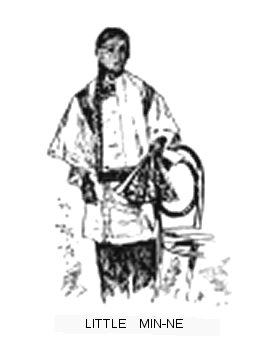
land. Nor is this surprising when we consider that every
Chinaman leaves his little “Min-ne” behind him when
he quits the Flowery Land, it being a very rare thing for a woman
to leave China.
The Chinese quarter is full of interest; the people swarm like
bees, and live in a frightfully overcrowded state. The
butchers’ and barbers’ shops are the most numerous
and most interesting, the former being filled with a quantity of
dreadful-looking little portions of meat, but it would puzzle the
most learned to say from what animal they were cut. The
barbers’ shops are situated in the basements of the houses,
with an open front towards the street, and they are very
numerous, for the Chinese are close shavers. On looking
down you may see a number of men seated in a
variety of positions, each one smoking a pipe of opium, while the
barber is occupied in shaving every portion of his head and face,
excepting, of course, his beloved pig-tail. The swell
Chinee is very particular that every hair shall be removed, and
so clever do the operators become that, by means of tiny razors,
they can shave the inside of the nose. Some of the
pig-tails are of enormous length, and sometimes the white rowdies
attack the Chinese and cut their pig-tails off.
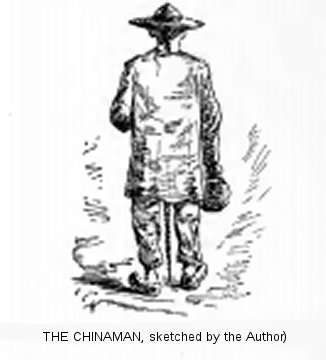
When a man has an especially fine one, he either rolls it up
at the back of his head and fastens it with hairpins, or else
tucks it inside his blouse. I noticed one of the latter in
particular, a glimpse of which would have delighted Darwin
himself. The owner had evidently let down his back hair
before putting on his blouse, and consequently the pig-tail,
which disappeared at the back of the neck, emerged from under the
blouse and extended to his heels.
Some
of our party, wishing to explore the Chinese quarter by night,
engaged a detective to accompany them, it being unsafe to go
unless so escorted. The guide first took them over a
lodging house, in which some hundred Chinamen were stowed away,
literally almost as thick as herrings in a barrel. Not only
was the floor thickly covered, but suspended above it was a layer
in hammocks, some smoking opium and others sleeping, none,
however, taking the slightest notice of the intruding party.
On visiting the Chinese theatre during the evening they found
preparations being made to celebrate a Celestial wedding.
This decided them to stay and see the ceremony, which was
attended by a vast number of Chinese, the theatre being crowded
in every part. After the ceremony most of the spectators
formed in the procession, which escorted the happy pair to their
home. My friends also visited the Joss Houses and inspected
the queer-looking gods contained in them.
While
making some purchases in a Chinese shop it was necessary to give
my address. I wrote it out on a card thus—TANG-YE, upon which the Celestial at once
claimed me as a countryman of his. I disabused his mind of
that idea by putting my fingers to the outer corners of my eyes
and pretending to extend them in an upward direction, the absence
of which peculiarity showed conclusively that I was not of the
true Mongol type. Curiously, however, on afterwards
consulting a gazetteer, I found that there is in China a city
named TANG-Y, containing over
30,000 inhabitants.
The Chinese are accused of having brought with them a number
of objectionable practices, but to anyone possessing a knowledge
of the lower classes in American cities, it will not appear
possible that the Chinese can be very much worse than they.
Most of the traffic in San Francisco is carried on by the
tramways, and it may not be out of place to put intending
visitors on their guard with respect to a little peculiarity in
their management. It is advisable to tender the exact fare
if possible, for if you give a larger sum the balance is returned
to you, not in cash, but in tickets available for future rides,
which you may have no opportunity of taking. The hackney
carriages are very fine, being almost equal to English private
carriages. Most of those I saw were splendidly horsed with
a pair of magnificent animals, generally black. The lowest
fare taken is ten shillings, but I am bound to say you can have
full value for your money in the time and the accommodation given
you.
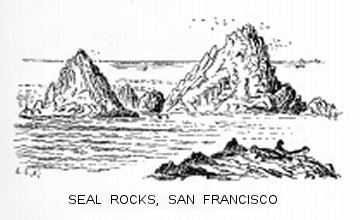
On Sunday morning the city presents a very lively
aspect. The fire-brigades and volunteers parade the streets,
preceded by their bands, and thousands of people go by tramway
and other vehicles to see the famous sea-lions at the entrance to
the bay. From the grounds in front of Cliff House they are
seen on the rocks below in large numbers, tumbling about and
making a noise like the barking of dogs, but so loud as to be
heard from a distance of nearly a mile.
The climate is a delightful one, the temperature being
singularly equable, ranging, as it does, in summer from 60°
to 70°, and in winter from 50° to 60° Fahr.
Indeed the weather is so beautiful that one cannot help referring
to it frequently, but the invariable reply to any such
observation is, “Well, I guess we shall have three months
just the same right slick away.”
After nearly a fortnight’s stay at the Palace Hotel,
enjoying its good fare, we began to think it time to move
eastward, as we were getting too luxurious in our habits.
My friend the lawyer, however, remarked that we need have no fear
on that account, as the fare on the Pacific Railway would cure the
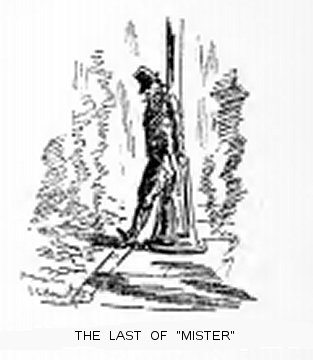
severest attack of gout. Before leaving San Francisco we
met our old friend “Mister” twice. From a
report in the newspapers we learnt that he had been brought
before the magistrates and fined for carrying fire-arms in the
streets. “Mister” told us the police had taken
all his money on the pretence of taking care of it for him.
When we last saw him he was leaning against a lamp-post,
helplessly drunk.
The great excursion from San Francisco is of course to the
Yosemite Valley, but we were compelled to forego the pleasure of
making it on account of our visit being too early in the
season. Some of our fellow-voyagers from the Colonies
ventured to go, but, unfortunately, they met with a serious
carriage accident, owing to the roughness of the road, caused by
the breaking up of the frost.
In order to secure a good seat in the train going East, it is
necessary to make arrangements a few days before starting. Tickets
can be obtained at a score of places in the city, and should be
got as soon as possible; and in order to save all unnecessary
trouble with the luggage during the journey, sufficient for use
in travelling should be separately packed, and the remainder
handed over to the Baggage Master, who has an office in the
hotel, and who will give checks in exchange, and undertake to
deliver it at any hotel or railway station in New York, or any
other place in the States that may be named. By attending
to this overnight, immense trouble is saved, for, if left until
the morning of departure, each traveller has to look after his
own baggage amid a scene of the wildest confusion, and quite
unprotected from the terrible heat and dust. It was with a
sense of great relief that we began to move out of the station,
and to feel that at last we were fairly started on our ride
across the Rocky Mountains. The railway ride for the first
two hundred and fifty miles is a splendid one, through the
magnificent Sacramento Valley, which I should think is fifteen or
twenty miles wide, and is most fertile. Here corn is grown
year after year without any manuring being required. In
many “cuttings” through which we passed the soil was
twenty feet deep. We passed fields hundreds of acres in
extent, with nice houses, orchards, and gardens, surrounded by
fine oaks and elms, making the country look like a park for a
hundred miles. The corn, which in many places was over ten
feet high, was fast ripening, and its glorious golden colour was
often charmingly varied by immense patches of Marigold,
Eschscholtzia, Lupins, and another beautiful flower which we did
not recognise, all in full bloom. We also saw our old
Tasmanian friend the Eucalyptus (commonly called the Gum Tree),
and many of the quaint Doré-like dead Blue Gums, looking
white and ghostly.
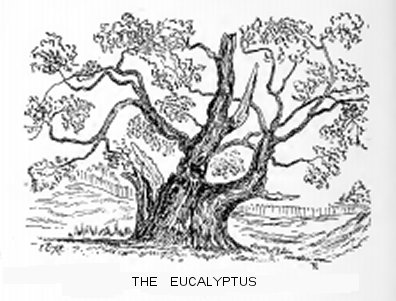
This is a magnificent State. A gentleman remarked to me
that when the richness of the soil is exhausted there remains
untold mineral wealth below. The people, too, are very
energetic, and there is abundance of capital; so much so that a
moneylender travelling in our carriage complained that it is
difficult to get fifteen per cent. per annum now when some twelve
years ago he could easily obtain five per cent. per month.
Soon after leaving Sacramento the track ascends the mountains
and passes through the old gold-diggings so much spoken of thirty
years ago. They are visible all around for miles, and some
are still being worked. All the abandoned ones have been
re-worked by the Chinese, who have got a great deal out of
them. By and by we stopped at a station where there were
several dreadful-looking Indians, some with their faces covered
with red ochre and with feathers in their hair; others dressed in
scarlet blankets, tall white hats, one-legged trousers and
moccasins. They all looked very grave and stolid. I
did my best to make one old fellow laugh as he stood on the
platform with his arms folded, but his face was stony, and he
remained steadfast and unmoveable. Their hair is like
whalebone, matted and shaggy; their noses and mouths are broad,
and the women look uglier than the men. Several of the
women were carrying their papooses (babies) suspended over
their shoulders, with the legs swathed like Neapolitan
children. The only occupation of these degraded creatures
is begging and stealing.
While we were passing through swampy tract the large
bull-frogs were giving a croaking concert in full chorus, and a
rare noise they made.
Soon we began to sight the snow mountains, and by nine
o’clock we were right amongst the pine forests and the
snow, and very beautiful the scene looked with the moon shining
on it all.
Life on board a “Pullman” train is almost more
peculiar than life on board ship. My party were fortunate
enough to secure a cabin partitioned off from the rest of the
carriage; but the remainder of the sleeping berths have no
partitions, being separated merely by curtains.
Inexperienced travellers are apt to forget this, and sometimes
cause much amusement in consequence. One morning I heard a
young lady complaining to her mamma that she could not find her
stockings, a remark eliciting numerous offers of assistance from
all parts of the carriage. A neighbouring compartment was
occupied by a lady and gentleman, the former of whom was deaf,
and with the peculiarity often observable in deaf people, she
imagined everyone else was deaf as well; the consequence being
that there were no secrets in that cabin. Every carriage
has a negro attendant, whose duty it is to make the beds and
attend to the lavatories, the ladies’ and gentlemen’s
lavatories being at opposite ends of the carriage. At
half-past nine o’clock Sambo begins to prepare the beds,
and soon after ten almost everyone has retired, and, as
fortunately there are no decks to be paced, sleep soon comes to
the weary. Arrangements are made for three meals a day, the
train stopping at stations convenient for the purpose, and notice
being given half-an-hour before. Half-an-hour is allowed
for each meal, the invariable charge being one dollar. As
the train stops a general stampede is made toward the
dining-room, the position of which is unmistakable, for at the
door stands a negro, with a face devoid of expression, vigorously
sounding a gong. As each person passes in he pays his
dollar, and makes a rush to the end of the room, where the cook
is usually stationed. And now happy is he who possesses the
Yankee’s qualification for a good diner-out, for unless he
has a long arm, a quick eye, and a silent tongue, he is likely to
come off with much less than a dollar’s worth. The
experienced traveller, before sitting down, gathers all the
dishes before him, within arm’s length, and then proceeds
to attack them seriatim, or sometimes all at once. Indeed,
I think a man of naturally generous disposition, would be made
utterly selfish by twelve months’ travelling on American
railroads. As soon as the half-hour has gone, the guard
calls out with a shrill, nasal, Yankee twang, “All
aboard,” and we once more continue our journey.
Happening one day to say to a fellow-passenger that I was from
Birmingham, an American gentleman hearing me came across the
carriage, and, raising his hat, said: “I must shake
hands with a person coming from the city which returns John
Bright to Parliament.”
The Pacific Railroad is a single track, and, although a
wonderful engineering work, is not by any means a substantial or
confidence-inspiring line, if judged by English standards.
The rails are old and worn, the bridges and viaducts very lightly
constructed, and almost always of wood. I observed in
several cases that the carriages were actually wider than the
viaducts, many of which are open between the rails. It is
hardly to be wondered at that awful accidents sometimes
occur. The train in which we were travelling narrowly
escaped falling into a ravine 120 feet deep. One dark
night, after we had all retired to rest, we were awakened by
continued whistling and ringing of bells. It was in vain
that we inquired of the guards and attendants as to what was
going on, for they, like their brethren all the world over, would
give no information. One thing, however, they could not
hide from us, for we found we were being taken across a viaduct
one carriage at a time, and as we crossed we could see lights
moving about at a great depth below. On arriving at Omaha,
two days
later, we found a full report of the occurrence in the
papers. It appears that the viaduct had been discovered to
be in an unsafe condition, some of its timbers having been
partially burnt, and it was a matter of discussion whether we
should be allowed to cross at all; it being ultimately
determined, as I have said, to take one car over at a time.
Ours was the last train that went over, for before daylight the
whole structure had fallen with a tremendous crash. The
Indians were on the war-path at the time, and it was supposed
that the work of destruction was theirs. The railway here
runs through some of the most magnificent scenery in the
world. Sometimes its course lies through narrow valleys, or
cañons, where there is just room for the railway and the
river, sometimes through immense pine forests, and then again on
a mere shelf cut in the face of the granite mountain, until the
point called “Cape Horn” is reached. This is
the turning-point between east and west, and soon afterwards the
greatest elevation is attained, 8,200 feet. About sixty
miles of the more exposed portion of the road is covered with
sheds, to protect it from the snow. This result, however,
is not attained without considerable discomfort to the
passengers, as the carriages become filled with smoke and dust
while passing through.
One of the passengers on our train was an old man who had not
crossed the country since he went out to the far west some
twenty-six years before—long before the railway had been
thought of. The party with which he then travelled was so
large that it had to be split into detachments for the
convenience of pasturage. One night his section was
attacked by Indians, who killed several of the party and
drove off most of the horses and cattle. The old man had
for many years been a trapper in the Indian country and had
invested his hard-won earnings in horses which he was taking out
west for the purpose of trade, and he was not disposed to lose
them all at one fell swoop without making a bold dash for their
recovery. His plan of operations was soon settled, and in
the evening he set off in pursuit with half-a-dozen picked men,
each with his rifle and a good store of ammunition. After
some hours they came upon the scent of the Indians, and moving
cautiously forward amongst the scrub, presently saw them around
their fires busily engaged in dividing the spoils of the
morning. The trapper being a first-rate marksman, it was
agreed he should do all the firing, while the others loaded and
handed up the rifles as fast as required. Every shot told,
and the redskins, judging from the rapid firing that the whole
party of white men were upon them, made a regular stampede,
leaving horses, and cattle, and other spoil behind them.
So, painfully marching on, they came at last to the Mormon
settlement and on to the Salt Lake City, where they were
subjected to the most cruel treatment at the hands of the
“Saints.” These people told the travellers it
was impossible to get to California by the route they were
taking, as the country was swarming with hostile Indians, and
they undertook to show them a better way by which they would get
there in fifteen days. Many suspected treachery, and a
consultation was held, which came to no definite conclusion,
except in the case of one man, who, in the heat of debate, was
shot dead. It was ultimately decided to adopt the Mormon
advice, and as the route did not admit of wagons, they tried to
sell them to the “Saints,” who, of course, would not
buy, knowing they would have them for nothing before long.
Many of the travellers burnt their wagons and harness rather than
that the Mormons should have them, but the majority abandoned
theirs, and set out without them. Instead of fifteen days
the journey took thirty-nine, and only a few survived it, most of
the party dying by the way, either by the hand of the Indians or
from fatigue.
For about a thousand miles the railway is open to the prairie,
the consequence being that frequent accidents occur through
cattle straying upon the track. I counted more than twenty
carcases of these unfortunates in one day, and on one occasion,
while sitting on the steps of the Pullman car, I felt a sudden
check, and immediately after the body of a cow flew past.
The herds are looked after by men with lassoes, riding very fleet
horses. American railroads being much less protected from
stray animals than those in England, the locomotives are provided
with an apparatus called a “cow-catcher,” which
consists of an iron framework projecting in front and inclined
downwards as near to the rails as possible. The contrivance
is successful in moving most living obstacles from the
track. For instance, when a cow gets between the rails and
sees the train approaching, it becomes dazed, and the iron frame
striking the lower portion of the legs takes it up readily.
But with a bull it is quite different: when his lordship sees his
enemy approaching he puts his chin down upon his fore-feet and
waits the onset with a confidence not by any means always misplaced,
for in this position his head and feet form a wedge which,
becoming inserted beneath the iron frame, frequently throws the
engine back upon the train, causing serious accidents. When
at Ogden I saw the remains of a goods train which had been
wrecked in this way a week before, the engine drivers being
killed, also two stow-aways, or “dead-heads,” as the
Yankees call them, who had secreted themselves under one of the
carriages.
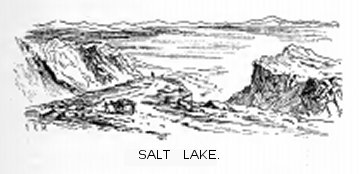
Waking one morning we found ourselves in a most awfully
desolate country, with scarcely a sign of vegetation—a
veritable dry and thirsty land, through which we travelled all
day. Towards evening we came to the alkali country, and the
plains looked as though they were covered with snow. This
is a fearful place, where, before the construction of the
railway, many poor emigrants have lain down to die. Soon
after, we skirted the margin of the Great Salt Lake and entered
Brigham Young’s dominions, passing his first town,
“Corinné.” This town was founded by the
Gentiles after Brigham turned them out of the Salt Lake City, but
he soon drove them farther off.
We
left the train at Odgen in order to pay a short visit to the Salt
Lake City, which is situated thirty-six miles off, and is
approached by a railway belonging to the Saints. For beauty
of situation Salt Lake City is almost unrivalled. It lies
in a basin more than twenty miles in diameter, and is surrounded
by mountains, some of which are 12,000 feet high, and most of
them covered with perpetual snow. At the time of our visit
the fruit-trees were in full bloom, and, as each house is
surrounded by its garden, the city occupies a large extent of
ground, presenting a beautiful appearance from the United States
camp, which stands on an elevation commanding the whole city,
about two miles off. A portion of the old mud wall, about
ten feet high, built by the Mormons to resist the attack of the
Indians, still remains standing. Several of the houses are
exceedingly well built, and the gardens kept in excellent order;
one in particular I was much struck with, and remarked to our
guide that it was the brightest and best kept place I had seen
since leaving England. He told me it belonged to an
Englishman who had left for his native country on the previous
day. Curiously enough, when I returned home, I found this
man was a brother of my butcher, and was then on a visit
home. We observed two ladies sitting in the front of the
house engaged in needlework, and were told that they were the two
wives of the English Mormon. It was very noticeable that
these ladies sat at a considerable distance apart, cordiality
(unless it be of hatred) not being a characteristic of these
Mormon wives in their relations with each other. At the
time of our visit the “Prophet” was down south,
looking out for a new location for the Saints, in view of
the threatened difficulties with the Central Government. We
visited the Tabernacle, and saw the preparations for the new
temple, to which the deluded of all nations continue to
contribute, although it is exceedingly doubtful that the building
will be carried to completion. The man who showed us over
the Tabernacle used to work in a London factory; but he told us
with a curious twinkle in his eye that the “new job”
paid him much the best. At a short distance from the city
there is a sulphur spring, of considerable volume, proceeding
from the side of the mountains; the temperature of the water is
such that eggs can be boiled in it. We slept at Ogden that
night in order to be in good time for securing places in the
train going east in the morning. When the hotel bill was
presented I tendered English gold in payment, having disposed of
my U.S. currency. The landlord refused to take it, saying,
“He would not have the — British gold.” I
explained to him that I had no other money, but to no purpose,
so, as the train was almost due, I told him I would pay him when
I came that way again, but was not sure when that would be.
He quietly said, “I guess I’ll take your gold,”
much to the amusement of the bystanders. At the station
here is a printed notice cautioning travellers to “Beware of Bogus Ticket Sellers.”
For three days after leaving Ogden we travelled through the
snow, passing through a series of cañons or gorges, which
narrow at the base until there is just room for the brawling
stream which runs along the bottom. The railway in such
cases is either excavated on one side of the gorge or carried on
trestles over the stream. The rocks on the mountain sides, mostly
of red sandstone, are very bold and of strange shapes.
Amongst them is a very weird-looking group called “The
Witches.” Another group, known as “The
Buttes,” bears a most striking resemblance to a line of
strong fortifications commanding the valley.
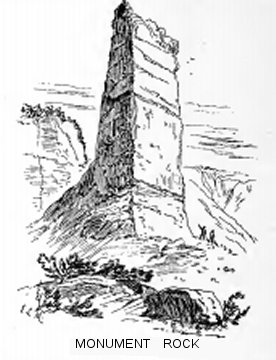
We saw these at sunset, and the effect of the evening light
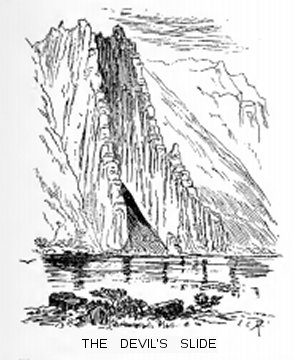
upon the red sandstone was very fine. In the same
neighbourhood is the celebrated Devil’s Slide; it is formed
by the earth being gradually washed away from between two lines
of vertical strata about 20ft. apart. It is some
hundreds of feet in length, and descends into the river.
This valley was the route taken by the Western Pioneers, and is
marked here and there by solitary graves with crosses at their
heads.
The whole 8,000 feet descent from the summit to the eastern
plains is made in about four hours. The steam is turned
off, the brakes turned on, and down we go. As we were
preparing to descend I remarked to the negro attendant that I
supposed we must trust the engineer now? “No,
sah,” said Sambo, “I guess we must trust de ole man
up above,” pointing to the skies.


