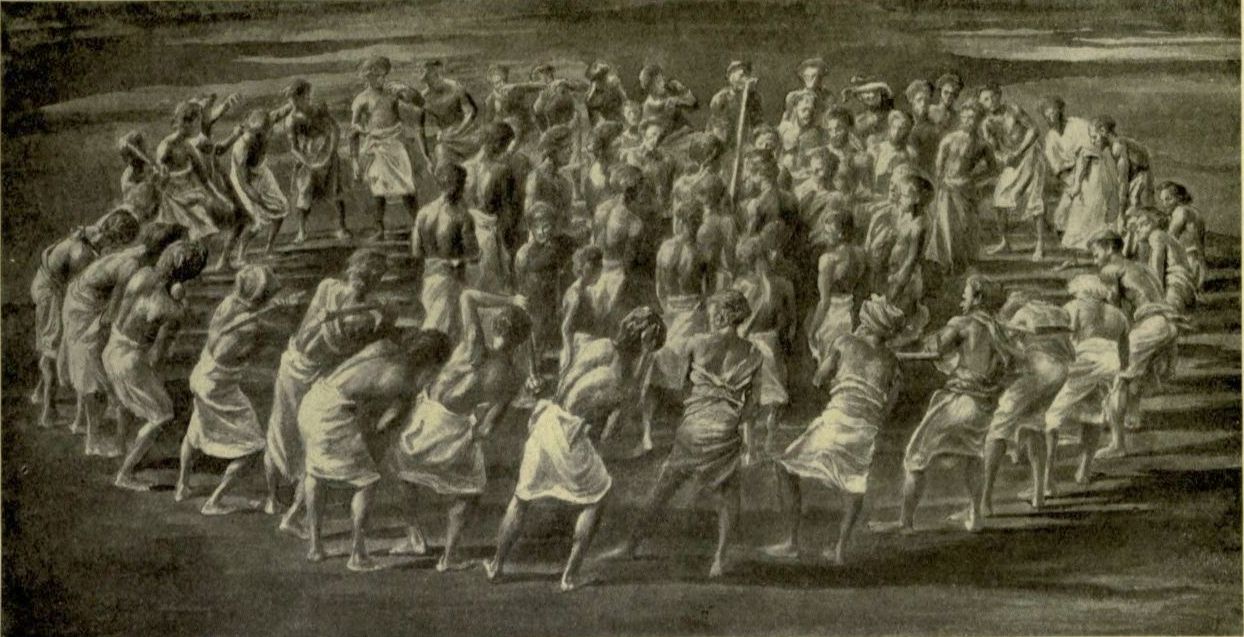
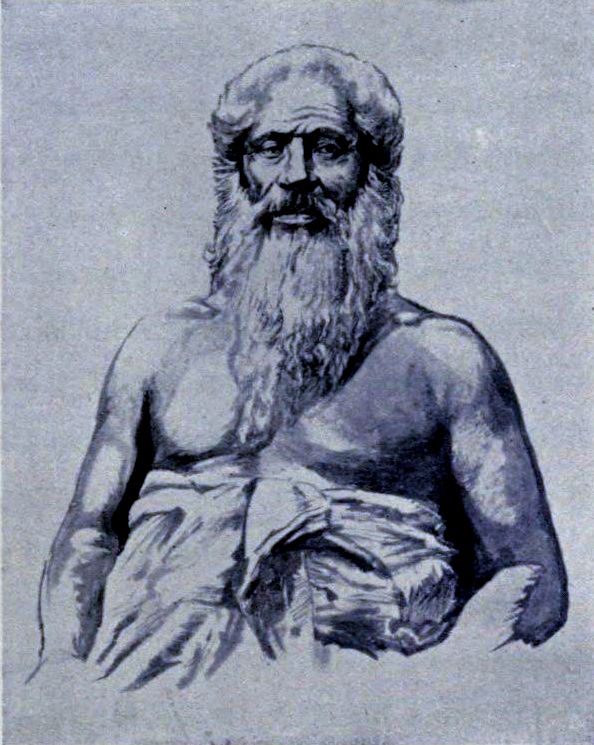
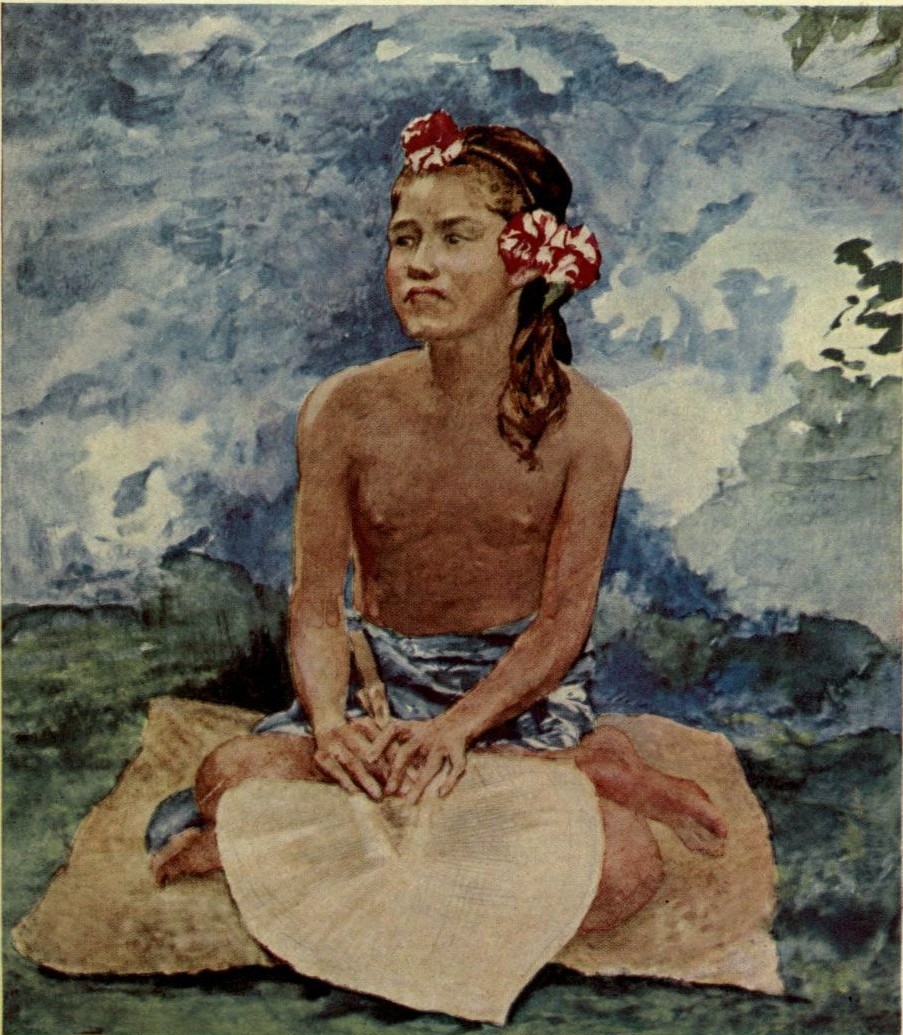
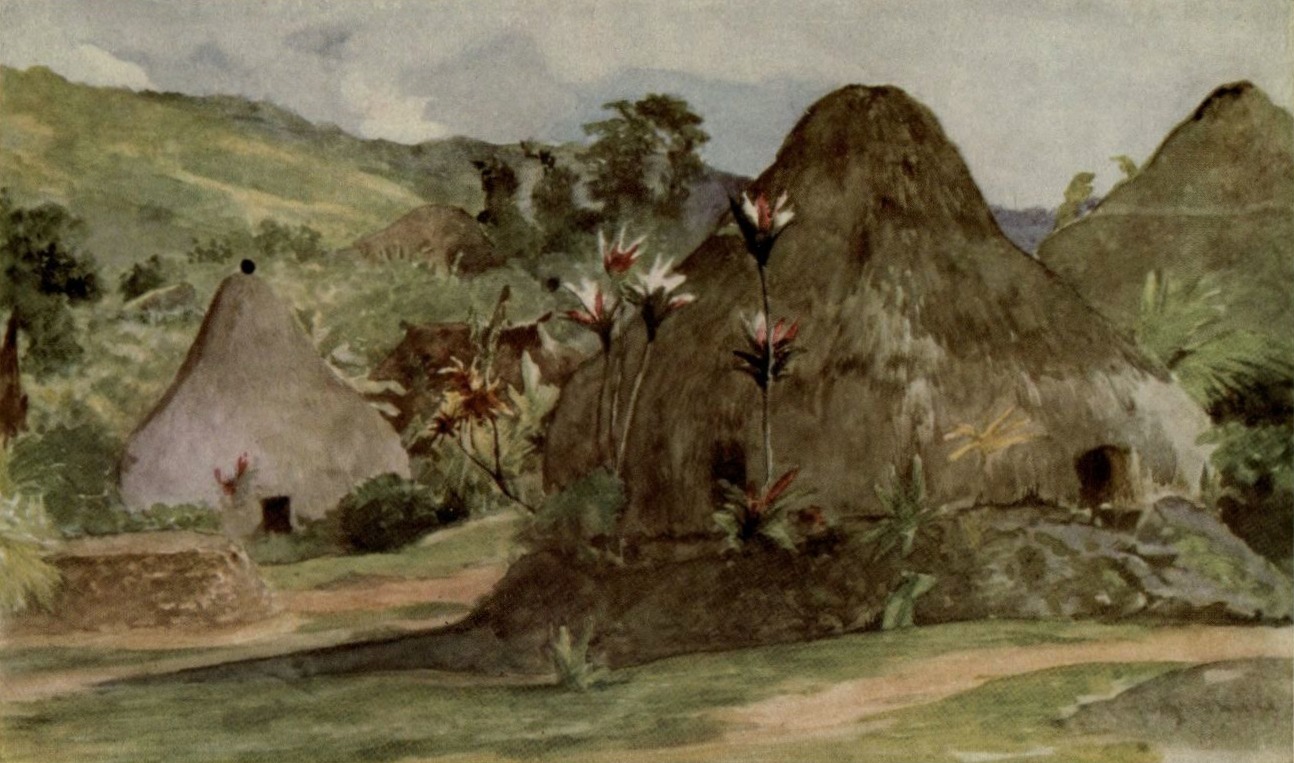
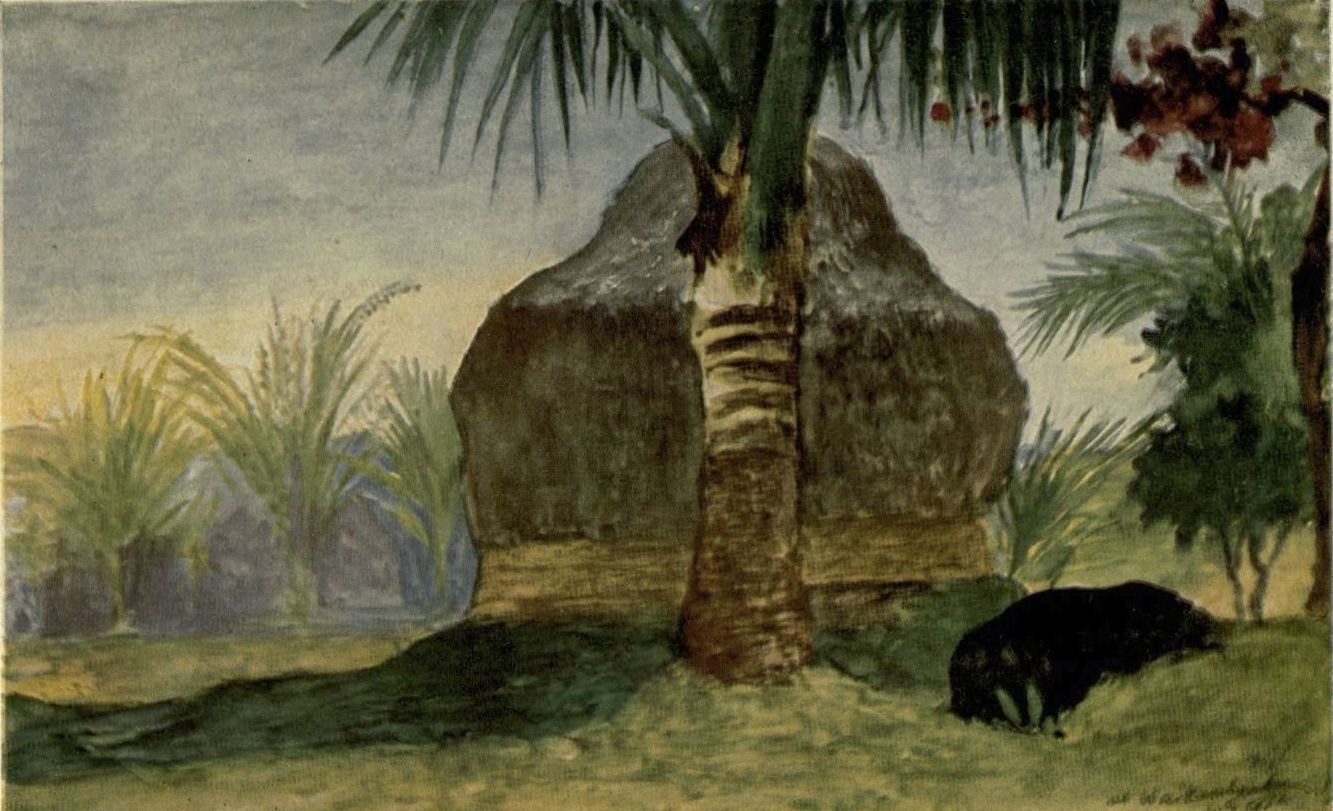
Off the island of Tutuila, on Board the Cutter Carrying Mail,
Tuesday, Oct. 7, 1890 (Samoan Time).
The morning looked rainy with the contrary northwest wind that we had
carried with us below the equator, when the shape of the little cutter
that was to take us showed between the outstanding rocks of the coast of
Tutuila. As the big steamer slowed up, a few native boats came out to
meet it, manned with men paddling and singing in concert, some of them
crowned with leaves, and wearing garlands about their necks, their naked
bodies and arms making an indescribable red colour against the blue of
the sea, which was as deep under this cloudy sky, but not so brilliant
as under yesterday’s sun. They came on board, some plunging right into
the sea on their way to the companion ladder, bringing fruit and
curiosities for sale. But our time had come; and we could only give a
glance at the splendid nakedness of the savages adorned by fine
tattooing that looked like silk, and with waist drapery of brilliant
patterns. We dropped into the dancing boat that waited for us and
scrambled into the little cutter or schooner some thirty feet long, not
very skilfully managed, that was to
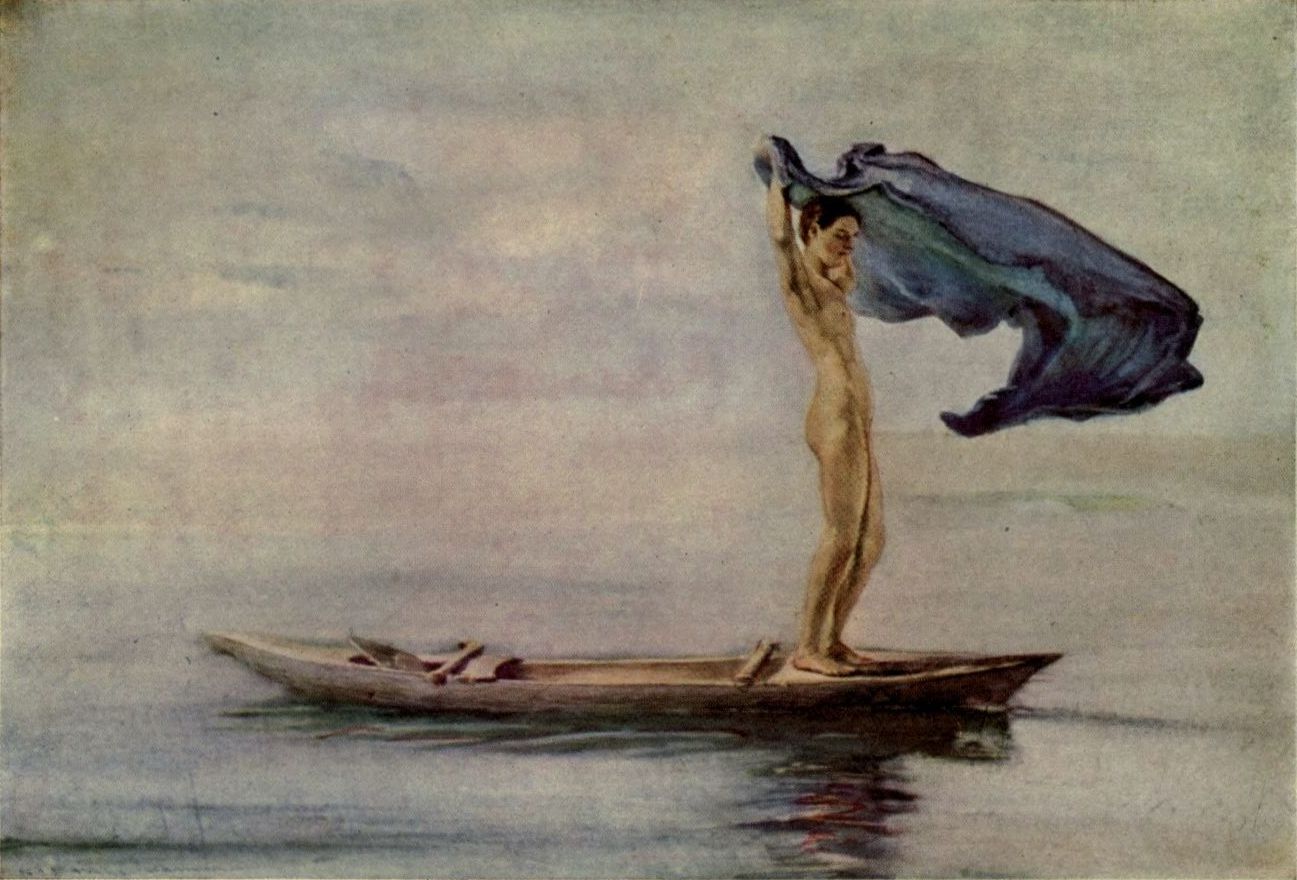 FAYAWAY SAILS HER BOAT. SAMOA
take us sixty miles against the wind to Apia. A few minutes, and the
steamer was far away; and we saw the boats of the savages make a red
fringe of men on the waves that outlined the horizon—a new and strange
sensation, a realizing of the old pictures in books of travel and the
child traditions of Robinson Crusoe.
Our crew was made up of the captain, a brown man from other and far-away
islands, and two blacks, former cannibals from Solomon Islands, with
gentle faces and manners, and rings of ivory in their noses. Our captain
spoke of hurry, and used strange words not clear to understand in his
curious lingo; but after an hour or so of heavy rain he announced his
intention to beat in again and wait for some change of wind. And so we
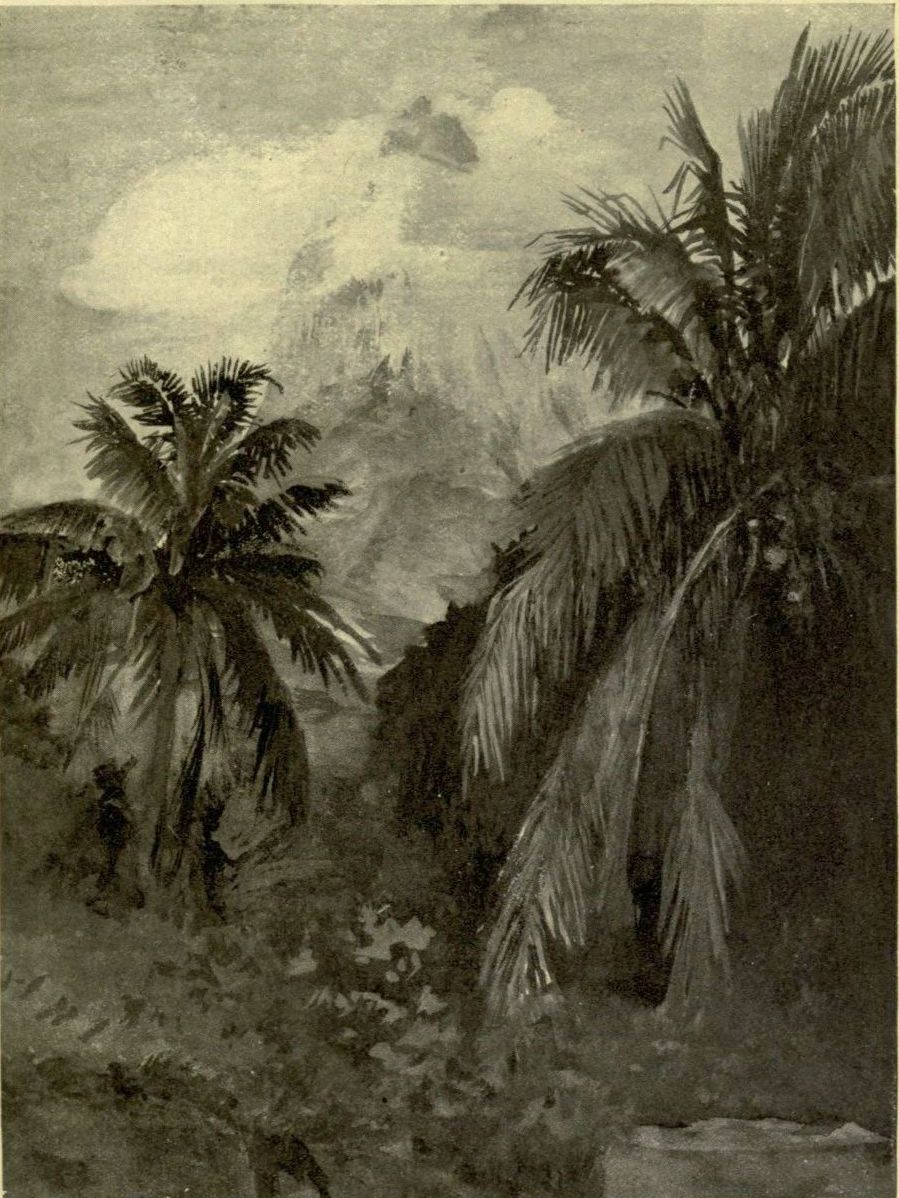
ran into a little harbour high with mountains, all wooded as if with
green plumage, cornered by a high rock standing far out, on which stood
out, like great feathers, a few cocoa-palms. Palms fringed the shore
with shade. A blue-green sea ran into a thin line of breakers—like one
of the places we have always read of in “Robinson Crusoe” and similar
travellers: “A little cove with the surf running in, and a great swell
on the shore.” Our cutter was anchored; then, as we declined to remain
on board, either in the rain or in the impossible little cabin about
eight feet long, we were taken into the boat, which was skilfully
piloted through an opening in the inside reef; and, the surf being high,
we were carried to shore on the backs of two handsome fellows whose
canoe had come alongside. We walked up to the church, a curious long,
low building behind the cocoa-palms; all empty, with thatched roofs and
walls of coral cement; the doorway open, with two stones to block out
casual straying pigs, I suppose. Inside I saw a long wooden trough,
blocked out of a tree. I did not know that this was the old war-drum of
pagan times, now used for the Christian bell.
Behind the church, a few yards off, was our destination—a Samoan
“grass-house,” the guest-house of the village, as I know now. It was
thatched with sugar-cane leaves, was elliptical, with a turtle-backed
roof, supported by pillars all around, and by three central pillars that
were connected by curved beams, from which hung cocoanut cups and
water-bottles, or which supported rolls of painted bark cloth. The
pebble floor showed at places not covered with the mats, as well as near
the centre pillars, where a fire still smoked. Most of the screens of
matting, which make the only wall between the pillars, were down, making
a gentle shade, in which one woman was sleeping; another, on the
opposite side to us, her back turned and naked to the waist, was working
at large folds of bark cloth. The women rose from this occupation, and
offered their hands, saying, “alofa!”[1] A younger woman was lying
sick, her wrapped-up head on the Samoan pillow of a long bamboo,
supported at either end, so as to free it from the ground.
With the same “alofa” came an elegant young creature, perhaps some
sixteen years old, wearing a gay waist drapery of flowered pattern, red,
yellow, and purple—with a loose upper garment or chemise of red and
violet—open at the sides. Then another, short and strong, with heavy
but handsome arms and legs, and with bleared eyes. And we sat down on
the mats, the girls cross-legged, and looked at each other while the
captain talked, I know not what of.
As I changed my seat and sat near the entrance with my back against the
pillars, which is the Samoan fashion, though I did not know it, another
tall creature entered, and giving us her hand with the “alofa” sat
down against another pillar—also the proper dignified Samoan way. We
did not notice her much; she was quieter, less pretty than the pretty
one, with a longer face, a nose more curved at the end, a longer upper
lip, and more quietly dressed in the same way. Then entered another with
a disk-shaped face, her hair all plastered white with the coral lime
they use to redden the hair, and dressed as the others, with the same
bare arms and legs. She was heavy and strong below, and less developed
above, with the same splendid walk and swing, the same beauty of the
setting of the head on the neck.
And we drank cocoanut milk, while kava was being prepared for us in an
enchantment of movement and gesture, that I had just begun to feel, as
if these people had cultivated art in movement and personal gesture,
because they had no other plastic expression.
The movements of the two girls preparing the stuff would have made
Carmencita’s swaying appear conventional; so, perhaps, angels and
divinities, when they helped mortals in the kitchen and household. As
the uglier girl scraped the root into the four-legged wooden bowl set
between the two, in front of us, and before the central pillars, she
moved her hand and body to a rhythm distinctly timed; and when her
exquisite companion took it up, and, wetting the scraped root from
double cocoanut shells, that hung behind her, moved her arms around in
the bowl and wiped its rim, and frothed the mass with a long wisp of
leafy filaments, she tossed the wet bunch to her companion, as if
finishing some long cadence of a music that we could not hear, too slow
to be played or sung, too long for anything but the muscles of the body
to render. And she who received it, squeezed it out with a gesture fine
enough for Mrs. Siddons or Mademoiselle Georges. I use these names of
the stage, of which I have no fixed idea; those that I have seen could
never have given, even in inspired moments of passion, such a sinuous
long line to arm and hand. Then in a similar repetition of conventional
attitudes the cups were presented to us, one after the other, with a
great under-sweep of the full-stretched arm, and we drank the curious
drink, which leaves the taste filled with an aroma not unlike the
general aromatic odour of all around us, of flowers and of shrubs. For
all was clean and dry about us, house and surroundings and crowded
people, at least to the senses that smell.
In the slow hypnotism produced by mutual curiosity, by gazing with
attention all centred on movement, while pretending to notice all the
social matters as they went on about us, I could not disentangle myself
from the girl who had bewitched us; and as she sat clasping her elbows,
with her legs crossed in her lap, like the images of Japanese Kwannon
and of Indian goddesses, I tried to copy a few lines. But the original
ones flowed out again like water, before I could fix them. My model was
conscious of the attention she called up, and from that moment her eyes
always met ours, with a flirting smile, half of encouragement, half of
shyness.
And now the tall girl that sat beside me, with the quiet face and
unquiet eyebrows, put out her hand languidly to reach for my
sketch-book. She was the “virgin of the village”—doubly important by
being the old chief’s daughter, and elected to this representative
position, which entails, at least, the inconvenience of her being always
watched, guided, and intimately investigated by the matrons appointed
thereto. The lines of my sketch, that would have puzzled the ordinary
amateur, were clear to her: “See,” she said, “here is Sifá, clasping her
elbows, but her face is not made. Draw me,” and she moved away the
hanging mats that obscured the light. The sketch I made was bad,
representing to my mind a European with strange features. I don’t know
what she thought of it, but she recognized the chemise with ruffles on
edges, that covered her shoulders, and made the motion of lifting it
away, which I was slow to understand. Her eyebrows moved with some
question for which I had no English in my mind. At last the word
misonari? as she looked toward Adams, explained what was meant; I said
“no,” and looked approval. She rose, passed into the shade, and sat
again before me, her upper garment replaced by a long, heavy garland of
leaves and the aromatic square-sided fruit of the pandanus, that partly
covered her firm young breast, and lay in her lap against the folds of
the bent waist. But my drawing was scarcely better for all this, and I
gave it to her, with the feeling that what made it bad for me, its
resemblance to a European, might give it value for her. All the time
the temptation was strong to treat this child of another civilization as
a little princess. She had the slow manner, the slightly disdainful
look, the appearance of knowing the value of her sayings and doings that
make our necessary ideal of responsibility. What though the Princess
puffed at my pipe, meanwhile having secured a cigar, less cared for,
behind her pretty ear; what though she pressed two long, slender fingers
against her lips, and spat through them, according to some native
elegance, she knew that she was a personage and never was familiar, even
when she pressed my arm and shoulder, and said, “alofa oi,” “I like
you.” Her forehead was high and gently sloping, her eyebrows thin and
movable, the eye looked gently and firmly and directly; the nose was a
little curved at the heavy end, the upper lip a little long (and pulling
on the pipe, if she used it, would lengthen it later yet more), the neck
and back of the head had the same beauty of line and setting that I had
seen in Hawaii, and her shoulders, and breast, and strong, lithe arms
would have delighted a sculptor. She wore her hair gathered up by a
European comb, and in front a forelock reddened to the tone of her face,
with the coral lime they used. Her legs were strong and fine and her
feet only as large as one could expect, with the soles hardened by use
over stones and coral.
But she was not the pretty one; her sister, Sifá, was that. The charm of
the older one, “the virgin of the village,” was in this incomparable
savage dignity, that gave a formality to our visit. What to us was an
amusement was to her evidently one of the necessities of hospitality,
while Sifá could not move about or look without a ripple of laughter
that undulated through her entire person. Occasionally, however, our
“chiefess” looked at me with a gentle smile, and said “alofa!” and by
and by, after showing me that she could write, and doing so in my album,
(where she dated her inscription Oketopa, our October), she gave me a
ring with her name Uatea—or Watea as she wrote it. She partook of
lunch, eating after us (along with the captain who appeared again on
time), and she refused to taste of some apples we had until we had some
of her own fruit, all I suppose according to some proprieties well
defined. Then Sifá, her sister, met with a little adventure in unpacking
our food for us. The captain of the steamer had given us a block of ice
on our leaving, telling us that it was the last we should see in this
part of the world, and that it might comfort us during our long, hot
sail under the tropical sun. In unrolling it, and taking it up, Sifá
dropped it with a cry of “afi!”—“fire!” and for a few moments we
struggled in an unknown tongue to explain what it might be. But I took
it for granted that she must have had some Bible explanation of the
places where the Bible comes from—that is to say, England and Scotland;
hence about winter and bad weather, and perhaps snow and ice.
While the family arranged for their meal we took a walk, “now and
again,” as our captain expressed it—almost all the words he knew. We
walked across what appeared to be the village green—a space of grass
neatly cared for—edged by huts and trees, the palms thickening in the
distance and hiding the sudden and close slope of the mountain right
above us. Bread-fruit trees were planted here and there near the houses,
the large leaves making a heavy green pattern against the innumerable
shades of green, the spotted trunks were dark; even the cocoanut trees
were only white by the sea. We passed a tomb, of a moundlike shape, one
lengthened cube placed upon another, and the upper surfaces sloping to
an edge like some of the early sarcophagi or Italian tombs—a shape as
simple and elegant as one could wish in such an ideal landscape. I shall
have to find out if this most typical shape has originated with them, or
has come from some foreign influence. However that may be, it made
another classical note. Had Ulysses in his wanderings left some
companion here, some such monument might have well marked the tomb of a
Greek. There it was, all covered with lichen; and another newer one,
made also of coral mortar, still white, near trees, and by former
homes, in this little shady “agora.” As we passed into the path that
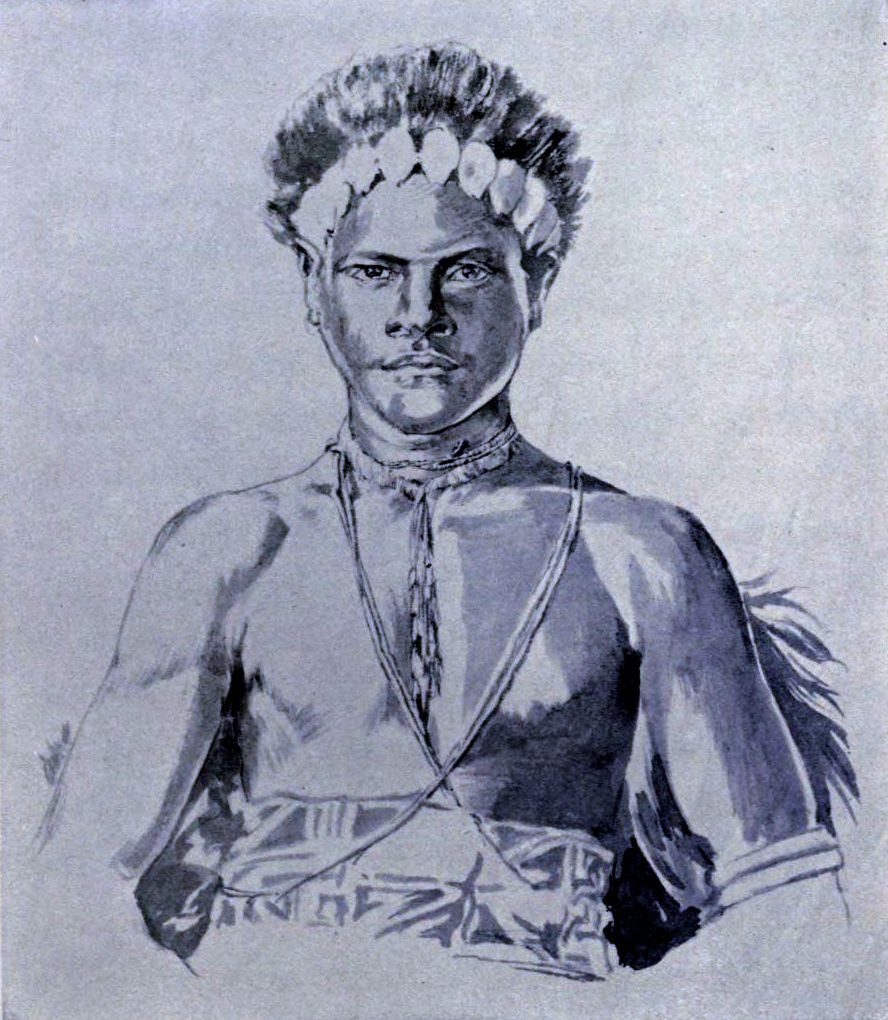
seemed to run up the hill, young men went by with wreaths on their
heads, draped to the waist, like the statues of the gods of the family
of Jove; their wide shoulders and strong, smooth arms, and long
back-muscles or great pectorals shining like red bronze. All this
strength was smooth; the muscles of the younger men softened and passed
into one another as in the modelling of a Greek statue. As with the
girls we had just left, no rudeness of hair marred the ruddy surfaces,
recalling all the more the ideal statues. Occasionally the hair reddened
or whitened, and the drapery of the native bark cloth, of a brown ochre
colour, not unlike the flesh, recalled still more the look of a Greek
clay image with its colour and gilding broken by time. Never in any case
was there a bit of colour that might rightly be called barbaric; the
patterns might be European, but no one could have chosen them better,
for use with great surfaces of flesh. If all this does not tell you that
there was no nakedness—that we only had the nude before us—I shall
not have given you these details properly. Evidently all was according
to order and custom; the proportion of covering, the manner of catching
the drapery, and the arrangement of folds according to some meaning well
defined by ancient usage.
Children played about in the open space; they were then at a game of
marbles; when we returned, this had turned to some kind of
blind-man’s-buff; there was no roughness, only a good deal of soft
laughter; one youngster, draped to the chest like a Greek orator, too
big for the children, too young for the men, leaned upon a long staff
and looked on gravely, exactly like the figures on the Greek vases, or
the frieze of the Parthenon.
We walked along into the forest, in the silence of noonday, but the
abruptness and slipperiness of the path as it rose rapidly to walls of
wet rock, stopped our feet. From the intricate tangle of green, we saw
the amethyst sea, and the white line of sounding surf cutting through
the sloping pillars of the cocoanuts, that made a mall along the shore;
and over on the other side of the narrow harbour, the great high green
wall of the mountain, warm in the sun, and its fringe of cocoanut grove,
and the few huts hidden within it, all softened below by the haze blown
up from the breakers. All made a picture, not too large to be taken in
at a glance; the reality of the pictures of savage lands, in our school
books, filled in with infinite details. From dark interiors of huts, as
we returned, came gentle greetings of “alofa.” Awoki, our Japanese
servant, had remained with our hosts, had been fed with bread-fruit and
cocoanut milk, and was busy writing out, under the direction of the
black mate, certain names and words of the language; for the mate could
be understood, while the captain
had only one certain phrase, “now and again” with which he punctuated
everything loudly, so that I could barely understand him. The mate had
his own punctuation of frightful oaths and damnatory epithets, evidently
mere adornments of speech, for he was most gentle, a kindly and
good-natured cannibal, contrariwise to the surly captain; so that I was
glad that he had ventured up from the cutter. The girls had taken kindly
to the other brown skin, my servant, and were busy helping him make up
his list of words, whose sounds he wrote in Japanese, to my later
confusion, when he passed his dictionary to me. (Yet curiously enough,
in this first half day, we learned full a hundred words—almost all that
I have retained.) So we sat down and rested; the flies, attracted by the
bread-fruit, and occasional mosquitoes hovered about the openings; ants
crawled about on us—my princess had occasionally on her feet a black
bunch of flies, which she brushed away slowly—evidently she did not
feel them much—their skins are hard—“now and again,” as the captain
might say, a woman passed the openings of the hut, bare to the waist,
holding a child against her hip. Soon one of the girls, tired of
cross-leggedness, stretched her feet politely under a mat, pulled up for
the purpose (for it is not polite to sit otherwise than cross-legged).
The older women slept on the Samoan pillows at the further side, closed
in by palm curtains. All but one—who had worked all the time, her great
brown back turned toward us—engaged in smoothing and finishing a piece
of what we white men call tappa. “Siapu” I think they call it—the
inner bark of the paper mulberry, hammered out with a mallet, which in
so many of the islands has been long their cloth. She never stirred from
her work; as long as the light held, I saw before me this upright form,
strong as a man’s, smooth and round, and the quiet motion of the arms in
the shadow, made deeper by the sunlight on our side. Later, another
shower made us shut down more curtains, but we were safe and
comfortable, protected from sun and rain alike, in this most comfortable
and airy housing. Then Sifá began beating her thighs and moving her
shoulders coquettishly to her humming of a tune, and I thought that I
recognized the siva, the seated dance of the Samoans, about which I
had been told in Hawaii. Such a graceful creature could do nothing that
was not a picture, but there was a promise of something more, so that we
applauded and said lelei, “beautiful,” with the hope of a full
performance.
But the Princess said nothing; she smoked more and more, as every one
joined her, so that I foresaw that our small supply of cigars and
tobacco was doomed, especially as other damsels entered, and made more
ravages; girls more or less good looking, mostly heavier, one of them
called “Tuvale,” who knew bits and parcels of English such as pilisi du
na iti mi, pilisi esikusi mi, “Please do not eat me,” “Please excuse
me.” And one of the largest, leaning affectionately against my shoulder,
absorbed my silk handkerchief, and tied it around her neck—saying to
me, in her language, “Look how pretty it is!” Our matches and
match-boxes had long ago disappeared—most little things had left my
pockets, but had been replaced. In every way my fair and strong
companions seemed inclined to dispute an apparent preference for Uatea
and Sifá. Good-natured girls all (but one—the thief of
handerchiefs—who seemed to me jealous)—and we were certainly beamed
upon, as I never expect to be again. More rain outside brought on the
evening, as we took our last meal; the “chiefess” and the captain, who
again appeared sullenly out of the dark, eating after us; the captain
now, with an apology to us, appeared naked to the waist, a big heavy
mass of bronze, covered below with a gorgeous drapery of purple, and
yellow, and red. We lay more and more at ease, stretched out, the girls
prone, and occasionally giving one of us an affectionate pat; all but
Uatea who still preserved her usual reserve, and even tried hard to
substitute another ring for the one she had given me—as if her name on
it was too much for a first acquaintance. And occasionally in following
her face, the only one that seemed capable of complicated ideas, I asked
myself whether she was asking herself what equivalents her hospitality
would receive: for instinct told me that through her our gifts or our
payments should be made; even if it were all to go to others according
to barbaric custom. So seeing her rather laden with things, and having
had one experience of the excellence of a white silk handkerchief, I
offered her another, and wrote her name in the corner, to see her thank
me in her usual condescending way, and then toss it over to the old
woman who appeared occasionally—to my mind, her adviser and guardian,
for from time to time, “now and again,” she crept up, between us, like a
chaperon or duenna, to see that all was proper.
Then many of our girls disappeared with Sifá, whom we missed at the
moment and asked for over and over again. A light was brought and set
down upon the matting. Uatea slipped out between the hanging screens and
the pillar behind me, and slipped back again, rid of her upper garment
with a sort of poncho or strip of cloth with opening for head,
patterned in lozenges of black, white, and red, that hung down her back
and chest, leaving arms and shoulders bare, and the sides of her body,
so that as she bent, the soft line that joins the breast to the
underarm, showed under the heavy folds. Then, in came our missing pet,
Sifá, with Tuvále and two others, into the penumbra of the lamp. They
were naked to the waist; over their tucked-up drapery hung brilliant
leaf-strips of light green, streaked with red; a few leaves girdled the
ankle; around Sifá’s neck, over her beautiful bosom, hung a long, narrow
garland of leaves, and on the others garlands of red fruit or long rows
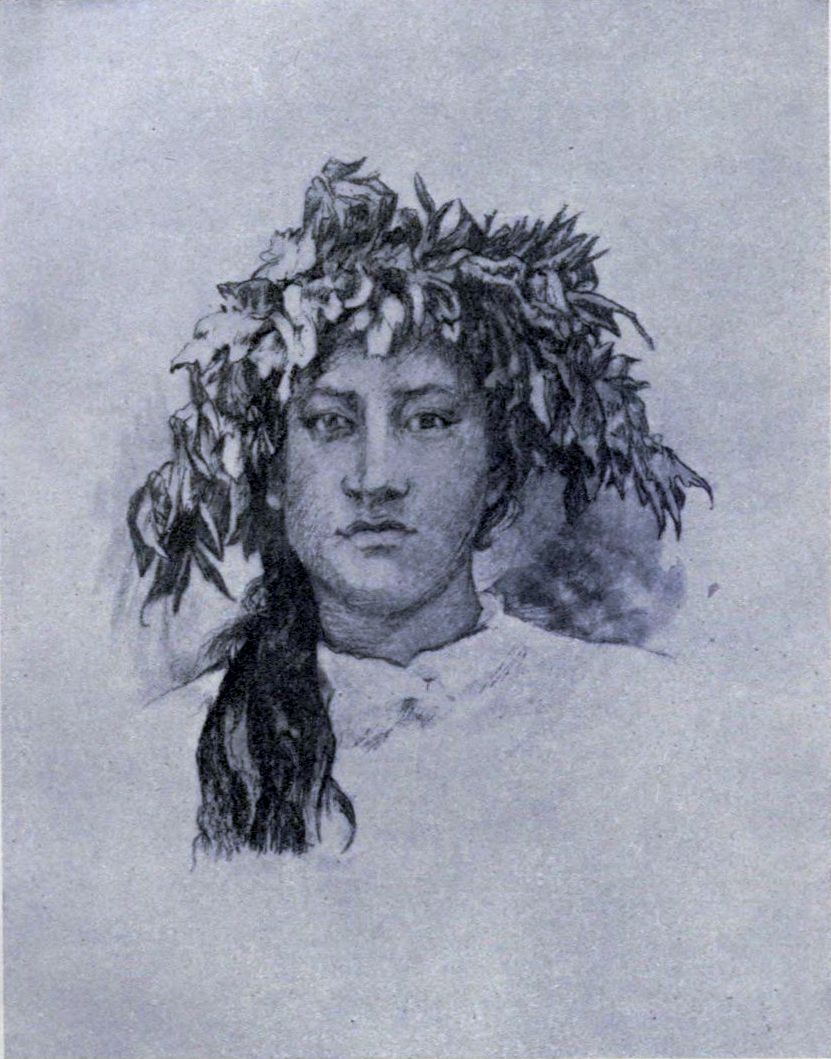
of beads interlaced: every head was wreathed with green and red leaves,
and all and everything, leaves, brown flesh, glistened with perfumed
oil. From the small focus of the lamp, the light struck on the surface
of the leaves as upon some delicate fairy tinsel, and upon the forms of
the girls as if upon red bronze waxed. But no bronze has ever been
movable, and the perpetual ripple of light over every fold, muscle, and
dimple was the most complete theatrical lighting I have ever seen. Even
in the dark, streaks of light lit up the forms and revealed every
delicacy of motion.
So those lovers of form, the Greeks, must have looked, anointed and
crowned with garlands, and the so-called dance that we saw might not
have been misplaced far back in some classical antiquity. The girls sat
in a row before us, grave and collected, their beautiful legs curled
upon the lap as in East
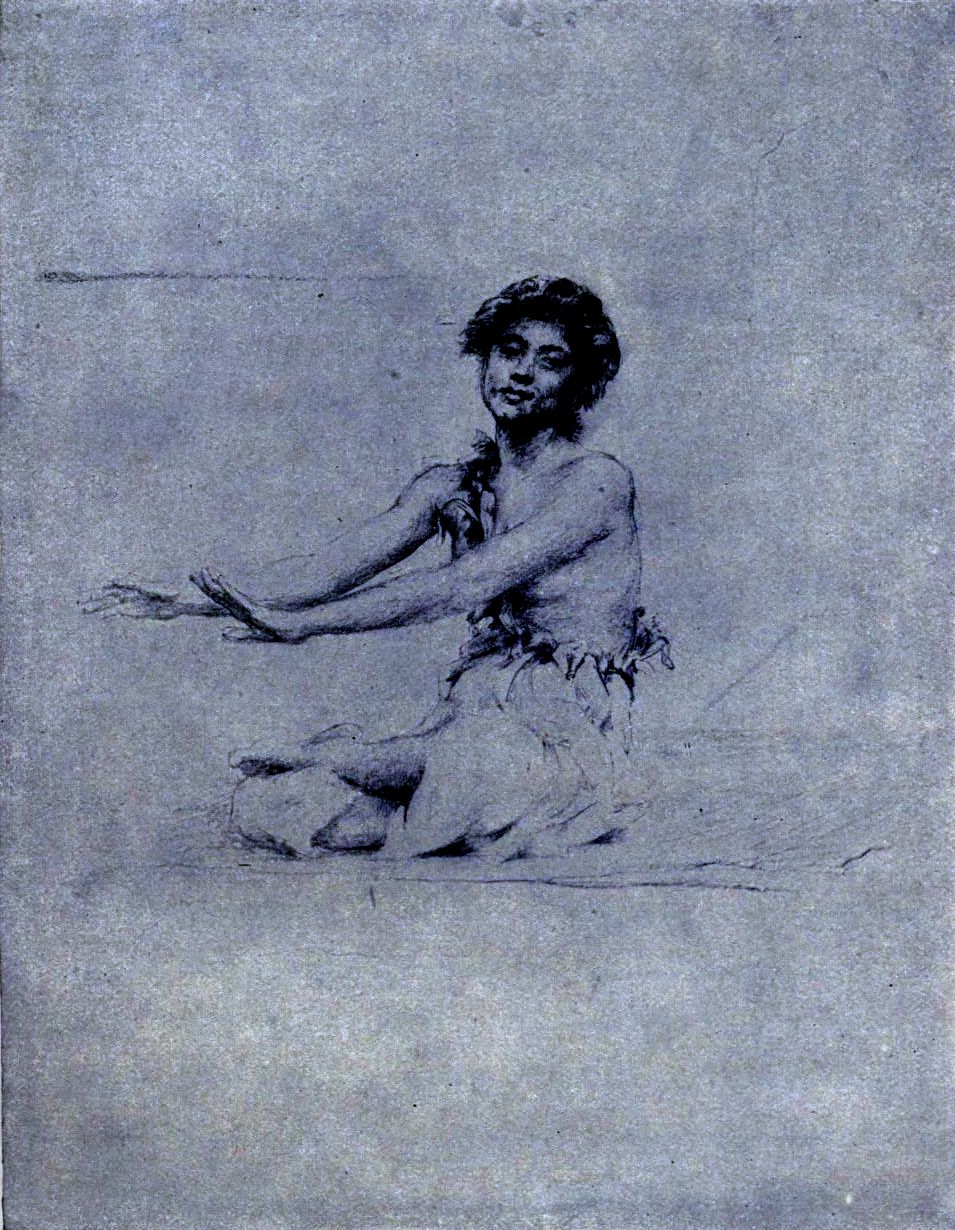 SIFÁ DANCING THE SITTING SIVA
Indian sculptures; and Sifá began a curious chant. As all sang with her
together, they moved their arms in various ways to the cadence and in
explanation of the song; and with the arms, now the waist and shoulders,
now the entire body, even to the feet, rising apparently upon the thighs
to the time of the music. Indeed, Sifá spoke with her whole tremulous
body undulating to the fingers—all in a rhythm, as the sea runs up and
down on the beach, and is never at rest, but seems to obey one general
line of curve. So she, and the others, turned to one side and stretched
out their arms, or crossed them, and passed them under the armpit and
pressed each other’s shoulders, and lifted fingers in some sort of tale,
and made gestures evident of meaning, or obscure, and swayed and turned;
and, most beautiful of all, stretched out long arms upon the mats, as if
swimming upon their sides, while all the time the slender waist swayed,
and the legs and thighs followed the rhythm through their muscles,
without being displaced.
I cannot describe it any better; of what use is it to say that it was
beautiful, and extraordinary, and that no motion of a western dancer but
would seem stiff beside such an ownership of the body? Merely as motion,
it must have been beautiful, for the fourth woman was old and not
beautiful, but she melted into the others, so that one only saw, as it
were, the lovely form of Sifá repeated by poorer reflections of her
motion in lesser light.
Meanwhile Uatea sat to one side of them, near me, and in front, one leg
stretched out, the other tucked under, beating time with a stick,
disdainful of it all, as poorly done, perhaps incorrectly, “lelei,”
“beautiful,” I said—“leanga,” she replied, with a curl of her lip,
hardly looking at the girls. Perhaps she should have led in person, as
the official maiden—and I still felt that something was not right. The
girls rose and came to sit beside us, while Uatea disappeared in the
darkness, behind the three masts crossed with curved beams, that
supported the centre of the roof. These, with the shining, polished
cocoanut bottles, filled with water, that hung from the beams, and the
rolls of mats and bark cloth which were placed upon them as upon
shelves, had served as a background or scenery to our theatre. Along all
the edges of the big house, in the darkness, were other visitors, and
guests, small children, boys and girls, neighbours, and even the two
gentle blackies, from Cannibal and Head Hunting isles, with white rings
in their noses, that made our crew. But I saw none of the splendid young
men, who, crowned with garlands, girdled with leaves like the Fauns and
Sylvans of the Greek play, had startled me over and over again, during
the day, with a great wonder that no one had told me of a rustic Greece
still alive somewhere, and still to be looked at. So that the old
statues and frescoes were no conventionality—and the
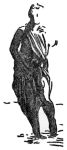
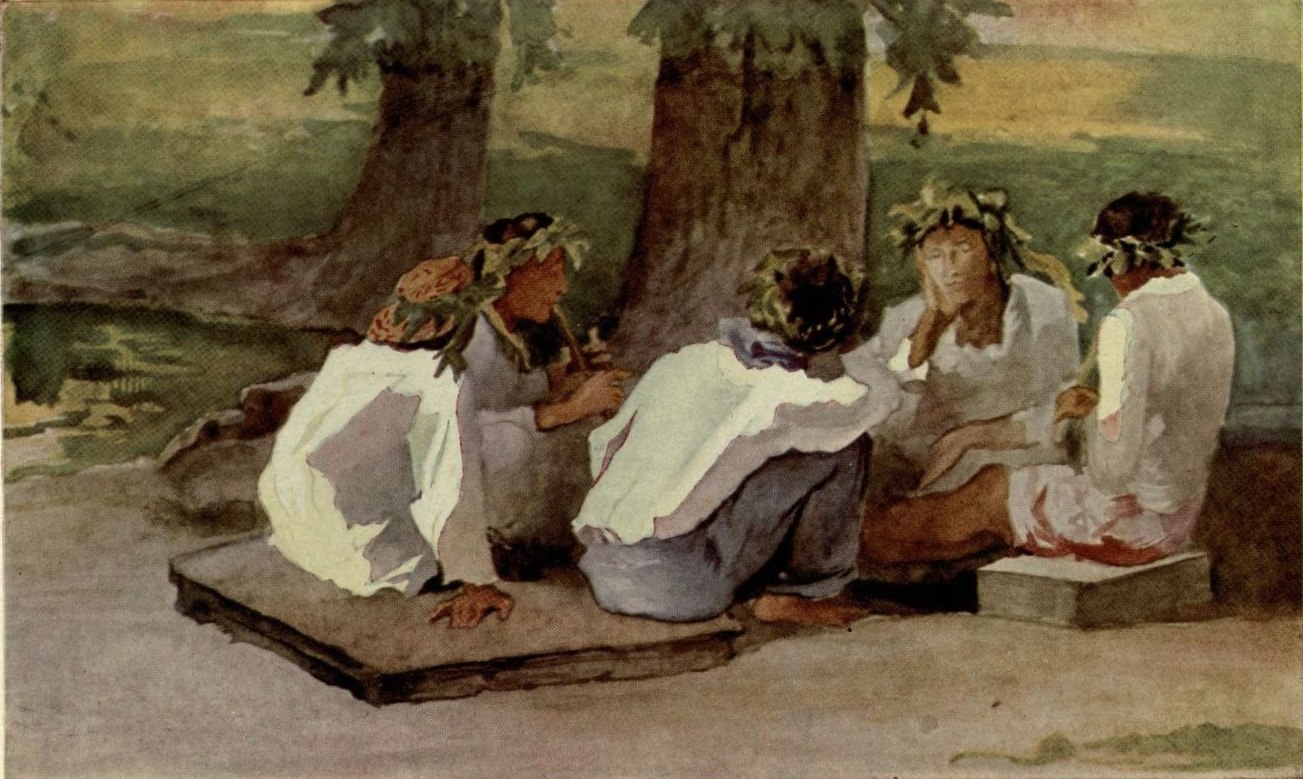 THE FLUTE PLAYER. SAMOA
sailor, the missionary, and the beachcomber, were witnesses of things
that they did not see, because they had not read. And if one reads, does
he care to-day? Had I only known, years ago. Even now, when it is too
late, the memory of all that beauty which we call Greece, the one beauty
which is to outlast all that is alive, comes over me like a wave of
mist, softening and putting far away into fairyland all that I have been
looking at. From out of the darkness, as if from out of the shade of
antiquity, Uatea stepped out before us, naked to the waist, crowned with
leafage, garlands around her hips, a long staff like a sceptre in her
hand, and danced some heroic dance, against another girl, smaller than
she, as her adversary; it looked a mimicry of combat; the tall form, the
commanding gestures, the disdainful virginity of the village Diana,
challenging her companion to battle; something as beautiful and more
heroic than the Bacchanals that are enrolled on the Greek vases. The
girl was in her true element and meaning, more than she could have been
in the previous sivá dance; only an occasional touching of the knees
together detracted from the beauty of the movements. I could scarcely
notice the other dancer, nor the third one, an old woman (who
represented, apparently, a suppliant), for fear of losing a parcel of a
picture that I shall never see again, certainly never with such
freshness of impression.
And when Uatea reappeared, clad again, and puffed at my pipe before
passing it to me, she much less disdainfully assured me that all her
dancing was leanga (bad). And she softened a little, and seemed
distressed about our quarrel about her ring, taking off all her rings
and throwing them away to her guardian matron, perhaps for fear of being
reproved for giving too much for too little, for we had given as yet but
little—only cigars, tobacco, and trifles; and I asked myself whether
the dramatic artist was counting up her possible gains, as others do.
Meanwhile, the other girls lay close to us, in the confidence of
good-nature; all anxious to make the best impression, a curious example
of the wilful charming of woman—and Sifá talked and smiled, and moved,
or rather floated, in her place like a maiden siren flirting. Many
confidences were exchanged without either side understanding one word
said. Each girl wrote something in Awoki’s note-book, or helped our
making a dictionary. Sifá even summing up figures to prove her
possession of the three R’s, a confusing addition of accomplishments to
the dancing and conventionalities we had seen. But I am told that all
read and write, with no book but the Bible. Then between the curtains of
mats Uatea disappeared contrary to what I supposed etiquette, but, of
course, I knew nothing. The others bade us good-night, not without
begging one of us to share their hut, and we slipped out into the dark,
while the mats were arranged for our rest. The storm clouds still
covered the sky—only a few stems of the cocoanut glistened, and the
white bar of the surf made a hard line in the shadow. Some vague, light
forms were those of sitters beneath the trees whispering, or talking
low, for all through our day there had been no voices raised except our
own, or the surly growl of the captain—or the chant that had
accompanied the dances; all other talk had been soft and flowing, with
low voices, almost inaudible to us when distant, adding again to the
peace and softening charm.
We lay down on the mats with our heads toward the centrepost; a large
mosquito bar of thin bark cloth, big enough for a small room, was let
down upon us, the light of the lamp shining through it, and draped in my
Japanese kimono, I fell asleep, in spite of the few mosquitoes
imprisoned with us. No noise from the rest of the house had arisen, all
was still; we were as much isolated as if we had been in a built-up
room. Late or early, I think I heard the snore of the captain, but all
is empty in my mind until I recollect feeling the morning light and saw
some shadows pass. As I stepped out, I saw Sifá move out, stretching her
arms, as she moved toward a little path. Then issued the captain, with a
formidable yawn, and looked at the sky for presages of weather, and took
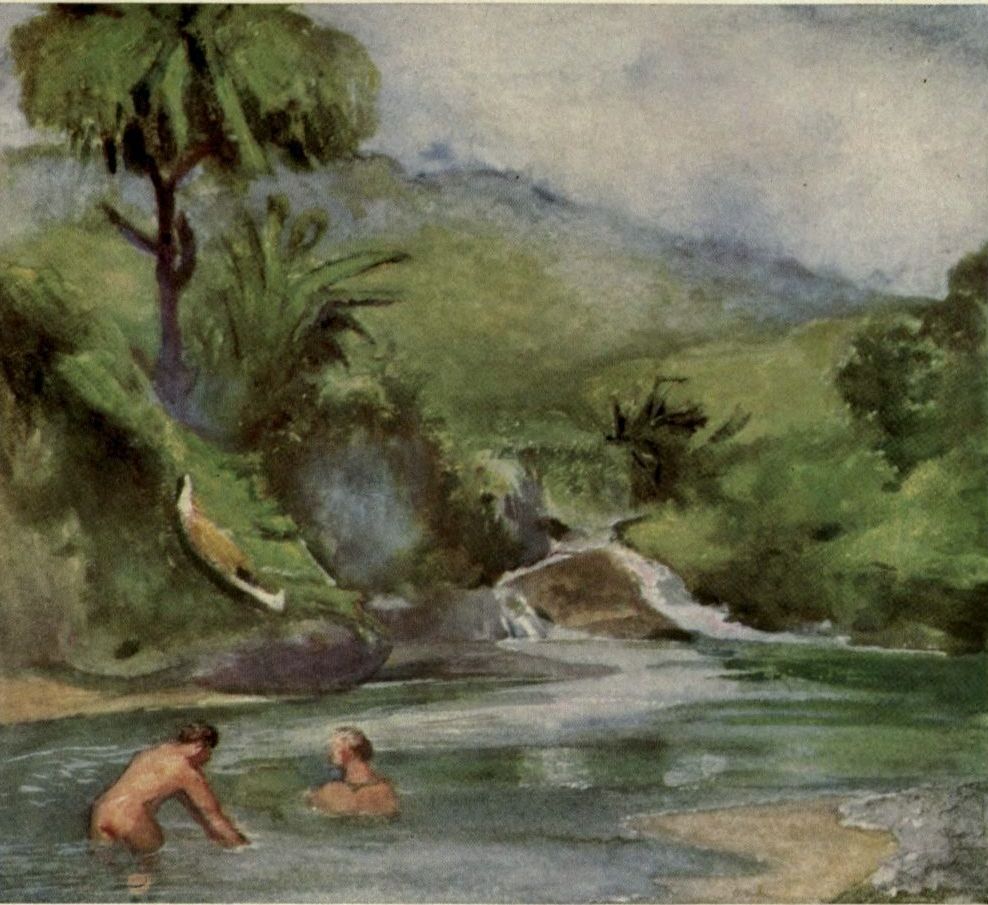
the same little path, I suppose toward the bathing pool, or spring, or
rivulet of fresh water, that might be in the hollow.
And there came up to the house Uatea, the “Chiefess,” looking just the
same, and appeared to understand that we were for a bath, as she made
the motions of washing her chest. We went to the sea, finding no good
place for a bath—it was evidently far off—and I take it that they
bathe in fresh water—the luxury of hot climates. For they all seemed to
be extremely clean and neat, from the men whom I had first seen at sea,
to the girls with limbs rubbed with cocoanut-oil and smelling of the
aromatic fruit (the pandanus) that their garlands were made of. Our bath
was not a full success—we dared not go out into the surf that rolled
turbid waves upon the deep, black volcanic sand of the beach; but the
water was warm and soothing, and as I began putting on my clothes, a
tall girl of the preceding night came up and sat down beside me on the
rock, with an evident seeking for an interview. Notwithstanding my
unaccustomed embarrassment, I managed to make out that she was uncertain
and perplexed as to the legality of her capture of my handkerchief the
night before, and though I told her to keep it, she was still doubtful.
Uatea had had one; was she to have the same as Uatea? At last she left
me, reassured—I had no more interest—and I saw her go along the shore
passing far off the better bathing
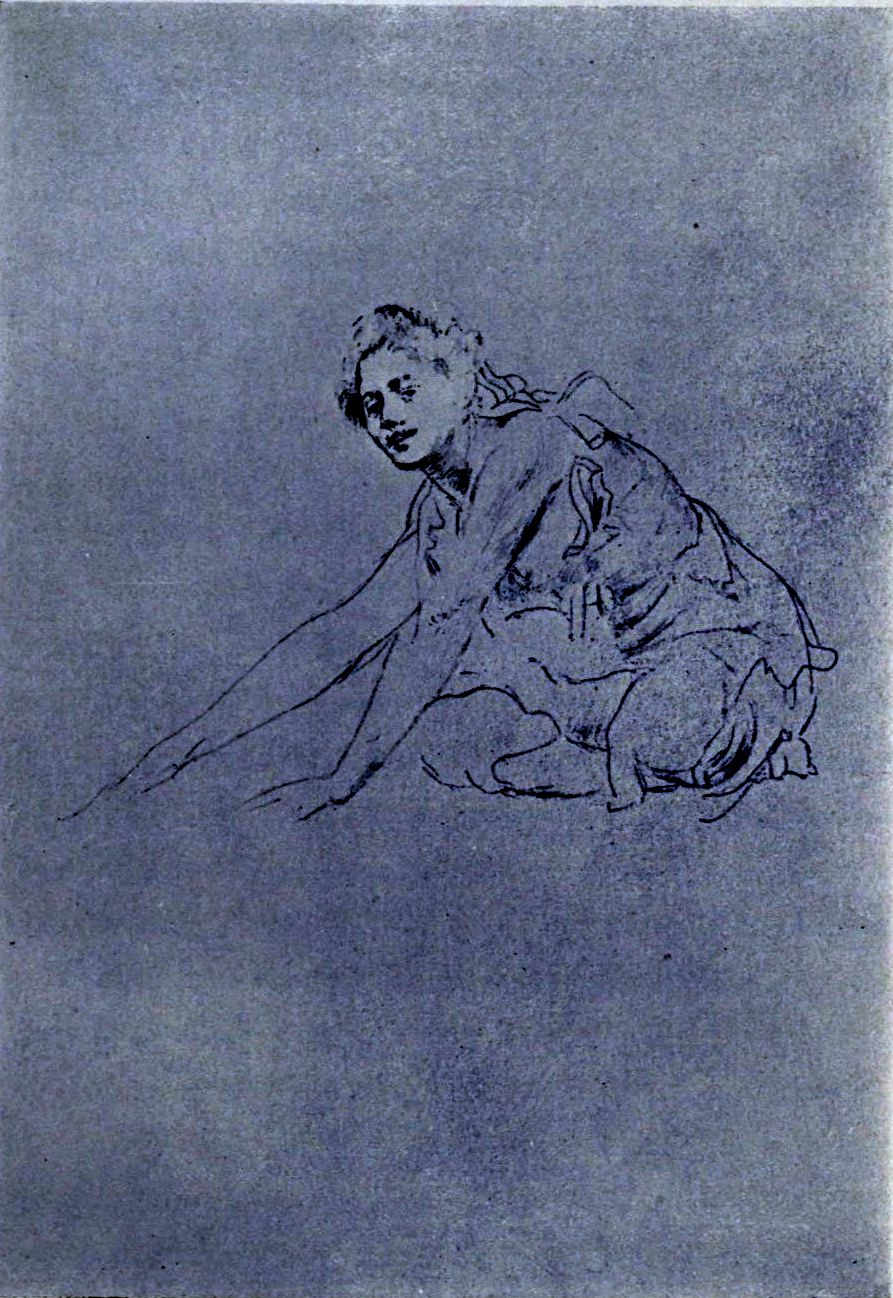 UATEA DANCING THE SITTING SIVA
spot of fresh water, and then disappearing behind distant palms.
Breakfast was ready when we reappeared; after us Uatea ate and drank our
tea, and wondered at our use of “tea-balls.” The captain explained that
there might be wind enough “now and again,” and that any moment ought to
see us off. Sifá and Tuvále gathered about Adams; I smoked my last
cigar, for all with our other tobacco were gone—while Uatea asked
coldly what I had done with the ring she gave me, as it was no longer on
my finger. More and more she withdrew into herself, more and more the
“Chiefess” looked as if expecting or anxious or troubled, as to whether
an equivalent would be serious enough. But we gave the largest sum that
the captain dared to hint at—anything would have seemed cheap. The
night before I could understand the throwing of jewels; of money, of
any reward to express thankful admiration. The “Chiefess” extended a
languid hand—her eyebrows rose, a short “f’tai” dropped, as if
obligatory from her lips—(the proper form I knew already was
“faafe’tai”)—she gave us her hand with a frigid “alofa,” and with
Sifá and Tuvále lingering, we walked to our boat. Long after we had set
sail we could see them wave their drapery as good-bye. Far off, along
the beach, from the hut of the tall girl-thief, my own handkerchief was
waved—but even with the glass I saw no more of Uatea.
Peace to thee, O soul of the “virgin of the village,” if I have made
thee but a thrifty prima donna, or like the King Solomon of Djami, the
Persian poet, caring only for realities that pay—it is the part of
those born to be rulers.
And now we had pulled out of the breakers, through the narrowest of
openings, and were on board the little schooner; the great blue sapphire
waves lifted us and sank us, and came up against the blue horizon, or
against the tall green cliffs; and once more we saw, in the hollow of
the sea, or lifted against the sky, the native boat pushed on by
rhythmic paddles, making a red line of naked men against the blue of the
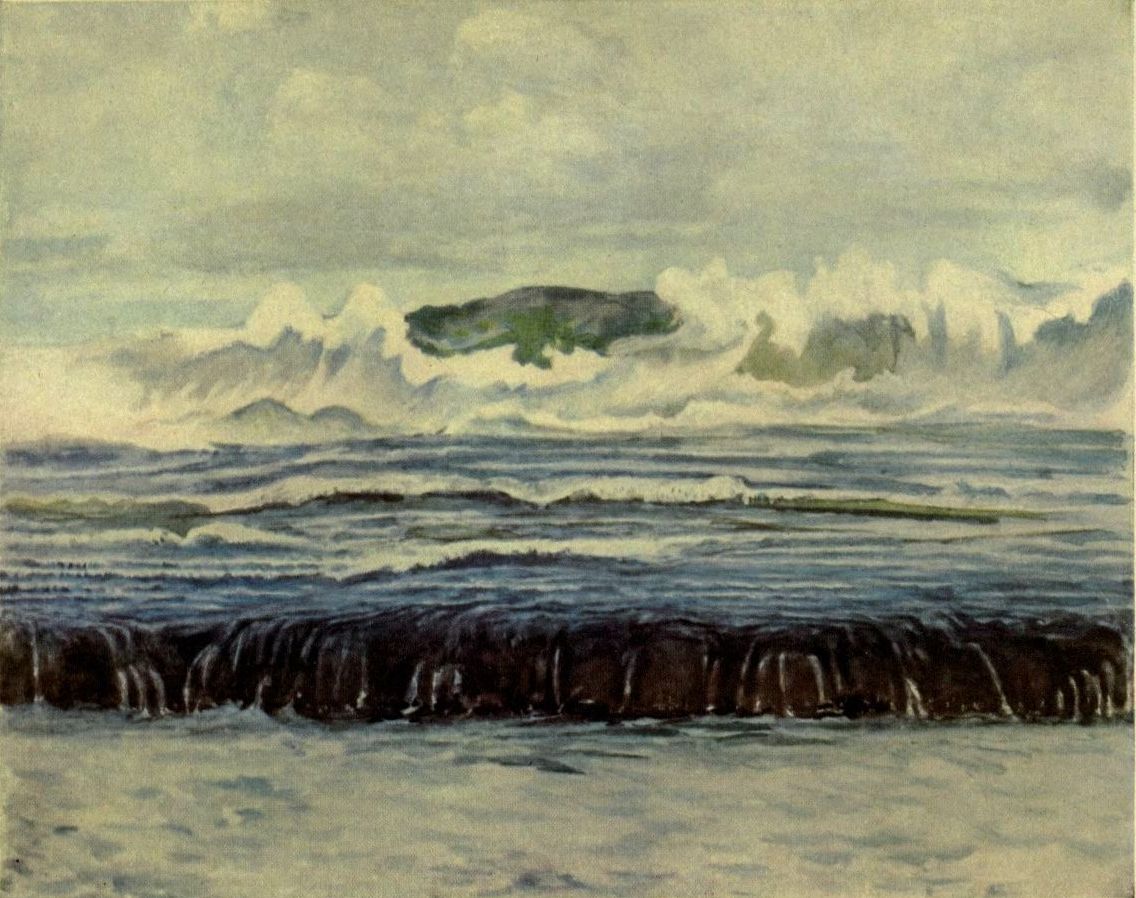
sea or the blue of the sky. We have been four hours and a half beating
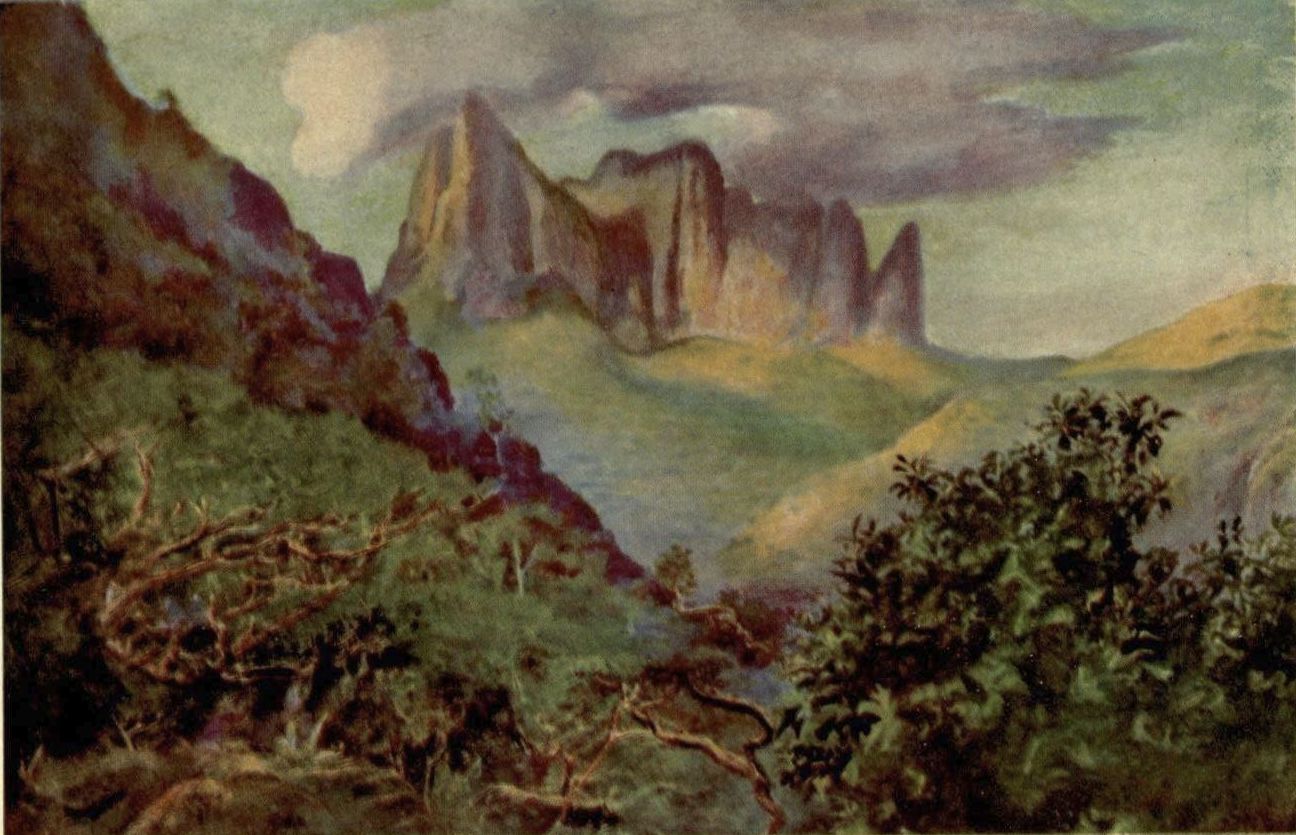
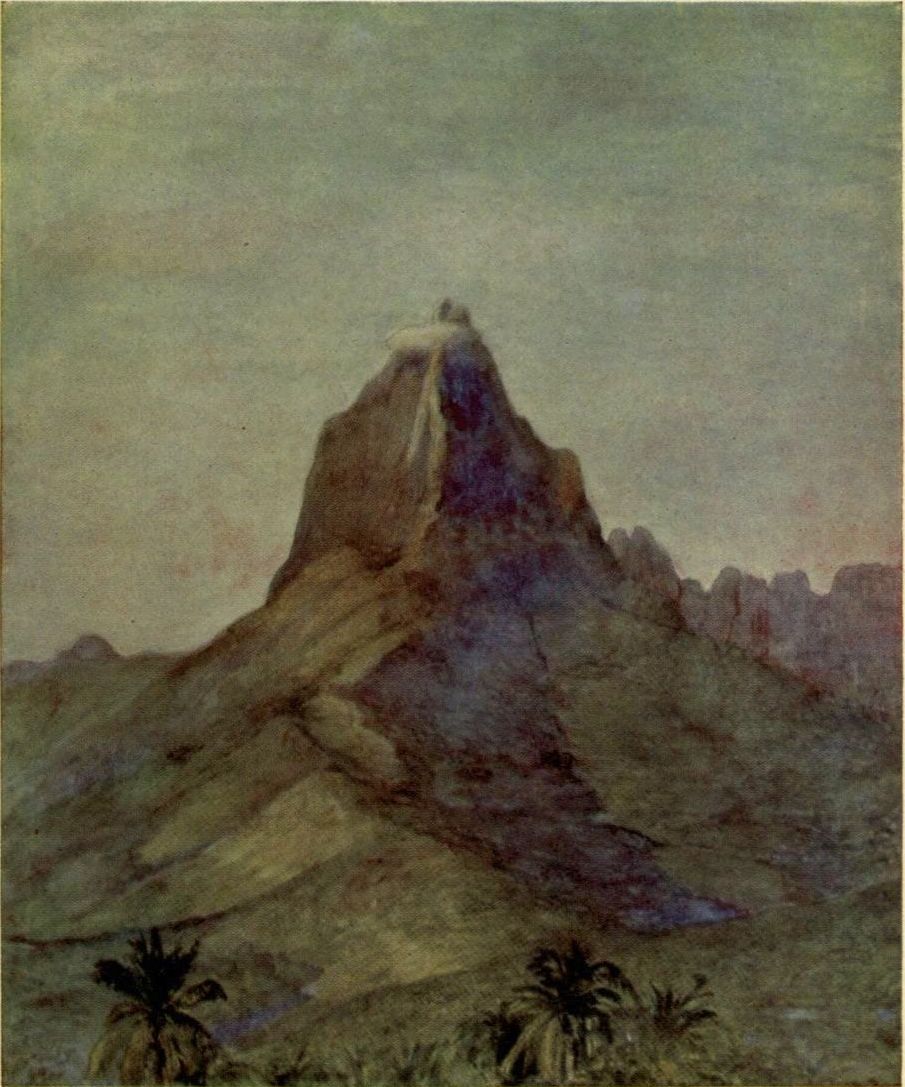
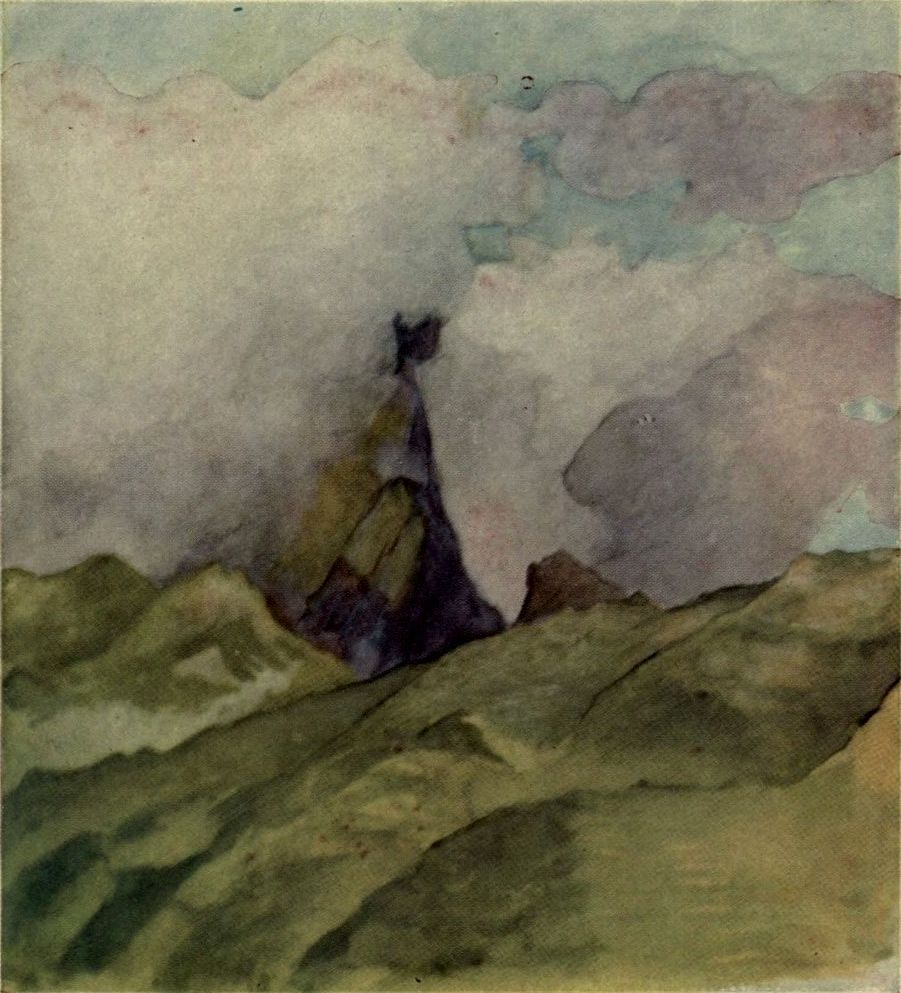
out of this little cove, and have just rounded the isolated rock of the
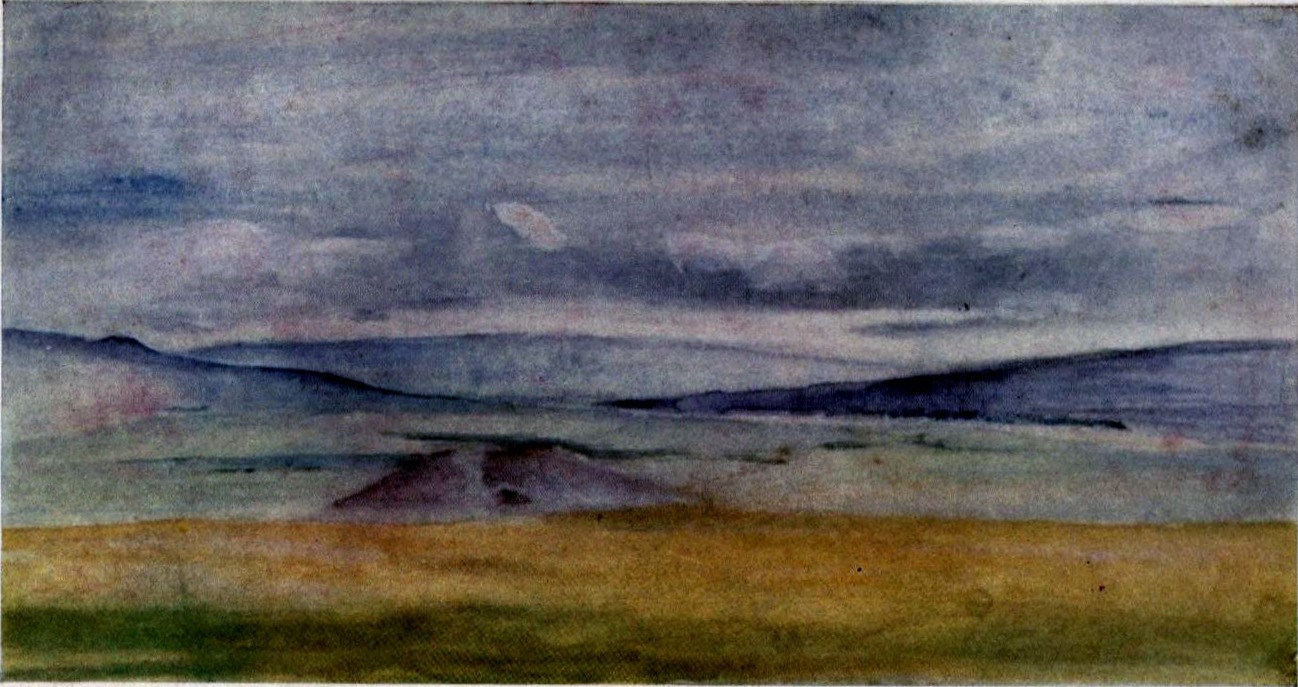
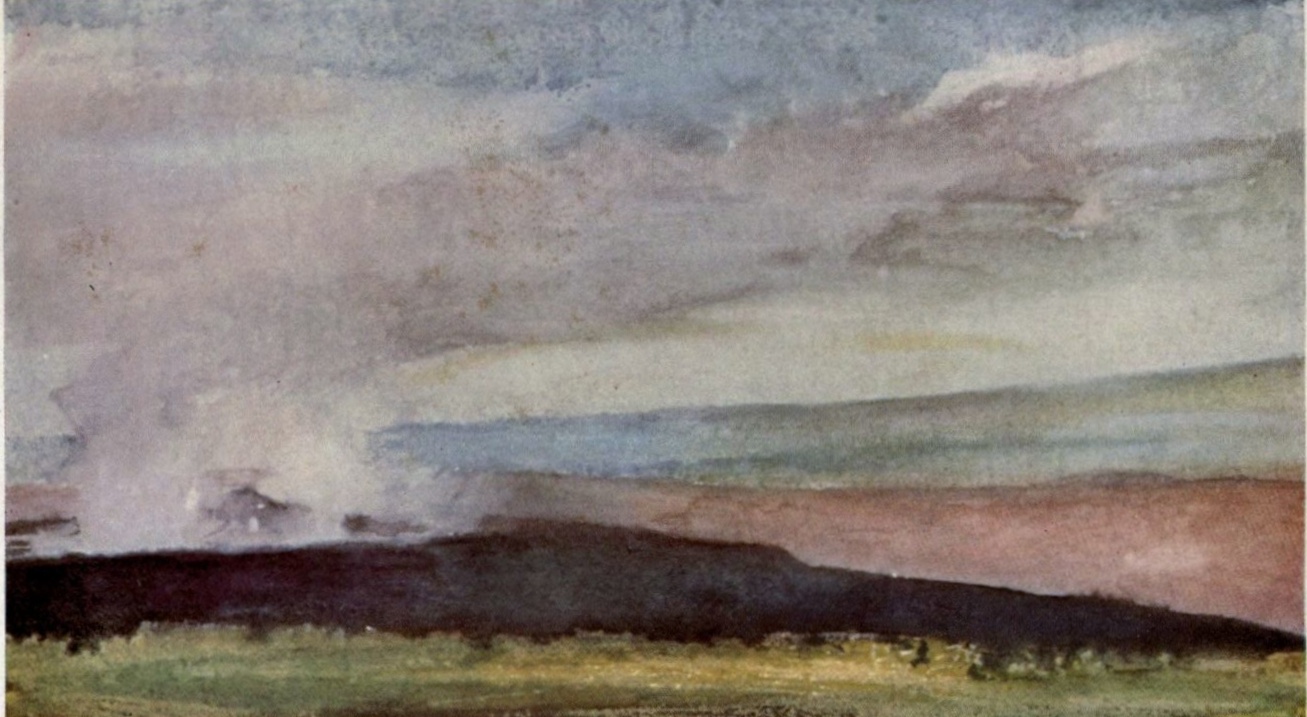
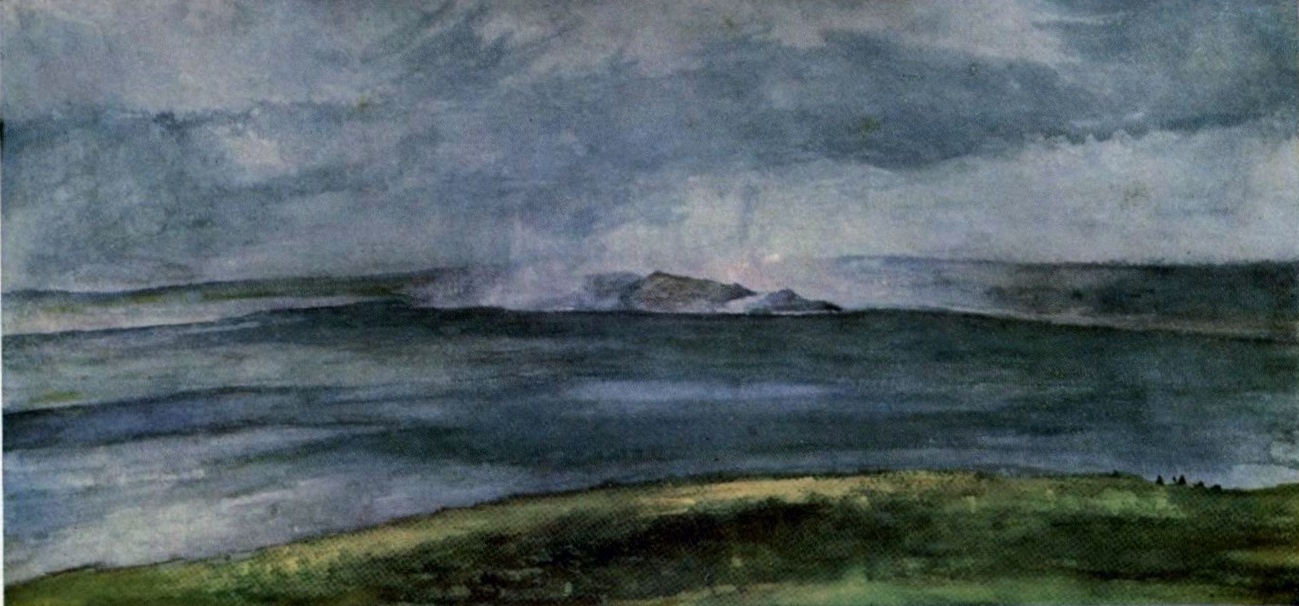
cape, of which I send you a sketch. If I could only send you the
colour!—blue and green—a little red and black in the rocks—the white
and violet haze of the surf; all as if elementary, but in a tone that no
painter has yet attempted, and that no painter that I know of would be
sure of; the blue and green that belongs to the classics; that is
painted in lines of Homer; that Titian guessed at, once, under a darker
sky; and far off the long sway and cadence of the surf like the movement
of ancient verse—the music of the Odyssey. We are off some little
village on the shore; the boat has gone to get other passengers, while
I try to finish this account of our first day on land in the South Seas,
and to make it live for you by long accumulation of detail. If, through
it all, you can gather my impression, can see something of an old
beauty, always known, in these new pictures, you will understand why the
Greek Homer is in my mind; all Greece, the poetry of form and colour
that comes from her, as well as her habits; just as the Samoan youngster
who rose shining from the sea to meet us, all brown and red, with a red
hibiscus fastened in his hair by a grass knot as beautiful as any carved
ornament, was the Bacchus of Tintoretto’s picture, making offering to
Ariadne. The good people of the steamer may not have seen it, nor the
big white English girl who bought some trifle from him—but it is all
here for me—and there will soon come a day when even for those who
care, it will be no more; when nowhere on earth or at sea will there be
any living proof that Greek art is not all the invention of the
poet—the mere refuge of the artist in his disdain of the ugly in life.
What I have just seen is already to me almost a dream. So I turn to my
Japanese, Awoki, and ask him—“It was like the studio, Awoki, was it
not? but all fine; no need of posing?” And Awoki says “Yes,” whether he
understands me or not, and I think of you and of the enclosed studio
life that tries to make a little momentary visitation of this reality.
The fitness and close relation of all I have seen makes a something like
what we strive to get through art, and my mind turns toward the old
question, “How does what we call art begin?” These people make little;
the house, the elementary patches upon their bark cloth, the choice of a
fine form for tombs, is all the art that is exterior of themselves and
of their movements, into which last they have put the feeling for
completeness and relation, that makes the love of art.
Is it necessary for going further that some one should be born, to whom,
gradually, an unwillingness to assume the responsibility of action,
which the ruler and the priest take willingly, should grow into a
dislike of the injustice of power, and a distrust of the truthfulness of
creeds, so that he must make a world for himself, unstained and free
from guilt or guile? I have begun to imagine for myself some such soul,
born in early communities, who might have lived long ago anywhere and
have been the hero of some such primitive obscure conflict; but I can
see tossing on blue waves, the boat that brings from the shore our new
companions, Lieutenant Parker and Consul-General Sewall, who have been
on a visit to the harbour of Pango Pango—and in a few minutes they and
their white coats will be aboard.
You will by this time wish to know how we are living. We are settled
definitely, for headquarters, at Vaiala, a little way from Apia, from
which a little river separates our part of the land. Further on, another
small river closes out the territory, and separates us from Apia.
The small river that separates us from the beginnings of the village
capital, Apia, is spanned by a little bridge—little because consisting
of a few planks, and a handrail to one side, but otherwise a very long
gangway. This I believe is kept in repair by the municipality of Apia,
and is probably the cause of much discussion in the way of spending
money. Occasionally it is washed away, and then we swim our horses
across, to the discomfort of my best yellow boots, which I feel are a
distinctive mark in my visits to people in Apia. At times the
municipality provides a ferry-boat. This so far has been manned by one
of those convicts who are puzzles in South Sea economics. He had been
taken away from some other chores of supposed hard work. After the first
day of ferrying, which was productive of various small trips, this
criminal had fallen back on the customs of his country, and on that
essential communism which is the basis of their actions and of much of
their thinking. He had a hut erected for him, so as to rest in the
shade, and there he spent most of his time consuming bananas or
accidental gifts of food, and courted and caressed by village maidens,
who adorned him with flowers and anointed him with cocoanut oil.
Meanwhile the smaller and less important members of his family did the
work of ferrying in the sun. It was all the same, he was vicariously
being punished. This is the keynote of all I shall ever tell you here.
There is the tendency to let not only property remain undivided, but
also injury or gain. A little anecdote told me by a clergyman, who had
it from a friend in Fiji, where things are still more so, gives this
intellectual position. The Fiji clergyman had been shocked at a horror
perpetrated by some of his parishioners. The dog of some person in a
neighbouring village had been killed; some of the aggrieved had sallied
forth, and meeting some person who belonged to the village guilty of
holding the dog murderer, had thereupon incontinently killed him. An
“old hand,” that is to say, a white man conversant with South Sea
habits, explained to the clergyman the naturalness of the deed. He
said—forgive the vernacular—“See here; if Jim and me gets into a
fight, and Jim plunks me in the head, I don’t wait till I can get in a
blow at Jim’s head: I hit him where I can.” One community had lost a dog
and the other had lost a man. This is a dreadful example of the idea,
and I almost regret introducing it into my description of this idyllic
passage of my life. But we are on the road to Apia, which, like all
white men’s places in such countries, has a taint of brutality remaining
from the day of the beachcomber.
It is an orderly little place strung along what might be called a street
or two, the main one of which is on the beach, and goes by that name.
There are stores, a few hotels and drinking places, warehouses and
residences of the consuls, and further on native residences, etc. There
are churches too, and a Catholic cathedral of somewhat imposing
dimensions; but the churches are those of an ugly village, and no longer
have that natural look of the church by our own village of Vaiala, for
instance, which has really a character not contradictory to its
surroundings.
Further back and right and left all is Samoan and native. We are just by
the shore, here fringed with trees and palms, and only some six feet
above the inland sea of the reef that spreads right and left before us.
In the few great storms that have come upon us in the night, it was not
difficult to imagine the beating of the rain against the door of our
sleeping house to be the first splashing of some great waves passing
over with the roar of the surf outside.
From under the shadows of trees, I see canoes pass close to the shore,
visible at intervals between the trees that border it; they seem, like
all that happens about us, part of a theatre scene: red bodies glisten
in white or coloured drapery, adorned by flowers and leafage; and songs
are carried along with the stroke of the paddles, as in an ideal opera.
Blue sea outside; green inside.
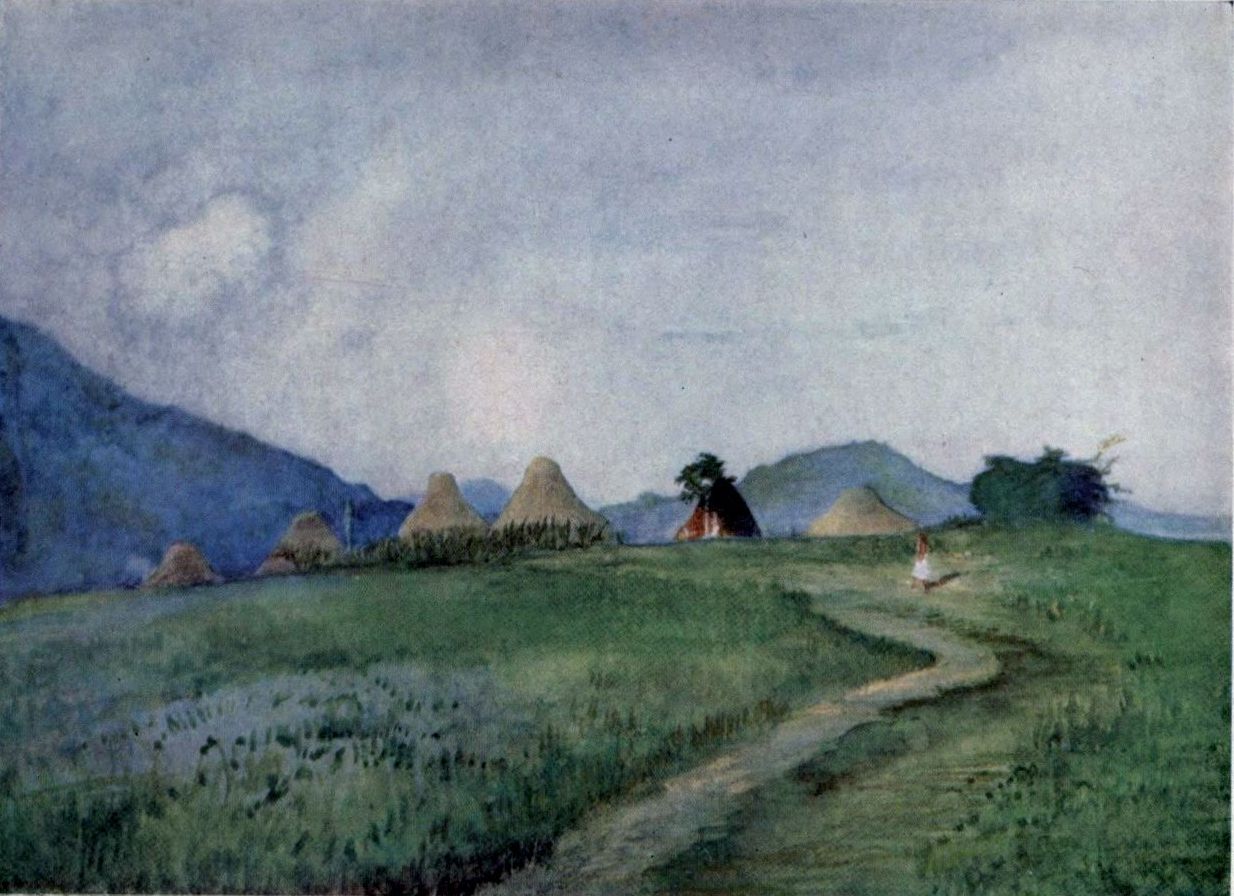
The little village stretches along a very short distance, apparently not
made of more than a couple of dozen of huts or Samoan houses, with a
double village green, here and there planted with trees and broken into
and backed on the shore side by plantations of bananas.
Further back the mysterious “bush,” into which I have not yet wandered.
Just outside, near the shore, and with a little garden, the Consul has
built a new and commodious southern house, with enormous verandas,
dropped like a piece of Europe among the native forms; there we
breakfast and dine; while in the village a few yards off we have
borrowed a large, comfortable hut,[2] in which we spend the day,
receiving visitors, writing, or painting,[3] and at night we occupy a
little building of our own European kind, with just place for our two
rooms and beds. It is next to Tofae, the chief’s hut; so that we are
both physically and morally under Tofae’s protection. This we insist
upon; we are no strangers gadding about, we are chiefs on a visit, and
we appeal to the care of our fellows responsible for us. So that doors
and trunks and boxes are all open; every one is free to inspect and
responsible to the
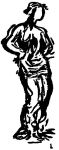
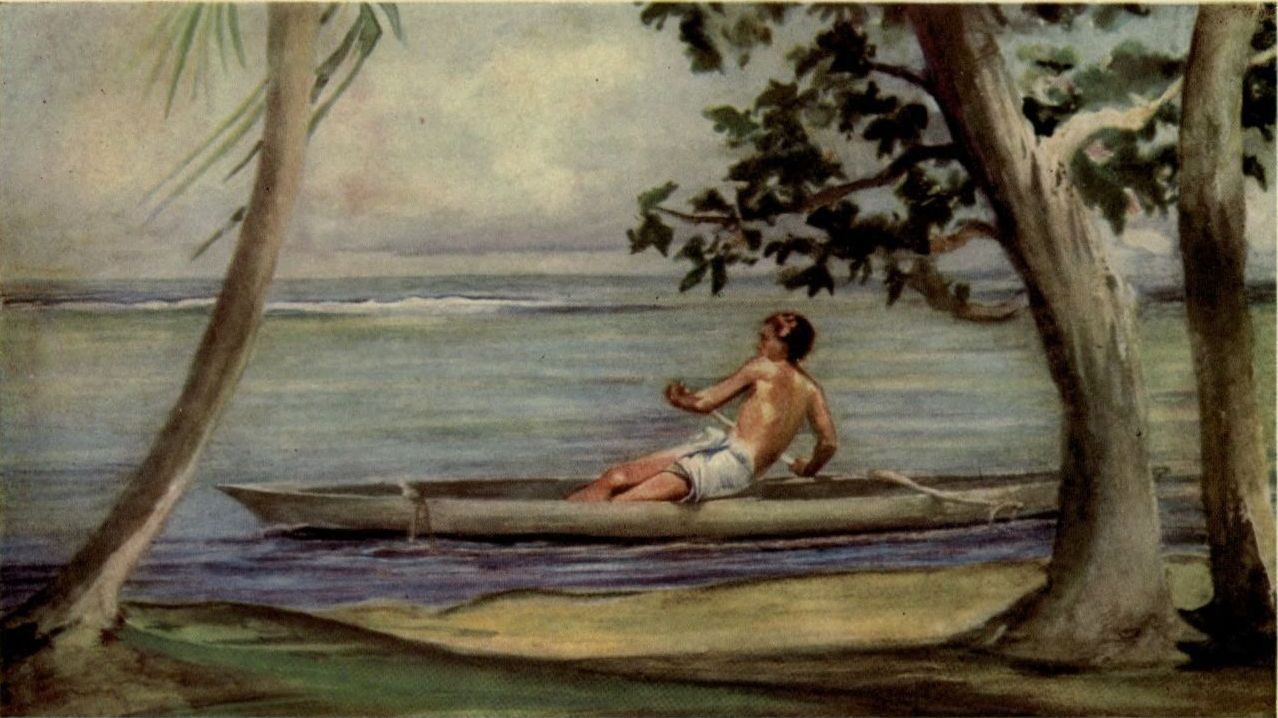 BOY IN CANOE PASSING IN FRONT OF OUR HOUSE. VAIALA,
SAMOA
chief. Even very lately, when the criminal—the prisoner condemned for
stealing the consular flag halyards—who is imprisoned by being detained
within the half mile of the village, and who is under Tofae’s
wardship—even when this confirmed bad man is found looking through all
my property, from sketch-books to night pajamas, I feel quite safe that
nothing will be missed through him. Only two silk handerchiefs have
disappeared since I have been on the island, and I can’t be sure whether
they were lost here or in some of our long trips by sea and land. But
Tofae takes the fact to heart, and will, I know, make me some present
many times more valuable, to wipe out this possible blot upon the
escutcheon.
At the earliest dawn there is motion in the village that I do not hear.
The soft grass, cleanly trimmed, which covers all the village space,
brings no echo from bare feet. But from the very first morning on the
small verandah, no bigger than a large table, I hear a patter of feet
that wakens me. If I look out, one or more of the girls of the village,
our nearest neighbours, is seated there in a corner, ready to bid good
morning, and looking occasionally into the open window, to see if I am
still abed! Sometimes their shadows, as they pass, break the half light
which keeps me in a doze.
When I rise I have to get accustomed to the mild curiosity that inquires
after my mode of dressing. Still, as days go on, I become less the
fashion, and can go out to my bath, in my Japanese gown, without
stepping over a côterie of gentle maidens. If I get up with the dawn,
that slowly lights up the great spaces above the trees, I can see first
some figures pushing back the mats that form the only walls of the
surrounding huts, stretching their arms, then perhaps, in their simplest
wraps, fading away in the uncertain light! They are going to the
obligatory bath; not to the salt water in front of us, which they do not
look upon as cleansing, but to pools back in the bush, or the little
river further off.
With the first half-sleepy motion begins the weeding around the huts, a
perpetual task carried on at all odd times. For among these savages, so
far as they are not spoiled by the European, the lawn and greenery about
the village are tended with extreme care. Many a time, in places that
are far away and more strictly barbarous, I have been reminded of the
neatest Newport lawns. This is one of the unexpected charms, one of the
many things that give everything a look difficult to explain, a look of
elegance in the wildness. But we must remember that these good people
have always been here, that from immemorial time they have tended what
seems to us accidental nature; culture and care and the tropical wild
growths are constantly interchanged. That is the South Sea note.
Later on I see some of the men return from their short hour’s work at
their wet patches of the taro plant, which, with the bread-fruit,
represents the staples of bread and cereals both. In this kindly nature,
such culture is no more than a gentle exercise. I see even the great
Mataafa, the rival of the King Malietoa, and the greatest personage of
all islands, returning from his daily task like any commoner, often
stripped to the waist, wearing nothing but the wrap along the loins and
legs, which they call the lava-lava.
After our morning coffee, made of the island bean whenever we are
fortunate enough to get it, for we find it better than any brought from
Java, we adjourn with the first heat of the early morning to our big
Samoan hut. This is next to Mataafa’s, in the centre of the village. By
this time most of our neighbours have begun to rest, and will keep
steadily quiet for a large part of the day; unless they visit, or unless
some special duty calls.
If we are very early, we may still find in our Samoan hut our pretty
friend Fangalo, who lives with our neighbours nearer Apia, and whose
simple task it is to place flowers about the tables upon which we write
or paint, or upon the shelf that connects the great centre posts of the
hut, where hang the cocoanut water bottles, and are placed the rolls of
native cloth, or extra mats for softer resting.
Taēlē, which means bath, the gentle sister of our landlord, if I can so
call him, has already seen that everything is in order, and all the mats
that cover the pebble floor are properly disposed. Taēlē wishes good
morning, and leaves fruit as presents and hangs the great branches of
yellow or green bananas. She stays but little, even when pressed, though
she is curious as to why we write so much and what we mean in general.
She does not quite approve of us; we ask strange questions: we are not
preachers—we are seen writing on Sundays: we are not looking for wives.
We may be aitu—spirits in disguise.
Taēlē’s sweet face is always sad—exceptionally so here where good
nature marks most young faces. In that she is not Samoan nor properly
Polynesian. But she has gone through much. She was the Samoan wife of
the former British consul, Churchward, who left her with her little boy
when he was promoted to other appointments. Not that she would have gone
with him, I think: the Polynesian rarely understands living anywhere
else than in his islands—his own island makes the world. Here Taēlē
sits on some rock-edge by the water, and looks out to the far-off sea. I
see her so almost every evening.
According to true Polynesian habits, the little child has been adopted
by our chief, Tofae, who is devoted to him and allows him great
liberties. So that Taēlē has no practical trouble about little George,
who lives Samoan way, and, a son of chiefs by birth and adoption,
bullies the less important babies.
The other girls, who come in often to see us, and who are occasionally
encouraged by little amenities and presents, are not at all sad. Otaota,
the daughter of the preacher, who is himself of sacred descent, if I may
so explain it, is not even over-bashful, to the great scandal of Taēlē,
who is nothing if not Sunday school. She is willing to pose for her
portrait without her upper wraps, though she is no longer the exquisite
brown statue that she must have been two years ago. But Otaota is a
young woman of the world, and who knows?—perhaps these strangers may be
serious in their attentions.
Important people, of course, come in to see us, but more frequently in
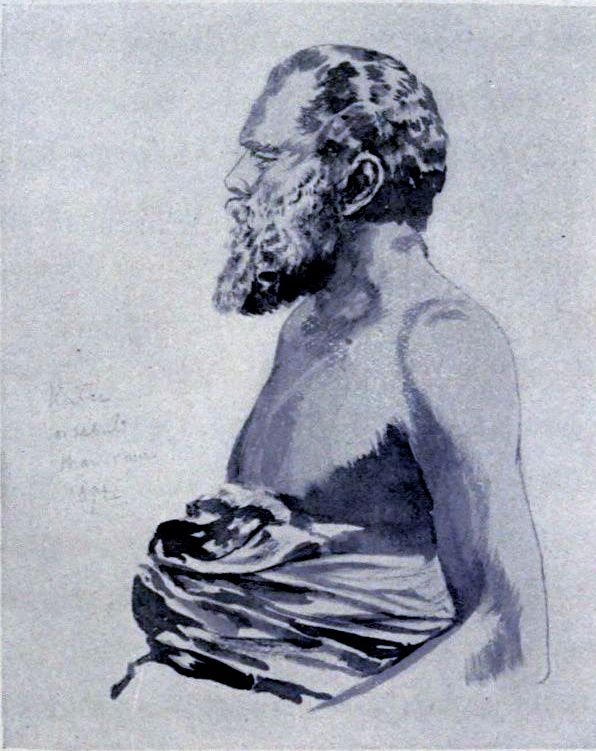
the afternoon. Of chiefs there are many about us, and Patu, Tofae’s
brother, is a great chief and has been a great warrior; so that I am not
surprised at his curious resemblance to General Sherman.
From all these good people my companion, and I also in a small way,
obtain slowly, by driblets, the explanation of what they really are.
Slowly they unfold the extraordinary differences which make their ways
always misfit ours! Their social words have really no equivalent in
ours; their ideas remain a puzzle to whomsoever insists upon our having
a common basis to start from.
I have forgotten to describe what the Samoan hut, called the Samoan
house, is like. Ours is a handsome one, not exactly the finest, but
still very well built. Its plan is a long oval. Its length is not far
from fifty feet; its greatest height something like twenty. It is set
upon a foundation of stones, and its flooring of fine pebbles is only
raised a few inches above the ground, which slopes in all directions
from it. It is made of a series of high posts placed at considerable
distances from each other, in the shape of an ellipse. They are
connected at the top by a series of double beams, which receive great
rafters running from every set of posts to the peaked centre. These
rafters are connected by other great rafters and tie beams. At the
centre they are supported by two or more great pillars, which at
intervals are braced together. Beside these pillars, in the direction of
each end of the house, are two holes in the ground; made to receive the
cocoanut fire used for lighting, or for the slight warmth that is
occasionally needed. Walls there are none in the true Samoan house. Mats
of the cocoanut leaf hang from the cross-beams, between the posts, to
the floor, or rather to the edge of large stones that make a sort of rim
to the building, and serve to steady the posts and keep off the wash of
the rain. In certain very elegant buildings some of these openings,
instead of being filled with these movable mats that are pulled up or
down for protection from light or rain, are enclosed by a fine wattling.
It is a manner of limiting the numbers of entrances, which otherwise,
you see, would be a little everywhere.
In such a residence as that of Mataafa, a great man, a sovereign prince
and sacred personage, no one would think of entering otherwise than at
some defined place.
For the furniture of our residence and that of other people, mats of
different degrees of fineness are spread upon the small fine pebbles
that make the floor. If we want great elegance and great comfort, we put
on more and finer mats. Some of the furniture lies about; some of it
consists in the Samoan pillow, a long bamboo, supported at the ends by
four little sticks. There are also boxes in which clothes are put away.
There are large rolls of native cloth called tappa. Some of it is made
up into curtains to be used as screens and partitions. Sometimes, but
not in our hut, these curtains are made into indoor tents for keeping
off the mosquitoes, and, otherwise, increasing privacy. All these things
are stowed away among the rafters, or upon the sticks curved like tusks,
which project beyond the centre posts and serve to brace them.
For our European habits we have two tables and three chairs. Most of
the day when we are idle we sit on the mats with our guests. But working
is better done at the accustomed table.
Toward noontime we hear violent and savage shouts, and see through the
square opening of the lifted mats three or four brown savages, with big
girdles of green leaves and crowns of verdure, come running and dancing
to us from Mataafa’s house, which is only a few yards away. They carry a
big wooden bowl, partly filled with crushed cocoanut and arrowroot, and
some big bread-fruits. They sit down on the edge of our outside stones,
and proceed to break the bread-fruit, steaming hot, with great force and
violence, holding it by the stem, pounding it and mashing it into the
cocoanut milk. This quivering pudding, palusami, is then neatly
dropped upon banana leaves, made into little packages, and tendered to
us with the respects of Mataafa. Sometimes we eat, sometimes we
distribute to more Samoan-minded people; but for the first few times it
is very nice. I like it better than the raw fish and salt water, which
is pleasant also occasionally, though apparently more suited to the
habits of that ancestral totem, the shark. But tastes and habits differ,
and the Samoan language, extraordinarily rich in words that describe
physical sensations, has a special word for that state of weakness and
languor wherein such a dish as raw fish is all that the invalid can
tolerate.
Mataafa sometimes calls at this hour, sometimes a little earlier, on his
return from church, if it be a holy day: for Mataafa is very strict in
religious duty. But usually he has chosen the afternoon. He speaks no
English, and we have varying interpreters; but still, owing in part to
his kindness and courtesy, we have learned a great deal from him. He is
not so easily questioned as an inferior might be. When Tofae’s tall
daughter is called in hurriedly to help out, because we have not had
sufficient warning (Tofae’s daughter, who fears no man, whose neck
carries her head as a column does a capital), she interprets with
extreme respect and reticence, as it were, “by your leave,” bending her
head, looking only sidewise at the great chief, holding her breath when
she speaks to him, and almost whispering. Every phrase is prefaced with
“The King says,” all of which gives us the measure of proper respect,
but does not hasten the conversation.
Mataafa is not interested in facts as mere curiosities. I doubt if he
would approve of my interest in most things, if he could guess it.
Information with regard to the world abroad he cares for only as it
affects Samoa—that is to say, in conversation with us. He would like to
know that we have some messages of advantage to his country. It has
taken a long time to make him sympathize with our questionings about
Samoan ways and manners and their origins, which involve, of course,
history and social law. And yet if he could appreciate it, in that way
we get at an understanding of what he is, and of the difficulties that
beset him!
With such talk, much desultoriness, sketching, writing, smoking, and
eating of bananas, a length of which hangs from a beam above, the heat
of the afternoon passes away. The shadows begin to fall across the
malae or village green. The villagers come out and wander about
socially, attend to little matters, or sit here and there in favourite
corners. Weeding goes on with the more orderly housewives, who keep an
eye meanwhile upon the children wandering about. A good many domestic
interests receive attention. Sometimes, under the bananas and orange
trees behind my house, I see hair-dressing, a serious and difficult
operation. The pleasure of the Samoans in turning their beautiful black
hair to brown or yellow or auburn, necessitates a peculiar process which
is also extremely curious to the eye. For this they use coral lime,
plastered upon the hair and remaining there a couple of days or more; so
that they go about with white hair, like people of the last century.
Tofae’s daughter is charming, with her hair all of this silver-grey and
big crimson flowers in it. It sets out a certain nobility of feature,
and is, like powder, aristocratic in its very nature. The rather heavy
faces become either stronger or more refined. Each young man has some
female who especially understands just how to fashion his hair into
certain curls and twists, which are retained during a week or so; for
the operation answers all the purposes of curling besides, and of
cleaning absolutely. When this application is brushed away the curls
will remain; but meanwhile, as he sits with his head bent way down and
the lady lathering it, he has that woebegone, submissive look that we
see in the barber shop.
Our good people are passionately fond of adorning their persons with
flowers and leafage: flowers about the waist, flowers about the neck,
flowers and leaves in the hair. Every little while I see rearrangements
which make, as it were, a form of conversation. The steps of my house
offer a convenient seat for just the proper number of persons. So that
as soon as the shade comes down, some girl is seated there with some
youngster, and they rearrange each other’s flowers. A flower behind the
ear means a “going of courting” or readiness that way.
In little separate houses the cooking for the evening meal begins. This
separation of the household work from the residence or living apartments
is a little elegance and refinement which does a great deal to keep up
the charm and holiday look of life about us. When, however, great meals
are to be prepared, I hear considerable noise on the outskirts of the
village, the chasing of hens, whose eggs, by the by, are, as you may
imagine, difficult to obtain, as the hens have the surrounding tropical
scenery of the bush to lay in. Owing to the scurry after the hens, the
only place that seemed safe to them was my apartment; and my open trunks
were very good places to look into for possible eggs.
The cooking of any importance, as you probably know, is a method of
baking in the earth: stones heated by fire, in a trench upon which
leaves are placed, and then the food, wrapped in more leaves, is placed
upon them and covered up with twigs, branches and earth. After a
skilfully prolonged residence in the earth, the mound is opened, and the
food is found cooked. With fish the results are certainly excellent; but
vegetables and meats are often a little raw.
It seems marvellous that the brown Polynesian, apparently a member of
the great “Aryan” race, intelligent, often adventurous, has never been
willing, when his race was pure, to invent such a thing as a pot to hold
hot water, even when clay was all about him. He knew that in far-off
islands, from which occasionally came invaders or returning adventurers,
there was such a thing as pottery; yet he preferred, as he does to-day,
to import a few specimens, rather than spend a few moments in starting
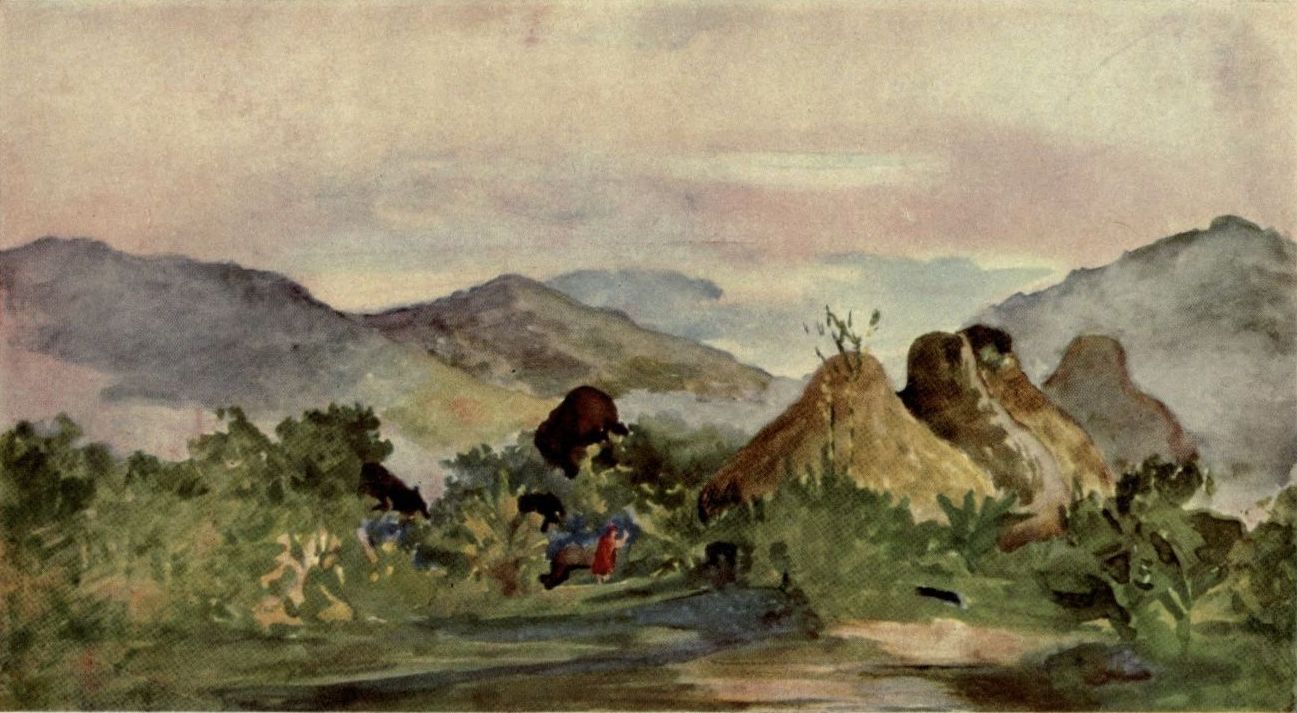
this, to us, necessary beginning of what
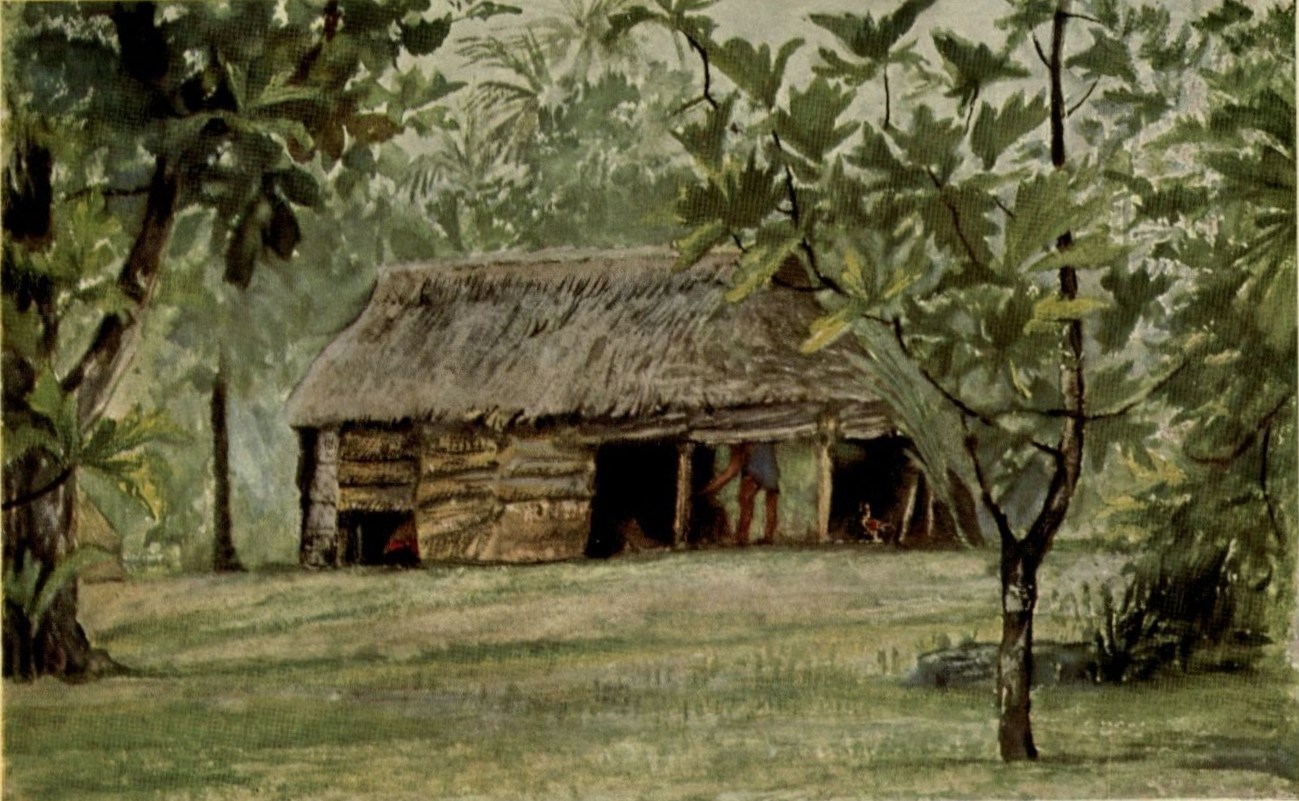 MATAAFA’S COOK HOUSE. FROM OUR HUT AT VAIALA, SAMOA
scientific men call the passage from savagery to barbaric life. You will
remember that with us one of the present definitions of the savage is
that he does not make pottery, nor know the bow and arrow. Well: the
higher Polynesian never used pottery, and used the bow and arrow, one of
the most deadly of weapons, only to shoot for amusement at the forest
rat. This violation of certain rules of the game of science is one of
the most amusing fragments of contradiction that one meets. When we came
to other islands, where there is a mixture of what we deem a lower
race—the Papuan, negro or black, we find pottery, the use of the bow,
intelligent fortification in war. And the beginnings of decorative art
are shown by a keener sense of colour and contrast of form. The high
Polynesian, who invariably invaded and defeated the mixed race superior
to him in these important details, and brought back the “stuff” has
lived with a sort of classic severity. Precedent is everything; new
patterns of ornament come in most slowly, and there is an apparent
indifference to the picturesque. But owing to this conservation such a
Bœotian set of islands as Samoa gives to the artist—the man who
remembers the beauty of classical representations, the only fit recall
of what he has seen in the Greek sculpture, the Pompeiian fresco and the
vases of antiquity.
The rather countrified good taste of these people leads them to simple
methods of dress and adornment, and to keeping the same unchangeable
except by small variations. There is nothing nearer to the drapery of
the Greek statue than the Samoan wrap of cloth or of tappa, which is
merely a long rectangle wrapped about the body, either as high as the
chest, like the cloak of the Greek orator, or merely around the waist
and thighs, always carefully arranged in special sets of folds which
designate both the sex and the social position of the wearer; with this
the wreaths and flower and leaf girdles and the anointed body, which
belong to our vague conception of the Greek and Roman past. There is
little more for war time; a great barbarous head-dress of hair, and
occasionally some neck ornament of wild beasts’ teeth.
In draperies such as I have described, in the shady afternoon, the
chiefs sit about the lawn of the village the malae or green in places
which I suppose are reserved to them by habit. They sit far apart; one
of the Samoan characteristics being the habit and the skill of
conversing distinctly without raising the voice, and of so speaking as
to be heard far off. The hereditary orators, the tulafales, who made
speeches to us in our wanderings, at the receptions given to us by the
villagers, invariably chose to speak at great distances. A couple of
hundred feet in the open air seemed to them a fair average. Their voices
were never raised above a certain modulation. In fact one imagined that
the next word would not be heard. But a peculiar inflection for each
sentence wherein the most important points are placed at the end, seemed
to force the sound upwards as the phrase dragged on. Seumanu our Apia
chief who acted as our tulafale, when we travelled, liked to repeat
“sotto voce” what the other tulafale was sure to say.
Our chiefs often drank their kava in these afternoon conversations.
Sometimes, but very rarely, it was made by the girls. Usually any young
men of the village, of refined dress and manners, were called upon to
serve. I have a vague recollection—though I may have heard it of some
other island, and may be confusing facts—that the ancient custom
allowed any man who wished his kava made to call upon the first young
woman who passed, no matter how high her rank might be; this of course
to be at his peril, like all society privileges. But however it may be,
almost invariably our own kava, that is to say the kava to which we
were treated, was made by the women.
You will remember that this was one of the very first of South Sea
habits that we came across on our very first day, in that other island
of Tutuila.
Kava, more properly ava, is the universal drink of all Polynesia.
Abolished by the missionary in many places, it still persists here.
Kava is a drink made by adding water to the crushed and pressed root
of a plant of the pepper family, the Piper Methysticum, which has a
narcotic power. Here in this nest of civilization the root is grated
upon an ordinary tin grater, before being put in the large, four-legged
wooden bowl, from which it is to be ladled in cocoanut cups, after water
has been properly added, and with a strainer of bark fibres, the
filaments and splinters have been removed.
But in certain far-away places, we have had the pleasure of drinking it
in the ancient and orthodox way preferred by all epicures. According to
this more aboriginal method, the kava root was chewed to a mass of
woody pulp, instead of being grated. Young ladies of great personal
delicacy were chosen for this purpose; but, there must have been many
occasions when one had not time to be fastidious. I cannot say that I
have noticed any advantage in the older form, and I am glad that all
about us it seems to be forgotten.
The entire preparation and serving of the drink makes a ceremonial form;
most absolute in detail and of hereditary and ancestral accuracy.[4] It
belongs to all receptions, and is the manner of showing the distinctions
of rank and precedence.
The gestures of the girls when they move their hands around in the water
of the bowl, so as to extract the essence of the root, are regulated by
long established custom, and are beautiful as the movements of a dance.
The handing of the strainer to another attendant, and her swinging it
out to cleanse it, make another series of most ravishing pictures.
Finally the third attendant sweeps an arm down with an empty bowl, and,
curving the wrist inward, brings it full to the most honoured guest, and
to the others in turn. With each handing the name of the guest is
announced.
Mataafa sometimes gives us kava, and occasionally has done us the
honour to come and drink it in our own hut. In that case he has his own
bowl, a most intimate and personal property, from which no one else must
drink; and with all courtesy he apologizes to us for this necessity of
position. For as he explains guardedly he is in some sense
sacred—having been a form of the divine. And he is the most religious
of men in our meanings.
In one princely place that we visited, in Savii, we found a lady who
occupied by ancestry the position of “kava divider”; that is to say
that it was her duty and privilege to determine the sequence in
presenting the cup according to dignity. And she appeared without
warning and claimed the right.
From this circle of the chiefs drinking kava on the green, even the
children know enough to keep away. Even the young man who hands the cups
is careful in his walk not to appear to turn his back to any one of the
chiefs. Respect for the chief is the basis of everything. It is probably
the foundation of their extreme courtesy, only broken by natural
exuberance, impatience, or simplicity. The chief was sacred, even in
war. It was a terrible thing for a commoner of the enemy to kill him. In
legends of Tahiti there are tales of how men deliberated whether they
were of high enough birth to take the life of a vanquished chieftain.
The very language indicates this division between class of the chief and
everything else outside. For the chief and everything relating to him
there is a special language. The chief’s head, the chief’s body and all
its parts, the chief’s food, all that he does, his feelings, his
possessions, his dog, his wife and her actions, even when she breaks the
Seventh Commandment, have special names. In many instances the common
name of a thing is changed for another when that thing is spoken of in
his presence. In some cases the particular grade of his rank is
indicated by the word used; so that you speak of a tulafale’s eating
as tausami; of a chief’s eating as taumafa; of such a chief as
Mataafa’s eating as taute. But it would not be polite of a chief to
use these words with reference to himself.
When passers-by draw toward the end of our village and reach the
highway in front of Mataafa’s hut, they keep to the further side of the
path, leaving as large a space as it is possible to make, out of respect
for the privileges of the chief of chiefs.
On all the fringes of the village, however, the children play quiet
games. Our spaces are too restricted for the young men to have their
games; but further down they collect at times to play, by throwing a
stick so as to make it touch the ground and skim along to the goal. So
with us there is very little. Occasionally some of the boys gallop
wildly up and down the beach; but there are very few horses in this
immediate neighbourhood at which we are not displeased, however
beautiful the sight may be, because they ride the horses too young, and
push them beyond their strength.
As the evening comes on the sun goes down rapidly, and the afterglow,
the most beautiful moment of the South Sea day, begins its long
continuance. The girls gather together or sit with the young men, either
on the grass or on little raised benches under trees, or very late again
on still smaller benches, holding at the most two people, which they
ingeniously fit between the divergent stems of the cocoanuts. This half
siesta, half conversazione, is carried on as long as there is light, and
if there be moonlight, through any number of hours that may escape the
darkness disliked by the Polynesian.
Our little friend Taēlē leaves her hut and sits far apart in her
accustomed place, all alone, immovable, looking toward the sea, thinking
perhaps; but how do I know?
Some of the little children, the little girls especially, repeat in a
small way the native songs and the native dance the siva. Sometimes a
bigger girl sketches out some steps for them; but we are extremely
proper in our village, and the siva, of which the Samoan is
passionately fond, is not looked upon with favour by the missionary or
the brown members of the church. However, we succeed now and then in
getting girls and young men from the neighbourhood, or passing villagers
and travellers, to favour us with this entertainment. The siva dances
about which I wrote you at length, upon the day of my arrival, are yet
to us always novel. By and by I suppose that they will be, like
everything else, accepted by us as an ordinary form of social
dissipation. But it is certainly worth coming all this way, even to see
one of them. The beautiful rhythm of song and movement, the accuracy of
time kept, the evidently absorbing delight of the performers, who become
more and more insatiate, until one wonders that they are not exhausted
by such gymnastics, the pictorial disposition of the scene, usually at
night or in dark places, the dancers dressed in flowers and leaves in
contrasts and harmonies of colour that are nature’s own, with bodies and
limbs glistening with oil, the spectators all absorbed, and as Robinson
Crusoeish as the spectacle itself—all these things are the siva. If I
do not refrain and cut short at once, I shall become entangled in trying
to give you word pictures that are utterly inadequate. I feel, too, that
the drawings and paintings I have made are so stupid from their freezing
into attitudes the beauties that are made of sequence. These beauties do
not touch the missionary. The invariable objection to amusement, to
dissipation, to that weakening of purpose which our indulgences bring,
make this natural of course, and we can understand it. But these kindly
natives need, I think, every possible excuse for innocent occupation.
There is so little for them to do to-day, and we feel that by lending
our countenance to the siva we are rescuing both the native and the
missionary from a false position. The condemnation of the dance had gone
from the white missionary to his brown brother, the local Polynesian
clergyman or deacon; and when we arrived we learned that even our
excellent Sunday-school, church-keeping friend, Faatulia, the wife of
the chief Seumanu, himself also a most excellent and worthy member of
the church, had been excommunicated for having danced a European
cotillion at the Fourth of July ball given by our American Consul. The
revulsion is beginning, and we are glad to help in forwarding it.
We could scarcely have sivas of our own—that is to say that our
village could not give them properly. They should be under the direction
of the right social leader, and we have no taupo. The taupo is a
young woman elected by the village for the purpose of directing all
social amenities in which women can take part. It is for her to receive
the guests, to know who they are and what courtesies should be extended
to them; to provide for their food and lodging. If they are great people
like ourselves, for their being attended, for their having all small
comforts of bath and soft mats and tappa, for their being talked to and
sung to and danced to. She is invariably chosen of good descent, and she
is beautiful if fate allows it, but she must be a lady above all. She
must also be a virgin, and be continually protected, escorted, watched,
investigated, by one or many duennas, who never for a single instant
lose sight of her. Her position in that way is a trying one. Contrary to
all feminine instincts, she is rarely allowed to have her own way in the
adornment of her person. Her expert attendants insist upon having a
voice in dressing her on all show occasions; notwithstanding, it seemed
to me that I recognized in each individual taupo a something that had
escaped the levelling influence of so much interest taken in her attire.
Remember that she dances in front of the warriors in battle.
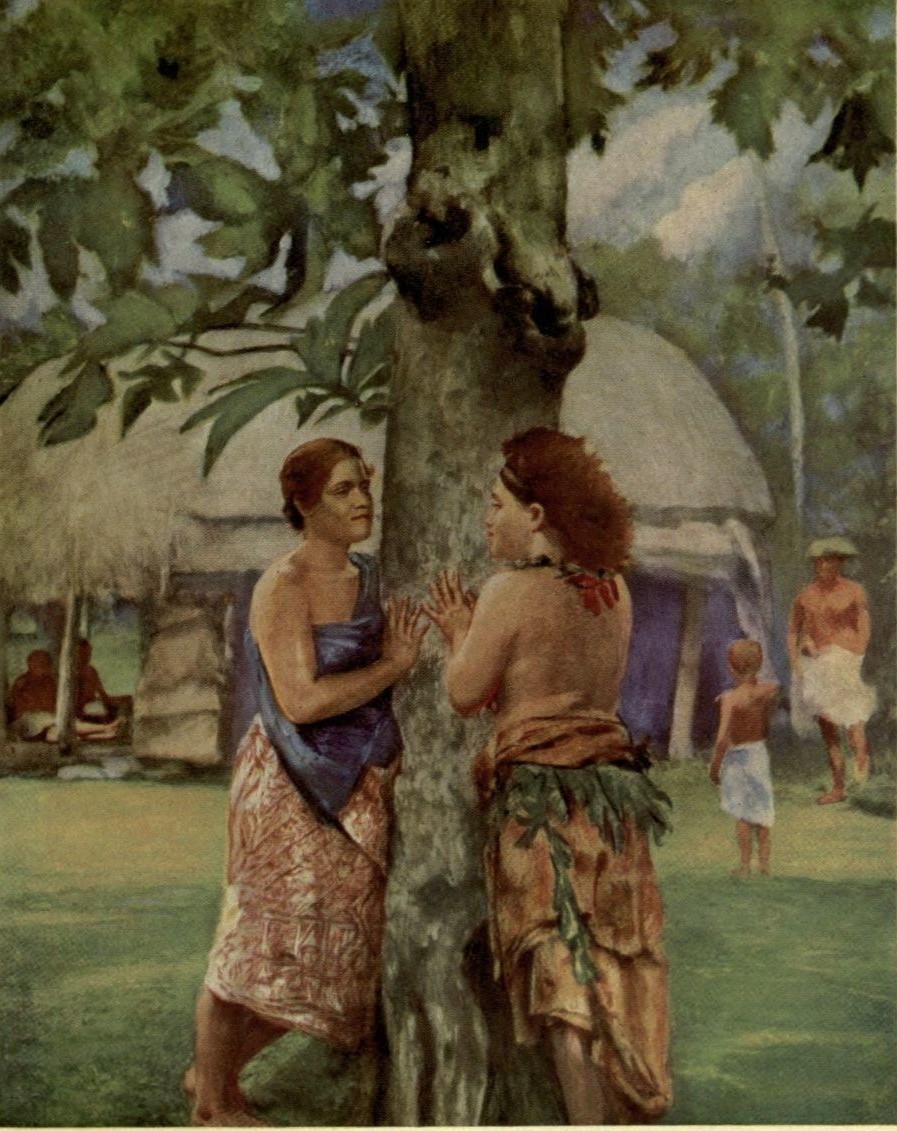 SAMOAN COURTSHIP. FAASE, THE TAUPO OR OFFICIAL VIRGIN AND
HER DUENNA WAIT MODESTLY FOR THE APPROACH OF A YOUNG CHIEF
When the time comes, the village that has chosen her, also chooses her
husband, and makes her gifts, as a dowry. Sometimes, and this is one of
the terrors of the situation, the village is very hard to please, and
rejects offers which the taupo might perhaps have accepted if a less
important and freer agent. She can always escape by bolting, and marry
as she pleases, thereby forfeiting her position and the respect of
well-thinking people. A match not well thought of by society is as much
deplored here as in our very best circles. Marriage, apparently lightly
entered into, is a very serious matter. Rank, position, is only
transmitted by blood; and a mésalliance in Samoa entails consequences
still more disastrous than in the court life of Germany. Perhaps my
South Sea Islander is not sentimental. He is simple and natural, but he
looks at everything in a practical way, and his ideas, having always
been the same, enable him to keep this natural simplicity without any
protest in favour of that freedom that brings on love tragedies.
As the day draws to its last close in the fairy colouring of the long
afterglow, people come back to their evening meal—a regular hour and
moment, here where divisions of time seem so uncared for that no older
man or woman could accurately know their age; unless they date from some
well-known event recorded by the foreigner.
(In other places people have told me, it was so many bread-fruit seasons
ago; it was when such a ship was here.)
Magongi, the owner of our hut, returning from his fishing, drops a fish
or two at our posts, according to Samoan etiquette and in honour to
guests and chiefs like ourselves. Faces are turned from gazing at the
sea, toward the houses where meals are getting ready. The young people
give up their seats on the little platforms, or “lookouts” by the sea,
and the lover confides his courtship, in Polynesian way, to others to
continue for him.
This evening, as every evening, with the last afterglow, in each hut of
the village, with the lighting of fire or lamp, comes the sound of the
evening prayer before meal. In pagan days, with the lighting of the
evening fire (meant for light), in the hollow basin scooped out in the
centre of the hut, after a libation to the gods outside, thrown out
between the posts, the Samoan prayed a prayer like this:
“Sail by, O Gods! and let us be:
Ye unknown Gods, who haunt the sea.”
When I hear the sound of the evening hymn, fixed and certain like all
their habits, I recall this prayer, so full of the future that has come
upon these dwellers in islands, and has brought with our faith and our
ideas—the latter certainly misunderstood—a slow extinction of their
past and of their very existence. For in all Polynesia, though arrested
now for a time, there has been within the hundred years from discovery a
fading away. As the Tahitian song says:
“The coral will grow and man must perish.”
I have been telling of the influence of missionaries upon old customs,
such as dances. Let me say something further.
I want to note that it was easier to get the Samoans to accept any form
of Christian worship because their religion was simpler than that of the
other islands. They were free from a great many horrors—the belief in
the necessity of human sacrifice. They hated cannibalism. Their heavier
nature had never led them to such immorality as tempted other South Sea
Islanders, who thereby resemble us more.
Then the missionaries came to them so late—at the end of the
thirties—that the Samoans had already been able to learn about this
religion that fixed everything—this desirable law called Lotu, which
was to settle everything for them, and make everything straight.
(Lotu[5] also means church, Lotu Tonga, the Tongan Church, etc.) So that
within the very shortest possible time the missionaries succeeded in
converting them, in fact, were waited for and expected, one might say,
by the next chance ship. The terrible reputation of savageness of these
islanders, owing to their having murdered La Peyrouse’s men in Tutuila,
on first acquaintance, so guarded them that even so far back as 1836,
and later, very little was known of them—they were carefully avoided.
But certain outcasts, escaped convicts, terrors of the sea, had come
among them, and had even begun to instruct them to expect this law of
Good. It is one of the most touching, as well as one of the most
atrocious, of small facts. Old Samasone was telling us the stories of
these old times: how some stranded ruffian, unable to return to white
lands, had felt obliged, upon being questioned, to assert his value and
knowledge by some imitation that might not later conflict with the
outside facts. Some brutal, drunken, murderous wretch would choose, some
day, to simulate a Sunday, and sing obscene or brutal forecastle songs,
all the same to those who did not understand a word, as representing the
church service of song which he described.
Samasone, whose American name is Hamilton, and who has been here for the
third of a century, tells us lengthily and in detail such stories, and
gives us long accounts of Samoan manners, in the same way that might be
his if he were still in native New England. And when I shut my eyes, I
can fancy myself sitting on the edge of some Newport wharf, and
listening to Captain Jim or Captain Sam, discoursing wisely, with
infinite detail.
Fifty years have passed since those things, paralleled more or less
elsewhere in the South Seas; and now from the hut of Mataafa, the great
chief, which is next to mine, with the sunset, comes the Angelus, sung
by the people yet nearer to nature than Millet’s peasants. I hear also
the Ave Maria Stella; the cry of the exiled sons of Eve for help in this
vale of tears, for whether Catholic like Mataafa, or Protestant like my
good neighbour Tofae, they are all very Christian. Indeed, my other
neighbour is a preacher, an eloquent one, like a true Samoan, a race
where eloquence is hereditary in families. I hear him thundering on
Sundays against the Babylonians, and all the bad people of Scripture.
They are all steeped in a knowledge of the words of the Bible. In any
serious conversation, in political discussion, we hear the well-known
types of character referred to, and all the analogies pushed to the
furthest extreme.[6] The rather light-minded girls whom we have about us
amuse themselves on Sunday with capping verses from the Bible. The young
men of our boat crew, whose moral views on many subjects would bring a
blush to the cheek of the most hardened clubman, are fond of leading in
prayer, are learned in hymnology, and are apt to be fairly strict
sabbatarians. Here and elsewhere, in many other islands, it is often
very difficult on Sunday to obtain the use of a boat, the only vehicle
possible. Remember that I am, and shall be for a long time, writing from
islands, where all life is along the shore, where only occasionally are
there roads, or what we would call roads; where there are few horses,
somtimes none at all; where the natural road is over the beach, when it
is uninterrupted by rock and cliffs, and where the boat can take you
quietly along inside of the reef. But as I shall make it out clearly
later, the Polynesian likes to have things settled one way or the other,
as all sensible people do.
And then the Bible—I am not speaking of the New Testament—is so near
them; they read so often their own story in the life of Israel of many
centuries back. They are not separated from a civilization of that form
by such and so many changes as our ancestors’ minds have passed through.
Their habit of life must even be said to antedate the biblical. They do
not have to make excuses for the conduct of God’s chosen people. They
can take all as it is written. They need not suppose some error in the
account of the witch of Endor. In such a valley, buried under trees, or
behind that headland where the palms toss in the roar of the trades,
dwells some woman, wiser and more powerful in the solitude and in the
night than we judge her by day. She can tell what things are happening
elsewhere; what things are likely to come. She brings in the dead by the
hand. She tells of what the dead are now doing, of their wars and their
struggles in the empty outside world. What she revealed some nights ago,
to a chosen few who say they were present, is murmured about the
villages, and makes a feature of conversation not unlike society news. I
have listened at night, in out-of-the-way places, among preachers and
people of confirmed Bible piety, to the last reports from the spirit
world: to the news of war there; to the tale of great fights which had
occurred on such a day of the moon, when the battleground of the reef
was strewn with the corpses of the dead already dead to us. And I
remember once hearing how some spirit ruling over a part of our island
had declined to enter into war because he had not been attacked, and his
religious principles, which were Christian, confined him to the
defensive. Perhaps all these things meant more to my good friends than
they did to me, curious as I was to find in these reports some traits of
their character, some manner of theirs of looking at the things of this
world. I believe that to them these agitations of the outside world were
presages of coming danger, of trouble to their earthly lives; that they
saw omens of victory because the spirits of such and such possible
ancestors had triumphed. But no doubt, in some way not understood by me,
all these vague stories confirmed them in certain directions, or made
them hesitate. At any rate, it kept the land peopled with fears. It
makes the terror of the forest more vivid and more reasonable. The
po—the dark, the night—is impressive to the Polynesian; the brave
man may have all the fear of the little boy. And I own that I have never
seen a nature which at night assumed more mystery, a more threatening
quiet. The vegetation never rests. The plants are always growing. The
sighing of the palms so deceptively like rain; the glitter of the great
leaves of the banana, striking one against the other, with a half
metallic clink; the fall of dead branches; the sudden drop of the
cocoanut or the bread-fruit; the perpetual draught, carrying indefinite
sounds from the untrodden interior; the echo of the surf from the reef,
against the high mountains; the splash of the water on the shore; the
flight of the “flying fox” in the branches; the ghostlike step of the
barefooted passerby; the impossibility of the eye carrying far throught
angles of tropical foliage—all these things make the night—the po,
not a cessation of impressions, but a new mystery.
With such a landscape about me, I was ready to believe that handsome
young men belated in the passages of the mountains had been met by the
female spirit, whether her name be Sau Mai Afi or not, whose sudden
love is death; and that the same being could be a man when the night
traveller was a woman and beautiful. Had not the brother of one of our
virgin friends been assailed by devils, in some adventurous night
voyage, and had he not returned half crazed, and beaten in such a way
that he had never recovered? All this had happened while we were there;
we might have found him alive had we come a few weeks earlier.
And in the night-fishing how often do the dead, continuing their habits,
fish on the reefs alongside of the living. They are silent, and their
canoes keep apart, but they may silently step from one canoe to another,
only to be known by the chill and anxiety that goes with them. I have
seen with my own eyes, far out on the reef, the solitary torch pointed
out to me as that of the dead. Often, when suspected, the spirit
occupant of a canoe has made for shore and disappeared, incessu patuit
dea, and has been assuredly recognized by the track of her torch
through the mountains, where no living man goes. That certainly must
have been our spirit disastrous to young men.
All these sides of common belief, or what perhaps we might call
superstition, were shown to us little by little. On the outside our good
friends believe roughly as we do, and all this that I am talking about
is what remains attached to Christianity, or more properly, never
disentangled from it. And I should suppose that it must have been
difficult for the missionaries to expel these survivals of the past, in
the same way that the old Church found it impossible, in certain corners
of Europe, to wipe out the belief in fairies—the “little men,” the
“good folk,” the “wee folk,” the “good neighbours”; the sacredness and
influence of places. And here the practical mind of the savage, in its
first reaction, after having received a set form of worship and faith as
a great relief, would argue that the written Law, the Book, countenances
most of the things they cared for in their older worship. A very few
years after the first christianization which began in the Society
Islands, sects were formed, based upon the Bible, or using it as an
excuse, with all the security of any theological difference. I have a
vague feeling that many of my brown friends think that the Christian,
even the missionary, does not carry out properly his belief, and that
they themselves are nearer to the letter as well as to the spirit. If
the missionaries have let loose among them the famous question of the
lost tribes, I have no doubt that many of them must be imbued with the
certainty of that descent. Many of their practices are so much like
those of the early Jews, that, according to old-fashioned ways of
historical criticism, an uninterrupted tradition might be argued. In
fact, I am quite sure that many of the missionaries have so reasoned,
and implanted among them a great feeling of confidence. And the
Polynesian, having a perfectly healthy mind, likes to have everything
settled. Anything more like the typical respectable Englishman I have
never met. With the brown man one sees the natural healthy desire of
having the questions of religion, of politics, of society, all settled
on the same basis; there is such a thing as good form, and that settles
it. After the first start, the islanders were much troubled at finding
that there were many ways of looking at things, and that religion might
be right and manners bad: that the wife of the missionary, who insisted
on poke bonnets, was not dressing according to the most aristocratic
forms of her own land. And when they find that their written religion
does not provide for all their little wants, it must be very natural to
supply the smaller ones, which are the everyday ones, with some of the
older forms more fitted for individual and temporal advantages. It must
be a comfort to many of them to know that the flight of certain birds
indicates what they had better do to-morrow; that the coming of certain
fish may mean, nay does mean—some change in family history; and they
may still prefer to treat respectfully the animals and plants that were
associated with their origins—what we might roughly call, their totem.
The shark has been respected or the bread-fruit, or the owl; and in
certain cases certain mysterious powers and sanctities might follow the
line of descent, though concealed from the public, more especially the
white men. Of this, I ought perhaps to say that I am confident; and that
the powers would be recognized in certain people even when, as I have
seen it, they belong to opposing Christian sects.
The missionaries were Wesleyans, or, rather, men of the London
Missionary Society. The form seems to have suited the Samoans. It was a
service in which every one took part. There was preaching and eloquence
and oratory, and to a certain extent the community was invited into the
church—not allowed to enter into the church as a favour. So that
notwithstanding their fondness for externals, the Catholic service gives
them less of their old, natural, ancestral habits by centring everything
in the ministrations of the priest, and by cutting off all chance of any
members of the congregation becoming themselves orators, deacons or
preachers, and leading in turn themselves. The chiefs also would
hesitate in a choice of humiliations; the missionary, white at first and
now a native obtaining a position of equal and sometimes superior
influence, and that without any civil preparation for the same—indeed
with less fitness from the relative isolation of his days of study.
Later on I may explain to you more fully how absolutely the chief is
the pivot of all social good. He has been for indefinite ages the cause
of all action; he has been personally superior both in body and mind.
The entire aristocracy is a real one, the only one I know of. It is
impossible to enter into it, though one may be born into it. With our
ideas of more or less Germanic origin we suppose a ruler gifted with the
power of bestowing part of his value upon certain men lower than
himself, and actually making such people essentially different. A
Polynesian knows no such metaphysical subtlety. The actual blood of
physical descent is essential to supremacy, except in a most vicarious
and momentary manner, or as by marriage so that the children may become
entitled to whatever the sum of the blood of parents represents. With
them an heir to aristocratic privileges or power or influence or
prestige represents nothing more than the arithmetical sum of his
father’s and mother’s blood. I have had lately a Sunday afternoon visit
all to myself, from a charming little girl who is the daughter and sole
child of the king; a nice little girl with pretty little royal ways, who
explains to me that she does not like things here so well as she did
where she was taught English, where she had been at school, in the
British colony of Fiji. There she was a king’s daughter, and any English
ideas around her would be more flattering to her consequence than even
the kindly feeling of the subjects of her father. For her mother is not
of equal blood, besides being a foreigner. The great chief Malietoa
Laupepa, whom we have made a king, cannot make his wife, according to
Polynesian ideas, any more than what she was before he married her; and
the little daughter has only in her veins the royal blood on one side,
and a certain respectability on the other. To the true Polynesian mind,
such a one of her cousins, of less high descent on the father’s side,
may be of higher descent on the mother’s, and the sum of those descents
may be very much greater than the sum of the descents of the daughter of
Malietoa Laupepa. Hence it requires a great stretch of loyalty to look
at such a little person with the veneration that the Polynesian feels
for “chiefy” origin; and you can understand what a disastrous and bloody
muddle we have made it for them when we have told them that the word
king represented anything that they had themselves or could have. With
them Rex nascitur non fit.
All this has been explained by the supposition of two different races,
one of which, that of the chiefs, had subdued the other. There is no
such tradition, however, and no apparent reasons to explain the enormous
superiority of the aristocratic lines except the simple physical ones of
choice in breeding and of better food and less suffering, continued for
centuries and centuries. Even at a distance a chief can be distinguished
by his size and his gait, and a successful collection at some political
entertainment brings back the dream of lines in the Homeric catalogues
of heroes. Great size of limb, great height, consequent strength and
weight, a haughty bearing, a manner of standing, a manner of throwing
his legs out in walking, like the step of a splendid animal, a habit of
sitting upright—all these points tell the chief.[7]
Upon these superior beings, then, brought up to command, considered as
sacred by themselves and by all below them, devolved perpetually the
duty of deciding everything that was to be done. Even in a detail so
minute to our minds as that of a day for fishing, the chief decided, and
does yet, what the community should do. The good fortune of all was
dependent upon his wise choice. As the chief has often explained to us,
when the women began to talk too much, and fix their minds upon harmful
gossip, a healthy diversion was that of ordering them to make the native
cloth—an absorbing process. With all the refinement of political
leaders, excuses would be found for such an enforcement of industry: the
occasion of some visit to be made or received, when every one entitled
to it should appear with many changes of dress; when the visitor or the
visited should receive presents of beautiful cloth. Let me say how
elsewhere, in another group of islands, the earlier missionary
interfered and broke up the industry of women, without evil intention,
making them idle, and opening thereby the gate to ruin. In Polynesian
life, as I am trying to explain, things were intimately connected. There
were religious forms or words—or shall I rather say, forms and words of
good omen?—accompanying all ordinary human action. Had the missionaries
realized this perfectly, they might almost have interfered with the
savages’ breathing; but they fastened on the pagan forms connected with
the making of cloth, and the women gave it up, and bought cotton from
the white man, and paid for it the Lord knows how.
The chief, then, sent the young men to fish and the women to work, when
it was needed both for physical and moral good. War, of course, they
always had, as a last resource, just like the great politicians of
Europe. The constant interference, involuntary very often, very often
most kindly meant, of the missionary or the clergyman, diminished this
influence of the chief—an unwritten, uncodified power, properly an
influence, something that when once gone has to be born again.[8]
And
the brown clergyman, continuing the authority of the white one, has
something further, less pure, a feeling of ambition, a desire to assert
himself against former superiors; and he is perhaps still more a
dissolvent of the body politic into which he was born.
I see no picture about me more interesting than the moral one of my next
neighbour, the great Mataafa. To see the devout Christian, the man who
has tried to put aside the small things that tie us down, struggle with
the antique prejudices—necessary ones—of a Polynesian nobleman, is a
touching spectacle. When a young missionary rides up to his door, while
all others gently come up to it, and those who pass move far away, out
of respect; and then when the confident youth, full of his station as a
religious teacher, speaks to the great chief from his saddle, Mataafa’s
face is a study. Over the sensitive countenance, which looks partly like
that of a warrior, partly like that of a bishop or church guardian,
comes a wave of surprise and disgust, promptly repelled, as the higher
view of forgiveness and respect for holy office comes to his relief.
But Mataafa is not only a chief of chiefs, he is a gentleman among
gentlemen. My companion, difficult to please, says, “La Farge, at last
we have met a gentleman.”
His is a sad fate: to have done all for Samoa; to have beaten the
Germans and wearied them out; to have been elected king by almost
unanimous consent, including that of the present King, who wished him to
reign; then to be abandoned by us; and to feel his great intellectual
superiority and yet to be idle and useless when things are going wrong.
And more than all, however supported by the general feeling to-day, if
he moves to establish his claims, the three foreign nations who decide
Samoa’s future, not for her good, but for their comfort or advantage,
will certainly have to combine and crush him.
He is a hero of tragedy—a reminder of the Middle Ages, when a man could
live a religious life and a political one.
And his adversaries among the natives are among our friends; and we like
them also, though there is none to admire like Mataafa standing out for
an idea for the legitimacy of right.
For all the soft Communism of which I spoke, the chiefs were the
stiffening, and are so still in as far as the new ideas, or rather want
of ideas, do not affect their real authority.
As I tried to explain, these are chiefs, lesser or greater, hereditary,
essential; nothing can replace them, no commoner come into their
position or a similar one. Alongside of them an European monarch is a
half-caste or a parvenu. When, as you will see, we, that is to say the
English and Americans, made one of them a king, we made a thing unknown
before, unthinkable in reality among their social machinery.
For however true it is that the chief is so by birth, by authority of
nature, you know that in Samoa he is also elective. A council of chiefs
of his own race determine whether or no he shall “bear the name.” For
smaller chiefs, their own names; for certain great ones, such a name as
Aana or Malietoa.
With these names goes the power over certain places large or small, but
each having a traditional value. Should a chief of sufficient blood have
all these five names (and he cannot get them without such natural
inheritance and the name may remain empty), should he have all five
names, then he is of necessity king, that is to say, chief of chiefs.
But if he have only three, then imagine the confusion made in the true
Samoan mind by our making him king.
Mataafa has held more names than any other, and would no doubt be to-day
elected king by the majority of the Samoans; and absolute agreement
would probably always be impossible. But though the treaty between
Germany, England, and the United States, as promulgated in the Island,
decided that the Samoans should elect their king, and thereby Mataafa
would be the man; yet a secret arrangement, or what is prettily called a
protocol, not published to the Samoans, decided that Mataafa
especially and alone should not be allowed. He was the only man who had
successfully defended Samoan independence as far as it could be, by word
and by action; he had fought the Germans and defeated them, and that was
the reason.
According to American ideas Mataafa would be the only proper person, but
Germany and England have arranged for some time back all matters of
influence and policy; and whatever we have wished, or might have wished,
we have always been obliged to vote over against them, and must continue
to do so.
But the German cause is such a bad one, so foul at the origin, and so
brutally helped on, that it has been impossible for Great Britain to
ignore justice absolutely, and we have done something in the cause of
humanity and so far served God.
Money can have no feeling; political ambition only what may help; and
the cause of all this trouble which has made this little island known to
the entire world is the hope of saving some money badly invested.
A great Hamburg firm with a French name, the Godeffroys, had some years
ago established itself in most islands of the Pacific; it was the great
firm—the German firm. But as often happens, speculations in other
matters, or Russian-Westphalian securities broke the great man, the
former friend of Bismarck, and when a German company, known as “The
German Company,” succeeded to his assets in the South Seas, they found
the greater part of them sunk in the Hares-plantations of the firm in
the Islands of Samoa.
Everywhere else there was no hope, but here if sales could be proved
valid, if by any means the present labour system of black imported
savages from other islands could be replaced by a system of “peonage,”
for the natives, if taxes could be placed upon the community which can
only be taxed by making the industrious support the idle, if in fact,
the firm could control the islands, money might again be made and
perhaps the millions sunk be made to pay or fully recovered. Elsewhere
in islands where French or English ruled, it was so much the worse for
the adventurous if things went wrong, and there are cotton plantations
and sugar plantations, which have gone to pieces as it became impossible
to keep them up, industries and speculations which first started into
life with our war.
From early days political or state reasons were carefully kept together
with business ones; the political representative of Germany would be
also the manager of the firm, so that if one kind of reasoning did not
work, then another might. Anything became constructive insult or
opposition to the Empire of Germany—even a sort of lèse majesté or
suspicion of treason. Business and the navy supported each other, and
on a small scale the story of the “John Company of India” was repeated,
with the same cruelties and atrocities more easily noticed because of
foreigners being there, because of our modern institutions of the press
and the telegram.
AN ACCOUNT OF RESIDENCE AT VAIALA
Our friends Seumanu and Faatulia tell us, with much emotion, how
Malietoa, now the king, wept with them when he went off a half voluntary
prisoner of the Germans, hoping that by his sufferings his country would
be spared bloodshed; and that in some way or other the Europeans would
desist from their grasping demands. Then Mataafa headed the resistance
which two years ago saved his race from the extermination threatened by
the Germans; made him among his own people the equal of his hereditary
claims; and entitled him to the name given him by Admiral Kimberly, that
of the Washington of Samoa. To fight German discipline, and German
ironclads, with naked followers bound together with the loosest ideas of
allegiance, seems a story out of a dream, and certainly would have come
to a disastrous end had we not interfered. The Berlin Conference in
which we acted restored Malietoa to his home and his power practically,
but in theory made him dependent on the choice of the Samoans, which
choice the conference guaranteed. That is to say, those were the words
of the treaty on which Mataafa stood. But both English and Germans
agreed that a man who had defeated the Germans should not be elected,
whether he was chosen by the country or not.
This secret protocol is a disgraceful result of the indifference of our
representatives to the good name of the United States, and to what is
more atrocious yet in my mind—a want of comprehension of the value of
the United States and of its enormous power. One must go abroad and far
away to realize that whenever we wish we are one of the main powers of
the world. It is on our sleeping that grasping nations like England and
Germany depend.
Mataafa has probably been aware of the secret protocol which excluded
him from competition as king, a protocol, as I have said, made
exclusively to please the Germans, by the very weak person whom we
detailed to the Berlin Conference. To repeat, we made a treaty which
would give the Samoans the right to elect their so-called king or head
chief, and now we break its lawful meaning by providing that the one man
who would have most suffrages, and who represented the highest claims of
legitimacy, should be exempted if elected.
When Malietoa, brought back by the Germans, worn out in body through his
sufferings in a cruel detention, landed again in Samoa, he was received
by Mataafa. Remember that they are blood relations, and that when one
failed, the other had taken up his cause and won. They embraced each
other, and were left alone by their attendants. It is said that Malietoa
urged upon Mataafa to retain the power, Mataafa declining. Some
compromise was effected, the terms of which are not known, but which
meant that Malietoa should go on reigning without Mataafa’s abandoning
any claims. Now Mataafa is in a sort of retirement, living in a manner
extremely difficult for us to understand, were it not that he resumes in
his person all the ideas that a South Sea man can have regarding the
proper chief of chiefs. Remember that he is tui, which is nearly what
we call a king, of the great districts of Atua and Aana, which have
prescriptive rights of election; and he has himself the name of
Malietoa—what we would call the title given him by the very district of
Malie from which the Malietoa derives his name: and that this was given
to him when there was no one to bear this historic burden. Here he is,
living in the further end of the village, only a few feet from our own
hut, which as you know is loaned to us, we suppose by Magogi the chief,
though this is not very distinct. Of course in Samoan way we shall
present to him, or to somebody, gifts equivalent to the use of the
house, to the dignity of Magogi, and to our own essential dignity of
American chiefs.
To my western mind the situation is very curious. Mataafa is already in
a mild opposition which at any moment may become extremely serious. He
must know the intentions of the three powers, and cannot, as I
understand, forego his claims. Here he resides under the apparent
protection of the chiefs of the village, our friend Tofae, and his
brother Patu, the great warrior, who are I think necessarily partisans
of Malietoa; and who would make war upon him in case of a break. But
outwardly the greatest reverence attends him. One feels it in the air.
At this end of the village, separated from the other by many trees,
there is always quiet. The children never make any noise; even the very
animals seem to understand that they must not come near. The few
disturbances are those of Mataafa’s own men when they do any chores in
the outside huts reserved for practical purposes, so as to keep all
housekeeping away from the residence. The giggling girls are quieter;
every one’s voice is lowered: on the road that passes at a little
distance from the great chief people edge away toward the further bushes
in the quietest and most homely manner. There is the perpetual
recognition of a king’s presence. Mataafa goes out very little. He
trudges out to early mass, along the same exact path; has services at
home, and every evening the hymns are sung within his hut. He goes out
early in the morning to do work, like everybody else, in his little
patch of taro planting, and returns after this gentle exercise, naked to
the waist, like any other common mortal. His goings out are apparently
few; though I seem to see certain special visitors drop in of an
evening. Sometimes, as you know, he calls upon us, and this was his
first—shall I say command or visiting-card?
(Envelope)
Ia Lasusuuga Alii
Amelika
Nasei maliu
mai nei
Oi le fale o Tofae
(Autograph letter)
Vaiala
Oketopa, 11 1890
iala susuuga Alii Amelika
Aliie ale nei lau tusi ia te ou lua ia ou lua faamolemole oute
manao e fia fesi la fai ma oulua susuuga fe oute alu atu ilou lua
maoto fe lua te maliu mai i lau Fale alou taofi lea efaasilasila
atu is ou lua susuuga.
Ona pau lea ia Saifua.
[Translation]
Vaiala, Oct. 11, 1890.
To the Distinguished Chiefs of America
O Chiefs
This my letter to you both. Will you please my wish to meet your
Honours? Shall I go to your residence, or will you come to my
house? This it is my wish to let your Honours know. This is all.
May you live.
I am
M. J. Mataafa
(Malietoa Josefo Mataafa)
In return for our call the great chief has called many times upon us. He
apologizes almost for his position of something sacred, for his being
obliged to drink out of his own cup, for instance, and, as I told you,
has yielded very slowly to the investigations of Atamo[9] concerning the
rights of law, of property, of kinship, which must at first have
appeared to him irrelevant and indiscreet. Even Seumanu, with whom we
are so familiar that we threaten to take away his name occasionally
(Samoan legal deposition from office), even Seumanu was obliged to say
once, “Years ago I would have killed a man who asked me that question!”
I believe it was some inquiry as to his exact descent and consequent
claims from his grandmother. But one of these visits of Mataafa brought
about a meeting with Stevenson which I had thought might not take place
for some time. It is always difficult for those of us who have the
cosmopolitan instinct to realize how fundamental are the views of the
Britisher. Mr. Stevenson had been explaining to us a difficulty I could
hardly appreciate, and that was the question of whether he should call
on Mataafa or wait until Mataafa called on him. I know how that would be
settled in England. No one would expect the Queen or the Prince of Wales
to call first, even though they cannot have for themselves the sense of
dignity and sacredness which must envelop Mataafa. The Queen is the
head of the church and defender of the faith; but she is not so by
blood, whether there be a church or not. It is this peculiar element of
something sacred, as it were of the son of a demigod, the natural
intermediary between this world and the next, which is gently latent in
the original idea of the aristocracy of these people. Even to Roman
Paula, the spiritual daughter of St. Jerome, it must have been something
beyond our ken to be a descendant of, let us say, Agamemnon or Achilles
or other sons of demigods. In this state of mind Mr. Stevenson came in
upon us during one of Mataafa’s visits, and succumbed at once to the
delicate courtesy of the great chief. He managed so prettily to express
his knowledge of Stevenson’s distinction, of his being a writer of
stories, and a wish to know him limited by the difficulties of his
position.
Meanwhile, I say, Mataafa bides his time. He waits patiently, en
évidence, but doing nothing. This will irritate his enemies, but I seem
to see that for him there can be no more legal course. As long as he
does nothing, and makes only a mute appeal to justice, he is entirely in
the right. He is not supposed to accede to the protocol which excluded
him. I think I understand somewhat of the absurdly complicated position
which his friends or his enemies hold—position based on hereditary
rights; long internecine wars; ancient privileges of small places which
have rights of election, but which are too weak to enforce them; and,
above all, on both sides questions of complicated descent. Even if I
were correct, and made no mistakes, which could hardly be, I would not
dare to go into a lengthy explanation of the claims on both sides.
One great enmity Mataafa has: more intense than that of the Germans,
because partly unconscious and founded on the worst passion of
humanity—theological hatred. That enmity is the dislike of the foreign
Protestant missionary, who moreover is absolutely English in his ideas,
his wishes, his intentions, and has a perpetual political bias. Mataafa
is a Catholic, like many of the chiefs. Naturally he has Catholic
advisers, and some of them may be—though I don’t know it for
sure—tainted by the same politico-religious ideas as their opponents.
They probably supply the great chief with information of what the great
outside world would do in his favour; opinions based on their wishes,
and not on the meanness of mankind, which is the only logical basis of
politics.
As a proof of the atrocities to which the religious mind can consent,
listen to this charming detail. It belongs to a time when I was no
longer in Samoa. I have mentioned in my other journals and letters the
names of the Rev. Mr. Claxton of the London Missionary Society; and I
can add to what I said that was pleasant that he seemed to be the
usual gentle clergyman, with side-whiskers, and sufficiently modern,
and that he spoke very nicely, as I thought, of the religious state of
the Samoans, and evinced a sense of a certain steadfastness of theirs,
which distinguishes them from many of the other varieties of South Sea
people. Mr. Claxton also pleased us by recognizing the Samoan dances as
not being sinful, by being present at one of them, with Mrs. Claxton.
You know that poor Faatulia was excommunicated for attending the Fourth
of July dance, which was of course attended by the wives or daughters or
aunts of the English or American consuls. The action of our reverend
friend was all the more graceful because the dance was in honour of
Faatulia’s niece, if I remember. Mrs. Claxton also we hear all sorts of
nice things about. She is “Misi Talatoni,” and Meli Hamilton gets a
great deal of fun out of her, pretending that we admire her dress much
more than Meli’s. Never would you suspect these gentle associations
connected with the ideas of mediæval assassination. But in August, our
Consul, coming down to Australia, and meeting us on the way to Java,
told me the following story because he wished me to take a hand myself.
Mataafa’s habits were, as might be expected from his character,
particularly steady as belonging to a war chief, a king, and a devout
churchman. He went to mass every day, by the same path, and did not
flinch or change his track when the Germans fired at him. Somehow or
other, as happens to generals and to people who make a good mark, he
was never hit. On this peculiarity of Mataafa’s was based a proposition
made by the Rev. Mr. Claxton to the Consul. There was now absolute
peace; and Mataafa and myself, or you would have a perfect right to walk
along the road to church without being fired at. But German discipline
has characteristics quite as distinct as Mataafa’s. Might it not be
possible, if any German marines were landed by chance, to place some
sentries on Mataafa’s road, presumably if he went to evening service? He
would suspect no harm, and even if he did, would not move from his path.
The German sentinel would by duty be obliged to fire, and consequently
no one would be to blame, and Mataafa would be out of the way. This the
reverend clergyman thought could be managed. What Consul Sewall wished
of me was that I should warn a friend of Mataafa’s, Father Gavet, who
lived somewhere along the coast, but whose long acquaintance with Samoan
manners would find some way of avoiding the possibility of this little
incident. I wrote to Father Gavet, who answered me, at some distance of
time, of course, that the plot was understood; for, as Mataafa said to
me, “There are no secrets in Samoa,” and the friends of Mataafa had
taken necessary precautions. I never heard anything more about it, but I
believe that the Reverend Claxton has been withdrawn.
Of course as long as the waters are so disturbed, each party may hope to
fish for their advantage; that is to say, the German for
politico-commercial reasons, and the English for the same; and this all
the more that the English government recognizes what is called spheres
of influence, and that it is inclined to concede to Germany such an
influence here, even if its representatives be not officially ordered to
do so. We, who do not recognize these spheres of influence, are,
however, prone to assist all Protestant missionary tendencies, right or
wrong. Votes are votes. Besides, not only do we not recognize spheres of
influence, but we are uncertain of any political tradition, and we are
easily handled by England, to whom we are still intellectually subject.
We are also more or less out of the game. We have no Heligoland or
Hinterland in Africa, to trade off against influence in Samoa or New
Guinea. We are still in the dark as to our fortune; we don’t know the
importance of the Pacific Ocean to us, nor the immensity of future
eastern trade. As the Germans here impertinently remark, we would trade
an empire against the votes of a town in New Jersey, or the honour of
dining with a countess.
Brandés, the German dictator, that is to say the German official who
controlled Samoa for a time, representing both Germany and Samoa, said
of us: “A nation, which in all decisions of foreign policy must take
into its councils the senate and sixty million of people, can never
have a foreign policy worthy of the name.” We might easily withdraw,
even temporarily; then for the protection of German property, German
forces could be landed in Samoa, the imperial flag be hoisted, and
whoever would dare to haul it down? Bismarck, acting through his son
Herbert, has apparently well arranged our agreements so that events
might turn easily that way. On Mataafa these conditions hinge. As he
acts, or is kept from acting, the possible possession of this key of the
Pacific will be determined.
And yet the Pacific is our natural property. Our great coast borders it
for a quarter of the world. We must either give up Hawaii, which will
inevitably then go over to England, or take it willingly, if we need to
keep the passage open to eastern Asia, the future battleground of
commerce.
You can see how reasonable it is then that Mataafa should take an
interest in us as Americans, and hold on to a hope that we might,
however faintly, help the cause of his people, and keep them, as he
says, from slavery. Moreover, as his men it was who rescued our sailors
in the great calamity of 1889, even though they also rescued the
Germans, with whom they were at war, he feels that kindness of
obligation which comes to those who have tried to benefit others.
All this is politics, and you are probably, like the United States, more
or less indifferent to anything that has not the name that you are
accustomed to. To me, on the contrary, my real and absorbing delight is
the sense of looking at the world in a little nutshell, and of seeing
everything reduced to such a small scale, and to so few people, that I
can take, as it were, my first lessons in history. I don’t know that I
should put it all into the form that Mr. Stevenson uses, in which I do
not quite agree with him: that here, at length, we were free from the
pressure of Roman civilization. I own of course, that all comes to us
through Rome, and that the dago has had the making of us. The words
which I use of course imply that. I can’t talk of politics, of
civilization, of culture, of education, of chivalry, of any of the
aspirations of the western world, without using the words implanted with
the ideas in our barbarous ancestors; but before the culture and
development of Rome was a something which had some analogies to what I
see here. I am continually thinking how it may have been with my most
remote ancestry, whenever I understand any better the ideas and habits
of our good people here. As also they have passed from some still
earlier or more remote stages, their ideas are easier to understand than
those for instance of the Australian or even of the Fijian. A tendency
to the commonplace, to a certain evening up of ideas, seems to belong to
them, and makes them easier to understand because in so far they are not
unlike us. They dislike excesses in thinking, and too logical
extensions of what might be called political ideas. About all this
social difference of organization, I have written to you, I should say
continually. I must have given you most of the details, even if I have
not made a summary of the form of early civilization.
I am troubled also at writing about things and ideas, and using words
which have grown out of things and ideas extremely different and often
contradictory. As the Christian terminology, the very language of the
Gospels, was perforce made up of pagan forms and terms, so to-day, I
shall have to describe what might be called pagan forms and ideas in a
terminology now influenced by Christianity, and saturated with problems
connected with it, so that probably Greek or Latin would be more
natural, though even they, you know, are read by us with a bias that
their authors never dreamed of.
But as long as I do not write, it is pleasant to see the ideas without
words, and perhaps descriptions may not have been the worst way to give
them.
A MALAGA IN SEUMANU’S BOAT
25th Oct., 1890.
Malanga, written malaga, is a trip, a voyage where one puts up with
friends, etc.; one of the fundamental social institutions of Samoa.
WHAT SEUMANU’s BOAT WAS
“Secretary of the Navy to the Secretary of State. Acknowledging
assistance by natives of Samoa.
“Navy Department,
“Washington, D. C., April 27, 1889.
“Sir: In a report dated Apia, Samoa, March 26, 1889, from
Rear-Admiral L. H. Kimberly, U. S. Navy, commanding the United
States naval force on the Pacific Station, the Navy Department is
informed that invaluable assistance was rendered by certain natives
of Apia, during the storm of Saturday, the 16th March.
“Rear-Admiral Kimberly calls particular attention to Seumanu Tafa,
chief of Apia, who was the first to man a boat and go to the
Trenton after she struck the reef, and who also rendered material
aid in directing the natives engaged in taking our people and
public property on shore on the 17th and 18th.
“Special recommendation also is given to the men composing the
boat’s crew, as follows: Muniaga, Anapu, son of Seumanu, Taupau,
chief of Manono, Mose, Fuapopo, Tete, Pita, Ionia, Apiti, Auvaa,
Alo, Tepa.
“The Department has the honour to request that you will express to
the authorities of Samoa, through the proper channels its high
sense of the courage and self devotion of Chief Seumanu and his
fellow countrymen, in their risking their lives to rescue the
shipwrecked officers and crew of the Trenton from their position
of peril and distress; and that you will, at the same time, inform
them of its intention to send to the Chief Seumanu in accordance
with the recommendation of Rear-Admiral Kimberly, and as a mark of
its appreciation, a double-banked whaleboat, with its fittings,
and to reward suitably the men composing his crew, for their brave
and disinterested service. I have the honour to be, sir, very
respectfully, your obedient servant,
“B. F. Tracy,
“Secretary of the Navy.
“The Secretary of State.”
The accompanying extract tells you the story of the boat in which we are
making a malaga to some of the places near us—to the northwest end of
our island of Upolu, to this little Manono, with an old reputation for
war; to the ancient sunken volcano crater of Apolima; and to Savaii, the
big island important in politics, and important in name, and important
in history.[10]
Seumanu takes us along in his boat, and as it were under his protection,
a convenience certainly, but also perhaps not an unencumbered blessing,
for there will certainly be a colour of politics in our trip. All the
more that our own boat goes along also with our own rowers, and the
consular flag, for the Consul is with us, and is in (I fear) for many
speeches which he will have to acknowledge, and we shall suffer all the
more. For already there has been much speech-making; the tulafales,
the village orators, and occasionally rulers, or balances of power with
the chiefs, and who as far as I can make out keep this place by
inheritance—the tulafales have been in force. Seu has repeated their
speeches ahead of them in a grumbling way, evidently not quite pleased.
Perhaps the paucity of gifts in this poor little place helps to annoy
him, and yet we gave them short notices of our coming and we are many to
provide for, over twenty-five in all; or perhaps, nay certainly, their
political complexion is not of the right shade and he remembers too well
that they were but figure-heads in the last war, not withstanding their
military renown. What annoys him as a chief “qui se respecte,” gives us
infinite pleasure. All comes down to the small scale that befits the
place and its rusticity. It is rustic, as I need not assure you, but it
has also a look of make-believe that gives it a look of landscape
gardening—the look of a fit place wherein to give a small operetta in
the open air.
The village is on a small promontory, beyond which juts the outline of
some rocks crowned by a chief’s tomb that is shadowed by trees. The
water within the bay reef is of a marvellous green-blue, whether it
rains or whether it shines, and not far off, perhaps only a mile or so,
Upolu is blue or violet or black or grey in mist; and the sea outside
always makes some colour contrast with the sea inside the reef. The
village is just high enough upon the shore to conceal the actors on the
beach, except where in two or three places the clean sand sweeps down
under the trees or next to heavy rocks, so as to allow the tenor and the
diva of my supposed opera, to go down and throw out a great song. This
is striking enough in the day but in the evening afterglow or the shine
of moonlight, themselves apparently made on purpose, it is deceptive;
people step down little rocks on coming out of small huts, a few real
canoes are placed under the trees whose outline in the shade has been
arranged by nature in rivalry of art.
Subsidiary pictures painted by a Greater Rembrandt with centres of light
and prismatic gradations of gloom fill the cottages placed on the little
elevations, and only a few people gracefully move about—just enough in
number: and all with a classic action that comes of not frequenting
foreigners. Snatches of song, and cadences come alternately from
different corners or from under trees, and as I said all this is lit
with a mysterious glow.
Besides, in the day there have been few people; some little girls only
in our guest-home and the chief who with his whitened hair, strong jaw,
and sloping forehead has a fair look of the “Father of our Country.”
In the presentation of food, a necessary ceremony, only a dozen men have
appeared, nobodies in particular: and before them has capered a naked
being in green leaves, as to his hips and head, who has danced with his
back toward us, keeping the line in order, and who looks at a distance
like the Faun of the Greek play in the Pompeian pictures. Then they have
all rushed forth and cast down their small presents, taro and
bread-fruit and cocoanuts, in palm baskets and as suddenly disappeared;
while the tulafale, an old gentleman of the old school, making,
according to old fashion, a great curve of pace that shook out his stiff
bark cloth drapery, has slipped out and taken his place, leaning on a
staff, his official fly-flapper balanced on his shoulders. These people
of importance, and one I think of great dignity, have squatted down on
the grass, and another has seated himself on the great war drum under
the bread-fruit trees. Then a long speech has been made, with praise of
us and of our country that has rescued Samoa, and thanks to God and
prayers for our good health, etc., etc., all in a clear voice, not loud
at all, just enough to reach us, no more; and with a Samoan accent upon
the end of each phrase where some important word is skilfully placed.
All this we listen to and witness from our little house, whose posts are
garlanded with great bunches of red hibiscus flowers and white gardenia
and many leaves, and the effect is partly that of some living fresco in
imitation of the antique, partly that of an opera in the open air. But
if this is real, then the modern painted pictures of open-air life with
the nude and with drapery are false. Our French and English and German
brethren do not know what it is.
Apart from the light and its peculiar clearness, Delacroix alone, and
sometimes Millet, have understood it; and no one of the regular schools
of to-day. Back of these, of course, all the classics are recalled from
Watteau and Rubens and the Spaniards to the furthest Greek.
So that the little episode that worries Seumanu is full of fun and of
charm and of instruction to us. Its scale is so small that we can grasp
it. There are but half a dozen actors, and a small set scene. In front
of us, sitting so close to our house, on its pebble slope, that his
figure is cut partly off, sits one of the crew, who, when all is over,
and the speech has been duly acknowledged by Seu as our spokesman, will
count over the presents, and in a loud voice will announce their number
and their origin: So many cocoanuts from so and so—so many chickens
from so and so—etc.
Two mornings ago we left Vaiala, and rowed westward within the reefs,
along the north coast of our island of Upolu, off which, within a couple
of miles, lies the little Manono from which I write. Twice we stopped
in this enemy’s country, that is to say, among adherents of the former
king or head chief set up by the Germans. There was all the charm that
belongs to the near coasting of land in smooth waters: the rise and fall
of the great green reflections in the blue satin of the sea inside of
the reef; the sharp blue outside of the white line of reef all
iridescent with the breaking of the surf; the patches of coral, white or
yellow or purple, wavering below the crystal swell, so transparent as to
recall the texture of uncut topaz or amethyst; the shoals of brilliant
fish, blue and gold-green, as bright and flickering as tropical
hummingbirds; the contrast of great shadows upon the mountain, black
with an inkiness that I have never seen elsewhere; the fringes of golden
or green palms upon the shores, sometimes inviting, sometimes dreary.
And our rowers in their brightest waist cloths, with great backs and
arms and legs, red and glistening in the sun that wet them even as much
as the cocoanut oil with which they were anointed. And when tired with
sitting, they lie stretched out and confidently rest against the giant
Seumanu’s great thigh and hip, while he occasionally patted his sleepy
weaker brother, La Taēlē.
Still, beauty of nature, and plenty of soft air do not prevent fatigue,
even if they soothe it, and I was glad when in the afternoon we had
reached Leulumoenga—our final halt—a village type of Samoa, spread all
over the sandy flat of the back beach, and half hidden in trees. As we
came up the shelving beach, children and women came down to meet us, and
watched us curiously. Among them, in their new dignity of fresh
tattooing, a few youngsters eyed us from further off, moving little
owing to the pain of the continued operations—haggard and fevered
looking, and brushing away nervously, with bunches of leaves or
fly-flaps, the insects that increased their nervousness. For tattooing
is no pleasant matter. The entire surface from hip to knee is punctured
with fine needlework. The patient stands what he can, rests awhile and
recovers from his fevered condition; then submits again, until slowly he
has received the full share. Nor does he shirk it—it is his usual entry
into manhood; without it the girls are doubtful about him, and he is
somewhat looked down upon. The present king, brought up by missionaries,
and accepting many of their prejudices, had not been tattooed in his
youth.
During the few hours of our stopping we returned the call of Father
Gavet, one of the French missionaries, and saw his new church that is to
replace an older one destroyed by the great hurricane. It is of coral
cement, like most South Sea churches, a beautiful material when it
blackens with time. I hope they will transfer some of the old carvings
from the earlier church; which, made by early converts, have a faint
look of good barbaric art—so good—oh, so good—compared to what the
good missionaries get from those centres of civilization called Paris,
London and Berlin!
In the latest afternoon, with coolness and rays of heat and light, we
rowed further along the coast to Satapuala, where we were to rest in the
great guest-house, under the protection of the chief’s sister, the
taupo.[11] It was all like little Nua on a great scale, and with more
elaborate preparations. We had soft mats to lie upon and later more
again to be beds. Nor did our hostess abandon us until the last moment,
when we were apparently satisfied with our lair, and according to
far-off western habits had officially “retired.”
Her decoration of the guest-house, for which she duly apologized as poor
and unworthy of our visit, was really beautiful. Palm branches all green
and fresh and glistening covered the entire roof and its supports, even
the great curved posts of the centre being wrapped in the great leaves,
which curved with new lines around the simpler circle of the big tree
trunks. Here and there great bunches of white gardenia and of the red
hibiscus were fastened into the folds and interstices of the leaves and
stems.
At night when her brother, the young chief, a famous dancer, had
arrived, the dream of Robinson Crusoe which had begun enveloping me in
the afterglow, as I wandered about in the sandy spaces among the palms
and bread-fruit, became more and more complete. The dances were all
pictures of savage life. There were dances of the hammer and of
gathering the cocoanuts by climbing, and then breaking them; and of the
war canoes, with the urging of the steersman and the anxious paddling of
the crew; and a dance of the Bath, in which the woman splashed water
over her pursuer, as she moved with great stretching of arms as of
swimming. The beating of time on the mats gave, in its precision of
cadence and the sharpness of its sound, an illusion that seemed to make
real the great blows struck by the dancers, whose muscles played in an
ebb and tide, under the brilliant light of the cocoanut fire made in the
pit near the centre post.
In these and in others our hostess scarcely took part. Most of the time
she sat by us—a tall and big chiefess, elegant at a distance, grave and
disdainful—but we were in an enemy’s country and the slight scorn
seemed quite refined. Still more becoming to an evening with Robinson
Crusoe’s friends were the costumes worn in the wild dances: the great
girdles of purple and green and red leaves, the red fruit of the
necklaces, the silver shells of red flower in the hair of the women; the
fierce military headdresses of the men; the bark-cloth drapery moving in
stiff folds, and more than all the oiled limbs and bodies glancing
against that wild background of green leaves (spotted with red and
white), whose reflections glittered like molten silver as they turned
around posts and central pillars. Outside, the moonlight was of milky
whiteness increased by the whiteness of the sandy beach mixed with a
firm white clay. Upon this the sea made a faint wash of no colour, in
which floated our white boats and the reflections of the silvery clouds
that deepened all the sky to seaward outside of the white reef.
Late in the evening of our arrival we crossed over the little village
green, which is studded with houses and groups of trees, each house,
each mass of foliage set apart, either high on some mound to which steps
may lead, or upon a slightly swelling rise, as if in some park, some
pleasure garden where all had been thought of and gradually arranged.
And so, I suppose, it has been here in all the centuries that have been
spent in moulding this littlest village into a shape to suit its people,
their needs, their comforts or their likings. And that must be partly
the cause of the recall of artistic success and perfection in this
rustic scene. All has taken as much time
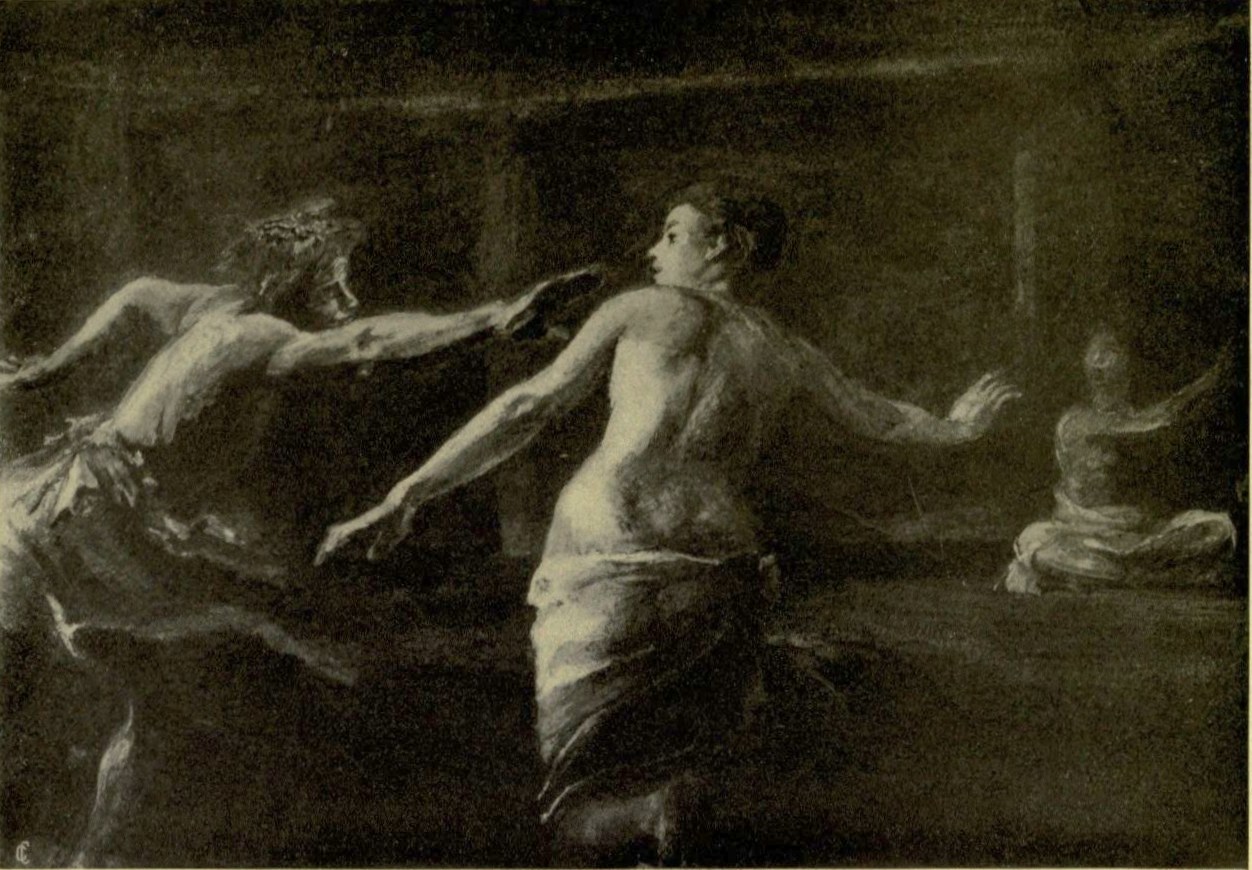 SWIMMING DANCE, SAMOA
and attention as the most complicated European mass of buildings, be
they cathedrals or palaces—only the art has little shape but what
nature gives it. All the more has nature caressed and embellished and
favoured this elemental, unconscious attempt of man.
In the end of the long twilight, with the rose colour still floating in
the upper sky, the little place looked more coquettishly refined than
ever. Here and there the lights within the huts, often rising and
falling in intensity with the blaze of the cocoanut fire, modelled the
steps outside or the posts, touched trees and branches far away or near,
and made pictures of family groups within, garlanded and flower adorned.
The larger house to which we went was adorned with flowers and all lit
up. More people were crowded in it than the little village contained;
for the island had sent visitors and performers for the dances which
were to entertain us. I shall not describe them. But they were of course
interesting, not only for what one liked but for what one did not like,
and for our being with others who looked on. The spectators are
inevitably part of yourself, as of the show, and in so far, the very way
in which I looked on was a new charm.
There was among the dancers a young chief, serious as an Indian prince,
who danced gymnastics, and ended with primitive buffoonery that seemed
to delight his hearers. At the other end of the scale was a hunchback
dwarf, who played realistic scenes so well as to be repulsive. But all
this was a lesson. I shall certainly see all about me, in this form of
civilization necessitating health and strength, or their appearance, a
great line drawn between those who suffer or are weak, and those who are
not—a visible line. As yet there is no place for my hunchback’s
intelligence, except this buffoonery.
Later we left the dancers and wandered in wide moonlit paths among
banana trees. There we came across our young chief looking now as if
such a person never could have so demeaned himself, even from political
reasons.
We exchanged alofas and compliments, and he placed his garlands in
sympathy around my neck. He is a beauty, and his father is one of the
tallest and biggest, as was his sister, who was once taupo.
This morning I have wandered with Seumanu for a few miles, to show
ourselves. We pass other villages where we are greeted, and where at one
time our yesterday’s friend, the old tulafale, canters out of his
house in a circle, according to ancient fashion.
We see a great war canoe under its shed, and the remains of a high wall
that encircles the island and was an old protection in war.
Much should I like to remain, but we shall have to go at once, for—as
I feared—we are not here really for pleasure, but we are entangled in
the quasi-necessary political advantages of being seen where there is
“influence.” But this, I feel, is the kind of place I want to see—out
of the way—out of use—where usages linger, and where the landscape is
influenced by man so as to become a frame; as it was in little Nua on
the island of Tutuila where we first landed upon our first morning in
the South Seas.
For a thousand years, probably two thousand, perhaps three—for an
indefinite period—these people of this smallest island have lived here
and modified nature, while its agencies have as steadily and gently
covered again their work. So that everything is natural, and everywhere
one is vaguely conscious of man. Hence, of any place that I have seen,
this is the nearest to the idyllic pastoral; it is not so beautiful as
it is complete.
Iva in Savaii, Oct. 26, ’90.
I am writing in early afternoon, a hot afternoon, after a morning at
sea. Opposite me in the circular Samoan house are a couple of persons of
importance, a local governor, some four or five chiefs, all ranged
against the pillars of the building, as I too am leaning against one.
Seumanu and some of our acquaintances are to one side; opposite me, a
grave young girl is moving her hands in the great kava bowl from
which she hands the strainer of bark filaments to a reddened haired
young man whose head flames in the sun outside, against the background
of green banana leaves. Next her a big fellow keeps grating more kava;
and another fills the big bowl with water, making big red spaces in the
reflection of the sunlight, that streams in on that side. Small parcels
of presents of food have been brought in and lie about on their side.
Much kava has already been drunk and more is being prepared as more
and more chiefs come in. Everything except the picture before me is in
shade. Conversation, probably politics, is going on slowly, in the usual
low tones, with an occasional high-voiced interjection from some less
important member. The village orator, with his fly-brush over his
shoulder, has long ago made his lengthy speech of welcome, and as we are
told to do as we please I write to you, in the interval of watching the
faces of the men, or the circular movement of the girl’s hands dipping
in the big bowl, or running around its wide rim, when she wipes it,
before passing the strainer to be squeezed out. The orator watches me
suspiciously occasionally, but there is general confidence and peace,
that we much need, for the heat is great and our sea trip was rough and
hot. As I write, I hear my name La Faelé called out, and the kava
bearer comes to me with the usual swing. But I fear the kava, and
merely accept the bowl and return it undrunk according to form. Then
many of the circle disappear—to church—the bell is ringing and little
children half-naked, small creatures toddling along are already in the
doorway; apparently all the neighbourhood are beginning to file toward
it gravely, most of the women with hats that do not become them. Even a
little girl-child, with nothing but a band around her little fat waist
for a drapery, steps along with difficulty, a big hat on her head. This
is Sunday conventionality: all the congregation are dressed, even the
half-naked chiefs, who had left us, reappear from their huts, with white
jackets, and pass on gravely in the procession at a distance. And the
Sunday hymns add to the drowsiness of the Sunday afternoon.
This morning when we left the little island of Manono, some five or six
miles away, people were going to church but to a different call from
that of this absurd little bell. A big war drum, a long cylinder of tree
cut lengthwise, was beaten in the oldest, most primitive manner, some
way as ancient as man himself. A man bent down over this big wooden
trough, that lay like an old log in the grass, and beat it from the
inside, with one of the big hard stones that lay in it. The sound was
unearthly, I ought to say uncanny, and nothing more savage, more a
type of the war of the savage could be imagined; and it seemed fitting
that this war usage, turned now to the call of Divine Peace, should
still remain in the warlike little island, once the petty tyrant of the
little group. Right alongside, near the great wall built for war, whose
remains surround the island, marks of destruction recalled the exploits
of the German warship Adler, that now lies stranded by the great
hurricane, in Apia harbour, and whose crew were saved in part by the
people they were killing, and especially by the brave giant, in whose
boat we have been travelling. Indeed, there was an element of comedy
quite Polynesian, even if atrocious, in the danger the Samoan rescuers
ran of being fired at from the beach while they saved their enemies in
the sea. But we made the first part of our trip to-day, in a native
boat, for Seumanu’s was rather too fine, and too heavy to be risked in
the entering of the curious harbour that we first made. This was
Apolima, “the open hand”—a small, very small island about a mile out
from Manono; the upper part of a submerged volcano cone, broken down on
one side, so that there is an entrance. We soon reached the great wall
of soft brown rock, which crowned with cocoanut palms and half covered
with vegetation opens suddenly, leaving a small passage through rocks,
just wide enough for our boat, skilfully paddled in the great blue wave
that swung us in. Then jumping out, half of our men caught the side of
the boat, to prevent our being dragged back by the returning swell, and
we were pushed and dragged around a corner inside of the rocks. The tide
was low and we were carried ashore on the men’s backs, through coral
rocks that spotted the floor of the small lagoon inside.
The place was just what you might imagine; a little amphitheatre of
green, the high reddish rocks standing on each side at the entrance, and
between them, a great bank of rock, over which the surf broke so as to
hide the little break through which we had come.
As we looked, three great palms stood up against this distance, planted
on the higher ground that is all green, and leaning toward the sea as is
their (loving) habit. Huts stood about with bread-fruit trees, and
further back we were led to a little pool that supplied the place with
scant water. Further back yet, the slope was all covered with trees, and
after walking a little way, slipping along the greasy banks, and walking
up the sloping timber notched with cuts to make stairs, and returning by
another that made a level bridge across an empty channel, I sat down to
wait for Mr. Sewall, who had walked up to the ridge, and I had time to
make a sketch. All this took us a little more than a couple of hours
while Seumanu’s boat was beating outside, in a fair N. E. wind. At last
we were paddled out in the great wave that washed in and out, and with
the swing that belongs to the balancing of a boat in a narrow tide-way.
And we kept in the dance until we reached Seumanu’s boat, invisible for
some minutes behind the blue waves. Then we ran alongside, and we
scrambled in, exchanging good-byes—tofa—with the chief of the lost
hand, who had taken us thus far. Within the next hour Seumanu’s boat had
come to the outer reef off Savaii, in front of the landing of Iva. But
there we had to wait at anchor. The water was too low inside the reef,
so that we remained in the thin blue-green tide, that seemed to show
everything in it, until a smaller boat came out to us, with Selu, the
chief, and we were taken in. We landed among black rocks, within a few
feet of a little scanty road, and clambering over a stile of rocks, at
some part of the long black fence of stones in front of us, we found a
village, which spread higher up and far back behind the trees, with
spaces between houses; banana, palm and bread-fruit trees, dispersed as
if for ornament or making little patches of plantation. There was a big
church of the usual formless kind, not as handsome as the thatched ones
with circular ends, that are certainly the types one would prefer. And
so we walked up to the house, where we were to listen to speeches and
the Consul to make one. Since I have begun to write, all has become more
quiet, and I shall merely use my afternoon to make a few notes; we
shall sleep in another house belonging to the Governor and be near, I
think, to the chief, whose name is or was Selu, for lately he tells me
that he has had the name of Anai given him, and we try to make out
together just how near these changes come to the forms of the Western
world. This is not a title properly, but as it were a name embodying
rights that go to descent; for these men with titles apparently elective
are noblemen who form an aristocracy of government and are usually to be
distinguished externally by their size or manner as well as by little
symbols or expressions of superiority. Anai tells me that of the many
chiefs here, whom we have seen or will see, he and another, alone are
the “political” superiors, as he expresses it; that is to say, he goes
on, that they alone talk in public about such matters (I suppose in the
way of decision), and that others would be checked if moving. Thus, that
to him and to his mate alone the making of war, or as he expresses it,
the allowing the “shedding of blood” is devolved. This chief is a most
interesting and sympathetic person, speaking English very well, though
apparently a little wanting in practice, with a pleasant, handsome face,
resembling some Japanese types, interested in missionary matters, a
strict church member, and showing much interest in foreign matters
throughout the world; we talked of the civil war, and of the prospects
of the republic in France, and of the universal “striking” now going
on, as we might anywhere; and I am sure that Anai was “posted” to a
later date than we, for the Consul had handed to him the files of the
Herald for the last few months, while we had almost entirely abstained
from that indigestive form of reading. Anai has explained to us that
this being Sunday we shall have no reception, but that to-morrow there
will be a formal reception, called talolo, and giving of presents, and
that there will be dances. So that we shall spend this evening quietly,
with a bath in the pool of fresh water, that is open to the sea, and try
to rest.
On Savaii, Oct. 30, 1890.
We are settled here for an uncertain time, perhaps three days. This is
the political capital of Samoa, and we are occupying the house of the
great orator of the islands, important by his influence, though not so
great a chief as several others by descent or by control, or even by
physical superiority, that great proof of eminence in communities like
these, where the chiefs seem to have reserved for themselves a size and
weight that recall the idea of heroic days. Certainly the first time
that I saw a well-chosen dozen together, as I did two days ago at our
last resting place, all sitting spaced out, as if for a decoration on a
frieze, silent and indifferent, or speaking occasionally without raising
their voices, with heavy arms resting on great thighs, and with the
movement of neck and shoulders of men conscious of importance, the
recall of Homeric story made me ask myself which one might be Ajax, and
which the other, and if such a one might do for Agamemnon. Fine too, as
some of the heads were, they were only relatively important, as with the
Greek statues that we have, and that we know quite well and intimately,
even though their heads be missing. The whole body has had an external
meaning, has been used as ours is no longer, to express a feeling or to
maintain a reserve which we only look for in a face.
And as I am writing, while the household is enjoying its evening
relaxation and preparing for the night, everything about me repeats to
me this theme of all being done with the whole body. About an hour ago
prayers were said and all sat around while the regular form was
repeated, and then our young hostess prayed an extempore prayer
commending us all to the care of God. Some words I can catch, but the
intonation is sufficient. It is a prayer cadenced as well as the most
consummate of clergymen could manage, and repeated without the slightest
hesitation. Then she stretched herself out, with her head on the Samoan
pillow, and talked with some young male acquaintance outside the hut
whose head just appears over the barrier that runs between the pillars,
for our house is placed higher than usual. She talked with Adams who is
lying by her, and occasionally she criticises the game that is going on
near her at that end of the house. I have only followed the little
things happening by fits and starts, as I have made some sketches and
have been writing letters, but I make out that the household is playing
some game in which some motion or gesture has to be duplicated or
matched, and that the beaten side, for there are two rows of players, is
to dance as a forfeit. I say that this is the household, I mean that I
take it for granted, though I see that one of our boatmen is among them,
and that a couple of children have dropped in. The duenna of our young
lady is also there. Sometimes I see her and sometimes I do not, but I
know she is there on watch. But a siva has been organized slowly, a
household unofficial siva, begun in little patches—somebody humming
something and several beating hands. Tunes or songs are taken up and
discarded, and sometimes a man, sometimes a woman, stands up to sketch
some motions. At last they appear to have got under way, and I see them
swing and dance, with little clothing and much clapping of hands, at the
other end of the house. And everybody joins in: even the children beat
time and take up the words—and the two elder women are the most
enthusiastic and full of energy. Occasionally a burst of laughter
salutes what I take to be a mistake or some wild caper that seems funny
to them. Faauli, at last, after having pretended to sleep or to talk,
so as to appear to herself to have done something, sits up and takes
more interest. By and by she sketches out some steps in an indolent
manner—soon she begins in earnest, and with one of the performers goes
through an energetic dance, slipping her upper clothing for greater
ease. The clapping and beating time comes fast and furious from every
one, and laughter and small shrieks replace the gentle monotone and
seriousness of the evening prayer. At last she sits down suddenly, her
face rather overcast: (her name means “Black Cloud that Comes up
Suddenly”). She has hurt her foot apparently, for turning round to see
why all has stopped, I see her bent over and looking at a toe. Note that
she does this as easily as a baby with us—her face comes down on her
foot raised halfway to meet it. As I come up, she shows me that she has
torn off the larger part of a nail, and is paring off the remainder
evenly against the exposed surface of flesh. I offer her scissors which
she uses with indifference, as we might cut off superfluous hair; and
apparently more from politeness and obedience than from necessity, she
accepts my court-plaster. Then being properly mended, she sits down to
play cards while I resume my writing. Now here has been something that
explains some sides of these good people; an absence of nervousness and
insensibility to pain—for to most of us such a small accident would
have been very painful and sickening. Before this the dance had been
merely an outlet for action, as natural and unpremeditated as any other
motion. The entire body has been called into play: from the ends of the
fingers to the toes of the feet, all the exterior muscles have been
playing gently for some two hours, with almost every person present,
whether they sat or stood. This constant gentle exercise must go far
toward giving the smooth even fullness that marks them. And meanwhile,
too, they have decorated themselves; some one has brought out garlands,
and they have been worn: flowers have been put in the hair, as if to
mark that this is not work but play.
And now that all is quiet, I shall try to resume my itinerary, and
recall small matters that are fading away, and becoming so confused from
repetition that it requires an effort for me to distinguish this siva
from that siva, and to remember what taupo it was who danced well,
and what one it was who danced ill.
I was writing last in Iva, on our first day there, Sunday. It is now
Thursday night.
Monday morning at Iva we were up early, before the sunrise, waked by the
red glow of the dawn that calls one up easily from the hard bed of
double mats laid on the floor of small stones. Every one was up, people
were moving about, probably most had had their early bath, for they
were returning with wet clothes, or with their garments spread over them
like a veil. So that we scrambled over the stone wall that seems so
anomalous and unreasonable here. But they not only divide village from
village, but also prevent the straying of that roaming property, the
pig, that wanders about the village and the forest also, picking up
everything of course. To see a pig picking out the flesh of the cocoanut
has been one of the small amusements of this afternoon, and last night,
besides the invariable dog, pigs came into our house and snuffled at the
faces of Charlie and Awoki, who lay outside of the mosquito netting. The
path over the fences brought us to the bathing pool opening to the sea
on one side only, where among black rocks the fresh water runs up to
meet the tide, filling in the pool. There we went in and swam about,
watched by many of the smaller villagers, girls and boys who were
curious about the manners of the white people. And I was able to admire
the skill, though unable to rival it, with which the native bathers
draped themselves as they rose from the water, so that man or woman was
clothed as he or she stepped on shore.
By the time we returned, our mosquito nettings had been put aside, the
mats swept out, and Awoki was bringing us the tea and brown bread,
which, with such native food as we liked, made our meals. Fish there
was and yam and taro, and some preparations of cocoanut. And there were
cocoanuts for their milk for which I do not care, but there was no water
yet, the water in the two pools near the sea, edged with black stones,
being blackish until the change of tide should leave the spring to fill
up by itself.
Then our host came in and told us that we might rest that morning: that
in the afternoon there would be a reception, a sort of review or
“fantasia,” and presents of food would be given and speeches made, and
songs and dances, the whole apparently included under the general title
of the talolo which was to be given us. So we waited peacefully; I
sketched the girls in the neighbouring house, who were at work making
the wreaths, the garlands, the complicated flower girdles that should be
worn later in the day, and perhaps at night, for there were murmurs of a
night siva. But I knew that our host was a church member, and that the
siva is not encouraged, neither the siva, “fa Samoa,” Samoan way,
the Samoan siva, nor the siva of the Europeans, which we call round
dancing; for had not Faatulia, the wife of our leader, Seumanu, been
threatened with excommunication for dancing in her innocence in European
ways at the Consul’s Fourth of July ball. Meanwhile my models across the
way in the shadow posed badly: they were always moving, or they came
across the way to see what we
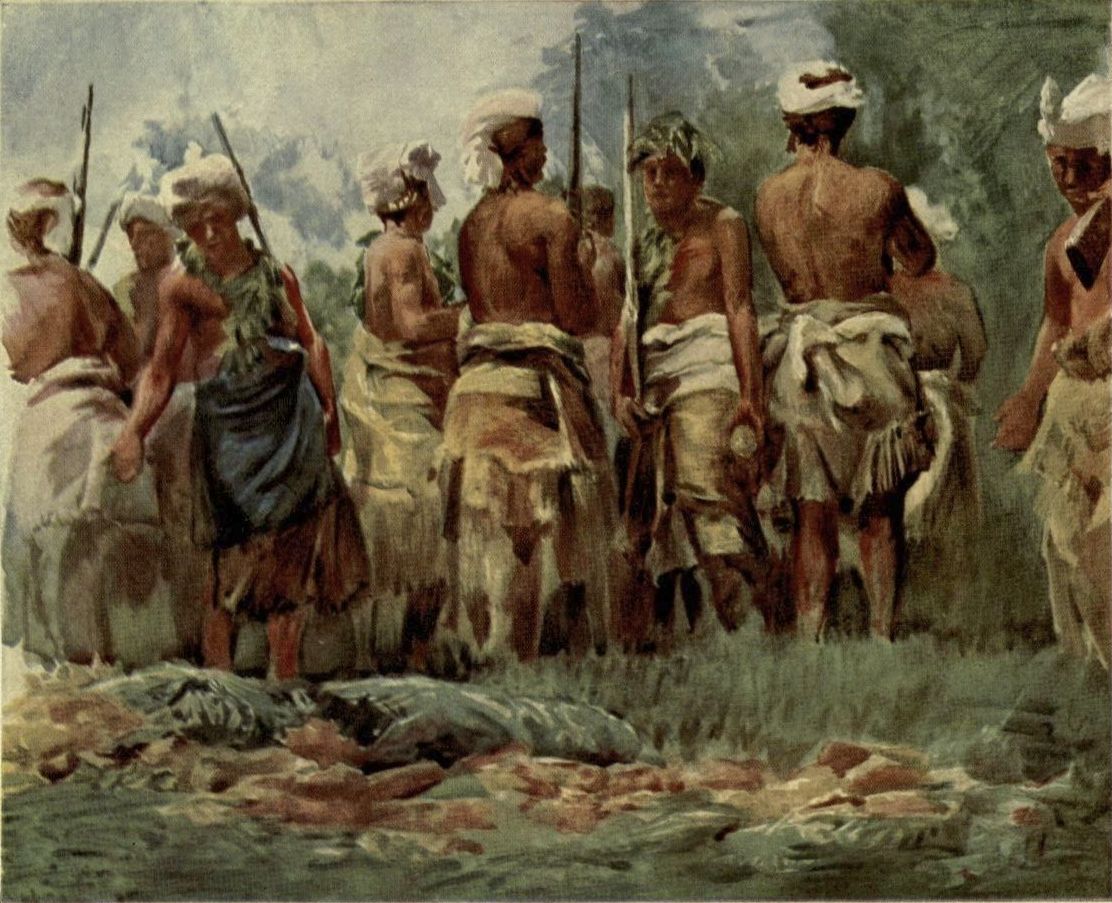 SOLDIERS BRINGING PRESENTS OF FOOD IN MILITARY ORDER.
IVA, IN SAVAII, SAMOA
were at. For somebody would stop in and look at us, and go give the
news—a little pile of small boys and girls, three rows deep, sat
respectfully under the bread-fruit trees watching us. But somehow or
other the morning wore away, and by two o’clock we were told that all
was ready, and that we had better come to the house chosen for us to
occupy during the ceremony. Meanwhile, behind the trees that closed in
the sight (for the village was placed, if I may so describe it, in an
irregular open grove of many kinds of trees), we had seen for the last
hour or so, dressed-up figures moving about; men with large green
garlands, and green cinctures around their waists stiffened out and made
larger by great folds of new bark-cloth, or by the fine wearing mats
which are the most precious possession of the Samoan: some of them with
guns carried with pride, for these were men who had been victorious and
had beaten off the bullying German.
And now we took our places in the circular house which looked like a
pavilion, and which stood on the east of the large open space near the
church. Opposite us perhaps some two hundred feet or more was another
house, and others spread to right and left, leaving a large space ending
on one side near the church, whose white façade had written on it its
name, Lupeanoa, Noah’s Dove—enclosed by a little clump of trees to the
left, where we could see figures moving with great swaying of leaf
girdles and waist-mats—and the occasional beat of a war-drum came from
further back.
We were seated, all facing toward the open space, the next house filled
with women and children: Seumanu and our host and other people of
importance near us, and the rest of the house packed, but not too
closely, behind us. Out on the grass and near trees people sat, mostly
women. Others moved slowly to take their places, showing some vestiges
of yesterday’s Sunday in their hats and long gowns.
Then rushed across them a man all blacked, with a high white turban
bound to his head, with green strips of leaves, a few leaves for a
girdle, and waving a paddle. This was a friend of Seu’s—a funny man and
joker, with a hand maimed or deformed—the deformed in such communities
take things gayly and are jokers. He shrieked out things that caused
shouts of laughter, and repeated “Alofa Atamo!” From behind the church
came out a mass of warriors, with banana leaves in their hair, and
wearing girdles of the long green leaves of the ti: their backs were
streaked with white lines following the spine and the ribs, and their
faces and bodies were blacked. They carried their rifles high and
discharged them into the air, then cantered past and away. Again the
buffoon and again the warriors.
Meanwhile in the distance, in the opening of trees, we could
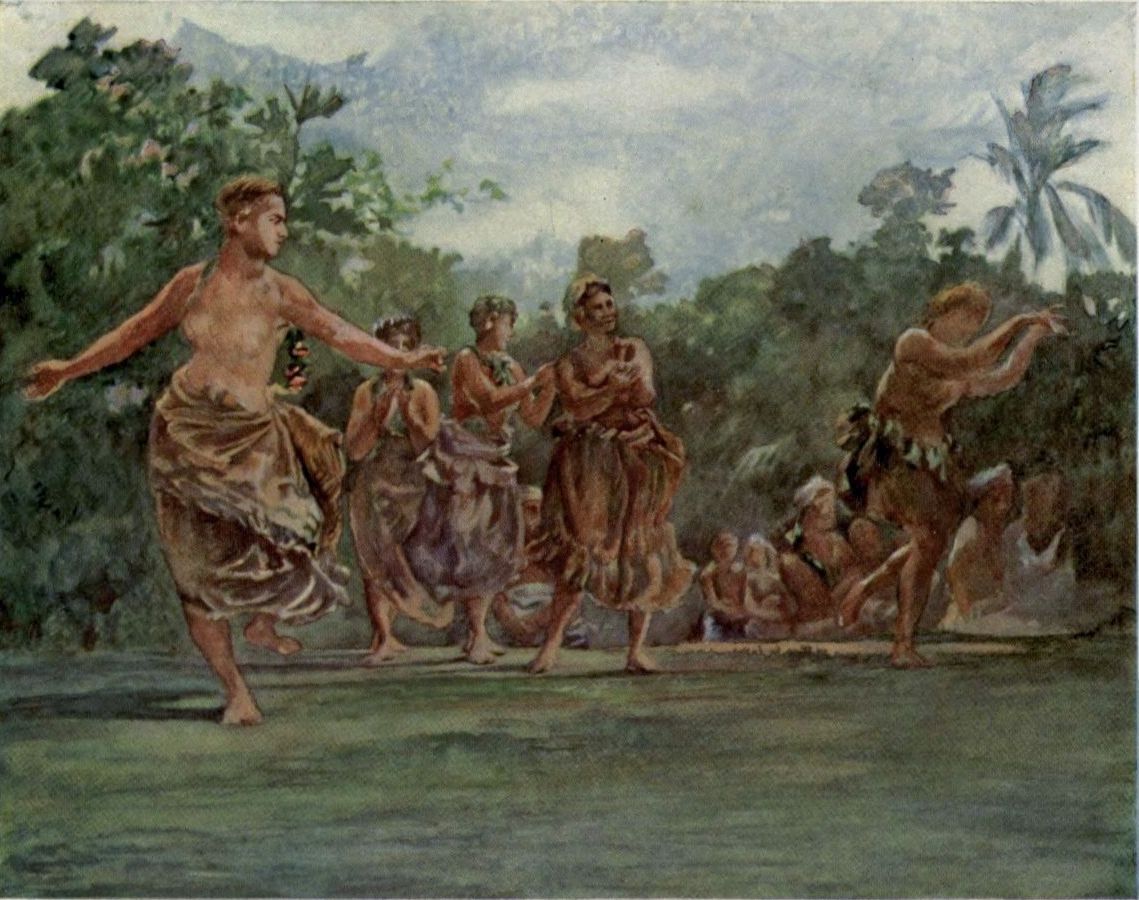 TAUPO AND ATTENDANTS DANCING IN OPEN AIR. IVA, IN SAVAII,
SAMOA
see other warriors: behind them the drum and the little fife made a
curious war music, and a peculiar shout and call with a short cadence
came from the men. Unconcernedly a girl moved across the opening in
front, intent on something else, and a hunch-backed dwarf, with enormous
wide shoulders and long legs edged with green leaves, came to us and
shouted “alofa!” Then six warriors again emerged from the grove,
swinging their clubs, and marched back leaving the green space before us
empty and silent.
Slowly now, moving step by step, the mass of people behind the trees
came out, so that they could be seen. In front of the men and of the
music a girl, with black, shaggy waist garment, like thin fur, with long
red necklaces of beads, and flowers in her hair, danced slowly to the
tune, crossing and uncrossing her feet in a hopping step, and swinging
with both hands a slight club in front of her, as a drum major might
move his stick. Slowly she advanced, escorted by two men clad in mats
and garlands, upon whose heads stood out a mass of yellow hair, like the
cap of a grenadier, supported by circles of shells around the forehead.
They also kept time to the music, but did not repeat the girl’s
monotonous step that made the central point of interest to which the eye
always returned.
This girl was the taupo, the virgin of the village, dancing and
marching in her official place at the head of the warriors—like
Taillefer, the Norman minstrel who began the battle of Hastings. When
she had moved slowly a few yards, one could see that behind in the crowd
there were two other girls representing other villages, who also
repeated these movements, while some of the men danced and others
stepped slowly with crossed arms, holding their clubs and muskets. And
the virgin danced forward and passed, and then up the slope toward us,
followed by the other girls, and all saluted us; when the whole assembly
in the field came up suddenly and threw down before us leaf baskets
containing taro and yams, and cooked things wrapped up in leaves, and
fish, and a number of little sucking pigs, with hind legs tied, that
struggled up and down in the heaps of leaves. As each person threw his
load down he stalked away gravely and took a seat somewhere in the
distance. All became silent. I could see the taupos moving off with
that peculiar walk of the dancer who is resting. A warrior with high
white turban of bark cloth sat down against a tree near us, without
looking to the right or left, his gun against his shoulder, and smoked
gravely, while a girl, his daughter perhaps, leaned affectionately
against him. Meanwhile the sucking pigs had been escaping with hind-legs
tied, and every now and then Charlie pulled them back into place.
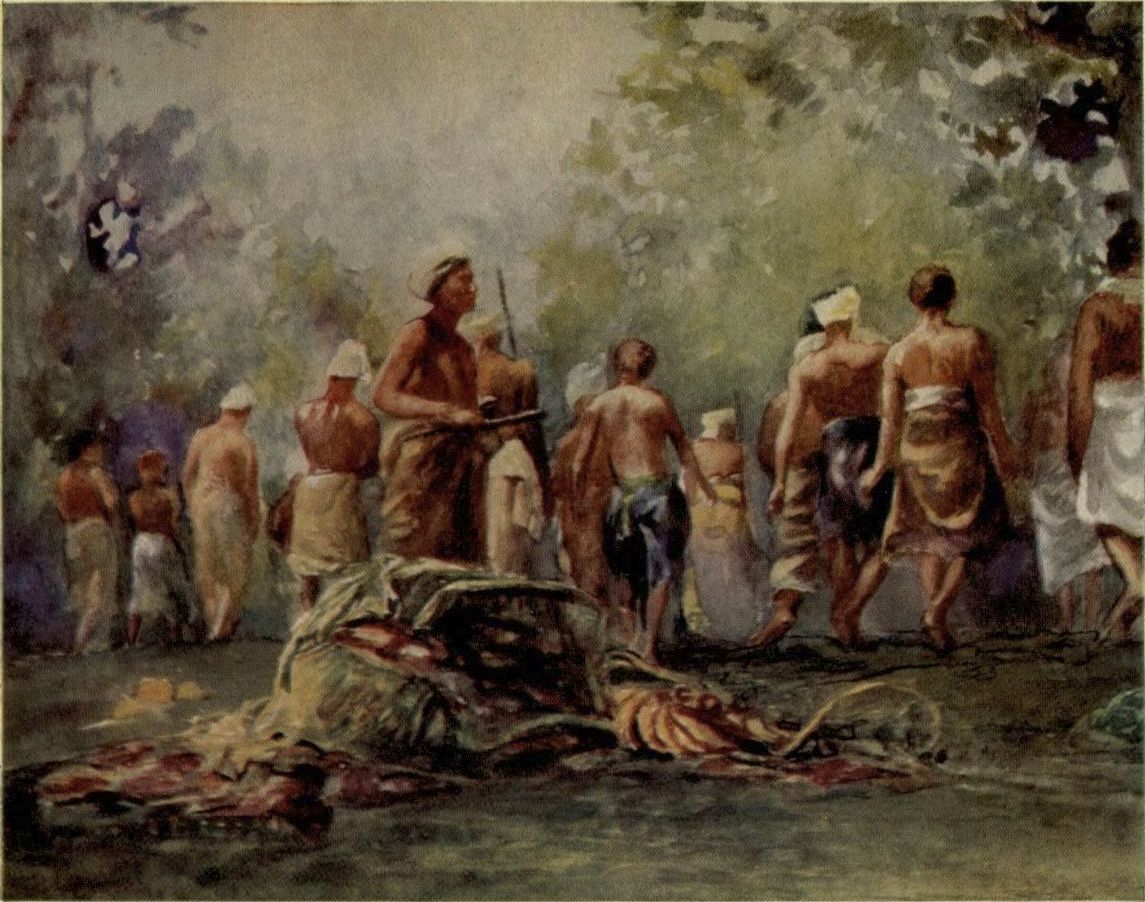 PRESENTATION OF GIFTS OF FOOD AT IVA, IN SAVAII, SAMOA
Then rose the orator, the tulafale, from the centre of the three rows
of men now seated opposite to us, across the green space, and from two
hundred feet away, addressed us slowly as he leaned upon his stick, and
seemed not to raise his voice beyond what was absolute necessity. But
the cadence always rose in the last words, so that the effect to the ear
was of a distinct, emphatic assertion. Then he added, “This is all,” and
sat down, apparently inattentive and indifferent. Our turn came next.
Anai, the chief, translated to us the usual speech of great gratitude to
America for having saved them from slavery and from the Germans, and
compliments to us all, with prayers to God to have us in his holy
keeping. Then a few things were suggested between us, and our political
man said what was necessary, and alas, even more: for how can the United
States promise anything—that may depend on sugar—or an election, or at
any rate is merely a matter of barter? Anai stepped out from the house
and repeated all this in Samoan, speaking also quite gently, with little
raising of the voice. Nobody seemed to listen, nobody to care, but this
was only apparent. All heard and had listened.
Then our own men, who had been hidden somewhere, sprang upon the
presents and sorted them: one of them stood up and called them out: so
much of this, so much of that, to give full acknowledgment for
liberality. Then another spring, and all was carried away, even to the
struggling, sucking pigs that could not be made to understand.
Momentary peace settled over everything, and we had begun to ask
questions and to sketch, when we were told that now we should have a
siva, that several villages would appear in it by their performers, as
they had appeared in the military display. Men came up garlanded and
cinctured in flowers and leaves, and sat down in double rows before us,
some turning toward us, others away. Out of their number first one, then
others arose and sat down again in order, fronting us, and the siva
began; six handsome young men, singing and swaying about upon their
hips, to a chant for which time was beaten behind them.
The sun was setting; tired out and amused we walked back in the crowd,
stopping to exchange alofas with belated warriors who showed us their
guns and occasional wounds, which with the Samoan idea of a joke they
pretended had been caused by running against wire fences.
We had seen for the first time a pageantry of savage war, in a soft
light, in the most peaceful and idyllic of landscapes, so that it was
hard to realize again that this was not all a theatre scene, a fête
champêtre—a play in the open air. There was nothing to contradict this
unreality but the marks of ugly gashes on the arms and chests of the men
and the
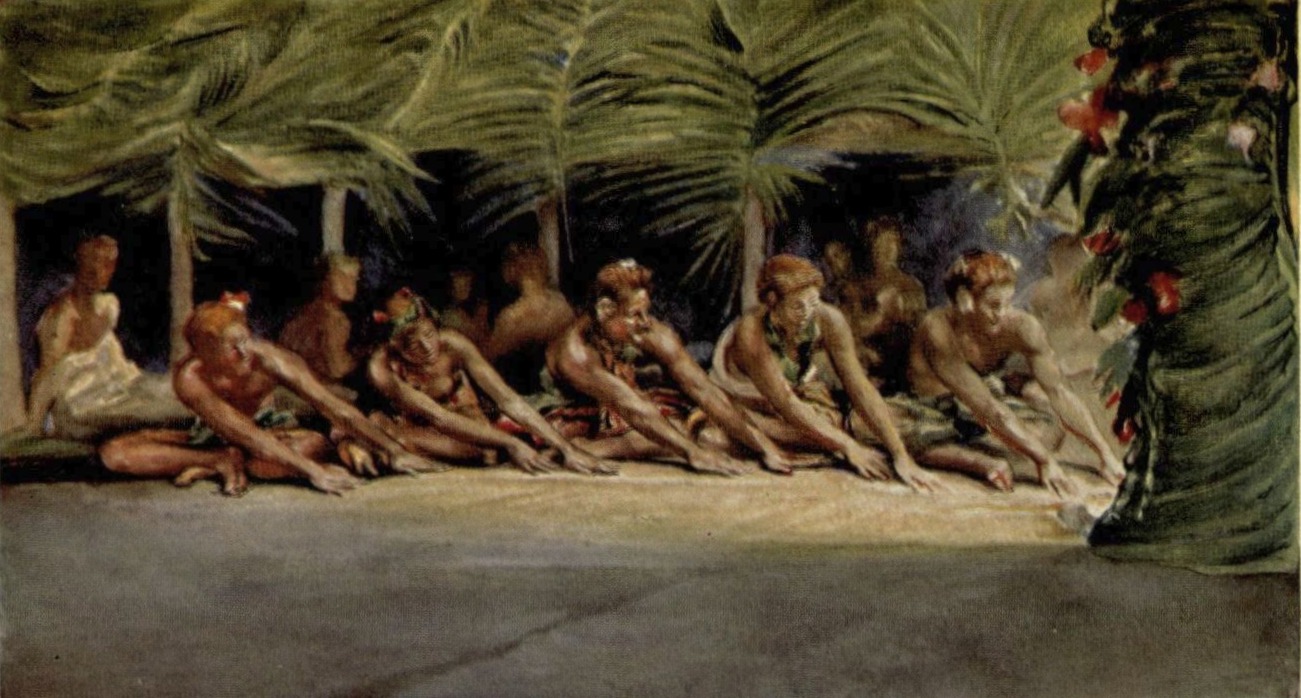 SOUTH SEA SEATED DANCE AT NIGHT, SAMOA
recall of the savage melody, which was undeniably a war song, requiring
no explanation as to its meaning.
In the house we ate our meal spread out on banana leaves, two of the
taupos coming in to help us by breaking the taro and yams, and tearing
the fish and fowls. Then while wishing for nothing but bed and rest, and
closed eyes, we were told that there would be a night siva in our
honour, and that other taupos would figure in it. There was nothing to
do but yield, and with each a taupo to accompany us, we went back to
the house that we had occupied in the afternoon. It was already half
filled with people, occupying one side of it. I sat down against an
outside post, alongside of my taupo, next to whom Seumanu reclined at
length with another girl, an old acquaintance, near him, and I tried to
keep awake while the siva went on enthusiastically. At times I would
start with some new figure or more picturesque effect, or when fresh
fuel was added to the cocoanut fire that fit the scene within. Along the
posts of the exterior sat chiefs watching the dance: behind them
outside, a crowd of people in the moonlight, and many heads of
youngsters. Occasionally a chief would say, “Some one a cigarette or a
light,” and a boy darted into the house through the dancers, plunged for
the light, and returned with it to the great man who had asked.
When the taupos, big and good natured, had danced, we drowsily asked
them to sit alongside of us, while the siva of the men went on.
Between two, as I became more and more sleepy, I was fortunate in
finding comfort and support from my first neighbour, against whose big
shoulder I reclined, my arm supported upon the weight of her knees—all
mine might have been thrown upon her massive form without apparent
inconvenience. A gentle tap now and then, and a gentle alofa told me
that I was all right, and could go to sleep while making believe to look
on. But the girls, drowsy as they were, were appreciative of the men’s
dances, and so was Seu, who called out over and over again, mālie
(bravo) as if he had not seen thousands of sivas, which now, having
become “missionary,” he does not attend. I knew that I was interested in
the intervals of sleep, but all has faded into a sort of disconnected
dream. I can only remember getting out into the bright moonlight, and
that it made a silver haze outside during the dances. We had been
obliged toward midnight to make a speech, with thanks, protesting the
fatigue of travel as an excuse for not remaining. The Samoans will sit
up all night, especially in their favourite moonlight: they can sleep
during the day, and apparently always do so. Around our house, until we
had blown out the light, and even for some time after, rows of people
sat watching us in the light of the moon: the people sauntered about, or
sat in the shade of the trees, with sharp-edged leaves that made the
scene look, as usual, like the stage-setting of a fairy opera.
The next morning we were to leave for the next important place,
Sapapali, the home of the Malietoa, the princes who have been for a long
time the principal chiefs of these islands, and who are now represented
by the present king. This is a rude definition; as I have told you
elsewhere, the question of chiefhood and sovereignty here is one not
easily represented or defined by our words. At Sapapali, the ancestral
home, we should be received by Aigā, the King’s niece, and consequently
a young person of the highest rank, indeed, I suppose the greatest lady
of the land. With us this would be the Queen or the Royal Princess, or
the heir to the throne. But here blood and descent are all and in the
direct line. This young person was next to Malietoa as being of
sufficient blood.
Our arrival was to happen about noon, so that, as in Samoan phrase, it
was only about half an hour’s walk, we were to leave punctually at ten
o’clock. Early rising took us again to the black pool surrounded by high
trees, where two of us bathed, watched and escorted by two little
damsels with whom the other one of us flirted. I myself was too much
occupied with the difficult question of keeping on, while swimming, the
fathom of cloth they call lavalava; and afterward of adjusting it in
the water, after swimming for it when it had floated away, and then on
coming out, receiving dry cloth with one hand and putting off the wet
one. But I found out how one begins in the corner. Later in the morning
it had grown hot, as we left pretty Iva, and made our way through broad
or narrow roads, to Sapapali. The old difficulty again amused me; we
could not walk in proper Samoan order; sometimes one of us, sometimes
another was in front, while properly, all of us chiefs should have led,
and the attendants followed at respectful distances. So that again Awoki
would canter on in front of the chiefs: meanwhile Anai told us things of
local information, pointing out where the road narrowed, the place where
had stood in older times, a famous tree, a cocoanut. Among its branches
the Malietoa, who first became converted later to Christianity, used to
conceal himself and lasso or noose such pretty taupos or maidens as
passing might strike his fancy. One of these had been the grandmother of
the young lady whom we were going to visit. While the party talked the
scandal over I remained a while by a deep well near the shore, and
watched a handsome Samoan ride his horse barebacked to the water, to the
sand and distant trees of a little promontory.
When I hurried forward, the party had gone far ahead, and had arrived
before me. I crossed the rocky bed of a dry river, upon whose edge stood
houses, and going up the hill before me, came upon a high open space
with trees far scattered, and several large black tombs made of stones
piled together in regular rectangular form; and in the centre of the
green a house high-placed which instinct told me was the guest-house,
our destination. Part of the mat curtains were down opposite the central
posts: I entered by the open side, and saw Adams and the Consul seated
next to a young woman in half European dress (that is to say with a
corsage); and on the other side of her Seumanu and Anai. I entered and
sat down with some hesitation next to the Consul, and after being
presented to her ladyship looked about me. Opposite, the posts of the
pretty house all adorned with flowers had each a chief, as a sort of
sitting caryatid or buttress. And they were big and splendid; that was
the Greek frieze of which I was telling you. Between each massive
figure, of Ajax and Nestor and Ulysses and Agamemnon, appeared from time
to time some little boy, whose small person made them look more ample,
as the boys or angels of Michael Angelo’s Sistine Chapel make sibyls and
prophets look more colossal by comparison. Then kava was brought in
and made solemnly, when in stepped a woman and sat herself beside the
kava attendant who dried the wisp. A moment later, and her presence
was explained. She, it appears, had the hereditary right to “divide the
kava,” and had come to claim it. When the heavy clapping of hands
announced that the drink was ready, she called out the name of Aigā, to
whom the first bowl was presented as to the greatest personage. Then to
one of the guests, then to the next relative of the Malietoa, then to a
guest, then to a chief, and so on, contrariwise to what we had seen
before, where we as guests were helped first. You see we were at court,
in the presence of royalty.
When the ceremonies were over, we chatted with Aigā, who spoke English,
and whose amiability pleased me. She was embarrassed and shy, and
struggled like some girl, unaccustomed to society, to say some proper
things. But the grace of her diffidence was all the greater when one
noticed the security of position indicated by her voice when speaking in
a low distinct tone to others. At length we rose and adjourned to the
neighbouring house, where the feast had been set forth. This we were
allowed to dispense with under plea of a late breakfast, but for form’s
sake we looked at each separate thing, spread out in a long line of
Samoan good fare, on green banana leaves that stretched across the
house. Then we papalagi, (foreigners), returned to a Western soup
kindly prepared by Aigā, and our own bread and tea, and sardines, in
which fare Aigā joined, and talked to us and we to her, all stretched at
full length upon the mats.
Then our lady disappeared with some little show of embarrassment, and
had I known how much it cost her, I should have sympathized with her
sooner in the annoyance of her having to prepare her toilette for the
great official reception (talolo), which was to be the next function
of the afternoon—the nearest house was the scene of the dressing of
herself and her maidens. Through the dropped mats of the openings, girls
and women kept plunging in and out, carrying in dress mats, and beads
and garlands of flowers, and entangled, complicated cinctures and belts
of fruits and flowers, and woven bark—and bringing out the news of how
the dresses looked to the loungers sitting at a distance outside. And
once I saw carried in a fierce, cruel headgear that our lady was to
wear; the great helmet of blond hair, set with sparkling mirrors and
tall filaments, to be bound tight with silvery shells around an aching
head.
Then we went out to sit and wait on the other side of our guest-house,
in the shade toward the sea, while long shadows covered the great space,
and the sun itself became veiled and lit the scene with a tempered light
more like that of our northern summer. One might almost have imagined an
afternoon in some favoured, more poetic point in our coast at home, say
Newport on some exceptional evening. The great mālie spread out
further than the reserved ground of any of our residences, and its edge
dropped suddenly to the sea before us. Once or twice a thatched house
stood on the verge of this rolling green, all carefully smoothed and
weeded like a lawn. To the left and right were small groves like the
wings of a theatre. Far off to one side curved the bay, with palm trees
stepping gradually into the sunlight. The sea was blue and green before
us, and faintly shining; far off in the haze of sunlight were Upolu and
Apolima—spots of blue. Nothing broke this space to the furthest dim
horizon, except where on the edge of the cliffs stood one hut through
which shone the colour of the sea and the foliage of the tree
overshadowing it.
Then our party came up and sat about us on the slope of the grass about
the house, and from the groves about us came the sounds of the drum-beat
and the call of war music. From behind the house, in a great circle, ran
out in a sort of dance, our hostess in full gala costume: naked to the
waist, kilted with costly mats held on by flower girdles—on her head
the great military cap. She held a little toy club in her hand; on
either side, with heavier strides, two of the giants, her attendant
chiefs, dressed and undressed in the same way, repeated her movements.
Some thirty paces behind her, two of her maidens followed these leaders,
turning round in a great circle of dance, spreading out their arms, and
the wide folds of their waist-cloths, and the lines of their garlands
were flung out by
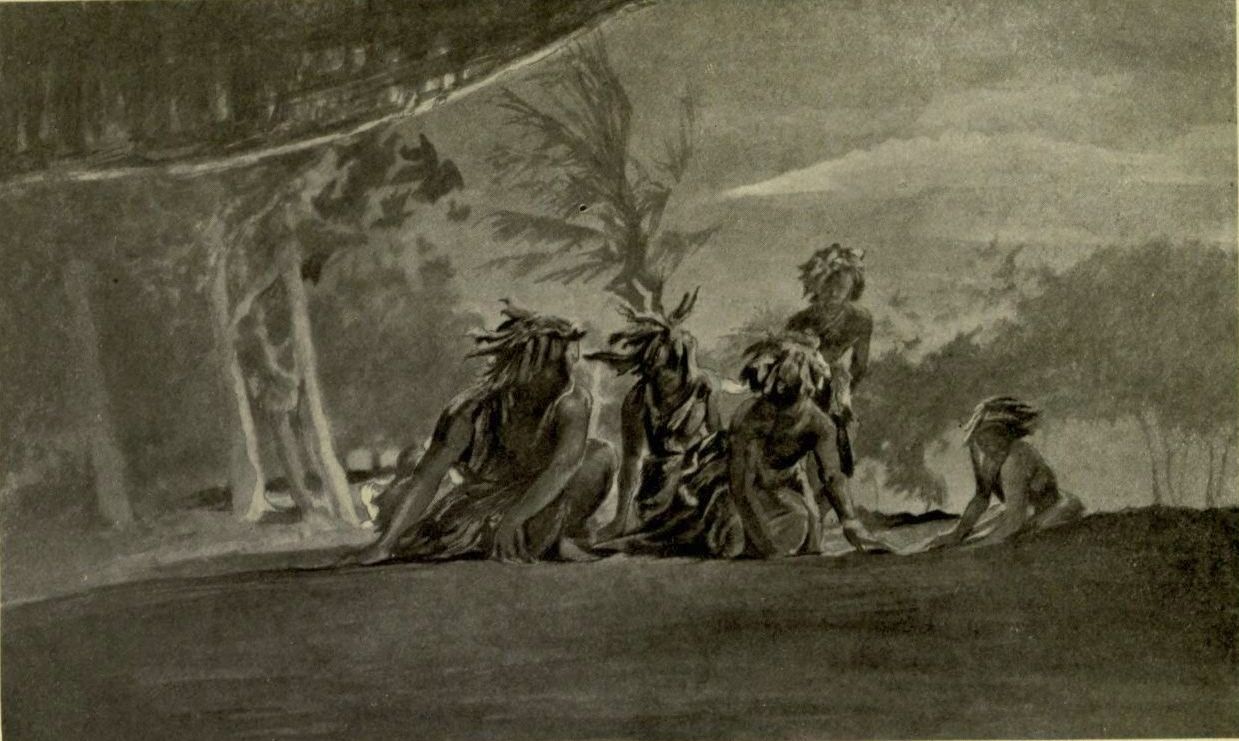 AITUTAGATA. THE HEREDITARY ASSASSINS OF KING MALIETOA.
SAPAPALI, SAVAII, SAMOA
their motion. In and out of the little grove danced back and forth a
crowd of armed men, who threw up their clubs and caught them again.
Right in the middle of the green before us, threading their path between
the princess and her girls, crouching to the ground, crawled or ran,
bending low, three men, all blackened, with green cinctures of leaves
wound round their heads, and short tails of white bark hanging down out
of their girdles. These were the king’s “murderers,” relics of a bygone
time when savage chiefs, like European sovereigns, used licensed crime
to rid themselves of enemies—or friends—against whom they could not
wage open war.
These whom we saw were only on parade. All this served but to recall a
former power and its historical descent. But the ancestors of these
official murderers of hereditary ancestry had been actively employed. At
the whispered word of the chief they tracked the destined victim,
risking their lives in the attack, and plunged into him their peculiar
weapon, the foto, the barb of the Sting Ray, which breaking in the
wound and poisonous withal, meant inevitable death.
They were called, as I make out, Aitutagata (Devil people). The display
lasted but a short time; hardly more than a few circlings by Aigā and
her people, then on a sudden all seemed to come up about us, and the
assemblage broke up into groups. Aigā bore with apparent confusion our
compliments. She was anxious to get away.
There was something inextricably touching in the case of this bashful
young person—indoctrinated with our ideas to some extent—apparently
realizing how we looked upon the scene, how different her dress and
actions from those of her white friends and sisters, and yet carrying it
all out to suit her position of princess and hostess; what was due to
us, and to the traditions of her race.
With evening came the need of change, and I wandered down to the
unfinished church begun by the Malietoa, of whom I told you. The massive
foundations of coral rock, against which the tide was washing, are
finished, as well as part of the walls of the church. In front is a
little island, planted with trees: to the left, at once rocks and high
trees; on the right, the surf broke again in a little cove with houses
and palm trees, standing high against the setting sun. Far off the
point, the outline of Apolima, more than ever like a submerged volcano
cone, and the long white line of the surf; and near me, almost under me,
a dark moving space in the water, where the tide washed more uneasily,
the submerged tomb of a woman called Siga (white), a former wife of
Seumanu. There was something that made one dream, in this grave, now
remembered, now forgotten, a reminder that all memory can
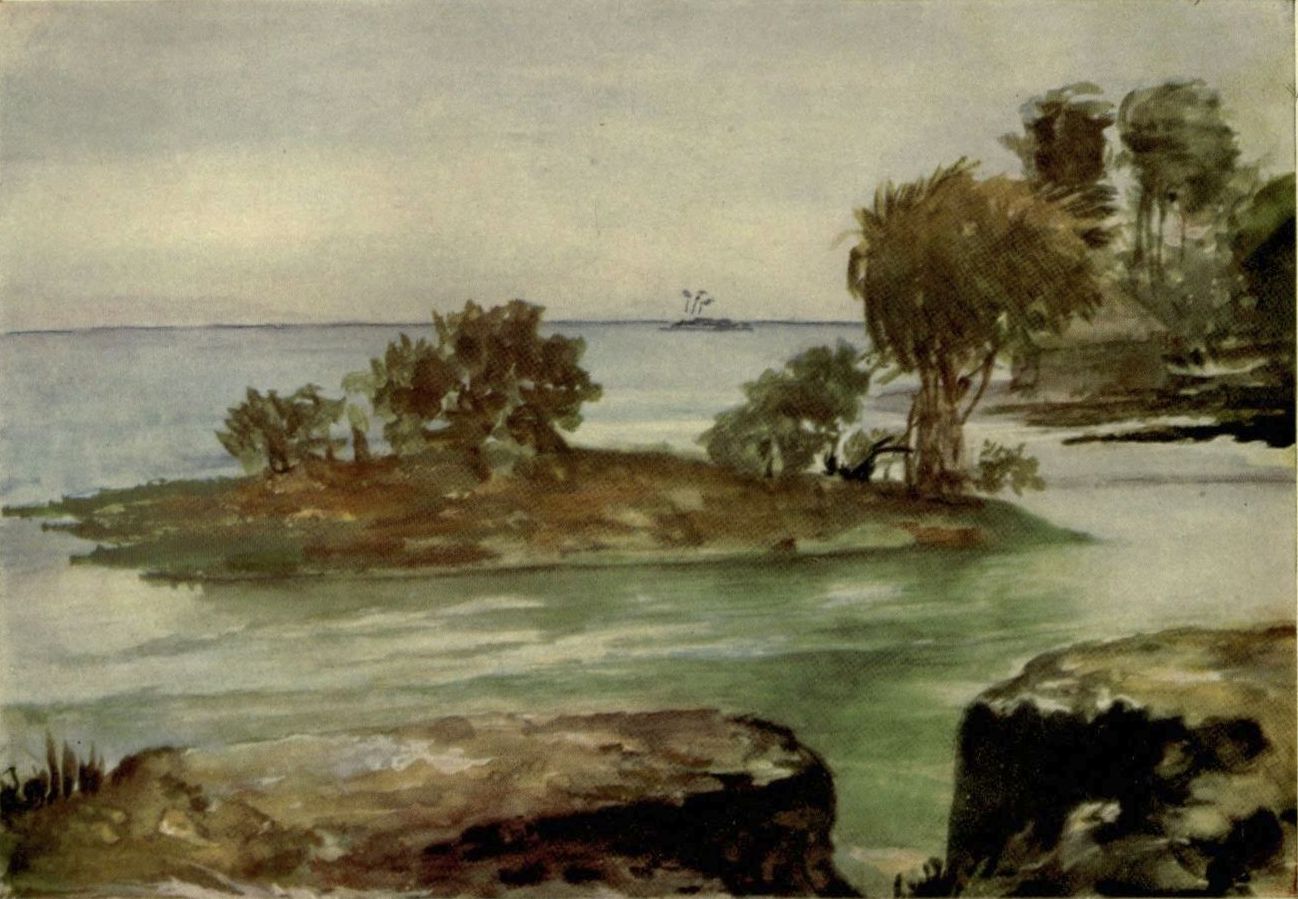 BUTTRESSES OF THE FIRST CHRISTIAN CHURCH AND TOMB OF SIGA
IN THE REEF. SAPAPALI, SAMOA
be but temporary, and that the real end is where all ends and is
forgotten, and where, as the Spaniard says, “Dios empiezo.” I sat and
sketched a little, seated on the great foundation. Children and women
crowded around, and climbed up the space in front, where the great steps
should have been, and filed all around the projecting edge that runs
about the church. When I had done I rose, and turning the corner of the
narrow ledge, found that I had made a group of frightened prisoners.
Then I went to the deep pool near by, where the sea runs into the little
fresh water, and was smiled at by the good-natured face, just being
washed, of one of the murderers by inheritance, who had figured all
blackened that afternoon, with green leaves and a white hanging tail.
His wickedness was being washed off with his blacking: or rather, his
wickedness was all archæological, kept up as a proof of the former
dignity and power of the chief, and of the obedience of his men. For
these people seem never to have been grossly wicked or cruel; as I told
you, they were not cannibals or whatever they had that way, ages ago,
was condemned as bad. They have even been unwilling to exterminate their
enemies in their many wars: and when they could put an end to the
German, in this last war, they stopped their killing the moment the
enemy was beaten, as they imagined. An element of strong good nature
seems to persist at the bottom of their character.
That evening we had a siva, like other sivas, which I am unable to
describe, because I was so sleepy that my memory has not held over. I
lurked in the dark, behind our hostess, who did not dance. Her
missionary training and her position were against it, I suppose, but
also, perhaps, she did not dance well, or as well as others. Afterward
she lingered with us, in the late evening, as did the taupo who had
danced. With them were her two girls, attendants, and one or two of the
elder women, along with some of our men who acted as chorus. Then
“quelque diable le poussant,” nothing would do for one of our own party
but that he should tease and beg for a dance with more undressing. The
older women seemed to enjoy the notion, which reminded them, perhaps, of
old days when they were able to be naughty, and had performed all sorts
of antics late at night, when the elders and the great people were gone
to bed. So gradually, from one dance to another, we came to one in which
the performers disrobe entirely for a moment, using some words that
represent and lay claim to the same beauty which the Venus of Naples,
she whom we call Venus Callipyge, attempts to look at, and certainly
shows. But it was all innocent and childish—the taupo danced it, and
the young girls accompanied her with one older woman—and Aigā laughed
and was amused, but hid away behind us, ashamed. Then we made her dance
for
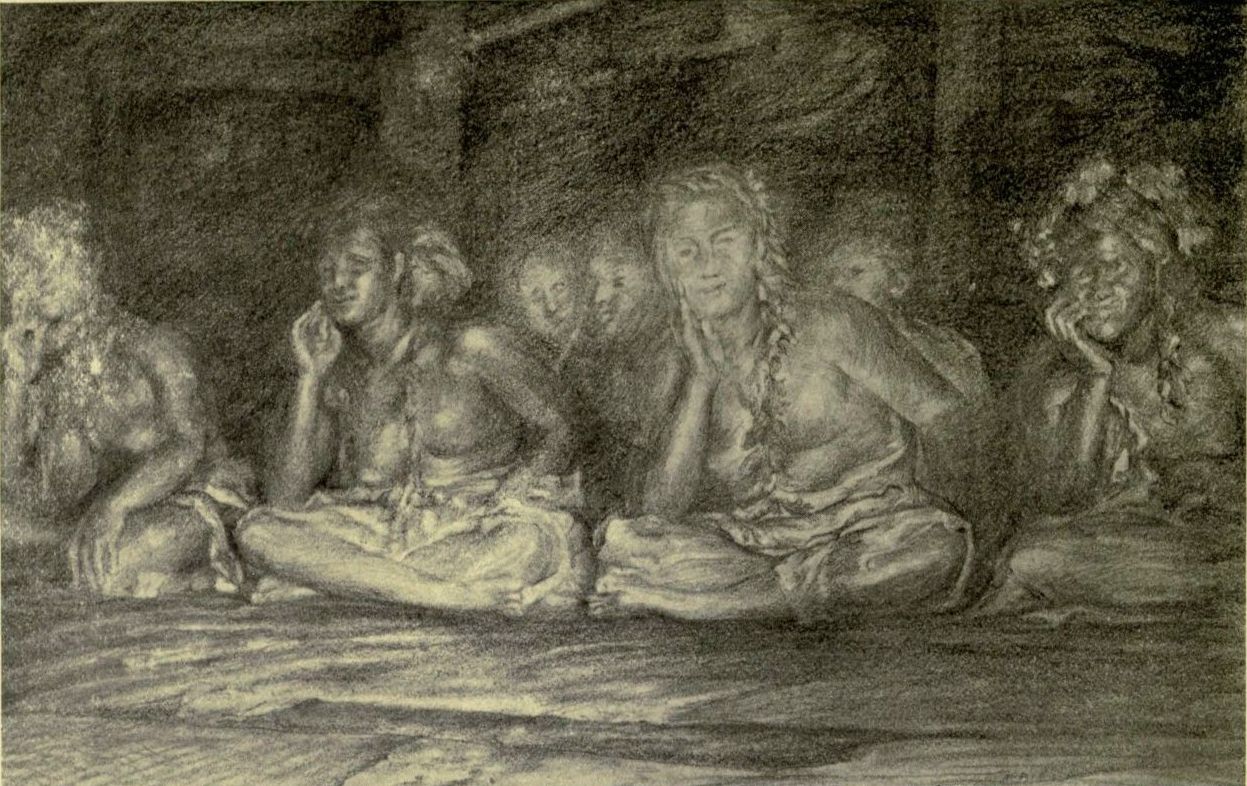 PRACTISING THE SEATED DANCE AT NIGHT. SAMOA
a moment the usual dance, I say we, but it was not I—and as she seemed
to think that even that was dreadful enough—we parted with some
discomfort. I foresaw trouble, but whether our fair friend was not as
much annoyed by the relentless compliments paid to the beauty of others,
is more than I can make out, being a man.
In the morning we trotted off a few miles, to this present place
Sapotulafai, the headquarters of the great orator, and which is the
great political centre. We had a great dinner, at which I sat next to
the taupo of the adjacent village, a giantess, whose name is not
insignificant, though people here are not apparently named, any more
than are people anywhere else, by name to suit them. Charlie interpreted
her name for me saying, “When you are on top of a cocoanut, and the wind
blows hard, and you are afraid of falling off, that is Lilia.” You
have seen a palm tree in a gale, and you can imagine the picturesqueness
of this definition of fear, in the wild swinging of the waves of the
branches.
We had a siva in the afternoon, when a young chief danced with the
taupo of his village, to whom he is engaged: She gave him some
occasional affectionate whacks of reproof at some remarks that distance
did not make clear; and we had a great “talolo” with the speech of the
great tulafale of Samoa, and then a return speech, which was listened
to with some curiosity. Some devil inspired me to urge our
representative speech-maker to discuss the severe and mistaken view of
dancing taken up by the missionaries—I mean the brown clergy. They had
done all sorts of good, but they were crowding too much out in their
zeal, and the white missionaries were not so excessive—and so forth.
And Adams had made a remark that seems to me a deep one. Something more
is needed for these people of few occupations. If they are to live
to-day they are destined to a putting aside of the excitement of their
little wars, and they need some outlet in games that exercise them, and
keep up their appreciation of physical life and excellence. Anyhow,
these views were launched out at a risk, and in a few days, without a
doubt, will have gone all around Samoa.
My own reason was a nearer one. It grieved me to think that Aigā should
risk her church position, because she was polite according to Samoan
etiquette, and that the other girls, who did the same, to wit, gave us
dances, at the request of their fathers and superiors, should be placed
between divided duties. This had been an oppression to the mind ever
since we came; and perhaps after all, we may have done well.
In the evening, our own taupo, Faauli the daughter of the orator, gave
us a siva; she danced, and danced well, and so did Lilia, the daughter
of a great chief, a Catholic, and then we had the other taupo, who
danced again with the young chief to whom she was engaged. His dance was
certainly amusing to the imagination. The chorus was singing about
himself, in his honour, and he performed the steps, if I may so express
it. He and another with red girdles and black, furry loin-cloths, and
red leaves in the hair, and red bead necklaces, danced with the taupo
herself, dressed all in red and purple leaves. The dances were a dance
of the hammer, and the dance of the cocoanut, and in the glitter of the
palm-fire, the ballet of our fairy opera. And satiated with dances I
have tried to be quiet and to sketch until now.
Oct. 30th.
We shall leave to-morrow. I feel tired, a little saddened; I suspect
that sleeping on the floors at night, in draughts from the back-country,
and wandering occasionally, in the midday, among the hot thickets, may
have given me some little fever. The German manager of one of the
plantations was telling me a little while ago that there was danger in
this, though nothing like what he had seen in other countries. On that
account, he had lifted the flooring of the houses, built for his men,
Solomon or Marshall islanders, whose health was of course of importance
to him, during their contract time. After all this care, they will be
taken back, perhaps, to the wrong place, and I suppose, eaten by their
fellows, if they happen to land on the wrong spot, or at some
neighbouring village.
This afternoon we went to Sapapali, to take leave of Aigā who had been
so kind to us, and who seemed almost hurt at our not remaining. We found
her apparently sad and troubled, and I regretted that we had been
accompanied by the other Taupos of our locality. Not that they were not
kept in their places by the greater lady, for this rather timid and
amiable person knows perfectly well how to speak to people who are
socially below her, and nothing has interested me more than her various
shades of inflection in addressing others. But something has evidently
annoyed her, whether the break with the church on account of the siva,
or her girls having been indiscreet, or her having made some mistake
that I do not exactly understand. She was much teased by one of us about
some “tendresse de cœur,” and that may have annoyed her. And the praise
given to her little girls, and an attempt to get them away from her
control may not have been pleasant. When I had seen the rest of the
company pass by my sketching place, and I knew that the visit was over,
I went back alone to her house and found her among her girls prostrate
and in tears. But she came out to me, so as to be alone, and she spoke
as if we should misjudge her from Sunday-school views and not understand
that her parade at the head of her warriors, all undressed, was an
official duty to us. And then bade me sweetly good-bye—and but a moment
ago my curtain mats have been pushed aside by a messenger who has come
all this way at night to bring me flowers from her.
So that I am not in cause: I leave it to you to read. I feel almost as
if what I were writing to you were indiscreet enough. Remember that
there is little privacy here, and that the houses are half open, so that
one may almost rush in. In fact, were it not for the complication of
human nature, I cannot see how there could be any privacy. There is
privacy somehow or other, but not in our way. Outside the house there
may be ways of saying things, inside and out there are dictionaries of
signs, but they all have the most wonderful way of hearing, and there
are always eyes everywhere. I have remarked that since I have cultivated
the habit of sitting on the ground, I see more of everything, and I seem
to be able to watch more easily. But, as I said, privacy is relative:
nothing has struck me as more Samoan than an elopement which I almost
witnessed. The young woman ran away with some young man, along the
beach, in the presence of hundreds of people who, it is true, were not
exactly watching her. She was just as publicly caught and brought back,
cuffed sufficiently and scolded by her older sister, and I see her
occasionally, in a neighbour’s house, looking not so repentant as on the
first afternoon of her punishment. As I said, I am tired and sad—and I
wish you good-night across the ocean and land.
At Home in Vaiala,
Nov. 4th.
The end of our malaga was not so pleasant. When we left Sapotulafai last
week, I was ill and fevered, and suffered quite a little during our long
trip of fourteen hours at sea. We had to row it. There was no wind, and
our men, never over-energetic, had been up all night in the last
enjoyment of social delights. Once indeed, Seu scornfully took an oar,
but even with that, twelve good hours’ rowing is not bad work, and we
got back in the evening at eight, having left Savaii at six o’clock in
the morning. The light and colour were as usual: even with fever I could
occasionally see how beautiful all was, but I managed to sleep, and do
not remember anything in particular, unless it be the long-continued
song of the men rowing——
“Lelei. Apoli-ma!
O-le-e—O-le-e!”
Vaiala in Upolu, Nov. 13th.
Yesterday, on Faatulia’s invitation, we rode over to the Papa-seea, the
Sliding Rock: only a little distance, some hour and a half from where we
are, so that by eight o’clock or so we were out in the rain, mounted on
the horses seared up with difficulty for the early start. Mine was a
horse owned by the boy Poki, who is an owner of horses—he has now
three, and his food for them is given by the village common. His still
more youthful friend, Sopo, hired his horse to Atamo and somebody else
fitted out Awoki and Charley who went with us. Samau, the tulafale,
and another of our crew were to go ahead and carry some European food
and our painting and photographing kit. As we passed along the beach,
which is, as you know, the street of Apia, we met Meli Hamilton and
Faatulia and Fanua, and little Meli Meredith, all mounted. Gathering
them together, under rather a gentle rain, we turned toward the woods
behind the town and cantered over a dyke, through a mangrove swamp,
where formerly must have been some coral inlet; then past some villages,
a few huts, and then into the forest. This is no description to you, but
perhaps I can interest you by letting you understand that the delicate
form of the great novelist, Mr. Stevenson, passes up or down this road,
of necessity, on his way to his Spanish Castle in the mountains. So that
when he begins to write South Sea stories, and is obliged to use local
colour, you shall probably admire some beautiful description of all or
part of the road.
In the woods we overtook our men, and dear Fagalo and Sué, whose bare
legs were paddling in the rain. A little path led through woods all
overgrown, in a narrow zigzag, over fallen trunks and under branches
beneath which we bent. The light fell through green high up, upon green
all around us; innumerable small trees and bushes, and occasionally
great trees whose trunks ended in high buttresses of rooting sharp and
thin, as if the trunk had been ravined. These are the trees which in the
old story-books of travel were supposed to furnish a ready-made
planking. Over all grew lianas and vines whose great long stems hung in
the air above us, or low enough to be pushed aside as we rode.
Notwithstanding the several varieties of growth—the Samoan wild orange
with double leaf and prickly stem, whose fruit was used in old times as
a soap to wash with, or the Fuafua, with broad leaves—the effect was
not unlike the appearance of our own forests, had it not been for the
lianas, and the occasional sheafs of wild banana that swung against our
horses’ heads. For an hour we went along in a scattered file, the
sunlight occasionally dropping in upon the great stillness around us.
Rarely a bird sung. Once we heard the running of a river. Then we came
to a stopping place; all got off; the girls
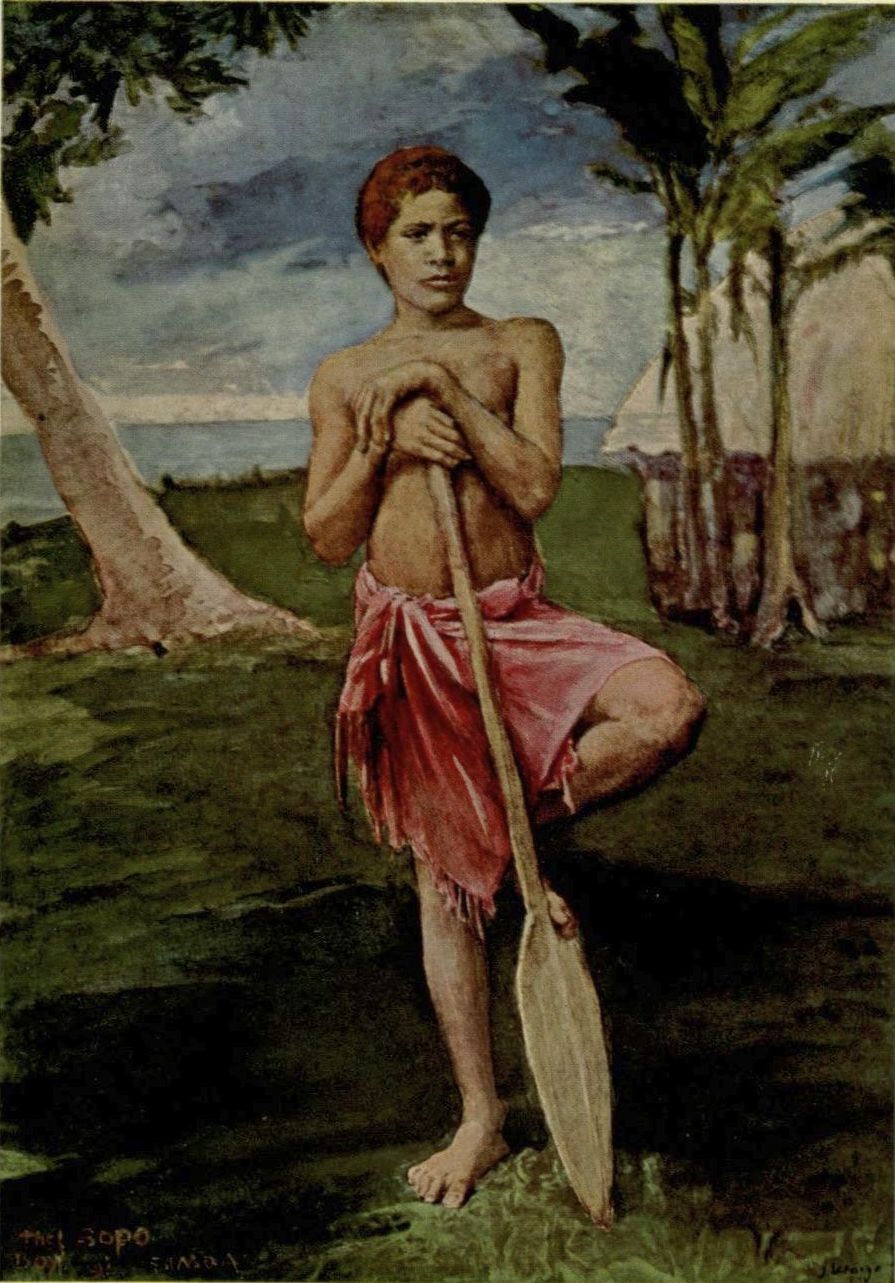 THE BOY SOPO. SAMOA
skilfully ungirthing and unsaddling their horses, and tying them up to
the branches with long ropes. Over the trees that sloped down below us,
we could now see the harbour of Apia, from one end to the other, and we
kindled a fire of dead wood, to show the anxious friends at our end of
the bay that we had arrived. There are three waterfalls in this little
opening to which our narrow path had led us, and it leads no further and
nowhere else. Of the three falls, each divided from the others by wide
platforms of rock, the upper one is low and does not count. It is the
second and the third that are “slipping rocks.” The water rushes over
them in one or many falls, according to the season, and in some of the
channels the surface has become so slippery with moss that all one has
to do is to sit and be whirled into the pool below. We had just begun to
look down into the little hollow, edged on one side by a high rock upon
which ferns and vines and green bananas find a scanty foothold, when
Fagalo, throwing off her upper covering, seated herself on the edge of
the current, and in an instant had slipped off. And a laugh from below
echoed above as she rose from the pool and swam to the shore. By the
time that we had clambered down to meet her, she had come up and rushed
down again followed by Sué. The sight was charming: the pretty girls,
with arms thrown out and bodies straight for balance, their wet clothes
driven tightly to the hips in the rush of the water, had a look of gold
against the gray that brought up Clarence King’s phrase about Hawaii and
the “old-gold girls that tumbled down waterfalls.” In the plunge and the
white foam, the yellow limbs did indeed look like goldfish in a
blue-green pool. Further down there is a small rush of water into a
little hollow in the rock; the two girls in their play filled it easily,
like mermaids in too small a tank. Then we had lunch on banana leaves,
to which our wet friends contributed the shrimps that they had caught,
accidently as it were, and without thinking, in these moments of
“abandon.” We had also a mess of palolo looking like very dark green
spinach, darker than the green leaves in which it was wrapped. Adams
insisted that this dish tasted quite like “foie gras,” which he also
said was quite as nasty a preparation.
To explain what palolo is I should have told you of a little
expedition we made one morning last week, just on the return from our
malaga. But I was ill and had suffered too much from native food to
write any more upon similar subjects. Even all my liking for Meli
Hamilton and my admiration for the fullness and redness of her lips, and
for the gleam of her teeth, could scarcely reconcile me to the wriggling
of the great tree worms through which she crunched so gayly and
healthily at our last great Samoan dinner.
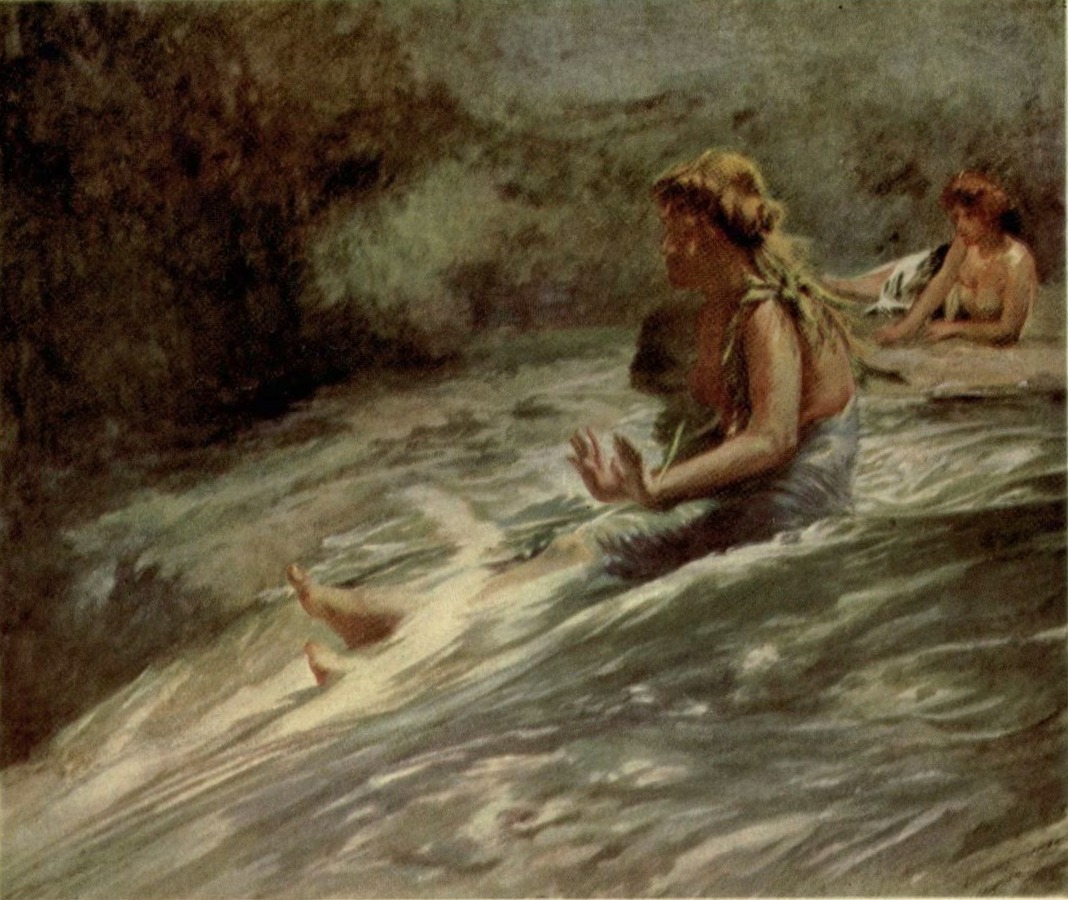 THE PAPA-SEEA, OR SLIDING ROCK. FAGALO SLIDING WATERFALL.
VAIALA, SAMOA
At the waterfall, after our lunch, our men had theirs, and they sat with
heads all wrapped about with leaves, while the rain came down upon them;
for if there is anything that a Samoan detests it is getting his hair
wet. The rest of him does not matter. Meanwhile we smoked under our
umbrellas, pretty Meli Meredith half under mine, and Meli Hamilton under
a big banana leaf. For most of the others rain did not matter. They had
either gone into the water or were preparing to do so by sitting quietly
in the current. Otaota had prepared for the slide, and was stretched out
in the run of the waterfall that now swept over, now left uncovered her
extended limbs; for she leaned out upon one elbow, and dipped a hand in
the water, scattering it upon the other girls in a lazy way. Otaota was
“missionary” that day, and would not uncover the lovely torso about
which I have told you so much. Then the sun came out in a lingering,
gentle way, as if it dripped down from the sky, and with it all the
girls went over; Fanua and Meli Meredith and Otaota. And as we looked
down upon them, they swam over and hid behind the branchings of the
vines like so many nymphs of streams, their faces and arms glancing like
gold out of the green. Near them one of our men made a deep red in the
water by contrast. And now Awoki, with much hesitation, prepared, put on
the native lavalava, and tried his luck. Yellow he is to us, but he
looked white and pallid among all those browns and reds.
The whole thing was catching, and had we stayed longer we too should
have been over, though Adams said that just then our dignity forbade it.
But our feeling of dignity had been helped by Meli Hamilton’s telling us
that the last time she had gone over the fall, she had struck badly
against a rock, and so had her companion, the navy officer; so that with
the rain beginning again, horses were bridled and saddled, and we all
started for a wet ride in the wet woods, down the slippery path which we
had to take in single file. Fagalo rode with Charley, on Sopo’s little
nag, and the last thing I saw of Otaota was her bare legs over the back
of Awoki’s horse; he sat behind, his arms around her, gallantly
protecting all that remained of her with his little waterproof. And we
came home tired and wet, but having spent a pleasant childlike day with
grown-up children.
PALOLO
Vaiala in Upolu, Nov. 14th.
I broke off yesterday telling you about palolo. I think my words ended
by telling you that even all my liking and admiration for Meli Hamilton
would scarcely reconcile me to the wriggling of the great tree worms
which she crunched at our
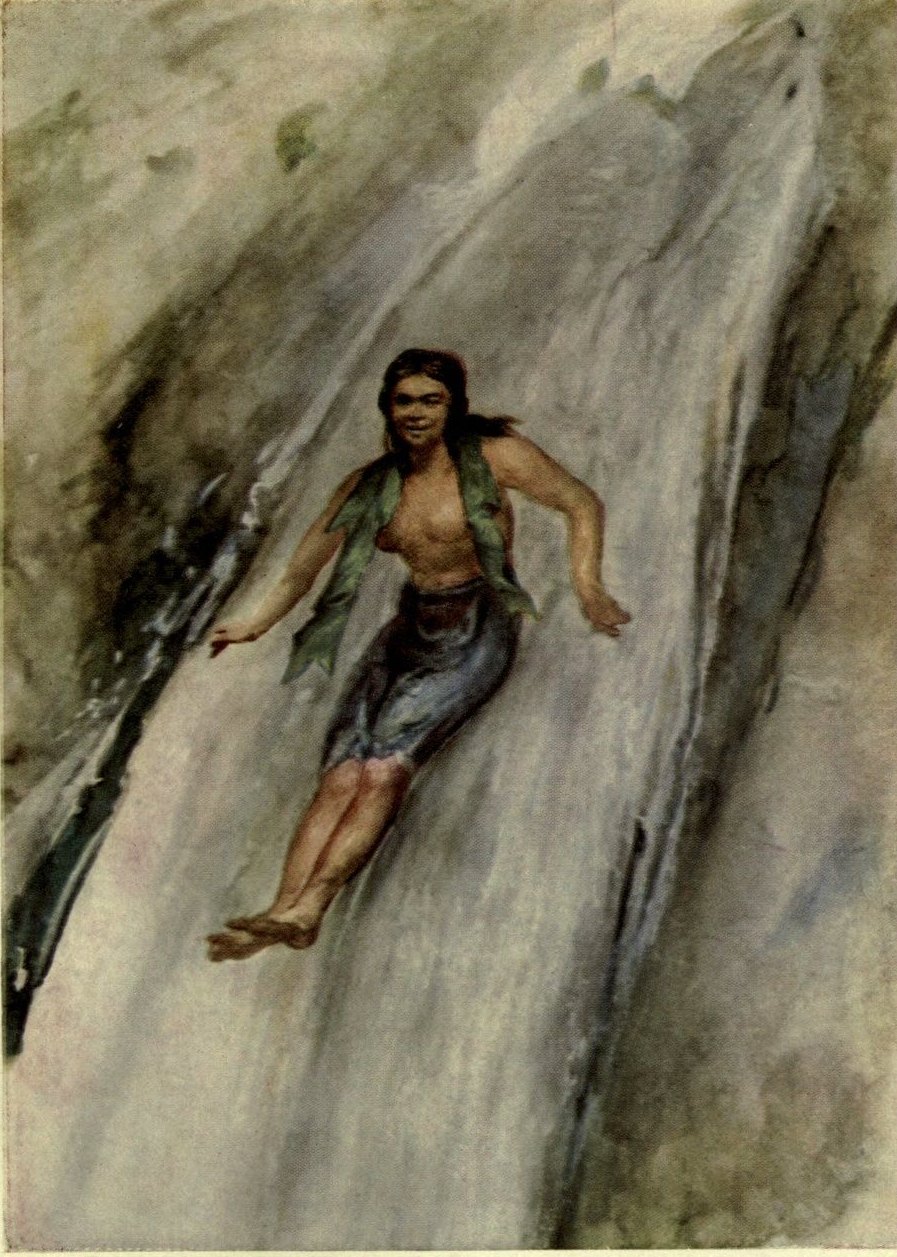 GIRL SLIDING DOWN WATERFALL. BANANA LEAF AROUND HER BODY.
SAMOA
last Samoan dinner. Mrs. Lieutenant Parker became very white as she saw
her and I handed her rapidly something or other, brandy or whiskey, to
help the occasion.
Palolo has no such horrors. For it we have not had far to go. Only
just out into the reefs before us, when, in the early morning before the
dawn, we rowed out a few yards to find a concourse of people, in boats
and canoes, scooping up with eager hands thin hairlike worms that
swarmed in the water within the special hollows of the coral reef.
We were more or less ready for the appearance of these little creatures
who, on a certain day of the year and the moon, appear suddenly with the
dawn and disappear with the sunrise until another year. We were
expecting this arrival, which never fails. As I said, it is looked for
ahead; it has its own laws; the scientific ones fail because we have
calculated by our dates, instituted for other reasons than the life of
the palolo. Our Samoan friends are in the secret. We white people
compute that the palolo is due at dead low water in the night of the
third quarter of the moon nearest the first of November, but that
reckoning involves Solar and Lunar months, as I intimated.
Our good friends here have been whispering to us and telling us that
this was to happen and they know how to be prepared for it. Certain
plants, certain shrubs blossom; and then you know that the time of the
palolo’s month is drawing near. There are signs in the heavens, and
the moon helps. It is, I think, in its third quarter that the event
takes place. Somebody with us, perhaps several people (because our
village contains important and learned people) mark time during the year
by counting pebbles, and green feathers, and leaves, up to such and such
a day, so that, at a certain moment, our friends can tell us that the
palolo is due next morning.
The third year one has to count a different number of days, but the
creatures down below in the coral know exactly to the minute. The night
is watched through, our people are all ready, are warned at the proper
moment. People from far away are also ready. Our friends have found each
one some proper hole which may be more or less lucky later. We watched
the dawn coming upon us, lighting the breakers on the edge of the reef.
When the breakers withdraw it is slack tide and we watch, and our
friends watch, more intently than we can, the absolute calm of the
water. Then, of a sudden, somebody calls out, “the palolo is there!”
or something like it, and then this empty water is full of long lines of
what seems to be worms, which you scoop up, not so anxiously as those
who care.
A short time, an hour they say but it seemed to me shorter, the sun is
up over the edge and the worm is gone until next year.
It is nothing but something like the thinnest of little seaweed a few
inches long, and you have to accept as a fact that this wriggling mass
is made up of worms.
I wish I could fairly describe the place and scene but you can make it
up for yourself. The scene is one of busy struggle. It is a matter of
food, it is true, also a festival of amusement apart from the picnic
side. Very interesting was the eagerness shown in the catching, by the
few white girls born here, whom I watched. They paddled about, jumped
out with bare feet on to the jagged coral like any Polynesian, but with
that seriousness and ferocity of our race, so different from the easy
good-natured suppleness of the brown skins who seem to be part of the
nature around them.
The dark transparent water inside the reefs, the rosy colouring of the
dawn, the splendour of the sunrise which is at length over land and
water, would have been beautiful enough even without this animation of
human element. But I have not dared taste the palolo even as made up
yesterday with cocoanut milk. I have come to the point of a revolt
against almost all of the food, from cocoanut milk to live fish and
slugs.
Vaiala in Upolu, Sunday, Nov. 23, 1890.
The end of the last week has been filled with festivity. Seu has been
giving a great feast, and this has been a very serious matter. We have
seen other feasts before, but none so successful and so great. The
presents given to Seu and Faatulia, or rather to Vao, their little
daughter, in whose name the feast was given, were larger in number than
we had yet heard of. Among vast quantities of other things were
hecatombs of pigs—in prose fact, three hundred and twenty-five—over
two thousand rolls of tappa, and several dozen of “fine mats.” All the
neighbouring houses were in requisition for the guests, who kept coming
from various quarters during the whole week, and especially from Savaii,
where is the stronghold of Faatulia’s family. Faatulia wore the anxious
look of the hostess on her kindly face, and Seu looked worried, a thing
I should have thought impossible. But as I go on you will see how
serious it all is, however gratifying it may be to pride of position.
The house of Seu was charmingly decorated with tappa, even to the
floor, so as to remind me, but I own, more pleasantly, of our most
æsthetic studios. In others, there were few European visitors, and more
packing of Samoans. In one other especially, I think loaned by the King,
a collection of taupos from various localities filled the space by the
posts, so as to make the hut look like a basket of flowers. Far in the
central penumbra, two female giants sat all decorated, and around them
the backs and waists of the others looked like a garden of dahlias and
brown skin. For some were “faa Samoa”—others were more or less
“papalagi” foreigners. In that case, however, their waist coverings
were amusing. Some had corselets of leaves lapping over like Etruscan or
Greek plate armour. Others had coloured netting, others had tappa cut
out with various openings, like some heathen dream of “insertions” (I
think women call it so). One girl had a corselet of cut paper of many
colours, making her look like a flower-bed, her oiling giving to the
paper a look of leafage. There were dresses of the usual variety and in
one case a large number of flower petals caught up one by one in the
locks of the hair. In another the whole hair had been filled with little
light blue bits of paper cut like petals. Mind you, all this was
beautiful, funny as it was, and upon the green grass background, made,
as I said, a basket of flowers. The brown skins that were not covered
glowed like fruit. In perfect taste, for even garlands are gawky
compared to the ineffable logic that the human frame carries with it,
one good girl had no covering to her body, and this savage from the
farther back country had a face that looked like the Italians’. In the
shadow, playing with a bambino, she made a madonna. The reason of it
came to me suddenly—her hair was down upon the forehead in the two
large folds that we associate with the Italian way, and a great look of
seriousness was added to the disdainful kindness of the face. Behind
her head the hair was full, in a mass whose colour was blond with
liming, and made a great capital for the column of her torso seen with
arms hidden in front. Of her I have made some studies, and posed her for
photographs, and later, on the next night, she gave us a siva in our
own house; Adams and I having duly called upon her, as if we were young
men, with five loaves of bread, and two tins of salmon, as is the proper
thing for youthful admirers like ourselves.
Around this beehive of yellow and black were assembled matrons and
children and boys, waiting for the later food, of which they as
relatives would have the larger part.
Far off, in another part of the grounds, Lima, known as John Adams,
presided over the food; and in front of him a vast mass of pigs and
bananas and taro, etc., etc., littered the ground. John told us about it
in a high-pitched voice, with an accent that brought back indefinable
associations. Whom did I know of the old school with such perfect
intonation in English, and a diction that implied the gentleman by
accepted tradition? Could it have been some old officer of the
navy—could it have been some far-back Englishman or antique Southerner?
But John, even in his exterior manner, brought back all the feeling that
we do not speak English as well to-day as once was done, and that our
refinement of manner and accent has disappeared.
The feast had begun; under long stretches of tappa supported by poles,
guests were assembled around the tables of banana leaf, while we
wandered about, made prudent by former disasters in diet. It was
pleasant to see the triumphant carrying of great pigs by the young men,
garlanded and cinctured: the platforms of sugar-cane and taro disposed
in a show, as if growing in some impossible yet graceful way—the taro
like grapes on a vine.
Then we wandered back to our taupos in their home. They were feasting
in a circle around the banana trays. Two men were hewing the pigs into
segments, with the swish so well described by my Chinese philosopher,
Chuang Tseu, in his chapter of the “Rising Clouds”—if that be the one.
Two older women stalked about amid the food, who caught these chunks of
meat and tossed them to the taupos. Occasionally they varied this by
assorted lots of taro or cooked food. Do not suppose by this that these
vigorous maidens were bolting their food. No, all this was Samoan and
communistic; no one lives for himself here, but for the lot. These good
girls were hard at work, passing all this to old women with baskets, and
two young people who sat on the edge of the hut with feet outside,
impatiently urged them. “Wait,” they said, “wait; our turn in a moment,”
and amid laughter and chattering and long reproofs of the old women, the
food came to them in turn. I suppose the taupos managed to get
something, but if they did, they deserved it for the work they had in
passing the food away. This is Samoa—where a gift is shared or given
away. When we called later on one of the taupos, as I told you, and
carried our little gifts, half of them were at once given to the owners
of the house, and the other half to some chief who happened to be
present. All this as a matter of course, with fair counting, as in a
commercial firm. Even the cigar accepted by the fair one, passed in a
few seconds to her nearest neighbour. Some one was telling me yesterday,
of having given a cigar a few days ago to a Samoan, who had just bitten
it, when another passing asked for it. Thereupon it was handed away, as
a matter of course. “Why did you give that?” the white man said.
“Because he asked,” said the Samoan.
“But is there no further reason?”
“Yes; I might some day want a cigar, and if he had one, I should ask.”
The community of friends and relatives is a sort of bank where you
deposit and draw as you may need. So for Seu’s food: almost all is given
to him. It is given out, sent away if people are not there; a procession
of people carrying things from the feast, filed along all the afternoon.
After the feast, a siva in the open air, where Fanua danced. The crowd
was full all about her and her assistants, girls and men. The occasion
was a notable one. Two white missionaries with their wives were present,
and the siva was danced before them. Henceforward the excommunication
will be difficult, unless the native preachers insist upon having their
own way. But we shall have been present at this great event. I spoke to
one of the missionaries for a moment, a rather interesting man, who
talked a little about his hopes for the Samoans, their conservatism, and
their not being emotional, however excitable they might appear to be, so
that things once impressed upon them had a fair chance of thriving.
And thereupon we proceeded (those of us who were tired) to get away—not
without, however, looking once more at another siva getting under way,
with some of the many taupos and their male assistant dancers, to see
them oil. Some one ran around offering the liquid, which was poured full
upon everything, dress and person. And being introduced, I shook the
oily palms of some of the girls and of one splendid chief—who might
have been drier. Then, later, Adams and I called on our taupo friend,
whose home we proposed to drop into next week in our travels, and who is
visiting near us. We arranged with Meli Hamilton as our tulafale for a
siva in our own house. There at night the taupo came, in the pouring
rain, and I sat in my own comfortable chair, with Mrs. Parker next to
me, and felt at home; for in the shadow I could close my eyes or look
on while the figures danced in shadow or in light.
The next day we were summoned again to Seu’s feast. A siva would be
danced for us papalagi who had been too crowded the day before. So
that we went to see the comedy, which began seriously enough. We sat a
while in Seumanu’s house, filled with friends and relatives, while a
woman, an ex-taupo, carefully unfolded the presents of “fine mats,”
saying what they were for, and from whom, and occasionally something of
their history. For the “fine mat” is the great possession—the heirloom,
the old silver, the jewels of the Samoan. And one tattered piece that
was held up for show, sewed together, its trimming of feathers all gone,
and full of holes, was looked at with respect; it had been royal.
Around these mats cluster romance and story—war and quarrels—and the
idea of the palladium, the insignia of power. The mat has been given at
marriage and at birth, and has been worn on great occasions—it has
witnessed those scenes, and besides carries money value. Its very stains
tell stories of those events in life. So that Seu’s thirty odd mats were
quite an affair, exclusive of the pile of two thousand pieces of
tappa. As soon as the mats had been counted over, and admired, and a
polite discussion arose, our hostess insisting that it must be a bore
for us to look over all this, the polite guests insisting that nothing
could be more entertaining.
Then John Adams (Lima), in his fine old-fashioned voice and way, cried
out that if we wished, a siva was getting ready in the next house, and
as our adviser whispered to us that we had better be away, for that now
the real work had begun. It was for Seu and Faatulia and the family
group to decide as to who should be the people to whom all these gifts
were to be made over. A few they might keep, but the mass must go. Every
giver had a right to something, if possible finer than his gift: and
here was a ploy, as Sir Walter says. Everything must be according to
dignity and family and precedence, and everything that society means
everywhere. Think of the heart-burnings, jealousies, affronts, etc.,
that hung in the balance. Many a time in Samoa, war has begun by some
error in such adjustments. No wonder that we were better out of the way.
Even to-day, we are told that several days more, a whole week, will be
consumed in these weighty questions, and Seu is to wear his look of
worry for days.
Adams and I sat on branches: I, on the right, Adams, on the left of her
Majesty the Queen, while a siva of two pretty children, little taupos,
daughters of a chief of Savaii, and of two young men, went on before us
in the sweet light, half sunlight and half rain. These two little girls,
Selu’s daughter and her little friend, the daughter of a chief of Iva,
gave us an infantile imitation, while another chief played buffoon, to
give them courage and protect them from serious attention. And this time
Fanua sat behind us, and looked on, alongside of many young girls and
women whom we have learned to know a little.
Up to this time, the terrible ordeal of decision of presents must have
gone on, and will not be through until late next week, when we hope to
get Seumanu on another malaga; but this time at our own pleasure, and
with the hope of making sketches and studies with more leisure, and with
a better knowledge, for as you know, he who runs finds it difficult to
read, and there is nothing that I abhor more than the carrying of the
studio sight into other visions.
Only the poet is free, whether he be painter or writer, for with him
subjects are only excuses, and as Fromentin has put it so perfectly,
Delacroix’s three months of Morocco contain all that has been said and
will be said of the east and south of the Mediterranean. But we cannot
all be great people like Delacroix, nor great painters like him, nor
perhaps was he at all aware in early life of his always having achieved.
But he tried probably, to be exact and faithful, as any one of us might
do.
The weather is again beautiful; to-day is all blue and triumphant;
indeed, the sky is bluer than it was, although the grass is yellower,
and in the afternoon late, the clouds of the horizon are radiant in
violet and rose. Fanua has come up to see me, with the Queen’s little
daughter all clad in pink, who has been living in Fiji, and talks
English quite well, and says like a child, that she likes Fiji better
than Samoa. Service at the little church opposite is just over, where
Fanua has been, and where I have heard the voice of Otaota’s father
preaching. He has called upon me, apparently interested in questioning
about the Mormons, who have sent missionaries here, and whose wives
often canter past, against the blue background of the sea. Otaota’s
father is not a little proud of his preaching, which indeed sounds well
out of the church windows, and he asks me why I don’t come in to listen
more closely. His parishioners sit on mats, and I sometimes lend some of
mine to stray visitors, especially to members of our crew. The men sit
on one side, the women on the other: and files of women, especially,
walk along with mats under their arms or over their heads, or held in
front of them; and occasionally a child is carried outside on the hip.
There is a small post near by, upon which is a small bell, and a ladder
to get to it, all under a tree, and some young girl or boy rings the
clapper with great zeal. I have made a sketch of one of them who
accidently set about a missionary work, without putting on her tiputa,
to cover her bosom, and who was worried as I sketched her, between the
propriety of carrying out her “missionary work” and her want of
missionary propriety.
Fanua has left, after sending for the child of a neighbour and caressing
it during part of our supposed conversation. They say that she is
thinking of marrying, and certainly she will make a nice wife and mother
if one can judge by looking at her. Is there anything sweeter than a
woman caressing a child? and how fond these Samoans are of children.
They swarm about as free as birds, rarely checked; the owner of our
house, the chief Magogi, looks more good-natured and smiling than ever,
when after his fishing, and leaving a fish with us, he parades about
with his child in his arms. Like a woman, he even carries him when he is
attending to something else. And Tofae is as gentle to little George
(the son of the late English Consul, and of Tāelē) whom he has adopted,
as if he were a mother. When he and other chiefs, in the afternoon, sit
about on the grass, far interspersed, some ten or twenty feet from each
other, in Samoan fashion, little George creeps up and nestles against
him, making with him the only group in the big circle.
Fanua has gone, and from Mataafa’s house begins a hymn. I recognize the
ancient sound of the Ave Maria Stella (for Mataafa is a
Catholic)—another version of the Vallis Lachrymarum that Otaota’s
father was urging on his people an hour ago: “It is morning and you
dance—but night is coming and then——” The Samoan smile is proof
against anything—but Mataafa is grave and somewhat sad, and must take
things on a scale far different. The mournful dignity of his position—a
king is always a king, and he has been a real one—of highest birth and
greatest capacity—must always oppress him. And he has no future, I
fear, for his holding power might be against the interests of Germany,
to which England will always accede as a bargain, and to which we will
yield, for we don’t care, and we are not yet aware of our enormous
strength, to be used for ill or for good, and we sell it willingly for
anything.
The former German ruler here knew all about it, for the Germans have
every power of measuring us, and he said to our representative:
“You are really weak—like all Republicans—always at the mercy of
little home events, and any one of you will trade for some personal
advantage. You can have no policy, that any one of you in politics would
not break through, to play a trick on the political adversary; and then
you have no fleet nor army, to show to others what you could do. Before
you can make up your mind to anything we shall have taken Samoa for
ourselves.”
God willed it otherwise, but the German had measured us, at least as we
are to-day.
The moon is almost full, and comes up in the night, while the sun is
still lighting the sky with pink. Around her a single cloud is greenish
white, while the entire sky is suffused with rose. The breakers are rosy
white; the sea is of a daylight blue, the furthest distance is lit up,
and a rose-coloured cloud hangs on the horizon far below the moon, while
her wake cuts in silver across the sunlit sea and surf.
The western sky is all afire, and against it, when the eye is protected,
the shadows of the moonlight fall with extreme clearness and precision.
The beauty is ineffable; a little sarcasm comes up into my mind—a
reminiscence of the theatre, of a too perfect arrangement, in which the
machinist has combined too much together, the sun and the moon both
equally splendid—night together with day. I am sure that no one would
believe it if painted, and most would know it was incorrect. This
disturbs my peace—but only a little. The good that comes from seeing
through our teachers, is that at length we have no more use for them,
and the remainder of life is more economical. And indeed, the world
about me here seems to say, “See with how little we can be rich!”
Another Samoan Malaga, Nov. 30th.
Fagaloa Bay, on the N. E. side of Upolu.
We are on another malaga. I have not quite recovered from illness, so
that the trip is not all enjoyment, and I write to you in some dejection
and with an effort. We are going around the island, some hundred miles,
in our two boats; our own managed by Samau, the tulafale, as coxswain,
with four men to carry provisions, etc., and plenty of luggage and food
for all of us; and Seumanu’s boat with ten rowers. We left the day
before yesterday, in the early dove-coloured morning, all grey with
partial rain, the mountains covered at top, and low down in the gorges,
the mist and smoke from villages rising up in straight lines that looked
like enormous waterfalls. Our first landing was at Falefä, where a river
falls over wide rocks in its way to the sea, not so differently from
other pretty waterfalls, except that it makes a broad spread of water
that joins the sea, so that from some points one might imagine that the
ocean runs in to meet it.
And then behind the frame of the wide fall and its bordering trees, one
sees the mountains of the dim interior. There we rested at midday, and I
lay on the mats, ill and tired, while Charley explained to the young
woman of the house, wife of the native teacher, the meaning of a large
sheet of the spring fashions of this year, which she had pinned up, with
many other pictures from newspapers, upon the screen that divided the
house. Her husband was away, attending the great meeting or Fono at
Malua, the missionary school, where the toleration or rejection of the
siva has been, or is being discussed. I am told now that the native
clergy have held their own; and that though not reproving their white
brethren, they have not quite concurred in a full freedom of toleration,
but have arranged some middle term by which the question will be always
limited to individual cases.
Later in the afternoon I sketched at the waterfall, in that curious
silence filled with the sustained sound of rushing water, that belongs
to such places, within which a faint, sharper thrill was the gliding of
the surf upon the beach behind it. The place was shaded in its own
shade, thrown over it by the hills that enclose and make it. Here and
there, the sun caught the roll of the water, and the distant valley and
mountains behind it were all floating in hot light and moisture that
came down in great gusts with wafts of heat.
In the evening we came into this beautiful bay with high mountains on
either side, and fringes of lower land. The bay, as its name indicates,
is a very long one, running far inland. The site we are in is charming,
the great mountains right behind us, and from their lower sides, long
waterfalls creep down the cliffs and glisten through the top branches of
the palms. Around us all is covered with trees. I have lounged and
slept as much as possible. Atamo has begun to paddle a canoe, taking out
the taupo with him. She has been very nice to us, doing her best with
food, and seeing us to bed, and being in early to see us get up, and
doing her duty generally and pleasantly. And she has given us sivas.
We had met her before at Seu’s feast; we felt mutual good will, so that
she was prepared. Her devotion to Atamo is great, and as I said, she has
done her best by our food, which we managed this time with Awoki’s help.
Through her eyes we saw one evening the resemblance of the light carried
on the reef by the phantom of the lady who appears when night fishing
goes on. You may remember, how she (as do others of the dead, or certain
spirits perhaps—they are all confused in the Polynesian mind) fishes
silently in the crowd of the canoes, or alongside of some single
occupant—and then suddenly, when detected or suspected, disappears with
the dawn that clears all our doubts away. Of this apparition some here
say that she has her own canoe apart, just out of reach—some say that
she walks on the water—but when she is followed, she makes for the
shore, then is lost in the trees, and soon her lantern is seen going far
up into the trackless mountain. There no one likes to follow at night.
The dark for the Polynesian has terrors uncertain, natural enough, for
the dark here is uncanny, and when plunged in its terrors the brown man
does not like to add a definite influence or a name of ill omen. The
belief in what might be called a lower supernatural is still strong:
Christianity does well enough for the great needs, but something else is
wanted for the smaller fears and dangers—the things about us at every
moment; and it has interested us to draw out the small beliefs of this
unimaginative and very practical race, who on one side are so much
christianized. I wish that I could recall for you the scene in which we
heard this story. The hollow silence between the mountain in the
night—the water dark before us between darker trees. The dark shadows
of the mountains, across the bay—the long glistening line of reflected
starlight rolled up with a splash upon the beach that broke the quiet
shiver of the palms. And then the one light, far out on the reef which
caught the look of our maiden and drew the legend from her. I regret so
much that my constant fatigue prevents my noting some of all this for
you, and that I give you, too, no better description of what I see. The
place is well worth some talk—even if it were nothing but a memorandum
of the pretty talolo, or presentation of food, in which two or three
dozen girls brought up the presents of taro and fruit, and threw them
before us, filing out of the green trees, and disappearing again within
them.
Ulutogia (part of Aliipata) Dec. 2d.
We are at a charming place in the town of Aliipata, which seems to
stretch indefinitely for miles along the shore. We have had two
invitations to stop; one from Mataafa, and one from Tofae, who both have
their connections here, but we have pushed further on, and are now at
the house of a chief, whose name is Sagapolu, as I make it out.
Before us, to sea, over a great spread of blue, are two blue cones,
little spots that belong to Tutuila. Near us are rocky islands—two of
them outside of our reef. We came in on the blue swell that hid
everything, and then pulled hard over the boiling of the surf, in the
charm that covers danger. The morning was lovely on the water, and we
raced with our other boats. We had said good-bye to our friends in
Fagaloa, who the night before had given us a siva, not a prolonged
one, well done by the girls, and accompanied curiously by the
two-year-old daughter of the chief, who followed seriously the
performance, and beat time or caught up with the gestures of the older
people. Nothing could be stranger, and a more complete proof of the
siva’s being a natural expression. No one noticed the child as
anything extraordinary, except by an occasional smile. Our crew was
asked to perform, and the villagers and the taupo gave the preference,
and she was right, to our men. The girls always seem anxious to see the
men’s dances; a compliment not always returned by the men. The rising of
the moon saw us to bed, and we tried to sleep late, fearing the hard day
that has just passed over us.
Here, so far, all has been as usual. The house is far from others, all
in the open, with palm trees some way off. At one end of the room is a
reading desk, and the ruined walls of the church near by, explain that
this house is used as a temporary chapel. At the other end, is a table
covered with costly mats, upon which are flowers in glass bottles, and
there are two big settles and two big chairs, covered with shaggy white
mats made from the fibres of the fao tree; all this furniture upon
beautiful sleeping mats.
We have had a complimentary speech from the tulafale, the old chief,
who is thin and emaciated and extremely dignified, and has given us
kava; and I have learned that Seumanu has a kava name of Tauamamanu
Vao (fighting with beasts of the field), when kava is called out for
him; the taupo has come in to make it, and Samau of our boat, and
Tamaseu of Seumanu’s, both tulafales, have come in to share it. There
has been a spread of Samoan fare, apparently good, but I feel prudent
and have taken little kava, and have been only a beholder of the
feast.
The taupo, who is very young, is very silent, even when Atamo says
that he is writing home about her.
They are sitting together, he absolutely immersed in his writing, a feat
of which he is always capable apparently, and she is wiping her face on
a new silk scarf of blue and red which he has given her, so that it has
already caught the shine of the cocoanut oil.
Another little girl has singled me out, and has come to make friends,
but I can only give her lollipops, that are handed away almost
immediately, like my biscuit, to the smaller children. I have invited my
fate, for I smiled at this beginning of taupodom, when she came in,
almost closing her eyes from anxiety, to put a Samoan pillow for me on
the pile of sleeping mats that had been spread for us to take a nap. Seu
is having his back punched by an elderly lady, and peace and the flies
reign over all. Here is a curious fact; one would think that with their
habits of sitting and lying about, these people would remain in
position, but it is only when they are sleeping very soundly that one
can find them steady, unless it be a Tulafale officiating, or a chief
sitting for dignity. The foot that does not press the ground is simply
waggled interminably. Try it for part of a minute and see how difficult
it is; and then you will realize that people who can move the foot for
ten or twelve hours a day, may be able to dance when sitting, with an
ease that only a juggler knows about his fingers.
Meanwhile, the sky is blue, with innumerable white clouds;—the sun
smiles down on the banana grove behind us, and in front of it a little
veil of light drops shows that it is raining overhead. The smoke from
the house near us bends down lazily over the roofs, and Seu’s tulafale
and one of our men, are beating a tune on the two great war drums.
Lali is the name of the beating of a tune. One two, two—two, and so
on, weird enough and rather tiresome. Such are the intervals of their
naps, for they have had three hours of solid rowing this morning, and
they need rest. At this moment the old chief comes in and talks about
the music—praising the accentuation. These drums are near his house,
say some twenty feet off, and are very large; gigantic troughs of old
wood.
Then he calls across space for his daughter to make kava again; this
is the third time within just three hours, but this time the kava will
be chewed and not grated, as Atamo has asked for it.
Meanwhile a discussion on the name of the daughter: it is Mo Niu Fataia,
if I get it right; it does not matter. Her name represents the fact that
a place called Fataia, which we passed yesterday, has wild cocoanuts
growing upon it that roll useless into the sea: hence her name. “The
plenty of cocoanuts, of Fataia, that you don’t get.” It is this little
word Mo that means “plenty that you don’t get.” Niu is cocoanut. You
will notice all through, so far, how often names for people are
arbitrary and accidental. Otaota, the beautiful daughter of the
missionary person, is called Rubbish. Fagalo, who slipped the waterfall,
is Forgetful, and so on. We have Smell Smoke Namuasua (or Cook-house, as
Samasoni translated it) in our boat’s crew. In the early traditions,
such and such an early divine heroine names her children by things that
occur at their birth. One, I remember of “Carpenter’s Tools Rattling in
a Basket.” The Bible is dipped into at random for names, and yesterday I
talked to young Miss Kisa, which sounds like Kiss Her, but is Kish “who
killed Saul.” (My taupo’s statement, the usual Bible may run
otherwise.) I cannot make out whether good luck follows these sortes
biblical.
At this very moment I see coming to me a young lady who wears a black
mat and a mop of yellow hair and nothing else, not even a collar. She is
late, having been at church. She is the official taupo, the other one
only taking a momentary place, and she is the daughter of the chief, and
has brought presents of rings and of tappa; and her name is Faatoe,
which means all agree, “Leave something in the basket” (when all are
helping themselves), and I think this is a very fair addition to our
stock of names.
All this time the others to whom she is added are getting the kava
ready carefully, gravely, chewing the root to extract its juice. There
is a big row of kava people or attendants—all pensive; one man, two
taupos, another man of ours, a little girl, and another of our
men—no—there are a few others who are around the corner so that I
can’t see them.
Then I went for a long walk on the seashore. The sun was setting; only
toward Apolima was the sky at all clear. Over one of the islands to the
north, cloud and mist threatening immediate rain, made a large veil that
hung far up and melted its violet lace over the island. The sea was of
the fairy green that the inside of the reef takes in rain, spotted with
violet where the coral lay. With me walked on one side my little girl,
her upper garment fluttering, her young, long brown arms and legs
glistening in the sun. She smiled at me for all talk, for English she
knew not. On the other side, a hunch-backed dwarf, Japhet by name, with
yellowed crispy hair, naked to the waist, a garland of red fruit hanging
down on him, to meet the blue drapery about his loins—his bare legs and
tattooed thighs glistening also in the light. Their company meant
kindness and the habit of accompanying a chief—and they were kindly
certainly, and meant to please and serve. Neither you nor I could have
invented a more curious combination, and one of which I should like to
have either a drawing or a photograph, that it may serve for the ends
of my life. If instead of me and my linen helmet, and trousers kept up
by a sash we had had one of the Spaniards, who ages ago, perhaps, landed
in the unknown neighbouring island of the Gente Hermosa, the “Beautiful
People”—some bearded man with butgonett, and velvet hose and jerkin,
the picture might have been that of a knight-errant in fairyland. Such a
faraway image it made to me, as I looked down either way to the earnest
face of the dwarf framed in the fruits of his garland, or the politely
anxious eyes and moving bosom of the young virgin of the village, as we
stalked on almost abreast, in the silence, making threefold tracks of
very different shapes in the smooth wet beach; until the rain broke
down, and then I ran back, supported and clung to by my improbable
companions.
As the day closes it is still raining. A sort of glow is in the grey of
the rain, so that it reddens all the shadows among the trees. Far off
toward Tutuila there is high up a great opening where the sky is as of
an apple-green that has been washed with the lavender of the rain
clouds: big cumulous clouds round out, made gold by the sunset.
The light fades away, and all becomes blurred except always the cumulus
in the distant green sky. The lamps are lit and we turn to dinner.
In the evening afterward we got to talking about the legends and
superstitions, and we were for a long time merely getting about it.
There had been a promise to have something written out for us of old
verses, and then songs were sung, ordered from a number of girls.
These were mostly poems concerning the son of the old chief, who died in
the last war, and about whom, says Maua, he is always thinking. I
watched his face and sketched it while he sat and listened. He is as
striking as an Arab chief, with the orbital bones projecting like a
camel’s from out of his face, so as to make a great line of light or
dark around the looking part of the visage. His head recedes far up, and
his long beard drops on his thin chest. This death of his son has
affected him more and more, so as to make him slightly insane.
Maua says that he was once “the baddest man in all Samoa,” and that he
was the greatest dancer, and that he had invented many dances, and that
he might be tempted to-day to dance, if only we could find some person
to accompany him with songs to suit. I think that Maua is wrong, for the
chief has become missionary, and is quite absorbed in that sort of
thing. As I was saying, he has a splendid, fanatic, Arab head; and so
the evening has closed with the old chief’s listening to these memories
of his son. I am frightfully tired with listening to the legends
struggled for. Perhaps a verse or so of some of the songs might be
worth saving out of this wreck of dreaminess. It was a pure,
complimentary, Samoan idea, poetic only perhaps because we cannot help
translating the feeling as well as the words; it was about a chief the
singer sang—a young and handsome chief—and she said how natural it was
for the girls to wish for the hero’s notice, “for the very winds that
blew belonged to him, coming as they did from his ancestral island that
lies to windward.” But our friends are not poetic, I feel sure. They are
intensely practical and full of common sense; they make poetry for me.
And they are restful—and I—am sleepy, as I said before.
Wednesday Afternoon.
This morning, while it was raining, the old chief talked of the spirits
that once ruled. We are told that the chief believes yet in these ideas,
but I cannot make it out distinctly, neither one way nor the other. He
is missionary now, and as we take his portrait, wishes to hold the
prayer-book in his hand. But he tells me there are people who control
the spirits (devils, our interpreter and we have called them—aitu)
and that they predict things and recover property, bringing evil upon
him who has erred until he acknowledges. And this power is not given to
any man by inheritance, it cannot fall upon a plebeian, neither the son
nor nephew of chief or priest, if indeed there were priests, for this
he denies. He says that his people prayed, making oblations to the
deities of the village and of the household, and that when these were
collected together, they were eaten by them, which, he says, means by
those who collected—not the priests, but the family or those attached
to the chief, who thought it time for such offerings. And these were
given to the bush, if it were for the bird divinity; to the sea, if the
divinity was the cuttlefish. His was the cuttlefish, and his family did
not eat it. All this, of course, you know more or less of; what I say is
of no value except insomuch that I heard it myself. To know all here
would require to be master of the language, not to be confined by
missionary ideas, nor to be connected with such—and after all that, to
have a very receptive, a very acute, and a very truthful mind. There are
such people in the world, but you or I do not find them usually writing
books, and judging questions for others. These soundings of the savage
mind are Atamo’s properly; he is patient beyond belief; he asks over and
over again the same questions in different shapes and ways of different
and many people, and keeps all wired on some string of previous study in
similar lines. But everywhere one comes right against some secret
apparently, something that cannot be well disentangled from annoyance to
the questioned one. For instance, in the question of genealogy, Seumanu
told us that had he been interrogated some years ago in such a
direction he should have struck the questioner down on the spot. Still
we have hope, and if any one can manage it, Atamo will. Web after web I
have seen him weave around interpreter and explainer, to get to some
point looked for, which may connect with something we have already
acquired. As many time as the spider is brushed away, so many times he
returns.
This morning talk of the world of bad spirits that do harm to man
suggested to me an opening toward a side I had never read of or heard
of. Were there spirits that did good as well as spirits that did harm?
There I had a door for home history. Yes, there were such, and no
further than here: his son had had such a spirit, who went about with
him and looked after him, protected him from harm (apparently from woman
a good deal; and took, in such cases—as even with us—the shape of some
other woman). Sometimes this protection would be sudden; when he was in
the way of harm, a good spirit would appear and drive away those that
might harm him, and would sometimes lead him personally away—prevent
him—as the old word goes. And all knew that he was so protected; the
spirit had been seen and would only disappear when suspected. Otherwise,
any one might take the same for mortal man or woman—as in Homeric
story, where Nestor speaks and acts, but it is Athens all the same. And
had this spirit, or such a spirit, invariably an action only for good?
Certainly—and nothing had ever contradicted such a view. And yet—only
once, the good spirit had killed a man, but it was for protection
always, as a guardian. Then, of course, I could ask no further. As you
see, analogies keep coming up, our ideas easily dropping into theirs,
and informing them—probably.
And had these spirits and others been apparently existing out of the
world of humanity?
The dead became spirits and fought anew the old battles, with a
knowledge of the present; as when a chief aitu, known by name, some
weeks ago refused to participate in a spirit war urged on by a feminine
spirit. “No,” he said, “I have been missionary, but if I am attacked I
can defend myself. Go on with your war; if you are successful you do not
need me; if you are pursued too far, and into my territory, I shall be
here.”
Nene is the name of this male aitu who has “joined the church.” ...
And the dead killed at sea turn into fish, into turtles, into sea-life.
Now how to clear these from the original spirits existing of themselves?
There was one, Tangaloa, who, our friend said, might be supposed to be a
distorted vision of the true God. But that you know as well as I.
Here the talk drifted away to a question that, as you see, naturally
connects. Were offerings made to spirits as being ancestors? Were
offerings made to ancestors? No; of that they were sure—not even if
Hawaii was different. And they did not care if the black pig meant
anything in Oahu—to them (and the white teeth shone) it was only good
to eat. If it crossed them in war excursions, it was only good to kill,
but the bird and the cuttlefish, they were not to be hurt; and the bird
might mean a good deal to them as it gave them omens by its
flight—according to its favourable direction or the reverse, or by its
cry. But they had, above all, a great divine omen, the rainbow—which
presided over all. When for the people here it was bent over Tutuila,
then things were against them; if it stood against them they were not to
go into the war, but wait. It, however, it went with them, its end
turned toward the enemy, then they were protected by it, and had victory
promised them.
We passed the morning in such talk. Then we sailed out to the little
island of Nuu Tele opposite, an old crater, and waited a while, while
Atamo explored it, thinking to find out matters which might affect
present theories. He found raised beaches, stratified, and shells and
pebbles in the rock, so that it was mud once, and forced up and not
submerged, all to the greater confusion and defeat of Mr. Darwin. But as
these triumphs are out of my line of momentary record, I have only to
say that I found in the little savage girl-wife of our momentary host
the type of little Sifa of Tutuila, which had almost been lost to us.
The usual Samoan face is heavy and not wild, suggests good nature and
practical views; poetry is not in them but from them. It is we who put
it there, because their bodies mean to us possibilities of expression
which we associate with intentions that have not yet been developed in
them. Nerves they have not; it is only occasionally that one recognizes
any permanent tendency to emotion, often by some trifle that is not
always pleasant, as in the sadder face of some dwarf or joker, or as in
our host’s face, over which great sorrow has passed—or perhaps again in
such a “chevalier” as Mataafa, whose character is rare the world over.
Our day passed pleasantly, and as I write, the other end of the room is
filled with all these good people lying in a jumble together; Maua and
the taupo who is pulling at him and lying on him in part; another
girl’s head under hers, while all their feet run up on the posts. Others
yet, lying flat, continue the circle, singing together, and sometimes,
without rising, beating a siva movement on their own breasts or on
each other’s. Four of our men, of the biggest, sit far away in the dark,
with crossed legs, upright, immovable, like Egyptian statues: or, as
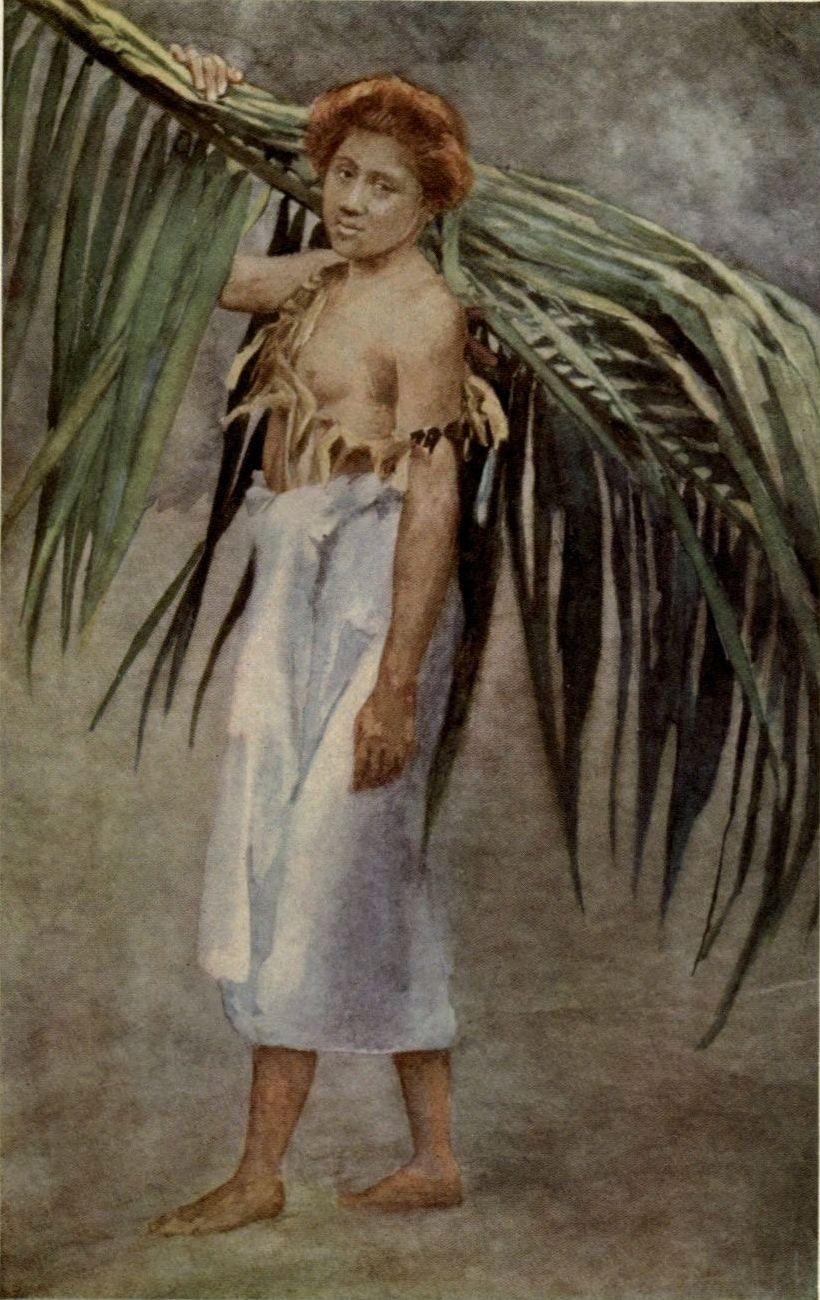 SAMOAN GIRL CARRYING PALM BRANCH
I close my letter, like sphinxes, have bent down to the ground from
their hips, all lost in the dark, with large heads and shoulders and
outstretched arms.
Lepa, Thursday, Dec. 4th.
We were out to sea, in the sun and rain, between nine and eleven
o’clock, and passed the two islands, large blocks of green and brown on
the green and blue water. We came here first, pulling through the reef,
straight to the enormous beach, where our eyes were at once charmed by
the theatrical, or should I say geological absurdity which divided it,
cutting it right down from the steep hills behind, to the water’s edge.
This was a little waterfall of three cascades tumbling over some small
rocks projecting far across the beach, so that the water had, as it
were, a stone conduit upon which it was carried from the mountain to the
sea. It was an absolute set piece, quite practicable, and if ever I have
to design for scenery, here is a little natural object all ready to
hand. The copy could be supplied with real water, just as this one is,
and the palm trees growing upon it would conceal the machinery as they
do here, only—if ever I do it, I shall be told that it is
unnatural—just as it looks here. Why does the water run on knife edges,
instead of taking the easier lines of depth, and tearing up the sand
for a bed? I might explain how, for Atamo is full of geology, and it is
not as mysterious, of course, as it looks. But I give it up, and content
myself with sketching the little girl between the posts opposite me.
We are in the faletele (guest-house) quite near the water. Some thirty
feet off from us cocoanuts hang over the beach and the sea. Right behind
us are rocks upon which is perched a new and handsome Samoan house,
half-hidden in the green of trees. A promontory, finished by a little
island with palms, cuts off the further end of that long beach which is
divided by the cascade with its rocks and palms. Toward us, on one side,
falls the column of water, which ploughs a little canal into the sea.
There our men are bathing, standing up under the falling water, and
later I shall be there too. The other end of our bay, near us, rounds
away behind trees, and a mound, upon which is a fishing hut under palms.
In our house the central beams that support the roof, come together like
a V. All the posts and beams are decorated with flowers and leaves, and
in the centre, near the great branching post, stands a table covered
with siapu (bark cloth) and with flowers in pots, as on an altar, say
a Buddhist table altar. Some of our men are dragging up the boats, but I
am too lazy to turn to see them place them under the shelter of the
cocoanuts. The taupo, is looking at me while I am writing, or at Atamo
similarly occupied. She is bored, but I can’t help it. I could not
entertain her if anything depended upon it. It ought to be cool, but the
beach sends up hot waves of air, and my taupo’s cocoanut oil melts
into it languidly. The name of the place is “A Break Between Waves,” and
the name of the taupo’s brother, that heavy youngster, who is talking
to Seu at the boats, is Break Love. There is a connection that I feel,
but you had better make it out yourself. If the chief is heavy, the
taupo is clever, and makes herself agreeable. Her sister helps her in
every attempt. They are not as dignified as one can remember, and
perhaps had we kept to another line of travel, and visited higher types
of aristocracy, it might have been different. But they are easily amused
and talk much, and are great beggars—and gently, are willing in the
same way to marry us, one of them proposing to marry us both herself,
and even asking at the last moment, “Are you going away? I thought you
would have married me this morning.” All this is joke, with perhaps a
look to possibilities: for do I not remember how two little taupos
very missionary, far back in Savaii, changed their little easy manners
to seriousness, and almost aggressiveness, when some madcap hinted that
we were on a wife-hunt, and had come all this way for it. Those two
little pieces would not allow the liberties of five minutes before, nor
would they let me go without having catechised me seriously as to these
chances—to which they were willing to submit; but they wished
beforehand to know whether there was anything in it.
We had a siva at night, in which our young lady figured with the great
grenadier’s cap that looks so savage and soldierly, and which is really
becoming, the heavy faces growing gentle and refined under this heavy
contrast. But it is painful to wear, being bound on tight, and how our
taupo could stand it for three hours, as she did, I know not. She
danced and sat down alongside of us alternately for nearly four mortal
hours. Through all the dances there was a great display of pantomime,
mostly comic, made none the less by the gravity of some of the
performers who acted in reality as a dancing chorus; so that right
through the crowd of delirious young men and women passed in and out a
fine old Roman senator—I cannot better define him, who never smiled and
who wore his drapery as do the antique statues, and whose mind evidently
saw other meanings in the steps than did the other dancers. I could
almost have wished that there had been some meaning in this accident,
some deep, deep thought in this tragedy woven into the cloth of the fun,
but I believe that it was merely the pleasure taken by the old man in
feeling that his limbs were as vigorous and as supple as long ago. And
we went to bed, the entire company remaining alive and interested for
several hours after our succumbing to sleep. I could hear late in the
night Charley and the taupo crunching sugar-cane and whispering while
Charley, during the whole evening, had lain sound asleep. But sitting up
late in the moonlight is Samoan. Before I fell asleep, my mind went over
some of the historical developments of the theatre. I have certainly
been instructed that at the beginning complete realistic performance is
impossible. And yet I had been listening to a play in which every
possible combination of a fin de siècle manner of looking at things
had been slowly and elaborately combined. Was it then that this society
in which I am now living, savage as it seems to us, is really a very
modified form of an ancient structure of life? Or did these good people,
when they sailed from the dim Havaiki, bring already, in their habits of
mind, modified trainings of earlier civilization? Any similar views
would please me, but I should be better pleased to consider that the
rules have not been accurately defined and that we don’t yet really know
enough about it.
This story of nothing I conclude to-day at Falealili, as we get further
on. We were overwhelmed with gifts at parting, so much so as to make us
feel as if perhaps the only fair thing would be to marry one of the
girls, as an adequate return. Then with the return gifts we might have
run away.
A wife brings mats usually, and gives much support, as is well known by
one young gentleman I hear of, a captain of some schooner, who has wives
in different places. Each of them in turn supports him when he appears,
and as long as his visits are regular, and there is no preponderance or
excess or skimping in his remainings, everything goes well, and there
seem to be no jealousies. In fact, I think that the having to provide
would be a great reducer of those sentiments that flourish most where
there is idleness and pampering. Let us say that the subject is too
complicated, for I feel already as if I had carried over too much of
this letter into the next one. I am concluding now twenty-four hours
later, at Falealili, while waiting for letters, and appearing to listen
to the complimentary speeches of a tulafale who rejoices in the name
of “Tuiloma, King of Rome.” He has a good deal of style, but not enough
for such a name, while the chief of Lepa, who drops in to explain his
reasons for being absent during our visit, has a fine head and makes a
pretty good picture. He has fought against Seu, and they talk over old
times. I am told that he fought well, and he looks martial, as I have
tried to hint above. Otherwise there is nothing to speak of, at least
for me, for I am miserable. It is very hot, and I feel the want of air.
I have tried to sketch two little girls making wreaths near by, and they
have been driven away to let some tulafale come in and make the
ordinary speeches, to which Seu listens with his usual impassive manner.
If he is bored no one would know it. Much laughter goes on after the
ceremonies. But nothing can restore the little girls. One is a
half-breed—very light, her already fair hair bleached with Samoan
liming, and she has grey eyes and a very Samoan face. Her father is dead
and she lives absolutely like a Samoan. I follow her movements, trying
to detect some differences in this little creature, whose fate might
have been just as much the other way. All that I can notice is that
while I sketch she moves less than the others, and is content with fewer
gestures. The fluidity of the pure brown blood is not quite there. I
have told you, I suppose, often enough, how difficult it is to catch
them in a drawing, unless they are asleep. I have never been able to get
a whole minute for any position. Seu sometimes remains quiet for a few
minutes, and some of the greater people or men of character are disposed
to be steady. But usually it is perpetual movement skilfully disguised
under an appearance of quiet. The half-breed was, as I said, more quiet
and steady than her darker companions: our little half-breed
Charley—sometimes referred to by the old joke of Charley Yow, the Boy
Fiend—who serves as interpreter and boy-of-all-work, being a boy, is
still more restless than any of our boys. He will lie asleep absolutely
as if dead, but if awake he must wriggle. He bends over in true Samoan
way, but as he has neither Samoan grace nor strength, I half expect to
see him put his head between his legs, dog-fashion, so as to be able to
take a convenient look up his back. He plays with his toes and rubs his
fingers meditatively, with the European side of his mind, on the rims of
our glasses and saucers. Even the rainwater gets a taste of cocoanut oil
when he has been about. Yet he is clearly “Faá Samoa,” and lazy as he is
and pleased at playing with his fingers on a string tied round his nose,
or trying the edge of a knife, he is serviceable as a Samoan. When we
put him to the task of interpreting a little Samoan poem a few days ago,
he showed an unwilling capacity of mind not unlike what I could remember
of schooldays when we had to put Chaucer into modern English, and when
we bent all our energy into avoidance. The future of the half-breed is
an interesting question here, but too much for my present dreaming.
December 6th.
Later, last evening, during which I was absolutely idle like Charley,
and unlike Charley, because I was not well, we had a sort of abbreviated
domestic siva. We were politely asked if we should like one, and as
politely we explained that we were determined to go to bed early, but
that we should dislike to interfere, and would look on as long as we
were not too sleepy. The little daughter of the tulafale, herself the
tulafale (spokeswoman) of the chief’s daughter, who is the taupo,
explained to us that being “Misionali,” she could not figure in it nor
be present, and if she were Misionali I think she did as well. The
siva was sung sotto voce, and danced softly by three or four women,
probably with reference to not disturbing while we looked on—in some
curious confusion of meaning. The taupo, who is very stolid, with the
expression of a judge of the Supreme Court, danced with nothing on but
her tipuka or upper garment, put about her waist, so that the hole
through which the head is put in this variety of “poncho” exposed the
least polite parts of her back. And as I referred to her gravity of
expression, or want of expression, by an allusion to the expressionless
look of a judge on the bench, I might slip in here a pretty anecedote of
the bright little daughter of one of our celebrities, from whom you will
see that she inherits. Last winter her father gave her a chance to see
the cabinet officers together, and on her return she was asked, “Well,
were they nice?”
“Not nice, but funny!” she said.
Well, so with the dance; and danced by the virgin of the village and her
chaperon it had a curious side. And it was funny enough, with the fun
underscored and interlined and underlined, as it were, by verbal
comment. Apparently the true dances that are not played are innocent as
well as beautiful, but when the drama comes in, the dance follows the
usual history of the drama.
This is a great missionary centre, and to-morrow will be Sunday, a day
on which we shall have to rest because the people here are sabbatarians
of a very strict kind, and do not approve of travelling on the Sabbath.
Our men tell us things of the habits of travelling; they are all, Seu’s
men and ours, except our two tulafales, whose behaviour is all that
one could ask for, young gentlemen whose glory consists in the constant
and sometimes successful assault of feminine virtue. As they explain it,
they would be laughed at at home, if they could boast of no conquests
during the trip; but owing to this being an “European malaga,” because
we are European, they are on relative good behaviour; so that they lead
in prayer and sing hymns, and are in other matters quite good boys. I
have no doubt also that besides the fact that Saturday night and Sunday
will give them plenty of feminine society, they also do not think that
it’s quite the proper thing to travel on Sunday.
So you see that one can go far and see the same thing, and that, as I
told you in Japan, the world is fairly round. Expressions vary, but the
meaning is the same.
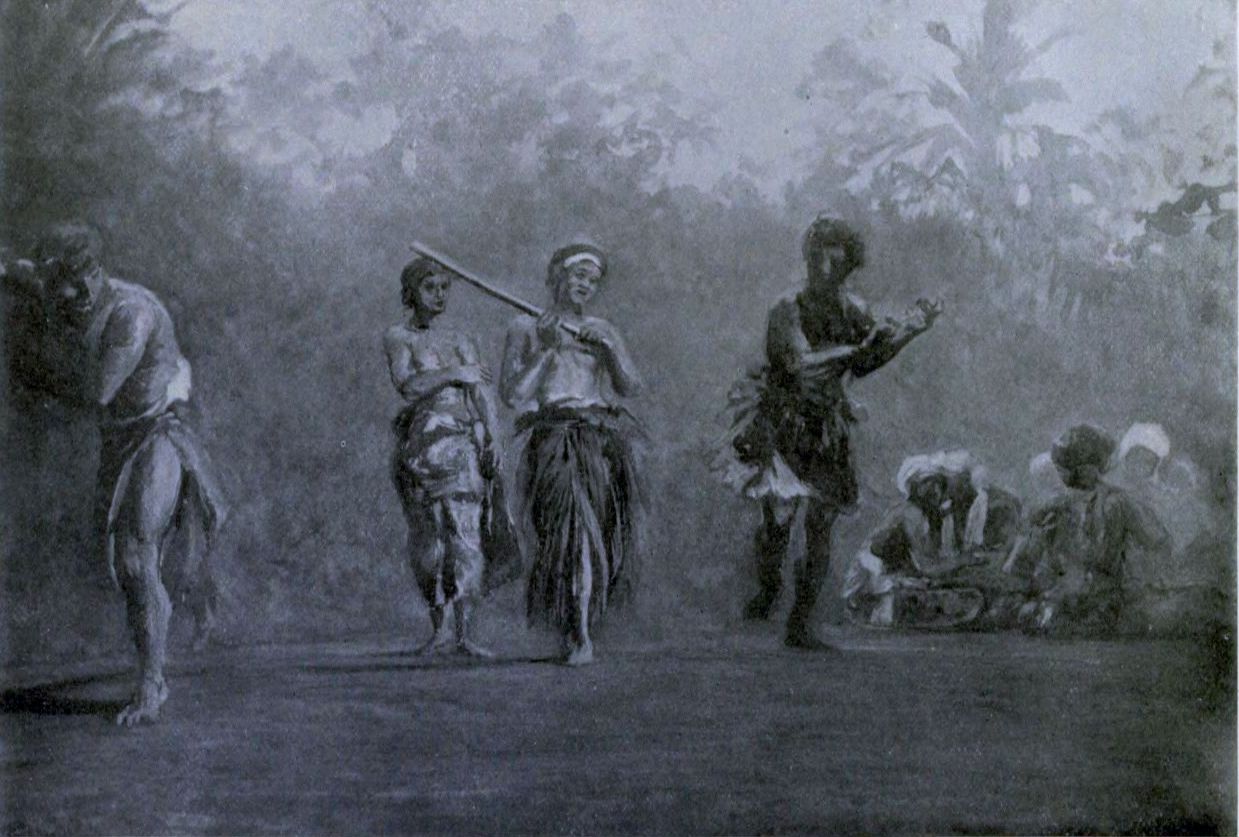 TWO TAUPOS DANCING A “GAME OF BALL.” SAMOA
I am writing now from the next station called Vao Vai, “Between Waters,”
a queer little place looking like some African possibility. Little
houses are bunched together near a little river close by us, and in
front of us, seen through trees, far out, is a little island full of
palms, which the taupo tells me, is used as a resort for sick people
who go out to get fresher air. She herself explains that we shall have
no siva because they are sad for the loss of a young man, a
half-brother of hers, brother of the taupo whose dance and dress I
described above, and who was the taupo of the preceding village. Our
good girl is missionary besides, which will secure us the greater rest
from sivas. Her brother’s death was explained to us last night. He had
gone over to Malua, where is the theological school, on a trip, with
only one attendant, and fell ill and died here on his return, having,
they assured me, been beaten to death by devils. So he said himself
before death, and in proof of it, his body was sore. Moreover, just
before his death, he ran out into the woods, in the dark. But being
caught by the leg, by some tulafale or person of importance, and asked
who he was, he gave his father’s name, thus proving beyond a doubt that
he was possessed by his father’s ghost, I have not yet been able to get
the connection between his father’s spirit and those who beat the son to
death. But that may turn up yet, for the subject is in everybody’s
mouth. I ought, perhaps, to add that the young chief had had a cold
before, with inflictions of pneumonia, and had been somewhat relieved by
medicine from the Catholic priest at some adjoining station, but the
devils were too much for him.
To this little hut, looking out toward the enormous space of the sea,
nothing growing in front of us but two half-cut-down bread-fruit trees,
on the line of the horizon and the little island just outside of the
reef, and the long line of breakers extending right and left and as far
as one can see—have just come your letters carried to me across the
mountains, in a great rain. I have been in some anxiety for them, for I
had had only partial news since September 5th, which was three months
ago. Newspapers have also come from San Francisco and from Auckland,
giving telegraphic news as far as November 17th, from San Francisco to
November 6th; so that our evening is full of incident. There has been a
political change through the elections at home that alters the positions
of persons, and gives one a sort of feeling that all is not Samoan
peace. And the financial news affects us with doubt as to long delays,
for drafts on the Barings, or on any one, indeed, will not be quite as
easy to use in these little communities. So that this event is a turning
point to me out of the world, as well as to the great people in it. To
increase the resemblance to home, where
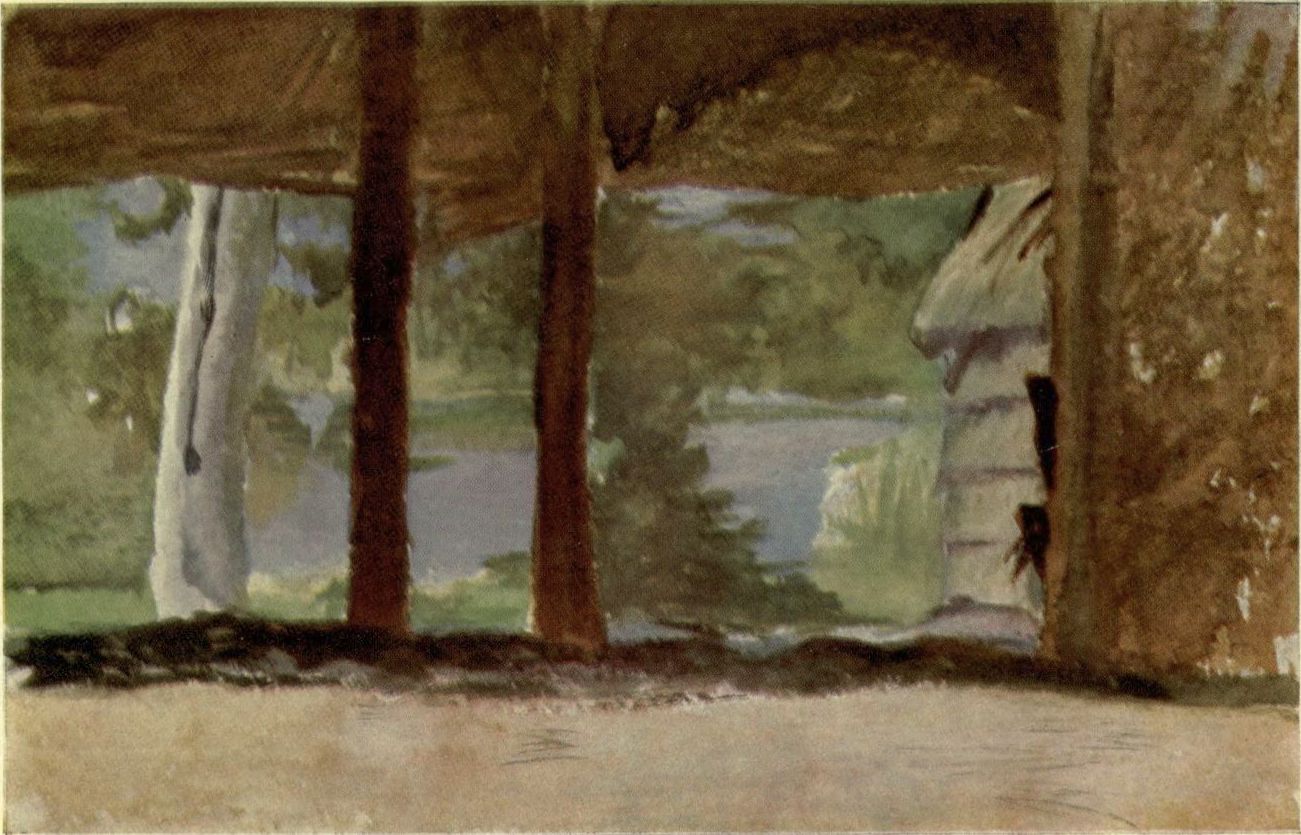 FROM OUR HUT AT VAO-VAI, SAMOA
little habitual matters accompany great ones, we find in this little far
out-of-the-way place fresh butter for the first time in many months, and
milk. So that with Awoki’s cooking, we interrupt for this evening and
to-morrow morning, the course of our Samoan food. It is amusing to
notice what importance this event has assumed, and to realize that
to-morrow, Sunday, will be so much more pleasant for this little change.
Sunday.
This morning I watched from behind my mosquito-bar, where I was
pretending to sleep, the procession of people going to church for the
second time. I had been waked at dawn by the little bell, which sounded
like a steamboat call for all aboard. Against the background of the sea
filed continuously the parishoners, grown people and children, most of
the women with the hats that belong to their idea of church. But among
them were some women with “fine mats” around their waists, that
contrasted with the queer European headdress apparently made only for
this and similar markets. These contrasting individuals were, I was
told, the watchers upon the dead man of whom I spoke, he who was killed
by devils in the woods. These fine mats were their guerdon—for he was a
chief’s son. Had he been the chief, my informant said, mourning would
have been general; the people would have had half their hair cut, and
this would be done perforce to such as neglected it. With this
information I woke up officially, just as I saw our men filing away to
church. Later they came back to ask for canned salmon for their girls.
Nothing has occurred. I have sketched most of the time. Atamo has been
over to see the little islands, for the pleasure of paddling in a canoe.
The taupo did not go, whether from missionary sabbatical feeling, or
whether she was afraid, or whether the men would not let her, for they
said that a woman did not know how to take care of a boat over a surf;
rather an ungallant way of looking at it, for the women we have known,
pretty generally paddled about well enough inside the reef. Our little
taupo, who was very nice and quiet, spent most of the evening playing
with the men. I have spent the day in intellectual idleness, as I told
you, as the place is very small, being half surrounded by a little
river, and crowded with small houses. I have moralized in a depressed
way, and in this direction: would we at home, if things were clean
enough about us to deceive us, find it amusing to sit in an Irish
shanty, as we do now in this one? We should have pigs about and
occasional dogs, and kind, ugly old women and some politics. And the
resemblance grows more and more as I look at it from the dirty point of
view. Things are thrown out of doors to the pigs, who are so convenient
to put things into you wish to get rid of, as Mrs. Bell used to say.
And the ducks wander about everywhere, and I watch the way the pigs eat
cocoanuts, etc.
The chief and the others, the tulafales, have made speeches and drunk
kava over and over again, all day, in an unofficial manner. And I am
so sleepy, so sleepy that I almost fell off my chair, for I have a chair
or camp stool—during evening prayers.
December 8th. Saagapu.
Anagapu is the name of the chief.
We are a little further along the coast, having passed through a
dangerous reef, and waiting for a better tide, which we shall have
to-morrow. The village is large, laid out handsomely in length, a little
tedious in its regularity, well planted with trees, and with swamps
behind and on the two sides that confine it. We have had the longest
tulafale talk that I have ever suffered from, and I am prostrated with
weariness and with sultriness of the air. We had feared heavy rain and
looked with anxiety at two great water-spouts circling in the hills as
we sailed along. There is an arrangement of mountains just behind us,
probably some ancient crater, that looked as if it must be always in a
boil of rain. There is nothing to do, fatigued as I am, but to go to
sleep, and try to brighten up for a siva that I foresee. The people
are many. There are lots of children, and girls who strut about careless
of their lava-lavas, for this is a place unfrequented by foreigners and
by the elegant people of Apia. I see two blacks, or Solomon islanders,
dressed in lava-lavas in the Samoan way, who have taken refuge here,
having escaped from the German plantation further on, which we hope to
reach to-morrow evening. The chief tells me that they are quiet and
well-behaved, and that they go to school like the others about them. All
these blacks work harder than the Polynesians, and even their anxiety of
look, as they come with hesitation toward us has a sort of possibility
of action that I do not find in the browns of a similar class. I need
not have suffered so much from the conventional speeches. Our host, on
my waking from an attempt at sleep, stretches himself against the post
nearest to me, and breaks out in most vernacular English, stating that
he has been a little everywhere, and has been away from home for some
twenty years. He has been as far as New York, which he says is not a
good place for a sailor; in China many times, in Japan, in India, in
France, in England, etc. He has conversed with the American Indians and
states that he can understand their “lingo,” as he names it, from its
similarity to the Pacific tongues spoken by the Polynesian. He has
theories on these subjects, and believes
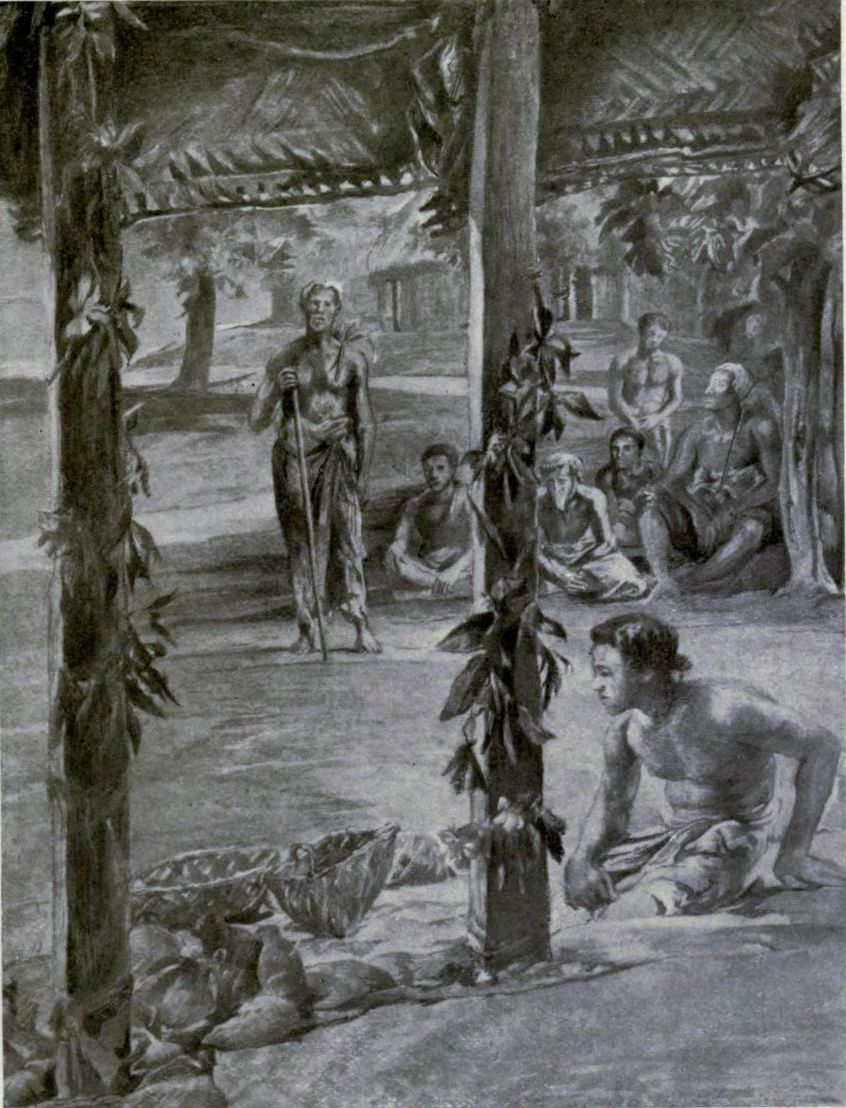 TULAFALES SPEECH MAKING. VAO-VAI, SAMOA
that there is a connection of race between the Hawaiians and the Samoans
and Tahitians, and he extends it to the Malays in the west, and the
American Indians in the east. And as I listen to him, I keep thinking
that the story of the entire Pacific is probably the only explanation of
the Polynesian. I should like to hear more, but personages of importance
again come in and more talk of the society kind recurs. Later we are
asked if we wish a siva. We hesitate for every reason. First, we hear
rumours of a siva being prepared for us further back in some place
already passed, owing to some letters of Tofae that announced us.
Secondly, we are not impressed by our taupo, who besides want of
beauty has also a discontented look which in some grotesque way reminds
me of modern English high-art pictures—something grumpy. Then I have
made up my mind to have a good sleep if possible; so that we say yes, if
only the siva can be in another house; then we add that if we are too
tired we propose to leave. We find, as usual, our boat crew extremely
interested in the subject and in the performers, and the neat little
house where we go in the dark is absolutely filled with spectators. A
place has been set apart for us, filled by our two camp stools, and we
are in time. The performers are full of anxiety to begin, and suddenly
enters our taupo. In the dim light her sullenness looks like calm, her
big headdress covers enough of her face to make the lines look
delicate; and she comes in with a sort of hop of assurance, and throws
herself down an entirely different person. She has authority and grace,
and the “I don’t know what” that belongs to any one completely sure of a
good professional standard. And she smiles with excitement, her smile
widening with the cocoanut oil upon her face. And so the siva was full
of fire, and danced in splendid time. Then we were able to leave and
managed to get a good night’s rest. The floor when it is well covered
with mats makes an excellent bed, and when one is sure and protected
from mosquitoes everything else fades easily into sleep. In the morning
we had a short talk with our host, who complained that he could not get
away again to his wanderings. Samoa might be a good place enough, but he
was bored. He had to submit, however, to the head of the family, who
refused to give him leave. The old man, as he called him, using our
phrase, kept him confined to his chiefdom. Family authority was thus
vested in his uncle, our friend Seu, who had the name, and though the
chief’s authority was his own for his chiefdom, outside of that the head
of the family was master. This was the Roman law in its integrity; our
chief personally was as a son, and only free when exercising a function.
Even were he required to leave and come to his uncle in Apia, he should
have to do so, just as he was bound not to go off as a sailor again.
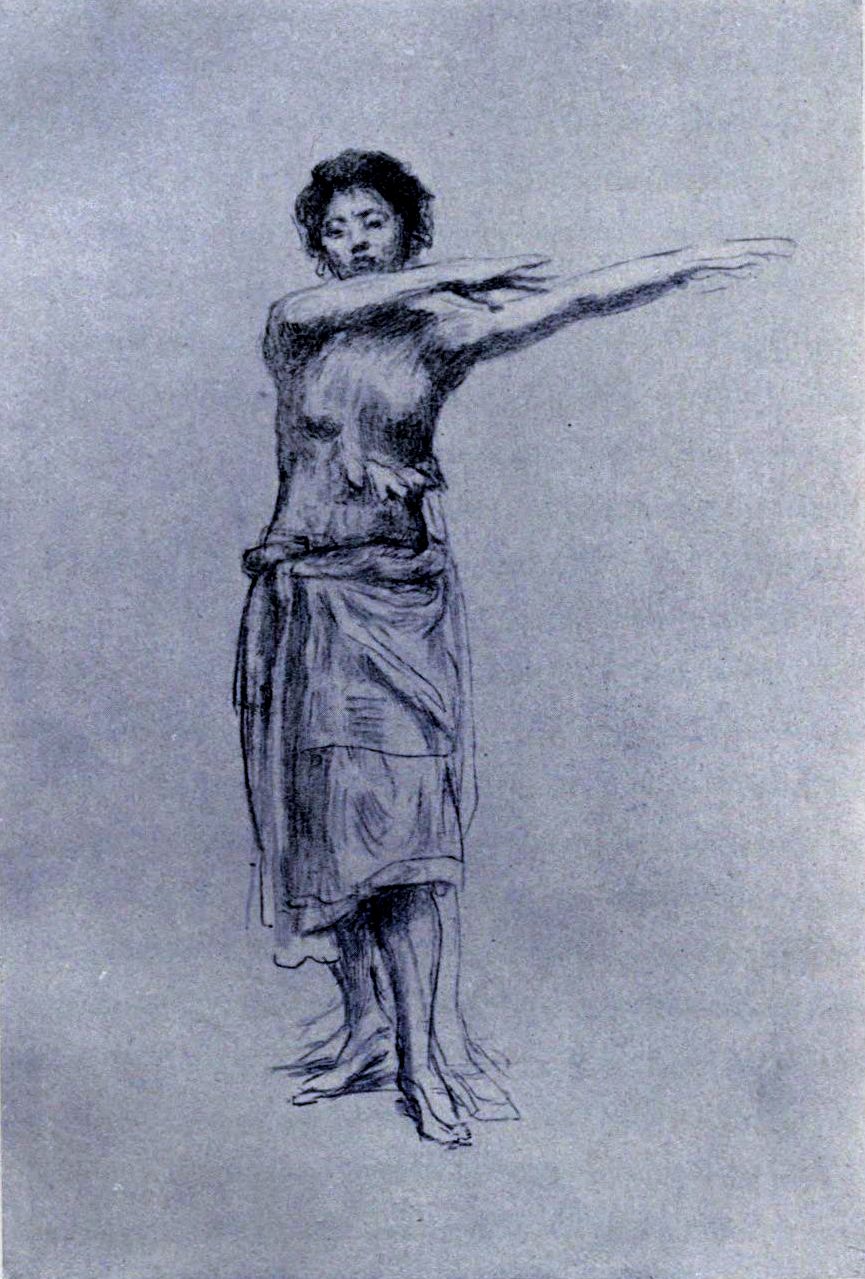 TAUPO DANCING THE STANDING SIVA. SAMOA
Our conversation was interrupted by loud shouts, and the sound of much
trampling—and then by shrill cries of women and of children, apparently
in derision, for there was much laughter. A girl was running away under
the fire of sarcasm, and dodging from one house to another, which she
would again leave, probably from finding more trouble inside. And we
were connected with it. One of our crew had been too much taken with the
charms of one of the siva dancers, or she had felt his eloquence too
deeply. She had run off with him after the dance, and he had made
promises; among others she believed that he would take her with him in
our boat, and there she was on time—ready to go—only to find that it
could not be—and that he must have known it. In fact, the women kept
repeating to her that she must have lost her senses, that she must be an
impertinent fool to think of sitting in a boat with such high chiefs.
Siamau, our man, was slightly downcast, but not too much so—he was
still a conqueror, but the poor girl was—well—she was to be pitied.
Her trial and humiliation lasted all the time that we remained, and I
was glad when we pulled away. The tide served us, and the wind, and we
made a long pull to the place where I am now writing, Satapuala, only
some twenty-five miles from home.
Satapuala was as we had seen it before, on our last malaga; but its
young chief, whose dancing I had hoped to see again, was away—to visit
Tamasese, the former king set up by the Germans—at the other end of the
island—at Lufilufi, which we had passed without calling, in our anxiety
to remain outside of the war of politics.
The guest-house was decorated as before, with palm branches on ceilings
and posts and central pillars, and flowers everywhere—a most beautiful
greenhouse. And the big taupo, the sister of the chief, was there, as
amiable and dignified as before. In the evening she danced again, this
time without the support of her brother. She did not seem as good a
dancer. I noticed, however, that more than any one else, she used her
hands and fingers to carry out the motion, and that she finished, as it
were, the movements begun more rudely and vigorously by the men. She had
the same enchanting style and manner, and even at the end, when a
standing dance was given more outrageous than ever, she retained, with
her smile, a look of not knowing what it was all about, that was as good
form as I suppose an official virgin could assume in such a plight.
That was the end. I take it, that as Maua said, this being an European
malaga, things were made more formal and mitigated on our account.
We are waiting for the tide with which we shall row straight to Apia, in
about five hours—over the well-known sea.
Evening.
We rowed back in true Samoan way, our rowers making a show of pulling
and singing a great deal, with an energy that had been better thrown
into the oars. In fact, they danced a siva of return. The worst and
laziest of the lot, an amiable fellow with a persistent smile always on
his face, actually rose and fell on his seat with excitement. The other
boat, our own, with Samau and our own four men, kept up well with our
ten rowers. On boards placed to let them squat Samoan way, under the
awning, sat a chief we had taken with us, who wore a great white turban
and kept fingering his beard, and a young woman, a cousin of Seu’s—so
that they looked Oriental enough. In Seu’s boat, Tamaseu, the
tulafale, the strokeoar, alone rowed vigorously, though the oldest and
least strong. He gave out the chant and pulled to it, while Seumanu,
standing in the bow, guided us over the shallow water, and Atamo
steered. As we turned round the last point, in the light of the sunset,
we crossed a large boat manned and paddled by girls, all of them dressed
in red, with green garlands around their heads, and for a figurehead a
little girl sitting upon the bows, her crossed legs hanging over in
front. Two black figures in the stern were the nuns of the convent to
which the girls belonged, and they were all returning from a holiday. It
was a pretty sight—nothing is more beautiful than the united movement
of paddles and of heads thrown back in chanting, for of course some hymn
carried them on, undistinguishable for us from a pagan tune.
December 24th.
Nothing new, except social and political news: the excitement at the
Chief Justice’s coming, and the innumerable Samoan reports thereupon;
and Fanua’s engagement to an Australian business man, and her marriage
for the last of the year. There are many “cancans” thereupon the
question of marriage in due form, or of a Samoan marriage which does not
bind the white man who leaves, being much discussed. It was even
proposed that she should marry first some Samoan—why exactly would be
too complicated to explain.
Meanwhile I am trying to work a little and recover from the dissipation
of the malaga. The days have drifted along, and here we are upon
Christmas, the weather very hot, and not recalling what you have at home
except by contrast.
Yesterday we had a great storm, the wind blowing the tortured branches
of the palm in great gestures against the sky. Few were out except the
boys, who played cricket all day in the rain, and conveniently dropped
their clothes. At night, the rooms were filled near the lamps with small
flies that crusted them, and covered the tables in thousands, so that
we could neither work nor read. Through the crevice of doors and
windows a fine dust was blown, the broken fragments of dead vegetation.
We are only six feet above the sea, and during the night the dash of
rain against our wall sounded in my dreams like the lashing of the surf.
In the morning the flies that had lain in heaps of thousands had
disappeared. I saw the last carried away by the laggards of an army of
ants, which had pounced upon them during the night or early dawn.
I have been watching some three girls and a boy who have been sitting or
playing about near me. Strictly speaking, only one, a grown-up girl, has
been sitting. The others have placed themselves occasionally on the high
bench to which the neighbourhood resort at night for a lazy stretch and
infinite talk. But these children were never quiet, for the two hours I
watched them. Most of the time has been taken up by wrestling. The boy,
who is the smallest, was at first thrown by the girls, but as they
taught him, he managed to keep his own fairly—until the elder girl was
enlisted in the sport, and kept throwing him and the others, according
to rule, for she carefully showed them the proper grip and some first
movements. All this is a type of the manner by which constant exercise
rounds them out, and I could not but appreciate how the little girl (of
eight perhaps), when she was not wrestling herself, danced up and down
continuously, in an involuntary impatience at having nothing to do in
the way of siva.
Vaiala, Near Apia.
Upolu, Dec. 25, ’90.
This is Christmas Day. I am seventeen hours, I think, ahead of you in
that fact; so that at this moment you are only running about for the
presents and the Christmas tree, but I cannot wait for you. It is such a
Christmas as they have here; they call it Kilimasi, and do not quite
make the joy and fuss over it that we do, having been christianized by
the Wesleyans. And I have not told you the whole truth; when the
missionaries came, they miscalculated the time, so that in many islands
they run a day ahead, not having dared to acknowledge a mistake that
might have imperilled their other teachings, for Christianity was
inextricably entangled with cotton goods, gunpowder, etc.
So you see, these people were like ourselves, and could not separate one
kind of truth from another, a deficiency which must have troubled you in
New York, as it does me both in New York and elsewhere.
But it is legally Christmas to-day, as I began to say, and a holiday,
which I can only distinguish from other days, because there seem to be
fewer people idling and lying about. The convict also is not at work, he
who labours near us, weeding and cutting down twigs, when he is not
sitting and talking to his admirers, who decorate him with flowers and
make wreaths for him.
But even this would not be an infallible guide, for the day before
yesterday the wife of the very chief who had brought this man before the
consuls for punishment (he had stolen the consular flag halyards—why,
no one knows), and who had pined in court for thirty lashes and six
months’ imprisonment—which were not given—the wife of the chief, I
say, came to ask us, as great chiefs ourselves, if we thought that the
consuls would let the prisoner have a few days off for fishing. And we
strongly urged her to ask for it, as a reasonable request—at least, in
the comic opera. The other convict, who is a great fraud, has been
occupied in ferrying people over the main river (the bridge having gone
down in the last storm, and we people who wear trousers and petticoats
not liking to wade over). But he also is variable as an index, for he
usually employs a small boy of his tribe to do the work, while he lies
in a little hut that he has built, and sleeps or eats, crowned with
flowers, like a jubilator. I was telling Mr. Stevenson of these details,
upon his last call, and he interrupted a description of the tyrannical
conduct of the French in Tahiti and the Marquesas, by the story of a
visit he had paid to the prisons there with the inspector. There was no
one in the prison for men:
“Monsieur,” explained the gendarme, “c’est jour de fête, et j’ai cru
bien faire de les envoyer à la campagne.” Visit then to the women’s
prison. “Mais où sont vos bonnes femmes? Monsieur, je ne sais pas au
juste, mais, je crois, qu’elles sont en visite.”
He tells me that though French rule is of course wrong in principle,
therein differing from English or German, the gendarmes are a good lot,
whom it is a privilege to know. I have run on into this because I have
been thinking while writing of my having told you that I intended to go
to the Marquesas and see Typee.
I am slowly drifting that way, but my enthusiasm is dashed somewhat by
what I hear. I am told that there are scarcely any more Typeeans—and
they are clothed to-day, as indeed, I fear, are most islanders who are
handsome, except the good people here, who still preserve the real
decencies to some extent.
And that is why I am lingering here, as I see for the first time, and
probably for the last, a rustic and Bœotian antiquity, and if I live to
paint subjects of the “nude,” and “drapery,” I shall know how they look
in reality. As I write in our Samoan house, which is only raised a few
inches from the ground, I see passing against the background of sea,
figures which at a little distance and in shifting light are nearer to
the little terra cottas that you like than anything one could find
elsewhere. Young men naked to the waist, with large draperies folded
like the Greek orator’s mantle, garlanded, with flowers in their hair,
pass and repass, or lie upon the grass. Young women—and alas! old
women—more covered, though occasionally draped like the men, or with
girdles of leaves, walk about, carrying leaf-made baskets or cocoanut
water-bottles—or they sit and lounge with the young men. An old man,
with his drapery partly over one shoulder has just stalked past, holding
a long staff that he puts out to full arm’s length—for they use their
limbs with a great spread and roundness of action. Four girls of
different ages (from eighteen to eight) have been wrestling under the
trees, practising some grip—and have been teaching a boy how it is
done. A friendly hunch-backed dwarf has called to pay a Christmas visit,
and to get a friendly nap. Like the girls, he wears nothing but a
dark-blue drapery around his waist, and a great garland of fruit and
flowers that hangs about his neck. His hair has been dressed and curled
in Samoan fashion—that is to say, it has been stiffened into shape with
coral lime (which, when washed off, has reddened it) so that he has the
hair of a blonde on his dark head. Japeta, as he is called (Japhet), who
by the by is rather “missionary,” but believes in witches and devils,
and has lived in the woods—and is really very intelligent—is certainly
more handsome in this way of costume than if he were to dress in the
fashion of Sixth Avenue—or even of Fifth Avenue—for he is of a chief’s
family. It is true that he has powerful arms and legs that would look
well anywhere else than here, where their dancing and jumping and their
mode of sitting seems to have influenced the size of the lower limbs,
and to have given a roundness to the entire body, that reminds one again
of the Greek statues and terra cottas. For the girl form passes into the
young man’s and his to the older without break. Their dances do a great
deal for this result. They all dance a little from the very earliest
age. Last night, as I walked home, I found a crowd of little mites
practising the figures of the sitting dance, in which the entire body
is moved, from the ends of the fingers to the tips of the toes. And
beautiful they are, these dances. If only I could paint them—but that
is almost impossible; some of the gestures could be given, but not the
rhythm. And they “sit” badly to a painter, and, notwithstanding their
idleness, are rarely quiet. Sketching is formidable. They will jump up
to see what you have been doing and everybody troops all
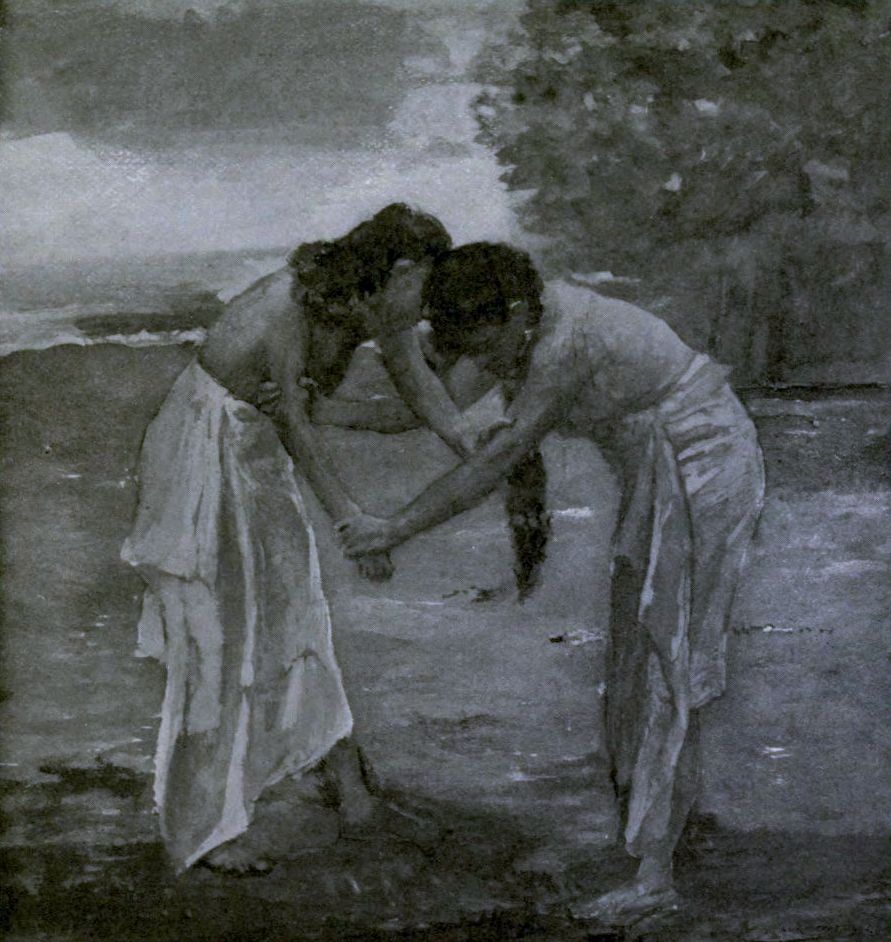 FAGALO AND SUE, WRESTLING. VAIALA, SAMOA
around. Still, I have sent and shall send some sketches home.
One of their dancers has just passed—an official dancer—the official
“virgin” of the next “village,” but one whose duty it is to entertain
guests, and see to their comfort, and dance for them, as also in war to
go out dancing with the combatants, as you will see in some of my
sketches. She was crowned with flowers, and had a garland around her
waist, one around her neck, and her waist was stiffened out triumphantly
by the folds of fine thin mats, worn as drapery. Behind her (for she
is of rank), at a far, respectful distance, has passed, also her
attendant, an old woman, who is responsible for her, and a tall, big
fellow, also an attendant, with a great drapery, also of yellow mats,
fastened by a narrow girdle of white bark cloth. We know her very well,
and did she not abuse her prerogative of anointment with cocoanut oil, I
should see more of her.
I have wandered away from my intention of wishing you a Merry Christmas
and a Happy New Year; our Christmas is a hot one (86 to-day), but
yesterday was cold and stormy, and the thermometer went down to 78
degrees for a time. The wind blew the palms into all sorts of distressed
shapes, and sent amid a deluge of rain so much fine dust of broken
foliage through the crevices of our doors as to remind me of Tenth
Street in sultry summer, when they are building.
I wrote to you from the steamer in the first days of October. Since that
I have learned that my letter was long delayed. The letters are given to
the small cutter or schooner, manned by natives, that meets the steamer,
so as to bring letters here. Then she has to beat out for the upgoing
steamer to San Francisco to give letters to her. It so happened (and,
alas, I know all about it, for I was there), that the schooner was three
days at sea, owing to calms, so that she could not return in time, and
my letter which was aboard with me was delayed a whole month. It was a
queer, an uncomfortable, but a startling experience, this being dropped
into the boat—for we landed once and saw things in an, informal way,
tasted the sensations of all this faraway rustic classicality with minds
unprepared. We spent our first day and night with native hospitality in
a little out-of-the-way village, and saw, abbreviated, all the
innumerable pictures that I have had leisure to watch since then: The
dances and the kava-drinking and the village life, and the boats; all
preceded by our putting into “the little cove with a queer swell running
on the beach,” just as in the old story books; and twenty-four hours of
calm in a small sailboat under the tropical heat was also a new
experience.
So this is why my last letter was so delayed. I did not know of it until
long after. Should I get as far as the Marquesas, I shall write to you
again, and tell you if anything be left of Typee, but I fear that that
is all over. Still, I hear reports of some private cannibalism to which
the benighted French object, so that there may still be hopes. But I am
told also, as I said before, that they wear European clothing and that
is worse than any immoral diet.
There are no Gérômes here and little French in the figures. Of the
moderns, Millet and Delacroix alone give the look of the nude alive
and out of the studio. Also the Venetians and the older men are not out
of the facts. And, praise be to the Maker of all (art included), I have
not seen any black except at night—and even then, “si peu, si peu.”
Rembrandt would be happy here, especially in the evenings, when the
cocoanut fire—that is so bright as to look bright in the day—makes a
centre of light strong enough to turn the brown skins to silver and to
gold, and then passes by every gradation of the prism into nameless
depths that black paint will never give. My dear old painters, even to
Van Eyck and Memling, how well they “carry” over the globe!
I should write to you about Stevenson, but I suppose that you can hear
more directly through his letters to his friend. We have seen something
of him and have been pleased. He is hard at work, so that visiting him
is not a favour to him, even though he may like it, as reminding him of
that real world of civilization which he thinks he has left for good.
Nor have I written to you about politics, that are really impressive
here, for we have saved these people from a hell of slavery under the
Germans. A little gentleness on their part, and they would have had the
islands—for these people are gentle enough, and desire rule, but, as
they said, “death would be better”—and fortunately we interfered.
I am impressed here, as I have been before, by the force that America
could have for good, and by the careful calculation on the part of those
who know us best, the Germans and English, upon our weakness of action
and irresponsibility, and our not knowing our enormous power.
The Pacific should be ours, and it must be.
Vaiala, Jan. 19th.
This afternoon another little incident of everyday life brings up again
my wish that I could set all this world about me to the music of a comic
opera—a great siva. If only I could understand all that they say, and
yet see it as people do who do not understand so that for them the ways
of other races seem perpetually funny to the eye. What a charming
subject I have now for a third act—or perhaps might I bring it into
the first one—or should we perhaps make it an interlude, with the
siva ballet interspersed? Perhaps, after all, it makes a little opera
bouffé for itself.
This afternoon, as I was telling you, I noticed some agitation on and
about the malae, and around Tofae’s house, which is next to mine. This
annoyed me exceedingly. Siva,[12] our first pet from Tutuila, had come
to Apia on a visit, and the little silly darling had stumbled upon Awoki
and claimed him with all the enthusiasm these people have for him, for
his small size, his good nature, and his brown skin.
Our servants and dependents are the only ones who get the truest
affection and good-will; we are too far up and too white, and cannot
play. I have no doubt that notwithstanding the kindly offers we have
had, Atamo especially, from maidens who were looking out for an
establishment—I have no doubt, I say, that in their gentle minds was
some confusion, some wish for rank and position, and that their real
hearts went out to those with us like my little Japanese attendant.
Indeed did not Faauli, the taupo of Sapotulafai, the daughter of the
great tulafale, intimate that she wished to keep Awoki with her, and
did she not say that if he tried to run off she would put him in her
father’s jail until we were out of sight and out of reach? Well, Siva
recognized and claimed Awoki, and so we obtained her again. I made her
sit for me, and found, to my great pride and delight, that I had never
been mistaken, and that her rustic movements in the dance were finer far
than those of the girls of the great places. We had seen the best first,
and had known it. Siva was ill at ease here; she knew that she was
considered provincial, or as Charley explains, “the Apia girls think
that these Tutuila girls are fools.” The same little ways, the same
condescension, the same disdainful or inquiring look, that we see used
elsewhere, were given by the maidens of our place to the little
stranger. And this afternoon, when I had got her out of the way to our
house, to try to get a photograph of her with my hawk-eye camera, that
never works, I was disgusted at seeing the surrounding green covered
with people. The younger ones singled out Siva at once, and with the
sincerity of purpose that belongs to youth, said to her what they
thought; that her dress was this or that, that her hair was quite
wrongly cut, like a goat’s, they said, literally, with many such
amenities. All this Siva bore as maidens with us would bear, with a
distant air and an occasional smile of pity. She was a sort of relative
of Tofae’s, being herself a chief’s daughter, and could not, I suppose,
be absolutely extinguished.
But the crowd increased very much between us and Tofae’s house, and
twice I had been obliged to single out some offender and drive him off
with a threatened stick, when something dawned upon me; these people
were really coming to Tofae: no vain curiosity had led them to surround
us and sit about the grave of Tofae’s father, and fill the greensward
between it and the posts of his house. Something was about to take place
there. Tofae was seriously taking counsel with some others, and suddenly
the crowd poured around his house, the privileged ones entering it, and
one little bunch of old women slowly, lingeringly stepping in between
its posts.
So that I asked, relieved from my own trouble, what was it all about.
This was the story: set it to music yourself and Atamo shall write the
libretto. Within the fold of the chief has lately been dwelling a maiden
thought to be frail, or at least of a stuff not so stern as some others.
Perhaps she may have been there in exile for some slight misdemeanour,
and her people may have deemed it good for her to live for a time under
Tofae. For me she had little charm, if I do not mistake the young lady
and confuse her with another young person who has also had refuge there,
having bolted from her unpleasant husband and spending some weeks in
temporary viduity.
One of our young gallants, and I am both proud and ashamed to
acknowledge, one of our own crew, is a great admirer of female beauty,
and fixed upon this maiden as one he should like to win, even if he had
to persuade her to run away with him, for as far as I know he is
married, and had never intended to set up a rival establishment in legal
form. Nothing here in Samoa can be hidden for any length of time, so
that a more moral place in its way it would be hard to find. To pay
court in the evening supposes a certain surrounding of many young
people, and often the presence of many older ones, and our young man’s
wishes were understood by others than this best girl. So that, most
meanly, some of the old women began to prejudice the girl’s mind against
this passionate and handsome youth, and instead of opposing her, which
might have defeated their object, they began to tell little tales about
his past, probably exaggerated, as they went on accumulating. And as he
found the girl still resisting he determined upon a straightforward
course in his manly bosom, and complained to the chief, asking that
these libellers be punished. And the chief listened, as was right, and
summoned the old ladies before his tribunal to make good what they said,
or forever after hold their peace. And here they were, come to be
judged, while friends and witnesses and neighbours circumfused them,
anxious about the outcome.
“Well,” I said to Charley, “and what will happen? You have heard it
all.”
“They have been telling bad things of him, and Tofae will punish them.
He will fine them and fine them high, perhaps as much as ten dollars,”
answered righteous Charley, feeling, as we all did, for the virtuous
cause. And then I withdrew, not only because I wished to go to Sivá, but
I wished also to meditate upon the principles of eternal justice now
about to be vindicated by Tofae. When the old women are silenced and put
to naught, shall our young man be strengthened in his suit? And will the
young lady triumphantly elope with him? All these contingencies of
events might appear spoiled if I inquired too far, so that I have left
it all alone, and I withdraw. The subject is too pretty as it stands,
and, as I said before, only requires to be set to music.
Vaiala, Jan. 27, 1891.
We are nearer to the cannibal here in Samoa than you would believe at
first; far away as we are from cannibal or “devil” countries, we have in
the hired labourers of the German plantation a wilder set of savages
than would seem from their usual behaviour and the steady work urged out
of them by their German masters. You must not forget that these little
black men, often so gentle and sweetly smiling, whom we see about at
work—in that constant exceptions to all around us—are not absolutely
converted by being taken from their cannibal native lands to work for
the white man in Samoa. The smile of their white teeth, repeated by the
ivory bars or rings in their noses, conceals, like the gentleness of
children, depths of useless cruelty.
The timidity of behaviour of such as I had seen and described to you,
who had escaped from the plantations and were in hiding among distant
Samoan villages, protected by the gentler brown race from recapture and
return to what after all is slavery, is not a permanent index of
character. When they have escaped, and have lived in the bush a life of
bare chance, finding scanty food, continually tracked and hunted by
their masters, often denounced by the Samoans, who do not trust them,
they turn both to ancient, ferocious habits, and to the superstitions
and fears which belonged to their life at home.
They are always suspected of cannibalism; and the event which has made
us all more or less miserable is considered as quite a possible thing,
and likely to occur again. News came to us suddenly, out at Vaiala, that
Faatulia, the wife of our friend Seumanu, the chief of Apia, had learned
a dreadful thing. Her brother, some weeks ago, had sailed from the
little island of Manono, and had neither returned there nor arrived
anywhere. His boat was found upturned, and he was missing. The story
told to Faatulia came from some of the black labourers, or else from
some of those who had escaped out of slavery. Or else it came in the
Samoan way, so that, though you know there is a story, it does not
require to be fathered by any human tongue. “There are no secrets kept
in Samoa,” says Mataafa; “they are always being told.”
This is what she learned: Her brother, in the last storm, had been
driven out of his course; his canoe had been overturned, and he had
barely saved his life by swimming. On reaching land in great distress,
he had found in the bush a hut, occupied by runaway blacks, and had
asked for shelter. He had slept, but fever had taken hold of him, and
for some while he was unconscious. Thereupon came up the dread
temptation to the black man. Here was that menace of superstitious harm
coming from the presence of a sick man, who might die and injure them by
bringing the spirit which kills, into their forlorn abode.
Here was food too, if they killed him. Perhaps—I say it with doubt,
because I have but confused notions of the exact superstitions belonging
to any one of the races I have not met—but the man killed and eaten
is not so dangerous in the other world as the man who dies a natural
death.
At any rate, the story went on to say that the blacks killed Faatulia’s
brother in his sleep, ate him, buried the bones, and knew nothing when
inquiries were made. But somehow or other, suspicion excited by
something done or said made the friends of the missing man dig and find
remains which, at the time we heard the story, were being brought down
to Faatulia, for identification.
And now how shall they know? The German firm will send their physician,
and the American ship will send hers, and the question will assume a
political meaning.
It was a sad thing to make our last call on Faatulia, and know that
while she talked to us she was trying to forget the ugly thing lying
behind the hangings of the hut.
Seumanu was undisturbed as usual, and bade us good-bye with all the
coolness of a tulafale.
That same afternoon, January 27th, we looked for the last time upon the
royal face of our neighbour Mataafa, while he told us again to tell
Americans that Samoans owed their lives to the United States.
Then I used up my last daylight in painting a study of Maua, one of the
boat’s crew, who endured it in a fidgety way that he took for patience.
He was cold, for every hanging mat had to be opened, to give a little
light on the dark afternoon, under the big roof of our hut.
And again in the morning I worked upon the sketch until the boatmen came
up to tell me that the last moment was come. Maua flushed pink with joy,
over his whole naked
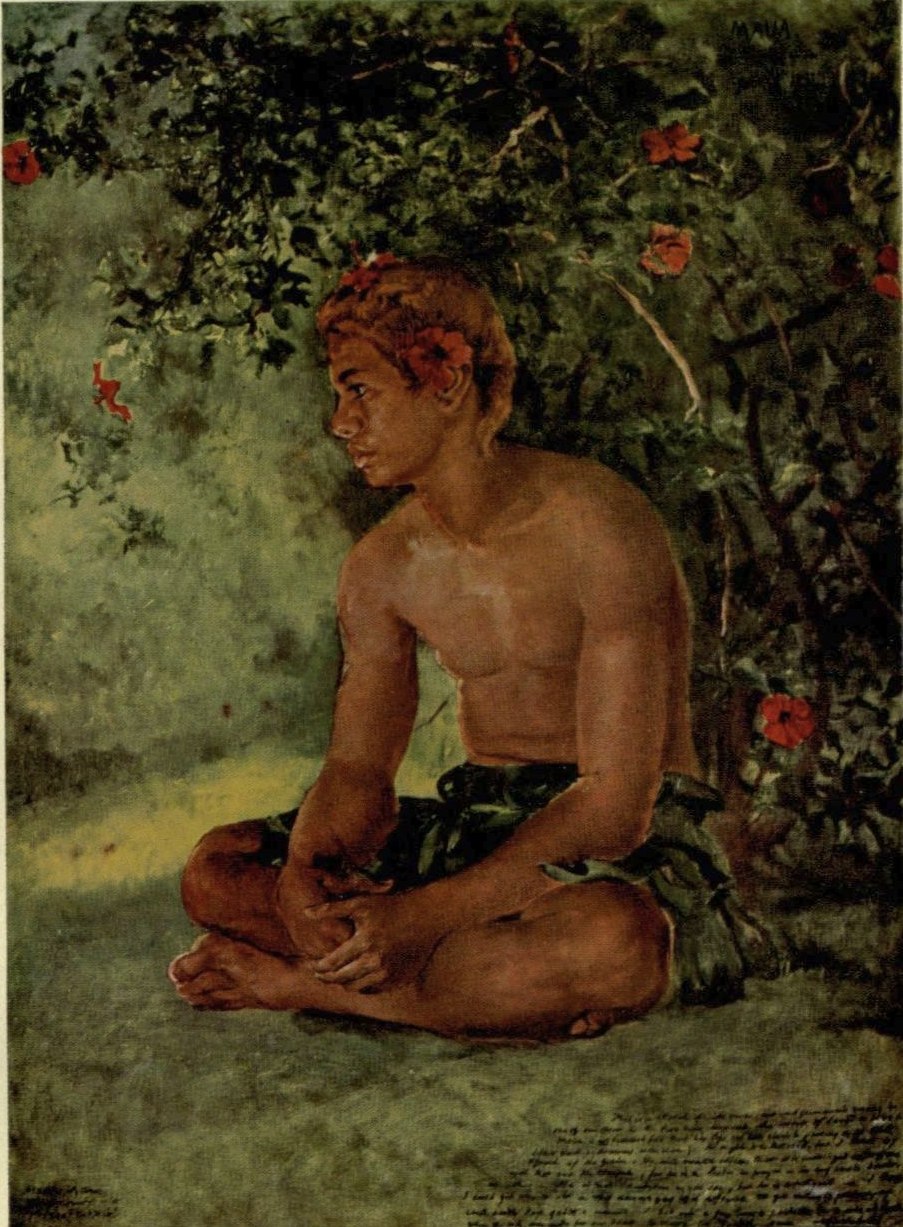 MAUA. STUDY OF ONE OF OUR BOAT CREW. APIA, SAMOA
body, when I told him that I had done. The children on the village green
(malae) came to say something and to offer little presents of shells
and sea beans.
The steamer was whistling for me outside the reef—Atamo was on
board—— But I could not be left behind—too valuable a passenger.
I bequeathed my best cocoanut oil to Siakumo and the other girls, said
good-bye to Tofae, our chief, and promised, if I returned, to come back
under his wing. Samau, our boatswain, carried me on his back, into the
boat, and patted my legs, as a respectful and silent good-bye.
The grey water inside the reef was smooth and quiet. For the last time
our Samoan crew pulled close to the shore, to exchange tofas
(farewells) with Meli and her girls; and we went on board, where the
sheep from Australia were still huddled on the quarter-deck due to
Tahiti later. In the afternoon the island, wreathed in clouds, was
already melting away behind us.