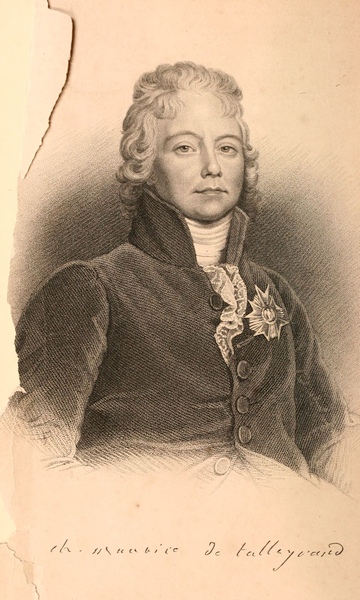
It was during the autumn of 18—, that, passing
through Paris on my way to the south of Europe,
I ventured to pay my visite de rigueur to that hallowed
shrine—that Mecca of all young diplomatists—the
Hôtel Talleyrand, in the Rue St. Florentin,
to obtain, as it were, a blessing and an imposition
of hands from the high-priest of the diplomatic
craft, ere I ventured, novice and without guile as I
then was, to put forth on the unknown sea of
politics. Perhaps there lingered in my mind a
latent hope of acquiring some new information
concerning the hidden rocks and shoals, the under-currents,
which were not yet marked down in the
very imperfect chart at that time existing in my
brain, and by the aid of which I might, by steering
aright, gain more quickly than my colleagues the
glorious port of ambassadorship.
I had once had the good fortune to form part of
a company, assembled by the owner of P——
House, to meet the Prince de Talleyrand, during
the very last Easter vacation which he had spent
in England; so that it was not as a complete
stranger that I now ventured, all trembling and
awe-struck, to seek the presence of his excellency.
The hour was somewhat late for a morning visit,
when I called at the hotel; but I had been told by
one who knew him well, that his hour of confidence
and kindness, his hour of benevolence, in short,
was decidedly the one hour before dinner; and so
already, even in the smallest matter, beginning to
move professionally, I had acted entirely upon the
strength of this friendly warning.
I was not disappointed; for I found the veteran
diplomatist enjoying the otium cum dignitate,
after the fatigues of the day. He was seated in his
easy chair, reclining with that peculiarly easy grace
which, in spite of his lameness, characterized his
every attitude and movement. A bundle of newspapers
lay upon the table before him; some were
scattered on the floor around; but he had evidently
forgotten, for the moment, the world and all its
fretful politics, and was gazing with fond affection
at the gambols of his fair young niece, who was on
her knees upon the floor by his side, her arm resting
upon the elbow of his chair, teasing and provoking
the large English spaniel, Carlo, the delight
of the prince, and his constant companion.
It would be difficult for a painter to imagine a
scene more interesting, or even more poetical, than
the one which thus suddenly presented itself to me.
The long golden hair of the child fell forward in
a glittering shower, blending with the silvery
masses which, to the latest hour of his life, shaded
in such luxuriant abundance the calm brow of the
prince; and, as he bent down over her, the contrast
between the fair and blooming face, animated
as it was by the glow of youth and the excitement
of the game, with that cold, impenetrable countenance,
those fixed and marble features, was rendered
yet more striking. It was the dim immovable
Past, seeking to interrogate the busy, smiling
Future; Old Time striving to detain one single rosy
hour, and pausing to gaze while yet the charm
endured. There was, indeed, over the whole scene
a shadow of bygone times, which the graceful
figure of that fair girl alone seemed to attach to
the Present.
The drawing-room into which I was ushered
was noble and lofty, although an entresol, and
through the high casements the setting sun of
autumn poured in its rich and glowing beams,
seeming to pause in fondness over that scene, and,
forgetting all besides, to linger there. Through
the arched vista of the Tuileries, late so green, but
already bared of foliage, the darkening sky gave
token of the near approach of twilight, and I
could not help being struck with the fitness of the
emblem.
I had leisure to contemplate the scene, for the
low suppressed laughter of the child, and the playful
growling of old Carlo, had prevented the announcement
of my name from immediately reaching
the ear of his excellency, and it was not till I
stood within a step or two of his chair that he
became aware of my presence. He then rose
slightly, leaning on his cane, and gave me that
gracious and courtly welcome—a reminiscence of
the old régime—which neither his passage through
the revolutionary mire, nor even across the broad
Atlantic, had been able to mar. That bland and
polished urbanity was the attribute of a race of
men of which he was the last representative, and of
which we shall see the like no more.
My conference with him was but short, and
passed chiefly in inquiry after the friends I had
left; some few questions concerning my future
destination; an observation or two respecting the
chargé d’affaires at that time resident at the court
to which I was bound; but nothing further; and I,
who had indulged in vague dreams of the treasures
of advice concerning my new career, to be gathered
during this interview, was just on the point of
taking my leave, without having dared to breathe
a hint upon the subject which lay uppermost in
my thoughts, when, to my delight, amid the numberless
kind things he uttered upon the subject of
my journey, he added, with a bland and courteous
smile, which from the old to the young so greatly
enhances the value of the kind speech, “Vous
viendrez nous voir à Valençay?”
And then, as though he had reserved all his
urbanity till the last, acting upon his own principle
of “always waiting to the end,” he told me that he
himself was on the point of hastening thither,—that
I should see him no more in Paris,—that the place
would not be far out of my road on my journey
southwards; and the kindness of the tone, the
friendly glance with which the words were accompanied,
left me no doubt of their sincerity: so I
accepted the invitation with the most joyful alacrity,
and, before we parted, he himself had fixed the day
for our meeting again—at Valençay!
At Valençay! Here, then, was I about to accomplish
by a mighty stride, to overleap by a single
bound, many a weary league on the highway of
politics; and moreover, to gain ease for the remainder
of the dusty journey. So, with these pleasant
illusions in my mind, it cannot be wondered
at if I rather hastened than retarded my movements.
With a heart beating high with expectation did I
set forth on this pilgrimage. It had been one of
my day-dreams, which I was about to convert into
reality. I had so often longed to behold the great
statesman in his retirement, and now I was about
to see him in his hours of leisure and of laisser-aller,
and to share with his chosen inmates all the
treasures of his rich and varied store of reminiscences!
I had heard that it was his great delight, when at
Valençay, to call up the spirits of the shadowy
past, and that here he seemed to live and breathe
amongst them; that here he took no heed of to-day,
or of what might befal on the morrow; that
his soul was with the past—his thoughts were all of
days gone by, and lingered not with the present.
By turns abiding amid the courtly saloons of the
days previous to the Revolution, he would tell of
Madame de Boufflers and Marie Antoinette, and of
the folle vie led by the young, when he, too, was in
his youth. Then the rude Conventional—the stern
Republican—the warlike figures of the Empire—the
pale, dim Silhouettes of the Restoration, would
all arise, and pass in crowded array before his
enchanted audience; with such grace and truth,
too, were they all endowed, that sometimes the listener
could believe that he had seen and heard the
like, and that he too had been of them and among
them.
Valençay had ever been the favourite residence
of the prince. It was here that he had ever preferred
seeking relief from the political turmoil of
the moment,—perhaps to repose after the fatigues
of the last struggle,—perhaps to gain fresh courage
and vigour for that which, with his unerring foresight,
he knew to be inevitable. It was here that
he sought the rest which he sometimes needed—it
is here that, by his own desire, he now reposes
for ever.
These are the reminiscences which must henceforth
render Valençay one of those few favoured
spots, scattered here and there over the surface of
our dull earth, towards which fancy hurries on
before, and where Memory lingers long behind;
places that shine out, amid the dulness of this
dreary world, with the bright lustre which the
memory of the great and good has shed around
them, and which, to the traveller through the land
where they are found, become hallowed shrines,
that it is scorn and reproach to have visited the
country without beholding.
In my case, and young as I then was, it is no
wonder if I approached, with feelings of almost
undue reverence, the spot where dwelt the last
great statesman of the age—the last, at least, of that
class of men who, singlehanded and alone, could
lead, by the very force of their spirit, whole nations
to think as they thought, and to act as they directed.
Imagination had indeed gone on long before, and
paused to await me at the gates of the Château of
Valençay. Nor was I disappointed on my first
approach. It is a noble and stately pile, well
suited to the regal tastes and habits of him who at
that time shed additional lustre over its sumptuous
retirement.
The dark forest, through which the road lies for
many miles, gives a grandeur to the scenery, of
which this part of France is elsewhere almost
entirely devoid. The broad Moorish towers of the
château are seen for some time, alternately appearing,
and then lost to sight, until finally they form
the termination of the splendid avenue de Gâtines,
through which they are beheld at a great distance,
gradually rising in the perspective, and seeming to
increase in size as the traveller draws near, with an
effect almost magical. Nothing can be finer or
more original than the appearance of these far-famed
towers, which give to the building an air of
oriental grandeur, perfectly unique. They were
built at different periods, the first one having been
added to the edifice, which at the time was already
a mixture of Gothic and moyen age architecture,
by M. de Luçay, on his return from his travels in
the East, and their broad shining domes, surmounted
by light gilt weathercocks, bring strangely
to mind the mosques and palaces of the Asiatic
cities.
The approach to the château is particularly grand
and magnificent, being through an avenue of glorious
old chestnut-trees, through which, at the moment
of my arrival, the long rays of the evening
sun were pouring, all aslant, over the green turf,
making wide patches of the soft grass appear all on
flame, while the shadows thrown between appeared
black and mysterious from the contrast. The carriage
drove up the noble avenue de Gâtines. The
gay postillions, with long tricoloured ribbons fluttering
in the wind, with plaited pigtail and heavy
jack-boots, cracking their whips, with loud halloo,
to cheer forward the wild, scampering, rope-harnessed
horses, gave such an air de regence to the
scene, that I could almost fancy myself, as I leaned
eagerly forward in the carriage, to be the hero of
one of Marivaux’s delightful novels, and to be some
one of his dear ingenious Counts de P., about to
pay his first visit to some fascinating, rebellious,
unfaithful Marquise de F. or de N. Had such indeed
been the case, I do not think the said hero
could have felt more alarmed and embarrassed
than I did during the few moments when the carriage,
having turned into the great gates, drove
with stunning fracas round the wide cour d’honneur,
and stopped at the princely perron of the
vestibule.
It was quite a relief to learn from the domestic,
who conducted me, through an endless labyrinth of
staircases and corridors, to my room, that the large
party then assembled at the château had all dispersed
after the usual early dinner, and that the
building was at the moment a complete desert.
Nothing could suit me better, for it gave me time to
collect all my scattered ideas, and to establish
myself in the great drawing-room, receiving not
received; and all timid juveniles know well the
full value of this difference. The view from the
windows of this room was magnificent. An ancient
and heavy cloister, forming a cool, shady piazza
during the summer, and a dry and cheerful retreat
in winter, lay immediately without, and through
each arch the varied and rich landscape was
enframed. The broad expanse of park, with its
dark belt of forest beyond, and the little town of
Valençay, with the Gothic spire of its church, and
the white roofs glittering in the sun, by turns appeared,
as I moved on, like the images in a child’s
magic lantern.
In a short time, the various stragglers began to
return from their walks, and I was delighted when,
among the very first persons who greeted me, I
recognised an old acquaintance, whom I had often
seen in society during the prince’s embassy in
London. Those who have ever felt the delight
of finding an acquaintance in a strange land,
and where we had anticipated meeting none but
strangers, will readily believe my joy at being
greeted in well-remembered accents by C., who
became from that moment a valued and precious
friend, more so than many whom I had known and
loved from childhood, but who were now absent,
and could afford me no aid in encountering the
mighty leviathan within reach of whose tremendous
jaws I seemed so thoughtlessly to have wandered.
With the kind assistance of this friend, however,
I began, in a very short time, to regain my confidence,
and, before the creaking of carriage-wheels
upon the gravel without had announced the return
of the Prince from his evening drive, I had been
mis au courant of all the habitudes de la maison,
and the station and character of each individual
had been so fully laid down to me, that I now felt
armed with too much foreknowledge to dread any
longer the ignorance and inexperience which had
so often been my worst enemies.
The room was wellnigh filled by the time the
Prince had descended from his carriage, and, preceded
by old Carlo, barking and yelping, had
slowly traversed the wide vestibule. For such is
the courtierlike propensity of human nature, that,
although no warning-bell had summoned the different
stragglers homeward, yet, by marvellous
instinct, they all seemed aware of the very moment
of the prince’s return to the château, and pressed
eagerly to the saloon to receive him. There was a
general advance towards the door when the prince
entered, leaning on his gold-headed cane, and then
the assembly divided in the midst, to allow him to
pass through, to gain his large fauteuil by the fire.
This movement gave an effect to his entrée, of indescribable
interest. Altogether, it was one of the
prettiest pieces of small-court ceremony I ever
witnessed.
The conversation was carried on, for some little
time, standing, the company separating in small
groups; but, when lights were brought, and the
prince had fairly taken his seat at the whist-table,
the salon began, though gradually, to clear. Some
of the guests retired to rest, in order to be abroad
betimes on the morrow; some withdrew stealthily
by a side door, and presently the noise of feet and
the clattering of billiard-balls told plainly the
reason of their absence; anon, another group
would disappear, and then I was sure that a faint
odour of cigars would blow in from the half-closed
window. For me, I bravely resisted every invitation
to move from the seat wherein I had so comfortably
ensconced myself, being sufficiently occupied,
this first evening, in making myself familiar
with all the actors in the scene going on around
me; and I was well repaid for my self-denial, for
at that very moment were assembled, in that old
courtly saloon, some of the brightest intellectual
luminaries of the kingdom.
“You are fortunate,” exclaimed C., as he kindly
came to take his seat beside me, “in being a guest
with some of our most remarkable illustrations
of the ancient régime—men who remain, few in
number, to tell the generation of our day what
is meant by the ‘wits’ and beaux esprits of a
period which, although not distant, yet seems
driven centuries back by the rapidity with which
new eras, new societies, and new dynasties have
succeeded each other. For instance,” continued
he, “there is the Count de M.; I dare not call
him the old count, although, were age measured
by years alone, he would certainly be considered
to have well earned the title. He is already past
the threescore years and ten fixed by the great
Psalmist as the term of man’s life, and yet here he
is, more alive, more pungent, more racy than ever.
I know of no greater contrast than that which
exists between this man and our princely host.
“Look at them as they sit opposite to each other,
both intent upon the chances of the game; the one
so calm and dignified, reflecting almost tediously
upon the card he ought to play; then placing it,
slowly and deliberately, upon the table. Watch
him for ever so long a time, you will detect no
symptom of impatience, no gesture of disappointment,
as the tricks are carried from the board by
his rival. But seldom, even during a run of decided
ill luck, have I seen him bite his pale lip
slightly and in silence. Now, look at the count:
see with what bitter merriment he shoves the cards
towards his adversary—how the stinging gibe, the
acid bon mots fall from his lips, each sufficient to
ensure success to a whole act of a modern vaudeville—how
he grasps the cards with impatient glee
when they have fallen to his share—his keen eye
lighting up, and his tall, thin figure rising in his
chair, while he pours a burning torrent of witty
pun and quolibet into the ear of his neighbour.
There is more life in that man, in spite of his years,
and the hard life he has led, than in a dozen of
the poor, stunted jeunes Frances who surround
him.
“The prince and M. are like two schoolboys,
hating, dreading each other, yet each one feeling
that the presence of the other is needed to bring
out his own value; they are steel and flint, by
turns giving and receiving blows, and sending up
sparks which dazzle the listener and hold him entranced.
The one, cold and reflective, could crush
his tormentor, were he but allowed time and opportunity;
while the other, by his great presence of
mind, never at fault, and his brilliant and pungent
satire, will sometimes cause his friend to writhe,
even while he bears the same placid countenance
and the same calm smile.
“An instance of the count’s readiness at repartee,”
continued my friend, “occurred this very
day at dinner. The prosy old dowager-duchess
down yonder, with the lavender satin and the marabout
head-gear, had been descanting most lengthily
upon her genealogy, during the greater part of the
repast. Everybody was yawning most mournfully,
and there were certain symptoms in the brilliant
hawk’s-eye of M., which told to all who knew him
that he was waiting with impatience for a pounce.
The opportunity was not long in presenting itself.
The poor old duchess, by dint of twaddling on undisturbed,
had arrived at the period preceding the
revolutionary war—‘At which time,’ said she,
‘some of our family emigrated to Canada, where a
branch remains to this very day. I have a cousin
there who writes to me sometimes. Her name is
Mousseline—a curious name, is it not, count?”
appealing to M., whose eyes were fixed upon her
with foul intent.
“‘Not at all,’ returned he, quickly, ‘I have a
cousin called Batiste, you have one called Mousseline;—rien
de plus simple!’
“Of course, the whole table was convulsed with
laughter. The one object was gained; the prosy
old duchess was silenced for the rest of the dinner,
and M., elated by his triumph, was more brilliant
and witty than ever. He has made a bitter enemy;
but what cares he so long as the old proser does
not inflict her ennuyeux bavardage upon him while
she remains. Of this there is no fear, for I overheard
her servant mention that her carriage must
be ready to depart to-morrow. Life is too short,
according to M.’s declaration, to waste it in listening
to other people’s mauvaise prose.’
“The career of the Count M—— has been,
like that of most of the men of note of his own
time, checkered with startling gleams of light, with
fearful intervals of darkness; but his ready wit
and great tact have made him float to this very
hour upon the surface of politics, while many of
his contemporaries, with infinitely more talent, and
certainly more principle, have sunk to rise no
more. The man’s very life has been, for years
past, even to his most intimate friends, a complete
mystery. They only know that he is ruined. He
has been beggared more than once even during the
time that I have known him, but has always risen
again, more brilliant and more sparkling than
ever. His fire seems, verily, unquenchable, for it
bursts forth from amid the ashes with which poverty
and humiliation would fain seek to smother
it, and burns with a brighter glow after each fruitless
endeavour that his enemies have made to
extinguish it altogether.
“‘Mon pauvre ami!’ said one of his roué
friends to him, after one of the many tornadoes to
which, during his life he had been exposed—an
execution in his house, and his horses all sold—‘mon
pauvre ami—que te reste-t-il?’
“‘Moi!’ exclaimed the count, as he turned
away, with light, buoyant step and smiling countenance.
In less than a year he was again remonté,
in full credit and full success; his house, as before,
the resort of all that was gay and brilliant in the
metropolis—himself again the oracle of a wide and
fashionable circle. The answer and the result,
display the character of the man better than whole
pages of written biography could do. His faith
lies in his own capacity for turning to account the
weakness of others, and never has it been deceived.”
“Who is the tall, thin adversary of the count?”
said I, struck with the appearance of the person,
as he turned and spoke in a low confidential tone
to the prince.
“Oh, that is the Count de F.,” said my friend,
“the antiquated beau of Parisian high life. He
is the same gay philanderer, the same favoured
swain, the object of as many fluttering sighs and
tender regrets, as he was thirty years ago, when he
was in his prime, or forty years ago, when he was
young. Some people have affixed a nearer relationship
between him and the prince than the latter
has ever chosen to avow. Be this as it may, the
count, whether from this cause, or from the number
of years which he has spent in the friendship and
society of the Prince de Talleyrand, has imbibed
much of his ready wit and cold, sarcastic philosophy,
and displays them sometimes at the expense
of others, with the same reckless disregard
of feelings or amour propre. His victims are
numerous, but they too are sometimes fully revenged
by the prince, with whom he cannot vie,
in spite of the florid wit and forked satire in which
he will indulge.
“The poor count had well nigh been overwhelmed,
sunk for ever, on one occasion, by a
witticism of Talleyrand’s, which spread over Paris
in an incredibly short space, and filled the heart
of the poor old dandy with gall and bitterness.
The prince had always rallied the count most unmercifully
upon his absurd pretensions to youth
and gallantry, and yet, in spite of this, so great is
the infatuating effect of love, that the latter was
foolish and unguarded enough to mention, with
great mystery, a new conquest which he had made,
and upon which he piqued himself not a little.
This time it was a lady of talent, rank, and fashion,
and he wished most particularly to keep his conquest,
now that he had so fairly won it. It was
just at the period of the new year, and étrennes
were flying in every direction.
“‘I should like to give the lady of my heart
something that would please her,’ said the count;
‘do assist me, prince; what can I procure that
would be most rare—something unique of its kind—something
that is but seldom seen, and of which the
like could not be brought to her from anybody else.’
“The prince appeared to reflect for a moment,
and the count waited impatiently for the answer.
“‘I have it—I have it,’ at length exclaimed the
prince, joyfully.
“‘What? tell me quickly, I will go this moment
and procure it.’
“‘No need to stir,’ returned the prince, drily;
‘give her one of the hairs of your head—if you
can;—it must indeed be a thing unique of its kind,
and of which none could bring her the fellow.’
“This allusion to the baldness of the antiquated
Adonis was irresistible; the bon mot was sure to
be remembered wherever he appeared, and for a
long time it drove him from the society of those
who had heard it. It was only when he had
proved the reality of his pretensions, by the splendid
marriage which he made soon afterwards,
that he regained confidence, and once more appeared
as you now behold him, more soft and
Cupid-like, more captivating, and more papillonant
than ever.
“The guest, who sits opposite to him, his
partner in the game, is the celebrated Royer Collard,
perhaps, saving our host, the best specimen
of the ancien régime now existing in the country.
As Talleyrand may be taken as type of the old
French nobleman, so may Royer Collard be admitted
as specimen of the ancient French gentleman.
It is a pleasure to look upon that man, and
behold in his calm, open eye, and his broad expanse
of forehead, denoting at once the union of
genius and benevolence, a perfect corroboration of
all the good which one has heard from all parties
concerning him. Throughout every change and
form of government under which he has been
called into action, he has been remarkable for his
inflexible integrity. No swerving—no deviation—no
compromise—but straight-forward has he
marched, without flinching, in the path which he
had chosen. It was he who applied to Guizot the
epithet which it is said so diverted the king.
‘Austère intrigant!’ exclaimed he, when he heard
that Guizot had again accepted office, after his expressed
determination not to act with the then
existing government. The mot flew from mouth
to mouth, and, whether correct or not, was at least
successful, which is everything in Paris.
“I firmly believe Royer Collard to be a true and
disinterested friend of the prince. In Paris, they
live much together; scarcely a single day being
suffered to pass without his paying his visit at the
Hôtel Talleyrand. Perhaps he is the only person
amid the crowd by whom the prince is surrounded,
in whom the latter places perfect reliance, because,
with his keen judgment and great knowledge of
human nature, he knows well enough that he is
the only one with whom interest will yield to
friendship.
“Of course,” proceeded my friend C., “the château
is sometimes visited, like every other château
in the kingdom, by all the ‘fâcheux’ and the
‘importuns’ of the country round, and the prince,
being in a more elevated position than his neighbours,
has also more than their share of hospitality
to bestow. Just observe yonder old gentleman
with the powdered head, looking over M.’s cards,
with a knowing air. That is a near neighbour of
the prince, to whom he is compelled by policy to
do the honours of the house. It is impossible to
behold a better type of the ‘Berrichon,’ whom their
own George Sand has so aptly described as ‘moitié
ours, moitié mouton.’ His estate joins that of
Valençay; part of it can be seen from the windows
of the gallery of the château, and, on looking thence
the other day, he exclaimed to the Count de M.,
who was admiring it, ‘Mon Dieu, comte! just
think: if I had only had the misfortune to lose my
father last year, I might have bought all the land
right away to the left, and made the place worth
having!’ A whole written volume could not paint
the Berrichon character more clearly than this
single speech. It is verily believed, that were the
thing permitted by law, the Berrichon would throw
his own children into the balance, if it were necessary
to complete a good bargain in the disposal of
his sheep.
“You would be much diverted were you to witness
all the intriguing and manœuvring that is
going forward among the propriétaires and gentilâtres
of this part of the country, to gain admission
here. This château is looked upon with wonder
and awe, and its broad bastions and Moorish towers
are fabled through the province to contain more
dark secrets and more hidden mysteries than ever
were confided to the grim keeping of the Bastile or
the Seven Towers. A short time ago, the Mayor
of C., a large town of this province, at some little
distance from this, was invited by the prince to
dine at the château, and, as the roads were bad,
and the nights without moon, he was courteously
asked to delay his return home until the following
morning. You may imagine the sudden increase
of importance, the sudden puffing of pride, with
which the worthy mayor accepted the invitation,
and also the parting injunctions of madame son
épouse, to bring back to her and her daughters the
long history of all the wondrous deeds which were
going forward inside those aristocratic walls—a
sealed mystery which, from their own experience,
they knew that they could never hope to solve.
“It so happened that, on the very morning of
the day so rife with expectation to the poor mayor,
Comte Molé had arrived at Valençay. Nothing
could be more propitious, and the worthy official
rubbed his hands with glee, at the thought of the
immense information he should gain, by listening
to the conversation of two such distinguished politicians—of
the awful importance of his position
with regard to his colleagues at the conseil at home—of
the delight and pride of his ambitious wife,
while she listened to the detail of all her husband
had heard concerning the secret affairs of the
nation; in short, the honest bourgeois felt, from the
very moment of his arrival, that tremulous, uncertain
kind of emotion (one hardly knows whether to
call it pain or pleasure), which precedes in most
minds the realization of some dream which has
long been nursed and fostered with great care.
“Dinner passed away; the honest functionary,
all eyes and ears to what was going forward, listened
intently on every side to catch the least significant
observation which should fall, either from
the lips of his host or of the illustrious guest. But
it was in vain he strained his hearing, listening so
intently that his neighbour was once or twice compelled
to remind him of the dish before him; not
a word of politics was breathed during the whole
repast; and when once, during a short silence
which occurred, he ventured, in a timid voice, to
ask the prince if he thought the Belgian monarchy
would be of long duration, he was merely answered
by a request to take more champagne, and the
conversation once more resumed its light and frivolous
tone. Wit there was in abundance; sparkling
showers, and bold satire, and learning too;
but the ‘maire de son endroit’ cared not for all
the good things which were flying past him from
one end of the table to the other, and convulsing
every listener with bursts of hearty laughter; he
smiled not, poor man, but rather sat lost in painful
wonder, that the great ones of the earth should
thus lose the precious hours in idle bantering and
unseemly mirth! But he hoped that, once in the
salon, the conversation might at length fall into a
more serious and profitable vein, and he had already
taken his place close to the prince, determined
to catch each syllable that fell from his
lips when Count Molé approached. This he felt
sure would happen; of course it could not chance
otherwise. At length, Count Molé approached, and
leant over the back of the prince’s chair. He spoke,
in the very ear of the prince, a confidential whisper,
which the mayor heard, however, distinctly, so close
had he drawn to the illustrious friends.
“‘Prince,’ said the count, ‘have you forgotten
old times and all our fierce encounters? Come,
and renew our skill at billiards in the next room;
it will make us both all the younger by twenty
years!’
“Billiards! the Prince de Talleyrand play at
billiards! it could not be; he should have imagined
that his lameness would have saved him from
that. Yet so it was; the Prince de Talleyrand did
play at billiards; and, in spite of his lameness,
was considered one of the most expert players of
his day; and so the poor mayor sat the long evening
through, discomfited and unhappy, with nothing
to tell his wife, and nothing to report to the town
council when next it should meet. The disappointment
was almost too bitter to be borne.
“Hope, however, did not desert him. He well
knew that the prince and his noble guest could not
play at billiards the whole night, so he sat awhile
waiting with patience, until they should grow tired
of the game, and return to the fireside. And they
did return as he had foreseen, and they did seat
themselves comfortably, one on each side of the
chimney. ‘Now will they discuss their latest protocols,’
thought the little mayor, as he rubbed his
hands in glee. No; the prince was in high spirits,
for he had won at billiards. The count was in
high spirits too, for he declared he had let him win;
and the whole conversation was engrossed by the
discussion—eternal thrust and parry—attack and
repartee—which had so worried the mayor at dinner,
and of which he could not at all see the wit—not
he.
“‘At last he was growing quite beside himself,
when the prince arose; which action was the signal
that the soirée was concluded, and that the different
guests were free to retire. Yet he had not heard
one single word of politics! What would he have
to say at the conseil? What could he tell his
wife? She would greet him with reproaches on
his return home, and would say that such introductions
to the great were of little use, unless he knew
better how to profit by them; for he felt that, were
he to talk till doomsday, he never should be able
to persuade her that he had heard not one word of
politics. She would accuse him of having napped,
as he always did, and always would do, despite
her admonition.
“Well; the guests all withdrew, our excellent
mayor among the number; but, as he passed the
screen down yonder at the door, upon turning back
to take a wistful glance at the blazing hearth, he
perceived the count reseat himself in the great arm-chair
which he had quitted but for an instant, and
the prince ensconced once more in the one he had
occupied all the evening; he saw the latter draw
forward a little gueridon which stood near, place
upon it a roll of papers which he took from his
pocket, and pointing to them, he heard him say to
the count—‘You see we have besogne enough
before us. I hope you are not sleepy?’
“The curiosity, the ambition, the amour propre
of the poor mayor were all roused, and, forgetting
the risk he was about to incur—in short, forgetting
all but the opportunity of retrieving lost time—he
slid himself into a chair which stood most invitingly
near the door, in the shadow of the screen, and prepared
to listen with due attention. There was a
pause, however, during which the prince rose
slightly in his chair, to reach down one of the flambeaux
from the mantel-piece. The mayor stretched
forward eagerly, when his horror may be guessed;
for instead of unrolling the mysterious budget, the
prince turned to the count, and said, ‘Before we
begin upon this business, let us conclude the affair
we were speaking of before dinner. I am sorry
that you have reason to suspect the disaffection of
the municipal council of our town; if so, I think
your are quite right to have it remodelled. Whom
did you say you would like to replace the mayor?’
“The functionary started, and uttered a deep
groan, which no doubt prevented him from hearing
the count’s answer; but the prince again spoke,
and asked his friend what he thought of the present
one. Of course, the answer was most humiliating
for the poor victim, telling of apparent inaptitude
for the office, of his impertinent familiarity, and of
his eager, inconvenient curiosity—until the unfortunate
actually writhed with the pain each word inflicted.
“When the unwelcome harangue was concluded,
the prince arose to take a caraffe of water from the
console. The poor mayor was in an awful fright,
for the action brought the prince immediately opposite
to where he sat, trembling and perspiring from
head to foot. The prince poured the water into a
tumbler and drank it off, and was about retiring to
his seat, when his eye fell upon the figure of the
poor little mayor, who would gladly at that moment
have been a hundred feet below the earth.
“‘Ah! Monsieur L.!’ exclaimed he, ‘why, in
the name of Heaven, have you been thus neglected?
Ring, M. de Molé, here is our worthy friend L. actually
freezing behind the screen, while waiting
for some one to conduct him to his chamber.
Mille pardons, Monsieur L., for this extraordinary
neglect on the part of the servants.’
“The valet-de-chambre appeared.
“‘Conduct Monsieur L., immediately to his
chamber,’ said the prince, significantly, ‘and see
that the like forgetfulness never happens again with
any of the visitors to this house. Bon soir, M. le
Maire, bonne nuit, et dormez bien!’
“The trembling culprit hurried off without uttering
a word, so great was his confusion, and departed
the next morning at daybreak for his own
home.
“It is needless to say that the story of his removal
from office was a hoax. The prince, in
rising to reach the light from the chimney, had
descried, in the looking glass, the shadow of a
figure on the opposite wall. His quick perceptions
enabled him at once to guess to whom it belonged,
from remembrance of the mayor’s uneasy
curiosity, and indiscreet listening to all that
passed during dinner, and he felt determined to
punish the mean and cowardly listener. A wink
at the count was sufficient; he was not one to
refuse a hint, and together they thus fooled the
victim to their heart’s content. The story got
abroad, and created great laughter throughout
the whole country, and, as might be expected,
the little Mayor of C. was ere long caricatured,
pamphleted, and paragraphed into resigning, and
it was only then that he was allowed to live in
peace, and to forget his fatal visit to Valençay.”
As my friend concluded his story, the whist-table
broke up, and the prince rising, moved towards the
fire, where we were seated, and took the arm-chair
which was always reserved for him. I must confess
that at that identical moment I could enter
into the feelings of the worthy Mayor of C., for I,
too, longed for the moment when he would expand,
and share with us some of the varied riches of
anecdote with which his mind was stored.
It needed but a single spark to fire the train:
the prince was en verve that evening, and I verily
believe a whole volume might be filled with the
bare leaves and cuttings of the “Flowers of Rhetoric,”
with which he charmed us. If he did not
possess, like the antique poet of Dante’s vision, the
power of carrying us into the nether regions, his
charm was greater still; for with a beck he conjured
up the shadows he wished us to behold, and
made them pass in long array before us. One or
two of the anecdotes I will relate, for the benefit of
my readers, but they must not expect to find one
jot of the manner of the narrator—the piquancy,
the verve, the irresistible charm which made the
Prince de Talleyrand avowedly the first story-teller
of his day. If I can give but a faint idea of the
style of conversation which enlivened the long
evenings of autumn beneath the princely domes of
Valençay, it will be as much as I can hope to accomplish,
for the very warmth and vivacity of the
prince’s manner of relating renders it impossible to
repeat his words, and memory fails to retrace the
fairy chain by which imagination was so sportively
held captive and enthralled.
The conversation had turned upon bonnie Scotland,
and the prince, amid many regrets at his
inability to visit the land where dwelt so many of
his best friends, expressed much curiosity respecting
divers usages and customs of the Scotch, some
of which are so unlike those of any other nation on
the face of the globe. Among other things, he
said he had ever felt an eager desire to witness an
example of second sight, and asked me many
questions concerning this extraordinary gift; to
which I was happily enabled to answer in a satisfactory
manner, from having heard in my own
family of many illustrations of this peculiarity, all
witnessed and backed by the evidence of sundry
old nurses and attendants, who had been for ages
in the family, and of course believed without inquiry.
My poor anecdotes, rough and uncouth as
they were, seemed to interest the company—this
kind of superstition being a thing unknown among
the French, who, if they are gifted with the most
florid wit, have certainly the driest imaginations of
any people in Europe.
“Somnambulism, and the waking sleep, might
account for the origin of such a wild belief,” said
one of the company.
“Or the faculty of fixing the mind with straining
energy on one point,” said another.
“Or, perhaps the sudden light—the quick, vivid
flash, which reveals to some strong and powerful
minds the Possible, the True,” said the prince.
“I remember,” continued he, “upon one occasion
having been gifted for one single instant, with
this unknown and nameless power. I know not to
this moment whence it came; it has never once
returned; and yet, upon that one occasion it saved
my life; without that sudden and mysterious inspiration,
I should not now be here to tell the tale.
I had freighted a ship in concert with my friend
Beaumetz. He was a good fellow, Beaumetz, with
whom I had ever lived on the most intimate terms;
and, in those stormy times, when it needed not
only friendship to bind men together, but almost
godlike courage to dare to show that friendship, I
could not but prize most highly all his bold and
loyal demonstrations of kindness and attachment
to me. I had not a single reason to doubt his
friendship; on the contrary, he had given me on
several occasions most positive proofs of his sincere
devotion to my interests and well-being. We had
fled from France together, we had arrived at New
York together, and together we had lived in perfect
harmony during our stay there. So, after
having resolved upon improving the little money
that was left us by speculation, it was still in
partnership and together that we freighted a small
vessel for India, trusting all to the goodly chance
which had befriended us in our escape from danger
and from death, to venture once more together to
brave the storms and perils of a yet longer and
more adventurous voyage.
“Everything was embarked for our departure;
bills were all paid and farewells all taken, and we
were waiting for a fair wind with most eager expectation—being
prepared to embark at any hour
of the day or night, in obedience to the warning of
the captain. This state of uncertainty seemed to
irritate the temper of poor Beaumetz to an extraordinary
degree, and, unable to remain quietly at
home, he hurried to and from the city, with an
eager, restless activity which at times excited my
astonishment, for he had ever been remarkable for
great calmness and placidity of temper.
“One day, he entered our lodging, evidently
labouring under great excitement, although commanding
himself to appear calm. I was engaged
at the moment, writing letters to Europe, and, looking
over my shoulder, he said with forced gaiety,
‘What need to waste time in penning those letters?
they will never reach their destination. Come with
me, and let us take a turn on the Battery; perhaps
the wind may be chopping round; we may be
nearer our departure than we imagine.’
“The day was very fine, although the wind was
blowing hard, and I suffered myself to be persuaded.
Beaumetz, I remembered afterwards, displayed an
unusual officiousness in aiding me to close my desk
and put away my papers, handing me, with hurried
eagerness, my hat and cane, and doing other little
services to quicken my departure, which at the
time I attributed to the restless desire for change,
the love of activity, with which he seemed to have
been devoured during the whole period of our
delay.
“We walked through the crowded streets, to the
Battery. He had seized my arm, and hurried me
along, seemingly in eager haste to advance. When
we had arrived on the broad esplanade, the glory
then, as now, of the city of New York, Beaumetz
quickened his step yet more, until we arrived close
to the water’s edge. He talked loud and quickly,
admiring in energetic terms the beauty of the
scenery, the Brooklyn Heights, the shady groves
of the island, the ships riding at anchor, and the
busy scene on the peopled wharf; when suddenly
he paused in his mad, incoherent discourse, for I
had freed my arm from his grasp, and stood immovable
before him. Staying his wild and rapid
steps, I fixed my eyes upon his face. He turned
aside, cowed and dismayed. ‘Beaumetz,’ I shouted,
‘you mean to murder me—you intend to throw me
from the height into the sea below. Deny it,
monster, if you can!’
“The maniac stared at me for a moment, but I
took especial care not to avert my gaze from his
countenance, and he quailed beneath it. He stammered
a few incoherent words, and strove to pass
me, but I barred his passage with extended arms.
He looked vacantly right and left, and then flung
himself upon my neck and burst into tears. ‘’Tis
true—’tis true, my friend. The thought has haunted
me day and night, like a flash from the lurid fire
of hell. It was for this I brought you here. Look,
you stand within a foot of the edge of the parapet—in
another instant, the work would have been
done!’
“The demon had left him; his eye was still unsettled,
and the white foam stood in bubbles on his
parched lips; but he was no longer tossed by the
same mad excitement under which he had been
labouring so long, for he suffered me to lead him
home without a single word. A few days’ repose
and silence, bleeding and abstinence, completely
restored him to his former self, and, what is most
extraordinary, the circumstance was never mentioned
between us. My FATE was at work. It was
during those few days of watching by the bedside
of poor Beaumetz, that I received the letters from
France which announced to me the revocation of
the decree which had sent me a wanderer to
America. The Directoire had relented, and I was
invited to return with all speed. I sought not to
resist the appeal, and at once decided on leaving
Beaumetz to prosecute our speculation alone, and
on returning to Paris immediately.
“The blow was cruel to poor Beaumetz, who
was fully persuaded, I have no doubt, that it was
in dread of another attack on his part that I had
now the wish to leave him. No argument I could
make use of, no assurances of unchanged friendship,
could shake his opinion, and our parting was
a most stormy and painful one. I made over to
him my interest in the ship which we had freighted
together, and he departed for India, while I bent
my course once more towards my belle France.
“Once more in a position to assist my friends,
my first thought was of Beaumetz, and one of my
first acts was the cancelling of his death-warrant.
I wrote to him to announce the joyful news, addressing
my letter to the merchant at Calcutta to
whom he had been recommended. In due time,
receiving no answer, I wrote again; but my letters
were returned, with the information that the ship,
which had sailed from New York some months
before, and of which M. Beaumetz was supercargo,
had not arrived, that no tidings had been received
of its fate, and that great fears were entertained of
its total loss. The apprehension was justified, for
from that day to this no tidings have ever been
received of the ship, nor, alas! of my poor friend
Beaumetz!”
The prince paused a moment, seeming to collect
his sad remembrances of Beaumetz, and I could
not but admire the singular good fortune which
had caused him to abandon his voyage to India.
How different might have been the fate of France,
nay, of Europe, had he sailed in that ship! Well
may he have gained among his friends the title of
“Fortune’s master!”
“But what was really the motive of your first
suspicion of the murderous intent of Beaumetz?”
said one of the company.
“I know not to this very hour,” replied the
Prince de Talleyrand; “it was not his eye, for I
was not looking at him at the moment, I was gazing
at the sublime view which he himself was pointing
out to my notice;—it was not in the tone of his
voice either, in which lay the warning of my
danger; it was a sudden and mysterious impulse
for which I have never been able to account—one
of those startling and fearful mysteries which even
the strongest minds are contented to accept without
inquiry, being satisfied that such things are,
and never daring to ask wherefore. Many persons,
the Illuminés for example, who ruled the monde
philosophique for so long a period, have ascribed
this sudden revelation of the hidden TRUTH entirely
to the effects of magnetism, and there are
instances well known, wherein the great masters
of the art have been able to produce the same
effect at pleasure. Cagliostro, to whom I once
mentioned the circumstance, had often obtained
the same results by his wonderful powers of magnetism.”
“What, mon prince, have you ever seen Cagliostro?”
exclaimed the fair Duchess de V., raising
her head from her tapestry frame, and gazing into
the prince’s face, with an amusing expression of
wonder and of awe.
“Ay, that have I,” returned the prince, gravely;
“often have I seen him, fair lady, and am not of
those who condemn him at once, without examination,
unthinkingly, as an impostor; for the man
believed himself: no wonder, then, that he could
so easily persuade others.”
“Oh, now, do tell us something about this Cagliostro!”
exclaimed the young duchess, shaking
back her fair ringlets, as she leant eagerly forward,
and laid her white and jewelled hand upon the
elbow of the prince’s chair; “do tell us all about
your interview with the famous magician; but
mind, tell us the truth. Where did he live?—how
did he look?—what did he wear?”
“Nay,” returned the prince, smiling, “were I
to tell all I know concerning him, my story would
not be done till to-morrow night, at this same
hour.”
We all involuntarily followed the direction of
his gaze towards the clock upon the mantelpiece.
Alas! the hand was wearing round, and stood
within a very few minutes of the hour of one.
“We must defer the story of Cagliostro’s wonders
till another time,” said he, “but you shall not
lose by waiting. Vous n’y perdrez rien, madame.
But you shall sleep this night at least in peace;
which you might never do again should you
happen to believe! So, messieurs, bonne nuit—à
demain.”
He arose. Of course the whole assembly followed
the movement, and in a few moments each
one had retired.
My chamber was in one of the turrets which
form the corner towers of the château, and, by a
most singular piece of good fortune, I found that
it was close to that of my friend. We lingered
some few minutes, taper in hand, upon the threshold,
and, with his usual kindness, C. proposed to
me, as he took his leave for the night, to conduct
me through the château and grounds on the
morrow.
“We are all independent here,” said he; “you
must not feel surprised if you are left to cater for
your own amusement until dinner, for each one
does what is right in his own eyes, and the morrow’s
plans are determined on before night; so
that interlopers must necessarily be excluded, for
the first day at least. But you shall not be quite
abandoned; I will be with you betimes in the
morning, and we shall have ample occupation for
a long day, in wandering over the beauties of this
place, which must some day become one of the
most celebrated spots in our country.”
He left me, and I soon sank to sleep, dreaming
of all I had seen and heard, and with anticipations,
too, of what more I was to see and hear before I
took my departure from Valençay.