General Pryor's brigade had been composed
of regiments from Alabama, Florida,
Mississippi, North Carolina, and Virginia.
Congress having recommended that regiments should
be enlisted under officers from their own states,—in
order to remedy, if possible, the disinclination to reënlist
for the war,—there was a general upheaval and
change throughout the entire army during the autumn
of 1862. On the 10th of November General Pryor
was ordered to report for duty to Major-General
G. W. Smith, commanding at Richmond, Virginia, the
Second, Fifth, and Eighth Florida Regiments of his
brigade being assigned to a Florida brigadier, the
Fourteenth Alabama and the Fifth North Carolina
to officers from their respective states.
On November 2 General Longstreet had written
to General Pryor: "I understand that General Perry
will have the Florida regiments. Please make some
suggestion as to what arrangement we may be able
to make for you."
Accordingly my husband consulted General Lee,
and received the following letter from him, dated
November 25, 1862:—
"General: Your letter of the 23d inst. has just been
received. I regret my inability to detach from this army
the two regiments to operate on the Blackwater. As far
as I am able to judge, troops are more wanted here than
there, and it might be better to bring the troops which it
is contemplated to unite with those in question to this
army. I regretted at the time the breaking up of your
former brigade, but you are aware that the circumstances
which produced it were beyond my control. I hope it will
not be long before you will be again in the field, that the
country may derive the benefit of your zeal and activity."
On November 29, General Pryor was ordered by
General G. W. Smith to report to Major-General
French, and was personally introduced to the latter
by the following letter:—
"Richmond, November 29, 1862.
"My dear General: This will be handed you by
my friend, Brigadier-General Pryor. General Pryor's brigade
in General Lee's army was recently broken up in
rearranging the brigades by states. It is intended by the
government that he shall have a Virginia brigade as soon as
one can be formed for him. In the meanwhile, it is General
Lee's desire that General Pryor shall serve upon the
Blackwater—his own section of the country—and he
directs that the two regiments of cavalry on the Blackwater
be placed under his command, etc....
"General Pryor has already won for himself the reputation
of being one of the best, most daring, and energetic
officers in the army, highly distinguished in civil life, and
one of the most influential men in the state, especially in
his own section. He will coöperate with you thoroughly,
and I am sure will render good service to the cause and be
of great assistance to yourself.
"I am satisfied, from what General Lee writes me, that at
present we can have no troops from his army. The impression
is, that a great battle is impending in the vicinity
of Fredericksburg. We must keep our house in order, and
make the most of the means we have and can procure from
other sources than General Lee's army.
"Very truly yours,
"G. W. Smith, Major-General."
A rule enforced for the common good often falls
heavily upon individuals. General Pryor grieved to
lose his men, and they united in many petitions to
be allowed to remain with him. He undertook the
protection of the Blackwater region with an inadequate
force, in the certain expectation that reënforcements
would be sent to him.
The enemy destined to conquer us at last—the
"ravenous, hunger-starved wolf"—already menaced
us. General Longstreet had learned that corn
and bacon were stored in the northeastern counties
of North Carolina, and he had sent two companies
of cavalry on a foraging expedition, to the region
around Suffolk.
"The Confederate lines," says a historian, "extended
only to the Blackwater River on the east,
where a body of Confederate troops was stationed to
keep the enemy in check." That body was commanded
by General Pryor, now in front of a large
Federal force, to keep it in check while the wagon-trains
sent off corn and bacon for Lee's army. This
was accomplished by sleepless vigilance on the part
of the Confederate General. The Federal forces
made frequent sallies from Suffolk, but were always
driven back with heavy loss. It is amusing to read
of the calmness with which his commanding officers
ordered him to accomplish great things with his
small force.
"I cannot," says General Colston, "forward your
requisition for two regiments of infantry and one of
cavalry: it is almost useless to make such requisitions,
for they remain unanswered. You must use
every possible means to deceive the enemy as to
your strength, and you must hold the line of the
Blackwater to the last extremity."
General French writes: "If I had any way to
increase your forces, I should do so, but I have to
bow to higher authority and the necessities of the
service. But you must annoy the villains all you
can, and make them uncomfortable. Give them no
rest. Ambush them at every turn."
General Pryor did not dream I would come to his
camp at Blackwater. He supposed I would find
quarters among my friends at home, but I had now
no home. Our venerable father had sent his family
to the interior after the battles around Richmond;
had given up his church in Petersburg, and, commending
the women, old men, and children to the
care of a successor, had entered the army as chaplain,
"where," as he said, "I can follow my own church
members and comfort them in sickness, if I can do
no more."
As soon as the position of our brigade was made
known to me, I drew forth the box containing the
camp outfit, packed a trunk or two, and took the
cars for the Blackwater. The terminus of the railroad
was only a few miles from our camp. The
Confederate train could go no farther because of the
enemy. The day's journey was long, for the passenger
car attached to the transportation train was
dependent upon the movements of the latter. The
few passengers who had set forth with me in the
morning had left at various wayside stations, and
I was now alone. I had no idea where we should
sleep that night. I thought I would manage it
somehow—somewhere.
We arrived at twilight at the end of our journey.
When I left the car my little boys gathered around
me. There was a small wooden building near, which
served for waiting-room and post-office. The only
dwelling in sight was another small house, surrounded
by a few bare trees. My first impression was that I
had never before seen such an expanse of gray sky.
The face of the earth was a dead, bare level, as far
as the eye could reach; and much, very much of
it lay under water. I was in the region of swamps,
stretching on and on until they culminated in the
one great "Dismal Swamp" of the country. No
sounds were to be heard, no hum of industry or
lowing of cattle, but a mighty concert rose from
thousands, nay, millions, of frogs.
"Now," thought I, "here is really a fine opportunity
to be 'jolly'! Mark Tapley's swamps
couldn't surpass these." But all the railroad folk were
departing, and the postmaster was preparing to lock
his door and leave also. I liked the looks of the
little man, and ventured:—
"Can you tell me, sir, where I can get lodging
to-night? I am the General's wife—Mrs. Pryor—and
to-morrow he will take care of me. I know he
has no place for us in camp."
The little man considered, and looked us over—a
lady, three little boys, trunks, and a box.
"I can take thee in myself," he said. "I am just
going home."
"Oh, thank you, thank you. I shall need only
the smallest trunk to-night."
"I'm afraid I can hardly make thee comfortable,
as I live alone, but thee is welcome."
"Thee"! Oh, joy! I thought. This is a blessed
little Quaker! We'll not part again! Here I rest.
We soon reached his door, and he called out for
"Charity!"
The call was answered in person by a black girl in
a short linsey-woolsey frock which revealed her ankles
and bare feet, her hair tied in innumerable little tails,
sticking all over her head like a porcupine's quills.
She was the most alert little creature I ever saw,
nimble-footed and quick. "Charity," said my host,
"have a good fire made upstairs in the front room
at once. Thee is welcome," he repeated, turning to
me, and I followed the sable maiden up the stair.
"And so your name is Charity?"
"Charity's meh name an' Charity's meh naycher,"
she informed me. She soon brought in Dick with an
armful of wood, and a fine, welcome fire cheered us.
"You needn' be lookin' at de baid," said Charity.
"I'll soon sheet it. He's got sto's o' quilts, but I
dunno as he'll s'render 'em."
It appeared that he would. He brought them, an
armful, himself, and the bright patchwork on our two
beds looked very inviting.
Charity leaned against the mantel, regarding me
with leisurely scrutiny, her bare feet crossed one over
the other. I felt it to be the part of prudence to
placate her.
"We'll unlock the trunk," I said,—Dick had
already fetched it,—"and I'll find a pretty ribbon
for you."
"I knowed," said the girl, "you was some punkins
soon's I sot eyes on you." Before I was summoned
to the supper of biscuit, fried bacon, and coffee without
cream, Charity had enlightened me about her
employer; she made haste to tell me he was not
her master. "I'se free, I is! Mo'n dat, he's a
Quaker, an' ef you ever seen Quakers, you knows
dey don' like no slaves 'roun'. Yas'm, I'se free—an'
Dick, he's a po'-white boy. Me'n him does
all de wuk cep'n in hawg-killin' time, an' den de
fokes comes fum de quarters to he'p."
"Are you lonesome?" I asked, making conversation.
"Dat I is. You see he los' his wife two mont'
ago. Dese here quilts is hern. She made 'em."
"Dear me," I said, "I'm so sorry!"
But Charity had broken down and was sobbing
with her head against the mantel.
"Yas'm! I cert'nly is lonesum! She jes up an'
die, an', an' de po' little baby daid too."
As I lay in bed I thought of the dear dead
woman. I resolved to be nothing but a comfort
to Charity and that little Quaker. I made plans for
the happiness of both. With my heart full of sympathy,
full of gratitude, full of hope, I slept sweetly
and long.
In the morning a message sent from the post-office
through an inquirer from the camp brought me my
General; brought, too, an invitation from my host to
make this house his headquarters, and during the day
he moved over bag and baggage. A cook was detailed
from the camp, we were to furnish our own table;
and our kind host looked so deeply wounded when
we offered rent for our lodgings, that no more
was said on that subject. I had brought nothing
with me except the plain contents of my camp chest.
The thick white china of the table was unattractive,
and I consulted Charity about the possibility of buying
something better. Our only market-town, Suffolk,
was in the hands of the enemy.
"He's got painted cups an' saucers, but I dunno's
he'll s'render 'em," said Charity.
"Suppose you ask him!"
"I dun try 'im once. I ax 'im dat time when his
mother-in-law cum to see 'im—an' he nuvver say
nuthin! Den I let 'im rip!"
But after a few days "he" threw in my lap a
bunch of keys, saying simply, "Everything in the
house and on the plantation belongs to thee."
Some of them were enormous, like the key of the
Bastile, and all were rusted. I selected a small one,
returning the rest, and in Charity's presence unlocked
the old mahogany sideboard and counted to
her the cups, saucers, and plates, gilt-edged, and
decorated with a rosebud here and there.
"Good Gawd!" said Charity. "I nuvver thought
he'd s'render the chany cups!"
"Not one is to be broken," I said, sternly. "If
you break one, tell me at once and bring me the
pieces, so I can send to Richmond and replace it."
I saw but little of my kind host. He lived at
the post-office, remaining late every night to open
the mail and have it ready for an early morning delivery
to the camp, and returning home at twelve
o'clock to sleep. Every night thereafter he found a
bright fire, a clean-swept hearth, and on plates before
the fire, biscuits, sausage or broiled ham, and
a little pot of coffee. A table—with a lamp and
the latest papers—was drawn up beside his arm-chair.
A few months after I left his house for Petersburg
I received the following letter from him:—
"Respected Friend: I have now married. I couldn't
stand it.
"Thy friend,
"I. P."
Since then I have always counselled, as cure for
an incorrigible bachelor, simply to take care of him
beautifully for three months and then—leave him!
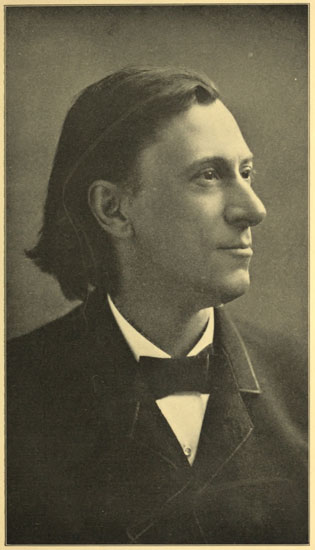
HON. ROGER A. PRYOR.
From a photograph, about 1870.
But to return: Charity's example was contagious.
"I cert'nly was lonesum" on the Blackwater. The
General and his staff were forever in the saddle.
When he returned after his skirmishes and exploring
expeditions, he was too tired to amuse me. I busied
myself teaching the little boys and dispensing the
provisions our men brought me. Bacon and biscuit,
without butter, fruit, or milk, was deadly diet for me,
so I was allowed an occasional courier from the
camp to take my money and scour the country for
better fare. When he appeared, galloping down the
lane, on his return, he looked like some extraordinary
feathered creature with a horse's head, so completely
were both covered with turkeys, ducks, geese,
and chickens. Then would ensue a gift to the
camp hospital of soups and stews and a fine supper
for my General's staff, Major Shepard, Captain
Whitner, Major Keiley, and Captain McCann,
with as many choice spirits from the officers as we
could entertain. Then was brewed, by the majors
and captains aforesaid, a mighty bowl of egg-nog,
sweet and very stiff, for there was no milk to temper
its strength. I feared at first that my Quaker host
might disapprove, but I never failed to find the
foaming glass I placed beside his night lamp quite
empty next morning.
I could manage to occupy myself during the day.
I could make a study of Charity, in whom I soon
perceived quite an interesting character, quick to
learn, responsive, and most affectionate. She was
literally my only female companion. I had no
neighbors, nowhere to drive (the enemy was only
fifteen miles off) except on the watery lanes, nothing
to meet when driving except, perhaps, a slow-moving
cart drawn by steeds like Sydney Smith's "Tug-and-Lug,
Haul-and-Crawl," driven by a negro boy, who
stood with feet planted on the shafts and who entertained
his patient, long-suffering oxen by telling them
of the torments awaiting them unless they would
"go along." But the long and lonely evenings
were hard to bear, when the general and his staff
were abroad, roaming like watch-dogs around the
frontier, deluding the enemy by a great show of
bravado here and there. Nothing like the orchestra
of frogs can be imagined. They serenaded the
moon all night long; a magnificent diapason of
mighty voices, high soprano, full baritone, and
heavy bass. I could understand the desperate need
of the lone woman who had once lived here. The
patchwork quilts were eloquent witnesses.
As the time dragged on in this lonely place, I
began to find that I wanted many articles classed in
a woman's mind generally as "things."
There is not a more generous word in the
English language than "things." It may mean,
according to Stormonth, "A Swedish assize of
justice, a Norwegian parliament, a meeting for
palaver on public affairs, luggage, or clothes,"—which
proves how important is the making of new
dictionaries as we travel along toward our highest
civilization. For instance: when you say to your
butler, "Be careful with the breakfast things," he
understands you perfectly. He knows you mean
the egg-shell cups, and blossomy plates. When
you bid your maid bring your "things," she appears
with your hat, gloves, cloak, and furs. "Her rooms
are comfortable, but I don't like her things," you
say when the bric-à-brac and curios are not to your
taste. "I never speak of such things," you declare
in haughty superiority when some guest has filled
an hour with foolish or injurious gossip. "Such
things are beneath contempt," says the lawyer of
certain practices familiar in the courts. And then
we have "poor thing,"—not the traditional robin
who "hides his head under his wing, poor thing,"
but some fine lady, far from young and—unmarried!
And "a poor thing, sir, but mine own,"—this time
not a fine lady by any means, only "an ill-favored
virgin."
And then, having vexed our souls all the week
over mundane "things," we are given, on Sunday,
glimpses of another world quite as full of them.
"Wean yourselves from earthly idols and fix
your hearts on heavenly things," says the bishop.
Things! Heavenly things! Stars, harps, crowns
of righteousness, high and lofty aspirations!
Not long after the battle of Fredericksburg a
participator described the panic, the horror, the
fleeing of the women and children from their homes.
"And then," he said, "there arose from that homeless,
stricken crowd of women a cry of mortal agony,
'My things! Oh, my things!'"
"Things" to me meant only needful garments.
I could starve with perfect serenity. I could live
without the latest novel, the late magazines, egg-shell
china, rich attire, jewels; but I had not had
a new bonnet for three years. Shoes, and above
all shoestrings, were needed by my little boys,
needles, tapes, sewing thread and sewing silk, stays
and staylaces, gloves, combs. Of course I needed
garments of muslin and linen. Had I not rolled
bandages of mine? I needed gowns. A calico
dress now cost $40. But these large "things"
were quite beyond all hope on the Blackwater.
Smaller articles I might, perhaps, compass. The
General's orders, however, strictly forbade the purchase
by private individuals of articles smuggled
through the lines. He once confiscated a sloop on
the Blackwater laden with women's shoes, slippers,
and Congress gaiters! He would not allow me a
shoe; all were sent to Richmond to be sold for the
benefit of the government. Communication with
the enemy must be discouraged lest he discover our
weakness.
I knew that most of the tight little carts peddling
fish, potatoes, and eggs had double bottoms between
which were all sorts of delightful things, but I never
dared approach the pedler on the subject; and as
I was the commanding officer's wife, he dared not
approach me.
One day I was in an ambulance, driving on one
of the interminable lanes of the region, the only
incident being the watery crossing over the "cosin,"
as the driver called the swamps that had been
"Poquosin" in the Indian tongue. Behind me
came a jolting two-wheeled cart, drawn by a mule
and driven by a small negro boy, who stood in front
with a foot planted firmly upon each of the shafts.
Within, and completely filling the vehicle, which
was nothing more than a box on wheels, sat a
dignified-looking woman. The dame of the ambulance
at once became fascinated by a small basket of
sweet potatoes which the dame of the cart carried in
her lap.
With a view to acquiring these treasures I essayed
a tentative conversation upon the weather, the prospects
of a late spring, and finally the scarcity of
provisions and consequent suffering of the soldiers.
After a keen glance of scrutiny the market
woman exclaimed, "Well, I am doing all I can
for them! I know you won't speak of it! Look
here!"
Lifting the edge of her hooped petticoat, she
revealed a roll of army cloth, several pairs of cavalry
boots, a roll of crimson flannel, packages of gilt braid
and sewing silk, cans of preserved meats, a bag of
coffee! She was on her way to our own camp,
right under the General's nose! Of course I should
not betray her—I promised. I did more. Before
we parted she had drawn forth a little memorandum
book and had taken a list of my own necessities.
She did not "run the blockade" herself. She had
an agent—"a dear, good Suffolk man"—who
would fill my order on his next trip.
It isn't worth while to tell men everything. They
are not supposed to be interested in the needle-and-thread
ways of women!
About three weeks after my interview with the
blockade-runner, I was driving again in the ambulance.
Suddenly Captain Whitner, who had galloped
to overtake me, wheeled in front of the horses and
stopped them.
"Good morning, Captain! Any news at camp
I am permitted to learn?"
I perceived the corners of his mouth twitching,
but he said gravely:—
"I am commissioned to tell you that you must
consider yourself under arrest. I am sent to discharge
this painful duty and conduct you to camp."
"By whose order, pray?"
"Official orders from headquarters," and he presented
a paper.
I knew he must be acting a part for his own
amusement, and I asked no questions. I would
not gratify him by seeming to be alarmed.
When I arrived at my husband's tent, I found
him with Major Shepard, and a wretched-looking
countryman standing near them. I comprehended
the situation at a glance and resolved to play my
part.
"This prisoner," said the General, "has been
arrested for bringing in contraband goods in violation
of express orders. He pleads that the goods
were ordered by the General's wife for the use of
the General's family. Have you anything to say to
show cause why he should not be punished?"
"May it please the court," I said, turning to
Major Shepard and Captain Whitner, "I call you
to witness that I invited you last week to partake
of a bowl of egg-nog, telling you it was made of
contraband French brandy. When the commanding
officer's attention was called to the fact, he said
he could do nothing; he was obliged to submit
because I was his superior officer, that I outranked
him everywhere except on the march and the battle-field."
A burst of laughter interrupted me. The chairman
called for order.
"I confess that I deputed this estimable gentleman
to procure some sewing silk for the mending
of the garments of my subordinate officer. I had
hoped that through his valor the blockade would, ere
this, have been raised. Finding myself mistaken—"
"The prisoner is discharged," said the General,—I
uttered an exclamation of triumph,—"but," he
added, "the goods are confiscated for the benefit of
the Confederate government, and are already on the
way to Richmond."
I was very sorry for the fright the poor man had
suffered for my sake. I took him home with me
beside the driver on the ambulance. Of course I
paid him. I had one piece of family silver with me
for which I had no use on the Blackwater,—a butter
knife—and I gave it to him as a souvenir of his
happy escape from danger.
How did I manage without my needles and
thread?
Charity came to me early one morning with a
brown paper parcel in her arms.
"Dat ole creeter," said Charity, "what come
home wid you las' week, knock at de kitchen do'
fo' day dis mornin'. He gimme dis, an' say you
bleeged to git it fo' de Gen'al wake up; an'—an'—he
say—but Lawd! 'tain' wuf while to tell you what
he say! But he do say to tell you to gimme sumpin
out'n de bundle. Gawd knows I ain' no cravin' po'-white-folks'
nigger, but dat what he say."
I need not give an inventory of the contents of
the bundle. They were perfectly satisfactory to me—and
to Charity.
We had slender mails on the Blackwater, few
papers, no books. Occasionally a letter from Agnes
gave me news of the outside world.
"Richmond, January 7, 1863.
"My Dearie: Have you no pen, ink, and paper on the
Blackwater—the very name of which suggests ink? I get
no news of you at all. How do you amuse yourself, and
have you anything to read? I am sending you to-day a
copy of Victor Hugo's last novel, "Les Misérables," reprinted
by a Charleston firm on the best paper they could
get, poor fellows, pretty bad I must acknowledge. You'll
go wild over that book—I did—and everybody does.
"Major Shepard must order some copies for the brigade.
As he has plenty of meat and bread now, he can afford it.
I have cried my eyes out over Fantine and Cosette and
Jean Valjean. The soldiers are all reading it. They
calmly walk into the bookstores, poor dear fellows, and ask
for "Lee's Miserables faintin'!"—the first volume being
"Fantine." I've worlds of news to tell you. Alice
Gregory is engaged to Arthur Herbert, the handsomest
man I know. Alice is looking lovely and so happy.
Helen came to see me in Petersburg, and is all the time
worried about Ben. Did you know that Jim Field lost a
leg at Malvern Hills—or in the hospital afterwards? He
was such a lovely fellow—engaged to Sue Bland—I never
saw a handsomer pair. Well, Sue thinks as much as I do
about good looks, and Jim wrote to release her. She had
a good cry, and finally came down to Richmond, married
him, and took him home to nurse him.
"Do you realize the fact that we shall soon be without
a stitch of clothes? There is not a bonnet for sale in
Richmond. Some of the girls smuggle them, which I for
one consider in the worst possible taste, to say the least.
We have no right at this time to dress better than our
neighbors, and besides, the soldiers need every cent of our
money. Do you remember in Washington my pearl-gray
silk bonnet, trimmed inside with lilies of the valley? I
have ripped it up, washed and ironed it, dyed the lilies blue
(they are bluebells now), and it is very becoming. All
the girls intend to plait hats next summer when the wheat
ripens, for they have no blocks on which to press the coal-scuttle
bonnets, and after all when our blockade is raised
we may find they are not at all worn, while hats are hats
and never go out of fashion. The country girls made
them last summer and pressed the crowns over bowls and
tin pails. I could make lovely paper flowers if I had
materials.
"It seems rather volatile to discuss such things while
our dear country is in such peril. Heaven knows I would
costume myself in coffee-bags if that would help, but having
no coffee, where could I get the bags? I'll e'en go
afield next summer, and while Boaz is at the front, Ruth
will steal his sheaves for her adornment.
"The papers announce that General French reports the
enemy forty-five thousand strong at Suffolk. How many
men has your General? Dear, dear!
"But we are fortifying around Richmond. While I write
a great crowd of negroes is passing through the streets, singing
as they march. They have been working on the fortifications
north of the city, and are now going to work on
them south of us. They don't seem to concern themselves
much about Mr. Lincoln's Emancipation Proclamation,
and they seem to have no desire to do any of the fighting.
"Your loving
"Agnes."
"P. S.—I attended Mrs. Davis's last reception. There
was a crowd, all in evening dress. You see, as we don't
often wear our evening gowns, they are still quite passable.
I wore the gray silk with eleven flounces which was made
for Mrs. Douglas's last reception, and by the bye, who do
you think was at the battle of Williamsburg, on General
McClellan's staff? The Prince de Joinville who drank
the Rose wine with you at the Baron de Limbourg's reception
to the Japs. Doesn't it all seem so long ago—so far
away? The Prince de Joinville escorted me to one of the
President's levees—don't you remember?—and now I
attend another President's levee and hear him calmly telling
some people that rats, if fat, are as good as squirrels,
and that we can never afford mule meat. It would be too
expensive, but the time may come when rats will be in
demand.
"Dearly,
"Agnes."
The Emancipation Proclamation did not create a
ripple of excitement among the colored members of
our households in Virginia. Of its effect elsewhere
I could not judge. As to fighting, our own negroes
never dreamed of such a thing. The colored troops
of the North were not inferior, we were told, in
discipline and courage to other soldiers; but the
martial spirit among them had its exceptions. A
Northern writer has recorded an interview with a
negro who had run the blockade and entered the
service of a Federal officer. He was met on board
a steamer, after the battle of Fort Donelson, on his
way to a new situation, and questioned in regard to
his experience of war.[17]
"Were you in the fight?"
"Had a little taste of it, sah."
"Stood your ground, of course."
"No, sah! I run."
"Not at the first fire?"
"Yes, sah, an' would a' run sooner ef I knowed
it was a-comin'!"
"Why, that wasn't very creditable to your
courage, was it?"
"Dat ain't in my line, sah—cookin's my
perfeshun."
"But have you no regard for your reputation?"
"Refutation's nothin' by de side o' life."
"But you don't consider your life worth more
than other people's, do you?"
"Hit's wuth mo' to me, sah."
"Then you must value it very highly."
"Yas, sah, I does,—mo'n all dis wuld! Mo'
dan a million o' dollars, sah. What would dat be
wuth to a man wid de bref out o' 'im? Self-perserbashun
is de fust law wid me, sah!"
"But why should you act upon a different rule
from other men?"
"'Cause diffunt man set diffunt value 'pon his
life. Mine ain't in de market."
"Well, if all soldiers were like you, traitors
might have broken up the government without
resistance."
"Dat's so! Dar wouldn't 'a' been no hep fer it.
But I don' put my life in de scale against no gubberment
on dis yearth. No gubberment gwine pay
me ef I loss messef."
"Well, do you think you would have been
much missed if you had been killed?"
"Maybe not, sah! A daid white man ain' much
use to dese yere sogers, let alone a daid niggah, but
I'd 'a' missed mysef powerful, an' dat's de pint wid
me."
Towards the last of January we had a season of
warm, humid weather. Apparently the winter was
over; the grass was springing on the swamp, green
and luxurious, and the willows swelling into bud.
There were no singing birds on the Blackwater as
early as January 28, but the frogs were mightily
exercised upon the coming of spring, and their
nightly concerts took on a jubilant note.
One day I had a few moments' conversation with
my husband about army affairs, and he remarked
that our Southern soldiers were always restless
unless they were in action. "They never can stand
still in battle," he said; "they are willing to yell
and charge the most desperate positions, but if they
can't move forward, they must move backward.
Stand still they cannot."
I thought I could perceive symptoms of restlessness
on the part of their commander. Often in the
middle of the night he would summon John, mount
him, and send him to camp, a short distance away;
and presently I would hear the tramp, tramp of the
General's staff officers, coming to hold a council of
war in his bedroom. On the 28th of January he
confided to me that on the next day he would make a
sally in the direction of the enemy. "He is getting
entirely too impudent," said he; "I'm not strong
enough to drive him out of the country, but he
must keep his place."
I had just received a present of coffee. This was at
once roasted and ground. On the day of the
march, fires were kindled under the great pots used
at the "hog-killing time" (an era in the household)
and many gallons of coffee were prepared.
This was sweetened, and when our men paused near
the house to form the line of march, the servants
and little boys passed down the line with buckets of
the steaming coffee, cups, dippers, and gourds.
Every soldier had a good draught of comfort and
cheer. The weather had suddenly changed. The
great snow-storm that fell in a few days was gathering,
the skies were lowering, and the horizon was
dark and threatening.
After the men had marched away, I drove to the
hospital tent and put myself at the disposal of the
surgeon. We inspected the store of bandages and
lint, and I was intrusted with the preparation of
more.
"I ain' got no use for dis stuff," said my one
female friend and companion, Charity, whom I pressed
into service to help me pick lint. "'Pears like 'tain't
good for nuthin' but to line a bird's nes'."
"It will be soft for the wound of a soldier," I
said, "after he has fought the Yankees."
"I'll pick den; I'll tar up my onlies' apun ef he'll
kill one."
"Oh, Charity!"
"Yas'm, I will dat! Huccome we all don' drive
'm out o' Suffolk? Der's lodes an lodes o' shoes
an' stockin's, an' sugar an' cawfy in Suffolk! An'
dese nasty Abolition Yankees got 'em all!"
"Those are not proper words for you to use," I
said. "What have you against the Northern
people? They never did you harm."
"Dey ain't, ain't dey?" she replied, with feeling.
"Huccome I'se got to go barfooted? Hit's scan'lous
for a free gal to go barfooted, like she was so
no 'count she couldn't git a par o' shoes fer herse'f."
"I'll ask the General to order a pair for you."
"Humph!" said Charity, scornfully; "you can't
do nothin' wid dat Gen'al. Ain' I hear you baig
an' baig 'im for a par o' slippers dat time he fristricated
de boatload full? I ain' seen you git de
slippers."
Charity was not the only one of the Nation's
Wards who held the enemy in contempt. The
special terms in which she designated them were in
common use at the time. She had often heard them
from the General's servant, John, who shared the
opinions of the common soldier. Some of the expressions
of the great men I knew in Washington
were quite as offensive and not a bit less inelegant,
although framed in better English. I never approved
of "calling names," I had seen what comes
of it; and I reproved John for teaching them to
my little boys.
"No'm," said John, "I won't say nothin'; I'll
just say the Yankees are mighty mean folks."
My first news from the General was cheering,
but he would not return for a day or two. He
must fly about the frontier a little in various directions
to let the enemy know he was holding his own.
His official report was as follows:—
"To Brigadier-General Colston, Petersburg, Va.
"Carrsville, Isle of Wight, January 30, 1863.
"General: This morning at 4 o'clock the enemy under
Major-General Peck attacked me at Kelly's store, eight
miles from Suffolk. After three hours' severe fighting we
repulsed them at all points and held the field. Their force
is represented by prisoners to be between ten and fifteen
thousand. My loss in killed and wounded will not exceed
fifty—no prisoners. I regret that Col. Poage is among
the killed. We inflicted a heavy loss on the enemy.
"Respectfully,
"Roger A. Pryor, Brigadier-General Commanding."
On February 2 the General thus addressed his
troops: "The Brigadier-General congratulates the
troops of this command on the results of the recent
combat.
"The enemy endeavored under cover of night to
steal an inglorious victory by surprise, but he found
us prepared at every point, and despite his superior
numbers, greater than your own, in the proportion
of five to one, he was signally repulsed and compelled
to leave us in possession of the field.
"After silencing his guns and dispersing his
infantry, you remained on the field from night until
one o'clock, awaiting the renewal of the attack, but
he did not again venture to encounter your terrible
fire.
"When the disparity of force between the parties
is considered, with the proximity of the enemy to
his stronghold, and his facilities of reënforcements by
railway, the result of the action of the 30th will be
accepted as a splendid illustration of your courage
and good conduct."
One of the "enemy's" papers declared that our
force was "three regiments of infantry, fourteen
pieces of artillery, and about nine hundred cavalry."
The temptation to "lie under a mistake" was
great in those days of possible disaffection, when
soldiers had to believe in their cause in order to
defend it. One of the newspaper correspondents of
the enemy explained why we were not again attacked
after the first fight. He said: "Some may inquire
why we did not march forthwith to Carrsville and
attack the rebels again. The reasons are obvious.
Had he went [sic] to Carrsville Pryor would have
had the advantage to cut off our retreat. The
natives know every bypath and blind road through
the woods and are ever ready to help the rebels to
our detriment. Pryor can always cross the Blackwater
on his floating bridge. It is prudent to allow
an enemy to get well away from his stronghold the
better to capture his guns and destroy his ammunition,"
etc.
Another paper declares he was heavily reënforced
at Carrsville.
Another records: "The rebels have been very
bold in this neighborhood. Pryor has been in the
habit of crossing the Blackwater River whenever he
wanted to. Our attacking him this time must have
been a real surprise to him. We took a large
number of prisoners!"
He continued the indulgence of this habit until
spring, receiving from his countrymen unstinted
praise for his protection of that part of our state.
While he could not utterly rout the invading army,
he "held them very uneasy."
I was made rich by enthusiastic congratulations
from our capital and from Petersburg. Agnes
wrote from Richmond:—
"Have you seen the Enquirer? Of course this is very
grand for you because this is your own little fight—all by
yourself. In Richmond everybody says the General is to
be promoted Major-General. When he is, I shall attach
myself permanently to his staff. The life of inglorious
idleness here is perfectly awful. If you suppose I don't
long for a rich experience, you are mistaken. Give me
the whole of it—victory, defeat, glory and misfortune,
praise and even censure (so it be en plein air)—anything,
everything, except stolid, purposeless, hopeless uselessness.
"The worst effect of this inaction is felt in this city,
where we can manufacture nothing for the soldiers, and
only consume in idleness what they need. A sort of
court is still kept up here—but the wives of our great
generals are conspicuous for their absence. Mrs. Lee is
never seen at receptions. She and her daughters spend
their time knitting and sewing for the soldiers, just as her
great-grandmother, Martha Washington, did in '76; and
General Lee writes that these things are needed. People
here, having abundant time to find fault, do not hesitate to
say that our court ladies assume too much state for
revolutionary times. They had better be careful! We
won't guillotine them—at least not on the block (there
are other guillotines), but it would be lovelier if they
could realize their fine opportunities. Think of Florence
Nightingale! Mrs. Davis is very chary of the time she
allots us. If King Solomon were to call with the Queen
of Sheba on his arm the fraction of a moment after the
closing minute of her reception, he would not be admitted!
I can just see you saying, in that superior manner you see
fit to assume with me:—
"'But, Agnes dear! that is good form, you know, and
belongs to the etiquette of polite life.'
"Of course I know it! Did I say that Mrs. Davis
should admit King Solomon? I wouldn't! I only tell
you what other folks think and say—but ajew, until I hear
some more news and gossip.
"Dearly again,
"Agnes."