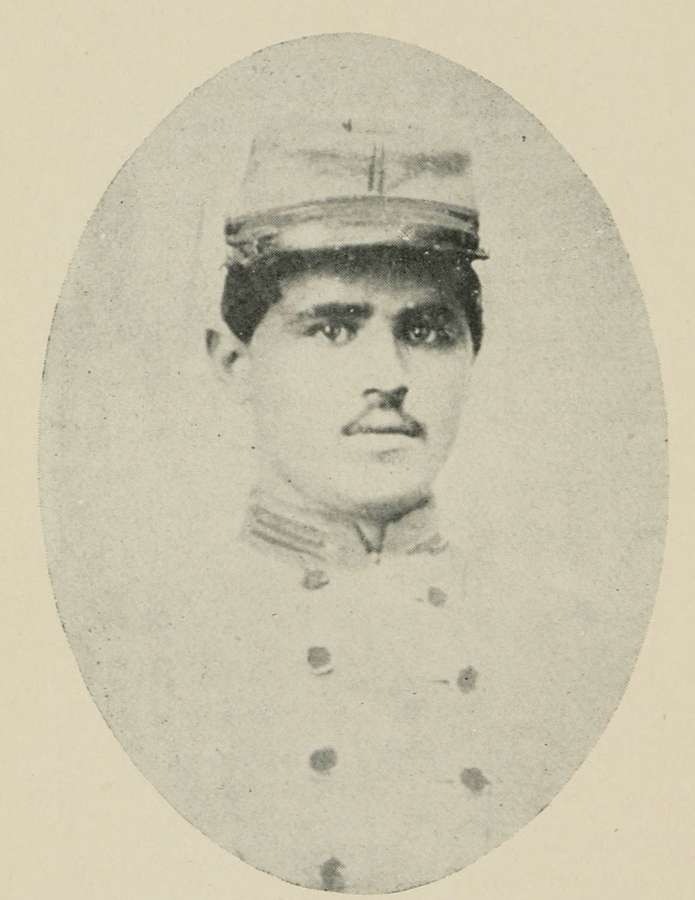
It seems that our division (Fields'), especially
our brigade, was selected and had ever been the
troops to run from place to place. This I egotistically
claim was because we were good on the march,
always getting there quickly, and then, after getting
there, we could be always depended upon to
meet the emergency. Hence, we were not in the
trenches so continuously as some others. We, from
now on, were mostly below Richmond, taking care
of Richmond from that side, but occasionally we
would run over and take a day or two in the
trenches, where we would be again pulled out for
across the James River. So, after about a week in
the trenches on this occasion, we were taken over the
river, as Grant seemed to be preparing to attack
from that direction. We remained quietly, doing
nothing but keeping out our pickets for several
days. For these few days we took up regular camp
duty, except drilling. At roll call in the mornings
Morrison and Stewart hardly ever answered. This
got to be such a regular thing on all occasions, even
when we were called to move, that our orderly
sergeant, A. P. Manville, became so completely disgusted
(for you could see disgust depicted on his
face) that it was determined between Perry
Manville, Capt. Wood and Col. Hagood that Morrison
and Stewart should be assigned to me as my
company, I to see after them exclusively, being
exempt from all other duty, only go when they had
to go, and to make them go. This might seem an
easy assignment, but, take my word for it, it was
the hardest job any poor fellow ever had. I would
be up in the mornings before time, getting them up
to be in time for roll call, and any other duties
assigned them I would be notified and had to get
them out for it. But Perry Manville, who was a
brave, good fellow, would put them both on duty
at the same time, thereby saving me extra duty. He
saw and appreciated the hard task I had. After
lying around here for perhaps a week or more
watching and waiting we were ordered to "fall in."
Our company was at this time on the left of the
regiment, and I and my two men were on the
extreme left, which, when marching left in front, put
me and mine at the head next to the colonel. In starting
out this time, when Col. Hagood rode up to his
position, he turned to me and said, "Sergt. Mixson,
load your gun immediately and take those two men
in this fight or leave them dead on the wayside." I
loaded up, telling these two what to expect from
me (they had heard my orders). We started off.
I kept them up pretty well, and when we formed
our line of battle on the hill overlooking Deep
Bottom I had them in ranks. We remained on this
hill while our skirmish line were holding them back
in the bottom, our skirmishers retreating slowly.
Gen. Lee was dismounted near us, awaiting the
time to order us to charge. When it looked like the
time had about come old Stewart got back pretty
close to Gen. Lee, and, falling on his knees, said,
"Let's all join in prayer," and he started off. He
had hardly started good before the command was
given, "Get to your places." Morrison went in
ranks, but old man Stewart got louder. I called
to him to get in. He got louder. I could not move
him by calling, so I went up to him and, catching
him by the shoulders, I pulled him back and almost
had to drag him to his position. Lee looked on
seemingly amused.
Well, we made the charge, meeting the enemy in
the bottom. Here we fought them for some time,
but finally retired to our former position on the
hills. I don't think I got either Morrison or Stewart
in this, but they were on hand when we got
back on the hill. The enemy did not advance on us
in our position, but fell back. We then went back
and took up our quarters where we left the day
before. Grant had failed here.
We remained here, without anything happening,
doing picket duty and putting more logs on our
fortifications, for something like three weeks, when
the Yankees took another notion to go into Richmond
over this route. Our cavalry, down at the
Darbytown Road, discovered them on the move.
As soon as this was reported to us our long roll
routed us, and by sunrise we were off to look into
matters. We ran upon their picket line about ten
o'clock, drove them back and found them stationed
behind the works that we had built there in 1862.
We immediately charged these works, and took
them with very little trouble, they giving way after
a short fight. We followed them no further than
the works we captured from them. By night we
were back at our camps, not much worse off than
when we went out. We again took up our regular
routine of duties and had no more disturbance from
this quarter. Everything remaining quiet over here,
we were, about the last of September or first of
October, taken back to Petersburg and again went
into the trenches. We were placed where the "blow
up" afterwards took place, and while we were here
our engineers were counter-sinking shafts, endeavoring
to discover where the enemy's mine struck our
fortifications. The marksmen on the Yankee side
had become very expert with both the rifle and
mortars, and they were so accurate that mortar
shells would frequently fall in our trenches. For
the information of those who do not know about
mortar shooting I will explain. The mortar gun is
a short cannon, say eighteen inches long, working
in a carriage on a pivot and so arranged as to be shot
at any angle, even to straight up. They had perfected
themselves so that they knew the exact elevation
to give the gun and the length of the fuse to
explode it, as in many instances the cannon ball
would fall in our trenches, and, exploding, would
do much harm, and causing much confusion among
us. Hence, it became necessary to keep a lookout,
and when one of their guns was fired this "lookout"
would keep his eye on the ball going up and coming
over, and if it looked as if it were coming into
the trenches at a certain place we would crowd
away from the place that it seemed like hitting,
thereby making room for it to fall and burst with
as little damage as we had time and room to make.
On one occasion I was sitting with my back to
the front of the trenches, flat down on the bottom
of the trenches, with my oilcloth underneath me.
I had my man Morrison as "lookout," who was
kneeling down facing the front just at my side. I
heard the report of a mortar and saw Morrison
prick up his ears. Soon I saw him begin to get
excited, and then he commenced to exclaim, "It's
coming, it's coming, it's coming!" Knowing how
scary he naturally was, I gave but little faith to
him. His eyes, however, looked the size of saucers,
and finally he fell over, exclaiming, "It's come," and
the shell fell between my legs, my oilcloth keeping
it from burying itself deep enough to retain it.
There I was, a shell with a burning fuse, in between
my legs. It was death to do nothing, death to run,
not only for me, but for others. It was impossible
to get away from the shell, and instinct told me to
get the shell away from me and us. Without having
time to think even, I arose with the shell in my
hands and dumped it out of the trenches. I scarcely
had time to squat down when it bursted. Being
outside, no one was hurt. I will take occasion to
say here that this was no act of bravery. It was an
inspiration that caused me to do it, and I was the
worst scared fellow you ever saw, even more scared
than Morrison or Stewart at any time. It took me
a day or two to recover from the fright I got.
We remained in the trenches this time till about
the first of November, when Grant again began to
move around on the north side of the James. Then
we were taken out and carried over, and it was well
for us that it was so, for the day after we left the
mine was sprung and many, very many, killed, and
on the same ground we had been and just left. History
will tell you of this. I was not there. On
the day before the mine was sprung the Yankees
on the north side of the James had charged and
taken Fort Harrison, which was being held by the
militia from Virginia. And on the morning that
the mine was sprung they made an assault on Fort
Gilmore, which was three miles from Fort Harrison,
and garrisoned by veterans from Virginia.
The assault was made to draw our forces from
the trenches, hoping to get enough away to make the
springing of the mine a success, and to draw our
attention elsewhere. We left the trenches late in
the afternoon, and, passing Fort Harrison, leaving
it to the right, went on to Fort Gilmore. We
marched all night, arriving near Fort Gilmore at
daybreak, when we halted and were held as a
reserve. The assault was made by negro troops,
with white officers with pistols in their hands, forcing
the negroes forward on pain of death. They
made a creditable charge, a good many jumping in
the ditch in front of the fort. One charge, however,
satisfied them. About ten o'clock we went in and
relieved the Virginians and remained there till after
midnight, when we in turn were relieved and went
down in front of Fort Harrison, arriving there
just as day was breaking. On moving from Fort
Gilmore to Fort Harrison, about three o'clock,
before day, I took the company's canteens and went
to a well we were passing and filled up. This got
me some little behind, and going down the road to
overtake our command a solitary horseman overtook
me. I discovered at once it was Gen. Lee. He said,
"What are you doing behind, my little fellow?"
And when I told him I had stopped at the well just
passed to fill the company's canteens he said, "Well,
hurry and catch up; they will need you by daylight."
When I did get up I told the boys we would
have h—— by daylight, and told them that Gen.
Lee had told me so.
In front of Fort Harrison we took our position
in an old ditch trench which had been thrown up
there perhaps a couple of years. This was not
more than eight hundred yards in front of the fort.
The Yankees had been reinforcing all night, and
when day broke they were well garrisoned, with
negro troops mostly. We remained in this position,
awaiting the signal gun, when the advance on the
Fort would be made from two sides. Tige Anderson's
Georgians were to lead the charge on the
front, supported by our brigade (Bratton's). Two
other brigades were to attack the side. Capt. Wood's
boy, Fred, brought in breakfast, and Capt. Wood,
Eddie Bellinger and myself sat down to eat. Capt.
Wood hurried through, leaving Eddie and me. Then
it was that Eddie said to me, "Frank, I will be
killed this day. In an hour I will be a dead man."
I told him if I felt that way I would go to Dr.
Martin Bellinger, brigade surgeon, and be excused.
He would not go. Just then the signal gun fired,
and Tige Anderson, with his Georgians, led off,
slowly at first. We were called to attention, and I
missed Stewart. The negro boy, Fred, hearing me
asking about him, said he had passed Mr. Stewart
a mile back. I turned to Morrison and told him if
he did not go this time I swear I would kill him.
I intended to keep my eye on him. We were now
ordered to advance. Anderson had started his
charge, and as soon as we got straightened out, and
after crossing the old ditch, we, too, charged. Now
the Yankees were mowing Anderson down with
grape and cannister, and we, being only a short
distance behind, were getting the full benefit of
every fire. I tell you, it was a grand sight to see
our boy colonel. He was about the middle of the
regiment, in front of it. We were at double quick.
Jim Hagood kept his eyes on the fort, and when
he saw smoke from a cannon, he would cry,
"Down, First," at the same time falling flat himself.
When the grape and cannister had passed over he
was the first up, and in that commanding voice,
"Up, and forward, First." This he repeated more
than half a dozen times. Anderson had now gotten
to within about forty yards of the fort, where the
firing was so fierce, furious and fatal. His men lay
down. We kept on, and just before we reached
them they commenced to holler to us to stop.
Anderson was walking up and down, begging them
to forward. Then he would curse them. About
now Lieut. Best, of our company, said, "Frank, I
am shot through the thigh." I told him to go back.
He said no. Only a step or two and he was shot
clear through on the right side, the ball entering
about the nipple. He now turned to go back, but
just as he turned another ball hit him in the back,
about an inch below where the other ball had come
out, passing clear through, coming out where the
other ball had entered. He now fell, and Sid
Key, with another man with a litter, picked him
up to take him off. As they raised him up another
ball knocked off two of his toes, making four
wounds for him. I think he is still alive—was a few
years ago. When Lieut. Best fell we were passing
through Anderson's Brigade. I heard Anderson, as
a last incentive to his men, say, "Georgia, you don't
intend to let South Carolina beat you." I jumped
up and hollered out, "Hurrah for South Carolina."
But just as I struck the ground a ball struck
me, and an old Georgian, who was lying flat on his
belly, looking over his shoulder back at us, saw it
and heard me, and said, "Oh, yes, G—— d——
South Carolina, now." This made such an impression
on me that I have always believed that I would
recognize that fellow's face wherever I saw it again.
I was fortunately hit in the hand, breaking the
knuckle of my forefinger on the left hand. I
dropped my gun, and, running back to a pine, I got
in behind it to examine how badly I was hurt, and
when I discovered the bone shattered I pulled off
my accoutrements, throwing them down, so I could
have a good chance for running. Going only a short
distance I heard the voice of Lieut. Col. Ben Kirkland,
and I pulled up to see what was the matter.
He was standing over an officer of our regiment, a
captain, cursing him for all kinds of coward, and
told him if he did not get up and go on with his
company he would wear him out with his sword.
I saw him get up, then I lit out again. On getting
back to where we had started, sitting there alone
was Morrison, who told me that when Lieut. Best
was hit he left. I went on a little back to where the
field hospital was located (the field hospital is only
to receive the wounded, staunch the blood of those
who are likely to bleed to death, put them in an
ambulance, sending them back to the general hospital).
While hanging around there I noticed someone
brought up on a litter, who, upon being put
down, beckoned to me. I went up to him, failing
at first to recognize him; but upon close inspection I
discovered Capt. Wood. He was shot directly below
his nose, the ball passing back lodged in the back
of his neck, knocking out his teeth and lodging
them in his tongue. He was terribly disfigured at
that time, but was operated on that night, they
cutting out the ball from his neck, taking his teeth
out of his tongue, etc. After the war he looked
nearly as handsome as ever, and he was a handsome
man.
I went on down from the field hospital to the
regiment, after they were driven back, and it was a
poor sight, indeed—only ninety-three men were left
in the entire regiment. Eddie Bellinger had fallen,
leading the regiment in about thirty yards of the
fort. When the colonel ordered the regiment to fall
back he discovered his colors missing and saw them
on the ground nearer the fort than he was. He ran
up there and found Eddie dead with the colors
gripped so hard that he had to pry his fingers open
with his sword to get them away. This all happened
in thirty yards of the fort, in an open field.
The Yankees were so amazed at Col. Hagood's
action that they did not shoot on him while he was
doing this gallant deed. Col. Hagood then called
Jim Diamond, who was not wounded, and turned
the colors over to him. He brought them out. Next
day the Yankees sent over a flag of truce, asking
the name of the gallant officer who had rescued the
colors—they buried Eddie with military honors.
I did not get my wound dressed until the day
after the fight. That evening I went back to the
general hospital. Dr. Wallace Bailey, from the
Four Mile, our surgeon, glanced at it casually and
told me he would cut off the finger when he had
time—the surgeons were all busy that evening, all
night and next day. Capt. Wood was operated on
during the night and looked badly next morning.
Many a poor fellow lost an arm or a leg out here.
That night this hospital was cleaned up, all of us
being loaded on boats and sent to the hospital in
Richmond, reaching there some time about midnight,
and were immediately unloaded into a large
kind of warehouse that had been prepared with
cots, etc., for a kind of reception hospital. Here we
were seen after by the ladies, our wounds dressed,
and nourishment given us. Those who were not
too badly wounded were sent on next day to the
regular hospital. I did not let Dr. Bailey cut off
my finger. I have it yet.
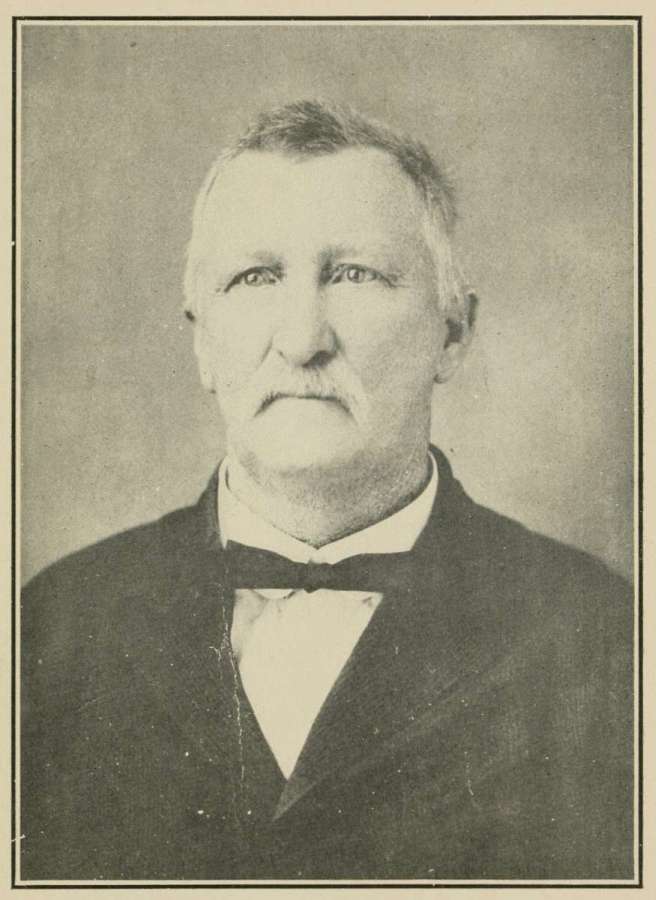 Private F. M. Mixson,