was organized at Adrian, Michigan, and Mustered into
United States Service June 20, 1861, for three years. It was
quartered in the North College building, of the group of
buildings situated at extreme west suburbs of City. Was
commanded by Dwight A. Woodbury. It was presented by
the ladies of Adrian, with a beautiful flag. The Regiment
left its Rendezvous June 25th, for Washington, numbering on
its rolls 1025, officers and men. In his orders for the movement,
Colonel Woodbury said: “Let each man remember
that he has the honor of Michigan in his keeping.” The first
appearance of the Regiment, while passing through Cleveland,
Ohio, brought from the Leader of that city, the following
notice of
“When we see the splendidly armed and equipped Regiments
from Michigan, pass through here on their way to the
seat of war, and compare their appearance with that of the
Regiments that left Camp Cleveland recently, it makes us
4]
almost ashamed of Ohio, and inclines us to enquire in the
mildest and most collected manner, why it is that Michigan
in the same length of time sends Regiments to the field prepared
for service, while Ohio, who boasts of her enterprise
and patriotism, sends from her camps as Regiments, mere
mobs of men, half uniformed, unarmed, and wholly without
drill.”
The Regiment left Cleveland, via Buffalo to Elmira,
New York, where we took supper with 23d New York Regiment
in barracks there. We were royally entertained; had
a good time; had a good supper. I wish to say here, the
first hard tack the writer ever saw was issued to us at Cleveland.
They were round, and as large as an elephant’s foot,
and as tough as a prohibitionist’s conscience. I noticed some
of the boys, out on platform of cars, trying how far they
could sail them. Others had coupling pins, trying to pulverize
them. On leaving Elmira, some of the boys who were a
little off, pulled the coupling pin, which detached three or
four cars. The rest of the train pulled out some distance
before it was discovered. The advance section backed up,
the rear cars were hitched on, and the boys were induced to
all-aboard, and the train passed on to Harrisburg, Pa. The
Regiment encamped a few days at that city, and we were
drilled in the art of street fighting, expecting a collision at
Baltimore. The people of Harrisburg asked: “has Michigan
sent another Regiment equipped?” And in fact the troops
at Camp Curtin “thought if Pennsylvania would only clothe
her men like that, she would not have a single citizen at
home.”
From Harrisburg, on to Baltimore. The Regiment was
disembarked from the cars some distance outside of the city;
formed and marched into the depot. We were armed with
old buck and ball muskets, and were not allowed but three
rounds of cartridges. The Regiment was formed into
5]
platoons, and marched through the general thoroughfare to
Washington Depot. On its way, while about midway, the
crowd was immense on the sidewalks, a demonstration was
made by some crank of a Rebel, at a point opposite our
colors, pointing a revolver toward the flag-bearer, but was
suppressed so quick that it was not seen but by few of the
Regiment. The writer was a file-closer and in rear of rear
platoon, and saw the movement. Had that pistol been discharged,
the result would have been a terrible indiscriminate
slaughter. My gun was on a line with the act in less time
than it would take to pull a trigger. Somebody would have
been hurt. Men hissed and jeered, but the column moved on
to Washington Depot, where the Regiment was embarked on
cars for Washington. Just before reaching the Relay House,
the train was stopped and we were told that Rebels were in our
front. We were formed in line of battle. It was a false
alarm. We got aboard again, and passed on to Washington.
Arrived in that city on the night of July 2d, and soon went
into camp on Meridian Hill, near Soldiers’ Home. Remained
in camp until a short time before first battle of Bull Run.
The Regiment was ordered over the Potomac, and to Alexandria,
and out to a place called Cloud’s Mills. Remained in
camp there, and done picket duty until a few days prior to
first Bull Run, when it was ordered on to Fairfax Station, in
rear of advancing army. The left wing of the Regiment was
detained at that place, while the right was marched to Fairfax
Court House. The writer was with the part remaining at
the station. It was evident that the Rebels had left in a
hurry, as the advance of our column appeared; they had
tried to burn the station and other property, but were prevented
by stress of time. We found plenty of corn meal;
also a number of hogs that had been corralled in the rear of the
station, but had been let out of the pen; on arrival of our
men in pursuit, they were running around loose. The writer
6]
fired six shots at an old hump-backed sow, and got nary a
swine. One W. W. Carpenter, the liliputian of Company B,
killed her with one shot from an old Colt’s revolver. We
had mush and fresh pork in abundance. We found some
cows on an abandoned plantation, near by. Also plenty of
honey. We had mush and milk ’till you couldn’t rest. One
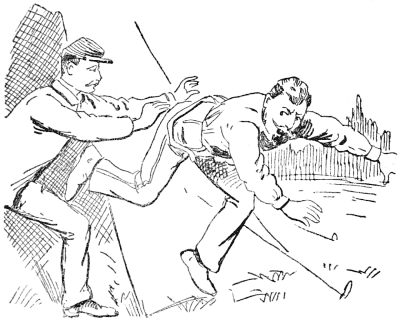
of the boys, while reconnoitering around, developed a colony
of bees. He seized a hive and started for a brook near by.
He attempted to jump a pole fence. His toe caught and he
pitched headlong. The hive flew twenty feet. The bees
followed back, and swarmed in his bushy hair, which caused
a lively rush for the water. He plunged in and soon divested
himself of the vicious little insects. But not daunted he
returned, and seized the hive again. This time he succeeded
in drowning the bees. He got the honey all the same. That
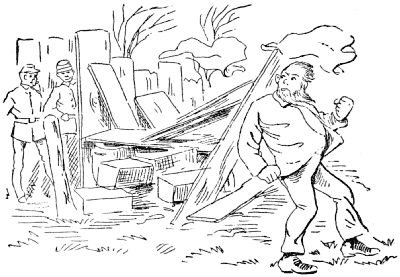
night, after the adventure with the bees, myself and my
bunkey tore some of the hives to pieces, and placed the
boards on the ground, and spread our blankets on them for
our bed. We went to bed tickled with our layout. About
twelve o’clock we were aroused with injunction to keep very
still, as Rebels were near, and were expected to attack us.
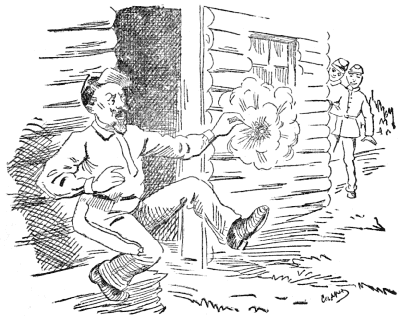
My bunkey and I got up, or sat up. About that time I saw
bunkey slap his legs, and heard him swear.
About the same time, I felt an unusual sensation under
my pants, in the region of where I sat down. There were
plenty of live bees still, that had staid with the boards.
They had crawled inside our clothes, and everlastingly stuck
it to us. Well, if you ever saw an Indian war dance, picture
to yourself our appearance. We were ordered to keep still;
but had a Brigade of Rebels attacked us, we would have
fought these bees.
Next day was fought the first Battle Bull Run. We
were ordered to join the other wing of the Regiment, at Fairfax
Court House, arriving just before the stragglers began to
7]
appear from our defeated army. We were formed in the
road, in sections, and ordered to stop all stragglers. Talk of
stopping a cyclone; it was impossible. The rush of soldiers,
congressmen, and other civilians, from Washington, literally
forced us from the highway. I saw three officers on one
mule, hatless, coatless, and unarmed, and apparently badly
frightened; the Johnnies did not follow up with any force.
The 4th was soon on the way to Washington. We returned
to our old camp, on Meridian Hill. Early in fall of ’61, the
Regiment built fort Woodbury, on Arlington, and done
picket duty. Later on, we were moved out to Minor’s Hill,
Virginia, and built winter quarters, and remained there during
the winter 1861-2. The Regiment, with 14th New York,
9th Massachusetts, and 62nd Pennsylvania, formed 2d Brigade,
1st Division, 5th Army Corps, commanded by Fitz John Porter,
a brave and skilfull officer, who was afterwards much
abused; for I believe we had no more loyal officer in the
field; to the contrary notwithstanding, his traducers tried to
drag him down. Nothing of a startling nature occurred here,
during the winter. Our time was occupied in picket, camp,
guard, and other routine work. A laughable incident
occurred here in camp, which illustrates the desire of the common
soldier
We were armed with the old Buck and Ball musket,
which we were to exchange for the Enfield rifles. Word was
given to the different companies to send details for guns.
The Company B detail was dispatched. Soon the boxes were
brought, and opened. Behold a mistake had been made,
and the boys thought on purpose. Instead of the Enfield,
the boxes contained the same kind of guns we already had.
The men were indignant, and refused to accept them, but
finally concluded to use them awhile, as they were new and
bright. The guns were distributed, and boxes ordered back,
8]
a procession formed a la funeral. An escort, with reversed
guns, and music, and every conceivable thing that any noise
could be got out of, followed to Quarter master’s depot. A
volley was fired over the boxes, and the procession returned
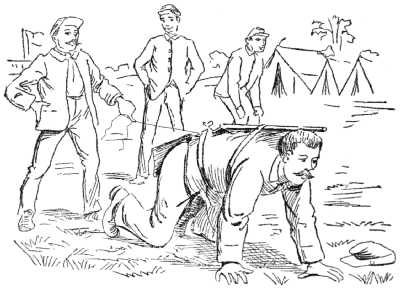
to quarters. Soon, a racket was heard in vicinity of Company
B. Every other man had a gun sling around his body, and
was down on all-fours. The other fellows had a gun thrust
between the gun-sling and along the man’s spine, firing blank
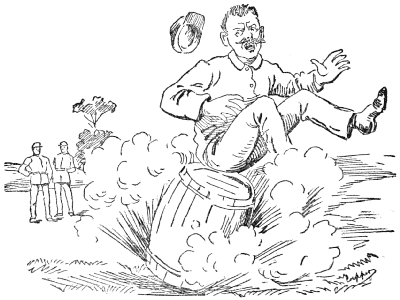
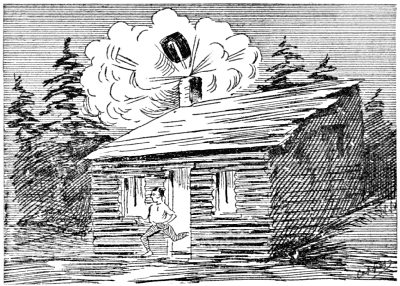
cartridges. As soon as the gun was fired, the man on the
ground would assume a sitting posture, with the muzzle up.
Then the gunner would ram cartridge, and the gun would
immediately assume the horizontal, again to be fired. There
were some 40 of the company engaged in this. That night,
after the racket, the 14th New York’s Sutler lost a barrel of
whiskey, rolled out from under his tent early in the evening,
while the proprietor was engaged in front with a special
delegation sent to occupy him and his assistants, while the
feat was being performed. It never was found, but you
could buy a canteen-full for $5.00 of one who knew where it
9]
was. Details were made to hunt for it, but it was never
brought to view, but some of the detail were quite drunk
when they returned. I will relate an incident that occurred
while encamped on Arlington, as stated before in this narrative:
while stationed there, we were daily beset by hucksters
and traffickers. They would vend their wares to the
boys, and go away, apparently happy, but soon return
again, seeming to be dissatisfied with what they received for
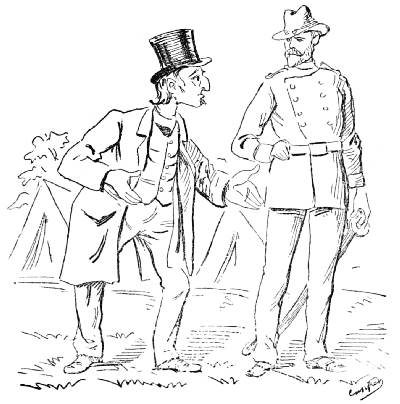
their goods. One day, a pompous Jew drove over from
Georgetown, a big wagon-load of goods drawn by four-in-hand.
Sales were small until he struck Company B, the
writer’s company. Here he cried his wares. Finally a syndicate
was formed, and approached the vender of goods, with
the proposition to buy his entire stock. They would give so
10]
much, provided he had a certain amount of the ardent in his
outfit. He seemed to be satisfied with the situation, and
answered, he had what they desired. The bargain was
closed, and money paid in bills. Our goods were unloaded,
and he departed, highly elated. But it was not long. He
soon returned, alone, and inquired of the writer for the Colonel’s
tent. The writer edged around, as near as possible, to
hear what was said. The Jew was swinging his arms, and
gesticulating fiercely. The Colonel listened until he got
through, then I heard him say, in reply, “you ought to be
satisfied with small profits on so large a sale.” He replied:
“Colonel, the monish is not good, it is one Erie and Kalamazoo
monish.” The Colonel told him the result was as good
as the intent, and dismissed him, and we did not see him
again. The boys bought him out slick and clean, for 600
dollars, and paid him in new and crisp Michigan Insurance
and older bills of Erie and Kalamazoo. I will say, Company
B, was made up of one or two doctors, as many lawyers, and
one preacher, and the rest were gentlemen. The writer was
identified with the latter class.
With the advance of the army from Minor’s Hill, and to
Fairfax, passed beyond that dilapidated and dingy looking
town, historical, much speculation indulged in, in regard to
what route would be adopted “On to Richmond.” It was
finally decided to take the route via Alexandria down the
Potomac to Fort Monroe. Accordingly, the columns were
put in motion, and in due time the army arrived at above
named place. Our Division passed out beyond Hampton,
and went into camp, for a few days, then marched en route
to Yorktown, by way of Big Bethel. On our arrival within
cannon shot of Rebel fortifications, we were greeted by a general
shower of shot and shell, from Rebel Batteries, which
went screeching and screaming over our heads. The 4th had
11]
the advance at the right, toward the Rebel Left. As we drew
nearer, they got our range. Their shot plunged and shells
burst in and all around us with but little damage, but made
the situation decidedly unpleasant. Our column filed to the
right, following a ravine, which extended to extreme left of
Rebel Earthworks. General Charles Griffin commanded our
Division, and his old battery was on hand, that he had formerly
commanded. He immediately ordered it to the front,
out in open space, and commenced shelling the Rebel works.
Cannonading was lively for a while, on both sides. The
Rebels evidently misunderstood the demonstrations, so audaciously
made in their front, and expected an immediate assault
all along the line. They apparently reserved their fire
for closer work, but were disappointed in that. The army
settled down to a siege. We were constantly under fire, from
time of arrival in front of their works, until evacuation of
same, on picket line, bivouac and skirmishing. No let up
night and day. Casualties were quite frequent. If a picket
guard showed his head it was a target as soon as seen. Picketing
was extremely dangerous business. The guard were
posted under darkness of night and was relieved the same.
In front of Rebel works was an open plain. The boys would
dig holes, under cover of darkness, and through the day
would burrow like gophers. Hence gopher holes, had dirt
piled up in front with a hole at base, for to shoot through.
Was death to the man who got his cranium above the obstruction
in front of him. A thrilling incident occurred at
this time. General Fitz John Porter, who commanded the
5th corps, went up in a balloon to take observations of rebel
works. It was controlled by ropes, held by men on the
ground. After getting up the right distance, the guy became
detached, through some cause, and the balloon floated at will,
first over Rebs, then back on our side, swayed by the wind.
All this while, Porter could be seen standing up in the car,
12]
with spy glass in hand, scanning the Rebel fortifications; and
the Johnnies everlastingly yelling, and trying to elevate their
guns to reach him, but failed. The elevation was too steep
for their gunnery. Finally he descended to our side, amid
shouts of the whole army. It was hard telling at one time
into what hands he would fall. The siege went on. A heavy
water battery of one hundred pounders was placed on York
River, at the extreme left of Rebel works. The 4th was
stationed at that point. These guns were worked spasmodically.
Rebs could not reply to them. York River, at this
point, was full of oysters—some the largest I ever saw. We
often went in after a supply. It was dangerous business.
The Rebel pickets, on opposite side, were alert and invariably
fired on any one who had the hardihood to approach the
water for them. The writer ventured in one day for some of
the bivalves, and was industriously searching for the precious
article. I succeeded in exhuming a monster big one, and
was looking for more, when zip, pinge, came the warning to
get out. I was in such a hurry I forgot to take along my
find, and you could not see my coat tail for the water splashing
behind me. I did not want any more oysters on that
special occasion. Yorktown was evacuated on the night of
May 4th and 5th, 1862; our army had been to vast labor, and
the government to tremendous expense and worry. A bloody
battle was fought at Williamsburg; the 4th were not engaged
at that battle. We were sent via West Point, and followed
on to Chickahominy. The time occupied between Yorktown
and our arrival at the Chickahominy, was marching, and
camping under great hardships; mud and heat had to be contended
with. When within a few miles of Chickahominy,
the 4th was detached from the column, and in a pouring rain,
were hustled on to the river. When within half a mile of it
we met a squadron of cavalry, which had been to the point,
came back full well. We were ordered, “Battalion into line,
13]
double quick;” my company being on the left, did some tall
running over bogs, ditches and small brush, to get our place
in line. We struck the river at New Bridge, and met a sharp
fire from opposite side. We were dressed up under this fire.
Our first man was killed here, A. M., D. Piper, of Company
B. He was shot dead. He was the largest man in the company.
I was first sergeant at the time, and touched elbows
with him when he fell. The boys named him Elephant, on
account of his immense size. Our Colonel, D. A. Woodbury,
seeing our disadvantage, rode his horse down to the river and
ordered us to cross. At this time the Johnnies were seen to
get to the woods beyond. About 20th of May my company
plunged into the water, arm-pits deep. Company A crossed
over to the right, in a bend of the river. We found 28 dead
rebels in our immediate front. We brought over some
wounded rebels, and on our return the water was chin deep
to the writer, it having rained all this time heavily. There
were four or five of my company wounded. The rebels had
taken the plank from the bridge, and ranged two pieces of
cannon on the same. We held this point as a picket line
until battle of Gains Mills. The crossing of Chickahominy
occurred on May 24th, 1862.
Here I first saw Custer. He was sent by McClellan to assist
our cavalry in conducting the establishment of picket
lines at New Bridge. He crossed the river four times, on
horseback, to my certain knowledge. He encouraged us boys
with the example, and his cheering remarks, such as go in
Wolverines, give them h—l, and we did. The Johnnies outnumbered
us six to one, but they were deceived in our
strength, supposing us to be a regular advance of our army.
I am pained to read of the deprecating language of Major
Reno, 7th Regiment Cavalry, in regard to the gallant Custer.
This fight caused General McClellan to dispatch to the
War Department, the following: “Three skirmishes to-day.
14]
We drove the Rebels from Mechanicsville, seven miles from
New Bridges. The 4th Michigan about used up the Louisiana
Tigers. Fifty prisoners, and fifty killed and wounded.”
Mr. Greeley, in his American Conflict, says: “The first
collision on the Chickahominy, between the advance of
McClellan’s army and the Rebels, occurred near New Bridge,
where the 4th Michigan, Colonel Woodbury, waded the
stream and assaulted and drove off a superior force, losing
but eight men in all, and taking thirty-seven prisoners, of
whom fifteen were wounded.” After establishing line of
pickets on or along the river, the regiment went into camp
on Gains’ Farm, on left bank of Chickahominy, about one
mile from river. Soon after, the battle of Fair Oaks was
fought in plain sight of our camp. It continued ’till early
in the evening. We could see the flash of bursting shells
and vomiting cannon. The excitement among the men
of the regiment was very manifest. It is certainly pleasanter,
at a distance, to witness a battle, than to participate in
one. Distance is more agreeable than being too intimate
with the struggle.
An advance from our position, at that time, was contemplated
upon Richmond. A heavy rainstorm was raging at
the time. The regiment stood in ranks all one day, in this
rain—so did the whole army—waiting orders to cross the
Chickahominy. The flats each side of the river were flooded
from two to four feet deep. Whirling and seething in its
course, it was impossible to cross, and had to be abandoned.
A howl went up all over the north, because of the failure,
but was not attributed to the high water, but to cautiousness
or cowardice of the commander. It could not be done in the
face of such difficulties. If ever there was an interposition
of Providence, it was manifested at that time, for if we had
crossed the river with the view of attacking Richmond, I believe
the Army of the Potomac would have ceased to exist as
15]
an organization. Picketing and camp routine was daily gone
through with at this time; but little excitement, and nothing
startling occurred. I think, May 27th, a column was
marched to Hanover Court House to our right and rear. It
was reported the Rebels were threatening our base. The 4th
Regiment was a part of the troops composing that movement.
We marched to Hanover. The front and rear of the column
had a fight with the Johnnies. The 4th was but slightly engaged.
The 9th Massachusetts, one of our brigade, had a
lively chase after the enemy,—charged them out of a piece of
woods, and down a grade, towards a railroad, via Hanover
and Richmond. The 44th New York were badly cut up,
being the regiment in the rear of the column that the Rebels
attacked with great fury. The 44th stood their ground with
great bravery and determination until assistance arrived.
The enemy was driven off, and the column returned to camp.
Company B, of the 4th, acted as flankers on the return to
camp, 14 miles away. By the way, the duties of flankers are
very tedious and arduous, especially over a rough country,
and is attended with a good deal of danger. On our way back,
when near camp, the regiment halted in the road, with low
hanging trees on one side of the road (the flankers had been
called in,) with thick underbush. Some telegraph wires were
laying along on the limbs. Some mischievous fellow in the
rear drummed with his gun on them, causing a vibration of
sound similar to a noise caused by a charging mule team
running away. The result was, the road was vacated in two
seconds. The writer jumped, and supposed he was jumping
up grade, but instead, jumped 20 feet down grade, into a
hole. The scare was over, and the column soon made camp.
Many lost their caps, the writer among the rest. I distinctly
saw the colonel and adjutant’s horses leap a ditch fence on
the north side of the road. If I could have known the fellow
who caused the stampede, I think I could have mauled
16]
him—and think I would, had I caught him. As it is, the friction
is now worn off, and he is safe. I will say, the column was
marching left in front. That put the writer’s company to
the front. Hence the scare at our end of the regiment. The
army indulged in a grand review at this place. General
Prim, the Spanish Patriot, was present, and, I think, President
Lincoln, but am not positive as to the latter being
present. The little general humped around after Mac., who
was a splendid rider—none were more accomplished than
Little Mac. Prim was not used to such rough ground and
hard riding, hence his unsteady seat. While in camp, our
quartermaster thought to regale us with the luxury of dried
apple pies, shortened with bacon grease. He had procured a
portable oven, and dispensed his goodies to the boys, at
twenty five cents a small section. The writer remembers of
being very sick from eating pie, in fact, the only time he
remembers of being sick, until subsequently, after being
wounded at Gettysburg.
And now comes the tug of war. Up to this time the
regiment had not suffered very serious loss. True, many
were sick; some had been discharged; but the regiment
showed a good front. The history, from June 26th, 1862, of
the regiment, is steeped in blood, with heavy loss. Many
were sent to their last muster out, and now, after the lapse of
a quarter of a century, the roster is nearly closed.
June 26th, 1862, the regiment, with the rest of the
brigade, was formed in column, and marched out to Mechanicsville,
and engaged in battle with traitors to this good
country. The battle was short and sharp, without much
advantage to either side. It was the prelude to one of the
bloodiest battles of the war,—Gains’ Mill. June 27th, 1862,
the regiment, with others, left our camp, abandoned everything
except our knapsacks and guns, marched out and
formed line of battle, near Gains’ Mill. The Rebels soon
17]
took possession of our deserted camp, rioted awhile on what
was left,—whiskey, hard-tack, and other commodities. About
ten A. M. they came down on us without skirmishers, with
guns at a right shoulder arms, and drunk. They came to be
slaughtered, and they got it, then and there. The carnage
was terrible. The battle raged all day, until dark. Men, of
human form divine, became demons, fought like wild beasts,
and with not much more intelligence on the traitors’ side.
Many of the regiment went down.
The next day, loved ones, true as steel, were missing, and
never again answered to human roll call. And on to other
battles, the regiment was baptised in blood again. Savage
Station, White Oak Swamp, and on to Malvern. On the 30th
of June, the army arrived at Malvern Hill, tired, worn, and
hungry. The enemy followed up and attacked in the afternoon,
but were easily repulsed. July 1st was the climax of
battles. The enemy attacked with great fury; the battle
raged all day with great slaughter, on both sides. Charge
after charge was indulged in by the persistent foe, to be
hurled back bleeding in every form. The thunder of cannon
was awful; clash of arms, shouts of combatants, was deafening.
Such a seething hell will never be again enacted on this
continent. It would be impossible to repeat it, in all its details.
The enemy drew off, and the Army of the Potomac
passed on to Harrison’s Landing, on the James River. The
regiment lost its brave Colonel Dwight A. Woodbury, the
bravest of the brave. His last words were, “hold them, boys.”
He was shot in the forehead and died almost instantly. His
body now rests in our beautiful Oak Wood Cemetery. He
was a kind man. The enemy followed to Harrison’s Landing
in small force; made a slight attack on our forces, on the
morning of July 2nd, but we easily repulsed. The regiment
and army settled down to camp life. While here, the Rebels
made a night attack, from south side James River. Our
18]
heavy batteries and gun boats in the river soon knocked them
out of the box. The day following, the 4th and 16th Michigan
were ferried over the river to see about it. Found debris
of caissons, dead horses, and evidence of demoralization.
Staid over all day. Some captures were made. Among the
trophies, were a considerable amount of geese. The regiments
returned to north bank of stream and went into camp.
The rebels did not attack again. The severe handling they
received at their nocturnal demonstration evidently satisfied
them. After the death of Colonel Woodbury, Lt. Col. Childs
was promoted to Colonel of the 4th regiment; Lt. Col. Duffield
was promoted to Colonel of 9th Michigan Infantry. After
the Peninsular campaign had ended, the 4th returned,
with the army, and entered on the “Pope Campaign.” The
regiment in command of Col. Childs was in the engagement
at Gainsville, Aug. 29, 1862; Bull Run, Aug. 30, and at Antietam
Sept. 17 following. At Shepardstown Ford, Sept. 20
with its brigade, it forded the Potomac, in face of a battery,
killed and drove off the enemy, captured their guns. After
the Maryland campaign, the regiment returned to the Potomac,
and was in battle of Fredericksburg, Dec. 13th and 14th,
1862. Lt. Col. George W. Lumbard, commanded. Its loss in
these two days was 9 killed, 41 wounded, and one missing;
Lieut. James Clark was killed, Company B. Remember the
4th was always identified with 2nd brigade, 1st division, 5th
corps, and was in said organizations until expiration of service.
After battle of Fredericksburg. Dec. 13, 14, the 4th
returned to north bank Rappahannock; on the 30th and 31st
of December the regiment was engaged in a reconnoisance to
Morrisville, making a march of 33 miles on the latter day.
It was engaged in a movement on the 20th of January, 1863,
marching only a few miles; returned to camp near Falmouth,
where we remained until May 1st, sending out details, building
corduroy roads, bridges, and other preparations, clearing
19]
the way for an advance to Chancellorsville. May 2d, it forded
the Rapidan River, without opposition. On the 3d it marched
out to and beyond Chancellorsville, proper, and formed the
extreme left of the army, 1st division, 5th corps. The division
was cut off from the rest of its corps, at this time. We
maneuvered around, for a while. Finally it was decided to
try and support the brave Sedgwick, commanding 6th corps,
who was battling with the Johnnies at Fredericksburg. The
column was put in motion, left in front, 4th Michigan in the
lead—the writer’s Company out as flankers. We soon heard
the familiar Rebel yell, in our front. It put a stop to the
movement. We returned, sadder but wiser, to our former
position. It was then getting dark. The Division was put
in motion to the rear, towards the bluffy ground near the
Rappahannock River, where we were put in line of battle—our
right extending towards Chancellorsville, our left near
the river. It was high ground, and we considered it impregnable.
The regiment, and in fact, the whole line, threw up
temporary breastworks. In this position we passed the night
of the 3d. Saturday, during the night, the 11th corps had
stampeded, at Chancellorsville, and took to the woods, in
rear, and could not be induced to return to the front. Sunday
morning the sun rose clear and hot.
We received orders to march to the vacated position that
had been occupied by the 11th corps. We double-quicked
the entire distance, over rough ground. The underbrush had
been cleared away partially. When we arrived in open
space, where the fight was going on, we were quickly formed
in echelon, battle array by division front. The Johnnies
came out of the woods in our front with the apparent determination
to drive us back; but grape and canister, accompanied
by musketry, drove them back. They did not appear
again that day. This was May 4th. The enemy contented
themselves with annoying us with their sharpshooters, located
20]
in trees, in woods, in our front. Our officers concluded to
teach them better manners than to kill men in this quiet and
barbarous way. Accordingly, orders were given to deploy
the 4th Michigan as skirmishers, and clear the wood, which
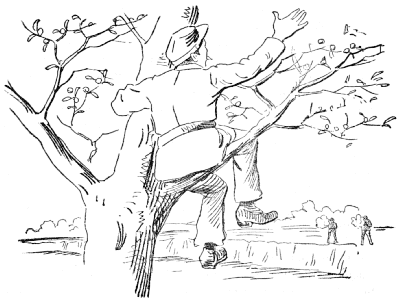
was done in fine style, and at a double quick. I saw a rebel
sharp shooter, located in a tree some sixty feet from the
ground, he had a telescope rifle, and on his head an old plug
hat. He was shot, and came tumbling to the earth. He
struck the ground straight out. He looked to be nine feet
long, in his descent to the ground.
The line swept on, driving all before it. We soon struck
Rebel works, composed of logs. In front was a ravine. As
the Johnnys went up the incline, and over the works, we
landed in the ravine. This saved us, as they could not fire
to any advantage, while their men were ready to break their
necks to get out of our way. They fired a tremendous volley
over our heads; our bugle sounded the “recall,” and then
we proceeded to “git”—“the Devil take the hindermost.”
Now, I was considered a smart runner, but could not gain an
inch on the man ahead of me. On we went. We could hear
the swish of cannister in our rear, but on we went. The 9th
Massachusetts was sent after us as a support. It had
halted half way and laid down. We passed over them in our
flight. The Rebels soon followed up, and when in range of
the guns of the 9th, they arose, and delivered their fire,
which sent the survivors flying to their works. Thus ended
the most exciting race of my life. I never shall forget it. It
was amusing to. Colonel Welch, of the 16th Michigan, felt
slighted because his Regiment was not selected for the job.
I told him I was sorry, as I was willing he should have all
the honor that would accrue to me. I was not very proud of
such chances.
The army withdrew to the north bank of the Rappahannock.
The 4th Michigan, 14th New York, 9th
21]
Massachusetts, 62d Pennsylvania, composing 2d Brigade, was rear
guard to the United States Ford. The army moved in the
night, leaving picket line established. Many were captured.
After crossing the river, we encountered a sea of mud. The
army slashed around until it arrived at our old camp at
Falmouth. The 4th was camped at Stoneman’s Switch.
We remained there until May 26th, when it, the 4th, was
ordered to Kelly’s Ford, for guard duty, where it remained
until the 13th of June, 1863. Here a laughable thing happened.
The Johnnys were on one side of the river, and we
occupied the other, doing picket; a long, lankey Johnny sat
on the bank of the stream, poorly dressed, with his feet in
the water; no firing at this time, by mutual consent. One of
our smart Alicks sung out to him, “I say, Johnny Reb.,
why don’t you wear better clothes?” His reply was prompt,
“We uns don’t wear our best clothes when we go to kill
hogs.” Our Alick subsided. This man was shot soon after.
It was a cowardly deed. The Regiment participated in the
long and fatigueing march to Gettysburg, Pennsylvania.
On the way, at Aldie and Middleburg, it was detained in
support of cavalry.
We passed on and across the Potomac ferry, at Edwards.
On the way we saw plenty of evidence of the cavalry
advance,—dead horses, accoutrements belonging to cavalry
outfit. We arrived at Hanover, Pennsylvania, on the afternoon
of July 1st. Rested and fed; then on to Gettysburg.
Marched all night—a beautiful moon-light night. As we
passed farm houses, the people came out with water and
refreshments, handed us as we passed along foot-sore and
tired. An Aide-de-camp came riding along, saying: “Boys,
keep good courage, McClellan is in command of the army,
again.” Instantly the space above was filled with the hats
and caps of the gratified soldiers. They shouted and
hollered, and kicked up their heels, and were frisky with the
22]
supposed good news. I mention this to show with what
veneration Little Mac. was held by the Army of the Potomac.
I knew this was untrue, myself, but it served its purpose as
intended. Many a brave heart went down next day with
that belief in his heart. On to Gettysburg. We arrived in
sight of line of battle being formed, at 9 A. M., July 2nd.
Lunched, and was then moved up near Round Top. Was
halted again, and awaited the coming struggle. It came.
The regiment was formed in line of battle, with the
brigade, and was moved nearer the battle going on in front
of us, with other troops engaged. The regiment stood under
fire at least a half hour before it became engaged, getting a
large share of spent balls from the front. Soon the general
commanding Division, Brown, said: “Boys, I want you to
put in a few licks for Pennsylvania; the Buck-tails will go
in on your left. Forward.” It was a relief to hear the
order, “March.” We advanced into the maelstrom of Rebel
bullets. By some oversight our right was exposed, and we
had to contend with three to one. We held them until they
made a fierce charge, charging our right and doubling it
to the rear of our left. We were taken at a great disadvantage.
I looked to our rear; our colors were there, and men
rallying around them. Our colonel, H. H. Jeffords, was
there, in the thickest of the struggle, calling on the boys to
save the flag. They needed no urging; they fought like
demons. Our colonel was killed—shot and then bayoneted.
A brave man was killed by the hand of a traitor,—and many
others, too, who were simple privates, but heroes for all that;
every one of them who fell doing his duty, or imposed duty.
We had to fall back. The writer was here wounded, and
the battle surged beyond him. Soon the enemy came, tearing
back in retreat. They had struck the brave old 6th Army
Corps, just arrived, and in time to save the day. The Rebels
went back flying, with the 6th Corps men close after them.
23]
They had no time to scoop any of the wounded, as they had
all they could attend to in getting out themselves. It was
now dusk; the fierce struggle was over for the night. The
struggle had been simply terrible; the carnage was awful;
the fire incessant. Groans and oaths of the wounded were
heard on every hand. Many would have recovered, had they
had care. But it was impossible to reach all. The writer,
with others, was loaded into an ambulance, at two o’clock in
the morning of July 3d, and taken to an old house to the
north, and east of the battle ground. Here were many
wounded. Among those in the house was a Rebel Colonel,
shot through the breast. He sat in the only chair in the
house. He commanded a Louisiana Regiment, and was
wounded early in the fight. I saw him lying on the ground,
after the fight had surged by me. I think he died.
The 2d day of July, 1863, ended the writer’s service in
the field. The 3d day of July was ushered in with an ominous
quiet. No sound of cannon broke the stillness, until
near ten o’clock, A. M., when mutterings of the awful strife,
inaugurated later, began to be heard. Soon the din began.
The voices of an hundred big mouthed guns began to vomit
forth its death dealing missiles. The Infantry now began to
put in its refrain; after a few spasmodic belchings, of the firing,
the tremendous concussion of all arms became general.
About five miles of line of battle could be seen from where us
non-combatants lay. The whole line was ablaze. Firing
was incessant. Salvos after salvos, of artillery belched forth.
The air was full of flying missiles—death everywhere. Thus
the strife continued all day—an awful day, too, for those who
lay helpless in plain view. Charge after charge was made by
the determined enemy, but they were repulsed each and
every time by the boys in blue. The anxiety was terrible to
those who could not participate in the struggle. The very
air seemed to be ablaze. The suspense became painful later
24]
in the day. Such persistency seemed, must be, rewarded
with success.
Still the fight went on, and seemed to us an age of suspense.
Many wounded came from the front. Ten thousand
questions were asked of those who had been wounded, “how
goes the battle?” Some would answer, doubtful, others
would say, “our side would win.” It was curious to note
the countenances of those who heard the news, some with
great anxiety in their faces, others with confidence depicted
in every feature. Finally, the awful noise died away; news
was brought by an aide-de-camp “that the enemy had hauled
off.” These men who were dying would raise themselves to
a sitting posture, and utter one hurrah! Lay down and die!
The work of death ceased. The rebels retreated. Thus
ended the three days battle of Gettysburg. The 4th ranks
were badly depleted. So was the whole army. The sanitary
commission was on hand, and rendered great service, in the
care of the wounded. One poor fellow of our regiment, a
Company D man, was shot in the head. He would get on his
knees, put his head on the ground, and twist his head in the
ground. He bored that way until death put an end to his
sufferings. Many died of their wounds, and were buried then
and there. The wounded were sent away as fast as possible.
The writer, with others, left for Baltimore, and remained a
few days at that place, at a Catholic Infirmary. We were
treated with great kindness by the Sisters of that benevolent
institution. The ladies of Baltimore—God bless them—they
regaled us with all the luxuries of the season, I can never
forget their kindness.
The subsequent history of the regiment is taken from the
official sources, (Michigan in the War,) with some personal
recollections.
The struggle in which the regiment was engaged at
Gettysburg, may be inferred from the following notice of the
25]
services of its corps, the 5th, as stated by Mr. Greeley, in his
“American Conflict.” Sickles’ new position was commanded
by the Rebel Batteries, posted on Seminary Ridge, in his
front, scarcely half a mile distant. While magnificent lines
of battle, a mile and a half long, swept up to his front and
flanks, crushing him back with heavy loss, and struggling
desperately to seize Round Top, at his left. Meade regarded
this hill as vital to the maintenance of our position, and had
already ordered Sykes to advance the 5th corps, with all
possible haste, to save and hold it.
A fierce and bloody struggle ensued, for the enemy had
nearly carried the hill before Sykes reached it. While
Humphrey, who with one of Sykes’ Divisions, had been
posted on Sickles’ right, was in turn assailed in front and
flank, and driven back with a loss of 2,000 out of 5,000 men.
After the death of Colonel Jeffords, Lt. Col. Lumbard assumed
command of the Regiment, pursuing the enemy from
Gettysburg; the 4th marched to Williamsport. On July 12th,
the enemy having crossed the Potomac, the Regiment proceeded
to Berlin; thence on the 17th it marched to Warrenton,
by way of Mannassas Gap; then proceeded to Beverly Ford,
where it remained until Sept. 16th, thence to Culpepper, remaining
there until the 9th of October; again crossing the
Rappahannock, it encamped near Beverly Ford; recrossing
on the following day, it assisted in driving the enemy, who
were advancing, back to Brandy Station, the 4th acting as
flankers, for the 5th corps. On the 12th the Regiment recrossed
the Rappahannock, and fell back with the army, via
Bealton, Warrenton Junction, and Centerville, to Fairfax
Station, where it remained until the 18th, when it marched
forward to Three Mile Station, near Warrenton Junction,
and went into camp.
In Col. Lumbard’s report, he says: “The Regiment has
participated in all the movements of the Army of the Potomac,
26]
and have not mentioned the many reconnoisances, and
the number of times the Regiment has been on small skirmishes
with the enemy. The Regiment has marched during
the year over 700 miles.”
The 4th, in command of Colonel Lumbard, who had been
commissioned as Colonel, to rank from July 3rd, then in 2nd
Brigade, 1st Division, 5th Corps. (Griffin’s) advanced on the
7th of Nov., 1863, with Army of the Potomac, from its camp
near Three Mile Station, on the O. & A. R. R. to the Rappahannock
River, and the same day participated in the engagement
at Rappahannock Station. On the 3rd the Regiment
was ordered, with its Brigade, to keep open the communication
from Bealton to Kelly’s Ford, and engaged in that
duty until the 19th, when the command rejoined its corps
near Kelly’s Ford. Breaking camp on the 26th, the command
moved toward the Rapidan River, which it crossed at Germania
Ford. On the 28th, the Regiment moved to the right
of the position at Mine Run, but did not become engaged.
On the night of the 30th, it fell back across the Rapidan.
The 5th corps, being ordered on guard duty along the Orange
and Alexandria R. R., the Regiment arrived at Bealton on
the 1st of December, where it remained until the 30th of
April, 1864, when it broke camp and marched to Rappahannock
Station. On the 1st of May, the Regiment crossed the
Rappahannock River, and camped near Brandy Station, and
thence on the 3rd, marched to Culpepper. On the morning
of the 4th it started from Culpepper to participate in the
Summer Campaign, crossing the Rapidan at Germania Ford.
On the 5th, 6th and 7th, the Regiment participated in the
Battles of the Wilderness. Col. Lumbard was mortally
wounded on the 5th, and died on the 6th. In the same engagement,
Capt. W. H. Loveland, Company B, was wounded,
and died of his wounds on the 31st of same month. On the
night of the 7th, the 4th, then commanded by Lt. Col. J. W.
27]
Hall, moved toward Spottsylvania. Arrived at Laurel Hill
on the morning of the 8th, it here became engaged with the
enemy, and again on the 9th. On the 10th it assisted in a
charge upon and capture of the enemy’s rifle pits, loosing 20
killed and wounded. On the 11th and 12th the Regiment
was in the advanced lines of the corps, and on the 13th and
14th was engaged as skirmishers. On the evening of the
latter date the command moved to the left of the army, near
Spottsylvania Court House, and remained here until the 19th.
It then took part in the movement to North Anna River,
which it crossed on the 24th, near Jericho Mills, the Regiment
participating in the engagement at this place. On the
night of the 26th it recrossed the North Anna and marched to
Hanovertown, crossing the Pamunky River on the 28th. On
the 29th, 30th and 31st of May, and 1st of June, it was engaged
as skirmishers, and on the 3rd it participated in the
capture of the enemy’s line of works near Bethesda church.
In the engagement Lieut. James N. Vesey, Company C, was
killed. On the 5th, the Regiment marched to Bottoms
Bridge, and on the 14th crossed the James River, at Wilcox’s
Landing, whence it proceeded to the lines in front of Petersburg,
where it arrived on the 16th. On the next day the
Regiment was engaged as skirmishers, and on the 19th took
part in the engagement of that date, loosing 8 killed and
wounded. During the engagements from Nov. 1st, 1863, to
June 19th, 1864, the Regiment lost 3 officers and 37 men,
killed or died of wounds, with 6 missing in action. Although
this loss seems small, yet it was about 15 per cent. of its whole
strength. The term of service for which the Regiment had
been mustered in expired June 19th, 1864. It was accordingly
relieved, and on the 20th it embarked on transports at
City Point for Washington.
It arrived at Detroit on the 26th, and on the 30th of June
the companies were mustered out of service. Of those on
28]
the rolls, the terms of 200 men and 23 officers had expired.
Of these, 32 men and 1 officer were prisoners, in the hands of
the enemy; 135 men and 22 officers were present for muster
out, since the 1st of Nov., 1863. The Regiment had received
110 recruits, including a new company, organized at Hillsdale,
Michigan, which joined the Regiment on the 16th of
May, and which remained in service with the Reorganized
Regiment, 129 men of the Regiment re-enlisted as volunteers,
and on the 30th of June, there were 280 men and 3 officers on
the rolls, whose terms of office had not expired. These were
ordered to duty with the First Michigan Infantry, when the
4th left the field of war. The total membership of the 4th
Regiment had been, during its service, 1,325, while its losses
were 273, of which 8 officers and 115 men were killed in action;
4 officers, 50 men, died of wounds; one officer and 95
men of disease.
Their brows bear many a gory stain,
Their white lips press not ours again,
And eyes that once our life light were,
Give back a cold, appalling stare.
30]