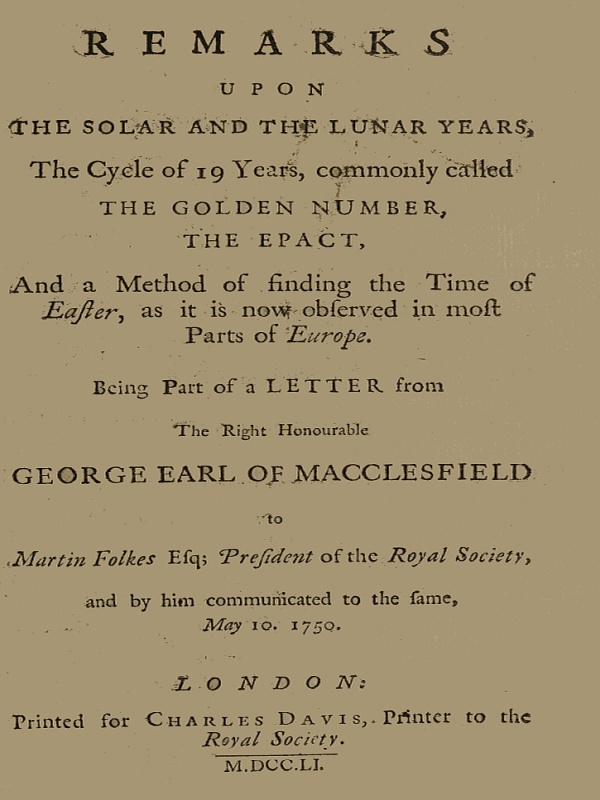
Read May 10.
1750.
The mean Tropical Solar Year, or
that mean Space of Time wherein
the Sun, or Earth, after departing from any Point
of the Ecliptic returns to the same again, consists,
according to Dr. Halley's Tables, of 365d, 5h, 48´,
55´´: Which is less by 11´, 5´´, than the mean Julian
Year, consisting of 365d, 6h, 0´, 0´´.
Hence the Equinoxes and Solstices anticipate, or
come earlier than the Julian Account supposes them
to do by 11´, 5´´, in each mean Julian Year; or 44´,
20´´ in every four; or 3d, 1h, 53´, 20´´, in every four
hundred Julian Years.
In order to correct this Error in the Julian Year,
the Authors of the Gregorian Method of regulating
the Year, when they reformed the Calendar in the
Beginning of October 1582, directed that three intercalary
Days should be omitted or dropped in every
four hundred Years; by reckoning all those Years,
whose Date consists of a Number of entire Hundreds
not divisible by 4, such as 1700, 1800,
1900, 2100, &c. to be only Common, and not
Bissextile or Leap Years, as they would otherwise
have been; and consequently omitting the intercalary
Days, which, according to the Julian Account,
should have been inserted in the Month of
February in those Years. But at the same time they
order'd that every fourth hundredth Year, consisting
of a Number of entire Hundreds, divisible by 4,
such as 1600, 2000, 2400, 2800, &c. should still
be consider'd as Bissextile or Leap Years, and, of
consequence, that one Day should be intercalated as
usual in those Years.
This Correction, however, did not entirely remove
the Error: For the Equinoxes and Solstices still anticipate
1h, 53´, 20´´ in every four hundred Gregorian
Years.
But that Difference is so inconsiderable as not to
amount to twenty-four Hours, or to one whole Day,
in less than 5082 Gregorian Years.
The Space of Time betwixt one mean Conjunction
of the Moon with the Sun and the next following,
or a mean Synodical Month, is equal to 29d,
12h, 44´, 3´´, 2´´´, 56IV according to Mr. Pound's
Tables of mean Conjunctions.
The Common Lunar Year consists of 12 such
Months.
The Intercalary or Embolimæan Year consists of
13 such Months.
In each Cycle of 19 Lunar Years, there are 12
Common, and 7 Intercalary or Embolimæan Years,
making together 235 Synodical Months.
It was thought, at the time of the General Council
of Nice, which was holden in the Year of our
Lord 325, that 19 Julian Solar Years were exactly
equal to such a Cycle of 19 Lunar Years, or to 235
Synodical Months; and therefore, that, at the End
of 19 Years, the New Moons or Conjunctions would
happen exactly at the same Times, as they did 19
Years before: And upon this Supposition it was, that,
some time afterwards, the several Numbers of that
Cycle, commonly called the Golden Numbers, were
prefixed to all those Days in the Calendar, on which
the New Moons then happened in the respective
Years corresponding to those Numbers; it being
imagined, that whensoever any of those Numbers
should for the future be the Golden Number of the
Year, the New Moons would invariably happen on
those Days in the several Months, to which that Number
was prefixed.
But this was a Mistake:
| For 19 Julian Solar Years contain |
6939d, |
18h, |
0´, |
0´´, |
0´´´ |
| Whereas 235 Synodical Months
contain only |
6939, |
16, |
31, |
56, |
30 |
| And are therefore less than 19
Julian Solar Years by
|
0, |
1, |
28, |
3, |
30. |
This Difference amounts to a whole Day very
nearly in 310.7 Years, the New Moons anticipating,
or falling earlier, by 24 Hours in that Space of Time,
than they did before: And therefore now in the Year
1750, the New Moons happen above four Days and
a half sooner, than the Times pointed out by the
Golden Numbers in the Calendar.
In order therefore to preserve a sort of regular
Correspondence betwixt the Solar and the Lunar
Years, and to make the Golden Numbers, prefixed
to the Days of the Month, useful for determining
the Times of the New Moons, it would be necessary,
when once those Golden Numbers should have been
prefixed to the proper Days, to make them anticipate
a Day at the End of every 310.7 Years, as the Moons
will actually have done; that is to set them back one
Day, by prefixing each of them to the Day preceding
that, against which they before stood.
But as such a Rule would neither be so easily comprehended
or retained in Memory, as if the Alteration
was to be made at the End or at the Beginning
of complete Centuries of Years; the Rule would be
much more fit for Practice, and keep sufficiently near
to the Truth, if those Numbers should be set back nine
Days in the Space of 2800 Years; by setting them
back one Day, first at the End of 400 Years, and
then at the End of every 300 Years for eight times
successively: whereby they would be set back, in
the whole, nine Days in 2800 Years. After which
they must again be set one Day back at the End of
400 Years, and so on, as in the preceding 2800 Years.
By which means the Golden Numbers would always
point out the mean Times of the New Moons, within
a Day of the Truth.
It is plain however that the Lunar Year will have
lost one Day more than ordinary, with respect to
the Solar Year, whenever the New Moons shall have
anticipated a whole Day; as they will have done at
those times, when it is necessary that the Golden
Numbers should, by the Rule just now given, be set
back one Day: and consequently the Epact, for that
and the succeeding Years, must exceed by an Unit
the several corresponding Epacts of the preceding 19
Years.
For the Epact is the Difference, in whole Days, betwixt
the common Julian Solar and the Lunar Year;
the former being reckoned to consist of 365, and the
latter of only 354 Days. If therefore the Solar and the
Lunar Year at any time should commence on the same
Day, the Solar would, at the End of the Year, have exceeded
the Lunar by 11 Days; which Number 11 would
be the Epact of the next Year: 22 would be the Epact
of the Year following, and 33 the Epact of the Year
after that, the Epacts increasing yearly by 11. But as
often as this yearly Addition makes the Epact exceed
30, those 30 are rejected as making an intercalary
Month, and only the Excess of the Epact above 30 is accounted
the true Epact for that Year. Thus when the
Epact would amount to 31, 32, 33, 34, &c. the 30
is rejected, and the Epact becomes 1, 2, 3, 4, &c.
Since therefore the Lunar Year will have lost a Day
more than ordinary, in respect of the Solar Year,
whenever it is necessary to set the Golden Numbers
one Day back, as was before observed; it follows,
that the Epact must at the same time be increased
by an Unit more than usual: the Difference betwixt
the Solar and the Lunar Year having been just so
much greater than usual. That is, 12 must be added,
instead of 11, to the Epact of the preceding, in order
to form what will be the Epact of the then present
Year. Which Addition of an Unit extraordinary
to one Epact will occasion all the subsequent Epacts
(which will follow each other in the usual manner,
each exceeding the foregoing by 11) to be greater
by an Unit than their respectively corresponding Epacts
of the preceding 19 Years.
If therefore, instead of the Golden Numbers, the
Epacts of the several Years were prefixed, in the
manner the Gregorians have done, to the Days of the
Calendar, in order to denote the Days on which the
New Moons fall in those Years whereof those Numbers
are the Epacts; there would never be Occasion
to shift the Places of those Epacts in the Calendar;
since the Augmentation by an Unit extraordinary of
the Epacts themselves would answer the Purpose, and
keep all tolerably right.
Thus in a very easy Method may the Course of
the New Moons be pointed out, either by the Golden
Numbers, or by the Epacts, according to the Julian
Account or Manner of adjusting the Year, which
goes on regular and uniform without any Variation.
But the regulating these things for those who use the
Gregorian Account, is an Affair of more Intricacy;
and for them it will require more Consideration to
determine, when the Epacts are to be more than
ordinarily augmented, and at what Times they are to
continue in their usual Course; nay, to know when
they are not only not to be extraordinarily augmented,
but also when they are to be diminished by an Unit,
by increasing one of them by 10 only instead of 11
as usual: and this happens much oftener with the
Gregorians, than the increasing one of them by 12
instead of 11. For, in every Gregorian Solar Year,
whose Date consists of any Number of entire Hundreds
not divisible by 4, it is supposed that the Equinox
has anticipated one whole Day; and therefore
one Day, that which ought to be the intercalary
one, is omitted; and consequently the preceding
Solar Year, where one Day was lost, exceeded the
Lunar Year by 10 Days only instead of 11.
In order therefore to adapt the before-mention'd
Rule to the Gregorian Account, and to know in
what Years the Epacts should either be extraordinarily
augmented or diminished, and the Golden Numbers
should either be set backwards or forwards in the
Calendar; the following Rules and Directions must
be observed.
First. That in the Years 1800, 2100, 2700, 3000,
&c. where the Number of entire Hundreds is divisible
by 3, but not by 4, the Gregorian Solar, as well
as the Lunar Year, will have lost a Day; and consequently
the Difference betwixt them will be the
same as usual: Therefore in those Years there must
be no Alteration, either in the Epacts or the Golden
Numbers; but the former must go on in the same
manner, and the latter stand prefixed to the same
Days in the Calendar, for another, as they did for
the last hundred Years.
2dly. The like will happen in the Years 2000, 2800,
3200, &c. where the Number of entire Hundreds is
divisible by 4, but not by 3: For neither the Gregorian
Solar nor the Lunar Year is to be altered;
and therefore the Epacts must go on, and the Golden
Numbers stand, as they did before.
But, 3dly, In the Years 2400, and 3600, whose
Number of entire Hundreds is divisible both by 3
and 4, the Gregorian Solar Year goes on as usual,
and the Lunar Year has lost a Day. The Difference
therefore betwixt them being 12, the Epact of the
preceding Year must be augmented by that Number
instead of 11, in order to form the Epact of the then
present Year; whereby a new Set of Epacts will be
introduced, exceeding their precedent corresponding
Epacts by an Unit: And the Golden Numbers must
be set one Day back in the Calendar.
4thly and lastly, In the Years 1900, 2200, 2300,
2500, &c. where the Number of Hundreds is divisible
neither by 3 nor 4; the Gregorian Solar Year
having lost one Day, and the Lunar none, the Difference
betwixt them being only 10; that Number
only, and not 11, is to be added to the Epact of the preceding,
in order to form the Epact of that, the then
present Year; whereby a new Set of Epacts will be
introduced, all of them less by an Unit than their
precedent corresponding Epacts: And the Golden
Numbers must be set a Day forwarder in the Calendar;
that is, be prefixed to the Day following that,
against which they stood in the precedent hundred
Years.
This Method would preserve a sort of Regularity
betwixt the Solar and the Lunar Years; and, by
means of the Rules and Directions before-mentioned,
the Days of the New Moons might be pointed out,
either by the Golden Numbers or by the Epacts, placed
in the Calendar for that Purpose; according to the
Julian Account for ever, and according to the Gregorian
Account till the Year 4199 inclusive, after
which there must be some little Variation made in
the four last Precepts or Rules, but it would be to
little Purpose now, to attempt the framing of a new
Set of Rules for so distant a Time.
The Gregorians have chosen to make use of the
Epacts to determine the Days of the New Moons,
and follow pretty nearly the Rules prescribed above;
except that they order the Epacts to have an additional
Augmentation of an Unit eight times in
2500 Years, beginning with the Year 1800, as at the
End of 400 Years; to which 400 Years if there be
added three times seven hundred, or 2100 Years, the
Period of 2500 Years will be completed in the Year
3900. After which they do not make their extraordinary
Augmentation of an Unit in the Epacts, till
at the End of another Term of 400 Years; which defers
that Augmentation from the Year 4200 to the
Year 4300. And this is the Reason that the Rules
above delivered will require a Variation in the Year
4200; whereas it is directed in this Paper that the
Epacts should be augmented, or (which is the same
thing) the Golden Numbers be set back in the Calendar
nine times in 2800 Years. This arises from the Gregorians
supposing, that the Difference betwixt 19
Solar and as many Lunar Years would not amount to
a whole Day in less than 312 Years and a half;
whereas it has appeared above, that it would amount
to a whole Day in 310.7 Years. But although the
Rule prescribed in this Paper comes much nearer to
the Truth, yet the Error in either Case is very inconsiderable,
being so small as not to amount to a whole
Day in many thousand Years; and therefore is not
worth regarding.