Remarks on the Uses of Some of the Bazaar Medicines and Common Medical Plants of India by E J Waring
Whole book · 15 sections
REMARKS ON THE USES OF SOME OF THE BAZAAR MEDICINES AND COMMON MEDICAL PLANTS OF INDIA
Transcriber's Note:
Apparent typographical errors have been corrected. Variations in the use
of hyphens and of accents have been retained.
The symbol for "minim" (an obselete measure of capacity) is used once.
It may not display properly in all applications.
Part II comprises a synopsis or index of diseases and their
treatment. Their names have been bolded, on the same lines as the list of
medecines and medical plants in Part I.
WITH A FULL INDEX OF DISEASES, INDICATING THEIR
TREATMENT BY THESE AND OTHER AGENTS
PROCURABLE THROUGHOUT INDIA
TO WHICH ARE ADDED
DIRECTIONS FOR TREATMENT IN CASES OF
DROWNING, SNAKE-BITES, &c.
BY EDWARD JOHN WARING, C.I.E., M.D. FELLOW OF THE ROYAL COLLEGE OF PHYSICIANS OF LONDON
SURGEON-MAJOR (RETIRED) HER MAJESTY'S INDIAN ARMY
EDITOR OF THE PHARMACOPŒIA OF INDIA, ETC.
FIFTH EDITION
LONDON
J. & A. CHURCHILL
7 GREAT MARLBOROUGH STREET
1897
PREFACE TO THE FIFTH EDITION.
Owing to the favour in which this work is still being
held by the public in India, as proved by the entire
sale of the Fourth Edition, I have taken upon myself
to issue this, the Fifth Edition, with the generous
assistance of my late father's friend, J. E. T.
Aitchison, M.D., C.I.E., to whom I owe a great debt
of gratitude for the time and trouble and valuable
special knowledge he has so liberally bestowed on the
work.
The only important changes that occur in this
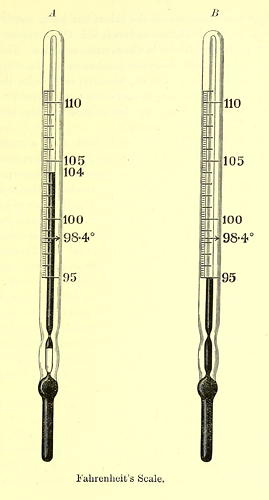
Edition are the introduction of a couple of diagrams
of a clinical thermometer, with a few notes to guide
the non-professional in its use; some alterations in
the text, where subjects that had been issued in the
Fourth Edition as notes to the text are now incorporated
in the text itself; and lastly, Dr. Aitchison
has more fully entered upon his treatment of small-pox
with carbolised oil.
C. WARING.
PREFACE TO THE FOURTH EDITION.
That this little work should have reached a Fourth
Edition may be taken as pretty clear indication that
it has met a recognised want amongst our Indian
fellow-subjects, for whose instruction and guidance it
was originally issued. To render it worthy of continued
favour, and to make it additionally useful, has
been my anxious endeavour.
Of any merit which this edition may be found to
possess over the preceding one, a very large portion
is due to Dr. J. E. T. Aitchison, C.I.E., Surgeon-Major
in H.M. Indian (Bengal) Medical Service, who,
with a liberality that demands my warmest thanks,
placed at my disposal an elaborate MS. commentary
on the Third Edition, embodying his own professional
experience in India (extending over many years), and
supplying the vernacular names of the various drugs
in the Punjábí, Kashmírí, and Leh languages. Of
this document it need hardly be said I have availed
myself largely, my only regret being that I could not
insert it in extenso, but to have done this would greatly
have exceeded the prescribed limits of the work. As
it is, Dr. Aitchison has laid me under a vast obligation,
which I am only too happy to have this opportunity
of acknowledging.
Five new articles have been added to the List of
Drugs: two at the suggestion of Dr. Aitchison;
namely, (1) Sugar, and (2) Kerosene Oil, which latter,
owing to its extensive use for lighting purposes during
the past few years, is now obtainable in nearly every
bazaar in the country; the other three being the
(3) Cinchona Febrifuge (Quinetum), (4) Petroleum,
and (5) Rock Salt. The various ways in which these
articles may be utilised in the treatment of disease
will be found under their respective headings in the
"Addenda," p. 171, et seq.
In addition to these there have been introduced
notices of Indian Hemp (Gunjah) smoking in the
treatment of Tetanus, of the antiscorbutic properties
of Ámchur (dried Mangoes), the lactifuge powers of
Sambac flowers (Jasminum Sambac), the emmenagogue
virtues of Til or Jinjili Seeds (Sesamum Indicum), and
other points unnoticed in previous editions. The
therapeutic applications of Water are enlarged upon;
as also are those of Carbolic Acid, especially in the
treatment of Leprosy. The Sick Dietary has likewise
been extended. Amongst the new matter has been
introduced a section (pp. 268-272) detailing the "Precautions
to be taken by persons residing in snake-infested
localities."
By these and other additions (occupying upwards
of thirty pages of new matter), and by the revision
and modification of other passages, it is confidently
hoped that the practical value of the work will be
found to be materially increased. Indeed, it has been
my earnest endeavour throughout to render this little
volume as useful as possible, and if through its instrumentality
suffering humanity be in any degree
benefited my highest aspiration will be attained.
E. J. WARING.
PREFACE TO THE SECOND EDITION.
Fourteen years have elapsed since this work, in an
elementary form, was first issued for the use of the
District Vaccinators of Travancore, whose sphere of
action was far removed from regular medical aid. It
was originally published in English and Tamil on
opposite pages; subsequently it was reprinted in
Tamil alone by the London Missionary Society's Press
at Nagercoil, for the use of the catechists and others
connected with that Mission. In 1868, a Malyalim
translation, by Dresser Ramswammy Rajoo, was issued
by the Travancore Government. From reports received
from various quarters, there is reason to
believe that the work has enjoyed a wide circulation
amongst the people of Travancore and Tinnevelly,
and that it has exercised a considerable influence on
the practice of the native doctors of those districts.
Were I wise, I ought, perhaps, to rest satisfied
with these results, which far exceed what were
originally contemplated; but recent observation has
convinced me that there are other classes scattered
through our great Indian possessions to whom a
work of the kind would prove most acceptable, by
pointing out to them the agents—either purchasable
in the bazaars at an almost nominal price, or procurable
at the cost of collection, from the road-sides,
waste places, or gardens in the immediate neighbourhood
of almost every out-station—by means of which,
with the exercise of ordinary intelligence, they may
often be enabled to relieve the sufferings of those
amongst whom their lot has been cast.
And at the head of these classes stand the Missionaries,
whose stations, for the most part, are too
far removed from the busy haunts of men to allow of
their calling in regular medical aid in cases of sickness,
and who are consequently thrown, at such times, very
much on their own resources. Many of the missionaries
have under their charge large establishments
of catechists, pupils, &c.; and it cannot be otherwise
than highly desirable that they should be put in
possession of any information regarding the available
means of relieving the sufferings, and treating the
diseases, of those placed under their care. This is not
the place to enter into a disquisition on missionary
work, but I cannot refrain from expressing my firm
conviction that the more the principle of Medical
Missions—making Religion and Medicine go hand in
hand—is carried out, the greater, humanly speaking,
will be the success of missionary efforts. How
many a door for the admission of Gospel truth,
which would otherwise be shut, would be opened, and
that readily, to one who, with "the glad tidings of
great joy" in the one hand, would bring in the other
the means of relieving physical suffering and curing
bodily disease! The highest distinction that I would
claim for this little work is, that it may constitute, as
far as India is concerned, a Missionaries' Medical Vade
Mecum.
Next on the rôle comes a large army of European
and Anglo-Indian officials, whether within the magic
circle of "the Service" or beyond its pale, who are
attached to the Public Works, Forests, Railway,
Telegraph, or other Departments, or employed in Tea,
Coffee, or Cotton plantations, in commercial pursuits,
&c., many of them married men, with families and a
large number of dependants, the majority at distant
"up-country stations," miles away from medical aid;
how important for persons under such circumstances
to possess a knowledge of the means lying (literally
so in many instances) at their very feet, by which
pain and suffering may be alleviated, and, perhaps, a
valuable life saved.
Lastly, but by no means least, either in point of
numbers or importance, comes the daily increasing
array of educated Natives, who, as a class, readily avail
themselves of every scrap of knowledge drawn from
trustworthy European sources, which tends to throw
light on the products and resources of their native
land. Whilst, on the one hand, I am perfectly prepared
to admit that much of the knowledge I possess
of the properties and uses of Indian drugs has been
derived from Native sources, I think I may, on the
other hand, without presumption, claim the credit of
repaying the debt with interest, furnishing in return
a considerable amount of information on the uses of
even the same drugs, of which the Natives themselves
had previously no idea. It is to this class that I
venture to think this little work will prove most
useful and acceptable.
In addition to the above, I venture to hope that
to even duly qualified Medical Officers, especially at
up-country stations, a work like the present may
prove serviceable on emergencies, e.g., a failure of the
supply of European drugs, &c., by showing them what
resources they have at command in the bazaars or in
their immediate neighbourhood, by means of which
many a gap may be stopped till more efficient remedies
are available.
In undertaking a Second Edition of this work, I
have been further influenced by a desire to render
its scope and contents more complete. With more
extended knowledge on my part, drawn partly from
subsequent personal experience in the use of Indian
drugs, and partly from the Reports received from
Medical Officers during the preparation of the Pharmacopœia
of India, I realised how imperfect the
original work was; and feeling myself in a position
to add much information which would tend to increase
its usefulness, I determined upon issuing another
edition. The whole work has accordingly been rewritten
and greatly enlarged.
It was evidently quite out of the question, in a
small work like the present, to include the host of
medicines included under the general headings of
"Bazaar Medicines" and "Common Medical Plants of
India," but from them I have made a selection of
about 80, comprising—1 Antacid, 8 Astringents,
3 Antispasmodics, 2 Antiscorbutics, 6 Antiperiodics,
5 Demulcents and Emollients, 4 Diaphoretics or
Sudorifics, 4 Diuretics, 3 Expectorants, 2 Emmenagogues,
4 Emetics, 6 Purgatives, 3 Narcotics or
Sedatives, 5 Refrigerants, 9 Stomachics or Carminatives,
7 Bitter Tonics, 5 Alterative Tonics or Alteratives,
2 Metallic Tonics, 7 Local and 4 General
Stimulants, 2 Vesicants, or Blistering Agents, 6 Vermifuges,
and 17 Miscellaneous Articles, not included
in the above classes.
In making this selection I have been guided by the
following principles:—1. By the safety of the drug;
hence Arsenic, Aconite Root (Bish), Nux Vomica,
Indian Hemp, and some other powerful medicines
have been omitted, as it was felt to be inadvisable,
in a work like the present, to introduce agents which,
in the hands of unprofessional persons, might do
more harm than good if employed in unsuitable
cases. Where, however, a powerful drug, e.g., Opium,
has been admitted, minute directions as to its
employment have been given. 2. By the acknowledged
utility or efficacy of the drug as proved by
European experience. 3. By the drug possessing a
generally well-known, recognised native name. 4. By
its wide distribution and easy procurability in all
parts, and in all the bazaars of India generally. It is
hoped that by the addition of the native names and
descriptions of the drugs (which were omitted in the
First Edition), even a new-comer will have little
difficulty in obtaining and recognising any particular
article he may require.
With this native "Apparatus Medicaminum" very
much may be accomplished under ordinary circumstances,
in the way of relieving suffering and curing
disease; but it must be admitted that there are certain
articles included under the class "European Medicines"
for which the Indian bazaars supply no adequate substitutes.
I have therefore (in Appendix E) added a
list of nine drugs which it appears desirable should be
kept in store. They are—1. Sulphate of Quinine;
2. Ipecacuanha; 3. Smyrna or Turkey Opium; 4.
Calomel; 5. Acetate of Lead; 6. Santonin; 7. Liquor
Ammoniæ; 8. Blistering Fluid; and 9. Carbolic Acid.[1]
No attempt has been made in the body of the work to
enter into a description of the properties and uses of
these drugs generally (with the exception of Opium),
but in the Synopsis or Index of Diseases (Part II.) it
has been pointed out how these valuable agents may
be utilised in the most efficient manner. It is believed
that, by adopting this course, the practical utility of
the work will be greatly enhanced.
Attention is particularly directed to the Synopsis or
Index of Diseases in Part II.; it is not pretended
that the modes of treatment therein detailed are the
best which could be adopted; the object has rather
been to show how much good may be effected by
the simple means at command at almost every "upcountry
station" throughout India; and those who
follow the directions may feel assured, that with the
exercise of ordinary prudence, if they fail to do good
they will at any rate do no harm.
London, 1874.
[1]
To these Bromide of Potassium and Biniodide of Mercury
have since been added.
This work, it is presumed, will fall into the hands
of many who are wholly ignorant of, or very partially
acquainted with, matters pharmaceutical; hence some
few introductory remarks are indispensable to enable
such persons to understand fully, and follow out correctly,
the directions given.
1. Weights and Measures.—In Appendix C, a small
set of Apothecaries' scales and weights is included, but
in the absence of the former it is well to remember
that a small set of scales, such as is used by native
jewellers, can be procured for a few annas in every
bazaar; care, however, is necessary to see that the
balance is strictly correct and even.
Weights.—The Apothecary weights supplied from
England have the following marks or signs impressed
upon them:
The small circular indentations on the grain
weights indicate the number of grains each weight
represents.
In the absence of these, the following hints may
be useful:
A new rupee of the present currency weighs 180
grains or three drachms.
A half rupee of the present currency weighs 90
grains or a drachm and a half.
A quarter rupee of the present currency weighs
45 grains or three quarters of a drachm.
To obtain smaller weights beat a new quarter
rupee into a long, thin, narrow plate, and divide it
carefully into three equal parts. You have thus three
15 grain weights. One of these divided again into
three equal parts, furnishes three 5 grain weights.
One of these subdivided into five equal parts furnishes
five 1 grain weights. Care should be taken to see
that the parts are of equal weight, and each part
should be marked with a figure to denote its weight.
A native jeweller, at a very small cost, will readily
carry out the above subdivision.
With these, you may obtain any small weights you
require; thus, if you require nine grains, you use a
5 grain weight and four single grain weights. If you
want a drachm weight (60 grains), you use a quarter
rupee (45 grains) and a 15 grain weight, which
makes exactly the 60 grains or one drachm. To get
a scruple (20 grains) weight, you use one of the 15
grain and one of the 5 grain weights = 20 grains or
one scruple.
Two rupees and a half rupee together weigh 450
grains or slightly over one ounce, which weight they
may be taken to represent, in the absence of regular
weights in making up any of the prescriptions given
in the following pages.
Measures of Capacity.—For these, the English
Graduated Measures, glasses included, in Appendix C,
should be employed. The marks on them signify as
follows:
♏︎
= 1 minim
fƷj
one fluid-drachm
= 60 minims.
f℥j
one fluid-ounce
= 8 fluid-drachms.
O
one pint
= 20 fluid-ounces.
In default of a graduated measure glass, it may
be useful to know that a small cup of silver or other
metal, exactly the circumference of a quarter rupee
and 3¾ inches deep, will hold exactly one ounce, and
twenty of these full of liquid make one pint. Each
ounce contains eight fluid-drachms, so with the aid
of this ounce measure you can calculate the quantity
required pretty accurately. The measure should be
made of silver, as some medicines, especially the acids,
act on the other metals.
Any native jeweller would manufacture one of
these measures in a short time, and at a very small
cost.
In the following pages other domestic measures, as
they may be termed, are mentioned; they represent
approximately the following quantities:
"A drop" may be taken generally to represent a
minim, though in many instances they differ considerably
in capacity.
It must be borne in mind that these measurements
apply solely to fluids—never to solids. A tablespoonful
of some solids, as powders, would weigh two
or three ounces, whilst of others it might only be as
many drachms.
Preparations.—A few hints on these may be useful
to the uninitiated. Infusions.—In preparing these,
the following points require attention: a, the solid
ingredients should be cut into small pieces or slices,
or bruised in a mortar, so that the water shall readily
penetrate into the substance; b, the water should be
boiling; c, the vessel or chattie containing the ingredients
on which the boiling water has been poured,
should be covered over to prevent evaporation, and
set aside till the liquid is cold, when it should be
strained through a muslin or thin rag. In hot
climates infusions soon spoil, hence they should be
freshly prepared every other day at the furthest.
Decoctions.—These differ from Infusions so far that
the ingredients are subject to the process of boiling.
The requisite quantity of water having been heated
to boiling-point, the solid ingredients, prepared as for
infusions, are to be introduced, and the whole boiled
in a covered vessel for the specified period. The
liquid whilst hot should be strained and set aside in a
covered vessel till cold. Like infusions, they rapidly
become spoiled in hot climates. Tinctures.—These
are formed by macerating the solid ingredients, prepared
as directed for Infusions, in a bottle with the
specified quantity of spirit, for seven days or more,
occasionally shaking the same to ensure the spirit
acting thoroughly on the ingredients. At the end of
the specified period it should be strained, and the
clear liquid set aside in a cool place in well-stoppered
bottles, for use. Great care is necessary to prevent
evaporation; hence if a glass-stoppered bottle is used,
softened wax should be carefully placed round the
stopper, which should be further secured by a cap of
thin leather or wax-cloth tied tightly over it. It is
thought by many that evaporation of spirit takes
place less rapidly in a closely fitting corked bottle than
in one provided with a glass stopper. Very serviceable
corks, especially for temporary use, may be made
out of Sola, the material used for hats, &c. In either
case layers of wax and the leather are advisable.
Under the most favourable circumstances evaporation
to a greater or lesser extent will take place in hot
climates; hence by long keeping, the tincture acquires
increased strength, and in regulating the dose of the
more active tinctures, as of Opium or Datura, the
fact ought to be borne in mind, or serious consequences
may ensue. Powders.—When an article is
ordered to be taken in the form of powder, it should
be pulverised as finely as possible. There is little
difficulty in this when a large quantity of the article
is required to be kept in store, as is generally advisable,
as the natives, by the aid of the simple machinery
which they employ in making "Curry powder," will
reduce the hardest woody ingredients to the requisite
state of fineness. When only a few grains or a small
quantity is required, it may be obtained by means of
a nutmeg-grater (included in List in Appendix C),
and subsequently triturating the rough powder thus
obtained in a mortar till it is reduced to the state of
a fine powder. In the preparation of a Compound
Powder, i.e., a powder containing two or more ingredients,
it is of the greatest importance that they
should be uniformly and thoroughly incorporated,
else it is evident that a small portion of it, such as is
usually prescribed as a dose, may contain an excess of
one ingredient—it may be an active or dangerous one,
and operate powerfully—whilst the next dose may be
comparatively inert. Powders, when prepared in
large quantities, should be kept in well-stoppered
or corked bottles; if left in open vessels exposed to
the action of the air, they soon become deteriorated.
Pills.—For the reasons just stated, it is necessary,
when two or more ingredients enter into the composition
of a pill mass, to be careful that they are
thoroughly incorporated. When powders, &c., enter
into their composition, a little honey or jaggery is the
best thing to give them cohesion and consistence.
They should be moderately hard; if too soft, they are
apt to lose the globular form which they ought to
possess, and become a shapeless mass. When several
pills are made, a little Arrowroot or Rice Flour
should be added to the box which contains them, to
keep them from adhering to one another. No pill
should ordinarily exceed 5 grains in weight, otherwise
there will be a difficulty in swallowing it; two
3 grain pills are more easily taken than one of 6
grains. Pills, when prepared in any quantity, should,
like powders, be kept in well-stoppered or corked
bottles.
Ointments.—Animal fats, e.g., Lard, which is so
generally used in English pharmacy, are apt to become
rancid and irritating in hot climates; hence
they should be discarded in tropical practice. In
India there is another cogent reason for abandoning
them, viz., the religious prejudices of the natives,
especially of the Mussulman, to whom hog's fat is an
abomination. The only allowable animal fat in India
is freshly prepared Ghee, or clarified butter; but this
in the hotter part of India is of too thin consistence
for ordinary ointments. Fortunately India supplies
at least two vegetable substitutes, Kokum Butter and
Piney Tallow (the expressed Oil of Vateria Indica).
In addition to these, I have introduced a third article,
Ceromel (a mixture of wax and honey). With these
three agents it is believed that animal fats may be
altogether dispensed with in Indian pharmacy.
Native Names.—These have been mainly derived
from Mr. Moodeen Sheriff's valuable Catalogue, which
forms the Supplement to the Pharmacopœia of India.
Some have been drawn from Ainslie's Materia Indica,
a work of sterling merit. For the Malay names I am indebted
to the Hon. Major F. M‘Nair, C.M.G., Surveyor-General,
Straits Settlements, and for the Punjábí and
Kashmirí names to Dr. J. E. T. Aitchison, formerly
British Commissioner, Ladakh.
It is only necessary, in this place, to indicate the
pronunciation of the vowels met with in this work.
a (short) as in about, or the final a in Calcutta.
á (long) as in all, call.
e (short) as in elbow, or the first e in never.
é (long) as a in able or ai in fair.
i (short) as i in ink, bid.
í (long) as ee in feed and free.
o (short) as in from.
ó (long) as in opium, home.
u (short) as in full, or as in wolf.
ú (long) as in fool, too.
Explanation of the Abbreviations employed in the
lists of the native names of the drugs:
2. This well-known vegetable, cultivated throughout
India, abounds in a copious, bland, viscid mucilage,
which possesses valuable emollient and demulcent
properties, rendering the practitioner in India
independent of mallow and other European articles of
that class. The dried fruit may be employed where it
is not procurable in a fresh state. It is best given in
decoction, prepared by boiling three ounces of the
fresh capsules, cut transversely, in a pint and a half
of water for twenty minutes, straining and sweetening
to taste. This, taken as an ordinary drink, proves
alike agreeable and serviceable in Fevers, Catarrhal
attacks, Irritable states of the Bladder and Kidneys, in
Gonorrhœa, and in all cases attended with scalding pain,
and difficulty in passing Urine. Under its use the
urine is said to become much increased in quantity.
In Dysentery, especially in the chronic form of the
disease, the bland, viscid mucilage is often most beneficial.
It is a good plan to give it in soup.
3. In Hoarseness, and in dry and irritable states of
the Throat, giving rise, as is often the case, to a troublesome
Cough, as in Consumption, &c., the free inhalation
of the vapour of the hot decoction (ante) has in
many instances been found serviceable.
4. The fresh capsules bruised are stated to form an
efficient emollient poultice.
6. This root, obtained from a twining shrub common
throughout India, whose bright scarlet seeds
with a black spot at one end are universally known,
possesses many of the sensible properties and medical
qualities of the true liquorice-root (which is also to be
met with in some of the large bazaars), hence its
common name. Country Liquorice. Properly prepared,
and according to directions in Indian Pharmacopœia,
it yields an extract similar to officinal liquorice,
but less sweet and more bitter. According to Moodeen
Sheriff (Suppl. to Ind. Ph. p. 18), an extract
prepared from the dried leaves of Abrus precatorius
is much superior both in taste and as a medicine to
that prepared from the root. He gives the following
directions for its preparation: Pour boiling distilled
water on the dried leaves till they are sufficiently
covered; keep the vessel on a slow fire for six hours;
then strain the liquor while hot through flannel and
evaporate on a water bath to a proper consistence.
The extract prepared from the juice of the fresh
leaves, he adds, is also sweet, but very inferior to the
latter for medicinal purposes. The following syrup
has been found useful in the Coughs of Childhood.
Take of fresh Abrus roots, the larger sized the better,
well bruised, two ounces; and Abelmoschus capsules
sliced, one ounce; boil in a pint of water for half an
hour, and strain; to the liquor add eight ounces of
sugar-candy or honey, and boil down to the consistence
of a syrup. From a tea to a table-spoonful may
be freely given several times a day when the cough is
troublesome, whether fever is present or not. It
forms also a good adjunct to other more active cough
mixtures. The great objection to this, in common
with all syrups in India, is the readiness with which it
undergoes fermentation; hence only small quantities
should be prepared when cases occur requiring its use.
8. Babúl bark occurs in large thick pieces, coarsely
fibrous, of a deep mahogany colour, and astringent,
bitterish taste. It is an excellent astringent, and
though less powerful than some others of the same
class, it possesses the advantage of being obtainable,
either in the fresh or dried state, throughout India,
the tree yielding it being common everywhere in dry,
sandy localities.
9. The best form for medical purposes is a decoction
prepared by boiling one ounce and a half of the
bruised bark in a pint of water for ten minutes, and
straining. Of this the dose is from one and a half to
two ounces twice daily, or oftener in Chronic Diarrhœa,
&c.; it is, however, chiefly employed as an
external or local application—as an injection in
Leucorrhœa and other Vaginal Discharges; as an enema
in Piles and Prolapsus (descent) of the Anus, and as a
gargle in Sore Throat, and in Sponginess and Ulceration
of the Gums. In all these cases, however, it is
generally used conjoined with alum and other agents.
11. This is one of the commonest of bazaar medicines,
and generally procurable everywhere, of good
quality, at a very small cost. It occurs in pieces of
various lengths, about the thickness of the thumb,
rather flattened, spongy, provided with numerous
sheath-like, ringed appendages; odour peculiar and
aromatic; taste, bitterish, warm and somewhat acrid.
Till very recently it was included in the British
Pharmacopœia. It well deserves a place in every
Indian domestic medicine chest.
12. It is a tonic and stomachic of no small value,
and is best given in the form of infusion: one ounce
of the bruised root to half a pint of boiling water, in
doses of a wine-glassful twice or thrice daily. Combined
with Chiretta, it has been reported to cure
Intermittent Fevers in natives, but though its power in
this respect is doubtful, except, perhaps, in cases of
the mildest description, yet in Convalescence after this
and other forms of Fever, a mixture of equal parts of
the infusion of Acorus and Chiretta (98) is as good a
formula as can be employed. The same combination
proves also most serviceable in Dyspepsia, especially
when attended with much flatulence, in Loss of Appetite
and Constitutional Debility.
13. In the Dysentery of Natives, and in that especially
of Native Children, Dr. Evers (Indian Medical
Gazette, Feb. 1, 1875) speaks very highly of Acorus
given in decoction as follows: Take of the bruised
root-stock two ounces, Coriander seed one drachm,
Black Pepper half a drachm, Water one pint; boil
down to about twelve ounces (or for about a quarter
of an hour), and set aside to cool. The dose for an
adult is a wine-glassful three times daily; for a child
from one to three tea-spoonfuls, sweetened with sugar,
two or three times a day. Astringents or Quinine
(the latter when the disease is apparently of malarious
origin) may be added if necessary. Dr. Evers found
this decoction not only useful in Dysentery and Diarrhœa,
but also in the Bronchitic Affections of Children.
He considers it worthy of a more extended trial.
14. This root, especially when freshly collected,
and retaining its full aroma, is reported, on good
authority, to drive away fleas and other insects, a fact
well to bear in mind in a sick room, as well as elsewhere.
15.
The inspissated juice of Aloe Socotrina, Linn., and other
species of Aloes.
16. Aloes, as met with in the bazaars, are generally
imported, and of a very inferior description, but they
may be rendered fit for medical use by the following
process: Take of bazaar Aloes, in small fragments,
one pound; boiling water, one gallon; stir them well
together until they are thoroughly mixed, and set
aside for twelve hours; then pour off the clear liquor,
strain the remainder, mix the liquors, and place in
open vessels in the sun, or over a gentle fire, till it is
evaporated to dryness. Aloes of very good quality
may also be prepared from two indigenous species of
Aloe, A. Indica, Royle, and A. litoralis, König; the
former inhabiting dry sandy plains in the Northwestern
Provinces, and the latter similar localities on
the sea-coasts of the Madras peninsula. The viscid
juice with which the thick leaves abound should be
collected and evaporated to dryness by exposure in
open pans in the sun or over a gentle fire.
17. The principal use of Aloes is as a purgative,
in doses of from three to six grains. If administered
alone, it is apt to cause griping, nausea, &c.; hence,
it is generally given in combination with aromatics,
&c. It is ill adapted for children, for persons subject
to Piles, or for Pregnant Females.
18. Few medicines are more generally useful for
women when suffering from an Irregular or Suspendedstate of the Menstrual Discharge; but it should not be
given during pregnancy, nor whilst the menstrual
discharge is present. In these cases, especially when
the patient is pale, thin, and weak, it is best given as
follows: Take purified Aloes and Sulphate of Iron, of
each, finely powdered, 24 grains; Cinnamon in powder,
60 grains; Honey, sufficient to make a mass; be careful
that all the ingredients are well mixed; and divide
into 24 pills, of which two are to be taken twice daily.
19. The following is another very good combination:
Take Aloes and Asafœtida, of each 20 grains;
beat into a mass with honey, and divide into 12 pills,
of which one may be taken twice daily. These pills
often prove of great service to women subject to
Hysterical fits, and Flatulent distension of the Abdomen,
especially when at the same time there is Constipation
of the Bowels. In Headaches arising from the sudden
stoppage either of menstrual discharge or of long-standing
bleeding from piles, these pills often prove useful.
Aloes should not ordinarily be given to persons subject
to piles, as they are apt to aggravate the disease.
20. In cases of Habitual Constipation of the Bowels
great benefit has been found from the persevering use
of the following pills: Take of purified Aloes, 18
grains; Sulphate of Iron, 30 grains; beat into a mass
with a little honey, and divide into 24 pills. Of these,
one may be taken three times a day, immediately after
the principal meals, till they begin to act upon the bowels
gently and then the number may be reduced to two
daily. At the end of a week or two another pill may
be omitted, and within a month a single pill once or
twice a week will suffice. If at any time they should
act powerfully on the bowels as a purgative, they
should be discontinued for a time.
22. Alum of good quality is generally procurable
in all bazaars. It should be in colourless, transparent,
crystalline masses, or pieces of various sizes, with an
acid, sweetish, astringent taste. When mixed with
impurities, as it often is, it may be rendered fit for
medicinal purposes by dissolving it in boiling water,
straining the solution, and evaporating it so as to
obtain crystals, which should be preserved for use.
Alum, whether applied externally or given internally,
is a valuable astringent. Dose, from 10 to 20 grains
for adults.
23. In that form of Ophthalmia commonly known
in India by the name of Country Sore Eyes, especially
when it attacks children, a solution of Alum is often
of great service. For children the strength of three
grains to an ounce of water is sufficient; but for
adults, a solution of double this strength may be
used: the eyes should be freely washed with it four
or five times a day, or a cloth wet with it may be
kept constantly applied. If the eyelids are much
swollen, especially in the morning, they should be
well bathed with warm milk, the eyelids should then
be carefully separated, and the Alum lotion dropped
in. There is a native plan of treatment of these cases
which proves in many instances effectual, but it has
the disadvantage of being very painful for a short
time. It is as follows: Place some finely powdered
alum on a heated plate of iron, and whilst it is in a
state of fusion add a small portion of lemon or lime-juice,
until it forms a black, soft mass. This, whilst
hot, is applied entirely round the orbit, care being
taken that none of it gets beneath the eyelids, as it
causes under such circumstances intense agony. One
or two applications, each being allowed to remain on
for twelve hours, suffice ordinarily to effect a cure.
24. After severe Blows on the Eye, when the pain
and heat have subsided, and much discoloration and
swelling remain, an Alum poultice is an effectual
application. It is made by rubbing up 30 grains of
powdered alum with the white of an egg till it forms
a coagulum. This placed between two pieces of thin
rag or muslin, should be kept applied to the eye for
some hours.
25. In Hæmorrhage from the Lungs, Stomach,
Kidneys, Uterus, and other Internal Organs, Alum, in
doses of 10 to 12 grains, thrice daily, with or without
opium, may often be given with advantage. It is,
however, inadmissible if much fever is present, and
should at once be discontinued if after the first few
doses the symptoms are at all aggravated. The
following, called Alum Whey, is a good form of
administration: Boil for ten minutes two drachms of
powdered Alum in a pint of milk, and strain; of
this, the dose is one and a half to two ounces thrice
daily. This may also be given with the view of
checking Excessive Menstrual Discharges (Menorrhagia)
and Bleeding from Piles. In this last case,
clothes saturated with a solution of Alum in decoction
of Galls (145) or Babúl bark (9), in the proportion
of two drachms to eight ounces, should be kept
constantly applied externally. This application also
proves useful in Prolapsus (descent) of the Anus,
especially in children. In Profuse Bleeding from the
Nose injections of a solution of Alum (20 grains to
one ounce of water) into the nostril is sometimes
effectual; care, however, is required in its use.
Powdered Alum, or a very strong saturated solution,
applied locally on a compress, occasionally suffices to
arrest Bleeding from Leech-bites, Cuts, &c.
26. In the Chronic Diarrhœa of Natives, the following
mixture has been found useful: Take of Alum
ten grains, infusion of Acorus root (12), one and a half
ounce, Laudanum, five drops; repeat three or four
times daily. In the Diarrhœa which precedes Cholera,
and in the early stages of Cholera, the following
powders are worthy of a trial. Take Alum, Catechu,
and Cinnamon, of each, powdered, ten grains, mix
with honey, and give at a dose. It may be repeated
every one or two hours, according to circumstances.
It proves useful also in controlling the Diarrhœa of
Phthisis.
27. As a palliative in Diabetes, "Alum Whey,"
prepared as directed in paragraph 25, may be tried;
under its use the quantity of urine voided is, in some
instances, diminished. In Albuminuria, also, it has
been useful in some instances in reducing the proportion
of albumen in the urine.
28. In Hooping Cough, when the first or acute
stage has passed, no remedy is more generally efficacious
than Alum, in doses of three or four grains,
every four or six hours for a child from two to three
years old. It may be given in the form of powder or
in solution (Alum 25 grains, Omum Water three
ounces) in doses of a dessert-spoonful every four or
six hours for a child from two to four years old.
29. For Relaxed or Ulcerated Sore Throat, for Ulceration
and Sponginess of the Gums, in Salivation,
and in Fissures of the Tongue in Consumption, a very
useful gargle or mouth wash is made by dissolving
two drachms of Alum in a pint of the decoction of
Galls (145) or Babúl Bark (9), and sweetening with
honey. For the small white Ulcers (Aphthæ, or Thrush)
in the mouths of infants and young children, a better
application is 20 grains of finely powdered Alum,
incorporated with one ounce of honey. This may be
applied twice daily, with the tip of the finger. In
the severer Ulcerative forms of the disease (Ulcerative
Stomatitis) Alum in fine powder, or in strong solution,
proves a more effectual application.
30. There is a disease often confounded with
Gonorrhœa, where the discharge does not come, as it
does in true gonorrhœa, from the urethra, but from a
sore or excoriated surface between the prepuce and the
head of the penis. For this there is no better application
than a solution of Alum, 20 grains in one ounce
of water. It may be used twice or thrice daily. The
strictest cleanliness should be enforced at the same
time. In Gleet, a solution of Alum (three grains), in
water (one ounce), used as an injection twice daily,
is often productive of benefit. In Leucorrhœa and
other Vaginal Discharges, injections of Alum in
decoction of Galls or Babúl bark, as advised in the
last paragraph, often prove very useful.
31. In old Chronic spreading and gangrenous Ulcers
so common amongst natives, the following forms an
excellent application: Finely powdered Alum, four
drachms; finely powdered Catechu, one drachm;
Opium, half a drachm; Ceromel (167), or Kokum
butter, or Ghee, one ounce. First, rub down the
opium with the ceromel till thoroughly mixed, and
then incorporate the other ingredients. A portion of
this, spread on soft rag, should be applied to the ulcer
night and morning. If it occasion much pain, the
proportion of ceromel should be increased. For Bed-Sores
or where these are likely to occur, Dr. Aitchison
describes as an excellent remedy—a mixture of 30
grains of burnt alum and the white of an egg. It
should be well painted over the part.
32. For Enlargement of the Joints, especially that of
the Knee, and for other Swellings resulting from Blows,
Bruises, or Sprains, the following lotion has been
found useful; Alum, four drachms, Vinegar and
Arrack, of each a pint; dissolve, and keep cloths
wet with this lotion constantly to the affected part.
In Scorpion Bites, Alum moistened with water and
locally applied often affords instantaneous relief (Dr.
Saunders).
34. Asafœtida of good quality may be obtained in
most bazaars. The moister and most strongly smelling
kinds should be chosen for medical purposes. It
may be given in the form of pill, in doses of from five
to ten grains; or in that of mixture, prepared by
rubbing down in a mortar five drachms of Asafœtida
in a pint of hot water, and straining and setting aside
to cool. Of this solution, which is thick and milky,
the dose is from one to two table-spoonfuls. Its nauseous
taste is a great objection to its use.
35. In Hysterical Fits and in Fainting, Nervous
Palpitations, and other affections connected with Hysteria,
Asafœtida proves most useful. When the symptoms
are urgent, as in fits, &c., it is best given in the liquid
form (ante), but where the object is rather to combat
the tendency to this state, and to make an impression
on the system, the solid form should be preferred.
For this purpose it may be advantageously combined
with Aloes, as advised in Sect. 19.
36. In Flatulence, Flatulent Colic, and SpasmodicAffections of the Bowels, especially when connected
with hysteria, it is best given in the form of enema
(30 grains in four ounces of water); but if this is not
practicable, it may be given by mouth in the liquid
form advised above. A teaspoonful of the mixture,
with a little Omum water, is often very effectual in
relieving the Flatulent Colic of Children. It may also
be tried in the Convulsions of pale, weakly children.
An Asafœtida enema is an effectual means of removing
Thread worms from the rectum and lower bowel.
37. In the obstinate Coughs of Childhood, remaining
after attacks of inflammation, and also the advanced
stages of Hooping Cough, the mixture has also occasionally
been found of great service in doses of a teaspoonful
four or five times daily. It has also been
recommended in the Chronic Bronchitis and Asthma
of Adults; its disagreeable smell and taste is a great
bar to its use, but this may, in a great measure, be
obviated by giving it in the form of pill.
39. The whole of this plant, common in moist sites
throughout India, but especially the root, which in
the dried state is sold in the bazaars, enjoys a high
repute amongst the natives as a diuretic in Dropsicalcases, which European experience has, in a great
measure, tended to confirm. It may be given in the
form of decoction, prepared by boiling one ounce of
the root in a pint of water for ten minutes, straining,
and taking the whole in divided doses during the day.
The following is advised by Baboo Kanny Lall Dey:
Take of freshly dried Asteracantha leaves, two ounces;
Distilled Vinegar, 16 ounces; macerate for three
days; press and strain. Of this, the dose is from one
to three tablespoonfuls in water thrice daily.
41. Atís, as met with in the bazaars, occurs in the
form of small tuberous roots, tapering towards a
point, from one to one and a half inches or more in
length, and from three-eighths to a quarter of an inch
in thickness; grey externally, slightly wrinkled longitudinally,
and marked here and there with rootlet
scars, easily friable; internally white, farinaceous,
inodorous, and of a pure bitter taste, devoid of acidity
or astringency. This last character serves to distinguish
it from all other roots sold under the same
name. Every root should be broken across, and all
which are not pure white, with a short, starchy fracture
and pure bitter taste, should be discarded. Further, if
on placing a small piece on the tongue it cause afeeling of tingling or peculiar sensibility, followed by
even the smallest degree of numbness or altered
sensibility, it should on no account be used. Mr.
Boughton discovered in it an alkaloid to which he
gave the name of Atisine.
42. The chief use of Atís is in the treatment of
Intermittent Fever and other periodical fevers, and in
these it often proves most valuable. It should be
given in doses of half a drachm (30 grains), mixed
with a little water, every four or six hours during the
intermissions, commencing its use during or towards
the close of the sweating stage. For children the dose
may be reduced one-half, or three-fourths, according
to age. For combating the Debility after Fevers and
other diseases, Atís is an excellent tonic, in doses of
five to ten grains thrice daily.
43.
The fruit of Ægle Marmelos, Corr.
Bél, Si-phal (Hind., Beng., Punj.), Bél-phal (Duk.),
Vilva or Bilva-pazham (Tam.), Bilva-pandu,
Márédu-pandu (Tel.), Kúvalap-pazham (Mal.)
Bilapatri-hannu (Can.) Bél-phal (Guz.), Bélá-chaphala,
Bela (Mah.) Bélli, Bélli-ka (Cing.),
Ushi-si, Ushi-ti (Burm.), Buah Bail (Malay),
Bil-kath (the entire fruit), Shífal-gúj, the pulp
and seeds with the rind removed (Kash.).
44. The half-ripe fruit is best suited for medical
use, and that freshly gathered is preferable to that
which has been kept a long time, as is generally the
case with the bazaar article. In bazaar specimens,
the Wood-apple (fruit of Feronia Elephantum) is
often substituted for Bael. Though they bear a close
resemblance externally, they can easily be distinguished
by opening them. In the true Bael there
are, in the centre of the pulp, a number of cells, from
five to eighteen, each containing one or more seeds
and glutinous mucus, whilst in the Wood-apple there
are no cells, and the seeds are embedded in the pulp.
European experience has confirmed the native opinion
that it is a remedy of much value in cases of obstinate
Diarrhœa and Dysentery when unattended by fever,
and the patient is weak and dyspeptic. It proves
especially serviceable when any signs of Scurvy are
present. It is best given as follows: Take of the
soft gummy fluid from the interior of the fruit two
ounces, mix this with three or four ounces of water,
sweeten to taste, and, if procurable, add a lump of
ice. This draught should be repeated twice or thrice
daily. In the obstinate Diarrhœa and Dysentery of
Children it may safely be given in doses of from one
quarter to one half the above quantity, according to
age. The Fluid Extract of the dried Bael is regarded
by many as superior to any other preparations of this
fruit. The dose is from half a drachm to a drachm,
twice or thrice daily for an adult. Dietetic Bael is
also a valuable preparation. Dr. Aitchison suggests
that a supply of Dietetic Bael (prepared by Messrs.
Bathgate & Co., of Calcutta) should be kept in store.
"It consists," he remarks, "of the pulp of dried Bael
fruit carefully pulverised and mixed with a certain
proportion of arrowroot. It is an excellent preparation
to be used in those cases when Bael is prescribed,
and where the fresh fruit cannot be got of good
quality, e.g., the Bael fruit grown in the Punjaub is
not to be compared with that of the more moist and
tropical regions. Besides using this in actual disease
it makes a good substitute in a patient's diet owing to
its pleasant aromatic flavour."
45. In Irregularity of the Bowels, presenting alternations
of Diarrhœa and Constipation, one draught, as
described in the last section, taken in the early
morning, often exercises a most beneficial effect in
regulating the bowels. Where much debility exists,
and the stomach is weak and irritable, it is apt to
disagree, occasioning eructations, &c., in which case
it may be tried in smaller doses, or be given at bedtime
in place of early morning.
47. These leaves are in almost universal use
amongst the natives of India as a masticatory, in
conjunction with lime and areca-nut; and can now
be purchased, almost fresh, in any of the larger
bazaars of the Punjaub, as they are forwarded by rail
and post. There are two ways in which they may be
usefully employed medicinally:
48. In Coughs, especially those of Infancy and Childhood,
where there is difficulty of breathing, the application
of betel leaves, warmed, smeared with oil, and
applied in layers over the chest, often affords speedy
and marked relief. It is a native practice, the utility
of which has been confirmed by European experience.
It can do no harm, may do much good, and is therefore
worthy of a trial in all cases. The same application
has been recommended in Congestion and other
affections of the Liver.
49. For the purpose of Arresting the Secretion of
Milk, when from any cause this may be desirable,
betel leaves, warmed by the fire, and placed in layers
over the breast, are stated to be very effectual. Thus
employed they are also said to be useful in reducing
Glandular Swellings.
50.
The fruit of Cæsalpinia (Guilandina) Bonducella, Linn.
51. These nuts, common in all the bazaars of India,
are roundish or ovoid in shape, about half an inch, or
more, in diameter, smooth, hard, of a grey or leaden
colour externally, and contain a white starchy kernel
of a pure, bitter taste. Their efficacy appears to reside
in a bitter oil. Mr. Broughton failed to detect in them
any special crystalline principle.
52. In Intermittent Fevers, especially in those of
the natives, this remedy has been found very useful.
It is adapted only for mild, uncomplicated cases,
and is best given in the following form: Take of
Bonduc seeds, deprived of their shells and powdered,
one ounce; Black Pepper, powdered, one ounce; mix
thoroughly, and keep in a well-stoppered bottle. Of
this the dose is from 15 to 30 grains three times a day
for adults. In smaller doses it is a good tonic in
Debility after Fevers and other diseases. The bark of
the root of the Bonduc shrub in 10 grain doses is
reported to be even more effectual in the above cases
than the seeds themselves.
54. Borax of good quality is met with in most
bazaars; if good it should be in transparent, colourless,
crystalline masses or pieces of various sizes,
inodorous, with a cool, saltish taste. After having
been exposed to the air for some time, as that found
in the bazaars has generally been, it becomes covered
with a whitish powder or efflorescence, which being
removed shows the transparent crystal beneath. If
brown or dirty, or otherwise impure, it may be rendered
fit for medical use by dissolving one pound of it
with one drachm of quicklime in three pints of water,
straining through cloth and evaporating by exposure
to the sun in an open vessel or over a gentle fire.
Dose from 20 to 40 grains for an adult.
55. In Aphthæ or Thrush (small white spots and
ulcerations in the mouths of infants and young children)
a mixture of powdered Borax (1 drachm) and
Honey (1 ounce) is one of the best applications which
can be used; it should be applied by means of the
finger to the spot twice or thrice daily. In Fissures
or Cracks in the Tongue in adults, which occur in the
advanced stages of Consumption, Fever, &c., an application,
twice the strength of the above, proves highly
serviceable. In Mercurial Salivation, a solution of
Borax (half an ounce), in water (eight ounces) forms
an excellent gargle.
56. To Sore Nipples a solution of Borax, one drachm
to one ounce of water, should be applied before and
after suckling the infant, or it may be employed in
the form of ointment (a drachm of Borax to an ounce
of Ghee). These applications are also serviceable
when applied to inflamed and painful Piles.
57. As a means of allaying the distressing Irritation
of the Genital Organs, both of males and females, the
latter especially, a solution of Borax (half an ounce) in
eight ounces of water or Camphor julep (67) sometimes
affords more relief than anything else. Cloths
saturated with it should be kept to the parts, and in
the case of women it should also be used in the form
of vaginal injection. It also proves very useful in
allaying the Irritation of Nettlerash, Prickly Heat, and
other Skin Diseases.
58. In prolonged and tedious Labours dependent
apparently on want of action or power in the uterus
to expel the fœtus, and in Abortion under the same
circumstances, 30 grains of Borax with 10 grains of
powdered Cinnamon in a little warm conjee, may be
given every one or two hours to the extent of three
or four doses. This may also be given in Convulsions
attendant on Labours. In doses of 10 grains, with
10 grains of Cinnamon, thrice daily, it also occasionally
proves useful in Suspension or Irregularity of the
Menstrual Discharge and in some Chronic Uterine
Affections.
59. To Ulcerated Buboes, and Sloughing Ulcers, a
solution of Borax (two drachms in a pint of water or
Camphor julep) often proves very useful by cleansing
the surface and hastening the healing process. It
should be applied on rags well over the whole sore,
and renewed frequently by night and day. For dressing
Delhi Sores, and stimulating them to healthy
action, a favourite application is composed of Borax,
Sulphur, and Catechu, of each, finely powdered, one
drachm, and Ghee one ounce. This may be advantageously
used in other forms of Ulceration.
60. For Ringworm, a solution of Borax (one drachm)
in distilled vinegar (two ounces) is stated to be an
effectual application.
61.
The inspissated juice obtained from the stems of Butea frondosa,
Roxb. Pterocarpus Marsupium, D.C., which yields the
officinal Kino, inhabits the forests of Ceylon and the
Indian Peninsula as far north as Behar; but almost
all, if not the whole, of the Kino met with in bazaars
is the produce of Butea frondosa or B. superba; but
this is a matter of little moment, as it appears to be
equally effectual as an astringent.
62. Butea Gum occurs in the form of irregular
shining fragments, seldom as large as a pea, more or
less mixed with adherent pieces of greyish bark, of
an intense ruby colour and astringent taste. Its
astringency is due to the presence of tannic and
gallic acids. It is an excellent astringent, similar to
Catechu, but, being milder in operation, it is better
adapted for children and delicate females. The dose
of the powdered gum is 10 to 30 grains, with a few
grains of powdered Cinnamon. It may be used with
advantage in Chronic Diarrhœa, Pyrosis (Water-brash),
and in those forms of Dyspepsia attended with increased
secretion. In these cases the addition of a small
portion of opium increases its efficacy.
64. Butea seeds are thin, flat, oval or kidney-shaped,
of a mahogany brown colour, 1¼ to 1¾ inches
in length, almost devoid of taste and smell. European
experience has confirmed the high opinion held
by the Mohammedan doctors as to their power in
expelling Lumbrici, or Round Worm, so common
amongst the natives of India. The seeds should be
first soaked in water, and the testa, or shell, carefully
removed; the kernel should then be dried and reduced
to powder. Of this the dose is 20 grains thrice daily
for three successive days, followed on the fourth day
by a dose of Castor Oil. Under the use of this
remedy, thus administered in the practice of Dr.
Oswald, 125 lumbrici in one instance, and between
70 and 80 in another, were expelled. It has the
disadvantage of occasionally purging when its vermifuge
properties are not apparent; in some instances
also it has been found to excite vomiting and to
irritate the kidneys; and though these ill effects do
not ordinarily follow, yet they indicate caution in its
employment.
65. For destroying Maggots in Unhealthy Ulcers, so
commonly met with amongst the natives, Raghupatie
Mohun Rao (Indian Medical Gazette, Dec. 2, 1879,
p. 346) directs the powder of these seeds to be
sprinkled over the surface to kill them.
Several varieties of Camphor are met with in the
bazaars. That best suited for medicinal use should
be in masses or lumps, white, translucent, of a
crystalline structure, of a powerful penetrating odour,
and pungent taste. Much of the camphor sold in the
bazaars is worthless. Dose, from two to five grains
or more for an adult.
67. Camphor Water, or Julep, as it is commonly
called, may always be advantageously kept ready prepared
for domestic use; it is made by adding two
drachms of Camphor to a quart bottle of water, and
setting aside for a few days. Of this the dose for an
adult is about a wine-glassful. It is a good vehicle
for other medicines.
68. Camphor Liniment is formed by dissolving one
ounce of Camphor in four ounces of Cocoa-nut, Sesamum,
or other bland oil. It is an excellent application
in Chronic Rheumatism, Lumbago, Enlargementof the Joints, Glandular Swellings, Bruises, Sprains,
Muscular Pain, especially that of the loins, to which
women are subject during Pregnancy and the Menstrual
periods, and other cases attended with local pain. It
should be well rubbed in night and morning for
10 or 15 minutes; friction in these cases playing an
important part.
69. In Chronic Rheumatism, in addition to its use
externally, as advised in the last paragraph, it may
be given internally in a dose of five grains with one
grain of Opium at bedtime; it affords relief by causing
copious perspiration, which should be promoted by a
draught of infusion of Ginger (154) and by additional
bedclothes. An excellent vapour bath for these cases
may be made by substituting half an ounce of Camphor
placed on a heated plate for the chattie of hot
water described in Section 397. Thus employed, it
causes speedy and copious perspiration. Care, however,
is necessary to prevent the patient inhaling the
vapour, which is of comparatively little consequence
when simple water is being employed.
70. In Asthma, Camphor in four-grain doses, with
an equal quantity of Asafœtida, in the form of pill,
repeated every second or third hour during a paroxysm,
affords in some instances great relief. Turpentine
stupes (362) to the chest should be used at the same
time. Many cases of Difficulty of Breathing are
relieved by the same means. These pills also sometimes
relieve violent Palpitation of the Heart. In the
Coughs of Childhood, Camphor Liniment (68), previously
warmed, well rubbed in over the chest at
nights, often exercises a beneficial effect. For young
children, the strength of the liniment should be
reduced one half or more by the addition of some
bland oil.
71. In Rheumatic and Nervous Headaches, a very
useful application is one ounce of Camphor dissolved
in a pint of Vinegar, and then diluted with one or two
parts of water. Cloths saturated with it should be
kept constantly to the part.
72. In Spermatorrhœa, and in all involuntary Seminal
discharges, few medicines are more generally useful
than Camphor in doses of four grains with half a grain
of Opium, taken each night at bedtime. In Gonorrhœa,
to relieve that painful symptom, Chordee, the
same prescription is generally very effectual; but it
may be necessary to increase the quantity of Opium
to one grain, and it is advisable to apply the Camphor
Liniment (68) along the under surface of the penis as
far back as the anus. To relieve that distressing Irritation
of the Generative Organs which some women
suffer from so severely, it will be found that five or
six grains of Camphor taken in the form of pill
twice or three times daily, according to the severity
of the symptoms, will sometimes afford great relief.
In each of these cases it is important to keep the
bowels freely open.
73. In Painful Affections of the Uterus Camphor in
six or eight grain doses often affords much relief.
The Liniment (68) should at the same time be well
rubbed into the loins. In the Convulsions attendant
on Childbirth, the following pills may be tried:
Camphor and Calomel, of each five grains. Beat
into a mass with a little honey, and divide into two
pills; to be followed an hour subsequently by a full
dose of castor oil or other purgative.
74. In the advanced stages of Fever, Small Pox, and
Measles, when the patient is low, weak, and exhausted,
and when there are at the same time delirium, muttering,
and sleeplessness, three grains of Camphor with
an equal quantity of Asafœtida, may be given even
every third hour; Turpentine stupes (362) or Mustard
poultices (247) being applied at the same time to the
feet or over the region of the heart. It should be
discontinued if it causes headache or increased heat
of the scalp. Its use requires much discrimination
and caution.
75. To Prevent Bed Sores, it is advisable to make
a strong solution of Camphor in arrack or brandy, and
with this night and morning to bathe, for a few minutes,
the parts which from continued pressure are likely to
become affected. Gangrenous or Sloughing Ulcerations
often sensibly improve, and heal under the local application
of powdered Camphor.
76.
The ripe dried fruit of Capsicum fastigiatum, Blume.
77. A powerful stimulant; the bruised fruit applied
locally in the form of poultice acts energetically as a
rubefacient, and, added to Mustard poultices, greatly
increases their activity. In the absence of mustard,
Capsicum poultices may be substituted, but, being
more energetic in operation, require more care; if
left on too long they will cause blisters.
78. In Scarlatina, the following mixture has
attained much repute in the West Indies. Take
two table-spoonfuls of bruised Capsicum and two teaspoonfuls
of Salt; beat them into a paste, and add
half a pint of boiling Water; when cold, strain, and
add half a pint of Vinegar. Dose for an adult, one
table-spoonful every four hours; to be diminished for
children according to age, or the severity of the attack.
The same formula forms an excellent gargle in the
Sore Throat which accompanies this disease, as well as
in ordinary Relaxed Sore Throat, Hoarseness, &c.
79. Capsicum is a very useful adjunct to Aloes and
other remedies for Dyspepsia, Loss of Appetite, &c.In
Diarrhœa, arising from the use of putrid food, especially
fish, Capsicum in five-grain doses in the form of pill
has been found most useful.
81. This handsome shrub, with its large conspicuous
spike of yellow flowers, is common in gardens
and waste places throughout India. Its leaves have
attained a well-earned repute as a local remedy in Skin
Diseases, especially in Ringworm; hence one of its
common English names of Ringworm Bush or Shrub.
The ordinary form of application is a sort of ointment
made by bruising the fresh leaves with Sesamum,
Cocoa-nut, or other bland oil; but a far better preparation
is made by bruising the fresh leaves, with
lemon or lime juice, into a thick paste. Whichever
preparation is employed, it should be thoroughly well
rubbed in over the affected part twice daily till a cure
is effected. The more recent the case the greater will
be the prospect of a speedy cure. Long-standing
chronic cases often resist its influence.
82.
—The expressed oil of the seeds of Ricinus communis, Linn.
83. Castor Oil, of various degrees of purity, is met
with in most bazaars. The dark brown viscid oil
(obtained by boiling, and subsequent expression of the
seeds) should be avoided, on account of its acridity.
The best kind is clear, of a pale straw colour, and with
a slightly nauseous taste. The "cold-drawn expressed
oil" should always be used when procurable, as it
generally is in most large bazaars. It is an excellent
purgative when the object is simply to clear out the
bowels. It is especially adapted for children and for
women after confinements. The ordinary dose for a
child is about a teaspoonful but it may be gradually
raised according to the age of the patient, to two
table-spoonfuls (one ounce), which is the full dose for
an adult. It is best given floating on milk, strong
coffee, or Omum water. In Painful Affections of the
Rectum Castor Oil in small doses is often of great
service, softening the fæces and lubricating the passages
without weakening the patient. (Mr. Curling.)
The same remark applies to Piles, or when it is
desirable to prevent the patient straining at stool, but,
as a general rule, it is inferior to Sulphur, q. v.
84. For Sore Nipples nothing, according to Dr.
Conant Foster (Practitioner, April 1872), is so beneficial
as Castor Oil. The nipple should be smeared
freely with it each time the child is removed from the
breast. Rags or lint are unnecessary and injurious.
85. The leaves of the Castor Oil plant deserve
notice as a means of increasing the secretion of Milk.
For this purpose a decoction is made by boiling a
large handful of the plant in six or eight pints of
water. With this the breasts are bathed for a quarter
of an hour, and then the boiled leaves, in the form of
a poultice, spread over them. In a few hours the
effects of the application are manifest. A simpler
mode of application, said to be equally effectual, consists
in applying layers of the fresh leaves, simply
warmed before a fire, over the breasts.
86.
An extract from the heart-wood of Acacia, Catechu, Willd.
87. Several varieties of Catechu are met with in
the bazaars. That best adapted for medical use occurs
in the form of masses consisting of layers, occasionally
enveloped in rough leaves of a blackish-brown colour,
easily fractured, of a very astringent taste.
88. In Diarrhœa unattended by Fever Catechu is of
much value; ten or fifteen grains in powder, with an
equal quantity of powdered Cinnamon, may be given
in honey or jaggery three or four times a day if necessary;
or it may be given in infusion prepared by
macerating three drachms of bruised Catechu, and one
drachm of bruised Cinnamon in half a pint of boiling
water for two hours, and straining. Dose from one
and a half to two ounces thrice daily. From five to
ten drops of Laudanum to each dose add to its efficacy,
or one grain of Opium may be given at bedtime.
These doses are suited only for adults; for the Diarrhœa
of Children, three or four grains of finely powdered
Catechu, with an equal quantity of powdered Cinnamon,
generally answer well.
89. In Mercurial Salivation, in Ulceration and
Sponginess of the Gums, a small piece of Catechu
allowed slowly to dissolve in the mouth is often of
great service. The same measure is often useful in
Relaxed Sore Throat, Hoarseness, Loss of Voice, &c.In
Toothache, where there is a decayed tooth, with a
piece of loose flesh growing within, great relief sometimes
results from inserting into the hollow a small
piece of Catechu, and retaining it there till it is
dissolved.
90. Chronic Ulcerations, attended by much or Fœtid
Discharge, often speedily improve under the use of an
ointment composed of a drachm of finely powdered
Catechu and an ounce of Ceromel (167). In obstinate
cases the addition of sixteen grains of finely
powdered Sulphate of Copper to the above greatly
increases its efficacy. Another mode of treating these
old ulcers is bathing them twice or thrice daily with
an infusion of Catechu (six drachms to a pint of water),
and dressing in the intervals with Ceromel. The above
infusion proves effectual in some instances as a preventive
of Sore Nipples, for which purpose the
breasts should be bathed with it daily, for some six
weeks prior to the confinement, and thus the tissues
become so hardened that when the infant begins to
suck any ill-effects are obviated.
91. Charcoal is an article of great importance in a
sanatory and medical as well as in an economical point
of view. It possesses no mean power as a deodoriser,
and in close sick rooms the smell of the air is deprived
of much of its unpleasantness by hanging about the
apartment thin muslin bags loosely filled with roughly
powdered charcoal. The charcoal requires to be
renewed occasionally. For purifying water an effectual
plan is to boil it with a good-sized piece of freshly
prepared charcoal; it also forms an excellent filter,
placed in alternate layers with river sand, as is in use
by the natives of Southern India. Charcoal, especially
that of the Areca or Betel nut, forms an excellent
tooth-powder; but it is essential that it should be very
finely powdered, or it may scratch the enamel of the
teeth. Lastly, it is of great value in forming the
Charcoal poultice, which is made by adding finely
powdered charcoal to a common Rice poultice (322 c.)
in the proportion of one part of the former to three of
the latter. A little of the Charcoal should also be
sprinkled over the surface of the poultice previous to
applying it. This is a valuable application to Ulcersand Wounds attended by a fœtid discharge; it proves
useful in correcting the bad odour and stimulating to
healthy action.
92.
(The seeds of Gynocardia odorata,
R. Brown). In Southern India, where Chaulmúgra is
rarely obtainable, the oil of the seeds of a tree of the
same family, Hydnocarpus inebrians, Vahl. (Néradi-muttu,
Tam., Niradi-vittulu, Tel.), seems well worthy
of a trial. This oil has a great repute amongst the
natives of Malabar as a remedy in leprosy.
Chaulmúgra or Chál-mogré-ké, bínj (Hind.).
93. Chaulmúgra seeds are about an inch in length,
of an ovoid form, rendered more or less irregular by
mutual compression. The shell, greyish brown,
smooth and fragile, contains a large kernel, which
by expression yields a fixed oil which has a peculiar
and slightly unpleasant smell and taste. The oil
procured from the bazaars is usually impure, and
hence objectionable for internal administration.
94. In Leprosy Chaulmúgra has been used with
excellent effect; it has also been advantageously
administered in Scrofula, Skin Diseases, and Chronic
Rheumatism. The dose of the seeds coarsely powdered
is about six grains, thrice daily, in the form of pill,
gradually increased to three or four times that
amount, or until it causes nausea, when the dose
should be diminished, or the use of the remedy
suspended for a time. This is the best form of
administration. The dose of the oil is from five to
six drops, gradually increased as in the case of the
seeds. During the use of this remedy it is advisable
to avoid all salt meats, acids, spices, and sweetmeats;
on the other hand, its operation is aided by butter,
ghee, and oily articles of diet. It might, perhaps, be
advantageously combined with a course of fish-liver
oil.
95. An ointment, prepared by beating the seeds,
deprived of their shells, into a paste of the requisite
consistence, with a little ghee, or simple ointment,
has been found of great service as a local application
in some obstinate Skin Diseases.
97. Stems about three feet long, of the thickness
of a goose-quill, round, smooth, pale-brown, branched,
branches opposite; flowers small, numerous, panicled;
the whole plant intensely bitter. These characters
belong to the officinal Chiretta, but there are met
with, in almost every part of India, numerous
varieties which differ more or less from it in many
respects, except in bitterness, which pervades them
all. They also partake, for the most part, in the
same medicinal properties.
98. Chiretta is a good bitter tonic, and renders the
practitioner in India independent of imported articles
of the same class. It is best given as follows: take
Chiretta, bruised one ounce, Hot Water a pint; infuse
for six hours or more and strain. Dose from two to
three ounces three times daily. A drachm of bruised
Cloves, or Cinnamon, or Cardamom seeds, increases
its efficacy and improves its flavour. It may be given
in all cases of Debility, especially after Fevers, in Indigestion,
Loss of Appetite, &c. It may also be given in
mild cases of Ague or Intermittent Fever; but this is
spoken of in Art. Galls, q. v.
99. A good form of employing Chiretta as a tonic
is to add two ounces of the bruised stems to a bottle
of Sherry and let it stand for a week. Of this a wineglassful
should be taken once or twice daily, one
hour before meals, in Indigestion, Loss of Appetite, and
other cases mentioned in the last section.
101. The above names belong only to the true
Cinnamon, which is procurable in most bazaars; it
requires to be distinguished from the country Cinnamon,
the bark of Cinnamomum iners (Jangli-dal-chiní,
Hind., Kattu-karuvá-pattai, Tam.), which is
very inferior. The former occurs in small closely
rolled quills, containing several smaller quills within
them of a light yellowish-brown colour, fragrant
odour, and warm, sweet, aromatic taste; the latter is
a much larger and thicker bark, generally curved,
but seldom completely quilled, the taste less sweet,
with some degree of astringency, and the smell less
fragrant.
102. Cinnamon is a pleasant aromatic stimulant
and carminative, closely allied in medical properties
and uses to Cloves (105), for which it may be substituted
when the latter are not available. It is an
agreeable adjunct to many other medicines.
103.
The dried unexpanded flower-buds of Caryophyllus aromaticus, Linn.
104. The Cloves met with in the bazaars are often
old and worthless. Those suited for medical use
should have a strong, fragrant odour, a bitter, spicy,
pungent taste, and should emit a trace of oil when
indented with the nail.
105. Cloves are a good useful stimulant and carminative,
stronger than Cinnamon, which, however,
may be advantageously substituted when the former
are either of inferior quality or not procurable. A
pleasant and serviceable mixture is made by infusing
three drachms of bruised Cloves in a pint of boiling
water, and straining when cold. Of this the dose is
from one or two ounces in Indigestion, Flatulence,
Colic and Spasmodic Affections of the Bowels. It
sometimes succeeds in checking Vomiting, especially
that attendant on Pregnancy. A mixture of equal
parts of the infusions of Cloves and Chiretta (98) has
often excellent effect in Debility, Loss of Appetite, and
in Convalescence after Fevers.
107. The dried fruit, sold in most bazaars, is
rather larger than a full-sized pea, somewhat kidney-shaped,
blackish-brown, wrinkled, containing a yellowish,
oily, bitter, kidney-shaped kernel enclosed in
a two-valved shell. It is powerfully poisonous and is
never administered internally; its sole use, and in
this respect it is very effectual, is as an insecticide,
i.e., as an agent, for destroying pediculi, or lice, which
infest the body. For this purpose 80 grains of the
seeds, divested of shell, should be beaten up into a
paste in a mortar, and then thoroughly incorporated
with an ounce of kokum butter, or ghee. In applying
this ointment, care should be taken to avoid all
abraded or ulcerated surfaces, on account of the
danger of absorption of the poisonous principle of the
seeds.
109. Sulphate of Copper, of fair quality, is procurable
in most bazaars; it should be in crystalline
masses, of various sizes, of a dark-blue colour, without
any light green or whitish powder adherent on
the surface; if these exist they should be thoroughly
removed previous to the salt being employed medicinally.
Or it may be further purified by dissolving
in boiling water, filtering, and setting the solution
aside to crystallise. In doses of from a quarter grain
to two grains it acts as an astringent and tonic; in
larger doses (5 to 10 grains) it is a powerful emetic.
110. In Chronic Diarrhœa and Dysentery the following
pills are often productive of great benefit.
Take finely powdered Sulphate of Copper and Opium,
of each 6 grains; thoroughly mix them with a small
portion of honey, and divide into twelve pills, of
which one should be taken thrice daily. These pills
have been found very useful in controlling Diarrhœa
in the advanced stages of Consumption (Phthisis). In
the Chronic Diarrhœa and Dysentery of Children, a
better form is 2 grains of the Sulphate dissolved in
12 drachms of Omum water; of this the dose is a
teaspoonful thrice daily. In all these cases, should
benefit not be manifest in a few days, the remedy
should be discontinued.
111. In Diphtheria the Sulphate of Copper has
been highly spoken of. Of a solution of 5 grains in
one ounce of water, a teaspoonful may be given to
young children, and repeated every half-hour till it
produces vomiting. The same treatment has also
been advised in cases of Croup. After the occurrence
of free vomiting its use should be discontinued.
112. In Ulcerations of the Mouth, whether occurring
in children or adults, 3 to 5 grains of finely
powdered Sulphate, incorporated with half an ounce
of honey, is a very useful application. It may be
easily applied to the ulcers by the finger.
113. In the Ophthalmia of Children attended with
copious discharge, a solution of one grain in one ounce
of water, applied several times in the day, will often
be found serviceable. In obstinate cases the strength
may be doubled, but it should never be so strong as
to cause pain.
114. Obstinate Indolent Ulcers will often yield, when
other measures have failed, to the persevering application
of solutions of the Sulphate, of graduated
strengths, from 2 grains to 10 grains in the ounce of
water. At the commencement the weakest solution
is applied morning and evening, water dressing (394)
being applied in the intervals. When the first solution
ceases to occasion a feeling of heat in the ulcerated
surface, the strength should be gradually increased by
single grains till the 10-grain solution is borne, by
which time the ulcer is generally almost healed.
When the edges of the ulcer are hard and unyielding,
they may be touched every second or third day with
the Sulphate in substance; and it may also be thus
used to check Exuberant Granulations.
115. In Ringworm and Scalled head the following
ointment has been found useful: Sulphate of Copper
in powder, 20 grains; powdered Galls, 1 drachm;
Ceromel, 1 ounce. Mix them thoroughly, and rub
well into the diseased spot. In Prickly Heat, a lotion
of the Sulphate of Copper (10 grains to one ounce of
water, or Rose water) often affords more relief than
any other application.
116. Excessive Bleeding from Leechbites may often
be speedily arrested by the application of a little
powdered Sulphate of Copper. In Bleeding from the
Nose, a solution of 4 grains of the Sulphate in one
ounce of water introduced into the nostril, is sometimes
effectual when Alum fails.
117. In Poisoning by Opium, Datura, Nux Vomica,
Cocculus Indicus, Bish (Aconite), Arsenic, &c., where
the poison has been swallowed, an emetic should at
once be given to evacuate the contents of the stomach.
For this purpose, Sulphate of Copper may be advantageously
employed—5 grains in a pint of tepid water,
taken at a draught. If this does not operate in half
an hour it may be repeated; and a third dose, even,
may be given if necessary, but this quantity should
not be exceeded; as, unless it is vomited up, it
remains in the stomach, and in large quantities is
itself capable of acting as a poison. Its operation
should be promoted by copious draughts of warm
water. Its use as an emetic should be limited to cases
of poisoning when it is of the greatest importance to
empty the stomach as rapidly as possible. In other
cases it is not a safe or manageable emetic. White
of egg is the best remedy if the Sulphate causes any
unpleasant effects.
119. The Croton seeds met with in Indian bazaars
are often spoilt by long keeping, &c.; they should,
when practicable, be collected fresh when required for
use. They are about the size of a grain of coffee,
oval, rounded, of an imperfectly quadrangular form,
with a thin brittle light-coloured shell, containing a
yellowish albuminous kernel, enclosing a large leafy
embryo; inodorous; taste at first mild, subsequently
acrid and pungent. In their natural state they are
violently purgative, and even in small quantity
poisonous.
120. The following Croton pill is said to be an
effectual purgative: take any quantity of the seeds,
deprived of their outer shell, boil them three times
in milk, and after boiling, carefully remove the outer
skin and the little leaf-like body (embryo) which will
be found between the two halves of the kernel; if the
latter be allowed to remain, it will cause violent
griping and vomiting. To 30 grains of the seeds
thus prepared add 60 grains of finely powdered
Catechu, and with the aid of a little honey or gum
beat them into an even mass. Mix the ingredients
thoroughly, and divide into pills, each weighing two
grains. One of these is a sufficient dose for an adult,
and should be given only when a strong purgative is
required, as in Apoplexy, Convulsions, Insanity, Ardent
Fevers, &c. Should it cause much griping, vomiting,
or too violent purging, a good large draught of lime
juice is the best remedy; and it may be safely
repeated in half an hour if the vomiting, &c.,
continue.
121. The oil expressed from these seeds, Croton
Oil, is a powerful purgative, in doses of one drop, or
even less, made into a pill with bread-crumb. It is
applicable for all the cases mentioned in the last
section; and where one drop does not operate the
dose may be increased to two or even three drops.
In Apoplexy, Fits, &c., where the patient is unable to
swallow, it is sufficient to place the oil at the base of
the tongue. Its use, as a general rule, should be
confined to adults.
122. A useful stimulant liniment is made by mixing
half an ounce of Croton Oil with three and a half
ounces of Sesamum, Cocoa-nut, or other bland oil. It
causes a vesicular eruption, and proves serviceable in
Chronic Rheumatism, Paralysis, Diseases of the Joints,
Phthisis, and Chronic Bronchitis.
123.
The dried unripe fruit of Cubeba officinalis, Miquel.
124. Cubebs of very fair quality is often obtainable
in the bazaars. [In Southern India and elsewhere
Sítal-Chíní is the name in use for Cubebs, and Kabáb-chíní
for Allspice (fruit of Eugenia Pimenta), whereas
in Calcutta the reverse holds good, the former (Sítal-Chíní)
is applied to Allspice, and the latter (Kabáb-chíní)
to Cubebs. In the Madras bazaars the name
Kabáb-chíní is also often applied to the buds of
Mesua ferrea: this is incorrect, the proper name
of the latter being Nágésar (Moodeen Sheriff).
According to Dr. Aitchison the fruit of Zanthoxylum
alatum, Roxb. (Zanthoxylon hostile, Wall) is often
sold as Cubebs (Kabáb-chíní) in the Punjaub bazaars.]
It is usually about the size of black pepper, globular,
wrinkled, blackish, supported on a short stalk,
has an acrid camphoraceous taste, and a peculiar
aromatic odour. Within the shell is a hard, spherical,
whitish, oily kernel.
125. The chief use of Cubebs is as a remedy in
Gonorrhœa, but it is only admissible in the more
advanced stages, when the acute symptoms have subsided;
in the earlier stages it may do harm. The
following is a good form: Take of powdered Cubebs,
two ounces; powdered Alum, half an ounce. Mix
thoroughly, and divide into nine equal parts, one to
be taken thrice daily in water. These powders may
also be used with benefit in Gleet, Leucorrhœa, and other
Vaginal Discharges of Women.
126. The Coughs of Old Age, attended with much
expectoration, are sometimes greatly benefited by
Cubebs in doses of eight or ten grains thrice daily.
127.
The dried leaves and stems of Datura alba, Linn., and Datura
fastuosa, Linn.
Dhatúrá (Hind., Duk., Beng., Punj., Guz.), Umattai
(Tam.), Dáthir (Kash.), Ummetta, Duttúramu
(Tel.), Ummatta (Mal.), Ummatte (Can.), Attana
(Cing.), Padáyin (Burm.), Kachubung (Malay).
These are the native generic names of the Datura
plant, the different species being distinguished by
affixes denoting the colour of the flowers, white,
purple, &c.
128. The white and purple varieties of Datura are
common on waste places throughout India; they
possess the same medicinal properties, and although
the purple variety is generally regarded as the more
powerful, there is no evidence of its being so. Although
a valuable medicine, much caution is necessary in its
employment; as in over-doses it acts as a powerful
narcotic poison. A very useful preparation is a
tincture made by macerating two and a half ounces of
bruised Datura seeds in one pint of proof spirit (356)
for seven days in a closed vessel, occasionally shaking;
it should then be pressed, and filtered, and measured,
and sufficient proof spirit added to make one pint.
This tincture generally produces all the sedative and
narcotic effects which could be expected from opium,
besides effecting a great saving, opium being very
expensive, whilst this tincture can be prepared at a
comparatively small cost. The dose requires to be
regulated in each individual case; it is better, therefore,
to commence with small doses of ten or twelve
drops in a little water, and increase them to twenty or
thirty drops, according to circumstances. As a
general rule, twenty drops will be found to be equal
in effect to one grain of opium. One of the effects of
Datura is to produce dilatation of the pupil; the eye
should therefore be occasionally examined whilst this
remedy is being administered, and should the pupil be
found very large and dilated, it may be regarded as a
sign that the medicine has been carried as far as it
can be with safety, whether it has produced its other
intended effects or not.
128β. In Datura we have an excellent, if not perfect,
indigenous substitute for Belladonna [Atropa
Belladonna, Linn., is an indigenous shrub, in the
Western Temperate Himalaya, alt. six to eleven
thousand feet; from Kashmir to Simla (Flora British
India), and the Kuram Valley, Aitchison]—in the
treatment of Cataract and other Diseases of the Eye.
Its mydriatic (pupil-dilating) powers have been
examined by Sub-Assistant Surgeon Tarra Prosonno
Roy (Indian Med. Gaz., Sept. 1870). He first applied
a portion of a watery extract of the leaves of D. alba
around the eyes; the pupils became widely dilated,
and continued so for two days. He next tried an
alcoholic extract of the seeds of the same species prepared
by macerating half an ounce of the seeds in
four ounces of country spirit, evaporating the tincture
to dryness on a water bath, and dissolving the residue
in one ounce of water. Experiments made with this
solution prove beyond a doubt its power of causing
dilatation of the pupil when locally applied; the
strength of this watery solution being, at a rough
estimate about equal in power to a four-grain (to the
ounce) solution of Atropine.
129. In Asthma, the dried leaves and stem cut
small and smoked, like tobacco, in a pipe, afford in
many cases great relief. In some the benefit is immediate
and striking, in others it has little effect, and
in a few it acts injuriously; its value in any case can
only be ascertained by personal experiment, but it is
worth a trial in all cases. When the leaves fail, the
dried seeds, which are thought to be more powerful,
may be tried. The earlier in the attack it is employed
the greater are the chances of success; it has little
effect when the attack has lasted for some hours. For
a person subject to asthma, a good plan is to adopt the
habit of smoking a pipe of it the last thing at night,
whether an attack is threatening or not; at any rate,
he should keep a pipe of it already filled, with the
means of lighting it, by his bedside, so that, immediately
on an attack commencing, he may use it.
From ten to twenty grains of the dried plant is sufficient
to commence with; it may subsequently be
increased to thirty grains, but in all cases it should be
immediately discontinued if it produces giddiness, a
feeling of sickness, or any other unpleasant symptom.
Serious, and even fatal, consequences have followed
its incautious use, hence too much care cannot be
exercised in its employment. In Chronic Coughs,
where the cough comes on in violent paroxysms, and
is hard and dry, with scanty expectoration, smoking
Datura (ante) proves beneficial.
130. For Rheumatic Swellings of the Joints, Lumbago,
Painful Tumours, Nodes, &c., Datura, locally applied,
often proves most serviceable in relieving pain. There
are four modes, in either of which it may be advantageously
employed: 1. Poultice, made by bruising
the fresh leaves into a pulp, and mixing them, with
the aid of a little water, with an equal weight of rice
flour, to the consistence of a poultice. 2. Epithem;
which consists of steeping a few entire leaves in arrack
or other spirit, and placing them, whilst wet, over the
seat of pain, and securing them in that position by a
bandage. 3. Fomentation; made by infusing the
leaves in boiling water, in the proportion of one ounce
to each pint of fluid, and applying as directed in
paragraph 393. 4. Liniment; prepared by macerating,
for seven days, one ounce of the bruised seeds in
a pint of Sesamum or other bland oil, and straining.
In addition to the above-named affections, these preparations,
applied to the loins, are useful in relieving
the pain attendant on painful or difficult Menstruation,
and in some painful affections of the Uterus; in the
latter, they may more advantageously be placed over
the lower part of the abdomen. They also prove
beneficial in relieving Neuralgic pains, especially of
the Face; for this the liniment is best adapted, well
rubbed in over the seat of pain, and along the space
immediately in front of the ear, or rather, in the
narrow space between the ear and the jaw.
131. In Tetanus or Lock-jaw, consequent on a wound,
Datura is worthy of a trial in the absence of more
effective agents. Poultices of the leaves, renewed
three or four times a day, should be kept constantly
to the wound, which should be further cleansed if
covered with thick discharge or slough, by the process
of irrigation of tepid water (395). The Tincture of
Datura, in doses of 20 to 30 drops in water, may also
be given internally three or four times daily. The
dose must be regulated by the effect produced, but it
may be continued, unless the spasms previously yield,
till it produces full dilatation of the pupil with some
degree of giddiness, drowsiness, or confusion of ideas,
beyond which it is not safe to carry the medicine. If
the spasms abate, i.e., if they recur at more distant
intervals, and are less severe and prolonged when they
do occur, the medicine, in smaller doses at longer
intervals, may be continued till the spasms cease
altogether; but if, under the use of the remedy, after
it has produced its specific effects on the system, the
spasms show no sign of abatement, no good, but perhaps
harm, will result from continuing it. In addition
to the above means, Datura liniment (130) should be
well rubbed in along the spine several times daily.
The patient should be confined to a darkened room
and protected from cold draughts of air; the bowels
should be opened, if necessary by turpentine enemas
(364). The strength should be supported by strong
beef-tea, or mutton-broth (413), by eggs, beaten up
with milk, and by brandy-mixture (420) or other
stimulants; if these cannot be swallowed they should
be given in enemas, for which purpose not more than
four ounces should be used at a time; larger quantities
will not be retained. The treatment detailed in this
paragraph is advocated from the success which has in
some cases of Tetanus attended the use of Belladonna—a
drug to which Datura bears a very close resemblance
in its effects on the system: employed as above
directed, it may be need with perfect safety, provided
that the case is carefully watched, and the medicine
diminished or discontinued on the full development of
its physiological effects.
132. In cases of Guinea Worm, a Datura poultice
(130) is said to be the most useful in relieving the
pain, and hastening the expulsion of the worm.
134. The Indian Dill Seed possesses no specific
characters to distinguish it from the European article,
for which it may be substituted. The Distilled Water,
when procurable, is the best form, but in its absence
an infusion of the bruised seeds, 3 drachms to half a
pint of hot water, may be used; of this, when strained
and cold, the dose for an infant is a dessert-spoonful
or more, sweetened with a little sugar. It proves
very effectual in relieving Abdominal Pain, Flatulence,
and Colic in Children. Its efficacy is often much
increased by the addition of a teaspoonful of lime
water.
136. Oil from the livers of the White Shark
(Squalus Carcharias, Linn.), the Seir (Cybium Commersonii,
Cuv. et Val.), and other fish, is now extensively
prepared in various sea-coast towns of India.
When properly made it is of a fine amber colour; the
smell and taste are similar to Cod-liver Oil, but more
strongly marked and more disagreeable. The great
objection to its use is its nauseous taste, but this
might probably, in a great measure, be obviated by
extracting it by the process of boiling the fresh livers
in water, instead of allowing them to undergo a degree
of putrefaction before the process of extraction is
commenced, as is the usual practice. As a medicinal
agent it appears to be quite equal to Cod-liver Oil, for
which it forms an excellent substitute; but where the
stomach is very irritable, and the aversion to it unconquerable,
it may be advisable to have recourse to the
European imported article. "Turtle Oil," prepared
from "turtles" (tortoises?) which abound in the
Straits of Manaar, between India and Ceylon, has
been proposed by Surgeon Y. Anthony Pillay (Madras
Journal of Med. Science, March 1870), as a substitute
for Cod-liver Oil, over which it has the advantage
of being much cheaper. After two years' experience
of it in dispensary practice he reported highly
of its efficacy in that large class of scrofulous and
anæmic cases in which fish-oil is indicated. Specimens
of this oil sent to the Madras Medical Stores were
pronounced unfit for medicinal use; but the principal
storekeeper (Dr. F. Day) adds, "If this turtle oil
were prepared from the animal after it had been well
cleansed from all blood, and the straining properly
carried out, an oil would probably be produced but
little inferior to the present fish-oil." It seems well
worthy of notice in the southern portion of the
Peninsula, where it is procurable at very small cost.
137. Remarks on its Use.—a. The best time for
administering the oil is immediately after or, to those
who prefer it, during a solid meal. Taken on an
empty stomach it is almost sure to nauseate. Patients
who can take it at no other time will sometimes
retain a dose if given the last thing before going to
bed.
b. For disguising the nauseous taste and preventing
subsequent eructations, a good plan is to take a few
grains of common salt, both immediately before and
after a dose. As a vehicle, a little orange-wine, or
solution of quinine, or lime juice, or hot strong coffee
without milk, have been advocated by various writers.
A little Omum water (317) is perhaps the best vehicle
of all.
c. The bulk of the whole dose of the oil and
vehicle together should be so small that it may be
swallowed at a single draught; therefore the vehicle
should not exceed a table-spoonful, with, at first, a
teaspoonful of the oil, to be gradually increased to a
table-spoonful. The spoon and glass used for taking
it should be kept scrupulously clean, as any oil left
adhering to them soon turns rancid. In taking this (as
well as all other nauseous drugs) it is advisable to
prevent, as far as possible, the tongue from coming in
contact with it; to effect this the tongue should be
projected on the surface of the glass or spoon, and the
fluid thrown down as far back in the throat as can
conveniently be done.
d. The dose, as a general rule, at the commencement
is a teaspoonful three times daily, gradually
increased as the stomach is able to bear it. It is rarely
requisite to exceed a table-spoonful twice or thrice
daily; large quantities either derange the stomach and
liver, or pass off unabsorbed by the bowels.
e. The diet during the course of the oil should be
plain and nutritious, consisting of bread, fresh meat
roast or boiled, poultry, game, &c., with a fair proportion
of vegetables, and fruit, and a moderate quantity
of liquids. All rich articles of food, as pastry, fat
meat, cream, &c., should be avoided. Wine is preferable
to beer, the latter often disagreeing. Should
a bilious attack come on, the oil should be discontinued,
the diet lightened, and an occasional aperient
administered. In a few days, when the attack has
passed off, the oil may be resumed, beginning with
the small doses as at the first. In all cases during the
use of the oil, the bowels should be kept regular, if
necessary, by mild aperients.
f. During its use the patient should be as much as
possible in the open air, and take gentle exercise.
138. It is in Pulmonary Consumption that the value
of Fish-liver Oil is most manifest, but there are a large
number of cases of a scrofulous character in which
it proves almost equally valuable. In Scrofulous Abscesses,
Suppurating Glands, Ulcerations, Discharges
whether from the Nose or Ears, and Skin Diseases,
especially when the patient is weak and emaciated,
the oil is indicated and proves most beneficial. It
proves equally useful in Scrofulous Affections of theJoints and Bones, especially in Rickets; and in Scrofulous
Ophthalmia.
139. In the Mesenteric Affections of Children the best
results often follow its use; the little patient rapidly
gains strength and flesh, the tumefied belly becomes
reduced, the stools lose their clayey colour and become
bilious and healthy. It should not only be given
internally, but should be used as a liniment to the
abdomen. The Obstinate Constipation of Children sometimes
yields to the use of the oil, and its return is
prevented while the remedy is continued. In Stricture
of the Rectum, as an adjunct to dilatation cod-liver oil
is an excellent remedy: it nourishes the patient, and
softens the motions, rendering aperients unnecessary.
(Mr. Curling.) It is also well worthy of a trial in
cases of Chronic Hydrocephalus, or Water on the Brain,
occurring in children of a scrofulous habit.
140. In the advanced stages of Hooping Cough,
and in other Spasmodic Coughs, which often remain
after an attack of Bronchitis, especially when occurring
in weakly children, marked benefit follows its
use.
141. Chorea (St. Vitus's Dance) and Epilepsy sometimes
are benefited by it when more active remedies
have failed. The same remark applies to some forms
of Neuralgia, especially Tic Douloureux; but the cases
in which it will prove serviceable can only be ascertained
by trials with the remedy.
142. In Chronic Rheumatism attended with much
debility and emaciation, it often proves useful; in
fact, in all cases of Atrophy (wasting or emaciation),
whether connected with Rheumatism, Scrofula or defective
digestion or resulting from long-continued confinement in
close rooms, as in jails, &c., a course of the oil offers the
best prospects of success. In some form of Paralysis
it is occasionally very beneficial. In Leprosy it is a
remedy well worthy of careful trial; not so much as a
curative agent as a means of relieving many of the
distressing symptoms.
143. In all the above cases the remedy should be
persevered in for weeks or even longer; and the rules
given above for its administration must be carefully
attended to. Its operation is most beneficial in the
cold season.
145. Many varieties of Galls are met with in the
bazaars; the best for medical use are globular, about
the size of a nutmeg, of a yellowish-white colour and
very astringent taste, with a small hole on one side of
the surface. In the absence of this kind the other
varieties of Galls may be employed, as they all partake,
more or less, of the same astringent qualities.
The dose for an adult is from 10 to 20 grains in
powder or infusion; but a better form is Decoction,
prepared by boiling for ten minutes in an earthenware
vessel 1½ ounces of bruised Galls in a pint of Water;
of this, when cold and strained, the dose is from 1 to
2 ounces thrice daily, oftener. This decoction forms
also a useful astringent wash, gargle, &c.
146. In Chronic Diarrhœa, especially in Natives,
powdered Galls in 15 grain doses thrice daily often
prove useful, and in obstinate cases its efficacy is increased
by the addition of half a grain of Opium with
each dose. A little powdered Cinnamon may be advantageously
added, and the whole given in honey.
In the advanced stages of Dysentery the decoction (ante)
seems to answer better, and it may be given in doses
of 1½ to 2 ounces thrice daily, with the addition of
Opium, as above, and a carminative. This treatment
is adapted only for adults.
147. In Prolapsus (descent) of the Rectum, the daily
use of an enema of decoction of Galls proves useful
by constringing the parts; and this may further
be effected, especially in the case of children, by keeping
a pad saturated with the decoction over the
external parts after the protruded bowel has been
returned. The same treatment is applicable (the
decoction being used as a vaginal injection) in cases
of Prolapsus of the Uterus (descent of the Womb).
148. In Piles unattended by increased heat or inflammation,
a very useful application is an ointment
composed of 1½ drachms of powdered Galls, and 1
ounce of Ghee. The ingredients should be thoroughly
mixed. If there should be much pain half a drachm
of Opium may be added to it. It should be applied
twice daily. Enemas of the decoction (ante) may also
be used with advantage.
149. In Gleet and long standing Gonorrhœa, 20
grains of powdered Galls, twice or thrice daily, have
sometimes a good effect in checking the discharge. In
Leucorrhœa, and other Vaginal Discharges, the same
treatment is applicable, and at the same time injections
of the decoction may be employed.
150. In Relaxed sore Throat and Enlargement of the
Tonsils a very useful gargle is composed of 40 grains
of Alum, six ounces of Decoction of Galls (145), and
one ounce of Honey.
151. In the Intermittent Fevers of Natives, powdered
Galls, in doses of 20 to 30 grains, three or four times
a day, have been found serviceable in some cases;
or smaller doses (10 to 12 grains) may be given in
1½ ounces of Infusion of Chiretta (98) repeated every
hour, for four or five times in succession, immediately
before the period at which the fever usually returns.
An aperient should, in all cases, be taken before
commencing this treatment, which is only suited for
adults.
152. In Poisoning by Nux Vomica, Cocculus Indicus,
Datura, Opium, and Bish (Aconite Root), after the
stomach has been freely emptied by emetics (which
is the first thing to be done), the Decoction of Galls,
in doses of 3 or 4 ounces, should be given every
ten minutes or quarter of an hour, for four of five
times in succession. It is thought to act as an
antidote; in some cases it certainly seems to act very
beneficially.
154. Dried Ginger is preferable to fresh or green
Ginger for medicinal use, but if not procurable the
latter may be employed. It is best given in the form
of Infusion, made by macerating 1 ounce of bruised
Ginger in a pint of boiling water in a covered vessel
for an hour and straining. The dose is from 1 to 2
ounces. A very useful domestic remedy is made by
steeping 3 ounces of Ginger in a pint of Brandy for
ten days. Of this a teaspoonful or more may, with
great advantage, be added to aperient, antacid and
other medicines.
155. In Colic, Flatulence, Vomiting, Spasms, and
other painful Affections of the Bowels unattended by
fever, the above Infusion, especially if taken warm, in
doses of 2 ounces every half-hour or hour, often
affords great relief. The addition of 20 or 30 grains
of Carbonate of Soda, if at hand, greatly increases its
efficacy. For children a tablespoonful of the infusion
is sufficient.
156. In Chronic Rheumatism Infusion of Ginger
(2 drachms to 6 ounces of boiling water and strained),
taken warm the last thing before going to bed, the
body being covered with blankets so as to produce
copious perspiration, is often attended with the best
effects. The same treatment has also been found
very beneficial in Colds or Catarrhal attacks, and
during the cold stage of Intermittent Fever.
157. In Headache a Ginger plaister, made by
bruising Ginger with a little water to the consistence
of a poultice, applied to the forehead, affords in many
instances much relief. Toothache and Faceache are
sometimes relieved by the same application to the
face.
158. Relaxed Sore Throat, Hoarseness, and Loss of
Voice, are sometimes benefited by chewing a piece of
Ginger so as to produce a copious flow of saliva.
159.
The balsamic exudation of Dipterocarpus lævis, Ham.
160. Gurjun Balsam, or Wood Oil, is a transparent
liquid of the consistence of olive oil, lighter than
water, of a dark-brown sherry colour, with an odour
and taste resembling Copaiba, but less powerful. It
has been used as a substitute for this latter drug in
the treatment of Gonorrhœa, and trials with it in the
hands of Europeans have shown that it is a remedy
of no mean value in this affection. It is only advisable
in the advanced stages, or when the disease has
degenerated into Gleet. In the latter affection it is
stated to prove most useful. It is also well worthy
of a trial in Leucorrhœa and other Vaginal Discharges.
The dose is about a teaspoonful twice or thrice daily,
given floating on Omum or other aromatic water, or
made into an emulsion with lime water. It is apt
occasionally to produce an eruption on the skin similar
to that which, in some instances, follows the use of
Copaiba.
161. In Leprosy the use of Gurjun Balsam was
introduced in 1873 by Surgeon-Major J. Dougall,
and the reported success of the remedy gave rise to
sanguine anticipations that a specific for this disease
had at last been discovered. Although subsequent
experience proved this hope to be fallacious, yet the
lessons imparted by Dr. Dougall's treatment are far
from unimportant. His treatment consisted in the
internal and external use of the Balsam: for the
former purpose it was given in two-drachm doses,
with lime-water, twice daily; for the latter, in the
form of ointment composed of 1 part of the Balsam
and 3 of lime-water, which was directed to be thoroughly
and perseveringly rubbed in over the whole body for two
hours a day by the patient himself, as far as practicable.
This was insisted upon not only for the sake of the
action of the ointment on the skin, but because it was
considered that any gentle employment conjoined with
exercise was likely to prove beneficial both physically
and mentally. Under this treatment (no change
having been made in the diet) Dr. Dougall obtained
signal and manifest improvement in numerous cases;
but this was unhappily found to be of only a temporary
character, the discontinuance of the remedy
being in all cases followed by a relapse. Still further
to test this treatment, Dr. A. H. Hilson (Indian Ann.
of Med. Sci., Jan. 1877) instituted two sets of trials
on leprous subjects (12 of each group), treated respectively
by Gurjun Balsam, used externally and
internally on Dr. Dougall's system, and by the
ordinary Til (Sesamum) or Sweet Oil of the bazaars,
used externally only. The results which he arrived
at are as follows: 1. That the application of Gurjun
oil removes the local manifestations of leprosy to a
great extent. 2. That it has no specific influence
over the constitutional taint or leprous cachexia.
3. That ordinary Sweet Oil is equally efficacious
as far as the local effect is concerned, and therefore
it is not improbable that the benefit which patients
experience from the application of Gurjun oil is due
to the friction producing absorption of the deposits
which are effused into the skin and cellular tissue
during the course of the disease. Dr. Dougall may
have failed in finding in Gurjun oil a specific in
leprosy, but he has rendered important service in
leading us to a knowledge of the vast benefits to
be derived from diligent oleaginous frictions in its
treatment; and, as he himself justly remarks, "even
temporary improvement is worth striving after in
such a disease."
162. The specimens of Hemidesmus Root, procurable
in most parts of India, which are best adapted
for medical use are medium sized, about the size of
a quill, having a full, peculiar aromatic odour, and a
feebly bitter and agreeable taste. The freshly collected
root is preferable to that bought in the bazaars,
as that is often inodorous, tasteless, and almost worthless.
The virtues of the drug reside mainly in the
root-bark, hence if the larger roots are employed you
get an undue proportion of the inner woody portion,
which is comparatively inert.
163. Hemidesmus proves most useful in Constitutional
Debility, from whatever cause arising; also in
Chronic Rheumatism, Constitutional Syphilis, Skin
Diseases and Ulcerations, especially those of Syphilitic
origin, Indigestion, and Loss of Appetite. It is best
given in the form of Infusion, prepared by infusing
one ounce of the bruised roots in half a pint of boiling
water in a covered vessel for an hour, and straining.
Of this the dose is from 2 to 3 ounces thrice daily.
Its efficacy is much increased by being taken while
the Infusion is still warm; the addition of milk and
sugar renders it so like ordinary tea that children
will take it readily; and this is fortunate, as it is a
peculiarly useful tonic for the pale, weakly offspring
of Europeans in India; for such it may be substituted
for tea at breakfast and supper. Some children
prefer it to ordinary tea.
Shahad, Madh (Hind.), Shahad (Duk.), Modhu
(Beng.), Tén (Tam.) Téne (Tel.), Tén (Mal.),
Jenu (Can.), Mada (Mah.), Madh (Guz.), Páni
(Cing.), Piyá-ye (Burm.), Ayer madu (Malay),
Saht, Shahd (Punj.), Mhách (Kash.).
165. Honey of fair quality is obtainable in most
parts of India. Though not possessed of any marked
medicinal properties, it is always advisable to keep
some in store, as it forms an agreeable sweetening
ingredient for mixtures, is a good vehicle in which to
administer powders for children, and is one of the
best substances in making pills, &c. Should it be
dirty and impure, it should be "clarified" by melting
in a water bath and straining through cloth.
166. A mixture of Honey and Distilled Vinegar
or Lime Juice, in equal parts, melted together by
gentle heat, is an excellent adjunct to cough mixtures;
and in the Coughs of Childhood this combination,
diluted with an equal quantity of water, and with
or without a few drops of Paregoric, forms a useful
and pleasant mixture, which children will readily
take when they will not swallow other more nauseous
medicines.
167. An excellent stimulant application, termed
Ceromel, for Indolent and other Ulcerations, is
formed by melting together, with the aid of gentle
heat, 1 ounce of Yellow Wax and 4 ounces of Clarified
Honey, and straining. It is admirably adapted
for use in hot climates, where animal fats, the basis
of so many ointments, soon become rancid and unfit
for medicinal use.
169. This small, low-growing plant, common in
moist localities in many parts of India, has obtained
considerable repute in European practice as a remedy
for Leprosy. It is prepared as follows: The leaves
having been carefully separated, as soon as possible
after the plant is gathered, should be spread on a mat
in the shade, and then freely exposed to the air, but
not to the sun. In preparing the powder for use,
avoid using any heat, as this dissipates all its virtues.
They lose about nine-tenths of weight by drying.
When thoroughly dried they should be finely powdered
and kept in well corked or stoppered bottles.
Of this powder the dose is from 3 to 5 grains thrice
daily. At the same time some of the powder may be
sprinkled on the ulcers, or, which is better, poultices
made of the fresh leaves bruised into a paste, may be
applied. Under its use the patient, in the course of
a few weeks, improves in all respects. After continuing
its use for some time, this remedy causes
great itching of the skin over the whole body; under
these circumstances it should be discontinued for a
week, aperients administered, and then recommence
giving the medicine. Though it may not effect a cure,
it often does a great deal of good. It may also be tried
in Scrofula and Syphilis.
170. Chronic Ulcerations of Syphilitic and Scrofulous
origin often show a marked improvement under
the internal and local use of this remedy, but it
requires to be steadily persevered in.
172. Sulphate of Iron, in a more or less pure state,
is met with in most Indian bazaars; that only should
be selected for medicinal use which occurs in the form
of crystals or small crystalline masses of a pale green
colour, wholly soluble in water. The dirty yellowish
powder usually associated with it in bazaar specimens,
as well as the flat whitish-yellow cakes sold under the
same native names as the Sulphate, should be rejected.
It is a valuable tonic and astringent in doses of from
¼ grain to 2 grains. In solution it forms a useful
external application.
173. Remarks on the Use of this and other
Preparations of Iron.
a. Under its use the stools become black and
offensive, but they resume their natural characters
when the medicine is discontinued. The tongue also,
if iron has been taken in solution, becomes black.
b. In order to judge fairly of its effects, it requires
to be persevered in for weeks or longer.
c. No advantage is gained by giving it in large
doses. The fact of the stools becoming deeply black
is an indication that the dose may be diminished.
d. Purgatives increase its efficacy; a dose of castor
oil, or other aperient, every week or ten days, is
advisable during a course of Iron.
e. Acids and acidulous fruits should be avoided
during its use.
f. Children may take it not only with safety, but
with advantage.
174. In that form of Constitutional Debility termed
Anæmia, when the body is apparently bloodless, when,
especially in natives, the inner surface of the eyelids,
the tongue, and the palms of the hands, become very
pale or white, the Sulphate proves very valuable. It
is best given in solution as follows: Take of Sulphate
of Iron, 4 grains, Omum water and Infusion of
Chiretta, of each 6 ounces; of this the dose is a
wineglassful thrice daily for adults, and from a
teaspoonful to a table-spoonful for children, according
to age. Anæmic females, suffering from
Leucorrhœa (Whites) and Amenorrhœa (Suspension of
menstrual discharge), may advantageously take it combined
with Aloes as advised in paragraph 18.
175. In Intermittent Fever the Sulphate often
proves of great service, especially in obstinate or
long-standing cases, where the patient has become
weak and anæmic. It may be given as follows:
Take of Sulphate of Iron, finely powdered, 24 grains;
powdered Black Pepper, 30 grains; Beat them into a
mass with a little honey, and divide into twelve pills.
Of these two should be taken twice or thrice daily,
with a wineglassful of Infusion of Chiretta (98), or
Gulancha (352). Whilst taking these pills, all acids
and acidulous fruits should be avoided, and the bowels
kept open. They are inadmissible when the stomach
is very irritable, or when diarrhœa exists.
176. Long-continued or repeated attacks of Intermittent
Fever are often accompanied by a swelling or
hardness under the ribs of the left side; this constitutes
the affection termed Enlargement of the Spleen
or Ague Cake. In these cases the treatment advised
in the last paragraph may be resorted to with benefit,
with the addition of a good active purgative once or
twice a week. Local pain may be relieved by Turpentine
stupes or mustard poultices over the affected
part.
177. In Neuralgic or Rheumatic Faceache, recurring
periodically, especially when occurring in the weak
and anæmic (174), Sulphate of Iron, in 2 or 3 grain
doses thrice daily, produces excellent effects; it may
be given in the form of pill, with a little Cinnamon
powder and Honey, or in solution with Infusion of
Chiretta (98), or Gulancha (352). Chorea and other
Nervous Affections occurring in anæmic females are
often greatly benefited by the Sulphate, conjoined
with Aloes (18). Paralysis and Rickets, associated
with anæmia, are likewise benefited by it.
178. In Dropsy attended with Anæmia (174) and
Debility, two grains of the Sulphate of Iron in a quart
of water sweetened to taste, and taken in divided
doses as an ordinary drink during the day, is a useful
adjunct to other treatment.
179. In Bleeding Piles, especially when the patient is
much debilitated by the discharge, daily enemas of the
Sulphate, of the strength of 3 grains to 1 ounce of water,
often prove of great service. The same treatment is
well adapted for Prolapsus (Descent) of the Rectum.
180. Obstinate Hooping Cough, which resists Alum
(28) and other remedies, sometimes yields to Sulphate
of Iron in small and continued doses.
181. In Chronic Diarrhœa and Dysentery of Childhood
in weak anæmic children the following mixture
has been used with great advantage; Sulphate of
Iron, 4 grains; Laudanum, 6 drops; Omum water,
10 drachms. Of this the dose is two teaspoonfuls
every six hours for a child of one year of age, and so
on in proportion.
183. These roots, met with in most bazaars, occur
in the form of short pieces of an underground stem,
about the thickness of a goose quill, covered towards
its tapering extremity, or almost entirely, with coarse,
dark, hairlike fibres; odour, peculiar and fragrant;
taste, aromatic and bitterish. In selecting specimens
for medical use, care should be taken that they are
fresh and of good quality; much of the drug sold in
the bazaars being old, worm-eaten, and worthless.
184. Jatamansi is held in high repute by the
natives as an antispasmodic, and trials made with it
by Europeans tend to show that in this character it
is a good substitute for the officinal Valerian; hence
it is worthy of trial in Hysterical Affections, especially
in Palpitation of the Heart, Chorea, Flatulence, &c.
It may be given in infusion (2 drachms of the bruised
root to half a pint of boiling water, macerated for an
hour and strained), in doses of a wineglassful twice
or thrice daily. A Tincture was ordered in the
Bengal Pharmacopœia (5 ounces of bruised Jatamansi,
Proof Spirit, 2 pints), of which the dose is from 1 to
2 drachms. In all cases it may be advantageously
combined with camphor, ammonia, and other remedies
of the same class.
186. Kala-dana seeds are black, angular, a quarter
of an inch or more in length, weighing on an average
about half a grain each, having the form of the segment
of an orange; of a sweet and subsequently
rather acrid taste, and heavy smell.
187. The powdered seeds, in doses of from 30 to
50 grains, act as a safe and effectual purgative,
forming an excellent substitute for Jalap, though
not quite so active in its operation. When the
ingredients are available, the following powder is
preferable to the powdered seeds by themselves:
Powdered Kala-dana seeds, 7 drachms; Rock Salt,
or Cream of Tartar, 7 drachms; powdered Ginger, 1
drachm. Rub them well together in a mortar, and pass
the powder through a fine sieve. Of this, the dose, as
a purgative for an adult native, is from 60 to 90 grains.
Somewhat smaller doses suffice for Europeans.
188.
The powder from the capsules of Mallotus Phillippiensis, Müller.
189. Kamala, much employed by the natives as a
dye, is met with in most bazaars in the form of a
beautiful purplish-red powder; it should be free from
sand or earthy impurities. In medicine, it has attained
considerable repute as a remedy for Tænia or
Tape worm. It has little or no effect on other forms
of intestinal worms. The dose for an adult is from
2 to 3 drachms in honey, or a little aromatic water;
no other medicine being necessary before or after.
In the above doses it acts freely on the bowels,
causing, in many instances, considerable nausea and
griping, though not generally more than is caused by
other remedies of the same class; the worm is
generally expelled in a lifeless state in the third or
fourth stool. Should the first trial not prove successful,
it may be repeated after the interval of a
week; but should this be a failure also, it will be
useless to continue its use farther; then other
remedies may be tried.
190.
The dried stalks and root of Andrographis paniculata, Nees.
191. The stem, which is usually sold in the bazaars
with the root attached, occurs in pieces of about a
foot or more in length, quadrangular, of a lightish-brown
colour, and persistent bitter taste. From the
similarity between their native names and sensible
qualities, this article is often confounded with Chiretta
(96). Kariyát is a valuable bitter tonic, and may
advantageously be employed in cases of General Debility,
in Convalescence after Fevers, and in the advancedstages of Dysentery. It is best given as follows: Take
of Kariyát, bruised, ½ ounce, Acorus, or Sweet Flag
Root, and Dill Seeds bruised, of each 60 grains;
Boiling Water, ½ pint; infuse in a covered vessel for
an hour, and strain. Dose, from 1½ to 2 ounces twice
or thrice daily.
192. The following preparation has been highly
spoken of: Take of Kariyát, cut small, 6 ounces;
Myrrh and Aloes, in coarse powder, of each 1 ounce;
Brandy, 2 pints. Macerate for seven days in a closed
vessel, occasionally shaking it, strain, press, filter, and
add sufficient Brandy to make 2 pints. Of this the
dose is from one to four teaspoonfuls in a little water
taken on an empty stomach. It acts as a gentle aperient,
and is said to prove very useful in many forms
of Dyspepsia, especially when attended with torpidity
of the bowels.
193. In the Bowel Complaints of Children a decoction
of the fresh leaves of the Kariyát plant has been
well spoken of. It is prepared by boiling 2½ ounces
of the fresh leaves in 1½ pints of water down to
6 ounces; of this the dose is one ounce every two
or three hours. It may be used in conjunction with
other remedies as required.
194.
The concrete oil of the seeds of Garcinia purpurea, Roxb.
Kokam-ká-tél (Hind.).
195. This oil is obtained by first exposing the
seeds to the action of the sun, when sufficiently dry
bruising them, and then subjecting them to boiling;
the oil collects on the surface, and on cooling, concretes
into a solid cake. When purified it is rather
brittle, of a pale yellowish colour, bland and mild to
the taste, melting in the mouth, and leaving an impression
of cold on the tongue. It melts at 98° F.
From its bland, unirritating properties, as well as
from its consistence, it seems admirably adapted for
replacing animal fats in the preparation of ointments,
&c. Were it largely produced, which it unfortunately
is not, it might be extensively utilised in
tropical pharmacy.
197. The leaves of this common Indian shrub, in
almost universal use throughout the East for staining
the nails, &c., are well worthy of a trial in the treatment
of that troublesome and painful affection of the
natives called Burning of the Feet. For this purpose
the fresh leaves should be beaten into a paste with
vinegar or lime juice, and applied as a poultice to the
soles of the feet. Another plan, which is sometimes
more effectual, is to use strong friction with the
bruised leaves over the parts. Like all other remedies,
however, they not unfrequently fail to afford more
than temporary relief; still, from occasionally succeeding,
they merit a fair trial.
199. Leeches are procurable, especially during the
monsoon, in most parts of India, in the neighbourhood
of tanks and swamps. As they are a valuable resource
in many diseases, when properly applied in proper
cases, a few preliminary remarks may be acceptable.
200. Leeches vary considerably in size; and their
blood-extracting capacity is, as a general rule, in
proportion to their size. It has been found that
small Leeches will abstract two and a half times,
small middle-sized four times, large middle-sized five
and a half times, and large ones nearly six times their
own weight of blood. Hence, to abstract a certain
quantity of blood, a very much larger number of
small Leeches is required than of large ones. The
middle-sized Leech, from 1½ to 2 inches in length
when at rest, is in all cases preferable. The very
small leeches so commonly supplied in India are
objectionable on account of the number of bites, the
length of time required in their application, and the
indefinite small oozing of blood which follows their
application, and the difficulty in arresting the flow by
pressure. On the other hand, the very large Leech is
objectionable, from the large gaping wound left by its
bite, which often results in an ugly scar; this applies
with peculiar force to childhood and infancy.
201. Where only one or two Leeches have to be
applied, they may be taken in the hand and held to
the spot where it is desired they should bite, but this
is a long and tedious process; when several are to be
applied, they should be put in a wineglass and thus
held to the surface till they have all taken.
202. In order to make Leeches bite readily,
thoroughly cleanse the skin with soap and water, and
then dry it; this is particularly necessary if a liniment
has been previously employed. If they will not bite,
one or more of the following plans may be tried:
1. Remove them from the water and keep them for
ten minutes in a dry, warm cloth. 2. Smear the
skin with cream or sugared milk. 3. Apply a small
mustard poultice over the spot. After carefully
cleansing with hot water, apply the Leeches. Not
only will they bite more readily, but the flow of blood
will be far greater than it otherwise would be.
4. Make a small puncture or scratch on the skin,
and smear the blood over the surface; this often
succeeds when everything else fails. It should also
be remembered that the fumes of sulphur, vinegar, or
tobacco in a room, will often prevent Leeches from
biting at all.
203. To make Leeches bite on particular spots,
take a piece of blotting-paper and make in it as many
small holes as there are Leeches, the holes corresponding
with the spots on which it is desired to
apply the Leeches; they are then to be covered over
with a wineglass or tumbler; the Leeches, finding
themselves on a rough surface, creep about till they
come to the holes in the paper, when they instantly
bite the exposed points of the skin; the blotting-paper
is easily removed by being moistened.
204. When Leeches will not drop off naturally,
which they generally do in about fifteen minutes or
less, or if you wish to remove them, sprinkle them
with a little salt or vinegar, or touch them with a
piece of onion; the last is an old Bengali practice.
205. To promote the bleeding from Leech-bites,
use hot fomentations; to arrest it apply burnt rag,
and make firm pressure with the finger over the bite.
A piece of tobacco leaf, or spider's web, or the nap
off a hat, sometimes succeeds better than burnt rag.
If these fail try powdered alum (25) or sulphate of
copper (116). See also Hæmorrhage in Index.
206. If Leeches get into the rectum or nostrils, or
any of the other passages, they may be dislodged by
using an injection of, or by simply touching them
with, vinegar or a solution of salt.
207. Leeches should not be applied immediately
over a large prominent vein, nor to the eyelids, nor to
the bosom of a woman, especially during pregnancy,
nor to the loose skin of the penis or scrotum, as the
bites in these situations are apt to be followed by
infiltration or inflammation.
208. Additional care is necessary in applying
Leeches to young children, as they bleed so much
more freely than adults; they should, when practicable,
be placed where a bone is near the surface,
so that in case of excessive bleeding pressure may be
made against it. Morning is the best time for their
application; if put on in the evening, the bites may
burst out bleeding whilst the attendants are asleep, and
the child die from hæmorrhage; such cases are on
record. As a general rule, one Leech is sufficient for
each year of a child's age up to six; after that age up
to adolescence, the latter number continues to be
enough in ordinary cases.
209. In Fevers attended with much Headache,
Leeches are very useful, but they should only be
applied in the early stages of the disease; when the
patient is young and vigorous, four or six Leeches to
each temple may be applied, but they sometimes give
most relief if put at the nape of the neck, close to the
point where the head joins to the spine. In severe
Pain in the Chest or Abdomen occurring during Fevers,
eight or ten Leeches applied immediately over the seat
of pain often afford manifest relief.
210. In severe Headache, or fulness of Head depending
upon the stoppage of a discharge of blood from Piles,
Leeches close to the anus frequently afford great relief,
but great care is necessary to prevent them creeping
up into the rectum. When the Headache depends
upon the sudden stoppage of the Menstrual Discharge,
the leeches should be applied to the inner part of the
thighs.
211. In Acute Dysentery, a few Leeches (six to nine)
to the verge of the anus are often most serviceable in
relieving the pain and straining at stool, and otherwise
prove beneficial. The same measure is also of
great service in Congestion of the Liver, or they may
be placed over the region of the liver, but a fewer
number afford a greater amount of relief when applied
to the verge of the anus.
212. In all local Inflammations of the Skin, Incipient
Abscesses, Boils, and in Bruises, Sprains, and Blows,
where there is much pain and heat of the part, six or
eight Leeches, followed by hot fomentations, tend to
relieve the pain and cause the subsidence of inflammatory
action.
213. Obstinate Vomiting may occasionally be checked
by a few Leeches to the pit of the stomach after
ordinary means have failed.
214.
The oil obtained by distillation from several species of Andropogon.
215. Specimens of Lemon-grass Oil met with in
India differ somewhat in appearance, but they all
partake more or less of the same medical properties,
being powerful stimulants whether taken internally
or applied externally. The true Lemon-grass Oil is
of a pale sherry colour, transparent, with an extremely
pungent taste and a peculiar fragrant lemon-like
odour.
216. In Flatulent Colic and other Spasmodic affections
of the Bowels, a dose of from 3 to 6 drops on
sugar or in emulsion often affords great and speedy
relief. Thus given it proves effectual in allaying
Obstinate Vomiting. Even in that of Cholera it has
been found successful when other remedies have
failed, and in these cases it proves additionally serviceable
by acting as a stimulant to the system generally;
it is well worthy of a more extended trial in the
treatment of this disease. The dose (5 or 6 drops)
may be repeated every hour or oftener in severe cases.
217. In Chronic Rheumatism, Lumbago, Neuralgic
Pains, Sprains, and other painful muscular affections,
an embrocation of equal parts of this oil and any
bland oil, well rubbed in twice daily, has been found
useful in many instances. In old chronic cases it is
necessary to use the undiluted oil in order to obtain
relief.
219. Lime in a medical point of view is of great
importance as the basis of Lime Water (in India it is
essentially necessary to see that nurses and sick
attendants understand the difference between Lime
Water and Lime Juice; accidents have been known to
occur from their ignorance), a mild and useful antacid;
it is prepared by adding two ounces of slaked
lime to one gallon of water, in a stoppered bottle,
shaking well for two or three minutes, and then
allowing it to stand till the lime is deposited at the
bottom. In cases of emergency, as burns, &c., half
an hour is sufficient for this purpose; otherwise it
should be allowed to stand for twelve hours at least
before being used. It is only the clear water which
holds a portion of Lime in solution, which is employed
in medicine. It is advisable always to keep a supply
ready prepared, as it is useful in many ways, and it
will remain good for a long time, if kept in well-stoppered
bottles, so that the air cannot have access
to it. The dose for adults is from 1 to 3 ounces twice
or thrice daily; it is best administered in milk.
220. Another form, called the Saccharated Solution
of Lime, thought to be better adapted for internal
use in the diseases of childhood and infancy, is prepared
by carefully mixing together in a mortar one
ounce of Slaked Lime and two ounces of powdered
White Sugar, and adding this to a pint of Water, as
described above. It should be kept in a well-stoppered
bottle. The dose of the clear water is from 15 to 20
drops or minims in milk twice or thrice daily.
221. In Acidity of the Stomach, in Heartburn, andin those forms of Indigestion arising from or connected
with acidity of the stomach, Lime Water in doses of
1½ to 2 ounces, is often speedily and permanently
effectual. It is particularly useful in indigestion when
the urine is scanty and high coloured, and when
vomiting and acid eructations are prominent symptoms.
It is best given in milk.
222. In Diarrhœa arising from Acidity Lime Water
frequently proves useful; it is best given in a solution
of gum arabic or other mucilage, and in obstinate cases
ten drops of Laudanum with each dose increases its
efficacy; it may also be advantageously combined with
Omum water (317). In Chronic Dysentery the same
treatment sometimes proves useful. Enemas of Lime
Water diluted with an equal part of tepid milk or
mucilage have also been used with benefit. It is
especially adapted for the Diarrhœa and Vomiting of
Infants and young children which result from artificial
feeding; in these cases a sixth or a fourth part of
Lime Water may be added to each pint of milk. The
Saccharated Solution of Lime (220) has also been
found of great service in this class of cases.
223. Obstinate Vomiting sometimes yields to a few
doses of Lime Water in milk, when other more powerful
remedies have failed. It is worthy of a trial in the
Vomiting attendant on the advanced stages of Fever; it
has been thought to arrest even the black vomit of
yellow fever. It is also a remedy of much value in
Pyrosis or Waterbrash.
224. To relieve the distressing Irritation of the Genital
Organs (Pruritus Pudendi) bathing the parts well
with tepid Lime Water three or four times a day
sometimes affords much relief. Leucorrhœa and other
Vaginal Discharges have in some instances been mitigated
and even cured by the use of vaginal injections
of a mixture of 1 part of Lime Water and 2 or 3 of
Water.
225. In Scrofula, Lime Water in doses of ½ ounce
in Milk, three or four times a day, proves beneficial
in some cases; it is thought to be especially adapted
for those cases in which abscesses and ulcers are
continually forming. To be of service, it requires to
be persevered in for some time. Scrofulous and other
Ulcers attended by much discharge have been found to
improve under the use of Lime Water as a local application.
For Syphilitic Ulcers or Chancres, one of the
best applications is a mixture of Lime Water ½ pint,
and Calomel 30 grains; this—commonly known as
Black Wash—should be kept constantly applied to
the part by means of a piece of lint or rag moistened
with it. Many forms of Skin Disease, attended with
much secretion and with great irritation or burning,
are benefited by Lime Water either pure or conjoined
with oil (229). To sore or cracked Nipples it proves very
serviceable. Diluted with an equal part of water or milk
it forms a useful injection in Discharges from the Nose
and Ears occurring in scrofulous and other children.
226. In Consumption, Lime Water and milk has
been strongly recommended as an ordinary beverage.
The same diet-drink has been advised in Diabetes; but
little dependence is to be placed upon it as a cure; it
may produce temporary benefit.
227. In Thread Worm, enemas of 3 or 4 ounces of
Lime Water, repeated two or three times, have sometimes
been found sufficient to effect a cure.
228. In Poisoning by any of the Mineral Acids, Lime
Water given plentifully in milk is an antidote of no
mean value, though inferior to some of the other alkalies.
It may also be given in Poisoning by Arsenic.
229. To Burns and Scalds few applications are
superior to Lime Liniment, composed of equal parts
of Lime Water and a bland oil. Olive Oil is generally
ordered for this purpose, but Linseed Oil answers
just as well, and where this is not at hand Sesamum
Oil (338) forms a perfect substitute. When thoroughly
shaken together, so as to form a uniform mixture,
it should be applied freely over the whole of the
burnt surface, and the parts kept covered with rags
constantly wetted with it, for some days if necessary.
This Liniment on cotton-wool, applied to the
pustules, is said to be effectual in preventing Pitting
in Smallpox.
231. The fresh juice of the Lime is a valuable
resource to the Indian practitioner. In Scurvy it
deservedly ranks highest in our list of remedies, and
should be taken to the extent of not less than three
ounces twice daily: the addition of sugar increases its
efficacy. Should the patient be very debilitated, it
may be advantageously combined with tonics, as Infusion
of Chiretta (98), or Decoction of Ním Bark (260).
Diluted with half its quantity of water it forms an
excellent gargle for Scorbutic and other Ulcerations of
the Mouth, and Sponginess of the Gums. When scurvy
appears in a jail or other place where numbers of
people are congregated together, the daily use of
Lime Juice should be strictly enforced amongst the
healthy, as it is one of our best preservatives against
an attack of the disease. For other remarks, see Art.
Scurvy, in Index.
232. In Smallpox, Measles, Scarlatina, and other
forms of Fever, where there is a hot, dry skin, and
much thirst, a very useful refrigerant drink,
"Lemonade," may be made by pouring a pint of
Boiling Water on five or six peeled Limes cut in thin
transverse slices. When cool, strain, sweeten to taste,
and let the patient drink as plentifully as he likes.
In the same class of cases, when the mouth is dry and
clammy, sucking a fresh Lime cut in slices is often
both agreeable and useful, though when at hand a
slice of Pineapple is said to answer the purpose even
more effectually. The stringy portion should not be
swallowed. In Diabetes, weak lemonade is preferable
to plain water for allaying the great thirst; like other
fluids, in this disease, it is better taken during the
intervals between, than at meals.
233. In cases of Hæmmorrhage from the Lungs,
Stomach, Bowels, Uterus, Kidneys, or other internal
organs, especially when attended with feverish symptoms,
the drink described in the last section, or made
somewhat stronger, may be taken with advantage in
considerable quantities. The patient should at the
same time remain quiet in the recumbent position,
and kept as cool as possible.
234. In Poisoning by Croton Oil Seeds, Castor Oil
Seeds, the Physic Nut, and the fresh root of the Bitter
Cassava, Mandioc, or Tapioca plant, almost immediate
relief to the purging, vomiting, and other urgent
symptoms will be obtained by drinking Lime Juice,
4 or 5 ounces at a time, diluted with an equal quantity
of conjee or plain water. It is an antidote which
should always be first tried, because it is generally at
hand, and seldom fails to afford more or less relief. A
full dose of Castor Oil should be subsequently given.
235. For relieving the irritation, &c., of Mosquito
bites, the local application of Lime Juice often proves
more effectual than anything else. Applied to the
surface at nights before going to bed, it is thought also
to afford protection from the attacks of mosquitoes.
237. The fresh root of this tree closely resembles
in taste, smell, and general appearance, the common
Horseradish of Europe, hence its ordinary name
amongst Anglo-Indians. There is good reason for
supposing that it possesses similar medical properties
as a stimulant and diuretic, and in these characters it
is worthy of trial in Dropsical Affections attended with
Debility: it may be given as follows. Take fresh
Moringa Root and Mustard Seed, of each, well bruised,
one ounce. Boiling Water, one pint; infuse for two
hours in a covered vessel and strain. Of this the dose
is about one ounce and a half (a wineglassful) thrice
daily. It may also be used as a vehicle for nitre and
other more active remedies.
238. In Hoarseness and Relaxed Sore Throat, a
decoction of Moringa root (or the above infusion) has
been found serviceable as a gargle.
239. In the preparation of mustard poultices when
it is desired to make them act more speedily or energetically,
the addition of the expressed juice of the
fresh root, or the scraped root, answers these purposes
effectually.
241. One or other of the above species of Calotropis
is found everywhere in India, and although some
doubt exists as to which of them is the Mudar which
some years since attained high repute in the treatment
of leprosy, they both possess the same medical
properties and may be used indiscriminately. The
only part employed in medicine is the root-bark; and
it is necessary carefully to attend to the subjoined
directions for collecting and preparing it for medical
use, a disregard of them having been, in some instances,
the apparent cause of the failure of the remedy. The
roots should be collected in the months of April and
May, from sandy soils, and all particles of sand and
dirt having been carefully removed by washing, they
should be dried in the open air, without exposure to
the sun, until the milky juice contained in them
becomes so far dried that it ceases to flow on incisions
being made. The bark is then to be carefully removed,
dried, reduced to powder, and preserved in well corked
bottles. In small doses, from 2 to 5 grains, long continued,
its action is that of an alterative tonic; in
larger ones, from 30 to 60 grains, for adults, it acts
freely as an emetic, and in this character it is
regarded by some as one of the best Indian substitutes
for Ipecacuanha.
242. In Leprosy, Constitutional Syphilis, Obstinate
Ulcerations, and in Chronic Rheumatism; also in
Skin Diseases arising from the abuse of Mercury,
powdered Mudar (ante) has been found highly useful
in some instances, whilst in others it has altogether
failed. The commencing dose is 3 grains, gradually
increased to 10 grains or more, thrice daily.
243. In the Dysentery of Natives it has been highly
spoken of. In the severer class of cases in adults, a
large dose, from 20 to 60 grains, may be given at
once, in the same manner as Ipecacuanha (see Art.
Dysentery in Index). In ordinary cases, smaller
doses are preferable. For children the dose is 1 or 2
grains for every year of age, three or four times a
day. Its effects are said to be very similar to those
of Ipecacuanha, like which, it may be given variously
combined, as circumstances may require.
244.
The seeds of Sinapis juncea, Linn. and other species of Sinapis.
245. English Mustard imported in bottles is procurable
in most of the large bazaars, or is met with
as an article of domestic economy in the household
of almost every European. If not at hand, however,
the common country Mustard seed may be substituted,
especially in the formation of poultices. For
this purpose, however, they require to be thoroughly
ground down into the required consistence with a
little water. If previously deprived of their fixed oil
by expression, their activity is increased. By long
keeping they lose much of their pungency; hence
fresh seeds should, when practicable, be employed.
246. With English Mustard at hand you can never
be in want of a safe and efficient emetic. A full teaspoonful
(piled up) in a tumblerful of warm water,
generally produces free vomiting; if it does not, in
five or ten minutes it may be repeated, and should
this not produce the desired effect, a third dose may
be given after a similar interval. Should this fail,
then some other emetic may be tried. It is especially
indicated in Drunkenness, Narcotic and other Poisoning,
and in all cases where the stomach is overloaded
with hard, indigestible food or intoxicating drinks,
when it is desirable simply to unload the stomach
without producing any depressing effect on the
system. It is very doubtful whether country Mustard
may be safely used as an internal medicine.
247. Mustard Poultices are usually made with
the flour of Mustard mixed to the consistence of a
poultice with water or vinegar, spread on a piece of
stout brown paper or rag, and applied to the skin.
A few points require notice: a. Cold water should
be used in their preparation; it is a mistake to suppose
that hot water or vinegar is better suited for
this purpose, b. If it be desired to make the poultice
act more speedily or strongly, this may be done by
adding a small portion of bruised Capsicum or the
scraped fresh root of the Moringa tree (239). c. For
persons of delicate skins, as women and children, it is
advisable to place a piece of thin muslin between the
poultice and the skin; for the sake of cleanliness also
this is desirable. d. As a general rule it should be
removed when it produces redness of the skin,
whether it causes much pain or not. e. Some skins
are very susceptible to its action; in these cases the
poultice should be at once removed if it causes great
pain. f. If allowed to remain in contact with the
skin for twenty or thirty minutes it is apt to act as a
blister, which is very undesirable, as the ulcers which
result are difficult to heal. g. In cases of fever and
acute disease, the morning or early part of the day
is preferable to the evening for applying a Mustard
poultice.
248. In Apoplexy, Convulsions, Delirium, and
violent Headaches occurring during Fevers or Smallpox,
Mustard poultices to the feet and calves of the
legs are often very useful in relieving the affection of
the head. Where the patient is able to sit up for
the purpose, a Mustard foot bath [an ordinary foot
bath, to which is added a handful of Mustard] is even
more effectual. The water should be as hot as can be
well borne, and the higher the fluid reaches up the
leg, the better. In Delirium Tremens it should be
used every night before bedtime.
249. In some Head Affections, e.g., the early stages
of Insanity, and Delirium Tremens, where there is
determination of blood to the head, with sleeplessness,
restlessness and anxiety, a plan which has been found
effectual in some cases has been to envelop the whole
of the legs and lower part of the abdomen in cloths
steeped in a mixture of Mustard and hot water, a
cold wet towel being at the same time applied round
the head. It has a very calming effect, and is occasionally
productive of sleep. The Mustard foot bath,
described in the last section, is also worthy of a trial,
repeated every night before the usual bedtime.
250. In Dropsy Mustard occasionally proves useful.
It is best administered in the form of Whey, made
by boiling half an ounce of the bruised seed in a pint
of milk, and straining. This quantity may be given
daily in divided doses.
251. In Cholera, Colic, and Spasms of the Bowels,
when unattended by inflammation, a Mustard poultice
placed over the abdomen in many cases affords
considerable relief. Vomiting, especially that accompanying
Fevers, and Pregnancy may often be allayed
by a Mustard poultice applied to the pit of the
stomach. In Cholera, when the patient is very low,
the poultice may be placed over the heart, or the left
side of the chest.
252. In Coughs, attended with much difficulty of
breathing, Mustard poultices to the chest often afford
relief. They may also be advantageously applied on
the back between the shoulder-blades. They may be
used for children as well as adults. Hooping Cough
is occasionally much relieved by Mustard poultices
along the spine.
258. Toothache, Faceache, and Neuralgic Pains ofthe Head and Face, are frequently relieved by the
application of a Mustard poultice over the seat of
pain.
255. Chebulic Myrobalans, met with in all the
bazaars of India, are of an ovoid shape, about an inch
in length, sometimes tapering towards the lower
extremity, round or obscurely five- or six-sided, more
or less furrowed longitudinally, smooth, of a yellowish
brown colour, and astringent taste.
256. Myrobalans is a safe and effective aperient,
and given to natives in the following form, has been
found to act very satisfactorily: Take of Myrobalans
bruised 6, Cinnamon or Cloves bruised 1 drachm,
Water or Milk 4 ounces; boil for ten minutes, strain,
and set aside till cold. This quantity taken at a draught
generally produces on an adult native three or four
copious stools without griping, vomiting, or other ill
effects. Youths from twelve to fourteen years require
only half the above quantity, or even less. For infants
and young children Castor Oil or Senna is preferable
as an aperient. It is well adapted for ordinary cases
of Constipation occurring in Natives and in other states
where aperients are required.
257. Chronic Ulcerations, Ulcerated Wounds, and
many Skin Diseases attended with profuse discharge,
often manifestly improve under the use of an ointment
composed of equal parts of dried Myrobalans
and Catechu, both finely powdered, and sufficient ghee
or some bland oil to make them into a thick paste:
this, spread on a rag, should be applied to the part,
and renewed twice daily.
257a. Mr. W. Martindale, chemist, of New Cavendish
Street, London, has forwarded to me a preparation of
another kind of Myrobalans, Emblic Myrobalans, the
fresh fruit of Phyllanthus Emblica (Linn.), a common
Indian tree, preserved in sugar. The pulp, which has an
agreeable taste, is stated by Mr. M. to possess purgative
properties in doses of one or two of the preserved
fruit. Commenting on this preparation it is stated in
the British Medical Journal (July 29, 1882, p. 173):
"We have tried it carefully in several cases of
habitual constipation, and have no doubt it is a
valuable addition to our list of laxatives.... It
may be eaten at dinner or dessert, and it would be
absurd to regard it as a medicine. It is most
valuable for children." It should be added that it is
only in the fresh state that it possesses aperient properties;
in the dried state, as they are commonly met
with in Indian bazaars, they are astringent, containing
a large proportion of gallic acid. Their ordinary
vernacular names are Ánvulá, Ánvurah (Hind.),
Ámlá Ánlá (Beng.), Nelli-kay, Tóppi (Tam.), Ámala-kamu
(Tel.), Nelli-káyi (Can., Mal.), Avalá (Mah.),
Nelli, Nellika (Cing.), Zíphiyu-sí (Burm.).
258b. The Ním Tree, according to Dr. Pulney Andy
(Madras Jour. of Med. Sci., vol. xi. (1867), p. 105), is
held in veneration by the Hindús as being dedicated
to the goddess Mariathá, the deity which is supposed
by them to preside over all epidemics: or rather the
epidemics themselves are thought to be visitations of
this goddess, in honour of whom the leaves are in
common use amongst Hindús, particularly in Smallpox
epidemics. The leaves are spread on the bed of
the patient, fans made of them are used for fanning
him, besides which a bunch of them is fixed above the
door as a sign of the presence of the goddess in the
house. Dr. Pulney Andy was thus led to make trials
of the fresh tender young leaves as an internal remedy
in fourteen cases, and of these thirteen recovered; but
how far the recoveries were due to the remedy is very
problematical. He prescribed about five grains made
into a pill, with liquorice powder, and a few drops of
water, thrice daily. In the absence of fresh leaves he
suggests the use of dried ones in infusion or decoction
(3j to Water Oj) in doses, for an adult, of one ounce
twice or thrice daily. The efficacy of this remedy is
open to grave doubts.
259. Ním bark varies much in appearance, according
to the size and age of the tree producing it. The
bark from the trunk of a tree above three or four
years of age is covered with a thick scaly epidermis,
and varies in thickness from a quarter to half an inch.
That from the smaller branches is smooth, of a dullish
purple colour, marked by longitudinal lines of ash-coloured
epidermis from one-eighth to one-twelfth of
an inch apart. The inner layer of the bark, of a
whitish colour in the fresh state, is powerfully bitter,
far more so than the outer dark-coloured layer, which,
however, possesses a greater amount of astringency.
According to the analysis of Mr. Broughton it contains
a bitter neutral resin, in which apparently the activity
of the remedy resides.
260. Ním bark is a valuable astringent tonic, and
when dried and reduced to powder, may be given in
doses of one drachm three or four times a day. A
better form, however, is a decoction prepared by
boiling two ounces of the bruised inner layer of the
bark in a pint and a half of water for a quarter of an
hour, and straining whilst hot; of this, when cold, the
dose is from 2 to 3 ounces. It, as well as the Powdered
Bark, is a remedy of considerable value in Ague or
Intermittent Fever; and in these cases it should be
given every second hour previous to the time at which
the attack is expected to return. It is chiefly adapted
for mild, uncomplicated cases, especially in natives.
For Convalescence after Fevers, General Debility, and
Loss of Appetite, the Decoction, in somewhat smaller
doses than those mentioned above, proves of great service,
and its efficacy is increased and its taste improved
by the addition of a few bruised Cloves or a little Cinnamon.
As the decoction readily spoils in hot weather,
it should be prepared fresh for use when required.
261. To Indolent and Ill-conditioned Ulcers, especially
those of long standing, a poultice of Ním leaves
acts beneficially as a stimulant. It is easily prepared
by bruising a sufficient quantity of the fresh leaves
with a little tepid water, and applying it, spread on
a rag, to the ulcerated surface; should it cause pain
and irritation, as it sometimes does, an equal weight
of rice flour may be added.
262.
Shórá (Hind., Duk., Punj.), Sórá (Beng.), Saféd-shora
(Kash.), Pot-luppu (Tam.), Peti-luppu,
Shúrá-karam (Tel.), Veti-uppa (Mal.), Pet-luppu
(Can.), Shóra-mítha (Mah.), Sóro-khár (Guz.),
Pot-lunu, Vedi-lunu (Cing.), Yán-zin (Burm.), Sun-dawa
(Malay). In Kashmir the term Shorá means
Gunpowder, hence one must speak of White
Gunpowder (Saféd Shorá), which is the name of
Nitre, if it is wished to procure it. (Dr. Aitchison.)
263. Nitre is obtainable in most of the bazaars of
India, but often in a very impure state. To fit it for
internal use it should be purified by dissolving it in
boiling water, removing the scum after the liquid has
been allowed to settle, straining the solution through
calico and setting aside to crystallise. Pure specimens,
which are sometimes met with in large bazaars, should
be in white crystalline masses or fragments, colourless,
and of a peculiar, cool, saline taste.
264. In Fever, when the skin is hot and dry, the
tongue parched, the thirst great, and the urine scanty
and high-coloured, an excellent refrigerant drink may
be made by dissolving two drachms of Nitre in a quart
bottle of thin conjee, and sweetening to the taste with
honey or sugar candy. This quantity may be taken
daily, in divided doses as an ordinary drink. Tamarind
or Lime Juice may be added to improve the flavour if
desired. It will be found to moderate the fever, cause
some perspiration, and increase the quantity of urine.
Should the patient reject the first one or two doses, it
should still be persevered in, unless it should manifestly
disagree. In Smallpox, Measles, Influenza, and Catarrhal
attacks, the above drink has also been found useful.
For children the strength should be reduced one-half or
more.
265. For the relief of Headache and Delirium, occurring
in the course of Fever, a very cold and agreeable
lotion for the head may be made by dissolving two
ounces of Nitre, and an equal quantity of Sal Ammoniac,
in a quart bottle full of Water; this should be
applied by constant relays of freshly wetted cloths.
266. In Inflammatory Sore Throat, a popular
remedy, sometimes successful in the early stages,
is a small piece of Nitre allowed to dissolve slowly
in the mouth.
267. In Bleeding from the Lungs, Stomach, Uterus,
or other internal organs, attended by Fever, Nitre
proves serviceable though it is not to be relied upon
as the sole means of cure. It may be given in
doses of ten to fifteen grains, in three ounces of
conjee or simple water four of five times a day; the
patient at the same time being kept perfectly quiet
and cool.
268. In Asthma, great relief in many instances
results from the inhalation of burning Nitre. For this
purpose, dissolve four ounces of the salt in half a pint
of boiling water in an open vessel; immerse moderately
thick blotting-paper in it for a few minutes, then dry
it by exposure in the air or to the fire; when quite
dry, cut it in pieces about four inches square, and
keep ready for use. Immediately when an attack
threatens, burn one, or, if required, two pieces of this
paper, so that the fumes may be freely inhaled; but it
should not be held too near the face, or the fumes may
prove too irritating, and increase rather than diminish
the symptoms. The same measure proves very useful
in Spasmodic Coughs, whether connected with Chronic
Bronchitis or not. Persons thus afflicted will do
well to burn one or two pieces of this Nitre Paper
in the bedroom before retiring to rest at bedtime,
care being taken to prevent the too ready escape of
the fumes.
269. In Gonorrhœa, a solution of a drachm of Nitre
in a pint of rice conjee or decoction of Abelmoschus (2)
taken freely as a drink, serves to allay the heat on
passing urine. Obstinate cases of Leucorrhœa sometimes
yield to a combination of Nitre (10 grains)
and Alum (5 grains) taken thrice daily. It may be
advantageously given in conjunction with infusion
of Moringa (237). Nitre has been found to act
beneficially as a diuretic in the early stages of
Dropsy.
270. In Acute Rheumatism, Nitre may be given
with advantage, commencing with doses of 40 grains,
twice daily: this may be gradually increased to 60, 90,
up to 120 grains, the vehicle in each case being half a
pint of warm rice conjee. The quantity of Nitre may
be diminished as the severity of the symptoms subsides.
A strong solution of Nitre (three ounces to a
pint of water) forms a most soothing application to the
swollen and painful joints; cloths saturated with it
should be kept constantly applied; the ease which it
affords is often very great.
273. Nutmegs and Mace, generally procurable in
bazaars, are aromatic, stimulant, and carminative,
closely allied to Cloves and Cinnamon, for which
they may be substituted. Nutmegs in large doses
are thought to possess some narcotic properties, hence
some care is necessary in their use.
274. The Native or Country Nutmeg, the produce
of Myristica Malabarica, Lam., is larger than the
officinal Nutmeg, possesses little of its fragrance or its
warm aromatic taste, and is very inferior as an internal
remedy. Bruised and subjected to boiling, it yields a
considerable quantity of a yellowish concrete oil, which,
when melted down with a small quantity of any bland
oil, is regarded as an excellent application to Indolent
and Ill-conditioned Ulcers, allaying pain, cleansing the
surface, and establishing healthy action. It deserves
a trial as an embrocation in Chronic Rheumatism.
275.
The inspissated juice of Papaver somniferum, Linn.
276. Opium is one of the most valuable medicines
we possess when properly employed, but as it is very
powerful in its operation, it may be productive of great
mischief if used without care and caution, or in unsuitable
cases.
277. The Opium procurable in the bazaars is
always more or less adulterated, hence the quantity
procured in one shop is sufficient to procure a good
sleep whilst the same quantity procured at another
shop will perhaps produce no sensible effect whatever
on the system. This shows the necessity of great
caution in its employment.
278. The uncertainty which attends the operation
of bazaar Opium leads me to recommend that establishments
at out-stations should be always provided
with a supply of genuine Smyrna or Turkish Opium
imported from Europe. It seems advisable to have
it in two forms—a. In 1 grain pills, done up ready in
an impermeable covering, like those sold by Kirby
and others; by keeping it in this form it is always
ready for an emergency. b. In the form of Tincture,
Laudanum, which is a very convenient form when
small or fractional doses of Opium are required, or
when it is desirable to obtain a speedy effect. Fifteen
minims contain one grain of Opium; this holds good,
however, only with recently prepared or carefully
preserved laudanum. It should be borne in mind in
all hot climates that evaporation of the spirit constituent
will take place even in well stoppered bottles,
and that in proportion as this evaporation takes place,
the strength of the tincture is increased, so that in
long kept Laudanum ten minims, or even less, may
contain a grain of Opium. Hence, in using old
Laudanum it is advisable to commence with smaller
doses than in that recently prepared; the dose can be
subsequently altered according to the effect produced
or desired.
279. Preparations of Opium should always be kept
under lock and key, or they may disappear at a rate
which cannot be accounted for by evaporation or the
heat of the climate! Opium in all its forms is a
temptation which few natives have moral courage
enough to resist.
280. The preparations of Opium mentioned above
should be reserved for internal administration; for
external application, where uniformity of strength is
of comparatively little consequence, bazaar Opium
may be employed, but even here it is desirable that
good specimens of the best kinds should be used. A
few additional observations on this point may be
acceptable.
281. Of the several kinds of Opium met with in
India the chief are:
1. Patna Garden Opium; and 2. Malwa Opium.—The
former, prepared exclusively for medicinal purposes,
occurs in square packages of from two to four
pounds weight, covered with layers of talc, and further
defended by a case of brown wax about half an
inch in thickness. It is solid, brittle in the cold
season, of a brown colour, and fine smell; it yields a
large proportion (7 to 8, or even 10 per cent.) of
Morphia. Of Malwa Opium there are many varieties;
of these the two principal are, first, that in flat circular
cakes, of about a pound and a half in weight, without
any exterior covering; dull opaque, blackish brown,
externally; internally somewhat darker and soft;
odour resembling that of Smyrna Opium, but less
powerful, and combined with a slight smoky smell;
taste, intensely and permanently bitter: it yields only
from 3 to 5 per cent. of Morphia. The other, a
superior kind of Malwa Opium, occurs in balls or cakes
of smaller size, about ten ounces in weight, covered
with a coarse dust composed of broken poppy petals;
colour internally, dark brown; texture, homogeneous;
odour and taste similar to the other variety; it yields
from 7 to 8 per cent. of Morphia. The other varieties
of Indian Opium, the Himalayan or "Hill Opium," the
Kandeish, the Kutch, &c., are less applicable than the
preceding for medicinal purposes, on account of their
varying strength. (Pharm. of India.)
282. There are some points connected with the use
of Opium which should always be kept in mind:
a. Some persons are very intolerant to the action
of Opium; in these even the smallest dose produces
great nervous excitement, violent headache, and
vomiting. When this peculiarity is known to exist,
the drug should be avoided.
b. Infants and young children bear Opium badly;
cases are on record in which three drops of Laudanum
have proved fatal to infants. Still, there are diseases
of childhood in which it proves valuable, but in these
it should not be given except under professional advice
or superintendence.
c. It should be avoided as far as possible during
pregnancy. Recent experience seems to show that its
frequent or habitual use exercises a prejudicial effect
on the fœtus.
d. The previous habits of the patient materially
influence the effects of this medicine. A confirmed
Opium-taker requires a far larger dose to produce a
given effect, than one not habituated to it.
e. When the use of Opium is clearly indicated, and
the patient from any cause is unable to swallow, it
may be given in an enema; in this case a larger dose,
a third or even a half larger, is required than when
given by mouth.
f. Whenever in doubt as to the advisability of
giving Opium, take the safer course and—avoid it!
For treatment of poisoning by Opium, see Index.
283. There are many diseases as Rheumatism,
Tumours of different kinds, Cancer, Carbuncles (Rajah
Boils), Abscesses, and Ulcers connected either with Leprosy,
Syphilis or Scrofula, in which the pain, especially
at night, effectually banishes sleep; here Opium
is invaluable. An adult may commence with one
grain pill or fifteen drops of Laudanum, taken about
an hour before the usual bedtime: if this succeeds in
procuring sleep it may safely be repeated nightly; if
not, the dose may be doubled the second night, and
trebled the third night; but it is not advisable to go
beyond this quantity except under professional advice.
Even these quantities after a week or two's use lose
much of their power, and may require to be cautiously
increased. When the pains are lessened and the patient
is improving, the quantity of Opium should be decreased
gradually, rather than the whole supply left
off at once. To control the Sleeplessness and Restlessness
of Delirium Tremens, Opium given as above may
be necessary, but each dose should be combined with
four or five grains of Camphor in the form of pill;
in fact, Camphor alone in doses of 2 to 3 grains every
three or four hours, exercises a most soothing influence,
and when this treatment is adopted, the Opium at
bedtime may be given alone.
284. In Spasmodic Affections of the Bowels, violent
Colic, and the Passage of Gall Stones, and when the
pain is violent, a full dose of Opium, e.g., 20 to 25
drops of Laudanum in a wineglassful of Omum water,
or Infusion of Sweet Flag root (12), often affords speedy
relief; should it not do so, however, in half an hour the
dose may be repeated, and a third dose after an hour,
should the pain continue unabated. At the same
time, hot water fomentations, a turpentine stupe, or
a mustard poultice, should be applied externally.
When the pain has subsided a dose of Castor Oil is
advisable, especially when there is reason to suspect
that the attack has arisen from the use of crude or
indigestible articles of food.
285. In Cholera the practice of giving Opium in
large and repeated doses, especially in the solid form,
in all stages of the disease, is fraught with danger.
Administered judiciously at the proper time, and in
proper cases, it is capable of doing much good, but its
indiscriminate use often produces the worst effects.
At the outset of an attack, few remedies are more
useful when combined with Acetate of Lead. (See
Index.) Again, it is a valuable adjunct to the
"Calomel treatment" of Dr. Ayre, which consists
in giving one or two grains of Calomel, with from
one to five drops of Laudanum, every five, ten, or
fifteen minutes, according to the urgency of the symptoms,
till the quantity of Laudanum has reached
altogether 60 or 80 drops, when it should be discontinued.
An essential part of this treatment, which
has sometimes proved very effectual, is the free use of
cold water as a drink.
286. For relieving the pain and irritation of the
Bladder, caused by the presence of Stone in the Bladder,
Gravel, &c., no medicine gives more relief than Opium
in full doses, as advised in paragraph 284. It proves,
however, even more effectual if introduced into the
rectum, either in the form of suppository (two grains
of Opium with four grains of Soap), or in enema (30
to 40 drops of Laudanum in two ounces of thin conjee
water). It may also be given with great benefit in
Irritable states and Painful Affections of the Kidneys.
287. In Retention of Urine arising from Spasmodic
Stricture of the Urethra, a hot bath and a full dose of
Opium (25 to 30 drops of Laudanum), followed by a
dose of Castor Oil, will often suffice to give relief in
recent cases of no great severity following a debauch,
exposure to wet, &c. The Opium given in an enema
of two or three ounces of rice conjee, sometimes
succeeds when it fails if given by mouth.
288. In Diabetes, Opium occasionally produces the
most beneficial results, especially in old cases occurring
in the aged. It requires to be given in full doses and
to be persevered in, the effects being carefully watched;
the dose diminished, or the remedy left off altogether,
if it gives rise to headache or other bad symptoms. It
is worthy of remark, however, that persons suffering
from this disease will take large doses with impunity.
289. In many painful Affections of the Uterus Opium
is of the greatest service. Besides being employed in
the form of suppository or enema, as mentioned in
paragraph 286, Camphorated Opium Liniment (291)
warmed, may likewise be rubbed into the loins, or a
hot rice poultice sprinkled with Laudanum applied
over the lower part of the abdomen. When given
internally in these cases it requires to be given in full
doses, and it may be advantageously combined with
Camphor (73). For the relief of After-Pains, 15 or 20
drops of Laudanum in a wineglassful of Camphor julep,
or Omum water, or a little simple conjee, generally
affords speedy relief. In threatened Abortion from a
fall, over-exertion, &c., a similar dose of Laudanum,
with perfect rest in the recumbent position, may
suffice to prevent further mischief; should there be
great restlessness or pain, it may be repeated with
advantage.
289a. In Dysentery, Opium in full and repeated
doses (one to two grains three or four times a day)
was formerly in great repute, but it has fallen into
disuse since the Ipecacuanha treatment has been reintroduced;
still, amongst the natives it seems, in
many cases, to answer better than the latter drug.
Even when Ipecacuanha is employed, a preliminary
dose of Laudanum (25 to 30 drops) is often of great
service in enabling the stomach to bear it and in preventing
its emetic operation. For the relief of the
local pain, bearing down, and straining in this disease,
a small enema (two ounces) of conjee, with 30 to 40
drops of Laudanum in it, affords more relief than
anything else. Opium is a valuable adjunct to
Catechu and other astringents in the treatment of
Diarrhœa.
290. Vomiting is sometimes speedily relieved by a
few drops of Laudanum (5 to 10 drops) in an effervescing
draught, or a little Omum water. It may
also be advantageously combined with Infusion of
Cloves and other remedies.
291. There are many external or local diseases,
including Chronic Rheumatism, Lumbago, and other
Muscular and Neuralgic Pains, Spasms, and Bruises,
Enlarged Glands, Mumps, &c., in which simple Opium
Liniment, readily made by rubbing down a drachm of
bazaar Opium in two ounces of Cocoanut, Sessamum,
or other bland oil, proves very useful. Its efficacy,
however, is greatly increased by conjoining it with
an equal quantity of Camphor Liniment (68). This,
which may be called Camphorated Opium Liniment,
is an excellent application in many painful external
affections. It should be well shaken before being
used, which it may be night and morning, or oftener
if required; care should be taken not to apply it to
an abraded or sore surface; it is only adapted for the
sound skin, and not even then if the pain is attended
with much heat and redness; under these circumstances,
cooling lotions (325, 380) are better adapted.
This Camphorated Liniment, well rubbed in along the
course of the spine, is occasionally very useful in
Hooping Cough. For Stiff Neck, warm Laudanum
rubbed in over the part answers better.
292. In Ophthalmia attended with great intolerance
of light, great relief may be obtained by fumigating
the eye with the vapour of boiling water, to which
has been added a teaspoonful of Laudanum, or a
couple of grains of Opium. An excellent eyewash in
these cases is composed of Laudanum, Vinegar, and
Brandy, each one part, and Water four parts. Toothache,
depending upon a decayed tooth, is often relieved
by a grain of Opium put into the hollow of the tooth;
the saliva should not be swallowed. Earache also
frequently yields to a mixture of equal parts of Laudanum
and any bland oil, inserted into the outer passage
of the ear on a piece of cotton wool: care should be
taken not to push it in too far.
293. To Painful Piles, where there is much swelling
and heat, a very soothing application is a soft rice
poultice, the surface of which has been sprinkled
with Laudanum, or smeared over with simple Opium
Liniment.
295. The fresh milky juice of the Papaw has been
successfully employed in the treatment of Worms,
especially the common Round Worm or Lumbricus.
The juice should be collected as it flows out from
incisions made in the unripe fruit; a table-spoonful
suffices for a dose for an adult. It should, whilst
quite fresh, be mixed with an equal quantity of honey
and two ounces of boiling water, and the whole well
stirred. When cool, this should be taken as a draught,
and two hours subsequently, one ounce of Castor Oil,
with half a table-spoonful of Lime Juice. This process
should be repeated two days in succession. Half
the above dose is sufficient for a child between three
and seven years old, and a third, or about a teaspoonful,
for a child under three years of age. Should
colic follow its use, draughts of sugar and water, or
sugar and milk, should be freely given. In Ringworm
the unripe Papaw fruit, cut in slices and rubbed on
the spots, is said by Dr. H. H. Goodeve to be a very
simple and efficient remedy.
296. In Enlargements of the Spleen and Liver Mr.
Evers (Indian Med. Gazette, February 1875) reports
highly of the value of the milky juice of the unripe
Papaw fruit. Of sixty cases treated with it, thirty-nine
were cured. He administered it as follows:
About a teaspoonful of the fresh juice was thoroughly
mixed with an equal quantity of sugar, and the mass
made into three boluses, one to be taken morning,
noon, and evening. For children a single drop of the
juice with sugar was found sufficient. A poultice of
the pulp of the unripe fruit was placed in each case
over the enlarged organ; but on this Dr. Evers places
little reliance. From 20 to 25 days was the longest
period a patient was under treatment. A nutritious
and liberal diet to be enforced. It was found notably
useful in recent cases. No ill effects—nothing beyond
a feeling of heat in the stomach—followed its use.
Should there be gastric or intestinal irritation, a
small dose of Opium or Henbane may be combined
with the juice.
297. This small plant, with its yellow flowers and
sharp-spined seed vessel, exhaling when bruised the
odour of musk, is common on dry sandy localities,
especially on the seaboard of most parts of Southern
India. The fresh leaves and stems briskly agitated
in cold water convert it into a thick mucilage, nearly
of the consistency of the white of a raw egg, inodorous
and tasteless. An infusion thus prepared is a highly
prized remedy among the people of Southern India in
Gonorrhœa. For this purpose half a pint of the
above infusion is taken every morning for ten days
successively; and under its use great relief to the
scalding on the passage of urine is afforded, and a
cure in many cases effected. It seems well worthy of
further trial. One of its effects, indeed its principal
one, is greatly to increase the flow of urine; hence it
might prove useful in some forms of Dropsy. Water
rendered mucilaginous by this plant soon regains its
original fluidity; hence the infusion should be freshly
prepared each time it is to be administered.
298.
The unripe fruit of Piper nigrum, Linn.
Kálí-mirch, Gól-mirch (Hind., Punj.), Kálí-mirchí
(Duk.), Kálá-morich, Gól-morich (Beng., Punj.),
Martz (Kash.), Milagu, Mulagu (Tam.), Miriyálu
(Tel.), Kuru-mulaka (Mal.), Menasu (Can.), Miré
(Mah.), Kálo-mirich, Miri (Guz.), Kalu-miris
(Cing.), Náyu-kon (Burm.), Lada hitam (Malay).
Black pepper, when fresh and of good quality, is a
useful stimulant and stomachic in doses of from 10 to
15 grains or more.
299. In Cholera the following pills were formerly
held in high repute in Bengal. Take of Black
Pepper, Asafœtida, and Opium, each 20 grains;
beat them well together, and divide into 12 pills; of
these one was the dose, repeated in an hour if required.
On account of the quantity of Opium they
contain, it is inadvisable to continue their use too
long (See Par. 285). They are chiefly indicated at
the very outset of the attack.
300. For Piles in aged and debilitated persons the
following Confection is often of great service: Take
of Black Pepper in fine powder, 1 ounce; Caraway
fruit in fine powder, 1½ ounce; Honey, 7½ ounces.
Rub them well together in a mortar, and give from
one to two drachms twice or thrice daily. It proves
useful also in the case of old and weak people suffering
from Descent of the Rectum. An infusion of Black
Pepper (2 drachms of bruised Pepper to 1 pint of Boiling
Water) forms a useful stimulant gargle in Relaxed
Sore Throat, and Hoarseness dependent thereon.
302. A common plant in waste places throughout
India. The seeds, which in their native state are an
acro-narcotic poison, yield on expression about 30 per
cent. of a pale yellow oil, which in doses of 12 to 15
drops acts as a purgative equal in action to one ounce
of Castor Oil, but is far less certain in its operation
and causes more griping than the latter, hence it is
rarely employed. Its ill effects are corrected by
Lime Juice, as in the case of Croton Seeds (Sec. 120).
Diluted with a bland oil (1 part to 2 or 3), it forms a
useful embrocation in Chronic Rheumatism. The
leaves locally applied to the breasts, as directed in
Sec. 85, are stated notably to increase the secretion of
Milk; it is worthy of a trial. More important,
however, than the preceding is the alleged power of
the fresh juice to arrest Bleeding or Hæemorrhage from
Wounds. Baboo Udhoy Chand Dutt (Indian Med.
Gazette, Oct. 1, 1874) details two cases in which a
piece of lint, soaked in the juice and locally applied,
at once arrested the bleeding; in one of these cases
alum, perchloride of iron, &c., had been previously
used without effect. He states that it does not cause
pain nor act as a caustic, but seems simply to coagulate
the blood, and covers the bleeding surface with a
tenacious layer. Further evidence of its styptic
powers is recorded by Mr. B. Evers (Indian Med.
Gazette, March 1875), who furnishes also an interesting
account of a pulsating tumour, "a varicose
aneurism," situated just above the inner ankle, which
was cured (?) by the subcutaneous injection of a
drachm of this juice. The styptic properties of this
agent seem well worthy of further trial.
303. Ispaghúl seeds, ovate-elliptical, concave, about
an eighth of an inch in length, of a greyish colour,
yielding to water an abundance of tasteless mucilage,
are procurable in most bazaars, and constitute a
highly useful demulcent medicine.
304. In Dysentery and Diarrhœa they have been
long held in well-deserved repute when given, as
advised by the late Mr. Twining, of Calcutta. "In
the Chronic Diarrhœa of Europeans, who have been
long resident in India, benefit [he remarks] often
follows the use of demulcents followed by mild tonics.
For this purpose the Ispaghúl seeds seem to answer
better than any other remedy. The dose for an
adult is 2½ drachms mixed with half a drachm of
powdered sugar candy. The seeds are exhibited
whole, and in their passage through the intestines
they absorb as much fluid as makes them swell, and
by the time they reach the central or lower portions
of the canal, they give out a bland mucilage, and in
general they continue to possess the same mucilaginous
properties until they have passed through the intestines.
If the frequency of the dejections be restrained
by anodyne enema, and by using only a
small quantity of food, the mucilaginous properties
of these seeds are most evident. It is said that a
slight degree of astringency and some tonic property
may be imparted to the seeds by exposing them to a
moderate degree of heat, so that they shall be dried
and slightly browned. This remedy sometimes cures
the protracted diarrhœa of European and Native
children after many other remedies have failed."
305. In many affections of the Kidneys and Bladder,
in Gonorrhœa, &c. attended with pain, local irritation
and scalding or difficulty in passing urine, the following
decoction is likely to prove serviceable: Take of
Ispaghúl Seeds bruised, 2 drachms; Water a pint;
boil for ten minutes in a covered vessel, and strain.
Of this the dose is from 2 to 4 ounces, three or four
times daily or oftener.
307. The Plantain, or Banana-tree, is extensively
cultivated throughout the tropical portion of both
hemispheres for the sake of its fruit, which forms a
valuable article of diet, and in the dried state is of no
mean value as an anti-scorbutic (See Art. Scurvy in
Index). It is mentioned in this place chiefly on account
of its leaves, which, when young and tender,
are of a beautifully fine texture, and may be utilised
with great advantage in medical and surgical practice.
a.As a dressing for blistered surfaces, for which
purpose they are admirably adapted in hot climates,
where Spermaceti Ointment, usually employed in
European practice, rapidly becomes rancid, and consequently
irritant. After the removal of a blister a
piece of plantain leaf of the required size, smeared
with any bland oil, should be applied to the denuded
surface and kept in its place by means of a bandage.
The first sensation it occasions is peculiarly cooling
and soothing, and the blistered surface generally
heals satisfactorily in four or five days. For the
first two days the upper smooth surface is placed
next to the skin, and subsequently the under side,
until the healing process is complete. The dressing
should be changed twice daily, with fresh leaves, or
oftener if required.
b.As a substitute for India Rubber or Gutta Percha
Tissue in the water-dressing of Wounds and Ulcers. The
younger the leaf the better is it suited for this purpose.
Two points require attention: 1, the piece used
should be sufficiently large to cover or envelop the
whole part; and, 2, it should be carefully kept in its
place by bandages, &c. If properly applied, evaporation
of any subjacent fluid is effectively prevented.
c.As a shade for the eyes in Ophthalmia and other
Diseases of the Eye, no manufactured shade is superior
to it; the older and greener leaves answer best for
this purpose.
309. The root of this plant, common in gardens
throughout India, is of great value as a means of
raising a blister when other articles of the same class
are not available. For this purpose take the fresh
bark of the root and rub it into a paste with water
and a little rice flour; spread this on a piece of rag
and apply it to the surface; in about five minutes it
begins to give pain, which increases in severity for
about half an hour, when it may be removed; a rice
poultice may then be applied over the part, and
within twelve or eighteen hours a large uniform
blister will be found to have formed. The fluid
having being let out, it may be dressed with plantain
leaf, in the usual way. The chief objection to the use
of a Plumbago blister is the great pain it occasions,
hence it should only be used when other blistering
agents are not at hand, and a blister is an immediate
necessity.
311. Two parts of the Pomegranate tree, common
in gardens and elsewhere throughout India, are employed
medicinally, viz., the Rind of the Fruit and the
Bark of the Root or Root-Bark.
312. In Diarrhœa and the advanced stages of Dysentery,
the rind of the fruit is a valuable astringent. It
is best given in Decoction prepared by boiling in a
covered vessel, 2 ounces of the bruised Dried Rind,
and 2 drachms of bruised Cloves or Cinnamon in a
pint of water for fifteen minutes and straining. Of
this, when cold, the dose is 1½ ounces three or four
times a day; in obstinate cases, five drops of Laudanum
may be added to each dose. It is said to be especially
useful in the Diarrhœa of Natives.
313. In Relaxed Sore Throat the above decoction,
with the addition of a drachm of Alum to the pint, is
a very useful gargle, and it also forms a good astringent
injection in Vaginal Discharges; in these cases
the cloves or cinnamon should be omitted.
314. For Tape Worm the Root-bark is a remedy of
established value given as follows: Take of the fresh
Bark sliced, 2 ounces: Water, 2 pints; boil to 1 pint
and strain. Of this, two ounces should be taken fasting,
early in the morning, and repeated every half-hour,
until four doses have been taken. This should
be followed by an aperient (1 ounce of Castor Oil),
and the worm will generally be expelled within twelve
hours.
316. These small, pungent, aromatic seeds rank
deservedly high in the list of native remedies; they
are considered to combine the stimulant quality of capsicum
or mustard with the bitter property of chiretta,
and the antispasmodic virtues of asafœtida. This
remedy, Dr. Bidie remarks, in moderate quantities increases
the flow of saliva, augments the secretion of
gastric juice, and acts as a stimulant, carminative and
tonic. As a topical remedy it may be used with advantage
along with astringents in cases of Relaxed
Sore Throat. For disguising the taste of disagreeable
drugs and obviating their tendency to cause nausea
and griping, he adds, that he knows no remedy of
equal power. Testimony of a similar character is
borne by Mr. J. J. Wood and others, and no room
is left to doubt the value of this medicine.
317. The natives employ the crude seeds in doses
of about a dessert-spoonful with the addition of a little
salt; this is chewed and washed down with draughts
of water. They also employ them in decoction, but this
is objectionable, as heat dissipates the essential oil, in
which the virtues of the seeds reside. A far better
form is the Distilled Water, Omum water—Aarqe-ajván
(Hind. et Duk.), Ajwain-ka-arak (Punj.), Jawind-húnd-arak
(Kash.), Óman-tí-nír (Tam.), Ómam-dráv-akam
(Tel.). It is also sold under the name of "Sison
Cordial." Every Indian domestic medicine chest
should contain a good supply of this useful preparation,
which is procurable in all the large towns in
India, being a very popular remedy with the native
and East Indian portion of the community. Where,
however, it is not purchasable it can be readily prepared
by any native who has a common country still;
in this case care should be taken that the right proportions
be used—3lb. of the bruised seeds to six
quart bottles of water, and distil over four. In order
to prevent the seeds touching the bottom or sides of
the boiler, and thus by becoming charred communicating
a burnt flavour to the water, they should be tied
up in a bag or cloth of loose texture, and suspended
in the centre of the water. The dose is from 1 to 2
ounces, repeated as circumstances may require; that for
a child ranges from a teaspoonful to a table-spoonful,
according to age. The Distilled Oil is also an excellent
form of administration in doses of 1 to 3 drops
on sugar, or made into an emulsion with Gum
Arabic.
318. In some forms of Dyspepsia, in the vomiting,
Griping or Diarrhœa arising from errors of diet; in
simple Flatulence and even Tympanites; in Faintness
and Exhaustion; in Spasmodic Affection of the Bowels
in Choleraic Diarrhœa, in certain cases of Colic; and
in Hysteria, it has been found, even when given alone,
pre-eminently useful (Wood). It is especially adapted
for the Diarrhœa and Flatulent Colic of Children.
319. In Cholera much reliance is placed by the
natives and Anglo-Indians on Omum water, and
although it appears to have no claim to the character
of a specific in this disease which popular opinion
assigns to it, there can be little doubt that it exercises
considerable power, especially in the early stage, of
checking the diarrhœa and vomiting, and at the same
time of stimulating the system. It is not to be trusted
to alone, but forms an admirable adjunct to other
remedies.
320. In Habitual Drunkenness, Dipsomania, Omum
seems worthy of trial. On this point Mr. Wood observes,
"On account of its biting or pungent, yet
pleasant taste, and the sensation of warmth it creates
in the stomach, it has been constantly recommended
of late years to those afflicted with the desire for
alcoholic drinks. It does not, of course, intoxicate,
but it is no mean substitute for the ordinary stimulant,
in removing almost immediately the sensation of
'gnawing' or 'sinking at the pit of the stomach,'
which the frequent use of spirits so invariably brings
on. And I have been assured that it has been the
means of rescuing many otherwise sensible and useful
men from slavery to the habit of spirit drinking."
322. Rice may be utilised in the following ways in
the treatment of disease:
a. In the form of Decoction—"Conjee Water," as
it is commonly called, prepared by boiling one ounce
of cleansed Rice in a quart of Water for twenty
minutes, straining, and flavouring with Sugar, and
with Lime Juice if desired, to taste. This forms an
excellent drink in Fevers, Smallpox, Measles, Scarlet
Fever and Inflammations of all kinds, also in Gonorrhœa,
and other cases where there is pain and difficulty
in passing Urine.
b. In the form of Powder—Rice Flour; this
dusted thickly over the surface forms a very cooling
and soothing application in Small-pox, Measles, Erysipelas,
Prickly Heat, and other Inflammatory Affections
of the Skin. It is pleasant to the patient's
feelings, and allays heat and irritation. To Burns and
Scalds, Rice Flour is an excellent application: it
should be used as soon as possible after the occurrence
of the injury, and it should be dusted thickly over the
whole of the burnt surface, so as to absorb any discharge
that may be present, and at the same time
exclude the air as far as possible. If in a few days
this becomes hardened and irritating, a warm Rice
poultice should be applied, so as to soften it and
allow its easy removal; the surface should then be
dressed with Lime Liniment (229) or Resin Ointment
(372).
c. In the form of Poultice.—Rice Poultice.—To
prepare this, place a sufficiency of Rice Flour in an
open vessel over the fire, gradually add Water, and
stir until the mass has the required consistence. A
more ready mode is to place the Rice Flour in a
basin, and then gradually to add Boiling Water, constantly
stirring it, as above. A piece of cloth of the
required size being ready at hand, the poultice should
be smoothly spread on it, to the thickness of from a
quarter to half an inch, and applied over the affected
part. In most cases it is advisable before applying it,
to smear the surface of the poultice with a bland oil;
this renders it more soothing and keeps it longer soft
and moist. A rice poultice requires changing twice or
even thrice daily. It is an excellent application to
Abscesses, Boils, Buboes, Ulcers, and other local inflammatory
affections, Inflamed Piles, &c.In Chronic
Bronchitis and other Chronic Coughs considerable relief
often results from the application of a large soft Rice
Poultice placed over the chest at bedtime, and allowed
to remain on all night; another may also be advantageously
placed on the back between the shoulder-blades.
The efficacy of these poultices is in many
cases increased by the addition of a little Mustard
Flour (1 part to 3 or 4 of Rice Flour), so as to produce
a slight redness of the skin; or the surface of the
poultice may be smeared over with Oil of Turpentine.
324. Sal Ammoniac, procurable in most Indian
bazaars, is generally very impure; occurring in thick
translucent cakes or masses of a dirty white or
brownish colour, inodorous, of a bitter, acrid taste.
To fit it for medical use, it should be dissolved in
boiling water, strained through calico, and the clear
solution exposed in an open vessel to crystallise. The
crystals and white residuum should be collected and
kept in bottles for use. Thus prepared, it proves
valuable in many affections. Its nauseous taste, which
is a great objection to its use, is completely covered by
the addition of a small quantity of liquorice.
325. Milk Abscesses occurring after confinements
and in nursing mothers may often be arrested, if at
an early stage, before matter forms, the breast be
kept constantly wet by means of rags saturated with
a lotion composed of one drachm of Sal Ammoniac,
one ounce of Arrack, and a pint of Rose Water. It
also proves useful in removing any hardness which
may remain after the abscess has burst, and is
sometimes successful in arresting Abscesses in other
parts of the body, when applied at an early stage before
matter has formed.
326. In Tic Douloureux and Rheumatic Faceache,
Sal Ammoniac occasionally proves very useful. Two
drachms in six ounces of water should be taken in
divided doses (1½ ounce for a dose), every four hours,
till relief is obtained: if the pain does not yield after
the four doses, no benefit can be expected from persevering
with it. Other forms of Neuralgia, as Sciatica
and Lumbago, have also been found to yield to it, when
administered early in the attack.
327. In Chronic Rheumatism, especially when the
muscles are mainly affected, Sal Ammoniac, in doses
of 15 to 24 grains, with infusion of Country Sarsaparilla
(163), proves highly serviceable; but it is even
more effectual in relieving those Muscular pains of the
Chest and other parts of the trunk so often met with
in the overworked and underfed portion of the working
classes in large cities. In these cases it requires
to be persevered in for some time.
328. Hysterical, Nervous, and Bilious Headaches
are often greatly benefited, or disappear altogether,
under the use of this salt in doses of 10 to 20 grains
twice or thrice daily, dissolved in Camphor Julep.
The earlier in the attack it is given, the greater are
the chances of its proving effectual.
329. In Chronic Coughs, especially in those of old
age, a mixture of a drachm of Sal Ammoniac, two
ounces of syrup of country Liquorice (6), and four
ounces of Water, in doses of one ounce five or six
times a day, occasionally proves serviceable. In doses
of from 1 to 5 grains, according to the age of the
child, conjoined with a few grains of powdered
Cinnamon, it has been found useful in Hooping Cough;
it is inferior in efficacy to Alum, but may be commenced
with safety and advantage at a much earlier
period in the attack.
330. In Hæmorrhage from the Lungs, Stomach, and
other Internal Organs, it is worthy of a trial if other
more effectual agents are not at hand. In these
cases, two drachms should be dissolved in a pint of
conjee water, and a wineglassful given every second
or third hour, according to the severity of the case.
The patient should be kept quiet, cool, and in the
recumbent posture.
331. In Jaundice, especially when it comes on suddenly,
after a great mental shock, or after exposure,
a few doses of Sal Ammoniac (20 grains every four
hours) have often a marked effect. In Hepatitis and
Abscess of the Liver, Dr. W. Stewart, after considerable
experience in its use, regards this salt almost as
a specific, and he pronounces it very serviceable in all
cases of Liver Disease, whether depending on organic
change or on functional derangement. The proper
period for its exhibition is after the abatement of
acute symptoms, and when diaphoresis (sweating) has
been freely established, and it should then be administered
in doses of 20 grains night and morning.
The evidence he adduces in support of his views is
very strong. He also speaks highly of its efficacy in
Chronic Dysentery, and advises its continued use for
some time after the disappearance of acute symptoms.
(Madras Journal of Med. Science, 1870, and Feb.,
March, and Dec. 1872.) In Dropsy, especially in that
connected with disease of the liver, or in that following
fevers, it may be administered with advantage in
the same doses, conjoined with Infusion of Moringa
(237), or Decoction of Asteracantha (39).
332. For Bruises, Strains, Rheumatic Swellings,
Enlarged Glands, Indolent Buboes, Swollen Joints,
Boils, &c., and local Inflammations of the Skin generally,
a solution of this salt in hot water (2 drachms to a
pint), kept to the parts for a few hours, proves
useful, not only relieving the pain but reducing the
swelling. It is also thought to be more effectual
than anything else in removing the discoloration consequent
on bruises and sprains. This has been
noticed especially with reference to blows on the eye
(Black Eye). It is an important ingredient in the
Cold Lotion described in Sect. 265.
333.
The oil obtained by the distillation of Sandal Wood, Santalum album, Linn.
334. Sandal-Wood Oil is sold commonly in the
bazaars, being a favourite native perfume. It has
been successfully employed in the treatment of Gonorrhœa.
Dr. Aitchison strongly recommends commencing
with five-drop doses, each dose to be made up
separately, and the oil mixed in the fluid it is to accompany
with the aid of a drop or two of Liquor Potassæ.
It is an excellent remedy, he adds, but must be used
with great care, as it is apt to produce baneful effects
on the kidneys if given in too large doses. It is of
great importance to use only good or pure oil; hence
it should be procured, if possible, direct from the
manufacturer. Much that is sold in the bazaars is
adulterated or of inferior quality. It seems well
worthy of trial in cases of obstinate Gleet. It is
best given in a little Omum water or Infusion of
Ginger.
335.
The leaves of Cassia lanceolata, Forsk., and other species.
Indian or Tinnevelly Senna.
336. The imported Senna met with in the bazaars
is usually of very inferior quality, consisting of broken
pieces of old leaves, pieces of stem, and other rubbish.
That grown in India, especially in Tinnevelly, is preferable
to that imported from Arabia, which is called
Sana-Makhí, or Mecca Senna. The leaves should be
unbroken, clean, brittle, pale green, or yellow, with
a heavyish smell. It is a good safe aperient, and may
be given as follows: Take of Senna leaves, one ounce;
of bruised Ginger and Cloves, each half a drachm;
Boiling Water, ten ounces. Let it stand for one hour,
and strain. This is a good aperient in all cases of
Constipation, in doses of one and a half to two ounces;
half this quantity, or less, is required for children,
according to age. A simple infusion of Senna leaves,
of the above strength, if taken hot, with the addition
of milk and sugar, can hardly be distinguished from
ordinary tea. In this manner it is easily administered
to children, and will be borne by the most delicate
stomachs. As a general rule. Castor Oil is preferable
as an aperient for infants.
337.
The expressed oil of the seeds of Sesamum Indicum, Linn.
338. Til or Jingili Oil, met with in all bazaars
throughout India, is quite equal, when properly prepared,
to Olive Oil for medicinal and pharmaceutical
purposes. It is advisable always to keep a small
stock of it on hand for cases of emergency, such as
burns, &c., when Lime Liniment (229) may be required.
As a dressing for Ulcers, Suppurating Wounds,
"oil dressing" has been successfully applied in Bombay;
it consists of the continuous application of a
pledget of common country cloth or rag saturated
with pure Sesamum Oil to the affected part. It is
thought to be superior to any other simple dressing
particularly during the hot season. In Leprosy
Dr. Hilson has conclusively shown that great and manifest
benefit, though it may be temporary, results from
diligent frictions of the body with this oil (see Sect.
161).
338a. The leaves, which abound in mucilage, have
attained some repute in bowel affections, and Mr. B.
Evers (Indian Med. Gazette, March 1875) made trials
with them in sixteen cases of Dysentery. Recovery
followed in each case, but they were all
of a mild type, and though the remedy acted
as a demulcent, it did not appear to exercise any
specific influence on the disease; besides, as opium
had to be conjoined with it to control the tenesmus,
the benefit may have been due as much, if not more,
to the opiate as to the mucilage. It is evidently a
remedy of very secondary value, and inferior to
Ispaghúl Seeds (304). The seeds have powerfully
emmenagogue properties assigned to them, and it is
believed by the natives and Anglo-Indians that, if
taken in large quantities, they are capable of producing
abortion. In Amenorrhœa the employment of a
warm hip bath containing a handful of the bruised
seeds has been reported on good authority to be an
efficient mode of treatment. It seems worthy of
further trial. In three cases of Dysmenorrhœa (Painful
Menstruation) Mr. B. Evers (op. cit.) administered
with benefit the powdered seeds in ten-grain doses
three or four times daily. At the same time he
employed the hip bath containing the bruised seeds as
mentioned above.
340. Several kinds of Sulphur are met with in the
bazaars, but as their composition is unknown and
some of them are reputed to contain a large proportion
of arsenic, they are unsuited for internal administration;
the better and purer kinds, however, may be
safely employed as external applications.
341. As a remedy for Itch, Sulphur Ointment
holds a high place. One part of finely powdered or
sublimed sulphur to six of kokum butter or any
bland oil is sufficiently strong for ordinary cases.
After cleansing the parts with soap and hot water,
the ointment should be thoroughly well rubbed in for
fifteen or twenty minutes, till the pustules are all
broken. Its use should be confined to the hands and
wrists and other parts affected; no good is obtained
from applying it extensively over the whole surface of
the body, as is often done. It is best rubbed in at
night before going to bed, allowing it to remain on
the whole night, and then washing it off in the morning
with soap and hot water. This process may be
repeated every night till a cure is effected, which will
be the case after three or four applications, provided
the ointment is properly rubbed in. The patient
should not resume the clothes he wore previously until
they have been subjected to the process of boiling, a
temperature of 212° F. being necessary for the destruction
of the acarus, on the presence of which the
disease depends. Simply washing the clothes in hot
water will not destroy the germ of infection.
342. Some other forms of Chronic Skin Disease in
Natives improve under the use of Sulphur Ointment,
described in the last section; or, better still, of "Balsam
of Sulphur" so called, which is simply a solution
of sulphur in warm Olive or Sesamum Oil.
343. In Chronic Rheumatism a liniment, composed
of two ounces of powdered or Sublimed Sulphur, and
a pint of Ním Oil, well rubbed in twice daily, has
been used with great benefit in many cases. Relief
sometimes follows the practice of dusting the affected
part with Flour of Sulphur at bedtime, enveloping it
in flannel, and covering the whole with plantain-leaf
to prevent the escape of the fumes.
344. In Piles few medicines afford more relief to
the distressing local symptoms than a mixture of
equal parts of Sublimed Sulphur and Cream of
Tartar; of this a teaspoonful should be taken in milk
once or twice daily, so as to keep the bowels gently
open. Should this quantity, however, operate too
powerfully on the bowels, the dose should be
diminished. The ingredients for this powder should
be procured from a regular chemist. The same treatment
appears to act beneficially in Chronic Dysentery.
It is likewise well adapted for Habitual Constipation,
especially when occurring in persons subject to piles.
It is well to bear in mind that in all cases where
Sulphur is administered internally, it communicates
to the stools a peculiarly disagreeable odour of sulphuretted
hydrogen.
346. The pulp of the fruit, of a reddish-brown
colour and acid saccharine taste, is laxative and refrigerant,
and made into sherbet with water or milk
(in the proportion of one ounce of the pulp to one
pint of fluid) forms an agreeable and useful drink in
Febrile and Inflammatory Affections. The only objection
to it in some cases is (in others this is an advantage)
that it is apt to act on the bowels as a laxative.
In the absence of limes or lemons, Tamarind pulp
may be given with great advantage in Scurvy, both
as a preventive and as a curative, but it requires to
be discontinued if it cause griping and diarrhœa;
otherwise it is a valuable antiscorbutic, and as such
may be taken on board ship, or form a portion of
daily rations in jails, &c.
348. This insect is of common occurrence throughout
India; it has the following characters: About
an inch in length and the third of an inch broad; the
elytra, or wing-cases, of an obscure yellow, with three
large somewhat zigzag transverse black bands; the
first band is interrupted and sometimes reduced to
three or four spots. There are met with in various
parts of India other allied species, which differ more
or less from the above description, but they all partake
of the same irritant and vesicant properties, the
active principle being the same with that of the
officinal Cantharides, viz., Cantharidine. It is apparently
a complete substitute for the European
article as a vesicant, provided that due care is taken
in its preparation, &c. The best season for collecting
the insects is just previous to the setting in of the
monsoon, in the early morning or evening; they
should be killed by the steam of boiling vinegar,
thoroughly dried in the sun, and preserved in well
stoppered bottles.
349. Its principal use is as a blistering agent, and
for this purpose it is used in the form of plaster, prepared
as follows: Take Telini Fly, finely powdered;
White or Black Dammar, Bees-wax, and Suet (mutton
or goat), of each two ounces; liquefy the three latter
with a gentle heat, then remove from the fire and
sprinkle in the Telini; mix the whole thoroughly,
and continue to stir the mixture while it is allowed
to cool.
In consequence of the difficulty of preparing this,
and the uncertainty of its strength, I would advise
that every establishment should be provided with a
supply of officinal Blistering Liquid of the British
Pharmacopœia; this only requires to be applied for
two or three minutes with a camel's-hair brush,
allowed to dry on, and then covered with a warm rice
poultice; in the course of a few hours the blister will
be found to have risen. The Liquid prepared in
India from the Telini Fly is quite equal in power to
the European article prepared with Cantharides or
Spanish Fly.
350. Remarks on the Use of Blisters.—Blisters are
of great value in many cases, but unless used with
care and discrimination they may do more harm than
good. Thus, a blister applied at the outset or during
the acute stage of inflammation will increase the
mischief, whereas in the advanced stages its action
may prove in the highest degree beneficial. During
pregnancy a blister to the chest has been known to
induce premature labour, retention of urine, &c., and
applied to a person suffering from scurvy it is apt to
induce troublesome ulceration. To prevent gangrene,
which has occasionally resulted from a blister,
especially in children, it is advisable not to allow
it to remain on more than ten minutes, then to
remove it and apply a warm rice poultice. In
infants a thin piece of muslin should be placed
between the skin and the plaster. If strangury
follow its use, the patient should drink plentifully of
decoction of Abelmoschus (2), Rice Conjee (322), or
other demulcents, avoiding those of an oleaginous
nature. After the fluid has been let out, which is
easily done by snipping the raised cuticle in two or
three places with a pair of sharp-pointed scissors, the
blistered surface should be dressed with plantain-leaf,
as directed in paragraph 307a.
351b. This twining shrub is common in most parts
of India. The root and stems, which are the parts
employed in medicine, should be collected in the hot
season when the bitter principle is most abundant
and concentrated. As met with in the bazaars it
consists of dried transverse segments of a woody
stem, varying in diameter from one quarter of an
inch to two inches, and from half an inch to two
inches in length; they have a shrunken appearance,
and are covered with a smooth shrivelled bark, some
of the pieces being marked on their surface with warty
prominences; inodorous, of a very bitter taste.
352. Gulancha is a very useful tonic, and is best
given in Infusion; one ounce of the bruised stem to
half a pint of cold water macerated for three hours
and strained; of this the dose is from one and a half
to three ounces thrice daily; it is rendered more
agreeable by the addition of Cinnamon, Cloves, or
other aromatics. It has been used with benefit in
mild forms of Intermittent Fevers, and in Constitutional
Debility, and Loss of Appetite after these and
other Fevers. It has also been found useful in some
forms of Dyspepsia, and in Chronic Rheumatism.
353. An extract (Sat-giló, Hind., Punj.; Gul-bél-kásat,
Duk.; Sath-gilló'i, Kash., Shíndal-sharuk-arai,
Tam.; Palo, Beng.; Tippa-satu, Tel.) prepared by the
native doctors, is held in high repute amongst them
in Intermittents, &c. It is a white floury substance,
with a strongly bitter taste. It is, however, often
adulterated with, or consists altogether of, gluten of
Wheat; its bitterness, therefore, is a good test of its
quality. In doses of one to three drachms, it is highly
esteemed as a tonic in Debility after Fevers, in Spleen
Affections, &c. Dr. Burton Brown speaks of it as an
efficient remedy in Diseases of the Bladder, especially
in Chronic Inflammation of that organ.
354.
A saccharine juice obtained by the
excision of the spadix, or young flowering branch of
the Palmyra, Cocoanut, and other Palms.
There are many kinds of Toddy in India, and they
are named according to the plants from which they
are produced. The names given above are generic.
355. Amongst its other uses Toddy is valuable as
the basis of a very useful stimulant application, the
ToddyPoultice, which is to the Indian what the
Yeast Poultice is to the European surgeon. It is
prepared by adding freshly drawn Toddy to Rice
Flour till it has the consistence of a soft poultice
and subjecting the mixture in an open vessel to
heat over a gentle fire, stirring constantly till fermentation
commences, or it "begins to rise," as it
is commonly expressed. This, spread on a cloth and
applied to the parts, acts as a valuable stimulant
application to Gangrenous or Sloughing Ulcerations,
Carbuncles, Indolent Ulcers, &c. It hastens the
separation of the slough and establishes subsequent
healthy action.
356. Toddy left exposed to the air rapidly undergoes
vinous fermentation, and becomes converted into
Arrack, one of the most intoxicating drinks of the
country. This Arrack, subjected to distillation until
it has a specific gravity of 0·920, may be employed
as Proof Spirit in the preparation of tinctures and
other pharmaceutical purposes, and in the formation
of cold evaporating lotions (380).
358. Turmeric has been employed in the following
affections with excellent effects:
359. In Catarrh, or severe "Cold in the head," the
fumes of burning Turmeric inhaled through the nostrils
act as a local stimulant or irritant, causing a considerable
discharge of mucus from the nasal cavity; this is
generally followed by a marked degree of relief to the
congestion or fulness often so troublesome in these
cases.
360. In Catarrhal and Purulent Ophthalmia, especially
in that termed "Country Sore-Eye," a Decoction
of Turmeric (one ounce of the bruised root to 20
ounces of water) proves a very effectual lotion for
relieving the burning and moderating the urgency
of the symptoms. A piece of soft rag soaked in it
should be kept constantly over the affected eye.
361.
The oil obtained by distillation from Pinus palustris. Lamb.,
and other species of Pinus.
362. Oil of Turpentine is procurable in most large
bazaars, but not generally sufficiently pure for internal
administration. It answers, however, perfectly well
for external or local application, and is most valuable
in the preparation of Turpentine Stupes or Epithems,
which are made in one of the following ways: 1. By
steeping a flannel in hot water, as hot as can be borne
by the hand, wringing it out dry and sprinkling the
surface freely with Oil of Turpentine. 2. By steeping
a piece of lint or rag of the required size in Oil of
Turpentine, placing it over the affected surface, and
immediately applying over it flannel heated before a
fire, as hot as can be borne. In either way it acts
admirably as a counter-irritant, and in most cases is
superior to mustard poultices. It is applicable to all
cases of Internal Inflammations, Spasmodic Affections
of the Bowels, advanced stages of Dysentery and
Diarrhœa, Obstinate Vomiting, Flatulence, and Flatulent
Colic, Chronic Bronchitis attended with Cough and
Difficulty of Breathing, Asthma, &c.
363. In some cases, greater benefit is derived from
applying these Stupes to a distant point rather than
near to the affected part; thus, in Apoplexy, Insensibility,
Convulsions, Delirium, whether arising in the
course of fever or otherwise, they produce the best
effects when applied to the feet and to the calves of
the legs. In Cholera, when applied successively to
the abdomen, over the region of the heart, along
the spine and to the extremities, they often seem
materially to aid other measures in stimulating the
system and raising the vital powers. Turpentine
friction and turpentine enemas may also be resorted
to as aids to other treatment.
363b. In "Pecnash," or Maggots in the Nose, common
amongst the natives of Bengal and other parts of
India, "the best treatment is to inject every opening
in the skin of those affected with this disease with
pure Oil of Turpentine, which is found to kill the
maggots, and then to extract any maggots that are
visible by means of a pair of forceps. Chloroform is
even more efficacious, but is more expensive." (Dr.
T. E. B. Brown, Indian Med. Gaz., Sept. 1879, p. 263.)
364. Turpentine Enemas (one ounce of the Oil to
15 ounces of Conjee) are valuable agents in many
cases, as in Apoplexy, Insensibility, Convulsions, especially
in those after Childbirth, Hysterical Fits, Spasmodic
Affections of the Bowels, Flatulence, Flatulent
Colic, &c. They, together with turpentine stupes,
have sometimes excellent effects in stimulating the
system and rousing the vital powers in Delirium and
Exhaustion attendant on Fever.
365. For the removal of Thread Worms from the
Rectum and Lower Bowel, a Turpentine Enema often
proves effectual. In the treatment of Tape Worm
Oil of Turpentine is a remedy of established value;
it is best given internally in a dose of three drachms
with an equal quantity of Castor Oil; the latter is
considered to prevent the unpleasant head symptoms
which are apt to arise when the Turpentine is given
alone. It is best given two or three hours after a
meal; if taken on an empty stomach it is apt to
produce vomiting. The patient should remain quiet
after taking it, and broths and mucilaginous drinks
should be taken to aid its operation. The Oil of
Turpentine for this purpose should be obtained from
a regular chemist or other reliable source.
366. Turpentine Liniment is a valuable application
in Chronic Rheumatism, Lumbago, Sciatica, and
other forms of Neuralgia, in Chronic Enlargement of
the Joints, Bruises, Sprains, Muscular Pains, &c. It
is formed by dissolving one ounce of Camphor in 16
ounces of Oil of Turpentine, and then adding two
ounces of Soft Soap, rubbing them together until they
are thoroughly mixed. Chronic Coughs, especially of
the aged, are much benefited by this liniment well
rubbed into the chest at night.
367. Turpentine Ointment is prepared by melting
together at a gentle heat one ounce of Oil of
Turpentine, 60 grains of White or Black Dammar
(372), half an ounce of Yellow Wax, and half an
ounce of Kokum Butter. The ingredients, when
melted together, should be removed from the fire,
and the mixture constantly stirred whilst cooling.
It constitutes a good stimulant application to
Indolent and ill-conditioned Ulcerations, &c. Diluted
with equal parts of ghee, it forms a highly useful
dressing for Carbuncles, aiding the separation
of sloughs, and stimulating to healthy action. It
should be changed twice or thrice daily. Its action
is aided by generous diet, &c., as mentioned in Index,
Art. Carbuncle. Some Chronic Skin Diseases improve
under the use of the undiluted ointment, but in those
of the Hairy Scalp of Parasitic origin, the pure oil,
locally applied, according to Erlach (Practitioner, Oct.
1871), more surely and more rapidly than any other
remedy.
368. This plant is common in sandy localities in
Bengal and other parts of India. Its roots and
leaves possess valuable emetic properties; the former,
as met with in the bazaars, occurs in the form of
thick, contorted pieces of a pale colour, and a bitterish,
somewhat nauseous taste. As an emetic, and especially
as a remedy in dysentery, it has long been in
repute, but it has been superseded by the dried leaves,
the operation of which has been found more uniform
and certain; in fact, they are justly regarded as one
of the best indigenous substitutes for Ipecacuanha.
The dose of the powdered dried leaves as an emetic
for an adult is from 40 to 50 grains; in smaller
doses, four to eight grains, its action is that of an
expectorant and diaphoretic.
369. In Dysentery and Diarrhœa, even in the
earliest stages, and whilst fever is present, it may be
given in doses of 10 to 15 grains three or four times
daily, conjoined with mucilage, and opium if required;
or it may be commenced in one large dose in the same
way as Ipecacuanha (see Index). If the dysentery be
connected with intermittent fever, or be of malarious
origin, it should be combined with quinine.
370. In Chronic Bronchitis, Coughs, Colds, and theearly stage of Hooping Cough, it has been administered
with manifest benefit as an expectorant and diaphoretic,
in doses of five grains thrice daily or oftener,
either alone or combined with Syrup or Country
Liquorice (6).
In the absence of White Dammar, Black Dammar,
the resin of Canarium strictum, Roxb., may be substituted.
Its native names are Kalá-damar (Hind.,
Duk., Beng.), Karuppu-damar (Tam.), Nalla-rojan
(Tel.), Kálo-damar (Guz.).
372. The specimens of White or Piney Dammar
are met with in the bazaars in irregular masses, which
differ in colour, fragrance, and density, some being of
a light greenish colour, dense and uniform in substance,
whilst others are yellow, amber-coloured, and
vesicular, or full of small bladders; these differences
apparently arise from the mode of collection and the
age of the trees producing them. This resin burns
with a clear, steady light, giving off a pleasant smell,
but very little smoke; under the influence of gentle
heat it combines with wax and oil, and forms a good
substitute for officinal Resin in various ointments
and plasters. The following is an eligible form
for common use. Take of White Dammar, five
ounces; Kokum Butter, eight ounces; Wax, two
ounces. Melt with a gentle heat, stirring briskly as
it cools. This spread on rag or lint forms a good
stimulant dressing for Carbuncles and other Ulcerations.
373. From the fruit of Vateria Indica, Linn., common
on the western coast of the Peninsula, is obtained
a solid fatty oil named Piney Tallow or Vegetable
Tallow of Canara, which has obtained considerable
repute as a local application in Chronic Rheumatism,
and some other painful affections. Like Kokum
Butter, it may be used as a substitute for animal
fats in the preparation of ointments, &c. It is
deserving of more attention than has hitherto been
paid to it.
373b. The plant which yields these seeds is common
in waste places near villages throughout India,
and the dried seeds are met with in almost every
bazaar; they are about the eighth of an inch in length,
of a dark brown colour, covered with whitish scattered
hairs, cylindrical, tapering towards the base, marked
with about ten paler longitudinal ridges, and crowned
with a circle of short brown scales; taste, nauseous
and bitter. These seeds enjoy a high repute amongst
the natives as a vermifuge in cases of Lumbrici or
Round Worms, which, under their use, are stated to
be expelled in a lifeless state, thus showing that they
exercise a specific influence on the worm. The ordinary
dose of the bruised seed, administered in electuary
with honey, is about two drachms, given in two
equal doses at the interval of a few hours, and followed
by an aperient. In this character they seem
well worthy of further trials. In Travancore, the
bruised seeds, ground up into a paste with lime-juice,
are largely employed as a means of destroying Lice
infesting the body. The reports received of their
efficacy for this purpose justify farther trials with
them.
375. Many kinds of Vinegar are met with in India,
but as they are of very varying strength and degree
of purity the imported English Distilled or White
Wine Vinegar should be preferred, when procurable,
as it generally may be in large bazaars, for medical
purposes. In its absence the best native kinds,
especially that prepared from the Toddy of the Palmyra
tree, should be used. At Peshaur and on our
North-West frontier a very superior vinegar is manufactured
from the juice of the grape; hence "Peshaur
Vinegar" is well known throughout the Punjab and
Kashmir, and even at Bombay and Kurrachee (Dr.
Aitchison).
376. In Smallpox, Measles, Scarlet Fever, and other
Febrile Affections, a mixture of one part of Vinegar
and three of Water forms a soothing and refreshing
application, with which the whole surface may be
sponged twice or thrice daily, the temperature being
regulated as described in Sect. 385. Sprinkled about
the sick room, in these and other cases, undiluted
vinegar acts in a degree as a deodorant, and is generally
very agreeable to the patient.
377. In Relaxed, Ulcerated, and other forms of Sore
Throat, especially in that of Scarlet Fever, in Hoarseness,
&c., benefit is often derived from the inhalation
of the vapour of hot Vinegar.
378. In Phthisis, sponging the chest with diluted
Vinegar is said to be very effectual in allaying the
profuse perspirations. A good mixture for this purpose
is composed of one part of Vinegar, one of Eau
de Cologne, and two of Water; it is a measure
attended with salutary effects, and is generally of
great comfort to the patient. As a preventive of
Phthisis the practice has been strongly recommended
of washing the chest every morning with Vinegar and
Water, beginning with it tepid, and reducing the
temperature gradually, until it can be used quite
cold. The same measure persevered in has been
found useful by persons subject to repeated attacks
of Coughs and Asthmas; it often seems to diminish the
liability to a return of these attacks, and to act as a
preventive.
379. In Abortion and other forms of Uterine Hæmorrhage,
the continued application of cold Vinegar and
Water to the pubes is not only agreeable to the patient,
but tends considerably to arrest the discharge of blood.
In the absence of better agents, Vinegar diluted and
sweetened to taste may also be advantageously given
internally. Bleeding from the Nose sometimes yields to
a piece of rag saturated with Vinegar introduced into
the nostril.
380. To Bruises, Sprains, Contusions, and local Inflammations,
diluted Vinegar is a popular and useful
application. An excellent "EVAPORATING LOTION" in
these cases is formed of equal parts of Vinegar,
Arrack, and Water. This forms also a good application
to the head in the Headache and Delirium of
Fever. The pains of Venomous Bites or Stings, e.g., of
Scorpions, Centipedes, Wasps, Mosquitoes, &c., is often
greatly relieved by the constant application of a piece
of rag moistened with Vinegar.
381. To Milk or Mammary Abscesses warm Vinegar,
perseveringly employed for twenty-four hours, is
stated on good authority to be one of the best applications
which can be used for relieving the congestion;
it is particularly useful when the breasts are
greatly and painfully distended with milk, and the
earlier in the case it is employed, the greater are its
chances of success.
382. Particles of Lime (Chunam) in the Eye are
effectually dissolved and the pain eased by bathing
the eye with diluted Vinegar, not strong enough to
cause smarting; it requires to be introduced between
the eyelids.
384. Water for medicinal purposes, e.g., making
infusions, decoctions, &c., should be the purest which
can be procured. At certain seasons, however, especially
during the monsoon, the best water is apt to
be so muddy as to be unfit either for medicinal or
drinking use. Under these circumstances, recourse
may be had to the native practice of rubbing the
inside of a vessel or chattie with Clearing Nut, the
Seeds of Strychnos Potatorum, Linn., Nir-malí (Hind.,
Beng., Mah., and Guz.), Chil-bínj (Duk.), Tétrán-kottai
(Tam. and Malyal.), Tétrán-parala (Tel.), Ingini-atta
(Cing.), Kamou-yeki (Burm.), bruised or sliced,
previous to the water being poured into it. This
simple measure is said to render the muddiest water
clear and wholesome. Where water has been collected
from swampy or malarious localities, a better plan is
to subject it (with the addition of a piece of freshly
prepared charcoal) to boiling, and subsequent straining
or filtering. The uses of water in medicine are
multifarious and important.
385. As a drink in Fever and Inflammations, cold
water may be taken without restriction, and it may
be rendered more refrigerant and agreeable by the
addition of some mucilaginous agents, as rice, &c.,
and some vegetable acid, as tamarind pulp or lime-juice.
For Irritability of Stomach and Vomiting in
Fever, water drunk as hot as it can be borne will
often prove very effectual; "But," observes Dr.
Aitchison, "the remedy should not consist of merely
a mouthful or so of hot water; but of two or three
tumblers full. One would suppose that drinking
this amount of water on an irritable stomach would
rather produce vomiting: this is not the case. The
patient may bring up a little of the water; but
usually he simply turns round, and falls asleep as if
a narcotic had been given him." In Smallpox, Measles,
Scarlatina, and other Fevers, the practice of freely
sponging the surface once or twice daily with water
is extremely grateful and refreshing to the patient,
and may be used with perfect safety unless the
heat be high above the natural standard, when tepid
water should be substituted. As a general rule, the
temperature of the water should be regulated by
the patient's feelings; it should be cold, tepid, or
quite warm, as is most agreeable. A mixture of
Vinegar and Water (one part of the former to three
of the latter) is even more refreshing than plain
water.
386. In Sunstroke, the first thing to be done after
removing the patient into the shade and taking off
the head-gear and upper clothing, is to practise COLD
AFFUSION. For this purpose he should be held in a
sitting posture, whilst the water, the colder the
better, is poured down in a pretty full stream, at a
height of two or three feet over the head, spine, and
chest. After its application for a minute or two,
the patient will probably heave a deep sigh or
inspiration, when the affusion should be discontinued
and the patient removed to a dry spot, thoroughly
dried with a warm cloth or towel, and diligent
friction maintained till full consciousness is restored.
Mustard poultices (247), Turpentine stupes (362) to
the feet and calves are also advisable if insensibility
be long continued. One or two points demand attention.
1. The water should not descend all at once,
but rather in a small continuous stream, and it should
be directed not so much on the top of the head as on
the back part and upper portion of the spine. 2. It
should at once be discontinued when the patient
begins to revive. 3. It is not adapted for the aged
and debilitated, or when the skin is cold and clammy;
in these cases affusion should be restricted to dashing
cold water on the face and chest, together with persevering
frictions of the extremities; and when the
patient is able to swallow, administering mild stimulants,
e.g., ammonia, weak brandy and water, &c. The
above treatment is adapted for Apoplexy and Profound
Insensibility, such as occurs in Poisoning by Opium, Bish
(Aconite), or the fumes of Datura. In ordinary cases
of Fainting, Convulsions in Adults arising from no
evident cause, and Hysterical Convulsions in Women,
simply dashing cold water with some little degree
of violence on the face and bosom, is generally all
that is required.
387. In the Convulsions of Infancy and Childhood
the little patient should be put into a hot bath, with
as little delay as possible, the head at the same time
being slightly elevated, and enveloped in cloths
kept wet with cold water, the colder the better.
Under the simultaneous use of the hot bath and the
cold lotion to the head, aided by the administration of
a dose of Castor Oil, the convulsions will often speedily
subside. The bath should be as hot as can be borne,
about 98° F., and the child should remain in it for ten
or fifteen minutes, but the cold to the head may be
continued for some hours. Should the convulsions
return, the bath may be repeated, followed by small
Mustard poultices (247) applied to the feet. A hot
bath is also very useful in allaying Colic in Children.
388. To check violent Hæmorrhage or Flooding after
Labours, nothing is much more effectual than dashing
cold water in a pretty full stream, and with some
little degree of force, over the abdominal surface,
especially the lower portion. At the same time, a
piece of soft rag, made into a pyramidical form,
thoroughly saturated with cold water, or vinegar and
water (in equal parts), should be introduced into
the vagina. After the flooding has been subdued,
the external application of cold water, or vinegar
and water, should be kept on for some time.
N.B.—During a confinement in India, it should be
an invariable rule, to meet such an emergency as the
above, to have ready at hand two or three chatties
of cold water, for a patient may die from loss of blood
if the water has to be fetched from a distant source.
389. In Cholera, the free use of cold water as a
drink appears materially to aid other treatment, of
whatsoever kind that may be; it should be as cold
as procurable, iced if possible, and taken in large
and repeated draughts; although the first four or
five draughts may be rejected, its use should still be
persevered in; the stomach will eventually retain it,
and when this is effected, a beneficial change in the
state of the patient generally takes place. Whatever
other treatment is adopted, cold water (iced if possible)
in copious draughts is a valuable auxiliary,
perfectly safe, agreeable to the patient, and likely to
be productive of the best effects.
390. Many forms of Sore Throat, and Coughs
attended with Difficulty of Breathing and Scanty Expectoration,
are much benefited by repeated inhalations
of hot water, and their efficiency is increased by the
addition of mucilaginous agents, as Abelmoschus (1).
In Croup, relays of sponges filled with water, as hot as
the little patient can bear, should be applied immediately
beneath the chin, along the whole course of
the throat. They should be persevered in for half
an hour, and then discontinued if they fail to produce
benefit. In severe cases, Turpentine stupes
(362) prove more serviceable.
392. In many painful affections of the Kidneys,
Bladder, and Uterus, in the passage of Gall Stones, and
in Retention of the Urine from Spasmodic Stricture
consequent on a debauch or exposure, the hot hip-bath
proves highly serviceable and soothing.
393. Hot-water Fomentations are very serviceable
in many cases, e.g., Local Inflammations, Incipient
Abscesses, Boils, Sprains, Lumbago, Colic and Spasmodic
Affections of the Bowels, Congestion of the Liver, Asthma,
&c. To obtain their full effect, a few points require
to be attended to. 1. The water should be as hot as
can be borne. 2. Two or more thickly folded cloths
(if flannel so much the better) of a size rather larger
than the surface they are to cover, should be in readiness.
3. One of these having been removed from the
water, should be thoroughly rung, so that it should
hold no superfluous moisture, and should be immediately
applied to the surface. 4. A second cloth
having been got ready in the same way, the first, after
the lapse of two or three minutes, should be removed,
and the second applied. This process should be continued
for half an hour if necessary, care being taken
that the water be kept at the original temperature by
means of fresh relays, and that there should be no
longer interval than possible between the removal of
one and the application of the succeeding fomentation.
Subsequently, care should be taken to protect the
fomented part from exposure to cold draughts of air.
Some forms of severe Headache, especially those occurring
in Fevers, are far more benefited by hot-water fomentations,
or stupes thus applied, than from cold lotions
commonly employed for the purpose. According to
Dr. Aitchison, nothing relieves the Headache or great
fulness of the Head in Fevers so effectually as the continuous
application of extremely hot-water stupes to
the nape of the neck. The Irritative Bilious Diarrhœa
of these Fevers, he adds, is more frequently improved
and arrested by large warm-water enemas, administered
at least morning and evening, than by any other
remedy he knows of.
394. In the treatment of Wounds, Ulcers, and Inflamed
surfaces, "WATER DRESSING" possesses many advantages,
especially in tropical regions, over poultices
and ointments. The process is exceedingly simple,
consisting only of a piece of lint of thick texture, and
of a size sufficient completely to cover the wound,
soaked in tepid water. This is placed on the affected
part, and the whole enveloped in an ample piece of
oiled silk, so as effectually to prevent evaporation.
Young plantain leaf answers the purpose as well as
oiled silk. Cold water may be substituted for tepid,
should it be more agreeable to the feelings of the
patient.
395. Sloughing and Gangrenous Ulcerations, and
Carbuncles ("Rajah Boils") after suppuration, are more
effectually treated by what is termed "IRRIGATION,"
which consists in keeping up a continuous stream of
water, tepid or cold, as the patient may prefer, for
half an hour twice daily. A common kettle, or one of
the natives' drinking-vessels provided with a spout,
answers well for the purpose, and it should be held
so that the fall of water should be about a foot, or
rather more, but the height should be regulated in a
measure by the patient's feelings. If pain is caused,
the height should be diminished. With each irrigation,
more or less of the slough comes away, and in a few
days the ulcer will, in most instances, assume a healthy
appearance, when it may be treated as an ordinary
ulcer—with cold water dressing, Turpentine, or Wax
Ointment, &c. In the intervals between the irrigation,
Toddy Poultices (355) should be applied.
396. Another way in which Water may be utilised
is in the formation of a VAPOUR BATH, which is often
a most serviceable resource in Chronic Rheumatism,
Obstinate Skin Disease, Dropsical Affections, the early
stages of Diabetes, and in all cases where the skin is dry,
rough, and not much above the natural standard. It
is inadvisable in fever cases. Incipient Colds and
Catarrhs following exposure to wet, &c., may often
be speedily arrested by a vapour bath, taken immediately
before going to bed at night.
397. The Vapour Bath apparatus, which should
be kept ready in all large establishments in India,
consists of a bamboo frame of a conical shape, covered
with wax cloth or some other impervious material;
it should be large enough to enclose the whole body
(when the patient is in a sitting posture), and an
aperture with a loose frill attached, so as to tie round
the patient's throat, should be left at the apex. Under
this the patient, divested of his clothing, should sit
with the head and face projecting through the opening
at the top, and a chattie, or open vessel, of boiling
water having been introduced, sweating soon commences
and should be kept up for a quarter of an
hour or more. Then the patient should be thoroughly
dried with warm, rough towels and go to bed, or be
carefully wrapped up in blankets so as to be effectually
protected from draughts of cold air.
397b. The wet sheet has been highly spoken of in
the treatment of Delirium Tremens; it is applied as
follows: Strip the patient naked and roll him in a
wet sheet till he looks like a mummy, and then roll
a blanket round this again. In many cases the delirious
excitement will subside as soon as a hot vapour
surrounds the patient, and he will fall into a quiet
sleep. It should be used with caution in the case of
an old debilitated drunkard.
399. Wax, obtainable of good quality in most
bazaars, has no especial medicinal properties; it is,
however, extensively used in the formation of ointments,
plasters, &c., for the purpose of giving them
consistence, and a mildly stimulant action. The following
is stated to be an excellent stimulant application
to "Blind Boils," so common at certain seasons
in many parts of India; it is thought to bring them
to a head sooner than any other remedy. Take of
Indian Bdellium—Gúgul (Hind., Punj.), Kánt-i-gun
(Kash.), the gum resin of Balsamodendron Mukul
(Hooker), and B. pubescens (Stocks)—Wax, and Sesamum
oil, of each one ounce; melt together with a
gentle heat, stirring well, and strain. A portion of
this, spread on rag or lint, should be placed over
each boil. It is also a good dressing for subsequent
Ulceration.
ADDENDA. — Cinchona Febrifuge, or Darjeeling Cinchona Alkaloid. — Sugar. — Petroleum. Rock Oil. — Kerosene Oil. — Rock Salt.
400.
This was really employed as a cheap substitute for Quinine.
In 1875 Mr. Wood, the Government Quinologist,
prepared from the bark of Cinchona succirubra and
other species under cultivation at Darjeeling an alkaloid,
or rather a mixture of alkaloids, which has received
the provisional names of "Darjeeling Cinchona
Alkaloid," and "Cinchona Febrifuge." A
rough analysis shows that it contains: Quinine, 15·5;
Cinchonidine, 29·0; Cinchonine, 33·5; Amorphous
Alkaloid, 17·0; and Colouring Matter, 5·0 in 100
parts. It occurs in the form of a buff-coloured
powder, of a peculiar disagreeable smell, and bitter,
nauseous taste; insoluble in water, soluble in mineral
and vegetable acids.
401. In the treatment of Intermittent Fever this
remedy ranks next to Quinine, over which it possesses
the advantage of being comparatively cheap, and,
from its being manufactured in India, is within the
reach of all. It has its disadvantages, however, being
apt to create nausea, vomiting, with a burning sensation
at the pit of the stomach, extending, in some
instances, to the throat, and occasionally diarrhœa.
Like Quinine, if given in sufficient doses to produce
its specific effect, it gives rise to headache, singing in
the ears, giddiness, and other symptoms included
under the term "Quinism;" but all these pass away
on the discontinuance of the remedy, leaving no after
ill effects. It is, in fact, a thoroughly safe and
efficacious remedy in ordinary simple Intermittents,
but its use is limited to these. In the severer forms
and in Remittent Fevers it is not to be depended
upon: here Quinine remains the sheet anchor. The
dose is from 5 to 10 grains twice or thrice daily
during the intermission or in anticipation of an expected
paroxysm. Dilute Sulphuric Acid (one and a
half minim to one grain of the alkaloid) is said to be
the best solvent, but given with Dilute Hydrochloric
or Citric Acid, its disagreeable taste and smell are
partially masked, and hence is more easily borne.
Fresh Lime Juice is recommended as an eligible
vehicle for popular use.
402. In Debility after Fevers it promises to be of
great value as a tonic, given in small doses. It is
worthy of a trial in Enlargement of the Spleen in
combination with Sulphate of Iron (176). In Neuralgia,
Faceache, Tic Douloureux, when assuming a
periodical form, this remedy is well worthy of a fair
trial. It should be given in full doses (10 grains)
thrice daily for adults.
403. Closely allied to the foregoing is another form
of collective Cinchona Alkaloids, to which its discoverer,
Dr. de Vrij, has given the name of Quinetum.
It is said to represent the whole of the alkaloids in
Cinchona succirubra bark in proportion of Quinine,
25; Cinchonidine, 50; and Cinchonine, 20 in 100
parts. Dr. Vinkhuysen, who tried it extensively in
the treatment of Intermittent Fevers, says that "Quinetum
is of great value as a febrifuge, but that it takes
longer to act, and will not replace Quinine in pernicious
fever. It has the same apyretic effect as Quinine, but
is less powerful; larger doses are therefore required
at longer intervals before the paroxysms. It produces
no ill effects, no noises in the ear, and can be
taken by those who cannot take Quinine. It is more
efficacious in chronic cases and as a tonic, whilst in
masked malaria it is incomparably superior to Quinine."
This statement is quoted from Sir Joseph Fayrer's
valuable work On the Climate and Fevers of India
(London, 1882), and to it he (Sir Joseph) adds the
expression of his own belief that "it is a very valuable
drug." We learn from the same authority that it is
now largely prepared in India. This being the case,
and as it is less than half the price of Quinine, it
may be regarded as an important addition to Indian
Materia Medica. The dose is from 8 to 16 grains
in diluted Lime Juice or other acidulated water.
405. This article is not usually regarded as a
medicine, but Dr. Aitchison in his valuable notes,
points out how he has utilised it as such with
excellent effect; and as it is procurable throughout
the length and breadth of India, it seems well
worthy of notice in this place. Only the best and
purest kinds should be employed for medicinal
purposes.
406. In all forms of Ophthalmia (Country Sore
Eyes, &c.), Dr. A. states that he has found a solution
of one drachm of Sugar in three drachms of Water
dropped into the eye every hour or so, never fail to
afford relief, and that generally, if applied early, cuts
short the disease at once. This practice, he adds,
he has followed for twelve years, and used nothing
else. Children, according to his experience, will
actually come and ask to have the remedy dropped
into their eyes, so great is the relief it affords. At
bedtime, in these cases, it is advisable to apply to
the eyelashes a little sweet oil or grease, and the first
thing in the morning carefully to wash the eyes with
hot milk and water. This solution is also useful for
removing small foreign substances from the eye.
407. In Gonorrhœa and Vaginal Discharges the
above solution is an excellent application, though not
so uniformly useful as in Ophthalmia. In Gonorrhœa,
it may be commenced with at once, the injections
being repeated frequently during the day, in addition
to general remedies; but in Vaginal discharges other
remedies may be tried first. (See Index.)
408. Sugar is an excellent dressing for certain
forms of Foul, Gangrenous looking Ulcers, the Sugar
(white or refined) in grain being merely sprinkled
over the sore, which under its use soon assumes a
healthy appearance. As a drawing plaster for Boils
equal parts of Sugar and Yellow Soap, is an old
remedy. (Dr. Aitchison.)
409a. Petroleum, a mineral oil, semi-liquid, somewhat
of the consistence of treacle, tenacious, semi-transparent,
of a deep sherry red or nearly opaque,
tar-like brown, with a peculiar though not unpleasant
aromatic odour and pungent acrid taste, exudes
spontaneously from the rocks in volcanic regions, and
collects on the surface of certain lakes in Persia,
Burmah, Assam, and the islands on the Arracan
Coast, as well as in Barbadoes, Trinidad, and other
West Indian Islands. As a medicinal agent, it is
a terebinthinate (turpentine-like) stimulant, and as
such appears to act specially on the kidneys, increasing
in a marked degree the urinary secretion.
The dose is about half a fluid drachm (thirty drops)
suspended in mucilage.
410. Petroleum is very generally employed by the
Native practitioners externally as a stimulant in
Paralytic Affections and in Chronic Rheumatism, and
Dr. Fleming (Cat. p. 53), commenting on this, adds
that he can, from his own experience, recommend it
in the latter disease as an efficacious remedy, having
derived more benefit from it than from the more
costly Cajeput Oil, which he had previously used. A
case of Beri-beri successfully treated by it, externally
and internally, is recorded by Mr. S. Arokeum
(Madras Quart. Med. Journ., July 1863), but how
far the recovery was due in this instance to the
Petroleum seems doubtful. Still, it seems worthy of
further trials in this obscure affection.
411. In Skin Diseases, it is a useful external
application, and a case of Chronic Eczema, which had
resisted a host of remedies cured by it, is recorded by
Dr. J. W. Mudge (Indian Ann. of Med. Science, 1854,
p. 450). He used it incorporated with Soap in the
proportion of a drachm to an ounce.
412. As an Antiseptic agent in Surgical Practice,
some trials have been made with it by Sir Joseph
Fayrer (Indian Med. Gazette, Sept. 1869, p. 184), and
he comes to the conclusion that it possesses some, if
not all, the advantages assigned to Carbolic Acid in
this character. He used it, pure or diluted, with
equal parts of oil or glycerine; and he states that
whilst it certainly has some deodorising power, it
appeared also to have that of limiting suppuration
and of restraining the development of septic miasmata
in the discharges. He likewise found it useful as a
stimulating and detergent application to Sloughing
and Ulcerated Surfaces, and in one case of Carbuncle
it proved most efficacious. It causes little inconvenience
beyond slight smarting. "The evidence of
its virtue," Sir J. Fayrer observes, "is as yet but
limited, yet it is such as to suggest the advantage of
making further trial of what may prove to be a
valuable addition to our surgical resources, and it has
the advantage of being produced in the country."
The summaries of twenty cases are appended to
illustrate the use of this hydrocarbon. It is to be
hoped it will meet with further trials.
413.
A burning oil, refined from crude Petroleum.
Pathar-ka-tél (Punj.).
414. Owing to the extensive use of this mineral
Oil for lighting purposes during the past few years, it
can now be obtained in nearly every bazaar in the
country. According to the experience of Dr. Aitchison,
no local remedy is so pre-eminently useful in all
Skin Diseases as this, especially when of a parasitic
origin. It is comparatively of little use in syphilitic
eruptions.
415. The oil may be employed pure when no large
surface is involved, but if the disease to be treated
extensively covers the body, it should be diluted with
equal parts of sweet oil. Nothing can come up to it,
he asserts, in removing and destroying bugs from old
wood. It is also said to be of use in removing white
ants.
416. In Itch, when of limited extent, after opening
each pustule, rub into the part carefully twice or
thrice daily pure Kerosene Oil. If it be extensively
diffused over the whole body, after thoroughly washing
with soap and water, rub in a solution of equal
parts of Kerosene and Sweet Oil. This, observes Dr.
Aitchison, far surpasses the Sulphur treatment. In
Ringworm it is sufficient to paint the affected spot
with the pure oil twice or thrice daily. In Scalled
Head, after cutting the hair as short as possible,
apply a poultice to clean off the scab from the scalp,
and then thoroughly saturate the cleansed surface
with Kerosene Oil. During treatment the patient
should wear an oil-skin cap. Oil alone, applied thus,
adds Dr. Aitchison, will cure the disease, but Kerosene
does it more quickly and effectually. Lice of all
kinds are at once destroyed by rubbing Kerosene
Oil into the parts they occupy, and are totally
exterminated by two or three free applications. (Dr.
Aitchison.)
418. Rock Salt occurs in large masses varying in
weight from 2 or 3 to 8 or 10 lb.: dull or brownish-white
externally, white and crystalline internally, of
a pure saline taste; procurable in all large Indian
bazaars at four or five annas per lb. Though known
to be a mere variety of Chloride of Sodium (common
salt) it is possessed of far stronger purgative properties,
it is also stronger than Cream of Tartar; but
like this, it is not a satisfactory cathartic given
alone; in combination with other purgatives, however,
it is equal if not superior to it, and may
advantageously replace it in Kaladana and other
officinal Powders. (Dr. Moodeen Sheriff.)
COOKERY FOR THE SICK. — Mutton Broth and Beef Tea. — Chicken Broth. — Raw Meat Juice. — Rice Milk. — Arrowroot. — Sago. — Pish-Pash. — Brandy Mixture. — White Wine Whey. — Egg Wine. — Strengthening Jelly.
419.
Take a pound of meat, free from fat; chop it up
fine, and let it stand for one hour in a pint of cold
water. Then add half a dozen Okra (1) cut transversely,
and boil at a gentle heat to half a pint;
strain and flavour with salt and pepper to taste. It
should be freshly prepared daily.
420.
This is prepared in the same manner as the preceding,
a full-grown fowl being substituted for the
pound of meat. The two essential points to be
attended to being that the flesh is cut small or
well bruised, and that it stands for an hour in
cold water previous to being put on the fire. Half-grown
fowls will answer for children. Like the preceding,
it should be prepared fresh daily.
421.
The juice of raw meat is an invaluable remedy in
sickness, more especially in the many diseases of the
intestinal canal from which Europeans suffer in Indian,
whether during infancy or in adult life. For obtaining
this juice any meat will do, but beef is to be
preferred. From a piece, say, a pound in weight,
remove all the fat; then mince the meat; after
which cover the mince with as much water as it
will absorb in four or five minutes; then reduce
the soft mass into a pulp in a mortar by means of
a pestle. Pass this pulp through a cloth forcibly:
the fluid which passes through the cloth is meat
juice. Children will take this readily without any
addition being made to it. Adults, however, frequently
cannot do so, owing to its peculiar raw
odour. In such cases it can be made palatable by
the addition of a little salt, sometimes sherry,
Worcester sauce, or even a little acid jelly; but
whatever is done to this juice to make it palatable,
on no account add mineral acids, or cook it, as in
both cases the albumen of the juice becomes coagulated,
making it less digestible. Where ice is procurable,
meat in this form can be conveniently kept
fresh for more than forty-eight hours. Where ice
cannot be obtained, and the climate is at summer
heat, the juice should be extracted from the meat
fresh each time it is to be given. (Dr. Aitchison.)
422.
Boil one table-spoonful of ground Rice with a pint
and a half of Milk, or equal parts of milk and water;
stir it smooth, and boil for two minutes; flavour with
sugar and nutmeg. A very nourishing food for
children.
Take a table-spoonful of the best Arrowroot, and
make it into a thin paste with a little water; then
add gradually half a pint of boiling water, stirring it
the whole time. Put it on the fire for two or three
minutes, still continuing to stir it till the whole is
uniformly mixed; then remove it from the fire and
add grated nutmeg, sugar, &c., to taste. If made
with milk instead of water, it is more nourishing, but
when the stomach is weak it sometimes disagrees, and
then water is preferable. It should be prepared fresh
when required.
424.
Add a table-spoonful of the best Sago to a pint of
Water, and let it stand for two hours, then boil for a
quarter of an hour, stirring the whole time, till it
forms a clear uniform jelly. Remove from the fire,
and flavour with sugar, nutmeg, &c.
425.
(Puss-Pass).
This is a regular Indian dish for invalids, and consists
of fresh meat cooked amongst rice. Usually a
chicken is cut up into small pieces, put into the
bottom of a small pan, to which are added three
table-spoonfuls of rice, well cleaned, and over the
whole is poured two breakfast-cupfuls of cold water.
This is now allowed to cook over a slow fire for three
or four hours. Spices and salt, of course, can be
added during the cooking process. If the patient is
extremely ill the rice part alone is used, which has
absorbed nearly the whole of the strength of the
meat. Besides being given to invalids, this is a
common diet amongst European children in India
(Dr. Aitchison).
426.
Take of Brandy and of Water each four table-spoonfuls,
the yolks of two eggs, and half an ounce of
powdered white sugar. Beat the yolks and sugar well
together, then add the spirit and water, and flavour
with grated cinnamon or nutmeg.
This is a valuable stimulant and restorative in the
low forms and advanced stages of Fever, Smallpox,
Measles, Exhausting Hæmorrhages, Cholera, and other
cases where the vital powers are greatly depressed.
The dose for adults is from one to three table-spoonfuls
repeated according to circumstances; for children
from a teaspoonful to a table-spoonful according to
age or the urgency of the symptoms.
427. In Delirium Tremens this is one of the best
forms of stimulant, combining as it does nutritive with
stimulant properties; indeed, when other food is rejected,
the proportion of eggs may be doubled or
trebled. In the young and vigorous, and in first
attacks, all alcoholic drinks may be safely and strictly
withheld, but should there be a great craving for
drink, Omum water (320) may be tried, as it is said
to relieve this condition. In the old debilitated confirmed
drinker, however, stimulants become a necessity,
and Brandy Mixture in doses of one to two
ounces may be given at stated intervals as required,
but the patient should not be allowed to sip it, or take
it occasionally as he thinks fit.
428.
Take one pint of fresh Milk, add Mace, Nutmeg
and Cinnamon, with Sugar to taste. Put it on a clear
slow fire, stirring until the milk is on the point of
boiling over. Then take it off, and throw in one or
two wineglassfuls of Sherry or Madeira. Put it on
the fire again, stirring it gently one way until it
curdles; then remove, and strain through cloth or
muslin. This taken at bedtime, the patient being
well covered with clothes, so as to produce copious
perspiration, has often an excellent effect in arresting
incipient attacks of Catarrh, Influenza, &c.
429.
Beat up one Egg (both yolk and white) with a table-spoonful
of cold Water. On this pour a mixture of a
glass of Sherry and half a glass of water previously
heated together (not boiling), stirring all the time.
Then sweeten with white sugar, and add a little
grated nutmeg, to taste. Taken in this form it is
more digestible, but its flavour is improved by heating
the ingredients in a clean saucepan over a gentle fire
(not to boiling), stirring them one way till they
thicken. This, with a small piece of toast or biscuit,
may be advantageously taken by invalids twice daily,
or as occasion requires.
Steep two ounces of Isinglass or Prepared Gelatine,
one ounce of Gum Arabic, five ounces of Sugar Candy,
and a grated Nutmeg in a bottle of Port wine all
night. In the morning, simmer over a slow fire till
quite dissolved; then strain and set aside in a cool
place till it forms a firm jelly. A piece the size of a
nutmeg may be taken five or six times a day. This
jelly is admirably suited for cases of debility when
the stomach is unable to bear animal food.
PART II. SYNOPSIS OR INDEX OF DISEASES. — Abdomen, Flatulent Distension of. — Abortion. — Abscess. — Acidity of the Stomach. — Acids, Poisoning with. — Ague. — Ague Cake. — Albuminuria. — Amenorrhœa. — Anus, Prolapsus of. — Aphthæ, or Aphthous Ulceration. — Apoplexy. — Appetite, Loss of. — Arsenic, Poisoning with. — Asthma. — Atrophy, or Wasting of the Body. — Bed Sores. — Beri-beri. — Bish (Aconite Root), Poisoning with. — Bites, Venomous, and Stings, e.g., of Centipedes, Scorpions, Wasps. — Bladder, Painful Affections and Irritable States of. — Bleeding. — Blows. — Boils. — Bones, Scrofulous Affections of. — Bowel, Lower, Descent of. — Chronic Descent of the Bowel in Children. — Bowels, Spasmodic, and other Painful Affections of. — Breast, Abscess of, in Women. — Breathing, Difficulty of, occurring without evident cause or in connection with a cold. — Bronchitis, Chronic. — Bronchocele. — Bruises. — Buboes. — Burning of the Feet in Natives. — Burns and Scalds. — Cancer. — Carbuncle "Rajah Boil" of the Natives. — Cassava Root, Poisoning by. — Castor Oil Seeds, Poisoning by. — Cataract. — Catarrhs or Colds. — Caterpillar's Hairs, to Extract. — Centipedes, Bites of. — Chest, Pains in, during Fevers. — Childbirth. — Children, Debility of. — Cholera. — Chorea, St. Vitus's Dance. — Cocculus Indicus, Poisoning by. — Colds — Colic in Adults. — Constipation. — Consumption, Pulmonary (Phthisis). — Convulsions in Adults, arising without evident cause. — Corns. — Corrosive Sublimate, Poisoning by. — Coughs. — Coup de Soleil. — Croton Oil Seeds, Poisoning by. — Croup. — Datura, Poisoning by swallowing the seeds of, &c. — Debility, Constitutional. — Delhi Sores. — Delirium. — Delirium Tremens. — Diabetes. — Diarrhœa. — Dropsy. — Drunkenness. — Dysentery. — Dysmenorrhœa. — Dyspepsia. — Ear, Discharges from, in Scrofulous Subjects. — Elephantiasis. — Epilepsy. — Exhaustion from Hæmorrhage after Fevers or other causes. — Eyes, Affections of. — Face-Ache, Neuralgic or Rheumatic. — Fainting. — Fevers, Ardent or Continued. — Fever, Intermittent or Ague, and Remittent or Jungle Fever. — Fits. — Flatulence, and Flatulent Colic. — Gall Stones. — Genital Organs, Great Irritation of. — Glands, Enlarged. — Gleet. — Goitre. — Gonorrhœa. — Guinea Worm. — Gums, Ulceration and Sponginess of. — Hæmorrhage from Cuts, Wounds, &c. — Hæmorrhage from the Lungs, Stomach, Bowels, Kidneys, Uterus, or other Internal Organs. — Hæmorrhage from the Nose. — Hæmorrhage from Leech Bites. — Head, Affections of, where there is determination of blood to the head, with sleeplessness, restlessness, and anxiety. — Headaches. — Heart, Palpitations of. — Heartburn. — Hepatitis. — Hoarseness. — Hooping Cough. — Hydrocephalus (Water on the Brain). — Hysterical Affections. — Indigestion, or Dyspepsia. — Inflammations, Local or External. — Influenza. — Insanity. — Insensibility. — Irritation of the Genital Organs. — Itch. — Jaundice. — Joints, Injuries or Enlargement of. — Kidneys, Irritable state, and painful affections of. — Bleeding from. — Labours. — Leech Bites, to arrest bleeding from. — Leeches, to dislodge from nose and other passages. — Leprosy. — Leucorrhœa ("Whites"). — Lice infesting the hair on various parts of the body, especially the pubes. — Lime, Particles of, in the Eye. — Liver, various Affections of. — Lock-jaw. — Loins, pain in the. — Lumbago. — Lungs, Affections of. — Maggots on surface of Ulcers, to destroy. — Maggots in the Nose (Pecnash). — Measles. — Menstrual Discharge, Suspension, or Irregularity of (Amenorrhœa). — Mercury, salts of, as Corrosive Sublimate, Poisoning by. — Mesenteric Affections of Children. — Milk, for Increasing the Secretion of. — Milk Abscess. — Mouth, Ulceration of. — Mumps. — Muscles, Pains in. — Mosquito Bites, to relieve the irritation. — Nettle-rash, to allay irritation. — Neuralgia. — Nipples, sore or cracked. — Nodes, or Painful Swellings on the Shin-bone. — Nose, discharge of Matter from. — Nux Vomica, Poisoning by. — Ophthalmia. — Opium, Poisoning by. — Pains, Muscular. — Palpitations of the Heart, Nervous. — Paralysis. — Pecnash (Maggots in the Nose). — Phthsis. — Physic Nut, Poisoning by. — Piles. — Pregnancy. — Prickly Heat. — Pyrosis. — Rectum, Stricture and Painful Affections of. — Rheumatism, Acute. — Rheumatism, Chronic. — Rickets. — Ringworm. — St. Vitus's Dance. — Salivation. — Scalled Head. — Scarlatina or Scarlet Fever. — Sciatica. — Scorpions, Stings of. — Scrofula. — Scurvy. — Seminal Discharges, Involuntary. — Skin Diseases. — Sleeplessness in Head Affections. — Small-pox. — Snake Bites. — Sneezing, when violent or prolonged. — Spermatorrhœa. — Spleen, Enlargement of, "Ague Cake." — Sprains, Blows, and Bruises. — Stiff Neck. — Stomach, Acidity of. — Stomatitis. — Sunstroke. — Syphilis. — Tetanus (Lock-jaw). — Throat, Dry and Irritable States of, giving rise to Cough. — Tic Douloureux. — Tongue, Fissures or Cracks of, in the advanced stages of Fever, &c. — Toothache. — Tumours, Painful. — Ulcers. — Urine, to relieve pain and scalding on passing. — Uterus, Painful Affections of. — Vaginal Discharges. — Vaginal Irritation. — Voice, Loss of. — Vomiting. — Warts. — Wasps Stings of. — Water on the Brain. — Water-brash (Pyrosis). — Whites. — Womb, Affections of. — Worms. — Wounds, Ulcerated.
The numbers have reference to the paragraphs; the asterisk (*)
denotes those most deserving of attention.
See Flatulence.
Use Vinegar externally and internally
(379); if great restlessness or pain is present, give
Opium (289); if the hæmorrhage continue unabated,
apparently from want of power in the uterus to contract,
try Borax and Cinnamon (58), or administer a
Turpentine enema (364). In cases where there is
much hæmorrhage, which does not abate under the
above means, the Acetate of Lead and Opium Pills
advised for Hæmorrhage, Internal, may be given
with signal advantage. With these exceptions, let
nature complete her work by herself; more harm
than good may result from meddlesome interference.
Perfect rest of mind and body, a strictly recumbent
posture in a cool, well-ventilated apartment, and careful
avoidance of all stimulant articles of diet and
mental excitement, are essentials to successful treatment.
Threatened Abortion from a fall, over-exertion,
&c., may sometimes be averted by a dose of Opium
(289), and strict attention to the above hygienic rules.
See also Hæmorrhage, Internal.
In the early stage apply Hot Water Fomentations
(393); if there be much inflammation and
pain, apply Leeches (212), and keep constantly to the
part a solution of Sal Ammoniac (325), or Evaporating
Lotion (380). If matter forms, apply Rice Poultices
(322); when it comes so near the surface that it can
be felt fluctuating under the finger the abscess should
be opened with a lancet at the most prominent point;
and after the matter has been evacuated by gentle
pressure, the Rice Poultices should be continued, and
changed twice or thrice daily. Should the pain be so
great as to prevent sleep, a dose of Opium (283) or
Tincture of Datura (128) at bedtime is advisable.
Should the discharge be profuse and the patient weak,
support the strength with a liberal diet and tonics, as
Chiretta (98, 99), or Country Sarsaparilla (163), or
Ním Bark (260). N.B.—Abscesses in the neck should
be opened only by a doctor, or by one who is conversant
with the anatomy of the part.
See Stomach, Acidity of.
Give copious draughts of Lime Water (228) and milk, or, if this be not at hand,
soap and water, or chalk, or the plaster of the apartment
beaten up with water. Rice Conjee (322) and
other mucilaginous drinks, white of eggs, or draughts
containing any bland oil, should be given freely.
Much of the success in these cases depends upon the
promptitude with which the remedies are applied.
See Fever, Intermittent.
See Spleen, Enlargement of.
Try Alum (27).
See Menstrual Discharge, Suspended.
See Bowel, Descent of.
See Mouth, Ulceration of.
If the patient is young and vigorous,
pour cold water from a height on the head and spine
as directed in 386. Keep Evaporating Lotion (380)
to the head; give a Croton Pill (120), or if the
patient is unable to swallow, place a drop or two of
Croton Oil (121) at the back of the tongue. Apply
Turpentine Stupes (363) or Mustard Poultices to the
feet and calves. Should the insensibility continue,
give a Turpentine enema (364). For the old and
debilitated, and for natives generally, a little Brandy
Mixture (426), or other stimulant judiciously given,
offers a better prospect of success than bloodletting,
which should never be had recourse to except under
medical supervision.
First try Chiretta (98, 99*);
should this fail, give one of the following: Sweet Flag
Root (12), Country Sarsaparilla (163), Ním Bark
(260), or Gulancha (352). Stomachics, as Capsicum
(79), Cinnamon (102), or Cloves (105), may be advantageously
combined with them, care being taken at
the same time to regulate the bowels.
As speedily as possible
empty the stomach by an emetic of Sulphate of Copper
(117) or Mustard (246), and then give copious
draughts of white of eggs beaten up in milk, or a
mixture of equal parts of Lime Water and Sesamum,
Cocoa-nut, or other bland oil. Powdered Sugar has
been advised in these cases, but if of any service, it
can only act like the preceding mixtures, mechanically,
by enveloping the particles of the poison; this remark
applies also to Powdered Charcoal, which has also been
well spoken of. When the vomiting has abated, give
a full dose of Castor Oil (83) to carry off any of the
poison which may have passed into the intestines, and
this may be repeated every day for two or three days.
Should there be great exhaustion, a little stimulant,
as Brandy Mixture (426), may be given, and a dose
of Opium may be advisable, to subdue any subsequent
great pain and restlessness.
To relieve the severity of a paroxysm, try
one or more of the following: Turpentine Stupes
(362*), or Hot Water Fomentations to the chest (393),
Camphor (70*), or Asafœtida (37) internally, and the
inhalation of the fumes of Nitre Paper (268*) or of
Datura (129*). A cup of hot, strong, milkless, sugarless
Coffee café noir, drunk as hot as can be borne,
sometimes gives great relief. Daily sponging the
chest with Vinegar is thought to act in a measure as
a preventive (378). A better preventive is the careful
regulation of diet. Many a fit of asthma can be clearly
traced to a hot supper, or some other error of diet.
Try Fish Liver Oil (142), with tonics, as Chiretta (98, 99), and change of air.
To prevent these, bathe the parts daily
with a solution of Camphor in spirit (75), or with
Brandy or Eau de Cologne, or apply Alum and White
of Egg (31*), and relieve the local pressure as much
as possible by change of position, &c. A small circular
pillow with a hollow centre (just like the pads
worn by the coolies on their heads in carrying
weights, only thinner) is most useful for this purpose.
Should a sore form notwithstanding, it should be
treated as an ordinary ulcer. See Ulcer.
Petroleum (410).
Strong stimulants,
as Brandy and Ammonia; Cold Water Affusion
(386), and persistent friction of the limbs and spine,
appear to offer the best chance of success. Decoction
of Galls (152) has been advised as an antidote. Strong
hot Coffee, café noir, is worth a trial, if the patient
can swallow.
All that is required in ordinary or
mild cases, after immediate suction of the bite, is
application of Vinegar (380), or Alum (32), or a strong
solution of salt and water. Inunction of warm oil has
been highly recommended. If Ipecacuanha is at hand,
a small portion of it made into a thick paste with a
few drops of water, and locally applied, is said in many
instances to afford great and immediate relief. Brown
Sugar is said to be specially useful in Wasp Stings.
Soda is also said speedily to relieve the pain in these
cases. Should the symptoms be severe, as is sometimes
the case, Liquor Ammoniæ and stimulants, as
advised for Snake Bites (Appendix B), should be
given.
Are best relieved by Opium (286*), the free use of
demulcents, as the Decoctions of Abelmoschus (2),
Ispaghúl seeds (305), or Rice Conjee (322), and the
use of the Hip Bath (392). The Extract of Gulancha
(353) seems well worthy of a trial, especially in
Chronic Inflammation of the Bladder.
See Hæmorrhage.
See Sprains.
Are to be treated much in the same way as
Abscesses, by Hot Water Fomentations (393), Sal
Ammoniac Lotion (332), and Rice Poultices (322).
Leeches (212) are rarely necessary, unless there should
be much pain and inflammation. Decoction of Country
Sarsaparilla (163) may be given internally if there is
any constitutional disturbance. A popular and useful
"drawing plaster" is a compound of equal weights of
Brown Sugar and English Yellow Soap; a still better
one is the ointment described in paragraph 399; a
portion of either of these spread on rag should be
applied over each boil. Rajah Boil. See Carbuncle.
Give Fish Liver Oil (138).
The protruded part
having been carefully washed, should be replaced by
gentle pressure with the hand: should there be any
difficulty in doing this, the forefinger well oiled should
be pushed up into the anus; and it will, unless the
parts be greatly swollen, carry the protruded part in
with it. The patient should then remain quiet for
some hours in a recumbent posture, and apply cloths
saturated with Decoction of Galls (147), or Babúl Bark
(9), holding Alum (25*) in solution. Subsequently
enemas of the above solutions, or others containing
Sulphate of Iron (179), act usefully in constringing
the parts and preventing a return of the accident. In
weak, debilitated subjects, Confection of Pepper (300)
proves very serviceable. The bowels should be kept
open by mild aperients, of which Sulphur and Cream
of Tartar (344) is by far the best. All straining at
stool should be carefully avoided. A person subject
to this accident should wear a pad to keep the
parts up.
May be
frequently cured by making the child, when at stool,
sit on a seat sufficiently high, so that its feet cannot
touch the ground or have other support. (Dr.
Aitchison.)
Mild cases generally yield to Omum Water (318*),
Lemon Grass Oil (216), or the Infusions of Ginger
(155), Dill Seeds (134), or Cloves (105), with or
without a single dose of Opium (284). Severe cases
require the repetition of the Opium (284) in Omum
Water, &c., together with either Hot Water Fomentations
(393), Mustard Poultices (251), or Turpentine
Stupes (362) externally to the abdomen; followed in
protracted cases by an enema of Turpentine (364), or
Asafœtida (36). In all cases a dose of Castor Oil is
advisable when the pain has abated. In Children.
See Colic. For Irregularity of the Bowels, try Bael
Sherbet (45); in that of Children, Decoction of
Kariyát Leaves (193). Constipation of. See Constipation.
Bleeding from. See Hæmorrhage.
See Milk Abscess.
Sometimes yields to
Camphor and Asafœtida Pills (70), and Turpentine
Stupes (362), or Mustard Poultices (247) to the chest.
Great relief, especially in the case of children, is often
derived from external application of Betal Leaves (48),
or bags of hot salt. See also Cough.
Decoction of Sweet Flag (13),
Country Ipecacuanha (370), Asafœtida (37), and Fish
Liver Oil (140) internally, with Rice Poultices (322),
Croton Liniment (122), and Turpentine Stupes (362)
externally, may be used with advantage. The inhalation
of the vapour of hot Decoction of Abelmoschus
(2) is also serviceable. The temperature of the apartment
should be kept as uniform as possible. For the
relief of a paroxysm of cough, the fumes of burning
Nitre Paper (268) are worthy of a trial in all cases.
A blister to the chest often affords great relief.
See Goitre.
See Sprains.
Often subside under a non-stimulant diet,
perfect rest in the recumbent posture, and the continued
application of Sal Ammoniac Lotion (332), the
bowels being at the same time carefully regulated.
Should matter form, treat as Abscess (which see).
Should ulceration result, apply Borax Lotion (59),
Resin Ointment (372), &c., as advised for ulcers.
"Buboes, especially of the groin, when not in an
inflamed condition, are often immensely benefited by
having a smooth stone of two pounds weight or thereabout,
laid over them; this rapidly causes absorption."
(Dr. Aitchison.)
Apply Henna or
Mhíndí Poultice (197) locally, and try Bromide of
Potassium, 5 to 10 grains dissolved in water, twice or
thrice daily.
As soon after the accident as
possible, apply freely to the whole of the burnt surface
Lime Liniment (229), or in its absence Jinjili Oil
(337), or any other bland oil, dusting thickly over
with Rice Flour; or even with simple Rice Flour
without any oil as directed in paragraph 322. The
object in each case is to prevent, as far as possible, the
access of air to the burnt surface. These first dressings
should remain undisturbed for at least twenty-four
hours, and should then be repeated in the same,
or in a modified form. Subsequent ulcerations should
be treated with Ceromel (167) or Resin Ointment
(372). Carbolised Oil or Liniment is advocated by
Dr. Aitchison. Dr. A.'s directions are as follows:
"Employ a Liniment of Carbolic Acid, one part Acid
to 15 of a sweet Oil, carefully mixed; apply this
freely over the burnt or scalded surface, cover the
whole with a thick piece of cotton wool, and apply a
bandage over all. On no account change the cotton
dressing unless there is any disagreeable odour. If
the dressing is becoming dry and thus causing irritation,
take off the bandage and moisten cotton wadding
thoroughly with the same Liniment without moving
it. On no account allow water to come in contact
with the injured part." The treatment of very extensive
burns of the lower limbs with carbolic acid is
considered to be prejudicial, but not so of the upper
extremities. Should the injured surface be extensive,
the constitution should be supported by liberal diet,
tonics, and stimulants, as Brandy Mixture (426) at
stated intervals. Any great restlessness or excessive
pain may require a dose of Opium at bedtime (283).
N.B.—Whenever the burn is in the neighbourhood of
the joint, or in the neck, it is important that the
parts should be kept in a straight or stretched position,
otherwise contraction is apt to result during the
healing process.
To relieve the pain and restlessness, give
Opium (283) or Tincture of Datura (128). To correct
the fœtor of the discharge, apply relays of Charcoal
Poultices (91), cleansing the ulcer each time the poultice
is changed with Borax Lotion (59). N.B.—On
the smallest suspicion of a cancer forming, no time
should be lost in placing the case under regular
medical care.
The treatment of the early stages is similar to that for Abscess
(ante); only if leeches are deemed necessary, they
should be placed round the edge and not on the
hardened surface. When ulceration sets in, the
Toddy Poultice (355) is useful in stimulating to
healthy action; and the removal of the slough is
greatly accelerated by the daily practice of Irrigation
(395). Turpentine Ointment (367) or Petroleum
(412) also prove useful in this stage. Should there
be much fœtor, apply Charcoal Poultices (91) and the
Borax Lotion (59) as advised in Cancer. Opium (283)
may be necessary to relieve pain and give rest. When
the slough has come away, the ointments advised in
paragraphs 367 and 372, or Ceromel (167), may be
used as dressing. A generous animal diet, with a
daily portion of stimulants, should be allowed, and
tonics as Chiretta (98, 99), or Country Sarsaparilla
(163) administered. Whenever practicable, the case
should be placed under proper surgical care, as incisions
are often necessary for the removal of the
slough.
Give Lime Juice (234).
Give Lime Juice (234).
Datura (128).
May often be cut short at the
outset by a draught of hot Infusion of Ginger (156)
or White Wine Whey (428) at bedtime, and covering
the body well, so as to produce copious perspiration.
A Vapour Bath (396) will answer the same purpose.
To relieve feverishness give Solution of Nitre (264),
Decoction of Abelmoschus (2), and Country Ipecacuanha
(370). Inhalation of the fumes of burning
Turmeric (359) manifestly relieves troublesome congestion
or fulness of the head, nose, &c. See also
Cough.
Some Indian Caterpillars
are armed with a thick hairy covering, and if
these come in contact with the skin the hairs are apt
to pierce the cuticle, and by their presence create
great pain, irritation, &c. To extract them the following
ingenious plan, devised by Dr. Alexander
Grant, late Bengal Medical Service, is said to be very
effectual. Take a lock of human hair, tie firmly with
thread about one-eighth of an inch from the cut end,
so as to form a short, firm, even brush, not however
to be used as such, but as forceps. This held between
the thumb and forefinger, is allowed to descend perpendicularly
and uncompressed among the caterpillar
hairs. When the two sets of hairs are commingled,
the brush is compressed as forceps are, and drawn
straight up, bringing the hairs with it, and so on
until all the hairs are pulled out.
See Bites, Venomous.
See Fevers.
See Labours.
To relieve pallor and wasting,
give Country Sarsaparilla (163), and Fish Liver
Oil (139), with generous diet, and gentle outdoor
exercise. A change of air will often do more good
than medicine. Constipation of, see Constipation,
Convulsion of, see Convulsions. Colic of, see Colic.
Coughs of, see Coughs. Diarrhœa of, see Diarrhœa.
Difficulty of Breathing, see Breathing, Difficulty of.
To check the premonitory diarrhœa or
purging, give the Alum Powders (26), or Alum with
Infusion of Sweet Flag (12), or Omum Water (319);
should these not succeed in checking it, try a few
of the Compound Pepper Pills (299), but it is unadvisable
to continue them long on account of the
large proportion of Opium which they contain (285).
One of the most useful forms of Cholera Pills, which
should be commenced at the earlier stages when the
purging sets in, is composed of 24 grains of Acetate
of Lead, and two grains of Opium, made into a mass
with a few drops of Honey, and divided into eight
pills. Of these one may be given every hour or half-hour,
according to the urgency of the symptoms, till
the whole eight have been taken; but this number
should not be exceeded, in consequence of the quantity
of Opium they contain. Each pill may be taken in a
wineglassful of Omum Water. Should the disease
progress, Dr. Ayre's plan of treatment (285*), if the
ingredients are at hand, should be pursued, together
with the persevering use of Lemon Grass Oil (216)
and Omum Water (318), for the purpose of checking
the vomiting and stimulating the system. For the
latter purpose also give an ounce (two table-spoonfuls)
of the Brandy Mixture (426) every half-hour or oftener,
unless Champagne or other sparkling wine is available,
this being decidedly the best form of stimulant in these
cases—only it must be given in moderation at stated
periods; more harm than good is done by over-stimulation.
The patient should be encouraged to drink
plentifully of cold water, iced if possible; though the
first draught or two may be rejected, it will soon be
retained if persevered in. Chicken Broth, or Lime
Water and Milk, may also be given plentifully as a
drink. The other accessories to the above are Mustard
Poultices (251) or Turpentine Stupes (363) over the
heart (left side of the chest), bags of hot sand or salt
to the spine, feet, and legs, and diligent friction with
the hand or hot towels. At the same time the patient
should not be moved about more than can be possibly
helped.—N.B. During an epidemic of Cholera impress
upon everybody the necessity of applying for medicines
directly they feel unwell or have the slightest purging;
those who come thus early for treatment stand a much
better chance of recovery than those who delay even
a few hours. Here time is of the most vital importance.
Fish Liver Oil (141),
Infusion of Jatamansi (184), and Sulphate of Iron
(177), alone or in combination, according to circumstances,
are worthy of a trial. N.B.—This, as well as
other nervous affections, is often due to intestinal
worms: attention should therefore be paid to this
point. (See Convulsions.)
Having emptied
the stomach by an emetic of Sulphate of Copper (117)
or Mustard (246), give copious draughts of Decoction
of Galls (152), followed by a full dose of Castor Oil
to carry off any of the poison which may have passed
into the intestines. Brandy or other stimulants are
required should there be great depression or exhaustion.
See Catarrhs.
To be treated in a manner described
in Spasmodic Affections of the Bowels. TheColic of Children, usually connected with flatulence,
generally yields to Omum Water (318*), Infusion of
Dill (134), with or without Asafœtida (36), and a Hot
Bath (387), followed by a dose of Castor Oil.
For the immediate relief of this,
aperients are required. Castor Oil (83) and Senna
(336) are best adapted for children and delicate females;
Aloes (18, 19) for women suffering from irregularity
or suspension of the menstrual discharge; Myrobalans
(256) and Kaladana (187) for otherwise healthy adults;
and Croton Pills (120) or Croton Oil (121) when
strong and speedy purgation is indicated. The Constipation
of Hysterical Females is best treated by
Aloes and Asafœtida Pills (19); Habitual Constipation,
by Aloes, as directed in Paragraph 20, or by
Sulphur (344); that of Children by Fish Liver Oil
(139), together with the use of oatmeal as an article
of diet. A remedy for habitual constipation in children,
as well as in adults, is to be sought for in tonics
rather than in purgatives; the repeated use of the
latter lays the foundation of great subsequent mischief.
N.B.—The practice of native ayahs (female servants)
of inserting a piece of tobacco stem into the anus of
young children to relieve constipation, cannot be too
strongly reprobated.
The persevering use of Fish Liver Oil (138) is chiefly to be relied
upon, with or without Lime Water and Milk (226), as
an ordinary drink. As a preventive sponge the chest
daily with diluted Vinegar (378). Mustard Poultices
(247) or Croton Liniment (122) to the chest sometimes
gives relief to the Cough and Difficulty of
Breathing, as does the inhalation of the vapour of Hot
Water (390) or Decoction of Abelmoschus (3). For
the Diarrhœa, try the Alum Powders (26) or Sulphate
of Copper (110). For the excessive Perspirations, sponge
the chest with Vinegar (378). For the Sore Mouth or
Fissures of the Tongue, apply Borax (55), or Alum (29).
For Bleeding from the Lungs try some of the means
mentioned in Hæmorrhage, Internal.
Best treated by cold Affusion (386), Mustard Poultices
(248), or Turpentine Stupes (363) to the feet and
legs, and a strong purgative, as Croton Pills (120),
Croton Oil (121), or Kaladana (187). If the patient
be unable to swallow, a Turpentine enema (364) may
be used. When the Convulsions are due to poisons, &c.,
taken into the stomach, an emetic of Mustard (246) or
Sulphate of Copper (117) should precede all other
measures. In the Convulsions of Labour, Turpentine
Stupes (363) or Mustard Poultices (248) should be
applied to the extremities, and Evaporating Lotion
(380) to the head, whilst Camphor and Calomel Pills
(73), or Borax and Cinnamon (58), are given internally.
A Turpentine enema (364) may also prove useful.
The Convulsions of Children are best treated with a
Hot Bath (387), and a full dose of Castor Oil (83),
preceded by one or two grains of Calomel when at
hand, or a dose or two of Asafœtida Mixture (36).
In the Convulsions of Infancy and Childhood, especially
when the cause is obscure, unconnected with teething,
&c., Bromide of Potassium is often more serviceable
than any other remedy, in doses of a quarter of a grain
for a child under six weeks of age, half a grain under
three months, one grain above that age to nine months,
and one grain additional for every year up to three
or four years of age. And these doses may be safely
repeated every two, three, or four hours until the
convulsions subside. The smaller doses may be
obtained with exactitude by dissolving, say, one grain
of the Bromide in four teaspoonfuls of water, and
giving one, two, or three spoonfuls, or the whole
quantity, as one quarter, one half, one third, or one
grain respectively is required. It is worthy of a fair
trial in all cases which resist ordinary means, but
should not be used to the exclusion of the hot bath
and careful regulation of the bowels. When the child
is very much exhausted, a few drops of Brandy, three
to six, or more, according to age, are often most useful.
Convulsions of early childhood are frequently connected
with teething, hence lancing the gums is often of
essential benefit.
N.B.—Convulsions and nervous affections occurring
in Natives and Anglo-Indians are very frequently due
to the presence of worms in the intestines; their existence
may perhaps be unsuspected, or even denied;
hence in all cases which resist ordinary treatment, it
is advisable to give a trial to one or more of the
remedies recommended for Worms, especially those for
the Lumbricus or Round Worm, which is so extensively
prevalent in India.
Best treated by immersion in hot soap
and water, paring off the hardened cuticle and wearing
a piece of thick plaster, with or without a hole in the
centre, to ward off the pressure and friction. For
Corns between the Toes nothing is more effectual than a
piece of thick blotting-paper worn so as to protect the
opposing surface: it should be renewed daily. If
only ordinary thin blotting-paper be available, two
folds are advisable.
Try Sal Ammoniac (329) and Country
Ipecacuanha (370); with Rice Poultices (322) or
Mustard Poultices (247), Turpentine Liniment (366),
or Camphorated Opium Liniment (291) externally,
and the inhalation of the vapour of Hot Water (390)
or Decoction of Abelmoschus (2). If severe, a blister
(349, 350) to the chest may be necessary. In Chronic
cases, especially when attended with much expectoration
and debility, give Fish Liver Oil (140). In Spasmodic
Coughs, violent paroxysms may be relieved by inhaling
the fumes of Nitre Paper (268), or by smoking Datura
(129). For the Cough of Old Age, Cubebs (126) is
worth a trial. For the Cough of Childhood, Syrup of
Country Liquorice (6), Asafœtida (37), Honey and
Vinegar (166), and Fish Liver Oil, may be resorted to
according to circumstances. Camphor Liniment (70),
Mustard Poultices (247), or bags filled with hot salt,
or better still, Betel Leaves (48), applied externally,
tend to relieve difficulty of breathing in these cases.
Sponging the chest with Vinegar is thought to lessen
the liability to attack (378).
See Sunstroke.
See Par. 234.
Sulphate of Copper (111) as an emetic,
and Hot Water Stupes (390) externally, are valuable
accessories in the treatment of this disease.
"The best and readiest emetic," writes Dr. Aitchison,
"is a pinch of Ipecacuanha Powder placed dry at the
back of the child's tongue. This usually acts instantaneously,
so be prepared for the emergency. Sponges
dipped in extremely hot water, then rinsed out, and
continuously applied over the throat, will often check
a coming attack. Poultices are useful, but are apt to
do much harm if allowed to become cold. Mustard
poultices should not be applied, as without due care
they are apt to make the skin tender, and thus
prevent the use of hot fomentations."
To be treated in the manner directed for Opium
poisoning. Where Insensibility arises from the Inhalation
of the Fumes, Cold Water Affusion (386) in the
open air often succeeds in removing it at once. The
patient should be aroused by any or all of the means
enumerated in poisoning by Opium. The nervous
symptoms may continue for two or three days, and
yet recovery follow.
Requires the use of the
following tonics, either alone or combined: Chiretta
(98, 99*), Sweet Flag Root (12), Country Sarsaparilla
(163), Kariyát (191), Ním Bark (260), or Gulancha
(352). When attended with Anæmia or great pallor of
the surface, especially of the inner surface of the eyelids
and tongue, Sulphate of Iron (174) is indicated. The
efficacy of all these remedies is increased by a liberal
animal diet, and gentle exercise in the open air.
Debility after Fevers. See Fevers.
The Borax Ointment (59) is strongly recommended. See also Ulcers.
Generally is best treated by Evaporating
Lotion (380) to the head, the Mustard Foot Bath
(248), or Turpentine Stupes (363) to the extremities
and a strong purgative; for that occurring in Fevers,
see Fevers.
To relieve sleeplessness and
anxiety, give Opium and Camphor (283), or better
still, Bromide of Potassium, as advised in Sleeplessness
in Head Affections. See that article. Try also the
Mustard Foot Bath (248, 249), or the Wet Sheet
(397b). To support the strength, give Brandy Mixture
(427*) and a nourishing diet.
Vapour Baths (396) in the early stages,
Alum Whey (27) and Lime Water (226) internally,
with Opium (288), at bedtime, prove occasionally
useful as palliatives. Their operation is assisted by a
full animal diet, with a diminished quantity of rice
and other farinaceous food, and by warm clothing.
Use Lemonade as a drink (232).
In the early stages, especially if attended
with heat of skin, &c., give Country Ipecacuanha (369)
and Ispaghúl seeds (304), with a mild aperient, as
Castor Oil, if there is reason to think that the attack
arises from crude, undigested food in the intestines.
The Acetate of Lead and Opium Pills advised for
Cholera are often very successful in these cases. One
may be given every two or three hours, or oftener,
according to the urgency of the symptoms; they are
especially useful in Epidemic Diarrhœa. In the
advanced stages or in Chronic Diarrhœa try Sulphate of
Copper (110), Catechu (88), Alum (26), or one of the
following: Decoction of Babúl Bark (9), Infusion of
Sweet Flag (12), Bael (44), Butea Gum (62), Galls
(146), Decoction of Pomegranate (312), and Omum
Water (317), with or without the addition, in each
case, of a small portion of Opium (289). Turpentine
Stupes (363) to the abdomen are useful if much pain
is present. When the disease is apparently of malarious
origin or connected with periodic Fevers of any kind,
Quinine (three to five grains twice or thrice daily)
should be associated with whatever other remedies
are being employed. Try also Warm Water Enemas
(393). When connected with Acidity of the Stomach,
give Lime Water (222). When caused by Over-eating
or by Indigestible Food, follow up an emetic of Mustard
(246) or Country Ipecacuanha (368), to unload the
stomach, by Omum Water (318), and subsequently by
a dose of Castor Oil. Capsicum (79) is thought to be
specially useful in Diarrhœa arising from the use of
putrid food, e.g., fish. The Diarrhœa of Children often
yields to a dose of Castor Oil, if given early; if not,
one of the following may be tried: Acorus or Sweet
Flag (13*), Bael (44), Catechu (88), Sulphate of
Copper (110), Sulphate of Iron (181*), Saccharated
Solution of Lime (220), or Ispaghúl Seeds (304).
Omum Water (318) may be advantageously combined
with any of the above. The Diarrhœa which precedes
Cholera. See Cholera. N.B.—In all cases of diarrhœa
the food should be mild and unirritating, thick
Arrowroot (423) being the best suited for the
purpose, and, in every obstinate or chronic case, a
flannel bandage should always be worn round the
abdomen.
Occurring in the young and vigorous is
best treated at the outset by strong purgatives, as
Croton Pills (120) or Croton Oil (121), or Kaladana
(187), followed by medicines which increase the flow
of urine, as Decoction of Asteracantha (39), Infusion
of Moringa (237), Mustard Whey (250), or Infusion
of Pedalium (297), with which Nitre (269) or Sal
Ammoniac (331) may be combined, as circumstances
require. The Vapour Bath (396) twice a week
proves useful in recent cases, where the patient is
strong enough to bear it. Where the patient is very
debilitated and anæmic, Sulphate of Iron (174, 178)
should be tried.
After a debauch, a Mustard emetic
(246) proves most useful in unloading the stomach of
any spirit remaining in it. A few drops, six to twelve,
of Liquor Ammoniæ in water subsequently given, are
often of signal success. Strong Coffee, café noir, is
also most useful. To allay the subsequent cravings for
drink try Omum Water (320).
In the early stages give Country
Ipecacuanha (369) and Ispaghúl Seeds (304), or
Sesamum leaves (338a), with or without Opium (289*,
289a), and apply Hot Fomentations to the abdomen
and Leeches to the verge of the anus (211); the latter
tend much to relieve the pain and straining, as do also
Opiate enemas (289a). The treatment of Acute
Dysentery by large doses of Ipecacuanha, reintroduced
into practice in 1858 by Dr. Docker, is acknowledged
by the most experienced authorities to be far more
effectual than any other. It consists, in the main, of
administering, as early in the disease as possible,
25 to 30 grains of Ipecacuanha, in as small a quantity
of fluid as possible, premising half an hour previously
25 to 30 drops of Laudanum. The patient should keep
perfectly still in bed, and abstain from fluids for at
least three hours. If thirsty, he may suck a little ice,
or may have a teaspoonful of cold water. It is
seldom, under this management, that nausea is
excessive, and vomiting is rarely troublesome, seldom
setting in for two hours after the medicine has been
taken. Mustard Poultices (247) or Turpentine Stupes
(362) should be applied to the abdomen. In from
eight to ten hours, according to the urgency of the
symptoms and the effect produced by the first dose,
Ipecacuanha in a reduced dose should be repeated,
with the same precautions as before. The effects of
this treatment are soon manifest and surprising; the
griping and straining subside, the motions quickly
become feculent, blood and slime disappear; and
often, after profuse action of the skin, the patient falls
into a tranquil sleep and awakes refreshed. The
treatment may require to be continued for some days,
the medicine being given in diminished doses, care
being taken to allow a sufficient interval to admit of
the patient taking some mild nourishment suited to
the stage of the disease. As the disease abates, the
dose should be reduced. It is well, however, to
administer 10 or 12 grains at bedtime for a night or
two, after the stools are, to all appearance, healthy.
Fomentations or Turpentine Stupes to the abdomen
lessen griping and diminish suffering. If a little
diarrhœa without the dysenteric odour remain, it may
be checked with a little astringent mixture, with or
without Opium. Astringents in any shape during the
acute stage are not only useless, but dangerous. (Dr.
Maclean.) To sum up, it appears—1. That acute
dysentery is more successfully and speedily treated by
large doses of Ipecacuanha than by other means.
2. That it is more effectual in the acute than in the
chronic forms. 3. That large doses, such as are
mentioned above, may be given with perfect safety,
without fear of ill effects; and 4. That it is less
successful with the natives of India than with
Europeans. In the acute dysentery of natives, small
doses, e.g., from six to eight grains thrice daily, so as
to keep up a slight degree of nausea, short of actual
vomiting, seem to answer better than the large
doses mentioned above. It may be advantageously
combined with Opium, from a quarter to half a grain
with each dose.
When of malarious origin or when occurring in the
course of periodical Fevers, Quinine (three to five grains
twice or thrice daily) should form part of whatever
other treatment is being followed. In the advanced
stages, or when it passes into Chronic Dysentery, apply
Turpentine Stupes (362) to the abdomen, and give
Sulphate of Copper (110), Bael (44), Infusion of
Kariyát (191), Decoction of Pomegranate Rind (312),
or Sal Ammoniac (331). When an aperient is
required, give Sulphur and Cream of Tartar (344) or
Castor Oil, with the addition of a small portion of
Opium. For the Dysentery of Natives, Decoction of
Sweet Flag (13), Galls (146), Mudar (243), Opium
(289a), and Decoction of Pomegranate Rind (312)
seem best suited. For the Chronic Dysentery of
Children the Saccharated Solution of Lime (220),
Bael (44), Sulphate of Copper (110), or Sulphate of
Iron (181) are indicated. See also Diarrhœa of
Children. N.B.—In all cases of dysentery the food
should be mild and unirritating, and a flannel bandage
worn round the abdomen. Soups containing mucilage
of Abelmoschus (2) prove useful.
Syringe the ear daily with Lime Water (225), or
tepid water, or milk and water, and give Fish Liver
Oil internally (138). Buzzing or Noises in the Ear
often depend upon an accumulation of wax in the
outer passage; to remove this and effect a cure all
that is necessary in many cases is to insert a drop or
two of sweet oil for an hour or two, and then to
syringe the ear well out with tepid water or soap and
water, and repeat the same twice or thrice daily. This
also sometimes relieves Ear-Ache: if not, use Opium
as directed in Paragraph 292.
The paroxysms of fever which
accompany this disease are to be treated in the
manner directed for Intermittent Fever (infra).
The only means of arresting the progress of the
disease is to remove permanently from a locality in
which it is endemic or prevalent to another situated
at least ten miles distant from the sea-coast; the
higher and drier the site the better.
Sometimes improves under Fish Liver
Oil (141); its use may be combined with Sulphate of
Copper, in doses of a quarter of a grain twice or thrice
daily. For this purpose, dissolve two grains in one
ounce of Omum Water; of this, the dose is a teaspoonful.
Far superior to all other remedies for
Epilepsy is Bromide of Potassium in doses of 10 to
15 grains, in a wineglassful of water, thrice daily.
Should the disease not yield to these doses, they may
be gradually increased to double or even treble these
quantities. The earlier in the disease this remedy is
resorted to, the greater are its chances of success; and
as a general rule it proves more useful when the fits
are severe and frequent, and occur mainly in the daytime,
than in the milder attacks, which come only
at night. In all cases it is worthy of a fair trial.
See also remarks at the end of Convulsions in this
Index.
Give Brandy Mixture (426).
Datura (128β). For "Country
Sore Eye," apply Alum, as directed in Paragraph
23, and Decoction of Turmeric (360) to relieve the
burning sensation. Try also Solution of Sugar (406).
For other forms of Ophthalmia, attended with copious
discharge, try Sulphate of Copper (113). To relieve
great pain and intolerance of light, use Opium locally
(292). Blows on the Eye: Alum Poultice (24), followed
by Sal Ammoniac Lotion (332), to remove discoloration.
Particles of Lime in the Eye may be
dissolved and removed by dilute Vinegar (382). Particles
of Dirt, &c., may often be speedily dislodged
and removed by drawing the upper eyelid well over
the under one as far as possible for a few seconds.
This simple plan is often successful when others fail.
If this fail, try Solution of Sugar (406). Fresh Plantain
Leaf (307) forms an excellent shade for the eyes
in all affections of those organs.
Sal Ammoniac (326), Sulphate of Iron (177), or Fish Liver Oil (141)
internally; and Datura (130), and Mustard (253), or
Ginger (157) Poultices locally, are measures which,
used conjointly, often prove successful. When periodical,
Cinchona Febrifuge (402*).
Generally yields to dashing cold water
over the face and neck (386), and applying strong
smelling salts to the nostrils; when partially recovered,
Omum Water (318) or Asafœtida (35) may be given,
or should there be much exhaustion, a dose of Brandy
Mixture (426).
In most cases it is
advisable to commence with a purgative of Kaladana
(187), Castor Oil (83), or Myrobalans (256), or if the
patient be a strong adult, a Croton Pill (120); after
its operation the Solution of Nitre (264) may be given,
and Decoction of Abelmoschus (2), Lemonade (232),
or Tamarind Infusion (346), to allay the thirst and cool
the system. A very useful and refreshing drink in all
fevers, especially if there is irritability of the stomach,
is a mixture of equal parts of Milk and Soda Water,
with the addition of a piece of ice if procurable. Sucking
small pieces of ice also allays thirst and cools the
system; for this latter purpose, also, sponging the
surface with Water (385) or diluted Vinegar (376)
may be employed. The diet should consist chiefly of
Rice Conjee (322) and other farinaceous articles, and
the apartment should be kept cool and well ventilated.
To relieve Headache or great fulness of the head, apply
constantly Evaporating Lotion (380) or Nitre Lotion
(265), or, if these fail to afford relief, Hot Water
Fomentations (393). Leeches to the temples or nape
of the neck (209) and Mustard Poultices to the feet
(248) may also be necessary in severe cases. For any
severe or acute pain arising in the chest or abdomen,
Leeches (209) over the seat of pain should be applied,
but if these fail try a Blister (349). For Vomiting
and Irritability of Stomach give Lime Water (223),
or else give Hot Water as a drink (385), and apply
Mustard Poultices (251); for Bilious Diarrhœa accompanying
use Warm Water Enemas (393). For Sore
Throat or Fissures of the Tongue, apply Borax (55) or
Alum (29); for Dryness of the Mouth and Fauces sucking
sliced limes, or, better still, pineapples, generally
suffices. In the advanced stages, when great exhaustion,
delirium, &c., are present, give Camphor (74) and
Brandy Mixture (426) internally, and apply Turpentine
Stupes (363) to the extremities; Turpentine
Enemas (364) are also valuable in this condition. For
subsequent Debility and during Convalescence give one
of the following tonics: Chiretta (98), Atís (42),
Bonduc (52), Kariyát (191), Ním Bark (260), Gulancha
(352-3), or Cinchona Febrifuge (402). A combination
of Chiretta and Sweet Flag Root (12) or
Chiretta Wine (99) is perhaps best suited for this
purpose. A liberal animal diet should be allowed.
N.B.—Throughout the attack it is essential to keep
the bowels properly regulated.
Commence with an aperient, as in Fever
(ante), and should the stomach be foul give an emetic
of Country Ipecacuanha (368). In the cold stage,
cover the body well up with blankets, give Infusion
of Ginger (156), and place bags containing hot sand
or hot salt along the spine. In the hot stage, give
plentifully of Lemonade (232), Solution of Nitre
(264), and adopt generally the other measures advised
above in Fever. In the sweating stage, do nothing
but protect the surface from cold draughts of air or
cold wind. In the intermission or periods between
the paroxysms give one of the following: Atís (42),
Bonduc Nut (52), Chiretta (98), Sulphate of Iron
(175), Ním Bark (260), or Gulancha (352). When
one fails another may succeed; when each fails, given
singly, they will sometimes prove effectual given in
combination. They are all greatly inferior in efficacy
to Quinine and Cinchona Febrifuge (401, 403). For
these Fevers in Natives, Galls, with Chiretta and Sweet
Flag Root (12), have been favourably spoken of.
Swelling of left side after Ague, see Spleen, Enlargement
of.
In mild, ordinary, uncomplicated cases of Intermittent
Fever, all that is required, due attention being
paid to the state of the bowels and secretions, is to
administer Quinine in doses of from three to five
grains, so that 10 or 12 grains be taken in the intermissions
between the paroxysms. It is best given
in solution, in water or coffee. In the severer forms,
or even in ordinary cases, Professor Maclean, of the
Netley Hospital, has proposed a treatment which
appears very judicious, and which in his hands has
for years proved very successful. It consists in
administering 30 grains in three equal doses during
the period of intermission; the first dose, in solution,
should be given towards the close of the sweating
stage, and the last about as far as can be calculated,
an hour before the next anticipated paroxysm. Should
there be much irritability of the stomach, it should
be given in enema in doses of 15 grains in place of 10
grains. After the paroxysm has by this means been
arrested, a moderate degree of cinchonism, i.e., giddiness,
buzzing in the ears, flashing before the eyes,
&c., should be maintained for some days, by giving
three or four grains in solution every four hours. In
cases where the fever returns at the first lunar period,
as it is apt to do, the patient a day or two previously
should be brought under the influence of Quinine,
which should be maintained until the time is past.
Should it fail to influence the fever, attention should
be directed to the state of the liver and bowels. When
from any cause it cannot be given internally, trial
may be made with it applied endermically; the experiments
of Dr. Guastamacchia and others tending
to prove that it becomes absorbed into the system
through the skin, and operates as an antiperiodic
almost as certainly as when given internally. He
dissolved eight grains in half an ounce of spirit, and
rubbed first one half, and after the interval of a
quarter of an hour, the second half along the spine.
When this was done at the commencement of the cold
fit, it very often prevented even a single recurrence.
Dr. Daunt also bears testimony to this method in the
fevers of South America.
In Remittent and Jungle Fever, Quinine is a remedy
of the highest value, but its exhibition requires more
caution and discrimination than in simple intermittents.
Dr. Maclean's treatment appears to be worthy
of every attention. After premising, in most cases, a
cathartic, immediately on the first signs of remission,
he administers a full dose of Quinine, 10 grains, often
15, sometimes 20 grains, never exceeding that dose,
and not deterred by the presence of headache or a
foul tongue, nor because the remission is slight or
imperfectly marked; and this dose he repeats every
second hour until 30 or 35 grains have been taken
before the hour of the expected exacerbation. Should
the stomach be too irritable to bear it, it should be
given in enema in large doses (20 grains). As soon
as the second remission appears, it must be given as
before until full cinchonism or distinct abatement of
the disease occurs. During the remission the patient
should have mild farinaceous diet, milk, chicken-broth,
&c.; as soon as gastric irritability subsides, beef tea
should be given, and on the first sign of exhaustion,
nourishment and stimulants should be resorted to at
short intervals. With regard to the administration
of Quinine during exacerbations, Dr. Maclean is of
opinion that in the adynamic forms of fever, as met
with in some parts of India, and in neglected or mismanaged
cases, where depletion has been carried too
far, and the fever assumes more of a low continued
type, it may be given at any period irrespective of
remission. Here it requires to be conjoined with the
assiduous use of support and stimulants at short intervals.
As a preventive of Malarious Fever, the power and
value of Quinine have been proved beyond a doubt.
Every person engaged in forests, swamps, or low,
malarious sites, should be provided with a stock of it,
and four grains of it in a cup of hot coffee should be
taken the first thing in the morning or in a glassful
of wine later in the day. Even if it should fail, which
it rarely does, no harm can result from its use, and it
is essential that it should be continued for at least
fourteen days after quitting a malarious locality.
See Convulsions, and Hysterical Affections.
Give Omum Water (318*), Lemon Grass Oil (216), infusion of Ginger
(155), or of Jatamansi (184); with Mustard Poultices
(251) and Turpentine Stupes (362) externally; in
severe cases an enema of Asafœtida (36) will generally
afford relief. See also Bowels, Spasmodic Affections of.
Of Children, see Colic.
To allay the severe pain attendant on
passing, give Opium (284) and a Hip Bath (392).
Try Camphor (72) internally (in these cases Bromide of Potassium,
in doses of eight to ten grains dissolved in water,
twice or thrice daily, is well worthy of a trial, especially
in females) and use Borax (57) and Lime Water (224)
locally. Sitting over the steam of hot water, or a tepid
hip-bath, often affords great relief. When the irritation
arises, as it often does, from worms in the intestines,
give some of the remedies for Worms. Crab-lice,
which are very difficult to distinguish on a dark
skin, are also a frequent cause; if present, use Kerosene
Oil (413), or other remedy named in Art. Lice.
Apply externally, in the early
stages, Sal Ammoniac Lotion (332), Betel Leaves (48),
Camphor Liniment (68), or Opium Liniment (291).
If matter forms, treat as abscess, and give Fish Liver
Oil internally.
May be treated with Cubebs (125), Galls (149),
Gurjun Balsam (160), or Sandal Wood Oil (334) internally,
and Alum Injections (30); these last named,
however, require great caution, and should not generally
be used except under medical supervision.
Give Sal Ammoniac (324), in ten-grain
doses, thrice daily, persevering in its use for weeks or
months if necessary. Dr. Stevens (London Med.
Record, June 15, 1880) obtained signal benefits
from it in six cases. Biniodide of Mercury, in the
form of Ointment (16 grains of the Biniodide to
one ounce of Simple Ointment), is the best local
application we possess. Its effects are best produced
by exposing the surface on which it has been rubbed
to the direct rays of the sun. If this cannot be
done, then to the heat of a fire; this, however, is
not nearly so efficacious as the solar heat. (Dr.
Aitchison.)
After a purgative of Kaladana (187),
Myrobalans (256), or Castor Oil (83), give Nitre (269)
with Decoction of Abelmoschus (2), Ispaghúl (305),
or Rice Conjee (322), for the purpose of allaying the
pain and heat in passing urine. Pedalium (297) is
said to be very effectual for this purpose, and should
be tried if procurable. Injections of a solution of
Sugar (407) are recommended by Dr. Aitchison.
When the inflammatory symptoms begin to abate,
one of the following should be given: Cubebs (125*),
Gurjun Balsam (160), Sandal Wood Oil (334), or
Galls (149), Alum (30*), locally, is of great use in
certain cases. To relieve Chordee (painful erection at
night), Camphor (72) is one of our best remedies.
Bromide of Potassium, in doses of 20 to 30 grains, in
a wineglassful of water at bedtime, is highly spoken
of, as preventing the occurrence of this symptom.
On the head of the worm appearing,
it should be gently drawn down so as to secure it by
rolling it round a small piece of twisted rag, or a thin
piece of quill (let a native practitioner perform this
operation); and Water Dressing (394) applied, or
should there be much pain, a Datura Poultice (132).
Every day gentle traction should be made, and if this
can be done whilst the limb or part is immersed in a
running stream or in a chattie of cold water, the
extraction is rendered additionally easy. Great gentleness
and skill are requisite to prevent the worm breaking,
as this accident is followed by inflammation and
the formation of abscesses, which are difficult of healing.
See Abscess.
May be treated with one of the following:—Decoction of Babúl Bark (9),
Alum (29*), Catechu (89*), or Lime Juice (231).
When the blood is of a bright red colour, and comes out in jets,
indicating that an artery is wounded, apply first a
stream of cold water, iced if possible, from a large
sponge, which will not only wash away all clots, dirt,
&c., but promote contraction of the vessel, and perhaps
arrest the bleeding at once. If not, try the fresh
juice of the Physic Nut Plant (302*), or Alum (25).
If these fail, or are not at hand, at once apply pressure
with the finger or fingers upon the exact point
from which the blood is found to issue, and there
retain for some time, pressing against the bone or
hard substance. If the mouth of the bleeding vessel
be clearly visible, and the hæmorrhage still continues,
it may be pinched up firmly between the finger and
thumb, or it may be seized with a pair of pincers or
forceps, drawn forward, and a ligature, silk if procurable,
passed round it and firmly tied. Not more
of the surrounding flesh should be included in the
ligature than can be possibly avoided. If none of
these plans succeed or are applicable, or if the wound
be large and bleeds much, apply pressure to the limb
by means of the STICK TOURNIQUET figured below.[2]
In order to apply this properly, "tie tightly, at
some little distance above the wound, a pocket-handkerchief
or cravat once or twice passed round the
limb; then, obtaining a piece of tough stick, push it
under the handkerchief, and, by turning the stick,
twist the handkerchief more and more tightly until
the bleeding ceases. As soon as this result has been
attained, fasten the stick by another handkerchief
round the stick and limb together. This rude tourniquet
may save life not unfrequently, by enabling the
injured person to be transported even for some distance
without fear of further bleeding." Position is
a very important consideration in wounds, the bleeding
sometimes being at once arrested by raising the
injured limb above the level of the body.
[2]
The above woodcut, and the mode of applying it, is
reprinted by permission from First Help in Accidents, by
Dr. C. H. Schaibe, published by R. Hardwicke, 192 Piccadilly,
London. A very useful little book.
If attended by feverishness and heat of skin, a solution of Nitre
(267) or Sal Ammoniac (330) may be given, with the
plentiful use of Lemonade (233), Tamarind drink
(346), Vinegar (379), and other refrigerants. In the
absence of fever, Alum (25) may be given with safety
and advantage. A far more effectual remedy in these
cases is the Acetate of Lead in doses of three or four
grains, made into a pill with half a grain of Opium,
and followed immediately by a draught containing a
little vinegar. These pills and draughts may be repeated
every three or four hours till the bleeding
begins to abate, when the interval between the doses
may be lengthened, and the quantities decreased.
In all these cases a perfect rest in a recumbent
posture, in a cool, well-ventilated apartment, and
the avoidance of all excitement and stimulants, are
essential to the success of the above, or any other
remedies. In these cases Ice externally applied in
bags exercises a marked influence in checking internal
hæmorrhage, especially from the lungs. It should
not be kept on sufficiently long to produce a chill.
Sucking small pieces of ice is also a useful practice.
Exhaustion from excessive Hæmorrhage requires Brandy
Mixture (426) and other stimulants. Hæmorrhage
after Labour, see Labours. From Piles, see Piles.
May generally be checked by one of the following simple means: 1. the
application of a cold body, as a key or a piece of ice
to the nape of the neck. 2. By compressing the
opposite nostril. 3. By standing in the upright
position and holding both arms in the air for a few
minutes. If these measures fail, recourse may be had
to Alum (25*), Sulphate of Copper (116), or Vinegar
(379). Should feverishness be present, treat as directed
in preceding article.
See Paragraph 205.
Mustard Bath (249*).
Generally must be treated with reference
to their cause. If from Constipation, Castor Oil (83),
Kaladana (187), Myrobalans (256), or other purgatives.
Of Fever, hot water stupes to the nape of the
neck (393). From Bilious derangement, the same
purgatives preceded by a dose of Calomel (three
grains) if at hand, and followed by Sal Ammoniac
(328*). Nervous, Hysterical, and Rheumatic Headaches
often yield to Sal Ammoniac (328), persevered
in for a few days, and the local use of Camphor
Lotion (71*). From suppression of the MenstrualDischarge, Leeches to the inner surface of the thighs
(210). From stoppage of bleeding from Piles, Leeches
to the verge of the anus (210); in both these last cases
Aloes (19) should be given internally. The other
measures occasionally useful are Ginger Plaster (157),
Hot Water Fomentations (393), and Mustard
Poultices or Mustard Foot-baths (248) to the extremities.
See Palpitations.
Often yields to Lime Water (221) given
with milk or with Omum Water (317); or with Chiretta
(98), if associated with indigestion.
See Liver, Inflammation of.
May be treated by inhalations of the
vapour of Hot Vinegar (377*), or Decoction of Abelmoschus
(3), by gargles containing Capsicum (78*),
Black Pepper (300), or Moringa root (238); by chewing
Ginger (158), or allowing a piece of Catechu (89)
to dissolve in the mouth.
In the early stages regulate the
bowels with Castor Oil (83), and give Country Ipecacuanha
(370) and Sal Ammoniac (329). As soon as
the feverish symptoms have subsided give Alum (28*);
should this fail, try Sulphate of Iron (180), with or
without Asafœtida (37). If weakness and emaciation
exist, or in very obstinate cases, give Fish Liver Oil
(140); Mustard Poultices (252) and friction with
Opium Liniment (291) to the spine seem useful in the
chronic stage.
Occurring in weak, emaciated children of a scrofulous habit occasionally
improves under Fish Liver Oil (139).
Amongst the means useful
in controlling these are Asafœtida (35*), Aloes and
Asafœtida Pills (19), Jatamansi (184), Omum Water
(318), Turpentine Enemas (364), and Cold Water
Affusion (386).
Tonics, as Chiretta (98,
99*), Sweet Flag Root (12), Country Sarsaparilla
(163), and Guluncha (352), combined with stomachics,
as Cloves (105), or Cinnamon (102), Capsicum (79),
and Omum Water (318*), offer the best prospect of
success. With great increased Secretion, Butea Gum
(62). With acidity of the Stomach, Lime Water (221).
With torpidity of the Bowels, Tincture of Kariyát (192),
Without strict attention to diet, and careful regulation
of the bowels and other secretions, medicines will have
comparatively little effect.
Require, according
to circumstances, Leeches (212), Hot Water Fomentations
(393), Water Dressings (394), Evaporating
Lotion (380), Sal Ammoniac Lotion (332), and Rice-Flour
or Rice Poultices (322) as external applications.
A solution of Acetate of Lead (30 grains in a pint of
water) forms an excellent soothing lotion, and one
which may always be resorted to with safety. The
inflamed parts should be kept constantly wet with it
by means of moistened cloths.
Give plentifully of Solution of Nitre
(264), and treat otherwise as described in Catarrh.
A free action on the bowels by Croton
Pill or Croton Oil (120, 121), and the employment of
a Mustard Bath (249), are of service in the early
stages. No time should be lost in placing the patient
under proper medical care.
From whatever cause arising, may be
treated in the first instance by the cautious use of
Cold Water Affusion (386). A Turpentine enema
(364) may also be of service.
See Genital Organs.
Use Sulphur Ointment (341), or Kerosene Oil (416).
Mild cases often yield to Sal Ammoniac
(331), and the free use of purgatives, as Kaladana
(187), or Myrobalans (256).
In the early stages apply lotions of Alum (32), and Sal Ammoniac
(332), and subsequently liniments of Camphor (68),
and Turpentine (366). In Chronic Enlargements,
Croton Liniment (122). Scrofulous affections of the
Joints improve under the use of Fish Liver Oil (138).
Give plentifully of diluents, as Decoction of Abelmoschus
(2), Ispaghúl Seeds (305), or Rice Conjee
(322). These, with Opium (286), and the use of the
Hip Bath (392), are calculated to afford great relief.
See Hæmorrhage.
Don't interfere unnecessarily; Nature,
if left to her own unaided efforts, will accomplish her
work in natural, uncomplicated labours. Many a
woman has lost her life through meddlesome interference
on the part of ignorant midwives. Should the
labour be very prolonged, apparently for want of action
or power in the womb, a few doses of Borax and Cinnamon
(58) may be given. For Flooding (hæmorrhage
during or after labour) lose no time in resorting to
Cold Water Affusion (388), and subsequently use
Vinegar locally (379). To promote the Lochial Discharge,
if scanty or arrested, use Hot Water Fomentations
(393). For After-pains give a dose of Opium
(289). Convulsions, attendant on, see Convulsions.
Chaulmúgra (94), Gurgun Balsam (161*),
Hydrocotyle (169*), or Mudar (242); with these may
be advantageously conjoined a prolonged course of
Fish Liver Oil (142), or the latter may be tried alone.
For the ulcerations, poultices of Hydrocotyle (169) or
Ním Leaves (261) may be applied with advantage.
Opium (283) is often necessary to relieve pain and
procure sleep. Whatever other treatment may be adopted,
diligent oily frictions over the whole body should form
an essential part of it (161-338). Carbolic Acid promises
to prove a most valuable agent in this disease.
The treatment of Leprosy by Carbolic Acid Vapour
Baths, introduced by Surgeon-General W. Johnston,
M.D. (Times, June 3, 1882), promises good results,
and seems well worthy of further trials. All that is
required is an ordinary vapour bath apparatus (397),
in which the patient sits, and outside a chattie or
vessel of sufficient size to contain about a quart of
liquid, and made with a lengthened curved spout, to
fit accurately on an elastic tube of sufficient length as
to pass within the vapour-proof envelope. The calibre
of this elastic tube should be such as would admit of
a continuous and abundant supply of the vapour as it
comes from the vessel, resting on a spirit-lamp having
a flame sufficient to keep the fluid in the vessel boiling
briskly. Prior to the use of this bath, sponging the
body with tepid water, holding a piece of washing
soda in solution, seems to aid the absorption of the
vapour. The Carbolic Acid should be Calvert's Disinfecting
Fluid, of which a mixture of three or four
parts to six or seven of water may be employed. In
this vapour bath the patient should remain from 30
to 60 minutes (care being taken that a continuous
supply of vapour is kept up from outside), and it may
be repeated every second or third day according to
circumstances. Dr. Johnston informs me that he has
never seen any ill effects result from the use of this
carbolised aqueous vapour, even in cases presenting
extensive ulcerated surfaces. Some care is requisite
in arranging the fold or frill round the aperture
through which the head protrudes. "Were the
patient to breathe a little of it," Dr. J. remarks,
"little injury would result, possibly good, but still,
for obvious reasons, he should not be allowed to
breathe too much." Dr. Aitchison directs leprous
ulcerations to be treated with a solution of Carbolic
Acid (one to seven or ten of Sweet Oil, according to
circumstances), and that at the same time the whole
body should be rubbed with a weaker solution (1 to
20). This treatment, he remarks, at once removes
the horrid odour usually attendant upon these cases,
and the patients will readily adopt it, when they distinctly
refuse to wash or clean themselves. With a
change in diet, under this treatment, these cases, he
adds, improve remarkably.
Cubebs (125), Nitre (269),
Gurjun Balsam (160), or Sulphate of Iron (174*),
internally; with vaginal injections containing Babúl
Bark (9), Alum (30*), Galls (149), or Lime Water
(224), are indicated.
May be destroyed by Cocculus
Indicus Ointment (107), Vernonia Seeds (373b), or
Kerosene Oil (416). Carbolised Oil (1 Acid to 20
of Sweet Oil), applied night and morning, is said to
be an effectual remedy.
May be dissolved and removed by dilute Vinegar (382).
Are often greatly benefited
by Sal Ammoniac (331). Enlargement of, Sal
Ammoniac (331*), Papaw Juice (296). Congestion
of this organ, especially if arising from over-feeding,
often subsides under a dose of Calomel (three or four
grains) at night, followed, in the morning, by an active
aperient of Kaladana (187), or Castor Oil (83).
Further relief may be obtained by Hot Water Fomentations
(393), Turpentine Stupes (362), or Betel
Leaves (48) over the region of the liver; if these fail,
Leeches to the same site, or to the verge of the anus
(211), may afford manifest relief. All, however,
will be useless without strict attention to diet, and
careful avoidance of all stimulating articles of food
and drink.
See Tetanus.
See Lumbago.
Sal Ammoniac (326) internally, with
Liniments of Camphor (68), Lemon Grass Oil (217),
Opium (291*), Datura Liniment or Poultices (130),
or Turpentine (366) externally, often succeed in affording
relief. Turpentine Stupes (362) may be tried in
severe or obstinate cases.
See Coughs, Consumption,
and Bronchitis. Bleeding from. See Hæmorrhage.
Butea Seeds (65).
Injections of Oil of Turpentine (363b).
An occasional mild aperient, just sufficient
to keep the bowels gently open, the plentiful use
of Lemonade (232), or Rice Conjee (322), with or
without Nitre (264), together with confinement to bed
in a cool, well-aired apartment, and farinaceous diet
for a few days, will generally suffice for recovery in
mild, uncomplicated cases. To allay irritation of the
surface, sponge with diluted Vinegar (376) or Water
(385), and dust the surface well over with Rice Flour
(322). Should Cough occur, use some of those means
enumerated under Coughs. The advanced stages, in
bad cases, characterised by great exhaustion, call for
the use of Camphor (74), Brandy Mixture (426), and
plentiful nourishment.
Aloes (18), Borax (58), and Sulphate
of Iron (174*), alone or combined, may prove serviceable.
Try also hip bath with Sesamum Seeds
(338a). Excessive or long-continued Menstruation,
Alum (25) and Vinegar (379). When attended with
much pain and distress (Dysmenorrhœa), Opium
Liniment (291) or Datura Poultice or Liniment (130)
to the loins; also hip bath containing Sesamum
Seeds, which also may be tried internally (338a).
If vomiting is not already present it must be
excited by a Mustard (246) or other emetic, and the
stomach having thus been emptied of any of the
poison it may contain, prompt recourse should be
had to the white and yolk of raw eggs, which may
be given alone or beaten up with rice-flour into a
paste with milk or water. The after-treatment
consists in the free use of Rice Conjee and other
demulcent drinks, gargles of Alum (29) or Borax (55),
to control the salivation; small doses of Opium, should
there be much pain, and a milk or farinaceous diet.
Are best treated with Fish Liver Oil (139).
Leaves of Castor Oil Plant (85), or of Physic Nut Plant (302);
for Diminishing or Arresting the Secretion of, Betel
Leaves (49), or flowers of Jasminum Sambac (Aiton).
This twining plant is cultivated throughout India
for the sake of its white fragrant flowers, which
are used as votive offerings. The lactifuge property
of these flowers was first brought to notice by Mr. J.
Wood (Ph. of India, p. 136), who speaks of the fact
being well known in Madras. Two cases illustrative
of their efficacy occurring in the practice of Dr.
Mackenzie, C.B., are recorded by Dr. Bidie (Madras
Jour. Med. Sci., Aug. 1870). In one case especially,
an English lady, all ordinary means had failed to
arrest the flow of milk before the flowers were applied;
within a few hours they afforded complete relief, and
the secretion of milk, which had been unusually
copious, was from that time entirely arrested. The
results of the other trial were equally satisfactory.
For this purpose two or three handfuls of the fresh
flowers bruised are to be applied unmoistened to each
breast and renewed once or twice a day. The secretion
is sometimes arrested in twenty-four hours, though
this generally requires two or three days (Wood). The
native names of these flowers are Mogra ka phúl
(Hind., Duk.), Mogra phúl (Beng., Guz.), Malligraip-pú,
Mallip-pú (Tam.), Mallelú (Tel.), Mullup-pú
(Mal.), Pich-chi-mal (Cing.), Múgra (Punj.).
In the early stages apply either
Sal Ammoniac Lotion (325), or hot Vinegar Stupes
(381). Should matter form, treat as Abscess.
Try first Sulphate of Copper
(112) or Lime Juice (231); if these fail use some of
the other remedies mentioned in Art. Gums, Ulceration
and Sponginess of. For Aphthous Ulcerations,
i.e., small white specks or ulcers in the mouths of infants
and young children, apply Borax (55*), or Alum (29),
or Sulphate of Copper (112); Country Sarsaparilla
(163) may at the same time be advantageously given
internally. In severer forms (Ulcerative Stomatitis),
try Alum (29).
Beyond a dose of Castor Oil (83) or Infusion
of Senna (336), so as to keep the bowels gently
open, little is required beyond keeping the swollen
parts covered with a piece of flannel, to protect them
from cold draughts of air, and the use of a farinaceous
diet for a few days. Should there be much pain,
Opium Liniment (291) may be smeared over the
surface of the swollen gland at bedtime. Should
there be much fever, heat of skin, &c., a few doses
of solution of Nitre (264) may be given.
Give Sal Ammoniac (327) internally,
and use Liniments containing Camphor (68),
Lemon Grass Oil (217), Opium (291), or Turpentine
(366) externally.
Try Lime Juice (235), or Vinegar (380).
Apply Borax Lotion (57).
Try Sal Ammoniac (326), or when the
pain returns periodically, Sulphate of Iron (177), or
better still Cinchona Febrifuge (402*). When Neuralgia
of the Head or Face (Tic Douloureux) recurs
at stated periods, and is apparently of malarious
origin, no remedy is equal to Quinine, which may be
given in one large dose (ten grains) shortly before the
time when the pain is expected to return. Should it
not yield after three or four doses, no advantage will
be gained by continuing it. Another plan is to give
it in three-grain doses in a glass of wine thrice daily
between the paroxyms of pain. Some obstinate cases
which resist these and other remedies yield to a course
of Fish Liver Oil (141). Among external applications
are Datura Liniment or Poultices (130), Lemon Grass
Oil (217), Mustard Poultices (253), and the Camphorated
Opium (291), or Turpentine Liniment (366).
Are benefited by Borax
Lotion (56), or Castor Oil (84), or Lime Water (225),
locally applied. As a preventive use Infusion of
Catechu (90). [To ensure prevention, the nipple
should be carefully washed and dried immediately the
child is removed from the breast, and the tissues may
be hardened by washing them for a short time before
delivery, and after each application to the breast, with
a little brandy and water. It is also a useful practice
to wear over the nipple a metallic shield, which should
be constantly applied when the child is not at the
breast.—Prof. Ringer.]
Apply Datura Poultice (130), or other means mentioned in
Tumours, painful.
Use injections of
Lime Water (225), or tepid Milk and Water, and give
Fish Liver Oil (138) internally. Maggots in, see
Pecnash.
Follow the treatment
advised for poisoning by Cocculus Indicus (see Index).
Bland Oils, e.g., Til, Cocoa-nut, or Ground-nut Oil,
seem to retard its action, hence may be given largely.
See Eyes, Diseases of.
The stomach having been
emptied as speedily as possible by an emetic of Sulphate
of Copper (117) or Mustard (246), every means
should be adopted for rousing the patient; this is to
be effected by dashing cold water over the head and
chest, walking him quickly about, supported by two
attendants in the open air, applying strong salts, &c.,
to the nostrils, irritating the leg by flagellation with a
wet towel, and administering strong coffee, café noir,
or if there should be great depression, a little brandy
or other stimulant. When the patient can swallow,
Decoction of Galls should be given as directed in
Paragraph 152. In extreme cases artificial respiration
(subsequently described in Appendix, in Art. Drowning,
Recovering from) must be tried. These measures
should be long persevered in; as long as life lasts, hope
of recovery is not to be banished.
See Muscles, Pains in.
These may in a great measure be controlled by Asafœtida (35),
Camphor (70), or Infusion of Jatamansi (184), either
alone or used conjointly. Palpitations or flutterings
in the region of the Heart which occur in weak, nervous,
hysterical subjects, often yield to Bromide of Potassium,
in dose of five to ten grains dissolved in water,
twice or thrice daily.
Little can be done by non-professionals
beyond giving internally Fish Liver Oil (142), alone
or with Sulphate of Iron (177), in anæmic or debilitated
subjects, and applying irritants, as Croton Liniment
(122), Petroleum (410), externally.
Oil of Turpentine (363b).
See Consumption, Pulmonary.
See Croton Seeds.
Sulphur (344) internally, and Gall Ointment
(148), or astringent enemas, as Decoction of
Babúl Bark (9), or Galls (148), suffice in ordinary
cases. In old debilitated subjects Confection of
Pepper (300) proves very useful. When inflamed and
painful, the Hip Bath, or sitting over the steam of
hot water (392), and the application of a solution of
Borax (56) and soft Rice Poultices (322), with or
without the addition of Opium (293), give great
relief. The Acetate of Lead Solution advised for
Inflammations (see Index) is peculiarly serviceable
in these cases. It may be used cold or warm, as is
most agreeable to the patient's feelings. To control
bleeding from, use Alum (25), or enemas of Sulphate
of Iron (179). When bleeding from piles in residents
in hot climates has been long continued, it is unadvisable,
so long as it remains within moderate bounds,
to take any means of arresting it suddenly; the suppression
of the discharge having in some instances
been known to be followed by congestion and even
abscess in the liver, and in others by congestive headaches
and determination of blood to the head. It
seems to be an effort of nature to relieve the abdominal
circulation, which it is unwise to interfere with, unless
the discharge be so profuse as to debilitate the patient,
and then the object should be rather to moderate
than to arrest it altogether. Persons subject to Piles
will do well to avoid the use of coffee, as this often
appears to aggravate the severity of the symptoms.
Cleanliness in these cases is of the greatest importance:
the parts should be well washed with soap and water
after each motion, and if the piles are internal and
protrude during evacuations, they should be washed
before they are returned.
For Pains in the Loins use Camphor
(68) or Camphorated Opium Liniment (291). To
allay the Vomiting try Infusion of Cloves (105), Mustard
Poultice (251). A cup of hot coffee and a piece
of dried toast should be taken in bed very early in
the morning, after which the woman should remain
quiet until the usual hour for rising; by this means
the vomiting may often be prevented. When procurable,
a glass or two of Sparkling Moselle is often
productive of the best effects, allaying the vomiting,
and enabling the patient to retain and digest food.
May in a great measure be relieved by
Solution of Borax (57) or Sulphate of Copper (115),
and subsequently dusting the surface with Rice Flour
(322) or finely powdered Sandal Wood (333).
See Water Brash.
Castor Oil (83), Fish Liver Oil (139).
Rheumatic Fever may be treated
much in the same way as Ardent or Continued Fever
(see Fever, Index); by confinement to bed in a cool,
well-ventilated apartment, farinaceous diet, and abstinence
from alcoholic and other stimulants. Nitre
(270) should be given freely, with Lemonade (232) as
an ordinary drink. The bowels should be carefully
regulated, one or two motions procured daily by a dose
of Calomel (three or four grains) and Opium (one
grain, or even two grains if there should be great pain
or restlessness) at bedtime, followed by Infusion of
Senna (336), or Castor Oil (83), in the morning. To
the swollen and painful joints a strong solution of
Nitre (270) should be kept constantly applied; it
generally affords great relief; if not, a Datura Poultice
or moistened Datura leaf (or Tobacco leaf), applied as
directed in Paragraph 130, may be tried.
Here Sal Ammoniac (327)
and Country Sarsaparilla (163) promise to be of much
use. Chaulmúgra (94), Mudar (242), and Gulancha
(352), have been advised, but in long-standing cases
more benefit may be expected from Fish Liver Oil
(142). The action of the skin may be kept up by
Camphor, both internally and in the form of Vapour
Bath (69), and by hot Infusion of Ginger (156) at
bedtime, and by constantly wearing flannel next to
the skin. Amongst external applications, Camphorated
Opium Liniment (291) and Lemon Grass Oil (217)
are the best; the others comprise liniments containing
Camphor (68), Croton Oil (122), Oil of Country
Nutmeg (274), Petroleum (410), Physic Nut Oil (302),
Sulphur (343), and Turpentine (366); Piney Tallow
(373) has been well spoken of. Should one or more
joints be specially attacked, make trial of the applitions
advised in Acute Rheumatism, or of Flour of
Sulphur, as directed in Paragraph 343.
Fish Liver Oil (138) may be used with
great advantage: it may be combined with Sulphate
of Iron (177) if the child is weak and anæmic. Lime
Water and Milk (222) forms an eligible ordinary
drink.
Apply Borax and Vinegar (60), Cassia
alata Ointment (81), Unripe Papaw fruit (295), Sulphate
of Copper (115), Oil of Turpentine (367), or
Kerosene Oil (416).
Use gargles of Alum (29) or Borax (55), or try Catechu in substance (89).
See Ringworm.
Commence with an emetic of Country Ipecacuanha (368) or Mudar (241);
place the patient in a cool, well-ventilated apartment;
give plentifully of Lemonade (232) or rice Conjee
(322) to allay thirst and feverishness, and give Capsicum
Mixture (78) internally. For the sore throat,
inhale the fumes of hot Vinegar (377), and use Capsicum
gargle (78). Sponging the surface with diluted
Vinegar (376) or Water (385) is attended with great
comfort to the patient, and is otherwise beneficial.
The advanced stages, complications, and subsequent
debility, are treated in the same manner as in Fevers
(see Index).
See Neuralgia. Enveloping the whole of
the painful limb in the "Wet sheet" (397b) proves
sometimes successful when other remedies fail. Quinine
in full doses, five to eight grains thrice daily,
may be given at the same time.
Alum (32). See also Bites, Venomous.
Fish Liver Oil (138) proves most useful
in cases in which Abscesses, Ulcers, or Skin Diseases
are present. Scrofulous Ophthalmia is also greatly
benefited by it. When the patient is debilitated and
anæmic, the Oil may advantageously be combined with
Sulphate of Iron. Chaulmúgra (94), Hydrocotyle
(169), and Lime Water (225), are amongst the remedies
occasionally useful. A dose of Opium (283)
or Tincture of Datura (128) may be given at night,
if the pain or irritation from ulcers or skin disease
occasion sleeplessness. A liberal animal diet, gentle
outdoor exercise, and sea-bathing are valuable adjuncts
to the above remedies.
Lime-juice (231) holds the highest rank
both as a curative and preventive agent. All acidulous
fruits, Lemons, Oranges, Tamarinds (346), &c.,
may be used with the greatest advantage. As a preventive
of Scurvy in jails, &c., Lime Juice and other
analogous agents will prove of comparatively little use
unless attention is paid to hygienic measures, e.g., the
cleanliness, ventilation, dryness of the building, reduction
of numbers in cases of overcrowding, and the use
of a liberal and wholesome diet, containing a large
proportion of fresh vegetables. Diarrhœa of, give
Bael (44).
A new antiscorbutic called Ám-chur has lately been
brought into use amongst our native troops in India,
and promises to be a powerful rival to Lime Juice.
It consists of green Mangoes, skinned, stoned, cut
into pieces, and dried in the sun. According to Dr.
Clarke, Deputy Surgeon-General Eastern Frontier
District, Ám-chur not only maintains the digestive
energy of the men, but its use amongst troops, where
neither a variety of food nor vegetables is obtainable,
commends itself strongly as a result of practical experiment
to the military authorities. One ration
should be half an ounce, which would be equivalent
to an ounce of Good Lime Juice. (British Med. Jour.,
Sept. 30, 1882.) Another anti-scorbutic well worthy
of attention, especially as an article of diet on long
voyages, consists of dried or preserved Bananas.
When carefully prepared, they are agreeable to the
taste, much resembling dried figs, of small cost, and
will keep good for a lengthened period.
Sweet Mango pickle, freely eaten with the diet, is
an excellent method of administering Ám-chur.
Give Camphor (72) at bedtime. When attended with much sexual
excitement, a full dose of Bromide of Potassium, 20
to 30 grains in a wineglassful of water at bedtime,
is often most serviceable. These discharges being
sometimes due to irritation caused by Thread Worm
in the lower bowel, attention should be directed to
this point. See Worms.
Country Sarsaparilla (163*), Chaulmúgra
(94), or Mudar (242); or where the affection
occurs in debilitated, scrofulous, or leprous individuals.
Fish Liver Oil (138) may be given internally. One
of the following may at the same time be applied
externally: Cassia alata (81), Chaulmúgra (94), Lime
Liniment (225-229), Myrobalan Ointment (257), Sulphur
(342), Turpentine (367), Kerosene Oil (414*),
or Petroleum (411). The Vapour Bath (396) is often
very useful where the skin is hard, dry, and rough.
Borax lotion (57) in many instances will allay the
irritation.
Mustard Bath (249). A full dose of the Bromide of Potassium,
20 to 30 grains in a wineglassful of water, taken
at bedtime and persevered in for days and weeks,
will often be found more effectual and less hurtful
than the most powerful narcotics. From pain attendant
on Ulcers, Rheumatism, &c., Opium (283) or
Tincture of Datura (128) at bedtime. [N.B.—Sleeplessness,
arising from no evident cause, as bodily pain,
mental anxiety, &c., is often dependent on an empty
state of the stomach, and many a sleepless night may
be prevented, and many a wakeful hour obviated, by
the simple process of eating a few biscuits or a crust
of bread before going to bed, or during the night as
occasion may require.]
Commence with a mild aperient of
Castor Oil (83) or Senna (336); place the patient in
a cool, well-ventilated room, and give freely Lemonade
(232), Rice Conjee (322), &c., with solution of
Nitre (264); sponge the surface daily with diluted
Vinegar (376) or Water (385); and, still further, to
allay irritation, dust the eruption freely with Rice
Flour (322). The Carbolic Acid treatment promises
the best results. Carbolic Acid, as an external
application in Small Pox, is strongly recommended
by Dr. Aitchison. He directs that from the very
earliest stage of the disease the whole body be
rubbed with a mixture of the Acid (one part) and
Sweet Oil (ten parts) twice daily. "This application,"
he remarks, "relieves the patient marvellously—the
oil soothing and cooling the skin, the acid deodorising
the stench, and destroying the contagious influence
of the particles thrown off from the skin. The oil is
as much a part of the treatment as the disinfectant,
and is an old Egyptian remedy for this disease. In
many cases the application seems to destroy the Smallpox
poison to the extent that the disease does not
reach the pustular stage; the vesicles form themselves
into hard lumps, dry up, and disappear, without the
usual Small-pox pustular cicatrix." (See Appendix C
for details of treatment.) With the view of preventing
pitting, apply Lime Liniment (229). In the advanced
stages, attended with great exhaustion, delirium, &c.,
give Camphor (74), Brandy Mixture (426), and other
stimulants, with nutriment. Subsequent debility and
Convalescence, treat as in Fever. (See Index).
See Appendix B.
Insert lightly into the nostrils a small piece of cotton wool. A case
in which this gave instantaneous relief, when all other
remedies had failed, is recorded by Dr. Bradley.
(British Med. Jour., Dec. 1879.)
See Seminal Discharges.
Give Sulphate of Iron and purgatives, as advised in Paragraph
176, or Papaw juice (296), or, better still, Cinchona
Febrifuge (402). Extract of Gulancha (353) is worth
a trial. Quinine, in doses of five to eight grains
thrice daily, produces the best effect in these cases;
it may be advantageously combined with Sulphate of
Iron (176). The most effectual local application is
Biniodide of Mercury Ointment (16 grains of the
Biniodide to simple Ointment, one ounce). In
obstinate cases change of air is the best and only
remedy.
Solution of Sal Ammoniac (332), Hot Water Fomentations (393), or
Evaporating Lotion (380) are most suitable applications
for the early stages. Should there be much
swelling and heat of skin, Leeches (212) may be
necessary. When the active symptoms have subsided,
Liniments of Camphor (68), Opium (291),
Lemon-grass Oil (217), or Turpentine (366), are indicated.
In Sprains, warm applications, with perfect
rest of the part, are best suited for the first few
days. The sprained part should be kept in a raised
position, well supported, and should on no account be
allowed to hang down. The following treatment is
highly spoken of in cases of Sprained Ankle. As
soon after the accident as possible immerse the foot
in a tub of hot water for ten minutes, and then into
a tub of cold water for a similar period. Afterwards
put on a wet bandage pretty tight, and cover with
oil-silk, plantain leaf, or other impermeable covering.
To remove subsequent swelling, apply Alum Lotion (32).
To remove discoloration, Solution of Sal Ammoniac (332).
Apply Opium Liniment (291).
Give Lime Water (221).
Bleeding from. See Hæmorrhage from internal organs.
Pains in. See Flatulence, Flatulent Colic, and Bowels,
Spasmodic Affections of.
See Mouth, Ulceration of.
Employ Cold Water Affusion and other
measures advised in Paragraph 386. Artificial Respiration,
as described in Appendix A, is worth a trial
where the insensibility is deep and prolonged.
On the first appearance of a chancre or
ulcer on the penis, sprinkle its surface with a little
very finely powdered Sulphate of Iron, and this
having been removed, dress subsequently with Black
Wash (225) till the sore shows signs of healing. As
a local application, Dr. Aitchison advocates Carbolic
Acid. "No time should be lost," he remarks, "in
obtaining medical aid when an ulcer on the penis has
formed. But when it is impossible to get such aid,
touch the sore with pure Carbolic Acid, taking care
that the healthy parts are not touched with it.
Apply Sweet Oil to the parts after burning the ulcer,
and then dress it as you would any healthy ulcer
until the slough caused by the acid falls off." Mercury
(if at hand) should be given so as to induce
slight soreness of the gums.
To effect this, give one grain of Calomel, with a
quarter or half a grain of Opium, night and morning,
and should the gums at the end of a week not be
affected, the dose of Calomel may be doubled. Soreness
of the gums, with a peculiar (mercurial) fetor of
the breath and metallic taste in the mouth, may be
taken as an indication that the remedy has been
carried to the required extent, and this condition it
is desirable to maintain until the sore heals or the
symptoms subside; this may occupy four or five
weeks. No good, but rather great harm, will result
from carrying the use of mercury beyond this point.
Should it cause much increased flow of saliva (which
is very undesirable), use the remedies advised for
Salivation, or if during a course of mercury, the sore,
instead of improving, becomes worse, it should at
once be discontinued. Stimulants and all kinds of
excitement, as well as exposure to atmospherical
changes, especially wet, should be avoided during its
use; in fact, this treatment requires the greatest
care throughout, and should, if possible, be never
undertaken except under proper medical supervision.
Country Sarsaparilla (163), Hydrocotyle (169),
and Mudar (242), are better suited for the more
advanced stages of the disease, or when it becomes
constitutional. The use of the Country Sarsaparilla,
however, may well be conjoined with the mercurial
treatment from the very commencement. N.B.—Avoid
all the crude preparations of Mercury in use by the
native doctors, or sold in the bazaars; they are likely
to do incalculable mischief.
Try Datura (131). The
treatment of Tetanus by smoking Gunjah (Indian
Hemp), introduced by Assistant-Surgeon A. C.
Khastagir (Indian Medical Gazette, August 1878),
promises to supersede all others in India if it were
only from the fact that the remedy is procurable at a
trifling cost in every bazaar throughout the country,
and that its application is simple in the extreme. A
pipe, hookah, or Indian hubble-bubble, charged with
about 15 grains of dried Gunjah leaves, alone or
mixed with twice as much tobacco leaves, is to be
kept in readiness, and immediately on the indication
of a spasm coming on it is to be lighted and handed
to the patient with directions to smoke. By the time
this is finished, or even before, the spasm relaxes, the
eyes close, and the patient falls into a kind of slumber.
The pipe is again charged, and kept in readiness for
the approach of the next spasm, when the process is
repeated with similar results. In this way the drug
is administered day and night uninterruptedly, during
which the irritation of the nervous system slowly but
steadily yields to its influence. Mr. K. details five
cases successfully treated in this manner. No
auxiliary medicine, beyond an occasional purgative
if required; no solid food allowed; milk and soup the
only nutriments. This treatment is further advocated
by Dr. J. C. Lucas, of the Bombay Medical
Service (Med. Times and Gaz., February 21, 1880).
The advantages which he claims for it are—(1) the
spasms are cut short; (2) they reappear gradually at
longer and longer intervals; (3) they gradually
become not only less frequent, but less severe; this
(4) saves the patient's vital powers, and thus, by prolonging
life and preventing death, life, which would
otherwise have succumbed, may eventually be saved.
He places the dose at from eight to thirty grains,
commencing with the smaller dose, and gradually
increasing it as tolerance is established. He insists,
properly, on the vast importance of quiet, perfect
quiet, in a pure air (without too much breeze or
draught), and he directs that the patient should on
no account be disturbed to take his food or for any
other reason, for which opportunity is to be taken
when the patient awakes of his own accord, or from
the recurrence of spasm. In the case of very young
children, this mode of treatment cannot, of course,
be carried out, but in all others it seems well worthy
of a fair trial.
Inhale the vapour of Hot Decoction of Abelmoschus
(3) or of Hot Water (390). In Inflammatory
States of, without Ulceration, use the same inhalations,
and allow a piece of Nitre to dissolve in the
mouth (266). Relaxed or Ulcerated Sore Throat. Use
gargles of Alum (29), Capsicum (78), Moringa (238),
Black Pepper (300), or Pomegranate Rind (313),
Catechu (89), Ginger (158), and Omum Seeds (316),
used in substance, prove useful in some cases, as do
inhalations of the vapour of Hot Vinegar (377), or
simple Hot Water (390).
Sometimes yields to Opium (292*) or
Catechu (89) locally applied, with or without Ginger
(157), or Mustard Poultices (253) externally.
Extraction is the only certain cure in the majority
of cases.
Apply Datura in one of the
forms advised in Paragraph 130, and give Opium
(283) or Tincture of Datura (128) at night to procure
sleep. A Tobacco leaf may often be advantageously
substituted for Datura.
May be successfully treated by the local application
of solution of Sulphate of Copper (114*). Ceromel
(167*) "Oil Dressing" (338) "Water Dressing" (394),
(Dr. Aitchison states that for years he has discarded
Water Dressing in any form to ulcers, but has substituted
for cleansing and dressing them a mixture
of one part of Carbolic Acid and ten of Sweet Oil.
He pronounces this a far more effectual mode
of treatment), and Rice Poultices (322), varied
according to circumstances; if attended with fetid
discharge, Charcoal Poultices (91); if with much discharge,
Catechu Ointment or Lotion (90) and Myrobalans
Ointment (257). To destroy Maggots on surface
of, Butea Seeds (65). Sloughing, Gangrenous,
or Ill-conditioned Ulcers require Alum Ointment (31),
Borax (59), Camphor (75), Ním Poultices (261), Oil
of Country Nutmeg (274), Petroleum (412), Toddy
Poultices (355*) Turpentine Ointment (367), Resin
Ointment (372), or Sugar (408). "Irrigation" (395)
is most useful in removing the slough and stimulating
to healthy action. If the pain and irritation
are so great as to prevent sleep, Opium (283) or Tincture
of Datura (128). To excessive Granulations
("Proud flesh"), apply Sulphate of Copper (114).
In all cases Country Sarsaparilla (163), Hydrocotyle
(170), or Mudar (242) may advantageously be given
internally; and for Ulcers occurring in Scrofulous
subjects, Fish Liver Oil (137, 138) proves most useful.
"Whenever in India an ulcer looks angry and is in an
unhealthy and non-healing condition, as is the case
with Scind boils, Multan sores, Delhi sores, &c. &c.,
all applications to the ulcer itself are useless until the
general health of the patient undergoes a thorough
alteration. The want of power to heal in the ulcer
shows that the system is in an unhealthy condition
and that it is incapable of putting on the healing
process in the ulcer. This state of things is no doubt
due to the climate, malaria, poor food, and bad water;
these combined develop in the system, scurvy, or a
condition of the body allied to scurvy.
"An addition to, and a change in the diet is of the
first consequence. This is to be done by administering
as drugs a daily liberal proportion of good butter,
sugar, and lime-juice.
"In many parts of India, especially during the hot
weather, good butter is not to be got as a fresh
article of food; an excellent substitute for it is the
tinned article, now so readily obtainable, which, if salt,
can be carefully prepared for use by having the salt
washed out of it. The lime-juice should be, if possible,
in the form of fresh limes, lemons, or oranges;
rather than the lime-juice of commerce. Where
fresh limes, &c., or lime-juice cannot be procured,
sweet mango pickles, lime pickles, or the bazaar
commodity Ám-chur (see Index, Scurvy) should be
employed; from the last excellent preserves and tarts
can be made, which are relished as a diet.
"The water supply should be changed, and even, if
necessary, condensed water be drunk, in place of the
saline stuff so common along our north-west frontier,
where the river water is to be preferred to that of
brackish wells full of nitrates.
"Other vegetables, such as potatoes, cauliflower,
and artichokes should be added to the dietary if
obtainable, and when possible an immediate change
of climate, even for a few days, and to another
water supply is of immense importance.
"The good results in following up the above proposals
can be at once seen in the rapid alteration of
the conditions of the ulcer, or ulcers, which at once
begin to take on a healing action. They require
after this but simple dressing, and indeed disappear
as if by a miracle, leaving, however, behind them a
scar, a well known momento of having once lived in
an unhealthy climate."—Aitchison.
Nitre (269), with Rice Conjee (322), Decoction of
Abelmoschus (2), or of Ispaghúl Seeds (305) and the
Hip Bath (392) generally afford relief. For Retentionof Urine, Opium (287*) and a Hip Bath (392), with
Hot Water Fomentations to the pubes, often succeed
in recent cases; if these fail, no time should be lost in
placing the patient under medical care.
Camphor (73), Opium
(289*), Datura Poultices (130), and Hip Bath (392),
either alone or conjointly, are calculated to afford
relief. Chronic Affections of, Borax and Cinnamon
(58). For Prolapsus or descent of, use vaginal injections
of Decoction of Galls (147), or of Babúl Bark
(9), holding Alum (25*) in solution. Bleeding from,
see Hæmorrhage, and Menstrual Discharge, Excessive.
Cubebs (125), and Gurjun
Balsam (160) internally (given by the mouth) and
vaginal injections of Lime Water (224), Alum (30)
and Decoctions of Babúl Bark (9), Galls (149), or
Pomegranate Rind (313) are indicated. [Employ at
first simply cold or warm water injections, regulating
the temperature according to the feelings of the
patient; if these do not benefit, try Solution of
Sugar (one part), Water (four parts). Add Alum or
other astringents, if necessary, but do not commence
with them until a fair trial has been given to the
simpler means.—Aitchison.] For the Vaginal Discharges
of Young Children, the local application of
Lime Water (224), with Fish Liver Oil (138) internally
offer the best chance of success.
Is often removed, like a charm,
by the application to the parts of a very weak solution
of Carbolic Acid (one to twenty of Sweet Oil); if used
stronger it is apt to cause pain, this pain is at once
removed by a free application of sweet oil alone
(Aitchison).
Catechu (89), or any of the other
measures directed for Hoarseness.
Amongst the remedies to allay this, are
Infusion of Cloves (105), Infusion of Ginger, (155),
Lemon Grass Oil (216*), and Omum Water (318),
with or without the addition of a little Opium (290).
Apply Mustard Poultices (251), or Turpentine Stupes
(362). In obstinate cases try Leeches (213). Lime
Water (223*), though especially adapted for Vomiting
arising from Acidity of the Stomach, is well worthy of
a trial in all obstinate cases, especially in the Vomiting
of Infants and Young Children. It is best given in
milk. Vomiting in Fevers. Hot Water (358).
Seldom resist the persevering application for
a week or two of Sulphate of Copper (108); a piece
of it moistened should be rubbed lightly over the
wart, avoiding the surrounding skin. It may be
applied once every day, or every other day.
See Bites, Venomous.
See Hydrocephalus.
Butea Gum (62), and Lime Water (223) may often be used with advantage.
For Tænia, or Tape Worm, give Kamala
(189), Pomegranate Root Bark (314), or Turpentine
(365). When one fails another will often succeed. For
Lumbricus or Common Round Worm, try Butea Seeds
(64), Vernonia Seeds (373b), or Papaw Juice (295).
The best remedy in these cases is Santonin, and
considering the great prevalence of these worms
amongst the people of India, and the many anomalous
nervous and other affections to which they give rise,
it is advisable always to have on hand a supply of
this drug. The dose for children under four years is
from two to four grains; above twelve years from six
to eight grains, rubbed up with about twice its weight
of sugar repeated every six or eight hours thrice in
succession. A good plan is to give the Santonin at
bedtime, and a small dose of Castor Oil in the
morning, three days in succession. In many cases, it
has been stated, no aperient is needed, one or two
stools succeeding its administration containing the
worms, if any are present; still, it is safer to follow
up its use by an aperient. It is of little or no use in
Tape Worm; and in Thread Worm, though it will
aid, often strikingly, in removing the worms, it will
not prevent their reappearance. For Round Worm
it is by far the most effectual remedy we possess. For
Ascarides, or Thread Worm, use enemas of Lime
Water (227), Asafœtida (36), or Turpentine (365).
APPENDIX A. DIRECTIONS FOR RESTORING THE APPARENTLY DEAD FROM DROWNING. — Treatment to Restore Natural Breathing. — Treatment after Natural Breathing has been Restored. — APPEARANCES WHICH GENERALLY INDICATE DEATH.
(Reprinted by permission from the Directions issued by the
Royal Humane Society.)
As soon as the body is taken out of the water, lay
it on the ground, wipe it dry, and let the wind blow
freely upon the surface. With this view, on no
account let people crowd round the body.
The points to aim at are—first, and immediately,
the RESTORATION OF BREATHING; and secondly,
after breathing is restored, the PROMOTION OF WARMTH
AND CIRCULATION.
Rule 1.—To maintain a Free Entrance of Air into
the Windpipe.—Cleanse the mouth and nostrils;[3]
open the mouth; draw forward the patient's tongue, and
keep it forward; an elastic band over the tongue and
under the chin will answer this purpose. Remove all
tight clothing from about the neck and chest.
Rule 2.—To adjust the Patient's Position.—Place
the patient on his back on a flat surface, inclined
a little from the feet upwards; raise and support
the head and shoulders on a small firm cushion or
folded article of dress placed under the shoulder
blades.
Rule 3.—To imitate the Movements of Breathing.—Grasp
the patient's arms just above the elbows; and
draw the arms gently and steadily upwards, till they
meet above the head (this is for the purpose of
drawing air into the lungs), and keep the arms in that
position for two seconds. Then turn down the
patient's arms, and press them gently and firmly for
two seconds against the sides of the chest. See
Engravings I. and II. (This is with the object of
pressing air out of the lungs. Pressure on the breastbone
will aid this.)
Repeat these measures alternately, deliberately,
and perseveringly, fifteen times in a minute, until a
spontaneous effort to respire is perceived, immediately
upon which, cease to imitate the movements of
breathing, and proceed to Induce Circulation and
Warmth (as below).
Should a warm bath be procurable, the body may
be placed in it up to the neck, continuing to imitate
the movements of breathing. Raise the body in
twenty seconds in a sitting position, and dash cold
water against the chest and face, and pass ammonia
under the nose. The patient should not be kept in
the warm bath longer than five or six minutes.
Rule 4.—To excite Inspiration.—During the employment
of the above method excite the nostrils with
snuff or smelling salts, or tickle the throat with a
feather. Rub the chest and face briskly, and dash
cold and hot water alternately on them.
Rule 5.—To induce Circulation and Warmth.—Wrap
the patient in dry blankets and commence
rubbing the limbs upwards, firmly and energetically.
The friction must be continued under the blankets or
over the dry clothing.
Promote the warmth of the body by the application
of hot flannels, bottles or bladders of hot water,
heated bricks, &c., to the pit of the stomach, the
armpits, between the thighs, and to the soles of the
feet. Warm clothing may generally be obtained from
bystanders.
On the restoration of life, when the power of
swallowing has returned, a teaspoonful of warm water
and subsequently small quantities of wine, warm
brandy and water, or coffee should be given. The
patient should be kept in bed, and a disposition to
sleep encouraged. During reaction large mustard
plasters to the chest and below the shoulders will
greatly relieve the distressed breathing. Great care
is requisite to maintain the restored vital actions, and
at the same time to prevent undue excitement.
The above treatment is to be persevered in for
three or four hours, or until the pulse and breathing
have ceased for at least one hour. It is an erroneous
opinion that persons are irrecoverable because life
does not soon make its appearance; as cases are on
record of a successful result even after five hours'
perseverance in the use of the above means.
There is no breathing or heart's action; the eyelids
are generally half closed; the pupils dilated; the jaws
clenched; the fingers semi-contracted; the tongue
appearing between the teeth, and the mouth and
nostrils are covered with a frothy mucus. Coldness
and pallor of surface increase.
[3]
A good plan is to turn the body gently over for a few
seconds with the face to the ground, one of the hands being
placed under the forehead. By this means the water will
run out of the mouth and the tongue will fall forward, leaving
the breathing opening free. On no account should the body be
held up by the feet as has been advised by some old writers.
APPENDIX B. SUMMARY OF TREATMENT OF PERSONS BITTEN BY VENOMOUS SNAKES. [4] — PRECAUTIONS TO BE OBSERVED BY PERSONS RESIDING IN SNAKE-INFESTED LOCALITIES.
As soon as possible after a person is bitten by a
snake, apply a ligature, made of a piece of cord, round
the limb or part at about two or three inches above
the bite.
Introduce a piece of stick or other lever between
the cord and the part, and by twisting tighten the
ligature to the utmost (See Stick Tourniquet, p. 224).
Apply other two or three ligatures above the first
one at intervals of four or six inches, and tighten them
also. After the ligature has been applied, scarify by
cutting across the puncture to the depth of a quarter
of an inch with a penknife or other similar cutting
instrument, and let the wounds bleed freely; or better
still, excise the punctured part.
Apply either a hot iron or live coal to the bottom
of these wounds as quickly as possible, or some carbolic
or nitric acid.
If the bite be not on a finger or toe or part where
a ligature can be applied, raise up the integument
with the finger and thumb, and with a sharp penknife
cut out a circular piece as big as a finger nail round
each puncture, i.e., round the points of the finger and
thumb, to the depth of quarter to half an inch. Then
apply the hot coal or hot iron to the very bottom of
the wounds.
Give fifteen drops of Liquor Ammoniæ, diluted with
an ounce of water, immediately, and repeat it every
quarter of an hour for three or four doses, or longer,
if symptoms of poisoning appear.
Or give hot brandy, or rum, or whisky, or other
spirit, with an equal quantity of water, about an ounce
of each (for an adult) at the same intervals.
Should no symptoms of poisoning appear in half an
hour after the application of the ligatures they should
be relaxed, or the part will perish from gangrene; if
they should, however, appear, the ligatures should not
be relaxed until the person be recovering from the
poison, or until the ligatured part be cold and livid.
Suction of the wounds is likely to be beneficial,
but as it may be dangerous to the operator, it cannot
be recommended as a duty.
If, notwithstanding, symptoms of poisoning set in,
and increase, if the patient become faint or depressed,
unconscious, nauseated or sick, apply Mustard Poultices,
or Liquor Ammoniæ on a cloth, over the stomach
and heart; continue the stimulants, and keep the
patient warm, but do not shut him up in a hot, stifling
room or small native hut; rather leave him in the
fresh air than do this.
Do not make him walk about if weary or depressed;
rouse him with stimulants, mustard poultices, or
ammonia, but let him rest.
If the person be first seen some time after the bite
has been inflicted, and symptoms of poisoning are
present, the same measures are to be resorted to.
They are less likely to be successful, but nothing else
can be done.
In many cases the prostration is due to fear; the
bite may have been that of a harmless or exhausted
snake, and persons thus bitten will rapidly recover
under the use of the above measures. If poisoned,
but, as is frequently the case, not fatally, these
measures are the most expedient; if severely poisoned,
no others are likely to be more efficacious.
People should be warned against incantations,
popular antidotes, and loss of time in seeking for aid.
To the above remarks, Sir J. Fayrer adds: "The
measures suggested are no doubt severe, and not such
as under other circumstances should be entrusted to
non-professional persons. But the alternative is so
dreadful that even at the risk of unskilful treatment,
it is better that the patient should have this chance
of recovery."
That prevention is better than cure is admitted on
all hands; hence those persons whose lot is cast in
snake-infested localities will do well to lay to heart the
following passage from the official "Report on Indian
and Australian Snake-poisoning," by Drs. Joseph
Ewart, Vincent Richards, and S. Coull Mackenzie
(Calcutta, 1874).
The poisonous snakes of India, as a general rule,
"are, until provoked, perfectly inoffensive to all animals
not required by them as food. They seldom assume
the aggressive until they are rudely and accidentally
disturbed. Thus a native sleeping on the ground
rolls over a venomous snake, or whilst walking in the
jungle, or long grass, or in the dark, treads upon some
part of a snake's body. In either case the snake bites
if he can. It is in this way that a large proportion
of snake accidents happen.
"A large number of lives would be saved annually
if the native population could be prevailed upon to
sleep on charpoys, and if they got into the habit of
never stepping from their beds at night without first
seeing, by means of a light, that the ground below is clear,
and free from snakes. Much of the immunity which
Europeans and educated natives enjoy from snakebite
is due to their using these very necessary precautions,
especially during the rainy season, and in
the mofussil by their never walking abroad at night
without a light. There is scarcely a European of experience
in the mofussil who cannot recount examples
of lives (often their own) having been saved by means
of these simple precautions."
To the above judicious advice (the most important
points of which I have italicised) may be added the
following excellent practical precautions, communicated
to me by friends whose Indian experience gives
great weight to their suggestions.
1. Snakes never voluntarily traverse rough or
broken ground: it is therefore advisable in snake-infested
localities to surround your dwelling with a
cordon or belt of broken bricks or kunkur—a breadth
of three or four feet is quite sufficient for the purpose.—Dr.
Norman Chevers.
2. Be careful, especially during the wet season, to
keep the verandahs, &c., free from frogs: a frog is a
temptation which a snake has little or no power to
resist.—Dr. Norman Chevers. The same remark is
equally applicable to rats.
3. In the cold season, if you see a snake coiled up
or in an apparently lifeless state in an open, well-frequented
road or pathway, be careful how you
approach him. Should you handle or disturb him
roughly, he will in all probability rouse up and bite
you. He is only torpid from cold, not dead.—Dr.
Norman Chevers.
4. Have a piece of perforated zinc or tin fitted
to the opening made for the purpose of carrying
off the water out of the bath-room, if it be on the
ground floor. A similar piece should be added to
the bottom of the bath-room door should it not (as
it rarely does) reach the ground beneath.—Mr. Arthur
J. Waring.
5. Discard vegetation, especially thick straggling
shrubs like the Rangoon Creeper, close to your house.
They are very apt to harbour snakes.
6. Important as are the above "Precautions," they
are comparatively of small moment compared with
the destruction—extermination if possible—of the
snakes themselves. And this can only be efficiently
carried out under Government supervision. That
this is the only mode of effectually grappling with this
gigantic evil, under which thousands of lives are
annually sacrificed—the numbers are 19,060 in 1880,
and 18,610 in 1881, besides 4568 cattle in the two
years—is forcibly set forth by Sir Joseph Fayrer in
two able papers in Nature, December 28, 1882, and
January 18, 1883. Most earnestly is it to be hoped
that Government, agreeably to his suggestion, will
lose no time in establishing a department, with a
responsible chief and subordinate agents, under whom
a system of organised, determined, and sustained
efforts for the destruction of the snakes shall be
adopted and carried out. It would be a public boon
if Sir Joseph's two papers were reprinted in pamphlet
form, and circulated throughout the length and
breadth of India.
In the meanwhile zealous individual effort should
be brought to bear in the same direction. To this
end money rewards (heading the list with eight annas
for a Cobra) should be freely offered to the natives
for every dead poisonous snake brought in, but for
poisonous ones alone. Of these there are life-like
coloured plates in Fayrer's Thanatophidia of India,
and in Ewart's Poisonous Snakes of India, one or
other of which works is to be found in almost every
large station, and which it is highly desirable for
every one to make himself acquainted with. One
other point remains to be noticed, namely, the necessity
of carefully impounding every such dead snake
brought in and paid for; otherwise it is likely to
do duty a few hours later, or even next day, or it
may be made the means of extracting further "buck-sheesh"
from one or more of the neighbouring
"Sáhib-lóg!"
[4]
Reprinted by permission from Sir Joseph Fayrer's splendid
work, The Thanatophidia of India. Folio. London:
Churchill. 1874.
APPENDIX C. METHOD OF TREATMENT OF SMALL-POX BY MEANS OF CARBOLISED OIL.
My reason for giving this treatment of small-pox in
detail is the frequent presence of the disease in India,
in an epidemic form amongst the natives, with the
hope that it may prove useful in ameliorating it, and
thus save many useful lives which otherwise would
probably succumb to its ravages from the terrible
purulent discharge acted upon by a hot climate,
creating a form of disease scarcely known in colder
latitudes.
Before attending upon or assisting in the treatment
of a case of small-pox, it is the duty of every one to
see that they, their households, and those others who
are likely to attend upon the case are sufficiently protected
from the likelihood of infection by having been
properly vaccinated, and that this operation had
been successfully performed within at least four
years. When there is a necessity for any one coming
into immediate contact with the disease, as on the
occurrence of an epidemic, it is advisable to be vaccinated
whenever such epidemics occur.
There is a general belief that vaccination does not
prove a success in the hot weather in India; do not
credit this. If small-pox occurs as virulently as it
does during the hot weather, on occasion, the success
of the vaccination is also a certainty, if performed with
care and a determination in its success.
Never mind how young an infant is, vaccinate it,
even if it is only a day old, if you believe there is any
probability whatsoever of its having come into, or
likely to come into, contact with the infection of
small-pox. Remember "the mortality of small-pox
in childhood is very high up to the age of ten years.
Infants usually succumb to the disease even in the
discrete form."
Since the time that I first gave my opinion to Dr.
Waring (in 1872) upon the treatment of small-pox
with carbolised oil, I have seen a good deal more of
the disease, and I still, with slight modifications,
maintain my preference for this form of treatment.
When I first used the application I employed a mixture
of one part of Carbolic Acid and ten parts of
Sweet Oil, applied twice daily over the whole body.
I now advocate the employment of one part of Carbolic
Acid to fifteen parts of any bland or Sweet Oil,
moistening the body on such parts as may require it,
frequently during the day and night.
Sesamum or Til Oil is ordinarily the most easily
procurable throughout India, but any of the following
will do: Poppy, Ground-nut, Apricot, Walnut, Cocoa-nut,
Linseed, Almond, or Olive Oil, the two last
being rather expensive. On no account be led into
using any of the Mustard oils, which, owing to the
natives using some of them in their diet, are occasionally
spoken of as "sweet oils."
At whatever stage of the disease the patient comes
under treatment, at once apply this liniment over all
the parts being affected, or are affected by the
eruption, by means of a mop of soft cotton-wool
(never on any account employ a sponge); apply the
liniment freely as if you were treating a severe burn,
and then carefully cover the oiled surface with cotton-wool,
so as to exclude all air, and keep the cotton-wool
dressing in position. The carbolised oil to be
freshly reapplied every four or six hours, so as to
keep the parts moist, and the cotton-wool to be
renewed every forty-eight hours. If flakes of wool
stick into the broken skin, moisten these freely with
oil, but do not tear them away. Any amount of
cotton-wool can be obtained throughout India at the
smallest hamlet, on a few hours' notice; and at all
hours in any bazaar.
Let the patient lie between blankets, not cotton
sheets; in commencing to dress the patient on the
first occasion have a layer of cotton-wool placed upon
the lower blanket, then place the patient on this
cotton-wool naked, cover with a similar sheet of
cotton-wool and over this again a blanket; having
done this, set to and piecemeal dress the whole body,
where the presence of the coming eruption requires
it, with the carbolised oil, and cotton-wool, supporting
the position of the cotton by means of very light
bandages, or by a few stitches with a needle and
thread, so as to keep the wool carefully together as
well as firmly against the body. If suitable under
the circumstances, a thin elastic gauze jersey and
drawers keep the cotton protected from being rubbed
off by restless patients.
So soothing and comforting is the application of
the oil, that almost the youngest patients look forward
to its re-application, will at once tell you when the body
is getting hot and dry, and will in all probability ask
to be allowed to apply the liniment themselves when
they begin to feel uncomfortable, especially at the
inflammatory stage of the vesicles when they are just
changing to their pustular condition.
What is gained by the above treatment?
1. The carbolised oil soothes and cools down the
inflamed surface of the skin, exactly as is done when
oil is applied to a burn.
2. The cotton keeps all air from the skin, and aids
in keeping the skin moist with the oil.
3. The oil saturates the surface of the eruption,
penetrates into the skin desiccation, and as the oil
becomes heated by the temperature of the body it
gives off some of its carbolic acid in the form of gas.
4. The carbolic acid keeps the oil from becoming
rancid.
5. If the liniment is applied to the eruption at a
sufficiently early stage, viz., when the eruption is
becoming vesicular, the carbolised oil on the surface
of the eruption, and the gaseous carbolic acid,
between the skin and the cotton and in the interstices
of the cotton, prevent the microbes of the
atmosphere from coming into direct contact with the
epidermis, and subsequently with the contents of the
vesicle, the result of which is the contents of the
vesicle do not become pustular and purulent; and the
eruption dries up without ulceration.
6. If the liniment is applied late in the vesicular
stage, or not until the pustular stage has set in, the
carbolised oil penetrates more or less into the epidermis
which is being thrown off by the suppuration of the
pustule; as the pus is discharged by rupture of the
epidermis the oil mixes with the pus, disinfects it,
and keeps it sweet, as is to be observed by the entire
non-existence of, or extremely modified condition of,
the horrid stench that accompanies small-pox, subsequent
to the pustular stage of the disease.
7. The exuviæ becoming loaded with the carbolised
oil, are (probably) disinfected and are incapable
of spreading the disease.
8. If the eruption is prevented from reaching the
pustular stage, the complications that would otherwise
have resulted from pus absorption are no longer
to be dreaded, such as the secondary fever, boils,
abscesses, acute cellulitis, erysipelas, pyæmia, &c. &c.
No eroding ulcers with deep cavities, leaving the
well-known cicatrices of small-pox, are produced.
9. The pustular stage having occurred before the
carbolised oil treatment was applied, it still proves of
immense value, as it prevents the pus becoming impure
and poisonous, and this greatly ameliorates the
results of the disease even at this stage.
So long as the disease lasts is this application to be
applied, limited certainly to the extent of the eruption;
as long as this treatment is being adopted, not
a drop of water should be allowed to touch any part
of the skin surface (no washing of any sort) until
healthy action of the skin has set in, recognised by the
falling off of the crops of scabs, without any raw,
ulcerated surfaces.
Is there any danger to the patient from the
absorption of the carbolic acid into the system? So
long as the oily solution is used, and no water
allowed to come into contact with the skin, I consider
there is little or no danger, but it is necessary always
to be careful. Should the patient be suffering from
the absorption of the carbolic acid, you will find a
cold, clammy skin, rapid fall of both temperature and
pulse, and the urine of a smoky greenish-brown colour,
and having the odour of carbolic acid. In many
cases of small-pox, but where no carbolic acid has been
employed, the urine becomes smoky-brown, but it has
not the peculiar greenish tinge of where carbolic acid
is present. To judge the odour correctly, the urine
should be put into a fresh dish and examined in some
other room, or, what is better, the open air, so that
there can be no mistake, as the air of any house gets
so saturated with the odour of carbolic acid that it is
not easy to judge whether the odour is that of the air
or of the urine. If danger from excess of absorption
of carbolic acid is feared, do not give up the treatment,
but lower the strength of the carbolic acid in the oil
to 1 in 20, and more or less limit the number of the
applications. But what is far more important, see that
there is abundance of ventilation in the room. I would
fear more from a close chamber and excess of carbolic
acid vapour in the air than the possibility of the excess
of acid having been absorbed from the oil. Remember
you are not dealing with a watery solution where
there, I believe, is danger, as water, besides quickly
evaporating, rapidly yields up its carbolic acid to the
tissues, which too readily absorb it. Oil but slowly
evaporates, and with difficulty parts with the carbolic
acid it holds in solution to the tissues.
All the swabs, mops, &c., of cotton-wool, and the
wool itself that may have been employed in treating a
case, should be burnt at once when they are no longer
required.
The blankets and bedding, after a good washing
and exposure to sun, will be found to be free of infection,
and may be again with safety employed.
Upon the above principles I have treated the vesicle
of vaccination, with much comfort to the patient, and
in most of the cases entirely prevented the pustular
stage.
The possession of a self-registering Clinical Thermometer
in every household, in a tropical or malarious
climate is a necessity, more especially when at a distance
from medical aid. It is a means for assisting
to ascertain most accurately, in a very few minutes,
whether a child or patient is really ill, and the necessity
there might be for the administration of remedies;
for calling in other and more proficient assistance;
or to allay anxiety that might have accrued from a
nervous fear, when possibly no actual illness existed.
From one single observation of an abnormal temperature,
we learn:
"1. That the patient is really bodily ill.
"2. When there is considerable elevation of temperature,
we know that there is fever.
"3. When there are extremes of temperature, we
know that there is great danger.
"The mean normal temperature of the human body
in health is 98·6° Fahrenheit's scale."[5]
This may vary
in health, in exceptional cases from 97·5° to 99·5° Fahrenheit.
The accompanying diagrams represent (A) a thermometer
that has been employed, we will say, in a
case of Intermittent fever, the Index showing the
temperature to have been 104°; (B) a thermometer
with the Index at 95°.
The Index in a Clinical Thermometer is a small
quantity of mercury separated by a bubble of air from
the rest of the mercury; or, owing to the peculiar construction
of the glass tube, without any air being
present, a portion of the mercury separates itself from
the bulk, and remains separated in the tube, as an
Index. Upon placing the Thermometer in a favourable
situation, in or against the body of a patient,
owing to the amount of heat with which it there
comes in contact, the mercury in the bulb expands,
and the Index is pushed up to the highest point in
the Thermometer that the heat of the body at that
time is capable of causing, if the Thermometer is kept
in contact with the body for the requisite time; and
when the Thermometer is removed from its contact
with the body, the mass of mercury suddenly cooling
down, contracts, and returns into the bulb, the Index
being left behind at the point to which the heat of
the body had forced the mercury in the bulb to raise
it; thus the Thermometer in Diagram A shows that
in that instance the Index had been raised to 104°
Fahrenheit and that that was the temperature of the
body at that observation.
In commencing to take the temperature of a patient,
first of all see that the Index is in the position as seen
in Diagram B, not necessarily always as low as 95°,
but at all events well under the arrow →, which
marks off the mean normal temperature of any one
in healthy viz., 98·4° Fahrenheit, as given in most
English thermometers (98·6° as used on the Continent).
The temperature of an infant or young
child is frequently found to be 99° whilst in health.
Supposing a Thermometer is put into any one's
hands, reading as at Diagram A 104°, how is the
Index to be replaced to the position it occupies in
Diagram B? Hold the Thermometer by its upper
end (the bulb being considered the lower end) then
swing it round with your arm, suddenly stopping the
arm with a jerk, this jerk causes the Index to fall
towards the bulb, continue this, and after each jerk
see how far the Index has fallen, when it has got well
under the arrow →, the Thermometer for an ordinary
case is ready for use.
When, however, one expects a low temperature,
it is best to have the Index of the Thermometer at or
under 95°.
Fahrenheit's Scale.
How and when to apply the Thermometer. With
grown up children and adults I have always found it
more convenient to take the Temperature by placing
the bulbous end of the Thermometer into the mouth
under the tongue, keeping it there, with the mouth,
shut, for the requisite time, the patient in the meanwhile
breathing only through the nostrils; with
infants the most convenient place is to put the Thermometer
in the flexure of the thigh, laying one of the
thighs somewhat across the other, but being careful
not to allow the clothes to touch the Thermometer;
some prefer to place it in the armpit, or axilla. This
I have not found always as convenient as the other
two localities; any of these, however, is good for the
purpose. Use the one you may deem most convenient,
but be careful to keep the clothes from coming into
contact with the Thermometer.
Thermometers are now made with such a rapid
action, that at the very longest they do not now require
to be kept in position for more than three minutes.
Immediately after having made an observation note
down the temperature, along with the time at which
the observation was taken; having done so, and not
before, wash the Thermometer, but not with hot water,
and then jerk down the Index; so that the Thermometer
is ready for future use. If the reading is in any
way a doubtful one, take another observation at once.
If there is any anxiety connected with the case, it
is advisable to take an observation every three hours,
so long as the patient is awake; never disturb a patient
during natural sleep for the purpose. Ordinarily
take an observation two or three times during the
day, but at set hours and at regular intervals, always
noting the time.
Whenever the temperature of a patient is found to
be below or above the normal 98·4°, viz., the arrow-mark
on the Thermometer, then watch the case, as
one requiring care. If the temperature has fallen as
low as 97°, or gone up to 100°, make up your mind
that there is something wrong; be vigilant. But a
falling temperature below 97° means danger from
collapse, and a rising one reaching 105° is a dangerous
fever heat. In the last two occurrences remedial
agents require to be applied to at once, and medical
assistance urgently asked for.
Along with each thermometric observation, it is
advisable to count the pulse, and the number of
respirations [the average number of pulsations in a
minute of a healthy adult are about 72, and the
number of respirations about 16. In young children
and infants the number of pulsations and respirations
are usually much higher than in the adult, and so
irregular that to the non-professional their value alone
in diagnosing disease may be considered as doubtful,
other signs and symptoms require to be more carefully
studied, and taken into consideration along with them,
and the temperature] that occur during the minute
(the latter is easily done by laying the open hand on
the upper part of the abdomen, and counting the
number of rises) noting these, along with the temperature,
and the time. Such data, if taken carefully and
at regular intervals of time, form an invaluable means
for assisting the physician in his diagnosis.
Example.
May 17.
May 17.
May 17.
Time
9 A.M.
12 noon
3 P.M.
Temperature
98·4°
100°
100°
Number of Pulsations
72
80
80
Number of Respirations
16
20
20
Aitchison.
[5]Medical Thermometry, by Dr. C. A. Wunderlich, translated
by W. Batherst Woodman, M.D. 1871, p. 6.
List of articles required for carrying out the directions
contained in this work:
A set of Apothecaries' Scales and Weights (with an extra set of Weights).
1 Wedgwood Pestle and Mortar (medium size).
2 Measure Glasses (up to 6 ounces).
2 Minim Glasses.
1 Imperial Pint (20 ounces) Pewter Measure.
2 Glass Male (Urethral) Syringes.
2 Pewter ditto.
2 Glass Female (Vaginal) Syringes.
1 Metallic ditto ditto (large).
1 Enema Apparatus, fitted with metallic tubes,
&c. Those with India-rubber or Caoutchouc
flexible tubes are to be avoided, as they
readily spoil in hot climates.
1 Self-registering Clinical Thermometer.
2 Earthenware Slabs for mixing Ointments, Pills, &c.
3 Spatulas varying in size and length.
1 Nest of Wedgwood or Tin Funnels.
1 Nutmeg Grater.
2 Lancets in a case.
3
Yards of best Diachylon or Sticking Plaster (in tin case).
2 Yards of Lint.
1 Small Actual Cautery Iron. (For snake-bites, advised by
Sir J Fayrer. See Appendix B.)
1 Sharp Penknife or Scalpel. (ditto)
6 Pieces of Whipcord. (ditto)
(These had better be purchased from some good
firm of chemists and druggists.)
All should be kept in glass-stoppered, or well-corked
bottles, protected, as far as possible, from the
action of light and heat, and placed under lock and
key; some special person being responsible for their
being given out for use.
(It is as well to note here that all the Poisonous
drugs and their preparations that are being dispensed
should be equally carefully cared for, and placed in a
special locker of their own, marked POISON, under
a caretaker, who ought to be held responsible for
their safe custody.—Aitchison.)
Sulphate of Quinine,
2 ounces.
Powdered Ipecacuanha,
8 „
Santonin,
4 „
Bromide of Potassium,
4 „
The following should be marked:
POISON
(To be administered with caution).
(In a hot climate great care should be taken in
handling and opening a bottle containing Liquor
Ammoniæ, as on very little provocation, as shaking
the bottle in trying to remove the stopper, which
nearly always becomes fixed, it is almost certain to
burst. The stopper therefore should be extracted
with as little force as possible, and at the same time
care should be taken that the contents do not fly up
into the face and eyes.—Aitchison.)
The following should be marked:
POISON
(For external application only).
Biniodide of Mercury,
4 ounces.
Blistering Fluid,
4 „
(this is the Liquor Epispasticus of the British Pharmacopœia.)
Carbolic Acid,
2 pints
(When pure this is solid at a temperature of nearly
102° Fahr., above that it becomes liquid; before giving
it out therefore for use, liquefy a sufficiency, by
placing the unstoppered bottle in the sun, or near
a fire, or in a little warm water, and then from the
bottle measure out the quantity required; in doing
so, remember the fact that whilst pure it is a severe
caustic.—Aitchison.)