The following paper is intended
to be the first of a series concerning
different phases of the
culture of the Lenape or Delaware
Indians, once a numerous people
forming a confederacy of three closely
related tribes, the Unami, the Minsi or
Muncey, and the Unala‛ʹtko or Unalachtigo,
first encountered by the whites in
what is now New Jersey, Delaware,
eastern Pennsylvania, and southeastern
New York, but at last accounts[1] reduced
to some 1900 souls scattered in Oklahoma
and the Province of Ontario, Canada,
with a few in Wisconsin and Kansas.
Of these the Lenape of Oklahoma seem
to be mainly of Unami extraction, the
rest largely Minsi, while the Unala‛ʹtko
appear to have merged with the others
and to have lost their identity.
The writer has gathered most of his
data for the whole series from the Oklahoma
bands, with such informants as
Chief Charley Elkhair (Kokŭlŭpoʹw‛ʹe),
Julius Fox, or Fouts (Petaʹnĭhink),
Minnie Fox (Wemĕĕleʹxkwĕ) his wife,
and William Brown; but much valuable
information came from Canada where his
principal informants were Chief James
Wolf (‛Tayenoʹxwan), Chief Nellis F.
Timothy, (Tomapemihiʹlat), Isaac Monture
(Kaʹpyŭ‛hŭm), Chief Nellis Monture,
Michael Anthony (Na‛nkŭmaʹoxa),
and Monroe Pheasant. Of these especial
credit is due to Julius Fox and Chief
Timothy, both of whom manifested great
interest in the work and exerted every
effort to make it complete, and to Ernest
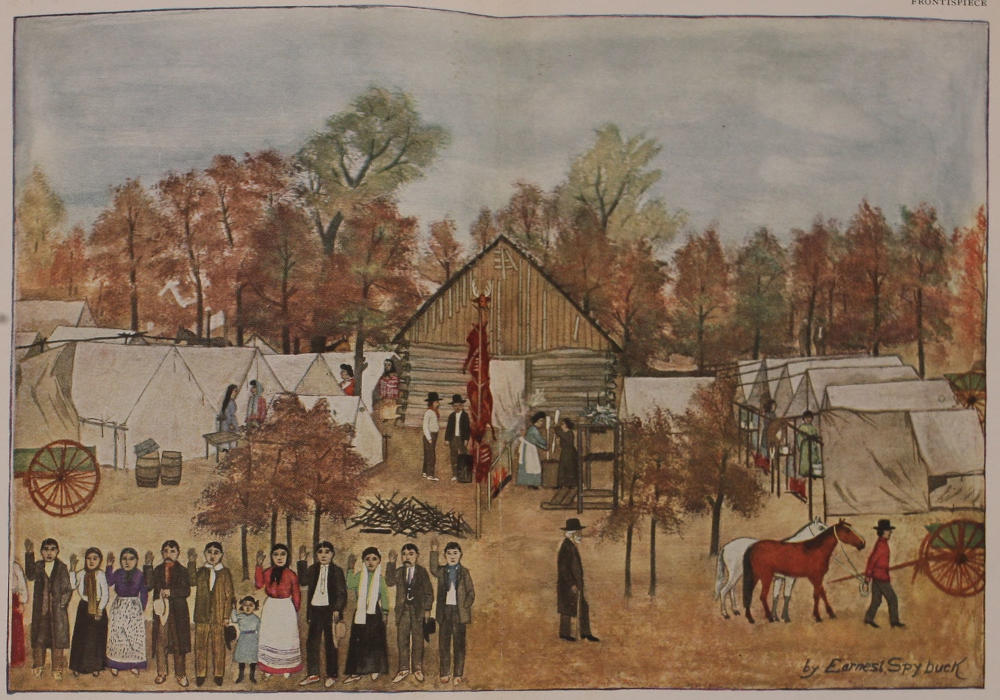
Spybuck, a Shawnee, whose paintings,
carefully made of Delaware ceremonies
at the writer’s request, form a valuable
adjunct to the text.
The works of previous writers have
been utilized where available, and much
has been learned from archeological discoveries
in the ancient territory of the
Lenape, not so much, of course, with
regard to the subject matter of the present
paper, as of others in preparation.
Most of the information was gathered
while the writer was collecting ethnological
specimens for the Heye Museum
of New York, now the Museum of the
American Indian, Heye Foundation, during
the years 1907 to 1910; but some of
the Canadian data were procured earlier
while in the field for Mr E. T. Tefft of
New York, whose collection is now in the
American Museum of Natural History.
Without knowledge of the Delaware language
in its divergent dialects, and without
any pretension of being a philologist,
the writer has endeavored to record the
Lenape words as he heard them, depending
for translation on his interpreter pro tem.
Hence some inaccuracies at least are inevitable.
The alphabet used is as follows:
VOWELS
CONSONANTS
a as in arch.
c like English sh.
ä as in cat.
‛ a slight aspirate.
â as in fall.
ⁿ gives the preceding vowel a nasal sound.
ai as in aisle.
e like a in fate.
ʷ faintly whispered.
ĕ as in met.
L a surd l.
i as in machine.
x like German ch.
ĭ as in hit.
Other consonants approximately as in English.
o as in note.
u as in flute.
ŭ as in but.
û as in full.
It was intended at first to publish the
mass of material thus obtained in the
form of a monograph on the ethnology
of the Lenape; but later it was seen
that while some phases of their culture
could be described in considerable detail,
there were others not so well represented
in our notes. It was therefore finally
decided to publish at once such parts as
were ready, in the form of separate
papers, and to leave the others until more
detailed information could be obtained.
No extended comparisons of the religion
and ceremonies of the Lenape with
those of other tribes will be attempted in
this paper, these being reserved for a
projected article to embody the results
of a comparative study of Lenape culture.
M. R. Harrington
RELIGION AND CEREMONIES OF THE LENAPE
By M. R. Harrington
CHAPTER I Pantheon — SUPREME BEING — EVIL SPIRIT — MANĬʹTOWŬK OF THE FOUR DIRECTIONS — THE SUN — THE MOON — THE EARTH — THUNDER BEINGS — KEEPERS OF THE HEAVENS — MĬSINGHÂLIʹKŬN, OR LIVING SOLID FACE — MOTHER CORN
To the mind of the Lenape, all
the phenomena of nature, all
the affairs of mankind, in fact
the entire world as we know it,
is under the control of invisible beings.
Some are great and powerful, others of
somewhat lesser influence, and so on
down to the humble spirits of plants and
stones. In some, good seems to predominate,
in others, evil; but most of the
manĭʹtowŭk, or spirits, seem to be, like
mortals, a mixture of desirable and undesirable
qualities.
All the Lenape so far questioned,
whether followers of the native or of the
Christian religion, unite in saying that
their people have always believed in a
chief Manĭʹto, a leader of all the gods,
in short, in a Great Spirit or Supreme
Being, the other manĭʹtowŭk for the
greater part being merely agents appointed
by him. His name, according
to present Unami usage, is Gicelĕmû‛ʹkaong‛,
usually translated, “great spirit,”
but meaning literally, “creator.” Directly,
or through the manĭʹtowŭk his
agents, he created the earth and everything
in it, and gave to the Lenape all
they possessed, “the trees, the waters,
the fire that springs from flint,—everything.”
To him the people pray in their
greatest ceremonies, and give thanks for
the benefits he has given them. Most of
their direct worship, however, is addressed
to the manĭʹtowŭk his agents, to whom
he has given charge of the elements, and
with whom the people feel they have a
closer personal relation, as their actions
are seen in every sunrise and thunderstorm,
and felt in every wind that blows
across woodland and prairie. Moreover,
as the Creator lives in the twelfth or
highest heaven above the earth, it takes
twelve shouts or cries to reach his ear.
An account of the worship of the Creator
will be given later in connection with
the description of the Annual Ceremony.
The Minsi had similar beliefs, but the
current name for the Great Spirit in that
dialect today is Pa‛ʹtŭmawas, interpreted
“He who is petitioned,” or Kĕ‛ʹtanĭtoʹwĕt,
“Great Spirit.”
It has been frequently stated that the
concept of a supreme being or chief of
the gods was not known among the
American tribes in precolonial times, and
that the “Great Spirit” concept, now
widely distributed among the Indians, is
entirely the result of missionary teaching.
This seems to have been the case in
some instances, but it is a mistake to
assume such a broad statement as a
general rule, on a priori grounds. To the
Indian mind, the spirits or gods partook
largely of the nature of mankind—Why
could not a chief of gods be as natural a
concept as a chief of men? In the case of
the Shawnee, the Creator or Great Spirit
is usually spoken of as a woman, “Our
Grandmother Pabothʹkwe”—surely not
a missionary idea!
Let us trace back the Great Spirit
concept among the Lenape, and find
what the early writers say about it. Perhaps
the earliest is in Danker and Sluyter’s
Journal[2] of about 1679, in which an
old Indian living near Bergen, New
Jersey, is quoted as saying: “The first
and great beginning of all things, was
Kickeron or Kickerom, who is the origin
of all, who has not only once produced or
made all things, but produces every day....
He governs all things.”
William Penn,[3] in a letter dated Philadelphia,
August 16, 1683, says: “They
believe a God and Immortality; for they
say, There is a King that made them,
who dwells in a glorious country to the
Southward of them, and that the Souls
of the Good shall go thither, where
they shall live again.” Further confirmation
is given by Holm[4] in his book
first published in 1702, where he says,
“They acknowledge a Supreme Being,
a Great Spirit, who made the heavens
and the earth.”
Zeisberger[5] makes it even stronger, for
he wrote, about 1779: “They believe and
have from time immemorial believed that
there is an Almighty Being who has created
heaven and earth and man and all
things else. This they have learned from
their ancestors.” Heckewelder[6] (p. 205)
adds more details in his book, originally
published in 1818: “Their Almighty
Creator is always before their eyes on all
important occasions. They feel and
acknowledge his supreme power.... It
is a part of their religious belief that there
are inferior Mannittōs, to whom the
great and good Being has given command
over the elements.”
Finally, in the little work ostensibly
dictated by the Minsi John Wampum,[7]
known as Chief Waubuno, undated, but
probably printed in the last quarter of
the nineteenth century, we have “The
Great Spirit, whom we call in Munsee
or Delaware Kaunzhe Pah-tum-owans
or Kacheh Munitto (Great Spirit or
Benevolent Spirit), created the Indians.”
Thus we have a practically unbroken
chain of authorities, including most of
the best ones since 1679, all speaking of
the “Great Spirit” as a well-developed
concept. But Brainerd,[8] writing in 1745,
is not so positive in his statements, for
he speaks of their notions being “so
dark and confused, that they seemed not
to know what they thought themselves.”
He also says: “Before the coming of the
white people, some supposed there were
four invisible powers, who presided over
the four corners of the earth. Others
imagined the sun to be the only deity,
and that all things were made by him.
Others at the same time have a confused
notion of a certain body or fountain of
deity, something like the anima mundi.”
Later (p. 349) he quotes a converted
Indian conjurer, who, in describing the
source of his former power, tells how it
came from “a great man” who lived in a
“world above at a vast distance from
this. The great man was clothed with
the day; yea, with the brightest day he
ever saw ... this whole world ... was
drawn upon him, so that in him, the
earth, and all things on it, might be
seen.”
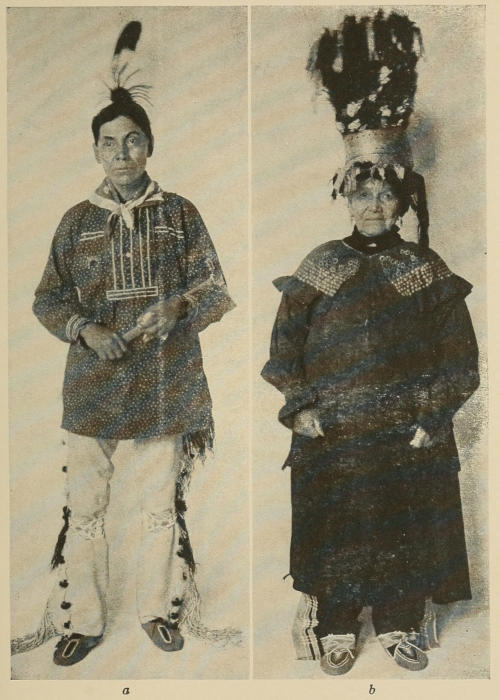
PL. I
LENAPE MAN AND WOMAN OF OKLAHOMA IN CEREMONIAL COSTUME
a, John Anderson (Witanaxkóxw‛ĕ); b, Mrs Elkhair (Kicilungonĕʹxkwĕ)
Perhaps, as Brinton[9] suggests, the
original Great Spirit of the Lenape might
really be called the God of Light. Brinton,
however, does not think that this
Spirit of Light was of necessity a good
spirit; still, the Lenape today who follow
the native religion, acknowledging his
goodness in their ceremonies, think that
“the Creator wants them to do right,”
and there is evidence[10] that the idea of
goodness has been associated with that
of the Great Spirit for a long time.
Assuming that the Creator of the Lenape
is the God of Light, what is it that leads
men to worship the source of light? Is
it not the self-evident benefits connected
with light? It seems to the writer that
goodness necessarily follows as an attribute
of such a deity.
The case is different with the Evil
Spirit. The modern Lenape in Oklahoma
make little mention of an Evil One,
and James Wolf, my principal Minsi
informant, did not speak of such a being
at all, but there is some evidence, however,
to show this belief to exist among the
Lenape in more recent years.
Some writers do indeed make frequent
mention of “the Devil” as figuring in
early Lenape belief, but they translate
the word “manĭʹto” as having that
meaning, whereas it really signifies a
supernatural being, good or bad. These
writers evidently regarded as “the Devil”
any deity not fitting into Christian
doctrine.
But the real truth seems to be that,
while in ancient times certain manĭʹtowŭk,
or spirits, were supposed to work evil,
the Devil (along with whiskey and other
blessings) was introduced by the whites.
The whole matter is well summed up by
Loskiel[11] where he says: “Besides the
Supreme Being, they believe in good and
evil spirits, considering them as subordinate
deities.... They seem to have
had no idea of the Devil, as the Prince of
Darkness, before the Europeans came
into the country.” This idea is also
supported by Zeisberger[12] and Brainerd,[13]
although Holm[14] seems to give contrary
evidence.
The Lenape now in Oklahoma believe
that when the earth was created, and
everything finished, the Creator gave
the four quarters of the earth to four
powerful beings, or manĭʹtowŭk, whose
duty it was to take care of these regions.
These personages are the cause of the
winds which blow from the different
directions, with the exception of the
tornado, which is thought to have a
different origin. In the winter, it is said
that the manĭʹtowŭk of the north and the
south are playing the game of bowl and
dice, with alternating fortunes. When
the north wind is successful it is cold
for a long time, until the south wind wins
again. These manĭʹtowŭk are called Moxhomsaʹ
Wähänjioʹpŭng‛, Grandfather at
the East; No‛ʹoma Cawaneʹyŭng‛, Grandmother
at the South; Moxhomsaʹ Eliosiʹgak,
Grandfather at the West; and
Moxhomsaʹ Lowaneʹyŭng‛, Grandfather
at the North, the expression endalŭn
towiʹyŭn, said to mean “who has charge
of it” being frequently added after the
name.
These are mentioned in the ritual of the
Annual Ceremony, and the people often
pray to them when gathering herbs or
preparing medicines, at the same time
offering tobacco.
The earliest record of this belief thus
far found dates from 1616, and while it
does not concern the Lenape proper, it
illustrates a similar notion among a cognate
people in Virginia. This is in
Strachey’s work,[15] in which he states,
“The other four [gods] have no visible
shape, but are indeed the four winds,
which keep the four corners of the earth.”
Brainerd[16] mentions the same belief as
being an old one among the Indians he
knew, who were mainly Lenape, and as
this was in 1745 we have at least a
respectable antiquity established for “Our
Grandparents at the Four Directions.”
Loskiel also mentions them.[17]
To the Sun the Creator gave the duty
of providing light for the people. The
Unami say that he is a very powerful
manĭʹto, and call him Gĭckokwiʹta. They
speak of him as always clothed in the
finest of deerskin garments, with his face
handsomely painted, and wearing red
feathers in his hair. Every day he
travels across the heavens from east to
west, stopping for a little while at mid-day,
then going on. At night he comes
back under the earth. The Minsi, according
to James Wolf, called him Kiʹzho
or Kiʹzhox, and Gickonĭkiʹzho is another
Unami form of the name. When praying
to the Sun, the Lenape usually addressed
him as “Elder Brother.”
Little is found in early writings concerning
the worship of the Sun, a mere
mention in Brainerd,[18] and Loskiel,[19]
by whom he is called “the sun or the god
of the day.”
None of my Lenape informants had
much to say of the Moon, except that it
was regarded as the manĭʹto charged with
the duty of supplying light by night, and
that it was addressed, like the Sun, as
Elder Brother. It is mentioned as a god,
and called the “night sun” by Loskiel.[20]
This is expressed by the Unami name
Piskeʹwenikiʹzho.
Some Lenape speak of the earth itself
as a manĭʹto, and call it “Our Mother”
because it carries and nurtures the people,
having been assigned that duty by the
Creator. Others, instead of the earth
itself, mention a spirit beneath or within
the earth, but apparently separate from
it. The earth is mentioned in a list of
gods by Loskiel.[21] In some localities,
at least, it was addressed in the Annual
Ceremony, and thanks were offered to it
for the benefits it gives to man.
Perhaps the most important of all the
subordinate manĭʹtowŭk, excepting only
the Sun and possibly the Keepers of the
Four Directions, were the Thunder Beings,
to whom the Great Spirit gave the
duty of watering the earth and protecting
the people against Great Horned Water-serpents
and other monsters. The Unami
told me that they are called Pethakoweʹyuk,
and are addressed as Elder
Brother. They are man-like beings with
wings, and always carry a bow and
arrows with which they can shatter trees.
When the first thunder is heard in spring,
the people say, “The Spring Flying
Things are coming” and it makes them
feel glad to think that winter is nearly
over. Some burn tobacco and pray to
the Thunders at this and other times,
and for this reason they claim that the
lightning never used to strike an Indian
or to destroy Indian property.
The late James Wolf related an interesting
Thunder myth, which will be
found in the paper on Lenape Mythology
to appear later, stating that the Minsi
called the Thunders Pileʹswak, or Pileʹsoak,
and believed them to exist in the
form of gigantic partridges, although
really persons, or rather manĭʹtowŭk.
They used to live in Niagara gorge
beneath the cataract, and could sometimes
be seen coming out, in the form of a cloud,
in which, as it rose, a play of lightning
was visible. There were said to be three
bands or parties of these mysterious
beings, each band consisting of three
Thunders.
Zeisberger[22] says, “Thunder is a mighty
spirit dwelling in the mountains,” and
Heckewelder,[23] “Indians, at the approach
of a storm or thunder gust, address the
Mannitto of the air, to avert all danger
from them.” As a rule, however, the
early writers do not seem to have noticed
this belief, or have included it loosely
under the worship of “gods” representing
the elements.
The Lenape now in Oklahoma believe
that each of the twelve heavens, in the
highest of which lives the Great Spirit,
is presided over by a manĭʹto who serves
as a messenger to repeat the prayers of
men until they reach the ear of the
Creator. They are represented by the
carved faces upon the posts inside the
temple, and are mentioned in the ritual
of the Annual Ceremony. I can find no
mention of them in early accounts of the
Lenape, however, unless the twelve gods
mentioned by Loskiel,[24] most of whom
have already been spoken of in this
chapter, may represent the same concept.
The Lenape today speak of these as
being related to the Living Solid Face,
who will now claim our attention.
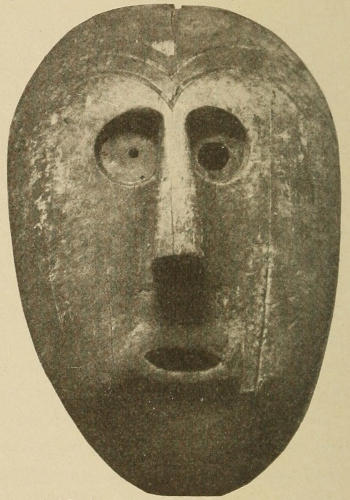
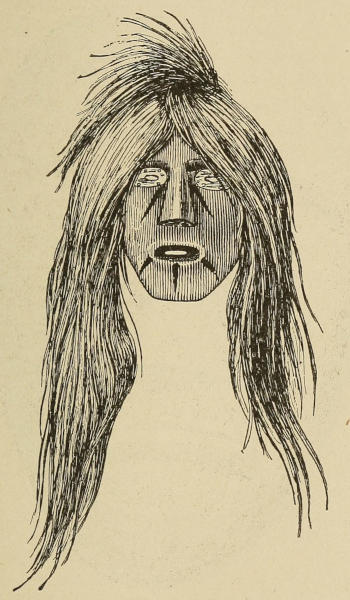
Fig. 1.—Mask of the Oklahoma Lenape. (Height,
14.5 in.)
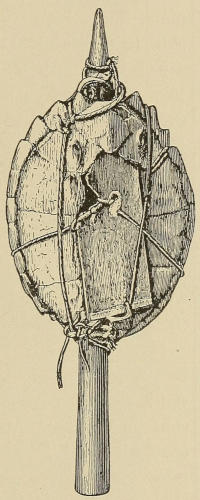
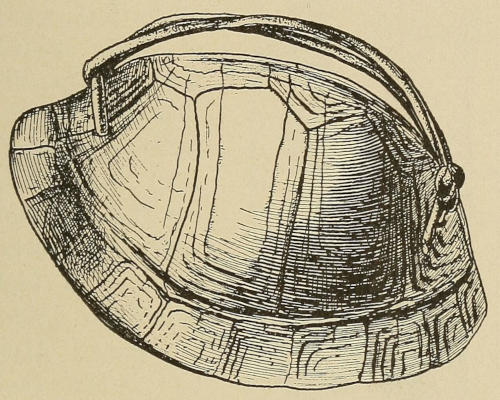
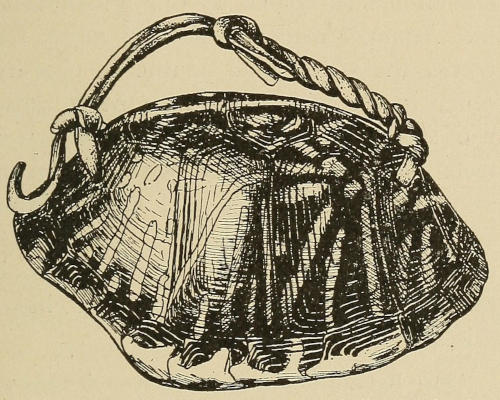
Fig. 2.—Rattle of turtleshell
used by Mĭsiʹngʷ‛. (Length, 16.7 in.)
The most remarkable deity of the
Lenape is the Mask Being, called by the
Unami Mĭsinghâliʹkŭn, which was interpreted
as “Living Mask,” or “Living
Solid Face.” According to the Unami,
this being was made guardian by the
Creator of all the wild animals of the
forest, and is sometimes
seen riding
about on the back
of a buck, herding
the deer; but he
lives in a range of
rocky mountains
above the earth.
His face is large
and round, the right
half being painted
red, the left black,
while his body is
covered with long
dark hair like that
of a bear. Unlike
most of the deities
in the Lenape pantheon,
he is represented
by a “graven
image,” a huge
wooden mask,
painted half red and half black (fig. 1);
which is left in charge of some family who
will take good care of it, and burn Indian
tobacco for it from time to time. With the
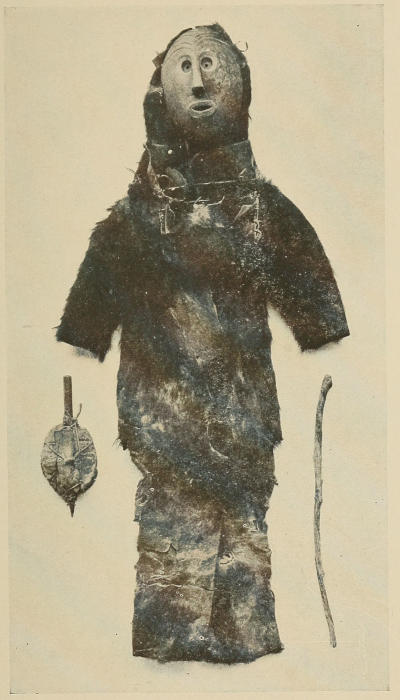
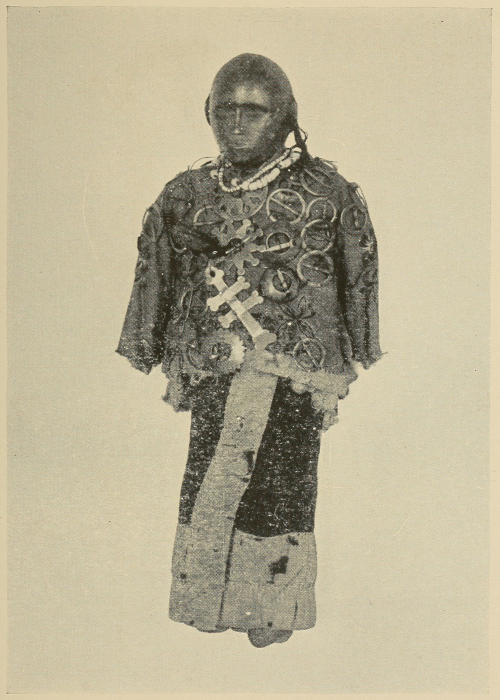
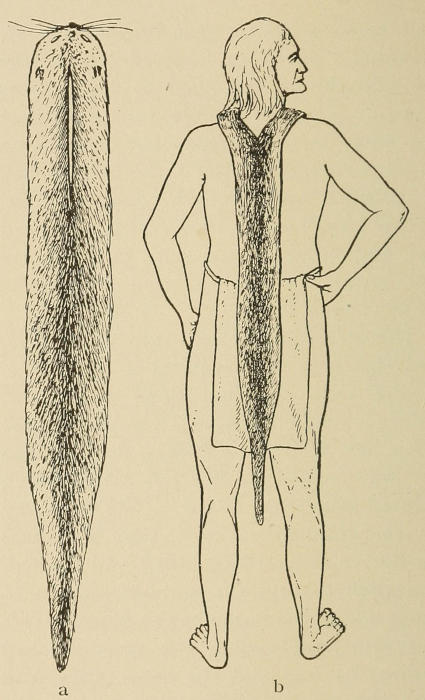
mask is kept a coat and leggings of bearskin
to represent the being’s hairy body,
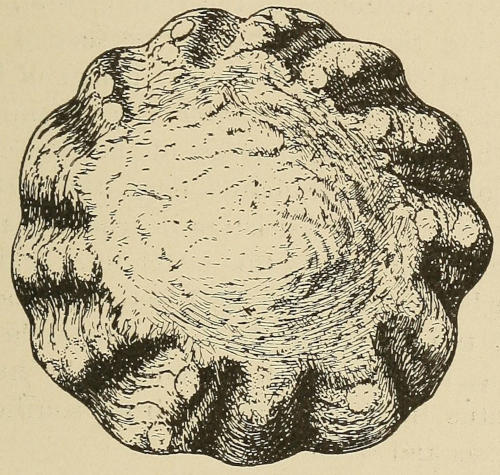
a peculiar rattle of turtleshell (fig. 2), a
stick, and a bag made of bearskin, all
used by the man selected to impersonate
Mĭsinghâliʹkŭn at the various ceremonies
when he is supposed to appear, and which
will be described later. To the back of
the mask is fastened the skin of the bear’s
head, which effectually conceals the
head and neck of the impersonator (pl. II),
while the bear’s ears, projecting, add to
the uncanny effect.
PL. II
COSTUME WORN BY IMPERSONATOR OF MĬSINGHÂLIʹKŬN
If any Lenape had a child who was
weak, sickly, or disobedient, he would
send word to the keeper of the mask
that he wanted Mĭsinghâliʹkŭn to “attend
his child.” It is said that it did not
take the impersonator long to frighten
the weakness, sickness, or laziness out
of the child, so that thenceforth it would
be strong and well, and would obey on
the instant when asked to do anything.
This effect was probably strengthened by
the mother saying, “If you don’t behave,
Mĭsiʹngʷ‛ will carry you off in a bag full
of snakes!” This seems to be the only
trace of the doctoring function of the
mask among the Unami. They also say
that when the keeper burns tobacco for
Mĭsinghâliʹkŭn and asks for good luck
in hunting, “it turns out that way every
time;” and if anyone has lost either
horses or cattle, whether by straying away
or through theft, he can go to the keeper
of the Mĭsiʹngʷ‛ with some tobacco and
recover them. All he has to do is to
explain his errand to the keeper, who in
turn informs Mĭsinghâliʹkŭn that they
want him to look for these particular
animals. The loser then goes home, and
in a few days the missing stock return,
driven back by this mysterious being.
If they were tied or hobbled, it is said
that the Mĭsiʹngʷ‛ appears to them and so
frightens them that they break loose and
come home. Mĭsinghâliʹkŭn has a special
ceremony, held in the spring, and
also participates in the Annual Ceremony
at the Big House. This Mĭsiʹngʷ‛ is also
called Weopĕʹlakis, to distinguish it from
another, kept by a different family, which
was not so important, and about which
little was known by my informants except
that, within their memories, it had
never appeared at the Annual Ceremony,
but that it probably had a spring dance
of its own. There is an indistinct tradition,
however, that in former times
several masks were seen at the Annual
Ceremony, and that half a day was given
up to them.
Miniature masks (fig. 3) were often
worn on the person as health or good-luck
charms, in former days usually suspended
from a string about the neck, but
in later times carried in the pocket. The
two large Unami masks in the Museum
of the American Indian, Heye Foundation,
are shown in pl. II and fig. 1.
Among the Minsi there are considerable
differences in belief and in practice,
their masks resembling those of the
Iroquois in many particulars. The late
James Wolf said that “Mizinkhâliʹkŭn”
was supposed to live among the rocks
on a hill, where he was first seen, and
told the people how to obtain his power.
The mask owners formed a society, which
had a special meeting-house and ceremonies,
and whose chief function it was
to expell disease. This will be discussed
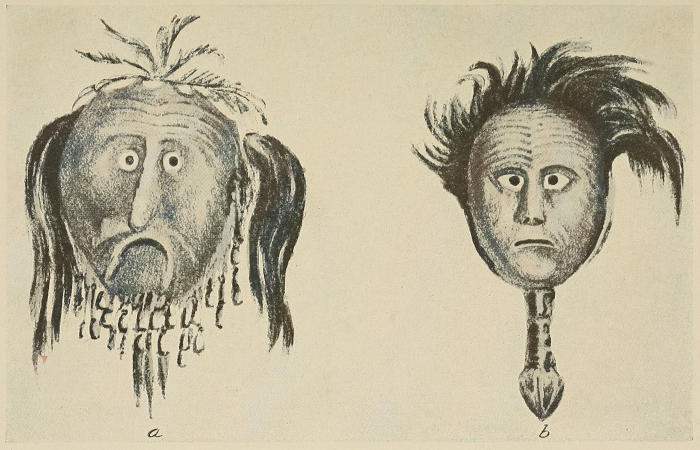
further in another paper. Peter Jones[25]
illustrates two Minsi masks in use in
the first part of the nineteenth century,
and these are here reproduced (pl. III).
The first he calls a “Muncey idol,” and
says that it was “delivered up by Joe
Nicholas on his Conversion to Christianity,”
and that “Me Zeengk is the name of
this God”; while the second, which he
names “a Muncey devil idol,” “formerly
belonging to the Logan family,” was
“delivered up on the 26th of Jan. 1842.”
Jones does not refer to these “idols” in
the text. The second mask illustrated
seems to have a turtleshell rattle tied
on its back, the handle projecting downward.
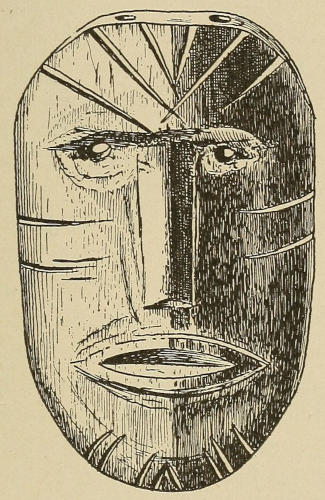
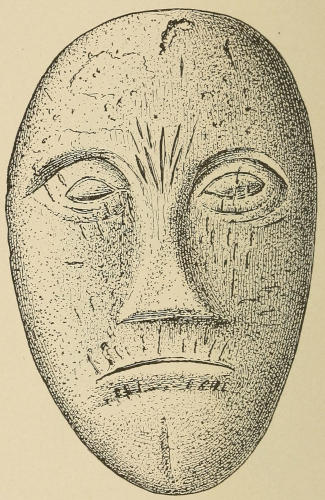
Another mask, found by the
writer among the Lenape at Grand river,
Ontario, and apparently of Minsi type,
is shown in fig. 4. It was collected for
Mr. E. T. Tefft, of New York, but is now
in the American Museum of Natural
History.
PL. III
MASKS OF THE MINSI (AFTER PETER JONES)
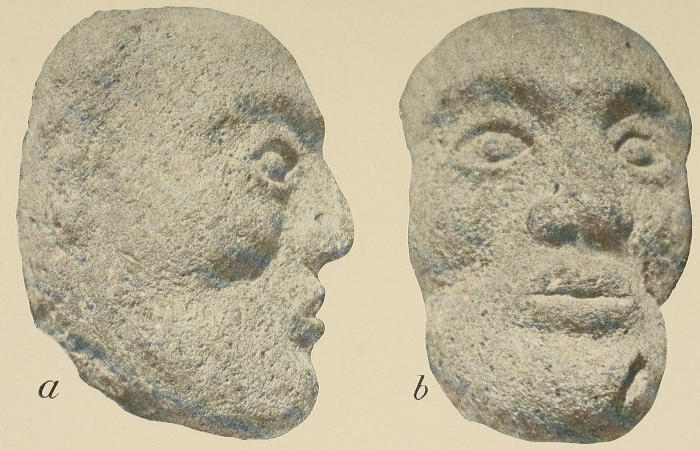
Some of our best evidence indicating
the early existence of belief in this
Mask Being among the Lenape is furnished
by archeology—by the finding of
a number of heads or masks of stone
(pl. IV) within the boundaries of their
former domain in New Jersey and the
vicinity,[26] which, when the rarity of such
objects in the surrounding regions is also
considered, seems quite significant. Such
stone heads even mark the trail of the
Lenape withdrawal westward through
Pennsylvania,[27] and have even been found
in Ohio, where they lingered for a time
(fig. 5).
Fig. 4.—Mask from the Canadian Lenape. E. T.
Tefft collection, American Museum of Natural History.
(Height of head, 14 in.)
Fig. 5.—Stone head or Mĭsiʹngʷ‛ from Ohio. (Height,
13.9 in.)
The best early description is given by
Brainerd,[28] who, in May 1745, while on
the Susquehanna above the English
settlements, saw a masked Indian who
must have been an impersonator of
Mĭsinghâliʹkŭn. It runs:
“But of all the sights I saw among them, or
indeed anywhere else, none appeared so frightful ...
as the appearance of one who was a devout
and zealous Reformer, or rather, restorer of
what he supposed was the ancient religion of the
Indians. He made his appearance in his pontifical
garb, which was a coat of bear skins, dressed
with the hair on, and hanging down to his toes; a
pair of bear skin stockings; and a great wooden
face painted, the one half black, the other half
tawny, about the color of an Indian’s skin,
with an extravagant mouth, cut very much
awry; the face fastened to a bear skin cap, which
was drawn over his head. He advanced toward
me with the instrument in his hand, which he
used for music, in his idolatrous worship, which
was a dry tortoise shell with some corn in it, and
the neck of it drawn on to a piece of wood, which
made a very convenient handle. As he came
forward, he beat his tune with the rattle, and
danced with all his might, but he did not suffer
any part of his body, not so much as his fingers,
to be seen.”
With the exception of one minor point,
the “wry mouth,” this would be a good
description of the Mĭsiʹngʷ‛ outfit used
until recently by the Lenape in Oklahoma
(pl. II). On the following page, Brainerd
mentions “images” which seem to be the
Mĭsiʹngʷ‛ faces carved on the posts of the
Big House.
PL. IV
STONE HEAD OR MĬSIʹNGʷ‛, FROM STATEN ISLAND, N. Y.
(Staten Island Institute of Art and Science)
Zeisberger[29] also refers to the masks in
these words:
“The only idol which the Indians have, and
which may properly be called an idol, is their
Wsinkhoalican, that is image. It is an image cut
in wood, representing a human head in miniature,
which they always carry about them either on a
string around their neck or in a bag. They
often bring offerings to it. In their houses of
sacrifice they have a head of this idol as large as
life put upon a pole in the middle of the room.”
In his Dictionary, Zeisberger gives the
word for “idol” as mĕsinkʹ, so it seems
probable that the W in “Wsinkhoalikan”
is a misprint for M.
One of the important manĭʹtowŭk of
the old days was the Corn Goddess,
known as “Mother Corn” of whom one
of the Unami legends collected by the
writer relates that “It was God’s will
that the Corn Spirit abide in the far
heavenly region in the image of an aged
woman, with dominion over all vegetation.”
Although little remembrance of
the details of her worship can now be
found among the Oklahoma Lenape, she
is mentioned as a Guardian Spirit; while
at the Minsi ceremonies at Grand River
Reserve in Ontario, she was one of the
twelve benefactors of mankind to whom
the thanks of the people were offered,
and Minsi women mentioned “Sister
Corn” in praying for good crops in the
corn fields; while Zeisberger[30] says that
the presiding Manĭʹto of Indian Corn or
maize was spoken of as the “wife” of
the Indian, and was offered bear’s flesh.
CHAPTER II Minor Deities — DOLL BEING — TORNADO — SNOW BOY — COMET — EVIL MANĬʹTOWŬK — ANIMAL SPIRITS — PLANT SPIRITS — LOCAL GENII
The masks described in the last
chapter are merely representations
of a supernatural being,
and are not supposed to be the
dwellings of a spirit or spirits except
when worn by an impersonator, who is
said to become imbued with the spirit
when the mask is donned; nor are they
usually supposed to possess inherent
power, except as symbols of Mĭsinghâliʹkŭn.
But the Lenape had also a class of
images, usually of wood, representing the
human form, which were supposed to
possess life, or at least to be the residence
of spirits, which, so far as can be learned,
had no separate existence. They were
supposed to understand what was said
to them, and to have the power of protecting
the owner’s health, to enjoy
offerings, resent ill-treatment, and in fact
seem to fall into the class of true fetishes.
Usually, but not always, representing the
female figure, they were kept as a rule by
women, and were given yearly feasts, at
which outfits of new clothes were put
on them. The native name in Unami is
O‛ʹdas; in Minsi, Naniʹtĭs. The ceremonies
and beliefs associated with them
will be described later, in the chapter on
minor ceremonies. Most of the early
writers seem to have overlooked them,
which is not surprising, since they were
matters of personal and not of public
concern, and their rites were held in
private. John Brainerd, however, mentions
an “idol image”[31] which seems to
be of this class, and a Minsi specimen is
figured by Peter Jones[32] and mentioned
by him in a footnote. This was afterward
procured by the writer from Jones’
son, and is now in the American Museum
of Natural History (pl. VIII). John
Brainerd (brother of the better known
David) made his note of the custom
about the middle of the eighteenth
century, while that of Jones dates from
about a century later.
Besides the gods hitherto named there
were many other deities of lesser importance.
The tornado, for instance, was
one of these beings classed as manĭʹtowŭk.
He is mentioned as a giant in size, walking
on his hands when in action, his long hair
entangling and sweeping away forests
and villages; and sometimes as a winged
being. When a “cyclone” was seen
approaching, some would burn tobacco,
and addressing the roaring monster, as
“Grandfather,” would pray that he turn
aside and leave the village in peace.
Others, scorning such measures of conciliation,
would burn old moccasins and
rubbish, advising the destroyer to turn
aside if he wished to escape the stinging
smoke; while still others, even less conciliatory,
threatened him with the edge
of an axe, vowing they would “break a
wing for him” if he came their way. It
was commonly said in the tribe that on
account of these practices the Lenape
suffered little from this evil manĭʹto.
Another minor manĭʹto is Snow Boy, a
being who is supposed to control snow
and ice, but who is different from “Our
Grandfather at the North,” who merely
supplies the north wind. Offerings were
made to Snow Boy to insure a proper
amount of snow for tracking in the winter
hunt. Further information concerning
these last two manĭʹtowŭk will be found
in the paper on Lenape Mythology, now
in preparation.
There is a third manĭʹto called Elauʹnato,
which some Lenape say means
“Comet,” others “Shooting Star.” When
a war is impending, says the legend, this
being may be seen flying through the air,
carrying a bunch of human heads. After
Elauʹnato has passed, if one listens he will
hear a distant rumbling sound, for this
manĭʹto knows beforehand where the
fighting will take place, and drops the
heads on the spot, and the noise of their
fall is a roar like thunder.
Both the Great Horned Serpents,
monsters living in the rivers and lakes,
and the Giant Bear were considered evil
manĭʹtowŭk, the only good derived from
them being, in the first case, charms
made of the scales, bone, or horn of the
monsters, supposed to bring rain; and,
in the second case, a medicine made from
the tooth said to have the power of
healing wounds. Children were accustomed
to hunt in the sand for tracks of the
Little People, comparable with fairies
or elves among the whites.
The concepts regarding the numerous
animal spirits who were believed to offer
themselves as guardians for mankind,
are rather hard to define. Most Indians
seem to regard their mysterious animal
helper not as the spirit or soul of any
particular animal taken as an individual,
but as a spirit representing the entire
species as a whole and partaking of the
nature of the species, at the same time
having human and manĭʹto attributes.
Brainerd[33] makes some interesting remarks
on this subject, which are worth
quoting:
“They do not indeed suppose a divine power
essential to, or inhering in, these creatures; but
that some invisible beings ... communicate to
these animals a great power; ... and so make
these creatures the immediate authors of good
to certain persons. Whence such a creature
becomes sacred to the persons to whom he is
supposed to be the immediate author of good,
and through him they must worship the invisible
powers, though to others he is no more than any
other creature.”
Certain it is, if a Lenape states that his
blessing or power comes from “the otter,”
he does not mean some particular otter,
but a spirit otter whose existence is
independent of the life of any particular
animal. However, such an animal was
supposed, like a man, to have a spirit or
soul of its own.
When gathering herbs for medicine it
was customary to offer prayers to certain
spirits. Some seem to have prayed at
this time to the four directions, others
to the presiding genius of the species of
plants they sought, or to the spirit of
the individual plant itself. The Minsi
say that only certain plants were thus
addressed. The Corn Spirit has already
been mentioned.
Certain localities, it is said, were
thought to be the dwellings of local
genii, to whom offerings were occasionally
made, especially such places as displayed
curious or unusual natural features, while
even certain stones were said to have an
animate principle or indwelling spirit.
CHAPTER III Survival of the Soul — THE SOUL — THE LAND OF SPIRITS — GHOSTS AND MEDIUMSHIP — EARLY ACCOUNTS
The doctrine of the survival of
the soul or spirit after the
death of the body, forms an
integral part of Lenape belief.
The spirit is supposed to leave the
body at the moment of dissolution, but
remains in the vicinity eleven days, during
which time it subsists on food found in
the houses of the living, if none has been
placed at the grave. Some say that the
actual food is not consumed but that the
ghost extracts some essence or nourishment
from it.
On the twelfth day the spirit leaves the
earth and makes its way to the twelfth or
highest heaven, the home of the Creator,
where it lives indefinitely in a veritable
“Happy Hunting Ground,” a beautiful
country where life goes on much as it
does on earth, except that pain, sickness,
and sorrow are unknown, and distasteful
work and worry have no place; where
children shall meet their parents who
have gone before, and parents their
children; where everything always looks
new and bright. There is no sun in the
Land of Spirits, but a brighter light
which the Creator has provided. All
people who die here, be they young or
old, will look the same age there, and the
blind, cripples,—anyone who has been
maimed or injured,—will be perfect and
as good as any there. This is because the
flesh only was injured, not the spirit.
This paradise, however, is only for the
good, for those who have been kind to
their fellows and have done their duty
by their people. Little is said of those
who have done evil in this world, except
that they are excluded from the happy
Land of Spirits. Some Unami say that
the blood in a dead body draws up into
globular form and floats about in the air
as a luminous ball, but this is not the
true spirit.
The Minsi seem to have retained a
more archaic belief, for they say that the
Land of Spirits lies to the southwest, in
a country of good hunting. Here they
say, the wigwams of the spirits are always
neat and clean, and happiness prevails.
But between our world and the spirit
country flows a river which the spirit
must cross on a slender foot-log or in a
canoe.
Ghosts do not seem always to have
left the earth at the expiration of the
twelve days, or else they have the power of
returning, for the Lenape claim that boys,
dreaming for power, have sometimes been
pitied and given some blessing by the
ghosts, who remained their guardian
spirits through life. Such people were
considered to have the power of talking
with the departed and sometimes made
a practice of it, but mediumship was by
no means confined to them. Among the
Minsi formerly they were accustomed to
hold meetings in the burial grounds at
certain times, when some medium, it
is said, would communicate with the
spirits.
The late James Wolf, one of the principal
Minsi informants, was said to have
this power. One time a man was
drowned in the Thames river near
Munceytown in Ontario, and the body
could not be located. Wolf, it is said,
walked up and down the river-banks,
with a companion, talking to the water.
At last a strange sound was heard, and
Wolf stopped. “That was the dead
man’s spirit,” he said; “the body lies
right over in that hole.” Surely enough,
when they procured a boat, they found
the body in the hole, wedged beneath a
sunken log.
Certain regular ceremonies were held
by both the Unami and the Minsi in
honor of the dead, and will be discussed
in a later paper.
Penn.—In William Penn’s letter,[34]
dated August 16, 1683, is the first mention
of any details of Lenape beliefs regarding
the soul that has been found.
He says:
“They say there is a King that made them, who
dwells in a glorious Country to the Southward of
them, and that the Souls of the Good shall go
thither, where they shall live again.”
Brainerd.—The same Indian whom
Brainerd saw in 1745 dressed in a bearskin
costume and with a wooden mask,
told him[35] that—
“departed souls all went southward, and that the
difference between good and bad was this: that
the former were admitted into a beautiful town
with spiritual walls, and that the latter would forever
hover around these walls, in vain attempts
to get in.”
Later,[36] Brainerd speaks of the Spirit
Land of the Lenape to the southward as
being “an unknown and curious place”
in which the shadows of the dead “will
enjoy some kind of happiness, such as
hunting, feasting, dancing, and the like.”
One of his Indian informants defined the
kind of “bad folks” who would be unhappy
in the hereafter as “those who lie,
steal, quarrel with their neighbors, are
unkind to their friends, and especially to
aged parents, and, in a word, such as are
a plague to mankind.” These would be
excluded from the “Happy Hunting
Ground,” not so much as a punishment
to themselves, as to keep them from
rendering unhappy the spirits of the good
inhabiting the “beautiful town.”
Zeisberger.—About 1748, according to
Zeisberger,[37] a number of preachers appeared
among the Indians, who claimed
to have traveled in Heaven and conversed
with God. Some exhibited charts
of deerskin upon which were drawn maps
of the Land of Spirits and figures representing
other subjects used in their
preaching. Some of their ideas concerning
the Son of God, the Devil, and Hell,
are evidently derived from the whites;
others seem more aboriginal in character,
such as purification by emetics, twelve
different kinds being used. He wrote:
“Other teachers pretended that stripes were
the most effectual means to purge away sin.
They advised their hearers to suffer themselves
to be beaten with twelve different sticks from
the soles of their feet to their necks, that their
sins might pass from them through their throats.
They preached a system of morals, very severe
for the savages, insisting that the Indians abstain
from fornication, adultery, murder, theft, and
practise virtuous living as the condition to their
attaining after death the place of good spirits,
which they call Tschipeghacki, the ‘land of
spirits,’ where the life is happy, and deer, bear
and all manner of game are abundant and the
water is like crystal. There nought was to be
heard save singing, dancing and merry making....
The passage thither is the Milky Way....
Whoever reaches that place will find a city of
beautiful houses and clean streets. Entering a
house he will see no one, but have good things to
eat placed before him, a fire made and a bed
prepared—all of which is done by spirits invisible
to him. Others assert that such an one will see
the women coming with baskets on their backs
full of strawberries and bilberries, large as apples,
and will observe the inhabitants daily appear in
fine raiment and live a life of rejoicing.—The bad
Indians ... will not reach the place, Tschipeghacki,
but must remain some distance away,
able to see those within dwelling happily, but
not able to enter. They would receive nothing
but poisonous wood and poisonous roots to eat,
holding them ever near the brink of a bitter
death, but not suffering them to die.”
Zeisberger usually specifies when his
information is derived from tribes other
than the Lenape, from whom most of his
data were procured; so it is probable that
the following quotation applies to them,
although in part somewhat at variance
with our other knowledge. He says:[38]
“They believe in the immortality of the soul.
Some liken themselves to corn which, when
thrown out and buried in the soil, comes up and
grows. Some believe their souls to be in the sun,
and only their bodies here. Others say that when
they die their souls will go to God, and suppose
that when they have been some time with God
they will be at liberty to return to the world
and be born again. Hence many believe ...
that they may have been in the world before.
“They believe also in the transmigration of the
soul. Wandering spirits and ghosts, they claim,
sometimes throw something into a public path
and whoever goes over it is bewitched and
becomes lame or ill.”
Such was the Lenape belief with regard
to the powers that control the world,
and such were his notions concerning the
souls of men. The main channel of communication
between this great supernatural
realm and mankind was, to the
Lenape as to so many other tribes of
Indians, the dream or vision, experienced
either while fasting or in natural sleep.
This subject will be considered in the next
chapter.
CHAPTER IV Visions and Guardian Spirits — INITIATION OF BOYS — OTHER VISIONS — THE GUARDIAN SPIRIT
The most vital and intimate
phase of Lenape religion is the
belief in dreams and visions,
and in the existence of personal
guardian spirits or supernatural
helpers—concepts of wide distribution
among the North American tribes, but
rarely, perhaps, so vivid or well-developed
as we find them here. The vision was the
point of contact, the channel of communication,
in Lenape belief, between
the great and marvelous supernatural
world and the sphere of everyday human
life. In a vision the youth first found his
guardian spirit, to whom he would always
appeal, as his own special friend in the
supernatural hierarchy, for aid and comfort
in time of trouble, and for the revelation
of coming events. He felt that this
being took a close personal interest in his
affairs, while the greater gods, including
the Great Spirit himself, were so remote
and so occupied with controlling more
important things that they might not
notice or concern themselves with the
affairs of one individual man. Therefore
the bulk of his prayers and offerings
went to his guardian spirit. If a Lenape
won great success on a war expedition
or a hunting trip, he was sure the spirit
had helped him; if unlucky, he believed
that for some reason his guardian had
become estranged, or had been overpowered
by superior and malevolent
forces. A man might become a sorcerer
or a shaman at the behest of his guardian
spirit, given in a dream or vision, or
change his mode of life in other ways.
Not every Lenape was blessed with such
a guardian; yet many were so favored,
usually in their boyhood days. To be
eligible for supernatural favor, the youth
had to be piʹlsŭⁿ, or pure, which means
that not only must he be chaste, but
that he must have kept strictly all the
taboos against eating food prepared by
women in their periodic condition, etc.
Old Lenape say that, as the children of
the tribe are reared nowadays in the
same way as the whites, they can no
longer be piʹlsŭⁿ, and the Powers will
speak to them no more. This is a sad
matter, for it means the loss of their
principal ancient ceremonies, at which
only those blessed with a vision can take
active part. The old people feel it
keenly that there will be no one left to
conduct the rites when the last of their
generation has been laid away.
Parents were especially anxious, of
course, that their sons should have supernatural
aid, hence, when a boy reached
the age of about twelve years, they would
frequently pretend to abuse him, and
would drive him, fasting, out into the
forest to shift as best he might, in the
hope that some manĭʹto would take pity
on the suffering child and grant him
some power or blessing that would be his
dependence through life.
Sometimes a man who had several sons
would take them out into the forest and
build them a rude little tent, and here
they would remain for days at a time.
During the day the boys were not permitted
to eat, but just before sunrise
every morning each was given a medicine
to make him vomit, after which a tiny
piece of meat was given him, about the
size of a man’s little finger. Occasionally
the boys became able to fast in this way
for twelve days, at the end of which time,
the Lenape say, some had received such
power that they were able to rise into the
air, or go down into the ground, or
prophesy events a year or two ahead,
with the magic aid of the supernatural
being that had taken pity on them.
It sometimes happened also that people
received visions of power in natural sleep
without fasting, or even when wide
awake, while feeling melancholy and
heartsick over the death of a loved one,
or suffering other misfortune or trouble.
As they sat brooding, some manĭʹto might
address himself to them, and give them
advice and comfort, or endow them with
some kind of power. Women occasionally
had visions of this kind.
Whatever the precise circumstances of
its appearance, the guardian spirit in
many instances was said to show itself
first in human form, and it was only
when it turned to leave that its real
shape (of an animal, for instance) was
noticed by the recipient of its blessing.
Sometimes the interview was quite long
and the directions given by the manĭʹto
(for ceremonies, etc.) quite explicit; on
other occasions they were very vague and
cryptic. Frequently, according to the
stories told, some tangible object, called
by the Unami the opiʹna, or blessing,
was handed by the manĭʹto to the recipient
of his favor, who usually swallowed
it. Some recipients were called
on, however, to make and keep some
symbol of their protector, which was
usually worn on the person in the form
of a charm.
Favored Individuals.—Persons favored
with a guardian spirit usually
became prominent among their people
and were held in high esteem. They
composed rythmic chants referring to
their visions for use at the Annual Ceremony
(which will be discussed in the
next chapter), and dance songs to accompany
them. Rarely were the words
of either chants or songs at all definite:
as a rule they merely mentioned attributes
of the singer’s guardian, or incidents
of their first meeting, without stating
outright what the guardian spirit was,
or telling a consecutive story of the vision.
Most Lenape who have had such
visions can not be induced to tell the
details; but the following examples of
such experiences, imperfect in many
points, were finally obtained. Incomplete
though they are, they will give some
idea of this class of beliefs and in this
way may prove of value.
Unami Examples.—One old man
named Pokiteʹhemun (“Breaker”),
known to the whites in Oklahoma as
George Wilson, saw in his vision what
seemed to be a man who held out to
him a white round object like a boy’s
marble, then tossed it to him. Pokiteʹhemun
caught it and swallowed it.
Then as it turned to go, the being cried
“Kwank! kwank! kwank! The ducks
have a praying meeting in the fall of the
year!” As it turned, Pokiteʹhemun noticed
that it was really a duck instead of
a man, and was colored half black and
half white.[39]
Pokiteʹhemun could pound on his chest
at any time and apparently cough up a
round marble-like object, which he would
show in his hand and then appear to
swallow again. This he claimed was the
opiʹna given by his guardian spirit.
He seemed to regard the words of the
duck spirit as an admonition to do all
he could to keep up the tribal Annual
Ceremony, which was held in the fall;
while the “blessing” gave him good
fortune. The chant he composed for use
at this ceremony is as follows:
Lawulĕnjei
Wŭⁿjegŭk toxweyu
Kwĕⁿnanowagŭⁿ
Wailaⁿgomaⁿole
Lĕnape, eli nanŭⁿ
Telowaⁿ, lowaⁿ
Nuⁿni, ĕndageko
Lowaet, lowa nŭⁿni.
The interpreter’s translation, which is a
somewhat free one, follows:
“When he opened his hand
Something came out of the center
That’s his blessing
(For?) our kinfolks, the
Lenape; because that
Is what he said, he did say
This, when
He spoke, he said this.”
Then came the dance song:
He-e-e-e nehani
Latamaⁿne
Nehani lamaⁿne
Kwĕⁿnanowagŭⁿ, nowagŭn
Hayelaⁿgomaⁿ
Gweheyeha
Gehe!
This, according to the interpreter, means
simply, when stripped of its superfluous
syllables, “We own a temple—his blessing—our
kinfolks.”
Another man saw in his boyhood vision
the Mĭsinghâliʹkŭn, or Living Solid Face,
riding on a deer. I was unable to get the
details of their meeting, or the chant,
but this is the dance song:
Hehotawegeʹna
Hotowegeʹna
Xingâloʹ pai awheʹwani
Mĭsinghâliʹkŭn
Hâliʹkŭne
A-heʹ-he-heʹ!
This, the interpreter said, means
“Riding it, riding it, big buck deer, this
one, Mĭsinghâliʹkŭn!” Seldom do the
songs or chants refer so definitely to the
protector as does this.
A third Lenape, when a boy, was sent
out to the corn-field to drive away the
crows. As he stood by the field he saw
them flying around to light on a tree
near by. Suddenly someone spoke to
him, and among the things said (which
were not revealed to me) were the words
“I like this Lenape food,” referring to
the corn. The boy thought a man was
addressing him, until the person suddenly
flew away in the form of a crow, crying
“Ha! Ha! Ha!” I failed to get the Indian
words for the song, and my informant did
not remember the chant, but the translation
of the song was given as follows:
“I like this Lenape food:”
I never knew a crow said that
Till the crow was cawing
“Ha! Ha! Ha!”
A fourth had seen some kind of an
animal in his vision, but never told any
of his tribesmen what it was. His song,
as now remembered, was translated thus:
Come, follow me,
I am going
Out into the country.
A fifth had “Mother Corn” (the Corn
Spirit) for a guardian, but only part of his
song is remembered.
“All my children
Are glad when I come out!”
Some people were helped by the spirits
of the dead in the same way that others
received aid from animal or other nature
spirits.
“Old man” Secondine, now dead, a
well known Oklahoma Lenape, was one
of these. When a boy his parents drove
him out in the woods, as was the custom,
in the hope that he might receive a supernatural
helper. After wandering about
for a time, he took refuge in a large
hollow tree, and made that his camping
place. Before long he was visited by
apparitions of persons he knew to be
dead, who took pity on his starving condition,
and brought him food which they
had taken at night from the houses of the
living, this being the way that disembodied
spirits are supposed to get
nourishment when visiting the scenes of
their earthly life. In the meantime his
parents were unable to find him, and
searched for him without avail until the
ghosts finally revealed to them his camping
place, and then he was brought safely
home. Ever afterward he claimed the
ghosts as his guardians, and like others
blessed with this kind of helpers, was
said to hold some kind of communication
with the departed.
Minsi Examples.—The late James
Wolf, my principal Minsi informant, was
said to possess this power, as was stated
in the preceding chapter. He had, moreover,
received another vision when a boy,
but had made little, if any, use of it,
because of his profession of Christianity.
One time in his boyhood days, he told
me, he thought or dreamed (he was not
asleep at the time) that there was no
water in the river, and that he went
down into its bed and found only one
little hole containing water. In this
was a creature resembling a catfish, yet
somewhat different, and near it was an
ordinary crayfish, while on the surface
of the water walked a number of little
flies. The boy thinking what he had
seen was real, ran home in haste to tell
his father. The father walked down with
him to see, but stopped on the bank where
the edge of the water had been, while the
boy ran on down to his pool. The
river-bed seemed dry to him, but his
father would not come, saying that the
river was full of water. The boy then
came out and they started for home, but
before they were out of sight, the lad
looked back. To his surprise, the river
was full as usual.
The father, who was Flying Wolf, a noted
Minsi warrior, had been favored himself,
when a boy, with a rather unusual sort of
vision, which James Wolf related to me, as
nearly as possible the way the old man
used to tell it at the Annual Ceremony.
“When I was a boy, I was once fast
asleep on a hill near a little creek.
Someone said, ‘Wake up! Let us go
where our friends are!’ So I got up and
followed him across the little creek and
up a hill, where I saw six men sitting on
a log. Then I went up and shook hands
with them all. After they had shaken
hands with me they all danced around in
a ring.” At this point he used to sing
one verse of his dance song—
Wĕmi wangoⁿtowak kewiha
All greet one another
Yoki lĕnape witci.
Now Lenape at the same time
E-ye-he-ye-ĕ!
“They told me, ‘We will go to see our
friends,’ so I went with them. Every
now and then they stopped and danced
around as they had done before. After
a while one of them told me to look
toward the south, and there I saw a
black cloud in which the lightning flashed.
‘Would you like to go there?’ they asked
me. I answered ‘No.’ Then one asked
if I wanted to go that way, pointing to the
northeast, where the sky was blue and
bright, to which I answered that I would
rather go in that direction toward the
clear sky. A little farther on they said:
‘We will now leave you. Watch us as
we go.’ They went to the east a little
way, and then I saw them trotting.
They were wolves, and I had thought all
the while that they were human beings.”
Verses of the dance song were sung at
intervals during this speech. From analogy
with other visions, such as are
recorded above, one would think that
the six wolf-men must have become Flying
Wolf’s protectors, but instead, it was
a Thunder Being that became his principal
guardian, whose participation in the
vision is merely inferred from the mention
in the speech of the black cloud and the
lightning. Evidently this Thunder Being
was not offended when Flying Wolf
told his guides that he would rather go
toward the clear sky than toward the
black cloud.
The Minsi say that when Flying Wolf
recited his vision in the Big House ceremonies,
he moved everyone, some even to
tears. After he had finished, they say, a
thunder-shower would almost always rise.
He would become strangely excited when
the dark clouds began to bank up on the
horizon and spread themselves over the
land. Stripping himself to the breech-cloth,
he was ready to go out when the
storm broke, for he would never stay
beneath a roof at such a time. He
loved to expose his body to the driving
gusts of wind and rain; the appalling
roar was music to his ears; while the
lighting, to the eyes of the frightened
onlookers, seemed to play about his very
body. He used to say that if he stayed
indoors the lightning display would be
so terrible that the others in the house
could not endure it. No wonder they
used to say of him, “PilesʹwaL pewaʹlatcil!”
“He is in league with the Thunders!”,
or better, perhaps, “The Thunders
will protect him!”
Within the memory of Minsi now living
in Canada there were two members of the
tribe who claimed the Sun spirit, Kiʹzho
(or Kiʹzhox) as their protector. One of
these was known as “Old man” Halfmoon,
the other as “Muncey John”
Henry. Halfmoon, it is said, when he
wished to appear as a warrior, would
sometimes hold his bare hands up toward
the flaming face of his guardian, then
rub the palms down his cheeks. When he
removed his hands, it was seen that his
face, clean before, was now painted in brilliant
colors! “Surely,” the people cried,
“this man is in league with the Sun!”
That the idea of a tangible ‘blessing’
is found among the Minsi, as well as
among the Unami, is shown in certain
of their traditions.
Historical References.—Brainerd.—Brainerd
seems to have been about the
first author to recognize in any degree
the importance of the dream or vision in
Lenape religious belief. He says:[40]
“They give much heed to dreams, because they
suppose that these invisible powers give them
directions at such times about certain affairs,
and sometimes inform them what animal they
would choose to be worshipped in.”
Other remarks by Brainerd on the same
general topic were quoted in the preceding
chapter.
Zeisberger.—Zeisberger[41] also devotes a
paragraph to it, in which he says:
“Almost all animals and the elements are
looked upon as spirits, one exceeding the other in
dignity and power. There is scarcely an Indian
who does not believe that one or more of these
spirits has not been particularly given him to
assist him and make him prosper. This, they
claim, has been made known to them in a dream,
even as their religious belief and witchcraft has
been made known to them in a dream. One
has, in a dream, received a serpent or a buffalo,
another the sun or the moon, another an owl or
some other bird, another a fish, some even
ridiculously insignificant creatures such as ants.
These are considered their spirits or Manittos.
If an Indian has no Manitto to be his friend he
considers himself forsaken, has nothing on which
he may lean, has no hope of any assistance and is
small in his own eyes. On the other hand those
who have been thus favored possess a high and
proud spirit.”
Loskiel.—Loskiel’s account[42] seems
largely derived from the above. He remarks:
“The manittos are also considered as tutelar
spirits. Every Indian has one or more, which
he conceives to be peculiarly given to assist him
and make him prosper. One has in a dream
received the sun as his tutelar spirit, another the
moon; a third, an owl; a fourth, a buffaloe;
and so forth. An Indian is dispirited, and considers
himself as forsaken by God, till he has
received a tutelar spirit in a dream; But those
who have been thus favored, are full of courage,
and proud of their powerful ally.”
Heckewelder.—Heckewelder[43] devotes a
whole chapter to the subject, under the
head of “Initiation of Boys,” to which
the reader is referred, as it is all of interest,
but can not be reproduced here. I
will merely quote portions of one paragraph,
which will serve to show that this
author found approximately similar ideas
as had his predecessors, concepts which
still exist among the Lenape.
“When a boy is to be thus initiated, he is put
under an alternate course of physic and fasting
... so that he sees, or fancies that he sees
visions, and has extraordinary dreams. Then
he has interviews with the Manitto or with
spirits, who inform him of what he was before he
was born, and what he will be after his death.
His fate in this life is laid entirely open before
him, the spirit tells him what is to be his future
employment, whether he will be a valiant warrior,
a mighty hunter, a doctor, a conjuror or a
prophet.”
Later in the chapter Heckewelder mentions
the fact that persons favored with
such dreams considered themselves under
the protection of the “celestial powers,”
and mentions the “strength, the power,
and the courage” conveyed to them,
but lays more stress on the prophetic
side of these visions than on the actual
aid rendered, according to Lenape belief,
by the supernatural guardians.
Adams.—From Heckewelder’s time to
the present, I know of but one writer,
besides myself, who describes, from his
own observation, the Lenape belief in
visions and guardian spirits. This is
R. C. Adams,[44] himself of Delaware
blood, whose notes may be found in the
volume on Indians of the United States
Census Report for 1890 (p. 298 et seq.).
He says:
“It is believed by the Delawares that every
one has a guardian spirit which comes in the
form of some bird, animal, or other thing, at
times in dreams, and tells them what to do and
what will happen. The guardian spirit is sent
from the Great Spirit.”
Having now considered the very foundation
of Lenape religion, we may turn
with better understanding, to their great
Annual Ceremony.
CHAPTER V Unami Annual Ceremony — THE LEADER — OFFICERS — PREPARATIONS — CEREMONY COMMENCED — CHIEF’S SPEECH — RECITAL OF VISIONS — CONCLUSION OF RITES — DEPARTURE OF THE HUNTERS — PRAYER FOR THE HUNTERS — RETURN OF THE HUNTERS — NEW FIRE — USE OF CARVED DRUMSTICKS — TURTLE RATTLES — PHRATRY PRAYERS — WOMEN’S NIGHT — CONCLUSION OF CEREMONY — PAYMENT OF ATTENDANTS — FINALE — PAYMENT OF OFFICERS — VALUATION OF WAMPUM — INDIAN COMMENTS ON THE CEREMONY — Another Form of the Annual Ceremony
The great Annual Ceremony of
the Lenape now in Oklahoma
was and is held when the
leaves turn yellow in the fall
of the year, usually, according to the
“pale face” reckoning, some time between
the tenth and twentieth of October.
It is not exactly a tribal affair, although
the whole tribe participates, but must be
undertaken by some certain individual
of the proper qualifications who takes the
responsibility of “bringing in” the meeting
and acting as a leader.
The phratry to which this leader belongs
determines the exact form of the ceremonies
to be held; for each totemic group has a
ritual of its own, that of the Wolf, which is
here related, differing in some particulars
from the ceremonies as practised by the
Turtle or Turkey people. In former times,
it is said, when one phratry had finished its
twelve days of ceremonies, another would
enact theirs, followed by the third; but at
present qualified leaders are so few that it
seldom if ever happens that more than one
of them feels able to accept such exacting
duties in any one year.
This leader it is who sends a messenger
forth to notify the people what day the
ceremonies are to commence and to invite
them all to attend.
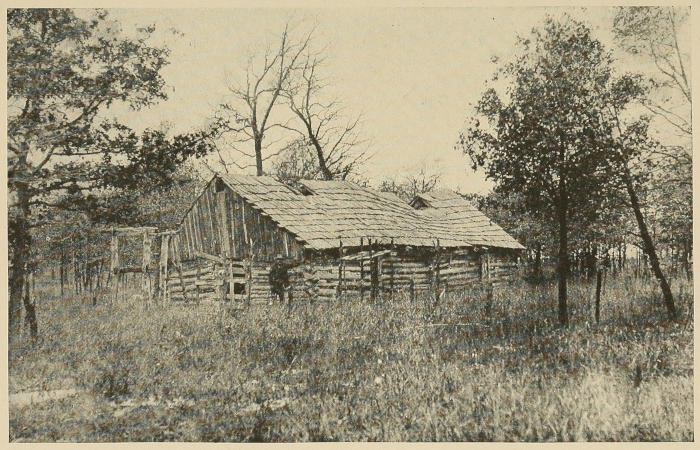
Several days before the date the wagons
begin to roll in and a white village of
tents springs up about the gray walls of
the old Big House, temple, or xiʹngwikan
(pl. V), standing on the banks of Little
Caney river, north of Dewey in northern
Oklahoma, far from any human habitation.
PL. V
LENAPE CEREMONIAL HOUSE NEAR DEWEY, OKLAHOMA
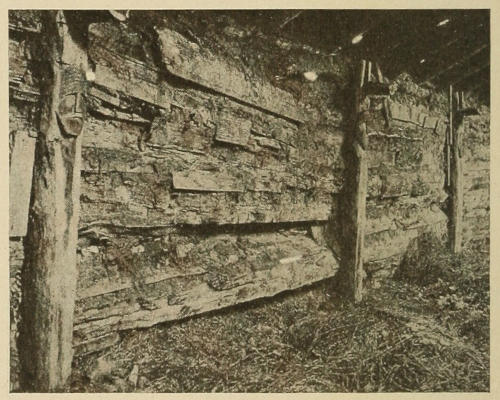
Built of rough logs, the Big House is
now provided with a roof of hand-split
shingles pierced by two great smoke-holes,
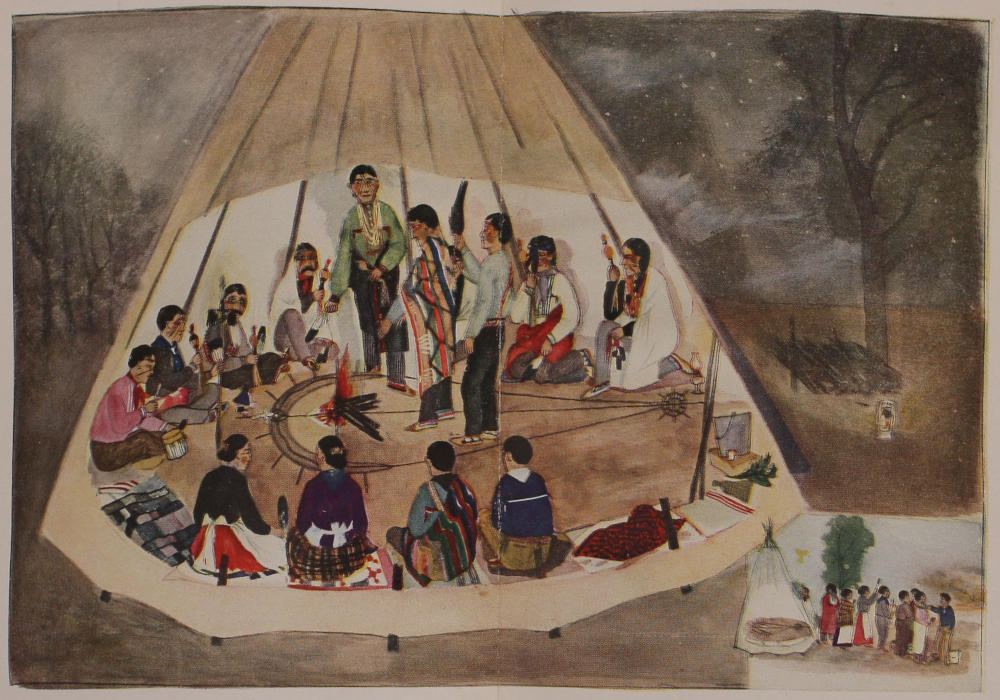
as shown in the frontispiece and in
pl. V, VI, but in former days
the roof was of bark. The
length is about 40 ft. from
east to west, with a height at
the eaves of about 6 ft., at
the ridge 14 ft., and a width
of 24.5 ft. Aside from certain
ingenuities of construction
which can not be discussed
here, its chief interest
lies in the two large carvings
of the human face, one facing
east (fig. 6) and one west,
which adorn the great central
post supporting the ridge-pole.
Similar carvings, but
smaller, may be seen upon
each of the six posts which
support the logs forming the
sides (fig. 7), and still smaller
ones, one upon each of the
four door-posts. All twelve
faces are painted, the right
side of each red, the left black.
The building is used only for
the Annual Ceremony.
Fig. 6.—Central post of Ceremonial House,
showing carved face.
Fig. 7.—Side posts of Ceremonial House, showing
carved faces.
The messenger sent to assemble the
people is one of three male attendants
chosen by the leader, and these three men
appoint three women to serve also. To
these six attendants, known as aʹckas,
falls all the laborious work of the meeting.
Although the duties are menial, it is
considered quite an honor to be selected
as aʹckas. The attendants camp on the
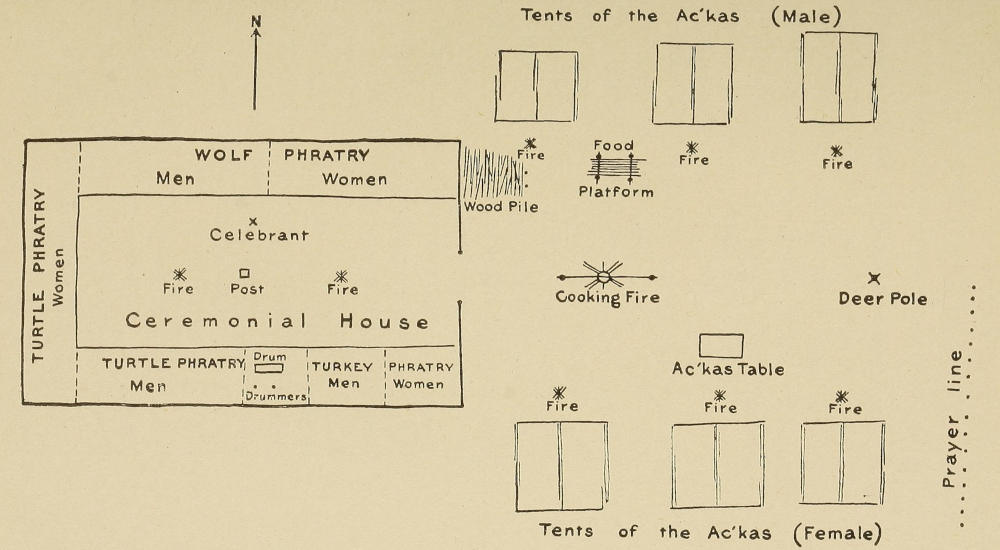
north and south sides of the little open
square just east of the Big House (pl. VII),
an area where no one is allowed to pitch
a tent.
Other officers selected for the meeting
are a speaker (usually at the time of the
writer’s visit, Chief Charley Elkhair),
two singers, called Taleʹgunŭk, “Cranes,”
whose duty it is to beat the dry deerskin
drum and sing the necessary songs, and a
chief hunter who is supposed to provide
venison for the feast.
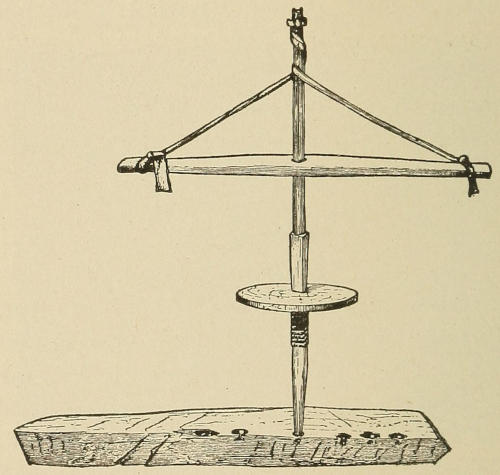
Fig. 8.—Ceremonial
fire-drill used at the Annual Ceremony. (Length of shaft, 29.5 in.)
Arrived at the Big House, the attendants
begin at once to prepare the
building for use after its year of idleness.
The first act of the men is to make mortar
of mud, in the old style, and stop the
cracks between the logs of the house.
Then they cut two forked saplings, and
set them in the ground about ten feet
apart, some distance in front of the Big
House (see pl. VII); upon these is laid a
pole, running east and west, to support
the twenty-gallon kettle used in preparing
hominy for the feast. After this they
gather about a cord of wood for the fires
inside the Big House and the cooking fire
outside. Then the first night, a fire
pure and undefined by the white man
and his matches, is made with a fire-drill
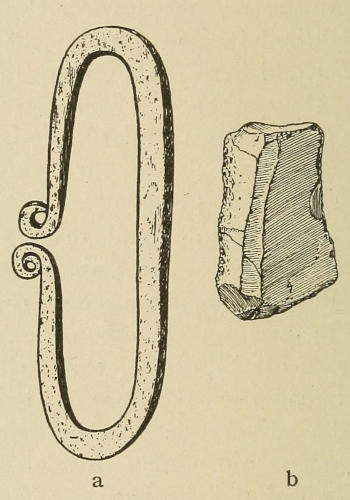
(fig. 8). This is operated on the principal
of a pump-drill, like the ceremonial fire-drills
of the Iroquois. This fire, and
this only, may be used in the temple,
and no one is permitted to take it outside
for any purpose.
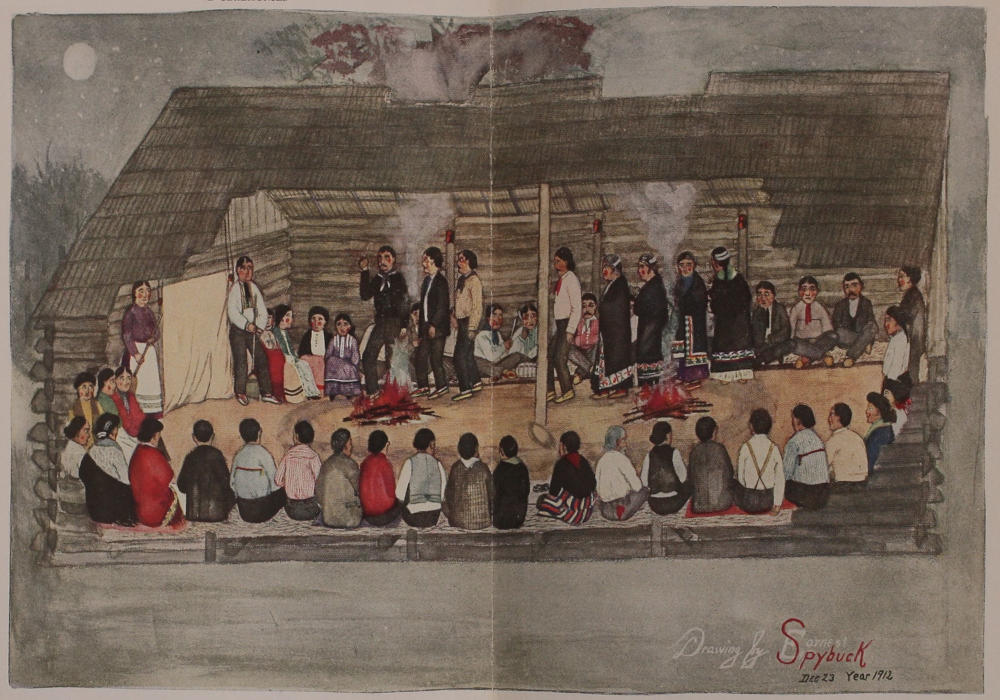
PL. VI
LENAPE ANNUAL CEREMONY IN PROGRESS
Native Painting by Earnest Spybuck, a Shawnee
Two of the attendants, a man and a
woman, then build the two fires in the
temple, so that there may be plenty of
light, and sweep the floor with turkey-wings
for brushes. The men attendants
take turns so that one of them, at least,
is always on guard outside the building.
When the temple is clean, the fires are
burning bright, and the aʹckas have
called the people in and all are assembled,
the chief arises and delivers a speech.
First he states the rules of the meeting,
then he speaks along some such line as
the following, which was dictated by
Chief Elkhair, who frequently made these
speeches:
“We are thankful that so many of us
are alive to meet together here once
more, and that we are ready to hold our
ceremonies in good faith. Now we shall
meet here twelve nights in succession to
pray to Gicelĕmû‛ʹkaong, who has directed
us to worship in this way. And
these twelve Mĭsiʹngʷ‛ faces [carved on
the posts of the house] are here to watch
and to carry our prayers to Gicelĕmû‛ʹkaong
in the highest heaven. The reason
why we dance at this time is to
raise our prayers to him. Our attendants
here, three women and three men, have
the task of keeping everything about our
Temple in good order, and of trying to
keep peace, if there is trouble. They
must haul wood and build fires, cook
and sweep out the Big House.
“When they sweep, they must sweep
both sides of the fire twelve times, which
sweeps a road to Heaven, just as they say
that it takes twelve years to reach it.
Women in their menses must not enter
this house.
“When we come into this house of ours
we are glad, and thankful that we are
well, and for everything that makes us
feel good which the Creator has placed
here for our use. We come here to pray
Him to have mercy on us for the year to
come and to give us everything to make
us happy; may we have good crops, and
no dangerous storms, floods nor earthquakes.
We all realize what He has put
before us all through life, and that He
has given us a way to pray to Him and
thank Him. We are thankful to the
East because everyone feels good in the
morning when they awake, and see the
bright light coming from the East, and
when the Sun goes down in the West we
feel good and glad we are well; then we
are thankful to the West. And we are
thankful to the North, because when the
cold winds come we are glad to have
lived to see the leaves fall again; and to
the South, for when the south wind
blows and everything is coming up in the
spring, we are glad to live to see the grass
growing and everything green again. We
thank the Thunders, for they are the
manĭʹtowŭk that bring the rain, which
the Creator has given them power to
rule over. And we thank our mother, the
Earth, whom we claim as mother because
the Earth carries us and everything we
need. When we eat and drink and look
around, we know it is Gicelĕmû‛ʹkaong
that makes us feel good that way. He
gives us the purest thoughts that can
be had. We should pray to Him every
morning.
“Man has a spirit, and the body seems
to be a coat for that spirit. That is
why people should take care of their
spirits, so as to reach Heaven and be
admitted to the Creator’s dwelling. We
are given some length of time to live
on earth, and then our spirits must go.
When anyone’s time comes to leave this
earth, he should go to Gicelĕmû‛ʹkaong,
feeling good on the way. We all ought
to pray to Him, to prepare ourselves for
days to come so that we can be with Him
after leaving the earth.
“We must all put our thoughts to this
meeting, so that Gicelĕmû‛ʹkaong will
look upon us and grant what we ask.
You all come here to pray; you have a
way to reach Him all through life. Do
not think of evil; strive always to think
of the good which He has given us.
“When we reach that place, we shall
not have to do anything or worry about
anything, only live a happy life. We
know there are many of our fathers who
have left this earth and are now in this
happy place in the Land of Spirits.
When we arrive we shall see our fathers,
mothers, children, and sisters there. And
when we have prepared ourselves so that
we can go to where our parents and
children are, we feel happy.
“Everything looks more beautiful
there than here, everything looks new,
and the waters and fruits and everything
are lovely.
“No sun shines there, but a light much
brighter than the sun, the Creator makes
it brighter by his power. All people
who die here, young or old, will be of the
same age there; and those who are injured,
crippled, or made blind will look
as good as the rest of them. It is
nothing but the flesh that is injured:
the spirit is as good as ever. That is the
reason that people are told to help always
the cripples or the blind. Whatever you
do for them will surely bring its reward.
Whatever you do for anybody will bring
you credit hereafter. Whenever we think
the thoughts that Gicelĕmû‛ʹkaong has
given us, it will do us good.
“This is all I can think of to say along
this line. Now we will pass the Turtle
around, and all that feel like worshiping
may take it and perform their ceremonies.”
Some nights the speaker says more,
sometimes less, just as he feels, but he
always tries to tell it as he heard it from
the old people who came before him.
Now, as was stated, these meetings are
“brought in” by individuals; that is a
certain person, usually a man, undertakes
to arrange for the meeting and to lead
the ceremonies. This person must be
one of those gifted by a vision or dream of
power in their youth, and hence, according
to Lenape belief, one in communication
with the supernatural world.
Fig. 9.—Rattle of land-tortoise shell, used
by celebrants at the Annual Ceremony. (Length, 4.2 in.)
When the people file into the Big House,
the few that still have them dressed in
their best Indian costumes carefully preserved
for such occasions (pl. I), the
members of this leader’s clan always take
their seats on the north side, the other
two clans in the west end and the south
side. Men and women, however, do
not mingle, but sit separately in the
space allotted to their common clan.
The diagram (pl. VII) shows the seating
of the clans when the ceremony is
“brought in” by
a member of the
Wolf division.
Fig. 10.—Drum made of dried deerskin used
at the Annual Ceremony. (Length 38.2 in.)
After the chief’s
speech, the leader
arises from his
place just north
of the central
post, and, rapidly
shaking a rattle
(taxoʹxi cowŭniʹgŭn)
made of a
box-tortoise shell
(fig. 9), recites his
vision in a high
monotone, word
by word. After
he utters each
word, he pauses
an instant to give
the singers sitting
at the rolled dry
deerskin called powŭniʹgŭn which serves
as a drum (fig. 10), ample time to repeat
the same word in the same tone, which
produces an extraordinary effect. When
he finishes, the drummers beat rapidly
on the dry hide, repeating “Ho-o-o!” a
number of times.
PL. VII
PLAN OF LENAPE CEREMONIAL HOUSE AND GROUNDS NEAR DEWEY, OKLAHOMA
Then the celebrant repeats a verse of
his song in the same way, and the
drummers, having learned the words,
sing them to a dance tune, beating the
drum in slower time. After dancing
awhile, the celebrator whoops, and they
stop; then another similar verse, if not
the same, is recited and then sung.
When the leader dances, he circles
about the two fires contra-clockwise, and
those who wish may join in the dance and
follow him (pl. VI).
His dance finished, the leader passes
the turtleshell to the next man who has
been blessed with a vision. This one
has the privilege of singing his vision if
he wishes; if not, it is handed to the
next “dreamer.” After a celebrant has
taken his seat, it is customary for those
who desire it to smoke until the next
man is ready to commence. At this
time also it is considered proper for the
people to enter or leave the Big House,
which is not permitted while the actual
ceremony is in progress. When the
turtle rattle has thus made the round of
the building and gets back to its starting
point, the meeting is brought to a close.
This is usually along toward morning,
the exact time of course being dependent
on the number who have sung their
visions, and on the length of the intermissions.
Now, when the man who started the
ceremonies begins to dance, that is a
signal for two of the women aʹckas, or
attendants, to go out and pound corn for
hominy or meal, and two of their men
colleagues cook it in the kettle hanging
on the pole, so that it is ready when the
turtle has made its rounds and the meeting
is about to close. Then the repast
of hominy or corn mush called säʹpan is
distributed, and the speaker says, “We
will now pray twelve times,” so twelve
times they cry “Ho-o-o!” as a prayer.
Then they feast, using musselshells from
the river as spoons, and finally the speaker
dismisses them with the words, “This is
all for tonight; tomorrow night we will
meet again.”
When the next night arrives, approximately
the same performance is repeated;
and the same the next, with little of
interest occurring during the day; but
on the fourth morning, the leader who
has selected a man for chief hunter,
gives him a yard of wampum as pay.
This master of the hunt then selects as
many assistants as he wants, and he and
his crew all gather in the Big House,
where they are served about noon with a
feast prepared for the occasion by the
women of the camp, and the attendants
tie sacks of the food to the hunters’
saddles.
When they have finished eating, they
arrange themselves in a row, each hunter
standing on his left foot and barely
touching the ground with the toes of his
right, an action whose meaning I have
not yet been able to determine.
Then the speaker rises and talks to
them, and the Mĭsiʹngʷ‛ who has been
seen about the camp from time to time,
is in the Big House listening to his
words. “When you hunt,” says the
speaker, “think of nothing but luck to
kill deer.” As he speaks he goes to the
west fire and throws into it, six times, an
offering of native tobacco; then to the
east fire, where he sacrifices six more
pinches of the sacred herb—twelve in all.
While sacrificing tobacco, he prays to the
Mĭsiʹngʷ‛ to drive the deer up, so that
the hunters can kill them. As he drops
the last tobacco into the flames, he says,
“If you kill a deer right away, bring it
in tonight; if not, bring in all you kill
day after tomorrow.”
What tobacco is left is given to the chief
hunter with the words, “When you camp
tonight, burn this and ask Mĭsinghâliʹkŭn
to let you kill deer.” The reader will
remember that Mĭsinghâliʹkŭn, in whose
image the Mĭsiʹngʷ‛ is carved, is supposed
to have control over the deer, and
in fact over all wild animals.
All the hunters that are in the habit of
chewing tobacco are now given some for
this purpose. When they file out and
mount their horses, the Mĭsiʹngʷ‛ follows
them and sees them off.
After the hunters have disappeared,
the people call the Mĭsiʹngʷ‛ back into
the Big House and coax him to dance,
while two men volunteer to sing for him.
The following evening six men are appointed
and given a yard of wampum to
divide among them, to go out close to the
forked game-pole east of the Big House,
intended for the carcasses of the deer,
and “pray” there twelve times. The
meaning of this, of course, is that they
sound the prayer word “Ho-o-o!” which
is evidently to help the hunters. This
night also a yard of wampum is unstrung
and scattered on the ground just west of
the east fire, and this the attendants
must pick up, crying “Ho-o-o!” as they
do so. For doing this, which is called
“picking berries,” they are supposed to
keep what wampum they pick up.
If the hunters are lucky and kill a deer
the first day, they send one man back
with it. As he approaches he fires a
gun as a signal of his coming, at which the
singers run into the Big House and begin
to sing and beat the drum. Then everyone
is happy.
In any case the hunters all return on
the third day. If they have killed deer,
they shoot their guns; if not, they come
in very quietly. When the shots are
heard, the singers hasten to their places,
and, beating the drum, sing a song that is
used only on such occasions. Then
when the hunters arrive, they feast, and
their leader announces the names of those
lucky enough to kill a deer. The carcasses
are skinned and hung on the deer
pole (shown in frontispiece), east of the
Big House, and are used in the feasts at
the close of every night’s meeting until
the gathering disbands.
Every night the usual program is repeated
until the ninth. On this night a
new fire is kindled with the sacred pump-drill
called tuⁿdaʹi wäheⁿʹji manĭʹtowŭk
or “Fire maker of the Manĭʹtos” (fig. 8),
and the ashes of the old are carried out
through the west door of the Big House,
which is used only for this purpose
(among the Unami), and is usually kept
closed. The new fire seems to symbolize
a fresh start in all the affairs of life.
Also on the ninth night, before the
singing begins, they bring out the two
ancient drumsticks (pa kŭⁿdiʹgŭn) carved
with tiny human heads, one male and one
female (fig. 11), to use in place of the
cruder sticks used before, which are
marked only with a rude cross (fig. 12, a).
At this time, also, twelve prayersticks
(ma‛tehiʹgun) are distributed—six plain
and six striped ones (fig. 12, b)—by two
of the male attendants, each with six,
one man starting from each end of the
Big House and proceeding in a trot to
distribute the sticks while the drum is
beaten, and the people, holding up their
hands, cry the prayer word “Ho-o-o!”
Fig. 11.—Sacred drumsticks, used at the Annual
Ceremony in Oklahoma. (Length of a, 18.6 in.)
Fig. 12.—a, Plain drumstick used at the Annual
Ceremony; b, Prayerstick. (Length of b, 18.9 in.)
Both drumsticks and prayersticks are
used every night from this time on. If
it so happens that the plain sticks do
not fall opposite each other (or on opposite
sides of the house), they must all
be picked up again and redistributed.
After this, those who have received a
stick raise that instead of their hand,
when they repeat the prayer word
“Ho-o-o!” and carry it when they dance.
At this time, too, all who own turtle
rattles such as are used in singing the
visions (fig. 9), are requested to bring
them in to the meeting, when they are
placed in a row on the north side, in
front of the man who, as the Indians
phrase it, “brought on the meeting.”
The backs of the turtleshells are all
measured with strings of wampum, which
are cut off in lengths corresponding with
the lengths of the backs.
Then the owners are called to get their
turtles and wampum, which is supposed
to be their pay for bringing them to the
meeting. As each takes up his turtle,
he shakes it, and if it does not sound well,
then the people laugh, and the owner,
abashed, takes his property out of sight
as soon as possible.
Then they call up six men, two from
each of the three phratries—Turtle,
Turkey, and Wolf. Each goes outside
and cries the prayer word “Ho-o-o!”
twelve times, holding up his left hand.
When the first one returns, he is given
one yard of wampum, and divides it
with the other five. This is done each
night until the end.
Fig. 13.—Paint-dish of bark, used at the Annual
Ceremony. (Length, 2.2 in.)
The twelfth night is reserved for the
women to relate their visions; but before
they begin, the speaker orders the attendants
to burn cedar-leaves in the two
fires, and the people are supposed to
inhale the smoke and purify themselves.
Then two women are ordered to take,
one a little bark dish (aⁿsiptaʹgŭn) of
red paint (fig. 13), the other a similar
vessel of grease, and the two start from
the door on the north side of the Temple
and go to each person present. One dips
her fingers in the paint and touches the
color to the person’s left cheek, while
her companion similarly annoints the
person’s head with a little of the grease.
This done, two men attendants take the
bark vessels and paint and grease in the
same way the twelve Mĭsiʹngʷ‛ faces
carved upon the posts of the building,
also the drumsticks, the prayersticks,
the deerskin drum, and the turtles. A
variant has it that both bark vessels contain
paint, the customs differing according
to phratry.
Each woman who takes part on this
night receives a share of the venison,
if there is any,—the biggest and fattest
buck the hunters kill,—and the attendants
cook it for them at the fire outside.
Next morning the men resume the
ceremony and continue until the sun is
high. Two men are then appointed to
close the meeting, for which each receives
one yard of wampum. Their duty is to
sing twelve times while the people dance
about the central post, the women in a
circle next to the post, the men in another
circle outside that of the women. These
two singers stop dancing in front of
where the chief is sitting, and announce,
“We will now pray twelve times.” They
go back to their seats and cry “Ho-o-o!”
twelve times. Then the attendants serve
the last feast. Two women then go
around with wampum in a wooden bowl,
giving everyone two or three beads.
Then the attendants, three men and
three women, stand in a row and receive
six yards of wampum on one string,
which they hold in their hands, the first
in the row holding the end of the string,
which stretches along from one to the
other. Then the chief says: “We thank
you attendants of this meeting for your
kindness in sweeping our Temple for
these twelve nights, and the attention
and care you have given. We have
heard our old parents say that, if you
sweep this Meeting House twelve different
times, you will sweep up to where
our great Father is, as he is up in the
twelfth Heaven above the earth.”
The attendants then circle about the
fires and go out to the cooking fireplace,
where they divide the wampum, taking
a yard apiece. At last, when the shadow
of a person is nearly under him, that is,
about noon, the speaker or chief arises,
and says, “All of us kinfolk must now
go out and end our meeting, which has
been going on for twelve days and nights.”
Thereupon they all file out—men, women,
and children—and form a row extending
north and south, facing east, just east of
the Big House, the hunters taking with
them the skins of the deer they killed.
Here they all pray, or rather cry the
prayer word “Ho-o-o!” six times standing,
holding up one hand, and six times
kneeling, holding up the other hand.
The meeting is then ended. This is
shown in the frontispiece. The deerskins
are given to poor old people, who
need them to make moccasins.
One informant stated that instead of
crying “Ho-o-o” twelve times in closing
the meeting, it was customary to use this
word only ten times, and then cry “Ha-a-a”
twice, completing the sacred number twelve;
but such discrepancies are probably due to
the variation of ritual among the three
phratries before mentioned, the Turkey,
the Turtle, and the Wolf. This kind of
prayer was noticed by Zeisberger[45] as early
as 1779, for he writes:
“At a third kind of feast ten or more tanned
deerskins are given to as many old men or
women, who wrap themselves in them and stand
before the house with their faces turned toward
the east, praying God with a loud voice to reward
their benefactors. They turn toward the east
because they believe that God dwells beyond the
rising of the sun. At the same time much
wampum is given away. This is thrown on the
ground and the young people scramble for it.
Afterward it is ascertained who secured the
most. This feast is called ’ngammuin, the meaning
of which they themselves are unable to give.”
The suspicion that Zeisberger mistook
the conclusion of the Annual Ceremony
for a separate rite is strengthened by the
fact that he gives its name as “’ngammuin,”
which seems to be a form of Gaʹmuing,
the modern Lenape name for their
Annual Ceremony.
All the officers of the meeting receive
pay in wampum for their services, except,
of course, the leader—the man who has
caused the meeting to be held. The
speaker receives a yard for every night
of the meeting; the drummers get a
yard between them each night; there
are also the payments to the attendants,
hunters, and others, already mentioned.
The attendants have other sources of
profit, too, for they serve meals three times
a day in the Big House to the leader of the
meeting and all his near relatives, also
to the speaker and the drummers.
When they have finished feasting, the
leader calls the attendants to come and
get their dishes and pans. Each has a
cup in which he brings coffee, and the
leader puts twenty-five wampum beads
in each cup for every meal. Moreover,
when any one in the outside camps is
hungry, he may go to an aʹckas and
obtain a meal for twenty-five wampum
beads. The attendants have a table
near the tent of one of the woman aʹckas,
and here they eat.
For ceremonial purposes the wampum
(white) is held at one cent a bead, one
hundred to the dollar. Before the meeting
the people give a yard or so apiece, if
they are able, to show their appreciation
and to be prayed for, or subscribe money
for its purchase and for the other things
needed at the meeting. The wampum is
afterward redeemed at the same rate
and is kept to use again.
Some explanations and remarks concerning
the annual ceremony, as furnished
by the Indians themselves, may prove of
interest here.
Julius Fouts (or Fox), the interpreter,
remarks:
“When the Delawares complete this
meeting, then they claim they have
worshiped everything on this earth.
God gave the Powers Above authority to
go around and give all the tribes some
way to worship. They say these things
were as if carried in a bundle, and when
they come to the Delawares, last of all,
there was a lot left in the bundle and
they got it all—that is why the Delawares
have so many different things to do in
their meetings.”
In explanation of the prayer word
Ho-o-o, he said, “Did you ever hear that
noise out in the woods, in the fall of the
year? ‘Ho-o-o,’ it says. What is it?
It is the noise of the wind blowing in the
trees. When the Delawares pray in the
Big House, they raise their voices and
cry ‘Ho-o-o’ to God, and the Mĭsiʹngʷ‛
hears it and understands, for he is of the
same nature as a tree, and there are
twelve Mĭsiʹngʷ‛ carved in the Big House
who will carry the prayers to the twelfth
Heaven. The Indians call the Mĭsiʹngʷ‛
‘Grandfather,’ because the trees were
here before the Indians. The Big House
is going out of use now, because only the
old people have had gifts or visions of
power to sing about. The children of
today are not piʹlsŭⁿ, or pure; they are
reared like the whites, and the Powers
Above do not speak to them any more.”
Chief Charley Elkhair, or Elkire, who
frequently served as speaker in the Big
House, said:
“The Delaware meeting helps everybody
in the world, for they pray for good
crops and everything good, even wild
fruits. About ten years ago the people
thought they would give up holding these
meetings, and the following year they
had high winds and big rains, and everyone
was frightened. Then grasshoppers
came in swarms, but they came in the fall
a little too late to get all the crops. So
the people held a council and talked
about the Big House again. They finally
decided to resume it, before any more
bad luck came; so they began the ceremonies
again in the fall.
“Then it seemed as if all the trouble
stopped. Of late there has been talk of
again giving up the meeting, but if we do
give it up we are likely to have a tornado
or maybe dry weather to ruin the crops.
“Once the Delawares owned a great
deal of land, but that is nearly all gone
now, and the people seem to have no
power to do anything. When God looks
down from Heaven, he sees but very few
Delaware people, and the reason for this
is that they cannot follow the Meeting
House ceremonies now. When I was a
little boy, I heard my people say that this
thing would happen just as it is happening
now. You see, the young people raised
during the last thirty years do not believe
in the old ways. We are having good
times yet, but we don’t know when we
shall catch it. If anything happens to us,
and once really begins, we can not stop it—it
will be too late. Even if they take
up the meeting again—they can not do
right, even when the ceremonies are going
on.
“They can not accomplish anything in
the Big House; they can not raise it up,
because there are a lot of young folks
who do not even try to do what the
speaker tells them, for they do not believe
in it.
“The people could get along fine, if
they followed the rules of the meeting—not
only the Delawares, but the other
people round about. For when the Delaware
prays, he prays for things that will
benefit everybody; he prays for the children
as well as for himself; he prays for
future time. But if anything comes to
destroy the world, it will be too late to
think of starting the Big House then.”
Penn’s Account.—William Penn seems
to have been the first to attempt a description
of Lenape rites, for he wrote in 1683,
in the same letter we have quoted before:
“Their Worship consists of two parts, sacrifice
and Cantico. Their sacrifice is their first
fruits.... The other part of their worship is
by Cantico, performed by round dances, sometimes
words, sometimes songs, then shouts, two
being in the middle that begin, and by singing
and drumming on a board direct the chorus....
They are said to lay their altar on twelve
stones.”
In this brief account should be noted the
presence of two drummers; the fact that
they did not use a drum, but a “board”
which was probably, if Penn had taken the
trouble to look more closely, a dried
hide; the word cantico which resembles the
modern Lenape words for “dance”—kĭʹnĭkä
among the Unami and kĭʹntika
among the Minsi; and finally the use of
the sacred number twelve.
Zeisberger’s Account.—The earliest detailed
account, however, of the great
Lenape ceremonies is given by Zeisberger,[46]
who, writing about 1779, says:
“Worship and sacrifices have obtained among
them from the earliest times, being usages handed
down from their ancestors. Though in the detail
of ceremony there has been change, as the Indians
are more divided now than at that time, worship
and sacrifice have continued as practiced in the
early days, for the Indians believe that they
would draw all manner of disease and misfortune
upon themselves if they omitted to observe the
ancestral rites.
“In the matter of sacrifice, relationship, even
though distant, is of significance, legitimate or
illegitimate relationship being regarded without
distinction. A sacrifice is offered by a family,
with its entire relationship, once in two years.
Others, even the inhabitants of other towns, are
invited. Such sacrifices are commonly held in
autumn, rarely in winter. As their connections
are large, each Indian will have opportunity to
attend more than one family sacrifice a year.
The head of the family knows the time and he
must provide for everything. When the head
of such a family is converted, he gets into difficulty
because his friends will not give him peace
until he has designated some one to take his place
in the arrangement of sacrificial feasts.
“Preparations for such a sacrificial feast extend
through several days. The requisite number of
deer and bears is calculated and the young people
are sent into the woods to procure them together
with the leader whose care it is to see that
everything needful is provided. These hunters
do not return until they have secured the amount
of booty counted upon. On their return they
fire a volley when near the town, march in in
solemn procession and deposit the flesh in the
house of sacrifice. Meantime the house has
been cleared and prepared. The women have
prepared firewood and brought in long dry reed
grass, which has been strewn the entire length
of the house, on both sides, for the guests to sit
upon. Such a feast may continue for three or
four nights, the separate sessions beginning in the
afternoon and lasting until the next morning.
Great kettles full of meat are boiled and bread is
baked. These are served to the guests by four
servants especially appointed for this service.
The rule is that whatever is thus brought as a
sacrifice must be eaten altogether and nothing
left. A small quantity of melted fat only is
poured into the fire. The bones are burnt, so
that the dogs may not get any of them. After
the meal the men and women dance, every rule
of decency being observed. It is not a dance for
pleasure or exercise, as is the ordinary dance
engaged in by the Indians. One singer only
performs during the dance, walking up and down,
rattling a small tortoise shell filled with pebbles.
He sings of the dreams the Indians have had,
naming all the animals, elements and plants
they hold to be spirits. None of the spirits of
things that are useful to the Indians may be
omitted. By worshipping all the spirits named
they consider themselves to be worshipping God,
who has revealed his will to them in dreams.
When the first singer has finished he is followed
by another. Between dances the guests may
stop to eat again. There are four or five kinds
of feasts, the ceremonies of which differ much
from one another.
“At these feasts there are never less than four
servants, to each of whom a fathom of wampum
is given that they may care for all necessary
things. During the three or four days they
have enough to do by day and by night. They
have leave, also, to secure the best of provisions,
such as sugar, bilberries, molasses, eggs, butter
and to sell these things at a profit to guests and
spectators.”
Adams’ Account.—The best and, in
fact, the only late account previous to his
own first article[47] the writer has seen of
the Annual Ceremony among the Lenape
in Oklahoma, is that written by Adams,[48]
which reads as follows:
“The peculiar steps which they use in this
dance have caused the name ‘stomp’ or ‘stamp’
to be applied to it.
“In regard to the stomp dances of our people,
we have several kinds of dances; the most
important one is the ‘worship dance’ which is
carried on in a large building called a temple,
which is rectangular and ranges from 60 to 80
feet long, from 30 to 40 feet wide, and is about
10 feet high. It is built of wood with 2 doors.
The main entrance is at the eastern door, and it
has only a dirt floor.
“On each post is carved a human face. On
the center post or one in the center of the building
four faces are carved; each face is painted one-half
red and one-half black. All the people
enter at the east and go out the same way.
When they come in they pass to the right of the
fire, and each of the three clans of the Delawares
take seats next to the wall, the Turtle clan on
the south, the Turkey on the west, and the Wolf
on the north. In no case can any one pass
between the center post and east door, but must
go around the center post, even to go to the north
side of the temple.
“This dance is held once each year, in the fall,
and generally in October, in the full moon, and
lasts not less than 12 days for each part. The
tribe is divided into three clans, and each clan
has to go through the same part, so the dance is
sometimes 36 days long, but sometimes the second
and third clans do not dance more than 6 days
each.
“The Turtle clan usually lead or begin the
dance. A tortoise shell, dried and beautifully
polished and containing several small pebbles,
is placed in the southeast corner near the door
in front of the first person. If he has anything
to say he takes the shell and rattles it, and an
answer comes from the south side of the temple
from the singers, who strike on a dried deer’s
hide: then the party who has the tortoise shell
makes an address or talk to the people, and
thanks the Great Spirit for blessings, and then
proceeds to dance, going to the right and around
the fire, followed by all who wish to take part,
and finally coming to the center post he stops
there; then all the dancers shake hands and
return to their seats. Then the shell is passed
to the next person, who dances or passes it on,
as he chooses.
“On the third day of the dance all men, both
married and single, are required to keep out of
the company of women for 3 days at least.
They have a doorkeeper, a leader, and 2 or 3
parties who sweep the ground floor with turkey
wings, and who also serve as deacons. The
ashes from the fire are always taken out at the
west door, and the dirt is always swept in the fire.
In front of the east door outside is a high pole
on which venison hangs. It is a feast dance and
the deacons distribute food among the people.
The officers and waiters are paid in wampum for
their services.
“In no case is a dog allowed to enter the temple,
and no one is allowed to laugh inside it, or in any
way be rude. Each person is allowed to speak
and tell his dream or dreams or to give advice.
It is believed by the Delawares that every one
has a guardian spirit which comes in the form
of some bird, animal, or other thing, at times in
dreams, and tells them what to do and what will
happen. The guardian spirit is sent from the
Great Spirit.
“Traditions say that 10 years before white
men came to this country (America) a young man
told his dream in the temple. This was on the
Atlantic coast. He saw coming across the great
waters a large canoe with pinions (wings) and containing
strange people, and that in 10 years they
would in fact come. He told this dream and
predicted the arrival of the white men each year
until they came and were seen by his people.
Many of our people still keep up this dance,
but the temple is not so large as it used to be,
and the attendance now is not more than 100
persons. Any Indian of any tribe can also take
part in the dance, but no white man can.
“When the dance is over all the people go out
and stand in a single line from east to west
with their faces to the south. Then they kneel
down and pray, and then go home. We do not
know the origin of the worship dance, but the
old Indians claim that the Great Spirit came
many years ago and instructed it and also gave
them the wampum.”
In spite of several inaccuracies, such as
the statement that the people face south
(instead of east) while praying after the
ceremony, this account is valuable on
account of the additional data it furnishes
on several points of interest, especially
the tradition concerning the prophecy of
the coming of the whites.
It appears that in former years there
was, in addition to the rite just described,
another form of the Annual Ceremony
practised by the Lenape, before their
removal to what is now Oklahoma from
Kansas, where the last man to “bring
in” such a meeting was John Sarcoxie,
now dead.
The ceremony, which was called MuxhatoLʹzing,
seems, from the accounts
given the writer by his informants, to
have taken place in a similar building, and
to have been similar in ritual to that just
described, except that it was held for only
eight days instead of twelve, and that,
after the return of the hunters the skin
of one of the deer they had brought in
was stuffed with grass and stood up by
the central post of the Big House, antlers
and all, while about its neck hung a
string of wampum—perhaps as a propitiatory
offering.
Moreover on the morning of the last
day of the ceremony a large sweathouse
was built and stones heated; then about
noon the men who had been reciting their
visions went into it, each taking one of
the hot stones with him. This privilege
was not confined to the actual celebrants
however, for every one blessed by a
guardian spirit even if they had not sung
their visions in the meeting, was entitled
to carry in a stone and join them.
The entrance was then closed and
water poured upon the stones; and while
the steam rose and the sweathouse grew
hotter and hotter the perspiring occupants
prayed to their guardian spirits
and recited their visions. These finished,
with a shout of “There go our prayers
to Those Above,” the cover was suddenly
snatched from the sweathouse so that
the steam it had contained rose in a
puff. If the steam cloud went straight
up into the air it was thought that the
prayers would be heard and answered,
and that all was well, but if it broke and
spread out the people felt that something
had gone wrong, and that their prayers
were of no avail.
In endeavoring to explain the presence
of such variations of the Annual Ceremony,
it should be remembered that the
Lenape now in Oklahoma whom the
writer has called for convenience “Unami,”
are not really pure descendants of
this tribe, but probably have a large
proportion of the blood of the Unala‛ʹtko
or Unalachtigo, whose dialect, according
to Heckewelder, was very similar, and a
smaller proportion of Minsi and even
Nanticoke blood. Perhaps then the first
form of Annual Ceremony described
may have originally been purely Unami,
and the second Unalachtigo, or Minsi, or
vice versa; but later, when the remnants
of these tribes became amalgamated their
mixed descendants inherited both forms.
The second form seems to be a variant
of the rite mentioned by Zeisberger[49]
who describes it as follows:
“A fifth kind of festival is held in honor of fire
which the Indians regard as being their grandfather,
and call Machtuzin, meaning ‘to perspire.’
A sweating-oven is built in the midst of the
house of sacrifice, consisting of twelve poles each
of a different species of wood. These twelve
poles represent twelve Manittos, some of these
being creatures, others plants. These they run
into the ground, tie together at the top, bending
them toward each other; these are covered
entirely with blankets, joined closely together,
each person being very ready to lend his blanket,
so that the whole appears like a baker’s oven, high
enough nearly to admit a man standing upright.
After the meal of sacrifice, fire is made at the
entrance of the oven and twelve large stones,
about the size of human heads, are heated and
placed in the oven. Then twelve Indians creep
into it and remain there as long as they can
bear the heat. While they are inside twelve pipes
full of tobacco are thrown, one after another,
upon the hot stones, which occasions a smoke
almost powerful enough to suffocate those confined
inside. Some one may also walk around
the stones singing and offering tobacco, for tobacco
is offered to fire. Usually, when the twelve
men emerge from the oven, they fall down in a
swoon. During this feast a whole buckskin
with the head and antlers is raised upon a pole,
head and antlers resting on the pole, before which
the Indians sing and pray. They deny that they
pay any adoration to the buck, declaring that
God alone is worshipped through this medium
and is so worshipped at his will.”
That this is really the same ceremony
is shown not only by the details as
related but by the native name of the
rite, the Machtuzin of Zeisberger corresponding
with the MuxhatoLʹzing of the
present writer.
CHAPTER VI Minsi Big House Ceremonies — MYTH OF ORIGIN — NUMBER OF CEREMONIES — ARRANGEMENT OF THE BIG HOUSE — PRELIMINARIES — OPENING OF THE CEREMONY — CEREMONIAL DRINK — RECITAL OF VISIONS — OTHER FEATURES — CONCLUSION OF RITES — GRAND RIVER VERSION — WAUBUNO’S VERSION
The following account of the
great ceremonies of the Minsi,
which correspond to the annual
ceremony of the Unami,
was obtained from Chief James Wolf,
now deceased, and his nephew, Chief
Nellis Timothy.
At first, it appears, the Indians did
not know how to worship, so Kĕ‛tanĭtoʹwĕt,
the Great Manĭʹto or God, now called
Pa‛ʹtŭmawas, came down and told them
what to do. After following his instructions,
they watched him when he
ascended. He carried twelve sumach
sticks in his hand, and they could see them
shine far up in the air. Every now and
then he dropped one, and when he
dropped the twelfth he disappeared, while
they heard the heavens crack like thunder
behind him as he went in. After this
the Lenape began to hold these meetings
according to the instructions he had
given them.
There were two of these ceremonies
every year, both held in the Minsi Big
House (W‛aʹtekan), which was quite
similar to that of the Unami. One of
these, performed about June when the
wild strawberries were ripe, lasted only
a single night; the other, early in winter,
covered twelve days and nights. This
latter corresponds to the Annual Ceremony
of the Unami.
At the June ceremony fresh strawberries
were made into a drink for the
people, which reminds one of the Iroquois
Strawberry Dance, or Dance of First
Fruits, as it is sometimes called. Strawberries
were dried at this time to make a
drink for the Winter Ceremony.
Fig. 14.—Drum of dried deerskin, Minsi type. E.
T. Tefft collection, American Museum of Natural
History. (Length 16.7 in.)
Fig. 15.—a, Drumstick, Minsi type; b, Prayerstick.
E. T. Tefft collection, American Museum of
Natural History. (Length of a, 19 in.)
Like the Unami Big House, that of the
Minsi had a large central post bearing
carved faces; but, unlike that of the
Unami, there was a second short post,
near the central one, upon which was
hung, for each ceremony, a raw fresh
deerskin with the head and horns at the
top. This feature, however,
corresponds with the second
form of the Annual Ceremony
noted among the Lenape in
Oklahoma and also recorded
by Zeisberger in Pennsylvania.
Near this central post the
singers sat, and beat with
four carved sticks upon a dry
deerhide folded into a square,
in lieu of a drum (fig. 14),
differing from the Unami
form, which is a rolled dry
deerskin upon which are tied
several slats of wood (fig. 8).
The drumsticks are flat, resembling
those of the Unami,
as each bears a face carved
upon one side, but differ from
them in the form of the forked
end, and in width. Some, it
is said, represented women,
the breasts being indicated as
among the Unami, but this feature does
not appear in the set collected by the
writer at Grand River reserve (fig. 15, a),
which the Indians said were representative
of the Minsi type.
There were two poles laid along on
each side from end to end of the Big
House to divide the dancing place in the
center from the sitting places on the
side, which were covered with a special
kind of leaves. Along these poles twelve
little sumach sticks (fig. 15, b), peeled
and painted, were laid for twelve people
to hold in their hands, and tap on the
poles in time to the music. There were
also provided a turtle rattle, which was
placed at the foot of the central pole;
a fire-drill which Nellis Timothy thinks
was worked on the “pump-drill” principle,
like that of the Unami, and a lot
of entirely new and unused bowls and
spoons of bark. Unlike the Unami
custom, both doors of the Big House
were used, the people always going in at
the east door and coming out at the west,
and here also (like the Unami) the ashes
were carried out. “The Sun and everything
else goes toward the west,” say the
Minsi, in explanation, “even the dead
when they die.”
The first act remembered by the informants
preparatory to holding a meeting
was to send to each man in the tribe
who had been blessed by a “vision of
power,” a little stick which represented
an invitation to the ceremony, the time
of which the messenger gave out, before
which date the people leaving their
scattered homes gathered and camped
about the Big House. Meanwhile hunters
were sent out, appointed before, not
during the meeting as among the Unami,
to bring in for the Winter Ceremony, if
possible, exactly twelve deer, which were
cooked by four young men who served as
attendants in a small separate house,
built for the purpose.
Fire.—The fire was made with a fire-drill
by a group of old men for use in the
Big House, but, as among the Unami,
none of it could be taken outside during
the ceremony.
Purification.—When the two fires had
been built, but before the crowd had
gathered, the house was purified by the
smoke of hemlock boughs thrown on the
flames, and by sweeping the floor with
turkey-wing fans, which cleared away
both dirt and evil influences.
Chief’s Speech.—The next step was
for the attendants to call in all the people
from their camps except the women in
their menses who were not allowed to
enter. When all were seated, the speaker
rose and addressed those assembled in
terms like the following:
“We are now gathered here, our house
is purified and clean, and Pa‛ʹtŭmawas
is with us, ready to hear our worship.
We must thank Him for all the things
that we enjoy, for He made them every
one.” Then he proceeded to tell the
people not to drink liquor, nor to do
anything wrong in the Big House or in
the camp about it, and advised them to
be always honest and kind and hospitable.
He held virtue as something to be followed,
at the same time condemning evil,
every vice that he could think of being
mentioned.
The chief then gave thanks for everything
he could remember, from the
heavenly bodies to the animals, trees, and
herbs of the earth, not forgetting corn,
beans, and squashes; and prayer for
successful hunting and good health for
all the people. At the summer meeting
he prayed for good crops also. When
he had finished, bear’s fat was thrown on
the two fires, and the smoke rose and
filled the place with its odor.
At this point it was customary to pass
around a vessel of drink made of crushed
wild strawberries, from which each person
present swallowed about a spoonful, a
drink made at the Summer Ceremony of
fresh fruit, but in winter necessarily of
berries dried for the purpose.
The first man to relate his vision (my
informant did not remember whether
he was the one who “brought in” the
meeting or not) took up the turtle rattle
from its place at the foot of the post and
began to shake it rapidly, while the singers
struck the drum of dry hide. He then
recited the story of his vision of power,
still keeping the rattle shaking, following
this with his dance song, at the same time
dancing and rattling the turtleshell.
Any one who wished to dance was supposed
to give wampum to the vision-teller
for the privilege. Some who were well
off would give him an entire string,
others merely a few beads. These the
vision-teller would take, when he had
quite a handful, to two officers who sat
in a corner of the building, whose duty
it was to count the wampum, after which
it was kept by the chief or leader.
Sometimes if a poor person who had no
wampum wished to dance, they would
give him some to pay the vision-teller.
A translated example of a Minsi vision
chant and dance song has already been
given. When the dream-teller finished
the first verse of his dance song, he
exclaimed, “E-ye-he-ye-ĕ!” whereupon
the singers took up the strain and sang
the verse several times, for the benefit
of those who wished to dance, omitting,
however, the final exclamation, but
those who had bought the privilege
rose and danced where they stood, instead
of circling around, as among the
Unami. Each “set” ended with a whoop,
“kwi!”.
When the vision-teller finished dancing,
he went around the house and shook
hands with everyone; then the turtle
rattle was passed to another man who
had been blessed with a vision, and so on,
until all those qualified, who wished to
recite their visions, had done so.
The Prayer Cry.—From time to time
during the night the prayer cry “Ho-o-o!”
was repeated twelve times, and the
twelfth cry, they say, was heard by the
Great Manĭʹto.
Feast.—The people were accustomed to
eat a light supper before going into the
meeting; then about midnight the four
attendants carried around baskets with
boiled meat and corn bread, and in the
morning, before leaving the Big House, a
regular feast of venison was served in
new bark bowls and eaten with new bark
spoons especially made for the purpose.
Final Address.—Before the meeting
closed, the speaker again addressed the
people, telling them to do right, and
prayed that the hunters about to leave
for the winter hunt might be successful,
and that all might live to meet
again.
In the morning after the ceremonies in
the Big House were finished, the people
filed out through the west door, circled
about the building, and lined up, facing
eastward, to the east of it. Then they
raised their hands and cried “Ho-o-o!”
twelve times, and the twelfth time, it is
said, their cry reached Heaven.
In comparing this form of the Annual
Ceremony with that of the Oklahoma
Lenape the most noticeable difference
is that here no masked impersonator of
Mĭsinghâliʹkŭn was seen in or about the
Big House, the Masks among the Minsi,
as with the Iroquois, constituting a society
with its own separate rites.
Such was the version of the great ceremonies
given the writer by the Minsi of
Munceytown, Ontario, which is similar
to, but more detailed in parts than, the
account previously obtained from the
Delawares of Grand River reserve, published
by the writer in the American
Anthropologist[50] which we will reproduce
here. It will be noticed that this description
gives fuller information in some
places where the first is deficient; so that
between this and the preceding account, a
good general idea of the Minsi form of the
ceremony can be reconstructed. It reads:
“In the old religious ceremonies of the
Delawares at Grand River a very peculiar
drum was used, a dry skin folded in
rectangular form and beaten with four
sticks, each bearing a tiny human head
carved in relief (fig. 15, a). I secured the
set of four original sticks from Michael
Anthony (Na‛nkŭmaʹoxa), and employed
him to make me a reproduction of the
drum (fig. 14) as the original had been
destroyed. This he did, and in addition
made six painted sticks (fig. 15, b) also
used in the ceremony. The description
of how these articles were used, pieced
together from several Indian accounts,
may prove of interest here.
“It appears that the Delawares of Six
Nations Reserve formerly held what was
known as a ‘General Thanksgiving’
ceremony called in Lenape Gitctlaʹkan,
twice a year, once in the spring and again
in the fall. At these times it was customary
to meet in the Cayuga long-house,
borrowed for the occasion. At a certain
point in the proceedings (I shall not attempt
a consecutive description from
hearsay testimony) a man stood up and
recited, in a rythmical sing-song tone,
his dream—the vision of power seen by
him in his youth. Na‛nkŭmaʹoxa remembered
how one old man was accustomed
to tell about a duck, half black
and half white, which had appeared to
him. Between the verses of the dream
four musicians kneeling at the drum
(pw‛awaheʹgŭn) began a plaintive song,
beating time with the carved sticks
(pw‛awaheʹgŭnŭk). As they sang, the
reciter swayed his body to and fro,
while a group of dancers gathered on the
floor behind him danced with a sidewise
step. Before the ceremony, poles were
laid lengthwise along both sides of the
council house, and against these, at
intervals, three on a side, the painted
sticks, called mkäähiʹgŭn, were laid. If
anyone in the crowd felt ‘especially
happy’ he was privileged to strike with
one of these sticks upon one of the poles
in time to the music. The carved heads
on the drumsticks meant that human
beings were giving thanks; the lengthwise
painting of the sticks, half black and
half red, implied that men and women
were together in thanksgiving, the black
representing the warriors, the red the
women. The fork at the striking end of
the sticks was to give a sharper sound.
The dyes for producing the colors were
made by boiling bark, the black being
soft maple (sexiʹkiminsi), and the red,
red alder bark (witoʹ‛pi).
“In another part of the same ceremony
wampum was used in the form of strings
and bunches, both of which were represented
in my collection from the Delawares.
At least thirteen of the strings
were used, each one made different by
different combinations of the white and
purple beads. These thirteen, it is said,
represented respectively (1) Earth; (2)
Plants; (3) Streams and Waters; (4)
Corn, Beans, and Vegetables; (5) Wild
Birds and Beasts; (6) Winds; (7) Sun;
(8) Moon; (9) Sky; (10) Stars; (11)
Thunder and Rain; (12) Spirits; and
(13) Great Spirit. At the ceremony these
strings were laid upon a bench before a
speaker, who picked them up one by one
as he made his address, each string reminding
him of one part of his speech.
He began, my informant told me, by
explaining that the Great Spirit had made
all things—the earth, plants, streams, and
waters—everything. Having thus enumerated
all the things represented by the
wampum, he proceeded to speak to each
of the remaining twelve directly, holding
the appropriate string in his hand. Thus
he gave thanks to the Earth for the
benefits it gives to man, and prayed that
its blessings might continue; then thanked
in the same way the Plants, the Streams
and Waters, the Winds; the Corn, Beans,
and Vegetables—each one in turn. As
he finished each string he handed it to an
attendant, who laid it aside. When his
long speech or prayer was finished, he
announced, ‘We will now enjoy ourselves,’
and selected a man to distribute little
bunches of wampum, three beads in each,
which served as invitations to join in the
dancing that followed. These bunches
were delivered only to a certain number of
those known to be ‘sober and honest’
among the crowd in the long-house. If
any person wishing to dance failed to
get invitation wampum, it was his
privilege to ask for one of the bunches,
which was given him if he was considered
qualified. The first man receiving wampum
arose first; then the others, until
the dancers were all on the floor. It is
said that this dance, which sometimes
lasted all night, did not circle around like
most of the Iroquois dances, but each performer
remained in about the same spot.
“I was told that in this dance a small
rattle without a handle and made of turtleshell
was used, probably like the box-turtle
rattle still used in the annual Planting
Dance by the Seneca and Cayuga.”
The only extended account in print,
known to the writer, of the great ceremonies
of the Minsi, beside his own,
quoted above, is that furnished by John
Wampum, known as Chief Waubuno,[51]
which reads as follows:
“They kept annual feasts:—... a feast of
first fruits which they do not permit themselves
to taste until they have made an offering of them
to the manitu-oo-al, or gods; ... There is one
of the greatest sacrifice offerings of our forefathers
every six months for cleansing themselves
from sin; they will have twelve deers to be
consumed in one day and night. At the great
feast of the offerings of the first fruits of the earth,
which feast the Delawares or Munceys hold
annually, they brought a little of all that they
raised, such as Indian corn, or hweisk-queem,
potatoes, beans, pumpkins, squashes, together
with the deer. The Indian women were busily
engaged in cooking their provisions, previous to
the commencement of their exercises. They
invited all strangers into a long pagan temple
prepared for such purposes, there is a door at
each end—one opening to the east, and one opening
to the west. On entering, they with all the
Indians were seated on the ground around two
fires; in the center of the temple was a large post,
around which was suspended a number of deer
skins, and wampum is kept buried at the foot
of this post. Near the post sat two Indian
singers, each with a large bundle of undressed
deer skins which served as drums. There were
two young men appointed to watch the doors
and keep the fires burning, the doors being
closed. Each of the young men brought an
armful of hemlock boughs, which being thrown
on the fires smothered them and caused a great
smoke. In order that the smoke might fill
every corner of the temple, each man waved his
blanket over the fire; this was done with the
idea of purifying the temple and driving out
the evil spirits. After the smoke had subsided,
the master of ceremonies, an old chief, rose and
began to rattle a turtle shell he had in his hand.
He delivered a speech to the people telling them
the object of the meeting was to thank the great
spirit for the growth and ripening of the corn.
When he finished his speech he began to dance,
sing and rattle the shell, the two singers joining
in, beating on their skins. When he took his
seat he handed the shell to the next person, who
performed in the same way, thus it went from
one to the other all night. The purport of their
speeches was to recount the mercies of the Great
Spirit to them during the past year, and telling
any remarkable dreams that they had had. In
the course of the night a number of them went
out the west door, making a wailing noise to the
moon, and came in again the east door. In the
morning the meat and soup were divided amongst
the people.
“These feasts often lasted twelve days and
twelve nights, and the Indians call it nee-shaw-neechk-togho-quanoo-maun,
or ween-da-much-teen.
No drinking or improper conduct is
allowed. The utmost solemnity prevails.”
CHAPTER VII The Mĭsiʹngʷ‛ or Mask — ORIGIN OF THE MASK, AND OF THE BIG HOUSE — MĬSIʹNGʷ‛ DANCE — OTHER FUNCTIONS OF MĬSIʹNGʷ‛ — MASKS OF THE MINSI
The Minsi version of the myth
explaining the origin of their
great ceremonies has been already
related, but not that of
the Unami, for the latter, which concerns
itself with the origin of the Unami rites
as now practised, is so intimately interwoven
with the story of the Mĭsiʹngʷ‛, or
mask (fig. 1), that it was thought best
to place it in the chapter devoted to that
curious being, with whose position in the
Lenape pantheon, recorded history, and
activities in the Annual Ceremony, we
have already become acquainted.
The myth is therefore presented herewith,
as related by Chief Charley Elkhair,
the Lenape master of ceremonies, with
only such additions as later questioning
brought forth.
This is the way the Lenape found out
that there is a living Mĭsinghâliʹkŭn
above us. Many years ago, when the
Delawares lived in the East, there were
three boys who were not treated very well.
Their relatives did not take care of them,
and it seemed as if it made no difference
whether the children died or not. These
boys were out in the woods thinking
about their troubles, when they saw the
Mĭsinghâliʹkŭn or Living Solid Face.
He came and spoke to them, and gave
them strength so that nothing could
hurt them again. To one of these boys
he said, “You come along with me and I
will show you the country I come from.”
So he took the boy up in the air to the
place whence he came, which is rocky
mountains above us, reaching out from
the north and extending toward the
south. It is not the place where people
go when they die, for it is not very far
from this earth. A long time ago people
could see this country of Mĭsinghâliʹkŭn,
but none can see it now.
While he was showing the boy his
country, the Mĭsinghâliʹkŭn promised
him that he would become stout and
strong, and would have the power to get
anything he wished. Then he brought
the boy back.
Afterward, when the boy grew up and
went hunting, he used to see the Mĭsinghâliʹkŭn
riding a buck around among the
other deer, herding them together. Thus
it happened that there were three men in
the tribe, who knew that there is a
Mĭsinghâliʹkŭn, because they had seen
him with their own eyes.
The Delawares had always kept a Big
House (xiʹngwikan) to worship in, but
in those days it was built entirely of
bark and had no faces of the Mĭsiʹngʷ‛
carved upon the posts as it has now.
Here they used to sing about their
dreams (visions of power); but some
time after the three boys talked with the
Mĭsinghâliʹkŭn, the people gave up this
worship, and for ten years had none.
Then there came a great earthquake,
which lasted twelve months and gave
great trouble to the Lenape. It came
because they had abandoned the worship
their fathers had taught them. In those
times the tribe lived in towns, not
scattered about the country as they are
now, and in one of these towns a chief
had a big bark house, and here the people
met to worship, hoping to stop the
earthquake, while they were building a
new Big House. When it was finished,
they began to worship there, and sang
and prayed all winter for relief. After
spring came, they were holding a meeting
one night when they heard the Mĭsinghâliʹkŭn
making a noise, “Hoⁿ-hoⁿ-hoⁿ,”
right east of the Big House. The chief,
who did not know what was making the
noise, called for somebody to go and
see what it was. Then these three men
offered to go, because, as they said, they
knew what was making the noise and
could find out what he wanted. So they
went out and found Mĭsinghâliʹkŭn, and
asked him what he wanted. He answered:
“Go back and tell the others to stop
holding meetings and attend to their
crops. Do not meet again until fall,
when I will come and live with you, and
help in the Big House. You must take
wood and carve a face (Mĭsiʹngʷ‛) just
like mine, painted half black and half red,
as mine is, and I will put my power in it,
so that it will do what you ask. When
the man who takes my part puts the face
on, I will be there, and this is how I will
live among you. This man must carry
a turtle rattle and a stick, just as I do
now.” Then he told them how to fix
the twelve carved faces on the posts of
the Big House, and the faces on the drumsticks,
and taught them how to hold the
ceremony.
Then he said:
“You must also give me hominy every
year in the spring. I take care of the
deer and other game, that is what I am
for. Wherever you build the Big House,
I will keep the deer close by, so that you
can get them when you need them.
“Never give up the Big House. If you
do, there will be another earthquake, or
something else just as bad.
“The earthquake stopped that time;
that is why the Delawares have kept the
Mĭsiʹngʷ‛ and the Big House ever since.
The Mask is left in charge of some family
who will take good care of it, and burn
Indian tobacco for it from time to time.”
It will be seen that, according to the
above tradition, the Mĭsiʹngʷ‛ was, first
of all, a personal helper, or guardian
Spirit, that afterward became more or
less of a tribal deity, and that his cult
became engrafted on the Annual Ceremony
among the Unami, the rites of
which were already ancient among them.
That this engrafting really took place
seems possible from the fact that among
the Minsi there were no masked performers
at the Big House ceremonies, and
that, while the central post of the temple
was provided with carved faces, the
masks had an entirely different function
among this people. The innovation, if
it took place at all, must have been before
Brainerd’s[52] time, however, for, as related
in our first chapter, he found the Mĭsiʹngʷ‛
and Big House in use, as among the
Unami today, as early as May, 1745,
while traveling among the Delawares
living at that time on Susquehanna river.
Besides the part taken by the Mĭsiʹngʷ‛
in the Annual Ceremony, he has certain
rites peculiar to himself which were held
every spring. As the Indians put it:
“When spring comes, the Delawares
are glad, and they are thankful that their
helper, the Mĭsiʹngʷ‛ is still among them.
For this reason they give a feast and
dance to make him happy too.”
Notification.—So at the time of the full
moon (about May), the keeper of the
mask gives another Indian a yard of
wampum to ride around to all the
Delaware houses, wearing the mask and
bearskin costume (pl. II) to let the people
know that the time for the Mĭsiʹngʷ‛
dance (Mĭsingkĭʹnĭkä) is at hand. The
Mĭsiʹngʷ‛ rides horseback, and another
man, also mounted, follows him to see that
he comes to no harm. At each house the
impersonator dismounts and enters, making
known his errand by signs, but saying
only “Hoⁿ-hoⁿ-hoⁿ,” and everywhere they
give him tobacco, which he puts in his
sack. At this time the people frighten
disobedient children with the threat that,
unless they behave, the Mĭsiʹngʷ‛ will
carry them away in a sack full of snakes.
Preparations.—The dance-ground customarily
used for this purpose has meanwhile
been put in order, a cleared place
in the woods selected for good shade and
pleasant surroundings, and the logs which
serve as seats arranged to form the rectangle
within which the dance takes place.
A great pot of hominy is also prepared;
this constitutes the main dish of the feast.
The Ceremony.—When the people have
gathered on the night appointed, and the
impersonator has returned from the
bushes where he retired to dress, wearing
the mask and bearskin suit (pl. II), the
speaker addresses the people and relates
the origin of the dance, then addressing
the Mĭsiʹngʷ‛, says, “Take care of us
while we are dancing, so that everything
goes smoothly.” Then they have a
dance in which the Mĭsiʹngʷ‛ joins, but
he dances around the outside of the circle
of people, not with them. When they
have finished, he dances twelve changes
alone, which occupies the time until
morning. When daylight appears, the
hominy is brought out and everyone eats,
including the Mĭsiʹngʷ‛, after which the
speaker says, “Now we have eaten with
our Mĭsiʹngʷ‛. We will have this dance
again next spring.” The people then
disperse to their homes, the Mĭsiʹngʷ‛ is
put away and the impersonator paid a
yard of wampum for his dancing. At
this dance the singers keep time by
striking with sticks on a dry deerhide
rolled over and stuffed with dried grass,
very similar to the “drum” used in the
Big House.
Adams’ Account.—The only account
the writer has seen of this ceremony is
that of Adams’,[53] the chief inaccuracy of
which is the statement that the dance is
“only for amusement.” It furnishes,
however, several additions to our knowledge
of the “Solid Face.” It is as follows:
“Messingq or Solid Face Dance or Devil Dance.—The
principal leader in this dance is the
Messingq, an Indian, who is dressed in a bearskin
robe with a wooden face, one-half red and one-half
black. He has a large bearskin pouch and
carries a stick in one hand and a tortoise shell
rattle in the other. He is a very active person.
The dance is only for amusement, and men and
women join in it. A large place is cleared in the
woods, and the ground is swept clean and a fire
built in the center. Across the fire and inside
of the ring is a long hickory pole supported at
each end by wooden forks set in the ground.
On the east of this pole the singers stand; on
the west end is a venison or deer, which is roasted.
About daylight, when the dance is nearly over,
all the dancers eat of the venison. They have a
dried deer hide stretched over some hickory
poles, and standing around it beat on the hide
and sing. The dancers proceed around the fire
to the right, the women on the inside next to the
fire. After the dance is under headway the
Messingq comes from the darkness, jumps over
the dancers, and dances between the other dancers
and the fire. He makes some funny and queer
gestures, kicks the fire, and then departs. The
Messingq is never allowed to talk, but frequently
he visits the people at their homes. He is a
terror to little children, and when he comes to a
house or tent the man of the house usually
gives him a piece of tobacco, which the Messingq
smells and puts in his big pouch, after which he
turns around and kicks back toward the giver
which means ‘thank you,’ and departs. He
never thinks of climbing a fence, but jumps over
it every time that one is in his way. The Devil
dance is what the white men call it, but the
Delawares call it the Messingq, or ‘solid face’
dance. The Messingq does not represent an evil
spirit, but is always considered a peacemaker.
I suppose that it is from his hideous appearance
that white men call him the devil.”
The Mĭsiʹngʷ‛ the Indians claim,
“takes care of the children,” as well as of
the deer, for as before related if any
Delaware has a child who is weak, sickly,
or disobedient, he sends for the Mĭsiʹngʷ‛
and asks him to “attend to” his child.
On his arrival it does not take the impersonator
long to frighten the weakness,
sickness, or laziness out of such children,
so that “afterward they are well and
strong, and whenever they are told to do
a thing, they lose no time in obeying.”
This is the only trace of the doctoring
function of the mask found among the
Unami.
When the keeper of the Mĭsiʹngʷ‛
burns tobacco for him and asks for good
luck in hunting, “it turns out that way
every time;” and the Lenape say moreover
that if anyone loses horses or cattle,
either strayed away or stolen, he can go
to the keeper of the Mĭsiʹngʷ‛ with some
tobacco as a gift and get them back.
He explains his errand to the keeper, who
in turn informs the Mĭsiʹngʷ‛ that they
want him to look for the horses or cattle.
The loser then goes back home, and after
a few days the missing animals return,
driven back by the Mĭsiʹngʷ‛, who if they
had been tied or hobbled by the thieves,
frightened them until they broke away
and came home. When the Big House
meeting is held in the fall, the Mĭsiʹngʷ‛,
as before related, is seen going around
among the tents of the Delawares assembled,
and in and out of the Big House,
always coming from the woods, where the
impersonator has a place to change his
clothes. The Indians say:
“He helps the people with their hunting,
and also helps in the Big House while
the ceremonies are in progress. If he
finds anyone there who has not done
right, he informs the three guards of the
meeting, who take that person and put
him out. In all these ways the Mĭsiʹngʷ‛
helps the Delawares.”
The Minsi Miziʹnk (cognate with the
Unami Mĭsiʹngʷ‛) was a mask made of
wood with copper or brass eyes and a
crooked nose, according to my informants
at Munceytown; and judging by Peter
Jones’ drawings (pl. III) they were provided
also with hair, tufts of feathers, and
jingling copper cones or deer-hoofs. The
Mizink at Grand river was of Minsi type,
judging by the specimen obtained by the
writer (fig. 4).
Such masks were made to represent
Mizinkhâliʹkŭn, who was “something like
a person, but different from the Indians,
and was powerful. They saw him first
among the rocks on a hill, and he spoke to
them and told them what to do to get his
power. When a man put on a Mizink
he received the power of this person or
spirit; he could even see behind him,
and could cure diseases.”
The Mask Society.—The men who
owned these masks formed a kind of
society which Nellis Timothy says originally
had twelve members, but which,
before it disbanded, dwindled to about
five. Sometimes only two appeared in
costume.
The society had a meeting-house of
its own where its dances, Mizinkĭʹntĭka,
were held, for, unlike the Unami custom,
no Mizink ever appeared in the Big
House. The members appeared wearing
their masks and clad in rough bearskin
and deerskin costumes, while some, at
least, were provided with a turtleshell
rattle which they would rub on a long
pole, crying “Oⁿ-oⁿ-oⁿ!” the while.
Ceremonies.—While no consecutive account
of their ceremonies is now remembered,
it was said that they sometimes
put down their rattles, heaped up
the ashes from the two fires, then threw
the ashes all over the house to prevent
the people assembled from having disease.
Should any sick person appear, he or
she would be especially treated with
ashes. Sometimes the performers would
pick up live coals and throw them about,
frightening the people. At other times
the whole company of them would go
around to the different houses begging
for tobacco, and would dance in any
house where someone was willing to sing
for them.
Nothing was said among the Minsi
about the Mizink bringing back stray
stock or driving deer, characteristic attributes
of the Mask Being of the Unami.
The writer obtained but one mask among
the Canadian Lenape, and this was from
the Grand River band (fig. 4); it has
been described by him[54] in the following
words:
“But one mask (mizink) was obtained. It
differed from those of the Iroquois chiefly in
being cruder, and also in decoration, the lines
being burnt into the wood instead of being
painted or carved. The original use of the mask
had to do, in part at least, with healing the sick,
but Isaac Montour (Kaʹpyŭ‛hŭm), from whom I
bought it, failed to make himself clear as to the
details.”
It will be seen that the Minsi beliefs
and practices noted above resemble those
of the False Face Company of the Iroquois
tribes much more than they do the
customs connected with Mĭsiʹngʷ‛ among
the Unami.
In fact, a vague tradition exists to the
effect that the False Face Company of
the Cayuga once put a stop to an epidemic
of cholera among the Minsi. While this
was not given to account for the origin
of the society among the Minsi, it at
least shows that they were familiar with
the Iroquois practices in this line.
CHAPTER VIII Minor Ceremonies — THE DOLL BEING — Myth of Origin — Preparations for the Ceremony — The Doll Dance — Minsi Doll Ceremony — BEAR CEREMONY — Traditional Origin — Preparations. — The Rites — OTTER CEREMONY — Myth of Origin — The Ceremony — BUFFALO DANCE — IMPORTED CEREMONIES — Skeleton Dance — Peyote Rite — Ghost Dance
The Doll Being, called by the
Unami O‛ʹdas and by the
Minsi Naniʹtĭs, has been already
mentioned as a minor
Lenape deity, and it now remains only to
relate the ceremonies and beliefs connected
with it, beginning with the myth
accounting for its origin.
Long ago, the Lenape say, some children,
playing with sticks, decided to cut
faces upon them, and were then very
much surprised to notice that the little
dolls which they had thus made seemed
to have life. Their parents made them
throw the dolls away when they discovered
this, and most of the children
soon forgot what had happened. One
little girl, however, grieved for her doll;
it bothered her all the time, and finally
she began to dream of it every night.
Then she told her parents of her trouble,
and they realized that they should not
have compelled her to throw the doll
away. One night the doll appeared to
the child and spoke to her, saying, “Find
me and keep me always, and you and
your family will ever enjoy good health.
You must give me new clothing and hold
a dance for me every spring,” and then
told her exactly what to do. The girl
reported this to her parents, who immediately
looked for the doll and found it,
then dressed it, made some hominy,
killed a deer, and held a dance in its
honor as they were instructed, and this
rite has been continued to the present
day.
When the family owning a doll of this
kind is ready to conduct the Doll Dance
(O‛ʹdas-kĭʹnĭkä), they select two men to
gather firewood and to clean up the
dance-ground used every year, and to
engage a speaker and two singers, paying
each of them with a yard of wampum.
The dance-ground is square, similar to
that used for the Mĭsiʹngʷ‛ dance, with
logs ranged about for seats, in some
pleasant place out in the woods. A
hunter is then selected, who calls on
several to help him get a deer, which,
when brought in, is hung on poles prepared
for it at the dance-ground, where
it remains over night. The next morning
they cook the deer and a kettle of hominy,
and are then ready for the ceremony.
About the middle of the afternoon the
speaker rises and addresses the people,
telling them the story of the doll’s origin
and explaining its function; then he
addresses the doll, which has now been
fastened on a pole, calling it “grandmother”
and notifying it that they are
about to hold a dance in its honor, at the
same time asking it to insure good health
to the family of its owner. When he
finishes, the dance leader, who should be
a relative of the family owning it, takes
the doll on its pole, and then, as the
drummers sitting in the center of the
dance-ground begin to strike the dry
hide stuffed with grass that serves as a
drum, and to sing the song of the Doll
dance, he commences to dance, circling
round the drummers, still carrying the
doll, the people falling in behind him,
forming two circles, the men inside,
next to the drummers, and the women
outside. When the leader finishes his
“set,” he passes the doll pole to the man
behind him, who repeats the process, and
so on until the men dancers have carried
it six times, when it is transferred to the
women, who, in their turn, dance six
sets, making twelve in all, the Lenape
sacred number.
The twelve sets, or “changes,” lengthen
the ceremony far into the night, and this
necessitates a large fire to give light.
This is built near the center of the dance-ground.
Sometimes, if the crowd in
attendance is large, two such fires are
built. Between the changes the doll
pole is stuck into the ground near the
fire. When the twelfth set is finished,
the speaker announces, “The Doll Dance
is over,” and the feast of hominy and
venison is served to everyone. Then
the speaker says: “If you want to dance
the rest of the night, you may do so, for
many of you have come a long way from
home and should have a chance for more
enjoyment. We will hold another Doll
Dance next year.” Then they put the
doll away and amuse themselves with
various social dances until morning.
Among the Minsi the beliefs concerning
the Doll Being were similar, but differed
in detail. As to origin, Wolf told the
writer that one time a man lay ill, likely
to die, and his family called in a medicine-man,
or “witch-doctor.” The shaman
finally announced that the family must
make one of these dolls and care for it,
and that the sick man would then get
well. This was done, and the doctor’s
prediction being realized, the Minsi have
ever since made and used these dolls,
called in their dialect naniʹtĭs, which
were transmitted from parents to children.
Wolf’s own mother had one,
carved out of wood in the form of a
person, with a woman’s dress and moccasins
(for as a rule they represent women);
and she always cared for it religiously,
in the belief that if well treated it would
protect the family and give them good
health, but if neglected, someone would
surely die. Every year, in the fall, when
the deer are in their best condition,
Wolf’s mother held a dance for it, called
“Feeding the Naniʹtĭs;” but she did
more than feed it: she put new clothes
on it, three sets, and new moccasins
every year. She believed that the image
sometimes went about of its own accord,
although she kept it carefully in a box,
for the old dresses always seemed worn
at the bottom and soiled, and she found
burrs clinging to them when she went
to put new clothes on “Naniʹtĭs.”
She hired a man especially to hunt a
yearling doe for the ceremony, which
took place in her own dwelling. The
details are lost, but it is remembered that
a man beat a little drum and sang while
she, as owner, danced around, carrying
the doll in her hands, followed by such
of the other women present as wished to
participate. Said Wolf, “The Naniʹtĭs
helped the Indians, that’s why they fed
it.”
PL. VIII
“NAHNEETIS THE GUARDIAN OF HEALTH”
(E. T. Tefft Collection, American Museum of Natural History)
An Old Minsi “Doll.”—The writer was
able to obtain but one old specimen of this
type (pl. VIII), which was procured at
the Grand River reserve, Ontario, for the
E. T. Tefft collection, now in the American
Museum of Natural History, and
was described in the writer’s article,[55]
before cited, as follows:
“Perhaps the most interesting Delaware specimen
of all is the little wooden image, about eight
inches high, bought of Dr. Jones, which his
father, Rev. Peter Jones, described and illustrated
in his book under the name ‘Nahneetis, the
Guardian of Health.’ He says:
“‘I have in my possession two family gods.
One is called Pabookowaih—the god that crushes
or breaks down diseases. The other is a goddess
named Nahneetis, the guardian of health. This
goddess was delivered up to me by Eunice Hank,
a Muncey Indian woman, who with her friends
used to worship it in their sacred dances, making
a feast to it every year, when a fat doe was
sacrificed as an offering, and many presents were
given by the friends assembled. She told me
she was now restored to worship the Christian’s
God, and therefore had no further use for it.’
“There can be no doubt in this case concerning
the identity of this specimen with the one
illustrated in the book quoted. It will be noticed
however by those who are familiar with Peter
Jones’ illustration that Nahneetis, like many
humans, has lost her hair in her old age. An
interesting feature of the specimen is the primitive
skirt, which is made apparently by belting a
blanket-like bit of cloth, bound at the edges,
around Nahneetis’ waist. A vestige of this
method of making a skirt survives, I think, in the
form of the beaded strip running up one of the
vertical seams of the more modern Indian skirt,
among both the Delawares and the Iroquois.”
The writer afterward found such skirts
still in use among the Lenape in Oklahoma
(pl. I, b).
An Early Account of Naniʹtĭs.—Another
early account of the Naniʹtĭs
among the Minsi may be found in the
Wisconsin Historical Collections, among
the documents relating to the Stockbridge
Mission, written by the Rev.
Cutting Marsh.[56] It reads as follows:
“Nov. 6th [1839]. A Munsee Indian who
came to this place over a year previous from
Canada called upon me with an interpreter in
order to give up a family idol. This man whose
name is Big-Deer is upwards of 50 years of age,
and since removing to this place, thro’ the influence
of this family above mentioned has
attended meetings constantly and gives some
evidence of a change of heart.
“The history of this idol was very interesting.
He said that his mother gave it to him before her
death which occurred about 29 years ago, and
that he had worshipped it until within a few
years when he heard about Jesus Christ, but
had never given it up before. ‘Now he says I
wish to give it up and follow the Lord Jesus
Christ, and I give this idol to you and you may
do what you are a mind to with it.’ It was
indeed not only a ‘shameful thing,’ but a horribly
looking object about the size of a common doll;
fantastically arrayed in Indian costume and
nearly covered with silver broaches and trinkets;
and whilst retained as an object of worship was
kept wrapped up in some 20 envelopments of
broad-cloth trimmed with scarlet ribbon. They
called it their ‘Mother,’ it is more than a hundred
years old, and its late possessor was the fourth
generation which had worshipped it. The season
for worshipping it was in the fall after a hunt
when they made a feast to it and danced around
it. ‘If they did not do this every fall they said,
that is, make the feast &c. it would be angry and
destroy them by some dreadful sickness.’ It was
therefore an object of fear or dread with them,
but not one of love and compassion.”
We will now consider two ceremonies
of the Unami which are based on animal
cults which show a considerable similarity
not only in their traditional origin, but
also in their ritual.
The more important seems to be the
one called Papasokwit‛ʹlŭn, which, although
no part of a bear appears in its
rites as practised within recent years,
was evidently a Bear ceremony in the
days when these animals were abundant.
It also exhibits some features suggesting
the Annual Ceremony before described,
but there is no Mĭsiʹngʷ‛ and there are
many other important differences.
The Indians say that a cub bear, kept
as a pet by a Lenape family long ago,
became a great playmate of one of the
little sons of the family, but finally grew
so large that the child’s parents decided
to get rid of it; so they tied a little bag
of tobacco around its neck and told it to
go away. This it did, but the little
boy, its playmate, soon fell ill, and his
parents searched in vain for a cure.
After a long while one of the Indian
doctors told his parents that if they would
hold a ceremony of this kind and repeat
it every two years, the child would recover
and would keep his health. This
was done; the boy recovered, and his
family, who belong to the Wolf phratry,
have continued to practise the rites ever
since, believing that it preserves their
health.
This ceremony required a special house,
which was made new for it every two
years, so the first thing the family did,
when the time approached, was to find
a number of men, each of whom was
paid a yard of wampum to cut forks
and poles and erect the building. This
was made by setting up a frame of poles
in the form of a Big House, but smaller,
only seven paces wide and fifteen paces
long, then covering the top with brush
and piling brush at the sides. Then to
the east of the house a pole was erected,
upon which to hang the meat for the
feast, which, in old times, had to be a
bear; but when bears became scarce a
black hog was substituted, and of late a
hog of any color has been used. The
building finished, the hog was killed, and,
having been hung on the pole over night,
was taken into the house the next day,
quartered, singed on a fire that had been
built inside, then carried out again, cut
up, and cooked, all except the loose fat,
which was kept for a special purpose, as
will appear later. When done, the meat
was kept in large baskets, with the exception
of the head, which, having been
cooked whole, was placed in a large bowl
with two of the animal’s ribs in its mouth.
When night came, the leader entered
the brush house, taking with him a
turtle rattle similar to that used in the
Annual Ceremony, followed by the men
who were to participate (no women being
allowed), and then made a speech, telling
of the men who had “brought in” this
meeting, and explaining its origin, but
making no prayers to the Great Spirit
or to any of the manĭʹtowŭk, his helpers.
He then threw half of the hog-fat upon
the fire, and placed a string of wampum
around his own neck. At this juncture
the cook brought him the hog’s head in
its bowl, and then, first announcing, “I
am now going to carry the head around,”
the leader began to chant and to walk
about the house, making false motions to
everyone as if to give him the head, then
withdrawing it and proceeding to the
next. The burden of the chant, the
Indians say, was “what his dream helper
told him,” very much as in the Big House,
but here the people kept time to his chant
orally, saying “Hu-hu-hu!” until he
stopped. The informant does not know
who, if any one, shook the rattle. Probably
it was employed by the singers after
the burning of the head. After making
the circuit twice, the leader hung his
string of wampum upon some old man
of the Turkey phratry who had a “vision
of power,” who took the head and made
his rounds in the same way. He finally
cut off the ears of the head, pulled the
ribs from its mouth, and threw it into
the fire, bowl and all. The meat was
then distributed to everyone, whereupon
the floor was open to any man who wished
to sing an account of his vision. A
bucket of prepared drink was placed at
each end of the house for the refreshment
of such singers, but the head, of course,
was gone. When the songs were finished,
the remainder of the fat, and finally the
broth in which the meat had been
cooked, were thrown upon the fire, and
in conclusion, six women were called in
and instructed to go out and give six
times the prayer cry, “Ho-o-o!”
Perhaps the following ceremony noted
by Zeisberger[57] may have been of this
kind:
“A fourth kind of feast is held in honor of a
certain voracious spirit, who, according to their
opinions, is never satisfied. The guests are,
therefore, obliged to eat all the bear’s flesh and
drink the melted fat. Though indigestion and
vomiting may result they must continue and not
leave anything.”
Similar to the Bear ceremony in many
ways, both in traditional origin and in
rites, was the observance called A‛ʹtcigamuʹLtiⁿ,
said to mean “compulsory
hog-eating,” held to propitiate the Otter
spirit, a cult whose paraphernalia the
writer was fortunate enough to collect
for the Museum of the American Indian,
Heye Foundation.
Many years ago, so runs the story, a
little girl about ten years of age was given
a young otter for a pet, and this she kept
and cared for until it was well grown.
About this time she began to feel that
she should keep him no longer, for she
had come to realize that he was piʹlsŭⁿ,
meaning “pure” or “sacred,” and, like
all wild things, belonged to the Powers
Above. The old people told her what
she must do, so she took her otter down
to the creek, and, first tying a little bag
of tobacco on his neck, said to him:
“Now I shall set you free. I have raised
you and cared for you until now you are
full grown. Go, then, and follow the
ways of your kind.”
The otter disappeared into the waters,
and the little girl returned to her home,
feeling that she had done well. But
before a year had passed, a sickness came
upon her, which the Indian doctors told
her was caused by her pet otter, which
wanted something to eat. The only way
for the child to get well, they said, was
for her to have a hog killed and cooked,
and then to invite a number of men to
eat it all, in the name of the otter. This
was done, and when the men finished
eating the hog and the soup, they said
that the girl would recover, and so she
did. For this ceremony they took an
otter-skin (fig. 16, a) to represent the
girl’s pet, which was used every two
years, and when the owner died was
passed to the oldest survivor of the family
which owned it, and kept in the belief
that it would benefit the health of all of
them. It was the only one of its kind
in the tribe, and is called “Kunuⁿʹxäs.”
Fig. 16.—a, Regalia of otter-skin used in the Otter
Rite; b, Regalia as worn. (Length of a, 56.5 in.)
The exact details and order of the
ceremony were not remembered by our
informant, but it was certain that the
family in question “fed the otter” every
two years in the spring, that being the
time of year when the little girl had been
taken ill. Everyone was invited, men
and women, and a man was selected to
cook the hog, and another to supply wood
and to cut the poles for swinging the
kettle, both of whom were paid with a
yard of wampum. The fire was kindled
with a special flint-and-steel always kept
with the outfit (fig. 17).
Fig. 17.—Flint and steel used in the Otter Rite.
(Length of a, 3 in.)
It will be observed that the otter-skin
has a slit down the middle of the neck,
through which the owner thrust his head
in such manner that the otter’s nose lay
under the wearer’s chin, while its body
and tail hung down his back. Wearing
the skin in this manner (fig. 16, b),
himself impersonating the original otter,
the owner would open the ceremony by
walking about the fire, chanting and
shaking the turtle rattle (fig. 18), which
resembles those used in the Big House,
while the audience kept time to his song
by uttering “Hu-hu-hu-hu!” The nature
of the song the writer was unable to
learn, but, like the chants of the Bear
Ceremony, it probably was concerned
with the singer’s “dream helper.” When
he had finished, another man put on the
skin and took up the chant, and so on
until noon the next day, when the ceremony
was brought to a close and all
joined in the feast. At this time the skin
is told, “We will feed you again in two
years.”
Fig. 18.—Rattle of land-tortoise shell used in the
Otter Rite. (Length, 3.9 in.)
Such was the list of native Lenape
ceremonies furnished by our informants;
but Adams[58] mentions several more, for
which the writer was unable to procure
much in the way of data. One of these
was the Buffalo dance, which the writer
feels should be included with the Otter
and Bear ceremonies, although Adams
calls it a “pleasure dance.” He admits,
it will be observed, that it usually took
place before hunters started on the chase.
His account follows:
“The Buffalo dance is a pleasure dance and
always begins in the morning and lasts all day.
The ground is made clean in a circle large enough
to dance on, and in the center a fire is built and
a fork driven into the ground on each side, and
a pole placed across the fire east and west. On
each side of the fire is a large brass kettle hanging
across the pole with hominy in it, and when the
dance is nearly over, the dancers eat the hominy,
dipping their hands in the kettle. The singers
are outside of the ring and beat on a dried deer
hide stretched over poles. They do not use the
same step in the dance, but gallop like buffaloes
and bellow like them, also have horns on their
heads and occasionally hook at each other. The
dance is usually given before starting on a chase.”
The preceding ceremonies have all
been, ostensibly at least, of native Lenape
origin, but we now come to several whose
outside origin is admitted by the Indians
themselves. The most ancient of these
is the “Human Skeleton Dance,” mentioned
by Adams.[59] He calls it a rite
belonging to the Wolf clan or phratry of
the Delawares, but the writer’s informants
say that it is not true Lenape at
all, but a Nanticoke (On‛ʹtko) ceremony
introduced among the Lenape by the
survivors of that tribe who had joined
forces with them. Adams’ account,
which is better than any the writer was
able to obtain, is as follows:
“Human Skeleton Dance.—Given only
by the Wolf clan of the Delawares. A
certain dance given as a memorial to the
dead was supposed to clear a way for
the spirit of the deceased to the spirit
land. When a member of the Wolf clan
died, the flesh was stripped from the
bones and buried, and the bones were
dried at some private place. At the end
of 12 days the skeleton would be wrapped
in white buckskin and taken to a place
prepared for the dance and there held up
by some one. As the singers would sing
the men who held the skeleton would
shake it and the bones would rattle as the
dancers would proceed around it. After
the dance the skeleton was buried.
Traditions say that in ancient times some
of the head men in the Wolf clan had a
dream that they must treat their dead in
that way, and the custom has been
handed down to them for many centuries.
The other clans say the custom does not
belong to them. The custom has been
long dropped. There has not been a
skeleton dance since 1860.”
Fig. 19.—Peyote “Button.” (Diameter, 1.9 in.)
One of the latest of introduced ceremonies,
which was still much in favor with
the Oklahoma Lenape when last visited
by the writer, is the Peyote Rite, a cult
now widespread among the tribes of the
Central West, introduced among this
people by an Indian named John Wilson,
who obtained it, they say, from the
Caddo on Washita river about the year
1890 or 1892. During this ceremony remarkable
visions are produced by eating
the dried top of a small cactus, the peyote
(fig. 19), for which the cult is named, and
these visions, coupled with the moral
teachings embodied in the ritual, make
it very attractive to the Indian, who, on
joining the cult, is often persuaded to
discard entirely the ancient beliefs of his
own people. The writer is acquainted
with two principal forms of the rite, one
involving native deities only, the other,
almost entirely Christian in teaching and
symbolism. It is this latter form which
has been adopted by the Lenape, to whom
the tipi, in which the ceremony is held,
is as foreign an institution as the little
cactus itself, brought in from southern
Texas and Mexico.
PL. IX
THE PEYOTE RITE AMONG THE LENAPE
Native Painting by Earnest Spybuck, a Shawnee
Paraphernalia.—For this ceremony the
tipi is erected with the door to the east,
and a complex series of symbols arranged
inside, as shown in the smaller drawing,
pl. IX. On the western side of the
lodge is built a crescent-shaped mound,
or “moon,” of earth, packed hard, its
horns turned toward the east, which they
say represents the tomb where Christ
was buried, and on the center of this is
placed a large peyote, dampened and
flattened (fig. 19), resting either on a
bed of feathers or on the bare earth; and
to the west of this again, sometimes a
crucifix, as shown in the illustration.
Between the points of the crescent is
built the fire in a certain prescribed manner
with overlapping sticks forming an
angle pointing westward. Near the door
lies another mound—a round one representing
the sun. From the peyote resting
on the embankment to the sun mound,
directly through the middle of the fire, a
line is drawn in the earth of the floor.
This represents the “peyote road” along
which the Peyote Spirit takes the devotee
on a journey toward the sun, and also
symbolizes the road to Heaven that
Jesus made for the souls of men when He
returned thither. West of the crescent-shaped
mound stands, when not in use,
the highly decorated arrow or staff,
frequently made in the form of a long
cross, with a groove extending from
end to end, representing the spirit road.
A small water-drum made of a piece of
deerskin stretched over a crock, as seen
in pl. IX, a nicely carved drumstick, an
eagle-feather fan for brushing all evil
influence away from each devotee as he
enters or leaves the ceremony, and a
supply of dried peyote, dampened and
crushed in a mortar, are all necessary for
the ceremony. Each devotee, moreover,
must be supplied with a decorated gourd
rattle of his own.
Officers.—The only officers needed for
this rite are a “Road-man” or speaker,
who sits in the west, just opposite the
door, and a fire guard stationed at the
door, whose duty it is to keep the fire
burning, and to brush with the feather
fan the devotees as they enter. This is
illustrated in the colored plate (pl. IX),
which represents also the “Road-man”
guiding a newcomer to a seat.
Conduct of the Ceremony.—When all
are gathered in the tipi, the leader first
passes around a fragment herb which the
people chew and rub over hands and
body. Then the macerated peyote is
passed, and each takes enough to make
eight pellets about half an inch in diameter,
of which some eat all, some only
part, reserving some pellets to be eaten
later. About this time the leader addresses
the peyote and the fire, prays,
and often delivers a regular sermon or
moral lecture. He then takes the staff
in his left hand, and sitting, or kneeling
on one knee, he sings a certain number of
peyote songs, which are a class to themselves,
while the man to the left beats
the drum, then passes the staff to the
person on his right, himself taking the
drum while this person sings, and so the
staff travels round and round the lodge,
each taking his turn at singing, while the
devotees, men and women alike, keep
their eyes fixed upon the fire or upon the
peyote lying on the mound. As the
night wears on the “medicine” begins to
take effect, and the devotees see many
strange visions, pictures, and brilliant-colored
patterns. Often one may see
the Peyote Spirit, in the form of an old
man, who takes his spirit on a wonderful
journey along the “peyote road,” eastward
toward the sun. At daybreak they
all file out of the tipi bearing their
paraphernalia, as seen in pl. IX, b, and
when the sun appears they raise their
hands in salutation, and then those who
are left standing (for some fall as if
dead at the sight of the sun) “give thanks
to the Great Father in Heaven.” Those
who fall at sunrise, they say, are the ones
who visited the sun in their visions. All
sleep, or at least rest, until about noon,
when a feast is served, after which everyone
tells what he or she saw while “on the
peyote road.”
The Lenape variant of this ceremony,
as related above, differs somewhat from
that of other tribes practising the Christian
form of the Peyote rite, but in all
essentials it is almost identical.
The Ghost dance was also introduced
among the Lenape by an Indian named
Wilson, about the same time, our informants
thought, as the Peyote rite, and,
like it, probably from the Washita River
region.
Wilson would call a dance every now
and then during his lifetime, at which
the people appeared in their everyday
dress, without such special costumes as
were seen, for instance, at such functions
among the Kiowa and the Arapaho. At
these meetings the participants would
dance round and round for a long time,
with a sidewise step, to the sound of
song and water-drum, sometimes for a
considerable period without stopping.
Occasionally one would fall and appear
to faint, and when revived would claim
to have visited Heaven in spirit while his
body lay as if dead. When Wilson died,
the cult, so far as the Delawares were
concerned, perished with him.
Such were the ceremonies surviving
until recent times among the Lenape,
from which have been omitted only the
observances connected with the dead,
shamanism, witchcraft, and war, all of
which will be discussed in later papers.
CHAPTER IX Summary — RELIGION — CEREMONIES — MINOR CEREMONIES
A study of the material presented
shows that the Lenape
believed in a Great Spirit, or
Creator, whose goodness is acknowledged,
who is thanked for past
blessings and petitioned for their continuance,
but who is not their only god.
He is, however, the great chief of all, and
dwells in the twelfth, or highest heaven.
He created everything, either with his own
hands or through agents sent by him, and
all the powers of nature were assigned to
their duties by his word. That these
concepts are not new among the Lenape
may be seen from the fact that most of
the early writers who treat of this people
have noticed such beliefs among them,
which can be traced back as far as 1679.
This Great Spirit gave the four quarters
of the earth and the winds that come from
them to four powerful beings, or manĭʹtowŭk,
namely, Our Grandfather where
daylight begins, Our Grandmother where
it is warm, Our Grandfather where the
sun goes down, and Our Grandfather
where it is winter. To the Sun and the
Moon, regarded as persons and addressed
as Elder Brothers by the Indians, he gave
the duty of providing light, and to our
Elder Brothers the Thunders, man-like
beings with wings, the task of watering
the crops, and of protecting the people
against the Great Horned Serpents and
other water monsters. To the Living
Solid Face, or Mask Being, was given
charge of all the wild animals; to the
Corn Spirit, control over all vegetation,
while Our Mother, the Earth, received
the task of carrying and feeding the
people.
Besides these powerful personages were
many lesser ones, such as the Small
People, the Doll Being, the Snow Boy,
and the Great Bear. Certain localities,
moreover, were the abode of supernatural
beings, while animals and plants were
thought to have spirits of their own.
Besides these there were, of course, the
countless spirits of the human dead who
were still supposed to retain some influence
in earthly affairs.
This, then, was the supernatural world
which, to the mind of the Lenape, controlled
all things—on which they must
depend for health, for success in all their
undertakings, even the daily task of deer-hunting
or corn-raising. Benevolent beings
must be pleased, and bad spirits
combated and overcome, or at least
placated.
There was, however, until very lately,
no conception of a “devil” in the modern
sense of the word.
The main channel of communication
between the supernatural world and
man was the dream or vision, obtained,
as before described, by fasting and consequent
purification in youth. Through
the vision the young man obtained his
guardian spirit or supernatural helper,
who gave him some power or blessing
that was his main dependence through
life, his aid in time of trouble, the secret
of his success. No wonder, then, that
visions and helpers form the basis of
Lenape belief and worship. Among the
guardian spirits figured not only such
great powers as the Sun and the Thunder
Beings, the personified powers of nature,
but the spirits representing various species
of animals and birds, such as the
Wolf or the Owl, of plants, as “Mother
Corn,” as well as the Mask Being, and
even the spirits of the dead which some
Lenape claimed as helpers.
Those favored by such visions were
considered the leading people of their
community. They usually composed
rythmic chants referring to their visions,
and appropriate dance songs to go with
them, to recite at the Annual Ceremony.
Belief in a soul or spirit surviving the
death of the body formed an integral part
of Lenape philosophy. The soul is supposed
to linger for eleven days after death,
and is addressed and offered food by the
surviving relatives, sometimes in a
formal “Feast of the Dead;” but on the
twelfth day, they say, it leaves the earth
and finally makes its way to the twelfth
or highest heaven, the home of the Great
Spirit, where it leads a happy life in a
land where work and worry are unknown.
Some persons are thought to have the
power of communicating with the departed.
Most of the beliefs summarized above
were found among the descendants of
both Unami and Minsi; but when we
consider their great religious ceremonies,
we begin to note differences. While it
is true that (1) in both cases these rites
are based on the recital of the visions
seen by the participants, combined with
thanksgiving to the Great Spirit and his
helpers for past blessings and prayers
for their renewal, that (2) the New Fire
ceremony figures in both, and that (3)
they take place in a building of special
form and decoration erected for the
purpose, we note that among the Unami
the ceremony is conducted only once a
year, and is combined to a certain extent
with the cult of the Mĭsiʹngʷ‛, or Mask
Being, a magnified guardian spirit or
personal helper; while the Minsi have in
addition to that held in the fall, a spring
ceremony also, cognate with the Iroquois
“Thanks for the First Fruits,” or Strawberry
Dance, and masked impersonators
do not appear in the Minsi ceremonial
house.
In the ceremonies of both Unami and
Minsi, however, we note other similarities
besides those first mentioned, such as the
manner of prayer, the use of a drum
made of a dried deerhide beaten with
flat forked drumsticks each bearing a
carved face, the fumigation and sweeping
of the Big House, the restriction against
women in their menses, and the use of
twelve as a sacred number.
It therefore seems likely that the rites,
in spite of the differences noted, probably
have a common origin, and hence date
back to a period before the separation of
the Unami and the Minsi. Indeed we
have an historical account which seems
to refer to this kind of ceremony as
early as 1683, while under date of 1779
there is a description of the rites practically
as enacted as late as 1920.
Analyzing the minor ceremonies of
Lenape origin we find the cults of two
types: one founded on a beneficent
spirit, a personal helper such as the Mask
Being, whose relations are friendly with
mankind; the other based on a discarded
toy or pet, which makes trouble for its
former owner unless propitiated by the
ceremony in question.
A good example, in fact the only one
we recorded, of the first type is the
ceremony in honor of the Mĭsinghâliʹkŭn,
or Mask Being, among the Unami, which,
however, does not find its counterpart
among the Minsi, who had a Society of
Masks whose rites and functions were
similar to those of the Iroquois “False
Face Company.”
The second class embraces the cults
of the Doll, Bear, and Otter, all of which
must be propitiated periodically, under
pain of sickness or death.
It will be observed that recitals of
visions form a part of the Bear rites, and
probably also of the Otter ceremony, all
of which, taken into consideration with
the preceding, gives rise to speculations
concerning the basic form of Lenape
ceremonies. Perhaps originally, everyone
who had been blessed with a vision,
held a periodic ceremony at which rites
appropriate to his own guardian spirit
were emphasized, but at which others
so blessed could recite their own
visions.
Of course ceremonies of extraneous
origin, such as the Peyote rite, can not
be classified with those of true Lenape
origin; and there are others of which our
accounts are so fragmentary that we can
not place them, and still others, doubtless,
that have disappeared entirely.
That such may have been the case is
not remarkable—not nearly so extraordinary
as the fact that the Lenape
have retained so much of their ancient
beliefs and practices after three centuries
of contact with civilization.
NOTES
[1] Handbook of American Indians, Bulletin 30,
Bureau of American Ethnology, part I, p. 386,
Washington, 1907. Indian Population in
the United States and Alaska, 1910, p. 73,
Washington, 1915. Annual Report of the
Department of Indian Affairs for 1913,
Ottawa, 1913.
[2] Dankers, Jaspar, and Sluyter, Peter. Journal
of a Voyage to New York in 1679-80.
Translated from the original manuscript
in Dutch for the Long Island Historical
Society, pp. 266-267, Brooklyn, 1869.
[3] Penn, William. A Letter from William
Penn, Proprietary and Governour of Pennsylvania
in America to the Committee of
the Free Society of Traders of that Province,
Residing in London, p. 6, London, 1683.
[4] Holm, Thomas Campanius. Short description
of the Province of New Sweden, now
called Pennsylvania. Mem. Hist. Soc. Pa.,
vol. III, p. 139, Phila., 1834.
[5] David Zeisberger’s History of the Northern
American Indians. Edited by Archer Butler
Hulbert and William Nathaniel Schwarze.
Ohio Archæological and Historical Quarterly,
vol. XIX, nos. 1 and 2, p. 128, Columbus,
1910.
[6] Heckewelder, John. An Account of the
History, Manners and Customs of the
Indian Nations who once inhabited Pennsylvania
and the neighboring States. Transactions
of the American Philosophical Society,
vol. I, p. 205, Phila., 1819.
[7] Waubuno, Chief (John Wampum). The
Traditions of the Delawares, as told by Chief
Waubuno. London [n.d.]. This little
pamphlet contains some original material on
the Minsi and some purporting to apply to
the Minsi, but copied from Peter Jones’
“History of the Ojebway Indians.”
[8] Brainerd, David. Memoirs of the Rev.
David Brainerd, Missionary to the Indians
... chiefly taken from his own diary, by
Rev. Jonathan Edwards, including his
Journal, now ... incorporated with the
rest of his diary ... by Sereno Edwards
Dwight, pp. 344, 349, New Haven, 1822.
[9] Brinton, Daniel G. The Lenape and their
Legends, p. 65 et seq., Phila., 1885.
[10] Loskiel, George Henry. History of the
Mission of the United Brethren among the
Indians in North America, p. 34, London,
1794. Zeisberger, op. cit., pp. 128-129.
Heckewelder, op. cit., p. 205.
[25] Jones, Rev. Peter. History of the Ojebway
Indians, p. 83, London, 1861.
[26] Skinner, Alanson, and Schrabisch, Max.
A Preliminary Report of the Archæological
Survey of the State of New Jersey, Bulletin 9
of the Geological Survey of New Jersey, p. 32,
Trenton, 1913.
[27] Skinner, Alanson. The Lenape Indians of
Staten Island, Anthropological Papers of the
American Museum of Natural History, vol.
III, p. 21, New York, 1909. Idem. Two
Lenape Stone Masks from Pennsylvania and
New Jersey, Indian Notes and Monographs,
1920.
[39] A similar vision of a black and white duck
was reported by the Lenape at the Grand
River reserve in Ontario. See Harrington,
M. R., Vestiges of Material Culture among
the Canadian Delawares, American Anthropologist,
n.s., vol. X, no. 3, p. 414, July-Sept.,
1908.