Eden Lost and Won. Studies of the Early History and
Final Destiny of Man, as taught in Nature and
Revelation. 12mo, cloth $1.25
The work is in two parts. Part I. considers the
physical and historical probabilities respecting the
authorship and authority of the Mosaic books. Part
II. treats of man and nature, fallen and restored.
The Historical Deluge. Its relation to Scientific
Discovery and to Present Questions. 12mo, boards .25
"It is a very satisfactory statement. Will be very
useful."—The New York Observer.
The Meeting=Place of Geology and History.
Illustrated. Lowell Lectures, 1894, 12mo, cloth 1.25
"We commend these lectures heartily to all who
are anxious to have a clear understanding of this
important discussion."—The Living Church.
Modern Ideas of Evolution as related to Revelation
and Science. Sixth Edition, Revised and Enlarged.
12mo, cloth 1.50
"Dr. Dawson is himself a man of eminent judicial
temper, a widely read scholar, and a close, profound
thinker, which makes the blow he deals the Evolution
hypothesis all the heavier. We commend it to our
readers as one of the most thorough and searching
books on the subject yet published."—The Christian
at Work.
The Chain of Life in Geological Time. A sketch of
the Origin and Succession of Animals and Plants.
Illustrated. Third and Revised Edition. 12mo, cloth 2.00
Egypt and Syria. Their Physical Features in Relation
to Bible History. Second Edition, Revised and
Enlarged. With many Illustrations. "By-Paths of
Bible Knowledge." Vol. VI. 12mo, cloth. 1.20
————————
Fleming H. Revell Company
New York: 112 Fifth Ave. Chicago: 63 Washington St, Toronto: 140 & 142 Yonge St.
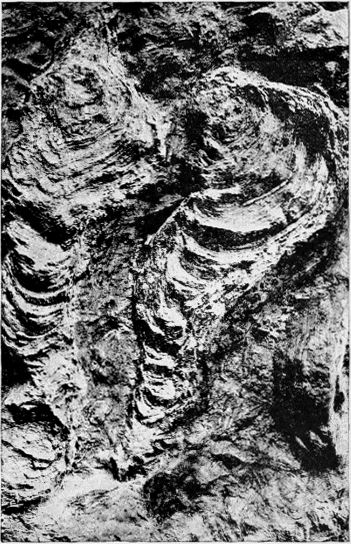
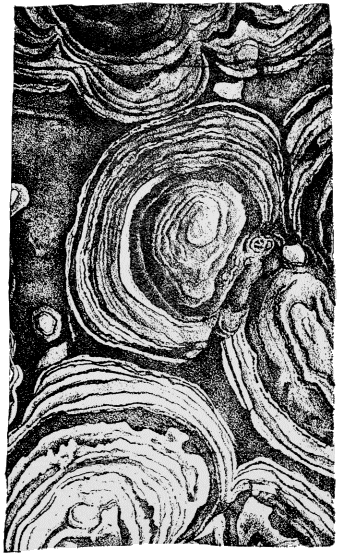
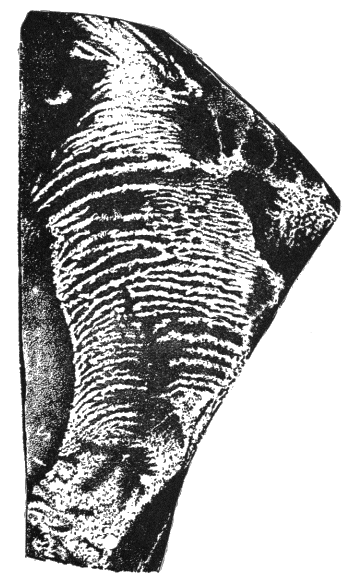
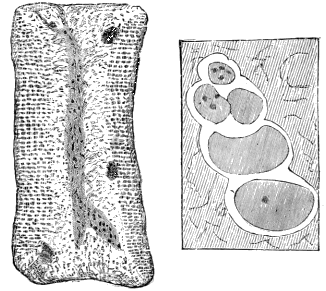
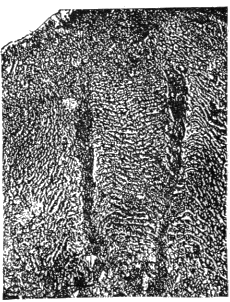
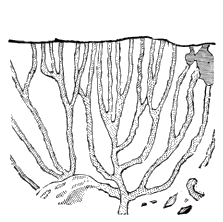
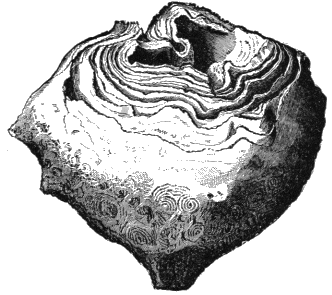
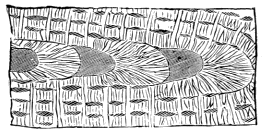
Cryptozoon Boreale, Dawson.
Two divisions or branches of a large specimen collected by
Mr. E. T. Chambers in the Ordovician of Lake St. John.
(See Appendix D.)
[Frontis.
RELICS OF PRIMEVAL LIFE — SIR J. WILLIAM DAWSON LL.D., F.R.S., Etc.
BEGINNING OF LIFE IN THE
DAWN OF GEOLOGICAL TIME
BY
WITH SIXTY-FIVE ILLUSTRATIONS
NEW YORK CHICAGO TORONTO
FLEMING H. REVELL COMPANY
1897
The substance of a Course of Lectures on Pre-Cambrian Fossils
delivered in the Lowell Institute, Boston,
in November, 1895.
To
AUGUSTUS LOWELL Esq
Vice-President of the American Academy of Arts and Sciences
Trustee of the Lowell Institute
AS THE WISE AND LIBERAL ADMINISTRATOR OF A NOBLE
ENDOWMENT FOR THE ADVANCEMENT AND DIFFUSION
OF KNOWLEDGE
THIS WORK IS DEDICATED
WITH MUCH RESPECT AND ESTEEM
BY THE AUTHOR
PREFACE
I
IT is now more than thirty-five years since the
announcement was made of the discovery of
remains supposed to indicate the existence of animal
life in the oldest rocks known to geologists. It was
hailed with enthusiasm by some as "opening a new
era in geological science"; but was regarded with
scepticism by others, in consequence of the condition
and mineral character of the supposed fossil, and because
of the great interval in time between the oldest
animal remains previously known and these new
claimants for recognition. Since that time, many new
facts have been learned, and the question has been
under almost continuous discussion and debate, with
various fortunes, in different quarters.
The author was associated with the original discovery
and description of these supposed earliest traces of
life; and has since, in the intervals of other work,
devoted much time to further exploration and research,
the results of which have been published from time to
time in the form of scientific papers. He has also
given attention to the later discoveries which have
tended to fill up the gap between the Laurentian fossil
and its oldest known successors.
In 1875 he endeavoured to sum up in a popular form
what was then known, in a little volume named "The
Dawn of Life," which has long been out of print; and
in 1893 the matter was referred to in a chapter of his
work "Salient Points in the Science of the Earth."
In 1895 he was invited to present the subject to a large
and intelligent audience in a course of lectures delivered
in the Lowell Institute, Boston; and the success which
attended these lectures has induced him to reproduce
them in the present work, in the hope that inquiries
into the Dawn of Life may prove as fascinating to
general readers as to those who prosecute them as a
matter of serious work, and that their presentation in
this form may stimulate further research in a field
which is destined in the coming years to add new and
important domains to the knowledge of life in the early
history of the earth.
Hypotheses respecting the introduction and development
of life are sufficiently plentiful; but the most
scientific method of dealing with such questions is that
of searching carefully for the earliest remains of living
beings which have been preserved to us in the rocky
storehouses of the earth.
There are many earnest labourers in this difficult
field, and it will be the object of the writer in the
following pages to do justice to their work as far as
known to him, as well as to state his own results.
J. W. D.
CONTENTS — APPENDIX
I
PAGE
The Chain of Life Traced Backward in Geological Time
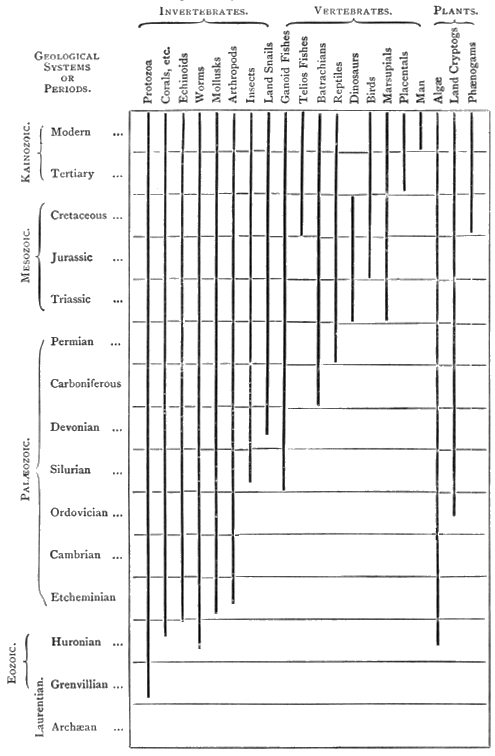
Note.—It is not supposed that the Geological Periods were of equal lengths,
as represented in the diagram.
ERRATA.
Where Cryptozoon prolificum occurs in the text, read Cryptozoon proliferum.
[Transcriber Note: Errata Corrections HAVE BEEN applied to text!]
I
THE CHAIN OF LIFE TRACED BACKWARD IN
GEOLOGICAL TIME
I
IN infancy we have little conception of the perspective
of time. To us the objects around us
and even our seniors in age seem to have always
been, and to have had no origin or childhood. It
is only as we advance in knowledge and experience
that we learn to recognise distinctions of age in
beings older than ourselves. In thinking of this, it
seems at first sight an anomaly, or at least contrary
to analogy, that the oldest literature and philosophy
deal so much with doctrines as to the origins of
things. In this respect primitive men do not seem
to have resembled children; and the fact that our
own sacred records begin with answers to such
questions, and that these appear in the oldest
literary remains of so many ancient nations, and
even in the folk-lore of barbarous tribes, might be
used as an additional argument in favour of an
early Divine revelation on such subjects, as a means
of awakening primitive men to the comprehension
of their own place in the universe.
However this may be, it is certain that modern
science at first took a different stand.
The constancy of the motions of the heavenly
bodies, our great time-keepers, and of the changes
on the earth depending upon them, and the resolution
of apparent perturbations into cycles of greater
or less length, impressed astronomers and physicists
with the permanence of the arrangements of the
heavens and their eternal circling round without any
change. In like manner, on the rise of geology, the
succession of changes recorded in the earth seemed
interminable, and Hutton could say that in the
geological chronology he could see "no vestige of a
beginning, no prospect of an end."
But the progress of investigation has changed all
this, and has brought physical and natural science
back to a position nearer to that of the old cosmogonies.
Physical astronomy has shown that the
constant emission of heat and light from the sun
and other stars must have had a beginning, and is
hurrying on toward an end, that the earth and its
satellite the moon are receding from each other,
and that even the spinning of our globe on its
axis is diminishing in rapidity. In summing up
these and other changes, Lord Kelvin says: "To
hold the doctrine of the eternity of the universe
would be to maintain a stupendous miracle, and one
contrary to the fundamental laws of matter and
force."
So, on our earth itself, we can now assign to their
relative ages those great mountain chains which
have been emblems of eternity. We can transfer
ourselves in imagination back to a time when man
and his companion animals of to-day did not exist,
when our continents and seas had not assumed their
present forms, and even when the earth was an
incandescent mass with all its volatile materials
suspended in its atmosphere. It is true that in
all the changes which our earth has undergone the
same properties of matter and the same natural laws
have prevailed; but the interactions of these properties
and laws have been tending to continuous
changes in definite directions, and not infrequently
to accumulations of tension leading to paroxysmal
vicissitudes.
If all this is true of the earth itself, it is especially
applicable to its living inhabitants. Successive
dynasties of animals and plants have occupied
the earth in the course of geological time; and
as we go back in the record of the rocks, first man
himself and, in succession, all the higher animals
disappear, until at length in the oldest fossiliferous
beds only a portion of the more humble inhabitants
of the sea can be found. In the time of the formation
of the oldest of these rocks, or perhaps somewhat
earlier, must have been the first beginning of
life on our planet.
Just as we can trace every individual animal to
a microscopic germ in which all its parts were
potentially present, so we can trace species, genera,
and larger groups of animals to their commencement
at different points of the earth's history, and can
endeavour to follow the lines of creation or descent
back to the first beings in which vital powers manifested
themselves. All such beginnings must end in
mystery, for as yet we do not know how either a
germ or a perfect animal could originate from inanimate
matter; but we may hope at least to make
some approximation to the date of the origin of life
and to a knowledge of the conditions under which
it began to exist, confining ourselves for the present
principally to the Animal Kingdom.
As preliminary to the consideration of this subject,
we may shortly notice the grades of animals at
present existing, and then the evidence which we
have of their successive appearance in different
periods of geological time, in order that we may
eliminate all those of more recent origin, in so far
as the knowledge at present available will permit,
and restrict our consideration to forms which seem
to have been the earliest. In attempting this, we
may use for reference the table of geological periods
and animal types presented in the diagram facing
this chapter, which is based on one prepared by
Prof. Charles A. White, of the United States
Geological Survey, with modifications to adapt it
to our present purpose. In this table the leading
groups of animals are represented by lines stretching
downward in the geological column of formations
as far as they have yet been traced. Such a table,
it must be observed, is always liable to the possibility
of one or more of its lines being extended farther
downward by new discoveries.
The broadest general division of the Animal Kingdom
is into back-boned animals (Vertebrates) and
those which have no back-bone or equivalent structure
(Invertebrates).[1] The former includes, besides
man himself, the familiar groups of Beasts, Birds,
Reptiles, and Fishes. The latter consists of the
great swarms of creatures included under the terms
Insects, Crustaceans, Worms, Cuttle-fishes, Snails,
Bivalve Mollusks, Star-fishes, Sea-urchins, Coral
Animals, Sea-jellies. Sponges, and Animalcules.
This mixed multitude of animals, mostly of low
grade and aquatic. Includes a vast variety of forms,
which, though comparatively little known to ordinary
observers, are vastly numerous, of great interest to
naturalists, and, as we shall find, greatly older in
geological date than the higher animals.
[1] The twofold primary division now sometimes used, into
Metazoa and Protozoa, seems more arbitrary and unequal, and
therefore of less practical value.
It will be seen by a glance at the diagram that
the higher vertebrates are of most recent origin,
man himself coming in as one of the newest of all.
Only the lower reptiles or batrachians and the
fishes extend very far back in geological time.
None of the other vertebrate groups reach, so far
as yet known, farther back than the middle of the
geological scale—probably in point of time very
much less than this. Those of the invertebrates
that breathe air reach no farther back than the
fishes, possibly not so far. On the other hand, all
the leading groups of marine invertebrates run without
interruption back to the Lower Cambrian, and
some of them still farther. Thus it would appear
that for long ages before the introduction of land or
air-breathing animals of any kind, the sea swarmed
with animal life, which was almost as varied as that
which now inhabits it. The reasons of this would
seem to be that the better support given by the
water makes less demands upon organs for mechanical
strength, that the water preserves a more
uniform temperature than the air, and that arrangements
for respiration in water are less elaborate
than those necessary in air. Hence the conditions
of life are, so to speak, easier in water than in air,
more especially for creatures of simple structure and
low vital energy. Besides this, the waters occupy
two-thirds of the surface of the earth, and in earlier
periods probably covered a still greater area.
We are now in a position to understand that the
Animal Kingdom had not one but many beginnings,
its leading types arriving in succession throughout
geological time. Thus the special beginning of any
one line of life, or those of different lines, might
form special subjects of inquiry; but our present
object is to inquire as to the first or earliest
introduction of life in our planet, and in what form
or forms it appeared. We may, therefore, neglect
all the vertebrate animals and the air-breathing
invertebrates, and may restrict our inquiries to
marine invertebrates.
In relation to these, six of the larger divisions
or provinces of the Animal Kingdom may suffice
to include all the lower inhabitants of the ocean,
whether now or in some of the oldest fossiliferous
rocks.[2]
[2] Some modern zoologists, having perhaps, like some of the
old Greeks, lost the idea of the unity of nature, or at least that
of one presiding divinity, prefer for the larger divisions of
animals the term phylum or phylon, implying merely a stock,
race or kind, without reference to a definite place in an ordered
kosmos.
Looking more in detail at our diagram, we
observe that the higher vertebrates nearest to man
in structure extend back but a little way, or, with
a few minor exceptions, only as far as the beginning
of the Kainozoic or Tertiary Period, in the later
part of which we still exist. Other air-breathing
vertebrates, the birds and the true reptiles, extend
considerably farther, to the beginning of the previous
or Mesozoic Period. The amphibians, or frog-like
reptiles, reach somewhat farther, and the fishes
and the air-breathing arthropods farther still. On
the other hand, our six great groups of marine
invertebrates run back for a vast length of time,
without any companions, to the lowest Palæozoic,
and this applies to their higher types, the cuttles
and their allies, and the crustaceans, as well as to
the lower tribes. Turning now again to our table,
we find that these creatures extend in unbroken
lines back to the Lower Cambrian, the oldest beds
in which we find any considerable number of organic
remains, and leave all the other members of
the Animal Kingdom far behind.
If now we endeavour to arrange the leading
groups of these persistent invertebrates under a few
general names, we may use the following, beginning
with those highest in rank:—
(1) Insects and Crustaceans (Arthropoda).
(2) Cuttles, univalve and bivalve Shell-fishes (Mollusca).
(3) Worms (Annelida).
(4) Sea-urchins and Sea-stars (Echinodermata).
(5) Coral Animals, Sea-anemones, and Sea-jellies (Cœlenterata).
(6) Sponges, Foraminifera and Animalcules of
simple organization (Protozoa).
There are, it is true, some animals allied to the
mollusks and worms, which might be entitled to
form separate groups, though of minor importance
The position of the sponges is doubtful, and the
great mass of Protozoa may admit of subdivision;
but for our present purpose these six great groups
or provinces of the Animal Kingdom may be held
to include all the humbler forms of aquatic life,
and they keep company with each other as far as
the Early Cambrian. If, in accordance with the previous
statements, we choose to divide the earth's
history by the development of animal life rather
than by rock formations, and to regard each period
as presided over by dominant animal forms, we
shall thus have an age of man, an age of mammals,
an age of reptiles and birds, an age of amphibians
and fishes, and an age of crustaceans and mollusks.
It is only within recent years that the researches
more especially of Barrande, Hicks, Lapworth,
Linarrson, Brögger, and others in Europe, and
of Matthew, Ford and Walcott in America, have
enlarged the known animals of the Lower Cambrian
to nearly 200 species, and below this we
know as yet very little of animal life. We may
therefore take the Lower Cambrian, or "Olenellus
Zone" as it has been called from one of its more
important crustaceans,[3] as our starting-point for
plunging into the depths below. In doing so, we
may remark on the orderly and symmetrical nature
of the chain of life, and on the strange fact that
for so long ages animal life seems to have been
confined to the waters, and to have undergone little
development toward its higher forms. It is like a
tree with a tall branchless stem bearing all its
leaves and verdure at the top, or like some obscure
tribe of men long living in isolation and
unknown to fame, and then, under some hidden
impulse or opportunity, becoming a great conquering
and dominant nation. Or to compare it with
higher things, it is like the Christian religion, for
ages confined to a small and comparatively unimportant
people, and developing slowly its faith
and hopes, and then suddenly, under the personal
influence of Christ and His apostles, spreading itself
over the world, and in a few centuries becoming
the ruling power in its greatest empire, surviving
the fall of this and permeating all the great nations
that sprang from its ruins. God's plans in nature,
in history, and in grace seem to us very slow in
their growth and maturity, but they are very sure.
IN the old Chaldean fable of the descent of Ishtar
into Hades, to recover her lost Tammuz,
at each successive gate of the lower regions she
is stripped of some of her ornaments and garments,
till at length she has to appear naked and unadorned
in the presence of the lord of the Nether
World. So in our descent from the surface on
which men live, through the successive rocky layers
of the earth's crust, we leave behind, one by one,
all the higher forms of life with which we are
familiar; but there still remain to us our six groups
of aquatic invertebrates, in the guise, it is true,
of species and genera now unknown in a living
state, yet well represented as far down as the lower
part of the Cambrian. Let us now suppose that
we take our stand on the shores of the Cambrian
sea, or cast our dredge into its waters in search of
these old animals; though we can only actually do
so by painfully hammering and chiselling them out
of their rocky tombs, and this often in fragments
which must be put together before we can fully
realize the forms and structures of the animals to
which they belonged.
We may pause here, however, to remark that
neither the geographical nor climatal conditions of
the earth at this early time were similar to these
with which we are now familiar. The marine
animals of the Cambrian have left their remains
in beds of sediment, which now constitute rocks
forming parts of our continents remote from the
sea, and much elevated above its level, showing
that large areas, then under the ocean, are now
dry land; while there is no good evidence that the
sea and land have changed places. The facts rather
indicate that the continents have extended their
area at the expense of the ocean, which has, however,
probably increased in depth. In evidence of
these statements, I need only mention that some of
the oldest rocks in the Scottish and Welsh hills, in
Scandinavia, in Russia and in Bohemia, are rich in
Cambrian marine fossils.
Fig. 1.—Olenellus Thompsoni, Hall.
A characteristic Trilobite of the Lower Cambrian in North America.
After Walcott and specimen in Peter Redpath Museum.
In America, in like manner,
such rocks are found on the flanks of the
Appalachians, in New Brunswick, and in Newfoundland,
in the table-land of Colorado and in the
Rocky Mountains. In point of fact, a map of the
Northern Hemisphere at this period would show
only a limited circumpolar continent with some
outlying islands to the south of it, and shallows
stretching across the northern part of the areas
of the present Atlantic and Pacific Oceans. The
great ocean, however, thus extending over most
of the temperate and tropical parts of the Northern
Hemisphere, was probably also more muddy
and shallow than that of modern times. The surface
temperature of this vast ocean was also, it is
probable, more uniform than that of the modern sea,
while even its profounder depths or abysses would
have more earth-heat than at present. Thus we
may, without hesitation, affirm that in this early
age the conditions for the introduction of swarming
marine life of low grade, and its extension over
the whole earth, were at a maximum.
Let us inquire, then, what these old Cambrian
seas actually produced, more especially in the early
portions of that ancient and probably protracted
time.
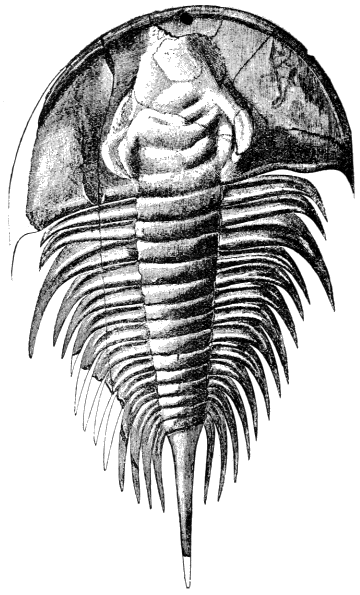
The most highly organized type of which we
have any certain evidence is that of the Crustacea,
the group to which our modern lobsters and crabs
belong, and its most prominent representatives are
the trilobites (Figs. 1, 2), so called from the three
lobes into which the body is divided. These creatures
are indeed remarkable for the twofold property of
bilateral symmetry, and fore and aft jointed structure,
both based on the number three. From front to
rear we have a large head, usually with well-developed
eyes and oral organs, a middle or thoracic
part composed of a series of movable segments, and
a tail-piece sometimes small, sometimes nearly as
large as the head. Transversely, the body is divided
into a central and two lateral lobes, which can be
seen in the head, the thorax, and usually in the
tail as well. The organization of these animals
must have been as complex as that of most existing
Crustaceans. Their nerve system must have been
well developed; a vast number of muscles were
required to move the different parts of the trunk,
and the numerous and complex limbs which have
been observed in some of the species, and no doubt
were possessed by all. Their digestive and circulatory
organs must have been in proportion to the
complexity of their locomotive organs.
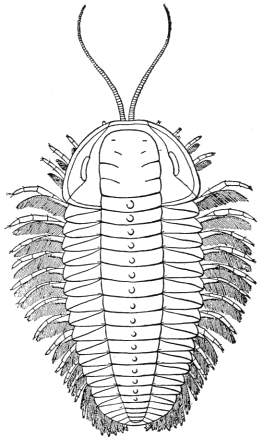
Fig. 2.—Triarthrus Becki, Green.
A Trilobite of primitive type, showing its limbs and antennæ. (After Beecher.)
Figure 2, borrowed from Beecher,[4] shows the limbs of a
species, not of the Lower Cambrian, but of a somewhat
later formation. There can be no doubt, however,
that those of earlier species were equally perfect,
more especially as Triarthrus is an animal of an
old type approaching to extinction in the age succeeding
the Cambrian, and its representatives in the
earlier and palmy days of the family could not
have been inferior in organization. These creatures
swarmed in every sea in the Cambrian period,
and were represented by a great number of species,
some of them of large size, others very small;
some many-jointed, others few-jointed, and with
a great variety of tubercles, spines, and other ornamental
and protective parts. If we ask for their
affinities and place in the great group of Crustacea,
the answer must be that, while in some points allied
to the higher forms, they approach most nearly to
those which occupy a medium position in the class,
and are, in fact, a composite type, presenting points
of structure now distributed among different groups.
If we ask for affinities with lower groups, we have
to reply that their nearest allies in this direction are
the bristle-footed marine worms; but there is a
vast gap, both in the Cambrian and Modern seas,
between any of these worms and the Crustacea,
which, either as embryos or as adults, have any resemblance
to them.
The Trilobites, after appearing in a great variety
of generic and specific forms, and playing a most
important part in their time, were not destined to
continue beyond the Carboniferous period, and before
that time they were beginning to give place to
the Limuli, King-crabs, or Horseshoe-crabs, a few
species of which continue on our coasts until the
present time. In this limited duration the Trilobites
present a strange contrast to certain shrimp-like
Crustaceans, their contemporaries (the Phyllopods),
which very closely resemble some still extant, and
the same remark applies to swarms of little bivalve
Crustaceans (Ostracods), which are still represented
by hosts of modern species both in the sea and in
the fresh waters. There is, however, a remarkable
group of shrimp-like Crustaceans, represented in the
modern world by only a few small species, which in
the Cambrian age attained greater size, and constitute
a very generalized type combining characters
now found in lower and higher groups of Crustacea.
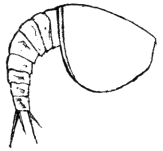
Hymenocaris vermicauda of Salter (Fig. 3) may
serve to illustrate one of these primitive forms.
Fig. 3.—Hymenocaris vermicauda, Salter.
A Lower Cambrian Shrimp of generalized type. (After Salter.)
In point of fact, as Dr. Henry Woodward has
shown in an able presidential address delivered to
the Geological Society in 1895, at the base of the
Lower Cambrian we still have several distinct groups
of Crustacea; and if with some we were to hold them
as traceable to one original form or to a worm-like
ancestor, we must seek for this far back in those
pre-Cambrian rocks in which we find no Crustaceans
whatever. There is, it is true, no good reason to
demand this; for whatever the cause, secondary or
final, which produced any form of Crustacean in the
Lower Cambrian, it might just as well have produced
several distinct forms. Evolutionists seem
to be somewhat unreasonable in demands of this
kind, for any cause capable of originating a new
form of living being, might have been operative at
the same time in different localities and under somewhat
diverse conditions, and may also have acted
at different times. All imaginary lines of descent
of animals are more or less subject to this contingency;
and this may partly account for the
great diversity in the lines of affiliation presented
to us by evolutionists, which may in part have a
basis in fact in so far as distinct varietal and
racial forms are concerned, but may just as likely
be entirely fallacious in the case of true species.
In any case, in the lowest rocks into which we can
trace Crustacea, we have already probably five of
the orders into which their successors in the modern
seas are divided by zoologists; and this is certainly
a singular and suggestive fact, the significance of
which we shall be better prepared to understand
at a later stage of our investigation.
Allied in some respects to the Crustacea, though
much lower in grade, are the marine Worms—a
great and varied host—usually inhabiting the shallower
parts of the ocean; though the 330 species
collected by the Challenger expedition show that
they also abound in those greater depths to which
voyagers have only recently had access. Sea-worms
seem thus to be able to live in all depths, as well
as in all climates; and in accordance with this
they abound in the oldest rocks, which are often
riddled with the holes caused by their burrowing, or
abundantly marked on the surfaces of the beds with
their trails.
The great province of the Mollusca, in which,
for our present purpose, we may include some
aberrant and rudimentary Molluscoids, is now best
known to us by its medium types, the univalve and
bivalve Shell-fishes; the higher group of the Cuttle-fishes
and Nautili, though not uncommon, being
much less numerous, and one at least of the lower
groups, the Lamp-shells or Brachiopods, being represented
in the modern world by but few forms. The
extension of the Mollusks backwards into the Cambrian
is remarkable as being on the whole meagre
in comparison with that of the Crustaceans, and as
presenting only in small numbers the types most
common in later times. One or two shells, and
perhaps some tracks, represent the highest group:
some forms resembling the floating species of Sea-snails,
and a very few ordinary bivalves represent
the types best known in the modern seas; while
the Brachiopods, and probably some still simpler
forms, are in great comparative excess. The individual
specimens are also of small size, as if these
creatures were but insinuating themselves on the
arena of life in insignificant and humble forms. So
far as yet known, the lowest groups supposed to
be allied to the Mollusks, the Ascidians or Sea-squirts,
and the Sea-mosses (Polyzoa), do not appear;
but they may have been represented by
species which possessed no hard parts capable of
preservation.
This leads us to the consideration that while all
the Crustacea necessarily possess some kind of crust
or external skeleton, the Mollusks are very different
in this respect. While some of them have
ponderous shells, others even of the highest forms
are quite destitute of such protective parts. This
again leads to a curious question respecting the
armature of the Trilobites. Some of these, even
of the larger species, have strong and formidable
spines, like those of the King-crabs and
other modern Crustaceans. Now in the modern
species we know these organs to be intended to
defend their possessors against the attacks of fishes
more swift and powerful than themselves. But
what enemies of this kind had the Trilobites to
dread? Yet species a foot or more in length presented
great bayonet-like spines.
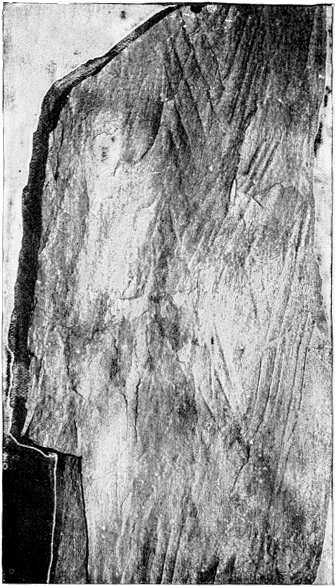
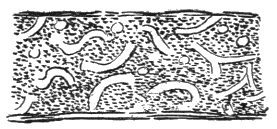
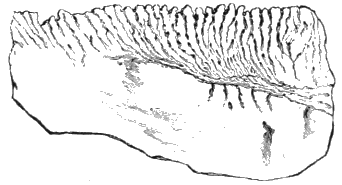
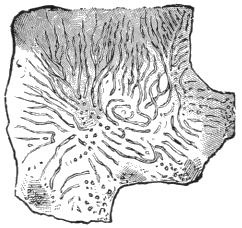
Fig. 4.—Ctenichnites ingens, Matthew.
A slab with markings of aquatic animals. From specimen in Peter Redpath
Museum.
All that we
know on this subject is that on the surfaces of
the Lower Cambrian rocks there are in some
places complicated and mysterious tracks or
scratches, which seem to have been produced when
the rock was in the state of soft mud, by large
and swiftly swimming animals possessing some sort
of arms or similar appendages (Fig. 4). Matthew
has ingeniously suggested that they may have been
large Mollusks allied to the modern gigantic Squids
which still abound in the ocean, that they may
have been sufficiently powerful to prey on the
Trilobites, and, being swift swimmers, would have
found them a helpless prey but for their defensive
spines. Yet such large Mollusks might have
perished without leaving any remains recognisable
in the rocks, except what may be termed their hand-writing
on clay. A few small examples of the shell-bearing
species of these highest Mollusks, however,
appear in the Cambrian, and in the succeeding ages
they become very abundant and attain to large
dimensions, again dwindling toward modern times.
It would thus seem that for some unknown reason
the highest and lowest Mollusks may have been locally
plentiful, but the intermediate types were rare.
The much lower group of Echinoderms, or Sea-urchins
and Sea-stars, curiously enough puts in but
a small appearance in the Early Cambrian, being
represented, as far as yet known, by only one
embryonic group, the Cystideans. A little later,
however, Feather-stars became greatly abundant,
and a little later still the true Star-fishes and
Urchins. The aberrant group of the Sea-slugs seems,
so far as known, to be of more modern origin; but
most of these animals are soft-bodied, and little
likely to have been preserved.
The great group of the coral animals, so marked
a feature of later ages, is scarcely known in the
oldest Cambrian, except by some highly generalized
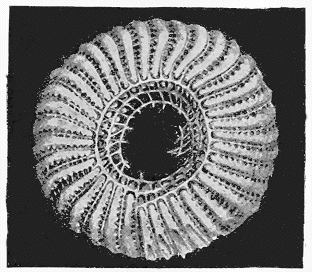
forms[5] (Fig. 5). There are, however, small Zoophytes
referable to the lower type of Hydroids, and markings
which are supposed to be casts of stranded
Jelly-fishes. If, with some naturalists, we regard the
Sponges as very humble members of the coral
group (Cœlenterata), then we have a right to add
them to its representatives in the lowest Cambrian;
but perhaps they had better be ranked with the
next and lowest group of all—the Protozoa.
[5] Dr. G. J. Hinde has carefully studied these forms, and also
similar species occurring in Lower Cambrian beds in different
parts of North America, Spain, Sardinia, and elsewhere. See
note in the Appendix, and Journal Geol. Society of London,
vol. xlv. p. 125.
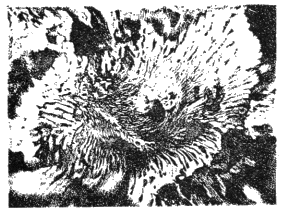
Fig. 5.—Archæocyathus profundus, Billings.
Possibly a Coral of generalized type from the Lower Cambrian of L'Anse à Loup,
Labrador. A small specimen.
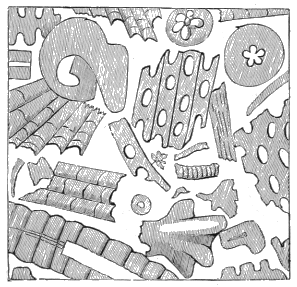
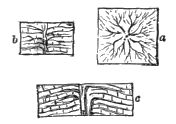
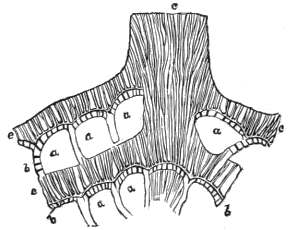
Fig. 6.—Structures of A. profundus (magnified).
From specimens in Peter Redpath Museum.
(a) Lower acervuline portion. (b) Upper part, with three of the radiating laminæ
and section of pores, (c) Portion of lamina, with pores, the calcareous skeleton unshaded.
These are the humblest of all the inhabitants
of the sea, presenting very simple, jelly-like bodies
with few organs, but sometimes producing complex
and beautiful calcareous and siliceous coverings or
tests. Animals of this type have been found in the
Lower Cambrian, though not in such vast multitudes
as in some later formations. There are also in the
Cambrian some large, laminated, calcareous bodies
(Cryptozoon of Hall), to be noticed more fully below,
and which have recently been traced in still lower
deposits even below the lowest Cambrian (Figs. 7, 8).
These have some resemblance to the layer-corals or
stromatoporæ of the Silurian and Ordovician, which
are by many regarded as the skeletons of coral
animals of a low type; but the microscopic structure
of Cryptozoon rather allies it with some of
the larger forms of Protozoa found higher up in
the series of formations. We shall have to discuss
this later in connection with still older fossils.
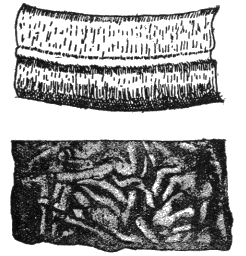
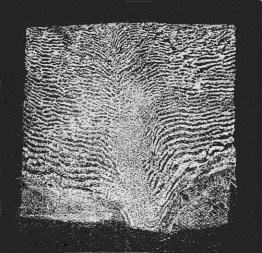
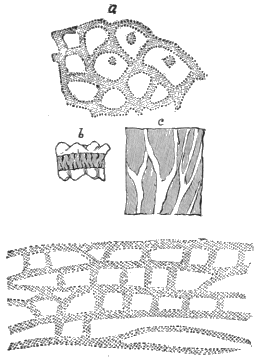
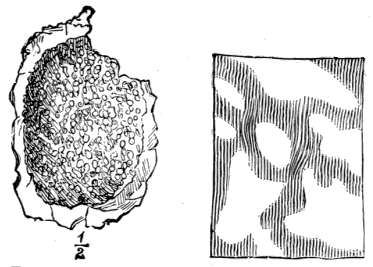
Fig. 7.—Cryptozoon proliferum, Hall.
Portion of slab reduced in size. (After Hall.) See also Fig. 59, p. 237.
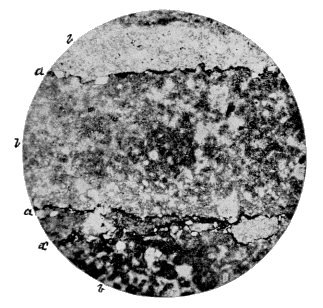
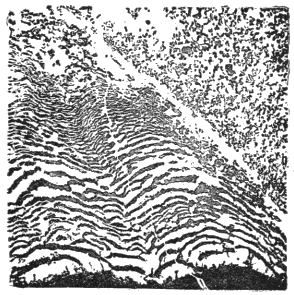
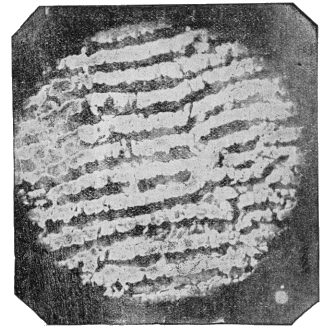
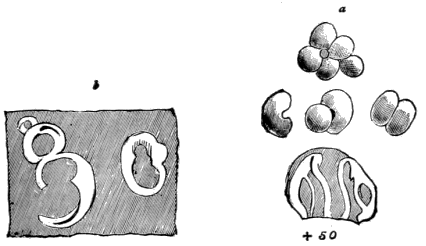
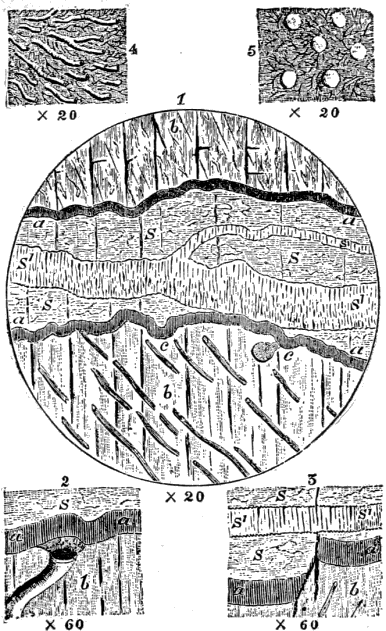
Fig. 7a.—Portion of thin section of Cryptozoon proliferum (magnified × 50).
(a) Corneous layers, (a¹) One of these dividing, (b) Intermediate stroma with
granules of calcite, dolomite and quartz, traversed by canals.
From a Micro-photograph byProf. Penhallow.
[To face p. 39.
If now in imagination we cast our tow-net or
dredge into the sea of the Lower Cambrian, we
may hope to take specimens illustrative of all our
six groups of invertebrate animals, and under
several of them examples of more than one subordinate
group. Of the Crustaceans we might have
representatives of four or five ordinal groups, and
of the Mollusca as many. These are the two
highest and most complicated. In the four lower
groups we would naturally have less variety, though
it would seem strange, were it not for so many
examples in later periods, that the dominant and
highest groups should be most developed in regard
to the number of their modifications.
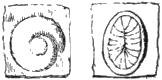
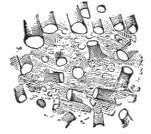
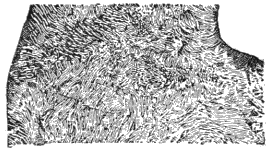
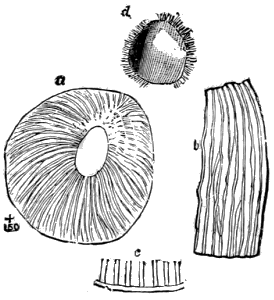
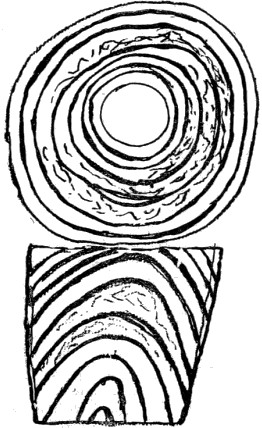
Fig. 8.—Diagrammatic section of two Laminæ of Cryptozoon, showing
the Canals of the intermediate space, or Stroma (magnified).
Specimen in Peter Redpath Museum.
Of the whole we might perhaps have been able
to secure at least 200 species even in one locality.
The likelihood is that if there had been a collecting
expedition like that of the Challenger in Early
Cambrian times, it could have secured thousands
of specific forms representing all the above types,
more especially as we probably know very little of
the softer and shell-less animals of these old seas,
and there is some reason to believe that these
may have been in greater proportion than in the
present ocean.
In illustration of the richness of some parts of
the lowest Cambrian sea, I may refer here to the
large and beautifully illustrated Memoir of Walcott
on the Lower Cambrian, containing fifty folio plates
of species collected in a few districts of North
America; and, as a minor example, to the contents
of a loose boulder of limestone of that age, found
at Little Metis on the Lower St. Lawrence, under
the following circumstances (Fig. 9):—
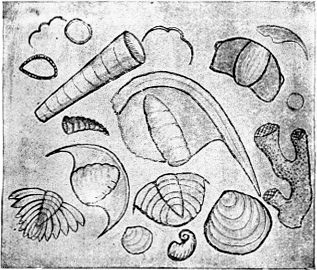
Fig. 9.—Lower Cambrian Fossils found in a few cubic inches of
limestone in a conglomerate at Little Metis; viz., Trilobites of genera
Olenellus, Ptychoparia, Solenopleura, Protypus; Brachiopod of genus
Iphidea; Pteropod of genus Hyolithes; Gastropod, genus Stenotheca;
Sponge, undetermined.
Along what is now the valley of the Lower St.
Lawrence and the gulf of the same name, there
seem to have been deposited in the oldest
Cambrian or Olenellus period beds of limestone
rich in shells of marine animals and fragments
of these. These can be seen in place in some
parts of Newfoundland, and here and there on the
hills bounding the St Lawrence River; but for
the most part they have been swept away by the
sea when these districts were being elevated to form
parts of the American land. Their ruins appear as
boulders and pebbles in thick beds of conglomerate
or pudding-stone, constituting portions of the
Upper Cambrian and Lower Ordovician series,
which now occupy the south coast of the Lower
St. Lawrence. In one of these boulders, less than
a foot in diameter, removed from its hard matrix
and carefully broken up, I found fragments representing
eleven different species, of which no less
than eight were trilobites, one a gastropod, one a
brachiopod, and one probably a sponge—and this
forms an interesting illustration of the number of
species sometimes to be found in a limited space,
and also of the great prevalence of the Trilobites
in these beds. The statistics of these groups for
North America, as given by Walcott, show 165
species belonging to all the groups enumerated
above, and of these the Trilobita constitute one-third
of the whole; so that the Olenellus Zone, as it has
been called from one genus of these Crustaceans,
might well be named the reign of Trilobites, unless,
indeed, as the indications already referred to seem to
show, giant cuttle-fishes, destitute of shells, were then
the tyrants of the sea, but are represented only by
the markings of their long and muscular arms on
the soft sea mud while dashing after their Crustacean
prey. What I desire, however, chiefly to
emphasize is, that in the lowest beds of the
Cambrian we have evidence of sea-bottoms swarming
with representatives of all the leading types
of marine invertebrate life, and therefore seem to
be still far from the beginning of living things, if
that was a slow and gradual process, rather than a
sudden or rapid series of events.
PRE-CAMBRIAN LIFE
III
PRE-CAMBRIAN LIFE
H
HAVING traced the chain of life through the
long geological ages, from the present day
back to the Cambrian Period, we may now take
our stand on the fauna of the lowest Cambrian
or Olenellus Zone, as a platform whence we may
dive into still deeper abysses of past time. Here,
however, we seem to have arrived at a limit beyond
which few remains of living things have yet been
discovered, though there still remain pre-Cambrian
deposits of vast thickness and occupying large areas
of our continents. These pre-Cambrian formations
are as yet among those least known to geologists.
The absence of fossils, the disturbances and alterations
which the rocks themselves have undergone,
and which make their relative ages and arrangement
difficult to unravel, have acted as deterrents to
amateur geologists, and have to some extent baffled
the efforts of official explorers. In addition to this,
workers in different regions have adopted different
methods of arrangement and nomenclature; and in
a very recent address, the Director-General of the
Geological Survey of Great Britain expresses his
inability to satisfy himself of the equivalency of
the different pre-Cambrian groups on the opposite
sides of the Atlantic, and in consequence prefers
to retain for those of Britain merely local names.
On the other hand, those who hold the modern
theories of gradual evolution repudiate the idea
that the Lower Cambrian fauna can be primitive, and
demand a vast series of changes in previous time
to prepare the way for it. In any case this comparatively
unexplored portion of geological time
holds out the inducement of mystery and the possibility
of great discoveries to the hardy adventurers
who may enter into it. It must now be our effort to
explore this dim and mysterious dawn of life, and
to ascertain what forms, if any, are visible amid
its fogs and mists.
The Kewenian or Etcheminian.
In certain basal Cambrian or infra-Cambrian
beds, found by Matthew in Southern New Brunswick,
by Walcott in Colorado, and by Scandinavian
and English geologists in their respective countries,
we find a few remains referred to Algæ, or seaweeds;
small tests or shells of Protozoa; burrows and trails
similar to those of modern sea-worms; a few bivalve
shells allied to modern Lingulæ, but presenting some
remarkable generalized characters; some bivalve
and shrimp-like Crustaceans, spicules of sponges,
and large laminated forms (Cryptozoon) similar to
those already referred to as occurring in the Upper
Cambrian; also certain mysterious markings that
are supposed to have been produced by the arms
or tentacles of free-swimming animals of various
kinds. In these lower beds the Trilobites have
nearly or quite disappeared, being represented only
by doubtful fragments. The beds of rock, originally
sandy or muddy sediments, contain fossils very
sparingly, and only in certain layers separated by
great thicknesses of barren material, as if earthy
matters were being deposited very rapidly, or as
if animal life was rare on the sea-bottom except
at intervals. It has, however, been suggested as
possible[6] that much of the marine population in
those early times consisted of pelagic or swimming
animals destitute of any hard parts that could be
preserved. In addition to biological arguments
in favour of this view, there is the fact that some
of the beds are stained with carbonaceous or coaly
matter, as if the sediment had been mixed with
decomposed remains of plants or animals retaining
no determinate forms. Future discoveries may increase
our knowledge of the life of this period
preceding the Cambrian, but it is evident that so
far as these rocks have been examined, they indicate
a great step downward in regard to the variety and
complexity of marine life.
[6] By Prof. Brookes, of Johns Hopkins University.
Still we must bear in mind that in later periods
there have been times of rapid deposition, in which,
in certain localities at least, great thicknesses of
rock with few organic remains were formed. We
have instances of this in the later Cambrian, in the
Ordovician, and still later in the Permian and Trias.
Thus in the beds immediately underlying the lowest
Cambrian we may be passing through a tract of
comparative barrenness to find more fertile ground
below.
It is also to be observed that there is evidence
of disturbance occurring in the interval between
the lowest Cambrian and the highest pre-Cambrian,
which may involve the lapse of much time not
recorded in the localities hitherto
explored, but of which monuments
may be found elsewhere.
We may now, taking some
North American localities as our
best available guides, inquire as to
the nature and contents of the beds
next below the Lower Cambrian.
Fig. 10.—Section at Hanford Brook. (After Matthew.)
Showing St. John group resting on Etcheminian, and this on Coldbrook (Huronian).
In Southern New Brunswick,
Matthew indicated, several years
ago, the occurrence of certain conglomerates
and sandy and slaty
beds over the rocks, mostly of
igneous origin, constituting a great
thickness of beds under the Cambrian,
and known locally as the
"Coldbrook" series, which is probably
equivalent to the Huronian
of Northern and Western Canada,
to be noticed later. These beds
were at first regarded as an upper
member of the Huronian, but subsequently
it was thought better to
unite them with the overlying
Cambrian as basal Cambrian.
The fact that these problematical beds were ascertained
to be unconformable to the Cambrian, and the
peculiarity of their fossils, led to their being constituted
a separate group under the name Etcheminian,
which seems to represent a time and conditions
introductory to the Cambrian (Fig. 10). The fossils in
these beds are few and hard to find. Matthew has
kindly furnished me with the following list.[7] The
Trilobites are conspicuous by their absence. Sea-worms
have left burrows, trails, and casts, which
probably represent several species (Fig. 11). A single
little shell (Volborthella) is supposed to be a precursor
of the straight chambered shells allied to the
modern nautilus, which become so large and numerous
in succeeding periods. There are a few univalve
shell-fishes allied to modern sea-snails, a brachiopod
of the antique genus Obolus, some fragments supposed
to represent Cystideans, a rudimentary type of
the stalked sea-stars so abundant later, spicules of
sponges and minute Protozoa, with shells not unlike
those of their modern successors. This meagre list
sums up the forms of life known in the Etcheminian
of this district, one in which the Cambrian beds
exhibit the rich and varied fauna of Trilobites and
other animals described and figured by Matthew in
several successive volumes of the "Transactions of
the Royal Society of Canada" (Fig. 12).
[7] "Transactions Royal Society of Canada," vol. vii.
Fig. 11.—Trails of Worms of two types (Psammchnites and Planilites).
Beds in Newfoundland (the Signal Hill and
Random Sound series), underlying the Lower
Cambrian, have afforded to Murray and Billings
some well-characterized worm-castings of spiral
form, and a few problematical forms known as
Aspidella, which may be Crustaceans or Mollusks
allied to the limpets (Fig. 13).
Fig. 12.—Group of pre-Cambrian (Etcheminian) Animals from the
Etcheminian. (After Matthew.)
The name "Etcheminian" is derived from that of an ancient Indian tribe of
New Brunswick.
(a) Volborthella, supposed to be a Cephalopod shell. (b) Pelagiella.
(c) Orthotheca, supposed to be Pteropods. (d) Primitia, an Ostracod
Crustacean, (e) Obolus, a Brachiopod shell. (f) Platysolenites,
probably fragment of a Cystidean.
(g) Globigerinæ, casts of Foraminiferal shells, Etcheminian, New Brunswick.
Fig. 13.—Arenicolites (Spiroscolex) spirales (Billings) and Aspidella
tenanovica (Billings), Signal Hill Series, Newfoundland.
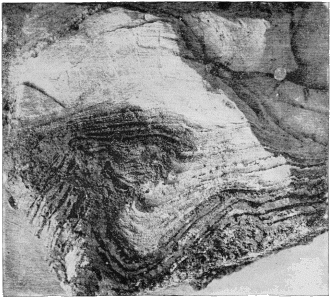
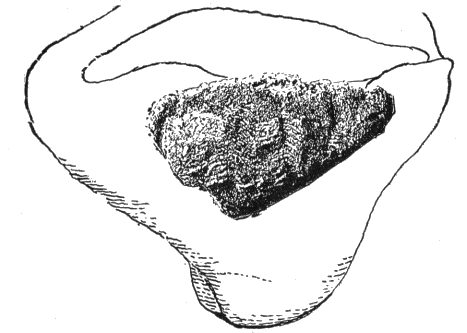
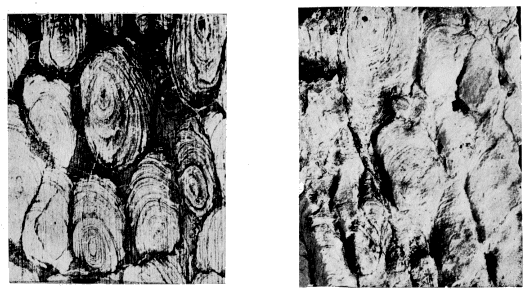
Fig. 14.—Fragment of Cryptozoon, Grand Cañon, Arizona.
Photograph from a specimen presented by Dr Walcott to the
Peter Redpath Museum.
In a thick series of pre-Cambrian beds in the
Colorado Cañon in the Western United States,
Walcott has found a small roundish shell of uncertain
affinities,[8] a species of Hyolithes, probably a
swimming sea-snail or Pteropod, a small fragment
which may possibly have belonged to a Trilobite,
and some laminated forms which, if organic, are
related to the Cryptozoon already mentioned (Fig. 14).
The Kewenian series of Lake Superior has
yielded no fossils, but the pipestone beds of Minnesota,
supposed to be about the same age, have
afforded a small bivalve shell allied to Lingula;[9]
and the black shales of the head of Lake Superior
contain some impressions supposed to be trails of
animals.[10]
It has been a question whether the beds above
referred to should be regarded as a downward continuation
of the Cambrian, or as the upper part
of an older system. Matthew, whose opinion on
such a subject is of the highest authority, regards
them as a distinct system, but as belonging, with
the Cambrian, to the great Palæozoic Period. Van
Hise, and some other United States authorities,
would separate them even from the Palæozoic, and
unite them with the underlying Huronian, as representing
a "Proterozoic" or "Algonkian" Period.
This is merely a matter of classification, necessarily
more or less arbitrary; but I believe the facts to
be stated subsequently show that it will be best
to unite the Etcheminian and its equivalents with
the Palæozoic, and to place the groups lower than
this in one great division, equivalent to Palæozoic,
and for which many years ago I proposed the
name "Eozoic," or that of the Dawn of Life.
Having thus hastily glanced at the slender fauna
of the rocks immediately below the Cambrian, we
may now proceed to inquire a little more in detail
into its true value and import as leading toward the
beginning of life. I have already referred to the
apparently sudden drop in the number of groups and
of species below the base of the Cambrian, and have
hinted that this may be an effect of temporary local
conditions of deposit or of defective information.
Another fact that strikes us is the diverse and miscellaneous
character of the fossils that remain to us;
and this would suggest that we are either dealing
with a mere handful picked at random, as it were
out of a richer fauna, or that in the beginning of
things the gaps and missing links between different
forms of life were even more pronounced than at
present. This, however, would be likely to occur
if the plan of creation was to represent at first
different types, with few forms in each; to produce,
in short, a sort of type collection representing the
whole range of organization by a few characteristic
things rather than to give a complete series, with
all the intermediate connections. Such a mode of
introduction of life is not à priori improbable, however
at variance with some prevalent hypotheses.
Beginning with the higher Invertebrates, we must
not conclude that we have altogether lost the Trilobites.
The fragments referred to this group may
represent at least a few species, and it would be
very interesting to know more of these as to their
relations to their successors, and whether they are
tending to lower or more embryonic forms. The
bivalve Crustaceans (Ostracods) may be regarded as
inferior in rank to the Trilobites, but are still very
complex, and specialized animals and a specimen
silicified in such a manner as to show the interior
organs testified that, as far back as the Carboniferous
at least, these creatures were as highly organized as
at present,[11] while their generally larger size in the
earlier formations tends to show that they have
rather been degenerating in the lapse of geological
time.
[11]Palæocypris Edwardsi, Brougniart, Coal Formation of St.
Etienne, France.
In regard to the Sea-worms, the burrows, castings,
and trails found in the pre-Cambrian beds are
scarcely, if at all, different from those now seen on
sandy and muddy shores, and would seem to indicate
that these highly organized and very sensitive and
active creatures swarmed in the muddy bottom of
the pre-Cambrian Sea, and lived in the same way
as at present. It is impossible, however, to know
anything of the internal structures of these creatures,
but the marks left by their bristle-bearing feet seem
to indicate that some of them at least belong to
the higher group of Sea-centipedes, creatures rivalling
the Crustaceans in complexity of organization,
and near to them in plan of structure, though at
present usually widely separated from them in current
systems of classification. In the Ordovician
system, next above the Cambrian, Hinde has found
many curiously formed jaws of animals of this kind,
which show at least that their alimentary arrangements
were similar to those now in force. If any
of the problematical "Conodonts" discovered by
Pander in the Cambrian of Russia belonged to
marine worms, this inference would be extended
back to the Lower Cambrian, so that if the evidence
of structure anywhere remains we may hope to
find that the pre-Cambrian worms were not inferior
to their more modern successors, perhaps even
that in this early period, when they probably
played a more important part in nature, they were
of higher organization than in later times.
The evidence as to pre-Cambrian mollusks, so far
as it goes, is even more curious. The little shell
called Volborthella, so far as can be judged from its
form and internal structure, is a miniature representative
of these straight Nautili, the Orthoceratites
of the Ordovician and later Palæozoic rocks; and no
one doubts that these latter belong to the highest
class of the Mollusks, a class approaching in the
development of nerve system and sensory organs to
the Vertebrates themselves. This tiny member of
the great class of Cuttle-fishes may perhaps have been
more nearly allied to the modern Spirula than to
the Nautilus. In any case, if, as seems altogether
probable it was, a mollusk, it must have been one
of advanced type, and with a highly complex structure,
as well as the singular apparatus for flotation
implied in a chambered shell with a siphuncle.
Next to this among these primitive Mollusks are
straight and spiral shells representing those delicate
and beautiful animals of the modern seas, the
Pteropods, or wing-footed Sea-snails, beautiful and
graceful creatures, the butterflies of the sea, and
moving in the water with the greatest ease and
beauty by the aid of membranous fins, or wings,
sometimes brightly coloured. These creatures
abound in all latitudes in the modern ocean, and
their delicate shells sometimes accumulate in beds
of "Pteropod sand." They very early entered on
the arena of marine life, and have continued to this
day.
We miss here the two great Molluscan groups of
the creeping Sea-snails like the limpet and whelk,
and of the ordinary bivalves like the oyster and
cockle. Both are present in the lowest Cambrian,
though in small numbers compared with their
present abundance. Possibly they had not yet appeared
in the Etcheminian Sea, though the muddy
and sandy bottoms, evidenced by its slates and
sandstones, would seem to have afforded favourable
habitats, and warrant the expectation that species
may yet be found.
The case was different with the little group of
the Lamp-shells, or Brachiopods. These creatures,
somewhat resembling the ordinary bivalves in their
shelly coverings, were very dissimilar in their internal
structure, and once settled on the bottom they
were attached for life, not having even the limited
means of locomotion possessed by the Sea-snails
and common bivalves. They collected their food
wholly by means of currents of water produced by
cilia, or movable threads, on arms or processes
within their shells. In this they resembled the
young or embryo stages of some of the more ordinary
Mollusks, though they are so remote from these
in their adult condition that they have usually been
placed in a distinct class, and some naturalists have
thought it best to separate them from the Mollusks
altogether. Their history is peculiar. Coming into
existence at a very early date, they became very
abundant in early Palæozoic times, then gradually
gave place to the ordinary bivalves, and in the
modern seas are represented by very few species.
Yet while in the middle period of their history they
are represented by very many peculiar specific and
generic forms. Some of the earliest types, like
Obolus and Lingula, persist very long, and the latter
has continued without change from the Early Cambrian
to the Modern period.
The great group of the Sea-stars and Sea-urchins
appears only in a few of its lower forms, and seems
to be the only class represented by embryonic types.
The coral animals are absent, so far as known.
The Jelly-fishes and their allies cannot be preserved
as fossils, but some peculiar markings, at one time
regarded as plants, are now supposed to be trails
made by the tentacles of creatures of this kind
moving over muddy bottoms. A few spicules indicate
Sponges, and the ubiquitous groups of the
marine Protozoa, the Foraminifera and the Radiolaunus,
are represented by shells scarcely distinguishable
from those of modern species. The great and
peculiar forms represented at this early time by
Cryptozoon and its allies seem long ago to have
perished, and we shall have to return to them in a
later stage of our inquiry.
To sum up the little that we know of this
earliest Palæozoic life:—It was perfect of its kind,
equally pregnant with evidences of design, and of
the nicest and most delicate contrivance as the
animal life of any later time, and it presupposed
vegetable life and multitudes of minute organic
beings altogether unknown to us to nourish the
creatures we do know. As an example of this, a
little Brachiopod or sponge nourished by the currents
produced by its cilia, or a Jelly-fish gathering
food by its thread-like tentacles, or a Globigerina
selecting its nourishment by its delicate gelatinous
pseudopods, required an ocean swarming with minute
forms of life, which probably can never be known
to us, but every one of which must have been an inscrutable
miracle of organization and vital function.
Lastly, with reference to our present subject, the
Etcheminian fossils carry life backward one whole
great period earlier than the Lower Cambrian, and
appear to indicate that we are approaching a beginning
of living things in the Palæozoic world. Much
no doubt remains to be discovered, but it would
seem that any future discoveries must fail to
negative this conclusion.
The Huronian.
In whatever way the rocks immediately below
the Cambrian may be classified, it is certain that
the next system in descending order is that to
which Logan long ago gave the name Huronian,
from its development on Lake Huron[12]—a name to
which it is still entitled, though there may, perhaps,
be some grounds for dividing it into an upper and
lower member.[13] To this sub-division, however, we
need not for the present give any special attention.
In the typical area of Lake Huron the Huronian
consists of quartzites, which are merely hardened
sandstones, of slates which are muddy or volcanic-ash
beds, of conglomerates or pebble-rocks, and of coarse
earthy limestone. With these rocks are deposits
of igneous material which represent contemporary
volcanic eruptions. In other districts, as in New
Brunswick, Newfoundland, etc., the beds have been
considerably altered, and are locally more mixed
with igneous products. The physical picture presented
to us by the Huronian is that of a shore
deposit, formed under circumstances in which beds
of pebbles and sand were intermixed with the products
of neighbouring volcanoes.
[12] Dr. G. M. Dawson, F.R.S., the present Director of the Geological
Survey of Canada, whose judgment in this matter should
be of the highest value, holds that the original simple arrangement
of Logan still holds, notwithstanding the multitude of
new names proposed by the Western Geologists of the United
States.
[13] Van Hise, "Pre-Cambrian Rocks of North America."
Comptes Rendus, 5th Session International Geol. Congress
1891, p. 134. Also "Report U.S. Geol. Survey, 1895."
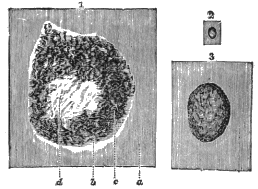
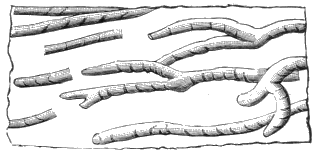
Fig. 15.—Annelid Burrows, Hastings Series, Madoc.
1. Transverse section of Worm-burrow—magnified, as a transparent object.
(a) Calcareo-silicious rock. (b) Space filled with calcareous spar, (c) Sand
agglutinated and stained black. (d) Sand less agglutinated and uncoloured.
2. Transverse section of Worm-burrow on weathered surface, natural size. 3. The same,
magnified.
Such a formation
is not likely to afford fossils in any considerable
number and variety, even if deposited at a time of
abundant marine life. It is therefore not wonderful
that we find little evidence of living beings in the
Huronian. In Canada I can point to nothing of
this kind, except a few cylindrical burrows, probably
of worms (Fig. 15), and spicules possibly of
silicious sponges, which occur in nodules of chert
in the limestones, traces of laminated forms like
Cryptozoon or Eozoon (Fig. 17), and minute carbonaceous
fragments which may be debris of sea-weeds
or Zoophytes. In rocks of similar age in the
United States, Gresley has recently discovered
worm-burrows, and in Brittany there are quartzite
beds in which Barrois and Cayeux believe that
they have found tests of Radiolarians, Foraminifera
and spicules of sponges, but their organic nature has
been denied by Rauff, of Bonn. The casts of Foraminifera,
however, at least appear to be organic
(Fig. 16), and it is quite likely that Cayeux may be
able to verify his Radiolarians and sponges as well.
Matthew's observations in New Brunswick in any
case establish their probability. Gümbel also recognises
a species of Eozoon in the equivalent rocks
of Bavaria (see p. 213).
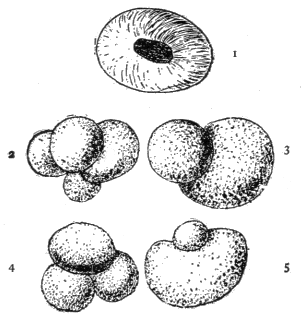
Fig. 16.—Casts of Foraminifera, from the Huronian of Brittany.
(After Cayeux.)
Compare with Globigerinæ on Fig. 12 and Archæospherinæ, Figs. 50-54.
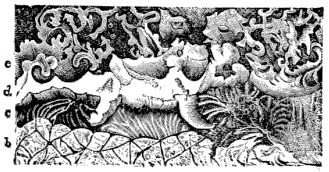
Fig. 17.—Cryptozoon or Eozoon from the Hastings Series, Tudor,
Ontario (natural size).
From a specimen collected by the late Mr. Vennor, and now in the collection of
the Geological Survey, Ottawa. (See also Frontispiece and figure of Eozoon
Bavaricum, p. 213.)
It is evident that here we have approached the
limit of the higher forms of marine invertebrate
life, having as yet nothing to show except worms
and Protozoa. It is to be observed, however, that
there may be somewhere Huronian deposits formed
in deep and quiet waters, which may give better
results, and that the unconformity between the
Huronian and overlying Kewenian may indicate a
lapse of time, of which monuments may yet be found.
The Laurentian.
Last of all we have the widely distributed Laurentian
system of Logan, the oldest known to
geologists, and which with the Huronian constitutes
the great Archæan group of formations of Dana and
others. In its lowest part this consists entirely of
the stratified granitic rock known as gneiss, inter-bedded
in some places with dark-coloured crystalline
rocks or schists. This may be a part of the first-formed
crust of our globe, produced under conditions
different from those of any later rocks, and incompatible
with the existence of life. The upper part
of the Laurentian system, however, known in
Canada as the "Grenville Series," shows evidence
of ordinary marine deposition in quiet waters, which
may have been not unfavourable to the lower
forms of marine life; and though its beds have
been greatly changed by heat and pressure, we can
still to some extent realize the conditions of a time
of comparative quiescence intervening between the
underlying Lower Laurentian and the succeeding
Huronian. This part of the system still contains
gneisses, bedded diorites, and other rocks which
may have been volcanic; but it has also quartzites
and quartzose gneisses which must have been sandstones
or shales, thick limestones, beds of carbon
now in the state of graphite or plumbago, and large
beds of iron ore. Such rocks were in all succeeding
formations produced under water and by accumulations
of the remains of plants and the hard
parts of animals, in strictly sedimentary beds,
usually formed slowly and without mechanical
disturbance. Hence we may infer that aquatic life
at least existed in this early period, and as there
must have been land and water, shallows and deep
seas, there may have been scope for various kinds
of living beings. The Grenville period is, however,
separated from the succeeding Huronian by a great
interval, occupied mainly by volcanic ejections and
earth-movements; so that our Grenville series, if it
contains organic remains, may be supposed to afford
species differing from those of the Huronian, and
to form a sort of oasis in the desert of the early
pre-Cambrian world. We find that the limestones
of this age actually contain remains supposed to
be of animal origin. They were first found in
Canada, which contains the largest and best exposed
area of these rocks in the world, and were
brought under the notice of geologists by the late
Sir William E. Logan, the first director of the
Geological Survey of that country.
In anticipation of details to be given later, the
story of this discovery and its announcement may
here be given in brief
As early as 1858, Sir William Logan had begun
to suspect that certain laminated bodies found in the
Laurentian limestones of the Grenville series might
be of organic origin. The points which struck him
were these: They differed from any known laminated
concretions; they resembled the "Stromatoporæ"
or layer-corals of the lower Palæozoic rocks
next in succession to the Laurentian and Huronian;
the forms were similar in all the specimens, while
the mineralizing substances were different; they
were found only in the limestone, and specially in
one of the three great beds known in the formation,
the upper limestone of the Grenville system. He
exhibited specimens, and mentioned these probabilities
at the meeting of the American Association in
1859. In 1862 it was suggested to Logan that the
microscopic structure of some of the best preserved
examples should be studied, and slices were accordingly
prepared and submitted to the writer for
examination. They revealed in the calcareous
laminæ of the specimens complicated systems of
canals or tubes filled with mineral matter, which
appeared to be similar to those that Carpenter had
recognised in the thickened parts of the shells of
modern Foraminifera. This clew being followed,
large numbers of slices of the supposed fossils and of
the containing limestone and of similar limestones
from other parts of the world were examined.
The writer also visited the localities of "Eozoon,"
and studied its mode of occurrence in situ. The
facts ascertained were communicated to the
Geological Society of London, the name "Eozoon
Canadense" being proposed for the species. Its
description was accompanied by a paper on the
geological conditions by Logan, and one on the
chemical conditions by Sterry Hunt, while supplementary
notes were added by the late Dr.
Carpenter and Professor T. Rupert Jones. Thus
launched on the scientific world, "Eozoon" at once
became a fertile subject of discussion, and volumes
of more or less controversial literature have appeared
respecting it. It still has its friends and opponents,
and this may long continue, as so few scientific men
are sufficiently acquainted on the one hand with the
possibilities and conditions of the preservation of
fossils in crystalline rocks, and on the other hand
with the structures of modern "Protozoa." Thus, few
are in a position to form an independent judgment,
and "Eozoon" has met with some scepticism on the
part both of biological and mineralogical specialists.
To aid us in forming an opinion, it will be
necessary to consider the oldest known strata of
the earth's crust, and the evidence which they afford
of the condition of the world when they were deposited.
As preliminary to this, we may look at the
following table of pre-Cambrian formations in Canada.
SUCCESSION OF PRE-CAMBRIAN ROCKS IN
CANADA, AS UNDERSTOOD UP TO 1896.
(In descending order.)
PALÆOZOIC.
Etcheminian in New Brunswick, Kewenian or Upper
Copper-bearing Series of Lake Superior, Signal Hill
Series of Newfoundland. Chuar, and Grand Cañon
rocks of Colorado, etc.
Red and greenish Sandstones and Shales, Conglomerates,
Igneous Outflows and Ash-rocks. Bivalve
Crustacea, Mollusks, Worms, Sponges, Cystideans,
Zoophytes, Protozoa, Cryptozoon.
(Unconformity.)
EOZOIC.
Huronian, including Hastings of Ontario, Coldbrook
and Coastal of New Brunswick, Algonkian (in part).
Conglomerates, Hard Sandstones, Shales and Schists,
Iron Ores, Coarse Limestones, Igneous Outflows, and
Ash-rocks. Worms, Sponges, Zoophytes, and Protozoa
(Cryptozoon or Eozoon).
(Unconformity [?])
EOZOIC.
Grenvillian or Upper Laurentian.
Gneiss, Hornblendic and Micaceous Schists, Limestones,
Quartzite, Iron Ores, Graphite. Eozoon, Archæozoon,
Archæospherinæ, Archæophyton.
(Unconformity.)
AZOIC
Archæan or Lower Laurentian.
Gneiss, Hornblende Schists, with many igneous or
igneo-aqueous intrusions.
THE FOUNDATIONS OF THE CONTINENTS, AND
THEIR GENERAL TESTIMONY AS TO LIFE
IV
THE FOUNDATIONS OF THE CONTINENTS, AND
THEIR GENERAL TESTIMONY AS TO LIFE
T
THAT the reader may be enabled better to
understand the relation of the old foundations
or pillars of the earth to the beginning of life,
and the preservation of the remains of the earliest
animals, it may be well to reverse the method we
have hitherto followed, and to present a theoretical
or ideal historical sketch of the early history of the
earth, beginning with that stage in which it may be
supposed to have been a liquid mass, considerably
larger than it is at present, and intensely heated, and
surrounded by a vast vaporous envelope composed
of all the substances capable of being resolved by
its heat into a gaseous condition—a smooth and
shining spheroid, invested with an enormous atmosphere.
In such a condition its denser materials, such as
the heavier metals, would settle toward the centre,
and the surface would consist of lighter material
composed of the less dense and more oxidizable substances
combined with oxygen, and similar in character
and appearance to the slag which forms on
the surface of some ores in the process of smelting.
Of this slaggy material there might, however, be
different layers more or less dense in proceeding
from the interior to the surface. This molten surface
would, of course, radiate heat into space; and
as it would naturally consist of the least fusible
matters, these would begin to form a solid crust.
We may imagine this crust at first to be smooth
and unbroken, though such a condition could
scarcely exist for any length of time, as the hardened
crust would certainly be disturbed by ascending
currents from within, and by tidal movements
without. Still, it might remain for ages as a spheroidal
crust, presenting little difference of elevation
or depression in comparison with its extent. When
it became sufficiently thick and cool to allow water
to lie on its surface, new changes would begin.
The water so condensed would be charged with
acid substances which would begin to corrode the
rocky surface. Penetrating into crevices and flashing
into steam as it reached the heated interior, it
would blow up masses and fragments of stone, and
would perhaps force out and cause to flow over the
surface beds of molten material from below the
crust, and differing somewhat from it in their composition.
All this aqueous work would accelerate
the cooling and thickening of the crust, and at
length a universal or almost universal heated
ocean would envelope the globe, and so far as its
surface was concerned, the reign of water would
replace that of fire. We may pause here to consider
the probable nature of the earth's crust in
this condition.
The substance most likely to predominate would
be silica or quartz, one of the lighter and most
infusible materials of the crust; but which, heated
in contact with alumina, lime, potash, and other
earths and alkalis, forms fusible slags, enamels and
glasses. One of these, composed of silica, alumina,
and potash, or soda, was long ago named by the
German miners felspar, a name which it still retains,
though now several distinct kinds of it are distinguished
by different names. Another is a
compound of silica with magnesia and lime, forming
the mineral known as Amphibole or Hornblende,
and by several other names, according to
its colour and crystalline form. In many deep-seated
rocks these minerals are formed together,
and having crystallized out separately give a
spotted and granular character to the mass.
Naturally colourless, all these minerals, and especially
the felspar and hornblende, are liable to
be coloured with different oxides of iron, the felspar
usually taking a reddish, and the hornblende a
greenish or blackish hue. Now, if we examine a
fragment of the oldest or fundamental gneiss or
granite, we shall see glassy grains of quartz, reddish
or white flat-surfaced crystals of felspar, and dark-coloured
prisms of hornblende. When destitute of
any arrangement in layers, the rock is granite;
when arranged more or less in flakes or laminæ,
it is gneiss, the structure of which may arise either
from its having been formed in successive beds, or
from its having been flattened or drawn out by
pressure. These structures can be seen more or
less distinctly in any ordinary coarse-grained
granite, or with the lens or microscope in finer
varieties.
The Lower Laurentian rocks of our section consist
essentially of the materials above described,
with a vast variety in the proportions and arrangements
of the constituent minerals. There is, there-fore,
nothing to prevent us from supposing that
these rocks are really remains of the lower portions
of the original crust which first formed on the surface
of our cooling planet, though the details of
their consolidation and the possible interactions of
heat and heated water may admit of much discussion
and difference of opinion.
But after the formation of a crust and its covering
in whole or in part with heated water, other
changes must occur, in order to fit the earth for
the abode of life. These proceeded from the
tensions set up by the contraction and expansion
of the interior heated nucleus and the solid crust—a
complicated and difficult question, when we consider
its laws and their mode of operation, but
which resulted in the folding and fracturing of the
crust along long lines which are parts of great
circles of the earth, running in N.E. and S.W.
and N.W. and S.E. directions; and these ridges,
which in the earliest Archæan period must have
attained to great height and very rugged outlines,
formed the first rudiments of our mountain chains
and continents. Those constituting the Laurentian
nucleus of North America—a very simply outlined
continent—form a case in point (Fig. 18).
The elevation of these mountain ridges forced
the waters to recede into the lower levels. As the
old psalm of creation has it,—
"The mountains ascend,
the valleys descend into
the place Thou hast founded
for them,"
and so sea-basins and land were produced.
Milton merely paraphrases this when he says,—
"The mountains huge appear
Emergent, and their broad, bare backs upheave
Into the clouds; their tops ascend the sky.
So high as heaved the tumid hills, so low
Down sunk a hollow bottom wide and deep.
Capacious bed of waters."
Englishmen have been accused of taking their
ideas of creation from Milton rather than from
nature or the Bible. Milton had not the guidance
of modern geology. His cosmology is entirely that
of a close student of the Biblical narrative of
creation. He is in many respects the best commentator
on the early chapters of Genesis, because he
had a very clear conception of the mind of the
writer, and the power of expressing the ideas he
derived from the old record. For the same reason
he is the greatest bard of creation and primitive
man, and surprisingly accurate and true to nature.
Fig. 18.—Map of Laurentian, North America.
Showing the protaxis or nucleus of the continent.
Then began the great processes of denudation
and sedimentation to which we owe the succeeding
rock formations. The rains descended on the
mountain steeps, and washed the decaying rocks
as sand, gravel and mud into the rivers and the
sea. The sea itself raged against the coasts, and
cut deeply into their softer parts; and all the
detritus thus produced by atmospheric and marine
denudation was spread out by the tides and
currents in the bed of the ocean, and its gulfs and
seas, forming the first aqueous deposits, while the
original land must have been correspondingly reduced.
The sea might still be warm, and it held in solution
or suspension somewhat different substances
from those now present in it, and the land was at
first a mere chaos of rocky crags and pinnacles.
But so soon as the temperature of the waters fell
somewhat below the boiling point, and as even a
little soil formed in the valleys and hollows of the
land, there was scope for life, provided that its
germs could be introduced.
On a small scale there was something of this
same kind in the sea and land of Java, after the
great eruption of Krakatoa, in 1883. The bare
and arid mountain left after the eruption, began,
in the course of a year, to be occupied by low
forms of vegetable life, gradually followed by others,
and verdure was soon restored. The once thickly
peopled sea-bottom, so prolific of life in these warm
seas, but buried under many feet of volcanic ashes
and stones, soon began to be re-peopled, and is now
probably as populous as before. But in this case
there were plenty of spores of lichens, mosses, and
other humble plants to be wafted to the desolate
cone, and multitudes of eggs and free-swimming
germs of hundreds of kinds of marine animals to
re-people the sea-bottom. Whence were such
things to come from to occupy the old Archæan
hills and sea-basins? and all our knowledge of
nature gives us no answer to the question, except
that a creative power must have intervened; but
in what manner we know not. That this actually
occurred, we can, however, be assured by the next
succeeding geological formation. We have seen
that the granitic and gneissic ridges could furnish
pebbles, sand, and clay, and these once deposited
in the sea-bottom could be hardened into conglomerate,
sandstone and slate. But beside these
we have in the next succeeding or Upper Laurentian
formation rocks of a very different character.
We have great beds of limestone and iron ore, and
deposits, of carbon or coaly matter, now in the
peculiar state of graphite or plumbago, and it is
necessary for us to inquire how these could
originate independently of life. In modern
seas limestone is forming in coral reefs, in shell
beds, and in oceanic chalky ooze composed of
minute microscopic shells; but only in rare and
exceptional instances is it formed in any other
way; and when we interrogate the old limestones
and marbles which form parts of the land, they
give us evidence that they also are made up of
calcareous skeletons of marine animals or fragments
of these.
Fig. 19.—Distribution of Grenville Limestone in the district north of
Papineauville, with section showing supposed arrangement of the beds.
Scale of Map 7 miles to one inch. See also Dr. Bonney's paper,
Geol. Mag., July, 1895.
Dotted area: Limestone. Horizontal lines: Upper gneiss (fourth gneiss of
Logan). Vertical lines: Lower gneiss (third gneiss of Logan). Diagonal lines:
Overlying Cambrian and Cambro-Silurian (Ordovician). (See also Fig. 19A.)
Now when we find in the Grenvillian
series, the first oceanic group of beds known to us,
great and widely extended limestones, thousands of
feet in thickness, and rivalling in magnitude those
of any succeeding period, we naturally infer that
marine life was at work. No doubt the primitive sea
contained more lime and magnesia than the present
ocean holds in solution; but while this might locally
favour the accumulation of inorganic limestones, it
cannot account for so great and extensive deposits.
On the other hand, a sea rich in lime would have
afforded the greatest facilities for the growth of
those marine plants which accumulate lime, and
through these for the nutrition of animals forming
calcareous shells or corals. Thus we have presumptive
evidence that there must have been in
the Upper Laurentian sea something corresponding
to our coral reefs and shell-beds, whatever this
something may have been.
These limestones, however, demand more particular
notice (Fig. 19).
One of the beds measured by the officers of the
Geological Survey is stated to be 1,500 feet in
thickness, another is 1,250 feet thick, and a third
750 feet; making an aggregate of 3,500 feet.[14]
These beds may be traced, with more or less interruption,
for hundreds of miles. Whatever the
origin of such limestones, it is plain that they indicate
causes equal in extent, and comparable in
power and duration, with those which have produced
the greatest limestones of the later geological
periods. Now, in later formations, limestone is
usually an organic rock, accumulated by the slow
gathering from the sea-water, or its plants, of calcareous
matter, by corals, foraminifera, or shell-fish,
and the deposition of their skeletons, either entire
or in fragments on the sea-bottom. The most
friable chalk and the most crystalline limestones
have alike been formed in this way. We know of
no reason why it should be different in the Laurentian
period. When, therefore, we find great and
conformable beds of limestone, such as those described
by Sir William Logan in the Laurentian of
Canada, we naturally imagine a quiet sea-bottom,
in which multitudes of animals of humble organization
were accumulating limestone in their hard
parts, and depositing this in gradually increasing
thickness from age to age. Any attempts to
account otherwise for these thick and greatly extended
beds, regularly interstratified with other
deposits, have so far been failures, and have arisen
either from a want of comprehension of the nature
and magnitude of the appearances to be explained,
or from the error of mistaking the true bedded
limestones for veins of calcareous spar.
Fig. 19A.—Attitude of Limestone at Côte St. Pierre (see Map, p. 88).
(a) Gneiss band in the Limestone, (b) Limestone with Eozoon.
(c) Diorite and Gneiss.
Again, in the original molten world, it seems
likely that most of the carbon present—at least,
at the surface—was in the atmosphere in the
gaseous form of carbon dioxide. This might be
dissolved by the rain and other waters; but we
know in the modern world no agency which can
decompose this compound and reduce it to ordinary
carbon or coal, except that of living plants, which
are always carrying on this function to an enormous
extent. We know that all our great beds
of coal and peaty matter are composed of the
remains of plants which took their carbon from the
air and the waters in past times. We also know
that this coaly vegetable matter may, under the
influence of heat and pressure, when buried in the
earth, be converted into anthracite and into graphite,
and even into diamond. It is true that an eminent
French chemist[15] has shown that graphite and
hydrocarbons may be produced from some of the
metallic compounds of carbon which may have
been formed under intense heat in the interior of
the earth, by the subsequent action of water on
such compounds; but there is nothing to show that
this can have occurred naturally, unless in very
exceptional cases. Now in the Grenvillian system
in Canada there is not only a vast quantity of
carbon diffused through the limestones, and filling
fissures in other rocks, into which it seems to have
been originally introduced as liquid bitumen, but
also in definite beds associated with earthy matter,
and sometimes ten to twelve feet thick. The
occurrence of this large amount of carbon warrants
us in supposing that it represents a vast vegetable
growth, either on the land or in the sea, or both.
[15] Henri Moissan, "Proceedings Royal Society," June, 1896,
In like manner, in later geological periods, beds
of iron ore are generally accumulated as a consequence
of the solvent action of acids produced by
vegetable decay, as in the clay ironstones of the
coal formation and the bog iron ores of later times.
Thus the beds of magnetic iron occurring in the
Upper Laurentian may be taken as evidences, not
of vegetable accumulation, but of vegetable decay.
May not also the great quantity of calcium phosphate
mined in the Grenville series in Canada,
indicate, as similar accumulations do in later formations,
the presence of organisms having skeletons
of bone earth?
With reference to the carbon and iron ore of
the Grenville series, I may quote the following from
a paper published in the Journal of the Geological
Society of London in 1870:—
"The quantity of graphite in the Upper Laurentian
series is enormous. In a recent visit to the
township of Buckingham, on the Ottawa River, I
examined a band of limestone believed to be a
continuation of that described by Sir W. E. Logan
as the Green Lake Limestone. It was estimated
to amount, with some thin interstratified bands of
gneiss, to a thickness of 600 feet or more, and was
found to be filled with disseminated crystals of
graphite and veins of the mineral to such an extent
as to constitute in some places one-fourth of the
whole; and making every allowance for the poorer
portions, this band cannot contain in all a less
vertical thickness of pure graphite than from twenty
to thirty feet. In the adjoining township of Lochaber
Sir W. E. Logan notices a band from twenty-five
to thirty feet thick, reticulated with graphite
veins to such an extent as to be mined with profit
for the mineral. At another place in the same
district a bed of graphite from ten to twelve feet
thick, and yielding twenty per cent, of the pure
material, is worked. When it is considered that
graphite occurs in similar abundance at several
other horizons, in beds of limestone which have
been ascertained by Sir W. E. Logan to have an
aggregate thickness of 3,500 feet, it is scarcely an
exaggeration to maintain that the quantity of carbon
in the Laurentian is equal to that in similar
areas of the Carboniferous system. It is also to
be observed that an immense area in Canada
appears to be occupied by these graphitic and
Eozoon limestones, and that rich graphitic deposits
exist in the continuation of this system in the State
of New York; while in rocks believed to be of
this age near St. John, New Brunswick, there is a
very thick bed of graphitic limestone, and associated
with it three regular beds of graphite, having
an aggregate thickness of about five feet.[16]
[16] Matthew, in Quart. Journ. Geol. Soc., vol. xxi. p. 423.
"Acadian Geology," p. 662.
"It may fairly be assumed that in the present
world, and in those geological periods with whose
organic remains we are more familiar than with
those of the Laurentian, there is no other source of
unoxidized carbon in rocks than that furnished by
organic matter, and that this has obtained its carbon
in all cases, in the first instance, from the
deoxidation of carbonic acid by living plants. No
other source of carbon can, I believe, be imagined
in the Laurentian period. We may, however, suppose
either that the graphitic matter of the Laurentian
has been accumulated in beds like those of
coal, or that it has consisted of diffused bituminous
matter similar to that in more modern bituminous
shales and bituminous and oil-bearing limestones.
The beds of graphite near St. John, some of those
in the gneiss at Ticonderoga in New York, and at
Lochaber and Buckingham and elsewhere in Canada,
are so pure and regular that one might fairly compare
them with the graphitic coal of Rhode Island.
These instances, however, are exceptional, and the
greater part of the disseminated and vein graphite
might rather be compared in its mode of occurrence
to the bituminous matter in bituminous shales
and limestones.
"We may compare the disseminated graphite to
that which we find in those districts of Canada in
which Silurian and Devonian bituminous shales and
limestones have been metamorphosed and converted
into graphitic rocks not dissimilar to those in the
less altered portions of the Laurentian.[17] In like
manner it seems probable that the numerous reticulating
veins of graphite may have been formed by
the segregation of bituminous matter into fissures
and planes of least resistance, in the manner in
which such veins occur in modern bituminous limestones
and shales. Such bituminous veins occur
in the Lower Carboniferous limestone and shale of
Dorchester and Hillsborough, New Brunswick, with
an arrangement very similar to that of the veins
of graphite; and in the Quebec rocks of Point
Levi, veins attaining to a thickness of more than a
foot are filled with a coaly matter having a transverse
columnar structure, and regarded by Logan
and Hunt as an altered bitumen. These Palæozoic
analogies would lead us to infer that the larger
part of the Laurentian graphite falls under the
second class of deposits above mentioned, and that,
if of vegetable origin, the organic matter must have
been thoroughly disintegrated and bituminized before
it was changed into graphite. This would also
give a probability that the vegetation implied was
aquatic, or at least that it was accumulated under
water.
[17] Granby, Melbourne, Owl's Head, etc., "Geology of
Canada," 1863, p. 599.
"Dr. Hunt has, however, observed an indication
of terrestrial vegetation, or at least of subaërial decay,
in the great beds of Laurentian iron ore. These,
if formed in the same manner as more modern
deposits of this kind, would imply the reducing
and solvent action of substances produced in the
decay of plants. In this case such great ore beds
as that of Hull, on the Ottawa, 70 feet thick,
or that near Newborough, 200 feet thick,[18] must
represent a corresponding quantity of vegetable
matter which has totally disappeared. It may be
added that similar demands on vegetable matter
as a deoxidizing agent are made by the beds and
veins of metallic sulphides of the Laurentian, though
some of the latter are no doubt of later date than
the Laurentian rocks themselves.
"It would be very desirable to confirm such conclusions
as those above deduced by the evidence of
actual microscopic structure. It is to be observed,
however, that when, in more modern sediments,
algæ have been converted into bituminous matter,
we cannot ordinarily obtain any structural evidence
of the origin of such bitumen, and in the graphitic
slates and limestones derived from the metamorphosis
of such rocks no organic structure remains.
It is true that, in certain bituminous shales and
limestones of the Silurian system, shreds of organic
tissue can sometimes be detected, and in some
cases, as in the Lower Silurian limestone of the
La Cloche mountains in Canada, the pores of
brachiopodous shells and the cells of corals have
been penetrated by black bituminous matter, forming
what may be regarded as natural injections,
sometimes of much beauty. In correspondence with
this, while in some Laurentian graphitic rocks,—as,
for instance, in the compact graphite of Clarendon,—the
carbon presents a curdled appearance due to
segregation, and precisely similar to that of the
bitumen in more modern bituminous rocks, I can
detect in the graphitic limestones occasional fibrous
structures which may be remains of plants, and in
some specimens vermicular lines, which I believe to
be tubes of Eozoon penetrated by matter once
bituminous, but now in the state of graphite.
"When Palæozoic land-plants have been converted
into graphite, they sometimes perfectly retain
their structure. Mineral charcoal, with structure,
exists in the graphitic coal of Rhode Island. The
fronds of ferns, with their minutest veins perfect,
are preserved in the Devonian shales of St. John,
in the state of graphite; and in the same formation
there are trunks of Conifers (Dadoxylon ouangondianum)
in which the material of the cell-walls has
been converted into graphite, while their cavities
have been filled with calcareous spar and quartz,
the finest structures being preserved quite as well
as in comparatively unaltered specimens from the
coal-formation.[19] No structures so perfect have as
yet been detected in the Laurentian, though in the
largest of the three graphitic beds at St. John
there appear to be fibrous structures which I believe
may indicate the existence of land-plants.
This graphite is composed of contorted and slicken-sided
laminæ, much like those of some bituminous
shales and coarse coals; and in these there are
occasional small pyritous masses which show hollow
carbonaceous fibres, in some cases presenting obscure
indications of lateral pores. I regard these
indications, however, as uncertain; and it is not as
yet fully ascertained that these beds at St. John
are on the same geological horizon with the Grenville
series of Canada, though they certainly underlie
the Cambrian series of the St. John or Acadian
group, and are separated from it by beds having the
character of the Huronian, and thus come, approximately
at least, into the same geological position.
[19] "Acadian Geology," p. 535. In calcified specimens the
structures remain in the graphite after decalcification by an
acid.
"There is thus no absolute impossibility that
distinct organic tissues may be found in the Laurentian
graphite, if formed from land-plants, more
especially if any plants existed at that time having
true woody or vascular tissues; but it cannot with
certainty be affirmed that such tissues have been
found. It is possible, however, that in the Laurentian
period the vegetation of the land may have
consisted wholly of cellular plants, as, for example,
mosses and lichens; and if so, there would be comparatively
little hope of the distinct preservation of
their forms or tissues, or of our being able to distinguish
the remains of land-plants from those of
Algæ. The only apparent plant of the Laurentian
to which a name has been given, Archæophyton of
Britton, from New Jersey, consists of ribbon-like
strips, destitute of apparent structure, and which, if
they are of vegetable origin, may have belonged to
either of the leading divisions of the vegetable kingdom.
I have found similar flat frond-like objects in
the limestone of the Grenville series, at Lachute, in
Canada.
"We may sum up these facts and considerations
in the following statements:—First, that somewhat
obscure traces of organic structure can be detected
in the Laurentian graphite; secondly, that the
general arrangement and microscopic structure of
the substance corresponds with that of the carbonaceous
and bituminous matters in marine formations
of more modern date; thirdly, that if the Laurentian
graphite has been derived from vegetable matter,
it has only undergone a metamorphosis similar in
kind to that which organic matter in metamorphosed
sediment of later age has experienced; fourthly,
that the association of the graphitic matter with
organic limestone, beds of iron ore, and metallic
sulphides, greatly strengthens the probability of its
vegetable origin; fifthly, that when we consider
the immense thickness and extent of the Eozoonal
and graphitic limestones and iron ore deposits of
the Laurentian, if we admit the organic origin of
the limestone and graphite, we must be prepared
to believe that the life of that early period, though
it may have existed under low forms, was most
copiously developed, and that it equalled, perhaps
surpassed, in its results, in the way of geological
accumulation, that of any subsequent period."
Figs. 20 and 21.—Bent and dislocated Quartzite, in contorted schists
interstratified with Grenville Limestone, near Montebello.
The Quartzites have been broken and displaced, while the schists have been bent
and twisted. In the immediate vicinity the same beds may be seen slightly
inclined and undisturbed.
Let us take, in connection with all this, the fact
that we are dealing with the deposits of the earliest
ocean known to us—an ocean warm and abounding
in the mineral matters suitable for the skeletons of
humble animals, and fitted to nourish aquatic plants.
The conditions were certainly favourable to an exuberant
development of the lower forms of marine
life; and in later times, when such conditions prevail,
we generally find that life has been introduced
to take advantage of them. The prudent farmer
does not usually allow his best pasture to remain
untenanted with flocks and herds, and the Great
Husbandman of nature has, so far as we know, been
similarly careful.
I add two sections showing the local disturbances
of beds of quartzite and schist associated with the
Grenville limestones (Figs. 20 and 21, page 103).
PROBABILITIES AS TO LAURENTIAN LIFE, AND
CONDITIONS OF ITS PRESERVATION
V
PROBABILITIES AS TO LAURENTIAN LIFE, AND
CONDITIONS OF ITS PRESERVATION
W
WE have seen that the mineral constitution of
the Upper Laurentian affords evidence that
in this age there were already land and water, and
that the processes by which the land is being worn
down, and its materials deposited on the sea-bottom,
were in full operation; while the absence of any
evidence of violent wave-action, and the presence of
thick deposits of limestone, coaly matter, iron ore,
and fine-grained beds of sediment, indicates a time
of rest and quiescence. All these conditions were
favourable to the presence of life, and we should
expect to find in such a period some sign of its
commencement.
But here we are met by a formidable difficulty.
If the beds of the Grenville series were originally
deposits in a quiet sea, they are, as now existing in
the old Laurentian hills and valleys, very much
changed from their original condition. They have,
in short, experienced the changes known to geologists
by the formidable word metamorphism, whereby they
have lost the more obvious characters of ordinary
aqueous deposits, and have assumed new and strange
forms. Dr. Adams, of Montreal, has taken the pains
to collect a number of chemical analyses of the
gneisses and schists or crystalline slates of the
Grenville series, and finds that, however unlike to
more modern shales and clays, they have substantially
the same chemical composition. Now if they
were originally such shales and clays, it has happened
to them that the ingredients of the clays have
rearranged themselves in new forms and become
crystalline. We are familiar in a small way with
such changes when brick clay, over-heated in the
kiln, becomes fused into slag or vitrified; and if
such slag were allowed to cool very slowly, it would
present different kinds of crystalline minerals. We
actually see changes of this kind in the substance
of bricks which have been long exposed to intense
heat in the walls of furnaces. Now in the crust
of the earth, very old rocks, buried under newer
deposits, and exposed to the heat of the interior
molten rocks, experience such changes on a great
scale; and there is one kind of influence present in
the bowels of the earth which we in our experiments
cannot easily imitate or understand, namely,
the action of superheated water prevented by pressure
from escaping as steam, and permeating the
whole substance of deposits, which are thus baked
at a high temperature in presence of water, instead
of being exposed to mere dry heat, as in our kilns
and furnaces. The study of the partial changes
which have passed on later sediments where in
contact with volcanic masses once intensely heated,
enables us to understand the greater and more extensive
metamorphism of the oldest rocks. Thus a
mere mud becomes glorified by metamorphic crystallization
into a micaceous schist. We have taken
ordinary clay as an example; but under the same
processes sand has been converted into a compact
quartzite, ordinary limestone into crystalline marble,
clay-ironstone into magnetic iron ore, coal into
graphite, and lavas or volcanic ashes into hard
crystalline granites, gneisses, or pyroxene rocks or
hornblendic schists, according to their original composition.
There may exist portions of these old
rocks which have been exempt from such alteration,
but hitherto we have not been able to find them,
and they are probably under the ocean bed, or
deeply burled beneath later rocks, while the parts
exposed are precisely those which have by their
crumpling and pressure, and the influence of internal
heat, become most hardened and altered, and have
therefore best resisted denudation. We need not
therefore be astonished if any organic remains originally
present in such rocks should have perished,
or should have been subjected to such changes of
composition and form as to have altogether lost
their original characters. The searcher for fossils
in such rocks has to expect that these can have
been preserved only under very rare and exceptional
circumstances. We have now to consider
what these circumstances are, and for simplicity
may suppose that we are endeavouring to discover
in a crystalline limestone the remains of animals
having a skeleton of limestone, as is the case with
most shell-fishes and corals, and with many Protozoa
and marine worms. In regard to these, we have to
consider what may happen to them when they are
imbedded in calcareous marl or ooze, or the limestone
which results from the hardening of such materials;
and we have to bear in mind that such organisms
usually consist of hard, stony walls or partitions, enclosing
cavities originally filled with the soft parts
of the animal which may be supposed to have disappeared
by decay before or during the mineralization of its skeleton.
So long as the imbedding mass continues soft
and incoherent, shells, corals, etc., can be recovered
in a condition similar to that of recent specimens,
except that they may have become bleached in colour
and brittle in texture, owing to the removal of organic
matter intimately associated with the lime, and that
their cavities may have been filled with sand or silt
washed into them, or with calcite or calcareous spar
introduced in solution in water. But if the containing
mass has become a hard stone, the material
filling the interior of our shell or coral has experienced
a similar change; and when we break open
the stone, we may obtain the specimen, now hard,
solid, and heavy, but still showing more or less
of its outer surface and markings, and possibly to
some extent also its internal structure when it is
sliced and studied under the microscope. But if the
whole mass has been metamorphosed, and has become
crystalline, the contained fossil and its contents
may have experienced a similar change, and may
have so coalesced with the containing matrix that it
is no longer separable from it. Even in this case,
however, if the whole is reduced to a thin transparent
slice and examined microscopically, some traces may
be found of the external and internal limiting lines of
the fossil, and even of its minute structures, which
often cause it to present an appearance granular,
cellular, or otherwise different from that of the enclosing
matrix. It requires, however, both skill and
care to detect organic remains in such circumstances,
and they may often escape observation, except when,
as in many old crystalline limestones, the fossils are
darkened in whole or in part with coaly matter
derived from the decay of their own organic
substance. The crystalline Trenton limestone of
Montreal, used there as a building stone, is an excellent
example (Fig. 22).
Fig. 22.—Section of "Trenton Limestone" (magnified).
Showing its composition of fragments of calcareous fossils.
Fig. 23.—Diagram of different States of Fossilization of the Cell of a
Tubulate Coral.
(a) Natural condition, (b) Cell filled with calcite. (c) Walls calcite, filling silica.
(d) Walls silica, filling calcite. (e) Both walls and calcite silica. All these
conditions are found in the fossil corals of the corniferous Limestone of Canada—Middle Permian.
It is otherwise, however, when the calcareous fossils
have been filled or injected with some mineral
matter different from the matrix, as, for example,
silica or some silicate, oxide or sulphide of iron.
In this case the texture, colour, or hardness of the
filling appear different from those of the limestone,
and may be seen in a fresh fracture or polished
slice; or when the rock is weathered, the hard mineralizing
substance may project from the surface of
the specimens, or may be disclosed by treating the
surface with a weak acid. The figures here given
may suffice to show some of these conditions of
mineralization in ordinary limestones, and the effects
which they produce (Fig. 23).
The mineral matters which thus aid in preserving
fossils are of various kinds, and the whole subject is a
very curious one; but for the present we may content
ourselves with two kinds of mineralization—that by
silicates and that by magnesian limestone or dolomite.
From the bottom of modern seas the dredge often
brings up multitudes of minute shells, especially
those of the simple gelatinous Protozoa, known as
Foraminifera, whose internal cavities and pores have
been filled with a greenish mineral composed of silica,
iron and potash, combined with water (or, chemically
speaking, a hydrous silicate of iron and potassium),
which is named glauconite from its bluish-green
colour—a name which we shall do well to remember.
In such compounds, bases of similar chemical properties
often replace one another, so that various
glauconites differ somewhat in composition, the iron
being in part often replaced by alumina or magnesia,
and the potash by soda. The combined water also
differs somewhat in its percentage. When minute
shells fossilized in this way are treated with an acid
so as to remove the calcareous shell itself, the enclosed
silicate remains as a beautiful cast or core,
representing all the forms of the interior, and any
pores that may have penetrated the walls, and also
perfectly representing the soft gelatinous body of
the animal which once tenanted the shells (Fig. 24).
(See also Fig. 25 at end of chapter.)
Fig. 24.—Cast of Cavities of Polystomella in Glauconite (magnified).
After a photograph from Dr. Carpenter, and mounted specimens from his collection.
When we examine oceanic sediments of older
date, we find similar fillings in limestones, chalks,
and sandstones of various ages, some of the latter
containing glauconite so abundantly as to bear the
name of green-sands, from their colour; and in
these older examples we more frequently find alumina
and magnesia occupying a large place in the
mineralizing silicate. Fig. 24A gives two illustrations
of this—one a crinoidal stem from the Silurian of
New Brunswick, injected with a silicate of alumina,
iron, magnesia and potash; the other a spiral shell
from more ancient perhaps Cambrian rocks in
Wales, filled with a silicate apparently more nearly
related to serpentine. Further examples will be referred
to in an appended note.
Fig. 24A.—(a) Joint of Crinoid injected with a Hydrous Silicate,
Silurian, Pole Hill, New Brunswick. (× 25.)
(b) Spiral Shell injected with a Hydrous Silicate allied to Serpentine,
near Llangwyllog, North Wales, (× 25.)
We may now consider shortly the relation of
dolomite, or the mixed carbonates of lime and magnesia,
to the preservation of fossils. The presence
of dolomite or magnesian limestone in these beds
does not affect the conclusion as to their probable
organic origin. This form of limestone occurs abundantly
in later formations, and is even forming in
connection with coral deposits in the modern ocean.
Dana has shown this by his observations on the
occurrence of dolomite in the elevated coral island
of Matea in Polynesia,[20] under circumstances which
show that it was formed in the lagoon of an ancient
coral atoll, or ring-shaped island, while he finds
that coral and coral sands of the same elevated reef
contain very little magnesia. He concludes that
the introduction of magnesia into the consolidating
under-water coral sand or mud has apparently taken
place—"(1) In sea-water at the ordinary temperature;
and (2) without the agency of any other
mineral water except that of the ocean"; but the
sand and mud were those of a lagoon in which the
saline matter was in process of concentration by
evaporation under the solar heat. Klement has
more recently taken up this fact in the way of
experiment, and finds that, while in the case of
ordinary calcite this action is slow and imperfect,
with the aragonite which constitutes the calcareous
framework of certain corals,[21] and at temperatures of
60° or over, it is very rapid and complete, producing
a mixture of calcium and magnesium carbonates,
from which a pure dolomite more or less mixed
with calcite may subsequently result.[22]
[21] Aragonite, like ordinary limestone, is calcium carbonate, but
its atoms seem to be differently arranged, so as to make it a
less stable compound, and it has a different crystalline form.
Some calcareous organisms are composed of aragonite, others
of ordinary calcite.
[22]"Bulletin Geol. Soc. Belgium," vol. ix. (1895, p. 3). Also
notice in Geol. Mag., July, 1895, p. 329.
I regard these observations as of the utmost importance
in reference to the relations of dolomite
with fossiliferous limestones, and especially with those
of the Grenville series. The waters of the Laurentian
ocean must have been much richer in salts of
magnesium than those of the present seas, and the
temperature was probably higher, so that chemical
changes now proceeding in limited lagoons might
have occurred over much larger areas. If at that
time there were, as in later periods, calcareous organisms
composed of aragonite, these may have
been destroyed by conversion into dolomite, while
others more resisting were preserved, just as a
modern Polytrema or Balanus might remain, when
a coral to which it might be attached would be
dolomitized, or might even be removed altogether
by sea-water containing carbonic acid. There is
reason to believe that this last change sometimes
takes place in the deeper parts of the ocean at
present. This would account for the persistence
of Eozoon and its fragments, when other organisms
may have perished, and also for the frequent filling
of the canals and tubuli with the magnesian carbonate.
The main point here, however, for our present
purpose is that, when a calcareous shell or skeleton
has been thus infiltrated with a silicate, it becomes
imperishable, so that any amount of alteration of
the containing limestone short of its absolute fusion
would not suffice to destroy an organism once injected
with silicious matter. Thus the occasional
persistence of silicified fossils in highly metamorphosed
limestones is in no respect contradictory to
the general fact, that when not preserved by silicious
infiltration, they have perished, and this more
especially in the case of those whose skeletons are
composed of aragonite.
Carrying these facts with us, the next question
is, What manner of fossil remains should we expect
to find in the Upper Laurentian rocks, supposing that
any such are therein preserved? The answer to
this question follows at once from the facts as to
the succession of life noticed above. Only the marine
invertebrates have been traced as far back as the
oldest Cambrian, and only Worms, Sponges, and
Protozoa into the Huronian. We should therefore
have no expectation of finding remains of any vertebrate
animals or of any of the land invertebrates;
and even allowing for the more favourable conditions,
as compared with the Huronian, evidenced by
the great limestones and the abundant carbon, we
could scarcely expect anything higher than some
of the lower types of invertebrate life, such as Worms,
Hydroids, Corals and Protozoa. We have next to
inquire what forms, possibly organic, have actually
been found, and what information we can derive
from them as to the beginnings of life. Since, however,
such discoveries as have been made have been
the result of much labour and scientific skill brought
to bear on these old rocks, and are connected with
the reputations of several eminent men, now deceased,
we may first refer shortly to the history
of the discovery of supposed fossils in the Laurentian
rocks of Canada.
Fig. 25.—Nature-print of an etched Specimen of Eozoon.
Showing the laminæ, a part of the natural margin, near which passes a diagonal
calcite vein, and at the upper right-hand corner, fragmental material with casts of
Archæospherinæ. The dark lines represent the chambers filled with serpentine, the
white the calcite wall.
THE HISTORY OF A DISCOVERY
VI
THE HISTORY OF A DISCOVERY
W
WHEN Mr. Logan, afterwards Sir William
Logan, entered on the Geological Survey
of Canada, in 1840, he found that vast and little-explored
regions in the northern part of that country
were occupied with gneissic rocks, similar to the
oldest gneisses of Scotland and Scandinavia, and
to which the name Azoic had been given by
Murchison, as rocks destitute of fossils, while they
had been the "fundamental granite" or ur-gneiss
of most European geologists. They were unquestionably
below and more ancient than the oldest
fossiliferous Cambrian rocks both in Europe and
North America, and geologists had for the most
part contented themselves with regarding them as
primitive rocks, destitute of any geological interest,
much as some United States geologists of the
present day call them the "Archæan complex,"
a name which the late Prof Dana has well characterized
as a "term of despair."
Logan was, however, a man not to be daunted by
an unsolved problem, even though the facts for its
solution must be sought in a wilderness known to few
except adventurous trappers, hunters, and lumbermen;
and he soon learned that this ancient gneissic
formation contained other rocks beside gneiss, more
especially thick and extensive limestones, and that
its beds seemed to have a definite arrangement, and
could be traced over great areas. He addressed
himself, therefore, to the problem of unravelling the
tangled "complex," and with a few hardy assistants,
spent years in laboriously tracing its beds along
river courses and over mountains, and in mapping,
in a manner never previously attempted, its several
members, designating at the same time the whole by
the term "Laurentian," because it constituted the
mass of the hills lying north of the St. Lawrence,
called by old French geographers the Laurentides,
and separating the St. Lawrence Valley and the
region of the great lakes from Hudson's Bay and the
Arctic Sea. In this manner he laid a foundation,
which still remains unshaken, for the geology of the
oldest rocks, and prepared the way for the discovery
of the forms afterward named Eozoon Canadense.
At the same time Dr. Sterry Hunt, the chemist of
the Survey, was examining chemically the rocks
and minerals collected, and all Sir William's assistants
were instructed to search, more especially in
the limestones, for anything bearing the aspect of
fossils. On the other hand. Dr. Carpenter was independently
pursuing his studies of the humbler
inhabitants of the modern ocean, and of the manner
in which the pores of their skeletons became infiltrated
with mineral matter, and had kindly contributed
specimens to the collections of the writer
in Canada. The discovery of this most ancient
fossil was thus not the chance picking up of a rare
and curious specimen, but the result of several
combined lines of laborious and skilful research.
The following notice of the persons and incidents
connected with its discovery is taken from a previous
publication of the writer, with only a little
alteration in terms to suit it to the present date.
The first specimens of Eozoon ever procured, in
so far as known, were collected at Burgess, in
Ontario, by a veteran Canadian mineralogist. Dr.
Wilson of Perth, and were sent to Sir William
Logan as mineral specimens. Their chief interest
at that time lay in the fact that certain laminæ
of a dark green mineral present in the specimens
were found, on analysis by Dr. Hunt, to be composed
of a new hydrous silicate, allied to serpentine,
and which he named loganite, but which seems to
be a mixture of different silicates. The form of this
mineral was not suspected to be of organic origin.
Some years after, in 1858, other specimens, differently
mineralized with the minerals serpentine and
pyroxene, were found by Mr. J. McMullen, an
explorer in the service of the Geological Survey,
in the limestone of the Grand Calumet on the
river Ottawa. These seem to have at once struck
Sir W. E. Logan as resembling the Silurian fossils
known as Stromatoporæ, or layer-corals, and at that
time of quite uncertain nature, though supposed
to be allied to some kinds of modern corals. He
showed them to Mr. Billings, the palæontologist of
the Survey, and to the writer, with this suggestion,
confirming it with the sagacious consideration that
inasmuch as the Ottawa and Burgess specimens
were mineralized by different substances, yet were
alike in form, there was little probability that they
were merely mineral or concretionary. Mr. Billings
was naturally unwilling to risk his reputation in
affirming the organic nature of such specimens;
and my own suggestion was that they should be
sliced, and examined microscopically; and that if
fossils, as they presented merely concentric laminæ
and no cells, they would probably prove to be
protozoa rather than corals. A few slices were
accordingly made, but no definite structure could
be detected. Nevertheless, Sir William Logan took
some of the specimens to the meeting of the American
Association at Springfield, in 1859, and exhibited
them as possibly Laurentian fossils; but the announcement
was evidently received with some incredulity.
In 1862 they were exhibited by Sir
William to some geological friends in London, but
he remarks that "few seemed disposed to believe in
their organic character, with the exception of my
friend Professor Ramsay." In 1863 the General Report
of the Geological Survey, summing up its work
to that time, was published, under the name of the
"Geology of Canada," and in this, at page 49, will be
found two figures of one of the Calumet specimens,
here reproduced, and which, though unaccompanied
with any specific name or technical description, were
referred to as probably Laurentian fossils (Figs. 26 and 27).
Fig. 26.—Weathered Specimen of Eozoon from the Grand Calumet.
(Collected by Mr. McMullen.)
Fig. 27.—Cross Section of the Specimen represented in Fig. 26.
The dark parts are the laminæ of calcareous matter converging to the outer surface.
About this time Dr. Hunt happened to mention to
me, in connection with a paper on the mineralization
of fossils which he was preparing, that he proposed
to notice the mode of preservation of certain fossil
woods and other things with which I was familiar,
and that he would show me the paper in proof, in
order that he might have any suggestions that
occurred to me. On reading it, I observed, among
other things, that he alluded to the supposed Laurentian
fossils, under the impression that the organic
part was represented by the serpentine or loganite,
and that the calcareous matter was the filling of the
chambers. I took exception to this, stating that
though in the slices before examined no structure
was apparent, still my impression was that the calcareous
matter was the fossil, and the serpentine or
loganite the filling. He said: "In that case, would
it not be well to re-examine the specimens, and to try
to discover which view is correct?" He mentioned
at the same time that Sir William had recently
shown him some new and beautiful specimens collected
by Mr. Lowe, one of the explorers on the staff
of the Survey, from a third locality, at Grenville, on
the Ottawa. It was supposed that these might throw
further light on the subject; and accordingly Dr.
Hunt suggested to Sir William to have additional
slices of these new specimens made by Mr. Weston,
of the Survey, whose skill as a preparer of these and
other fossils has often done good service to science.
A few days thereafter, some slices were sent to me,
and were at once put under the microscope. I was
delighted to find in one of the first specimens examined,
which happened to be cut parallel to the
laminæ, a beautiful group of tubuli penetrating one of
the calcite layers. Here was evidence, not only that
the calcite layers represented the true skeleton of the
fossil, but also of its affinities with the Foraminifera,
whose tubulated supplemental skeleton, as described
and figured by Dr. Carpenter, and represented in
specimens in my collection presented by him, was
evidently of the same type with that preserved in the
canals of these ancient fossils. Fig. 28 is an accurate
representation of the first seen group of canals penetrated
by serpentine.
On showing the structures discovered to Sir
William Logan, he entered into the matter with
enthusiasm, and had a great number of slices and
afterwards of decalcified specimens prepared, which
were placed in my hands for examination.
Fig. 28.—Group of Canals in the Supplemental Skeleton of Eozoon.
Taken from the specimen in which they were first recognised. (Magnified.)
Fig. 29.—Canals of Eozoon, from same specimen,
(Highly magnified.)
Feeling that the discovery was most important,
but that it would be met with determined scepticism
on the part both of geologists and biologists,
I was not content with examining the typical
specimens of Eozoon, but had slices prepared of
every variety of Laurentian limestone, of altered
limestones from the Cambrian and Silurian, and of
serpentine marbles of all the varieties furnished
by our collections. These were examined with
ordinary and polarized light, and with every variety
of illumination. Dr. Hunt, on his part, undertook
the chemical investigation of the various associated
minerals. An extensive series of notes and camera
tracings were made of all the appearances observed;
and of some of the more important structures
beautiful drawings were executed by the late Mr.
H. S. Smith, the then palæontological draughtsman
of the Survey. The result of the whole investigation
was a firm conviction that the structure was organic
and probably foraminiferal, and that it could be
distinguished from any merely mineral or crystalline
forms occurring in these or other limestones.
At this stage of the matter, and after exhibiting
to Sir William all the characteristic appearances
in comparison with such concretionary, dendritic,
and crystalline structures as most resembled them,
and also with the structure of recent and fossil
Foraminifera, I suggested that the further prosecution
of the matter should be handed over to Mr.
Billings, as palæontologist of the Survey, and as
our highest authority on the fossils of the older
rocks.
Fig. 30.—Casts of Canals of Eozoon, in Serpentine.
Decalcified and highly magnified.
Fig. 31.—Group of finest Tubuli.
Highly magnified, from a micro-photograph.
I was engaged in other researches, and
knew that no little labour must be devoted to the
work and to its publication, and that some controversy
might be expected. Mr. Billings, however,
with his characteristic caution and modesty, declined.
His hands, he said, were full of other work,
and he had not specially studied the microscopic
appearances of Foraminifera or of mineral substances.
It was finally arranged that I should
prepare a description of the fossil, which Sir
William would take to London, along with Dr.
Hunt's notes, the more important specimens, and
lists of the structures observed in each. Sir William
was to submit the manuscript and specimens to
Dr. Carpenter, and also to Prof T. Rupert Jones,
in the hope that these eminent authorities would
confirm our conclusions, and bring forward new
facts which I might have overlooked or been ignorant
of Sir William saw both gentlemen, who
gave their testimony in favour of the organic and
foraminiferal character of the specimens; and Dr.
Carpenter in particular gave much attention to the
subject, and worked out the structure of the delicate
tubulation of the surfaces of the laminæ or cell-walls,
which I had not distinguished previously, through
a curious accident as to specimens. Mr. Lowe
had been sent back to the Ottawa to explore, and
just before Sir William's departure had sent in
some specimens from a new locality at Petite
Nation, similar in general appearance to those
from Grenville, which Sir William took with him
unsliced to England. These showed in a perfect
manner the tubuli of the primary cell-wall, which
I had in vain tried to resolve in the Grenville
specimens, and which I did not see until after they
had been detected by Dr. Carpenter in London.
Dr. Carpenter thus contributed in a very important
manner to the perfecting of the investigations begun
in Canada, and on him fell the greater part of
their illustration and defence,[23] in so far as Great
Britain is concerned.
[23] In papers by Dr. Carpenter, subsequently referred to.
Prof. Jones published an able exposition of the facts in the
Popular Science Monthly.
The immediate result was a composite paper in
the Proceedings of the Geological Society, by Sir
W. E. Logan, Dr. Carpenter, Dr. Hunt, and myself,
in which the geology, palæontology, and mineralogy
of Eozoon Canadense and its containing rocks were
first given to the world.[24] It cannot be wondered
at that when geologists and palæontologists were
thus required to believe in the existence of organic
remains in rocks regarded as altogether Azoic and
hopelessly barren of fossils, and to carry back the
dawn of life as far before those Cambrian rocks,
which were supposed to contain its first traces, as
these are before the middle period of the earth's
life-history, some hesitation should be felt. Further,
the accurate appreciation of the evidence for such
a fossil as Eozoon required an amount of knowledge
of minerals, of the more humble types of
animals, and of the conditions of mineralization of
organic remains, possessed by few even of professional
geologists. Thus Eozoon has met with
some negative scepticism and positive opposition—though
the latter has been smaller in amount
than might have been anticipated, when we consider
the novel and startling character of the facts
adduced. The most annoying element in the discussion
has consisted in the liability of observers,
only partially informed, to confound our specimens
with things of very different character, from which
we had taken pains to distinguish them.
[24] In Quarterly Journal of Geological Society, vol. xxii.; Proc.
Royal Society, vol. xv.; Intellectual Observer, 1865; Annals
and Magazine of Natural History, 1874; and other papers
and notices.
"The united thickness," says Sir William Logan,
"of these three great series, the Lower and Upper
Laurentian and Huronian, may possibly far surpass
that of all succeeding rocks, from the base of the
Palæozoic to the present time. We are thus carried
back to a period so far remote that the appearance
of the so-called Primordial fauna may be considered
a comparatively modern event."[25] So great a revolution
of thought, and this based on one fossil, of a
character little recognisable by geologists generally,
might well tax the faith of a class of men usually
regarded as somewhat faithless and sceptical. Yet
this new extension of life has been very generally
received, and has found its way into text-books and
popular treatises. Its opponents have been under
the necessity of inventing the most strange and
incredible pseudomorphoses of mineral substances
to account for the facts. As might have been expected,
after the publication of the original paper,
other facts developed themselves. Mr. Vennor
found other and scarcely altered specimens closely
allied to the Laurentian forms in the Hastings series
of Tudor, probably of Huronian age. Gümbel
recognised the organism in Laurentian rocks in Bavaria
and elsewhere in Europe, and discovered a new
species in the Huronian of Bavaria.[26] Eozoon was
recognised in Laurentian limestones in Massachusetts[27]
and New York, and there has been a rapid
growth of new facts increasing our knowledge of
Foraminifera and other humble animals in the succeeding
Eozoic and Palæozoic rocks. Special interest
attaches to the discovery by Mr. Vennor, and by
Walcott and Matthew, to be mentioned in the sequel,
and tending to bridge over the interval between the
Laurentian fossil and those of the Lower Cambrian.
Another fact, whose significance is not to be over-estimated,
is the recognition both by Dr. Carpenter and
myself of specimens in which the canals are occupied
by dolomite or by calcite like that of the organism
itself I have made several visits to the locality at
Petite Nation originally discovered by Mr. Lowe, in
company with Dr. Carpenter, Dr. Bonney,[28] and other
skilled observers, and have very carefully studied all
the facts with reference to the mode of occurrence
of the forms in the beds, and their association with
layers of fragmental Eozoon, and have found that
these are strictly in accordance with the theory that
these old Laurentian limestones are truly marine
deposits, holding the remains of the sea animals of
their time.
[27] By Mr. Bicknell at Newbury, and Mr. Burbank at Chelmsford.
The latter gentleman has since maintained that the
limestones at the latter place are not true beds; but his own
descriptions and figures lead to the belief that this is an
error of observation on his part. The Eozoon in the Chelmsford
specimens and in those of Warren, New York, is in small
and rare fragments in serpentinous limestone.
[28] See an excellent account of one of these visits by Dr.
Bonney, Geological Magazine, 1895.
Eozoon is not, however, the only witness to the
great fact of Laurentian life, of which it is the most
conspicuous exponent. In many of the Laurentian
limestones, mixed with innumerable fragments of
Eozoon, there are other fragments with traces of
organic structure of a different character. There are
also casts in silicious matter which seem to indicate
smaller species of Foraminifera; and large laminated
forms, apparently organic, yet distinct from Eozoon.
Some of these must be noticed in the following
pages.
Other discoveries also are foreshadowed here.
The microscope may yet detect the true nature and
affinities of some of the fragments associated with
Eozoon. Less altered portions of the Laurentian
rocks may be found, where even the vegetable
matter may retain its organic forms, and where
fossils may be recognised by their external outlines
as well as by their internal structure. Thus the
time may come when the rocks now called Primordial
shall not be held to be so in any strict sense, and
when swarming dynasties of Protozoa and other low
forms of life may be known as inhabitants of oceans
vastly ancient as compared with even the old
Primordial seas. Who knows whether even the
land of the Laurentian time may not have been
clothed with plants, perhaps as much more strange
and weird than those of the Devonian and Carboniferous,
as those of the latter are when compared with
modern forests?
THE DAWN OF LIFE
VII
THE DAWN OF LIFE
I
IN the Grenvillian system, as represented in the
vicinity of the Ottawa River, perfect specimens
of Eozoon are found in one only of the principal
limestones there exposed, and in certain layers of
that limestone, and they are associated with
concretions and grains of the greenish mineral
serpentine, which, as we shall see, has much to do
with their preservation. As exposed on broken
surfaces, the specimens consist of concentric layers
of greenish serpentine and white calcite, not, however,
even or uniform, as in ordinary concretions having
concentric structure, but often approaching and
uniting with each other, so as to constitute wide
flat chambers, and forming patches from an inch to
nearly a foot in diameter, while some of the larger
patches seem to coalesce or to become confluent.
On weathered surfaces the serpentine laminæ often
become brown, owing to the rusting of the iron
contained in them, and project above the general
surface, in this case resembling very much the
appearance of the layer-corals so plentiful in some
limestones of later date.
The external forms of Eozoon are at first sight
not very obvious, as they adhere very closely to the
containing rock; but the smaller specimens, when
entirely weathered out or disengaged by the solution
of the limestone in an acid, usually present the form
of a broad inverted cone, like some modern sponges
or the broader turbinate fossil corals (Fig. 32). The
limestone having, like the other beds of the formation,
been much compressed and folded, the specimens
of Eozoon are sometimes crumpled in these
folds or broken across by small cracks or faults, which
shift the laminæ slightly out of their places. The
cracks thus formed are also sometimes filled with a
fibrous variety of serpentine, known to mineralogists
as chrysotile and popularly as "rock cotton" or
"asbestus." It is finely fibrous, and of a silky
lustre, and must have been deposited by water in
the cracks and fissures formed by the fracturing of
the rock and the contained fossils, by movements
taking place after the whole was hardened. Accordingly
these veins often cross not only the rock, but
also the serpentine and calcite layers of the contained
masses of Eozoon, without regard to the direction of
their laminæ, though sometimes they run parallel to
the structure, the rock having broken more easily in
that direction.
Fig. 32.—Entire specimen of Eozoon, disengaged from the matrix and showing
its turbinate form, enclosed in the outline of a larger specimen of similar form.
Both natural size, Côte St. Pierre. (Specimens in Peter Redpath Museum.)
Bearing in mind these general points of material
form and appearance, we may now proceed to inquire
as to the following points: (1) The structures
visible in the specimens; (2) The manner in which
they are represented by different mineral substances,
and how these are to be accounted for; (3) The explanation
of the whole on the supposition that we are
dealing with an animal fossil.
(1) In regard to the first of these questions, I
may quote here, with some slight alteration, from a
recent memoir of my own[29]:—
In recent years I have been disposed to attach
more importance than formerly to the general form
of Eozoon. The earlier examples studied were, for
the most part, imbedded in the limestone in such a
manner as to give little definite information as to
external form; and at a later date, when Sir William
Logan employed one of his assistants, Mr. Lowe, to
quarry large specimens at Grenville and Côte St.
Pierre, the attempt was made to secure the most
massive blocks possible, in order to provide large
slabs for showy museum specimens.
Fig. 33.—Weathered surface of Eozoon.
Showing sections of two funnels or tubes with limiting walls, Côte St. Pierre.
More recently,
when collections have been made from the eroded
and crumbling surfaces of the limestone in its wider
exposures, it was found that specimens of moderate
size had been weathered out, and could, either
naturally or by treatment with acid, be entirely
separated from the matrix. Such specimens sometimes
showed, either on the surfaces or on the sides
of "funnels" and tubes penetrating the mass (Figs. 33,
34), a confluence of the laminæ, constituting a porous
cortex or limiting structure. Specimens of this kind
were figured in 1888, and I was enabled to add to the
characters of the species that the original and proper
form was "broadly turbinate with a depression or
cavity above, and occasionally with oscula or pits
penetrating the mass." The great flattened masses
thus seemed to represent confluent or overgrown
individuals, often contorted by the folding of the
enclosing beds.
Fig. 34.—Section of the Base of a specimen of Eozoon.
This specimen shows an oscuilform, cylindrical funnel, cut in such a manner
as to show its reticulated wall and the descent of the laminæ toward it. Two-thirds
of natural size. From a photograph. Col. Carpenter, also in Redpath Museum.
[This illustration (from Prof. Prestwich's "Geology," vol. ii. p. 21) has been
courteously lent by the Clarendon Press, Oxford.
There are also in well-preserved specimens certain
constant properties of the calcite and serpentine
layers. The former are continuous, and
connected at intervals, so that if the silicious filling
of the chambers could be removed, the calcareous
portion would form a continuous skeleton, while
the serpentine filling the chambers, when the calcareous
plates are dissolved out by an acid, forms
a continuous cast of the animal matter filling the
chambers (Fig. 36). This cast of the sarcodous
material, when thus separated, is very uniformly and
beautifully mammillated on the surfaces of the
laminæ, and this tuberculation gradually passes upward
into smaller chambers having amœboid outlines,
and finally into rounded chamberlets. It is
also a very constant point of structure that the lower
laminæ of calcite are thicker than those above,
and have the canal-systems larger and coarser.
There is thus in the more perfect specimens a
definite plan of macroscopical structure (Fig. 35).
Fig. 35.—Structure of small specimen of Eozoon, calcareous matter
removed.
1. Natural size. 2. Acervuline cells of upper part. 3. Group of the same coalescing
into a lamina with tuberculated surface. 4. Laminæ with tuberculated surfaces
in section. (See also Fig. 36.)
Fig. 36.—Decalcified Eozoon, in section, slightly enlarged.
Showing the character of the sarcodous laminæ now replaced by Serpentine.
The normal mode of mineralization at Côte
St. Pierre and Grenville is that the laminæ of the
test remain as calcite, while the chambers and
larger canals are filled with serpentine of a light
green or olive colour, and the finer tubuli are injected
with dolomite. It may also be observed
that the serpentine in the larger cavities often
shows a banded structure, as if it had been deposited
in successive coats, and the canals are
sometimes lined with a tubular film of serpentine,
with a core or axis of dolomite, which also extends
into the finer tubuli of the surfaces of the
laminæ. This, on the theory of animal origin, is
the most perfect state of preservation, and it equals
anything I have seen in calcareous organisms of
later periods. This state of perfection is, however,
naturally of infrequent occurrence.
Fig. 37.—Finest Tubuli filled with Dolomite (magnified).
The finer tubuli
are rarely perfect or fully infiltrated. Even the
coarser canals are not infrequently imperfect, while
the laminæ themselves are sometimes crumpled,
crushed, faulted, or penetrated with veins of chrysotile
or of calcite. In some instances the calcareous
laminæ are replaced by dolomite, in which
case the canal-systems are always imperfect or
obsolete. The laminæ of the test itself are also in
some cases replaced by serpentine in a flocculent
form. At the opposite extreme are specimens, or
portions of specimens, in which the chambers are
obliterated by pressure, or occupied only with
calcite. In such cases the general structure is
entirely lost to view, and scarcely appears in
weathering. It can be detected only by microscopic
examination of slices, in parts where the
granular structure or the tubulation of the calcite
layers has been preserved. All palæontologists
who have studied silicified fossils in the older
rocks are familiar with such appearances.
Fig. 38.—Plan of arrangement of Canals in Lamina of Eozoon.
It has been alleged by Möbius and others that
the canal-systems and tubes present no organic
regularity. This difficulty, however, arises solely
from imperfect specimens or inattention to the
necessary results of slicing any system of ramifying
canals. In Eozoon the canals form ramifying
groups in the middle planes of the laminæ, and
proceed at first almost horizontally, dividing into
smaller branches, which ultimately give off brushes
of minute tubuli running nearly at right angles to the
surfaces of the lamina, and forming the extremely
fine tubulation which Dr. Carpenter regarded as
the proper wall (Figs. 38, 39).
Fig. 39.—Cross section of minute Tubuli, about 5 microms in
diameter (magnified).
In my earlier description I did not distinguish
this from the canal-system, with which its tubuli
are inwardly continuous.
Dr. Carpenter, however, understood this
arrangement, and has represented it in his figures[30]
(see also Fig. 28). It is evident that in a structure
like this a transverse or oblique section will
show truncated portions of the larger tubes apparently
intermixed with others much finer and not
continuous with them, except very rarely. Good
specimens and many slices and decalcified portions
are necessary to understand the arrangement
This consideration alone, I think, entirely invalidates
the criticisms of Möbius, and renders his
large and costly figures of little value, though his
memoir is, as I have elsewhere shown, liable to
other and fatal objections.[31]
[30] "Ann. and Mag. Nat. Hist.," ser. 4, xiii., p. 456, figs. 3, 4.
It has been pretended that the veins of chrysotile,
when parallel to the laminæ, cannot be
distinguished from the minute tubuli terminating
on the surfaces of the laminæ. I feel confident,
however, that no microscopist who has seen both,
under proper conditions of preservation and study,
could confound them. The fibres of chrysotile are
closely appressed parallel prisms, with the optical
properties of serpentine. The best preserved specimens
of the "proper wall" contain no serpentine,
but are composed of calcite with extremely minute
parallel cylinders of dolomite about five to ten
microms. in diameter, and separated by spaces
greater than their own diameter (Figs. 40, 41). In
the rare cases where the cylinders are filled with
serpentine, they are, of course, still more distinct
and beautiful. At the same time, I do not doubt
that observers who have not seen the true tubulation
may have been misled by chrysotile veins
when these fringe the laminæ. Möbius, for instance,
figures the true and false structure as if they were
the same.
Fig. 40.—Cross section of similar Tubuli to those in Fig. 39, more
highly magnified, and showing granular character of the test.
(From camera tracings.)
Fig. 41.—Comparison of Tubulate Wall and Prisms of Chrysotile in
perspective.
Canals of Eozoon.
(After Möbius.)
Finer Canals of Eozoon.
(After Möbius.)
Canals of modern Calcarina.
(After Carpenter.)
Canals and Tubule of Tertiary Nummulina.
(After Möbius.)
Fig. 42.
Figures selected from Möbius, to show the resemblance of structures of Eozoon to those of modern
Foraminifera.
Protest should here be made against that mode
of treating ancient fossils which regards the most
obscure or defaced specimens as typical, and those
better preserved as mere accidents, of mineral
structure. In Tertiary Nummulites injected with
glauconite it is rare to find the tubuli perfectly
filled, except in tufts here and there; yet no one
doubts that these patches represent a continuous
structure.
I have remarked on previous occasions that the
calcite constituting the laminæ of Eozoon often
has a minutely granular appearance, different from
that of the surrounding limestone. Under a high
power it resolves itself into extremely minute dots
or flocculi, somewhat uniformly diffused. Whether
these dots are particles of carbon, iron, apatite, or
silicious matter, or the remains of a porous structure,
I do not know; but similar appearances
occur in the calcareous fossils contained in altered
limestones of later date. Wherever they occur in
crystalline limestones, supposed to be organic, the
microscopist should examine them with care. I
have sometimes by this appearance detected fragments
of Eozoon which afterward revealed their
canals.
(2) The second question requires us to consider
the nature and origin of the substances constituting
the specimens. Reference has already been made
to these in our fifth chapter, but they may be
more particularly noticed here in connection with
the forms as above described.
The calcareous laminæ are usually composed of
clear translucent calcite or calcium carbonate,
though, as in the case of many later fossils, sometimes
replaced by dolomite. It often has the fine
granular appearance above referred to, but is
nearly always crystalline, and traversed by cleavage
planes visible under the microscope.[32] This crystalline
structure, as every student of fossils knows,
is very common in calcareous fossils of all geological
ages. In the thicker laminæ the canals
traversing them and branching out in their substance
are usually visible under a low power,
except when they are filled with calcite similar to
that of the laminæ themselves. In this case they
can be seen only by very careful management of
an oblique and subdued light. When occupied
with serpentine, this presents, in a thin slice under
transmitted light, a yellowish or brownish colour,
and in a specimen decalcified with an acid
an opaque white appearance. In some of the
larger threads of serpentine, as already stated, this
mineral forms a thin outer cylinder with a core of
calcite or dolomite within; but this appearance is
not common. Here and there, especially in the
lower layers, a portion of a tube is filled with
the harder mineral pyroxene, which is in some
respects similar to serpentine, except that it contains
lime as well as magnesia, and is destitute of
water as an ingredient The finer tubuli into
which the canals ramify are most usually filled
with dolomite or magnesian limestone, which has
a glossy appearance and higher lustre than the
surrounding calcite, and so may be distinguished
even in a transparent slice; but these fine dolomite
threads are best seen when the surface of a
slice is treated with a dilute acid in the cold, in
which circumstances the calcite is dissolved, while
the dolomite remains as tufts of delicate cylindrical
hairs, presenting often a very beautiful appearance
under the microscope. Thus, as in many other
fossils, what are supposed to have been tubes and
tubuli are found not empty, but filled with matter
even harder and more resisting than the shell
itself.
[32] Especially when the specimen has been heated or jarred
in the process of grinding or polishing.
Serpentine is a mineral which has been produced
in different ways. Some igneous or volcanic rocks
consist largely of compounds of silica and magnesia
(olivine, etc.). When these rocks have become
cold and are exposed to the action of water,
they sometimes absorb this and become hydrated,
thus passing into a kind of serpentine. When such
rocks are pulverized and dispersed as volcanic ash,
this falling into the sea may be there hydrated,
and may form serpentinous layers, or in a fine
paste or in solution may pass into the pores and
cavities of shells and other organic things, acting,
as we have seen, in the same manner with ordinary
glauconite. In like manner serpentine of this
origin may form nodules or grains in limestones,
in consequence of its particles being aggregated
together by concretionary attraction. We have
already seen that some comparatively modern so-called
glauconites are essentially of the nature of
serpentine, and we know that in the old Laurentian
sea, salts of magnesia and magnesian minerals
were abundant, so that serpentinous minerals might
play a greater part than they do in the modern
seas. Loganite, the mineralizing substance of the
Burgess Eozoon, is different from serpentine, yet
closely allied to the glauconites. The presence
of pyroxene may be explained in a similar way.
It is a frequent constituent of bedded volcanic
rocks and of volcanic ashes, and beds of it occur
in the Grenville series which once, no doubt, were
ash-beds. Layers of it also occasionally occur
from a similar cause in the limestone, and crystals
of it have been deposited by water in the veins
passing through the limestones and schists. Dr.
Johnston-Lavis has described in the July number
of the Geological Magazine for 1895 the aqueous
deposition at ordinary temperature of crystals of
pyroxene and hornblende, in cavities and crevices
of bones included in an ash-bed of recent date,
and in presence of calcite, apatite, and fluoride of
calcium, as in the Grenville series. This is a
modern instance analogous to that suggested above.
Hence all these minerals filling the cavities and
canals of Eozoon may have been deposited by
water at ordinary temperatures, and have no connection
with the alteration to which the beds have
been subsequently subjected.
I may add here that a Tertiary glauconite from
the Calcaire Grossier of Paris analysed by Berthier[33]
is essentially a serpentine composed of silicate of
iron and magnesia, that Loganite as analysed by
Hunt contains thirty-one per cent, of magnesia,
and that Hoskins has shown[34] that modern glauconites
often contain large proportions of magnesia
and equivalent bases.
It is also to be observed that independently of
volcanic debris the reports of the Challenger expedition
show that in the deep seas the decay of
organic matter causes an alkaline condition of the
sediments leading to the formation of alkaline
silicates, while the presence of decaying volcanic
dust furnishes the basis, whether of iron, alumina,
or magnesia, necessary for the making up of
glauconite. I have also suggested that the assimilation
by Protozoa making calcareous skeletons, of the
matter of Diatoms or humble plants having soluble
silica in their organization or of silicious Protozoa,
and sponge germs, must set free much soluble
silica as a rejected or excrementitious matter which
may contribute to the same result.
It is much more likely that the serpentine of
the Laurentian limestones was produced in these
ways than that it resulted from the hydration of
magnesian minerals after the rock was consolidated.
In the former case it would be in the most favourable
conditions for mineralizing organisms as glauconites
do in the modern seas. In the latter it
would cause disturbances and changes of volume
of which we have no evidence.
We thus find that the chemistry of the modern
seas and that relating to the preservation of fossils
of various ages by silicious infiltrations lends great
probability to the belief that serpentine played
this role in the oldest seas, though it would seem
that dolomite was more suitable to the filling of
the extremities of the minute tubes and their finer
terminations.[35]
[35] I have shown also that in the limestone containing Eozoon
we find layers holding concretions of serpentine alternating
with others holding crystals of dolomite, as if there were at
some times conditions favourable to the deposition of silicate
of magnesia, and at others to that of the carbonate.
(3) Our third question leads to the inquiry in
what modern or ancient marine animals we can
find structures akin to those of our supposed
Laurentian fossil. The first analogy which suggested
itself to Sir W. Logan, and a very natural
one, was that to the so-called layer-corals (Figs. 43
to 45) that abound in the Silurian, Ordovician, and
Cambrian rocks, and which though undoubtedly
fossil animals, have proved very difficult to interpret
or to assign to any known group. At first
vaguely associated with the true corals, they were
subsequently regarded as probably of more simple
character, and as gigantic Protozoa; and later
strong reasons have been assigned for giving them
an intermediate place, as allied to those curious
communities of humble animals possessing simple
stomachs and prehensile tentacles (Hydroids) which
form some of the simpler corals (Millepores, etc.),
and the crusts (Hydractiniæ) which cover dead
shells and other bodies in the sea. When examined
microscopically, however, they differ very much
among themselves, and it may be that some of
them were Hydroids and some Protozoa.
Fig. 44.—Structures of Stromatopora.
(a) Portion of oblique section, (b) Wall with pores, and coated with crystals of
quartz, (c) Thickened portion of wall with canals, (d) Laminæ and pillars.
Fig. 45.—Tubular Structure of Cœnostroma, Silurian.
The oldest
that we at present know, and consequently the nearest
in time to Eozoon, impress us rather with the
latter affinity. They are the fossils of the genus
Cryptozoon of Hall (Fig. 7[36]), which form great
masses filling certain beds of Upper Cambrian age,
and which, when sliced and studied microscopically,
are found to consist of concentric thin laminæ filled
in between with a porous mass of calcareous matter
penetrated by an infinity of tortuous tubes. Forms
of this kind have been traced downward into pre-Cambrian
beds in Colorado, and as we shall find in
New Brunswick, into the Upper Laurentian itself.
They present, however, structural differences from
Eozoon, which rather conforms to the arrangements
found in some Protozoa of smaller size, and
which, under the name of Foraminifera, have
abounded in all geological periods, and are excessively
abundant in the modern ocean. They may
be defined as animals composed of a soft and
apparently homogeneous animal jelly known as
protoplasm or sarcode. When carefully examined,
however, it is found to have a granular texture and
to be divisible into two layers, an outer and an
inner, while it possesses a little hollow vessel
capable of expanding and absorbing the liquid
matter of the enclosing protoplasm, and of contracting
so as to expel its contents. This seems
to be the only organ of circulation and excretion.
There are, however, small cells or reproductive
bodies in the interior, varying in number, size, and
development in different forms. The most remarkable
property of these creatures is that of stretching
out from the surface of the body threads or projections
of the protoplasm,[37] often of considerable
length, and which serve at once as organs of locomotion
and prehension.
Biloculina. A many-chambered Foraminifer.
Magnified as a transparent object.
Polystomella. A spiral Foraminifer.
Magnified as an opaque object.
Fig. 46.—Recent Protozoa.
These creatures are in
some respects the simplest of animals, yet in other
respects they present strange complexities. This
is more especially evident in their tests or coverings,
made for the most part of limestone or
calcium carbonate, but sometimes of grains of fine
sand cemented together. These coverings are
always perforated with at least one orifice for the
emission of the thread-like processes or pseudopods,
and often with a vast number of small pores for
the same purpose. Sometimes the test or shell is
smooth, sometimes beautifully sculptured externally.
Sometimes it consists of a single chamber
like a ball or vase. More often, as the animals
increase in size, they form additional chambers,
and the body thus becomes divided into lobes
connected with each other by necks passing through
orifices in the partitions. The chambers are arranged
in rows or in spirals, and in other ways,
giving a vast variety of forms, often presenting the
most beautiful patterns executed in the purest
white marble, and the ornamental parts constitute
thickenings of the walls giving greater strength, and
are penetrated with microscopic canals communicating
with the soft substance of the animal.
These creatures abound in all parts of the ocean,
from the surface to the greatest depths. The
Foraminifera have also existed from the earliest
geological times, and in all the long ages of the
earth's history seem to have retained the same
structures and even ornamentation; so that species
from very old geological formations are often scarcely
distinguishable from those now living, and must have
played precisely the same parts in the system of
nature. One of these functions is that of accumulating
great thicknesses of calcareous matter in the
sea-bottom.
The manner in which such accumulation takes
place we learn from what is now going on in the
ocean, more especially from the result of the recent
deep-sea dredging expeditions. The Foraminifera
are vastly numerous, both near the surface and at
the bottom of the sea, and multiply rapidly; and
as successive generations die, their shells accumulate
on the ocean bed, or are swept by currents
into banks, and thus in process of time constitute
thick beds of white chalky material, which may
eventually be hardened into limestone. This process
is now depositing a great thickness of white
ooze in the bottom of the ocean; and in times
past it has produced such vast thicknesses of
calcareous matter as the chalk and the nummulitic
limestone of Europe and the orbitoidal limestone
of America. The chalk, which alone attains a
maximum thickness of 1,000 feet, and, according
to Lyell, can be traced across Europe for 1,100
geographical miles, may be said to be entirely
composed of shells of Foraminifera imbedded in a
paste of still more minute calcareous bodies, the
Coccoliths, which are probably products of marine
vegetable life, if not of some animal organism
still simpler than the Foraminifera.
There are, however, some sessile examples of these
animals which attain to larger dimensions than the
free and locomotive forms. As an example of these
we may take the Polytrema, which forms little hard
red lumps on West Indian corals. Such a creature,
beginning life as a little round spot of protoplasm,
almost invisible, and protected with a little dome of
carbonate of lime for the extension of its pseudopods
as it grows in size, adds chamber to chamber in
successive tiers till it assumes an appreciable size,
all the chambers communicating with each other,
while the outer ones are perforated with pores for
extension of the pseudopods. In one form (Carpenteria)
the same end is secured by leaving an open
space in the middle of the conical mass like the crater
of a small volcano. It is with these larger and
sessile forms that we must compare Eozoon, though
some of its minute structures rather resemble those
of some smaller types.
All the creatures referred to above, notwithstanding
the differences in their skeletons, resemble each
other very closely in their soft parts, and come under
the general name of Foraminifera, a name having
reference to the openings by which the animal matter
within communicates with the water without, for
nutrition and respiration. Such creatures may be
regarded as the simplest and most ready media for
the conversion of vegetable matter into animal tissues,
and their functions are almost entirely limited
to those of nutrition. Hence it is likely that they
will be able to appear in the most gigantic forms
under such conditions as afford them the greatest
amount of pabulum for the nourishment of their
soft parts and for their skeletons. There is reason
to believe, for example, that the occurrence, both in
the chalk and the deep-sea mud, of immense quantities
of the minute oval bodies known as Coccoliths
along with Foraminifera, is not accidental. The
Coccoliths appear to be grains of calcareous matter
formed in minute plants adapted to a deep-sea habitat;
and these, along with the vegetable and animal
debris constantly being derived from the death of
the living things at the surface, and falling to the
bottom, afford the material both of sarcode and
shell. Now if the Laurentian graphite represents an
exuberance of vegetable growth in those old seas
proportionate to the great supplies of carbonic acid
in the atmosphere and in the waters, and if the
Eozoic ocean was even better supplied with carbonate
of lime than those Silurian seas whose vast
limestones bear testimony to their richness in such
material, we can easily imagine that the conditions
may have been more favourable to a creature like
Eozoon than those of any other period of geological
time.
Growing, as Eozoon may be supposed to have
done, on the floor of the ocean, and covering
wide patches with more or less irregular masses,
it must have thrown up from its whole surface
its pseudopods to seize whatever floating particles
of food the waters carried over it There is
also reason to believe, from the outline of certain
specimens, that it often grew upward in inverted,
conical, or club-shaped forms, and that only the
broader patches were penetrated by the tubes or
oscula already mentioned, admitting the sea-water
deeply into the substance of the masses. In this
way its growth might be rapid and continuous;
but it does not seem to have possessed the power
of growing indefinitely by new and living layers
covering those that had died, in the manner of some
corals. Its life seems to have had a definite termination,
and when that was reached, an entirely new
colony had to be commenced. In this it had more
affinity with the Foraminifera, as we now know
them, than with the corals, though practically it had
the same power with the coral polyps of accumulating
limestone in the sea-bottom, a power indeed
still possessed by its foraminiferal successors. In
the case of coral limestones, we know that a large
proportion of these consist, not of continuous reefs,
but of fragments of coral mixed with other calcareous
organisms, spread usually by waves and currents
in continuous beds over the sea-bottom. In like
manner we find in the limestones containing Eozoon,
layers of fragmental matter which shows in places the
characteristic structures, and which evidently represents
the debris swept from the Eozoon masses and
reefs by the action of the waves. With this fragmental
matter small rounded organisms to be noticed
in the sequel occur; and while they may be distinct
animals resembling the smaller modern species, they
may also be the fry of Eozoon, or small portions of
its acervuline upper surface floated off in a living
state, and possibly capable of living independently
and of founding new colonies.
Fig. 47.—Slice of Limestone (magnified),
(a) Fragment of Eozoon with canals, (b) Fragments of granular calcite, probably
organic, (c) Structureless calcite with cleavage lines (Côte St. Pierre).
It is only by a somewhat wild poetical licence that
Eozoon has been represented as a "kind of enormous
composite animal stretching from the shores of Labrador
to Lake Superior, and thence northward and
southward to an unknown distance, and forming
masses 1,500 feet in depth." We may discuss by-and-by
the question of the composite nature of
masses of Eozoon, and we see in the corals evidence
of the great size to which composite animals of a
higher grade can attain. In the case of Eozoon we
must imagine an ocean floor more uniform and level
than that now existing. On this the organism would
establish itself in spots and patches. These might
finally become confluent over large areas, just as
massive corals do. As individual masses attained
maturity and died, their pores would be filled up
with limestone or silicious deposits, and thus could
form a solid basis for new generations, and in this
way limestone to an indefinite extent might be produced.
Further, wherever such masses were high
enough to be attacked by the breakers, or where
portions of the sea-bottom were elevated, the more
fragile parts of the surface would be broken up
and scattered widely in beds of fragments over the
bottom of the sea, while here and there beds of mud
or sand or of volcanic debris would be deposited over
the living or dead organic mass, and would form
the layers of gneiss and other schistose rocks interstratified
with the Laurentian limestone. In this
way, in short, Eozoon would perform a function
combining that which corals and Foraminifera perform
in the modern seas; forming both reef limestones
and extensive chalky beds, and probably
living both in the shallow and the deeper parts of
the ocean. If in connection with this we consider
the rapidity with which the soft, simple, and almost
structureless sarcode of these Protozoa can be built
up, and the probability that they were more abundantly
supplied with food, both for nourishing their
soft parts and skeletons, than any similar creatures
in later times, we can readily understand the great
volume and extent of the Laurentian limestones
which they aided in producing. I say aided in
producing, because I would not desire to commit
myself to the doctrine that the Laurentian limestones
are wholly of this origin. There may have been
other animal limestone-builders than Eozoon, and
there may have been limestones formed by plants
like the modern Nullipores or by merely mineral
deposition.
Its relations to modern animals of its type have
been very clearly defined by Dr. Carpenter. In the
structure of its proper wall and its fine parallel perforations,
it resembles the Nummulites and their
allies (Figs. 48, 49); and the organism may therefore
be regarded as an aberrant member of the Nummuline
group, which affords some of the largest and
most widely distributed of the fossil Foraminifera.
This resemblance may be seen in Fig. 48.
Fig. 48.—Section of a Nummulite, from Eocene Limestone of Syria.
Showing chambers, tubuli, and canals. Compare this and Fig. 49 with
Figs. 28 and 29.
Fig. 49.—Portion of Shell of Calcarina.
Magnified, after Carpenter, (a) Cells. (b) Original cell-wall with tubuli.
(c) Supplementary skeleton with canals.
To the Nummulites it also conforms in its tendency to form
a supplemental or intermediate skeleton with canals,
though the canals themselves in their arrangement
more nearly resemble Calcarina, which is represented
in Fig. 49. In its superposition of many layers, and
in its tendency to a heaped-up or acervuline irregular
growth it resembles Carpenteria, Polytrema and Tinoporus,
forms of a different group in so far as shell-structure
is concerned. The large and curious sandy
Foraminifer from the Pacific dredged by Alexander
Agassiz, and named by Goës, Neusina Agassizi,
may also be mentioned as presenting some points
of resemblance.[38] It may thus be regarded as a
composite type, combining peculiarities now observed
in two groups, or it may be regarded as a
representative in the Nummuline series of Polytrema
and Tinoporus in the Rotaline series. At the time
when Dr. Carpenter stated these affinities, it might
be objected that Foraminifera of these families are
in the main found in the Modern and Tertiary
periods. Dr. Carpenter has since shown that the
curious oval Foraminifer called Fusulina, found in
the coal formation, is in like manner allied to both
Nummulites and Rotalines; and still more recently
Mr. Brady has discovered a true Nummulite in the
Lower Carboniferous of Belgium. This group being
now fairly brought down to the Palæozoic, we may
hope finally to trace it back to the Primordial, and
thus to bring it still nearer to Eozoon in time.
Though Eozoon was probably not the only animal
of the Laurentian seas, yet it was in all likelihood the
most conspicuous and important as a collector of
calcareous matter, filling the same place afterwards
occupied by the reef-building corals. Though probably
less efficient than these as a constructor of solid
limestones, from its less permanent and continuous
growth, it formed wide floors and patches on the sea-bottom,
and when these were broken up vast quantities
of limestone were formed from their debris. It
must also be borne in mind that Eozoon was not
everywhere infiltrated with serpentine or other silicious
minerals; quantities of its substance were
merely filled with carbonate of lime, resembling the
chamber-wall so closely that it is nearly impossible
to make out the difference, and thus is likely to
pass altogether unobserved by collectors, and to
baffle even the microscopist. Although therefore
the layers which contain well-characterized Eozoon
are few and far between, there is reason to believe
that in the composition of the limestones of the
Laurentian it bore no small part; and as these limestones
are some of them several hundreds of feet in
thickness, and extend over vast areas, Eozoon may
be supposed to have been as efficient a world-builder
as the Stromatoporæ of the Silurian and Devonian,
the Globigerinæ and their allies in the chalk, or the
Nummulites and Miliolites in the Eocene. It is a
remarkable illustration of the constancy of natural
causes and of the persistence of animal types, that
these humble Protozoans, which began to secrete
calcareous matter in the Laurentian period, have
been continuing their work in the ocean through
all the geological ages, and are still busy in accumulating
those chalky muds with which recent
dredging operations in the deep sea have made us
so familiar.
Fig. 50.—Figures of Archæospherinæ.
(1) Specimen with tubulated wall. (2 to 5) Casts in serpentine, Côte St. Pierre
and Long Lake
CONTEMPORARIES OF EOZOON
VIII
CONTEMPORARIES OF EOZOON
T
THE name Eozoon, or Dawn-animal, raises the
question whether we shall ever know any
earlier representative of animal life. Here I think it
necessary to explain that in suggesting the name
Eozoon for the earliest fossil, and Eozoic for the
formation in which it is contained, I had no intention
to affirm that there may not have been precursors
of the Dawn-animal. By the similar term. Eocene,
Lyell did not mean to affirm that there may not
have been modern types in the preceding geological
periods: and so the dawn of animal life may have
had its grey or rosy breaking at a time long anterior
to that in which Eozoon built its marble reefs.
When the fossils of this early auroral time shall be
found, it will not be hard to invent appropriate names
for them. There are, however, two reasons that give
propriety to the name in the present state of our
knowledge. One is, that the Laurentian rocks are
absolutely the oldest that have yet come under the
notice of geologists, and at the present moment it
seems extremely improbable that any older sediments
exist, at least in a condition to be recognised
as such. The other is that Eozoon, as a member of
the group Protozoa, of gigantic size and comprehensive
type, and oceanic in its habitat, is as likely as
any other creature that can be imagined to have been
the first representative of animal life on our planet.
Vegetable life may have preceded it, nay probably
did so by at least one great creative æon, and may
have accumulated previous stores of organic matter;
but if any older forms of animal life existed, it is
certain at least that they cannot have belonged to
much simpler or more comprehensive types. It is
also to be observed that such forms of life, if they did
exist, may have been naked protozoa, which may
have left no sign of their existence except a minute
trace of carbonaceous matter, and perhaps not even
this.
But if we do not know, and perhaps are not likely
to know, any animals older than Eozoon, may we
not find traces of some of its contemporaries, either
in the Eozoon limestones themselves, or other rocks
associated with them? Here we must admit that a
deep-sea Foraminiferal limestone may give a very
imperfect indication of the fauna of its time. A
dredger who should have no other information as to
the existing population of the world, except what he
could gather from the deposits formed under several
hundred fathoms of water, would necessarily have
very inadequate conceptions of the matter. In like
manner a geologist who should have no other information
as to the animal life of the Mesozoic ages
than that furnished by some of the thick beds of
white chalk, might imagine that he had reached a
period when the simplest kinds of protozoa predominated
over all other forms of life; but this
impression would at once be corrected by the examination
of other deposits of the same age: so our
inferences as to the life of the Laurentian from the
contents of its oceanic limestones may be very imperfect,
and it may yet yield other and various fossils.
Its possibilities are, however, limited by the fact that
before we reach this great depth in the earth's crust,
we have already left behind in much newer formations
all traces of animal life except a few of the
lower forms of aquatic invertebrates; so that we are
not surprised to find only a limited number of living
things, and those of very low type. Do we then
know in the Laurentian even a few distinct species,
or is our view limited altogether to Eozoon Canadense?
In answering this question, we must bear in
mind that the Laurentian itself was of vast duration,
and that important changes of life may have taken
place even between the deposition of the Eozoon
limestones and that of those rocks in which we find
the comparatively rich fauna of the Primordial age.
This subject was discussed by the writer as early as
1865, and I may repeat here what could be said in
relation to it at that time:—
"In connection with these remarkable remains, it
appeared desirable to ascertain, if possible, what
share these or other organic structures may have
had in the accumulation of the limestones of the
Laurentian series. Specimens were therefore selected
by Sir W. E. Logan, and slices were prepared under
his direction. On microscopic examination, a number
of these were found to exhibit merely a granular
aggregation of crystals, occasionally with particles of
graphite and other foreign minerals, or a laminated
mixture of calcareous and other matters, in the
manner of some more modern sedimentary limestones.
Others, however, were evidently made up
almost entirely of fragments of Eozoon, or of mixtures
of these with other calcareous and carbonaceous
fragments which afford more or less evidence
of organic origin. The contents of these organic
limestones may be considered under the following
heads:—
1. Remains of Eozoon.
2. Other calcareous bodies, probably organic.
3. Objects imbedded in the serpentine.
4. Carbonaceous matters.
"(1) The more perfect individuals of Eozoon do
not constitute the mass of any of the larger specimens
in our collections; but considerable portions
of some of them are made up of material of similar
minute structure, destitute of lamination, and irregularly
arranged. Some of this material gives the impression
that there may have been organisms similar
to Eozoon, but growing in an irregular or acervuline
manner without lamination. Of this, however, I
cannot be certain; and, on the other hand, there is
distinct evidence of the aggregation of fragments of
Eozoon in some of these specimens. In some they
constitute the greater part of the mass. In others
they are imbedded in calcareous matter of a different
character, or in serpentine or granular pyroxene. In
most of the specimens the cells of the fossils are
more or less filled with these minerals; and in some
instances it would appear that the calcareous matter
of fragments of Eozoon has been in part replaced by
serpentine."
[I may add here that in the limestone at Côte St.
Pierre there are in some of the beds successive
laminæ with grains of serpentine and others with
crystals of dolomite, and that both contain fragments
of Eozoon. It thus seems as if the magnesia associated
with the limestone, at some stages of
deposition took the form of silicate, and in others
that of carbonate. I may also observe here that I
have detected fragments of Eozoon in Laurentian
limestone from New Brunswick, from Chelmsford in
Massachusetts, from Warren County, New York, from
Brazil, and from the Alps.]
"(2) Intermixed with the fragments of Eozoon
above referred to are other calcareous matters apparently
fragmentary. They are of various angular and
rounded forms, and present several kinds of structure.
The most frequent of these is a strong lamination
varying in direction according to the position of
the fragments, but corresponding, as far as can be
ascertained, with the diagonal of the rhombohedral
cleavage. This structure, though crystalline, is highly
characteristic of crinoidal remains when preserved in
altered limestones. The more dense parts of Eozoon,
destitute of tubuli, also sometimes show this structure,
though less distinctly. Other fragments are compact
and structureless, or show only a fine granular appearance;
and these sometimes include grains, patches, or
fibres of graphite. In Cambro-Silurian limestones,
fragments of corals and shells which have been partially
infiltrated with bituminous matter, show a
structure like this. On comparison with altered
organic limestones of the Cambro-Silurian system,
these appearances would indicate that, in addition
to the debris of Eozoon, other calcareous structures,
more like those of crinoids, corals, and shells, have
contributed to the formation of the Laurentian limestones.
"(3) In the hydrous silicate (Loganite) filling the
chambers of a large specimen of Eozoon from
Burgess, there are numerous small pieces of foreign
matter; and the silicate itself is laminated, indicating
its sedimentary nature. Some of the included
fragments appear to be carbonaceous, others calcareous;
but no distinct organic structure can be
detected in them. There are, however, in the Loganite,
many minute silicious grains of a bright green
colour, resembling green-sand concretions; and the
manner In which these are occasionally arranged in
lines and groups suggests the supposition that they
may possibly be casts of the interior of minute Foraminiferal
shells. They may, however, be concretionary
in their origin (Fig. 51).
Fig. 51.—Archæospherinæ from Burgess Eozoon.
Grains included in Loganite.
(Magnified.)
"(4) In some of the Laurentian limestones submitted
to me by Sir W. E. Logan, and in others from
Arnprior on the Ottawa, there are fibres and granules
of carbonaceous matter which do not conform to the
crystalline structure, and present appearances quite
similar to those which in more modern limestones result
from the decomposition of the algæ, etc. Though
retaining mere traces of organic structure, little doubt
would be entertained as to their vegetable origin if
they were found in fossiliferous limestones. In limestones
of Upper Laurentian age, near St. John,
New Brunswick, more distinct fibres occur, and
associated with these beds Matthew has found
what seem to be spicules of sponges, some simple
and others hexactinelled like those of Protospongia
of the Cambrian.
Though the abundance and wide distribution of
Eozoon, and the important part it seems to have
acted in the accumulation of limestone, indicate that
it was one of the most prevalent forms of animal
existence in the seas of the Laurentian period, the
non-existence of other organic beings is not implied.
On the contrary, independently of the indications
afforded by the limestones themselves, it is evident
that in order to the existence and growth of these
large Rhizopods, the waters must have swarmed with
more minute animal or vegetable organisms on which
they could subsist. On the other hand, though this
is a less certain inference, the dense calcareous skeleton
of Eozoon may indicate that it also was liable to
the attacks of animal enemies. It is also possible
that the growth of Eozoon or the deposition of the
serpentine and pyroxene in which its remains have
been preserved, or both, may have been connected
with certain oceanic depths and conditions, and that
we have as yet revealed to us the life of only certain
stations in the Laurentian seas. Whatever conjectures
we may form on these more problematic points,
the observations above detailed appear to establish
the following conclusions:—
First, that in the Laurentian period, as in subsequent
geological epochs, the Rhizopods were
important agents in the accumulation of beds of
limestone; and secondly, that in this early period
these low forms of animal life attained to a development,
in point of magnitude and complexity,
unexampled, in so far as yet known, in the succeeding
ages of the earth's history. This early culmination
of the Rhizopods is in accordance with one of
the great laws of the succession of living beings,
ascertained from the study of the introduction and
progress of other groups; and, should it prove that
these great Protozoans were really the dominant type
of animals in the Laurentian period, this fact might
be regarded as an indication that in these ancient
rocks we may actually have the records of the first
appearance of animal life on our planet.
With reference to the first of the above heads, I
have now to state that it seems quite certain that the
upper and younger portions of the masses of Eozoon
often passed into the acervuline form, and the period
in which this change took place seems to have
depended on circumstances. In some specimens there
are only a few regular layers, and then a heap of
irregular cells. In other cases a hundred or more
regular layers were formed; but even in this case
little groups of irregular cells occurred at certain
points near the surface. I have also found some
masses clearly not fragmental which consist altogether
of acervuline cells. A specimen of this kind
is represented in Fig. 52. It is oval in outline,
enclosed in a nodule of serpentine, about three
inches in length, wholly made up of rounded or
cylindrical cells, the walls of which have a beautiful
tubular structure, but there is little or no
supplemental skeleton. Whether this is a portion
accidentally broken off from the top of a mass of
Eozoon, or a peculiar varietal form, or a distinct
species, it would be difficult to determine. In the
meantime I have described it as a variety, "acervulina"
of the species Eozoon Canadense. It admits
of comparison with a fragment figured by Dr.
Carpenter, which he compares with the chamberlets
and tubes of Nummulites lævigata of the Eocene.[39]
Another variety also, from Petite Nation, shows
extremely thin laminæ, closely placed together and
very massive, and with little supplemental skeleton.
This may be allied to the last, and may be named
variety "minor."[40]
[40]Annals and Magazine of Natural History, Sen 4, vol. xiii.
p. 457.
All this, however, has nothing to do with the layers
of fragments of Eozoon which are scattered through
the Laurentian limestones. In these the fossil is
sometimes preserved in the ordinary manner, with its
cavities filled with serpentine, and the thicker parts of
the skeleton having their canals filled with this substance.
In this case the chambers may have been
occupied with serpentine before it was broken up.
At St. Pierre there are distinct layers of this kind,
from half an inch to several inches in thickness,
regularly interstratified with the ordinary limestone.
In other layers no serpentine occurs, but the interstices
of the fragments are filled with crystalline
dolomite or magnesian limestone, which has also
penetrated the canals; and there are indications,
though less manifest, that some at least of the
layers of pure limestone are composed of fragmental
Eozoon.
Fig. 52.—Acervuline Variety of Eozoon, Côte St. Pierre.
(a) General form, half natural size. (b) Portion of cellular interior, magnified,
showing the course of the tubuli.
Fig. 53.—Archæospherinæ from Côte St. Pierre.
(a) Specimens dissolved out by acid, the lower one showing interior septa.
(b) Specimens seen in section.
In the Laurentian limestone of Wentworth,
belonging apparently to the same band with that of
St. Pierre, there are many small rounded pieces of
limestone, evidently the debris of some older rock,
broken up and rounded by attrition. In some of
these fragments the structure of Eozoon may be
plainly perceived. This shows that still older limestones
composed of Eozoon were at that time undergoing
waste, and carries our view of the existence
of this fossil back to the very beginning of the
Grenville series of the Laurentian.
With respect to organic fragments not showing the
structure of Eozoon, I have not as yet been able to
refer these to any definite origin. Some of them
may be simply thick portions of the shell of Eozoon
with their pores filled with calcite, so as to present
a homogeneous appearance. Others have much the
appearance of fragments of such Primordial forms
as Archæocyathus, now usually regarded as corals or
sponges; but after much careful search, I have thus
far been unable to say more than I could say in
1865.
It is different, however, with the round cells infiltrated
with serpentine and with the silicious grains
included in the loganite. Fig. 53 shows such bodies
found mixed with fragmental Eozoon and in separate
thin layers at Côte St. Pierre. In Fig. 51, I
have shown some of the singular grains found in
the loganite occupying the chambers of Eozoon
from Burgess, and in Fig. 54 some remarkable
forms of this kind found in the limestones of Long
Lake and Wentworth. All these, I think, are
essentially of the same nature, namely, chambers
originally invested with a tubulated wall like
Eozoon, and aggregated in groups, sometimes in a
linear manner, sometimes spirally, like those Globigerinæ
which constitute the mass of modern deep-sea
dredgings and also of the chalk.
Fig. 54.—Archæospherinæ from Long Lake Limestone.
(Magnified.)
(a) Single cell, showing tubulated wall. (b, c) Portions of same more highly
magnified, (d) Casts decalcified, and showing casts of tubules.
These bodies
occur dispersed in the limestone, arranged in thin
layers parallel to the bedding or sometimes in the
large chamber-cavities of Eozoon. They are so variable
in size and form that it is not unlikely they may
be of different origins. The most probable of these
may be thus stated. First, they may in some cases
be the looser superficial parts of the surface of
Eozoon broken up into little groups of cells.
Secondly, they may be few-celled germs or buds
given off from Eozoon. This would correspond
with what Carpenter, and more recently Brady and
Lester, have observed in the case of some of the
larger of the modern Foraminifera. Thirdly, they
may be smaller Foraminifera, structurally allied to
Eozoon, but in habit of growth resembling those
little globe-shaped forms which, as already stated,
abound in chalk and in the modern ocean. The
latter view I should regard as highly probable in
the case of many of them; and I have proposed
for them, in consequence, and as a convenient
name, Archæospherinæ or ancient spherical animals.
Carbonaceous matter is rare in the true Eozoon
limestones, and, as already stated, I would refer the
Laurentian graphite or plumbago mainly to plants.
Dr. Gümbel, the Director of the Geological Survey
of Bavaria, is one of the most active and widely
informed of European geologists, combining European
knowledge with an extensive acquaintance
with the larger and in some respects more typical
areas of the older rocks in America, and stratigraphical
geology with enthusiastic interest in the
microscopic structures of fossils. He at once, and
in a most able manner, took up the question of the
application of the discoveries in Canada to the
rocks of Bavaria. The spirit in which he did so
may be inferred from the following extract:—
"The discovery of organic remains in the crystalline
limestones of the ancient gneiss of Canada, for
which we are indebted to the researches of Sir
William Logan and his colleagues, and to the
careful microscopic investigations of Drs. Dawson
and Carpenter, must be regarded as opening a new
era in geological science.
"This discovery overturns at once the notions
hitherto commonly entertained with regard to the
origin of the stratified primary limestones, and their
accompanying gneissic and quartzose strata, included
under the general name of primitive crystalline
schists. It shows us that these crystalline
stratified rocks, of the so-called primary system,
are only a backward prolongation of the chain of
fossiliferous strata; the elements of which were deposited
as oceanic sediment, like the clay-slates,
limestones, and sandstones of the Palæozoic formations,
and under similar conditions, though at a
time far more remote, and more favourable to the
generation of crystalline mineral compounds.
"In this discovery of organic remains in the
primary rocks, we hail with joy the dawn of a new
epoch in the critical history of these earlier formations.
Already in its light, the primeval geological
time is seen to be everywhere animated, and peopled
with new animal forms of whose very existence
we had previously no suspicion. Life, which had
hitherto been supposed to have first appeared in
the Primordial division of the Silurian period, is
now seen to be immeasurably lengthened beyond
its former limit, and to embrace in its domain the
most ancient known portions of the earth's crust.
It would almost seem as if organic life had been
awakened simultaneously with the solidification of
the earth's crust."
Gümbel has described from limestones of Laurentian
age in various parts of Europe forms referable
to Eozoon or to Archæospherinæ, and I have found
fragmental Eozoon in specimens collected by Favre
in the supposed Archæan nucleus of the Alps.
Gümbel also found in the Finnish and Bavarian
limestones knotted chambers, like those of Wentworth
above mentioned (Fig. 55), which he regards
as belonging to some other organism than Eozoon;
and flocculi having tubes, pores, and reticulations
which would seem to point to the presence of
structures akin to sponges or possibly remains of
seaweeds. These observations Gümbel has extended
into other localities in Bavaria and Bohemia,
and also in Silesia and Sweden, establishing the
existence of Eozoon fossils in all the Laurentian
limestones of the middle and north of Europe.
Fig. 55.—Archæospherinæ from Pargas in Finland. (After Gümbel.)
(Magnified.)
Gümbel has further found in beds overlying the
older Eozoic series, and probably of the same age
with the Canadian Huronian, a different species of
Eozoon, with smaller and more contracted chambers,
and still finer and more crowded canals. This,
which is to be regarded as a distinct species, or at
least a well-marked varietal form, he has named
Eozoon Bavaricum (Fig. 56). Thus this early introduction
of life is not peculiar to that old continent
which we sometimes call the New World, but
applies to Europe as well, and Europe has furnished
a successor to Eozoon in the later Eozoic or
Huronian period.
Fig. 56.—Section of Eozoon Bavaricum, with Serpentine, from the
Crystalline Limestone of the Hercynian primitive Clay-slate
Formation at Hohenberg; 25 diameters (probably Huronian).
(a) Sparry carbonate of lime, (b) Cellular carbonate of lime, (c) System of tubuli.
(d) Serpentine replacing the coarser ordinary variety, (e) Serpentine and hornblende
replacing the finer variety, in the very much contorted portions.
In rocks of this age in America,
after long search and much slicing of limestones, I
have hitherto failed to find any decided foraminiferal
remains other than the Tudor and Madoc
specimens, which may be of this age. They are
laminated forms resembling Eozoon, but I have
reason to believe that their minute structure more
closely resembles that of Cryptozoon, though it is
somewhat obscure. If these are really Huronian
and not Laurentian, the Eozoon from this horizon
does not sensibly differ from that of the Lower
Laurentian.
We are indebted to Mr. Matthew, of St. John,
New Brunswick, who has so greatly distinguished
himself by his discoveries in the Cambrian of that
region, for some remarkable additions to the
contemporaries of Eozoon. One of these is a
laminated body, like Eozoon in its general appearance,
but growing in crowded masses which by
mutual pressure become columnar (Fig. 57). In the
best preserved specimens each layer seems to consist
of a thin lamina separated from its neighbours by
a finely granular mass, traversed by innumerable
irregular tubes. This recalls the structure of
Cryptozoon of Hall, which, as we have seen, is
found in pre-Cambrian rocks in Colorado, and
abounds in the Upper Cambrian in New York, in
Minnesota, and in different parts of Canada, but
Archæozoon differs in its form and habit of growth.
If the Stromatoporæ of the Ordovician and Silurian
are hydroids, this may also be the case with
Cryptozoon; but so far as its own structure is
concerned, it approaches most nearly to the fossils
known as Loftusia in the Carboniferous and
later formations, and these are generally regarded
as Foraminiferal. We may thus have another
giant Foraminiferal organism which contributed to
the building up of rocks in the Laurentian seas.
Fig. 57.—Archæozoon Acadiense, Matthew. Diagrammatic transverse
and longitudinal sections of a small specimen.
Specimen in Peter Redpath Museum.
Pre-Palæozoic Rocks of Southern New Brunswick,
as tabulated by Matthew:—"
ARCHÆAN
EOZOIC
Thickness Feet.
Coastal series (or system),
1872.—
Grits, hydromicaschists, agillities, etc. resembling the Pebidian rocks
of Dr. H. Hicks
10,000
Coldbrook Series (or System),
1865.—
Diorites, felsites, petrosilex, etc.; resembling the Arvonian rocks of Dr.
Hicks. Thickness more than
15,000
Upper series (or system) of
Laurentian, 1872.
Upper division.—Argillites,
limestones, graphitic shales. Fossils. In upper part of the upper
limestones of the South basin, fragmental Eozoon, observed by
Sir J. W. Dawson in specimens sent him. In middle of upper limestones in Middle
basin, spicules of sponges. In graphitic shale of South basin, spicules of
Halichondrites graphitiferus. In lowest limestone of the Middle basin,
the reef of columnar fossils described as Archæozoon
750
Middle division.—Quartzites,
silicious schists, Fossils Cyathospongia (?) eozoica
near the top of this division
450
Lower division.—Limestones and
gneisses. No Fossils known
Lower series of Laurentian.—
Gneisses, Micaschists, etc
?
[41] The above thicknesses are on the authority of Dr. L.
W. Bailey. Report Progress Geological Survey Canada, 1879,
pp. 10, D. D., and 21, D. D. Dr. R. W. Ells in the same
Report, p. 6, D., describes these rocks, sixty miles east of
St. John, as one system, with a thickness of 14,000 feet.
Fig. 57A.—Archæozoon Acadiense, Matthew. Horizontal and vertical sections of a group of specimens, reduced.
(From Photographs.)
This discovery is also of importance as connecting
Eozoon through Cryptozoon with large organisms,
probably Protozoa, extending upward to the top of
the Cambrian, and thus forming a link of connection
between the life of the Eozoic and that of
the Palæozoic period. Matthew has also described
forms which he regards as spicules of sponges from
the Laurentian of New Brunswick.[42] One of these
seems to present cruciform needles forming square
areas, like the Protospongia of Salter, from the Cambrian.
The other has simple elongate needle-like
spicules arranged in bundles. Matthew summarizes
the rocks containing these fossils as in the table on
p, 216, in descending order, the highest bed being
below the Etcheminian.[43] The first and second
groups, it will be observed, are equivalent to the
Huronian; the third corresponds to the Grenvillian,
and the fourth to the Lower Laurentian.
[42] Fuller descriptions of these rocks may be found in Rep.
Prog. Geol. Surv. of Canada, 1872, pp. 30, 34, etc.
[43]Bulletin Nat. Hist. Society of New Brunswick, 1890
where further details are given as to the fossils.
DIFFICULTIES AND OBJECTIONS
IX
DIFFICULTIES AND OBJECTIONS
T
THE active objectors to the animal nature of
Eozoon have been few, though some of them
have returned to the attack with a pertinacity
and determination which would lead one to believe
that they think the most sacred interests of
science to be dependent on the annihilation of
this proto-foraminifer. I do not propose here to
treat of the objections in detail. I have presented
the case of Eozoon on its own merits, and on
these it must stand. I may merely state that the
objectors strive to account for the existence of
Eozoon by purely mineral deposition, and that the
complicated changes which they require to suppose
are perhaps the strongest indirect evidence for the
necessity of regarding the structures as organic.
The reader who desires to appreciate this may
consult my memoir of 1888.[44]
[44] Also Rowney and King's papers in Journal Geological
Society, August, 1866; and Proceedings Irish Academy, 1870
and 1871.
I confess that I feel disposed to treat very tenderly
the position of objectors. The facts I have
stated make large demands on the faith of the
greater part even of naturalists. Very few geologists
or naturalists have much knowledge of the
structure of foraminiferal shells, or would be able
under the microscope to recognise them with certainty.
Nor have they any distinct ideas of the
appearances of such structures under different
kinds of preservation and mineralization. Further,
they have long been accustomed to regard the so-called
Azoic or Archæan rocks as not only destitute
of organic remains, but as being in such a
state of metamorphism that these could not have
been preserved had they existed. Few, therefore,
are able intelligently to decide for themselves, and
so they are called on to trust to the investigations
of others, and on their testimony to modify in a
marked degree their previous beliefs as to the
duration of life on our planet. In these circumstances
it is rather wonderful that the researches
made with reference to Eozoon have met with so
general acceptance, and that the resurrection of
this ancient inhabitant of the earth has not
aroused more of the sceptical tendency of our age.
It must not be lost sight of, however, that in
such cases there may exist a large amount of
undeveloped and even unconscious scepticism,
which shows itself not in active opposition, but
merely in quietly ignoring this great discovery, or
regarding it with doubt, as an uncertain or unestablished
point in science. Such scepticism is
especially to be expected on the part of the many
enthusiastic students of petrography who are accustomed
to regard rocks merely as mineral aggregates,
and even to have their slices prepared in a
manner which scarcely permits organic remains of
present to be distinguished. Such students should
consider that the discovery of Eozoon brings the
rocks of the Laurentian system into more full
harmony with the other geological formations. It
explains the origin of the Laurentian limestones in
consistency with that of similar rocks in the later
periods, and in like manner it helps us to account
for the graphite and sulphides and iron
ores of these old rocks. It shows us that no time
was lost in the introduction of life on the earth.
Otherwise there would have been a vast lapse of
time in which, while the conditions suitable to life
were probably present, no living thing existed to
take advantage of these conditions. Further, it
gives a more simple beginning of life than that
afforded by the more complex fauna of the Cambrian
age; and this is more in accordance with
what we know of the slow and gradual introduction
of new forms of living things during the vast
periods of Palæozoic time. In connection with this,
it opens a new and promising field of observation
in the older rocks; and if this should prove fertile,
its exploration may afford a vast harvest of new
forms to the geologists of the present and coming
time. This result will be in entire accordance with
what has taken place before in the history of
geological discovery. I can myself remember a
time when the old and semi-metamorphic sediments
constituting the great Cambrian system
were massed together in geological classifications
as primitive or primary rocks, destitute or nearly
destitute of organic remains. The brilliant discoveries
of Sedgwick, Murchison, Barrande, and
a host of others, have peopled these once barren
regions; and they now stretch before our wondering
gaze in the long vistas of early Palæozoic life.
So we now look out from the Cambrian shore
upon the ocean of the Etcheminian, the Huronian,
and the Laurentian—all to us yet almost tenantless,
except for the few organisms which, like stray
shells cast upon the beach, or a far-off land dimly
seen in the distance, incite to further researches,
and to the exploration of the unknown treasures
that still lie undiscovered. It would be a suitable
culmination of the geological work of the last half-century,
and one within reach at least of our
immediate successors, to fill up this great blank,
and to trace back the Primordial life to the stage
of Eozoon, and perhaps even beyond this, to predecessors
which may have existed at the beginning
of the Laurentian, when the earliest sediments of
that great formation were laid down. Vast unexplored
areas of Laurentian and Huronian rocks
exist in the Old World and the New. The most
ample facilities for microscopic examination of
rocks may now be obtained; and I could wish
that one result of the publication of these pages
may be to direct the attention of some of the
younger and more active geologists to these fields
of investigation. It is to be observed also that
such regions are among the richest in useful
minerals, and there is no reason why search for
these fossils should not be connected with other
and more practically useful researches. On this
subject it will not be out of place to quote the
remarks which I made in one of my earlier
papers on the Laurentian fossils:—
"This subject opens up several interesting fields
of chemical, biological, and geological inquiry. One
of these relates to the conclusions stated by Dr.
Hunt as to the probable existence of a large
amount of carbonic acid in the Laurentian atmosphere,
and of much carbonate of lime in the seas
of that period, and the possible relation of this to
the abundance of certain low forms of plants and
animals. Another is the comparison already instituted
by Professor Huxley and Dr. Carpenter,
between the conditions of the Laurentian and those
of the deeper parts of the modern ocean. Another
is the possible occurrence of other forms of animal
life than Protozoa, which I have stated in my
paper of 1864, after extensive microscopic study
of the Laurentian limestones, to be indicated by
the occurrence of calcareous fragments, differing in
structure from Eozoon, but at present of unknown
nature. Another is the effort to bridge over, by
further discoveries [similar to those of Cryptozoon
and Archæozoon], the gap now existing between
the life of the Lower Laurentian and that of the
Cambrian period. It is scarcely too much to say
that these inquiries open up a new world of thought
and investigation, and hold out the hope of bringing
us into the presence of the actual origin of
organic life on our planet, though this may perhaps
be found to have been pre-Laurentian. I would here
take the opportunity of repeating that, in proposing
the name Eozoon for the first fossil of the Laurentian,
and in suggesting for the period the name
'Eozoic,' I have by no means desired to exclude
the possibility of forms of life which may have been
precursors of what is now to us the dawn of organic
existence. Should remains of still older organisms
be found in those rocks now known to us only by
pebbles in the Laurentian, these names will at
least serve to mark an important stage in geological
investigation."
But what if the result of such investigations should
be to produce more sceptics, or to bring to light
mineral structures so resembling Eozoon as to throw
doubt upon the whole of the results detailed in
these chapters? I can fancy that this might be
the first consequence, more especially if the investigations
were those of persons more conversant with
rocks and minerals than with fossils; but I see
no reason to fear the ultimate results. In any case,
no doubt, the value of the researches hitherto made
may be diminished. It is always the fate of discoverers
in Natural Science, either to be followed
by opponents who temporarily or permanently impugn
or destroy the value of their new facts, or by
other investigators who push on the knowledge
of facts and principles so far beyond their standpoint
that the original discoveries are cast into the
shade. This is a fatality incident to the progress
of scientific work, from which no man can be free;
and in so far as such matters are concerned, we
must all be content to share the fate of the old
fossils whose history we investigate, and, having
served our day and generation, to give place to
others. If any part of our work should stand the
fire of discussion, let us be thankful. One thing
at least is certain, that such careful surveys as those
in the Laurentian rocks of Canada which led to
the discovery of Eozoon, and such microscopic examinations
as those by which it has been worked
up and presented to the public, cannot fail to yield
good results of one kind or another. Already the
attention excited by the controversies about Eozoon,
by attracting investigators to the study of various
microscopic and imitative forms in rocks, has promoted
the advancement of knowledge, and must
do so still more. For my own part, though I am
not content to base all my reputation on such work
as I have done with respect to this old fossil—which,
indeed, was merely an interlude into which I was
led by the urgency of my friend Logan—I am
willing at least to take the responsibility of the
results I have announced, whatever conclusions may
be finally reached; and in the consciousness of an
honest effort to extend the knowledge of nature,
to look forward to a better fame than any that
could result from the most successful and permanent
vindication of every detail of our scientific
discoveries, even if they could be pushed to a point
which no subsequent investigation in the same
difficult line of research would be able to overpass.
Contenting myself with these general remarks, I
shall close this chapter with a short summary of
the reasons which may be adduced in support of
the animal nature of Eozoon, prefaced by an ideal
restoration of it in the supposition that it was a
rhizopod (Fig. 58).
Fig. 58.—Restoration of Eozoon as a generalized Foraminiferal
Organism (enlarged).
Showing endosarc, exosarc, and pseudopods, and the calcareous skeleton
with its canals.
In doing so, I shall merely sum up the evidence
as it has been presented by Sir W. E. Logan, Dr.
Carpenter, Dr. Hunt, and the author, in a short
and intelligible form; and I shall do so under a
few brief heads, with some explanatory remarks:—
1. The Upper Laurentian of Canada, a rock formation
whose distribution, age, and structure have been
carefully worked out in several extensive districts
by the Canadian Survey, is found to contain thick
and widely distributed beds of limestone, related
to the other beds in the same way in which limestones
occur in the sediments of other geological
formations. There also occur in the same formation,
graphite, iron ores, and metallic sulphides, in
such relations as to suggest the idea that the limestones
as well as these other minerals are of organic
origin.
2. In the limestones are found laminated bodies
of definite form and structure, composed of calcite
alternating with serpentine and other minerals. The
forms of these bodies suggested a resemblance to
the Silurian Stromatoporæ, and the different mineral
substances associated with the calcite in the production
of similar forms showed that these were
not accidental or concretionary.
3. On microscopic examination, it proved that
the calcareous laminæ of these forms were similar
in structure to the shells of modern and fossil Foraminifera,
more especially those of the Rotaline and
Nummuline types, and that the finer structures,
though usually filled with serpentine and other
hydrous silicates, were sometimes occupied with
calcite, pyroxene, or dolomite, showing that they
must when recent have been empty canals and
tubes.
4. The mode of filling thus suggested for the
chambers and tubes of Eozoon is precisely that
which takes place in modern Foraminifera filled
with glauconite, and in Palæozoic crinoids and
corals filled with other hydrous silicates, all more
or less chemically allied to serpentine.
5. The type of growth and structure predicated
of Eozoon from the observed appearances, in its
great size, its laminated and acervuline forms, and
in its canal system and tubulation, are not only in
conformity with those of other Foraminifera, but
such as might be expected in a very ancient form
of that group.
6. Indications exist of other organic bodies in
the limestones containing Eozoon, and also of the
Eozoon being preserved not only in reefs but in
drifted fragmental beds as in the case of modern
corals.
7. Similar organic structures have been found in
the Laurentian limestones of Massachusetts, New
York, Brazil,[45] and also in those of various parts
of Europe, and Dr. Gümbel has found an additional
species in rocks succeeding the Laurentian.
8. The manner in which the structures of Eozoon
are effected by the faulting, development of crystals,
mineral veins, and other effects of disturbance and
metamorphism in the containing rocks, is precisely
that which might be expected on the supposition
that it is of organic origin.
9. The exertions of several active and able opponents
have failed to show how, otherwise than
by organic agency, such structures as those of
Eozoon can be formed, except on the supposition
of pseudo-morphism and replacement, which must
be regarded as chemically extravagant, and which
would equally impugn the validity of all fossils
determined by microscopic structure. In like
manner all comparisons of these structures with
dendritic and other imitative forms have signally
failed, in the opinion of those best qualified to
judge.
Another and perhaps simpler way of putting the
case is the following:—Only four general modes of
accounting for the existence of Eozoon have been
proposed. The first is that of Professors King and
Rowney, who regard the chambers and canals filled
with serpentine as arising from the erosion or partial
dissolving away of serpentine and its replacement
by calcite. The objections to this are conclusive.
It does not explain the fine tubulation, which has
to be separately accounted for by confounding it,
contrary to the observed facts, with the veins of
fibrous serpentine which actually pass through
cracks in the fossil. Such replacement is in the
highest degree unlikely on chemical grounds, and
there is no evidence of it in the numerous serpentine
grains, nodules, and bands in the Laurentian
limestones. On the other hand, the opposite replacement,
that of limestone by serpentine, seems
to have occurred. The mechanical difficulties in
accounting for the delicate canals on this theory are
also insurmountable. Finally, it does not account
for the specimens preserved in pyroxene and other
silicates, and in dolomite and calcite. A second
mode of accounting for the facts is that the Eozoon
forms are merely peculiar concretions. But this
fails to account for their great difference from the
other serpentine concretions in the same beds, and
for their regularity of plan and the delicacy of their
structure, and also for minerals of different kinds
entering into their composition, and still presenting
precisely the same forms and structures. The third
is that first suggested, I think, by Jullien, and later
by Gregory and Lavis, that the forms are merely
banded alternations of calcite with silicious minerals
similar to those observed at the junction of igneous
rocks and limestones. To this it may be replied
that there is really only an apparent resemblance,
which, on careful examination, proves to be illusory;
that it does not account for the canals and tubuli,
and that studies of such banded rocks from several
regions have been made by competent observers,
who have distinguished these from the Laurentian
Eozoon. The only remaining theory is that of the
filling of cavities by infiltration with serpentine.
This accords with the fact that such infiltration by
minerals akin to serpentine exists in fossils in later
rocks. It also accords with the known aqueous
origin of the serpentine nodules and bands, the
veins of fibrous serpentine, and the other minerals
found filling the cavities of Eozoon. Even the
pyroxene has been shown by Hunt to exist in the
Laurentian in veins of aqueous origin. The only
difficulty existing on this view is how a calcite
skeleton with such chambers, canals, and tubuli
could be formed; and this is solved by the discovery
that all these facts correspond precisely with
those to be found in the shells of modern oceanic
Foraminifera. The existence, then, of Eozoon, its
structure, and its relations to the containing rocks
and minerals being admitted, no rational explanation
of its origin seems at present possible other
than that advocated in the preceding pages.
If the reader will now turn to the figures in the
illustration on the opposite page (Fig. 59), he will
find a selection of examples bearing on the above
arguments and objections. Fig. 1 represents a portion
of a very thin slice of a specimen traversed by
veins of fibrous serpentine or chrysotile, and having
the calcite of the walls more broken by cleavage
planes than usual. The portion selected shows a part
of one of the chambers filled with serpentine, which
presents the usual curdled aspect almost impossible
to represent in a drawing (s). It is traversed by a
branching vein of chrysotile (s′), which, where cut
precisely parallel to its fibres, shows clear fine cross
lines, indicating the sides of its constituent prisms,
and where the plane of section has passed obliquely
to its fibres, has a curiously stippled or frowsy appearance.
Fig. 59.—Figures of various Structures and States of Preservation.
Fig. 1.—Portion of two laminæ and intervening
serpentine, with chrysotile vein. (a) Proper wall
tubulated. (b) Intermediate skeleton, with large canals.
(c) Openings of small chamberlets filled with serpentine.
(s) Serpentine filling chamber. (s¹) Vein of
chrysotile, showing its difference from the proper wall.
Fig. 2.—Junction of a canal and the proper wall.
Lettering as in Fig. 1.
Fig. 3.—Proper wall shifted by a fault, and more recent
chrysotile vein not faulted. Lettering as in Fig. 1.
Fig. 4.—Large and small canals filled with dolomite.
Fig. 5.—Abnormally thick portion of intermediate
skeleton, with large tubes and small canals filled with dolomite.
On either side of the serpentine band is
the nummuline or proper wall, showing under a low
power a milky appearance, which, with a higher
power, becomes resolved into a tissue of the most
beautiful parallel threads, representing the filling of
its tubuli. Nothing can be more distinct than the
appearances presented by this wall and a chrysotile
vein, under every variety of magnifying power
and illumination; and all who have had an opportunity
of examining my specimens have expressed
astonishment that appearances so dissimilar should
have been confounded with each other. On the
lower side two indentations are seen in the proper
wall (c). These are connected with the openings
into small subordinate chamberlets, one of which is
in part included in the thickness of the slice. At
the upper and lower parts of the figure are seen
portions of the intermediate skeleton traversed by
canals, which in the lower part are very large,
though from the analogy of other specimens it is
probable that they have in their interstices, and at
their branching extremities, minute canaliculi not
visible in this slice. Fig. 2, from the same specimen,
shows the termination of one of the canals against
the proper wall, its end expanding into a wide disc
of sarcode on the surface of the wall, as may be
seen in similar structures in modern Foraminifera.
In this specimen the canals are beautifully smooth
and cylindrical, but they sometimes present a
knotted or jointed appearance, especially in specimens
decalcified by acids, in which perhaps some
erosion has taken place. They are also occasionally
fringed with minute crystals, especially in those
specimens in which the calcite has been partially
replaced with other minerals. Fig. 3 shows an
example of faulting of the proper wall, an appearance
not infrequently observed; and it also shows a
vein of chrysotile crossing the line of fault, and not
itself affected by it—a clear evidence of its posterior
origin. Figs. 4 and 5 are examples of specimens
having the canals filled with dolomite, and showing
extremely fine canals in the interstices of the others:
an appearance observed only in the thicker parts of
the skeleton, and when these are very well preserved.
These dolomitized portions require some
precautions for their observation, either in slices or
decalcified specimens, but when properly managed
they show the structures in very great perfection.
The specimen in Fig. 5 is from an abnormally thick
portion of intermediate skeleton, having unusually
thick canals, and referred to in a previous chapter.
Such additional peculiarities and specialties might be
multiplied to any extent from the numerous prepared
specimens now in our collections.
One object which I have in view in thus minutely
directing attention to these illustrations, is to show
the nature of the misapprehensions which may occur
in examining specimens of this kind, and at the
same time the certainty which may be attained
when proper precautions are taken. I may add
that such structures as those referred to are best
seen in extremely thin slices, and that the observer
must not expect that every specimen will exhibit
them equally well. It is only by preparing and
examining many specimens that the best results can
be obtained. It often happens that one specimen is
required to show well one part of the structures,
and a different one to show another; and previous
to actual trial, it is not easy to say which portion
of the structures any particular fragment will show
most clearly. This renders it somewhat difficult to
supply one's friends with specimens. Really good
slices can be prepared only from the best material
and by skilled manipulators; imperfect slices may
only mislead; and rough specimens may not be
properly prepared by persons unaccustomed to the
work, or if so prepared, may not turn out satisfactory,
or may not be skilfully examined. One slice
heated in the grinding may show nothing but cleavage
in the calcite layers, while an adjoining one
more carefully prepared may show beautiful canals.
These difficulties, however, Eozoon shares with other
specimens in micro-geology, and I have experienced
similar disappointments in the case of fossil wood.
In conclusion of this part of the subject, and
referring to the notes appended to this work for
some further details, I would express the hope that
those who have hitherto opposed the interpretation of
Eozoon as organic, and to whose ability and honesty
of purpose I willingly bear testimony, will find
themselves enabled to acknowledge at least the
reasonable probability of that interpretation of these
remarkable forms and structures.
THE ORIGIN OF LIFE
X
THE ORIGIN OF LIFE
T
THE thoughts suggested to the philosophical
naturalist by the contemplation of the dawn
of life on our planet are necessarily many and exciting,
and the subject has in it the materials for
enabling the general reader better to judge of some
of the theories of the origin of life agitated in our
time. Let us then put Eozoon into the witness-box,
and try to elicit its testimony as to the beginnings of
life; supposing for the moment that it is really an
animal, and not a mere pretender; though even in
that case, it might serve to represent the first animal,
whatever it may have been.
Looking down from the elevation of our physiological
and mental superiority, it is difficult to realize
the exact conditions in which life exists in creatures
so simple as the Protozoa. There may perhaps be
higher intelligences that find it equally difficult to
realize how life and reason can manifest themselves
in such poor houses of clay as those we inhabit. But
placing ourselves near to these creatures, and entering
as it were into sympathy with them, we can understand
something of their powers and feelings. In
the first place, it is plain that they can vigorously,
if roughly, exercise those mechanical, chemical, and
vegetative powers of life which are characteristic of
the animal. They can seize, swallow, digest, and
assimilate food; and, employing its albuminous parts
in nourishing their tissues, can burn away the rest in
processes akin to our respiration, or reject it from
their system. Like us, they can subsist only on food
which the plant has previously produced; for in this
world, from the beginning of time, the plant has been
the only organism which could use the solar light and
heat as forces to enable it to turn the dead elements
of matter into living, growing tissues, and into organic
compounds capable of nourishing the animal.
Like us, the Protozoa expend the food which they
have assimilated in the production of animal force,
and in doing so cause it to be oxidized, or burnt
away, and resolved again into dead matter. It is
true that we have much more complicated apparatus
for performing these functions, but it does not follow
that this gives us much real superiority, except relatively
to the more difficult conditions of our existence.
The gourmand who enjoys his dinner may have no
more pleasure in the act than the Amœba which
swallows a Diatom; and for all that the man knows
of the subsequent processes to which the food is
subjected, his interior might be a mass of jelly, with
extemporised vacuoles, like that of his humble fellow-animal.
The workman or the athlete has bones and
muscles of vastly complicated structure, but to him
the muscular act is as simple and unconscious a
process as the sending out of a pseudopod to a Protozoon.
The clay is after all the same, and there
may be as much credit to the artist in making a
simple organism with varied powers, as a more
complex frame for doing nicer work. It is a weakness
of humanity to plume itself on advantages not of
its own making, and to treat its superior gifts as if
they were the result of its own endeavours. The
truculent traveller who illustrated his boast of superiority
over the Indian by comparing his rifle with the
bow and arrows of the savage, was well answered by
the question, "Can you make a rifle?" and when he
had to answer, "No," by the rejoinder, "Then I am
at least better than you, for I can make my bow and
arrows." The Amœba or the Eozoon is probably no
more than we its own creator; but if it could produce
itself out of vegetable matter, or out of inorganic
substances, it might claim in so far a higher place in
the scale of being than we; and as it is, it can assert
equal powers of digestion, assimilation, and motion,
with much less of bodily mechanism.
In order that we may feel, a complicated apparatus
of nerves and brain-cells has to be constructed and
set to work; but the Protozoon, without any distinct
brain, is all brain, and its sensation is simply direct.
Thus vision in these creatures is probably performed
in a rough way by any part of their transparent
bodies, and taste and smell are no doubt in the same
case. Whether they have any perception of sound
as distinct from the mere vibrations ascertained by
touch, we do not know. Here also we are not far
removed above the Protozoa, especially those of us
to whom touch, seeing, and hearing are mere feelings,
without thought or knowledge of the apparatus employed.
We might so far as well be Amœbas. As
we rise higher we meet with more differences. Yet it
is evident that our gelatinous fellow-being can feel
pain, dread danger, desire possessions, enjoy pleasure,
and in a simple, unconscious way entertain many of
the appetites and passions that affect ourselves. The
wonder is that with so little of organization it can do
so much. Yet, perhaps, life can manifest itself in a
broader and more intense way where there is little
organization; and a highly strung and complex
organism is not so much a necessary condition of a
higher life as a mere means of better adapting it to
its present surroundings. Those philosophies which
identify the thinking mind with the material organism,
must seem outrageous blunders to an Amœba
on the one hand, or to an angel on the other, could
either be enabled to understand them; which, however,
is not very probable, as they are too intimately
bound up with the mere prejudices incident to the
present condition of our humanity. In any case, the
Protozoa teach us how much of animal function may
be fulfilled by a very simple organism, and warn
us against the fallacy that creatures of this simple
structure are necessarily nearer to inorganic matter,
and more easily developed from it than beings of
more complex mould.
A similar lesson is taught by the complexity of
their skeletons. We speak in a crude, unscientific
way of these animals accumulating calcareous matter,
and building up reefs of limestone. We must, however,
bear in mind that they are as dependent on
their food for the materials of their skeletons as we
are, and that their crusts grow in the interior of the
sarcode just as our bones do within our bodies. The
provision even for nourishing the interior of the
skeleton by tubuli and canals is in principle similar
to that involved in the Haversian canals, cells, and
canalicules of bone. The Protozoon of course knows
neither more nor less of this than the average
Englishman. It is altogether a matter of unconscious
growth. The process in the Protozoa strikes
some minds, however, as the more wonderful of the
two. It is, says an eminent modern physiologist, a
matter of "profound significance" that this "particle
of jelly [the sarcode of a Foramlnifer] is capable of
guiding physical forces in such a manner as to give
rise to these exquisite and almost mathematically
arranged structures." Respecting the structures
themselves, there is no exaggeration in this. No
arch or dome framed by human skill is more perfect
in beauty or in the realization of mechanical ideas
than the tests of some Foraminifera, and none is so
complete and wonderful in its internal structure.
The particle of jelly, however, is a figure of speech.
The body of the humblest Foramlnifer is much more
than this. It is an organism with divers parts, as
we have already seen in a previous chapter, and It
is endowed with the mysterious forces of life which
in it guide the physical forces, just as they do in
building up phosphate of lime in our bones, or
indeed just as the will of the architect does in
building a palace. The profound significance which
this has, reaches beyond the domain of the physical
and vital, even to the spiritual. It clings to all our
conceptions of living things: quite as much, for
example, to the evolution of an animal, with all its
parts from a one-celled germ, or to the connection
of brain-cells with the manifestations of intelligence.
Viewed in this way, we may share with the author
of the sentence I have quoted his feeling of veneration
in the presence of this great wonder of animal
life, "burning, and not consumed," nay, building up,
and that in many and beautiful forms. We may
realize it most of all in the presence of the organism
which was perhaps the first to manifest on our planet
these marvellous powers. We must, however, here,
also, beware of that credulity which makes too many
thinkers limit their conceptions altogether to physical
force in matters of this kind. The merely materialistic
physiologist is really in no better position than
the savage who quails before the thunderstorm, or
rejoices in the solar warmth, and seeing no force
or power beyond, fancies himself in the immediate
presence of his God. In Eozoon we must discern
not only a mass of jelly, but a being endowed with
that higher vital force which surpasses vegetable life
and also physical and chemical forces; and in this
animal energy we must see an emanation from a
Will higher than our own, ruling vitality itself;
and this not merely to the end of constructing the
skeleton of a Protozoon, but of elaborating all the
wonderful developments of life that were to follow
in succeeding ages, and with reference to which the
production and growth of this creature were initial
steps. It is this mystery of design which really
constitutes the "profound significance" of the foraminiferal
skeleton.
Another phenomenon of animality forced upon
our notice by the Protozoa is that of the conditions
of life in animals not individual, as we are, but
aggregative and accumulative in indefinite masses.
What, for instance, the relations to each other of
the Polyps, growing together in a coral mass, of
the separate parts of a Sponge, or the separate
cells of a Foraminifer, or of the sarcode mass of
an indefinitely spread out Cryptozoon. In the case
of the Polyps, we may believe that there is special
sensation in the tentacles and oral opening of each
individual, and that each may experience hunger
when in want, or satisfaction when it is filled with
food, and that injuries to one part of the mass
may indirectly affect other parts, but that the
nutrition of the whole mass may be as much
unfelt by the individual Polyps as the processes
going on in our own bones are by us. So in the
case of a large Sponge or Foraminifer, there may
be some special sensation in individual cells, pseudopods,
or segments, and the general sensation may
be very limited, while unconscious living powers
pervade the whole. In this matter of aggregation
of animals we have thus various grades. The
Foraminifers and Sponges present us with the
simplest of all, and that which most resembles the
aggregation of buds in the plant. The Polyps and
complex Bryozoons present a higher and more
specialized type; and though the bilateral symmetry
which obtains in the higher animals is of a
different nature, it still at least reminds us of that
multiplication of similar parts which we see in the
lower grades of being. It is worthy of notice here
that the lower animals which show aggregative tendencies
present but imperfect indications, or none
at all, of bilateral symmetry. Their bodies, like
those of plants, are for the most part built up
around a central axis, or they show tendencies to
spiral modes of growth.
It is this composite sort of life which is connected
with the main geological function of the
Foraminifer. While active sensation, appetite, and
enjoyment pervade the pseudopods and external
sarcode of the mass, the hard skeleton common to
the whole is growing within; and in this way the
calcareous matter is gradually removed from the
sea-water, and built up in solid reefs, or in piles
of loose foraminiferal shells. Thus it is the aggregative
or common life, alike in Foraminifers as in
Corals, that tends most powerfully to the accumulation
of calcareous matter; and those creatures
whose life is of this complex character are best
suited to be world-builders, since the result of
their growth is not merely a cemetery of their
osseous remains, but a huge communistic edifice,
to which multitudes of lives have contributed, and
in which successive generations take up their abode
on the remains of their ancestors. This process,
so potent in the progress of the earth's geological
history, began, as far as we know, with Eozoon.
Whether, then, in questioning our proto-foraminifer,
we have reference to the vital functions of
its gelatinous sarcode, to the complexity and beauty
of its calcareous test, or to its capacity for effecting
great material results through the union of individuals,
we perceive that we have to do, not with
a low condition of those powers which we designate
life, but with the manifestation of those powers
through the means of a simple organism; and this
in a degree of perfection which we, from our point
of view, would have in the first instance supposed
impossible.
If we imagine a world altogether destitute of life,
we still might have geological formations in progress.
Not only would volcanoes belch forth their
liquid lavas and their stones and ashes, but the
waves and currents of the ocean and the rains and
streams on the land, with the ceaseless decomposing
action of the carbonic acid of the atmosphere,
would be piling up mud, sand, and pebbles in the
sea. There might even be some formation of limestone
taking place where springs charged with
bicarbonate of lime were oozing out on the land
or the bottom of the waters. But in such a world
all the carbon would be in the state of carbonic
acid, and all the limestone would either be diffused
in small quantities through various rocks or in
limited local beds, or in solution, perhaps as chloride
of calcium, in the sea. Dr. Hunt has given chemical
grounds for supposing that the most ancient seas
were largely supplied with this very soluble salt,
instead of the chloride of sodium, or common salt,
which now prevails in the sea-water.
Where in such a world would life be introduced?
on the land or in the waters? All scientific probability
would say in the latter. The ocean is now
vastly more populous than the land. The waters
alone afford the conditions necessary at once for
the most minute and the grandest organisms, at
once for the simplest and for others of the most
complex character. Especially do they afford the
best conditions for those animals which subsist in
complex communities, and which aggregate large
quantities of mineral matter in their skeletons. So
true is this that up to the present time all the
species of Protozoa and of the animals most nearly
allied to them are aquatic. Even in the waters,
however, plant life, though possibly in very simple
forms, must precede the animal.
Let humble plants, then, be introduced in the
waters, and they would at once begin to use the
solar light for the purpose of decomposing carbonic
acid, and forming carbon compounds which had
not before existed, and which independently of
vegetable life would never have existed. At the
same time lime and other mineral substances present
in the sea-water would be fixed in the tissues
of these plants, either in a minute state of division,
as little grains or Coccoliths, or in more solid
masses like those of the Corallines and Nullipores.
In this way a beginning of limestone formation
might be made, and quantities of carbonaceous and
bituminous matter, resulting from the decay of
marine plants, might accumulate in the sea-bottom.
The plants have collected stores of organic matter,
and their minute germs, along with microscopic
species, are floating everywhere in the sea. Nay,
there may be abundant examples of those Amœba-like
germs of aquatic plants, simulating for a time
the life of the animal, and then returning into the
circle of vegetable life. In these some might see
precursors of the Protozoa, though they are probably
rather prophetic analogues than blood relations.
The plant has fulfilled its function as far
as the waters are concerned, and now arises the
opportunity for the animal. In what form shall
it appear? Many of its higher forms, those which
depend upon animal food or on the more complex
plants for subsistence, would obviously be unsuitable.
Further, the sea-water is still too much
saturated with saline matter to be fit for the higher
animals of the waters. Still further, there may be
a residue of internal heat forbidding coolness, and
that solution of free oxygen which is an essential
condition of existence to most of the modern
animals.[46] Something must be found suitable for
this saline, imperfectly oxygenated, tepid sea. Something
too is wanted that can aid in introducing
conditions more favourable to higher life in the
future. Our experience of the modern world shows
us that all these conditions can be better fulfilled
by the Protozoa than by any other creatures.
They can live now equally in those great depths
of ocean where the conditions are most unfavourable
to other forms of life, and in tepid unhealthy
pools overstocked with vegetable matter in a state
of putridity. They form a most suitable basis for
higher forms of life. They have remarkable powers
of removing mineral matters from the waters and
of fixing them in solid forms. So in the fitness of
things Eozoon is just what we need, and after it
has spread itself over the mud and rock of the
primeval seas, and built up extensive reefs therein,
other animals may be introduced capable of feeding
on it, or of sheltering themselves in its stony
masses, and thus we have the appropriate dawn of
animal life.
[46] It has been assumed that any temperature over 120°
Fahrenheit would be incompatible with ordinary aquatic life.
Still such life is at least possible in some form up to 200°.
But what are we to say of the cause of this new
series of facts, so wonderfully superimposed upon
the merely vegetable and mineral? Must it remain
to us as an act of creation, or was it derived from
some pre-existing matter in which it had been
potentially present ? Science fails to inform us, but
conjectural "phylogeny" steps in and takes its
place. Haeckel, one of the prophets of this new
philosophy, waves his magic wand, and simple
masses of sarcode spring from inorganic matter,
and form diffused sheets of sea-slime, from which
are in time separated distinct Amœboid and Foraminiferal
forms. Experience, however, gives us no
facts whereon to build this supposition, and it remains
neither more nor less scientific or certain
than that old fancy of the Egyptians, which derived
animals from the fertile mud of the Nile.
If we fail to learn anything of the origin of
Eozoon, and if its life-processes are just as inscrutable
as those of higher creatures, we can at least
inquire as to its history in geological time. In
this respect we find in the first place that the
Protozoa have not had a monopoly in their profession
of accumulators of calcareous rock. Originated
by Eozoon in the old Laurentian time, this
process has been proceeding throughout the geological
ages; and while Protozoa, equally simple
with the great prototype of the race, have been
and are continuing its function, and producing new
limestones in every geological period, and so adding
to the volume of the successive formations, new
workers of higher grades have been introduced,
capable of enjoying higher forms of animal activity,
and equally of labouring at the great task of continent-building;
of existing, too, in seas less rich
in mineral substances than those of the Eozoic
time, and for that very reason better suited to
higher and more skilled artists. It is to be observed
in connection with this, that as the work
of the Foraminifers has thus been assumed by
others, their size and importance have diminished,
and the grander forms of more recent times have
some of them been fain to build up their hard
parts of cemented sand instead of limestone.
But we further find that, while the first though not
the only organic gatherers of limestone from the
ocean waters, they have had to do, not merely with
the formation of calcareous sediments, but also with
that of silicious deposits. The greenish silicate
called glauconite, or green-sand, is found to be
associated with much of the foraminiferal slime now
accumulating in the ocean, and also with the older
deposits of this kind now consolidated in chalks and
similar rocks. This name glauconite is, as Dr. Hunt
has shown, employed to designate not only the
hydrous silicate of iron and potash, which perhaps
has the best right to it, but also compounds which
contain in addition large percentages of alumina, or
magnesia, or both; and one glauconite from the
Tertiary limestones near Paris is said to be a true
serpentine, or hydrous silicate of magnesia.[47] Now
the association of such substances with Foraminifera
is not purely accidental. Just as a fragment of
decaying wood, imbedded in sediment, has the
power of decomposing soluble silicates carried to
it by water, and parting with its carbon in the form
of carbonic acid, in exchange for the silica, and thus
replacing, particle by particle, the carbon of the wood
with silicon, so that at length it becomes petrified
into a flinty mass, so the sarcode of a Foraminifer
can in like manner abstract silica from the surrounding
water or water-soaked sediment. From some
peculiarity in the conditions of the case, however,
our Protozoon usually becomes petrified with a
hydrous silicate instead of with pure silica. The
favourable conditions presented by the deep sea for
the combination of silica with bases, as indicated in
the reports of the Challenger already referred to, may
perhaps account in part for this. But whatever the
cause, it is usual to find fossil Foraminifera with
their sarcode replaced by such material. We also
find beds of glauconite retaining the forms of Foraminifera,
while the calcareous tests of these have
been removed, apparently by acid waters.
One consideration which, though conjectural, deserves
notice, is connected with the food of these
humble animals. They are known to feed to a large
extent on minute plants, the Diatoms, and other
organisms having silica in their skeletons or cell-walls,
and consequently soluble silicates in their
juices. The silicious matter contained in these
organisms is not wanted by the Foraminifera for
their own skeletons, and will therefore be voided by
them as an excrementitious matter. In this way,
where Foraminifera greatly abound, there may be a
large production of soluble silica and silicates, in a
condition ready to enter into new and insoluble
compounds, and to fill the cavities and pores of dead
shells. Thus glauconite and even serpentine may, in
a certain sense, be a sort of foraminiferal coprolitic
matter or excrement. Of course it is not necessary
to suppose that this is the only source of such
materials. They may be formed in other ways,
and especially by the disintegration of volcanic
ashes and lapilli in the sea-bottom; but I suggest
this as at least a possible link of connection.
Whether or not the conjecture last mentioned has
any validity, there is another and most curious bond
of connection between oceanic Protozoa and silicious
deposits. Professor Wyville Thompson reports from
the Challenger soundings, that in certain areas of the
South Pacific the ordinary foraminiferal ooze is replaced
by a peculiar red clay, which he attributes to
the action of water laden with carbonic acid, in removing
all the lime, and leaving this red mud as a
sort of ash, composed of silica, alumina, and iron
oxide. Now this is in all probability a product of
the decomposition and oxidation of the glauconitic
matter contained in the ooze. Thus we learn that
when areas on which calcareous deposits have been
accumulated by Protozoa are invaded by cold arctic
or antarctic waters charged with carbonic acid, the
carbonate of lime may be removed, and the glauconite
left, or even the latter may be decomposed,
leaving silicious, aluminous, and other deposits,
which may be quite destitute of any organic structures,
or retain only such remnants of them as have
been accidentally or by their more resisting character
protected from destruction.[48] In this way it may be
possible that many silicious rocks of the Laurentian
and Primordial ages, which now show no trace of
organization, may be indirectly products of the
action of life. In any case it seems plain that beds
of green-sand and similar hydrous silicates may be
the residue of thick deposits of foraminiferal limestone
or chalky matter, and that these silicates may
in their turn be oxidized and decomposed, leaving
beds of apparently inorganic clay. Such beds may
finally be consolidated and rendered crystalline by
metamorphism, and thus a great variety of silicated
rocks may result, retaining little or no indication of
any connection with the agency of life. We can
scarcely yet conjecture the amount of light which
these new facts may eventually throw on the serpentine
and other rocks of the Eozoic age. In the
meantime they open up a noble field to chemists and
microscopists.
[48] The "red chalk" of Antrim, and that of Speeton, contain
arenaceous Foraminifera and silicious casts of their shells,
apparently different from typical glauconite, and the extremely
fine ferruginous and argillaceous sediment of these chalks may
well be decomposed glauconitic matter like that of the South
Pacific. I have found these beds, the hard limestones of the
French Neocomian, and the altered green-sands of the Alps,
very instructive for comparison with the Laurentian limestones;
and they well deserve study by all interested in such
subjects.
When the marvellous results of recent deep-sea
dredgings were first made known, and it was found
that chalky foraminiferal earth is yet accumulating
in the Atlantic, with sponges and sea-urchins resembling
in many respects those whose remains
exist in the chalk, the fact was expressed by the
statement that we still live in the chalk period.
Thus stated, the conclusion is scarcely correct. We
do not live in the chalk period, but the conditions
of the chalk period still exist in the deep sea. We
may say more than this. To some extent the
conditions of the Laurentian period still exist in
the sea, except in so far as they have been removed
by the action of the Foraminifera and other limestone
builders. To those who can realize the enormous
lapse of time involved in the geological history
of the earth, this conveys an impression almost of
eternity in the existence of this oldest of all the
families of the animal kingdom.
We are still more deeply impressed with this
when we bring into view the great physical changes
which have occurred since the dawn of life. When
we consider that the skeletons of Eozoon contribute
to form the oldest hills of our continents; that they
have been sealed up in solid marble, and that they
are associated with hard crystalline rocks contorted
in the most fantastic manner; that these rocks have,
almost from the beginning of geological time, been
undergoing waste to supply the material of new
formations; that they have witnessed innumerable
subsidences and elevations of the continents; and
that the greatest mountain chains of the earth have
been built up from the sea since Eozoon began to
exist,—we acquire a most profound impression of
the persistence of the lower forms of animal life,
and know that mountains may be removed and
continents swept away and replaced, before the
least of the humble gelatinous Protozoa can finally
perish. Life may be a fleeting thing in the individual,
but as handed down through successive
generations of beings, and as a constant animating
power in successive organisms, it appears, like its
Creator, eternal.
This leads to another and very serious question.
How long did lineal descendants of Eozoon exist,
and do they still exist ? We may for the present
consider this question apart from ideas of derivation
and elevation into higher planes of existence of
which, in point of fact, we have no actual evidence.
Eozoon as a species and even as a genus may cease
to exist with the Eozoic age, and we have no proof
that any succeeding forms of Protozoa are its modified
descendants. Whatever the causes which produced
the earliest Protozoan, they may have continued
more or less to be operative in succeeding ages. As
far as their structures inform us, they may as much
claim to be original creations as Eozoon itself. Still
descendants of Eozoon may have continued to exist,
though we have not yet met with them. I should
not be surprised to hear of a veritable specimen
being some day dredged alive in the Atlantic or the
Pacific. It is also to be observed that in animals so
simple as Eozoon many varieties may appear, widely
different from the original. In these the general
form and habit of life are the most likely things to
change, the minute structures much less so. We
need not, therefore, be surprised to find its descendants
diminishing in size or altering in general
form, while the characters of the fine tubulation and
of the canal system would remain. We need not
wonder if any sessile Foraminifer of the Nummuline
group should prove to be a descendant of Eozoon.
It would be less likely that a Sponge or a Foraminifer
of the Rotaline type should originate from it.
If one could only secure a succession of deep-sea
limestones with Foraminifers, extending all the way
from the Laurentian to the present time, I can
imagine nothing more interesting than to compare
the whole series, with the view of ascertaining the
limits of descent with variation, and the points where
new forms are introduced. We have not yet such a
series, but it may be obtained; and as Foraminifera
are eminently cosmopolitan, occurring over vastly
wide areas of sea-bottom, and are very variable, they
would afford a better test of theories of derivation
than any that can be obtained from the more locally
distributed and less variable animals of higher grade.
I was much struck with this recently, in examining a
series of Foraminifera from the Cretaceous of Manitoba,
and comparing them with the varietal forms
of the same species in the interior of Nebraska, 500
miles to the south, and with those of the English
chalk and of the modern seas. In all these different
times and places we had the same species. In all
they existed under so many varietal forms passing
into each other, that in former times every species
had been multiplied into several. Yet in all, the
identical varietal forms were repeated with the most
minute markings alike. Here were at once constancy
the most remarkable and variations the most
extensive. If we dwell on the one to the exclusion
of the other, we reach only one-sided conclusions,
imperfect and unsatisfactory. By taking both in connection
we can alone realize the full significance of
the facts. We cannot yet obtain such series for all
geological time; but it may even now be worth while
to inquire, What do we know as to any modification
in the case of the primeval Foraminifers, whether
with reference to the derivation from them of other
Protozoa or of higher forms of life?
There is no link whatever in geological fact to
connect Eozoon with any of the Mollusks, Radiates,
or Crustaceans of the succeeding Palæozoic. What
may be discovered in the future we cannot conjecture;
but at present these stand before us as
distinct creations. It would, of course, be more probable
that Eozoon should be the ancestor of some
of the Foraminifera of the Primordial age, but
strangely enough it is very dissimilar from all these
except Cryptozoon; and here, as already stated, the
evidence of minute structure fails to a great extent,
and Eozoon Bavaricum of the Huronian age scarcely
helps to bridge over the gap which yawns in our
imperfect geological record. Of actual facts, therefore,
we have none; and those evolutionists who
have regarded the dawn-animal as an evidence in
their favour, have been obliged to have recourse to
supposition and assumption.
Taking the ground of the derivationist, it is convenient
to assume (1) that Eozoon was either the first
or nearly the first of animals, and that, being a Protozoan
of simple structure, it constitutes an appropriate
beginning of life; (2) that it originated from
some unexplained change in the protoplasmic or
albuminous matter of some humble plant, or directly
from inorganic matter, or at least was descended
from some creature only a little more simple which
had being in this way; (3) that it had in itself unlimited
capacities for variation and also for extension
in time; (4) that it tended to multiply rapidly, and
at last so to occupy the ocean that a struggle for
existence arose; (5) that though at first, from the
very nature of its origin, adapted to the conditions
of the world, yet as these conditions became altered
by physical changes, it was induced to accommodate
itself to them, and so to pass into new species and
genera, until at last it appeared in entirely new types
in the Cambrian fauna.
These assumptions are, with the exception of the
first two, merely the application to Eozoon of what
have been called the Darwinian laws of multiplication,
of limited population, of variation, of change
of physical conditions, and of equilibrium of nature.
If otherwise proved, and shown to be applicable to
creatures like Eozoon, of course we must apply them
to it; but in so far as that creature itself is concerned
they are incapable of proof, and some of
them contrary to such evidence as we have. We
have, for example, no connecting link between
Eozoon and any form of vegetable life. Its structures
are such as to enable us at once to assign it
to the animal kingdom, and if we seek for connecting
links between the lower animals and plants, we
have to look for them in the modern waters. We
have no reason to conclude that Eozoon could
multiply so rapidly as to fill all the stations suitable
for it, and to commence a struggle for existence.
On the contrary, after the lapse of untold ages the
conditions for the life of Foraminifers still exist over
two-thirds of the surface of the earth. In regard to
variation, we have, it is true, evidence of the wide
range of varieties of species in Protozoa, within the
limits of the group, but none whatever of any tendency
to pass into other groups. Nor can it be
proved that the conditions of the ocean were so
different in Cambrian or Silurian times as to preclude
the continued and comfortable existence of
Eozoon. New creatures came in which superseded
it, and new conditions more favourable in proportion
to these new creatures; but neither the new creatures
nor the new conditions were necessarily or probably
connected with Eozoon, any farther than that it may
have served newer tribes of animals for food, and
may have rid the sea of some of its superfluous
lime in their interest. In short, the hypothesis of
evolution will explain the derivation of other animals
from Eozoon if we adopt its assumptions, just as it
will in that case explain anything else; but the
assumptions are improbable, and contrary to such
facts as we know.
Eozoon itself, however, bears some negative though
damaging testimony against evolution, and I take
the liberty of repeating here a summary of its
imaginary autobiography:—"I, Eozoon Canadense,
being a creature of low organization and intelligence,
and of practical turn, am no theorist, but have a
lively appreciation of such facts as I am able to
perceive. I found myself growing upon the sea-bottom,
and know not whence I came. I grew and
flourished for ages, and found no let or hindrance to
my expansion, and abundance of food was always
floated to me without my having to go in search of
it. At length a change came. Certain creatures
with hard snouts and jaws began to prey on me.
Whence they came I know not; I cannot think
that they came from the germs which I had dispersed
so abundantly throughout the ocean.
Unfortunately, just at the same time lime became a
little less abundant in the waters, perhaps because
of the great demands I myself had made, and thus
it was not so easy as before to produce a thick
supplemental skeleton for defence. So I had to give
way. I have done my best to avoid extinction;
but it is clear that I must at length be overcome,
and must either disappear or subside into a humbler
condition, and that other creatures better provided
for the new conditions of the world must take my
place." In such terms we may suppose that this
patriarch of the seas might tell his history, and
mourn his destiny, though he might also congratulate
himself on having in an honest way done his
duty and fulfilled his function in the world, leaving
it to other and perhaps wiser creatures to dispute
as to his origin and fate, while, much less perfectly
fulfilling the ends of their own existence.
Thus our dawn-animal has positively no story to
tell as to his own introduction or his transmutation
into other forms of existence. He leaves the mystery
of creation where it was; but in connection
with the subsequent history of life we can learn
from him a little as to the laws which have governed
the succession of animals in geological time. First,
we may learn that the plan of creation has been
progressive, that there has been an advance from the
few, low, and generalized types of the primeval
ocean to the more numerous, higher, and more
specialized types of more recent times. Secondly,
we learn that the lower types, when first introduced,
and before they were subordinated to higher forms
of life, existed in some of their grandest modifications
as to form and complexity, and occupied
very important places in the economy of the world,
and that in succeeding ages, when higher types were
replacing them they were subjected to decay and
degeneracy. Thirdly, we learn that while the species
has a limited term of existence in geological time,
any grand type of animal existence, like that of the
Foraminifera or of the Sponges, once introduced,
continues and finds throughout all the vicissitudes
of the earth some appropriate residence. Fourthly,
as to the mode of introduction of new types, or
whether such creatures as Eozoon had any direct
connection with the subsequent introduction of
mollusks, worms, or crustaceans, it is altogether
silent, nor can it predict anything as to the order
or manner of their introduction.
Had we been permitted to visit the Laurentian
seas, and to study Eozoon and its contemporary
Protozoa when alive, it is plain that we could not
have foreseen or predicted from the consideration
of such organisms the future development of life.
No amount of study of the prototypal Foraminifer
could have led us distinctly to the conception of
even a Sponge or a Polyp, much less of any of the
higher animals. Why is this? The answer is that
the improvement into such higher types does not
take place by any change of the elementary sarcode,
either in those chemical, mechanical, or vital
properties which we can study, but in the adding
to it of new structures. In the Sponge, which is
perhaps the nearest type of all, we have the movable
pulsating cilium and true animal cellular
tissue, and along with this the spicular or fibrous
skeleton, these structures leading to an entire change
in the mode of life and subsistence. In the higher
types of animals it is the same. Even in the
highest we have white blood-corpuscles and germinal
matter, which, in so far as we know, carry
on no higher functions of life than those of an
Amœba; but they are now made subordinate to
other kinds of tissue, of great variety and complexity,
which never have been observed to arise
out of the growth of any Protozoon. There would
be only a very few conceivable inferences which the
highest finite intelligence could deduce as to the
development of future and higher animals. He
might infer that the foraminiferal sarcode, once introduced,
might be the substratum or foundation of
other but unknown tissues in the higher animals,
and that the Protozoan type might continue to
subsist side by side with higher forms of living
things as they were successively introduced. He
might also infer that the elevation of the animal
kingdom would take place with reference to those
new properties of sensation and voluntary motion
in which the humblest animals diverge from the
life of the plant.
It is important that these points should be clearly
before our minds, because there has been current of
late among naturalists a loose way of writing with
reference to them, which seems to have imposed on
many who are not naturalists. It has been said, for
example, that such an organism as Eozoon may
include potentially all the structures and functions
of the higher animals, and that it is possible that
we might be able to infer or calculate all these
with as much certainty as we can calculate an
eclipse or any other physical phenomenon. Now,
there is not only no foundation in fact for these
assertions, but it is from our present standpoint not
conceivable that they can ever be realized. The
laws of inorganic matter give no data whence any
à priori deductions or calculations could be made
as to the structure and vital forces of the plant.
The plant gives no data from which we can calculate
the functions of the animal. The Protozoon
gives no data from which we can calculate the
specialties of the Mollusc, the Articulate, or the
Vertebrate. Nor unhappily do the present conditions
of life of themselves give us any sure
grounds for predicting the new creations that may
be in store for our old planet. Those who think
to build a philosophy and even a religion on such
data are mere dreamers, and have no scientific
basis for their dogmas. They are more blind
guides than our primeval Protozoon himself would
be, in matters whose real solution lies in the
harmony of our own higher and immaterial nature
with the Being who is the author of all life—the
Father "from whom every family in heaven and
earth is named."
SOME GENERAL CONCLUSIONS
XI
SOME GENERAL CONCLUSIONS
I
IT may very properly be said that many elements
of uncertainty accompany the questions discussed
in the previous chapters, and that in any
case our information is too scanty to warrant any
positive conclusions respecting the origin and
earliest history of living beings. On the other
hand, it is well to take stock of what we do know,
and even of what we may reasonably suppose;
keeping always in view the fact that some parts
of the problem of the origin of life are at present
insoluble, and may possibly ever continue in that
condition. I may, therefore, profitably close with
a summary of what at present seem to be ultimate
facts and principles in this matter, which, if we
have not yet fully attained to, we may at least
keep in view as objective points.
If we admit that Eozoon was an animal, we may
either assume that it was the first introduced on
the earth, or that there were earlier and possibly
even simpler creatures. In either case we begin
the chain of animal life with a Protozoan belonging
to one of the simpler or more generalized types
of that group, and entitled to the name, both because
of its place in order of time and of rank in
the development of the animal kingdom. If we
deny the claims of Eozoon, then the base of our
animal system must for the present be found in the
Sponges, Worms, Foraminifera, and Radiolarians of
the Huronian, with the problematical laminated
forms allied to Cryptozoon which seem to occur
even in the Upper Laurentian. Thus in this case
the miracle of creation stands before us in a somewhat
more complex form, though greatly less so
than if we had to accept the fauna of the Lower
Cambrian as the oldest known.
Under any supposition we cannot hope to get
beyond a Protozoan or a few Protozoa, and we
must assume that these could perform perfectly in
their simple way those functions of assimilation,
organic growth, reproduction, sensation, and spontaneous
motion, which are characteristic of these
lowest forms of life in the present world.
It is plain, finally, that however simple we imagine
this first possessor of animal life to be, we can have
no scientific evidence of its origination either as
an embryo or as an adult. If it had no living
ancestors, we are thus face to face with the
problem of the origin of animal life, either by what
has been termed "Abiogenesis" of a merely
physical and fortuitous kind, or by creation. This
implies the previous production of the complex
organic compound known as "Protoplasm," which
can, so far as we know, be produced only through
the agency of previously living "Protoplasm"
formed by living plants. We have, therefore, to
presuppose the "Abiogenesis" or creation of plants
as predecessors of the animal; but here the same
difficulty meets us. We have next to imagine the
spontaneous origin of the structures of the
"Protozoon"—its outer and inner substance, its
nucleus, its pulsating vesicle, and its pseudopods,
with its protective test, and its endowment with vital
powers of locomotion, sensation, assimilation, nutrition,
and reproduction. Can we suppose that all
this could come of the chance interaction of
physical causes?
At present the production of the living from the
non-living seems to be an impossibility, and the
suggestion that at some vastly distant point of
past time physical conditions may have been so
different from those at present existing as to
permit spontaneous generation is of no scientific
value. But if the existence of one primitive Protozoon
be granted, what reason have we to believe
that it contains potentially the germ of all the succeeding
creatures in the great chain of life, and the
power of co-ordinating these with the successive
physical changes of the geological ages, and so producing
the vast and complicated system of the
animal kingdom, extending up to the present time?
In doing so, we either elevate a low form of animal
life into the role of Creator, or fall back on indefinite
chance, with infinite probabilities against
us. Reason, in short, requires us to believe in a
First Cause, self-existent, omnipotent and all-wise,
designing from the first a great and homogeneous
plan, of which as yet but little has been discovered
by us. Thus any rational scheme of development
of the earth's population in geological time must
be, not an agnostic evolution, but a reverent inquiry
into the mode by which it pleased the Creator to
proceed in His great work.
Regarding the matter in this way, there is legitimate
scope for science in tracing the long lines of
the different types of ancient animals to the
modern period, and endeavouring to discover which
of our so-called species are original types and
which are mere derivative varieties or races.
It is evident that nothing is gained here by
assuming that the whole geological record is but
one of innumerable vast æons of æons, which have
gone on in endless succession. If the world is
made to stand on an elephant, and this on a tortoise,
and this on lower forms, it helps us not at
all if the last supporter must stand on nothing.
The difficulty thus postponed only becomes greater;
and at the end we have to imagine, not only life
and organization, but even matter and energy as
fortuitously originating or creating themselves, unless
produced by an Almighty Eternal Will.
In pursuing studies of this kind, it is best for
the present to content ourselves with tracing the
continuous chains of similar creatures throughout
their extension in geological time, rather than to
seek for connecting links between different lines of
being. I endeavoured some years ago to give a
popular outline of this method in a little work entitled
"The Chain of Life in Geological Time."[49]
[49] Religious Tract Society, London; Revell Publishing Co.,
New York, Chicago, and Toronto.
Taking, for example, the earliest Protozoa—the
Foraminifera and Radiolaria—we find two lines
of being that in endless varieties, but with little
material change, extend from the earliest periods
to the present time. In successive ages they are
represented by families, genera, and species, which
are regarded as distinct, and known by different
names. But these humble animals are very variable,
and what seem to us to be new types may
be merely varieties of ancestral forms. We might
even affirm that, for all we know, these two great
groups, as they exist in the present ocean, are lineal
descendants of those that flourished in the Eozoic.
We could not prove this, unless we were to find
somewhere a continuous succession of deep-sea deposits
that would show the gradual changes that had
occurred. On the other hand, it is hard to believe
that one individual life, so to speak, could have continued
unimpaired to animate successive and increasing
masses of matter in all the vast time extending
from the Eozoic to the modern. It is also at least
equally possible that the causes and conditions, whatever
they were, that produced the earliest Protozoa
may have acted again and again in later times, originating
new lines of descent with renewed vitality.
Still, the tracing of these almost incredibly long
lines of descent, if they are such, is a proper,
though difficult, subject of scientific research, whatever
may be the result. Something has been
attempted in this direction over limited portions of
time; but a vast amount of patient labour is required
before certainty can be attained even in this
department of investigation.
When, on the other hand, we turn to the question
whether such lines of creation or descent have
given off branches leading to new types, as, for
instance, from Protozoa to various Crustaceans or
Mollusks, we are entirely destitute of facts, and the
statement lately made by a leading agnostic evolutionist,
that "if there is any truth in the doctrine
of evolution, every class of the animal kingdom
must be vastly older than the past records of
its appearance on the surface of the globe," shows
us that all the attempts to construct genealogical
trees of the descent of animals are, so far as at
present known, quite visionary. It seems, indeed,
that each leading line, as we trace it back, ends in
a blind alley, just where we might suppose that it
was about to pass into another path. This is one
reason of the frequent complaints as to the imperfection
of the geological record, and of the occurrence
of "missing links" between different types of
being. The only feasible explanations of this are
as yet the suppositions that the times of introduction
of new types may have been unfavourable
to the preservation of their remains, or that the first
representatives of each new group were soft-bodied
animals incapable of preservation, or that they
happened to be introduced in regions yet unexplored.
But such accidents could scarcely have been
the rule in every case. Even in relation to man himself,
he is still man in all the deposits in which we
can find his remains, and as remote from the apes
of his time, in so far as we know, as he is from
those now his contemporaries. It would seem, in
short, as if, ashamed of his humble origin, he had
carefully obliterated his tracks in ascending from
his lowly parentage to the dignity of humanity.
But in this he is only following the example of
other animals, his predecessors. We may, as is now
constantly done by evolutionists, fill up these gaps
by plausible conjectures; but this is not a scientific
mode of procedure, unless we are content to regard
these conjectures as working hypotheses in aid of
researches yet without result.
It is important that general truths of this kind,
impressed upon us by our descent to the ascertained
beginnings of life, should be generally known,
as counteractive to the confident statements so
frequently put forth by enthusiastic speculators and
caterers of sensational popular science. In point
of fact, we still occupy the position so long ago
defined by the Apostle Paul, that "God's invisible
things from the creation of the world are clearly
seen, being understood by the things that are made,
even His eternal power and divinity"; and the
rational student of nature must still be a pupil in
the school of the Almighty Maker of all things.
Realizing this, we can learn something both as
to the dignity and the humility of our own position.
On the one hand we perceive that, in the
whole chain of life, man is the only being in the
likeness of the Maker, fitted to be His deputy in
the world, to understand His great work, and to be
the heir of the whole. To man alone He has proclaimed,
"I have said ye are gods, and all of you
children of the Most High." To man alone has
He given that "inspiration of the Almighty" which
makes Him the interpreter of nature. On the other
hand, when we consider the long extent in time of
the great chain of life before man, and along with
this the vast oceanic area inaccessible to us, yet
ever since the dawn of life teeming with living
things innumerable, we find that man is not even
in this little world the only object of Divine care,
and we learn a lesson of humility and of the obligations
which rest on us not only in relation to our
fellow-men, but toward our humbler companions
who share with us the care of their Father and
ours.
Finally, it is plain that scientific investigation can
never bring us within reach of the absolute origin
of life, otherwise than by the action of a creative
Will. Had we stood on the earliest shore, and had
we seen living things appear in the waters where
before had been merely inorganic sand or rock,
we should have known as little as we know to-day
of even the proximate causes of this new departure
in nature. If agnostics, we might have said, "this
is spontaneous generation"; but such an expression
would convey no distinct idea of the nature of
the change which had occurred. It would be
merely a cloak for our ignorance. If theists, we
might say, "this is creation"; but we would have
heard no audible fiat, nor seen any process or
manipulation, nor known by what subordinate
agency, if any, the result was produced. We could
have given no further explanation than that of the
ancient writer who tells us that God said, "Let
the waters swarm with swarmers." We are told
that when these great creative changes occurred, they
were witnessed by higher intelligences than man.
"Then the morning stars sang together, and all the
sons of God shouted for joy"[50]; but even they
could perhaps know little more than we, though
they might be better able to trace the future development
of the wonderful plan commenced in the
humble Protozoa and culminating in man and immortality.
A. Geological Relations of Eozoon, Archæozoon, etc.
I
IN the text I have given the arrangement of the
pre-Cambrian rock-formations of Canada, as
understood by me at the time of the delivery of the
lectures on which this work is based—an arrangement
which I believe will, in the main, be sustained by
the work of the future, but which cannot as yet be
received as final. The work of Logan and Murray,
so far as I have had opportunity to go over their
ground, was admirable; but since their time the
progress in the settlement of the country, the extension
of railways, and other means of communication,
and the opening up of mineral deposits have
greatly increased the means of obtaining information,
and detailed explorations have been in progress
under the Geological Survey of Canada. At this
moment, under the new Director of the Survey, Dr.
G. M. Dawson, much work is being done in this
difficult field, more especially by Dr. Ells, Dr.
Adams, and Mr. Barlow, which it may be hoped
will go far to settle finally the arrangement and
distribution of pre-Cambrian rocks in the Northern
part of the American Continent. The maps and
detailed reports representing these explorations are
not yet before the public, but from some preliminary
notices which have appeared in scientific periodicals,
it may be inferred that the distinction between the
fundamental gneiss, with its associated igneous products,
and the Upper Laurentian, will become
greater than was supposed by Logan. The Lowest
Laurentian or Trembling Mountain series of Logan
now represents a very widely extended basement
formation, not so far as can be ascertained, composed
of sedimentary rocks in a metamorphosed
state, but rather of peculiar aqueo-igneous materials,
different from the greater part of those which
succeeded them, and associated with varied and
extensive igneous intrusions and in-meltings like
those which Keilhau ascertained long ago in the
case of similar rocks in Norway. The Grenville
series, on the other hand, may prove to be a
remnant of an overlying system, originally less
extensive or bordering the older group, and greatly
attenuated by the enormous denudation which the
whole region has undergone.
Fig. 60.—Eozoon Canadense.
Portion of a large specimen. Nature-printed. Showing the laminæ, and irregular
cavities filled with serpentine, perhaps corresponding to the funnels.
[To face p. 296.
It may also be found
that the beds of limestone are fewer and their
repetitions more numerous than had been supposed,
and that the Grenville series may be closely associated
locally, at least, with beds hitherto of uncertain
age, or associated with the Lower Huronian. The
Huronian proper, on the other hand, may be considerably
extended, and the Kewenian and Animiké
series overlying it have already been ascertained
by the Canadian Geological Survey to overlap the
Huronian and Laurentian over vast areas between
the great lakes and the Arctic sea, evidencing much
submergence at the close of the Huronian age, and
opening of the Palæozoic. I have noticed in the
text the apparently wide development of deposits of
this age over the area of the Rocky Mountains of
Canada, and the corresponding territories in the
United States. There would seem to be in these
regions a great thickness of unaltered sediments
between the Lower Cambrian and the crystalline
rocks below, representing the Huronian and Laurentian.
In these very few fossils have yet been
found, but they afford perhaps the most promising
field, next to their representatives in Newfoundland
and New Brunswick, for the discovery of the predecessors
of the Olenellus fauna, and the forms of
life connecting these with those known in the
Huronian and Laurentian. [For summaries of facts
on the last-mentioned subject, see Report of Dr. G.
M. Dawson on the Kamloops map-sheet, in "Reports
of Geological Survey of Canada," vol. vii. B, new
series, pp. 29 et seq.; also Reports of Dr. C. D.
Walcott, U. S. Geological Survey, vol. xiv., Part I.,
pp. 103 et seq., and Part II., pp. 503 et seq.]
B. Preservation of Organic Remains by
Injection with Hydrous Silicates.
The late Dr. T. Sterry Hunt contributed to the
original paper on Eozoon in the Journal of the
Geological Society, a valuable essay on the mineralization
of fossils by serpentine, glauconite, and
allied hydrous silicates. This was in part reprinted
in the notes appended to one of the chapters of
"The Dawn of Life," and the subject was further
discussed by Hunt in his invaluable work, "Chemical
and Geological Essays," and more especially in
the chapter on the "Origin of Crystalline Rocks," a
chapter which every geologist deserving the name
should study with care.
I give here some of the more important facts
referred to by Hunt, and may add that subsequent
microscopic studies have familiarized me with the
occurrence of serpentine and other hydrous silicates
as fillings of the cavities of fossils of various geological
ages, insomuch that I have come to regard
the occurrence of these rocks in association with
fossiliferous limestones as among the best available
means to enable us to ascertain the minute structures
of shells, Foraminifera, corals, etc.
The following remarks and analyses further illustrate
Hunt's views on the relations of these minerals,
with some of the facts on which they are based:—
"In connection with the Eozoon it is interesting
to examine more carefully into the nature of the
matters which have been called glauconite or green-sand.
These names have been given to substances
of unlike composition, which, however, occur under
similar conditions, and appear to be chemical deposits
from water, filling cavities in minute fossils,
or forming grains in sedimentary rocks of various
ages. Although greenish in colour, and soft and
earthy in texture, it will be seen that the various
glauconites differ widely in composition. The
variety best known, and commonly regarded as the
type of the glauconites, is that found in the green-sand
of Cretaceous age in New Jersey, and in the
Tertiary of Alabama; the glauconite from the
Lower Silurian rocks of the Upper Mississippi is
identical with it in composition. Analysis shows
these glauconites to be essentially hydrous silicates
of protoxyd of iron, with more or less alumina, and
small but variable quantities of magnesia, besides a
notable amount of potash. This alkali is, however,
sometimes wanting, as appears from the analysis of
a green-sand from Kent, in England, by that careful
chemist, the late Dr. Edward Turner, and in
another examined by Berthier, from the calcaire
grassier, near Paris, which is essentially a serpentine
in composition, being a hydrous silicate of magnesia
and protoxyd of iron. A comparison of these last
two will show that the loganite, which fills the
ancient Foraminifer of Burgess, is a silicate nearly
related in composition.
I.
Green-sand from the calcaire grossier, near
Paris. Berthier (cited by Beudant, "Mineralogie," ii., 178).
II.
Green-sand from Kent, England. Dr. Edward
Turner (cited by Rogers, Final Report, Geol. N. Jersey, page 206).
III.
Loganite from the Eozoon of Burgess.
IV.
Green-sand, Lower Silurian; Red Bird, Minnesota.
V.
Green-sand, Cretaceous, New Jersey.
VI.
Green-sand, Lower Silurian, Orleans Island.
The last four analyses are by myself."
I.
II.
III.
IV.
V.
VI.
Silica
40·0
48·5
35·14
46·58
50·70
50·7
Protoxyd of iron
24·7
22·0
8·60
20·61
22·50
8·6
Magnesia
16·6
3·8
31·47
1·27
2·16
3·7
Lime
3·3
2·49
1·11
Alumina
1·7
17·0
10·15
11·45
8·03
19·8
Potash
traces
6·96
5·80
8·2
Soda
·98
·75
·5
Water
12·6
7·0
14·64
9·66
8·95
8·5
——
——
———
——-
———
——-
98·9
98·3
100·00
100·00
100·00
100·0
An eminent example is the Silurian limestone of
Pole Hill, in New Brunswick, collected by the late
Mr. Robb, of the Geological Survey, and referred to
in the text. I cannot doubt that the silicate
injecting Crinoids and other fossils in this limestone
must have been introduced into these when still
recent, and the same remark applies to the serpentine
filling a coral at Lake Chebogamong, and fragments
of corals at Melbourne, in Eastern Canada,
and to the similar mineral filling fossils in a
limestone from Llangwyllog, in Wales, and in that
of Maxville, Ohio. Hunt regarded all these as
coming essentially into the same category as regard
to general composition and properties. His analysis
of the minerals from Pole Hill and Llangwyllog is
as follows:—
Pole Hill.
Llangwyllog.
Silica
38·93
35·32
Alumina
28·88
22·66
Protoxyd of iron
18·86
24·12
Magnesia
4·25
6·96
Potash
1·69
1·40
Soda
·48
0·67
Water
6·91
11·46
Insoluble, quartz
———
———
100·00
99·89
These minerals approach in composition to the
jollyte of Von Kobell, from which they differ in containing
a portion of alkalies, and only one half as
much water. In these respects they agree nearly
with the silicate found by Robert Hoffman, at
Raspenau, in Bohemia, where it occurs in thin
layers alternating with picrosmine, and surrounding
masses of Eozoon in the Laurentian limestones of
that region;[51] the Eozoon itself being there injected
with a hydrous silicate which may be described as
intermediate between glauconite and chlorite in
composition."
[51]Journ. fur Prakt. Chemie, Bd., 106 (1869), p. 356.
In the Welsh specimen the silicate is of a deep
green colour, except where oxidized, and though
only 3 per cent, of the whole, is sufficient to give it
an olive colour and slight serpentinous lustre. In
the Pole Hill material, the silicate amounts to 5
per cent, of the whole, and is of a greyish colour.
For some further particulars, see my Paper on
"Fossils Mineralized with Silicates" (Journal Geological
Society, February, 1879).
C. Affinities of Eozoon, etc., with
more Modern Forms.
Dr. Carpenter, who in admirable papers, which I
need not quote here,[52] has illustrated in detail the
structures of Eozoon, and shown its resemblance to
modern forms, places Eozoon as a generalized type
between the Nummuline and Rotaline groups of
Foraminifera. It resembles the former in its fine
and complicated tubulations, and some of the
larger sessile forms of the latter in its habit of
growth. More especially, this is near to that of
the genera Carpenteria and Polytrema. In the
former, more especially, there are a number of
somewhat flattened calcareous cells with perforated
walls, and built up in a conical form around a
central pipe or funnel into which the apertures of
the cells open. A specimen of Carpenteria, enlarged
and having the walls of its cells thickened by a
supplemental tubulated deposit like that of Calcarina,
would approach very near to Eozoon.
W. B. Carpenter on Eozoon Canadense. Intellectual
Observer, No. xl., p. 300, 1865. Supplemental notes on the
structure and affinities of Eozoon Canadense, Quart. Journ.
Geol. Soc., Lond. Vol. xxii., pp. 219-228, 1866. Notes on
the structures and affinities of Eozoon Canadense. Canad.
Nat., new ser., vol. ii., pp. 111-119, wood-cut, 1865. A reprint
from Quart. Journ. Geol. Soc., Lond., 1865. Further observations
on the structure and affinities of Eozoon Canadense.
In a letter to the President. Proc. Roy. Soc., Lond., vol, xxv.,
pp. 503-508, 1867. New observations on Eozoon Canadense.
Ann. and Mag. Nat. Hist., sen 4, vol. xiii., pp. 456-470, one
plate, 1874. Final note on Eozoon Canadense. Ann. and
Mag. Nat. Hist., ser. 4, vol. xiv., pp. 371-372, 1874. Remarks
on Mr. H. J. Carter's letter to Prof. King on the structure of
the so-called Eozoon Canadense. Ann. and Mag. Nat. Hist.,
ser. 4, vol. xiii., pp. 277-284, with two engravings, 1874.
The question of the general relation of an organism
like Eozoon to creatures known to us in the
modern seas may be answered in either of two
ways:—(1) Functionally or in relation to the position
of such an animal in nature: or (2) Zoologically,
or with reference to its affinities to other
animals. With reference to the first consideration,
the answer is plain. The geological function of
Eozoon was that of a collector of calcareous matter
from the surrounding waters, then probably very
rich in calcium carbonate, and its role was the same
with that of the Stromatoporæ and calcareous
Sponges, smaller Foraminifera and Corals in latter
times. The answer to the second aspect of the
question is less easy. An ordinary observer would
at once place Eozoon with the Stromatoporidæ or
Layer-corals, which fill or even constitute whole
beds of limestone in the Cambro-Silurian, Silurian
and Devonian Periods. While, however, Eozoon
has been claimed on the highest authority for the
Rhizopods, the Stromatoporæ and their allies have
been regarded as Sponges, or more recently as
Hydroids allied to the Hydractiniæ and Millepores.[53]
I confess that I am not satisfied with these interpretations.
I have in my collections large numbers
of encrusting spinous forms, usually called Stromatoporæ,
but which I have long set aside as probably
Hydractiniæ. There are other forms with large
vertical tubes which I have regarded as corals, but
some Stromatoporæ seem to be different from either,
and I am still disposed to regard many of them as
Protozoa. Bearing in mind, however, that the
Silurian is as remote from the Laurentian on the
one hand as from the Tertiary on the other, we
might be prepared to expect that if the Layer-corals
of the Silurian are divisible into different groups,
somewhat widely separated, and we have in the
lower Palæozoic the peculiar type of Cryptozoon,
we may be prepared to expect in the Laurentian
much more generalized forms, less susceptible of
classification in our modern systems. If, therefore,
Eozoon were accessible to us in a living state, I
should not be surprised to find that—while perhaps
more akin to the calcareous-shelled Rhizopods than
to any other modern group—it may have presented
points of resemblance to Sponges or even to
Hydroids, in its skeleton and mode of growth, and
even in the arrangement of its soft parts.
[53] See Nicholson and Murie's able memoirs, Publications of
Pal. Soc, 1885.
Taking this view of its nature and relations, the
genus and the Laurentian species may be characterized
as follows:—
GenusEozoon, Dawson.
Foraminiferal skeletons, with irregular and often
confluent cells, arranged in concentric and horizontal
laminæ, or sometimes piled in an acervuline manner.
Septal orifices irregularly disposed. Proper
wall finely tubulated. Intermediate skeleton with
branching canals.
Eozoon Canadense, Dawson.
In inverted conical or rounded masses or thick
encrusting sheets, frequently of large dimensions.
Typical structure stromatoporoid, or with concentric
calcareous walls, frequently uniting with each other,
and separating flat chambers, more or less mammillated,
and spreading into horizontal lobes and
small chamberlets; chambers often confluent and
crossed by irregular calcareous pillars connecting the
opposite walls. Upper part often composed of
acervuline chambers of rounded forms. Proper wall
tubulated very finely. Intermediate skeleton largely
developed, especially at the lower part, and traversed
by large branching canals, often with smaller canals
in their interstices. Lower laminæ and chambers
often three millimetres in thickness. Upper laminæ
and chambers one millimetre or less. Age Upper
Laurentian and perhaps Huronian.
Var.minor.—Supplemental skeleton wanting,
except near the base, and with very fine canals.
Laminæ of sarcode much mammillated, thin, and
separated by very thin walls. Probably a depauperated
variety.
Var.acervulina.—In oval or rounded masses,
wholly acervuline. Cells rounded; intermediate
skeleton absent or much reduced; cell-walls tubulated.
This may be a distinct species, but it closely
resembles the acervuline parts of the ordinary form.
Assuming the Archæospherinæ so abundantly
found in the Eozoon limestones to be distinct
organisms, and not mere germs or buds of Eozoon,
they may be thus defined:—
GenusArchæospherina, Dawson.
A provisional genus, to include rounded solitary
chambers, or globigerine assemblages of such chambers,
with the cell-wall surrounding them tubulated
as in Eozoon, or perhaps in some cases with simple
pores like those of Rotalines. They may be distinct
organisms, or gemmæ, or detached fragments
of Eozoon. Some of them much resemble the bodies
figured by Dr. Carpenter, as gemmæ or ova and
primitive chambers of Orbitolites. They are very
abundant on some of the strata surfaces of the
limestones at Côte St. Pierre. Age Upper Laurentian.
I may add here the characters of Matthew's new
genus, Archæozoon, as given by him:—
GenusArchæospherina, Matthew.
Skeleton composed of thin concentric laminæ
convex upward, and having between them a granular
layer filled with minute branching canals.
Archæospherina Acadiense, Matthew.
Habit of growth cylindrical in masses or groups,
budding upward. The microscopic characters are
thus given by Matthew[54]:—
"The structures appear to be allied more closely
to Cryptozoon than to Eozoon. The microscopic
structure is most easily recognised in the earthy
(as distinguished from the calcareous) layers, and
consists of minute branching canals. Under a one-inch
objective the smaller canals have the appearance
of minute threads, which run sometimes for a
distance of two millimetres without branching. The
larger canals branch more frequently and are more
sinuous. The canals cross and anastomose with
each other; they run chiefly at right angles to the
axis of the fossil, and appear to branch most in
going outward from the centre. More rarely they
ascend from the earthy to the calcareous layer,
branching upward."
[54] Bulletin No. ix., Nat. Hist. Soc of New Brunswick, 1890.
In limestone of the Upper Laurentian, near St.
John, New Brunswick.
D. Cryptozoon.
The description above given of Archæozoon very
naturally leads us to consider the allied Cambrian
and pre-Cambrian forms known as Cryptozoon.
This remarkable and problematical type was first
described by Prof. James Hall in the Appendix to
his Annual Report of 1882 (No. 26). It is a large
massive organism, occurring abundantly on the surface
of a limestone of Calciferous (Upper Cambrian)
age at Greenfield, Saratoga County, New York.
The individuals sometimes attain a diameter of two
feet, and are often surrounded by smaller specimens
apparently budding off from them. Like
Stromatoporæ, they consist of concentric laminæ, but
these are concave upward, giving a bowl-shaped
form to the summits of the individuals. Prof Hall
describes them as "made up of irregular concentric
laminæ of greater or less density, and of very unequal
thickness. The substance between the concentric
lines in well-preserved specimens is traversed
by numerous minute irregular canaliculi which
branch and anastomose without regularity. The
central portion of the masses is usually filled with
crystalline granular and Oolitic material, and many
specimens show the intrusion of these extraneous and
inorganic substances between the laminæ."
Professor Hall having kindly presented some
good specimens to the Peter Redpath Museum, I
have had sections made, and have thus been able
to verify his description, and to compare the structures
with those of some of the more ancient
Stromatoporoid specimens in our collections, including
the Archæozoon from New Brunswick, of
which Mr. Matthew has presented a fine slab to
the Museum. I have also, through the kindness
of Professor Winchell, been enabled to compare
these with his Cryptozoon Minnesotense, and Dr.
Walcott has added specimens of his Stromatoporoid
forms from the pre-Cambrian beds of Arizona. It
would appear from these and other specimens in
our collections from the Cambrian and older
Ordovician beds, that we have here an ancient type
of Stromatoporoid organism in which the original
laminæ seem to have been thin and coriaceous,
without apparent pores or pillars connecting them
with each other, but having between them relatively-thick
layers of fine fragmental matter penetrated by
numerous irregularly tortuous and branching tubes.
The laminæ often present a carbonaceous or
chitinous appearance, though frequently replaced by
mineral matter, and the intervening layers show
both a calcareous and carbonaceous substance, with
much fine silicious sand often as rounded grains,
and apparently some dolomitic granules. The
tubules seem destitute of any distinct wall, otherwise
the whole would resemble on a large scale the
nodular and laminated masses of Girvanella, which
Wethered has described as surrounding organic
fragments in Silurian and Carboniferous and Jurassic
limestones in England.[55]
[55] British Association, Liverpool meeting, 1896.
The Streptochetus of Seely from the Chazy limestone[56]
is evidently very near to Girvanella, if not
generically identical, and I have a similar species
from the Lower Cambrian pebbles in the conglomerates
of the Quebec group. In all these
forms, however, the thicker or intermediate laminæ
seem to consist wholly of definite convoluted tubes,
whereas in Cryptozoon the tubes, or tubular perforations,
are separated by a mass of material which
in the best preserved specimens seems to consist of
a fibrous stroma including calcareous and silicious
particles. It seems doubtful to what class of beings
such a structure should be referred; but whatever
its nature, it evidently had great powers of growth,
and seems to be a very ancient form of life.
[56]Amer. Journ. of Science, 1885. See Nicholson, "Manual
of Palæontology," ed. of 1889.
One of the species similar in structure to Hall's
type, but budding out into turbinate branches, was
discovered by Mr. E. T. Chambers, of Montreal, in
the Ordovician limestone of Lake St. John, and has
been named C. boreale. It differs in structure from
Hall's species in having the tubes less tortuous
and more nearly parallel to the laminæ. In its
outline it reminds one of the problematical Eozoon
from the Hastings group at Tudor, Ontario, referred
to in the text.
Should time permit, I hope to have all the specimens
in our collections illustrating this interesting
and primitive type examined and described. In
the meantime I may merely remark that a near
modern analogue would seem to be the gigantic
arenaceous Foraminifer Neusina Agassizi, Goës,
dredged by Alexander Agassiz in the Pacific, and
described in the Bulletin of the Museum of Comparative
Zoology (Vol. xxiii., No. 5, 1892). The
modern form, it is true, is flat and foliaceous; but
some of the old species approach to this shape, and
if we suppose the little cells of Neusina to represent
the tubes of Cryptozoon, and the carbonaceous
matter of the latter to be the remains of the
chitinous stroma seen in some specimens, the general
resemblance will be very close.
The whole subject of these peculiar Stromatoporoid
forms extending from the Upper Cambrian
to the Laurentian, deserves a full and careful
investigation, for which I am endeavouring to
collect material.
E. Receptaculites and Archæocyathus.
In "The Dawn of Life" (1875), reference was
made to the singular and complicated organisms of
the Upper Cambrian and Ordovician systems known
as Receptaculites, which at that time was generally
regarded as foraminiferal, and is still placed by
Zittel, in his great work on Palæontology, among
forms doubtfully referable to that group. It has
also been referred to Sponges, though on very
uncertain grounds. It has not, however, so far as I
am informed, been traced any farther back than the
Upper Cambrian (Calciferous), and no structural
links are known to connect it with either Eozoon or
Archæozoon. For this reason it was omitted in the
text; but I think it well to mention it here, and
to direct attention to it as possibly one of the
complex Protozoa which may be traced far back
toward the beginnings of life.[57]
Another primitive and generalized genus mentioned
in the text is Archæocyathus of Billings,
whose headquarters seem to be in the Lower Cambrian,
and which may probably be traced farther
back.
Mr. Billings described the genus in his "Report
on Canadian Fossils" (1861-64), taking A. profundus,
from the Lower Cambrian of L'Anse à Loup, on the
Labrador coast, in the first instance, as the type.
A few years later, my attention was attracted to
this species by specimens presented to me by Mr.
Carpenter, a missionary on the Labrador coast, and
which Mr. Billings kindly permitted me to compare
with his specimens in the Museum of the Geological
Survey, collected by the late Mr. Richardson, at
L'Anse à Loup, in Labrador, in what were then
called Lower Potsdam rocks. Slices of the specimens
were made for the microscope, when it
appeared that, though they had the general aspect
of turbinate corals, like Petraia, etc., they were quite
dissimilar in structure, more especially in their
porous outer and inner walls and septa (see Fig. 5,
p. 35). Yet they could scarcely be referred to the
group of porous corals known in much later formations
and in the modern seas. Nor could they be
referred with much probability to Sponges, as they
were composed of solid calcareous plates, which, as
was evident from their textures, could not have
been originally spicular. One seemed thus shut up
to the conclusion that their nearest alliance was with
Foraminifera, and if so, they were very large and
complex forms of that group, consisting of perforated
chambers arranged around a central cavity.
I accordingly mentioned them in this connection in
1875, not as closely related to Eozoon, but as
apparently showing the existence of very complex
foraminiferal forms in the Lower Cambrian.
The specimens thus noticed were altogether calcareous,
and were of the species named A. profundus
by Mr. Billings. He had, however, referred to the
same genus silicified specimens from a later formation,
the Calciferous (Upper Cambrian) at Mingan,
under the name A. Minganensis, which were
subsequently found to be associated with spicules
resembling those of lithistid sponges, and which
proved to be very different from the Lower Cambrian
form, and are now referred to a different
genus. The subject had thus become involved in
some confusion, and was left in this state by Mr.
Billings on his death. I therefore asked my friend,
Dr. Hinde, of London, to re-examine my specimens,
and at the same time those of the Geological Survey
were placed in his hands by Mr. Whiteaves. Hinde
also obtained specimens from Lower Cambrian rocks
in Sardinia, where they seem to be abundant, and
from Spain. He states the results of his examinations
very fully in a paper in the Journal of the
Geological Society of London.[58] He retains the original
name for the older and calcareous form from
L'Anse à Loup, separating from it, however, another
form, A. Atlanticus of Billings's, which is destitute of
distinct radiating septa and acervuline, like the lower
part of A. profundus. This he names Spirocyathus.
The Mingan species he places with Sponges under the
generic name, Archæoscyphia. In this Walcott substantially
agrees with Hinde in his "Memoir on
the Lower Cambrian Fauna." Both seem to refer
Archæocyathus to corals, though admitting its very
exceptional and anomalous structure. I think, however,
we may still be allowed to entertain some doubts
as to the reference to corals, more especially as the
skeleton does not seem to have consisted of aragonite,
but of ordinary calcite, like that of the Foraminifera.
It is in any case a primitive form which seems to be
dying out in the Lower Cambrian, and we may hope
that it may be traced into the pre-Cambrian, and
may form a link connecting the Palæozoic with the
Eozoic faunas. In my description of it in "The
Dawn of Life" in 1875, I used the following
terms:—"To understand Archæocyathus, let us
imagine an inverted cone of carbonate of lime from
an inch or two to a foot in length, with its point
planted in the mud in the bottom of the sea, while
its open cup extends upward into the clear water.
The lower part buried in the bottom is composed
of an irregular network of thick calcareous plates,
enclosing chambers communicating with one another.
Above this, where the cup expands, its walls are
made up of inner and outer plates, perforated with
numerous round pores in vertical rows, and connected
with each other by vertical partitions also
perforated, so as to establish a free communication
of the enclosed radiating chambers with each other,
as well as with the water within and without. Such
a structure might no doubt serve as a skeleton for a
coral of somewhat peculiar internal structure, but it
might just as well accommodate a protozoan with
chambers for its sarcode, and pores for emission of
pseudopods, both outwardly and by means of the
interior cup, which in that case would represent a
funnel like that of Carpenteria, or one of the tubes
of Eozoon."
On the whole, when we consider the magnitude
and synthetic character of such forms as Cryptozoon,
Receptaculites, and Archæocyathus, and their association
with generalized types of Crustaceans and
Brachiopods, we can scarcely fail to perceive that
at the base of the Palæozoic we are leaving the
reign of the higher marine invertebrates, and entering
on a domain where lower and probably Protozoan
forms must be dominant, and so are getting at
least within calculable distance of the beginnings of
life.
F. Pre-Geological Evolution.
Reference is incidentally made in the text to the
doctrine implied in the old notion of successive
cataclysms and renewals of the earth, held by
some ancient mythologies and philosophies, and
revived in a slightly different form by Mr. Herbert
Spencer, in connection with the requirements of the
Darwinian evolution by natural selection. This
primitive idea was illustrated at considerable length
by Professor Poulton in his address as President of
the Zoological Section of the British Association at
its meeting in Liverpool (September, 1896). In this
new and ably presented form, it deserves some notice
as excluding the hope of our finding the beginnings
of life in any geological formations at present
known.
Professor Poulton refers to the argument used
by Lord Salisbury, in his address at the Oxford
meeting, on the insufficiency of time for the requirements
of the Darwinian evolution. He then discusses
the estimates based by Lord Kelvin and
Professor Tait on physical considerations, and
dismisses them as altogether inadequate, though he
admits that Professor George Darwin agrees with
Lord Kelvin in regarding 500 millions of years as
the maximum duration of the life of the sun.
He next takes up the estimates of geologists,
and rather blames as too modest those who ask
for the longest time, say 400 millions of years, for
the duration of the habitable earth. He evidently
scarcely deems worthy of notice the more moderate
demands of many eminent students of the earth, who
have based far lower estimates on more or less
reliable data of denudation and deposition, and on
the thickness of deposits in connection with their
probable geographical extent.
He then proceeds to consider the biological evidence,
and dwells on the number of distinct types
represented as far back as the Lower Cambrian.
Independently of the interpretations and explanations
of this great fact, the numerous types there
represented, and the persistence of some of them
to the present day, give an almost overwhelming
impression of the vast duration of organisms in
time. In connection with the supposed slow and
gradual process of evolution, this naturally leads to
the conclusion that "the whole period in which the
fossiliferous rocks were laid down must be multiplied
several times for this later history (that of the
higher groups of animals alone). The period thus
obtained requires to be again increased, and perhaps
doubled for the earlier history." Ordinary geologists
naturally stand aghast at such demands, and inquire
if they are seriously put forth, and if it would not
be wise to hesitate before accepting a theory on
behalf of which such drafts on time must be made.
The late Edward Forbes once humorously defined
a geologist to be "an amiable enthusiast who is
happy and content if you will give him any
quantity of that which other men least value,
namely, past time." But had this great naturalist
lived to "post-Darwinian" times, he might have
defined a Darwinian biologist to be an insatiable
enthusiast, who feels himself aggrieved if not supplied
with infinity itself, wherein to carry on the
processes of his science. Seriously however, the
necessity for indefinitely protracted time does not
arise from the facts, but from the attempt to explain
the facts without any adequate cause, and to
appeal to an infinite series of chance interactions
apart from a designed plan, and without regard to
the consideration, that we know of no way in which,
with any conceivable amount of time, the first
living and organized beings could be spontaneously
produced from dead matter. It is this last difficulty
which really blocks the way, and leads to the wish
to protract indefinitely an imaginary process, which
must end at last in an insuperable difficulty.
Were Evolutionists content to require a reasonable
time for the development of life, and to assign
this to an adequate cause, they might see in the
reduction of living things in the pre-Cambrian ages
to few and generalized or synthetic types, evidence
of an actual approach to the beginnings of life, and
beyond this to a condition of the earth in which
life would be impossible.
G. Controversies Respecting Eozoon.
In the text (Chapter IX.) I have referred in
a cursory manner to these, but have felt that it
would be unprofitable to fight the old battles over
again, except in so far as the objections raised have
suggested new lines of study and investigation.
The old objections of Messrs. Rowney, King and
Carter were conclusively replied to by the late Dr.
Carpenter. The later criticisms of Möbius in his
elaborated memoir in "Palæontographica" were in
appearance more formidable; but he had evidently
entered on the question with imperfect material, and
a very defective conception of its extent and meaning.
His treatment of it was also marked by
unfairness to those who had previously worked at
the subject, and by that narrow specialism and
captious spirit for which German naturalists are too
deservedly celebrated. The difficulties he raised
were met at the time, more especially in articles
by the present writer in the American Journal of
Science, and in the Canadian Naturalist. Möbius,
I have no doubt, did his best from his special and
limited point of view; but it was a crime which
science should not readily pardon or forget, on the
part of editors of the German periodical, to publish
and illustrate as scientific material a paper which
was so very far from being either fair or adequate.
The later objections of Gregory and Lavis are
open to similar criticism as imperfect and partial,
and as confounding Eozoon with mineral structures
which previous writers had carefully distinguished
from it. I have stated these points in letters to
Nature and to the Council of the Dublin Academy,
and have also re-stated the evidence bearing on the
animal nature of Eozoon in a series of papers in the
Geological Magazine for 1895. I may add here, as
apposite to the present condition of the matter, a
few remarks referring to the appearance of Eozoon
in Dr. Dallinger's new edition of Carpenter's great
work on the Microscope,[59] and more especially to
his retaining unchanged the description of Eozoon
Canadense, as a monument of an important research
up to a certain date, while adding a note with
reference to the later criticisms of Mr. Gregory.
Dr. Carpenter devoted much time to the study of
Eozoon, and brought to bear on it his great experience
of foraminiferal forms, and his wonderful
powers of manipulating and unravelling difficult
structures. After having spent years in studying
microscopic slices of Eozoon and the limestones in
which it occurs, I have ever felt new astonishment
when I saw the manner in which, by various processes
of slicing and etching, and by dexterous
management of light, he could bring out the structure
of specimens often very imperfect. Not long
before Dr. Carpenter's death, I had an opportunity
to appreciate this in spending a few days with him
in studying his more recently acquired specimens,
some of them from my own collections, and discussing
the new points which they exhibited, and
which unhappily he did not live to publish. Some
of these new facts, in so far as they related to specimens
in our cabinet here, have since that time been
noticed in my résumé of the question in the "Memoirs
of the Peter Redpath Museum," 1888.
Those who know Dr. Carpenter's powers of
investigation will not be astonished that later
observers, without his previous preparation and rare
insight, and often with only few and imperfect
specimens, should have failed to appreciate his
results. One is rather surprised that some of them
have ventured to state with so great confidence
their own negative conclusions in a matter of so
much difficulty, and requiring so much knowledge
of organic structures in various states of mineralization.
For myself, after working fifty years at the
microscopic examination of fossils and organic rocks,
I feel more strongly than ever the uncertainties and
liabilities to error which beset such inquiries.
As an illustration in the case of Eozoon: since
the publication of my memoir of 1888, which I had
intended to be final and exhaustive as to the main
points in so far as I am concerned, I have had
occasion to have prepared and to examine about
200 slices of Eozoon from new material; and
while most of these have either failed to show the
minute structures or have presented nothing new, a
few have exhibited certain parts in altogether unexpected
perfection, and have shown a prevalence
of injection of the canal system by dolomite not
previously suspected. I have also observed that
unsuitable modes of preparation, notably some of
those employed in the preparation of ordinary
petrological slices, may fail to disclose organic structures
in crystalline limestones when actually present.
Since that publication also, the discoveries of Mr.
Matthew in the Laurentian of New Brunswick, and
the further study of the singular Cambrian forms of
the type of Cryptozoon, have opened up new fields
of inquiry.
I think it proper to state, in reference to Dr.
Dallinger's footnote on the recent paper of Mr.
Gregory, that it must not be inferred from it that
Mr. Gregory had access to my specimens from
Madoc and Tudor, though he no doubt had excellent
material from the collections of the Canadian
Geological Survey. It might also be inferred from
this note that I have regarded the Madoc and
Tudor specimens as "Lower Laurentian." The fact
is, that I was originally induced in 1865, by the
belief of Sir W. E. Logan at that time that these
rocks were representatives in a less altered state of
the middle part of the Laurentian, to spend some
time at Madoc and its vicinity in searching for
fossils, but discovered only worm-burrows, spicules,
and fragments of Eozoon, which were noticed in
the Journal of the Geological Society for 1866.
(The more complete specimen from Tudor was
found by Vennor in 1866.) On that occasion I
satisfied myself fully that the beds are much older
than the Cambro-Silurian strata resting on them,
unconformably; but I felt disposed to regard them
as more probably of the age of some parts of the
Huronian of Georgian Bay, which I had explored
with a similar purpose under Logan's guidance in
1856.
[In my subsequent notice of the Tudor specimens
in "The Dawn of Life," in 1875, I referred to their
age as "Upper Laurentian or Huronian"; and I
may add, that while it is certain that the beds
containing them are pre-Palæozoic, their place in
the Eozoic period is still not precisely determined.
Work is, however, now in progress which it is
hoped may finally settle the age of the "Hastings
group" and the old rocks associated with it. I
may add that the specimen of Cryptozoon discovered
by Mr. Chambers, and of which a portion is represented
in the Frontispiece, seems to me to throw
a new light on the Tudor specimen. It shows in
any case the survival of Cryptozoa similar in form
and general appearance to that specimen, as late
as the Cambro-Silurian or Ordovician.]
H. Notes to Appendix, December, 1896.
While this work was going through the press, I
have received the Report of the U.S. Geological
Survey for 1894-95, containing the elaborate Memoir
of C. R. Van Hise on the pre-Cambrian Geology of
North America. It is a very valuable contribution
to the literature of this difficult subject, and will constitute
a standard book of reference: though I think
the use of the term "Algonkian" for groups of beds
which are in part basal Palæozoic and in part Eozoic
or Archæan is to be deprecated, and scarcely sufficient
importance is attached to the labours of the
early Canadian explorers in this field.
In the past summer I was enabled to spend a few
days, with the assistance of my friend Mr. H. Tweeddale
Atkin, of Egerton Park, Rock Ferry, in examining
the supposed pre-Cambrian rocks of Holyhead
Island and Anglesey. Fossils are very rare in these
beds. As Sir A. Geikie has shown, the quartzite of
Holyhead is in some places perforated with cylindrical
worm-burrows, and in the micaceous shales there
are long cylindrical cords, which may be algæ of the
genus Palæochorda, and also bifurcating fronds resembling
Chondrites; but I saw no animal fossils. I
have so far been unable to discover organic structure
in the layers of limestone associated with apparently
bedded serpentine in the southern part of Holyhead
Island. In central Anglesey there are lenticular
beds of limestone and dolomite associated with pre-Cambrian
rocks, which Dr. Callaway regards as probably
equivalent to the Pebidian of Hicks. In these
there are obscure traces of organic fragments; and in
one bed near Bodwrog Church I found a rounded
laminated body, which may be an imperfectly preserved
specimen of Cryptozoon, or some allied organism.
The specimens collected have not, however,
been yet thoroughly examined. These and other
pre-Cambrian deposits in Great Britain correspond
in their testimony, with the Eozoic rocks of North
America, as to the small number and rarity of fossil
remains in the formations below the base of the
Palæozoic, and the consequent probability that in
these formations we are approaching to the beginning
of life on our planet; though there is still reason to
hope that additional oases of life may be found in
these deserts of the pre-Palæozoic. Such rare intervals
of fertility should be the more valued when the
labours of so many skilled observers have proved so
meagre in their results in comparison with the great
extent and thickness of the beds which have been
explored.
In order to accommodate placement of illustrations and footnotes, many
paragraphs were split where it seemed reasonable. Minor typos were
corrected. A web search shows that the anchorless Footnote on page 139
appears to reference the quoted text on page 140.
Therefore, the Footnote was placed after the quoted text.
On page 174, Footnote 36 referred twice to Figure 8
and to a "Microscopic slice" as Figure 61 which does not exist. It is
assumed the intent was to refer to Figures 7, 7a, 8 and 59 and has been
altered to point to those figures. The caption for Fig. 7 also refers to
"Fig. 61, p. 310" and has been updated to "Fig. 59, p. 237".