The sudden expansion of the British Army to a strength
undreamed of prior to August, 1914, brought in its
train an ever-increasing desire on the part of the
public for a better knowledge of the Army and of its glorious
traditions, a subject that had previously attracted little or no
attention outside military circles. Even among an average
body of soldiers there is curiously enough a lack of knowledge
of military history outside that closely associated with
their own regiment. Yet the history of the British Army
is unequalled by any other in the world for splendid
achievement, while the regimental histories and traditions
teem with instances of devotion to duty, gallantry in the face
of overwhelming odds, and self-sacrifice of the most glorious
nature. These traditions are highly treasured in the regiments,
and their preservation has tended to build up and sustain in
each unit that splendid esprit de corps which has animated all
ranks, and made almost the impossible possible to our gallant
soldiers in the presence of hardships and danger, and has led
them to face death with a courage and heroism unsurpassed
in the history of the world.
The traditions of the British Army stretch back over four
centuries, during which it has been the acknowledged
means of winning and building up the greatest Empire the
world has ever known. The Army's deeds are a sealed book
so far as the general public are concerned, for military matters
except in times of actual war have never been a popular
subject, the great heroes of the battlefield being far less known
to the British public than popular performers on the football
field or pampered professional boxers.
The history of the British Army is full of romance and
interest and many curious customs, incidents and observances
are associated with most of the regiments. Each regiment
has peculiarities of custom which it has made its own by
long use, besides winning unofficial titles and nicknames
commemorative of some deed of daring or peculiarity of dress
or tradition. The following pages deal with these, and if in
perusing them the reader is encouraged to learn more of the
glorious history and traditions of the British Army, which
he will do with increasing satisfaction and interest, the author
will feel amply rewarded.
Although outwardly all regiments or battalions of one branch
of the service are alike to the ordinary observer, there are,
however, many little differences distinguishing them. These
little differences are for the most part the sole remaining links
with those gallant regiments of the past from which they have
descended, and whose glorious achievements are a subject of
great pride to all ranks. For instance, in the Royal Artillery
there may be no difference to be detected between the
various batteries or companies, yet each has traditions and
subtle differences highly prized, as for instance the Chestnut
Troop, the Rocket Troop, and the Battleaxe Company, all
reminiscent of glorious incidents in their history.
The Household Cavalry are now the only British Cavalry
still wearing the polished steel cuirass. Yet each of the
regiments has little differences apparent only to the close
observer. Thus, the 1st Life Guards wear a red cord as their
shoulder belts and black sheep-skins on their saddles, the 2nd
Life Guards wearing a blue cord and white sheep-skins. The
seven regiments of Dragoon Guards differ somewhat from
each other in point of uniform. They, with the Royal
Engineers, are the only regiments in the army to wear velvet
facings. Their helmets are of brass, the helmets of the
Household Cavalry and Dragoons being of white metal.
The three regiments of Dragoons are representative of
England, Scotland and Ireland, being the 1st Royal
Dragoons, Royal Scots Greys and Inniskilling Dragoons, the
Greys being distinctive by reason of the colour of their horses
and their bearskin head-dress.
Each of the twelve regiments of Hussars, introduced into
the service in 1806 as Light Dragoons, has also certain
distinctions of dress, as also have the six regiments of
Lancers, the best known of which is perhaps the
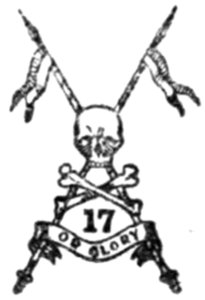
17th Lancers on account of its grim crest, a skull with
crossbones, which, with its motto "Or Glory" has led to its
popular name of "The Death or Glory Boys." It is an
interesting fact that the 17th Lancers in 1795 provided a
detachment for service on H.M.S. "Hermione" as Marines,
and were promptly nicknamed "The Horse Marines."
Lancer regiments were introduced into the British Army
in 1816.
Each regiment of Dragoon Guards carries a standard on
ceremonial occasions, and Dragoon regiments carry a guidon
(a swallow-tailed standard). Hussar and Lancer regiments
do not carry standards, bearing their battle honours on their
appointments.
The regiments of Foot Guards, known as the Brigade
of Guards, have many privileges and duties reserved to them
alone. They claim the privilege of guarding the Royal
Palaces and form part of the Household Troops of the
Sovereign. The First Company of the 1st Battalion
Grenadier Guards is known as the King's Company and is
comprised of picked men of particularly fine physique, none
under 6 feet in height being admitted to it. This company
has the right to carry on parade on state and ceremonial
occasions a colour of crimson silk, the gift of the Sovereign,
being the only company in the Army so privileged. The
First Company of the Welsh Guards, formed in 1915, is
known as The Prince of Wales's Company, and is also
composed of picked men. The Scots Guards is the only
regular Scottish regiment to have drum and fife bands.
The Quartermasters of the Brigade of Guards wear cocked
hats with plumes, the Grenadier and Scots Guards, white;
the Coldstream Guards, red; and the Irish Guards, blue.
The sergeant-majors of the Foot Guards wear an elaborate
Royal Coat of Arms on their right sleeves above the elbow.
No chevrons or badges are worn by staff-sergeants of the
Foot Guards in undress uniform.
The Royal or King's Colour in regiments of Foot Guards is
of crimson silk, and bears the distinctions conferred by Royal
authority. The regimental colour of Foot Guards is the
Union Jack, and battle honours are borne on both colours.
The King's Colour of the Infantry of the Line is the Union
Jack, with the regimental badge superimposed, but the
regimental colour is distinctive in each regiment and the
battle honours are borne on these alone.
Regarding pipers it is a curious fact that the Regulations
provide for an issue of fifes to Scottish regiments but not
bagpipes, which have to be provided regimentally, although
with the exception of the Scots Guards, the fifes are
never drawn from stores. In the Royal Scots, Royal Scots
Fusiliers, King's Own Scottish Borderers and Scottish Rifles,
pipers are officially borne on the strength, but no clothing
allowed for them, which has to be provided regimentally.
The sergeant-pipers of the Scots Guards alone wear a crown
and silver chevrons on their doublet sleeves, all other
sergeant-pipers wearing gold chevrons without a crown.
There are many interesting peculiarities connected with
uniforms or accoutrements. The Kilmarnock bonnets worn
by the Royal Scots and King's Own Scottish Borderers,
which were designed and issued for wear after the South
African War, are quite distinctive, as also are the chacos of
the Scottish Rifles and Highland Light Infantry, the former
having a plume in front and the latter a ball. The
Queen's Royal West Surrey Regiment is the only regiment
in the Army wearing a sacred emblem as a badge, while the
Buffs (East Kent Regiment) claim to have a far more
ancient lineage than any other English regiment.
The King's Own Royal Lancaster Regiment wears the
Lion of England for a badge, and it is interesting to note
that many other regiments go to the animal kingdom for
their crests, the Royal Warwickshire Regiment wearing an
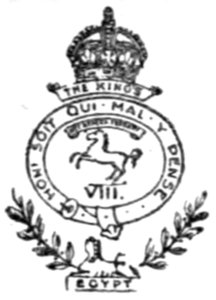
antelope as a badge; the King's Liverpool Regiment, West
Yorkshire Regiment and Royal West Kent Regiment, a
horse; the Buffs, the Scottish Rifles, Royal Berkshire
Regiment, North Staffordshire Regiment and York and
Lancaster Regiment, a dragon; the Gordon Highlanders,
Royal Munster Fusiliers, Royal Dublin Fusiliers, Leicestershire
Regiment and Hampshire Regiment, a tiger; the West
Riding Regiment, Connaught Rangers, Seaforth Highlanders,
and the Highland Light Infantry, an elephant; the Royal
Irish Fusiliers, an eagle; the Argyll and Sutherland
Highlanders, a cat; and the Bedfordshire Regiment, a stag.
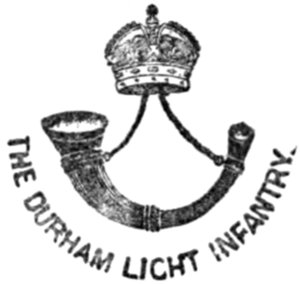
The Light Infantry regiments wear a bugle or French horn
as part of their badge, and together with Rifle regiments
march with a much quicker step than do other infantry
regiments. The regulation pace is 120 to the minute, but
Rifle and Light Infantry regiments step much quicker, 140
to 160, except when marching with other troops, then their
pace is that laid down for the army generally. They have
bugle bands instead of drum and fife bands.
The Northumberland Fusiliers are the only regiment to
celebrate St. George's Day, and are looked upon as the
representative English infantry regiment in the British Army
and their crest of St. George and the Dragon is unique.
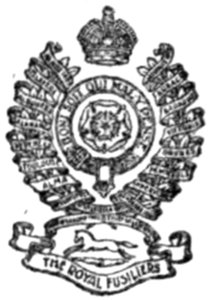
All Fusilier regiments wear sealskin fusilier caps with
distinctive plumes, and a grenade as a badge. The Royal
Fusiliers is best known as the City of London Regiment, and
has some peculiar privileges in consequence, one of these
being the right to march through the City of London with
fixed bayonets, colours flying, and drums beating, without
first obtaining the permission of the Lord Mayor and
Aldermen. This privilege is shared by the Buffs, the
Grenadier Guards and Royal Marines only.
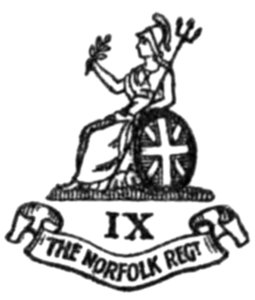
The Norfolk Regiment has a curious crest, being the
figure of Britannia as it used to appear on the copper coinage,
and is the only regiment not having a Royal title, of which
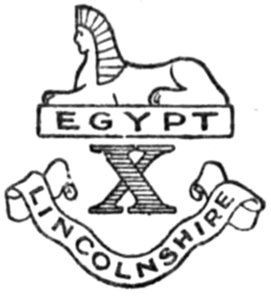
His Majesty is Colonel-in-Chief. The Lincolnshire Regiment
was for some years after being raised the only British regiment
of infantry to wear blue coats.
The Suffolk Regiment was one of the six regiments of
British infantry that performed the remarkable feat of charging
and utterly destroying a column of French cavalry, superior
in numbers to themselves. This was at Minden, the other
five regiments being the Lancashire Fusiliers, Royal Welsh
Fusiliers, King's Own Scottish Borderers, Hampshire
Regiment and the Yorkshire Light Infantry. The regiments
passed to the battlefield through gardens of roses in full bloom,
and the soldiers picked the blossoms and fixed them in their
hats, and in commemoration of their victory they enjoy the
right of wearing roses in their head-dress on the anniversary
of the battle.
The Prince Albert's Somerset Light Infantry has two
peculiar distinctions, one being that it is the only regiment
without a Royal title to wear blue for its facings,
and the other being that the sergeants enjoy the right of
wearing their sashes over the left shoulder the same as the
officers, in commemoration of their devoted gallantry at the
battle of Culloden, when the casualties among the officers
were so numerous that the sergeants were left in command.
The Cheshire Regiment also enjoys a peculiar privilege,
that of wearing oak leaves in its head-dress and as a wreath
on its colour staves on all Royal ceremonial parades, in
commemoration of its rally round its Sovereign who took
shelter at a critical moment beneath an oak tree during
the battle of Dettingen.
Among the peculiarities of the Royal Welsh Fusiliers is
that of wearing a bunch of black ribbons fastened to the
back of the collar. This is a survival of the patch of black
leather which in former days was worn by all soldiers on
the back to prevent the grease from the powdered pigtails
from soiling the tunics. The regiment also enjoys the
privilege, common to all Welsh regiments, of being led on
parade by a goat, these animals being generally gifts from the
Sovereign.
The South Wales Borderers have a highly-prized
distinction, that of bearing a silver wreath of immortelles
fastened to their King's colour, in commemoration of the
devoted bravery of the regiment in the Zulu War.
All the Welsh regiments carry on their colours, or as
badges, the device of the Plume of the Prince of Wales, the
Rising Sun, and the Red Dragon of Cadwaladr.
The Royal Inniskilling Fusiliers were for many years the
only regiment in the British Army using the old Irish war
pipes, but now other Irish regiments have adopted the custom
and possess full pipe bands. The Irish war pipe has but two
drones, as distinctive from the Scottish bagpipes which
have three.
The Gloucestershire Regiment has a unique distinction,
that of wearing a miniature replica of its badge at the
back of its head-dress, bestowed for its gallantry at the battle
of Alexandria, when being suddenly attacked front and
rear simultaneously, the rear ranks of the regiment turned
about and beat the enemy off.
The Worcestershire Regiment has as its motto the word
"Firm," bestowed for steadiness in the face of the foe, and
naturally highly prized.
The Duke of Wellington's West Riding Regiment enjoys
two peculiar distinctions, the first that of being the only
regiment in the British Army bearing the name of anyone
except a Royal personage as part of its title, and also of
being the only regiment to wear scarlet facings to its red
tunics.
The Border Regiment alone among the regiments of the
Army bears the battle honour of "Arroyo dos Molinos,"
although a number of regiments took part in that great battle.
The Welsh Regiment, like the Welsh Guards, has a
motto in the Welsh language. The former served with
distinction as marines on board the fleet under Lord Nelson.
The Black Watch wears a red hackle or feather in its
bonnets, a distinction won on the battlefield, and its pipers
are the only ones in the army wearing feather bonnets instead
of glengarry caps.
The King's Royal Rifle Corps and the Rifle Brigade are
known as the Greenjackets, from the colour of their full dress
uniform, and like all Rifle regiments wear fur busbies.
They do not carry colours, their battle honours being emblazoned
on their appointments. They do not carry their rifles at the
slope but at the trail. There are two other Rifle regiments
in the British Army, these being the Scottish Rifles (The
Cameronians) and the Royal Irish Rifles.
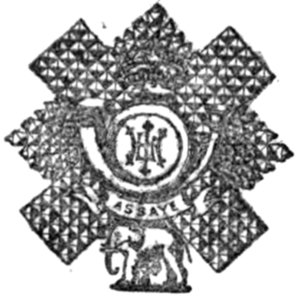
The Highland Light Infantry and Seaforth Highlanders
enjoy the privilege of carrying a third colour on parade, this
having been presented to them to commemorate their bravery
at the battle of Assaye, and being emblazoned with an elephant
is known as the Assaye or Elephant Colour. The Seaforth
is the only regiment to have a Gaelic motto.
The Queen's Own Cameron Highlanders have a larger
proportion of Gaelic-speaking soldiers in their ranks than any
other, most of them hailing from the most northern part of
the Highlands.
Before the great war on the Continent the King's Royal
Rifle Corps were credited with the highest number of battle
honours, viz., 40, the Gloucester Regiment being second with
34, then in order the Rifle Brigade 33, Highland Light
Infantry 32, Black Watch and Gordon Highlanders 31 each,
Royal Welsh Fusiliers, Royal Scots, South Staffordshire
Regiment and South Lancashire Regiment 29 each, Oxfordshire
and Buckinghamshire Light Infantry 27, Sherwood
Foresters, Seaforth Highlanders, Royal Munster Fusiliers,
Northamptonshire Regiment and Royal Dublin Fusiliers
25 each, and The Buffs, East Surrey Regiment and
Grenadier Guards 24 each. The 16th Lancers have the
highest number of honours amongst the Cavalry regiments,
viz., 18, the 9th Lancers having 16, and the 14th Hussars 15.
Many other matters of interest attaching to each regiment
will be found in the following pages.
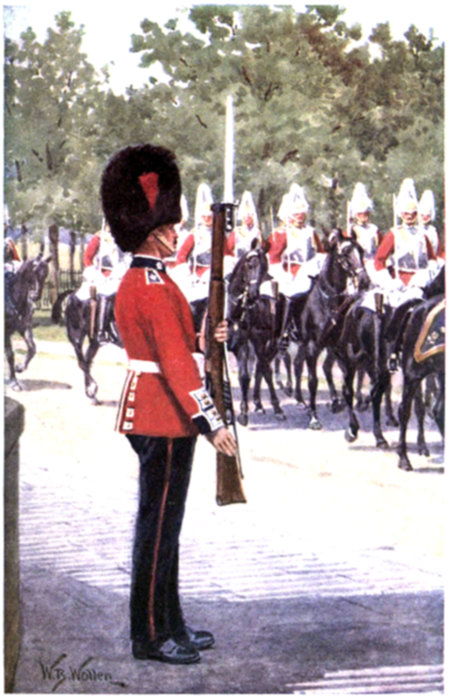
Royal Escort of Life Guards at St. James's Palace.
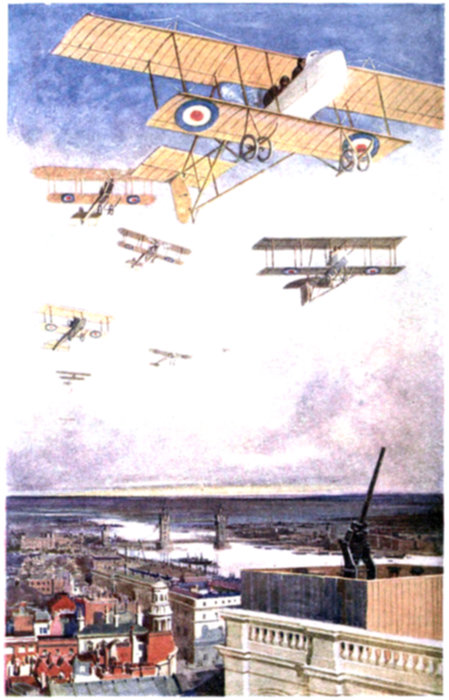
Types of Royal Flying Corps Aeroplanes and Anti-Aircraft Gun
(Record Office, Aldershot)
Uniform, Blue.
Facings, Scarlet.
Service Uniform, Khaki fold-over jacket, breeches, and putties,
with turndown cap.
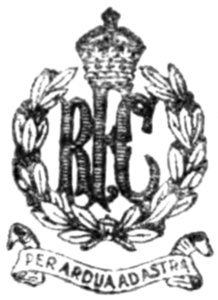
Motto: Per Ardua ad Astra (Through difficulties to the Stars).
Qualified Pilot's Badge worn on left breast
The great European war brought out in startling
fashion the remarkable efficiency of the military
aerial service, which is embodied in the Naval
and Military Wings of the Royal Flying Corps. The
Naval Wing is concerned chiefly with airships, while
the Military Wing is devoted to work with aeroplanes
and man-carrying kites. The Corps has its foundation
in the old Balloon Company of the Royal Engineers,
which in 1911 was absorbed into the Air Battalion
Royal Engineers, when the aerial service of the army
was placed on a sound basis. The headquarters were
placed at Aldershot. On April 13th, 1913, the Royal
Flying Corps was organised and developed in remarkable
manner in methods, material, and men. When
war was declared against Germany in 1914 the
members of the Corps quickly achieved fame by
their efficiency and daring, many decorations being
won, notably the V.C. by Lieut. Warneford, who
was killed soon after in an accident near Paris.
Nicknames: "The Hawks," "The Sky Pilots."
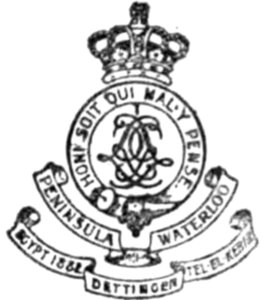
"Dettingen," "Peninsula," "Waterloo," "Tel-el-Kebir,"
"Egypt, 1882," "Relief of Kimberley," "Paardeberg,"
"South Africa, 1899-1900."
Uniform, Scarlet.
Facings, Blue.
Cloak, Scarlet.
Head-dress, White metal helmet with white plume; band
and trumpeters, scarlet plume.
Cap, Blue, with scarlet band.
On State occasions the band and trumpeters wear a special
tunic of crimson heavily braided with gold.
A crimson cord is worn in the centre of the shoulder belt.
Two scarlet stripes are worn down the side seams of the overalls.
The Regiment carries three Squadron Standards in addition to
the King's Standard. The Silver Kettle-Drums used in the
Regiment were presented by King William IV in 1831.
In 1660, Charles II. before leaving Holland,
formed into a troop a body of cavalier gentlemen
who had rallied round him there, which he
placed under the command of Lord Gerard. It
was thus the Life Guards originated. The corps
was styled "His Majesty's Own Troop of Guards."
The Life Guards were nicknamed "Cheeses,"
from the old gentlemen of the corps declining to
serve in it as remodelled in 1788, saying "that it
was no longer composed of gentlemen but of cheesemongers."
Also known as "The Tin Bellies."
Note "A."—In full dress N.C.O.'s of the Household
Cavalry do not wear chevrons but aiguillettes. The titles
of the ranks also differ from other regiments—Corporal-Major
(Sergeant-Major), Quartermaster-Corporal-Major (Quartermaster-Sergeant),
Squadron-Corporal-Major (Squadron-Sergeant-Major),
Corporal of Horse (Sergeant), Corporal
(Corporal), Trooper (Private). The Farrier-Corporals carry
polished pole axes on ceremonial parades, and wear black
plumes and blue tunics.
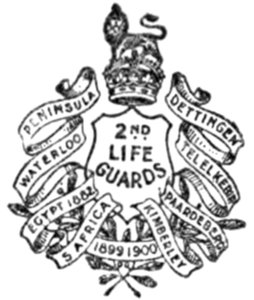
"Dettingen," "Peninsula," "Waterloo," "Tel-el-Kebir,"
"Egypt, 1882," "Relief of Kimberley," "Paardeberg,"
"South Africa, 1899-1900."
Uniform, Scarlet.
Facings, Blue.
Cloak, Scarlet.
Head-dress, White metal helmet with white plume; band and
trumpeters, scarlet plume.
Cap, Blue, with scarlet band.
On State occasions the band and trumpeters wear a special
tunic of crimson heavily braided with gold.
A blue cord is worn in the centre of the shoulder belt.
Two scarlet stripes are worn down the side seams of the overalls.
The Regiment carries three Squadron Standards in addition to
the King's Standard.
The Silver Kettle-Drums used in the Regiment were presented
by King William IV, in 1831.
This Corps formed by Charles II was styled in
1660 "The Duke of Albemarle's Troop of
Guards," in 1670 "The Queen's Troop of
Life Guards," and not till 1788 the 2nd Life Guards.
Life Guards were at one time known as "Cheeses,"
from the old gentlemen of the corps declining to
serve in it as remodelled in 1788, saying "that it
was no longer composed of gentlemen but of
cheesemongers." The name fell into desuetude, but
was revived at the battle of Waterloo, when the
officer in command shouted "Come on, Cheesemongers,
charge!" Also known as "The Tin
Bellies" (from the cuirasses).
"Dettingen," "Warburg," "Beaumont," "Willems,"
"Peninsula," "Waterloo," "Tel-el-Kebir," "Egypt, 1882,"
"Relief of Kimberley," "Paardeberg," "South Africa, 1899-1900."
Uniform, Blue.
Facings, Scarlet.
Cloak, Blue.
Head-dress, White metal helmet with red plume.
On State occasions the band and trumpeters wear a special
tunic of crimson heavily braided with gold.
A crimson cord it worn in the centre of the shoulder belt.
A broad scarlet stripe is worn down the sides of the overalls.
In addition to the four Standards carried by the Household
Cavalry, the Royal Horse Guards have a crimson silk Standard
presented by King William IV.
The Silver Kettle Drums were presented by King George III.
The Royal Horse Guards is the only cavalry
regiment now in existence that formed part
of the Parliamentary Army during the reign
of Charles I. In the autumn of 1660, after the
Restoration, its disbandment was ordered but not
carried out, and King Charles "gave orders for
raising a regiment of horse of eight troops, of which
the Earl of Oxforde was to be Collonel, and also of
a troop of horse guards." This was done under
a Royal Warrant of 26th of January, 1661. In
1690 the regiment was called "The Oxford Blues"
to distinguish it from the Earl of Portland's (Dutch)
"Horse Guards." During the campaign in Flanders
(1742-1745) it was known as "The Blue Guards,"
and is now popularly called "The Blues."
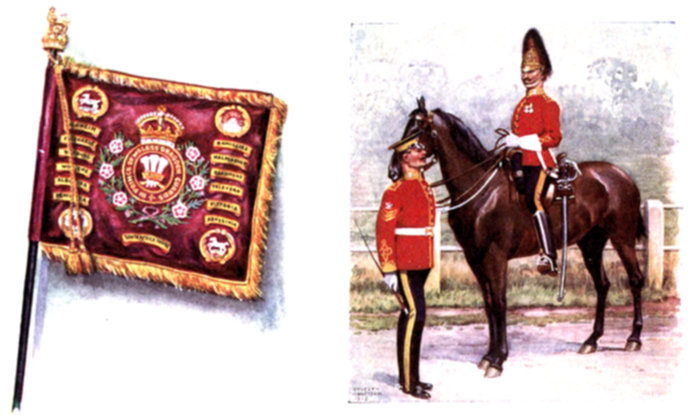
The Standard and Uniforms of the 3rd Dragoon Guards
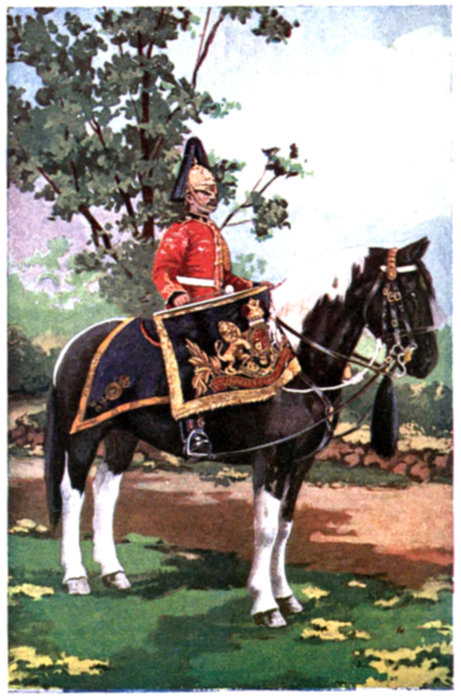
The Drum Horse of the 7th Dragoon Guards—Review Order
(Depot, Dunbar.)
On Standard, The Royal Cypher within the Garter.
"Blenheim," "Ramillies," "Oudenarde," "Malplaquet,"
"Dettingen," "Warburg," "Beaumont," "Waterloo,"
"Sevastopol," "Taku Forts," "Pekin, 1860," "South Africa,
1879, 1901-02."
Uniform, Scarlet.
Facings, Blue.
Head-dress, Brass helmet with red plume; band, white plume.
Forage cap, Blue, with blue band.
Linked Regiment, 5th Dragoon Guards.
The Sergeants are entitled to wear the Regimental badge on
their chevrons.
The 1st Dragoon Guards were styled "The
Queen's Regiment of Horse" when first
raised in 1685 on the accession of James
II. When in Flanders with Marlborough, the
regiment wore cuirasses, and had bright yellow
facings. In 1714, in recognition of its brilliant
services, the title was changed to "The King's
Regiment of Horse," and in 1746 to "The 1st
(or King's) Regiment of Dragoon Guards." A
detachment of the regiment captured the Zulu
King Cetewayo after his defeat at the battle of
Ulundi. The battlefields of Flanders figure in the
regiment's history no less than four times, viz.: In
1695 under King William at the siege of Namur;
in 1704-9 under Marlborough at Schellenberg,
Blenheim, Ramillies, Oudenarde, and Malplaquet;
in 1759 when it fought at Minden and elsewhere;
and in the Great War, 1914.
Nicknames: "The K.D.G.'s," also "The Trades
Union."
(Depot, Newport, Mon.)
On Standard, the Cypher of Queen Caroline
within the Garter.
"Warburg," "Willems," "Lucknow," "South Africa,
1901-02."
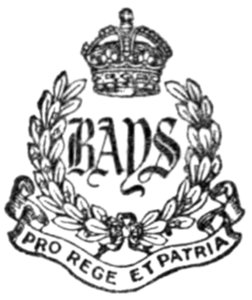
Motto: "Pro Rege et Patria" (For King and for Country).
Uniform, Scarlet.
Facings, Buff.
Head-dress, Brass helmets with black plume; band, white
plume.
Forage cap, Blue with buff band.
Linked Regiment, 6th (Inniskilling) Dragoons.
Special arm badge for Sergeants: "Bays" within a laurel
wreath surmounted by a crown.
The 2nd Dragoon Guards was raised in 1685,
and in 1687 called "The 3rd Horse," then
"The Princess of Wales's Own Royal
Regiment of Horse," in 1727 "The Queen's Own
Royal Regiment of Horse," in 1746 "The 2nd
Queen's Bays, or 2nd Regiment of Dragoon
Guards," and in 1767 its present title of "Queen's
Bays," from the circumstances of the corps being
entirely mounted on bay chargers, the other heavy
regiments (except the Scots Greys) having black
horses. The regiment was much distinguished
for its gallantry at the battle of Almanza, and in
Flanders under King William.
Nicknames: At one time known as the "Rusty
Buckles," and more popularly as "The Bays."
(Depot, Newport, Mon.)
On Standard, The Plume of the Prince of Wales.
The Rising Sun in second corner, and the Red Dragon of
Cadwaller in the third corner.
"Blenheim," "Ramillies," "Oudenarde," "Malplaquet,"
"Warburg," "Beaumont," "Willems," "Talavera,"
"Albuhera," "Vittoria," "Peninsula," "Abyssinia,"
"South Africa, 1901-02."
Uniform, Scarlet.
Facings, Yellow.
Head-dress, Brass helmet with black and red plume; band,
red and white plume.
Forage cap, Blue with yellow band.
Linked Regiment, 6th Dragoon Guards (Carabiniers).
Special arm badge for Sergeants, Prince of Wales's Plume.
The 3rd Dragoon Guards, originally "Cuirassiers,"
was raised in 1685, and after the
battle of Sedgemoor its six troops were
incorporated into a regiment called "The 4th
Horse." In 1746 it was named "The 3rd Regiment
of Dragoon Guards," and in 1765 "The
Prince of Wales's Regiment of Dragoon Guards."
At Ramillies it captured the standard and kettledrums
of the Bavarian Guards. It was the only
British Cavalry Regiment to take part in the
Abyssinian campaign under Gen. Napier and formed
part of the British column that made the memorable
march on Magdala.
Nicknamed the "Old Canaries," on account
of its facings being yellow, or canary colour.
(Depot, Newport, Mon.)
On Standard, the Harp and Crown and the Star of the Order
of St. Patrick.
"Peninsula," "Balaklava," "Sevastopol,"
"Tel-el-Kebir," "Egypt, 1882."
Motto: Quis separabit? (Who shall separate?)
Uniform, Scarlet.
Facings, Blue.
Head-dress, Brass helmet with white plume; band, black plume.
Forage cap, Blue, with blue band.
Linked Regiment, 7th Dragoon Guards.
Special arm badge for Sergeants, Star of the Order of
St. Patrick.
The 4th Dragoon Guards raised in 1685, was
originally known as "Arran's Cuirassiers,"
or the "6th Horse," and in 1788 "The
Fourth Dragoon Guards," and later on the words
"Royal Irish" were added. Whilst on service
in Ireland it obtained the name of the "Blue
Horse," from its facings being of that colour. During
the Crimean War the regiment took part in the
famous charge of the Heavy Brigade at Balaklava,
a memorable feat which has hardly received the
recognition it deserved. The regiment rode into the
charge cheering madly and did terrible execution.
They are the only regiment of Dragoon Guards
with an Irish title.
Nicknames: "The Buttermilks" on account of their
lengthened stay in Ireland, during which many of the
men acquired farms; and the "Mounted Micks."
(Depot, Dunbar).
On Standard, the Regimental device within a union wreath.
"Blenheim," "Ramillies," "Oudenarde," "Malplaquet,"
"Beaumont," "Salamanca," "Vittoria," "Toulouse,"
"Peninsula," "Balaklava," "Sevastopol," "Defence of
Ladysmith," "South Africa, 1899-1902."
Motto: "Vestigia nulla retrorsum" (No going backward).
Uniform, Scarlet.
Facings, Dark Green.
Head-dress, Brass helmet with red and white plume; band,
red plume.
Forage cap, Blue, with dark green band.
Linked Regiment, 1st (King's) Dragoon Guards.
Special arm badge for Sergeants, White Horse of Hanover.
At Salamanca it captured the staff of the drum-major of the
French 66th Regiment. This is still carried on special parades
by the trumpet-major.
The 5th Dragoon Guards was raised in 1685,
and was then the "Seventh Horse." During
Marlborough's campaigns it won fame on
many fields. Led by General Cadogan in person
they rode down the Bavarian Horse Grenadier
Guards, and drove them through the French
infantry in rear, capturing many standards. Its
present full title, was given it in 1804, after
the Irish rebellion of 1798. During this latter
period it was familiarly known as the "Green
Horse," from its facings, and the "Green Dragoon
Guards." During the Crimean War the regiment
took part at Balaklava in the famous charge of the
Heavy Brigade, led by their Colonel, Yorke-Scarlett.
Nicknames: "The Old Farmers" on account of
their lengthened stay in Ireland, and the "Green
Horse."
(Depot, Newport, Mon.)
"Blenheim," "Ramillies," "Oudenarde," "Malplaquet,"
"Warburg," "Willems," "Sevastopol," "Delhi, 1857,"
"Afghanistan, 1879-80," "Relief of Kimberley,"
"Paardeberg," "South Africa, 1899-1902."
Uniform, Blue.
Facings, White.
Head-dress, Brass helmet with white plume; band, red plume.
Forage cap, Blue with white band.
In 1851 the colour of the tunic was changed from scarlet to blue.
Linked Regiment, 3rd (Prince of Wales's) Dragoon Guards.
Allied Regiments, 1st and 2nd Mounted Rifles
(Natal Carabineers of South Africa).
The 6th Dragoon Guards raised in 1685 as the
"Queen Dowager's Regiment of Horse" and
became the "Queen Dowager's Cuirassiers."
William III gave the regiment its name of King's
Carabiniers in 1691 as a title of honour in recognition
of its distinguished services. The name is also
derived from the fact that the men were armed with
long pistols called "Carabines." Many regiments
on the Continent at this time were called Carabiniers.
Its present name was given it in 1788. It greatly
distinguished itself during Marlborough's campaigns,
taking part in sieges and minor affairs without
number. It was at Meerut on the outbreak of the
Indian Mutiny and rendered the most valuable service
throughout the campaign. The regiment has a very
brilliant record of service.
Nicknames: "Tichborne's Own," since the trial of
Arthur Orton, Sir Roger Tichborne having served
in the regiment; and "The Carbs."
(Depot, Newport, Mon.)
On Standard, in the centre, the Coronet of Princess Royal.
"Blenheim," "Ramillies," "Oudenarde," "Malplaquet,"
"Dettingen," "Warburg," "South Africa, 1846-7,"
"Tel-el-Kebir," "Egypt, 1882," "South Africa, 1900-02."
Motto: Quo fata vocant (Where Fate calls).
Uniform, Scarlet.
Facings, Black.
Head-dress, Brass helmet, with black and white plume; band,
white plume.
Forage cap, Blue, with black band.
Linked Regiment, 4th (Royal Irish) Dragoon Guards.
Special arm badge for Sergeants, Ligonier's Crest.
The 7th Dragoon Guards was raised in 1688 by
the Earl of Devonshire, whose title it bore
till 1690, when from its Colonel's name it was
called "Schomberg's Horse"; in 1742 "Ligonier's
Horse," and then "The Black Horse," and became
celebrated as a model for efficiency and discipline.
In 1788 the present title, "The 7th (Princess
Royal's) Dragoon Guards," was given to it at
Dettingen. The 7th captured from the enemy a
pair of kettledrums, which are now in the Officers'
Mess. A Standard carried at the battle of Dettingen
was presented by King George II to Cornet
Richardson who bore it. He had received upwards
of thirty wounds, but he refused to surrender,
and preserved the Standard which is still in the
possession of his descendants. Nicknames: In the
reign of George II, "The Virgin Mary's Body
Guard," having been sent to assist the army of
the Archduchess Mary Theresa of Austria, also
"Strawboots," because the men wrapped straw
round their legs in a wet campaign; popularly known
as "The Black Horse."
(Depot, Dunbar.)
On Guidon, The Crest of England within the Garter.
"Tangier, 1662-80," "Dettingen," "Warburg," "Beaumont,"
"Willems," "Fuentes d'Onor," "Peninsula," "Waterloo,"
"Balaklava," "Sevastopol," "Relief of Ladysmith," "South
Africa, 1899-1902."
Motto: Spectemur Agendo (Let us be judged by our deeds).
Uniform, Scarlet.
Facings, Blue.
Head-dress, White metal helmet with black plume; band,
white plume.
Forage cap, Blue, with scarlet band.
Linked Regiment, 2nd Dragoons (Royal Scots Greys).
Special arm badge for Sergeants, the Royal Crest.
The Royals originated in a troop of Cuirassiers
formed in 1661, on the marriage of Charles
II with the Infanta Catherine of Portugal,
and which was sent to garrison Tangier, whence
they got the name of "Tangier Cuirassiers." In
1684 it was styled "The Royal Regiment of
Dragoons," and each troop was furnished with a
crimson Standard with badges embroidered upon
them of (1) The King, (2) The Black Prince,
(3) Henry V, (4) Henry VI, (5) Henry VII
(Queen Mary I), (6) Queen Elizabeth. Towards
the close of the 17th Century it was known as the
"English Horse." At the battle of Dettingen it
captured the white Standard of the French Mousquetaires
Noirs. Its gallantry at the battle of
Waterloo, where it formed part of the Union
Brigade, is a matter of history.
Nicknames: "The
Birdcatchers," for the capture of a French Eagle at
the battle of Waterloo, and "The Royals."
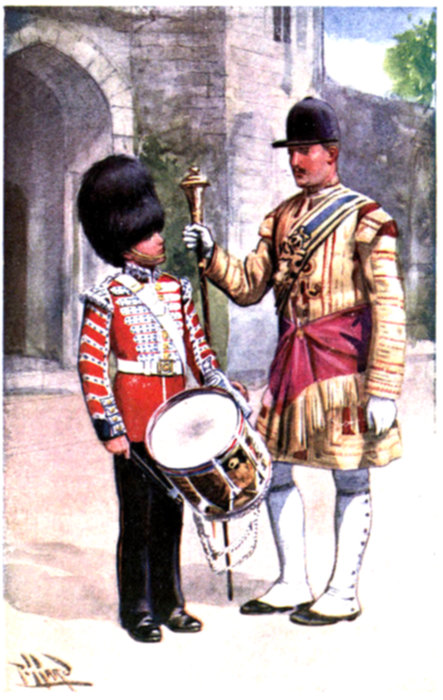
Grenadier Guards.—Sergeant-Drummer in State Dress.
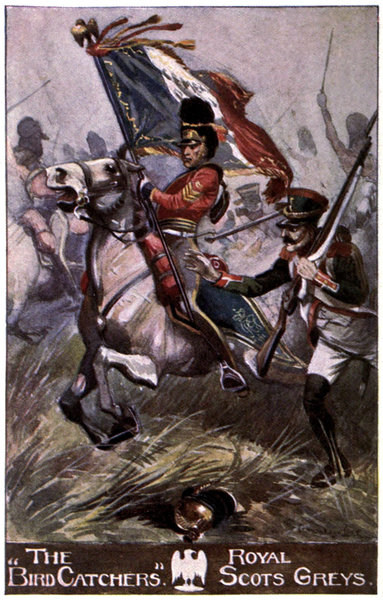
Sergeant Ewart capturing the Eagle at Waterloo.
(Depot, Dunbar.)
On Guidon, the Thistle within the Circle and Motto of the
Order of the Thistle.
"Blenheim," "Ramillies," "Oudenarde," "Malplaquet,"
"Dettingen," "Warburg," "Willems," "Waterloo,"
"Balaklava," "Sevastopol," "Relief of Kimberley,"
"Paardeberg," "South Africa, 1899-1902."
Motto: Second to None.
Uniform, Scarlet.
Facings, Blue.
Head-dress, Bearskin cap, with a silver badge of a white horse
at the back; hackle or plume, white; band, scarlet hackle.
Forage cap, Blue, with white vandyked band.
Linked Regiment, 1st Royal Dragoons.
Special arm badge for Sergeants, an Eagle.
Raised in 1678. In 1700 the corps was known
as "The Grey Dragoons," and "The Scots
Regiment of White Horses." In 1707,
"The Royal Regiment of North British Dragoons."
In 1713, "The 2nd Dragoons." And in 1866,
"The 2nd Royal North British Dragoons, Scots
Greys." At Waterloo, the regiment with a shout
of "Scotland for ever," charged the French
infantry masses and almost annihilated them. In the
charge the eagle of the 45th French Regiment was
captured by Sergeant Ewart; at Ramillies (1706)
the Scots Greys captured the colours of the French
"Regiment du Roi" and for this it was permitted
to wear grenadier or bearskin caps.
The men have the nicknames of "Bubbly Jocks,"
owing to their dress. "Bubbly Jock" being a Scottish
name for a turkey cock; "The Birdcatchers," in
commemoration of the capture of an Eagle at
Waterloo; also "The Greys."
(Depot, Bristol.)
"Dettingen," "Salamanca," "Vittoria," "Toulouse,"
"Peninsula," "Cabool, 1842," "Moodkee," "Ferozeshah,"
"Sobraon," "Chillianwallah," "Goojerat," "Punjaub,"
"South Africa, 1902."
Motto: Nec aspera terrent (Nor do difficulties deter).
Uniform, Blue.
Collar, Scarlet.
Head-dress, Busby with white plume and garter-blue busby bag.
Horse plume, White. Leopard skin saddlecloth.
Forage cap, Red.
Linked Regiment, 7th (Queen's Own) Hussars.
Special arm badge for Sergeants, White Horse of Hanover.
The regiment has an additional sergeant as kettle-drummer who,
on ceremonial occasions, wears a silver collar which was presented
by the wife of the Hon. Charles Fitzroy, afterwards Lord
Southampton, on his being appointed colonel in 1772.
The 3rd Hussars, raised in 1685, was styled the
"Queen Consort's Regiment of Dragoons."
On the accession of George I it was called
the "King's Own Dragoons." In 1861 the regiment
became "Hussars." It was nicknamed "Lord
Adam Gordon's Life Guards," from that officer
detaining it for such a long period in Scotland when
he commanded there.
It was also known as "Bland's Dragoons." At
Dettingen the regiment lost very heavily, and in the
following year it was reviewed by the King, who
remarked with some asperity on its attenuated
appearance, and inquired whose regiment it was, and
where were the rest of the men. "The regiment is
mine, your Majesty," replied the gallant Col. Bland,
"and I believe the rest are at Dettingen."
(Depot, Dublin.)
"Dettingen," "Talavera," "Albuhera," "Salamanca,"
"Vittoria," "Toulouse," "Peninsula," "Ghuznee, 1839,"
"Affghanistan, 1839," "Alma," "Balaklava," "Inkerman,"
"Sevastopol."
Motto: Mente et Manu (With heart and hand).
Uniform, Blue.
Head-dress, Busby with scarlet plume and yellow busby bag.
Forage cap, Red.
Horse plume, Scarlet.
Linked Regiment, 8th (King's Royal Irish) Hussars.
Originally raised in 1685 under the name of
"The Princess Anne of Denmark's Regiment
of Dragoons," became the 4th (Queen's
Own) Hussars in 1861. As heavy cavalry the
regiment fought in the Peninsular War, some
brilliant exploits were performed. In 1818 the
regiment became Light Dragoons, and the Regiment
wore scarlet uniform with straw coloured
facings, the uniform afterwards being changed back
to light green. During the Crimean War it took
part in the famous charge of the Light Brigade,
under its Colonel, Lord George Paget, who led
them with a cry of "Tally ho!" as they charged
the enemy's guns. When the regiment formed
part of the "Army of the Indus" under Lord Keane
it was nicknamed "Paget's Irregular Horse," in
consequence of its loose drill, the result of long
service in the field.
(Depot, Woolwich.)
"Blenheim," "Ramillies," "Oudenarde," "Malplaquet,"
"Suakin, 1885," "Defence of Ladysmith," "South Africa,
1899-1902."
Motto: Quis separabit? (Who shall separate?)
Uniform, Blue.
Facings, Scarlet.
Head-dress, Lance cap of black leather with upper part and
top of scarlet cloth. Green plume.
Forage cap, Blue, with scarlet band.
Linked Regiment, 12th (Prince of Wales's Royal) Lancers.
Special arm badge for Sergeants, Harp and Crown.
Raised as the "Royal Irish Dragoons" in 1689,
and in 1858 became "The 5th (Royal Irish)
Lancers." In recognition of the prominent
part it took in Marlborough's campaigns, and particularly
of its distinguished conduct at Blenheim,
Marlborough directed that the captured kettledrums
should be borne at the head of the regiment,
and that the establishment should be nine troops.
At Ramillies, with the Royal Scots Greys, it cut
off two battalions of the Grenadiers of Picardie,
and almost annihilated a third battalion before a
body of French horse galloped to the rescue. To
this the regiment owed the privilege it formerly
enjoyed of wearing Grenadier caps like the Royal
Scots Greys.
Nicknames: At one time called "The Daily
Advertisers." More popularly known as "The
Redbreasts" or "Irish Lancers."
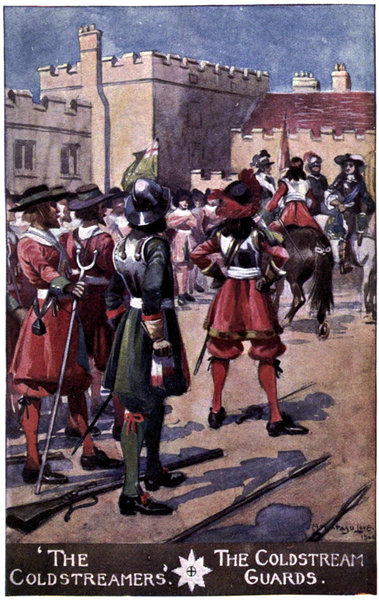
The Coldstreamers first meeting with the Monarch.
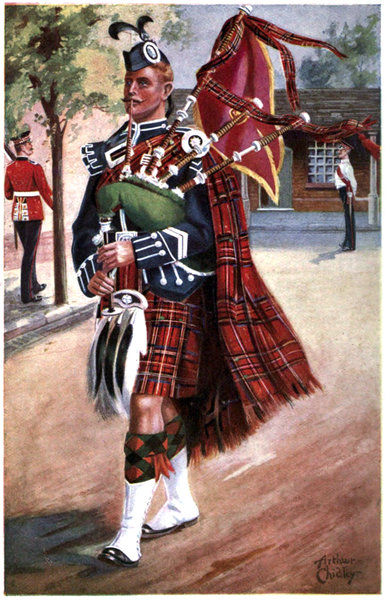
Scots Guards—Piper in State Dress.
(Depot, Newport, Mon.)
On Guidon, The Castle of Inniskilling, with the St. George's
Colours, and the word "Inniskilling" underneath.
"Dettingen," "Warburg," "Willems," "Waterloo,"
"Balaklava," "Sevastopol," "South Africa, 1899-1902."
Uniform, Scarlet.
Facings, Primrose.
Head-dress, White metal helmet, with white plume; band,
scarlet plume.
Forage cap, Blue, with primrose band.
Horse plume, White.
Linked Regiment, 2nd Dragoon Guards (Queen's Bays).
Allied Regiment, 25th Brant Dragoons of Canada, Brantford,
Ontario.
Special arm badge for Sergeants, Castle of Inniskilling.
The regiment was raised in 1689. In 1690
the corps was styled the "6th, or The Inniskilling
Regiment of Dragoons." Its brilliant
conduct as part of the Union Brigade at the Battle
of Waterloo is a matter of history. During the
Crimean War it took part in the famous charge of
the Heavy Brigade at Balaklava, a memorable feat
which has hardly received the recognition it
deserved. Of more recent years the regiment saw
a great deal of active service in South Africa.
About 1715 it was known as "The Black
Dragoons," from being mounted on black horses.
It achieved a high reputation for gallantry in
Flanders.
Nicknames: "The old Inniskillings," and "The
Skillingers." Popularly known as "The Inniskillings,"
from its badge "The Castle of Inniskilling."
(Depot, Bristol.)
"Dettingen," "Warburg," "Beaumont," "Willems,"
"Orthes," "Peninsula," "Waterloo," "Lucknow," "South
Africa, 1901-02."
Uniform, Blue.
Head-dress, Busby with white plume, and scarlet busby bag.
Forage cap, Red.
Horse plume, White. Leopard skin saddlecloth.
Collar badge, the letters "Q.O." interlaced, within the Garter.
Linked Regiment, 3rd (King's Own) Hussars.
The only cavalry regiment in which the Officers are permitted
to wear white strip collars with the frock coat.
The regiment was raised in 1689 and called
"Cunningham's Regiment of Dragoons."
It was, during the Peninsular War, jocularly
nicknamed "The Old Saucy Seventh," also "The
Lily White Seventh," from its pale blue uniform
and white facings, and also "Young Eyes." It
was at first a Scotch Regiment, and it is the custom
of its band to play "The Garb of old Gaul" when
marching past, and "Hieland Laddie" when trotting.
Also called the "Black Horse." It was the
senior of the Light Dragoon Regiments when first
connected with Hussars. It distinguished itself
during the Indian Mutiny, particularly at the passage
of the Betwa, where it had a hand-to-hand
fight with the enemy's cavalry in the bed of the
river. The name of the "Old Straws," or "Strawboots,"
originated at Warburg, 1760. The boots
of the troopers being worn out, straw-bands were
substituted for them.
(Depot, Dublin.)
"Leswarree," "Hindoostan," "Alma," "Balaklava,"
"Inkerman," "Sevastopol," "Central India,"
"Afghanistan, 1879-80," "South Africa, 1900-02."
Motto: "Pristinæ virtutis memores" (The memory of former
valour).
Uniform, Blue.
Collar badge, The Harp and Crown.
Head-dress, Busby, with red and white plume and scarlet
busby bag.
Forage cap, Red.
Linked Regiment, 4th (Queen's Own) Hussars.
Special arm badge for Sergeants, Harp and Crown.
The 8th Hussars was raised in Ireland in 1693
and has always been closely associated with
the Emerald Isle. It was known as "St.
George's" from its Colonel's name in 1740-55; also
as the "Cross Belts" in 1768 from the circumstance
that it was permitted to wear the sword belt over
the right shoulder, in place of round the waist as
usual in dragoon regiments, for its gallant conduct at
the battle of Saragossa, where it captured the belts
of the Spanish cavalry. The regimental motto
"Pristinæ virtutis memores," was specially conferred
on their corps in commemoration of its brilliant
gallantry at the battle of Leswarree in India. During
the Crimean War it formed one of the regiments in
the famous charge of the Light Brigade at the battle
of Balaklava. The 8th Hussars and 17th Lancers
have seen much service together, and they call themselves
from their numbers "The Twenty Fives."
In the Indian Mutiny five Victoria Crosses were
won by the regiment.
(Depot, Woolwich.)
"Peninsula," "Punniar," "Sobraon," "Chillianwallah,"
"Goojerat," "Punjaub," "Delhi, 1857," "Lucknow,"
"Charasiah," "Kabul, 1879," "Kandahar, 1880,"
"Afghanistan, 1878-80," "Modder River," "Relief of
Kimberley," "Paardeberg," "South Africa, 1899-1902."
Uniform, Blue.
Facings, Scarlet.
Head-dress, Lance cap of black leather, with the upper part
and top of blue cloth; black and white plume.
Forage cap, Blue, with scarlet band.
Linked Regiment, 21st (Empress of India's) Lancers.
Special arm badge for Sergeants, Queen Adelaide's Cypher
and Crown.
The Officers wear a gold instead of a silver pouch.
The regiment was originally raised in 1697,
and re-embodied in 1715. They were
known as "Wynne's Dragoons," and received
their title in 1830 in honour of Queen Adelaide.
Soon after its formation the regiment served continuously
in Ireland for 86 years. It has seen much
service in India. It particularly distinguished itself
in the first Sikh War at Sobraon, and in the second
Sikh War at Chillianwallah and Goojerat. At the
siege of Delhi the natives called them "The Delhi
Spearmen," from the good use they made of their
long lances against the rebels. During the Afghan
War it took part in Lord Roberts's march to
Kandahar. At one period in its history the troopers
wore crimson overalls.
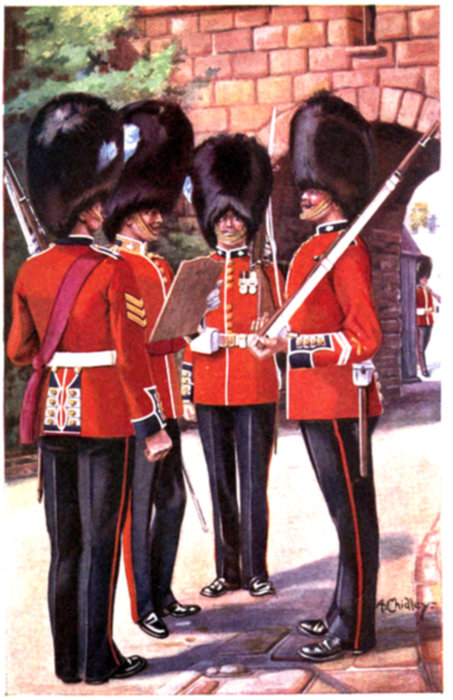
Irish Guards.—The Officer of the Guard.
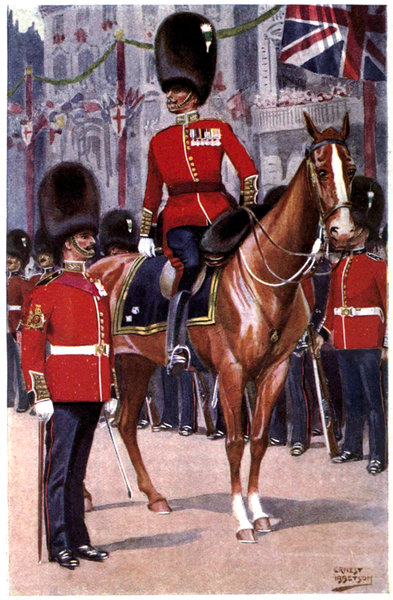
Welsh Guards.—Ceremonial Duty.
(Depot, Scarborough.)
"Warburg," "Peninsula," "Waterloo," "Sevastopol,"
"Ali Masjid," "Afghanistan, 1878-79," "Egypt, 1884,"
"Relief of Kimberley," "Paardeberg," "South Africa,
1899-1902."
Uniform, Blue.
Head-dress, Busby with black and white plume and scarlet busby-bag.
Forage cap, Red.
Linked Regiment, 18th (Queen Mary's Own) Hussars.
In Levee Dress the officers wear pantaloons of scarlet cloth.
Special arm badge for Sergeants, Prince of Wales's Plume.
In Review Order the saddlery of the officers' chargers is
ornamented with cowrie shells.
Originally raised in 1697, and in 1783, was
known as the "Prince of Wales's Light
Dragoons." In 1793 the Prince of Wales
(afterwards George IV) was appointed "Commandant,"
and in 1796 "Colonel" of the regiment.
In 1811 the title "Royal" was conferred on it.
The regiment performed good service during
the Peninsular War, and at Waterloo. It was one
of the regiments summoned from India during the
Crimean War. Dressed in plain clothes, the officers
and men were sent up the Red Sea and taken
across the desert to Alexandria, thence to the seat
of war.
Nicknames: "Baker's Light Bobs;" "The Chainy
10th," from the pattern of the pouch belt.
(Depot, Dublin.)
The Sphinx superscribed "Egypt."
"Warburg," "Beaumont," "Willems," "Salamanca,"
"Peninsula," "Waterloo," "Bhurtpore," "Alma,"
"Balaklava," "Inkerman," "Sevastopol."
Motto: "Treu und Fest" (True and Steadfast).
Uniform, Blue.
Overalls, Crimson.
Head-dress, Busby with crimson and white plume, and crimson
busby bag. Band, grey fur busbies.
Horse plume, Black and white.
Forage cap, Crimson.
Linked Regiment, 13th Hussars.
Special arm badge for Sergeants, Crest and Motto of the late
Prince Consort.
Raised in 1697, and afterwards disbanded.
Raised again in 1715 and later received the
title of the "Prince Albert's Own," because
it formed Prince Albert's escort, from Dover to
Canterbury, on his arrival in England in 1840, to
be married to Queen Victoria. The regiment was
present at the Alma and at Inkerman, and was one
of the five regiments which, under the leadership of
Lord Cardigan, its former Colonel, rode "into the
jaws of death," at Balaklava. One of the regiment,
Trooper Hope, also rode in the charge of the
Heavy Brigade on the same occasion. He did so
without permission and started without arms.
Nicknames: "The Cherry Pickers," also "The
Cherubims," from its crimson overalls, being the
only regiment in the British Army entitled to wear
overalls of that colour. Also known as "Lord
Cardigan's Bloodhounds."
(Depot, Woolwich.)
The Sphinx superscribed "Egypt."
"Peninsula," "Waterloo," "South Africa, 1851-2-3."
"Sevastopol," "Central India," "Relief of Kimberley,"
"Paardeberg," "South Africa, 1899-1902."
Uniform, Blue.
Facings, Scarlet.
Head-dress, Lance Cap, black leather, with upper part and top
of scarlet cloth; scarlet plume.
Forage cap, Scarlet.
Allied Regiment, 12th Manitoba Dragoons of Canada.
Linked Regiment, 5th (Royal Irish) Lancers.
Special arm badge for Sergeants, Prince of Wales's Plume.
It has been the custom in this regiment for the band to play five
hymns every evening at tattoo. One version of the legend is
that it was a punishment for breaking into a monastery during the
Peninsular War, the punishment to last a hundred years.
Another version is that these hymns were presented to the
officers by Pope Pius VI for the band to play. Whoever
originated the custom we can all sympathise with the unfortunate
bandsmen who have to carry out the bequest.
The regiment was raised in 1715, and served
uninterruptedly in Ireland for 76 years. It
won high reputation during the Peninsular
War. It subsequently fought gallantly at Quatre
Bras and at Waterloo. It was one of the regiments
summoned from India to the Crimea, proceeding
there by way of the Red Sea and across the desert
to Alexandria. It subsequently returned to India and
bore a distinguished part in the operations in Central
India under Sir Hugh Rose during the Mutiny.
Nicknamed the "Supple Twelfth" at Salamanca,
from its dash and rapidity of movement, in action.
(Depot, Dublin.)
"Albuhera," "Vittoria," "Orthes," "Toulouse," "Peninsula,"
"Waterloo," "Alma," "Balaklava," "Inkerman,"
"Sevastopol," "Relief of Ladysmith," "South Africa,
1899-1902."
Motto: Viret in Æternum (It flourishes for ever).
Uniform, Blue.
Collars, Buff.
Head-dress, Busby, with white plume and buff busby bag.
Forage cap, White, with blue band.
Horse plume, White.
Linked Regiment, 11th (Prince Albert's Own) Hussars.
The "Honours" are worn on the Officers' shoulder belt.
Raised in 1715 as "Munden's Dragoons";
was known as the "Green Dragoons" from
its facings; and in the Peninsular War
nicknamed the "Ragged Brigade" for its inability
to keep a trim appearance owing to its hard
and severe work during 32 actions, in which it
lost 276 men and over 1,000 horses. It fought
gallantly at Waterloo. It was present throughout
the Crimean War, and was engaged at the Alma
and at Inkerman. It was one of the regiments of
the Light Brigade in the famous Balaklava charge,
and afterwards served before Sevastopol.
Known as "The Lilywhites," on account of its
white collars on tunics and white stripes down
overalls. Also known as "The Evergreens," from
the old green facings and motto; and "The Geraniums,"
from the smart dress of the officers and men.
(Depot, Scarborough.)
The Royal Crest within the Garter.
"Douro," "Talavera," "Fuentes d'Onor," "Salamanca,"
"Vittoria," "Pyrenees," "Orthes," "Peninsula," "Punjaub,"
"Chillianwallah," "Goojerat," "Persia," "Central India,"
"Relief of Ladysmith," "South Africa, 1900-02."
Uniform, Blue.
Head-dress, Busby, with white plume and yellow busby bag.
Forage cap, Red.
Linked Regiment, 20th Hussars.
Originally raised in 1697 and disbanded.
Again raised in 1715. It fought with distinction
through the whole of the Peninsular
War from first to last, and was engaged times
without number. In the pursuit after the battle
of Vittoria, the 14th came up with Joseph Buonaparte's
carriage, from which he had but just escaped,
leaving behind him a celebrated but indescribable
silver trophy called The Emperor's Chambermaid,
still widely renowned throughout the service. This
is the corps of Charles O'Malley's choice, and
mustered in its ranks the ever memorable Micky
Free. In 1848 the regiment charged vastly
superior numbers of the Sikh army at the battle of
Ramnuggar, losing their Brigadier, their Colonel,
and 40 officers and men, and have since been
known as the Ramnuggar Boys—the anniversary of
that battle being still observed as a great day in
the regiment. It fought in Persia in 1857, and was
particularly distinguished in Central India.
Nicknamed "The Emperor's Chambermaids."
(Depot, Bristol.)
The Crest of England within the Garter.
"Emsdorff," "Villers-en-Cauchies," "Willems,"
"Egmont-op-Zee," "Sahagun," "Vittoria," "Peninsula,"
"Waterloo," "Afghanistan, 1878-80."
Motto: Merebimur (We will deserve).
Uniform, Blue.
Head-dress, Busby with scarlet plume and busby bag.
Forage cap, Scarlet.
Horse plume, Scarlet.
Allied Regiment, 15th Light Horse of Canada, Calgary, Alberta.
Linked Regiment, 19th (Queen Alexandra's Own Royal) Hussars.
The officers wear crossed flags, pointing downwards, on the
leopard skin.
Special arm badge for Sergeants, Royal Crest.
The 15th Hussars was the first regiment of Light
Dragoons raised for permanent service in 1759
by Colonel Eliott, the gallant defender of
Gibraltar, afterwards Lord Heathfield. It was
named after him "Eliott's Light Horse." In 1767
the regiment was made "Royal" as a reward for
its services in Germany, and in 1768 styled the
"King's Light Dragoons." Its present title it
received in 1806.
This regiment was authorized to bear on its helmets
the following inscription: "Five battalions of Foot defeated
and taken by this regiment, with their colours,
and nine pieces of cannon, at Emsdorff, 16th July,
1760." In 1794, the 15th, at Villiers-en-Cauchies,
charged enormously superior numbers of all arms. It
succeeded in its object at a terrible sacrifice. In 1799,
the troopers had given them the honour of decking
their helmets with scarlet feathers.
Nicknamed "The Fighting Fifteenth."
(Depot, Woolwich.)
The Cypher of Queen Charlotte within the Garter.
"Beaumont," "Willems," "Talavera," "Fuentes d'Onor,"
"Salamanca," "Vittoria," "Nive," "Peninsula," "Waterloo,"
"Bhurtpore," "Ghuznee, 1839," "Affghanistan, 1839,"
"Maharajpore," "Aliwal," "Sobraon," "Relief of Kimberley,"
"Paardeberg," "South Africa, 1900-02."
Motto: Aut cursu, aut cominus armis (Either in the
charge, or hand to hand).
Uniform, Scarlet.
Facings, Blue.
Head-dress, Lance cap of black leather with upper part and
top of dark blue cloth; black plume.
Forage cap, Scarlet, with blue band.
Allied Regiment, 16th Light Horse of Canada, Regina,
Saskatchewan.
Linked Regiment, 17th (Duke of Cambridge's Own) Lancers.
The regiment was raised in 1759. It served
with distinction throughout the Peninsular
War, from Talavera to Toulouse, during the
greater part of which time it was attached to the
Light Division. Subsequently, it fought at Quatre
Bras and at Waterloo, where it lost heavily. It
was the first Lancer regiment to serve in India, and
the first British Lancers to use the lance in action.
During a tour of service in India extending over
a quarter of a century it won great fame on many
fields. At the battle of Aliwal (where Sir Harry
Smith, with a force of 12,000 men with 32 guns,
defeated 19,000 Sikhs with 68 guns) it specially
distinguished itself.
The 16th Lancers, being the only Lancer corps
wearing the scarlet tunic, received the sobriquet of
the "Scarlet Lancers."
(Depot, Woolwich.)
Death's Head "Or Glory."
"Alma," "Balaklava," "Inkerman," "Sevastopol,"
"Central India," "South Africa, 1879, 1900-02."
Uniform, Blue.
Facings, White.
Head-dress, Lance cap of black leather with white cloth top,
white plume.
Forage cap, Blue, with white band.
Linked Regiment, 16th (The Queen's) Lancers.
Special arm badge for Sergeants, Death's Head.
The regiment was raised in 1759 and in 1876
received its present title of "17th (Duke of
Cambridge's Own) Lancers." It was present
throughout the Crimean War and fought at the
Alma, Inkerman and Balaklava, where it was one
of the five regiments that took part in the famous
charge of the Light Brigade. It also fought in the
Indian Mutiny.
Popularly known as the "Death or Glory Boys,"
and "Skull and Crossbones," from the circumstance
that its Colonel (Hole) chose its crest of a "death's
head" and its motto "or glory," as he wished all to
remember General Wolfe, with whom he happened
to serve in the year on which his regiment
was first raised in Scotland by Lord Aberdour.
Another nickname given them was that of
"Bingham's Dandies," the uniform being of scarlet
with white facings and overalls and black plume.
The late Earl of Lucan, when Lord Bingham, was
Lieutenant-Colonel of the corps, which was in his
time remarkable for the well-fitting uniforms both
of the officers and men belonging to it.
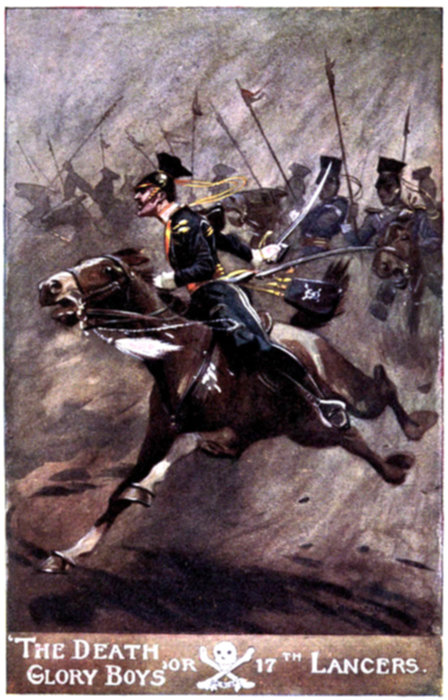
Charging with the Light Brigade at Balaclava.
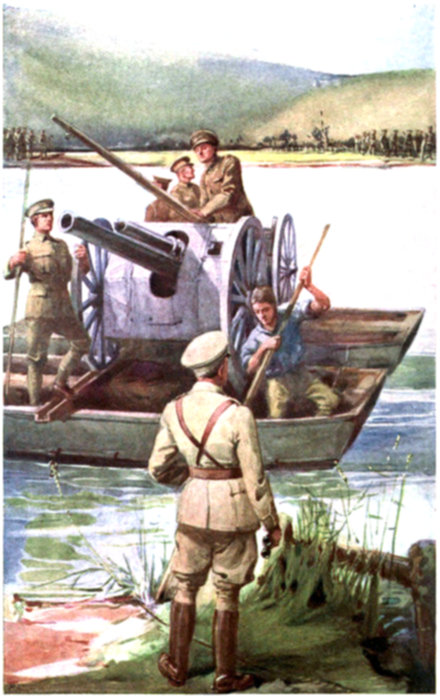
Royal Engineers at Pontooning Work.
(Depot, Scarborough.)
"Peninsula," "Waterloo," "Defence of Ladysmith,"
"South Africa, 1899-1902."
Motto: Pro Rege, pro Lege, pro Patria conamur
(We strive for King, for Law, for Country).
Uniform, Blue.
Head-dress, Busby with scarlet and white plume and blue busby bag.
Forage cap, Red.
Linked Regiment, 10th (Prince of Wales's Own Royal) Hussars.
Special arm badge for Sergeants, Q.M.O. Monogram.
The silver trumpets used by the regiment were provided out of
proceeds of the sale of the captured horses at Waterloo.
Originally raised in 1759 by the Marquis of
Drogheda, and disbanded in 1821, after
brilliant service in the Peninsular War and
at Waterloo. The regiment served in the Maroon
War and at San Domingo, 1759-60, and lost so
heavily from war and disease that it returned to
England under the command of the regimental
surgeon. At one time the Duke of Wellington
served in the regiment, in command of a troop,
before being transferred to the 33rd Foot as a
field officer. The present regiment was raised at
Leeds in 1858, and was permitted to revive the
honours, "Peninsula" and "Waterloo," borne by
the old regiment. It wore Lincoln green busby bags
and plumes, and scarlet pouches and sabretaches.
Its present title was conferred in 1910.
(Depot, Bristol.)
The Elephant, superscribed "Assaye."
"Mysore," "Seringapatam," "Niagara," "Tel-el-Kebir,"
"Egypt, 1882-84," "Abu Klea," "Nile, 1884-85,"
"Defence of Ladysmith," "South Africa, 1899-1902."
Uniform, Blue.
Head-dress, Busby with white plume and busby bag.
Forage cap, Red.
Horse plume, White.
Linked Regiment, 15th (The King's) Hussars.
Special arm badge for Sergeants, an Elephant.
Queen Alexandra's crest is used as a collar badge. In 1914
Her Majesty presented the regiment with a pair of beautiful
kettle drum banners.
Originally raised in 1759 as the 19th Light
Dragoons, and converted into Hussars in
1807. The present regiment was formed
in 1860 out of the late Hon. East India Company's
Bengal European Cavalry. It was subsequently
permitted to assume the honours of the old 19th
Dragoons (Lancers): "Assaye" and "Niagara."
It fought with distinction during the Egyptian War,
1882, Suakin, 1884, and in the Nile Expedition.
Sir John French commenced his military career
with the regiment.
Nicknamed the "Dumpies," from the circumstance
of the men, originally taken over from the
East India Company's 1st Bengal European
Cavalry, being of diminutive size. The Indian
history of the regiment is full of interest, for much
hard service was seen and a good deal of heavy
fighting, especially at Assaye, where, for its distinguished
conduct, the badge of the Elephant was
awarded.
(Depot, Scarborough.)
"Vimiera," "Peninsula," "Suakin, 1885," "South Africa,
1901-02."
Uniform, Blue.
Head-dress, Busby with yellow plume and crimson busby bag.
Horse plume, Yellow.
Forage cap, Red.
Linked Regiment, 14th (King's) Hussars.
The Regiment was originally raised in Ireland
in 1789 from the "Light Troop" of the
6th (Inniskilling) Dragoons, and wore a
scarlet uniform, the facings being at first yellow
and afterwards black. It is a curious fact that a
detachment of the regiment under Sir Robert
Wilson was present with the Russian Army in
their operations against Napoleon in his famous
capture of and return from Moscow in 1812 and
in the subsequent campaign in Germany. The
present regiment was raised in 1861 by volunteers
from the late Hon. East India Company's 2nd
Bengal European Light Cavalry. It was subsequently
permitted to assume the honours of the old
20th Light Dragoons: "Vimiera" and "Peninsula."
Part of the regiment was employed in the Suakin
Expedition, 1885, and subsequently did good service
with the Egyptian Frontier Force in 1885-6.
Nicknamed the "X's."
(Depot, Woolwich.)
"Khartoum."
Uniform, Blue.
Facings, French grey.
Head-dress, Lance cap of black leather with upper part and top
of french grey cloth, white plume.
Forage cap, Blue, with french grey band.
Linked Regiment, 9th (Queen's Royal) Lancers.
Special arm badge for Sergeants, Imperial Cypher and Crown.
Four British Cavalry regiments have in succession
been numbered the 21st; the original
regiment having been raised in 1760 as the
21st Light Dragoons, by the famous Marquis of
Granby. It was disbanded in 1763, re-raised in
1779, and again disbanded. In 1794 it again appeared,
and saw a great deal of service abroad, and
served in St. Helena when Napoleon was imprisoned
there. The uniform first was scarlet, and later blue,
with pink facings, which was afterwards changed to
black velvet.
Raised in 1858 as the 3rd Bengal European
Cavalry. In 1862 it was transferred to the British
establishment, and until 1897 was known as the 21st
Hussars. In that year the title was changed to
21st Lancers, and in 1898, in recognition of its
brilliant services at the battle of Omdurman, its
present Royal title was conferred upon it.
Nickname: "The Grey Lancers."
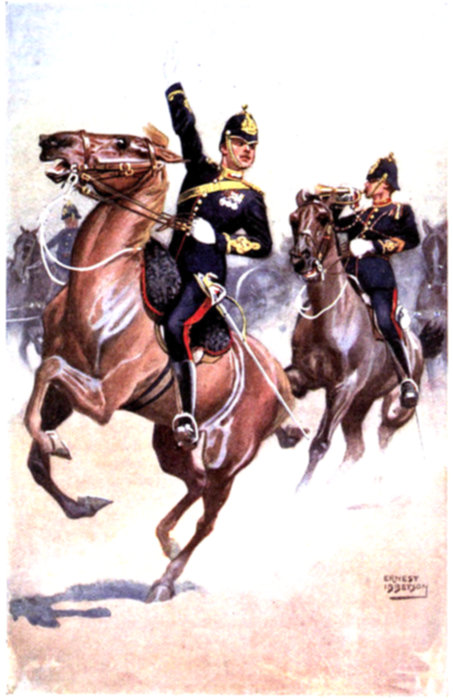
Royal Field Artillery in Review Order—"Halt!"
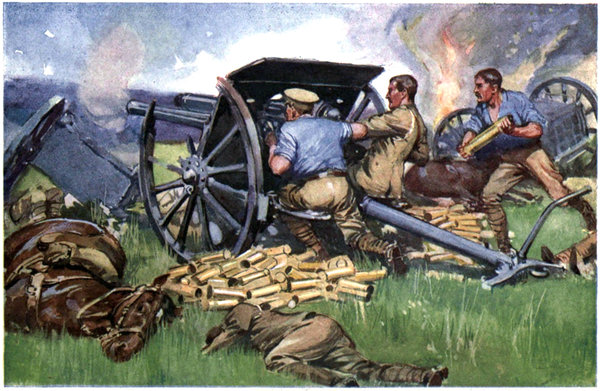
The Heroic Stand of "L" Battery, R.H.A., at Nery, September 1st, 1914.
Mottoes: Ubique (Everywhere).
Quo Fas et Gloria ducunt (Where Duty and Glory lead.)
Head-dress, Busby with white plume and scarlet busby bag.
The R.A. Mounted Band wear scarlet plumes.
Forage cap, Blue with scarlet band.
Regimental March: "British Grenadiers."
The R.H.A. take precedence next the Household
Cavalry, but when on parade with their guns take the right
of the line.
Although the Royal Regiment of Artillery
dates back to the reign of King Henry
VIII, the Horse Artillery was first organised
in 1793. In 1794 the splendid service
rendered by the Horse Batteries at Vaux led the
Duke of York to direct it to march past the whole of
the allied armies at a special parade. The famous
Chestnut Troop (now "A" Battery) did equally good
service in North Holland in 1799, and the famous
Rocket Troop was raised for special service in
Flanders. The Royal Horse Artillery have won
fame on many hard fought battlefields, notably at
Fuentes d'Onor, in the Peninsular War, where
Norman Ramsay charged with his battery (now "I"
Battery) through the enemy's cavalry; and in South
Africa and France where "Q" Battery and "L"
Battery won many Victoria Crosses.
Nicknames: "The Right of the Line," "The
Galloping Gunners," and "The Four-wheeled
Hussars."
Mottoes: Ubique (Everywhere).
Quo Fas et Gloria ducunt (Where Duty and Glory lead).
Uniform, Blue.
Facings, Scarlet.
Girdle, Red and Blue.
Head-dress, Helmet with brass ball on top.
Forage cap, Blue with scarlet band.
Regimental March, "British Grenadiers."
Cap badge, A gun with motto.
Collar badge, A grenade.
The Royal Regiment of Artillery, as it is now
known, was formed in 1716, when two
companies were permanently established at
Woolwich, but, prior to that, artillery formed part
of the King's Armies as early as the 15th century.
The history of the Artillery is really the history of
the British Army, for very seldom indeed has there
been an action fought by British troops without
some representatives of the Royal Regiment
being present. The guns are looked upon as the
standards of the regiment, and in the old days one
of the guns was known as the colour gun, which
was usually the heaviest piece in the field. All
ranks are animated with the most intense bravery
and devotion, which has been demonstrated on
many fields, and won for the regiment many distinctions.
The Great War on the Continent has
added greatly to the reputation of the regiment.
Nicknamed "The Gunners."
Mottoes: Ubique (Everywhere).
Quo Fas et Gloria ducunt (Where Duty and Glory lead).
Uniform, Blue.
Facings, Scarlet.
Belt, White.
Head-dress, Helmet with brass ball on top.
Forage cap, Blue with scarlet band.
Regimental March, "British Grenadiers."
Cap badge, A gun with motto.
Collar badge, A grenade.
The Garrison, or Heavy Gunners can be considered
as the direct descendants of the
ancient British Artillery, which was originally
formed for siege or defence purposes. The more
mobile Field and Horse Artillery was not formed
till very many years later. The records of the
Garrison Artillery show they have won glory in all
parts of the world. The gallantry displayed during
the two years defence of Gibraltar is among their
most cherished traditions, and for distinguished conduct
at the reduction of Martinique, No. 11 Company
received as a mark of honour a battle axe, which
was directed to be carried by the tallest gunner at the
head of the battery when on parade. The splendid
achievements of the Heavy Artillery in the great
war with Germany has added materially to the
reputation of the regiment for gallantry and valour.
Nicknamed the "Heavy Gunners."
Mottoes: Ubique (Everywhere).
Quo Fas et Gloria ducunt (Where Duty and Glory lead).
Uniform, Scarlet.
Facings, Blue velvet.
Head-dress, Helmet with brass spike on top.
Forage cap, Blue.
Field Officers when attending Court or Levees wear the
cocked hat.
Regimental March, "British Grenadiers."
The band wear a bearskin cap in full dress.
The Corps can trace its history back as a distinct
organization to 1717, but Engineers or artificers
were known before that. In 1722 the
Corps was known as "The Soldier Artificier
Corps," and later as "The Corps of Military
Artificers." In 1788, under Master-General the
Duke of Richmond, the Officers were constituted
"The Corps of Royal Engineers," the other ranks
being "The Royal Line Artificers." The title of
"The Royal Sappers and Miners" replaced them
in 1813, and for their distinguished service in the
Crimea all ranks were united under the title of
"The Corps of Royal Engineers." Of the services,
individual and collective, of the Corps during its
history it would be impossible to treat in detail, for
they have served with distinction in every battle and
in all parts of the Empire, and have a glorious
history of unusual valour.
Nicknames: "The Sappers"; "The Mudlarks";
"The Measurers"; and "The Mounted Bricklayers."
(Regimental Headquarters, Buckingham Gate, S.W.)
"Tangier, 1680," "Namur, 1695," "Gibraltar, 1704-5,"
"Blenheim," "Ramillies," "Oudenarde," "Malplaquet,"
"Dettingen," "Lincelles," "Egmont-op-Zee," "Corunna,"
"Barrosa," "Nive," "Peninsula," "Waterloo," "Alma,"
"Inkerman," "Sevastopol," "Tel-el-Kebir," "Egypt, 1882,"
"Suakin, 1885," "Khartoum," "Modder River," "South
Africa, 1899-1902."
Uniform, Scarlet.
Facings, Blue.
Head-dress, Bearskin cap with white plume worn on left side.
Forage cap, Blue with scarlet band.
Regimental March, "British Grenadiers."
Buttons on the tunic are placed at equal distance apart.
The Grenadier Guards were raised in the year
1657, when the loyal English who shared King
Charles's exile were formed into six regiments,
the first of which was called the "Royal Regiment of
Guards."
For the first seventy years of its existence it saw
much and varied service, and won fame on many
fields, and also served on board the fleet. During
the Peninsular War its good order and steady
discipline were conspicuous. Its conduct at Waterloo
is a matter of history, and its heroic bearing during
the Crimean War is well known.
The title of "Grenadiers" was given to the first
Regiment of Foot Guards in 1815, in recognition of
their having defeated the French Grenadier Guards
at Waterloo.
The Grenadier Guards have the nicknames of the
"Sand-bags," the "Coalheavers," and "Old Eyes,"
and the 3rd Battalion "The Bill Browns."
(Regimental Headquarters, Buckingham Gate, S.W.)
"Tangier, 1680," "Namur, 1695," "Gibraltar, 1704-5,"
"Oudenarde," "Malplaquet," "Dettingen," "Lincelles,"
"Talavera," "Barrosa," "Fuentes d'Onor," "Nive,"
"Peninsula," "Waterloo," "Alma," "Inkerman,"
"Sevastopol," "Tel-el-Kebir," "Egypt, 1882," "Suakin,
1885," "Modder River," "South Africa, 1899-1902."
Motto: Nulli Secundus (Second to none).
Uniform, Scarlet.
Facings, Blue.
Head-dress, Bearskin cap
with red plume on right side.
Forage cap, Blue, with white band.
Regimental March, "Milanello."
Buttons on the Tunic are placed in twos.
The Coldstream Guards was originally formed
from Sir A. Hesselrig's and Colonel Fenwick's
Regiments of Foot, and obtained its title from
Monck's celebrated march from Coldstream in
January, 1660, to restore King Charles II. The
regiment was also known as the "Nulli Secundus
Club," and "The Coldstreamers." This is the only
regiment of the Parliamentary Army that was not
disbanded at the Restoration in 1660. Under
Marlborough it shared in the great victories of
Oudenarde and Malplaquet, and at many sieges and
encounters down to the peace of 1713. It took
part in most of the great battles of the Peninsular
War. At Waterloo it was posted on the ridge
above Hougoumont, and to it fell the honour of
defending the Chateau of Hougoumont—the key of
the British position—throughout that memorable
day, and nobly was that duty performed. During
the Crimean War the regiment fought splendidly, as
it has on every subsequent occasion, and has worthily
upheld its motto of Nulli Secundus.
(Regimental Headquarters: Buckingham Gate, S.W.)
"Namur, 1695," "Dettingen," "Lincelles," "Talavera,"
"Barrosa," "Fuentes d'Onor," "Nive," "Peninsula,"
"Waterloo," "Alma," "Inkerman," "Sevastopol,"
"Tel-el-Kebir," "Egypt, 1882," "Suakin, 1885,"
"Modder River," "South Africa, 1899-1902."
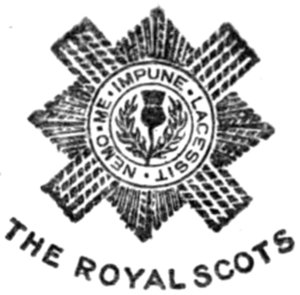
Motto: Nemo me impune lacessit (No one provokes me
with impunity).
Uniform, Scarlet.
Facings, Blue.
Head-dress, Bearskin cap.
Forage cap, Blue, diced border.
Regimental March, "Highland Laddie."
Buttons on the tunic are placed in threes.
The origin of this distinguished corps is uncertain,
the regimental papers having been destroyed
by fire in 1841; but it was raised about
1639, and was originally called by the same name
it now bears, which, however, had been for a
long time in disuse, and was only in 1877 restored
to the corps by the late Queen Victoria. Previously
it had been styled "The Scots Fusilier Guards"
and the "3rd Foot Guards." Throughout its long
career it has ever been distinguished for its valour
and discipline. At Namur it advanced without
firing a shot, but exposed to the murderous fire of
the enemy from the ramparts, close up to the
palisades, when they poured in their volleys and
put the enemy to confusion. It distinguished itself
at Lincelles for its coolness, steady fire and gallant
bayonet charge. During the Peninsular War it
was constantly engaged, and there and at subsequent
battles not only upheld the traditions of the regiment,
but gained a reputation no troops could surpass.
Nicknamed "The Jocks."
(Regimental Headquarters, Buckingham Gate, S.W.)
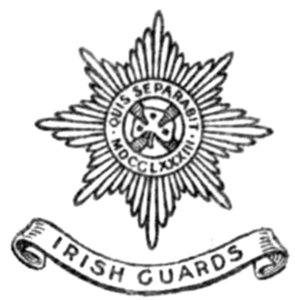
Motto: Quis separabit? (Who shall separate?)
Uniform, Scarlet.
Facings, Blue.
Head-dress, Bearskin cap with blue plume on right side.
Forage cap, Blue, with green band.
Regimental March, "St. Patrick's Day."
The Buttons on the Tunic are placed in fours.
Raised in 1900 by the late Queen Victoria to
commemorate the bravery of the Irish Regiments
in the South African War. All ranks
have worthily upheld the high traditions of the
Brigade of Guards in their first campaign, being distinguished
for conspicuous bravery in many of the
frequent actions against the overwhelming German
forces in France and Belgium. Many decorations
have been won, among them being the Victoria
Cross awarded to Sergeant Michael O'Leary whose
great bravery has been widely extolled among the
Allies.
Nicknamed "Bob's Own," from the fact that
the late Lord Roberts was the first Colonel of the
regiment.
(Regimental Headquarters, Buckingham Gate, S.W.)
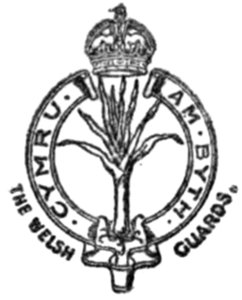
Motto: Cymru am Byth (Wales for Ever!)
Uniform, Scarlet.
Facings, Blue.
Head-dress, Bearskin cap with white, green, and white plume.
Badge, The Leek. The Red Dragon of Wales is emblazoned
on the King's Colour.
Regimental March, "Men of Harlech."
Buttons on tunics are placed in sets of five.
This regiment was raised in London in 1915 by
the Royal Warrant of King George V, during
the progress of the War with Germany, and
the first Battalion of 1,100 of all ranks, under
Lieut.-Col. W. Murray Threipland, was quickly
completed, a second Battalion being then authorised.
Major-General Sir Francis Lloyd was the first
Colonel of the regiment, and Col. Lord Harlech,
who commenced his military career in the Coldstream
Guards, was appointed to command the
regiment and the regimental district. His Majesty
in authorising the raising of the regiment directed
that the leading company of the 1st Battalion should
be denominated "The Prince of Wales's Company,"
in the same way as the leading company of the
1st Grenadier Guards is known as the "King's
Company."
(Depot, Glencorse.)
(Record Office, Hamilton.)
The Sphinx, superscribed "Egypt."
"Tangier, 1680," "Namur, 1695," "Blenheim," "Ramillies,"
"Oudenarde," "Malplaquet," "Louisburg," "Havannah,"
"Egmont-op-Zee," "St. Lucia, 1803," "Corunna," "Busaco,"
"Salamanca," "Vittoria," "St. Sebastian," "Nive,"
"Niagara," "Peninsula," "Waterloo," "Nagpore,"
"Maheidpoor," "Ava," "Alma," "Inkerman," "Sevastopol,"
"Taku Forts," "Pekin, 1860," "South Africa, 1899-1902."
Motto: Nemo me impune lacessit (No one provokes me with
impunity).
Uniform, Scarlet.
Facings, Blue.
Head-dress, Kilmarnock bonnet, with plume.
Cap, Glengarry, with scarlet, white and green diced border.
Regimental March, "Dumbarton's Drums."
Only the pipers wear the kilt of Royal Stewart tartan. The regiment
wears the doublet, and trews of Hunting Stewart tartan.
The Royal Scots have the proud distinction of
being the oldest regiment in the British
Army, dating its present existence from 1633.
It was organised by Sir John Hepburn, and on his
death 37 years later the command was given to
Lord James Douglas and became known as
"Douglas's Regiment." Nobly has it sustained
its reputation, and in every quarter of the globe,
the roll of "Dumbarton's Drums" has been heard.
"Pontius Pilate's Bodyguard" is the extraordinary
nickname given to the regiment. This
was on account of a dispute between the regiment
(then the "Regiment de Douglas," or "Douglas
Ecossais") when in the French service, and the
Picardy Regiment, as to the antiquity of the two
corps. The Picardy Regiment laid claim to having
been on duty on the night after the Crucifixion.
To this the 1st Foot wittily rejoined: "Had we
been on duty, we should not have slept at our post."
(Depot, Guildford.)
(Record Office, Hounslow.)
A Naval Crown, superscribed "1st June, 1794."
The Sphinx, superscribed "Egypt."
"Tangier, 1662-80," "Namur, 1695," "Vimiera," "Corunna,"
"Salamanca," "Vittoria," "Pyrenees," "Nivelle," "Toulouse,"
"Peninsula," "Ghuznee, 1839," "Khelat,"
"Affghanistan, 1839," "South Africa, 1851-2-3,"
"Taku Forts," "Pekin, 1860," "Burma, 1885-87," "Tirah,"
"Relief of Ladysmith," "South Africa, 1899-1902."
Mottoes: Pristinæ virtutis memor (Mindful of its ancient
valour).
Vel exuviæ triumphant (Even the remnant triumph).
Uniform, Scarlet.
Facings, Blue.
Head-dress, Helmet.
Cap, Blue, with scarlet band.
Regimental March, "We'll gang nae mair."
The Regiment has a third Colour, carried on State occasions.
The regiment is the oldest English infantry unit,
having been raised in 1661 by the Earl of
Peterborough. Nicknamed "Kirke's Lambs,"
from its Colonel and badge in 1682. Was raised to
garrison Tangier, and received then the badge of
the "Paschal Lamb," the crest of the House of
Braganza. Was known when raised as the "1st
Tangerines." The title "Royal" and motto,
Pristinæ virtutis memor, was conferred for its
brilliant conduct at Tongres in 1685, where for
28 hours it gallantly maintained itself against
40,000 of the enemy, and by its heroism saved the
rest of the army from being taken by surprise.
A detachment was on board the "Birkenhead"
when that transport was wrecked, and in order to
allow the women and children to be saved, stood
firm in their ranks on the deck of the doomed ship,
until the waves swallowed all but the deathless
glory of their deed.
(Depot, Canterbury.)
(Record Office, Hounslow.)
"Blenheim," "Ramillies," "Oudenarde," "Malplaquet,"
"Dettingen," "Guadaloupe, 1759," "Douro," "Talavera,"
"Albuhera," "Vittoria," "Pyrenees," "Nivelle," "Nive,"
"Orthes," "Toulouse," "Peninsula," "Punniar," "Sevastopol,"
"Taku Forts," "South Africa, 1879," "Chitral," "Relief of
Kimberley," "Paardeberg," "South Africa, 1900-02."
Motto: Veteri frondescit honore (May it flourish by its ancient
honors).
Uniform, Scarlet.
Facings, Buff.
Head-dress, Helmet.
Cap, Blue.
Regimental March, "The Buffs."
Allied Regiment, 2nd Queen's Own Rifles of Canada,
Toronto.
The 3rd Foot (The Buffs) was so called first in
1708. Its previous title was "The Holland
Regiment," having been in the Dutch Service
from the time of Queen Elizabeth. It was raised in
1572 to the number of 3000 men by London Guilds,
when the Dutch were in revolt against Spain. To
this circumstance, the regiment owes the time-honoured
privilege it enjoys of marching through the
City of London with drums beating and colours
flying without let or hindrance, the custom being
derived from the privileges of the Train Bands of
Elizabethan days. It was nicknamed the "Buff
Howards" from the colour of its facings and Colonel's
name, 1737 to 1749; also the "Old Buffs," to
distinguish it from the 31st Regiment, which was
the "Young Buffs." Other nicknames given were
"The Nutcrackers," on account of its prowess in
cracking the heads of the enemy, and "The
Resurrectionists," which was obtained at Albuhera
where the regiment was dispersed by the Polish
Lancers, and reappeared shortly after.
(Depot, Lancaster.)
(Record Office, Preston.)
"Namur, 1695," "Gibraltar, 1704-5," "Guadaloupe, 1759,"
"St. Lucia, 1778," "Corunna," "Badajoz," "Salamanca,"
"Vittoria," "St. Sebastian," "Nive," "Peninsula," "Bladensburg,"
"Waterloo," "Alma," "Inkerman," "Sevastopol,"
"Abyssinia," "South Africa, 1879," "Relief of Ladysmith,"
"South Africa, 1899-1902."
Uniform, Scarlet.
Facings, Blue.
Head-dress, Helmet.
Cap, Blue with scarlet band.
Regimental March, "Corn rigs are bonnie."
The regiment was raised in 1680 by the Earl
of Plymouth. It gained great distinction at
the siege of Namur, 1695, and while serving as
Marines in 1704 it shared in the capture of Gibraltar.
It has fought with distinction in all parts of the
world, and has ever acquitted itself with credit to
England and glory to itself. It was one of the few
British regiments to make the famous desert march
across Abyssinia, to the capture of Magdala. It
also fought in the Zulu War and was one of the
devoted battalions to climb and capture Spion Kop,
holding that awful position throughout a day of dire
disaster with unflinching courage.
Nicknames: The "Lions," from its ancient badge,
the Lion of England, given to it by the Prince of
Orange, the regiment being the first to join his
Standard after landing at Torbay in 1688. "Barrell's
Blues," from William Barrell, Colonel of the regiment
in 1740, and its facings. The title of "The King's
Own" was conferred by George I in 1715.
(Depot, Newcastle-on-Tyne.)
(Record Office, York.)
"Wilhelmstahl," "St. Lucia, 1778," "Roliça," "Vimiera,"
"Corunna," "Busaco," "Ciudad Rodrigo," "Badajoz,"
"Salamanca," "Vittoria," "Nivelle," "Orthes," "Toulouse,"
"Peninsula," "Lucknow," "Afghanistan, 1878-80,"
"Khartoum," "Modder River," "South Africa, 1899-1902."
Motto: Quo fata vocant (Whither the fates call).
Uniform, Scarlet.
Facings, Gosling green.
Head-dress, Racoon-skin cap.
Plume, Scarlet, with white base,
worn on left side.
Cap, Blue.
Regimental March, "British Grenadiers."
A third Colour is carried on ceremonial occasions by the drummers
to commemorate the capture of a colour at Wilhelmstahl.
Raised in 1674 the regiment was in 1764 nicknamed
the "Shiners" from its smart and
clean appearance; and whilst in the Peninsula
was called the "Old and Bold," "The
Fighting Fifth," and also "Lord Wellington's
Bodyguard." It formed part of a small force which
beat off an overwhelming body of the enemy at
El Boden in 1811, a performance which Wellington
notified to the Army as "a memorable example
of what can be done by steadiness, discipline, and
confidence." A custom, which has long prevailed
in this regiment, is for all ranks to wear roses in their
caps on St. George's Day. Among the "men" who
have served in the ranks was Phœbe Hassell, the
famous female soldier, afterwards pensioned by
George IV, and to whose memory there is a stone
in the churchyard at Hove, Brighton.
(Depot, Warwick.)
(Record Office, Warwick.)
"Namur, 1695," "Martinique, 1794," "Roliça," "Vimiera,"
"Corunna," "Vittoria," "Pyrenees," "Nivelle," "Orthes,"
"Peninsula," "Niagara," "South Africa, 1846-7, 1851-2-3,"
"Atbara," "Khartoum," "South Africa, 1899-1902."
Uniform, Scarlet.
Facings, Blue.
Head-dress, Helmet.
Cap, Blue with scarlet band.
Regimental March, "Warwickshire Lads."
The regiment is one of the very few bearing a battle honour
won in Canada, that of "Niagara."
The regiment has a very ancient history, having
existed for some time before being brought
on the British establishment in 1688. It
fought at Namur in 1695, and in 1707 was one of
the regiments cut up at the fierce battle of Almanza.
It won much distinction at the battle of Saragossa,
and Colonel Harrison, who then commanded, was,
as a mark of honour to the regiment, sent home
with thirty standards, taken that day, to lay before
the Sovereign. Tradition has it that one was the
standard belonging to a Moorish Regiment in the
Spanish pay, bearing an Antelope, and that that
badge was forthwith conferred on the regiment.
It won great fame during the Peninsular War. In
the action at Echalar, 2nd August, 1813, its
conduct was described by Wellington as "the most
gallant and the finest thing he had ever witnessed."
The title "Royal" was conferred in 1832.
It was nicknamed "Guise's Geese," also "The
Warwickshire Lads," and "The Saucy Sixth."
(Depot, Hounslow.)
(Record Office, Hounslow.)
"Namur, 1695," "Martinique, 1809," "Talavera," "Busaco,"
"Albuhera," "Badajoz," "Salamanca," "Vittoria,"
"Pyrenees," "Orthes," "Toulouse," "Peninsula,"
"Alma," "Inkerman," "Sevastopol," "Kandahar, 1880,"
"Afghanistan, 1879-80," "Relief of Ladysmith,"
"South Africa, 1899-1902."
Uniform, Scarlet.
Facings, Blue.
Head-dress, Racoon-skin cap, with white plume on right side.
Cap, Blue, with scarlet band.
Regimental March, "British Grenadiers."
Until after the Crimean War there were no 2nd Lieutenants or
Ensigns in this regiment. The regiment has the privilege of
marching through the City of London with fixed bayonets,
drums beating, and colours flying.
Raised in 1685. In the Peninsular War it took
a glorious part, and no troops hazarded their
lives more freely for their country's cause, than
the Royal Fusiliers. At Talavera they met the storm
of war with unshaken firmness, and captured seven of
the enemy's guns, but the undying lustre of the glory
they won at Albuhera, almost overshadows their other
gallant exploits at this time. They had marched from
Badajos at 2 a.m. the same day, and the night march
of 20 miles, followed by the supreme effort which regained
the lost heights of Albuhera, must rank as an
unsurpassed feat of arms. During the Crimean War
the conduct of the Royal Fusiliers won further glory.
It was once known as "The Hanoverian White
Horse," and also as the "Elegant Extracts" from the
fact that the officers were selected from other corps.
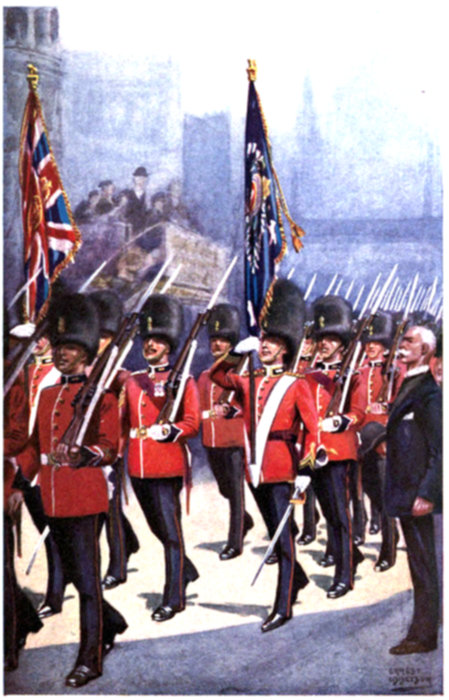
The Royal Fusiliers marching through the City of London.
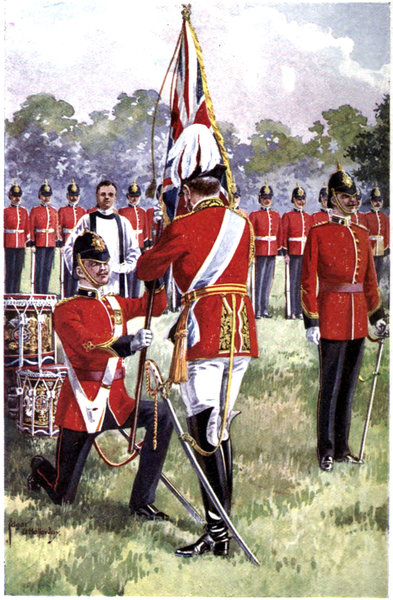
(Depot, Seaforth.)
(Record Office, Preston.)
The Sphinx, superscribed "Egypt."
"Blenheim," "Ramillies," "Oudenarde," "Malplaquet,"
"Dettingen," "Martinique, 1809," "Niagara," "Delhi, 1857,"
"Lucknow," "Peiwar Kotal," "Afghanistan, 1878-80,"
"Burma, 1885-87," "Defence of Ladysmith," "South Africa,
1899-1902."
Motto: Nec aspera terrent (Nor do difficulties deter).
Uniform, Scarlet.
Facings, Blue.
Head-dress, Helmet.
Cap, Blue with red band.
Regimental March, "Here's to the maiden of bashful fifteen."
Allied Regiment, 8th Australian Infantry Regiment.
Raised in 1685. It gained considerable reputation
during Marlborough's campaign when
it was known as the "Queen's," but on
George I's accession it became "The King's,"
a proud title which it still keeps and by which it is
known. It fought at Dettingen in 1743, memorable
as being the last battle in which a British King led
his army in person. It was stationed at Jullundur
on the outbreak of the Indian Mutiny. A detachment
of the regiment performed an important
service by securing the fort and magazine at
Phillour. They marched from Jullundur to Delhi,
in fourteen days, and with bayonet and rifle helped
to clear the city of the mutineers. They took part in
the relief of Agra, where they defeated 8,000
mutineers and captured all their guns. They then
proceeded to the relief of Lucknow and took part
in other operations.
Nickname: "The Leather Hats."
(Depot, Norwich.)
(Record Office, Warley.)
"Havannah," "Martinique, 1794," "Roliça," "Vimiera,"
"Corunna," "Busaco," "Salamanca," "Vittoria,"
"St. Sebastian," "Nive," "Peninsula," "Cabool, 1842,"
"Moodkee," "Ferozeshah," "Sobraon," "Sevastopol,"
"Kabul, 1879," "Afghanistan, 1879-80," "Paardeberg,"
"South Africa, 1900-02."
Uniform, Scarlet.
Facings, Yellow.
Head-dress, Helmet.
Cap, Blue.
Regimental March, "Rule Britannia."
Allied Regiment: 9th Australian Infantry Regiment.
Formed in 1695. The "Figure of Britannia" was
awarded as a regimental badge to commemorate
its heroic struggle against overwhelming numbers
at the battle of Almanza. It won much glory
during the Peninsular War. At Roleia it bore the
brunt of the enemy's attack, and at Corunna, where
the gallant Sir John Moore met a soldier's death, to
the regiment fell the melancholy honour of placing
him in a soldier's grave. In the Afghan War of
1842, and in the Sikh War of 1845 its bravery was
conspicuous. At Ferozeshah the Sikhs had 100 guns,
which they served with great effect, repulsing the first
attack; but the Ninth restored the day, bayoneting the
Sikhs at their guns, and driving the enemy before them.
Nicknames: "The Holy Boys," a name given
them by the Spanish during the Peninsular War,
from the fact that they wore the figure of Britannia
on their cross-belts, which the Spaniards took to
represent the Virgin Mary; also "The Fighting
Ninth," and "The Norfolk Howards."
(Depot, Lincoln.)
(Record Office, Lichfield.)
The Sphinx, superscribed "Egypt."
"Blenheim," "Ramillies," "Oudenarde," "Malplaquet,"
"Peninsula," "Sobraon," "Mooltan," "Goojerat," "Punjaub,"
"Lucknow," "Atbara," "Khartoum," "Paardeberg,"
"South Africa, 1900-02."
Uniform, Scarlet.
Facings, White.
Head-dress, Helmet.
Cap, Blue.
Regimental March, "The Lincolnshire Poacher."
When first raised was the only blue coated infantry regiment.
Allied Regiment: 19th "Lincoln" Regiment of Canada.
Formed from an Independent Company in 1685.
It fought with distinction during Marlborough's
campaign. Of its conduct in the Sikh War
the Brigadier said, "The glorious conduct of the
regiment at Sobraon is beyond any praise I could
give—it was the corner stone of the victory."
During the Indian Mutiny it assisted to save Benares
and Dinapore from the Sepoys and to bring the
final rescue to the heroic defenders of Lucknow.
The regiment took part in the famous march on
Khartoum and in the battle of Atbara and
Omdurman which broke the power of the Mahdi
and placed Soudan under British control. It was
also in the South African War, and again added
to its fine reputation.
It was (with the 62nd) nicknamed "The
Springers," during the American War, from their
readiness for action. "The Poachers" in allusion
to the famous old ballad, which is played as the
Regimental March.
(Depot, Exeter.)
(Record Office, Exeter.)
"Dettingen," "Salamanca," "Pyrenees," "Nivelle," "Nive,"
"Orthes," "Toulouse," "Peninsula," "Afghanistan, 1879-80,"
"Tirah," "Defence of Ladysmith," "Relief of Ladysmith,"
"South Africa, 1899-1902."
Motto: Semper Fidelis (Ever faithful).
Uniform, Scarlet.
Facings, Lincoln Green.
Head-dress, Helmet.
Cap, Blue.
Regimental March, "We've lived and loved together."
The Regimental March owes its origin to a circumstance
prior to the Battle of Salamanca. The 11th found itself marching
in close proximity to a French regiment. As no order to
attack was given, the officers on either side saluted by lowering
their swords, and at parting the British bandsmen struck up,
out of compliment to their adversaries, the tune in question.
Formed in 1685. It displayed splendid bravery
but was cut to pieces at Almanza in 1707.
During the Peninsular War it gained great
distinction. At Salamanca, the fierce character of the
struggle may be gathered from the fact that only four
officers and sixty-seven men of the regiment could be
mustered at the close of the action, to hear, however,
words of praise seldom addressed to an
individual regiment. At Toulouse for the second
time during the war it shared in the supreme effort
which turned the tide of victory. No record of the
Devons would be complete which omitted the supreme
gallantry of the regiment in the desperate fighting at
Wagon Hill during the South African War.
Nickname: "The Bloody Eleventh," from the
number of casualties at the battle of Salamanca.
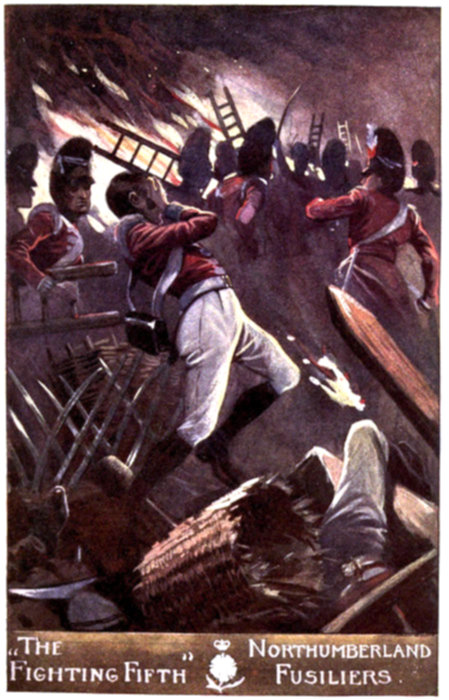
Colonel Ridge leading the stormers at Badajoz.
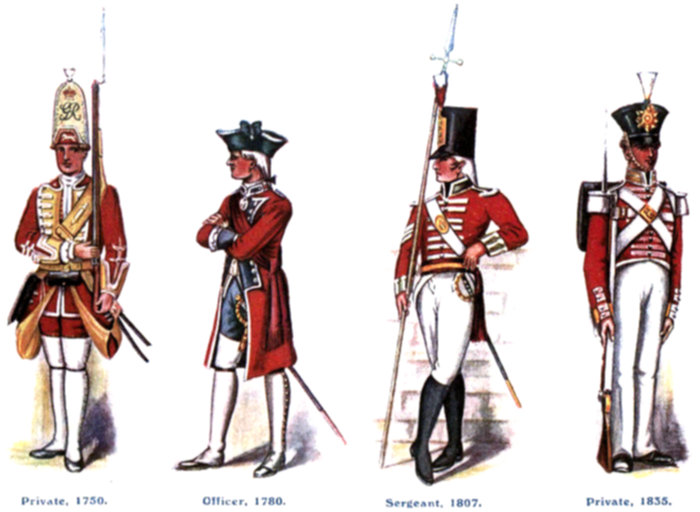
Private, 1750. Officer, 1780. Sergeant, 1807. Private, 1835.
Types of old Infantry Uniforms.
(Depot, Bury St. Edmunds.)
(Record Office, Warley.)
The Castle and Key, superscribed "Gibraltar, 1779-83."
"Dettingen," "Minden," "Seringapatam," "India," "South
Africa, 1851-2-3," "New Zealand," "Afghanistan, 1878-80,"
"South Africa, 1899-1902."
Uniform, Scarlet.
Facings, Yellow.
Head-dress, Helmet.
Cap, Blue.
Regimental March, "Speed the plough."
Allied Regiment, 3rd (Auckland) Regiment ("Countess of
Ranfurly's Own"), New Zealand.
Formed in 1685. At Dettingen, under King
George II, it took part in the final charge
which assured the victory—the last occasion
on which a British King personally commanded his
troops in action. It was one of the six British Infantry
regiments which at Minden shattered the French
cavalry, and finally drove out of the field every body
of troops opposed to them. The Duke of Brunswick
who commanded the forces said: "It was here the
British Infantry gained immortal glory." Its services
in the defence of Gibraltar are commemorated by
the Castle and Key and Motto. At the storming
of Seringapatam it captured eight stands of colours.
For this splendid behaviour during their two years'
defence of Gibraltar was given the crest and motto
they now wear.
Nickname: The "Old Dozen." The men wear
roses in their caps on August 1st in commemoration
of the Battle of Minden, 1759.
(Depot, Taunton.)
(Record Office, Exeter.)
The Sphinx, superscribed "Egypt."
A Mural Crown, superscribed "Jellalabad."
"Gibraltar, 1704-5," "Dettingen," "Martinique, 1809,"
"Ava," "Ghuznee, 1839," "Affghanistan, 1839,"
"Cabool, 1842," "Sevastopol," "South Africa, 1878-9,"
"Burmah, 1885-87," "Relief of Ladysmith,"
"South Africa, 1899-1902."
Uniform, Scarlet.
Facings, Blue.
Head-dress, Helmet.
Cap, Dark green.
Regimental March, "Prince Albert's March."
Allied Regiment, 13th "Royal Regiment" of Canada.
The Sergeants wear the sash on the left shoulder in memory of the
Battle of Culloden, where all the officers fell and the remnant of
the regiment was brought out of action by the surviving sergeants.
This is the only regiment in the service not designated "Royal"
wearing Royal Blue facings.
Raised in 1685. While fighting in Spain, 1706-13,
the regiment fought as dragoons. It earned
a brilliant record in Afghanistan, 1839-42.
After storming Ghuznee it was ordered to Jellalabad
which detached post it gallantly held. The
massacre of the Cabul force inspired the Afghans
to fiercer efforts against Jellalabad; but in spite
of news of disaster, the enemy, and even nature
itself,—for over 100 shocks of earthquake shook
the ruined walls—the brave Somersets defied them
all. At length they sallied out and decisively
defeated the Afghans. This "Illustrious Garrison,"
as it was termed by the Government of India, was
received on its return by special honours in all cantonments
through which it passed. For its services
it received its present title, and a mural crown superscribed
"Jellalabad."
Nicknamed "The Bleeders."
(Depot, York.)
(Record Office, York.)
The Royal Tiger, superscribed "India."
"Namur, 1695," "Tournay," "Corunna," "Java,"
"Waterloo," "Bhurtpore," "Sevastopol," "New Zealand,"
"Afghanistan, 1879-80," "Relief of Ladysmith,"
"South Africa, 1899-1902."
Motto: Nec aspera terrent (Nor do difficulties deter).
Uniform, Scarlet.
Facings, Buff.
Head-dress, Helmet.
Cap, Blue.
Regimental March, "Ça ira."
Allied Regiment, 16th (Waikato) Regiment of New Zealand.
Raised in 1685. It shared in the defence of Gibraltar
in 1727, and added very considerably to
its laurels in the wars of 1793-4. In an attack
on the French camp at Famars, 23rd May, 1793, it
not only gained a victory, but also its regimental march.
Among the pieces of music which fanned the fiery zeal
of the French was "Ça ira," to the strains of which
they hurled themselves with impetuosity on the British
troops. The colonel however, with a magnificent
inspiration called out to his men "Come along,
my lads, we'll break them to their own d——d
tune," and bade his drummers strike up "Ça ira."
The effect was irresistible, and the French found themselves
flying from the sound of their own martial air.
The regiment fought with characteristic bravery at
Corunna, in Java, at Waterloo, in India, in the
Crimea, New Zealand, and South Africa, reaping
the highest commendation for gallantry and devotion
everywhere.
Nicknames: "The Old and Bold" and "Calvert's
Entire."
(Depot, Beverley.)
(Record Office, York.)
"Blenheim," "Ramillies," "Oudenarde," "Malplaquet,"
"Louisburg," "Quebec, 1759," "Martinique, 1762,"
"Havannah," "St. Lucia, 1778," "Martinique 1794, 1809,"
"Guadaloupe, 1810," "Afghanistan, 1879-80,"
"South Africa, 1900-02."
Uniform, Scarlet.
Facings, White.
Head-dress, Helmet.
Cap, Blue.
Regimental March, "Yorkshire Lass."
The officers wear a black line in the top and bottom of the lace,
as a memento of General Wolfe's death.
Raised in 1685. The regiment went to Holland
with Marlborough, and bore a distinguished
part in all his campaigns. It was one of the
five regiments which commenced the battle of Blenheim
by an attack on the entrenched village of that
name, moving up steadily under a withering fire
without returning a shot, until their leader, General
Rowe, struck his sword into the palisades. It fought
at Ramillies, at Oudenarde, and at Malplaquet, and
bore an active part at Tournay. It went to Quebec
with Wolfe, who specially commended the steadiness
of the regiment. It fought in the great battle on the
heights of Abraham, and after Wolfe's fall served in
the conquest of Canada. Has a splendid record of
bravery in many other battles.
Nicknames: "The Snappers," from an incident in
the American War, where, the ammunition having
given out, they continued to snap their firelocks with
undaunted determination. The enemy retired, misled
by their aspect and bravery; also called the "Poona
Guards."
(Depot, Bedford.)
(Record Office, Warley.)
"Namur, 1695," "Blenheim," "Ramillies," "Oudenarde,"
"Malplaquet," "Surinam," "Chitral,"
"South Africa, 1900-02."
Uniform, Scarlet.
Facings, White.
Head-dress, Helmet.
Cap, Blue.
Regimental March, "Mountain Rose."
Raised in 1688. It served all through Marlborough's
campaigns, and its gallant conduct in
no less than thirty-four successful battles and
sieges firmly established its reputation. It was at
the siege of Lille, where one of the sergeants, Littler,
performed gallant service by swimming the river with
a hatchet, and, in the face of the enemy single handed
cut the fastenings of a drawbridge. It took part in the
battle of Dettingen, where the French generously commended
their bravery, and declared they saw them
advancing, not like men, but devils, in the face of
whole batteries, which fired directly into them, sweeping
down all ranks without being able to break them.
As part of the Chitral Relief Expedition it took part
in the storming of the Malakand Pass. This expedition
was an example of sturdy perseverance in the face of
obstacles, which it is not possible for those who have
not served on the Northern Frontier of India to realise.
Nicknames: "The Old Bucks"; also known as
"The Peacemakers," from the ferocity with which
it was wont to attack the enemy, who were generally
glad to quickly make peace.
(Depot, Leicester.)
(Record Office, Lichfield.)
The Royal Tiger, superscribed "Hindoostan."
"Namur, 1695," "Louisburg," "Martinique, 1762,"
"Havannah," "Ghuznee, 1839," "Khelat," "Affghanistan,
1839," "Sevastopol," "Ali Masjid," "Afghanistan, 1878-79,"
"Defence of Ladysmith," "South Africa, 1899-1902."
Uniform, Scarlet.
Facings, White.
Head-dress, Helmet.
Cap, Blue.
Regimental March, "Romaika."
The officers wear a black line in their lace to commemorate the
death of General Wolfe at Quebec, and the band always plays
"Wolfe's Lament," immediately before the National Anthem.
Raised in 1688. It took part in the earlier
portion of Marlborough's campaigns and
then proceeded to Spain, where it fought at
the battle of Almanza with desperate courage
against overwhelming numbers. It also took part
in the conquest of Canada. In 1804 it proceeded
to India, where, during a period of 18 years, it took
a distinguished part in building up our mighty Indian
Empire. Its services were specially acknowledged
by the grant of the badge of the "Royal Tiger"
with the word "Hindoostan," as a lasting testimony
of the exemplary conduct of all ranks during its
service in India from 1804 to 1823. In 1838 it
was with the army which forced its way through
Scinde capturing Hyderabad and Kurrachee.
Nicknames: "Lily Whites," from their facings;
also "Bengal Tigers," from its badge, a Royal
Tiger.
(Depot, Clonmel.)
(Record Office, Cork.)
The Sphinx, superscribed "Egypt."
The Dragon, superscribed "China."
"Namur, 1695," "Blenheim," "Ramillies," "Oudenarde,"
"Malplaquet," "Pegu," "Sevastopol," "New Zealand,"
"Afghanistan, 1879-80," "Tel-el-Kebir," "Egypt, 1882,"
"Nile, 1884-85," "South Africa, 1900-02."
Motto: Virtutis Namurcensis Præmium (The Reward of
Valour at Namur).
Uniform, Scarlet.
Facings, Blue.
Head-dress, Helmet.
Cap, Blue with scarlet band.
Regimental March, "Garry Owen."
Allied Regiment, 7th (Wellington West Coast) Regiment of
New Zealand.
Raised in 1683. After serving afloat as Marines
it went to Flanders, where its splendid valour
at the assault on the Castle of Namur on
20th August, 1695, won for it the admiration of the
whole of the Allied army. This gallant feat,
performed under the eyes of the King, won for the
regiment the distinguished title of the Royal
Regiment of Foot of Ireland, and the King conferred
upon it the right of displaying the badge of
the harp and crown, and that of the lion of
Nassau, with the motto "Virtutis Namurcensis
Præmium." Was one of the Irish Regiments which
fought so gallantly in South Africa and to whose
bravery the Irish Guards were raised in
commemoration. "The Royal Irish" is the only
one now in existence out of nineteen regiments
raised in Ireland from independent companies of
musketeers and pikemen.
Nicknames: "The Namurs," and "Paddy's
Blackguards."
(Depot, Richmond.)
(Record Office, York.)
"Malplaquet," "Alma," "Inkerman," "Sevastopol,"
"Tirah," "Relief of Kimberley," "Paardeberg,"
"South Africa, 1899-1902."
Uniform, Scarlet.
Facings, Grass green.
Head-dress, Helmet.
Cap, Blue.
Regimental March, "Bonnie English Rose."
Raised in 1688. Its first services were in
Flanders, where it fought at the siege and
capture of Namur. It took part in the most
sanguinary of Marlborough's victories, the battle of
Malplaquet, besides engaging in several of the sieges
which constituted the latter part of the campaign.
The massacre in Ceylon of a detachment of the
regiment, consisting of 178 officers and men, forms
one of the most tragic episodes in military history.
The remainder of the regiment was speedily in the
field to avenge those slaughtered, and an ample
retribution was exacted from the treacherous
Candyans. During the Crimean war it nobly upheld
its reputation, and the regiment fought with splendid
bravery in the Tirah campaign, and in South Africa,
being present at the relief of Kimberley, and the
battle of Paardeberg. It added to its great name in
the great war on the Continent.
Nickname: "The Green Howards," from its
facings, and the name of its first Colonel.
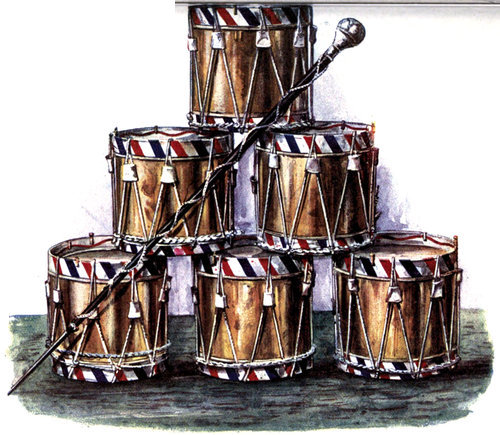
Drums and Silver-mounted Drum-Major's
Staff taken by the 2nd Battalion of the
34th Regiment (Border Regiment) from
the 34th Regiment of French Infantry of
the Line, during the Peninsular War, at
the Battle of Arroyo-dos-Molinos, 28th
October, 1811.
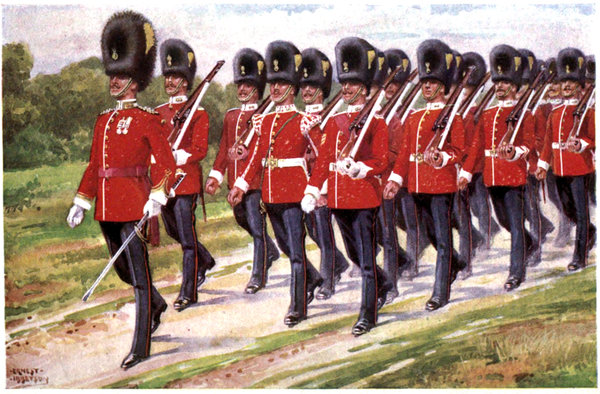
The Lancashire Fusiliers.—Returning from a Review.
(Depot, Bury.)
(Record Office, Preston.)
The Sphinx, superscribed "Egypt."
"Dettingen," "Minden," "Egmont-op-Zee," "Maida,"
"Vimiera," "Corunna," "Vittoria," "Pyrenees," "Orthes,"
"Toulouse," "Peninsula," "Alma," "Inkerman,"
"Sevastopol," "Lucknow," "Khartoum," "Relief of Ladysmith,"
"South Africa, 1899-1902."
Motto: Omnia Audax (Daring Everything).
Uniform, Scarlet.
Facings, White.
Head-dress, Racoon-skin cap with primrose plume on left side.
Cap, Blue.
Regimental March, "British Grenadiers."
Raised in 1688. It won lasting fame on the
historic field of Minden. So heavy were its
losses on that day that Prince Ferdinand
directed the regiment to be excused from further
duty. This they declined to accept, and a General
Order records that "Kingsley's Regiment, at its
own request, will resume its portion of duty in the
line." In addition to the battle honour a laurel wreath
was ordered to be worn on the colours and appointments.
These glorious memories are recalled by the
regimental custom of wearing "Minden Roses" in
the caps on each 1st August. Its bravery throughout
the Peninsular War was conspicuous, and the
Duke of Wellington, when presenting it with Colours
in 1838, said: "I declare that of the many distinguished
regiments of the British Army, which I
have had the honour to command, this, the best and
most distinguished, is entitled to all the eulogiums
I may have bestowed upon it."
Nicknames: The "Two Tens" from its number,
also "The Minden Boys," and "Kingsley's Stand."
(Depot, Ayr.)
(Record Office, Hamilton.)
"Blenheim," "Ramillies," "Oudenarde," "Malplaquet,"
"Dettingen," "Martinique, 1794," "Bladensburg," "Alma,"
"Inkerman," "Sevastopol," "South Africa, 1879," "Burma,
1885-87," "Tirah," "Relief of Ladysmith," "South Africa,
1899-1902."
Motto: Nemo me impune lacessit (No one provokes me
with impunity).
Uniform, Scarlet.
Facings, Blue.
Trews, of Sutherland tartan.
Head-dress, Sealskin cap with white plume on right side.
Cap, Glengarry, with scarlet, white and green diced border.
Regimental March, "British Grenadiers."
Raised in 1678. It was one of the brave
battalions which steadily marched to the
attack on the village of Blenheim until the
palisades were reached, without firing a shot in
reply to the tempest of shot which greeted them.
At Ramillies, at Oudenarde, on the red field of
Malplaquet, the most fiercely fought of Marlborough's
victories, and in numerous minor engagements, its
conduct was ever conspicuous. Under the brave
"Sheriff" Agnew,—the Sir Andrew Agnew whose
name is familiar to readers of Scott,—it fought at
Dettingen. The regiment delivered a volley, and
charged the cavalry with the bayonet, nearly
annihilating a French corps. King George II.
witnessed the movement and its result, and praised
all ranks for their great gallantry. The regiment
has fought in all parts of the world since, and with
equal distinction.
Nicknamed: "Earl of Mar's Grey Breeks," from
the colour of the men's breeches at the time the
regiment was raised (1678).
(Depot, Chester.)
(Record Office, Shrewsbury.)
"Louisburg," "Martinique, 1762," "Havannah," "Meeanee,"
"Hyderabad," "Scinde," "South Africa, 1900-02."
Uniform, Scarlet.
Facings, Buff.
Head-dress, Helmet.
Cap, Blue.
Regimental March, "Wha wadna' fecht for Charlie."
Raised in 1689, and was present at the battle of
Dettingen, where King George II. commanded
in person. The King was at one time hotly
pressed by the French cavalry, when a detachment
formed round him under an oak tree and drove the
enemy away. The King plucked a leaf off the tree
and, handing it to the commander, desired the regiment
to wear it in memory of their gallant conduct.
The oakleaf is now worn in the head-dress, and on
the colours on September 12th, and on ceremonial
parades. In 1795 it recruited its ranks with poorhouse
boys between the ages of twelve and sixteen.
Amongst the boys who joined was John Shipp,
an orphan, who performed the unique feat of
twice winning a commission from the ranks before
he was thirty years old, for conspicuous bravery in
the field. In 1843 it formed part of the force under
Sir Charles Napier which destroyed the Indian
desert stronghold of Emaun Ghur—an enterprise
characterised as one of the most curious and dangerous
military feats ever known.
Nicknames: The "Two Twos"; also in 1795 the
"Red Knights," from being served out with all red
clothing; also known as the "Lightning Conductors."
(Depot, Wrexham.)
(Record Office, Shrewsbury.)
The Sphinx, superscribed "Egypt."
"Namur, 1695," "Blenheim," "Ramillies," "Oudenarde,"
"Malplaquet," "Dettingen," "Minden," "Corunna,"
"Martinique, 1809," "Albuhera," "Badajoz," "Salamanca,"
"Vittoria," "Pyrenees," "Nivelle," "Orthes," "Toulouse,"
"Peninsula," "Waterloo," "Alma," "Inkerman,"
"Sevastopol," "Lucknow," "Ashantee, 1873-4," "Burma,
1885-87," "Relief of Ladysmith," "South Africa,
1899-1902," "Pekin, 1900."
Motto: Nec aspera terrent (Difficulties do not dismay us).
Uniform, Scarlet.
Facings, Blue.
Head-dress, Racoon-skin cap with white plume on right side.
Cap, Blue with scarlet band.
Regimental March, "British Grenadiers."
All ranks wear "The Flash," a bow of broad black silk ribbon
with long ends attached to the back of the tunic collar.
Raised in 1689. In the Crimean War, at Alma
it captured a Russian gun, which is now
at the Depot, Wrexham. It was during this
action that Sergeant Luke O'Connor gained
his Victoria Cross and a commission, and lived
to attain the rank of General. The regiment has
fought in all parts of the world and has a splendid
roll of battle honours.
Nicknamed "The Nanny Goats" and "The
Royal Goats," from its custom of having a goat
led at the head of the drums. Regimental custom
prescribes that on St. David's night, the 1st of March,
every officer or guest who has never eaten a leek
before, shall eat one, standing in his chair with
one foot on the table, while a drummer beats a
roll behind him.
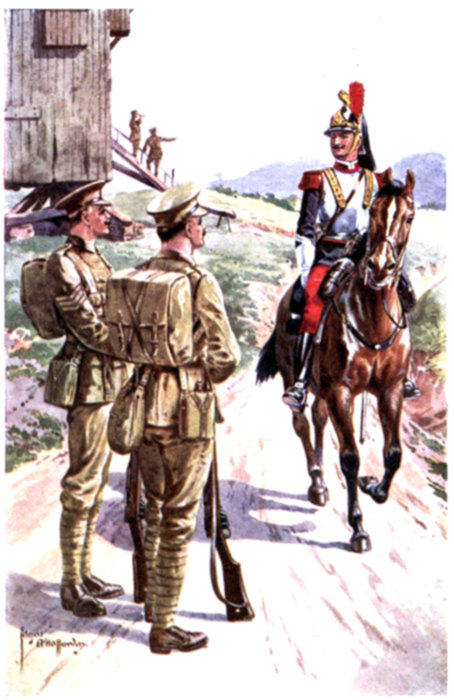
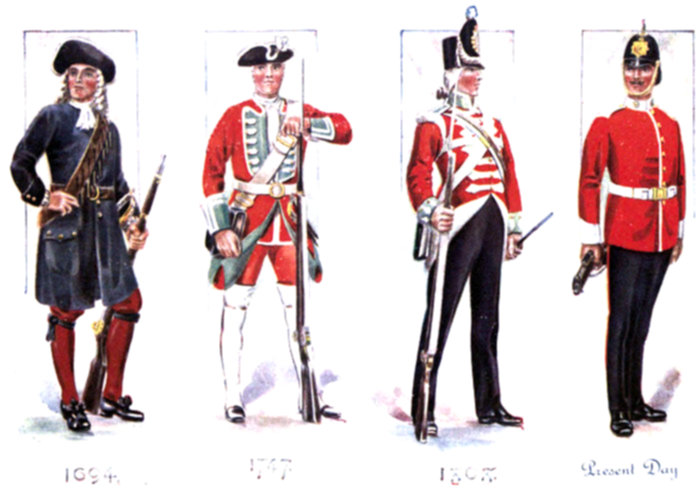
1694. 1747. 1808. Present Day.
Types of Uniforms worn by The Worcestershire Regiment.
(Depot, Brecon.)
(Record Office, Shrewsbury.)
The Sphinx, superscribed "Egypt."
"Blenheim," "Ramillies," "Oudenarde," "Malplaquet,"
"Cape of Good Hope, 1806," "Talavera," "Busaco,"
"Fuentes d'Onor," "Salamanca," "Vittoria," "Pyrenees,"
"Nivelle," "Orthes," "Peninsula," "Chillianwallah,"
"Goojerat," "Punjaub," "South Africa, 1877-8-9," "Burma,
1885-87," "South Africa, 1900-02."
Uniform, Scarlet.
Facings, Grass green.
Head-dress, Helmet.
Cap, Blue.
Regimental March, "Men of Harlech."
A silver wreath is borne on the staff of the King's Colour of
both battalions to commemorate the devoted gallantry of
Lieutenants Melville and Coghill in saving that colour from the
hands of the Zulus, after the Battle of Isandlwana, and as a
tribute of appreciation of the gallant defence of Rorke's
Drift, 1879.
Raised in 1689, the regiment has one of the
most remarkable histories in the British
Army, having twice being almost annihilated,
at Chillianwallah, 1849, where 23 officers and 527
men were killed and wounded, the regiment being
brought out of action by the quartermaster; and in
1879 at Isandlwana, where hardly a man escaped
death. The gallant defence of Rorke's Drift by
one company roused the wonder and admiration of
the whole civilised world. The losses of the regiment
in killed alone reached the appalling total of 21
officers and 590 men. It had the proud distinction
of having won more Victoria Crosses than any other
corps in the British Army.
Nicknamed "Howard's Greens," from its facings
and its Colonel's name from 1717 to 1737.
(Depot, Berwick-on-Tweed.)
(Record Office, Hamilton.)
The Sphinx, superscribed "Egypt."
"Namur, 1695," "Minden," "Egmont-op-Zee," "Martinique,
1809," "Afghanistan, 1878-80," "Chitral," "Tirah,"
"Paardeberg," "South Africa, 1900-02."
Mottoes: Nisi Dominus frustra (Without the Lord all your
efforts are vain);
In Veritate Religionis confido (I trust in the
truth of religion);
Nec aspera terrent (Nor do difficulties deter).
Uniform, Scarlet doublet, with trews of Leslie tartan, the
pipers being kilted and wearing the Royal Stewart tartan.
Head-dress, Blue Kilmarnock Bonnet, with black plume.
Cap, Glengarry, with scarlet, white and green diced border.
Regimental March, "Blue bonnets over the border."
Raised in 1689, in the space of four hours, by
the Earl of Leven, in Edinburgh. At the
siege of Namur, one of the strongest fortresses
in Europe, it lost 20 officers and 500 men by
the explosion of one of the enemy's mines. The
Borderers, however, quickly recovered and routed
the enemy at the point of the bayonet. The
regiment was also one of the gallant six to
participate in the glorious victory at Minden.
Acting as Marines it participated in Lord Howe's
glorious victory of 1st June, 1794. It has also
fought with great credit in other parts of the world.
They were sometimes called "The Botherers," and
commonly "K.O.S.B's." Also nicknamed the
"Kokky-Olly Birds." This regiment has the
exclusive privilege of beating up for recruits in the
streets of Edinburgh at any time without asking the
leave of the Lord Provost.
(Depot, Hamilton.)
(Record Office, Hamilton.)
The Sphinx, superscribed "Egypt."
The Dragon, superscribed "China."
"Blenheim," "Ramillies," "Oudenarde," "Malplaquet,"
"Mandora," "Corunna," "Martinique, 1809," "Guadaloupe,
1810," "South Africa, 1846-7," "Sevastopol," "Lucknow,"
"Abyssinia," "South Africa, 1877-8-9," "Relief of
Ladysmith," "South Africa, 1899-1902."
Uniform, Dark green doublet with green facings and trews of
Douglas tartan.
Head-dress, Green chaco with black plume.
Cap, Green glengarry.
Regimental March, "Within a mile of Edinboro' town."
The Cameronians date from the revolution of
1688, twenty companies of sixty men being
raised within the space of 24 hours. Proceeding
to Flanders it fought bravely and with
much distinction during Marlborough's campaigns.
It was engaged in the capture of Martinique and
Guadaloupe, where among other trophies of victory
it took an "Eagle," the regimental standard of the
French. It bore a distinguished part in the Crimean
War. It also took part in the hottest fighting in the
Mutiny and in the march through Abyssinia, and
fought with great gallantry in the Zulu and South
African campaigns. Two of our most distinguished
Field-Marshals—Lord Wolseley, V.C., and Sir
Evelyn Wood, V.C., served in this regiment.
Nicknames: 1st Battalion "The Cameronians,"
and the 2nd Battalion "Perthshire Grey Breeks,"
from the colour of the men's breeches.
(Depot, Omagh.)
(Record Office, Dublin.)
The Sphinx, superscribed "Egypt."
"Martinique, 1762," "Havannah," "St. Lucia, 1778, 1796,"
"Maida," "Badajoz," "Salamanca," "Vittoria," "Pyrenees,"
"Nivelle," "Orthes," "Toulouse," "Peninsula," "Waterloo,"
"South Africa, 1835, 1846-7," "Central India," "Relief of
Ladysmith," "South Africa, 1899-1902."
Motto: Nec aspera terrent (Nor do difficulties deter).
Uniform, Scarlet.
Facings, Blue.
Head-dress, Racoon-skin cap with grey plume on left side.
Cap, Blue, with scarlet band.
Regimental March, "British Grenadiers."
The regiment was the first to introduce the Irish war pipe into
the Army.
Formed in 1689. Proceeding to the West
Indies it greatly distinguished itself at the
storming and capture of the citadel of
St. Lucia. In recognition of "the steady and
intrepid bearing of the officers and men of the
regiment," Sir Ralph Abercromby directed that the
garrison on marching out should lay down their
arms to the Inniskillings. During the Peninsular
War, at Castella, a French officer advancing in front
of the line, challenged anyone in the regiment to
single combat. His wish was immediately complied
with by Captain Waldron, who after a few passes,
laid the Frenchman dead. The Inniskillings then
dashed forward with the bayonet, and the enemy
broke and fled before their irresistible onslaught. The
regiment has reaped honour and glory in all parts
of the world.
The 2nd Battalion were nicknamed "The Lumps."
(Depot, Bristol.)
(Record Office, Warwick.)
The Sphinx, superscribed "Egypt."
"Ramillies," "Louisburg," "Guadaloupe, 1759," "Quebec,
1759," "Martinique, 1762," "Havannah," "St. Lucia, 1778,"
"Maida," "Corunna," "Talavera," "Busaco," "Barrosa,"
"Albuhera," "Salamanca," "Vittoria," "Pyrenees," "Nivelle,"
"Nive," "Orthes," "Toulouse," "Peninsula," "Waterloo,"
"Chillianwallah," "Goojerat," "Punjaub," "Alma,"
"Inkerman," "Sevastopol," "Delhi, 1857," "Defence of
Ladysmith," "Relief of Kimberley," "Paardeberg,"
"South Africa, 1899-1902."
Uniform, Scarlet.
Facings, White.
Head-dress, Helmet.
Cap, Blue.
Regimental March, "Kynegad Slashers."
Raised in 1694, and has fought with the highest
credit in all parts of the Empire, during
which it has won several peculiar and highly
cherished distinctions. Of its conduct at Chillianwallah
the Duke of Wellington said, "the 61st were mainly
instrumental in gaining the victory."
The 28th Regiment was nicknamed "The Old
Braggs" in 1750, from its Colonel's name, General
Philip Braggs. Also the "Slashers," from their
gallantry at the battle of the White Plains, and
passage of the Brunx river in 1777. A badge is
worn on the back of the head-dress by both battalions
of this regiment, given for the bravery of the 28th at
Alexandria in 1801. They were attacked by French
cavalry while in line, and there being no time to form
square, the Colonel ordered the rear rank to "Right
about face," and they succeeded in beating off the
enemy, 7,000 in number.
Nickname: 1st Battalion "The Back Numbers."
(Depot, Worcester.)
(Record Office, Warwick.)
A Naval Crown, superscribed "1st June, 1794."
"Ramillies," "Mysore," "Hindoostan," "Roliça," "Vimiera,"
"Corunna," "Talavera," "Albuhera," "Salamanca,"
"Pyrenees," "Nivelle," "Nive," "Orthes," "Toulouse,"
"Peninsula," "Ferozeshah," "Sobraon," "Chillianwallah,"
"Goojerat," "Punjaub," "South Africa, 1900-02."
Motto: Firm.
Uniform, Scarlet.
Facings, White.
Head-dress, Helmet.
Cap, Blue.
Regimental March, "The Windsor."
The regiment was raised in 1694 and won in
action one of the proudest mottoes ever
bestowed on a regiment, that of "Firm."
The 29th was the last of the regiments in the
Peninsula to retain the queue, in which the men
fought at Vimiera, the officers wearing the old
fashioned and picturesque cocked hats.
Nicknames: "The Ever-sworded 29th" owing to
a peculiar custom, which demands that the captain
and subaltern of the day shall dine with their
swords on. Up to the fifties all the officers sat
down to dinner wearing their weapons, the custom
having originated in 1746, when a part of the
regiment, stationed at the Leeward Islands, was
surprised without its arms, and treacherously
murdered by the Indians. The "Vein Openers,"
given on account of its being the first to draw blood,
in 1770, when the disturbances, which preceded
the outbreak of the American War, commenced.
They are also known as the "Old and Bold," "The
Star of the Line," and "The Saucy Greens."
(Depot, Preston.)
(Record Office, Preston.)
The Sphinx, superscribed "Egypt."
"Gibraltar, 1704-5," "Cape of Good Hope, 1806," "Corunna,"
"Java," "Badajoz," "Salamanca," "Vittoria," "St. Sebastian,"
"Nive," "Peninsula," "Waterloo," "Bhurtpore," "Alma,"
"Inkerman," "Sevastopol," "Canton," "Ahmad Khel,"
"Afghanistan, 1878-80," "Chitral," "South Africa, 1900-02."
Motto: Spectamur Agendo (We are judged by our actions).
Uniform, Scarlet.
Facings, White.
Head-dress, Helmet.
Cap, Blue.
Regimental March, "Lancashire Lads."
Raised in 1694. When first formed it saw
much eventful service as Marines, and served
in the capture of Gibraltar in 1704, and
in the great sea-fight off Malaga which followed.
In January 1816, a battalion of the 59th was
wrecked while proceeding to Ireland, and nearly
the whole of the men perished. At Waterloo,
after the British squares reformed line to make the
final advance, the regiment left its formation plainly
marked on the ground it had occupied by the square
of dead and dying comrades who had fallen in the
grim opposition to the enemy's cavalry and artillery.
It fought with great distinction in the Crimea, China,
Afghanistan and South Africa, winning the highest
commendations everywhere.
Nicknamed: "The Triple Xs," also "The Three
Tens." 59th Foot, "Lily Whites," from its facings.
(Depot, Kingston.)
(Record Office, Hounslow.)
"Gibraltar, 1704-5," "Dettingen," "Martinique, 1794,"
"Talavera," "Guadaloupe, 1810," "Albuhera," "Vittoria,"
"Pyrenees," "Nivelle," "Nive," "Orthes," "Peninsula,"
"Cabool, 1842," "Moodkee," "Ferozeshah," "Aliwal,"
"Sobraon," "Sevastopol," "Taku Forts," "New Zealand,"
"Afghanistan, 1878-79," "Suakin, 1885," "Relief of
Ladysmith," "South Africa, 1899-1902."
Uniform, Scarlet.
Facings, White.
Head-dress, Helmet.
Cap, Blue.
Allied Regiment, 4th (Otago) Regiment of New Zealand.
Regimental March, "A Southerly Wind and a Cloudy Sky."
The officers wear a black line in their lace to commemorate the
death of General Wolfe at Quebec.
Raised in 1702 as a corps of Marines and for
many years did splendid service ashore and
afloat all over the world. The burning of
the "Kent," East Indiaman, with a wing of the
31st Regiment on board, in the Bay of Biscay, on
1st May, 1824, forms one of the most thrilling
episodes of heroism at sea British regimental history
affords. During a storm the vessel caught fire
and was totally destroyed. The discipline of the
men under these terrible circumstances was beyond
all praise, and in a great measure owing to this fact
over 550 people out of 637 were saved. In the
Sikh War they captured four standards.
Nicknames: The 1st Battalion (31st Foot) was
known as "The Young Buffs," to distinguish it from
the 3rd (Old Buffs). The 2nd Battalion (70th
Foot) was nicknamed the "Glasgow Greys."
(Depot, Bodmin.)
(Record Office, Exeter.)
"Gibraltar, 1704-05," "Dettingen," "St. Lucia, 1778,"
"Dominica," "Roliça," "Vimiera," "Corunna,"
"Salamanca," "Pyrenees," "Nivelle," "Nive," "Orthes,"
"Peninsula," "Waterloo," "Mooltan," "Goojerat,"
"Punjaub," "Sevastopol," "Lucknow," "Tel-el-Kebir,"
"Egypt, 1882," "Nile, 1884-85," "Paardeberg," "South
Africa, 1899-1902."
Uniform, Scarlet.
Facings, White.
Head-dress, Helmet.
Cap, Green with green band.
Regimental March, "One and All."
Raised in 1702. In its early history it saw
much varied service as Marines. The 2nd
Battalion (46th Foot) in 1777 was called the
"Red Feathers," from the following circumstances.
The light company took part in an attack against
General Wayne's Brigade, near Brandywine Creek,
in which the Americans were surprised and utterly
defeated. The Americans vowed vengeance and
swore that they would give no quarter; the soldiers
of the light company stained their feathers red as a
distinguishing mark, so that the enemy could easily
see whom to attack. This badge is still preserved
in the brass feather and red cloth of the helmet and
cap badge. They are also called "The Lacedemonians."
The heroic defence of the Lucknow
Residency, and the tragic fate of the detachment
under Captain Moore, at Cawnpore, are treasured
memories. The 46th are also known as "Murray's
Bucks," "The Surprisers," and "The Doc's" (from
the initials).
(Depot, Halifax.)
(Record Office, York.)
The Elephant, superscribed "Hindoostan."
"Dettingen," "Mysore," "Seringapatam," "Ally Ghur,"
"Delhi, 1803," "Leswarree," "Deig," "Corunna,"
"Nive," "Peninsula," "Waterloo," "Alma," "Inkerman,"
"Sevastopol," "Abyssinia," "Relief of Kimberley,"
"Paardeberg," "South Africa, 1900-02."
Motto: Virtutis fortuna comes (Fortune accompanies honour).
Uniform, Scarlet.
Facings, Scarlet.
Head-dress, Helmet.
Cap, Blue.
Regimental March, "The Wellesley."
The only regiment in the British Army named after a subject
not of Royal blood.
Raised in 1702 as the 33rd Foot, and in 1814
nicknamed "The Havercake Lads," its recruiting
sergeants preceding the recruits with a haver
or oatcake stuck on their swords. From its earliest
days the regiment was distinguished for bravery in the
field, being commended in 1705-6 at the storming of
Valentia d'Alcantara, and nearly annihilated at the
battle of Almanza in 1707. The same bravery has
marked it through the centuries, and to-day it is
showing that its ancient courage is maintained undiminished.
The Duke of Wellington served in it and
afterwards commanded it, and the regiment was
named after him.
The 2nd Battalion (76th Foot) became known in
1806 as "The Old Immortals," most of its men
having been wounded or died in the ten or twelve
years previously; "The Old Seven-and-Sixpennies,"
from its number; "The Hindoostan Regiment."
(Depot, Carlisle.)
(Record Office, Preston.)
A Laurel Wreath. The Dragon, superscribed "China."
"Havannah," "St. Lucia, 1778," "Albuhera," "Arroyo
dos Molinos," "Vittoria," "Pyrenees," "Nivelle," "Nive,"
"Orthes," "Peninsula," "Alma," "Inkerman," "Sevastopol,"
"Lucknow," "Relief of Ladysmith," "South Africa,
1899-1902."
Uniform, Scarlet.
Facings, Yellow.
Head-dress, Helmet.
Cap, Blue.
Regimental March, "John Peel."
The laurel wreath borne on the colours is to commemorate its
heroic conduct at the battle of Fontenoy, and is the only regiment
to wear the honour "Arroyo dos Molinos."
Raised in 1702. During the Peninsular War,
at Arroyo dos Molinos it performed one of
the most brilliant feats of the whole war;
single handed the battalion cut off and made
prisoners many French officers of distinction,
besides an entire battalion of the French 34th of
the Line, the brass drums and drum-major's staff
of which are still in possession of the 1st Battalion.
The 1st Battalion (34th Foot) was one of the "boy
regiments" reformed in 1797 and sent to the Cape
to be acclimatised. The 2nd Battalion (55th Foot)
are known as "The Two Fives," from their number.
The "Dragon" badge commemorates the services
of the 55th in China, and it had the unique distinction
for many years of wearing the red and white feather
in their chacos, with red on top. Both battalions
met in the Crimea, and did fine service before
Sevastopol.
Nickname: "The Cattle Reeves," from the old
traditions of the Scottish Border.
(Depot, Chichester.)
(Record Office, Hounslow.)
The White (Rousillon) Plume.
"Gibraltar, 1704-05," "Louisburg," "Quebec, 1759,"
"Martinique, 1762," "Havannah," "St. Lucia, 1778,"
"Maida," "Egypt, 1882," "Abu Klea," "Nile, 1884-85,"
"South Africa, 1900-02."
Uniform, Scarlet.
Facings, Blue.
Head-dress, Helmet.
Cap, Blue with Scarlet Band.
Regimental March, "The Royal Sussex."
The Badge of the Maltese Cross is in memory of the capture
of Malta.
Raised in 1701. At Quebec, in 1759, in combat
with the Grenadiers of the famous French
regiment of Royal Rousillon, it won the tall
white feather which was a distinguishing mark of
the 35th until 1810. It is now commemorated in
the Regimental Badge. It took part in the capture
of Malta, where after the successful assault on Fort
Ricasoli, the last post held by the French garrison,
the King's Colour of the 35th was the first flag
hoisted over the old stronghold of the Knights,
destined thenceforward as an outpost of the British
Empire. The 1st Battalion (35th Foot) was named
"The Orange Lilies," from the colour of its
facings, which it received as a mark of special favour
from King William III. in 1701. It was called on
its formation at Belfast "The Belfast Regiment,"
and afterwards "The Prince of Orange's Own
Regiment," but its orange facings were relinquished
and changed to blue in 1832, on the corps proceeding
to Ireland. The 2nd Battalion (107th Foot)
was raised in 1760 as the Queen's Own Royal
British Volunteers.
(Depot, Winchester.)
(Record Office, Exeter.)
The Royal Tiger, superscribed "India."
"Blenheim," "Ramillies," "Oudenarde," "Malplaquet,"
"Dettingen," "Minden," "Tournay," "Barrosa," "Peninsula,"
"Taku Forts," "Pekin, 1860," "Charasiah," "Kabul, 1879,"
"Afghanistan, 1878-80," "Burma, 1885-87," "Paardeberg,"
"South Africa, 1900-02."
Uniform, Scarlet.
Facings, Yellow.
Head-dress, Helmet.
Cap, Blue.
Regimental March, "The Hampshire."
The 37th was the first British Regiment to march across India.
Raised in 1702, and within a year was in Holland,
and bore a gallant part in Marlborough's campaigns.
Few regiments can show a more
eventful record of service during the whole of its
career, and it has won fame in all parts of the world.
The 37th is one of the six British infantry regiments
which fought at the battle of Minden, 1st August,
1759; still commemorated in the regiment by the
wearing of roses on the anniversary.
The 2nd Battalion (67th Foot) was raised in
1756 and after arduous service in the West Indies,
the Peninsula, and elsewhere it went to India, where
it served for twenty-one years and bore a distinguished
part in the capture, after a siege of eleven days, of the
fortress of Asseerghur, regarded as the Gibraltar of
the East. For its gallantry in India the crest of the
Royal Tiger was bestowed. In subsequent service
in the East the 67th took part in the attack on the
Taku Forts, where four Victoria Crosses were won
by Hampshire men.
Nickname: "The Hampshire Tigers."
(Depot, Lichfield.)
(Record Office, Lichfield.)
The Sphinx, superscribed "Egypt."
"Guadaloupe, 1759," "Martinique, 1762," "Monte Video,"
"Roliça," "Vimiera," "Corunna," "Busaco," "Badajoz,"
"Salamanca," "Vittoria," "St. Sebastian," "Nive,"
"Peninsula," "Ava," "Moodkee," "Ferozeshah," "Sobraon,"
"Pegu," "Alma," "Inkerman," "Sevastopol," "Lucknow,"
"Central India," "South Africa, 1878-79," "Egypt, 1882,"
"Kirbekan," "Nile, 1884-85," "South Africa, 1900-02."
Uniform, Scarlet.
Facings, White.
Head-dress, Helmet.
Cap, Blue.
Regimental March, "Come, Lassies and Lads."
Raised in 1702. In 1706, the 38th embarked
for the West Indies, where it remained for
nearly sixty years, most of the time in the
island of Antigua. When the trouble arose in
America, the 38th was one of the first regiments to
be despatched thither and fought at Bunker's Hill.
In 1805 it landed in South Africa and helped to
re-capture the Cape of Good Hope from the
Dutch. The 2nd Battalion has been shipwrecked
no less than three times. On the first occasion
when proceeding to take part in Abercromby's
campaign in Egypt, when the mess-plate and
all the regimental records were lost; again
when returning to India on completion of the
campaign; and again when proceeding to India
from Australia in 1844. Lord Wolseley commenced
his distinguished career in this regiment. The
1st Battalion (38th Foot) was called the "Pump and
Tortoise," and the 2nd Battalion (80th Foot), the
"Staffordshire Knots," and previously "The
Staffordshire Volunteers."
(Depot, Dorchester.)
(Record Office, Exeter.)
The Castle and Key, superscribed "Gibraltar, 1779-83."
The Sphinx, superscribed "Egypt."
"Plassey," "Martinique, 1794," "Marabout," "Albuhera,"
"Vittoria," "Pyrenees," "Nivelle," "Nive," "Orthes,"
"Peninsula," "Ava," "Maharajpore," "Sevastopol,"
"Tirah," "Relief of Ladysmith," "South Africa, 1899-1902."
Motto: Primus in Indis (First in India).
Uniform, Scarlet.
Facings, Grass green.
Head-dress, Helmet.
Cap, Blue.
Regimental March, "The Dorsetshire."
The 1st Battalion is the proud possessor of a remarkable silver
headed Drum-Major's Staff, which was presented to it by the
Nawab of Arcot for its gallantry at the Battle of Plassey.
Raised in 1702, and was soon afterwards in action.
The regiment was called "Sankey's Horse,"
because at the battle of Almanza, 1707, the
men were mounted on mules to enable them to
arrive in time for the battle. It was the first King's
regiment landed in India in 1754, hence its proud
legend "Primus in Indis." In 1742, from its "sad
green" facings, it was christened the "Green Linnets."
The 2nd Battalion (54th Foot) was specially
commended by the Commander-in-Chief for its remarkable
gallantry and resolution when on board the
"Sarah Sands" when that vessel took fire at sea having
a large quantity of ammunition on board.
The 2nd Battalion derived the name of "Flamers"
in 1781, from the part they took in destroying twelve
privateers, and the town and stores of New London
(U.S.), by fire. It also won for the regiment the proud
crest of the Sphinx and the honour "Marabout" by
great gallantry in Egypt in 1801.
(Depot, Warrington.)
(Record Office, Shrewsbury.)
The Sphinx, superscribed "Egypt."
"Louisburg," "Martinique, 1762," "Havannah," "St. Lucia,
1778," "Monte Video," "Roliça," "Vimiera," "Corunna,"
"Talavera," "Badajoz," "Salamanca," "Vittoria,"
"Pyrenees," "Nivelle," "Orthes," "Toulouse," "Peninsula,"
"Niagara," "Waterloo," "Candahar, 1842," "Ghuznee,
1842," "Cabool, 1842," "Maharajpore," "Sevastopol,"
"Lucknow," "New Zealand," "Relief of Ladysmith,"
"South Africa, 1899-1902."
Uniform, Scarlet.
Facings, White.
Head-dress, Helmet.
Cap, Blue.
Regimental March, "God Bless the Prince of Wales."
Allied Regiment, 9th (Wellington East Coast) Regiment of
New Zealand.
The regiment (1st Battalion is the old 40th Foot)
was raised in 1717, being formed from certain
companies of infantry which for many years
had been on duty in the West Indies, and remained
for some 46 years longer in the West Indies and
America, taking part in most of the historical
military operations in that wonderful continent. On
returning home the regiment was quickly on active
service again on the Continent and in Egypt, and
then had another spell of hard service in America,
returning just in time to join Wellington's Army on
the eve of Waterloo where they lost 25 killed and
142 wounded. The 1st Battalion has the proud
distinction of being one of the three regiments which
served uninterruptedly throughout the Peninsular
War from 1808-1814. The 40th Foot was nicknamed
"The Excellers," from its number XL., also
"The Fighting Fortieth."
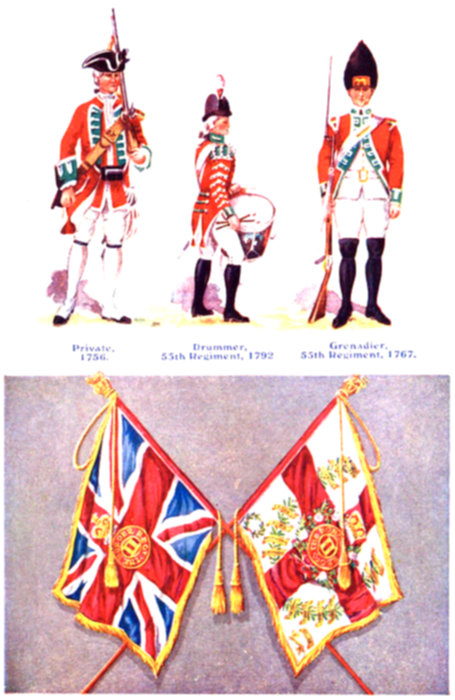
Private,
1756.
Drummer,
55th Regiment, 1792.
Grenadier,
55th Regiment, 1767.
The Border Regiment—The Colours.
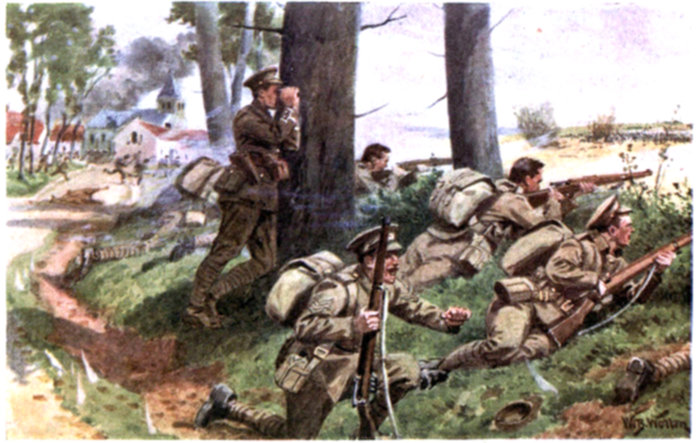
British Infantry storming a village in modern warfare.
(Depot, Cardiff.)
(Record Office, Shrewsbury.)
A Naval Crown, superscribed "12th April, 1782."
"Martinique, 1762," "St. Vincent," "India," "Bourbon,"
"Java," "Detroit," "Queenstown," "Miami," "Niagara,"
"Waterloo," "Ava," "Candahar, 1842," "Ghuznee, 1842,"
"Cabool, 1842," "Alma," "Inkerman," "Sevastopol,"
"Relief of Kimberley," "Paardeberg,"
"South Africa, 1899-1902."
Motto: Gwell angau na Chywilydd (Death before Dishonour).
Uniform, Scarlet.
Facings, White.
Head-dress, Helmet.
Cap, Blue.
Regimental March, "Ap Shenkin."
The 1st Battalion (41st Foot) was raised as a regiment
of invalids in 1719, and it was for a long
time known as the "1st Invalids," and as such
appears in most of the old "Army Lists." In the era
of George II., it distinguished itself in Germany.
The 2nd Battalion (the 69th Regiment) was known
as "The Old Agamemnons," so called by Lord Nelson
at the naval battle of St. Vincent, from the name of
his ship, the "Agamemnon," on which the regiment
served as Marines; also the "Ups and Downs" from
the fact that their number can be read either way up.
The regiment has fought with the greatest distinction
in many quarters of the world. The curious military
arrangements which opened the door for abuse
in bygone days are seen in the fact that Colonel Sir
Henry Walton, K.C.B., who afterwards commanded
the 23rd Regiment, received a commission on the day
he was born, through the influence of his father, and at
the age of four was gazetted Ensign in the 41st Foot
on full pay, and at the age of thirteen was posted to
the command of a company.
Nickname: "Wardour's Horse."
(Depot, Perth.)
(Record Office, Perth.)
The Sphinx, superscribed "Egypt."
"Guadaloupe, 1759," "Martinique, 1762," "Havannah,"
"North America, 1763-64," "Mangalore," "Mysore,"
"Seringapatam," "Corunna," "Busaco," "Fuentes d'Onor,"
"Pyrenees," "Nivelle," "Nive," "Orthes," "Toulouse,"
"Peninsula," "Waterloo," "South Africa, 1846-7, 1851-2-3,"
"Alma," "Sevastopol," "Lucknow," "Ashantee, 1873-4,"
"Tel-el-Kebir," "Egypt, 1882, 1884," "Kirbekan," "Nile,
1884-85," "Paardeberg," "South Africa, 1899-1902."
Motto: Nemo me impune lacessit (No one provokes me with
impunity).
Uniform, Scarlet.
Facings, Blue.
Regimental Tartan.
Head-dress, Feather bonnet, scarlet, white and green diced
border, scarlet hackle.
White sporran with five black tassels.
Blue glengarry cap.
Regimental March, "Highland Laddie."
The Pipers wear the feather bonnet the same as the men,
being the only pipers to do so.
Allied Regiments:
5th Regiment "Royal Highlanders of Canada," and 1st Bn.
New South Wales Scottish Rifle Regiment, Australia.
The 1st Battalion (42nd Foot) was raised in 1730
from six independent companies of Highlanders
for the protection of Edinburgh, as a regiment
of the watch. In 1751, it was numbered the
42nd. On becoming amalgamated, the bright
colours in the tartans were extracted, leaving only
the dark green ground as a tartan, and from this
circumstance rose the title "The Black Watch."
In 1794, for gallant conduct at the battle of Guildermalsen,
in Holland, it won the "red hackle" (or
plume) which is worn in the men's feather bonnets.
Known as the "Forty-Twas."
(Depot, Oxford.)
(Record Office, Warwick.)
"Quebec, 1759," "Martinique, 1762," "Havannah,"
"Mysore," "Hindoostan," "Martinique, 1794," "Vimiera,"
"Corunna," "Busaco," "Fuentes d'Onor," "Ciudad
Rodrigo," "Badajoz," "Salamanca," "Vittoria," "Pyrenees,"
"Nivelle," "Nive," "Orthes," "Toulouse," "Peninsula,"
"Waterloo," "South Africa, 1851-2-3," "Delhi, 1857,"
"New Zealand," "Relief of Kimberley," "Paardeberg,"
"South Africa, 1900-02."
Uniform, Scarlet.
Facings, White.
Head-dress, Helmet.
Cap, Green with green band.
Regimental March, "Nachtlager in Granada."
Allied Regiments, 52nd Regiment (Prince Albert Volunteers)
of Canada and 6th (Hauraki) Regiment of New Zealand.
The Officers, alone among the infantry, have the privilege of
wearing white strip collars with the frock coat.
Raised in 1741 and was dispatched almost at
once on active service, serving at Minorca,
Canada (taking part in the capture of Quebec),
Martinique, and Havannah. The 43rd and 52nd,
with the Rifle Brigade, made up the famous Light
Infantry Brigade trained by Sir John Moore at
Shorncliffe, and so laid the foundation for many
famous victories in the Peninsula. The splendid
service rendered by the Light Infantry in subsequent
years is a matter of history. The regiment was so
often chosen for leading the storming parties, that a
badge "V.S." (Valiant Stormer) was granted to
the men.
Nicknamed "The Light Bobs," a term that was
applied generally to Light Infantry regiments.
(Depot, Warley.)
(Record Office, Warley.)
The Castle and Key, superscribed "Gibraltar, 1779-83."
The Sphinx, superscribed "Egypt."
An Eagle.
"Moro," "Havannah," "Badajoz," "Salamanca,"
"Peninsula," "Bladensburg," "Waterloo," "Ava," "Alma,"
"Inkerman," "Sevastopol," "Taku Forts," "Nile, 1884-85,"
"Relief of Kimberley," "Paardeberg," "South Africa,
1899-1902."
Uniform, Scarlet.
Facings, White.
Head-dress, Helmet.
Cap, Blue.
Regimental March, "The Essex."
At the Battle of Salamanca, 1812, the Eagle of the 62nd
French regiment of the line was captured by the 44th. This
trophy is now in the Chapel of Chelsea Hospital.
Raised in 1749 and during its long and eventful
career has added lustre to the glory of the
British Army. The 44th was the only British
infantry regiment in Cabul, in the ill-fated 1841 campaign,
and with all the native troops perished while
attempting to reach Jellalabad. The story of the
heroism of all ranks in that great disaster is a
proud tradition in the regiment. The 1st Battalion
(44th Foot) was known as the "Two Fours" from its
number, also "The Little Fighting Fours." The 2nd
Battalion (56th Foot) was nicknamed "The Pompadours,"
from the circumstance that, in 1755, when
the regiment was raised, its facings were a crimson
or puce colour, called in those days, Pompadour, after
the notorious French lady who patronised it. It
formed part of the gallant garrison of Gibraltar who
successfully withstood the ten years' siege by the
French and Spanish forces.
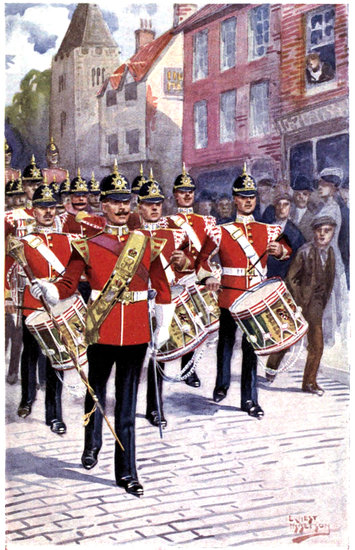
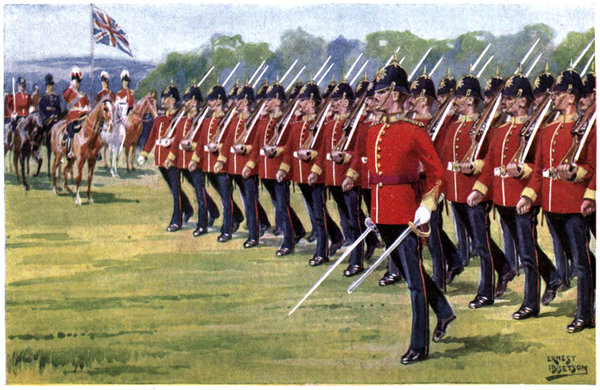
A Review.—The March Past.
(Depot, Derby.)
(Record Office, Lichfield.)
"Louisburg," "Roliça," "Vimiera," "Talavera," "Busaco,"
"Fuentes d'Onor," "Ciudad Rodrigo," "Badajoz,"
"Salamanca," "Vittoria," "Pyrenees," "Nivelle," "Orthes,"
"Toulouse," "Peninsula," "Ava," "South Africa, 1846-7,"
"Alma," "Inkerman," "Sevastopol," "Central India,"
"Abyssinia," "Egypt, 1882," "Tirah," "South Africa,
1899-1902."
Uniform, Scarlet.
Facings, Lincoln green.
Head-dress, Helmet.
Cap, Blue.
Regimental March, "Young May Moon."
The tradition concerning the regimental march is that the
regiment, in order to be present at the storming of Badajoz,
set out on a long and arduous night march across some very
rough country, the band playing "The Young May Moon,"
which the Colonel thereafter adopted as the regimented
march.
Raised in 1741, the regiment has rendered
loyal service to King and country in all parts
of the Empire, and has on more than one
occasion received the thanks of General officers for
their very fine fighting qualities. The 1st Battalion
has the proud distinction of being one of the three
regiments which served uninterruptedly throughout
the Peninsular War from 1808 to 1814.
The 1st Battalion (45th Foot) was known as
"The Old Stubborns" from their splendid bravery at
the battle of Talavera, and "Sherwood Foresters,"
in reference to the traditions of the county of
Nottingham. They claim descent from Robin Hood
and his merry men.
(Depot, Preston.)
(Record Office, Preston.)
"Louisburg," "Quebec, 1759," "Maida," "Corunna,"
"Tarifa," "Vittoria," "St. Sebastian," "Nive," "Peninsula,"
"Ava," "Alma," "Inkerman," "Sevastopol," "Ali Masjid,"
"Afghanistan, 1878-79," "Defence of Kimberley,"
"South Africa, 1899-02."
Uniform, Scarlet.
Facings, White.
Head-dress, Helmet.
Cap, Blue.
Regimental March, "The Red Rose."
This, the only Regular Infantry in the Army
entitled to the word "Loyal" as part of their
proud title, was raised in 1740 in Scotland,
and was with Sir John Cope at Falkirk, and helped
to defend Edinburgh Castle against the rebels in
1745. It afterwards went to America, was at the
capture of Quebec, the capture of Martinique, and
many other famous actions. The 2nd Battalion has
added its quota to the splendid record standing to
the credit of the Regiment, its work during the
Indian Mutiny being specially brilliant.
The 1st Battalion (47th Foot) was nicknamed
"The Cauliflowers," from their facings, and "The
Lancashire Lads." It was known at Quebec as
"Wolfe's Own," and wears a black line in the lace
as an expression of sorrow for his death.
The 2nd Battalion (81st Foot) possessed a
highly-prized title in that of the "Loyal Lincoln
Volunteers."
(Depot, Northampton.)
(Record Office, Warley.)
The Castle and Key, superscribed "Gibraltar, 1779-83."
The Sphinx, superscribed "Egypt."
"Louisburg," "Quebec, 1759," "Martinique, 1762,"
"Havannah," "Martinique, 1794," "Maida," "Douro,"
"Talavera," "Albuhera," "Badajoz," "Salamanca,"
"Vittoria," "Pyrenees," "Nivelle," "Orthes," "Toulouse,"
"Peninsula," "New Zealand," "Sevastopol," "South Africa,
1879," "Tirah," "Modder River," "South Africa, 1899-1902."
Uniform, Scarlet.
Facings, White.
Head-dress, Helmet.
Cap, Blue.
Regimental March, "The Northamptonshire."
Allied Regiment: 15th (North Auckland) Regiment of
New Zealand.
The two Battalions were raised in 1740 and
1755, and were brought together quite early
in their careers, fighting side by side at
Louisburg, at Quebec, and again at Salamanca,
Vittoria, and in the Pyrenees. The regiment has
seen active service in many parts of the world, and
it is stated was the first to realise the value of
modern musketry, through the bitter experience
gained in the first Boer War. So impressed was
the commanding officer by the terrible casualties
suffered at the hands of the Boer marksmen, that
he vowed he would make his battalion the best
shooting unit in the Army, and after the war succeeded
in so doing.
Nicknamed "The Steelbacks," so called from the
unflinching manner in which the men took their
floggings; also called "The Black Cuffs."
(Depot, Reading.)
(Record Office, Warwick.)
The Dragon, superscribed "China."
"St. Lucia, 1778," "Egmont-op-Zee," "Copenhagen,"
"Douro," "Talavera," "Albuhera," "Queenstown,"
"Vittoria," "Pyrenees," "Nivelle," "Nive," "Orthes,"
"Peninsula," "Alma," "Inkerman," "Sevastopol,"
"Kandahar, 1880," "Afghanistan, 1879-80," "Egypt, 1882,"
"Tofrek," "Suakin, 1885," "South Africa, 1899-1902."
Uniform, Scarlet.
Facings, Blue.
Head-dress, Helmet.
Cap, Blue, with scarlet band.
Regimental March, "Dashing White Sergeant."
The 1st Battalion (49th Foot) was raised in 1714,
and had nearly eighty years West Indian and
American service. On returning, the regiment
was employed in subduing the mutiny in the
Navy at the Nore, and then as Marines took part
in the naval battle of Copenhagen. In 1803 the
regiment again went to America, taking part in
the operations against the United States. Active
service in South Africa, China, and the Crimea
added further to the good name of the regiment,
the title "Royal" being bestowed for conspicuous
gallantry at the action of Tofrek in the Sudan in
1885. The 2nd Battalion (66th Foot) was raised
in 1755, and has an equally glorious record, being
in 1814-16 reputed to be the finest and best
disciplined regiment in Bengal. In the Afghan
War the regiment fought at Maiwand, where
their heroic stand, while suffering fearful losses, is
remembered with pride in the Army.
The regiment is sometimes referred to as "The
Biscuit Boys" on account of their depot being at
Reading.
(Depot, Maidstone.)
(Record Office, Hounslow.)
The Sphinx, superscribed "Egypt."
"Vimiera," "Corunna," "Almaraz," "Vittoria," "Pyrenees,"
"Nive," "Orthes," "Peninsula," "Punniar," "Moodkee,"
"Ferozeshah," "Aliwal," "Sobraon," "Alma," "Inkerman,"
"Sevastopol," "Lucknow," "New Zealand," "Egypt, 1882,"
"Nile, 1884-85," "South Africa, 1900-02."
Motto:
Quo Fas et Gloria ducunt (Where Duty and Glory lead).
Uniform, Scarlet.
Facings, Blue.
Head-dress, Helmet.
Cap, Blue, with scarlet band.
Regimental March, "A Hundred Pipers."
Allied Regiment: 1st (Canterbury) Regiment of New
Zealand.
The officers wear blue velvet facings, and on becoming a Royal
Regiment, in 1831, it was specially authorised to adhere to the
velvet for its officers' facings.
Raised in 1755, and given black facings, which
were retained till the "Royal" title was
bestowed in 1831. No regiment has a more
honourable record of service. The brunt of the
battle of Corunna fell on the 50th, whom Sir John
Moore congratulated during the battle, calling out
"Well done, 50th! well done!"
Nicknames: "The Blind Half-Hundred," and
"The Dirty Half-Hundred," from the men in
action and in "sweating" weather wiping their
faces with their black cuffs; also "The Devil's
Royals." During the war in Spain, at the battle of
Vimiera, 1807, the 50th completely routed the enemy,
and received the title of "The Gallant Fiftieth."
The 2nd Battalion (97th Foot) nicknamed "The
Celestials," from its former sky-blue facings.
(Depot, Pontefract.)
(Record Office, York.)
"Minden," "Corunna," "Fuentes d'Onor," "Salamanca,"
"Vittoria," "Pyrenees," "Nivelle," "Orthes," "Peninsula,"
"Waterloo," "Pegu," "Ali Masjid," "Afghanistan,
1878-80," "Burma, 1885-87," "Modder River," "South
Africa, 1899-1902."
Motto: Cede nullis (Yield to none).
Uniform, Scarlet.
Facings, Blue.
Head-dress, Helmet.
Cap, Dark green.
Regimental March, "Jockey to the Fair."
Allied Regiment, 105th Regiment (Saskatoon Fusiliers) of
Canada.
The 1st Battalion (51st Foot) was raised in 1756
and was "Yorkshire" from its birth, being
intimately connected with the West Riding.
It performed gallant service in all parts of the
world, reaping with the 2nd Battalion (105th Foot),
raised in 1839, a rich harvest of "honours," all of
which, however, do not figure on the colours. Sir
John Moore served as an ensign and a field officer
in the regiment, and it came under his command in the
famous retreat to Corunna, during which the Light
Division rendered signal service in the rear guard.
The 2nd Battalion was originally a regiment in the
pay of the East India Company, and came to England
for the first time in 1874.
Nickname: The "Kolis," that word being formed
of the initial letters of the words which composed
their regimental title—King's Own Light Infantry.
(Depot, Shrewsbury.)
(Record Office, Shrewsbury.)
"Nieuport," "Tournay," "St. Lucia, 1796," "Talavera,"
"Fuentes d'Onor," "Salamanca," "Vittoria," "Pyrenees,"
"Nivelle," "Nive," "Toulouse," "Peninsula," "Bladensburg,"
"Aliwal," "Sobraon," "Goojerat," "Punjaub,"
"Lucknow," "Afghanistan, 1879-80," "Egypt, 1882,"
"Suakin, 1885," "Paardeberg," "South Africa, 1899-1902."
Motto: Aucto splendore resurgo (I rise with increased
splendour).
Uniform, Scarlet.
Facings, Blue.
Head-dress, Helmet.
Cap, Dark green, with green band.
Regimental March, "Old Towler."
Raised in 1755. This regiment is the only one
to bear the honour "Nieuport," on its colours,
winning this in 1793 by gallantly defending
that town against a surprise attack by the enemy.
At Tournay the regiment, with the 14th and 37th,
by a forced march reached the battlefield at a most
opportune moment and decided the day in favour of
the British. The regiment was in St. Helena
during the time Napoleon was held captive there,
and that great soldier spoke frequently in tones of
high praise of its conduct. It has maintained that
good name throughout its subsequent career.
Nicknames: The 1st Battalion (53rd Foot)—"The
Brickdusts," from their facings, which were red at
one time; also "Old Five and Threepennies," from
its number. The 2nd Battalion (85th Foot)—"Elegant
Extracts," it being reformed with officers
picked from other regiments.
(Depot, Mill Hill.)
(Record Office, Hounslow.)
"Mysore," "Seringapatam," "Albuhera," "Ciudad Rodrigo,"
"Badajoz," "Vittoria," "Pyrenees," "Nivelle," "Nive,"
"Peninsula," "Alma," "Inkerman," "Sevastopol," "New
Zealand," "South Africa, 1879," "Relief of Ladysmith,"
"South Africa, 1900-02."
Uniform, Scarlet.
Facings, Lemon yellow.
Head-dress, Helmet.
Cap, Blue.
Regimental Marches, 1st and 3rd Battns., "Sir Manley Power";
2nd and 4th Battns., "Paddy's Resource."
Allied Regiments, 57th Regiment (Peterborough Rangers) of
Canada; 77th Wentworth Regiment of Canada; and
11th Regiment (Taranaki Rifles) of New Zealand.
Raised in 1755 chiefly of Londoners from the
Middlesex Militia, and nicknamed the "Steelbacks,"
from being frequently flogged by the
provost. From their extraordinary fighting propensities
at Albuhera, they earned the more honourable
and famous name of the "Die-Hards." In this action,
out of 25 officers, they had 22 killed and wounded;
of 570 rank and file, killed and wounded 425.
The King's colour was riddled by thirty bullets;
Inglis, the heroic colonel, cried out frequently:
"Die hard, my men, die hard," and from that day
the gallant 57th were recognised in camp and
barrack as the "Die-Hards." At Inkerman the
officer commanding the 57th inspired his followers
at a critical moment by the thrilling words, "Die-hards,
remember Albuhera." The 2nd Battalion
(77th Foot) was called "The Pot-hooks," from the
figure 7, and was one of the three regiments which
stormed the breach at Ciudad Rodrigo.
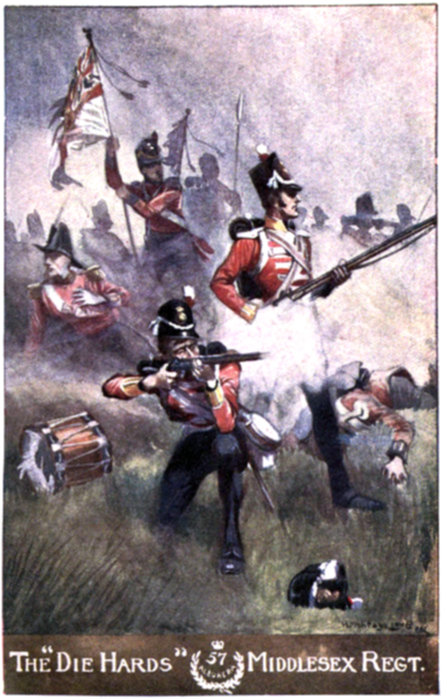
The Glorious Gallantry of the Regiment at Albuhera.
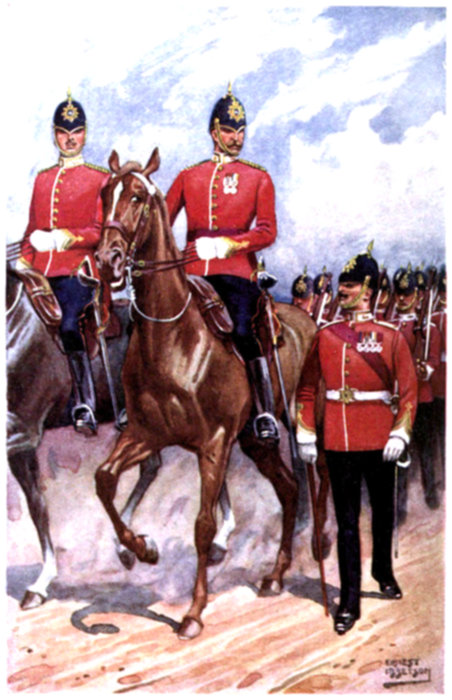
The Manchester Regiment.
Commanding Officer, Adjutant & Sergeant-Major.
(Depot, Winchester.)
(Record Office, Winchester.)
"Louisburg," "Quebec, 1759," "Martinique, 1762,"
"Havannah," "North America, 1763-64," "Roliça,"
"Vimiera," "Martinique, 1809," "Talavera," "Busaco,"
"Fuentes d'Onor," "Albuhera," "Ciudad Rodrigo,"
"Badajoz," "Salamanca," "Vittoria," "Pyrenees," "Nivelle,"
"Nive," "Orthes," "Toulouse," "Peninsula," "Mooltan,"
"Goojerat," "Punjaub," "South Africa, 1851-2-3," "Delhi,
1857," "Taku Forts," "Pekin, 1860," "South Africa, 1879,"
"Ahmad Khel," "Kandahar, 1880," "Afghanistan, 1878-80,"
"Tel-el-Kebir," "Egypt, 1882, 1884," "Chitral," "Defence
of Ladysmith," "Relief of Ladysmith," "South Africa,
1899-1902."
Motto: Celer et Audax (Alert and Intrepid).
Uniform, Green.
Facings, Scarlet.
Head-dress, Busby, with black plume, with scarlet base.
Cap, Green, with green band.
Regimental March, "The Wild Hunt."
Allied Regiments, 60th Rifles of Canada; 63rd Regiment
"Halifax Rifles," of Canada.
The regiment was raised in New York in 1755.
The uniform was scarlet with blue facings.
It became the first green-coated rifle regiment
in 1797, having scarlet facings and black leathern
helmets. The roll of honour shows how well the
regiment has served in all the subsequent campaigns,
and it has a reputation for bravery and
discipline second to none in the Army.
Nicknames: "The Greenjackets," from the
colour of the uniform; "The Jaegers"; "The
60th Rifles"; and quite recently has been jocularly
dubbed "The Kaiser's Own" from the fact that
the regimental badge, a Maltese Cross, closely
resembles the Iron Cross.
(Depot, Devizes.)
(Record Office, Exeter.)
"Louisburg," "Nive," "Peninsula," "New Zealand,"
"Ferozeshah," "Sobraon," "Sevastopol," "Pekin, 1860,"
"South Africa, 1879, 1900-02."
Uniform, Scarlet.
Facings, Buff.
Head-dress, Helmet.
Cap, Blue.
Regimental March, "The Wiltshire."
Allied Regiment: 10th (North Otago) Regiment of New
Zealand.
The 1st Battalion (62nd Foot) was raised in 1756
as the 2nd Battalion of the King's Own, and
was soon afterwards formed as a separate
corps. It quickly gained a name for itself when
four companies made a gallant stand among the
ruins of Carrick Fergus Castle against a thousand
French troops with artillery, the 62nd maintaining
their defence with bricks and stones after their
ammunition was exhausted, and had even fired
away their buttons as bullets. Their gallant conduct
was commemorated by wearing a "splash" on their
buttons for many years afterwards. In 1831 while
on service in India, cholera carried off nearly the
whole regiment, there being at one time only two
men not on the sick list or in hospital. The 2nd
Battalion (99th Foot) was raised in 1824. Both
battalions have splendid records of war service.
Nicknamed: "The Springers," from the rapidity
of its pursuit of the American rebels after the
action at Trois Rivieres, in Canada, 1776; also
"The Splashers" and "The Moonrakers."
(Depot, Ashton-under-Lyne.)
(Record Office, Preston.)
The Sphinx, superscribed "Egypt."
"Guadaloupe, 1759," "Egmont-op-Zee," "Peninsula,"
"Martinique, 1809," "Guadaloupe, 1810," "New Zealand,"
"Alma," "Inkerman," "Sevastopol," "Afghanistan, 1879-80,"
"Egypt, 1882," "Defence of Ladysmith,"
"South Africa, 1899-1902."
Uniform, Scarlet.
Facings, White.
Head-dress, Helmet.
Cap, Blue.
Regimental March, "The Manchesters."
Allied Regiment: 8th (Southland) Regiment of New Zealand.
The 1st Battalion was raised in 1758, and after a
brief spell of service on the Continent went to
the West Indies and America, winning high
praise for gallant conduct at the battle of Entaw. For
very many years the regiment did splendid service in
the West Indies, adding much territory to the British
Empire, and was afterwards sent to Australia and
New Zealand. Excellent service was rendered in
the Crimea, India, and Afghanistan, the "Regimental
Order of Merit" being founded with power to grant
medals or badges, for specially gallant conduct. The
regiment has served with honour in all parts of the
Empire.
The Officers of the 63rd previous to 1855 wore a
fleur-de-lis in gold embroidery at the end of their
coat-tails. At one time the whole regiment appears
to have worn a fleur-de-lis badge, which was adopted
in 1815 for services rendered at Guadaloupe.
The 1st Battalion (63rd Foot) nicknamed "Bloodsuckers,"
at one time. The 2nd Battalion (96th
Foot) was called "The Bendovers."
(Depot, Lichfield.)
(Record Office, Lichfield.)
The Dragon, superscribed "China."
"Guadaloupe, 1759," "Martinique, 1794," "St. Lucia, 1803,"
"Surinam," "Punjaub," "Reshire," "Bushire," "Koosh-ab,"
"Persia," "Lucknow," "Hafir," "South Africa, 1900-02."
Uniform, Scarlet.
Facings, White.
Head-dress, Helmet.
Cap, Blue.
Regimental March, "The days when we went gipsying."
The 1st Battalion (64th Foot) was raised in 1756,
the facings being black. It took part in the
hardest fighting in the West Indies and America,
being engaged there off and on till 1815, reaching
home just too late to take part in the battle of
Waterloo. The regiment was on board the
"Alert," when she was wrecked near Halifax, N.S.,
all ranks remaining below silent and under perfect
discipline, while the vessel was run ashore. Had
the men attempted to reach the deck the vessel
would have foundered. By their discipline everyone
aboard was saved, and the Duke of Wellington
ordered that the details should be published
throughout the Army as an example of discipline.
The 2nd Battalion (98th Foot) was raised in 1824
and served in the Crimean War. The 98th was
honoured with the title of "Prince of Wales's" in
recognition of the duties performed by the Corps
during the Prince of Wales's visit to Malta.
Nicknamed: "The Black Knots" as distinct
from "The Staffordshire Knots" of the South
Staffordshire Regiment.
(Depot, Pontefract.)
(Record Office, York.)
The Royal Tiger, superscribed "India."
"Guadaloupe, 1759," "Martinique, 1794," "India, 1796-1819,"
"Nive," "Peninsula," "Arabia," "New Zealand,"
"Lucknow," "Tel-el-Kebir," "Egypt, 1882, 1884," "Relief
of Ladysmith," "South Africa, 1899-1902."
Uniform, Scarlet.
Facings, White.
Head-dress, Helmet.
Cap, Blue.
Regimental March, "The York and Lancaster."
Allied Regiment: 5th (Wellington) Regiment of New
Zealand.
Raised in 1756 and was present at the capture
of Guadaloupe. Active service in the West
Indies reduced the ranks to such an extent
that on its return it had to take large drafts of
"parish boys." In 1801 the "boy" regiment was
sent to the Cape to get acclimatised for service in
India, where it arrived two years later, and where
it stayed for over twenty years earning a high
reputation for bravery and discipline. Later,
another long spell of foreign service was put in,
serving for no fewer than twenty years in Australia
and New Zealand, a unique experience. The 2nd
Battalion was raised as the 84th Foot in 1793 at York,
and saw a great deal of foreign and active service,
part being among the small garrison of Lucknow
during the Mutiny, the rest of the 84th being
massacred at Cawnpore. The brilliant record of
service of the regiment has been added to since
those days.
Nickname: "The Royal Tigers" and "The
Twin Roses."
(Depot, Newcastle.)
(Record Office, York.)
"Salamanca," "Vittoria," "Pyrenees," "Nivelle," "Orthes,"
"Peninsula," "Alma," "Inkerman," "Sevastopol," "Reshire,"
"Bushire," "Koosh-ab," "Persia," "New Zealand,"
"Relief of Ladysmith," "South Africa, 1899-1902."
Uniform, Scarlet.
Facings, Dark green.
Head-dress, Helmet.
Cap, Green with green band.
Regimental March, "The Light Barque."
Allied Regiments, 106th Regiment (Winnipeg Light Infantry)
of Canada; 2nd (South Canterbury) Regiment of New Zealand.
No regiment has earned a prouder title than the
Durhams, that of "The Faithful Durhams"
having been bestowed for devoted service on
many a hard won battlefield and for years of
arduous service faithfully performed. The 1st
Battalion (68th Foot) was raised in 1756 by
General John Lambton of the Coldstream Guards,
and was soon on active service on the Continent,
followed by active service in the West Indies. For
nine years, the 68th garrisoned Gibraltar, and
afterwards took part in the capture of St. Lucia,
1795, and St. Vincent. In the Peninsula, it added
to its already high reputation, which it has since so
well enhanced on the Continent. The 2nd Battalion
(106th Foot) was raised in India in 1826 by the
East India Company as the 2nd Bombay European
Regiment, serving with credit in many actions in
India and Persia, coming to England for the first
time in 1871.
Nickname: "The Faithful Durhams."
(Depot, Hamilton.)
(Record Office, Hamilton.)
The Castle and Key, superscribed "Gibraltar, 1780-83."
The Elephant, superscribed "Assaye."
"Carnatic," "Hindoostan," "Sholinghur," "Mysore,"
"Seringapatam," "Cape of Good Hope, 1806," "Roliça,"
"Vimiera," "Corunna," "Busaco," "Fuentes d'Onor,"
"Ciudad Rodrigo," "Badajoz," "Almaraz," "Salamanca,"
"Vittoria," "Pyrenees," "Nivelle," "Nive," "Orthes,"
"Toulouse," "Peninsula," "Waterloo," "South Africa,
1851-2-3," "Sevastopol," "Central India," "Tel-el-Kebir,"
"Egypt, 1882," "Modder River," "South Africa, 1899-1902."
Uniform, Scarlet doublet with Mackenzie tartan trews.
Facings, Buff.
Head-dress, Blue chaco with green tuft and crimson, white and
green diced border. Band, Feather bonnet with green,
crimson and white diced border, and scarlet hackle.
Cap, Green Glengarry.
Regimental March, "Whistle o'er the lave o't."
The regiment has one of the most brilliant records
in the whole army, a reputation it splendidly
maintained against the Germans in France
and Belgium. The 1st Battalion (71st Foot) dates
from 1777 as Fraser's Highlanders, which afterwards
became Macleod's Highlanders, fighting
with distinguished bravery in India, South Africa,
the Peninsula, Waterloo and elsewhere. The
2nd Battalion (74th Foot) has an equally brilliant
record of Indian and foreign service, winning great
glory at the battle of Assaye, where every officer
was killed or wounded and the remainder of the
regiment was brought out of action by the Sergeant-Major.
The 1st Battalion was so full of Glasgow men
during the Peninsular War, that it was generally
known as "The Glesca Keelies."
(Depot, Fort George.)
(Record Office, Perth.)
The Elephant, superscribed "Assaye."
"Carnatic," "Hindoostan," "Mysore," "Cape of Good
Hope, 1806," "Maida," "Java," "South Africa, 1835,"
"Sevastopol," "Koosh-ab," "Persia," "Lucknow," "Central
India," "Peiwar Kotal," "Charasiah," "Kabul, 1879,"
"Kandahar, 1880," "Afghanistan, 1878-80," "Tel-el-Kebir,"
"Egypt, 1882," "Chitral," "Atbara," "Khartoum,"
"Paardeberg," "South Africa, 1899-1902."
Mottoes: Cuidich'n Righ (Help, to the King);
Caber Feidh
(Antlers of the Deer), the war cry of Seaforth;
Tulloch
Ard (The high Hill), the slogan of Kintail.
Uniform, Scarlet.
Facings, Buff.
Mackenzie tartan.
White sporran with two black tails.
Head-dress, Feather bonnet, scarlet, white and green diced
border; white hackle, except bandsmen who wear scarlet.
Cap, Glengarry, with scarlet, white and green diced border.
Regimental March, "Highland Laddie."
Allied Regiments, 72nd Regiment (Seaforth Highlanders of
Canada); 78th Pictou Regiment (Highlanders) of Canada.
The 1st Battalion (72nd Highlanders) was raised
by the chief of the Clan Mackenzie in 1778.
The regiment gave early evidence of that
great bravery which has ever marked it, especially
in India and Afghanistan, and took part in the whole
of the Egyptian and Soudan expeditions from the
attack at Tel-el-Kebir to the final battle at Omdurman.
The 2nd Battalion (78th Highlanders) claim
descent from the famous Fraser Highlanders of 1756,
being reorganized at Aberdeen in 1793 as the Rossshire
Buffs and has an equally glorious record.
Nickname: 1st Battalion, "The Macraes";
2nd Battalion, "King's Men," from the motto.
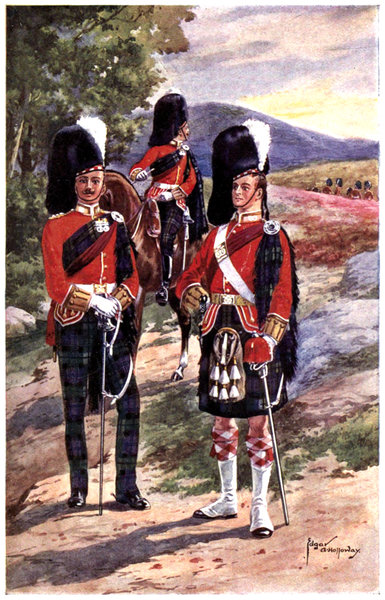
Argyll & Sutherland Highlanders—Officers in Review Order.
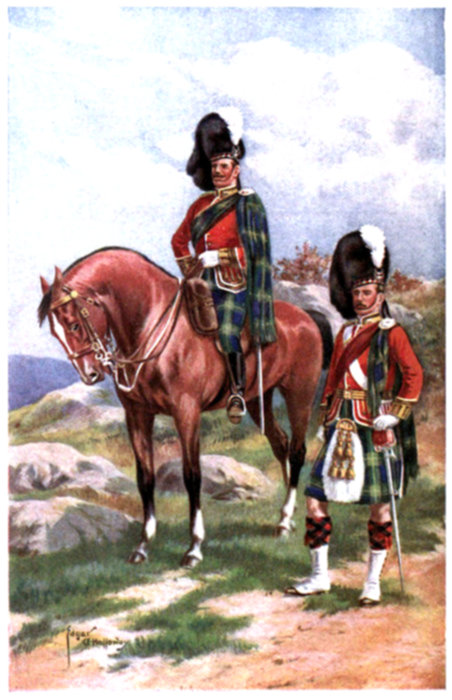
Gordon Highlanders.—Officers in Review Order.
(Depot, Aberdeen.)
(Record Office, Perth.)
The Royal Tiger, superscribed "India."
The Sphinx, superscribed "Egypt."
"Mysore," "Seringapatam," "Egmont-op-Zee," "Mandora,"
"Corunna," "Fuentes d'Onor," "Almaraz," "Vittoria,"
"Pyrenees," "Nive," "Orthes," "Peninsula," "Waterloo,"
"South Africa, 1835," "Delhi, 1857," "Lucknow,"
"Charasiah," "Kabul, 1879," "Kandahar, 1880,"
"Afghanistan, 1878-80," "Tel-el-Kebir," "Egypt, 1882, 1884,"
"Nile, 1884-85," "Chitral," "Tirah," "Defence of Ladysmith,"
"Paardeberg," "South Africa, 1899-1902."
Motto: Bydand (Watchful).
Uniform, Scarlet.
Facings, Yellow.
Gordon tartan with
yellow stripe.
White sporran with two black tails.
Head-dress, Feather bonnet, scarlet, white and green diced
border with white hackle.
Cap, Glengarry, with scarlet, white and green diced border.
Regimental March, "Highland Laddie."
Allied Regiment, 48th Regiment (Highlanders) of Canada.
"The Gay Gordons," as the regiment has always
been known, are the lineal descendants of
that famous regiment raised in 1787, mainly
by the beautiful Duchess of Gordon, who bestowed
on each recruit a kiss. The regiment saw a great
deal of service in India, notably the storming of
Seringapatam. Service in the Mediterranean and
South Africa followed, and the regiment was back
in India in time to take part in some of the severest
fighting in the Mutiny. Brilliant service in other
parts of the Empire followed. The 2nd Battalion
(92nd Highlanders) trace their history back to
1794, and fought in India, the Peninsula and at
Waterloo with great credit. Many famous officers
have commenced their military careers in the
Gordon Highlanders.
(Depot, Inverness.)
(Record Office, Perth.)
The Sphinx, superscribed "Egypt."
"Egmont-op-Zee," "Corunna," "Busaco," "Fuentes
d'Onor," "Salamanca," "Pyrenees," "Nivelle," "Nive,"
"Toulouse," "Peninsula," "Waterloo," "Alma,"
"Sevastopol," "Lucknow," "Tel-el-Kebir," "Egypt, 1882,"
"Nile, 1884-85," "Atbara," "Khartoum," "South
Africa, 1900-02."
Uniform, Scarlet.
Facings, Blue.
Tartan, Cameron-Erracht.
Black sporran, with two white tails.
Head-dress, Feather bonnet, scarlet, white and green
diced border and white hackle.
Cap, Blue glengarry.
Regimental March, "Highland Laddie."
Allied Regiment: 79th Cameron Highlanders of Canada.
The regiment (79th Foot) was raised by Cameron
of Erracht in 1793 in Inverness-shire almost
entirely from among his own kinsmen, and
down to the present day the Clan Cameron is still
very strong in the regiment. For many years the
79th Highlanders was the only single battalion
regiment in the army, the 2nd Battalion being raised
during the South African War. A remarkable
fact in connection with the regiment was that
although they had over 700 officers and men down
with typhus on returning from Corunna in 1809,
they did not lose a single man, and six months later
embarked for the ill-fated Walcheren expedition
1,002 strong. They served in the trenches throughout
the whole of that campaign without losing a man.
(Depot, Belfast.)
(Record Office, Dublin.)
The Sphinx, superscribed "Egypt."
"India," "Cape of Good Hope, 1806," "Talavera," "Bourbon,"
"Busaco," "Fuentes d'Onor," "Ciudad Rodrigo,"
"Badajoz," "Salamanca," "Vittoria," "Nivelle," "Orthes,"
"Toulouse," "Peninsula," "Central India," "South
Africa, 1899-1902."
Motto: Quis separabit? (Who shall separate?)
Uniform, Green.
Facings, Dark Green.
Head-dress, Black fur busby, with black and green plume.
Cap, Green with green band.
Regimental March, "Off, Off, said the Stranger."
The regiment was raised in 1793 in Dublin by
Col. Fitch, and became known as "Fitch's
Grenadiers," the title being bestowed in
humorous allusion to the small stature of the men.
They, however, soon showed they could fight as
well as the finest grenadiers in the Army, reaping
glory in many a hot engagement during the
succeeding years. The regiment was converted
into Rifles in 1881 when the 86th Foot was linked
with the 83rd as sister battalion. The 86th
regiment was raised in 1792, as the Royal County
Downs, and served for some years as marines, and
later in Egypt. During the ten succeeding years
the regiment travelled twice round Africa, served in
India and the Red Sea, twice crossed the Egyptian
Desert, served in South Africa, Ceylon, and
elsewhere, the service being so strenuous that during
five years in India over a thousand men laid down
their lives. The fine physique of the ranks earned
for them the name of the "Irish Giants."
(Depot, Armagh.)
(Record Office, Dublin.)
The Sphinx, superscribed "Egypt."
"Monte Video," "Talavera," "Barrosa," "Java," "Tarifa,"
"Vittoria," "Nivelle," "Niagara," "Orthes," "Toulouse,"
"Peninsula," "Ava," "Sevastopol," "Tel-el-Kebir,"
"Egypt, 1882, 1884," "Relief of Ladysmith," "South
Africa, 1899-1902."
Motto: Faugh-a-Ballagh (Clear the way).
Uniform, Scarlet.
Facings, Blue.
Head-dress, Racoon-skin cap with green plume on left side.
Cap, Blue with scarlet band.
Regimental March, "British Grenadiers."
The 1st Battalion (87th Foot) was raised by
General Doyle in Ireland in 1793 and was
fighting in 1794 in Belgium and afterwards
saw a great deal of rough service in South America.
It was, however, in the Peninsular War that it
earned undying fame, charging the enemy who
were in greatly superior numbers, at Barrosa, with
such fury as to overthrow them, and led to the
capture of an eagle by Sergt. Patrick Masterman,
whose grandson won a V.C. in South Africa. In
recognition of its splendid bravery the regiment
was given a Royal title and directed to display an
eagle as badge. The regiment has exhibited the
same high standard of bravery in all its subsequent
campaigns. The 2nd Battalion (89th Foot), raised
in 1793, also made a splendid name for courage.
Nicknames: 1st Battalion, "The Old Fogs," or
the "Faugh-a-Ballagh Boys"; 2nd Battalion,
"The Rollickers."
(Depot, Galway.)
(Record Office, Cork.)
The Elephant.
The Sphinx, superscribed "Egypt."
"Seringapatam," "Talavera," "Busaco," "Fuentes d'Onor,"
"Ciudad Rodrigo," "Badajoz," "Salamanca," "Vittoria,"
"Pyrenees," "Nivelle," "Orthes," "Toulouse," "Peninsula,"
"Alma," "Inkerman," "Sevastopol," "Central India,"
"South Africa, 1877-8-9," "Relief of Ladysmith," "South
Africa, 1899-1902."
Motto: Quis separabit? (Who shall separate?)
Uniform, Scarlet.
Facings, Green.
Head-dress, Helmet.
Cap, Blue with dark green band.
Regimental March, "St. Patrick's Day."
The 1st Battalion (88th Foot) dates from 1793,
being raised in Connaught, and was known
then by the same title it still bears. It
has had a most adventurous career, being shipwrecked
and seeing hard service in India, Egypt,
Ceylon, and South America, and subsequently
joining Wellington in the Peninsula, winning high
distinction in many battles, especially at the sieges of
Ciudad Rodrigo and Badajos. In 1819 the regiment
was given permission to create a regimental order
of merit, the 1st class being for those who had been
in twelve or more general actions, and no fewer
than 70 rank and file then serving qualified, there
being nearly 130 who had been in from six to
eleven actions, and over four hundred who had
served in one to five actions. The 2nd Battalion
(94th Foot) dates from 1823.
Nickname: "The Devil's Own," called so by
General Picton for their undaunted bravery in face
of the enemy; also "The Garvies."
(Depot, Stirling.)
(Record Office, Perth.)
"Cape of Good Hope, 1806," "Roliça," "Vimiera,"
"Corunna," "Pyrenees," "Nivelle," "Nive," "Orthes,"
"Toulouse," "Peninsula," "South Africa, 1846-7, 1851-2-3,"
"Alma," "Balaklava," "Sevastopol," "Lucknow," "South
Africa, 1879," "Modder River," "Paardeberg," "South
Africa, 1899-1902."
Mottoes:
Ne obliviscaris (Forget not);
Sans Peur (Without fear).
Uniform, Scarlet.
Facings, Yellow.
Tartan, Sutherland.
Black sporran, with six white tassels.
Head-dress, Feather bonnet, white hackle.
Cap, Glengarry with scarlet and white diced border.
Regimental March, "Highland Laddie."
Allied Regiment: 91st Regt. (Canadian Highlanders) of Canada.
The 98th Highlanders (Argyllshire) was raised
in 1796 and renumbered the 91st Highlanders
in 1802, its constant war service being in
South Africa where it helped to capture the Cape
of Good Hope from the Dutch and took part in the
first Kaffir War. It afterwards went to the
Peninsula and fought in many of the battles there,
winning great fame. Afterwards it served many
years in the Mediterranean and in India, taking a
full share in the fierce battles of the Mutiny. The
2nd Battalion, raised in 1800 as the Sutherland
Highlanders, won its greatest glory in the Crimea
where in line, under the brave Colin Campbell, it
received unsupported the full charge of the Russian
Cavalry and drove them off in confusion.
Known after the Battle of Balaklava as "The
Thin Red Line," also called "The Rory's."
(Depot, Birr.)
(Record Office, Cork.)
"Niagara,"
"Central India,"
"South Africa, 1900-02."
Uniform, Scarlet.
Facings, Blue.
Head-dress, Helmet.
Cap, Blue with scarlet band.
Regimental March, "The Royal Canadian."
Allied Regiments: 10th Regiment (Royal Grenadiers) of
Canada; 100th Winnipeg Grenadiers of Canada.
The Leinster Regiment is the only British corps
having a Colonial title. The 1st Battalion
(100th Foot) was raised in Canada in 1858, and
has, by marked gallantry in India, South Africa and
Belgium, added much to the glory of the British
Army. The 2nd Battalion (109th Foot) was
raised in India in 1853. The regiment has many
curious nicknames, those applying to the 1st Battalion
being "The Crusaders," "The Centipedes," on
account of its regimental number, the 100th, "The
Beavers," the "Old Hundredth," and "The
Colonials." At one time the colours used to be
decorated with maple leaves on July 1st (Dominion
Day), the maple leaf being borne as part of
the badge. The 2nd Battalion is known as "The
Poonah Pets" from its birthplace; "The Steel
Heads" on account of withstanding the excessive
heat of the sun in Central India, and "The Lilywhites"
from its white facings. The regiment was
the last British infantry unit to be quartered in
Canada, and the whole country parted with them
with regret.
(Depot, Tralee.)
(Record Office, Cork.)
A Royal Tiger.
"Plassey," "Condore," "Masulipatam," "Badara," "Buxar,"
"Rohilcund, 1774," "Sholinghur," "Carnatic," "Rohilcund,
1794," "Guzerat," "Deig," "Bhurtpore," "Ghuznee, 1839,"
"Affghanistan, 1839," "Ferozeshah," "Sobraon," "Chillianwallah,"
"Goojerat," "Punjaub," "Pegu," "Delhi, 1857,"
"Lucknow," "Burma, 1885-87," "South Africa, 1899-1902."
Uniform, Scarlet.
Facings, Blue.
Head-dress, Racoon-skin cap with white and green plume on
left side.
Cap, Blue, with scarlet band.
Regimental March, "British Grenadiers."
Allied Regiments, 101st Regiment (Edmonton Fusiliers) of
Canada; 104th Regiment (Westminster Fusiliers) of Canada.
The 101st and 104th Regiments, combined to
make up the Royal Munster Fusiliers, are both
of Indian origin and have left their names
deeply inscribed on the battles which gave that
country to the Empire. The 101st was raised by
Clive in India in 1756 as the Bengal European
Regiment and shared in all the hard fighting from
Chandernagore to Burmah, till the Mutiny brought
them their crowning glory. After over one hundred
years' campaigning the regiment came to England
for the first time in 1868. The 2nd Battalion (the
104th Regiment) was formed in 1839 in Bengal and
also did splendid service in the Mutiny and in the
Burmah campaign.
Nickname: "The Dirty Shirts," a cherished
name given them as a result of fighting in their
shirt sleeves at Delhi, in 1857.
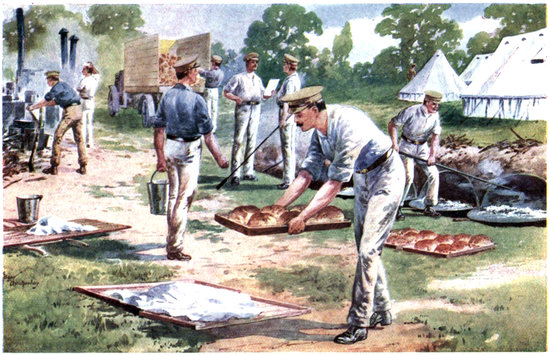
Army Service Corps.—A Field Bakery.
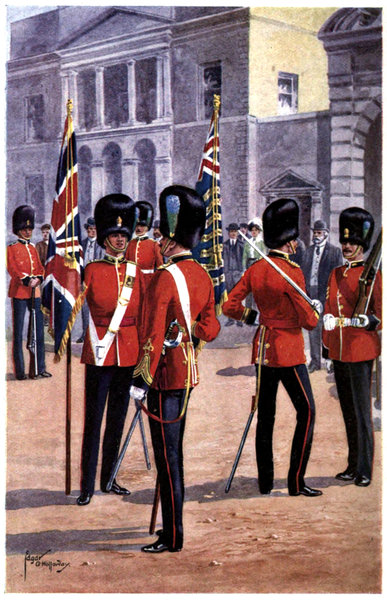
Royal Dublin Fusiliers—Officers with Colours.
(Depot, Naas.)
(Record Office, Dublin.)
The Royal Tiger, superscribed "Plassey," "Buxar."
The Elephant, superscribed "Carnatic," "Mysore."
"Arcot," "Condore," "Wandiwash," "Pondicherry,"
"Guzerat," "Sholinghur," "Nundy Droog," "Amboyna,"
"Ternate," "Banda," "Seringapatam," "Kirkee,"
"Maheidpoor," "Beni Boo Alli," "Ava," "Aden,"
"Mooltan," "Goojerat," "Punjaub," "Pegu," "Lucknow,"
"Relief of Ladysmith," "South Africa, 1899-1902."
Motto: Spectamur Agendo (We are judged by our deeds).
Uniform, Scarlet.
Facings, Blue.
Head-dress, Racoon-skin cap, with blue and green plume
on left side.
Cap, Bright blue, with scarlet band.
Regimental March, "British Grenadiers."
The regiment is the oldest of the old Indian
regiments. It was raised in India in the reign
of Charles I., but in 1748 it became the
Madras European Regiment, and under Clive
rendered splendid service at many famous Indian
battles which gradually won that Empire for
the British Crown. The 2nd Battalion (103rd
Foot) has an equally glorious Indian record. After
223 years of Indian service the 1st Battalion came to
England for the first time in 1868, and in 1870 the
2nd Battalion came home for the first time after
209 years service.
Nicknames: "The Blue Caps." During the Indian
Mutiny, Nana Sahib warned his men against those
"blue-capped soldiers who fought like devils." "The
Old Toughs," from the long period of hard service
in India.
(Depot, Winchester.)
(Record Office, Winchester.)
"Copenhagen," "Monte Video," "Roliça," "Vimiera,"
"Corunna," "Busaco," "Barrosa," "Fuentes d'Onor,"
"Ciudad Rodrigo," "Badajoz," "Salamanca," "Vittoria,"
"Pyrenees," "Nivelle," "Nive," "Orthes," "Toulouse,"
"Peninsula," "Waterloo," "South Africa, 1846-7, 1851-2-3,"
"Alma," "Inkerman," "Sevastopol," "Lucknow,"
"Ashantee, 1873-4," "Ali Masjid," "Afghanistan, 1878-9,"
"Burma, 1885-87," "Khartoum," "Defence of Ladysmith,"
"Relief of Ladysmith," "South Africa, 1899-1902."
Uniform, Dark Green.
Facings, Black.
Head-dress, Black fur busby with black plume.
Cap, Dark Green with green band.
Regimental March, "I'm Ninety-five."
Allied Regiment: 6th Regiment (The Duke of Connaught's
Own Rifles) of Canada.
Raised in 1800 the regiment saw active service
before a year was out in the attack on Ferrol.
A detachment was on Nelson's flagship as
marines at the battle of the Baltic. Their courage
was favourably commented upon at Waterloo where
they rendered particularly valuable service at a
critical period. In all parts of the world the Rifle
Brigade have rendered devoted service to King and
Country, and have fully earned and maintained the
reputation that won for them the eulogy of King
William IV, who said "Wherever there has been
fighting, there you have been, and wherever you
have been you have distinguished yourselves."
Nicknames: "The Greenjackets" and "The
Sweeps."
(Record Office, Woolwich.)
Motto: Nil sine labore (Nothing without Labour).
Uniform, Blue.
Facings, White.
Head-dress, Helmet.
Cap, Blue with blue band.
Regimental March, "Wait for the Wagons."
The Army Service Corps has no counterpart in
any European Army, and has been evolved from
years of warfare in all parts of the world. The
result, as proved in the great war on the Continent,
is to place the Corps in the forefront of any similar
service among the Allies, and the Corps has been the
wonder of the armies of the world. The Corps is
the outcome of experience gained in the organisation
of several corps which had been formed for special
purposes and afterwards disbanded. The present
high standard of efficiency of the Corps is due
to the fact that it has been slowly but surely
recognised by Generals in command of military
expeditions that the ultimate success of their
operations depended primarily on the efficiency
of the supply and transport service, and so
with the flight of years the Corps has been
grudgingly given that degree of importance in the
Army it has so well merited. It has gone through
many transformations from the Commissaries of
Muster, Royal Waggon Train, Land Transport
Corps, Military Train, and Commissariat and Transport
Corps to its present designation and duties.
When it was the Military Train it was called
"Moke Train." Popularly known as "The
Commos."
Motto: In Arduis Fidelis (Faithful in Danger).
Uniform, Blue.
Facings, Dull Cherry.
Head-dress, Helmet.
Cap, Blue, with cherry-red band.
Regimental March, "Her Bright Smile."
The Corps dates its present organization from 1873
when the old regimental medical system was
abolished, which had many weaknesses and
was open to considerable abuse. The reorganisation
has been greatly to the benefit of the whole Army
for it has provided a medical service far superior in
skill, organization and establishment to any medical
service in the world. Not only is the professional
skill of the medical officers and the nursing skill of
the men the best that the nation can provide, but
the sympathy and devotion to their humane duties
evinced by all ranks is a theme of constant
admiration, and one of the most glorious traditions
of the Army. In the hottest and most dangerous
areas of the battlefield, in the dread infectious wards
of the hospitals, and in their care of the sick and
wounded, the members of the Corps have shown a
devotion and bravery that has reflected the utmost
glory on the whole nation. Many of the Officers
and other ranks have won the highest and most
coveted decorations on the field in discharging their
splendid mission of saving life.
Nicknames: "Linseed Lancers," and "Poultice
Wallopers."
Uniform, Blue.
Facings, Maroon.
Head-dress, Helmet.
Cap, Blue, with maroon band.
This humane service was brought into being in
1796. Previously the treatment of equine
diseases in the service had been entrusted to
the farriers, zealous, but for the most part ignorant,
men working by rule of thumb. The founding of
the Royal Veterinary College, London, just prior to
that period helped materially in putting the corps on
a sound professional basis, and the diploma of the
College was a sine qua non for a commission in the
Corps. The first Veterinary Surgeon appears to
have been Mr. John Ship, who was appointed to
the 11th Light Dragoons in June 1796 and a few
months later Professor Coleman of the Royal
Veterinary College was appointed Principal
Veterinary Surgeon to the Cavalry and Senior
Veterinary Surgeon to the Ordnance. Under his
energetic guidance the foundations of our splendidly
efficient Veterinary service were laid. The service
was re-organised in 1881, all regimental appointments,
except those in the Household Cavalry,
being abolished, and in 1891 substantive military
rank was conferred on the officers instead of relative
rank. The South African war brought a further
development in the inclusion of N.C.O.'s and men
in the Corps, and now the Corps musters a very
strong body of experts whose services have been of
inestimable value in the great war on the Continent.
Nicknames: "The Vets"; "The Horse Doctors."
Uniform, Blue.
Facings, Scarlet.
Head-dress, Helmet.
Cap, Blue.
It is a remarkable fact that the Ordnance Department
has a greater antiquity than any other
branch of the Army, its history being traceable
to the earliest military organisation of England. At
one time it was a civilian department, then a branch
of the Artillery, then a branch of the Engineers,
and so curiously interwoven that it is very difficult
to establish its actual origin. The first official record
of an Ordnance Department dates back to 1418,
when John Louth was appointed "Clerk to the
Ordnance." The Master Bowyer, Master Fletcher,
Master Carpenter, etc., were styled Officers of the
Ordnance, which about 1455 became centralised at
the Tower of London, where the Department continued
for four hundred years under "The Master of
the Ordnance," until removed to Woolwich. The
duties have been, as now, closely associated with the
provision and care of war-like stores, especially arms
and ammunition, and the designation of the Department
has varied considerably, the efficiency of the
Department being steadily increased and splendidly
maintained in the face of great difficulties.
Nicknamed "The Ordnance" and "The Sugar
Stick Brigade" from the peculiar red and white
piping of the braid.
Uniform, Blue.
Facings, Yellow.
Head-dress, Helmet.
Cap, Blue with yellow band.
Before the establishment of the Army Pay
Department in 1878, the financial side of the
soldier's service was administered almost without
system, this being carried out for the greater
part according to the whim or skill of each commanding
officer. So many people "had a finger in
the pie" in handling the soldier's pay that the
wonder is that any ever reached him at all, whilst
the loss to the nation was enormous. After the
abolition of the system under which each Colonel
paid his men or did not, as he thought fit, Army
Agents were made more or less responsible for
paying the troops, and these appointed their own
paymasters in each regiment. This system was
open to abuse, and the troops suffered until the
whole system of pay was taken over by the War
Office and the Pay Department established. This
Department also took over the payment for all the
needs of the regiments and corps, and so well has it
arranged its duties that every man in the army is
now sure of every penny due to him, whilst the
nation has been saved vast sums by preventing fraud
and overcharging.
Nicknames: "The Quill Drivers" and "The
Ink Slingers."
Uniform, Blue.
Facings, Red.
Head-dress, Helmet.
Cap, Red.
The formation of this Corps is comparatively a
recent one, for until the year 1880 police
duties in times of peace were discharged
regimentally, and in times of war by more or less
haphazard detachments under selected officers
known as Provost Marshals. The formation of the
Military Mounted and Foot Police, however, placed
this important work on more solid and organised
foundations, and in war and peace the members of
the Corps discharge, in a most efficient manner, a
large variety of important duties few are aware of.
The policing of camps, lines of communication,
supply bases and other important centres is only
part of their work, which include the custody of
prisoners of war, the safeguarding of general
officers, and the execution of spies and other
condemned prisoners.
Nickname: "The Red Caps."
"Gibraltar."
Motto: Per Mare, per Terram (By Sea or Land).
Uniform, Royal Marine Artillery, Blue; Royal Marine Light
Infantry, Scarlet.
Facings, Royal Marine Artillery, Scarlet; Royal Marine Light
Infantry, Blue.
The evolutions of the Marines as a separate force
before the accession of Queen Anne are little
known. The earliest mention of Marines as
a distinct force occurs in 1664, being an Order in
Council for the formation of a body of 1,200 men
for the sea service. Many infantry regiments have
in their early days served as Marines, but the separate
Corps seems to have had a corporate existence since
the date mentioned above. Splendid service has
been rendered on land and sea ever since, and the
Marines are as justly considered as being among
the best fighting men the Empire has. Their
records show them to have taken important parts
in many a famous battle on land, whilst contributing
their share to every victory afloat.
The Royal Marines were, by the French, nicknamed
"The Little Grenadiers," from the regiment
wearing Grenadier caps. They are popularly
known as "The Jollies." The Corps was originally
raised for sea service alone. In 1664 it bore the
name of "The Admiral's Regiment" in consequence,
and "Neptune's Bodyguard."
The following are some of the principal medals,
decorations and orders that have been worn, or are worn,
by British soldiers:—
- General Service Medal, 1793-1814.
- India Medal, 1799-1826.
- Waterloo Medal, 1815.
- First Burmah War, 1824-6.
- Capture of Ghuznee, 1839.
- Cabul Medal, 1843.
- China War, 1842-1860.
- Afghan War, 1843-3.
- Sutlej Campaign, 1845-6.
- New Zealand, 1846-65.
- Punjaub, 1848-9.
- India General Service, 1852-95.
- South Africa, 1853-79.
- Crimea, 1854-56.
- Baltic, 1854-5.
- Indian Mutiny, 1857-8.
- Canada, 1866-70.
- Abyssinia, 1868.
- Ashanti, 1879-94.
- Afghanistan, 1878-80.
- Roberts Star, 1879.
- Cape of Good Hope.
- Egypt, 1882-89.
- Khedive's Star, 1882-89.
- N.W. Canada, 1885.
- W. Africa, 1890-1900.
- Matabeleland, 1893.
- Central Africa, 1894-98.
- India General Service, 1895-1898.
- Ashanti Star, 1896.
- Sudan (British), 1896.
- Sudan (Khedive's), 1896.
- East and Central Africa, 1897-99.
- China, 1900.
- S. Africa (Queen's), 1899-1902.
- Do. (King's), 1901-2.
- 3rd Ashanti, 1900.
- East African General Service, 1900-1904.
- India General Service, 1901-02.
- Tibet, 1903-04.
- Victoria Cross.
- Order of the Bath.
- Order of St. Michael and St. George.
- Royal Victorian Order.
- The Distinguished Service Order.
- The Military Cross.
- Order of St. John of Jerusalem.
- Albert Medal.
- Territorial Officer's Decoration.
- The Jubilee Decoration.
- The Coronation Decoration.
- Distinguished Conduct Medal.
- Meritorious Service Medal.
- Long Service and Good Conduct Medal.
- Militia Long Service Medal.
- Yeomanry Long Service Medal.
- Volunteer Long Service Medal.
- Territorial Force Efficiency Medal.
- Royal Humane Society's Medal.
- Order of Osmanieh.
- Order of Mejidie.
- Legion of Honour.
- St. George's Medal (Russian).
Watchmakers to the Admiralty
MAPPIN'S FAMED
Luminous 'Campaign' Watch
This fine movement wristlet watch was first
used in great numbers at Omdurman, and
desert experience is the severest test a
watch can have.
During the last Boer War it renewed its
high reputation for reliability under trying
conditions.
It is compensated and jewelled, in silver
case with stout inner dome.
It is fitted with a luminous dial, which shows
the time on the blackest of nights.
£2: 10: 0
Mappin & Webb LTD
Silversmiths to His Majesty King George V.
158-162 Oxford Street 2 Queen Victoria Street 220 Regent Street
LONDON.
Manufactory:—The Royal Works, Sheffield
GALE & POLDEN LIMITED
| British Army Medals and Ribbons |
| Handsome Plate, 30in. by 20in., in Colours, showing all medals both sides (1800 to present day), together with correct ribbons and bars. |
1s. |
| Regimental Ribbons and Buttons of the British Army |
| Size, 33in. by 21in. In Colours, correct reproduction of silk ribbons and regimental crested buttons. 116 designs. In handsome covers. |
1s. |
| Crests and Badges of the Regiments of Yeomanry |
| in daily use. Size, 30in. by 20in. In Gold and Colours. New Edition, 56 designs. In handsome covers. |
1s. |
| Stripes and Types of the Royal Navy |
| Contains a correctly coloured sketch from life of all Ranks and Ratings from an Admiral to a Boy, and other illustrations. |
1s. |
| Flags of the British Empire and National Flags |
| Beautifully printed in correct Colours, including International Code Signal Flags; Admirals' Flags of different Nations; British Semaphore Signs and Significations; Special Coast Flags; Signals of Distress; Flags of the Royal Yacht Clubs and where stationed; International Code of Signals for Communication between Fishery Cruisers and Fishing Vessels in the North Sea; Colonial Flags and Badges; Morse Code and Signals for Pilots. Compiled in accordance with latest regulations. |
1s. |
| Crests of the Royal Navy |
| Size, 34in. by 21¾in. In Gold and Colours. 108 designs. In handsome covers. |
1s. |
| British Army Crests and Badges |
| in daily use. Size, 35in. by 23in. In Gold and Colours. 108 designs. In handsome covers. |
1s. |
| 2 AMEN CORNER, LONDON, E.C. |
| OR OF ALL BOOKSELLERS |
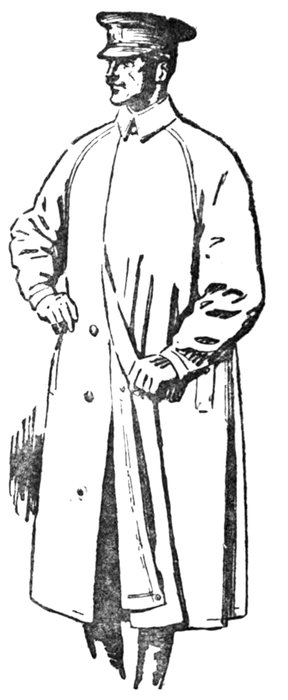
THE "SUWOROFF"
MACKINTOSH.
"RAINCOATS
ARE A
FAILURE"
say Officers on
Active Service
for the simple reason that
they are not waterproof.
A Mackintosh is the only
wear if you want to keep dry.
The "SUWOROFF" is a
fine cashmere fabric, very light
in weight, but very strong,
and is GUARANTEED
WATERPROOF.
Price £2 17 6
Detachable Fleece
Lining £1 1 0
In this coat, weighing about 2½ lbs.,
is used nearly 1½ lbs. of pure rubber
which is protected from wear by being
faced on both sides with the cloth.
The method adds immensely to the
life of the coat.
Medium weight, cut for
riding if necessary £3 7 6
Write for complete
Illustrated Booklet.
Dunhills, Ltd., 2 Conduit Street, W.
359-361 Euston Road, N.W.
| MANCHESTER: |
GLASGOW: |
| 90-92 Cross Street. |
72 St. Vincent St. |