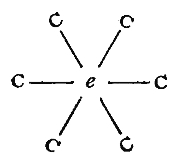
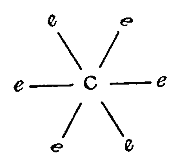
'Spirits are active, indivisible substances; Ideas [objects] are inert,
fleeting, dependent things, which subsist not by themselves, but are
supported by, or exist in minds or spiritual substances....The cause
of
Ideas is an incorporeal active Substance or
Spirit.'
—Berkeley.
London
SWAN SONNENSCHEIN & CO.
PATERNOSTER SQUARE
1892
[All rights reserved]
'Looking to the chaotic state of logic text-books at the
present time, one would be inclined to say that there does
not exist anywhere a recognised, currently-received body of
speculation to which the title Logic can be unambiguously
assigned, and that we must therefore resign the hope of
attaining by any empirical consideration of the received
doctrine, a precise determination of the nature and limits
of logical theory.'
Encyc. Brit., Art., Logic.

The object of the following treatise is to give an
intelligible account of the principal facts of Mind,
with a method for the right expression and criticism
of Reasoning. It is based on principles not before
applied to such a purpose. The current systems of
Metaphysic are obscure and difficult simply because
they start from false premises, not because the nature
and operations of Mind cannot, if properly understood,
be made as comprehensible to beginners as
other branches of knowledge. The rules of Dialectic
are quite within the capacity of any intelligent
schoolboy, and should be an essential part of early
education, like Arithmetic.
Let not the student be repelled at finding a philosophy
reputed to be one of the most difficult taken
as the basis of this work. It is Berkeleyism considerably
modified. Also it is to be borne in mind
that a philosophy is not to be judged by its primâ
facie probability, but by its power of explaining
many facts in a coherent and lucid way. A theory
that does this should not be rejected for a seeming
paradox at the outset.
Most of the theoretical and all the dialectical parts
of this work can be adapted to Realistic thinking, by
treating the judgments of the two Berkeleyan categories
as intuitions instead of inferences.
| |
|
PAGE. |
| Preface |
v |
| Introduction |
sect.
|
|
|
| i |
Division of Philosophies into Ideal and
Substantial—Substantial subdivided into Mental and
Material—Berkeley's philosophy a Mental Substantialism |
1 |
| ii |
Ontological principles essential to logical
theory—Mind consists of (at least) Self and a Plastic
Substance—Functions of each—Perception of Inorganic
things discussed—Berkeley's view on this point
rejected—Body to be considered an apparatus of Perception |
4 |
| iii |
Current Metaphysic is Ideal and therefore
incoherent—Substantial alone has a connecting
principle—Importance of Categories in Substantialism—Its
doctrine of Reason totally different from the Academic |
8 |
| Intellect |
| iv |
Origin of Intellect—Its use—Difference
between Sentimental and Intellectual
consciousness—Intellect not the governing intelligence
of Man—Moral education the most important |
11 |
| v |
Truth, its various meanings—Veracity—Correct
Ideation—Correct Inference—No absolute standard of
Truth—Nisi utile est, quod novimus, stulta est
Sapentia—Schopenhauer on the function of Intellect |
14 |
| vi |
Standard of Truth relating to Bodily welfare
different from that relating to Mental welfare—Realism
the theory of Perception under the former standard—Its
main dogmas—Cause why it is superseded—Superstition
of One Truth—Realism and Substantialism both true and
yet contradictory |
18 |
| Perception |
| vii |
Defined, according to Substantial
principles—Noumenon—Subject—Object—Sentiment
not excited by Objects, but Objects accompany
Sentiments—Subject not passive in
Perception—Attention—Kant's opinion on the
inconceivability of Noumena refuted—Difficulty of
overcoming Realistic prejudices—Science of little use
in Philosophy |
23 |
| Ideas |
| viii |
How produced—Hume's notion untenable—No
innate Ideas—but Sentiment is innate—Division of
Ideas into Particular, General, and Imaginary |
27 |
| ix |
Memory—Oblivion—
Recollection—Images, how
preserved and how lost—Good Memory not necessarily
advantageous—Recovery of the apparently Forgotten—Sudden
extinction of Ideas—'Decay of the mind' in
old age—Memory inexplicable on any theory but the
Substantial—John Stuart Mill's confession—Memory the
chief fact of Mental Science |
28 |
| x |
Sentiments may be remembered—Feelings and
Emotions—No detailed analysis of Sentiments possible
or necessary—Spinoza's list—Can sentiments be
noumenally excited without objects? |
34 |
| xi |
Analysis of Comparison—It is the principle
of Generalisation and Imagination |
36 |
| Generalisation |
| xii |
Purpose of Generalisation—Objects
classified must be similar and have similar
utilities—Inferiority of general
ideas acquired by definition—Names not essential to
general thought—Generalisation resembles composite
photography—Classification on mere objective
resemblance—neat but superficial—Conceptualism |
38 |
| xiii |
Matter the most general notion derived
from Objects—Belief in Real Matter a form of Mysticism—A
material basis for phenomena unnecessary |
43 |
| xiv |
Nominalism—Berkeley's Nominalism, and
objections thereto—Concrete Thought expressed in general terms |
46 |
| xv |
Generalisation the bane of European
philosophy—Plato's theories on General Ideas—Aristotle's
'Essence'—Classification a means, not the end of Reason—The
explanatory Unity a unity of service—Evolution a concrete
Platonism |
58 |
| Imagination |
| xvi |
How distinguished from Recollection and
Reverie—Imagination by Simple
Combination—By Transfusion—Artistic Imagination—Rational
Imagination—Wrong views of Metaphysicians |
63 |
| Dialectic |
| xvii |
Recapitulation of the genealogy of Reason—It
is the art of conceiving the Future and Unknown—Dialectic
the science of Reason—Division of theorems into
Arguments and Fallacies—Method of Dialectic |
68 |
| xviii |
The Rational Parallel—Rational
Conclusions are never certain—Essential parts of an
Argument—Rules of Parallel—False conclusions cannot
be destroyed but may be stigmatised—In what
circumstances we may reason concerning a known fact |
74 |
| xix |
Hypothetical Arguments—Current errors
with respect to these—Dilemma |
80 |
| xx |
Debate is extra-dialectic—How a
valid argument may be criticised |
87 |
| Categories |
| xxi |
Natural—Realistic—Scientific—Philosophical
—Categories of Pythagoreans—of Aristotle—of Kant, etc. |
92 |
| xxii |
Category of Inherence—It is a metaphysical
analysis of objects—Examples of Judgment and Argument—Use
of Standards for Mediate Comparison |
97 |
| xxiii |
Category of Association
defined—Position—Examples of Judgment and
Argument—Movement—Number—Flat Space |
103 |
| xxiv |
Perspection or Depth in groups—Perspective
degradation—Redintegration, real and ideal—This groupment
as a fixed Precedent—Standard of Depth—Sky Perspection |
108 |
| xxv |
Concretion of Cubic ideas from flat
objects—Backs of things—Resistance—Dr. Johnson on
Idealism—Danger of trifling with Idealists, illustrated from the
Dabistán—Geographical Concretion—Its superiority to mere
Recollection—Sphericity of the Earth, what it means |
118 |
| xxvi |
Material Sequence defined, with
examples—Time the interval between objects in
Sequence—Eternity—Scientific confusion of Sequence with
Causation |
126 |
| xxvii |
Causation—Its peculiarities—How
distinguished from Sequence—Effects are never
causes—Cause consists of Motive, Plan, and
Power—Generation not causation—Atoms not
causes—Sub-categories of Causation—'Conservation'
of Energy discussed—Note on Dreams |
130 |
| Redaction of Colloquial Arguments |
| xxviii |
Language not naturally an instrument of
Argument—How to adapt it to this purpose—Negative
words—Partitive words—Redaction does not extend to the
correction of faulty observation—Syllogistic Conversion
not necessary on the Substantial method |
151 |
| Fallacies |
| xxix |
Of Equivocation—Of Imperfect Observation |
157 |
| xxx |
Of Parallel Arrangement—Suppressed
Precedent—Inferring a negative from Contrast—False
Analogy—Doubtful Precedent—Of Accident—Of Division—Of
Composition—Dialectical Tautology—Cross
Reasoning—Fallacy of No Case—Of Inversion—Suppressed
Conclusion—Of No Application—Of Irrelevant Conclusion |
161 |
| Academical Dialectic |
| xxxi |
Various notions of Reason entertained by
Syllogists—One only true, Analogy |
175 |
| xxxii |
'Immediate Inference' is not Argument,
but explicitness and emphasis in language |
176 |
| xxxiii |
Arithmetic, what it is—The Real and the
Symbolic—Reasoning enters only into the Real—The Symbolic
a kind of expression |
177 |
| xxxiv |
Geometrical Demonstration not a form of
Reasoning—The so-called 'deductive reasoning' of Geometry
a graduated series of lessons in perception |
182 |
| xxxv |
Induction not a special kind of reasoning,
but a deduction with suppressed precedent—Other meanings
of the word |
185 |
| xxxvi |
Aristotle's Dictum explained and refuted |
187 |
| xxxvii |
Mediate Comparison not Argument |
189 |
| xxxviii |
Syllogism analysed—It is not
Argument—Doctrine of the Predicate—Moods of the
Syllogism discussed—All moods reducible to One |
191 |
| Studies in Dialectic |
| xxxix |
Additional examples to illustrate the
Dialectic of Substantialism |
205 |
Philosophies are either Ideal or Substantial. The
ideal are those which resolve all things, actual and
possible, into thought or consciousness. They seek
to find in consciousness the reason and meaning of
itself, or, if this be impossible, to account for each
item in consciousness by defining its relation to some
other item, or to some general mass of consciousness.
This type of philosophy includes German transcendentalism
and idealism, and some species of Buddhist
and Persian metaphysic. European idealists are
seldom consistent, for at the basis of their philosophies
(or at the apex) they place God, who is not an
item of human consciousness, actual or potential, and
who therefore occupies, whether it be admitted or
not, the relation of substance to human thought.
Substantial philosophies affirm that thought invariably
inheres in some sort of Substance, for whose
service it exists. It is incapable of independent being,
and cannot be understood abstracted from its substance.
It is intermittent, called up when wanted,
and is liable to variation and aberration.
Substantialists differ however as to what the substance
of human intelligence is. Some hold that
it is the human body. Consciousness exists, they
argue, for the use of the body and varies with its condition.
This class of philosophers may be subdivided
into Materialists and Metaphysicians (including logicians).
Materialists believe that consciousness is a product
of the physical body—has therefore no existence before
the body is formed or after it is dissolved. It is really
as physical as the teeth or hair.
In metaphysic the intelligence is supposed to have
a principle of existence apart from the body, and does
not, or need not, share the fate of the body. The
body is nevertheless regarded as the substance or
superior fact during the union of the two. This is
an eminently inconsistent philosophy, for if consciousness
has an existence apart from body it must be in
some other substance, and if so its relations to that
substance are more important than its relations to the
body, and should be the first object of inquiry.
Metaphysic is in its development an idealism, since
the connection admitted between body and thought
is too slight to afford a sufficient explanation of
intelligence, and no other substantial relation is
known.
The notion that an invisible immaterial substance
may underlie consciousness has occurred to
some philosophers, among others to the illustrious
Berkeley. His theory of Vision, which has never
been refuted or even weakened, is founded on this
hypothesis.
Berkeleyan substantialism combines the characteristic
features of the other theories, and affords an
easy solution of many difficult problems in philosophy.
It has in common with idealism—whence it
is sometimes, but erroneously, called by that name—that
it regards all material bodies and things as facts
or items of consciousness. It agrees with materialism
that a substance is essential to consciousness, and that
the consciousness of man serves the needs of his body,
though that is not the highest use to which it can be
put. It confirms the metaphysical view that intelligence
is not, in its abstract or essential character,
dependent on the body, and may therefore survive
the body.
This is the theory on which the following logic is
based: I shall refer to it briefly as Substantialism.
Substantialism has two main divisions—Ontology,
which treats of the mental substance in itself, and
Logic or Metaphysic, which deals with its consciousness.
The present essay is specially concerned with
logic, but certain ontological premises must be assumed
to render the logic intelligible. This follows
from the subordinate relation of consciousness to
substance.
The substantial mind consists of two principal
parts—a SELF and a PLASMA—the Atman and
Akaśa of Sanscrit philosophers.
Self is the seat of Energy and Consciousness. The
plasma is inert and unconscious; it protects the Self
and receives, communicates, and retains impressions
of experience, both the external and the internal1.
The Self would be conscious though isolated from
other minds, at least from those of its own grade of
being. It would feel the fluctuations of its energy.
But the experience called 'external' depends on the
mutual action of minds. It is the form into which
their consciousness is thrown when they come in contact.
It lasts no longer than the contact, and so has
only a casual existence.
The constitution of the mind is not given by Berkeley,
and on other points also we must supplement
and correct his philosophy. He was wrong as regards
the mental cause of the perception of the Inorganic
or Dead.
Since external experience implies that another
mind is operating upon ours, what mind is operating
when we perceive an object that is apparently
mindless? Berkeley replies that it is the supreme
mind that is then acting upon us.
Many objections can be urged against this view.
I will mention only one, which seems to me conclusive.
By every canon of judgment we possess, the living or
organised is better—more important and significant—than
the lifeless and elemental; so if Berkeley's
reasoning be valid the phenomena excited by finite
and created beings are superior to those excited by
their Creator. The movements of a living man are
referred to a human mind—a putrescent carcase is a
vision immediately induced by the Deity.
The beauty of the starry sky is irrelevant to the
question. Apart from the finite life and thought that
may be associated with the stars, they have no more
philosophical importance than a spadeful of sand.
A more reasonable account of the inorganic is
found in several ancient philosophies. Gnostics and
Neo-Platonists referred the elemental to a cosmic
mind (Demiurgos) intermediate between human
beings and the Supreme. The demiurgic mind
is inconceivably greater and more powerful than the
human, but is not necessarily better in quality. It is
the origin of all natural forces, and its organic processes
are what we term 'physical laws.' This is the
explanation of inorganic consciousness which I feel
disposed to adopt, but to discuss it fully would carry
us too far from the subject of this work.
The next point relates to the body. What is its
function in substantialism? The brain, says Berkeley,
is an idea in the mind, and he ridicules the
notion that one idea should generate all other ideas.
This is an argument against materialism. No doubt
he would have admitted, though he does not say so,
that the body-idea facilitates, or at least must precede,
the experience of other ideas. He would not
have denied that it is an instrumental idea.
Since his time an important discovery has been
made with reference to the constitution of the body.
I allude to the Cell theory. It is no longer possible
to regard the body either as a self-moving machine
(if this is not a contradiction in terms), or as a lump
of 'dead matter' animated by the mind. It is a
society of minute animals2, each having a certain
degree of independent energy and liberty of movement.
They are organised and governed by the
human or animal mind with which they are associated.
In short, the relation of the cell to the man is
analogous to, if not quite the same as, the relation of
the man to the cosmic being.
This discovery complicates the problem of 'external'
consciousness, without however affecting the principles
on which a substantialist would endeavour to solve
it. Instead of conceiving human minds as coming
into immediate contact in perception, we have to conceive
the cellular systems of each as forming a medium
between the two. We do not perceive the other mind
immediately or intuitively; what we perceive intuitively
is certain affections in our own organism, which
we must first refer to the other body, and then to the
mind behind that body. Our knowledge of other
human beings is thus altogether inferential.
The cellular medium explains why we are not
generally aware of the substantial constitution of
other minds; it is veiled by the intervening organisms.
The relation of body to mind, the reason of embodiment,
and so forth, are questions of prime importance
in ontology, but in logic we are concerned
only with the object in consciousness, without reference
to the apparatus of perception. The instrument
of intellectual perception may in its proper character
be ignored.
All the current academic metaphysic is ideal.
Materialists, when they attempt to explain thought,
fail to attach it properly to the body, or to account
for that large and important division of mental
activity which has no bearing, direct or indirect, on
bodily welfare. They drop their materialism at an
early stage of their enquiry and continue on the
metaphysical method.
Hence in none of the current systems is there any
true principle of arrangement in the treatment of
logical phenomena. Unless we know the use of a
thing we cannot describe it, let alone explain it. We
know not the relative importance of its parts, and we
arrange them according to superficial resemblances,
or on some arbitrary principle which conceals instead
of revealing their meaning.
Substantial philosophy alone possesses a principle
of coherence. The facts of consciousness are determined
by anterior facts of substance, and there can
be only one true mode in which to present them—they
must follow and reflect the substantial order.
They will thus appear as a consecutive and coherent
system of ideas, no one of which could be otherwise
placed without damage to the whole. This is perhaps
the most important respect in which substantial logic
differs from others.
The doctrine of Categories has to receive full development
in order to elucidate the genesis of the
'material world.' Except to a substantialist the categories
have no particular value, and so they are barely
mentioned in the academic systems.
The theory of Reasoning or Dialectic (logic in
the narrower sense) given in the following chapters,
will be found totally different from the academic.
It does not merely state in other words or
metaphors the doctrines laid down in works of the
Aristotelian type,—it declares that the theory of
reasoning taught in these works is altogether false.
Our argumentation is not conducted in syllogisms,
either tacit or explicit. This has been suspected by
several critics of logic, but no attempt has been
made to substitute a more correct theory and method.
Of course logicians do not always reason wrongly,
and true arguments may be stated in the syllogistic
form. What I mean is that logicians nowhere tell us
in what right reasoning essentially consists, and for
want of a distinct notion on the subject they all of
them occasionally admit as valid, arguments that are
not so.
The main dogma of substantialism should be kept
in view in reading the following pages. It is mind
alone that is conceived as having solidity and energy:
material things are temporary forms of our consciousness;
they have length and breadth but no depth,
and they are without energy, even passive resistance.
If an object cannot be removed at pleasure, what
resists us is the other mind causing that object, not
the object itself.
As far as possible I have utilised the existing logical
terminology. But substantialism has notions which
require special technical words, and I have not hesitated
to invent such when necessary. On the other
hand, I have rejected the latinisms of current logic,
which have never been assimilated by modern languages.
The English language is good enough for
all the purposes of logic.
The mind has at physical birth one uniform quality
of plasma and consciousness. By education and experience
a portion of the plasma is gradually changed,
and the consciousness excited by this portion is what
we call Intellect. The word may also stand for
the plasma so differentiated.
The consciousness pertaining to the plasma left in
its primitive state is Sentiment, which generally
corresponds to what is termed the moral nature of
man.
Intellect is a temporary condition arising out of the
need to preserve the Self from hostile and inharmonious
surroundings. The adaptation is artificial, and
may therefore be well-done, or ill-done, or over-done.
It is over-done when too much of the plasma and
mental energy is devoted to intellectual purposes—when
the individual has, to use a common expression,
more head than heart. In this case the end is sacrificed
to the means.
I conceive the intellect as a hardening of the plasma
in its superficies, the formation of a sort of rind capable
of receiving finer, sharper, and more enduring
impressions than the plasma of sentiment; and, being
harder, it is better able than the latter to resist enfeebling
influences. Its duty is to challenge and
inspect vibrations before permitting them to pass
inwards to the region of sentiment. Yet the intellectual
consciousness is itself a degree of sentiment, and
in intellects not sufficiently trained it may be impossible
to distinguish thoughts that are purely intellectual,
from thoughts that are also to some extent
sentimental. Upon minds of this sort the best-prepared
arguments have no hold; they must be mixed
with oratory and poetry to receive any attention.
It need not be said that a mind which responds only
to 'persuasive' language is feeble of intellect. It
lives in the present only, and is incapable of far-reaching
designs. It is to the intellect we owe the power
of conceiving the past and future, and of laying plans
for the future.
A mind properly intellectualised is, of its kind,
strong and self-controlled. With the intellect defective
the man exhibits passion, undue excitement and
demonstrativeness. He responds to the least stimulus,
like an exposed nerve; his energy is wasted in explosions.
Sentiment is the inmost nerve of man—intellect
its protecting sheath. The most carefully
trained intellect is liable at times to be carried by
assault or stratagem; then follows a feeling of emptiness
occasioned by loss of energy. On the other
hand an appearance of self-command may be really
due to apathy,—the mind is of a low type and callous
to influences that usually affect its species. If it is
bad to be explosive, it is perhaps worse to be incapable
of exploding.
Intellect is not the supreme or ruling intelligence of
man. It initiates nothing. It is a light to direct our
steps, but we do not walk where the light happens to
fall—we make it fall where we desire to walk. Hence
the diversity of occupation and intellectual accomplishments
in men. Each acquires the sort of intellect
he thinks will be sentimentally most serviceable to
him; and on matters concerning which he has not
learnt to reason he consults other men. We are not
born rational beings; we are in no sense rational on
all subjects; we are rational only on those few which
we have mastered.
Men pretend to act from reason only, and perhaps
they do on matters to which they are indifferent.
But in general their rationality consists in finding
pretexts for what on sentimental grounds they have
already resolved to do, and in finding ways and means
to carry out their resolves. Sentiment is the moving
spring of conduct: intellect is the executive faculty.
Those historical philosophers are mistaken who suppose
the progress of mankind results from intellectual
discoveries and inventions. These are effects, not
causes, of progress—effects of sentimental disagreement
with previous conditions.
Intellect is little more than an extension inwards of
our senses. It is an epitome and rearrangement of
their observations, and is as instrumental as they.
We are not necessarily improved by a development
of the intellect forced upon us from without. Education
is sometimes a dagger put into the hands of
an assassin. The best education is largely sentimental
(moral), for that is not confined to preserving the
mind we have—it gives us another and a better mind,
and so indirectly improves the intellect.
This word has several meanings which it may be
well to notice.
As veracity it means an agreement between our
thoughts and our language. It supposes that we take
reasonable pains to learn the conventional laws upon
which language is founded, and then endeavour as far
as possible to bring our speech in conformity with
these laws. Since language is an art (like music) it
may be acquired well or ill, so that a mistake in the
use of a phrase or term is not regarded as untruth.
There must be deliberate abuse of language to constitute
a lie.
Agreement between an idea of memory and the
actual experience—correct recollection—is another
meaning of truth.
Also truth may signify agreement between an inferential
thought and the fact to which it refers,
although the fact has not yet been observed. In
this sense truth must be construed liberally. We
never foresee a future fact exactly as it will take
place. Our anticipations are vague and our preparations
for them general, but that on the whole is
enough for our purposes. At least it is all that
reason affords us. If we are absolutely certain of a
future fact and can figure it in the mind precisely as
it will take place, that means that it has already
occurred so often that we are virtually using our
memory, not our reason.
An inference may be considered true if it is the
best we can draw from the information at our command,
though in point of fact it may prove to be very
incorrect.
There is no mass of speculative Truth which
everybody ought to possess on pain of being considered
foolish or miscreant. This notion, formerly
so prevalent, betrays gross ignorance of the nature
and function of intellect. It makes intellectual speculation
an end in itself. Our ideas must be such as
serve the uses of our sentimental or inner soul, and
since the sentiments (tastes) of men vary widely, so
ought also their intellectual ideas. Though change
of sentiment modifies ideas, change of ideas does not
modify sentiment. There is therefore no sort of good
in uniformity of belief in itself. It is creditable to
modern times that men have shaken off the procrustean
beliefs of the Middle Ages, and are free to
adapt their intellects to their real sentimental needs.
The numerous sections into which speculative thought
is now broken up, and the frequent changes of theory,
are signs of healthy and active sentiment.
In matters of social policy, where large bodies of
men have to carry out a single design, uniformity
must be attained by persuasion or compromise. But
such matters relate only to physical well-being, into
which philosophical truth can hardly be said to
enter.
This relative and, in the widest sense, utilitarian
view of intellectual truth applies both to quantity and
quality of ideas. We should not learn what we do not
sentimentally require. That is waste of power. Useless
knowledge is folly, said both Plato and Aristotle.
To mistake knowledge to be the pursuit of man is to
confuse the means with the end, says the author of
the Bhagavad Gita.
The quality of our ideas must not be good beyond
our necessities. If they are, we shall suffer by acting
on them. They will land us in circumstances for
which our nature is not fully prepared.
If there were an abstract or standard truth, it
would be good for every species of being, and no
doubt the thoughts of a man are nearer to it than the
thoughts of a horse. Therefore a horse ought to be
improved by receiving a human intellect. But if we
could insinuate into a horse's mind the knowledge
possessed by an educated man, we should spoil what
may have been a good horse and produce a monstrous
and horrible man. So is it with ourselves. If we could
receive knowledge far in advance of our requirements
or out of relation to them, it would drive us mad or be
itself madness. Our constitution and necessities determine
what we can know and what we ought to know.
Not all possible knowledge is good, and what is good for
some may be useless or bad for others. Schopenhauer
says well3: 'The faculty of Knowing ... has only
arisen for the purpose of self-preservation, and therefore
stands in a precise relation, admitting of countless gradations,
to the requirements of each animal species.'
If our interests were single and uniform, one consistent
scheme of intellectual knowledge would suffice.
We need never be in fundamental contradiction with
ourselves. Every advance in knowledge would illustrate
and confirm what we had already learned.
But we are not of this simple constitution. We are
first and essentially minds, we are next and temporarily
embodied minds, and in each of these characters
we have distinct and, to a great extent, conflicting
interests. Hence we have to acquire different
species of knowledge and admit different standards of
truth. The ideas that serve the interests of the embodied
man are false to the same man considered
apart from his embodiment, and contrariwise—false,
in the sense of being useless and perhaps misleading.
Hence the existence of Common-sense for the embodied
interests, and Philosophy for the purely mental
interests. Science is common knowledge carried to
its utmost perfection, but not partaking in the least
of the philosophical character.
Realism is the notion of perception that is acquired
with our common knowledge. It is seldom explicitly
defined or defended, for in order to this a comparison
with philosophic theories would have to be made, and
the defects of realism would be apparent. The realistic
view is so named by philosophers to distinguish it
from their own views.
For corporeal purposes it is useful to believe, and it
is therefore relatively true, that there is a real space
which would exist although all objects were removed
from it. Objects are real solid things stored in space
like casks in a cellar. They have fixed dimensions
notwithstanding that they appear to contract and
dilate as we leave or approach them. It is quite
'natural' they should appear smaller at a distance.
Distant perception is conceivable, therefore it is possible,
and since calculations based on this assumption
are verified by experience, it must and does take
place. Time also is as real as space, and would exist
by itself though space and its contents were annihilated.
It is a sort of stream.
All these propositions are true for certain necessary
purposes. We begin to form such ideas from the
moment we are born, and during the years of infancy
we are doing nothing else intellectually but working
out the notions of space, time, magnitude, distance.
Most of our school education is of the same kind.
By the time we reach maturity realism has become
so rooted in our intellect that—as regards the majority
of men—no sceptical considerations are strong enough
to unsettle them. For why? They enable the natural
man to provide sufficiently well for his bodily needs
and other needs depending therefrom, and he has
therefore no motive for doubting his realism or for
acquiring any other sort of ideas. He is quite right to
abide by those which have answered his purposes.
It is not from without but from within that doubts
arise as to realistic truth. They arise when the mind
has acquired power over and above what is needed
for bodily uses, and begins to think on its own account.
Sentiments are felt which do not depend on or refer
to bodily life, and a new intellect has to be formed to
explain and protect these sentiments. This new intellect
is Philosophy. It is the science and practical
conduct of mind considered as abstracted from body.
Much of the obscurity of philosophy is traceable
to the superstition of a fixed standard of truth
which must be recognised universally. We are reluctant
to accept philosophical hints and inferences
because they conflict with truths that have been
physically verified. Or—which is more common—we
take up a few philosophical propositions and tack on
to them all the science we know, believing they make
a homogeneous whole, because truth must be self-consistent.
Time and labour would be spared if we could be
told at the right moment that truth is expedience4,
and that there is no need to harmonise philosophy
and science. We are each of us two men in one, and
each of these men must be allowed to think for himself.
There is no reason why they should quarrel;
there is no reason why they should even argue. The
science in our mind should not be ousted to make
room for the philosophy; let them exist together and
work alternately. When the mariner is at sea he
must mind his ship and study the weather; when he
is on shore he may neglect both. So when we are
navigating the body we have to think in categories
proper to its safety; as philosophers we dismiss the
realistic categories and think in other forms, but we
need not then call the realism false or foolish. In its
proper place it is right and true5.
Between realism and substantialism there is therefore
no necessary conflict or competition. They are
each indispensable. It is absurd to carry realism into
philosophy, and no less absurd to carry substantialism
into common affairs, or to reproach a substantialist
because he acts and speaks occasionally like other
people. It is probable however that in a community
largely composed of substantialists the realism of
common action would be less stringent than is now
found necessary.
Perception has already been partially defined. So-called
'external objects' are forms excited in our
consciousness by pressure of other minds. The great
permanent 'world' is due to the action of a cosmic
mind with which we are intimately associated throughout
our physical life.
Objects have a totally different sort of existence
from minds, for whereas the latter are—at least relative
to objects—self-existent, the former have no
existence except during the act of perception. If
minds could be all moved asunder from each other
the whole objective world would disappear, yet the
universe would be as full as before, for sensation
occupies no room.
The appearances we interpret as distance are due
to variations in the pressure or stimulus producing
the object.
It will be convenient to call the more active mind
Noumenon, the perceiving mind Subject. The mind
that is subject on one occasion may be noumenon
at another, and conversely. The true antithesis to
subject is not object, but noumenon. Object has no
antithesis, unless it be nonentity.
It is specially to be noticed that an object is not
the cause of a sentiment. The knife we see or handle
is not the cause of the pain it may inflict if driven
into our flesh. Pains and pleasures signify that the
noumenal action is powerful enough not only to
excite objects in the intellect, but to penetrate inwards
and excite sentiments also. It is the noumenon
that causes both object and sentiment, as far as the
energy exerted is concerned, but the variation of
plasma in the subject is also essential to the distinction
of object and sentiment.
The subject is not quite passive in perception.
No consciousness takes place unless the subject is
charged with energy. Further, since consciousness
is confined to the Self and not inherent in the plasma,
we perceive only such vibrations as reach the Self.
If the Self is absorbed in one part of the mind,
vibrations may take place in other parts without
being noticed. The more energy we concentrate at
the point or surface of contact (Attention), or otherwise
bring to bear on the plasmic vibration, the more
vivid is the object.
The fixing or circumscribing of attention so as to
break up our experience into distinct things or
objects is an acquired art, whence we may infer that
the intellectual experience of infancy is a vague
whitish surface, not clearly distinguished by colour or
movement.
Kant and other philosophers admit that objects
are caused by noumena, but insist that we can never
know or conceive what a noumenon is.
Why not? Each of us knows himself to be the
noumenon of many phenomena; he has no doubt
that many other phenomena are caused by minds
like himself, and it is easy to extend this principle to
all phenomena whatever. They are all caused by
minds more or less like human minds. This is a
useful conclusion, although we are not able to imagine
very accurately the mind of an insect or of a being of
cosmic dimensions. It is not necessary we should,
but the most general inference of this sort is better
than none at all, and better than the notion that
phenomena are self-existent and self-moving.
Although simple and intelligible when stated in
the abstract, perception is difficult to work out in
detail. Objections start up on every side, and it
requires the utmost patience to reduce them to what
they are—inferences from the realism we are supposed
to have discarded. It is only when we try to dislodge
realism wholly and consistently that we find
how fast its hold upon our intellect is. Critics who
profess to treat Berkeley's substantialism seriously
and sympathetically, constantly bring up against it
arguments of the most naively realistic kind. They
have no adequate conception how enormous is the
revolution in thought involved in substituting substantialism
for realism. It is a complete dissolution
of the natural thought and belief; it means the construction
of a new heaven and a new earth with laws
to which we have been hitherto unaccustomed. The
old science is of little or no use to us as substantialists.
Philosophy is not an advance or correction of
science. In so far as the latter claims to be absolutely
or philosophically true, substantialism abolishes
it in dispensing with the notions of real matter and real
space. Hence it is quite irrelevant to point out that
substantialism is inconsistent with (say) the doctrine
of physical evolution. This theory, though so new,
is now often referred to as axiomatically true, whereas
it is an inference, the evidence for which, even to
many realists, is far from conclusive. Whether it be
considered true or not in science, physical evolution
is quite untrue in philosophy.
An imprint or mould of the object is generally
left in the plasma of the subject. The imprint is
deep, clear and lasting in proportion to the strength
of the exciting cause and the degree of energy
assigned to the perception. When the noumenon
withdraws the object does not at once disappear, for
if the energy of attention remain the mould left by
the noumenon serves to excite a consciousness similar
to the object, and this is what we call an Idea.
What Hume says as to an object differing from an
idea in nothing but vividness is evidently incorrect.
Objects are generally, but not always, more vivid
than ideas, and when an object is present we have an
indefeasible conviction of being acted on by something
not ourselves, which conviction is not present
in recollection. We may not be able to give a satisfactory
reason for the conviction—if we are arguing
idealistically we certainly shall not—but the fact that
it is there serves to mark off objects as a class of
consciousness distinct from ideas, irrespective of their
vividness. If an object were once seen clearly and so
remembered, and were afterwards seen indistinctly
through a mist, the latter consciousness would
(according to Hume) be the idea and the former the
object. Such an application of words would be an
abuse of language.
There are of course no innate ideas of objects.
There is innate consciousness—the sentimental.
Ideas are of three kinds—Particular Ideas, General
Ideas, Imaginary Ideas—corresponding to the so-called
faculties of Memory, Generalisation or Classification,
and Imagination.
When the energy of attention is exhausted or
withdrawn the idea also disappears, but it may be
revived by bringing the energised Self in contact with
the imprint again, and this operation can be repeated
indefinitely. The power of exciting ideas of past
experience is Memory; any particular exercise of
memory is Recollection.
The imprint of an object is not absolutely permanent
and is probably never quite true. It begins
to lose sharpness at once, but if the object be
frequently observed and much remembered, it will
retain its general character for years. The exercise
of memory, instead of wearing out the imprint as
would be the case with a material negative or engraved
plate, keeps the channels open6. Persons of
little experience remember well, for their energy of
attention is not distributed over many different ideas;
it travels continuously round a small circuit. One
hears ignorant persons recounting events that happened
years ago, with as much detail and with almost
as much sentiment as if they had taken place the
day before. A 'good memory' is no proof that the
quality of mind or thought is good. All experience
is not worth remembering. One of the most difficult
things in moral culture is to get rid of the imprints of
ideas that are out of harmony with our improved
sentiment.
Although the imprints in our mind may close up and
leave scarce a cicatrice, the part that has been once
disturbed is never the same as the virgin plasm. It
remains a little more tender. It may not reopen to
ordinary stimuli, but an extra agitation of the plasm
will rip up the closed furrows, and give us back scenes
in our life that had long ceased to be recollected. A
great agitation in all parts of the mind may revive
what appears to be the whole of our past experience
in a simultaneous recollection. So I explain the extraordinary
lucidity that sometimes occurs in fevers and
in moments of extreme terror.
It is also conceivable that the egoistic energy may
be so strong as to destroy outright the moulds of
thought, as a flood sweeps away the banks of a
river. 'We sometimes find a disease quite strip the
mind of all its ideas, and the flames of a fever in a
few days calcine all those images to dust and confusion
which seemed to be as lasting as if graved in
marble'7.
What is called 'decay of the mind' in old age is
merely the loss of the plasmic images. Since intellect
would not have been formed in the first instance if it
had not been wanted, it is to be expected that it will
fade out of the mind when it is no longer wanted. So
far as the realistic intellect is concerned, we return to
'second childhood' and the uniform sensibility we
had at birth.
No philosophy but the substantial explains memory.
Idealists and metaphysicians, who recognise
only consciousness, are utterly unable to account for
the revival of a shadowy sort of objects in the absence
of their original causes. Here is the melancholy confession
of John Stuart Mill on the subject:—
'If we speak of the Mind as a series of feelings,
we are obliged to complete the statement by calling it
a series of feelings which is aware of itself as past and
future: and we are reduced to the alternative of
believing that the Mind, or Ego, is something different
from any series of feelings, or possibilities of
them, or of accepting the paradox that something
which ex hypothesi is but a series of feelings, can be
aware of itself as a series.
'The truth is that we are here face to face with
that final inexplicability at which, as Sir W. Hamilton
observes, we inevitably arrive when we reach ultimate
facts; and in general one mode of stating it only
appears more incomprehensible than another, because
the whole of human language is accommodated to
the one, and is so incongruous with the other, that it
cannot be expressed in any terms which do not deny
its truth. The real stumbling-block is perhaps not in
any theory of the fact, but in the fact itself. The true
incomprehensibility perhaps is, that something which
has ceased, or is not yet in existence, can still be, in a
manner, present: that a series of feelings, the infinitely
greater part of which is past or future, can be
gathered up as it were into a single present conception,
accompanied by a belief of reality. I think, by
far the wisest thing we can do is to accept the inexplicable
fact, without any theory of how it takes
place; and when we are obliged to speak of it in
terms which assume a theory, to use them with a
reservation as to their meaning8.'
Memory an ultimate fact! It is the first that
stares us in the face on beginning to philosophise, and
it haunts us through all our subsequent speculations.
It is the 'dweller on the threshold' of philosophy,
which unless we overcome will overcome us, and
frustrate our magic.
The passage quoted does not show Mill's usual
candour and consistency. His philosophy has broken
down on an essential point, and he is reluctant to
admit it. He tries to throw the blame on other
things, and recommends that those who think with
him should maintain a discreet silence on the subject
of memory, or if obliged to speak of it do so
in ambiguous language. That is hardly honest, and
is bad philosophical practice. What we know or
think we know we may leave alone—it will not run
away; it is what we are conscious of not knowing
that should receive our persistent attention.
Materialism presents at first sight the data out of
which to construct a theory of memory, for it recognises
the dependent character of consciousness and
takes body to be its substance. Does the body show
any marks or traces of thought that may serve to
revive ideas in the absence of objects? None have
yet been discovered. Nerves are used in objective
observation, but they do not appear to be essential
either to recollection in general or to any of the more
elaborate forms of internal thought. The brain is
used only when giving expression to thought.
Memory is noticed by everyone, even the least
metaphysical. Persons who are incapable of understanding
the difference between object and subject or
general and particular, are yet perfectly well aware
of the difference between remembering and forgetting.
The phrases relating to this distinction are the commonest
in every language. Memory is conspicuous—notorious—palpable.
It is the pivot on which the
whole mental system revolves. It cannot be gainsaid
or ignored. There is no profit in boycotting it in the
manner recommended by Mill—it must be faced
and explained. 'How do you account for memory?'
should be the first question addressed to one who
pretends to have a science of mind. If he has no
plausible answer to give, his system is not worth discussion.
A philosophy without a theory of memory
is like an astronomy without gravitation.
Sentiments are remembered and recollected like
objects. For instance, a boy is punished for doing
wrong and has pain; he does wrong again and is
haunted with the fear of being punished again, which
is the recollected and anticipated pain. We have
thus two species of sentiment corresponding exactly
to object and idea. The word 'feeling' is appropriate
to the first, 'emotion' to the second. 'Passion'
is a strong degree of either.
Objects that are associated with feelings are better
remembered than those that merely affect the intellect,
for there is a double memory at work—one
in the core and one on the surface of our mind.
Sentiments are not susceptible of the same degree
of analysis as objects. The inner matrix is more
fluid and does not keep details. Apart from the
objects associated with feelings, there is not much
opportunity or need for classifying them. We are
happy, wretched, or indifferent—that sums up the
sentimental experience.
No two moral philosophers give the same list of
sentiments. Some are satisfied with two—pain and
pleasure. Spinoza gives a list of forty-seven9 sentiments,
which includes luxury and drunkenness. It is
evident that luxury is a general term which covers
many different forms of feeling, and if the feeling of
intoxication by alcohol is worth mentioning, so also
must be the intoxications by opium and tobacco;
and if these are included we must admit the feeling of
nausea, which brings us to the sentiments associated
with all diseased conditions of body or mind. Such
distinctions are superfluous, for if the sentiment is
purely personal and not associated with an external
object, it is not of any general interest; if associated
with an object and common to many persons it is
best defined by reference to the object—as the pleasure
of smelling a rose.
We have sometimes feelings of elation and depression
for which we cannot find an internal reason nor yet
an objective sign. Many of the so-called religious
experiences are of this sort. So also are the sudden
sympathies and aversions we feel towards certain
people and places. Here there is an object, but we
cannot find anything in the object that can be taken
as specially significant of the feeling. We are said
not to be able to 'analyse' our feeling, that is, assign
it an object as cause.
These abnormal feelings may be explained by supposing
that some external influences succeed in
reaching our sentiment without exciting our intellect.
Considering that intellect is artificial and
may be very imperfect, and also that its efficiency
depends to some extent on its being less sensitive
than the original mental nature, it is reasonable to
conclude that subtle emanations from our surroundings
may occasionally affect us without exciting the intellectual
consciousness. Panic, inspiration, mesmerism,
and other 'occult' influences are probably
due to this cause. If we further assume that sentiments
so excited may then, by association, excite
appropriate ideas in the intellect of the recipient, we
have a likely explanation of what is called 'thought-transference.'
Since ideas excite emotions, it is
reasonable to suppose that feelings may excite ideas,
or even the illusion that objects are being perceived.
Most ideas, except the particular (which are copies
of single objects), are associated with a consciousness
of resemblance and difference which arises in the
following manner.
When new experience simply revives the imprint
of a former experience we call it the same object or
objects, though it is not numerically the same, being
different at least in time. If a totally new imprint is
made in the mind the experience is quite novel or
strange, but we do not call it different.
Experience is usually neither quite the same as
before nor quite strange, which means that the present
noumenon has partially revived an old imprint
and made a partially new one.
In this case we have a quadruple consciousness.
There is first the present object; next the recollection
of the object originally associated with the same imprint;
thirdly, a consciousness of resemblance between
the new and the old (the present object and the
recollected idea) in so far as the imprints coincide,
and (fourthly) a sense of difference in so far as they
disagree. The limitation of resemblance gives rise to
the sense of difference—a negative consciousness—and
the shock of difference emphasises the resemblance.
This is Comparison, the common basis of Generalisation
and Imagination.
General Ideas are formed by the coincident imprint
of several objects in some respects different,
but which have all a resemblance as objects, and
are besides the signs of the same sentimental effect.
If the effects are different the confusion of the
objects occasions practical error, as when we mistake
one man for another whom he closely resembles.
Though the sentimental utilities should be the same,
the object cannot be reduced to a common idea if
they are quite dissimilar: for example, a sand-glass
and a watch have similar uses, but they cannot be
generalized. The value of generalisation to a thinker
is that it economises memory and recollection by
making one common or average idea do duty for
many particular ideas. Let us follow the process in
detail.
The first perception of an object leaves an imprint
in the substance of the intellect. A second perception
partially resembling the first revives the first to
the extent at least of the resemblance. Supposing
this is done by a hundred similar objects it is plain
that the resembling properties will have been experienced
a hundred times, whereas the distinguishing
attributes may have been felt a few times only, in
some cases only once. Unless we have special
reasons for observing the differences and so deepening
the impressions of them, they will fade from our
memory at a rate corresponding to the paucity of
experiences. The most general idea will last longest
because there the impression has been very deep.
Our idea of Man or Animal will on this principle, as
it is found to do in fact, outlast our memory of many
concrete men and animals.
The objects that contribute to form a general idea
or Class are commonly said to 'belong to,' or to
'inhere in,' or to be 'brought under' the idea or class.
All these metaphors are wrong and occasion mistakes.
Generalisation is nothing but condensed or
epitomised recollection; it is practised by ourselves for
our own convenience, and does not imply any essential
or extra-personal relation between the objects. We
are free to classify things in any order we find useful.
A farmer's classification of some animals into cattle,
game, fowls, birds, and vermin, is perfectly legitimate,
for each species is based on a different utility for
him.
We should distinguish general ideas which we ourselves
have drawn from our primary experience, from
the ideas suggested by verbal definitions of general
ideas formed by other minds. Supposing the objects
in question to be quite unknown to us, the definitional
idea is more like a particular or imaginary idea than
a general idea. It is a single thin rigid idea, utterly
unlike the flexible suggestive thought evolved from a
large mass of personal experience. Definitional
general ideas are as unsatisfactory as described
objects, but we are sometimes compelled to use both
when personal experience is totally wanting.
It is a common error to suppose that general ideas
cannot exist in the intellect without words by which
to name them. Words and other modes of marking
ideas are useful in all departments of thought, but not
more necessary in general thought than in any other.
An active intellect makes thousands of observations
and scores of general ideas which it may have no
means or wish to express in language.
Generalisation is very like the operation called
composite photography. A number of persons are
posed in the same attitude and partially photographed
on the same plate. The result is an average or mean
likeness of the whole group, but not an exact portrait
of any individual. So general ideas are 'means' or
'averages' of many resembling but slightly differing
objects.
There are other things in the photographic art
remarkably similar to intellectual thinking. The
gelatine film behaves very like the mental plasma:
only one other physical object (so far as I am aware)
is a better image of the plasm.
In theory the object or phenomenon has no importance.
Even when it has the quality we call
'beauty,' that is not a property of the bare object,
for it is not seen by every person or animal with good
eyesight; it is a sentimental effect associated with
the object. Hence we might, if it were possible,
ignore all objects except those which have value to us
as signs of sentimental effects.
But in practice we cannot do this. Objects are
thrust upon our notice which we cannot avoid, and
which have no sentimental interest for us. These
objects are necessarily classified according to their
phenomenal appearance only, and such ideas lack an
essential characteristic of true general ideas. But
we cannot prevent their formation in the mind,
for generalisation is merely a kind of abbreviated
memory, and, objects being once perceived,
their recollection is to a great extent beyond our
control.
Artificial and adventitious utilities produce the
same kind of one-sided generalisation. If society
pays a man in fame or money to observe and describe
certain things, his classification of them will be purely
phenomenal. He will classify dogs with wolves and
nightshade with potato, and will lump together the
whole population of a country in one class, although
it consists of the most divers elements—fools and
philosophers, rogues and righteous, saints and sinners,
patricians and plebeians. These are differences much
more important than sameness of nationality, colour,
race, or language.
This practice, no doubt, gives symmetrical classifications.
The greater classes are subdivided into
subordinate classes, and these again into lower classes
in a many-stepped series. Gradation occurs also in
true generalisation, but not to the same extent.
If we confine our observation to things that are
much like each other, the average idea will not be
greatly different from a particular idea: this is called
lowness in generality. If we run together quadrupeds,
bipeds and fishes, we shall have a much higher
general idea: the average will be very unlike any
concrete animal. The higher we generalise the
smaller becomes the content of the idea, but the
wider its extension, that is, the realm of objects from
which it has been drawn, or which it is considered to
represent. The usual practice is to generalise by fine
gradations. Get the general idea of sheep, then of
cow, then of horse; then average the averages. The
result is much the same if we run all the objects
together and average them in one operation, but the
slower process gives the neater results. The gradations
of generality are distinguished by names such as
(beginning from below) variety, species, genus, class,
family, kingdom.
'Conceptualism' is the metaphysical doctrine now
prevalent with respect to general ideas. They are
regarded not as objects nor as essences, but as forms
of consciousness depending more or less on our own
mental activity. This is true enough so far as it
goes, but without a substantial plasm to hold the
'concept' its formation and endurance are quite inexplicable.
Matter is the name given to the most general idea
we can form of objects. It is supposed to cover
all of them. In other words, the content or 'essence'
of the idea is the attribute or attributes common to
all objects without exception. It is the universal
objective minimum—the least objective experience
consistent with the experience being objective. Some
have attempted to define this general idea more
precisely by identifying it with some abstract property
such as extension, resistance, etc. An object
may be material without offering any resistance to
human energy, as a beam of light. A material object
may also be without extension, as a sound or smell.
The only quality left to matter is bare objectivity,
namely, that it is a form of consciousness excited in
a mind by some other mind, not occurring spontaneously.
This seems to me the only true connotation
of matter.
Matter is not the antithesis of mind; it is a mere
affection of mind. The two are not in any proper
sense co-ordinate or equipollent. They are to each
other somewhat in the relation of a mirror to an
image reflected from it. Mind is to each of us a
concrete primary experience—the feeling of personal
power and identity. Matter is a general idea arising
from the comparison of objects in consciousness. No
two things could well be more diverse.
Since general ideas are products of our own
mental energy, and matter the most general of all, it
is the farthest removed from the concrete objective
condition, and so it is literally true that we never
objectively perceive matter though we constantly
perceive material objects. It is as impossible to see,
touch, or taste matter as it is to ride the general idea
Equus or dine off the general idea nourishment. In
denying the objectivity of matter we do not deny
the objective reality of things: we merely decline to
confound a general idea with the objects that have
contributed to form it. We decline to be mystics, in
the sense defined by J. S. Mill10. The belief in the
external existence of matter is a form of mysticism;
the Hindus call it maya, meaning illusion.
Some metaphysicians argue that since phenomena
appear only in conjunction, we are compelled by the
constitution of our nature to think of them conjoined
in and by something, and this imaginary foundation
and cement is another meaning of the word 'matter.'
For myself I feel no such compulsion. When
things are complex I recollect the several properties
as cohering together, and when I abstract one or some
for special consideration, I sometimes think of the
others as forming a 'substance' in which the abstracted
properties inhere. But I cannot discover any
inherence or coherence except the mutual, and the
notion of an invisible material setting which holds all
the parts of a thing together seems to me superfluous
and unwarranted. If it existed it would not be, as
logicians argue, something superior and antithetical
to phenomena; it would be simply an inferred or
latent phenomenon like the luminiferous ether of
science. The material substance is evidently a groping
of the mind after the noumenal (mental) substance
which causes the appearance of objects.
Nominalists deny the existence of general ideas as
distinct from particular ideas. Most of them affirm
that we employ general or common words to signify
the common properties of similar things, but that we
are incapable of thinking of these common properties
apart from the other properties that accompany them.
Why we should wish to use signs of things we
cannot think about, or how a word can be a 'sign'
when we are incapable of attaching a definite meaning
to it, are points not satisfactorily cleared up by
nominalists.
Considering how well Berkeley's principle, combined
with the plasmic theory, accounts for generalisation,
and how inevitable it is that there should be
general ideas distinguishable from particular ideas by
superior brilliancy and endurance, it is surprising
to find in Berkeley one of the most convinced and
eloquent of nominalists. His views on the subject
have so much weight with philosophers that I must
examine them at length.
'It is agreed on all hands,' he writes in the Introduction
to his Principles, 'that the qualities or modes
of things do never really exist each of them apart by
itself, and separated from all others, but are mixed,
as it were, and blended together, several in the same
object. But, we are told, the mind being able to consider
each quality singly, or abstracted from those other
qualities with which it is united, does by that means
frame to itself abstract ideas. For example, there is
perceived by sight an object extended, coloured, and
moved: this mixed or compound idea the mind
resolving into its simple constituent parts, and viewing
each by itself, exclusive of the rest, does frame the
abstract ideas of extension, colour, and motion. Not
that it is possible for colour or motion to exist
without extension; but only that the mind can frame
to itself by abstraction the idea of colour exclusive of
extension, and of motion exclusive of both colour and
extension.'
Abstract ideas do not form a fourth class of ideas
but are fractions of particular, general, or imaginary
ideas, and may (as Berkeley, reporting the metaphysical
doctrine, says) be single or partial properties
mentally detached from the collective properties forming
an object. In this case they are abstracted properties,
not ideas. Since general ideas are less
complete than the particular ideas from which they
were drawn, they are abstract ideas in so far as they
are partial ideas; but all abstract ideas are not
general ideas. Berkeley's nominalism is based on
the supposed impossibility of forming any sort of
partial idea, and he now proceeds to reproduce the
metaphysical account of the general abstract idea.
'And as the mind frames to itself abstract ideas of
qualities or modes, so does it, by the same precision
or mental separation, attain abstract ideas [general
ideas] of the more compounded beings which include
several co-existent qualities. For example, the mind
having observed that Peter, James, and John resemble
each other in certain common agreements of shape
and other qualities, leaves out of the complex or
compounded idea it has of Peter, James, and any
other particular man, that which is peculiar to each,
retaining only what is common to all, and so makes
an abstract [general] idea wherein all the particulars
equally partake—abstracting entirely from and cutting
off those circumstances and differences which
might determine it to any particular existence. And
after this manner it is said we come by the abstract
[general] idea of man, or, if you please, humanity or
human nature; wherein it is true there is included
colour, because there is no man but has some colour,
but then it can be neither white, nor black, nor any
particular colour, because there is no one particular
colour wherein all men partake. So likewise there is
included stature, but then it is neither tall stature,
nor low stature, nor yet middle stature, but something
abstracted from all these. And so of the rest.
Moreover, there being a great variety of other
creatures that partake of some parts, but not all, of
the complex idea of man, the mind, leaving out
those parts which are peculiar to men, and retaining
those only which are common to all the living
creatures, frames the idea of animal, which abstracts
not only from all particular men, but also all birds,
beasts, fishes and insects. The constituent parts of
the abstract idea of animal are body, life, sense, and
spontaneous motion. By body is meant body without
any particular shape or figure, there being no one
shape or figure common to all animals, without covering
either of hair, or feathers, or scales, &c., nor yet
naked: hair, feathers, scales, and nakedness being the
distinguishing properties of particular animals, and
for that reason left out of the abstract [general] idea.
Upon the same account the spontaneous motion
must be neither walking, nor flying, nor creeping; it
is nevertheless a motion, but what that motion is it is
not easy to conceive.'
This is a fair paraphrase of the accounts given by
metaphysicians of the manner of forming general ideas.
It is also in itself a perfectly correct account of the
process, considered simply as a manifestation of consciousness
or a succession of states of consciousness,
that is, apart from the substantial plasmic operation of
which it is merely the symptom. Berkeley however
denies that it is a true statement of what takes place
in the mind of consciousness.
'Whether others have this wonderful faculty of
abstracting their ideas, they best can tell; for myself,
I find indeed I have a faculty of imagining or representing
to myself, the ideas of those particular things
I have perceived, and of variously compounding and
dividing them. I can imagine a man with two heads,
or the upper parts of a man joined to the body of a
horse. I can consider the hand, the eye, the nose
each by itself abstracted or separated from the rest
of the body. But then, whatever hand or eye I
imagine, it must have some particular shape or colour.
Likewise the idea of man that I frame to myself must
be either of a white, or a black, or a tawny, a straight,
or a crooked, a tall, or a low, or a middle-sized man.
I cannot by any effort of thought conceive the abstract
idea above described. And it is equally
impossible for me to form the abstract idea of motion
distinct from the body moving, and which is neither
swift nor slow, curvilinear nor rectilinear; and the
like may be said of all other abstract general ideas
whatsoever. To be plain, I own myself able to
abstract in one sense, as when I consider some
particular parts or qualities separated from others,
and which, though they are united in some object,
yet it is possible they may really exist without them.
But I deny that I can abstract from one another,
or conceive separately, those qualities which it is
impossible should exist so separated; or that I can
form a general notion, by abstracting from particulars
in the manner aforesaid—which last are the two
proper acceptations of abstraction. And there is
ground to think most men will acknowledge themselves
to be in my case. The generality of men
which are simple and illiterate never pretend to
abstract notions [general ideas]. It is said they are
difficult and not to be attained without pains and
study; we may therefore reasonably conclude that, if
such there be, they are confined only to the learned.'
It is quite true that 'the simple and illiterate never
pretend to abstract notions,' for the sufficient reason
that they do not know the names of their mental operations,
even if they are capable of discriminating them.
For the same reason they do not pretend to talk
prose or to be realists.
The practice of every profession and craft, even the
humblest, involves abstraction and generalisation.
The objective properties associated with a given utility
have to be abstracted from those which are indifferent,
and this is what enables men of experience in any
branch of industry or art to form a speedy judgment on
matters touching their special affairs. It is in part what
distinguishes the 'professional' from the 'amateur.'
Berkeley's disclaimer of any power in himself to
form general ideas is no doubt sincere, and he is
justified in reasoning from himself to others. But the
point at issue is, whether Berkeley in this instance
correctly analysed his own mental processes. The
fact that he was correct in some points of great
importance does not preclude us from surmising that
he may have been wrong in others of less importance.
In comparison with his discovery of the substantiality
of mind, his oversight on the subject of abstraction is
a bagatelle.
He explains the existence of general words on the
theory that they are names of particular ideas which
we use to represent all similar ideas.
'... an idea which, considered in itself, is particular,
becomes general by being made to represent
or stand for all other particular ideas of the same
sort. To make this plain by an example, suppose a
geometrician is demonstrating the method of cutting
a line in two equal parts. He draws, for instance, a
black line of one inch in length: this, which in itself
is a particular line, is nevertheless with regard to its
signification general, since, as it is there used, it
represents all particular lines whatsoever; so that
what is demonstrated of it is demonstrated of all
lines, or, in other words, of a line in general. And,
as that particular line becomes general by being made
a sign, so the name "line," which taken absolutely is
particular, by being a sign is made general. And as
the former owes its generality not to its being the
sign of an abstract or general line, but of all particular
right lines that may possibly exist, so the
latter must be thought to derive its generality from
the same cause, namely, the various particular lines
which it indifferently denotes.'
These extracts will suffice to show what was
Berkeley's doctrine on the subject of general ideas.
With respect to the analogy supposed to exist
between the generality of a name and the generality
of a general idea, it has to be observed that a name
owes its generality solely to its being the sign of a
general idea. It is an imputed or conventional
generality,—in its proper character a general name is
concrete and individual. Also it does not resemble
the thing it signifies (the general idea), nor the
concrete things from which that has been derived.
The generality of a general idea, on the other hand,
depends altogether on its resemblance to many particular
things. It is independent of convention.
Hence there is no real analogy between the two
generalities.
Considering that Berkeley professes himself unable
to imagine abstract properties, it is surprising how
easily and naturally he writes about geometrical lines—which
are abstract properties. Probably he means
concrete strokes.
What sort of representation can subsist between
one concrete stroke and every other concrete stroke?
If it is straight it will not correctly represent a curve;
if it is curved it will not represent a straight stroke.
A stroke an inch long cannot stand for a stroke a
hundred miles long; a black stroke does not properly
represent a red stroke. So it is incorrect to say that
'what is demonstrated of it is demonstrated of all
strokes, or, in other words, of a stroke in general.'
A particular object can stand only for itself, and if
general words stand for many things it is not by
direct representation, but because they first suggest
general ideas, which are the true substitutes of many
particular things.
A reference to geometrical objects, themselves so
abstract, is a doubtful mode of showing how well one
concrete thing can represent others. Had Berkeley
taken a more complex object as his general representative
he would have seen the weakness of his
argument. Suppose a biologist has to discourse on
a province of animal life comprising many species,
and takes an individual of one species as a representative
of the whole. His sample is perhaps a
hare, but he has to treat of birds and fishes. What
is to prevent his hearers from concluding that birds
are furred animals and fishes quadrupeds? Are
they to be expected to see in the hare only the properties
common to all the animals reviewed? If
so they have the power denied them by nominalists
of forming a pure general idea, and the hare is
superfluous. The common properties could have been
defined and imagined without a concrete specimen,
with irrelevant attributes, being brought into the
discourse.
All nominalists insist that if we think long on a
general idea it becomes particular, and from this they
argue that it is not, and never has been, a general
idea11.
The experiments of this sort proposed by logicians
are misleading, because we are without the ordinary
motives for thinking generally. In practical thought
we have some sufficient reason for attending to a
fraction of consciousness and excluding the rest, and
the irrelevant qualities are distinctly less charged with
attention than the principal quality.
The power of abstracting thought is a matter of
education. It is that ruling of the spirit which is
more difficult than the capture of a city. We have
to master the restless energic Self and fix it down
on a particular plasmic figure, or a mere point or
edge of one, preventing the energy from spreading to
adjacent images. That is irksome and fatiguing, but
it is only a high degree of the faculty everyone
possesses of distinguishing particular objects from
each other. Some minds are so flaccid that you
cannot hold them to one subject, even the most
particular and obvious, for five minutes at a time.
Training enables us to bring into the focus of attention
just what we wish to observe or think about, and
leave the rest in the background, however closely it
may be connected with the matter that immediately
interests us. But for this power much of our energy
would be expended to no purpose. Abstraction is
simply attention of a minute and concentrated kind—a
bringing of our energy of observation or recollection
to a fine point.
When abstraction need not be prolonged—when
we are free to pass rapidly from one general or
abstract idea to another—there is no difficulty in
partial thinking. We skim over the plasmic imprints,
lightly brushing the surface of each where it
is most prominent and therefore most general, but
not pausing to recollect particulars. It is this rapid
delicate touch we oftenest use in actual thought; but
when for purposes of experiment we come down
heavily on an imprint, then the Self overflows
to adjacent channels and particular memories are
stirred up, in spite of every effort to limit our attention.
So common and easy is rapid general thought that
it is constantly used as a substitute for concrete
thought, when a sketchy treatment of things is all
that is wanted.
'A bird has alighted on the fence.' The speaker
saw a particular concrete bird, and might have tried
to describe it in the concrete. But the attributes that
rendered it concrete are supposed not to be of present
importance, and the hearer is consequently invited to
think only of bird in general. Would a nominalist
affirm that in such a case the words are meaningless
unless the idea is concreted—unless the general sketch
is filled out in detail?
Take another example. 'The man sat by the
window overlooking the river that flowed towards
the city.'
Here all the nouns are general, but the picture is
individual and concrete. It is also quite intelligible,
as a sketch. We can think of a man without assigning
to him any particular type of face, or colour of
hair, or stature, or age, or clothing. Our idea is the
general idea man used as a sketch of a particular
man. He is in a house because he is looking through
a window, but we do not stay to imagine the house
as cottage, inn, or mansion. We call up the general
idea house, which is definite enough for our purpose,
and we cannot doubt for a moment that we
have such a general idea. The river may be wide
or narrow, straight or crooked, navigable or not, but
we think only of the general idea river, which is
water flowing between banks. And surely we can
imagine a general city without giving it any definite
size, or form, or nationality, or number of
inhabitants!
These considerations clearly demonstrate that
we have general ideas, which are not merely concrete
ideas used as examples, and if we can employ them
in the manner just indicated, where a light superficial
recollection is all that is necessary, we can equally
well use them in their more legitimate character,
as signs of certain general utilities.
Generalisation has been the bane of European
philosophy. It has monopolised well-nigh the whole
metaphysical attention. It has been considered the
radical fact of mind from which all others have
grown, whereas it is no more than a method for
abbreviating recollection. It neither reveals to us
new things, nor reduces the multiplicity of things
actually existing.
Plato insisted on the importance of general thought
as against the fluctional idealism of Heraclitus, but he
was wholly mistaken as to the nature of general ideas.
He thought they were external objects—also types and
causes of primary objects. But patterns are not
causes, and general ideas are quite obviously suggested
by things, not things derived from general
ideas. The notion that the general idea is either the
cause, or an image and revelation of the cause, of
things is an error of perennial recurrence. In some
form or other it is always with us.
Plato also taught that general ideas are recollections
of knowledge acquired in the condition prior to embodiment,
which the objective experience of this life
serves to revive. These several doctrines are somewhat
inconsistent with each other. The last is interesting
but lacks confirmation.
Aristotle admitted the superiority of general over
particular ideas, and thought that the former corresponded
to some specially important part of objects
called the 'essence.'
This is nearer the truth. The essence of an object
is that part of it, which being present, a given sentimental
result follows, or may be expected to follow,
or may be made to follow. A certain experience of
things is necessary before we can know what is the
objective minimum consistent with some sentimental
utility. If things are classified with due regard to
their utilities, the essence will be the same as the
general idea. It is however not true that the essence
or any other part of the object causes the sentimental
effect (VII).
A common form of the generalistic superstition
is to suppose that a thing is explained or sufficiently
accounted for by classifying it.
In all philosophies of Greek derivation—the Asiatic
seem to be free from this defect—reason is considered
to be 'the bringing of a thing under a
class-notion,' and when this is done we are supposed
to know the thing completely. An elaborate
and utterly false dialectic has been erected on this
foundation.
No doubt our first attempt at explaining a thing is
to refer it to a general idea—to classify it. This
usually suggests something to add to the bare phenomenon
by way of explanation or hypothesis. But
only if we have a prior knowledge of the general idea,
derived from things better known than the present
phenomenon. The general idea is simply a short
formula of that prior knowledge. Suppose we
thoroughly know a body of similar things a, b, c,
and also reduce them to the general image X; then
on seeing d and noticing that it is like a, b, c, we
briefly think, 'Oh, it is X,' which excuses us from
studying it further. We at once transfer to d our
whole knowledge of a, b, c, and in this ideal transfer
the explanation consists—not in the classification.
The transfer is often tacit—if explicit it is an
'argument.'
If there has been no better known a, b, c, it is
evident that the mere generalisation of new facts
d, e, f, will not add anything to our knowledge of
them. In deduction we should only return to them
the knowledge just extracted from them. We should
be explaining things by themselves—reasoning in a
circle12.
The unity, which explains is not the general idea.
It is a unity of function or service, and may include
things utterly heterogeneous, and therefore incapable
of being reduced to a common idea. The pen in my
hand consists of wood and metal; if I generalise them
into Matter—the nearest class that includes both—I do
not thereby explain the pen. But it is explained by
the unity of service: the wood and metal contribute
to form one instrument for writing.
The best results of modern science are discoveries
of utilities (inventions); discoveries of the relations of
sequence among objects, which enable us to predict
their arrival years in advance; of coexistences on the
great cosmic scale (geographical and stellar exploration);
of co-inherence of properties in individual
objects (chemistry). Yet science is still too generalistic.
It runs too much to classification and nomenclature,
which is nothing but memoria technica.
Modern biology presents a curious return of Platonism.
The general idea is not indeed put forward as the
cause of individuals, but a particular concrete animal
is found who closely resembles the general idea, and
it is imagined that an animal like him was the original
cause of all animals of his species. When it happens—as
it occasionally must in a thorough-going system
of phenomenal classification—that the average or
general idea falls between two species, no individual
can be found to represent it with the desired exactness.
In this case it is supposed by evolutionists
that the intermediate animal has existed but is now
extinct. These are the 'missing links' so badly
wanted to complete the evolutionary scheme.
This faculty or habit consists essentially in combining
ideas (particular or general), or objects and ideas,
so as to form systems different from those occurring
in actual experience. The whole has never been
perceived, though all its elements have been perceived.
Any association of ideas may be called imaginary
if it occurs in an order different from the order of
experience. But the term Imagination is properly
confined to novel combinations deliberately and consciously
formed to serve some utility. It is thus
distinguished from Reverie, in which no choice or
control enters into the recollection.
We control our ideal associations by means of
comparison, which is therefore what distinguishes
imagination from reverie. For instance, if I see a
vase from which the handle has been broken off, I can
imagine the handle restored, but to do this I must be
able to compare the broken vase with a similar whole
vase, or with the general idea 'whole vase.' The
combination I form is novel, for I have never seen
this particular vase in a whole state; if I had I should
not be imagining it but recollecting it.
There are two principal distinctions to be noticed
in imagination; one relates to the mode of forming
the imaginary idea, the other to its use.
In the above case we form the whole by mechanical
extension or addition. The process is as simple as
nailing one piece of wood to another. But suppose
the broken vase is of porcelain and the whole one of
bronze, the restoration can still be made, but it is no
mechanical junction of two previous ideas. It is a
fusion of the material supplied by one idea with a
form supplied by another. On the same principle a
vase may be wholly designed from hints supplied by
a score or more of vases, differing in material, in size,
colour, decoration, and so forth. In these cases the
new idea may be said to be totally different throughout
its length from any other and from any object. Yet
it is a combination of previous ideas. We do not
create any absolutely new idea. This may be called
imagination by transfusion. The elements may be
so well mixed that it is impossible to trace each back
to its origin.
Transfusion may be further complicated by recompounding
ideas already compound. This occurs,
as we shall see, in forming the 'external world' of
materialists and realists.
The two uses to which imaginary ideas are put
are the Artistic and the Rational.
We have seen (x) that emotions may be excited
by objects or ideas. Hence, agreeable emotions may
be excited by suggesting the objects associated with
the original agreeable feelings; and novel emotions
may be excited by novel combinations of the ideas of
experienced objects that have been signs of feelings.
From this possibility has arisen that extensive province
of activity called Art, which consists in imagining
novel combinations of things capable of exciting
novel and pleasurable emotions (not feelings), and in
finding means of suggesting such ideas to others.
Some of these combinations are so subtle, and the
emotions they excite so exquisite, that we value the
artistic work at a great price, and rank the man who
imagined it among the benefactors of his species.
Reason, or the Rational Imagination, does not
appeal directly to the emotions. It serves the uses
of life by enabling us to imagine what we have not
yet experienced but may have to experience, and the
quality aimed at is accuracy of intellectual ideation,
not emotional pleasure. It is found by experience
that an intellect well furnished with ideas may learn
to combine them into pictures or preconceptions of
the future, and the indirect utility of this accomplishment
is very great. If it does not, like art, give
immediate sentimental pleasure, it often enables us
so to control events that we are brought into conditions
affording more lasting satisfaction than many
expensive works of art. Reason, then, is the imaginative
faculty applied to the purpose of acquiring ideas
of experience that has not yet taken place, and it is
good in proportion to the similarity of the idea to the
anticipated or unknown experience.
Although imagination is more important than
generalisation, it has received little attention from
metaphysicians. Their treatment of it is not uniform,
but it generally exhibits two fundamental defects. They
consider it an independent or ultimate faculty, that is,
one incapable of resolution into anything more simple.
We have seen that it is an application of comparison,
and comparison depends on the coincidence of particular
ideas.
Then they regard imagination only in its artistic
uses, not perceiving that it is also the basis of reason.
Reason they treat as generalisation—a vice that pervades
all their systems. They put reason and art in
essential opposition, whereas the difference between
them is only specific—a difference of use.
Some metaphysicians confound imagination with
mere recollection. 'It is,' says one of them, 'the
faculty representative of the phenomena both of the
external and internal worlds.' But there is a great
difference between the representation of what we have
experienced actually, and the representation of a future
and perhaps impossible event: the latter only is imaginative.
'There is no train of ideas,' says another, 'to
which the term imagination may not be applied.' If a
man at the end of the day calls to mind all the events
of the day in a train of ideas, that is recollection, and
would be very inappropriately termed imagination.
According to a third, imagination has for its object the
concrete as opposed to abstractions and generalities.
This also is inexact. A traveller may describe in
general the qualities of a foreign country or tribe of
men, and we shall imagine that generality without a
concrete picture. The power of imagining generalities
and abstractions necessarily follows from the power of
forming them in the first instance.
The derivation of Reason as given in the preceding
sections may be summed up thus:—the meeting of
Minds gives Perception or primary experience; Attention
selects therefrom objects of special interest to
the observer; Memory retains impressions of these in
the mental plasma, by which ideas of them are recollected
though the originating mind be not present;
community with divergence of imprint gives rise to
Comparison; from this are derived Imagination and
Generalisation; from imagination emerge Reason
and Art.
Generalisation is thus only a collateral relation of
reason, not its immediate parent nor in the direct
line of descent. It is not essential to reason, but
may enter as a subsidiary process into an argument.
If the things we argue about are numerous it will be
more correct to generalise them and then argue from
the general idea, than to argue from one concrete
object to another. But innumerable inferences are
drawn from one particular thing to another, and these
involve no generalisation.
Reason is chiefly the art of predicting by means of
the intellect what will occur to us in the future. Its
use is to enable us to prepare for future events in so
far as our resources permit. We never predict quite
accurately, but general preconceptions are better than
none at all. The same process by which we preconceive
the future can be applied to the conception of
what is actually taking place but not within our ken—as
at the antipodes—and can be applied also to
events that took place in the past and will never be
experienced by us. It might be objected that as
regards the past we can have no motive in imagining
it, seeing we can never experience it. But a conception
of the past is often a necessary condition
of our conceiving the future, and is artistically interesting.
It awakens pleasing emotions to be able
to picture to ourselves, even imperfectly, states of the
world and of society that have long been obsolete.
An investigation of the manner in which reason
supplies us with ideas of the unknown, involves the
consideration and arrangement of so many details
that it may be regarded as a small science in itself—Dialectic.
A dialectician (logician in the narrower sense) is
neither a grammarian nor an encyclopedia of the best
information on every subject. His office consists in
deciding whether certain theorems are arguments
or not. An Argument is an act or product of
rational imagination. Theorems which purport to
be arguments, but are not, are Fallacies.
A fallacy is not merely a bad argument—it is no
argument at all. Quite apart from fallacy there is a
goodness and badness in arguments, but with this discrimination
the dialectician (as such) has nothing to
do. Only persons experienced in the matter are competent
to decide between good and bad arguments.
Hence when the quality of an argument is in question
the dialectician takes no part in the debate: he is
neither combatant nor umpire. He is at most an
impartial president whose chief duty is to see that
people do not debate about mere words and foregone
conclusions. Granting that a theorem has the qualities
of an argument, the dialectician is not competent
to say that it is improper or too trivial to be discussed.
He is not a judge of what people ought to
be interested in.
From his better knowledge of what constitutes
rational prediction, a dialectician may offer his services
to disentangle and render explicit involved and partial
arguments. Many people reason well who are yet
unable to express themselves coherently. A dialectician
should be able to reconstruct an argument from
the slightest hint, as a naturalist imagines an animal
from a single bone. In ordinary reasoning the arguments
are seldom fully expressed, and the reasoners
themselves are not always quite conscious of the
premises from which they argue. All such suppressed
and overlooked assumptions should be brought to
light by dialectic, the aim of which is to render
reason as self-conscious as possible.
Though a dialectician need not be an expert in any
department of knowledge, he must know the facts on
which an argument is built, otherwise he may be deceived
by equivocal language. Reverting to the instance
of the vase—the dialectician must have seen
both the whole vase and the broken vase, but he need
not have any opinion as to whether the proposed
handle is the most suitable, or not. That must be
left to those who are familiar with vases and who are
interested in the restoration of the one in question.
The definition here given of the scope and office of
dialectic may appear to some too modest. But
in reality there is a great deal involved in it. Philosophers
have been discussing Reason for twenty centuries
or more, and have not produced a satisfactory
definition of it. Consequently they cannot decide
with any confidence whether a theorem is an argument
or a fallacy. The cleverest of them give their
sanction to theorems that are demonstrably fallacies.
They are evidently judging more by ear than by rule.
All this causes confusion of mind and waste of
energy.
Dialectic takes its general idea of reason from the
higher analysis of logic, and brings the general idea
to bear on concrete arguments. A dialectician makes
a collection of theorems for study just as a botanist
makes a collection of plants. He sorts them out into
convenient classes, separates the valid or useful from
the erroneous and misleading, studies the relation of
language to argument and the influence for good or
ill that words have upon rational thought.
From the example of the vase cited above it will
be seen that in every act of reason two principal
things are requisite. There must be something wholly
known (or comparatively well known) and something
less well known, and the reasoning or argument consists
in ideally completing the latter on the model of
the former. If we would predict the coming of a
future season of the year we must have a picture
in the mind of all the seasons in the order in which
they occur. If we would go straight to a place on the
surface of the earth we must have a plan of the way
in our imagination. If we would predict the effect of
a drug on an animal body we must have previously
noticed the effect it has produced—and so on.
Neither the mind nor intellect supplies spontaneously
any of these models; they are all formed out of
actual experience remembered and recollected.
When they have been refined into extremely
general ideas they are apt to be taken for innate
tendencies of the intellect, as Kant erroneously
thought. They are not so; all we know of the intellect
is consistent with the belief that it begins with
pure plasm without a trace of idea, and is absolutely
indifferent to the imprints it may receive. Doctrines
of innate ideas—innate forms of thought or categories—innate
'principles' of various kinds—are devices
of metaphysicians to cover the weakness of their
theories.
The two main parts of an argument divide naturally
into four subdivisions. There is the thing argued
about (corresponding to the broken vase); there is
the ideal extension or restoration; in the model we
reason from there are the parts corresponding to each
of these. I propose to take terms for these four
parts from one of the most important, formal and
correct modes of reasoning—the application of a precedent
or statute to a case in Law.
Every argument, whatever be the matter of it,
consists in bringing a Case under a Precedent, and
applying to the case ideally the better knowledge
possessed of the precedent. The Conclusion (also called
Inference or Deduction) is the result of this application,
and is always an addition to our stock of ideas.
A conclusion has never the same reality as actual
experience. It is not 'true' in that sense, though it
may be 'morally' true, that is, we are ready to act
upon it without hesitation—to stake our life or fortune
on it. As regards actual or experienced fact there
can be no argument, since it is useless to 'predict'
what we already know.
Academical logicians have a doctrine the reverse of
this. They assert that their syllogisms yield conclusions
that are always as certain as the premises.
Grant their premises and you are obliged to accept
their conclusions. This is so, because a regular syllogistic
conclusion is simply a restating in other
words of the information, or part of the information,
already contained in the premises. If the syllogism
has any use at all, it is merely as an aid to recollection;
no new idea is generated by it. It is needless
to insist on a fact so notorious as that ordinary
rational conclusions—those that form the staple of
our daily thought—are not by any means so certain
as the data from which they are drawn. For example,
the sky is red and lowering this evening, and we conclude
therefrom that the weather will be bad to-morrow.
There is no doubt about the present aspect
of the sky, but much doubt about the inference.
The form of an act of reasoning or argumentation
may be rendered plainer by a diagram.
S A represents the precedent. S is the Subject
or body of the precedent; A (the Applicate) is one
property, or a part, or a relation of S abstracted from
the rest to illustrate a case. C is the case; I is the
conclusion (or inference). I results from imagining C
to be associated with a property or relation similar to
A. The sum of our I's constitutes what we know of
the world and man before we were born, of what is
taking place in other parts of the world or universe,
of what may take place in the future, and of the concealed
and inaccessible parts of present objects. This
is true not only of the results of our own reasoning
but of what we have learned as verified knowledge
from others, for the interpretation of language is, in
the last analysis, a rational conclusion.
All the parts of an argument exist in the mind, but
they are not always expressed in language. When
treated dialectically the implicit members are expressed,
and the terms arranged so as to show as
clearly as possible the nature of the argument. The
following are the points most necessary to be observed
in constructing or analysing an argument.
(1) C must resemble S, for that is the basis of the
argument. If C is not felt to be like S, or (as sometimes
happens) is explicitly declared to be unlike S,
there can be no conclusion. The precedent is not
applicable to the case. A may, or may not, be
associated with S; that is to say, a verbal negation
may appear in the statement of the relation of S to
A, but there must be no negation with respect to the
relation of C to S.
The resemblance of C to S may, however, vary in
degree from the faintest analogy to community of
species. The difference between them may far outweigh
their resemblance. There may even be no
material likeness, but only a similarity of function, or
position, or of any the most trivial attribute. Only it
is to be observed that the kind and degree of resemblance
between S and C determine the kind and
degree of resemblance between A and I. We must
not infer specifically unless the case is specifically
like the precedent. In all other instances we can
only infer proportionally or by transfusion.
(2) None of the antecedents must be a verbal or
identical proposition, that is, a proposition which
merely substitutes one name or nominal phrase for
another; nor must the case be merely the precedent
expressed in other words, or the precedent a paraphrase
of the case. In any of these circumstances
one of the elements of the argument is wanting; we
have two names for one thing or two propositions
giving the same information.
(3) The precedent may (as has been already remarked)
be a general idea, or may be an individual
idea or object. If S A has occurred frequently it is
certain to be generalised, and so may form a maxim,
a law, a rule, an induction, &c. But one well-observed
precedent is enough to suggest a conclusion, if there
has been no experience to the contrary. There is
therefore no dialectical difference between arguing
from a general idea (class notion) to an individual or
subordinate idea, and arguing from one individual to
another. Comparison and inference occur in both.
(4) After separating A from S care should be
taken that it is A and not S that is used to generate I.
Examples are plentiful of theorems in which S and
A change parts, which invalidates the conclusion.
Other errors in stating theorems intended to be
arguments will be noticed under the head of
'Fallacies.'
The following is an argument conformable to the above rules.
| Tyrants |
deserve death |
| Caesar was a tyrant |
no doubt he deserved death |
This square mode of stating the argument is
adapted from the general type, and brings out the
mutual relations of the compared parts better than
the three-lined arrangement. The word 'therefore,'
which usually introduces a logical conclusion, is ambiguous.
It may mean that the antecedents are the
causes of the fact mentioned in the conclusion, or
merely that the antecedents are the reasons why we
believe the conclusion. The former is the scientific
'therefore,' the latter is the purely dialectical. I shall
generally omit the illative word, and print conclusions
in italics, besides entering them invariably in the
fourth compartment of the parallel when this arrangement
is adopted.
An idea once generated in the intellect is not to
be erased at pleasure. It can be obliterated only by
the process of forgetting. If after we have formed a
dialectical conclusion we meet with evidence that
contradicts it, the only result of that evidence is to
affix a mark of falsity to the conclusion, so that as
often as it is recollected the stigma is recollected
too, and neutralises the effect of the idea. A negative
or destructive argument is thus, plasmically speaking,
a positive addition to the idea it seeks to efface. For
the time being it renders the idea more conspicuous,
as the word CANCELLED stamped in large letters
across a document makes it more evident than it was
before; but no doubt the stigmatising of an idea
hastens the process of oblivion, for we thenceforth
bestow less attention upon it. Stigmatic arguments are
not another species, but merely the ordinary constructive
arguments used for a particular purpose.
Suppose we have inferred from the general resemblance
of the earth to the moon that the latter is
inhabited, we stigmatise this belief by such an argument
as—
| Without air |
animals cannot live |
| There is no air in the moon |
there can be no life in the moon |
There is an exception to the rule that argument is
superfluous when the speaker has already verified the
conclusion. It is when he is addressing a person who
has not had the same experience as himself and
who doubts his word. The speaker may then resort
to arguments drawn from antecedents recognised by
the hearer, if any such are applicable to the subject.
But a fact may be truly reported though neither the
witness nor a sceptical hearer can find dialectical
antecedents to prove it, for there may be no relation
between the fact in question and any prior knowledge
they possess, or they may not be able to find the
relation.
This brings us again to that view of the intellect
which represents it as artificial and limited by experience.
Man is rational only on matters familiar to
him; in utterly novel circumstances he is irrational,
and must fall back for guidance on his general mental
sentiment, or the advice of persons more experienced
than himself.
It is allowable to imagine ourselves placed in circumstances
not yet realised, or in possession of information
not yet acquired, and to anticipate or rehearse
the reasoning we should employ under the supposed
conditions. Such arguments take in language a conditional
or hypothetical phraseology.
The case may be entirely fictitious, but I cannot
find a valid instance of a whole precedent being
fictitious. Its dubiety turns on our knowledge or
ignorance of the applicate. Has a subject such or
such an attribute? Then it may be applied to illustrate
a certain case. 'If it is true that Damon and
Pythias are inseparable, then Pythias must be in town,
for I have just seen Damon.'
It is more often the case that is dubious. 'If
Caius is a European he is white, for all Europeans are
white.' 'If Damon is in town Pythias is in town, for
they are inseparable.' 'If I were you I should defer
the voyage to the summer season, as I have always found
winter travelling disagreeable.' But the word 'if'
does not always mark a hypothetical thought. In the
proposition, 'if children are neglected they will grow
up ignorant,' we have a dogmatic or assertorial judgment—'neglected
children grow up ignorant.' (Bain.)
The precedent may be suppressed in hypothetical
as in dogmatic argument. 'If the crops are good,
corn will be cheap' implies the unspoken precedent,
'good crops have been invariably followed by cheap
corn.' 'If logic is useless it deserves to be neglected,'
carries the mind to the more general thesis, 'all
useless studies deserve to be neglected.' 'If Great
Britain should be invaded the volunteers will be called
out,' rests on the precedent judgment, 'it is the
duty of the volunteer army to repel invaders.'
Arguments in which both applicate and case are
hypothetical are so very dubious that they cannot be
considered of any practical use. 'If opium is poisonous,
and if this substance is opium, you will be poisoned
by taking this substance.'
The Aristotelian hypothetical is almost invariably
a fallacy, sometimes on more than one account. It
usually consists of—first, a conditional or doubtful
statement; next, a solution of the doubt by means of
positive information; finally and by way of inference
the first statement is given without the doubt. Here is
an example from Jevons: 'If the barometer is falling,
bad weather is coming; but the barometer is falling;
therefore bad weather is coming.'
Where did the information that the barometer is
falling come from? If we knew it before uttering
the first proposition, we were affecting an ignorance
that did not exist. The second proposition takes
away all occasion for argument; it is an amendment
of the first proposition, and what we get from the
theorem as a whole is a case, followed by a prediction
for which there is no precedent justification. We are
arguing in a circle.
'If Aristotle is right, slavery is a proper form of
society; but slavery is not a proper form of society;
therefore Aristotle is not right.' If we knew for
certain (as the second proposition indicates) that
slavery is not a proper form of society, what is the
use or meaning of treating the question as hypothetical
(as is done in the first)? If we acquired the
information after uttering the first proposition, there
was no occasion to go on with the argument; we
should have said simply, 'Slavery is not a proper
form of society, though Aristotle said it was.' It is
needless, except for verbal completeness, to say 'he
was not right'—we have logically said so.
When two or more alternative data are presented,
of which only one is valid or relevant to a proposed
argument, but we know not at first which the valid
datum is, we have the dilemma (trilemma, tetralemma,
&c.) of logicians. In such conditions we have a
double process to go through; we must first settle by
observation or by an auxiliary argument which of
the alternative data to select, and then work out the
principal argument in the regular dogmatic form.
Suppose we have to determine dialectically the
specific gravity of a piece of metal, but do not
know whether it is gold or gun-metal. It is evident
we must first somehow make up our mind as to its
identity, and then proceed on the usual method of
argumentation. The 'making up our mind' is probably
itself an argument, and might be of this character—'A
piece of yellow metal stamped with what appears
to be a hall-mark, is more likely to be gold than gun-metal;
this piece of metal has traces of such a stamp;
so I conclude it is gold.' Then we proceed to the principal
question—'The specific gravity of gold is 19·26;
I have concluded that this object is gold; I conclude
further that it has a specific gravity of 19·26.'
We may work out all the alternative conclusions
first and fix on a datum afterwards, as in deciding
how we shall invest our money. 'If I put my
money in Consols I shall have a small return with
good security; if I buy Patagonian bonds I may
have a large interest for a time, but the security
is bad.' The next thing to settle is whether in our
experience or on accepted principles small profit with
good security is, or is not, to be preferred to large
profit and bad security: having decided in favour
of the former alternative, we now choose our investment
dogmatically—'A good security with small
profit is to be preferred; Consols are of this character;
they are a suitable investment for me.'
We may be unable to decide for any of the alternative
data, but we work out all the possible arguments
as hypotheses, and so are prepared in a degree for all
the possible events. A person is seen approaching our
residence, but we cannot discern whether it is A. B.,
who is a bore, or C. D., who is an entertaining companion.
We argue rapidly—'If it is A. B. I shall
have a bad half-hour, for he always wearies me; if it
is C. D. I shall have an agreeable distraction, for he is
very amusing.'
According to the syllogists, the dilemmatic premises
are a statement of alternative data and the
choice of one of them, and the inference is the rejection
of the remainder: or the rejection may be
given as matter of fact and the selection as conclusion.
In neither case have we argument.
From the moment we select a datum the remaining
data are of no import to us, and they need not be
mentioned. The selection of one datum is logically
identical with the rejection of the rest, and this is therefore
not a conclusion from that.—'Do you take tea
or coffee?'—'Tea, please.'—'Then I conclude you do
not take coffee.'—A person who would 'conclude' in
this fashion would be justly deemed irrational. The
choice of the tea is a fact, and the rejection of the
coffee is the same fact otherwise expressed, so that
the rejection cannot be a rational conclusion.—'My
doctor sends me off every winter to Nice, Algiers, or
Egypt; but I never go to Algiers or Egypt.'—There
is no occasion to say, 'therefore you go to Nice';
that has been already announced as a matter of fact
and is not susceptible of inference. For the sake
of verbal emphasis we might remark, 'So it is to Nice
you go', but this is not logically requisite.
Whately's examples of this kind of theorem are
exactly of the model just given.—'Either the earth
is eternal, or the work of chance, or the work of an
intelligent Being; it is not eternal, nor the work of
chance, therefore it is the work of an intelligent
Being.' This is put forward in all gravity as a specimen
of reasoning. It is plain that if we know the
premises as matters of fact, we also know the proposed
conclusion as a matter of fact. There is no
occasion to reason about it.
The Aristotelian hypothetical can be reduced to
arithmetical subtraction. Suppose we put five balls
into a bag and afterwards take out three without seeing
the remainder: is the judgment that two balls remain
in the bag a logical inference? No—it is matter of
fact. Since we last perceived the objects they have
undergone diminution, but that does not confer on
what is left of them the imaginary character proper to
a rational conclusion. What remains is as much fact—recollected
but not imaginary fact—as before the
subtraction.
Whately's next example is—'It is either spring,
summer, autumn, or winter; but it is neither spring
nor summer; therefore it is either autumn or winter.'
This is aggravated fallacy. Not only is it mere subtraction,
but the remainder is perceived—not recollected,
as in the preceding case. The actual season of
the year is a known fact, and is not rendered more
certain by an inference drawn from the absence of
some other season. Arguments have no validity as
against matters of fact, and add nothing to their
authority. Fact is above, and independent of, argument.
The example just cited may be paralleled
thus—'The cards in my hand are either spades,
hearts, clubs, or diamonds; but they are neither
spades nor hearts; therefore they are either clubs or
diamonds'.—I see that they are either clubs or diamonds:
the perceptual judgment renders the rational—imaginary—judgment
superfluous. Reason is intended to supplement experience—not to supersede it.
The purpose of debate is to determine the goodness
or badness of an argument by general logical
criticism and knowledge of the matter. This is not
dialectic, but takes place after the dialectician has
declared that a given theorem is valid argument. If
then its conclusion is repugnant to us we may seek
to stigmatise it—or remove a stigma as the case may
be—by going behind the argument to the composition
of the judgments that enter into it.
Let us take the case of Caesar being proved to be
a tyrant in a society that punishes tyranny with
death. There are two ways in which he may be
saved or his punishment mitigated.
We are not bound to take the first precedent that
is offered from which to generate a conclusion. We
grant that Caesar resembles the general notion
'tyrant,' but we ask if he does not resemble in an
equal or greater degree some other person or class
in regard to whom capital punishment is no just
treatment. Does he resemble a 'successful and
patriotic general'—a 'benevolent monarch'—a 'wise
legislator'—a 'virtuous man'? All these resemblances
are compatible with his being a tyrant in
some senses of the word. Let us not condemn Caesar
for what may be a merely technical offence—the
usurpation of authority—if in other respects he is an
admirable man. So an opportunity must be given
to Caesar or his advocate to suggest other precedents,
yielding a different conclusion, by which to
complete our imperfect knowledge of the case. Socrates,
when he was brought under the class 'perverters
of youth'—which also yielded the conclusion
'death'—suggested as an amendment that he should
be classed under 'national benefactors,' with the conclusion
'maintenance for life at the public expense.'
It is not enough that we can say of a case that it
'is' this or that, and so proceed to draw the conclusion
bound up in that classification. 'Is' in the
case means likeness to the precedent, and one 'is' is
good only when no better can be found.
If after having weighed the alternative precedents
it appears clear that Caesar resembles tyrants more
than any other class of persons, the prospect looks
bad for him. But there is still a chance of escaping
the worst penalty. It turns on the meaning of the
word 'all,' which in logic generally introduces a
proposition to which no exception has been found—the
misnamed and misleading 'universal.'
Logicians do not hesitate to say that in this connection
it means 'all possible, known or unknown,
past or future individuals of the class.' They suppose,
or talk as if they supposed, that at some fixed
date in our life we enter into possession of our
general ideas, and that no subsequent experience can
modify them. Hence the moment it is admitted that
Caesar is a tyrant, he is supposed to come under
the rule of a stereotyped general idea with inflexible
consequences.
This is not quite so. 'All' does not mean 'all
possible' but 'all known up to the present time, exclusive
of the case under discussion.' Our general or
average ideas are the plasmic product of the individuals
we have actually known—not a unit more.
And as that idea is liable to be modified by every
new individual examined, it is possible that on
examining Caesar we may find reason to change our
general idea, to the extent at least of dividing it into
two species, the tyrants who deserve death and the
tyrants who deserve some milder punishment, and
that we shall resolve to bring Caesar under the latter
species. Thus if the idea threatens to hang Caesar, on
the other hand Caesar may burst the idea, and his case
establish itself as a new precedent. That is how
general ideas multiply—by a sort of fission.
In the proposition 'tyrants deserve death' as first
proposed, we are dealing with the old general idea,
and—as regards all individuals except those from
which it was drawn—the proposition is little more
than a hypothesis. The idea is itself on trial. Until
Caesar is examined we do not fully know how the
general tyrant is in future to be defined. Our examination
of Caesar is a part of our education on the
subject of tyrants. In judging we learn, and the
general idea which remains after Caesar is examined
is that by which he is to be judged.
If our idea of tyrant remains unshaken after the
trial of Caesar, and if he is found to resemble that
class more than any other, then—and not till then—are
we compelled to pass on him the judgment associated
with the definition of tyrant.
An argument based on a particular or solitary precedent
is criticised on the same principles. We seek
to prove either that the case is not sufficiently like the
precedent to justify the application, or that the applicate
is not a property of the precedent. If we make
good either of these propositions, we prevent the suggested
conclusion from being fastened on the case.
The syllogistic dialecticians do not admit alternative
precedents or reconstruction of general ideas:
their terms and figures are not adapted to express
such notions. Hence they cannot evade a conclusion
whose premises are correctly given. They have an
axiom to the effect that a judgment must be absolutely
true or absolutely false—a door must be open
or shut, it cannot be ajar; every colour is white or
black, it cannot be green or grey, and so on. Now
in practical reasoning we may and constantly do admit
premises and reject the conclusions they dialectically
involve. We look at the question 'from another
point of view.' This means that while admitting
there is some ground for bringing a case under a
certain precedent, we contend that on the whole it is
preferable to bring it under another precedent with
a different conclusion. The proposed handle may fit
the vase somehow, but we think another sort of
handle will suit it better. Or—rather than accept an
objectionable conclusion—we will divide our idea. This
is degree in truth. And that is the elastic method on
which we reason in actual affairs. Logicians give a
false account of reason, and so their systems are
neglected and their authority is never recognised in
real debates.
A Category is primarily a class of Judgments.
Since arguments are composed of judgments, a
category is also a class of arguments; that is to
say, the argument follows the classification of the
judgment. This is not the practice of syllogists,
who have categories for judgments only, the arguments
being classified according to verbal expression.
I distinguish six categories—two Natural and four
Artificial. The judgments of a natural category
concern experience presented in a synthesis whose
composition is due to the noumenal mind; the categories
corresponding to this definition are—
An artificial category is so called because the synthesis
is formed by the subjective mind.
The first category of this kind is
which is an artificial arrangement of objects according
to a figurative interpretation of certain appearances
they present.
The second artificial category I will call
as it is an ideal cohesion of experiences never wholly
perceived at once. These two categories are those
chiefly responsible for the realistic mode of thought.
The third artificial category is that which is called
in science causation, but it is only
that is, a series of phenomena sufficiently coherent
to afford a basis for inference, but not necessarily or
energically connected. Hume and others have conclusively
proved that such phenomena are not causally
related.
Finally there is
in the proper sense of the word, that is, the relation
between energic mind and its effects. This is the
category of human affairs generally, and of all the
Cosmic that we explain by analogy with the Human.
It is the only exhaustive explanation of phenomena,
and so is the category which philosophy would substitute
for the rest. When we can truly resolve things
into effects analogous to human actions, we have
reached the highest standpoint from which they can
be viewed. Realistic anthropomorphism is the first
and rudest explanation of things: idealistic anthropomorphism
is the last and most refined.
The artificial categories are all formed on analogies
supplied by the natural, since the intellect is incapable
of imagining anything absolutely original.
Each category may include judgments of other
categories in a subordinate relation. Inherence and
concretion enter to some extent as auxiliaries into
all the others. A group category may be treated as
an individual object for certain purposes, and an
individual as a group of properties. In the one case
a fictitious unity is created, in the other a real unity
is imaginatively dissolved. But in general the categories
are sufficiently distinct and may be considered
as mutually exclusive. They will be separately analysed
and exemplified.
The term category is used in common logic to
signify the final classes into which judgments can be
arranged. To this minor use only is the category
applied. It does not either denote a classification of
arguments or a distinct province of ideas whose origin
and validity should be a matter of investigation. In
Greek and modern logic arguments are distinguished
solely by their verbal expression—never by the character
of the judgment that enters into them. Treated
in this superficial and haphazard way, the categories
necessarily play a quite insignificant part in philosophy.
The oldest known set of categories is that quoted
by Aristotle in his Metaphysic as being held by a
sect of Pythagoreans. It consists of the following
series of contraries—
Bound.
Odd.
Unity.
Right.
Male. |
Infinity.
Even.
Plurality.
Left.
Female. |
Rest.
Straight.
Light.
Good.
Square. |
Motion.
Crooked.
Darkness.
Bad.
Oblong. |
Aristotle's own categories are the following:—
- (1) Essence or Substance, as man, horse:
- (2) Quantity, as two cubits long:
- (3) Quality, as white, erudite:
- (4) Relation, as double, half, greater:
- (5) Place, as in the Agora:
- (6) Time, as yesterday:
- (7) Posture, as standing, sitting:
- (8) Having (Condition?), as to be shod, armed:
- (9) Action, as he is cutting, burning:
- (10) Passion, as he is being cut.
This list can be reduced to one half the number.
Quantity, Quality, Posture, Condition are kinds of
Attribute or Property of the Substance. Place and
Time are valid. Action and Passion are both referable
to causation. Non-causal sequence or consecution
(as day following night)—one of the commonest
judgments—is not mentioned.
The Stoics reduced Aristotle's ten categories to
four—Substratum or Substance, the Essential Quality,
Manner of being, and Relation.
Kaṇáda, a Hindu philosopher, has six categories—Substance,
Quality, Action, Genus, Individuality, and
Concretion or Co-inherence.
Plotinus was acquainted with the Aristotelian and
Stoic lists and offers as his own:—(1) Fundamental
forms of the Ideal—Being, Rest, Motion, Identity,
Difference; (2) Categories of the Sensible—Substance,
Relation, Quality, Quantity, Motion.
Descartes recognised but two final categories, the
Absolute and the Relative.
Kant has an elaborate scheme of categories, which
he considered to be, not merely classes of judgments,
but innate power of the mind by which we are moved
to form the judgments. They are the following:—
| I. |
Of Quantity. |
Unity, Plurality, Totality. |
| II. |
Of Quality. |
Reality, Negation, Limitation. |
| III. |
Of Relation. |
Of Inherence and Subsistence
(substantia et accidens).
Of Causality and Dependence
(cause and effect).
Of Community (reciprocity between
the active and the passive). |
| IV. |
Of Modality. |
Possibility, Impossibility, Existence,
Non-existence, Necessity,
Contingency. |
Sir William Hamilton's categories were Being,
Being by itself, and Being by accident.
Categories have also been proposed by Spinoza,
Locke, Wolff, Leibnitz, Herbart, Mill, and others. No
two of them are alike. They are not formed on any
definite principle, but are individual opinions as to the
most convenient way to classify judgments13.
An object being given by perception we develop
our knowledge of it, first by narrowing our focus of
attention so as to perceive parts and single attributes
of the object; next by widening our attention so as
to include several objects in one view. The first
process is Analysis or Abstraction; it informs us
what attributes co-inhere to constitute the object.
The second is Synthesis or Grouping, by which we
learn the relations of one thing to others. These
operations comprise all we know about a thing, for it
can have no attributes which are not either internal
or external.
Practical analysis means cutting a thing to pieces
or dissolving it, and this has a certain value because
it multiplies objects. But it does not increase our
knowledge of the first thing. On the contrary, by
destroying a thing we render a knowledge of it impossible.
The analysis which gives knowledge is
Metaphysical Abstraction—an attention concentrated
on the parts of a thing without destroying their connection
with the other inherent parts. The metaphysical
elements may be quite different from the
mechanically divisible parts. They are generally a
species of things which could not exist alone, such
as red, blue, straight, curved, square, round, acid,
sweet, insipid, fragrant, sharp, hot, heavy, dull, loud,
bright, and a multitude of properties of that abstract
kind.
For many of these—at least for the description of
them—a comparison of two or more things is essential.
A sound is heard to be loud by comparison with
another which is low or soft; a knife is known to be
blunt by experience of another more sharp, or the
same knife in a sharper condition. But comparison
does not alter the essential character of abstract
attention—it serves merely as an incitement to it.
Difference between qualities otherwise alike whets
our attention to a finer discrimination.
The properties recognised by each sense are easily
distinguished in the bulk from those of another sense.
Colour is distinct from Figure in a more marked
degree than red from blue or square from circular.
Fine degrees of Sound may be difficult to discriminate,
but not the difference between a sound and a smell
or a taste.
Still broader contrasts give rise to an artificial but
sometimes useful kind of attribution—the negative.
When we do not know much concerning the positive
characteristics of a thing, it is something to know
that it has not this or that property. What Thought
is, positively, few people know, but they are able to
say (with a little prompting) that it is un-extended,
im-material, im-ponderable, and so forth. This comparison
re-acts on the thing better known, and so we
call visual objects 'extended' from their dissimilarity
to thoughts. But for that there would have been no
occasion to notice the abstract extension of visual
objects. The term 'visual object' would have tacitly
included extension. There must be great and general
ignorance of a thing to excuse the negative attribution:
it is not allowable to speak of plants as non-metals,
or sheep as non-horses, but a large class of
animals is called in-vertebrate. In this case the
negative property serves to bar a possible inference
that all animals are vertebrate, since those we know
best are so.
The judgment in this category is a consciousness
of the attributes making up a thing, or so much of it
as interests us. 'Cleopatra's Needle is an obelisk
of granite, about sixty-eight feet high, and is carved
with hieroglyphics.' If we go on to say that it
stands on the Thames Embankment, we shift into
the category of association. The relation of an
object to its place is different from that of one inherent
attribute of the object to another, or to the
whole.
The properties of a general idea are defined in this
category. The synthesis is natural or noumenal, the
artificiality of the idea consisting merely in the
omission of some of the concrete properties. 'Garden
rhubarb [in general] has broadly cordate leaves,
strongly veined beneath; the footstalks are long,
thick, and fleshy, with a channel above; its growth
is exceedingly rapid.' These are properties inherent
in a unity not of our making. The botanist changes
into the category of sequence when he says, 'the
stalks are used for tarts and made into jam.'
In a complicated object or general idea some of
the judgments we treat as inherent may be inferences
in other categories used subordinately. 'The ancient
Persians had remarkably thin and weak skulls. They
were good horsemen and archers, courageous and
spirited in battle. They wore a tunic and trousers
of leather.... They were quick and lively, keen-witted,
capable of repartee, ingenious, and—for
Orientals—far-sighted. They had fancy and imagination,
a relish for poetry and art, and they were not
without a certain power of political combination.'
Some of these properties might have been perceived
objectively, but not the possession of fancy and
imagination, which could only be known by inference
in causation—here used to complete a coherent unity.
The historian employs causation as a principal category
when he tells us that 'their bards did not
touch the chords which rouse what is noblest and
highest in our nature.' The thought implied in
touching chords—the notion of will directing action—is
a different judgment from the perception of an
inherent permanent attribute.
The argument in this category consists in ideally
completing an imperfect object by comparison with
a similar object, or the idea of a similar object.
Suppose we have studied thoroughly one or more
rhubarb plants, and then see a plant with broadly
cordate leaves, footstalks long, thick, and fleshy, and
having a channel above. In the time at our disposal
we cannot ascertain if its growth is exceedingly rapid,
but we are justified in inferring that it is, and that
the plant we are examining is in all other respects
rhubarb. If the Egyptian obelisks we have seen
were sculptured with hieroglyphics throughout their
length, and we see an obelisk part of which is underground,
it is a rational inference that that part also
is sculptured.
We have proved that certain samples of aluminium
have a specific gravity of 2·6, and then see a metal—of
specific gravity unknown—which has all the other
properties of aluminium: we may confidently infer
that this metal also would, if tested, show a specific
gravity of 2·6.
For purposes of reason it may be necessary to
compare things that cannot be brought physically
together. When this happens we generally compare
them in idea, or the idea of one with the other as
object. When great accuracy is required and the idea—which
is always rather vague—cannot be relied on,
we have recourse to mediate comparison. Standards
are employed. These are manageable or portable
objects with which principal things are separately
compared by way of effecting indirectly a comparison
between them. Standards can only mediate comparisons
between abstract properties, for if they contained
all the concrete properties of the compared
objects they would, by supposition, be as unmanageable
as the latter. We have standards for length in
rules, scales, tapes, chains; the balance is a standard
for weight. There are also scales for pitch of sound,
varieties of colour, degree of light, heat, atmospheric
pressure, and probably some others for special purposes.
Indirect comparison is not in itself inference; or
if inference it is subordinate and preparatory to some
more important conclusion. A coin is weighed and
concluded to be light, but this is only a datum in
determining the more important question whether it
is a forged coin or not.
In this category we widen the attention so as to
include several objects in one act of perception.
The first result of this diffusion of attention is
to lessen the brilliancy of objects. Our attention is a
light which is intensified when narrowed and concentrated—enfeebled
when dispersed over several objects.
The observation of a group amounts practically to
observing the objects in rapid succession. At a
given moment we perceive only one thing well, or
it may be only a small part of a thing, but we have
a dull sense of other things adjacent, which we have
just seen and may immediately see again in any order
we please. That is all that is meant by perception of
a group.
To distinguish this category properly from the next
we must consider the group of objects as divested of
depth or distance outwards. It is to be regarded as
a flat surface standing a few feet from us, the objects
in it having absolutely the dimensions they appear to
have. This is in fact their real magnitude, for the
supposed real magnitude is a matter of theory, and
means the perceptual magnitude taken under certain
conditions of observation. The real magnitude is
constantly changing, so for practical convenience in
determining size, etc., we refer all objects to one condition
of observation—that in which they can be
touched as well as seen.
In metaphysic we are not obliged to recognise this
convention. If an object a mile off appears to be an
inch high, it is an inch high as really as if it were in
a photograph or picture and materially represented of
that height. The mystery of the change of size in
objects is not explained or reasoned away by any
device for overcoming some of its practical inconveniences.
It depends on the degree of energy with
which minds affect each other.
A group has properties which an object has not;
or, if this be not strictly the case, we may say that the
properties we look for in a group are not those we distinguish
in a single object. The special properties of
a group are positions. It is unnecessary to say 'relative'
positions, for position cannot be otherwise than
relative. Position cannot be defined by reference to
anything more simple. What is meant is intuitively
known to everybody. But let us take a concrete example—a
man with a horse and cart standing on a
bridge. Each object in this group has a position
towards the other objects. The bridge is over the
river and under the cart; the cart is upon the bridge
and behind the horse; the man is in the cart; the
horse is before and outside of the cart, it is near one
end of the bridge, far from the other, and between the
two extremities. These are the principal positions in
a natural group or association, by which is meant the
objects we can see (or are supposed to see) simultaneously,
and whose mutual positions we are considering.
The use of observing positions is the same as that
which moves us to all rational study, namely, its value
in prediction. We can reason from one object to
another in a group just as we reason from one property
to another in an object.
Suppose our perception of a landscape is interrupted
for a moment, and when we next endeavour to
perceive it we find we only perceive a portion of it,
the rest being 'hidden' by an intervening object.
As far as we are concerned the hidden part has been
annihilated. We only remember what was there. But
this recollection is also a preconception of what we
may be able to cause to appear again, either by removing
the obstructing object, by waiting till it has
been removed, or by walking round and standing between
it and the landscape.
If this be too close to mere recollection, we have
pure reasoning when from the general appearance of
a group we imagine generally some concealed part of
it not before seen. A procession of people dressed in
mourning is usually accompanied by a hearse: from
perceiving the people only on a certain occasion we
predict the hearse. The sound of a steam-whistle
enables us to imagine a train in a certain locality,
though fog or other obstruction may prevent our
seeing it. The scent of flowers prepares us for finding
them somewhere near us. From smoke we predict
the nearness of a chimney. The trail of an animal
is a clue to his position.
The judgment in this category is therefore a consciousness
of position, such as those mentioned above.
The argument is a completion of one association by
comparison with another—the expectation of similarity
in groups.
Movement. All judgments as to change of position
in objects come under this category. It takes at least
two things arranged in a group to produce the perception
of movement. If there were but one thing in
our field of observation we could not say whether it
moved or not, for there would be nothing which it
would pass, or leave, or approach. It would appear
to stand still. There is, however, more in movement
than depends on mere perception.
All movement is due to energy either in the observer
or in the other mind acting upon his. Energy
is not a generalisation of moving things, nor a property,
nor a relation, though all these may be signs
of energy. The most abstract idea of movement is
Motion. It may be defined as a series of positions.
Number. If we treat a group as a large loose
object we shall perceive in it certain properties not
strictly positional. Number is one of these.
A group of three coins has not the same practical
value as a group of six or sixty, and we are thus
obliged to notice the difference and distinguish degrees
of this property by names—hence Arithmetic.
Flat Space or space of two dimensions is another
property of a group. Grouped objects have frequently
intervals between them. Such intervals are negations
of perception—interruptions or discontinuities of experience.
But by abstraction we can reduce the
objects bounding an interval to a geometrical line,
and so give a sort of positive existence to the interval.
Thus we talk of a hole or of darkness as
if they were true objects, and measure them by
standards of length.
If we abstract the boundary lines from a space we
get the idea 'intervalness,' which is the right name
for two-dimensioned space. This abstract idea is
nearly the same as abstract size. Space is interval
without bounds—size is object without contents.
Space and size are equally nothing intrinsically or in
their own right, but they have been reached by different
modes of refining away the positive qualities
associated with them, and this difference of origin
is slightly suggested by their names. Spaces have a
use in perception similar to rests in music—they relieve
the attention and give contrast and vigour to the
next positive object.
This is the first of the artificial categories. It is an
ideal treatment of an associated group to facilitate a
certain kind of reasoning.
Reason—let me repeat—is the imaginary extension
of experience by comparison with more complete experience
of a similar kind. By reasoning in inherence
we complete single objects; by inference in association
we complete groups. These two categories
demonstrate that a natural group consists of fragments
of objects, and fragments of other natural groups
which are possible but not yet developed. A hill is
partly concealed by a house, the house partly concealed
by a tree, the tree by a stone fence, the fence
by a growth of ivy. A river disappears at a curve and
is lost to view; we know from experience of other
rivers that under certain conditions we might perceive
the river further on as a feature in several more landscapes.
As we gaze at an association of objects these
possible completions occur to us—not fully or definitely
but sufficiently to convince us that the group might be
developed into many other groups, and into a multitude
of objects of forms different from those we
actually perceive. By our hypothesis the observer
has always been stationary, the objects have moved to
and fro but not from near to far. Their real dimensions
have remained unaltered, and nothing has
occurred to suggest that they ever appear of other
dimensions. In short we are gazing on a piece of
stage-scenery.
But there is another element in perception. We
and all other real (mental) beings are part of the cosmic
force. We are co-creators of what we perceive—limited
gods, not machine-men as the scientific people would
have us believe. But for our power of affecting each
other and our readiness to receive impressions from
other minds, there would be no perception—no material
objects. We (that is, all sentient beings) could, by
unanimous resolution, annul the material creation—blot
out the universe of objective things in a moment.
United to and implied in this general power is the
particular power of modifying our world without
destroying it. We can redistribute the active and
passive forces so as to produce other perceptual
effects than those present at a given moment. And
we habitually do this to some extent. Within a
limited scope our world is plastic as dough, and we
knead it to any form we please. For example, we
exert energy to change our place, and immediately
the group before us breaks up and undergoes metamorphosis.
Some objects disappear altogether, and
entirely new objects present themselves. Some become
smaller, others larger; some fractional forms fill
out to completion, some integers undergo curtailment,
others separate into several distinct objects. In a
few minutes the first group has dissolved into a
second, which may merge into a third, and so on
indefinitely.
In contemplating these phenomena we discern a
third form of completeness and incompleteness, distinct
from those that enter into inherence and association.
Hence a new type of reasoning—another
category: the Perspective.
It will be convenient to suppose that the modifications
to which it refers are solely due to the observing
mind, as the most conspicuous and comprehensive
really are, but some of the minor perspective changes
are due to the noumenon of the object.
We have first to get a criterion of perspective perfection.
What this shall be is to some extent a matter
of convention. The standard I shall adopt is, that an
object of a nature to be perceptible to all the senses
would be most perfect if within reach of touch. If it
can be heard it is then heard at its loudest—this is
correct enough for our purpose,—if it can be seen it
is then seen at its largest and brightest. This is Perspective
Completeness at the Tactual Range. It
means the closest contact of noumenon and subject,
compatible with clear definition in perception.
Now let us exert energy and disarrange a group.
Those things that were or might have been tangible
in the former position, are no longer so, but they may
still be seen, heard, or even smelt. The bright colours
have however somewhat faded, the size has shrunk,
some of the details are lost. Here is a lapse from
perspective completeness. It is indicated, not as in
the first two categories by mechanical cutting away of
mass and circumstance, but by deterioration all over
the object. We seem to be thrown out of focus in
relation to it, and the perspective degradation may
increase until the object has dwindled to a speck and
finally disappears altogether.
The judgment in this category consists in observing
the kind and degree of degradation to which things
are liable in perspection. In addition to change in
size, brightness, detail and loudness, which have been
already mentioned, occultation as in the second
category can be used as an indirect datum. An
object which eclipses another is invariably more
perfect perspectively than the object eclipsed. The
motion of objects has also to be taken into account.
As objects degrade their movements slacken, and
recover power as the objects are restored.
By attending to all these indications and checking
each by the rest, we have the elements of a fairly
accurate inference as to comparative perspective
condition. We have constant practice in this sort
of thought with frequent opportunities of verifying
our conclusions; penalties are annexed to failure and
rewards to success. It is no wonder then that in
the course of years we become expert in judging of
perspective condition, so that when confronted with
a natural group we can estimate almost instantly the
degree in which each object falls short of perspective
integrity.
The result of this practice is that on perceiving a
natural group of many objects, we graduate them
according to the perspective deterioration which each
exhibits, and for greater precision we figure the perspective
difference as an interval between the objects—an
imaginary interval modelled on the true interval
of association. The object on a distant horizon is
visually as near as the ground we can touch by
stooping, but in this imaginary group the former is
placed at the far end of the line and the latter at
the near end, and between them are ranged the other
objects each at a point corresponding to what we
suppose to be its perspective distance. That is how
a landscape acquires depth. Space outwards is an
ideal imitation of real lateral interval. It is the measure
and expression of perspective defacement.
From what has been said it follows that the near
objects will be relatively large, clear, and lively in
motion, while the far will be small, dull, and slow,
but this rule is liable to many exceptions which can
only be learnt by experience.
On the analogy of the other forms of inference—which
consist in completing imperfect things by
reference to others more perfect—the essence of an
argument in perspection is the power to imagine an
object which is perspectively defective, brought up
to the tactual range and displaying all the qualities
it would possess in that position. This is done by
comparing it with the idea of the same or a similar
object experienced at the tactual range; and is done
for an ulterior purpose, like all other intellectual
operations. A great part of our material happiness
consists in the exercise of the short senses (taste,
touch and smell), and the chief use of perspective
reasoning is to enable us to judge of the energy
required to bring a distant object near for close
perception. We have therefore to observe our energic
fluctuations in conjunction with perspective change,
if we would extract the utmost practical benefit from
this category. The perspective inferences are none
the less useful after we discover that they are not
intuitions, and that the completeness we imaginatively
assign to distant objects has no existence until we
exert the corresponding energy.
A landscape being rendered perspective we can
determine the perspective state of any new object
that may enter it, by reference to the objects adjoining
it, and this though the object be of a species
quite unknown to us and which therefore, by itself,
would afford no clue to its perspective distance.
The imaginary interval we place between objects
of different perspective effacement, can be expressed
in terms of exact lateral measurement. This is done
by developing and measuring the associative groups
represented in the perspective group. Supposing we
wish to get an exact definition of the perspective
condition of a mountain relative to a certain station,
we can, from that station, develop all the natural
groups up to the mountain (walk over the ground)
and measure the lateral intervals and masses disclosed.
The total measurements will be a definition
of the mountain's perspective distance in terms of
true associative distance. That is what we mean
by saying a mountain is ten miles off. It is not
really ten miles off—it is not an inch off. But to
render it tactually perfect we should have to expend
an amount of energy equal to 17,600 times the energy
required to move from one associative object to
another a yard apart from it laterally. If we practise
the mileage scale in conjunction with the perspective
indications, we may acquire the art of
expressing in miles, though not measured, the distance
of objects estimated from purely perspective
data, but few can do this with any near approach to
exactness14.
The realistic three-dimensioned space is a combination
of the true interval of association and the
false interval of perspection. This generates an idea
resembling the capacity or vacancy in a room or
vessel, and thus it is supposed that objects occupy
a sort of universal room without walls, floor, or ceiling.
It is however the enclosing objects which make a
room, and when they are abstracted there remains
nothing. The universal room is therefore nothing—a
myth. It is a useful working theory for common
purposes, but in philosophy it is superfluous and
obstructive.
In the definitions of geometry no difference is made
between the depth of a landscape and the 'third
dimension' of any small cubic object. They are
both called 'third dimension' or 'cubic dimension.'
Yet they are inferences of different categories, and
neither is real. The former, as we have just seen,
is the imagined redintegration of objects perspectively
shrunk and defaced. The latter is the imaginary
completion of a thing having many surfaces or facets,
only one of which can be shown at a time.
Sky Perspection. The effect produced on our mind
by the observation of celestial objects, reveals at once
the artificiality of cubic space. Clouds in their form
and movements are somewhat like earthly things—vapour
or mountains,—and so we conceive them partially
graduated in distance and floating in a concavity.
But whether they are a mile off, or twenty miles off,
few of us can tell.
When we contemplate the sun, moon and stars, our
realism is completely at fault. These we cannot
modify at will, and they move too slowly and present
too uniform an aspect to cause the perspective effect.
Since we have never seen them at the tactual range
we know not to what degree they are perspectively
incomplete; hence they appear without relative distance—distance
being simply a metaphor of perspective
effacement. If 'cubic space' is real, let the realists
tell us why we do not see it in the sky—why we do
not arrange the stars behind each other according
to their calculated distances. This question is unanswerable
realistically, but idealistically it presents
no difficulty. The sky is not spaced, because the
conditions are wanting under which the illusion of
terrestrial space is formed in the intellect.
By close instrumental attention to the moon and
planets a slight parallax is observable, and on the
analogy of terrestrial parallax astronomers are able
to calculate what they call the distance of these bodies.
Perhaps their calculations are right, but the magnitudes
are not conceivable as associative distance,
being so much greater than we have any experience
of. We take them to mean that the heavenly bodies
are extremely degraded, perspectively speaking. Their
noumena are in contact with our minds, for this is
essential to perception, but if astronomical calculations
are correct the contact is infinitely slight, compared
with what it would be, supposing—to speak realistically—we
could go to the stars or they could be
brought to us.
Berkeley's Theory of Vision and Dialogues are
occupied with the analysis of perspection. The arguments
he uses to show that distance outwards is not
real are in the main those given in this section.
If we take a cricket-ball in the hand and turn
it round we shall perceive a series of discs. Only
one of these can be seen at a time, but if we perceive
and remember the whole series we shall be able to
infer all from the perception of one in a similar object.
The same occurs with other cubical or solid objects.
This is a form of ideal construction different from
any we have yet considered. It differs from inherence
in that the object which we conceptually
put together is never objectively perceived as a whole.
It is an imaginary whole constructed in the intellect
out of fragmentary experience. It differs from association
on the same grounds; the latter can be all
perceived at once in forming the judgment. It differs
from perspection in that the imperfection of experience
is due to curtailment, not to general deterioration.
What we actually see may be perspectively
perfect. It differs also from the next category in
that the series of perceptions can occur in various
orders of succession.
The 'backs' of Things. We talk of the back of
a thing, but nobody has ever seen a back. Things
have no backs in the popular sense of the word.
When we turn round a back to perceive it, it is then
a front. Everything is a flat upright surface, and
its appearance of solidity can be imitated on a surface
known to be flat, and with nearly the same illusive
completeness as in the original object. In turning
things round we merely change the surface; we are
exercising our power to alter primary consciousness.
When two persons perceive the 'same' object from
contrary directions, the sameness means that the two
objects proceed from the same cause, or can be
reduced to the same general idea. But the objects
are numerically distinct. By a similar turn of speech
we say that A and a are the same letter, but they are
evidently distinct and dissimilar objects. If we hold
a thing before a mirror and see what is termed its
back, we produce a new object resembling the first
in some respects but without its resistance.
Resistance is a negative term signifying the limit
of our power to alter primary experience. Where our
power ceases resistance is said to begin, and we meet
with resistance when we apply a power inadequate to
the desired effect.
Dr. Johnson's solitary experiment in idealistic
philosophy has been often related. He struck a
post, and because it did not disappear he thought
he had disproved Berkeley's statement that material
objects exist only in the perceiving mind. The
experiment merely showed that all means are not
adequate to change all primary experience. Had he
shut his eyes, or turned a corner, or occupied his
attention with other matters, the post would have
vanished. He chose improper means and therefore
met with 'resistance.' No idealist believes we can
change our primary experience by any capricious
and frivolous means15.
Geographical Concretion. The knowledge of large
geographical areas is an artificial construction without
objective reality.
Our experience is, literally and exactly, a series or
sequence—a flux or stream. It is composed of objects
or of groups, according to the width of our attention.
If we travel over a large tract of country the experience
is a train of objects or views, which follow
each other continuously but for interruptions in attention.
If we were bound to think of things in the
order in which they were experienced, we should have
to imagine our topographical consciousness as a long
ribbon of views, like the pictures of a panorama.
Supposing we travelled hither and thither over one
county, it would appear to us as a straight strip of
land which might be several hundred miles long. If
we again traversed the ground, but in another order,
we should have another strip resembling the first,
but also differing from it, and it would be necessary
to keep the two from being confused in our mind.
If several persons traversed the same ground but in
divers directions, they would each retain a different
recollection of it, and it would be extremely hard
for any two of them to agree as to the order in
succession of any portion of the ground traversed.
Our experience of the natural group suggests a
mode of treating our geographical experience which
overcomes many of these inconveniences. We find
that we can traverse (either bodily or by the eye)
a single landscape in a thousand directions, and
retain a memory of it without any reference to these
directions. What we remember is the mutual positions
of the objects, not the order in which they were
observed. As this greatly facilitates the memory of
one group, we apply the same principle of synthesis
to the succession of groups composing our geographical
experience. We dismiss from our minds
the order of observation, and construct instead an
imaginary group of associated objects or places
having mutual positions. It is imaginary, for no one
has ever seen as a co-existent synthesis the objects of
a county, not to speak of a country or continent.
Substituting for memory of succession, a memory of
position, there grows up in our mind a large co-existent
image of a country on the model of a single
group, which affords all the advantages as regards
economy of energy which we enjoy by virtue of
comprehending a natural group in one act of consciousness.
Take an instance of this economy. Suppose a man
travelled from London to Oxford, then to Exeter,
then to Portsmouth, then to Brighton, and afterwards
desired to return to London. If he, acting on a
mistaken conception of truth and disdaining instruction
from others, persisted in remembering the
objects perceived on his journey as—what they no
doubt literally were—a continuous series, he would be
unable to imagine any way of returning to London
except by reversing the order of his journey. If on
the other hand he carried in his mind an image of the
ground in question, with the mutual position of the
places, it would enable him to foresee that London
was to be reached by journeying northward from
Brighton, in far less time and at far less cost than by
returning the way he came. Thus does conceptual
position, when it is correctly imagined, prove its
superiority to the order of experience. And we say
that the ideal picture is truer than the crude memory,—not
that it is really so if natural order is a test of
truth, but because it is the least onerous, which is our
practical standard of truth. The only object of
knowledge being the wise management of energy,
that sort of knowledge must be considered truest that
enables us to have the feelings we desire at the least
cost. In one sense truth means the quickest and
easiest way of passing from one state of consciousness
to another preconceived state.
It may be objected to the above example as a valid
deduction from an imaginary synthesis, that the
relation of London to Brighton is now a certainty,
whereas an inference can be no more than a probability.
The reply is, that if a man has already
traversed the route in question, it is to him an actual
experience and his idea of it is ever afterwards a
memory, not an inference. But until it is actually
perceived it must be imaginary, and therefore slightly
problematical. Although a man is convinced that
others are not deceiving him in saying a place is to
be reached in a certain way, he cannot be absolutely
sure that he fully understands the directions given,
in other words, that his image of the route corresponds
to their perception of it. There probably
never is exact similarity between one man's primary
experience and another man's idea of it. It may even
be doubted whether there is ever exact similarity
between a man's own primary experience and his
subsequent idea of it.
The geographical synthesis is founded on actual
exploration supplemented by inference. The mutual
position of some important places are determined and
serve as precedents for a multitude of minor positional
deductions. A is twenty miles north of London,
B is ten miles south of London, hence A is thirty
miles north of B. The mileage is determined by
imagining the synthesis developed into natural groups
and measured laterally. Other scales are the time
spent in travelling between the places, or the money
it costs, or the distance delineated on a map.
Though the geographical concretion may be
modelled on the association, we cannot treat it
perspectively, for the places being purely ideal (except
the one we are at), the ideal image is not liable to
deterioration by weakened perception. It may suffer
degradation by forgetfulness, but that has nothing to
do with perspection.
Sphericity of the Earth. The geographical synthesis
is not always formed on the pattern of a natural
association. That is the first and most obvious shape
to give it, and for thousands of years it appears to
have answered the topographical needs of mankind.
But as exploration extended it was found that the
associative theory did not in some cases afford true
preconception. If we travel far enough in any fixed
direction we shall return to the point from which we
started. This could not have been predicted from a
synthesis formed on the model of a landscape. Such
a return however takes place in the objects denominated
spheres, and so the spherical instead of the
flat form has been conceptually given to the geographical
concretion. That is all that is meant by
saying that the world is round. There is no world,
as the mystical realist—projecting outwards his mental
synthesis—imagines. There is only a scheme of
spherical positions in the intellect, which facilitates
the recollection of places and enables us to foresee
the shortest and easiest way of reaching—i.e. experiencing
places. The concretion is true inasmuch
as the prediction is found to coincide with real experience.
But that by no means implies that the
places exist except when perceived in minds.
Sequence is a series most resembling a procession
of objects in a natural group (second category). It
differs therefrom in that the objects cannot be seen
together. It differs from concretion in that the order
in which the objects appear cannot be altered, or if
they are human and alterable we cease to treat them
as a sequence. They no longer have the predictive
value which moves us to form artificial groups of
objects.
Satisfactory examples of reasoning in sequence are
less numerous than might be supposed. It is a poor
category for argument. Series either occur with perfect
regularity, like the seasons of the year, phases of
the moon, &c., and then they rapidly become mere
recollections and lose the problematical character
essential to a true inference, or the connection between
the objects is too casual for argumentative
purposes. Darwin's theory of the formation of coral
atolls is a fine argument in sequence, but the application
of this theory to reefs not examined by him
is hardly uncertain enough to be an argument. It
is the first sequential inference that is valid—the rest
are foregone conclusions.
Geology supplies some good sequences. It has been
noticed, for instance, that the sea leaves ripple-marks
on sandy beaches, and stones with similar marks have
been found at a distance from the sea; it is a valid
sequential inference that the marks in the latter case
have also been formed by the action of the waves.
Here the difference in locality between the two compared
series—the modern complete and the ancient
incomplete—supplies that slight element of doubt
essential to an argument.
So as regards the mode of making ancient flint
tools: it has been found that tools exactly similar to
the ancient can now be made with the simplest possible
means, and it is a true argument to infer that the
ancient implements were made by these means. The
conclusion is highly probable without being infallibly
certain, and that is what a dialectical conclusion ought
to be.
We may admit that some of the astronomical
sequences are forms of reasoning, for they were such
to their first discoverers, and to minds not thoroughly
conversant with them they are still in the nature of
predictions that might fail of accomplishment. Political,
financial, and sporting forecasts are sequential
arguments, and we may also include speculations on
the future states of all growing organisms and
developing institutions.
Time. The intervals between the objects of a
sequence are imagined after the model of lateral
intervals in association. This is Time. Like space
it is mere blanks in experience, though treated by
realists as external and self-subsisting. It can be
measured by reference to objects on whose sequential
recurrence we have the most reliance, such as the
phases of the moon, the positions of the sun in the
ecliptic, the movements of the hands of a clock or
the chiming of its bells. Abstract or unbounded
time is called 'eternity'; like abstract space it is a
refined form of nothing. Time and space are usually
coupled together as if co-ordinate, but eternity is the
co-ordinate of space. Time is divided sequence and
would correspond to materially divided space, that is,
space with objects in it at regular intervals.
Matter, space, and time are the three pillars of the
realistic world. We have now seen what they are
made of. Matter is a general idea compiled by ourselves
from phenomenal consciousness. It is no
substance—only an average. Space has even less
reality. It is first the interval between two objects in
association; then this interval is used metaphorically
as an expression and measure of perspective decadence.
Time is an application of the same associative
interval to express the blanks between objects in
sequence. Space and time are thus pure nullities—negatives
with positive names. These three notions
being exploded as entities, there remain as a residuum
of true fact and the starting-point of philosophy—minds,
their energies, and their consciousness. This is
a very ancient triad.
Science constantly confounds sequence and causation.
We are told that the moon causes eclipses
of the sun, that heat causes objects to expand, that
a seal causes an imprint. This is a metaphor from
human causation, and the expression is now so rooted
in language that it would hardly be possible to introduce
a more correct phraseology. Yet it is as
incorrect as to say that one o'clock causes two o'clock,
or that daylight causes darkness. The confusion has
arisen from the fact that both sequence and causation
deal with fixed inconvertible series, but only in
the latter is there real power exerted to produce the
effect. Material things and their apparent effects are
due to a cause lying behind both.
Causation differs from all other categories in that
one of its elements is mental. It is a series beginning
in the mind—in this relation denominated cause—and
developing into objective phenomena called effects or
an effect. The series being known by judgment we
can infer similar causes from perception of similar
effects. The commonest causation is the use and
interpretation of language. Because we utter words
from a certain motive we infer that all who utter the
same words do so from the same motive. That is
the reason of the intelligibility of words.
This category is peculiar from the extremely narrow
range of the experience which supplies the judgments.
We never perceive any mind but one—our own—and
this has to supply all the judgments by which we
reason concerning other minds. There is therefore
no category in which correct reasoning is so difficult
and so rare. No amount of experience entirely overcomes
this defect, for if we are ignorant we cannot
understand the wise, and if we are wise we cannot
conceive the motives of the ignorant and vicious.
Only those persons who are mentally very like each
other are mutually comprehensible.
This category has a further peculiarity. In all the
rest the inference relates to objective experience, and
this being due to interaction of minds we are justified
in saying that until it is perceived it has no existence.
But in causation we are inferring something with
reference to a mind, and this exists though we never
can perceive it. We know that minds exist without
perception because we know that our own exists
though no one perceives us—though we are in total
darkness and silence and cannot ourselves perceive
our bodies. As already stated, Existence has not
the same meaning when applied to objects and to
minds, objects being merely temporary conditions
of minds. The non-existence of inferred but unperceived
objects does not follow from any defect in
the faculty of inference, but depends on the essential
character of objects. They are created by mutual
contact of minds and cannot exist without that condition,
however clearly they may be inferred and
however correctly their appearance may be predicted.
Causation is confounded with sequence because
both are series. Let me illustrate the difference
between them by an example. I turn the stop-cock
of a pipe, and water flows from the open end of the
pipe. In popular and even scientific language it
would be said that I caused the water to flow. But
this is incorrect. All I caused was the turning of the
tap; that alone was wholly due to my energy and
intelligence. There followed as a sequence the outflow
of water, but that was due partly to cosmic force
and partly to the previous human causation (not mine)
implied in making and laying down the pipe so as to
utilise the cosmic force. I merely removed an obstacle
that prevented the further development of the force in
a particular direction. My relation to the outflow was
sequence, not causation.
In observation sequence registers fixed or probable
series of objects without regard to their causes. It is
sufficient if they occur regularly enough to justify
prediction. Causation, on the other hand, pays no
regard to physical connection of any sort, but seeks
out the being or beings who supplied the energy
producing an effect or series of effects. The speculations
in causation pass quite beyond the domain of
objectivity, over into the realm of true creation.
When we read that 'the succession of events is an
endless chain of effects which are in their turn causes
of new effects,' what is meant is sequence, and for
'cause' and 'effect' the terms 'antecedent' and 'consequent'
should have been employed. Sequences
may be 'chains' and may be long, but if so their
links have been forged by independent causes acting
across the chain; as when a line of soldiers fire in
succession at regular intervals, or as in the case of
the moon's quarters. In these instances the objects,
although forming a series, has each a cause of its
own.
Certainly a causation is a series, for the cause
precedes the effect. But an effect is never the cause
of a succeeding effect. When this appears to be the
case the explanation is that the energy was not
exhausted in producing the immediate simple effect,
but has produced a complicated effect in which a series
may be discovered. An objective effect, being a mere
flash of consciousness—a shadow on a window-blind—is
incapable of causing anything.
Analysis of Cause. Cause is mind in action. It
consists of at least energy and a sentimental motive—energy
exerted to gratify sentiment. If the mind is
intellectualised there will probably be an ideal element
in the cause—in this connection called plan or design—for
the better direction of the energy. Normal human
causation consists of an effort of mind directed towards
the objective realisation of a plan, for the
gratification of a sentiment. This is the same as
WILL.
All three elements of cause may be furnished by
the same individual—or any two of them—or only
one. For instance, the man who wants a house
supplies the motive, the architect provides the design,
the builder finds the energy.
One plan may use up an indefinite number of
separate stores of energy. Even in an individual
the realisation of a plan exhausts the powers of
millions of organic cells. A military campaign
illustrates the relation of plan to power. The design
may have been formed by one man, and then
communicated wholly or partially to a hundred
thousand, and the energies of these may be devoted
to its realisation. The soldier fights with his own
energy, but he is directed by his commander's idea, or
so much of it as has been confided to him. The
design may stretch from the commander to the soldier,
but not the energy. In order that the commander
should be termed the 'cause' of his private's activity,
it would be necessary to eliminate the notion of exerted
energy from causation, and reduce it to bare
communication of design, which would be absurd.
The stretching of one design over many relays of
energy has no doubt helped to confirm the notion
that causation is a long chain of alternate causes
and effects. The truth is that energy can act only
at short range, and has to be incessantly renewed.
The world is in a constant state of creation and
dissolution, say the Kabbalists. It is absurd to
speak of anything that existed a thousand or even
a hundred years ago as the cause of anything existing
to-day. The design may intellectually survive, but
the energy is long since dissipated. We have never
more than about a day's supply of energy in store
at once.
If sentiment, power, and design are supplied by
different individuals, no single one of them can be
called the cause of the effect. The relation of each
to the result is sequence. When we have traced an
effect to the mind or minds that supplied the three or
the two necessary elements—supposing the design is
sometimes omitted and the act what we call instinctive—we
have obtained a complete explanation of the
effect. Our curiosity is then absolutely satisfied. We
have reached a true beginning.
It is the want of this thorough explanation that
renders material science so disappointing. We are
put off with a mere physical antecedent, which itself
needs explanation as much as its consequent. It
does not make the antecedent more significant to
place it far back in time, for time by itself is not a
cause—it is merely a name given to intervals of
experience. A thing is never truly explained until
we see that its production either caused pleasure to
something else, or was expected to cause pleasure.
Behind everything must be Sentiment.
One generation of beings is not the cause of the
following generation, else the former would have
perished in begetting the latter. More particularly,
a man is not the effect of his parents or remoter
ancestors, though they stood to him in an antecedent relation.
The seed of his body was taken from theirs, but
his energy is his own, drawn direct from the universal
source. If he resembles them corporeally it is because
he previously resembled them mentally, not because
the cells of his body have hereditary tendencies to
take particular forms. Hence the Darwinian genealogy
of men and animals—supposing it were correct—does
not explain them. It is a phenomenal schematism
based on or implying an erroneous assumption—that
generation is causation.
Atomism—the theory of Democritus—is founded
on another false view of causation. The physical
parts of a thing are conceived to be the causes of the
thing, and so the least conceivable particles of 'matter'
are considered the first causes and true explanation
of all things. This notion appears to be useful in
chemistry, but it cannot be accepted as philosophy.
If our senses were sharpened to perceive atoms these
would simply be small phenomena, and it would still
be necessary to inquire what motive and power produced
them. It has been suggested that atoms may
be inherently sentient and dynamic: if so they are
minute animals or cells, and we are still without an
explanation of their occurrence in organised masses.
It is inconceivable that they should spontaneously
enter into intricate combinations, whose evident
purpose has only an indirect and partial bearing on
their welfare.
Though advocated by men of undoubted ability,
Atomism and Evolution are nothing more than forms
of the ordinary realistic belief, that things are caused
by their physical antecedents. The two theories are
supposed to be complementary, but in reality they are
contradictory. If an animal body is caused by its
parents it cannot be caused by its own atoms, and
vice versâ.
Varieties of Causation. Abstract causation—the
category—consists of a cause and an effect. The
former, as we have seen, is complicated, the latter
may comprise several objects. Ignoring the complications
involved in the use of an organism—which
comes between the mind and the final effect—we
distinguish four or five varieties of causation.
The cause C produces from its own energy the
series of effects e1—e4, like the rebounding of a missile
from the surface of ground or water. This may be
called 'ricochet.'
Effects, each having an independent cause, sometimes
form a series like a ladder:
This is the species illustrated by a successive discharge
of musketry. The causation of science consists
of the effects in this species considered apart
from the causes.
In the 'gamut' the effects are in sequence, but they
have all the same physical antecedent.
The successive acts of the same man or animal are
of this kind.
In each of these species the effects are in series and
may be treated as a sequence, but the cause or causes
lie outside the sequence. Far from mere regularity
of succession being a proof of causation between the
objects, it may very easily be itself a part of the
causal design.
In the 'capstan' several partial causes contribute to
produce one effect, as when a gang of men manipulate
one engine.
The 'star' or 'fountain' is the converse of the last.
A single cause produces several simultaneous partial effects, as when we strike our open hand smartly on
the surface of water.
These sub-categories enable us, if we so wish, to
define an energic series somewhat more precisely than
by calling it a causation in the most abstract sense.
Possibly also the figures delineated represent the
primitive forms which energy takes when emerging
into the phenomenal. The 'star' is a most characteristic
form. The dendritic shape so frequently met
with in objects is a star springing from a ray of a preceding
star. Perhaps each vegetable bud has an independent
cause; if not they are 'ricochets' from the
general plant life. In the combinations of these elementary
effects we have a likely explanation of plant
and crystal formation.
'Conservation' of Energy. Energy is annihilated
in the using. It emanates from a great universal
centre, and at a short distance from that centre is
completely and irrecoverably dissipated. The apparent
fixity of things is purely formal—like the fixity
of a water-fall, which renews its substance every few
seconds. That is the meaning of saying that the
world is in a constant state of formation and dissolution.
Physical theorists represent energy under the figure
of substance, but they suppose it is fixed in quantity
though constantly undergoing change of form—the
scientific view, here as elsewhere, being just the opposite
of the philosophical.
Observe—say the conservationists—the case of a
man raising a heavy stone from the earth. He fatigues
himself but he does not destroy energy; he
acquires command over the energy-in-position of the
stone, and in using it to crack a cocoa-nut or drive a
post he receives back his own energy undiminished in
quantity.
That seems reasonable at first sight. A quantity of
energy is taken from the man and put into the stone;
it is taken from the stone and put into the driven
post. To be sure, if the man undrives the post he
does not thereby disfatigue himself, as the theory
would lead us to expect—he fatigues himself the
more.
The same 'law,' we are told, holds good in building
a dam across a stream and utilising the force of water
to drive a mill. The energy apparently lost in the
construction is recovered in the superior ease with
which we grind our corn or saw our timber. There
is a confusion in the terminology here: to save
energy that would otherwise be lost is not identical
with recovering energy that has once been
used.
We make a gun, load it, and discharge a bullet
against a target. What has become of the force
expended? It has been transformed into heat, say
the conservationists. And when the target and
flattened bullet have cooled down? The energy
has gone to raise the general temperature of the
universe!
That is a conclusion hard to believe and impossible
to verify. But—granting that the individual explosions
of a gun may be the 'conservation' of some
antecedent power—how do we recover the initial
expense of the instrument? And if not recoverable,
where at least and in what form does it exist?
Prior to the explosions that are represented by
heated targets and the like, energy was spent in
inventing and making the gun, making the ammunition,
loading and aiming the piece. All these
were essential to the effect—and what has become
of them? Have they also gone to warm the universe?
Instead of raising a stone to a height, let us carry
it along horizontally till we feel the same degree
of fatigue. If energy in the using is merely transformed
but not lost, we should now be in possession
of some power equivalent to the energy expended.
But we are not—we have nothing to show for our
trouble.
If we construct a water-mill and fix it high and dry
in the middle of a plain, instead of under a fall of
water, we get no return for the energy expended.
By such a law as the conservation of energy, and
with the usefulness of a properly placed mill as the
measure of compensation, we should receive an equivalent
return no matter where the mill is placed.
What has place to do with the action of a universal
law?
Instead of raising the stone or carrying it horizontally,
let us find it near the edge of a precipice and
roll it over. There is no proportion between the push
that launched the stone, and the force it exhibits on
reaching the foot of the precipice. How is the equivalence
of energy maintained in this case? It will be
replied that the force now at work is gravitation. If
so, it was gravitation that brought down the first stone
on the post—not any energy transferred from us to
the stone. The raising of the stone put us in a position
to use the force of gravity, just as climbing the
precipice put us in a position to roll the stone over
the edge of it.
Such considerations as these make this 'law' incredible
to me. But when I pass from the explanation
to the concrete facts, I have no difficulty in
understanding them. It is the law that is obscure—not
the facts.
There exists nothing but living minds of different
degrees of energy. We men are small beings associated
with a cosmical creature whose force is immeasurably
greater than ours, and we have intelligence
enough to utilise part of this force to supplement our
own. That is the meaning of mechanism. Some
efforts to control the cosmic forces are profitable, but
there is no transmutation of our energy into the
result, nor any necessary equivalence between the
labour and the result. We may stumble upon an
available cosmic force almost by accident—we may
waste a life-time over a mechanical problem and fail
to solve it.
The utilisation of cosmic force by man is best explained
by comparing it with animal slavery. Trap
a wild elephant and train him to draw and carry—you
have constructed an engine. There are of course
important differences between the two kinds of instrument,
due to the enormous disproportion between
the magnitude and power of the respective entities.
In the case of the animal the whole life comes under
our control: in the case of the cosmos we can utilise
only a minute fraction of it, and that rather by
putting ourselves in its way than by making it obey
us. The animal we have to feed: the cosmic being
does not draw upon us for its nourishment. We
can direct the animal through his sensibility: the
cosmic sensibility appears to be beyond our power
of irritation.
Apart from these differences the general laws of the
one kind of tool are those of the other also. We have
not transferred power to the raised stone, or the coiled
spring, or the loaded gun, or the embanked river—any
more than to the tamed and harnessed horse.
There is no fixed ratio between the fatigue of catching
and training an animal, and the energy saved by
making him work for us. The animal's work is not
our own energy given back to us—neither is the
machine's. A plough is useless without cattle to
draw it—so is a turbine without water to drive it.
When coal is burned to 'generate' electricity, that is
the cosmic equivalent of exhausting or killing one
animal to overpower or to feed another: the energy
of combustion is utterly destroyed—not transformed
into the electricity.
The question can be more accurately stated and
brought to a plain issue if we use the terms and forms
of dialectic.
A theory is an argument—when it is not a fallacy—and
an argument, we have seen, consists of two parts.
There is the matter of fact requiring explanation, and
the antecedent knowledge which is used to illustrate
it. Of these the precedent is the more important,
and it is no valid objection to a criticism that the
person who offers it knows less about the case than
the theorist. The critic may be in possession of a
better precedent, which the theorist has failed to
notice, perhaps from a too exclusive attention to
the case.
In the question before us the case is Mechanical
or Inorganic Energy. It is not an object, but an
inference from the knowledge of our personal mental
energy. This latter is the only energy we really
perceive. But we find in objects, or associated with
the perception of them, a power capable of assisting
or of opposing our efforts—hence we conclude it is
something of the same nature as our own power. We
cannot well avoid that inference, and there is no
apparent reason why we should try to avoid it.
So far science and philosophy are at one, but here
they part company. Philosophy consistently endows
Nature with sentiency also, for we never—to our certain
knowledge—meet with energy without sentiency,
and we have no right to transfer one attribute without
the other.
Although science is indebted to the assimilation of
organic and inorganic—Nature explained by Man—for
the first notion of external energy, no sooner is the
notion formed than the argument is discarded, and
external energy is declared to be entirely destitute of
an organic and mental character. How then is it
to be further explained? To what shall it now be
likened?
In the materialistic scheme all things are supposed
to be resolved into matter and force. Matter is conceived
as a self-existent substance, indestructible, &c.
It is better known than force, for material things can
be directly perceived whereas force is imaginary all
the time. Under these circumstances it is natural
though illogical to treat force as a species of matter.
With only two things left in the universe, the better
known of the two will be used to explain the less
known, if an explanation is considered indispensable.
Force is accordingly brought as a 'case' under matter
as a 'precedent,' and is concluded to be indestructible
because matter is believed to be indestructible; and
when energy appears to be wasted the inference is
that it has simply withdrawn from view, like an object
that has ceased to be perceived and may be perceived
again. That seems to be the evolution of the scientific
notion of inorganic energy.
This theorem is fallacious in two respects. There
is no such matter as science imagines. Matter is a
general idea formed by the study of material objects,
which are states of consciousness excited by noumenal
contact. It is the average object—a mere affection or
formation of the observing mind. We are the makers
of matter. Such an idea cannot be said to be indestructible:
in a sense it is destroyed in an individual
when it is forgotten or inactive; it would certainly
be destroyed if all minds ceased to form it. Thus
the precedent in the scientific theory of force is itself
false.
Then energy is not in the least like matter—either
the matter of science or that of philosophy. The
energy we really know is a unique experience—not
a general idea, nor anything analogous to a phenomenal
object; so that even if the proposed precedent
were true in itself, it is not applicable to
the case. To complete our knowledge of external
energy we must go back to that comparison which
first suggested to us that there is external energy,
namely, the comparison of living man with living
nature.
If this is not a correct account of the derivation of
the notion that cosmic energy is indestructible, let
conservationists tell us what is the parallel on which
they are arguing. Here is a blank theorem for
completion—
| x |
is indestructible |
Cosmic energy is a
sort of x |
it must therefore be considered
indestructible |
Matter, as we have seen, is not x. Human energy is
not x. Our individual power—so far as experience
informs us—is destroyed in the using. A day's work
exhausts us, and we have to pass into the condition
called sleep to be refilled. It is sleep, not food, that
refreshes the mind. Food restores the bodily tool we
have been working with—puts a fresh edge on the
chisel,—but it does not recuperate the power that
wields the tool.
What then is x?
If dreams could be studied with our waking consciousness
they would throw much light on our mental nature.
Being a poor dreamer myself I am not competent to
discuss this phase of psychology as it deserves. I think
however the bulk of our dreams can be reduced to two
principles. There is first the simple lowering of the
mental energy, which weakens the attention and dissolves
the artificial categories, thus making ordinary reason impossible.
There is just enough energy left to revive a
few scattered ideas, which blend together without control
or regard to precedent. Hence the singular combinations
they sometimes form.
In the waking state the objective and intellectual experience
are generally more vivid and engrossing than the
sentimental—at least in masculine persons. (I deliberately
avoid the phrase 'masculine mind,' because there is manifestly
no sex in mind.) In dreams the converse of this is
the case. The objects we appear to see are dull and
indistinct, being ideas mistaken for objects, whilst the
feelings are evidently genuine and sometimes of great intensity.
This may be explained on the occult principle
alluded to in section x.
What I understand by occult influence is this. In ordinary
experience the object is first perceived, then a
sentiment may be excited either by the same noumenon
or by recollection. In the occult procedure this order is
reversed. The sentiment is first secretly reached through
the chinks of our intellectual armour, and the intellect is
not excited at all or only by association. During sleep,
when the Self is nearly exhausted of power, it is likely
we are more exposed than usual to such influences. They
invade our mind and excite our sentiment without awaking
the intellect. Whatever ideas accompany the sentiments
are generally inadequate to explain them, the stock of
available ideas being now reduced.
The conversations we hold in dreams, and the apparent
communication of knowledge that takes place, are referred
by Du Prel to a division of the ego into two or more
individuals who talk together. This notion appears to
me forced and unthinkable. Under what image is the
ego figured that it should be capable of division? In the
waking state we sometimes ask ourselves questions, and
on consideration find answers to them. We cannot recall
a name, a word, or date, though we know it is somewhere
in our memory, and we pause and search till we succeed in
exciting the latent image. When this takes place in a
dream the information is assumed to come from another
individual by an easy dramatisation.
A disturbance in the body during sleep may constitute—like
all bodily suffering—a drain upon our mental energy,
which will be felt as a sentiment and may excite ideas by
sympathy. No doubt many dreams are caused in this
manner.
Since our waking consciousness is highly artificial and
imaginary, we may infer that whilst dreaming we are nearer
to the natural, primitive state of the mind, but in a weakened
condition.
A clever man has said that the use of language is
to conceal thought. Its primary use is certainly not
to reveal thought, but to enable one person to produce
an effect on the mind of another or of others, either
for their or his own advantage. In the course of
using speech as an instrument of command, entreaty,
persuasion, menace, or fustigation, it may happen that
the movements of the speaker's mind are revealed to
some extent, but this is a mere incident, not the main
purpose of the speech.
Grammar is the system of rules which govern the
use of language in its primary and ordinary capacity.
It follows from this that language is in no sense a
revelation of the reasoning processes, nor do the rules
of grammar coincide with the laws of intellect. It is
just as reasonable to expect to find the metaphysic
of thought revealed in any of the industrial and fine
arts, as to look for it in the structure of speech.
Aristotle drew his logic from the composition of the
Greek sentence—he might as well have sought for
logic in the constitution of the Greek buskin.16
Even when men begin to reason aloud and seek to
render their logical movements as evident as possible,
they are so hampered by the ordinary habits and rules
of speech that their meaning is often difficult or
impossible of comprehension. Whence arises the
necessity, if we would reason aloud to any purpose,
of redacting or translating language from the vernacular
into a dialect more indicative of the logical
processes that take place when we reason.
This redaction consists mainly in distinguishing
clearly the four parts composing an argument, namely,
the Subject of the Precedent; the Case which is
brought under it for judgment; the Applicate or
part of the precedent bearing on the case; the
Conclusion, which is the ideal judgment concerning
the case. When these four parts are expressed and
clearly understood we have a perfect argument, so far
as argumentation depends on language. But probably
we have spoiled the language from the grammatical
and rhetorical point of view. We may have had to
supply much that would be redundant and unsightly
in ordinary conversation or writing, and to take away
much that is appropriate to colloquial discourse. We
are diverting language to a use for which it was not
designed, and we need not be surprised if the result
is ungraceful. This cannot be helped since there
exists no other means than language by which to
express our concrete reasoning.
I have already shown practically how an argument
can be arranged so as to indicate the logical relations
subsisting between its parts. A Greek cross is drawn,
and in the four angles thus made the four parts of the
argument are written, or the principal words of each.
Begin with the conclusion, for that is generally the
most explicitly given; then find or supply the part of
the precedent that agrees or logically rhymes with it;
next place the subject in the first compartment, and
the case under it. These relative positions should
not be varied. When this has been practiced for a
while it enables one to dismember the most intricate
argument with ease and exactness.
The redaction or re-writing of the language can be
abbreviated by regarding the horizontal line as equivalent
to a declaration of resemblance between case
and precedent-subject, and (by application) between
the illustrative abstraction and conclusion. If there
is an argument at all there must be this resemblance,
and the right-hand parts must have one of the six
categorical relations to the left-hand parts. The
contents of the angles may be cut down to a word or
two, as—
| I. |
| Tyrants |
death |
| Caesar |
death |
If the category be further indicated by a numeral
over the upright line, we have the essential parts of
the argument in a very compact form. The cross
and categorical numeral may be regarded as a
sufficient substitute for grammatical syntax and
punctuation.
The negative word that generally occurs in stigmatic
arguments requires special attention. It should
always be put in the second angle, and when it may
read so as to negative the subject it should be
hyphened to the predicate, thus giving it the value
of non, un, im, or other negative prefix. To say
colloquially that 'all Russians are not angels'
leaves room to believe that some Russians are
angels, the 'not' applying to 'all' instead of to
'angels.' By linking 'not' to 'angels' we get a
term equivalent to non-angelic, which expresses the
meaning intended—that no Russians are angels.
Caution should be observed with partitive words
like 'some,' 'many,' 'a few,' &c. There is little danger
of ambiguity when they occur in the case, for that
means that we bring only a portion of a group of
things to judgment, which we are manifestly entitled
to do. The conclusion however applies only to the
portion in question, not to the rest of the group.
'Honest men deserve respect; some Negroes are
honest men; these particular Negroes deserve respect.'
In the precedent, partitive words imply that only
some of the subject have the applicate. If that
portion is a dialectical 'all'—that is, if there has been
no exception in the course of our experience—we may,
though that experience has been limited, venture to
treat the applicate as universal and ground a conclusion
upon it. If the subject is really partitive—if
we know for certain that some subjects have the
applicate and others have it not—the conclusion must
follow the greater probability. If the number and
character of the observed cases is known we can
express the probability arithmetically; it is the
number of occurrences of a given character divided
by the total number.
Redaction must not be used to correct original
errors of observation; its purpose is to render explicit
in language what is implicit in thought, not what
might have been thought supposing the thinker had
been more intelligent or industrious than he was.
'Conversion' is a process admitted or required in
the artificial methods of syllogistic dialectic. It
consists mainly in transposing the subject and predicate
of a proposition, as 'some Europeans are
Mohammedans'—'some Mohammedans are Europeans,'
This operation never takes place in real
argument, or is merely the emendation of a proposition
at first awkwardly expressed. Conversion can
take place only when the predicate is a class, hence
the categorical propositions cannot be converted.
Fallacies are counterfeit or sham arguments. They
may fail to be arguments—(1) because their antecedents
are false; (2) because the antecedents though
true are not arranged dialectically, and do not suggest
the right conclusion; (3) because the language is
equivocal.
To take the last first. So many things are called
by the same name, and so many different names
may be applied to the same thing, that if we attempt
to argue from words alone, without any personal
knowledge of the things or judgments that are in
question, we shall certainly make mistakes. The
only security against this sort of fallacy is much
experience, and the self-denial necessary to relinquish
argument and the criticism of arguments, when we
have no sufficient knowledge of the data.
The degree of imperfection in observation which
should be considered to render the theorem fallacious,
is no easy matter to determine. One class of logicians
(the Formal) get over the difficulty by declaring
that dialectic is not concerned with concrete knowledge
at all,17 but only with its general properties
(as conceived by Aristotle), and they have set up
as a standard of logical truth the capability of being
imagined. A centaur is to them as true a fact as
a horse, and they would accept as valid such a
theorem as this: 'All centaurs object to be shod
with iron; Gryneus is a centaur; therefore we may
conclude that he would resist being shod with iron.'
No amount of conceivability or formal coherence can
make this other than nonsense.
J. S. Mill and his followers go to the opposite
extreme. They study all the sciences and endeavour
to master their methods of reasoning—which is well;
but they do so with the prepossession that there
exists some absolute standard of knowledge to fail in
attaining which involves fallacy. They thus condemn
as false all theorems based on superseded notions
of nature and man. Only modern thinkers can
argue rationally—the ancients were all and habitually
victims of fallacy,—and of the moderns only
the few are rational who have mastered the latest
theories on every subject. This is the principle
of Mill's doctrine on the fallacies of observation;
we can see that he regarded all beliefs as fallacious
which he had himself outgrown or did not
feel a need of. 'Truth' was simply the facts and
judgments that happened to suit Mill's mental constitution.
From the Substantial point of view this is an
untenable position.
No degree of observation is intrinsically defective
if it serve the purpose of intellect, which is to protect
the mind. There is no intellectual truth as a thing
in itself. The thoughts of a sparrow or a child are
as perfect as those of a man, if they afford the necessary
defence to the individual's sentiment. As we
change our inner mental character, new intellectual
ideas have to be acquired and the old are discarded,
perhaps completely forgotten. They appear now to
be ignorances and fallacies—mal-observation and bad
reasoning. The new seem to be so much truer—perhaps
infallibly true. All that is illusion. We
make another advance, and the thoughts that a week
before were as stable as rocks are now cast aside
as absurd. Perhaps the belief in the certainty of
present judgments is a condition of our making the
best use of them; if so they should not be shaken
until we are ready to enter on the next stage of
knowledge.
It is quite true that one man may know more
than another, but the ground on which the more
intellectual is generally considered to be superior to
the latter is not the right one. He is not better for
his intellectual acquirements, but he is better if his
mind, being of a finer sort, required a superior intellect
to defend it. At bottom, then, the general cause
of mal-observation—there are particular causes which
interfere with the general rule—is inferiority of sentimental
character. We do not see what we do not
need to see, and we see imperfectly what is not
essential to our well-being. That we should be
ignorant or reason badly about what does not concern
us is not in itself a defect.
It is inconsistent with these views on the function
of intellect to admit that any sort of non-observation
or mal-observation can be always and for all alike
fallacious. If there are things which we habitually
ignore, the presumption is that they do not concern
us—that the knowledge they would confer is not
essential to our welfare and would be intellectual
lumber.
I should therefore abstain from condemning as
fallacies theorems drawn in good faith from facts
believed to be true, and which serve as motives of
conduct. They are sophisms only when the reasoners
have not taken ordinary pains to verify their data, or,
knowing the antecedents to be false, pretend to believe
them for some immoral purpose.
There is no fault of perversion, mutilation, or entanglement
in the statement of an argument that we
do not meet with in actual reasoning. Even in the
writings of educated and honest thinkers it is rare to
meet with an argument the parts of which are clearly
distinguished by the author himself, and expressed
so as to show the precise degree of force they ought
to carry. Reasoning is still only a semi-conscious
process directed by rule-of-thumb. We make certain
statements and find they have a power of moving
others, so we continue to make them. But whether
the result is due to the rationality of the discourse or
merely to the docility of the hearers, we do not know,
and—so long as the desired result follows—we do not
care to inquire.
For this state of things logicians are to a great
extent responsible. They are uncritical imitators
of the Greek philosophers, whose notions on dialectic
were quite wrong. The Greeks and their medieval
and modern followers have squandered attention on a
mental process which is not reason, mistaking it for
reason, so that practically there has never been a
science of dialectic. However much reasoners may
have wished to present their thoughts coherently,
they have not been provided with a method or notation
adapted to the purpose. With an instinctive
sense of the futility of the Syllogism, they have ignored
it completely. I cannot call to mind a single
controversial work that has been presented in syllogistic
form, nor do even trained logicians use it
overtly in argument.18 Yet if it were what it professes
to be, it would be as natural and convenient to express
our arguments in syllogism as it is to put down
on paper a sum in arithmetic. We are, as regards
the expression of reasoning, in the position of numerical
thinkers before the invention of figures and the
elaboration of arithmetical rules. We have to do all
our arguments 'in our head,' and so we do them badly.
We can seldom be sure of the correctness of our own
reasonings, and we are constantly being misled by
sophistry. Nothing indeed will enable us to reason
well or to detect false reasoning on a subject of which
we are entirely ignorant, but a large measure of protection
would be afforded by the adoption of a uniform
system of presenting arguments, by which all the
assumptions they involve are rendered explicit.
One of the commonest omissions in argumentation
is to take the precedent for granted. This is allowable
when it is a fact universally known or believed.
'If you let the glass fall it will be broken,'—the
omitted precedent is the known consequences of
letting brittle things fall to the ground. 'Caius is a
liar, therefore he is a coward'—presupposes that every
liar is a coward.
This liberty of suppression is sometimes used
sophistically. The tacit precedent is not universally
known or accepted, but if it is questioned the sophist
is ready with an exclamation of surprise or contempt
at our supposed ignorance. Persons who are afraid
of appearing singular in their beliefs are liable to be
deceived by this trick.
'It frequently happens,' says Whately, 'in the case
of a fallacy [of omitted precedent] that the hearers
are left to the alternative of supplying either a
premiss which is not true, or else one which does not
prove the conclusion: e.g. if a man expatiates on the
distress of the country, and thence argues that the
government is tyrannical, we must suppose him to
assume either that "every distressed country is under
a tyranny," which is a manifest falsehood, or merely
that "every country under a tyranny is distressed,"
which, however true, proves nothing, the Middle
Term being undistributed.... Which are we to
suppose the speaker meant us to understand?
Surely just whichever each of his hearers might
happen to prefer: some might assent to the false
premiss; others allow the unsound syllogism; to the
sophist himself it is indifferent, as long as they can
be brought to admit the conclusion.'
We sometimes attempt to reason from Contrast
instead of resemblance, with a confused notion that
things which differ in some respects must differ also in
others. 'Who spareth the rod hateth the child; the
parent who loveth his child must therefore spare not
the rod.' The fallacy of this becomes apparent when
we complete the theorem in the parallel form.
| VI. |
| The hating parent |
spares the rod |
The loving parent differs from
the hating parent |
[No Conclusion] |
The following has often been presented as a valid
argument—'What is universally believed must be
true; the belief in God's existence is not universal;
it is therefore not true.'
| I. |
| What is universallybelieved |
is true |
The existence of God is not
universally believed |
N. C. |
To establish the conclusion aimed at, it would be
necessary to lay down as precedent—'What is not
universally believed is not true.'
These theorems from contrast are on a par with
the following—
| I. |
| Cows |
are four-footed |
| Sheep are not cows |
sheep are not four-footed |
This is the fallacy called in the quaint language of
the syllogists 'Illicit Process of the Major Term.'
In False Analogy the resemblance is so slight that
the application is untrustworthy, or a conclusion is
drawn in excess of the resemblance. If from the
habit of calling a deep bay or salt-water loch an
'arm' of the sea from its analogy to a human arm,
we conclude that the sea has elbows and wrists, we
commit this fallacy. The earth is like an orange, but
we must not think that it is pulpy inside.
Akin to this is the fallacy of False Generality or
Doubtful Precedent. It consists in carelessly or perversely
using bad antecedents when better are available.
This applies to such current prejudices as that
all Frenchmen are frivolous, all Germans mystical,
all Jews dishonest, all Carthaginians faithless, all
rich people purseproud, all nobles haughty, and so on.
Even if all the Carthaginians we personally knew had
proved faithless, our general knowledge of mankind
should keep us from inferring that a whole nation
should be faithless. The most we should conclude is
that some Carthaginians are faithless, but we are free
to exercise caution in future dealings with members
of that race. All these generalities are grounded
on this prior argument: 'when a known portion of a
class exhibits certain qualities, we are justified in inferring
that the whole class possess these qualities'—which
is only occasionally true.
The fallacy of Accident occurs when the precedent
is so defined as not to exclude exceptions, and the
case happens to be one of the exceptions. 'What gives
pain should be abstained from; surgical operations
give pain; they should therefore be abstained from.'
The painful things that should be universally abstained
from are those which give needless or useless
pain, not the sort that give less pain than they
remove. Falstaff committed this fallacy when he
supposed that the King would be a boon companion
like the Prince. So did the colonists who introduced
rabbits and water-cress into Australia, on the supposition
that they would there have the same function
or value as in Great Britain. In consequence of the
Accidental change the rabbits have developed into a
pest, and the water-cress obstructs navigation.
If the applicate is a property of the subject only
when the latter is taken collectively, it will not yield
a true conclusion when the parts or individuals of the
subject are taken separately. All the angles of a
triangle are equal to two right angles, but it does not
follow that one of them—though it resembles the
triangle to some extent—is equal to two right angles.
In this instance we should render the meaning clear
by saying 'collectively equal,' when no argument
follows and no mistake is made. This is called the
fallacy of Division.
The fallacy of Composition is the converse of this.
What is true of several singulars may not be true
of all of them taken together. Because each of the
witnesses in a law case is liable to error, it does not
follow that the concurrent testimony of many is not
to be credited. (Jevons.)
Circular or Tautological theorems (Petitio Principii
Begging the Question) are a breach of rule 2, section
xviii. This fallacy often consists in proposing as a
precedent the case, or information drawn from the
case and stated in other words. 'To allow every
man an unbounded freedom of speech must always
be, on the whole, advantageous to the State; for it is
highly conducive to the interests of the Community
that each individual should enjoy a liberty perfectly
unlimited of expressing his sentiments.' (Whately.)
| It is conducive |
that each individual should enjoy |
| It is advantageous |
to allow |
There may be tautology in a single word—the
'question-begging epithet.' We undertake to prove
something, but get no further than the use of metaphors
implying the point in dispute. For example,
some scientific writers are anxious to promote the
belief that animal life is a combination of natural
forces—that there is no individual life distinct from
cosmic life,—but all their proof consists in calling a
man or beast a 'machine,' and calling machines
'creatures.' This might be mistaken for the Substantialist
doctrine on the same subject, but the two
are radically different. Substantialism asserts that
man and nature have similar lives—materialism
teaches that they have only one life in common, and
that the coarse, mindless life of the cosmos as conceived
realistically.
Conclusions may be used as precedents before verification,
but it is not lawful to assume a hypothetical
precedent on the understanding that it is to be
proved in the course of the argument, and then use
the conclusion so obtained to prove its own precedent.
This is also dialectical tautology, but the circle
includes two or more theorems. When naturalists
tell us that in the struggle for life the fittest only
survive, and when asked how we know which are
the fittest they reply that the fittest are known by
the fact of their surviving, we have a tautological
argument.
| Animals that survive |
are the fittest |
Fittest animals |
survive |
A particular animal
has survived |
hence it is the
fittest of its
species |
This animal is
the fittest of
its species. |
which is the
reason it has
survived |
Survival under competitive conditions is first assumed,
and from it is deduced the superiority of the
existing type of animal; then this inferential superiority
is offered to justify the previously imagined
competitive survival. The two hypotheses waltz
round each other without making any rational advance.
When a book is quoted to prove its own authenticity
we have this fallacy; or when the precedent
is as unknown as the conclusion,—'Paradise was in
Armenia, therefore Gihon is an Asiatic river.'
The academical syllogism as defined—not always
as presented—contains two fallacies, one of which is
tautology. 'All Europeans are white; Caius is a
European; therefore he is white.' If, as logicians
say, the 'all' is absolute and includes Caius even
before he is mentioned, then it is clear that the
theorem amounts to saying, 'All Europeans are white,
and one of them is Caius.' 'Both the twins are
fair-haired; Caius is one of the twins; therefore he
is fair-haired':—the pretended conclusion is merely
a naming of a part of the precedent. The first
of these theorems may be interpreted so as to
give a valid conclusion. We are informed that
an unknown person called Caius is a European;
we are not told, and we do not know, what is
the colour of his skin; but because all the Europeans
we have known have been white, we infer—pending
actual knowledge—that Caius is white.
Logicians interpret the syllogism otherwise, for they
have a notion that reason should give infallible
certainty.
After the precedent has been divided into subject
and applicate, the former is sometimes used as applicate
and so generates a wrong conclusion. This
may be called Cross Reasoning or Diagonal Reasoning—the
fallacy termed by logicians 'Undistributed
Middle.'
| Manx cats |
have no tails |
| This cat has no tail |
it must be a Manx cat |
De Morgan has this example—'His imbecility of
character might have been inferred from his proneness
to favourites; for all weak princes have this
failing.'
| All weak princes |
are prone |
| He was prone |
he must have been weak |
Statements are sometimes put forward as reasoning
which contain no case, either expressed or understood.
This will seem hardly credible seeing that
the illustration of a case is the purpose of argumentation.
Not only does it occur, but a certain form of
it is regarded by some logicians as valid reasoning.
It is the 'particular' syllogism of the Third Figure.
Socrates was poor;
Socrates was wise.
From these premises no conclusion can be extracted,
unless it be the verbal summary—'Socrates was both
poor and wise.' But logicians draw from it the
dialectic conclusion—
Therefore some men have been poor and wise,
or
Therefore one man has been poor and wise.
Both these conclusions are inadmissible. It is because
they are empirically true that we are apt to
think their truth depends on the antecedent information.
If we wish to extend the qualities of Socrates
to 'some men' we must make them a case with
'Socrates is poor and wise' for a precedent, but I fail
to see how it is to be done. If we add to the
premises, 'One man was Socrates, therefore one man
was poor and wise,' we have a tautological fallacy.
J. S. Mill notices a fallacy which amounts to an
Inversion of the Parallel: the conclusion is known or
believed and the truth of the antecedents is inferred
backwards.
'People continually think and express themselves
as if they believed that the premises cannot be false
if the conclusion is true. The truth, or supposed
truth, of the inferences which follow from a doctrine,
often enables it to find acceptance in spite of gross
absurdities in it. How many philosophical systems
which had scarcely any intrinsic recommendation
have been received by thoughtful men because they
were supposed to lend additional support to religion,
morality, some favourite view of politics, or some
other cherished persuasion; not merely because their
wishes were thereby enlisted on its side, but because
its leading to what they deemed sound conclusions
appeared to them a strong presumption in favour of
its truth, though the presumption, when viewed in its
true light, amounted only to the absence of that
particular evidence of falsehood which would have
resulted from its leading by correct inference to something
already known to be false.'19
The conclusion of an argument may sometimes
be left unexpressed. If the antecedents are strong and
the conclusion obvious it weakens the argument to
state the conclusion in full, besides reflecting on the
capacity of the reader or hearer to draw the conclusion
for himself. Hence we find at the end of
controversial and indignant writings such expressions
as—'Comment is superfluous'—'We leave the reader
to draw his own conclusions,'—or simply a point of
exclamation is appended.
Sophistical insinuations are suggested in this
manner. A train of ideas is laid that generates a
conclusion which the speaker is afraid or ashamed to
put into words.
The second fault of the syllogism as defined may
be called the fallacy of No Application. It consists in
arranging propositions so as to end in a classification,
but no applicate is detached and no rational conclusion
is drawn. 'Jones is a Welshman; all Welshmen
are Britons; therefore Jones is a Briton.' If in
actual thinking it were ever desired to establish by
argument that Jones is a Briton, it would be with the
object of applying to him some quality connoted by
Briton, but the presence of which in Jones is a matter
of doubt. This would be a conclusion—but not the
mere classification.
Irrelevant Conclusion—the fallacy called by Aristotelians
Ignoratio elenchi—is an attempt to substitute
a better argument for the one proposed, but which
proves something which has not been denied, or stigmatises
something that has not been asserted. It
frequently arises from honest ignorance of the question
at issue, as in the objections usually made to the
Berkeleyan Substantialism. It can also be used as a
weapon of sophistry, by confusing the matter in dispute
or diverting attention to side issues. It is irrelevant
to the truth of a conclusion to point out that he who
now supports it formerly opposed it, or that his
conduct is inconsistent with a belief in it. Appeals to
passion—to reverence for authority—to popular belief—are
instances of this fallacy.
The best protection against Fallacy—next to a
thorough knowledge of the matter—is a clear notion
of the properties of a valid argument; it is useful
however to be able to distinguish and name the
faulty theorems one constantly meets in controversial
speeches and writings.
Logicians of Greek inspiration apply the term
reasoning or argument to at least eight different
intellectual operations, some of them important indeed
but only one of them argument. This is Analogy—which
receives but little notice from logicians because
it does not give certain conclusions. The operations
mistaken for argument are:
- Immediate Inference—
- Arithmetical Calculation—
- Geometrical Demonstration—
- Induction—
- Aristotle's Dictum—
- Mediate Comparison—
- Syllogism.
Some logicians maintain that it is possible to draw
a kind of conclusions from one judgment alone.
These pretended conclusions are of two species.
The first is a restatement in different words of the
whole or part of the single idea, and it is preceded by
'therefore' to give it the appearance of an argument.
'All men suffer, therefore some men suffer.' 'John
is a man, therefore he is a living creature.' 'This weighs
that down, therefore it is heavier.' These are all obvious
tautologisms. It is not an inference to deny
the opposite of what we have asserted, as 'The weather
is warm, therefore it is not cold.' The conditional
and dilemmatic examples of logicians abound in such
'inferences.' We cannot entirely avoid these locutions,
as they give point and clearness to speech, but
they are not argument, even when introduced by
'therefore.'
The other species of spurious conclusions arises out
of what is technically called Conversion. This is a
process permitted in Syllogistic in order to render
propositions more explicit. The subject may change
places with the predicate, a 'some' may be inserted,
an 'all' suppressed, or a 'not' may be made to
qualify one word instead of another. In all this there
must be no change in the meaning of the proposition,
and therefore there can be no inference. If the second
proposition means something more or different from
the first, another premise is unconsciously taken for
granted, or the supposed interpretation amounts to
interpolation. The reasoner may have inadvertently
or sophistically added something to the original datum.
Here is an example of inference by conversion—'All
cabbages are plants, therefore some plants are cabbages.'
If it is not understood from the terms of the
first proposition that plants are limited to such as are
cabbages, the 'some' of the converted proposition is
an interpolation supplied from the reasoner's knowledge
of the matter. In this case the 'quantification'
of plants is not a valid inference from the original
information.
Arithmetic is first a manipulation of symbols called
'figures.' There are ten of these, and they are capable
of many species of combination, and an indefinite
number of individual operations under each species.
Certain rules govern each sort of operation, and when
the rules are properly understood and recollected the
operations can be performed with absolute certainty.
Although the figures have names relating to number,
and the problems given for exercise make mention of
acres, pounds, tons, miles, and all sorts of concrete
objects, the symbolic calculations of books have no
necessary relation to real things, numbers, or quantities.
They are a purely conventional treatment of
arbitrary marks that may mean anything or nothing.
That is the arithmetic of the 'schools.' There is no
trace of reasoning or argument in it—it is mere rule
and recollection.
There is however real Number and there is real
Quantity. Number is that quality in which a group
of three things (for instance) is seen to differ from a
group of four or seven, even when the things are
otherwise quite similar. We begin by distinguishing
ten primary degrees of this difference, and then consider
other degrees as multiples or parts of these
primary degrees.
Quantity is degree in size, and is a property quite
different from number. But, for convenience, we
assume that quantities are all units or fractions of
certain standard quantities, and we are thus enabled
to use the same terms for both number and quantity.
The names which written language provides for the
numerical degrees and their combinations are inconvenient
to use, and so a set of symbols was devised
exclusively for numerical designation. These are the
figures of arithmetic. They are the technical vocabulary
of number, and of quantity considered as number.
Number and quantity admit of but two kinds of
variation—increase and diminution. These variations
can be denoted so correctly by figures, that any combination
we first make in figures according to rule
can be reproduced in real objects, provided the objects
are in other respects possible. The result of
this perfection of technical nomenclature is that our
study of number and quantity has been transferred
from real objects to figures. It has become symbolic
and indirect, and most of us never go beyond the
symbols; that is, what we call arithmetic is an affair
of figures, not of true quantities and numbers. We
talk of miles, tons, and pounds sterling, but we do
not think of miles, tons, and pounds sterling—we
think of figures. A thousand shillings is to us, when
arithmetically stated, '1000s.,' just as it is here represented
on paper; we do not think of silver coins,
and we could not if we tried imagine a thousand
things of any sort. There is in reality an enormous
difference between '0001s.' and '1000s.,' but to the
arithmetician the only objective difference is one of
arrangement in figures.
From these considerations it follows that there are
two sciences of number. There is the true science
which deals with quantities really seen in objects and
imagined in the mind, and an artificial science dealing
with figures which have only a historical connection
with real quantity. Of the latter, unfortunately, our
arithmetical education chiefly consists. We are never
taught to distinguish number and size in things by the
'eye,' that is, by reason. The symbolism that was
originally intended to assist real arithmetical thought
has ended by supplanting it. An ignorant shepherd,
bricklayer, or carpenter, who is accustomed to make
a rapid estimate of the number of things in a mass, or
the area of planking in a log, has a better training in
real arithmetical science than some mathematicians.
If we are obliged to practise genuine arithmetical
thought in engineering, astronomy, and other professions,
our scholastic symbolism gets realised to some
extent, and is a great assistance in arithmetical
estimation. But without this it has no more reference
to number and quantity than a musical education,
based entirely on the printed or written notation, has
to the appreciation of musical sounds. A book arithmetician
is in the position of a person thoroughly
acquainted with theoretical music, and who can even
compose music according to rule, but who is unable to
distinguish a high note from a low one or harmony
from discord in actual sound.
It will thus be seen that it is only in the real arithmetic
that reasoning can enter. The judgment in
free arithmetical observation is the counting of actual
groups and the measurement of actual surfaces, and
the argument consists in estimating the number of
individuals in other groups, and the size of other surfaces,
without counting or measurement. But this
exercise never enters into symbolic arithmetic. All
the apparent conclusions of book arithmetic are tautological;
they consist in repeating in one combination
of symbols the whole or part of what has been already
given in another combination. It is an exercise in
expression—nothing more.
Arithmetical ratio has a resemblance to the rational
parallel. 3 : 5 : : 9 : 15 might be arranged thus—
This is not argument, for two reasons. (1) The apparent
conclusion is not an effort of rational imagination;
it is a figure that can be obtained with infallible
certainty by treating the other figures according to a
rule, which has only to be recollected and applied.
(2) The relation between the left-hand figures and the
right-hand figures is not a categorical judgment; it is
a form of resemblance, and so it cannot yield a valid
conclusion.
This exercise is regarded by logicians as one of the
purest forms of argument. It is nothing more than
an aid to a certain kind of perception.
Take, for instance, the fifth proposition of the first
book of Euclid—'The angles at the base of an isosceles
triangle are equal, and if the equal sides be produced
the angles on the other side shall also be equal.' The
proposition is accompanied by a diagram of an
isosceles triangle with the equal sides already produced,
so that the conditional phrasing of the proposition
does not mean that the production of the sides,
and what results therefrom, are future or possible
events which neither Euclid nor anybody else has
yet experienced, and the probability of which is an
argumentative conclusion.
What the proposition means is this: an isosceles
triangle of which the equal sides have been produced,
has equal angles on the same side of the base both
within and without the triangle. It is an affirmation
of what is, not of what we must believe to be for
reasons to be given.
The truth of the proposition is seen at once from
simple inspection of the diagram. It is an association
of properties related in a certain manner. It
has many relations which the geometer does not
mention in this proposition, but those which he mentions
are seen to be correctly described as soon as
we direct attention to them. If we have any doubt
on the subject we remove it by measuring the angles.
Euclid however does not appeal to the powers of
inspection we can exercise in this case, and he ignores
our facilities for measurement. He appeals to simpler
and easier kinds of perception expressed in his axioms,
which he began by assuming we were capable of
exercising without demonstration. They constitute
what he considers the minimum power of relational
perception, which if a man have not he cannot be
taught geometry. Euclid also in this proposition
refers to the result of a prior demonstration, the
relation in which he supposes we have seized. By
means of these antecedents he prompts our perceptive
faculty up to the point of seeing the relations expressed
in this proposition. If we saw them without
the prompting, the latter is superfluous; if the relations
do not stand the test of measurement, the
prompting goes for nothing.
All Euclid's demonstrations are of this sort. They
are pointings-out of what can be seen by inspection
and sufficient attention. He is not bringing a case
under a precedent—he is describing relations in
things, that may serve as precedents in concrete or
applied geometry. The service he performs is that
of a connoisseur who points out the beauties of a
picture or landscape to a careless or uninterested
spectator. Relations are sometimes difficult to see—much
more difficult than colours or masses—and there
is a legitimate sphere of usefulness for people who
point out what others are apt to overlook. There is
no prediction in this. We are not asked to conceive
anything that is not before us. Geometrical demonstration
thus assists perception, but does not imply
reasoning. Euclid does not argue—he prompts.
Those who maintain that Euclid is syllogistic do
so on the ground that the axioms are generalisations,
and that as often as one is cited there occurs
the subsumption of an object under a class-notion.
That would not be argument; but let us suppose it
means bringing a case under a precedent. Then if
the axioms be precedents and the demonstration an
application of them to new cases, the theorem is
a fallacy—a useless argument written to prove a
foregone certainty, for the conclusion can be and
generally is perfectly known without reference to the
demonstration.
It appears to me more true to regard the axioms
as the simplest relations, which everybody may be
supposed capable of perceiving, and that geometrical
demonstration consists in showing that other relations
not so apparent are really varieties or combinations
of the simpler relations. By using in concert with
the axioms the relations already demonstrated, we
are enabled to grasp relations that would not have
been at all obvious on first beginning the geometrical
praxis. Euclid's geometry is thus a series of graduated
lessons in a special sort of observation, not a
system of deductive arguments.
The educational theory that geometry is exceptionally
good training for the reason—apart from its practical
utility in mechanics—is thus evidently a mistake.
Abstract geometry may induce habits of minute
observation and exact definition, but reason nowhere
enters into the study. As a rational gymnastic there
is nothing better than the game of chess.
Those who contend that there is a kind of argument
called Inductive different from the Deductive,
illustrate their view by some such example as the
following:—'This, that, and the other magnet' [that
is, all the magnets we know] 'attract iron; therefore all
possible magnets attract iron.' They say there is an
irresistible compulsion in the mind to draw such a
conclusion from information of the kind exemplified,
and they contrast that type of thought with a deductive
argument like—'All magnets attract iron; this
object is a magnet; therefore it attracts iron.' They
figure the former as a progress upwards, the latter as
a regress downwards.
That is Induction as understood by J. S. Mill and
Sir William Hamilton; on this point these philosophers
happen to agree.
The first of those arguments is a deduction with
the precedent omitted. Expressed in full it amounts
to this—'Any relation observed several times to
subsist between two classes of objects, and concerning
which no exception has ever been observed, may be
taken as universal; there is such a relation between
known magnets and known iron; therefore it may be
regarded as universal.' The precedent is not a mental
compulsion, but a result of experience. Induction as
above defined is therefore only a species of deductive
conclusions.
Most logicians take the word Induction in its etymological
sense, as meaning systematic observation
carried on with a view to obtaining a general idea of
some class of objects; or of establishing a categorical
relation between one object or class and another,
by eliminating all the alternative correlatives. In
neither operation would Induction be argument.
In science a 'perfect induction' is one in which all
existing objects of a class, or all objects related in a
certain manner, have been perceived, so that there is
no other object concerning which a conclusion can be
drawn. In such cases, says Mill, there is no induction—only
a summary of experience. He evidently
regarded the conclusion with respect to unknown
cases as the essence of induction, whereas in the
scientific sense the induction is the positive content of
the idea, or the abstract relation—the unknown cases
are ignored, or there may be none. In scientific
writings induction sometimes means the method of
observation rather than the result—the method of
correcting inferences by perception, wherever possible.
This is usually put into English thus—'Whatever
is affirmed or denied of a class, may be affirmed or
denied of any part of that class,' and such an affirmation
or denial is supposed to be an act of reason.
Archbishop Whately expounds the Dictum in analysing
the following theorem—Whatever exhibits
marks of design had an intelligent author; the
world exhibits marks of design; therefore the world
had an intelligent author.
'In the first of these premises,' he says, 'we find it
assumed universally of the class of "things which
exhibit marks of design," that they had an intelligent
author; and in the other premise, "the world" is
referred to that class as comprehended in it: now it
is evident that whatever is said of the whole of a
class, may be said of anything comprehended in that
class: so that we are thus authorised to say of the
world, that "it had an intelligent author." Again,
if we examine a syllogism with a negative conclusion,
as, e.g. "nothing which exhibits marks of design
could have been produced by chance; the world
exhibits, &c.; therefore the world could not have
been produced by chance:" the process of Reasoning
will be found to be the same; since it is evident,
that whatever is denied universally of any class may
be denied of anything that is comprehended in that
class. On further examination it will be found, that
all valid arguments whatever may be easily reduced
to such a form as that of the foregoing syllogisms;
and that consequently the principle on which they
are constructed is the Universal Principle of
Reasoning.'20
The examples given by Whately are perfectly valid;
the first is a constructive argument in the Sixth
Category, the second a stigmatic in the Fifth. I have
in several places admitted that the arguments adduced
by syllogists are sometimes correct, the fault complained
of being in the mode in which such correct
arguments are interpreted. They are interpreted
wrongly, and then other theorems are found or made
agreeing with the interpretation, and the admitted
soundness of the first theorems is used to procure
acceptance for the second. Things brought under
the same definition ought to be essentially alike,
but they are not so when the utmost latitude is taken
to 'assume' that predicates have properties which
they obviously have not.
The objections we make to the Dictum as above
interpreted are—(1) that in reasoning the precedent
(major premise) need not be a class; (2) if it is a class,
it consists of all known things of a similar kind, not
of all possible things of a similar kind. When interpreted
in the latter sense the Dictum becomes dialectically
tautological, as has been often observed.
A few pages further on Whately gives a totally
different account of reasoning, without being aware
of his inconsistency.
'Every syllogism has three, and only three terms:
viz. the middle term and the two terms (or extremes,
as they are commonly called) of the Conclusion or
Question. Of these, first, the subject of the conclusion
is called the minor term; second, its predicate,
the major term; and third, the middle term, (called
by the older logicians "Argumentum") is that with
which each of them is separately compared, in order
to judge of their agreement or disagreement with
each other. If therefore there were two middle terms,
the extremes or terms of conclusion not being both
compared to the same, could not be conclusively
compared to each other.'21
Here reasoning is made to consist in comparing
two things by reference to a third which both resemble.
There is not a word about classification,
which is declared just before—in loud capitals—to be
the universal principle of reasoning!
On this definition we remark—
(1) Comparison by mediation is untrustworthy,
unless the qualities compared be rigidly defined or
restricted, as in geometry and the use of standards
(xxii). In geometry the only two qualities recognised
are figure and magnitude. The axiom of
mediate comparison means that things having the same
magnitude as a third thing are to be considered equal,
though they may have different outlines. But the
axiom is liable to be untrue in things of three or
more qualities. Add colour. Then a white sphere
may resemble a white cube on the one side, and a
black sphere on the other, but the white cube does
not at all resemble the black sphere. This axiom
is therefore inadmissible or at least extremely risky
in logic, which treats of things having many qualities.
(2) Comparison, however correctly performed, is
never the end, but only a means, of reasoning.
We have already had two distinct definitions of
syllogism. According to the first it is the application
of class-attributes to individuals known to belong
to the class; according to the second it is the comparison
of two things or terms by reference to a third
which both resemble. When we arrive at the chapters
in logic books devoted to the exposition of the
syllogism in detail, we find that the theorems there
discussed do not conform to either of those definitions.
The only sort of syllogism that can be 'converted'
is one consisting of two classifications, and a
conclusion which predicates a classification, as thus—
All Englishmen are Europeans;
John Smith is an Englishman;
therefore John Smith is a European.
Observe the difference between this theorem and that
adduced in illustration of the Dictum (xxxvi). In
the latter the first premise is a categorical judgment
and so therefore is the conclusion; in the theorem
just given the first premise is a classification, and the
conclusion is necessarily a classification.
We first remark that such an 'argument' is never
met with in real spontaneous thinking—it occurs only
in logic books. It is manufactured exclusively for
Peripatetic consumption. The reason it is not to be
found is simple—the conclusion it yields is a classification,
and that is not enough for valid argument.
In reasoning we may introduce a classification as the
minor premise—that is, the proposition which brings
the case under the precedent—but the applicate is
never a general or class idea. It is one or more
properties abstracted from the subject (whether the
latter be a single object or general idea), and applied
to the case. Merely to classify a case and so leave it
would answer no rational purpose.
Logicians urge in recommendation of this syllogism
that it gives a certain conclusion. The premises being
correct, the conclusion is infallibly true.
No doubt it is, for in contemplating a thing we can
mentally enter it into all the classes to which it
appears to belong, whatever be their generality.
Knowing the class European and the individual John
Smith, we see at once that the latter is contained
in the former, and we can do this without putting
him first in the minor class English. It is like
saying, 'The pavilion is in the garden, John Smith
is in the pavilion, therefore he is in the garden.' Of
course he is! The minor premise of a double classification
is superfluous. The fact that such conclusions
are certain, shows how nugatory they are. We
are not certain of anything till it has been experienced.
In legitimate reasoning the conclusion is
never more than probable. The certainty of these
double classifications shows that we are stating what
we already know—not imagining an ideal addition to
our positive knowledge.
Doctrine of the Predicate. So long as logicians
are permitted to fabricate their own examples, all is
plain sailing with the syllogism. But they are sometimes
obliged to deal with genuine arguments. In
this case what they do is to assume that for logical
purposes every predicate of the precedent—that is,
the applicate—is a general or class term. Even
when an argument is good they spoil it with a bad
theory.
Sir William Hamilton states that up to his time
logicians recognised but one type of proposition—that
called by him the proposition 'in extension,' which
means the classifying of the subject. He announced
that he intended to introduce a proposition 'in comprehension,'
meaning a judgment in the category of
inherence—as for instance, 'man is responsible.' He
further said that he recognised a third type of proposition,
that concerning 'cause and effect.'
But in the course of working out these logical
novelties he seems to have discovered that they were
irreconcilable with conversion, and so he dropped
them. The judgment in comprehension, he then
declared, was to all intents and purposes the same
as one in extension, and as to causation—why, a
cause is a class, and an effect is an individual belonging
to that class!22
Let us see what is the result of treating applicates
as general ideas. Take an example in each of the
categories.
'The paper is white.' This means that the paper
has the property or attribute of whiteness. In logic
it is interpreted to mean that paper is an individual
of the class white. This is wrong, for there is no
such class. No sane person would form a class out
of salt, snow, milk, china, silver, the moon, and
other white things; for though they have a common
property it is not the sign of a common human
utility.
The confusing a single property with a class is not
always owing to exigencies of syllogism. It pervades
the writings of most Western metaphysicians,
and may be accounted for in this manner.
General ideas and abstract properties or ideas have
in common that they are partial recognitions of what
we perceive (xiv). The partition in each is however
made in a different way, and for a different purpose.
In generalisation the selection is done almost mechanically.
We see many things that have some
common relation, function, or utility for us, and we
remember only so much of them as appears to be
necessary for the recognition of that relation or
utility—just so much of the Intellectual experience
as has always accompanied the Sentimental experience.
The process is very like that of putting a
piece of wood or ivory in a turning-lathe, and whittling
off all that we do not want. A general idea is
the useful core of a multitude of superposed observations,
each of which had something irrelevant—something
which it is better to forget. We whittle
this off and remember only the core.
Abstraction, on the other hand, is a conscious and
deliberate operation from beginning to end. It consists
in distinguishing one by one the properties of
a thing, and even treating each property as if it had
an independent existence. For this exercise it is not
necessary to observe many things: we can analyse
one alone, though an acquaintance with other cognate
objects is sometimes necessary to call our attention
to single properties. We need the shock of difference
to be able to distinguish well a fine abstraction—the
difference between shades of colours, for example.
Abstraction is thus a minute attention to individuals,
and need not for a moment be confounded with
generalisation.
Another cause of the confusion in question can be
traced to the use of the verb 'is' to represent both
the relation of a thing to the general idea it has
contributed to form, and the relation of a single
property to the thing in which it inheres. We say
'The man is a British subject'—classifying him; we
say also 'The man is cold'—mentioning one of his
attributes. There is no class of cold men, and the
two relations have nothing in common. A class does
not inhere in a man as cold inheres in him. There
is no object corresponding to class—it is a conceptual
creation.
The ambiguity of 'is' favours the syllogistic doctrine
of predication, and there is a rule to the effect
that in syllogising propositions, all verbs are to be
converted into 'is' (or its conjugates) with a participle
or noun, so that if they were not before statements
of classification they now become such. 'He walks'
is clearly no classification; but 'he is walking' is assimilated
by false analogy to such a classification as
'he is human,' and so is treated as a classification
by those who reason according to the Letter.
The substantive verb has no positive and uniform
meaning. As an auxiliary it is a mere sign of tense,
and in other positions it is an indefinite mark of
relationship, the precise meaning of which must be
determined by the subject and the context. It may
sometimes be dispensed with in classification, as
'Victoria Regina'—'Phillips, Dentist.'
In the second category we have such propositions
as 'the book lies on the table.' In syllogistic this
is first altered to 'the book is lying on the table,'
and it is feigned that 'lying on the table' is a class
or general idea, and 'book' an individual of that
class. To interpret 'the groom stands by the horse'
a class has to be created, composed of the persons
who happen to be standing by horses.
'The mountain is ten miles off' is a judgment in
perspection. Syllogistically we are asked to believe
that a class of things exists having the common property
of being ten miles off, and that the mountain is
entered in that class. The absurdity of this doctrine
is self-evident.
In the remaining categories the reduction to 'is'
has, if possible, a worse effect. In changing 'Canada
lies west of Ireland' into 'Canada is a country lying
west of Ireland,' we lose the relation in concretion,
and express instead a verbal definition. Instead of
affirming a position we explain a name. In such a
proposition as 'the town of A lies 100 miles due north
of B,' it is plain the predicate cannot be a class, for
only one place has the quality expressed.
In the fifth category we have such a proposition
as 'water freezes when the temperature falls to zero
Centigrade.' This is turned into a substantive sentence
by saying 'water is that liquid which freezes,'
&c., which is a verbal or identical proposition.
'Cecrops founded Athens' is a judgment in causation.
In turning it into 'Cecrops was (or is) the
founder of Athens,' we emphasise the man's name,
but the relation signified by 'founded' is slurred over
or lost sight of. Boole converts 'Caesar conquered
the Gauls' into 'Caesar is he who conquered the
Gauls,'23 and this he interpreted as classification. We
need not be surprised that he should suppose a class
could be formed by one individual, for he elsewhere
tells us that Nothing is a class.24
Classification is not judgment of any sort—it is
a variety of recollection. Logicians imagine it is the
only judgment, and so far as they can they degrade
true judgments to that spurious form.
Moods of the Syllogism. Having persuaded themselves
that classification is the beginning, middle, and
end of reasoning, logicians next proceed to divide
the matter of their science.
Modern logicians who have some acquaintance with
real thinking as exemplified in works of physical
science, can, if acting according to their natural intelligence,
lay down correct rules for dividing a subject.
These are simple and obvious: divide according to
fundamental resemblance—let each division correspond
to some definite human utility—let the more important
properties take precedence of the less important,
and so forth: the merest common sense.
But in the division of their own subject they follow
Aristotle, and so lose their way.
It is plain that an act of reasoning is a mental
thing in the first place, and only when uttered, and
thus in a secondary sense, is it a material object.
The classification of arguments should therefore follow
mental characteristics. Logicians make it follow the
material characteristics of the terms in which the
arguments are uttered. Their moods of the syllogism
are mere varieties of expression, not varieties
of reason.
The number of these moods is accidental, depending
on flexibility of language and ingenuity in inventing
varieties of syntax. Mere transposition of
premises constitutes a difference of mood. Logicians
however pretend to base their numeration on a more
general necessity. They calculate from the distinctive
parts of the three propositions forming a syllogism,
varied by negation, &c., that there ought to be sixty-four
moods. Experience proves that in spite of their free
and easy method of multiplying syllogistic varieties
they cannot produce anything like that number. One
logician has thirty-six moods, another thirty-two, a
third eleven; the more orthodox fix the number at
nineteen. But they all admit that every argument
can be reduced to one of four fundamental types—the
moods of the First Figure. Why then have more
classes than these four? Because, says Whately, it
would be 'occasionally tedious' to reduce every argument
to the first figure.
If the 11, 19, 32, or 36 classes were natural arguments
taken down untouched from men's lips, and it
was found to be useless and troublesome to reduce them
to four artificial forms, the plea might be admitted.
But the so-called valid syllogisms are themselves
artificial, and just as tedious to make as the moods
of the first figure. Not only so, but an elaborate
system of mnemonic rules is provided for reducing
the valid moods to the fundamental moods, thus
admitting that the former are only intermediate halting
places between the natural speech and the fundamental
moods. It is expected that the intermediates
should be reduced to the first figure.
Is there anything analogous to this sort of division
in any science or branch of practical thought? Would
logicians themselves sanction such a classification in
a natural science? If a zoologist, for example, were
to determine beforehand how many classes of animals
there ought to be, would they not say he was acting
improperly? If, after discovering that he had five
times as many classes as he could find animals to
put into them, he still retained his classification and
required his pupils to write out the names or symbols
of all the useless classes—would not logicians be apt
to call him a pedant? Yet in a modern work on
logic such a task is prescribed for students:—
'Write out the sixty-four moods of the syllogism,
and strike out the fifty-three invalid ones.'
We might have excused the existence of a merely
verbal classification in logic, if it were accompanied
by and subordinated to a classification of theorems
considered as mental facts. But in syllogistic the
verbal is the dominant classification, and we have seen
from the procedure of Sir William Hamilton—in dropping
his categorical judgments—that when the two
principles of division conflict, it is the mental which
has to give way. The Letter is allowed to kill the
Spirit.
All the Moods reducible to One. Syllogists appear
not to know their own schematism very well. They
say there are four ultimate moods, which it is impossible
to reduce to any lower number. But since
each of the four is, mentally, a double classification,
it must be possible to reflect this common property in
the mode of expression. The difference between them
can only be verbal. Let us adopt another than the
ordinary symbolism.
Cut a card into three triangular pieces of unequal
size, and call them by the letters A, B, C, beginning
with the largest. These are the terms of the syllogism.
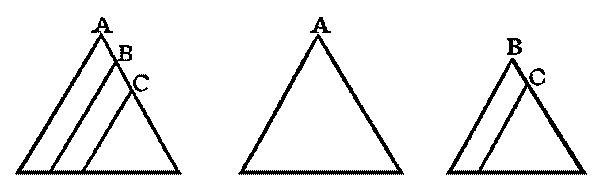
Barbara. Celarent.
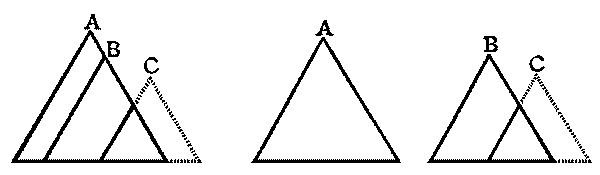
Darii. Ferio.
The first mood Barbara is formed by placing the
cards on top of each other, so that B is within the
margin of A, and C within the margin of B. This is
the syllogism, 'All B is A, all C is B, therefore all C
is A.'
Next let B and C be as above, but let A be wholly
apart from both. This is Celarent: 'No B is A, all
C is B, therefore no C is A.'
In Darii the whole of B is in A, but only a part of
C coincides with B. The syllogism is: 'All B is A,
some C is B, therefore some C is A.'
In Ferio A is again wholly separated from the
others, and C is only partially in B. Argument: 'No
B is A, some C is B, therefore some C is not A.'
It is to be remembered that all the other figures
and moods are reducible to the above figure of four
moods, so that the reduction applicable to the latter
is equally applicable to the former.
To reduce Darii to Barbara all that is necessary is
to ignore the dotted part of C. That is suggested by
the use of the word 'some,' which has a correlative
'all' or 'others.' But the correlative quantity does
not enter into the syllogism, and we know nothing
about it. It may not even exist. We are therefore
at liberty to substitute for 'some C' the name D, and
consider it an integer instead of a fraction. Then we
have the Barbara syllogism: 'All B is A, all D (=
some C) is B, therefore all D is A.' The phrase 'all
of some' is quite allowable: 'I met some firemen, all
of whom wore brass helmets.'
Ferio in the same manner is reduced to Celarent.
The dotted part of C is cut away, and the part really
significant in the syllogism is called E. Then 'No B
is A, all E is B, no E is A.'
Finally Celarent can be reduced to Barbara. B
cannot indeed be enclosed in A, but we assume the
existence of a whole having all the characters which
A has not, or having none of the characters which A
has. This is the whole F = Not-A. Then Celarent
becomes Barbara thus: 'All B is F, all C is B, therefore
all C is F.'
This demonstrates that there is only one fundamental
operation where syllogists suppose there are
at least four. The difference is wholly a matter of
language, and disappears on changing the names of
the terms and ignoring irrelevant suggestions. But
the syllogism, I repeat, does not represent the act of
reasoning, and its moods and figures are fit only to
be a game for children.
The theorems given for practice in logic books are
useful dialectic material, but they do not fully illustrate
all the categories. Logicians have no definite
categories, and in selecting examples they are unconsciously
biassed in favour of those that can be most
easily interpreted to signify classification. The really
generalistic examples are rare; the most are judgments
of inherence, admitted in virtue of the assumption
that inherent properties can—when it is needful
to preserve the traditional notion of predication—be
considered class-ideas. Theorems in perspection and
concretion we do not expect to find in logic books,
for these, in so far as they are distinct from association,
are categories peculiar to the Berkeleyan
philosophy.
Whately has the following example in association—'Lias
lies above red sandstone; red sandstone lies
above coal; therefore lias lies above coal.' No doubt
Whately would, in syllogising this, have changed the
propositions to 'Red sandstone is lying,' &c., and
have assumed that 'lying above coal' is a class to
which red sandstone belongs.
***
Here are examples of arguments in inherence—
A hot skin, quick pulse, intense thirst have invariably
in my experience coexisted with fever; the
person now examined exhibits these symptoms, so I
infer that he has a fever.
Great width of skull between the ears is invariably
found united with a destructive temperament; this
animal's skull is very wide between the ears; hence it
may be concluded that he has a destructive temperament.
Cloven feet belong universally—i.e. as far as our
experience goes—to horned animals; we may conclude
that this fossil animal, since it appears to have
had cloven feet, was horned.
| I. |
| Cloven feet |
inhere with horns |
Fossil animal appears to
have had cloven feet |
it is probable he
had horns |
When an architect, contemplating the fragments
of a building, restores it in imagination after the
analogy of similar buildings, we have an argument in
inherence. Such speculations are generally too long
and complex for analysis, but an instructive example
occurs in Canon Rawlinson's Seventh Oriental
Monarchy, which I will venture to quote, marking
the phrases that introduce or express the rational
idea. Observe the difference of style between this,
which is real practical reasoning, and the trivial
certainties of Syllogistic.
'What remains of this massive erection [the Takht-i-Khosru,
or palace of Chosroës Anushirwan, at
Ctesiphon] is a mere fragment, which, to judge from
the other extant Sassanian ruins, cannot have formed
so much as one fourth part of the original edifice.
Nothing has come down to our day but a single
vaulted hall on the grandest scale, together with the
mere outer wall of what no doubt constituted the
main facade of the building. The apartments, which,
according to all analogy, must have existed at the two
sides, and in the rear, of the great hall, some of which
should have been vaulted, have wholly perished.
Imagination may supply them from the Firuzabad, or
the Mashita palace; but not a trace, even of their
foundations, is extant; and the details consequently
are uncertain, though the general plan can scarcely
be doubted. At each side of the great hall were
probably two lateral ones, communicating with each
other, and capable of being entered either from the
hall or from the outer air. Beyond the great hall
was probably a domed chamber equalling it in width,
and opening upon a court, round which were a
number of moderate-sized apartments. The entire
building was no doubt an oblong square, of which the
shorter sides seem to have measured 370 feet. It
had at least three, and may not improbably have
had a larger number of entrances, since it belongs to
tranquil times and a secure locality.'
***
The most notable argument in the category of
concretion is undoubtedly the inference as to the
sphericity of the earth. Next is the sub-inference
by Columbus that China could be reached by sailing
westward from Portugal. If the syllogistic opinion
were valid—that a conclusion must be absolutely
true or absolutely false—the expedition of Columbus
was based on a fallacy. Most people think it was
eminently rational.
No one has seen the north or the south poles, and
the conviction that they could be realised, if certain
difficulties of transport were overcome, is a sub-inference
of the same character.
Here is a common type of inference in perspection—
| III. |
| That church |
is 100 yards off |
A man appears on
the roof of the ch. |
he is 100 ys. off |
And this—
| III. |
| That distant house |
is 60 ft. high |
It appears to be scaffolded
to a third of its height |
the scaffold is about
20 feet high |
In these cases we have not seen the man or the
scaffolding before, and have not measured the latter
or the distance to the former: the conclusions are
imaginary judgments fairly drawn from known premises.
***
The deciphering of hieroglyphics, cuneiform inscriptions,
and remains of other dead and forgotten
languages, is argument in causation. Examples
cannot conveniently be quoted even in a condensed
form, but this kind of reasoning is most interesting
dialectically from the slightness of the analogies that
are nevertheless found to give valid conclusions.
***
This is considered argument by Whately—
| I. |
| Louis |
is a good king |
The governor of France
is Louis |
therefore the g. of F. is
a good king |
The supposed case is a verbal proposition, serving to
rename the subject of precedent. There is no reasoning.
If we already know that Louis is a good king
and is also the governor of France (the given matters
of fact), there is no rational imagination involved in
rearranging these data as in the proposed conclusion.
***
'He who calls you a man speaks truly; he who
calls you a fool calls you a man; therefore he who
calls you a fool speaks truly.'—A fallacy of cross
reasoning, and the predicate is a class.
| I. |
| All fools |
are men |
| You are a man |
N. C. |
***
'Nothing is heavier than platina; feathers are
heavier than nothing; therefore feathers are heavier
than platina.'—A trivial equivoque.
The following is more subtle. 'Theft is a crime;
theft was encouraged by the laws of Sparta; therefore
the laws of Sparta encouraged crime.'—At most the
laws of Sparta encouraged one crime; but there is
a fallacy of equivocation. Taking things surreptitiously
from the person in whose possession they may
be, is not a crime—is not theft—in a society so communistic
as the Spartan. There it was encouraged as
an exercise in adroitness. This example shows the
necessity of knowing the matter of the argument.
***
'Warm countries alone produce wine; Spain is a
warm country; therefore Spain produces wine.'
| V. |
| Wine |
is p. in w. countries |
| Spain is a warm c. |
N. C. |
***
'Meat and drink are necessaries of life; the revenues
of Vitellius were spent in meat and drink;
therefore the revenues of Vitellius were spent on the
necessaries of life.'—Fallacy of composition: meat
and drink in moderate quantities are necessaries of
one life, but not food of every kind and in excessive
quantities.
***
'He who is most hungry eats most; he who eats
least is most hungry; therefore he who eats least
eats most.'—A fallacy of accident: he who eats least
does not at the same time eat most.
***
'Whatever body is in motion must move either in
the place where it is, or in the place where it is not;
neither of these is possible; therefore there is no such
thing as motion.'—It is an abuse of reason to
attempt to disprove matters of fact. The conclusion
of an argument being always problematical, it can
have no force against actual experience. We experience
motion, therefore it cannot be disproved.
***
'A wise lawgiver must either recognise the rewards
and punishments of a future state, or he must be able
to appeal to an extraordinary Providence, dispensing
them regularly in this life; Moses did not do the
former, therefore he must have done the latter'—(Warburton,
from Whately).—The reasoner omitted
to establish that Moses was a wise lawgiver, so that
the precedent does not apply to his case, except by
courtesy.
***
'That man is independent of the caprices of fortune
who places his chief happiness in moral and intellectual
excellence; a true philosopher is independent
of the caprices of fortune; therefore a true
philosopher is one who places his chief happiness in
moral and intellectual excellence.' An instance of
cross reasoning.
| I. |
| He who places |
is independent |
| Philosopher is independent |
N. C. |
***
'For those who are bent on cultivating their minds
by diligent study, the incitement of academical
honours is unnecessary; and for the idle it is ineffectual,
for such are indifferent to mental improvement;
therefore the incitement of academical honours
is either unnecessary or ineffectual.'
A fallacy of doubtful precedent: because two kinds of
students are not benefited by the hope of honours
it is prematurely concluded that no others exist who
may be so benefited.
***
'He who bears arms at the command of the magistrate
does what is lawful for a Christian; the Swiss in
the French service, and the British in the American
service, bore arms at the command of the magistrate;
therefore they did what is lawful for a Christian.'
The conclusion is valid so far as the information
given enables us to judge. If we know from other
sources that the Swiss and British who are referred
to, committed atrocities at the command of the magistrate,
the conclusion is a fallacy of accident. In
general it is lawful to obey a magistrate, but there
may be particular cases when it is not.
***
'Anyone who is candid will refrain from condemning
a book without reading it; some reviewers do not
refrain from this; therefore some reviewers are not
candid.'—This is cross reasoning and invalid. It is
one thing to say that the uncandid do not refrain, and
another that all who do not refrain are uncandid.
The conclusion is taken from the latter proposition,
which is not asserted.
***
'Everyone desires happiness; virtue is happiness;
therefore everyone desires virtue.'
| I. |
| Whoever desires an effect |
desires the cause of that effect |
Everyone desires the happiness
which is caused by virtue |
everyone desires virtue |
The case is manifestly untrue.
***
'He who has a confirmed habit of any kind of
action exercises no self-denial in the practice of that
action; a good man has a confirmed habit of virtue;
therefore he who exercises self-denial in the practice
of virtue is not a good man.'—(Arist. Eth. Bk. II.,
from Whately.)
| VI. |
I. |
He who has a
habit, &c. |
exercises no
self‑denial |
He who exercises no
self‑denial in the
practice of virtue |
is good |
A good man has
this habit with
respect to virtue |
He exercises no
self‑denial with
respect to virtue |
He who does
exercise &c. |
N. C. |
The conclusion drawn is fallacious, the second theorem
being based on contrast.
***
'According to theologians, a man must possess
faith to be acceptable to the Deity; now he who
believes all the fables of heathen mythology must
possess faith; therefore such a one must, according to
theologians, be acceptable to the Deity.'
'Faith' is ambiguous, meaning in the precedent,
spiritual aspiration, and in the case ignorant
credulity.
***
'No evil should be allowed that good may come of
it; all punishment is an evil; therefore no punishment
should be allowed that good may come of it.'—'Evil'
is ambiguous, meaning wrong-doing in the
precedent and pain in the case; the conclusion is
therefore fallacious.
***
'The principles of justice are variable; the appointments
of nature are invariable; therefore the
principles of justice are no appointments of nature.'—(Arist.
Eth. Bk. V., from Whately.) The terms 'principles
of justice' and 'nature' require to be defined.
It might be said that justice is one principle, everywhere
and always the same, and that only its embodiments
in law and custom are variable.
***
'What happens every day is not improbable; some
things, against which the chances are many thousands
to one, happen every day; therefore some things
against which the chances are many thousands to
one, are not improbable.'—A fallacy of division: that
improbable things in general happen every day does
not render the occurrence of any one a probable
event.
***
'Protection from punishment is plainly due to the
innocent; therefore, as you maintain that this person
ought not to be punished, it appears that you are
convinced of his innocence.'—A fallacy of cross reasoning.
| I. |
| Innocent persons |
deserve protection |
| This person deserves protection |
N. C. |
***
'He who cannot possibly act otherwise than he
does, has neither merit nor demerit in his action; a
liberal and benevolent man cannot possibly act otherwise
than he does in relieving the poor; therefore
such a man has neither merit nor demerit in his
action.'—To 'have merit in an action' is scarcely
intelligible. A man's merit is in his character, and
his actions are effects and signs of character.
***
'All the fish that the net inclosed were an indiscriminate
mixture of various kinds; those that were
set aside and saved as valuable were fish that the net
inclosed; therefore those that were set aside and
saved as valuable were an indiscriminate mixture
of various kinds.'
An instance of the fallacy of division: what is true
of the whole contents of the net is not necessarily true
of a portion of the contents.
***
'A desire to gain by another's loss is a violation of
the tenth commandment; all gaming, therefore, since
it implies a desire to profit at the expense of another,
involves a breach of the tenth commandment.'—A
valid argument in inherence.
| All desire to gain by, &c. |
violates |
| Gaming involves this kind of desire |
it violates |
***
'He that destroys a man who usurps despotic
power in a free country, deserves well of his countrymen;
Brutus destroyed Caesar, who usurped despotic
power in Rome; therefore he deserved well of the
Romans.'—If Rome was 'a free country' the conclusion
is valid.
***
'No fish suckles its young; the whale suckles its
young; the whale is therefore no fish.'
| What suckles |
is no-fish |
| Whale suckles |
it is no-fish |
***
'This explosion must have been occasioned by
gunpowder, for nothing else would have possessed
sufficient force.'
| V. |
Explosions of a certain
destructiveness |
can only be occasioned by
gunpowder |
This explosion has that
destructiveness |
it must have been occasioned
by gunpowder |
***
'Every man should be moderate, for excess will
cause disease.'
| V. |
| To avoid disease |
moderation is requisite |
Every man should avoid
disease |
every man should be
moderate |
***
'Blessed are the merciful, for they shall obtain
mercy.'
| V. |
| To obtain mercy |
is blessed |
Those who show mercy
obtain mercy |
they must be considered
blessed |
***
'Some speculative men are unworthy of trust; for
they are unwise, and no unwise man can be trusted.'
| I. |
| Unwise men |
are not to be trusted |
| Some speculative men
are unwise |
they are not to be trusted |
***
'No idle person can be a successful writer of history;
therefore Hume, Macaulay, Hallam and Grote
must have been industrious.'
| I. |
| Successful historians |
are not idle persons |
Hume and the rest were
successful historians |
they cannot have been
idle persons |
***
'Lithium is an element; for it is an alkali-producing
substance, which is a metal, which is an element.'—Fallacy
of no-application.
Every alk. prod.
subst. |
is a metal |
Every metal |
is an element |
| L. is alk. p. subst. |
it is a metal |
L. is a metal |
it is an element |
***
'Rational beings are accountable for their actions;
brutes not being rational, are therefore exempt from
responsibility.'
| I. |
| Rational beings |
are accountable |
| Brutes not rational |
N. C. |
***
'Whatever tends to withdraw the mind from pursuits
of a low nature deserves to be promoted; classical
learning does this, since it gives us a taste for
intellectual enjoyments; therefore it deserves to be
promoted.'
| V. |
I. |
| Whatever gives |
tends |
Whatever tends |
deserves |
| Learning gives |
it tends |
Learning tends |
it deserves |
***
'Bacon was a great lawyer and statesman; and as
he was also a philosopher, we may infer that any
philosopher may be a great lawyer and statesman.'—The
theorem infers the general inherence of philosophy
with eminence in law and politics, from the
single instance of Bacon: it is evidently a fallacy of
doubtful precedent.
***
'Snowdon is the highest mountain in England and
Wales. Snowdon is not so high as Ben Nevis. Therefore
the highest mountain in England and Wales is
not so high as Ben Nevis.'
This means: 'the highest mountain in England and
Wales is called Snowdon, and it is not so high as Ben
Nevis.' The apparent conclusion merely repeats
a part of the information given already. There is no
case. The following is a theorem of the same
kind—
'Lithium is the lightest metal known. Lithium is
the metal indicated by one bright line in the spectrum.
Therefore the lightest metal known is the metal indicated
by a spectrum of one bright line.'
***
'If ye were Abraham's children, ye would do the
works of Abraham.'
| VI. |
| Abraham's children |
do his works |
| If ye were his children |
ye would do his works |
***
'Since all metals are elements, the most rare of all
the metals must be the most rare of all the elements.'—There
is a suppressed precedent to the effect that
the most rare individual of a species must be the
most rare of its genus, which may or may not be
true.
***
'All vice is odious; but avarice is a vice; for it
makes men slaves; therefore avarice is odious.'
| V. |
I. |
| Whatever enslaves |
is a vice |
All vice |
is odious |
| Avarice enslaves |
it is a vice |
Avarice is a vice |
it is odious |
***
'Bucephalus is a horse; a horse is a quadruped; a
quadruped is an animal; an animal is a substance;
therefore Bucephalus is a substance.'
| All horses |
are quads. |
Quads. |
animals |
Animal |
substance |
| Bu. is a h. |
he is q. |
B. is quad. |
he is an. |
Bu. is an. |
he is subst. |
This is what logicians call a Sorites. There may
be a chain of valid arguments, in which the conclusion
of one is precedent or case of the next; but the
propositions just quoted do not make an argument,
being merely a string of classifications. If we know
what Bucephalus and substance mean, we know by
perception that Bucephalus is a substance.
***
'Every being is then happy when it acquires the
proper perfection of its nature; and consequently all
vital beings are capable of receiving felicity that are
capable of arriving at the perfection of their nature.'
| I. |
| Every being that acquires |
is happy |
All vital beings capable
of acquiring |
must be capable of receiving
felicity |
This is perilously near tautology; it can be saved
only by assuming that 'every being capable of happiness'
is a more extensive class than 'all vital
beings capable of arriving at the perfection of their
nature.'
***
'The soul's debility is not owing to her lapse into
matter; for as this lapse is voluntary, the soul must
have sinned prior to her descent.'
| VI. |
| Voluntary lapse |
proves prior sin |
| Soul's lapse is v. |
her debility must have been
antecedent to lapse |
***
Cogito ergo sum.—
| I. |
| Whatever thinks |
is |
| I think |
I must believe that I am |
That we exist is the most certain fact we know: it
cannot be strengthened by any argumentation. If
we can doubt that we are, we can with better reason
doubt that we think.
***
Here is Hamilton's example of a disjunctive syllogism,
which he considered a valid argument—'The
hope of immortality is either a rational expectation
or an illusion; but the hope of immortality is a
rational expectation; therefore the hope of immortality
is not an illusion.' It is a flagrant tautologism.
***
'If man be not a morally responsible being, he
must want either the power of recognising moral good
(as an intelligent agent), or the power of willing it
(as a free agent); but man wants neither of these
powers; therefore man is a morally responsible
being.'
Adopted by Hamilton from Krug and given as valid.
It is first a fallacy of contrast, and if amended in this
respect it would still be a fallacy of tautology.
| I. |
| If m. lacked certain pp. |
he would be irresp. |
| He does not lack these pp. |
N. C. |
***
'If Aeschines joined in the public rejoicings, he is
inconsistent; if he did not, he is unpatriotic; but he
either joined, or not, therefore he is either inconsistent
or unpatriotic.'—An excellent specimen of logicians'
logic: on a par with this—If it is fine weather, I go;
if it rains, I stay; it must either rain or be fine, therefore
I must either go or stay.
***
'If the world were eternal, the most useful arts,
such as painting, &c. would be of unknown antiquity:
and on the same supposition there would be records
long prior to the Mosaic; and likewise the sea and
land in all parts of the globe might be expected to
maintain the same relative situations now as formerly:
but none of these is the fact: therefore the world is
not eternal.'
If some things were different
from what they are |
the w. would be eternal |
| They are not different |
N. C. |
***
'If the world existed from eternity, there would be
records prior to the Mosaic; and if it were produced
by chance, it would not bear marks of design: there
are no records prior to the Mosaic, and the world
does bear marks of design: therefore it neither existed
from eternity, nor is it the work of chance.'
Two theorems are here mixed together, both fallacies
of contrast—
| Existence of records |
would prove the w. etern. |
| Records do not exist |
the w. is non-eternal |
| Non‑existence of marks |
wd. pr. w. made by chance |
| The marks exist |
w. was not made by chance |
***
'If this man were wise, he would not speak irreverently
of Scripture in jest; and if he were good he
would not do so in earnest; but he does it, either in
jest or earnest; therefore he is either not wise or not
good.'
As it stands this is quite circular, but it might be
rendered valid by generalisation:—
| VI. |
To speak irrev. of Scr. in
jest or earnest |
indicates that a man is not
wise or not good |
| This man does it |
we must infer that he is not
w. or not g. |
***
'If virtue were a habit worth acquiring, it must
ensure either power, or wealth, or honour, or pleasure;
but virtue ensures none of these; therefore
virtue is not a habit worth attaining.' Fallacy of
contrast—
| I. |
| What ensures |
is worth |
| V. does not ensure |
N. C. |
***
'If men are not likely to be influenced in the
performance of a known duty by taking an oath to
perform it, the oaths commonly administered are
superfluous; if they are likely to be so influenced,
everyone should be made to take an oath to behave
rightly throughout his life; but one or other must
be the case; therefore either the oaths commonly
administered are superfluous, or everyone should be
made to take an oath to behave rightly throughout
his life.'—This will be more intelligible if contracted
thus: If oaths fail to influence they are superfluous;
if they influence they should be obligatory; but they
either influence or do not; therefore they are either
superfluous or should be obligatory. There is no
argument; the alternative conclusions merely repeat
the alternative precedents.
***
'If virtue is voluntary, vice is voluntary; but virtue
is voluntary; therefore so is vice.' (Arist. Eth. Bk. III.
quoted by Whately.) This is a circular way of saying
that we believe it to be a fact that vice is voluntary.
The argumentative form is probably supposed to give
the assertion greater weight than it would have if
expressed as a perceptual judgment.
***
This is valid argument, according to Hamilton—'If
man were suited to live out of society, he would
either be a god or a beast; but man is neither
a god nor a beast; therefore he is not suited to
live out of society.'—It has faults of contrast and
tautology.
| I. |
| Only gods and beasts |
are suited |
| Man is neither g. nor b. |
N. C. |
***
'If iron is impure, it is brittle; but this iron is
impure; therefore it is brittle.'—A valid dogmatic
argument.
| I. |
| Impure iron |
is brittle |
| This iron is imp. |
it must be br. |
***
'If the weather is fine, we shall go into the country;
now the weather is fine, therefore we shall go into the
country.'—We never get beyond the simple judgment
that our going into the country is associated with fine
weather.
***
The following is valid:—'As often as the weather
is fine, my brother has a habit of going into the
country; if the weather be fine to-morrow I infer
that he will go into the country.' Here a particular
hypothetical case is illustrated by reference to a
general habit.
***
'As often as the weather is fine my brother goes
into the country; if it be not fine to-morrow I conclude
that he will not go into the country.'—A fallacy
of contrast: we are not informed in the antecedents
what the brother does on wet days.
***
'If there are sharpers in the company we ought not
to gamble; but there are no sharpers in the company;
therefore we ought to gamble.'
| I. |
| Presence of sh. |
forbids to gamble |
| Absence of sh. |
N. C. |
***
'Logic as it was cultivated by the schoolmen
proved a fruitless study; therefore logic as it is
cultivated at the present day must be a fruitless
study likewise.'—We must take the conclusion as
valid, until we know in what respects modern logic
is superior to scholastic logic.
***
'Few treatises of science convey important truths,
without any admixture of error, in a perspicuous and
interesting form: therefore though a treatise would
deserve much attention which should possess such
excellence, it is plain that few treatises of science do
deserve much attention.'
This means no more than that treatises of a certain
excellence would deserve attention, and that there are
few of them. There is no argument.
***
'Some objects of great beauty answer no other
purpose but to gratify the sight: many flowers have
great beauty; and many of them accordingly answer
no other purpose than to gratify the sight.'
| I. |
| Some obj. which answer |
are beautiful |
| Many flowers are beaut. |
N. C. |
***
'None but Whites are civilised; the ancient Germans
were Whites; therefore they were civilised.'
| I. |
| All civilised nations |
are Whites |
| Anc. Ger. were Wh. |
N. C. |
***
'Wilkes was a favourite with the populace; he who
is a favourite with the populace must understand how
to manage them; he who understands how to manage
them must be well acquainted with their character;
he who is well acquainted with their character must
hold them in contempt; therefore Wilkes must have
held the populace in contempt.'
| Favourites |
must kn. how to
manage |
He who kn. how
to manage |
must be
acquainted |
He who is acq. |
must despise |
| W. was a fav. |
he knew how to man. |
W. knew |
he was acq. |
W. was acq. |
he must have desp. |
***
'Something has existed from eternity. For since
something now is, it is manifest that something always
was. Otherwise the things that now are must have
risen out of nothing, absolutely and without cause.
Which is a plain contradiction in terms. For to say
a thing is produced, and yet that there is no cause at
all of that production, is to say that something is
effected when it is effected by nothing, that is, at the
same time when it is not effected at all. Whatever
exists has a cause of its existence, either in the
necessity of its own nature, and then it must have
been of itself eternal: or in the will of some other
being, and then that other being must, at least in the
order of nature and causality, have existed before it.'
In this theorem we have a case—'Something is';
and a conclusion—'Something has existed from
eternity.' The reasoner seeks a credible or conceivable
precedent by which to connect that conclusion
with the case.
We are offered a choice of two theorems. The
first is untenable, for we have never had the experience
that is given as precedent; it is also tautological, as
the 'something' of the case is the 'whatever' of the
precedent.
| V. |
Whatever exists in the necessity
of its own nature |
has existed from eternity |
'Something' exists in the necessity
of its own nature |
it has existed from eternity |
It is not inconceivable that something should be
self-existent, but we know nothing as to its being
eternal. We are not familiar enough with self-existent
things and eternal things to warrant us in asserting
dogmatically that where the first quality is, there also
must be the second.
The next theorem is that everything must be
caused, and that causation involves a regressum ad
infinitum. On this principle there must have been
things for an eternity backwards. According to the
theory of causation given in section xxvii, a true
beginning is reached when we discover the motive,
design and power that produced an effect. It is not
necessary to ask next what caused that motive, design
and power. The infinite regress is applicable only to
material sequence, in which there is no proper beginning
or end. The author of the above argument
seems to be trying to combine the notion of causation
by will with that of infinite regress. But his language
is too obscure to make it certain what he means
exactly.
***
The three following theorems—in a diluted form—occur
in an otherwise excellent work on the politics
and social life of the ancient Greeks.
'The Athenians who opposed the union of Greece
and Macedonia were old men, and the result was
mischievous; other similar instances are found in
history; therefore the government of old men is
always mischievous.'—A fallacy of false generality.
Everybody knows that some old men have been wise
governors. Cicero, from his experience, drew the
opposite conclusion—that the only safe rulers were old
men.
'All old political leaders are mischievous; Gladstone
is old; therefore he is to be considered politically
mischievous.'—Even were the precedent not
false the argument is superfluous, for the effect of
Gladstone's politics is now matter of fact or history.
'Gladstone is politically mischievous; he advocates
Home Rule for Ireland; therefore Irish Home Rule
must be mischievous.'—A fallacy of division: a
political leader might on the whole be mischievous,
but his measures need not on that account be each
and every one mischievous.
If dialectic were taught generally and on a rational
method, a responsible author would avoid bad reasoning
of this sort as carefully as he avoids bad grammar,
vulgar imagery, or faulty arithmetic.
The book cover was created by the transcriber and placed in the Public Domain.
Punctuation has been corrected without comment.
The English spelling in this book is that found in the Oxford English Dictionary (OED).
Page 78: 'comformable' corrected to 'conformable'
"The following is an argument conformable to the above rules."
Page 99: "un-extended, im-material, im-ponderable"
The author used hyphens in the above words for emphasis.
Other instances of hyphens used for emphasis occur in the book.
Other instances of hyphenated and unhyphenated words occur in the book.
Page 216: 'inclose is a variant of 'enclose'.
"All the fish that the net inclosed were an indiscriminate mixture...."
Page 164: 'premiss' is a variant of 'premise' (OED), which occurs more frequently in the book.
Page 216: 'inclose is a variant of 'enclose' (OED).
"All the fish that the net inclosed were an indiscriminate mixture...."
Pages 214, 225: Html code (& # 8209; = ‑) has been used as a non-breaking hyphen in the syllogistic examples
to avoid the text in the tables from migrating to the line below.
This works in most browsers, and Kindle and similar devices, but Epub renders the code as X in a box (but the line does not break).