New original cover art included with this eBook is granted to the public domain.
SADI CARNOT
At the Age of 17.
(From a Portrait by Bailly, 1813.)
FROM THE ORIGINAL FRENCH OF
N.-L.-S. CARNOT,
Graduate of the Polytechnic School.
ACCOMPANIED BY
AN ACCOUNT OF CARNOT’S THEORY.
By SIR WILLIAM THOMSON (LORD KELVIN).
EDITED BY
R. H. THURSTON, M.A., LL.D., Dr.Eng’g;
Director of Sibley College, Cornell University;
“Officier de l’Instruction Publique de France,”
etc., etc., etc.
SECOND, REVISED, EDITION.
FIRST THOUSAND.
NEW YORK:
JOHN WILEY & SONS.
London: CHAPMAN & HALL, Limited.
1897.
Copyright, 1890,
Robert H. Thurston.
ROBERT DRUMMOND, ELECTROTYPER AND PRINTER, NEW YORK.
DEDICATED
TO
Sadi Carnot,
President of the French Republic,
That distinguished member of the Profession of Engineering whose whole Life has been an Honor to his Profession and to his Country;
AND WHO, ELEVATED TO THE HIGHEST OFFICE WITHIN THE GIFT OF THE
French Nation,
has proven by the quiet dignity and the efficiency with which he has performed his august duties that he is a worthy member of a noble family, already rendered famous by an earlier Sadi Carnot, now immortal in the annals of science, and is himself deserving of enrolment in a list of great men which includes that other distinguished engineer, our own first president,
The raison d’être of the following translation of
the famous work of Carnot is not the usual one,
either with the Publishers or the Editor—expectation
of gain in either purse or fame. Neither
could reasonably be anticipated from the reproduction
of the work of an author of more than a half-century
ago, in a field then unrecognized, and
to-day familiar to but few; and especially when,
as is in this case the fact, the work itself has been
long out of date as a scientific authority, even had
it ever held such a position. It could not be presumed
that a very large proportion of even the
men of science of the English-speaking world
would be sufficiently familiar with the subject, or
interested in its origin, to purchase such a relic of
a primitive period as is this little book. Nor
could the translation of the work, or the gathering
together by the Editor of related matter, be
supposed likely to be productive of any form of
compensation. The hook is published as matter
of limited but most intense scientific interest,
and on that score only.
viiiIt has seemed to the Editor and to the Publishers
that the product of the wonderful genius of
Carnot,—the great foundation-stone of one of the
most marvellous and important of modern sciences,
the first statement of the grand though simple laws
of Thermodynamics,—as illustrated in this one little
treatise, should be made accessible to all who
desire to study the work in English, and preserved,
so far as its publication in this form could accomplish
it, as a permanent memorial, in a foreign
tongue, of such grand truths, and of such a great
genius as was their discoverer. It is with this
purpose that Publishers and Editor have cooperated
in this project.
The book consists, as will be seen on inspection,
of the translation of Carnot’s Réflexions sur la
Puissance Motrice du Feu, preceded by a notice
written by the Editor calling attention to its
remarkable features, and its extraordinary character
as the product of a most remarkable genius;
and by a biographical sketch of the great author,
written by his brother, Mons. Hyppolyte Carnot,
which sketch we find in the French copy of the
work as published by Gauthier-Villars, the latest
reproduction of the book in the original tongue.
To the main portion of the book, Carnot’s Réflexions,
is appended the celebrated paper of Sir
ixWilliam Thomson, his “Account of Carnot’s
Theory,” in which that great physicist first points
out to the world the treasure so long concealed,
unnoticed, among the scientific literature, already
mainly antiquated, of the first quarter of the nineteenth
century. The distinguished writer of this
paper has kindly interested himself in the scheme
of the Editor, and has consented to its insertion
as a natural and desirable commentary upon the
older work, and especially as exhibiting the relations
of the fundamental principles discovered and
enunciated by Carnot to the modern view of the
nature of thermodynamic phenomena—relations
evidently understood by that writer, but not by
the leaders of scientific thought of his time, and
therefore ignored by him in the construction of
his new science.
The Appendix contains a number of Carnot’s
own notes, too long to be inserted in the body of
the paper in its present form, and which have
therefore been removed to their present location
simply as a matter of convenience in bookmaking.
The dedication of the work to the grandnephew
of the author, who by a singular coincidence
happens to-day to occupy the highest position
that any citizen can aspire to reach in that
xnow prosperous Republic, will be recognized as in
all respects appropriate by every reader of the work
of the earlier Sadi Carnot who is familiar with
the character, the history, the attainments, the
achievements, of the later Sadi Carnot in so
many and widely diverse fields. The Carnot
talent and the Carnot character are equally observable
in both men, widely as they are separated
in time and in the nature of their professional
labors. Both are great representatives of a noble
family, whose honor and fame they have both
splendidly upheld.
The Publishers offer this little book to its
readers as a small, yet in one sense not unimportant,
contribution to the great cause of modern
science, as a relic, a memorial, a corner-stone.
NOTE BY THE EDITOR.
xi
“Je me suis proposé de grands desseins dans ce
petit ouvrage,” as Bernardin de Saint-Pierre says in
the preface to his pathetic story of Paul et Virginie.
I have sought to present to the great English-speaking
world the work of a genius hitherto only
known to a few men of science, and not well known,
even among the people of France, for whose credit
he has done so much. In placing before the readers
of this translation his book—small of size but
great in matter as it is—I feel that I have accomplished
an easy task, but one of real importance.
I have been asked, as Corresponding Member for
the United States of the Société des Ingénieurs
Civils de France, to communicate to my colleagues
scientific and professional memoirs and whatever
may be of interest to them—“en un mot, que nous
resserrions les liens qui font des ingénieurs en général
une seule famille.” That were a pleasant
task; but a grander and a more agreeable one still
is that of bringing “nearer in heart and thought”
the members of that still larger community, the
men of science of the world, and of weaving still
xiimore firmly and closely those bonds of kindly
thought and feeling which are growing continually
more numerous and stronger as the nations are
brought to see that humanity is larger and more
important than political divisions, and that the
labors of educated men and of the guiding minds
in the great industries are constantly doing more
to promote a true brotherhood of mankind than
ever have, or ever can, the greatest statesmen.
When the wonderful intellectual accomplishments
of men like the elder Sadi Carnot become
known and appreciated by the world, much more
will have been accomplished in this direction. It
is perhaps from this point of view that the importance
of such work will be most fully recognized.
When the little treatise which is here for the first
time published in English becomes familiar to
those for whom it is intended, it will be, to many
at least, a matter of surprise no less than pleasure
to discover that France has produced a writer on
this now familiar subject whose inspiration anticipated
many of the principles that those founders
of the modern science, Rankine and Clausius,
worked out through the tedious and difficult
methods of the higher mathematics, and which
were hailed by their contemporaries as marvellous
discoveries.
NOTE TO SECOND EDITION.
xiii
The present edition of this little work is improved
by the removal of a few errata observed in
the first issue, and by the addition of a recent and
excellent portrait of Lord Kelvin, as a frontispiece
to his era-making paper, at page 127. This picture,
taken within the last year, is thought by the
friends of its distinguished subject to be one of the
best yet produced. That it is satisfactory to him
and his friends is indicated by the fact that the
original of this reproduction was presented to the
writer by Lady Kelvin, in 1895, immediately after
it was taken, and the autograph supplied by her
distinguished husband. The Editor takes this
occasion to acknowledge cordially the letters of
appreciation and commendation received from
those who have agreed with M. Haton de la Goupillière
that the translation of Carnot and its
publication in this manner, with the famous paper
of Lord Kelvin, will be considered as worthy of
approval by English-speaking readers as well as
“appreciated by the whole French nation.”
I. THE WORK OF SADI CARNOT.
1
By the Editor.
Nicolas-Léonard-Sadi Carnot was, perhaps,
the greatest genius, in the department of physical
science at least, that this century has produced.
By this I mean that he possessed in highest degree
that combination of the imaginative faculty with
intellectual acuteness, great logical power and capacity
for learning, classifying and organizing in
their proper relations, all the facts, phenomena,
and laws of natural science which distinguishes
the real genius from other men and even from the
simply talented man. Only now and then, in the
centuries, does such a genius come into view.
Euclid was such in mathematics; Newton was
such in mechanics; Bacon and Compte were such
in logic and philosophy; Lavoisier and Davy were
such in chemistry; and Fourier, Thomson, Maxwell,
2and Clausius were such in mathematical
physics. Among engineers, we have the examples
of Watt as inventor and philosopher, Rankine
as his mathematical complement, developing the
theory of that art of which Watt illustrated the
practical side; we have Hirn as engineer-experimentalist,
and philosopher, as well; Corliss as inventor
and constructor; and a dozen creators of
the machinery of the textile manufactures, in
which, in the adjustment of cam-work, the highest
genius of the mechanic appears.
But Carnot exhibited that most marked characteristic
of real genius, the power of applying such
qualities as I have just enumerated to great purposes
and with great result while still a youth.
Genius is not dependent, as is talent, upon the
ripening and the growth of years for its prescience;
it is ready at the earliest maturity, and
sometimes earlier, to exhibit its marvellous works;
as, for example, note Hamilton the mathematician
and Mill the logician; the one becoming
master of a dozen languages when hardly more
than as many years of age, reading Newton’s Principia
at sixteen and conceiving that wonderful
system, quaternions, at eighteen; the other competent
to begin the study of Greek at three, learning
Latin at seven and reading Plato before he
3was eight. Carnot had done his grandest work of
the century in his province of thought, and had
passed into the Unseen, at thirty-six; his one little
volume, which has made him immortal, was written
when he was but twenty-three or twenty-four.
It is unnecessary, here, to enter into the particulars
of his life; that has been given us in ample
detail in the admirable sketch by his brother
which is here republished. It will be quite sufficient
to indicate, in a few words, what were the
conditions amid which he lived and the relation
of his work to that great science of which it was
the first exposition.
At the time of Carnot, the opinion of the
scientific world was divided, as it had been for
centuries, on the question of the true nature of
heat and light, and as it still is, to a certain extent,
regarding electricity. On the one hand it
was held by the best-known physicists that heat
is a substance which pervades all bodies in greater
or less amount, and that heating and cooling are
simply the absorption and the rejection of this
“imponderable substance” by the body affected;
while, on the other hand, it was asserted by a
small but increasing number that heat is a
“mode of motion,” a form of energy, not only
imponderable, but actually immaterial; a quality
4of bodies, not a substance, and that it is identical,
in its nature, with other forms of recognizable
energy, as, for example, mechanical energy. A
quarter of a century before Carnot wrote, the experiments
of Rumford and of Davy had been crucial
in the settlement of the question and in the
proof of the correctness of the second of the two
opposing parties; but their work had not become
so generally known or so fully accepted as to be
acknowledged as representative of the right views
of the subject. The prevalent opinion, following
Newton, was favorable to the first hypothesis;
and it was in deference to this opinion that Carnot
based his work on an inaccurate hypothesis;
though, fortunately, the fact did not seriously
militate against its value or his credit and fame.
“With true philosophical caution, he avoids
committing himself to this hypothesis; though he
makes it the foundation of his attempt to discover
how work is produced from heat.”[1]
The results of Carnot’s reasoning are, fortunately,
mainly independent of any hypothesis as
to the nature of heat or the method or mechanism
of development and transfer or transformation of
its energy. Carnot was in error in assuming no
5loss of heat in a completed cycle and in thus ignoring
the permanent transformation of a definite
proportion into mechanical energy; but his proposition
that efficiency increases with increase of
temperature-range is still correct; as is his assertion
of its independence of the nature of the
working substance.
Carnot’s “Réflexions sur la Puissance Motrice
du Feu,” published in 1824, escaped notice at the
time, was only now and then slightly referred to
later, until Clapeyron seized upon its salient ideas
and illustrated them by the use of the Watt diagram
of energy, and might, perhaps, have still remained
unknown to the world except for the fact
that Sir William Thomson, that greatest of modern
mathematical physicists, fortunately, when still a
youth and at the commencement of his own great
work, discovered it, revealed its extraordinary
merit, and, readjusting Carnot’s principles in accordance
with the modern views of heat-energy,
gave it the place that it is so well entitled to in
the list of the era-making books of the age. But
it still remained inaccessible to all who could not
find the original paper until, only a few years
since, it was reprinted by Gauthier-Villars, the
great publishing house of Paris, accompanied by a
biographical sketch by the younger brother, which
6it has been thought wise to reproduce with the
translation of Carnot’s book. In making the
translation, also, this later text has been followed;
and now, for the first time, so far as is known to
the writer, the work of Carnot is made accessible
to the reader in English.
The original manuscript of Carnot has been deposited
by his brother in the archives of the
French Academy of Sciences, and thus insured
perpetual care. The work of Carnot includes not
only the treatise which it is the principal object of
this translation to give to our readers, but also a
considerable amount of hitherto unpublished matter
which has been printed by his brother, with
the new edition of the book, as illustrative of the
breadth and acuteness of the mind of the Founder
of the Science of Thermodynamics.
These previously unpublished materials consist
of memoranda relating to the specific heats of
substances, their variations, and various other
facts and data, and principles as well; some of
which are now recognized as essential elements of
the new science, even of its fundamental part.
The book is particularly rich in what have been
generally supposed to be the discoveries of later
writers, and in enunciations of principles now
recognized as those forming the base and the supporting
7framework of that latest of the sciences.
As stated by Tait, in his history of Thermodynamics,
the “two grand things” which Carnot originated
and introduced were his idea of a “cycle”
and the notion of its “reversibility,” when perfect.
“Without this work of Carnot, the modern theory
of energy, and especially that branch of it which
is at present by far the most important in practice,
the dynamical theory of heat, could not have
attained its now enormous development.” These
conceptions, original with our author, have been,
in the hands of his successors, Clausius and other
Continental writers, particularly, most fruitful of
interesting and important results; and Clapeyron’s
happy thought of so employing the Watt diagram
of energy as to render them easy of comprehension
has proved a valuable aid in this direction.
The exact experimental data needed for numerical
computations in application of Carnot’s principles
were inaccessible at the date of his writing;
they were supplied, later, by Mayer, by Colding,
by Joule, and by later investigators. Even the
idea of equivalence, according to Hypolyte Carnot,
was not originally familiar to the author of
this remarkable work; but was gradually developed
and defined as he progressed with his philosophy.
It is sufficiently distinctly enunciated in his later
8writings. He then showed a familiarity with
those notions which have been ascribed generally
to Mayer and which made the latter famous, and
with those ideas which are now usually attributed
to Joule with similar result. He seems actually to
have planned the very kind of research which Joule
finally carried out. All these advanced views
must, of course, have been developed by Carnot
before 1832, the date of his illness and death, and
ten or fifteen years earlier than they were made
public by those who have since been commonly
considered their discoverers. These until lately
unpublished notes of Carnot contain equally well-constructed
arguments in favor of the now accepted
theory of heat as energy. While submitting to
the authority of the greatest physicists of his time,
and so far as to make their view the basis of his
work, to a certain extent, he nevertheless adhered
privately to the true idea. His idea of the equivalence
of heat and other forms of energy was as distinct
and exact as was his notion of the nature of
that phenomenon. He states it with perfect accuracy.
In making his measures of heat-energy, he assumes
as a unit a measure not now common, but
one which may be easily and conveniently reduced
to the now general system of measurement. He
9takes the amount of power required to exert an
energy equal to that needed to raise one cubic
meter of water through a height of one meter,
as his unit; this is 1000 kilogrammeters, taken
as his unit of motive power; while he says that
this is the equivalent of 2.7 of his units of
heat; which latter quantity would be destroyed
in its production of this amount of power, or
rather work. His unit of heat is thus seen
to be 1000 ÷ 2.7, or 370 kilogrammeters. This
is almost identical with the figure obtained by
Mayer, more than ten years later, and from
presumably the same approximate physical data,
the best then available, in the absence of a Regnault
to determine the exact values. Mayer obtained
365, a number which the later work of
Regnault enabled us to prove to be 15 per cent.
too low, a conclusion verified experimentally by
the labors of Joule and his successors. Carnot was
thus a discoverer of the equivalence of the units of
heat and work, as well as the revealer of the principles
which have come to be known by his name.
Had he lived a little longer, there can be little
doubt that he would have established the facts, as
well as the principles, by convincing proof. His
early death frustrated his designs, and deprived the
10world of one of its noblest intellects, just when it
was beginning its marvellous career.
The following sentence from Carnot illustrates
in brief his wonderful prescience; one can hardly
believe it possible that it should have been written
in the first quarter of the nineteenth century:
“On peut donc poser en thèse générale que la puissance
motrice est en quantité invariable dans la
Nature; qu’elle n’est jamais, à proprement parler,
ni produite, ni détruite. A la vérité, elle change
de forme, c’est a dire qu’elle produit tantôt un genre
de mouvement, tantôt un autre; mais elle n’est
jamais anéantie.” It is this man who has probably
inaugurated the development of the modern
science of thermodynamics and the whole range of
sciences dependent upon it, and who has thus made
it possible to construct a science of the energetics
of the universe, and to read the mysteries of every
physical phenomenon of nature; it is this man who
has done more than any contemporary in his field,
and who thus displayed a more brilliant genius
than any man of science of the nineteenth century:
yet not even his name appears in the biographical
dictionaries; and in the Encyclopædia Britannica
it is only to be found incidentally in the article on
Thermodynamics.
Throughout his little book, we find numerous
11proofs of his clearness of view and of the wonderful
powers of mind possessed by him. He opens
his treatise by asserting that “C’est à la chaleur
que doivent être attribués les grands mouvements
qui frappent nos regards sur la terre; c’est à elle
que sont dues les agitations de l’atmosphère, l’ascension
des nuages, la chute des pluies et des autres
météores, les courants d’eau qui sillonnent la surface
du globe et dont l’homme est parvenue à employer
pour son usage une faible partie; enfin les tremblements
de terre, les éruptions volcaniques reconnaissent
aussi pour cause la chaleur.”
Carnot was the first to declare that the maximum
of work done by heat, in any given case of application
of the heat-energy, is determined solely by
the range of temperature through which it fell in
the operation, and is entirely independent of the
nature of the working substance chosen as the
medium of transfer of energy and the vehicle of
the heat. His assumption of the materiality of
heat led, logically, to the conclusion that the
same quantity of heat was finally stored in the
refrigerator as had, initially, left the furnace, and
that the effect produced was a consequence of a fall
of temperature analogous to a fall of water; but,
aside from this error—which he himself was evidently
12inclined to regard as such,—his process and
argument are perfectly correct.[2]
Throughout his whole work are distributed condensed
assertions of principles now well recognized
and fully established, which indicate that he not
only had anticipated later writers in their establishment,
but that he fully understood their real
importance in a theory of heat-energy and of heat-engines.
In fact, he often italicizes them, placing
them as independent paragraphs to more thoroughly
impress the reader with their fundamental
importance. Thus he says: “Partout où il existe
une différence de température, il peut y avoir production
de puissance motrice;” and again, this
extraordinary anticipation of modern science: “le
maximum de puissance résultant de l’emploi de la
vapeur est aussi le maximum de puissance motrice
réalisable par quelque moyen que ce soit.”
“La puissance motrice de la chaleur est indépendante
des agents mis en œuvre pour la réaliser;
sa quantité est fixée uniquement par les températures
13des corps entre lesquels se fait, en dernier résultat,
le transport du calorique.”
“Lorsqu’un gaz passe, sans changer de température,
d’un volume et d’une pression déterminés à une
autre pression également déterminée, la quantité
de calorique absorbée ou abandonnée est toujours la
même, quelle que soit la nature du gaz choisi comme
sujet d’expérience.”
Perhaps as remarkable a discovery as any one of
the preceding (and one which, like those, has been
rediscovered and confirmed by later physicists;
one which was the subject of dispute between
Clausius, who proved its truth by the later methods
which are now the source of his fame, and the
physicists of his earlier days, who had obtained
inaccurate measures of the specific heats of the
gases;—values which were finally corrected by Regnault,
thus proving Carnot and Clausius to be
right—is thus stated by Carnot, and is italicized
in his manuscript and book:
“La différence entre la chaleur spécifique sous
pression constante et la chaleur spécifique sous volume
constant est la même pour tous les gaz.”
He bases his conclusion upon the simplest of
thermodynamic considerations. He says that the
increase of volumes with the same differences of
temperature are the same, according to Gay-Lussac
14and Dalton; and that, therefore, according to the
laws of thermodynamics as he has demonstrated
them, the heat absorbed with equal augmentations
of volume being the same, the two specific
heats are constant, and their difference as well. As
will be seen on referring to the text, he bases upon
this principle a determination of the specific heats
of constant volume, taking as his values of the determined
specific heats of constant pressure those
of Delaroche and Bérard, making the constant
difference 0.300, that of air at constant pressure
being taken as the standard and as unity. The
establishment of this point, in the face of the opposition,
and apparently of the facts, of the best
physicists of his time, was one of those circumstances
which did so much to win for Clausius his
great fame. How much greater credit, then,
should be given Carnot, who not only anticipated
the later physicists in this matter, but who must
have enunciated his principle under far more serious
discouragements and uncertainty!
It must be remembered, when reading Carnot,
that all the “constants of nature” were, in
his time, very inaccurately ascertained. It is only
since the time of Regnault’s grand work that it has
been the rule that such determinations have been
published only when very exactly determined. No
15change has been attempted in Carnot’s figures, in
any respect; as it would be far less satisfactory to
read a paraphrased work, and the exact figures are
now easily accessible to every one, and his computations
may all be made, if desired, on the basis of
modern data. Sir William Thomson has already
performed this task in the paper appended.
Throughout the whole of this treatise, small as
it is, we find distributed a singular number of
these anticipations of modern thermodynamic
principles. Studying the relation of heat-energy
to work done, he concludes:
“La chute du calorique produit plus de puissance
motrice dans les degrés inférieurs que dans
les degrés supérieurs.”
We to-day admit that, since the one degree at a
low temperature, and the corresponding quantity
of heat, are larger fractions of the total temperature,
and the total heat stored in the substance,
than the one degree at a higher point on the scale
of absolute temperature, this principle of Carnot
has become obvious.
In the enunciation of the essential principles of
efficiency of the heat-engine, we find the proofs of
this same wonderful prescience. He asserts that,
for best effect: “(1) The temperature of the
working fluid must be raised to the highest degree
16possible, in order to secure a commensurate range
of temperature; (2) The cooling must be carried
to the lowest point on the scale that may be found
practicable; (3) The passage of the fluid from the
upper to the lower limit of temperature must be
produced by expansion;” i.e., “it is necessary
that the cooling of the gas shall occur spontaneously
by its rarefaction;” which is simply his
method of stating the now universally understood
principle that, for highest efficiency, the expansion
must be adiabatic, from a maximum to a minimum
temperature. He goes on to explain these
principles, and then says that the advantage of
high-pressure engines lies “essentiellement dans la
faculté de rendre utile une plus grande chute de calorique.”
This principle, as a practical system of
operation, had already, as he tells us, been enunciated
by M. Clement, and had been practised, as
we well know, since the days of its originator,
Watt; but Carnot saw clearly the thermodynamic
principle which underlies it, and as clearly states
it, for the first time.
He sees clearly, too, the reasons for the attempts
of Hornblower and of Woolf, premature as they
proved and as he also sees, in the introduction of
the compound engine, and even suggests that this
idea might be still further developed by the use
17of a triple-expansion engine, a type which is to-day
just coming into use, more than a half-century
after Carnot’s date. He recognizes the advantages
of the compound engine in better distribution
of pressures and in distribution of the work
of expansion, but does not, of course, perceive the
then undiscovered limitation of the efficiency of
the simple engine, due to “cylinder condensation,”
which has finally led, perhaps more than any other
circumstance, to its displacement so largely by
the multi-cylinder machine. No one has more exactly
and plainly stated the respective advantages
to be claimed for air and the gases, used as working
fluids in heat-engines, than does Carnot; nor
does any one to-day better recognize the difficulties
which lie in the path to success in that direction,
in the necessity of finding a means of handling
them at high temperatures and of securing
high mean pressures.
His closing paragraph shows his extraordinary
foresight, and the precision with which that wonderful
intellect detected the practical elements
of the problem which the engineer, from the days
of Savery, of Newcomen, and of Watt has been
called upon to study, and the importance of the
work, which he began, in the development of a
theory of the action, or of the operation, of the
18heat-engines, which should give effective assistance
in the development of their improved forms:
“On ne doit pas se flatter de mettre jamais à
profit, dans la pratique, toute la puissance des combustibles.
Les tentatives que l’on ferait pour approcher
ce résultat seraient même plus nuisibles
qu’utiles, si elles faisaient négliger d’autres considérations
importantes. L’économie du combustible
n’est qu’une des conditions à remplir par les machines
à feu; dans beaucoup de circonstances, elle
n’est que secondaire: elle doit souvent céder le pas
à la sûreté, à la solidité, à la durée de la machine,
au peu de place qu’il faut lui faire occuper, au peu
de frais de son établissement, etc. Savoir apprécier,
dans chaque cas, à leur juste valeur, les considérations
de convenance et d’économie qui peuvent
se présenter; savoir discerner les plus importantes
de celles qui sont seulement accessoires, les balancer
toutes convenablement entre elles, afin de parvenir,
par les moyens les plus faciles, au meilleur résultat:
tel doit être le principal talent de l’homme
appelé à diriger, à co-ordonner entre eux les travaux
de ses semblables, à les faire concourir vers un but
utile de quelque genre qu’il soit.”
Such was the work and such the character of
this wonderful man. Those whose desire to follow
more closely and to witness the process of development
19of the work of which this initial paper
of Carnot was the introductory, should study the
contribution of Sir William Thomson to this development,
as published in 1849,—a paper which
constitutes that physicist the virtual discoverer of
Carnot and the godfather of the man and his
thoughts. This paper constitutes the final chapter
of this little book.
From that time the additional progress so rapidly
made in the new science was as inevitable
as the development of a gold-field, once the precious
metal has been found in paying quantities
in the hitherto unvisited cañons and gorges of
a distant and unexplored mountain-range. But
great as is the work since done, and great as have
been the discoveries and the discoverers of later
years, none claims our gratitude and compels our
respect in greater degree than does the original
discoverer—
Sadi Carnot.
II. LIFE OF SADI CARNOT.
20
By M. H. Carnot.
As the life of Sadi Carnot was not marked by
any notable event, his biography would have occupied
only a few lines; but a scientific work by him,
after remaining long in obscurity, brought again
to light many years after his death, has caused his
name to be placed among those of great inventors.
In regard to his person, his mind, his character,
nothing whatever has been known. Since there remains
a witness of his private life—the sole witness,
has he not a duty to fulfil? Ought he not to
satisfy the natural and legitimate interest which
attaches to any man whose work has deserved a
portion of glory?
Nicolas-Léonard-Sadi Carnot was born June 1,
1796, in the smaller Luxembourg. This was that
part of the palace where our father then dwelt as
a member of the Directory. Our father had a
predilection for the name of Sadi, which recalled
to his mind ideas of wisdom and poetry. His firstborn
had borne this name, and despite the fate
21of this poor child, who lived but a few months,
he called the second also Sadi, in memory of the
celebrated Persian poet and moralist.
Scarcely a year had passed when the proscription,
which included the Director, obliged him to
give up his life, or at least his liberty, to the conspirators
of fructidor. Our mother carried her
son far from the palace in which violation of law
had just triumphed. She fled to St. Omer, with
her family, while her husband was exiled to Switzerland,
then to Germany.
Our mother often said to me, “Thy brother was
born in the midst of the cares and agitations of
grandeur, thou in the calm of an obscure retreat.
Your constitutions show this difference of origin.”
My brother in fact was of delicate constitution.
He increased his strength later, by means of varied
and judicious bodily exercises. He was of
medium size, endowed with extreme sensibility
and at the same time with extreme energy, more
than reserved, almost rude, but singularly courageous
on occasion. When he felt himself to be
contending against injustice, nothing could restrain
him. The following is an anecdote in illustration.
The Directory had given place to the Consulate.
Carnot, after two years of exile, returned to his
22country and was appointed Minister of War.
Bonaparte at the same time was still in favor with
the republicans. He remembered that Carnot had
assisted him in the beginning of his military career,
and he resumed the intimate relation which
had existed between them during the Directory.
When the minister went to Malmaison to work
with the First Consul, he often took with him his
son, then about four years old, to stay with
Madame Bonaparte, who was greatly attached to
him.
She was one day with some other ladies in a
small boat on a pond, the ladies rowing the boat
themselves, when Bonaparte, unexpectedly appearing,
amused himself by picking up stones and
throwing them near the boat, spattering water on
the fresh toilets of the rowers. The ladies dared
not manifest their displeasure, but the little Sadi,
after having looked on at the affair for some time,
suddenly placed himself boldly before the conqueror
of Marengo, and threatening him with his
fist, he cried “Beast of a First Consul, will you
stop tormenting those ladies!”
Bonaparte, at this unexpected attack, stopped
and looked in astonishment at the child. Then
he was seized with a fit of laughter in which all
the spectators of the scene joined.
23At another time, when the minister, wishing to
return to Paris, sought his son, who had been left
with Madame Bonaparte, it was discovered that he
had run away. They found him a long way off, in
a mill, the mechanism of which he was trying to
understand. This desire had been in the child’s
mind for days, and the honest miller, not knowing
who he was, was kindly answering all his questions.
Curiosity, especially in regard to mechanics
and physics, was one of the essential traits of
Sadi’s mind.
On account of this disposition so early manifested,
Carnot did not hesitate to give a scientific
direction to the studies of his son. He was able
to undertake this task himself when the monarchical
tendencies of the new government had determined
him to retire. For a few months only Sadi
followed the course of M. Bourdon at the Charlemagne
Lycée to prepare himself for the Polytechnic
School.
The pupil made rapid progress. He was just
sixteen years old when he was admitted to the
school, the twenty-fourth on the list. This was
in 1812. The following year he left it, first in
artillery. But he was considered too young for the
school of Metz, and he continued his studies at
Paris for a year. To this circumstance is due the
24fact that he took part in March, 1814, in the
military exploits of Vincennes, and not of the
butte Chaumont, as almost all the historians of
the siege of Paris declared. M. Chasles, one of
Sadi’s school-fellows, took pains to rectify this
error at a séance of the Institute in 1869.
If the pupils of the Polytechnic School did not
earlier enter into the campaign, it was not because
they had not asked to do so. I find in my brother’s
papers the copy of an address to the Emperor,
signed by them December 29, 1813:
“Sire: The country needs all its defenders.
The pupils of the Polytechnic School, faithful to
their motto, ask to be permitted to hasten to the
frontiers to share the glory of the brave men who
are consecrating themselves to the safety of France.
The battalion, proud of having contributed to the
defeat of the enemy, will return to the school to
cultivate the sciences and prepare for new services.”
General Carnot was at Anvers, which he had just
been defending against the confederate English,
Prussians, and Swedes, where the French flag yet
floated, when he wrote to his son, April 12, 1814:
“My dear Sadi: I have learned with extreme
pleasure that the battalion of the Polytechnic
School has distinguished itself, and that you have
performed your first military exploits with honor.
25When I am recalled, I shall be very glad if the
Minister of War will give you permission to come
to me. You will become acquainted with a fine
country and a beautiful city, where I have had the
satisfaction of remaining in peace while disaster
has overwhelmed so many other places.”
Peace being restored, Sadi rejoined his father at
Anvers and returned with him into France.
In the month of October he left the Polytechnic
School, ranking sixth on the list of young
men destined to service in the engineer corps,
and went to Metz as a cadet sub-lieutenant at the
school. Many scientific papers that he wrote there
were a decided success. One is particularly referred
to as very clever, a memoir on the instrument
called the theodolite which is used in astronomy
and geodesy.
I obtain these details from M. Ollivier, who was
of the same rank as Sadi and who, later, was one
of the founders of the École Centrale. Among his
other comrades besides M. Chasles, the learned
geometrician just now referred to, was Gen. Duvivier,
lamented victim of the insurrection of
June 1848. I ought also to mention M. Robelin,
Sadi’s most intimate friend, who came to help me
nurse him during his last illness, and who published
26a notice concerning him in the Revue encyclopédique,
t. lv.
The events of 1815 brought General Carnot back
into politics during the “Cent Jours” which ended
in a fresh catastrophe.
This gave Sadi a glimpse of human nature of
which he could not speak without disgust. His
little sub-lieutenant’s room was visited by certain
superior officers who did not disdain to mount to
the third floor to pay their respects to the son of
the new minister.
Waterloo put an end to their attentions. The
Bourbons re-established on the throne, Carnot was
proscribed and Sadi sent successively into many
trying places to pursue his vocation of engineer,
to count bricks, to repair walls, and to draw plans
destined to be hidden in portfolios. He performed
these duties conscientiously and without hope of
recompense, for his name, which not long before
had brought him so many flatteries, was henceforth
the cause of his advancement being long
delayed.
In 1818 there came an unlooked-for royal ordinance,
authorizing the officers of all branches of
the service to present themselves at the examinations
for the new corps of the staff. Sadi was
well aware that favor had much more to do with
27this matter than ability, but he was weary of
garrison life. The stay in small fortresses to
which the nature of his work confined him did
not offer sufficient resources to his love of study.
Then he hoped, and his hope was realized, that a
request for a furlough would be obtained without
difficulty, and would insure him the leisure that
he sought. In spite of the friendly opposition of
some chiefs of the engineer corps, testifying to a
sincere regret at the removal from their register
of a name which had gained honor among them,
Sadi came to Paris to take the examination, and
was appointed lieutenant on the staff, January 20,
1819.
He hastened to obtain his furlough, and availed
himself of it to lead, in Paris and in the country
round about Paris, a studious life interrupted but
once, in 1821, by a journey to Germany to visit our
father in his exile at Magdeburg. We had then
the pleasure of passing some weeks all three together.
When, two years later, death took from us this
revered father and I returned alone to France, I
found Sadi devoting himself to his scientific studies,
which he alternated with the culture of the arts.
In this way also, his tastes had marked out for
him an original direction, for no one was more
28opposed than he to the traditional and the conventional.
On his music-desk were seen only the
compositions of Lully that he had studied, and
the concerti of Viotti which he executed. On his
table were seen only Pascal, Molière, or La Fontaine,
and he knew his favorite books almost by
heart. I call this direction original, because it
was anterior to the artistic and literary movement
which preceded the revolution of 1830. As to the
sympathy of Sadi for the author of the Provinciales,
it was due not only to the respect of the
young mathematician for one of the masters of
science, but his devoutly religious mind regarded
with horror hypocrisy and hypocrites.
Appreciating the useful and the beautiful, Sadi
frequented the museum of the Louvre and the
Italian Theatre, as well as the Jardin des Plantes
and the Conservatoire des Arts et Metiers. Music
was almost a passion with him. He probably inherited
this from our mother, who was an excellent
pianist, to whom Dalayrac and especially
Monsigny, her compatriot, had given instruction.
Not content with being able to play well on the
violin, Sadi carried to great length his theoretical
studies.
His insatiable intellect, moreover, would not
allow him to remain a stranger to any branch of
29knowledge. He diligently followed the course of
the College of France and of the Sorbonne, of
the École des Mines, of the Museum, and of the
Bibliothèque. He visited the workshops with
eager interest, and made himself familiar with the
processes of manufacture; mathematical sciences,
natural history, industrial art, political economy,—all
these he cultivated with equal ardor. I have
seen him not only practise as an amusement, but
search theoretically into, gymnastics, fencing,
swimming, dancing, and even skating. In even
these things Sadi acquired a superiority which
astonished specialists when by chance he forgot
himself enough to speak of them, for the satisfaction
of his own mind was the only aim that he
sought.
He had such a repugnance to bringing himself
forward that, in his intimate conversations with a
few friends, he kept them ignorant of the treasures
of science which he had accumulated. They never
knew of more than a small part of them. How
was it that he determined to formulate his ideas
about the motive power of heat, and especially to
publish them? I still ask myself this question,—I,
who lived with him in the little apartment where
our father was confined in the Rue du Parc-Royal
while the police of the first Restoration were
30threatening him. Anxious to be perfectly clear,
Sadi made me read some passages of his manuscript
in order to convince himself that it would
be understood by persons occupied with other
studies.
Perhaps a solitary life in small garrisons, in the
work-room and in the chemical laboratory, had
increased his natural reserve. In small companies,
however, he was not at all taciturn. He took
part voluntarily in the gayest plays, abandoning
himself to lively chat. “The time passed in
laughing is well spent,” he once wrote. His language
was at such times full of wit, keen without
malice, original without eccentricity, sometimes
paradoxical, but without other pretension than
that of an innocent activity of intelligence. He
had a very warm heart under a cold manner. He
was obliging and devoted, sincere and true in his
dealings.
Towards the end of 1826, a new royal ordinance
having obliged the staff lieutenants to return to
the ranks, Sadi asked and obtained a return to the
engineer corps, in which he received the following
year, as his rank of seniority, the grade of captain.
Military service, however, weighed upon him.
Jealous of his liberty, in 1828, he laid aside his
uniform that he might be free to come and go at
31will. He took advantage of his leisure to make
journeys and to visit our principal centres of
industry.
He frequently visited M. Clement Desormes,
professor at the Conservatoire des Arts et Metiers,
who had made great advances in applied chemistry.
M. Desormes willingly took counsel with him.
He was a native of Bourgogne, our family country,
which circumstance, I believe, brought them
together.
It was before this period (in 1824) that Sadi had
published his Réflexions sur la puissance motrice
du feu. He had seen how little progress had been
made in the theory of machines in which this
power was employed. He had ascertained that
the improvements made in their arrangement were
effected tentatively, and almost by chance. He
comprehended that in order to raise this important
art above empiricism, and to give it the rank of a
science, it was necessary to study the phenomena
of the production of motion by heat, from the
most general point of view, independently of any
mechanism, of any special agent; and such had
been the thought of his life.
Did he foresee that this small brochure would
become the foundation of a new science? He
must have attached much importance to it to
32publish it, and bring himself out of his voluntary
obscurity.
In fact (as his working notes prove), he perceived
the existing relation between heat and
mechanical work; and after having established the
principle to which savants have given his name,
he devoted himself to the researches which should
enable him to establish with certainty the second
principle, that of equivalence, which he already
clearly divined. Thermodynamics was established
from that time.
But these researches were rudely interrupted by
a great event—the Revolution of July, 1830.
Sadi welcomed it enthusiastically—not, however,
it is evident, as a personal advantage.
Several old members of the Convention were
still living, even of those who had become celebrated;
no favor of the new government was
accorded them. To the son of Philippe-Egalité
was ascribed a saying which, if it was untrue, at
least agreed well with the sentiment of his position:
“I can do nothing for the members of the
Convention themselves,” he said, “but for their
families whatever they will.”
However it may be, some of those about him
vaguely questioned my brother as to his desires in
case one of us should be called to the Chamber of
33Peers, of which Carnot had been a member in
1815. We had on this occasion a brief conference.
Unknown to us both, this distinction could be
offered only to a title in some sort hereditary.
We could not accept it without forsaking the principles
of Carnot, who had combated the heredity
of the peerage. The paternal opinion therefore
came to second our distaste for the proposition,
and dictated our reply.
Sadi frequented the popular reunions at this
period without forsaking his rôle of a simple observer.
Nevertheless he was, when occasion demanded
it, a man of prompt and energetic action. One
incident will suffice to prove this, and to show the
sang-froid which characterized him.
On the day of the funeral of Gen. Lamarque,
Sadi was walking thoughtfully in the vicinity of
the insurrection. A horseman preceding a company,
and who was evidently intoxicated, passed
along the street on the gallop, brandishing his
sabre and striking down the passers-by. Sadi
darted forward, cleverly avoided the weapon of
the soldier, seized him by the leg, threw him to
the earth and laid him in the gutter, then continued
on his way to escape from the cheers of the
crowd, amazed at this daring deed.
34Before 1830, Sadi had formed part of a Réunion
polytechnique industrielle, made up of old pupils
of the school, with a plan of study in common.
After 1830, he was a member of the Association
polytechnique, consisting also of graduates, the
object being the popular propagation of useful
knowledge. The president of this association was
M. de Choiseul-Praslin; the vice-presidents, MM.
de Tracy, Auguste Comte, etc.
The hopes of the democracy meanwhile seeming
to be in abeyance, Sadi devoted himself anew to
study, and pursued his scientific labors with all the
greater energy, as he brought to bear upon them
the political ardor now so completely repressed.
He undertook profound researches on the physical
properties of gases and vapors, and especially on
their elastic tensions. Unfortunately, the tables
which he prepared from his comparative experiments
were not completed; but happily the excellent
works of Victor Regnault, so remarkable for
their accuracy, have supplied to science, in this
respect, the blanks of which Sadi Carnot was conscious.
His excessive application affected his health
towards the end of June, 1832. Feeling temporarily
better, he wrote gayly to one of his friends who
had written several letters to him: “My delay this
35time is not without excuse. I have been sick for
a long time, and in a very wearisome way. I have
had an inflammation of the lungs, followed by scarlet-fever.
(Perhaps you know what this horrible
disease is.) I had to remain twelve days in bed,
without sleep or food, without any occupation,
amusing myself with leeches, with drinks, with
baths, and other toys out of the same shop. This
little diversion is not yet ended, for I am still very
feeble.”
This letter was written at the end of July.
There was a relapse, then brain fever; then finally,
hardly recovered from so many violent illnesses
which had weakened him morally and physically,
Sadi was carried off in a few hours, August 24,
1832, by an attack of cholera. Towards the last,
and as if from a dark presentiment, he had given
much attention to the prevailing epidemic, following
its course with the attention and penetration
that he gave to everything.
Sadi Carnot died in the vigor of life, in the
brightness of a career that he bade fair to run with
glory, leaving memory of profound esteem and
affection in the hearts of many friends.
His copy-books, filled with memoranda, attest
the activity of his mind, the variety of his knowledge,
his love of humanity, his clear sentiments of
36justice and of liberty. We can follow therein the
traces of all his various studies. But the only
work that he actually completed is this which is
here published. It will suffice to preserve his
name from oblivion.
His moral character has other claims on our
recognition. Our only ambition here is to present
a sketch of it. But, much better than through
the perusal of these few pages, Sadi Carnot can be
appreciated by reading the thoughts scattered
through his memoranda, which are to be carefully
collected. There are many practical rules of conduct
which he records for himself; many observations
that he desires to fix in his memory; sometimes
an impression that has just come to him,
grave or gay; sometimes too, though rarely, a
trace of ill-humor directed against men or society.
He never thought that these notes, the outpouring
of his mind, would be read by other eyes than his
own, or that they would some day be used to judge
him. I find in them, for my part, touching analogies
with the thoughts of my father, although the
father and son had, unfortunately, lived almost
always apart, by force of circumstances.[3]
III. REFLECTIONS ON THE MOTIVE POWER OF HEAT, AND ON MACHINES FITTED TO DEVELOP THAT POWER. [4]
37
By S. Carnot.
Every one knows that heat can produce motion.
That it possesses vast motive power no one can
doubt, in these days when the steam-engine is
everywhere so well known.
To heat also are due the vast movements which
take place on the earth. It causes the agitations
of the atmosphere, the ascension of clouds, the fall
of rain and of meteors, the currents of water which
channel the surface of the globe, and of which
38man has thus far employed but a small portion.
Even earthquakes and volcanic eruptions are the
result of heat.
From this immense reservoir we may draw the
moving force necessary for our purposes. Nature,
in providing us with combustibles on all sides,
has given us the power to produce, at all times and
in all places, heat and the impelling power which
is the result of it. To develop this power, to
appropriate it to our uses, is the object of heat-engines.
The study of these engines is of the greatest
interest, their importance is enormous, their use
is continually increasing, and they seem destined
to produce a great revolution in the civilized world.
Already the steam-engine works our mines, impels
our ships, excavates our ports and our rivers,
forges iron, fashions wood, grinds grains, spins
and weaves our cloths, transports the heaviest
burdens, etc. It appears that it must some day
serve as a universal motor, and be substituted for
animal power, waterfalls, and air currents.
Over the first of these motors it has the advantage
of economy, over the two others the inestimable
advantage that it can be used at all times and
places without interruption.
If, some day, the steam-engine shall be so perfected
39that it can be set up and supplied with fuel
at small cost, it will combine all desirable qualities,
and will afford to the industrial arts a range the
extent of which can scarcely be predicted. It is
not merely that a powerful and convenient motor
that can be procured and carried anywhere is
substituted for the motors already in use, but that
it causes rapid extension in the arts in which it is
applied, and can even create entirely new arts.
The most signal service that the steam-engine
has rendered to England is undoubtedly the
revival of the working of the coal-mines, which had
declined, and threatened to cease entirely, in consequence
of the continually increasing difficulty of
drainage, and of raising the coal.[5] We should
rank second the benefit to iron manufacture, both
by the abundant supply of coal substituted for
wood just when the latter had begun to grow scarce,
40and by the powerful machines of all kinds, the use
of which the introduction of the steam-engine has
permitted or facilitated.
Iron and heat are, as we know, the supporters,
the bases, of the mechanic arts. It is doubtful if
there be in England a single industrial establishment
of which the existence does not depend on
the use of these agents, and which does not freely
employ them. To take away to-day from England
her steam-engines would be to take away at the
same time her coal and iron. It would be to dry
up all her sources of wealth, to ruin all on which
her prosperity depends, in short, to annihilate that
colossal power. The destruction of her navy,
which she considers her strongest defence, would
perhaps be less fatal.
The safe and rapid navigation by steamships
may be regarded as an entirely new art due to the
steam-engine. Already this art has permitted the
establishment of prompt and regular communications
across the arms of the sea, and on the great
rivers of the old and new continents. It has made
it possible to traverse savage regions where before
we could scarcely penetrate. It has enabled us to
carry the fruits of civilization over portions of the
globe where they would else have been wanting for
years. Steam navigation brings nearer together
41the most distant nations. It tends to unite the
nations of the earth as inhabitants of one country.
In fact, to lessen the time, the fatigues, the uncertainties,
and the dangers of travel—is not this the
same as greatly to shorten distances?[6]
The discovery of the steam-engine owed its birth,
like most human inventions, to rude attempts
which have been attributed to different persons,
while the real author is not certainly known. It
is, however, less in the first attempts that the principal
discovery consists, than in the successive improvements
which have brought steam-engines to
the condition in which we find them to-day. There
is almost as great a distance between the first apparatus
in which the expansive force of steam was
displayed and the existing machine, as between the
first raft that man ever made and the modern vessel.
If the honor of a discovery belongs to the nation
in which it has acquired its growth and all its
developments, this honor cannot be here refused
42to England. Savery, Newcomen, Smeaton, the
famous Watt, Woolf, Trevithick, and some other
English engineers, are the veritable creators of the
steam-engine. It has acquired at their hands all
its successive degrees of improvement. Finally, it
is natural that an invention should have its birth
and especially be developed, be perfected, in that
place where its want is most strongly felt.
Notwithstanding the work of all kinds done by
steam-engines, notwithstanding the satisfactory
condition to which they have been brought to-day,
their theory is very little understood, and the attempts
to improve them are still directed almost
by chance.
The question has often been raised whether the
motive power of heat[7] is unbounded, whether the
possible improvements in steam-engines have an
assignable limit,—a limit which the nature of
things will not allow to be passed by any means
whatever; or whether, on the contrary, these improvements
may be carried on indefinitely. We
43have long sought, and are seeking to-day, to ascertain
whether there are in existence agents preferable
to the vapor of water for developing the motive
power of heat; whether atmospheric air, for example,
would not present in this respect great advantages.
We propose now to submit these questions
to a deliberate examination.
The phenomenon of the production of motion
by heat has not been considered from a sufficiently
general point of view. We have considered it only
in machines the nature and mode of action of
which have not allowed us to take in the whole
extent of application of which it is susceptible.
In such machines the phenomenon is, in a way,
incomplete. It becomes difficult to recognize its
principles and study its laws.
In order to consider in the most general way
the principle of the production of motion by heat,
it must be considered independently of any mechanism
or any particular agent. It is necessary to
establish principles applicable not only to steam-engines[8]
but to all imaginable heat-engines, whatever
44the working substance and whatever the
method by which it is operated.
Machines which do not receive their motion from
heat, those which have for a motor the force of
men or of animals, a waterfall, an air-current, etc.,
can be studied even to their smallest details by
the mechanical theory. All cases are foreseen, all
imaginable movements are referred to these general
principles, firmly established, and applicable under
all circumstances. This is the character of a complete
theory. A similar theory is evidently needed
for heat-engines. We shall have it only when the
laws of Physics shall be extended enough, generalized
enough, to make known beforehand all the
effects of heat acting in a determined manner on
any body.
We will suppose in what follows at least a
superficial knowledge of the different parts which
compose an ordinary steam-engine; and we consider
it unnecessary to explain what are the
furnace, boiler, steam-cylinder, piston, condenser,
etc.
The production of motion in steam-engines is
always accompanied by a circumstance on which
we should fix our attention. This circumstance
is the re-establishing of equilibrium in the caloric;
that is, its passage from a body in which the
45temperature is more or less elevated, to another in
which it is lower. What happens in fact in a
steam-engine actually in motion? The caloric
developed in the furnace by the effect of the combustion
traverses the walls of the boiler, produces
steam, and in some way incorporates itself with it.
The latter carrying it away, takes it first into the
cylinder, where it performs some function, and
from thence into the condenser, where it is liquefied
by contact with the cold water which it encounters
there. Then, as a final result, the cold
water of the condenser takes possession of the
caloric developed by the combustion. It is heated
by the intervention of the steam as if it had been
placed directly over the furnace. The steam is
here only a means of transporting the caloric.
It fills the same office as in the heating of baths
by steam, except that in this case its motion is
rendered useful.
We easily recognize in the operations that we
have just described the re-establishment of equilibrium
in the caloric, its passage from a more or
less heated body to a cooler one. The first of
these bodies, in this case, is the heated air of the
furnace; the second is the condensing water. The
re-establishment of equilibrium of the caloric
takes place between them, if not completely, at
46least partially, for on the one hand the heated air,
after having performed its function, having passed
round the boiler, goes out through the chimney
with a temperature much below that which it had
acquired as the effect of combustion; and on the
other hand, the water of the condenser, after having
liquefied the steam, leaves the machine with
a temperature higher than that with which it
entered.
The production of motive power is then due in
steam-engines not to an actual consumption of
caloric, but to its transportation from a warm
body to a cold body, that is, to its re-establishment
of equilibrium—an equilibrium considered as destroyed
by any cause whatever, by chemical action
such as combustion, or by any other. We shall
see shortly that this principle is applicable to
any machine set in motion by heat.
According to this principle, the production of
heat alone is not sufficient to give birth to the
impelling power: it is necessary that there should
also be cold; without it, the heat would be useless.
And in fact, if we should find about us
only bodies as hot as our furnaces, how can we
condense steam? What should we do with it if
once produced? We should not presume that we
might discharge it into the atmosphere, as is done
47in some engines;[9] the atmosphere would not receive
it. It does receive it under the actual condition
of things, only because it fulfils the office
of a vast condenser, because it is at a lower temperature;
otherwise it would soon become fully
charged, or rather would be already saturated.[10]
48Wherever there exists a difference of temperature,
wherever it has been possible for the equilibrium
of the caloric to be re-established, it is possible
to have also the production of impelling power.
Steam is a means of realizing this power, but it is
not the only one. All substances in nature can
be employed for this purpose, all are susceptible of
changes of volume, of successive contractions and
dilatations, through the alternation of heat and cold.
All are capable of overcoming in their changes of
volume certain resistances, and of thus developing
the impelling power. A solid body—a metallic
bar for example—alternately heated and cooled increases
and diminishes in length, and can move
bodies fastened to its ends. A liquid alternately
heated and cooled increases and diminishes in volume,
and can overcome obstacles of greater or less
size, opposed to its dilatation. An aeriform fluid is
susceptible of considerable change of volume by
variations of temperature. If it is enclosed in an
expansible space, such as a cylinder provided with
a piston, it will produce movements of great extent.
Vapors of all substances capable of passing
into a gaseous condition, as of alcohol, of mercury,
of sulphur, etc., may fulfil the same office as vapor
of water. The latter, alternately heated and
cooled, would produce motive power in the shape
49of permanent gases, that is, without ever returning
to a liquid state. Most of these substances
have been proposed, many even have been tried,
although up to this time perhaps without remarkable
success.
We have shown that in steam-engines the motive power
is due to a re-establishment of equilibrium
in the caloric; this takes place not only for steam-engines,
but also for every heat-engine—that is,
for every machine of which caloric is the motor.
Heat can evidently be a cause of motion only by
virtue of the changes of volume or of form which
it produces in bodies.
These changes are not caused by uniform temperature,
but rather by alternations of heat and
cold. Now to heat any substance whatever requires
a body warmer than the one to be heated; to cool
it requires a cooler body. We supply caloric to
the first of these bodies that we may transmit
it to the second by means of the intermediary
substance. This is to re-establish, or at least to
endeavor to re-establish, the equilibrium of the
caloric.
It is natural to ask here this curious and important
question: Is the motive power of heat invariable
in quantity, or does it vary with the agent
employed to realize it as the intermediary substance,
50selected as the subject of action of the
heat?
It is clear that this question can be asked only
in regard to a given quantity of caloric,[11] the difference
of the temperatures also being given. We
take, for example, one body A kept at a temperature
of 100° and another body B kept at a temperature
of 0°, and ask what quantity of motive power
can be produced by the passage of a given portion
of caloric (for example, as much as is necessary to
melt a kilogram of ice) from the first of these
bodies to the second. We inquire whether this
quantity of motive power is necessarily limited,
whether it varies with the substance employed to
realize it, whether the vapor of water offers in this
respect more or less advantage than the vapor of
alcohol, of mercury, a permanent gas, or any other
substance. We will try to answer these questions,
availing ourselves of ideas already established.
51We have already remarked upon this self-evident
fact, or fact which at least appears evident as soon
as we reflect on the changes of volume occasioned
by heat: wherever there exists a difference of temperature,
motive power can be produced. Reciprocally,
wherever we can consume this power, it is
possible to produce a difference of temperature,
it is possible to occasion destruction of equilibrium
in the caloric. Are not percussion and the friction
of bodies actually means of raising their temperature,
of making it reach spontaneously a
higher degree than that of the surrounding bodies,
and consequently of producing a destruction of
equilibrium in the caloric, where equilibrium previously
existed? It is a fact proved by experience,
that the temperature of gaseous fluids is raised by
compression and lowered by rarefaction. This is
a sure method of changing the temperature of
bodies, and destroying the equilibrium of the
caloric as many times as may be desired with the
same substance. The vapor of water employed in
an inverse manner to that in which it is used in
steam-engines can also be regarded as a means of
destroying the equilibrium of the caloric. To be
convinced of this we need but to observe closely
the manner in which motive power is developed by
the action of heat on vapor of water. Imagine
52two bodies A and B, kept each at a constant temperature,
that of A being higher than that of B.
These two bodies, to which we can give or from
which we can remove the heat without causing
their temperatures to vary, exercise the functions
of two unlimited reservoirs of caloric. We will
call the first the furnace and the second the refrigerator.
If we wish to produce motive power by carrying
a certain quantity of heat from the body A to the
body B we shall proceed as follows:
(1) To borrow caloric from the body A to make
steam with it—that is, to make this body fulfil
the function of a furnace, or rather of the metal
composing the boiler in ordinary engines—we here
assume that the steam is produced at the same
temperature as the body A.
(2) The steam having been received in a space
capable of expansion, such as a cylinder furnished
with a piston, to increase the volume of this space,
and consequently also that of the steam. Thus rarefied,
the temperature will fall spontaneously, as
occurs with all elastic fluids; admit that the rarefaction
may be continued to the point where the
temperature becomes precisely that of the body B.
(3) To condense the steam by putting it in contact
with the body B, and at the same time exerting
53on it a constant pressure until it is entirely
liquefied. The body B fills here the place of the
injection-water in ordinary engines, with this difference,
that it condenses the vapor without
mingling with it, and without changing its own
temperature.[12]
54The operations which we have just described
might have been performed in an inverse direction
and order. There is nothing to prevent forming
vapor with the caloric of the body B, and at the
temperature of that body, compressing it in such
a way as to make it acquire the temperature of the
body A, finally condensing it by contact with this
latter body, and continuing the compression to
complete liquefaction.
By our first operations there would have been
at the same time production of motive power
and transfer of caloric from the body A to the
body B. By the inverse operations there is at the
same time expenditure of motive power and return
of caloric from the body B to the body A. But
if we have acted in each case on the same quantity
of vapor, if there is produced no loss either of
motive power or caloric, the quantity of motive
power produced in the first place will be equal to
that which would have been expended in the second,
and the quantity of caloric passed in the first case
from the body A to the body B would be equal to
the quantity which passes back again in the second
from the body B to the body A; so that an indefinite
55number of alternative operations of this sort
could be carried on without in the end having
either produced motive power or transferred caloric
from one body to the other.
Now if there existed any means of using heat
preferable to those which we have employed, that
is, if it were possible by any method whatever to
make the caloric produce a quantity of motive
power greater than we have made it produce by our
first series of operations, it would suffice to divert
a portion of this power in order by the method just
indicated to make the caloric of the body B return
to the body A from the refrigerator to the furnace,
to restore the initial conditions, and thus to be
ready to commence again an operation precisely
similar to the former, and so on: this would be
not only perpetual motion, but an unlimited creation
of motive power without consumption either
of caloric or of any other agent whatever. Such
a creation is entirely contrary to ideas now accepted,
to the laws of mechanics and of sound physics.
It is inadmissible.[13] We should then conclude that
the maximum of motive power resulting from the
employment of steam is also the maximum of motive
power realizable by any means whatever. We will
56soon give a second more rigorous demonstration of
this theory. This should be considered only as
an approximation. (See page 59.)
We have a right to ask, in regard to the proposition
just enunciated, the following questions:
What is the sense of the word maximum here?
By what sign can it be known that this maximum
is attained? By what sign can it be known whether
the steam is employed to greatest possible advantage
in the production of motive power?
Since every re-establishment of equilibrium in
the caloric may be the cause of the production of
motive power, every re-establishment of equilibrium
which shall be accomplished without production of
this power should be considered as an actual loss.
Now, very little reflection would show that all
change of temperature which is not due to a change
of volume of the bodies can be only a useless re-establishment
of equilibrium in the caloric.[14] The
necessary condition of the maximum is, then, that
57in the bodies employed to realize the motive power
of heat there should not occur any change of temperature
which may not be due to a change of
volume. Reciprocally, every time that this condition
is fulfilled the maximum will be attained.
This principle should never be lost sight of in the
construction of heat-engines; it is its fundamental
basis. If it cannot be strictly observed, it should
at least be departed from as little as possible.
Every change of temperature which is not due
to a change of volume or to chemical action (an
action that we provisionally suppose not to occur
here) is necessarily due to the direct passage of the
caloric from a more or less heated body to a colder
body. This passage occurs mainly by the contact
of bodies of different temperatures; hence such
contact should be avoided as much as possible. It
cannot probably be avoided entirely, but it should
at least be so managed that the bodies brought in
contact with each other differ as little as possible
in temperature. When we just now supposed, in
our demonstration, the caloric of the body A employed
to form steam, this steam was considered as
generated at the temperature of the body A; thus
the contact took place only between bodies of equal
temperatures; the change of temperature occurring
afterwards in the steam was due to dilatation, consequently
58to a change of volume. Finally, condensation
took place also without contact of bodies of
different temperatures. It occurred while exerting
a constant pressure on the steam brought in
contact with the body B of the same temperature
as itself. The conditions for a maximum are thus
found to be fulfilled. In reality the operation
cannot proceed exactly as we have assumed. To
determine the passage of caloric from one body to
another, it is necessary that there should be an
excess of temperature in the first, but this excess
may be supposed as slight as we please. We can
regard it as insensible in theory, without thereby
destroying the exactness of the arguments.
A more substantial objection may be made to
our demonstration, thus: When we borrow caloric
from the body A to produce steam, and when this
steam is afterwards condensed by its contact with
the body B, the water used to form it, and which
we considered at first as being of the temperature
of the body A, is found at the close of the operation
at the temperature of the body B. It has
become cool. If we wish to begin again an operation
similar to the first, if we wish to develop a
new quantity of motive power with the same instrument,
with the same steam, it is necessary first
to re-establish the original condition—to restore
59the water to the original temperature. This can
undoubtedly be done by at once putting it again
in contact with the body A; but there is then
contact between bodies of different temperatures,
and loss of motive power.[15] It would be impossible
to execute the inverse operation, that is, to
return to the body A the caloric employed to raise
the temperature of the liquid.
This difficulty may be removed by supposing the
difference of temperature between the body A and
the body B indefinitely small. The quantity of
heat necessary to raise the liquid to its former
60temperature will be also indefinitely small and unimportant
relatively to that which is necessary to
produce steam—a quantity always limited.
The proposition found elsewhere demonstrated
for the case in which the difference between the
temperatures of the two bodies is indefinitely small,
may be easily extended to the general case. In
fact, if it operated to produce motive power by the
passage of caloric from the body A to the body Z,
the temperature of this latter body being very different
from that of the former, we should imagine
a series of bodies B, C, D ... of temperatures
intermediate between those of the bodies A, Z,
and selected so that the differences from A to B,
from B to C, etc., may all be indefinitely small.
The caloric coming from A would not arrive at Z
till after it had passed through the bodies B, C, D,
etc., and after having developed in each of these
stages maximum motive power. The inverse
operations would here be entirely possible, and the
reasoning of page 52 would be strictly applicable.
According to established principles at the present
time, we can compare with sufficient accuracy the
motive power of heat to that of a waterfall. Each
has a maximum that we cannot exceed, whatever
may be, on the one hand, the machine which is
acted upon by the water, and whatever, on the
61other hand, the substance acted upon by the heat.
The motive power of a waterfall depends on its
height and on the quantity of the liquid; the
motive power of heat depends also on the quantity
of caloric used, and on what may be termed, on
what in fact we will call, the height of its fall,[16]
that is to say, the difference of temperature of the
bodies between which the exchange of caloric is
made. In the waterfall the motive power is exactly
proportional to the difference of level between
the higher and lower reservoirs. In the fall of
caloric the motive power undoubtedly increases
with the difference of temperature between the
warm and the cold bodies; but we do not know
whether it is proportional to this difference. We
do not know, for example, whether the fall of caloric
from 100 to 50 degrees furnishes more or less
motive power than the fall of this same caloric from
50 to zero. It is a question which we propose to
examine hereafter.
We shall give here a second demonstration of
the fundamental proposition enunciated on page
56, and present this proposition under a more general
form than the one already given.
62When a gaseous fluid is rapidly compressed its
temperature rises. It falls, on the contrary, when
it is rapidly dilated. This is one of the facts best
demonstrated by experiment. We will take it for
the basis of our demonstration.[17]
If, when the temperature of a gas has been
raised by compression, we wish to reduce it to its
former temperature without subjecting its volume
to new changes, some of its caloric must be removed.
This caloric might have been removed in
proportion as pressure was applied, so that the
temperature of the gas would remain constant.
Similarly, if the gas is rarefied we can avoid lowering
the temperature by supplying it with a certain
quantity of caloric. Let us call the caloric
employed at such times, when no change of temperature
occurs, caloric due to change of volume.
This denomination does not indicate that the
caloric appertains to the volume: it does not appertain
to it any more than to pressure, and
might as well be called caloric due to the change
of pressure. We do not know what laws it
follows relative to the variations of volume: it is
possible that its quantity changes either with the
nature of the gas, its density, or its temperature. Experiment
63has taught us nothing on this subject. It
has only shown us that this caloric is developed in
greater or less quantity by the compression of the
elastic fluids.
Fig. 1.
This preliminary idea being established, let us
imagine an elastic fluid, atmospheric air for example,
shut up in a cylindrical vessel, abcd (Fig. 1),
provided with a movable diaphragm
or piston, cd. Let
there be also two bodies, A and
B, kept each at a constant
temperature, that of A being
higher than that of B. Let
us picture to ourselves now
the series of operations which
are to be described:
(1) Contact of the body
A with the air enclosed in the
space abcd or with the wall
of this space—a wall that we
will suppose to transmit the
caloric readily. The air becomes
by such contact of the
same temperature as the body A; cd is the actual
position of the piston.
(2) The piston gradually rises and takes the
position ef. The body A is all the time in contact
64with the air, which is thus kept at a constant
temperature during the rarefaction. The body A
furnishes the caloric necessary to keep the temperature
constant.
(3) The body A is removed, and the air is then
no longer in contact with any body capable of furnishing
it with caloric. The piston meanwhile
continues to move, and passes from the position ef
to the position gh. The air is rarefied without
receiving caloric, and its temperature falls. Let
us imagine that it falls thus till it becomes equal
to that of the body B; at this instant the piston
stops, remaining at the position gh.
(4) The air is placed in contact with the body
B; it is compressed by the return of the piston as
it is moved from the position gh to the position
cd. This air remains, however, at a constant
temperature because of its contact with the body
B, to which it yields its caloric.
(5) The body B is removed, and the compression
of the air is continued, which being then
isolated, its temperature rises. The compression
is continued till the air acquires the temperature
of the body A. The piston passes during this
time from the position cd to the position ik.
(6) The air is again placed in contact with the
body A. The piston returns from the position ik65to the position ef; the temperature remains unchanged.
(7) The step described under number 3 is renewed,
then successively the steps 4, 5, 6, 3, 4, 5,
6, 3, 4, 5; and so on.
In these various operations the piston is subject
to an effort of greater or less magnitude, exerted
by the air enclosed in the cylinder; the elastic
force of this air varies as much by reason of the
changes in volume as of changes of temperature.
But it should be remarked that with equal
volumes, that is, for the similar positions of the
piston, the temperature is higher during the movements
of dilatation than during the movements of
compression. During the former the elastic force
of the air is found to be greater, and consequently
the quantity of motive power produced by the
movements of dilatation is more considerable than
that consumed to produce the movements of compression.
Thus we should obtain an excess of
motive power—an excess which we could employ
for any purpose whatever. The air, then, has
served as a heat-engine; we have, in fact, employed
it in the most advantageous manner possible, for
no useless re-establishment of equilibrium has
been effected in the caloric.
All the above-described operations may be
66executed in an inverse sense and order. Let us
imagine that, after the sixth period, that is to say
the piston having arrived at the position ef, we
cause it to return to the position ik, and that at
the same time we keep the air in contact with the
body A. The caloric furnished by this body
during the sixth period would return to its source,
that is, to the body A, and the conditions would
then become precisely the same as they were at the
end of the fifth period. If now we take away the
body A, and if we cause the piston to move from
ef to cd, the temperature of the air will diminish
as many degrees as it increased during the fifth
period, and will become that of the body B. We
may evidently continue a series of operations the
inverse of those already described. It is only
necessary under the same circumstances to execute
for each period a movement of dilatation
instead of a movement of compression, and reciprocally.
The result of these first operations has been the
production of a certain quantity of motive power
and the removal of caloric from the body A to the
body B. The result of the inverse operations is
the consumption of the motive power produced and
the return of the caloric from the body B to the
body A; so that these two series of operations annul
67each other, after a fashion, one neutralizing the
other.
The impossibility of making the caloric produce
a greater quantity of motive power than that which
we obtained from it by our first series of operations,
is now easily proved. It is demonstrated by
reasoning very similar to that employed at page 56;
the reasoning will here be even more exact. The
air which we have used to develop the motive
power is restored at the end of each cycle of operations
exactly to the state in which it was at first
found, while, as we have already remarked, this
would not be precisely the case with the vapor of
water.[18]
68We have chosen atmospheric air as the instrument
which should develop the motive power of
heat, but it is evident that the reasoning would
have been the same for all other gaseous substances,
and even for all other bodies susceptible of change
of temperature through successive contractions and
dilatations, which comprehends all natural substances,
or at least all those which are adapted to
realize the motive power of heat. Thus we are led
to establish this general proposition:
The motive power of heat is independent of the
agents employed to realize it; its quantity is fixed
solely by the temperatures of the bodies between
which is effected, finally, the transfer of the caloric.
We must understand here that each of the
methods of developing motive power attains the
perfection of which it is susceptible. This condition
is found to be fulfilled if, as we remarked
above, there is produced in the body no other
change of temperature than that due to change of
volume, or, what is the same thing in other words,
if there is no contact between bodies of sensibly
different temperatures.
Different methods of realizing motive power may
69be taken, as in the employment of different substances,
or in the use of the same substance in two
different states—for example, of a gas at two different
densities.
This leads us naturally to those interesting researches
on the aeriform fluids—researches which
lead us also to new results in regard to the motive
power of heat, and give us the means of verifying,
in some particular cases, the fundamental proposition
above stated.[19]
We readily see that our demonstration would
have been simplified by supposing the temperatures
of the bodies A and B to differ very little. Then
the movements of the piston being slight during
the periods 3 and 5, these periods might have been
suppressed without influencing sensibly the production
of motive power. A very little change of
volume should suffice in fact to produce a very
slight change of temperature, and this slight change
of volume may be neglected in presence of that of
the periods 4 and 6, of which the extent is unlimited.
If we suppress periods 3 and 5, in the series of
70operations above described, it is reduced to the following:
(1) Contact of the gas confined in abcd (Fig. 2)
with the body A, passage of the piston from cd to ef.
Fig. 2.Fig. 3.
(2) Removal of the body A, contact of the gas
confined in abef with the body B, return of the
piston from ef to cd.
(3) Removal of the body B, contact of the gas
with the body A, passage of the piston from cd to
ef, that is, repetition of the first period, and so on.
The motive power resulting from the ensemble
of operations 1 and 2 will evidently be the difference
between that which is produced by the expansion
of the gas while it is at the temperature of the
body A, and that which is consumed to compress
this gas while it is at the temperature of the
body B.
71Let us suppose that operations 1 and 2 be performed
on two gases of different chemical natures
but under the same pressure—under atmospheric
pressure, for example. These two gases will behave
exactly alike under the same circumstances,
that is, their expansive forces, originally equal,
will remain always equal, whatever may be the
variations of volume and of temperature, provided
these variations are the same in both. This results
obviously from the laws of Mariotte and MM. Gay-Lussac
and Dalton—laws common to all elastic
fluids, and in virtue of which the same relations
exist for all these fluids between the volume, the
expansive force, and the temperature.
Since two different gases at the same temperature
and under the same pressure should behave
alike under the same circumstances, if we subjected
them both to the operations above described, they
should give rise to equal quantities of motive power.
Now this implies, according to the fundamental
proposition that we have established, the employment
of two equal quantities of caloric; that is, it
implies that the quantity of caloric transferred from
the body A to the body B is the same, whichever
gas is used.
The quantity of caloric transferred from the
body A to the body B is evidently that which is
72absorbed by the gas in its expansion of volume, or
that which this gas relinquishes during compression.
We are led, then, to establish the following
proposition:
When a gas passes without change of temperature
from one definite volume and pressure to another
volume and another pressure equally definite,
the quantity of caloric absorbed or relinquished is
always the same, whatever may be the nature of
the gas chosen as the subject of the experiment.
Take, for example, 1 litre of air at the temperature
of 100° and under the pressure of one atmosphere.
If we double the volume of this air and
wish to maintain it at the temperature of 100°, a
certain quantity of heat must be supplied to it.
Now this quantity will be precisely the same if,
instead of operating on the air, we operate upon
carbonic-acid gas, upon nitrogen, upon hydrogen,
upon vapor of water or of alcohol, that is, if we
double the volume of 1 litre of these gases taken at
the temperature of 100° and under atmospheric
pressure.
It will be the same thing in the inverse sense if,
instead of doubling the volume of gas, we reduce
it one half by compression. The quantity of heat
that the elastic fluids set free or absorb in their
changes of volume has never been measured by
73any direct experiment, and doubtless such an experiment
would be very difficult, but there exists a
datum which is very nearly its equivalent. This
has been furnished by the theory of sound. It deserves
much confidence because of the exactness of
the conditions which have led to its establishment.
It consists in this:
Atmospheric air should rise one degree Centigrade
when by sudden compression it experiences
a reduction of volume of ¹⁄₁₁₆.[20]
Experiments on the velocity of sound having
been made in air under the pressure of 760 millimetres
of mercury and at the temperature of 6°,
it is only to these two circumstances that our
datum has reference. We will, however, for greater
facility, refer it to the temperature 0°, which is
nearly the same.
Air compressed ¹⁄₁₁₆, and thus heated one degree,
differs from air heated directly one degree only in
its density. The primitive volume being supposed
74to be V, the compression of ¹⁄₁₁₆ reduces it to
V − ¹⁄₁₁₆ V.
Direct heating under constant pressure should,
according to the rule of M. Gay-Lussac, increase
the volume of air ¹⁄₂₆₇ above what it would be at 0°:
so the air is, on the one hand, reduced to the volume
V − ¹⁄₁₁₆ V; on the other, it is increased to
V + ¹⁄₂₆₇ V.
The difference between the quantities of heat
which the air possesses in both cases is evidently
the quantity employed to raise it directly one degree;
so then the quantity of heat that the air
would absorb in passing from the volume V − ¹⁄₁₁₆ V
to the volume V + ¹⁄₂₆₇ V is equal to that which
is required to raise it one degree.
Let us suppose now that, instead of heating one
degree the air subjected to a constant pressure and
able to dilate freely, we inclose it within an invariable
space, and that in this condition we cause it
to rise one degree in temperature. The air thus
heated one degree will differ from the air compressed
¹⁄₁₁₆ only by its ¹⁄₁₁₆ greater volume. So
then the quantity of heat that the air would set
free by a reduction of volume of ¹⁄₁₁₆ is equal to
that which would be required to raise it one degree
Centigrade under constant volume. As the differences
between the volumes V − ¹⁄₁₁₆ V, V, and
75V + ¹⁄₂₆₇ V are small relatively to the volumes
themselves, we may regard the quantities of heat
absorbed by the air in passing from the first of
these volumes to the second, and from the first to
the third, as sensibly proportional to the changes
of volume. We are then led to the establishment
of the following relation:
The quantity of heat necessary to raise one degree
air under constant pressure is to the quantity
of heat necessary to raise one degree the same air
under constant volume, in the ratio of the numbers
¹⁄₁₁₆ + ¹⁄₂₆₇ to ¹⁄₁₁₆;
or, multiplying both by 116 × 267, in the ratio of
the numbers 267 + 116 to 267.
This, then, is the ratio which exists between the
capacity of air for heat under constant pressure
and its capacity under constant volume. If the
first of these two capacities is expressed by unity,
the other will be expressed by the number 267 267 + 116,
or very nearly 0.700; their difference, 1 − 0.700 or
0.300, will evidently express the quantity of heat
which will produce the increase of volume in the
air when it is heated one degree under constant
pressure.
According to the law of MM. Gay-Lussac and
Dalton, this increase of volume would be the same
76for all other gases; according to the theory demonstrated
on page 87, the heat absorbed by these equal
increases of volume is the same for all the elastic
fluids, which leads to the establishment of the following
proposition:
The difference between specific heat under constant
pressure and specific heat under constant
volume is the same for all gases.
It should be remarked here that all the gases
are considered as taken under the same pressure,
atmospheric pressure for example, and that the
specific heats are also measured with reference to
the volumes.
It is a very easy matter now for us to prepare a
table of the specific heat of gases under constant
volume, from the knowledge of their specific heats
under constant pressure. Here is the table:
Table of the Specific Heat of Gases.
Names of Gases.
Specific Heat under Const. Press.
Specific Heat at Const. Vol.
Atmospheric Air,
1.000
0.700
Hydrogen Gas,
0.903
0.603
Carbonic Acid,
1.258
0.958
Oxygen,
0.976
0.676
Nitrogen,
1.000
0.700
Protoxide of Nitrogen,
1.350
1.050
Olefiant Gas,
1.553
1.253
Oxide of Carbon,
1.034
0.734
77The first column is the result of the direct
experiments of MM. Delaroche and Bérard on the
specific heat of the gas under atmospheric pressure,
and the second column is composed of the numbers
of the first diminished by 0.300.
The numbers of the first column and those of
the second are here referred to the same unit, to
the specific heat of atmospheric air under constant
pressure.
The difference between each number of the first
column and the corresponding number of the second
being constant, the relation between these
numbers should be variable. Thus the relation
between the specific heat of gases under constant
pressure and the specific heat at constant volume,
varies in different gases.
We have seen that air when it is subjected to a
sudden compression of ¹⁄₁₁₆ of its volume rises one
degree in temperature. The other gases through
a similar compression should also rise in temperature.
They should rise, but not equally, in inverse
ratio with their specific heat at constant volume.
In fact, the reduction of volume being by hypothesis
always the same, the quantity of heat due to
this reduction should likewise be always the same,
and consequently should produce an elevation of
temperature dependent only on the specific heat
78acquired by the gas after its compression, and
evidently in inverse ratio with this specific heat.
Thus we can easily form the table of the elevations
of temperature of the different gases for a compression
of ¹⁄₁₁₆.
Table of the Elevation of Temperature of
Gases through the Effect of Compression.
Names of Gases.
Elevation of Temperature for a Reduction of Volume of ¹⁄₁₁₆.
°
Atmospheric Air,
1.000
Hydrogen Gas,
1.160
Carbonic Acid,
0.730
Oxygen,
1.035
Nitrogen,
1.000
Protoxide of Nitrogen,
0.667
Olefiant Gas,
0.558
Carbonic Oxide,
0.955
A second compression of ¹⁄₁₁₆ (of the altered volume),
as we shall presently see, would also raise the
temperature of these gases nearly as much as the
first; but it would not be the same with a third, a
fourth, a hundredth such compression. The capacity
of gases for heat changes with their volume.
It is not unlikely that it changes also with the
temperature.
We shall now deduce from the general proposition
79stated on page 68 a second theory, which will
serve as a corollary to that just demonstrated.
Let us suppose that the gas enclosed in the
cylindrical space abcd (Fig. 2) be transported into
the space a′b′c′d′ (Fig. 3) of equal height, but of
different base and wider. This gas would increase
in volume, would diminish in density and in elastic
force, in the inverse ratio of the two volumes abcd,
a′b′c′d′. As to the total pressure exerted in each
piston cd, c′d′, it would be the same from all quarters,
for the surface of these pistons is in direct
ratio to the volumes.
Let us suppose that we perform on the gas inclosed
in a′b′c′d′ the operations described on page
70, and which were taken as having been performed
upon the gas inclosed in abcd; that is, let us suppose
that we have given to the piston c′d′ motions
equal to those of the piston cd, that we have made
it occupy successively the positions c′d′ corresponding
to cd, and e′f′ corresponding to ef, and that at
the same time we have subjected the gas by means
of the two bodies A and B to the same variations
of temperature as when it was inclosed in abcd.
The total effort exercised on the piston would be
found to be, in the two cases, always the same at
the corresponding instants. This results solely from
80the law of Mariotte.[21] In fact, the densities of the
two gases maintaining always the same ratio for
similar positions of the pistons, and the temperatures
being always equal in both, the total pressures
exercised on the pistons will always maintain the
same ratio to each other. If this ratio is, at any
instant whatever, unity, the pressures will always
be equal.
As, furthermore, the movements of the two pistons
have equal extent, the motive power produced
by each will evidently be the same; whence we
should conclude, according to the proposition on
81page 68, that the quantities of heat consumed by
each are the same, that is, that there passes from
the body A to the body B the same quantity of
heat in both cases.
The heat abstracted from the body A and communicated
to the body B, is simply the heat absorbed
during the rarefaction of the gas, and afterwards
liberated by its compression. We are therefore
led to establish the following theorem:
When an elastic fluid passes without change of
temperature from the volume U to the volume V,
and when a similar ponderable quantity of the
same gas passes at the same temperature from the
volume U′ to the volume V′, if the ratio of U′ to
V′ is found to be the same as the ratio of U to V,
the quantities of heat absorbed or disengaged in
the two cases will be equal.
This theorem might also be expressed as follows:
When a gas varies in volume without change of
temperature, the quantities of heat absorbed or
liberated by this gas are in arithmetical progression,
if the increments or the decrements of volume
are found to be in geometrical progression.
When a litre of air maintained at a temperature
of ten degrees is compressed, and when it is reduced
to one half a litre, a certain quantity of
heat is set free. This quantity will be found always
82the same if the volume is further reduced from a
half litre to a quarter litre, from a quarter litre to
an eighth, and so on.
If, instead of compressing the air, we carry it
successively to two litres, four litres, eight litres,
etc., it will be necessary to supply to it always equal
quantities of heat in order to maintain a constant
temperature.
This readily accounts for the high temperature
attained by air when rapidly compressed. We
know that this temperature inflames tinder and
even makes air luminous. If, for a moment, we
suppose the specific heat of air to be constant, in
spite of the changes of volume and temperature,
the temperature will increase in arithmetical progression
for reduction of volume in geometrical
progression.
Starting from this datum, and admitting that
one degree of elevation in the temperature corresponds
to a compression of ¹⁄₁₁₆, we shall readily
come to the conclusion that air reduced to ¹⁄₁₄ of
its primitive volume should rise in temperature
about 300 degrees, which is sufficient to inflame
tinder.[22]
83The elevation of temperature ought, evidently,
to be still more considerable if the capacity of the
air for heat becomes less as its volume diminishes.
Now this is probable, and it also seems to follow
from the experiments of MM. Delaroche and
Bérard on the specific heat of air taken at different
densities. (See the Mémoire in the Annales de
Chimie, t. lxxxv. pp. 72, 224.)
The two theorems explained on pp. 72 and 81
suffice for the comparison of the quantities of heat
absorbed or set free in the changes of volume of
elastic fluids, whatever may be the density and the
chemical nature of these fluids, provided always
84that they be taken and maintained at a certain invariable
temperature. But these theories furnish
no means of comparing the quantities of heat liberated
or absorbed by elastic fluids which change in
volume at different temperatures. Thus we are
ignorant what relation exists between the heat relinquished
by a litre of air reduced one half, the
temperature being kept at zero, and the heat relinquished
by the same litre of air reduced one half,
the temperature being kept at 100°. The knowledge
of this relation is closely connected with that
of the specific heat of gases at various temperatures,
and to some other data that Physics as yet does not
supply.
The second of our theorems offers us a means of
determining according to what law the specific
heat of gases varies with their density.
Let us suppose that the operations described on
p. 70, instead of being performed with two bodies,
A, B, of temperatures differing indefinitely small,
were carried on with two bodies whose temperatures
differ by a finite quantity—one degree, for
example. In a complete circle of operations the
body A furnishes to the elastic fluid a certain quantity
of heat, which may be divided into two portions:
(1) That which is necessary to maintain the
temperature of the fluid constant during dilatation;
85(2) that which is necessary to restore the temperature
of the fluid from that of the body B to
that of the body A, when, after having brought
back this fluid to its primitive volume, we place it
again in contact with the body A. Let us call the
first of these quantities a and the second b. The
total caloric furnished by the body A will be expressed
by a + b.
The caloric transmitted by the fluid to the body
B may also be divided into two parts: one, b′, due
to the cooling of the gas by the body B; the other,
a′, which the gas abandons as a result of its reduction
of volume. The sum of these two quantities
is a′ + b′; it should be equal to a + b, for,
after a complete cycle of operations, the gas is
brought back exactly to its primitive state. It has
been obliged to give up all the caloric which has
first been furnished to it. We have then
a + b = a′ + b′;
or rather,
a − a′ = b′ − b.
Now, according to the theorem given on page 81,
the quantities a and a′ are independent of the density
of the gas, provided always that the ponderable
quantity remains the same and that the variations
of volume be proportional to the original volume.
86The difference a − a′ should fulfil the same conditions,
and consequently also the difference b′ − b,
which is equal to it. But b′ is the caloric necessary
to raise the gas enclosed in abcd (Fig. 2) one degree;
b′ is the caloric surrendered by the gas when,
enclosed in abef, it is cooled one degree. These
quantities may serve as a measure for specific heats.
We are then led to the establishment of the following
proposition:
The change in the specific heat of a gas caused
by change of volume depends entirely on the ratio
between the original volume and the altered volume.
That is, the difference of the specific heats does not
depend on the absolute magnitude of the volumes,
but only on their ratio.
This proposition might also be differently expressed,
thus:
When a gas increases in volume in geometrical
progression, its specific heat increases in arithmetical
progression.
Thus, a being the specific heat of air taken at a
given density, and a + h the specific heat for a
density one half less, it will be, for a density equal
to one quarter, a + 2h; for a density equal to one
eighth, a + 3h; and so on.
The specific heats are here taken with reference
to weight. They are supposed to be taken at an
87invariable volume, but, as we shall see, they would
follow the same law if they were taken under constant
pressure.
To what cause is the difference between specific
heats at constant volume and at constant pressure
really due? To the caloric required to produce in
the second case increase of volume. Now, according
to the law of Mariotte, increase of volume of a
gas should be, for a given change of temperature,
a determined fraction of the original volume, a
fraction independent of pressure. According to
the theorem expressed on page 76, if the ratio between
the primitive volume and the altered volume
is given, that determines the heat necessary to produce
increase of volume. It depends solely on this
ratio and on the weight of the gas. We must then
conclude that:
The difference between specific heat at constant
pressure and specific heat at constant volume is
always the same, whatever may be the density of the
gas, provided the weight remains the same.
These specific heats both increase accordingly as
the density of the gas diminishes, but their difference
does not vary.[23]
88Since the difference between the two capacities
for heat is constant, if one increases in arithmetical
progression the other should follow a similar progression:
thus one law is applicable to specific
heats at constant pressure.
We have tacitly assumed the increase of specific
heat with that of volume. This increase is indicated
by the experiments of MM. Delaroche and
Bérard: in fact these physicists have found 0.967
for the specific heat of air under the pressure of
891 metre of mercury (see Mémoire already cited),
taking for the unit the specific heat of the same
weight of air under the pressure of 0m.760.
According to the law that specific heats follow
with relation to pressures, it is only necessary to
have observed them in two particular cases to
deduce them in all possible cases: it is thus that,
making use of the experimental result of MM.
Delaroche and Bérard which has just been given,
we have prepared the following table of the specific
heat of air under different pressures:
Specific Heat of Air.
Pressure in Atmospheres.
Specific Heat, that of Air under Atmospheric Pressure being 1.
¹⁄₁₀₂₄
1.840
¹⁄₅₁₂
1.756
¹⁄₂₅₆
1.672
¹⁄₁₂₈
1.588
¹⁄₆₄
1.504
¹⁄₃₂
1.420
¹⁄₁₆
1.336
⅛
1.252
¼
1.165
½
1.084
1
1.000
2
0.916
4
0.832
8
0.748
16
0.664
32
0.580
64
0.496
128
0.412
256
0.328
512
0.244
1024
0.160
The first column is, as we see, a geometrical
progression, and the second an arithmetical progression.
90We have carried out the table to the extremes
of compression and rarefaction. It may be believed
that air would be liquefied before acquiring
a density 1024 times its normal density, that is,
before becoming more dense than water. The
specific heat would become zero and even negative
on extending the table beyond the last term. We
think, furthermore, that the figures of the second
column here decrease too rapidly. The experiments
which serve as a basis for our calculation
have been made within too contracted limits for us
to expect great exactness in the figures which we
have obtained, especially in the outside numbers.
Since we know, on the one hand, the law according
to which heat is disengaged in the compression
of gases, and on the other, the law according
to which specific heat varies with volume, it
will be easy for us to calculate the increase of temperature
of a gas that has been compressed without
being allowed to lose heat. In fact, the compression
may be considered as composed of two
successive operations: (1) compression at a constant
temperature; (2) restoration of the caloric
emitted. The temperature will rise through the
second operation in inverse ratio with the specific
heat acquired by the gas after the reduction of
volume,—specific heat that we are able to calculate
91by means of the law demonstrated above. The
heat set free by compression, according to the
theorem of page 81, ought to be represented by an
expression of the form
s = A + B log v,
s being this heat, v the volume of the gas after
compression, A and B arbitrary constants dependent
on the primitive volume of the gas, on its
pressure, and on the units chosen.
The specific heat varying with the volume according
to the law just demonstrated, should be
represented by an expression of the form
z = A′ + B′ log v,
A′ and B′ being the different arbitrary constants
of A and B.
The increase of temperature acquired by the
gas, as the effect of compression, is proportional to
the ratio s z or to the relation A + B log v A′ + B′ log v. It
can be represented by this ratio itself; thus, calling
it t, we shall have
t = (A + B log v)/(A′ + B′ log v).
If the original volume of the gas is 1, and the
original temperature zero, we shall have at the
92same time t = 0, log v = 0, whence A = 0; t will
then express not only the increase of temperature,
but the temperature itself above the thermometric
zero.
We need not consider the formula that we have
just given as applicable to very great changes in
the volume of gases. We have regarded the elevation
of temperature as being in inverse ratio to
the specific heat; which tacitly supposes the specific
heat to be constant at all temperatures. Great
changes of volume lead to great changes of temperature
in the gas, and nothing proves the constancy
of specific heat at different temperatures,
especially at temperatures widely separated. This
constancy is only an hypothesis admitted for gases
by analogy, to a certain extent verified for solid
bodies and liquids throughout a part of the thermometric
scale, but of which the experiments of
MM. Dulong and Petit have shown the inaccuracy
when it is desirable to extend it to temperatures
far above 100°.[24]
According to a law of MM. Clement and Desormes,
a law established by direct experiment, the
vapor of water, under whatever pressure it may
be formed, contains always, at equal weights, the
93same quantity of heat; which leads to the assertion
that steam, compressed or expanded mechanically
without loss of heat, will always be found in a
saturated state if it was so produced in the first
place. The vapor of water so made may then be
regarded as a permanent gas, and should observe
all the laws of one. Consequently the formula
t = (A + B log v)/(A′ + B′ log v)
should be applicable to it, and be found to accord
with the table of tensions derived from the direct
experiments of M. Dalton.
We may be assured, in fact, that our formula,
with a convenient determination of arbitrary constants,
represents very closely the results of experiment.
The slight irregularities which we find
therein do not exceed what we might reasonably
attribute to errors of observation.[25]
We will return, however, to our principal subject,
from which we have wandered too far—the
motive power of heat.
We have shown that the quantity of motive
power developed by the transfer of caloric from
one body to another depends essentially upon the
temperature of the two bodies, but we have not
94shown the relation between these temperatures and
the quantities of motive power produced. It would
at first seem natural enough to suppose that for
equal differences of temperature the quantities of
motive power produced are equal; that is, for example,
the passage of a given quantity of caloric
from a body, A, maintained at 100°, to a body, B,
maintained at 50°, should give rise to a quantity of
motive power equal to that which would be developed
by the transfer of the same caloric from a
body, B, at 50°, to a body, C, at zero. Such a law
would doubtless be very remarkable, but we do not
see sufficient reason for admitting it à priori. We
will investigate its reality by exact reasoning.
Let us imagine that the operations described on
p. 70 be conducted successively on two quantities
of atmospheric air equal in weight and volume,
but taken at different temperatures. Let us suppose,
further, the differences of temperature between
the bodies A and B equal, so these bodies
would have for example, in one of these cases, the
temperatures 100° and 100° − h (h being indefinitely
small), and in the other 1° and 1° − h. The
quantity of motive power produced is, in each case,
the difference between that which the gas supplies
by its dilatation and that which must be expended
to restore its primitive volume. Now this difference
95is the same in both cases, as any one can
prove by simple reasoning, which it seems unnecessary
to give here in detail; hence the motive
power produced is the same.
Let us now compare the quantities of heat employed
in the two cases. In the first, the quantity
of heat employed is that which the body A furnishes
to the air to maintain it at the temperature
of 100° during its expansion. In the second, it is
the quantity of heat which this same body should
furnish to it, to keep its temperature at one degree
during an exactly similar change of volume. If
these two quantities of heat were equal, there
would evidently result the law that we have already
assumed. But nothing proves that it is so, and we
shall find that these quantities are not equal.
The air that we shall first consider as occupying
the space abcd (Fig. 2), and having 1 degree of
temperature, can be made to occupy the space abef,
and to acquire the temperature of 100 degrees by
two different means:
(1) We may heat it without changing its volume,
then expand it, keeping its temperature
constant.
(2) We may begin by expanding it, maintaining
the temperature constant, then heat it, when it
has acquired its greater volume.
96Let a and b be the quantities of heat employed
successively in the first of the two operations, and
let b′ and a′ be the quantities of heat employed
successively in the second. As the final result of
these two operations is the same, the quantities of
heat employed in both should be equal. We have
then
a + b = a′ + b′,
whence
a′ − a = b − b′.
a′ is the quantity of heat required to cause the
gas to rise from 1° to 100° when it occupies the
space abef.
a is the quantity of heat required to cause the
gas to rise from 1° to 100° when it occupies the
space abcd.
The density of the air is less in the first than in
the second case, and according to the experiments
of MM. Delaroche and Bérard, already cited on
page 87, its capacity for heat should be a little
greater.
The quantity a′ being found to be greater than
the quantity a, b should be greater than b′. Consequently,
generalizing the proposition, we should
say:
The quantity of heat due to the change of volume
of a gas is greater as the temperature is higher.
97Thus, for example, more caloric is necessary to
maintain at 100° the temperature of a certain
quantity of air the volume of which is doubled,
than to maintain at 1° the temperature of this
same air during a dilatation exactly equal.
These unequal quantities of heat would produce,
however, as we have seen, equal quantities of
motive power for equal fall of caloric taken at different
heights on the thermometric scale; whence
we draw the following conclusion:
The fall of caloric produces more motive power at
inferior than at superior temperatures.
Thus a given quantity of heat will develop more
motive power in passing from a body kept at 1
degree to another maintained at zero, than if these
two bodies were at the temperature of 101° and
100°.
The difference, however, should be very slight.
It would be nothing if the capacity of the air for
heat remained constant, in spite of changes of
density. According to the experiments of MM.
Delaroche and Bérard, this capacity varies little—so
little even, that the differences noticed might
strictly have been attributed to errors of observation
or to some circumstances of which we have
failed to take account.
We are not prepared to determine precisely,
98with no more experimental data than we now possess,
the law according to which the motive power
of heat varies at different points on the thermometric
scale. This law is intimately connected
with that of the variations of the specific heat of
gases at different temperatures—a law which experiment
has not yet made known to us with sufficient
exactness.[26]
We will endeavor now to estimate exactly the
motive power of heat, and in order to verify our
fundamental proposition, in order to determine
whether the agent used to realize the motive power
is really unimportant relatively to the quantity of
this power, we will select several of them successively:
atmospheric air, vapor of water, vapor of
alcohol.
Let us suppose that we take first atmospheric
air. The operation will proceed according to the
method indicated on page 70. We will make the
following hypotheses: The air is taken under
atmospheric pressure. The temperature of the
body A is ¹⁄₁₀₀₀ of a degree above zero, that of the
body B is zero. The difference is, as we see, very
slight—a necessary condition here.
The increase of volume given to the air in our
99operation will be ¹⁄₁₁₆ + ¹⁄₂₆₇ of the primitive volume;
this is a very slight increase, absolutely
speaking, but great relatively to the difference of
temperature between the bodies A and B.
The motive power developed by the whole of
the two operations described (page 70) will be very
nearly proportional to the increase of volume and
to the difference between the two pressures exercised
by the air, when it is found at the temperatures
0°.001 and zero.
This difference is, according to the law of M.
Gay-Lussac, ¹⁄₂₆₇₀₀₀ of the elastic force of the gas,
or very nearly ¹⁄₂₆₇₀₀₀ of the atmospheric pressure.
The atmospheric pressure balances at 10.40
metres head of water; ¹⁄₂₆₇₀₀₀ of this pressure
equals ¹⁄₂₆₇₀₀₀ × 10m.40 of head of water.
As to the increase of volume, it is, by supposition,
¹⁄₁₁₆ + ¹⁄₂₆₇ of the original volume, that is, of
the volume occupied by one kilogram of air at
zero, a volume equal to 0mc.77, allowing for the
specific weight of the air. So then the product,
(¹⁄₁₁₆ + ¹⁄₂₆₇) × 0.77 × ¹⁄₂₆₇₀₀₀ × 10.40,
will express the motive power developed. This
power is estimated here in cubic metres of water
raised one metre.
100If we carry out the indicated multiplications, we
find the value of the product to be 0.000000372.
Let us endeavor now to estimate the quantity of
heat employed to give this result; that is, the
quantity of heat passed from the body A to the
body B.
The body A furnishes:
(1) The heat required to carry the temperature
of one kilogram of air from zero to 0°.001;
(2) The quantity necessary to maintain at this
temperature the temperature of the air when it
experiences a dilatation of
¹⁄₁₁₆ + ¹⁄₂₆₇.
The first of these quantities of heat being very
small in comparison with the second, we may disregard
it. The second is, according to the reasoning
on page 74, equal to that which would be
necessary to increase one degree the temperature
of one kilogram of air subjected to atmospheric
pressure.
According to the experiments of MM. Delaroche
and Bérard on the specific heat of gases, that of
air is, for equal weights, 0.267 that of water. If,
then, we take for the unit of heat the quantity
necessary to raise 1 kilogram of water 1 degree,
101that which will be required to raise 1 kilogram of
air 1 degree would have for its value 0.267. Thus
the quantity of heat furnished by the body A is
0.267 units.
This is the heat capable of producing 0.000000372
units of motive power by its fall from 0°.001 to
zero.
For a fall a thousand times greater, for a fall of
one degree, the motive power will be very nearly a
thousand times the former, or
0.000372.
If, now, instead of 0.267 units of heat we employ
1000 units, the motive power produced will be
expressed by the proportion
Thus 1000 units of heat passing from a body
maintained at the temperature of 1 degree to
another body maintained at zero would produce, in
acting upon the air,
1.395 units of motive power.
We will now compare this result with that furnished
by the action of heat on the vapor of water.
102
Fig. 4.
Let us suppose one kilogram of liquid water enclosed
in the cylindrical vessel abcd (Fig. 4), between
the bottom ab and the piston
cd. Let us suppose, also, the two
bodies A, B maintained each at a
constant temperature, that of A being
a very little above that of B. Let us
imagine now the following operations:
(1) Contact of the water with the
body A, movement of the piston from
the position cd to the position ef, formation
of steam at the temperature
of the body A to fill the vacuum produced
by the extension of volume. We will suppose
the space abef large enough to contain all the
water in a state of vapor.
(2) Removal of the body A, contact of the vapor
with the body B, precipitation of a part of this
vapor, diminution of its elastic force, return of
the piston from ef to ab, liquefaction of the rest of
the vapor through the effect of the pressure combined
with the contact of the body B.
(3) Removal of the body B, fresh contact of
the water with the body A, return of the water
to the temperature of this body, renewal of the
former period, and so on.
The quantity of motive power developed in a
103complete cycle of operations is measured by the
product of the volume of the vapor multiplied by
the difference between the tensions that it possesses
at the temperature of the body A and at
that of the body B. As to the heat employed,
that is to say, transported from the body A to the
body B, it is evidently that which was necessary
to turn the water into vapor, disregarding always
the small quantity required to restore the temperature
of the liquid water from that of B to that
of A.
Suppose the temperature of the body A 100 degrees,
and that of the body B 99 degrees: the
difference of the tensions will be, according to the
table of M. Dalton, 26 millimetres of mercury or
0m.36 head of water.
The volume of the vapor is 1700 times that of
the water. If we operate on one kilogram, that
will be 1700 litres, or 1mc.700.
Thus the value of the motive power developed
is the product
1.700 × 0.36 = 0.611 units,
of the kind of which we have previously made use.
The quantity of heat employed is the quantity
required to turn into vapor water already heated to
100°. This quantity is found by experiment. We
104have found it equal to 550°, or, to speak more
exactly, to 550 of our units of heat.
Thus 0.611 units of motive power result from
the employment of 550 units of heat. The quantity
of motive power resulting from 1000 units of
heat will be given by the proportion
⁵⁵⁰⁄₀.611 = 1000/x, whence x = ⁶¹¹⁄₅₅₀ = 1.112.
Thus 1000 units of heat transported from one
body kept at 100 degrees to another kept at 99
degrees will produce, acting upon vapor of water,
1.112 units of motive power.
The number 1.112 differs by about ¼ from the
number 1.395 previously found for the value of the
motive power developed by 1000 units of heat acting
upon the air; but it should be observed that in this
case the temperatures of the bodies A and B were
1 degree and zero, while here they are 100 degrees
and 99 degrees. The difference is much the same;
but it is not found at the same height in the thermometric
scale. To make an exact comparison, it
would have been necessary to estimate the motive
power developed by the steam formed at 1 degree
and condensed at zero. It would also have been
necessary to know the quantity of heat contained
in the steam formed at one degree.
105The law of MM. Clement and Desormes referred
to on page 92 gives us this datum. The
constituent heat of vapor of water being always the
same at any temperature at which vaporization
takes place, if 550 degrees of heat are required to
vaporize water already brought up to 100 degrees,
550 + 100 or 650 will be required to vaporize the
same weight of water taken at zero.
Making use of this datum and reasoning exactly
as we did for water at 100 degrees, we find, as is
easily seen,
1.290
for the motive power developed by 1000 units of
heat acting upon the vapor of water between one
degree and zero. This number approximates more
closely than the first to
1.395.
It differs from it only ¹⁄₁₃, an error which does not
exceed probable limits, considering the great number
of data of different sorts of which we have
been obliged to make use in order to arrive at this
approximation. Thus is our fundamental law verified
in a special case.[27]
106We will examine another case in which vapor of
alcohol is acted upon by heat. The reasoning is
precisely the same as for the vapor of water. The
data alone are changed. Pure alcohol boils under
ordinary pressure at 78°.7 Centigrade. One kilogram
absorbs, according to MM. Delaroche and
Bérard, 207 units of heat in undergoing transformation
into vapor at this same temperature, 78°.7.
The tension of the vapor of alcohol at one degree
below the boiling-point is found to be diminished
¹⁄₂₅. It is ¹⁄₂₅ less than the atmospheric
pressure; at least, this is the result of the experiment
of M. Bétancour reported in the second part
of l’Architecture hydraulique of M. Prony, pp.
180, 195.[28]
If we use these data, we find that, in acting upon
one kilogram of alcohol at the temperatures of
78°.7 and 77°.7, the motive power developed will
be 0.251 units.
This results from the employment of 207 units
of heat. For 1000 units the proportion must be
107This number is a little more than the 1.112 resulting
from the use of the vapor of water at the
temperatures 100° and 99°; but if we suppose the
vapor of water used at the temperatures 78° and
77°, we find, according to the law of MM. Clement
and Desorme, 1.212 for the motive power due to
1000 units of heat. This latter number approaches,
as we see, very nearly to 1.230. There
is a difference of only ¹⁄₅₀.
We should have liked to be able to make other
approximations of this sort—to be able to calculate,
for example, the motive power developed by the
action of heat on solids and liquids, by the congelation
of water, and so on; but Physics as yet refuses
us the necessary data.[29]
The fundamental law that we propose to confirm
seems to us to require, however, in order to be
placed beyond doubt, new verifications. It is based
upon the theory of heat as it is understood to-day,
and it should be said that this foundation does not
appear to be of unquestionable solidity. New experiments
alone can decide the question. Meanwhile
we can apply the theoretical ideas expressed
108above, regarding them as exact, to the examination
of the different methods proposed up to date, for
the realization of the motive power of heat.
It has sometimes been proposed to develop motive
power by the action of heat on solid bodies.
The mode of procedure which naturally first occurs
to the mind is to fasten immovably a solid body—a
metallic bar, for example—by one of its extremities;
to attach the other extremity to a movable
part of the machine; then, by successive heating
and cooling, to cause the length of the bar to vary,
and so to produce motion. Let us try to decide
whether this method of developing motive power
can be advantageous. We have shown that the
condition of the most effective employment of heat
in the production of motion is, that all changes
of temperature occurring in the bodies should be
due to changes of volume. The nearer we come
to fulfilling this condition the more fully will the
heat be utilized. Now, working in the manner
just described, we are very far from fulfilling this
condition: change of temperature is not due here
to change of volume; all the changes are due to
contact of bodies differently heated—to the contact
of the metallic bar, either with the body
charged with furnishing heat to it, or with the
body charged with carrying it off.
109The only means of fulfilling the prescribed condition
would be to act upon the solid body exactly
as we did on the air in the operations described on
page 92. But for this we must be able to produce,
by a single change of volume of the solid
body, considerable changes of temperature, that is,
if we should want to utilize considerable falls of
caloric. Now this appears impracticable. In
short, many considerations lead to the conclusion
that the changes produced in the temperature of
solid or liquid bodies through the effect of compression
and rarefaction would be but slight.
(1) We often observe in machines (particularly
in steam-engines) solid pieces which endure considerable
strain in one way or another, and
although these efforts may be sometimes as great
as the nature of the substances employed permits,
the variations of temperature are scarcely perceptible.
(2) In the action of striking medals, in that of the
rolling-mill, of the draw-plate, the metals undergo
the greatest compression to which we can submit
them, employing the hardest and strongest tools.
Nevertheless the elevation of temperature is not
great. If it were, the pieces of steel used in these
operations would soon lose their temper.
(3) We know that it would be necessary to exert
110on solids and liquids a very great strain in order to
produce in them a reduction of volume comparable
to that which they experience in cooling (cooling
from 100° to zero, for example). Now the cooling
requires a greater abstraction of caloric than would
simple reduction of volume. If this reduction
were produced by mechanical means, the heat set
free would not then be able to make the temperature
of the body vary as many degrees as the cooling
makes it vary. It would, however, necessitate
the employment of a force undoubtedly very considerable.
Since solid bodies are susceptible of little change
of temperature through changes of volume, and
since the condition of the most effective employment
of heat for the development of motive power
is precisely that all change of temperature should be
due to a change of volume, solid bodies appear but
ill fitted to realize this power.
The same remarks apply to liquids. The same
reasons may be given for rejecting them.[30]
We are not speaking now of practical difficulties.
111They will be numberless. The motion produced
by the dilatation and compression of solid or liquid
bodies would only be very slight. In order to give
them sufficient amplitude we should be forced to
make use of complicated mechanisms. It would
be necessary to employ materials of the greatest
strength to transmit enormous pressure; finally,
the successive operations would be executed very
slowly compared to those of the ordinary steam-engine,
so that apparatus of large dimensions and
heavy cost would produce but very ordinary results.
The elastic fluids, gases or vapors, are the means
really adapted to the development of the motive
power of heat. They combine all the conditions
necessary to fulfil this office. They are easy to
compress; they can be almost infinitely expanded;
variations of volume occasion in them great
changes of temperature; and, lastly, they are very
mobile, easy to heat and to cool, easy to transport
from one place to another, which enables them to
produce rapidly the desired effects. We can easily
conceive a multitude of machines fitted to develop
the motive power of heat through the use of
elastic fluids; but in whatever way we look at it,
we should not lose sight of the following principles:
112(1) The temperature of the fluid should be made
as high as possible, in order to obtain a great fall
of caloric, and consequently a large production of
motive power.
(2) For the same reason the cooling should be
carried as far as possible.
(3) It should be so arranged that the passage
of the elastic fluid from the highest to the lowest
temperature should be due to increase of volume;
that is, it should be so arranged that the cooling of
the gas should occur spontaneously as the effect of
rarefaction. The limits of the temperature to
which it is possible to bring the fluid primarily,
are simply the limits of the temperature obtainable
by combustion; they are very high.
The limits of cooling are found in the temperature
of the coldest body of which we can easily and
freely make use; this body is usually the water of
the locality.
As to the third condition, it involves difficulties
in the realization of the motive power of heat
when the attempt is made to take advantage of
great differences of temperature, to utilize great
falls of heat. In short, it is necessary then that
the gas, by reason of its rarefaction, should pass
from a very high temperature to a very low one,
which requires a great change of volume and of
113density, which requires also that the gas be first
taken under a very heavy pressure, or that it
acquire by its dilatation an enormous volume—conditions
both difficult to fulfil. The first necessitates
the employment of very strong vessels to
contain the gas at a very high temperature and
under very heavy pressure. The second necessitates
the use of vessels of large dimensions. These
are, in a word, the principal obstacles which prevent
the utilization in steam-engines of a great
part of the motive power of the heat. We are
obliged to limit ourselves to the use of a slight fall
of caloric, while the combustion of the coal furnishes
the means of procuring a very great one.
It is seldom that in steam-engines the elastic
fluid is produced under a higher pressure than six
atmospheres—a pressure corresponding to about
160° Centigrade, and it is seldom that condensation
takes place at a temperature much under 40°.
The fall of caloric from 160° to 40° is 120°, while
by combustion we can procure a fall of 1000° to
2000°.
In order to comprehend this more clearly, let us
recall what we have termed the fall of caloric.
This is the passage of the heat from one body, A,
having an elevated temperature, to another, B,
where it is lower. We say that the fall of the
114caloric is 100° or 1000° when the difference of
temperature between the bodies A and B is 100°
or 1000°.
In a steam-engine which works under a pressure
of six atmospheres the temperature of the boiler is
160°. This is the body A. It is kept, by contact
with the furnace, at the constant temperature of
160°, and continually furnishes the heat necessary
for the formation of steam. The condenser is the
body B. By means of a current of cold water it
is kept at a nearly constant temperature of 40°. It
absorbs continually the caloric brought from the
body A by the steam. The difference of temperature
between these two bodies is 160° − 40°, or 120°.
Hence we say that the fall of caloric is here 120°.
Coal being capable of producing, by its combustion,
a temperature higher than 1000°, and the
cold water, which is generally used in our climate,
being at about 10°, we can easily procure a fall of
caloric of 1000°, and of this only 120° are utilized
by steam-engines. Even these 120° are not wholly
utilized. There is always considerable loss due
to useless re-establishments of equilibrium in the
caloric.
Fig. 5.
It is easy to see the advantages possessed by
high-pressure machines over those of lower pressure.
This superiority lies essentially in the power
115of utilizing a greater fall of caloric. The steam
produced under a higher pressure is found also
at a higher temperature, and as, further, the
temperature of condensation remains always about
the same, it is evident that the fall of caloric is
more considerable. But to obtain from high-pressure
engines really advantageous results, it is
necessary that the fall of caloric should be most
profitably utilized. It is not enough that the steam
be produced at a high temperature: it is also
necessary that by the expansion of its volume
its temperature should become sufficiently low. A
good steam-engine, therefore, should not only employ
steam under heavy pressure, but under successive
and very variable pressures, differing
greatly from one another, and progressively
decreasing.[31]
In order to understand in some sort
à posteriori the advantages of high-pressure
engines, let us suppose steam
to be formed under atmospheric
pressure and introduced into the cylindrical
vessel abcd (Fig. 5), under the
piston cd, which at first touches the
bottom ab. The steam, after having
moved the piston from ab to cd, will continue
116finally to produce its results in a manner with
which we will not concern ourselves.
Let us suppose that the piston having moved to cd
is forced downward to ef, without the steam being
allowed to escape, or any portion of its caloric to be
lost. It will be driven back into the space abef, and
will increase at the same time in density, elastic
force, and temperature. If the steam, instead of
being produced under atmospheric pressure, had
been produced just when it was being forced back
into abef, and so that after its introduction into the
cylinder it had made the piston move from ab to
ef, and had moved it simply by its extension of
volume, from ef to cd, the motive power produced
would have been more considerable than in the first
case. In fact, the movement of the piston, while
equal in extent, would have taken place under the
action of a greater pressure, though variable,
and though progressively decreasing.
The steam, however, would have required for its
formation exactly the same quantity of caloric, only
the caloric would have been employed at a higher
temperature.
It is considerations of this nature which have led
to the making of double-cylinder engines—engines
invented by Mr. Hornblower, improved by Mr.
Woolf, and which, as regards economy of the combustible,
117are considered the best. They consist of
a small cylinder, which at each pulsation is filled
more or less (often entirely) with steam, and of a
second cylinder having usually a capacity quadruple
that of the first, and which receives no steam except
that which has already operated in the first
cylinder. Thus the steam when it ceases to act
has at least quadrupled in volume. From the
second cylinder it is carried directly into the condenser,
but it is conceivable that it might be carried
into a third cylinder quadruple the second, and in
which its volume would have become sixteen times
the original volume. The principal obstacle to the
use of a third cylinder of this sort is the capacity
which it would be necessary to give it, and the large
dimensions which the openings for the passage of
the steam must have. We will say no more on this
subject, as we do not propose here to enter into the
details of construction of steam-engines. These
details call for a work devoted specially to them,
and which does not yet exist, at least in France.[32]
118If the expansion of the steam is mainly limited
by the dimensions of the vessels in which the dilatation
must take place, the degree of condensation
at which it is possible to use it at first is limited
only by the resistance of the vessels in which it is
produced, that is, of the boilers.
In this respect we have by no means attained
the best possible results. The arrangement of the
boilers generally in use is entirely faulty, although
the tension of the steam rarely exceeds from four
to six atmospheres. They often burst and cause
severe accidents. It will undoubtedly be possible
to avoid such accidents, and meantime to raise the
steam to much greater pressures than is usually
done.
Besides the high-pressure double-cylinder engines
of which we have spoken, there are also high-pressure
engines of one cylinder. The greater part
of these latter have been constructed by two ingenious
English engineers, Messrs. Trevithick and
Vivian. They employ the steam under a very high
pressure, sometimes eight to ten atmospheres, but
they have no condenser. The steam, after it has
been introduced into the cylinder, undergoes
therein a certain increase of volume, but preserves
always a pressure higher than atmospheric. When
it has fulfilled its office it is thrown out into the
119atmosphere. It is evident that this mode of working
is fully equivalent, in respect to the motive
power produced, to condensing the steam at 100°,
and that a portion of the useful effect is lost. But
the engines working thus dispense with condenser
and air-pump. They are less costly than the
others, less complicated, occupy less space, and can
be used in places where there is not sufficient water
for condensation. In such places they are of inestimable
advantage, since no others could take
their place. These engines are principally employed
in England to move coal-wagons on railroads
laid either in the interior of mines or outside
of them.
We have, further, only a few remarks to make
upon the use of permanent gases and other vapors
than that of water in the development of the motive
power of heat.
Various attempts have been made to produce
motive power by the action of heat on atmospheric
air. This gas presents, as compared with vapor of
water, both advantages and disadvantages, which
we will proceed to examine.
(1) It presents, as compared with vapor of water,
a notable advantage in that, having for equal volume
a much less capacity for heat, it would cool
more rapidly by an equal increase of volume.
120(This fact is proved by what has already been
stated.) Now we have seen how important it is to
produce by change of volume the greatest possible
changes of temperature.
(2) Vapors of water can be formed only through
the intervention of a boiler, while atmospheric air
could be heated directly by combustion carried on
within its own mass. Considerable loss could thus
be prevented, not only in the quantity of heat, but
also in its temperature. This advantage belongs
exclusively to atmospheric air. Other gases do
not possess it. They would be even more difficult
to heat than vapor of water.
(3) In order to give to air great increase of
volume, and by that expansion to produce a great
change of temperature, it must first be taken under
a sufficiently high pressure; then it must be compressed
with a pump or by some other means before
heating it. This operation would require a
special apparatus, an apparatus not found in steam-engines.
In the latter, water is in a liquid state
when injected into the boiler, and to introduce it
requires but a small pump.
(4) The condensing of the vapor by contact with
the refrigerant body is much more prompt and
much easier than is the cooling of air. There
might, of course, be the expedient of throwing the
121latter out into the atmosphere, and there would be
also the advantage of avoiding the use of a refrigerant,
which is not always available, but it would be
requisite that the increase of the volume of the air
should not reduce its pressure below that of the
atmosphere.
(5) One of the gravest inconveniences of steam
is that it cannot be used at high temperatures without
necessitating the use of vessels of extraordinary
strength. It is not so with air for which there exists
no necessary relation between the elastic force
and the temperature. Air, then, would seem more
suitable than steam to realize the motive power of
falls of caloric from high temperatures. Perhaps
in low temperatures steam may be more convenient.
We might conceive even the possibility of
making the same heat act successively upon air and
vapor of water. It would be only necessary that
the air should have, after its use, an elevated temperature,
and instead of throwing it out immediately
into the atmosphere, to make it envelop a
steam-boiler, as if it issued directly from a
furnace.
The use of atmospheric air for the development
of the motive power of heat presents in practice
very great, but perhaps not insurmountable, difficulties.
If we should succeed in overcoming them,
122it would doubtless offer a notable advantage over
vapor of water.[33]
As to the other permanent gases, they should be
absolutely rejected. They have all the inconveniences
of atmospheric air, with none of its advantages.
The same can be said of other vapors than
that of water, as compared with the latter.
If we could find an abundant liquid body which
would vaporize at a higher temperature than water,
of which the vapor would have, for the same volume,
a less specific heat, which would not attack
the metals employed in the construction of machines,
it would undoubtedly merit the preference.
But nature provides no such body.
The use of the vapor of alcohol has been proposed.
Machines have even been constructed for the
purpose of using it, by avoiding the mixture of its
vapor with the water of condensation, that is, by
applying the cold body externally instead of introducing
it into the machine. It has been thought
that a remarkable advantage might be secured by
using the vapor of alcohol in that it possesses a
stronger tension than the vapor of water at the
same temperature. We can see in this only a fresh
obstacle to be overcome. The principal defect of
123the vapor of water is its excessive tension at an
elevated temperature; now this defect exists still
more strongly in the vapor of alcohol. As to the
relative advantage in a greater production of motive
power,—an advantage attributed to it,—we
know by the principles above demonstrated that it
is imaginary.
It is thus upon the use of atmospheric air and
vapor of water that subsequent attempts to perfect
heat-engines should be based. It is to utilize by
means of these agents the greatest possible falls of
caloric that all efforts should be directed.
Finally, we will show how far we are from having
realized, by any means at present known, all the
motive power of combustibles.
One kilogram of carbon burnt in the calorimeter
furnishes a quantity of heat capable of raising one
degree Centigrade about 7000 kilograms of water,
that is, it furnishes 7000 units of heat according to
the definition of these units given on page 100.
The greatest fall of caloric attainable is measured
by the difference between the temperature produced
by combustion and that of the refrigerant
bodies. It is difficult to perceive any other limits
to the temperature of combustion than those in
which the combination between oxygen and the
combustible may take place. Let us assume, however,
124that 1000° may be this limit, and we shall
certainly be below the truth. As to the temperature
of the refrigerant, let us suppose it 0°. We
estimated approximately (page 104) the quantity of
motive power that 1000 units of heat develop between
100° and 99°. We found it to be 1.112 units
of power, each equal to 1 metre of water raised to
a height of 1 metre.
If the motive power were proportional to the
fall of caloric, if it were the same for each thermometric
degree, nothing would be easier than to
estimate it from 1000° to 0°. Its value would be
1.112 × 1000 = 1112.
But as this law is only approximate, and as possibly
it deviates much from the truth at high temperatures,
we can only make a very rough estimate.
We will suppose the number 1112 reduced one half,
that is, to 560.
Since a kilogram of carbon produces 7000 units
of heat, and since the number 560 is relatively
1000 units, it must be multiplied by 7, which gives
7 × 560 = 3920.
This is the motive power of 1 kilogram of carbon.
In order to compare this theoretical result with
125that of experiment, let us ascertain how much motive
power a kilogram of carbon actually develops
in the best-known steam-engines.
The engines which, up to this time, have shown
the best results are the large double-cylinder engines
used in the drainage of the tin and copper
mines of Cornwall. The best results that have
been obtained with them are as follows:
65 millions of lbs. of water have been raised one
English foot by the bushel of coal burned (the
bushel weighing 88 lbs.). This is equivalent to
raising, by a kilogram of coal, 195 cubic metres of
water to a height of 1 metre, producing thereby
195 units of motive power per kilogram of coal
burned.
195 units are only the twentieth of 3920, the
theoretical maximum; consequently ¹⁄₂₀ only of the
motive power of the combustible has been utilized.
We have, nevertheless, selected our example from
among the best steam-engines known.
Most engines are greatly inferior to these. The
old engine of Chaillot, for example, raised twenty
cubic metres of water thirty-three metres, for
thirty kilograms of coal consumed, which amounts
to twenty-two units of motive power per kilogram,—a
result nine times less than that given above,
126and one hundred and eighty times less than the
theoretical maximum.
We should not expect ever to utilize in practice
all the motive power of combustibles. The attempts
made to attain this result would be far more
hurtful than useful if they caused other important
considerations to be neglected. The economy of
the combustible is only one of the conditions to be
fulfilled in heat-engines. In many cases it is only
secondary. It should often give precedence to
safety, to strength, to the durability of the engine,
to the small space which it must occupy, to small
cost of installation, etc. To know how to appreciate
in each case, at their true value, the considerations
of convenience and economy which may present
themselves; to know how to discern the more important
of those which are only accessories; to balance
them properly against each other, in order to
attain the best results by the simplest means: such
should be the leading characteristics of the man
called to direct, to co-ordinate among themselves the
labors of his comrades, to make them co-operate
towards one useful end, of whatsoever sort it may
be.
IV. [34] CARNOT’S THEORY OF THE MOTIVE POWER OF HEAT. [35] WITH NUMERICAL RESULTS DEDUCED FROM REGNAULT’S EXPERIMENTS ON STEAM. [36] — Carnot’s Theory of the Steam-Engine. — Carnot’s Theory of the Air-engine. — Explanation of Table I. — Explanation of Table II. — Note on the curves described in Clapeyron’s graphical method of exhibiting Carnot’s Theory of the Steam-Engine. — Appendix.
127
By Sir William Thomson [Lord Kelvin].
1. The presence of heat may be recognized in
every natural object; and there is scarcely an
operation in nature which is not more or less
128affected by its all-pervading influence. An evolution
and subsequent absorption of heat generally
give rise to a variety of effects; among which may
be enumerated, chemical combinations or decompositions;
the fusion of solid substances; the
vaporization of solids or liquids; alterations in the
dimensions of bodies, or in the statical pressure
by which their dimensions may be modified; mechanical
resistance overcome; electrical currents
generated. In many of the actual phenomena of
nature several or all of these effects are produced
together; and their complication will, if we
attempt to trace the agency of heat in producing
any individual effect, give rise to much perplexity.
It will, therefore, be desirable, in laying the
foundation of a physical theory of any of the
effects of heat, to discover or to imagine phenomena
free from all such complication, and depending
on a definite thermal agency; in which
the relation between the cause and effect, traced
129through the medium of certain simple operations,
may be clearly appreciated. Thus it is that
Carnot, in accordance with the strictest principles
of philosophy, enters upon the investigation of the
theory of the motive power of heat.
2. The sole effect to be contemplated in investigating
the motive power of heat is resistance
overcome, or, as it is frequently called, “work performed,”
or “mechanical effect.” The questions to
be resolved by a complete theory of the subject are
the following:
(1) What is the precise nature of the thermal
agency by means of which mechanical effect is to
be produced, without effects of any other kind?
(2) How may the amount of this thermal
agency necessary for performing a given quantity
of work be estimated?
3. In the following paper I shall commence by
giving a short abstract of the reasoning by which
Carnot is led to an answer to the first of these
questions; I shall then explain the investigation
by which, in accordance with his theory, the experimental
elements necessary for answering the
second question are indicated; and, in conclusion,
I shall state the data supplied by Regnault’s recent
observations on steam, and apply them to obtain,
as approximately as the present state of experimental
130science enables us to do, a complete solution
of the question.
I. On the nature of Thermal agency, considered
as a motive power.
4. There are [at present known] two, and only
two, distinct ways in which mechanical effect can
be obtained from heat. One of these is by means
of the alterations of volume, which bodies may experience
through the action of heat; the other is
through the medium of electric agency. Seebeck’s
discovery of thermo-electric currents enables us at
present to conceive of an electro-magnetic engine
supplied from a thermal origin, being used as a
motive power; but this discovery was not made
until 1821, and the subject of thermo-electricity
can only have been generally known in a few isolated
facts, with reference to the electrical effects
of heat upon certain crystals, at the time when
Carnot wrote. He makes no allusion to it, but
confines himself to the method for rendering
thermal agency available as a source of mechanical
effect, by means of the expansions and contractions
of bodies.
5. A body expanding or contracting under the
action of force may, in general, either produce
mechanical effect by overcoming resistance, or receive
mechanical effect by yielding to the action
131of force. The amount of mechanical effect thus
developed will depend not only on the calorific
agency concerned, but also on the alteration in the
physical condition of the body. Hence, after allowing
the volume and temperature of the body to
change, we must restore it to its original temperature
and volume; and then we may estimate the
aggregate amount of mechanical effect developed
as due solely to the thermal origin.
6. Now the ordinarily-received, and almost universally-acknowledged,
principles with reference
to “quantities of caloric” and “latent heat” lead
us to conceive that, at the end of a cycle of operations,
when a body is left in precisely its primitive
physical condition, if it has absorbed any heat during
one part of the operations, it must have given
out again exactly the same amount during the remainder
of the cycle. The truth of this principle
is considered as axiomatic by Carnot, who admits
it as the foundation of his theory; and expresses
himself in the following terms regarding it, in a
note on one of the passages of his treatise:[37]
“In our demonstrations we tacitly assume that
after a body has experienced a certain number of
transformations, if it be brought identically to its
132primitive physical state as to density, temperature,
and molecular constitution, it must contain the
same quantity of heat as that which it initially possessed;
or, in other words, we suppose that the
quantities of heat lost by the body under one set
of operations are precisely compensated by those
which are absorbed in the others. This fact has
never been doubted; it has at first been admitted
without reflection, and afterwards verified, in many
cases, by calorimetrical experiments. To deny it
would be to overturn the whole theory of heat, in
which it is the fundamental principle. It must be
admitted, however, that the chief foundations on
which the theory of heat rests, would require a
most attentive examination. Several experimental
facts appear nearly inexplicable in the actual state
of this theory.”
7. Since the time when Carnot thus expressed
himself, the necessity of a most careful examination
of the entire experimental basis of the theory
of heat has become more and more urgent. Especially
all those assumptions depending on the
idea that heat is a substance, invariable in quantity;
not convertible into any other element, and
incapable of being generated by any physical
agency; in fact the acknowledged principles of
latent heat,—would require to be tested by a most
133searching investigation before they ought to be
admitted, as they usually have been, by almost
every one who has been engaged on the subject,
whether in combining the results of experimental
research, or in general theoretical investigations.
8. The extremely important discoveries recently
made by Mr. Joule of Manchester, that heat is
evolved in every part of a closed electric conductor,
moving in the neighborhood of a magnet,[38] and
134that heat is generated by the friction of fluids in
motion, seem to overturn the opinion commonly
held that heat cannot be generated, but only produced
from a source, where it has previously existed
either in a sensible or in a latent condition.
In the present state of science, however, no operation
is known by which heat can be absorbed into
a body without either elevating its temperature or
becoming latent, and producing some alteration in
its physical condition; and the fundamental axiom
adopted by Carnot may be considered as still the
most probable basis for an investigation of the motive
power of heat; although this, and with it
every other branch of the theory of heat, may
ultimately require to be reconstructed upon another
foundation, when our experimental data are more
complete. On this understanding, and to avoid a
135repetition of doubts, I shall refer to Carnot’s fundamental
principle, in all that follows, as if its truth
were thoroughly established.
9. We are now led to the conclusion that the
origin of motive power, developed by the alternate
expansions and contractions of a body, must be
found in the agency of heat entering the body and
leaving it; since there cannot, at the end of a complete
cycle, when the body is restored to its primitive
physical condition, have been any absolute absorption
of heat, and consequently no conversion
of heat, or caloric, into mechanical effect; and it
remains for us to trace the precise nature of the
circumstances under which heat must enter the
body, and afterwards leave it, so that mechanical
effect may be produced. As an example, we may
consider that machine for obtaining motive power
from heat with which we are most familiar—the
steam-engine.
10. Here, we observe, that heat enters the machine
from the furnace, through the sides of the
boiler, and that heat is continually abstracted by
the water employed for keeping the condenser cool.
According to Carnot’s fundamental principle, the
quantity of heat thus discharged, during a complete
revolution (or double stroke) of the engine, must be
precisely equal to that which enters the water of
136the boiler;[39] provided the total mass of water and
steam be invariable, and be restored to its primitive
physical condition (which will be the case rigorously,
if the condenser be kept cool by the external application
of cold water instead of by injection, as is
more usual in practice), and if the condensed
water be restored to the boiler at the end of each
complete revolution. Thus we perceive that a certain
quantity of heat is let down from a hot body,
the metal of the boiler, to another body at a lower
temperature, the metal of the condenser; and that
there results from this transference of heat a certain
development of mechanical effect.
11. If we examine any other case in which
mechanical effect is obtained from a thermal origin,
by means of the alternate expansions and contractions
of any substance whatever, instead of the
water of a steam-engine, we find that a similar
transference of heat is effected, and we may therefore
answer the first question proposed, in the following
manner:
The thermal agency by which mechanical effect
may be obtained is the transference of heat from
one body to another at a lower temperature.
13711. On the measurement of Thermal Agency,
considered with reference to its equivalent of
mechanical effect.
12. A perfect thermodynamic engine of any
kind is a machine by means of which the greatest
possible amount of mechanical effect can be obtained
from a given thermal agency; and, therefore, if in
any manner we can construct or imagine a perfect
engine which may be applied for the transference
of a given quantity of heat from a body at any
given temperature to another body at a lower given
temperature, and if we can evaluate the mechanical
effect thus obtained, we shall be able to answer
the question at present under consideration, and
so to complete the theory of the motive power
of heat. But whatever kind of engine we may
consider with this view, it will be necessary for us
to prove that it is a perfect engine; since the
transference of the heat from one body to the other
may be wholly, or partially, effected by conduction
through a solid,[40] without the development of
138mechanical effect; and, consequently, engines may
be constructed in which the whole or any portion
139of the thermal agency is wasted. Hence it is of
primary importance to discover the criterion of a
perfect engine. This has been done by Carnot, who
proves the following proposition:
13. A perfect thermodynamic engine is such
that, whatever amount of mechanical effect it can
derive from a certain thermal agency, if an equal
amount be spent in working it backwards, an equal
reverse thermal effect will be produced.[41]
14. This proposition will be made clearer by the
applications of it which are given later (§ 29), in
the cases of the air-engine and the steam-engine,
than it could be by any general explanation; and it
will also appear, from the nature of the operations
described in those cases, and the principles of
Carnot’s reasoning, that a perfect engine may be
constructed with any substance of an indestructible
texture as the alternately expanding and contracting
medium. Thus we might conceive thermodynamic
engines founded upon the expansions and
contractions of a perfectly elastic solid, or of a
liquid; or upon the alterations of volume experienced
by substances in passing from the liquid to
the solid state,[42] each of which being perfect, would
140produce the same amount of mechanical effect from
a given thermal agency; but there are two cases
which Carnot has selected as most worthy of minute
attention, because of their peculiar appropriateness
for illustrating the general principles of his theory,
no less than on account of their very great practical
importance: the steam-engine, in which the
substance employed as the transferring medium is
water, alternately in the liquid state and in the
state of vapor; and the air-engine, in which the
transference is effected by means of the alternate
expansions and contractions of a medium always
in the gaseous state. The details of an actually
practicable engine of either kind are not contemplated
by Carnot in his general theoretical reasonings,
but he confines himself to the ideal construction,
in the simplest possible way in each case,
of an engine in which the economy is perfect. He
thus determines the degree of perfectibility which
cannot be surpassed; and by describing a conceivable
method of attaining to this perfection by an
air-engine or a steam-engine, he points out the
proper objects to be kept in view in the practical
construction and working of such machines. I now
proceed to give an outline of these investigations.
141
15. Let CDF2E2 be a cylinder, of which the
curved surface is perfectly impermeable to heat,
with a piston also impermeable to heat, fitted in it;
while the fixed bottom CD, itself with no capacity
for heat, is possessed of perfect conducting power.
Let K be an impermeable stand, such that when
the cylinder is placed upon it the contents below
the piston can neither gain nor lose heat. Let A
and B be two bodies permanently retained at constant
temperatures, S° and T°, respectively, of which
the former is higher than the latter. Let the cylinder,
placed on the impermeable stand, K, be partially
filled with water, at the temperature S, of the
body A, and (there being no air below it) let the
piston be placed in a position EF, near the surface of
the water. The pressure of the vapor above the
water will tend to push up the piston, and must
be resisted by a force applied to the piston,[43] till
142the commencement of the operations, which are
conducted in the following manner:
(1) The cylinder being placed on the body A,
so that the water and vapor may be retained at the
temperature S, let the piston rise any convenient
143height EE1, to a position E1F1, performing work
by the pressure of the vapor below it during its
ascent.
[During this operation a certain quantity, H, of heat,
the amount of latent heat in the fresh vapor which is
formed, is abstracted from the body A.]
(2) The cylinder being removed, and placed on
the impermeable stand K, let the piston rise gradually,
till, when it reaches a position E2F2, the
temperature of the water and vapor is T, the same
as that of the body B.
[During this operation the fresh vapor continually
formed requires heat to become latent; and, therefore, as
the contents of the cylinder are protected from any accession
of heat, their temperature sinks.]
(3) The cylinder being removed from K, and
placed on B, let the piston be pushed down, till,
when it reaches the position E3F3, the quantity of
heat evolved and abstracted by B amounts to that
which, during the first operation, was taken from A.
[Note of Nov. 5, 1881. The specification of this
operation, with a view to the return to the primitive
condition, intended as the conclusion to the
four operations, is the only item in which Carnot’s
temporary and provisional assumption of the materiality
of heat has effect. To exclude this hypothesis,
Prof. James Thomson has suggested the following
144corrected specification for the third operation:
Let the piston be pushed down, till it reaches
a position E3F3, determined so as to fulfil the condition,
that at the end of the fourth operation the
primitive temperature S shall be reached:[44]]
[During this operation the temperature of the contents
of the cylinder is retained constantly at T°, and all the
latent heat of the vapor which is condensed into water at
the same temperature is given out to B.]
(4) The cylinder being removed from B, and
placed on the impermeable stand, let the piston be
pushed down from E3F3 to its original position EF.
[During this operation, the impermeable stand preventing
any loss of heat, the temperature of the water and air
must rise continually, till (since the quantity of heat
evolved during the third operation was precisely equal to
145that which was previously absorbed) at the conclusion it
reaches its primitive value, S, in virtue of Carnot’s fundamental
axiom.]
[Note of Nov. 5, 1881. With Prof. James Thomson’s
correction of operation (3), the words in virtue of “Carnot’s
Fundamental Axiom” must be replaced by “the
condition fulfilled by operation (3),” in the description of
the results of operation (4).]
16. At the conclusion of this cycle of operations[45]
the total thermal agency has been the letting down
of H units of heat from the body A, at the temperature
S, to B, at the lower temperature T; and
the aggregate of the mechanical effect has been a
certain amount of work produced, since during the
ascent of the piston in the first and second operations,
the temperature of the water and vapor, and
therefore the pressure of the vapor on the piston,
was on the whole higher than during the descent,
in the third and fourth operations. It remains for
us actually to evaluate this aggregate amount of
work performed; and for this purpose the following
146graphical method of representing the mechanical
effect developed in the several operations, taken
from Mons. Clapeyron’s paper, is extremely convenient.
17. Let OX and OY be two lines at right angles
to one another. Along OX measure off distances
ON1, N1N2, N2N3, N3O, respectively proportional
to the spaces described by the piston during the
four successive operations described above; and,
with reference to these four operations respectively,
let the following constructions be made:
(1) Along OY measure a length OA, to represent
the pressure of the saturated vapor at the
temperature S; and draw AA1 parallel to OX, and
let it meet an ordinate through N1, in A1.
(2) Draw a curve A1PA such that, if ON represent,
at any instant during the second operation,
the distance of the piston from its primitive position,
NP shall represent the pressure of the vapor
at the same instant.
(3) Through A2 draw A2A3 parallel to OX, and
let it meet an ordinate through N3 in A3.
(4) Draw the curve A3A such that the abscissa
and ordinate of any point in it may represent respectively
the distances of the piston from its
primitive position, and the pressure of the vapor,
at each instant during the fourth operation. The
147last point of this curve must, according to Carnot’s
fundamental principle, coincide with A, since the
piston is, at the end of the cycle of operations,
again in its primitive position, and the pressure of
the vapor is the same as it was at the beginning.
18. Let us now suppose that the lengths, ON1,
N1N2, N2N3, and N3O, represent numerically the
volumes of the spaces moved through by the piston
during the successive operations. It follows that
the mechanical effect obtained during the first
operation will be numerically represented by the
area AA1N1O; that is, the number of superficial
units in this area will be equal to the number of
“foot-pounds” of work performed by the ascending
piston during the first operation. The work
performed by the piston during the second operation
will be similarly represented by the area
148A1A2N2N1. Again, during the third operation a
certain amount of work is spent on the piston,
which will be represented by the area A2A3N3N2;
and lastly, during the fourth operation, work is
spent in pushing the piston to an amount represented
by the area A3AON3.
19. Hence the mechanical effect (represented
by the area OAA1A2N2) which was obtained during
the first and second operations, exceeds the
work (represented by N2A2A3AO) spent during
the third and fourth, by an amount represented
by the area of the quadrilateral figure AA1A2A3;
and, consequently, it only remains for us to
evaluate this area, that we may determine the
total mechanical effect gained in a complete
cycle of operations. Now, from experimental data,
at present nearly complete, as will be explained
below, we may determine the length of the line
AA1 for the given temperature S, and a given absorption
H, of heat, during the first operation;
and the length of A2A3 for the given lower temperature
T, and the evolution of the same quantity
of heat during the fourth operation: and the
curves A1PA2, A3P′A may be drawn as graphical
representations of actual observations. The figure
being thus constructed, its area may be measured,
and we are, therefore, in possession of a graphical
149method of determining the amount of mechanical
effect to be obtained from any given thermal
agency. As, however, it is merely the area of the
figure which it is required to determine, it will not
be necessary to be able to describe each of the
curves A1PA2, A3P′A, but it will be sufficient to
know the difference of the abscissas corresponding
to any equal ordinates in the two; and the following
analytical method of completing the problem
is the most convenient for leading to the actual
numerical results.
20. Draw any line PP′ parallel to OX, meeting
the curvilinear sides of the quadrilateral in P and
P′. Let ξ denote the length of this line, and p
its distance from OX. The area of the figure,
according to the integral calculus, will be denoted
by the expression
where p1 and p3 (the limits of integration indicated
according to Fourier’s notation) denote the lines
OA and N3A3, which represent respectively the
pressures during the first and third operations.
Now, by referring to the construction described
above, we see that ξ is the difference of the volumes
below the piston at corresponding instants of the
second and fourth operations, or instants at which
150the saturated steam and the water in the cylinder
have the same pressure p, and consequently the
same temperature, which we may denote by t.
Again, throughout the second operation the entire
contents of the cylinder possess a greater amount
of heat by H units than during the fourth; and,
therefore, at any instant of the second operation
there is as much more steam as contains H units
of latent heat than at the corresponding instant
of the fourth operation. Hence if k denote the
latent heat in a unit of saturated steam at the
temperature t, the volume of the steam at the two
corresponding instants must differ by H k. Now, if
σ denote the ratio of the density of the steam to
that of the water, the volume H k of steam will be
formed from the volume σ H k of water; and consequently
we have, for the difference of volumes of
the entire contents at the corresponding instants,
ξ =
(1 - σ)H k.
Hence the expression for the area of the quadrilateral
figure becomes
151Now, σ, k, and p, being quantities which depend
upon the temperature, may be considered as functions
of t; and it will be convenient to modify the
integral so as to make t the independent variable.
The limits will be from t = T to t = S, and, if we
denote by M the value of the integral, we have the
expression
for the total amount of mechanical effect gained
by the operations described above.
21. If the interval of temperatures be extremely
small,—so small that (1 − σ)dp dt/k will not sensibly vary
for values of t between T and S,—the preceding
expression becomes simply
This might, of course, have been obtained at once
by supposing the breadth of the quadrilateral
figure AA1A2A to be extremely small compared
with its length, and then taking for its area, as an
approximate value, the product of the breadth into
152the line AA1, or the line A3A2, or any line of intermediate
magnitude.
The expression (2) is rigorously correct for any
interval S − T, if the mean value of (1 − σ)((dp/dt)/k) for
that interval be employed as the coefficient of
H(S − T).
22. In the ideal air-engine imagined by Carnot
four operations performed upon a mass of air or
gas enclosed in a closed vessel of variable volume
constitute a complete cycle, at the end of which
the medium is left in its primitive physical condition;
the construction being the same as that which
was described above for the steam-engine, a body
A, permanently retained at the temperature S, and
B at the temperature T; an impermeable stand K;
and a cylinder and piston, which in this case contains
a mass of air at the temperature S, instead
of water in the liquid state, at the beginning and
end of a cycle of operations. The four successive
operations are conducted in the following manner:
(1) The cylinder is laid on the body A, so that
the air in it is kept at the temperature S; and the
piston is allowed to rise, performing work.
153(2) The cylinder is placed on the impermeable
stand K, so that its contents can neither gain nor
lose heat, and the piston is allowed to rise farther,
still performing work, till the temperature of the
air sinks to T.
(3) The cylinder is placed on B, so that the air
is retained at the temperature T, and the piston is
pushed down till the air gives out to the body B
as much heat as it had taken in from A, during the
first operation.
[Note of Nov. 5, 1881. To eliminate the assumption of
the materiality of heat, make Professor James Thomson’s
correction here also; as above in § 15; or take Maxwell’s
rearrangement of the cycle described in the foot-note to
§ 15, p. 144.]
(4) The cylinder is placed on K, so that no more
heat can be taken in or given out, and the piston
is pushed down to its primitive position.
23. At the end of the fourth operation the temperature
must have reached its primitive value S,
in virtue ofCarnot’saxiom.
24. Here, again, as in the former case, we observe
that work is performed by the piston during the
first two operations; and during the third and
fourth work is spent upon it, but to a less amount,
since the pressure is on the whole less during the
third and fourth operations than during the first
154and second, on account of the temperature being
lower. Thus, at the end of a complete cycle of
operations, mechanical effect has been obtained;
and the thermal agency from which it is drawn is
the taking of a certain quantity of heat from A,
and letting it down, through the medium of the
engine, to the body B at a lower temperature.
25. To estimate the actual amount of effect thus
obtained, it will be convenient to consider the alterations
of volume of the mass of air in the several
operations as extremely small. We may afterwards
pass by the integral calculus, or, practically, by
summation to determine the mechanical effect
whatever be the amplitudes of the different motions
of the piston.
26. Let dq be the quantity of heat absorbed
during the first operation, which is evolved again
during the third; and let dv be the corresponding
augmentation of volume which takes place while
the temperature remains constant, as it does during
the first operation.[46] The diminution of volume
155in the third operation must be also equal to dv, or
only differ from it by an infinitely small quantity of
the second order. During the second operation we
may suppose the volume to be increased by an infinitely
small quantity φ; which will occasion a
diminution of pressure and a diminution of temperature,
denoted respectively by ω and τ. During
the fourth operation there will be a diminution of
volume and an increase of pressure and temperature,
which can only differ, by infinitely small quantities
of the second order, from the changes in the other
direction, which took place in the second operation,
and they also may, therefore, be denoted by φ, ω,
and τ, respectively. The alteration of pressure
156during the first and third operations may at once
be determined by means of Mariotte’s law, since
in them the temperature remains constant. Thus,
if, at the commencement of the cycle, the volume
and pressure be v and p, they will have become
v + dv and pv/(v + dv) at the end of the first
operation. Hence the diminution of pressure
during the first operation is p − pv/(v + dv) or
pdv/(v + dv) and therefore, if we neglect infinitely
small quantities of the second order, we have pdv/v
for the diminution of pressure during the first
operation; which to the same degree of approximation,
will be equal to the increase of pressure during
the third. If t + τ and t be taken to denote the
superior and inferior limits of temperature, we
shall thus have for the volume, the temperature,
and the pressure at the commencements of the
four successive operations, and at the end of the
cycle, the following values respectively:
(1)
v,
t + τ,
p;
(2)
v + dv,
t + τ,
p(1 − dv v);
(3)
v + dv + φ,
t,
p(1 − dv v) − ω;
(4)
v + φ,
t,
p − ω;
(5)
v,
t + τ,
p.
157Taking the mean of the pressures at the beginning
and end of each operation, we find
(1)
p(1 − ½dv v),
(2)
p(1 − dv v) − ½ω,
(3)
p(1 − ½dv v)) − ω,
(4)
p − ½ω,
which, as we are neglecting infinitely small quantities
of the second order, will be the expressions
for the mean pressures during the four successive
operations. Now, the mechanical effect gained or
spent, during any of the operations, will be found
by multiplying the mean pressure by the increase
or diminution of volume which takes place; and
we thus find
(1)
p(1 − ½dv v)dv,
(2)
{p(1 − dv v) − ½ω}φ,
(3)
{p(1 − ½dv v) − ω}dv,
(4)
(p − ½ω)φ.
158for the amounts gained during the first and second,
and spent during the third and fourth operations;
and hence, by addition and subtraction, we find
ωdv − pφdv v,
or (vω − pφ)dv v,
for the aggregate amount of mechanical effect
gained during the cycle of operations. It only remains
for us to express this result in terms of dq
and τ, on which the given thermal agency depends.
For this purpose we remark that φ and ω are alterations
of volume and pressure which take place
along with a change of temperature τ, and hence,
by the laws of compressibility and expansion, we
may establish a relation[47] between them in the following
manner:
Let p0 be the pressure of the mass of air when
reduced to the temperature zero, and confined
in a volume v0; then, whatever be v0, the product
p0v0 will, by the law of compressibility, remain constant;
and, if the temperature be elevated from 0
to t + τ, and the gas be allowed to expand freely
without any change of pressure, its volume will be
159increased in the ratio of 1 to 1 + E(t + τ), where
E is very nearly equal to .00366 (the Centigrade
scale of the air-thermometer being referred to),
whatever be the gas employed, according to the
researches of Regnault and of Magnus on the expansion
of gases by heat. If, now, the volume be
altered arbitrarily with the temperature continually
at t + τ, the product of the pressure and volume
will remain constant; and therefore we have
pv = p0v0{1 + E(t + τ)}.
Similarly,
(p − ω)(v + φ) = p0v0{1 + Et}.
Hence, by subtraction, we have
vω − pφ + ωφ = p0v0Eτ,
or, neglecting the product ωφ,
vω − pφ = p0v0Eτ.
Hence the preceding expression for mechanical
effect, gained in the cycle of operations, becomes
p0v0. Eτ . dv/v.
Or, as we may otherwise express it,
Ep0v0 vdq/dv.
dq. τ.
Hence, if we denote by M the mechanical effect due
to H units of heat descending through the same
interval τ, which might be obtained by repeating
160the cycle of operations described above, H dq times,
we have
M = Ep0v0 vdq/dv.
Hτ. (3)
27. If the amplitudes of the operations had been
finite, so as to give rise to an absorption of H units
of heat during the first operation, and a lowering
of temperature from S to T during the second, the
amount of work obtained would have been found
to be expressed by means of a double definite integral
thus:[48]
or
. (4)
this second form being sometimes more convenient.
16128. The preceding investigations, being founded
on the approximate laws of compressibility and expansion
(known as the law of Mariotte and Boyle,
and the law of Dalton and Gay-Lussac), would require
some slight modifications to adapt them to
cases in which the gaseous medium employed is such
as to present sensible deviations from those laws.
Regnault’s very accurate experiments show that
the deviations are insensible, or very nearly so, for
the ordinary gases at ordinary pressures; although
they may be considerable for a medium, such as
sulphurous acid, or carbonic acid under high pressure,
which approaches the physical condition of a
vapor at saturation; and therefore, in general, and
especially in practical applications to real air-engines,
it will be unnecessary to make any modification in
the expressions. In cases where it may be necessary,
there is no difficulty in making the modifications,
when the requisite data are supplied by experiment.
29.[49] Either the steam-engine or the air-engine,
according to the arrangements described above,
gives all the mechanical effect that can possibly be
obtained from the thermal agency employed. For
162it is clear that in either case the operations may
be performed in the reverse order, with every
thermal and mechanical effect reversed. Thus, in
the steam-engine, we may commence by placing
the cylinder on the impermeable stand, allow the
piston to rise, performing work, to the position
E3F3; we may then place it on the body B, and
allow it to rise, performing work, till it reaches
E2F2 after that the cylinder may be placed again
on the impermeable stand, and the piston may be
pushed down to E1F1; and, lastly, the cylinder
being removed to the body A, the piston may be
pushed down to its primitive position. In this
inverse cycle of operations a certain amount of
work has been spent, precisely equal, as we readily
see, to the amount of mechanical effect gained in
the direct cycle described above; and heat has been
abstracted from B, and deposited in the body A,
at a higher temperature, to an amount precisely
equal to that which in the direct style was let
down from A to B. Hence it is impossible to
have an engine which will derive more mechanical
effect from the same thermal agency than is obtained
by the arrangement described above; since,
if there could be such an engine, it might be employed
to perform, as a part of its whole work, the
inverse cycle of operations, upon an engine of the
163kind we have considered, and thus to continually
restore the heat from B to A, which has descended
from A to B for working itself; so that we should
have a complex engine, giving a residual amount
of mechanical effect without any thermal agency,
or alteration of materials, which is an impossibility
in nature. The same reasoning is applicable to
the air-engine; and we conclude, generally, that
any two engines, constructed on the principles laid
down above, whether steam-engines with different
liquids, an air-engine and a steam-engine, or two
air-engines with different gases, must derive the
same amount of mechanical effect from the same
thermal agency.
30. Hence, by comparing the amounts of mechanical
effect obtained by the steam-engine and
the air-engine from the letting down of the H
units of heat from A at the temperature (t + τ) to
B at t, according to the expressions (2) and (3),
we have
M = (1 − σ)dp kdt.
Hτ = Ep0v0 vdq/dv. Hτ. (5)
If we denote the coefficient of Ητ in these equal
expressions by μ, which maybe called “Carnot’s
coefficient,” we have
μ = (1 − σ)dp kdt
= Ep0v0 vdq/dv, (6)
164and we deduce the following very remarkable conclusions:
(1) For the saturated vapors of all different
liquids, at the same temperature, the value of
(1 − σ)(dp/kdt) must be the same.
(2) For any different gaseous masses, at the
same temperature, the value of Ep0v0/(vdq/dv) must be
the same.
(3) The values of these expressions for saturated
vapors and for gases, at the same temperature,
must be the same.
31. No conclusion can be drawn a priori regarding
the values of this coefficient μ for different
temperatures, which can only be determined, or
compared, by experiment. The results of a great
variety of experiments, in different branches of
physical science (Pneumatics and Acoustics), cited
by Carnot and by Clapeyron, indicate that the
values of μ for low temperatures exceed the values
for higher temperatures; a result amply verified
by the continuous series of experiments performed
by Regnault on the saturated vapor of water for all
temperatures from 0° to 230°, which, as we shall
see later, give values for μ gradually diminishing
from the inferior limit to the superior limit of
165temperature. When, by observation, μ has been
determined as a function of the temperature, the
amount of mechanical effect, M, deducible from
H units of heat descending from a body at the
temperature S to a body at the temperature T,
may be calculated from the expression
which is, in fact, what either of the equations (1)
for the steam-engine, or (4) for the air-engine, becomes,
when the notation μ, for Carnot’s multiplier,
is introduced.
The values of this integral may be practically
obtained, in the most convenient manner, by first
determining, from observation, the mean values of
μ for the successive degrees of the thermometric
scale, and then adding the values for all the degrees
within the limits of the extreme temperatures
S and T.[50]
32. The complete theoretical investigation of
the motive power of heat is thus reduced to the
experimental determination of the coefficient μ;
and may be considered as perfect, when, by any
series of experimental researches whatever, we can
166find a value of μ for every temperature within
practical limits. The special character of the experimental
researches, whether with reference to
gases or with reference to vapors, necessary and
sufficient for this object, is defined and restricted
in the most precise manner, by the expressions (6)
for μ, given above.
33. The object of Regnault’s great work, referred
to in the title of this paper, is the experimental determination
of the various physical elements of the
steam-engine; and when it is complete, it will
furnish all the data necessary for the calculation
of μ. The valuable researches already published
in a first part of that work make known the
latent heat of a given weight, and the pressure, of
saturated steam for all temperatures between 0°
and 230° Cent. of the air-thermometer. Besides
these data, however, the density of saturated vapor
must be known, in order that k, the latent
heat of a unit of volume, may be calculated from
Regnault’s determination of the latent heat of a
given weight.[51] Between the limits of 0° and 100°,
167it is probable, from various experiments which
have been made, that the density of vapor follows
very closely the simple laws which are so accurately
verified by the ordinary gases;[52] and thus it may
be calculated from Regnault’s table giving the
pressure at any temperature within those limits.
Nothing as yet is known with accuracy as to the
density of saturated steam between 100 and 230°,
and we must be contented at present to estimate it
by calculation from Regnault’s table of pressures;
although, when accurate experimental researches
on the subject shall have been made, considerable
deviations from the laws of Boyle and Dalton, on
which this calculation is founded, may be discovered.
34. Such are the experimental data on which
the mean values of μ for the successive degrees of
the air-thermometer, from 0 to 230°, at present
laid before the Royal Society, is founded. The
unit of length adopted is the English foot; the
unit of weight, the pound; the unit of work, a
168“foot-pound;” and the unit of heat that quantity
which, when added to a pound of water at 0°, will
produce an elevation of 1° in temperature. The
mean value of μ for any degree is found to a sufficient
degree of approximation by taking, in place
of σ, dp/dt and k; in the expression
(1 − σ).
dp kdt;
the mean values of those elements; or, what is
equivalent to the corresponding accuracy of approximation,
by taking, in place of σ and k respectively,
the mean of the values of those elements for
the limits of temperature, and in place of dp/dt,
the difference of the values of p, at the same limits.
35. In Regnault’s work (at the end of the eighth
memoir), a table of the pressures of saturated steam
for the successive temperatures 0°, 1°, 2°, ... 230°,
expressed in millimetres of mercury, is given. On
account of the units adopted in this paper, these
pressures must be estimated in pounds on the
square foot, which we may do by multiplying each
number of millimetres by 2.7896, the weight in
pounds of a sheet of mercury, one millimetre thick,
and a square foot in area.
36. The value of k, the latent heat of a cubic
foot, for any temperature t, is found from λ, the
169latent heat of a pound of saturated steam, by the
equation
k =
p 760. 1 + .00366 × 100 1 + .00366 × t. × .036869[53] . λ,
where p denotes the pressure in millimetres, and λ
the latent heat of a pound of saturated steam; the
values of λ being calculated by the empirical formula[54]
given by Regnault as representing, between the
170extreme limits of his observations, the latent heat
of a unit weight of saturated steam.
37. The mean values of μ for the first, for the
eleventh, for the twenty-first, and so on, up to the
231st[55] degree of the air-thermometer, have been
calculated in the manner explained in the preceding
paragraphs. These, and interpolated results,
which must agree with what would have been obtained,
by direct calculation from Regnault’s data,
to three significant places of figures (and even for
the temperatures between 0° and 100°, the experimental
data do not justify us in relying on any of
the results to a greater degree of accuracy), are
exhibited in Table I.
To find the amount of mechanical effect due to a
unit of heat, descending from a body at a temperature
S to a body at T, if these numbers be integers,
we have merely to add the values of μ in
Table I. corresponding to the successive numbers.
T + 1, T + 2, ... S − 2, S − 1.
171
38. The calculation of the mechanical effect, in
any case, which might always be effected in the
manner described in § 37 (with the proper modification
for fractions of degrees, when necessary), is
much simplified by the use of Table II., where the
first number of Table I., the sum of the first and
second, the sum of the first three, the sum of the
first four, and so on, are successively exhibited.
The sums thus tabulated are the values of the integrals
and, if we denote
by the letter M, Table II.
may be regarded as a table of the value of M.
To find the amount of mechanical effect due to a
unit of heat descending from a body at a temperature
S to a body at T, if these numbers be integers,
we have merely to subtract the value of M, for the
number T, from the value for the number S, given
in Table II.
Mean Values of μ for the successive Degrees of the Air-Thermometer from 0° to 230°.
°
μ
1
4.960
2
4.946
3
4.932
4
4.918
5
4.905
6
4.892
7
4.878
8
4.865
9
4.852
10
4.839
11
4.826
12
4.812
13
4.799
14
4.786
15
4.773
16
4.760
17
4.747
18
4.735
19
4.722
20
4.709
21
4.697
22
4.684
23
4.672
24
4.659
25
4.646
26
4.634
27
4.621
28
4.609
29
4.596
30
4.584
31
4.572
32
4.559
33
4.547
34
4.535
35
4.522
36
4.510
37
4.498
38
4.486
39
4.474
40
4.462
41
4.450
42
4.438
43
4.426
44
4.414
45
4.402
46
4.390
47
4.378
48
4.366
49
4.355
50
4.343
51
4.331
52
4.319
53
4.308
54
4.296
55
4.285
56
4.273
57
4.262
58
4.250
59
4.239
60
4.227
61
4.216
62
4.205
63
4.194
64
4.183
65
4.172
66
4.161
67
4.150
68
4.140
69
4.129
70
4.119
71
4.109
72
4.098
73
4.088
74
4.078
75
4.067
76
4.057
77
4.047
78
4.037
79
4.028
80
4.018
81
4.009
82
3.999
83
3.990
84
3.980
85
3.971
86
3.961
87
3.952
88
3.943
89
3.934
90
3.925
91
3.916
92
3.907
93
3.898
94
3.889
95
3.880
96
3.871
97
3.863
98
3.854
99
3.845
100
3.837
101
3.829
102
3.820
103
3.812
104
3.804
105
3.796
106
3.788
107
3.780
108
3.772
109
3.764
110
3.757
111
3.749
112
3.741
113
3.734
114
3.726
115
3.719
116
3.712
117
3.704
118
3.697
119
3.689
120
3.682
121
3.675
122
3.668
123
3.661
124
3.654
173125
3.647
126
3.640
127
3.633
128
3.627
129
3.620
130
3.614
131
3.607
132
3.601
133
3.594
134
3.586
135
3.579
136
3.573
137
3.567
138
3.561
139
3.555
140
3.549
141
3.543
142
3.537
143
3.531
144
3.525
145
3.519
146
3.513
147
3.507
148
3.501
149
3.495
150
3.490
151
3.484
152
3.479
153
3.473
154
3.468
155
3.462
156
3.457
157
3.451
158
3.446
159
3.440
160
3.435
161
3.430
162
3.424
163
3.419
164
3.414
165
3.409
166
3.404
167
3.399
168
3.394
169
3.389
170
3.384
171
3.380
172
3.375
173
3.370
174
3.365
175
3.361
176
3.356
177
3.351
178
3.346
179
3.342
180
3.337
181
3.332
182
3.328
183
3.323
184
3.318
185
3.314
186
3.309
187
3.304
188
3.300
189
3.295
190
3.291
191
3.287
192
3.282
193
3.278
194
3.274
195
3.269
196
3.265
197
3.261
198
3.257
199
3.253
200
3.249
201
3.245
202
3.241
203
3.237
204
3.233
205
3.229
206
3.225
207
3.221
208
3.217
209
3.213
210
3.210
211
3.206
212
3.202
213
3.198
214
3.195
215
3.191
216
3.188
217
3.184
218
3.180
219
3.177
220
3.173
221
3.169
222
3.165
223
3.162
224
3.158
225
3.155
226
3.151
227
3.148
228
3.144
229
3.141
230
3.137
231
3.134
174
TABLE II.
Mechanical Effect in Foot-Pounds due to a Thermic Unit Centigrade, passing from a Body, at any Temperature less than 230° to a Body at 0°.
Superior Limit of Temperature.
Mechanical Effect.
°
Ft.-Pounds.
1
4.960
2
9.906
3
14.838
4
19.756
5
24.661
6
29.553
7
34.431
8
39.296
9
44.148
10
48.987
11
53.813
12
58.625
13
63.424
14
68.210
15
72.983
16
77.743
17
82.490
18
87.225
19
91.947
20
96.656
21
101.353
22
106.037
23
110.709
24
115.368
25
120.014
26
124.648
27
129.269
28
133.878
29
138.474
30
143.058
31
147.630
32
152.189
33
156.736
34
161.271
35
165.793
36
170.303
37
174.801
38
179.287
39
183.761
40
188.223
41
192.673
42
197.111
43
201.537
44
205.951
45
210.353
46
214.743
47
219.121
48
223.487
49
227.842
50
232.185
51
236.516
52
240.835
53
245.143
54
249.439
55
253.724
56
257.997
57
262.259
58
266.509
59
270.748
60
274.975
61
279.191
62
283.396
63
287.590
64
291.773
65
295.945
66
300.106
67
304.256
68
308.396
69
312.525
70
316.644
71
320.752
72
324.851
73
328.939
74
333.017
75
337.084
76
341.141
77
345.188
78
349.225
79
353.253
80
357.271
81
361.280
82
365.279
83
369.269
84
373.249
85
377.220
86
381.181
87
385.133
88
389.076
89
393.010
90
396.935
91
400.851
92
404.758
93
408.656
94
412.545
95
416.425
96
420.296
97
424.159
98
428.013
99
431.858
100
435.695
101
439.524
102
443.344
103
447.156
104
450.960
105
454.756
106
458.544
107
462.324
108
466.096
109
469.860
110
473.617
111
477.366
175112
481.107
113
484.841
114
488.567
115
492.286
116
495.998
117
499.702
118
503.399
119
507.088
120
510.770
121
514.445
122
518.113
123
521.174
124
525.428
125
529.075
126
532.715
127
536.348
128
539.975
129
543.595
130
547.209
131
550.816
132
554.417
133
558.051
134
561.597
135
565.176
136
568.749
137
572.316
138
575.877
139
579.432
140
582.981
141
586.524
142
590.061
143
593.592
144
597.117
145
600.636
146
604.099
147
607.656
148
611.157
149
614.652
150
618.142
151
621.626
152
625.105
153
628.578
154
632.046
155
635.508
156
638.965
157
642.416
158
645.862
159
649.302
160
652.737
161
656.167
162
659.591
163
663.010
164
666.424
165
669.833
166
673.237
167
676.636
168
680.030
169
683.419
170
686.803
171
690.183
172
693.558
173
696.928
174
700.293
175
703.654
176
707.010
177
710.361
178
713.707
179
717.049
180
720.386
181
723.718
182
727.046
183
730.369
184
733.687
185
737.001
186
740.310
187
743.614
188
746.914
189
750.209
190
753.500
191
756.787
192
760.069
193
763.347
194
766.621
195
769.890
196
773.155
197
776.416
198
779.673
199
782.926
200
786.175
201
789.420
202
792.661
203
795.898
204
799.131
205
802.360
206
805.585
207
808.806
208
812.023
209
815.236
210
818.446
211
821.652
212
824.854
213
828.052
214
831.247
215
834.438
216
837.626
217
840.810
218
843.990
219
847.167
220
850.340
221
853.509
222
856.674
223
859.836
224
862.994
225
866.149
226
869.300
227
872.448
228
875.592
229
878.733
230
881.870
231
885.004
176
39. At any instant when the temperature of the
water and vapor is t, during the fourth operation
(see above, § 16, and suppose, for the sake of simplicity,
that at the beginning of the first and at
the end of the fourth operation the piston is absolutely
in contact with the surface of the water),
the latent heat of the vapor must be precisely equal
to the amount of heat that would be necessary to
raise the temperature of the whole mass, if in the
liquid state, from t to S.[57] Hence, if v′ denote the
volume of the vapor, c the mean capacity for heat
of a pound of water between the temperatures S177and t, and W the weight of the entire mass, in
pounds, we have
kv′ = c(S − t)W.
Again, the circumstances during the second operation
are such that the mass of liquid and vapor
possesses H units of heat more than during the
fourth; and consequently, at the instant of the
second operation, when the temperature is t, the
volume v of the vapor will exceed v′ by an amount
of which the latent heat is H, so that we have
v =
v′ + H k.
40. Now, at any instant, the volume between
the piston and its primitive position is less than
the actual volume of vapor by the volume of the
water evaporated. Hence, if x and x′ denote the
abscissæ of the curve at the instants of the second
and fourth operations respectively, when the temperature
is t, we have
x = v − σv, x′ = v′ − σv′,
and, therefore, by the preceding equations,
x = 1 − σ k{H + c(S − t)W},
(a)
x′ = 1 − σ kc(S − t)W.
(b)
These equations, along with y = y′ = p,
(c)
178enable us to calculate, from the data supplied by
Regnault, the abscissa and ordinate for each of the
curves described above (§ 17) corresponding to any
assumed temperature t. After the explanations of
§§ 33, 34, 35, 36, it is only necessary to add that c
is a quantity of which the value is very nearly
unity, and would be exactly so were the capacity
of water for heat the same at every temperature
as it is between 0° and 1°; and that the value of
c(S − t), for any assigned values of S and t, is
found, by subtracting the number corresponding
to t from the number corresponding to s, in the
column headed “Nombre des unités de chaleur
abandonnées par un kilogramme d’eau en descendant
de T° à 0°,” of the last table (at the end of
the tenth memoir) of Regnault’s work. By
giving S the value 230°, and by substituting successively
220, 210, 200, etc., for t, values for x, y,
x′, y′, have been found, which are exhibited in the
table opposite.
179
Temperatures.
Volumes to be described by the piston, to complete the fourth operation.
Volumes from the primitive position of the piston to those occupied at instants of the second operation.
Pressures of saturated steam, in pounds on the square foot.
t
x′
x
y = y′ = p
0°
1269. W
x′ + 5.409.H
12.832
10
639.6. W
x′ + 2.847.H
25.567
20
337.3. W
x′ + 1.571.H
48.514
30
185.5. W
x′ + .9062.H
88.007
40
105.9. W
x′ + .5442.H
153.167
50
62.62. W
x′ + .3392.H
256.595
60
38.19. W
x′ + .2188.H
415.070
70
21.94. W
x′ + .1456.H
650.240
80
15.38. W
x′ + .09962.H
989.318
90
10.09. W
x′ + .06994.H
1465.80
100
6.744. W
x′ + .05026.H
2120.11
110
4.578. W
x′ + .03688.H
2999.87
120
3.141. W
x′ + .02758.H
4160.10
130
2.176. W
x′ + .02098.H
5663.70
140
1.519. W
x′ + .01625.H
7581.15
150
1.058. W
x′ + .01271.H
9990.26
160
0.7369. W
x′ + .01010.H
12976.2
170
0.5085. W
x′ + .008116.H
16630.7
180
0.3454. W
x′ + .006592.H
21051.5
190
0.2267. W
x′ + .005406.H
26341.5
200
0.1409. W
x′ + .004472.H
32607.7
210
0.0784. W
x′ + .003729.H
39960.7
220
0.3310. W
x′ + .003130.H
48512.4
230
0
x′ + .002643.H
58376.6
(Read April 30, 1849.)
41. In p. 30 some conclusions drawn by Carnot
from his general reasoning were noticed; according
to which it appears, that if the value of μ for
180any temperature is known, certain information
may be derived with reference to the saturated
vapor of any liquid whatever, and, with reference
to any gaseous mass, without the necessity of experimenting
upon the specific medium considered.
Nothing in the whole range of Natural Philosophy
is more remarkable than the establishment of general
laws by such a process of reasoning. We have
seen, however, that doubt may exist with reference
to the truth of the axiom on which the entire theory
is founded, and it therefore becomes more than
a matter of mere curiosity to put the inferences
deduced from it to the test of experience. The
importance of doing so was clearly appreciated by
Carnot; and, with such data as he had from the
researches of various experimenters, he tried his
conclusions. Some very remarkable propositions
which he derives from his theory coincide with
Dulong and Petit’s subsequently discovered experimental
laws with reference to the heat developed
by the compression of a gas; and the experimental
verification is therefore in this case (so far as
its accuracy could be depended upon) decisive.
In other respects, the data from experiment were
insufficient, although, so far as they were available
as tests, they were confirmatory of the theory.
42. The recent researches of Regnault add immensely
181to the experimental data available for this
object, by giving us the means of determining with
considerable accuracy the values of μ within a very
wide range of temperature, and so affording a trustworthy
standard for the comparison of isolated
results at different temperatures, derived from observations
in various branches of physical science.
In the first section of this Appendix the theory
is tested, and shown to be confirmed by the comparison
of the values of μ found above, with those
obtained by Carnot and Clapeyron from the observations
of various experimenters on air, and the
vapors of different liquids. In the second and
third sections some striking confirmations of the
theory arising from observations by Dulong, on
the specific heat of gases, and from Mr. Joule’s
experiments on the heat developed by the compression
of air, are pointed out; and in conclusion,
the actual methods of obtaining mechanical
effect from heat are briefly examined with reference
to their economy.
I. On the values of μ derived by Carnot and Clapeyron from observations on Air, and on the Vapors of various liquids.
43. In Carnot’s work, pp. 80–82, the mean
value of μ between 0° and 1° is derived from the
182experiments of Delaroche and Bérard on the specific
heat of gases, by a process approximately
equivalent to the calculation of the value of
Ep0v0 vdq/dv for the temperature ½°. There are also, in
the same work, determinations of the values of μ
from observations on the vapors of alcohol and
water; but a table given in M. Clapeyron’s paper,
of the values of μ derived from the data supplied
by various experiments with reference to the vapors
of ether, alcohol, water, and oil of turpentine,
at the respective boiling-points of these
liquids, affords us the means of comparison through
a more extensive range of temperature. In the
cases of alcohol and water, these results ought of
course to agree with those of Carnot. There are,
however, slight discrepancies which must be owing
to the uncertainty of the experimental data.[58] In
the opposite table, Carnot’s results with reference
to air, and Clapeyron’s results with reference to
the four different liquids, are exhibited, and compared
with the values of μ which have been given
above (Table I.) for the same temperatures, as derived
from Regnault’s observations on the vapor
of water.
183
Names of the Media.
Temperatures.
Values of μ.
Values of μ deduced from Regnault’s Observations.
Differences.
°
(Carnot)
Air
0.5
4.377
4.960
.383
Sulphuric Ether
(Boil. pt.) 35.5
(Clapeyron) 4.478
4.510
.032
Alcohol
78.8
3.963
4.030
.071
Water
100
3.658
3.837
.179
Essence of Turpentine
156.8
3.530
3.449
−.081
44. It may be observed that the discrepancies
between the results founded on the experimental
data supplied by the different observers with reference
to water at the boiling-point, are greater
than those which are presented between the results
deduced from any of the other liquids, and water
at the other temperatures; and we may therefore
feel perfectly confident that the verification is
complete to the extent of accuracy of the observations.[59]
The considerable discrepancy presented
184by Carnot’s result deduced from experiments on
air, is not to be wondered at when we consider the
very uncertain nature of his data.
45. The fact of the gradual decrease of μ
through a very extensive range of temperature,
being indicated both by Regnault’s continuous
series of experiments and by the very varied experiment
on different media, and in different
branches of Physical Science, must be considered
as a striking verification of the theory.
II. On the Heat developed by the Compression of Air.
46. Let a mass of air, occupying initially a
given volume V, under a pressure P, at a temperature
t, be compressed to a less volume V′,
and allowed to part with heat until it sinks to its
primitive temperature t. The quantity of heat
which is evolved may be determined, according to
Carnot’s theory, when the particular value of μ,
185corresponding to the temperature t, is known.
For, by § 30, equation (6), we have
vdq dv
= Ep0v0 μ,
where dq is the quantity of heat absorbed, when
the volume is allowed to increase from v to v + dv;
or the quantity evolved by the reverse operation.
Hence we deduce
dq =
Ep0v0 μdv v. (8)
Now, Ep0v0 μ is constant, since the temperature
remains unchanged; and therefore we may at
once integrate the second number. By taking it
between the limits V′ and V, we thus find
where Q denotes the required amount of heat
evolved by the compression from V to P′. This
expression may be modified by employing the equations
PV = P′V′ = p0v0(1 + Et); and we thus
obtain
Q =
EPV μ(1 + Et) log V V′ = EP′V′ μ(1 + Et) log V V′. (10)
186From this result we draw the following conclusion:
47. Equal volumes of all elastic fluids, taken at
the same temperature and pressure, when compressed
to smaller equal volumes, disengage equal
quantities of heat.
This extremely remarkable theorem of Carnot’s
was independently laid down as a probable experimental
law by Dulong, in his “Recherches sur la
Chaleur Spécifique des Fluides Élastiques,” and it
therefore affords a most powerful confirmation of
the theory.[61]
18748. In some very remarkable researches made
by Mr. Joule upon the heat developed by the
compression of air, the quantity of heat produced
in different experiments has been ascertained with
reference to the amount of work spent in the
operation. To compare the results which he has
obtained with the indications of theory, let us determine
the amount of work necessary actually to
produce the compression considered above.
49. In the first place, to compress the gas from
the volume v + dv to v, the work required is pdv,
or, since
pv = p0v0(1 + Et),
p0v0(1 + Et)dv v.
Hence, if we denote by W the total amount of
work necessary to produce the compression from
V to V′, we obtain, by integration,
W =
p0v0(1 + Et) log V V′.
Comparing this with the expression above, we find
W Q
= μ(1 + Et) E. (11)
50. Hence we infer that—
(1) The amount of work necessary to produce
a unit of heat by the compression of a gas is the
same for all gases at the same temperature;
188(2) And that the quantity of heat evolved in
all circumstances, when the temperature of the
gas is given, is proportional to the amount of work
spent in the compression.
51. The expression for the amount of work necessary
to produce a unit of heat is
μ1 + Et E,
and therefore Regnault’s experiments on steam
are available to enable us to calculate its value for
any temperature. By finding the values of μ at
0°, 10°, 20°, etc., from Table I., and by substituting
successively the values 0, 10, 20, etc., for t,
the following results have been obtained:
Table of the Values ofμ(1 + Et) E.
Work requisite to produce a unit of Heat by the compression of a Gas.
Temperature of the Gas.
Ft.-pounds.
°
1357.1
0
1368.7
10
1379.0
20
1388.0
30
1395.7
40
1401.8
50
1406.7
60
1412.0
70
1417.6
80
1424.0
90
1430.6
100
1438.2
110
1446.4
120
1455.8
130
1465.3
140
1475.8
150
1489.2
160
1499.0
170
1511.3
180
1523.5
190
1536.5
200
1550.2
210
1564.0
220
1577.8
230
189Mr. Joule’s experiments were all conducted at
temperatures from 50° to about 60° Fahr., or from
10° to 16° Cent.; and consequently, although some
irregular differences in the results, attributable to
errors of observation inseparable from experiments
of such a very difficult nature, are presented,
no regular dependence on the temperature is observable.
From three separate series of experiments,
Mr. Joule deduces the following numbers
for the work, in foot-pounds, necessary to produce
a thermic unit Fahrenheit by the compression of
a gas.
820, 814, 760.
Multiplying these by 1.8, to get the corresponding
number for a thermic unit Centigrade, we
1476, 1465, and 1368.
The largest of these numbers is most nearly
conformable with Mr. Joule’s views of the relation
between such experimental “equivalents,” and
others which he obtained in his electro-magnetic
researches; but the smallest agrees almost perfectly
with the indications of Carnot’s theory; from
which, as exhibited in the preceding table, we
should expect, from the temperature in Mr. Joule’s
experiments, to find a number between 1369 and
1379 as the result.[62]
190
III. On the Specific Heats of Gases.
52. The following proposition is proved by
Carnot as a deduction from his general theorem
regarding the specific heats of gases.
The excess of specific heat[63] under a constant
pressure above the specific heat at a constant volume,
is the same for all gases at the same temperature
and pressure.
53. To prove this proposition, and to determine
an expression for the “excess” mentioned in its
enunciation, let us suppose a unit of volume of a
gas to be elevated in temperature by a small
amount, τ. The quantity of heat required to do
this will be Aτ, if A denote the specific heat at a
constant volume. Let us next allow the gas to
expand without going down in temperature, until
its pressure becomes reduced to its primitive value.
The expansion which will take place will be Eτ 1 + Et,
if the temperature be denoted by t; and hence,
by (8), the quantity of heat that must be supplied,
to prevent any lowering of temperature, will be
Ep0v0 μ . Eτ 1 + Et, or
E2p μ(1 + Et)2τ.
191Hence the total quantity added is equal to
Ατ +
E2p μ(1 + Et)2τ.
But, since B denotes the specific heat under constant
pressure, the quantity of heat requisite to
bring the gas into this state, from its primitive
condition, is equal to Βτ, and hence we have
B =
A + E2p μ(1 + Et)2. (12)
IV. Comparison of the Relative Advantages of the Air-engine and Steam-engine.
54. In the use of water-wheels for motive power,
the economy of the engine depends not only upon
the excellence of its adaptation for actually transmitting
any given quantity of water through it,
and producing the equivalent of work, but upon
turning to account the entire available fall; so, as
we are taught by Carnot, the object of a thermodynamic
engine is to economize in the best possible
way the transference of all the heat evolved, from
bodies at the temperature of the source, to bodies
at the lowest temperature at which the heat can be
discharged. With reference, then, to any engine of
the kind, there will be two points to be considered:
(1) The extent of the fall utilized.
192(2) The economy of the engine, with the fall
which it actually uses.
55. In the first respect, the air-engine, as Carnot
himself points out, has a vast advantage over the
steam-engine; since the temperature of the hot
part of the machine may be made very much
higher in the air-engine than would be possible in
the steam-engine, on account of the very high
pressure produced in the boiler, by elevating the
temperature of the water which it contains to any
considerable extent above the atmospheric boiling-point.
On this account a “perfect air-engine”
would be a much more valuable instrument than a
“perfect steam-engine.”[64]
193Neither steam-engines nor air-engines, however,
are nearly perfect; and we do not know in which
of the two kinds of machine the nearest approach
to perfection may be actually attained. The beautiful
engine invented by Mr. Stirling of Galston
may be considered as an excellent beginning for
the air-engine;[65] and it is only necessary to compare
this with Newcomen’s steam-engine, and consider
what Watt has effected, to give rise to the
most sanguine anticipations of improvement.
V. On the Economy of Actual Steam-engines.
56. The steam-engine being universally employed
at present as the means for deriving motive
power from heat, it is extremely interesting to
examine, according to Carnot’s theory, the economy
actually attained in its use. In the first
194place we remark, that out of the entire “fall”
from the temperature of the coals to that of the
atmosphere it is only part—that from the temperature
of the boiler to the temperature of the
condenser—that is made available; while the very
great fall from the temperature of the burning
coals to that of the boiler, and the comparatively
small fall from the temperature of the condenser
to that of the atmosphere, are entirely lost as
far as regards the mechanical effect which it is
desired to obtain. We infer from this, that the
temperature of the boiler ought to be kept as
high as, according to the strength, is consistent
with safety, while that of the condenser ought
to be kept as nearly down at the atmospheric
temperature as possible. To take the entire benefit
of the actual fall, Carnot showed that the
“principle of expansion” must be pushed to the
utmost.[66]
19557. To obtain some notion of the economy which
has actually been obtained, we may take the alleged
performances of the best Cornish engines,
and some other interesting practical cases, as examples.[67]
(1) The engine of the Fowey Consols mine was
reported, in 1845, to have given 125,089,000 foot-pounds
of effect, for the consumption of one
bushel or 94 lbs. of coals. Now the average amount
evaporated from Cornish boilers, by one pound of
coal, is 8½ lbs. of steam; and hence for each
pound of steam evaporated 156,556 foot-pounds of
work are produced.
The pressure of the saturated steam in the boiler
may be taken as 3½ atmospheres;[68] and, consequently,
196the temperature of the water will be 140°.
Now (Regnault, end of Mémoire X.) the latent
heat of a pound of saturated steam at 140° is 508,
and since, to compensate for each pound of steam
removed from the boiler in the working of the
engine, a pound of water, at the temperature of
the condenser, which may be estimated at 30°, is
introduced from the hot-well; it follows that 618
units of heat are introduced to the boiler for each
pound of water evaporated. But the work produced,
for each pound of water evaporated, was
found above to be 156,556 foot-pounds. Hence
¹⁵⁶⁵⁵⁶⁄₆₁₈, or 253 foot-pounds, is the amount of work
produced for each unit of heat transmitted through
the Fowey Consols engine. Now in Table II. we
find 583.0 as the theoretical effect due to a unit descending
from 140° to 0°, and 143 as the effect due
to a unit descending from 30° to 0°. The difference
of these numbers, or 440,[69] is the number of foot-pounds
197of work that a perfect engine with its boiler
at 140° and its condenser at 30° would produce for
each unit of heat transmitted. Hence the Fowey
Consols engine, during the experiments reported
on, performed ²⁵³⁄₄₄₀ of its theoretical duty, or 57½
per cent.
(2) The best duty on record, as performed by an
engine at work (not for merely experimental purposes),
is that of Taylor’s engine, at the United
Mines, which in 1840 worked regularly for several
months at the rate of 98,000,000 foot-pounds
for each bushel of coals burned. This is ⁹⁸⁄₁₂₅, or
.784 of the experimental duty reported in the case
of the Fowey Consols engine. Hence the best
useful work on record is at the rate of 198.3 foot-pounds
for each unit of heat transmitted, and is
198.3 440 or 45 per cent of the theoretical duty, on
the supposition that the boiler is at 140° and the
condenser at 30°.
(3) French engineers contract (in Lille, in 1847,
for example) to make engines for mill-power which
will produce 30,000 metre-pounds or 98,427 foot-pounds
of work for each pound of steam used. If
198we divide this by 618, we find 159 foot-pounds for
the work produced by each unit of heat. This is
36.1 per cent of 440, the theoretical duty.[70]
(4) English engineers have contracted to make
engines and boilers which will require only 3⅓ lbs.
of the best coal per horse-power per hour. Hence
in such engines each pound of coal ought to produce
565,700 foot-pounds of work, and if 7 lbs. of
water be evaporated by each pound of coal, there
would result 83,814 foot-pounds of work for each
pound of water evaporated. If the pressure in the
199boiler be 3½ atmospheres (temperature 140°) the
amount of work for each unit of heat will be
found, by dividing this by 618, to be 130.7 foot-pounds,
which is 130.7 440 or 29.7 per cent of the theoretical
duty.[71]
(5) The actual average of work performed by
good Cornish engines and boilers is 55,000,000
foot-pounds for each bushel of coal, or less than
half the experimental performance of the Fowey
Consols engine, more than half the actual duty
performed by the United Mines engine in 1840;
in fact, about 25 per cent of the theoretical duty.
(6) The average performances of a number of
Lancashire engines and boilers have been recently
found to be such as to require 12 lbs. of Lancashire
coal per horse-power per hour (i.e., for performing
60 × 33,000 foot-pounds), and of a number
of Glasgow engines such as to require 15 lbs.
(of a somewhat inferior coal) for the same effect.
There are, however, more than twenty large engines
in Glasgow at present[72] which work with a
200consumption of only 6½ lbs. of dross, equivalent
to 5 lbs. of the best Scotch or 4 lbs. of the best
Welsh coal, per horse-power per hour. The
economy may be estimated from these data, as in
the other cases, on the assumption which, with
reference to these, is the most probable we can
make, that the evaporation produced by a pound
of best coal is 7 lbs. of steam.
58. The following tables afford a synoptic view
of the performances and theoretical duties in the
various cases discussed above.
In Table A the numbers in the second column
are found by dividing the numbers in the first by
8½ in cases (1), (2), and (5), and by 7 in cases (4),
(6), and (7), the estimated numbers of pounds of
steam actually produced in the different boilers by
the burning of 1 lb. of coal.
The numbers in the third column are found
from those in the second, by dividing by 618 in
Table A, and 614 in Table B, which are respectively
the quantities of heat required to convert a
pound of water taken from the hot-well at 30°,
into saturated steam, in the boiler, at 140° or at
121°.
201With reference to the cases (3), (4), (6), (7), the
hypothesis of Table B is probably in general nearer
the truth than that of Table A. In (4), (6), and
(7), especially upon hypothesis B, there is much
uncertainty as to the amount of evaporation that
will be actually produced by 1 lb. of fuel. The
assumption on which the numbers in the second
column in Table B are calculated, is, that each
pound of coal will send the same number of units
of heat into the boiler, whether hypothesis A or
hypothesis B be followed. Hence, except in the
case of the French contract, in which the evaporation,
not the fuel, is specified, the numbers in the
third column are the same as those in the third
column of Table A.
202
TABLE A.
Various Engines in which the Temperature of the Boiler is 140° C. and that of the Condenser 30° C.
Theoretical Duty for each Unit of Heat transmitted, 440[73] foot-pounds.
Cases.
Work produced for each lb. of coal consumed.
Work produced for each lb. of water evaporated.
Work produced for each unit of heat transmitted.
Percentage of theoretical duty.
Ft.-lbs.
Ft.-lbs.
Ft.-lbs.
(1)
Fowey Consols experiment, reported in 1845
1,330,734
156,556
253
57.5
(2)
Taylor’s engine at the United Mines, working in 1840
1,042,553
122,653
198.4
45.1
(3)
French engines, according to contract
98,427
159
36.1
(4)
English engines, according to contract
565,700
80,814
130.8
29.7
(5)
Average actual performance of Cornish engines
585,106
68,836
111.3
25.3
(6)
Common engines, consuming 12 lbs. of best coal per horse-power per hour
165,000
23,571
38.1
8.6
(7)
Improved engines with expansion cylinders, consuming an equivalent to 4 lbs. of best coal per horse-power per hour
495,000
70,710
114.4
26
203
TABLE B.
Various Engines in which the Temperature of the Boiler is 121° C.[74] and that of the Condenser 30° C.
Theoretical Duty for each Unit of Heat transmitted, 371 foot-pounds.
Cases.
Work produced for each lb. of coal consumed.
Work produced for each lb. of water evaporated.
Work produced for each unit of heat transmitted.
Percentage of theoretical duty.
Ft.-lbs.
Ft.-lbs.
Ft.-lbs.
(3)
French engines, according to contract
98,427
160.3
43.2
(4)
English engines, according to contract
565,700
⁶¹⁴⁄₆₁₈×80,814
130.8
35
(6)
Common engines, consuming 12 lbs. of coal per horse-power per hour
165,000
⁶¹⁴⁄₆₁₈×23,571
38.1
10.3
(7)
Improved engines with expansion cylinders, consuming an equivalent to 4 lbs. best coal per horse-power per hour
495,000
⁶¹⁴⁄₆₁₈×70,710
114.4
30.7
APPENDIX A. EXTRACTS FROM UNPUBLISHED WRITINGS OF CARNOT. — I. Notes. — II. Notes of Sadi Carnot on Mathematics, Physics, and other Subjects. — Experiments to be made on Heat and Motive Power. — Experiments to be made on the Tension of Vapors. — Experiments to be made on Gases and Vapors. — Comparison of the Rapidity with which the Air cools in the Receiver and in the Tube. — Extent of the Movement of the Index.
205
Let us first open at the memoranda relating to
his daily occupations:
“Plan in the morning the work of the day, and
reflect in the evening on what has been done.”
“Carry when walking a book, and a note-book
to preserve the ideas, and a piece of bread in order
to prolong the walk if need be.”
“Vary the mental and bodily exercises with
dancing, horsemanship, swimming, fencing with
sword and with sabre, shooting with gun and pistol,
skating, the sling, stilts, tennis, bowls; hop on one
foot, cross the arms, jump high and far, turn on
one foot propped against the wall, exercise in shirt
in the evening to get up a perspiration before going
to bed; turning, joinery, gardening, reading while
walking, declamation, singing, violin, versification,
musical composition; eight hours of sleep; a walk
on awakening, before and after eating; great sobriety;
206eat slowly, little, and often; avoid idleness
and useless meditation.”
Then come more general precepts:
“Adopt good habits when I change my method
of life.”
“Never turn to the past unless to enlighten the
future. Regrets are useless.”
“Form resolutions in advance in order not
to reflect during action. Then obey thyself
blindly.”
“The promptitude of resolutions most frequently
accords with their justice.”
“Yield frequently to the first inspiration. Too
much meditation on the same subject ends by suggesting
the worst part, or at least causes loss of
precious time.”
“Suffer slight disagreeables without seeming to
perceive them, but repulse decisively any one who
evidently intends to injure or humiliate you.”
“One should never feign a character that he
has not, or affect a character that he cannot sustain.”
“Self-possession without self-sufficiency. Courage
without effrontery.”
“Make intimate acquaintances only with much
circumspection; perfect confidence in those who
207have been thoroughly tested. Nothing to do with
others.”
“Question thyself to learn what will please
others.”
“No useless discourse. All conversation which
does not serve to enlighten ourselves or others,
to interest the heart or amuse the mind, is hurtful.”
“Speak little of what you know, and not at all
of what you do not know.”
“Why not say more frequently, ‘I do not
know’?”
“Speak to every one of that which he knows
best. This will put him at his ease, and be profitable
to you.”
“Abstain from all pleasantry which could
wound.”
“Employ only expressions of the most perfect
propriety.”
“Listen attentively to your interlocutor, and so
prepare him to listen in the same way to your reply,
and predispose him in favor of your arguments.”
“Show neither passion nor weariness in discussion.
“Never direct an argument against any one. If
you know some particulars against your adversary,
you have a right to make him aware of it to keep
208him under control, but proceed with discretion,
and do not wound him before others.”
“When discussion degenerates into dispute, be
silent; this is not to declare yourself beaten.”
“How much modesty adds to merit! A man of
talent who conceals his knowledge is like a branch
bending under a weight of fruit.”
“Why try to be witty? I would rather be
thought stupid and modest than witty and pretentious.”
“Men desire nothing so much as to make themselves
envied.”
“Egotism is the most common and most hated
of all vices. Properly speaking, it is the only one
which should be hated.”
“The pleasures of self-love are the only ones
that can really be turned into ridicule.”
“I do not know why these two expressions,
good sense and common sense, are confounded.
There is nothing less common than good sense.”
“The strain of suffering causes the mind to
decay.”
We will quote one of those misanthropic sallies
the rarity of which we are glad to remark:
“It must be that all honest people are in the
galleys; only knaves are to be met with elsewhere.”
209But serenity of mind returns immediately after
the above:
“I rejoice for all the misfortunes which might
have happened to me, and which I have escaped.”
“Life is a short enough passage. I am half the
journey. I will complete the remainder as I can.”
“Hope being the greatest of all blessings, it is
necessary, in order to be happy, to sacrifice the
present to the future.”
“Let us not be exacting; perfection is so rare.”
“Indulgence! Indulgence!”
“The more nearly an object approaches perfection,
the more we notice its slightest defects.”
“To neglect the opportunity of an innocent
pleasure is a loss to ourselves. It is to act like a
spendthrift.”
“Recherché pleasures cause simple pleasures to
lose all their attractions.”
“It may sometimes be necessary to yield the
right, but how is one to recover it when wanted?”
“Love is almost the only passion that the good
man may avow. It is the only one which accords
with delicacy.”
“Do nothing that all the world may not know.”
“The truly wise man is he who loves virtue for
its own sake.”
210“We say that man is an egotist, and nevertheless
his sweetest pleasures come to him through
others. He only tastes them on condition of sharing
them.”
“If one could continually satisfy his desires, he
would never have time to desire. Happiness then
is necessarily composed of alternatives. It could
not exist at a constant level.”
On the subject of nations and conquerors:
“To each conqueror can be said, when he has
ceased tormenting our poor globe, ‘Would you
not have been able to tilt equally well against a
little globe of pasteboard?’”
“The laws of war, do they say? As if war
were not the destruction of all laws.”
“War has been represented as necessary to prevent
the too rapid increase of the population, but
war mows down the flower of the young men,
while it spares the men disgraced by nature.
Hence it tends to the degeneration of the species.”
Then the writer turns his shafts against medicine:
“In some respects medicine is directly opposed
to the will of nature, which tends to perpetuate the
strongest and best of the species, and to abandon
211the delicate to a thousand forms of destruction.
This is what occurs among animals and savage
men. Only the most robust attain the adult age,
and these only reproduce the species. Medicine
and the aids of the social state prolong the lives of
feeble creatures whose posterity is usually equally
feeble. Among the Spartans, barbarous regulations
put an end to the existence of malformed
infants, that the strength and beauty of the race
might be preserved. Such regulations are antipathetic
to our customs; nevertheless it might be
desirable that we should devote ourselves to the
preservation of the human race from the causes of
weakness and degeneracy.”
“The decadence of the Greeks and Romans
without change of race proves the influence of institutions
upon customs.”
We will give here a fragment on political economy,
to show the variety contained in the pages on
which we draw:
“According to the system of modern economists,
it would be desirable that the government should
interfere as little as possible in the commerce and
industry of the country. Nevertheless we cannot
deny that in certain circumstances this intervention
is very useful.”
212“Taxes are regarded by economists as an evil,
but as a necessary evil, since they provide for public
expenses. Consequently, economists think that
if the government possessed sufficient revenues, in
domains for example, the suppression of all taxes
would be a desirable measure.”
“Taxes are a means of influencing production
and commerce to give to them a direction which
they would not naturally have taken. Such an
influence may undoubtedly have disagreeable consequences
if the taxes are imposed without discrimination
or exclusively for a fiscal purpose, but
it is entirely otherwise if wisdom and tact preside
at their institution.”
“A tax on the rent of a farm would be much
better than a tax on the land itself. Proprietors
then could only avoid taxes by themselves improving
their property. As it is, they merely collect
the rents, and usually employ their surplus in unproductive
expenditure, while the proprietary
farmers voluntarily devote theirs to the improvement
of the land.”
“A tax on the farms would then result in the
proprietors themselves working the lands, and this
would mean better cultivation, and improvements
which would yield returns indeed, but at too remote
a period for the tenant. It would tend to a
213division of landed property, men of small fortune
uniting in the purchase with capitalists who seek
only the rent or payment for the land.”
“Great capitalists could not themselves cultivate
vast extents of land, and not wanting to diminish
their revenues by renting them, would be
induced to sell portions suitable for cultivation by
their new owners, and would then carry their
money into new industrial and commercial enterprises.”
“The competition of the sellers would cause a
momentary fall in the price of the lands, and would
enable small farmers to become land-owners. The
number of vast estates often badly managed would
then be diminished, and considerable fortunes,
changing hands more easily, would naturally pass
into those which would be most likely to increase
their value.”
“Proprietors, becoming cultivators to escape the
taxes, would settle in the country, where their presence
would disseminate intelligence and comfort;
their revenues, before spent unprofitably, would
then pay expenses and improvements on their
property.”
“The establishment of such a tax would certainly
find many opponents among proprietors,
landed non-cultivators who form in fact the influential
214personnel in the state, for it is they who
usually make the laws.”
“Perhaps it would be necessary to weaken their
opposition by not subjecting the actual proprietors
to the new tax, which might take effect only with
the next change either by sale or by inheritance.
A restriction of the right of transfer would also
facilitate the passage from one situation to the
other. All changes in taxes should, as a general
thing, be made gradually, in order to avoid sudden
changes of fortune.”
“We may consider the renting of a property
for several years as a sale of the usufruct during
the time of the lease. Now nine years’ possession,
for example, is equal to more than a third of the
value of the property, supposing the annual product
to be one twentieth of the capital. It would
then be reasonable to apply to this sort of sale the
laws which govern that of landed property, and
consequently the mutation tax. The person who
cannot or will not cultivate his soil, instead of
alienating the property itself, binds himself to
alienate the usufruct for a time, and the price is
paid at stated intervals instead of all at once.
There is farm rent.”
“Now it is by a fiction that the purchaser pays
the mutation tax. In fact, it is always the seller
215who pays it. The buyer compares the money that
he spends with the advantage that he gains, and
this comparison determines it. If he did not make
money out of it he would not buy it. When the
registration tax did not exist, the purchaser had to
pay the same sum for the same purpose, and this
sum went into the pocket of the seller.”
“Proprietors of lands, then, after all, have to
bear the mutation taxes. All increase of these
taxes is a loss for them, and these taxes are heavier
on the small proprietors than on the large, because
their changes are more frequent. The tax
on the farms, on the contrary, would bear more
heavily on large estates.”
“The tax on farms not affecting the owners of
timber, would be made up by a tax on the felling,
a very justifiable tax, for standing timber is landed
property. Standing timber is often worth much
more than the land on which it stands.”
Finally, we will give some thoughts which reveal
the religious sentiments of Sadi Carnot:
“Men attribute to chance those events of the
causes of which they are ignorant. If they succeed
in divining these causes, chance disappears.
To say that a thing has happened by chance,
216is to say that we have not been able to foresee it.
I do not myself believe that any other acceptation
can be given to this word. What to an ignorant
man is chance, cannot be chance to one better instructed.”
“If human reason is incapable of discovering
the mysteries of Divinity, why has not Divinity
made human reason more clear-sighted?”
“God cannot punish man for not believing
when he could so easily have enlightened and convinced
him.”
“If God is absolutely good, why should
He punish the sinner for all eternity, since
He does not lead him to good, or give him an
example?”
“According to the doctrine of the church, God
resembles a sphinx proposing enigmas, and devouring
those who cannot guess them.”
“The church attributes to God all human passions—anger,
desire for vengeance, curiosity, tyranny,
partiality, idleness.”
“If Christianity were pruned of all which is
not Christ, this religion would be the simplest in
the world.”
“What motives have influenced the writers who
have rejected all religious systems? Is it the conviction
that the ideas which they oppose are all
217injurious to society? Have they not rather included
in the same proscription religion and the
abuse of it?”
“The belief in an all-powerful Being, who loves
us and watches over us, gives to the mind great
strength to endure misfortune.”
“A religion suited to the soul and preached by
men worthy of respect would exercise the most
salutary influence upon society and customs.”
Up to the present time the changes caused in
the temperature of bodies by motion have been
very little studied. This class of phenomena merits,
however, the attention of observers. When
bodies are in motion, especially when that motion
disappears, or when it produces motive power, remarkable
changes take place in the distribution of
heat, and perhaps in its quantity.
We will collect a few facts which exhibit this
phenomenon most clearly.
1. The Collision of Bodies.—We know that in
the collision of bodies there is always expenditure
of motive power. Perfectly elastic bodies only form
an exception, and none such are found in nature.
218We also know that always in the collision of
bodies there occurs a change of temperature, an
elevation of temperature. We cannot, as did M.
Berthollet, attribute the heat set free in this case
to the reduction of the volume of the body; for
when this reduction has reached its limit the liberation
of heat would cease. Now this does not occur.
It is sufficient that the body change form by percussion,
without change of volume, to produce disengagement
of heat.
If, for example, we take a cube of lead and strike
it successively on each of its faces, there will always
be heat liberated, without sensible diminution in
this disengagement, so long as the blows are continued
with equal force. This does not occur when
medals are struck. In this case the metal cannot
change form after the first blows of the die, and
the effect of the collision is not conveyed to the
medal, but to the threads of the screw which are
strained, and to its supports.
It would seem, then, that heat set free should
be attributed to the friction of the molecules of
the metal, which change place relatively to each
other, that is, the heat is set free just where the
moving force is expended.
A similar remark will apply in regard to the collision
219of two bodies of differing hardness—lead and
iron for instance. The first of these metals becomes
very hot, while the second does not vary sensibly
in temperature. But the motive power is
almost wholly exhausted in changing the form of
the first of these metals. We may also cite, as a
fact of the same nature, the heat produced by the
extension of a metallic rod just before it breaks.
Experiment has proved that, other things being
equal, the greater the elongation before rupture,
the more considerable is the elevation of temperature.
(2) [The remainder is blank.]
When a hypothesis no longer suffices to explain
phenomena, it should be abandoned.
This is the case with the hypothesis which regards
caloric as matter, as a subtile fluid.
The experimental facts tending to destroy this
theory are as follows:
(1) The development of heat by percussion or
the friction of bodies (experiments of Rumford,
friction of wheels on their spindles, on the axles,
experiments to be made). Here the elevation of
temperature takes place at the same time in the
body rubbing and the body rubbed. Moreover,
they do not change perceptibly in form or nature
220(to be proved). Thus heat is produced by motion.
If it is matter, it must be admitted that the matter
is created by motion.
(2) When an air-pump is worked, and at the
same time air is admitted into the receiver, the
temperature remains constant in the receiver. It
remains constant on the outside. Consequently,
the air compressed by the pumps must rise in
temperature above the air outside, and it is expelled
at a higher temperature. The air enters
then at a temperature of 10°, for instance, and
leaves at another, 10° + 90° or 100°, for example.
Thus heat has been created by motion.
(3) If the air in a reservoir is compressed, and at
the same time allowed to escape through a little
opening, there is by the compression elevation of
temperature, by the escape lowering of temperature
(according to Gay-Lussac and Welter). The
air then enters at one side at one temperature and
escapes at the other side at a higher temperature,
from which follows the same conclusion as in the
preceding case.
(Experiment to be made: To fit to a high-pressure
boiler a cock and a tube leading to it and emptying
into the atmosphere; to open the cock a little
way, and present a thermometer to the outlet of
the steam; to see if it remains at 100° or more;
221to see if steam is liquefied in the pipe; to see
whether it comes out cloudy or transparent.)
(4) The elevation of temperature which takes
place at the time of the entrance of the air into the
vacuum, an elevation that cannot be attributed to
the compression of the air remaining (air which
may be replaced by steam), can therefore be attributed
only to the friction of the air against the
walls of the opening, or against the interior of the
receiver, or against itself.
(5) M. Gay-Lussac showed (it is said) that if
two receivers were put in communication with
each other, the one a vacuum, the other full of air,
the temperature would rise in one as much as it
would fall in the other. If, then, both be compressed
one half, the first would return to its previous
temperature and the second to a much higher
one. Mixing them, the whole mass would be
heated.
When the air enters a vacuum, its passage
through one small opening and the motion imparted
to it in the interior appear to produce elevation
of temperature.
We may be allowed to express here an hypothesis
in regard to the nature of heat.
At present, light is generally regarded as the
222result of a vibratory movement of the ethereal
fluid. Light produces heat, or at least accompanies
the radiating heat, and moves with the same
velocity as heat. Radiating heat is then a vibratory
movement. It would be ridiculous to suppose that
it is an emission of matter while the light which
accompanies it could be only a movement.
Could a motion (that of radiating heat) produce
matter (caloric)?
No, undoubtedly; it can only produce a motion.
Heat is then the result of a motion.
Then it is plain that it could be produced by the
consumption of motive power, and that it could
produce this power.
All the other phenomena—composition and decomposition
of bodies, passage to the gaseous state,
specific heat, equilibrium of heat, its more or less
easy transmission, its constancy in experiments
with the calorimeter—could be explained by this
hypothesis. But it would be difficult to explain
why, in the development of motive power by heat,
a cold body is necessary; why, in consuming the
heat of a warm body, motion cannot be produced.
It appears very difficult to penetrate into the
real essence of bodies. To avoid erroneous reasoning,
it would be necessary to investigate carefully
223the source of our knowledge in regard to the nature
of bodies, their form, their forces; to see what
the primitive notions are, to see from what impressions
they are derived; to see how one is raised
successively to the different degrees of abstraction.
Is heat the result of a vibratory motion of molecules?
If this is so, quantity of heat is simply
quantity of motive power. As long as motive
power is employed to produce vibratory movements,
the quantity of heat must be unchangeable; which
seems to follow from experiments with the calorimeter;
but when it passes into movements of sensible
extent, the quantity of heat can no longer
remain constant.
Can examples be found of the production of
motive power with actual consumption of heat?
It seems that we may find production of heat with
consumption of motive power (re-entrance of the
air into a vacuum, for example).
What is the cause of the production of heat in
combinations of substances? What is radiant
caloric?
Liquefaction of bodies, solidification of liquids,
224crystallization—are they not forms of combinations
of integrant molecules?
Supposing heat due to a vibratory movement,
how can the passage from the solid or the liquid to
the gaseous state be explained?
When motive power is produced by the passage
of heat from the body A to the body B, is the quantity
of this heat which arrives at B (if it is not the
same as that which has been taken from A, if a
portion has really been consumed to produce motive
power) the same whatever may be the substance
employed to realize the motive power?
Is there any way of using more heat in the production
of motive power, and of causing less to
reach the body B? Could we even utilize it entirely,
allowing none to go to the body B? If
this were possible, motive power could be created
without consumption of combustible, and by mere
destruction of the heat of bodies.
Is it absolutely certain that steam after having
operated an engine and produced motive power
can raise the temperature of the water of condensation
as if it had been conducted directly into it?
Reasoning shows us that there cannot be loss of
225living force, or, which is the same thing, of motive
power, if the bodies act upon each other without
directly touching each other, without actual collision.
Now everything leads us to believe that
the molecules of bodies are always separated from
each other by some space, that they are never actually
in contact. If they touched each other,
they would remain united, and consequently
change form.
If the molecules of bodies are never in close contact
with each other whatever may be the forces
which separate or attract them, there can never
be either production or loss of motive power in
nature. This power must be as unchangeable in
quantity as matter. Then the direct re-establishment
of equilibrium of the caloric, and its re-establishment
with production of motive power, would
be essentially different from each other.
Heat is simply motive power, or rather motion
which has changed form. It is a movement among
the particles of bodies. Wherever there is destruction
of motive power there is, at the same time,
production of heat in quantity exactly proportional
to the quantity of motive power destroyed. Reciprocally,
wherever there is destruction of heat,
there is production of motive power.
226We can then establish the general proposition
that motive power is, in quantity, invariable in
nature; that it is, correctly speaking, never either
produced or destroyed. It is true that it changes
form, that is, it produces sometimes one sort of
motion, sometimes another, but it is never annihilated.
According to some ideas that I have formed
on the theory of heat, the production of a unit of
motive power necessitates the destruction of 2.70
units of heats.
A machine which would produce 20 units of
motive power per kilogram of coal ought to destroy
20 × 2.70 7000 of the heat developed by the combustion.
20 × 2.70 7000 = 8 1000 about; that is, less than 1 100.
(Each unit of motive power, or dyname, representing
the weight of one cubic metre of water
raised to the height of one metre.)
To repeat Rumford’s experiments in the drilling
of a metal in water, but to measure the motive
power consumed at the same time as the heat produced;
227same experiments on several metals and
on wood.
To strike a piece of lead in various ways, to
measure the motive power consumed and the heat
produced. Same experiments on other metals.
To strongly agitate water in a small cask or in
a double-acting pump having a piston pierced with
a small opening.
Experiment of the same sort on the agitation of
mercury, alcohol, air and other gases. To measure
the motive power consumed and heat produced.
To admit air into a vacuum or into air more or
less rarefied; id. for other gases or vapors. To
examine the elevation of temperature by means of
the manometer and the thermometer of Bréguet.
Estimation of the error of the thermometer in the
time required for the air to vary a certain number
of degrees. These experiments would serve to
measure the changes which take place in the temperature
of the gas during its changes of volume.
They would also furnish means of comparing these
changes with the quantities of motive power produced
or consumed.
Expel the air from a large reservoir in which it is
compressed, and check its velocity in a large pipe in
228which solid bodies have been placed; measure the
temperature when it has become uniform. See if
it is the same as in the reservoir. Same experiments
with other gases and with vapor formed
under different pressures.
To repeat Dalton’s experiments and carry them
on to pressures of thirty or forty atmospheres. To
measure the constituent heat of the vapor within
these limits.
Id. on the vapor of alcohol, of ether, of essence
of turpentine, of mercury, to prove whether the
agent employed makes any difference in the production
of motive power.
Id. on water charged with a deliquescent salt,
the calcium chloride, for instance.
Is the law of tensions always the same? To
measure the specific heat of vapor.
A graduated capillary tube filled with water,
mercury, or with oil and air. Plunge this tube
into a bath of oil, of mercury, or of melted lead.
To measure the temperature by an air-thermometer.
Same experiments with alcohol, ether, sulphide
of carbon, muriatic ether, essence of turpentine,
sulphur, phosphorus.
229Experiments on the tension of steam with a
boiler, and a thermometric tube full of air. A
thermometer will be placed in a tube immersed in
the boiler, open outwards and filled with oil or
mercury.
Experiments by means of a simple capillary
tube filled with three successive parts—first of air,
second of mercury, third of water or other liquid
of which the tension can be measured (of alcohol,
of ether, of essence of turpentine, of lavender, of
sulphide of carbon, of muriatic ether, etc.).
One end of the tube may be immersed in a bath
of mercury or oil, the temperature of which is to
be measured. The column of mercury can be made
long enough to allow of the air being previously
compressed or rarefied.
Fig. 6.
The tube will be bent into a spiral at one end,
the straight part being graduated (thus permitting
the tension of mercurial vapor to be measured).
Fig. 7.
Experiments on the tension of vapors at low
230temperature, with a thermometric tube bent
round, and filled partly with mercury,
partly with water or alcohol. The mercury
will operate by its weight. The
upper part of the tube will be empty and
sealed, or fully open to the atmosphere.
The bulb will be immersed in water the
temperature of which is to be measured.
If the tube is sealed, the upper part
must be cooled.
The bulb might contain water, ether, or essence
of turpentine.
If the tube is sealed, the tension of mercurial
vapor could be measured.
Experiments on the constituent heat of vapors
by means of a barometric tube having two enlarged
bulbs. One of the bulbs may be immersed
in cold water, and the elevation of temperature
of this water will indicate the constituent
heat of the vapor.
Fig. 8.
231The other bulb may be warmed either by boiling
liquid or by fire.
Water, alcohol, steam, ether, mercury, acetic
acid, sulphide of carbon.
The operation may be repeated and add the results.
To measure the temperature acquired by the air
introduced into a vacuum or space containing previously
rarefied air.
Fig. 9.
If the vacuum is made under the glass receiver
of an air-pump, and the cock admitting the outer
air be suddenly opened, the introduction of this
air will cause a Bréguet thermometer to rise to 50°
or 60°. To examine the movement of this
thermometer when the reintroduction
takes place only by degrees, to compare
it with the movement of the manometer.
Construction of a manometer which
may give the pressure almost instantaneously.
Imagine a capillary tube bent into a
spiral at one end, and having one extremity
closed, the other open. This
tube will be perfectly dry and a small
index of mercury may be introduced
into it. The diameter of the tube will be small
232enough for the air enclosed in it to take almost
instantly the temperature of the glass. We shall
try to ascertain the time necessary for the establishment
of this equilibrium of temperature by
placing the tube under the receiver of the air-pump,
making a partial vacuum, and admitting
the air. We shall see whether, some seconds after
the introduction, the index perceptibly moves.
The index must be of very light weight to avoid
oscillation as much as possible.
For the same reason, the capillary tube should
be also as narrow as possible. If the straight part
of the tube is equal to the bent part and the index
be placed at the beginning of the bent part, for a
pressure equal to atmospheric pressure, it would
not be necessary to subject the instrument to a
less pressure than ½ atmosphere. It is between
these two limits that it would serve as a measure.
It might end in an open enlargement to prevent
the projection of the mercury outside the tube.
Disposed in this way, it could be used as a general
measure for pressures between p and (½)p; p being
anything whatever. The apparatus will be fastened
to a board bearing a graduated scale placed
against the straight tube. The scale will be, for
instance, numbered by fives or tens. A corresponding
table denoting pressures would be required.
233Placing the instrument under the receiver and
forming a partial vacuum, the index will rise into
the enlargement. Then, admitting the air by degrees
and very slowly, we may note the correspondence
between the heights of the ordinary mercury
manometer and the point which will be reached
by the lower face of the index of the instrument.
This will answer to form a comparative table of
the pressures and the numbers of the scale. The
pressures would be represented by their relations
to the observed pressure at the moment of the
passage of the index over zero, for any other fixed
number of the scale.
Thus, for example, suppose that we observed on
the manometer 400 or n millimetres of mercury
when the index is on o, then n′ when the index is
on 1, n″ when on 2, and so on. This will give the
ratios n′/n, n″/n, ... which must be inscribed in the
table. Then n could be varied at pleasure, and
the table could still be used.
In fact, according to the law of Mariotte, volumes
preserving the same ratios, pressures should
also preserve the same ratios to each other.
Let p be the pressure when the index is on o, v
the volume of air at the same moment, p′ and v′
the same pressures and volume at the moment
234when the index is on 1. Whether the air be expelled
or admitted the pressures would be instead
of p and p′, q and q′. But there would follow
p : p′ :: v′ : v and q : q′ :: v′ : v;
then p : p′ :: q : q′.
We should moreover work at a uniform temperature
and note the variations.
If the straight part of the tube were perfectly
calibrated, the volumes, and consequently the pressures,
would form a geometrical progression, when
the figures of the scale would be found to be in
arithmetical progression, and a table of logarithms
would enable one to be found from the other.
In order to increase as required the mass of air
enclosed in the tube the instrument must be
placed on its side or flat, in the air-pump receivers.
The mercury index would be placed in the lateral
part of the enlargement of the tube, and the atmospheric
air would enter. The instrument
might also be heated in this position.
Care must be taken to admit only very dry air,
which could be obtained by placing under the receiver
calcium chloride or any other substance
which absorbs moisture greedily.
Instead of bending the tube into a spiral, it
might be bent in the middle in the form of a ᑌ,
or it might be better to form three, four or more
235parallel branches. Making the tube very long, the
index would have a larger range for the same
changes of pressure, and the results produced
could then be measured by a slight variation in
density in the air of the receiver.
Let us suppose, what I believe to be very near
the truth, that the heat absorbed is proportional
to the surface of the bodies in contact. From
this we can infer without difficulty, that the rapidity
of the cooling of the air in two cylindrical
tubes would be inversely as their diameters.
If the receiver is considered as a tube of two
decimetres in diameter, and the manometer as a
tube of one millimetre diameter, the rapidity of
the cooling of the air would be in the ratio, very
nearly, of 1 to 200.
Suppose the tube turned up on itself five times
and having a total length of 1 metre; a variation
of density equal to ⅒ in the air will give a movement
of 1 decimetre; a variation of heat of 1 degree
supposed to be equivalent to a variation of
density of ¹⁄₂₆₆ will give ¹⁄₂₆₆ of a metre, or about
2363mm.70, quite an appreciable quantity. As to the
time required to move the mercury index, regard
being had to its mass, if we suppose it 1 centimetre
long, and the variation of pressure ¹⁄₁₀₀ of an
atmosphere, it would require about ⅙ of a second
to make it pass over one decimetre.
Use of the Instrument in Measuring the Variations
of the Tensions of the Air under a Pneumatic
Receiver.
At each stroke of the piston which expands the
air under the pneumatic receiver when a vacuum
is to be created, a lowering of pressure is produced,
and undoubtedly a change of temperature. It can
be determined approximately, at least, by observing
the position of the manometer at the instant after
the dilatation has taken place, and again after a
time long enough for the temperature to have returned
to its original point, that of the surrounding
bodies. Comparison of the elastic force in the two
cases will lead to comparison of the temperatures.
The temperature having returned to its original
point, we will give a second stroke of the piston
which will rarefy the air more than the former,
and thus we will make two observations of the
manometer, before and after the return to the
former temperature. And so on.
APPENDIX B. CARNOT’S FOOT-NOTES.
237
Note A.—The objection may perhaps be raised
here, that perpetual motion, demonstrated to be
impossible by mechanical action alone, may possibly
not be so if the power either of heat or electricity
be exerted; but is it possible to conceive
the phenomena of heat and electricity as due to
anything else than some kind of motion of the
body, and as such should they not be subjected to
the general laws of mechanics? Do we not know
besides, à posteriori, that all the attempts made to
produce perpetual motion by any means whatever
have been fruitless?—that we have never succeeded
in producing a motion veritably perpetual, that
is, a motion which will continue forever without
alteration in the bodies set to work to accomplish
it? The electromotor apparatus (the pile of Volta)
has sometimes been regarded as capable of producing
perpetual motion; attempts have been
made to realize this idea by constructing dry piles
said to be unchangeable; but however it has been
done, the apparatus has always exhibited sensible
238deteriorations when its action has been sustained
for a time with any energy.
The general and philosophic acceptation of the
words perpetual motion should include not only a
motion susceptible of indefinitely continuing itself
after a first impulse received, but the action of an
apparatus, of any construction whatever, capable
of creating motive power in unlimited quantity,
capable of starting from rest all the bodies of nature
if they should be found in that condition, of
overcoming their inertia; capable, finally, of finding
in itself the forces necessary to move the whole
universe, to prolong, to accelerate incessantly, its
motion. Such would be a veritable creation of
motive power. If this were a possibility, it would
be useless to seek in currents of air and water or
in combustibles this motive power. We should
have at our disposal an inexhaustible source upon
which we could draw at will.
Note B.—The experimental facts which best
prove the change of temperature of gases by compression
or dilatation are the following:
(1) The fall of the thermometer placed under
the receiver of a pneumatic machine in which a
vacuum has been produced. This fall is very sensible
on the Bréguet thermometer: it may exceed
40° or 50°. The mist which forms in this case
239seems to be due to the condensation of the watery
vapor caused by the cooling of the air.
(2) The inflammation of German tinder in the
so-called pneumatic tinder-boxes; which are, as
we know, little pump-chambers in which the air is
rapidly compressed.
(3) The fall of a thermometer placed in a space
where the air has been first compressed and then
allowed to escape by the opening of a cock.
(4) The results of experiments on the velocity
of sound. M. de Laplace has shown that, in
order to secure results accurately by theory and
computation, it is necessary to assume the heating
of the air by sudden compression.
The only fact which may be adduced in opposition
to the above is an experiment of MM. Gay-Lussac
and Welter, described in the Annales de
Chimie et de Physique. A small opening having
been made in a large reservoir of compressed air,
and the ball of a thermometer having been introduced
into the current of air which passes out
through this opening, no sensible fall of the temperature
denoted by the thermometer has been
observed.
Two explanations of this fact may be given:
(1) The striking of the air against the walls of the
opening by which it escapes may develop heat in
240observable quantity. (2) The air which has just
touched the bowl of the thermometer possibly
takes again by its collision with this bowl, or
rather by the effect of the détour which it is
forced to make by its rencounter, a density equal
to that which it had in the receiver,—much as the
water of a current rises against a fixed obstacle,
above its level.
The change of temperature occasioned in the
gas by the change of volume may be regarded as
one of the most important facts of Physics, because
of the numerous consequences which it
entails, and at the same time as one of the most
difficult to illustrate, and to measure by decisive
experiments. It seems to present in some respects
singular anomalies.
Is it not to the cooling of the air by dilatation
that the cold of the higher regions of the atmosphere
must be attributed? The reasons given
heretofore as an explanation of this cold are entirely
insufficient; it has been said that the air of
the elevated regions receiving little reflected heat
from the earth, and radiating towards celestial
space, would lose caloric, and that this is the cause
of its cooling; but this explanation is refuted by
the fact that, at an equal height, cold reigns with
equal and even more intensity on the elevated
241plains than on the summit of the mountains, or in
those portions of the atmosphere distant from the
sun.
Note C.—We see no reason for admitting, à
priori, the constancy of the specific heat of bodies
at different temperatures, that is, to admit that
equal quantities of heat will produce equal increments
of temperature, when this body changes
neither its state nor its density; when, for example,
it is an elastic fluid enclosed in a fixed space.
Direct experiments on solid and liquid bodies have
proved that between zero and 100°, equal increments
in the quantities of heat would produce
nearly equal increments of temperature. But the
more recent experiments of MM. Dulong and
Petit (see Annales de Chimie et de Physique, February,
March, and April, 1818) have shown that this
correspondence no longer continues at temperatures
much above 100°, whether these temperatures
be measured on the mercury thermometer or on
the air-thermometer.
Not only do the specific heats not remain the
same at different temperatures, but, also, they do
not preserve the same ratios among themselves, so
that no thermometric scale could establish the constancy
of all the specific heats. It would have been
interesting to prove whether the same irregularities
242exist for gaseous substances, but such experiments
presented almost insurmountable difficulties.
The irregularities of specific heats of solid bodies
might have been attributed, it would seem, to the
latent heat employed to produce a beginning of
fusion—a softening which occurs in most bodies
long before complete fusion. We might support
this opinion by the following statement: According
to the experiments of MM. Dulong and Petit, the
increase of specific heat with the temperature is
more rapid in solids than in liquids, although the
latter possess considerably more dilatability. The
cause of irregularity just referred to, if it is real,
would disappear entirely in gases.
Note D.—In order to determine the arbitrary
constants A, B, A′, B′, in accordance with the
results in M. Dalton’s table, we must begin by computing
the volume of the vapor as determined by
its pressure and temperature,—a result which is
easily accomplished by reference to the laws of
Mariotte and Gay-Lussac, the weight of the vapor
being fixed.
The volume will be given by the equation
v =
c267 + t p,
in which v is this volume, t the temperature, p the
243pressure, and c a constant quantity depending on
the weight of the vapor and on the units chosen.
We give here the table of the volumes occupied by
a gramme of vapor formed at different temperatures,
and consequently under different pressures.
t or degrees Centigrade.
p or tension of the vapor expressed in millimetres of mercury.
v or volume of a gramme of vapor expressed in litres.
°
mm.
lit.
0
5.060
185.0
20
17.32
58.2
40
53.00
20.4
60
144.6
7.96
80
352.1
3.47
100
760.0
1.70
The first two columns of this table are taken
from the Traité de Physique of M. Biot (vol. i., p.
272 and 531). The third is calculated by means
of the above formula, and in accordance with the
result of experiment, indicating that water vaporized
under atmospheric pressure occupies a space
1700 times as great as in the liquid state.
By using three numbers of the first column and
three corresponding numbers of the third column,
we can easily determine the constants of our equation
t =
A + B log v A′ + B′ log v.
244We will not enter into the details of the calculation
necessary to determine these quantities. It
is sufficient to say that the following values,
A = 2268,
A′ = 19.64,
B = −1000,
B′ = 3.30,
satisfy fairly well the prescribed conditions, so that
the equation
t =
2268 − 1000 log v 19.64 + 3.30 log v
expresses very nearly the relation which exists between
the volume of the vapor and its temperature.
We may remark here that the quantity B′
is positive and very small, which tends to confirm
this proposition—that the specific heat of an elastic
fluid increases with the volume, but follows a slow
progression.
Note E.—Were we to admit the constancy of
the specific heat of a gas when its volume does not
change, but when its temperature varies, analysis
would show a relation between the motive power
and the thermometric degree. We will show how
this is, and this will also give us occasion to show
how some of the propositions established above
should be expressed in algebraic language.
Let r be the quantity of motive power produced
by the expansion of a given quantity of air passing
245from the volume of one litre to the volume of v
litres under constant temperature. If v increases
by the infinitely small quantity dv, r will increase
by the quantity dr, which, according to the nature
of motive power, will be equal to the increase dv
of volume multiplied by the expansive force which
the elastic fluid then possesses; let p be this expansive
force. We should have the equation
dr = pdv. (1)
Let us suppose the constant temperature under
which the dilatation takes place equal to t degrees
Centigrade. If we call q the elastic force of the
air occupying the volume 1 litre at the same temperature
t, we shall have, according to the law of
Mariotte,
v 1 =
q p, whence p = q v.
If now P is the elastic force of this same air at the
constant volume 1, but at the temperature zero,
we shall have, according to the rule of M. Gay-Lussac,
q =
P + Pt 267 = P 267(267 + t);
whence
q = p =
P 267267 + t v.
246If, to abridge, we call N the quantity P 267, the
equation would become
p =
Nt + 267 v;
whence we deduce, according to equation (1),
dr =
Nt + 267 vdv.
Regarding t as constant, and taking the integral of
the two numbers, we shall have
r = N(t + 267) log v + C.
If we suppose r = 0 when v = 1, we shall have
C = 0; whence
r = N(t + 267) log v. (2)
This is the motive power produced by the expansion
of the air which, under the temperature t, has
passed from the volume 1 to the volume v. If instead
of working at the temperature t we work in
precisely the same manner at the temperature
t + dt, the power developed will be
r + δr = N(t + dt + 267) log v.
Subtracting equation (2), we have
δr = N log vdt. (3)
Let e be the quantity of heat employed to maintain
the temperature of the gas constant during its
247dilatation. According to the reasoning of page 69,
δr will be the power developed by the fall of the
quantity e of heat from the degree t + td to the
degree t. If we call u the motive power developed
by the fall of unity of heat from the degree t to the
degree zero, as, according to the general principle
established page 68, this quantity u ought to depend
solely on t, it could be represented by the
function Ft, whence u = Ft.
When t is increased it becomes t + td, u becomes
u + du; whence
u + du = F(t + dt).
Subtracting the preceding equation, we have
du = F(t + dt) − Ft = F′tdt.
This is evidently the quantity of motive power
produced by the fall of unity of heat from the
temperature t + dt to the temperature t.
If the quantity of heat instead of being a unit
had been e, its motive power produced would have
had for its value
edu = eF′tdt. (4)
But edu is the same thing as δr; both are the
power developed by the fall of the quantity e of
heat from the temperature t + dt to the temperature
t; consequently,
edu = δr,
248and from equations (3), (4),
eF′tdt = N log vdt;
or, dividing by F′tdt,
e =
N F′t log v = T log v.
Calling T the fraction N F′t which is a function of t
only, the equation
e = T log v
is the analytical expression of the law stated pp. 80,
81. It is common to all gases, since the laws of
which we have made use are common to all.
If we call s the quantity of heat necessary to
change the air that we have employed from the
volume 1 and from the temperature zero to the
volume v and to the temperature t, the difference
between s and e will be the quantity of heat required
to bring the air at the volume 1 from zero
to t. This quantity depends on t alone; we will
call it U. It will be any function whatever of t.
We shall have
s = e + U = T log v + U.
If we differentiate this equation with relation to t
alone, and if we represent it by T′ and U′, the differential
coefficients of T and U, we shall get
ds dt =
T′ log v + U′; (5)
249ds/dt is simply the specific heat of the gas under
constant volume, and our equation (1) is the analytical
expression of the law stated on page 86.
If we suppose the specific heat constant at all
temperatures (hypothesis discussed above, page 92),
the quantity ds/dt will be independent of t; and in
order to satisfy equation (5) for two particular
values of v, it will be necessary that T′ and U′ be
independent of t; we shall then have T′ = C, a
constant quantity. Multiplying T′ and C by dt,
and taking the integral of both, we find
T = Ct + C1;
but as T = N/F′t, we have
F′t = N T =
N Ct + C1.
Multiplying both by dt and integrating, we have
Ft =
N C log (Ct + C1) + C2;
or changing arbitrary constants, and remarking
further that Ft is 0 when t = 0°,
Ft =
A log (1 + t B). (6)
The nature of the function Ft would be thus
250determined, and we would thus be able to estimate
the motive power developed by any fall of heat.
But this latter conclusion is founded on the hypothesis
of the constancy of the specific heat of a
gas which does not change in volume—an hypothesis
which has not yet been sufficiently verified by
experiment. Until there is fresh proof, our equation
(6) can be admitted only throughout a limited
portion of the thermometric scale.
In equation (5), the first member represents, as
we have remarked, the specific heat of the air occupying
the volume v. Experiment having shown
that this heat varies little in spite of the quite considerable
changes of volume, it is necessary that
the coefficient T′ of log v should be a very small
quantity. If we consider it nothing, and, after
having multiplied by dt the equation
T′ = 0,
we take the integral of it, we find
T = C, constant quantity;
but
T = N/F′t,
whence
F′t = N/T = N/C = A;
whence we deduce finally, by a second integration,
Ft = At + B.
251As Ft = 0 when t = 0, B is 0; thus
Ft = At;
that is, the motive power produced would be found
to be exactly proportional to the fall of the caloric.
This is the analytical translation of what was
stated on page 98.
Note F.—M. Dalton believed that he had discovered
that the vapors of different liquids at equal
thermometric distances from the boiling-point
possess equal tensions; but this law is not precisely
exact; it is only approximate. It is the
same with the law of the proportionality of the
latent heat of vapors with their densities (see Extracts
from a Mémoire of M. C. Despretz, Annales
de Chimie et de Physique, t. xvi. p. 105, and t.
xxiv. p. 323). Questions of this nature are closely
connected with those of the motive power of heat.
Quite recently MM. H. Davy and Faraday, after
having conducted a series of elegant experiments
on the liquefaction of gases by means of considerable
pressure, have tried to observe the changes of
tension of these liquefied gases on account of slight
changes of temperature. They have in view the
application of the new liquids to the production
of motive power (see Annales de Chimie et de
Physique, January, 1824, p. 80).
252According to the above-mentioned theory, we
can foresee that the use of these liquids would
present no advantages relatively to the economy
of heat. The advantages would be found only in
the lower temperature at which it would be possible
to work, and in the sources whence, for this
reason, it would become possible to obtain caloric.
Note G.—This principle, the real foundation
of the theory of steam-engines, was very clearly
developed by M. Clement in a memoir presented
to the Academy of Sciences several years ago.
This Memoir has never been printed, and I owe
the knowledge of it to the kindness of the author.
Not only is the principle established therein, but
it is applied to the different systems of steam-engines
actually in use. The motive power of
each of them is estimated therein by the aid of
the law cited page 92, and compared with the results
of experiment.
The principle in question is so little known or
so poorly appreciated, that recently Mr. Perkins, a
celebrated mechanician of London, constructed a
machine in which steam produced under the pressure
of 35 atmospheres—a pressure never before
used—is subjected to very little expansion of volume,
as any one with the least knowledge of this
machine can understand. It consists of a single
cylinder of very small dimensions, which at each
253stroke is entirely filled with steam, formed under
the pressure of 35 atmospheres. The steam produces
no effect by the expansion of its volume, for
no space is provided in which the expansion can
take place. It is condensed as soon as it leaves
the small cylinder. It works therefore only under
a pressure of 35 atmospheres, and not, as its useful
employment would require, under progressively
decreasing pressures. The machine of Mr. Perkins
seems not to realize the hopes which it at
first awakened. It has been asserted that the
economy of coal in this engine was ⁹⁄₁₀ above the
best engines of Watt, and that it possessed still
other advantages (see Annales de Chimie et de
Physique, April, 1823, p. 429). These assertions
have not been verified. The engine of Mr. Perkins
is nevertheless a valuable invention, in that
it has proved the possibility of making use of
steam under much higher pressure than previously,
and because, being easily modified, it may lead to
very useful results.
Watt, to whom we owe almost all the great improvements
in steam-engines, and who brought
these engines to a state of perfection difficult
even now to surpass, was also the first who employed
steam under progressively decreasing pressures.
In many cases he suppressed the introduction
of the steam into the cylinder at a half, a
254third, or a quarter of the stroke. The piston completes
its stroke, therefore, under a constantly
diminishing pressure. The first engines working on
this principle date from 1778. Watt conceived the
idea of them in 1769, and took out a patent in 1782.
We give here the Table appended to Watt’s
patent. He supposed the steam introduced into
the cylinder during the first quarter of the stroke of
the piston; then, dividing this stroke into twenty
parts, he calculated the mean pressure as follows:
Portions of the descent from the top of the cylinder.
Decreasing pressure of the steam, the entire pressure being 1.
0.05
Steam arriving freely from the boiler.
1.000
Total pressure.
0.10
1.000
0.15
1.000
0.20
1.000
Quarter
0.25
1.000
0.30
The steam being cut off and the descent taking place only by expansion.
0.830
0.35
0.714
0.40
0.625
0.45
0.555
Half
0.50
0.500
Half original pressure.
0.55
0.454
0.60
0.417
0.65
0.385
0.70
0.375
0.75
0.333
One third.
0.80
0.312
0.85
0.294
0.90
0.277
0.95
0.262
Bottom of cylinder
1.00
0.025
Quarter.
Total,
11.583
255On which he remarked, that the mean pressure is
more than half the original pressure; also that in
employing a quantity of steam equal to a quarter,
it would produce an effect more than half.
Watt here supposed that steam follows in its expansion
the law of Mariotte, which should not be
considered exact, because, in the first place, the
elastic fluid in dilating falls in temperature, and
in the second place there is nothing to prove that
a part of this fluid is not condensed by its expansion.
Watt should also have taken into consideration
the force necessary to expel the steam which
remains after condensation, and which is found in
quantity as much greater as the expansion of the
volume has been carried further. Dr. Robinson
has supplemented the work of Watt by a simple
formula to calculate the effect of the expansion of
steam, but this formula is found to have the same
faults that we have just noticed. It has nevertheless
been useful to constructors by furnishing them
approximate data practically quite satisfactory.
We have considered it useful to recall these facts
because they are little known, especially in
France. These engines have been built after the
models of the inventors, but the ideas by which
the inventors were originally influenced have been
but little understood. Ignorance of these ideas
256has often led to grave errors. Engines originally
well conceived have deteriorated in the hands of
unskilful builders, who, wishing to introduce in
them improvements of little value, have neglected
the capital considerations which they did not know
enough to appreciate.
Note H.—The advantage in substituting two
cylinders for one is evident. In a single cylinder
the impulsion of the piston would be extremely
variable from the beginning to the end of the
stroke. It would be necessary for all the parts by
which the motion is transmitted to be of sufficient
strength to resist the first impulsion, and perfectly
fitted to avoid the abrupt movements which would
greatly injure and soon destroy them. It would
be especially on the working beam, on the
supports, on the crank, on the connecting-rod,
and on the first gear-wheels that the unequal
effort would be felt, and would produce the
most injurious effects. It would be necessary
that the steam-cylinder should be both sufficiently
strong to sustain the highest pressure, and with
a large enough capacity to contain the steam
after its expansion of volume, while in using two
successive cylinders it is only necessary to have
the first sufficiently strong and of medium capacity,—which
is not at all difficult,—and to have
257the second of ample dimensions, with moderate
strength.
Double-cylinder engines, although founded on
correct principles, often fail to secure the advantages
expected from them. This is due principally
to the fact that the dimensions of the different
parts of these engines are difficult to adjust, and
that they are rarely found to be in correct proportion.
Good models for the construction of double-cylinder
engines are wanting, while excellent designs
exist for the construction of engines on the
plan of Watt. From this arises the diversity that
we see in the results of the former, and the great
uniformity that we have observed in the results of
the latter.
Note I.—Among the attempts made to develop
the motive power of heat by means of atmospheric
air, we should mention those of MM. Niepce, which
were made in France several years ago, by means
of an apparatus called by the inventors a pyréolophore.
The apparatus was made thus: There
was a cylinder furnished with a piston, into which
the atmospheric air was introduced at ordinary
density. A very combustible material, reduced to
a condition of extreme tenuity, was thrown into it,
remained a moment in suspension in the air, and
then flame was applied. The inflammation produced
258very nearly the same effect as if the elastic
fluid had been a mixture of air and combustible
gas, of air and carburetted hydrogen gas, for example.
There was a sort of explosion, and a sudden
dilatation of the elastic fluid—a dilatation that
was utilized by making it act upon the piston.
The latter may have a motion of any amplitude
whatever, and the motive power is thus realized.
The air is next renewed, and the operation repeated.
This machine, very ingenious and interesting,
especially on account of the novelty of its principle,
fails in an essential point. The material used
as a combustible (it was the dust of Lycopodium,
used to produce flame in our theatres) was so expensive,
that all the advantage was lost through
that cause; and unfortunately it was difficult to
employ a combustible of moderate price, since a
very finely powdered substance was required which
would burn quickly, spread rapidly, and leave little
or no ash.
Instead of working as did MM. Niepce, it would
seem to us preferable to compress the air by means
of pumps, to make it traverse a perfectly closed
furnace into which the combustible had been introduced
in small portions by a mechanism easy of
conception, to make it develop its action in a cylinder
259with a piston, or in any other variable space;
finally, to throw it out again into the atmosphere,
or even to make it pass under a steam-boiler in
order to utilize the temperature remaining.
The principal difficulties that we should meet in
this mode of operation would be to enclose the furnace
in a sufficiently strong envelope, to keep the
combustion meanwhile in the requisite state, to
maintain the different parts of the apparatus at a
moderate temperature, and to prevent rapid abrasion
of the cylinder and of the piston. These difficulties
do not appear to be insurmountable.
There have been made, it is said, recently in
England, successful attempts to develop motive
power through the action of heat on atmospheric
air. We are entirely ignorant in what these attempts
have consisted—if indeed they have really
been made.
Note J.—The result given here was furnished by
an engine whose large cylinder was 45 inches in
diameter and 7 feet stroke. It is used in one of the
mines of Cornwall called Wheal Abraham. This
result should be considered as somewhat exceptional,
for it was only temporary, continuing but a
single month. Thirty millions of lbs. raised one
English foot per bushel of coal of 88 lbs. is generally
regarded as an excellent result for steam-engines.
260It is sometimes attained by engines of the Watt
type, but very rarely surpassed. This latter product
amounts, in French measures, to 104,000 kilograms
raised one metre per kilogram of coal consumed.
According to what is generally understood by
one horse-power, in estimating the duty of steam-engines,
an engine of ten horse-power should raise
per second 10 × 75 kilograms, or 750 kilograms, to
a height of one metre, or more, per hour; 750 ×
3600 = 2,700,000 kilograms to one metre. If we
suppose that each kilogram of coal raised to this
height 104,000 kilograms, it will be necessary, in
order to ascertain how much coal is burnt in one
hour by our ten-horse-power engine, to divide
2,700,000 by 104,000, which gives ²⁷⁰⁰⁄₁₀₄ = 26 kilograms.
Now it is seldom that a ten-horse-power
engine consumes less than 26 kilograms of coal per
hour.
APPENDIX C. Note by the Editor.
261
All the preceding data are to-day subject to
modification.
Thus a duty of 150,000,000 ft.-lbs. per 100 lbs.
good coal is to-day attainable, and two thirds that
figure is extremely common. With engines of
large size the coal-consumption has fallen to one
half, sometimes even to one fourth, the figure in
the text.
Hot air-engines are superseded by the gas-engine
and the oil-vapor engine; which even
threaten, in the opinion of many engineers, to
ultimately displace the steam-engine.
Compound and other multiple-cylinder engines,
with two, three, and even four cylinders in series,
are now always employed where fuel is costly. The
reason of their success is, in part, that given in
Note H; but in only small part. The real cause
of their general adoption is the fact that the internal
thermal waste by “cylinder condensation”—which
in simple engines ordinarily amounts,
according to size, to from 25 to 50 per cent, or
262more, of all heat supplied by the boiler—is reduced
nearly in proportion to the number of steam-cylinders
in series.
For the applied thermodynamics of the steam-engine,
following Carnot and Thomson, see the
pages of Rankine and of Clausius of 1850 to 1860,
and especially the treatise of Rankine on the
Steam-engine. The editor has adopted the methods
of these great successors of Carnot in his “Manual
of the Steam-engine” (2 vols. 8vo; N. Y., J. Wiley
& Sons), which may be consulted in this connection,
and especially for details of the theory and
the structure of this prime mover.
2. Account of Carnot’s Theory of the Motive Power of
Heat; Sir Wm. Thomson; Trans. Roy. Soc. of Edinburgh,
xvi. 1849; and Math. and Phys. Papers, xli. vol. 1
(Cambridge, 1882), p. 113. In this paper the corrections due
to the introduction of the dynamic theory are first applied.
3. See the Appendix for these memoranda, and for other
previously unpublished matter.
4. Sadi Carnot’s Réflexions sur la puissance motrice du
feu (Paris, Bachelier 1824) was long ago completely exhausted.
As but a small number of copies were printed,
this remarkable work remained long unknown to the
earlier writers on Thermodynamics. It was therefore for
the benefit of savants unable to study a work out of print,
as well as to render honor to the memory of Sadi Carnot,
that the new publishers of the Annales Scientifique de
l’École Normale supérieure (ii. series, t. 1, 1872) published a
new edition, from which this translation is reproduced.
5. It may be said that coal-mining has increased tenfold
in England since the invention of the steam-engine. It is
almost equally true in regard to the mining of copper, tin,
and iron. The results produced in a half-century by the
steam-engine in the mines of England are to-day paralleled
in the gold and silver mines of the New World—mines
of which the working declined from day to day, principally
on account of the insufficiency of the motors employed
in the draining and the extraction of the minerals.
6. We say, to lessen the dangers of journeys. In fact,
although the use of the steam-engine on ships is attended
by some danger which has been greatly exaggerated, this
is more than compensated by the power of following always
an appointed and well-known route, of resisting the
force of the winds which would drive the ship towards
the shore, the shoals, or the rocks.
7. We use here the expression motive power to express
the useful effect that a motor is capable of producing.
This effect can always be likened to the elevation of a
weight to a certain height. It has, as we know, as a
measure, the product of the weight multiplied by the
height to which it is raised.
8. We distinguish here the steam-engine from the heat-engine
in general. The latter may make use of any agent
whatever, of the vapor of water or of any other, to develop
the motive power of heat.
9. Certain engines at high pressure throw the steam out
into the atmosphere instead of the condenser. They are
used specially in places where it would be difficult to
procure a stream of cold water sufficient to produce
condensation.
10. The existence of water in the liquid state here
necessarily assumed, since without it the steam-engine
could not be fed, supposes the existence of a pressure
capable of preventing this water from vaporizing, consequently
of a pressure equal or superior to the tension
of vapor at that temperature. If such a pressure were
not exerted by the atmospheric air, there would be instantly
produced a quantity of steam sufficient to give
rise to that tension, and it would be necessary always
to overcome this pressure in order to throw out the
steam from the engines into the new atmosphere. Now
this is evidently equivalent to overcoming the tension
which the steam retains after its condensation, as effected
by ordinary means.
If a very high temperature existed at the surface of
our globe, as it seems certain that it exists in its interior,
all the waters of the ocean would be in a state of vapor
in the atmosphere, and no portion of it would be found
in a liquid state.
11. It is considered unnecessary to explain here what is
quantity of caloric or quantity of heat (for we employ
these two expressions indifferently), or to describe how we
measure these quantities by the calorimeter. Nor will we
explain what is meant by latent heat, degree of temperature,
specific heat, etc. The reader should be familiarized with
these terms through the study of the elementary treatises
of physics or of chemistry.
12. We may perhaps wonder here that the body B being
at the same temperature as the steam is able to condense
it. Doubtless this is not strictly possible, but the slightest
difference of temperature will determine the condensation,
which suffices to establish the justice of our reasoning. It
is thus that, in the differential calculus, it is sufficient that
we can conceive the neglected quantities indefinitely reducible
in proportion to the quantities retained in the
equations, to make certain of the exact result.
The body B condenses the steam without changing its
own temperature—this results from our supposition. We
have admitted that this body may be maintained at a constant
temperature. We take away the caloric as the steam
furnishes it. This is the condition in which the metal of
the condenser is found when the liquefaction of the steam
is accomplished by applying cold water externally, as was
formerly done in several engines. Similarly, the water of
a reservoir can be maintained at a constant level if the
liquid flows out at one side as it flows in at the other.
One could even conceive the bodies A and B maintaining
the same temperature, although they might lose or gain
certain quantities of heat. If, for example, the body A
were a mass of steam ready to become liquid, and the body
B a mass of ice ready to melt, these bodies might, as we
know, furnish or receive caloric without thermometric
change.
14. We assume here no chemical action between the bodies
employed to realize the motive power of heat. The chemical
action which takes place in the furnace is, in some
sort, a preliminary action,—an operation destined not to
produce immediately motive power, but to destroy the
equilibrium of the caloric, to produce a difference of temperature
which may finally give rise to motion.
15. This kind of loss is found in all steam-engines. In
fact, the water destined to feed the boiler is always cooler
than the water which it already contains. There occurs
between them a useless re-establishment of equilibrium of
caloric. We are easily convinced, à posteriori, that this re-establishment
of equilibrium causes a loss of motive power
if we reflect that it would have been possible to previously
heat the feed-water by using it as condensing water in a
small accessory engine, when the steam drawn from the
large boiler might have been used, and where the condensation
might be produced at a temperature intermediate
between that of the boiler and that of the principal condenser.
The power produced by the small engine would
have cost no loss of heat, since all that which had been
used would have returned into the boiler with the water of
condensation.
16. The matter here dealt with being entirely new, we are
obliged to employ expressions not in use as yet, and which
perhaps are less clear than is desirable.
18. We tacitly assume in our demonstration, that when a
body has experienced any changes, and when after a certain
number of transformations it returns to precisely its
original state, that is, to that state considered in respect to
density, to temperature, to mode of aggregation—let us
suppose, I say, that this body is found to contain the same
quantity of heat that it contained at first, or else that the
quantities of heat absorbed or set free in these different
transformations are exactly compensated. This fact has
never been called in question. It was first admitted without
reflection, and verified afterwards in many cases by
experiments with the calorimeter. To deny it would be
to overthrow the whole theory of heat to which it serves
as a basis. For the rest, we may say in passing, the main
principles on which the theory of heat rests require the
most careful examination. Many experimental facts appear
almost inexplicable in the present state of this theory.
19. We will suppose, in what follows, the reader to be au
courant with the later progress of modern Physics in regard
to gaseous substances and heat.
20. M. Poisson, to whom this figure is due, has shown
that it accords very well with the result of an experiment
of MM. Clement and Desormes on the return of air into a
vacuum, or rather, into air slightly rarefied. It also accords
very nearly with results found by MM. Gay-Lussac
and Welter. (See note, p. 87.)
21. The law of Mariotte, which is here made the foundation
upon which to establish our demonstration, is one of
the best authenticated physical laws. It has served as a
basis to many theories verified by experience, and which
in turn verify all the laws on which they are founded.
We can cite also, as a valuable verification of Mariotte’s
law and also of that of MM. Gay-Lussac and Dalton, for a
great difference of temperature, the experiments of MM.
Dulong and Petit. (See Annales de Chimie et de Physique,
Feb. 1818, t. vii. p. 122.)
The more recent experiments of Davy and Faraday can
also be cited.
The theories that we deduce here would not perhaps be
exact if applied outside of certain limits either of density
or temperature. They should be regarded as true only
within the limits in which the laws of Mariotte and of
MM. Gay-Lussac and Dalton are themselves proven.
22. When the volume is reduced ¹⁄₁₁₆, that is, when it
becomes ¹¹⁵⁄₁₁₆ of what it was at first, the temperature rises
one degree. Another reduction of ¹⁄₁₁₆ carries the volume
to (¹¹⁵⁄₁₁₆)2, and the temperature should rise another degree.
After x similar reductions the volume becomes (¹¹⁵⁄₁₁₆)x, and
the temperature should be raised x degrees. If we suppose
(¹¹⁵⁄₁₁₆)x = ¹⁄₁₄, and if we take the logarithms of both, we find
x = about 300°.
If we suppose (¹¹⁵⁄₁₁₆)x = ½, we find
x = 80°;
which shows that air compressed one half rises 80°.
All this is subject to the hypothesis that the specific heat
of air does not change, although the volume diminishes.
But if, for the reasons hereafter given (pp. 86, 89), we regard
the specific heat of air compressed one half as
reduced in the relation of 700 to 616, the number 80° must
be multiplied by ⁷⁰⁰⁄₆₁₆, which raises it to 90°.
23. MM. Gay-Lussac and Welter have found by direct
experiments, cited in the Mécanique Céleste and in the
Annales de Chimie et de Physique, July, 1822, p. 267, that
the ratio between the specific heat at constant pressure and
the specific heat at constant volume varies very little with
the density of the gas. According to what we have just
seen, the difference should remain constant, and not the
ratio. As, further, the specific heat of gases for a given
weight varies very little with the density, it is evident that
the ratio itself experiences but slight changes.
The ratio between the specific heat of atmospheric air at
constant pressure and at constant volume is, according
to MM. Gay-Lussac and Welter, 1.3748, a number almost
constant for all pressures, and even for all temperatures.
We have come, through other considerations, to the number
267 + 116 267 = 1.44, which differs from the former 1 20, and we
have used this number to prepare a table of the specific
heats of gases at constant volume. So we need not regard
this table as very exact, any more than the table given on
p. 89. These tables are mainly intended to demonstrate
the laws governing specific heats of aeriform fluids.
27. We find (Annales de Chimie et de Physique, July, 1818,
p. 294) in a memoir of M. Petit an estimate of the motive
power of heat applied to air and to vapor of water. This
estimate leads us to attribute a great advantage to atmospheric
air, but it is derived by a method of considering the
action of heat which is quite imperfect.
29. Those that we need are the expansive force acquired
by solids and liquids by a given increase of temperature,
and the quantity of heat absorbed or relinquished in the
changes of volume of these bodies.
30. The recent experiments of M. Oerstedt on the compressibility
of water have shown that, for a pressure of
five atmospheres, the temperature of this liquid exhibits
no appreciable change. (See Annales de Chimie et de
Physique, Feb. 1823, p. 192.)
32. We find in the work called De la Richesse Minérale, by
M. Heron de Villefosse, vol. iii. p. 50 and following, a
good description of the steam-engines actually in use in
mining. In England the steam-engine has been very fully
discussed in the Encyclopedia Britannica. Some of the
data here employed are drawn from the latter work.
34. From Transactions of the Edinburgh Royal Society, xiv.
1849; Annales de Chimie, xxxv. 1852.
35. Published in 1824, in a work entitled “Réflexions sur
la Puissance Motrice du Feu, et sur les Machines Propres à
Developer cette Puissance. Par S. Carnot.” [Note of Nov.
5, 1881. The original work has now been republished,
with a biographical notice, Paris, 1878.]
36. An account of the first part of a series of researches
undertaken by Mons. Regnault, by order of the late
French Government, for ascertaining the various physical
data of importance in the theory of the steam-engine, has
been recently published (under the title “Relation des
Expériences,” etc.) in the Mémoires de l’Institut, of which
it constitutes the twenty-first volume (1847). The second
part of these researches has not yet been published. [Note
of Nov. 5, 1881. The continuation of these researches has
now been published; thus we have for the whole series,
vol. i. in 1847; vol. ii. in 1862; and vol. iii. in 1870.]
38. The evolution of heat in a fixed conductor, through
which a galvanic current is sent from any source whatever,
has long been known to the scientific world; but it was
pointed out by Mr. Joule that we cannot infer from any
previously-published experimental researches, the actual
generation of heat when the current originates in electro-magnetic
induction; since the question occurs, is the heat
which is evolved in one part of the closed conductor merely
transferred from those parts which are subject to the inducing
influence? Mr. Joule, after a most careful experimental
investigation with reference to this question, finds that it
must be answered in the negative. (See a paper “On the
Calorific Effects of Magneto-Electricity, and on the Mechanical
Value of Heat; by J. P. Joule, Esq.” Read before
the British Association at Cork in 1843, and subsequently
communicated by the Author to the Philosophical
Magazine, vol. xxiii., pp. 263, 347, 435.)
Before we can finally conclude that heat is absolutely
generated in such operations, it would be necessary to
prove that the inducing magnet does not become lower in
temperature, and thus compensate for the heat evolved in
the conductor. I am not aware that any examination with
reference to the truth of this conjecture has been instituted;
but, in the case where the inducing body is a pure electro-magnet
(without any iron), the experiments actually performed
by Mr. Joule render the conclusion probable that
the heat evolved in the wire of the electro-magnet is not
affected by the inductive action, otherwise than through
the reflected influence which increases the strength of its
own current.
39. So generally is Carnot’s principle tacitly admitted as an
axiom, that its application in this case has never, so far as
I am aware, been questioned by practical engineers. (1849).
40. When “thermal agency” is thus spent in conducting
heat through a solid, what becomes of the mechanical
effect which it might produce? Nothing can be lost in
the operations of nature—no energy can be destroyed.
What effect, then, is produced in place of the mechanical
effect which is lost? A perfect theory of heat imperatively
demands an answer to this question; yet no answer
can be given in the present state of science. A few years
ago, a similar confession must have been made with reference
to the mechanical effect lost in a fluid set in motion in
the interior of a rigid closed vessel, and allowed to come to
rest by its own internal friction; but in this case the
foundation of a solution of the difficulty has been actually
found in Mr. Joule’s discovery of the generation
of heat, by the internal friction of a fluid in motion. Encouraged
by this example, we may hope that the very perplexing
question in the theory of heat, by which we are
at present arrested, will before long be cleared up.
[Note of Sept., 1881. The Theory of the Dissipation of
Energy completely answers this question and removes the
difficulty.]
It might appear that the difficulty would be entirely
avoided by abandoning Carnot’s fundamental axiom; a
view which is strongly urged by Mr. Joule (at the conclusion
of his paper “On the Changes of Temperature produced
by the Rarefaction and Condensation of Air.” Phil.
Mag., May 1845, vol. xxvi.) If we do so, however, we
meet with innumerable other difficulties—insuperable
without farther experimental investigation, and an entire
reconstruction of the theory of heat from its foundation.
It is in reality to experiment that we must look—either
for a verification of Carnot’s axiom, and an explanation of
the difficulty we have been considering; or for an entirely
new basis of the Theory of Heat.
42. A case minutely examined in another paper, to be laid
before the Society at the present meeting. “Theoretical
Considerations on the Effect of Pressure in Lowering the
Freezing-point of Water,” by Prof. James Thomson.
43. In all that follows, the pressure of the atmosphere on
the upper side of the piston will be included in the applied
forces, which, in the successive operations described, are
sometimes overcome by the upward motion, and sometimes
yielded to in the motion downwards. It will be unnecessary,
in reckoning at the end of a cycle of operations,
to take into account the work thus spent upon the atmosphere,
and the restitution which has been made, since
these precisely compensate for one another.
44. [Note of Nov. 5, 1881. Maxwell has simplified the
correction by beginning the cycle with Carnot’s second
operation, and completing it through his third, fourth,
and first operations, with his third operation nearly as follows:
let the piston be pushed down to any position E3F3;
then Carnot’s fourth operation altered to the following:
let the piston be pushed down from E3F3 until the temperature
reaches its primitive value S;
and lastly, Carnot’s first operation altered to the following:
let the piston rise to its primitive position.]
45. In Carnot’s work some perplexity is introduced with
reference to the temperature of the water, which, in the
operations he describes, is not brought back exactly to
what it was at the commencement; but the difficulty
which arises is explained by the author. No such difficulty
occurs with reference to the cycle of operation described
in the text, for which I am indebted to Mons. Clapeyron.
46. Thus, dq/dv will be the partial differential coefficient,
with respect to v, of that function of v and t which expresses
the quantity of heat that must be added to a mass of air
when in a “standard” state (such as at the temperature zero,
and under the atmospheric pressure), to bring it to the
temperature t and the volume v. That there is such a
function, of two independent variables v and t, is merely
an analytical expression of Carnot’s fundamental axiom, as
applied to a mass of air. The general principle may be
analytically stated in the following terms:—If Mdv denote
the accession of heat received by a mass of any kind, not
possessing a destructible texture, when the volume is increased
by dv, the temperature being kept constant, and if
Ndt denote the amount of heat which must be supplied to
raise the temperature by dt, without any alteration of volume;
then Mdv + Ndt must be the differential of a function
of v and t. [Note of Nov. 5, 1881. In the corrected
theory it is (M − Jp)dv + Ndt, that is a complete differential,
not Mdv + Ndt. See Dynamical Theory of Heat (Art. XLVIII.,
below), § 20.]
47. We might also investigate another relation, to express
the fact that there is no accession or removal of heat during
either the second or the fourth operation; but it will be
seen that this will not affect the result in the text, although
it would enable us to determine both φ and ω in terms of τ.
48. This result might have been obtained by applying the
usual notation of the integral calculus to express the
area of the curvilinear quadrilateral, which, according to
Clapeyron’s graphical construction, would be found to
represent the entire mechanical effect gained in the cycle
of operations of the air-engine. It is not necessary, however,
to enter into the details of this investigation, as the
formula (3), and the consequences derived from it, include
the whole theory of the air-engine, in the best practical
form; and the investigation of it which I have given in the
text will probably give as clear a view of the reasoning on
which it is founded as could be obtained by the graphical
method, which in this case is not so valuable as it is from
its simplicity in the case of the steam-engine.
49. This paragraph is the demonstration, referred to above,
of the proposition stated in § 13, as it is readily seen that
it is applicable to any conceivable kind of thermodynamic
engine.
50. The results of these investigations are exhibited in
Tables I and II.
51. It is, comparatively speaking, of little consequence to
know accurately the value of σ, for the factor (1 − σ) of
the expression for μ, since it is so small (being less than
¹⁄₁₇₀₀ for all temperatures between 0° and 100°) that, unless
all the data are known with more accuracy than we can
count upon at present, we might neglect it altogether, and
take dp/kdt simply, as the expression for μ, without committing
any error of important magnitude.
52. This is well established, within the ordinary atmospheric
limits, in Regnault’s Études Météorologiques, in the
Annales de Chimie, vol. xv., 1846.
53. It appears that the vol. of 1 kilog. must be 1.69076 according
to the data here assumed.
The density of saturated steam at 100° is taken as ¹⁄₁₆₉₃.5
of that of water at its maximum. Rankine takes it as ¹⁄₁₆₉₆.
54. The part of this expression in the first vinculum (see
Regnault, end of ninth memoir) is what is known as “the
total heat” of a pound of steam, or the amount of heat
necessary to convert a pound of water at 0° into a pound
of saturated steam at t°; which, according to “Watt’s
law” thus approximately verified, would be constant.
The second part, which would consist of the single term
t, if the specific heat of water were constant for all temperatures,
is the number of thermic units necessary to raise
the temperature of a pound of water from 0° to t°, and
expresses empirically the results of Regnault’s experiments
on the specific heat of water (see end of the tenth
memoir), described in the work already referred to.
55. In strictness, the 230th is the last degree for which the
experimental data are complete; but the data for the 231st
may readily be assumed in a sufficiently satisfactory
manner.
56. The numbers here tabulated may also be regarded as
the actual values of μ for t = ½, t = 1½, t = 2½, t = 3½, etc.
57. For at the end of the fourth operation the whole mass
is liquid, and at the temperature S. Now, this state might
be arrived at by first compressing the vapor into water at
the temperature t, and then raising the temperature of the
liquid to S; and however this state may be arrived at, there
cannot, on the whole, be any heat added to or subtracted
from the contents of the cylinder, since, during the fourth
operation, there is neither gain nor loss of heat. This
reasoning is, of course, founded on Carnot’s fundamental
principle, which is tacitly assumed in the commonly-received
ideas connected with “Watt’s law,” the “latent
heat of steam,” and “the total heat of steam.”
58. Thus, from Carnot’s calculations, we find, in the case
of alcohol 4.035, and in the case of water 3.648, instead
of 3.963 and 3.658, which are Clapeyron’s results in the
same cases.
59. A still closer agreement must be expected when more
accurate experimental data are afforded with reference to
the other media. Mons. Regnault informs me that he is
engaged in completing some researches, from which we
may expect, possibly before the end of the present year,
to be furnished with all the data for five or six different
liquids which we possess at present for water. It is therefore
to be hoped that, before long, a most important test of
the validity of Carnot’s theory will be afforded.
60. The Napierian logarithm of V/V′ is here understood.
61. Carnot varies the statement of his theorem, and illustrates
it in a passage, pp. 81, 82, of which the following is
translation:
“When a gas varies in volume without any change of temperature,
the quantities of heat absorbed or evolved by this gas
are in arithmetical progression, if the augmentation or diminutions
of volume are in geometrical progression.
“When we compress a litre of air maintained at the temperature
10°, and reduce it to half a litre, it disengages a
certain quantity of heat. If, again, the volume be reduced
from half a litre to a quarter of a litre, from a quarter to
an eighth, and so on the quantities of heat successively
evolved will be the same.
“If, in place of compressing the air, we allow it to expand
to two litres, four litres, eight litres, etc., it will be
necessary to supply equal quantities of heat to maintain the
temperature always at the same degree.”
62. The best figure (1896) is J = 778 ft.-lbs. = 1 B.T.U., or
J = 426.8 kgm. = 1 calorie, and probably with great accuracy.
64. Carnot suggests a combination of the two principles,
with air as the medium for receiving the heat at a very
high temperature from the furnace; and a second medium,
alternately in the state of saturated vapor and liquid water,
to receive the heat, discharged at an intermediate temperature
from the air, and transmit it to the coldest part of
the apparatus. It is possible that a complex arrangement
of this kind might be invented which would enable us to
take the heat at a higher temperature, and discharge it at a
lower temperature than would be practicable in any simple
air-engine or simple steam-engine. If so, it would no
doubt be equally possible, and perhaps more convenient,
to employ steam alone, but to use it at a very high temperature
not in contact with water in the hottest part of
the apparatus, instead of, as in the steam-engine, always
in a saturated state.
65. It is probably this invention to which Carnot alludes
in the following passage: “Il a été fait, dit-on, tout récemment
en Angleterre des essais heureux sur le développement
de la puissance motrice par l’action de la
chaleur sur l’air atmosphérique. Nous ignorons entièrement
ne quoi ces essais ont consisté, si toutefois ils sont
réels.”
66. From this point of view, we see very clearly how imperfect
is the steam-engine, even after all Watt’s improvements.
For to “push the principle of expansion to the
utmost,” we must allow the steam, before leaving the cylinder,
to expand until its pressure is the same as that of
the vapor in the condenser. According to “Watt’s law,”
its temperature would then be the same as (actually a little
above, as Regnault has shown) that of the condenser, and
hence the steam-engine worked in this most advantageous
way has in reality the very fault that Watt found in Newcomen’s
engine. This defect is partially remedied by
Hornblower’s system of using a separate expansion cylinder,
an arrangement the advantages of which did not
escape Carnot’s notice, although they have not been recognized
extensively among practical engineers, until within
the last few years.
67. I am indebted to the kindness of Professor Gordon of
Glasgow for the information regarding the various cases
given in the text.
68. In different Cornish engines, the pressure in the boiler
is from 2½ to 5 atmospheres; and, therefore, as we find
from Regnault’s table of the pressure of saturated steam,
the temperature of the water in the boiler must, in all of
them, lie between 128° and 152°. For the better class of
engines, the average temperature of the water in the boiler
may be estimated at 140°, the corresponding pressure of
steam being 3½ atmospheres.
69. This number agrees very closely with the number
corresponding to the fall from 100° to 0°, given in Table
II. Hence, the fall from 140° to 30° of the scale of the
air-thermometer is equivalent, with reference to motive
power, to the fall from 100° to 0°.
70. It being assumed that the temperatures of the boiler
and condenser are the same as those of the Cornish engines.
If, however, the pressure be lower, two atmospheres,
for instance, the numbers would stand thus: The
temperature in the boiler would be only 121. Consequently,
for each pound of steam evaporated, only 614
units of heat would be required; and therefore the work
performed for each unit of heat transmitted would be
160.3 foot-pounds, which is more than according to the
estimate in the text. On the other hand, the range of temperatures,
or the fall utilized, is only from 131 to 30, instead
of from 140 to 30°, and consequently (Table II.), the
theoretical duty for each unit of heat is only 371 foot-pounds.
Hence, if the engine, to work according to the
specification, requires a pressure of only 15 lbs. on the
square inch (i.e., a total steam-pressure of two atmospheres),
its performance is 160.3 371 or 43.2 per cent of its
theoretical duty.
71. If, in this case again, the pressure required in the boiler
to make the engine work according to the contract were
only 15 lbs. on the square inch, we should have a different
estimate of the economy, for which see Table B, at the
end of this paper.
72. These engines are provided with separate expansion
cylinders, which have been recently added to them by
Mr. M‘Naught of Glasgow.
73. [Note added March 15, 1881. Total work for thermal unit, 1390
(Joule), 377.1 corrected by the dynamical theory, March 15, 1851.
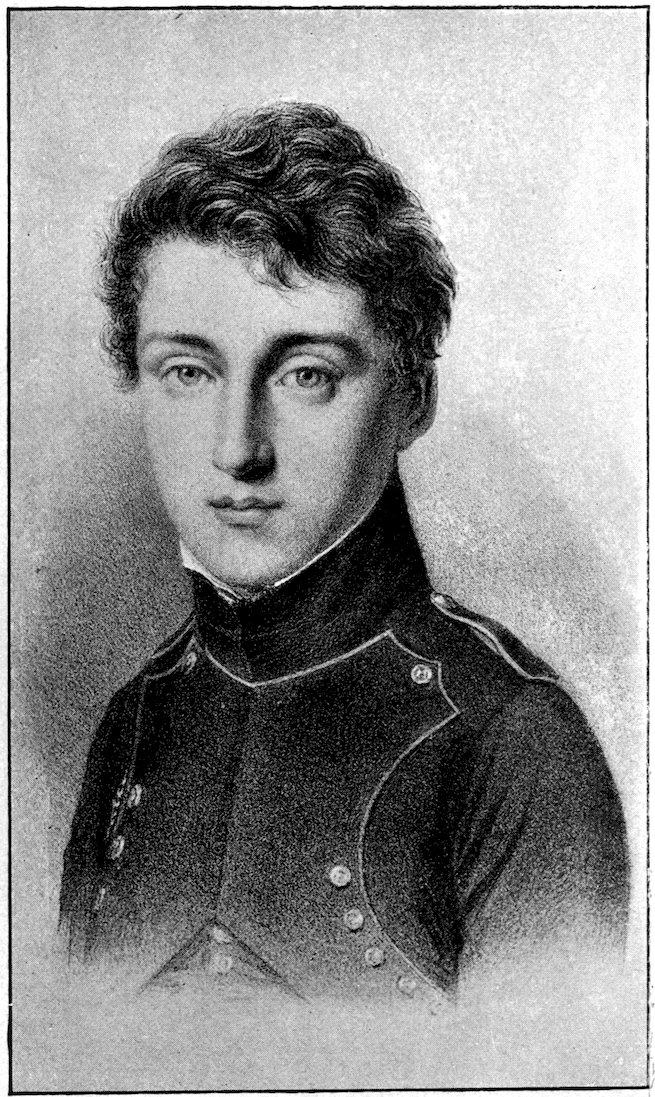

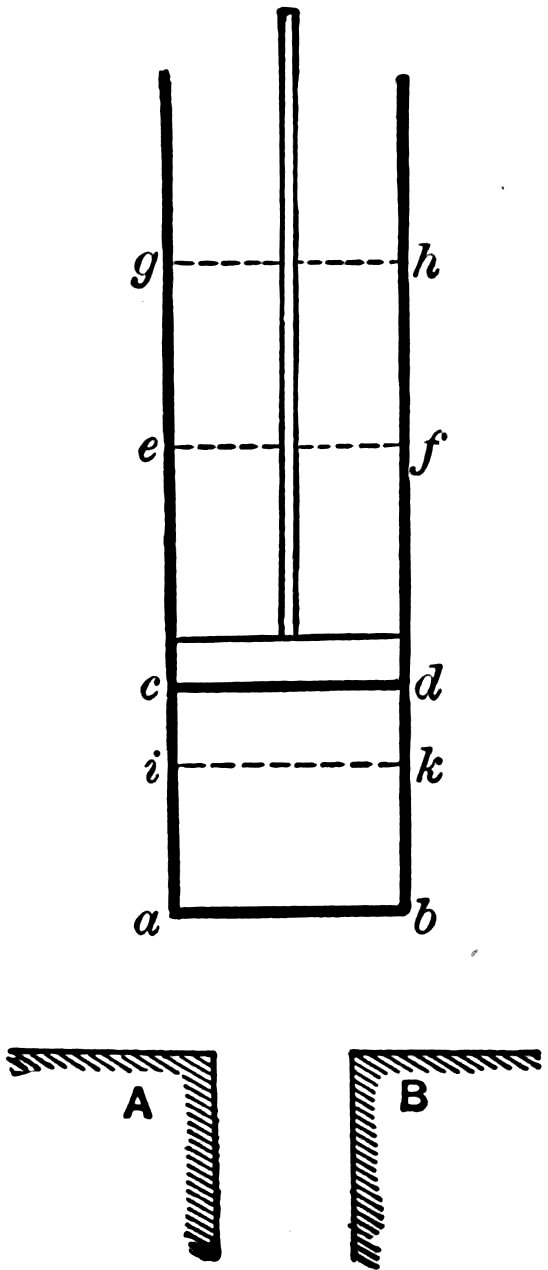
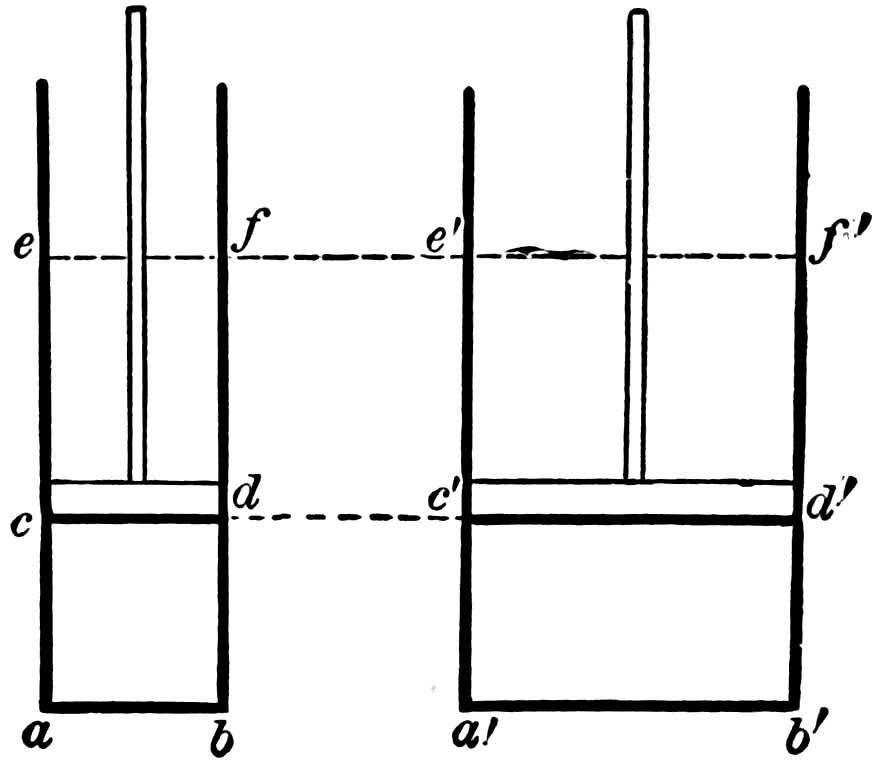

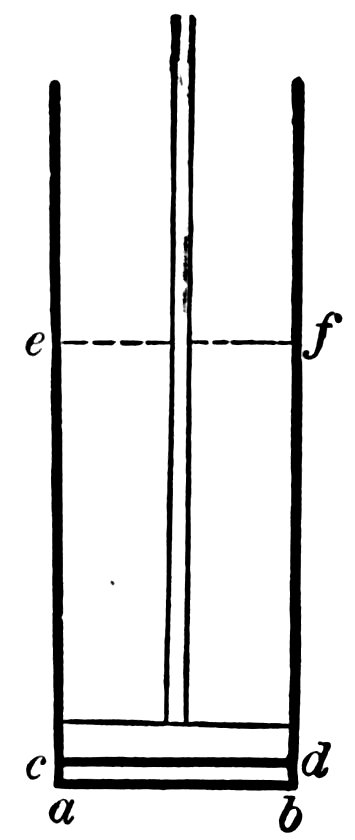

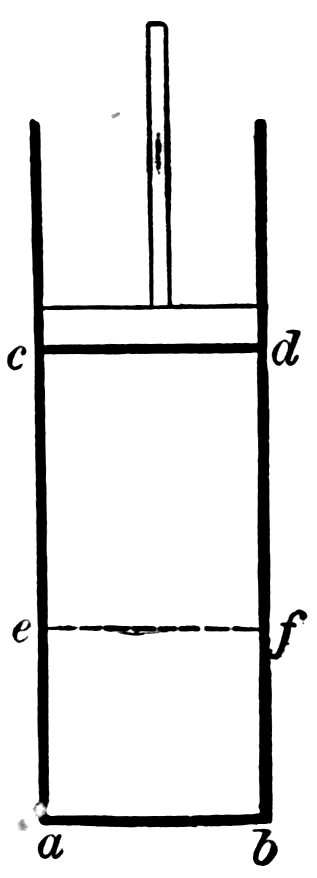
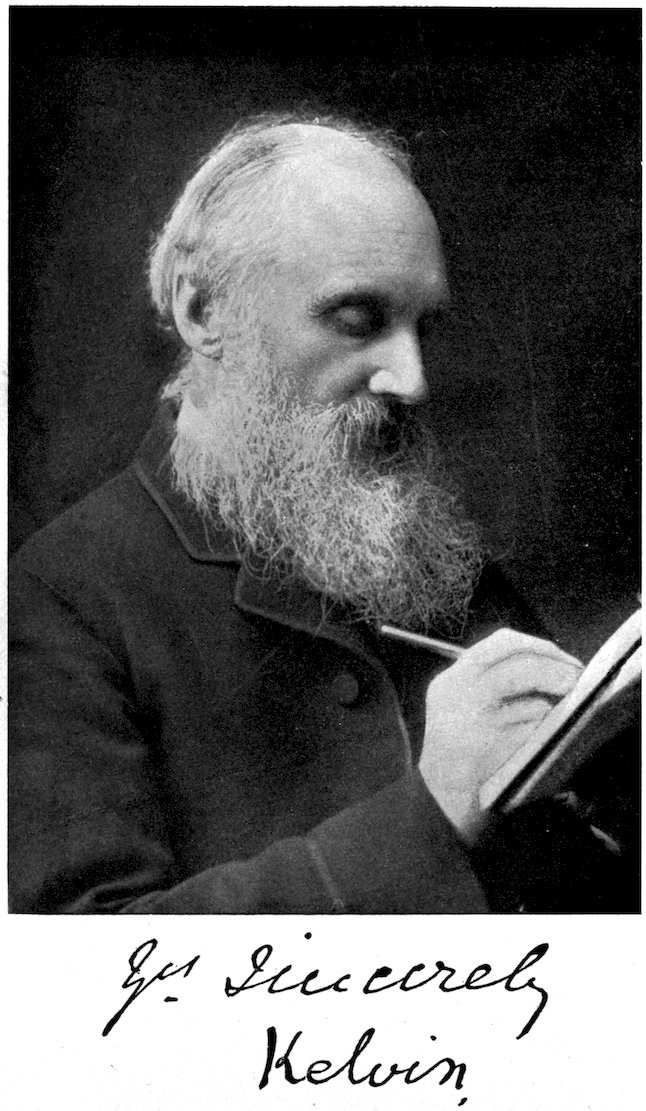
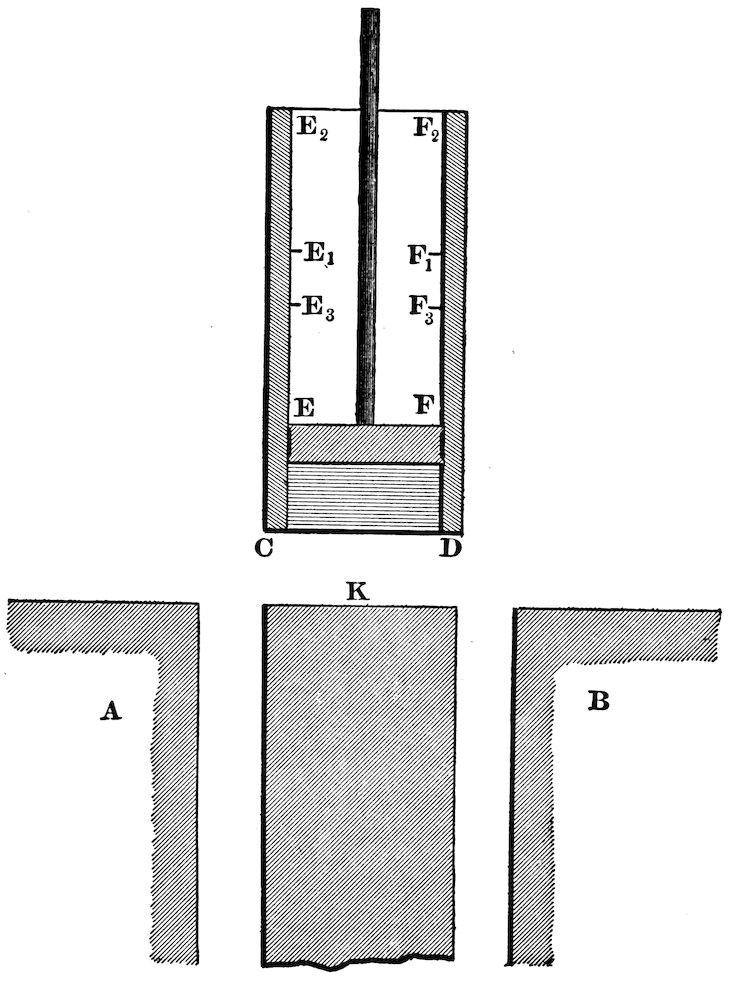
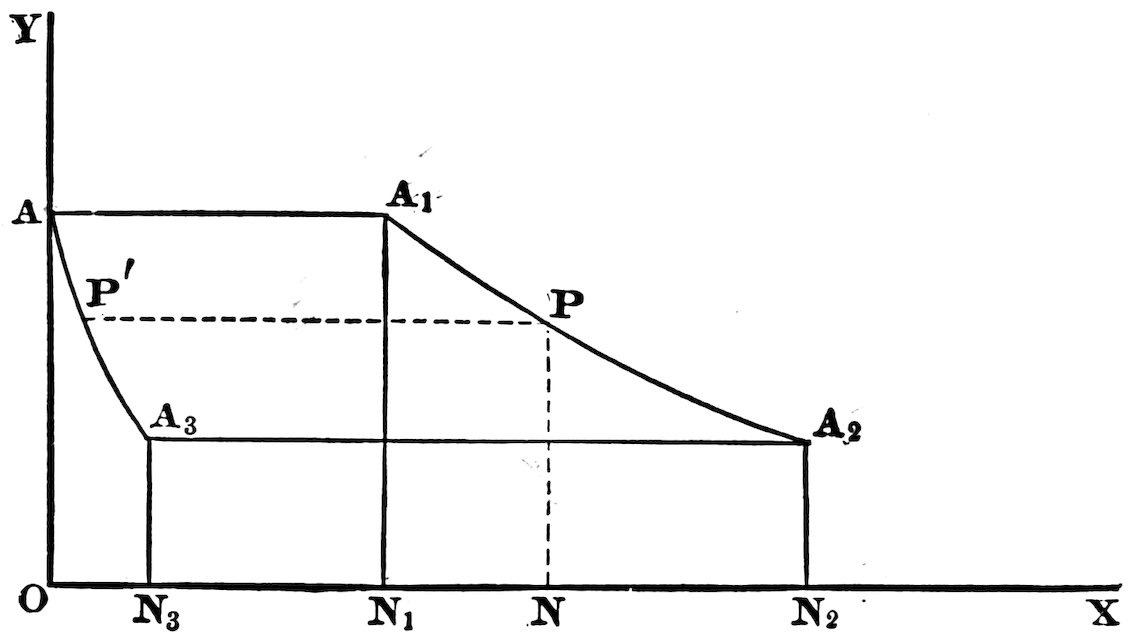

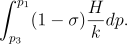
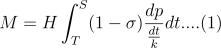

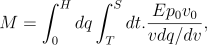

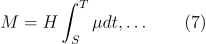

 by the letter M, Table II.
may be regarded as a table of the value of M.