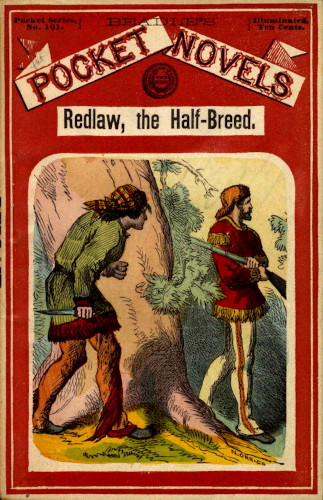
"What can be keeping Nora, I wonder?" half muttered a man, as he
anxiously peered through the leafy screen before him, with a gesture of
impatience.
A man, we said, and as he turns his head so that the sun's rays fall
beneath the broad-brimmed slouched hat, we can see that it is Clay
Poynter, who is there awaiting the arrival of some person. Even had not
his muttered exclamation revealed this fact, there was an eager, ardent
tinge to his restlessness that would have betrayed his secret—would
have told of an appointment with some one a little more than a mere
friend.
A woman would have guessed that he was expecting a sweetheart, whom,
for some reason, he could not visit openly, and she would have been
right. He was awaiting a sweetheart, and her name was Nora McGuire.
Again Poynter peered through the bushes. He saw a small but neat
vine-covered log-house, of only one story. Behind this and upon either
hand spread the fields of young grain, now a level, waving sea of
verdure, with strange forms and figures chasing each other, as the
blades were bent by the fitful gusts of wind.
Behind this, again, rose the rugged mounds forming the "Wildcat Range,"
among whose more difficult recesses the "big game" still could be
found, and it was rumored that yet more dangerous customers might
there be met with—that many a wild scene of blood and crime those
rock-crowned hills had witnessed.
But of this our friend took no heed, for he saw the object of his
thoughts step from the cabin door, and after a hasty glance around,
trip lightly toward the spot where he was standing. Poynter pushed
aside the screen of bushes, and half emerged, but as if by a second
thought he drew back, with a muttered curse.
He had caught a glimpse of Neil McGuire's stalwart form passing from
the field to the cabin, and for some reason, best known to himself, did
not wish those keen gray eyes to note his presence. The young girl now
reached the screen of bushes, and with one glance behind her, passed
them, and then was tightly clasped in the strong arms of Poynter.
"For shame, Mr. Poynter, to surprise me in that way!" pouted the dainty
lips, as Nora glided from the embrace.
"But, Nora, 'tis all your own fault, if I am obliged to surprise you,
as you say," laughed the young man.
"And why so?" innocently queried the maiden, with the slightest
possible toss of her pretty head.
"Well, pet, the fact is, I have a serious monomania, that troubles a—"
"A what? Is it any thing very dangerous?" asked Nora, with a startled
air.
"That depends," he laughed again. "But, as I was saying, the disease
is beyond my power to cure. It is, that whenever I see a dainty little
rosebud mouth, like one that shall be nameless, I feel an irresistible
desire to just stoop my head and see if it is as sweet as it looks!"
"Oh, you horrid creature! I thought you were sick, or something,"
pouted Nora, half turning away.
"Now you're mad, and I've got something of importance to tell you."
"No, I am not mad; but you talk so queer at times, that I can't
understand you. You seem to delight in making sport of me."
"I make sport of you. No, no, little one. I love you far too well
for that. It is only my way. But come, take my arm and let's walk. I
have something to say that can not be postponed, and some one might
interrupt us here," added Poynter.
"But can't you come to the house, Clay? It don't seem right for me to
meet you in this manner," hesitated Nora.
"Your father is at home, and you know what he said the last time I
called. If any one else had spoken to me in that way, Nora, he would—"
And then pausing abruptly for a moment, he added: "But what has he told
you about me, pet?"
"About you? Why—" faltered the maiden.
"Come, Nora, it is better that I should hear it from you than him. No
matter how harsh or unjust it may be, I shall not forget that he is
your father."
"Oh, Clay, it was dreadful!"
"So bad as that? Well, my shoulders are broad and I can bear it. And it
was—?"
"Must I tell?" she pleaded.
"Nora!"
"Well, then," with a sigh, "he said that he had heard you were
connected with a gang of horse-thieves and counterfeiters; and although
he had no positive proof against you, as yet, he forbade my speaking to
you until he gave me leave."
"So-so!" bitterly exclaimed Poynter, half to himself. "My kind friend
has not abandoned me yet." Then turning abruptly to Nora, he added:
"And you believed this?"
"Clay!"
"Pardon, darling; I did not mean it," repentantly said Poynter. "No, I
can trust you, if no one else."
And he clasped the little brown hand that had been laid upon his arm at
her exclamation.
"I wish you would trust me; then, perhaps, I could tell better how to
act," she said, looking up into his face, wistfully.
"And have I not? Well—did he tell you from where these hints came?"
"No, but I think—and yet again, I am puzzled," hesitated Nora.
"You think—?"
"That our strange visitor—this John Dement, he calls himself—is in
some way mixed up with it. More than once I have accidentally overheard
him and father speaking about you, but whenever they saw me, it would
be dropped."
"The yellow-haired man that was with your father on Tuesday night?"
"Yes. But I may be wrong. At any rate, he has left us now."
"Left you, you say; and when?"
"Late yesterday afternoon. But it is only for a short time. I heard him
tell father that he would return next week."
"Do you know where he went?"
"To Fort Leavenworth."
"Good! I will manage to have an interview with the gentleman; I must
stop there myself."
"You stop there? Why Clay—!" exclaimed the maiden, in a startled tone.
"Yes; that is what I came to tell you. I must go to St. Louis upon
business for a week or so. Indeed, I should have been upon the road
before now, but I wished to see you first so that you would not be
alarmed at my disappearance," returned Poynter, kindly.
The reply she was about to make was abruptly checked by the sound of
approaching footsteps, and then the loud, clear call of:
"Nora, Nora child, where are you?"
"Oh, Clay, it is my father! He will kill me if he finds I am with you!"
"Never fear, darling, he will not hurt you," murmured Poynter, as he
drew the trembling form closer to his side.
"No, no, Clay; but you—oh, leave me!"
"What, I run, and from one man?"
"Nora—I say, Nora; why don't you answer me?" impatiently called the
voice, and the footsteps ceased, as if her father was listening.
"For my sake!" pleaded the maiden.
"For your sake—well," and with one fervent kiss, Clay Poynter
vanished among the undergrowth.
"Nora—Nora!"
"Yes, father," she tremblingly answered.
"Oh, so here you are!" said Neil McGuire, as he entered the little
glade. "Why didn't you speak before? Ha! who has been here with you?"
he added, at the same time bending over the moist ground.
Nora could not reply, and then her father rose with an angry flush upon
his face, and exclaimed, in a voice hoarse with passion:
"So, this is the way you obey me! Stop!" as he saw Nora about to speak,
"do not add falsehood to disobedience—"
"Father, did I ever tell you a lie?" reproachfully asked Nora.
"Pardon, Nora, I did not mean that. But I was so angry at finding that
you had been with that villain, Poynter, I forgot myself. See, those
are his tracks. No other man wears such boots, around here."
"Well, I was with him, but he only came to bid me good-by."
"Good-by! Then he thinks it best to leave the country before Judge
Lynch interviews him, the—"
"Hold, Mr. McGuire," slowly said Poynter, as he stepped forward and
confronted the father. "Why should I fear Judge Lynch more than any
other man?"
"Ah, why, indeed?" sneered McGuire. "Why was it that you left Kentucky
so suddenly, and made such a short stop in Arkansas, if I may ask?"
"So, that is your game, is it? Well, of this be assured, that after
my return from St. Louis, I will show you such proofs of my innocence
that you will beg pardon for your unjust suspicions."
"After your return!" echoed Neil, derisively.
"Father—father!" pleaded Nora, in terror, "come, let us go home; I am
afraid."
"Your daughter is right, Mr. McGuire," added Poynter, a little more
coolly. "It will do no good for us to talk further. My explanations can
wait."
"So I presume," curtly responded the other, then adding, "Come, child,
let us go," and leading Nora by the hand, he left the glade.
For a few moments Poynter stood gazing abstractedly in the direction
they had taken, and then arousing himself, with a little laugh, turned
upon his heel and walked briskly along a faintly-defined trail. The
woods were open and free from undergrowth at this point, but after
crossing a narrow tract of bare ground, and once more entering the
timber, the path was thickly fringed on either side with bushes of
hazel and oak.
After crossing a slight rise and down the valley once more, Poynter
came in view of his own house—for that time and section, a perfect
palace, a two-story frame, weather-boarded, and painted a neat
cream-color. Why he had built this, when he was not at home one-tenth
of his time, was a great puzzle to his neighbors, and many a siege of
cross-questioning had old aunty Eunice to undergo.
Questions as to who her young master really was, if wealthy, and his
reasons for making such frequent journeys; why he had not got married,
and countless others, of equal importance. But the old negress knew how
to keep a close tongue in her head, or to talk a great deal without
saying any thing; so that when her visitors left, they were forced to
acknowledge that they knew as much as they did before—and not much
more.
Clay Poynter strode rapidly along, but his thoughts were not upon
what he was doing; he was thinking of Nora McGuire. His head was bent
forward, but he did not heed where he stepped, and with a sharp cry of
surprise, he fell headlong, his foot having caught against a root or
stub.
It is wonderful upon what slight points a man's life hinges; and
Poynter had an instance of this fact furnished him at the same moment.
Simultaneous with his cry, a double report echoed upon the air, and his
hat fluttered from his head, and a sharp, tingling sensation in his
shoulder told him that he was shot.
"Hurray, Bart, he's a goner!" shouted a voice, that the fallen man had
no difficulty in recognizing.
"Bet ye! But it's halfers, mind ye now, Polk!" and at the same time
two men broke out from the bushes, and hastened toward their intended
victim.
Poynter could see them plainly, and immediately recognized them to
be Barton Clowry and Polk Redlaw, the former a drunken, worthless
scoundrel, that would lie, steal, fight and drink, day in and day
out, disliked by everybody and pitied by none. He had a fit-looking
person for a partner, owing to the blow dealt Polk Redlaw by Poynter,
at the "Twin Sycamores," that had inflamed his entire face dreadfully.
All this he saw at a glance, and when the two would-be murderers had
crossed half the intervening space, Poynter leaped to his feet with
a hoarse cry, and as his right arm straightened out, the sun's rays
flashed upon the polished tube of a revolver. At the report, Clowry
gave a convulsive spring, and then fell upon his face, dead.
"Now, you dirty mongrel cur, it is your turn!" yelled Poynter, as he
again cocked his weapon.
It was discharged, but Polk had caught the motion, and throwing
himself flat upon the ground, the missile hissed harmlessly above his
head. But ere he could arise, Poynter leaped forward and dealt him a
fearful kick upon the side of his head, that hurled him forward twice
his length, sprawling among the bushes, where he lay perfectly limp and
motionless.
His enemy stooped over him and felt of his body, then arising, he
muttered:
"Dead as the other! Well, it's so much ammunition saved, at any rate.
It is a bad job, though, but it was either I or them, and they would
have it!" he muttered, as he returned to where his hat lay, brushing
the dust from his garments.
"New hat spoiled—item first; bullet-hole in shoulder, another. Well,
I don't know but what they are both paid for, now, as it turned out.
Confound the thing, how it does smart. Aunt Eunice must bind it up,
and then I suppose I must go and tell the neighbors," he mused, as he
proceeded toward the house.
"Curse the luck! More delay just when I should be at work; and if I was
not very popular before, will this mend matters any? It's lucky they
were such dirty hounds, or it might go hard with me. And then these
vigilantes—"
"Lord 'a' massy! Marse Clay," cried a husky, wheezing voice, as a negro
woman came waddling from around the house. "Is you done kilt, honey?"
"Not quite, aunty," laughed Poynter. "But I might have been. Come," he
added, entering the building, "get some rags and bind up my shoulder."
"'Clar' to goodness, honey, chile, I was e'ena'most skeered to deaf,
I jest was, now," chattered aunt Eunice, as she bustled around her
patient. "I jest done went to de do' to look ef you was a-comin', w'en
I see'd dem 'ar funnelly fellers a-shootin', an' den you falled down,
an' I t'ought you's done dead fo' suah!"
"Well, why didn't you come and help me?"
"'Deed I was jest a-gwine, honey, so I was. I runned to de kitchen,
an' got dis yere," holding up a huge basting-fork, "'nd w'en I got
out ag'in, dar you was, big's life. 'Pears like, I'd a-drapped, I's
so 'mazin' glad. Bress ye, honey, dear, ef dem 'a Pharoasters 'd 'a'
killed you, I'd a—jest would, so dar!" spluttered the old woman,
throwing her arms around Clay, and jumping up and down as she hugged
him.
"Easy—easy, aunty; you hurt my arm," laughed Poynter, as he released
himself, and then sunk into a chair, feeling faint from excitement and
loss of blood.
"Jest looky! w'at a funnelly ole goose I is! But I's so glad, Marse
Clay, dat it 'pears like I'll go clean crazy."
"I think that if you'd get me some brandy, or a cup of coffee, it would
be a more sensible idea, aunt Eunice."
"Dar 'tis ag'in! Might 'a' knowed dat. But you jest sot still, honey,
'nd I'll git you it," and she trotted out of the room with an alacrity
that made the entire house jar beneath her weight, while Poynter bowed
his head upon the table.