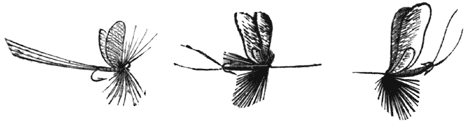
There is no subject on which anglers differ so much
as to what assortment of flies is necessary. Some
will carry as many as a hundred sorts in their book,
while a few, following Mr. Cholmondely Pennell, are
content with three nondescripts of quite an
unnatural appearance, and pretend they can catch as
many fish as the man who goes prepared with a
larger quantity. Walton names nine, beside caterpillars;
and Cotton mentions sixty-nine; while
Ronald, in his splendid work, describes very many
more to choose from. David Foster speaks of thirty-one.
My experience has taught me that about twenty
are necessary and sufficient for all ordinary purposes.
In calm weather and smooth water one fly at a time
is enough; but in rain, wind, or broken water, two,
three, or even four flies may be used with advantage,
as you give the fish a variety to choose from, and
can thereby find out which kind they are taking, and
adapt your cast to their taste.
The fly nearest the rod is called the "first drop,"
the next the "second drop," and so on, and the
farthest from the rod the "stretcher." The last drop
should be about 20in. from the stretcher, and the
other drops 12in. or 14in. apart. When it is thought
desirable to use more than one fly, bend the loop of
your drop fly round one of the knots in the casting-line,
and pass the drop through the loop thus bent
and draw it tight. The drop fly will thus stand at
right angles with the casting-line, and should be
about 3in. from it, and the trout will not be likely to
come in contact with the line when seizing the fly.
It does not very often happen that you hook two
trout at a time, and after you have hooked them,
the difficulty is to get them both into the landing-net,
as they dart about in divers directions; but I
succeeded in hooking and landing two at a time on
three occasions in the summer of 1881. In such
cases get the fish on the stretcher into the net first.
Two at a time necessitates good tackle and very
careful handling. When one can accomplish this
difficult feat, with two trout of a pound weight each,
he may consider himself a fly-fisher.
Artificial flies should represent, in size, shape, and
colour, as nearly as possible the natural flies which
frequent the water you are fishing.
On examining the following selection it will be found
that the natural flies are chiefly represented by three
colours—green, yellow, and brown; and, although
Mr. Pennell was so far right, the general appearance
of natural flies must also be imitated, if you would
achieve success. I do not hold it necessary to follow
minutely every colour, or the exact shape of the
natural fly, because nine out of every ten fish caught
seize the fly immediately it alights on the water, and
sometimes even before it touches; therefore they
cannot have time to study very particularly every
detail of the lure thus suddenly presented to them,
but, seeing something apparently resembling what
they are feeding on, dash at it instantaneously, and
find out the mistake when it is too late. What is of
far greater importance than the exact representation
of the natural fly is, that when the artificial falls on
the water there should be nothing else occurring at
the same time to scare the fish. The motion of the
arm, the flash of the rod, the bungling of the casting-line,
or pitching the fly on the water in an unnatural
manner, all tend to make trout rise short, or not rise
at all.
In determining what colours to use it is desirable
to look at both natural and artificial specimens
through water from underneath, as they then appear
quite different to what they do when viewed out of
water. The late John Hammond, of Winchester,
designer of the Hammond's Adopted and Wickham's
Fancy, once showed me this through a clear-bottomed
decanter.
The following list of flies will be found in the
greater part of the United Kingdom, although they
may be called by different names in different
localities, the chief variation being in size rather
than colour or shape; and it is always desirable to
use artificial flies of the size of the natural ones
which are to be found in the locality you are
fishing:—
Red Spinner, March Brown, Blue Dun, Alder Fly,
Hofland's Fancy, Stone Fly, Grannum, Wickham's
Fancy, Oak Fly, Sedge, Green Drake, Grey Drake,
Coachman, Black Palmer, Red Palmer, Coch-y-bonddhu,
Red Ant, July Dun, Black Gnat, White Moth.
I am convinced that, with the above assortment of
flies, there are not many days in the season but that
one or other of them will do execution, and there is
seldom a day that trout do not rise at some time or
other in it, unless the water be too thick for them to
see the fly. As I am writing for the average fly-fisher,
who need not waste the time or take the
trouble to make his own flies, I will not attempt to
describe the manner of making them, believing that
it is much better to visit a good tackle shop and
get what is required; yet I think it desirable to show
of what materials they should be composed, in order
that he may know what are the most killing sorts,
and how to distinguish them in ordering.
February and March.
1. The Red Spinner.—Body, brown silk, ribbed
with fine gold twist; tail, two fibres of a red cock's
hackle; wings, of some transparent brown feather.
2. March Brown, or Brown Drake.—This, like the
other drakes, is a great favourite with trout in its
season, which is during March and April, and it may
also be used in the autumn. Body, orange-coloured
silk or deep straw colour, on which wind fur from a
hare's poll; legs, a honey-dun hackle; wings, to
stand erect, of the top of the light or inner fibres of
the feather of the hen pheasant's wing; tail, two
fibres of the same feather. Rib with gold twist for
your tail fly, and let the droppers be without any
twist.
The above is "Ephemera's" way of making it,
but Mr. Ronalds says: "Body, fur of the hare's face
ribbed over with olive silk and tied with brown silk;
tail, two strands of a partridge's feather; wings,
feather of the pheasant's wing; legs, a feather from
the back of a partridge."
3. Blue Dun.—Body, of the hare's ear, dark and
yellow part mixed with a little yellow mohair, the
whole to be spun on yellow silk; wings, from a
feather of the starling's wing stained in onion dye;
tail, two whiskers of a rabbit; legs, to be picked out
of the dubbing at the thick part near the wings.
4. Alder Fly.—Body, dark claret-coloured fur;
upper wings, red fibre of the landrail's wing, or red
tail feather of the partridge; lower wings, of the
starling's wing feather; legs, dark red hackle; horns
and tail, of fibres the colour of the legs, the horns to
be shorter than the body of the fly, but the tail a
little longer.
5. Hofland's Fancy.—Body, reddish dark brown
silk; wings, woodcock's wing; legs, red hackle;
tail, two strands of a red hackle.
April.
6. Stone Fly.—Body, fur from hare's ear mixed
with yellow worsted and spun on yellow silk; tail, two
strands of partridge feather; wings, pheasant's quill
feather from wings; legs, greenish brown hackle.
7. Grannum, or Green-Tail.—"Ephemera" says:
"The grannum is a four-winged fly, and as it swims
down the water its wings lie flat on the back. It
has a small bunch of eggs of a green colour at the
tail end of the body, which gives it the name of the
green-tail fly. As soon as it alights on the water it
drops its eggs." It is dressed as follows:—
Body, fur of hare's face left rough and spun on
brown silk. A little green floss silk may be worked
in at the tail, to represent the bunch of eggs there.
Wings, feather from that of the partridge, and made
very full; legs, a pale ginger hen's hackle. Made
buzz with a feather from the back of a partridge's
neck, wound upon the above body.
8. Wickham's Fancy.—Wings, light starling; body,
flat gold ribbed with fine gold wire; hackle and
whisk, bright red gamecock. This is one of the best
general flies, and is a standing favourite in the south
of England; and I have it on the authority of the late
John Hammond that he made it under the direction
of Dr. Wickham, of Winchester—hence its name.
May and June.
9. Oak Fly, or Down-Looker.—It is generally found
on the trunks of oak trees by the river-side, with its
head pointing downwards, and is a very useful fly.
"Ephemera" recommends it to be dressed as
follows: "Body, yellow mohair, ribbed regularly with
dark brown silk; legs, a honey dun hackle wound
thrice under the wings, which are to lie flat and
short, and to be made of the wing feather of a
young partridge or hen pheasant. To be tipped
with pale gold twist."
10. Sedge.—Wings, wing of landrail; body, white
floss silk ribbed with silver wire; hackle, ginger
cock's hackle down the body.
11. The May-fly, or Green Drake, is not only a very
beautiful fly, but one of the most captivating that is
used, and, as I have stated elsewhere, it requires
special manipulation. On a windy dull day, in the
middle of the May-fly season, when there are not many
natural flies out, it will very soon fill the basket,
particularly if the water is turbulent. "Ephemera"
says: "This famous fly is the opprobrium of fly-makers.
Try how they will they cannot, in my
opinion, imitate it well. The wings are their greatest
foil. In making the body they succeed tolerably well.
Still, the best imitation is defective, and, except upon
rare occasions, the artificial May-fly is not a deadly
bait." My experience has been the very contrary of
this. Whether it is from the fly-tiers having succeeded
in imitating the natural fly since "Ephemera"
wrote, or not, I do not know, but I have before me
two specimens tied by Mrs. Ogden that I make no
doubt would bring me ten or a dozen brace of trout on
a good day in the season. May-flies are often made
with cork bodies, but I am not partial to them, for
the same objection which applies generally to floating
flies, viz.: that trout find they have something hard
and unnatural in their mouths, and immediately
reject it. On a dry bright day use it as a dry fly,
but on a very wet or windy day fish with it a few
inches under the surface, and, as Walton says, you
will have "store of trouts." On one occasion last
season I caught ten brace of trout with one May-fly
obtained of Messrs. Alfred and Son, and have it by
me now, but there is not a vestige of wing left, all
having been bitten off. Mr. Ronalds recommends it
to be dressed as follows: "Body, the middle part of
a pale straw-coloured floss silk, ribbed with silver
twist; extremities (head and tail), brown peacock's
harl, tied with light brown silk thread; tail, three
rabbit's whiskers; wings and legs, made buzz with
a mottled feather of the mallard, stained olive."
Instead of the bodies being made of straw-coloured
silk they are now frequently made of strips of wheat
straw.
12. Grey Drake.—This is said to be a metamorphosis
of the green drake, or female changing to a male.
Dress it thus: Body, the middle part of white floss
silk, ribbed over neatly with silver twist; extremities,
brown peacock's harl; wings and legs made buzz
with a mottled feather of the mallard, stained a faint
purple; legs, three rabbit's whiskers.
13. The Coachman.—Body, peacock's harl, full and
short; wings, fibres of any small white feather; legs,
a turn or two of a red hackle. Mr. Blaine remarks:
"Throughout the summer months, as an early
evening fly, and until twilight, it proves most valuable
in the midland counties, and the bordering ones
within eighty miles of London. On the Colne, and
throughout its course, in the Hampshire, Dorsetshire,
and Devonshire waters, where we have been
for many years in the habit of using it, in our opinion
there is no fly to at all equal it."
14. Black Palmer.—Body, black ostrich harl, ribbed
with gold twist, black cock's hackle wound over the
whole.
15. Red Palmer.—Body, dark red-coloured mohair,
with a richly-tinted red fur intermixed, to be ribbed
with gold or silver twist; legs, a blood-red cock's
hackle. Or, body, a peacock harl with a red cock's
hackle wrapped over it, and tied with dark brown
silk thread.
I have used the Red Palmer in all weathers and
seasons for nearly fifty years, and believe it to be the
best general fly there is, although, strictly speaking,
not a fly, but an imitation of the caterpillar, or larva
of the tiger moth. Having had such success with it
I have adopted its name as my nom de plume, and as
the title of this little book.
July.
16. Coch-y-bonddhu.—Body, black ostrich harl,
twisted with peacock's harl, and made with red silk
thread; the wings and legs made buzz with a dark
furnace hackle.
17. Red Ant.—Body, copper coloured peacock's
harl, full near the wings and tail; wings, a lark's
wing feather; legs, red cock's hackle.
18. July Dun.—Body, mole's fur and pale yellow
mohair mixed, and spun on yellow silk; wings, dark
part of a feather from the starling's wing, stained
dark in strong onion dye; legs, dark dun hackle; tail,
the two flies of the hackle.
August.
19. Black Gnat.—Body, one of the smallest feathers
of the green plover's top-knot, or of a black harl, to
be dressed short; wings, the darkest fibres of an old
starling's wing feather.
20. White Moth.—Wings, white pigeon's feather;
body, white crewel; legs, white hen's hackle.
Although I have classified these flies under the
different months, it does not follow by any means
that they will kill only in the months named; on
the contrary, some of them may be used month after
month, particularly the hackle flies, which may be
used almost through the season.
I exhibited samples of the above kinds in my
lecture to the Gresham and Islington Angling
Societies, showing the relative sizes and colours.
These samples were selected from the stock of
Messrs. Alfred and Son, of Moorgate Street, where
I generally obtain what I require, and find their flies
are to be depended on. As with gut, so with flies,
it is false economy to buy the cheapest. It requires
a deal of patience at times before you can hook a
fish; and, after you have been so fortunate, it is
terribly annoying to find the gut draw, and leave
the fly in its mouth. To guard against this, burn all
your old flies at the end of the season, except one or two
of a sort for patterns, and this is another reason why
you should not have a heavy stock; and take care, in
buying your new stock at the spring of the year, that
you get new, and not those of the previous year.
In tying gut to the hook, a little varnish generally
touches the gut, and at this most critical point the
varnish hardens the gut and causes it to snap. This,
of course, does not occur with eyed hooks, but even
with them it is better to have new flies than old, as
the colours are fresher and the tying more secure.
Messrs. Ogden and Scotford, the well-known firm
of Cheltenham, have lately sent me a few samples of
their flies, tied by Mrs. Ogden, who has long enjoyed
a very high reputation for her tying. They
are beautifully made, and I have no doubt will
prove good killers; but, as the season is now over,
have had no opportunity of trying them.