One of the first things that caught my eye as I
emerged from the station was an old man, standing
with his face to the wall of a house, leaning against a
protruding gutter-pipe. As I passed him I noticed he
was sobbing. I stopped to speak to him.
“What is the matter, little uncle?” I said.
“I am cold and hungry,” he whimpered without
looking up and still leaning against the pipe. “For
three days I have eaten nothing.” I pushed a twenty-rouble
note into his hand. “Here, take this,” I said.
He took the money but looked at me, puzzled.
“Thank you,” he mumbled, “but what is the good
of money? Where shall I get bread?” So I gave
him a piece of mine and passed on.
There was plenty of life and movement in the streets,
though only of foot-passengers. The roadway was
dirty and strewn with litter. Strung across the street
from house to house were the shreds of washed-out red
flags, with inscriptions that showed they had been
hung out a few weeks earlier to celebrate the anniversary
of the Bolshevist coup d’état. Occasionally one
came across small groups of people, evidently of the
educated class, ladies and elderly gentlemen in worn-out
clothes, shovelling away the early snow and slush
under the supervision of a workman, who as taskmaster
stood still and did nothing.
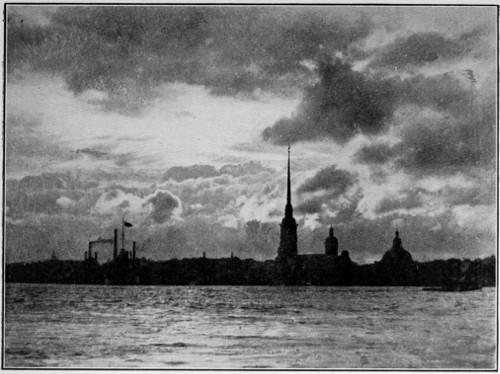
The Fortress of St. Peter and St. Paul
Crossing the Liteiny Bridge on my way into the
city I stopped, as was my wont, to contemplate the
marvellous view of the river Neva. No capital in
Europe possesses so beautiful an expanse of water as
this city of Peter the Great. Away on the horizon the
slender gilded spire of the cathedral of St. Peter and
St. Paul rose from the gloomy fortress. By force of
habit I wondered who was now incarcerated in those
dark dungeons. Years ago, before the revolution, I
used to stand and look at the “Petropavlovka,” as
the fortress is popularly called, thinking of those who
pined in its subterranean cells for seeking the liberty
of the Russian people.
My first destination was the house of an English
gentleman, to whom I shall refer as Mr. Marsh. Marsh
was a prominent business man in Petrograd. I did
not know him personally, but he had been a friend of
Captain Crombie and until recently was known to be
at liberty. He lived on the quay of the Fontanka, a
long, straggling branch of the Neva flowing through
the heart of the city. Melnikoff knew Marsh and had
promised to prepare him for my coming. I found the
house and, after assuring myself the street was clear
and I was not observed, I entered. In the hall I was
confronted by an individual, who might or might not
have been the house-porter—I could not tell. But I
saw at once that this man was not disposed to be
friendly. He let me in, closed the door behind me,
and promptly placed himself in front of it.
“Whom do you want?” he asked.
“I want Mr. Marsh,” I said. “Can you tell me
the number of his flat?” I knew the number perfectly
well, but I could see from the man’s manner
that the less I knew about Marsh, the better for me.
“Marsh is in prison,” replied the man, “and his
flat is sealed up. Do you know him?”
Devil take it, I thought, I suppose I shall be arrested
too, to see what I came here for! The idea occurred
to me for a moment to flaunt my concocted passport
in his face and make myself out to be an agent of the
Extraordinary Commission, but as such I should
have known of Marsh’s arrest, and I should still
have to explain the reason of my visit. It wouldn’t
do. I thought rapidly for a plausible pretext.
“No, I don’t know him,” I replied. “I have never
seen him in my life. I was sent to give him this
little parcel.” I held up the packet containing my
trousseau of socks, biscuits, and handkerchiefs. “He
left this in a house at Alexandrovsky the other night.
I am an office clerk there. I will take it back.”
The man eyed me closely. “You do not know Mr.
Marsh?” he said again, slowly.
“I have never seen him in my life,” I repeated,
emphatically, edging nearer the door.
“You had better leave the parcel, however,” he said.
“Yes, yes, certainly,” I agreed with alacrity, fearful
at the same time lest my relief at this conclusion to
the incident should be too noticeable.
I handed him over my parcel. “Good-morning,”
I said civilly, “I will say that Mr. Marsh is arrested.”
The man moved away from the door, still looking hard
at me as I passed out into the street.
Agitated by this misfortune, I turned my steps in
the direction of the hospital where I hoped to find
Melnikoff. The hospital in question was at the
extreme end of the Kamenostrovsky Prospect, in the
part of the city known as The Islands because it
forms the delta of the river Neva. It was a good
four-mile walk from Marsh’s house. I tried to get on
to a street-car, but there were very few running and
they were so crowded that it was impossible to board
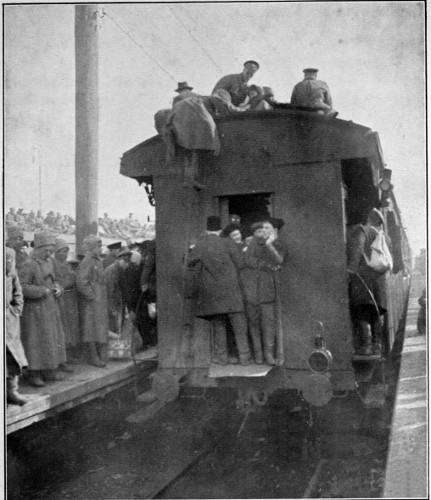
them. People hung in bunches all round the steps
and even on the buffers. So, tired as I was after the
night’s adventure, I footed it.
Melnikoff, it appeared, was a relative of one of the
doctors of this hospital, but I did not find him here.
The old woman at the lodge said he had been there
one night and had not returned since. I began to think
something untoward must have occurred, although
doubtless he had several other night-shelters besides
this one. There was nothing to do but wait for the
afternoon and go to the clandestine café to which he
had directed me.
I retraced my steps slowly into town. All around
was shabbiness. Here and there in the roadway lay
a dead horse. The wretched brutes were whipped to
get the last spark of life and labour out of them
and then lay where they fell, for the ladies who were
made to sweep the streets were not strong enough to
remove dead horses. Every street, every building,
shop, and porch spoke to me of bygone associations,
which with a pang I now realized were dead. A few
stores remained open, notably for music, books, and
flowers, but Soviet licences were required to purchase
anything except propagandist literature, which was
sold freely at a cheap price, and flowers, which were
fabulously dear. Hawkers with trucks disposed of
second-hand books, obviously removed from the
shelves of private libraries, while a tiny basement
store, here and there peeping shamefacedly up from
beneath the level of the street, secreted in semi-obscurity
an unappetizing display of rotting vegetables
or fruits and the remnants of biscuits and canned
goods. But everything spoke bitterly of the progressive
dearth of things and the increasing stagnation
of normal life.
I stopped to read the multifarious public notices
and announcements on the walls. Some bore reference
to Red army mobilization, others to compulsory
labour for the bourgeoisie, but most of them dealt
with the distribution of food. I bought some seedy-looking
apples, and biscuits that tasted several years
old. I also bought all the newspapers and a number
of pamphlets by Lenin, Zinoviev, and others. Finding
a cab with its horse still on four legs, I hired it and
drove to the Finland Station, where upon arrival in
the morning I had noticed there was a buffet. The
food exhibited on the counter, mostly bits of herring
on microscopic pieces of black bread, were still less
appetizing than my biscuits, so I just sat down to
rest, drank a weak liquid made of tea-substitute, and
read the Soviet papers.
There was not much of news, for the ruling Bolshevist1
class had already secured a monopoly of the
Press by closing down all journals expressing opinions
antagonistic to them, so that all that was printed was
propaganda. While the Press of the Western world
was full of talk of peace, the Soviet journals were
insisting on the creation of a mighty Red army that
should set Europe and the globe aflame with world-revolution.
At three o’clock I set out to look for Melnikoff’s
café, a clandestine establishment in a private flat on
the top floor of a house in one of the streets off the
Nevsky Prospect. When I rang the bell the door
was opened just a wee bit and I espied a keen and
suspicious eye through the chink. Seeing it was
immediately about to close again I slid one foot into
the aperture and asked quickly for Melnikoff.
“Melnikoff?” said the voice accompanying the
eagle eye. “What Melnikoff?”
“N——,” I said, giving Melnikoff’s real name.
At this point the door was opened a little wider and I
was confronted by two ladies, the one (with the eagle
eye) elderly and plump, the other young and good-looking.
“What is his first name and patronymic?” asked
the younger lady. “Nicolas Nicolaevitch,” I replied.
“It is all right,” said the younger lady to the elder.
“He said someone might be coming to meet him this
afternoon. Come in,” she went on, to me. “Nicolas
Nicolaevitch was here for a moment on Saturday and
said he would be here yesterday but did not come. I
expect him any minute now.”
I passed into a sitting-room fitted with small tables,
where the fair young lady, Vera Alexandrovna, served
me to my surprise with delicious little cakes which
would have graced any Western tea-table. The room
was empty when I arrived, but later about a dozen
people came in, all of distinctly bourgeois stamp, some
prepossessing in appearance, others less so. A few of
the young men looked like ex-officers of dubious type.
They laughed loudly, talked in raucous voices, and
seemed to have plenty of money to spend, for the
delicacies were extremely expensive. This café, I
learned later, was a meeting-place for conspirators,
who were said to have received funds for counter-revolutionary
purposes from representatives of the
allies.
Vera Alexandrovna came over to the table in the
corner where I sat alone. “I must apologize,” she
said, placing a cup on the table, “for not giving you
chocolate. I ran out of chocolate last week. This is
the best I can do for you. It is a mixture of cocoa and
coffee—an invention of my own in these hard times.”
I tasted it and found it very nice.
Vera Alexandrovna was a charming girl of about
twenty summers, and with my uncouth get-up and
general aspect I felt I was a bad misfit in her company.
I was painfully conscious of attracting attention and
apologized for my appearance.
“Don’t excuse yourself,” replied Vera Alexandrovna,
“we all look shabby nowadays.” (She herself,
however, was very trim.) “Nicolas Nicolaevitch
told me you were coming and that you were a friend
of his—but I shall ask no questions. You may feel
yourself quite safe and at home here and nobody will
notice you.” (But I saw four of the loud-voiced young
officers at the next table looking at me very hard.)
“I scarcely expected to find these comforts in hungry
Petrograd,” I said to Vera Alexandrovna. “May I
ask how you manage to keep your café going?”
“Oh, it is becoming very difficult indeed,” complained
Vera Alexandrovna. “We have two servants
whom we send twice a week into the villages to bring
back flour and milk, and we buy sugar from the Jews
in the Jewish market. But it is getting so hard.
We do not know if we shall be able to keep it going
much longer. Then, too, we may be discovered.
Twice the Reds have been to ask if suspicious people
live in this house, but the porter put them off because
we give him flour.”
Vera Alexandrovna rose to attend to other guests.
I felt extremely ill at ease, for it was clear I was
attracting attention and I did not at all like the looks
of some of the people present.
“Ah, ma chère Vera Alexandrovna!” exclaimed a
fat gentleman in spectacles who had just come in,
kissing her hand effusively. “Here we are again!
Well, our Redskins haven’t long to last now, I’ll be
bound. The latest is that they are going to mobilize.
Mobilize, indeed! Just a little push from outside,
and pouf! up they’ll go like a bubble bursting!”
At once one of the four young men rose from the
next table and approached me. He was tall and thin,
with sunken eyes, hair brushed straight up, and a
black moustache. There was a curious crooked twitch
about his mouth.
“Good-afternoon,” he said. “Allow me to introduce
myself. Captain Zorinsky. You are waiting
for Melnikoff, are you not? I am a friend of his.”
I shook hands with Zorinsky, but gave him no
encouragement to talk. Why had Melnikoff not told
me I should meet this “friend of his”? Had this
Zorinsky merely guessed I was waiting for Melnikoff,
or had Vera Alexandrovna told him—Vera Alexandrovna,
who assured me no one would notice me?
“Melnikoff did not come here yesterday,” Zorinsky
continued, “but if I can do anything for you at any
time I shall be glad.”
I bowed and he returned to his table. Since it was
already six I resolved I would stay in this café no
longer. The atmosphere of the place filled me with
indefinable apprehension.
“I am so sorry you have missed Nicolas Nicolaevitch,”
said Vera Alexandrovna as I took my leave.
“Will you come in to-morrow?” I said I would,
fully determined that I would not. “Come back at
any time,” said Vera Alexandrovna, with her pleasant
smile; “and remember,” she added, reassuringly, in
an undertone, “here you are perfectly safe.”
Could anybody be more charming than Vera
Alexandrovna? Birth, education, and refinement were
manifested in every gesture. But as for her café, I
had an ominous presentiment about it, and nothing
would have induced me to re-enter it.
I resolved to resort to the flat of Ivan Sergeievitch,
Melnikoff’s friend who had seen me off at Viborg.
The streets were bathed in gloom as I emerged from
the café. Lamps burned only at rare intervals. And
suppose, I speculated, I find no one at Ivan Sergeievitch’s
home? What would offer a night’s shelter—a
porch, here or there, a garden, a shed? Perhaps one
of the cathedrals, Kazan, for instance, might be open.
Ah, look, there was a hoarding round one side of the
Kazan Cathedral! I stepped up and peeped inside.
Lumber and rubbish. Yes, I decided, that would do
splendidly!
Ivan Sergeievitch’s house was in a small street at
the end of Kazanskaya, and like Vera Alexandrovna’s
his flat was on the top floor. My experience of the
morning had made me very cautious, and I was
careful to enter the house as though I were making
a mistake, the easier to effect an escape if necessary.
But the house was as still as death. I met nobody
on the stairs, and for a long time there was no reply
to my ring. I was just beginning to think seriously
of the hoarding round the Kazan Cathedral when I
heard footsteps, and a female voice said querulously
behind the door, “Who is there?”
“From Ivan Sergeievitch,” I replied, speaking just
loud enough to be heard through the door.
There was a pause. “From which Ivan Sergeievitch?”
queried the voice.
I lowered my tone. I felt the other person was
listening intently. “From your Ivan Sergeievitch, in
Viborg,” I said in a low voice at the keyhole.
There was another pause. “But who are you?”
came the query.
“Do not be alarmed,” I said in the same tone.
“I have a message to you from him.”
The footsteps receded. I could hear voices conferring.
Then two locks were undone, and the door
was partially opened on a short chain. I saw a
middle-aged woman peering at me with fear and
suspicion through the chink.
I repeated what I had already said, adding in a
whisper that I myself had just come from Finland
and would perhaps be going back shortly. The chain
was then removed and I passed in.
The woman who opened the door, and who proved
to be the housekeeper spoken of by Ivan Sergeievitch,
closed it again hastily, locked it securely, and stood
before me, a trembling little figure with keen eyes
that looked me up and down with uncertainty. A
few paces away stood a girl, the nurse of Ivan
Sergeievitch’s children, who were in Finland.
“Ivan Sergeievitch is an old friend of mine,” I
said, not truthfully, but very anxious to calm the
suspicions of my humble hostesses. “I knew him
long ago and saw him again quite recently in Finland.
He asked me, if I found it possible, to come round
and see you.”
“Come in, come in, please,” said the housekeeper,
whom I shall call Stepanovna, still very nervously.
“Excuse our showing you into the kitchen, but it is
the only room we have warmed. It is so difficult to
get firewood nowadays.”
I sat down in the kitchen, feeling very tired.
“Ivan Sergeievitch is well and sends his greetings,”
I said. “So are his wife and the children. They
hope you are well and not suffering. They would
like you to join them but it is impossible to get
passports.”
“Thank you, thank you,” said Stepanovna. “I
am glad they are well. We have not heard from
them for so long. May we offer you something to
eat——?”
“Ivan Pavlovitch is my name,” I interpolated,
catching her hesitation.
“May we offer you something to eat, Ivan Pavlovitch?”
said Stepanovna kindly, busying herself at
the stove. Her hands still trembled. “Thank you,”
I said, “but I am afraid you have not much yourself.”
“We are going to have some soup for supper,” she
replied. “There will be enough for you, too.”
Stepanovna left the kitchen for a moment, and the
nursing maid, whose name was Varia, leaned over to
me and said in a low voice, “Stepanovna is frightened
to-day. She nearly got arrested this morning at the
market when the Reds came and took people buying
and selling food.”
I saw from Varia’s manner that she was a self-possessed
and intelligent girl and I resolved to speak
to her first regarding my staying the night, lest I
terrified Stepanovna by the suggestion.
“When I went to my home this afternoon,” I said,
“I found it locked. I expect the housekeeper was
out. It is very far, and I wonder if I may stay the
night here. A sofa will do to lie on, or even the
floor. I am dreadfully tired and my leg is aching
from an old wound. Ivan Sergeievitch said I might
use his flat whenever I liked.”
“I will ask Stepanovna,” said Varia. “I do not
think she will mind.” Varia left the room and,
returning, said Stepanovna agreed—for one night.
The soup was soon ready. It was cabbage soup,
and very good. I ate two big platefuls of it, though
conscience pricked me in accepting a second. But I
was very hungry. During supper a man in soldier’s
uniform came in by the kitchen door and sat down
on a box against the wall. He said nothing at all,
but he had a good-natured, round, plump face, with
rosy cheeks and twinkling eyes. With a jack-knife
he hewed square chunks off a loaf of black bread, one
of which chunks was handed to me.
“This is my nephew Dmitri,” said Stepanovna.
“He has just become a volunteer so as to get Red
army rations, so we are better off now.”
Dmitri smiled at being mentioned, but said nothing.
After two platefuls of soup I could scarcely keep my
eyes open. So I asked where I might spend the night
and was shown into the study, where I threw myself
on the couch and fell fast asleep.
When I awoke I had such a strange sensation of
unaccustomed surroundings that I was completely
bewildered, and was only brought to my senses by
Varia entering with a glass of tea—real tea, from
Dmitri’s Red rations.
Then I recalled the previous day, my adventurous
passage across the frontier, the search for Marsh and
Melnikoff, the secret café, and my meeting with my
present humble friends. With disconcerting brusqueness
I also recollected that I had as yet no prospects
for the ensuing night. But I persuaded myself that
much might happen before nightfall and tried to
think no more about it.
Stepanovna had quite got over her fright, and
when I came into the kitchen to wash and drink
another glass of tea she greeted me kindly. Dmitri
sat on his box in stolid silence, munching a crust of
bread.
“Been in the Red army long?” I asked him, by
way of conversation.
“Three weeks,” he replied.
“Well, and do you like it?”
Dmitri pouted and shrugged his shoulders disparagingly.
“Do you have to do much service?” I persisted.
“Done none yet.”
“No drill?”
“None.”
“No marching?”
“None.”
Sounds easy, I thought. “What do you do?”
“I draw rations.”
“So I see,” I observed.
Conversation flagged. Dmitri helped himself to
more tea and Stepanovna questioned me further as
to how Ivan Sergeievitch was doing.
“What were you in the old army?” I continued
at the first opportunity to Dmitri.
“An orderly.”
“What are you now?”
“A driver.”
“Who are your officers?”
“We have a commissar.” A commissar in the
army is a Bolshevist official attached to a regiment
to supervise the actions of the officer staff.
“Who is he?”
“Who knows?” replied Dmitri. “He is one like
the rest,” he added, as if all commissars were of an
inferior race.
“What is the Red army?” I asked, finally.
“Who knows?” replied Dmitri, as if it were the
last thing in the world to interest any one.
Dmitri was typical of the mass of the unthinking
proletariat at this time, regarding the Bolshevist
Government as an accidental, inexplicable, and merely
temporary phenomenon which was destined at an
early date to decay and disappear. As for the thinking
proletariat they were rapidly dividing into two
camps, the minority siding with the Bolsheviks for
privilege and power, the majority becoming increasingly
discontented with the suppression of the liberties
won by the revolution.
“Have you a Committee of the Poor in this house?”
I asked Stepanovna. “Yes,” she said, and turning
to Dmitri added, “Mind, Mitka, you say nothing to
them of Ivan Pavlovitch.”
Stepanovna told me the committee was formed of
three servant girls, the yard-keeper, and the house-porter.
The entire house with forty flats was under
their administration. “From time to time,” said
Stepanovna, “they come and take some furniture to
decorate the apartments they have occupied on the
ground floor. That is all they seem to think of. The
house-porter is never in his place in the hall” (for
this I was profoundly thankful), “and when we need
him we can never find him.”
Varia accompanied me to the door as I departed.
“If you want to come back,” she said, “I don’t
think Stepanovna will mind.” I insisted on paying
for the food I had eaten and set out to look again for
Melnikoff.
The morning was raw and snow began to fall.
People hurried along the streets clasping bundles and
small parcels. Queues, mostly of working women,
were waiting outside small stores with notices printed
on canvas over the lintel “First Communal Booth,”
“Second Communal Booth,” and so on, where bread
was being distributed in small quantities against food
cards. There was rarely enough to go round, so
people came and stood early, shivering in the biting
wind. Similar queues formed later in the day outside
larger establishments marked “Communal Eating
House, Number so-and-so.” One caught snatches of
conversation from these queues. “Why don’t the
‘comrades’ have to stand in queues?” a woman
would exclaim indignantly. “Where are all the
Jews? Does Trotzky stand in a queue?” and so on.
Then, receiving their modicum of bread, they would
carry it hastily away, either in their bare hands, or
wrapped up in paper brought for the purpose, or
shielded under the shawls which they muffled round
their ears and neck.
Again I trudged across the river and up the long
Kamenostrovsky Prospect to Melnikoff’s hospital, but
again he had not returned and they knew nothing of
him. Wandering irresolutely about the city I drifted
into the district where I had formerly lived, and here
in a side-street I came unexpectedly upon a window
on which a slip of paper was pasted with the word
“Dinners,” written in pencil. This, I could see, was
no “communal eating-house.” Without a ticket I
could not go to a communal eating-house, so I peered
cautiously into the door of the little establishment
and found that a single room on the ground floor,
probably once a store, had been cleared out and fitted
with three tiny tables, large enough to accommodate
half-a-dozen people in all. Everything was very
simple, clearly a temporary arrangement, but very
clean. The room being empty, I entered.
“Dinner?” queried a young lady, appearing from
behind a curtain. “Yes, please.” “Will you sit
down a moment?” she said. “It is rather early,
but it will be ready soon.”
Presently she brought a plate of gruel, small in
quantity but good. “Bread, I am afraid, is extra,”
she observed when I asked for it. “Can I get dinner
here every day?” I inquired. “As long as they do
not close us down,” she replied with a shrug. I drew
her into conversation. “We have been here a week,”
she explained. “People come in who have no food
cards or who want something better than the communal
eating-houses. My father used to keep a big
restaurant in Sadovaya Street and when the Bolsheviks
shut it he went into a smaller one in the
backyard. When that was closed, too, we moved in
here, where one of father’s cooks used to live. We
cannot put up a sign, that would attract attention,
but you can come as long as the paper is in the
window. If it is not there, do not enter; it will
mean the Reds are in possession.”
For second course she brought carrots. Three other
people came in during the meal and I saw at once
that they were persons of education and good station,
though they all looked haggard and worn. All ate
their small portions with avidity, counting out their
payment with pitiful reluctance. One of them looked
a typical professor, and of the others, both ladies, I
guessed one might be a teacher. Though we sat
close to each other there was no conversation.
Purchasing three small white loaves to take with
me, I returned in the afternoon to Stepanovna’s. My
humble friends were delighted at this simple contribution
to the family fare, for they did not know
white bread was still procurable. I telephoned to
Vera Alexandrovna, using a number she had given
me, but Melnikoff was not there and nothing was
known of him.
So with Stepanovna’s consent to stay another night
I sat in the kitchen sipping Dmitri’s tea and listening
to their talk. Stepanovna and Varia unburdened
their hearts without restraint, and somehow it was
strange to hear them abusing their house committee,
or committee of the poor, as it was also called,
composed of people of their own station. “Commissars”
and “Communists” they frankly classed
as svolotch, which is a Russian term of extreme
abuse.
It was a prevalent belief of the populace at this
time that the allies, and particularly the British, were
planning to invade Russia and relieve the stricken
country. Hearing them discussing the probability
of such an event, and the part their master Ivan
Sergeievitch might take in it, I told them straight out
that I was an Englishman, a disclosure the effect of
which was electric. For a time they would not credit
it, for in appearance I might be any nationality but
English. Stepanovna was a little frightened, but
Dmitri sat still and a broad smile gradually spread
over his good-natured features. When we sat down
about nine I found quite a good supper with meat
and potatoes, prepared evidently chiefly for me, for
their own dinner was at midday.
“However did you get the meat?” I exclaimed as
Stepanovna bustled about to serve me.
“That is Dmitri’s army ration,” she said, simply.
Dmitri sat still on his box against the kitchen wall,
but the smile never departed from his face.
That night I found Varia had made up for me the
best bed in the flat, and lying in this unexpected
luxury I tried to sum up my impressions of the first
two days of adventure. For two days I had wandered
round the city, living from minute to minute and hour
to hour, unnoticed. I no longer saw eyes in every
wall. I felt that I really passed with the crowd.
Only now and again someone would glance curiously
and perhaps enviously at my black leather breeches.
But the breeches themselves aroused no suspicions,
for the commissars all wore good leather clothes.
None the less, I resolved I would smear my breeches
with dirt before sallying forth on the morrow, so that
they would not look so new. How shabbily everyone
was dressed, I mused drowsily. But the peasants
looked the same as ever in their sheepskin coats and
bast shoes. One of the pamphlets I had bought was
an address to the peasantry, entitled Join the Communes,
urging the peasants to labour not for pecuniary
gain but for the common weal, supplying bread to
the town workers who would in turn produce for the
peasantry. The idea was a beautiful one, but the
idealistic conception was completely submerged in
the welter of rancour and incitement of class-hatred.
I recalled my talk with the cabman who told me it
cost him two hundred roubles a day to feed his horse
because the peasantry refused to bring provender to
the cities. Two hundred roubles, I reflected dreamily
as I dozed off, was half my monthly wages of the
previous year and twice as much as I earned before
the war teaching English. I reheard snatches of conversation
at the railway station, at the little dining-room,
and with Stepanovna. Was everyone really so
bitter as Stepanovna said they were? Stepanovna
and Varia were devoted to their master and thought
in their simplicity Ivan Sergeievitch would return
with the English. Anyway, it was nice of them to
give me this bed. There were no sheets, but the
blankets were warm and they had even found me
an old pair of pyjamas. I nestled cosily into the
blankets; the streets, Stepanovna, and the room
faded away in a common blur, and I passed into the
silent land of no dreams.
I was awakened rudely by a loud ring at the bell,
and sprang up, all alert. It was a quarter to eight.
Who, I asked myself, could the callers be? A search?
Had the house committee heard of the unregistered
lodger? What should I say? I would say Stepanovna
was a relative, I would complain rudely of
being disturbed, I would bluster, I would flaunt my
passport of the Extraordinary Commission. Or perhaps
Stepanovna and Varia would somehow explain
away my presence, for they knew the members of
the committee. I began dressing hastily. I could
hear Stepanovna and Varia conferring in the kitchen.
Then they both shuffled along the passage to the
door. I heard the door opened, first on the chain,
and then a moment’s silence. At last the chain was
removed. Someone was admitted and the door closed.
I heard men’s voices and boots tramping along the
passage. Convinced now that a search was to be
made I fished feverishly in my pockets to get out
my passport for demonstration, when—into the room
burst Melnikoff! Never was I so dumbfounded in my
life! Melnikoff was dressed in other clothes than I
had seen him in when we last parted and he wore
spectacles which altered his appearance considerably.
Behind him entered a huge fellow, a sort of Ilia
Murometz, whose stubble-covered face brimmed over
with smiles beaming good-nature and jollity. This
giant was dressed in a rough and ragged brown suit
and in his hand he squeezed a dirty hat.
“Marsh,” observed Melnikoff, curtly, by way of
introduction, smiling at my incredulity. We shook
hands heartily all round while I still fumbled my
passport. “I was about to defy you with that!” I
laughed, showing them the paper. “Tell me, how
the——I thought you were in prison!”
“Not quite!” Marsh exclaimed, dropping into
English at once. “I had a lucky escape! Slithered
down a drainpipe outside the kitchen window into
the next yard as the Reds came in at the front door.
Shaved my beard at once.” He rubbed his chin.
“About time, by the way, I saw the barber again.
The blighters are looking for me everywhere. I was
held up one evening by one of their damned spies under
a lamp-post. I screwed my face into a grimace and
asked him for a light. Then I knocked him down.
And yesterday evening I was going into a yard on
Sadovaya Street when under the arch I heard someone
behind me say, ‘Marsh!’ I sprang round, just about
to administer the same medicine, when I saw it was
Melnikoff!”
“But how did you find me here?” I said.
“Ask Melnikoff.” I asked Melnikoff in Russian.
He was nervous and impatient.
“Luck,” he replied. “I guessed you might possibly
be in Sergeievitch’s flat, and so you are. But
listen, I can’t stay here long. I’m being looked for,
too. You can meet me safely at three this afternoon
at the 15th communal eating-house in the Nevsky.
You don’t need a ticket to enter. I’ll tell you everything
then. Don’t stay more than two nights in one
place.”
“All right,” I said, “three o’clock at the 15th
eating-house.”
“And don’t go to Vera’s any more,” he added as he
hurried away. “Something is wrong there. Good-bye.”
“Get dressed,” said Marsh when Melnikoff had
gone, “and I’ll take you straight along to a place
you can go to regularly. But rely mainly on
Melnikoff, he’s the cleverest card I ever saw.”
Stepanovna, beaming with pleasure and pride at
having two Englishmen in her flat, and nervous at
the same time on account of the circumstances, brought
in tea, and I told Marsh of my mission to Russia.
Though he had not been connected with intelligence
organizations, he knew people who had, and mentioned
the names of a number of persons whose aid
might be re-enlisted. One or two occupied high
positions in the Ministry of War and the Admiralty.
But there was a more pressing task on hand than
intelligence. The Bolsheviks suspected Marsh, together
with other Englishmen, of complicity, in
assisting allied citizens who were refused passports to
escape from the country secretly. Numerous arrests
among foreigners were being made and Marsh had had
a hairbreadth escape. But his wife had been seized
in his stead as hostage, and this calamity filled him
with concern.
Mrs. Marsh was imprisoned at the notorious No. 2
Goróhovaya Street, the address of the Extraordinary
Commission, and Marsh was awaiting the report
of a man who had connections with the Commission
as to the possibilities of effecting her escape. “This
man,” explained Marsh, “was, I believe, an official
of the ohrana (the Tsar’s personal secret police) before
the revolution, and is doing some sort of clerical work
in a Soviet institution now. The Bolsheviks are
re-engaging Tsarist police agents for the Extraordinary
Commission, so he has close connections there and
knows most of what goes on. He is a liar and it is
difficult to believe what he says, but” (Marsh paused
and rubbed his forefinger and thumb together to
indicate that finance entered into the transaction),
“if you outbid the Bolsheviks, this fellow can do
things. Understand?”
Marsh put me up to the latest position of everything
in Petrograd. He also said he would be able
to find me lodging for a few nights until I had some
settled mode of living. He had wide acquaintanceship
in the city and many of his friends lived in a
quiet, unobtrusive manner, working for a living in
Soviet offices.
“Better be moving along now,” he said when we
had finished tea. “I’ll go ahead because we mustn’t
walk together. Follow me in about five minutes,
and you’ll find me standing by the hoarding round
the Kazan Cathedral.”
“The hoarding round the Kazan Cathedral? So
you know that hoarding, too?” I asked, recalling
my intention of hiding in that very place.
“I certainly do,” he exclaimed. “Spent the first
night there after my escape. Now I’ll be off. When
you see me shoot off from the hoarding follow me as
far behind as you can. So long.”
“By the way,” I said, as he went out, “that hoarding—it
doesn’t happen to be a regular shelter for—for
homeless and destitute Englishmen or others, does it?”
“Not that I know of,” he laughed. “Why?”
“Oh, nothing. I only wondered.”
I let Marsh out and heard his steps re-echoing down
the stone staircase.
“I shall not be back to-night, Stepanovna,” I said,
preparing to follow him. “I can’t tell you how
grateful——”
“Oh, but, Ivan Pavlovitch,” exclaimed the good
woman, “you can come here any time you like. If
anything happens,” she added in a lower tone, “we’ll
say you belong to us. No one need know.”
“Well, well,” I said, “but not to-night. Good-bye,
good-bye.” While Stepanovna and Varia let
me out I had a vision of Dmitri standing at the
kitchen door, stolidly munching a crust of black
bread.
Outside the hoarding of the Kazan Cathedral I
espied the huge figure of Marsh sitting on a stone.
When he saw me over the way he rose and slouched
along with his collar turned up, diving into side streets
and avoiding the main thoroughfares. I followed at
a distance. Eventually we came out on to the
Siennaya market, crossed it, and plunged into the
maze of streets to the south. Marsh disappeared
under an arch and, following his steps, I found myself
in a dark, filthy, reeking yard with a back-stair entrance
on either hand. Marsh stood at the stairway on the
left. “Flat No. 5 on the second floor,” he said.
“We can go up together.”
The stairway was narrow and littered with rubbish.
At a door with “5” chalked on it Marsh banged
loudly three times with his fist, and it was opened by
a woman dressed plainly in black, who greeted Marsh
with exclamations of welcome and relief.
“Aha, Maria,” he shouted boisterously, “here we
are, you see—not got me yet. And won’t get me,
unless I’ve got a pumpkin on my shoulders instead
of a head!”
Maria was his housekeeper. She looked questioningly
at me, obviously doubtful whether I ought to
be admitted. Marsh roared with laughter. “All
right, Maria,” he cried, “let him in. He’s only my
comrade—comrades in distress, and ha! ha! ha!
‘comrades’ in looks, eh, Maria?”
Maria smiled curiously. “Certainly ‘comrades’
in looks,” she said, slowly.
“By the way,” asked Marsh, as we passed into an
inner room, “what name are you using?”
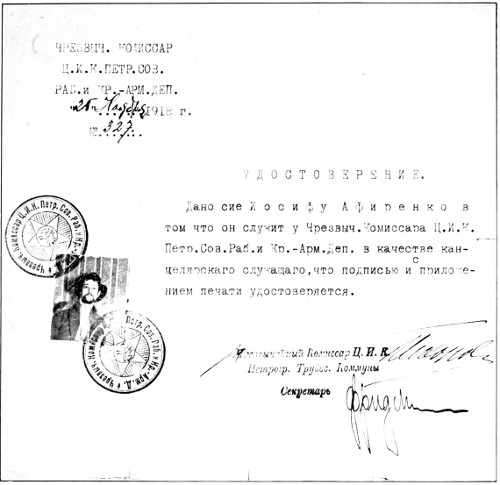
“Afirenko,” I said. “But that’s official. Tell
Maria I’m called ‘Ivan Ilitch.’”
Maria set the samovar and produced some black
bread and butter.
“This flat,” said Marsh, with his mouth full, “belonged
to a business colleague of mine. The Reds
seized him by mistake for someone else. The silly
fool nearly (here Marsh used a very unparliamentary
expression) with funk when he got arrested. Sat
in chokey three days and was told he was to be shot,
when luckily for him the right man was collared.
Then they let him out and I shipped him over the
frontier. They’ll forget all about him. In the
daytime this is one of the safest places in town.”
The flat was almost devoid of furniture. A bare
table stood in one room and a desk in another. An
old couch and a few chairs made up the outfit. The
windows were so dirty that they were quite opaque
and admitted very little light from the narrow street.
Although it was nearly midday an oil lamp burned on
the table of the room we sat in. Electric light was
becoming rarer and rarer and only burned for a few
hours every evening.
Marsh sat and talked of his adventures and the
work he had been doing for the allied colonies. His
country farm had been seized and pillaged, his city
business was ruined, he had long been under suspicion,
and yet he refused to leave. But the arrest of his
wife bore constantly on his mind. From time to time
his boisterous flow of talk would suddenly cease. He
would pass his hand over his brow, a far-away, troubled
look coming into his eyes.
“If only it were an ordinary prison,” he would say,
“if only they were human beings. But these——!
By the way, will you come with me to see the Policeman?
I am going to meet him in half-an-hour.”
The “Policeman” was the nickname by which we
referred to the Tsarist official of whom Marsh had
spoken in the morning. I reflected for a moment.
Perhaps the Policeman might be useful to me later.
I consented.
Telling Maria to look out for us both about that
time next morning, we left the flat by the back entrance,
as we had entered it. Again Marsh walked
ahead, and I followed his slouching figure at a distance
as he wound in and out of side streets. The
dwelling we were going to, he told me, was that of
an ex-journalist, who was now engaged as a scribe in
the Department of Public Works, and it was at
the Journalist’s that he had arranged to meet the
Policeman.
The Journalist lived all alone in a flat in the Liteiny
Prospect. I watched Marsh disappear into the entrance
and waited a moment to convince myself he
was not being tracked. From the opposite sidewalk
I saw him look back through the glass door, signalling
that all was well within, so giving him time to mount
the stairs I followed.
He rang the bell at a door covered with oilcloth
and felt. After a moment’s silence there was a
shuffling of slippers, an inner door opened, and a
voice said, “Who’s there?”
“He expects me to say who’s here, the silly fool,”
growled Marsh under his breath, adding just loud
enough to be heard through the door, “I.”
“Who? ‘I’?” persisted the voice.
“I, Peter Sergeievitch” (aloud), “blithering idiot”
(undertone), said Marsh.
There was much undoing of bars and bolts, and
finally, the door opening slightly on the chain, a pair
of nervous, twinkling eyes peered through the chink.
“Ah!” said the nervous face, breaking into a smile,
“Ivan Petrovitch!” The door closed again and the
chain was removed. Then it reopened and we
passed in.
“Why the devil couldn’t you open at once?”
grumbled Marsh. “You knew I was coming.
‘Who’s there?’ indeed! Do you want me to bawl
‘Marsh’ at the top of my voice outside your door?”
At this the nervous man looked terrified. “Well,
then, why don’t you open? ‘Ivan Petrovitch’ or
‘Peter Sergeievitch’—can’t any one be Ivan Petrovitch?
Isn’t that just why I am ‘Ivan Petrovitch’?”
“Yes, yes,” answered the nervous man, “but
nowadays one never knows who may be at the door.”
“Well, then, open and look, or next time I will
shout ‘Marsh.’” The nervous man looked more
terrified than ever. “Well, well,” laughed Marsh,
“I am only joking. This is my friend—er——”
“Michael Mihailovitch,” I put in.
“Very glad to see you, Michael Mihailovitch,” said
the nervous man, looking anything but glad.
The Journalist was a man of thirty-five years of age,
though his thin and pale features, dishevelled hair,
and ragged beard gave him the appearance of being
nearly fifty. He was attired in an old greenish overcoat
with the collar turned up, and dragged his feet
about in a pair of worn-out carpet slippers. The
flat was on the shady side of the street, the sun never
peered into its gloomy precincts, it was dark and
musty, and icy cold.
“Well, how go things, Dmitri Konstantinovitch?”
asked Marsh.
“Poorly, poorly, Ivan Petrovitch,” said the Journalist,
coughing. “This is the third day I have not
been to work. You will excuse my proceeding with
business; I’m having lunch. Come into the kitchen,
it is the least cold of all rooms.”
The Journalist, preparing his noonday meal, was
engaged in boiling a few potatoes over a stick fire in
a tiny portable stove. “Two days’ rations,” he remarked,
ironically, holding up a salt herring. “How
do they expect us to live, indeed? And half-a-pound
of bread into the bargain. That’s how they feed the
bourgeois in return for sweating for them. And
if you don’t sweat for them, then you get nothing.
‘He who toileth not, neither let him eat,’ as they say.
But it’s only ‘toil’ if it is to their advantage. If you
toil to your own advantage, then it is called ‘speculation,’
and you get shot. Ugh! A pretty state our
Russia has come to, indeed! Do we not rightly say
we are a herd of sheep?”
Continuing in this strain the Journalist scraped his
smelly herring and began eating it with his potatoes
ravenously and yet gingerly, knowing that the quicker
he finished the scanty repast the sooner he would
realize there was nothing more. Picking the skeleton
clean, he sucked the tail and dug his fork into the
head for the last scraps of meat.
“Plus 1,000 roubles a month,” he went on. “Here
I eat two days’ rations at a single meal, and what can
I buy with 1,000 roubles? A few pounds of potatoes,
a pound or two of bread and butter? Then there’s
nothing left for fuel, when wood that used to cost
5 roubles a sazhen now costs 500!”
From his overcoat pocket Marsh produced half-a-pound
of bread. “Here, Dmitri Konstantinovitch,”
he said, thrusting it toward him, “your health!”
The Journalist’s face became transfigured. Its haggard
look vanished. He glanced up, his mouth fixed
in a half-laugh of delight and incredulity, his sunken
eyes sparkling with childlike pleasure and gratitude.
“For me?” he exclaimed, scarcely believing his
eyes. “But what about yourself? Surely you do
not get sufficient, especially since——”
“Don’t worry about me,” said Marsh, with his
good-natured smile. “You know Maria? She is
a wonder! She gets everything. From my farm
she managed to save several sacks of potatoes and
quite a lot of bread, and hide it all here in town. But
listen, Dmitri Konstantinovitch, I’m expecting a
visitor here soon, the same man as the day before
yesterday. I will take him into the other room,
so that he need not see you.”
The Journalist, I could see, was overcome with
fear at being obliged to receive Marsh’s unwelcome
visitor, but he said nothing. He wrapped the bread
carefully up in paper and put it away in a cupboard.
A moment later there were three sharp rings at the
bell. Marsh hurried to the door, admitted his visitor,
and led him into the Journalist’s study.
“You may as well come in, too,” he said to me,
looking into the kitchen.
“Michael Ivanitch,” I whispered, pointing at myself,
as we passed in. Marsh introduced me. “My
friend, Michael Ivanitch Schmit,” he said.
My first impulse when I saw the individual Marsh
nicknamed “the Policeman” was to laugh, for any
one less like a policeman than the little man who rose
and bowed I have seldom seen. I will not describe
him too precisely, but he was short, red-faced, and
insignificant-looking. In spite of this, however, his
manner showed that he had a very high opinion of
his own importance. He shook hands and reseated
himself with comical dignity.
“Go on, Alexei Fomitch,” said Marsh. “I want
my friend to know how matters stand. He may be
able to help.”
“Madame Marsh, as I was saying,” proceeded
the Policeman, “is incarcerated in chamber No. 4
with thirty-eight other women of various station, including
titled personages, servant girls, and prostitutes.
The chamber is not a large one and I fear the conditions
are far from pleasant. My informants tell me
she is cross-examined several hours every day with
the object of eliciting the hiding-place of Monsieur
Marsh, which they believe she knows. Unfortunately
her case is complicated by the confused replies she has
given, for after several hours’ interrogation it often
becomes difficult to retain clarity of mind. Confused
or incoherent replies, even though accidental, lead to
further and still more exacting interpellation.”
Marsh followed every word with a concern that was
not lost upon the Policeman. “But can we not get
round the interrogators?” he asked, “they all have
their price, damn it.”
“Yes, that is often so,” continued the Policeman in
a tone of feigned consolation. “The investigator can
frequently be induced to turn the evidence in favour
of the accused. But in this case it is unfortunately
useless to offer the usual bribe, for even if Madame
Marsh’s innocence is proven to the hilt, she will still
be detained as a hostage until the discovery of
Monsieur Marsh.”
Marsh’s face twitched. “I feared so,” he said in
a dull voice. “What are the chances of flight?”
“I was coming to that,” said the Policeman,
suavely. “I am already making inquiries on the
subject. But it will take some days to arrange. The
assistance of more than one person will have to be
enlisted. And I fear—I hesitate,” he added in
unctuous tones of regret, “I hesitate to refer to such a
matter—but I am afraid this method may be a little
more—er—costly. Pardon me for——”
“Money?” cried Marsh. “Damn it all, man,
don’t you realize it is my wife? How much do you
want?”
“Oh, Monsieur Marsh,” expostulated the Policeman,
raising his palm, “you are well aware that I
take nothing for myself. I do this out of friendship
to you—and our gallant allies. But there is a prison
janitor, I must give him 5,000, two warders 10,000,
a go-between 2,000, odd expenses——”
“Stop!” put in Marsh, abruptly, “tell me how
much it will cost.”
The Policeman’s face assumed a pained expression.
“It may cost,” he said, “twenty-five, possibly thirty
thousand roubles.”
“Thirty thousand. You shall have it. I gave you
ten thousand, here are another ten thousand; you
shall have the third ten thousand the day my wife
leaves prison.”
The Policeman took the notes, and with a look of
offended dignity, as though the handling of money
were altogether beneath him, hid them in an inner
pocket.
“When will you be able to report again?” asked
Marsh.
“I expect the day after to-morrow. If you like to
come to my house it is quite safe.”
“Very well, we will meet there. And now, if you
are not in a hurry, I’ll see if I can raise some tea.
It’s damned cold in this room.”
When Marsh had gone into the kitchen the little
Policeman ventured to open conversation.
“Such times, such times,” he sighed. “Who
would have thought it possible? You live in Petrograd,
Michael Ivanitch?”
“Yes.”
“You are in service, perhaps?”
“Yes.”
There was a pause.
“Yours must have been an interesting occupation,”
I remarked, “in days gone by.”
“You mean?”
“You were connected with the police, were you
not?”
I saw at once I had made a faux pas. The little
man turned very red. “I beg your pardon,” I hastened
to add, “I understood you were an official of
the ohrana.”
This apparently was still worse. The little Policeman
sat up very straight, flushing deeply and looking
rather like a turkey-cock.
“No, sir,” he said in what were intended to be icy
tones, “you have been grossly misinformed. I have
never been connected either with the police or the
ohrana. Under the Tsar, sir, I moved in Court
circles. I had the ear of his late Imperial Majesty,
and the Imperial Palace was open to me at any
time.”
At this point, fortunately for me, Marsh returned
with three glasses of tea, apologizing for not providing
sugar, and the conversation turned to the inevitable
subject of famine. At length the Policeman rose
to go.
“By the way, Alexei Fomitch,” said Marsh, “can
you find me a lodging for to-night?”
“A lodging for to-night? I shall be honoured,
Monsieur Marsh, if you will accept such hospitality
as I myself can offer. I have an extra bed, though
my fare, I am afraid, will not be luxurious. Still, such
as it is——”
“Thank you. I will come as near nine o’clock as
possible.”
“Give three short rings, and I will open the door
myself,” said the Policeman.
When he had gone I told Marsh of our conversation
and asked what the little man meant by “moving in
Court circles.” Marsh was greatly amused.
“Oh, he was a private detective or something,” he
said. “Conceited as hell about it. ‘Ear of the Tsar,’
indeed! What he’s after is money. He’ll pocket
most of the 30,000. But he’s afraid of us, too. He’s
cocksure the Allies are coming into Petrograd, so
if you have anything to do with him tell him you’re
an Englishman and he’ll grovel. By the way, we had
better let Dmitri Konstantinovitch into the secret,
too, because you will find this flat very useful. The
Journalist is a damned old coward, but buy him
some grub or, still better, pay for his fuel and he will
let you use the flat as much as you like.”
So the nervous ex-journalist was initiated into the
great secret, and when Marsh said, “You don’t mind
if he comes in occasionally to sleep on the sofa,
do you?” Dmitri Konstantinovitch nearly died with
fear. His thin lips vibrated, and clearer than any
words his twitching smile and tear-filled eyes implored,
“Oh, for God’s sake, leave me alone!”—until
I said boldly, “But I don’t like sleeping in the cold,
Dmitri Konstantinovitch. Perhaps you could get
some wood in for me. Here is the price of a sazhen
of logs; we will share the wood, of course.” Then
his care-worn, troubled face again became suddenly
transfigured as it had when Marsh gave him bread.
“Ah, splendid, splendid,” he cried in delight, his fears
completely obliterated by the anticipation of coming
warmth. “I will get the wood in this very afternoon,
and you shall have sheets and blankets and I will
make you comfortable.” So it was arranged that
unless Melnikoff found me a more suitable place I
should return to the Journalist’s that night.
It was now time for me to be thinking of keeping
my appointment with Melnikoff at the communal
eating-house. So I left Marsh, arranging to meet him
at the empty flat “No. 5” next morning. Musing on
the events of the day I made my way down the staircase
and came out again into the Liteiny Prospect.
It seemed ages since, but two days ago, I walked
along this same street on the day of my arrival in
Petrograd, after crossing the frontier. What would
Melnikoff now have to tell me, I wondered?
As I rounded the corner of the Nevsky Prospect I
noticed a concourse of people outside the communal
eating-house toward which I was directing my steps.
I followed the people, who were moving hurriedly
across the street to the other side. At the entrance
to the eating-house stood two sailors on guard with
fixed bayonets, while people were filing out of the
building singly, led by militiamen. In the dark lobby
within one could dimly discern individuals being
searched. Their documents were being examined
and, standing in their shirt-sleeves, their clothing
was being subjected to strict investigation.
I waited to see if Melnikoff would emerge from the
building. After a moment I felt a tap on my arm
and looking round I was confronted by Zorinsky,
the officer who had accosted me in the café of Vera
Alexandrovna on the day of my arrival. Zorinsky
signalled to me to move aside with him.
“Were you to meet Melnikoff here?” he asked.
“It is lucky for you you did not enter the restaurant.
The place is being raided. I was about to go in
myself, but came a little late, thank God. Melnikoff
was one of the first to be arrested and has already
been taken away.”
“What is the cause of the raid?” I asked, dismayed
by this news.
“Who knows?” replied Zorinsky. “These things
are done spasmodically. Melnikoff has been tracked
for some days, I believe, and it may have been on his
account. Anyway, it is serious, for he is well known.”
People were beginning to move away and the search
was clearly nearing its end.
“What are you going to do?” said my companion.
“I do not know,” I replied, not wishing to confide
any of my movements to Zorinsky.
“We must begin to think of some way of getting
him out,” he said. “Melnikoff was a great friend of
mine, but you are, I expect, as interested in his
release as I am.”
“Is there any chance?” I exclaimed. “Of course
I am interested.”
“Then I suggest you come home with me and we
will talk it over. I live quite near.”
Anxious to learn of any possibility of saving
Melnikoff, I consented. We passed into Troitzkaya
Street and entered a large house on the right.
“How do you wish me to call you?” asked Zorinsky
as we mounted the staircase. I was struck by the
considerateness of his question and replied, “Pavel
Ivanitch.”
The flat in which Zorinsky lived was large and
luxuriously furnished, and showed no signs of molestation.
“You live comfortably,” I remarked, sinking
into a deep leather arm-chair. “Yes, we do pretty
well,” he replied. “My wife, you see, is an actress.
She receives as many provisions as she wants and our
flat is immune from requisition of furniture or the
obtrusion of workmen. We will go round some
evening, if you like, and see her dance. As for me,
my wife has registered me as a sub-manager of the
theatre, so that I receive additional rations also.
These things, you know, are not difficult to arrange!
Thus I am really a gentleman at large, and living like
many others at the expense of a generous proletarian
régime. My hobby,” he added, idly, “is contre-espionnage.”
“What?” I cried, the exclamation escaping me
inadvertently.
“Contre-espionnage,” he repeated, smiling. When
he smiled one end of his crooked mouth remained
stationary, while the other seemed to jut right up
into his cheek. “Why should you be surprised?
Tout le monde est contre-révolutionnaire: it is merely
a question of whether one is actively or passively so.”
He took from a drawer a typewritten sheet of paper
and handed it to me. “Does that by any chance
interest you?”
I glanced at the paper. The writing was full of
uncorrected orthographical errors, showing it had
been typed by an unpractised hand in extreme haste.
Scanning the first few lines I at once became completely
absorbed in the document. It was a report,
dated two days previously, of confidential negotiations
between the Bolshevist Government and the
leaders of non-Bolshevist parties with regard to the
possible formation of a coalition Government. Nothing
came of the negotiations, but the information was of
great importance as showing the nervousness of the
Bolshevist leaders at that time and the clearly defined
attitude of the Socialist-Revolutionary and Menshevist
parties toward the military counter-revolution.
“Is it authentic?” I inquired, dubiously.
“That report,” replied Zorinsky, “is at this moment
being considered by the central committee of the
Menshevist party in this city. It was drawn up by
a member of the Menshevist delegation and despatched
secretly to Petrograd, for the Bolsheviks do not permit
their opponents to communicate freely with each
other. I saw the original and obtained a copy two
hours before it reached the Menshevist committee.”
The suspicion of forgery immediately arose, but I
could see no reason for concocting the document on
the off-chance of somebody’s being taken in by it.
I handed it back.
“You may as well keep it,” said Zorinsky. “I
should have given it to Melnikoff and he would doubtless
have given it to you. I am expecting a further
report shortly. Yes,” he added, nonchalantly, tapping
the arm of the desk-chair in which he sat, “it is
an amusing game—contre-espionnage. I used to provide
your Captain Crombie with quite a lot of information.
But I’m not surprised you have not heard of me, for I
always preferred to keep in the background.”
He produced a large box of cigarettes and, ringing
a bell, ordered tea.
“I don’t know what you Allies propose doing with
regard to Russia,” he observed, offering me a light.
“It seems to me you might as well leave us alone as
bungle things in the way you are doing. Meanwhile,
all sorts of people are conducting, or think they
are conducting, espionage underground in Russia,
or planning to overthrow the Reds. Are you
interested?”
“Very.”
“Well, have you heard of General F.?” Zorinsky
launched into an exposition of the internal counter-revolutionary
movement, of which he appeared to
know extensive details. There existed, he said, belligerent
“groups,” planning to seize army stores,
blow up bridges, or raid treasuries. “They will never
do anything,” he said, derisively, “because they all
organize like idiots. The best are the S.R.’s
(Socialist-Revolutionaries): they are fanatics, like
the Bolsheviks. None of the others could tell you
what they want.”
The maid, neatly attired in a clean white apron,
brought in tea, served with biscuits, sugar, and
lemon. Zorinsky talked on, displaying a remarkable
knowledge of everybody’s movements and actions.
“Crombie was a fine fellow,” he said, referring to
the British Naval Attaché. “Pity he got killed.
Things went to pieces. The fellows who stayed after
him had a hard time. The French and Americans
have all gone now except (he mentioned a Frenchman
living on the Vasili Island) but he doesn’t do much.
Marsh had hard luck, didn’t he?”
“Marsh?” I put in. “So you know him, too?”
“Of him,” corrected Zorinsky. All at once he
seemed to become interested and leaned over the
arm of his chair toward me. “By the way,” he said,
in a curious tone, “you don’t happen to know where
Marsh is, do you?”
For a moment I hesitated. Perhaps this man, who
seemed to know so much, might be able to help Marsh.
But I checked myself. Intuitively I felt it wiser to
say nothing.
“I have no idea,” I said, decisively.
“Then how do you know about him?”
“I heard in Finland of his arrest.”
Zorinsky leaned back again in his chair and his
eyes wandered out of the window.
“I should have thought,” I observed, after a pause,
“that knowing all you do, you would have followed
his movements.”
“Aha,” he exclaimed, and in the shadow his smile
looked like a black streak obliterating one-half of his
face, “but there is one place I avoid, and that is
No. 2 Goróhovaya! When any one gets arrested I
leave him alone. I am wiser than to attempt to
probe the mysteries of that institution.”
Zorinsky’s words reminded me abruptly of Melnikoff.
“But you spoke of the possibility of saving Melnikoff,”
I said. “Is he not in the hands of No. 2
Goróhovaya?”
He turned round and looked me full in the face.
“Yes,” he said, seriously, “with Melnikoff it is
different. We must act at once and leave no stone
unturned. I know a man who will be able to investigate
and I’ll get him on the job to-night. Will you
not stay to dinner? My wife will be delighted to
meet you, and she understands discretion.”
Seeing no special reason to refuse, I accepted the
invitation. Zorinsky went to the telephone and I
heard him ask some one to call about nine o’clock
“on an urgent matter.”
His wife, Elena Ivanovna, a jolly little creature, but
very much of a spoilt child, appeared at dinner dressed
in a pink Japanese kimono. The table was daintily
set and decked with flowers. As at Vera Alexandrovna’s
café, I again felt myself out of place, and
apologized for my uncouth appearance.
“Oh! don’t excuse yourself,” said Elena Ivanovna,
laughing. “Everyone is getting like that nowadays.
How dreadful it is to think of all that is happening!
Have the olden days gone for ever, do you think?
Will these horrid people never be overthrown?”
“You do not appear to have suffered much, Elena
Ivanovna,” I remarked.
“No, of course, I must admit our troupe is treated
well,” she replied. “Even flowers, as you see, though
you have no idea how horrible it is to have to take a
bouquet from a great hulking sailor who wipes his nose
with his fingers and spits on the floor. The theatre
is just full of them, every night.”
“Your health, Pavel Ivanitch,” said Zorinsky,
lifting a glass of vodka. “Ah!” he exclaimed with
relish, smacking his lips, “there are places worse than
Bolshevia, I declare.”
“You get plenty of vodka?” I asked.
“You get plenty of everything if you keep your
wits about you,” said Zorinsky. “Even without joining
the Communist Party. I am not a Communist,”
he added (somehow I had not suspected it), “but
still I keep that door open. What I am afraid of is
that the Bolsheviks may begin to make their Communists
work. That will be the next step in the
revolution unless you Allies arrive and relieve them of
that painful necessity. Your health, Pavel Ivanitch.”
The conversation turned on the Great War and
Zorinsky recounted a number of incidents in his
career. He also gave his views of the Russian people
and the revolution. “The Russian peasant,” he said,
“is a brute. What he wants is a good hiding, and
unless I’m much mistaken the Communists are going
to give it to him. Otherwise the Communists go
under. In my regiment we used to smash a jaw now
and again on principle. That’s the only way to make
Russian peasants fight. Have you heard about the
Red army? Comrade Trotzky, you see, has already
abolished his Red officers, and is inviting—inviting, if
you please—us, the ‘counter-revolutionary Tsarist
officer swine,’ to accept posts in his new army.
Would you ever believe it? By God, I’ve half a
mind to join! Trotzky will order me to flog the
peasants to my heart’s content. Under Trotzky,
mark my words, I would make a career in no
time.”
The dinner was a sumptuous banquet for the
Petrograd of the period. There was nothing that
suggested want. Coffee was served in the drawing-room,
while Zorinsky kept up an unceasing flow of
strange and cynical but entertaining conversation.
I waited till nearly ten for the call from Zorinsky’s
friend with regard to Melnikoff, and then, in view of
my uncertainty as to whether the Journalist’s house
would still be open, I accepted Zorinsky’s invitation
to stay overnight. “There is no reason,” he said,
“why you should not come in here whenever you
like. We dine every day at six and you are
welcome.”
Just as I was retiring Zorinsky was called to the
telephone and returned explaining that he would only
be able to begin the investigation of Melnikoff’s case
next day. I was shown to the spare bedroom, where I
found everything provided for me. Zorinsky apologized
that he could not offer me a hot bath. “That
rascal dvornik downstairs,” he said, referring to the
yard-keeper whose duty it was to procure wood for the
occupants, “allowed an extra stock of fuel that I had
my eyes on to be requisitioned for somebody else, but
next week I think I shall be able to get a good supply
from the theatre. Good-night—and don’t dream of
No. 2 Goróhovaya!”
The Extraordinary Commission, spoken of with
such abhorrence by Zorinsky, is the most notorious
of all Bolshevist institutions. It is an instrument of
terror and inquisition designed forcibly to uproot all
anti-Bolshevist sentiment throughout Lenin’s dominions.
Its full title is the Extraordinary Commission
for the Suppression of the Counter-Revolution and
Speculation, “speculation” being every form of
private commerce—the bugbear of Communism. The
Russian title of this institution is Tchrezvitchainaya
Kommissia, popularly spoken of as the Tchrezvitchaika,
or still shorter the Tche-Ka. The headquarters of
the Tche-Ka in Petrograd are situated at No. 2 of the
street named Goróhovaya, the seat of the Prefecture of
Police during the Tsar’s régime, so that the popular
mode of appellation of the Prefecture by its address—“No.
2 Goróhovaya”—has stuck to the Extraordinary
Commission and will go down as a by-word in Russian
history.
At the head of No. 2 Goróhovaya there sits a soviet,
or council, of some half-dozen revolutionary fanatics
of the most vehement type. With these lies the final
word as to the fate of prisoners. Recommendations
are submitted to this soviet by “Investigators” whose
duty it is to examine the accused, collect the evidence
and report upon it. It is thus in the hands of the
“Investigators” that power over prisoners’ lives
actually lies, since they are in a position to turn the
evidence one way or the other, as they choose.
Investigators vary considerably. There are some
who are sincere and upright, though demoniacal
visionaries, cold as steel, cruel, unpolluted by thirst
for filthy lucre, who see the dawn of proletarian
liberty only through mists of non-proletarian blood.
Such men (or women) are actuated by malignant
longing for revenge for every wrong, real or imaginary,
suffered in the past. Believing themselves to be
called to perform a sacred task in exterminating the
“counter-revolution,” they can upon occasion be
civil and courteous, even chivalrous (though that is
rare), but never impartial. There are other investigators
who are merely corrupt, ready to sacrifice
any proletarian interest for a price, regarding their
job purely as a means of amassing a fortune by the
taking of bribes.
Every responsible official of the Extraordinary Commission
must be a member of the Communist Party.
The lower staff, however, is composed of hirelings,
frequently of foreign origin, and many of them re-engaged
agents of the Tsarist police. The latter, who
lost their jobs as the result of the revolution which
overthrew the Tsarist autocracy, have been re-enlisted
as specialists by the Bolsheviks, and find congenial
occupation in spying, eavesdropping, and hounding
down rebellious or suspected workmen just as they did
when the government was the Tsar’s instead of Lenin’s.
It is this fact which renders it almost impossible for
the Russian workers to organize a revolt against their
new taskmasters. It is thus that arose the sobriquet
applied to the Red régime of “Tsarism inside out.”
The faintest signs of sedition are immediately reported
to the Tche-Ka by its secret agents disguised as
workers, the ringleaders are then “eliminated” from
the factory under pretext of being conscripted elsewhere,
and they are frequently never heard of again.
The Extraordinary Commission overshadows all
else in Red Russia. No individual is free from its
all-perceiving eye. Even Communists stand in awe
of it, one of its duties being to unearth black sheep
within the Party ranks, and since it never errs on the
side of leniency there have been cases of execution of
true adherents of the Communist creed under suspicion
of being black sheep. On the other hand, the
black sheep, being imbued with those very qualities of
guile, trickery, and unscrupulous deceit which make
the Extraordinary Commission so efficient a machine,
generally manage to get off.
One of the most diabolic of the methods copied from
Tsarist days and employed by the Extraordinary Commission
against non-Bolsheviks is that known in Russia
as provocation. Provocation consisted formerly in the
deliberate fomentation, by agents who were known as
agents-provocateurs, of revolutionary sedition and plots.
Such movements would attract to themselves ardent
revolutionaries, and when a conspiracy had matured
and was about to culminate in some act of terrorism
it would be betrayed at the last moment by the agent-provocateur,
who frequently succeeded in making himself
the most trusted member of the revolutionary
group. Agents-provocateurs were recruited from all
classes, but chiefly from the intelligentsia. Imitating
Tsarism in this as in most of its essentials, the Bolsheviks
employ similar agents to foment counter-revolutionary
conspiracies and they reward munificently
a provocateur who yields to the insatiable Tche-Ka
a plentiful crop of “counter-revolutionary” heads.
As under the Tsar, every invention of exquisite
villainy is practised to extract from captives, thus or
otherwise seized, the secret of accomplices or sympathizers.
Not without reason was Marsh haunted
with fears that his wife, nerve-racked and doubtless
underfed, if fed at all, might be subjected to treatment
that would test her self-control to the extreme. She
did not know where he was, but she knew all his
friends and acquaintances, an exhaustive list of whom
would be insistently demanded. She had already,
according to the Policeman, given confused replies,
which were bound to complicate her case. The
inquisition would become ever more relentless, until
at last——
On the day following my visit to Zorinsky I appeared
punctually at eleven o’clock at the empty flat with
“No. 5” chalked on the back door. It was not far
from Zorinsky’s, but I approached it by a circuitous
route, constantly looking round to assure myself I
was not being followed. The filthy yard was as foul
and noisome as ever, vying in stench with the gloomy
staircase, and I met no one. Maria, no longer suspicious,
opened the door in answer to my three knocks.
“Peter Ivanitch is not here yet,” she said, “but he
should be in any minute.” So I sat down to read the
Soviet newspapers.
Marsh’s three thumps at the back door were not
long in making themselves heard. Maria hurried
along the passage, I heard the lock creak, the door
stiffly tugged open, and then suddenly a little stifled
cry from Maria. I rose quickly. Marsh burst, or
rather tumbled, into the room with his head and face
bound up in a big black shawl. As he laboriously
unwound it I had a vision of Maria in the doorway,
her fist in her mouth, staring at him speechless and
terrified.
It was a strange Marsh that emerged from the folds
of the black shawl. The invincible smile struggled
to maintain itself, but his eyes were bleared and
wandered aimlessly, and he shook with agitation
despite his efforts to retain self-control.
“My wife——” he stammered, half coherently, dropping
into a chair and fumbling feverishly for his
handkerchief. “She was subjected yesterday—seven
hours’ cross-examination—uninterruptedly—no food—not
even allowed to sit down—until finally she swooned.
She has said something—I don’t know what. I am
afraid——” He rose and strode up and down, mumbling
so that I could scarcely understand, but I caught
the word “indiscretion”—and understood all he
wished to say.
After a few moments he calmed and sat down again.
“The Policeman came home at midnight,” he said,
“and told me all about it. I questioned and questioned
again and am sure he is not lying. The
Bolsheviks believe she was implicated in some conspiracy,
so they made her write three autobiographies,
and” (he paused) “they—are all different. Now—she
is being compelled to explain discrepancies, but
she can’t remember anything and her mind seems to
be giving. Meanwhile, the Bolsheviks are resolved to
eradicate, once and for all, all ‘English machinations,’
as they call it, in Russia. They know I’ve shaved
and changed my appearance and a special detachment
of spies is on the hunt for me, with a big reward
offered to the finder.”
He paused and swallowed at a gulp the glassful of
tea Maria had placed beside him.
“Look here, old man,” he said, suddenly, laying his
hands out flat on the table in front of him, “I am
going to ask you to help me out. The ‘Policeman’
says it’s worse for her that I should be here than if I
go. So I’m going. Once they know I’ve fled, the
Policeman says, they will cease plaguing her, and it
may be easier to effect an escape. Tell me, will you
take the job over for me?”
“My dear fellow,” I said, “I had already resolved
that I would attempt nothing else until we had safely
got your wife out of prison. And the day she gets out
I will escort her over the frontier myself. I shall have
to go to Finland to report, anyway.”
He was going to thank me but I shut him up.
“When will you go?” I asked.
“To-morrow. There are a number of things to be
done. Have you got much money?”
“Enough for myself, but no reserve.”
“I will leave you all I have,” he said, “and to-day
I’ll go and see a business friend of mine who may be
able to get some more. He is a Jew, but is absolutely
trustworthy.”
“By the way,” I asked, when this matter was
decided, “ever heard of a Captain Zorinsky?”
“Zorinsky? Zorinsky? No. Who is he?”
“A fellow who seems to know a lot about you,”
I said. “Says he is a friend of Melnikoff’s, though I
never heard Melnikoff mention him. Yesterday he
was particularly anxious to know your present
address.”
“You didn’t tell him?” queried Marsh, nervously.
“What do you take me for?”
“You can tell him day after to-morrow,” he laughed.
Marsh went off to his business friend, saying he
would warn him of my possible visit, and stayed
there all day. I remained at “No. 5” and wrote up
in minute handwriting on tracing paper a preliminary
report on the general situation in Petrograd, which
I intended to ask Marsh to take with him. To be
prepared for all contingencies I gave the little scroll
to Maria when it was finished and she hid it at the
bottom of a pail of ashes.
Next morning Marsh turned up at “No. 5” dressed
in a huge sheepskin coat with a fur collar half engulfing
his face. This was the disguise in which he was
going to escape across the frontier. As passport he
had procured the “certificate of identification” of his
coachman, who had come into Petrograd from the
expropriated farm to see Maria. With his face purposely
dirtied, and decorated with three days’ growth
of reddish beard, a driver’s cap that covered his ears,
and a big sack on his back to add a peasant touch to
his get-up, Marsh looked—well, like nothing on earth,
to use the colloquial expression! It was a get-up
that defied description, yet in a crowd of peasants
would not attract particular attention.
Confident that he was doing the right thing by
quitting, Marsh had completely recovered his former
good spirits and joked boisterously as he put a finishing
touch here and there to his disguise. I gave him my
report and folding it flat into a packet about two
inches square he removed one of his top boots and hid
it inside the sole of his sock. “The population of hell
will be increased by several new arrivals before the
Bolsheviks find that,” he said, pulling on his boot
again and slipping a heavy revolver inside his trousers.
Poor Maria was terribly distressed at Marsh’s
departure. So was the coachman, who could find
no terms wherein to express his disgust and indignation
at the conduct of the elder of the two stable-boys,
who had joined the Bolsheviks, assisted in
sacking Marsh’s country house and farm, and was
now appointed Commissar in supreme control of the
establishment. The coachman exhausted a luxuriant
fund of expletives in describing how the stable-boy
now sprawled in Marsh’s easy-chairs, spitting on the
floor, how all the photographs had been smashed to
pieces, and the drawing-room carpets littered with
dirt, cigarette-ends, and rubbish. At all of which
Marsh roared with laughter, much to the perplexity
of the coachman and Maria.
With trembling hands Maria placed a rough meal on
the table, while Marsh repeated to me final details of
the route he was taking and by which I should follow
with his wife. “Fita,” he said, mentioning the name
of the Finnish guide on whom he was relying, “lives
a mile from Grusino station. When you get out of
the train walk in the other direction till everybody has
dispersed, then turn back and go by the forest path
straight to his cottage. He will tell you what to do.”
At last it was time to start. Marsh and I shook
hands and wished each other good-luck, and I went
out first, so as not to witness the pathetic parting
from his humble friends. I heard him embrace them
both, heard Maria’s convulsive sobs—and I hurried
down the stone stairway and out into the street. I
walked rapidly to the street-car terminal in the
Mihailovsky Square, and wandered round it till
Marsh appeared. We made no sign of recognition.
He jumped on one of the cars, and I scrambled on to
the next.
It was dark by the time we reached the distant
Okhta railway station, a straggling wooden structure
on the outskirts of the town. But standing on the
wooden boards of the rough platform I easily discerned
the massive figure, pushing and scrambling amid a
horde of peasants toward the already over-crowded
coaches. Might is right in Red Russia, as everywhere
else. The Soviet Government has not yet nationalized
muscle. I watched a huge bulk of sheepskin,
with a dangling and bouncing grey sack, raise itself
by some mysterious process of elevation above the
heads and shoulders of the seething mass around and
transplant itself on to the buffers. Thence it rose to
the roof, and finally, assisted by one or two admiring
individuals already ensconced within the coach, it
lowered itself down the side and disappeared through
the black aperture of what had once been a window.
I hung around for half an hour or so, until a series of
prolonged and piercing whistles from the antediluvian-looking
locomotive announced that the driver
had that day condescended to set his engine in motion.
There was a jolt, a series of violent creaks, the loud
ejaculations of passengers, a scramble of belated
peasants to hook themselves on to protruding points
in the vicinity of steps, buffers, footboards, etc., and
the train with its load of harassed creatures slowly
rumbled forward out of the station.
I stood and watched it pass into the darkness and,
as it vanished, the cold, the gloom, the universal
dilapidation seemed to become intensified. I stood,
listening to the distant rumble of the train, until I
found myself alone upon the platform. Then I
turned, and as I slowly retraced my steps into town
an aching sense of emptiness pervaded everything, and
the future seemed nothing but impenetrable night.
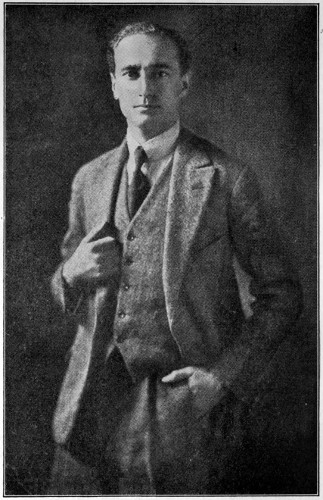
 First Printed May 1922.