We again go West—Hiding the trail—Red and white for once in
harmony—Peace and plenty—An autumn holiday—We select
a winter’s camp—The Forks—Hut-building—Our food supply—The
autumn hunt—The Great Prairie—Home thoughts—Indian
instincts—The Lake of the Winds—Buffalo—Good
meat—A long stalk—The monarch of the waste—A stampede—Wolves—The
red man’s tobacco.
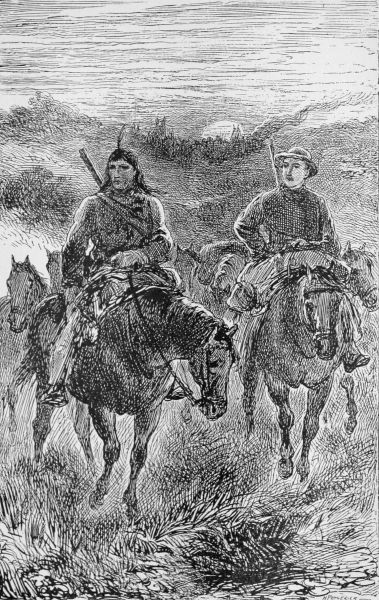
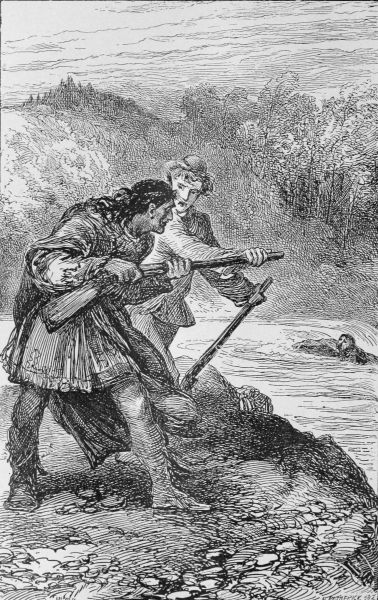
As we rode back to camp, the Sioux learned from the scout
all that had happened in the camp of the Assineboines,
from the time that he had himself brought news of the presence
in the hills of the disabled Cree and his protectors,
until the moment when he had been captured by the united
efforts of the dog and his masters.
The Sioux listened eagerly to the story of the trader’s
having literally set a price upon his head; and when he reflected
that all the precautions which he, Red Cloud, had
taken had been done in complete ignorance of the
machinations of his enemy, and only from casually learning
from the Cree that a party of hostile Indians had passed
him on the previous night, he felt how true is that lesson
in war which enjoins never neglecting in times of danger to
guard against the worst even though the least may only be
threatened.
But Red Cloud learned from the story of the scout
information for future guidance, as well as confirmation of
the course he had already followed. He realized the fact
that though the fire had already freed him from the presence
of the Assineboines, yet, that it could only be a short respite;
the bribe offered by the trader was too high to allow
these men to relinquish all hope of taking prizes which
were to make them great Indians for the rest of their
lives. The necessity of quickly shifting his ground, and of
leaving altogether that part of the country, became so fully
apparent to him that he lost no time in communicating to
us his plan of action.
It was, to march that evening about ten miles towards
the north, and then to strike from the hills due west into
the great plain. Being heavily loaded with stores, we could
not hope by dint of hard marching to outstrip our enemies;
but by taking unusual precautions to hide our trail, we might
succeed in successfully eluding the watchful eyes of the
Assineboines.
A hasty dinner followed the return of the party to camp,
and then preparations for departure were at once made.
The Cree had made, in the rest and care of the last two
days, more progress to recovery than in the whole period
of his former convalescence, and he was now well able to
take his share in the work of striking camp.
When men bivouac in the open it takes but little time to
make a camp or to quit it, and ere the sun had set the
whole party had got in motion, and, led by the Sioux, were
threading their course through the hills farther towards the
north.
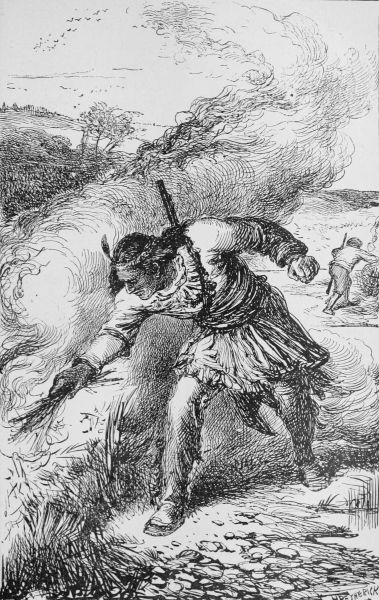
The rain had ceased, but the grass was still too wet to
burn, so that the simple expedient of setting fire to the
prairie in order to hide a trail, was in this instance impossible.
As, however, the point of departure from the
hills for the west was the point most essential to obliterate,
the Sioux did not so much care that our trail while in the
hills could easily be followed.
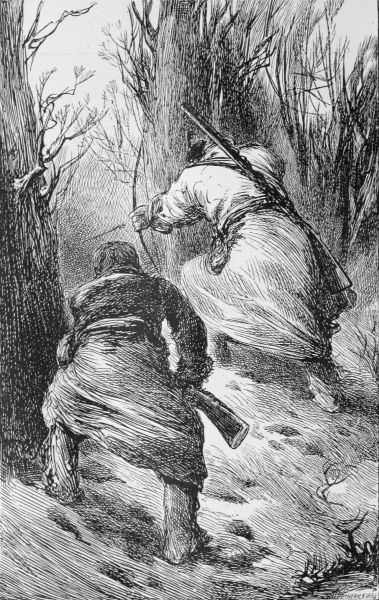
Not until midnight did he give the word to camp, and
the first streak of dawn found us again in motion. While
the morning was still young we arrived at a small river
which flowed out from the hills into the plain, and pursued,
far as the eye could determine to the west, a course sunken
in a narrow valley deep beneath the level of the prairie. Here
was the point of departure. The stream was shallow, and the
current ran over a bed of sand and pebbles. The Sioux,
Donogh, and I, led the pack-horses along the centre of this
river channel, while the scout and the Cree were directed to
ride many times to and fro up the farther bank, and then to
continue their course towards the north for some miles.
It was Red Cloud’s intention to camp about fifteen miles
lower down the stream; he would only keep his horses in
the bed of the channel for one hour, by that time he would
have gained a considerable distance down stream; then
selecting a dry or rocky place, we would have left the
channel and continued our course along the meadows on
one side.
When the scout and the Cree had put some miles between
them and the stream they were to turn sharp to their left
hand; first one, and later on the other, and then rejoin
us some time during the following day. By these plans
the Sioux hoped to foil any pursuers who might be on his
trail, and he would certainly succeed in delaying a pursuit
until the fine weather would again make the grass dry
enough to allow it to burn.
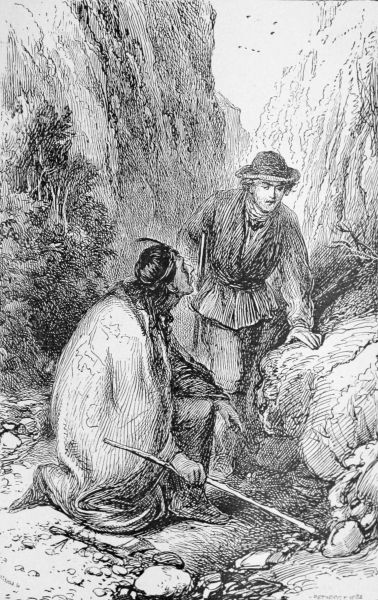
Down the centre of the stream we led the pack-horses
in file, and away to the north went the scout and the Cree.
It was toilsome work wading along the channel of the river,
which in some places held rocks and large loose stones;
but by little and little progress was made, and ere sunset
the dry ground was once more under foot, and our party
was pursuing a rapid course along the meadows to the west.
Red Cloud had told the scout that he would await him
at the Minitchinas, or Solitary Hill, a conical elevation
in the plains some twenty miles away to the west. At the
north side of this hill our whole party came again together
about the middle of the following day, and after a hearty
meal we turned our faces towards that great plain which
stretches from the base of this solitary mound into what
seemed an endless west.
Everybody was in high spirits; even the dog had quite
recovered from the effects of his arrow-wound, and the
scout and he had become firm friends.
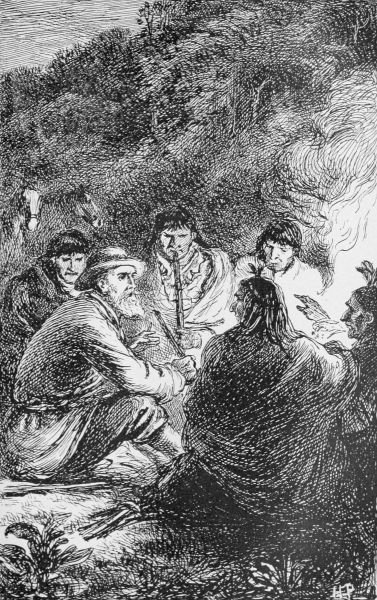
It was a curious group this, that now held its course into
the western wilds.
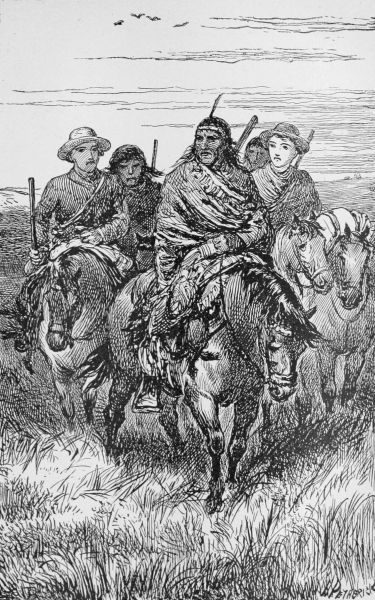
There were representatives of three of those strange families
of the aboriginal race of North America—that race now
rapidly vanishing from the earth, and soon only to be known
by those wild names of soft sound and poetic meaning which,
in the days of their glory, they gave to ridge, lake, and
river, over the wild wilderness of their vast dominions;
and two white men from a far-distant land, alien in
race, strange in language, but bound to them by a sympathy
of thought, by a soldier instinct which was strong
enough to bridge the wide gulf between caste and colour,
and make red and white unite in a real brotherhood—a
friendship often pictured in the early dreams of the red
race when the white man first sought the wilds, but never
fully realized in all these long centuries of war and strife,
save when the pale-faced stranger whom they called the
Black Robe, came to dwell amongst them and to tell them
of a world beyond the grave, more blissful than their
fabled happy hunting-grounds, where red men and white
were to dwell, the servants of One Great Master.
And now days began to pass of quiet travel over the
autumn prairies—days of real enjoyment to me, who hour
by hour read deeper into the great book which nature ever
holds open to those who care to be her students—that book
whose pages are sunsets and sunrises, twilights darkening
over interminable space, dawns breaking along distant
horizons, shadows of inverted hill-top lying mirrored in
lonely lakes, sigh of west wind across measureless meadow,
long reach of silent river, stars, space, and solitude.
Ten days of such travel carried our little party far into
the west. We had reached that part of the northern plains
which forms the second of those sandy ridges or plateaux
which mount in successive steps from the basin of the
great lake Winnipeg, to the plains lying at the base of the
Rocky Mountains.
In this great waste game was numerous. Buffalo roamed
in small bodies hither and thither; cabri could be seen
dotting the brown grass, or galloping in light bounds to some
vantage hill, from whence a better survey of the travellers
could be had; wolves and foxes kept skulking in the
prairie depressions, and dodged along the edges of ridges
to scent or sight their prey. The days were still fine and
bright; but the nightly increasing cold told that winter was
slowly but surely coming on.
It was now the middle of September, early enough still for
summer travel, but it would soon be necessary to look out
for some wintering-ground, where wood for a hut and fuel
could be easily obtained, and where the grass promised food
for the horses during the long months of snow.
Almost every part of this vast ocean of grass had become
thoroughly known to Red Cloud. Land once crossed by
a red man is ever after a living memory to him. He can
tell, years after he has passed along a trail, some of the
most trifling landmarks along it; a bush, a rock, a sharply
marked hill, will be all treasured in his memory; and though
years may have elapsed since his eye last rested upon this
particular portion of the great prairie, he will know all its
separate features, all the little hills, courses, or creeks which
lie hidden amid the immense spaces of this motionless ocean.
For some days the Sioux had been conning over in his mind
the country, seeking some spot lying within easy reach of
where he was now moving which yielded what our party
required—timber, fuel, and grass. A few years earlier he
had camped at the point of junction of two rivers, the Red
Deer and the Medicine, not more than four days’ journey to
the north-west of where he now was. He remembered that
amid a deep thicket of birch, poplar, and cotton-wood, there
stood a large group of pine-trees. If fire had spared that
part of the prairie, he knew that the alluvial meadows along
the converging rivers, would yield rich store of winter food
for the horses. He knew, too, that in other respects the
spot had many recommendations in its favour; it lay
almost in the centre of that neutral zone between the Cree
country and the sandy wastes of the Blackfeet nation, and
that it was therefore safe in winter from the roving bands of
these wild tribes, whose warfare is only carried on during
the months of spring, summer, and autumn. All these
things combined made him fix upon this spot for the winter
camping-ground, and he began to shape the course of the
party more to the north, to see if the place held still in its
sheltered ridges all the advantages it had possessed when
he had seen it for the first and last time.
Riding along one sunny mid-day, he explained to me the
prospect before us.
“It is getting late in the season,” he said; “all the grass
is yellow; the wind has begun to rustle in the dry seeds
and withered prairie flowers; the frost of night gets harder
and colder. At any moment we may see a great change;
that far off sky-line, now so clear cut against the prairie,
would become hidden; dense clouds would sweep across
the sky, and all the prairie would be wrapped in snow-drift.
“The winter in this north land is long and severe; the
snow lies for months upon the plains, in many feet in thickness
it will rest upon yon creek, now so full of bird-life.
The cold will then be intense; all the birds, save the prairie-grouse,
the magpie, and the whisky jack, will seek southern
lands; the buffalo will not, however, desert us, they may
move farther north into the Saskatchewan, and wolves, foxes,
and coyotes will follow in their wake. Neither horse nor
man can then brave for any time the treeless plains.
“We must prepare for the winter,” he went on, “and
my plan is this: some days’ march from this is a spot which,
when I last saw it, had around it all that we shall require for
our winter comfort. Where two rivers come together there
stands, sheltered among hills, a clump of pine-trees. The
points of the rivers are well wooded, and the marshes along
the banks hold wild vetch, and the pea plant of the prairie
grows through the under-bush, high above the snow, giving
food to horses in the worst seasons of the year.
“I don’t know any fitter place for winter camp in all the
hundreds of miles that are around us. We are now bound
for that spot, and if things are as I last saw them, we shall
make our hut in the pine wood and settle into our winter-quarters
ere the cold has come. We have still much to do,
and it is time we set to work.”
I heard with joy these plans for the winter. The life was
still so new to me—the sense of breathing this fresh bright
atmosphere, and of moving day by day through this great
ocean of grass, was in itself such pleasure, that I had latterly
ceased almost altogether to think much about the future,
feeling unbounded confidence in my Indian friend’s skill and
forethought.
Donogh and I had in fact been enjoying the utmost bliss
of perfect freedom—that only true freedom in life, the
freedom of fording streams, crossing prairies, galloping over
breezy hill-tops, watching wild herds in their daily habits of
distance, seeing them trail along slowly into golden sunsets,
or file in long procession to some prairie stream for the
evening drink; or better still, marking some stray wolf into
a valley where he thought himself unseen, and dashing down
upon him with wild hulloo ready for the charge, while the
silent echoes wake to the clash of hoof and ring of cheer.
All these things, and many more, had filled the hours of our
life in the past month to such a degree, that our spirits
seemed to have widened out to grasp the sense of a freedom
as boundless as the wilderness itself.
It was on the third day following the conversation above
recorded, that we came in sight of a low dark ridge, showing
itself faintly above the northern horizon.
Flowing in many serpentine bends, a small creek wound
through the prairie at our left hand, cotton-wood clusters
fringed the “points” of this stream, and long grass grew
luxuriantly between the deep bends, which sometimes formed
almost a figure eight in the roundness of their curves. Our
party moved in a straight line, which almost touched the
outer points of these deep curves, and from the higher
ground along which we marched, the eye could at times
catch the glint of water amid the ends of grasses, and mark
the wild ducks sailing thickly on the rushy pools. I had
used my gun frequently during the morning, and when the
mid-day hour had come we had a plentiful supply of wild
ducks hanging to our saddles.
In this life in the wilderness I had early learned the
lesson of killing only what was needed to supply the wants
of the party. When wild ducks were so plentiful, it would of
course have been easy to shoot any quantity of them; but that
habit of civilized sport which seeks only the “bag” had long
since ceased to influence me, and I had come to regard the
wild creatures of the prairie, birds and beasts, as far more
worthy of study in life than in death. That terrible misnomer
“good sport” had for me a truer significance. It meant
watching the game by little and little, and killing only what
was actually required for the use of our fellow travellers and
myself. During the mid-day halt on this day Red Cloud
held a long conversation with the other Indians upon the
place they were now tending to. The Assineboine had
never visited the spot, the Cree had been there on a
war-party two summers ago; but it was now, he thought, so
late in the season that there would be little danger of meeting
any roving bands of Blackfeet, and the Crees he knew to be
far away towards the eastern prairies.
It would have been difficult to have imagined a more
perfect scene of a mid-day camp than that in which our
little party found itself on this bright autumnal day.
The camp fire was made at the base of a round knoll,
which ran from the higher plateau of the prairie into one
of the deep bends of the creek; upon three sides a thick
fringe of cotton-wood lined the edges of the stream; the
golden leaves of poplars and the bronzed foliage of the
bastard maple hung still and bright in the quiet September
day. Immediately around the camp grew small bushes of
wild plum, covered thickly with crimson and yellow fruits of
delicious flavour.
Ah, what a desert that was! When the wild ducks
and the flour gelettes had been eaten, a single shake
of the bush brought down showers of wild sweet fruit,
and when we had eaten all we could, bags were filled for
future use.
But even such prairie repasts must come to an end, and
it was soon time to saddle and be off. So the horses were
driven in, and resuming our course, the evening found us on
the banks of the Red Deer river, not far from its point of
junction with the Medicine. We camped that night upon
the banks of the stream, and early next day reached
the point of junction. A ford was soon found, and to the
Sioux’ great joy no trace of fire was to be seen in the
meadows between the rivers, or on the range of hills that
lay to the north and east; all was still and peaceful as he
had last seen it. The pine bluff yet stood dark and solemn
at the point where the rivers met, and the meadows, as our
party rode through them, were knee-deep in grasses and
long trailing plants.
And now began in earnest a period of hard work. First
the small lodge of dressed skins was pitched upon a knoll
amid the pine-trees; then the saddles and stores were all
made safe, upon a rough stage supported upon poles driven
fast into the ground. Next began the clearing of trees and
brushwood on the site selected for the hut. It was a spot
close to the point formed by the meeting of the two rivers,
but raised about twenty feet above the water, and partly
hidden by trees and bushes. Tall pines grew on the site,
but the axe of the Sioux and the scout soon brought down
these giants, and made clear the space around where the hut
was to stand.
It was wonderful to watch the ready manner in which
the Indians worked their hatchets; never a blow missed
its mark, each falling with unerring aim upon the spot
where the preceding one had struck; then a lower-struck
cut would cause the huge splinters to fly from the trunk,
until, in a few moments the tree crashed to the earth in the
exact line the Indians wished it to fall.
Although a novice at woodman’s craft, I was no idle spectator
of the work. If a man has a quick eye, a ready hand, and
a willing heart, the difficulties that lie in things that are unknown
to us are soon overcome. Every hour’s toil made a
sensible improvement in my work. I soon learnt how to
roughly square the logs, and to notch the ends of them so
that one log fitted closely to the other.
Donogh and the wounded Cree meantime looked after the
horses, gathered fuel for the fire, and cooked the daily meals
of our party, and often gave a hand at the lifting of log or
labour of construction. Thus the work went on without
intermission, and day by day the little hut grew in size.
All day long the sound of wood-chopping echoed through
the pine wood at the point, over the silent rivers, causing
some passing wolf to pause in his gallop and listen
to the unwonted noise; but no human ear was there to
catch it, or human eye to mark the thin column of blue
smoke that rose at eventime above the dark pine-tops when
the day’s work was over. There was no lack of food either.
With a few hooks and lines Donogh managed to do good
work among the fishes in the rivers. The creeks and ponds
still held large flocks of wild ducks, and many a fat black
duck fell to a steady stalk of the Cree, whose crawling powers
were simply unmatched. The black-tailed buck were
numerous in the thickets around, and with so many things
the larder never wanted for game, venison, wild fowl, or
fish.
Thus the days went by, and at last the hut was finished
and ready for occupation. It was an oblong structure,
measuring twenty-five feet by twenty. A low door gave
admission upon the south side; east and west held windows
of parchment-skin drawn over a wooden frame that opened
and shut on leather hinges. At the north side stood the
fireplace, a large hearth, and a chimney capable of holding a
quantity of pine logs. Half the wooden door frame was also
bound with parchment skins; thus plenty of light could be
obtained in rough weather, and when the days would be still
and fine both door and windows could be open.
“When the snow has fallen,” said Red Cloud to us,
“the light from the ground will be very great. The snow
hanging on the pine boughs will also light up the place, and
the winter’s day will be brighter than you can imagine. At
night our logs will blaze brightly upon the hearth.”
The fireplace and chimney were built of stones and mud.
The Indians had carefully mixed the latter so as to ensure
its standing the great heat of the winter fires. The logs
composing the walls were all of pines, or, more properly
speaking, of white spruce; they had been roughly squared
and notched at the end, to allow of their catching each other
and fitting tightly together; mud and moss had then been
pressed into the interstices so as to make them perfectly
air-tight. The roof was composed of long reed-grass, cut from
a neighbouring swamp and dried in the sun. The floor was
plastered with a coating of mud, which, when fully dry, made
a smooth and firm surface. Altogether the interior presented
an aspect of great comfort—rude, it is true, but still clean,
bright, and cheerful.
It was a marvel to me how all this labour had been done,
and this result achieved, with only a few rude implements—a
couple of axes, a saw, a few gimlets and awls, and those
wonderful knives which the Indians themselves make from
old files—those knives with which a ready man can fashion a
canoe, a dog-sled, or a snow-shoe, with a beauty of design
which no civilized art can excel.
But although shelter for the winter had been thus provided,
an equally important want had still to be attended to; a
supply of meat sufficient to last three months had to be
obtained.
The Red Cloud had often spoken to me of the expedition
which we had still before us in the first month of the
winter, and now that the hut was finished the time had come
for setting out in quest of buffalo.
“Of all the winter food which the prairie can give,” said
he to me, “there is no food like the meat of the buffalo.
The time has now come when the frost is sufficiently keen
all day to keep the meat frozen, therefore all we kill can be
brought in; none of it will be lost. The last buffalo we
saw,” he continued, “were on the plains south of the Elk
river; they were scattered herds of bulls. The cows
were then absent three days’ march south of that ground;
the herds were moving very slowly to the west. About a
week’s journey from here there is a small lake in the plains,
called the Lake of the Wind, from the ceaseless movement of
its waters. Day and night, even when the winds are still,
the waters of that lake move and dash with noise against
the pebbles on the shore. It is a favourite haunt for buffalo.
To that lake we shall steer our course; for four days we
shall have to cross a bare plain, on which no tree or bush
grows; but at the lake there will be wood in the caverns
around the shores, and we can get shelter for our tent,
and fuel for fire, there. The horses are now all strong and
fat, and they will be able to stand the cold, no matter how
severe it may come.”
The Sioux spoke truly; a prairie horse is all right if he be
fat. It matters little in winter what he may be in speed, or
strength, or activity; as long as he is thick fat there is always
a month’s work in him.
Early on the day following the completion of the hut, all
the horses were driven in from the meadows in which they
had spent the last three weeks. They all looked fat and
strong.
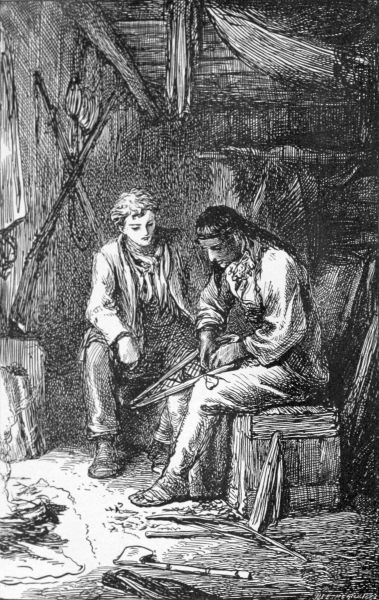
During some days past the Cree had been busy preparing
sleds, for light snow had now fallen; and although it
had not lain long upon the ground, it was, nevertheless,
likely that ere the time for the return of our party had
arrived the ground would be white with its winter covering.
These sleds would be carried crossways upon a horse until
the snow would allow of their being drawn along the
ground; they would each carry about 500 pounds of meat,
and that would form an ample supply for the winter, with
the venison and wild game that could be obtained in a ten-mile
circle around the hut.
All preparations having been finished, Red Cloud, Donogh,
the scout, and myself started on the following morning,
bound for the south-west. We took with us a small tent,
six horses, and plenty of powder and ball. The Cree and
the dog remained to take charge of the hut. We expected
to be absent about one month. It was the 20th of October,
a bright, fair autumn day; hill and plain lay basking in a
quiet sunlight, the sky was clear and cloudless, the air had
in it that crisp of frost which made exercise a pleasure.
Winding along the meadows of the Red Deer, the pine
bluff at the Forks was soon lost to sight behind its circling
hills.
The evening of the third day after quitting the hut at the
Forks found our little party camped on the edge of that
treeless waste which spreads in unbroken desolation from
the banks of the Eagle Creek near the North Saskatchewan
to the Missouri. The spot where the lodge was pitched
bore among the half-breed hunters of the plains the title of
Les Trois Arbres.
It would have been difficult to have found a wilder scene
than that which spread itself to the south and west from this
lonely group of trees.
“Beyond the farthest verge of sight,” said the Sioux, as
he pointed out the general direction he proposed to follow
on the morrow, “lies the lake which the Indians have
named the Lake of the Wind. From yonder group of trees
to the shore of that lake, four long days’ journey, there does
not grow one tree or bush upon the prairie. We must halt
here to-morrow, to bake bread and cut wood, to carry on
the sleds, sufficient to last us across this bare expanse. Once
at the lake we shall find wood in plenty, and I think the
buffalo will not be far distant.”
The sight upon which we now gazed was in truth almost
sublime in its vast desolation. The sun, just descended
beneath the rim of the western prairie, cast up into the sky
one great shaft of light.
The intense rarity of the atmosphere made the landscape
visible to its most remote depths. A few aspen clumps, and
the three trees already mentioned, grew near the standpoint
from which we looked; but in front no speck of tree met
the eye, and the unbroken west lay waiting for the night in
all the length and breadth of its lonely distance.
Never before had I beheld so vast an extent of treeless
ground. The other prairies over which we had journeyed
were dwarfed in my mind by the one now before me. I
seemed to be standing upon the shore of a rigid sea—an
ocean, whose motionless waves of short brown grass appeared
to lie in a vast torpor up to, and beyond, the sunset
itself; and this sense of enormous space was heightened by
the low but profound murmur of the wind, as it swept
by our standpoint, from vast distance, into distance still
as vast.
The whole of the following day was spent in preparations
for crossing this great waste. A quantity of dry poplar sticks
were cut into lengths suitable for packing upon the sleds.
The fire in the leather tent was kept briskly going, and a
good supply of gelettes was baked before it.
“We will need all the wood we can carry with us,” said
the Sioux, “for the work of boiling the morning and evening
kettle.”
When the sunset hour had again come, I was out again
upon the hill top to watch the sun set over the immeasurable
waste. My wanderings had taught me that it was at this
hour of sunset that the wilderness put on its grandest aspect;
and often was it my wont to watch its varying shades, as,
slowly sinking into twilight, the vagueness of night stole
over the prairie.
It was at these times of sunset, too, that I seemed to see
again all the well-remembered scenes of my early days in
the old glen. Out of the vast silent wilderness came the
brown hill of Seefin, and the gorse-covered sides of Knockmore.
I could fancy that my ear caught the murmur of the
west wind through the heather. How far off it all seemed—dreamlike
in its vividness and its vast distance!
Very early next morning the tent was struck, the horses
were driven in, loads packed, and all made ready for the
launch of the little expedition upon the great prairie sea.
The Sioux led the advance. Long ere mid-day the last
glimpse of the Trois Arbres had vanished beneath the plain.
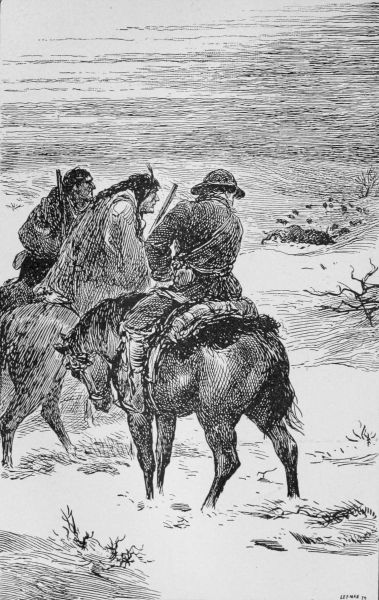
In the afternoon a snow-storm swept across the waste,
wrapping earth and heaven in its blinding drift. Still the
Indian held his way at the same steady pace.
“It is well,” he said to me as I rode close behind him.
“If there are any roving bands on the borders of this great
prairie, they will not see us in this storm.”
Before sunset the storm ceased, the clouds rolled away
to the south, and the boundless plain lay around us on all
sides, one dazzling expanse of snow.
Camp was pitched at sunset in the bottom of a deep
coulee. A night of intense cold followed the storm; but
within the leather lodge the fire soon gave light and warmth;
and as soon as supper was over we lay down on each side
of the embers, wrapped in our robes.
Thus we journeyed on for some days, until, on the afternoon
of the fourth from quitting Les Trois Arbres, we drew
near the Lake of the Wind.
The weather had again become fine, and, for the season,
mild. The snow had partly vanished, and the sun shone
with a gentle lustre, that made bright and golden the yellow
grasses of the great waste.
For several hours before the lake was reached, the trees
that grew near its shores had become visible. I had noticed
that these clumps had risen out of the blank horizon straight
in front of us, showing how accurate had been the steering
of the Sioux across a waste that had presented to the eye of
the ordinary beholder apparently not one landmark for
guidance.
I asked the Indian by what marks he had directed his
course.
“I could not tell you,” replied the Sioux. “It is an
instinct born in us; it comes as easy to us as it does to
the birds, or to the buffalo. Look up,” he went on; “see
that long line of ‘wavies’ sailing to the south. Night and
day they keep that line; a week ago they were at the North
Sea; in a few days they will be where winter never comes.
Before man gave up this free life of the open air, while yet
the forest and the plain were his homes, he knew all these
things better even than did the birds or the beasts; he knew
when the storm was coming; the day and the night were
alike to him when he travelled his path through the forest;
his course across the lake was clear to him: but when he
grew to be what you call civilized then he lost the knowledge
of the sky, and of the earth; he became helpless. It
is so with the red men; year by year, we lose something
of the craft and knowledge of wood, plain, and river. One
hundred years ago, our young men hunted the buffalo and
the wapiti with the weapons they had themselves made; now
it is the gun or the rifle of the white man that is used by
them. Without these things, which they buy from the
traders, they would die, because they have mostly forgotten
the old methods of the chase. Before the horse came to us
from the Spaniard, we hunted the buffalo on foot, and our
young men could chase the herds from sunrise until dusk of
evening; before the gun came to us from the French we
killed even the grizzly bears with our arrows, and straight
and true they flew from the bow drawn on horseback or on
foot.”
As thus the Sioux showed how deeply he had studied the
past history of his race, the scattered woods that fringed the
lake took better defined form, and soon the sheen of water
became visible through openings in the belts of forest.
As we drew still nearer, the whole outline of the lake was
to be seen. It lay between deeply indented shores at its
northern, or nearer end, but farther off to the south it
stretched out into a broader expanse of water. The evening
was perfectly calm, the branches of the trees did not move,
but the water, still unfrozen in the centre of the lake, was
agitated with many waves, and a restless surge broke upon
the edges of ice with a noise which was plainly audible on
the shore. It was a singular scene, this restless lake lying
amid this vast rigid waste. The Sioux bent his way into one
of the long promontories, and soon a spot was selected amid
a thick screen of aspens and maple, where the tent was
pitched in shelter, and all made comfortable against the now
approaching night.
Next day broke fresh and fair; the air was keen and cold,
but the dry fuel, now obtainable in plenty, had kept the lodge
warm; and soon after sunrise the sun came out, glistening
upon the white branches of the leafless trees, and the hoar-frosted
grass, and shallow snow of the plain, and making all
things look bright and cheerful. We were soon in the saddle.
The Sioux led the advance, and swinging round by the
southern end of the lake we gained some high and broken
ground. The Sioux had ridden on some distance in
advance, and I was about to quicken my pace in order to
overtake him, when suddenly I caught sight of a dark object
appearing above a depression in a ridge some way to my
right; the ridge itself concealed lower ground beyond it,
and the object, which for a second had caught my eye was
the back of some animal that was standing partially hidden
within this lower space.
I was glad to have thus caught first sight of game, before
even the quick eye of the Sioux had lighted upon it.
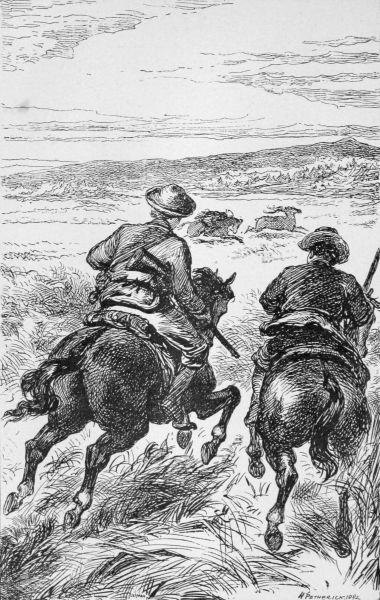
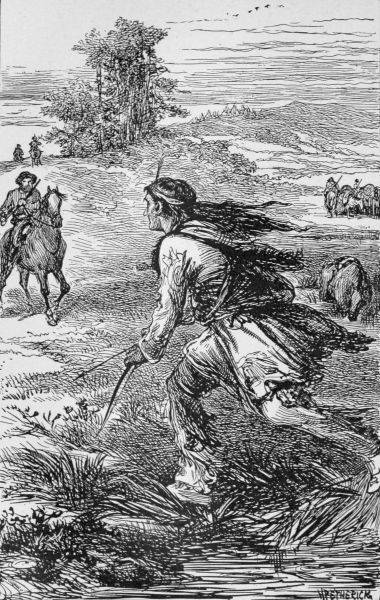
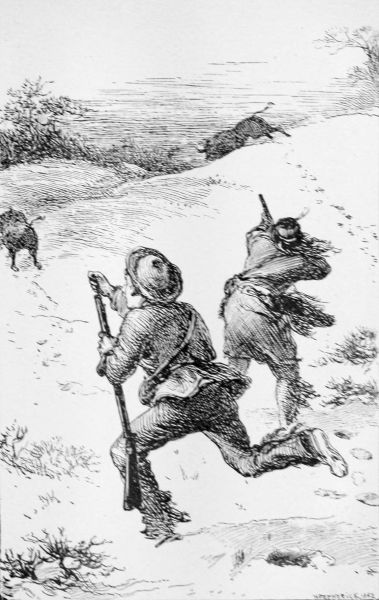
Keeping low upon my horse, I galloped forward, and told my
companion what I had seen. He immediately reconnoitred
the hollow, and came back to say that it held three animals,
two buffalo cows and one calf! As I had first discovered
the game, I was to have first shot. We both dismounted,
and crept cautiously up to the edge of the ridge and looked
over. From this edge to where the animals stood was
about one hundred and fifty yards. I laid my rifle over the
ridge top, took a steady aim, and fired at the cow that
stood nearest to me. Then we both sprang to our feet, and
ran with all speed down the hill towards the animals. The
cow I had fired at moved off with difficulty, the others
bounded away up the opposite ridge. It was now the
Sioux’ turn. Stopping short in his long stride he fired
quickly, and ran on again. The buffalo at which he fired
had gained the summit of the distant ridge, and was for a
moment clearly shown on the white hill-top and against the
blue sky beyond it. I was so intent upon watching my own
animal that I had no time to take note of whether his shot
had struck; but, reloading as I ran, I soon reached the
bottom of the little valley. My buffalo was still moving quietly
up the incline, evidently sorely wounded. Another shot
from my rifle ere the beast had reached the top of the
ridge brought her to the ground, no more to rise. We
breasted quickly up the incline until the top was gained,
and there, just beyond the summit, lay the Sioux’ buffalo,
quite dead in the snow. What a scene it was as we stood on
this prairie ridge! Away on all sides spread the white and
yellow prairie, the longer grasses still showing golden in the
sunlight above the sparkling layer of snow; there was not
a cloud in the vast blue vault that hung over this glistening
immensity; the Lake of the Wind lay below us, its line of
shore-wood showing partially dark against its snow, and its
centre of open water lying blue as the sky above it, set in
a frame of snow-crusted ice. Close at hand, on either side
of the ridge where we stood, lay the dark bodies of our
buffalo, stretched upon the shallow snow.
Both animals proved to be in very good condition. “You
will taste to-night,” said the Sioux to me, “the best bit of
meat to be got in the prairie—the flesh of a fat cow buffalo;
the finest beef is but poor food compared to it.”
We were still so near our camp that we determined to get
the sleds out and drag it in, before night would give the
wolves a chance of plundering our winter store of meat.
The Sioux began to skin and cut up the buffalo, and I went
back to where we had left the horses, and then rode to the
camp to bring Donogh, the scout, and the sled to the scene.
It was astonishing to see the rapid manner with which the
two Indians cut up these large animals. Early in the afternoon
we were all back in the camp, with three sled-loads of
primest meat; we brought skins, marrow-bones, tongues,
and tit-bits; and the remainder of the daylight was spent in
arranging the supplies safe from the ravage of prowling wolves
and in preparing for a good feast after the labours of the
day.
Pleasant it was that night, when the darkness had fallen
over the silent wilderness, to look at the cosy scene presented
by our camp. We had swept clear of brushwood and snow
a large space on one side of our leather lodge. Maple-trees
grew thickly around it; in the centre burned clear and bright
a fire of dry logs. Steaks were roasting before glowing
embers, the kettle was steaming from a cross-stick, marrow-bones
were toasting, gelettes were baking in a pan set
facing the fire and backed up with hot embers, while, seated
on buffalo robes, around the fire we sat, canopied by the
starlight, circled by the vast and lonely wilderness.
The next morning found us again in the saddle, but this
time Donogh came to share our sport. Our course now lay
in a westerly direction from the lake. It was in that line
that the yearling calf had retreated on the previous day, and
there it was likely we should fall in with buffalo. It was mid-day
however before the sight of buffalo gladdened our eyes. Far
away to the south dim dark specks were visible. Ascending
a ridge in the direction of the animals, we had a better view
of the plains. A large herd was distinctly visible, moving
slowly towards the north-west. We watched them for some
minutes. “We must cross them on their line of march,”
said the Sioux to me; then we rode briskly off towards the
south-west keeping our horses along the hollows of the
prairie. It was his intention to take up a position in advance
of the herd, and then await its coming. He preferred this mode
of attack in the present instance to running the buffalo upon
horseback: the light covering of snow was sufficient to render
the prairie dangerous, since it had partially hidden the badger
holes, and the surface was hard with frost. “Our horses
have to carry us home to the Red Deer river,” he said as
we cantered along; we must be careful how we use them.
We soon reached the edge of what seemed to be a channel
of a stream through the prairie; but there was no water in
the wide grassy hollow that ran in sweeping curves over the
plains, nor could a stream of water ever have flowed in it,
because it followed the general undulations of the land around,
although the floor or bottom of it was always lower than the
land that bordered it on either side. We now saw that the
line of the buffalo’s advance was up this grassy hollow, and
as the wind was favourable we would only have to conceal
ourselves in the floor of this depression and to await the
approach of the herd. Leaving the horses in a deep hollow,
we gained a spot in the grassy channel where we could lie
concealed behind tufts of grass and snow; here we lay down
to await the buffalo. It was not very long before the leading
ones came in sight of our hiding-place, round a curve in the
depression about four hundred yards distant.
Then in scattered files more came into view, walking
slowly and deliberately forward in that complete unconstraint
with which the wild animals of the earth take their leisure
when they fancy their great enemy, man, is far away from
them.
A very old bull led the advance, moving some distance
in front of any other beast.
The snow of many a winter’s storm, the gleam of many a
summer’s sun, had matted and tangled his shaggy mane and
sweeping frontlet.
As he approached nearer to us we could see his eyes gleaming
brightly from beneath the thick masses of hair that hung
from his forehead; but there was no trace of that anger or
fright such as the hunter sees when in pursuit of a flying
herd. The look now was calm and tranquil; the great beast
was at home in this solitary waste, as his race through countless
generations had been at home here; for in these wilds,
so green in summer, so white in winter, he and his had
roamed since time began.
“Do not fire at him,” said the Sioux in a low tone to
me. “He would be useless to us.”
The old veteran had now come to a halt, about thirty
paces in front of where we lay. He was so close to us
that we could mark with ease every movement of his shaggy
head, every expression of his eye. Some vague idea that
there was danger in front seemed to have come upon him, for
once or twice he turned his head round, as if to see whether
his comrades were close at hand.
As they came closing up to him from behind, the same
vague feeling of fear or suspicion seemed to have communicated
itself to them, for they also paused irresolute on their
way. That the suspicion was not directed towards any particular
point, was evident from the looks which the huge
animals continued to turn to either side. As thus they stood,
gradually closing up from behind upon the leader, a storm
that for some time had been threatening, broke over the
prairie, whirling snow in dense drifts before it, and wrapping
the scene in chaotic desolation.
Truly, a weird wild picture was that before us—the
great waste narrowed for the moment by the curtain clouds
of wintry tempest, the dark animals vaguely seen through
the wrack of drift, and the huge form of the monarch of
the prairie standing out against the background of gloom.
It is many a long day now since I looked upon that scene,
but I see it still before me, through time and distance.
The old buffalo, as though reassured by the proximity of
his friends, now began to move forward again.
The Sioux whispered to me to aim at a young bull that
had come up towards the front. He was some little way
behind the old leader, but his side was partly visible to me.
I aimed low behind his shoulder, and fired. In a second,
the scene had changed; all was wild confusion among the
herd. Where all had been torpor, all became movement;
to sense of security followed intense fright; and away in
wild stampede, through drift and storm, fled the suddenly
startled animals. The young bull had, however, received his
death-wound; he soon dropped from the ranks of the
flying herd, and lay down to die.
It was now so late in the day that we could not hope to
get the beast home to our camp before the morrow. But
to leave the dead animal as he was, on the prairies, exposed
for the night to the ravage of wolves and foxes, would have
been to find little remaining save his bones next day. The
Sioux stuck his ramrod into the ribs of the buffalo, and
fastened his powder-flask to the rod, letting it swing in the
wind. This precaution made the carcase safe from attack,
at least for one night; for keener than the scent of food with
the wolf is his scent for powder, and he will long continue
to circle around meat thus protected, ere his greed will bring
him close to it for plunder.
As we rode home to the camp, the snowstorm that had
swept the plains abated; but a bitterly cold wind was blowing
across the prairie, and a lurid sunset foreshadowed a
continuance of wild weather.
The stock of dry wood for fuel was, however, large; and
sheltered amid the thickets, our camp-fire blazed brightly,
while again we brought back from our long day’s work
those keen appetites to relish the good things of steak and
bone and tit-bit that only the prairie hunter can ever know.
Pleasant used it to be on such nights to sit before the camp
fire and watch the wind, as, blowing in gusts, it whirled the
yellow flames through the dry logs, while the peeled willows
baked by the embers.
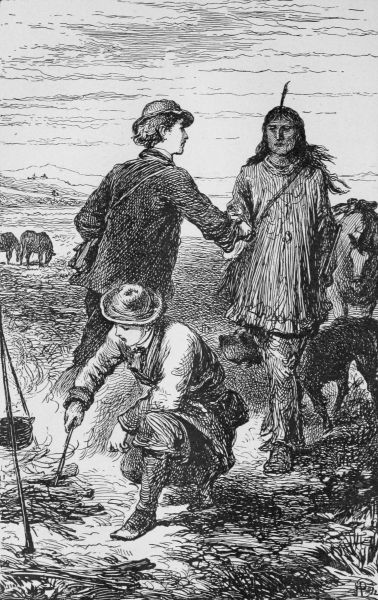
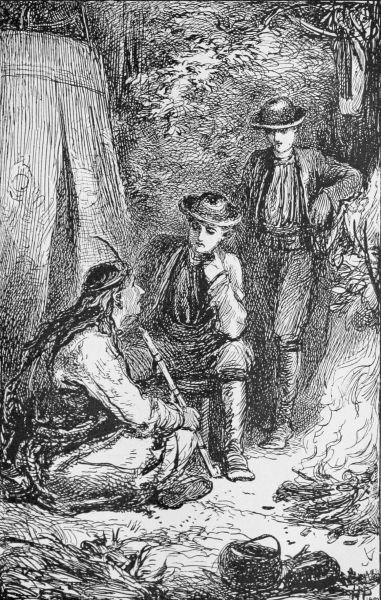
On this evening the scout brought out a plentiful supply
of willow rods, which he had cut during our absence along
a part of the lake shore to which he had wandered. The
outer bark of these willows was a bright red colour. This
outer bark the scout had peeled off, leaving beneath it a
soft inner skin. Having carefully peeled down this inner
skin, so as to make it form ringlets or curls of bark at the
knots on the willow rods, the ends of the rods were now
stuck in the ground close by the fire. The heat soon
caused the strips of bark to become crisp, and fit for
smoking. It is in this manner that the Indians make their
“Kinni-kinnick” tobacco.
Wherever the red willow grows, by margin of lake or
shore of river, along the edge of swamp or thicket, there the
tobacco pouch of the red man is easily replenished; and
mixed with real tobacco, this inner bark of the willow forms
the universal smoking-mixture of the tribes that roam the
northern wastes.
In the “thick wood” country, lying between lakes
Superior and Winnipeg, the red willow is scarce, but a weed
not unlike dwarf box is found. Dried before a fire, its
leaves form kinni-kinnick, like the willow bark. True to
his habit, of taking a last look at the horses before lying
down for the night, the Sioux arose from his robe at the
fire and went out into the open. The horses had sought the
shelter of the thicket; the wind was beginning to rise;
no stars were visible, the branches of the dwarf trees sent
forth a mournful sigh as the night-winds passed through
them.
“To-morrow,” he said, when he came back to the tent,
“winter will be on all the land.”
It did not matter. We wrapped ourselves in our robes
and lay down to sleep, heedless alike of rising storm and
falling snowflake.