Everyone everywhere who would help to
make the “lure” of freedom so irresistible
that the false promises of security, made
by the Communists, will be seen for what
they are—a delusion and a fraud.
by MARY LAMAR KNIGHT
LORRIN L. MORRISON Publisher Los Angeles
Copyright, 1951
by
Mary Lamar Knight
FIRST PRINTING
IN TWO EDITIONS:
Paper Bound, June, 1951 Cloth Bound, June, 1951
Printed in the United States of America by Lorrin L. Morrison, Printing and Publishing
1915 So. Western Ave., Los Angeles 18, Calif.
All rights reserved, including the rights of reproduction,
in whole or in part, in any form.
AUTHOR’S NOTE
The opinions expressed in this book represent only
one individual’s point of view. They are based upon
what I, myself, have seen and heard and are subject,
therefore, to human error, preferences and prejudices.
I ask only that they be considered in this light, and
hope that they may serve to stimulate independent
thinking and inquiry.
What I am reporting I have experienced personally
or learned from the most reliable sources at my command.
If I succeed only in a small measure in conveying
my thoughts and opinions, it is, nonetheless, a load
off my chest, and I shall sleep more easily for having
made a sincere, if limited, contribution toward a better
understanding of our present disheartening dilemma.
The “lure” of Communism is the same in every
country—the promise of security and a richer life for
all, with less pain and effort to the individual from the
cradle to the grave. We have only to think clearly,
however, to realize that such promises are impossible
of fulfillment in a Communist State. Never has progress
been made in that direction except where there
was personal freedom, initiative and enterprise, for these
are the qualities that take civilization forward toward
Perfection, instead of backward into Chaos. The theories
of Marx and Engels have been used and misused by the
Soviets. As far as their present laws are concerned, the
“Yassa” of Genghis Khan would have served the purpose,
had it been as well known in the Twentieth Century
as it was in the Thirteenth.
In studying the historical backgrounds of those great
movements which, at various times in the past, have
churned up the quietude of the earth, I found that they
were always propelled or motivated by extreme fanaticism.
A distinctive feature of all of them seems to be
the desire to change the established order by revolution
and intrigue, as well as by military conquest. These
movements are opposed not only by the diehards, but
by the believers in evolution and slow change; not only
by the wealthy and comfortable, but by the practical
men of affairs. All of this has been happening since
the beginning of history. Believers in the established
order of things always are on the defensive. Only open
and direct attack stirs them to the offensive. This last
is true of the United States, and it is also true of China.
It is difficult for the rulers of peace-loving nations to
create or inspire prolonged hatred in those who must
do their bidding. This fact has been one of Stalin’s
major worries with respect to the Chinese Communists.
His predecessor, Trotsky, gave them up as impossible.
“The Chinese have no capacity for sustained mass indignation,”
Trotsky has been quoted as saying. “As
Communists they are hopeless.”
Everyone who has lived in China learns to respect
and to love the Chinese people. No nation on earth has
left a greater endowment in wealth of artistic accomplishment
or evolved a more workable philosophy than
has China. Even the poorest coolie is acquainted with
some of the simple lessons contained in the Classics.
As a correspondent in China for the United Press Associations,
I learned to admire the people deeply. When
in 1946 I was invited by the United Nations Relief and
Rehabilitation Administration to spend six months
there as a consultant, without compensation, I was delighted
at the opportunity to return. Each time, I increased
my knowledge and improved my understanding
of the country and made an earnest effort to comprehend
the divergent forces underlying modern China
and to gauge their effect upon the peace of the world.
The red blight, as everyone knows, is world wide, but
I have focused my attention on China because it is the
part of the world I know best. I saw the blight spread
over this area with sickening rapidity in 1936, and
again in 1946.
On both my trips, I travelled slowly from Singapore
through most of the major cities to Manchuria, where
I remained for a considerable length of time. Manchuria
in 1946 had changed radically from Manchuria
in 1936. The Russians had supplanted the Japanese,
and two wars in the brief span of ten years had left
their tragic imprint.
The more I travelled, and the more I read and
studied, the more aware I became of the pattern underlying
the great upheavals, not only in China but
throughout Eurasia. Each eruption had moved in a
cycle from tribal communism to communistic imperialism,
and then to a dictatorship so despotic that its tyranny
lasted in some instances for generations. Invariably,
the dictatorship fell into dissolution and decline, followed
by desolation and chaos. The despots engineering
these movements were all nurtured on the vast steppe-lands,
and they never attempted the invasion of their
more civilized neighbors until their own strength was
such that no opposing army could match them.
Stalin, the latest of these despots, is as barbaric as his
predecessors. Certainly, no one could intimate that his
methods are even remotely civilized. He has “refined”
and “distilled” their characteristic brutality to an exacting
degree. It took him fifteen years to turn his own
people from the techniques of Lenin to those of his own
fiendish thuggery. He has “conquered, bamboozled,
outsmarted and trapped” more than nine hundred million
people into “political and moral paralysis.”
Are we also going to fall victims to the machinations
of this latest of these world shakers? Will we be sucked
in through fear or blandishment? Or have we the common
sense, the spiritual development and the will to
save ourselves? Human nature has changed little during
the history of mankind. Our challenge now is to
try to develop our spiritual growth so that it will be
commensurate with our fantastic material growth.
A strong Nationalism made us great, as it has all
nations that have risen to world power. To maintain
this power, however, requires the intelligence and wisdom
of our Founding Fathers, who, by their use of
initiative, ingenuity, enterprise and prayerful determination,
made us the Historic United States. Is it possible
that recent generations of American men and
women have lost these qualities and have failed to
achieve complete maturity?
I keep asking myself: Is “civilized” man intelligent
enough, in the light of his own past experience, to stop
this human tragedy now, and perhaps for a foreseeable
future? Or, will he become hopelessly and irrevocably
lost in the futile contemplation of an idyllic dream
that is ages old, but that never has become a reality,
and never will.
Prologue
Oh Man, thou feeble tenant of an hour,
Debased by slavery, debauched by power;
Thy love is lust; thy friendship a cheat;
Hypocrisy thy smile; thy word deceit—
Thy nature ennobled but by name,
The very beasts might bid thee blush for shame.
Lord Byron
Chapter I — Incompetence or Treachery?
“The greatest single mistake made in China, leading
to our present debacle, was the withdrawal of United
States forces from the Peking, Tientsin, Chingwangtao
triangle in 1947.” This was done obviously at the direction
of President Truman, General George Marshall
and the State Department.
This statement comes from Major General William
Arthur Worton, Chief of Staff, Third Amphibious Corps,
U. S. Marines in China, 1945-1946, but with twelve
years prior experience there. He adds: “Twenty-five
thousand men easily could have maintained this important
triangle—Peking, Tientsin, Chingwangtao—which
would have kept the Chinese Communists from
moving South of the Great Wall. They were not strong
at that time, and a display of American strength in
Nationalist China would have served as a deterrent to
them.”
Instead, our withdrawal of U. S. forces from this
strategic area was the first show of American weakness
that gave the lie to both Nationalist and Communist
Chinese, if not to the whole of Eurasia. The Russians
constantly had complained that the Americans were
occupying sovereign territory of China, but the request
for us to do so had been made in 1945 by Generalissimo
Chiang Kai-shek’s Nationalist Government for the purpose
of disarming the Japanese and of stabilizing the
country.
General Worton, with five officers and a handful of
men first moved into the area in August, 1945, turning
the civil government of China over to the Nationalists.
A month later, a force of sixty-five thousand U. S.
Marines moved in and occupied the area, and from then
on to 1947, there was relative peace and quiet.
In view of the testimony of General George C.
Marshall before the joint houses of Congress on the
hypothetical issue that if we permit Chiang’s forces
to attack South China, we will be starting a global war,
I would like to quote General Worton on a similar
issue.
“The occupation of Peking was not specifically in
my orders,” he says, “but I was to occupy whatever
strategic territory I deemed necessary. In the triangle
previously referred to, was located the important mining
area of Kailan at Tang Shan, which supplied the
coal output of 150,000 tons per month, and the Nan
Yuan, Pei Yuan Airfields. When I determined that the
Communists would go into Peking if I did not, I decided
to occupy Peking. At eleven o’clock one evening, Chou
En-lai’s agent in Tientsin informed me that if I moved
on Peking, the lives of every American Marine would
be the price. I told him I was going into Peking, just
when and where our forces would enter, and that he
had better have as strong a force as I intended to have,
and that I would also be supported by an air cover. We
followed our blueprint, and not one of our men was
scratched. We had no opposition whatsoever.”
With the withdrawal of U. S. forces from this area
the coal output, supplying power as far south as Shanghai,
dropped to 30,000 tons.
In Worton’s opinion, “as small a force as 15,000
troops, officered by men acquainted with China, could
have kept the Reds from crossing into the coveted triangle.”
But Marshall was determined to withdraw our forces.
“The State Department to this day,” says Worton, “has
never asked the opinion, as far I can ascertain, of any
qualified military men who spent any length of time
in China, on this subject.” He adds, “Manchuria should
have been occupied and we should have insisted on a
joint occupation force there with our allies. Any study
of China and the Far East must be predicated upon a
study of our relations with China since 1784. We have
consistently held to the Open Door Policy for China and
the Far East. We went to war with Japan because Japan
had seized the coastal areas and was controlling the
communication lines of China. Many men died across
the Pacific to regain China for the free world, and yet,
in the course of minutes, as time is known, we have lost
China. It is a truism of students of the Far East that,
‘As China goes, so goes the Orient’.”
The U. S. should have taken Dairen, Port Arthur and
Cheefoo, while we were at it, and should have insisted
on occupying the Kalgan Pass, gateway to Mongolia.
These rightfully belonged to the Nationalist Government
at the conclusion of the Japanese war, according
to Worton. Another disastrous move on the part of the
U. S. was the recall of Lieutenant General Albert C.
Wedemeyer from the China Theater. “Wedemeyer had
the complete admiration and respect of the Chinese,”
he says. “Although he had been the Generalissimo’s
Chief of Staff for nearly three years during the war, at
no time had he subordinated himself to Chiang. Wedemeyer
was first, last and always an American, and an
officer in the service of his country.”
Others claim that China’s and the world’s present
situation can be attributed to any number of mistakes
on the part of Chiang Kai-shek, General Marshall and
the United States Government. Ignoring the tragedy
of Yalta for the moment, one vitally important mistake
Chiang made was the decision to fly his troops into Manchuria
after the war, against the advice of General
Wedemeyer. His mistake was an honest one, because
he undoubtedly felt that the United States, having gone
so far, would see him through to the end. He knew
that if China were to occupy her rightful place in the
world, control of the industrial potential of Manchuria
was a “must.” In spite of the fateful decision at Yalta,
about which Chiang was informed several months later
by Ambassador Hurley, he still could not believe that
Roosevelt, whom he deeply respected and admired,
would slap him in the face by giving away Manchuria.
Truman, inheriting Roosevelt’s policy of appeasement
toward Russia, sent General Marshall to China in 1946
on the impossible mission of forcing the Generalissimo
to accept Communists into his Government. Marshall,
who at that time had the admiration and respect of the
entire United States, undoubtedly had a freer hand
than any diplomat in our history. Had he been unbiased
in his judgement, the future of China, Asia, and
probably the Eurasian Continent would have been different.
He had unlimited resources to give, a neat nest
egg of $500,000,000, and the decision to spend some,
all, or none of it was his, and his alone.
When Marshall arrived in China, the Nationalist
Armies were over-extended, that is, their supply lines
were stretched so long and so thin that they could not
be protected from constant Communist raids. Chiang’s
Armies held the main lines of communication, to be
sure, and all the large cities of North China and a few
in Manchuria. However, these Armies, although many
of them were trained and equipped with American
arms, had little ammunition, and they were surrounded
on all sides by the Soviet-backed Communist Armies.
The Communists retained the initiative, could strike
when and where they wished, and thus succeeded in
keeping their opponents paralyzed. It was not difficult
to see that the future of Chiang’s Armies was dependent
solely on aid, especially on munitions, and that no
country on earth but the United States could supply
their requirements. To shut off this aid meant strangulation
and death.
Marshall’s first act was to set up a headquarters in
Chungking, where he assembled his American experts
on China and started a series of conferences with Communist
and Nationalist leaders. From the beginning,
the Chinese Communists showed, by their every action,
that their only interest was in cutting off North China
and Manchuria. They had no intention whatever of
joining any kind of coalition government, over which
they would not have complete control. After a great
deal of discussion, these conferences resulted in superficial
agreement on a few points of the controversy.
Prior to his return to Washington, the General decided
to make a hasty trip to Yenan, probably out of
curiosity. He must have wanted a closer look at these
people whose propaganda he appeared to have accepted
as fact during the entire war. Whether this was emotional
caprice or political expediency only history can
tell. We cannot assume that he was ignorant, therefore
we must assume that he knew what he was doing.
Certainly the utterances of that period indicated that
Marshall subscribed to the idea that we were dealing
with “agrarian reformers.”
In his testimony before Congress, Marshall stated
flatly that he had known all the time that the Chinese
Communists were Marxists “because they told me so,”
he said. But while he was negotiating with them he
certainly gave the impression to others that he did not
think they were the same brand of Communists as were
the Russians. This fact, in itself, makes him doubly culpable,
in my opinion. It is an intent to deceive, which
makes the deception all the more sinister. If he knew
all the time that the Chinese Communists were the
same brand of Communists as the Russians, and he
still threw the weight of every decision he made in
China to them, then he could not possibly have given
more aid and comfort to the enemy, Stalin, had he been
a member of the Communist Party.
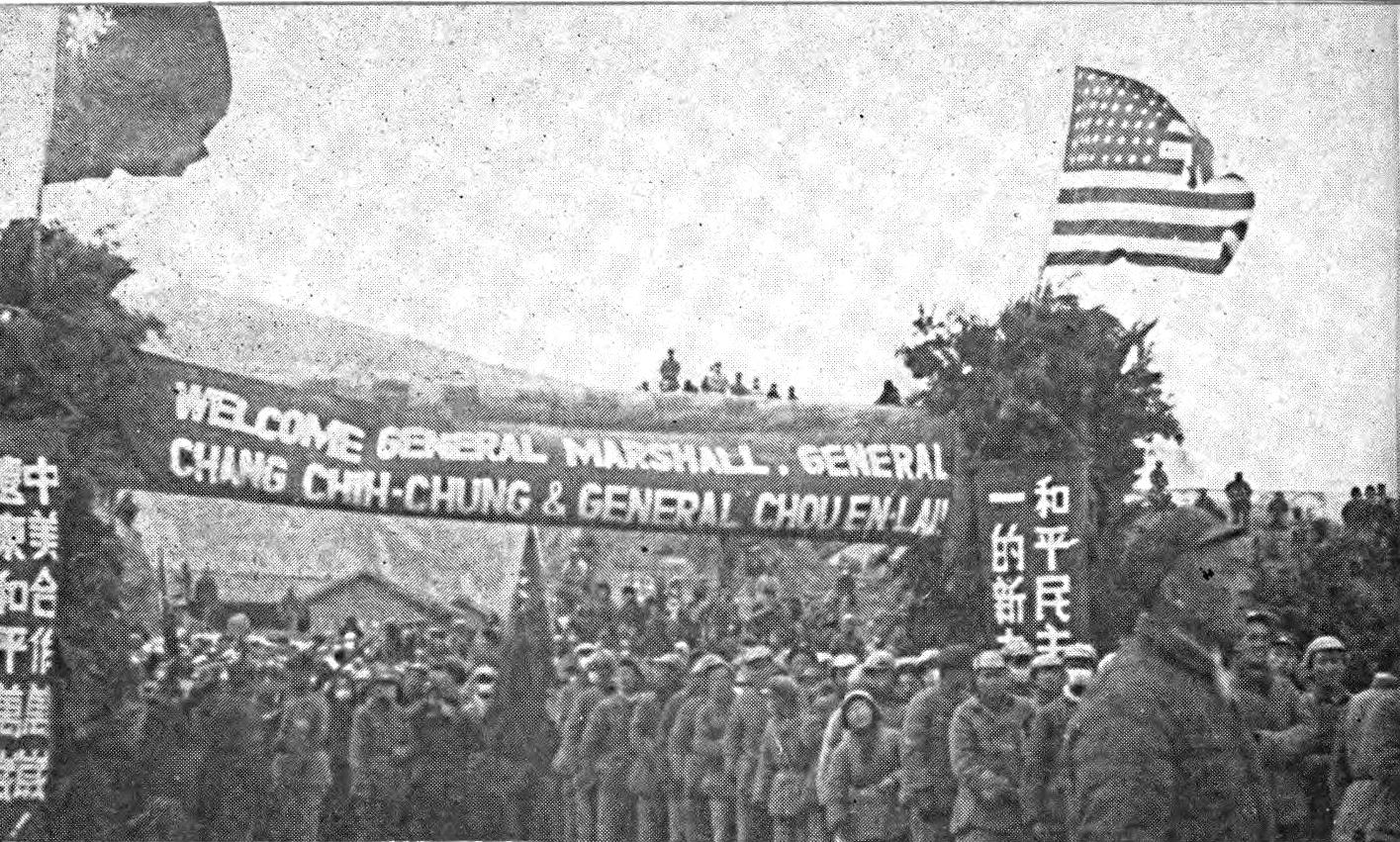
On Marshall’s arrival at the Airport of Yenan, he
was greeted with pomp and ceremony by every military
unit the Communists could muster. Welcomed
enthusiastically by stocky Mao Tse-tung, in his coarse
homespun peasant’s garb, suave Chou En-lai, in the
snappy uniform of a three-star General, and Chu Teh,
wearing a Russian soldier’s fur-lined cape, he accompanied
his colorful and grateful hosts on an inspection
of the troops. The Cadets from the Communist Military
Academy, who had hiked in some fifty or sixty miles
in order to form the Guard of Honor, were the best
dressed and best outfitted of all the troops in the Communist
Army. While spartanly clad in coarse but
neat dark blue uniforms, they gave every evidence of
superb leadership and discipline. Especially trained
and selected, these Cadets became the equivalent, in
Communist China, of the Soviet NKVD, or uniformed
police troops.
In marked contrast, there was a battalion of Ming
Bing, or militia, armed with spears for the occasion
and lined up for the General’s inspection. These troops
were dressed in everything from long robes to dirty
white jackets and vests, and decorated with rings, bracelets
and earrings. Their long, rusty spears were topped
with flowering pompoms of dried grain. In no respect
did they differ from their forbears of two thousand
years ago.
The rest of the show consisted of masses of people
in the drab dress affected by the Communists. The more
colorful costumes of the non-Communist Yenanese were
conspicuous by their absence.
Marshall must have been impressed!
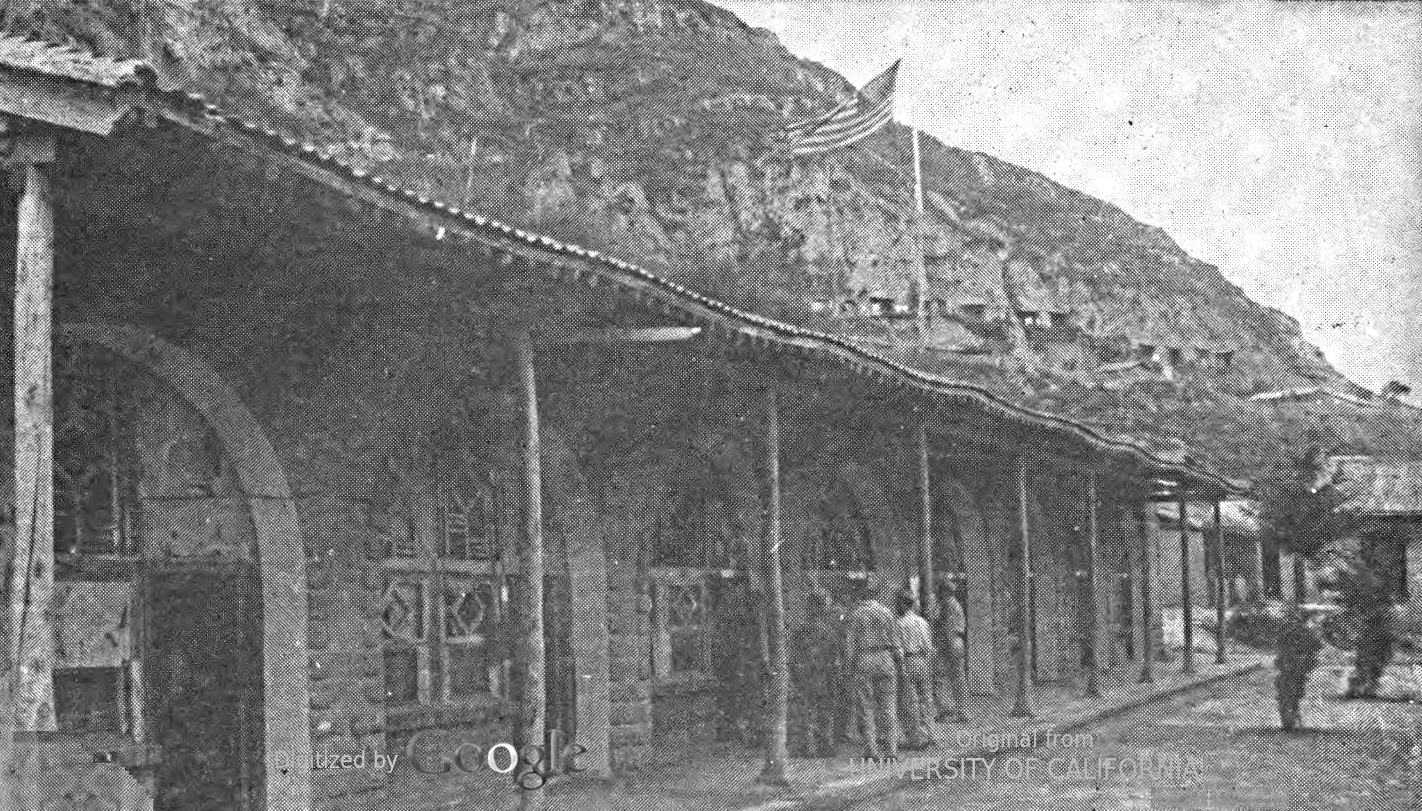
For quarters, or hotel accommodations, the General
had been assigned the best Yenan cave, boasting all the
comforts offered by that archaic type of dwelling. His
person was safeguarded during the night by two crack
soldiers armed with ancient Chinese broadswords.
Making the most of their distinguished visitor’s sojourn
among them, Chairman Mao Tse-tung gave a
banquet, followed by a Chinese Opera. The dinner was
staged in a large bare room with cracking plaster walls.
The table consisted of rough hewn boards, contrasting
strangely with the lavishness of the food. Dozens of
southern style delicacies were imported for the occasion:
crisp, roasted Peking duck; succulent sweet and
sour pork; thousand-year-old eggs—the whole washed
down with copious draughts of sweet local wine. Formal
speeches of mutual friendship were followed by
cries of “Gambei!” or “Bottoms up!”
After the banquet, the entire party crossed the river
to attend the Opera. The Communists had improvised
a crude bridge over which their esteemed guest might
ride, but it was so wobbly that Marshall preferred to
get out and follow his car across.
The Opera was performed in an unheated, barnlike
structure. It was so cold that the audience kept on their
heavy coats and were provided, in addition, with blankets
to wrap around their feet. In spite of the fact that
charcoal braziers were placed between the stage and the
first row, the temperature in the building was close
to freezing, and the breath of the actors as they chanted
their lines came out in puffs of smoke. These performers
were Spartans indeed, changing their costumes in
the draughty, unheated barn, their teeth chattering
and their tawny flesh a mass of goose pimples. The costumes,
in contrast to those seen on a Peking or a Shanghai
stage, were fashioned of rough, drab bits of cast-off
apparel, crudely sewn together and patched with
whatever pieces of material could be begged, borrowed
or stolen.
The show itself, like the Ballet in Moscow, was a
superb exhibition of Chinese art, for, when shown to
foreigners, it was free from Communist propaganda.
The falsetto voices of the actors sing-songed the ancient
Chinese poetry, while their bodies swayed to its rhythmic
cadence. During the performance, an usher went up
and down the aisle tossing hot towels to guests who
called shrilly for them. These, wrung out of boiling
water, gave the hall a dank, slightly rancid atmosphere,
reminiscent of a river in summer. Roasted watermelon
seeds were pressed generously upon the honored guest
by his Chinese Communist hosts, who were noisily but
skillfully cracking them edgewise between their strong
front teeth and spitting out the husks.
Not all the visitor’s stay, however, was passed in
entertainment. Before leaving Yenan, General Marshall
sat behind locked doors with Mao and members
of the Politburo. No other American was allowed to
be present at this meeting. What was said is not known,
but there were rumors in Communist circles that the
subject of the conversations had to do with the future
of Manchuria, and perhaps all of Asia.
On leaving this capital city of Communist China,
Marshall returned to the United States to make his report
to President Truman.
When he came back to China, Marshall made his
residence in Nanking (the Nationalist capital at that
time), but established a Northern Headquarters in
Peiping (meaning Northern Peace), in order to work
out a truce between Communists and Nationalists. The
futility of this endeavor was obvious even to the Chinese
GI, who nicknamed the Peiping Headquarters the
“Temple of the Thousand Sleeping Colonels,” and to
the American GI, who dubbed it “Marshall’s Bird Sanctuary.”
If the soldiers in the lower brackets put their tongues
in their cheeks, those in the higher echelons took the
mission very seriously. They kept a very sober face,
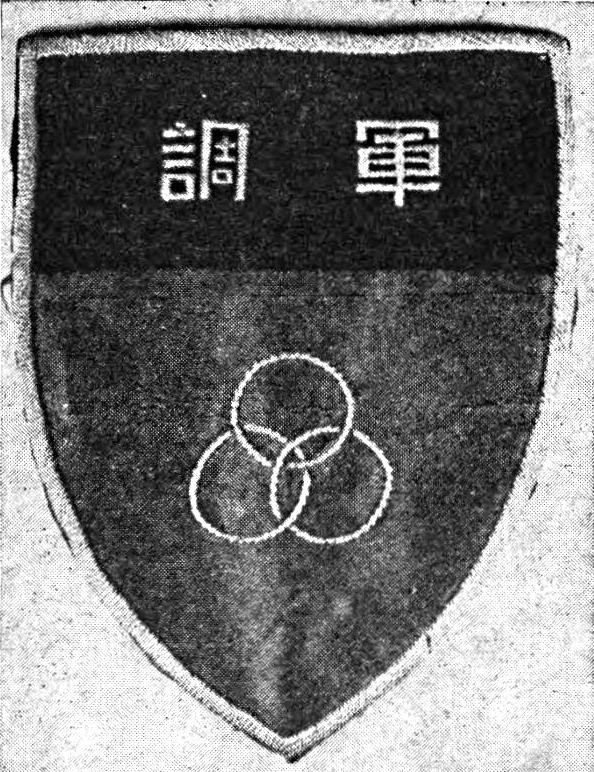
indeed. Shoulder patches were issued and worn by all
the members of the Peiping Headquarters and its truce
teams. These were called “Ballentine Beer Patches,”
due to the three rings in the emblem representing the
Nationalists, the Communists and the Americans. No
doubt this symbol, to some of the homesick GI’s, was
a nostalgic reminder of the good old USA.
Truce teams, made up of one Communist, one Nationalist
and one American officer, were sent out into
the field, their purpose being to try to bring about
agreement between the opposing forces. With the
Chinese Communist Army and the Nationalist Army
locked in a deadly battle for power, any action on the
part of the third member, the United States, would be
likely to aid one party only at the expense of the other.
With Marshall’s preference for Mao over Chiang Kai-shek,
the “truces” forced upon the Nationalist Armies at
the most inopportune times, from a military standpoint,
acted to the advantage of the Chinese Communist Army.
Because of the slowness of their transportation and their
lack of modern means of training, the Chinese Communist
Armies, as in the days of Genghis Khan, were
constantly in need of breathing spells. During these
periods they could regroup their forces, move and gather
supplies, and train their troops. Such breathing spells,
provided in the form of “Cease Fire!” commands to the
Nationalist Armies, upon the insistence of Marshall,
came almost as a gift from Heaven.
As history has shown, Marshall threw the weight of
every decision to the Communists. This, combined with
the mistake the Generalissimo made in trying to hold
Manchuria without American support, would appear to
be at least one of the reasons for the situation in
China today. In addition to the fact that Marshall
favored the Communists, that he acquiesced in the sellout
of Manchuria, if not all of Asia, to the Russians, the
final and fatal blow was delivered to the Nationalist
Government itself. The expected help in arms, ammunition,
money and supplies from the United States
was either cut off entirely or reduced to a trickle. Too
late did the Nationalist Government recognize its precarious
position and force itself to accept the fact that,
apparently, we just did not care who won the fight in
China, so long as it was not the Generalissimo.
Continued evidence to the above effect appeared from
numerous sources. In the summer of 1950, Walter H.
Judd, Representative from Minnesota, commented in
public:
“Why should the Soviets think that the most important
thing for American Communists to do right
after the defeat of Japan was to get American assistance
to China stopped?” To him, the answer seems to appear
obvious, in that without the right kind of outside aid,
the Chinese Government could not possibly recover.
Only a handful of people appeared to understand that,
to a Chinese, the idea of putting his country ahead of
family interests, just was not his idea of patriotism.
First loyalty, always, in a Chinese family, was to that
family.
Marshall asked for patience and generosity for the
European countries saying that it had taken the South
fifty years to recover from only four years of civil war.
But he did not seem to remember that Chiang had
been fighting Japan for more than eight years, coupled
with a civil war with Communists in his own country
for more than twenty years. China, too, needed a little
patience and generosity from us, just as much as Italy
or Greece or France. And what would England have
done without our patience and generosity? By comparison,
were not China’s needs embarrassingly small?
One may call the Nationalist Government of China
all the names there are, synonymous with corrupt, incompetent,
reactionary, undemocratic—but in the
light of what is known today about Communism and its
stated methods, aims and ambitions, which is the lesser
of the two evils—Chinese Nationalism or Soviet Internationalism?
An interesting news item came to light in a press
dispatch by International News Service, dated September
19, 1950, as follows: “Marshall’s statement on Far
Eastern Policy electrified the jammed committee room
(Senate Armed Services Committee) because it had
been accepted for years that he had authored the recommendation
that peace in China be sought through a
coalition government. Before this committee, Marshall
repudiated all claims for having had anything to do
with it, much less to have authored it by saying that it
had been drawn up in the State Department while he
was testifying on Capitol Hill in the Pearl Harbor investigation.”
According to the same news dispatch:
“The author of the Marshall Plan added that the Chinese
policy was issued ‘while I was on the ocean going
over there’ as President Truman’s personal representative.”
Could Marshall have meant that he had not even
been consulted on such an important matter, prior to
being sent to implement that policy? Hardly. Former
Secretary of State Byrnes, in his memoirs entitled
“Speaking Frankly,” spoke thus frankly on this subject:
“As soon as President Truman appointed General
Marshall his personal representative in China, I asked
the General to study the draft (of policy) so that he
could help prepare the final statement for presentation
to the President. The Sunday before I left for Moscow,
Under Secretary Acheson, General Marshall and members
of his staff met in my office. By the end of the
morning’s discussion, we had agreed upon the statement
of policy. Thereafter the President made no
change in that policy except upon the recommendation
of General Marshall or with his approval.”
I learned from an intimate source that when Marshall
left for China he had in his pocket, documents outlining
the policy of enforcing a coalition government on
Chiang Kai-shek and also a letter from the President
stating flatly:
“I understand that these documents have been shown
to you and have received your approval.” What could
General Marshall think himself to be, an ostrich with
his head in the sand?
Much has happened since 1946, particularly as pertains
to the relationship between China and General
Marshall. A few excerpts from the September 15th,
1950, issue of the Congressional Record, Volume 96,
Number 184, bring the matter further to a head. Senator
William E. Jenner from Indiana holds the floor:
“I believe the time has come to expose this
whole tragic conspiracy in which we are caught, to
hew to the line of truth, and to let the chips fall
where they may.... I can assure the Senate there
is no pleasure, no pride of authorship, and no sense
of personal satisfaction in taking this stand. There
is only a growing sense of shame, of outraged decency,
and of painful duty as I speak the dictates
of my conscience. Even if I have to stand and
speak alone, I am both unable and unwilling by
my silence to be an accomplice in compounding
crimes that have already been committed against
my native land. Mr. President, this background
is necessary because without it we cannot understand
where the appointment of General George C.
Marshall as Secretary of Defense fits into the picture.
With it, we can help the disillusionment of
the American people to run its course by exposing
General Marshall as a living symbol of the swindle
in which we are caught. The appointment of
Marshall at this peculiar juncture in our destiny
is a last desperate attempt of this administration
to swallow up the treachery of the past in the new
treachery they are planning for the future....
Everything he has been a party to during the past
ten years has helped to betray his solemn trust
and to set the stage for the staggering Soviet victory
that is sweeping across the earth....”
Senator Jenner’s full and documented statements
cover eighteen pages of the Record but interest here is
centered upon those comments bearing on China, which
confirm my own first-hand information and knowledge.
He goes back to April 26, 1938, when Marshall was
appointed a member of the liaison committee created
by President Roosevelt for the coordination of policy
of common concern to the Departments of State, War
and Navy. From then on, Marshall remained one of
the top-ranking policy makers in our Government.
Truman was aware of the closeness between Marshall
and Roosevelt, and of their consultations on matters of
vital policy affecting our security and the defending of
our interests around the world. Was this, perhaps, a
reason for Truman’s wanting Marshall as Secretary of
Defense, even as a possible stop-gap in a Democratic
political crisis?
“Marshall knew of the deceit and the duplicity that
was indulged in by President Roosevelt during the
critical years of 1939, 1940 and 1941, by which we
were secretly committed to go to war.... He went along
with the most criminal and outrageous betrayals of
American interests and principles in history that resulted
from Teheran, Yalta and Potsdam,” says Jenner.
To anyone’s comment: “He was a soldier. He was taking
orders,” I feel urged to ask: “Does there not come
a time in everyone’s life when he has to decide whether
he is first a citizen of integrity? General of the Army
Douglas MacArthur made that decision in April, 1951,
and made it unflinchingly.
“At Yalta,” Jenner adds, “the President did the age-old
thing with regard to Asia and General Marshall
knew that at Potsdam, President Truman confirmed
the sellout of half the world to the Soviet Union ...
this meant that American GI’s were turned into political
whipping boys, betrayed by their own Chief of Staff
and used for advancing the cause of Communism across
the earth.... Marshall lent all of his great prestige and
power to the Jessup-Lattimore-Service-Acheson line
calling for a cessation of the civil war, paralyzing the
Nationalist Government and withholding aid from
Chiang, while he knew that the Russians were not only
taking over Manchuria and northern China, but were
being rearmed with captured Japanese equipment and
were preparing for the eventual conquest, not only of
China, but of the whole Far East.”
Harold Lamb, historian and authority on Asiatic history,
has commented: “Curiously enough, when I began
to study the Mongols nearly thirty years ago, I
found two studies of the methods of Genghis Khan
made by young American Army officers. They were
George C. Marshall and Douglas MacArthur.” How
differently these two men have interpreted their research,
in the light of their subsequent actions!
Let me quote a remark or two from the March, 1951,
issue of The American Mercury. I have high regard
for the journalistic integrity of Walter Trohan, Washington,
D. C., Bureau Manager of The Chicago Tribune,
and concur heartily with his comments in an article
entitled: “The Tragedy of George Marshall”:
“On March 19, 1950, General Marshall announced
that he would not write his memoirs
for these remarkable reasons:
“‘To be of any historic importance they have
got to be accurate; that is one mustn’t omit, and
make it pleasant reading. Now, if you do put
it all in, you do irreparable harm. You almost
ruin a man, but if you don’t mention that, it is
not history’.”
Mr. Trohan states that these are disillusioning
words, and imply that “free men must not be told the
truth; they indicate that the speaker is in a mental purgatory
for hidden sins which he has either observed or
committed; and they emphasize the graver tragedy:
that an old man who must conceal past errors from his
countrymen is still exercising powers of decision.”
Trohan asks, and so do I: “Should free men trust a
leader who will not trust them with the truth? By what
right does a public servant say to free men: ‘You trusted
me with leadership, but I will not give a true accounting
because the truth might do irreparable
harm’?”
Marshall has ever been quick to blame the people for
the ills that may beset them—never the leaders, as
warrant a remark he made following the debacle of the
Korean war: “The basic error has always been with the
American people”—these same American people who
cannot be trusted with the truth, lest “irreparable
harm” be done.
Other indications as to the stature of the man reveal
themselves as isolated vignettes. When Marshall arrived
in China and was met by General Albert C. Wedemeyer,
even after he had read and suppressed the Wedemeyer
Report, he told his junior officer of his intention
with regard to forcing Communists on the Generalissimo.
Wedemeyer commented in all calmness:
“General, you can’t do it. It is impossible!”
To which Marshall replied in white heat: “I am going
to do it, and you are going to help me!”
Marshall’s double-cross of Wedemeyer in appointing
the latter Ambassador to China in 1947 is another
instance. Secretary of State James Byrnes had told
Wedemeyer to go ahead and buy his civilian clothing,
which he did, and as Wedemeyer was on the point of
severing his last connections from the Army, Marshall
learned that the Communists strongly opposed the
Wedemeyer appointment and recommended instead,
J. Leighton Stuart, President of Yenching University.
Without consulting with or informing General Wedemeyer,
Marshall immediately appointed Stuart, leaving
Wedemeyer to find out through second-hand sources
that he was no longer Ambassador-elect to China.
A parallel action of this nature in which Marshall
had a direct hand was the midnight dismissal of General
MacArthur, who learned of the order when an
aide heard it on a radio news broadcast and relayed it
to Mrs. MacArthur.
Again, with reference to Marshall’s so-called ignorance
of the China policy situation, Jonathan Daniels,
in his authorized biography of Truman, quotes Admiral
William D. Leahy as saying: “I was present when Marshall
was going to China. He said he was going to tell
Chiang that he had to get along with the Communists,
or get no help from us.”
Before the removal, by Truman, of General of the
Army Douglas MacArthur from all of his commands
in the Far East—one of the greatest acts of perfidy to
go down in American history—few people realized
that Marshall was not a West Pointer. This, of course,
is in no way to be held against Marshall, but, during
World War I, as General Pershing’s aide-de-camp,
when Pershing was Chief of Staff, a promotion of
Marshall to a Generalship was requested of MacArthur
by Pershing.
MacArthur was willing enough, provided his military
record merited it. From Walter Trohan’s documented
personal files comes information that Marshall’s record
lacked sufficient time served with troops. “MacArthur
proposed to remedy this,” says Trohan, “by giving him
command of the Eighth Regiment at Fort Screven, Ga.,
one of the finest regiments in the Army.” Marshall was
moved up from lieutenant-colonel to colonel, but his
way to a general’s stars appeared to be blocked forever
when the Inspector General reported that under one
year of Marshall’s command the Eighth Regiment had
dropped from “one of the best to one of the worst.” It
was mandatory, therefore, that MacArthur decline the
promotion. Is it any wonder, today, that Truman’s
action in removing MacArthur from the military scene
should be most pleasing to the Secretary of Defense?
Of course, this is not the whole story, for Pershing was
a persevering soldier and had no intention of giving
up his determination to see Marshall become a general.
In 1936, he bypassed the Army entirely, and went directly
to the White House where he succeeded in persuading
President Franklin Delano Roosevelt to “appoint”
Marshall a general. Later, Marshall had proved
himself so “acceptable” to Roosevelt that, over the heads
of “twenty senior major generals and fourteen senior
brigadier generals, Roosevelt made him Chief of Staff.”
I believe that the “tragedy” implied by Walter Trohan
concerning Marshall lies in the current knowledge
that Marshall, despite personal bravery, even stoicism,
was sadly lacking in vision to match it. Thus, he became
a willing tool in the hands of the opposition. He
trusted Russia as an ally and, contrary to the Churchill
belief, he did not care how much of Europe Stalin took,
so long as we sent Russia enough tanks and ammunition
to crush the German Army. He was easy prey to the
insidious propaganda put out by Hiss, Acheson, Lattimore,
Jessup and others who, misguided or otherwise,
permitted American lives to be sacrificed to make both
Europe and Asia “safe for Communism.”
We know now what was in the Wedemeyer Report.
Because it disagreed with Marshall’s ideas he, personally,
suppressed it. In contrast to his decision, Wedemeyer
had advocated a strong defense against Communism
in China, and had gained the Generalissimo’s
complete approval for American supervision of all aid,
financial, military, psychological—that would have
been forthcoming if the report had been approved.
Marshall, as was Pershing, is for an enormous army—for
pitting manpower, our most precious commodity,
against the enemy, in place of our superb technological
and psychological know-how. General MacArthur has
shown the absurdity and the tragedy of any such commitment
on our part. Should Marshall, with Anna
Rosenberg at his side, be allowed to continue with plans
to fight the Asiatic hordes thusly, we are, indeed,
doomed. May God forbid!
Once again, in retrospect, it appears that American
foreign policy had been to support the Generalissimo as
long as he fought the Japanese, but to do nothing that
might offend the Communists at any time. For the past
ten years, or more, our Government seems to have had
its bets on Communism in China—if not in all Eurasia—to
win. The facts are against any other conclusion,
and we must, again, assume that Marshall, the
President, and the State Department know what they
are doing. And if they know what they are doing, they
must be doing it deliberately.
From 1946 through 1948, Marshall ordered destroyed
all of the reserves of ammunition earmarked for Chiang
Kai-shek. These had been stored in India and could
easily have been transferred to China at the end of the
war in 1945. Marshall also ordered our military mission
to refuse further training and aid to the Nationalist
armies.
On leaving China, General Marshall was overheard to
remark enthusiastically, “There is a definite liberal
group among the Communist Chinese.” This particular
group included China’s “Front Man,” Chou En-lai,
Communist Foreign Minister since October, 1948, and
his assistant, Chiao Kuan-Hua, spokesman for the Communist
delegation that was entertained in late 1950 by
the United Nations, and which was housed and fed at
the Hotel Waldorf-Astoria in New York City.
It is not difficult to see how Marshall contributed to
Chiang’s capitulation to the Communists. How can we
answer for our refusal to accept the 30,000 Chinese Nationalist
troops on Formosa, initially offered by the
Generalissimo to the United Nations for combat in
Korea or in South China? We accepted units, even token
ones, from other members of the U.N., but not from
Nationalist China, who is still an official member. Of
course, I know the answer is couched in the language
of “Peace, peace.” But Stalin will not be provoked into
full-scale war until Russia is ready for it, and the danger
of letting Chiang attack south China is no more than
a blind.
How can we have aided the Russians more, or brought
greater tragedy to ourselves than we already have by
our own actions?
Chapter II — Yenan Interlude — FOOTNOTES:
Prior to October, 1949, the capital of Communist
China was the two thousand-year-old city of Yenan.
After the capture of Peking, the leaders established
grandiose headquarters in that ancient seat of emperors,
known as “The Pearl of the Orient.” It was in the
quaint old city of Yenan, however, that the important
incubation period of these present rulers took place.
Here they spent the war years, planned their strategy to
take over all of China, and cemented their contacts with
Moscow. From the cold, crude caves of this primitive
stronghold to the glittering palaces of Peking was a tremendous
leap, and doubtless it gave the conquering
heroes many jolts. How often they must have longed for
that unique little city, remote and quiet, in Shensi
Province.
That those early carefree days on the edge of the
Gobi Desert did not altogether prepare them for their
present responsibilities was evidenced by the fact that
after the Communists occupied Peking the municipal
government staff there was temporarily retained. The
new Communist mayor explained, “We have been living
in the hills (Yenan) and know far less about municipal
government than you do. Therefore we must
learn from you.” Even Mao Tse-tung, whose word is
law all over China, has already been quoted as saying,
“The task of reconstruction is apt to be far more difficult
than the achievement of power.”
Shensi Province boasts one of the best climates in
China, dry and healthy, with many bright sunshiny
days. However, it is frequently visited by suffocating
dust storms from the desert, giving the inhabitants a
yellow-powdered coating on the hair, face and clothing.
The farm lands which were owned formerly by a few of
the comparatively wealthy peasants were, in 1949, divided
into little holdings or made into cooperative farms.
No all-out effort was made to collectivize[1] the land, as
in Russia.
The city of Yenan has a population of about fifty
thousand, most of whom live in caves burrowed into the
clay cliffs of three converging river valleys. Before the
move to Peking, the schools and army headquarters of
the city were all underground, and only outside the city
were there many buildings of any size.
One of the most important landmarks was the International
Hospital, located on the edge of the city
in a series of caves. It was called “International” because
it was supported in part by contributions from
abroad. The United States had made every effort to be
helpful. During the war, for the first time in its history,
and largely through the humanitarianism of the China
Theater Commander, Lieutenant General Wedemeyer,
this hospital was one of the best equipped, if not the
best equipped, in all of North China. When Mao Tse-tung’s
little five-year-old daughter fell ill with pneumonia,
penicillin was flown to her directly from General
Wedemeyer’s headquarters. Without it she would, almost
certainly, have died.
The hospital was Madame Sun Yat-sen’s favorite project
There she spent many hours, allowing the patients
and nurses to bask in the radiance of her sacred person.
This beguilling “Saint Elizabeth,” after impassioned
pleading, succeeded in 1945, in getting the United
States to expedite shipment of increased amounts of
medical supplies to the hospital from Communist
sources. A small contingent of U. S. soldiers was stationed
in Yenan as a liaison between the Communists
and the Nationalists. These cartons and crates were
opened, as a matter of routine inspection by Colonel
Ivan D. Yeaton, Communist expert and one of the
American military observers there. To his great consternation,
he found that, instead of the urgently needed
medical supplies, the crates and cartons were filled to
bursting with Communist propaganda books and leaflets.
Going directly to Madame Sun, he said, “Why,
Madame, I am disappointed and astonished to find that
you have abused the courtesy extended to you by the
United States Government. I find that this last shipment,
instead of containing medical supplies, is filled
with nothing but Communist propaganda!” Madame
Sun blushed prettily and replied with false calm: “I
am sure that you are not aware of the many kinds of
medicine our patients need here.” It goes without saying
that her supplies were cut off, then and there.
Although Communists laid great stress on the good
the hospital was doing for all Chinese, the conduct and
methods of admissions smacked of the General Hospital
in Moscow. Patients were classified in three categories:
The Hierarchy of the Communist Party and their families
took precedence over all; next in line were the Red
Army officers and soldiers and their families; last, least
and very rarely came the non-Communist Chinese.
Another distinguished landmark located just outside
the city was the famous “Prisoner of War School.” Here
the captured Japanese soldiers were never referred to as
“prisoners,” but always as “students,” and their compound
was referred to as “The School.”
Although, during the war, the Chinese Communist
Armies made great claims about their successes against
the Japanese, their primary purpose was to capture
Japanese prisoners of war with the idea of converting
them to Communism. Those who showed promise of
becoming good subjects promptly were sent to Yenan,
given courteous treatment and enrolled in the Communist
School under Moscow-trained instructors. Students
who showed little aptitude or whose loyalties were
questioned were weeded out rapidly and returned to
their own troops. This last proved to be a diabolical
form of punishment, for a Japanese soldier is taught
never to surrender, but to fight to the death. The mere
fact that he had allowed himself to be captured and was
returned to his own troops in good condition was clear
evidence that he was either a coward or untrustworthy.
His end was often the guard house or a bullet in the
back of his head.
Graduates of the school were dispatched as spies into
Manchuria or sent back to Japan, there to scatter the
red seeds of Communism. This was referred to as going
to the “Front.” When one friend would say to another,
“I haven’t seen Yashi for four or five days. Where
can he be?” the reply invariably was, “Oh, he’s gone
to the Front!” Thus the Prisoner of War School helped
to spread the red gospel throughout the Japanese-speaking
areas. Its guiding spirit and conductor was Okano,
now known as Sanzo Nozako, who aspired to be the
Stalin of Japan, and who is said to be working vigorously
to bring all the Japanese into the Communist orbit.
The Central Committee of the Chinese Communist
Party had appropriated for special meetings one of the
few well built halls just outside the Walled City. On
its bare walls were life-size, full length portraits of
Marx, Engels, Lenin, Stalin, Mao, and Chu Teh, together
with a large flag bearing the Hammer and Sickle.
This hall also served as Mao Tse-tung’s city residence.
Only on the rarest occasions were foreigners ever received
here, and at such times the portraits and flag
were laboriously removed. Surrounding the hall were
the best and most productive of the local farms, which
had been confiscated by the Communist Hierarchy for
their own use. Here they spent many weekends relaxing
and enjoying life.
The office where foreigners were habitually received
was in a large cave. It was decorated with life-size
portraits of Stalin, Mao, Chu Teh, Churchill, Roosevelt
and Generalissimo Chiang Kai-shek placed over a
grouping of small allied flags. The general atmosphere
appeared to be one of friendly cooperation based on mutual
aims and interests. When foreign visitors were
present, the Chinese National flag was displayed conspicuously
over the gates of the compound, as a token
of good will, and to create the false impression that both
parties were working in harmony. On all other occasions,
and in all other places, it was considered extremely
bad taste to mention Nationalist China, Great Britain
or the United States, especially with references to any
part they were taking in winning the war.
Anyone living in Yenan at that time became aware
of the complete absence of religious symbols. The ancient
temples were occupied by Communist families.
Religion, as in other Communist countries, had gone
underground or disappeared. Even the tiny symbolic
caves, so revered by the Chinese as places of worship,
were never used openly. Instead, Americans often
caught glimpses of Communist soldiers going through
their ritual when they thought themselves unobserved
by hostile eyes. Doubtless these little scenes reminded
some of the better informed GI’s of similar ones enacted
in Moscow, where the old peasant women braved the
wrath of the NKVD and the Stalin Youth to worship
at the few churches that were allowed to remain open.
The Catholic missionaries, long distrusted by the
Communists, had been forced into a life of almost complete
religious inactivity. Their Compound, once a
busy center, had become the home of the Lu Hsun Art
Academy. The old convent had been converted into
dormitories for students of both sexes. In the Chapel,
Communists had torn down the painting of Jesus, which
was the first object seen on entering, and had replaced
it with a more than life-size portrait of Stalin. The Holy
Vessels and Sacred Images lay in rubble on the floor.
Only the organ was left. Here, the music students practiced
American jazz and sang “The Internationale.”
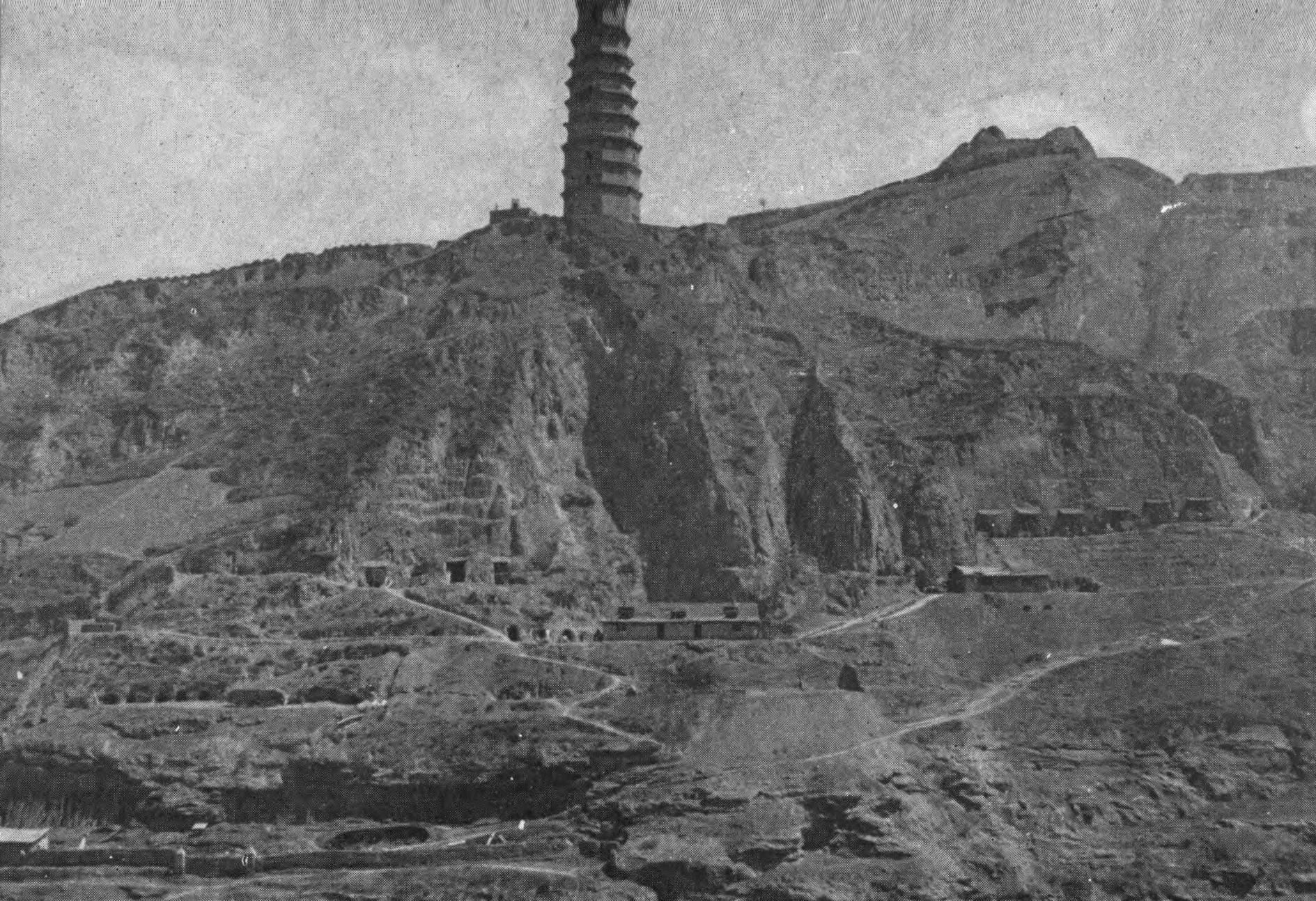
Ancient Pagoda built hundreds of years ago, seen from outskirts of Yenan. Caves at right are similar to those
used to house the Japanese Prisoners of War.
“Ballentine Beer Patches”
Worn by Marshall’s
workers in Chungking.
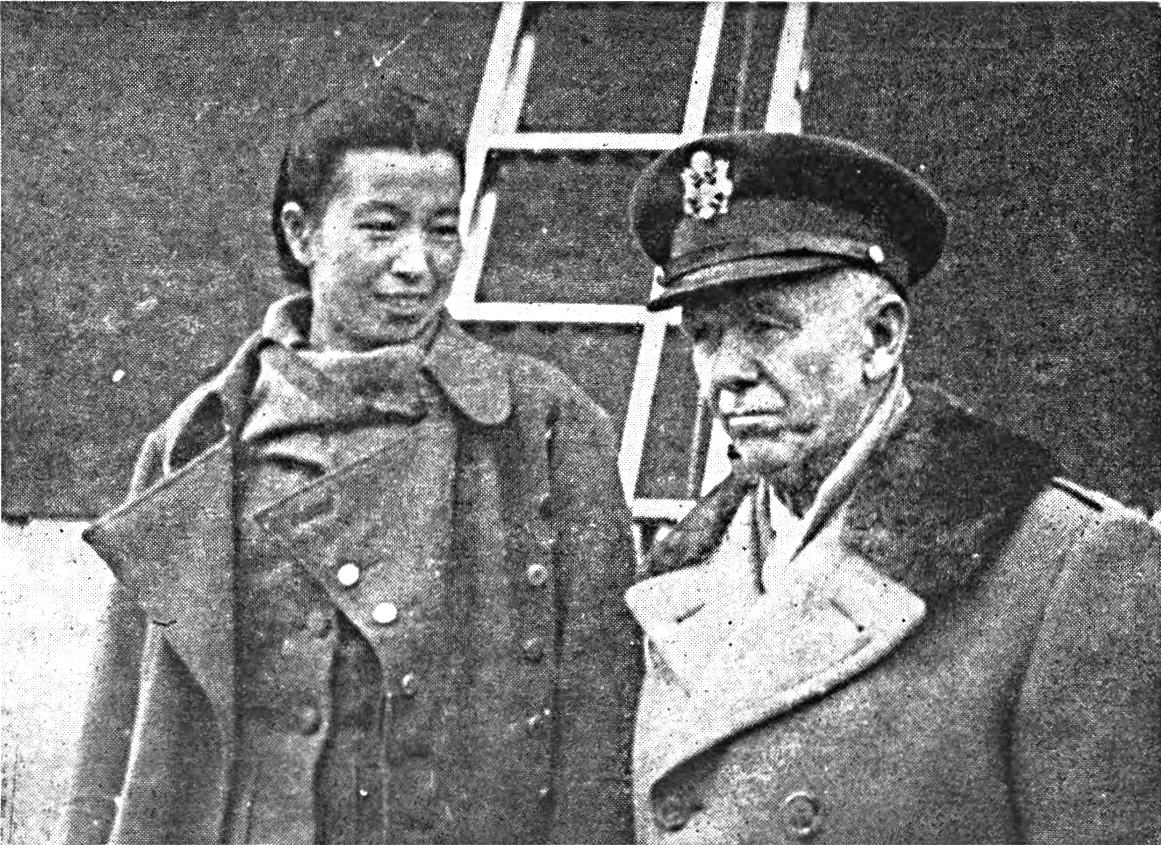
The movie actress wife of Mao
Tse-tung appears pleased with the
story she has just told General
Marshall, while the latter seems
to wonder if he got the point.
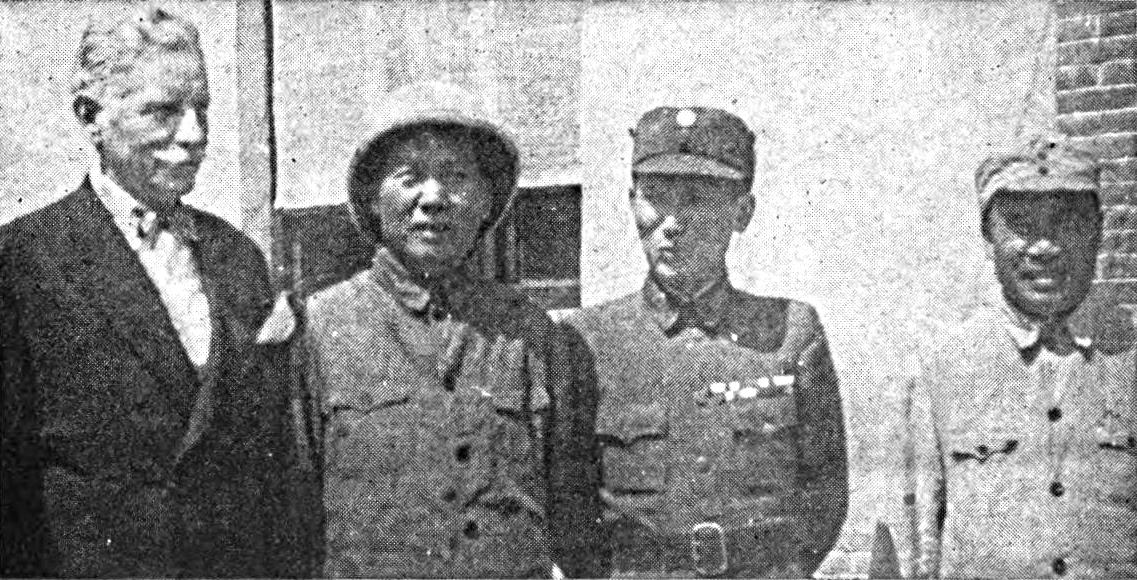
Left to right: Ambassador Patrick J. Hurley, Chairman Mao Tse-tung,
General Chang, (Generalissimo Chiang Kai-shek’s propaganda
chief), and General Chu Teh, shown after conference in Yenan.
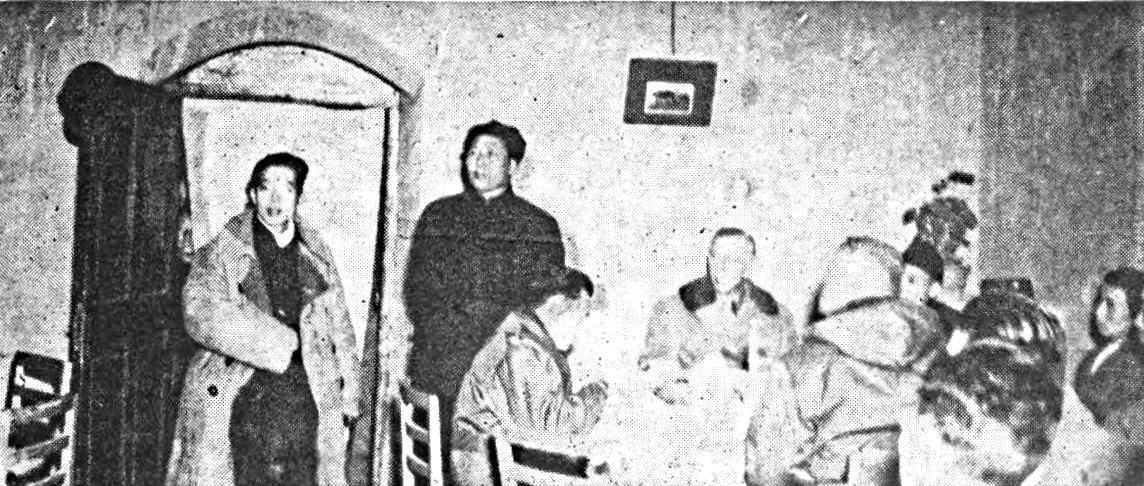
Mao has just proposed a welcoming toast to General Marshall, and
politely listens while others do likewise. The banquet
was held in Marshall’s honor.
Chinese Nationalist and American flags fly between banner welcoming Marshall,
Nationalist General Chang and Communist Chou En-lai. Side
banners say “Long Live Peace in the Far East!”
Saturday inspection of Caves in Yenan. Last, on the extreme far end to the
right, is the cave in which Marshall was installed.
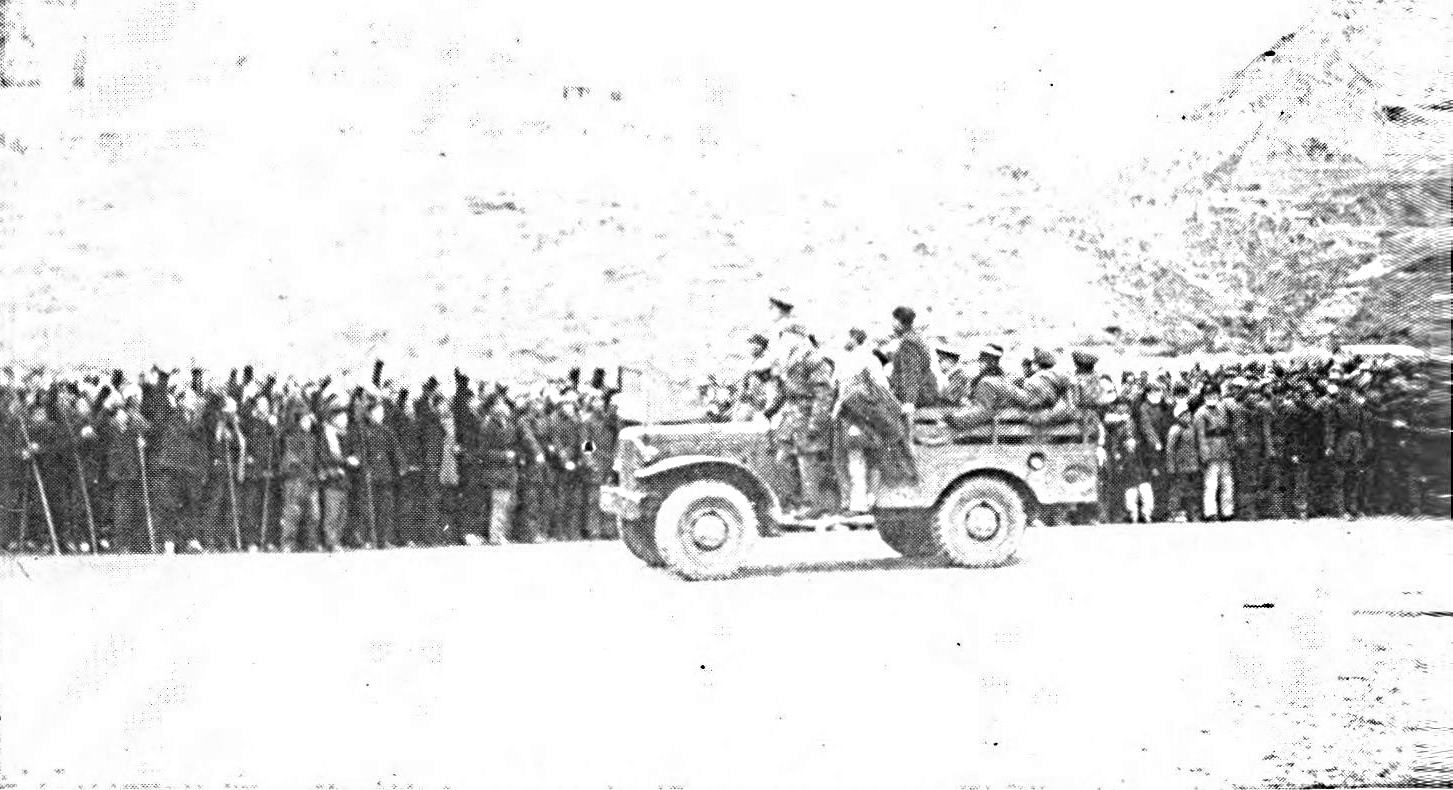
Crowds greeting Marshall on his arrival in Yenan. At extreme left can be seen the
Ming Bing with their long spears. Note American and
Chinese Communist flag on jeep.
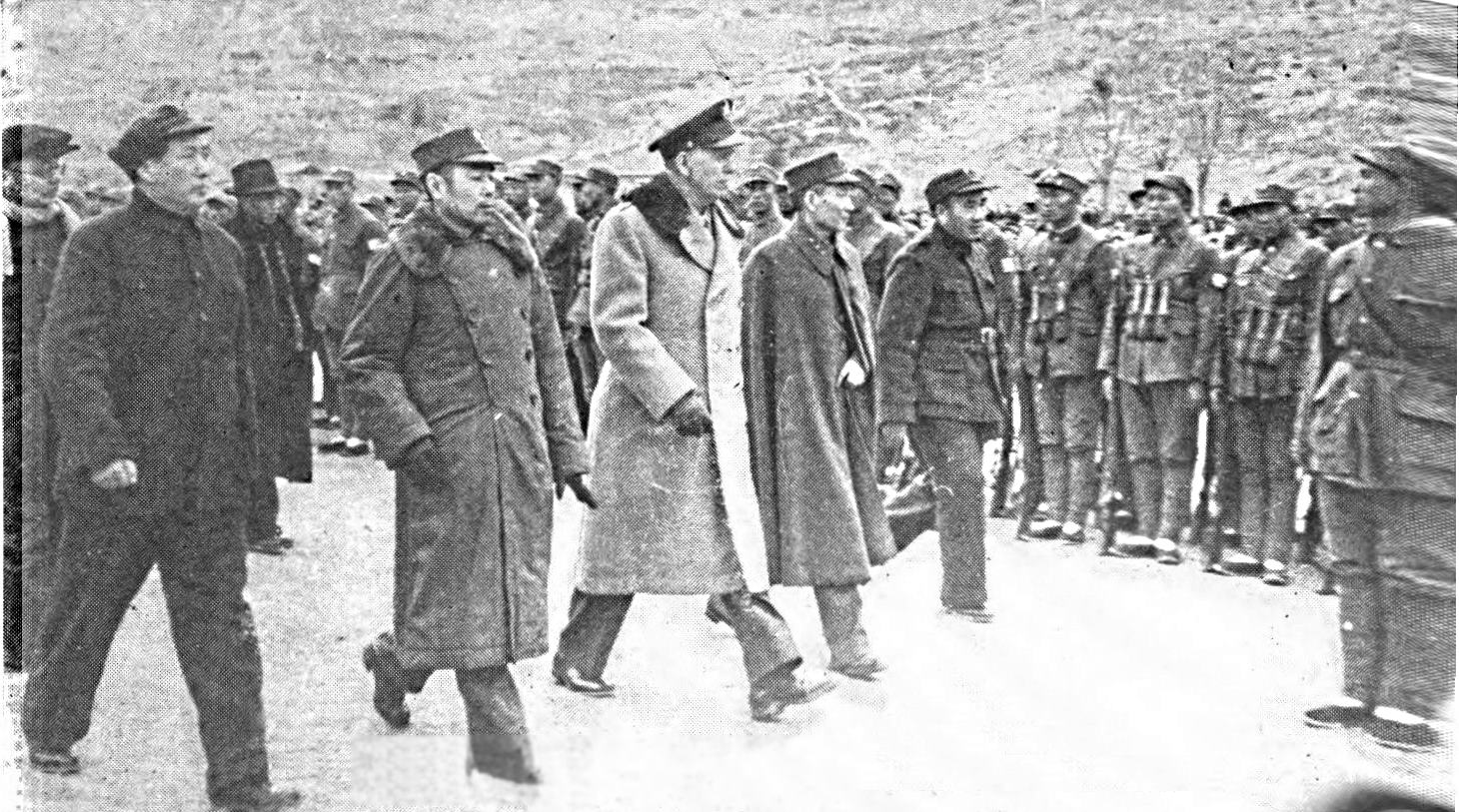
Left to right: Chairman Mao, Chou En-lai, Marshall, General Chang (Nationalist), and
Chu Teh. On the right are picked troops of the Communist Military Academy.
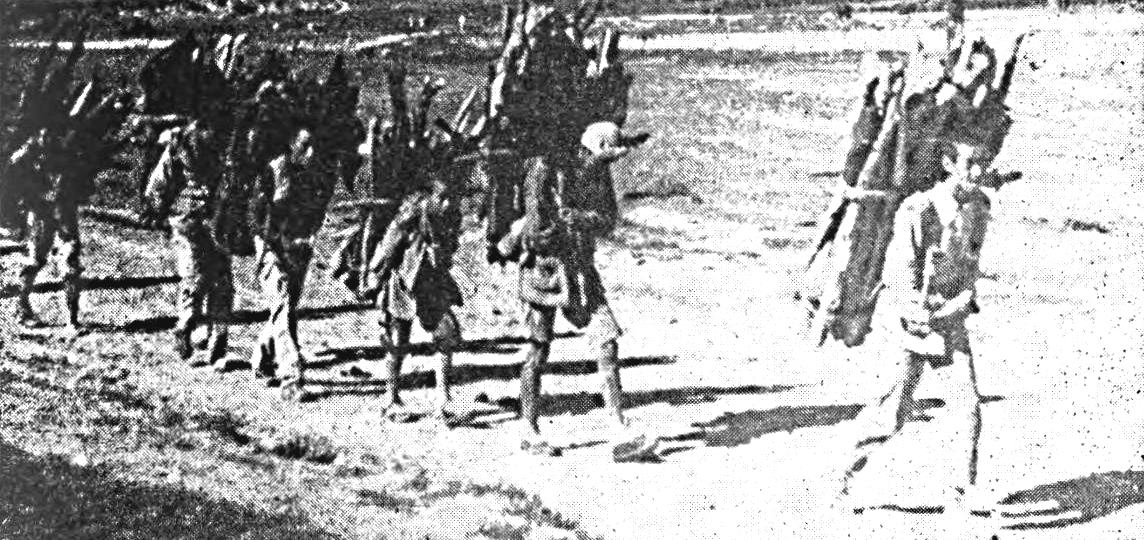
Under Communism man still competes with the lowly donkey.
Here several are seen carrying fire wood in Yenan.
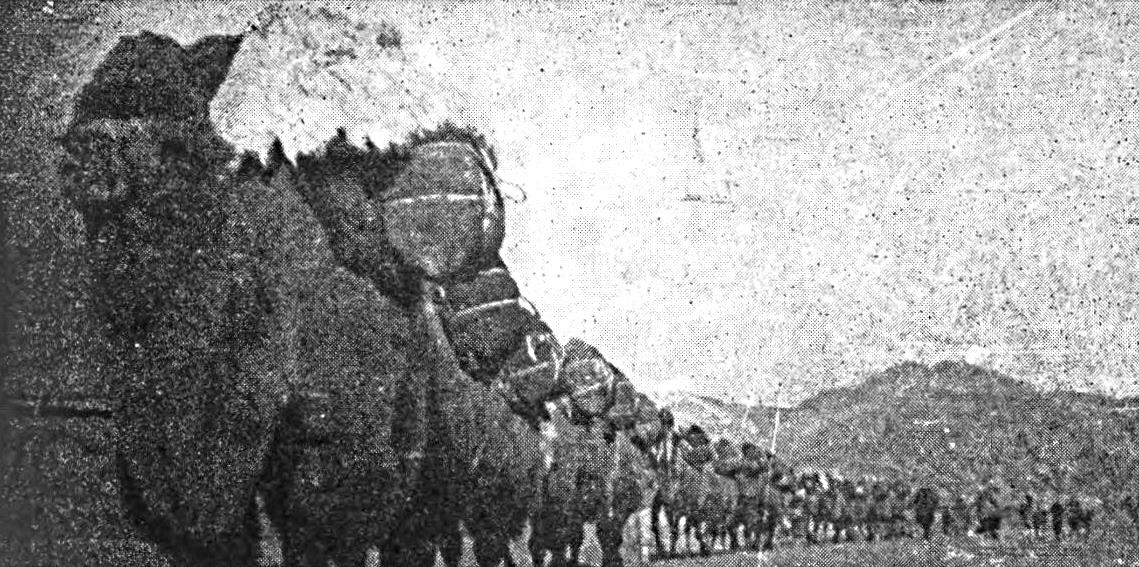
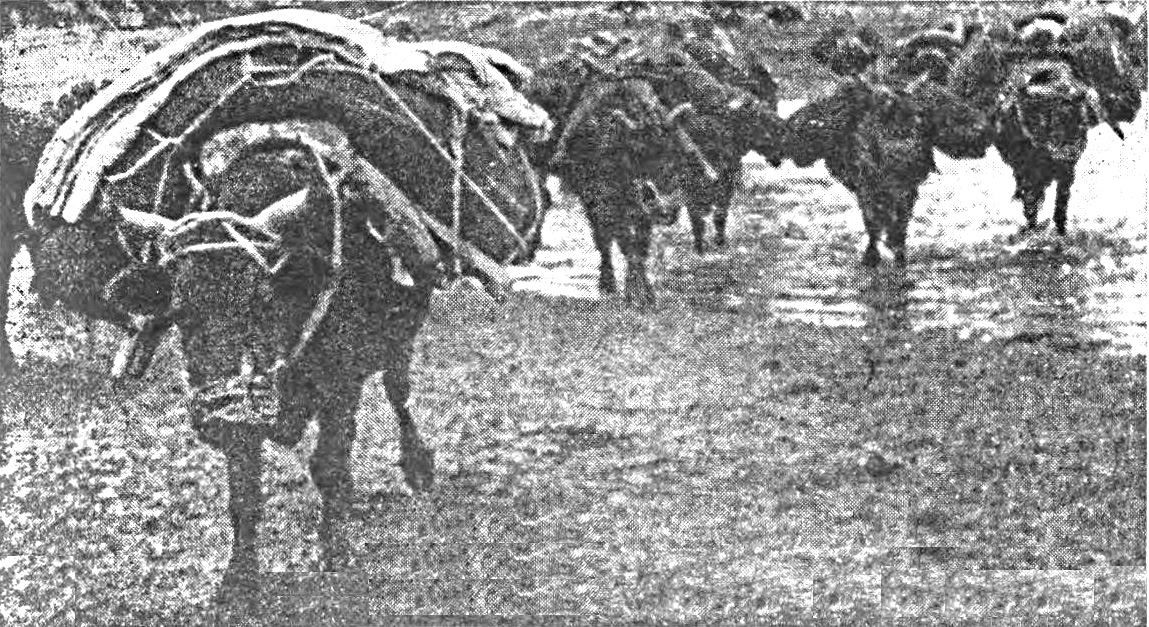
A camel caravan arriving at Yenan from the Gobi Desert after passing
through the Great Wall. The lead camel wears a mask to frighten away
evil spirits. (In photo below)—Oxen laden with bundles and wares to
be sold in the Yenan markets.
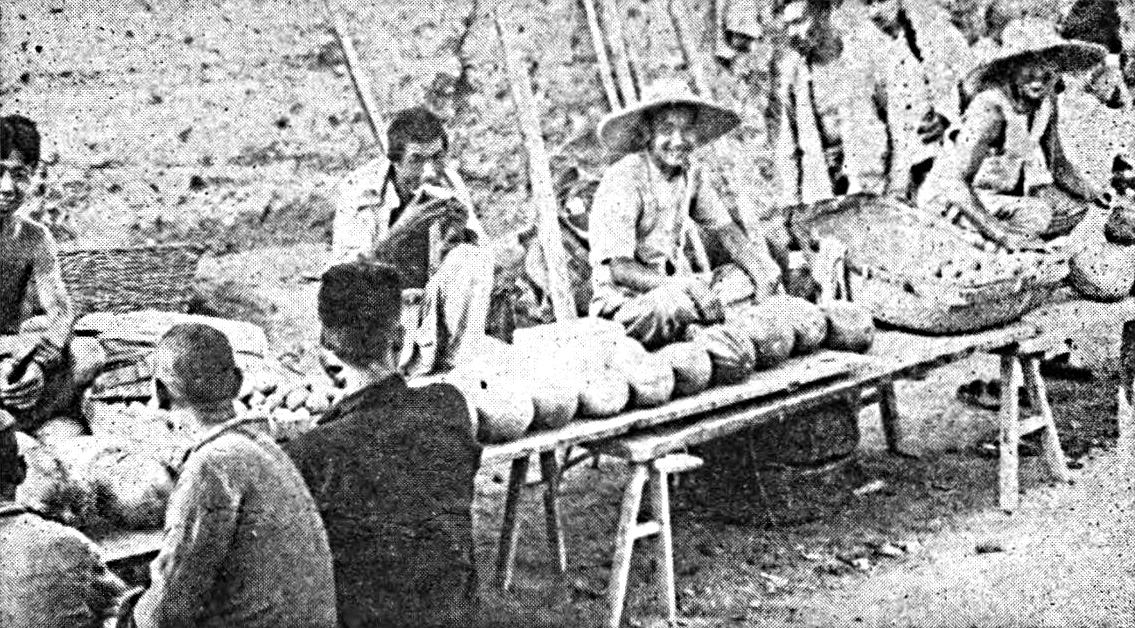
The Market Place in Yenan, run by non-Communists
as in the days of their ancestors.
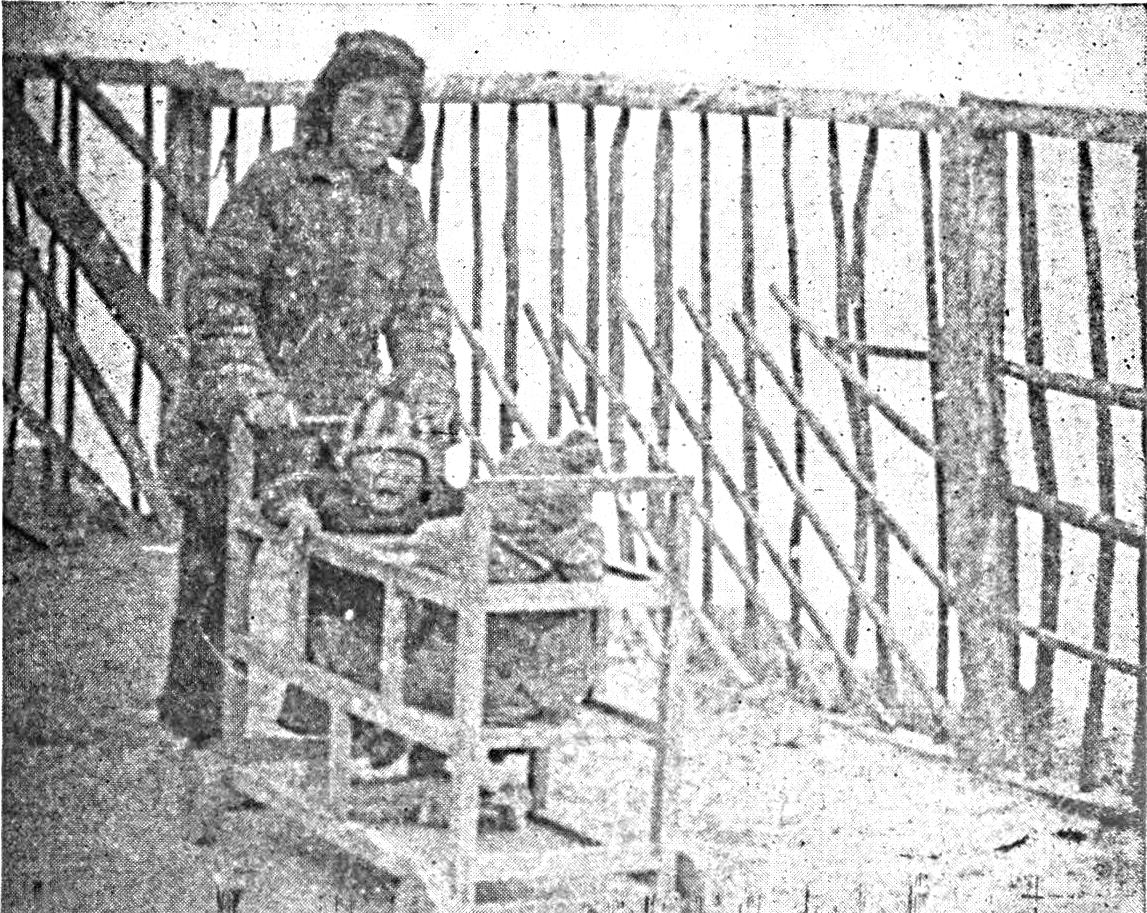
Child-mother with twins in improvised home-made
tandem baby carriage.
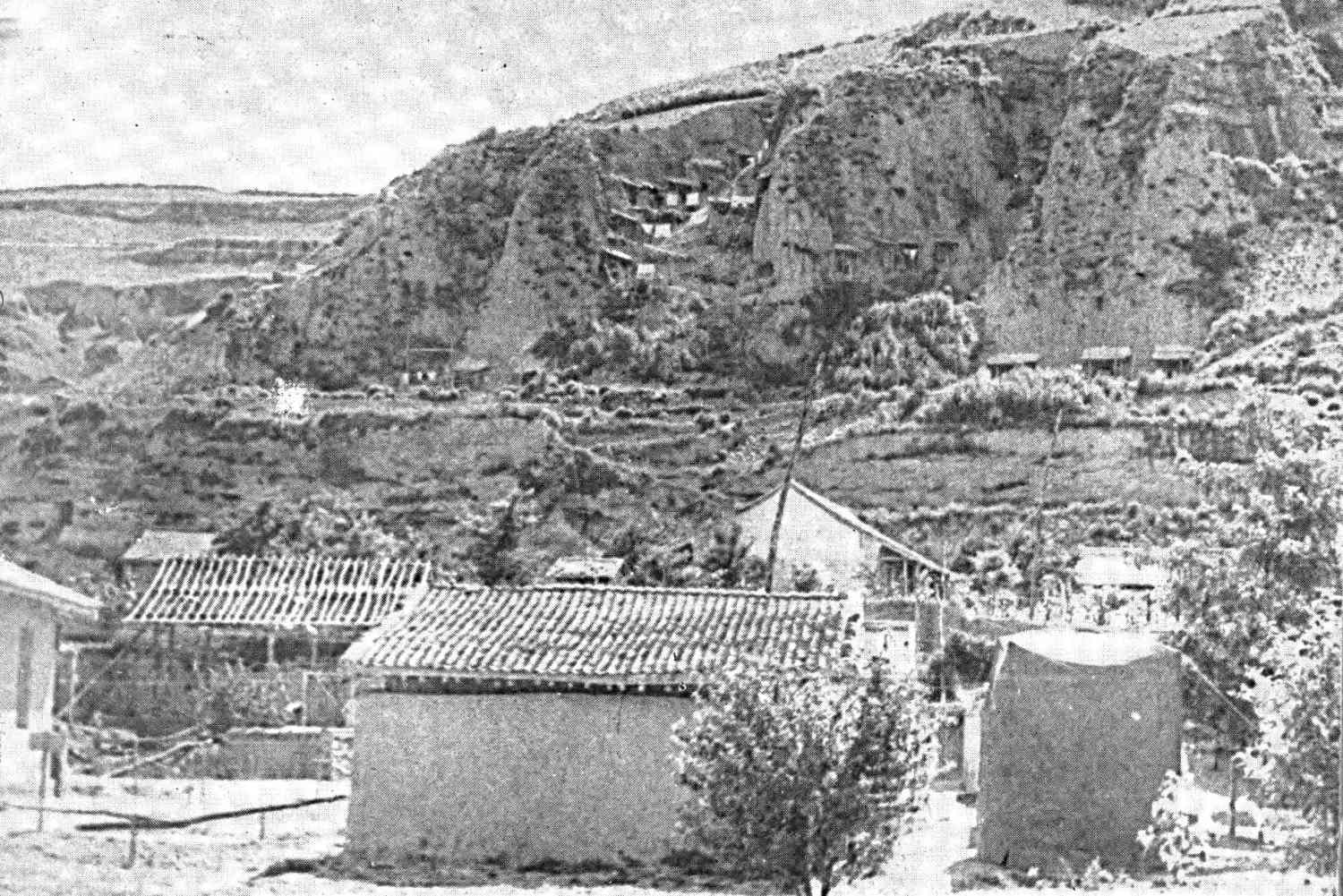
Caves of the Communists and Red Army seen in the distance, sheep grazing beneath them. Small house
in foreground was used for storage of food.
Protestants suffered equal indignities. From outlying
districts came reports of religious oppression and sometimes
of atrocities. American missionaries, both by word
and letter, told of the destruction not only of churches
but of agricultural and hospital activities which had operated
for many years to help all Chinese, Communist
and Nationalist alike.
The population of Yenan was for the most part non-Communist.
The distinction was not difficult to note
for the Communists were easily recognized by their
dull blue cloth uniforms, their bobbed haired women
wearing no make-up, and their complete lack of Chinese
silks and gay colors. The non-Communist majority were
allowed to continue their usual occupations undisturbed,
as long as they minded their own affairs. Nearly all
the merchants within the Walled City were non-Communist,
and all gathered daily in the big market, as
they had done for generations, to display their wares
in the open, on boards or on the ground. When the
Communists wanted anything, they forced the merchants
to cooperate by handing over a desired commodity,
and at the Communists’ own price.
Due to the Chinese and Mongolian background of
most of the Communist leaders, many of them did not,
at first, wish their women to play any political roles
or to appear at public banquets with the men. With
the growing acceptance of the Russian doctrines, however,
all were considered equal, and the women worked
and ate beside the men. The female Communists tried
to look as unlike the old fashioned Chinese women as
possible. Their adopted cause had emancipated them,
if emancipation meant compelling them to work as
hard as the men. In Russia, after the Revolution, the
women, dressed as men, were allowed to load and unload
trucks, which the men drove. The rules for the
masses, however, did not apply to the wives of the leaders.
They were encouraged to mix freely, to wear better
clothes, and to indulge in light make-up occasionally.
Moreover, it is said that they all ate quantities of
sunflower seeds in order to obtain the fine, firm
breasts for which many a Soviet woman is famous!
Tipping was not allowed in the Red realm, for it
indicated class distinction. As all classes were supposed
to be equal under Communism, any breach of this regulation
was severely punished. In Yenan, an American
GI tried to express his gratitude to a young Communist
for helping him make some furniture for his cave by
offering him a package of American cigarettes. The
Chinese boy frowned and backed away. “No, thank
you,” he said, “I cannot accept anything for my services.
We are all equal now.” The American shrugged slightly
and put the cigarettes on a table. A few minutes
later, when his back was turned, the Chinese boy and
the cigarettes had disappeared. The following day the
American soldier found the Communist youth smoking
furiously behind a pile of rubbish. He learned later that
the boy had been spied upon by other Communist
youths who, out of envy or an excess of Party zeal, had
beaten him unmercifully. After generations of accepting
the traditional “cumshaw,” or little token of appreciation,
it is well nigh impossible to convince a Chinese,
Communist or otherwise, that this time-honored custom
is wrong.
During the war, all American troops stationed in
Yenan lived in caves on the level nearest the ground.
This made for greater convenience in getting in and out,
in line with the wish of the Chinese Communists to show
the foreigner every courtesy. The Americans had one
small house built primarily to shelter the electric generator
they had brought with them, and here also lived
the Commander of the Americans. The generator made
it possible for the Americans to have the only electric
light in Yenan. In contrast, the natives and families of
the Red Armies burned wicks in precious oil or built
small fires for occasional light. Their rule was to bed
down with the sun and to arise with the dawn.
One other building allocated to the Americans was
used as a recreation room, where the GI’s and a highly
selected group of Chinese Communists played games and
had their meals in common. This group of Communists
assigned to fraternize with the Americans was headed
by a fellow named Lock Ho, meaning “Old Horse,”
whose job was to start arguments and to guide the
Americans in their thinking. The GI’s were never allowed
to fraternize with any Chinese who was not thoroughly
indoctrinated, even at the Saturday night dances.
Nurses from the International Hospital, students from
Yenan University, girls and women from the Central
Committee of the Chinese Communist Party, other students,
teachers and members of families of the Communists,
all were completely propagandized before being
permitted, or ordered, to attend the dances. In other
words, the Americans never came in contact with any
Chinese who was not fully imbued with the tenets of
Communism. Be it said to the credit of the Americans,
the Reds, despite their efforts, were never able to work
on the GI’s with any degree of success.
On hunting trips, a propaganda expert went along
with the Americans, but even this could not spoil the
superb sport and the pleasure that came from shooting
an occasional wolf, mountain lion or tiger. The pheasant
coveys were numerous and the birds huge, making
them much sought-after additions to the monotonous
diet. A man who was a good shot, even with an old
carbine, would bring down five to ten cocks in a day.
There were no bird dogs, but when Chu Teh, a fine shot
himself, and a tireless hunter, accompanied the group,
he had his bodyguard act as a retriever, a service the
American “Imperialists” did not have.
The jeeps and trucks of the United States Army were
a source of wonder and terror to the natives, who were
entirely unfamiliar with any motor transportation. In
this connection, pregnant women proved a special
headache to the GI’s. When the donkeys or Mongol
ponies, on which the pregnant ladies were riding, shied
away or stood on their hind legs at the approach of a
vehicle, the ladies naturally fell off their mounts
screaming and yelling in their high, piercing voices as
they rolled into the dust or a ditch, their bundles and
belongings flying helter skelter in all directions. Even
when the Americans drove slowly or stopped, the havoc
wrought was considerable. Many of the pregnant riders
were indignant and demanded “cumshaw,” or money,
to compensate for damages to their person and pride,
but fortunately there were never any serious accidents.
Many things puzzled American soldiers in Yenan.
One was how a Chinese herdsman, driving dozens of
sheep and pigs, could meet and pass, on a narrow mountain
path, another herdsman equally encumbered.
Amid ear-splitting squeals, grunts and Chinese swear
words, men and animals would pass each other without
loss or mishap, each going in his own direction, with
his own animals intact! Surely no American could accomplish
such a feat.
The GI’s had constant trouble with money. The
Communists manipulated the exchange any way they
wished, but always in their own favor. Nobody knew
exactly how much money he was worth at any one
time. Eager to procure all the American dollars and
Nationalist currency possible to finance trips to the
South for their agents, the Communists put up their
special script in small packages to entice the Americans
to purchase them for one United States dollar. They
were counting heavily on the GI’s never-failing interest
in a “souvenir to take home.”
Every foreigner, on entering Yenan, was thoroughly
briefed by the Commander of the American Observer
Group, who boarded incoming planes. This presented
a clear indication of Moscow influence. All entrants
were told never to use the word “coolie,” as it signified
class consciousness. They were not to mention the words
“Reds” or “Commies,” as these terms cast aspersions
upon the dignity of their hosts. All, Communists and
non-Communists must be referred to as “local people.”
American movies were shown almost nightly out of
doors in summer. These were so superior to the Chinese
or Russian movies that the enthusiastic natives would
pull down the gates of the Compound if any effort was
made to keep them out. In the winter, however, the
movies were shown indoors, and only guests invited by
the Chinese Communists were allowed to attend. Chu
Teh was on hand almost nightly and was a particular
fan of Betty Hutton’s. He returned eight times to drink
in her charms as the heroine of the picture “Texas
Guinan.”
The only other movies were those supplied by the
Chinese Communists. Crude and boring, they were
largely sent from the Kremlin, and were in Russian with
no Chinese sub-titles. A leader, in a sing-song voice,
gave the general idea of the picture, particularly stressing
the propaganda line it illustrated. The audience,
not understanding Russian, could hope for only slight
amusement.
Even the Hierarchy gave every evidence of preferring
American films. The lavish background in the Guinan
picture made a particularly deep impression, as it was
such a far cry from the way even the most important
Chinese and Red Army officers and their families lived.
In the upper tiers of mud caves, dug into the soft cliffs,
they existed as primitively as had their ancestors thousands
of years before them. Little or no furniture
cluttered the Reds’ caves, and almost all their utensils
were wooden bowls and horn cups. After the Americans
and the British came, the local people salvaged the tin
cans thrown out by the visitors and had them beaten
into plates and dishes, copied faithfully from the originals
by the blacksmith. Unused to comfort, their beds
were skins thrown on boards or spread on the mud floors—a
sharp contrast to the luxury of the sleeping arrangement
built for Ambassador Hurley when he was in
Yenan. This crude approach to a truly beautiful Chinese
bed was seven feet long, with rope slats for a spring,
rough unbleached sheets, and a pillow filled with bird
seed, or millet. It later became the property of the
American Military Commander and was always greatly
admired and coveted by the Chinese visitors.
During these years, although life in Yenan was primitive
and often carefree, the Hierarchy never lost sight
of the responsibilities that lay ahead of them, and for
these they tried to prepare themselves, within the limits
of their knowledge and capabilities. In 1946, contrary
to all Chinese Communist teachings, several American
soldiers were questioned extensively by the Communist
leaders on matters of capitalist etiquette and protocol.
The Americans, amused at their roles of male Emily
Posts, accepted the challenge in the finest American
tradition. With grave faces and dressed in their best,
they gave cocktail parties, movie suppers, and even
formal sit-down dinners for the education of the distinguished
members of the Central Committee of the
Communist Party. Table manners and light conversation
were stressed. The pupils were most appreciative
of these examples of Western culture and refinement
and strove in every way to learn their lessons and to act
accordingly.
Hugely enjoying this fascinating taste of the foreign,
they put together a so-called Jazz Band and held
Saturday night dances that were entirely Western in
every respect, even to a crude rendition of “The Saint
Louis Blues.” Eager to have everything done in proper
Western style, the Red leaders provided their teachers
with a list of Central Committee Communist Party
Members, arranged according to rank, and insisted that
the best State Department protocol be observed and
practiced rigidly. They were shrewd enough to realize,
even then, that in conquering new countries, they
would have to have more than one front man. At
that time, Chou En-lai was their only polished negotiator.
He alone was able to meet foreigners on an equal
footing and was therefore obliged to be their Minister
of Foreign Affairs.
The Communists in Yenan, as in all countries in
the beginning of their transition to slavery, adopted
the term “New Democracy” and made a great display
of its outward form by allowing the non-Communist
peasants to “vote.” The outcome, of course, was previously
agreed upon. The balloting was merely a matter of
form and a means of convincing the people that they
still were privileged to make their own choice. The
literate cast their vote by burning a hole in the ballot
with a lighted stick of punk, or incense, at the point
where the name of their candidate appeared. The illiterate
dropped a pea into a bowl or pitcher, placed in
front of a picture of their candidate. After the voting
was over and the successful candidate announced, a
huge rally was held and the voter was constrained to
forget his choice, if unsuccessful, in a frenzy of dancing,
shouting and singing. After a few hours of this,
the tired voter would wend his way slowly homeward
to his mud cave, or if he were a country man, to his
ancestral mud hut, often many miles away.
The roads that lead into the Walled City of Yenan
are two-thousand-year-old trails used by the descendants,
both man and beast, of those earliest travellers.
Both inside and out of the city, little has changed. The
men driving the camel caravans pad softly through the
dust, their animals heavily laden with burdens of fur
and other wares to be marketed in the city. They still
practice the age-old custom of putting a mask on the
lead animal’s head, to drive away the evil spirits. Water
carriers, after dragging great buckets of the muddy
liquid from the river, chant their endless “water!
water!” as they go from cave to cave in the time-honored
manner. Food vendors, squatting in the dusty
lanes cooking bits of lamb and pork, roots and herbs
over tiny charcoal braziers, cry out shrilly to the
passers-by, eating occasionally from the pot with their
grimy fingers. Half-naked babies crawl nearby, whimpering
to their mothers, who pacify them by giving
them sweetened tree bark on which to chew. Donkeys,
heavily laden, and round Mongolian ponies jostle dog
carts and belabored oxen. Everywhere, cotton clad
coolies, bowed beneath huge bales of firewood, coal and
charcoal, shuffle along the dusty streets. For, alas, although
the rickshaw and pedicab or bicycle rickshaw
has been banned as an occupation beneath the dignity
of man, the older use of man as a beast of burden has
to be accepted. For the very poor, there is nothing else
to take his place.
This, then, was Yenan in 1946. Now that the Communists
have won China and moved from the mud
caves to the glamorous palaces of Peking, it will be interesting
to watch their actions.
Will they be able to carry out their plan of communizing
the entire country? And how long will this
take? Will China remain China for the Chinese or,
for the first time in nearly five thousand years, will the
once free peoples of this basically democratic country
be hopelessly enthralled by the yoke of tyranny?
The Chinese have a quality that has distinguished
them. This quality is patience. The Communists too
have patience, but only up to a point. Beyond that they
use force to accomplish their ends.
There are literally hundreds of languages spoken in
China—each province speaks a different dialect.
Moreover, aside from travel between major cities, there
is relatively little transportation and practically no
communication between smaller cities in the interior.
In view of these facts, is it not possible that the Russians
will find their progress slow?
Will the Chinese absorb the Soviets as they did the
Huns, the Mongols and the Tartars? Time alone will
give us the answers to these questions. Time alone will
prove the importance of the incubation period spent in
Yenan, and whether or not it was worth the sacrifices
made by the Reds. The die is cast. From it we shall
learn what the future holds for Asia, for Europe, and
perhaps for ourselves as well.
[1] Collectivize means controlled farming, where the peasants are only
hired hands.
Chapter III — Communist Personalities
The Central People’s Government of the Chinese
Communist Party is the ruling class. It makes the
policy, enforces the laws and governs with dictatorial
power. Mao Tse-tung, at fifty-six, is Chairman and
Supreme Commander—for the time being at least.
Directly responsible to him are six Vice-Chairmen
among whom is the famous Madame Sun Yet-sen. Under
these Vice-Chairmen are fifty-six Supreme and
fifteen Administrative Councilors, twenty Ministries
and a political Consultative Committee of one hundred
and eighty Active Members.
Mao Tse-tung, or Chairman Mao, is a rotund little
figure, rather dejected looking, with an undistinguished
face, topped by a broad forehead and a luxuriant crop
of black hair. Now installed in Peking, he dresses less
slovenly than in those earlier days in Yenan when a
sloppy appearance was considered a badge of honor.
His name, pronounced “Mout-zz-dung,” is easily
mispronounced by foreigners. Once, during the Japanese
war, when Mao was in Chungking for a short time,
ostensibly to coordinate the Communist forces with the
Generalissimo’s war effort, he was consistently called
“Mousy-dung,” by Ambassador Hurley. In conferences,
and with the best intentions in the world, Hurley would
keep saying, “Mr. Mousy-dung,” this or that ...,
while the Generalissimo would politely cover his face
with his hand to hide his smile and Mao would blush.
“Mousy-dung,” in a more common Chinese dialect
means “the hole in the water closet.”
Earnest and zealous, Mao, a “China for the Chinese”
promoter, and therefore basically at odds with the
Russians, speaks in a distinct, sometimes shrill, high-pitched
voice. He has a habit of quoting from his wide
reading. His oratory is forceful but, like Hitler’s, not
polished. Although brilliantly educated in the Chinese
Classics and familiar with ancient Greece and Rome
through translations of their history and literature, up
to the time he left Yenan he had never learned to speak
or understand English. Nearly all foreigners relied
upon his interpreter when speaking to him. In spite
of this, he held one group of reporters spellbound for
nearly three hours as he talked to them in the Foreign
Office cave, gesticulating nervously and cracking watermelon
seeds endlessly between his square white teeth.
Sometimes his sober countenance and intense preoccupation
would amuse foreigners. Hurley, after long
hours of serious discussions, always through an interpreter
of course, would, on leaving, bow in sweeping
Western style and invariably say in English, “Good
night, you sad little apple you,” to his politely bowing
host.
Mao’s childhood was one of unusual drudgery. His
father was a peasant and a domestic tyrant. Understandably,
the boy’s thoughts were turned, at an early
age, to revolution against authority and oppression. He
chopped off his pigtail in defiance of the Manchus and
joined other restless youths who had a hand in the
formation of the Chinese Communist Party. A few
years later, largely through his help, this party was
joined briefly to the revolutionary party of Dr. Sun Yat-sen,
which Russia was then aiding.
Years of civil war had taught Mao the technique of
guerilla warfare, as well as the qualities necessary for
leadership. He likens his guerilla tactics to the behavior
of fleas. “We attack by night,” he says, “and wear out
strong men.” In 1927 he became President of the first
Chinese Peasants Union and has never lost his standing
with it. The ignorant peasants are always impressed
not only by his rugged and often ruthless qualities, but
also by his great learning and his ability to write Chinese
poetry in the classic style. In the early days, he
won their further applause by moving freely among the
people, organizing rickshaw boys into labor unions, and
sometimes pulling them about in rickshaws himself,
while he talked intimately of the glories of Communism.
Most of the activities of the Communist Party in the
early days were carried on in the South, especially
around Canton. By 1934, however, the Nationalists
had gained such power that the Communists were
forced to leave the Southern province of Kiangsi for the
Northern caves of Yenan. This, the “Long March,” was
a journey of thousands of miles, travelled on foot,
partly over almost impassable trails and some of the
highest mountains and largest rivers in Asia. In three
hundred and sixty-eight days, eighteen major mountain
passes were crossed, five of them snow-capped,
and twenty-four rivers were forded. At each stop that
was made, the marchers ravaged villages, impoverished
the well-to-do, and persuaded the poorer peasants to
join them. They whipped up such a frenzied crusade
that their ranks were swelled by thousands. So strenuous
was the journey, however, that at its end only
twenty thousand men and women were left, ten thousand
having fallen by the way. Those who survived
were tough, one may be sure. A much-quoted legend
has grown up about Mao, the stalwart leader, which
tells how he stumbled along barefooted, refusing a
wounded soldier’s offer to share a pony’s back. “No,”
said Mao to the soldier, “your wounds are worse than
mine. We shall suffer and fight together. That is what
makes us comrades.”
Mao’s domestic career, like his political one, has
been stormy. His first wife, a child, was forced upon
him by his parents, at the age of fourteen. In his opinion,
she does not count, and he never mentions her.
His second, a school teacher’s daughter, is said to have
been shot by a Nationalist General. His third was the
heroine of the “Long March,” and Mao had just cause
to be proud of her. Tall, frail looking, clever and high
spirited, she was sometimes argumentative, behavior
unheard of in a Chinese women. A female soldier, she
is said to have received many wounds in battle. She also
gave birth to a son by Mao during the “Long March,”
but when the going became too difficult and unsafe she
left the child along the way with old peasants who were
unable to join the marchers.
Alas for this brave wife, when Mao met the beauteous
movie actress Lang Ping, on arriving in Yenan, she
was completely forgotten. He was so enraptured with
the newcomer that he sent his wife to Moscow, normally
a reward sought after by any Communist. In this
case it was only a face-saving gesture, however, and
there were rumors that the rejected woman contracted
tuberculosis and died. Mao’s new marriage to Lang
Ping caused a flutter of excitement and alarm in Yenan,
where the Communists knew and admired the courage
and fortitude of his third wife and where she was held
in esteem. News of this flurry of unrest reached the
Comintern in Moscow, where the practice of casually
exchanging wives was recognized, if not encouraged.
There Mao’s conduct was dismissed lightly, and the
Chinese Communists were told that the matter was to
be regarded as “personal, not a Party affair.”
During the war, Mao lived happily in a cave in
Yenan with wife Number Four. Both dressed simply in
blue uniforms padded with cotton in the winter. In
spite of this simplicity they enjoyed more privileges
than the average Communist. They ate special meals
and had extra rations of cigarettes, which Mao liked
to chain-smoke. He and his ex-movie starlet went, occasionally,
to Saturday night dances given for the
Party workers. Here an improvised orchestra struggled
with Viennese waltzes, known to be Mao’s favorites,
along with scattered bits of boogie-woogie. Mao also
liked Chinese translations of Russian songs, but whatever
the music, he and his wife swung into action with
genuine enthusiasm.
On the whole, Mao’s simple life adds to his popularity.
A Mao-myth, similar to the Stalin-myth, is being
built up about him, and by similar means. His picture
is everywhere. His words are repeated and his name
is spoken with reverence. In 1937, Mao wrote a letter
to Earl Browder, head of the Communist Party in the
United States, in which he said, in part: “We feel that
when we achieve victory (in China) this victory will
be of considerable help to the struggle of the American
people for liberation.” Mao signed his letter, “President
of the Chinese Soviet Republic.”
Today, Mao is not only the most influential Communist
in China, but probably, next to Stalin, the most
powerful Red on earth. With Kremlin approval, he controls,
temporarily more than four hundred and sixty
million people, which is three times the population of
the United States and double that of Russia. A typical
student of the methods of Moscow, in spite of his devotion
to Confucius and Plato, he has no compunction
whatever about condemning thousands to death upon
suspicion that their loyalties are slipping. Aware of
this quality in him, Japanese and Korean Communist
representatives have declared him, “The Symbol of the
struggle for emancipation of all the peoples of the
Orient.” They claim he has attained his position of
power through his sincere and idealistic solicitude for
China’s masses and his realism in bringing about reforms.
His enemies, however, intimate that his
“realism” has not excluded any means to gain his ends,
from walking out of attempted peace conferences to
assassinations.
The second most important man in Communist
China, now that the war with the Chinese Nationalists
is over, is Chu Teh, pronounced “Ju Duh,” Commander-in-Chief
of the Chinese Communist Armies. He is often
called the “Red Heart” of Communist China, as contrasted
with Mao’s nickname of the “Red Brain.” Number
Two in the Hierarchy is a plump, jolly, genial-appearing
fellow. Looking anything but a martinet, he
has a broad, disarming smile which shows a wide expanse
of pink gum. He loves to trot about chucking
little children under the chin. Born with a gold spoon
in his mouth, he was a reckless though courageous child
who always wanted to be a soldier and kept breaking
away from an early existence of luxury and high living.
Rich at the outset, he became even richer through
“squeeze” in a government financial post. Son of a
family of overlords, he rose to power and wealth despite
his addiction to opiates while still a youth. His early
use of opium can be laid to his parents. They spread
the thick, gooey, sweet-smelling stuff on sugar cane and
gave it to him to suck at night—a common practice
of the time to still an infant’s nocturnal wails.
Chu Teh had a large family of wives, concubines
and children. He was past forty when he decided to
leave them all and devote his entire future and fortune
to the revolutionary ideal that burned fanatically within
him. After squandering part of his wealth and donating
the rest to the Communist cause, he plundered
public funds in order to leave his large household well
established in a comfortable residence.
Chu was persuaded that the revolution of Dr. Sun
Yat-sen in 1911 had proved to be an utter failure for
the masses. In his opinion, it lacked the spark of a vigorous
ideological revolution, because it only substituted
one bureaucracy for another. He longed to modernize
China and to emulate the Marxian heroes of the West.
In order to further his ambitions and to carry out his
ideals, Chu put a large foot in the mouth of tradition
and, having abandoned his family, swashbuckled into
Shanghai to meet and mingle with the Nationalist revolutionaries.
These he joined temporarily, but he was
always regarded by them with a jaundiced eye. They
even went so far as to try to kill him one night when a
Nationalist officer invited him to dinner. Chu scented
danger. Realizing at the same time that his host was
naive and impressionable, he flashed one of his face-consuming
smiles, followed by a rat-a-tat fire of vitriolic
conversation damning Communism. He fondled the
feminine entertainers, recited sensuous love sonnets,
and generally made himself the life of the party. It
worked. His would-be murderous host was completely
captivated, and Chu escaped without a scratch! In like
fashion, by such guile and beguiling ways, Chu’s predecessors,
under Genghis Khan, performed the remarkable
feat in the 13th century of subjugating the entire country.
The old party tricks are still up to date!
A practical fellow, with more intestinal fortitude
than his habits would indicate, Chu picked up his
meager belongings a little later on and went to Germany
to study the Marxian and the Russian Revolutions
with the Communists there. He moved on up the
scale to Moscow, matriculated in the Eastern Toilers’
Union, where he studied under the best Communist
teachers. When he came back to Shanghai, he regaled
his friends with what he had learned in Germany and
Russia. “I am determined to make this work in China,”
he vowed. To this end, he placed great emphasis on
guerilla warfare, the people’s self-defense corps, to suppress
activities of traitors, draw out information about
the enemy, and guard military secrets. His military
tactics are the same as those of the Huns of Attila, the
Mongols of Genghis Khan and the Tartars of Tamerlane.
Let the enemy be the source of supplies—the
enemy being anyone who has anything you want.
As far back as 1927, Earl Browder had been in China
helping the Communists plant the seeds for the future
control of that country. They had planned on Chiang
Kai-shek playing the role of Kerensky in Russia—that
of being a temporary leader of the Chinese to be kicked
out as soon as he had defeated the warlords in southern
and central China. Chiang, however, was more than a
match for them and succeeded in blocking their “October
Revolution.” He took over, on the death of Sun
Yat-sen, and ousted all of the Russian advisors and so-called
“master minds,” who had been posing as friends.
The Kremlin whimpered and licked its wounds, preparing
a relentless revenge.
This was the only serious set-back they encountered
until Tito deserted and U. S. aid in 1947 saved Greece,
Italy and France. Their hatred of Chiang, therefore,
was deeply rooted and they had discredited him and his
government in every way prior to their take-over of
the country when we, the U. S., failed China in 1946
and 1947.
In 1928, Chu joined forces with Mao, and together
they founded the first Chinese Soviet Government and
the Red Army in Kiangsi Province. Chu became Commander-in-Chief
of the Red Army in China. With Mao,
he led the “Long March” to Yenan. Unlike Mao, who
will stop at nothing to gain his ends, Chu has a Robin
Hood quality that makes him a friend to the poor, with
whom he is ever gaining in popularity. When the peasants,
for example, complain bitterly that the soldiers are
stealing from them (a time-honored custom among
Asiatic troops), he forces them to return the stolen
goods. Often, as a matter of discipline for other offenses,
and as a demonstration to convince the peasants
of his “sincerity” as to looting, he gathers the entire village
together and gives the populace the satisfaction of
seeing the worst looters shot. “No more looting,” he
says, shaking a long bony finger. “Hereafter, when we
need anything we will ‘confiscate’ it from the rich, our
natural enemies, who use cheap and offensive tactics
against us.”
In spite of an occasional shooting, Chu is popular
with his troops and has been able to recruit from one
to two million guerillas, both men and women. One of
the latter, a pistol-packing Amazon named K’ang K’eching,
revived his temporarily restrained love life.
Dressed as a man, this big-boned siren with platter-sized
hands and feet, approached him one day and told
him she and her companions had captured a machine
gun. Would he teach her how to use it? He would,
indeed, for he was delighted with this husky bit of
pulchritude. He continued to teach her many other
guerilla tricks, and from these lessons romance flowered.
The next year she became Mrs. Chu Teh, and the newlyweds
set up housekeeping in a cave in Yenan.
Sometimes, on weekends, Chu would leave his cave-office
and the headaches that beset him there. Sniffing
the fresh air as though it held an alien fragrance,
and baring his buck teeth in a flash grin, he would ask
in Chinese: “What’s cooking?” This was not idle slang
with him. When soldiers in the Red Army have been
rewarded for some deed, they often use the small change
they receive to buy a goose which they roast and share
with their comrades. A standing joke among them was
that since General Chu could not be rewarded—there
being no immediate superior to bestow such favor—he
could always smell a goose and thereby get himself invited
to a meal. Among the soldiers he was nicknamed
“The Cook,” and not alone for his interest in the
kitchen. Once, disguised as a cook, he was cornered
behind Chiang Kai-shek’s lines. With revolvers poked
into his ribs, he yelled: “Don’t shoot! I can cook for
you!” The hungry soldiers, touched to their taste buds,
hesitated for a closer inspection. When he was recognized
and the cry “kill him!” went up, Chu whipped
out a concealed pistol, shot the crier, overcame a guard
and fled.
Always able to compensate by his keen wits for lack
of material, he is one of the most talented products of
Moscow’s training. He has taught his troops to use the
old steppe dweller method of getting much needed
equipment from the enemy. In addition, he has successfully
augmented his supplies with material obtained
from the Japanese and the Russians. In spite of Chu’s
long association with Marx and Moscow, he probably
has the interests of China at heart to such an extent
that the Moscow yoke could cause him to revolt. Chu
can be likened in the Chinese Communist Hierarchy, to
Budnenie in the Russian Soviet Army and left in political
isolation after his usefulness is over. Not a political
figure, but entirely military, Chu will never compete
with Mao.
The third most important man in Communist China,
who was the Number Two during the war with Japan,
is Chou En-lai. His name is pronounced “Joe-n-lie.”
Like “Mousy-dung,” the name has given rise to considerable
amusement. Chou himself, unlike Mao, never
failed to be highly entertained when Ambassador Hurley
saluted him with the familiar “Hi, Joe!”
The Party’s most polished envoy, Chou is practically
the only one capable of meeting foreign dignitaries with
ease. He is wily, clever at negotiation and, like the
Property Man of Chinese drama, set the stage for the
spectacular performance before a world audience of the
talks with General Marshall in 1945. As “Chief Front
Man” and one of the directors of foreign propaganda,
Chou did such a consummate job that Ambassador J.
Leighton Stuart told friends, “He presents his case better
than anyone I have ever encountered, clearly, forcefully,
urbanely.” Chou was urbane, certainly, for at a
large cocktail party he charmed the peace negotiators
of all three parties, including Stuart and Marshall. The
tired “diplomats” sought respite in small chow and
small talk, and for an hour Chou showed himself the
polite, intelligent, agreeable mixer that he is. Stuart,
a scholar and an intellectual, told me in Nanking:
“Whenever I cannot get a point across to Chou, I talk
the matter over with some of my students at Yenching
University. They discuss it with Chou and a solution
is arrived at immediately.”
It is no secret that the young intelligentsia of the
Chinese Communist Party were reared and fostered under
Stuart’s faithful hand, as President of Yenching
University, near Peking. He gave his best and his all
to represent the United States, yet he was an old and
tired man, and his ideologies and hopes for the Chinese
people were wrapped up in a belief that the salvation
of their country lay in Socialism. The only group capable
of carrying out these ideals was the Chinese Communist
Party, which, like its dictator, was ready to
prostitute Socialism and replace it with its own brand
of dictatorship.
Following the cheerful little get-togethers, the negotiators
would return to their arguments, hammer and
sickle, and Chou’s charm was abruptly turned off. On
one or two occasions, however, this charm caused the
Hierarchy embarrassment. For instance, he was recalled
to the “Ivory Tower” in Yenan once because Mao
felt that he had gone too far in his talks with Marshall;
that he had appeared to be making too many concessions,
even though he told a comrade he had not the
slightest intention of ever living up to any of them.
Moreover, he seemed to be getting too friendly with
Marshall. Chou spent many unhappy hours in the
Chinese Communist dog house in consequence.
After he confessed, with mock solemnity, to the error
of his ways and promised “Papa Mao” to be a “good
boy,” Chou was sent back to Nanking to continue the
negotiations. (Mao had to send him back anyway, because
he was the only man in the Chinese Communist
Party at the time who could do the job). To prove
that he was now “reformed,” Chou let out a series of
blasts against the United States Government that were
more violent and vitriolic than any that had yet come
from Communist Headquarters. Among other things,
he accused President Truman of fomenting the civil
war and of trying to turn China into an American
Colony.
As an individual, Chou En-lai appears to many by
far the most personable of all the Chinese Communist
leaders. Of medium height, he is well built and well
groomed. At press interviews he has a nervous habit
of removing and replacing his black-rimmed glasses as
he talks. His broad, handsome face is distinguished by
thick eyebrows and clear cut features. He speaks English
in a well-modulated, yet vibrant and dramatic
voice, undoubtedly cultivated while acting in amateur
theatricals in college in Tientsin. There he frequently
took the feminine lead, because of his facial beauty and
willowy figure, and it was there that he first learned
to speak English.
I had several conversations with Chou En-lai in Nanking,
always speaking through an interpreter. Once,
after several hours of laborious questions and answers,
I said: “Will you ask the General if he came through
Moscow on his return to China from Europe?” At this,
Chou threw back his head and laughed heartily. “Heck
no,” he said in plain American, “I couldn’t speak any
Russian then!” I should have realized that nearly all
Chinese pretend they understand no English, hoping
they may catch you off guard.
Chou’s grandfather was a high official in the Manchu
Dynasty, his father a school teacher, and his mother
an unusually well-read woman. Reared as an intellectual,
if not moneyed, aristocrat, he early rebelled against
the corruption of Chinese politicians. He went to France
in 1920, and in Paris two years later founded the Chinese
Youth Group, a branch of the Chinese Communist
Party. Returning to China, he became a secret organizer
of workers in Shanghai and Nanking, successfully
engineering two revolts. Because of his ruthlessness
he was called “Executioner,” a title that certainly belies
his suave appearance.
The Nationalists always considered Chou one of their
cleverest foes, and they are said to have offered $80,000
for him once, dead or alive. During the war he never
actually soldiered, although he “assumed” the title of
“General.” He did help to organize and served for a
time with the Chinese Red Army in several minor operations
in the capacity of Chief Political Commissar.
With a magnificent flair for political education and
propaganda, he won his present outstanding position as
a member of the Politburo, which rules the Red-blighted
areas wherever they may be. He learned much from
Michael Borodin, Russian-born Communist, and also
from Chiang Kai-shek’s one-time Russian advisor, Gallen,
who later, as General Bleucher, commanded the
Russian Far Eastern Army.
Chou is not afraid of work. Toiling late at night, he
writes articles for the press and prepares lengthy
speeches for the radio. He has been able to convert many
U. S. State Department officials to the view that in helping
Chiang, we were backing the wrong horse and
should, instead, have put our money on the Red. From
Earl Browder, to whom he wrote in 1937, we learn this:
“Comrade, do you still remember the Chinese comrades
who worked with you in China ten years ago?”—in
1927!
Chou is a true turncoat and has served, back and
forth, both the Nationalists and the Communist Governments.
One job he held during the war was liaison
officer between the Nationalists and Communists in
their so-called drive against the Japanese. This was a
smoke screen, for when Chiang ordered Communist
troops to fight the Japanese north of the Yangtse River,
Chou violently objected. He knew that he and the Communists
would either starve or be annihilated by the
Japanese. Thereafter, the Communists pulled their
anti-Japanese punches, or did not punch at all.
As “Property Man” for the great drama being staged
by the Communists, Chou always listens to the prompting
voice from the wings, the voice of his wife. Her’s
is a strong, clear voice, the one that converted him to
Communism, and the one that reminds him constantly
of his duties. He met her during one of the lowest ebbs
of his erratic life, in jail. Mrs. Chou is one of the hardest
working and most enthusiastic and important members
of the Party. Not especially pretty, she is attractive in
a quiet way. In spite of illness (she is said to have tuberculosis),
she remains politically active and influential.
Like her husband, she once held a post in Chiang’s Government,
as Finance Chairman of his New Life Movement.
More favored by Moscow than either Mao, Chu or
Chou, is Li Li San, whose name is pronounced “Lee Lee
Sahn.” Long ago, he and Mao quarrelled bitterly, and
Li Li San fled to Russia, there to become close to the
heart of the Comintern. Fifteen years later, this lean
and hungry-looking agitator returned as Moscow’s appointee
to the head political role in Manchuria. A rumored
cause of the rift with Mao was that Li Li was
caught heading an anti-Mao secret society, with Russian
connivance. The angle of their Communism differs.
Mao, a peasant, supports the farmers, while Li Li
San, with his Moscow training, favors the city workers.
Probably few men in history have been reported dying
or dead over a long period of their lives more often
than has Li Li San. Nicknamed the “Tito of Red
China,” when Tito was still dominated by Moscow, his
career followed closely that of his namesake. After
quarreling with Mao, he vanished and was presumed
dead by his friends. Some years later he reappeared,
with full Russian support, as a power to be reckoned
with in the Far Eastern picture.
While in Moscow, Li Li had married a Russian woman
and, in the Far Eastern University had trained
Communist agents and sent them back to their homelands
as agitators. He maintained a close liaison with
the Kremlin. As Russia’s war with Japan was nearing
an end, Stalin, ignoring Li Li’s petty dispute with Mao,
sent him, with Marshal Malinovsky’s Russian Army of
Mongols, into Manchuria six days before the Japanese
surrendered. His job was to take over this “Prize of
Asia,” rich in everything the Russians or anybody else
needed and which no contester for world power could
do without.
Another important military personality in the Communist
picture is Lin Piao, pronounced “Lin Bow.” A
great guerilla fighter and a natural leader of men, he is
a tactical genius who served on Chiang Kai-shek’s staff
and rose to become President of the Military Academy.
A little later he left the Nationalists and threw in his
lot with the Red Army. At twenty-eight he was given
command of the First Red Army Corps, a unit that is
said never to have been defeated. Lin Piao was to the
Chinese Communist Army what Zukov was to the Russian
Army, Chief of Staff and a military wizard.
Today, Lin, in his forties, has never gotten over his
youthful tendency to blush. His agreeable face has
slanting eyes that trail off into little mice tail wrinkles.
He is a sloppy dresser and is over-casual in appearance.
He has a good singing voice and he and Mao, who also
fancies himself a singer, often join in duets. After a
hearty meal when all are feeling warm and rosy from
the choicest wine of the Communist vineyards, Lin likes
to tune up his vocal chords and suggest that they sing
Mao’s special song, “The Hot Red Pepper.”
This is the story of the Red Pepper who sneers at all
the lazy vegetables for living such a spineless existence,
especially the fat and contented cabbage. Finally, the
Red Pepper, by means of his exceptional personality and
cunning ways, incites them all to revolution.
The theory, Mao says, is that pepper is loved by
all revolutionaries from Spain and Mexico to Russia.
Lin, like many of the Communist leaders, has never
been out of China, but because of his excellent articles
in military magazines his name is familiar in both
Japan and Russia.
The Hierarchy of the Chinese Communist Party has
attached to it a liaison officer originally from the Third
Internationale, a Syrian-American named Dr. Hatem.
His Chinese name is Ma Hia-teh, pronounced “Ma-High-Da,”
and he is always referred to by the Chinese
as “Dr. Ma.” Fiftyish and fat, he is typically American
in appearance, resembling more than anything else a
successful businessman. Born in Buffalo, New York, he
was educated in North Carolina and in Switzerland
where he is said to have received a degree in medicine.
He has been with the Communists now for about
twelve years. So completely submerged is he in Communist
ideologies, he insists he has forgotten his American
name.
Proud of having an ardent foreign convert, the Communists
still do not trust Dr. Hatem politically, although
they use him wherever they need information
from Americans. Because of his ingratiating manner,
he is a natural to make lonely Americans open up their
hearts to an old friend from home. He enjoys strutting
about among his Chinese and foreign friends and bragging
about his connections. His chief value to the Communists,
however, is his ability to evaluate American
newscasts. In the summer of 1946, he was seen almost
daily at the fashionable Peking Hotel, immaculately
groomed and wearing well-tailored clothes. There he
spent hours eating and drinking with the foreign diplomats
and correspondents.
Married to a Chinese movie actress—they all lean
in that direction—he has a son about three or four
years old. Mrs. Ma is a graduate of the Lu Hsun Art
Academy, formerly the Catholic Church in Yenan, and
is accustomed to wearing silk and using cosmetics. She
finds it quite a bore to obey the Communist dictates of
“cotton clothes and no make-up,” and on several occasions
she has been called down for making a “spectacle”
of herself. Being a Russian-language student and much
younger than her husband, she was constantly in the
company of a young Russian doctor who was part of
the Soviet liaison group in Yenan.
Dr. Ma is a most enthusiastic Communist worker,
who has remarked many times that he would gladly
“kill for the Cause.” He has been known to add with
emphasis, “And I would just as soon kill Americans as
anyone else!” He is said, despite his loose tongue, to
stand well with Moscow because he is such a willing
tool.
No panorama of Communist personalities can be
complete without the name of Madame Sun Yat-sen,
famous in Chinese history as the wife of the founder
of the Revolution that overthrew the Manchu Dynasty.
Madame Sun, sister of the celebrated Madame Chiang
Kai-shek, and the slightly less illustrious Madame H. H.
Kung, is known widely as “one of the famous Soong
Sisters.” The middle one of the three—Eiling, Chingling
and Meiling—Chingling is listed on the new governmental
roster as Soong Chingling, perhaps to cause
less embarrassment to her family. She is in charge of
the so-called “independent liberals” in the Party.
Under her maiden name, this clever conniver has had
a somewhat stormy career. Claiming that she shuns
publicity, she has, nevertheless, managed to stay in
the limelight a large part of her life. The daughter of
Charlie Soong, a wealthy merchant who had been
reared by a missionary and educated in America, she
was one of six children and is said to have been her
mother’s favorite. Chingling has been called a pretty
child and a not-so-pretty child, so that one might infer
that her beauty lies rather in her personality than in
her face. As a young girl, she was on the “dreamy”
side, rather shy but highly emotional. When she is
deeply aroused over a person or a cause, she becomes
enthusiastic to the point of fanaticism, a quality that
has proved alarming and distressing to the other members
of her family.
Educated in the United States, she adopted the American
name of “Rosamond,” by which her classmates at
Wesleyan College, in Macon, Georgia, called her affectionately.
Her teachers said that she was “very
studious, had high ideals and was extremely interested
in moral and philosophical ideas.” No timid flower,
she showed a fiery temper when provoked. Very proud
of her country and interested in its affairs, she often
said that she considered the Revolution of 1911 the
“Greatest event of the Twentieth Century.”
“Rosamond’s” English was excellent, and she wrote
numerous articles for the college paper, one of which
read: “When China moves, she will move the world.
The Revolution has established China in Liberty and
Equality, those two inalienable rights of the individual....”
A copy of this was sent to her father, who was
so pleased with his daughter that he forwarded to her
one of the new five barred flags of the Republic of China.
On receiving it, Chingling shouted with joy, climbed
up and pulled down the dragon banner from the wall
of her bedroom, and stomped on it crying, “Down with
the dragon! Up with the flag of the Republic!”
While still in college, Chingling began a hero worship
of Dr. Sun. When she returned to China, she
shocked everyone by announcing her determination to
marry him—this, although he was married to a woman
his own age who had borne him three sons, of
whom Dr. Sun Fo undoubtedly is the best known. Subsequently
she became his secretary and, with skill and
determination, aided by her youth and beauty, she
finally overcame all obstacles and, in 1915, became the
second Madame Sun Yet-sen. Basking in all the
excitement and publicity she so “abhorred,” she wrote
to a classmate back at Wesleyan, “Being married to Dr.
Sun is just like going to school all over again, only there
are no examinations to take!”
The marriage lasted until Dr. Sun’s death, in 1925.
They had the usual ups and downs, but she reported
to her friends from time to time that “it never lacks
excitement.” The Revolution inspired by her husband,
Communistic in its original structure, shifted back and
forth from reactionary to conservative to reactionary.
On the death of Dr. Sun, the reins of the revolution
were put into the hands of Madame Sun’s brother-in-law,
Chiang Kai-shek. Never in harmony, politically
or emotionally, Chiang and Mme. Sun had had many
violent disagreements. Finally, in 1927, two years after
her husband’s death, she confirmed her leftist sympathy
by going to Moscow. There she remained for three
years, studying Communist doctrines in the World Anti-Imperialist
League. In self-justification, she claimed
that the Nationalist Government had distorted the
meaning of her husband’s original ideas, that they had
always been similar to those of the Russian Revolution.
Again, in 1930, Mme. Sun, the former Soong Chingling,
burst into print in an angry tirade against the
Generalissimo. On January 22nd of that year, she sent
a cable to the Anti-Imperialist League in Berlin, saying:
“Reactionary forces in the Nationalist Government are
combining with the Imperialists in brutal repression
against the Chinese masses. They have degenerated into
Imperialist tools and attempted to provoke war with
Russia.”
Feeling ever closer to the Communists and farther,
ideologically, from the rest of her family, she chose
the anniversary of the eightieth birthday of her predecessor,
the first Madame Sun, to take her stand, in 1946,
in favor of the Chinese Communists and the Soviets.
Her stinging speech was headlined in every Chinese
newspaper and many abroad. There could be no doubt
now that she was a full-fledged militant Communist,
willing to use the powers of her brilliant mind and persuasive
personality to the utmost.
Today, nearing sixty, she is third Vice-Chairman of
the Communist Party, and her influence is, perhaps, the
strongest and most forceful of any women member, so
global are her contacts. Soon after her “elevation” to
the third Vice-Chairman of the Chinese Communist
Party early in 1950, she said: “China will continue to
follow the policy of leaning to one side, to the side led
by the great Soviet Union under the leadership of the
mighty Stalin: the side of peace and construction.”
A current rumor, despite denials, is to the effect that
Mme. Sun may be having another change of ideas and
ideals and is, therefore, not in the good graces of General
Mao who, like his mentors, Stalin and Genghis
Khan, hates a turncoat.
In appearance, Madame Sun is not unattractive. She
dresses simply, preferring plain silks without the elaborate
trimmings so dearly loved by her sisters. She
wears her neat, black hair parted in the center and
drawn back smoothly from her face to form a large, soft
“bun” at the nape of her neck. She speaks in a quiet
voice and says exactly what she thinks.
At the Shanghai Opera one evening in 1946, Madame
Wei Tao-ming, wife of the then Chinese Ambassador
to the United States, was seated just behind her.
Madame Sun, who was flanked on either side by well-known
Chinese and American Communists, turned
around at each intermission to chat with Madame Wei,
who had been one of the youngest and most devout revolutionaries.
I learned the subject of the conversations
that evening when we returned to Madame Wei’s temporary
home in the Avenue Lafayette. Livid with rage,
Madame Wei said to me:
“Do you know what she kept saying to me, over and
over again?”
Naturally I could not have known and said as
much. Madame Wei continued:
“She berated me bitterly for not being nicer to the
Communists! Me, of all people, who was one of the first
and hardest working fighters in her husband’s own
revolution! She said, ‘You’re going to regret it one
day, if you do not change your attitude. They are in
the driver’s seat, and they are going to stay there’!”
I had never seen Madame Wei so beside herself with
anger. This was just four years before it was generally
acknowledged that the Communists were in full authority,
and the period of tenure is a matter of conjecture.
Madame Sun, apparently, had seen the handwriting
on the wall and had interpreted it correctly.
While there are many other Communist personalities
aside from those discussed in the foregoing pages,
to mention them all would do no service to this story.
Those included are the ones whose names appear most
frequently in the press and on the radio. To know them
and their ways is to know the spirit and the methods of
the unholy movement to which they subscribe.
Chapter IV — Communism’s Forebears
Who are these people who have conquered most of
Europe and Asia and openly flaunt their determination
to conquer the world? Where did they come from?
How have they been able to enslave approximately
nine hundred million people? Do they really have the
secrets of the A and H bombs? Will they use them to
fulfill their diabolical schemes? And when?
The answers to these questions are vital to all people—to
every American, man, woman and child. Not
even in the days of Genghis Khan was there such a
tremendous upheaval over so vast an area of the earth’s
surface, as the one we are witnessing, as we pass the
half-way mark of the Twentieth Century.
Long before Moses was found in the bullrushes, the
people who lived in the Northern steppe lands sucked
hardship from their mothers’ breasts and grew into
sturdy savages, mortally feared by their neighbors.
They were Asiatics, that is, they belonged to the Yellow
Race, the best known tribes of which are the Huns,
the Mongols and the Tartars. Today, “Mongol” is the
common name given to people comprising nearly all
of Central Asia. Destiny gave a strange role to these
fearless nomads. Blood-thirsty and aggressive, time and
again they burst the seams of their homelands and overran
most of Europe and Asia. Each time they rose to
world conquest, the pattern followed was the same.
Guided by the genius of a merciless and brilliant individual,
the dominant tribe or clan ran the full gamut
from tribal communism, necessary in the early days
for self-preservation and mutual benefit, to communistic
imperialism. As the tribes grew larger and more powerful,
and the value of the spoils increased enormously,
several leaders struggled for complete control. This
struggle ended in a period of despotic dictatorship,
when one man gained supreme power and wielded it
ruthlessly. The period of oppression lasted, at various
times in the past, anywhere from a few years to a few
hundred years, depending upon the foresight and
strategy of the rulers. Invariably, the dictatorship disintegrated,
and the empires fell into dissolution and
decline, followed by desolation and chaos. The method
by which each nomad chieftain rose to power was
strikingly similar. He would consistently strengthen
his armies and trap his victims by guile, trickery, infiltration,
and every known deceit.
Succession to the leadership of the clan, tribe or nation
was not necessarily hereditary. It could pass from
father to son or outside the family, just as in the Soviet
Hierarchy today succession passes from Party member
to Party member. Then, as now, it was the strongest
physically, and the cunningest mentally, who always
assumed leadership.
These primitive conquerors had several great advantages
over their more civilized neighbors. One was their
extraordinary physical stamina. The weeding out of
the weak began practically at birth. Children, weaned
from mother’s milk, were fed on mare’s milk for a few
years and then were left to care for themselves as best
they could.
As clans gathered around the open fires, where all
the food was cooked in huge pots, the strongest men ate
first; the aged and women next; and the children were
left to fight over the bones and scraps. Food was
abundant in the spring when mutton, game and fish
were available. In the early winter the hordes lived
largely on millet, and fermented mare’s milk. The latter
had a high alcoholic content and was quite “heady”
for the younger children. By the end of the winter, the
clansmen were reduced to foraging and making raids
on the herds of other tribes. The old and weak were
left to perish. Only the hardiest survived.
Another great advantage of the militant nomads over
their victims was their ability to ride the horse. Everywhere
else in the ancient world, this animal was used
only to draw the heavy war chariots. The Mongols,
fearing nothing, mastered the horse and became expert
cavalrymen. The resulting mobility was a tremendous
asset in warfare. Without the horse, the Mongols would
never have been able to conquer such vast territories.
Learning to ride as children of three or four, they were
superb horsemen in their early manhood and hunted
with consummate skill. When they appeared upon the
horizon in a cloud of dust and with a clatter of hooves,
it was only a matter of minutes before each dropped
down like an eagle upon his prey.
Of even more strategic importance was their conception
of the fifth column. Poor always, in comparison
with their neighbors, whose lands and goods they coveted,
they—like their Russian descendants—developed a
technique of boring from within. Ahead of them were
sent humble-looking barterers or beggars, who easily
bribed and cajoled their way inside the walls of a city.
At the critical moment, the unfortunate citizens would
find their gates open and hordes of wild tribesmen
bursting in upon them with bloodcurdling yells.
Whether at home or in the field, these nomads lived
in yurts, or domelike tents, made of felt and mounted on
wooden carts, drawn by oxen. They spent most of their
days on horseback, hunting, fishing and constantly
fighting among themselves and with neighboring clans.
Often they remained in the saddle for days, eating little
or no food.
Between each major conquest, there were long
periods when fighting was confined to the steppe lands.
It was only when an outstanding genius appeared that
they attempted the invasion of the more civilized countries—Europe,
China or the Near East—which,
throughout the ages, were constantly on the defensive
against them.
One of the first of these tribes that grew to world
power was led by Attila the Hun, in the Fifth Century.
Slashing and murdering his way through Europe, he
terrorized the entire continent and captured the greatest
city of antiquity, Rome. Earlier, when Rome fell to
the Goths, the citizens though that surely the end of
the world had come. It was not until the Huns attacked,
however, that they felt the full fury of Asiatic destruction
and torture.
Attila was a typical Mongol of his day. Shaggy-headed,
dirty and disheveled, his gorilla-like appearance
evoked as much terror as if he had been a wild animal.
With as little regard for human suffering as for
the priceless treasures of Rome, he was lustful only for
power, wine and women. He is said to have kept a huge
harem, and, like his followers, to have left countless
children by captured slaves all over Europe and Asia.
Because of his merciless brutality, plundering and rape,
he was called by his victims, “The Scourge of God.”
In 451 A. D., Attila was finally defeated, and while
celebrating the addition of a new beauty to his harem,
he died. He had taken from the world, by force, everything
he wanted, because he knew no other way to get
it. His vast and powerful empire collapsed like a house
of cards and fell into utter ruin.
Approximately seven hundred years later came the
most brilliant, the most destructive, and the most incredible
of all the forerunners of Communism, Genghis
Khan. He conquered not only the major part of Europe
and almost all of Northern Asia, but also established
powerful dynasties in Persia and China.
Born in 1162 A. D., Genghis Khan, at thirteen, succeeded
his father as Chief of the Yakka Mongols. A
robust lad, he was tall and broad-shouldered. His eyes
set far apart, unlike those of the Mongols, did not slant
and were a curious shade of green. He had high cheekbones
and a sloping forehead beneath abundant red
hair, which he wore in long braids down his back. His
was a striking personality. He was as different from the
other members of his horde in appearance as he was in
mentality.
In his early years, Genghis wore the simple clothing
of his tribesmen, consisting of skins sewn together with
sinews. Frequently he greased his body to keep out the
cold and moisture when it was necessary to sleep in
the snow. He ate raw meat, and drank mare’s milk
and sometimes blood which he let from the veins of his
horses’ legs. Mentally the equal of any Caucasian, he
undoubtedly had European blood in his veins. Perhaps
that of a Princess, who knows?
Although this despot had an ungovernable temper
and a wrath that could terrorize the strongest, he also
had the capacity to make firm and lasting friends and
loyal followers. He spoke thoughtfully and deliberately
and is said to have remarked many times, “Monasteries
and Temples breed mildness of character, but it is only
the fierce and warlike who dominate mankind.” His
eloquence could spellbind the masses.
He was an expert with the bow and arrow. His physical
strength made him the leader of the wrestlers. He
had been known to pick up an opponent, hold him high
above his head, then break his back as though it were
a bamboo reed! He enjoyed wrestling matches only
when they rivaled the Roman gladiators, when the
bones of the weaker adversaries were broken and
crushed. He despised weakness of any kind, for he himself
was a match for any man, and he had never been
bested at any sport. Born of a race unwashed and illiterate,
he raised his tribe of unknown barbarians to a position
of world renown. Believing firmly that the Mongols
were the natural masters of the world, he also was
convinced that he had been chosen by Destiny to lead
and control them. Thus impelled, this amazing barbarian,
starting with only a tribe of wild nomads,
finally conquered everything from Armenia to Korea,
and from Tibet to the Volga River.
After Genghis Khan had subdued all of China, he
settled down and developed into a typical oriental potentate.
He lived in splendor on the present site of
Peking, a far cry from his earlier primitive tent on the
Gobi desert. Just so, in 1949, Mao Tse-tung sprang
from the mud caves of Yenan to the palaces of Peking
as China’s Number One dictator. Here, in this ancient
city, Genghis, as Emperor, surrounded himself with
courtiers and officials, as well as with wives, concubines
and slaves.
He held high court and worked on affairs of state in
a high pavilion of white felt, lined with treasured silk.
Here also he entertained his friends and kept a silver
table on which sat vessels of fermented mare’s milk and
bowls of meat and fruit for their pleasure. Dressed in
a lavishly embroidered robe and wearing a long and
flaming beard, he sat at state functions on a dais at
the far end of the pavilion. With him on a low bench
sat Bourtai, his favorite wife. She was the real love of
his life, and he claimed only the children born by her
as his own. The Empress was small and dainty, with
beautiful features and long hair braided with jewels
and heavy coins. She was the mother of three sons who
were destined to rule at a later period a domain larger
than Rome’s. Other wives and concubines grouped
themselves at his left, on lower platforms. His nobles
sat on benches around the walls of the building, wearing
long coats, bound around with enormous bright-colored
silken girdles, and large, uptilted felt hats. In
the center of the pavilion glowed a great fire made
of thorns and dung. There was utter silence when Genghis
spoke. His word was absolute law. It is said,
“Any who disobeyed his word was like a stone dropped
into deep water, or as an arrow among the reeds.”
Genghis Khan was almost as superstitious as he
was brilliant. Believing that the character of every
animal was in its heart, he hunted lions and tigers with
great zest, preferring to capture them alive. He tore
them open with his bare hands, pulled out the heart,
and ate it while it was still throbbing. Convinced
that this gave him the courage of a savage beast,
he compelled his men to follow his example.
A military genius, he is known as the greatest guerilla
fighter in history, but his real life work was the
molding together of his vast hordes into a disciplined,
well equipped, highly trained, and completely organized
army. He used the forced labor of subjugated
people—a significant parallel to the present day
methods of Stalin, who, in order to increase the efficiency
of his armies, drafted into them German scientists,
artisans and technicians, as well as thousands of
humbler laborers.
Genghis acquired, ultimately, over four hundred
thousand warriors, countless elephant and camel trains
loaded with the wealth of Croesus, and multitudes of
armed slaves. “Unmatched in human valor,” it is said,
“his hordes overcame the terrors of barren wastes, of
mountains and seas, the severities of climate and the
ravages of famine and pestilence. No dangers could
appall them, no prayer for mercy could move them.”
Genghis Khan was the symbol of a new power in history.
The ability of one man to alter human civilization
began with him and ended with his grandson
Kublai Khan, when the Mongol empires began to crack.
It did not reappear again until the rise of Stalin to
power.
The vast empires that Genghis established, with
their accompanying devastation, was not all that he
achieved. Had this been so, he would have been merely
another Attila destroying with little or no definite purpose.
His genius for organization and his clever statesmanship
made him the model of kings, although he
could not read or write when he drew up the incomparable
“Yassa,” or code of conduct. This curious document,
not unlike the dictates of Stalin, had three main
purposes: to ensure absolute obedience to Genghis Khan;
to bind together all the nomad clans for the purpose of
making war; and to punish swiftly and mercilessly, anyone
who violated the law, civil, military or political.
With the “Yassa,” he and his heirs ruled their empires
for three generations. The lash of its ruthless authority
held it together.
Genghis died in 1227 A. D., leaving the greatest empires
and the most destructive armies the world had
ever known to that day. Not until the advent of the
Tartars, a few centuries later, did another Asiatic tribe
rise to world power. Led by fearless Tamerlane, they
also laid waste everything in their path, in the savage
manner of their predecessors. Once again the pattern
was repeated. It is characteristic of the empires built
by the steppe nomads that they were not the result of
gradual development and expansion, but the product
of a rapid growth under the leadership of a single powerful
man. These men all seem to have had an evil
genius for political intrigue, for exacting fanatical loyalty
among their followers, and for devising ways to
conquer many times their own numbers.
The aim of each of these Asiatic conquerors was to
control the vast area of the world from the Pacific Ocean
to Central Europe. They planned the overthrow, by
force and violence, if need be, of all other governments
and peoples in their path. Czarist Russia, in 1905,
achieved the geographical empires of Genghis Khan,
actually peopled by descendants of the same racial elements.
Had they not been defeated subsequently by
the Japanese, the Czars and their successors probably
would have controlled all of China. In this new grouping
of mankind, however, it was the half-Tartar Russians
and not the Mongols, who were the dominant military
factor. Today, the ruling power comes from Moscow,
and not from the Mongolian East, except for the
infusion of Chinese blood that has resulted from seven
hundred years of constant conflict with the Celestial
Empire.
With the discovery of America and her tremendous
natural resources, the lust for world dominion has increased.
Today, Stalin has ambitions for global mastery.
His first tools of conquest are the Communists in
every country. In February, 1947, as the Communist
Convention in London, delegates from thirty-two countries
met to reaffirm their pledges to support the Communist
Party. These Communists are not members of
a political party in the American sense; they are sinister
and potentially powerful weapons of the Soviet
Government.
Everywhere today, the “New Democracy,” or early
Communism, has followed the pattern of the rise of
each Asiatic despot. It repeated itself in Moscow in the
early Twenties at the death of Lenin, when Stalin and
Trotsky struggled for power. China, today, is passing
from the first stage, the period of self-denial, of sharing
the wealth, of submitting to rigid discipline and purification
for “The Cause”—the Sackcloth and Ashes stage.
The Chinese Communists are beginning to experience
the progressive steps of disillusionment, apprehension
and abject terror, as was the lot of millions of Russian
peasants during the infamous Thirties.
The great and overpowering tragedy of Communism
is that at no stage or time has it ever been the shining
Utopia that hypnotizes the credulous common man
and woman and some of the dreamers in high places
in our own government. It would appear that neither
Marx nor Engels understood human psychology or
analyzed intelligently the lessons of history, for Socialism,
in suppressing individual initiative, inevitably
leads to I-Don’t-Care-ism. An economy based on share-and-share-alike,
without regard to individual effort,
failed in Russia because it put a premium on mediocrity
and deprived man of the fruits of his own labor. It
had to be replaced with “Stakhanovitism,” or piece work,
which the American labor unions have fought constantly
in their march toward Socialism. The Russians
found that the only way to make men exert themselves
without the incentive of reward was through fear of
punishment. Thus Socialism has to be enforced by
police methods to be at all effective. What is this but
dictatorship? Socialism, Communism, Stateism—these
can no more be separated from each other than can the
component parts of homogenized milk.
Communist leaders, motivated by the promise of
power, insist that world revolution is inevitable. The
Chinese Communists, for many years, repeated an
ancient legend. They said: “The Mongols still are waiting
in their felt tents, for the issue to be decided. They
are gathering around their yurt fires and chanting together:
‘When that which is harder than rock and
stronger than the storm winds shall fail, the Empires of
the North Court and the Empires of the South Court
shall cease to be; when the White Tsar is no more, and
the Son of Heaven has vanished, then the campfires of
Genghis Khan will be seen again, and his empire shall
stretch over all the earth’.” That prophesy is being fulfilled.
Chapter V — Communist Propaganda
Propaganda, thanks to a better understanding of mass
psychology, has become in the past few years almost an
exact science as well as an art In the hands of the
Communists it is a powerful weapon, so subtle that, as
in shadow boxing, one cannot judge the exact position
of the enemy. With wily cleverness, it has perverted
the meanings of cherished words, so that great national
masses of people are no longer aware of their rightful
connotations.
We, in the United States, for instance, think of
Democracy as the dictionary defines it: “Government
in which the supreme power is retained by the people.”
The Communists have distorted this by adopting the
term “New Democracy,” to represent a Communist controlled
state, that is, a dictatorship.
Freedom, a beautiful word, has also been distorted.
In a Western democracy, it means “liberation from
slavery,” that is, the opportunity to work, live and play
where, when and how one chooses, in open competition.
In a Communist State, none of these things is possible.
There can be no freedom where full regimentation is
required. The Soviet’s claim of freeing the peasants
from onerous landlords and the workers from grasping
capitalists is only a blind. Any poor Chinese on the
street soon sadly learns that these are being replaced by
more oppressive masters, the Soviet Commissars.
Security is another wonderful word, and the Communists
have been quick to realize its universal appeal.
However, they use it in a purely economic sense, deliberately
ignoring any but material values. Their type
of security can be promised only at the price of personal
freedom. It is already in operation in all penitentiaries,
where the life-term convict is fed, clothed, cared
for when ill, sheltered, entertained and protected from
the harsh conditions of economic competition. He need
not worry about any of these things. Yet it is a generally
accepted fact that he would gladly and immediately
trade all of the benefits he receives from his prison incarceration
for the one little matter of Freedom.
The Chinese Commissar, in the footsteps of his Russian counterpart,
reads to his military unit the daily propaganda bulletin.
Communist Propaganda Poster
captions: Happy Are Those
Who Work for the People!
Draw Water Against the
Drought!Another propaganda poster.
Non-Communists looking at bulletin reporting expected visit of General
Marshall to Yenan. Bulletin is put out by Communist
Cultural Committee for Mass Education.
Communist propaganda poster: Produce for the People!
Communist propaganda picture showing how toRescue the Wounded!
Besides twisting the meaning of words, the Communists
have subtly changed long accepted human values
and relationships. By distortion of Truth, and constant
repetition of the Party Line, they gradually paralyze
all individual thinking and destroy the will to resist.
Russian propaganda is far more effective than was the
German, and their Chinese henchmen have had to
modify it slightly to adapt it for use in their country.
By false promises, intimidation and persuasion, the Communists
lulled the weakened opposition and made the
conquest of China easier. When necessary, they never
hesitated to use terror and brutality. By these two
means they have established a vast web of control
over the entire land of nearly five hundred million
people.
The Chinese Communists have found it expedient to
have two types of propaganda: one which is directed
at foreigners and follows strictly the Moscow line; the
other maintained for domestic consumption. The home
propaganda concentrates on Chinese affairs and plays
down the foreign and international angles. Slogans,
or catch phrases, are evident everywhere, on billboards,
in handbills, on posters, in the press and on the air
channels. In this way, the slogans are repeated over and
over again, until everyone becomes thoroughly familiar
with them. Throughout China are heard the shouts of the
victors—SERVE THE PEOPLE! PRODUCE FOR THE
PEOPLE! RESCUE THE WOUNDED! BEAR SONS
FOR THE PEOPLE! The latter is one of the most surprising
in a land that has an annual death rate of a
million from starvation and is presently suffering from
the worst famine in years!
The slogans are often illustrated and used as picture
posters. Gay and colorful, they frequently show
a prosperous looking group standing or sitting before
an enormous basket overflowing with luscious fruits
and vegetables. The caption: HAPPY ARE THOSE
WHO WORK FOR THE PEOPLE! Billboards and
handbills in villages and towns are, of necessity, simple
and elementary, while in Shanghai and other large
cities they are more elaborate and sometimes quite
sophisticated.
As in Germany before the war, and in Russia today,
the Chinese concentrate on the children. These are
often separated from their families when they are very
young and sent to special schools away from their
homes. The Chinese Communists, like the Soviets, are
making every effort to destroy family life and ties,
since family loyalty competes with their training program.
The first and only loyalty must be to the State.
In some schools, youngsters have been given new textbooks
which begin with the verse:
“I do not love my Mama. I do not love my Papa. I
love only my Country and Mao Tse-tung.” Other
books show pictures of Generalissimo Chiang Kai-shek
and other Nationalist leaders and characterize them as
enemies of the State who are “to be killed on sight.”
Children, otherwise well brought up and, prior to the
new schooling, devoted to their families, return to their
homes and face their parents with: “We don’t love you
any more. We are leaving home and will fight the
Nationalists ourselves, wherever we find them!”
Some of the propaganda is directed against foreigners,
especially Americans. The children are taught
to repeat little songs in which Americans are called
“greedy and vicious capitalists,” and they are shown
cartoons depicting Americans as two-headed pigs being
kicked out of China.
The effect of such systematic mind-poisoning is shown
in an incident that happened in North China just before
the Communists took over. An American on a
business trip watched a Chinese woman, carrying a
baby and a large bundle, attempt to cross a narrow
bridge over a little river. A tiny girl, barely old enough
to walk, clung to the mother’s skirts. The planking
of the bridge was wobbly and narrow. Realizing they
could not all cross at once, the woman loosened the
child’s hands and told her: “Wait there and I’ll come
back for you.” Then, with the bundle and baby, she
crossed the poorly constructed span. The American,
trying to be a good Samaritan, went toward the stranded
little girl to offer to take her across. At his approach
she screamed in terror and ran from him. Catching up
with her, he talked to her in a quiet voice for some
minutes. Soon the youngster dried her tears, accepted
the man’s arms, and was carried to safety. The mother
turning to go back for the child, cried out in alarm at
seeing her in the arms of the American. With the
realization that the man meant no harm, she appeared
amazed at his courtesy.
Among the near illiterate, speeches are the most
effective means of propaganda, and the Chinese Red
Armies have large doses of these inflicted upon them.
The soldiers, following the example of their Russian
comrades, are briefed on when to clap and when to
cheer. Like any college football crowd, they dutifully
follow the cheer leaders.
The Communists are especially proud of their so-called
“Educational Program” for soldiers, and they
claim that thirty per cent of the time allotted to military
training is devoted to “cultural” and political
work. As a result of attendance at daily classes, over
eighty per cent of the troops are reported able to read
elementary Chinese characters, giving them enough
background to understand simplified Communist newspapers.
These “newspapers” are filled with news strictly
censored by the leaders, and the characters learned
in school are those that enable them to read only what
the posters and textbooks say. No effort is wasted on
superfluous, non-political knowledge.
Bestowing tides as a reward is another Moscow-inspired
incentive for the soldiers, as well as for the
illiterate populace. This device is also used to encourage
labor production and to throw a smoke screen over
exploitation. Labor “Heroes” and “Heroines” are greatly
admired in all Red-blighted areas, and any Communist
who studies and works hard has a chance to be
thus honored and to obtain the coveted material reward
or special privilege that accompanies the title.
Russian propaganda, when modified for the Chinese,
is slanted so that it may not offend them too greatly
while they are still being taken over, that is, during
the transition period of persuasion and deception.
Shortly after the capture of Tientsin, an enormous picture
of Stalin appeared beside that of Mao Tse-tung in
Min Yuan Park. The people milling around in great
throngs stared up at it, some in wonderment. One of
them finally remarked, “Who is that other man? He is
not Chinese, he is a foreigner.” In order to keep the surface
smooth at first and to cause no undue alarm or suspicion
among the people, the next day Mao hung alone.
The capture of Tientsin and Peking was accomplished
with comparatively little fighting except on the
outskirts of both cities. The plans for taking Peking
had been well thought out. Secret agents, for years, had
been “persuading” the people and softening up the Nationalist
troops. The actual capture was cunningly
timed. The Chinese New Year was chosen, with due respect
to superstition, by the incoming lords of the land.
They allowed the people to spend three days making
their customary friendly calls upon each other, in the
ancient manner, and settling up their bills and accounts.
Farmers poured into the cities with supplies of meat and
vegetables, and the Communists bided their time while
the citizenry, ate, drank and made merry. In the Chinese
calendar 1949 was the Year of the Rat, and 1950
ushered in the Year of the Cow. Time-honored superstition
has it that when, in the passage of years, the tail
of the Rat touches the horn of the Cow, times will be
good, luck will change and the future will be successful.
The Chinese were all congratulating themselves over
their coming good year when the Communists, after
waiting for the psychological moment, marched their
armies in and took over the ancient capital.
The new masters gave the populace various choices
of “surrender” terms, although they did not use the
expression “surrendering.” First, the vanquished were
politely invited to “Come out and join us, for we are
all brothers now.” This invitation was called the
“Peking way.” When anyone showed reluctance to accept,
the “Tientsin way” was tried. This method involved
pressure, first psychological, then if that failed,
material, and finally if there was still any hesitation,
physical, in the form of more or less severe beatings.
In other words, the same old formula was at work—persuasion
and then force.
The Chinese Communists, after the fall of the entire
country, copied from their Soviet comrades the
trick of inviting all the industrialists, financiers and
scientists who had fled to Canton, Hong Kong and elsewhere
to return to their Northern homes, where they
could continue to operate their businesses as before. So
in 1946 Stalin invited all the White Russians living in
China to return to the USSR. The old birdie in the
cage trick! Persuaded that they were going to receive
fair treatment, many of the expatriate Russians gladly
gave up their jobs and homes in Shanghai and Tientsin
and spent their last dollars on passage to Siberia. No
word was ever heard from many of them, but gradually
a few letters appeared, smuggled in through Chinese
friends, which told of great suffering. A few of the
hardiest escaped and returned, all with the same story—Siberia,
the salt mines, death. What happened to
their Chinese counterparts who heeded the siren song
of the victors of Peking we do not know, but we can
guess.
Communist propaganda is apparent in practically
every aspect of Chinese life. Only the Opera and the
Russian Ballet appear to have remained relatively free
from taint. The Reds are tremendously proud of both
of these world renowned examples of creative art and
make a great show of claiming that they are always
performed in the “original.” However, when put on before
strictly indoctrinated audiences, propaganda appears
in the shape of Party line interpretations of
dances, songs and long curtain speeches. The audience
is never allowed to forget for a moment that it is there
to be instructed as well as entertained.
The basic purpose of Communist propaganda, of
course, is to make conquest as easy as possible. The
Party line is fed to the people like opium, and it dulls
their senses and makes them docile. When persuasion
proves inadequate, threats and brutality are resorted to,
for in a Totalitarian State no one can remain on the
fence. Only through complete unity, voluntary or
forced, can such a state survive. It is impossible for
anyone to remain non-political.
Should both persuasion and force fail, the Communists
then resort to a method which represents an all
time low in evil—the use of poisonous drugs to draw
out false confessions from their victims. This is called
the “biodynamic” treatment. The drugs, “actedon” and
“mescaline” are used to paralyze the brain, then to
cause its disintegration. The doses are administered in
coffee, and the victim, with nothing else to eat or drink,
consumes large quantities, which are generously supplied,
unaware of the effect being produced on his mind
and body. When the personality has been sufficiently
disintegrated or “split” by these drugs—when the sufferer
has been driven crazy—a skilled psychiatrist can
put the pieces together at his will and gradually evolve
a completely new personality. In other words, when
the physical breakdown of the individual has been accomplished,
his mental collapse is brought about by the
use of these fiendish drugs.
The Communists say, “The average person can be
made to give in through brutality and fear, but in complicated
cases the combination of neurology, or brain
study, chemistry and psychiatry must be used.” Preparing
the victim valuable enough for this process often
takes as long as three or four months, during which
time he is jailed and kept in solitary confinement. Frequently
dozens of doctors, scientists, and assistants are
worn out in the process of treatment. It is so diabolical
that the Communists say they use it only in exceptional
cases where they feel that the results warrant a demonstration
to the public at large of their complete mastery
over man.
The world now knows that this was the treatment
administered in 1949 to Joseph Cardinal Mindszenty,
Primate of the Catholic church, Budapest; to Michael
Shipkov, Bulgarian Translator for the U. S. Legation
in Sofia; and again in 1950 to Robert A. Vogeler, American
business executive in Hungary. This same heinous
method has been repeated in Rumania, Czechoslovakia,
Poland, Eastern Germany and undoubtedly elsewhere
throughout the world, though actual reports of every
case have not, as yet, come into print.
The use of hypnotism as a propaganda weapon and
as a device for manipulating victims also has not been
overlooked by the Communists. Dr. G. H. Estabrooks,
Chairman of the Department of Psychology at Colgate
University, who has pioneered in developing hypnotism’s
wartime uses, says:
“With the Twentieth Century’s revived interest in
psychology, hypnotism has been brought to the status of
a full-fledged science.”
“A person,” continues Estabrooks, “can be hypnotized
against his will or without his knowledge.”
“A foreign agent working in a hospital or a doctor
in his own office could,” he avers, “over a period of
time, place thousands of people under his power by
means of fake physical examinations.”
For instance, he explains how in wartime this masked
manoeuver could enable a junior medical officer to take
over the reins of the U. S. Army and lead it into total
defeat.
Hypnotism, we now know, was used in addition to
drugs by the Nazis to obtain a “confession” from Van
der Lubbe at the Reichstag Trial and also by the Soviet
Union to demoralize Cardinal Mindszenty, Robert
Vogeler and others.
Mao Tse-tung, like all Moscow-trained speakers and
others of their ilk, is fully aware of the power of hypnosis
over large audiences. In the early days of victory,
he spellbound his listeners not alone by words but also
by the strength of his mesmeric will.
“Make up your minds! We abhor fence straddlers.
There is no middle of the road! Not in all China, not
in all the universe,” he continued. “One must be either
on the side of Imperialism or on the side of Communism!”
In a speech commemorating the 28th anniversary of
the Chinese Communist Party, Mao, addressing a mass
meeting early in 1950, said:
“Internationally, China belongs to the anti-imperialist
front. To Russia we proudly look for genuine,
friendly aid, and to no other country. The second world
war, with the Soviet Union as the principle fighting
force, defeated the great Imperialist powers, Germany
and Japan. It weakened England and France, and left
only one Imperialist country in the world—the United
States of America! Even she suffered great losses. Her
economy was smashed and her domestic crisis is acute!
There is great unrest in the country, and the people
have no leader. They are fighting among themselves.
And yet she thinks she can enslave the world! She is
nothing but a weakling! By aiding Chiang Kai-shek,
she is responsible for the slaughter of millions of
Chinese!”
An outburst of applause and cries of “Ding How!”
(Good! Good!) greeted his words.
Mao continued, waving his arms: “In China, some
Imperialism still exists in our ‘New Democracy,’ but we
will work steadfastly for a complete Communist Society.
Our tools are the People’s Army, Police and Communist
Court. Under the leadership of the working class, we
will unite to form our own dictatorship over the lackeys
of foreign Imperialism. We will drive them out like
dogs, howling through the streets! Let us establish a
People’s Dictatorship over the reactionaries, to be known
throughout the world as the People’s Democratic Dictatorship.
Let us raise China from an agricultural country
by eliminating all classes, and realizing the state
of universal fraternity!”
Another storm of applause from the duped audience
followed these closing words, along with shrill cries of
“Long live our People’s Dictatorship! Long live our
Chairman Mao! Long live our Comrade Stalin!”
Chapter VI — Manchuria, the Prize
Manchuria is the home of the Manchus who conquered
China and ruled it until 1911. It is the Prize,
the bone of contention over which the bloodiest battles
have been fought, and the one area in all Asia without
which neither the Communists nor the Nationalists
could hope to become a world power.
Studded with Japanese industrial plants, Manchuria
is known as the Pittsburgh of China, due to the fact that
here both coal and iron are mined close together. Here,
also, is contained seventy per cent of the industrial potential
of all China. A rugged, windy land, much like
our American prairie states, it is one of the few places
in Asia that has a food surplus and serves as the granary
of that vast region. Farmers, using shaggy Mongol
ponies, till broad fields of soybeans, millet, corn, wheat
and opium poppies. With the great abundance of grain,
the people are able to produce beef and mutton for
export.
Even before the Japanese occupation, Manchuria was
a thriving center, and the conquerors, with characteristic
efficiency, speeded its industrial and agricultural development
during the fourteen years of their occupation.
They developed the largest coal, iron and gold mines in
Eastern Asia. From Manchuria alone they obtained
more gold than from any other source, in addition to
five million tons of iron and steel and thirty million
tons of coal every year.
The great cities in Manchuria, of which Mukden is
the capital, were modernized. New railroad lines were
built into the outlying districts, and thousands of workers,
heretofore purely agricultural, were taught to work
in factories. For the first time, modern hotels and
apartments covered city blocks, and Mukden undoubtedly
boasted more bathtubs, per capita, than any other
city in Asia, with the possible exception of Shanghai.
The Generalissimo had believed that Manchuria,
when it was liberated, would become a part of the Nationalist
Government. He had sent occupation troops
there, had incorporated it into his rightful territory,
and at the end of the war had already started repairing
the damage caused by the final phase of the fighting.
He was unaware of the fact that Roosevelt had promised
Manchuria to Russia as her price for entering the war
against Japan. He still firmly believed in Roosevelt’s
friendship, because Roosevelt had promised that all Chinese
territory liberated from the Japanese would be
returned to China.
Although Russia kept a tight rein on the Prize, she
did everything she could to help and encourage the
Chinese Communists. Immediately upon entering the
war, she began to supply them with arms and ammunition
captured from the Japanese. At first this was done
stealthily by the simple ruse of allowing the Chinese
Communists to “find” these supplies themselves. After
V-J Day Russia made no attempt to hide from the
world her interest in, and her support of, the Chinese
Communist regime. Besides supplying arms and propaganda
material, she assisted her lusty child by hampering,
in every way, the liberation of the Nationalist
troops held by the Japanese. Since then she has continued
to work closely with the Chinese Reds. Li Li San,
the Kremlin’s Chinese agent, is in command. Russia,
therefore, takes everything she desires for herself, first.
Russian Armies in the East are composed of Asiatics,
closely related geographically, racially and politically
to the Chinese Communists. In behavior they are as
clumsy and vindicative as their forebears under Genghis
Khan. Many peace-loving Chinese, after experiencing
Red domination, cried out, “Six months under the Communists
are worse than fourteen years under the Japs.”
As an example of what happens when these people
overrun a country, let us examine Manchuria at close
range. Russian troops taking over the country from the
Japanese stripped nearly all the factories of machinery,
but with characteristic inefficiency. When a machine
to be sent to Russia was dismantled, no effort was made
to keep the pieces together in numbered crates so they
could be reassembled in another location. On the contrary,
the machines were broken down in mass and the
jumbled parts loaded into trucks or freight cars with
no regard whatever to system. Where a machine could
not be brought out through doors or windows, the whole
side of a wall was pushed out and the rubble left where
it fell. Completely ignorant of the delicate mechanism
of precision instruments, they permitted them to be left
out in the rain and snow to rust into utter uselessness.
Somewhere east of the Urals, the Russians must have a
tremendous pile of scrap, if it is not scattered along the
line of the Trans-Siberian Railway. This inability to
appreciate and handle machinery may throw some
light on Russia’s frantic desire to acquire machine tools,
at almost any cost. Incidentally, the same wanton disregard
of everything technical applies to the looting of
Eastern Europe.
Not only were Manchuria’s factories moved out bodily,
piled onto freight cars and, in a desultory manner,
slowly moved into Siberia, but what the troops were unable
to take with them, they maliciously destroyed.
Aside from the Kremlin-activated seizure of the factories,
the primitive soldiers of the occupying forces, as
well as just common bandits, stripped Manchuria’s cities
of everything that could, by any remote chance, be useful
to them. Both Chinese and Russians followed the
age old Mongolian custom and gleefully stole or destroyed
all personal property that they could get their
hands on. Even fixtures fastened to the walls were
pulled out, and door knobs, pipes and plumbing appliances
were removed and turned over to the government
to be made into ammunition.
The Nationalist troops that the Generalissimo had
moved in right after V-J Day found it well-nigh impossible
to defend Manchurian property. The Chinese
Communists used guerrilla warfare almost exclusively
against the villagers, their tactics being to terrorize, kill
and destroy before help could come from the Nationalist
troops. “Sack and pillage” kept the people in constant
panic. In an endeavor to isolate and defeat the
Nationalists, the Communists tore up all the railroads.
Peasants were conscripted to dig up hundreds of miles
of railway track. They burned the ties, levelled the
roadbeds, hid or carried away the rails, and demolished
the drainage structures. Practically all the bridges were
destroyed by explosives, all signal towers and sidetrack
mechanisms were wrecked, and every other wanton
damage that fiendish ingenuity could conceive or devise
was inflicted. As a final gesture of brutality, captured
locomotive engineers who were known to have Nationalist
sympathies had their hands cut off.
This kind of fighting completely destroyed the
economy of Manchuria. From being a food and industrial
surplus area, she became poverty-stricken. The
people, living in barren houses without furniture or
utensils of any kind, were reduced to the level of their
primitive ancestors. Water became the scarcest of
commodities and, with the reservoirs destroyed, had
to be brought up from the dirty rivers in buckets. City
transportation was at a premium. It ranged from the
luxury of a pedicab, to ancient carriage bodies or automobile
chassis, hauled by men, tiny ponies and dogs.
A few families found a new use for the bathtub which
they had been able to salvage. Mounted on rickety
wheels, it was used as a public conveyance, and men,
women and children sat huddled together in it. Sometimes
a huge umbrella, Chinese or foreign, protected
them from a scorching sun or a driving rain. It made
a grotesque picture indeed!
With the disruption of transportation and the commandeering
of much of the foodstuffs for the troops,
obtaining food became the major problem of the people
of Manchuria. Starvation stalked the cities. Mukden
families were reduced to eating dung. So precious was
this commodity that every horse wore a contraption under
his tail resembling a large, crude dust pan to preserve
even minute droppings. The very poor mixed mud
with the dung, and after baking the concoction in the
sun used it as food. Hawkers sold it on the streets.
Just as the Mongols under Genghis Khan burned,
looted and tortured when they invaded Cathay, so the
modern Mongols have behaved in like manner. Some
of the more decent among them were so outraged by
these tactics that they deserted and joined the Nationalists.
One, a Colonel, told how he had been ordered to
round up bandits and drive them at bayonet point into
villages. Here they were allowed to pillage, burn and
rape to their hearts’ content. While this was being
done, the Communists would remain hidden a short distance
away. After the terror had subsided somewhat,
when the village was reduced to a shambles and the
inhabitants were all but insane, the Communists soldiers
would rush in and shoot the bandits, ostensibly to rescue
the villagers. This technique seldom failed to swell
the Communist ranks. All who resisted conversion
were, of course, subjected to more drastic treatment.
Another ex-Communist told of teaching little boys
of ten and twelve to use knives and pistols to murder
members of their own families who refused to cooperate
with the Reds. The child criminals became fugitives
and were forced to join the guerrillas in the hills.
Many of the well-to-do managed to get away, where,
no one knew, but the poor, aged and helpless were not
exempt from the senseless fury of the Mongol hordes.
They were used at times as object lessons to demonstrate
the pitiless power of the Red Terror. According to an
eye witness, the hands of women and children were
sometimes smashed with mallets and left dangling like
raw hamburgers. These utterly miserable creatures wandered
insanely through the streets, moaning pitifully
and gradually dying from loss of blood, infection and
unendurable pain.
At other times, the Communists tied bombs around
the bodies of men and women, carted them to thickly
populated areas, lighted the fuses and left them to explode.
This invariably happened at night, when the
effect was more terrifying. These human torches were
supposed to be the unreliable Quislings. The method
of their disposal by the Reds shows how the latter are
running true to form. In the days of Genghis Khan a
Quisling was despised. When he had served his purpose,
he was taken out and his throat was slit. As an example,
there is the story of the Battle of Samarkand,
when thirty thousand Kankali Turks, seeing that the
victory was going against them, and hoping to save their
lives, deserted to the Mongols. They were received in
a friendly manner and shown every courtesy. Equipped
with Mongol military dress and weapons, they felt welcome
and honored. But, alas, after being royally wined
and dined, they were massacred to a man. Like Stalin,
the Mongols had utter contempt for such people.
Conquering armies, however, sometimes get a dose of
their own medicine, and, when they do, it is apt to be
fatal. At least it proved so in the case of the forty Russian
soldiers who looted a Japanese hospital near Mukden.
Finding a large vat of alcohol in the basement,
they spent a riotous night, drinking and carousing. The
next morning an officer found all forty of them dead.
Evidently they had never heard of “rubbing” alcohol.
Today, in Manchuria, the Chinese Communists, aided
by Russian technicians and advisors, are rebuilding the
country for their own advantage. It is said that Stalin
will use Manchuria as an experimental training station
for Communism. He now controls the reconstructed
railways in and out of this highly strategic area and
requires banks to give them fifty to sixty per cent of
their loans for industrial developments. Some private
businesses were told that they would not be molested,
provided they would do all they could to boost production
under Communist supervision. During the last
three years of civil war in China, the Manchurian farmers
turned over 4,500,000 tons of grain to the Communists.
In spite of this, they are being urged to
PRODUCE FOR THE PEOPLE!—to raise more and
more grain to be exported to Siberia. In Russia’s
grandiose scheme of developing Siberia with Chinese
slave labor, the wealth of Manchuria is her greatest industrial
asset.
In contrast to Stalin’s close personal supervision of
Manchuria, experts seem agreed that he will leave
China pretty much alone, for the time being, and let
Mao and other leaders of the moment believe that they
are solidifying their positions. Sometime within the
next one, two or three years, he may “liquidate” or
“retire” them all and replace them with the out-and-out
Russian Commissars. How soon Stalin will be able to
accomplish this, time alone will tell.
Chapter VII — The Tragedy of the Generalissimo
Any account of conditions in China today would be
incomplete without mentioning the Nationalist Government
and what it attempted to achieve.
The political and social revolution inside China has
been in progress many years, and these years have been
turbulent ones. The Chinese, largely illiterate, were
for a long time completely isolated. Many believed that
China was the entire world and that a “foreigner” was
a Chinese from another province. Patriotism was felt
by them only where the home and family were concerned.
In 1911, Dr. Sun Yet-sen led a successful revolution
and overthrew the Manchu Dynasty. Desiring to make
China a modern republic, he proclaimed as his aim:
“To dedicate the few score perishable years of our life
to the laying of an imperishable foundation for our
Nation.” To this end he gave his life.
The educated Chinese then began the creation of a
modern, unified and democratic country. Generalissimo
Chiang Kai-shek, co-founder of the revolution of 1911,
became its second leader in 1925, on the death of Dr.
Sun. China knew no other leader until 1949.
In the beginning, the Chinese Communist and Nationalist
Parties were one and the same. They were the
Revolutionary Party. An admirer of the United States
and Great Britain, Dr. Sun first requested their help in
reorganizing and revitalizing his country, but they refused.
With no alternative, he was forced to accept the
aid of Russian revolutionaries who jumped at the chance
to tie China up with their own impending revolution.
Working with the famous Communist, Adolph Joffe,
Dr. Sun drew up the policy of the new government.
However, not all the Chinese revolutionaries were
radical. Some were moderate liberals, and many were
wealthy conservatives who desired only a more modern
setup than the Manchus had. Among the latter the
Soong family is certainly the best known. This family
cleverly safeguarded its future by marrying one of its
charming daughters, Chingling, to Dr. Sun Yat-sen;
another, Meiling, to Chiang Kai-shek; and a third,
Eiling, to Dr. H. H. Kung, a 75th lineal descendant of
Confucius. This last was of definite psychological significance,
as it united the mighty Soong family with
that of China’s most revered Saint.
When Chiang Kai-shek inherited the mantle of Sun
Yat-sen, he determined to carry out the policy of the
revolution. His actions followed his words. Enormous
progress was made during the so-called “Golden
Decade,” between 1927 and 1937. China made a beginning
toward industrialization and economic stability
and improved her educational facilities.
This was the age of enormous industrial expansion.
Railroads were constructed, telephone lines built, and
even radio was introduced. Electricity and power plants
were created, and merchants did a flourishing business.
Tourist trade was at its height, and Chinese and American
importers were cooperating harmoniously. Everyone
seemed to be better off than before, the poor as well
as the rich.
Chinese Communist Party
Koumintang
1910
Period of
1910
1912
Dr. Sun Yat-Sen
1911
1914
Socialist
Republican
1916
Activity
Regime
1912
1918
Revolution
Kuomintang
and
Government
1920
Birth of Chinese
Warlordism
1922
Communist Party
1921
Period of
Cooperation
1924
Period of
Death of Dr. Sun,
1926
Advent of
1928
Russian
Chiang Kai-shek
1930
1927
1932
Interference
1934
Single
Party
Hide and
1936
“Long March”
Seek Period
Revolution
1938
Marco Polo
and
Bridge
Civil War
Reconciliation
1937
Period of Mixed
1940
“Yenan
Civil War,
1942
Interlude”
Cooperation and
1944
Anti-Japanese
Activities
1945
1946
Period of
End of
American
Japanese War
1948
Interference
1949
1950
USSR and British
Civil War
Retreat to
Recognition
Formosa
1950
Chart showing origins of the Chinese Communist Party and the
Nationalist Party, or Koumintang (KMT), as the
latter frequently was called
Thousands of Chinese enthusiastically took part in
helping to build this New China, and every effort was
made to instill a real spirit of Nationalism in the hearts
of the people. To quote the Generalissimo, “If the National
Revolution should fail, China, as a nation, would
have nothing to rely upon. Should this happen, not
only would China cease to rank as one of the Four
Powers of the world, but she would be at the mercy of
other countries.”
The period of progress, unhappily, was short lived.
It had become obvious to the Japanese war lords that a
patriotic, united China might, on the one hand, prove
an insurmountable obstacle to their own plan to conquer
and control all of Asia. On the other hand, it would
be too sweet a plum to pass up! Twice during the
Thirties they shelled Shanghai and in 1939 launched a
full scale war of aggression. All of the cities along the
coast were captured, and the Chinese were forced to
move far inland.
Led by the Generalissimo, thousands of Chinese
moved whole libraries, printing presses, government
records and valuables laboriously up the Yangtse River
to the city of Chungking. Every kind of river craft was
used from a few modern boats to small sampans, junks
and home-made rafts pushed by hand. All had to be
either lifted out of the water and carried around the
rapids in the river or be abandoned. Many families
travelled on foot, each member carrying a bundle on
his back. Even children of four and five had their small
belongings wrapped in a large scarf and tied to the
end of a stick slung over their shoulders. The road
along the river valley became lined with food vendors
and shoemakers who did a big business in woven straw
sandals. Professors, surrounded by their students carrying
modern books or ancient Chinese written scrolls,
conducted classes during their periods of rest. United
with their leader against a foreign enemy, the people
of China revered and respected the Generalissimo.
At last the long procession of uprooted patriots
reached its destination, Chungking, and here Chiang set
up his military headquarters and conducted his affairs
of State. The Japanese, unable to reach the city by land,
attacked almost nightly by air. Without anti-aircraft
guns or planes of their own, the Chinese suffered terrible
civilian casualties. A great part of the city was
burned by incendiary bombs.
On the ruins of the old city, Madame Chiang Kai-shek
proceeded to build a model village, with schools, nurseries,
libraries and churches such as she had known in
America. The project proved a wonderful morale builder.
Everybody for miles around took part in the construction
of the unique little city, and it became the
center of a broader undertaking known as “The New
Life Movement.”
In this new village, personal habits of cleanliness and
sanitation were taught and ways of being mutually
helpful suggested. Concerts and community singing
were held almost nightly. The Generalissimo, wishing
to emphasize unselfish cooperation, expressed the philosophy
of the movement in four simple words: “Honesty,
Industry, Sincerity and Justice.” There developed,
among these people at least, a feeling of pride and unity
that was well on the way to becoming national patriotism.
This new spirit of oneness in the face of common
danger was greater than at any time since Emperor
Chin caused the Great Wall to be built in 214 B. C. to
keep the Huns from invading his Empire.
The Generalissimo’s gallant stand against the modern
war machines and trappings of the Japanese added
shining pages to the history of China. History will
record a full realization of the importance of his contributions
to the United States in World War II. After
Pearl Harbor, while the Japanese won many military
successes against the Americans and the British,
Chiang’s determination to stay in the fight saved countless
American lives. The Japanese were forced to keep
a million and a half of their best troops in China, although
these were needed desperately in the East Indies
and the Islands of the Pacific, where they were
trying to stop the Allied advance under General MacArthur
and Admiral Nimitz. We in the United States,
for the first time, became dimly aware of what a capable
and relentless foe the Japanese could be and of the
tremendous battle the Chinese had long been fighting.
The Chinese have never been a warlike nation. Their
industrial development was comparable to that of
Europe in the Middle Ages. Therefore, their political
and economic structures were totally unable to meet
the demands of a modern military struggle with Japan.
Regardless of how little they had, however, they fought
doggedly against increasing odds. When all surface
communication with the outside world was cut off, their
resistance forces burrowed underground.
Several times the Japanese offered the Generalissimo
very attractive peace terms, but he resolutely declined
them. He had promised to stick with his Allies to the
end, to give them his full assistance to achieve a decisive
victory. His confidence in Roosevelt was complete,
and, like a great many Americans, British and others,
Chiang believed Roosevelt incapable of injustice. He
was undoubtedly familiar with the discussions at the
Cairo Conference when Roosevelt, in mock seriousness,
said to Churchill:
“I think all of the Chinese territory liberated from
the Japanese during the war should be returned to
China, including Hong Kong.”
Churchill, jumping to his feet, said emphatically, “I
will never permit the return of Hong Kong to the Chinese!”
“Then I will take the matter up, personally, with
your King!” said Roosevelt.
“The King of England has no authority to give away
Imperial Territory,” shouted Churchill. “I alone hold
that power!”
Roosevelt laughed heartily. He always enjoyed baiting
Churchill, because the latter was so hot tempered
and quick to jump whenever he was goaded.
Chiang took Roosevelt seriously.
During the years of the Japanese war, the Generalissimo
also had to contend with the Communists. The
Chinese Red Armies, while giving lip service to anti-Japanese
activity, were in fact so placed militarily as to
be facing the Nationalist troops, rather than the Japanese!
It is true that the Communists made a number
of raids on isolated Japanese posts, but this they did
with the purpose of capturing soldiers whom they
could then indoctrinate with Communist propaganda.
Naturally the Japanese resented these raids and retaliated.
Consequently, there were skirmishes now and
then, but they were of little importance. The fact
still remains that the Japanese fought their major war
against the Generalissimo’s Armies. Wherever and
whenever possible, the Chinese Communist Armies
helped the enemy by attacking Nationalist-held towns
and lines of communication.
The Japanese surrender, when it finally came, was
received with great jubilation throughout China and
the world. It was indeed a triumphant hour for the
Generalissimo. Now, at long last, he was in a position
to undertake a peaceful rehabilitation of his country
and to pick up where he had left off when the Japanese
struck. He could go forward with his program of political
and social reforms and establish, first of all, a sound
economy. The stage was set for his dreams to become
a reality—the dream that China would take her rightful
place in the world of democratic nations.
Although the American Ambassador, General Patrick
J. Hurley, had told Chiang of the decision at Yalta to
give Manchuria to Russia as her price for entering the
war against Japan, the Generalissimo believed so firmly
in the good will and friendship of Roosevelt that he was
sure he would be supported in his effort to regain this
important Northern province. Therefore, as soon
after the Japanese surrender as possible, he sent troops
to occupy and try to hold Manchuria. There his army
found itself confronted by the Russian Mongolian Army
bent on the same mission.
At home, likewise, the Generalissimo was faced with
ever-increasing problems. The Allied and Japanese
bombing had caused great destruction, not unlike that
in Europe. Villages had to be rebuilt, factories and
lines of communication restored. Millions of displaced
Chinese were waiting patiently to be returned to their
homes. Approximately three and a half million Japanese
soldiers and civilians were ready for repatriation.
With great courage, inexhaustible patience and
amazing wisdom, Chiang Kai-shek began his program
of reconstruction and rehabilitation. He little realized
that his three great Allies—Russia, England and the
United States—had plotted behind his back to snatch
from his hands, in his moment of victory, the one area
that could change China from a backward agricultural
country into a modern and powerful nation. Without
Manchuria Chiang was lost. This was the juicy bone
that first the Japanese, then the Communists or the
Generalissimo had to have to complete their growth as
a modern power. Without it each would be rendered
impotent.
Chiang Kai-shek had fought for eight years to prevent
the spread of Japanese totalitarianism in China.
Now he was confronted with a much more vicious
brand, Communist totalitarianism. He commented,
“The Japanese were a disease of the skin. The Communists
are a disease of the bone.”
Many people wonder why the Nationalist Armies
were so ineffective and why so many of them went over
to the Communists without even putting up a fight.
Certainly the bulk of the Chinese are not disposed to
Communism. They just want an opportunity to feed,
clothe and shelter their families. Most of them do not
understand Communism or any other political philosophy.
Some accepted the new leadership through
sheer inertia. Some of them leaned toward it in protest
against stupid and oppressive government police measures,
corrupt practices and bad administration. Squeeze,
or graft as we call it, was never a crime in China. The
Chinese people have no sense of political right or wrong,
no convictions about political truths as the Western
world recognizes them. As one Chinese General put it,
“To take from the government is no crime.” Indeed the
principal weakness of the Generalissimo was the very
fact that he surrounded himself with men who did not
hesitate to take all they could get from the government.
Chiang showed the same loyalty to those who surrounded
him and supported him, including members
of his own and his wife’s families, as President Truman,
for instance, has demonstrated in his loyalty to the
Pendergast machine and others who have done his bidding.
The Generalissimo’s honesty and personal integrity
have never been questioned by those who know
him best, and who were in constant association with
him during the Japanese war. General Wedemeyer
has attested to this statement and he was the American
Chief of Staff to Chiang Kai-shek and knew him intimately.
For us to say his Nationalist Government was
corrupt and deserved to fall, amounts to the pot calling
the kettle black. Such a situation exists today in Washington,
D. C.
Feeding the armies was Chiang’s greatest problem.
The government at first gave a lump sum to the army
commanders, but many of these were unscrupulous
rascals who kept most of it for themselves, allocating
a small remainder to subordinates, who passed a still
smaller proportion on down through the lower levels to
the unprotected soldier. This was a century-old practice
in China, and the hungry soldier was reduced to
stealing or appropriating his food from the peasant merchants.
Naturally there was always trouble between
the soldiers and the merchants, with no love lost between
the two. The latter lost their profits, and the
soldiers reasoned that they were at least entitled to
food from the people they were fighting to protect. It
became increasingly easy for the Chinese Communists
to win converts. They went with those who offered
them food.
In spite of this tragic situation, the Generalissimo,
with the same patience and strength that had made his
war leadership outstanding, continued to hold the loyalty
of a great number of his people. Long after his
flight to Formosa, rich and poor, officer and soldier continued
to fight for his principles. For example, as the
Communists entered Peking, there was desperate street
fighting. The commander of a battalion told his men,
“We are greatly outnumbered. I cannot keep you from
going over to the other side, but I have fought the Communists
for eight years and I will not give up now!”
Inspired by his brave stand, most of his men remained
with him and formed an obstacle to the Communist
advance. Finally, after an hour of hopeless fighting,
and when all his men had been killed, the battalion
commander manned the last machine gun himself and
turned it full force on the solid front of Communist
troops advancing toward him.
The Generalissimo had many such brave soldiers who
fought to the death in his armies. Not all those loyal
to Chiang were soldiers. In Canton, after the Communists
took over, they held a great celebration featuring
a long victory parade. This stopped every few
miles and put on a little skit which showed the Generalissimo
on his knees, with his hands tied behind his
back, confessing his sins to the Communist leaders who
laughed uproariously! The actor who impersonated
Chiang received numerous threatening letters. When
he reported this to his Soviet boss, he was told to disregard
the threats and was ordered to continue his role.
A few days later the actor was shot. Even behind the
Red Curtain there are still snipers about. In fact
there is every reason to believe that active guerrilla
bands are on the prowl.
In Kwangsi Province, the Southern Province of General
Li Tsun-jen, pronounced “Lee Tzun-ren,” the villagers
found that if they did not cooperate with the
Communists, they would be shot. On the other hand,
if they did, they took the chance of meeting a similar
fate at the hands of Nationalist guerrillas for collaborating
with the enemy. Undoubtedly this situation existed
in many other places.
Many of those who knew the Generalissimo best
believed that despite the corruption that surrounded
him he would go down in history as a man of integrity
and high purpose. Tribute is paid him by General
Wedemeyer when he says, “There are few people who
can speak more authoritatively than I can concerning
the sincerity and Christian humility of the Generalissimo.
I had frequent, almost daily, contacts with him
for nearly a year. I can vouch for his unselfish devotion
to the Chinese people and for his earnest desire to provide
a democratic way of life within China. Surely his
loyalty and his faithful cooperation during the war fully
merit our lasting friendship.”
Our assistance was denied to Chiang, and the outcome
of our most grievous mistakes will be judged by future
historians. Not only the United States, but some of the
Chinese themselves, selfishly withheld the aid they
could have given their leader and their country. In
1946, fifty of the wealthiest Chinese were called in and
asked if they would each donate a large portion of their
enormous fortunes, which together ran into the billions,
to their government. Bowing and nodding their heads,
they listened politely, but not one of them was willing to
sacrifice his future security or even to jeopardize it
against such stupendous odds.
Support of the State still is a secondary consideration
to the Chinese. Their principal loyalty—financial,
filial, and political—is to their own family. As in the
ancient days, the poor, the sick and the destitute can
claim the protection of their nearest relative. No matter
how distant the relationship, they are given food and
shelter. Be it said to their credit, there are very few
asylums or orphanages in China. The family takes care
of its own.
Perhaps this idea was in Chiang’s mind when he refused
the enticing peace terms offered him by the Japanese
at Hankow. A devout scholar, he quoted Confucius:
“The men of old, when they wished their virtues
to shine throughout the land, first had to govern
their states well. To govern their states well, they had
to establish harmony in their families. To establish
harmony in their families, they had to discipline themselves
and set their minds in order. To set their minds
in order, they had to make their purpose sincere. To
make their purpose sincere, they had to extend their
knowledge to the utmost. Such knowledge is acquired
through a careful investigation of things. For, with
things investigated, knowledge becomes complete. With
knowledge complete, the purpose becomes sincere. With
the purpose sincere, the mind is set in order, and there
is real self-discipline. With self-discipline, the family
achieves harmony. With harmony in the family, the
state becomes well governed. With the state well governed,
there is peace throughout the land.”
With due respect for what the Generalissimo attempted
to do in China and what he has accomplished on
Formosa, I would like to quote one paragraph from a
scholarly article entitled: “What Americans Don’t
Know About Asia,” appearing in the June 4, 1951, issue
of Life Magazine, written by James Michener, Pulitzer
Prize author of “Tales of the South Pacific”:
“To appreciate the greatness of our loss (of
China) one must visit Formosa. This island today
is the bright spot of Asia. The Nationalist government,
shaken to its withers by the debacle on the
mainland, has matured astonishingly in the chastisement
of defeat. It has established an enlightened
commonwealth. Nowhere in Asia is the food
problem more fairly handled. Nowhere are justice,
human safety and property—those universal
measures of good government—so respected and
secured. The American cannot visit this island
without one lament filling his mind: this might
have been China today.”
Let us, in the United States, so act in the moments
left of the immediate and perilous hours of this half-way-mark
of the Twentieth Century to preclude a similar
“chastisement of defeat.” May it never be said, by
some lone survivor of an atomic attack, tossed upon a
distant isle, the beauty, dignity and grandeur of which
is strangely familiar, yet defies Paradise itself: “This
might have been America.”
Chapter VIII — Behind the Red Curtain
Immediately after the Communists gained control
of China and occupied it from North to South, Russian
technicians and advisors poured into the country.
Everyone was asking: “What are the Russians doing in
China?”
From a few foreigners and Chinese, who had made an
early escape from behind the Red Curtain, and from
letters later smuggled out of the country, came the revealing
truth. Some of the informants had lived under
the Communist yoke for as long as eight and nine
months, and among these was a United Press correspondent,
Chang Kuo Sin.
“The Russians,” he said “began at once to fit China
into the political-military bloc of Soviet dominated
States which, by the end of 1949, extended from the
Danube River to the Pacific Ocean. Their organization
was beyond anything China had ever seen, and it certainly
proved that they had been planning it for a
long time. I was frankly shocked by the influence they
seemed to have on the Chinese, from the very beginning.
“The ‘Big Noses,’ as the Chinese called the Russians,”
he continued, “took over as fast as they could. They
tried to make a good impression on the Chinese by moving
right in with them. They ate Chinese food and
fumbled with chopsticks, and even wore Chinese Communist
uniforms made for them in Russia. They had
already learned to speak Chinese and to write a certain
number of characters before they arrived. Also, they
had been taught some of the old Chinese customs, such
as raising the rice bowl as a gesture of friendly greeting.
“The Russians brought in about seventy railroad engineers
to supervise the rebuilding of the railroads and
bridges damaged by the war. They were especially interested
in everything military and sent movie units
around to make films of Chinese strategic areas. A
friend of mine, who saw them taking pictures, told me
that Chinese officers, who had been trained in Russia,
were showing them all of the defenses of the country.”
The original plan, in 1950, was to attack Formosa
before the typhoon season began in June. The Russians
knew then what the world knows now from the
1951 release of Dean Acheson’s diplomatic report of
December 23, 1949, that we had written off Formosa
as of no importance to our Pacific defenses. Acheson
tried, in vain, to involve Lieutenant General Wedemeyer
in this act of treachery. Acheson testified, June 1,
1951, that the State Department prepared the report
after Wedemeyer, then Assistant Chief of Staff, suggested
to the State Department that it use the Voice of
America to “minimize” any damage that might result
from the fall of Formosa. But we know from the complete
Wedemeyer Report that the General advocated unequivocal
defense of Formosa as being of definite strategic
importance in our chain of defenses in the Pacific.
MacArthur and Wedemeyer both had warned that the
fall of Formosa would leave Japan, Okinawa and the
Philippines outflanked. The following is an account of
how the enemy planned to take Formosa with an offensive
beginning June, 1950.
Chang Kuo Sin reported: “We are given to understand
that the island will be taken by the biggest land,
sea and air force that has yet been launched against
any place within the Russian orbit. They will muster
hundreds of fighting planes and thirty warships, plus
thousands of troops for this invasion. The warships, of
course, include many that went over to the Communists
from the Nationalist forces.”
The Chinese correspondent was not the only one
who watched with alarm the preparations for the invasion
of Formosa. From every side came evidence of
the size and strength of the forces assembling for the
attack. The British, after recognition of the Communist
Government, and in order to protect their investments,
were forced into the distasteful position of giving them,
by court order, ninety airplanes. Worth twenty million
dollars, these planes belonged to the airline companies
owned by the picturesque American flyer Claire
L. Chennault, whose famous “Flying Tiger” raids on
the Japanese added brilliant pages to American military
history. This high-handed transfer of American-made
planes, probably the best in the world outside those in
use by the U. S. Air Force, to the Communists by the
British was cause for alarm in official circles. The
planes will undoubtedly wind up under the direct control
of the Kremlin, whether or not they are used for
the initial air assault on Formosa.
The ground forces were nominally to be under the
command of the Mayor of Shanghai, who was said to
have marshalled a picked force of one hundred and
eighty thousand troops for the invasion. Their training
in beach landings and personal combat was supervised
by the Russians, and many of their special
weapons are said to have been of Soviet make. The
Mayor, a pawn of the Russians, was content to leave the
military strategy entirely in the hands of his more
than helpful allies.
Russian engineers were busy at every port from which
the invasion might be launched. After forcing those already
on the job to resign, they hired shipbuilders and
began work on the dockyards, repairing the damage
caused by Nationalist bombings. They assembled ships
of different sizes and made them ready for invasion
day. So we see that the Russians were well occupied in
Shanghai.
The fact that American troops were withdrawn by
the State Department from occupation in South Korea
a few months earlier, left that country a more logical
target of opportunity to begin their aggressive action.
This explains why the Formosa attack was not made
as originally scheduled in 1950.
In Canton the Russians were busy moving complete
factories to Siberia, just as they had done earlier in
Manchuria. This, they said, was to save them from Nationalist
bombs. The real reason was that they needed
them to build up Siberia industrially. Most of the
Southern factories produced cement, cotton cloth or
chemicals, vitally needed to support the large Siberian
populace. It mattered little to the Russians that China
needed these same commodities for herself. When workers
complained that they could not live without their
jobs, the Communist bosses said: “Well, then, come
along with your plant and bring your family.” When
the workers, usually encumbered with large families,
would ask hopefully about transportation, they would
always receive the same reply: “Can’t you walk? We
did on the ‘Long March.’ You can, too.”
The Chinese are always desperately in need of doctors,
and the Communists, right after taking over the
country, allowed the physicians to go about their business
unmolested, provided they did not discuss politics.
So great was the demand for medical services that outrageous
fees were charged. The Communists permitted
this situation to continue, as it kept the doctors happy.
With a flood raging in China and plague beginning to
show itself, doctors were a priceless commodity. Even
Russian doctors and scientists were brought in and
added to the Ministry of Health in China.
Although the flood of 1950 was the worst one in
years, it did not stop the Russians from sending food out
of the country and into Siberia. The Chinese granaries
were empty, and everyone was hungry. In Shanghai
alone there were reported at least a hundred and twenty
thousand foodless and homeless refugees, and no agency
was able to do anything for them. It became dangerous
for the average citizen, poor though he might be, to go
out in the streets at night. Every morning a number
of dead bodies were found piled up against the walls
of buildings.
Mao Tse-tung, his slogans still promising “Abundance
for All,” ordered a part of the army to work on
the cooperative farms and offered handsome rewards
for boosting food production. In Peking the worried
Chinese Communists admitted that there were some
nine million people dead or dying in those areas, but
that they were unable to halt the shipments out of the
country. Starving beggars in filthy rags, a not unusual
sight in China during the famine and flood seasons, died
by the score on the streets of Nanking and Shanghai,
where they had come with the faint hope of finding
work. These were the stronger ones; the weaker were
never able to leave their villages, or else they fell along
the way.
“Food is the one vital concern here,” said a letter
from Peking. “Any kind of food. Even if you have
money there is very little to buy, and everybody is poor
down to the bone. We are thoroughly sick of the whole
situation, but what can we do? Our friends are sent to
jail if they complain about anything, sometimes even
if they voice an opinion about the Communists that is
not flattering.
“The beautiful lawns and gardens in the public parks
and surrounding the homes of wealthy families have
been plowed up and planted with vegetables. When
this is not done within a reasonable length of time,
soldiers enter, armed with guns, and ask politely: ‘You
would like to have your gardens Produce for the People,
would you not?’ In any case, the owner is lucky
if he is permitted to keep a small share of what he is
able to raise. After the gardens are taken over, it is a
matter of the Camel in the Arab’s tent. Next, the valuables
in the house are removed, to be sent out of the
country in return for dollars and pounds. Then the
troops or Party officers quarter themselves comfortably
in the house, and if there is the slightest difficulty, the
owners are forced out.”
Another letter said, “It is considered very bad taste,
if not dangerous, to appear well off, and when I go to
market I wear my oldest clothes to avoid being conspicuous.
Only the Communist Hierarchy go about
dressed in furs and finery, and they never go out except
in shiny limousines.”
Adding to the difficulty of obtaining food and other
necessities, Communists, for propaganda reasons, had
put the pedicabs and rickshaws off some of the streets
in the larger cities. The price of gasoline went up so
high that no one could use his car, even if he still had
one. Thus transportation became another severe problem.
Only a few crowded, rickety busses still operated,
and these were almost impossible to board. They were
so packed that people clung tightly to each other at the
doors, somewhat reminiscent of rush-hour in the New
York subway. Those not able to get on the vehicles
dog-trotted along behind. The busses never ran on any
schedule, and the driver, if given a large enough bribe,
would even change the route at a moment’s notice.
From a Chinese refugee now living in San Francisco,
I learned that Peking families, as well as others in the
Northern area, were sending their children out of the
country on the pretext of aiding their fathers in business.
“We try to make the Communists feel that we are
cooperating with them wholeheartedly. Then, when we
are sure that we have their confidence and that it is
safe, we ask them if we may send our son or daughter
to Hong Kong for business reasons or, better still, on
work for the Party. If they are lucky enough to get
away, they may have to stay in Hong Kong three or
four months before they can book passage on a ship.
When we hear, via the grapevine, that they are safe
on board, we do not care what becomes of us.”
A tragic letter from a former military attaché in
Washington during the war told of the fall of Shanghai
and the stampede of hundreds of people trying to
get away from the Communists. “The conquerors closed
the gates of the city during most of the day and night
to prevent crowds from trying to reach the railway stations
or river banks and wharves. Steamships anchored
in mid-stream to protect themselves from the mobs that
tried to board them. Had everyone been successful in
the attempt, the ships would have capsized. It was
necessary to go out in small sampans and junks. Ropes
with knots tied at intervals, to which people could cling,
were thrown over the sides of the ships. I saw one
father fasten a rope to his three children, and then the
family tried to scale the ship’s side. Suddenly, when
they were all about half-way up, the child at the top
slipped or let go, pushing the other children with him
as he fell. The parents screamed wildly and jumped
into the churning, muddy water after them. Their cries
were heart rending.”
In talking to Americans and Chinese who have returned
to the United States, I caught many interesting
and authoritative glimpses of life behind the Red Curtain.
For instance, as with Stalin in Moscow, no one in
China seemed to know where in Peking Chairman Mao
lived. Some said he had taken over the Wagon Lits
Hotel, others that he had a place in the country. Some
said he appeared on the streets rarely, although he was
seen at official gatherings now and then. At one such
affair, Mao displayed a batch of letters, supposed to
have been received from non-Communists, telling how
pleased they were at the way the Communists had taken
over and how courteous they had been. The tone of all
these letters was flattering and to the effect that the
non-Communists were impressed with their new masters.
What Mao did not know, or did not mention, of
course, was that the letters had been written and signed
under duress and that, later, the writers had pleaded
with friends going out of the country to tell those to
whom the letters were addressed that nothing could be
further from the truth.
The Communists strictly censored all mail coming
into China, especially from the United States. Many
letters were confiscated when they contained names and
information about people the Reds wished to add to
their files, and almost always when there was money
in them.
Mao and Chou En-lai were said to be on very good
terms with a number of Russian advisors. All called
each other by their first names. The Chinese also were
copying Russian ways with surprising alacrity. I
learned that one of the most popular of the adopted
Moscow customs was wife-swapping, or free love. In
the New Democracy marriage was performed and terminated
merely by mutual consent, Russian style.
There was no exchange of vows when mating was done
for the Cause, no priest or magistrate to pronounce the
pair man and wife or to separate them later. Mrs. Chou
En-lai told me very frankly in 1946 that she had never
been legally married to her well-known husband. “The
New Democracy did away with all that,” she said. “We
did away with ceremonies. They are foolish and we
don’t need them. Such things are for you Imperialists!”
Such laxity in marital affairs has long been the accepted
custom in Russia, and indeed the Russian official
often finds himself going even further, sometimes involuntarily.
A Soviet army officer arriving at the Shanghai
Airport not long ago looked around for his wife. She
was nowhere in sight. A good looking blonde walked
up to him and asked, “Are you Colonel Kovicov?” “I
am,” he replied, a little taken aback. He had never seen
her before and felt a faint chill when she said, “I am
your wife now, on Party orders.” He knew then that he
was under suspicion.
Another high official in Russia returned home from
an arduous day in the Politburo and found that his
“wife” had been replaced by a new and not so pretty
one. “Who are you?” he asked rather sadly, and she
replied, “You know who I am. I am the wife assigned
to go with you to China.” It developed that this woman
spoke Chinese fluently, a talent not possessed by the deposed
mate. One may also infer that she was more
adept at spying.
Furs, silks, cosmetics and some jewelry were said to
have been brought into China at times by the Russians
as rewards for faithful service, and many a smart
Party woman already had a neat nest egg laid away
in clothes and other commodities, such as the Communist
“unmentionable” one, money.
Americans who admire China and the Chinese will
be disheartened by a letter written by a retired colonel
in the United States Army and an old China hand. “The
campaign of hatred stirred up against the United States
is impossible to realize unless you are right here on the
spot,” he wrote. “We are constantly branded as the
worst enemies China ever had. All the people who spent
their lives here working for China and the Chinese are
called spies or tools of Imperialism. At first they were
polite and assured us that we could do business as usual.
Later we felt that we were being eased out, and finally
we were kicked out. We are all suspected of being
agents of the American Government and can never go
out on the street without being jostled, jeered at and
spat upon. Many of us in Shanghai have been beaten,
jailed and fined huge sums before being released. Two
men I know have been taken out of their houses at night
and beaten up. I don’t know how much longer we will
be able to stay here, but you can expect us as soon as
we can get away. I have plenty to tell when I do get
home! It is difficult to leave, as everyone has to have a
Chinese vouch for his good behavior before he can go.
This Chinese friend actually becomes a hostage, and
any criticism of the Communist Government on the
part of the American may endanger his life.”
A correspondent in Shanghai was one of the Americans
who was sure that it would be possible to “do business”
with the Communists. He wrote a letter to the
effect that “things really are not going to be as bad as
people are inclined to believe. They have assured me
that my office will not be molested and that they are
very anxious to do business with the foreigners.” A few
days after the Reds took Shanghai, they locked him up
in that same office and confiscated his business. He was
allowed to return to the States, but, like everyone else,
had to leave his Chinese hostage behind him. When his
American ship stopped at Hong Kong, he talked to the
press. A few days later, when his ship was in mid-ocean,
he received a radio message saying in effect: “Make no
statements about China. Authorities holding me responsible.”
American missionaries fared no better than the businessmen.
Many churches were sealed officially as they
were considered “private organizations” which, under
Communism, cannot exist. Christian pastors of all
faiths were made to register with the police and were
questioned for hours as to their attitudes toward the
Russians and the Chinese Communists. They were told
plainly that although the Communists “guaranteed”
them freedom of religious belief—that is, a man could
believe anything he wished if he did not talk about it—they
intended to eliminate all freedom of religious
action—that is, no gathering together for the purpose
of worship would be tolerated. And this was in late
1948 and early 1949!
So much for the Americans. How did the British fare
after recognizing the Communist Government? Once
feared and respected throughout the Orient and now
huddled together on their little island of Hong Kong,
they were forced to eat humble pie from the hands of
the Communists sitting on the front steps of their one-time
imperial domain. At stake was their one billion,
two hundred million dollar investment, the key to what
was left of their Empire in the Far East.
A correspondent from Hong Kong wrote, “The city
is packed with refugees, Chinese, British and Americans.
It is terribly expensive. As much as three thousand
Hong Kong dollars down payment is required before
you can rent a room, and everything else is sky high.
It is dreadfully hot, there are few parks or out-of-door
places to sit, and almost nowhere to eat. The Communists
are everywhere. They have closed most of
the bookstores except those run by the Communists,
and these carry nothing, of course, except books and
magazines about Communism. Even the British bookstores
are forced to carry Party literature. It was impossible
to get a doctor when my wife was sick, as the
Communists will not issue licenses to practice to any
but British doctors, and they are so busy with the care
of both Chinese and foreigners that they are worn out.
With such overcrowding, many are sick, as you can
imagine. I wish I could send my family home, but it is
impossible. It takes many weeks or months to get reservations.
We are just trapped!”
Thus the Lion’s mighty roar, that once thundered
throughout the world, was reduced to a whimpering
sniffle. Everywhere the British, especially in the foreign
office in London, were embarrassed at the turn of
events. Dr. Cheng Tien-shi, the Chinese Nationalist
Government’s ambassador to Great Britain, was called
in and told that England had recognized the Chinese
Communist Government and that his office must be
vacated. With Confucian calm the elderly Chinese gentleman
faced the youthful Minister of State, Hector McNeil.
The latter fingered his tie, cleared his throat and,
shifting his feet uneasily, read the announcement in a
strained voice. Sitting down with McNeil, Cheng recalled
the days when it was fashionable to praise
Chiang Kai-shek for his magnificent stand against the
Japanese. He quoted Mark Anthony’s speech over the
dead body of Caesar:
“But yesterday the word of Caesar might
Have stood against the world. Now lies he there,
And none so poor to do him reverence.”
Several times McNeil referred deferentially to Cheng,
who is one of the greatest living Chinese philosophers, as
“Mr. Ambassador.” At length, the gentle old man
asked politely, “How can you still call me ‘Mr. Ambassador?’”
McNeil replied, “Once an Ambassador, always
an Ambassador.” The Chinese scholar hesitated
a moment and then said, “In my country, we have a
similar saying, ‘Once a friend, always a friend.’ Homage
to force and violence is a dangerous thing. If you
worship Caesar, you will die by Caesar. Why must
you bury us while we are still very much alive? One
day you will need us again.”
Chapter IX — Quo Vadis? — EPILOGUE
The dangers facing the United States and the countries
friendly to us are becoming increasingly serious.
We must recognize the fact that, as individuals, we are
as responsible for what is happening today as were the
people living peacefully at one time under Hitler,
Hirohito and Stalin, and whom we heartily condemn
for having allowed disastrous conditions to develop and
get beyond their control.
Concerning the forces building up around us and the
world today, we are still far too apathetic and complacent.
Much of the responsibility for this must, of necessity,
be placed upon our leadership. We know that
America is the one bastion of freedom left in the world
today, and that continued strength in it reflects the
hope of the world—that is, of the free peoples of the
world as well as those behind iron curtains everywhere
who now know the true meaning of slavery which was
sold to them in the guise of “security.”
Remaining strong entails a price. What is it? To me,
above all, it requires faith in God, faith in our fellow
man and faith in ourselves and other individuals of
personal integrity. Meanwhile, we must first keep
strong our foundations of initiative, self-reliance and
individual responsibility for our actions with respect to
our duties to our own country.
Unfortunately many people in America have believed
the Henry Wallace theory that it was an “over-abundance”
or “excessive production” which brought
on the depression of the Thirties, or that has or ever
could, cause any depression. But this is not true.
Economists tell us today that “misdirected production,
plus misdirected and over-stimulated consumption”
aided our previous downfall, and that it was an
abuse of our credit, both at home and abroad. But what
does this mean? Was part of our trouble then, as now,
caused by too many loans to foreign countries for goods
bought here, and an abuse of credit to consumers (you
and me) here at home? This did bring on the boom
of the late Twenties and also the terrific maladjustment
which the depression of the Thirties should have corrected,
but which it could not, under the circumstances
existing then. The “over-abundance” or “excess savings”
theory—that we had so much that we could well
afford to give it away—is dangerously misleading. It
was invented to justify unwise, if not calculated, giving
to foreign countries with the resultant weakening of
our own country to a point where Social Security and
many other “social laws,” including the limitation of
productive effort were adopted as expediencies here at
home. Outright charity to people has, throughout history,
tended to destroy their moral fiber. Proud people
will not, moreover, accept charity and will be determined
to work out their own salvation. Finland is
just such an example. Contrast that country’s attitude
with France today, and even with England.
Our country, America, has always been a philanthropic
one. No one, in his right mind, could or ever has,
questioned the humanitarian feelings of the American
body politic, but unless our assistance is selective and
well timed, it cannot bring permanent relief, nor can it
accomplish worthwhile objectives.
There are some who say that America has always
had a hit-or-miss approach to most of her problems, and
that Lady Luck has been on our side. This also is not
quite so. In the 19th Century, we had a relatively free
competitive society—not perfect, of course, but the
best we’d ever had. The laws which govern human nature
under a government of limited powers, such as
we had under the Constitution before we began
changing it, operated then. During that period these
laws governing human nature were patterned on a system
of checks and balances, remarkably similar to those
dictated by God to Moses at Mount Sinai. The hit-or-miss
approach became apparent only when we began
to turn to government “to relieve us from our mistakes
under freedom.”
We know that this nation came into being after the
victory of the War of Independence. At this time, a Constitution
was drawn up and ratified by the states. But
there is more to it than that. A confusion in terms always
has led to a misunderstanding in definition. There
are some who feel quite strongly that “democracy” is
a principle, and was never intended to become a form
of government. The word “democracy” does not appear
once in our Constitution, the Bill of Rights, or the
Declaration of Independence. In our Salute to the Flag,
known by every school boy and girl in America, it is
the “Republic” for which we stand—not a “Democracy.”
Of course the words are used almost interchangeably
in the encyclopedia, and we know that the purest
form of democracy envisions the realistic participation
in the government on the part of all the governed.
Town meetings were typical of this in the past, but as
our society became more complex, it was found impractical
to hold these, and as a result, representatives were
selected, and a Republic evolved. It all boiled down to
what might be called a practicing democracy, because
people do have the opportunity today to make their desires
known as to how and by whom they will be governed—that
is, however, on condition that they express
themselves at the voting polls.
The framers of our Constitution sought to give each
department of government its due share of power, and
to prevent any one of them from making itself supreme.
In his “Back to the Republic,” Harry E. Atwood comments:
“Almost daily Russia is spoken of as ‘the new
republic.’ That phrase is as inaccurate as it would be
to speak of a drunken man as a new example of temperance.
To speak of Mexico as a ‘republic’ is as inaccurate
as it would be to speak of fanaticism as a new form of
reverence. To call Communist China a ‘republic’ is as
far-fetched as it would be to speak of insomnia as a
new form of rest ... for at the present time, these are
all types of democracy, they are not republics....”
In the “Federalist,” James Madison said of our government:
“The true distinction between these forms
(democracy and republic) is that in a democracy the
people meet and exercise the government in person. In
a republic they assemble and administer it by their
representative agents.... The first question that offers
itself is whether the general form and aspect of the
government be strictly republican? It is evident that no
other form would be reconcilable with the genius of the
American people.”
We know from the experiences of other nations that
perfection in government never has been found via the
route of mob rule. If we think otherwise we play right
into the hands of the Communists and all others who
oppose our government. Unethical procedure in any
established order is brought about little by little. The
theory of lesser concessions is always active. In our
trend toward paternalism in government we must constantly
guard against the ogre of an established bureaucracy,
a denying to the individual those “inalienable
rights” of “life, liberty and the pursuit of happiness,”
so definitely vouchsafed to him in the Republican form
of government which was established in this country
“under God.” With any impairment of our system of
checks and balances, all power to protect every man’s
God-given rights is rendered impotent.
Everywhere people are expressing the thought that,
“Things just can’t go on like this,” and “What is going
to happen?” Is there then, a sense of impending judgment
in the very atmosphere itself? Let me illustrate
the theory of lesser concessions mentioned above. Back
in September, 1932, during a campaign speech at Sioux
City, President Roosevelt accused the Hoover administration
of being the greatest spendthrift in U. S. history;
that bureaus and bureaucrats had been retained at the
taxpayers’ expense, and then he proceeded to out-Hoover
Hoover with alphabetical agencies to the point where
cartoonists branded us “alphabetical goofs.”
The Foundation for Economic Education at Irvington-on-Hudson,
has compiled some interesting statistics:
“Expended by all Presidents up to Lincoln
$1,795,319,694
“Expended by Lincoln (including the Civil War)
3,252,380,410
“Spent by Johnson thru Taft
19,373,146,217
“Wilson (including World War I)
47,938,260,143
“Warren G. Harding
6,667,235,429
“Calvin Coolidge
18,585,549,115
“Herbert Hoover
15,490,476,636
“Franklin D. Roosevelt (including eight years of peace)
67,518,746,001
“Total expended by all Presidents from the beginning to July 1, 1945
$179,630,113,645
“Total spent by Harry S. Truman from July 1, 1945, to September 1, 1949
$191,081,394,191”
With constantly rising taxes and increased government
spending, the dollar bill soon will be worthless,
as will be the paper on which it is printed. A mathematician
figuring hurriedly on his cuff, comments: “We’ll
be back to where the South was in 1865, with its worthless
Confederate money.” Why? Little by little our
executive branch has usurped the functions of Congress,
under the flimsy guise of a so-called “mandate” from us,
the people. Unless we become aware of what we have
permitted to happen in our midst, and elect people to
Congress who will make the government their servant
and not their master, we will soon be where the Germans
were under Hitler, the Italians under Mussolini,
and where the Russians are today, under Stalin—and
the British to a lesser degree, under their socialist regime.
For the first time in global history, the forces are
drawn between two distinct ways of life—Christianity
and Barbarism. Through the cobwebs of confusion and
the roadblocks of distortion we now know that our one
enemy is Stalin and his particular brand of thuggery.
Modern, civilized peoples throughout the universe, including
those behind the iron curtain, have but one
common enemy—Communism. If we do indeed believe
what we profess, as Christians, to believe, “Man
cannot serve God and Mammon,” how can we expect
a United Nations to succeed in anything so long as the
head of the Communist Governments, the world over,
is represented in its midst?
All doubt and uncertainty has been dispelled as to
who, where and how our enemy operates. In China we
have seen the Communist system operate to the complete
disintegration of human rights. Here in the
United States we do not know precisely how many
Communists are among us, or exactly where and how
they connive. We are told on good authority (J. Edgar
Hoover) that they are growing in strength and numbers
as well as going underground, but we are unable
to put our fingers on enough of them. Communism operates
and succeeds by deception here as in the early
phases of China’s recent history. It bores from within.
Frequently its voice is soft and seductive, like the voice
of Delilah, and equally treacherous. As we have seen
though, once it has the situation in hand, it does not
hesitate to use brute force.
In contrast, what we call Democracy makes its mistakes
openly for all to see and endeavor to correct.
Democracy, to us, means complete personal liberty, the
right to live, work and play how, when and where one
chooses, in open competition, and is maintained by a process
of checks and balances or trial and error. We who
live in this atmosphere of free enterprise, take these
things for granted, while treason catches us off guard.
Until we recognize this, we will continue to be at the
mercy of organized political traitors both foreign and
domestic. We can no longer afford to assume a casual
attitude, even though history reveals that the Communism
of Stalin, like other world shaking movements
in the past, if given sufficient time, will fall of its own
weight.
“Well,” you may ask: “If Communism is going to
fall anyway, (or be pushed), why bother to do anything
about it now?” The answer is simple. We must
do something about it now because generations, even
centuries, may elapse before it collapses without help
other than human intervention. In the meantime, what
will happen to us and to our children? Do we realize
the long period of humiliation and degradation, with
increasing controls by the Communists, that this means?
War, a global holocaust, in the not too distant future
seems a much more likely turn of events. We know
that Russia is expanding and improving her military
force, including long range submarines and airplanes
as well as ultra-destructive weapons. She has more
planes than the United States and other democracies
put together. We are told that Russia is making A
bombs and has already had at least one atomic explosion
behind the Iron Curtain. The H bomb is a logical
sequel. She is capable, we understand, of delivering a
surprise atomic attack against any part of the United
States, while we have no sure defense against such an
attack. Her submarine fleet rapidly is being patterned
after Germany’s and this, with her other combat ships
will make her the third greatest Naval Power. She has
an army of two and one-half million uniformed troops
and thousands of undercover agents to act as spies or
scouts. We know that she is on a complete war footing,
just as England was during the latter days of World
War II and as we made an attempt to be.
This is grave food for thought. If our most responsible
leaders are assured that Russia is intending to attack
us within a short time, then should we not prepare
and attack first, trying with the initial blow, so to
paralyze the enemy that she will be unable to retaliate.
This would be a terrible decision to have to make, and
we may not have the chance, but we must give it serious
thought.
As long as Russia feels that she is winning the cold
war, however, she would be a fool to start a hot one she
might lose. I do not believe that she would even let herself
be goaded into it. When she is ready to strike, she
will strike, of that we may be sure. It may be possible
that the men in the Kremlin are hesitant about upsetting
their present position, fearing counter-revolution
at home and abroad. Perhaps the mighty armada is for
propaganda purposes and to hold the Red Empire together.
If this is so, we must never relax our own efforts
behind the Iron Curtains everywhere in order to
enlist the support of the unhappy 90 per cent of the
enslaved people, without whose help we cannot hope
to defeat the Soviet Union. Our most powerful secret
weapon is not the A or the H bomb, but this same
overwhelming majority of victims who fought and won
a revolution only to find that they had been sold down
the river at the moment of their victory.
These terrorized victims in every country are our
most powerful potential allies, and we must do all in
our power to make them understand that we are in
sympathy with them—with their hopes and prayers
for liberation—and that the only thing we reject is
Communist despotism. All peoples who are denied the
basic freedoms of speech, press, religion, assembly—immediately
become enormous whispering galleries.
There is greater “lure” in suppressed facts and ideas
than there is in political propaganda. Even the threat
of death will not keep people from reading forbidden
material when they are hungry for news from those
who may be sympathetic to their plight. But all this
would take well-trained counter espionage, and it
would cost money.
It would make sense to me if, first of all, we saw to
it that our homeland was protected—but not by an
armed camp or maintained by a disproportionate
amount of military might that would hamstring our
economy or deprive us of too many of our liberties. Our
military forces should be trained and equipped to provide
a reasonable degree of military security for the
United States. Then, bring about this same type of coordination
in Canada and the Latin American countries,
thereby creating a modicum of safety throughout the
Western Hemisphere.
In doing the above, we’d be licked before we started
unless we made assurance doubly sure that we, the people,
knew beyond all possibility of doubt, what was going
on and why. Once we are possessed of complete
understanding, and support the purpose for which we
may be called upon to make the greatest sacrifices of
our lives—even including our lives if need be—our
objectives will thus be constantly in view. We know
this would require a rebirth or a resurgence of courageous
leadership, honesty and integrity—and an old
fashioned “patriotism” too long lacking in our leaders.
But are not these qualities still inherent within us?
They were, certainly, until clever and sinister propaganda
infiltrated our very marrow.
To go a step further. We know that we cannot stop
with our own Western Hemisphere. Our thinking and
our responsibility is now global. There’s “no hidin’
place” anywhere. Therefore we must improve our position,
militarily, economically and psychologically
throughout Europe and Asia by helping nations and
peoples there to help themselves to keep their few remaining
freedoms. Of course we have to protect certain
sea and air routes to and from our best sources of
raw materials.
To me, it is sheer nonsense to give, indiscriminately,
whether it be money or military aid, without stipulating
that we get something for it. To do otherwise is
contrary to individual human nature, and yet as a nation,
we have given billions in money and material—not
to mention thousands of lives in Korea—without
demanding anything in return. To keep on throwing
good money, things and men into the hopper will bring
no permanent relief, nor will it accomplish any outright
objective.
We need oil from the Middle East, uranium from the
Belgian Congo, or anywhere else we can get it, and we
need tin and rubber from southeast Asia, plus other
important things. But if we are cut off and cannot get
them, then we can use our almost unprecedented ingenuity
in the department of synthetics. Germany
demonstrated what can be accomplished with ersatz.
I agree heartily with Generals MacArthur and Wedemeyer,
and others, who have not expressed their views
openly, or who have so indicated and been severely
reprimanded for it, that we must have areas of operation
such as the British Isles, Formosa, the African
coast, Philippines, Japan, the Scandinavian Peninsula,
Denmark, Iberian Peninsula and Saudi Arabia. These
could be held or taken, if need be, with a minimum of
manpower, for we know our weapons are far superior
to those of our enemy, both in mechanics and quality,
while their manpower is far in excess of anything that
we can muster. From these so-called “islands” it would
be possible for the allied forces to rain ultimate death
and destruction on the enemy, and without them we are
powerless to strike except from long range.
To those who, like General Marshall, insist that we
must have an enormous land army, or armies, to go in
and occupy conquered territory so as to be able to control
the people, I give this answer, or make this suggestion.
Why not establish colonies of people of all nationalities,
who would be charged with responsibilities
of teaching people how to produce or earn a living and
to study forms of government suitable for creating
small civil communities that could be transplanted into
any conquered territory after organized resistance had
been broken by the military? This would be entirely
within the realm of possibility, and it would definitely
conserve our most precious potential—manpower.
It has been said that: “Every despotism has an especially
known and hostile instinct for whatever keeps
up human dignity and independence. Materialism is
the sister doctrine of every tyranny, whether of the one
or of the many. To crush what is spiritual, moral, human
in a man by specializing him; to form more
wheels of the great social machine, instead of perfecting
individuals ... is the dominant drift of our epoch....
The test of every religious, political or educational
system, is what it does to man. If it injures his intelligence,
it is bad. If it injures his character, it is vicious.
If it injures his conscience, it is criminal.”
Expediency is the voice of danger. We must do
away with the false idea that immediate and temporary
gain is a substitute for moral principle. We can recognize,
as did Thomas Jefferson, that: “Whenever a man
casts a longing eye on office, a rottenness begins in his
conduct.” We must become aware that slavery develops
in direct proportion as government control becomes
a substitute for self-control and responsibility.
Search for the solution at the spiritual instead of the
material level.
Aristotle, the philosopher, has told us: “There are a
million ways to be wrong, but only one way to be
right.” A principle is a very tangible “element” that
we treasure as an active force of life or nature or—God.
If we know, in our hearts, that a thing is right,
even though the results of such thought or action may
not become evident within the span of our own lifetime,
and we go ahead and sacrifice the principle for expediency,
ours is a crime far greater than that which was
committed by the hand that “all the perfumes of
Arabia could not sweeten!”
This is the day of the individual. Only you and I,
as independent units, can right the wrongs that have
beset our nation and the world. This is encouraging,
isn’t it? Dean Russell tells us: “Fortunately for the
cause of freedom, it is only as an individual that you
or I can do anything at all. This is the voluntary way
of accomplishing a desired objective. It is the only
method that is in accord with freedom.” The opposite
side of the coin is that people who have agreed to accept
a bad idea band themselves together to force—by
vote or otherwise—their ideas upon other people. It
may all be perfectly legal, but it is dishonest. We are
at perfect liberty to vote ourselves into serfdom. But
it is very dangerous to believe that freedom automatically
is safe because the individual vote has become so
popular in America, where the “democratic” way prevails.
When we vote money into our pockets, old age
pensions, farm subsidies, price parities and a million
other “props” to lean on, we are voting paralysis to our
brains and slavery to our physical beings.
It is a dangerous thing to do, but I would like to
make one prediction. Each day we live we draw nearer
to a climax in human history. The immediate future is
dark. Bitter conflicts at home and abroad are on the
horizon. I believe that the armies of all nations will,
during the next two years, be drawn inevitably toward
the countries in and around the Great Pyramid of
Egypt. The crisis precipitated in Iran over the nationalization
of her oil industry, makes this highly probable,
in my opinion. Let me substantiate further.
Toward the end of 1949, England received warning
from Iran on this impending move, for she believed
that only a violent act on her part could meet this extreme
emergency. London correspondent Kenneth de
Courcy, cabling to Intelligence Digest on April 1, 1951,
stated:
“More than a year ago, a prominent Persian
statesman gave Britain his final confidential warning.
He said that only drastic action could save the
situation. A Persian statesman flew to America and
remained there for several days in an effort to lay
all the facts before Mr. Truman. Attempt after
attempt was made to arrange a meeting. The envoy,
although carrying high credentials, was refused
an interview. The Persian statesman had
been one of his country’s most important and successful
Prime Ministers. His prestige and influence
were considerable....”
De Courcy concluded:
“The Persian situation has now been allowed
to deteriorate to such an extent that no politician
there dares oppose the popular movement which
has been whipped up by the extremely clever work
of Soviet agents. Some of the highest officials,
moreover, are on Russia’s payroll, and this has
been allowed to happen right under our noses.”
On Saturday morning, June 2, 1951, the following
headline appeared in The Los Angeles Times:
“Truman Intervenes in Iran Oil Row.” The
Associated Press dispatch datelined Tehran, June
1, 1951, continued in part:
“President Truman took a hand personally today
in the British-Iranian oil dispute by sending
letters to Premier Mohammed Mossadegh and
Prime Minister Attlee reportedly urging moderation
on both sides. The unusual move by the President
indicated the extreme seriousness with which
the U. S. government views the oil crisis.”
A member of Iran’s Senate who declined to reveal
his name, was quoted by The Los Angeles Times article
as saying:
“Why should Truman belittle himself by sending
such a message?”
In my humble opinion, therefore, World War III began
on June 25, 1950. Our entry into it was two days
later. There will be no peace, of any importance, as I
see it, until 1953 or thereabouts. I say this with a heavy
heart. This war that is so pointless and was so unnecessary,
had its birth in our Administration’s betrayal
of China. It will have its death on a bloody battlefield
in Palestine.
What a heritage we have, on the one hand, and what
means for destruction on the other! How far we are
today from Chaos, no man knows. It may be far later
than we think. Until the time of greater enlightenment
we know that a strong and forceful public opinion can
be the result only of strong and forceful individual
opinions. We are not, as yet, God-like creatures, but
by making a supreme and prayerful effort we might
become more nearly creatures like God. One small
voice crying in the wilderness can be doubled and
quadrupled into millions until, finally, it becomes the
deafening roar of all freedom-loving peoples the world
over.
“The journey of a thousand miles,” the Chinese say,
“begins with just one step.” If each of us will take that
one step now, toward a better understanding of how
to protect our country from its enemies, both within
and without, America will remain the light to which
the whole world turns in the blackness of its oppression.
And let us each remember that, as individuals, “it
is better to light one candle, than to curse the darkness.”
In the words of our own beloved National Anthem:
“Oh! thus be it ever, when free men shall stand
Between their loved homes and the war’s desolation!
Blest with victory and peace, may the Heaven rescued land
Praise the Power that hath made and preserved us a nation.
Then conquer we must, for our cause it is just,
And this be our motto: ‘In God is our trust.’
And the Star-Spangled Banner in triumphSHALLwave
O’er the land of the Free and the home of the Brave!”
Deep in the Siberian mine,
Keep your patience proud;
The bitter toil shall not be lost,
The rebel thought unbowed.
The sister of misfortune, Hope,
In the under-darkness dumb
Speaks joyful courage to your heart:
The day desired will come...
The heavy-hanging chains will fall,
The walls will crumble at a word;
And Freedom greet you in the light,
And brothers give you back the sword.
Alexander Sergeyevich Pushkin
Appendix — Part I—General Statement
The Wedemeyer Report on China and Korea
Submitted to The President of the United States September 9, 1947
by Albert C. Wedemeyer Lieutenant General, United States Army
Paragraphs which have been deleted for security reasons
are indicated by asterisks.
China’s history is replete with examples of encroachment, arbitrary
action, special privilege, exploitation, and usurpation of territory on
the part of foreign powers. Continued foreign infiltration, penetration
or efforts to obtain spheres of influence in China, including
Manchuria and Taiwan (Formosa), could be interpreted only as a
direct infringement and violation of China’s sovereignty and a contravention
of the principles of the Charter of the United Nations.
It is mandatory that the United States and those other nations
subscribing to the principles of the Charter of the United Nations
should combine their efforts to insure the unimpeded march of all
peoples toward goals that recognize the dignity of man and his civil
rights and, further, definitely provide the opportunity to express
freely how and by whom they will be governed.
Those goals and the lofty aims of freedom-loving peoples are
jeopardized today by forces as sinister as those that operated in
Europe and Asia during the ten years leading to World War II.
The pattern is familiar—employment of subversive agents; infiltration
tactics; incitement of disorder and chaos to disrupt normal
economy and thereby to undermine popular confidence in government
and leaders; seizure of authority without reference to the will
of the people—all the techniques skillfully designed and ruthlessly
implemented in order to create favorable conditions for the imposition
of totalitarian ideologies. This pattern is present in the Far East,
particularly in the areas contiguous to Siberia.
If the United Nations is to have real effect in establishing economic
stability and in maintaining world peace, these developments merit
high priority on the United Nations’ agenda for study and action.
Events of the past two years demonstrate the futility of appeasement
based on the hope that the strongly consolidated forces of the Soviet
Union will adopt either a conciliatory or a cooperative attitude, except
as tactical expedients. Soviet practice in the countries already
occupied or dominated completes the mosaic of aggressive expansion
through ruthless secret police methods and through an increasing political
and economic enslavement of peoples. Soviet literature, confirmed
repeatedly by Communist leaders, reveals a definite plan for
expansion far exceeding that of Nazism in its ambitious scope and
dangerous implications. Therefore in attempting a solution to the
problem presented in the Far East, as well as in other troubled areas
of the world, every possible opportunity must be used to seize the
initiative in order to create and maintain bulwarks of freedom.
Notwithstanding all the corruption and incompetence that one
notes in China, it is a certainty that the bulk of the people are not
disposed to a Communist political and economic structure. Some
have become affiliated with Communism in indignant protest against
oppressive police measures, corrupt practices, and maladministration
of National Government officials. Some have lost all hope for China
under existing leadership and turn to the Communists in despair.
Some accept a new leadership by mere inertia.
Indirectly, the United States facilitated the Soviet program in the
Far East by agreeing at the Yalta Conference to Russian re-entry into
Manchuria, and later by withholding aid from the National Government.
There were justifiable reasons for these policies. In the one case
we were concentrating maximum Allied strength against the Japanese
in order to accelerate crushing defeat and thus save Allied lives. In
the other, we were withholding unqualified support from a government
within which corruption and incompetence were so prevalent
that it was losing the support of its own people. Further, the United
States had not yet realized that the Soviet Union would fail to cooperate
in the accomplishment of world-wide plans for postwar rehabilitation.
Our own participation in those plans has already afforded
assistance to other nations and peoples, friends and former foes
alike, to a degree unparalleled in humanitarian history.
Gradually it has become apparent that the World War II objectives
for which we and others made tremendous sacrifices are not being
fully attained, and that there remains in the world a force presenting
even greater dangers to world peace than did the Nazi militarists
and the Japanese jingoists. Consequently the United States made
the decision in the Spring of 1947 to assist Greece and Turkey with a
view to protecting their sovereignties, which were threatened by the
direct or inspired activities of the Soviet Union. Charges of unilateral
action and circumvention of the United Nations were made by members
of that organization. In the light of its purposes and principles
such criticism seemed plausible. The United States promptly declared
its intention of referring the matter to the United Nations when that
organization would be ready to assume responsibility.
It follows that the United Nations should be informed of contemplated
action with regard to China. If the recommendations of
this report are approved, the United States should suggest to China
that she inform the United Nations officially of her request to the
United States for material assistance and advisory aid in order to
facilitate China’s postwar rehabilitation and economic recovery.
This will demonstrate that the United Nations is not being circumvented,
and that the United States is not infringing upon China’s
sovereignty, but contrary-wise is cooperating constructively in the
interest of peace and stability in the Far East, concomitantly in the
world.
The situation in Manchuria has deteriorated to such a degree that
prompt action is necessary to prevent that area from becoming a
Soviet satellite. The Chinese Communists may soon gain military
control of Manchuria and announce the establishment of a government.
Outer Mongolia, already a Soviet satellite, may then recognize
Manchuria and conclude a “mutual support agreement” with a de
facto Manchurian government of the Chinese Communists. In that
event, the Soviet Union might accomplish a mutual support agreement
with Communist-dominated Manchuria, because of her current
similar agreement with Outer Mongolia. This would create a difficult
situation for China, the United States and the United Nations.
Ultimately it could lead to a Communist-dominated China.
The United Nations might take immediate action to bring about
cessation of hostilities in Manchuria as a prelude to the establishment
of a Guardianship or Trusteeship. The Guardianship might consist
of China, Soviet Russia, the United States, Great Britain and France.
This should be attempted promptly and could be initiated only by
China. Should one of the nations refuse to participate in Manchurian
Guardianship, China might then request the General Assembly of
the United Nations to establish a Trusteeship, under the provisions
of the Charter.
Initially China might interpret Guardianship or Trusteeship as an
infringement upon her sovereignty. But the urgency of the matter
should encourage a realistic view of the situation. If these steps are
not taken by China, Manchuria may be drawn into the Soviet orbit,
despite United States aid, and lost, perhaps permanently, to China.
The economic deterioration and the incompetence and corruption
in the political and military organizations in China should be considered
against an all-inclusive background lest there be disproportionate
emphasis upon defects. Comity requires that cognizance be taken
of the following.
Unlike other Powers since VJ-Day, China has never been free
to devote full attention to internal problems that were greatly
confounded by eight years of war. The current civil war has
imposed an overwhelming financial and economic burden at a
time when resources and energies have been dissipated and when,
in any event, they would have been strained to the utmost to
meet the problems of recovery.
The National Government has consistently, since 1927, opposed
Communism. Today the same political leader and same
civil and military officials are determined to prevent their country
from becoming a Communist-dominated State or Soviet
satellite.
Although the Japanese offered increasingly favorable surrender
terms during the course of the war, China elected to remain
steadfast with her Allies. If China had accepted surrender terms,
approximately a million Japanese would have been released for
employment against American forces in the Pacific.
I was assured by the Generalissimo that China would support to the
limit of her ability an American program for the stabilization of the
Far East. He stated categorically that, regardless of moral encouragement
or material aid received from the United States, he is determined
to oppose Communism and to create a democratic form of government
in consonance with Doctor Sun Yat-sen’s principles. He stated
further that he plans to make sweeping reforms in the government
including the removal of incompetent and corrupt officials. He stated
that some progress has been made along these lines but, with spiraling
inflation, economic distress, and civil war, it has been difficult to
accomplish fully these objectives. He emphasized that, when the
Communist problem is solved, he could drastically reduce the Army
and concentrate upon political and economic reforms. I retain the
conviction that the Generalissimo is sincere in his desire to attain
these objectives. I am not certain that he has today sufficient determination
to do so if this requires absolute overruling of the political
and military cliques surrounding him. Yet, if realistic United States
aid is to prove effective in stabilizing the situation in China and in
coping with the dangerous expansion of Communism, that determination
must be established.
Adoption by the United States of a policy motivated solely toward
stopping the expansion of Communism without regard to the continued
existence of an unpopular repressive government would render
any aid ineffective. Further, United States prestige in the Far East
would suffer heavily, and wavering elements might turn away from
the existing government to Communism.
In China and Korea, the political, economic, and psychological
problems are inextricably mingled. All of them are complex and are
becoming increasingly difficult of solution. Each has been studied
assiduously in compliance with your directive. Each will be discussed
in the course of this report. However, it is recognized that a continued
global appraisal is mandatory in order to preclude disproportionate
or untimely assistance to any specific area.
The following three postulates of United States foreign policy are
pertinent to indicate the background of my investigations, analyses,
and report:
The United States will continue support of the United Nations
in the attainment of its lofty aims, accepting the possible development
that the Soviet Union or other nations may not actively
participate.
Moral support will be given to nations and peoples that have
established political and economic structures compatible with our
own, or that give convincing evidence of their desire to do so.
Material aid may be given to those same nations and peoples
in order to accelerate postwar rehabilitation and to develop economic
stability, provided:
That such aid shall be used for the purposes intended.
That there is continuing evidence that they are taking
effective steps to help themselves, or are firmly committed
to do so.
That such aid shall not jeopardize American economy and
shall conform to an integrated program that involves other
international commitments and contributes to the attainment
of political, economic, and psychological objectives of
the United States.
Part II—China — Part III—Korea — Part IV—Conclusions — Part V—Recommendations — Appendix E to Part III—Korea — Appendix F to Part III—Korea — Appendix G to Part III—Korea — Appendix H to Part III—Korea
POLITICAL
Although the Chinese people are unanimous in their desire for
peace at almost any cost, there seems to be no possibility of its realization
under existing circumstances. On one side is the Kuomingtang,
whose reactionary leadership, repression and corruption have
caused a loss of popular faith in the government. On the other side,
bound ideologically to the Soviet Union, are the Chinese Communists,
whose eventual aim is admittedly a Communist state in
China. Some reports indicate that Communist measures of land
reform have gained for them the support of the majority of peasants
in areas under their control, while others indicate that their ruthless
tactics of land distribution and terrorism have alienated the majority
of such peasants. They have, however, successfully organized
many rural areas against the National Government. Moderate
groups are caught between Kuomintang misrule and repression and
ruthless Communist totalitarianism. Minority parties lack dynamic
leadership and sizable following. Neither the moderates, many of
whom are in the Kuomingtang, nor the minority parties are able to
make their influence felt because of National Government repression.
Existing provincial opposition leading to possible separatist movements
would probably crystallize only if collapse of the government
were imminent.
Soviet actions, contrary to the letter and spirit of the Sino-Soviet
treaty of 1945 and its related documents, have strengthened the Chinese
Communist position in Manchuria, with political, economic and
military repercussions on the National Government’s position both
in Manchuria and in China proper, and have made more difficult
peace and stability in China. The present trend points toward a
gradual disintegration of the National Government’s control, with
the ultimate possibility of a Communist-dominated China.
Steps taken by the Chinese Government toward governmental reorganization
in mid-April, 1947, aroused hopes of improvement
in the political situation. However, the reorganization resulted in
little change. Reactionary influences continue to mold important
policies even though the Generalissimo remains the principal determinative
force in the government. Since the April reorganization,
the most significant change has been the appointment of General
Chen Cheng to head the civil and militant administration in Manchuria.
Projected steps include elections in the Fall for the formation
of a constitutional government, but, under present conditions,
they are not expected to result in a government more representative
than the present regime.
ECONOMIC
Under the impact of civil strife and inflation, the Chinese economy
is disintegrating. The most probable outcome of present trends
would be, not sudden collapse, but a continued and creeping paralysis
and consequent decline in the authority and power of the National
Government. The past ten years of war have caused serious deterioration
of transportation and communication facilities, mines, utilities
and industries. Notwithstanding some commendable efforts and
large amounts of economic aid; their overall capabilities are scarcely
half those of the prewar period. With disruption of transportation
facilities and the loss of much of North China and Manchuria, important
resources of those rich areas are no longer available for the
rehabilitation and support of China’s economy.
Inflation in China has been diffused slowly through an enormous
population without causing the immediate dislocation which would
have occurred in a highly industrialized economy. The rural people,
80 per cent of the total Chinese population of 450 millions, barter
foodstuffs for local handicraft products without suffering a drastic
cut in living standards. Thus, local economies exist in many parts of
China, largely insulated from the disruption of urban industry. Some
local economies are under the control of Communists, and some are
loosely under the control of provincial authorities.
The principal cause of the hyper-inflation is the long-continued
deficit in the national budget. Present revenue collections, plus the
profits of nationalized enterprises, cover only one-third of governmental
expenditures, which are approximately 70 per cent military,
and an increasing proportion of the budget is financed by the issuance
of new currency. In the first six months of 1947 note-issue was
tripled but rice prices increased seven-fold. Thus prices and governmental
expenditures spiral upwards, with price increases occurring
faster than new currency can be printed. With further price increases,
budget revisions will undoubtedly be necessary. The most
urgent economic need of Nationalist China is a reduction of the
military budget.
China’s external official assets amounted to $327 million (US)
on July 30, 1947. Privately-held foreign exchange assets are at
least $600 million and may total $1500 million, but no serious attempt
has been made to mobilize these private resources for rehabilitation
purposes. Private Chinese assets located in China include probably
$200 million in gold, and about $75 million in US currency
notes. Although China has not exhausted her foreign official assets,
and probably will not do so at the present rates of imports and exports
until early 1949, the continuing deficit in her external balance
of payments is a serious problem.
Disparity between the prices of export goods in China and in
world markets at unrealistic official exchange rates has greatly
penalized exports, as have disproportionate increases in wages and
other costs. Despite rigorous trade and exchange controls, imports
have greatly exceeded exports, and there consistently has been a
heavy adverse trade balance.
China’s food harvests this year are expected to be significantly
larger than last year’s fairly good returns. This moderately encouraging
situation with regard to crops is among the few favorable
factors which can be found in China’s current economic situation.
Under inflationary conditions, long-term investment is unattractive
for both Chinese and foreign capital. Private Chinese funds
tends to go into short-term advances, hoarding of commodities, and
capital flight The entire psychology is speculative and inflationary,
preventing ordinary business planning and handicapping industrial
recovery.
Foreign business enterprises in China are adversely affected by
the inefficient and corrupt administration of exchange and import
controls, discriminatory application of tax laws, the increasing role
of government trading agencies and the trend towards state ownership
of industries. The Chinese Government has taken some steps
toward improvement but generally has been apathetic in its efforts.
Between 1944 and 1947, the anti-inflationary measure on which the
Chinese Government placed most reliance was the public sale of
gold borrowed from the United States. The intention was to absorb
paper currency, and thus reduce the effective demand for goods.
Under the circumstance of continued large deficits, however, the
only effect of the gold sales program was to retard slightly the
price inflation and dissipate dollar assets.
A program to stabilize the economic situation was undertaken in
February, 1947. The measures included a wage freeze, a system
of limited rationing to essential workers in a few cities, and the
sale of government bonds. The effect of this program has been
slight, and the wage freeze has been abandoned. In August, 1947,
the unrealistic official rate of exchange was replaced, for proceeds
of exports and remittances, by a free market in foreign exchange.
This step is expected to stimulate exports, but it is too early to determine
whether it will be effective.
The issuance of a new silver currency has been proposed as a future
measure to combat inflation. If the government continued to
finance budgetary deficits by unbacked note issue, the silver would
probably go into hoards and the price inflation would continue. The
effect would be no more than that of the gold sales in 1944-1947,
namely, a slight and temporary retardation of the inflationary spiral.
The proposal could be carried out, moreover, only through a loan
from the United States of at least $200 million in silver.
In the construction field, China has prepared plans for reconstruction
of communications, mines and industries. Some progress
has been made in implementing them, notably in the partial rehabilitation
of certain railroads and in the textile industry. Constructive
results have been handicapped by a lack of funds, equipment
and experienced management, supervisory and technical personnel.
On August 1, 1947, the State Council approved a “Plan for Economic
Reform.” This appears to be an omnibus of plans covering
all phases of Chinese economic reconstruction but its effectiveness
cannot yet be determined.
SOCIAL—CULTURAL
Public education has been one of the chief victims of war and
social and economic disruption. Schoolhouses, textbooks and other
equipment have been destroyed and the cost of replacing my considerable
portion cannot now be met. Teachers, like other public
servants, have seen the purchasing power of a month’s salary shrink
to the market value of a few days’ rice ration. This applies to the
entire educational system, from primary schools, which provide a
medium to combat the nation’s grievous illiteracy, to universities,
from which must come the nation’s professional men, technicians and
administrators. The universities have suffered in an additional and
no less serious respect—traditional academic freedom. Students participating
in protest demonstrations have been severely and at
times brutally punished by National Government agents without
pretense of trial or public evidence of the sedition charged. Faculty
members have often been dismissed or refused employment with no
evidence of professional unfitness, patently because they were politically
objectionable to government officials. Somewhat similarly,
periodicals have been closed down “for reasons of military security”
without stated charges, and permitted to reopen only after new
managements have been imposed. Resumption of educational and
other public welfare activities on anything like the desired scale
can be accomplished only by restraint of officialdom’s abuses, and
when the nation’s economy is stabilized sufficiently to defray the
cost of such vital activities.
MILITARY
The overall military position of the National Government has
deteriorated in the past several months and the current military
situation favors Communist forces. The Generalissimo has never
wavered in his contention that he is fighting for national independence
against forces of an armed rebellion nor has he been completely
convinced that the Communist problem can be resolved except
by force of arms. Although the Nationalist Army has a preponderance
of force, the tactical initiative rests with the Communists.
Their hit-and-run tactics, adapted to their mission of destruction
at points or in areas of their own selection, give them a decided advantage
over Nationalists, who must defend many critical areas
including connecting lines of communication. Obviously large
numbers of Nationalist troops involved in such defensive roles are
immobilized whereas Communist tactics permit almost complete
freedom of action. The Nationalists’ position is precarious in Manchuria,
where they occupy only a slender finger of territory. Their
control is strongly disputed in Shantung and Hopei Provinces where
the Communists make frequent dislocating attacks against isolated
garrisons.
In order to improve materially the current military situation,
the Nationalist forces must first stabilize the fronts and then regain
the initiative. Further, since the government is supporting the
civil war with approximately seventy per cent of its national budget,
it is evident that steps taken to alleviate the situation must point
toward an improvement in the effectiveness of the armed forces
with a concomitant program of social, political and economic reforms,
including a decrease in the size of the military establishment.
Whereas some rather ineffective steps have been taken to reorganize
and revitalize the command structure, and more sweeping reforms
are projected, the effectiveness of the Nationalist Army requires
a sound program of equipment and improved logistical support.
The present industrial potential of China is inadequate to support
military forces effectively. Chinese forces under present conditions
cannot cope successfully with internal strife or fulfill China’s obligations
as a member of the family of nations. Hence outside aid,
in the form of munitions (most urgently ammunition) and technical
assistance, is essential before any plan of operations can be
undertaken with a reasonable prospect of success. Military advice
is now available to the Nationalists on a General Staff level through
American military advisory groups. The Generalissimo expressed
to me repeatedly a strong desire to have this advice and supervision
extended in scope to include field forces, training centers and particularly
logistical agencies.
Extension of military aid by the United States to the National
Government might possibly be followed by similar aid from the
Soviet Union to the Chinese Communists, either openly or covertly—the
latter course seems more likely. An arena of conflicting
ideologies might be created as in 1935 in Spain. There is always
the possibility that such developments in this area, as in Europe
and the Middle East, might precipitate a third world war.
POLITICAL
The major political problem in Korea is that of carrying out the
Moscow Agreement of December, 1945, for the formation of a Provisional
Korean Government to be followed by a Four-Power Trusteeship
over Korea. The United States-Soviet Joint Commission, established
in accordance with that Agreement, reached a deadlock in
1946 in the effort to implement the Moscow Agreement due to Soviet
opposition to consultations with the Commission by all Korean
democratic parties and social organizations, as provided for in that
Agreement. Soviet motives have been to eliminate the extreme
rightist groups in the United States zone from consultations and subsequently
from participation in the new government thus ensuring a
Communist-dominated government in Korea. Soviet objections to
such consultations have been based on the rightist groups’ openly
expressed opposition to trusteeship, while the United States has taken
the position that to disqualify these groups would deprive a large
section of the Korean people of an opportunity to express views
regarding their government.
A resumption of the Joint Commission meetings in May, 1947,
following an exchange of notes between Secretary Marshall and
Foreign Minister Molotov, resulted in a further deadlock on the same
issue, although these notes had established a formula which would
have permitted participation in consultation by the rightist groups in
question. After the Soviet Government failed to reply to Secretary
Marshall’s note of August 12, requesting the submission by the Commission
of a joint status report or separate reports by each Delegation,
the United States Delegation, on August 20, transmitted a unilateral
report to Washington. An American proposal then made to
China, the United Kingdom, and the Soviet Union for a Four-Power
Conference to discuss Korea has been agreed to by China and the
United Kingdom, but has been rejected by the Soviet Union.
Internally, the Korean problem has been complicated by the Soviet
establishment of a Communist regime in North Korea and by the
machinations in South Korea of Communist groups, openly hostile
to the United States.
The latter, in accordance with their directives, are endeavoring to
turn over to Koreans as rapidly as possible full administrative responsibility
in governmental departments. In consequence with this
plan they have organized an interim Korean legislative assembly and
in general, are striving to carry out a policy of “Koreanization” of
government in South Korea.
ECONOMIC
South Korea, basically an agricultural area, does not have the overall
economic resources to sustain its economy without external assistance.
The soil depleted, and imports of food as well as fertilizer
are required. The latter has normally come from North Korea, as
have most of the electric power, timber, anthracite, and other basic
products.
The economic dependence of South Korea upon North Korea, and
of Korea as a whole, in prewar years, upon trade with Japan and
Manchuria, cannot be too strongly emphasized. Division of the country
at the 38° North parallel and prevention of all except smuggling
trade between North and South Korea have reduced the Korean economy
to its lowest level in many years. Prospects for developing
sizeable exports are slight. Food exports cannot be anticipated on any
scale for several years, and then only with increased use of artificial
fertilizer. South Korea’s few manufacturing industries, which have
been operating at possibly 20 per cent of prewar production, are now
reducing their output or closing down. In part this is a natural result
of ten years of deferred maintenance and war-time abuse, but lack of
raw materials and essential repair parts, and a gross deficiency of
competent management and technical personnel are the principal
factors.
A runaway inflation has not yet occurred in South Korea, because
the Military Government has restrained the issuance of currency by
keeping governmental expenditures and local occupation costs at reasonable
levels; because cannibalization and the use of Japanese stocks
have kept some industries going; and because the forcible collection of
rice at harvest time has brought in sufficient food to maintain—with
imports provided by the United States—an adequate official ration in
the cities. Highly inflationary factors such as the exhaustion of raw
material stocks, cumulative breakdowns in public services and transportation,
and the cutting of power supply from the North might occur
simultaneously. The South Korean economic outlook is, therefore,
most grave.
A five-year rehabilitation program starting in July, 1948, and requiring
United States financing at a cost of $647 million, has been
proposed by the Military Government. A review of preliminary
estimates indicates that the proposed annual rehabilitation cost would
be substantially greater than the relief program of $137 million
which was tentatively approved for fiscal 1948, but later reduced to
$92.7 million. These preliminary estimates of costs and the merits of
individual projects need careful review. It is not considered feasible
to make South Korea self-sustaining. If the United States elects
to remain in South Korea, support of that area should be on a relief
basis.
SOCIAL—CULTURAL
Since the Japanese were expelled, the Korean people have vehemently
and unceasingly pressed for restoration of their ancient culture.
There is particular zeal for public education. Individual and
collective efforts to reduce illiteracy have produced results meeting
the praise of American Military Government officials. There will be
materially better results when there are more school buildings, more
trained teachers and advisors, and many more textbooks in the
Korean language. Current American activities aim at adult visual
education on a modest but reasonably effective scale. South Korea’s
health and public-welfare work are at present fully as effective as
under Japanese administration and considerably more so in the
prevention of serious diseases. Even the Koreans’ eagerness for
improvement cannot immediately overcome the unquestionable need
for large funds for social betterment.
MILITARY
The military situation in Korea, stemming from political and
economic disputes which in turn are accentuated by the artificial
barrier along the 38° North parallel, is potentially dangerous to United
States strategic interests. Large-scale Communist inspired or
abetted riots and revolutionary activities in the South are a constant
threat. However, American forces supplemented by quasi-military
Korean units are adequate to cope with such trouble or disorder except
in the currently improbable event of an outright Soviet-controlled
invasion. Whereas American and Soviet forces engaged in occupation
duties in South Korea and North Korea respectively are approximately
equal, each comprising less than 50,000 troops, the
Soviet-equipped and trained North Korean People’s (Communist)
Army of approximately 125,000 is vastly superior to the United
States-organized Constabulary of 16,000 Koreans equipped with Japanese
small arms. The North Korean People’s Army constitutes a
potential military threat to South Korea, since there is strong possibility
that the Soviets will withdraw their occupation forces, and thus
induce our own withdrawal. This probably will take place just as
soon as they can be sure that the North Korean puppet government
and its armed forces which they have created, are strong enough and
sufficiently well indoctrinated to be relied upon to carry out Soviet
objectives without the actual presence of Soviet troops.
It appears advisable that the United States organize, equip, and
train a South Korean Force, similar to the former Philippine
Scouts. This force should be under the control of the United States
military commander and, initially should be officered throughout by
Americans, with a program for replacement by Korean officers. It
should be of sufficient strength to cope with the threat from the North.
It would counteract in large measure the North Korean People’s
Army when American and Soviet forces are withdrawn from Korea,
possibly preclude the forcible establishment of a Communist government,
and thus contribute toward a free and independent Korea.
The peaceful aims of freedom-loving peoples in the world are
jeopardized today by developments as portentous as those leading to
World War II.
The Soviet Union and her satellites give no evidence of a conciliatory
or cooperative attitude in these developments. The United States
is compelled, therefore to initiate realistic lines of action in order to
create and maintain bulwarks of freedom, and to protect United
States strategic interests.
The bulk of the Chinese and Korean peoples are not disposed to
Communism and they are not concerned with ideologies. They desire
food, shelter, and the opportunity to live in peace.
CHINA
The spreading internecine struggle within China threatens world
peace. Repeated American efforts to mediate have proved unavailing.
It is apparent that positive steps are required to end hostilities
immediately. The most logical approach to this very complex
and ominous situation would be to refer the matter to the United
Nations.
A China dominated by Chinese Communists would be inimical to
the interests of the United States, in view of their openly expressed
hostility and active opposition to those principles which the United
States regards as vital to the peace of the world.
The Communists have the tactical initiative in the overall military
situation. The Nationalist position in Manchuria is precarious,
and in Shantung and Hopei Provinces strongly disputed. Continued
deterioration of the situation may result in the early establishment
of a Soviet satellite government in Manchuria and ultimately
in the evolution of a Communist-dominated China.
China is suffering increasingly from disintegration. Her requirements
for rehabilitation are large. Her most urgent needs include
governmental reorganization and reforms, reduction of the military
budget and external assistance.
A program of aid, if effectively employed, would bolster opposition
to Communist expansion, and would contribute to gradual development
of stability in China.
Due to excesses and oppressions by government police agencies
basic freedoms of the people are being jeopardized. Maladministration
and corruption cause a loss of confidence in the government.
Until drastic political and economic reforms are undertaken United
States aid cannot accomplish its purpose.
Even so, criticism of results achieved by the National Government
in efforts for improvement should be tempered by a recognition
of the handicaps imposed on China by eight years of war, the
burden of her opposition to Communism, and her sacrifices for the
Allied cause.
A United States program of assistance could best be implemented
under the supervision of American advisors in specified economic
and military fields. Such a program can be undertaken only if China
requests advisory aid as well as material assistance.
KOREA
The situation in Korea, in its political, economic and psychological
aspects, is strongly and adversely influenced by the artificial barrier
of the 38° North parallel separating agricultural South Korea from
the more industrialized North Korea.
The South Korean economic position is grave. Agriculture is debilitated
and there are few other resources.
The establishment of a self-sustaining economy in South Korea is
not feasible. Accordingly, United States aid should include a minimum
of capital investment and should consist chiefly of items required
for support on a relief basis.
Korean Communist agents are creating unrest and fomenting disorder
in South Korea.
Since the United States-Soviet Joint Commission meetings have
twice ended in deadlock, and offer no real hope of success, the United
Nations now seems to be the appropriate medium through which a
Provisional Korean Government, functioning under a Four-Power
Trusteeship, can be established.
The United States may be confronted with a situation requiring
decision concerning continued occupation in South Korea should the
Soviet Union withdraw her occupation forces. This could reasonably
be expected to occur when the Soviet-created puppet government and
its armed forces are sufficiently well established to carry out Communist
objectives without the presence of Soviet troops.
The creation of an American controlled and officered Korean Scout
Force, sufficient in strength to cope with the threat from the North,
is required to prevent the forcible establishment of a Communist government
after the United States and Soviet Union withdraw their
occupation forces.
It is recommended:
That the United States Government provide as early as practicable
moral, advisory, and material support to China and South Korea in
order to contribute to the early establishment of peace in the world
in consonance with the enunciated principles of the United Nations,
and concomitantly to protect United States strategic interests against
militant forces which now threaten them.
That United States policies and actions suggested in this report be
thoroughly integrated by appropriate government agencies with
other international commitments. It is recognized that any foreign
assistance extended must avoid jeopardizing the American economy.
CHINA
That China be advised that the United States is favorably disposed
to continue aid designated to protect China’s territorial integrity
and to facilitate her recovery, under agreements to be negotiated
by representatives of the two government, with the following stipulations:
That China inform the United Nations promptly of her request
to the United States for increasing material and advisory
assistance.
That China request the United Nations to take immediate action
to bring about a cessation of hostilities in Manchuria and
request that Manchuria be placed under a Five-Power Guardianship
or, failing that, under a Trusteeship in accordance with
the United Nations Charter.
That China make effective use of her own resources in a
program for economic reconstruction and initiate sound fiscal
policies leading to reduction of budgetary deficits.
That China give continuing evidence that the urgently required
political and military reforms are being implemented.
That China accept American advisors as responsible representatives
of the United States Government in specified military
and economic fields to assist China in utilizing United States
aid in the manner for which it is intended.
KOREA
That the United States continue efforts for the early establishment
of a Provisional Korean Government in consonance with the Moscow
Agreement and meanwhile provide necessary support of the political,
economic and military position of South Korea.
POLITICAL
Resumé of United States Policy Toward Korea
The first treaty between the United States and Korea, signed in
1882, provided that if other powers dealt unjustly or oppressively
with either Government, the other would exert its good offices to
bring about an “amicable agreement.” During the early period of
United States-Korean relations the United States considered Korea
as an independent state for the purposes of fulfilling treaty obligations,
although that nation was actually under Chinese suzerainty.
Prior to the Sino-Japanese War of 1895, when efforts were made to
gain the support of the United States to avert war, the United States
took the position that, while it stood for peace, it would do nothing
which might cause it to assume responsibility for settlement of the
dispute. Under the treaty ending the war, China relinquished
suzerainty over Korea, which was in turn assumed by Japan. Therefore,
the United States continued its policy of non-interference in Korean
internal affairs and in 1899 denied a Korean request for American
initiative in obtaining from the powers an agreement guaranteeing
Korea’s integrity. At the time of the Russo-Japanese War of 1904-05,
President Theodore Roosevelt stated that the United States could
not intervene to preserve Korea’s integrity since the Koreans were
unable “to strike one blow in their own defense.” When Japan
forced the Korean Emperor to agree to Japanese control of the
administration of Korean affairs, the Emperor appealed to the United
States, under the good offices clause of the United States-Korean
Treaty of 1882, but his appeal was denied. Nor did the United States
protest Japanese formal annexation of Korea in 1910. Thus, with
little or no effort on the part of the United States to oppose such a
development, Korea passed from the suzerainty of China to that of
Japan and thence to the status of a Japanese colony. Efforts of
Korean exiles to introduce Korea’s case at the Paris Peace Conference
and at the Washington Conference of 1921-22 were rebuffed, but
these exiles continued their efforts to further the cause of Korean
independence, some of them in the United States. With the outbreak
of World War II, the question of Korean independence was revived
and Korean exiles in the United States and China began to agitate
for Korean independence and official recognition. At the Cairo Conference
in 1943, agreement was reached by the participating powers,
later adhered to by the Soviet Union, that Korea would become
independent “in due course.” This phrase caused great resentment
among the Koreans who felt that they should be given immediate
independence upon the defeat of Japan. This resentment was increased
when the decision was reached at the Moscow Conference in
December, 1945, that Korea would be placed under a Four-Power
Trusteeship (the Soviet Union, the United States, the United Kingdom,
and China) for a period of up to five years. A tentative agreement
in this regard had previously been reached between the United
States and the Soviet Union, and when the end of the war was imminent
agreement was reached between the United States, the Soviet
Union, the United Kingdom, and China that Soviet forces accept
the Japanese surrender in Korea north of the 38° North parallel,
while the American forces would accept such surrender south of that
line. This arbitrary line, originally serving as a marker of military
responsibility, soon became a complete barrier to free movement
between North and South Korea. It has resulted in separation of
the country into two parts, an economically unstable division which
has seriously blocked efforts to establish a unified Korea.
Current Political Situation
The major political problem in Korea is that of carrying out the
Moscow Agreement of December, 1945, for the formation of a Provisional
Korean Government. The United States-Soviet Joint Commission,
established in accordance with that Agreement, held its
first meeting March 8, 1946, but finally adjourned on May 28, 1946,
without having reached an agreement looking toward the implementation
of the Moscow Agreement regarding Korea. The failure
of the Joint Commission arose from the unwillingness of the Soviet
Delegation to agree to consultation with the Commission of all
Korean groups, as provided for in the Moscow agreement, to assist in
the formation of the Provisional Korean Government. Soviet motives
have been to eliminate the majority of the rightist groups in the
American-occupied zone of Korea from consultation and subsequently
from participation in the new government. Had the Soviet Delegation
been successful the result would have been a Communist-dominated
government in Korea. Soviet objections to consultation with
these rightist groups have been based on the latter’s openly expressed
opposition to trusteeship. The American Delegation has taken the
stand that criticism of trusteeship did not disqualify Korean groups
from participation in consultation, since to do so would deprive a
considerable section of the Korean people of an opportunity to be
heard in regard to the formation of the Provisional Korean Government.
An exchange of notes between the Secretary of State and the
Soviet Foreign Minister in April and May, 1947, resulted in a resumption
of the meetings of the Joint Commission on May 21, 1947, under
a formula which provided for consultation by all Korean groups which
were prepared to sign a declaration that they would not, after such
signing, “foment or instigate active opposition” to the work of the
Joint Commission or to the fulfillment of the Moscow Agreement.
After repeated sessions of the Joint Commission a deadlock was again
reached in July, the Soviet Delegation returning to its position of the
previous year and the American Delegation insisting upon the implementation
of the formula set forth in the Marshall-Molotov letters,
which guaranteed wide-scale participation of Korean democratic parties
and social organizations in consultation and freedom of expression
of opinion by all Koreans. Further meetings of the Commission
having produced no results, Secretary Marshall addressed another
note to Foreign Minister Molotov on August 12, requesting that the
Commission submit by August 21, 1947, a joint status report or that
each Delegation submit separate reports. No reply having been
received to this note and the Soviet Delegation refusing to participate
in a joint report, the American Delegation on August 20 transmitted
a unilateral report to Washington. Since the receipt of this report,
the Secretary of State has addressed identical notes to China, the
United Kingdom, and the Soviet Union proposing a Four Power
Conference for a settlement of the Korean situation. China and the
United Kingdom have indicated their willingness to participate in
such a conference. The Soviet Union has declined.
Internally, the Korean problem has been complicated by the Soviet
establishment of a Communist state in North Korea and by its encouragement
of the activities of Communist and Communist-dominated
organizations in South Korea hostile to the United States.
The rightist groups are probably the best organized parties in
South Korea. They command a majority of the Korean Interim
Legislative Assembly and, if elections were held under present conditions
would gain control of any government established in South
Korea by such elections. The American authorities in South Korea
are endeavoring to turn over to the Koreans as rapidly as possible
administrative responsibility in the various departments of the
United States Military Government, have organized a half-elected
and half-appointed Korean Interim Legislative Assembly, and in
general are striving to carry out a policy of “Koreanization” of government
in South Korea.
Military Government Directive and Steps Taken
to Implement Same
The Directive under which the United States Military Government
now operates in Korea sets forth three basic United States objectives:
(1) To establish an independent and sovereign Korea, free from all
foreign domination and eligible for membership in the United Nations
(2) to insure that the National Government so established shall be a
democratic government fully representative of the freely expressed
will of the Korean people; and (3) to assist the Koreans in establishing
the sound economy and adequate educational system necessary
for an independent democratic state. The Directive points out that
the policy of the United States in regard to Korea, in accordance with
the Moscow Agreement, contemplates the establishment of a Provisional
Korean Government to assist the United States-Soviet Joint
Commission in preparing Korea for self-government, the creation of
some form of trusteeship for Korea under the United States, the
United Kingdom, China, and the Soviet Union for a period of up to
five years and the complete independence of Korea at the earliest possible
moment, with subsequent membership in the United Nations.
The Directive goes on to state that the American occupation of South
Korea is for the purpose of facilitating the attainment of the basic
American objectives in Korea and shall continue as long as it contributes
to that end.
As a result of Soviet obstruction and tactics designed to eliminate
the majority of the rightist groups from participation in the new
government to be established for all of Korea, the American military
authorities in South Korea have been unable to proceed with the
initial steps required for the establishment of a Provisional Korean
Government. As required by the Directive, the American authorities
have made considerable progress in utilizing qualified Koreans in
posts in local and provincial administration and in the administration
of the United States zones as a whole. American personnel remains in
the provincial administrations only in an advisory capacity and all
administrative posts are filled by Koreans. In the overall administration
of South Korea, all Government departments are now headed
by Korean officials and Americans are utilized only in an advisory
capacity, although important controversial matters may be referred
either to the United States Military Governor or the Commanding
General of the United States Occupation Forces for final decision.
American military personnel in the Military Government are being
replaced as rapidly as possible by American civilians. A Korean
Interim Legislative Assembly was established in December, 1946, half
of its membership being selected by the United States Commanding
General from a list of Koreans recommended by Korean groups
and half being elected as representatives of the various provinces and
municipalities. Presently under consideration by this Assembly is a
program for land reform in South Korea and the Assembly has
recently adopted a general election law providing for election of officials
to an Interim South Korean Government according to certain
stipulated rules and regulations. In accordance with the Directive,
the United States military authorities have permitted full freedom
of expression to all political groups, except in those cases when the
activities of certain Communist-dominated groups were clearly
prejudicial to the security of American military occupation.
In seeking to attain the cultural objectives set forth in the Directive,
the United States occupational authorities have caused funds to be
set aside for training courses in industry and agriculture, have encouraged
the establishment of teacher training schools and of summer
and winter institutes for the reeducation of teachers and have in
general devoted their efforts to the restoration of schools, the enforcement
of new system of education and expansion of school facilities.
They have also encouraged the formation of various committees for
the purpose of democratizing the Korean educational administration.
The implementation of these programs has been handicapped by lack
of funds. Culturally, as well as politically, efforts have been made to
carry out a process of “Koreanization” looking toward a free and
independent Korea.
It should be pointed out that the Directive itself necessarily allows
latitude of interpretation and execution and that the American authorities
in Korea have functioned within the framework of that
Directive.
Also, the failure to implement the badly needed land reform program
has been due to the desire to await the unification of North and
South Korea, at which time a Provisional Korean Government would
be in a position to carry out a uniform program of this kind for the
entire nation. Now that unification appears to be a matter for the
indefinite future, plans are being made to carry out such a program
at the earliest possible moment.
Obstructions to Realizations of
United States Objectives
The chief obstructions to the realization of United States objectives
in Korea have been the division of that country by the 38° North
parallel barrier and the lack of Soviet cooperation in carrying out the
provisions of the Moscow Agreement regarding Korea. Behind the
38° North parallel the Soviet Union has established a Democratic
Front Government modelled along Soviet lines and has eliminated all
political parties of a non-Communist character. North Korean Communist
groups have thus been able to encourage and assist the activities
of the Democratic Front and other Communist-dominated leftist
groups in South Korea hostile to the United States by the infiltration
of agents from North Korea into the American zone of occupation.
The Soviet refusal in the United States-Soviet Joint Commission to
consult with all Korean political and social organizations, as the first
step in the formation of a Provisional Korean Government, has so far
made it impossible to realize American objectives in Korea—the
establishment of a self-governing, sovereign Korea, independent of
foreign control and fully representative of the freely expressed will
of the Korean people.
Other obstructions to the realization of American objectives in
Korea have come from sources within the United States zone of occupation:
2. Similarly, extreme leftist groups have endeavored to foment
hostility to the United States and opposition to the attainment of
American objectives in Korea. Such groups have been particularly
active among Korean peasants in opposing the rice collection program
instituted by the United States Military Government for the purpose
of ensuring sufficient food for the urban areas.
Implication of Withdrawal of All United States
Assistance or Continuing Present
United States Policy
The American occupation forces in Korea could not remain in that
country if all assistance to South Korea were stopped, since the cessation
of all aid would lead to an early economic breakdown and to the
outbreak of riots and disorder throughout the United States zone of
occupation. The withdrawal of American military forces from Korea
would, in turn, result in the occupation of South Korea either by
Soviet troops, or, as seems more likely, by the Korean military units
trained under Soviet auspices in North Korea. The end result would
be the creation of a Soviet satellite Communist regime in all of Korea.
A withdrawal of all American assistance with these results would cost
the United States an immense loss on moral prestige among the peoples
of Asia; it would probably have serious repercussions in Japan
and would more easily permit the infiltration of Communist agents
into that country; and it would gain for the Soviet Union prestige
in Asia which would be particularly important in the peripheral areas
bordering the Soviet Union, thus creating opportunities for further
Soviet expansion among nations in close proximity to the Soviet
Union.
Present American policy provides that, in view of the failure of the
United States-Soviet Joint Commission to succeed in implementing the
provisions of the Moscow Agreement regarding Korea, the matter be
referred to the Four Powers for solution. It also provides that the
matter be referred to the General Assembly of the United States in
the event of the failure of the Four Powers to solve the Korean problem.
This indicates that the United States will continue to seek, by
consultation with the powers concerned, a solution of the problem, but
a failure to reach an agreement on Korea in the United Nations will
require that the United States make a decision regarding its future
course in Korea: whether it shall withdraw or whether it shall organize
a South Korean Government and under what conditions and
whether it shall give economic and military aid to such a government.
A continuation of present American policies will serve to give
notice to the Soviet Union and to other nations in the Far East that
the United States will not abandon Korea in the face of Soviet intransigence
and that the United States will continue to insist upon
the fulfillment of the Moscow Agreement regarding Korea.
A continuation of present American policies will serve to deny to
the Soviet Union direct or indirect control of all of Korea and prevent
her free use of the entire nation as a military base of operations, including
the ice-free ports in South Korea.
ECONOMIC
South Korea has few resources except agricultural land. This area
formerly obtained much of its anthracite, electric power, timber,
fertilizer, and other chemical products from North Korea, and bituminous
coal and food from Manchuria, but must now obtain these
essential items (except electric power) as well as raw materials and
repair parts for her industries, from other external sources.
Coal—The whole of Korea, particularly South Korea, lacks coal
No bituminous deposits are known and existing coal deposits are of a
law-grade anthracite. The coal runs high in ash, and tends to disintegrate
to powder. The largest producing mine in South Korea,
constituting in fact 50 per cent of the production, is located at Sam
Chok on the east coast. Production involves costly rail-sea-rail distribution.
This coal can be and is being used in thermal plants by
pulverizing and mixing with oil, but its use is costly and maintenance
of boiler equipment is heavy. In any case, bituminous coal must be
imported for the operation of the railways and most of the industries.
Electric Power—Because of the unfavorable coal situation, South
Korea is at the mercy of North Korea with respect to electric power
because virtually all of the large hydroelectric installations are in
North Korea. In 1945 there was a total of 1,240,000 kilowatts of
installed capacity, 90 per cent of it hydroelectric and in North Korea.
Some of the capacity in North Korea has been removed by the
Russians. At the present time South Korea depends on North Korea
sources for 75 per cent of its power requirements in the winter
months when stream flow for its hydroelectric plants is low, and 50
per cent to 60 per cent during the rainy summer months. Conditions
will be critical during the coming winter. Minimum peak requirements
are estimated at 200,000 kilowatts and only 110,000 kilowatts
are in sight including the area’s own generating capacity of 60,000
kilowatts—and that only if rehabilitation materials are received—plus
50,000 kilowatts from North Korea, which is all the Russians
profess to be able to deliver. If North Korea power were cut off, all
industrial production in South Korea would have to be suspended,
and remaining locally generated energy rationed for military and
emergency use. Any new plants to correct this deficiency or permit
any revival of industry would require four to five years to complete,
and would still be dependent upon imported coal or oil, or upon a
considerable expansion of the low quality anthracite production.
There is no reasonable solution to this dilemma other than to unite
North and South Korea.
Forestry—The forest situation in South Korea is unfavorable.
Before the war, effective programs of reforestation and erosion control
were under way, but dining the war the annual cut averaged 168
million cubic feet as compared with annual estimated growth of only
113 million cubic feet. Furthermore, over two-thirds of South Korean
requirements of lumber, fuel wood, and pulp were formerly supplied
by North Korea. With this source cut off and coal imports and
production drastically reduced, hills and mountains around the Urge
cities have been literally denuded. Unless North and South Korea
are united or substantial imports are provided, the needs of South
Korea for fuel wood, lumber, railroad ties, and telephone and telegraph
poles, make it inevitable that overcutting and denuding of
forest land in South Korea will continue, with resulting increased
erosion and flood damage to agricultural land.
Mineral Resources—Mineral resources of Korea are varied and
rather extensive, but with a few exceptions are of low grade. There
is a large deposit—over one billion metric tons—of low grade (35
per cent magnetic) iron ore at Musan in Northeastern Korea which
the Japanese mined extensively before and during the war. Capacities
are said to have been developed for the production of over 800,000
tons of pig iron and 350,000 tons of steel annually, but operations
were possible only by large imports of bituminous coal from Manchuria
and Japan.
In both North and South Korea, gold and copper were also mined,
the latter as an adjunct of the former, and some lead and zinc, and a
large quantity of graphite, the latter, however, of low quality. There
is enough developed tungsten production in South Korea to make it
an important export commodity.
Industries—The prospects for Korean industry, even in the event
of early unification, are not bright. Before 1931 Japan exploited
Korea primarily as a source of raw materials, rice and cheap labor.
Thereafter Korea became Japan’s bridgehead to the Asiatic mainland,
and with Manchuria, was developed as the mainland portion of
Japan’s war potential. By 1938 there were 7,000 factories, mostly
small, employing 183,000 workers, principally in the production of
chemicals, textiles and processed foods. Main industrial concentrations
were in the north, near hydroelectric power plants and the larger
mineral deposits. This rather impressive industrial plant was not
damaged by bombing, but it would be a mistake to assume therefore
that Korea possesses a ready-made industrial plant which could quickly
be turned to full and efficient peacetime operations. Production,
at perhaps 20 per cent of capacity, was restored after the occupation,
but output has dwindled as stocks of raw materials have been
exhausted, and as machinery has stopped functioning for lack of
spare parts and competent maintenance and operating personnel.
The dearth of competent administrative supervisory and technical
personnel, practically all of whom were formerly Japanese and are
now evacuated, is the outstanding deficiency in Korean industries,
power, and transportation systems. The unification of North and
South Korea would make some of the required raw materials available,
and spare parts may eventually be obtainable from Japan, but
the serious deficiency of competent personnel is an unresolved
problem.
Railways—Korea has an excellent standard-gauge railway system
including a double-track main line from Pusan on the southeast coast
to Antung on the Manchurian border, which adequately serves the
country with the exception of the eastern half of Kangwon Province.
However, trackage, rolling stock except locomotives, and railway
communications are badly in need of rehabilitation as a result of
years of undermaintenance because of wartime shortages of materials.
The railways in common with the country as a whole have
been badly crippled by the evacuation of the Japanese administrative,
supervisory, and technical personnel. The right-of-way is excellently
engineered and constructed and characterized by a profusion of
concrete and masonry structures, but all of the seven million ties
in South Korea will require replacement within the next seven
years, and quantities of rails and fishplates are also needed. One hundred
and one new locomotives of the 2-8-0 type have been provided
by the Military Government, but much of the other rolling stock
requires overhaul. Railway communications also require considerable
rehabilitation.
Highways—There are no modern roads in Korea. The highways
of South Korea are practically nonoperable for automotive traffic
except from Seoul to Inchon, Kaisong, and Chunchon. Practically
all supplies must be distributed throughout Korea by rail.
Shipping—The only shipping of South Korea consists of eight Baltic
vessels, and 12 LST’s, operated by the Military Government coast-wise
and for some trade with Japan.
Ports—There are two major ports in South Korea; Pusan, an excellent
deep-water port with four large piers at the Southeast end of
the peninsula, and Inchon, west of Seoul, a much smaller tidal-basin
port which can accommodate four three-quarter-thousand-ton ships
at dockside in the basin and larger trans-Pacific cargo and passenger
vessels in the anchorage outside. Two other deep-water ports, Masan
and Yosu, were mined and are little used at present. Mukko on the
east coast is the export terminal for Sam Chok, the largest anthracite
mining area in South Korea. The other ports of Mokpo, Pohang,
Chinhae, and Kunsan are limited by unfavorable factors of nigh tidal
range, and a lack of berths and port clearance facilities.
In North Korea, there are two first-class warm water commercial
and naval ports at Wonsan and Chungjin on the east coast, the latter
particularly desirable from a Russian viewpoint, and other ports
Oongki, Rashin, Eungjin, Chinnanpo, and Simhu, the latter two
handicapped by the 25- to 30- foot tides of the Yellow Sea.
Withdrawal of Japanese Personnel
As disastrous in its effects on Korean economy as the division of
Korea’s people and resources by the 38° North parallel, was the
evacuation of all Japanese personnel, except 500 retained in North
Korea, after VJ-Day. The 700,000 Japanese formerly resident in
Korea dominated all elements of the economy and supplied management
and technical personnel even to the mechanic class. Koreans
were denied opportunities or positions of consequence in all phases of
political and economic life. It is no reflection on the individuals
concerned to note that a former Korean stationmaster at Pusan is now
head of the railways, or that a vocational school graduate is in responsible
charge of a large hydroelectric plant not far from Seoul. It
is however, an indication of an almost fatal deficiency in South
Korean economy. The ultimate solution is not readily apparent.
Disinvestment
The process of disinvestment probably began in South Korea during
the late thirties when the Japanese decided to put all new capital into
war production and permit nonwar facilities to depreciate. Capital
goods provided by the Japanese for maintenance and development in
South Korea went with few exceptions to war plants such as the submarine
shop at Pusan, and to the strategic transport services linking
Japan with the Manchuria-North Korea industrial complex. This
meant that facilities such as the north-south railroad from Pusan to
Antung on the Manchurian border received the main portion of construction
materials available. Other industrial establishments in
South Korea were converted to war production or allowed to deteriorate.
The supply of fertilizer, essential to rice culture in the exhausted
paddies of South Korea, was drastically reduced in the early forties
as a result of the conversion of North Korean nitrogen fixation plants
to the manufacture of explosives. Exploitation of South Korea’s meager
forest resources resulted in severe erosion and the destruction of
crops and utilities through flooding The Japanese also depleted
Korean stock-piles and withdrew skilled labor for Army service, or
for the mines and factories of Manchuria and the Japanese islands.
During two years of military government, the process of disinvestment
has continued.
The possibility of South Korea financing a program of investment
and rehabilitation out of the proceeds of exports is not worth considering
in detail. Although South Korea is primarily agricultural,
it is unlikely that it will be able to export foodstuff, even under the
most favorable circumstances. Deterioration of agriculture, due to
accumulated soil deficiencies and erosion, and an increase of population
from 15 to 20 million since 1940 indicate that no export surplus
of food can be expected in the next several years. The only exports
which may be derived from South Korea are small amounts of such
minerals as tungsten, gold and copper, some ginseng root, and marine
products such as agar-agar. The most optimistic estimate is $10
million worth of exports by 1950. Much more than $10 million
earned by Korean exports will be needed to finance essential raw
material imports, and there is no prospect of any capital development
out of current production.
Inflation
The Korean inflation is not as serious as the Chinese inflation in
rate of price increase, but its causes are less susceptible to control by
measures taken within Korea. Price increases have been due to
physical inability to produce goods, and not to unrestrained issuance
of paper currency. Prices of consumers’ goods in various categories
have risen 200 to 700 times over the 1937 level. The official rise price,
however, has risen only 70 times, and about 80 per cent of the calorie
requirement for the urban population is available at the official price.
A runaway inflation has not yet occurred in South Korea, because
(a) the Military Government has restrained the issuance of currency
by keeping governmental expenditures and local occupation costs at
reasonable levels, and (b) because cannibalization and the use of
Japanese stocks have kept some industry going, and (c) the forcible
collection of rice at harvest time has brought in sufficient food to maintain,
with “disease an unrest” imports, an adequate official ration in
the cities without the use of large inflationary payments to the farmers.
Highly inflationary factors such as the exhaustion of raw material
stocks, cumulative breakdowns in public services and transportation,
and the cutting of power supply from the North, might occur simultaneously.
The Korean economic outlook is, therefore, more grave
than in China or Japan, where governmental fiscal policies as well as
low production, are the main causes of inflation. Korea, lacking
raw materials and skilled labor, is not in a position to be saved from
a disastrous and chaotic hyper-inflation by the efforts of its own
people combined with correct policy decisions. A breakdown could
be forestalled only by external provision of large amounts of consumers’
goods and transportation equipment.
Agriculture and Fisheries
Agriculture—Over three-quarters of the total population of South
Korea are farmers. The total area of land under cultivation in 1946
was 6,033,000 acres, or about 2½ acres per farm household. Approximately
15 per cent of agricultural land was formerly owned by
Japanese, but title thereto remains with the Military Government
and will eventually pass to Koreans. In the projected land reforms
an additional 60 per cent of land, which is tenant-operated, would be
involved. The Military Government has not proceeded with land
reform even with regard to Japanese-held land, in the view that such
reform should not precede establishment of an interim Korean Government.
After VJ-Day the influx of over two and a half million Koreans
from Japan, China, and North Korea into South Korea, coupled with
almost complete lack of commercial fertilizers as well as severe floods,
resulted in a severe food shortage. Farmers have been reluctant to
double-crop soils already depleted because of a lack of fertilizer, and
have preferred to conserve land for rice, the best money crop. In
1946 the average planted acreage was only 79 per cent of the 1935-39
average, and production of grains and pulses was only 71 per cent.
In the past, about 36 per cent of the population and 36 per cent of
the food production of Korea were located north of the 38° North
parallel. However, postwar population movements, plus the availability
of more commercial fertilizers in North Korea (where almost
all of Korea’s large chemical plants are located), has changed this
situation. Only about 30 per cent of Korea’s population is now north
of the 38° North parallel, but that area accounts for around 38 per
cent of food production.
Rice is the principal Korean crop, and it has consistently represented
more than half the total value of agricultural production.
During the 1930’s the rice crop averaged about 100,000,000 bushels
annually. Forty per cent or more was exported each year to Japan
accounting generally for about one-third of the total gross value of
exports. This was by no means voluntary on the part of the Korean
people. In line with Japanese policy, farm tenancy increased from
less than 40 per cent in 1910 to more than 75 per cent in 1945. This
facilitated grain collections, for landlords usually received their rentals
in rice, and these averaged about 60 per cent of the crop. Consequently,
although Koreans preferred rice to other grains, their per
capita consumption was forced down from 3.62 bushels in 1915-19
to 2.0 bushels in 1939-45, a decline of 44 per cent. This deficiency
was partly made up by imports of Manchurian millet and soya beans,
but underconsumption was nevertheless chronic.
To meet the food crisis in South Korea and to rehabilitate agriculture
the Military Government developed program to import foodstuffs
to prevent starvation and to assure Korean urban residents at
least a subsistence diet until indigenous production could be increased
to meet minimum food needs; and a fertilizer import program designed
to restore depleted soils and increase agricultural production
to levels at least as high as had been reached in the past.
In 1945 the Military Government’s attempt to institute a compulsory
system of rice collection for rationing to non-self-suppliers was
largely unsuccessful. In 1946, a poor crop year due to floods, the
Military Government collected 87,428 tons of rice, or about one-sixth
of the total production. In order to supplement indigenous production
to meet the minimum needs of non-self-suppliers in South Korea,
180,848 metric tons of wheat, corn, and flour were imported into
South Korea by the Military Government from May through December,
1946.
A program for the collection of the rice in 1946 was given highest
priority by the Military Government, as one of the most important
ways to ease the food situation, stabilize the economy, and check the
inflationary spiral. This program was fully supported by all agencies,
and it succeeded in collecting a total of 548,000 metric tons of polished
rice, or its equivalent, about 30 per cent of the total 1946 production.
This successful collection program, coupled with the importation
of 275,962 metric tons of cereals purchased with U. S. funds during
the first seven months of 1947, has enabled the Military Government
to stabilize the food situation in South Korea through the issuance
to non-self-suppliers of minimum staple rations averaging slightly
over 300 grams (1,050 calories) per person per day.
Fisheries—Fishing was one of the important prewar Korean industries,
ranking sixth in the world. It is second in importance, only to
agriculture in the economic structure of the country. The industry
was, however, largely dependent upon Japan for imports of fisheries
supplies and, has deteriorated seriously since this source has been cut
off. Consumption of fish products has decreased from a prewar average
of 47 pounds per capita per year to 32 pounds. Korea needs
additional fisheries supplies, boats, manila line, nets, trawls, ammonia
for refrigeration, tin plate for canning, salt and sugar for canning.
Fears are expressed that if such supplies are not forthcoming and fishing
operations considerably expanded, the Japanese will enter claims
for fishing grounds now reserved for the Koreans.
Foreign Trade
The total volume of Korea’s external trade grew from 660,000,000
yen in 1910 to more than 2,400,000,000 yen in 1939. With respect to
the principal categories of its trade, i. e., foodstuffs, textiles and fibres,
minerals, manufactures, and miscellaneous items. Korea was consistently
a net importer; of all, except for foodstuffs. Food exports
however, were seldom so large that they did more than offset imports
of textiles and fibers.
From 1910 to 1945, Korea’s external trade was almost wholly
absorbed by the Japanese Empire and the prime factor during the
entire period was the export of rice to Japan. In 1936, of the value
of 41 Korean products showing a net export balance, rice accounted
for approximately 64 per cent. Although by 1939 the relative importance
of rice exports had declined in favor of minerals and manufactures,
of the 55 net export products in that year, rice still made
up one-third of the total money value. Until the years immediately
preceding the war, fish and marine products ranked second to rice,
averaging from 7.5 per cent to 9 per cent of all net export commodities.
Other exports individually were of minor significance.
Korea’s principal imports historically have reflected its dependence
on the outside world for fuels, heavy manufacturers, machinery, automotive
equipment, textiles, and fibers, and specialized products.
Under current conditions, foreign trade in the ordinary sense of
the term is small in amount. During the period August 15, 1945,
through June 30, 1947, the value of goods entering or leaving the area
was approximately $168,000,000. Of this sum, however, only about
$25,000,000 represents the value of goods exchanged between Korea
and the mainland of Asia as a result of the operations of private
traders. The remaining $143,000,000 represents mainly commodities
imported by agencies of the United State Government as a part
of the Civilian Supply Program and financed with appropriated funds
of the War Department, or as shipments made under the $25,000,000
UNRRA supplies. Exports which enter into this figure are surplus
Foreign Liquidation Commission credit, plus small amounts of
government-owned minerals and marine products, to the value of
some $5,000,000.
The Military Government is endeavoring to encourage such trade
as will reduce the area’s dependence upon American funds. Credits
realized from South Korea exports, unless balanced in kind by imports
approved as essential, are to be used to purchase commodities similar
to those making up the Civilian Supply list and certified for import
by the Military Government. On July 15, 1947, Korea was declared
open to small numbers of foreign businessmen, who might desire to
develop trade possibilities within the framework established by the
military authorities. Meanwhile, trade has been undertaken with
Hong Kong and Macao, and some critically needed materials have
been obtained by barter in exchange for Korean surpluses. Recent
negotiations with the Egyptian government have led to an agreement
to exchange 730 tons of tungsten concentrates for 3,000 bales of long-staple
Egyptian cotton.
All dealings with Japan are restricted to a governmental level, and
China has imposed conditions which make legitimate trade virtually
out of the question. Actually, a growing smuggling trade is going on
both with Japan and China, and via Hong Kong and Macao. An
essential step for promoting Korea’s trade on a sound basis would be
development of an efficient customs service.
United States Investment in Rehabilitation
There is one basic policy question which overhangs all financial and
economic programs for Korea: How long will the occupation of South
Korea continue on a unilateral basis? Until this question is answered
in terms of months or years, no satisfactory decision can be made on
United States financial or developmental programs for the area. The
characteristics of the South Korean economy are such that there is
no compromise which provides effective utilization of dollars, and at
the same time leaves open the decision concerning the duration of the
occupation. If a serious decline in the living standard, and possibly
economic disintegration are to be avoided, South Korea must have (a)
unification with North Korea, or (b) substantial relief supplies, or
(c) relief and rehabilitation supplies of $200 to $300 million a year
for several years. The third alternative would provide a possible
basis for an indefinite continuance of occupation. The capital investment
in a permanently separate South Korea would be wasteful,
and the likelihood of a stable economy resulting therefrom would be
in doubt for some years. South Korea is a depleted and eroded country
with no minerals worth mentioning; an agriculture dependent
on nitrate input, and a backward people. In terms of the needs of
the East Asia area, an investment in rehabilitation and industrialization,
which would permit South Korea to subsist on its own industrial
output at its standards of the past 10 years with a minimum of
relief, could be justified only by political and strategic consideration
of the highest order.
A consideration affecting the duration of the occupation of Korea,
and hence the type of economic program, is the estimated length of
the occupation in Japan. General MacArthur has indicated his desire
for a United Nations, or other international administration to
take responsibility in Japan soon after the peace treaty is signed.
There would be obvious difficulties in any long-term occupation and
rehabilitation program for South Korea, initiated at a time when the
occupation of Japan was about to be relinquished by the United
States. Apart from the problem of tactical forces in Japan to back
up the Korean occupation, there would be communication and supply
problems. There might he political objection to the occupation of
liberated Korea after the termination of occupation in defeated Japan.
The United States Military Government in Korea has recommended
a five-year rehabilitation program starting in July, 1948, and requiring
U. S. financing for a deficit of $647 million. The estimates indicate
that the proposed rehabilitation of the Korean economy would
cost more per year for the first three years, than the relief program
of $137 million which was tentatively approved for fiscal 1948, but
reduced in July, 1947, to $92.7 million.
A feature of the proposed rehabilitation program is an expenditure
of $35 million to provide a chemical fertilizer industry and the supporting
power installations, roughly duplicating the installations in
North Korea which formerly supplied the fertilizer needs of South
Korea. An additional amount of approximately $85 million is included
in the five-year rehabilitation program to cover the cost of
fertilizer imports, pending the completion of the plants. Other items
in the program are investment in coal mining to provide low-grade
anthracite for briquetting, and to provide for the development and
reconstruction of the transportation, textile and fisheries industries.
There is no assurance, however, that (a) $35 million fertilizer industry
would meet the estimated requirements, or reach capacity
production in the time allotted. The suitability of low-grade anthracite
dust as the basic energy source for a considerable industrial establishment
in South Korea has not been tested, and (b) there are no reliable
estimates of the reserves of this fuel, and no evidence of this
fuel, and no evidence that the mines and railroads could be developed
to fit the prescribed time schedule.
In the event that it is decided to continue a one-nation occupation
of South Korea for some years, the least costly program would be one
designed to provide, not capital goods, but raw materials and fertilizer
in sufficient quantity to stabilize the economy at a satisfactory
standard of living as measured by a prewar Japanese and potential
North Korean living standards. In this way, the risk of an experiment
in industrialization without resources would be avoided.
A relief program of the type envisaged might cost the United States
about $150 million a year, in addition to the present military occupation
costs which are in the neighborhood of $200 million a year.
It would be necessary frankly to recognize this as a relief program
which held no prospect of financial return, and no prospect of making
South Korea a self sufficient economy.
Industrial Survey
A comprehensive industrial survey of South Korea would not be
warranted. The industrial elements and capabilities as well as weaknesses
of that area are all too evident. Should Korea be reunited,
and the United States bear a responsibility in the economic rehabilitation
of the country, an industrial survey wholly or in part by
qualified United States Government personnel is indicated. If, however,
it be made by private consultants, they should clearly understand
that the survey must be realistic and reflect the economic
needs and capabilities of the country. Foreign consultants and construction
firms do themselves and their own country as well as
the country concerned, a disservice in recommending projects for
which there is not complete economic justification.
SOCIAL AND CULTURAL
Because Japan had administered and developed Korea uniformly for
Japanese and not Korean purposes, and in particular had persistently
suppressed the people’s historic culture, once the region was freed of
the Japanese, its people undertook a re-Koreanization program with
feverish activity. Since VJ-Day, their own labors in behalf of education,
for example, apart from the contributions of American authorities
have been determined and surprisingly effective. In that short
time it is estimated that total illiteracy has been cut from 75 to 44 per
cent (to 25 per cent in a most favored area), a commendable record
even when one notes warningly that the degree of literacy thus attained
is necessarily a modest one permitting little more in some cases
than ability to read a ballot. Although there are today more children
in school in South Korea than were in school in all Korea during the
Japanese rule, popular education is but begun, whether one considers
primary or secondary schooling. Its advancement calls for buildings,
texts and other equipment, teachers and advisors, and these requirements
call for money.
The program of the educational group in our own Military Government
is well designed but promoted within tight financial limits The
same can be said for adult educational work of the United States
Office of Civil Information. It operates through local libraries whose
pictures, posters, periodicals, and other exhibits reach a great many
urban visitors, and through a special train which moves periodically
among the villages, presenting well-attended educational picture
shows and distributing eagerly read farm weeklies and newspapers.
Of many lacks the worst is of picture films.
Korean newspapers are numerous but for the most part are primarily
political organs. Only by hastening education in the Korean
language, long suppressed by Japan, can there be prompt development
of adult education; there is present need for increased educational
and cultural activities to occupy the attention of young
people who presently have insufficient employment.
American health advisers report good progress in prevention of
such serious diseases as smallpox and typhus, scant progress in the
fight on chronic maladies. Institutional welfare work is insufficient
but no more so than under Japan.
In general, one notes abundant energy among Korean leaders and
a great desire for mass improvement socially and culturally as well
as in other fields; it merits greater financial encouragement than
thus far has been available.
THE MILITARY SITUATION IN KOREA AND
PROPOSED MILITARY AID
Military Situation
In September, 1945, United States Army Forces, pursuant to instructions
contained in General Order Number 1 of the Supreme
Commander Allied Powers, occupied Korea south of the 38° North
parallel and accepted the surrender of Japanese troops south of that
line. This arbitrary line of demarcation between the United States
and Soviet Union occupation areas rapidly became a complete barrier
to free movement between agricultural South Korea and the more
industrialized North Korea. Numerous disputes and incidents, mostly
political or economic, continue to take place even after two years
of occupation.
The Commander in Chief, Far East, has delegated military responsibility
and authority for occupation of South Korea to Lieutenant
General John R. Hodge, Commanding General of the XXIV
Corps. This Corps of two divisions totals 41,000 United States troops
and constitutes the American Occupational Force in Korea.
There are no South Korean Armed Forces to augment these American
occupational troops. There are, however, three authorized
Korean uniformed elements or quasi-military forces: the National
Police with a strength of 28,000, the Constabulary with 16,000, and
the Korean Coast Guard with 3,000. These forces may be expected
to remain loyal to the United States Military Government in the
event of emergency. The National Police Force is the agency for
enforcing law and order in Korea and is organized into district and
subdistrict headquarters with police stations in principal towns and
villages.
The Constabulary is similar in purpose to the National Guard of
the United States in that it is used to back up the police in event of
major disorders. At present, the Constabulary is also being utilized
to augment American guards on United States Army installations.
It is armed with captured Japanese rifles and small arms, and its
efficiency is low by American standards.
North of the 38° North parallel, the estimated Soviet troop strength
in Korea is approximately 45,000. These forces are organized into
two major units, the 40th Rifle Division and the 19th Mechanized
Division, plus complementary air, naval, and service support. There
is evidence of further Soviet withdrawal now underway. An accurate
figure denoting the Soviet-trained and equipped North Korean People’s
(Communist) Army in its overall structure has not yet been
obtained but the figure of 125,000 troops has been generally accepted.
These forces assist Soviets in control of the border, maintain
liaison with Chinese Communists in Manchuria, and constitute
a potential military threat to South Korea.
Current political and economic unrest in Southern Korea is aggravated
by Communistic terrorism, and by Communist-inspired riots
and revolutionary activities in the occupied area. Such disorders
impose additional military burdens on the police, the constabulary,
and the American Occupation Forces. In addition, there is a possibility,
however remote, of a Soviet-inspired invasion of South Korea
by troops of the North Korean People’s (Communist) Army. Recent
reports from Manchuria indicate that sizable elements of Korean
troops are operating with Chinese Communists, possibly to acquire
battle conditioning. Furthermore there is evidence that Soviet officers
and equipment are being used to groom the Korean Army.
Although it is extremely doubtful that the Soviets or their North
Korean satellites would invade South Korea in the near future,
infiltration of Communists and of large numbers of the North Korean
Army, in connection with large-scale Communist-inspired or abetted
riots or revolts in the South, is always a dangerous threat. Should
this occur, the forces available should be adequate for maintaining
order under any circumstances except for an outright Soviet directed
or controlled invasion.
Strategic Importance
The political, social, economic, and military situations in South
Korea are inextricably mingled. A Soviet-dominated Korea would
constitute a serious political and psychological threat to Manchuria,
North China, the Ryukyus, and Japan, and hence to United States
strategic interests in the Far East. It is therefore in the best interest
of the United States to ensure the permanent military neutralization
of Korea. Neutralization can only be assured by its occupation until
its future independence as a buffer state is assured.
So long as Soviet troops remain in occupation of North Korea,
the United States must maintain troops in South Korea or admit before
the world an “ideological retreat.” The military standing of the
United States would decline accordingly; not only throughout the
Far East, but throughout the world. Withdrawal of United States
Occupation Forces from Korea would result in a growing unrest
among the Japanese people because of their uncertainty regarding
future United States policy in the Far East, and their consequent
fears of expanding Soviet influence. This might well increase occupational
requirements for Japan.
Except as indicated above, and the fact that its occupation denies
a potential enemy the use of warm-water ports and the opportunity
to establish strong air and naval bases in the peninsula, the United
States has little military interest in maintaining troops or bases in
Korea. In the event of major hostilities in the Far East, present
forces in Korea would most likely be a military liability as they
could not be maintained there within our present military capabilities.
There are three possible courses of action with reference to United
States Occupation Forces in Korea:
They may be withdrawn immediately, which would abandon South
Korea to the Soviet Union through pressures which could be exerted
by the North Korea People’s (Communist) Army and is therefore
an unacceptable course from the strategic viewpoint.
They may remain in occupation indefinitely, which course would
be unacceptable to the American public after Soviet withdrawal, and
would subject United States to international censure.
They may be withdrawn concurrently with Soviet occupation
forces.
Soviet forces in Northern Korea will not be withdrawn until the
North Korean puppet government and armed forces which they have
created are strong enough and sufficiently well indoctrinated to be
relied upon to carry out Soviet objectives without the actual presence
of Soviet troops. One of these Soviet objectives will undoubtedly be
to obtain control of South Korea by utilization of Communist Korean
armed forces as a means of pressure after withdrawal of United States
forces, as was done in the cases of Poland, Outer Mongolia, Yugoslavia,
and Albania.
There appears to be a strong possibility that Soviet Russia will
withdraw its occupational forces when such conditions are favorable
and thus induce our own withdrawal.
Military Aid to Korea
The Military Government in Korea, which is currently being
turned over to American and Korean civilians, is the only government
in South Korea. The immediate and primary objectives of the American
Military Commander in Korea are to maintain law and order in
the face of subversive uprisings in the American zone, to care for
and safeguard American noncombatants and property, and to operate
a military government which looks toward the future political independence
of Korea together with its economic and social rehabilitation.
In view of these objectives, the immediate purpose of any
American military aid to Korea should be to facilitate their realization.
The long-term purpose of military aid to Korea should be to enable
South Korea, and later all Korea, to engage in a holding operation
against the progressive expansion of militaristic Communism. Minimum
military aid to Southern Korea therefore should envisage the
support of the uniformed elements of Korean military and quasi-military
forces through the furnishing of United States equipment
including carbines and some light machine guns as well as furnishing
vehicles, telephone and radio communications, etc., and training
advice.
Consideration was given by the Mission to the organization, training,
and equipping of a strong Korean military force along the lines
of the former Philippine Scouts. This force should be under the
control of the United States Military Commander, initially should
be officered throughout by Americans, but with a program for replacement
and understudy by Korean officers, and should be of
sufficient strength to cope with the threat from the north. Such a
force will become truly effective only if the United States Commander
in Korea is given clear-cut authority to establish and control it.
Because of its occupation by two nations of radically differing
ideologies and policies, and the corresponding separation into two
parts economically, there is little that Korea, even as a liberated
nation, can do to improve its situation. South Korea lacks the experience
and industrial potential to create or support its own armed
forces.
An American organized and equipped Korean military force would
serve to counteract in large measure the North Korean People’s
(Communist) Army when the American and the Soviet forces are
withdrawn from Korea. It might possibly preclude the forceful establishment
of a Communist Government, and thus contribute to
a situation favorable for the establishment of a free and independent
Korea.
Conclusions
United States-Soviet Union troop strengths in South and North
Korea are approximately equal but the Soviets, assisted by a Soviet-controlled,
equipped, and trained North Korean People’s (Communist)
Army of 125,000 men, and geographically supported by a contiguous
Soviet Siberia, are in an infinitely stronger military position.
There is considerable unrest in South Korea but forces available to
General Hodge are adequate to cope with it and to maintain order,
though completely inadequate, even with maximum assistance from
General MacArthur, to meet Soviet-controlled invasion of North
Korean forces.
A United States withdrawal which permitted the Soviet Union to
dominate Korea would result in a serious political and psychological
threat to China, including Manchuria, and Japan.
The United States has a strong strategic interest in insuring permanent
military neutralization of Korea and its denial as a base to
the Soviet Union.
The Soviets will withdraw their occupation forces just as soon as
they can be sure that the North Korean puppet government and
armed forces which they have created will be strong enough and
sufficiently well indoctrinated to be relied upon to carry out Soviet
objectives without the actual presence of Soviet troops.
Recommendations
It is recommended that:
United States withdrawal from Korea be based upon agreements
with the Soviet Union to effect proportional withdrawals, with as
many guarantees as possible to safeguard Korean freedom and independence.
Military aid be furnished to South Korea which would support the
achievement of such adequate safeguards and which would envisage:
Continuing to furnish arms and equipment to Korean National
Police and Korean Coast Guard.
The creation of an American-officered Korean Scout Force to replace
the present Constabulary of sufficient strength to cope with
the threat from the North.
Continued interim occupation by United States Army forces in
Korea.
Advice in training of technical specialists and tactical units.
Bibliography
A
Alexander of Macedon, by Harold Lamb, Doubleday, Doran Co., Garden
City, N. Y. 1946.
American Mercury Magazine, March, 1951.
Asia at the Crossroads, by E. Alexander Powell, Century Co., N. Y.,
1922.
C
Caesar and Christ, by Will Durant, Simon & Schuster, N. Y., 1944.
Challenge of the East, The, by George E. Eddy, Farrar, N. Y., 1931.
China of Chiang Kai-shek, a political study, by Paul M. A. Linebarger,
World Peace Foundation, Boston, Mass., 1941.
China Shall Rise Again, by Mei-ling Soong Chiang, Harper and Bros.,
N. Y., and London, 1940.
China in the Sun, by Randall Gould, Doubleday and Co., Inc., N. Y.,
1946.
Chinese Civilization, by Marcel Granet, Alfred Knopf, N. Y., 1930.
Chinese, Their History and Culture, The, by Kenneth Scott Latourette,
The MacMillan Co., N. Y., 1934.
City of the Czars, The, by Harold Lamb, Doubleday & Co., Garden
City, N. Y., 1948.
Civilization on Trial, Essays, by Arnold J. Toynbee, N. Y., Oxford
University Press, 1948.
Conquest of Civilization, The, by James H. Breasted, Harper Bros.,
N. Y., 1938.
Current Magazines and Newspapers.
D
Discovery of Freedom, The, by Rose Wilder Lane, The John Day Co.,
N. Y., 1943.
Dawn of Conscience, The, by James Henry Breasted, N. Y., London,
Charles Scribner’s Sons, 1933.
E
Early Empires of Central Asia, The, by William Montgomery McGovern,
Chapel Hill, 1939.
Economics and the Public Welfare, by Benjamin McAlister Anderson,
Literary Guild of America, N. Y., 1938.
Economics in One Easy Lesson, by Henry Hazlitt, Harper and Bros.,
N. Y. and London, 1946.
Empire of the Tsars and the Russians, The, by Anatole Leroy Beaulieu,
G. P. Putnam’s Sons, N. Y., 1893.
F
Fight for the Republic of China, The, by B. L. Putnam Weale, Dodd,
Mead and Co., N. Y., 1917.
G
Genghis Khan, by Harold Lamb, Robert M. McBride and Co., N. Y.,
1927.
Great Globe Itself, The, by William C. Bullitt, Charles Scribner’s Sons,
N. Y., 1946.
H
History of Civilization, by James Henry Breasted, Ginn & Co., N. Y.
and Boston, 1937.
History of Russia, A, by Bernard Pares, Alfred A. Knopf, N. Y., 1926.
History of the Russian Empire Under Peter the Great, by Voltaire,
Vol. XVIII, St. Hubert Guild, N. Y., 1901.
History of the Russian Revolution, by Leon Trotsky, Vols. I, II, III,
Simon and Schuster, N. Y., 1932.
I
Inside Asia, by John Gunther, Harper and Bros., N. Y. and London,
1942.
Intelligence Digest—A Review of World Affairs.
International Relations of the Chinese Empire, The, by Hosea Ballou
Morse, Longmans, Green and Co., N. Y., Vols. I, II, III, 1918.
I Speak for the Chinese, by Carl Crow, Harper and Bros., N. Y. and
London, 1937.
Ivan the Terrible, Czar of Russia, by George Backer, Random House,
N. Y., 1950.
J
Journey to China, A, by Arnold J. Toynbee, London, Constable and
Co., Ltd., 1931.
L
Life Magazine, The June 14, issue.
Lost Peace in China, by George Moorad, E. P. Dutton, N. Y., 1949.
M
Man of Independence, The, by Jonathan Daniels, Lippincott & Co.,
N. Y., 1940.
March of the Barbarians, by Harold Lamb, Doubleday, Doran and Co.,
Inc., N. Y., 1940.
March of Muscovy, The, by Harold Lamb, Doubleday and Co., Inc.,
Garden City, N. Y., 1948.
Marco Polo, the Venetian, Everyman’s Library, Edited by Ernest Rhys,
1907.
O
Old Civilizations of the New World, by Hyatt Verrill, Bobbs-Merrill
Co., N. Y., 1929.
P
Pageant of Chinese History, The, by Elizabeth Seeger, Longmans,
Green and Co., N. Y., 1934.
Pamphlets, Foundation for Economic Education, Irvington-on-Hudson,
N. Y.
Practical Program for America, A, Edited by Henry Hazlett, Harcourt
Brace and Co., N. Y., 1932.
R
Resistance and Reconstruction, by Generalissimo Chiang Kai-shek, Harper
and Bros., N. Y. and London, 1943.
Riding the Tiger, by Harry Carr, Houghton Mifflin Co., N. Y., and
Boston, 1934.
Russia and the Peace, by Bernard Pares, The MacMillan Co., N. Y.,
1944.
Russian Enigma, The, by William Henry Chamberlin, Charles Scribner’s
Sons, N. Y., 1943.
Russia and the Russians, by Edward Crankshaw, Viking Press, N. Y.,
1948.
S
Siberia, by Emil Lengyel, Random House, N. Y., 1942.
Soong Sisters, The, by Emily Hahn, Doubleday, Doran and Co., Garden
City, N. Y., 1942.
Speaking Frankly, by James F. Byrnes, Harper Bros., N. Y., 1947.
Stalin, A Critical Survey of Bolshevism, by Boris Souvarine, Longmans,
Green and Co., N. Y., 1939.
Stalin’s Russia and the Crisis in Socialism, by Max Eastman, W. W.
Norton and Co., N. Y., 1940.
Study in History, A, by Arnold J. Toynbee, Abridgement of Vols. I-VI,
by D. C. Somervell, N. Y., G. Cumberlege, Oxford University
Press, 1946.
T
Tamerlane, the Earth Shaker, by Harold Lamb, Robert M. McBride
and Co., N. Y., 1928.
Tinder Box of Asia, The, by George E. Sokolsky, Doubleday, Doran
and Co., Inc., N. Y., 1932.
Together, by Katherine Tupper Marshall, Tupper & Love, Inc., N. Y.,
Atlanta, 1946.
Trade and Administration of the Chinese Empire, The, by Hosea Ballou
Morse, Longmans, Green and Co., N. Y., 1908.
W
War in the East, by Charles A’Court Repington, John Murray, London,
1905.
We’re in This with Russia, by Wallace Carroll, Houghton Mifflin Co.,
Boston, 1942.
MARY LAMAR KNIGHT, famed foreign correspondent
and lecturer, graduated into the ranks of foreign
correspondents while she was on a two-month
“tour” of Europe in 1930. The tour lasted for five full
years with only brief vacations and assignments at
home. At that time Miss Knight was the only woman
employed on a full-time basis in the Paris Bureau of
the United Press Associations. In this capacity she covered
the European continent as a feature writer in the
varied fields of women’s fashions, crime and politics.
She reported on the outstanding fashions of the
Parisian designers as they paraded their creations into
pages of history; she was the first woman since the days
of the French Revolution to witness the guillotining of
a famous convict in Paris; she interviewed royalty of
many nationalities; and, most important of all, she saw
and studied the beginnings of World War II: the propaganda
build-up, the international deceit and intrigue,
the in-human characters of the men who promoted the
war and prepared the nations of Europe for their own
destruction.
During her varied career, Miss Knight, who is the
daughter of the late Dr. Lucian Lamar and Edith Nelson
Knight, of Atlanta, Georgia, has worked as a nurse
at Bellevue Hospital, New York, to report on a bitter
campaign to regulate working conditions for doctors
and nurses; she was assigned to the New York Women’s
House of Detention to pose as a prostitute, going to jail
with Lucky Luciano’s “girls” and latter covered his vice
trial in the courtroom; at one time she was assigned
the role of a taxi-dance girl, and at another time
to join the chorus line of the world-famous “Rockettes”
at the lavish Music Hall theater; she was the first
woman reporter allowed to invade the training camps
of Joe Louis and Max Schmeling prior to their
title fight which she covered at ringside. In 1935, the
author embarked for China on a Norwegian freighter.
Remaining in China for two years she travelled to
most of the principal cities in China, Korea and Manchuria.
At the borders of Mongolia she witnessed the
beginnings of her RED BLIGHT of today. The Communists
were then in the process of developing the tactics,
the brutality, the deceit and the methods which
they have so far so successfully employed against their
homeland and the neighboring countries of Tibet and
Korea. In China, 1935-36, Mary Lamar Knight had a
15-year advance in preview of the tragic days that are
now immediately ahead for all civilized nations. She
returned to China again in 1946, independently covering
the Pauley and the Marshall Missions. She met
and became personally acquainted with most of the
men who dominate today’s great human conflict—Marshall,
Wedemeyer, Ambassador Hurley, Chiang
Kai-shek and Madame Chiang, Chou En-lai and many
others. Herein she was able to objectively view the entire
American-Chinese crisis, make a personal analysis
of the appalling international situation and draw the
conclusions which she presents in RED BLIGHT.
In recent months Miss Knight has spent her time in
bringing this vitally enlightening book up-to-the-minute
and appearing before many outstanding political,
civic and patriotic clubs and organizations as a featured
speaker on Communism and its avowed principles of
ruling or ruining the earth.
Among Miss Knight’s published works are: On
My Own, an autobiography, (MacMillan, 1938); Spies
versus Censors (Reader’s Digest, May, 1946) and Red
Realm in China (Reader’s Digest, February, 1947).
The author was the only woman contributor to We
Cover the World, the first symposium of foreign correspondents
(Prentice-Hall).
The author is available for personal appearances
and speaking engagements. (Fees are variable.)
By Mary Lamar Knight
Books already have been written about the Korean situation. Although
it is one spoke in the great Asiatic wheel, Korea is very important,
but China still remains in the hub of the wheel. One of the
greatest tragedies of this whole chain of events is that General Douglas
MacArthur had the difficult—the impossible—task of trying to rescue
the Korean chestnut from the fire—a fire which might not have
ignited had his counsel and advice, along with that of Lieutenant
General Albert C. Wedemeyer and others, been heeded in the first place.
The Communist-inspired invasion of South Korea by the North
Korean Communists was a trial balloon let loose by the Soviet and
Chinese Communists to determine how far the United States and the
United Nations would go before buying an all-out Asiatic war. It
was a trick from the start, to draw U. S. and UN forces foremost
into the area from which the U. S. had withdrawn in 1949. Once committed,
and once having dispatched American—and a trickle of UN
soldiers into South Korea, the chances were that they could be kept
there indefinitely. We were permitted, early in the conflict, to cross
the arbitrary 38th parallel, and to proceed at great difficulty and even
greater loss of life, to the borders of Manchuria. Then, in typical
Communist fashion, they struck back in the evening, almost, of our
declaration of all but total victory. One need only to glance at a map
of Korea to realize that the Communists, Soviet and Chinese, are in a
position to pour millions of men into North Korea, dressed as Koreans
or otherwise, at their will. How could we hope to do anything of a
permanent nature in unifying Korea against the Communists? The
Korean patriot Kim Koo, shortly before his assassination and replying
to a question put to him by Representative Walter Judd said:
“It doesn’t make any difference what you (the U. S.) do now. There
just isn’t any way to get Korea so that she can be independent and
secure and self-sustaining, until you solve the Communist problem
across the border in Manchuria.” We solved that problem by giving
that prize to the Soviets. It was Russia’s price for entering the war,
the last six days of it, as an ally, even though it was rather generally
known that Japan was ready to surrender.
For every life that may have been spared by the signing of the
questionable Yalta agreement, thousands of American and Korean
GI’s, and Korean civilians are now dead, dying and maimed. This
little Florida-shaped country of Korea, cut up by outsiders, is a tragic
example of failure to think beyond military objectives. We cannot
defend Korea from Russian attack without an all-out war. We can
only prolong the agony. If it was right for us to leave Korea in 1949,
can we, honestly, justify our re-entry there in 1950—at the price we
have paid?
There yet remain other fates to be decided—Formosa, the Philippines
and numerous islands of the Pacific, whether we occupy them or
not. Have we not already proven that, “It is fantastic to imagine that
we can convert our enemies into our friends by treating our friends
as if they were our enemies”?
But to understand the overall picture, one must begin with a knowledge
of the background that has made China and the United States
the estranged bed-fellow nations which they have become. The historic
removal of Douglas MacArthur from all of his commands in the
Far East, by President Truman at 1 a. m. on April 11, 1951, will have
far-reaching effects. Due to this move, disaster looms before us
larger than ever, especially for the United States and Great Britain.
Nearly a month before the news of the impending MacArthur dismissal
by the President “leaked” to the American press, headlines had appeared
in Danish newspapers saying: “British Say ‘MacArthur Must
go’.”
The average reader, in all probability, sees only a difference of
opinion in the policies of the political and military leadership on the
conduct of World War III, but the facts go deeper than this. There
appears to be a determination on the part of those who are playing
international politics, to obtain and control world power. MacArthur,
definitely, was the greatest single stumbling block in their path. To be
in a position, militarily, to bomb enemy supply sources, and yet forbidden,
by political directives from Washington, to do this, put greater
handicaps on MacArthur than he was willing to take. With the MacArthur
removal, Truman will bend every effort toward silencing all
who remain opposed to his Acheson-approved manifesto.
On April 1, 1951, correspondent Kenneth de Courcy (Intelligence
Digest—A Review of World Affairs) cabled from London:
“There is no longer even a definite objective in the Korean war.
Each nation or organization concerned in it seems to have a different
objective; while each high commander seems to have a
private idea of what would represent success or victory. If the
powers that be cannot agree even in Korea, it is hardly surprising
that they cannot devise an agreed strategy for the entire world.
Mr. Truman, who is becoming very tired, seems determined to
await decisive trends of public opinion. His private views and
conclusions are not likely to be pressed unless he is convinced
that public opinion is more than ready for them. In fact, American
public opinion is far ahead of its leadership. Mr. Truman
however, has not yet been convinced of this....
“The Kremlin reckons on a steadily progressive weakening of
the Atlantic group of powers. Meanwhile, it is intended to increase
the flow of warlike supplies and indirect help to Asiatic
Communist forces, rather than to the European satellites. Major
developments are timed to take place in Asia before the end of
this year, which by the middle of 1952, will give the USSR access
to certain valuable and essential raw materials which now
have to be purchased from outside the Soviet system.... The
Kremlin thinks war with the West will become inevitable ... but
hopes to be able to postpone this war until Burma and India
have been brought within the Soviet sphere of influence.”
To follow the MacArthur program has been called a “colossal
gamble,” but what greater gamble can there be than sitting back and
waiting for the enemy to come and destroy us? Was England able to
stop Hitler by appeasement? Nor will the present British Labor Government
be able to silence the Chinese Communists by promising
them Formosa and a hand in the Japanese peace treaty if, indeed, the
Japanese accept such a treaty.
Those who still believe that a “deal” can be made with Stalin or
Communists anywhere, just do not know the history of Communism or
of Communism’s forbears. MacArthur’s removal from the scene at
this time is cause for jubilation among the radically inclined the world
over, for this particular American hero was Stalin’s Enemy Number
One.
Another great boon to the Chinese and Korean Reds is that Truman
has virtually promised them that their Manchurian bases will not be
bombed by us, unless of course, they step out of line and bomb us first.
Thus, they can continue to kill and maim our boys without fear of too
much retaliation on our part. We won two great victories on the battlefields
of World Wars I and II, but we lost them both at conference
tables. Political double-talk always gives the enemy a far greater victory
than could be won on the battlefield.
The political moves made by the powers that be in Washington
serve only to cancel out our military victories. On November 16,
1950, when Russia vetoed the Security Council’s resolution demanding
that China clear out of Korea, she put the blame for the Korean war
squarely in her own lap. But as long as Stalin and the Kremlin remain
within the United Nations, this international body politic will
remain hamstrung, for it will be used as an instrument to give aid and
comfort to Communists everywhere in achieving military aggression
against the Western Hemisphere. For Russia, as a member of the
United Nations, with veto power, has sent no troops to Korea to
fight the aggression. But why should she be exempt when others are
not? A United Nations operating in opposite directions cannot be
very united. With one side of the UN fighting aggression and another
faction pushing it, defeat can be the only outcome. When the Korean
war first burst into actual flame, and we discovered that Russia was
openly, as well as secretly, supporting the North Koreans, why did
we not then expel her from the UN and declare her an enemy of the
peace? Had we had the courage to do so, the story would be different
today. Now, with our hands tied behind our backs, we wait for the
enemy to make the next move in the most tragic game of chess ever
played with flesh and blood pawns.
It is difficult to understand why General MacArthur was prevented
from arming some 400,000 unarmed South Koreans. On April 6,
1951, he stated that political decisions beyond his authority prevented
him from doing this, but why were they deprived of fighting for their
own land? And why were American fathers and sons to be butchered
in battle to free those who would gladly fight for themselves, but for
political interference? No short term good ever derived from a long
term evil, nor can any amount of political expediency replace military
emergency.
Terrible sabotage in this country is not unlikely. On April 7, 1951,
J. Edgar Hoover stood before the Senate Committee and said: “A hard
core of Communists trained in sabotage is ready to strike at vital industries
...” and he added that this would be one of the most effective
weapons that Stalin could use against the United States.
Despite denials from the White House and State Department, we
know that Russia has a solid network of spies and undercover agents
operating in every department of our national life, operating to destroy
us from within, circumventing the need for any long-range attack.
To those who stubbornly maintain that the blood of more than
sixty thousand American boys killed or wounded in Korea, in addition
to an almost equal number of what are called non-battle casualties,
still constitutes merely a “police action,” I say in all reverence, may
God forgive you. We are at war now. No amount of waiting or appeasement
will put off World War III. We are in it up to our necks.
Your First Step.... — Transcriber’s Notes
“The journey of a thousand miles begins with just one step ...”
says a Chinese proverb.
Millions of Americans today know that we have to take that “one
step” individually, if order is to be restored to the national house
in which we live.
You have read in this volume of the many wrong steps in the
wrong direction that have been taken by our national planners. These
have resulted in the human turmoil, the domestic unrest, and in undeclared
war against Communism. Our battlefield casualties have
already passed the seventy thousand mark.
Every American must act NOW to preserve our Constitutional Way
of Life. But before concerted political action can be taken the facts
must be known. RED BLIGHT tells these facts!
Now you can take your first step in the right direction by helping to
disseminate the truth about the RED BLIGHT that is engulfing the
earth. You can do this by placing RED BLIGHT into the hands of
as many people as possible.
RED BLIGHT is bound in two editions: Paper bound, $1.50 per
copy; Cloth Bound, $2.50 per copy. Please use the coupon below for
placing your order.
Lorrin L. Morrison, Publisher,
1915 South Western Avenue,
Los Angeles 18, California.
Enclosed please find remittance in the amount of $.......... for which
please send .... copy/ies of the .......... Bound Edition of RED
BLIGHT, by Mary Lamar Knight, as indicated in Remittance Advice column
below.
Remittance Advise
QUAN.
EDITION
PRICE
AMT.
Name..............................
.........
Paper
$1.50
.........
.........
Cloth
2.50
.........
Street Address................
Mailing, per book,
30c
.........
In Calif. add Sales Taxes
.........
City and Zone................
.........
Total Remittance
.........
State...............................
pg 10 Changed at no time had be to: he
pg 13 Changed spelling of Moa Tse-tung to: Mao
pg 15 Changed swayed to its ryhthmic to: rhythmic
pg 22 Changed methods of Genghis Kahn to: Khan
pg 23 Changed that these are dissillusioning to: disillusioning
pg 25 Changed Eighth Regiment at Fort Screvan to: Screven
pg 26 Added quote after: finest regiments in the Army.
pg 27 Changed May God forebid to: forbid
pg 31 Changed this last shipemnt to: shipment
pg 32 Changed proved to be a diobolical to: diabolical
pg 46 Changed Moa’s childhood was to: Mao’s
pg 50 Changed devotion to Confuscius to: Confucius
pg 52 Changed fire of vitrolic to: vitriolic
pg 56 Replaced comma with period at: foreign dignitaries with ease
pg 56 Changed did such a consumate to: consummate
pg 58 Changed more violent and vitrolic to: vitriolic
pg 58 Added double quote to end of sentence: return to China from Europe?
pg 66 Changed publicity she so abhored to: abhorred
pg 67 Changed capitalization of world Anti-Imperialist to: World
pg 67 Changed capitalization of a cable to the anti-Imperialist to: Anti
pg 67 Changed mind and persuasive personalitly to: personality
pg 72 Changed horsemen in the earily to: early
pg 73 Changed dirty and disheaveled to: disheveled
pg 86 Changed effort is wasted on superflous to: superfluous
pg 91 Changed warrant a demontration to: demonstration
pg 105 Changed capitalization of it had become obvious to: It
pg 135 Changed established in this county to: country
pg 138 Changed humiliation and degredation to: degradation
pg 141 Changed economically and phychologically to: psychologically
pg 142 Changed use our almost unprecendented to: unprecedented
pg 146 Changed dispatch datelined Teheran to: Tehran
pg 152 Changed Russian reentry to: re-entry
pg 153 Changed facilitate China’s post-war to: postwar
pg 154 Added comma after: Korea, the political
pg 155 Changed bound ideolologically to: ideologically
pg 163 Changed developments as portentious to: portentous
pg 164 Changed program of assistant to: assistance
pg 164 Changed eight years of war. to: war,
pg 166 Changed to preserve Korea to: Korea’s
pg 167 Removed comma from: first meeting March 8, 1946
pg 169 Changed continue as long is to: as
pg 169 Changed In the over-all administration to: overall
pg 174 Added space between words eastern and half
pg 177 Changed land for rise to: rice
pg 177 Changed chaotic hyperinflation to: hyper-inflation
pg 178 Removed period after: 1915-19 to 2.0
pg 178 Changed diet until indigeous to: indigenous
pg 179 Changed over 300 gram to: grams
pg 179 Changed salt an sugar to: and
pg 180 Changed long-staple Egyption to: Egyptian
pg 181 Changed in the time alloted to: allotted
pg 182 Removed duplicate word and their own own country
pg 184 Changed Army in its over-all to: overall
pg 186 Changed expansion of miltaristic to: militaristic
pg 189 Changed Charles Schribner’s to: Scribner’s
pg 191 Changed Education, Irrington-on Hudson to: Irvington
pg 193 Changed spelling of Aristole to Aristotle and changed page number from 143 to 144
pg 193 Changed spelling of Centrol People’s Government to: Central
pg 193 Changed spelling of Crinese New Year to: Chinese
pg 193 Changed period to semicolon after: Drugs, use of, 90, 91
pg 193 Changed period to semicolon after: Chiang Kai-shek, Madame, 64, 104, 106
pg 194 Fixed page references under Hypnotism
pg 194 Replaced semi-colon with period after: International News Service
pg 195 Changed spelling under Mindszenty of Hynotism to: Hypnotism
pg 196 Changed Sun Yet-sen to: Yat-sen
pg 196 Changed spelling of: Hynotism under Vogeler to: Hypnotism