THE PLANETS AS INDIVIDUALS.
"Through faith we understand that the worlds [plural] were framed
by the word of God, so that things which were seen were not made
of things which do appear."—Heb. xi. 3.
Page 136
"O rich and various man! Thou palace of sight and sound, carrying
in thy senses the morning, and the night, and the unfathomable
galaxy; in thy brain the geometry of the city of God; in thy heart
the power of love, and the realms of right and wrong. An individual
man is a fruit which it costs all the foregoing ages to form and
ripen. He is strong, not to do but to live; not in his arms, but
in his heart; not as an agent, but as a fact."—EMERSON.
VII.
Page 137
THE PLANETS AS INDIVIDUALS.
How many bodies there may be revolving about the sun we have no
means to determine or arithmetic to express. When the new star
of the American Republic appeared, there were but six planets
discovered. Since then three regions of the solar system have been
explored with wonderful success. The outlying realms beyond Saturn
yielded the planet Uranus in 1781, and Neptune in 1846. The middle
region between Jupiter and Mars yielded the little planetoid Ceres
in 1801, Pallas in 1802, and one hundred and ninety others since.
The inner region between Mercury and the sun is of necessity full
of small meteoric bodies; the question is, are there any bodies
large enough to be seen?
The same great genius of Leverrier that gave us Neptune from the
observed perturbations of Uranus, pointed out perturbations in
Mercury that necessitated either a planet or a group of planetoids
between Mercury and the sun. Theoretical astronomers, aided by the
fact that no planet had certainly been seen, and that all asserted
discoveries of one had been by inexperienced observers, inclined
to the belief in a group, or that the disturbance was caused by
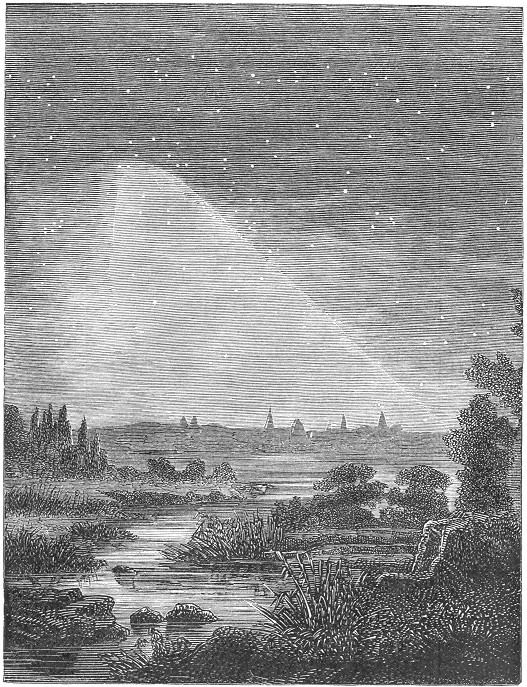
the matter reflecting the zodiacal light.
When the total eclipse of the sun occurred in 1878,
Page 138
astronomers were determined that the question of the existence
of an intra-mercurial planet should be settled. Maps of all the
stars in the region of the sun were carefully studied, sections
of the sky about the sun were assigned to different observers,
who should attend to nothing but to look for a possible planet.
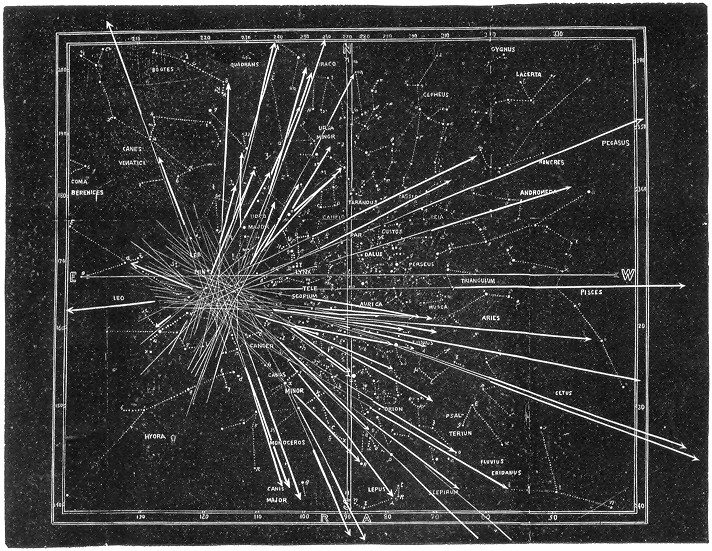
It is now conceded that Professor Watson, of Ann Arbor, actually
saw the sought-for body.
The god of fire; its sign  , his hammer.
Distance from the sun, 13,000,000 miles. Orbital revolution,
about 20 days.
The swift messenger of the gods; sign  , his caduceus.
Distance from the sun, 35,750,000 miles. Diameter, 2992 miles.
Orbital revolution, 87.97 days. Orbital velocity, 1773 miles per
minute. Axial revolution, 24h. 5m.
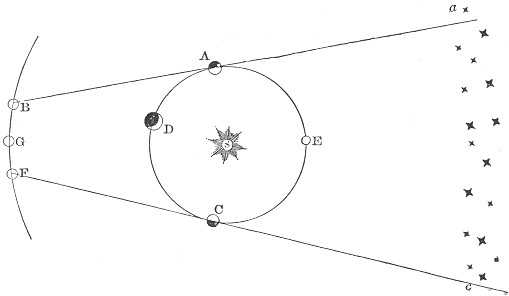
Mercury shines with a white light nearly as bright as Sirius; is
always near the horizon. When nearly between us and the sun, as
at D (Fig. 46, p. 113), its illuminated side nearly opposite to
us, we, looking from E, see only a thin crescent of its light.
When it is at its greatest angular distance from the sun, as A or
C, we see it illuminated like the half-moon. When it is beyond the
sun, as at E, we see its whole illuminated face like the full-moon.
The variation of its apparent size from the varying distance is
very striking. At its extreme distance from the earth it subtends
an angle of only five seconds; nearest to us, an angle of twelve
seconds. Its distance from the earth varies nearly as one to three,
and its apparent size in the inverse ratio.
Page 139
When Mercury comes between the earth and the sun, near the line
where the planes of their orbits cut each other by reason of their
inclination, the dark body of Mercury will be seen on the bright
surface of the sun. This is called a transit. If it goes across
the centre of the sun it may consume eight hours. It goes 100,000
miles an hour, and has 860,000 miles of disk to cross. The transit of
1818 occupied seven and a half hours. The transits for the remainder
of the century will occur:
| November 7th |
1881 |
November 10th |
1894 |
| May 9th |
1891 |
November 4th |
1901 |
Goddess of beauty; its sign  , a mirror.
Distance from the sun, 66,750,000 miles. Diameter, 7660 miles.
Orbital Velocity, 1296 miles per minute. Axial revolution, 23h.
21m. Orbital revolution, 224.7 days.
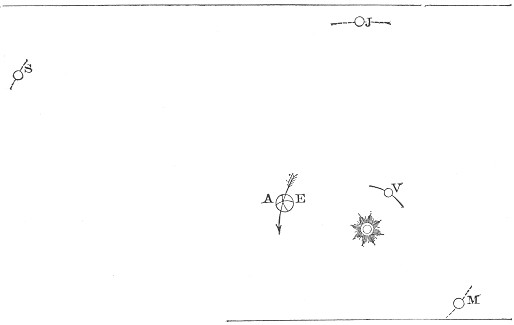
This brilliant planet is often visible in the daytime. I was once
delighted by seeing Venus looking down, a little after mid-day
through the open space in the dome of the Pantheon at Rome. It
has never since seemed to me as if the home of all the gods was
deserted. Phœbus, Diana, Venus and the rest, thronged through
that open upper door at noon of night or day. Arago relates that
Bonaparte, upon repairing to Luxemburg when the Directory was about
to give him a fête, was much surprised at seeing the
multitude paying more attention to the heavens above the palace
than to him or his brilliant staff. Upon inquiry, he learned that
these curious persons were observing with astonishment a star which
they supposed to be that of the conqueror of Italy. The emperor
himself was not indifferent when
Page 140
his piercing eye caught the clear lustre of Venus smiling upon him
at mid-day.
This unusual brightness occurs when Venus is about five weeks before
or after her inferior conjunction, and also nearest overhead by
being north of the sun. This last circumstance occurs once in eight
years, and came on February 16th, 1878.
Venus may be as near the earth as 22,000,000 miles, and as far
away as 160,000,000. This variation of its distances from the earth
is obviously much greater than that of Mercury, and its consequent
apparent size much more changeable. Its greatest and least apparent
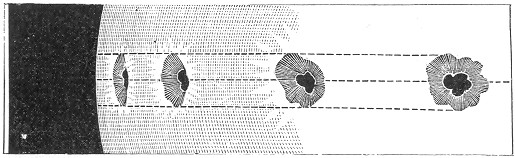
sizes are as ten and sixty-five (Fig. 53).
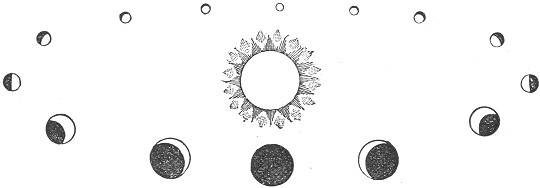
Fig. 53.—Phases of Venus, and Varions Apparent Dimensions.
When Copernicus announced the true theory of the solar system, he
said that if the inferior planets could be clearly seen they would
show phases like the moon. When Galileo turned the little telescope
he had made on Venus, he confirmed the prophecy of Copernicus.
Desiring to take time for more extended observation, and still be
able to assert the priority of his discovery, he published the
following anagram, in which his discovery was contained:
Page 141
"Hæc immatura a me jam frustra leguntur o. y."
(These unripe things are now vainly gathered by me.)
He first saw Venus as gibbous; a few months revealed it as crescent,
and then he transposed his anagram into:
"Cynthiæ figuras æmulatur mater amorum."
(The mother of loves imitates the phases of Cynthia.)
Many things that were once supposed to be known concerning Venus are
not confirmed by later and better observations. Venus is surrounded
by an atmosphere so dense with clouds that it is conceded that
her time of rotation and the inclination of her axis cannot be
determined. She revealed one of the grandest secrets of the universe
to the first seeker; showed her highest beauty to her first ardent
lover, and has veiled herself from the prying eyes of later comers.
Florence has built a kind of shrine for the telescope of Galileo.
By it he discovered the phases of Venus, the spots on the sun,
the mountains of the moon, the satellites of Jupiter, and some
irregularities of shape in Saturn, caused by its rings. Galileo
subsequently became blind, but he had used his eyes to the best
purpose of any man in his generation.
Its sign  .
.
Distance from the sun, 92,500,000 miles. Diameter, polar, 7899
miles; equatorial, 7925-1/2 miles. Axial revolution, 23h. 56m. 4.09s.;
orbital, 365.86. Orbital velocity per minute, 1152.8 miles.
Let us lift ourselves up a thousand miles from the earth. We see it
as a ball hung upon nothing in empty space. As the drop of falling
water gathers itself
Page 142
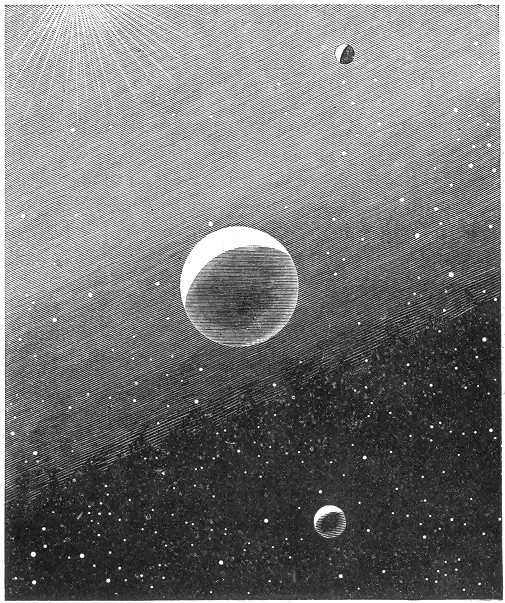
Fig. 54.—Earth and Moon in Space.
into a sphere by its own inherent attraction, so the earth gathers
itself into a ball. Noticing closely, we see forms of continents
outlined in bright relief, and oceanic forms in darker surfaces.
We see that its axis of revolution is nearly perpendicular to the
line of light from the sun. One-half is always dark. The sunrise
greets a new thousand miles every hour; the glories of
Page 143
the sunset follow over an equal space, 180° behind. We are glad
that the darkness never overtakes the morning.
While east and west are gorgeous with sunrise and sunset, the north
is often more glorious with its aurora borealis. We remember that
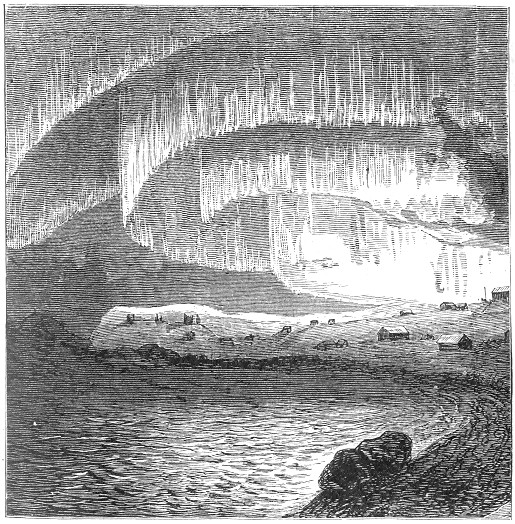
Fig. 55.—The Aurora as Waving Curtains.
all worlds have weird and inexplicable appendages. They are not
limited to their solid surfaces or their circumambient air. The
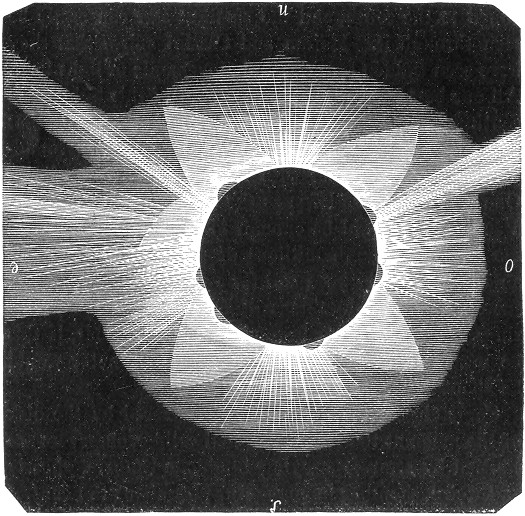
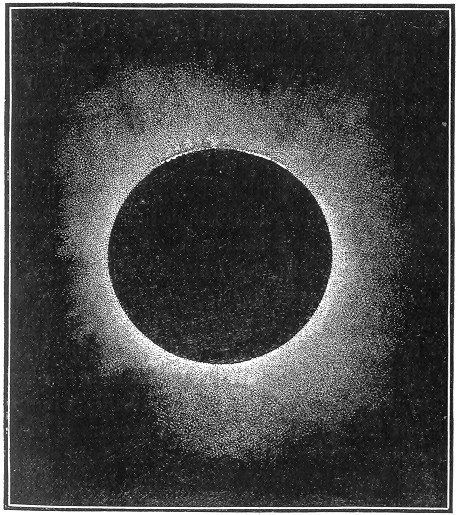
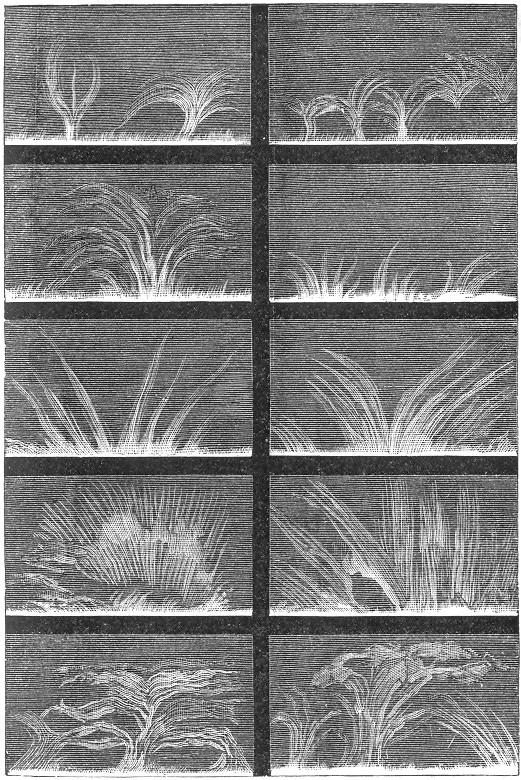
sun has its fiery flames, corona, zodiacal light, and perhaps a
finer kind of atmosphere than we know. The earth is
Page 144
not without its inexplicable surroundings. It has not only its
gorgeous eastern sunrise, its glorious western sunset, high above
its surface in the clouds, but it also has its more glorious northern
dawn far above its clouds and air. The realm of this royal splendor
is as yet an unconquered world waiting for its Alexander. There are
certain observable facts, viz., it prevails mostly near the arctic
circle rather than the pole; it takes on various forms—cloud-like,
arched, straight; it streams like banners, waves like curtains in
the wind, is inconstant; is either the cause or result of electric
disturbance; it is often from four hundred to six hundred miles
above the earth, while our air cannot be over one hundred miles.
It almost seems like a revelation to human eyes of those vast,
changeable, panoramic pictures by which the inhabitants of heaven
are taught.
Investigation has discovered far more mysteries than it has explained.
It is possible that the same cause that produces sun-spots produces
aurora in all space, visible in all worlds. If so, we shall see
more abundant auroras at the next maximum of sun-spot, between
1880-84.
A soap-bubble in the wind could hardly be more flexible in form
and sensitive to influence than is the earth. On the morning of
May 9th, 1876, the earth's crust at Peru gave a few great throbs
upward, by the action of expansive gases within. The sea fled,
and returned in great waves as the land rose and fell. Then these
waves fled away over the great mobile surface, and in less than
five hours they had covered a space equal to half of Europe. The
waves ran out to the Sandwich Islands, six
Page 145
thousand miles, at the rate of five hundred miles an hour, and
arrived there thirty feet high. They not only sped on in straight
radial lines, but, having run up the coast to California, were
deflected away into the former series of waves, making the most
complex undulations. Similar beats of the great heart of the earth
have sent its pulses as widely and rapidly on previous occasions.
The figure of the earth, even on the ocean, is irregular, in consequence
of the greater preponderance of land—and hence greater
density—in the northern hemisphere. These irregularities are
often very perplexing in making exact geodetic measurements. The
tendency of matter to fly from the centre by reason of revolution
causes the equatorial diameter to be twenty-six, miles longer than
the polar one. By this force the Mississippi River is enabled to
run up a hill nearly three miles high at a very rapid rate. Its
mouth is that distance farther from the centre of the earth than
its source, when but for this rotation both points would be equally
distant.
If the water became more dense, or if the world were to revolve
faster, the oceans would rush to the equator, burying the tallest
mountains and leaving polar regions bare. If the water should become
lighter in an infinitesimal degree, or the world rotate more slowly,
the poles would be submerged and the equator become an arid waste.
No balance, turning to 1/1000 of a grain, is more delicate than
the poise of forces on the world. Laplace has given us proof that
the period of the earth's axial rotation has not changed 1/100
of a second of time in two thousand years.
But there is an outside influence that is constantly acting upon
the earth, and to which it constantly responds. Two hundred and
forty thousand miles from the earth is the moon, having 1/81 the
mass of the world. Its attractive influence on the earth causes the
movable and nearer portions to hurry away from the more stable and
distant, and heap themselves up on that part of the earth nearest
the moon. Gravitation is inversely as the square of the distance;
hence the water on the surface of the earth is attracted more than
the body of the earth, some parts of which are eight thousand miles
farther off; hence the water rises on the side next the moon. But
the earth, as a whole, is nearer the moon than the water on the
opposite side, and being drawn more strongly, is taken away from
the water, leaving it heaped up also on the side opposite to the
moon.
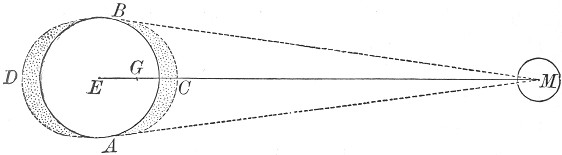
A subsidiary cause of tides is found in the revolution of the earth
and moon about their common centre of gravity. Revolution about
an axis through the centre of a sphere enlarges the equator by
centrifugal force. Revolution about an axis touching the surface
of a flexible globe converts it into an egg-shaped body, with the
longer axis perpendicular to the axis of revolution. In Fig. 56 the
point of revolution is seen at the centre of gravity at G; hence,
in the revolution of earth and moon as one, a strong centrifugal
force is caused at D, and a less one at C. This gives greater height
to the tides than the attraction of the moon alone could produce.
If the earth had no axial revolution, the attractive point where
the tide rises would be carried around the earth once in twenty-seven
days by the moon's revolution about the earth. But since the earth
revolves on its axis, it presents a new section to the moon's attraction
every hour. If the moon were stationary, that would bring two high
tides in exactly twenty-four hours; but as the moon goes forward,
we need nearly twenty-five hours for two tides.
The attractive influence of the sun also gives us a tide four-tenths
as great as that of the moon. When these two influences of the
sun and moon combine, as they do, in conjunction—when both
bodies are on one side of the earth; or in opposition, sun and
moon being on opposite sides of the earth—we have spring or
increased tides. When the moon is in its first or third quarter,
i. e., when a line from the moon to the earth makes a right
angle with one from the sun to the earth, these influences antagonize
one another, and we have the neap or low tides.
It is easy to see that if, when the moon was drawing its usual
tide, the sun drew four-tenths of the water in a tide at right
angles with it, the moon's tide must be by so much lower. Because
of the inertia of the water
Page 148
it does not yield instantly to the moon's influence, and the crest
of the tide is some hours behind the advancing moon.
The amount of tide in various places is affected by almost innumerable
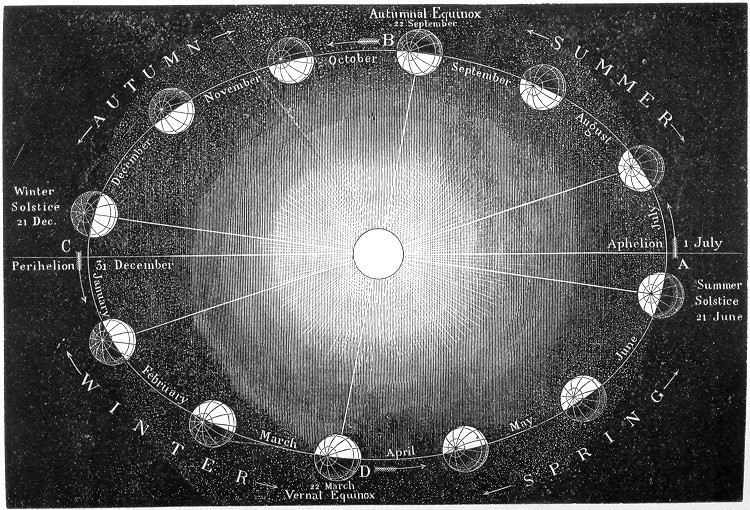
influences, as distance of moon at its apogee or perigee; its position
north, south, or at the equator; distance of earth from sun at
perihelion and aphelion; the position of islands; the trend of
continents, etc. All eastern shores have far greater tides than
western. As the earth rolls to the east it leaves the tide-crest
under the moon to impinge on eastern shores, hence the tides of
from seventy-five to one hundred feet in the Bay of Fundy. Lakes and
most seas are too small to have perceptible tides. The spring-tides
in the Mediterranean Sea are only about three inches.
This constant ebb and flow of the great sea is a grand provision for
its purification. Even the wind is sent to the sea to be cleansed.
The sea washes every shore, purifies every cove, bay, and river
twice every twenty-four hours. All putrescible matter liable to
breed a pestilence is carried far from shore and sunk under fathoms
of the never-stagnant sea. The distant moon lends its mighty power
to carry the burdens of commerce. She takes all the loads that
can be floated on her flowing tides, and cheerfully carries them
in opposite directions in successive journeys.
It must be conceded that the profoundest study has not mastered
the whole philosophy of tides. There are certain facts which are
apparent, but for an explanation of their true theory such men as
Laplace, Newton, and Airy have labored in vain. There are plenty
of other worlds still to conquer.
New moon,  ; first quarter,
  ; full moon,
  ;
last quarter,
;
last quarter,  .
.
Extreme distance from the earth, 259,600 miles; least, 221,000
miles; mean, 240,000 miles. Diameter, 2164.6 miles [2153, Lockyer].
Revolution about the earth, 29-1/2 days. Axial revolution, same
time.
When the astronomer Herschel was observing the southern sky from
the Cape of Good Hope, the most clever hoax was perpetrated that
ever was palmed upon a credulous public. Some new and wonderful
instruments were carefully described as having been used by that
astronomer, whereby he was enabled to bring the moon so close that
he could see thereon trees, houses, animals, and men-like human
beings. He could even discern their movements, and gestures that
indicated a peaceful race. The extent of the hoax will be perceived
when it is stated that no telescope that we are now able to make
reveals the moon more clearly than it would appear to the naked
eye if it was one hundred or one hundred and fifty miles away.
The distance at which a man can be seen by the unaided eye varies
according to circumstances of position, background, light, and
eye, but it is much inside of five miles.
Since, however, the moon is our nearest neighbor, a member of our
own family in fact, it is a most interesting object of study.
A glance at its familiar face reveals its unequal illumination.
All ages and races have seen a man in the moon. All lovers have
sworn by its constancy, and only part of them have kept their oaths.
Every twenty-nine or thirty days we see a silver crescent in the
west, and are glad if it comes over the right shoulder—so
Page 152
much tribute does habit pay to superstition. The next night it
is thirteen degrees farther east from the sun. We note the stars
it occults, or passes by, and leaves behind as it broadens its
disk, till it rises full-orbed in the east when the sun sinks in
the west. It is easy to see that the moon goes around the earth
from west to east. Afterward it rises later and smaller each night,
till at length, lost from sight, it rises about the same time as
the sun, and soon becomes the welcome crescent new moon again.
The same peculiarities are always evident in the visible face of
the moon; hence we know that it always presents the same side to
the earth. Obviously it must make just one axial to one orbital
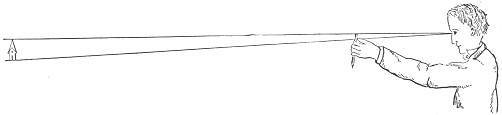
revolution. Hold any body before you at arm's-length, revolve it
one-quarter around you until exactly overhead. If it has not revolved
on an axis between the hands, another quarter of the surface is
visible; but if in going up it is turned a quarter over, by the
hands holding it steady, the same side is visible. Three causes
enable us to see a little more than half the moon's surface: 1. The
speed with which it traverses the ellipse of its orbit is variable.
It sometimes gets ahead of us, sometimes behind, and we see farther
around the front or back part. 2. The axis is a little inclined to
the plane of its orbit, and its orbit a little inclined to ours;
hence we see a little over its north pole, and then again over
the south pole. 3. The earth being larger, its inhabitants see
a little more than half-way around a smaller body. These causes
combined enable us to see 576/1000 of the moon's surface. Our eyes
will never see the other side of the moon. If, now, being solid,
her axial revolution could
Page 153
be increased enough to make one more revolution in two or three
years, that difference between her axial and orbital revolution
would give the future inhabitants of the earth a view of the entire
circumference of the moon. Yet if the moon were once in a fluid
state, or had oceans on the surface, the enormous tide caused by
the earth would produce friction enough, as they moved over the
surface, to gradually retard the axial revolution till the two
tidal elevations remained fixed toward and opposite the earth,
and then the axial and orbital revolutions would correspond, as
at present. In fact, we can prove that the form of the moon is
protuberant toward the earth. Its centre of gravity is thirty-three
miles beyond its centre of magnitude, which is the same in effect
as if a mountain of that enormous height rose on the earth side.
Hence any fluid, as water or air, would flow round to the other
side.
The moon's day, caused by the sun's light, is 29-1/2 times as long
as ours. The sun shines unintermittingly for fifteen days, raising a
temperature as fervid as boiling water. Then darkness and frightful
cold for the same time succeed, except on that half where the earth
acts as a moon. The earth presents the same phases—crescent,
full, and gibbous—to the moon as the moon does to us, and
for the same causes. Lord Rosse has been enabled, by his six-foot
reflector, to measure the difference of heat on the moon under
the full blaze of its noonday and midnight. He finds it to be no
less than five hundred degrees. People not enjoying extremes of
temperature should shun a lunar residence. The moon gives us only
1/6180000 as much light as the sun. A sky full of moons would scarcely
make daylight.
Page 154
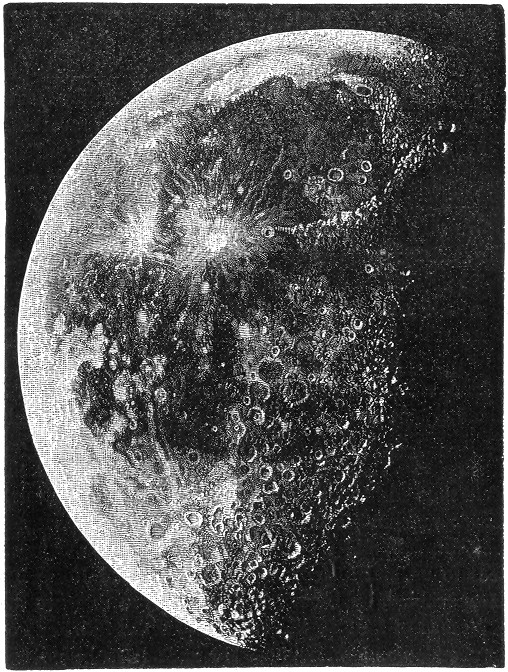
Fig. 58.—View of the Moon near the Third Quarter. From a
Photograph by Professor Henry Draper.
There are no indications of air or water on the moon. When it occults
a star it instantly shuts off the light and as instantly reveals
it again. An atmosphere would gradually diminish and reveal the
light, and by refraction
Page 155
cause the star to be hidden in much less time than the solid body
of the moon would need to pass over it. If the moon ever had air
and water, as it probably did, they are now absorbed in the porous
lava of its substance.
Probably no one ever saw the moon by means of a good telescope
without a feeling of admiration and awe. Except at full-moon, we
can see where the daylight struggles with the dark along the line
of the moon's sunrise or sunset. This line is called the terminator.
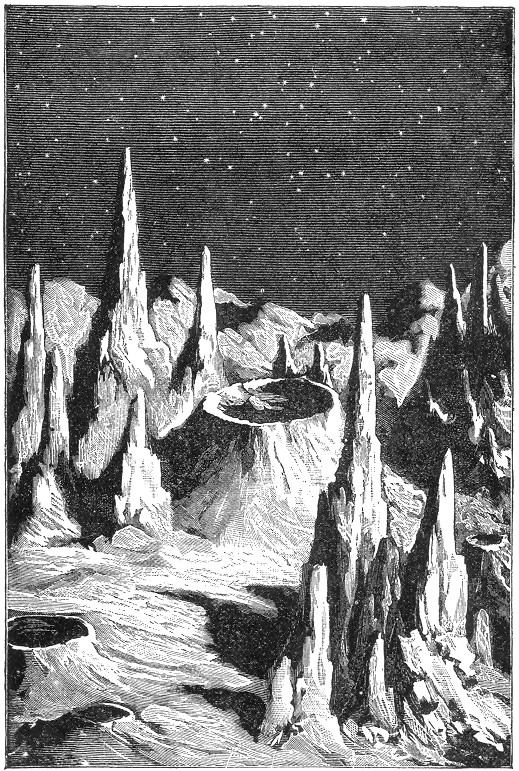
It is broken in the extreme, because the surface is as rough as
possible. In consequence of the small gravitation of the moon,
utter absence of the expansive power of ice shivering the cliffs,
or the levelling power of rains, precipices can stand in
perpendicularity, mountains shoot up like needles, and cavities
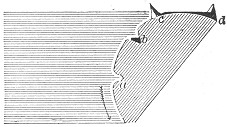
Fig. 59.—Illumination of Craters and Peaks.
three miles deep remain unfilled. The light of the sun falling on
the rough body of the moon, shown in section (Fig. 59), illuminates
the whole cavity at a, part of the one at b, casts
a long shadow from the mountain at c, and touches the tip
of the one at d, which appears to a distant observer as a
point of light beyond the terminator, As the moon revolves the
conical cavity, a is illuminated on the forward side only;
the light creeps down the backward side of cavity b to the
bottom; mountain c. comes directly under the sun and casts
no shadow, and mountain d casts its long shadow over the
plain. Knowing the time of revolution, and observing the change of
Page 156
illumination, we can easily measure the height of mountain and depth
of crater. An apple, with excavations and added prominences, revolved
on its axis toward the light of a candle, admirably illustrates the
crescent light that fills either side of the cavities and the shadows
of the mountains on the plain. Notice in Fig. 58 the crescent forms
to the right, showing cavities in abundance.
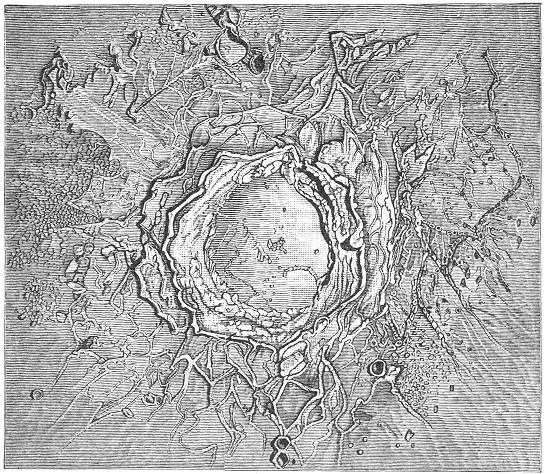
Fig. 60.—Lunar Crater "Copernicus," after Secchi.
The selenography of one side of the moon is much better known to
us than the geography of the earth. Our maps of the moon are far
more perfect than those of the earth; and the photographs of lunar
objects by Messrs. Draper and De la Rue are wonderfully perfect,
Page 157
and the drawings of Padre Secchi equally so (Fig. 60). The least
change recognizable from the earth must be speedily detected. There
are frequently reports of discoveries of volcanoes on the moon,
but they prove to be illusions. The moon will probably look the
same to observers a thousand years hence as it does to-day.
This little orb, that is only 1/81 of the mass of the earth, has
twenty-eight mountains that are higher than Mont Blanc, that "monarch
of mountains," in Europe.
It is evident that if the plane of the moon's orbit were to correspond
with that of the earth, as they all lie in the plane of the page
(Fig. 61), the moon must pass between the centres of the earth
and sun, and exactly behind the earth at every revolution. Such
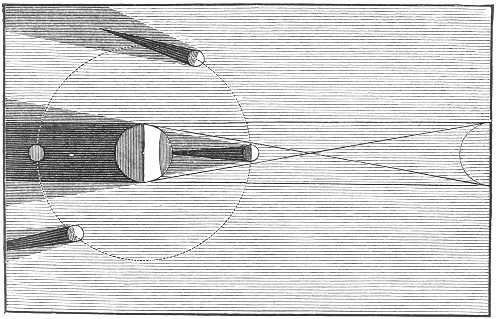
Fig. 61.—Eclipses; Shadows of Earth and Moon.
successive and total darkenings would greatly derange all affairs
dependent on light. It is easily avoided. Venus does
Page 158
not cross the disk of the sun at every revolution, because of the
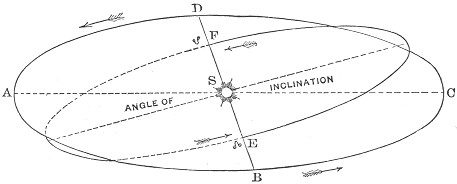
inclination of the plane of its orbit to that of the earth (see
Fig. 41, p. 107). So the plane of the orbit of the moon is inclined
to the orbit of the earth 5° 8' 39"; hence the full-moon is
often above or below the earth's shadow, and the earth is below
or above the moon's shadow at new moon. It is as if the moon's
orbit were pulled up one-quarter of an inch from the page behind
the earth, and depressed as much below it between the earth and
the sun. The point where the orbit of the moon penetrates the plane
of the ecliptic is called a node. If a new moon occur when the
line of intersection of the planes of orbits points to the sun,
the sun must be eclipsed; if the full-moon occur, the moon must
be eclipsed. In any other position the sun or moon will only be
partially hidden, or no eclipse will occur.
If the new moon be near the earth it will completely obscure the
sun. A dime covers it if held close to the eye. It may be so far
from the earth as to only partially hide the sun; and, if it cover
the centre, leave a ring of sunlight on every side. This is called
an annular eclipse. Two such eclipses will occur this year (1879).
If the full-moon passes near the earth, or is at perigee, it finds
the cone of shadow cast by the earth larger, and hence the eclipse
is greater; if it is far from the earth, or near apogee, the earth's
shadow is smaller, and the eclipse less, or is escaped altogether.
There is a certain periodicity in eclipses. Whenever the sun, moon,
and earth are in a line, as in the total eclipse of July 29th,
1878, they will be in the same position after the earth has made
about eighteen revolutions,
Page 159
and the moon two hundred and sixteen—that is, eighteen years
after. This period, however, is disregarded by astronomers, and
each eclipse calculated by itself to the accuracy of a second.
How terrible is the fear of ignorance and superstition when the sun
or moon appear to be in the process of destruction! how delightful
are the joys of knowledge when its prophesies in regard to the
heavenly bodies are being fulfilled!
The god or war; Its sign  , spear and shield.
Mean distance from the sun, 141,000,000 miles. Diameter, 4211
miles. Revolution, axial, 24h. 37m. 22.7s.; orbital, 686.98 days.
Velocity per minute, 899 miles. Satellites, two.
At intervals, on an average of two years one month and nineteen
days, we find rising, as the sun goes down, the reddest star in
the heavens. Its brightness is exceedingly variable; sometimes
it scintillates, and sometimes it shines with a steady light. Its
marked peculiarities demand a close study. We find it to be Mars,
the fiery god of war. Its orbit is far from circular. At perihelion
it is 128,000,000 miles from the sun, and at aphelion 154,000,000;
hence its mean distance is about 141,000,000. So great a change
in its distance from the sun easily accounts for the change in
its brilliancy. Now, if Mars and the earth revolved in circular
orbits, the one 141,000,000 miles from the sun, and the other
92,000,000, they would approach at conjunction within 49,000,000
miles of each other, and at opposition be 233,000,000 miles apart.
But Mars at perihelion may be only 128,000,000 miles from the sun,
and earth at
Page 160
aphelion may be 94,000,000 miles from the sun. They are, then, but
34,000,000 miles apart. This favorable opportunity occurs about
once in seventy-nine years. At its last occurrence, in 1877, Mars
introduced to us his two satellites, that had never before been
seen by man. In consequence of this greatly varying distance, the
apparent size of Mars differs very much (Fig. 62). Take a favorable
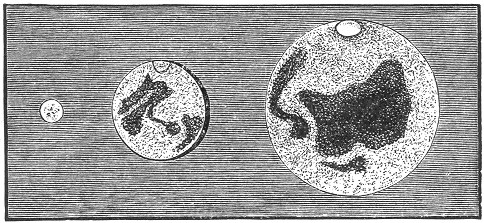
Fig. 62.—Apparent Size of Mars at Mean and Extreme Distances.
time when the planet is near, also as near overhead as it ever
comes, so as to have as little atmosphere as possible to penetrate,
and study the planet. The first thing that strikes the observer is
a dazzling spot of white near the pole which happens to be toward
him, or at both poles when the planet is so situated that they can be
seen. When the north pole is turned toward the sun the size of the
spot sensibly diminishes, and the spot at the south pole enlarges,
and vice versa. Clearly they are ice-fields. Hence Mars has
water, and air to carry it, and heat to melt ice. It is winter at
the south pole when Mars is farthest from the sun; therefore the
ice-fields are larger than at the north pole. It is summer at the
south pole when Mars is nearest the sun. Hence its ice-fields grow
Page 161
smaller than those of the north pole in its summer. This carrying of
water from pole to pole, and melting of ice over such large areas,
might give rise to uncomfortable currents in ocean and air; but very
likely an inhabitant of earth might be transported to the surface
of Mars, and be no more surprised at what he observed there than
if he went to some point of the earth to him unknown. Day and night
would be nearly of the same length; winter would linger longer
in the lap of spring; summer would be one hundred and eighty-one
days long; but as the seas are more intermingled with the land, and
the divisions of land have less of continental magnitude, it may
be conjectured that Mars might be a comfortable place of residence
to beings like men. Perhaps the greatest surprise to the earthly
visitor would be to find himself weighing only four-tenths as much
as usual, able to leap twice as high, and lift considerable bowlders.
The night of August 11th, 1877, is famous in modern astronomy.
Mars has been a special object of study in all ages; but on that
evening Professor Hall, of Washington, discovered a satellite of
Mars. On the 16th it was seen again, and its orbital motion followed.
On the following night it was hidden behind the body of the planet
when the observation began, but at the calculated time—at
four o'clock in the morning—it emerged, and established its
character as a true moon, and not a fixed star or asteroid. Blessings,
however, never come singly, for another object soon emerged which
proved to be an inner satellite. This is extraordinarily near
Page 162
the planet—only four thousand miles from the surface—and
its revolution is exceedingly rapid. The shortest period hitherto
known is that of the inner satellite of Saturn, 22h. 37m. The inner
satellite of Mars makes its revolution in 7h. 39m.—a rapidity
so much surpassing the axial revolution of the planet itself, that
it rises in the west and sets in the east, showing all phases of
our moon in one night. The outer satellite is 12,579 miles from
Mars, and makes its revolution in 30h. 18m. Its diameter is six
and a quarter miles; that of the inner one is seven and a half
miles. This can be estimated only by the amount of light given.
Already discovered (1879), 192. Distances from the sun, from
200,000,000 to 315,000,000 miles. Diameters, from 20 to 400 miles.
Mass of all, less than one-quarter of the earth.
The sense of infinite variety among the countless number of celestial
orbs has been growing rapidly upon us for half a century, and doubtless
will grow much more in half a century to come. Just as we paused
in the consideration of planets to consider meteors and comets,
at first thought so different, so must we now pause to consider a
ring of bodies, some of which are as small in comparison to Jupiter,
the next planet, as aerolites are compared to the earth.
In 1800 an association of astronomers, suspecting that a planet
might be found in the great distance between Mars and Jupiter,
divided the zodiac into twenty-four parts, and assigned one part to
each astronomer for a thorough search; but, before their organization
could commence work, Piazzi, an Italian astronomer of Palermo,
Page 163
found in Taurus a star behaving like a planet. In six weeks it was
lost in the rays of the sun. It was rediscovered on its emergence,
and named Ceres. In March, 1802, a second planet was discovered by
Olbers in the same gap between Mars and Jupiter, and named Pallas.
Here was an embarrassment of richness. Olbers suggested that an
original planet had exploded, and that more pieces could be found.
More were found, but the theory is exploded into more pieces than
a planet could possibly be. Up to 1879 one hundred and ninety-two
have been discovered, with a prospect of more. Between 1871-75
forty-five were discovered, showing that they are sought for with
great skill. In the discovery of these bodies, our American astronomers,
Professors Watson and Peters, are without peers.
Between Mars and Jupiter is a distance of some 339,000,000 miles.
Subtract 35,000,000 miles next to Mars and 50,000,000 miles next
to Jupiter, and there is left a zone 254,000,000 miles wide outside
of which the asteroids never wander. If any ever did, the attraction
of Mars or Jupiter may have prevented their return.
Since the orbits of Mars and Jupiter show no sign of being affected
by these bodies for a century past, it is probable that their number
is limited, or at least that their combined mass does not approximate
the size of a planet. Professor Newcomb estimates that if all that
are now discovered were put into one planet, it would not be over
four hundred miles in diameter; and if a thousand more should exist,
of the average size of those discovered since 1850, their addition
would not increase the diameter to more than five hundred miles.
Page 164
That all these bodies, which differ from each other in no respect
except in brilliancy, can be noted and fixed so as not to be mistaken
one for another, and instantly recognized though not seen for a
dozen years, is one of the highest exemplifications of the accuracy
of astronomical observation.
The king of the gods; sign  , the bird of Jove.
Distance from the sun, perihelion, 457,000,000 miles; aphelion,
503,000,000 miles. Diameter, equatorial, 87,500 miles; polar, 82,500
miles. Volume, 1300 earths. Mass, 213 earths. Axial revolution, 9h.
55m 20s. Orbital revolution, 11 years 317 days. Velocity, 483.6
miles per minute.
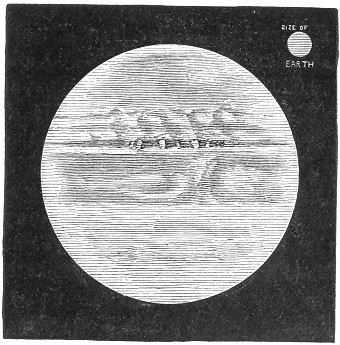
Fig. 63.—Jupiter as seen by the great Washington Telescope.
Drawn by Mr. Holden.
Jupiter rightly wears the name of the "giant planet." His orbit
is more nearly circular than most smaller planets. He could not
turn short corners with facility. We know little of his surface.
His spots and belts are
Page 165
changeable as clouds, which they probably are. Some spots may be
slightly self-luminous, but not the part of the planet we see. It
is covered with an enormous depth of atmosphere. Since the markings
in the belts move about one hundred miles a day, the Jovian tempests
are probably not violent. It is, however, a singular and unaccountable
fact, as remarked by Arago, that its trade-winds move in an opposite
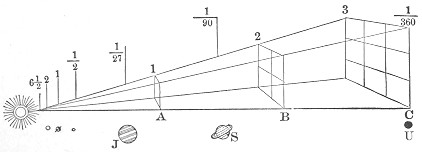
direction from ours. Jupiter receives only one twenty-seventh as
much light and heat from the sun as the earth receives. Its lighter
density, being about that of water, indicates that it still has
internal heat of its own. Indeed, it is likely that this planet
has not yet cooled so as to have any solid crust, and if its dense
vapors could be deposited on the surface, its appearance might
be more suggestive of the sun than of the earth.
In one respect Jupiter seems like a minor sun—he is royally
attended by a group of planets: we call them moons. This system
is a favorite object of study to everyone possessing a telescope.
Indeed, I have known a man who could see these moons with the naked
eye, and give their various positions without mistake. Galileo first
revealed them to ordinary men. We see their orbits so nearly on the
edge that the moons seem to be sliding back and forth across and
behind the disk, and to varying distances on either side. Fig. 64 is
the representation of their appearance at successive observations in
November, 1878. Their motion is so swift, and the means of comparison
by one another and the planet so excellent, that they can be seen
to change their places,
Page 166
be occulted, emerge from shadow, and eclipse the planet, in an hour's
watching.
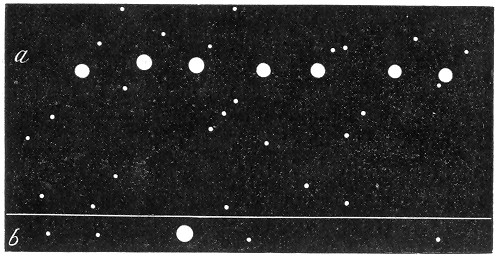
Fig. 64.—a. Various Positions of Jupiter's Moons; b.
Greatest Elongation of each Satellite.
ELEMENTS OF JUPITER'S SATELLITES.
| |
Mean Distance
from Jupiter. |
Sidereal Period. |
Diameter. |
| |
|
Miles. |
Days |
Hrs. |
Min. |
Miles. |
| I. |
Io |
260,000 |
1 |
18 |
28 |
2,352 |
| II. |
Europa |
414,000 |
3 |
13 |
43 |
2,099 |
| III. |
Ganymede |
661,000 |
7 |
3 |
59 |
3,436 |
| IV. |
Callisto |
1,162,000 |
16 |
18 |
5 |
2,929 |
It is seen by the above table that all these moons are larger than
ours, one larger than Mercury, and the asteroids are hardly large
enough to make respectable moons for them. They differ in color:
I. and II. have a bluish tinge; III. a yellow; and IV. is red.
The amount of light given by these satellites varies in the most
sudden and inexplicable manner. Perhaps it may be owing to the
different distributions of land and water on them. The mass of all
of them is .000171 of Jupiter.
Page 167
If the Jovian system were the only one in existence, it would be
a surprising object of wonder and study. A monster planet, 85,000
miles in diameter, hung on nothing, revolving its equatorial surface
forty-five miles a minute, holding four other worlds in steady
orbits, some of them at a speed of seven hundred miles a minute,
and the whole system carried through space at five hundred miles
a minute. Yet the discovery of all this display of power, skill,
and stability is only reading the easiest syllables of the vast
literature of wisdom and power.
The god or time; sign  , his scythe.
Mean distance from the sun, 881,000,000 miles. Diameter, polar,
66,500 miles; equatorial, 73,300 miles. Axial revolution, 10h.
14m. Periodic time, 29t years. Moons, eight.
The human mind has used Saturn and the two known planets beyond
for the last 200 years as a gymnasium. It has exercised itself
in comprehending their enormous distances in order to clear those
greater spaces, to where the stars are set; it has exercised its
ingenuity at interpreting appearances which signify something other
than they seem, in order that it may no longer be deluded by any
sunrises into a belief that the heavenly dome goes round the earth.
That a wandering point of light should develop into such amazing
grandeurs under the telescope, is as unexpected as that every tiny
seed should show peculiar markings and colors under the microscope.
There are certain things that are easy to determine, such as size,
density, periodic time, velocity, etc.; but other things are exceedingly
difficult to determine. It requires long sight to read when the
book is held
Page 168
800,000,000 miles away. Only very few, if more than two, opportunities
have been found to determine the time of Saturn's rotation. On the
evening of December 7th, 1870, Professor Hall observed a brilliant
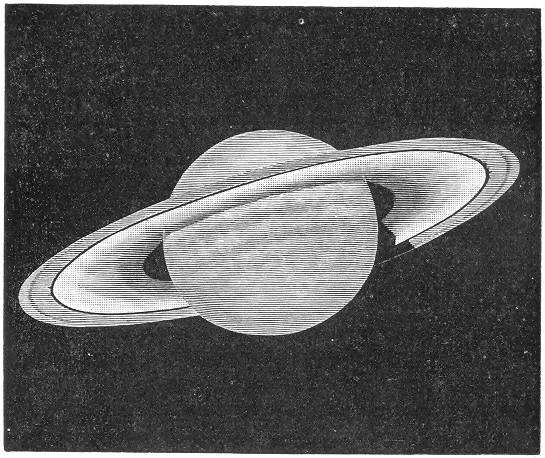
Fig. 65.—View of Saturn and his Rings.
white spot suddenly show itself on the body of this planet. It was
as if an eruption of white hot matter burst up from the interior. It
spread eastward, and remained bright till January, when it faded. No
such opportunity for getting a basis on which to found a calculation
of the time of the rotation of Saturn has occurred since Sir William
Herschel's observations; and, very singularly, the two times deduced
wonderfully coincide—that of Herschel being 10h. 16m., that
of Mr. Hall being 10h. 14m.
Page 169
The density of Saturn is less than that of water, and its velocity
of rotation so great that centrifugal force antagonizes gravitation
to such an extent that bodies weigh on it about the same as on the
earth. All the fine fancies of the habitability of this vaporous
world, all the calculations of the number of people that could
live on the square miles of the planet and its enormous rings,
are only fancy. Nothing could live there with more brains than a
fish, at most. It is a world in formative processes. We cannot hear
the voice of the Creator there, but we can see matter responsive
to the voice, and moulded by his word.
The eye and mind of man have worked out a problem of marvellous
difficulty in finding a true solution of the strange appearance
of the rings. Galileo has the immortal honor of first having seen
something peculiar about this planet. He wrote to the Duke of Tuscany,
"When I view Saturn it seems tricorps. The central body
seems the largest. The two others, situated, the one on the east,
and the other on the west, seem to touch it. They are like two
supporters, who help old Saturn on his way, and always remain at
his side." Looking a few years later, the rings having turned from
view, he said, "It is possible that some demon mocked me;" and
he refused to look any more.
Huyghens, in March, 1655, solved the problem of the triform appearance
of Saturn. He saw them as handles on the two sides. In a year they
had disappeared, and the planet was as round as it seemed to Galileo
in 1612. He did not, however, despair; and in October,
Page 170
1656, he was rewarded by seeing them appear again. He wrote of Saturn,
"It is girdled by a thin plain ring, nowhere touching, inclined to
the ecliptic."
Since that time discoveries have succeeded one another rapidly.
"We have seen by degrees a ring evolved out of a triform planet,
and the great division of the ring and the irregularities on it
brought to light. Enceladus, and coy Mimas, faintest of twinklers,
are caught by Herschel's giant mirrors. And he, too, first of men,
realizes the wonderful tenuity of the ring, along which he saw
those satellites travelling like pearls strung on a silver thread.
Then Bond comes on the field, and furnishes evidence to show that
we must multiply the number of separate rings we know not how many
fold. And here we reach the golden age of Saturnian discovery,
when Bond, with the giant refractor of Cambridge, and Dawes, with
his 6-1/3-inch Munich glass, first beheld that wonderful dark
semi-transparent ring, which still remains one of the wonders of
our system. But the end is not yet: on the southern surface of
the ring, ere summer fades into autumn, Otto Struve in turn comes
upon the field, detects, as Dawes had previously done, a division
even in the dark ring, and measures it, while it is invisible to
Lassell's mirror—a proof, if one were needed, of the enormous
superiority possessed by refractors in such inquiries. Then we
approach 1861, when the ring plane again passes through the earth,
and Struve and Wray observe curious nebulous appearances."[*]
Our opportunities for seeing Saturn vary greatly. As the earth at
one part of its orbit presents its south pole
Page 171
to the sun, then its equator, then the north pole, so Saturn; and
we, in the direction of the sun, see the south side of the rings
inclined at an angle of 27°; next the edge of the rings, like a
fine thread of light; then the north side at a similar inclination.
On February 7th, 1878, Saturn was between Aquarius and Pisces,
with the edge of the ring to the sun. In 1885, the planet being in
Taurus, the south side of the rings will be seen at the greatest
advantage. From 1881 till 1885 all circumstances will combine to
give most favorable studies of Saturn. Meanwhile study the picture
of it. The outer ring is narrow, dark, showing hints of another
division, sometimes more evident than at others, as if it were
in a state of flux. The inner, or second, ring is much brighter,
especially on the outer edge, and shading off to the dusky edge
next to the planet. There is no sign of division into a third dusky
innermost ring, as was plainly seen by Bond. This, too, may be in
a state of flux.
The markings of the planet are delicate, difficult of detection,
and are not like those stark zebra stripes that are so often
represented.
The distance between the planet and the second ring seems to be
diminished one-half since 1657, and this ring has doubled its breadth
in the same time. Some of this difference may be owing to our greater
telescopic power, enabling us to see the ring closer to the planet;
but in all probability the ring is closing in upon the central
body, and will touch it by A.D. 2150. Thus the whole ring must
ultimately fall upon the planet, instead of making a satellite.
We are anxious to learn the nature of such a ring.
Page 172
Laplace mathematically demonstrated that it cannot be uniform and
solid, and survive. Professor Peirce showed it could not be fluid,
and continue. Then Professor Maxwell showed that it must be formed
of clouds of satellites too small to be seen individually, and too
near together for the spaces to be discerned, unless, perhaps, we
may except the inner dark ring, where they are not near enough to
make it positively luminous. Indeed, there is some evidence that
the meteoroids are far enough apart to make the ring partially
transparent.
We look forward to the opportunities for observation in 1882 with
the brightest hope that these difficult questions will be solved.
The first discovered satellite of Saturn seen by Huyghens was in
1655, and the last by the Bonds, father and son, of Cambridge,
in 1848. These are eight in number, and are named:
| |
Distant from Saturn's centre. |
| I. |
Mimas |
119,725 |
miles. |
| II. |
Enceladus |
153,630 |
" |
| III. |
Tethys |
190,225 |
" |
| IV. |
Dione |
243,670 |
" |
| V. |
Rhea |
340,320 |
" |
| VI. |
Titan |
788,915 |
" |
| VII. |
Hyperion |
954,160 |
" |
| VIII. |
Japetus |
2,292,790 |
" |
Titan can be seen by almost any telescope; I., II., and III., only
by the most powerful instrument. All except Japetus revolve nearly
in the plane of the ring. Like the moons of Jupiter, they present
remarkable and unaccountable variations of brilliancy. An inspection
Page 173
of the table reveals either an expectation that another moon will
be discovered between V. and VI., and about three more between
VII. and VIII., or that these gaps may be filled with groups of
invisible asteroids, as the gap between Mars and Jupiter. This
will become more evident by drawing Saturn, the rings, and orbits
of the moons all as circles, on a scale of 10,000 miles to the
inch. Saturn will be in the centre, 70,000 miles in diameter; then
a gap, decreasing twenty-nine miles a year to the first ring, of,
say, 10,000 miles; a dark ring 9000 miles wide; next the brightest
ring 18,300 miles wide; then a gap of 1750 miles; then the outer
ring 10,000 miles wide; then the orbits of the satellites in order.
If the scenery of Jupiter is magnificent, that of Saturn must be
sublime. If one could exist there, he might wander from the illuminated
side of the rings, under their magnificent arches, to the darkened
side, see the swift whirling moons; one of them presenting ten times
the disk of the earth's moon, and so very near as to enable him
to watch the advancing line of light that marks the lunar morning
journeying round that orb.
Sign  ;
the initial of Herschel, and sign of the world.
;
the initial of Herschel, and sign of the world.
Distance from the sun, 1,771,000,000 miles. Diameter, 31,700
miles. Axial revolution unknown. Orbital, 84 years. Velocity per
minute, 252 miles. Moons, four.
Uranus was presented to the knowledge of man as an unexpected reward
for honest work. It was first mistaken by its discoverer for a comet,
a mere cloud of vapor; but it proved to be a world, and extended the
Page 174
boundaries of our solar system, in the moment of its discovery,
as much as all investigation had done in all previous ages.
Sir William Herschel was engaged in mapping stars in 1781, when he
first observed its sea-green disk. He proposed to call it Georgium
Sidus, in honor of his king; but there were too many names
of the gods in the sky to allow a mortal name to be placed among
them. It was therefore called Uranus, since, being the most distant
body of our system, as was supposed, it might appropriately bear
the name of the oldest god. Finding anything in God's realms of
infinite riches ought not to lead men to regard that as final,
but as a promise of more to follow.
This planet had been seen five times by Flamsteed before its character
was determined—once nearly a century before—and eight
times by Le Monnier. These names, which might easily have been
associated with a grand discovery, are associated with careless
observation. Eyes were made not only to be kept open, but to have
minds behind them to interpret their visions. Herschel thought
he discovered six moons belonging to Uranus, but subsequent
investigation has limited the number to four. Two of these are seen
with great difficulty by the most powerful telescopes.
If the plane of our moon's orbit were tipped up to a greater
inclination, revolving it on the line of nodes as an axis until
it was turned 85°, the moon, still continuing on its orbit in
that plane, would go over the poles instead of about the equator,
and would go back to its old path when the plane was revolved 180°;
but its revolution would now be from east to west, or
Page 175
retrograde. The plane of the moons of Uranus has been thus inclined
till it has passed 10° beyond the pole, and the moons' motions
are retrograde as regards other known celestial movements. How Uranus
itself revolves is not known. There are more worlds to conquer.
God of the sea; sign  , his trident.
Distance from the sun, 2,775,000,000 miles. Diameter, 34,500
miles. Velocity per minute, 201.6 miles. Axial revolution unknown.
Orbital, 164.78 years. One moon.
Men sought for Neptune as the heroes sought the golden fleece.
The place of Uranus had been mapped for nearly one hundred years
by these accidental observations. On applying the law of universal
gravitation, a slight discrepancy was found between its computed
place and its observed place. This discrepancy was exceedingly
slight. In 1830 it was only 20"; in 1840,190"; in 1884, 2'. Two
stars that were 2' apart would appear as one to the keenest unaided
eye, but such an error must not exist in astronomy. Years of work
were given to its correction. Mr. John C. Adams, of Cambridge,
England, finding that the attraction of a planet exterior to Uranus
would account for its irregularities, computed the place of such
a hypothetical body with singular exactness in October, 1841; but
neither he nor the royal astronomer Airy looked for it. Another
opportunity for immortality was heedlessly neglected. Meanwhile,
M. Leverrier, of Paris, was working at the same problem. In the
summer of 1846 Leverrier announced the place of the exterior planet.
The conclusion was in striking coincidence with that of Mr.
Page 176
Clark. Mr. Challis commenced to search for the planet near the
indicated place, and actually saw and mapped the star August 4th,
1846, but did not recognize its planetary character. Dr. Galle,
of Berlin, on the 23d of September, 1846, found an object with a
planetary disk not plotted on the map of stars. It was the sought-for
world. It would seem easy to find a world seventy-six times as large
as the earth, and easy to recognize it when seen. The fact that
it could be discovered only by such care conveys an overwhelming
idea of the distance where it moves.
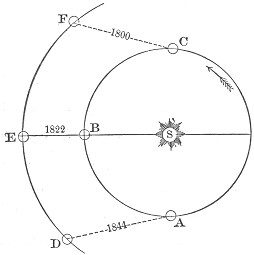
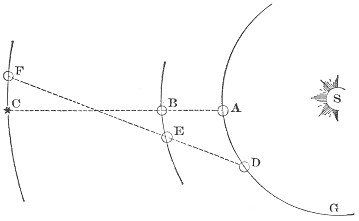
Fig. 66.—Perturbation of Uranus.
The effect of these perturbations by an exterior planet is understood
from Fig. 66. Uranus and Neptune were in conjunction, as shown,
in 1822. But in 1820 it had been found that Uranus was too far
from the sun, and too much accelerated. Since 1800, Neptune, in
his orbit from F to E, had been hastening Uranus in his orbit D
from C to B, and also drawing it farther from the sun. After 1822,
Neptune, in passing from E to D, had been retarding Uranus in his
orbit from B to A.
We have seen it is easy to miss immortality. There is still another
instance. Lalande saw Neptune on May 8th and 10th, 1795, noted that
it had moved a little, and that the observations did not agree;
but, supposing the first was wrong, carelessly missed the glory
of once more doubling the bounds of the empire of the sun.
Page 177
It is time to pause and review our knowledge of this system. The
first view reveals a moon and earth endowed with a force of inertia
going on in space in straight lines; but an invisible elastic cord of
attraction holds them together, just counterbalancing this tendency
to fly apart, and hence they circle round their centre of gravity.
The revolving earth turns every part of its surface to the moon in
each twenty-four hours. By an axial revolution in the same time
that the moon goes round the earth, the moon holds the same point
of its surface constantly toward the earth. If we were to add one,
two, four, eight moons at appropriate distances, the result would be
the same. There is, however, another attractive influence—that
of the sun. The sun attracts both earth and moon, but their nearer
affection for each other keeps them from going apart. They both,
revolving on their axes and around their centre of gravity, sweep
in a vastly wider curve around the sun. Add as many moons as has
Jupiter or Saturn, the result is the same—an orderly carrying
of worlds through space.
There lies the unsupported sun in the centre, nearer to infinity
in all its capacities and intensities of force than our minds can
measure, filling the whole dome to where the stars are set with
light, heat, and power. It holds five small worlds—Vulcan,
Mercury, Venus, Earth, and Mars—within a space whose radius
it would require a locomotive half a thousand years to traverse.
It next holds some indeterminate number of asteroids, and the great
Jupiter, equal in volume to 13,000 earths. It holds Saturn, Uranus,
and Neptune, and all their variously related satellites and rings.
The two thoughts that overwhelm us are distance and power. The
period of
Page 178
man's whole history is not sufficient for an express train to traverse
half the distance to Neptune. Thought wearies and fails in seeking
to grasp such distances; it can scarcely comprehend one million
miles, and here are thousands of them. Even the wings of imagination
grow weary and droop. When we stand on that outermost of planets,
the very last sentinel of the outposts of the king, the very sun
grown dim and small in the distance, we have taken only one step
of the infinite distance to the stars. They have not changed their
relative position—they have not grown brighter by our approach.
Neptune carries us round a vast circle about the centre of the dome
of stars, but we seem no nearer its sides. In visiting planets,
we have been only visiting next-door neighbors in the streets of
a seaport town. We know that there are similar neighbors about
Sirius and Arcturus, but a vast sea rolls between. As we said, we
stand with the outermost sentinel; but into the great void beyond
the king of day sends his comets as scouts, and they fly thousands
of years without for one instant missing the steady grasp of the
power of the sun. It is nearer almightiness than we are able to
think.
If we cannot solve the problems of the present existence of worlds,
how little can we expect to fathom the unsoundable depths of their
creation and development through ages measureless to man! Yet the
very difficulty provokes the most ambitious thought. We toil at
the problem because it has been hitherto unsolvable. Every error
we make, and discover to be such, helps toward the final solution.
Every earnest thinker who climbs the shining worlds as steps to
a higher thought is trying to solve the problem God has given us
to do.



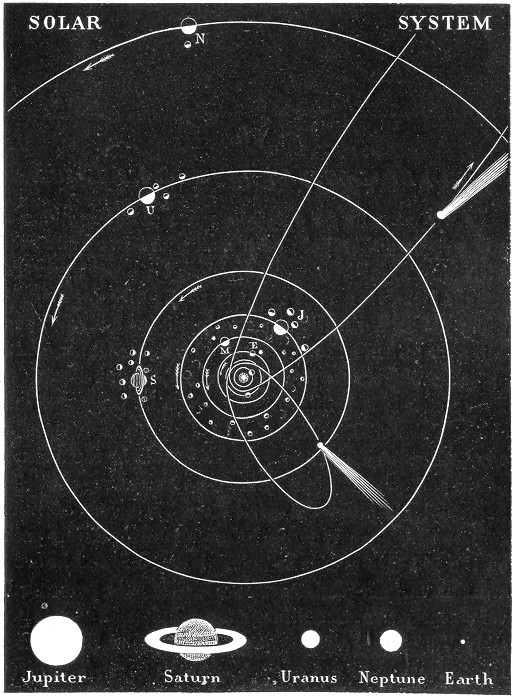




 Inf., inferior conjunction; Sup., superior conjunction.