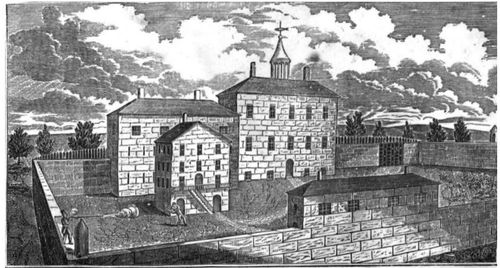
In a state prison, almost every action of the prisoners, not
particularly mentioned in the By-Laws, is either a crime or not,
according to the whim that happens to be in the breast of the keeper
at the time it is done. Hence there are many actions punished, and
sometimes very severely, which were not known to have been improper at
the time they were committed, but which, by a very common post facto
process, became crimes afterwards. Any thing which a prisoner does
or neglects to do, is, if the guard or keeper who notices it, has any
spite to gratify, dressed up in a criminal suit and made a pretext for
punishment. To smile or look sober, to speak or keep silence, to walk
or sit still, is alike criminal when convenience requires.
It is, also, a rule of conduct with the keepers, to punish all for
the crime of one. Instances of this are very common. I will mention
some of them.
There was a little upstart dandy among the prisoners, who on one
occasion, had his hair cut by order of his keeper a little shorter
than his vanity desired. Displeased with this, he immediately had all
his hair cut down to one quarter of an inch; and on account of this
criminal vanity and resentment in him, every head in the prison was
scissored down to a quarter of an inch for more than two years.
To make his displeasure fall with full force on one of the prisoners,
the Warden once took every book out of the work shops and ordered that
no prisoner should rest from his work two minutes at a time, from
morning till night.
Because some of the prisoners have pretended that they were sick when
they were not, every sick man is neglected.
Another fact in relation to crimes is, that some of the
keepers have given their countenance and aid to the prisoners in the
commission of them, and shared with them the profits of their
wickedness. It is well known that some of the keepers have assisted
the prisoners to get materials into the cells for weaving suspenders;
and when woven, they have sold them and divided the money. Fine
keepers! Fit men to reform the guilty! Assist the prisoners to steal,
and divide the plunder!
But when we come to those crimes which are specified in the By-Laws,
the most frequent grow out of the following sources:—
1. Defects in the work. For the smallest defect here, the prisoner
is often made to feel severely. What is so small that none but a
malignant eye would notice it, some variation in the shade, something
that could not have been avoided, is too often carried on to the books
as a great crime, for which only ten days in the solitary cell can
atone.
2. Not keeping a proper distance in walking. The laws require the
prisoners to keep six feet apart in going to and returning from their
cells and meals. This requires no small share of practical
trigonometry, and if a prisoner should not be pretty good to learn,
before he can possibly keep in the right spot, the guard will have an
opportunity to give him a number of solitary lectures. Many a man,
who thought he was exactly right, not knowing so well as the more
learned guard, has been sent into punishment, and made to feel how sad
a thing it is, not to understand the six feet trigonometry.
3. Insolence is another crime. This is committed very frequently, as
an accent or emphasis is sufficient for this purpose. The keepers
and guard are very tenacious of their dignity, and what the governor
of the state would consider respectful language, if addressed to him,
they consider insolence. If one should turn over the pages
of the black book, he would find this crime written to the sorrow of
many a prisoner.
4. Not performing the task. This crime is generally found against
learners, who have not had time to become masters of their work. This,
however, is no excuse, the task is fixed and must be done. Nor is it
of any avail that the materials have been poor, the complaint
is,—the work is not done, and nothing but the grave can hide
from, or avert the penalty.
5. Speaking together without liberty. Many are punished for this
crime, and very justly in many instances no doubt, but not in all. If
a prisoner is seen to move his lips this crime is written against him,
and suffer he must.
6. The other crimes might be ranged under the heads of "wasting the
materials"—"attempting to escape"—"resisting the authority,"
&c., all of which are frequently found in the books against the
prisoners; and I know not that any criminal of these stamps has had
much reason to complain, that his sufferings have been too severe.
This is the proper place to state the absolute authority of the
keepers and guard over the destinies of the convicts. If one is
reported, he must be punished, and that too without a hearing,
and often without knowing the crime alleged against him. If he should
ask the officer what his crime is, the answer would be, "you know
what it is." After he finds out the crime, and desires to be released
from punishment, the one who reported him must be consulted; and after
he is willing, the sufferer must avow that he is guilty, and promise
to reform, before he can get out. Innocent or guilty, it makes no
difference, he must say—"I am guilty," or he will plead in vain to
be released; and many a one has lied by compulsion, in order to
get rid of further suffering. This was his only alternative,
he must spot his soul with falsehood, or die a martyr to truth.
The punishments are of different kinds; the most common is that of
confinement in the solitary cell. This is cruel and dreadful. The want
of food reduces the strength and takes away the flesh, so that when
the sufferer comes out, his face is often pale as death, his frame
only a skeleton, and he unable to walk without reeling. He has only a
small piece of bread once in twenty-four hours, with a pail of water;
and no bed but the rock. In the winter he has a blanket, but such is
the degree of cold to which he is exposed, that he has to keep walking
and stamping night and day, to keep from freezing to death. And
having no proper nourishment to sustain him, he becomes, under the
joint influence of cold, fatigue, and hunger, a miracle of suffering,
over which Satan himself might weep. Day after day, and night after
night, he drags along his heavy and burdensome existence, friendless
and unpitied, the sport of his unfeeling keepers, and the victim of an
eternity of torment. I know what this suffering is, for I have
experienced it. Seven days and seven nights, in the dead of winter, I
hung on the frozen mountain of this misery, and died a thousand
deaths. Every day was an eternity, and every night forever and ever;
and all this I endured because I incautiously smiled once in my life,
when I happened to feel less gloomy than usual. But my suffering was
nothing compared with others. Some spend twelve, some twenty, and some
over thirty days there. My heart chills at the thought! If God is not
more merciful than man, what will become of us?
Another kind of punishment is the block and chain. This is a log of
wood, weighing from thirty to sixty pounds, to which a long chain is
fastened, the other end of which is fastened around the sufferer's
ancle. This he carries with him wherever he goes, and performs, with
it, his daily task. This is not much used, it being less
severe than the solitary cell. Some have carried these for several
weeks, and even months.
The iron jacket is another form of punishment, inflicted only once
in a great while. This is a frame of iron which confines the arms
down, and back, and prevents the person from lying down with any
comfort. This is generally accompanied with one of the other kinds of
punishment, as it is not considered much inconvenience alone.
Connected with these several kinds of punishment is the putting the
convict down from one of the upper stories if he is up there. The
whole administration of the prison is clothed with terror, and there
is no end to its vengeance. The first form of suffering is only the
first lash, and each additional form comes in regular succession.
This is the second lash. The third is this—the number of times that
the prisoner has been in punishment, is always brought up when an
application is made for a pardon. The Reporter of characters takes a
full share of gratification in adverting to these, when a certificate
of the conduct is given. I cannot mention this man's conduct without
indignation. I hope he will find room for repentance, and obtain
pardon from his God for his many vexatious acts in relation to the
prisoners. I know of no man in whose breast so little humanity
prevails. Every prisoner will carry to judgment a charge against him.
One drop of human sympathy never flowed in his veins. A mountain of
ice has frozen around his heart. His acts of inhumanity would fill
volumes, and it would require years to record them. I pity him from my
soul, and though I have felt more than once, the weight of his
mercy, I freely pardon him. If he should ever look on this page, I
hope he will remember how unjustly he abused me, because he had the
power, and I could not help myself. I wish also that he would
think of Plumley, and the three times convicted sufferer of Woodstock
Green.
Besides those already mentioned, it may not be out of place to
touch on a few of what may be called extra judicial inflictions, or
those which are felt by the prisoners without the usual process of a
"report in writing." These are—not sending their letters, nor
admitting those sent to them—adding a yard to the task of a man, who
did not feel like doing more than was required of him, and making
him use the finest and most difficult materials—imposing the worst
work, and allowing only the poorest tools. These, and many other
vexatious practices, are as common as the return of day and night; so
that the prison at Windsor is one of those gloomy and dreadful places,
which image to the mind that house of woe and pain, where are weeping
and wailing, and gnashing of teeth; where the worm dieth not and the
fire is not quenched; and into which the wicked will be turned, and
all the nations that forget God.
That the reader may have a full view of this subject, I shall give in
the next chapter a multitude of cases, which will fully illustrate
this very important and affecting part of my sketches.
The case of Samuel E. Godfrey is one of deep and thrilling interest to
every feeling heart. It is one of those numerous cases which stain the
records of humanity, in which the guilt of a criminal is extenuated by
the circumstances of its existence, and lost in the intensity of his
sufferings. The fertile regions of Fancy cannot produce a theme more
fruitful in incidents, and more painful in its melancholy details. It
presents to our minds two principal sufferers, one pure and stainless
as the mountain snow—a forlorn and destitute female;
religion warming her crimeless heart, and virtue sparkling in her
tearful eyes, she deserted not, in the hour of his afflictions, the
companion of her better days, but hung, like an angel of mercy, on the
bosom of his grief, and shared in every pang of his soul. The other
claims not our sympathies as for an innocent sufferer, for crime had
been on his hands, and guilt had made its stains on his heart. I do
him no injustice by this statement; but I should stain my own
conscience were I not to add, that he was a criminal by aggravation,
and that had others acted more in accordance with the dictates of
either religion or moral honesty, he would not have reddened his hands
with the blood of his fellow-man, nor ended his days on a gallows.
In rescuing the history of this unfortunate sufferer from the grave of
oblivion, I have but one motive, and this is, to do good. It contains
volumes of instruction, and much of this is needed at the present day.
Societies are formed and forming, with a view to improve the condition
of suffering criminals by such a change in the discipline of prisons,
as may conduce to their reformation; and these societies have a right
to such information, as may enable them to act intelligently and
efficiently. I also desire by this piece of history, to hold up the
yet unpunished authors of the most unearthly sufferings, to the
indignant scorn and righteous reprobation of all mankind. It is too
often the case that the crimes of men in authority are sanctified by
the duties of their office, and they screened from the arm of the law
and the force of public contempt, by the necessity of the case. But
the time has come to vindicate the sacred purity of public stations
from this charge, by taking the robe from every unworthy incumbent,
and inculcating the sentiment, both by precept and by practice, that
there is no sanctuary for crime, and no justification for guilt.
With the history of Godfrey previous to the unhappy event
which conducted him to the scaffold, I have nothing to do. At this
time he was confined in the prison on a sentence of three years for a
petty crime committed in Burlington near the close of the war. He had
served about half of this term, and his conduct had been such as to
justify an expectation of pardon, an application for which was pending
before the executive, when the gloomy event transpired which sealed
his dreadful doom. His wife, one of the most amiable of women, had
gone to lay his petition before the Governor and Council, and plead
the cause of her husband. Hope was beginning to play around the
darkness of his cell, and the anticipations of liberty were beginning
to inspire his breast. His arms were almost thrown out to embrace the
companion of his bosom and the friends of his heart. In the ear of
fancy he heard the voice of his keeper saying—"Godfrey, you are
free!" At this moment, by a sudden turn in the scale of his destiny,
all the future was darkened, and the taper of life began to grow dim
with despair. Driven to desperation by the unjust and cruel treatment
of a petty officer of the prison, he committed the fatal deed, which
gave rise to that train of sufferings, and developed those traits of
unfeeling cruelty in his persecutors, which I am going to describe;
and which terminated his mortal existence on the gallows.
His employment was weaving; a given number of yards each day was his
task. At the time under consideration, he took what he had woven and
handed it over to his keeper, and as usual, he was found to have done
his task, and performed as much labor as was required of any of the
prisoners, and to have done his work well. While he was conversing
with the keeper on the subject of his labor he remarked that he had
done more than he meant to.—This gave offence, and he immediately
corrected the expression, and gave, as what he designed to
say, that he had wove more than he thought he had. But this did not
give satisfaction; and the master weaver coming up at the time, a
consultation was held with him by the keeper, which resulted in a
complaint against Godfrey to the Warden, for "insolence." This
complaint was made by the advice of the master weaver, who wrote it
with his own hand, as he acknowledges in his testimony before the
court. "I advised Mr. Rodgers to report him, and wrote the report."
These are his own words, and as a reason for his conduct, he further
says; "I had understood that there was a combination among the
prisoners not to weave over a certain quantity."
Such was the crime alleged in the complaint, which I desire to have
noticed very particularly. It was not that he had not performed his
full task. It was not that his work was not well done. But it was
that he said—"I have done more than I meant to," which he immediately
softened by saying—"I mean I have done more than I thought I had."
And when I shall have informed you what the consequence of such a
complaint was, what the punishment it procured, you will be able to
appreciate the character of those who entered the complaint, and the
greatness of the provocation it gave to the unhappy victim to commit
the assault which followed.
The laws of the prison were very severe. When any one was reported to
the Warden for any crime, he was, without any hearing, committed to a
solitary cell, as dark as a tomb, and confined there on bread and
water for a number of days, seldom less than a week, at the pleasure
of the keepers. The cell is stone; the prisoner is allowed no bed or
blanket, and only four ounces of bread a day; and before he can be
released from this grave of the living, he must humble himself, plead
guilty, whether he is or not, acknowledge the justice of his
sufferings, and promise to do better for the time to come. To
such suffering and ignominy was Godfrey doomed for that shadow of a
crime, and who can wonder at the rashness and desperation to which he
was driven.
Soon after the complaint was sent to the Warden the prisoners were
called to dinner, and Godfrey with the rest. After the tables were
dismissed, as Godfrey was going out of the dining room, the Warden,
who was present, ordered him to stop. Knowing by this that he was
reported, and the thought of the punishment to which he had been so
unjustly and unfeelingly devoted, crossing his mind, he became
enraged, and resolved to be avenged on his persecutor before he
submitted to the authority of the Warden.
Fired with this rash determination, he entered the shop, took a leg of
one of the loom seats, which he cut away with a knife that he had
taken for this purpose from a shoe-bench; and with the knife and club,
he went into an affray with Rodgers the keeper, who had complained of
him. He struck at him a few times, but without effect, his club
catching in some yarn which was hung overhead. Seeing the affray, Mr.
Hewlet, the Warden, went to the assistance of Rodgers, which brought
Godfrey between them. Armed with sharp and heavy swords, they began to
play upon their victim, and soon the floor began to drink the blood
which, with those instruments of death, they had drawn from his
mangled head. So unmercifully did they cut and bruise him that one of
the prisoners laid hold of Mr. Hewlet, and begged of him for God's
sake not to commit murder. It was during this struggle that Mr. Hewlet
received a stab in his side, but from what hand no one could say
positively, though no one doubts it was done by Godfrey. That it was
done, however, without malice, and that he had no recollection of the
act afterwards, ought not to be questioned after his dying testimony.
The first that was seen of the knife was when it was lying on the
floor in the blood. Faint with the blows he had endured, and
from the loss of blood, Godfrey sunk down from the unequal conflict on
the sill of a loom. Mr. Hewlet putting his hand up to his side, said
he was wounded, and was led into the house, and the affray ended.
Mr. Hewlet had been afflicted with the consumption for years, and no
one who knew him thought he would live long; and he was evidently
sensible himself that his end was nigh. He would frequently complain
of pains in his breast, on which he would often lay his hand and say,
"I am all gone." In this state of health, the wound he received in his
side inflaming, he lingered about six weeks and expired. From a post
mortem examination, it was found that the knife had entered in the
direction, and near the left lobe of the liver; and as that was
entirely consumed, it was the opinion of the surgeons, that the knife
had entered it, and produced an inflammation which was the cause of
his death. It was the unanimous opinion of the surgeons that Mr.
Hewlet's death was caused by the wound.
Godfrey was taken from the scene of the affray, and lodged in the
place of punishment, and no attention of any kind was paid to the
wounds in his head. No doubt many would have rejoiced if he had died,
and nothing but the utmost care on his part prevented his wounds
inflaming, and leading to a fatal result. He used to keep his head
bound up with a piece of cotton cloth, and constantly wet with urine,
the only medicine he could obtain; and by this means he preserved his
life to endure more indignity and suffering, and die under the hand of
the executioner.
As soon as Mr. Hewlet died, complaint was entered to the Grand Jury
against Godfrey and an indictment for murder found against him.
Immediately after this was done, the keepers and guard began to
torment him with the most unfeeling allusions to his anticipated
death. They insulted his sufferings—told him that they should soon
see him on the gallows—and exulted above measure when they
could kindle his worst feelings, and draw from him an angry
expression. This was the theme of their cruel tongues continually, and
I here affirm, without fear of contradiction, that greater outrage was
never practiced on the feelings of a criminal by a mean and
unprincipled mob, than Godfrey endured from those who had been placed
over him as guards, and who were under a solemn oath to treat all the
prisoners with kindness and humanity.
Nor was this feeling and disposition to torment a degraded sufferer,
confined to the petty servants of the prison; it marked the conduct of
all, and even the highest officers of the Institution seemed to take
an infernal satisfaction in creating terrors to harass his mind. At
one time they would dwell on the certainty that he would be hung,
and at another inform him that his gallows should be erected over the
large gate of the prison-yard, and so high that all the prisoners and
all the village might see him. Surrounded by such fiends incarnate, he
groaned away his dreadful hours till the time arrived for his trial.
There were many individuals who felt an interest in the issue of this
trial, and who had serious doubts as to his being guilty of murder.
Among these were Messrs. Hutchinson and Marsh, who volunteered their
services as his counsel. They defended him with a zeal and eloquence
which did them honor. But the die was cast against him, and he was
condemned to suffer as a murderer. It was the opinion of some that he
would be found guilty of only manslaughter, and then his sentence
would be imprisonment for a great number of years or for life. This
was mentioned to him, as a source of comfort, by his friends, but he
always spoke of returning to the prison with the utmost horror. "No,"
said he, "not the prison, but the gallows,—if I cannot have liberty,
give me death,—I would rather die than go back to prison for six
months."
It is said that adversity is woman's hour—that female
loveliness shines brightest in the dark. I have no doubt that this is
always the case; in the present instance I know it was. Godfrey had a
wife, and the best man on earth never deserved a better one. With a
fortitude that affliction could not for a moment weaken, she hung
around his sorrows, and flew with angel swiftness to relieve his
burdened soul. She went to the governor and obtained a short reprieve
for her condemned husband; and his counsel interposed and obtained for
him another trial.
He was now remanded to the prison to wait a year before the court was
to meet and give him a re-hearing. I have no doubt that he would have
chosen death rather than this, had not the seraph tenderness of his
wife thrown a charm around his being.
During this year he experienced the same vexations that had attended
him before his trial. And the tiger hearts of his keepers even
improved on their former cruelty, and created in his mind the spectre
which haunted his midnight hours, and painted before his terrified
imagination his lifeless body quivering under the dissecting
knife.—They also most basely and falsely threw out to him
insinuations against the purity of his wife. And as if impatient for
his blood, they contrived to shed some of it before hand, as a kind of
first fruits to their unholy thirst for vengeance. This was done by
provoking him into a rage, and then falling upon him with a sharp
sword and forcing the edge of it by repeated blows against his hand,
with which he aimed to defend himself, and of which he then lost the
use.
At length the year rolled away, and he was placed again at the bar of
his country, to answer to a charge which involved his life. The same
noble spirits continued his counsel; but the verdict was given against
him, and sentence of death was again pronounced. Unwilling to abandon
him yet, his counsel obtained for him another hearing, at
another court which was to sit in one year from that time, and till
then he was obliged to return to the bosom of his tormentors.
During this year he found one friend in Mr. Adams, his keeper. This
man had the milk of human kindness in his breast, and he treated his
prisoner in such a manner as to obtain his warmest gratitude, and
deserve the respect of all mankind. During this year, few incidents
transpired worthy of notice. Godfrey had a good room, and was allowed
a few tools with which he manufactured some toys, the sale of which
gave him the means of supplying himself with such little articles of
comfort as his situation required. This was the last year of his life.
At the session of the court he was again convicted, and the sentence
of death was soon after executed upon him.
Previous to his execution he dictated a brief history of his life, and
his dying speech, which were printed and read with great avidity. In
his dying speech, he makes a solemn and earnest request, that his
remains may be permitted to rest in peace, and not be disturbed by
those "human vultures," who were anxious to do to his body what they
could not do to his soul. He had no fear of death, but he shuddered at
the thought of being dissected by the doctors. But those who had no
feelings of compassion for him while he was living, disregarded his
dying request, and his bones were afterwards found bleaching in the
storms of heaven, on a lonely spot where they had been thrown to avoid
detection.
His wife was with him during his last hours. He evinced no dread in
view of death, but with a composure almost super-human, he watched the
approach of the dreadful hour which was to release him from earth, and
as he firmly believed, introduce him to the joys of heaven. He was
treated very kindly by his humane keeper, of whom he speaks
in the highest terms in his last words. He received the different
clergymen with respect and affection, as they called to see him, and
was fully prepared, in his own mind, to leave the world. The morning
of the fatal day witnessed his parting with his wife, till they shall
meet in heaven. She entered his room—closely folded in each other's
arms, they seated themselves on the side of his bed, their tears
mingling as they fell, and neither of them able to speak a word. Their
eyes were rivetted on each other, and the expression of their looks
might have pierced a heart of marble. Lost in the dreadful reality of
his doom, they were insensible of the passing minutes, till the
rattling of the keys awoke them from their awful reverie, and
signified that the last moment had come, and that they must part. She
tore away from his clasping embrace—sighs were her only sounds, and
her tears fell on the cold stone floor of his prison as she with
slow—reluctant—and hesitating step, passed away from the object of
her tenderest love. His eyes followed her till she was far out of the
room and out of his sight. Then wiping his eyes, he said to his
companions—"It is all over—you will see no more tears from me. This
is what I have long dreaded; it is now past, and I shall die like a
man."
He attended to the religious services with much propriety. After he
arrived on the gallows, he informed the concourse of people around him
that he had prepared his Farewell Speech which was in print, and that
they might obtain and read it. When the chaplain made the last prayer,
he knelt on the scaffold. After this, taking leave of his attendants,
and casting a calm look on the throng by which he was surrounded, then
on the near and more distant hills, and lastly on the clear blue
heavens, he told the officer that he was ready.—The cap was then
drawn—the scaffold was dropped—and his sufferings were ended.
In view of this melancholy history, the mind will naturally
inquire, what good reason had Rodgers and F*** for entering that
complaint which led to such direful results? what had Godfrey done? Is
it a crime deserving of punishment for a man to say, "I have done more
than I meant to," when he had done his full task, and done it well?
especially after he explained by saying, "I have wove more than I
thought I had"? Is this a crime? Was it right to treat a prisoner, who
had always behaved well, in such a manner as this? What excuse is
there for those who reported him? Let me, in concluding this sketch,
hold up to the notice of all men,—saints and sinners, bond and free,
the man who, in his testimony on the trial, said,—"I advised Mr.
Rodgers to report him, and wrote the report. I had understood that
there was a combination among the prisoners, not to weave over a
certain quantity."
This was an old man of near eighty. He had been worth a great fortune,
and was then in possession of property to the amount of about twenty
thousand dollars. In the prison he found no indulgence for age, no
compassion for the sick, no pity for the suffering, and he was
scarcely in it before he was put in punishment. There was at that time
a guard named French, who had been a soldier at Burlington, and who
said that he had been employed by Rowley, when he was not on army
duty, to cut corn stalks, and that he had cheated him out of his pay.
This he reported to the prisoners and keepers; and now he thought he
should have a good opportunity to be revenged. Accordingly he kept him
in the solitary cell, and wearing a block and chain, most of the time.
The old man could not look, speak, or walk, but French would report
him; and so well was it understood that he was suffering for this
old grudge, that when any one saw him going to the cell, the
remark was immediately made—"Rowley is paying French for the stalks."
The punishment thus begun, was carried on during the five years of his
sentence. He was the common mark for every little stripling, who
wished to get into the graces of his superiors, by doing some deed of
cruelty; and I presume he was in punishment three years out of the
five to which he was sentenced. No allowance was made for his
years—his want of sight—or his infirmities; he was in the power of
man, an unsocial crabbed old creature it is true, but still a human
being, and entitled to the common mercy of a state prison. But the
"stalks" were always green on the memory of his keepers, and they
could not endure to see him out of the cell. He lived, however, in
spite of them, to see the end of his sentence and to return to his
family, where he soon after died.
Much as French and others are to be blamed for their conduct towards
this man, the burden of condemnation rests on those, who were bound
by the oath of their office, to protect the prisoners from "cruelty
and inhumanity" in the guard. Ought such personal feelings to be
indulged towards a prostrate victim? Can that man be worthy of any
office, who can stoop to such criminal meanness? I am told that French
has since become a christian, and I sincerely hope he has; for I am
well persuaded that it will require many years time, and many a bitter
tear, to purify his conscience from the iniquity of the "corn
stalks."
This man entered the prison under the influence of a cold which he had
taken in gaol. He was in the bloom of youth, and as bright as young
men in general. Not feeling well, he did not always do so much work as
was required of him, and consequently soon began to feel that
he was in a prison. The iron storm of punishment began to beat upon
him, and he was so affected by it, that he lost the use of his limbs
in a great measure, of his speech for some time, and finally of his
reason. The treatment he received would make the records of the
inquisition blush. Starvation, chains, and the cold cell were the only
mercies he experienced. At a certain time when he was unable to speak,
as he was sitting in the cook-room, the Warden entered, and declared
that he would make him speak or kill him. To effect this, he took him
by the hair of his head, and dragged him round the room, pulling and
jerking him with all his might, and crying all the time, "speak or
I'll kill you!"—Reader, have you ever read Howard's Prisons of
Europe? It was in Europe that he found so much misery and cruelty;
but this is in America. Yet here, see that Warden of a prison,
dragging a prisoner by the hair of his head, and declaring his
intention to kill him if he did not speak. Inhuman man! where is your
heart, if you have any? Will God suffer you to go unpunished for thus
trampling on His authority, and abusing your fellow man?
After exhausting all his strength, the Warden gave up, without either
making him speak, or killing him. Every prisoner's heart burned within
him, when he saw what this poor unfortunate man was suffering, and
what might become his own doom. I wonder that every one of them did
not spring forward, and rescue the sufferer from the wicked hands of
that heartless tyrant. I wonder that the earth which bore up the
lion-hearted despot, did not open and destroy him. But this is not the
end of Collier's sufferings from the same man.
Reduced by disease, and unable to be in the yard, the doctor ordered
him to be put into the hospital, and properly attended to. While he
was there, the Warden went up to see him. Unkind visit! for
he took with him a horsewhip, and before he left him, he used it with
lusty arm about his naked back, until he was quite exhausted, and till
demons might have trembled at the superior depravity and heartlessness
of man. This visit was repeated once, and perhaps twice, and the
same medicine administered.
Such was the conduct of the Warden, of whom the laws of the prison
say, that "with the powers entrusted to him it cannot be necessary for
him to strike his prisoners; much less can it answer any good
purpose for him to give his command in a threatening tone, or
accompanied with oaths; but he shall give his commands with kindness
and dignity, and enforce them with promptitude and firmness."—"He
shall never strike a prisoner except in self-defence, or in defence
of those assisting him in the discharge of his duty." With this part
of the laws of the prison before us, no comment on the acts of the
Warden, in the cases cited above, is necessary.
After wading through seas of affliction—after losing his
reason—after he had outlived the ability of his destroyers to torment
him further, he went home to his mother, a fair specimen of the
Warden's mercy.—His ruined form is before me—I see his vacant
look—I hear his unmeaning words—my soul sickens—my nerve
trembles—I can neither think nor write.
This man had led a very wicked life, and as the fruit of his sins, a
very unpleasant disease kept frequently reminding him that the
pleasures of sin are a lasting bitter.—With this complaint he was
often confined to his room. At length it was conjectured that he was
not so sick as he pretended, and a resolution was formed that he
should go into the shop and do his work like the other
prisoners. To this, however, he objected, declaring that he was sick,
and not able to be in the shop. But when the king commands, he must be
obeyed; and so a course of preparations was made to make Perry well
and get him out to work.
In the first place, a long board was provided, with straps to fasten
it on his back, by lashing the sides around his arms, and neck, and
body. This being properly adjusted, a rope was fastened round under
his arms, and he was drawn up by it as if under a gallows, so as to
just permit his toes to touch the ground. This was done in the yard,
before all the prisoners, and keepers, and spectators from without;
and it was repeated every day for as much as a week. After he had hung
there a suitable time, he was let down, and being unable to stand, he
would fall directly to the ground. Then the keepers would throw whole
buckets of water on him, drawn cold from the cistern. Often would they
dash these directly in his face. After this, they would hang him up
again, so that the medicine of the rope, the board, and the bucket,
had a fair opportunity to exert their sanative properties. The patient
lived through it, and so did St. John live through the boiling oil,
but the strength of human nature is no excuse for those who delight in
cruelty. The man who maliciously gives me poison is a murderer, though
my constitution is proof against it; and the fact that Perry outlived
this process, is no evidence that he was not sick.
I have not the least sympathy for this man on account of what he
suffered from his disease. I am glad that providence has appended to
the impure gratification of sensual desires, some dreadful recoil of
suffering; that when the loveliness of virtue cannot charm, the
deformity and wretchedness of vice may appeal. But I have copied this
sketch from my memorandum, to shew how men in office can
descend to what would degrade a savage. If Perry was as bad as sin
itself, no one had any right to torture him. I have copied it also as
a specimen of what many sick men have had to endure.
There was among the keepers a man who cherished some feelings, which
accorded very illy with his christian profession. In his very
countenance there was a something which indicated the peculiar quality
of his soul. Resentment, jealousy, cruelty, and suspicion, like so
many infernal spirits, kennelled in his eyes, and growled through his
snarling voice. This human shape had,—unfortunately for her—a wife
who was a weaver; and he brought some yarn into the prison to have it
warped for her. Robbins was at this time the warper, and the unlucky
task of warping for this lady, fell to him. He performed the duty
assigned him with his usual correctness, and the warp was sent out to
Mrs. ——, to be woven.
In beaming it on her loom, she broke and tangled the warp to such a
degree, that she could not weave it; and then said that it was spoiled
in warping. This was enough for her husband; he had long had a spite
against Robbins, and now he had a fine opportunity to glut his pious
vengeance. Accordingly he wrote a complaint to the Warden, covering
the whole warp which his wife had spoiled, and many other crimes,
which were not of any consequence alone, but which added to the great
one of the warp, made it look quite black. This report, drawing an
appendix of consequential et ceteras, as long as the pen with which
they were written, was sent to the proper officer, and Robbins was
doomed to lie fourteen days and nights in a solitary cell, and live on
four ounces of bread for each twenty-four hours. What makes this
treatment of a helpless prisoner the more abominable is, that
Robbins was always known to do his work in the best manner possible.
No comment is necessary; and I leave that gentleman's conscience
tangled in that warp, till he makes restitution to abused humanity.
Every line in the sketch that I am now going to transcribe from my
original record, ought to be written in letters of blood. It presents
a complication of crimes as foul as human wickedness can perpetrate,
and a society of criminals whose breath would pollute the atmosphere
of Paradise. I shall be very particular in noticing every important
circumstance in this case, and in suppressing those feelings of
indignation, which at this distance of time and place, kindle in my
breast, when the gushing blood and dying image of the victim rise up
before my mind.
Fane was an Irish youth of about twenty, and had no relatives,
acquaintances, or friends in this country. For some petty crime he was
sent to the prison for three years. He was of a sprightly but harmless
turn of mind, and he did not at all times keep a prudent check upon
his vivacity; which was the cause of his suffering now and then the
lashes of that authority, which, always frowning itself, could not
endure the sight of a smile. But the greatest difficulty was, he could
not perform so much labor as was required of him, and what he did
perform was not always so good as was expected by his rulers. Why it
should be thought a crime for a man not to learn a trade, so as to do
a full day's work at it, in the brief space of three months, I am
unable to say; and why any one should expect from a learner the
perfection of a master, is equally strange. But none of these
considerations entered into the purposes of his superiors, and he was
consequently in perpetual punishment, either in the solitary
cell, or in carrying round the yard and shop a large block of wood
chained to his ancle.
In one or the other of these states of suffering, Fane spent much of
the short time of life allotted to him after he entered the prison.
About the time of his bloody catastrophe, he was associated with
Plumley and two brothers by the name of Higgins, who were quite as
much under the frown of authority as himself; and at this time they
were all in chains, but compelled to do their daily task on the loom.
Spending their nights in the same room, and being equally rash and
reckless, they formed a resolution to attempt an escape by forcing
their way, by means of some planks and a ladder, over the wall. This
was to be done early in the morning, as soon as they were let out of
the room. A more foolish plan could not have been laid, for, with the
means they used, no one could have made his way over the high walls of
the prison. Such, however, was their plan, and each one having his
particular part assigned him, they were determined to try to effect
their escape.
To this rash act, the injustice and inhumanity of their sufferings, no
doubt prompted them; and it is a truth which will one day be made
manifest, that most of the enormities committed by prisoners, have
sprung from the same source. Should prisoners be treated with proper
tenderness, instead of being tortured as they are, thirty
reformations would take place where one does not now. I speak this
from observation and experience; and I am constrained to add, that
many of the keepers are as far from amiable and virtuous principles,
and from morality of conduct, as the prisoners. I allude not to the
keepers as a body, for I am happy to know that there are some of
them, who are, in every sense of the terms, benevolent, upright
and gentlemanly. These condemn the conduct of the others as
severely as I can, and they ought to be respected as redeeming
spirits amidst the fallen and depraved ones with whom they are under
the necessity of associating. Their number, however, is comparatively
small, and they do not generally stay long.
Before Fane and his party could make their rash attempt, they were
under the necessity of delivering themselves from their chains, which
was an easy task. While they were doing this in their room, the night
before the time fixed upon to escape, they made some noise with their
file, which drew some of the keepers to the window of their room to
listen. By this means they learned the whole plan—heard them talk it
over—knew it was to be the next morning as soon as the doors were
opened—knew all the steps in contemplation—knew that they had freed
themselves from their chains, and were in perfect readiness for the
morning. All this was known to the authority of the prison the night
before, as I was often told by several of the keepers, and
particularly by the deputy keeper, with whom I conversed freely and
fully on the subject.
And here I should like to submit the question, whether, with this
knowledge in his possession, the Warden acted right in letting these
four men out of their room? Ought he not to have kept them in till the
other prisoners had got to their work, and then told them that their
plan was known, and that it was too late to make the attempt? Had he
done this, he would have been commended, and one of the most unhappy
events would have been prevented. If it is a true principle of law,
that he, who not only does not prevent, but virtually affords
facilities for the commission of a crime, is in some degree guilty
of that crime, then I will leave the Warden of the prison to answer
for the death of Fane.
In the morning, they were let out, and they went forward like madmen
to their fatal project. A lad of about seventeen was on the
wall as guard. Prepared for the event, he watched them as they
advanced with their plank, and placed it against the wall, but made no
attempt to fire. The first that went up were the Higginses and
Plumley; Fane was in another part of the yard after a small ladder,
which he broke in removing it from its place. Finding that the ladder
was broken, and that their other means were insufficient, they retired
from the wall, abandoned the attempt, and went behind the chapel. No
shot was discharged at either of them; but when Fane, who had not
yet been at the wall, ran up that way, before he got within three rods
of it, the guard levelled his musket at his head, as deliberately as
if he were going to shoot at game, and dropped him lifeless on the
ground. The ball passed through his temple, and a buck shot through
his cheek; the blood gushed out of his head in a large stream, and ran
down on the ground nearly a rod.
It has always appeared strange to me, that the guard did not fire on
one of the others, but reserved his death-shot for Fane. He was asked
this question once, and also why he fired at all, and his answer
was, that Fane was throwing stones at him, one of which, he said, hit
him on the cheek. This however, was not true: I saw Fane from the time
he came out of his room till he fell dead, and I saw him throw
nothing. Indeed he could not have thrown any thing, for as he lay in
death, he had firmly clenched in one hand, the chain which he had cut
from his leg, and in the other, the knife which he had used as a saw
in cutting it. These I saw in his hands the minute he fell, and I know
that, with them, he could not have thrown a stone or any thing else.
But if Fane's throwing a stone at him was crime enough to deserve
death, why did he not deal out the same punishment to Higgins? He had
the same provocation from him that he pretended to have had from Fane,
for Higgins threw a club at him, after he had shot his
friend, which, if it had hit him, would have killed him; but he sent
no shot at him. The fact is, Fane was an Irishman, and there was no
friend to look after him, but the others had relatives near; and if
it was determined that one of them should be killed to impress a dread
on the rest, Fane was the pre-determined victim. I do not say that
such was the case, but if it was not, I should like to know why they
were let out of the room, when their plot was so well known? and,
also, why Fane, who was the least outrageous of the four, should have
been shot, and no attempt made on any of the others?
After he had committed this bloody crime, the guard began to be
alarmed, and thought of going off. That his conscience thundered, I
have no doubt; and that the sentiment of guilt which pierced his soul,
should array the gallows before him, was what might have been
expected. He was, however, consoled by his superiors, and the
coroner's verdict, that Fane came to his death in consequence of the
guard's doing his duty, calmed him completely, in respect to his
legal apprehensions.
I have no disposition to censure the verdict of the jury of inquest;
they no doubt acted conscientiously. Still, I doubt very much whether
it was the duty of the guard to kill Patrick Fane. If it was, on
what account? Was there any danger of his escaping? No; this was not
pretended. Was the guard in any danger of personal violence? No. The
story of stones being thrown at him is destitute of all proof but the
guard's own assertion, and is confuted by a hundred eye witnesses.
What, then, rendered it his duty to kill his prisoner? It was not
his duty; neither the law nor the facts in the case made it so; and a
justification of that deathly act, can be found in no established
principle of jurisprudence, or of moral conduct. If he had fired
towards him merely to alarm him, or if he had wounded him
slightly in his legs, he might have been excused; but to deal in death
at once, and that without any just cause, is a crime for which we
shall seek in vain for either excuse or extenuation.
I do not, however, mean to deal too severely with this young and
inexperienced guard; he was under authority, and he had orders to
obey. But I mean to exhort those who gave him such orders to settle
the case with their consciences, that they may die in peace. He has
suffered much since that fatal morning, and for many years his
countenance denoted that all was not peace within. I pity him, and
most sincerely do I hope, that no other promising young man will ever
listen to the voice of the aged, and do that which will bring the
blood of a fellow being on his soul.
After the alarm was over, Plumley and the Higginses were committed to
the solitary cells, and Fane was left weltering in his blood till
afternoon, in full view of all the prisoners, and of the hundreds of
citizens who came in to see him.
About this time, preparations began to be made to bury him. A
principal officer in the place told the carpenter to make a box of
rough boards not regarding the shape at all. "Don't," said he, "make a
coffin, but a box, and bury him in his clothes, just as he is." The
carpenter, however, took it upon himself to make a coffin, and to make
a very good one.
During the afternoon, a very remarkable alteration was made in the
funeral preparations. Instead of burying him in his clothes, as was
directed, he was dragged on the ground like a dead dog, round to the
other side of the chapel, and there stripped, laid on a board, and
washed all over with brine; his head cleaned, and his hair combed, and
then wrapped up in a clean sheet. This was paying his remains a degree
of respect which was never paid to a prisoner before, and the
inquiry was very naturally made—"What does it mean?" Some thought
that the hearts of the keepers began to relent, and that this was a
sign of a troubled conscience. Others thought differently, but it
remained for time to explain the mystery.
The burying place is in the yard of the prison, and close by the
building in which the prisoners sleep. There Fane was buried in the
neat and clean style described above. Those who buried him, thought
that his body might be taken up and given to the doctors for
dissection, and to be certain, they marked the grave in such a way
that it could not be disturbed without their knowing it.
The next morning the grave was examined, but no alteration had taken
place; but the second morning, the grave was found to have been
opened, and the news went through the prison like a flash of
lightning. "What! is it not enough to murder him, must his body be
disturbed and given to the doctors?" was the indignant and wrathful
expression of every tongue. The whole prison was in a blaze, and the
united demand of the prisoners for an explanation was not trifled
with. At noon the principal officers came into the dining room, when
all the prisoners were assembled for dinner, and each of them made a
speech, touching the subject of the violated grave; and it is due to
them both, to give the reader their speeches unaltered, that he may
judge of their guilt or innocence from their own words.
The Warden said, that a suspicion appeared to exist, that Fane's body
had been taken away, but he thought without foundation. The grave did
not appear to him to have been touched. At any rate, if the body was
gone, he knew nothing of it, and he did not think that any of the
keepers or guard did. He could not see how it could be dug up, and the
prisoners not hear it, as the grave was so near them. But if that
could be done, he thought it could have been taken out of
the yard but by one of two ways, and if it went through either of
these, the noise of the great gates must have been heard. His opinion
was, that his body was still in the grave; but if it had been taken
away, he knew nothing about it, and he did not think that any of the
rest of the keepers did.
This was the poorest speech I ever heard that man make, and his
appearance told too plainly to be misunderstood, that from some cause
or other, his mind was troubled. I do not mean to say that he removed
the body himself, but when you hear the other speech, you will know
that the prisoners had reason to suspect something.
The Superintendent said: "I clear nobody. That grave has been
disturbed, and the body has evidently been removed. I did not once
dream of such a thing; if I had had the least suspicion of it, I would
have placed a guard there. It was his sacred bed till the morning of
the resurrection, and no one had any right to disturb him. I don't
know what to think, but I know that there is guilt somewhere, and, as
the Superintendent of the prison, I will spend five hundred dollars
but that I will find something about it."
This satisfied the prisoners of the innocence of the Superintendent,
but not of the Warden. They retired to work fully convinced that the
Warden knew about the removal of the body, and that conviction has not
been worn off, but confirmed by after reflection. The reasons for
supposing that the Warden was knowing to the disinterment of Fane's
body, I shall now state, leaving the reader to judge of their force.
1. The Warden had a son at that time studying in the medical college
at Hanover, only fourteen miles distant from the prison.
2. He ordered the body to be washed in brine, and laid out in a clean
sheet, a mark of respect not granted to other prisoners.
3. The body was taken away, and it could not have been
removed without the knowledge of the guard, who was on duty that
night; for he passed directly by the grave every hour and a half all
night, and sat so near it at all the other times, that he could hear a
nut shell fall on it. It was then impossible for the body to be taken
away without his knowledge; it could not have been stolen away by any
one in the short time of an hour and a half, nor could the grave have
been opened and closed without giving alarm.
And it was equally impossible for one of the guard to know this, and
be accessary to it, without letting others into the secret, for one
was on duty only an hour and a half, when he was relieved by another.
Nor could all the guard have combined in this without the knowledge
of the deputy keeper, for the keys were all in his care. Nor would any
of the keepers or guard have dared to commit such an act, without the
Warden's instructions. Without his knowledge this could not.
4. The Warden's guilty appearance; his effort to make it appear that
the grave had not been touched; and if it had been, that he and all
the keepers and guard were innocent.
5. The fact that nothing was ever done by him to find the body—no
reward offered by him—no stir of any kind—but the business was
hushed up, and the prisoners not allowed to speak of it to their
friends, or mention it in any of their letters.
6. It became after a few years an undisputed report, that the Warden
permitted the body to be removed for the benefit of his son; and the
manner of the removal, and the persons engaged in it, were the
subjects of frequent conversation.
Such are the reasons for believing that the Warden was the principal
agent in the removal of the body. It is not my office to
render verdict on the evidence adduced, but I may be permitted to say
that if he was guilty, he was not fit for his office. The crime,
according to the laws of that state, is severely punished; and
aggravated as it was, if he was guilty, imprisonment for life would
not have been too great a penalty. He was an officer of high trust,
and he could not have been guilty of that crime without connecting it
with perjury and burglary. And if to these be added the crime of being
accessary to his death I would ask what can be wanting to cap the
climax of his iniquity?
I do not say that any of these sins belong to him. He may be
innocent, notwithstanding all these appearances and I could wish that
he were. There is darkness around the subject, too much for him if he
is not guilty, but not enough if he is. One thing is certain, it will
be known at some future day; and if he should finally have to plead
guilty before his God, his punishment will not linger then, though he
may escape it here. He had taken an oath to enforce the laws, and
abide by them himself, and in particular to treat his prisoners
tenderly and humanely; and if instead of doing so, he broke them, and
became the destroyer of life, and the disturber of the repose of the
dead, I envy him not his peace of mind in this world, nor his doom in
the next.
The Higginses and Plumley were confined in the solitary cells on bread
and water for thirty days, a punishment by many degrees more painful
than death. This was the second time that Plumley had endured that
punishment, and this laid the foundation for that disease which
carried him down a neglected and suffering victim to the grave. The
Higginses served their time out and were discharged.
Various reports were circulated about the guard who shot Fane. He left
that part of the country in a few years, and went to the West, where,
it was reported, he gave himself up to drinking, and became
deranged. For the truth of these reports I shall not vouch, though I
firmly believe them, and I am well assured that he never can think of
Patrick Fane without remorse.
It escaped my recollection in the proper place, that one of the
prisoners was looking out of his cell window near the grave the night
that Fane's body was taken, and saw the deputy Warden so distinctly as
to be able to describe his dress and appearance, which he did in his
presence, before all the officers and prisoners. The deputy noticed
how particular the description was, and said, with a blushing
smile—"He has described me exactly." No doubt he felt the force of
his conduct, and conscience evidently was accusing him. This is
another evidence that the body was taken by permission of the
officers, and with their assistance.
From some cause unknown to me, the subject of this sketch had been
deranged some time before he was sent to prison, and the effect
produced on his mind was still visible in his looks and manners.
Naturally, he possessed bright and interesting traits of mind, and a
very amiable and engaging temper; but when reason abandoned him, he
became sullen, and if crossed in his wishes, was furious and
untameable.
Not long after his commitment, the frequent vexations he had to meet
with, and the unsympathizing temperament of his keepers, drove him to
distraction. In this situation he was a fine object for the relentless
severity of those, who should have treated him with the most humane
and tender regard. None but the most thoroughly hardened,
could have tortured a poor friendless and phrensied mortal, as he was
tortured by his guard and keepers.
In the first place, he was punished because he did not perform his
appointed labor, which, it was evident, was more than he could have
accomplished, if he had been in his right mind. This threw him into
the most raging phrensy, and inspired the genius of cruelty with new
life and energy.
To confine him, an iron jacket was provided, which kept his arms close
to his body; and a new invention of iron, heavy and rough, brought his
hands together, and confined them across his breast. This needless and
inhuman contrivance wore the flesh from his hands and wrists, and kept
them constantly bleeding. Thus bound in iron, worse than fancy paints
the victims of Satanic sport in the world of wo, he was confined in a
small cell, to groan out his misery in doleful cries, or sit in silent
meditation on the mercy of man to man.
I cannot think of this ruined lad without growing chill with horror. I
hear now his phrensied shrieks! His unearthly murmurings are still
falling with deathly emphasis on my soul!—O! my God! of what is the
heart of man composed! Days, weeks, and months, he filled that dungeon
with vocal misery; and yet no angel mercy drew near him to comfort or
to pity; but the tiger looks of heartless man were his only sunshine,
and frowns were his only music!
In this work of torture, one of the keepers gave himself an infernal
distinction over the rest. Not satisfied with contemplating in this
youth, the double ruin of body and mind, with a passion for torture
which I hope has returned to the breast of him whom alone it might not
disgrace, he used to beat him with his sword and his fist, and allow
him only a famishing morsel of food. So unmercifully did he abuse this
poor maniac, that he was mistaken by him for the devil—if
indeed, it was a mistake—and declared to be the terror of his waking,
and the odious spectre of his sleeping hours.
Only fourteen years had rolled over this boy's head, when he became a
prisoner in Windsor on a sentence of three years. Rude, but not
vicious—lively without design—and less experienced than a man of
sixty, he was a promising victim for the irrespective discipline of
that dreary place. He soon took up his abode in the solitary cell, and
there, young as he was, he spent much of his time, both in summer and
winter. Fifteen days at a time has that little boy been in the cell in
the dead of winter, with only one blanket, and a piece of bread not
larger than his hand once in a day. All night long have I heard him
cry, and plead to be let out, that he might not freeze; but no reply
could he get from the keeper but—"Stop your noise—shut your
head—learn to keep out—I hope you'll freeze."
To say nothing about the impropriety and unmercifulness of such
conduct to any prisoner, how does it appear in a man of sufficient
years to know better, towards a small boy. Would Lucifer himself have
treated even a young christian so? Every one knew that Dean was by
no means a bad boy; he was thoughtless and imprudent, but never did
he deserve such cruel treatment. Indeed such punishments as are
properly called cruel, cannot be constitutionally inflicted on
any one, much less on a boy; nor for any offence, much less for a
trifle. I here hold up to the view of humanity this tortured
youth—his ears frozen, his limbs shivering, his fingers numb and red
as blood, pinched with hunger, exhausted by exercise to prevent
freezing to death, and dying for want of sleep. I hold him up
in this predicament, amid the gloom of the solitary cell for some
trifling error, at the dark and silent hour of midnight, in the cold
months of winter, pleading for his life, and comforted only by this
snarling reply of the guard, "Stop your noise." Yes, I hold him up in
such circumstances, where I have often heard his piercing cries, and
ask the beholders to read in him the common mercy of that "merciful
Institution."
This is a penitentiary. It was erected as such. The laws consider it
in this light. It is made the duty of the officers to have an especial
eye, in all their conduct, to the moral reformation of the prisoners.
How inconsistent, then, must such conduct be? Can such cruelty on any
person do him any good? Rather would not such treatment have the
effect, even on a saint, to make him a sinner? But look at the
punishment of this little boy. What he endured would have crushed a
giant. No account made of his age and inexperience—no thought of the
kind and degree of correction suited to him—no feelings of
compassion; but the steel-hearted man, who ought to have thought of
his own children of the same age, met this young unthinking trespasser
on some of the minor rules of the limbo, like a hungry bear, and
threw him into the infernal machinery of his vengeance.
This man was a harmless lunatic. He never offered the least violence
to any one, and was as unfit a subject of punishment as is commonly
found. He did not, as might have been expected of any one in his
situation, attend very closely to his work, and what he did do, was
not very well done. By this he came under the letter of that common
law which makes no allowance for bodily or mental imperfections,
and was introduced to the solitary cell. He now found a home,
and he soon became perfectly acclimated, and seemed not to care
whether he was in the cell or out of it. When it was found that he was
contented in that place, he was let out, and doomed to wear a block
and chain; and between these two modes of suffering, he was kept in
constant vibration. There was no feeling in the hearts of his
punishers. What though God had set his mark on him in the ruin of his
mind, and thus by his own signet commended him to the sympathy and
protection of his fellow-men? What though no being on earth could give
him a moment's penal suffering without trampling on all the principles
of right, and propriety, and law, and insulting the majesty of Heaven
in the abuse of its subjects? They had the power, and they gloried
in its unfeeling and most outrageous abuse.
As an evidence of the manner in which this poor lunatic was used, I
will relate an illustrative circumstance.
He was lying one day on the ground, with his huge block and chain by
his side. The keeper went to him and said, "Chamberlain, you must go
into the solitary cell." "I must?" said he; "let me see. I have been
out—one—two—three days—yes, it is time; I have not been out
so long before this great while."
I would not dwell on these gloomy sketches—I could not prevail on
myself to torture the public mind by the recital of such abusive,
inhuman, and infamous acts, did I not hope, by this means, to do
something that may ultimately effect a cure for these evils. This is
to be done only by holding up the evils, in all their dimensions and
enormity, to the eye of the public; and painful as is the task, I hope
God will give me strength to support it, and to go on untiring, till
the object is accomplished. These representations of human misery
ought to elicit human sympathy, and inspire human effort for their
removal. I know the things that I write; I have tasted the
wormwood and the gall; and though my heart sickens at the remembrance
of these things, still I have put my hand to the plough, and I will
not look back.
Among those records of the past which fill the soul of man with the
keenest pain, and fix the darkest stain on the pages of human
guilt;—on that blood-red sheet that exhibits the mutual rage,
persecution, and burning of religious fanatics, I have found an
account of a woman who was doomed to the stake in such a situation
that in the midst of her sufferings in the flames, she became a
mother. The book dropped from my hand as I read this dreadful story,
and I regretted my relation to a race of beings, capable of such
iron-hearted cruelty and infernal guilt. But this was in England, and
it was some consolation to my sickening heart to reflect that I was an
American. I felt a sort of national pride, and wrapped myself up in
the delusion, in which too many are now slumbering, that such things
belong exclusively to the Old World, and will never blacken the
history of the New. How foolish are such national prejudices; how
absurd and contrary to all experience, to suppose that local
circumstances will alter the moral nature of man. The lion loses not
his ferocity by treading the soil or breathing the air of
Massachusetts; and the founder of Providence can testify, that the
pious settlers of New England caught the spirit of persecution as they
were flying from its faggots and fire. Man is man, wherever you find
him. By nature a tyrant, and ever glorying in the extension and
display of his authority, every human being is either a pope or a
Nero, and would become as offensive to God, and as dreadful to the
human race as they were, if placed in the same circumstances.
With the exception of those who are brought under the influence of the
spirit of the gospel, this is universally true; and all the
improvements of the arts and sciences and of civilization, are but so
many refined inventions in the rebellion of earth against heaven.
Christianity makes the only grand and radical difference among men.
This brings all who heartily embrace it back to the authority of
heaven, while all others are forcing themselves on to the perfection
of a character as opposed to God and mutual happiness, as Beelzebub is
to the Saviour of the world. I am now going to introduce a sketch
which will evince the aptness of Americans in imitating the cruelties
of Europe. "England is what Athens was," says Phillips, and too
soon, I fear will America rival England in those things which she
professes to abhor. With how much reason I apprehend this, the
following account, among others, will shew.
Mrs. Burnham had committed a crime as foul as sin could inspire, and I
am not going to plead her cause. She ought to have been punished, and
that severely, but not at the time, nor in the manner she was. She
was married, and at the time of her trial and sentence, it was known
that in a short time she would need a sort and degree of
attention, which prisons were never designed to give; but no regard
was paid to her situation, and she was sentenced to be confined in the
State Prison, to hard labor for a number of years. What a child unborn
had done to be doomed to date its birth in a prison, I leave for those
to determine, who have read more law than I have.
The place of her abode was a small room, with one small and strongly
grated window. From every hall the noise and tumult of the prisoners
was forced directly upon her ears; and in the large space from which
her room was partitioned off, was placed a guard during every night.
Her food was such as the other prisoners had, and her other
treatment of the same kind.
In this place she spent her time till a few days before her
confinement; when she was taken into the keeper's house till her babe
was a few weeks old, and then sent back with it into her room. How she
fared while in the house, I know not, as no prisoner visited that
apartment at the time, to my knowledge; but the report is not at all
in favor of the family residing in the house at the time. How she
fared in the prison I need no one to inform me. One of the men who
attended her, is gone to the world of spirits, and I hope he has found
mercy of his God. Of another that had the care of her I can say, that
if they that show no mercy find none, it is high time for him to
agree with his adversary, lest he, in turn, shall find a small room
till he shall pay the utmost farthing. The insult which that woman had
to suffer—the indignity—the abuse—the oppression, are all recorded
in a book that will be opened in the day of Judgment, and if all men
shall be judged according to their actions, and receive according to
the deeds done in the body, many will regret their conduct towards
this afflicted and injured woman.
I might dwell with painful minuteness on this sketch, but from the
nature of its details, this is no place for them. The great facts are
enough for my purpose, and too much for the happiness or credit of
those who are concerned. The deeply infamous truth on which I wish to
fix the mind of the reader, is, the situation of the woman when she
was sentenced. What the law in such cases may be I know not, but I
envy no man a station which compels him to such a deed as must carry
horror to every mind that has the least sense of propriety, humanity,
or justice. If the law makes no provision in such cases, then have we
attained to a degree of refinement that would disgrace a savage. But
if the law does provide for such cases, where is that man's
fitness for his station who denied this woman all the benefit of that
provision, and inflicted on her a lash which made her unborn infant
bleed?
Another circumstance to be noticed is, her treatment in the prison.
The subject is too delicate to be treated here, with any degree of
particularity. Even the most corrupt of the prisoners was often
indignant at the low and vulgar insults that were offered to her by
those whose only excuse is, that they knew no better.
"Immodest words admit of no defence,
For want of decency is want of sense."
She survived this train of abuse and cruelty, and the Governor and
Council to their credit, and to the honor of the state, permitted her
to return to her husband and family, as soon as her case could come
before them.
I know not with what feelings the public mind will contemplate the
fact recorded in this sketch; but I hope, most devoutly, that it will
be universally reprobated. I shall carefully observe its effect, and
note it down as a sure indication of the tone of American morals and
American sentiment. My bosom will expand with national pride, or my
cheek redden with national shame, in the same proportion that such
conduct is condemned or sanctioned by public opinion. It is no excuse
for such conduct that the sufferer had sinned. I well know that she
merited the severest punishment; for the soul freezes at the thought
of her crime. But to every thing there is a proper season, and it is
not the proper season to punish a sinning female when a child
unborn is to be put in peril. As well might the Creator send an
unborn infant to hell with its sinful mother.