HERE has been so much written about the battle of Shiloh that it is not
in order for me to seek to contradict or confirm any of the various
claims and theories. I shall adhere to my determination to make this
story a record of scenes and events actually observed. I was in the
battle of Shiloh from the opening gun to the close; and while I was very
young, the impressions made on my mind are vivid and lasting.
Notwithstanding the flight of sixty years, I remember many circumstances
of that terrible conflict, as if they had happened yesterday.
HERE has been so much written about the battle of Shiloh that it is not
in order for me to seek to contradict or confirm any of the various
claims and theories. I shall adhere to my determination to make this
story a record of scenes and events actually observed. I was in the
battle of Shiloh from the opening gun to the close; and while I was very
young, the impressions made on my mind are vivid and lasting.
Notwithstanding the flight of sixty years, I remember many circumstances
of that terrible conflict, as if they had happened yesterday.
As soon as General Johnston assumed command of the new line centered at
Corinth, he began mobilization on the largest possible scale; and on
March 29, 1862, he issued an order consolidating the armies of Kentucky
and Mississippi and all independent commands into “The Army of the
Mississippi,” naming Gen. G. T. Beauregard as second in command and Gen.
Braxton Bragg as chief of staff. Gen. Van Dorn, stationed at Little
Rock, Ark., had been ordered to report with his army at Corinth; but for
some reason he did not reach there in time to participate in the battle
of Shiloh.
It was reported to us that, following the battle of Fort Donelson,
General Halleck, the commander of the Department of the Mississippi, and
General Grant, acting under him, were not in harmony, and that Halleck
had suspended Grant and placed Gen. C. F. Smith in active command of the
army, and that he had established camps at Pittsburg Landing preparatory
to the expected movement against Johnston’s line.
It came to light later that, a few days prior to the battle of Shiloh,
General Smith, in stepping into a launch from a steamboat, had sprained
his ankle and was disabled, which resulted in General Grant being again
placed in command.
It was a current report that General Smith, after being disabled, had
gone on a visit to General Halleck at St. Louis, and that General
Sherman had been left in temporary command of the encampment at
Pittsburg Landing.
When the battle opened, General Grant was at the W. H. Cherry residence,
at Savannah, Tenn., eight miles from the battlefield.
General Johnston had been informed that Buell’s army was marching from
Middle Tennessee to join Grant’s army at Pittsburg Landing, thus giving
the Union force a numerical superiority of approximately thirty thousand
men; and as it was not possible for Van Dorn to reach Corinth before the
arrival of Buell, General Johnston decided to make a surprise attack on
the encampment at Pittsburg Landing. Hence, on April 1, we began
preparation for a forward movement.
I was detailed as a courier at Beauregard’s headquarters; and as I knew
the country around Corinth, I had been used in many cases in piloting
the incoming troops to the encampment and in carrying messages between
the different commanders. In this way I became acquainted with the
contemplated movement of our army. I was not aware of the destination,
but could see the feverish preparation for a move of some kind. It was
General Johnston’s plan to have all of his troops before the Federal
Army on the 4th of April and to fight the battle on the 5th; but the bad
condition of the roads, resulting from long-continued rains, so delayed
the progress of the troops that the hindmost corps did not get into
position until about dark on the evening of April 5.
General Johnston had instructed his commanders to guard the secret of
our approach.
Late in the afternoon of the 5th, while we were waiting for the final
touches of the attacking formation, I rode out to a high point in front
of our center, and I could hear the Union troops drilling in their
encampment. The drum and fife and the commands of the officers could be
plainly heard.
It will be remembered that certain Federal commanders always claimed
that their troops were not surprised at Shiloh, but I shall always
believe that the Union Army was absolutely unaware of the presence of
the Confederate Army. They knew that there was a cavalry force in their
front, as we had had skirmishes with them, participated in by small
detachments on each side.
As I look back over the past, I cannot but believe that Fate had decreed
that the Southern Confederacy should fail. We had lost Forts Henry and
Donelson, with more than fifteen thousand picked men. Now we were
preparing for the greatest pitched battle of the war, and apparently had
all the advantage, and yet from an almost insignificant cause we were
robbed of the fruits of complete victory.
Advancing from my position on the hill, I rode down to the Corinth Road.
Our cavalry had just pushed back a squad of Federal cavalry that had
come out toward our line, and this troop soon returned with a larger
body of men; but as we were endeavoring to avoid an engagement, we fell
back a little on our reserve. This only encouraged the “Yankees,” and in
their eagerness to capture us they chased us through our infantry line
on the main road, which permitted them to pass through without firing on
them on account of the order not to disclose our presence. But this
troop kept up the chase until they came upon one of our batteries in the
road, and this battery fired on them with two guns, killing some of them
and throwing the entire body into confusion; whereupon we turned and
followed them back to their line, capturing several men and an officer.
When we took them through our line and they saw the situation, the
officer exclaimed: “My Lord, our people do not suspect such a thing as
this!”
All of this happened just at dark on the evening of the 5th; and, of
course, all of our comrades believed that the firing of the cannon would
arouse the whole Union Army and reveal the presence of our force.
The night came on, and the Confederates lay down in line of battle to
rest and slumber, realizing the danger of the coming morn and the
certainty that for many the next sunrise would be the last of earth.
The 6th was Sunday, and the sun came up bright and unclouded. At
daybreak I carried a message to Colonel Gilmer, Bragg’s chief of
artillery, and then rode out to the skirmish line. Here I saw, for the
first time, a soldier killed. All the men of the skirmish line were
behind trees, and were shooting at such an angle as to enfilade the
enemy’s position.
The soldier whose killing I witnessed was a Confederate—a very young
man. The bullet came from a point several degrees to the right of his
front and cut his throat.
Seeing this boy killed impressed me anew with the horrors of war. I
thought of his mother, probably praying for him in her distant home, and
yet within a few hours his body would be cast into an isolated and
unmarked grave.
My musings were suddenly interrupted by a soldier exclaiming, “Look!”
and as I cast my eyes in the direction indicated, I saw a long line of
bayonets rising over the top of a hill about six hundred yards distant.
This force was a brigade of infantry; and as they reached the top of the
elevation, our skirmish line fired on them from their hidden position
behind trees. The enemy could not see them; and as our company of
cavalry was in plain view, they fired at us across the corner of the
“Fraley field.” We did not have a man hit, but they got several of our
horses. A bullet struck the handle of my saber. Another cut a twig from
a bush within a few inches of my face, and a flying splinter struck me
just above my left eye, and naturally I thought it was a bullet. The
pain was so severe and I was so blind that I felt sure that the eye had
been destroyed; but a comrade, after examining the wound, assured me
that it was only a scratch.
As our company was an escort to a general officer, our commander would
not permit us to return the fire, but turned and moved us briskly over
the hill out of view of the enemy.
Our presence here, so far in front of our battle line, was due to the
fact that General Bragg had sent us with Gilmer, his chief of artillery,
to select a route for the guns, as he had to bring them into action
through a dense growth of timber. Soon after we had left the hill where
the enemy had fired on us we met the Confederate line of battle going
into action. This was the grandest, most solemn and tragic scene I had
ever witnessed. The sun was just coming up over the hilltop, its bright
rays touching the half-green forest with a golden beauty that could not
but charm the eye and thrill the heart even in the presence of death. It
was one of those rare mornings that, in a deep woods, casts a charm of
mingled silence and wild music. In this sunlit antechamber of carnage
there were bird songs and the tongueless voices of whispering
waters—timid, blended melodies of uncounted centuries that here had
sounded their glad chorus to all the mornings of the springtime since
trees first grew and rains first fell, since mosses first floored the
virgin valleys and primal grasses climbed the fresh slopes of the
new-born hills.
The intermittent firing had ceased, and the restful music of nature was
broken only by the tramp of men and horses. Youth, young manhood, and
the middle-aged were mixed in these advancing columns of the South’s
best blood, and the unspoken thought upon every face was that many were
marching to certain death.
This line, the first in the Confederate advance, unrolled as it moved
until it reached a maximum length of nearly three miles, covering the
entire approach to the Federal Army. The unevenness of the ground and
other natural obstacles sometimes broke the continuity of the line, but
the gap was soon closed as the militant host swung forward.
Under the ordinary conditions of camp life and of the field of the
preparatory drill, the good-natured rivalry of cavalry and infantry
would show at every opportunity. The infantry would jeer the cavalry as
“buttermilk rangers,” and the dragoons would retaliate with “web-footed
beef eaters.” But on this morning of their first baptism of fire it was
different. There was no word spoken, and on every face was pictured
solemn and anxious thought. None but God could know how many would
emerge safely from that valley of death into which they were about to
descend.
When the Confederate line encountered the Union Army, it seemed to me
that the two lines fired at the same time, and one excitable soldier in
our command exclaimed: “Boys, the war is over! Every man is killed on
both sides!” He had been a squirrel hunter, and had never heard anything
like a volley of musketry. After the first volley, the roar of guns was
continuous throughout the day.
General Sherman, who was in our immediate front, was a veteran of the
Mexican War, and he had hurriedly posted his men on an elevation that
was covered with a thick growth of timber and underbrush, which almost
entirely concealed his line. While our line was in motion, we had to
approach up a considerable rise to reach the top of the ridge. The enemy
could deliver his fire at us while lying flat on the ground, but our
line was compelled to fire while moving. The object of the Confederate
commander was to move his army quickly into close range, as the Union
Army was equipped with greatly superior arms.
Our men were armed with the old-style, smooth-bored muskets that would
not carry over one hundred yards with any degree of accuracy, and we
could not afford to stop and try to shoot it out with an adversary armed
with long-ranged rifles. Besides, the enemy was surprised by the sudden
attack, and we had much to gain from their immediate unpreparedness by
pressing for closer action. The Union commander was unable to bring all
his men to the rescue; and if we could keep his front rank pressed and
falling back, it would be sure to demoralize the rear formation.
General Forrest once said that he would rather have a “five-minutes
bulge than a week of tactics,” and I think that much of his great
success was due to the application of this theory.
I have more than once viewed the sickening wreck of battle, the
devastation of cyclones, and the havoc of railroad accidents, and
wondered how any human being could pass through such mills of
destruction unharmed. On this occasion, as on many others, I saw men go
through a veritable hail of lead and iron unscathed, and I had the
feeling that it was the providence of God.
Thus far the Confederate line at some points had met with resistance,
but the fighting advance was steady until the Union forward camp had
been penetrated and both wings had been turned on the center.
When I rode through the first camp, the kettles on the fires were
steaming with boiling water, and meat and bread were cooking in the
ovens; but the enemy had to go hungry that day. I saw the bodies of a
few Union soldiers who had been killed in their tents and horses shot
down at the hitching posts in the rear of the camps.
A large rubberized blanket was my part of the spoils that came with the
early surprise, and this trophy afterwards proved very serviceable. In
all my service of four years I never saw a battle field as rich in the
legitimate spoils of war as was the field of Shiloh.
As a courier, I had opportunities far above the average soldier to
observe the wreck of battle, and I think the greatest number of killed
and wounded lay in the narrow valley of the Shiloh Spring Branch on both
sides of the Corinth and Pittsburg Landing Road. The ground was
literally covered with dead and dying men.
In passing this point, my horse received a bullet in one of his front
legs, and I was compelled to secure a new mount.
Near this place General Bragg had a horse killed under him, and another
near the Landing later in the day.
Soon after passing this center of carnage I witnessed a singular thing.
A grapeshot, striking the limb of a tree under which a number of mounted
officers had gathered, glanced downward and struck a horse just in the
rear of the saddle, penetrating his body and entering the ground. The
horse was killed instantly, but the rider was not injured.
At this time the outlook was bright for the Confederate arms. About the
middle of the day, the Union Army, in falling back and taking new
positions, lodged the commands of Prentiss and W. H. L. Wallace in a
thick woods, which after the fight was called the “Hornet’s Nest,” and
this place proved a great surprise for both defendants and assailants.
Through it runs an old, deserted highway, now known in history as the
“Sunken Road.” Worn by the travel and flushed by the rains and snows of
many years, this remote and unpretentious road became a most welcome
trench of protection to the troops of Prentiss and Wallace. Between this
road and the approaching Confederate lines was a thick woods, which
completely cut off the view of the attacking regiments and forced them
to move against an unseen foe.
And so this long-hidden and almost forgotten road, with its fringe of
greening woods, proved a pitfall of death and disaster to the
Confederate Army and, in my opinion, the salvation of the Union Army.
Soon after the attack on this position began Gen. A. S. Johnston was
killed, and, of course, this had a disconcerting effect on the
Confederates. To lose the supreme head of an army in such a crisis,
however able may be his successor, is to approach the brink of defeat,
for an event so dramatic and mournful cannot but shock the very heart of
an advancing army and throw it into a temporary paralysis. Such was the
condition of the Confederate host at Shiloh at 2:30 P.M. on April 6,
1862.
As soon as General Beauregard was apprised of General Johnston’s death,
he gathered his bleeding forces and hurled regiment after regiment
against the “Hornet’s Nest,” with its “sunken road” of destiny, sweeping
all supporting artillery of the enemy from that portion of the field;
but the gray troops could not see the hidden line of blue until they
were within a few feet of the old road. The Union troops would suddenly
rise out of the ground, fire, and sink from view again.
Only after a long and concentrated fire from sixty-two pieces of
Confederate artillery under General Ruggles did the blue line of the
“sunken road” abandon its fateful trench of chance and fall back. Then
both of its flanks were turned. General Wallace was mortally wounded,
and General Prentiss, with more than two thousand troops, was captured.
But—alas!—the hours wasted before that “sunken road” brought us in
weariness too near the edge of the approaching night; and, with a
seeming victory in our grasp, with the brave, though depleted and
disorganized army of blue at bay at the river’s brink, we saw the battle
cease for that day; and in the early falling shadows and through the
long, long night came the troops of Lew Wallace and of Buell, unscathed
and fresh, and twenty-five thousand strong.
This was a sad development to our tired army that had fought without
ceasing for eleven hours; and at about 6 o’clock we were withdrawn to
the Union camps, where we fell into the obliterating sleep of
exhaustion: I was lying on my rubber blanket, and about midnight there
was such a downpour of rain as I have seldom seen. My blanket held water
so well that I was partly submerged when I woke, and the remainder of
the night was spent in cat naps, sitting on the ground with my back
against a tree.
On Monday morning, the 7th, the battle opened with not less than
twenty-five thousand fresh troops added to Grant’s sorely pressed lines,
and so the Confederate hopes of Shiloh took wings; but in the deep gloom
of the changed situation, our army went into battle line with the
coming of the day. Every Confederate had heard the disheartening news;
but they were soldiers still, and, with a courage that at this
far-distant day is difficult to understand, they held the enemy to a
very slow advance until past the hour of noon.
With no Confederate reënforcements in prospect, General Beauregard
began, early in the afternoon, to withdraw the gray army from the
unequal conflict. We retired in good order, and were deeply surprised
that the Union forces made no attempt to pursue us beyond their
encampment.
We marched back to Corinth, taking with us all captured cannon and other
arms, without a rear-guard fight.
General Forrest stopped at the village of Pea Ridge, about eight miles
from the battle field, and on Tuesday, with all the cavalry he could get
together, met a division of the enemy which had advanced to Monterey. As
we charged this column, General Forrest’s horse became unmanageable and
carried him through and beyond the Union line, and we felt sure that he
would be either killed or captured; but, after turning his horse, he
charged back through a troop of the enemy and miraculously escaped with
a wound in the foot.
Thus ended the battle of Shiloh, the first grand battle of the great
war.
It is almost inconceivable that a battle so great and so deadly was
fought by men unacquainted with the harrowing art of war—raw troops
thrown hastily together, a citizen soldiery that had never marched to
battle except through the pages of books, white-handed Robin Hoods of
the orchard and the meadow—indeed, “boys” in years as well as in that
glorious comradeship of danger and death; and yet the “Old Guard” of
Napoleon never “fixed bayonets” with firmer courage than that which made
history on the field of Shiloh sixty years ago.
The soldiers of Johnston’s army were armed with a variety of guns which
looked more like the gathered heirlooms of a museum than arms of
battle—shotguns, squirrel rifles, antiquated muskets, and a few modern
rifles.
The Union troops, for the most part, were neither so new to war nor so
poorly armed as the Confederates, many of them having been in the fights
of Henry and Donelson, and the entire army being equipped with the
latest improved firearms.
But, considering all things, history must march these two armies of blue
and gray down the years, bannered with a fadeless glory; and the great
National Park which the government has established on their battle field
is a beautiful and impartial testimonial which will speak to the
centuries.
To the friends and schoolmates of my youth who were among the killed of
this great struggle, my heart has paid sixty years of silent tribute. My
last glimpses of some of them, as the smoke of the conflict wrapped them
in its thundering folds, have become vivid and cherished memories. It is
the strange way of nature that the vanished spirits of my comrades
linger in my vision as boys in the joyous flush of life’s morning, while
I have marched far up into the gray hills of the evening twilight, and I
salute them across the long stretch of years.
I had, as I thought, many narrow escapes
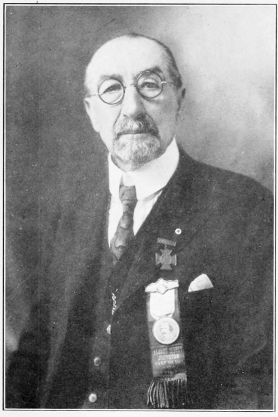
Thomas D. Duncan
Fifty-seven years after his last ride with Forrest
from death at Shiloh. At one time a cannon ball passed so near me that
the current of air created by its passage almost swept me from my horse.
Many bullets and grapeshot fanned me and left their unwelcome whistle in
my memory.
Amid all the dangers of battle ever walks the spirit of humor, and there
is no day so terrible that it fails to hold some laughable incident. I
recall one such on the Shiloh field which illustrates the fact that man
is the wildest creature of the animal kingdom when thoroughly
frightened. Early on Monday morning a small squad of us was preparing a
hasty breakfast of “hardtack” and bacon behind our line, having staked
our horses out to bushes, when firing began suddenly on the line,
followed by the passage of a wild-eyed rider, proclaiming the arrival of
Buell at Hamburg, shouting that he was surrounding us and warning us to
run for our lives. There was a large, long-haired trooper in our crowd,
who made a hurried run for his horse, mounted him, and put the spurs to
him, overlooking the fact that the horse was tied to a bush with a long
rope. As the spurs went home in the horse’s flanks, he began wildly
racing around the bush, taking as wide a circle as his line would allow.
The excited trooper tossed his head from side to side, trying to keep an
eye on the firing line, while the horse increased his speed and narrowed
his circle as the rope gradually wound around the bush until it became
so tight that it brought him to a sudden stop and sent the trooper on a
flying dive to the ground. We were all laughing at him when he ended his
wild race, and he was so embarrassed and humiliated that he secured a
transfer to another company.
Immediately after our return to Corinth I was detailed to pilot the
corps of engineers in locating the line of breastworks that was to
protect our front against the advance of the Union Army from Shiloh
battle field.