APPOINTED SURVEYOR GENERAL OF THE ORDNANCE—PRINCIPLES OF ARMY
PROMOTION—EGYPTIAN WAR OF 1882
On the formation of Mr. Gladstone's Government in 1880 I was offered by
him, and accepted, the appointment of Surveyor General of the Ordnance.
Mr. Childers, on becoming Minister for War in 1880, at once took
vigorous measures to bring to maturity the changes which had been
instituted by Lord Cardwell, but of which some, from one cause or
another, had been rather retarded. One of his first acts was to
complete the localisation of the infantry regiments in counties, which
had been so strongly recommended by Colonel Stanley's[122] Commission
of 1877; and which is now exercising so beneficial an influence in
welding the regular and militia forces, and in the gradual formation
of local ties and associations. Another measure, introduced in 1881,
was an increase in the pay and pension of non-commissioned officers,
and the appointment of those in the higher grades as warrant officers.
Essential as it is to maintain the system of short service for private
soldiers, as affording the only method of creating a reserve and of
giving strength and elasticity to the army in war, it is at the same
time desirable that a proportion of the non-commissioned officers
should be induced to prolong their duties in the ranks. The same
difficulty, it may be observed, is felt, and the same remedy adopted,
in the chief European armies, where considerable advantages as to pay,
pensions, and ultimate civil employment are given to non-commissioned
officers who extend their service.
Principles of Promotion and Retirement of Officers
Amongst the many problems which have to be considered and solved by
the War Office, none perhaps is more complex than that of providing a
system of promotion for officers in order that a sufficient proportion
of the most capable may attain to the higher positions at a time of
life when their previous experience can be fully utilised. The great
and real difficulty may be explained in a few words. In the army, as
probably in every profession more or less, the number of employments
available for the higher ranks is comparatively limited, whilst the
junior branches are crowded with young men, all full of life and
energy, gradually gaining experience, and all animated with the one
laudable hope of rising to the top. In the military profession perhaps
more than in others, the organisation of ranks is strictly defined
as to numbers, and is supposed to require a considerable excess of
officers in the lower grades, who, in time of peace at all events,
have not adequate occupation, and some of whom as the years pass away,
losing their zeal and activity, become unfitted for responsible posts,
when their long deferred opportunity arrives.
There are two methods of partially solving the difficulty: one, which
is now mainly in force in the British army, is a graduated scale of
compulsory retirements with pensions at certain fixed ages. No doubt it
tends to clear the list, and thus to make room for the juniors. But it
has great drawbacks; first of all in its excessive cost, and secondly,
that it does not in reality discriminate between the efficient and
the inefficient. Age alone being the criterion, it often happens that
promising officers who have no wish to retire, are compelled to do
so—and this is not only a hardship on individuals, but injurious to
the State, in depriving it of men who carry away with them into private
life valuable experience gained in various parts of the world. It
is, in short, a system which, if rigidly enforced, is costly in both
senses, without adequate benefit to the army. In 1876 a commission
under Lord Penzance investigated and reported on the subject, and it
is chiefly on their recommendations that the above arrangements were
adopted.
There are, however, other ways of meeting the difficulty which would at
all events tend to remove some of these objections. In the first place
it must be remembered that the duties of the British army are far more
varied and severe than is the case with the Continental powers. More
than half our troops are always at foreign stations. Many officers,
therefore, as they arrive at middle life, and whose health has suffered
from tropical climates, find themselves compelled to retire; and
a scheme of voluntary, in lieu of compulsory, pensions would meet
their cases without injuring capable officers, and without inflicting
individual hardships. But there is another and a more efficacious mode
of meeting the difficulty; namely, by a careful reorganisation of
ranks. Lord Penzance's Commission was quite alive to this alternative,
and said that a reorganisation of ranks would meet the question in
another way, would be less costly, and would prevent the loss of
valuable officers, but that it was beyond their instructions. As I have
already mentioned, the present organisation rests on the hypothesis
that a fixed proportion of officers is requisite in each rank, with a
vast preponderance of juniors. But is this really essential? Now it so
happens that of late years considerable modifications have been made in
every army in Europe except our own, tending to reduce the disparity.
On the Continent the infantry regiments, for instance, are now
organised in double companies under mounted officers, and the cavalry
in squadrons. It is held that under the modern system of fighting such
arrangements are more efficient; and they virtually lead to an increase
in the upper, and a diminution in the lower, ranks, which in point of
promotion is exactly the remedy wanted.
Mr. Childers in 1881 introduced changes with this two-fold object in
view, and the following table exemplifies the result in an infantry
regiment of two battalions.
| Ranks
|
Establishment before 1881
|
|
Establishment after 1881
|
|
| Lieut.-Colonels
|
2}
|
|
|
4}
|
|
| Majors
|
4}
|
6
|
|
8}
|
12
|
|
|
|
|
|
|
| Captains
|
20}
|
|
|
14}
|
|
| Lieutenants
|
32}
|
52
|
|
30}
|
44
|
|
|
—
|
|
|
—
|
|
| Total
|
58
|
|
|
56
|
|
By the old plan the number of field officers to juniors was, as will be
seen, 6 to 52—or 1 to 8-2/3. By the new one it became 12 to 44 or 1
to 3-2/3. It will be evident at once that the prospects of the juniors
as regards promotion were greatly improved, and it had the additional
merit of being more economical as regards pensions, and further, as it
is held by many that the new organisation is more efficient for war, it
would appear to have everything in its favour. Unfortunately, owing to
diversities of opinion, although the ranks were thus re-arranged, the
battalions have never been divided into double companies; so that the
most important part of the scheme has not been completed and remains
untried. Indeed, the tendency during the last few years has been of a
retrograde nature. In my opinion, the proportion of the ranks should
be rigidly enforced so as to reduce the juniors to a minimum in time
of peace, as being better in the interests of the officers, more in
accordance with the requirements of modern warfare, and more economical
to the State. The following figures giving the proportion of senior
officers to juniors in the army in 1884 and 1894 respectively, will
illustrate my argument, and will afford proof that the changes made
three or four years ago have injuriously affected the prospects of
young officers in respect to promotion.
|
|
1884
|
1894
|
| Number of General and Field Officers
|
2,586
|
2,128
|
| Number of Captains and Lieutenants
|
5,601
|
6,723
|
|
|
——
|
——
|
|
|
8,187
|
8,851
|
It will be observed that the proportion of seniors to juniors in
1884 was nearly 1 to 2, whereas in 1894 it is about 1 to 3. Again,
the annual cost of pensions in 1884 was about £737,000, but in 1894
it has risen to about £1,000,000. So that not only are the prospects
of promotions less, but at the same time the cost to the country
in pensions is greater. There remains one more point connected with
the subject which must be mentioned—namely, that of selection. The
principle is a valuable one, and should be carefully carried out in the
higher ranks. It will affect individuals and be beneficial to the army;
but it will not in itself have much bearing on promotion generally.
Speaking of retirement, it is related that some years ago the late Lord
Airey went to the German manœuvres, and on being introduced to the
old Emperor William, his Majesty said: 'I hear, Lord Airey, you are
going to retire. What is your reason?' Lord Airey replied that, being
seventy years old, by the regulations he had no option in the matter.
'Retire at seventy!' said the Emperor; 'why, all my best generals are
over that age!' 'Oh yes, your Majesty,' said Airey, 'I quite agree with
you, but in England they get tired of us at seventy, and get rid of us.'
Expedition to Egypt
At the beginning of 1882 the War Office in Pall Mall had for a time
to put aside what may be called its domestic reforms, and, in concert
with the Admiralty, to prepare for an expedition to Egypt, in which our
naval and military forces were destined before the close of the year
to take a leading and a successful part. The causes of the revolution
in Egypt (which commenced in 1881) appear to have been a complicated
mixture of intrigues, military discontent, and a sham national
uprising; and it is difficult now to understand how a man like Arabi
Pasha, who had neither political experience nor military skill, could,
even for a time, have become the virtual master of the situation. But
if the local causes are somewhat obscure, the diplomatic action, or
rather inaction, of the various Powers of Europe is almost equally
strange. England alone from the first seems to have perceived the true
issue, and by denouncing Arabi as a mere mutinous adventurer, and by
insisting on the necessity of crushing the rebellion and restoring the
authority of the Khedive, she protected not only her own interests
in the country, but also those of Turkey, and, indeed, of Europe
generally. The Government of France at the outset appeared to be quite
in accord with our own. In January a joint assurance was given to the
Khedive of adequate support, and in May the French and English fleets
accordingly arrived at Alexandria for the maintenance of order. It is
further to be observed that the other European powers, recognising the
superior interests of France and England, acquiesced in their proposed
intervention. So far unanimity apparently prevailed. And yet, when
an insurrection headed by Arabi occurred in Alexandria the following
month, France for some reason withdrew her ships and left England
alone. And again, when it became evident in July that a military force
could alone restore order, notwithstanding the oft repeated desire of
the British Government that the two nations should act in concert,
the French Chamber, which on the 19th of July had voted the necessary
supplies for their part of the expedition, on the 29th reversed their
policy, and by a majority of 375 declined to take any part in the
campaign.
Judging by the debates in the French Chamber at the time, it would
appear that their Ministers were disinclined to embark on a distant
expedition on two grounds: (1) that they had anxieties nearer home and
wished to keep themselves free; (2) that the people of France were
really sick of campaigns, and would not therefore give their support to
a policy of distant adventure—not perhaps an unnatural view on their
part. So uncertain, indeed, was the policy of the French Government up
to the last moment that towards the end of July, when I was appointed
Chief of the Staff to the expedition, I received instructions to
proceed to Paris, to discuss with the French military authorities as
to the place of landing, and to ascertain their views on the joint
operations. The vote of the Chamber on the 29th, however, of course
rendered my visit unnecessary.
The policy of Turkey as to Egypt was still more uncertain. It would
naturally have been supposed that when one of its tributary States had
broken out into insurrection, and when the power of the local ruler
had been subverted, the Sultan's Government would have been anxious to
quell the revolution, as we invited them to do, and would have welcomed
the assistance of allies like ourselves who had a similar object in
view. Instead of that the Turkish Government not only hesitated, but
after the outbreak at Alexandria in June actually conferred the Grand
Cordon of the Medjidi on Arabi Pasha, the rebel leader. The Sultan,
however, must be a man of great impartiality and discrimination, for
when I arrived at Cairo in September, after the short desert campaign,
he also conferred on me the Grand Cordon of the Medjidi. Whether he was
under the impression that I was a friend or an enemy of Arabi I never
cared to inquire.
Before proceeding to give details of the preparations for the
expedition to Egypt, it will be as well to allude shortly to certain
misconceptions which appear to prevail as to the supposed want of
concert between the navy and army in war. Even as recently as 1890
these misconceptions were prominently alluded to, and indeed endorsed
in the report of Lord Harrington's Commission.[123] Whilst pointing
out that the two services are 'to a large extent dependent on each
other,' the report goes on to say that 'little or no attempt has ever
been made to establish settled and regular relations between them.'
This, if correct, would be serious. My experience in the Crimea, in
Egypt, and at the War Office does not lead me at all to the conclusion
stated by the commission. The two professions are so distinct in
themselves that they require separate administration, but that does not
necessarily entail any want of co-operation in war. On the contrary,
they thoroughly understand their relative positions; and whether as
regards preparations for national defence, or in operations for the
expansion of the empire in various parts of the world, our success has
been remarkable, and the results are due to the united efforts of the
navy and army. The present arrangements are, in my opinion, efficient,
and should be left alone.
The Egyptian expedition of 1882 affords the most recent proof of what
I have urged. No sooner was it determined on, than the Minister for
War and the First Lord of the Admiralty, with their chief advisers,
held constant meetings, and discussed and decided difficulties and
details day by day, and nothing could be more complete than the
cordial co-operation of the two departments—a co-operation which was
not limited to the authorities at home, but was equally conspicuous
at the seat of war. Throughout the operations the naval and military
authorities on the spot fully appreciated their relative positions;
and it was due to their combined efforts, backed by the discipline and
courage of the officers and men of both services, that the campaign was
carried to a speedy and successful conclusion.
Although the Egyptian expedition of 1882 bears no comparison either
as to its duration, difficulties, or hard fighting with that of the
Crimea, still in respect to the number of troops embarked at the outset
the two closely approximate. The force sent to Egypt from England,
and from the Mediterranean garrisons, amounted to about 26,000 men,
with 54 field guns and 5,000 cavalry and artillery horses. To these
were shortly added about 8,000 men from India, consisting of the
Seaforth Highlanders, a battery of artillery, and several regiments of
native cavalry and infantry. The troops from home commenced embarking
towards the end of July; and so complete and satisfactory were the
arrangements of the Admiralty, due in great measure to the energy and
experience of Admiral Sir William Mends, the Director of Transports,
that after a voyage of 3,000 miles they arrived at Alexandria without
a contretemps of any kind.
The general outline of the campaign and of the movements to be
undertaken had been discussed before the departure of the expedition,
and it was virtually decided to take temporary possession of the
Suez Canal; Ismailia becoming the base of operations with a view to
an advance upon Cairo. There were obvious political and strategical
reasons for the decision. In the first place the occupation of the
canal would secure its safety, and prevent its being blocked or injured
by the enemy—a most important European interest in itself; and it is
curious that the late Monsieur de Lesseps, who was in communication
with Arabi and who was at Ismailia at the time of our arrival, was
violently opposed to our action in this respect. In the next place
Cairo was then the centre of disaffection, and as it was known that the
Egyptian army, reinforced by Bedouins, was in considerable strength
and entrenching at Tel-el-Kebir, on the verge of the desert, it was
probable that a rapid advance from Ismailia and a severe defeat of the
enemy would cause a general collapse, and thus save Cairo from fire
and pillage. These various considerations determined the general plan
of the operations, and the result amply justified the anticipations
formed. To have advanced from Alexandria, or from the neighbouring Bay
of Aboukir, would have entailed a long and difficult march south,
through the Delta of the Nile, a country without roads and intersected
by irrigating canals. Further, the distance to Cairo was about 120
miles, as compared with 75 from Ismailia. In short, no striking or
rapid result could be anticipated by an advance from Alexandria, and
in the meantime Cairo would have been left at the mercy of a mutinous
army, and of other elements of disaffection and disorder.
It was very important that the decision as to entering the canal,
and using it as a base, should be kept secret; and therefore, on
the arrival of our troops at Alexandria, during August, it was
ostentatiously announced that our great object was to land in strength
at Aboukir Bay, and from that position and from Alexandria to attack
Arabi Pasha, who with a large force was entrenched at Kaffr-Dewar, a
few miles distant; and fortunately the device succeeded.
All being ready, the British fleet and transports left Alexandria on
the afternoon of August 19, a considerable force having to be left
behind temporarily for the protection of the city. In order still
further to mislead Arabi Pasha, the fleet and the great majority of the
transports proceeded in the first instance to Aboukir Bay, and anchored
for the night; a few shots being fired at the works on shore. One
brigade, however, went on to Port Said, which was reached on the 20th,
when the two ends of the canal were temporarily closed. On August 21,
Sir Garnet Wolseley[124] and staff arrived at Ismailia with the brigade
of General Graham, which was landed, pushed on at once, and seized the
railway station at Neficè, two miles outside. From the moment, indeed,
of our arrival it became an urgent necessity to land troops of all arms
as fast as possible, in order to take possession of what was called
(somewhat figuratively) the Sweet-Water canal and also the single line
of railway which ran parallel to each other in the direct line of our
destined march across the desert.
Ismailia, from its limited resources and with only a small wooden
pier, was not well adapted for the disembarkation of an army. However,
in the course of three days nearly 9,000 men, with a portion of the
Household Cavalry and two Horse Artillery guns, had been landed. As the
water in the Sweet-Water canal began to fall rapidly, it was evident
that the enemy were at work not far off and were obstructing its flow.
Accordingly, at daylight on the 24th a small force advanced into the
desert, and found the enemy in considerable strength at Magfar, about
six miles from Ismailia. They had constructed a dam across the canal,
which after some sharp fighting was captured, the Egyptians falling
back two or three miles to some sandhills at Mahuta, where they were in
considerable numbers and entrenched.
As a serious engagement was likely to take place at Mahuta,
reinforcements of all arms were pushed on during the day and following
night as soon as landed; the Brigade of Guards under H.R.H. the Duke
of Connaught having to make a hurried and harassing march across the
desert in the extreme heat, on the afternoon of the 24th. At daylight
on the 25th the British troops were formed up across the desert at
Magfar in order of battle, and advanced to the attack on Tel-el-Mahuta.
But the Egyptians at once lost heart, and were observed to be retiring
in haste, partly by rail; and, being followed by the cavalry and horse
artillery, they not only evacuated their strong position at Mahuta, but
were driven out of Mahsamah, eight miles further on, where seven Krupp
guns, large numbers of rifles, and a quantity of ammunition, food,
stores, camp equipment, and seventy-five railway waggons fell into our
possession. Considering that the troops had only just landed, that the
heat was extreme, and that the cavalry and artillery horses were in
bad condition from their long voyage, these operations of the 24th and
25th were not only highly successful, but were very creditable to the
various arms engaged.
Sir Garnet Wolseley did not fail to take full advantage of the
demoralisation and feeble tactics of the enemy, and on the following
day General Graham's brigade made a farther advance of two or three
miles to Kassassin Lock on the canal, and within a few miles of the
Egyptian main position at Tel-el-Kebir. Thus, within five days of
our arrival at Ismailia, notwithstanding the restricted facilities
for landing, and in spite of the difficulties of marching during the
hottest season of the year across the desert, we had been able to
drive away the enemy and to take possession of twenty miles of the
fresh-water canal, and of the railway and telegraph line.
As an interval of some days now elapsed before further movements of
importance took place, it may be interesting to give a short summary
of the strategy of the Egyptian leaders, which appears to have been
faulty throughout. In the first place they divided their main forces
into two parts far removed from each other, one being placed in front
of Alexandria, and the other behind a long weak line of entrenchments
across the desert at Tel-el-Kebir. They may no doubt have been somewhat
uncertain at the outset as to our general plan; but at all events, when
the arrival at Ismailia had made our intentions clear, their troops
outside Alexandria should have gone forthwith to the scene of active
operations. Instead of doing so, they remained stationary throughout
the short campaign, with the result that they had eventually to
disband without firing a shot. In the desert they were equally blind
to the real position. If on our arrival they had at once blocked
the fresh-water canal, diverted its stream before it had reached the
desert, and had entirely destroyed the railway and telegraphic lines,
they would at all events have greatly added to the difficulties and
hardships of our march. By neglecting these obvious precautions, they
enabled us within a week to advance and hold these important resources,
and to establish ourselves at Kassassin Lock, where, as soon as our
army was concentrated, we crushed their power by capturing their main
position and brought the war to an end.
In addition to the guns, ammunition, and railway plant secured at
Mahsamah on the 25th, we were fortunate also in taking prisoner
Mahmoud Fehmi Pasha, one of the chief leaders of the insurrection. I
had a short interview with him on his being brought to Ismailia. He
was naturally rather excited, and, speaking in French, said that as
he had been fighting against us we could dispose of him as we chose.
'Fusillez-moi, si vous voulez,' he remarked; but he begged not to be
handed over to the Khedive's Government, as they would torture him. He
added, that he knew the English were just people; and I replied that
he might feel sure that the British Government would treat him as a
prisoner of war, and give him a fair trial.
In sketching the history of a campaign, it is always desirable, if
possible, to ascertain the views of the combatants on both sides; and
as regards the earlier incidents in the desert, it so happens that
we were fortunate enough to find at the railway stations copies in
Arabic of various telegrams which had been sent from Cairo, and also
from Arabi Pasha to the Egyptian leaders on the spot; and I will quote
English translations of a few of them, as examples of the different
conclusions which two opponents may come to on the same events.
1. 'From Under Minister of War, Cairo, to Mahmoud Pasha Fehmi,
informing him that his telegram had been read in council, and
complimenting him on his victory over the English at Mahsamah.'
2. 'From the Military Commander, Cairo, to H.E. Rashid Pasha Husni. We,
and the entire Egyptian nation, congratulate your Excellency on your
defeat of the enemy. May God be pleased to bless your crusade.'
3. 'Telegram of three pages from Arabi Pasha, complimenting Rashid
Pasha Husni, the Commander of the Eastern Division, on his frequent
defeats of the English, who are the enemies of religion and of
humanity. Hopes the honour of the Egyptian nation may be written with
the blood of the English.'
Speaking of telegrams, towards the end of September, when the British
army had arrived at Cairo a rather bewildering message was received
by us from Kaffir-Zoyat. 'Atrocity has taken place in all the stations
from the inhabitants and immigrants. The station master is helpless,
and now is the time for the arrival of local train. The station master
requires help soon. A copy has been sent to Sultan Pasha.'
Notwithstanding the congratulations which the Egyptian generals in the
desert had received on their imaginary victories, they became gradually
alive to the necessity of making an effort to recover their lost
positions, and on August 28, Arabi Pasha having arrived, they seriously
attacked Kassassin with about 10,000 men and 12 guns. The battle lasted
all day, with occasional intervals, but General Graham (who had rather
less than 2,000 men under his command), supported by the cavalry and
horse artillery from Mahsamah under Sir Drury Lowe, at length drove off
the enemy, and their retreat was hastened by a brilliant cavalry charge
after dark in the desert. Our losses on the occasion in killed and
wounded were 97.
Subsequent to this attack on Kassassin there was a lull in active
operations for about a fortnight. Although the rapidity of our
earlier movements had gained us possession of the fresh-water
canal and railway, still, as both had been blocked with large dams
and embankments, they were for the moment of limited service for
transport, and in reality we had, as it were, out-run our commissariat.
Consequently for a few days the troops suffered some hardships,
although their general health was not apparently affected, the sick
list being less than six per cent. There were no resources, of course,
in the desert, and it was calculated that we had to send forward about
sixty tons a day of food and forage. By incessant exertions, however,
the obstructions were removed, and early in September many barges were
placed on the fresh-water canal; and, the single line of rail and
the telegraph having been repaired, the chief difficulties were thus
overcome, and we were able to send up about 250 tons of supplies daily.
From that moment we became masters of the situation, and gradually
accumulated a large reserve of food, forage, munitions, medical and
other stores.
The Highland Brigade of four battalions, with Sir Edward Hamley and Sir
Archibald Alison, had arrived at Ismailia on September 1, and by the
12th the British forces were concentrated at Kassassin in readiness for
decisive action. Previously, however, on September 9, a considerable
portion of the Egyptian army from Tel-el-Kebir again attacked the
position at Kassassin at daylight; but we were too strong for them,
their opportunity was gone, and under the orders of General Willis our
troops advanced boldly across the desert, and drove the enemy back,
capturing three of their guns.
Our losses on the occasion were: killed, 3; wounded, 77; total, 80.
Arabi's estimate was very different. In his telegram, September 12, to
the Ministry of War, Cairo, he says: 'Moreover, from true observation
it has been proved to us that the number of the enemy killed and
remaining on the field of battle is about 2,500, and their carts were
insufficient for carrying off the wounded.'
During the early part of September, reconnoissances were made with a
view of ascertaining the general position of the enemy's defences, and,
as far as possible, their armament and progress. Our reconnoitring
parties consisted of one or two officers with a small mounted escort,
who approached the Egpytian entrenchments at daylight and made
careful observations from different parts of the desert; the enemy
taking little or no notice of their appearance. Indeed, it was rather
remarkable that, although the Egyptian leaders must have been aware
of the near approach of the British army, they apparently sent out no
cavalry at night, and even their infantry pickets were, as a rule,
lying about close to their works and only roused themselves at dawn.
The right of the enemy's earthworks rested on the fresh-water canal,
and then stretched away northerly for nearly four miles across the
desert, their left being en l'air. Their very extent was a great
weakness. So far as could be ascertained before the battle, the
entrenchments towards the canal, which were subsequently stormed by the
Highlanders, were the most complete and formidable, being armed with
many Krupp field-guns, and supported by retrenchments inside. About
1,000 yards in advance of that part of the defences the Egyptians had
constructed and armed a detached outwork, which, curiously enough,
escaped the observation of our reconnoitring parties. Most fortunately
when we advanced on the 13th, and when a portion of our troops must
have passed close to it just before daylight, they were not discovered;
otherwise our great object of reaching the main line of works
unperceived might have been prematurely divulged at a critical moment.
The Egyptian forces were estimated as being about 38,000 men, with 60
guns, of which we captured 59.
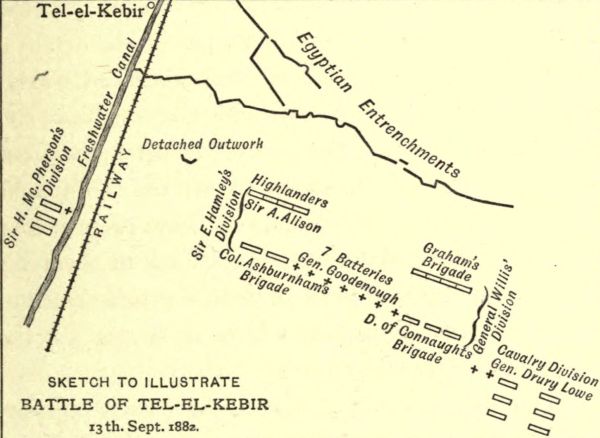
The plan of attack of the lines of Tel-el-Kebir was one requiring the
greatest care and consideration. The enemy had been for several weeks
on the spot, and had not only entrenched their position and armed
it with many guns, but the whole of the ground in their front was a
flat, sandy desert, without cover of any kind. An attack by us in open
daylight under such circumstances must inevitably have entailed a
prolonged conflict and enormous losses. By a wide flank movement we
might, no doubt, have turned their left with comparative ease, and have
captured the position without great loss, experience at Tel-el-Mahuta
and elsewhere having proved that the enemy were not prepared for, and
in fact would not stand against such a manœuvre; but, as Sir Garnet
Wolseley clearly stated in his dispatch after the battle, 'It would not
have accomplished the object I had in view—namely, to grapple with
the enemy at such close quarters that he should not be able to shake
himself free from our clutches except by a general flight of all his
army. I wished to make the battle a final one.... My desire was to
fight him decisively when he was in the open desert, before he could
take up fresh positions, more difficult of access, in the cultivated
country in his rear.' All these considerations led to the decision to
make a night march across the desert, to be followed by an assault
along the whole line of entrenchments at dawn. No doubt there was risk,
but the object to be attained was supreme, and Wolseley relied, and
with good reason, on the steadiness and courage of his troops.
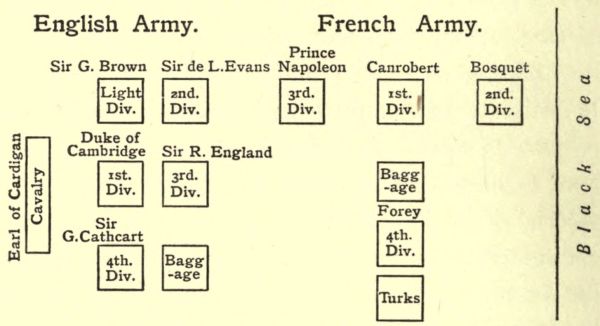
Early on the morning of September 12 (twenty-four hours before the
battle) Sir Garnet Wolseley, accompanied by all the general officers,
rode out towards Tel-el-Kebir, so as to arrive at daylight in sight of
the works, and as near as prudence would allow; and he then explained
to them his plan of attack, and gave to each a rough sketch of the
intended formation, which is shown by the diagram on preceding page.
The day preceding the battle passed quietly, and no movements of any
kind gave signs of the coming event. As soon as it was dark the whole
of the tents were struck, rolled up, and, with the baggage, stacked
alongside the railway and left behind. The strength of the army was
about 12,000 infantry, 2,700 cavalry, and 2,400 artillery, with 60 guns.
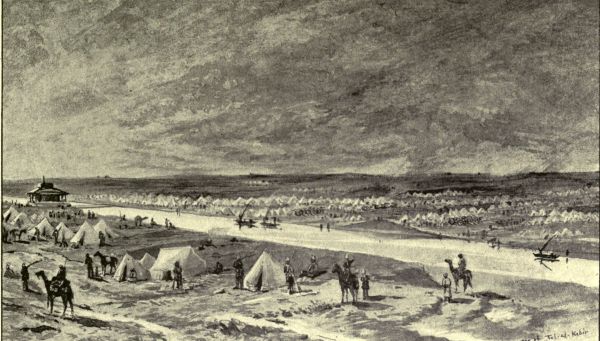
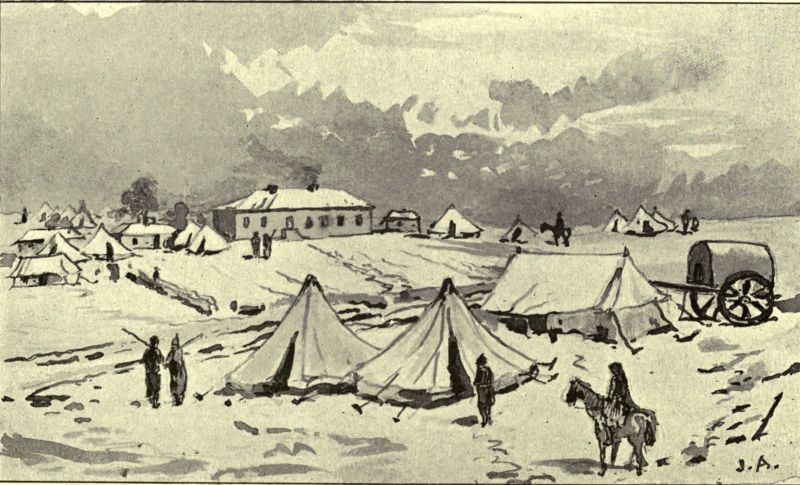
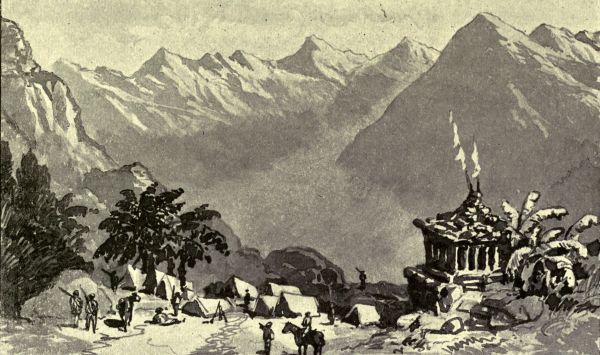
EVE OF TEL-EL-KEBIR. ENCAMPMENT OF BRITISH ARMY AT
KASSASSIN LOCK
During the early part of the night the troops moved out about
2,000 yards into the desert, and, having taken up their respective
positions, bivouacked. Perfect silence was maintained; no lights
were permitted, the men not being even allowed to smoke. Except the
occasional neighing of a horse, all was still. The general direction
of the march was west and by north; and as the night was dark with
occasional clouds, and as the stars were our only guides, Lieutenant
Rawson, the naval aide-de-camp, volunteered to accompany the Highland
brigade, and gave them the benefit of his experience in regulating
their course.[125] At half-past one in the morning the march was
resumed; Admirals Sir Beauchamp Seymour,[126] Sir Anthony Hoskins,
and several other naval officers who had done so much to assist us
in all the difficulties of disembarkation and transport, joined the
head quarter staff and accompanied us during the operations. The enemy
apparently kept no look-out, and were quite unaware of our approach.
Sir Garnet Wolseley and the staff during the latter part of the march
rode in company with the Highlanders, and when about 1,500 yards
from the entrenchments halted and dismounted, in order to watch the
development of the attack and to give such orders as circumstances
might render necessary. A battalion of the Royal Marine Artillery
under Colonel Tuson remained in reserve with head quarters. The
troops, who were now approaching the Egyptian position, moved steadily
forward over the firm, dry sand, and so complete was the silence that
it was difficult to realise the fact that two armies were close to
each other and just about to meet in dire conflict. At about 4.45
A.M. the first faint glimmerings of the dawn were observed,
and in the course of a few minutes some straggling musket shots were
heard, fired evidently by the feeble pickets of the enemy just outside
their works. Then all along the line in front of the Highlanders a
perfect blaze of musketry fire commenced, and continued for the next
half-hour without intermission. The Egyptian artillery were also in
action, but, being fired at a high elevation, their shells for the
most part burst wildly all over the desert. General Graham's brigade
on the right had slightly deviated from its course in the darkness.
This, however, was soon rectified, and as the day dawned the leading
brigades, in the most gallant and determined manner, stormed the
whole line of the enemy's works; and followed up by the Guards under
the Duke of Connaught, and by Colonel Ashburnham's brigade in rear
of the Highlanders, they swarmed over the parapets and held their
ground inside. In the meantime the seven batteries of artillery under
General Goodenough, in the centre of the line, had also continued
their advance; and although from the nature of the assault they were
unable to give active support to the infantry at the first onset,
they watched their opportunity, and as soon as our men were on the
crest of the parapets, several batteries succeeded in getting through
the works, and, by following up the Egyptians, contributed to their
defeat and flight. One battery, just before entering the entrenchments,
was brought into action against the detached outwork which I have
previously mentioned, and, taking it in reverse, led to its immediate
abandonment by the enemy.
At length came the opportunity for the cavalry and horse artillery
under General Drury Lowe. They had purposely been held back until the
infantry had established their footing on the works, but then, sweeping
round the northern extremity, they charged the retreating Egyptians,
who were now in headlong flight all over the country, and also captured
several trains and locomotives on the railway. It is necessary now to
turn to the movements of Sir Herbert McPherson, who, with the Seaforth
Highlanders and part of the Indian contingent, marched from Kassassin
during the night on the south side of the canal, supported on their
right by a naval battery of Gatlings, which moved along the railway.
Their advance was never checked, and after some smart skirmishing in
the cultivated ground near the village, and taking twelve guns, they
arrived at the bridge at Tel-el-Kebir on one side, just as our other
victorious troops had reached it on the opposite bank.
The short account I have given of the various movements in the field
during the eventful night march, and the battle at the dawn, will, I
think, afford proofs not only of the gallantry and perfect discipline
of the troops of all arms engaged, but also of the skill and care with
which the general officers in command had carried out their arduous
and anxious duties. The severe fight within the entrenchments did not
last much more than half an hour, and the Egyptians, finding their
works and guns all captured, broke and fled in thousands, throwing away
their arms, Arabi having been one of the first to make his escape.
The entrenchments inside were crowded with dead and wounded; and in
addition to 59 guns, an immense quantity of arms, ammunition, and
stores, together with the whole of their large camp, fell into our
possession. The Egyptian losses amounted to 1,500 killed and about
3,000 prisoners, large numbers of them being wounded. The losses of the
British army in killed, wounded, and missing were 459.
The victory was complete, but no time was lost in taking advantage
of the flight and utter disorganisation of the enemy. Sir Herbert
McPherson's force, strengthened by a battery of artillery, marched
at once along the line of railway to Zagazig, and, arriving during
the afternoon, captured several trains and locomotives, the Egyptian
soldiers bolting without firing a shot. The movements of the cavalry
division are graphically described in Sir Garnet Wolseley's despatch:
'Major General Lowe was ordered to push on with all possible speed to
Cairo.... These orders were ably carried out, General Lowe reaching the
great barracks of Abbassich just outside Cairo, at 4.45 P.M.
on the 14th instant. The cavalry marched 65 miles in these two days.
The garrison of about 10,000 men, summoned by Lieutenant Colonel
H. Stewart to surrender, laid down their arms, and our troops took
possession of the citadel. A message was sent to Arabi Pasha calling
upon him to surrender forthwith, which he did unconditionally. He was
accompanied by Toulba Pasha, who was also one of the leading rebels in
arms against the Khedive.'
The divisions of General McPherson and Drury Lowe having thus been
despatched to Zagazig and Cairo, the head quarter staff and remainder
of the army rested for the day on the field of Tel-el-Kebir, awaiting
the final dénouement. In fact, the result of the battle of the
13th and the flight of the Egyptian forces became known by telegraph
throughout the country in the course of a few hours, and the war came
to a sudden termination. The medical arrangements at Tel-el-Kebir
were admirably carried out. As soon as the position had been taken,
large marquees were erected close to the fresh-water canal, and our
wounded officers and men, having been attended to, were then conveyed
in covered barges to Ismailia; thus avoiding a long rough journey in
carts across the sandy desert. Late in the afternoon, I rode along the
captured entrenchments, the ground being covered with dead and wounded
Egyptians—the latter faint and helpless, and praying for water.
Parties of our men had been sent out during the day with carts of
provisions and barrels of water, and did all in their power to mitigate
the sufferings of these poor creatures. Thousands of muskets and vast
quantities of ammunition lying about were broken up, and then buried.
On the afternoon of the 14th the head quarter staff, accompanied by
the Duke of Connaught and Prince Teck, with a part of the Brigade of
Guards, left the field of battle by rail for Zagazig; but the line
was a single one and in disorder, so that we were constantly delayed,
and did not arrive till 9 o'clock P.M. Our baggage animals
were wandering about somewhere in the desert, and none of us had even
a change of clothes; and, with the exception of a tin of meat, a few
biscuits, and bottle of claret—fortunately brought by the Duke of
Connaught, who kindly shared his scanty supplies with us—we had no
food. Our troops of all arms were marching along the line of railway,
and once, when we were detained, a weary gunner passed the carriage,
and on being asked where he was going replied, 'To Zig-zag.' Two
other gunners had captured a dromedary, and were riding along in high
spirits. The inhabitants of the villages as we passed through the
cultivated country came out and salaamed, and seemed quite happy.
They had stuck poles with white rags flying on the tops of their
houses in token of surrender. Altogether it was an interesting and
amusing scene. I slept that night on the railway platform at Zagazig,
surrounded by myriads of flies. However, these were the last of our
hardships, if such they can be called; and on the following morning
we arrived by train at Cairo, and were cordially received; in fact,
the whole population had turned out in the streets to give us welcome.
Every English soldier walking about was followed by an admiring crowd.
The Khedive, telegraphing from Alexandria, placed the Abdin Palace
at the disposal of the staff and begged us to consider ourselves as
his guests. From a small tent in the desert to a royal palace in two
days—with a battle in the interval—was certainly an unusual but
welcome change of scene. There was, however, one drawback. Although the
Abdin Palace contained suites of handsome state apartments, gorgeous in
satin and gold, there were no bed-rooms! Whether rulers in Egypt never
sleep, or whatever the explanation, we had to make the best of it,
and I took possession of one large state room; but my little camp-bed
looked very shabby and insignificant amidst such splendid surroundings.
There were upwards of 100 wax candles in glass chandeliers hanging from
the ceiling.
As several thousand Egyptian soldiers were still in arms on our arrival
at Cairo, many of them in a large barrack just opposite the palace, an
order was sent over that they were to give up their muskets and were
then free to return to their homes. Hardly had the order been received
than it was acted on, and crowds of them, divested of their uniforms,
were seen running as if for their lives, and in a few minutes the
barrack was deserted. I inquired the reason of their extreme haste, and
was informed that the news was so good they could hardly believe it to
be true, and were afraid we might change our minds and detain them. The
incident I have mentioned affords a good indication of the real feeling
of the inhabitants, who were not anxious to fight anybody, but rather
to be allowed to return and live in peace in their native villages.
Egypt is probably not the only country in which these sentiments
largely prevail, but do not always find expression.
In the prison within the citadel we found a large number of people in
chains; criminals, political prisoners, even Arab women and children,
and two English subjects (Maltese) all jumbled together, ill-treated,
and nearly starved. Separating the real criminals, after inquiry, the
remainder were set free, and by way of a change the jailor was placed
in one of the cells.
In some small rooms in a corner of the great barrack, in Abdin Square,
Arabi and Toulba Pashas were confined as prisoners, with an English
guard over them. As there were several passages and staircases about
the place, with Arab servants and others constantly going to and fro,
and as, to an English sentry, one native is very like another, there
seemed a possibility of Arabi's attempting to escape. So, under pretext
of calling to inquire as to his health (for he had been unwell), I paid
him a visit, with an interpreter, in order to inspect the premises.
Arabi came up and shook hands, and, on my asking if he were better, he
replied that now I had come to see him he was quite well—which was
encouraging. Then he went on to say that the English were famous for
their love of freedom, of liberty, and of justice, and that, relying
on our honour, he had surrendered unconditionally. He seemed inclined
to enter into a discussion, so I replied that no doubt his case would
receive careful consideration and justice from the British Government.
He did not strike me as a man of much education or intelligence.
Subsequently, Colonel Thynne, Grenadier Guards, was specially
appointed to take charge of him.[127]
Although during the short period of active operations our troops had
enjoyed excellent health, notwithstanding the heat and the occasional
hardships they had undergone, soon after their arrival at Cairo
considerable numbers were struck down by fever and dysentery; probably
attributable to the bad water in the canal at Kassassin, and partly
to the insanitary condition of Cairo itself. Acting on advice, large
numbers of the sick were conveyed by rail to Alexandria, embarked for
home, and speedily recovered at sea.
Without wishing to exaggerate the events of the campaign, I think
it will be admitted that the difficult arrangements connected with
the embarkation of our troops were carefully carried out; and that
the expedition was conducted with great promptitude and success.
These results testify to the efficiency of the naval and military
administration at home, and also to the courage and discipline of the
two services under somewhat trying circumstances. From a financial
point of view, the rapidity of the operations enabled us on arrival at
Cairo at once largely to reduce expenditure, by cancelling contracts
for food, forage, transport animals, and stores at various ports in
the Mediterranean. So sudden, indeed, was the transition from war to
peace, and so completely had the insurrection collapsed, that in the
course of a few weeks a large proportion of our forces were withdrawn
from the country and returned to England. The campaign being at an end,
I left Egypt early in October in order to resume my duties as Surveyor
General in the War Office; but before embarking had a farewell audience
with the Khedive, Ibrahim Tew-fik. I had had interviews with him on
one or two occasions previously. He was quiet and friendly in manner,
and apparently of a gentle disposition; was cordial in his recognition
of the good services rendered to him by the British forces. I said I
hoped that the conduct of our men since their arrival at Cairo had been
satisfactory, and he at once expressed his admiration of their good
discipline, and remarked that in every respect, whether in the streets
or in the bazaars, their conduct had been most orderly. What vexed
him was that some of his people in the bazaars cheated our men, and
demanded extravagant prices for their goods. I assured him, however,
that he need not worry himself on that point, as the English soldiers
would readily discover the market value, and matters would soon find
their level; and that they enjoyed their visit to Cairo.
Statements were current at the time that the Khedive was not really
loyal to England. On this being brought to his notice, it is said, and
I believe truly, that he observed: "Not loyal to the English? When my
country was in insurrection and my authority and life in danger, there
was only one power in Europe which would move a finger to help me—and
that was England. If I am not faithful to them it would be strange
indeed!"