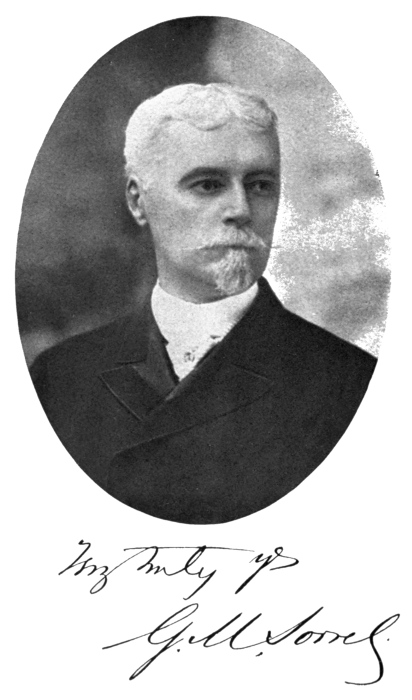
Longstreet's Return—Farewell to Lee
Return of Longstreet—Am promoted brigadier-general—Parting
with the First Corps—Report to A. P. Hill and Mahone—Sketches—Assume
command of brigade of Georgians—Its
staff—Drill and exercises—Laying out a camp—General
Lee's encouragement—Want of field officers—Captain
H. H. Perry—Mahone's bread ovens—Christmas, 1864—Sherman's
march in Georgia—Grant's Virginia strategy—Our
division moves out in bitter cold—Demonstration on our
extreme right against the railroad—Brigade forms line—No
close firing—Enemy rejoins his main command—Received
a slight wound—The return to camp—Its bad condition
in our absence—Valuable boots burnt in bivouac—In
February again ordered out to right—Serious collision with
enemy in force at Hatcher's Run—General Pegram killed—Am
shot in lung and borne from the field—Moved to Richmond
and thence to Colonel Watts's, in southwest Virginia
for convalescence—My recovery—Marriage of Doctor
Sorrel—At Lynchburg—Hear of Lee's surrender—Take
to the mountains—Again at Colonel Watts's—Hunter and
Crook—Homeward bound—Lady Godiva—Farewell to
Lee and the Army of Northern Virginia.
It was in October, our corps (two divisions) being
on the north side, that we had the happiness of welcoming
our chief back to his command.
His right arm was quite paralyzed and useless.
He had taught himself to write legibly and easily
with his left. Following the advice of his doctor, he
was forever pulling at the disabled arm to bring back
its life and action. He succeeded, for, though never
strong, its use was partially restored in later years
and his pen went back to it.
I was with him but a few days. My commission
as brigadier-general came unexpectedly, a note from
my friend Burton Harrison, the President's Secretary,
to the effect that it had been signed, reaching
me the evening before. This was the first inkling I
had of the promotion. Elsewhere it has been told
how it came about, and I began preparing to move,
my orders being to report to Lieut.-Gen. A. P. Hill
for command in Mahone's division. Hill's corps was
on the south side in front of Petersburg. Lieut.-Col.
O. Latrobe succeeded me as A. A. G. and chief of
staff; an excellent assignment. A brigadier going to
an organized command carries no staff with him.
That is attached to the brigade, not to the general.
He has one appointment, that of A. D. C. (captain's
rank), personal to himself. There were many applications
for the place, but sending for Spencer, private,
Fort Alabama, my sergeant of couriers for several
years, I almost floored the modest fellow by asking
if he should like to go with me as captain. "Of
course" he should, and did, and was part and parcel
of that brigade of Georgians in no time until Appomattox
dispersed us. I had made no mistake in
him; an exceedingly useful staff officer.
Few can know how painful it was to part with
my corps and its chief. I had started with them at
the opening battle, handled its growing battalions into
brigades and divisions, and shared its battles, expeditions,
and campaigns; was proud of its renown; was
known to officers and men of every regiment and had,
I believe, their confidence and respect. It was much
to give up, but the duty called, and on a fine morning
I mounted with my A. D. C. to cross the river and
take up my new billet. I shall be excused, I hope, if
a little homesickness is confessed.
My comrades did not let me go easily. The night
before there was a farewell party of many officers at
headquarters. A goodly quantity of apple-toddy was
consumed, but not to hurt, and the party, General
Longstreet with us for a time, was full of feeling,
touching me keenly by its spontaneous demonstration.
Here ended the staff officer's duties, but his recollections
will yet carry him a little way forward while
commanding his brigade. The end was fast approaching,
and my concluding jottings seem to belong to
what has gone before.
Turning my back, then, for the first time on the
glorious old First Army Corps, I reported next day
at A. P. Hill's quarters. Nothing could exceed his
kindness in receiving me; it continued all through my
service in his corps and I had every evidence of the
good feeling of this distinguished officer. I was to
report next to General Mahone for command of his
Georgia brigade. This remarkable man was at breakfast
when I entered and immediately had me seated
with him.
Maj.-Gen. William Mahone was a Virginian, about
forty years of age. His appearance arrested attention.
Very small both in height and frame, he seemed
a mere atom with little flesh. His wife said "none."
When he was shot (slightly) she was told it was only
a flesh wound. "Now I know it is serious," said the
good lady, "for William has no flesh whatever." Sallow
of feature, sharp of eye, and very active in movement
was the General; in dress quite unconventional,
he affected jackets rather than coats, and on a certain
hot summer's day that I recall he was seen, a major-general
indeed, but wonderfully accoutered! A plaited
brown linen jacket, buttoned to trousers, of same material,
like a boy's; topped off by a large Panama
straw hat of the finest and most beautiful texture, met
our eyes, and I must say he looked decidedly comfortable.
But not always was he thus attired. He
could be strictly uniformed when he chose.
He had been president of the railroad between
Petersburg and Norfolk, and retaining the office, managed
the road all through the campaigns. Finally the
enemy captured his wagon-load of railroad papers,
records, etc., and Mahone was raging. It was that
railway, when hostilities ended, that he combined with
others connecting and gained a start into the political
power and mischief he exercised in Virginia. His
brigade of Virginians had not seen much hard fighting
until the Wilderness, and there they did well. It
was at Petersburg, in command of his division of five
brigades from Virginia, Georgia, Alabama, Mississippi,
and Florida that he justly won great reputation for
brilliant achievements in defense of the beleaguered
city. He was undoubtedly a general of very uncommon
ability.
While we sat, I enjoyed his breakfast. A high
liver, nothing could excel it, and he was never without
the materials. A cow was always by his quarters
and laying hens cackled loud, besides many luxuries.
Delicate in physique, he had to nourish himself
carefully.
I received his orders to take command of my
Georgians, and mounted on my way to them. Mahone
was said to be irritable and in some instances
tyrannical, but for myself I had invariably nothing
but consideration, and often good help from him.
The brigade was in trenches far on the right, not
in very close touch with the enemy, and was having
a quiet time of it with Col. William Gibson in command.
He was well known in Georgia politics for
some years, and a very brave officer; repeatedly
wounded, but without discipline or organization.
Leave of absence was allowed him to return to Georgia.
On assuming command, Captain Evans, a line officer
detailed as A. A. G., supposing that I was bringing
an officer of the staff department with me, suggested
that probably I should wish him to rejoin his regiment.
But I wanted him with me. He had long filled
the post, was acquainted with almost every officer
and man of the brigade, and was a brave and qualified
officer. The command consisted of the Second,
Twenty-second, Forty-eighth, and Sixty-fourth regiments
and Second and Tenth battalions, Georgia Infantry.
The Sixty-fourth regiment and Tenth battalion
were late levies and had not made the great
reputation of the others, while serving under Wright
and Girardy. The latter was a most promising officer
promoted from captain in the brigade, and was killed at
the head of it two weeks after taking command.
The Third Georgia enjoyed a reputation excelled
by none in the army.
My first thought was to get supplies of clothing
and shoes for the men and have the command relieved
from trench duty, to which it was entitled by
the length of service in them. Our work strengthening
the defenses always went on, and there was no
time for much-needed drill and military exercise.
General Lee, taking his daily ride about the lines,
came on me while the working parties were digging
and spading. His greeting was, "Good-morning, my
young friend; I feel sorry for you." "Why so, General?"
"Because you have so much to do," answered
the commander, the gleaming white teeth showing his
pleasant humor as he continued his ride. He generally
had some such words to let one know he expected
a lot of work out of him.
I was not unsuccessful as to my wants. A fair
quantity of supplies were issued and orders came for
relief from the trenches and to pitch good winter camps
a little in the rear. It was great joy to the troops.
A good piece of woods was selected and a fine
camp of winter huts laid out and built according to
regulations, with battalion fronts and company streets
and all the rest in good soldiery form. Once settled,
drill became the order of the day in good weather.
There were fine open fields near by furnishing good
ground, and company drill, battalion drill, and evolutions
of the line by the brigade were followed up
vigorously, as well as all military exercises and street
duties practised and perfected. The men were in
much need of the instruction. Decided neglect in
these respects had fallen on this fine brigade after the
stern and gallant Wright left it, and the good effects
of the efforts now working out were soon apparent.
The greatest want was in field officers; so many
had been wounded and left with the enemy at Gettysburg,
besides others sick at home or in the hospital,
that the regiments suffered thereby.
I wrote urgently and personally to Mr. Ould, our
commissioner for exchange, to get back to me certain
officers whom I wanted badly. He managed to
get only one, Colonel Snead, of the Third Georgia, and
him I was glad to have.
The brigade was well equipped with staff officers of
the subsistence, quartermaster, ordnance, and medical
departments. The commissary, Major Hughes, an excellent
fellow, was the same who had sold me those
two sorry mounts that broke down in the Chickamauga
Campaign. On reporting, he evidently thought I
might recall him unfavorably and was a bit uneasy,
until shown that no ill feelings were harbored against
him. In horse dealing it is "caveat emptor"—the
buyer must look sharply to himself.
It was not long before Capt. H. H. Perry, of the
Adjutant-General's Department, was transferred from
Benning's brigade to report to me as A. A. G. There
being two of that department with Benning and none
with me, Perry was summarily transferred without
any question. He had always performed inspection
duty, and preferring it, was assigned to that branch
of his department in my brigade, thus retaining Evans
as A. A. G. "Old Rock" (General Benning) always
believed I was at the bottom of the whole business and
never forgave me.
I was surely fortunate in securing so excellent a
staff officer. Highly educated, experienced with
troops, active and resourceful, he soon became prominent
and strong in the brigade as well as attached
to his brigadier. He is still with the living in Georgia,
numbered among my dear friends.
At times the soldier's ration was execrable, really
unfit. Some bacon from Nassau was coming through
the blockade, and it would not be incredible for the
blockading fleet to allow it to come through in hope
of poisoning us. A third of a pound of this stuff
and some corn-meal was often the full extent of the
daily ration.
Sometimes we got better allowances of wheat flour,
and then General Mahone took a notion to improve on
it by baking. The brigade commissaries were ordered
to set up ovens—plenty of bricks and material lying
about—and issue the flour baked in good loaves.
There is, too, a slight gain in weight in baking. But
the men would none of such food, it was too light and
wholesome. Their stomachs wanted the flour stirred
with grease in a skillet and cooked solid and hard.
When a chunk was eaten it stayed with the soldier
and kept his appetite partly appeased. But these new-fangled
loaves—so easily digested! Hunger came
again, almost before finishing one of them. Not for
Johnny Reb was this thing; he wanted, like Tommy
Atkins, "some bulk in his inside," and one fine morning
Mahone's ovens were found completely demolished.
The soldiers took again to their old-time toothsome
and staying morsels out of the skillet.
Christmas of 1864 was now at hand. The birth of
the Prince of Peace was given such honor amid the
warlike scenes of the siege as our small resources
permitted. Some boxes came from loving hearts at
home, the commissaries did all they could, and the
Army of Northern Virginia actually feasted, trying
to forget for an hour or two the perils and hardships
that beset it.
At Christmas General Sherman was in Savannah,
his march to the sea a complete success. My people
at home suffered no great annoyance. Sherman as a
young lieutenant had shared my father's hospitality
and had not forgotten it. The old gentleman, however,
persistently fastened on him the crime of burning
his comfortable country establishment in Virginia.
Sherman's march and other movements in the West
were in Grant's strategic combination for the destruction
of Lee's army and should be considered in estimating
his abilities outside of operating in Virginia.
Indeed, it might be said that Sherman contributed
to the fall of Richmond almost as much as did the
Army of the Potomac.
Early in January it came on to be very cold, and
during the worst of it our division was ordered out
to meet a threatening demonstration against our right
at a considerable distance. My brigade marched instantly,
our camp being occupied by Gen. C. A. Evans's
Georgia Brigade to fill our position on the line. Evans
was in luck to get his men into such well-prepared
camps. We moved rapidly and in two days came up
with a large force of the enemy, formed in line and
prepared for battle. It appears, however, that he was
not ready this time, or that he overestimated the Confederate
strength sent against him. Some shelling
was indulged in and small-arm long-distance firing.
It seems that but two or three of us were touched,
among them myself. I was sitting on the white mare
(my other mount gone suddenly lame) in front of the
line, with no thought of firing then, so distant was
the enemy,—quite out of range,—when a long-range
rifle sent a bullet through many folds of thick clothing
and striking on the hip bone knocked me out of the
saddle. It proved to be nothing serious. The ball
had glanced off, stiffening and bruising the leg rather
painfully, so that remounting after some bandaging,
it stuck out like a wooden leg. I did not think that
just such a hit could unhorse me.
My men said the brigade was unlucky for its commanders.
General Wright had been repeatedly and
dangerously wounded; several colonels commanding,
wounded or killed, and General Girardy killed. I began
to think there might be something in it. The
enemy took up the march, and leisurely rejoining their
main body to the right, Mahone's division began moving
for the camps just vacated. It continued very
cold, much ice and snow lying about the roads. At
our last bivouac some miles from camp I suffered a
loss, nothing less than a noble pair of riding-boots,
a present, kept for extra work.
At the bivouac the negro servant had taken them
out of the blanket roll and failed to replace them.
As soon as they were missed, back he went and returned
with the precious leathers burned to a crisp!
Our campfires had spread through the forest. At this
period boots cost five or six hundred dollars of our
currency, if to be had at any price.
On starting back I sent word to General Evans of
our approach so that my camps could be vacated in
good order. The men were utterly disgusted and
indignant when they re-entered their quarters. They
were little like the well-kept camps they had temporarily
vacated. Evans's officers had not properly restrained
the careless, reckless soldiers. I made vigorous
complaint at headquarters, but at this date there
was perhaps too much else to think of. General
Evans is now chief of the veterans in Georgia and
held in great respect by their dwindling numbers.
Mahone's other brigades were efficiently commanded
by Finnegan, Florida; Harris, Mississippi; Weisiger,
Virginia; Sanders, Alabama.
In the first days of February another demonstration
was made against Lee's extreme right, this time in
great force and meaning business. Our division and
other troops with cavalry at once pushed out to meet
it, with Finnegan in command of division (Mahone
was absent, sick). The collision came at Hatcher's
Run by some preliminary skirmishing on February
5th, a sanguinary action on the 6th, followed up by
the enemy feebly on the 7th. On the 6th, my
Georgians were hotly engaged in the afternoon and
made a handsome, successful charge, which dislodged
and forced back the Federals. The contest went on
until darkness stopped it, and the night passed entrenching
where we stood, caring for wounded and
burying dead.
Early next morning the enemy, driving back my
pickets, got too close to us, and a rifleman put a bullet
through my right lung, smashing the ribs front and
rear. I was down this time for good, I supposed, the
breath gushing through the orifices instead of its natural
channel. The surgeon, Dr. Wood, however, soon
relieved that by plastering the holes, and sent me back
that night. The roads being frozen and very rough,
my brave fellows made two relief gangs and bore
their commander by litter on their shoulders eight
miles to a small shanty, where rest was taken.
All through the night, while passing stray troops
on the road, I could hear the question, "Who have
you there?" "General Sorrel." "Is he badly hurt?"
"Yes, mortally wounded." The soldier habitually
takes a gloomy view of things.
Very soon I was in comfortable quarters near
Petersburg, in the hands of my excellent brigade surgeon,
Dr. Sampson Pope, and progressed so well that
in a fortnight I could be moved to Doctor Sorrel's
quarters in Richmond, under treatment of my friend
Dr. J. B. Reid, and with that ended the staff officer's
soldiering. A few closing words will bring me to the
end of these "Recollections" nearly forty years behind
us.
My wound healing satisfactorily, Doctor Sorrel proposed
in March taking me to "The Oaklands," the
beautiful estate in Roanoke County of Colonel Wm.
Watts, who had kindly sent me an invitation to visit
him. He was the invalided colonel of the Twenty-eighth
Virginia, of the First Corps, a fine officer and
most hospitable, the leading man of the county. To
him we went, the change being very beneficial. Then
the railroad station was Big Lick, a post-office, shop,
and tavern. It is now grown to be Roanoke, a prosperous
city of 25,000. Colonel Watts's widowed
sister, Mrs. Rives, presided over the delightful old
Virginia establishment. Her lovely character won all
hearts. The stately figure and attractive features
were known and admired widely over the countryside.
To me she was kindness itself, and no marvel is it that
I mended rapidly.
There was an engagement of a few months' standing
between Doctor Sorrel and Mrs. Rives, and soon
after our coming the uncertain future was considered.
They decided to wed without longer waiting,
and the ceremony, quite private, was performed at
the residence, myself in full uniform as the Doctor's
best man, propped on my feet by the dignified, silver-haired
black major-domo.
While in this part of the country I heard much
about Hunter's expedition into it the previous year
and the devastation he had brought in the region
round about. Truly Maj.-Gen. David Hunter, of the
United States Army, was a torch bearer if nothing
else. He had no military distinction, but had served
against the Indians, it is said, with the same cruelties
it was now his delight to apply to non-combatant dwellers
in southwest Virginia and the head of the Shenandoah
Valley. No property within reach of his destroying
hand seemed safe from him. His fame lay
not in the soldier's hard-fought battles, but in burning
farmers' houses and barns. The extensive schools at
Lexington aroused his hate and were laid in ashes by
his torch.
General Crook, the fine soldier then serving with
him, said, "He would have burned the Natural Bridge
could he have compassed it." Marvel it is that Hunter
did not blow it up. He was, however, beaten off by
Early's forces and the home guards, and the country
cleared of that devastator. There was little more
heard of him as a soldier.
Maj.-Gen. George Crook was altogether a different
character. He was a soldier of high training and
tried courage, making no war on women and children,
houses and barns.
Some time later, one of our daring rangers, NcNeil,
with a small following, achieved a bold exploit.
While Crook was commanding a department at Cumberland,
Md., the ranger penetrated many miles within
the blue lines, took the General out of bed, mounted
him well, and landed his distinguished prisoner safely
in Richmond.
There Doctor Sorrel, who had served with him in
the old Army, called to see to his comforts. Crook
as a thorough-going Indian fighter was not without
some admiration for the way NcNeil had gathered him
in. "But, Sorrel," said he, "I shall get even with
that fellow at his own work. Just as soon as I get
out of this my commission will drop for a few weeks,
while I raise a hundred men with whom I undertake
to beat Master NcNeil at his own game."
Such was perhaps his intention then, but, exchanged
soon after, there was other and more important work
awaiting this gallant and respected officer.
Early in April, after grateful farewells to my host
and new sister, we started to rejoin the army. At
Lynchburg came to us the accounts of the surrender
at Appomattox, with all the pathetic, harrowing details
attaching to that event; the feeling of the soldiers,
their overflowing affection for Lee and sympathy with
him and his own hidden but overwhelming grief—I
pass them by. My brigade was on hand in good
shape, with Captain Perry looking after it, and paroled
stronger than any brigade in the army. (See Appendix.)
The commandant at Lynchburg, General Lomax,
placed at my disposal an ambulance and mules to get
out of reach of the Union forces. We could not yet
realize that the war was ended with the life of Lee's
army. I took to the mountains for some days, and
then finding things really ended and my troublesome
wound breaking out afresh, ventured again on Colonel
Watts's hospitality. It was as generous as the
day. But it was time to move, and after farewell to
hospitable Oaklands the Doctor and I started on our
return home. The rails were sufficiently repaired to
take up to Lynchburg, where we were paroled by the
United States officer. Between us we had just fifteen
dollars good money, and it came to me in this way.
When I was last in Lynchburg, as already described,
one of our quartermasters pressed on me $20 in gold,
four half-eagles; "A barrel of Confederate money not
good," as he said, "for the price of a dinner."
Some time after I came up with a young Maryland
cavalryman making his way back to Baltimore. He
had no coat or jacket, although the rest of him was
good, and I wanted to know why. "Well," said
young Latrobe (it was my friend's brother), "my
horse wanted a set of shoes. The farrier would not
look at my money, but took the jacket, and I got my
shoes." It was quite certain the young fellow would
part with his remaining outfit, piece by piece, with the
same easy nonchalance, if need be, and I insisted on
his taking one of my half-eagles. But for that the
"Peeping Toms" of Baltimore might possibly have
seen a new Godiva, "clothed only with chastity," riding
through their streets fresh from the Southern
armies. Their blushes and the young cavalryman's
were saved by that golden half-eagle.
From Lynchburg to Richmond the route was
tedious and wearying. It was partly by rail, partly
in an army wagon, and partly on foot. On arriving
at the Confederate capital we were amid the ruins
of the great fire that nearly destroyed it. The army
of occupation was in force, everywhere the Union
army filled one with wonder. It was like the ant in
numbers, and I really could not take in its unstinted
equipment in wagons, ambulances, mules, draught
horses, light artillery, and horse furniture, all apparently
new and of the best class for field work. The
contrast with our own inadequate equipment was very
decided, and still greater was the splendor of their
officers, mounts and uniforms, and the good clothing
of the soldiers, with what on our part had contented
us. In Richmond, nursing our dwindling cash, we
found a frugal but cheerful hospitality while preparing
for the next move to Baltimore, where we were
sure of meeting my good father's provision for us.
My weak condition would not permit me making the
journey home on horse-back; it must be by sea.
At Richmond we took the oath, as prescribed, to
the United States Government, the courteous Federal
officer asking pleasantly if it "tasted bad?" This
done we hoped to get a permit to leave by boat for
Baltimore, but were refused. No movements of Confederate
officers, except Marylanders returning, were
suffered in that direction. The decision was then
forced on us that we must go, "coûte que coûte."
It was managed successfully with some little risk.
By the help of friends we were smuggled on board
just as the boat was starting. The Doctor was in
mufti and I had doffed as much military attire as I
could. We kept very quiet and secluded on the main
deck of the boat as she glided down the river of so
many warlike scenes of the preceding years! past
frowning Drewry's Bluff, past bristling Chappin's
farm, City Point, Westover, and Harrison's Landing,
Turkey Bend and Butler's Dutch Gap Canal—all
saddening and depressing in the retrospect, crossing
thoughts of the misty future. At the fortress a short
stop was made, and then the voyage up the noble
Chesapeake resumed. One of the coal passers here
recognized me with a wide, astonished grin. He was
one of my brigade fellows, in now for a job at anything.
The night was passed on the bay and could
have been very comfortable with a trifle more cash.
We had, however, just about enough to pay for
passage, without bed or meals. So we stood out the
long night and could provide some small refreshments.
When morning came we were moored to the wharf,
and I soon found my good Baltimore relatives most
hospitably inclined, and our troubles for the time were
done with.
There were many Confederate officers and soldiers
about the city, all watched quite closely by the Federal
authorities. General Hancock was in command of
the department, and from his adjutant-general I received
an order to report in person. Upon so doing
I was questioned as to my reasons for being in Baltimore
and my intentions. Upon explaining why I was
returning home by that route and that I should have
to go to New York to find a steamer for Savannah,
he was civil and obliging; allowed a stay of a week
in Baltimore; but I was required to report once in
every twenty-four hours. The next day this considerate
officer dispensed with such visits, adding, "You
shall not, General, be troubled in any way while you
are stopping here." Here Doctor Sorrel left me.
Deciding to defer his visit home, he returned at once
to Virginia. A few days later I was in New York
at the New York Hotel, Mr. Cranston the proprietor,
and for years past, as then, the resort of everything
Southern. There were many officers in the hotel,
some I suspect by Cranston's good nature and kindness.
After a visit to some relatives and friends, who
had only thought of me as one dead, I took passage
for Savannah on a small, crowded, most uncomfortable
little steamer. The rough voyage was safely made,
and I landed on my own shores in dear old Georgia,
greeted by kindred and friends, with hands outstretched
in a hearty welcome home.
And now these recollections approach their close.
There are many more thronging, pulsing memories
that could interest, perhaps instruct. What is here
gathered has been an inexpressible comfort and occupation
in the colorless hours of recent tedious convalescence,
and could be extended, but the parting
word must be spoken.
It is farewell to the Army of Northern Virginia and
its ever-glorious commander.
His name, his fame shall forever live! His sword,
unstained, be ever a soldier's shining light and bright
example!
"Ah Muse! You dare not claim
A nobler man than he,
Nor nobler man hath less of blame
Nor blameless man hath purer name,
Nor purer name hath grander fame,
Nor fame, another Lee!"
His army incomparable holds, after long years, the
abiding love of its surviving veterans. Who that
marched with it, fought with it, took part in its victories
and its defeats, shared its sufferings and its
joys, shall ever be deaf when its deeds are sung or
mute when ring out its plaudits!
For my part, when the time comes to cross the
river like the others, I shall be found asking at the
gates above, "Where is the Army of Northern Virginia?
For there I make my camp."