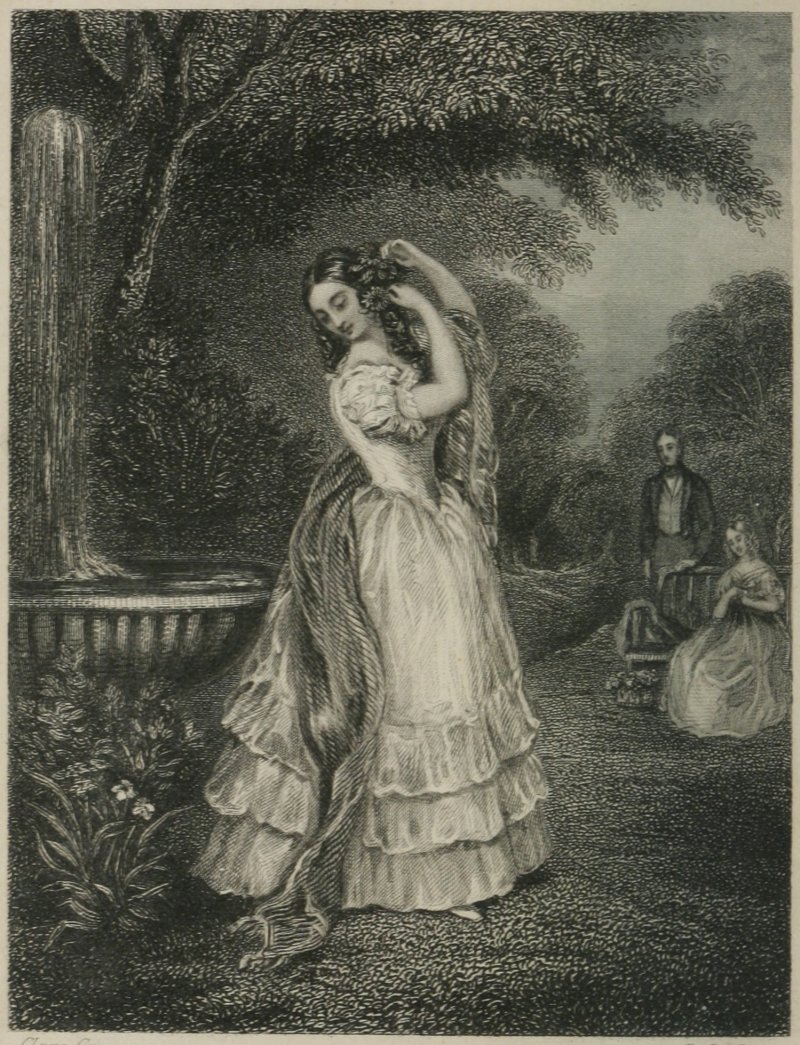
Calantha.—Away, away, call not such passion love!
A man so loves his horse, his hound, his hawk,
For that these things to’s pleasure minister;
He’s proud to boast such peerless beauty his—
Does gloat upon it—would have others gaze,
And pine with envy. What’s this but self-love?
Now mark, Antenor! He who loves indeed,
With his whole soul! His study but to honour
His lady’s name an hundred thousand ways!
His sole joy, her contentment; and sole sorrow,
Her disquiet. He with true devotion
Approaches her, as something pure and holy,
His bright incentive to high deeds. The beacon
To light his path to virtue and to fame!
Ten amor el arco quedo.
Que soy niña y tengo miedo.—Spanish Romance.
In a small but neat drawing-room, in the principal town of
——shire, Captain Wareham and his family were assembled
at breakfast. Captain Wareham himself was sitting with the
newspaper in his hand, his back half turned to the breakfast-table,
and his feet resting on the fender; Caroline, his eldest
daughter, was presiding over the tea-pot; Ellen, the second,
was patiently waiting till the tea had brewed; the two elder
boys were kicking at each other’s legs under the table; the
youngest daughter was strumming away at a most unmusical
piano-forte; and the youngest boy was amusing himself by
adorning the slate, on which he was supposed to be doing a
sum, with specimens of the graphic art, in the shape of
helmeted knights and galloping war-horses.
“Caroline,” said Captain Wareham, “do not give me
water bewitched, by way of tea, this morning, I entreat!”
“I hope it will be good, papa: the water does boil
to-day.”
Captain Wareham took his tea, and having added the
cream and sugar, tasted it.
“Caroline, you have let the tea stand too long! You know
I hate it when it gets that rough disagreeable taste.”
“Shall I put in a little water, papa? It is very easy to
make it weaker.”
“No! there is no use in doing that. If the tea is once
too strong, you cannot make it right by adding water. Give
me the toast.”
Ellen handed him the toast.
“It is all cold and tough. I cannot eat it!”
“It has been here so long, dear papa; but you were so
busy with the newspaper, I did not like to interrupt you.”
“You know I hate cold toast!”
“Shall I ring, and ask for some more?”
“Ask for more! I never can teach any of my children
that people who are poor must conform to their means. One
would think I was made of gold, to hear the wasteful manner
in which you talk!”
“Shall I toast it afresh, papa?” interrupted Ellen; “that
will make it almost as good as ever again.”
“No, no! be quiet, child. How you pester me! Do you
not see I am reading the newspaper? There is no possibility
of understanding a word one reads, you all keep up such a
clatter!”
George, who all this time had continued his attempts to
reach Henry’s feet, as they sat at opposite ends of the table,
at length gave it a tremendous shake.
“Do be quiet, boys!” exclaimed Captain Wareham, in a
voice of thunder; “and do stop that eternal strumming at
the piano-forte—give one some peace, Matilda!”
Matilda, delighted to be released, jumped up from her
half-finished tune, and ran to assist James in his labours at
the slate.
“Caroline, why do you set Matilda to practise just at
breakfast-time?”
“Why, papa, you said Miss Patterson was to come at ten
o’clock for the future; and you said Matilda should practise
an hour before she came; so I did not very well know how
to help it.”
“Nonsense! You always contrive to do the disagreeable
thing.”
He turned round, and was again absorbed in the important
intelligence contained in the newspaper; for at that time
Buonaparte had just returned from Egypt, and the proceedings
in France were watched by all Europe with intense
anxiety and interest. The second dish of tea remained by
his side untasted.
After about a quarter of an hour he turned angrily to
Caroline, saying—
“Why on earth do you not send away the breakfast things?
Nothing shortens the day so much as letting the breakfast
remain late upon the table—this is another thing I can never
teach you!”
“I thought you might wish to drink your tea, papa,”
answered Caroline, timidly.
“I do not want any more; it is so horribly bad!” he
replied. “And now, I suppose, we must have the weekly
bills, and I must give you some money!”
Caroline’s spirit sank within her. The first Monday in
every month was to her a weary day; and she anticipated
that this would indeed be black Monday, as papa did not
seem to be quite well.
The apparatus for the morning repast was removed. Caroline
brought the household book and the bills, and presented
them one by one to her father, who was horrified at the
amount of each.
“Why, here is beef again!—there is no occasion to feed
the whole family on beef! If the servants have their beef on
Sunday, surely that is enough. You know, Caroline, I can
scarcely afford to live as I do, and yet it seems you become
every day more expensive in your housekeeping.”
“I am very sorry, papa, but you told me to have some
luncheon in case the Jenkinsons called last Wednesday; and
you have often said you hated cold mutton, and that it was
painful to you that any one should imagine you were inhospitable;
and I thought it did not make much difference,
and there would be the cold beef, which always looks
handsome.”
“So, I suppose you mean to imply it is my fault that the
bills are high. I am sure no man can spend less upon himself
than I do! I wish you would tell me where to get the
money, that is all!”
The entrance of Miss Patterson, a prim, middle-aged lady,
who came for a few hours every day to superintend Matilda’s
education, put an end to the discussion. Captain Wareham
paid the money without another word, took his hat and stick,
and sallied forth to avoid the infliction of Miss Patterson, the
music, &c.
Captain Wareham was a half-pay officer, with a broken
constitution, and a very limited income. He had taken up
his abode in the county town, that his eldest daughter might
have the advantage of going to the winter balls; his second,
that of receiving some finishing lessons in singing from the
organist of the cathedral; his third, that of having a day-governess;
and his youngest boy that of attending an excellent
school, as a day scholar.
He was a dignified-looking man, very tall and thin, with a
high pale forehead, light eyes and hair, and there was altogether
something melancholy and gentlemanly in his appearance.
His connections were good, his conduct irreproachable,
and he maintained an uncomplaining reserve upon the subject
of his pecuniary embarrassments, which gained him the respect
and consideration of the surrounding squirearchy.
Whether his difficulties on the score of money might not be
the true cause of the captious temper which rendered his
home any thing but a happy one, either to himself or to his
family, is another question. In society he was courteous and
polished, his daughters were gentle and dutiful, and although
among the gossip of a country town an unauthenticated rumour
now and then prevailed that Captain Wareham was a tyrant
at home, he upon the whole bore the character of an
exemplary man.
Mrs. Wareham had died just as her eldest daughter had
attained the age of womanhood, and upon her death the care
of the younger children devolved upon Caroline. Caroline
was by nature indolent and sweet-tempered. It was to her a
most wearisome duty to inspect the bills, and to see that the
lessons were prepared by the time the day governess arrived.
She was pretty, and her very indolence gave her something
fashionable in manner,—at least, it prevented any thing
approaching a bustling fussiness, which is in itself essentially
vulgar. She was much admired by the beaux of the neighbourhood,
though there is a vast difference between admiring
and proposing to a pretty pennyless girl.
As she considered marriage the one and only means of
escaping from a home and mode of life exceedingly distasteful
to her, she did not discourage the admiration of those
who paid her any attention. Several had appeared to be
deeply smitten, but still the magic words upon which her
future fate rested had never passed their lips, and she was
gradually becoming hopeless and distrustful. Her second
sister, Ellen, was now seventeen, and was to make her
appearance at the next county ball.
On the morning after our opening scene, Captain Wareham
was returning from his usual stroll, when, as he mounted the
steps, a neat little damsel, with a milliner’s wicker basket on
her arm, tripped lightly down them, dropping a graceful,
coquettish curtsey as she passed. Captain Wareham wore a
discontented aspect as he entered the drawing-room. “Caroline,
was not that Miss Simperkin’s girl whom I met at the
door?”
“Yes, papa, she has been trying on Ellen’s ball-dress for
to-morrow night.”
“And so you run me up bills at the milliner’s, do you?”
“This is Ellen’s first ball, papa,” answered Caroline in a
deprecating tone, “and you know you are always annoyed if
I do not look as nice as other girls, and so I thought you
would wish Ellen to make a favourable impression at first. I
have the beautiful gauze my aunt gave me, and I felt sure
you would not like to see Ellen less well-dressed than me.”
“Ah, well, I suppose it cannot be helped. I do not wish
people to pity you for being shabbily dressed. I hate to be
pitied.”
At this moment a carriage and four drove up to the door.
Ellen ran to the window.
“Oh, Caroline! it is Lady Besville and her daughters; run
and take off that black apron. Dear me! the room is all in
confusion with Matilda’s lesson-books. There, put away the
slate and the backboard.”
Ellen inherited something of her father’s sensitiveness to
the qu’en dira-t-on of the world.
“I wish it was summer,” whispered Caroline, “or that
papa could afford us two fires.”
The room was rendered tolerably tidy for the reception of
Lady Besville, who always paid an annual visit to the Wareham
family, although she was not in the habit of visiting the
other country town gentry. It was a sort of tribute to the
respectability of their conduct and of their connexions.
Lady Besville was duly astonished at Matilda’s growth, she
admired the stoutness of James, asked Ellen if she enjoyed
the thoughts of her first ball, and said all the sweet little
nothings, which are civilities and attentions, from the great to
the little.
Captain Wareham pressed some luncheon upon her ladyship;
she owned she was very hungry, having had a long
drive. Captain Wareham rang the bell with a vigorous pull,
as if he felt assured a sumptuous repast only waited to be sent
for, and in an easy and confident tone desired the one footman
(who, if it had not been for his plush breeches and white
stockings, would have been a footboy) to bring the luncheon.
Caroline knew the servants had just devoured the last
morsel of cold meat; she saw the look of blank dismay with
which her father’s order was received by John, and she sat
uneasily in her chair, wondering what would happen. She
could not leave the room, it would look so odd; and she
scarcely knew whether to rejoice, or to grieve, when she saw
her father depart, ostensibly in search of a pamphlet on the
times, which he particularly recommended to Lord Besville’s
perusal, but in fact, as Caroline believed, to take some energetic
measures upon the subject of luncheon. She dreaded his
coming to the knowledge of the unprovided state of the larder,
and, on the other hand, she equally dreaded having her housekeeping
brought to utter shame before strangers. Poor Caroline!
she was not by nature a manager. She was meek and
gentle, and, perhaps, if she had not been frightened, might
have succeeded as well as her neighbours, but she always felt
she should do wrong, and never ventured to do right. There
is a certain portion of decision necessary even in the ordering
of dinner, and choosing between a leg of mutton and a
shoulder.
Captain Wareham, after a small delay, returned with the
pamphlet, and he conversed with fluency and eagerness upon
its contents. Ellen, meanwhile, had become tolerably intimate
with Lady Harriet, who was also to make her first appearance
at the approaching ball; and Caroline listened with a face expressive
of much interest to the discussion upon the fates of
nations, while she secretly revolved in her mind what would
be the cook’s resource in this unforeseen exigency. The half-hour
which thus elapsed seemed to her interminable; she
thought Lady Besville would be quite tired of waiting, and
she saw her begin to fidget on her chair, and to look towards
the window.
At this critical juncture Caroline heard the jingle of one
glass against another, as John mounted the stairs. This
delightful promise of a forthcoming repast of some sort or another,
was to her ears as the horn of a German post-boy, when
he approaches the town, to the benighted traveller, or as the
tinkling of the camel-bells of a caravan to a solitary pilgrim in
the desert.
The door opened—the tray entered—Caroline cast a
trembling, furtive glance: to her delight and astonishment,
she beheld a tongue, a fowl, a dish of puffs, some cakes, some
fruit, and wine. She breathed more freely, and performed
her part of hostess with ease and quietness. The Besvilles
did ample justice to the meal, and departed impressed with the
comfortable and respectable manner in which Captain Wareham
lived, the good-breeding of Caroline, and the good-humour
and liveliness of her father.
But Caroline’s troubles were to come. Captain Wareham
reproached her for having no cold meat, and told her how he
had been obliged to send, in one direction to the eating-house
to buy a cold fowl at twice its value—to the pastry-cook for
some puffs—to the fruiterers for some fruit, to conceal her
bad housekeeping. “You would not have people go away
from one’s house hungry, would you? Though I am poor, I
cannot submit to that.”
Caroline knew that to remind him of what he had said the
day before would only increase his wrath, and she bore it in
unreplying meekness, while she secretly wondered whether
Mr. Weston was likely to be more serious in his attentions
than Major Barton had proved.
The momentous evening arrived: Captain Wareham looked
with paternal pride at his two daughters, as he led them into
the ball-room—the fair and delicate Caroline, with her small
but beautifully rounded form, her regular features, and her
alabaster skin, and the tall and sylph-like Ellen, whose beauty
was of a loftier character. Her straight and clearly-defined
eyebrows, her broad white forehead, and her noble cast of
countenance, were softened and subdued by a pensive grace
which rendered her appearance as interesting as it was striking.
The full white eyelids were fringed with long and black eyelashes
which almost swept her cheeks; and when she raised
those eyes, there was a liquid lustre in the depth of their dark
blue, which might have found its way to the coldest heart.
Mr. Cresford, a young and wealthy London merchant, was
not one whose coldness rendered him proof against these same
eyes. On the contrary, he was an impassioned and impetuous
youth, who fell in love with Ellen at first sight, danced with
her all night, sat by her at supper, and never left her side till
he had handed her to her carriage.
The next morning the sisters were preparing to take their
accustomed exercise, and Ellen had put on her common straw
bonnet, when Caroline remonstrated.
“It is quite fine, you may just as well wear your Sunday
bonnet to-day.”
“This will do very well for the garden. I promised Will
Pollard to help him to pot the geraniums for the winter.”
“Surely, Ellen, you are not going to poke about in our
little confined garden. Do let us walk into the town. There
are all the people we met at the ball last night; we shall be
sure to see some of them.”
“But I promised the gardener to help him. You know
papa cannot afford to have him more than three days in the
week, and if we do not assist him a little, the garden can never
look nice.”
“Any other day will do just as well for your gardening.
Now do, dear Ellen, let us take a good long walk, it will
refresh us after the ball. I never knew you unwilling to
oblige anybody before. Besides, I must go to the shop to buy
some things for George, before he returns to school; and I
want you to help me. It is so difficult to give poor papa
satisfaction. I am sure I do my very best, but I do get so
wearied, and so worried at home, what with the housekeeping,
and the lessons, and having to keep the boys’ things in order,
and never being able to do any thing right, that I want a
little relaxation.”
Ellen yielded, for she often pitied Caroline, who was decidedly
not made for the lot which had befallen her. She put
on her best bonnet, and the three sisters sallied forth. From
the shop they walked along the river-side, under the shade of
some spreading elms, which made this terrace the favourite
resort of the inhabitants of ——. They had not long been
there before Mr. Cresford joined them.
He walked by Ellen’s side, and any acute observer might
have perceived, by the obsequious air, the flushed cheek, and
the agitation of his whole demeanour, that his was not a
common-place flirtation to kill an idle morning, but that his
feelings were deeply interested. Ellen was shy and reserved,
but her reserve only increased the ardour of the passion which
had so suddenly been awakened in his breast.
The next day Ellen could not be persuaded to extend their
walk beyond their own garden.
“When Mr. Cresford is gone away, Caroline, we will walk
wherever you please, but I do not like appearing to seek him.”
“Why do you dislike him? He is evidently smitten with
you.”
“I do not dislike him particularly, but I think I am more
comfortable and happy gardening with Will Pollard; and if I
liked to meet him ever so much, I had rather die than appear
to seek him, or any body else.”
“So would I, Ellen!” cried little Matilda; “when I grow
up, I will be so proud! it shall never be said that I care for
anybody.”
“I am sure I should be sorry to do any thing forward,”
answered Caroline, “only one must take the air sometimes.
Perhaps, however, you are both right, and I am sure I would
not have any girl care for any man, till she is quite sure of
him, and it is very difficult to know when they are in earnest.”
Cleanthes.—She’ll be a castaway—my life upon ’t.
Hermione.—Man argues from his fiercer will, nor knows
True virtue’s quality in woman’s breast.
My daughter, sir, is virtuous, and virtue
Will to herself subdue e’en rebel Nature.
Had she been linked in love with one her choice,
She had been all soul, following her wedded lord
Through life’s worst perils, frankly, fearlessly;
But matched, ere yet her young heart spoke, with one
She cannot love, she’ll give her love to duty,
And cheerful, although passionless, perform it
Calmly, contentedly, nor ever dream
Of joys she must not know, and so pass on
Into the quiet grave.
Mr. Cresford soon found some excuse for calling upon
Captain Wareham, and in the course of his visit contrived to
give himself a commission to execute, which justified another
visit, another and another.
Captain Wareham thought the symptoms were auspicious,
and entertained some hope of honourably disposing of one
daughter in marriage, but Caroline, profiting by her own experience,
warned Ellen not to place any reliance on these signs
of preference.
“You do not know the world yet, Ellen,” she said; “you
do not know how often the same sort of thing has happened to
me. Remember Major Barton last winter, and poor Mr.
Astell—however, I do think he would have proposed if he had
lived. Talk to Mr. Cresford as much as you please, for, as
my aunt says, ‘nothing can come of nothing,’ but do not let
yourself like him, till he has actually proposed. Remember
what I have already told you, a woman cannot guess whether
a man is in earnest or not, till he does propose.”
Ellen thought her sister was very prudent and sensible, and
she resolved to follow her advice. Nor did she find the task a
difficult one.
Mr. Cresford, although handsome, was not pleasing, and the
very vehemence of his love rather alarmed and confused the
young Ellen. This was the season of gaity at ——, and
there were frequent dinners and parties among the canons and
prebends. Caroline regularly asked Ellen every night, whether
Mr. Cresford had proposed, and for ten days Ellen answered,
“No, not quite.” Caroline continued her warnings, and Ellen
her watch over her heart.
At length Mr. Cresford waited one morning upon Captain
Wareham, and in good set terms asked him for his daughter’s
hand. Captain Wareham accepted his proposal, and informed
Ellen of the event.
There did not seem to exist a doubt in any of their minds
as to what her answer would be. The whole question had
been from the beginning, whether or not he would come to the
point, and the lady’s privilege of saying no, seemed in that
family to be utterly forgotten. Ellen was too young and too
timid to discover it for herself, and she found herself the
affianced wife of a man, whom a fortnight before she had never
seen, and whom, during that fortnight, she had been taking
care not to prefer.
The affair was decided. The lover was all rapture—Captain
Wareham all satisfaction—Caroline all surprise that Mr.
Cresford should have behaved in so gentlemanlike a manner,
not keeping her sister in any uncertainty, but setting her mind
at ease at once. She was too good-natured and too affectionate,
to feel any thing like envy, but she wished Captain Barton
had behaved in the same noble manner to her.
Ellen was surprised not to find herself happier on so quickly
arriving at that result, which had been the object of her
sister’s wishes for six years and a half. But she was afraid of
Mr. Cresford. He was easily hurt, easily offended; he was
expecting, and jealous; he would not allow her to go to any
more of the balls; he scarcely liked to see her acknowledge,
much less shake hands with, any of her former acquaintance.
Ellen was subdued, rather than elated, by her approaching
nuptials. Caroline one day remarked upon her unusual
seriousness, and asked her if she and Mr. Cresford had not had
a lovers’ quarrel.
“Oh, no,” replied Ellen; “but it is difficult, you know,
sister, to love a person all at once, particularly when one has
been trying not to like him at all. However, I dare say I
shall soon, when I am more accustomed to him. It is not
easy to do just right; for a girl is not to like a man till he proposes,
and then she ought to love him very much as soon as
ever she is going to be married to him.”
Mr. Cresford was the only son of wealthy parents, and was
accustomed to find his wishes laws to those around him. His
father had died when he was barely twenty-one, and had left
him at the head of a thriving mercantile house.
He fell in love with Ellen at first sight,—he proposed at
once, had been accepted, and, following the course of his own
impetuous passions, was now eager that the wedding-day should
be fixed. Captain Wareham had no wish to postpone it, and
in three weeks more Ellen left the paternal roof as the wife of
Mr. Cresford.
She was astounded and confused at the whole thing; she
had not been allowed time to become attached to him, even if
he had been all a maiden’s imagination could picture in its
happiest day-dream. But there was a want of refinement in
the headlong course of his love, a want of consideration; in
fact, there was a selfishness, which did not win its way to the
heart of a very modest, very young, and very sensitive girl.
In London she found herself surrounded by all the luxuries
of life. She had an excellent house, a handsome equipage.
He showered presents upon her—jewels and trinkets without
number,—each new ornament daily invented to satisfy the
caprice of the idle and the wealthy. His delight was to see
his lovely bride’s beauty set off to the utmost advantage. But
she must be decked out for him alone; he was annoyed if any
other eyes seemed to dwell with gratification upon the loveliness
which he had taken such pleasure in adorning.
Cresford had a large circle of acquaintance, not, perhaps, in
the first style of fashion, but among gentlemanlike and agreeable
people; persons with intellects as well cultivated, minds
as refined, manners as essentially well-bred, as can be found in
the highest coteries, though perhaps one of the initiated might
perceive the want of that nameless grace which more than
compensates for a certain coldness frequently pervading the
most select réunions. The very fashionable are exceedingly
afraid of each other. They may sometimes have been accused
of insolence towards those whom they consider in a grade
below themselves, but their worst enemies cannot say they do
not stand in awe of each other. There was in Ellen a gentle
dignity, which, combined with her extraordinary beauty,
would have caused her to be distinguished in any society: of
course, therefore, in this she could not but excite notice and
admiration. Yet proud as Cresford was of her, anxious as he
was to show to the world how lovely was the bride he had
chosen for himself, he never returned from a party or an assembly
without a cloud on his brow, and something restless
and suspicious in his manner.
She began to fear he was constitutionally jealous. Others
came to the same conclusion. Young men in all ranks of life
find peculiar pleasure in tormenting a jealous husband; and
not all the shrinking modesty of Ellen’s manners could prevent
their openly showing the admiration they felt. She hoped, by
the extreme quietness of her behaviour, to give him no cause
for disquiet; but though she might avoid affording him any
opportunity of blaming her, she could not prevent his being
irritable and violent whenever they had mixed in any society.
She would gladly have led a very retired life, she would
fain have dressed herself in a homely and unpretending style,—her
whole object was to escape notice; but such was the
nature of his love for her, that he was not satisfied unless her
charms were set off by every ornament; and his fear of being
laughed at was such, that he would not give occasion for saying
he shut up his beautiful wife. Ellen was consequently obliged
to mix in the world, and she learned to set a strict watch over
her very looks, and to be tremblingly alive to the on dits of
society. She, as well as her sister Caroline, was timid in her
nature; she was, moreover, shy and reserved upon all subjects
connected with the feelings, and she dreaded lest his jealous
fancies should ever openly burst forth, and bring blame or
ridicule on either of them. She had at times stood in awe of
her father, but the fear she felt of her husband was more constant
and unceasing.
Still she had been accustomed to humour and to yield to a
captious temper, and she considered that it was the lot of
women to bear with the caprices of men. She frequently reminded
herself of the gratitude she was bound to feel towards
him, for having taken her portionless from her father, and for
the unbounded command of money which he allowed her. She
excused his jealousy on account of the passionate love he
evinced for her, and she concluded the two feelings were necessarily
inseparable.
His generosity on the subject of money afforded her one
great pleasure, that of making various presents to her sisters,
and of assisting her family in divers manners. He took her
eldest brother into his mercantile establishment, and she rejoiced
in having thus been the means of relieving her father
from one care which pressed most heavily upon his mind.
They had been married about four years, and Ellen was the
mother of two lovely children, when the peace concluded between
France and England, at the period when Buonaparte
was First Consul, enabled the English to flock abroad. To
Mr. Cresford it was a matter of great importance to conclude
some arrangement with foreign merchants. For this purpose
he made up his mind to leave his wife for a month or two.
It was, however, most unwillingly that he tore himself
away: it seemed as if some presentiment warned him not to
depart. He postponed his journey from day to day, from
week to week. At length his correspondents became impatient,
and the day was fixed. He took Ellen and his children
to reside with Captain Wareham during his absence, and she
willingly promised to live in the strictest seclusion till his
return; but it was with a melancholy foreboding that he bade
her adieu, and he returned again and again to take one more
last lingering look at her beautiful face, as though he felt he
might never again thus gaze on it.
——Love’s sooner felt than seen:
Oft in a voice he creeps down through the ear;
Oft from a blushing cheek he lights his fire;
Oft shrouds his golden flame in likest hair;
Oft in a soft, smooth cheek doth close retire;
Oft in a smile, oft in a silent tear;
And if all fail, yet virtue’s self will lure!
Caroline was now seven-and-twenty, and she had many
histories to pour into Ellen’s ear of the deceitful conduct of
sundry naval or military heroes, and briefless barristers. One
old nabob had laid his fortune at her feet, but he was too
disagreeable, and she preferred even the eternal household
bills, and the last finish of Matilda’s education, and the increased
peevishness of her father’s temper to being the wife of
Mr. Pierson.
But there was a person—a most amiable man—a clergyman,
who had long appeared to prefer her—who did not pay
her compliments, but who often visited them in their quiet
home, and who admired her for qualities which had never
attracted the notice of the captains nor the majors—her
patience, her sweet temper, and her absence of selfishness.
She owned to Ellen that, if circumstances ever enabled him to
come forward, she should rejoice in the chances which had
prevented her marrying earlier.
In the course of a short time Ellen had an opportunity of
becoming personally acquainted with Mr. Allenham, and she
thought her sister would indeed be a fortunate woman if she
should ever become his wife.
To Ellen his intentions seemed manifest; but Caroline,
who had so often been deceived, scarcely ventured to believe
what she so much wished: all pleasure in the society of
others was, however, completely gone, and she sighed to fix
the affections which had so long been without a resting-place
upon a person for whom she could feel entire respect, and in
whom she could place complete reliance. Caroline was now
as little inclined to mix in the world as Ellen, and Mr. Cresford
would have been satisfied, if he could have witnessed the
retirement in which they lived.
He had not been gone more than a month, when the sudden
renewal of hostilities gave rise to the greatest alarm among
those who had friends upon the Continent. Still, no one was
prepared for that gross violation of all the usual courtesies
between civilised nations, of all the charities of human life,
which astounded the European world, when Buonaparte detained
the harmless traveller, the peaceable merchant, and
doomed them to drag out the best years of their lives in
weary, unprofitable imprisonment at Verdun, or in the fortress
of La Bitche.
At first no one could believe that this would last; they all
looked to a speedy termination of their captivity. Ellen
received letters from her husband, who was among the detenus
at Verdun, which filled her with pity and alarm. His
jealousy, which could not be completely lulled when his
virtuous and modest wife was constantly under his own eye,
now raged like a devouring flame. He threatened to commit
some crime which could only be atoned by his life, rather
than endure the living death which consumed him. He
braved the authorities—he would not accept his parole—he
would not preclude himself from attempting every means in
his power to again see the wife whom he adored. His letters
were written in a state of mind bordering on distraction. In
vain Ellen described to him her quiet mode of existence,
entreated him to wait with patience till he could return in
health and safety to his family, and promised faithfully to
continue in the seclusion which he had prescribed. She communicated
to him her intention of taking a cottage near her
father and sisters, where the children might have the benefit
of country air, and where she might be in some measure
under the protection of her father without joining in the
society of the town.
The other partners in Mr. Cresford’s house were now
obliged to transact the business. All that could be done was
to await the events which time might bring forth, and meanwhile
to take every opportunity of transmitting to him funds
which might enable him to exist in such comfort as might be
found within the walls of a prison.
Ellen never deviated from the line of conduct which she
had marked out for herself. She felt perfectly confident that
her husband would soon return, and she so dreaded what
might be his anger if he heard of her having joined in any
the most innocent amusement, that she never left her home
except to visit her father, and she never received any one
except her own immediate relations. She shrank from the
appearance, or the suspicion, of the slightest impropriety with
as much sensitive horror as many would from any actual
breach of decorum.
The even tenor of Ellen’s monotonous life was one day
most agreeably broken in upon by the entrance of Caroline,
who, with a face of joyous mystery, made her appearance at
her sister’s cottage immediately after breakfast.
“I have such news for you, Ellen. You have been right
all along, and Mr. Allenham has proposed. He came to
dinner yesterday, and told papa that his uncle’s friend, Lord
Coverdale, had presented him to the living of Longbury, and
that he might now look forward to possessing a competency,
and that he had long been attached to me; and then he says
that the house is a very nice one, and that he is to remove to
it from his curacy in about six months.”
“But you do not tell me what answer you have given him,”
replied Ellen, smiling.
“Oh, Ellen, do not laugh at me; it would be affectation
in me to pretend I am not very, very happy at the prospect
before me. You know well enough that I have long preferred
him to any one, but you cannot guess how ardently I wish I
had never before fancied myself in love. All that has gone
before seems to me now like a dream. My former likings
have been nothing compared to this. Still I would give the
world that my heart was quite, quite fresh and pure; that I
could have given it to him wholly and solely. I envy you,
Ellen, having married so early that your feelings had never
been tampered with, as mine have been.”
Ellen was surprised at the warmth with which Caroline
spoke, and thought in her heart that she had never felt all
this for Mr. Cresford. Caroline resumed—
“I wonder how a being so good, so superior, so excellent
as Mr. Allenham can have ever found any thing to please
him, in such a poor, weak, frivolous creature as I am! I do
feel so grateful to him! And I am sure if the devotion of
my life can render me worthy of him, I may deserve him in
that manner, though I can in no other.”
Ellen was astonished at this burst of feeling in her sister.
She had seen her, as she believed, in love before, that is to
say, she had seen her pleased and flattered by the attentions
of men; she had seen her ardently desiring to get away from
her home, and she had seen her unhappy when a flirtation
ended in nothing; but she had never before seen her love
with all the devotion of which an affectionate heart is capable.
A real true attachment exalts and refines the mind, and Mr.
Allenham was a person with whom no one could associate
without becoming better.
The meekness and forbearance with which Caroline bore
the eternal worry of her father’s temper, the asperity of which
had increased with years, first attracted him; he admired her
beauty (for a woman of seven-and-twenty, provided she enjoys
good health, is as pretty as ever she was), and her evident
pleasure in his preference, which, when it is accompanied with
modesty, proves an almost irresistible charm to most men,
combined to fix his affections. Her kind manner to all inferiors,
and her gentle attention to any of the poor with whom
she was brought in contact, satisfied his reason that she would
make the best of wives for a clergyman. Nor was he mistaken
in this expectation.
But Captain Wareham, whose disposition inclined him to
look on the dark side of every picture, now felt somewhat
unhappy at the thoughts of losing the daughter who had been
so long accustomed to his ways; although he had often been
bitterly disappointed at Caroline’s failing to make a good
establishment; a disappointment which he had been at no
pains to conceal, and which did not contribute to make her
own fall more lightly upon the poor girl.
“I suppose you must marry Mr. Allenham, Caroline; but
what is to become of me?” he one day said, in a desponding
tone. “How can a man see to all the details of a household,
and the boys, and everything?”
“Why, papa, you always said I was but a bad housekeeper,”
replied Caroline, who, in her new-born happiness and
brightened prospects, had found a certain degree of courage,
and sometimes ventured to reply half playfully to her father’s
lamentations; “you will do all the better without me, I dare
say.”
“No, no! I shan’t! You have been a good girl, Caroline,
and I shall not be able to do at all well without you. You
will all marry, and I shall be left alone in my old age.”
“Why, papa,” interrupted Matilda, “I have heard you
regret a hundred times that Caroline did not marry, and say
that it preyed upon your mind to think that we were unprovided
for; and that if we were but married, you should be
quite happy.”
“In the meantime, my dear papa,” said Caroline, “Matilda
can take my place. She is seventeen now, and I was not
older when my poor mother died.”
“Ah! but she is not so steady as you were. I cannot
manage you, Matilda, as I can Caroline,” answered Captain
Wareham, in whose estimation Caroline had risen wonderfully,
now he was going to lose her.
“Well, then, I will manage you, papa, and that will be
much best,” replied the blunt and light-hearted Matilda, who
was not easily either daunted or vexed. “I am so glad Caroline
is going to marry that dear, good Mr. Allenham, that I
shall not mind casting up those abominable bills. But I will
tell you what, papa, you must not scold me as you do Caroline;
I shall never bear it as she has done.”
Caroline looked at Matilda, and tried to silence her, but
without effect. And, strange to say, Captain Wareham would
bear from Matilda jokes, and even lectures, which he would
never have endured from her elder sisters. The fact was, that
Matilda had a high spirit. She meant no harm; she did not
mind a sharp word; and she gradually obtained a sort of
mastery over her father.
The marriage was not to take place till Mr. Allenham was
settled at Longbury, but all things proceeded placidly and
cheerfully with the Wareham family, except that the letters
which Ellen received from Mr. Cresford were more and more
distressing. They were written in a state of dreadfully low
spirits. He complained of mental and bodily miseries. Still
she was little prepared for the shock which awaited her, when
one morning she read in the papers an official return from the
depôt at Verdun, and among the deaths she saw the name of
Charles Cresford, Esq.
And such the colouring fancy gave
To a young, warm, and dauntless chief,—
And as a lover hails the dawn
Of a first smile, so welcomed he
The sparkle of the first sword drawn
For vengeance and for liberty.
Buscas en Roma a Roma o peregrino
Y en Roma misma a Roma no la hallas,
Cadaver son las que ostentò murallas
Y tumba de sì propio el Aventino.
The shriek which Ellen involuntarily uttered brought her
maid to her assistance. Her father and sister were sent for,
and soon arrived to support and to console her.
Though she had never been able to return the passionate
love which her husband had evinced for her, though she had
never loved him as she was capable of loving, still she was
dutifully attached to him, and she mourned for him with
sincerity and truth. She expected to receive some parting
word, some last injunctions, from one who had been so
fervently devoted to her. But nothing of the kind ever
reached her. She had no friends among the detenus to whom
she could write, and she was obliged to rest contented with
no farther details of the melancholy event than the report of
Colonel Eversham, who had been one of those who followed
his remains to the grave, and who had, soon afterwards,
effected his own return to England. He told her that Cresford
had made various and desperate attempts to escape, which
had all failed, and that his friends attributed his illness to
mental agitation, as he did not seem to labour under any particular
or positive complaint.
She heard with some satisfaction that his remains had been
decently deposited in the Protestant burying-ground without
the town, and that a considerable number of the most respectable
of his fellow prisoners had attended his funeral. She
grieved sincerely for his untimely fate, and she felt it the
more from the belief that his passion for her, and the jealous
feelings which he could not master, had, in all probability,
hastened his end.
By her marriage settlements she was entitled to a handsome
jointure, for poor Cresford was noble and generous with
regard to money, and did not dole out the jointure of the wife
according to the fortune she brought, but proportioned it to
his capabilities of providing for her. The partners preserved
a share in the business for her son, and her daughter was
also amply portioned.
Ellen continued to live in the pretty cottage in which she
had for some time resided. After a short delay the marriage
of Caroline and Mr. Allenham took place, and all things
resumed the even tenor of their course. Ellen found pleasure
in the society of her children, whose opening intelligence rendered
them each day more capable of becoming her companions,
and she devoted herself to the pleasing task of leading
their young hearts and minds in the right way.
At the end of the first six months of her widowhood she
paid a visit to Mr. and Mrs. Allenham, and it was a cordial to
her heart to see poor Caroline, who had always been frightened
and subdued at home, the joyous creature she now was. Her
adoration of her husband knew no bounds; she thought him
the best, the cleverest, the wisest of human beings. Her
loving heart had at length found its proper resting-place, and
her humble service and devotion would have made any man,
except Mr. Allenham, appear in the light of a tyrant.
But he was so gentle and so kind, he smiled so gratefully at
the little attentions which she incessantly paid him, he so
habitually preserved towards her the sort of polished deference
with which a man should always treat a woman (in manner,
at least, though he need not the more yield to her in deeds and
actions), that Ellen began to think it was possible for matrimony
to be a much happier state than she had found it.
It was not long after her arrival at Longbury, that she was
one day walking with her sister and her children in a retired
green lane, which was nearly bowered over by the trees on
each side, when a gentleman on horseback approached. A
widow in her weeds is always an object of some interest, and
the horseman was wondering who that graceful creature could
be,—he was watching the sportive boundings of her children,
without attending to his own path, when a bough knocked off
his hat just as he was about to pass, and was trying to ascertain
whether the face corresponded with the form he admired.
The little boy ran to pick it up, and advanced fearlessly
towards the horse. Ellen turned round, half alarmed for her
child. The stranger leaped to the ground to receive the hat,
saying at the same time, “Thank you, my fine fellow; you
are a brave boy.”
Ellen looked up with a pleased smile at the commendation
of her darling George, and the stranger thought he had never
in his life seen so beautiful a vision as that of the young widow
with her close cap, her marble forehead, her straight-marked
eyebrows, and those lustrous eyes, which gleamed so softly
from beneath the hanging crape of her widow’s bonnet. He
bowed with profound respect, remounted his horse, and
rode on.
He longed to look back, but there was something so
serenely pure and holy in the expression of her countenance,
that he felt it would be almost sacrilege to betray even common
admiration.
Caroline, whose career as a country town beauty had made
her somewhat alive to the glances of passers by, could not
help saying to Ellen, “That gentleman seemed quite struck
when you turned round; I saw him give a start of surprise,
and the colour came into his face.”
“Oh, Caroline, how can you talk in that manner? there is
something horrid in the notion of a widow exciting any feeling
but pity.” Ellen’s delicacy shrank from such an idea, and
they proceeded on their way in silence.
The stranger was a visitor at Lord Coverdale’s, and at
dinner he mentioned having seen this lovely widow in the
green lane. “Oh, it must have been Mrs. Cresford,” said
Lady Coverdale; “she is our clergyman’s sister-in-law, and
they say she is very handsome. I am dying to see her, but
she never appears when I call on Mrs. Allenham. Her
husband was one of the detenus, and the poor man died six or
seven months ago in France.”
Mr. Hamilton left Coverdale Park the next day, but
“Those eyes of deep and most expressive blue,”
came between him and his midnight dreams
“Oftener than any other eyes he ever knew.”
Ellen returned to her cottage, where she still continued to
reside, devoting great part of her liberal jointure to the assistance
of her father, and to the advancement of her brothers in
their various professions. The eldest was active and industrious,
and was, through her means, enabled to become a
partner, though but to a small amount, in the concern.
The first year of Ellen’s widowhood had more than expired,
and she again visited her sister and Mr. Allenham. She had
changed her mourning, and etiquette no longer required that
she should persevere in her seclusion.
She now accompanied the Allenhams when they dined at
Coverdale Park, and all who met her were struck by her
beauty and attracted by her manners. Though her countenance
still retained its habitually pensive expression, a smile
would now occasionally light up her features, and he must
have been a cold critic who could perceive any fault in the
perfection of her loveliness.
One day when they arrived at Coverdale Park, Ellen found
herself greeted with a bow of profound respect, and a smile of
recognition, by a tall, distinguished looking man, of whom she
had not the slightest recollection. She acknowledged his
salutation in the polite, half-doubting manner which is usual
on such an occasion. Lady Coverdale immediately introduced
him as Mr. Hamilton, and added that he had returned from a
solitary ride last year, quite enchanted with her noble boy, who
had so fearlessly brought him his hat, under the very feet of
his horse.
Ellen remembered the circumstance, and the name of
Hamilton fell on her ear as being connected with a romantic
history, not common in these unchivalrous days.
Mr. Hamilton, when scarcely twenty, had taken his only
sister to Naples for the recovery of her health. After having
watched her gradual decline with tender and almost feminine
attention, he had committed to the grave the remains of his
only near relation, and found himself, without any tie, alone
in a foreign land, at the moment when Buonaparte’s invasion
of Italy had awakened the love of liberty, which though
slumbering, was not totally extinguished in the souls of a few
of her sons. With the true English spirit which considers as
brethren those engaged in the struggle for freedom, he felt
warmly for that lovely land—
Italia a cui feo la sorte
Dono infelice di beltà!
On several occasions he fought as a volunteer among the
Italians, whom, in the enthusiasm of youth, he venerated as the
descendants of the ancient Romans, passing over in his imagination
the many centuries during which the national character
had been degraded by submission to foreign powers. He forgot
that the natives of the soil had for ages past allowed themselves
to be mastered and controlled by hireling troops of
strangers, and hoped that if once restored to independence, they
would rise regenerate from their ashes.
He had formed an ardent friendship with a young Italian,
Count Adolfo Melandrini, who was in command of a small
squadron of troops. He acted as a sort of aide-de-camp to his
friend, and fought by his side with all the generous impetuosity
of his character. The star of Buonaparte, however, was in
the ascendant: neither Melandrini’s nor young Hamilton’s
heroism could do more than rouse the spirit of those immediately
around them.
Many of the states had been compelled to purchase an
armistice by the sacrifice of their treasures of art. Melandrini’s
indignation knew no bounds. His national pride was touched in
the tenderest point, and in a skirmish which occurred shortly
afterwards between his squadron and the advanced-guard of
the French, in which his dispirited men were on the point of
yielding, he dashed with headlong desperation into the midst
of the enemy’s troops.
Hamilton, who loved his friend with passionate devotion,
and regarded him as the one being in whom the spirit of the
olden time still survived, watched over his safety with almost
religious veneration.
They both performed prodigies of valour; but at length
Melandrini sank covered with wounds, and faint from the loss
of blood. Hamilton stood over the body of his friend, defending
it with the energy of despair, and firmly resolved that
while he retained life, it should never fall into the hands of
the foe. The troops in the mean time rallied, and, returning
to the charge, drove back the enemy. Hamilton was found
still protecting the almost lifeless form of the Italian chief,
which he never quitted for a moment, but bore in his own arms
back to the entrenchments. His efforts to save his friend
were, however, unavailing: Melandrini had found the death
he sought, and only survived long enough to express his gratitude
to Hamilton, whose gallant feat was soon noised abroad,
and reached the ears of many who were not personally acquainted
with him.
The surrender of Mantua put an end to all idea of further
resistance. Italy allowed herself quietly to be plundered of
all her most precious and holy ornaments, even including the
famous image of our Lady of Loretto, and Hamilton, in disgust
abandoning the wretched land, returned to his own free
and happy country. His paternal estates were considerable, and
he resolved to devote himself in private to the welfare of those
who were dependant upon him, and in public to the preservation
of that liberty which he believed to be the basis of all that
ennobles man. He distinguished himself in parliament, at
first, perhaps, by too great vehemence, on the liberal side; but
his own clear head and maturer judgment soon tempered what
might have been extravagant in his enthusiasm, and at the age
of nine-and-twenty he was as practically useful a member of
society, as he had originally been a romantic advocate of
liberty.
Ellen, who long ago had accidentally heard the history of
his achievements, looked on him with a certain degree of respect,
as the hero who, to her girlish imagination, had realised
the stories of Paladins of old. It was with pleasure, therefore,
that she found herself seated by him at dinner.
His appearance and his address did not disappoint her. His
flashing eye seemed formed “to threaten and command;” his
athletic form might well, single-handed, have kept at bay a
host of common men; while she could imagine that from
those expressive lips might flow streams of eloquence to sway
the listening senate. Still he was peculiarly simple and
straight-forward: with all his fame about him he had a frank
manner, as though what was said by him, carried with it no
more weight than if it had been uttered by the most undistinguished
individual in the room. Yet every thing he said was
well said; all showed reflection, reading, sound judgment, and
refined taste. He was, in all respects, so superior to any one
with whom Ellen had ever yet been thrown, that he appeared
to her a being of another order.
The enthusiasm which we have described as being a leading
feature of his character, although tempered by judgment in
political matters, was still all there; and the impression produced
by the first sight of Ellen in her weeds, was not weakened
by further acquaintance. The lightning of her smile,
when usurping the place of her usually pensive expression,
reminded him of the days of youthful romance, when he and
his friend Melandrini used to study Petrarch together, and
reading of the “lampeggiar del angelico riso,” would picture
to themselves what must have been that Laura, who could
render the poet,
Si da se stesso diviso
E fatto singolar da l’altra gente.
He now thought, if she had resembled Ellen, there was nothing
to marvel at in the poets’s long and hopeless devotion.
During the two years which she had passed in retirement,
she had read a great deal; and the education which she had
thus given herself had tended more to cultivate her mind than
all the accomplishments with which governesses cram the
common run of young ladies. The more he saw of her, the
more he became convinced that the qualities of her head and
heart fully corresponded with the loveliness of her person.
Lord and Lady Coverdale found their most agreeable friend,
Mr. Hamilton, vastly more willing to prolong his visit than
usual. He seemed much struck with the excellence of Mr.
Allenham’s opinions upon the subject of the poor laws, and
he frequently walked to the parsonage, to discuss the subject
with him.
The eagerness with which Mr. Hamilton accepted their
invitation to repeat his visit made them begin to suspect that
the youthful widow had more to say to the attractions of the
parsonage than Mr. Allenham and the poor laws. Still,
though he evidently admired Mrs. Cresford, there was nothing
which could justify any reports. He was so afraid of alarming
her by any indiscreet avowal of his preference, that he
continued merely to seek the society of the family in general.
Caroline, however, who was not so very delicate upon such
subjects as her sister, could refrain no longer.
“Well, Ellen! I suppose, now you have been seven months
out of your weeds, I may venture to say that Mr. Hamilton
admires you? and it is my belief, though I am not apt to
place much reliance on men in general, it is my belief he intends
to propose to you.”
“Oh no, Caroline! he has never said any thing like it.”
But Ellen’s heart beat quicker, and the colour mounted in her
cheeks.
“Yes, yes! you think so too! You are blushing ten times
more than when poor Mr. Cresford proposed.” (Caroline always
disliked Mr. Cresford, for she was exceedingly afraid of him.)
“Hush, Caroline! Do not speak so of my poor husband!
He was very fond of me; and nothing in the world should
ever induce me to do any thing that was the least disrespectful
towards his memory.”
“Well, but you are not bound to remain a widow, from
the age of three-and-twenty, for evermore!”
“I am not out of mourning yet, Caroline.”
No more passed; but this conversation made Ellen appear
more conscious, and less at her ease in Mr. Hamilton’s presence,
than she had previously done. From this sign he
gathered hope.
The remarks of friends, the quizzing of acquaintances, the
reports of the world, greatly accelerate matters when there
already exists a real preference, though they often completely
nip a slight one in its bud. There is a particular moment at
which they fan the flame, and a previous one at which they
blow it out.
What voice is this, thou evening gale,
That mingles with thy rising wail,
And as it passes sadly seems
The faint return of youthful dreams.
Mr. Hamilton’s manner became more and more marked, and
before the expiration of his second visit to Lord Coverdale’s,
be one day took courage and spoke his sentiments to Ellen.
She received his avowal with all the confusion of a girl
who, for the first time, hears expressions of love addressed to
her. It was that now, for the first time, she felt the passion
herself. She could not deny her preference, and he was made
happy by hearing from her own lips that she esteemed him,
that she believed she could be happy as his wife.
But she persisted in a resolution to see him no more till the
two years of her widowhood had expired, and till then not
even to correspond with him. He thought her delicacy rather
over-strained—he thought her almost prudish—but a man
does not love or value a woman the less for erring on the side
of decorum, especially when he is confident he has undivided
possession of her heart; and the speaking eyes, the trembling
hand, the faltering voice, all assured him that such was the
case.
She made him promise to confide to no one their engagement,
and he tore himself away, to get through the four
months which intervened as best he might. He almost repented
having spoken to her at all, and at moments doubted
whether the delightful certainty of being loved quite compensated
for the loss of her society.
She, on her part, half repented of her decision in banishing
him, and quite repented of her prohibition to correspond. Her
affection for him increased rapidly in absence. This is frequently
the case with women. When in the presence of the
person they love, reserve and modesty prevent their freely
giving way to what they feel, but in absence they dwell
without fear on every word and look, and the imagination
supplies food to the feelings.
Ellen consulted with herself whether she should impart what
had occurred to her sister, and, upon the whole, she thought
it best to do so. It seemed unkind to conceal such an important
circumstance from one who took so tender an interest
in all that concerned her, and, moreover, she should have some
one to whom she could expatiate upon the perfections of Mr.
Hamilton.
Caroline was half angry at not having been at once let into
the secret, but she was so pleased at the prospect of her sister’s
enjoying such happiness as she now knew, that she soon got
over her little vexation.
As Ellen expected, she proved an invaluable confidante in
one respect; she listened with delight to any tale of love;
but in another respect she rendered the task she had imposed
upon herself more difficult, as she was constantly arguing with
Ellen upon the over-strained delicacy of sending Mr. Hamilton
away for the next few months. But the more Ellen longed
to break it, the more firmly she adhered to her determination.
She accused herself of ingratitude towards him who was the
father of her children, in feeling so very happy as she did,
and she resolved to pay this tribute of respect to his memory.
The four months elapsed. Ellen had remained all this
time with her sister, and it was to Longbury that Mr. Hamilton
returned when the time of his probation was over.
If Ellen’s passion had increased in absence, Mr. Hamilton’s
had not cooled, and never were two people more thoroughly
attached, more romantically in love, and what, in the long
run, conduces still more to lasting happiness, more entirely
suited in disposition, than Ellen and her future husband.
Their approaching marriage was now declared, and Lady
Coverdale rallied Mr. Hamilton upon his thirst for information
concerning the poor laws.
Captain Wareham, who was an affectionate father, although
an irritable man, rejoiced in the bright prospects of his
daughter, and he was much gratified by the connection. Mr.
Hamilton’s situation in life was such as to render his alliance
eligible to any one, in however high a station; and to a man
who had been reduced by poverty below his original position
in the scale of society, it was peculiarly satisfactory.
The marriage was to take place at Longbury, and after the
delays necessary for settlements, &c. the day was fixed. Mr.
Allenham performed the ceremony. Her father gave her
away. There was no pomp; Ellen wished to have the whole
quiet and unostentatious. Deeply as she was attached to Mr.
Hamilton—confident as she was in his love for her—much as
her reason, as well as her heart, approved of the step she was
about to take,—a vague dread came over her as the day approached.
Sounds as of other days were ringing in her ears.
At times she almost fancied she heard the cathedral bells of
her native place, the chime of the Minster clock striking the
quarters.
Who has not, without any concatenation of ideas which
he can trace, when dropping asleep perhaps, or when plunged
in a dreamy reverie, felt as it were the vibration of well-known
sounds, and with effort roused himself to the recollection
that he was far away from the home which was thus
brought to his mind?
On the eventful morning, the full deep swell of the cathedral
bells, which rang out so sonorously on the morning of her first
marriage, seemed to make themselves heard through the
merry peal of the three or four tinkling bells which were all
the boast of Longbury church.
As Mr. Allenham pronounced the words, “Those whom
God hath joined together, let no man put asunder,” that sound
again rang in her ears—a mist came over her eyes—she
fancied it was Mr. Cresford’s hand in which her’s was placed,
and she fainted in her husband’s arms.
For contemplation he, and valour formed;
For softness she, and sweet attractive grace;
He for God only, she for God in him.
The last few words of the ceremony were quickly hurried
over. Ellen was supported into the vestry, where she quickly
recovered; and the circumstance of a bride’s fainting was not
an event of such rare occurrence as to excite much surprise.
Mr. Hamilton’s place was situated in a lovely country on
the borders of Sussex and Surrey. Hanging woods, extensive
oak copses mixed with birch, sandy lanes, hedges which
are enlivened by large hollies with their glossy leaves and
their red berries—wild patches of heath, studded with
juniper bushes—fern and innumerable wild flowers in the
shaws and dingles—banks blue with violets, and dells yellow
with primroses, are the characteristics of that most enjoyable
part of England.
Belhanger, which was the name of his place, was in the
Elizabethan style. A spacious hall, in which was an immense
fire-place, surmounted by the antlers of some patriarchal stag,
communicated with a large, low, oak dining-room, and through
some smaller apartments to a drawing-room, which was hung
with tapestry, and adorned with beautiful oak carving; the
crossings of the beams in the ceiling were ornamented with
wooden rosettes, in the most antique taste, while the rest of
the room was provided with all the essentials requisite for
modern comfort. A broad and massive staircase of black oak
led, as is usual with buildings of that period, to a gallery on
the upper floor, which extended the whole length of the south
front, and which, with its two fire-places, and its innumerable
windows of all shapes and sizes, admitting every ray of sun,
was one of the most delightful winter apartments imaginable.
The exterior of the mansion was as irregular as the most
ardent lover of the picturesque could desire. It was built of
grey-stone, and composed of gable-ends of every possible
angle. As its name indicated, it was built upon the side of a
hill, which had originally been covered with hanging woods.
The woods had been partially cleared away near the house,
and a sloping lawn led down to the small but romantic deer-park
in the valley.
Ellen thought Belhanger the very beau ideal of an English
manorial house, and, if she had not been too much in
love, and too happy in the affections of such a man as Mr.
Hamilton, to find room in her heart for emotions that were
not connected with him, she would have thought the possession
of such a place as Belhanger an additional pleasure.
The poor people, too, were a more primæval race than those
who have not lived in that part of the world would expect to
find at so short a distance from the metropolis. The bright
blue smock-frocks which are there the common dress of the
men, and the red cloaks which the women still wear, gave a
picturesque appearance to the peasant congregation as they
trooped out of church, and wound down the steep road, by
the beech-crowned knoll.
Ellen was charmed with all she saw, but, perhaps, she
would have been equally charmed had her home been less perfect
in itself, for she had that within which would have made
a cottage appear to her a palace—a desert a paradise.
The judicious kindness of Mr. Hamilton to her children,
the eldest of whom was now six years old, gave him still
another claim on her affections and her gratitude. He counselled
with her on the best course of education, the proper
method of training a boy’s mind, and entered into the subject
with all a father’s eagerness and anxiety. Ellen rejoiced that
she had given her son such a protector, and looked forward to
his making, under such guidance, a useful and an exemplary
member of society.
Mr. Hamilton found in Ellen new charms, new virtues,
each succeeding day. She was one of those shrinking and
sensitive creatures who cannot put forth half their powers of
pleasing except in the intimacy of domestic life, and under
the fostering hand of kindness. Before her first marriage she
had been but a child, a timid frightened child—while the
wife of Mr. Cresford, although adored by himself, he had
been so fearful of her appearing too attractive in the eyes of
others, that she had acquired the habit of trying to glide
through life unobserved, in order to avoid any ebullitions of
jealousy on his part, rather than of attempting to shine as an
agreeable person. She was astonished and delighted when
she saw her husband’s expressive eyes follow her as she spoke,
and gleam on her with kindly pride when others seemed to
admire her.
Life was to her a new state of existence: not that she had
hitherto been an unhappy person; she had always repeated
to herself how much cause she had for gratitude: but the
inward dancing of the heart she had never before experienced,
and she often said to her husband, “Algernon, you make me
too happy. This cannot last; something must happen: I do
not deserve to be so blessed above the rest of womankind.”
He would reply with a smile, “Do you fancy, Ellen, you
are the only woman whose husband loves her?”
“No, but I am the only woman in the world who am
loved by you. Am I not?” she added, with a playful glance
of entire confidence in his devotion.
When parliament met, they repaired to London, and she
then moved in a sphere vastly more elevated than that to
which she had been introduced as Mrs. Cresford. But she
had so much native grace and dignity, that she did not appear
to be transplanted into a new soil, but rather to be now restored
to that which was natural and congenial to her.
She had the rapture of hearing her husband spoken of with
respect, and of seeing him treated with deference, by every
one. By his own party he was looked up to as one of its
most influential members, more from the weight of his personal
character than from that of his property and situation,
although they also were of considerable importance. By his
opponents he was considered as the one fair man, who, though
decided in his own opinions, was ready to render justice to
the uprightness of those who differed from him. There can
be no condition of life happier than that of Ellen at this moment,
none more respectable in the scale of human beings,
than that of the wife of an Englishman of unblemished reputation,
who holds a distinguished position in the senate of that
nation whose laws and constitution have been the admiration,
and the model, of nearly every civilised country in both hemispheres.
Ellen again became a mother, and the birth of a little girl,
if possible, cemented more strongly the bond of union between
herself, her husband, and her children.
Nearly two years had now elapsed since she had become
the happy wife of Mr. Hamilton; and he had for nearly two
years enjoyed the society of the lovely and devoted woman for
whom his affection daily increased, as her valuable qualities
continually opened upon him. She was adored by all around.
The poor showered blessings upon her name whenever it was
mentioned,—their richer neighbours had nothing but acts
and words of kindness to record of her. Her eldest brother
took every opportunity that his avocations allowed him, to
run down to Belhanger. Her father, when with Mr. Hamilton,
seemed to lose his captiousness; for there is a magic in
very high breeding which renders any ebullition of temper
almost impracticable. Matilda, who was become a fine showy
girl, often passed some time with her sister Ellen, and had
profited much by her example and advice.
Mr. and Mrs. Allenham were at this moment in the house;
Lord and Lady Coverdale, and their daughter, had just arrived,
and some other persons, political friends of Mr. Hamilton’s.
Lady Coverdale had been telling Ellen she thought her the
most fortunate woman in the world; she had been speaking
of Mr. Hamilton, whom she had known from his infancy, in
terms which even Ellen thought worthy of the theme, and
had been saying how happy she should esteem herself if she
could ever see her daughter blessed with such a husband, and
possessed of such a home; Algernon’s friends had been gaily
complimenting him upon his good taste, and his good fortune,
and declaring they had sufficient discrimination to appreciate
such a woman, if they could only have the good fortune to
meet with any one at all resembling Mrs. Hamilton, when one
morning at breakfast Ellen received a letter from her brother,
enclosing one directed to her as Mrs. Cresford, and addressed
to the house in London which she had formerly inhabited.
The post-mark was foreign, and there was something in a
letter addressed to her by that name, which struck her as
being so strange that she did not open it, but folding it again
in her brother’s envelope, she waited till she could retire to
peruse its contents. She continued to perform her part of
hostess at the breakfast-table, and told herself it must be a
begging letter, from some one, perhaps, who had known Mr.
Cresford at Verdun.
Still the letter haunted her, and she could scarcely smile at
the gay jests which passed round the breakfast-table, or listen
to the news and gossip contained in the correspondence of the
other members of the society. The outside was so covered
with post-marks, and various directions, that she had not remarked
in what sort of hand the name was written, and she
quietly took it out of the envelope, just to see if it did look
like a begging letter. Her former name always made her
shudder, she could not tell why, and she had often reproached
herself for the feeling, as an unkind and ungrateful one towards
the memory of him who was gone. It was that strange
instinct which had made her so quickly put this letter aside,
and it was with an unaccountable trepidation that she again
drew it forth to examine the hand-writing. She looked and
looked again, till her eyes swam. It was very like the writing
which was only too familiar to her. It was,—it must be his
writing,—she could not be mistaken; only it was impossible.—quite
impossible. Yet it might contain his last behests,
which had, from some cause, never been delivered before.
She could not open it. She hastily concealed it, and turning
deadly pale, she sat, scarcely conscious of what passed
around her, till the last person had been helped to his last cup
of tea.
She longed to know the contents, but there came a sickness
over her heart, which made her postpone the dreaded moment.
At length the company rose one by one, and straggled towards
the windows. She summoned all her might, and walked
steadily to the door—she sought her own boudoir, and seating
herself upon the sofa, she again unfolded the envelope, she
again gazed on the outside—she had not yet courage to break
the seal.
There was something dreadful in thus receiving the dying
injunctions of one husband, one who had loved her, too, so
passionately, in reading the ebullitions of his vehement affection,
when she was the adoring wife of another. She felt as
though he were about to speak to her from the grave.
She looked at the post-marks. There were upon it, in
various coloured inks, Gratz, Vienna, Dresden, Magdeburg,
Hamburgh. No Verdun post-mark! How strange! Wonder,
terror, conquered all other feelings—she tore open the seal—it
was indeed his own hand-writing!—the date, Gratz, June
1808—What could it mean? She looked at the end—it
was his own, very own name!—it was addressed to her! It
began, “My beloved wife, my own Ellen!” She could read
no more; the letter dropped from her hand, and she fainted
on the floor.
She was in this state, when Mr. Hamilton, alarmed by her
paleness at breakfast, sought her in her boudoir. He raised
her from the ground, and calling her maid, soon succeeded in
restoring her to herself—To herself? No! She could never
again be what she had been!
She gazed around with wild and haggard eyes; then motioning
the maid to leave the room, and watching with agonized
fear till the double doors were both closed, she screamed rather
than said,—
“He is alive! he is alive! I am not your wife, Algernon!
I am not yours!” and she threw herself into his arms, she
clung to him, she clasped her arms around his neck, with
desperate energy, as if she thought thus to rivet the tie she
felt was severed.
“Ellen! dearest Ellen! my own gentle Ellen, are you
raving? You must be ill! What is the matter? You really
frighten me!” he added, attempting to smile.
“Look there, Algernon! there it lies! I have only read
the first line, and would to heaven I had died! Oh! if I
could but die now, with my head on your bosom,—your arms
around me,—my eyes fixed on yours! Dearest, dearest
Algernon! I love you better than any thing else in the whole
world—better, ten thousand times better than myself!
Words cannot express the thousandth part of the agonizing
love I feel for you! and it is all a crime! Look there! read
that!” and she pressed her hands against her eyeballs, as if
to exclude light and consciousness.
This burst of passion was so unlike his retiring Ellen,
whose affection, though evinced by every action of her life,
implied by all she said, had still seemed frightened back into
her heart, if in any moment of tenderness she was called upon
to couch it into actual language, that Mr. Hamilton was lost
in astonishment! In dread and wonder he took the letter in
his hand—he saw the beginning—he looked at the date—he
staggered to a chair, and exclaiming, “Merciful Heaven!”
he too remained stupified, unable to utter, and scarcely to
think, or to comprehend the extent of the misfortune which
had befallen them.
At length reason in some measure resumed its sway, and
he suggested, “May it not be a forgery? Are you sure it is
his hand?” A momentary light flashed athwart her mind;
she seized the paper, and they sat down together to the perusal
of that letter, on which their fates so completely hung!
Son ilusion mis dichas
Son realidad mis penas.
It was with difficulty that Algernon and Ellen could fix their
eyes upon the paper; every thing swam before them. They
read in silence the following letter—with what feelings may
be better imagined than described.
“My beloved Wife, my own Ellen,
“You must have been astonished at not hearing from
me the result of the desperate attempt to escape from Verdun,
of which I informed you. It succeeded! so far, at least, as
getting safe out of that horrible dungeon, disguised as one of
the mourners at my own funeral, according to the plan I
hinted at in my letter by Maitland, and which he promised to
describe to you more fully when he reached England. I made
my way across the Rhine into Germany; but I found the
examinations so very strict, and the officers at the custom-houses
so exceedingly suspicious, that I fancied I should be
safer if I advanced farther into Germany, and tried to work
my way to Hamburgh.
“I was, however, almost immediately seized as a spy. My
ignorance of the language was supposed to be a feint, and I
was passed on, from authority to authority, from governor to
governor, till I believe they began to think me a person of
great importance.
“I was at length cast into a prison at this place; and here
I have now languished more than four years.
“I did not venture to write to you while wandering in
France. All letters being opened, they might have led to my
being traced and identified; and from the moment I was in
the power of the Germans, I was not allowed the use of pen
and paper, lest there might be some hidden meaning in any
thing I might despatch to England.
“I have now endured four years of mental anguish, such
as man has seldom survived. There hangs a mist over some
of the horrible years spent in this abode of misery. The
wretches who drove me to desperation, treated me as a madman
for resenting their cruelty, and I found myself at one
time pinioned in a straight waistcoat!
“Was it not enough to madden a cooler head than mine,
to gall a calmer heart than mine, to be thus severed from the
creature one adores, to know one’s lovely wife, left lonely and
unprotected, in the bloom of youth, amid all the temptations
of this corrupt world? Oh, Ellen! I shall go mad if I think
of that! But you are virtuous, Ellen!—Yes, yes—if there
is virtue in woman it is in you. And yet—five long years of
absence! Oh! you will have forgotten me. You cannot
have loved me, and me alone, in all these years! Oh God!
if you should have loved another! My brain goes round!
Be faithful to me, Ellen, as you value my reason, and your
own welfare, here and hereafter.
“But I am altered, fearfully altered. I am grown grey;
I am twenty years older than when we parted. But I love
you, Ellen—I love you with more ardour, more burning, maddening
fervour, than when I first bore you in your maiden
bloom from the home of your childhood.
“Write to me, my love, my wife, my own, own blessed
wife! Your letter will reach me in safety if you inclose it to
the new governor, who is a kind-hearted man, and has given
me permission to bid you do so. He pities me. He will
stand my friend. He promises to forward a petition which I
am now drawing up, direct to the Emperor, and a ray of hope
has dawned upon me. I may yet return to you, my Ellen,
and to my children—
“In life and in death,
“Your adoring husband,
“Charles Cresford.”
Ellen and Algernon spoke not—moved not. They sat
transfixed—they did not venture to raise their eyes to each
other. Neither could entertain any doubt of the authenticity
of the letter. It would be folly, worse than folly, to utter
what neither could believe. They who had been all the
world to each other—they whose love had been so pure that
angels might have looked down from heaven and smiled upon
it—what were they now? They dared not think.
At length Ellen murmured in a low and almost choked
voice—
“Is he my husband, Algernon? Does the law say he is
my husband?”
“Ellen, do not make me speak my own doom.”
“It is enough,” she said, “and my child is—” she paused
for a moment, and after a short struggle, continued,—“is
illegitimate!”
He was silent.
“Oh, merciful Heaven!” she screamed, “it cannot be
true,” and she started from her seat with a wild look of hope.
“It is a dream! Tell me so, Algernon, my own Algernon,
my husband, tell me so. Speak to me!” and she threw herself
on her knees at his feet, with clasped hands, and beseeching
eyes, looking up in his face.
He lifted her from the ground, and whispered,—“We can
fly, Ellen. There are other lands than this. There are
countries where we may be beyond the reach of British laws,
where we may have the clear blue sky of heaven above us,
where Nature pours forth her treasures to man with a bounteous
hand; where we may live in freedom from the trammels of
human institutions, but bound by the most sacred ties—our
own vows of eternal constancy, which surely have been registered
above.”
“Live with you, as your mistress! No, never, Algernon!”
and she drew up her slender form to its full height, and stood
the very personification of female purity and dignity. “Never,
Algernon! Any thing would be more tolerable than to have
you cease to respect me.”
She seemed to have regained her self-command. An almost
supernatural strength for a moment inspired her.
“Now what is to be done? What is it our duty to do?
But oh! the shame, the dreadful shame, of being exposed to
the world as having lived for two years in sin.”
At this moment the voices of the children were heard in
the passage; they flung open the door, and came bounding
joyously into the room with the wild flowers they had gathered
in their walk. The sight of them softened and overcame the
mother,—she burst into a flood of tears.
“They are his children,” she exclaimed, “and he will take
them from me. I know he will—whichever way I turn fresh
horrors surround me!”
The poor little things, astonished at their reception, stood
aghast. Mr. Hamilton hastily bade them leave their mother,
told them she was not well, and hurried them out of the room.
“Ellen, dearest Ellen,” he said, and approached her. He
took her hand, when she started away.
“You must not touch me, Algernon! It is a crime. You
say yourself I am his wife, and he is coming home. Algernon,”
she said, in a clear, low, sepulchral voice, speaking
very slowly, “I cannot be forced to live with him again. No
law can compel me to do that. Tell me the law,—let me
know the truth.”
“I cannot say exactly; we will inquire. Compose yourself;
let us do nothing rashly. Perhaps he may never return,—perhaps
he may not live to return; we do not know.”
“But I am not your wife?”
“This letter may still be a forgery.”
“No, no, it is too true! and I am not your wife,” she repeated,
with the accent of utter hopelessness.
He stood in silence; he could not say she was. He endured
agony equal to her’s, except that he did not feel the
guilt and the remorse which were added to all her other sufferings.
They remained silent till she could endure it no
longer. “Algernon, no law can be so cruel as to separate
us: it is impossible. After all, we were lawfully married in
a church: no one forbade the banns,—no one answered the
awful adjuration, ‘Let him now speak, or ever after hold his
peace.’ Yes, we must be lawfully married. We are, are we
not? Say so, my own Algernon, my husband?” and she
wound herself round him, and looked up in his face with all
the winning tenderness she could put into those melting eyes.
“I am your wife, your wedded wife, am I not, dearest?”
and she tried to smile, a sweet, sad, heart-rending smile.
This was too much for poor Hamilton. He took her in his
arms, he pressed her to his bosom. “You are my own Ellen,
my life, my love, the joy of my heart; without you life would
be intolerable.”
“I am your wife, dearest; say so,—in pity say so!”
“Yes, yes, you are! In spite of ordinances, human and
divine, you are; you shall be my wife!”
“No,” she said, slowly shaking her head—“no! if you
speak so, then I am not your wife.”
She gradually relaxed her hold, her arms dropped by her
side, and she sank into a chair.
He looked on her for a few moments with a fixed gaze of
despair, then striking his forehead he rushed out of the room,
darted down the stairs, out of the house, and plunged into the
most retired part of the park, where he wildly paced the
ground, beating his bosom, and almost dashing his head against
the trees.
When Ellen saw him hurry from her presence she gave
one shriek.
“He is gone!” she cried; “gone—I have lost him for
ever!”
In the mean time, the maid, who had heard her master
quit the apartment, came to inquire how her mistress felt after
her attack of faintness. She was terrified when she saw her
countenance. However, her entrance had in some measure
the effect of forcing Ellen to rouse herself. She begged her
maid to leave her, assuring her she was quite recovered. She
rose, and staggered to the window to prevent meeting the
eyes of the faithful Stanmore, who had lived with her from
the time she first married.
Stanmore respectfully retired, but she was so much alarmed
at the state in which she found her mistress, that she went to
Mrs. Allenham’s room, to tell her that she feared Mrs. Hamilton
was seriously indisposed.
Caroline hastened to her sister, and found her dissolved in
tears, which at length flowed copiously. To all Caroline’s
questions she answered only by continued weeping, and sobs
which succeeded each other so quickly that she could not
have uttered, if she had wished to do so.
The fresh air had in some measure restored Mr. Hamilton.
He had recovered the powers of his mind. He had reflected
that many unforeseen accidents might still prevent the return
of Mr. Cresford; that the idea of his being alive, if once noised
abroad, would throw a shade over their future lives, even
should it eventually prove an unfounded notion. He persuaded
himself once more it might be a trick for the purpose
of extorting money upon the supposition that he would attempt
to bribe the first husband to silence. He was not acquainted
with Mr. Cresford’s hand-writing, and his hopes revived. At
all events, the report once circulated could not be crushed, and
he hastened back to the house, if possible, to calm Ellen, and
to bind her to secrecy.
He entered her boudoir just as Mrs. Allenham was trying
to extract from her the cause of her distress, when Ellen,
springing from her seat, rushed into Algernon’s arms, exclaiming,
“You are not gone for ever. Thank God, I see you
again!”
Mrs. Allenham looked on in surprise. Could it be that
Ellen and her husband had quarrelled? They whose conjugal
felicity had become almost proverbial? Such scenes never
occurred between herself and Mr. Allenham! Ellen was as
good-tempered as she was; and though Mr. Hamilton was a
more high-flown romantic sort of man than Mr. Allenham—not
so religious perhaps—not so much in the habit of regulating
his feelings by the exact measure of duty, still he was
an excellent man, and a good-tempered man. What could it
all mean?
However, she felt she could be of little service, and that as
Ellen had some one with her who would take care of her,
should she again feel unwell, she left them together.
“Compose yourself, dearest Ellen,” Mr. Hamilton said, in
a soothing tone; “I have much to say, and you must listen
attentively to my arguments.”
“Any thing to hear your voice—to still look upon you,”
and she seated herself opposite to him, and fixed her eyes
upon him, as if she would drink in every word which fell from
his lips, and indelibly fix in her mind every lineament of that
face which she was soon no more to see.
“Listen to me. There is a possibility that this letter may
not be authentic.”
She shook her head sorrowfully. He continued,
“All things are possible. Then there is more than a possibility,
that, if alive, he whose name I cannot bring myself
to speak, may never reach England. His health seems to be
impaired,—he may sink under his sufferings. If he should
never return, why should we have wilfully proclaimed to the
world our disgrace?—for disgrace it will be in the eyes of the
world, though no guilt is ours.”
“But we should be guilty now, knowing what we do know.”
“We are not quite sure: let us wait for confirmation before
we breathe one word concerning this letter to any living
being. Remember, that if we were to learn the next day that
the poor prisoner had fallen a victim to his miseries, that he
was at rest, though we might then be lawfully united, our
child, our innocent child, would, by our own imprudence, be
proved illegitimate.”
Ellen’s countenance changed: she listened with a persuaded
air. Mr. Hamilton resumed,
“We must, for her sake, hide for the present all we feel;
we must, if possible, assume a calm exterior, and trust to
Providence for the issue.”
“I wish I knew what was right. And yet what you tell
me must be so. But I cannot,—I cannot show my face to-day;
I am sure if I did, I should betray all.” After a pause,
she added, “I will tell you what you must do, Algernon,
though it breaks my heart to say so:—you must either allow
me to pay my father a visit, or you must yourself go away for
a time,—make a tour,—visit the lakes,—go to Scotland.
We must not live together, till this dreadful mystery is cleared
up, till our fate is ascertained one way or another.”
“What! leave the company we have staying in the house?
Impossible, without exciting such observations.”
“They will be gone in three days, and then—then—Yes,
it is better to be miserable only, than to be miserable and
guilty also!”
“If it is your wish, Ellen, I will leave you. It is best I
should be the one to go: if you were to quit this roof it would
feel more like a real and final separation.”
“My fainting fit will be an excuse for my not appearing
to-day. Indeed I do feel so ill. I could not bear my part in
society. To-morrow I will try to do as you wish. I will
strive, for the sake of my poor little Agnes.”
The whole of that day was spent by the wretched Ellen in a
state of stupefaction. The misfortune which had befallen her
was too great and too overwhelming to be completely comprehended.
Her overstrained nerves could bear no more, and
she sat in a state of comparative calmness. She expressed no
wish to see her children, no desire for any thing, and Mrs.
Allenham bade the maid remain in the adjoining apartment.
She returned to the company herself, and informed them of
her sister’s sudden indisposition. She tried, with all the tact
of which she was mistress, to extract from Lady Coverdale
whether Mr. Hamilton had ever been subject to starts of temper,
but she elicited nothing from her, but a recapitulation of his
virtues.
We that did nothing study but the way
To love each other, with which thoughts the day
Rose with delight to us, and with them set,
Must learn the cruel art how to forget.
——Like turtle doves
Dislodged from their haunts, we must in tears
Unwind a love knit up in many years.
Now turn we each from each—so fare our hearts,
As the divorced soul from its body parts.
Mr. Hamilton had half succeeded in persuading himself the
whole thing was a cunning forgery. The story seemed so
improbable. No letter had ever arrived from Cresford—no
Maitland had ever brought any intelligence of this attempt to
escape. Colonel Eversham had seen him carried to the grave—the
funeral had taken place at night, by Mr. Cresford’s
dying request, he said. How unlikely, whatever might subsequently
have been the difficulties of his situation, that if
alive, he should really have allowed so much time to elapse
without writing to the wife with whom he was so madly in
love! These reflections all presented themselves to his mind,
and by dinner-time he was able to take his accustomed seat,
and to do the honours of his table with tolerable self-possession.
Towards evening Mrs. Allenham was alarmed by a recurrence
of Ellen’s faintness: it was immediately after her children had
been brought in to wish her good night.
Mrs. Allenham was urgent that a physician should be sent
for. Ellen appeared to revive, to express her vehement desire
that no one should be summoned. She only wished that her
maid should sleep on a sofa in her room, in case she should
be worse in the night. Mrs. Allenham thought Mr. Hamilton
rather remiss in not sending for medical advice.
“Mr. Allenham,” she thought, “though he does not make
such a fuss about his love for me, would never let me be as ill
as Ellen is, without sending for all the doctors in the neighbourhood;
but different men have different ways, and one
must take people as one finds them.”
One thing, however, she resolved upon, that if Ellen was
not better the next morning, she would speak her mind openly
to Mr. Hamilton, and insist on his having the very best advice.
Ellen was no sooner in her bed than she dropped into a
profound slumber, from which she awoke early the next
morning, refreshed in body, and with only a vague recollection
of the tremendous change which had taken place in her
fate. By degrees her actual situation opened upon her.
How dreadful is the waking from a real sound sleep of
forgetfulness, after any severe misfortune has befallen us!
The temporary oblivion of our sorrows scarcely compensates
for the agony of recollection.
She was, however, aware of the necessity of concealing
what she felt, if she wished to preserve the illegitimacy of her
child from becoming public, while there was yet a hope of its
remaining unknown. She passed some time in humble prayer,
imploring guidance from above, judgment to know what was
right, and strength to execute it.
She rose from prayer in a calmer frame of mind—she felt
herself fortified for the task before her— she thought that if
Algernon left her at Belhanger alone, there could be no crime
in delaying the promulgation of the dreadful secret, for the
chance of saving herself and her child from unmerited disgrace.
She went down to breakfast, and she made an attempt to
smile in return to the salutations and inquiries of her friends.
She was in the act of assuring them she was quite well, when
Mr. Hamilton entered the apartment. She started as she heard
his well-known turn of the lock, she faltered in her speech as
he entered, her paleness was replaced by a vivid glow, which
overspread her face, but she turned not her eyes upon him;
she studiously avoided meeting his; the first sound of his
voice thrilled through her very being.
She took her station at the breakfast-table, upon the same
spot where yesterday she had received that fatal intelligence
which had so completely broken up her happiness. She took
her station as mistress of the mansion to which she had no
longer any right. She felt she was an impostor.
Mr. Hamilton, who had the preceding day buoyed himself
up with something more of hope than she had done, had
passed a night of anxious restlessness. Sleep had not for one
moment weighed down his eyelids; and when at length
Ellen ventured almost by stealth to take one look at that beloved
countenance, her heart was pierced to see it so wan, so
haggard.
Their object was to avoid exciting remark. A plan was
proposed, and acceded to, of driving to see a fine castle in the
neighbourhood, in which was a collection of pictures. Ellen
accompanied the ladies in an open carriage, and Mr. Hamilton
took the gentlemen across the country on horseback.
While others were engaged in admiring some of the masterpieces
of art, Ellen found herself near Mr. Hamilton.
“Algernon, you look very ill,” she said: “it breaks my
heart to see you!”
“Can it be otherwise, Ellen? Even you can scarcely know
the tortures I endure.”
“We must not speak to each other. I shall lose the self-command
I have so struggled to obtain. But I have behaved
well, Algernon. I have conducted myself according to your
wishes?”
“Yes! yes! May God bless you, dearest and best! I
cannot trust myself to say another word.”
He hastened away, and went to the stables, as though to see
for the horses and the barouche. Ellen busied herself in examining
a picture, of which she did not see one form, and
drove back her bursting tears, and stilled the tumult of her soul.
On their way home, Lady Coverdale was eloquent on the
beauties of this part of the world, on the charms of Belhanger,
and discussed with much interest the plan for the
flower-garden which Ellen was making along the terrace in
front of the house.
“When your shrubs have grown, and the creepers cover
that bowered walk to the left, it will be quite beautiful. Are
you not always very impatient at the slow growth of plants?
One has to wait so long before one sees any result produced.
I think it is a great objection to gardening. However, you are
very young, and you may look forward to many years of enjoying
your improvements.”
These simple words shot like daggers through Ellen’s heart.
She could not reply, and notwithstanding all her efforts to
appear at her ease, the conversation flagged. Caroline had
seen Ellen speak in a low voice to Mr. Hamilton, while others
were engaged with the paintings; she had seen him suddenly
leave the room, and perceiving how oppressed Ellen’s spirits
were, became thoroughly convinced some serious disagreement
had occurred.
“Well,” she thought, “I suppose it will all come right
again. Everybody cannot go on so smoothly as dear Mr.
Allenham and I do!”
When they returned from their excursion, Ellen retired
to her room. She had not the heart, as usual, to repair to
the nursery or the school-room. The sight of her two elder
children harrowed her soul, from the fear that she possessed
them only for a time, that they would be torn from her just
when their opening intelligence, their amiable dispositions, had
superadded to the instinctive love of a mother, the affection
produced by their own good qualities. The sight of her little
girl was scarcely less agonising, from the conviction that she
must soon be a nameless outcast!
She had again recourse to prayer, and she again rose from
her devotions strengthened and resigned.
At that moment a gentle tap at the door was heard, and
Algernon entered.
“I must see you, I must speak to you, Ellen! Human
nature cannot endure this continued state of effort. Let us
unbend for a few short moments. Tell me you love me, and
that, let our fate be what it may, your heart, your whole heart,
is mine.”
“Oh, Algernon! I have just been praying for strength
and resignation, and I thought I had obtained my prayer.
Do not speak to me in those tender tones. They melt away
my whole soul, and I will, I will be firm. I must no longer
allow myself to use such expressions; but I cannot even try
not to feel all and more than I ever felt before. Spare my
weakness, Algernon, and remember that dearly as I prize your
love, I prize your good opinion still more. That is the one
thought which enables me to exist, I believe.”
He looked on her with admiration, almost amounting to awe.
“My good opinion! You are as much superior to me, or to
any other living being, as the angels of heaven are to the
common run of mortals. I adore you, I venerate you, as one
of them.” He knelt at her feet. “Speak, and I will obey you.
I place myself under your guidance. I will regulate my actions
by what you deem calculated to ensure your own peace
of mind. I will prove to you that I can equal you at least in
self-devotion; though my heart may break, I will not yield to
you in that!”
“Get up, Algernon. Do not kneel at my feet. I cannot
bear to hear you speak in such a manner. These scenes must
not recur. We only agonize each other, and render ourselves
unfit for our task. Leave me, dearest; leave me to compose
myself!”
“You bid me leave you, and I will do so. But will you
not give me your hand?—that dear hand which, after all, was
pledged to me at the altar!” He took her unresisting hand.
“It was I who placed that ring upon your finger, Ellen;
you then swore to me eternal fidelity, you swore to love me
‘till death us did part.’ Can any thing cancel that vow?”
And he drew her gently towards him.
“O God! nothing, nothing!” She dashed his hand from
her, and rushed to the opposite corner of the room. She
glared wildly upon him. “Nothing, nothing can cancel that
first dreadful vow! Oh! do not remind me of those words.
It was then the vision came over me! He, whom you tell me
is my husband, seemed to rise up between us, Algernon! It
was a forewarning of what was to happen! I ought to have
obeyed the warning—I should have stopped before”—her
voice faltered, but she continued in a tone of unutterable
sweetness—“before those words made me the happiest woman
in the whole world!” She hid her face with her hands, and
burst into tears.
“Bless you for what you have just said, my own Ellen!”
“Do not call me your own Ellen; I am not—can never
be! In mercy leave me—this agony is not to be endured!”
Slowly and reluctantly he withdrew: he stood for a few
moments at the door, and then he closed it, and she remained
alone.
She had prayed for strength, and she found it. She did
not weep, but meekly sat, patient and uncomplaining. The hour
for dressing arrived, and she mechanically proceeded with her
toilet. Her maid had prepared the dress, the ornaments she
thought she would wear. Mechanically she sate before the
looking-glass, mechanically she arranged her ringlets round
her face; she placed in her hair the ornamental comb her
maid presented to her, fastened her ear-rings, held out her arm
to have her bracelets clasped, and, when she was dressed,
wondered at herself for having tricked herself out in all these
gewgaws.
“How strange,” she thought, “that I should have been
able thus to deck this wretched form!” But such is the
force of habit: it does not come into any body’s head to leave
off the feathers, the diamonds, the flowers with which they
are in the habit of adorning themselves, though the heart beneath
may be breaking—and yet it seems a mockery!
Before dinner Lady Coverdale begged that the children
might be sent for, and little Agnes appeared in a beautiful
cap which Miss Coverdale had embroidered for her. The
beauty of the child’s eyes was discussed.
“If Agnes grows up according to this promise, Mrs.
Hamilton”—(Ellen started at the name)—“you will have
a pleasant task in acting as her chaperon.”
Ellen almost sank at the prospect which was thus brought
before her. She could not answer, but, hastily turning away,
stirred the fire with great energy, at the same time exclaiming,
“How hot it is!”
They went to dinner; she was seated at the head of the
table, opposite to Mr. Hamilton. She felt a sort of melancholy
pleasure in being, as it were, forced to appear as his wife; but
never did two such bursting hearts pass calmly through an
evening of society.
Another day succeeded, and it was spent in the same
struggle. On the third the Coverdales departed, thinking that,
for so happy a couple, they were the most fashionably cool
they had ever seen; the Allenhams, fearing that Mr. Hamilton,
charming as he was, must have an odd corner of temper, for,
as to Ellen, they knew her too well to imagine for a moment
that she could be in fault.
They all drove from the door, and the wretched couple
were left alone with their love and their misery.
“And now you must leave me, Algernon; we must not
remain here alone, and I even doubt whether I ought to remain
under your roof.”
“Oh, Ellen! one would think you wished to believe we
were severed, for ever severed! There is still hope.”
“None for me! I know that hand-writing too well.”
“Must I go to-day?”
“To-day, if you value my peace, and the little remnant of
honour I may yet hope to preserve.”
“This is hard, this is cruel; but you shall have an approving
conscience, my own Ellen; and if your conscience will
be easier when I am gone, I will not linger: I will order
every thing for my journey, and I will go at dusk to-night.
Till then, you will let me be with you; till then, I may look
on your face—I may listen to your voice—I may breathe the
same air with you!”
He flew to order his departure, and in another instant was
by her side.
There was a melancholy satisfaction in being together, and
yet, when they were so, they could not speak: what could
they say that was not fraught with wretchedness?
“I must see our children, Ellen.”
He had been in the habit of calling all the children “our;”
but the little word, which from the force of habit escaped him,
struck daggers to the hearts of both. The two elder were his
children who might soon be at home to claim them.
They all three came, and poor Hamilton devoured them
with kisses. The little Agnes was just old enough to know
him, and to hold out her arms to him with a smile of joy.
They could neither of them endure this long; they could not
talk to the children—they could not play with them—they
could not listen to their prattle, and they were soon sent
away.
Strange to say, these last few hours, whose flight they so
much dreaded, hung heavy. They wished to arrest the course
of time, and yet they knew not how to pass it. They strolled
into the garden: every thing there spoke of hope and promise;
every thing within their own bosoms boded unheard-of
wretchedness.
They had several times paced in silence round the sheltered
parterre, when Ellen turned deadly pale, and stopped for a few
moments.
“You must lean on me, Ellen! You must take my
arm.”
Her feebleness compelled her to do so, and once more he
had the happiness of feeling that lovely form rest on him for
support.
Neither spoke again. Both hearts were too full for utterance.
In silence they bent their course homeward. They
again returned to the drawing-room. They once more sat
down there together. They could not bring themselves to quit
each other for a moment,—to lose one instant of these few
precious hours; and yet to each, the presence of the other was
oppressive. This state of misery and gêne was worse than that
occasioned by the presence of others.
They could not, at such a moment, speak on indifferent subjects;
and if they alluded to their own situation, it must lead
to passionate bursts of feeling, which she considered as criminal,
and which he also dreaded for her sake.
At length the hour of departure came. The carriage was
announced—and he went up-stairs alone once more to give
his parting blessing to the children. He returned to her.
“I think we may correspond,” she said, “there can be
nothing wrong in that, till our fate is quite decided.”
“Oh yes, yes; you must write every day,” he replied.
“I shall find out some retired spot in Wales, and I shall remain
there in utter seclusion till your mind is made easy by
hearing no more. In three months you will conclude it was
only a forgery?”
She shook her head. “I know the writing.”
“In six months? In a year, you will—name some time—set
some term to my banishment!”
“We will write—I am not capable of knowing or understanding
what is right in your presence. You must leave me,
Algernon, or I think I shall die, now, at your feet!”
“And are we to part thus?”
She stood like a marble statue, as cold, as pale, as motionless.
“Are we to part thus? Impossible!” and he snatched
her to his bosom, and imprinted on her lips one kiss of deep,
fervent, unalterable love.
He tore himself away, and plunging into the carriage, in a
few moments was borne far from the scene of all his happiness.
When she heard the sound of the wheels, she made a desperate
rush to the window, and remained fixed there to listen
for their sound, and to fancy she still heard it, long after it
was possible to do so.
From our own paths, our love’s attesting bowers,
I am not gone,
In the deep hush of midnight’s whispering hours
Thou art not lone!
Not lone when by the haunted stream thou weepest,
That stream whose tone
Murmurs of thoughts the holiest and the deepest
We two have known.
He was gone—quite gone—and slowly and wearily she
dragged herself back to the sofa, and gave free vent to all the
agony which had been eating away her very being.
She was thus drowned in tears, when the footman entered
the room, upon some pretence of closing the shutters, or of
making up the fire. The servants could not but perceive that
something unusual was going on, and their curiosity was excited
by the mysterious looks of their master and mistress,
and by the sudden departure of the former. Ellen, to avoid
the inquiring gaze of the footman, hastily retired to her
boudoir, whither she had no sooner retreated than her anxious
maid peeped in to see if she might want any thing.
Pleading a violent head-ache, she bade her say she should
not require any dinner, and assured her that nothing but
entire quiet could relieve the pain under which she was suffering.
The faithful creature would prescribe all the nostrums
that ever were invented for head-aches, and poor Ellen
thought she never should be allowed to weep in peace. At
length she was relieved from the troublesome attentions both
of the inquisitive and of the kind-hearted, and was left to her
own sad thoughts.
She accused herself of not having sufficiently valued the
one last morning she had passed with him. She remembered
a thousand things she meant to say—a thousand things she
ought to have said. She thought she had been cold, she
thought she had been unkind, and yet she reproached herself
for having allowed him to take that one farewell kiss; for
she felt and knew she was not his wife. She could not deceive
herself into a momentary belief that the letter was an imposture.
She knew that her lawful husband was alive, and that
every feeling of her soul was therefore criminal. Still, though
she scarcely indulged a hope of ever being re-united to Algernon,
she had not the courage to declare the truth. She
wished, if possible, to preserve her reputation, and her child’s
position in the world.
She now had leisure to reflect upon the line of conduct it
behoved her to adopt, and she came to the conclusion, that,
provided she received no further communication from Mr.
Cresford, and that there seemed no fear of open exposure,
the only mode of preserving her fair name, and her virtue at
the same time, was to induce Mr. Hamilton to consent to an
amicable separation on the score of incompatibility of temper.
This was her best hope! How dreadful the other alternative!
to be claimed by the indignant Cresford, to be held
up to the eyes of the world as a base culprit, guilty of the
crime of bigamy! It was almost too degrading to contemplate.
Some days had now elapsed; she had every morning received
the letters with a sickening dread which almost paralysed
her. With fear and horror she had hastily turned
over the exterior of every letter, and, with inexpressible relief,
she had found none that bore the dreaded foreign post-mark.
Each morning brought a long epistle from Algernon, written
in the spirit of the highest, purest, most devoted affection.
These were some balm to her heart. These were treasured
up and perused over and over again. But she was an altered
creature—all around wondered at the change. The children
found that mamma could only kiss them, and weep over them,
and they became thoughtful and subdued in her presence.
The poor people wondered their bounteous lady no longer
came among them. She could not do so. She dreaded the
eyes of her fellow-creatures—their very blessings were painful
to her—she felt as if she had obtained them under false
pretences. All that had given her pleasure in this lovely place,
this delightful country, now only filled her with regret, when
she thought that the next day might find her an exile from
this Paradise. Every walk, every tree, every view, every spot
she visited, reminded her of him whom she no longer ventured
to call husband, and with whom she had no hope of ever
seeing them again.
Two or three weeks had now slowly dragged their weary
length away, and no fresh intelligence had arrived. It was
nearly a month since she had received the first, and she almost
began to think he found it impossible to make his escape.
The friendly governor might be removed. The mental aberration
might, from over-excitement, have returned. She felt
wicked in, for a moment, anticipating such a circumstance
with any thing approaching to satisfaction; and yet the horror
of another, and still more appalling, solution of the difficulty,
that he had succeeded in his petition, and that he was on his
way home, filled her with dismay, which almost bewildered
her senses.
One morning when she, as usual, received with trembling
hands the packet of letters, she perceived one from her brother
with an enclosure. With dizzy eyes she tore open the cover,
and within found another, with the same dreaded post-mark
of Gratz. Despair gave her courage to open it. It was indeed
from Cresford, and be there told her the governor had
proved his kindest friend; that the Emperor had listened
favourably to his petition, and that he had every prospect of
being able to commence his journey to England in a few days,—that
as the time approached he felt ten thousand fears pass
through his bosom. How much might have happened since
he left his home. His Ellen, to whom he was now writing
in the fulness of his heart, might possibly be gathered to the
dead. His children! were they still in existence? “Oh,
my dearest wife,” he continued, “you can form no conception
of the distracted and confused state of my mind when I think
of the changes that may have taken place among you. Of one
thing I believe I may rest assured, though my own wayward
disposition has sometimes been prone to unreasonable bursts
of—jealousy, shall I say?—no, rather sensitiveness,—for
you will do me the justice to confess I never was jealous of
any individual,—of one thing I may rest assured, that I shall
find you pure, true, and virtuous as I left you. The knowledge
of your virtue has been my only consolation,—that conviction
alone has supported me through all my misfortunes.
In one short month I shall be at home, my Ellen, never, never
again to part from you.”
This confirmation of what she most dreaded came upon
her with almost as great a shock as the first announcement of
her misery. Yet she felt ungrateful at making such a return
for all the affection expressed by Cresford, affection which had
stood the test of time, which had been his guiding principle in
absence, imprisonment, even in madness.
The next moment she fancied that by such emotions she
wronged Algernon, her own adored Algernon, who was for
ever torn from her, and doomed to sufferings equal to her
own.
In another month Cresford said he should be at home.
The time had nearly elapsed: he might arrive any day. There
was not a moment to be lost!
In her distraction she almost forgot to open the daily letter
of Mr. Hamilton. It breathed of hope! He had always
been more sanguine than herself, and in this he pleaded
strongly to be allowed to return. He argued that the protracted
silence almost proved, beyond a doubt, that the whole
had been a false alarm.
She placed the dear letter next her heart, and, hastily
gathering together the rest of her correspondence which had
been cast aside, was preparing to arrange all things for her
instant departure, when her attention was arrested by a second
epistle from her brother Henry. She knew the worst; she
had no more to fear, and she perused it with a desperate
calmness.
Henry began by saying that he, and all the other partners,
had been much distressed by a communication they had received
of so strange a character that he scarcely liked to disturb
her mind by reporting it; that yet, as he had forwarded
to her by the same post a letter which appeared to come from
the same quarter as the one they had received, and as, if he
mistook not, he had some time ago sent her another with a
similar direction and post-mark, perhaps she might be prepared
for what he was going to tell her.
The fact was they had received a letter purporting to come
from Mr. Cresford, and full of incomprehensible allusions to
an escape from Verdun, and to a mock funeral; that they
scarcely knew whether to consider it a forgery or not; that
he grieved to say those who were most conversant with his
hand-writing seemed most persuaded of its authenticity; that
they were all in the greatest perplexity, but, upon the whole,
agreed it was best to keep the circumstance secret for the
present.
He dreaded to think what her feelings must be; that for
himself, he was firmly convinced it was an imposture from
first to last,—that he remembered how circumstantial had been
Colonel Eversham’s account of the funeral of poor Cresford,
performed by torch-light, according to his own particular request,
and attended by Colonel Eversham himself, by Captain
Morton, and several more of the détenus who were on parole.
“And do you not remember his dwelling upon the awful circumstance,
that in one short week from the time Captain
Morton had acted as chief mourner at Cresford’s interment,
he was himself committed to the grave? Do not worry
yourself, therefore, my dearest sister. Depend upon it, it is
a trick, with the view of extorting money; but I thought it
would not be right to leave you in ignorance of the unpleasant
doubt.
“I should have been myself the bearer of this strange
despatch, but I am unavoidably detained in town to-day by
business. I will be with you soon after you receive this.”
“It is all true,” she thought to herself, “and it is all
known. It must now be published abroad; there is no
escape!” and she looked wildly around her. This was no
moment for deliberation or indecision.
She commanded post horses to be instantly sent for; she
summoned her maid; she desired the nurses, the children,
the bonne, to prepare instantly for a sudden journey, and she
sat down to write the appalling news to Algernon, to dash
all the hopes which he had fostered, to doom him also to a
future as blank and cheerless as her own.
She began, “I have scarcely the power to write what I am
now compelled to impart to you. In a few more hours I
shall have left this beloved home; in a few more hours I
shall be an outcast from this blessed place, where I have lived
as your most happy, and your honoured wife. Thank you,
Algernon, for the unutterable happiness I have for two years
enjoyed: thank you for all your love, all your tenderness.
“I am going to my father. Poor man! he little knows
the shame and misery which await the decline of his life; he
who so valued the opinion of the world! Oh, Algernon, I
am doomed to bring a curse on all who are connected with
me! I shall bring his grey hairs with sorrow to the grave;
I have cast a blight over the dignified and prosperous career
which awaited you; I have been the bane of that unhappy
man whose ungoverned, ill-fated love for me led him to
practise the deceit which has worked us all so much woe.
My name will be a lasting disgrace to my children,—all of
them!
“Algernon! when I think of you, my heart is near breaking;
when I think of your return to your desolate home,
when I know how you will miss me,—for I judge too well
from my own, what your feelings will be,—when I think
how you will miss the children, too! Heavens, I have just
ordered the nurse to prepare herself and Agnes for our sad
journey!—But what right have I to do so? She is your
child, Algernon, and shall I deprive you of that one consolation?
Shall I deprive her of an honourable station to drag
her with me into shame and degradation? No! my wretchedness
can scarcely know increase, and you shall be greeted on
your return by her smiles, her out-stretched arms, her lovely
attempts to prattle. I leave you that precious legacy. She
will remind you of her who loves you still with tenfold fervour,
though it is now a crime to do so.
“There is a sort of pleasure in sacrificing something to
you: you shall keep her and cherish her. I expect my
brother every moment: he and the other members of the
house have likewise received communications from Gratz.
I cannot add another word—I cannot sign myself,—for,
oh! what name do I now bear?”
She hastily sealed her letter, and, without giving herself
time to retract, she flew up-stairs, and told the nurse that she
and Agnes were to remain at Belhanger—that only George
and Caroline were to accompany her. The nurse was astonished
at the sudden change; but her mistress looked so
ghastly and so wild, she did not venture any question or any
remark. Ellen snatched her child to her heart—kissed it
with such vehemence that the terrified creature screamed—then,
almost thrusting it again into the nurse’s arms, she
rushed out of the room, not daring to trust herself another
moment in its sight.
She now hastened into her own apartments, and, without
allowing herself time for tender emotions or reminiscences,
she began to pack up her papers, her letters, a few favourite
books of devotion, some of the many tokens of affection she
had received from Algernon, and above all, his picture—that
picture which she gazed upon every day, ten times every day,
during his absence.
While thus employed, she saw her maid arranging her
diamonds, and other jewels, for the journey.
“Do not put up those,” she said in a clear, calm voice;
“they must be left here.”
“Dear ma’am, we always take them with us wherever we
go; I always think they are safest when they are under my
own eye.”
“They must remain, Stanmore,” answered Ellen almost
sternly.
“Just as you please, ma’am, certainly,” replied the abigail,
whose feelings on the subject of the diamonds were so
acute that she could not look with indifference upon any thing
that concerned them, although she saw something had certainly
happened which greatly discomposed her mistress, and
was really tenderly attached to her.
“Would you please to leave all the trinkets, ma’am?”
she added with rather a mortified, injured accent.
“No, Stanmore; I must take these rings, these bracelets,
all these things—they were all given to me by dear friends.”
“I am sure, ma’am, I should have thought you might
have wished what Mr. Hamilton had given you to go along
with us.”
“Say no more, Stanmore; I cannot bear it.—Only make
haste,—all possible haste!—I must go to my father to-day.”
“Dear me! I beg your pardon, ma’am; but is Captain
Wareham ill?”
“No—Yes—I am not sure—I believe he is pretty well.”
Ellen left the room, having secured the few articles she
much valued; and having told Stanmore to carry the diamonds
to the housekeeper, and bid her give them to Mr.
Hamilton when he returned.
“How strange!” said Mrs. Stanmore to herself. “Master
and mistress must have quarrelled desperately, somehow or
another. And to think how loving they did seem to be till
just at last! Well, they say such violent love is too hot to
hold. I shall think of that when next Mr. Perkins says a
civil word to me, and give him a civil word in return, for all
he is not the man of my heart; for it’s my belief all the love
should be on the man’s side. How well my poor mistress and
Mr. Cresford went on, though he was so queer; and now she
has got a husband she loves, this is the end of it all! Ah!
it does not do to make too much of the men. If one has a
man one does not care for, one has one’s wits about one, to
know how to manage him.”
While Mrs. Stanmore was making these sage reflections
(in which there is much deserving attention from the young
and inexperienced), Ellen, who could not sit still, and who
was afraid to trust herself with her child, wandered like an
unquiet spirit about the house, longing to visit every well-known
room, and to bid each a sad adieu; but she met servants
in every direction carrying trunks and imperials in all
the bustle of departure.
She took refuge in her boudoir, from which the few things
she meant to carry with her were already removed. She
looked round in silence and in calmness. There was not an
object which did not remind her of some act of kindness of
Algernon’s. A tap at the door startled her from the abstraction
in which she stood.
Mrs. Topham, the stately housekeeper, made her appearance.
“If you please, ma’am, I come for orders during your
absence. If you thought, ma’am, you should be away some
little time, the furniture in the chintz-room wants washing
sadly, and perhaps, ma’am, it would be a good opportunity to
get it calendered.”
“Do just as you please, Mrs. Topham. I cannot attend
to those things at this moment.”
“Certainly, ma’am, I would not trouble you for the world;
but Miss Mason wished to know whether you would have
them go on with master’s neckcloths, or whether you wished
the table-linen to be put in hand immediately at the school.”
“Oh yes, Mrs. Topham.”
“What, the table-linen? or the neckcloths, did you mean,
ma’am?”
“Either: it matters little! Mr. Hamilton will be at home
in a few days, and he will tell you. I am very ill, Mrs. Topham.
I cannot—I cannot answer you.” And tears for the
first time that morning flowed from her eyes.
There is nothing so strange as the causes which open the
flood-gates of woe. The vexation of being troubled with
these trifles, and the feeling that she had no longer a right to
regulate them, that it would no longer be her care to see to all
these little household details, melted her to tears, when all
the deep and overwhelming bearings of the case had not produced
an inclination to weep.
Mrs. Topham departed, surprised, grieved, and a little
offended.
“She never knew her mistress in such a way before. She
had always behaved so considerate to her, and spoken in such
a kind and feeling way, she was sure there was something
wrong, and that her mistress had something upon her mind.”
Ellen now thought she would once more see his study. She
should there be safe from intrusion, and she would look at
every thing, and fix it so firmly in her memory, that it should
serve as a sort of picture to which her mind’s eye might at
any time recur. She marked every chair and table, the very
pattern of the cornice, the mouldings on the book-cases, the
carving of the chimney-piece. She touched all the papers,
the parliamentary reports which crowded the table, and which
might have been touched by him.
At this moment a chaise drove up to the door, and her
brother Henry leaped out of it. In another moment Ellen
was in his arms, and clinging to him in the full abandonment
of long pent-up sorrow, which at length is allowed free vent.
There was a degree of relief in the presence of one to whom
she might unburthen her whole soul, from whom she need
have no secrets, and with whom she need be under no restraint.
This weakness, however, was not of long duration. She
quickly shook it off, and rousing herself, she uttered in a firm,
though hurrying, manner:—
“We must be gone directly, Henry. You will take me
to my father’s; you will go with me, dear brother, will you
not?”
“Where is Hamilton?” he answered.
“He has not been here since I received the first packet
you enclosed me. We parted then!” She pressed her hand
for a moment tightly upon her eye-balls.
“Do you then consider the case so hopeless, my poor dear
sister?”
“Alas! I have from the very first, although he would
scarcely believe me.”
“Oh, dreadful! dreadful! What is to be done?”
“I must go to my father, and I must leave the rest to
Providence. I have not wittingly done wrong, so I hope
God will assist me to bear that with which it is pleasure to
visit me!”
“My poor, poor Ellen!”
“Do not pity me, Henry! I have prayed for strength,
and hitherto I have been mercifully supported. Do not pity
me, or I shall not be able to go through what must be done
this day.”
“Ellen! By Heavens you are the most high-minded,
courageous, and noble, as well as the gentlest and loveliest
creature I ever saw! Whatever the result may be, you are
certainly doing what is right. I am ready to accompany you.”
“Every thing is prepared, Henry. I have only one task
left, that of bidding adieu to my baby—my little Agnes!”
“Do you leave her behind you?”
“I cannot rob Algernon of that which will remind him of
me, and yet give him pleasure, instead of pain. Neither will
I heap more shame and disgrace on my child’s head than is
unavoidable.”
Ellen left him, and with a slow and heavy step she for the
last time mounted the oak staircase. She went to the nursery,
and solemnly taking the child away, she carried it into the
room which was her own. Bolting all the doors, she knelt as
she held the infant in her arms, and offered up for it prayers
as fervent and as pure as ever ascended to the throne of grace.
Then kissing its eyes, its forehead, its lips,
“May the God of mercy bless thee, my babe! may He
bless thee with virtue, principle, rectitude! whatever may be
thy fate in this world, may He bring thee to that place where
the wicked cease from troubling, where the weary are at rest!”
She rose from her knees, and carried the child back to the
nurse. In a calm and steady voice, she bade her, as she
valued her peace of mind here and hereafter, to do her duty
by the infant; and begging God to bless them both, she
steadily went down the stairs, and without looking to the
right or to the left, passed through the hall. When she
reached the door, she paused, and turning round, she saw the
servants who, half wonder, half sympathy, had collected at
the different doors, and were pressing forward. She tried to
speak—her voice failed her; she made another effort, and at
length uttered,—
“You have all done your duties by me, and may God
reward you for it!”
A burst of tears and sobs, they scarcely themselves knew
wherefore, was all the answer they could make.
Henry supported her into the carriage. Her elder children
and their attendants entered the other, and she was rapidly
conveyed from a spot where she had endured the two extremes,
of mortal bliss and mortal woe.
En songe, souhaid, et pensée,
Vous voye chacun jour de sepmaine
Combien qu’estes de moi loingtaine
Belle très loyaument amée.
Du tout vous ay m’amour donnée;
Vous en povez être certaine,
Ma seule dame souveraine,
De mon las cœur moult desirée
En songe, souhaid, et pensée.
Charles Duc d’Orleans, A.D. 1446.
How did poor Hamilton meanwhile pass the time of his
weary exile? It would have been wretchedness to him to
have been recognised, to have been obliged to answer the usual
inquiries after his wife and children, with which a married
man is invariably greeted; to endure all the common courtesies
of life. Yet his acquaintance was so general, his name so well
known, from having on many occasions borne a prominent
part in politics, and from having lived much in the world,
that he could scarcely find a spot where he would not be exposed
to them.
He therefore, under an assumed name, retired to the most
desolate fishing village he could find in the neighbourhood of
M——, and passed his days wandering upon the shore, and
mixing with none but the fishers, who plied their dangerous
trade upon the wild Welsh coast.
Every morning he walked into the town, and claimed his
letters at the post-office, then hurried to the shore, there to
feast upon the lines traced by his beloved Ellen’s hand. The
enthusiastic turn of mind, which we at first described him as
possessing, enabled him, better perhaps than another man, to
endure the life of abnegation of self, which he here led. His
passion was of so pure, so refined a character, that in sober
truth, he had rather sit alone on a sea-girt rock, and think of
her whom he worshipped with so holy a love, than be in the
society of any other living being, however lovely, however
fascinating.
Weeks however elapsed, and even his highly wrought nature
was beginning to tire of this protracted uncertainty. He
formed a thousand desperate plans; he nearly convinced himself
that they were both sacrificing their happiness to a frivolous
punctilio; that Mr. Cresford never would return—that
if he did, still in the eye of Heaven she was his, not Cresford’s
wife, and that there would be no guilt in their flying
to the uttermost parts of the earth, and there existing for each
other alone.
But although he might think such thoughts, he never ventured
to commit them to paper when writing to her. He never
again proposed their living together, if their union was not
sanctioned by the laws. There was a spotless lofty purity
about her that he dared not outrage by word, or look. He
knew also, that even supposing he should succeed in persuading
her to fly with him, still, that with her disposition,
her religious principles, she could never find happiness in his
devotion, if remorse was an inmate of her bosom. He had
courage to endure all ills, rather than to meet her reproachful
eye;—to feel he had caused that innocent heart to know the
pangs of a wounded conscience;—to feel that her religion,
which was now her only source of consolation, had, through
his means, been converted into a source of terror. The romantic
adventures and feelings of his own early life did not
lead to his experiencing the same orthodox scruples himself,
but the enthusiastic devotedness of his disposition made him
respect them, even while he thought them over-strained.
His despair, therefore, when he received Ellen’s last communication,
knew no bounds. It destroyed his only hope.
He paced the shore. It was a stormy morning, as if in accordance
with his feelings: the sea-gull, with its wide-spread
wings, gleaming white against the lead-coloured clouds,
screamed as it passed over his head. The surf was wildly
beating against the beach. The fisher vessels which had been
out all night were striving to regain the land, before the
threatening storm burst upon them. He looked upon the
little boats as they neared the shore with an emotion of
envy.—“Perhaps,” he thought, “perhaps the next few
waves may swallow up the brave fellows, who are there exerting
themselves to preserve life. They know not for what a
miserable possession they are struggling. They know not what
may await them if they escape the present danger! Blighted
affections, ruined hopes, the torture of losing those they love,
or of seeing them exist in wretchedness, may bring them to
regret they had not now sunk, secure from experiencing any
more of the sufferings human nature is heir to. Would I were
in one of those boats! It would be no sin of mine if the
waves were to close over it.”
The wives and mothers of the fishermen, who were inured
to the venturous life of their relatives, proceeded with their
ordinary toil. They had so often seen them weather a storm
in safety, that they felt little alarm at what would have struck
others as awful. One young woman, however, stole forth
alone; her loose cloak shivered in the wind; the wild gust
brought with it the spray and dashed it in her face, but still
her eyes were strained to catch a glimpse of one frail bark.
She knew not that her bonnet was blown back, that her
dishevelled hair streamed upon the blast. She gradually drew
nearer to the spot where Algernon stood in his desperate
musing.
She was a stranger: a girl from the midland counties, who
had married one of the hardy young fishermen of this secluded
village, and she was not yet accustomed to let the blast
howl unheeded round her dwelling, while he she loved was on
the wide salt sea.
She approached Algernon. In her loneliness she felt safer
when near a fellow-creature.
“Do you think there is any danger, sir?” she said in a
hesitating voice.
“The storm seems to be gathering,” he answered; “but
most likely you have more experience than I have.”
“I have not been here long,” she said, “and those great
waves, with foamy tops, always terrify me sadly.”
“Are you anxious for any one at sea, my good girl?”
“My husband, sir, is in one of those boats.”
“And does he love you? Do you love him, and are you
lawfully married?”
“Oh, sir! to be sure we are!” and she drew back abashed,
and half angry.
“Then—then you are not to be pitied. In life or in
death you are his. You are bound together by the ties of love
and of duty, of religion and of law! He will return to you,
my girl. See, the boats are getting nearer every moment:
they will beat the storm—you will be reunited. You need
not weep.”
He darted away among the rocks, and sought the little
room in the single ale-house, which had been his home for
the last month.
His first impulse was to return to Belhanger—to revisit
the spot which breathed of her, and having once more beheld
the precious child which she had left there as a pledge of her
affection for him, to send her with the nurse to rejoin her
mother at Captain Wareham’s. His resolution was no sooner
taken than it was executed.
Ellen and her brother had ere this arrived at the end of
their journey. They reached Captain Wareham’s just as he,
Matilda, and the Allenhams, who were at this moment paying
him their annual visit, were seated at their dessert. They
were surprised at hearing an unusual bustle in the house, and
still more so when Ellen, leaning on her brother, entered the
apartment. They all pressed round to greet her. Matilda,
with youthful delight at this agreeable surprise, Caroline and
her husband with kindness, Captain Wareham with some kindness
but more annoyance, which annoyance was, however, in
some degree tempered by the respect he had felt for Ellen, ever
since she had made so good a marriage as he considered that
to Mr. Hamilton.
“Well, my dear Ellen, this is really very good of you to
take us so by surprise, but you certainly do take us by surprise.
I do not know how in the world we are to lodge you, and the
dinner is just gone. And you too, Henry?” (annoyance was
rapidly preponderating) “I do not know what we can do with
you. And I suppose Hamilton is of the party; you might
have given one a line. I should have thought, Ellen, you
must have remembered how inconvenient this kind of thing is
in a small establishment.”
By this time Ellen had sunk in a chair, and Caroline
began to be alarmed at her paleness, and at the altered expression
of her countenance. The children had just landed
from their vehicle, and their voices were heard in the passage.
“Mercy on us! and the children, too!” exclaimed poor
Captain Wareham, in a tone of despair, annoyance having
thoroughly mastered the vague respect inspired by the superior
style of all which surrounded the Hamiltons. “Well, this
certainly is rather inconsiderate, Ellen; but when people
make great matches they grow fine, and you seem quite to
forget your poor old father’s means are not quite so ample as
Mr. Hamilton’s.”
He turned round, but started at the ghastly appearance of
Ellen. Henry had suffered agonies for his sister, and had
tried to lead his father aside, that he might briefly explain to
him the case, without proclaiming it to the whole household.
Ellen answered with the composure of despair.
“You must let me stay in this house, father—I do not
care where—only I must have the shelter of your paternal
roof.”
“I can go to the inn perfectly well, dear father,” added
Henry.
“And Ellen can have her old room,” interposed Matilda;
“little Caroline can sleep with me, and George can sleep on
the sofa in Mr. Allenham’s dressing-room; and now it is all
arranged, so don’t you be cross, papa. Ellen looks quite ill,
and I dare say she is faint for want of something to eat, so
leave it all to me, and don’t make a fuss, that’s all, papa,”
and she gave her father a playful tap on the cheek. She was
a high-spirited, warm-hearted, ingenuous girl, in many respects
the precise opposite of her sisters. If her father was cross,
her spirit rose; and she consequently possessed that sort of
control over him which the most decided, positive, and wilful,
generally obtains over the less resolute temper, whatever may be
their relative positions. She was also an excellent manager,
always had cold meat in the house, and was never at a loss for
an expedient on any emergency.
Caroline was exceedingly uneasy at the appearance of Ellen,
and remembered her fainting fits when she had been last at Belhanger.
Her look of settled grief, coupled with the absence
of Mr. Hamilton, made her fear that, notwithstanding the
affection which had formerly subsisted between them, their
quarrel must have been a serious one, and that her unannounced
arrival must mean that they were separated. She found, also,
that only the two Cresford children accompanied her; and this
served to confirm her fears.
Even Captain Wareham began to be alarmed at the subdued
yet resolute manner of Ellen; and looked from one to the
other, perplexed, amazed, and annoyed.
“I suppose you want something to eat, Ellen?”
“No, father! I could not touch any thing.”
“And the children must have supper.”
“Matilda, you will give them some tea, poor little things?”
she answered, turning towards Matilda.
“I could not eat a mouthful either,” said Henry, “so do
not get any thing for me, father. I wish you would just
step this way, I want to consult you which inn I had best go
to.”
“My dear boy, it is very chilly to-night, and you may just
as well consult me here by the fire.”
“Ellen,” added Henry, “would you not be better up-stairs
on the sofa? Ellen is not well, father, and we must take great
care of her!”
“You do not seem well indeed, Ellen. Why, you look ten
years older, girl, than when I saw you last!”
Ellen had risen from her seat, and was mechanically obeying
Henry in walking up-stairs, when he said,
“Do give Ellen your arm, Allenham, she is faint and
weak. I have some things to arrange, and will follow you
presently.”
Captain Wareham, whose parental tenderness had been
awakened by the expression of suffering in Ellen’s face, was
following also, when Henry laid his hand upon his arm, and
forcibly detained him. He closed the door after them. Captain
Wareham turned round.
“What does all this mean, Henry? Really it is very disagreeable,
and you quite frighten me; I wish you would not
be so odd and mysterious.”
“Listen to me, father. I scarcely know how to break to
you the news I have to impart.”
“Speak, for Heaven’s sake. I always hate being kept in
suspense.”
“Cresford is alive! alive, and coming home, as he thinks,
to the arms of his beloved wife!”
“Impossible, Henry! you are jesting;” and Captain
Wareham attempted to smile; but he dropped powerless into
his chair, and clasped his hands, adding, “If this is a jest,
it is a cruel one!”
Henry then, in a few words, gave him an outline of the
case, and told him that Ellen and he had agreed, that until
Cresford arrived, and that the truth was past all hope of concealment,
it was best to treat it as an amicable separation on
the score of temper. Henry had advised Ellen not even to
confide the truth to Mrs. Allenham; for amiable and kind-hearted
as she was, still she was not free from an inclination
to gossip, and she would never be able to prevent such a secret
from escaping her lips, to some of her old and dear friends in
her native place.
Captain Wareham, whose good heart and high feeling of
honour rendered him, in fact, an estimable man, approved of
all that his unfortunate daughter had done; and was cut to
the soul when he looked forward to the miserable fate which
probably awaited her.
“And when Cresford does return, Henry, how will he conduct
himself? I dread his violence!”
“I dare say he will make her a liberal allowance,” answered
Henry; “for he was always noble about money; but at the
same time I cannot help fearing he will take the children from
her. In common justice, he cannot visit upon her, farther
than that, the consequences of his own rash imposture.”
“I hope not; but you were too young when he went to
France, to know the full violence of his character—the vehemence
of his ungoverned passions. But we must go to my
poor, poor unhappy child.”
Her sisters had been all kindness to Ellen, though Matilda,
in her thoughtless fondness, had asked a thousand painful
questions concerning Mr. Hamilton, her pet Agnes, &c.; but
Caroline, who was quite persuaded she understood the whole
case perfectly, discreetly avoided every thing that led to such
subjects, till Matilda went to see to her hospitable arrangements
for their accommodation, and they were left alone.
“Dearest Ellen!” Caroline then said, “I was afraid it
would come to this, when I left you a month ago. Who
would ever have thought that Mr. Hamilton could have turned
out so ill, for I am sure you could never have been the one to
blame; nobody ever saw you out of temper in your life.”
Ellen looked up.
“Breathe not a word against him, Caroline: he is the most
perfect, the most faultless of human beings! I always thought
my happiness was too great to last, and it has proved so. May
Heaven, in its mercy, protect and bless him!”
“Ah, you always were a gentle, forgiving creature!” answered
Mrs. Allenham.
See the poor captive from his dungeon break,
Where long he pined, and hail the light of day,
With eyes that in the broad effulgence ache,
With smiles that ’mid deep lines of anguish play!
How eagerly he meets the morning gale
With lab’ring lungs that each sweet breath would seize!
How fondly views the hill, the plain, the vale,
Green meadows, brooks, fields, flowers, and waving trees!
And, “Gods!” he cries, “how dear is liberty!
Is there in Heaven’s large gift a boon beside?
The world is mine, and all the good I see!”
But soon, too soon, his raptures wild subside,
And sighing sad, “Not Freedom’s self to me
Is sweet,” he cries, “if one to share it be denied.”
The next day Henry was obliged to return to London: indeed,
he wished to be upon the spot, in case of Mr. Cresford’s arrival;
and Ellen was, on the same account, equally anxious he
should depart.
Mrs. Allenham made several attempts to learn from Ellen
the particulars of her separation; but Ellen assured her the
subject was at present too painful to dwell upon; and they
remained together in melancholy calmness not unmixed with
gêne, for Caroline was somewhat hurt at Ellen’s reserve.
She had one conversation with her father, in which he was
all kindness and sympathy, and she now sat down to a task
which she deemed one of absolute necessity, although of the
utmost difficulty, namely, to write to Mr. Cresford a letter
which should meet him on his arrival in London, and convey
to him the dreadful intelligence, which sooner or later, must
reach him.
It was as follows:—
“I know not how to address you, and I dread lest you
should have heard from some other quarter all that has occurred,
and may cast aside the letter of one whom you deem
untrue to you, without reading her own statement of the
facts.
“Believe me, when I swear by every thing we hold most
sacred, that the first communication I received from you, from
the time I read the official account of your death in the public
newspapers, was the letter I received last month, dated
from Gratz. I had then for two years believed myself the
wife of Mr. Hamilton.
“As I write these words, my spirit quails at the effect I
know they must produce on you; my heart bleeds for the
pain I am inflicting on you; for, indeed, I do justice to the
strength of your affection for me, and I grieve to be thus the
cause of anguish to one who loves me! It is a cruel return
for all the fidelity you have preserved to me; but you must
know the truth, and I had rather you should learn it from me,
than from common report—from the busy tongue of slander.
“Mr. Maitland never brought me the letter to which you
allude. I have never seen any of your companions in misfortune,
except Colonel Eversham, who told me how he followed
your remains to the grave, and I have yet to learn by
what means you effected your escape from Verdun. For two
years I mourned you in sincerity and truth. During all that
time I regulated my conduct by what I supposed would have
been your wishes, if you had been able to express them to me
before your supposed death.
“Some months after the expiration of my two years’
mourning, I accepted the hand of Mr. Hamilton. You must
feel, that, although this second marriage is null and void, and
that in the eye of the law I am your wife, an eternal barrier
is placed between yourself and me.
“Upon the reception of your first letter, Mr. Hamilton
left me, and I have not seen him since. Upon the confirmation
of this first letter (in the authenticity of which we scarcely
believed), I removed with—the—two children to my father’s.”
[She had at first written “your two children;” but she felt
as if by that word she were tacitly yielding them up to him,
and she substituted our. This she feared might imply that
their reunion was not impossible, and she wrote the.] “Indeed,
indeed, my conscience acquits me of having wilfully done any
thing wrong, though I am aware I have cast a blight over the
fate of all those whose happiness I would gladly die to secure.
Would I could die! But it is our duty to suffer and submit.
Misfortune has, I hope, taught you likewise the duty of resignation.
Pray, as I do, for strength to fulfil our pilgrimage
here on earth in unrepining patience and humility, so that we
may hereafter be deemed worthy of our Maker’s promised
blessings to those who do his will in this world. Our misfortunes
have not originated in guilt: in that reflection let us
find a supporting hope; and rest assured that, had I known
you to be living, no length of absence, no human power, no
imaginable circumstances, should have shaken my adherence
to my maiden vow of constancy: you should have found me
as you left me—
“Your faithful wife,
“Ellen Cresford.”
With what unutterable anguish did she write that name!
For some minutes she held the pen suspended before she summoned
courage to trace the dreaded characters. Yet why,
when her whole letter avowed herself his wife, why fear to
write the word? She forced herself to do so; but as she
wrote, she felt guilty towards Algernon. She had been so
completely in the habit of doing every thing with reference to
him, of being guided by him, of acting as if his eye was always
upon her, that she thought what would be his emotions,
if he saw her thus deliberately deny him! Yet this was indeed
her name, and if she avoided it, she might irritate him
who was in very truth her husband; him, who had a right at
any moment to tear her children from her! She would no longer
hesitate—she would not give herself the opportunity of
altering the signature; she sealed the letter, she directed it,
she enclosed it to her brother, and when all was done, she
felt her separation from him she loved more complete than
ever. A gush of tenderness came over her soul. If Algernon
had at that moment been at her feet, there is no knowing
whether she might not have consented to fly with him to the
wilds of America, or to any spot on earth where human institutions
could not reach.
When Algernon arrived at Belhanger, a few days after
Ellen’s departure, he lost no time in sending little Agnes to
rejoin her mother. He thought the presence of her child,—his
child,—might afford her the sensation nearest approaching
to pleasure of any thing she was now capable of experiencing.
It was not without many a bitter pang that he brought himself
to part from the only object that remained to him, of all that a
few short weeks ago had made him the happiest man alive.
But, in addition to his anxiety to lessen by any means within
his power the bitterness of her fate, it is possible that a lingering
hope mingled itself, that she could not refuse to let him
occasionally see his child, and that he might perhaps thus obtain
an interview with herself.
His home was now utterly desolate. He wandered as she
had done before, like an unquiet spirit, from room to room.
He pictured to himself what must have been her feelings when
she tore herself from them. He longed to know how she had
passed that last sad month; he wished for every trifling detail
concerning her occupations, her looks, and yet he did not like
to question the servants. He saw in their faces an expression
of wonder and dismay; they moved about with stealthy steps,
and spoke with subdued voices, while in the part of the house
which he inhabited; or else, as he passed by the offices, he
heard the loud laugh proceeding from the servants-hall, or
the blithe carol of the laundry-maids over their wash-tub,
which jarred his feelings, and he was tempted to exclaim
mentally against the heartlessness of menials. Their curiosity,
and their want of sympathy, both checked the inclination to
question them concerning Ellen, which his restlessness caused
frequently to arise in his bosom. Moreover, he scarcely knew
in what terms to speak of her.
Mrs. Topham, however, spared him the trouble of deciding
for himself. A few days after his return, she made her appearance
to receive his orders about the furniture of the chintz-room,
saying that Mrs. Hamilton had desired her to ask him
what he wished to have done, and also to inquire his pleasure
concerning the neck-cloths. He begged her to use her own
discretion on those subjects, but still detained her in conversation,
hoping she would, of her own accord, allude to Ellen.
Finding that Mrs. Topham’s discourse was strictly confined
to her business, he ventured at length to say,
“I am afraid your mistress was not quite well when she
left Belhanger?”
“Why certainly, sir, Mrs. Hamilton did not look so well
as she used to do. There was not a servant in the house that
did not remark it. But it was very lonesome for her here by
herself, and we thought perhaps that was the reason she appeared
so low. I am sure, sir, we all heartily wished for you
back again, if it was only for our poor mistress’s sake.”
Mrs. Topham, whose curiosity had only been repressed by
her respectful discretion, had no mind to lose this opportunity
of ascertaining whether her master and mistress were really
parted or not, and of satisfactorily clearing up the mystery of
their late proceedings.
“I suppose, sir,” she continued, “my mistress will be
coming back soon;—do you not think it would be a good
thing to get the muslin curtains in the boudoir washed before
her return?”
Poor Hamilton had wished to lead the conversation to Ellen,
and now he had succeeded in doing so, he writhed under the
questions,—he thought it better not to hear her name mentioned
at all, than to be subject to them, and hastily bidding
Mrs. Topham see to all those things in her own department,
he hurried out to mount his horse, and to gallop like a maniac
over the country, as if he could thus escape from the corroding
care which followed faster than he could fly.
When, in violent exercise alone, did he experience temporary
relief from misery. At home every thing breathed of Ellen,
and, though it was agonizing to him to see traces of her on all
sides, he could not tear himself from the spot; he would pass
whole hours in her morning room, looking over her books,
turning over the leaves of the blotting book, in which were
notes, memorandums, various little matters which belonged to
her. He would gaze for several minutes upon any half-bound
book, which had “Ellen Hamilton” written in her hand on
the outside. Those two words contained for his heart a world
of passionate and blasted feelings. The very household accounts
were not without a charm in his eyes—for they perpetuated
the memory of a time when she was his wife.
There is no need to dwell upon the emotions of Ellen when
the nurse brought her child. The smiles of the infant and
the letter which accompanied it were a momentary balm to
her heart. Algernon expressed his conviction that, whatever
their own fates might be, he could in no way so effectually
secure the ultimate and eternal welfare of their child, as by
causing its young mind to be trained to all that was virtuous,
under Ellen’s own immediate eye. She could not but be
gratified by his opinion of her, and grateful for his kindness.
It was about a fortnight from the period of their final separation,
when Henry Wareham was one day called out of his
office to speak to a gentleman who awaited him in a private
apartment. Henry’s heart misgave him. His worst fears
were on the point of being realized. It must be Cresford.
The room was dark. Henry’s eyes were dizzy with intense
anxiety; he thought he did not recognise the face; but
it was Cresford’s voice which asked,
“Are you Henry Wareham?”
“Heavens! Cresford. Is it indeed yourself?”
“Where is my wife?” uttered Cresford, in a choked tone
of defiance.
“Ellen is with her father,” stammered Henry.
“Why was she not here to receive her husband?” continued
Cresford.
“Here is a letter, Cresford, which she desired me to give
you, and which will explain all.”
“Then what I have heard is true!” exclaimed Cresford
in a burst of uncontrollable passion. “Your virtuous sister
thought I was safe in an Austrian dungeon, and she has given
the loose to her profligate fancies, under the specious veil of
marriage! Well done, your sanctified hypocrite! The mourning
widow of Ephesus with a vengeance!” And he laughed
an appalling, withering laugh, which made Henry shudder.
His eyes glared with the fire of madness. Henry almost
shrank with the involuntary terror from which the bravest
cannot defend themselves if they suspect mental aberration in
a fellow-creature.
“Cresford, read this letter, and I think you will not make
use of such hard expressions. Though you may be miserable,
you will not be so angry.”
“So, because I have loved her with mad idolatry, because
my passion for her has driven me to acts of desperation,—has
driven me to set at nought my life—my safety, you think
I am such a besotted fool, that three lines traced by her
hand, are to turn the whole current of my feelings; that she
can persuade me quietly to yield her to the arms of my
rival.” He paused, then added in a deep and thrilling voice,
“You neither of you know me. You know not half I have
gone through.”
“Cresford, all I implore is that you will read my sister’s
letter. We all believed you dead. The partners in the firm
all believed it.”
“It was their interest—it was your interest to do so,” he
answered with a bitter smile.
However, he took the letter.
“Oh, how I have longed to see any thing belonging to her.
And now—”
A tear gathered in his eye. Henry augured well of that
omen, and stood in silence, somewhat apart.
He had leisure to remark the havoc which time and suffering,
and, as he began to fear, madness, had worked in the fine
features of his brother-in-law. They were sharper, his nose
more prominent, his lips thinner, and more compressed. His
brow low on his eye, which glanced quickly and suspiciously
from beneath it. Although still young, for Cresford was not
yet thirty, his hair was considerably mixed with grey.
Henry watched the varying expression of his countenance
as he proceeded with poor Ellen’s letter, and he sincerely
commiserated the wretched man, who was now a prey to the
most agonizing passions of our nature—blasted hope—indignant
jealousy.
When he came to the part in which she spoke of having for
two years believed herself the wife of Mr. Hamilton, he stamped
upon the floor, and crushing the paper in his clenched hand,
Henry thought would have destroyed it, in the paroxysm of
his rage. However, he proceeded, and a softer shade stole
over his face when he read of her grief at making such a return
for all his kindness and affection. A tear trickled down
his cheek as he came to the part where she described her strict
adherence to his wishes; and when she mentioned her having
parted from Mr. Hamilton upon the reception of his first
letter, he vehemently laid his hand on Henry’s arm.
“Is this true?” he said. “Did she part from that man at
once?”
“Indeed she did, and has not seen him since.”
“Henry, did she love him?—answer me that.”
Henry hesitated—“They seemed to live comfortably together,
whenever I have seen them.”
“Madness! distraction! Did they love each other?”
“I saw but little of them, for I was always in the office,”
replied Henry evasively.
“I must see her—I must see her herself; I must know
the truth!” He resumed the letter, but hastily passing over
that part which spoke of resignation, “There is no use in
preaching resignation to me! She might as well attempt to
chain the ocean!” He glanced at the signature. “Oh,
merciful Heaven! that I could forget all that has gone
before; that I could annihilate the preceding words, and
preserve nothing but the last, ‘Your faithful wife, Ellen
Cresford!’”
He gazed in rapturous tenderness upon the words; his tears
flowed fast; he kissed the name again and again. Then
hastily turning to Henry, he added, “I must see her once
again, and then—God knows what will become of me!”
He rushed out of the house, and before many minutes had
elapsed was on his road to Captain Wareham’s residence.
Shall then, in earnest truth,
My careful eyes observe her?
Shall I consume my youth,
And short my time to serve her?
Shall I beyond my strength,
Let passion’s torments prove me,
To hear her say at length
“Away,—I cannot love thee!”
George Wither.—A.D. 1588.
Ellen was one morning quietly seated in the back drawing-room
which had been given up to her and her children; the elder
ones were employed, George in reading to his mother, and
Caroline in working, seated on a stool at her feet, while the
little Agnes was playing on the floor. Ellen heard a knock at
the door. Every sound made her start. She heard a loud
voice in the passage! A voice! His voice! Yes it was his
voice whom she had so long believed in the grave, uttering in
loud and stern accents, “Show me to Mrs. Cresford,—I must
instantly see her,” and he darted by the servant up the stairs.
“Not into the front room, sir,” the servant called out;
“there is company in the front room! the back room, sir, if
you please.”
Cresford burst open the door, and stood before her, pale and
haggard. She did not faint, she did not scream: she had
risen from her seat, and she stood transfixed!
She was as beautiful as ever. Sorrow could but dim her
brilliancy,—the finely chiselled features, the marble brow, the
angelic expression, the feminine dignity, were all there. Cresford
gazed in agonized admiration.
“How I have longed for this moment!—this moment,
which proves one of torture! Ellen, Ellen, you never loved
me, or you could not have done what you have done. But I
was resolved to see you again.—Yes, if heaven and hell had
conspired against me, I would have gazed upon that face
again.” She hid her face with her hands. “No,” he said,
and forcibly removed them, “I will look upon those features.
It was the recollection of those eyes, of that brow, those lips,
which made me cling to life, while they induced me to hazard
it a thousand times to gain another sight of them; it was to
gaze on them that I practised the imposture by which I
escaped from my prison; it was to gaze on them that I preserved
my life, though treated as a spy, a prisoner, and a
maniac!”
Ellen shook from head to foot. Fear, simple, deadly fear,
absorbed every other feeling. She spoke not, she struggled not.
“Ellen, do you love me still? Have you thought of me
in absence? Have you wept for me? Is your heart faithful?”
A horrible surmise crossed her. Surely he could not contemplate
the idea of taking her back.—“Do you love me,
Ellen?” he repeated, and he still held her hands.
“I pity you from the bottom of my heart.”
“Do you love me?” and he dashed her hands from him.
“No!” she exclaimed, clasping them earnestly, “No!
my whole heart, soul, and affections are Algernon’s,” and she
sank on the floor.
“And do I live to hear you avow your guilt? Shameless,
abandoned creature! You, whom I so worshipped! now,
now,—in truth my brain will madden!” He struck his forehead
with his clenched hands. Then looking round, “These
are my children, are they not?—I believed them mine. Yes,
yes, they are mine, and mine they shall be! Come with me,
children; you shall not remain to be contaminated by the
example of a creature who glories in her shame. And this,”
he added, and lifted the little Agnes from the floor, “this,
this is his child! Take it,—take it, before I commit any
crime I may repent of!” Ellen rushed to it, tore it from
him, and hugged it to her bosom. “But these are mine!”
he continued, and “these are mine, by every law of nature
and of man!” He seized one in each hand. She flew to him,—she
clung round his feet. He looked down on her in
triumph.
“Oh, spare my children! Oh, Charles, have mercy upon
me,” and she desperately held the children who clung round
her.
At this moment Captain Wareham, who had heard the
tumult, entered,
“Captain Wareham, you see a man who claims his children—his
children—by the law of the land, his! I conclude
you will not interfere with the exercise of my rights as a free-born
Englishman.”
Ellen had sunk exhausted and sobbing on the floor, feeling
that her father would protect her, and preserve her children.
“Surely, Mr. Cresford, this is not the manner in which an
Englishman, and a gentleman, would enforce his rights.”
“I have been taunted by that woman with her love for
another man, and I cannot leave my children in her keeping.
They must be delivered up to me.”
“They shall—they shall, Mr. Cresford. I pledge myself
that before evening they shall be sent to you, at any place you
may appoint.”
“I am at the hotel opposite, sir, and there I await them
within the next two hours.”
He darted down the stairs, and out of the house.
The terrified children hung round their mother; Captain
Wareham supported her; Caroline—Matilda rushed in. Concealment
was no longer practicable—despair and consternation
prevailed through the whole house. The two Miss Parkses,
who had been “the company in the front drawing-room,”
discreetly took their departure, but not before they had seen
and heard enough to be perfectly au fait as to the cause of
the confusion, and, in a quarter-of-an-hour, the fact of Mrs.
Hamilton’s first husband’s return was known in every house
in the Close, and in half-an-hour more throughout the whole
town. But one feeling, however, prevailed—sincere sorrow
for the unfortunate Ellen!
Her manners were so gentle, she had not an enemy—her
conduct so irreproachable, that even the slander of a country-town
coterie had never approached her name. Every one felt
disposed to be angry with Mr. Cresford for being alive, and
many a parent made use of the event to impress upon the
minds of their children the dreadful consequences of a deviation
from truth, under any circumstances whatsoever.
Why should we return to the scene where Ellen is helplessly
kissing her two elder children, while they are as helplessly
hanging around her? The idea of resistance never for a moment
crossed her. The strong arm of the law she knew could
wrest them from her—there was no hope of touching Cresford’s
heart. Ellen thought this was the bitterest drop of all,
in her cup of woe. To be parted from the beings over whose
welfare, bodily and mental, she had so carefully watched; in
whom she had with tender, and patient care, sown the seeds
of good, which she now saw every day bearing fruit according
to her most sanguine wishes! The instinctive bond between
mother and child may be equally strong at all ages; but when,
in addition to the natural pang at such a tie being severed,
there is the sorrowful and disappointing prospect of seeing
your labour of love all wasted, and the grief of seeing your
sorrow shared by the innocent sufferers, there can be no
anguish more poignant, more hopeless.
In man there may exist a preference towards the children
of the woman he loves, over those of the woman he has not
loved—not so in the gentler sex. It frequently happens
that maternal affection is the more powerful principle in those
who have been disappointed in their hopes of conjugal happiness.
The heart whose tenderness has been repelled in one
quarter, expands and fixes itself in the one other lawful direction,
and Ellen’s love for her elder children fully equalled that
she felt for the child of Algernon.
She has taken her last kiss of them; she has for the last
time wrapped the handkerchiefs close round their throats to
defend them from the chill of the evening; she has for the
thousandth time bade them be good children, and implored
them to remember all she has told them concerning their duty
to God, and to their fellow-creatures. Above all, she made
them both promise never to forget to say their prayers, and
added, “never forget to pray for me, my children.”
“No, no, mamma; but we shall see you again soon.”
“We will hope so, my loves—we shall, I trust, meet
again, here, or elsewhere,” and her eyes sought that Heaven
to which her spirit longed to flee, and be at rest.
“We are not always to remain with that pale dark
stranger?”
“He is your father, my children. You owe to him the
same duty you owe to me.” But she could not bid them love
him, obey him, watch his every look, and attend to his every
word, as they did to hers, for alas! she remembered but too
well what was his violent uncertain temper in happier days,
and she trembled to think to what guardianship their helpless
innocence was committed.
“If strangers,” she added, “should speak slightingly of
me, darlings,—my own dear good children will not believe
them. I know they will not.”
Once more they were locked in a long and close embrace—gradually
she relaxed her hold. Matilda, Caroline, Captain
Wareham gently unwound them from her. The awe-struck
children let themselves be quietly withdrawn, and when Ellen
recovered from her swoon, they were with their father some
miles on the road to London.
What were Cresford’s emotions?—Such was the tumult of
his soul they could scarcely be defined. The circumstances
under which the children had been introduced to their father
were not such as to inspire them with filial affection; and,
notwithstanding their mother’s parting injunction, they looked
upon him with fear and horror, as the stranger who had made
mamma so unhappy, and had taken them away from her in
such a hurry. They could not the least comprehend what
was meant by this man’s being their father, for they remembered
wearing black frocks for a long time, because their
father was dead.
Cresford saw the instinctive terror with which, when he
kissed them, and bade them love him, they shrank from his
caresses. With increased bitterness he exclaimed, “She has
taught them to hate me! My own children hate me,—my
wife disowns me! I am an outcast on the face of the earth!
It had been better, a thousand times better for me to have
consumed away the remnant of my existence in my dungeon!
There I had hope!—I could think of my Ellen,—of my
children! and fancy the time might come when I should once
more know happiness with them. Oh! for those visionary
days of fancied bliss!—how much better than this horrible
waking certainty of endless misery! But I will be revenged!
If I am miserable, those who have made me so shall not be
happy!” And at that moment he took the resolution of availing
himself of every power which the law placed in his hands,
of bringing her, who had caused him to be the wretch he was,
to open and public shame.
The rest of the journey was performed in silence. His
heart had been too long seared by suffering, to open to parental
affection. His children showed none for him; he was not in
a state of mind to attempt to win it by patient kindness, and
he felt injured as a father, as well as a husband. In truth, a
calmer, gentler disposition than his might have had all the
milk of human kindness turned to gall, in his situation. He
had most truly loved his wife, and his case was as pitiable,
and as hopeless a one, as can well be imagined. The mental
aberration to which he had slightly alluded, and which had
prevented him for some years from even attempting to make
his imprisonment in Austria known, either to his friends or to
the Government, had been brought on by the vehement and
ungoverned nature of his passions; which, as might be expected,
did not meet with the soothing treatment calculated to
allay them, but, on the contrary, with every thing tending
most to inflame and irritate them. The reason which might
have controlled them remained, in some degree, weakened,
while the passions themselves were in full force.
Upon his arrival in London he deposited his children at an
hotel, and sallied forth in search of a lawyer. He walked to
Lincoln’s Inn, and knocked at the first door that presented
itself. He was admitted, and was shown up to a middle-aged,
quiet little man, with spectacles upon his nose.
Gomez.—And wouldst thou bare thy bosom’s grief to one,
A dull mechanic, who but stares on thee
With cold unmeaning wonder? I had rather
The secret pang should rankle at the core,
And eat my life away, than my dear thoughts
Be made thus stale and common. Hast no friend,
No tried companion, whose unwearied ear
Would ease thy o’ercharged breast?
Pedro.— ... Not one—not one!
I am alone, with such a sum of ills
As o’erturns reason.
“Sir,” said Cresford to the lawyer, “I come to you for justice.
You see before you a man who has been deeply injured
in his honour, his affections, and his rights as a man, a husband,
and a father.”
Mr. M‘Leod pointed to a chair, and begged the gentleman
to be seated—professed his willingness to lend any assistance
in his power to a person who appeared to be suffering under
such injuries, and begged him calmly to detail to him the circumstances
of the case, that he might judge in what mode he
could best render this assistance.
“I am calm, sir: if you knew all, you would wonder at
my calmness. During the year of peace in 1802, I was
called to France on mercantile business. I left a wife I adored—Oh,
sir! she was the loveliest creature that ever walked
this earth—she seemed as pure as she was lovely. I worshipped
her as the Persians of old worshipped the sun. She
was every thing to me! I scarcely suffered the wind to blow
on her. The gaze of another man appeared to me almost
pollution to a creature so sacred. I left her with her father,
as I thought, in honour and in safety, and with her my two
children.
“Every one knows the fate of those who were found in
France upon the declaration of hostilities. I was one of the
détenus, and at Verdun I was condemned to drag out many,
many weary months, in absence from her I so madly adored.
A vague jealousy, a fear of what might occur in my absence,
racked my brain almost to madness. I would not accept my
parole: the severity of my imprisonment was nothing to me.
Of what avail was the liberty of wandering a few miles from
the town, to one whose whole soul was in another land? It
mattered little to me where I was detained, if I was far from
her, and I would be bound by no ties of honour from attempting
every thing in my power to make my escape. Several
times I had nearly accomplished it, but each time the vigilance
of my jailers overtook me.
“At length I thought of a plan which proved successful.
I wrote a letter to my wife, informing her that I intended to
counterfeit illness,—on my feigned death-bed, to obtain permission
to be buried by torch-light in the Protestant burying-ground
outside the town, and with the assistance of my friend
and only confidant, Morton, to follow my own funeral procession,
at night, wrapt in a military cloak, as one of the
mourners. Every thing succeeded to my wishes. I was
considered as falling a victim to my mental sufferings, and my
fate excited pity. I obtained the permission required. Morton
administered a strong sleeping draught, and as he was my
constant attendant, he pronounced me dead. I was placed in
my coffin, and on the evening of my funeral, which was the
next succeeding my supposed death, he begged to be allowed
to weep in private over the bier of his best friend, and took
that opportunity of opening the coffin, dressing me in the
clothes which he had conveyed into the room, filling the coffin
with some billets of wood which had been brought to make up
the fire, and of concealing me in an adjoining closet till the
moment arrived for the procession to move on. I then mixed
among the mourners, and by favour of the darkness, escaped
detection. As most of the other officers were on parole, there
was no difficulty made as to the number who passed the gates,
and with a palpitating heart, I found myself, unfettered by
any pledge of honour, beyond the walls of Verdun.
“It was not till all present were occupied in actually lowering
the coffin into the ground that I ventured to absent myself.
I took that moment to steal away, and plunging into a
neighbouring thicket, I remained there closely concealed, till
they had all wound their way back into the town.
“Morton had placed for me a peasant’s dress, a bag of provisions,
and some money, in a hollow tree, the situation of
which he had so accurately described to me, that I found it
without much loss of time, and having changed my dress, and
carefully concealed my military costume, I dashed right onwards,
and before morning had cleared three leagues. I need
not tell you how I made my way from day to day—how I
crossed the Rhine in an open boat, which in my wanderings
I found moored to the shore; how I was, in Germany, immediately
seized as a spy, and how for four years, I was enabled
still to endure the tortures of an Austrian dungeon, by the
distant hope of some day being restored to my Ellen,—my
Ellen! I thought her mine then! I have escaped from my
dungeon—I have returned! I came to my home—no one
knew me—I asked for my wife—I received no answer—I
inquired for my children—they were at Mr. Hamilton’s!—for
that is his name—that is the name of the man who has
robbed me of my wife—my wedded, lawful wife!—for she
is my wife! By the law of the land, she is my wife, sir?
There is justice for me in this land of law, of liberty, of impartial
justice, is there not? She can be prosecuted for
bigamy, sir. She must be found guilty. I come to you to
learn how to proceed—Do you advise me, guide me. Oh!
my brain is confused and maddened! I cannot, cannot
think!”
Cresford paced the apartment in violent agitation. The
quiet lawyer looked up from his spectacles, and half wondered
whether his would-be client was quite in his right senses.
Cresford had not paused for a moment. There was a relief
in thus disburthening himself of all that had long been pent up
in his soul. He had found those who were nearest and
dearest to him, severed, eternally severed from him. All
other ties and affections were as nothing before those which
had been thus rudely rent asunder, and having once begun to
speak to this stranger, he poured forth all his tale as to his
best friend. He might also be prompted to indulge in this
confidence by a feeling unknown to himself, that a person
totally unacquainted with Ellen would be more likely to listen
with complete sympathy to his wrongs, than any one who had
known, or even seen her.
Mr. M‘Leod answered,
“Indeed, sir, your case appears to be a very hard one. You
wrote, you say, to your wife to inform her of the plan you
meant to adopt?”
“I wrote to her explaining the whole thing, and sent the
letter by my friend Maitland, who succeeded in making his
escape a month before I put my plan in execution. I waited
to make sure he got off in safety. He wrote to me the evening
before he sailed in a fishing-vessel for England.”
“And you are confident she received this letter?”
“She says she did not—but she had fallen in love with
Hamilton! She never loved me, I am now sure she never
loved me,” he repeated in a tone of deep despondency, but he
continued with more bitterness: “It was very convenient to
her to believe in my death; convenient to my partners in
trade, to divide the profits of the business—very convenient
for her brother to be admitted to a share. Ha, ha, ha! they
have all revelled in my spoils—they have thought me safe in
my dungeon! But I am here—I am alive—they cannot
prove me dead. I will wrest my wife, my children, my property,
from the spoiler’s grasp!” and he laughed a wild laugh
of desperation.
It had been Mr. M‘Leod’s fate frequently to see people
under a state of great excitement, so that, although he feared
his visiter’s mind might be somewhat warped by his misfortunes,
he did not doubt there was ground for all he stated,
and he now inquired methodically into his name, his connections,
his residence.
He remembered the name as one of considerable note in the
mercantile world, and he had some recollection of having heard
his death mentioned, as one of the melancholy consequences
of the cruel and unjustifiable act of arbitrary power, which
must always be a disgrace on the name of Napoleon.
“Indeed, Mr. Cresford,” rejoined M‘Leod, “I pity you
most sincerely—whether your wife may be to blame or not.”
“Whether my wife may be to blame or not? And do I
hear an Englishman, whose profession it is to right the injured,
to procure justice for all indifferently—do I hear him
advocate the cause of the faithless wife? then, indeed, have I
little chance of redress!”
“My good sir, you misunderstand me entirely. I do not
mean to advocate her cause, or anybody’s cause. I merely
mean to say, that I am very sorry for you, whether your
wife did ever receive the letter you wrote to her, or whether
she did not.”
“She did receive it—she must have received it; and, if
she did not, she should have waited for some more positive
and certain information of my death than common report!”
“Very true, Mr. Cresford—quite true, sir; yet, if you
had been dead, it would not have been easy for you to write
her word you were dead, though she might have expected to
hear from you that you were alive.”
“Is there justice for me in the laws of my country, or is
there not?” repeated Cresford sternly.
“Certainly, sir. In this country there is justice for everybody.”
“Then how am I to seek redress? In what court?”
“Why, if by redress you mean revenge, that is to be obtained
by prosecuting your wife for bigamy, in which case the
trial would take place at the assizes of the county in which
the marriage ceremony was performed: but, under the circumstances
of the case under which the crime of bigamy was
committed, I conclude, that if she quits the roof of her second
husband——”
“He is not her husband, sir; I am her husband, and I
will prove it. She, the immaculate—the refined—who seemed
to shrink from my love as too impassioned—she shall be
proved to have been living in sin with another man!”
“Does she still reside with Mr.——I beg your pardon,
what was the name you mentioned?”
“Hamilton—Hamilton is his name—and curses on it!”
exclaimed Cresford, goaded to madness by the cool and methodical
manner of the lawyer, who, though a lawyer, was an
honest straightforward man, with plain manners and a good
heart.
“Does she still reside with Mr. Hamilton?”
“No! she is with her father. She had not the face to live
on with Hamilton when she knew I was alive, and on my way
home.”
“And your children, sir, does she make any difficulty about
sending them to you?”
“No! I brought them away with me yesterday.”
“Then I do not exactly understand what redress you seek
at the arm of the law.”
The clear head, and the kind heart of the lawyer, made him
begin to see that, although a most singular and lamentable
case, it was one in which all parties were more deserving of
pity than of blame, and it seemed to him that the poor
woman had acted as well as she could under the unfortunate
circumstances.
“Have you and Mrs. Cresford had an interview since your
return, and in what manner did she comport herself?”
“I saw her yesterday. I saw her in all her loveliness—I
could almost have forgotten every thing—for the moment
it was such rapture to gaze on her again; when she told me,
in so many words, that her whole heart and soul were his—my
rival’s.”
“Poor woman!” ejaculated Mr. M‘Leod.
“And is it she whom you pity? Am I doomed to be
scorned and persecuted by the whole human race? To be
hated by all who are bound to me by the nearest and dearest
ties? Are even strangers to take part against me? But I
will have revenge, if I cannot have sympathy. I will be
feared, if I cannot be loved. I would fain be loved; it was
my nature to love, and to wish for love in return.” His voice
softened, and the tears swam in his eyes. “But I have never
been loved—no, she never did love me! He had her first
affections—her whole affections! Oh, how those words ring
in my ears!”
Mr. M‘Leod was moved by his expressions of wretchedness,
and rising from his seat, he took his hand kindly.
“Though I am a stranger to you, sir, I pity you most sincerely,”
he said, “and I wish I could persuade you to look
more calmly on the case.”
“Can you—will you assist me?”
“Explain to me in what mode you wish for my assistance.”
“Will you undertake the prosecution of Ellen Cresford for
bigamy?”
“Why, I must consider a little about it. I am an odd
sort of fellow, and though I am a lawyer, I have a corner of
conscience,” and Mr. M‘Leod smiled. Cresford hated him
for being able to smile. “I do not engage in any thing till I
know a little more about the matter. I am very well off in
the world, and I do not want to make money, by causing my
fellow-creatures to be more unhappy than they need be. I
can’t tell what I might do if I was poor; but, thank God, I
can afford to dismiss a client, if I think that no good can come
of gaining his cause.”
“Then you dismiss me, Mr. M‘Leod?”
“I do not justly say that; but I should like to know how
truly your wife believed you were dead and buried, and
whether she had got acquainted with the other gentleman
before she heard the news of your death, and a few more such
questions; for it runs in my head, that though your case is a
hard one, hers may be a hard one too; and that the best
thing you could both do, would be to let each other alone, and
bear your misfortunes as well as you can.”
“It is easy enough to preach forbearance, and patience, and
submission, and resignation. You would not find them quite
so easy to practise. I did not come to you, Mr. M‘Leod, for
ghostly counsel! I came to you for professional advice. Thus
much I have ascertained, that the offence will be tried at the
county assizes, and the punishment——?”
“Mercy upon me, sir! You do not really wish your wife
to be transported, when you deceived her with a false report
of your death! I will have nothing to say to the matter, Mr.
Cresford. You may find another solicitor, who is sharper set
for a job than I am.”
Cresford seized his hat, and muttering between his teeth,
“Friend and foe, stranger and the wife of my bosom,—all
leagued against me!” he made a slight bow to the honest
lawyer, and again found himself jostled in the busy throng of
London.
One thing, however, he had ascertained,—that the prosecution
would take place at her native town, and he felt a certain
pleasure in the idea that she would be held up to disgrace
there, among the very people who knew he was the betrayed
and the detested husband. Those who were aware of the
humiliating situation in which he was placed, would be witnesses
of his revenge.
And sudden hurricanes sweep all around,
That strip the tender leaves, and whirl amain,
While dread convulsions heave the shuddering ground,
And rocks, and caves, with hollow moan complain;
For anger hight, the lord of this domain,
Who when he fondly deems the ruin brought
On others’ fame and fortunes, his dear gain,
Finds that his own destruction he hath wrought,
And on himself hath wreaked the vengeance that he sought.
One other mode of vengeance Cresford was determined to pursue,
namely, to call out Mr. Hamilton. He returned to the
hotel, and there he sat down to write a challenge couched in
language such as he thought must goad any man to give him
the satisfaction for which he pined.
Having from the red-book ascertained the direction to Mr.
Hamilton’s place, he sent it by the post, for there was no one
to whom he could apply on this emergency. He had not yet
communicated with any of the partners of his house; he had
seen no one except Henry Wareham; he felt that all living
beings were his foes, and he therefore could not bring himself
to have recourse to any of those who formerly called themselves
his friends. He fancied he should only thereby expose
himself to meeting with fresh unkindness and want of sympathy.
When he had despatched his letter to Hamilton, he sent for
his children into the room where he was sitting. They came
pale and frightened. He tried to talk to them. He strove to
adapt his conversation to their age. He asked them how they
liked London, whether they had walked in the streets, and
told them they should go to Kensington Gardens; but his eye
was wild, his manner fierce and hurried, and they scarcely
ventured to answer him. He soon sent them back to their
attendant, his feelings rather embittered than softened by the
interview.
When he was able to fix his mind to the consideration of
any subject, he became aware that he ought to arrange something
more proper and more advantageous for them than their
present mode of life, and he resolved, provided he did not
fall by the hand of Hamilton, to take a small house in the
immediate vicinity of London, where they might reside with
their bonne, who had been with them for some time, and
where they might also have the advantage of masters.
He impatiently awaited Hamilton’s answer. It came; and
in the first rage of disappointment he tore it into a thousand
fragments. Hamilton distinctly and positively refused to meet
Mr. Cresford, and told him that no taunts, no insults, should
ever induce him to do so.
Cresford threw himself into a chaise, and in half an hour
was on the Portsmouth road. When he arrived within sight
of Belhanger, he gave a second letter to a messenger, and desired
it to be instantly delivered to Mr. Hamilton. In this
he branded him with the name of coward, and he flattered
himself it was such as must secure to him the revenge he
coveted.
Dismissing his chaise, he approached the scene of Ellen’s
former happiness, and prowled around the precincts with redoubled
feelings of jealousy. The loveliness of the place excited
his envy—the venerable-looking manor house, the old
oaks, the deer! Yet from these things he gleaned a momentary
consolation. Perhaps it was the splendour of the connection
that tempted her! But, oh no! the expression of her
countenance, when she said her whole heart, soul, and affections
were Algernon’s! Those words sounded again in his
ears, and he longed to find himself in mortal struggle with
the man of whom she could so speak.
He hurried back to the inn, hoping his last letter must
have provoked an answer consonant to his wishes. He found
an envelope containing his own despatch unopened.
There was no further redress to be sought; and he had
but to retrace his steps to London, if possible more infuriated
than before.
Algernon had not trusted himself to read this second letter.
He had resolved that no earthly power should tempt him to
lift his hand against her husband: he was determined to commit
no act that would place a barrier between himself and
Ellen, which neither time nor change of circumstances could
remove. Cresford was mortal, as well as himself or Ellen;
and if, although he might wait till extreme old age, there was
a possibility of their ever being reunited, no act of his should
have rendered their reunion impracticable.
Cresford returned to London, and he quickly put into execution
the plan for the establishment of his children. It was
necessary to enter into something like an arrangement with
his partners. As yet he had taken no measures towards resuming
his place among them; he had made himself known
to none of his old acquaintances; he had communicated with
no one, except those we have already mentioned.
But money now became necessary to him. He revisited
the house, and begged he might be immediately put in possession
of his share of the receipts. His place of residence
became known, and many left their names for him at the
hotel; but even with the few whom he occasionally saw, he
preserved a moody silence—to none did he speak of his misfortunes
or of his intentions.
The only person whose house he frequented, was an old
bachelor who had been a friend of the family, who was his
godfather, and who had taken advantage of that sort of connection
to lecture him, and to find fault with him, when he
was a boy. He had always disliked him, and why he should
now be the only person whose society he selected, was one of
the strange and unaccountable freaks of a mind ill at ease with
itself, to which the spectacle of content and cheerfulness is
irksome, while it finds a kind of relief in the contemplation of
another equally joyless.
Sir Stephenson Smith had in his youth esteemed himself a
man of gallantry. He had never been handsome, but he had
thought himself insinuating; and he had been made a fool of
by many a fair one of his day. He had always professed to
be on his guard against the machinations of the sex; and, as
he fancied, had preserved his liberty up to the present day;—that
is to say, he had been by turns the tyrant and the slave,
of any woman who had art and vice enough to think it worth
her while to dupe him. His conversation chiefly turned upon
the coldness and the heartlessness of women. To most others
it would have been a shocking sight; but Cresford found a
strange satisfaction in watching the blind and helpless old man,
as he sat in his arm-chair, surrounded by all the luxuries,
which to him were of no avail, and receiving, with querulous
impatience, the attentions of a bustling nurse, who, through
evil report and good report, whether he was cross or not, conscientiously
did her duty by him, and quietly performed the
offices for which she was hired.
Cresford was one day paying Sir Stephenson his diurnal
visit. He had sat for some time in silence; his two hands
rested upon his two knees, his eyes looked vacantly, but
fixedly, into the fire, when his meditations were broken in upon
by the peevish lamentations of the old man.
“There! that tiresome woman has not given me my
snuff-box!” and his feeble, palsied hands, strayed over the
table in search of the snuff-box which was in his pocket.
“She has no feeling for me! she does not care whether I am
comfortable or uncomfortable, as long as she gets her money
and her perquisites—that is the way of women! Talk of
their kindliness! They care for nothing but themselves.
They can pretend to care for one, when one is young and
handsome—and when one has plenty of money in one’s
pocket too; but I never knew one of them who had a grain
of feeling! I have been a pretty fellow in my youth, and
have had as many women make love to me as my neighbours,
but hang me, if any one of them ever loved me for myself.
There is this Sarah Purbeck, she cares no more for me——”
“What an infatuation it is,” exclaimed Cresford, “which
can make us worship such fickle, heartless creatures! as variable
as the weathercock, which changes with every wind that
blows! But that time is past—I have awoke from my day-dream—I
know what their love is worth now!”
“Ay! and so do I, my boy. I never thought it worth
much; and now I know it is worth—nothing at all! However,
if I have not given them much of a heart-ache,” he
added, laughing a feeble, old, cracked laugh, “they have not
given me much of a heart-ache either!”
“Do you think they are capable of loving truly and sincerely?
Do you think they can love, though you and I may
have lived unloved?”
“Yes; they can love themselves, and their clothes, and
their opera-boxes, and, sometimes, some man they ought not
to love.”
Cresford bit his lips, and knit his brows, and his fist lay
clenched upon the table. A long silence ensued. At length
the old man fidgeted about, rang the bell, and asked for his
chocolate. He struck his watch: it was five minutes past the
hour. He scolded Mrs. Purbeck for her inattention, and
when she left the room, he said in a dejected tone—
“It is a sad thing to have nobody to care for one: that
woman does not love me. Perhaps, after all, if I had married,
I might, in a wife, have found an affectionate nurse.”
“Affection!” exclaimed Cresford—“affection in a wife!
Have not I a wife?—and have I met with affection?” He
several times paced up and down the apartment, and then
hastily took his leave.
These visits did not tend to put him in good humour with
human nature, or with womankind: they still more soured
and embittered his temper; and when he had put his affairs
in train, had resumed his situation as partner, and measures
had been taken for Henry Wareham’s withdrawal from a
concern in which he found himself frequently and painfully
brought in contact with Cresford, he left London, his mind
fully made up to pursue his unfortunate wife according to the
rigour of the law.
He had ascertained from Mr. M‘Leod that the trial would
take place at the assizes of the county in which the second
marriage had been celebrated, the very one in which she at
present resided. He took up his abode in a neighbouring
village. His first care was to obtain the certificate of his own
marriage at the cathedral church of ——. He proceeded to
procure that of the second marriage at Longbury, for which
purpose he sent to the minister of that place, a regular application
for the extract from the parish register.
Mr. Allenham had no option—he was obliged to comply;
but he was inexpressibly alarmed at the application, and lost
no time in informing Captain Wareham of the circumstance,
while Caroline wearied herself in conjectures, and hopes, and
fears as to what Cresford might meditate.
This communication did not render Captain Wareham more
easy and comfortable in his mind; and although the kindness
of his heart prompted him to conceal his fears from Ellen, the
additional weight of care rendered him more than usually difficult
to be pleased. The Allenhams had returned to their own
home soon after Ellen’s arrival, and her two poor elder children
having been removed, the last few weeks had been passed in
melancholy quiet. Still Matilda found her task more than
usually difficult, and she was so subdued herself by the misfortunes
of her sister, that she had no longer the buoyancy of
spirit which enabled her, half gaily, half resolutely, to bear up
against the daily worries of her father’s temper. To Ellen he
never, on any occasion, spoke with captiousness; but he often
appeared annoyed with the little Agnes, who was old enough
to toddle about the room, to pull away grandpapa’s toast, to
stumble over his foot as it was extended towards the fire, to
frighten him lest she might fall against the fender, and to do
the hundred things which are charming and attractive to those
whose hearts are light, and who can give themselves up to
watching the graceful awkwardnesses, the winning espiégleries
of infancy, but which are inexpressibly wearisome when the
mind is oppressed with deep and serious care.
Ellen saw that her child, her only remaining child, was
often troublesome to her father, and she kept it out of the
room as much as possible. He was then vexed that the child
should not be with them, and his good-nature made him fear
he might have hurt Ellen’s feelings.
Cresford having obtained the two certificates, now waited
upon Mr. Turnbull, a country gentleman and a magistrate,
and producing the two documents, informed him that he wished
to indict his wife, Ellen Cresford, for bigamy, and required him
to issue a warrant for her apprehension.
Mr. Turnbull, although not personally acquainted with the
parties, knew the respectability of their situations, and had
heard under what circumstances the second marriage had been
contracted. He attempted to dissuade Mr. Cresford from
carrying matters to such an extremity; to which Cresford
sternly replied, as he had previously done to Mr. M‘Leod’s
remonstrances, that he did not apply to him for advice, that he
simply waited upon him to demand the performance of his
duty as a magistrate—that the case was clearly made out before
him, and he was not to counsel, but to act.
Mr. Turnbull, although he did so most unwillingly, had no
choice but to grant the desired warrant. It was with a feeling
of triumph that Cresford seized the paper, and, bowing to
Mr. Turnbull, abruptly quitted him, before he had time to
adduce any arguments in favour of delay.
Cresford proceeded to the county town, and delivering the
warrant to the constable, desired him to perform his duty.
It so happened, that the constable to whom he addressed
himself, was the very Will Pollard who had once lived as
gardener with Captain Wareham, and who had known Ellen
from her childhood. He had inherited a little money, and
had set up for himself, as nurseryman and seedsman. He
stood aghast when the paper was placed in his hand, and declared
in round terms, that nothing should induce him to be
the bearer of such a thing, “to Miss Ellen that was.”
“Take back your paper, sir! If you are for taking the
law of her, sir, you must find somebody else—I’ll have
nothing to say to it,” and he shoved the paper back to Cresford
in no very civil manner.
“You cannot help yourself,” Cresford replied with an exulting
calmness. “You must execute a magistrate’s warrant—you
cannot help yourself.”
“I a’n’t bound to do such a thing as this?” asked Pollard
the gardener, of Simpson the shoemaker, who happened to be
present.
“I don’t know what right you have to refuse,” answered
Simpson, who was a man of wisdom, and read all the newspapers.
Pollard hesitated. He had not long been established in a
concern of his own, he was new in office, and he looked up to
Simpson for advice and guidance: after having scratched his
head, brushed his hat with his sleeve, and pruned a thriving
young shrub considerably more than it required, he said,
“Maybe if ’tis to be done, I may be able to speak kinder
to her than another, and she always was partial to me from a
child.” So he took the paper and held it doubtingly and distrustfully
in his hand. “No,” he said, again scratching his
head, “I don’t half like the job; you had better get Mr. Clarke
the carpenter, on the left-hand side, to do it for you, sir. He
is a constable as well as me.”
“Mr. Pollard, the law must have its course. You know
that, as well as I do. You had better take the warrant I have
now given you, and bring the person therein mentioned before
the magistrate, as the law directs.”
“Well,” said Pollard, “what must be, must be, and it don’t
signify argufying. And when is it to be served?”
“To-day, sir! Now!” answered Cresford in a stentorian
voice. “I expect to meet you at Mr. Turnbull’s with—with
the person specified in that warrant, in your custody. In
three hours I shall be there.”
Cresford departed, leaving poor Pollard perplexed and confounded.
It went against him sadly to do what was required
of him. He turned in his head how he might open the business
to Miss Ellen “just easy like, without putting her in a
fluster;” and in the first place he resolved to change his dress.
“He wasn’t no ways tidy to appear before Captain Wareham
and his family. He would look clean and decent at least. He
would do nothing as was not respectful by the family.” So
Pollard retired to repair his toilette, feeling that he thereby
softened the blow which was hanging over poor Ellen.
His wife was surprised to see him all in his Sunday’s best.
“Why, what merry-making are you ever going to, Will?”
said she: “is it your club day?”
“No, ’tan’t my club day, woman; you know well enough
that a’n’t till next week?”
“Why, in the name of fortune, where are you going to,
then? You are not going to Tharford fair, sure!”
“No! I a’n’t going to no fair, nor no merry-making,”
and he stood brushing his hat round and round with the sleeve
of his coat; “I am going where I have no mind to go.”
“Why, Will, you quite fright me! You can’t have done
any thing wrong?”
“No! But I’ve got a warrant to sarve.”
“Why, Lord bless us, this is not the first warrant you have
had to sarve! But I never knew you dress yourself out so
fine to sarve a warrant before,” and Peggy smiled.
“You would not laugh, if you knew who that warrant was
made out for—It’s for my Miss Ellen as you have heard me
talk of, many and many’s the time. She’s the one, as I’ve
often told you, was as quick up the ladder as I was myself—and
such a one as she was to sow seeds! and she could make
cuttings almost as well as I could myself! Miss Caroline,
she was always for walking in the streets, and looking out for
the beaux, but Miss Ellen, she would hoe and rake for me all
her play-time, if they would let her.”
“A warrant for her, Will? You are dreaming.”
“No, I a’n’t; But hold you tongue, and mind your business.
There’s no good in prating—we must all do what is
appointed us.”
Will marched out at the door with a tear called up by his
own eloquence gathering in his eye.
He proceeded to Captain Wareham’s. He knocked at the
door.
“If you please, James,” said he, “if you please, I want to
have a word with Mrs. Hamilton—that is—Mrs. Cres—Miss
Ellen that was—my Miss Ellen.”
“Step in, Master Pollard, I’ll tell her directly.”
Pollard stood twirling his hat, and debating within himself
how he was to open his business, when James came back, and
bade him walk up.
“Mrs. Cresford is alone—she bids us all say Mrs. Cresford
now,” he whispered; “she says there’s no use in standing out
about a name,—and yet she takes her letters every morning
as if she did not half like to touch them.”
Pollard entered the room where Ellen sat, meek and dejected,
with little Agnes in her lap playing at the table—she
looked up with a faint smile.
“I have not seen you a long time, Pollard; I hear you are
become a married man since you left my father.”
“Yes, ma’am, so I am, an’t please you.”
“I hope you are quite comfortable; I should have been to
call on you, but I have not been out lately.”
“Thank you, ma’am, all the same for thinking of me.
’Twould be a pride and a pleasure to me, to show you how nice
and comfortable I’ve got every thing about me—but——”
“Speak out, Pollard; you are a very old friend: you were
a great play-mate of mine in my childhood. If you have any
little favour to ask of me, I shall be glad to do my best, though
I am not quite so rich now as I once was.” Her eyes dropped,
and a paler hue stole over her cheek.
“No, ’tisn’t that, bless your kind heart, ’tisn’t that. I had
rather by half ask a favour of you, for I know ’twould be a
pleasure to you to grant it. But I’ve got a bit of paper here,
ma’am. You see, ma’am, I’m a constable, and they have put
this upon me. They say as I must give you this here bit of
paper, and I scarce know what will come of it.”
Ellen received the paper from Pollard’s trembling hand,
while with the back of the other he brushed off a tear. She
still thought some misfortune had befallen his family,—that
most likely it was a petition,—and it took her some moments
to collect her thoughts so as to comprehend the full purport
of the warrant.
The idea that she could be prosecuted for bigamy had never
before crossed her imagination. The misfortune of no longer
being the wife of Algernon, and the disgrace and shame of
having lived with him for two years, had completely occupied
her whole soul. She had not been able to imagine any misery
beyond this. No one had ever hinted at such a possibility,
nor indeed had any one believed that Cresford, however keenly
he might himself suffer from the consequences of his own imprudence,
would have wreaked his useless vengeance upon his
unfortunate wife.
Ellen was thunder-struck! The poor constable begged her
pardon, entreated her to believe it was no fault of his; that he
was bound to obey the law. “We can’t help ourselves,
ma’am; we must do what the law directs,—them as have to
execute the laws, and them as have to obey them,—’tis all one
for us both.”
Poor Ellen begged him to find her father, and to bid him
come to her. She was scared, frightened. She could not be
more completely separated from Algernon,—her children were
already torn from her. She was, therefore, simply, vaguely
frightened.
Captain Wareham came. She gave him the paper. He
guessed the purport but too well, and turned deadly pale:
“When is this summons to be attended, Pollard?”
“Why, sir, Mr. Cresford said we must meet him at Squire
Turnbull’s in three hours from the time he was at my house,
and that was at two o’clock, just as I had done dinner.”
“Meet him! Am I to meet Mr. Cresford? Oh, father!
any thing but that!”
“Dearest child, there is no avoiding it. You must exert
all your strength of mind: you must not give way. Mr. Turnbull
is a good sort of man, and there will be no one else present.
Cresford is a brute, an unmanly brute! If you could feel
half as angry with him as I do, your anger would give you
strength to go through the interview.”
“I am too miserable to feel angry, father. Besides, I am
sorry for him:—I have made him very unhappy. I know
what pain it is to be separated from what one loves, even
when one knows one is loved in return. What am I to do,
father?” she meekly added.
“The sooner we get this unpleasant business over, the
better, my dearest child. Go and put on your things; I will
order a chaise immediately.” He hurried Ellen out of the
room; he longed to be for a moment freed from her presence;
he knew that this summons was the prelude to a prosecution;
he knew that the punishment of bigamy might be transportation.
Though he had no idea matters would ever be brought
to such an extremity, he felt awed and nervous in the extreme,
and he paced the apartment in the greatest agitation. Pollard
stood still, perplexed and grieved. “Get along, Pollard,”
exclaimed Captain Wareham, angrily; “can’t you wait down-stairs?
Why do you stand here watching me?” He rang
the bell violently, and ordered the hack chaise to be instantly
procured.
Captain Wareham kept no carriage. Ellen had strictly
conformed to her father’s mode of life: she would not consent
to live in splendour upon the money Mr. Hamilton would fain
have forced upon her.
The hack chaise came to the door. The lovely, the graceful
Ellen, who, as the wife of Mr. Cresford, had been used to
all the luxuries of life, and, as the wife of Algernon Hamilton,
to all its refinements, ascended the jingling steps, and, rustling
through the straw, seated herself at the farther corner of the
narrow seat, while the constable of the parish, mounted on the
bar before, conveyed her like a common culprit before the
magistrate.
Cosmus, Duke of Florence, had a desperate saying against perfidious or neglecting
friends, as if those wrongs were unpardonable. “You shall read,” saith he,
“that we are commanded to forgive our enemies, but you never read that we are
commanded to forgive our friends.” But yet the spirit of Job was in a better tune:
“Shall we,” saith he, “take good at God’s hands, and not be content to take evil
also?” and so of friends in proportion. This is certain, that a man that studieth
revenge, keeps his own wounds green, which otherwise would heal and do well.—Lord Bacon.
Redeemer, heal his heart! It is the grief
Which festers there that hath bewildered him.
The events of the morning had been so sudden and so bewildering,
that Ellen scarcely comprehended what was happening.
The knowledge that she was again to be brought into the
presence of Cresford, was the one idea that possessed her mind.
“What does he want me for? What am I to say to him,
father? What is this to lead to?”
“I scarcely know, my child. You have nothing to do but
to answer the truth. Your conduct has been irreproachable.
You have nothing to blush for.”
“Oh, how I dread meeting those eyes again! Keep close
to me, father.”
They arrived. Ellen, pale and trembling, was supported
by her father into the hall. They were instantly shown into
Mr. Turnbull’s study, where he waited to receive them. He
offered Ellen a seat. There was a dignity in her timidity that
awed, while it excited compassion; and Mr. Turnbull, though
a plain matter-of-fact man, treated her with more polite deference
than usually appeared in his manner towards women.
“I believe,” he said, “I must now summon Mr. Cresford,
that he may go through the form of his deposition.”
Ellen bowed assent, and trembled through every limb. But
she kept her eyes on the ground, and moved not. Cresford
entered,—she did not stir.
As he approached the table, he gazed on her, though it was
rather in triumph than in love; but her veil was down, her
bonnet tied close, her form enveloped in a cloak. The oath
was administered. Mr. Turnbull said:—
“I believe, madam, you must for a moment remove your
veil, that the complainant may identify you.”
Ellen drew it aside, and turned on him her pale, sad face;
but still she raised not her eyes. Cresford advanced a step
towards the table, to take the Bible, and to swear that the
prisoner was Ellen Cresford, his wife. She instinctively seized
her father’s arm, and sheltered herself behind him.
Cresford showed his marriage certificate. The servant who
had formerly lived with him, and the clerk of * * * *, were
present to prove the celebration of the marriage. He then
produced the extract from the Longbury register.
Mr. Turnbull asked Ellen what she had to say in reply. In
a faint voice, she answered “Nothing!” She had but one
absorbing feeling—that of bringing this painful interview to
a close. But Captain Wareham interposed.
“I cannot allow this cruel and unjust statement to be made,
without simply mentioning the circumstances under which
my daughter’s second marriage was contracted. Mr. Cresford
chose to publish an account of his own death—he chose to
enact his own funeral—his friends and relations mourned him
as dead. Two years and two months after the receipt of the
paper containing this account of his decease, my daughter contracted
a second marriage. Should any man in justice, in
honour, prosecute such a case?”
“Certainly not,” was Mr. Turnbull’s concise reply. He
looked at Cresford: “Do you wish me, sir, to proceed?—it
is yet time to pause. You will no longer be at liberty to retract.
If I make out the commitment, you are bound over to
prosecute.”
“I know it, sir! It is my intention so to do.”
“Madam, my duty is a painful one, but I must proceed
according to the provisions of the Act!” and Mr. Turnbull
drew out the warrant of commitment; at the same time he
informed the constable that he would himself attend that
evening, with a brother magistrate, to admit her to bail; and
that he authorised him to conduct her back to her own house,
there to await his arrival, rather than at the county gaol.
“Father, father! I am not to be taken to prison! Impossible!
He cannot mean to bring such disgrace upon the
mother of his children?”
“My dear madam, I will attend you at your own house:
as the presence of two magistrates is necessary, I will bring
Sir John Staples with me. Captain Wareham can then give
us bail for your appearance at the ensuing assizes.”
“The assizes! Oh! he cannot be in earnest! This is
too, too cruel! Drag me before the eyes of the whole county!
blazon our misery, and our shame to the world! bring upon
us the mockery of the coarse and the unfeeling mob! Oh,
Charles! what have I done to deserve this?” She burst into
an agony of tears.
“What have you done? Have you not blasted my happiness,
broken my heart, and maddened my brain?—and she
asks what she has done!” he added, turning round to those
present, with a wild and fearful laugh.
Mr. Turnbull hastened to bring the scene to a close, and
lost no time in leading poor Ellen back to her hack chaise.
He almost turned Cresford from the door, and instantly galloped
off himself in search of Sir John Staples, to proceed
with him to Captain Wareham’s house, and there to admit
Ellen to bail, that, at least, she might thus be spared one painful
and ignominious part of what she was doomed to endure.
Ellen threw herself, sobbing and weeping, into the corner
of the carriage.
“So I am to be tried, father—tried for bigamy, I suppose!
Oh! have mercy Heaven! tried like a common malefactor!
placed at the bar, with all the lawyers to look at me;
and the dirty mob to laugh, and bandy jests upon me! Oh!
I never, never thought of this! And must it be? Is there
no escape?”
“Alas! alas! my poor Ellen, I know of none. There is
no chance of bringing Cresford to reason; every attempt to
do so seems but to incense him. I really think his intellects
are affected,—he is scarcely in his right senses.”
“I have done that!” she said, in a dejected tone. “It is
not for me to be too hard upon him.” After a pause of some
length, she added, “And, father—the punishment?”
“Oh, my child! do not think of that! no jury on earth
can find you guilty.”
“But I am guilty, father!—it is true I have committed
the crime! I am guilty of bigamy—though it is not my
fault.”
“They will not condemn you.”
“But if they should? I should like to know the worst.”
“Why, under aggravated circumstances, the punishment
may be transportation for seven years; but they will never
pass such a sentence, so think no more of that.”
“I had rather it had been death,” she replied, in a quiet
tone of despair. After another pause she asked, “If I were
to be transported, would that annul my marriage? Should I
be free?”
“No, my love, even that would not annul your marriage.”
“Perhaps it is best so. I am glad it would not: I would
not mar his glorious and honourable career in his own country.
It is enough to have the ruin of one fellow-creature on one’s
conscience.” She spoke no more.
They arrived at home. In less than an hour Mr. Turnbull
and Sir John Staples arrived, and with them Lord Besville,
whom Mr. Turnbull also called upon, and who became bail,
with Captain Wareham, for her appearance at the assizes.
The constable was dismissed. Poor Will Pollard! Never
had the law of the land a more unwilling assistant in its execution.
When he returned to his cottage late in the evening,
he threw down his hat on the table.
“Well,” he muttered to himself, “this has been the worst
day’s job that ever I had to do. I would not have such
another, no—not to be justice of the peace, and a squire to
boot. Why,” he exclaimed in a louder voice, and striking
his fist on the table, “why, that fellow had no more business
to come back alive, after having sent word he was dead, than
I have to bring in my bills twice over! Shame upon him!”
It was some time before Peggy got at the rights of the
case.
“So, ’tis her second husband as is her true love. Poor
soul! Well, ’tis very hard. Why ’tis almost worse than if
it was her husband’s ghost come to haunt her—not that I
should any ways like to see the ghost of my first lover Tom
Hartrop, as was drowned off Ushant.”
Peggy had been a beauty, and was rather fond of talking
of her first, her second, her third, and her tenth lover. Will
Pollard was in no mood to listen, and, with a manner unusually
surly, bade her, “hold her jaw, and make haste with his
supper.”
It was a sorrowful evening at Captain Wareham’s. Ellen
retired early to rest, or rather to weep. Captain Wareham
sat up late preambulating the small drawing-room, while the
measured creaking of his shoes, and periodical stamp of his
foot, were heard by Ellen in her apartment above, and by
Matilda in hers, as they each passed the greater part of the
night in painful watching.
Ellen sat down to write to Algernon for the first time since
she had quitted his roof, and resumed the name of Cresford.
To him she now looked for succour. The cruelty of Cresford
seemed to have widened the breach between them, and to
draw her irresistibly towards one whose conduct throughout
had been dictated by the very spirit of honour, generosity, and
tenderness.
She detailed to him all which had that day taken place.
She told him she was to be tried, publicly tried; that she
must, in vindication of her own fame, produce every proof that
they had received the most authentic accounts of Cresford’s
death. She begged him to take every means towards finding
a copy of the newspaper containing the official return of the
deaths at Verdun. She begged him to inquire for Colonel
Eversham, and, if possible, to discover what had been the fate
of young Maitland, to whom Cresford had entrusted the letter
which was to apprize her of his plan.
“I write to you, Algernon,” she continued, “because I
know you will leave nothing unattempted to serve me, and to
rescue me from the only one additional misery which can now
be heaped upon me—that of being supposed to have sinned
knowingly. Perhaps I may always have been too much alive
to the opinion of the world. Perhaps one ought to be satisfied
with knowing one’s intentions to have been innocent, and it
may be nobler to despise the idle gossip of those one neither
loves nor esteems; but my error, if it is one, is the safest for
woman; and you, who know that I would neither see you, nor
correspond with you, till I fancied the two years of my widowhood
expired, can alone guess what I feel at thus having my
miserable history dragged before the public. I have been
stunned, annihilated by the blow. The idea of such a consummation
to my earthly woes never crossed my mind before.
But now my one only hope is at least to prove I sincerely
believed myself free when I gave myself to you,—that I did
not wittingly involve you in the misery which attends all in
any way connected with me.
“You must secure for me the best lawyer. In short, I
trust every thing to you. This will be expensive; it has not
been pride, but my deference for that world before whom I
am doomed to be degraded, which has hitherto prevented my
allowing you to contribute to my support. I know full well
that all you have might be mine; I know from my own
what your feelings are, and for this cause, for the cause of my
honour, I am ready to let you incur whatever expense may be
necessary. I write to you at once that not a moment may be
lost. The assizes are to be held the 20th of next month. If
possible, discover the fate of Maitland.—Adieu! I write no
more—but you may communicate with my father. May
Heaven preserve you to be a blessing to all who are allowed
the happiness of belonging to you!
“Our child—oh, there is still one link which binds us
together!—our child is well and lovely.
Ellen.”
Algernon, upon the receipt of this letter, was nearly frantic
with rage and indignation. If Cresford longed to find himself
hand to hand engaged with his rival, not less did Algernon
burn to meet him in mortal strife; but still Cresford would
have been safe with him in a desert, so closely did he cling to
some distant hope of reunion with Ellen.
Though he was wild with indignation at Cresford’s unmanly
and cruel revenge, there was a sense of relief to him
in having a definite object to pursue. He had hitherto remained
in utter seclusion and inactivity. He feared to injure
or to distress her, by any measure he could take, and he had
lived the life of an anchorite, wandering among his own
woods, far from public business, useless alike to himself and
to others. At length he was roused to exertion, and, horrified
as he was at the image of his lovely, refined, delicate, shrinking
Ellen being exposed to the gaze of a public court, there
was a comfort in being actively employed in her behoof. He
threw himself into his carriage to fly to London, and there to
begin the necessary inquiries.
He first drove to the house of the most eminent lawyer of
the day, to secure him as counsel. Cresford had been there
before him. He had retained him; and although he was so
engaged that he did not attend this circuit, he was effectually
prevented from affording Algernon any assistance. He proceeded
to another, whose name stood high as a man of overpowering
eloquence, when he had justice on his side, although
not perhaps equally skilled in making the worse appear the
better cause. He found him free, and he was instantly retained.
He next repaired to the newspaper offices, and there having
stated the date and the title of the paper of which he was in
want, they gave him every hope of soon procuring it.
And now to find Colonel Eversham! He looked in the
army-list. He found the name. He proceeded to the Horse
Guards. He there learned that Colonel Eversham was with
his regiment in Spain, having joined the army under the
command of Sir John Moore. He instantly applied to the
adjutant-general. He wrote to the military secretary of the
commander-in-chief. He explained the case, and implored
that leave of absence might be despatched to Colonel Eversham
to quit his regiment, and if possible to return to England
before the 20th of the ensuing month.
The most difficult point remained. Maitland! He had no
clue whereby to discover who or what Maitland was. The
army-lists and navy-lists, for the years 1801, 1802, 1803,
were turned over and over again. No one appeared whom he
could make out to have been a détenu.
At length he thought of applying to the Court Guide, and
of personally calling at every house in London inhabited by
any one of the name of Maitland. He might by chance discover
whether any relative had been a détenu, and thus ascertain
his fate.
For peace is with the dead, and piety
Bringeth a patient hope to those who mourn
O’er the departed.
With the guide-book in his hand, Algernon proceeded in his
search. It was the time of year when London was very empty,
and at many houses he found the family were out of town.
On such occasions he ascertained the address of the master of
the house, resolving to write his inquiries should other means
fail. At one large mercantile house in the city, he found a
portly old man, who said a brother of his had a natural son,
who had been abroad some years ago, and was now in India,
he believed; but “he had been a wild chap, and he did not
rightly know what had become of him.” This sounded as if
he might be the person in question; but if so, the prospect
was most unsatisfactory. Still Algernon was not disheartened.
The next house at which he continued his inquiries was that
of a widowed lady, in Upper Quebec Street. He knocked at
the door. He asked for Mrs. Maitland. He was shown up-stairs
into a small, two-windowed drawing-room, very tidy,
very clean, and very formal. Not a chair was out of its
place; the sofa was against the wall. At one side of the
table, with her knitting, sat an oldish lady, very neatly
dressed, and with a sweet but melancholy expression of countenance.
On the other sat a younger person, evidently her
daughter; but pale and faded, and decidedly past the bloom
of youth. She was engaged in needlework.
They both rose on the entrance of the stranger, and the
elder lady begged him to be seated, with a gentle formality,
while she and her daughter resumed their seats, and mildly
awaited what he had to say. Their calmness and their politeness
made him experience a sensation more akin to awkwardness
than was usual to a person so accustomed to the world,
and so gifted with a prepossessing manner. Moreover, a sort
of intuitive conviction came over him, that he spoke to a
widow who had lost her son, whether or no, she might be the
parent of him of whom he was in search.
It was with a certain degree of hesitation that he opened
his story, and explained, that for reasons which were of the
most vital importance to himself and others in whom he was
deeply interested, he was anxious to know what had become
of a young Mr. Maitland, who had been a détenu at Verdun,
and had effected his escape thence in the beginning of the
year 1804. He saw the daughter look anxiously at the
mother, and drop her work. He saw the mother’s hands
shake as she knitted two or three more stitches before she
spoke.
His kind heart grieved for the pain he had evidently given,
but yet he felt a throb of pleasure as he hoped he had succeeded
in discovering the object of his search. Mrs. Maitland
laid down her knitting, and taking off her spectacles, replied
in a calm voice,—
“My only son was a détenu, sir, and he never returned to
me. He was lost in an open boat, off the coast between Antwerp
and Bruges.”
The mother slightly clasped her two hands, as they fell
quietly on her knee, in the attitude of a person who is meek,
and resigned, and accustomed to her sorrow.
He turned to the daughter.
“It gives me infinite pain, madam, to continue to ask questions
upon a subject which must be so trying to your mother’s
feelings, but if you knew how much the peace and respectability
of the person on earth most dear to me is implicated in
the replies to my questions, you would pardon me for persisting.”
He then briefly stated his and Ellen’s story to Mrs. and
Miss Maitland. They listened with kindness and attention,
and told him, in return, that young Maitland had been travelling
in France for pleasure, and to see the world; that in a
year he would have been of age, when he would have come
into a large property which was strictly entailed upon him.
That he would then have placed his mother and sister in a
situation of comfort and affluence. But the war broke out.
He became a détenu. She said that he had often mentioned
Mr. Cresford’s name in his letters, and had alluded to the
impatience with which he bore his imprisonment. That they
had never heard from him, from the time of his making his
escape, but that from all they could learn, he had reached
Bruges in safety. That he had there waited for some time in
hopes of being able to row to some English vessels which
were cruising off the coast. That at length he and some companions
had one night made a desperate attempt to do so.
But the weather was too tempestuous for the small fishing-boat
which they had succeeded in unmooring from the shore,
especially as it was manned by young men who were not accustomed
to the perils of the sea. That only two, out of the
five, had survived, having been picked up by the English
vessels when the daylight dawned.
The young man having thus perished before he came of
age, the mother and sister had continued to live in poverty
and seclusion. Care had long since impaired the bloom of
his sister, who it seems was some years older than the youth,
who had been the hope, the joy, the darling of them both.
The parties had become mutually interested for each other,
and Hamilton easily obtained from them a promise of committing
to paper their statement of young Maitland’s death,
and allowing it to be produced upon the trial. If possible,
he would spare them the unpleasantness of being subpœnaed
to appear in person.
They parted in kindness, and Algernon returned home,
anxiously expecting his answer from the Horse Guards. He
was informed that Colonel Eversham’s leave would be granted;
that he should be allowed to return to attend at the assizes,
and, wind and weather permitting, there was every prospect
he would arrive in time. He despatched a letter to Colonel
Eversham to inform him of the purpose for which his presence
was so necessary, and entreated him to use all diligence
in reaching England.
In the course of time, the newspaper was found which
contained the account of Cresford’s death, and Algernon felt
some satisfaction in reflecting that every thing was now in a
fair way to clear his Ellen from any suspicion, or shade of
blame. He obeyed her injunctions by communicating only
with Captain Wareham. His whole soul was bent as devotedly
as hers could be, to the object of making her innocence
shine forth untarnished.
The report of the trial which was to take place soon became
public, and excited the greatest sensation and interest in the
whole neighbourhood. Every one felt for Ellen, and all were
anxious to prove their pity and their personal respect for her.
Captain Wareham’s humble door was literally besieged with
carriages and inquirers. Every one of any note in the vicinity
left their names, as a sort of homage to her character.
Lord Besville, who had so kindly come forward at the first
moment, offered his carriage to conduct her to the court, when
the awful day arrived, and his offer was accepted with thankfulness.
These tokens of approbation, and the support of all around,
were some consolation to poor Ellen. She hated notoriety;
she had rather have retired into obscurity, and, hoping that
her fate was unnoticed and undiscussed, have hid her head in
peace and humility: but, if she must be brought before the
world, these testimonies of the esteem of her friends and
neighbours in some measure soothed her feelings. People
are seldom so wretched, that the proofs of sympathy in their
fellow-creatures are not agreeable to them. The list of the
inquirers is read with interest and gratification, by the sick
and by the mourner. No feeling more bitter than that your
sufferings, whether mental or bodily, are uncared for.
Ellen had written her wishes to Algernon. She knew that
every measure which human zeal and foresight could pursue to
clear her fame would be adopted: upon that subject, therefore,
she rested in security, and she passed her time schooling her
mind to bear the worst and seeking strength and assistance
from the one only unfailing source of consolation, under misfortunes
such as hers.
She believed her father, when he told her it was next to
impossible that, supposing the sentence of transportation should
pass, it would be carried into execution; and yet she thought
it would be wiser to accustom her mind in some degree to such
a possibility, than to allow herself to be so completely taken
by surprise as she had been, when first the idea of undergoing
a trial had opened upon her. Visions of the hulks, of foreign
lands, of being associated with horrible criminals,—a thousand
half-defined, ill-understood horrors would visit her. In her
dreams she fancied herself torn from her remaining child, a
stranger, and an outcast, at Botany Bay; and though, when
she woke, and shook off the images conjured up by sleep, she
assured herself that such a result was most improbable, she
could not be certain that such was impossible. She knew not
what farther evidence Cresford might adduce of his having duly
warned her of his intentions: her proofs were all negative;
and sometimes the anticipations of what might be her future
fate were so appalling, that her ardent desire to exercise the
virtue of resignation, and her fear of increasing the misery of
others, were not strong enough to save her from paroxysms of
terror and despondency.
Mrs. Allenham had, upon the first intelligence of what was
to take place, hastened to her sister. Captain Wareham was
so full of care, and so unhappy, that he rejoiced in the presence
of some one who should spare him the task of giving hopes,
which, from the despondency of his own nature, he was far
from feeling. Ellen would weep by the hour together, with
the sympathizing Caroline, who, as usual, was all kindness
and gentleness. Matilda, who was younger, and scarcely able
to enter into the full and complicated miseries of the case, attempted
to inspire Ellen with a proud feeling of disdain for
her unjust accusations, and a confident expectation of an
honourable acquittal. The three sisters were one day sitting
together, and Ellen was bidding Caroline watch tenderly over
her little Agnes, if their worst anticipations should be fulfilled,
when Caroline could not help saying—
“But, Ellen, if you really believe there is a chance of any
thing so dreadful, I almost think, if I were you, I would fly
the country with Mr. Hamilton, and your child. You were
married to him too, after all.”
“Caroline, I resisted Algernon when he pleaded. If Algernon’s
voice, if Algernon’s beseeching countenance, if Algernon’s
eyes, failed to persuade me, fear will not! No; my
fair fame shall be tarnished by no wilful act of my own.”
“That is right, Ellen!” exclaimed Matilda; “I would
die sooner! Respected as you are by everybody now, I would
die sooner than be looked down upon!”
“Well, you are quite right; it was very wrong of me to
have thought of such a thing. And I, a clergyman’s wife
too! But, I am afraid, if Mr. Allenham was to try and persuade
me, I should not be so firm as you are.”
“But he is your husband, Caroline.”
“Yes, quite true; and then if he said it, it must be right,
whatever it might be.”
Time stole away. Hamilton watched with anxious eyes
the vane of the neighbouring church, the smoke of each
chimney of the houses opposite. He had arranged everything
with Ellen’s counsel, and a fortnight before the day fixed for
the trial he went to Falmouth, there to look out for the arrival
of every packet, every transport, every fishing vessel, that he
might be sure not to miss Colonel Eversham.
The wind had been favourable for conveying the despatches
which contained Colonel Eversham’s leave of absence, but it
continued in the East, long after Algernon had wished it to
veer round. Steam-vessels were not then in use, and every
thing depended on the elements.
The morning of the 18th arrived. Colonel Eversham had
not yet appeared—Algernon was in despair—but leaving his
servant to watch for him, he could no longer remain absent
from the spot where his beloved Ellen’s fate was to be decided,
and he hastened to ——. On the evening of the 19th he
had an interview with Captain Wareham, and was obliged to
tell him that Eversham had not yet landed, but that he had
Mrs. Maitland’s account of her son’s death, and that their
counsel was confident of success. Mrs. Maitland was in the
town, that in case her statement was not considered sufficient
she, if necessary, might be called into court.
Hamilton was so painfully interested, and so occupied with
business, that it was not till the busy streets were quiet, the
tumult of the well-filled hotel hushed, and midnight approaching,
that he had time to reflect how short a space
divided him from Ellen and from his child.
How his heart yearned towards them! how he longed to be
allowed to see them! but he determined to do nothing, till
the eventful morrow was passed. His counsel should be able
to aver, with truth, that they had never met from the time
they heard that Cresford was living. He would not even indulge
himself by walking before the house, and looking at the
exterior of the dwelling which contained his soul’s treasures,
lest any one might recognize him, and might fancy he had
visited her clandestinely. He passed the night, however, in
restless sleeplessness. He sat at the window of his bedroom,
and having thrown open the sash, he gazed out upon the clear
deep blue, quiet heavens: the busy hum of men had subsided;
the streets were deserted; the lights one by one had been extinguished;
not a sound was to be heard but the monotonous
call of the watchman, pacing his rounds. A gentle breeze
just whispered through the poplar trees of a neighbouring
garden, and brought with it the refreshing smell which the
dews of evening extract from them. It was a season for
gentle and holy musings.
“And yet,” he reflected, “how many beings are now enduring
the utmost pangs of human anxiety! The culprits in
the gaol—their relatives—my poor Ellen—her father, and
myself—Cresford too—the wretch whose very name makes
my blood boil; he—even he, must suffer! He must feel
remorse, repentance—he must have been hurried into this
act of unreasonable, useless cruelty, by a sudden impulse of
passion. I pity the unfortunate man! Yes, I pity him—for
he has lost her! Is not that enough to madden him? Oh!
what will the morrow bring to us all? What will be our
fate?” His eyes glanced to the heavens; “Whatsoever
may be our fates on earth, that placid Heaven, those innumerable
stars, those signs of Omnipotence, speak to us of
another world, in which happiness must assuredly be my
Ellen’s portion, and where I may humbly hope to share in
that heavenly joy, which we cannot conceive nor comprehend,
but in the truth of which we may firmly place our trust!”
Ellen, meanwhile, was in some measure spared the overwhelming
anxiety of that night, by another source of disquiet.
Agnes was feverish and unwell: perhaps it was a
fortunate occurrence for her, that such was the case; under
any circumstances she could not have slept. While sitting by
the sick bed of her little girl, her thoughts were drawn away
from her own miseries; and when, at length, the child
dropped off into a calm and easy sleep, the sense of relief
almost resembled joy. But to this succeeded the dreadful
thought,
“If I should be torn from her! If this should be my
last night of watching over her! If she should be worse to-morrow,
and I far away! Imprisoned! alone! and my sick
child away from me! It is possible—very possible! and I
shall survive this; for I have survived being torn from Algernon,
and from my poor George and Caroline!”
For thyself
Thou hast had thy fill of vengeance, and perhaps
The cup was sweet; but it hath left behind
A bitter relish.
Little Agnes was better in the morning. Ellen’s name was
not the first on the list; a common case of burglary was
nearly disposed of when she was summoned.
Lord Besville’s carriage, as previously arranged, conveyed
her to the court-house. The curious mob gave way, with an
expression of pity, as Ellen, assisted by her father, and by
Lord Besville, and accompanied by Mr. Turnbull, alighted
from the carriage. She was supported through the crowd of
black, shabby-genteel, greasy-looking attendants, who are to
be found about the purlieus of a court of justice. She had to
wait some minutes in the passage, till the thief who had preceded
her at the bar was removed. She was then led in, and
placed where he had stood.
There was an universal whisper and commotion throughout
the assembly, as her graceful form took the place of the
coarse, vulgar, brutal figures, which had usually occupied
that spot.
A silence of a moment succeeded. She held by the iron
bar before her, as if to sustain herself. A request for a chair
was heard from every quarter, and in a few seconds she was
enabled to seat herself. There was another pause—Mr. Cresford’s
lawyer then rose. He felt he had the sense of the
court against him—that all instinctive and human feelings
must be in favour of the delicate and shrinking creature
before them.
She sat shrouded in a wrapping black cloak, her face concealed
by a close bonnet and a thick veil. Scarcely any thing
was visible except the slender, rounded, swan-like throat, and
one white hand which occasionally clutched the iron bar.
Though one of the ablest men in his profession, he had
scarcely his usual self-possession when he began; but he soon
warmed with his subject. The fact of bigamy was clearly to
be proved; and he expatiated upon the feelings of the adoring
and deserted husband, and made use of the very interest excited
by her appearance, as an argument for the sympathy he
deserved, an enhancement of the injury received.
Hamilton had, unobserved, crept into a retired corner. He
had heard the eloquent appeal. Accustomed to read the effect
produced upon his fellow-creatures by public speaking, he had
perceived that the able counsel had affected his audience; that
in truth the very interest excited by Ellen did tell against her.
He could not bear the situation any longer. He rushed into
the street, and paced it up and down in agonized perturbation.
He longed to madness that Colonel Eversham should
arrive. His evidence was material. He had continued to
hope against all reason that he would appear, and he now felt
ready to accuse him and the Government, the winds and the
waves, of cruelty.
At the close of the case for the prosecution, Ellen for the
first time raised her eyes, and saw the large round green
table, surrounded by the youthful faces of the lawyers in their
powdered wigs. She took one fearful glance at their countenances,
to see if, accustomed as they were to make their
harvest of the woes and the crimes of their fellow-men, there
might not be a lurking expression of levity or mirth among
them. She ventured one look at the judge. He was a firm,
but a venerable and mild-looking man; and she hoped for
justice, tempered with mercy, at his hands. One other look
towards the jury. She thought she recognized some faces she
remembered in her youth.
“Ah! they will have pity on me,” she thought.
The certificates of the two marriages had been produced—the
witnesses were called. At this moment a voice was heard
in a loud whisper addressing one of the counsel,
“Colonel Eversham is come!”
Ellen looked up. She saw on the right of the judge’s seat,
at the door by which the lawyers, the high sheriff, &c., had
free ingress and egress, Algernon’s eager beaming face!
It was the first time she had seen it since they had parted
at Belhanger. She gave a faint scream, and uttering his name,
fell back in her chair. The assistants who were near at hand
quickly lifted up her veil; they took off her bonnet, and in
their awkward attentions, they loosened her comb, and her
long black hair fell in showers around her. The marble
brow, the fringed lids, the pencilled eyebrows, the oval face,
the graceful form, caused a sensation of enthusiastic admiration
and pity, and tears fell fast from the eyes of the few
ladies who had had nerves to attend the trial. They handed
smelling-bottles and drops, and in a few moments she revived.
Her father was close at hand, and he supported her drooping
head, while the tear-drops coursed one another rapidly down
his pallid cheeks.
Cresford stood apart, stern and immovable. He had seen
the cause of her agitation; he had watched the direction of
her eye, and the fiend of jealousy possessed his soul and
scared every softer emotion.
The case for the prosecution was quickly closed. Ellen’s
counsel rose, relieved by finding there was no further evidence
produced against his client than what he was fully prepared
to meet, and inspirited by the comfortable assurance that
Colonel Eversham was at hand.
Of course he did not attempt to disprove the fact of the two
marriages; but in a clear and circumstantial manner he stated
the events with which the reader is already well acquainted,
and wound up the whole with so touching a description of the
sufferings and virtues of the “exemplary lady then writhing
under the unmerited disgrace of being placed in the situation
in which they beheld her,” that most people present agreed
with Will Pollard, that Cresford had no business to be alive.
Making a forcible appeal to their feelings, he continued:—
“And when we contemplate such unmerited sufferings,
does not every thing that is human in us array itself in her
defence? Do we not feel ourselves rather called upon to
minister relief than to inflict punishment? Good God, gentlemen,
when we see this blameless lady, the victim of an
imposture (for although perhaps an excusable one, still it was
an imposture, an enacted lie),—when we find her, in consequence
of this imposture, deprived of the name to which she
was an honour, of the station in society of which she was so
bright an ornament,—when we see her torn from her children,
and her children bereft of a mother’s watchful care,—when
we see her thus doubly widowed, severed from the man
to whom in innocence and purity of thought she had given
her affections at the altar,—from the man who so well deserves
and still possesses those affections, of which, gentlemen,
we have even now witnessed such affecting evidence,—can
we, can we, I say, contemplate such accumulation of unprecedented
distress, and call it guilt? Forbid it reason! Forbid
it justice! Forbid it truth! And what, in her sorrows,
her privations, her bereavement, what does this injured lady
ask? But to live in virtuous singleness and seclusion—to
devote her days to her aged father, to her innocent child—the
babe from whose bed of sickness she has this day been
dragged before you?”
But one feeling prevailed throughout the court. Captain
Wareham, Hamilton, Henry Wareham, all felt confident of
the result. Every thing that had been stated in favour of
Ellen was amply borne out by the newspaper, the account of
Maitland’s death, and the evidence of Colonel Eversham, who
distinctly detailed each particular concerning the supposed
death of Cresford, and also declared he had reported every
detail to Mrs. Cresford upon his own return to England, which
he effected a short time afterwards.
The judge clearly and concisely summed up the evidence,
and told the jury it was for them to decide whether the prisoner
was, or was not, guilty of the crime with which she was
charged.
The jury retired for a few minutes. To Ellen they appeared
an age. The whispered hopes and consolations of
those around, fell on her ear, without entering into her mind.
She had suffered so much, that she durst not give way to
hope.
The jury could not do otherwise than bring in the verdict
“guilty” of the crime, though at the same time they recommended
the prisoner to mercy. She heard but the first word.
A mist came over her eyes, a rushing noise sounded in her
ears; she fainted before she had time to hear the sentence of
the judge.
He premised that bigamy came under the head of felony,
which by the statute 35th of George III. rendered persons
liable to the same punishments, pains, and penalties as those
who are convicted of grand or petit larceny. Under aggravated
circumstances, therefore, the punishment might be transportation
for seven years;—but under those of the present
case, he commanded the prisoner to be fined one shilling, and
to be forthwith discharged.
Though unseen himself, Hamilton’s eyes had been riveted
upon her. He instantly darted to her side when he saw her
fall. The impulse was uncontrollable. The sentence had
passed, and before he had time to think, to feel, to reflect, to
calculate, he had taken her from Captain Wareham’s trembling
arms, and had carried her into the lobby. She was still insensible,
but he supported that beloved form, and the moment
was one of rapture!
She faintly opened her eyes, and it was from his voice that
she first heard, “You are free, Ellen, you are free!”
“Free?” and she gazed wildly around her. “Free, from
him? May I become lawfully your wife?”
Her scattered senses were not yet collected—she scarcely
knew what had passed, or where she was. The words “you
are free,” sounded in her ear as if the fatal tie was dissolved.
He had not the courage to undeceive her, while, under this
impression, she leaned weakly and trustingly on his arm.
Captain Wareham was preparing to explain the meaning of
his words, when Cresford rushed forward. His eyes flashed
fire, and hastily pushing aside all around, he forced his way
by her father, he seized her helpless form, and sternly fixing
his hand against Algernon’s breast, he forcibly repelled him.
“The law of the land has just pronounced this woman to
be my wife, and you—her paramour.”
“Unmanly wretch!” and Hamilton’s dark eye flashed on
him with as infuriated a glance as his own, his lip quivered
with rage, but he restrained himself. “Say what you will—insult
me—strike me—to me you are sacred.” Hamilton
drew himself up to his full height, and looked with proud
contempt upon Cresford.
Ellen had strength enough to struggle from Cresford’s
grasp, and to fling herself into her father’s arms, who implored
him to have pity upon his poor worn-out child, and
not to make her the subject of a common brawl, in the public
sight.
Angry as Cresford was, he felt that he was only exposing
himself to the ridicule, as well as to the blame of all around,
and turning to Captain Wareham, he said,—
“In your hands—in the hands of her father I am content
to leave her. But I owe it to myself, that she should be
preserved from one who is avowedly nothing to her. I trust
my wife’s honour in your hands, Captain Wareham. When
I have seen you and your daughter safely placed in the carriage,
which awaits you, I shall depart.”
Sternly folding his arms, and placing himself between
Hamilton and Ellen, he watched them into Lord Besville’s
carriage.
Hamilton, ever fearful of adding to Ellen’s sufferings, commanded
himself, restrained his feelings, and saw her dear form
depart, without making a movement to follow or to assist.
When the carriage had driven away, Cresford and Hamilton,
for one short minute, gazed fixedly on each other; each seemed
to wish to look the other dead, but neither spoke. Cresford
was not so deprived of all sense of reason, and honour, as to
farther insult a man who would not raise his hand against
him. Hamilton still maintained his resolution that no provocation
should urge him to place an impassable barrier between
himself and Ellen.
Each turned on his heel and walked away, with a storm of
turbulent and angry passions raging in his bosom. They returned
to their respective hotels.
Did Cresford feel the happier for having accomplished his
revenge? No! he only felt, if possible, more injured, more
miserable, than ever. It is true he had increased the wretchedness
of Ellen, but had that afforded his own any alleviation?
He had merely given her the occasion of proving how innocently
she had contracted her second marriage, and how exemplary
had been her conduct, how conscientious and considerate
that of his rival, since they had discovered that he was
still in existence. He had merely given the world an opportunity
of knowing how little share he had in her affections,
how dear to her was Hamilton.
Algernon’s mind was scarcely less agitated. The sight of
Ellen had distracted him. How were they to drag on their
weary lives in hopeless absence? The blank and cheerless
prospect before them, never struck him so forcibly as now.
The excitement of the last six weeks had kept up his spirits.
There was something to be done, something to look to, something
to hope, something to fear. He felt it impossible to
seek again his solitary home; impossible to pursue any regular
fixed course of life, to which there seemed no period, no end,
except in the grave. His child, too! his only child was ill.
He had a father’s longing to see it; he knew not what to do,
or how to act. He would not expose Ellen to another outbreak
of Cresford’s passion, and he at length made up his
mind, that if the next day his child was going on well, he
would leave the neighbourhood, but that, when Cresford had
also departed, he would arrange with Captain Wareham that
he should occasionally see his little Agnes.
Poor Ellen had reached her home. Exhausted by the overwhelming
emotions of the day, she had scarcely feeling left,
to comprehend any thing beyond being restored to her child.
Caroline, to whose care she had committed her, and Matilda,
whom her father had not allowed to attend the trial, received her
in their arms, and almost carried her to her child’s bedside.
Little Agnes was better, and Ellen sat close by her, with a
vague weak feeling of gratitude to Heaven for re-uniting them.
They persuaded her to lay herself on the bed by her side, and
in a very few moments she was wrapped in slumber, as calm,
as placid as the child’s.
It was late in the evening before she awoke. Caroline and
Matilda were both in the room. She started up. “Is it over?”
she cried; “is the trial over? or did I only dream it?”
“It is over, all well over, dearest sister, and you are restored
to us.”
“Thank you, dear creatures. And my child, she is better;
she is sleeping nicely, and quite close to me. Oh, the relief
of finding myself among you all, without the fear of those
dreadful hulks! Where is my father, my poor father! He
has gone through a great deal to-day.”
“He has just stolen out of the room. He has been here,
looking at you and Agnes, as you both slept, till the tears
streamed down his face.”
“Oh, let me go to him!” She hastened down-stairs, and
poor Captain Wareham felt almost happy when he saw a smile,
though it was a troubled and an unquiet one, upon Ellen’s
lips.
“Oh, father, I scarcely thought I should ever again feel
any thing so near akin to joy as this. If you knew how the
horrible idea of transportation preyed upon my mind! I did
not like to own how much I thought of it. At least, I can look
round and feel that from all of you I need not now be parted.
Yet mixed with this sensation of joy, which is so strange to
me, there comes such a yearning for George and Caroline, my
poor dear children, whom I must not see. Oh! if I could
kiss them once, if I could look upon them, if I could know
they were well! My poor dear innocent children!” She sat
down and wept freely, weakly, gently, as a person utterly worn
out, body and mind.
Latterly she had not spoken much of her elder children;
her mind had been bent to the one point, and the fear of
another, still more dreadful misfortune, had prevented her
dwelling so much on their absence. But now that her heart,
for the first time, gave way to this unwonted feeling of happiness,
she longed for their presence, with a passionate desire.
She breathed not Algernon’s name. But when they all retired
to rest, and she found herself alone in her chamber, she
seated herself in an arm-chair, and covering her eyes with her
hands, she yielded herself up to a sort of dreamy but delightful
consciousness that she had seen him, heard him; that her eye
had met his, that her head had rested on his shoulder, that his
voice had sounded in her ear. She dreaded to move, and to
rouse herself to the sad prospect that she was to see him no
more—that days, months, years, must roll on, and she must
meet those eyes, and hear that voice no more!
But this weakness was not to be indulged; she shook it off,
and calmed and refreshed her soul with humble and grateful
prayer.
Cher petiot, bel amy, tendre fils que j’adore,
Cher enfançon, mon souicy, mon amour,
Te voy, mon fils, te voy, et veux te veoir encore,
Pour ce trop brief me semblent nuiet et jour.
Clotilde de Suuville, 13th Century.
The next morning Captain Wareham, at Ellen’s request, wrote
a note to Algernon to tell him she was well, and that little
Agnes was rapidly recovering, and also to assure him that
Ellen’s mind was comparatively at ease. In his answer to
Captain Wareham he told him that having heard so satisfactory
an account of those in whose welfare his every feeling
was centered, he should quit * * *, as he feared his presence
in the town might occasion Cresford’s also remaining there, in
jealous irritation; but that he trusted, when every thing was
quiet, and Cresford (as he flattered himself he would) had
resumed his habits of business, he might be allowed to visit his
child; that he likewise claimed some pity, and that a father’s
heart yearned towards his only child. He said no more. He
wished to accustom her to the idea that he must, that he ought
to see Agnes, and he hoped by degrees to persuade Ellen to
allow him an interview herself.
Cresford, as Hamilton had anticipated, left * * * when he
had ascertained his rival’s departure, and he returned to
London. He then entered with ardour into the concerns of
the house,—peremptorily insisted upon the speedy adjustment
of the affairs, which had been rendered perplexed by his return,
and resolved that he would make himself a name as the first
and greatest of English merchants. If, in private life, he
stood in the contemptible position of the discarded, the deserted
husband, in the world he would be respected as one of the
most leading men in the city. But his mind, weakened, excited,
and unsettled by what he had undergone, was not equal
to accomplishing all he undertook. His schemes were wild and
visionary, and neither added to the stability nor to the consideration
of the house.
Henry Wareham, who had lost no time in withdrawing
himself, had found little difficulty in gaining admittance into
another establishment of equal, if not greater, note; his capital,
which, though not large, had increased during the time he had
formed one in the Cresford partnership, his character for
steadiness and industry, and his clear practical head, making
him an acquisition in any concern, while the cause of his
retirement from his present business excited an interest in his
favour.
There is no want of generous and kind feeling in this country.
A case of undeserved misfortune, if once known and understood,
rarely fails to create friends and protectors.
Ellen’s ardent desire to see her elder children increased,
rather than diminished, with time. The savage wildness of
Cresford’s eye and manner filled her with uneasiness for their
fate. Henry had ascertained that he had taken for them a
small house at Brompton, and that he visited them once or
twice a week. The bonne, whom she had placed about them,
she knew to be a good creature, although not possessed of
much information, nor by any means the person to whom she
would willingly have entrusted the complete guidance of their
minds and characters. Still she was grateful that he left them
under her care, and she rejoiced that he did not habitually
live with them, and that consequently they were not exposed
to the starts of passion which, even in better days, had been
formidable.
She thought if she could once see them, unknown to themselves,—merely
see them as they passed by, and ascertain
that they looked healthy and happy, that she should feel more
contented.
She opened this idea one day to Captain Wareham, who
treated it as fanciful and romantic. The irritability of temper,
which, during the time of great and serious distress completely
subsided, had gradually again grown into a habit. He was
too old to alter, and although his heart was most kind, his
feelings for Ellen tender, yet in the every-day intercourse of
life she could not avoid sometimes perceiving that she brought
much trouble and discomfort upon him in the decline of life.
She proposed a visit to Caroline and to Mr. Allenham, who
had urged her completing the cure of little Agnes by trying
change of air. She knew that the kind-hearted Caroline would
willingly agree to any plan which might promise her a moment’s
comfort, and, if Mr. Allenham would give his consent,
she could not have more respectable sanction and assistance.
Caroline, as she expected, was all good-nature, nor did Mr.
Allenham disapprove of the idea. He saw that she was in so
restless a state, that she was so possessed with the notion that
if her children were sick, she would not be apprised of their
illness,—that they might be dying, and she remain in ignorance,—that
he really thought it desirable her mind should be relieved
upon this subject. One thing he premised,—that she
should not make herself known to them. If it ever came to
Cresford’s ears, he might secrete them where she would have
no means of hearing or knowing about them; and at all events
it would be wrong to excite curiosity, useless regrets, or premature
sensibilities in the children; still more so to accustom
them to mystery and concealment. She saw the reason of his
arguments: all she begged was to be allowed to disguise herself
in the dress of a common maid-servant, and to walk in the
street near which they lived, till she could once see them pass
along, healthy and cheerful.
In compliance with her wishes, they all three repaired to
London. Ellen and Caroline dressed themselves in the most
homely apparel, and Ellen solemnly promised Mr. Allenham
to do nothing which might cause herself to be recognised.
They entered a shop nearly opposite the dwelling which contained
her children. Mrs. Allenham busied herself bargaining
for threads, tapes, and ribbons, while Ellen stood near the
door, half out of sight, watching with a palpitating heart, and
eyes which were almost blinded with intense gazing, the windows,
the doors of the house.
After some time the sash was thrown up, and she saw her
own little Caroline run into the balcony. The child looked
well and blooming; her fair hair hanging down her back in
glossy ringlets, her laughing eyes sparkling with gaiety, her
cheeks glowing with health! Those ringlets which she had
so often fondly twisted through her fingers, those eyes she had
so often kissed, those cheeks which had so often been pillowed
to rest upon her bosom!
She had pledged herself to do nothing to attract attention,—and
she kept her word. But a fearful chill ran through her.
Where was George? Why was not he playing with his
sister? Was he ill? She could no longer watch every graceful
movement of Caroline, so agonizingly did she look for
her boy. George, the playful, the high-spirited George, what
could keep him within? The suspense was almost too much
to endure without betraying herself. She had nearly made
up her mind to ask the shop people, in as unconcerned a tone
as she could command, whether they had lately seen the little
boy who lived opposite. She had approached Mrs. Allenham,
and had grasped her arm in almost speechless tremor, when
she saw George appear for one moment at the window, and
beckon his sister in. She breathed again, and, seating herself
for a few moments, recovered her self-possession. Mrs. Allenham
had turned round with an anxious look of inquiry.
“It is nothing,” whispered Ellen, “it is all right now!”
“Are you ready to go,” rejoined Caroline.
“Yes—oh, no, wait a few minutes longer.” She returned
to the door to look once more. All was quiet—no one was
to be seen at the window. At length Caroline could devise
no fresh articles to purchase, and they left the shop. At that
moment the door opened, and bounding down the steps, she
saw both children with rosy cheeks and active forms, and
radiant faces.
She stopped, trembling, and gazed till they were out of
sight. They passed on, unconscious and contented, each holding
a hand of the good old bonne, and jumping as they went
with the light-hearted merriment of childhood. She faithfully
made no sign, nor movement that should attract attention,
and turned her steps towards their temporary domicile,
satisfied and relieved; but, such is the inconsistency of the
human heart, that, anxious as she was to know them happy, a
painful feeling shot through her to think how joyous they
were without her. While she—yet she wished them to be
joyous, though it was bitter to think her children should grow
up without any love for her, any recollection of her.
If such thoughts did cross her mind, they found not utterance
in words. She professed herself satisfied, and they returned
to Longbury. She loved Longbury; it was there she
had first seen Algernon. It was there he had first breathed
his vows of love; it was there she had, as she then fancied,
bound herself to him by ties, which death only was to sever.
Since the trial, Cresford insisted upon her receiving alimony
from him. It was painful to her to do so; but he would
have been furious at the idea of her being beholden to Hamilton.
Her father, though he had the will, had not the means
of supporting her; and feeling also that her miseries tended
rather to depress him, and to throw a gloom over the youth of
Matilda, she retired to a very small cottage in the outskirts of
the town, and there resided in the deepest retirement, seeking
consolation in the performance of the few duties which remained
to her to fulfil,—devotion to her child, and attention
to the poor around her; her only amusement, the cultivation
of her tiny flower-garden.
The neighbouring peasants soon learned to look upon her
as their friend, and applied to her in all cases of distress. She
had heard Algernon’s opinions upon the mischief produced
by indiscriminate charity, and she tried so to regulate her’s,
as not to reward the idle and complaining, while the frugal,
industrious, and contented, were unnoticed, and unassisted.
She felt, while making this her study, that she was in some
measure executing his wishes. How well she succeeded in
doing real good, is another question. The task is one of great
difficulty; but she succeeded in making herself loved by all
the best of her poor neighbours, though she might occasionally
be imposed upon by some of the worst.
Her gentle words, her good advice, her attempts to convert
the wicked, and to console the suffering, could do no harm,
even when they failed of effecting good.
Las! Si j’avois pouvoir d’oublier
Sa beauté, sa beauté, son bien dire,
Et son tant doux, tant doux regarder,
Finiroit mon martire.
Mais, Las! Mon cœur je n’en puis ôter;
Et grand affollage
M’est d’esperer,
Mais tel servage
Donne courage
A tout endurer.
Et puis comment, comment oublier
Sa beauté, sa beauté, son bien dire,
Et son tant doux, tant doux regarder?
Mieux aime mon martire.
Complainte à la Reine Blanche, par Thibeaut.
Some months had now elapsed. Algernon ventured to write
to Ellen herself, describing to her his life of loneliness. He
assured her that if he might look forward to the prospect of
seeing her and his child at stated periods, however rare, however
distant, he might again be able to exert himself, and
strive to be an active and an useful member of society. That
at present his existence appeared so aimless, so hopeless, that
he could not rouse himself to attend to public any more than
to private affairs.
These arguments were to her irresistible. She knew too
well what were the yearnings of a parent for his child, and she
would not inflict upon Algernon what she herself endured.
His fame too! His position in the world! His utility to
his fellow-creatures! Her pride in his fame was second only
to her love for himself, and though she would not have consented
to that which was wrong in itself, even for his sake,
she thought she might promise to see him once in every six
months, and in the presence of her father, without compromising
herself.
Having consulted Captain Wareham, and obtained his consent
to this plan, she wrote Algernon word, that she agreed to
his proposition, but that he must give her due warning of his
coming, and that she would not see him except in the presence
of her father. That she would meet him as a dear and
valued friend, but they must not indulge in vain repinings, or
in useless or sinful hopes.
Her letter was calm, it cost her much to make it so—but
it was calm.
Such as it was, it infused new life into Algernon. He
doubted not her love. He respected her scruples. He was
so happy at having gained that much, that he did not quarrel
with the measured style. He should see her again! He
should again hear the music of her voice! And his eye
beamed once more with hope—he moved with a more elastic
step.
The very servants observed the altered aspect of their
master, and Mrs. Topham remarked, as he walked by the
windows of the housekeeper’s room to the stables, that she
“had not heard her master tread so light and quick, since
her poor mistress went away;” she wondered “whatever
had come to him!”
He appointed the day following that on which Ellen
should receive his answer—the hour one o’clock. And
meanwhile he was in a restless state of joyful expectancy,
which allowed him to fix his mind to nothing.
He thought a hack chaise was the most unobtrusive mode
of conveyance, and that which was least likely to excite observation,
and he departed on his journey alone.
With what feelings did Ellen await his arrival? She strove
to preserve the even composure of her mind, but in vain!
“Algernon will find me sadly altered,” she thought, as she
arranged her dress with more attention to what was becoming
than she had done for many months. “This mode of dressing
my hair makes me look ten years older, and my cheeks
are grown so thin!” She checked herself for the vain
thought: “What business have I to wish to look well in his
eyes now? I ought not to think of such things.” But we
will not pledge ourselves that she might not pass rather more
time at her toilette that morning, than she had usually done;
perhaps she was almost sorry she had adopted the habit of
wearing her hair smoothly parted on her brow, instead of in
the luxuriant ringlets which used to fall in showers on her
cheeks. Yet had she nothing to regret. The touching, holy,
Madonna-like expression of her countenance at present, fully
compensated for what she might have lost in brilliancy.
To Agnes’s appearance, however, she devoted herself without
any fear of doing wrong, and the blooming little creature
amply repaid her cares. She was now able to lisp a few
words, and Ellen had taught her to say papa, and bade her be
sure so to call the gentleman who was coming, as soon as she
saw him. Captain Wareham had walked down early to
Ellen’s cottage, and they remained waiting in perturbed expectation.
Ellen felt confused. Her situation was so strange—so
new. There was no precedent by which to shape her
conduct. But she had the best of guides: her guileless
heart, her innate purity.
Exactly as the clock struck one, a post-chaise drove to the
door. In one second, Algernon sprang from it; in another,
he was in the drawing-room.
Ellen’s heart beat, till she thought her bosom would burst.
Algernon rushed towards her—but she extended her hand to
him before he approached her, and he merely pressed it to
his lips in speechless agitation.
“Look at your child, Algernon,” she said, as soon as she
could command utterance; “she looks quite well now.”
“I will, I will—but at this moment I can see nothing
but you.”
Ellen withdrew her hand, and seated herself in an arm-chair.
“You have not spoken to my father,” she added.
Algernon brushed his hand across his eyes, and turning to
Captain Wareham, he pressed his in silence.
Little Agnes whispered,
“Mamma, is that the gentleman I am to call papa?”
“Yes, my love, go to him!” and the obedient child
timidly advanced a few steps. Algernon caught her in his
arms, and devoured her with kisses, while the tears flowed
fast down his manly cheeks.
The tears of a man are always powerfully affecting. What
must the tears which Algernon shed over their child have
been to Ellen? She did not weep. She had worked herself
up to be firm, and not to allow this interview to lead to any
out-pourings of the heart, to any expressions of feelings, for
which she might afterwards reproach herself.
At length Algernon spoke.
“Our child, Ellen, is not like you,” and he looked from
one to the other with eyes of such melting tenderness, that it
would have been difficult to say, to which, at that moment,
his heart went forth most.
“Oh, no!” she exclaimed, “thank Heaven, she is like
you!” but she presently added, in a more composed manner,
“She has quite recovered her looks, and her strength now.”
She loved to hear Algernon say our child. And yet how
strange to see the father of her child clasp it to his bosom,
shed tears of love over it, and to be obliged to keep up a calm,
company, conversation!
Captain Wareham now inquired which road Algernon had
taken, whether the rain had not made it very bad travelling,
and a few more such interesting questions.
“Did you come straight from Belhanger?” asked Ellen in
a low and tremulous voice.
“I left it yesterday afternoon.”
“It must look very pretty, now the spring is come; and
is my—is the garden very nice?” One silent tear stole
down Ellen’s cheek as she spoke.
“Your garden is lovely! It might be a paradise! but to
me, it is a place of torment.”
“Oh do not say that! Algernon. But you do not look
well. You have come a great way this morning; you must
be hungry; will you not have some luncheon?”
“Hungry!” he said, and gave her a half reproachful
glance: “thank you, I could not eat!”
Captain Wareham now inquired what Hamilton’s political
friends thought of the Spanish war, and whether the Spaniards
were sincerely attached to the cause of liberty.
“I do not know, my dear sir. I never communicate with
my political friends. I know nothing about them.”
Ellen’s heart smote her, that she should be the cause of his
abandoning a career for which he was so well fitted.
“This must not be,” she said; “you ought to exert yourself,
Algernon. Indeed this is not right!”
“But tell me, Ellen, how do you pass your time? What
occupations have you?”
“I will tell you what she does, Mr. Hamilton,” interrupted
Captain Wareham, “she goes about doing good, and
there is not a poor distressed creature within miles, that does
not know her, and bless her.”
Algernon at first felt vexed with Captain Wareham for
taking up the answer to his question, for he longed to hear the
music of Ellen’s voice; but he no longer regretted it was her
father who had spoken, for the report of her good deeds was
equally sweet in his ear.
“God will bless you also, Ellen!”
“I wish to remember all you have told me about the
management of the poor, and I hope I do not encourage the
idle; but I have no influence here, and I cannot give them
good cottages, and gardens, as you have done, and have thus
enabled them to live comfortably, without charity. Are the
cottages as nice as ever?”
“I believe they are. Yes, they look very neat as I ride by.”
“And how is poor old Amy Underwood?”
“Dead!—poor old soul! She died last winter.”
“Poor Amy! So she is at rest! Who takes care of her
little grand-daughter?—She made me promise I would always
be a friend to her when she was gone. Algernon, you will
see that the child is religiously and virtuously brought up. I
cannot,—you know.”
“Yes, yes! that I will! Can you think of nothing else
for me to do? Tell me more protégés of your’s, that I may
attend to them. Express your wishes, give me your orders.
You will invest anew Belhanger with interest in my eyes.
You will give me something to live for.”
Ellen smiled faintly, and gratefully.
“Have pretty Jane Earle and her husband got a cottage yet?
If they had a tidy cottage to themselves, it might confirm him
in his reformation; now he has such a pretty wife too.”
In this manner Ellen endeavoured to lead him to again
interest himself in his peasantry, while to herself there was a
certain melancholy pleasure in uttering the names, and picturing
the spots, once so familiar to her.
Agnes meantime had nestled herself comfortably into his
arms. Perhaps she had some indistinct recollection of him;
perhaps it was merely the caprice which sometimes makes
children immediately attach themselves to one person, while
they take an antipathy to another, but from the first moment
she seemed attracted by him. Ellen looked at them, and
thought how happy were those who might, in peace and
honour, gaze every day of their lives upon their child, and the
father of their child.
The hour for departure approached. At four o’clock the
chaise was again to be at the door. Captain Wareham’s
dinner-hour was five, and he had to walk back into the town.
In a clear and gentle voice Ellen addressed Algernon—
“One thing I wished to ask you, Algernon, before you
went. Should you not like to have Agnes pay you a visit at
Belhanger?”
“Not for worlds, Ellen, would I rob you of her for a
moment!” It was true that he would not have robbed her
for a moment of that which was her only pleasure; but he
also wished to put an end to such an idea, as it would deprive
him of his one excuse for seeing Ellen. “And are we not to
meet again for six months, Ellen?” he added, after a pause.
She exerted all her might, and answered—
“Not for six months.”
“I may write to you?”
“No; we must not correspond. If Agnes should be ill,
of course I will let you know; and if you should be ill, you
must write to me. For God’s sake, write if any thing should
be the matter!” she repeated with an expression of terror
from the image she had herself conjured up.
The chaise had been some time announced. Captain Wareham,
though from the bottom of his heart he pitied them
both, thought there was no use in prolonging this distressing
interview—to himself doubly so, for he felt himself a third;
and yet Ellen had made him promise to give her the support
of his presence. She thought, if the interview should not
remain unknown (and what does remain unknown in the
present civilised state of society?), her fair name could not
suffer if it was conducted under the sanction of her father.
Algernon had kissed his child; he had wrung Captain
Wareham’s hand; Ellen had risen from her seat, and again
held forth her hand to him.
“May heaven bless you, my dear and valued friend!” she
said.
“Ellen! my own Ellen!”
“You had better go now,” she gently replied. “My
father is not so young as he was, and we must not make him
too late for his dinner. This day six months we meet again!”
Algernon replied not. Slowly and reluctantly he left the
room: he dared not remonstrate; he knew her firmness to do
what she deemed right, and he feared by word or deed to lose
the grace he had obtained: he threw himself into his carriage,
and drove away.
Captain Wareham walked home to dinner, and Ellen at
length gave way to the tumult of feelings which she had resolutely
subdued.
It would be impossible to say whether joy at having seen
him, or sorrow at having parted from him, preponderated:
she certainly found it more difficult to resume the occupations
to which she had accustomed herself; but still she had a
point to look to, a bright speck in the distant horizon, to lead
her on through the cheerless desert of life.
Algernon religiously executed all Ellen’s innocent behests,
and, for her sake, did resume in some measure his former
habits of practical utility: he attended parliament—he was
put upon committees—his eye once more flashed with fire—his
countenance recovered its animation, his manner its energy.
His re-appearance in the world was hailed with joy by all
who knew, and consequently loved and respected him. Though
there was still a corroding care within—though there was
still a cheerless void in his heart, yet when once he began
again to mix with his fellow men, and to enter into public
affairs, there were so many objects to interest and occupy a
man, that the next six months were not to him so immeasurably
long as to Ellen.
At the appointed day and hour he was again at the cottage,
and claimed her approving smile for his obedience to her
wishes. She had carefully spelled every newspaper, waded
through columns of parliamentary debates on subjects she
could not comprehend, for fear of missing, or not properly
appreciating, some short reply of his; but it had been with
joy she had seen his name frequently among the speakers,
and her approving smile was not wanting to reward him.
When his parliamentary duties were over, he found his
lone and loveless home so cheerless that he again became a
frequent visiter at Coverdale Park, and Ellen often heard of
him when there, through Caroline. It was a consolation to
him to see Ellen’s sister, and to talk to her of past happiness.
Lord and Lady Coverdale were friendly people, and Miss
Coverdale was a gentle, pleasing girl, who loved Ellen with
the enthusiastic warmth of admiration, which girls often feel
for a young married woman a few years older than themselves.
The consciousness that she did full justice to his beloved
Ellen, that she had tact and discrimination enough to perceive
her superiority to other people, formed a bond of union
between them, and the Coverdales were almost the only family
of his former acquaintance, from whose society Algernon appeared
to derive any pleasure.
From his frequent visits, and from the intimacy which subsisted
between him and Miss Coverdale, reports arose which
immediately came to the ears of Mrs. Allenham. Some people
have the faculty of always hearing news, and Caroline was
one of those.
She knew how totally groundless was such an idea; but
she thought if such gossip should reach * * *, it might be
very unpleasant to Ellen, and that she should do well to warn
her against giving any credit to it. In short, to prevent her
hearing it, she immediately wrote her word of it.
She told her “It was quite a foolish notion of some meddlesome
neighbours; that Algernon’s pleasure in the society
at Coverdale was principally on account of their all knowing
Ellen so well, and because Coverdale was so near Longbury;”
and she bade her “not fret herself at all, if she did hear such
silly things said.”
The very possibility that Algernon should think of any
other wife, or that people should imagine he could think of
any one else, was almost agonizing to Ellen. She instantly
drove the suspicion from her mind. She felt too certain of
his unceasing affection for her. Yet when she had done so,
she reproached herself for selfishness in wishing to doom him
to a life of singleness—him so formed for every domestic
affection. She told herself she ought rather to wish he should
find happiness with another, as she was for ever precluded from
contributing to it.
“But I am sure,” she thought, “quite sure, there is no
truth in the report. I know him too well!”
Still the rumour having ever arisen was disagreeable. Implicit
as was her reliance on his devotion, it proved how completely
he was looked upon in the world as a free man. How
entirely null and void the world considered her marriage to
him. She knew it. The fact had been too painfully proved
and ascertained! but she experienced a sense of humiliation,
that it was so decided by the law of opinion, as well as by the
law of the land.
God doth not leave the unhappy soul, without
An inward monitor, and till the grave
Open, the gate of mercy is not closed.
Cresford, as we have before mentioned, had given his mind
to business; but his visionary schemes of aggrandizement
had not proved successful. He had, on the contrary, involved
the concern in considerable embarrassments, and to retrieve
all, he ventured on a still bolder speculation,—which failed!
In a few words, the house broke.
He had gone through much during the time that these difficulties
had been thickening around him, and when at last the
storm, which had been long gathering, broke upon his head,
it found him totally unequal to bearing up against it,—in
impotent anger against himself, and every one else.
It was galling to his spirit to find that by his rashness and
imprudence he had reduced from affluence to a state of indigence,
men who had been honestly labouring all their lives.
For himself, if he could not make himself a name, as one of
the richest merchants of the great emporium of commerce, he
cared not if he were the poorest. But he felt for his children.
He loved them, though it was not with a tender love. He
meant his son should be as great a man as any in the kingdom;
he intended that his daughter should be the most accomplished
of girls; he would have spared nothing for their
education.
Ellen first learned the failure of his house from the public
papers, and she mourned over the altered fortunes of her
children. She grieved, too, for the unfortunate man who seemed
doomed to have his hopes blasted in this world, while his
earthly sorrows had not as yet softened or prepared his heart
for happiness in another.
Her brother Henry soon wrote her word of some further
particulars, and informed her that the firm would be able to
pay a good dividend in the pound; so that, although a bankruptcy,
it would not be a disgraceful one. He had called to
inquire about Cresford, and the answer was, that he had been ill,
but was now better, though not well enough to receive visiters.
Henry could not ascertain what prospects there were for his
future provision; but promised to let her know when he
could learn any thing farther.
Pity swallowed up all other feelings, and she anxiously
awaited the result. Henry again wrote to her. He had
called a second time, and was refused admittance. The servant
shook his head, and said “he feared his master was
very ill. The doctors said they could do nothing for him unless
his mind was kept quiet; and as for keeping his mind
quiet, that was impossible. He was night and day poring over
papers, and the lawyers were with him two or three times a
day; if they did not come, he kept sending for them; so
there was no use in telling them not to trouble him till he got
a little better.” The servant added, he thought “it would be
a good thing if he would go to Brompton, and be with his
children for a while; but it made him worse to talk of that.
He said he could not bear to think of his poor ruined children,
much less to see them.”
Ellen’s heart bled for him. She sometimes considered
within herself whether duty did not call her to him in his present
miserable state. But perhaps her presence might only
irritate him; and even if he did wish for it, could she bring
herself to attend his summons? She scarcely thought she
could do so. She begged Henry to discover whether he ever
mentioned her name. It would be a relief to know he did not
think of her.
Henry, the next time he called, sounded the servant, who
was an old acquaintance of his, as he had been porter at the
time when Henry belonged to the house. He could not find
that Cresford ever alluded to his wife. Once, when he was
very ill, he had said, “If I get worse, let her be written to!”
without mentioning any name.
Ellen’s mind was set at ease upon this subject. She had
nothing to do but patiently to wait the event.
It was some time before she heard again, and then it was
from Henry, to say he had seen Cresford; that, having
learned he was considerably worse, he had again called, and
had ventured to send up word that he was there; that Cresford
had admitted him, and that he had been shocked at the
havoc which a few months had made in his appearance;
that he was certainly very ill, but he thought it was the
mind, which preyed upon the body—the sword consuming
the scabbard: his face was haggard—his eye was restless—his
voice feeble and hollow. There seemed to be no positive
complaint, except a slight but frequent cough. He spoke much
of his affairs—said he did not care for himself, but he lamented
the fate of his children; that, perhaps, his schemes had been
imprudent, but that his partners hampered him. They would
not enter into his views, and their timid prudence prevented his
projects being carried on in the only manner which could lead
to a successful termination, boldly and gallantly as they had
been conceived.
“God knows,” he added, “what remnant of fortune may
be saved from the wreck, or whether I may have anything to
allow—your sister. That thought torments me past all others.
She will be supported by Hamilton after all!”
Henry added that he had done all he could to tranquillise
his mind—had told him how few her wants were; that he
and Captain Wareham would do their utmost to supply them—in
short, said all the soothing things he could. He had
left him with the promise of calling again in a few days.
Before these few days had elapsed, Ellen received an express
from Henry, imploring her to come forthwith to London—that
a change for the worse had taken place, and that the
physicians thought Cresford could not survive many days,
perhaps not many hours; that, upon being made aware of
their opinion, he had expressed a passionate desire to see her;
and that he thought she ought to lose no time in acceding to it.
In two hours from the moment she received Henry’s letter,
Ellen was on her way to London, having left little Agnes
with her father and Matilda. Captain Wareham was not well,
and was quite unequal to so sudden a journey.
The journey was long. She had time to think, and to
think of every thing—of every probability, of every possibility.
But there was one on which she dared not allow her
mind to rest.
What was to happen if Cresford died? She felt it criminal
to look forward to what would then ensue. If he recovered,
what then? Would her visit to his bed of sickness be a reconciliation?
Could he wish to take her back, when he knew
her whole heart was another’s? What would, what could
happen? She strove not to look forward beyond the present
moment. She had but one course to pursue. She could not
refuse such an appeal from a dying man, and that man her
lawful husband. The path of duty was clear; for the rest,
she must trust to Providence for guidance and support.
She first drove to her brother’s lodgings: she found him
there. His countenance betrayed anxiety, his brow was care-worn.
“He is yet alive,” he said; “I sat up with him all night.
In your absence he will scarcely allow me to leave him.”
“Oh, Henry, this is an awful meeting! How will he receive
me? Does he feel kindly towards me? Or must I
endure his reproaches from his death-bed?”
“He is entirely changed; he is gentle and forgiving now;
all his former love for you seems to have revived.”
“That is almost worse! Poor Charles! his love has ever
been a source of woe to both of us.”
Henry lost no time in conveying her to Cresford’s house,
which was attached to the office, and, although not in the
most fashionable part of London, was roomy and commodious,
and was usually inhabited by the head-partner of the concern.
In that house she had passed four years as his wife.
It was with painful recollections, and painful anticipations,
that she traversed the stone-hall, and mounted the broad but
dismal oak staircase, once so familiar to her.
Henry left her in the drawing-room, while he went up-stairs
to prepare Cresford for her arrival. She looked round;
there were the curtains which she had chosen, the carpet, the
sofas, of her selection—now dirty and dingy with years of
London wear.
Henry returned. He said the physicians were at that moment
visiting their patient, and that when they left the room
he would apprise him of her arrival. She had still to wait.
When once the mind is worked up to the performance or the
endurance of any thing disagreeable or painful, a few additional
moments of suspense are almost agonising.
She mechanically took the hand-skreen off the chimney-piece.
It was one she had herself ornamented with wafer
cameos, and little scraps of verses. The gold paper was all
tarnished, the cameos broken, the writing half effaced; but
she could still distinguish some lines, which carried her back
to the feelings of former days, and the emotions under which
they had been selected, till the flood of recollections which
crowded upon her almost bewildered her.
In the course of ten minutes the physicians entered. Ellen
felt awkward and confused. They must think her presence so
odd! She knew not what tone to take, and it was with timidity
and shyness that she ventured to ask what was their opinion
of Mr. Cresford.
The taller, a pale slender man, with a sweet countenance,
and soft manner, informed her, “that he could not venture
to say the symptoms had improved; that the lungs and the
heart both seemed to be affected, and that although he might
linger some time, or indeed might ultimately recover, still a
fatal termination might take place in a few hours—that it
was a case in which medicine could do little or nothing!” and
having delivered this most conclusive and luminous opinion, he
sat himself down to a table, and there wrote prescriptions for
some draughts, some pills, an aromatic mixture, a liniment,
and a warm plaister for the chest, and prepared to take his leave.
The second physician, who was a short, thick man, with a
bob-wig, stood quietly by, while there played around his
mouth something approaching a smile, at the inutility of all
these measures at the present stage of the disorder.
Ellen ventured to turn to him with an inquiring countenance.
“Madam,” he said, “if you wish to know my opinion, it
is that he cannot recover. He is too far gone for that. But
we do not justly know what his complaint is, so we may prove
wrong, and while there is life there is hope. So I wish you
a good morning!” and away he trudged, having made a short,
abrupt bow to Ellen.
When they were gone, she sat down for a few moments,
and tried to collect her thoughts for the interview which approached.
She heard Henry’s step on the stairs; her heart felt sick
within her—his hand was on the lock of the door.
“Now, Ellen!” he said, “Cresford is tolerably composed.
But how pale you are! Shall I get you any thing?—a glass
of water?”
“Nothing! thank you; I am quite well now.”
She took Henry’s arm, and he led her up stairs. He gently
opened the door—the apartment was darkened. As they
entered, the nurse discreetly slipped past them out of the room.
Coming from the full light, Ellen could scarcely see. She
approached the bed; he was propped up with pillows and
cushions, almost in a sitting posture. She could distinguish
that he looked ghastly; she shook from head to foot, and
leaned heavily on Henry’s arm.
“Ellen! are you come at last? I was afraid you would
not have arrived in time. I am ill—very ill—and I wished
to see you once more; you will soon be free of me, and then—but
I wished to see you, and to forgive you for all I have
suffered on your account, and to ask your forgiveness for
having made you miserable too. I ought not to have brought
you to a trial;—it was a bad feeling of revenge which drove
me to it, and I repent it now; but I was maddened—goaded
to desperation. Ellen! I have loved you fearfully! I have
loved you unto death—for I am dying of a broken heart!
The doctors do not know my complaint—I can tell it them!”
Ellen had sunk on her knees by the bedside. She sobbed
audibly.
“Tell me you are sorry for me,” he continued; “and tell
me that you forgive me, as truly as I forgive you.”
“Oh, Charles! you know I do pity you, and I have from
the beginning. I have not wilfully done any thing to increase
your wretchedness. As for forgiving you, that I do, indeed,
from the bottom of my heart.”
“Well, I have your pity!—and your forgiveness!—your
love I never had!”
There was a mixture of dejection and of hardness in the
tone in which the last few words were uttered. Ellen could
not reply. It would have been a glaring falsehood, to say it
was true love she had ever felt for him; an impious, and an
useless falsehood, to lie to one on the verge of eternity.
Turning to Henry, he inquired,—
“Are the children come yet? I wanted to bless them,
and to bless my wife too; for you are still my wife, Ellen!—as
long as I am alive, you are my wife—I am your
husband!”
There was a shade of his former stern and violent manner,
which made Ellen shudder to her inmost soul.
“Are my children coming?” she faintly asked.
“Yes! I sent for them hours ago. Why do they not
come, Henry Wareham?” he inquired, in a peremptory and
authoritative voice.
“I expect them every moment,” replied Henry.
“Ellen, come nearer!” She drew nearer. He extended
his thin and bony hand. “Give me your hand—no! the
other!” He took her left hand, and looking solemnly in her
face, “Who put that ring on your finger?” he said. She
could not reply. She had never had the heart to take off the
ring Algernon had placed there; and in all the agitation of
the last day, she had not remembered any thing concerning
the rings. “Is that the ring I placed upon that finger?”
and he held her hand with a firmness that appalled her: “answer
me, and answer me truly!”
“No!” she faintly replied.
He dashed the hand he held away from him, with a
strength of which all who had seen him for the last few days
would have deemed him utterly incapable.
She tremblingly drew off the ring, and offered it to him, as
a token of submission, and recognition of her duty to him.
“Take it away!—destroy it!—I cannot look on it!”
He turned away his head, and spoke with a vehemence which
alarmed them. “Throw it into the fire—let me know it is
consuming.”
In humble penitence for having, by her inadvertence, so
embittered the last moments of the unhappy man’s life, she
walked to the fire, and, as he bade, committed the treasured
ring to the flames. As she was doing so, she felt her soul die
away within her.
He had raised himself up with the unnatural strength of
great excitement to witness the execution of his behest, and
he fell back exhausted and faint. He gasped for breath.
Henry and Ellen hastened to him. They thought his last
moment was approaching; but he rallied. “Where is the ring
I placed upon your finger?”
“It is at home: I put it carefully away when—”
“Speak on; finish your sentence.”
“When—the other—was placed there.”
“You have kept it, then? You did not cast it away?”
“Indeed I preserved it religiously. Are you not the father
of my children?” she added in a gentle deprecating tone.
“Oh, Charles, do not thus agitate yourself! Be calm, be
patient. We are all weak, frail, erring creatures; we should
mutually forgive, as we hope to be forgiven. Your children
will soon be here, and let them not see their father thus perturbed
and restless.” She paused.
“Speak on; your voice does soothe my perturbed and restless
spirit; speak on, Ellen,—and come here to the light.
Open the curtains, Henry; let me look on her face while my
eyes can yet see.”
She stood trembling beneath his fixed and melancholy
gaze. “Oh, Ellen, how I have loved you! I am too near
the grave to curse any one, or else I could breathe forth a
malediction on that tyrant, who, in his unmanly, deliberate,
and useless vengeance, has blighted the prospects, ruined the
characters, and blasted the hopes, both in this world and the
next, of hundreds of unoffending fellow-creatures. I am not
his only victim! Mine is not the only ruin of body and mind
for which he is answerable! But I will forgive, as I hope to
be forgiven. Ellen, repeat the Lord’s prayer to me; I think
from your voice it will do me good.”
Ellen and Henry knelt by the bed-side, and Ellen reverently
and humbly obeyed him. As she spoke, his eyes
gradually closed, and soon after he fell into a short but refreshing
slumber.
When he awoke, the nurse stole in to inform them that the
children were come. He bade them enter.
It was now more than a year since they had been parted from
their mother, and when they unexpectedly saw her, they ran
to her arms in silent joy. They made no exclamation, for the
subdued voices of all the attendants, the darkened room, the
vague awe of a death-bed, overpowered their young minds,
and prevented any burst of delight. They clung round her,
and she folded them to her bosom, with mingled emotions, in
which pleasure bore no inconsiderable part.
“Children,” said Cresford in a gentle tone.
“Your father speaks,” Ellen hastily whispered; “go to
him, my loves.”
“My children,” he continued, “kneel here by my bed-side:
I wish to give you my blessing, my parting blessing.
Be good, and never let your passions get the better of you.
Mind what your mother says, for she is an excellent and a
conscientious woman, and she will teach you your duties.
Ellen, I give you my blessing, too; may you be happy!”
Ellen was on her knees. She seized his pale hand as it lay
feebly on the bed, and covered it with tears and kisses. He
smiled faintly and gratefully upon her, and pressed her hand.
He soon again dropped off to sleep.
The children were removed, but Ellen remained. She had
an earnest wish to do her duty by him to the last.
In the evening, when the physicians came, they found him
considerably better; the sleep he had enjoyed had refreshed
him. His pulse was steadier, he was able to take some
nourishment, and they appeared almost to imagine permanent
improvement might take place.
These words fell strangely on Ellen’s ear. She could not
but rejoice in his amendment. Dreadful as was the prospect
for herself, it was not in the nature of any thing so gentle, so
feminine, so forgiving as Ellen, to watch the painful breathing,
the feeble smile, the hectic cough, and not wish the
breathing less painful, the cough less frequent.
The comparative tranquillity of his mind had a wonderful
effect upon his frame, and for two whole days it almost seemed
as if the natural vigour of his constitution would conquer.
On the third, however, a violent fit of coughing caused the
rupture of a blood-vessel, and there was no doubt but that a
few hours must close his sad existence.
The effusion of blood could not be stopped. He gradually
became weaker and weaker. As his strength declined, his
tenderness towards Ellen increased, and all angry feelings
vanished. From her hand alone would he receive either food or
medicine. She watched over him with unwearied attention;
and when at last his spirit quietly departed, so calmly, so
gently, that the by-standers could scarcely ascertain the moment
when he drew his last breath, it was her hand that closed his
eyes, and she imprinted on his cold forehead, clammy with
the dew of death, one pious kiss of duty and affection.
Methinks if ye would know
How visitations of calamity
Affect the pious soul, ’tis shown ye there!
Look yonder at that cloud, which through the sky,
Sailing alone, doth cross in her career
The rolling moon! I watch’d it as it came,
And dream’d the deep opake would blot her beams;
But, melting as a wreath of snow, it hangs
In folds of wavy silver round, and clothes
The orb with richer beauties than her own,
Then passing, leaves her in her light serene.
Southey’s Roderick.
Ellen remained in the house till the last duties had been performed.
The funeral of poor Cresford was conducted without
pomp or show, and she then returned, with her restored George
and Caroline, to her own cottage.
She put his children in the deepest mourning. For herself,
she also wore deep mourning; but she did not dress herself
in weeds: she felt, under all the circumstances, that it would
be a mockery.
She had not written to Algernon to inform him of Cresford’s
death. She had felt a superstitious horror when his
wedding-ring was committed to the flames; and the last parting
scenes with Cresford had to her feelings sanctioned and
confirmed anew her first union, so that at the moment when
she was free to give herself for ever to Algernon, she felt herself
more severed from him than she had ever yet done.
She knew not where he was; she had not allowed him to
correspond with her; and though she felt it was scarcely kind
not to be the first to inform him of the event, she had not
courage to write to tell him she was free. She had never believed
the rumours which had arisen from his frequent visits
to Coverdale Park: she had been so sure of his devotion, that
she would have felt guilty of ingratitude towards him, if she
had allowed them to give her any uneasiness: yet now, for
the first time, the recollection of the report would recur to her
mind. It was possible, just possible, there might have been
some foundation for it. She had heard, she had read a thousand
times, that while there was hope, man might remain faithful;
but that it was woman and woman only who could live a life
of hopeless devotion. She should have no right to complain,
if he had at length looked elsewhere for domestic bliss. He
would still have been true and kind to her, beyond what she
had any right to expect.
As she did not write at first, from a feeling of delicacy towards
the memory of Cresford, she now felt unwilling to do
so from the shrinking sensitiveness which had always formed
a leading feature in her character.
She was not long, however, kept in suspense. Algernon
had been in Scotland at the time, and more than a week elapsed
before he learned the event. He instantly returned to London.
He there found that Ellen was at her cottage, and he followed
as fast as four horses could carry him.
She was startled from a reverie of much hope, mixed with
a little fear and wonder, by the clatter of a carriage at her
door. Her heart leaped within her; she doubted not who it
was, and in two seconds she found herself pressed to Algernon’s
bosom.
She did not, this time, insist upon two years of widowhood;
but consented, at the end of one month, to be privately re-married.
They agreed to renew those vows, to which their hearts had
so strictly adhered, at Longbury Church, and to Mr. Allenham’s
they speedily removed: Captain Wareham and Matilda
followed, and Henry arrived from London.
It was late in the month of October. The party had
gathered round a cheerful, blazing fire, on the evening preceding
the ceremony. It was long since they had met together
with feelings of peace and happiness, such as they now
experienced, although in some of the party it was happiness
chastened and subdued by all they had previously endured.
Algernon’s eyes were fixed on Ellen with an expression of
holy love, which bordered on veneration. Matilda remarked
upon his steady gaze, and told him he would put Ellen quite
out of countenance.
“I was thinking,” he replied, “that if she had not been as
virtuous as she is beautiful, as pure as she is kind, as firm as
she is affectionate, if she had listened to me, when I wished
to fly to America, we should never have known this hour of
unalloyed happiness.”
“Well,” answered the lively Matilda, “those thoughts
were very respectful, and respectable thoughts. I cannot find
any fault with them!”
Ellen smiled through the tears of virtuous gratification
which Algernon’s words had called forth.
“It is quite a comfort to see you smile, Ellen,” said Caroline;
“I thought I should never have seen those white teeth
again! And when do you mean to curl your hair? I long
to see your glossy black ringlets! Do not you, Mr. Hamilton?
Do not you miss the ringlets very much?”
“I miss nothing!” replied Algernon; “Ellen is once
more my Ellen. I have scarcely looked to see how she
dressed herself.”
“Now that is what I call true love,” exclaimed Matilda;
“Algernon does not look at Ellen’s beauty. Ellen is Ellen,
and that is enough for him. You all call me proud and
difficult, but when any man like Algernon loves me as
Algernon loves Ellen, then I will love him as Ellen loves
Algernon.”
“Do you give this as a proof you are not difficult, Matilda?”
replied Ellen, smiling almost gaily: “there are not Algernons
to be met with every day!”
“Then I will stay and take care of you, papa. You know
you would not manage at all well without me! you would
have nobody to scold! and, what is more, there would be
nobody to scold you,” she added, playfully tapping her father
on the cheek.
“I will tell you what, Matilda,” replied Captain Wareham,
who was too happy to be angry, “you must keep down this
same spirit of your’s, or nobody will put you to the trial.”
Matilda looked archly at Caroline, as if Caroline and she
knew something that disproved Captain Wareham’s prognostics.
The marriage was to take place early in the morning, as
they meant to reach Belhanger the same day. The children
had been already sent there, that they might be ready to greet
them on their arrival.
Before eight o’clock the whole party walked quietly up the
hill to the church.
There Mr. Allenham again pronounced over them the
nuptial benediction. They both repeated after him, clearly,
distinctly, and fervently, each word of their vow; and with a
delightful but sober certainty of waking bliss, of assured
happiness, the small party wound their way down again to
the parsonage.
It was a fine October morning, and the sun was quickly
dispersing the vapours which still hung in the low grounds.
The valley had, half an hour before, appeared almost like a
lake, as they looked down on the mist below. The trees, the
spires, the knolls of higher ground were gradually emerging,
and in a few minutes all was clear and joyous, dancing in the
morning sunshine. The robin redbreast sung cheerily from
the dewy hedges, which were still bright in their rich autumn
livery.
“All Nature smiles upon us, Ellen,” whispered Algernon:
“So the clouds of our early life are dispersed! All before us
is bright and serene.”
THE END.
London:
Spottiswoode and Shaw,
New-street-Square.
Transcriber’s Notes:
Variations in spelling and hyphenation are retained.
Perceived typographical errors have been changed.
New original cover art included with this eBook is granted to the public domain.