Liverpool occupies the unique position of having filled two important
places in the history of England. There was, firstly, the little town
clustered round about its castle, and holding a charter from King John
dated 1207, its estuary affording a safe haven for the trifling commerce
passing between England and its sister island, Ireland. Thus situated it
had to bear its part in the political movements and the foreign and
civil wars which for long years harassed and distressed the country and
checked its progress. Although the six centuries which intervened
between 1200 and 1800 are filled with many incidents which clothe this
portion of the history of Liverpool with much that is picturesque and
romantic, at the close of the eighteenth century we still find Liverpool
a small if not insignificant place, with a population in 1790 of only
55,000, while the tonnage of her shipping was only 49,541 tons.
This may be said to close the history of "old" Liverpool. With the dawn
of the nineteenth century a new Liverpool sprang into existence. The
opening of the American trade, the peace of 1814, and the introduction
of steamships, gave an enormous impetus to the growth of the trade of
the port and laid the foundations of that vast and world-wide commerce
which has made the name of Liverpool synonymous with the greatest
achievements in commerce and in science. The building of the Liverpool
and Manchester Railway, the mother of railways, the docks, and the
bridging of the Atlantic by what is practically a steam ferry, will ever
stand out as epoch making.
Thus in little over a hundred years Liverpool has grown from a small
town into a great city, the city of to-day.
My story must, however, begin with the 'sixties, when I commenced my
business career. The growth of the city and its commerce has since been
fully commensurate with the growth of the country. In the fifty years
which have intervened the Empire has doubled its area and population,
and the United Kingdom has trebled its trade. The population of
Liverpool, including the newly added areas, has during the same period
increased from 433,000 to 750,000, and the tonnage of our shipping from
4,977,272 tons to nearly 17,000,000 tons. She conducts one-third of the
export trade and one-third of the import trade of the United Kingdom,
and she owns one-third of the shipping of the kingdom, and one-seventh
of that of the world. It has been a privilege to have been engaged in
the commerce of the port during this remarkable expansion, and to have
been associated with the conduct of public affairs during this period of
growth and development in the city. Very much of this has been due to
the enterprise and enlightenment of her own people. Liverpool shipowners
have been in the vanguard of steamship enterprise, which has contributed
so greatly to her prosperity; her merchants have built up her great
trade in cotton and grain, and her citizens have not been slow to
promote every sanitary improvement which made for the health and
well-being of her people.
During the past fifty years the town has been re-sewered, the streets
paved with an impervious pavement, and a new water supply has been
introduced. The city has been encircled by a series of public parks and
recreation grounds, baths and washhouses have been established, free
libraries have been opened in the various suburban centres of
population, cellar dwellings have been abolished, and rookeries in the
shape of courts and tenement houses have been done away with, and in
their place clean and comfortable working-men's cottages and flats have
been substituted. The curse of drink has been effectively checked by the
closing of twenty-five per cent. of the public-houses. To quote from
Professor Ramsay Muir's interesting History of Liverpool: "Thus, on
all sides and in many further modes the city government has, during the
last thirty years especially, undertaken a responsibility for the health
and happiness of its citizens unlike anything that its whole previous
history has shown, and if any full account were to be given of what the
city as a whole now endeavours to do for its citizens much ought also to
be said of the extraordinary active works of charity and religion which
have been carried on during these years."
The Liverpool of to-day is a city very different from the Liverpool of
the 'sixties and 'seventies, indeed it is difficult to recognise them as
being one and the same; the streets remain, but they are widened and
improved, and their inferior and often squalid surroundings have
disappeared; and if our modern architecture is not always of the best,
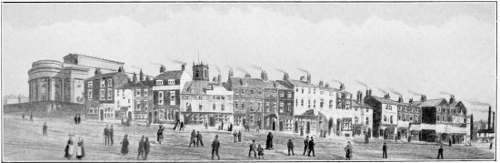
our new buildings at least impart dignity and importance. Shaw's Brow,
with its rows of inferior, dingy shops, a low public-house at the corner
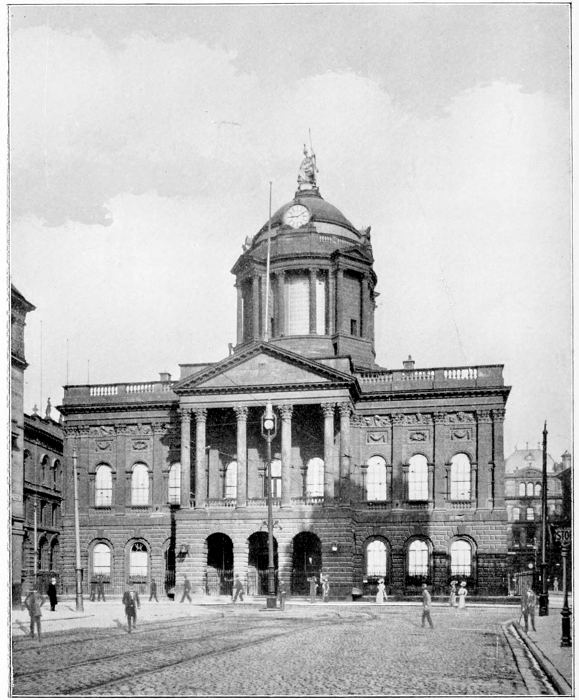
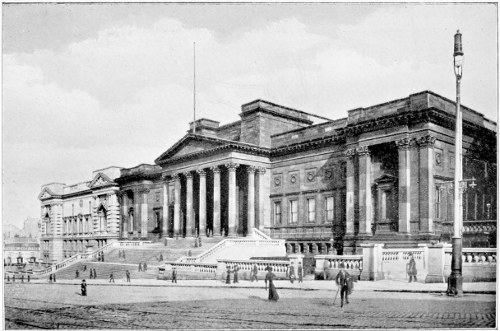
of each street, has given way to William Brown Street, adorned on one
side by our Museum, Libraries, Art Gallery, and Sessions House, and the
other by St. George's Hall and St. John's Gardens. The rookeries which
clustered round Stanley Street, and were occupied by dealers in old
clothes and secondhand furniture, have been replaced by Victoria Street,
which is margined by banks and public buildings. The terrible slums
which surrounded the Sailors' Home and Custom House, veritable dens of
iniquity, have disappeared.
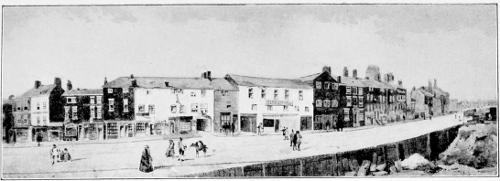
Drawn by William P. Herdman.]
North Side of Shaw's Brow,
NOW WILLIAM BROWN STREET.
Drawn by William P. Herdman.]
South Side of Shaw's Brow,
NOW WILLIAM BROWN STREET.
The dirty ill-paved town is now the best paved and the best scavenged
town in the United Kingdom. With the growth of the town and the
extension of tramways, residential Liverpool has been pushed further out
until it can get no further, and it is now finding its way into
Cheshire. No private dwelling-house of any importance has been erected
on the Liverpool side for many years. The charming suburb of Aigburth
has long since been destroyed, but the greatest change has taken place
in the docks. The old docks have had to be remodelled to give sufficient
depth of water and quay space for the larger vessels now employed, and
special docks have had to be constructed for the Atlantic steamship
trade. In the 'sixties the Prince's dock was filled with sailing ships
trading to India and the West Coast of South America. They discharged on
the west side and loaded on the east side. It was quite a common thing
for a sailing vessel to occupy four and five weeks loading her outward
cargo. On the walls of the docks and on the rigging of the ships,
posters were displayed notifying that the well-known clipper ship ——,
A1 at Lloyd's, would sail for Calcutta or Bombay, and giving the agent's
name, etc.
At the south end of the Prince's dock was the George's basin, a tidal
basin through which ships going into the Prince's or George's dock
entered. I remember seeing one of Brocklebank's Calcutta ships, the
"Martaban," enter this basin under sail; it was done very smartly, and
the way in which the canvas was taken in and the sails clewed up and
furled, was a lesson in seamanship. The George's dock was dedicated to
schooners, mostly fruiterers from Lisbon or the Azores, and during the
herring season fishing boats used to discharge in one corner, the fish
girls going down planks to get on board to buy their fish. The Mariners'
church, an old hulk in which Divine Service was held every Sunday,
occupied another corner.
The Albert dock was filled with East Indiamen discharging their cargoes
of sugar, jute, and linseed, and tea clippers from China; they loaded
their outward cargoes in the Salthouse dock, which adjoined; further
south again, the King's and Queen's docks were occupied by small foreign
vessels, trading to the continental ports. The old New York liners,
sailing ships, loaded in the Bramley Moore dock; and the docks further
north, the Canada being the most northerly, were filled with steamers
trading to the Mediterranean, and the Cunard and Inman lines of
steamers.
To-day one may hunt from one end of the docks to the other without
finding a dozen sailing ships larger than a schooner. With the exit of
the sailing ship much of the romance has been taken out of the life of
Liverpool. It was a joy to walk round the docks and admire the smart rig
and shipshape appearance of the old sailing vessel. The owner and
captain, and, indeed, all connected with her, became attached to their
ship and took a pride in all her doings. In those days the river Mersey
was a glorious sight with probably half a dozen or more Indiamen lying
to an anchor, being towed in or out, or sailing in under their own
canvas.
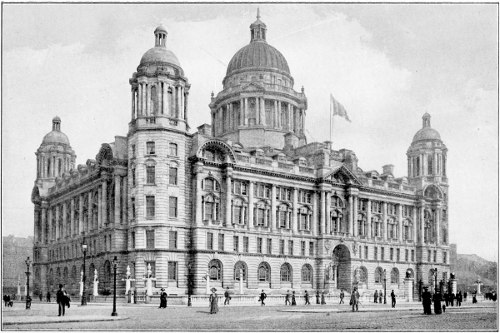
Mersey Docks and Harbour Board Offices.
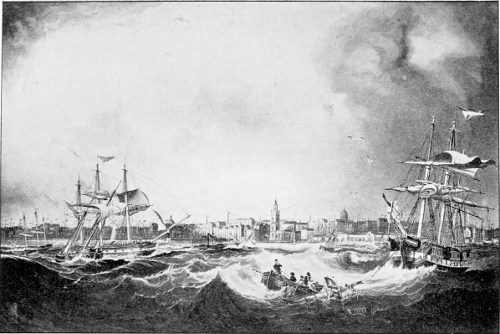
The river Mersey, at all times beautiful with its wonderful alternations
of light and its brisk flowing waters, has never been so beautiful since
the old sailing ship days, when at the top of high water the outward
bound fleet proceeded to sea, and the entire river from the Pier Head to
the Rock Light was filled with shipping of all sizes working their way
out to sea, tacking and cross tacking, the clipper with her taut spars
and snow-white canvas, and the small coaster with her tanned sails all
went to make up a picture of wonderful colour and infinite beauty.
There is no branch of the public service of which Liverpool people are
more proud than the administration of the Mersey Docks and Harbour
Board. The members of the Board have always been recruited from our
leading merchants, shipowners, and brokers, and they have been fortunate
in selecting as their chairmen men of exceptional ability. I can
recollect Charles Turner, M.P., Robert Rankin, William Langton, Ralph
Brocklebank, T. D. Hornby, Alfred Holt, John Brancker; and the Board is
to-day presided over by Mr. Robert Gladstone, who worthily maintains the
best traditions of his office.
Of late years the members have been elected without any contests, but it
was not always so. In the 'seventies there were severe contests, which
arose not upon questions of personal fitness, but were prompted by trade
rivalries. It had become the fashion for the various trades to nominate
members who would look after the particular interests of their trade.
Jealousy was aroused if one trade obtained larger representation than
others. The interests of the steamship owners were opposed to those of
the sailing-ship owner. The one wanted allotted berths to secure
dispatch, the other quay space free and unappropriated. Cotton men
wanted special facilities for cotton, and the timber people yard space
for the storage of timber and deals. Each trade had its associations,
and in addition there was a ratepayers' association, which sought to
break up this system of trade delegation by electing independent men.
The payment of £10 in dock dues gave a vote. So faggot votes were easily
and extensively manufactured. Shipowners and merchants qualified every
clerk in their employ. The nomination of members took place on the 1st
January, and the election on the day following. The elections were hotly
contested, but always in a gentlemanly way, and with much good humour.
It required skill to fill up the voting papers so as to secure a
majority for any particular candidate.
Among those who busied themselves over these elections I remember
William Johnston, Robert Coltart, Worsley Battersby, Edmund Taylor,
Arthur Forwood, G. B. Thomson, George Cunliffe, and James Barnes.
The ratepayers' association accomplished much good by the election of
some men of independence. My particular desire at this time was to try
and induce the Board to fund their debt. It was felt that such a large
floating debt was not only cumbrous and inconvenient, but in times of
financial stress, or with a cycle of years of bad trade, might be a
source of danger. I urged the funding of the debt on the nomination
days, and also through the press and Chamber of Commerce. It met with
the strong opposition of the Board, led by Mr. Brocklebank, but in
course of time after the Corporation had taken the lead, the Dock Board
wisely funded a portion of their debt.
The gradual increase of steamers, the passing of the sailing vessel, and
the large share of the trade of the port being now conducted by
"liners," have to a very large extent done away with trade rivalries;
hence the little interest now taken in the Dock Board elections.
The present generation scarcely know that the docks were up to 1857
administered by a Committee of the Corporation. In my young days
Liverpool people were very sore and angry at the action of Parliament
in foisting upon them the Birkenhead docks. These docks had been
constructed by a private company, and were insolvent and a hopeless
failure. Birkenhead had, however, powerful influence in Parliament, and
stoutly opposed any extension of the Liverpool docks, contending that
the Birkenhead docks had not had fair play, and could accommodate the
surplus trade of Liverpool. In the end, in 1857, Liverpool was obliged
to buy them for £1,143,000, and within a very few years had to expend
upon them £3,859,041. This outlay has ever since been a serious burden
upon Liverpool. Nor did the hostile action of Parliament stop here. The
town dues were taken from Liverpool, and commuted for a payment of
£1,500,000. The management of the dock estate was placed in the hands of
the trustees, who are, except three, elected by the dock ratepayers.
In olden time the Dock Board had an annual excursion to inspect the
lightships, to which they invited the whole of the Council. They were
pleasant days, and it was supposed that the Mayor for the coming year
was selected on these occasions. These excursions contributed to a good
feeling between the Dock Board and the Corporation, which is so
essential if we are to preserve the prosperity of the port. I sometimes
think that our City Fathers apparently forget that our docks and our
commerce are the life-blood of Liverpool.
Mr. John Bramley Moore's great work on the Dock Board was completed
before my day, but he continued his interest in Liverpool to the last,
and was present at the opening of the North Dock system in 1882, where I
saw him. He used to tell how indefatigably he worked to secure the
extension of the docks in a northerly direction, how he asked Lord Derby
to present the Bootle shore to the Dock Board, urging that it would be
greatly to the gain of the Derby family. Lord Derby replied that it
would be very difficult to convince him of that, and that he had already
refused £90,000 for it. Mr. Bramley Moore then offered if Lord Derby
would transfer his foreshore rights the Dock Committee would raise all
the back land by using it for the deposit of their spoil, which would,
he thought, be an adequate compensation. The deal was closed on this
basis, the Dock Committee secured two miles of river frontage, and the
Derby family the site of the most important part of Bootle, and now
forming one of the most valuable of their estates.
One of the first docks constructed on this newly-acquired land was the
Bramley Moore, so named after the chairman.
No one can fail to acknowledge the enterprise and wisdom which have
characterised the administration of the dock estate. Municipal work
follows the demand of the people, and seldom goes ahead of it; but the
provision of docks must anticipate the demand likely to be experienced.
In all this the Dock Board has acted with boldness and with prudence,
under circumstances of much embarassment. The construction of the
Manchester Ship Canal presented a problem of considerable difficulty,
but the Dock Board adopted the courageous but wise policy of looking to
Liverpool and Liverpool trade only, and the facilities they have
provided for the changed conditions of trade have done not a little to
conserve the commerce of the port.
A great change has taken place in the Liverpool Exchange. In the early
'sixties the old Exchange buildings were still in existence. The
building which surrounded Nelson's monument was classic in design, with
high columns surmounted by Ionic capitals and a heavy cornice. The
newsroom was in the east wing, with windows overlooking on the one side
Exchange Street East, and on the other the "flags." The room had two
rows of lofty pillars supporting the ceiling; and there was ample room
in the various bays not only for newspaper stands, but for chairs and
tables, and it had very much more the appearance of a reading-room in a
club than its elaborate, but less comfortable successor. On the western
and northern side of the Exchange were offices with warehouses overhead.
The Borough Bridewell stood in High Street, its site being now covered
by Brown's Buildings, and the Sessions House occupied part of the site
upon which the newsroom now stands. In the 'sixties high 'change was in
the afternoon between four and five o'clock, but much business was also
transacted during the morning. No merchant or broker considered that he
could commence the work of the day until he had read the news on the
"pillars" in the newsroom. Instead of the work on the Exchange being
done by clerks, it was transacted by the principals, who considered it
only respectful to appear in a tall hat and frock coat. Although in
those days there may have been a little too much formality in dress, in
these there is sadly too little, and with the disappearance of the tall
hat and frock coat one has also to regret the abandonment of those
courtly manners and that respectful consideration which gave a charm to
commercial intercourse, and was not confined to the Exchange and the
office, but was reflected in the home and in private life.
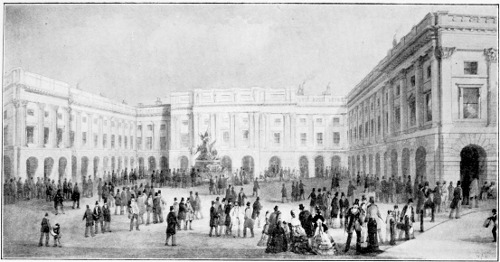
Liverpool Exchange, 1860.
Merchant shipbrokers and general produce brokers transacted their
business in the newsroom, while the cotton brokers, braving all
weathers, were to be found on the "flags."
The present newsroom was opened in 1867, and shortly afterwards the
Mayor, Mr. Edward Whitley, gave a ball in honour of Prince Arthur and
the Prince and Princess Christian, the ballroom in the Town Hall being
connected with the newsroom by a long corridor constructed of wood.
Dancing took place in both rooms.
Upon several occasions after a heavy fall of snow, fights with snowballs
were waged on the "flags," until, becoming serious, the police were
obliged to interfere and put a stop to them. A playful seasonable
exchange of snowballs degenerated into a combat with the rougher element
which frequented the "flags."
I still recall many of the habitués of the Exchange from 1860 to 1870,
men who well represented the varied interests of the great port. While
frock coats and tall hats were the rule, many still wore evening dress
coats, and not a few white cravats. There was old Miles Barton, a
picturesque figure, with his genial smile, and his hat drawn over his
eyes; Isaac Cook, the Quaker, in strictest of raiment; Harold
Littledale, the friend of Birkenhead, and the critic of the Dock Board;
Michael Belcher, the opulent and prosperous cotton broker; the two
Macraes, the principal buyers of cotton for the trade; Tom Bold, the
active Tory political tactician, who in olden days knew the value of
every freeman's vote; H. T. Wilson, the founder of the White Star Line
and the Napoleon of the Tory party; Edmund Thomson, the pioneer of
steamers to the Brazils, who, like most pioneers, was unsuccessful; John
Newall, the "king" of the cotton market, who had an enormous clientele
of very wealthy men; C. K. Prioleau, the representative of the
Confederate Government, who was also the great blockade runner. Mrs.
Prioleau was considered to be the most beautiful woman in Liverpool. Mr.
Prioleau built the house in Abercromby Square which the Bishop now
occupies as his palace. R. L. Bolton, a very successful and bold
operator in cotton, though in appearance the most shy and timid of men
was another well-known figure; he rarely made his appearance until late
in the day, being credited with a love of turning night into day. James
Cox, the opulent bachelor, doyen of the nitrate trade, held his court
always well attended in one corner of the room. I well remember J.
Aspinall Tobin, tall of stature, distinguished in appearance, fluent of
speech, a welcome speaker on every Tory platform; John Donnison, famous
for his little dinners and excellent port; Sam Gath, the tallest man on
the Exchange; Joseph Leather, the forceful partner in Marriotts, a
leading nonconformist, who built and lived at Cleveley, Allerton;
Maurice Williams, the writer of a cotton circular, and a reputed oracle
on cotton—he lived at Allerton Priory, afterwards bought and rebuilt by
Mr. John Grant Morris; Thomas Haigh, the courtly and stately chief of
Haigh and Co., cotton brokers; Edwin Haigh, his son, and the most
vivacious and talkative of men, popular with all; Lloyd Rayner and his
brother Edward, the largest brokers in general produce; S. Bigland,
plain and honest of speech; the two Reynolds, skilled in Sea Island and
Egyptian cotton; John Joynson and his brother Moses; John Bigham, portly
and prosperous; and not far away, his son, John C. Bigham, who was
destined soon to leave the "room" and become the able Queen's Counsel,
the learned President of the Admiralty and Divorce Court, and afterwards
a peer of the realm (Lord Mersey), and whose brilliant career was
doubtless largely due to his early business training; Studley Martin,
the active secretary to the Cotton Brokers' Association, buzzing about
like a busy bee, collecting opinions as to the amount of business doing
in cotton; Thos. Bouch, the dignified representative of the old firm of
Waterhouse and Sons; Edgar Musgrove, an ideal broker, ever present and
ever active. Nor must I forget the noble band of shipbrokers who
collected the cargoes for ships loading outwards: Robert Ashley, Louis
Mors, W. J. Tomlinson, J. B. Walmsley, John McDiarmid, Robert Vining,
Dashper Glynn, Tom Moss, G. Warren, S. B. Guion, all of whom, with many
others, represented vigorous interests which in those days made the
trade of Liverpool.
Outside the Exchange, but yet very necessary to the success of its
business, were the lawyers and insurance brokers and average adjusters.
Amongst lawyers Mr. Bateson and Mr. Squarey enjoyed the largest
commercial practice; R. N. Dale was the leading underwriter; and Mr. L.
R. Baily was not only very prominent as an average adjuster, but as an
arbitrator he afterwards became one of the members for Liverpool. In
those days, before the establishment of the system of trade
arbitrations, there was abundant employment for lawyers and professional
arbitrators.
A sketch of the Liverpool Cotton Exchange would not be complete without
a reference being made to the dealings of Maurice Ranger, and others,
who in the 'seventies on several occasions tried to corner the market by
buying "futures" for delivery in a given month, and then obtaining such
a control of the spot market as would prevent the sellers fulfilling
their contracts. Mr. Ranger's operations were on a gigantic scale, but
there was always a "nigger on the fence." The unexpected happened, and I
do not think he ever fully succeeded in these enterprises. He had many
imitators, who were equally unsuccessful. Mr. Joseph B. Morgan did a
useful work for the cotton trade, by establishing the cotton bank to
facilitate clearances in future contracts.
The removal of the Cotton Exchange to the new premises has taken place
since my active business days, and the whole course and methods of the
trade have changed.
In the 'sixties, sailing-ships filled the Liverpool docks, and fully
one-half of them flew the American flag. The great trades of Liverpool
were those carried on with America, Australia, Calcutta, and the West
Coast. The clipper ships belonging to James Baines and Co., and H. T.
Wilson and Co., were renowned for their fast passages to Melbourne,
while the East India and West Coast ships of James Beazley and Co.,
Imrie and Tomlinson, McDiarmid and Greenshields, and the Brocklebanks
were justly celebrated for their smartness and sea-going qualities.
Charles MacIver ruled over the destinies of the Cunard Company, and this
line then paid one-third of the Liverpool dock dues. Mr. MacIver was a
man of resolute purpose, and a power in Liverpool; in the early
volunteer days he raised a regiment of field artillery, 1,000 strong,
which he commanded. Many stories are told of his stern love of
discipline. A captain of one of the Mediterranean steamers asked his
permission as a special favour to be allowed to take his wife a voyage
with him. Mr. MacIver whilst granting the request, remarked that it was
contrary to the regulations of the Cunard Company. The captain, upon
proceeding to join his ship with his wife, to his surprise found another
captain in command, and a letter from Mr. MacIver enclosing a return
passenger ticket for himself and his wife. William Inman was building up
the fortunes of the Inman Line, and was the first to study and profit by
the Irish emigration trade. The Bibbys and James Moss and Co.
practically controlled the Mediterranean trade. The "tramp" steamer was
then unknown, and outside the main lines of steamers there were few
vessels; but the Allans were forcing their way to the front, and Mr.
Ismay was establishing the White Star Line, which revolutionised
Atlantic travel. Mr. Alfred Holt was doing pioneer work in the West
India trade, with some small steamers with single engines. These he sold
and went into the China trade, in which he has built up a great concern.
The Harrisons were sailing ship owners, but they had also a line of
small steamers trading to Charente. They afterwards started steamers to
the Brazils and to Calcutta. Looking back, they appear to have been most
unsuitable vessels, but freights were high, and to Messrs. T. and J.
Harrison belongs the credit of quickly finding out the most suitable
steamer for long voyages, and always keeping their fleets well up to
date.
We must not forget to mention the merchants of Liverpool, for in those
days the business of a merchant was very different from that of to-day.
He had to take long and far-sighted views, as there was no such thing as
hedging or covering by a sale of futures; his business required
enterprise and the exercise of care and good judgment. Among our most
active merchants we had T. and J. Brocklebank; Finlay, Campbell and Co.;
Baring Brothers; Brown, Shipley and Co.; Malcolmson and Co.; Charles
Saunders; Sandbach, Tinne and Co.; Wm. Moon and Co.; Ogilvy, Gillanders
and Co.; T. and W. Earle and Co.; J. K. Gilliat; J. H. Schroeder and
Co.; Rankin, Gilmour and Co., and others.
In the 'sixties Liverpool had two great trades. The entrepôt trade, the
produce of the world, centred in Liverpool, and was from thence
distributed to the various ports on the continent. The opening of the
Suez Canal, and the establishment of foreign lines of steamers, have
largely destroyed this trade, and produce now finds its way direct to
Genoa, Antwerp, and Hamburg. The other great trade was in American
produce. For this Liverpool offered the largest and best market. This
trade is unfortunately seriously threatened. The increase in the
population of America is now making large demands upon her productions,
and reducing the quantities available for export.
Liverpool was also a considerable manufacturing centre. It was the
principal place for rice-milling and sugar-refining, while shipbuilding
and the making of locomotives and marine engines contributed largely to
her prosperity.
One cannot review the past trade of Liverpool and its present economic
surroundings, without feeling some anxiety for the future. Not only have
the trades which so long made Liverpool their headquarters been to some
extent diverted, but the efforts of rival ports (in many cases railway
ports or ports which have little or no concern as to the payment of
interest on the money employed in their construction) are directed to
the capture of our trade; in this they are still being actively assisted
by the railway companies, who grant to them preferential rates of
carriage. There can be little doubt that our merchants and shipowners
will find new avenues for their enterprise, and new trades will take the
place of those partially lost; but Liverpool has in front of her a fight
to obtain the just advantage of her geographical position, and it is a
fight in which the city must bear its part.
The city will also have to adopt a more enlightened policy, and
encourage manufacturing industries. This can only be done by reductions
in the city rates, and also in the charges for water. The loss would
only be nominal; we should be recouped by an increased volume of trade,
and by our people obtaining steady occupation instead of the present
casual employment.
The great war between the Northern and Southern States of America, which
was waged from 1861 to 1865, had a far-reaching influence upon
Liverpool.
Prior to this date American shipping filled our docks, and 82 per cent.
of our cotton imports were derived from the Southern States.
The election of Lincoln as President of the United States, and the
rejection of the democratic candidate precipitated a crisis which had
been long pending.
Slavery was a southern institution, and although it was conducted in the
most humane manner, and many of the worst features of the system were
absent, the principle of slavery was abhorrent to a large section of the
northern people, and the south feared that with the election of Lincoln
this section would become all-powerful. South Carolina was the first
state to assert her sovereign right to secede from the union. Other
states followed slowly and with hesitating steps, and by the end of 1861
the north and south were engaged in mortal combat. The southern states
were ill equipped for the struggle, they had no war material and were
dependent for clothing and many of the necessities of life upon the
northern manufacturers.
The policy of the north was, therefore, to establish a blockade of the
south, both by land and by sea, which caused prices of many commodities
to rapidly advance in the south, and cotton, their main export, to
quickly decline in value.
The English people sympathised with the south, as the weaker power, and
also having been actively associated with them in trade. The arrest of
the southern envoys Mason and Slidell upon the British mail steamer
"Trent," by the federal commander, did not improve the relationship
between Great Britain and the Government at Washington, and created ill
feeling against the north.
Under these circumstances Liverpool merchants fitted out many costly
expeditions to run the blockade and to carry arms and munitions of war
into the southern ports. The modus operandi was to send out a depot
ship to Nassau or Bermuda and employ in connection with this swift
steamers to run the blockade and bring back cargoes of cotton. The
profits of the trade were great, but the risk was also very
considerable.
The trade at best was a very questionable one; it was justified on the
ground that a blockade cannot be recognised unless effectual. The United
States started with a blockading fleet of 150 vessels, but at the end of
the war they had 750 vessels employed in this service. The blockade
runner had to rely entirely upon her speed, as to fire a gun in her own
defence would at once have constituted her a piratical vessel. The
fastest steamers were bought and built for the purpose. They usually
made the American coast many miles from the port and then under the
cover of darkness they stole along the shore until they came to the
blockading fleet, when they made a dash for the harbour. It was exciting
work, and appealed to many adventurous spirits, and the prize if
successful was great. I think all this had a demoralising influence upon
Liverpool's commercial life, and the intense spirit of speculation
created by the cotton famine was also very injurious. Fortunes were made
and lost in a single day. Prices of cotton, while peace and war hung in
the balance, fluctuated violently, and when war was seen to be
inevitable, they advanced with fearful rapidity. A shilling per lb. was
soon reached. The mills went upon short time. By the summer of 1862
cotton was quoted at 2s 6d per lb. The speculative fever became
universal; men made fortunes by a single deal. When the recoil came
after the war most of these fortunes were lost again. Legitimate trade
had been sacrificed to speculation. Mansions luxuriously furnished,
picture galleries, horses, and carriages had to be sold, and in not a
few instances, their owners, having lost both their legitimate business
and their habits of industry, were reduced to penury and want, and were
never able to recover themselves. The results of the war were
far-reaching. The spirit of speculation was rampant for many years, with
disastrous results; it was only when a system of weekly and bi-weekly
settlements was introduced that speculation was brought within
legitimate limits.
A Nemesis seemed to follow this violent outburst of speculation, and but
few houses actively engaged in it survived very long.
Liverpool was also active in assisting the south to build and fit out
vessels of war to prey upon American commerce. The "Alabama" was built
at Birkenhead; she sailed away to a remote island and there took on
board her armament. She and her sister ship, the "Shenandoah," did
immense damage to American shipping, for which England had in the end
to pay, as by the Geneva arbitration she was held responsible for
allowing the "Alabama" to be built and escape.
American shipping has never recovered from this blow, but it is only
fair to say that the cost of shipbuilding in America, by reason of her
prohibitive tariffs, has mainly prevented her resuming her former
position on the ocean.
Near the close of the war a huge bazaar was held in St. George's Hall,
in aid of the southern prisoners of war. It was designated the Southern
Bazaar, and the stalls were called after the various states, and were
presided over by the leading ladies of the town, assisted by many of the
nobility and society people. It was a brilliant success, money was
plentiful, and men and women vied with each other in scattering it
about. Upwards of £30,000 was realised in the three days.
No account of the doings in Liverpool in the 'sixties would be complete
that did not describe the beginnings of the great volunteer movement,
which was destined to occupy so much public attention, and to form such
an important portion of our national defence. Liverpool can certainly
claim to have initiated the movement. Mr. Bousfield endeavoured to
revive this branch of the service in 1853. A few years later he formed a
drill club, a very modest beginning, consisting of only 100 men, wearing
as their uniform a cap and shell jacket. Captain Bousfield endeavoured
several times to obtain recognition by the Government, but failed; and
he had to encounter a considerable amount of chaff and ridicule. The
public had but little sympathy with the young men who "played at being
soldiers." Captain Bousfield was not discouraged, he loved soldiering
and was an enthusiast, and his opportunity was soon to arrive. In 1859
the Emperor Napoleon III. became very threatening in his words and ways,
and it was apprehended that he might attempt to invade our shores.
Captain Bousfield quickly obtained the support of the Government for his
volunteers, and the 1st Lancashire Volunteer Regiment was formed. The
movement made rapid headway, until we had enrolled in the country
upwards of 300,000 men. Colonel Bousfield soon obtained the command of a
battalion, and in 1860 was presented with a sword of honour and a purse
of £1,800. Liverpool furnished her full quota of volunteers. Colonel
Brown commanded a regiment of artillery: Colonel Tilney the 5th
Lancashire, a crack regiment; Colonel MacCorquodale the Press Guards;
Colonel Bourne, with Major Melly and Captain Hornby (afterwards Colonel
H. H. Hornby), the 1st Lancashire Artillery; Colonel MacIver commanded
1,000 of his own men; and among other active volunteers at this time we
remember Colonel Steble, Colonel Macfie, Colonel Morrison, Colonel Clay,
and many others.
We had also a squadron of cavalry, called the Liverpool Light Horse,
Captain Stone in command. I joined the squadron in 1859, and greatly
fancied myself mounted on one of my father's carriage horses. We
exercised in some fields behind Prospect Vale, Fairfield.
I remember the 1st Lancashire being encamped on the sandhills between
Waterloo and Blundellsands. It was the first time any volunteers had
been under canvas, and the camp was visited by crowds of people.
Liverpool has been always too much absorbed in her commerce to take any
prominent position in the world of literature and education, until
recent years, when we have atoned in some degree for our remissness in
the past, by the founding of our University. Professor Ramsay Muir, in a
recent speech, however, claims that we had a Renaissance in Liverpool in
the early years of the 19th century, when a group of thinkers, scholars,
and writers, finding its centre in William Roscoe, gave to Liverpool a
position and a name in the literary world, and she became a real seat of
literary activity. To that remarkable man, William Roscoe, we owe the
Athenæum, the Literary and Philosophical Society, and the Roscoe
collection of pictures now in the Walker Art Gallery. This intellectual
effort quickly lost its vitality, and for long years the Literary and
Philosophical Society, and the Philomathic Society, struggled alone to
keep burning the light of higher culture and literary activity.
Elementary education was almost entirely in the hands of the Church;
middle class education depended upon the Liverpool Collegiate, the
Mechanic's Institute, afterwards the Liverpool Institute, and the Royal
Institution.
The fashion of sending boys to our great public schools did not set in
until the 'seventies.
Such was the condition of intellectual life when, in 1880, the Liverpool
University College was established, mainly through the efforts of the
late Earl of Derby, William Rathbone, Christopher Bushell, E. K.
Muspratt, David Jardine, Sir Edward Lawrence, Robert Gladstone, Mr.
Muspratt, Sir John Brunner, John Rankin, and William Johnston. The first
Principal, Dr. Rendall, rendered excellent service in these early
struggling years, which were happily followed by still greater and even
more successful efforts under Vice-Chancellor Dale, resulting in the
granting of a Royal Charter in 1903, and the founding of a University.
The Earl of Derby became Chancellor, and Dr. Dale Vice-Chancellor. The
University has been nobly and generously supported by Liverpool men;
indeed a reference to the calendar fills me with surprise that so much
could have been accomplished within such a brief period. Its work is
making itself felt in the general uplifting of the level of education,
while the presence in Liverpool of such a distinguished body of
professors has had considerable influence in giving a higher and more
intellectual tone to society, and in opening up new avenues for thought
and activity.
We must not omit to record the excellent work done by the School Board.
When first established in 1873, the election of members provoked much
sectarian animosity, but in the course of time, through the exertions of
Mr. Christopher Bushell and Mr. Sam Rathbone, this hindrance to its
success was overcome, and the excellence of its organisation was
generally recognised. Its functions have, during the past few years,
been transferred to the City Council.
One of the results of the School Board was the founding of the Council
of Education, which provided, in the shape of scholarships, the means by
which boys could advance from the elementary school to the higher grade
schools and the universities. Mr. Sam Rathbone, Mr. Gilmour, and Mr.
Bushell were very active in promoting this association.
Society was much more exclusive forty or fifty years ago than it is
to-day. The old Liverpool families were looked up to with much respect.
The American war considerably disturbed Liverpool society, and brought
to the front many new people. Liverpool became more cosmopolitan and
democratic, but there was no serious departure from the old-world
courtesy of manner and decorum in dress until the 'eighties, when it
gradually became fashionable to be less exacting in dress, and the
customs of society grew less conventional.
In the 'sixties people of wealth and position surrounded themselves with
certain attributes of power and wealth, which gave to the populace some
indication of their rank and their social status, and in manners they
were reserved and dignified.
Their homes were in the country or in the fashionable suburbs of the
city, and their importance was measured by the extent of their broad
acres. A house in London, in which they dwelt for three or four months
of the year, was the luxury only of the older families, or of those of
great wealth; the fashion of having a flat in London, with a week-end
cottage in the country, was not known—this has followed the more
democratic tendencies of our times. The bringing of people together in
our railway trains, in steamers, in hotel lounges, and foreign travel,
have had a distinctly levelling influence. In the 'sixties some old
county families still made their annual pilgrimage to visit their
friends in the family coach, and the circle of their acquaintances was
limited and exclusive. The family carriage with the rumble at the back
was a dignified and well-turned-out equipage. The dress carriage, with
powdered footmen, was commonly seen in Hyde Park, and was de rigeur at
Court drawing rooms, then held in the afternoon; the array of carriages
at these functions made a splendid show.
Motors may have the charm of convenience and speed, but can never
replace the smart appearance of the well-turned-out carriage-and-pair.
The 'sixties were the days of crinoline and poke bonnets, and although
the wearing of crinoline was much ridiculed, ladies' dress in those days
was much more becoming and graceful than many of our more recent
fashions, and girls have never looked more fascinating than when they
wore their pretty little bonnets; but perhaps I may be called
old-fashioned; as we grow older our view points change. We had many old
maids in those days—we have none now—and the old ladies with their
hair worn in dainty curls surmounted by a lace cap were picturesque, and
looked their part.
The Wellington rooms, which were opened in 1814, were regarded as the
centre of fashionable society.
These rooms, which are only used five times in each year, are unique in
their exquisite proportions and their charming Adams' decorations
unspoiled by the modern painter and decorator. The floor of the large
ballroom is celebrated for its spring, being, it is stated, suspended by
chains.
Admission to the rooms was carefully safeguarded, its members belonging
almost exclusively to the families of position and standing. The balls
were conducted on the strictest lines of propriety, carefully enforced
by vigilant stewards, who would not admit of any rough dancing; and such
a thing as kitchen lancers would not have been tolerated. Six or seven
balls were given each year. The first before Christmas was often called
the dirty-frock ball, as new frocks were reserved for the débutantes'
ball, the first ball of the season. No supper was given, only very light
and indifferent refreshments. The attendance gradually fell away, and it
was felt that the time had arrived when something should be done to
revive their interest. Accordingly, about 1890, during my presidency,
the supper room was enlarged, electric light was introduced, and a
supper with champagne provided, and in order to meet the extra expense
the balls were cut down to five. These changes were very successful in
increasing the attendance. There were great misgivings as to the
introduction of the electric light, and its effect upon the complexions
of the ladies. The old form of illumination by wax candles suffused a
very soft light, but the candles were unreliable and often did damage to
ladies' dresses.
In the 'sixties the only out-door games played were cricket and
croquet. One of the most striking developments of modern days is the
time now devoted to games, especially to golf and lawn tennis. In the
'sixties the facilities for getting about were very limited. The public
conveyances consisted of a few four-horse 'buses, which started from
Castle Street. To-day the bicycle and the motor-car bridge over
distances with rapidity and little fatigue, and make us familiar with
the beauties of our country, which was in old days impossible, while the
electric tram carries the working man to his game at football or to his
cottage in the suburbs. All this is a great gain, adding new interests
to life, and is also very conducive to health and happiness.
The conditions of life during the past fifty years in every grade of
society have greatly improved; they are brighter, healthier and happier.
There has been a decrease in the consumption of alcohol, less
intemperance, and a striking diminution in crime and pauperism. With an
increase of over fifty per cent. in the population there is less crime.
While the necessaries of life have not increased in cost, wages are from
twenty-five to fifty per cent. higher, and the working classes no longer
live in damp cellars or in dark courts and alleys, but have at their
disposal cheerful, sanitary, and convenient homes.