The form of this chapter was suggested by the proceedings of
a session of the 1910 Meeting of the American Economic
Association, devoted to a consideration of the causes of the
rise in prices between 1896 and 1909. Selections from papers
there presented, and from the relative discussion, make up a
considerable part of the chapter, and it is suggested that
all of the selections, except the last, may well be
considered for purposes of study as having come from the
papers and discussion of the session referred to, although
numerous additions and substitutions have been made in order
to render the treatment one of principles involved in the
determination of general prices without special reference to
any particular period of years.
Irving Fisher[43]: Overlooking the influence of deposit currency, or
checks, the price level may be said to depend on only three sets of
causes: (1) the quantity of money in circulation; (2) its "efficiency"
or velocity of circulation (or the average number of times a year money
is exchanged for goods); and (3) the volume of trade (or amount of goods
bought by money). The so-called "quantity theory,"[44] i.e., that
prices vary proportionately to money, has often been incorrectly
formulated, but (overlooking checks) the theory is correct in the sense
that the level of prices varies directly with the quantity of money in
circulation, provided the velocity of circulation of that money and the
volume of trade which it is obliged to perform are not changed.
The quantity theory has been one of the most bitterly contested theories
in economics, largely because the recognition of its truth or falsity
affected powerful interests in commerce and politics. It has been
maintained—and the assertion is scarcely an exaggeration—that the
theorems of Euclid would be bitterly controverted if financial or
political interests were involved.
The quantity theory has, unfortunately, been made the basis of arguments
for unsound currency schemes. It has been invoked in behalf of
irredeemable paper money and of national free coinage of silver at the
ratio of 16 to 1. As a consequence, not a few "sound money men,"
believing that a theory used to support such vagaries must be wrong, and
fearing the political effects of its propagation, have drifted into the
position of opposing, not only the unsound propaganda, but also the
sound principles by which its advocates sought to bolster it up.[45]
These attacks upon the quantity theory have been rendered easy by the
imperfect comprehension of it on the part of those who have thus invoked
it in a bad cause.
Personally, I believe that few mental attitudes are more pernicious, and
in the end more disastrous, than those which would uphold sound practice
by denying sound principles because some thinkers make unsound
application of those principles. At any rate, in scientific study there
is no choice but to find and state the unvarnished truth.
The quantity theory will be made more clear by the equation of exchange,
which is now to be explained.
The equation of exchange is a statement, in mathematical form, of the
total transactions effected in a certain period in a given community. It
is obtained simply by adding together the equations of exchange for all
individual transactions. Suppose, for instance, that a person buys 10
pounds of sugar at 7 cents per pound. This is an exchange transaction,
in which 10 pounds of sugar have been regarded as equal to 70 cents, and
this fact may be expressed thus: 70 cents = 10 pounds of sugar
multiplied by 7 cents a pound. Every other sale and purchase may be
expressed similarly, and by adding them all together we get the equation
of exchange for a certain period in a given community. During this
same period, however, the same money may serve, and usually does serve,
for several transactions. For that reason the money side of the equation
is of course greater than the total amount of money in circulation.
The equation of exchange relates to all the purchases made by money in a
certain community during a certain time. We shall continue to ignore
checks or any circulating medium not money. We shall also ignore foreign
trade and thus restrict ourselves to trade within a hypothetical
community. Later we shall reinclude these factors, proceeding by a
series of approximations through successive hypothetical conditions to
the actual conditions which prevail to-day. We must, of course, not
forget that the conclusions expressed in each successive approximation
are true solely on the particular hypothesis assumed.
The equation of exchange is simply the sum of the equations involved in
all individual exchanges in a year. In each sale and purchase, the money
and goods exchanged are ipso facto equivalent; for instance, the money
paid for sugar is equivalent to the sugar bought. And in the grand total
of all exchanges for a year, the total money paid is equal in value to
the total value of the goods bought. The equation thus has a money side
and a goods side. The money side is the total money paid, and may be
considered as the product of the quantity of money multiplied by its
rapidity of circulation. The goods side is made up of the products of
quantities of goods exchanged multiplied by their respective prices.
The important magnitude, called the velocity of circulation, or rapidity
of turnover, is simply the quotient obtained by dividing the total money
payments for goods in the course of a year by the average amount of
money in circulation by which those payments are effected. This velocity
of circulation for an entire community is a sort of average of the rates
of turnover of money for different persons. Each person has his own rate
of turnover which he can readily calculate by dividing the amount of
money he expends per year by the average amount he carries.
Let us begin with the money side. If the number of dollars in a country
is 5,000,000, and their velocity of circulation is twenty times per
year, then the total amount of money changing hands (for goods) per year
is 5,000,000 times twenty, or $100,000,000. This is the money side of
the equation of exchange.
Since the money side of the equation is $100,000,000, the goods side
must be the same. For if $100,000,000 has been spent for goods in the
course of the year, then $100,000,000 worth of goods must have been sold
in that year. In order to avoid the necessity of writing out the
quantities and prices of the innumerable varieties of goods which are
actually exchanged, let us assume for the present that there are only
three kinds of goods,—bread, coal, and cloth; and that the sales are:
| 200,000,000 loaves of bread at | $ .10 a loaf, |
| 10,000,000 tons of coal at | 5.00 a ton, and |
| 30,000,000 yards of cloth at | 1.00 a yard. |
The value of these transactions is evidently $100,000,000, i. e.,
$20,000,000 worth of bread plus $50,000,000 worth of coal plus
$30,000,000 worth of cloth. The equation of exchange therefore (remember
that the money side consisted of $5,000,000 exchanged 20 times) is as
follows:
| $5,000,000 × 20 times a year |
| = | 200,000,000 loaves | × | $ .10 a loaf |
| + | 10,000,000 tons | × | 5.00 a ton |
| + | 30,000,000 yards | × | 1.00 a yard |
This equation contains on the money side two magnitudes, viz. (1) the
quantity of money and (2) its velocity of circulation; and on the goods
side two groups of magnitudes in two columns, viz. (1) the quantities
of goods exchanged (loaves, tons, yards), and (2) the prices of these
goods. The equation shows that these four sets of magnitudes are
mutually related. Because this equation must be fulfilled, the prices
must bear a relation to the three other sets of magnitudes—quantity of
money, rapidity of circulation, and quantities of goods exchanged.
Consequently, these prices must, as a whole, vary proportionally with
the quantity of money and with its velocity of circulation, and
inversely with the quantities of goods exchanged.
Suppose, for instance, that the quantity of money were doubled, while
its velocity of circulation and the quantities of goods exchanged
remained the same. Then it would be quite impossible for prices to
remain unchanged. The money side would now be $10,000,000 × 20 times a
year or $200,000,000; whereas, if prices should not change, the goods
would remain $100,000,000, and the equation would be violated. Since
exchanges, individually and collectively, always involve an equivalent
quid pro quo, the two sides must be equal. Not only must purchases
and sales be equal in amount—since every article bought by one person
is necessarily sold by another—but the total value of goods sold must
equal the total amount of money exchanged. Therefore, under the given
conditions, prices must change in such a way as to raise the goods side
from $100,000,000 to $200,000,000. This doubling may be accomplished by
an even or uneven rise in prices but some sort of a rise of prices
there must be. If the prices rise evenly, they will evidently all be
exactly doubled.... If the prices rise unevenly, the doubling must
evidently be brought about by compensation; if some prices rise by less
than double, others must rise by enough more than double to exactly
compensate.
But whether all prices increase uniformly, each being exactly doubled,
or some prices increase more and some less (so as still to double the
total money value of the goods purchased), the prices are doubled on
the average.... From the mere fact, therefore, that the money spent for
goods must equal the quantities of those goods multiplied by their
prices, it follows that the level of prices must rise or fall according
to changes in the quantity of money, unless there are changes in its
velocity of circulation or in the quantities of goods exchanged.
If changes in the quantity of money affect prices, so will changes in
the other factors—quantities of goods and velocity of
circulation—affect prices, and in a very similar manner. Thus a
doubling in the velocity of circulation of money will double the level
of prices, provided the quantity of money in circulation and the
quantities of goods exchanged for money remain as before....
Again, a doubling in the quantities of goods exchanged will not double,
but halve, the height of the price level, provided the quantity of
money and its velocity of circulation remain the same....
Finally, if there is a simultaneous change in two or all of the three
influences, i. e., quantity of money, velocity of circulation, and
quantities of goods exchanged, the price level will be a compound or
resultant of these various influences. If, for example, the quantity of
money is doubled, and its velocity of circulation is halved, while the
quantity of goods exchanged remains constant, the price level will be
undisturbed. Likewise, it will be undisturbed if the quantity of money
is doubled and the quantity of goods is doubled, while the velocity of
circulation remains the same. To double the quantity of money,
therefore, is not always to double prices. We must distinctly recognize
that the quantity of money is only one of three factors, all equally
important in determining the price level....
We now come to the strict algebraic statement of the equation of
exchange.... Let us denote the total circulation of money, i. e., the
amount of money expended for goods in a given community during a given
year, by E (expenditure); and the average amount of money in
circulation in the community during the year by M (money). M will be
the simple arithmetical average of the amounts of money existing at
successive instants separated from each other by equal intervals of time
indefinitely small. If we divide the year's expenditures, E, by the
average amount of money, M, we shall obtain what is called the average
rate of turnover of money in its exchange for goods, E/M that is,
the velocity of circulation of money. This velocity may be denoted by
V, so that E/M = V; then E may be expressed as MV. In words:
the total circulation of money in the sense of money expended is equal
to the total money in circulation multiplied by its velocity of
circulation or turnover. E or MV, therefore, expresses the money
side of the equation of exchange. Turning to the goods side of the
equation, we have to deal with the prices of goods exchanged and
quantities of goods exchanged. The average price of sale of any
particular good, such as bread, purchased in the given community during
the given year, may be represented by p (price); and the total
quantity of it purchased, by Q (quantity); likewise the average price
of another good (say coal) may be represented by p´ and the total
quantity of it exchanged, by Q´; the average price and the total
quantity of a third good (say cloth) may be represented by p´´ and
Q´´ respectively; and so on, for all other goods exchanged, however
numerous. The equation of exchange may evidently be expressed as
follows:
MV = pQ
+ p´Q´
+ p´´Q´´
+ etc.
The right-hand side of this equation is the sum of terms of the form
pQ—a price multiplied by a quantity bought. It is customary in
mathematics to abbreviate such a sum of terms (all of which are of the
same form) by using "Σ" as a symbol of summation. This symbol
does not signify a magnitude as do the symbols M, V, p, Q, etc. It
signifies merely the operation of addition and should be read "the sum
of terms of the following type." The equation of exchange may therefore
be written:
MV = ΣpQ.
That is, the magnitudes E, M, V, the p's and the Q's relate to
the entire community and an entire year; but they are based on and
related to corresponding magnitudes for the individual persons of which
the community is composed and for the individual moments of time of
which the year is composed.
The algebraic derivation of this equation is, of course, essentially the
same as the arithmetical derivation previously given. It consists simply
in adding together the equations for all individual purchases within
the community during the year....
[We are now] ... prepared for the inclusion of bank deposits or
circulating credit in the equation of exchange. We shall still use M
to express the quantity of actual money, and V to express the velocity
of its circulation.[46] Similarly, we shall now use M´ to express the
total deposits subject to transfer by check; and V´ to express the
average velocity of circulation. The total value of purchases in a year
is therefore no longer to be measured by MV, but by MV + M´V´´.
The equation of exchange, therefore, becomes:
MV + M´V´ = ΣpQ = PT[47]....
With the extension of the equation of monetary circulation to include
deposit circulation, the influence exerted by the quantity of money on
general prices becomes less direct; and the process of tracing this
influence becomes more difficult and complicated. It has even been
argued that this interposition of circulating credit breaks whatever
connection there may be between prices and the quantity of money.[48]
This would be true if circulating credit were independent of money. But
the fact is that the quantity of circulating credit, M´, tends to hold
a definite relation to M, the quantity of money in circulation; that
is, deposits are normally a more or less definite multiple of money.
Two facts normally give deposits a more or less definite ratio to money.
The first ... [is] that bank reserves are kept in a more or less
definite ratio to bank deposits. The second is that individuals, firms,
and corporations preserve more or less definite ratios between their
cash transactions and their check transactions, and also between their
money and deposit balances.[49] These ratios are determined by motives
of individual convenience and habit. In general, business firms use
money for wage payments, and for small miscellaneous transactions
included under the term "petty cash"; while for settlements with each
other they usually prefer checks. These preferences are so strong that
we could not imagine them overridden except temporarily and to a small
degree. A business firm would hardly pay car fares with checks and
liquidate its large liabilities with cash. Each person strikes an
equilibrium between his use of the two methods of payment, and does not
greatly disturb it except for short periods of time. He keeps his stock
of money or his bank balance in constant adjustment to the payments he
makes in money or by check. Whenever his stock of money becomes
relatively small and his bank balance relatively large, he cashes a
check. In the opposite event, he deposits cash. In this way he is
constantly converting one of the two media of exchange into the other. A
private individual usually feeds his purse from his bank account; a
retail commercial firm usually feeds its bank account from its till. The
bank acts as intermediary for both.
In a given community the quantitative relation of deposit currency to
money is determined by several considerations of convenience. In the
first place, the more highly developed the business of a community, the
more prevalent the use of checks. Where business is conducted on a large
scale, merchants habitually transact their larger operations with each
other by means of checks, and their smaller ones by means of cash.
Again, the more concentrated the population, the more prevalent the use
of checks. In cities it is more convenient both for the payer and the
payee to make large payments by check; whereas, in the country, trips to
a bank are too expensive in time and effort to be convenient, and
therefore more money is used in proportion to the amount of business
done. Again, the wealthier the members of the community, the more
largely will they use checks. Laborers seldom use them; but capitalists,
professional and salaried men use them habitually, for personal as well
as business transactions.
There is, then, a relation of convenience and custom between check and
cash circulation, and a more or less stable ratio between the deposit
balance of the average man or corporation and the stock of money kept in
pocket or till. This fact, as applied to the country as a whole, means
that by convenience a rough ratio is fixed between M and M´. If that
ratio is disturbed temporarily, there will come into play a tendency to
restore it. Individuals will deposit surplus cash, or they will cash
surplus deposits.
Hence, both money in circulation ... and money in reserve ... tend to
keep in a fixed ratio to deposits. It follows that the two must be in a
fixed ratio to each other.
It further follows that any change in M, the quantity of money in
circulation, requiring as it normally does a proportional change in
M´, the volume of bank deposits subject to check, will result in an
exactly proportional change in the general level of prices except, of
course, so far as this effect be interfered with by concomitant changes
in the V's or the Q's. The truth of this proposition is evident from
the equation MV + M´V´ = ΣpQ; for if, say, M and M´
are doubled, while V and V´ remain the same, the left side of the
equation is doubled and therefore the right side must be doubled also.
But if the Q's remain unchanged, then evidently all the p's must be
doubled, or else if some are less than doubled, others must be enough
more than doubled to compensate....
The factors in the equation of exchange are ... continually seeking
normal adjustment. A ship in a calm sea will "pitch" only a few times
before coming to rest, but in a high sea, the pitching never ceases.
While continually seeking equilibrium, the ship continually encounters
causes which accentuate the oscillation. The factors seeking mutual
adjustment are money in circulation, deposits, their velocities, the
Q's and the p's. These magnitudes must always be linked together by
the equation MV + M´V´ = ΣpQ. This represents the
mechanism of exchange. But in order to conform to such a relation the
displacement of any one part of the mechanism spreads its effects during
the transition periods [i.e., periods of rising or falling prices]
over all parts. Since periods of transition are the rule and those of
equilibrium the exception, the mechanism of exchange is almost always in
a dynamic rather than a static condition....[50]
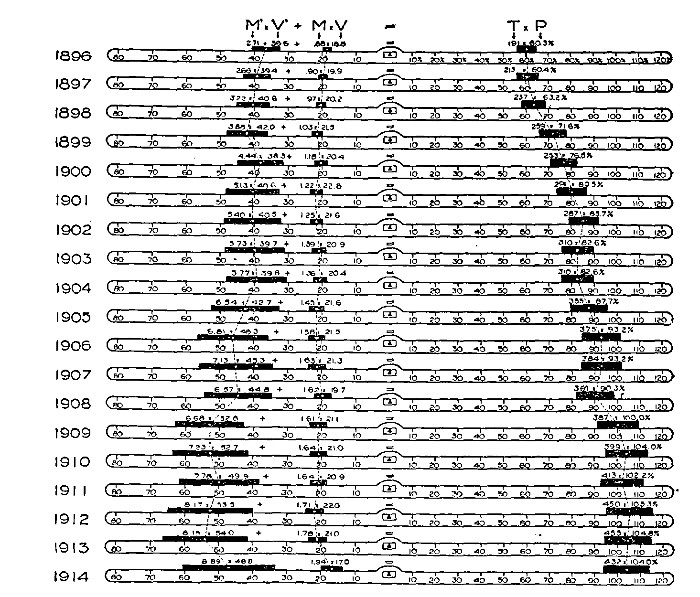
[51]It is interesting to make a quantitative comparison of the various
magnitudes with the increase in the quantity of money as the most
important factor in raising the price level. While it is true, as shown
by the diagram, that the volume of deposits subject to check has
increased greatly, the major part of the increase has to be ascribed to
the increase in the quantity of money. Only so far as the volume of
deposits subject to check has increased relatively to the money in
circulation, can the increase of deposits be regarded as an independent
cause of the rise in prices. We have thus to consider the relative
importance of the five causes affecting prices:
1. The quantity of money in circulation (M).
2. The volume of bank deposits subject to check considered relatively to
money (M´/M).
3. The velocity of the former (V´).
4. The velocity of the latter (V).
5. The volume of trade (T).
We may best compare the relative importance of these five magnitudes by
answering the question: What would the result have been had any one of
these magnitudes remained unchanged, assuming that the other four
changed in the same manner that they actually did change. We find (1)
that if the money in circulation, M, had not changed, between the years
1896 and 1909, for example, the price level of 1909 would have been 45
per cent. lower than it actually was; (2) that if M´/M, the relative
deposits, had not changed, during the same period the price level in
1909 would have been 23 per cent. lower than it actually was; (3) if the
velocity of circulation of money, V, had not changed, the price level
for 1909 would have been 1 per cent. lower; (4) if the velocity of
circulation of deposits, V´, had not changed, the price level in 1909
would have been 28 per cent. lower; (5) if T had not changed, the price
level in 1909 would have been 106 per cent. higher.
Thus the changes in the first four factors have tended to raise prices,
while the change in T has tended to lower prices. The relative
importance of the four price-raising causes may be stated in terms of
the per cent. already given which represents how much lower prices would
have been except for each of these causes separately considered.
According to this test we find the relative importance of the four
price-raising factors to be as follows:
The importance of V is represented by 1,
The importance of M´/M is represented by 23,
The importance of V is represented by 28,
The importance of M is represented by 45.
That is, the increase in the quantity of money had an importance nearly
double that of any other one price-raising factor, during the period
mentioned.
Thus far we have considered the level of prices as affected by the
volume of trade, by the velocities of circulation of money and of
deposits, and by the quantities of money and of deposits. These are the
only influences which can directly affect the level of prices. Any
other influences on prices must act through these five. There are
myriads of such influences (outside of the equation of exchange) that
affect prices through these five. It is our purpose ... to note the
chief among them....
We shall first consider the outside influences that affect the volume of
trade and, through it, the price level. The conditions which determine
the extent of trade are numerous and technical. The most important may
be classified as follows:
1. Conditions affecting producers.
(a) Geographical differences in natural resources.
(b) The division of labor.
(c) Knowledge of the technique of production.
(d) The accumulation of capital.
2. Conditions affecting consumers.
(a) The extent and variety of human wants.
3. Conditions connecting producers and consumers.
(a) Facilities for transportation.
(b) Relative freedom of trade.
(c) Character of monetary and banking systems.
(d) Business confidence.
1 (a). It is evident that if all localities were exactly alike in their
natural resources, in other words, in their comparative costs of
production, no trade would be set up between them.... Cattle raising in
Texas, the production of coal in Pennsylvania, of oranges in Florida,
and of apples in Oregon have increased the volume of trade for these
communities respectively.
1 (b). Equally obvious is the influence of the division of labor....
1 (c).... The state of knowledge of production will affect trade. Vast
coal fields in China await development, largely for lack of knowledge of
how to extract and market the coal. Egypt awaits the advent of
scientific agriculture, to usher in trade expansion. Nowadays, trade
schools in Germany, England, and the United States are increasing and
diffusing knowledge of productive technique.
1 (d). But knowledge, to be of use, must be applied; and its application
usually requires the aid of capital. The greater and the more productive
the stock or capital in any community, the more goods it can put into
the currents of trade....
Since increase in trade tends to decrease the general level of prices,
anything which tends to increase trade likewise tends to decrease the
general level of prices. We conclude, therefore, that among the causes
tending to decrease prices are increasing geographical or personal
specialization, improved productive technique, and the accumulation of
capital. The history of commerce shows that all these causes have been
increasingly operative during a long period including the last century.
Consequently, there has been a constant tendency, from these sources at
least, for prices to fall.
2 (a).... An increase of wants, by leading to an increase in trade,
tends to lower the price level. Historically, during recent times
through invention, education, and the emulation coming from increased
contact in centers of population, there has been a great intensification
and diversification of human wants and therefore increased trade.
Consequently, there has been from these causes a tendency of prices to
fall.
3 (a). Anything which facilitates intercourse tends to increase trade.
Anything that interferes with intercourse tends to decrease trade. First
of all, there are the mechanical facilities for transport. As Macaulay
said, with the exception of the alphabet and the printing press, no set
of inventions has tended to alter civilization so much as those which
abridge distance,—such as the railway, the steamship, the telephone,
the telegraph, and that conveyer of information and advertisements, the
newspaper. These all tend, therefore, to decrease prices.
3 (b). Trade barriers are not only physical but legal. A tariff between
countries has the same influence in decreasing trade as a chain of
mountains. The freer the trade, the more of it there will be....
3 (c). The development of efficient monetary and banking systems tends
to increase trade. There have been times in the history of the world
when money was in so uncertain a state that people hesitated to make
many trade contracts because of the lack of knowledge of what would be
required of them when the contract should be fulfilled. In the same way,
when people cannot depend on the good faith or stability of banks, they
will hesitate to use deposits and checks.
3 (d). Confidence, not only in banks in particular, but in business in
general, is truly said to be "the soul of trade." Without this
confidence there cannot be a great volume of contracts. Anything that
tends to increase this confidence tends to increase trade....
We see, then, that prices will tend to fall through increase in trade,
which may in turn be brought about by improved transportation, by
increased freedom of trade, by improved monetary and banking systems,
and by business confidence. Historically, during recent years, all of
these causes have tended to grow in power, except freedom of trade....
Having examined those causes outside the equation which affect the
volume of trade, our next task is to consider the outside causes that
affect the velocities of circulation of money and of deposits. For the
most part, the causes affecting one of these velocities affect the other
also. These causes may be classified as follows:
1. Habits of the individual.
(a) As to thrift and hoarding.
(b) As to book credit.
(c) As to the use of checks.
2. Systems of payments in the community.
(a) As to frequency of receipts and of disbursements.
(b) As to regularity of receipts and disbursements.
(c) As to correspondence between times and amounts of receipts and
disbursements.
3. General causes.
(a) Density of population.
(b) Rapidity of transportation.
1 (a). Taking these up in order, we may first consider what influence
thrift has on the velocity of circulation. Velocity of circulation of
money is the same thing as its rate of turnover. It is found by dividing
the total payments effected by money in a year by the amount of money in
circulation in a year. It depends upon the rates of turnover of the
individuals who compose the society. This velocity of circulation or
rapidity of turnover of money is the greater for each individual the
more he spends, with a given average amount of cash on hand; or the less
average cash he keeps, with a given yearly expenditure....
1 (b). The habit of "charging," i.e., using book credit, tends to
increase the velocity of circulation of money, because the man who
gets things "charged" does not need to keep on hand as much money as
he would if he made all payments in cash. A man who pays cash daily
needs to keep cash for daily contingencies. The system of cash payments,
unlike the system of book credit, requires that money shall be kept on
hand in advance of purchases. Evidently, if money must be provided in
advance, it must be provided in larger quantities than when merely
required to liquidate past debts....
But we have seen that to increase the rate of turnover will tend to
increase the price level. Therefore, book credit tends to increase the
price level....
1 (c). The habit of using checks rather than money will also affect the
velocity of circulation; because a depositor's surplus money will
immediately be put into the bank in return for a right to draw by
check....
We see, then, that three habits—spendthrift habits, the habit of
charging, and the habit of using checks—all tend to raise the level of
prices....
2 (a). The more frequently money or checks are received and disbursed,
the shorter is the average interval between the receipt and the
expenditure of money or checks and the more rapid is the velocity of
circulation.
This may best be seen from an example. A change from monthly to weekly
wage payments tends to increase the velocity of circulation of money. If
a laborer is paid weekly $7 and reduces this evenly each day, ending
each week empty-handed, his average cash ... would be a little over half
of $7, or about $4. This makes his turnover nearly twice a week. Under
monthly payments the laborer who receives and spends an average of $1 a
day will have to spread the $30 more or less evenly over the following
30 days. If, at the next pay day, he comes out empty-handed, his average
money during the month has been about $15. This makes his turnover about
twice a month. Thus the rate of turnover is more rapid under weekly than
under monthly payments....
Frequency of disbursements evidently has an effect similar to the effect
of frequency of receipts; i.e., it tends to accelerate the velocity of
turnover, or circulation.
2 (b). Regularity of payments also facilitates the turnover. When the
workingman can be fairly certain of both his receipts and expenditures,
he can, by close calculation, adjust them so precisely as safely to end
each payment cycle with an empty pocket. This habit is extremely common
among certain classes of city laborers. On the other hand, if the
receipts and expenditures are irregular, either in amount or in time,
prudence requires the worker to keep a larger sum on hand, to insure
against mishaps.... We may, therefore, conclude that regularity, both of
receipts and of payments, tends to increase velocity of circulation.
2 (c). Next, consider the synchronizing of receipts and disbursements,
i. e., making payments at the same intervals as obtaining receipts....
This arrangement obviates the necessity of keeping much money or
deposits on hand, and therefore increases their velocity of
circulation....
3 (a). The more densely populated a locality, the more rapid will be the
velocity of circulation.
There is definite evidence that this is true of bank deposits. The
following figures give the velocities of circulation of deposits in ten
cities, arranged in order of size:
| Paris | 116 |
| Berlin | 161 |
| Brussels | 123 |
| Madrid | 14 |
| Rome | 43 |
| Lisbon | 29 |
| Indianapolis | 30 |
| New Haven | 16 |
| Athens | 4 |
| Santa Barbara | 1 |
Madrid is the only city seriously out of its order in respect to
velocity of circulation.
3 (b). Again the more extensive and the speedier the transportation in
general, the more rapid the circulation of money. Anything which makes
it easier to pass money from one person to another will tend to increase
the velocity of circulation. Railways have this effect.... Mail and
express, by facilitating the transmission of bank deposits and money,
have likewise tended to increase their velocity of circulation.
We conclude, then, that density of population and rapidity of
transportation have tended to increase prices by increasing velocities.
Historically this concentration of population in cities has been an
important factor in raising prices in the United States....
[53]The purchasing power ... of money has been studied as the effect of
five, and only five, groups of causes. The five groups are money,
deposits, their velocities of circulation, and the volume of trade.
These and their effects, prices, we saw to be connected by an equation
called the equation of exchange, MV + M'V' = ΣpQ. The five
causes, in turn,... are themselves effects of antecedent causes lying
entirely outside of the equation of exchange, as follows: the volume of
trade will be increased, and therefore the price level correspondingly
decreased by the differentiation of human wants; by diversification of
industry; and by facilitation of transportation. The velocities of
circulation will be increased, and therefore also the price level
increased by improvident habits; by the use of book credit; and by rapid
transportation. The quantity of money will be increased and therefore
the price level increased correspondingly by the import and minting of
money, and, antecedently, by the mining of the money metal; by the
introduction of another and initially cheaper money metal through
bimetallism; and by the issue of bank notes and other paper money. The
quantity of deposits will be increased, and therefore the price level
increased by extension of the banking system and by the use of book
credit. The reverse causes produce, of course, reverse effects.
Thus, behind the five sets of causes which alone affect the purchasing
power of money, we find over a dozen antecedent causes. If we chose to
pursue the inquiry to still remoter stages, the number of causes would
be found to increase at each stage in much the same way as the number of
one's ancestors increases with each generation into the past. In the
last analysis myriads of factors play upon the purchasing power of
money; but it would be neither feasible nor profitable to catalogue
them. The value of our analysis consists rather in simplifying the
problem by setting forth clearly the five proximate causes through which
all others whatsoever must operate. At the close of our study, as at the
beginning, stands forth the equation of exchange as the great
determinant of the purchasing power of money.
J. Laurence Laughlin[54]: To my mind, the following propositions contain
the essence of the theory of prices.... As every one will appreciate,
only general statements, without any limiting qualifications to speak
of, can be given in so small a compass.
1. The price of a commodity is measured by the quantity of a given
standard for which it will exchange.
2. A change of prices may be due to changes in the conditions affecting
the supply (thus including expenses of production) of goods, as well as
to changes in the demand for and supply of gold. A statistical statement
of a change of price is not a statement of the cause of the change.
3. Probably there is not so much difference of opinion regarding the
theory of prices as is sometimes supposed. Other causes being supposed
constant, an increased supply of gold would tend to raise prices. No one
can fail to see that, if by "money" is meant gold, a change in its
quantity would, other things being equal, be a factor affecting prices.
An increasing demand for gold, however, would work against the effect of
an increasing supply. If the new demand offset the new supply, then, if
changes of prices occurred, their cause must be sought in the influences
touching the producing and marketing of goods.
4. The effective demand for goods (granting their utility) is limited by
the buyer's purchasing power. This purchasing power is not identical
with the quantity of the media of exchange in circulation, any more than
the value of the total exchangeable wealth of the community is identical
with the value of the total money in circulation.
5. The general level of prices is not independent of particular prices;
since there can be no such thing as a general level, or average, of
prices which is not the resultant of a number of particular prices each
arrived at by individual buyers and sellers. The causes of price changes
must be sought in the forces settling particular prices. This does not
exclude the consideration of any causes affecting the value of the
standard in which the prices of goods are expressed, because the
standard is itself a particular commodity.
6. In particular cases, competitive prices in this country are arrived
at by the higgling of the market, which depends on buyers' and sellers'
judgment of the demand and supply of the commodity (e. g., wheat);
and, when the price is fixed, the credit medium by which the commodity
is passed from seller to buyer comes easily and naturally into existence
and, of course, for a sum exactly equaling the price agreed upon,
multiplied by the number of units of goods. Price-making generally
precedes the demand upon the media of exchange, and does not at all
imply any necessary demand at the moment upon the standard in which the
prices are expressed (cf. 10).
7. The offer of "money" for goods is only a resultant of price-making
forces previously at work, and does not measure the demand for goods
(cf. 6). That is, the quantity of the actual media of exchange thus
brought into use is a result and not a cause of the price-making
process. The supposed offer of money has no money as its basis, but is
only the offer of a purchasing power, previously existing, based on
saleable goods, which at the moment of payment appears expressed in
terms of the standard. By credit devices the actual transfer of the
standard is reduced to an inconsiderable minimum. In reality (as in
foreign trade) goods are exchanged against goods.
8. The effect of credit on prices is to be found mainly in banking
facilities by which goods are coined into means of payment, so that,
expressed in terms of the standard gold, they may be exchanged against
each other. Thus credit devices relieve the standard to an incredibly
great degree from the demand for the use of gold as a medium of
exchange, and thus remove a demand, as trade increases, which would
otherwise have enormously affected the value of gold. Thus the effect of
credit on the general level of prices in considerable periods of time is
shown by a tendency to reduce the demand on the standard gold, and hence
to prevent the tendency toward falling prices.
9. A general proposition is that banks are limited in making loans by
the possession of capital, a bank of large capital and deposits being
able to make large loans, a bank of small capital and deposits, small
loans. A second proposition is that the demand for legitimate loans
varies with the exchanges of goods and collateral and the opportunities
for investment. With an increasing activity in business, however—either
sound or speculative—the expansion of loans is limited by the resources
of the bank. Next, a bank trying to carry a certain amount of loans,
must hold a specified proportion of reserves to demand liabilities under
the rule of banking experience or law. The amount of its capital and the
funds left with it determine the relative size of its loan item; and the
sum of its loans and resultant deposits determine the amount of its
reserves. The reserves of a bank are thus a consequence of the loan
operations. This conclusion, however, as it affects the practical
problem of the present day, is not, in my opinion, invalidated by the
conceivable cases arising, when business tends to outrun banking
facilities, in which anything that makes increasing reserves possible
would increase the power of the banks to lend. When gold becomes
increasingly abundant, the banks having large resources more easily get
the gold reserves needed for their operations. It still remains true
that the fact of an increased supply of gold does not of itself increase
loans, unless conditions of business demand an increase in loans.
Therefore, the expansion of business is not a necessary consequence of
an increasing supply of gold, any more than an expansion of railway
traffic is the necessary consequence of an increasing supply of cars. If
increasing goods are in existence to be transported, then, of course,
there is an increasing demand for cars. Likewise, if there are more bank
resources and loans, there is an increasing demand for that which is
lawful reserve; from which it is claimed that the use of new gold in
bank reserves, under present conditions, is not the significant causal
force which expands business and raises prices (although it may be
contemporary with it).
10. The problem of explaining the general level of prices is one of
arriving at the adjustment between two terms of a ratio (the standard on
the one side, and goods on the other), each of which is influenced by
supply and demand. Gold being one, and goods being many, a cause working
on gold alone, and important enough to show an appreciable effect, might
explain a general movement of prices. In practical operation, however,
because of the large existing stock of gold, very considerable additions
may take place in the supply of gold without materially changing the
world value of gold as related to goods in general. Rapid changes of
prices are hence more likely to be due to influences in the market for
goods, to speculative changes of demand for goods, or to psychological
forces working independently of facts....
In the problem of discovering the causes of changes in the level of
prices, it is necessary first to reach a conclusion as to those causes
which operate on the gold standard in which our prices are expressed. By
so doing we may locate the general level—so far as the standard is
concerned—or the one thing which might work as a cause common to all
goods. The relation between gold and goods might be illustrated by the
familiar mechanical illustration: a rod balanced on a fulcrum, on one
end of which works the forces affecting the value of gold, and on the
other end the forces affecting the value of particular goods. The
relation between goods and gold being a ratio, as one end of the rod
goes up, the other necessarily goes down.
There are, as we all know, various forces at work to produce the
resultant price level. We may here start from a proposition on which we
can all agree. An increase in the quantity of the monetary standard in
the world—such as gold—would tend, other things being equal, to
lower its value and thus raise prices. In trying to find the causes in
the price level at any given time (as in 1896-1909) it is necessary,
therefore, after stating the facts as to the increase of gold, to
examine into the influence of "the other things."
To begin, we may take up the demand for gold, which, of course, is both
monetary and non-monetary. First as to the non-monetary uses, such as
abrasion, shipwreck, and disappearance in the arts: The statistics of
consumption in the arts are unsatisfactory; at the best they are only
estimates. Although the total production of the world, 1493-1850, was
$3,158,000,000, there is no evidence as to the available stock in 1850.
My belief is that there was not more than $2,000,000,000.[55] In the
period of 1851-1895, the production was $5,641,000,000, and the
consumption in the arts, at the average rate of $50,000,000 a year
requires a deduction of $2,250,000,000, which leaves $3,391,000,000. The
arts in recent years are estimated to use more than $100,000,000.[56] In
the period, 1896-1905, if $1,000,000,000 be deducted from the production
of $2,899,000,000 we have $1,899,000,000. Thus the total available stock
in 1905 would be about $7,690,000,000. The production of the last four
years, 1906-1910, is about $1,600,000,000, or, less the consumption in
the arts, about $1,200,000,000.
The monetary demand for gold, on the other hand, has shown certain
definite characteristics. Whether it be prejudice, or enlightened
business judgment, the commercial nations of the world have shown a
persistent and continuing disposition to adopt a gold monetary system as
soon as their own means, or the forthcoming supply of gold, has made it
possible. The United States led in 1853, when we declined to change the
ratio in order to bring silver into circulation when only gold was in
use. From 1871-3, Germany, the countries of the Latin Union,
Austria-Hungary, the United States (with the resumption in gold in
1879), and India (in 1893), in response to the preferences of the
commercial world, placed themselves on the gold standard by legal
enactments. The demand for gold all through this period was based upon
considerations independent of the movement of prices. For this was a
time of falling prices when much was heard of the appreciation of gold
and the need of silver. In spite of this tendency toward falling prices,
the movement toward the adoption of gold went on.... It was precisely
this large new supply of gold which enabled the commercial nations to
gratify their desire for what they believed was a more stable standard.
As we enter the present period (1896-1909) we find this momentum towards
the gold standard still in force: and other countries in emulation
planned to put themselves on an equally stable standard with those
whose means had permitted an earlier action—quite irrespective of the
fact that this last was a period of rising prices, while the former was
one of falling prices. In this period, Russia, Japan, various states in
South America, such as Peru, Argentina, and Brazil, and recently Mexico,
have emphasized the movement away from silver to gold. Moreover, as
backward lands, like Turkey, parts of Asia, Egypt, and various districts
of Africa, have developed their resources and increased their trade,
they have taken on gold in their monetary systems. With increasing trade
also there are more exchanges of goods; hence, even in countries (like
Great Britain and the United States) that do not use gold to speak of,
except in reserves, there are increasing loans and deposits and thus a
demand for more gold reserves. Consequently, in countries long ago
established on the gold standard there will be a steadily increasing
demand for gold as exchanges expand. We find thus a special
characteristic of the demand for gold (certainly not existing in the
demand for silver). The power of developing countries to soak up new
gold is as marked a part of present conditions as is the power of a
porous and sandy soil to soak up a heavy rainfall. We must, therefore,
take full account of the noticeable fact that the recent demand for gold
seems about to keep pace with the new supply; that a shipment of gold
from the mines to London is to-day eagerly competed for, not only by
European countries, but by Egypt, India, Turkey, Argentina, and Brazil.
Consequently it may be of interest to see which countries have taken the
largest amounts of gold into their stocks since 1895:
| United States | $994,000,000 |
| Russia | 427,000,000 |
| Germany | 419,000,000 |
| South American States | 213,000,000 |
| British Empire | 194,000,000 |
| Austria-Hungary | 163,000,000 |
| Italy | 160,000,000 |
Besides the demand for gold in the arts, and the apparent monetary
demand, as thus already presented, we must not omit to take into account
also the large stocks of gold held by banks and institutions which
publish no statements. In the hands of large private institutions like
those of the Rothschilds, Bleichroders, and others, great amounts of
gold are carried. It is from such stores that the needs of states, such
as Austria-Hungary, France, Italy, and even the United States (in
Cleveland's administration), have been supplied without drawing down
visible reserves.
Thus far, then, we have examined the one factor of demand for gold,
among the "other things" (which were supposed to remain equal). There is
abundant evidence to show that the demand for gold, in this recent
period of rising prices (1896-1909) has been as strong as, or even
stronger than, the demand for gold in the previous period (1873-1896) of
falling prices.
It looks very much as if we must seek for the causes of rising prices
since 1896 in some of the "other things" not yet examined. There is no
time, however, for extended discussion on these points....
The effects of Tariffs and Taxation, Unionism and higher Wages, and
changing Agricultural Conditions in increasing expenses of production in
all industries are so patent as to require no enlargement. Immediately
after the passage of the Dingley Act in 1897, a large list of articles
rose in price precipitously. Moreover, just so far as higher money wages
for the same work, or the same money wages for a reduced number of
hours, have been granted without a corresponding increase in the
efficiency of the labor, the expenses of producing goods in general—and
consequently prices—have risen. But, without doubt, one of the most
important factors in raising prices—directly and indirectly—has been
the increased price of food due to the changing conditions of
agriculture. This most influential cause of higher prices is one of the
"other things" which has been at work quite independent of the quantity
of new gold. Moreover, the indirect effect of high prices of food
produces the most serious practical problem. It wipes out all the gain
of previous increases of wages, and drives laborers to repeat their
demands for higher pay, thus working again to increase expenses of
production. It is not too much to say that the gains of industry, shown
by the fall in prices, as they stood about 1890 have been lost to us by
the high tariffs of 1897 and the wastes of bad farming and the recent
high costs of agriculture.
Our analysis would be inadequate, however, if we stopped here with our
examination of expenses of production. The really practical problem is
still before us in trying to analyze the forces at work fixing prices in
that vague and dangerous margin between actual expenses of production
and the prices in fact paid by the consumer....
The whole raison d'être of monopolistic combinations is to control
prices, and prevent active competition. As every economist knows, in the
conditions under which many industries are to-day organized, expenses of
production have no direct relation to prices. In such conditions, there
is a field in which the policy of charging "what the traffic will bear"
prevails; and this includes industries that are not public utilities.
Furthermore, we must face the fact of increasing riches not only in this
country, but all over the world. New wealth makes a liberal spender. The
retail dealer finding his expenses increasing and—even when they are
not—tries the experiment of charging his richer customers an increasing
price. The newly rich pay and do not feel it. But what can the poorer
unorganized buyer do when retail prices are raised? What can he do if
his meat bill, or his plumbing-repairs bill, rises enormously? The
extravagance of the rich has increased the cost of traveling, the rates
at hotels, the fees, the luxury of steamships and automobiles, the
consumption of fruits and vegetables out of season once never thought
of, and has generally raised the standard of expenditure. Those of
smaller income find they also must pay the higher prices. Thus we have
reached a point where we have to pay almost whatever any one asks.
Organized buyers are the only offset to organized sellers.
Moreover, rising prices due to high expenses of production, or to
combinations of sellers, present a paradise for speculation. A movement
upward based on facts can be easily converted into a further rise based
only on speculative manipulation. A rise of prices which brings large
profits to a combination, thus directly affects earnings and gives
especial opportunity to speculation in the securities of industrials.
Hence, the field of speculation spreads from commodities to securities.
The facts as to the movement of prices of securities are well shown in
Brookmire's Economic Charts since 1885; and, while the presence of gold
serves as a fund of lawful money in reserves, the spread of speculation
has gone on seemingly unaffected by the new supplies of gold. That is,
speculative conditions may arise and disappear antecedent to and
seemingly independent of the gold supplies.
D. F. Houston[57]: The discussion of money and prices to-day reminds one
very strongly of the discussion forty years ago. Now, as then, the
opinion is that prices have risen; but now, as then, there is wide
difference as to the explanation. Now, as then, a highly respectable
body of economists attribute the rise mainly to the new gold; and now,
as then, a number of economists attribute the rise to influences
immediately affecting the cost of production of commodities in general,
instancing such things as labor unions, monopolies, extravagance, the
tariff, general prosperity, etc....
That the tariff has played a part in the situation, I should of course
not deny. By preventing us from securing supplies where they can be more
economically produced, and by making it possible for domestic
manufacturers to monopolize the market, and by tending to compel the
payment for exports in gold, it has unquestionably played a part and is
a notable factor.... In considering the tariff as a factor, however, we
must not forget that we have had the tariff since the beginning, and
that the rates have been nearly as high since the Civil War as they are
to-day; and we must remember, further, that in one of the great
countries which has no protective tariff the tendency of price has been
upward; furthermore, we must not overlook the fact that many of the
tariff rates, which are very high now, are not effective or not nearly
so effective as they were in the earlier period, and also that its
influence is probably greater in things in which the rise of price has
been less marked.
I should not deny that labor unions and monopolies have had an influence
in increasing price. The evidence seems to justify the conclusion that
monopolies have had some effect in increasing price. I am not sure that
there is sufficient evidence in regard to labor unions to enable us to
form a conclusion....
Much has been said in discussion about the influence of extravagance.
This has played a part in similar discussions at all times; every era
has its cry of extravagance, and it is not clear that it has been more
marked in our time than in former times. And one thing is quite clear,
that the extravagance, or economic waste, resulting from the prosecution
of war and its after effects, has been conspicuously absent during the
last fifteen years....
The stock of gold in the leading western commercial nations, with which
we are concerned in discussing prices, probably did not exceed
$5,000,000,000 at the end of 1895. During the next fourteen years there
was added to the stock of gold of these countries an amount nearly equal
to the existing stock. In addition, a number of these countries
enormously developed their credit devices. According to all economic
law, these facts create a strong presumption that gold has been the main
factor affecting price. No sufficient evidence has been presented to
overthrow this presumption.
E. W. Kemmerer[58]: An adequate discussion of the papers presented by
Professors Fisher and Laughlin would require much more time than the few
minutes at my disposal. I shall accordingly limit myself to a few points
and support my conclusions principally by footnote references. This
procedure is perhaps the more justifiable in view of the fact that my
own philosophy of the relationship between money and prices is given in
detail in the book[59] on money and prices to which Professor Fisher has
so generously referred.[60]
I have had the opportunity of reading in manuscript Professor Fisher's
forthcoming book on Price Levels, of which his paper to-day represents
one chapter, and find myself in substantial agreement with his main
contentions. His discussion is a permanent contribution to monetary
science of very great value. To a number of minor points, however, it
seems to me, exception must be taken....
Professor Fisher's formula expressing the relationship between the
circulating media and prices is essentially the same as my own,[61] but
he pays little attention to the factor of business confidence, which is
a most important consideration in the interpretation of the formula. The
ratio of deposit currency to bank reserves is a function of business
confidence.[62]
The distinction Professor Fisher draws between the prices of individual
commodities and the general price level appears to me, as to Professor
Laughlin, to be untenable. It is, moreover, contradictory to his general
philosophy of money. His index numbers recognize no general price level
distinct from individual prices. He illustrates the point that the price
of any individual commodity presupposes a general price level by saying
that "the position of a particular wave in the ocean depends on the
general level of the ocean." I can conceive of no such distinction
between the general price level and individual prices as his statements
seem to imply. General prices "are but a combination, or composite
photograph, as it were, of individual prices."...[63]
Passing to Professor Laughlin's paper, which has been presented to me
merely in the form of an abstract, we find ten propositions, which to a
considerable extent are repetitious. His first five propositions are
rather commonplace generalizations and few economists will be disposed
to dissent from their essential soundness. They place him much closer to
the quantity theory of money than most of us, judging him from his
previous writings, were disposed to think he would go; and in his third
proposition he says, "Probably there is not so much difference of mind
regarding the theory of prices as is sometimes supposed."
With reference to Professor Laughlin's fourth proposition it may be said
that no economist of standing claims that purchasing power is "identical
with the quantity of the media of exchange in circulation." Effective
purchasing power, however, in our modern business communities, does
depend upon the possession of money or of the right to demand money. The
amount of deposit currency which can be used at any time in purchasing
goods is limited by bank reserves because commercial deposits are
payable in money on demand at the order of the depositor. Other assets,
no matter how good, cannot be used for the purpose of meeting deposit
obligations, except when the entire credit machinery breaks down and
suspension is resorted to under the euphemistic name of clearing house
loan certificates.
Professor Laughlin's sixth and seventh points are essentially the same
and may be considered together. He says:
... Price-making generally precedes the demand upon the
media of exchange, and does not at all imply any necessary
demand at the moment upon the standard in which the prices
are expressed.... The offer of money for goods is only a
resultant of price-making forces previously at work, and
does not measure the demand for goods.... That is, the
quantity of the actual media of exchange thus brought into
use is a result and not a cause of the price-making
process....
This contention appears to me to result from a superficial view of the
price-making process. The offer of money for goods and the offer of
goods for money are of course not the first steps. Each person has his
own individual or subjective prices on all sorts of commodities; these
subjective prices represent the valuations which he places upon the
respective commodities in terms of the valuation which he places upon
the money unit. The more of a particular commodity he has the lower his
subjective valuation of a unit of that commodity; the more money he owns
the lower his estimation of a dollar and the higher his subjective
prices; and vice versa. Through a process of competition, selection,
and adaptation, some of these subjective prices develop into market
prices, that is, prices at which both buyer and seller benefit, and at
which therefore an exchange takes place. To paraphrase an old adage, the
proof of the market price is in the exchange. It is a common observation
that stock quotations to be of much value must show the number of sales
effected at the prices quoted. A stock for which the maximum bids were
100 and the minimum offers were 110, would not possess a market price
in the strict sense of the word. The fact that sales have recently been
made at a certain price, or are now being so made, is of course
presumptive evidence that intending purchasers can buy at about that
price. A market price, however, is the amount of money paid for a
commodity, not the amount asked, offered, or promised.
Professor Laughlin's ninth proposition I find very difficult to follow.
His premise that reserves are "a consequence of the loan operations" is
a dangerous half truth; they are also a consequence of most other kinds
of banking operations, cash deposits, cash withdrawals and clearing
house balances, foreign and domestic exchange operations, etc. His other
premise, that "the fact of an increased supply of gold does not of
itself [the italics are mine] increase loans, unless the bank possesses
the control of the capital which is a condition precedent to the loans,"
contains an element of truth, but is misleading. While an increased
supply of gold does not of itself increase loans it normally has that
result; and the bank's discount rate and the condition of its reserve
are powerful factors in influencing its loan account. His premises, I
believe, are not sound, and his conclusion, namely, that "the expansion
of business is not a direct consequence of an increasing supply of gold,
any more than an expansion of railway traffic is the direct consequence
of an increasing supply of cars," would not follow from his premises,
even if they were sound. The normal causal chain is more nearly this:
increased gold production results in greatly increased amounts of gold
coming into the monetary uses.[64] This gold comes into the hands of
individuals and is to a large extent deposited in banks; increased money
incomes on the part of individuals lower their estimations of the value
of the money unit, raise subjective prices, and as a consequence market
prices; larger money deposits in banks result in larger reserves, banks
do not make interest on money held in reserves, and accordingly take
measures to invest such surplus money, keeping these reserves as low as
is consistent with law and their ideas of safety;[65] inducements to
borrowers are made in the form of more favorable discount rates;
collateral is not scrutinized so carefully; the speculative market is
stimulated by increasing supplies of call money; confidence everywhere
increases; new enterprises spring up and old ones are expanded; and in a
short time the new gold is absorbed by a higher price level and an
overstimulated business activity. This was the situation after the
Californian and Australian gold discoveries of the last century and it
has been the result of the greatly increased gold production of the last
few years.
Professor Laughlin's final point is that since 1895 the new demand for
gold has roughly equalled the new supply, and that the changes in prices
since 1896 must be sought mainly in the "other things," which have not
remained equal. In support of this conclusion he offers two principal
arguments. The first is as follows:
... Because of the large existing stock of gold, very
considerable changes may take place in the supply of gold
without materially changing the world value of gold as
related to goods in general. Rapid changes of price are
hence more likely to be due to influences in the market for
goods, to speculative changes of demand for goods, or to
psychological forces working independently of facts....
In reply it may be said that the production of gold since 1895
represents a very large percentage of the total supply. The Soetbeer
figures as supplemented by those of the Director of the Mint show that
the world's gold production for the 405 years 1492-1896 inclusive was in
round numbers $8,982,000,000,[66] and that for the eleven years
1897-1907, was $3,513,000,000; in other words, for these eleven years it
was over 39 per cent. of the total for the preceding 405 years. Probably
the effective supply represents a much larger proportion of recent gold
because of (1) the large amount of loss chiefly by abrasion of the gold
produced in the earlier years, and of (2) the greater degree to which
this early gold has assumed specialized forms, such as jewelry, plate,
etc.
Satisfactory index numbers of prices for recent years are not available
for all the principal countries of the world. Such as we have, however,
point to a decided rise of prices in all gold standard countries since
about 1897. Comparing standard price index numbers in six of the chief
countries of the world for the years 1897 and 1907, we find the general
price level to have risen as follows:[67]
| United States—Bureau of Labor figures | 44.4% |
| Canada—Coats figures, (weighted) | 43.7% |
| England—Sauerbeck figures | 29.0% |
| France—de Foville, figures for export prices[68] | 13.3% |
| Germany—Hamburg figures | 30.8% |
| Italy—Necco figures for export prices | 23.4% |
If we average these figures together, assigning the same importance to
the figures of each country, in order to get a rough idea of the
movement of world prices in gold standard countries during the eleven
years in question, we find that the average increase was 30.8 per cent.
If we follow Professor Laughlin and compare the years 1895 and 1907, we
find the average increase in prices to have been 25.8 per cent., and the
world's gold production for the 13 years 1895 to 1907 to have been about
42 per cent. of that for the preceding 404 years. When to this is added
the fact that the evidence points to a smaller percentage of the world's
annual gold production going into the industrial uses than formerly, and
the further fact that during the period in question the increase and
improvements in the world's banking facilities have greatly economized
the uses of money, we see that a very substantial increase in general
prices would be expected, despite a great expansion of business. World
prices in fact have not increased nearly as rapidly as the flow of gold
into monetary uses since 1897, not to mention the enormous development
of deposit currency. The Director of the Mint estimates each year the
amount of the world's new gold used in the industrial arts. Computations
I have made based upon these figures show a tendency for a decreasing
percentage of the annual production to be used in the arts, although
there is considerable irregularity. For the seven years 1895-1901 the
average percentage was 27.1, and for the seven years 1902-1908 it was
25.3.[69]
Professor Laughlin's second argument in favor of the proposition that
the recent rise in prices has not been due primarily to the increased
gold production is one of the most beautiful examples of begging the
question that I have seen in economic literature. He says:
"In recent discussions one of the 'other' factors which has
been slighted is the demand for gold since 1895. The
examination shows that the new demand in countries turning
to the gold standard, and in those already using gold and
extending their demand, amounts in round numbers to about
$3,000,000,000. Hence the new demand has roughly equalled
the new supply, since 1895—a fact which jumps with the
known conditions in the great financial markets like London,
where new arrivals of gold are eagerly competed for by
European banks."
Of course the demand for gold equals the supply, as does the demand for
wheat or any other commodity, when one interprets demand and supply as
one should, in terms of market prices. The general price level is the
very thing which equilibrates the demand for gold and the supply. The
higher price level about which we are talking is an expression of the
absorption of most of this new gold into the world's circulation. Banks
and merchants eagerly compete for it, because higher prices require more
money to do a given amount of exchange work, and rising prices stimulate
business.
Joseph French Johnson[70]: I am glad to observe that there appears to be
a tendency toward agreement with regard to the fact that the value of
money depends upon the demand for it and supply of it. Professor
Laughlin likes the word standard better than I do. It suggests something
permanent and fixed, whereas money is a very changeable thing. While I
am in agreement with Professor Laughlin in the conclusion that the
general level of prices depends upon the demand for and supply of money,
I am unable to give assent to many of the propositions which he puts
forward as links in the chain of reasoning leading to that conclusion.
For example, Professor Laughlin says, "A change of prices may be due to
changes in the demand for and supply of (thus including the expenses of
production) goods as well as to changes in the demand for and supply of
gold." This proposition is true with regard to changes in the prices of
particular commodities. The price of wheat may rise or fall as a result
of a change in the demand for or in the supply of wheat. The
proposition, however, is not true with regard to a change in the general
level of prices. An increase in the supply of goods will lower the level
of prices for the simple reason that it will increase the demand for
gold. I am not certain that I have understood Professor Laughlin's
exposition of his theory, but he certainly seemed to me to argue that
there could be a change in the general level of prices without any
change whatever in the demand for or supply of gold. Such a position, it
seems to me, is absolutely untenable.
That Professor Laughlin seeks to hold this untenable position, it seems
to me, is made evident by the qualification with which he accepts the
statement that a change in the quantity of money, other things being
equal, would be a factor affecting prices. He says, "An increasing
demand for gold, however, would work against the effect of an increasing
supply. If the new demand offset the new supply, then, if changes of
price occurred, their cause must be sought in the influences touching
the producing and marketing of goods." The second conditional clause in
that last sentence introduces an impossible supposition, for if a new
supply of gold is offset by a new demand for it, there could be no
change in the general level of prices, so that no cause for any change
would have to be sought in the "influences touching the producing and
marketing of goods." Professor Laughlin appears to have in mind forces
affecting the general level of prices which are entirely hidden from my
sight. A change in the level of prices means a change in the value of
gold, and how can there be a change in that if the new demand for gold
just offsets the new supply?
Professor Laughlin's analysis of the price-making process is incomplete
and misleading. He is correct when he says that the causes of price
changes must be sought in the forces settling particular prices, but he
is manifestly wrong when he states that the price of wheat is "arrived
at by the higgling of the market, which depends on the buyers' and
sellers' judgment of the demand for and supply of wheat." Such higgling
would determine only the value of wheat. The price of wheat is not fixed
until buyer and seller have reached an agreement in their estimates as
to the value not only of wheat, but also of money. If wheat is
comparatively easy to get, the price falls. If money is easier to get,
the price rises. The demand for and supply of money is evidently just as
important in the determination of the price of wheat as is the demand
for and supply of wheat itself. When Professor Laughlin says that the
offer of money for goods is only a resultant of price-making forces
previously at work, he must have in mind some price-making process and
price-making forces of which I have never heard. I know of no market in
which goods are lowered in price except for the reason that at the
higher price not enough money is offered to absorb the supply; nor of
any market in which goods are raised in price except for the reason that
buyers are willing to offer more money for the goods.
In his analysis of credit and its relation to the value of money,
Professor Laughlin seems to me to have in mind a hypothetical financial
world, the like of which does not and could not exist on earth. He
strives to show that a bank's ability to make loans depends upon the
amount of its capital and deposits, and that therefore any increase in
the supply of gold would not in itself lead to an increase of loans.
"Expansion of business," he remarks, "is not a direct consequence of an
increasing supply of gold any more than an expansion of railway traffic
is the direct consequence of an increasing supply of cars." He is quite
right if he means that an increase in the amount of gold will not
necessarily cause the exchange of more goods. But this does not appear
to be his meaning. He holds that the use of new gold in bank reserves
cannot be a causal force raising prices, for the bankers cannot increase
their loans, in his opinion, unless the condition of business demands
such an increase. In his hypothetical financial world bankers are
willing to carry idle stocks of gold and to wait until business
conditions make necessary an increase in their loans. In the real
financial world, of course, bankers do nothing of the sort. Bankers with
surplus gold immediately tempt borrowers by lowering the rate of
discount and thus increasing the money demand for goods in the markets.
As a result there is an irregular and general rise of prices. More goods
may not be bought and sold and there may be no expansion of business,
but expressed in terms of money the totals are bigger. There is no
analogy between dollars and freight cars. The carrying capacity of a car
is fixed and unchangeable, but the carrying capacity of a dollar is
elastic—so elastic, in fact, that dollars are always fully loaded no
matter how small the supply of goods. As Professor Laughlin points out,
although he apparently does not see its significance, the new demand for
gold since 1895 has "roughly equalled the new supply." Surely it could
not have been otherwise, and no statistics are necessary to prove the
fact.
Murray S. Wildman[71]: My comments on these interesting papers will be
directed upon the methods employed, and certain assumptions involved, in
the arguments of both. Granting that Professor Fisher's analysis shows a
perfect correspondence between the course of prices on the one hand and
the quantity of money and credit instruments on the other hand, I am
still unable to see which magnitudes are properly to be regarded as
causes and which as effects. That variations in the value of gold and in
the price level must be reciprocal, all will admit. If we regard M as
denoting the gold supply for the present, a causal relation between M
and P cannot be denied. But may it not be possible that variations in
M´, or credit, and V and V´, the velocity of circulation of both money
and credit, be simply in consequence of the variation in M and P? Why is
P the only passive term or why is it passive at all?
Suppose that the problem set was to discover the cause of credit
expansion from 1896 to 1910. Would we not seek at once to explain it by
reference to rising prices and greater volume of goods, making a broader
basis for credit, while along with that is a greater gold supply which
promotes the convertibility of an extended credit? Then might we not
invoke Professor Fisher's algebraic formula, with terms rearranged, and
show by this method of reasoning, supported by statistical verification,
that the high prices afford an adequate cause for the present expansion
of credit?
But we are seeking the cause or causes of rise in the price level. This
is equivalent to seeking the cause of decline in the value of gold. Does
the "quantity theory" as newly expounded give us the solution? I think
not. Rather it shows us that as gold has grown in supply, and fallen in
value, credit has grown in magnitude and in rapidity of circulation, and
that these changes in values and volumes have gone hand in hand with
proportional changes in the price level and in the magnitude of
commodity exchanges.
This view of the case brings me to substantial approval of Professor
Laughlin's method of analysis and argument. That is, we must seek the
facts regarding supply and demand as applied to gold, and those which
bear upon supply and demand as touching goods, in so far as the demand
for goods is expressed in offers of gold and gold representatives. Here
the algebraic formula would be invoked to support his reasoning since M´
and V and V´ may be regarded as factors in the demand for gold.
To accept Professor Laughlin's method does not involve the necessity of
his conclusions. The terms, by this method, do not lend themselves to
exact mathematical statement and statistical proof, so conclusions
cannot be exact and definite. This may be illustrated in a consideration
of demand for gold. Some say that demand has grown step by step with
supply and therefore gold has not been cheapened. Others say that supply
has grown more rapidly than demand, and so gold has been cheapened and
to that extent prices are raised.
Either statement may be wrong. I do not believe we have yet any reliable
data regarding the demand for gold in the sense of a value-making
factor. Most efforts to measure demand are based on statistics of gold
in use. If one can show that consumption of gold in the arts, in the
circulation, and in greater bank reserves, has increased pari passu
with production, we are told that the value of gold has not been
lowered by the greater supply.
But statistics of consumption give no clue to demand in the
value-determining sense. We have many staple commodities, such as wheat
and cotton, whose price drops sharply when the supply exceeds a certain
normal volume, even though the whole crop is consumed. Statistically
speaking, the demand for a cotton crop always rises as supply rises, and
falls as supply falls, but that is because demand and supply become
equated through a variation in price. Demand, in this sense of quantity
demanded, is in part a result rather than a cause of value.
When we can properly speak of demand as potent for the determination of
value, we are thinking of demand from the point of view of intensity
rather than the point of view of magnitude. But the demand which makes
for value—demand intensively considered—is only measured by the
purchasing power offered. Applied to gold, I know of no measure of
demand except in the goods and services offered in exchange. To say that
goods and services offered for an ounce of gold in 1910 are less than
are offered for an ounce of gold in 1896, is simply to say that prices
are higher. But it is these prices that we are trying to explain by
giving the effect for the cause, when we say that demand has risen with
supply.
Those staple commodities whose value falls off abruptly with any
increase of supply beyond a customary stock are said to be subject to an
inelastic demand, and those whose value declines uniformly with
excessive supplies are said to have an elastic demand. Is the demand for
gold elastic, or is it inelastic? And is it possible by independent
analysis to construct the curve of elasticity which properly belongs to
gold, and so avoid circular reasoning from the very prices we are trying
to explain?
If the demand for gold is inelastic and the demand curve drops off
abruptly after a certain supply is in evidence, the presumption is that
in the conditions of gold production, rather than in the conditions of
commodity production, lies the cause of our high prices. Moreover, if
this be the case, we can readily see the cause of cheapening of gold,
even though the product of a single year bears a small proportion to
the existing stock.
If on the other hand the demand for gold be very elastic, so that it
expands with growing supplies with no substantial alterations in value,
then we are driven to seek the cause of high prices in influences
directly touching the goods and services rather than in those directly
affecting gold.
It would seem therefore that both methods of treatment have left
something to be desired. The algebraic analysis, even as verified,
presents the relations between magnitudes without showing the cause of
high prices. The argument directed immediately at the value of gold of
necessity involves consideration of the demand for gold, which, as a
price-making factor, remains an unknown quantity.
T. N. Carver[72]: Professor Fisher ... has demonstrated beyond all
question the accuracy of his formula. The question remains, however,
whether his formula supports his own conclusion or Professor Laughlin's.
If, for example, it should be found that P is the cause of M, the
formula would to that extent support Professor Laughlin's position. I
believe that to a certain extent P is actually the cause of M. If the
growing scarcity of agricultural land, or the increase in population and
the increased demand for agricultural products without an increase in
land, should increase the marginal cost of producing agricultural
products to supply this larger demand, that would tend to increase the
exchange value of these products, even according to the formula of
Cairnes as quoted by President Houston.[73] Even without any increase in
the gold supply, this would cause each unit of product to exchange for a
little more gold; then, in order that a given number of exchanges in
agricultural products could be carried on, it would be necessary to have
a larger number of ounces of gold, or a larger number of gold coins, or
some other form of money of given denominations to do the money work.
This, in other words, would necessitate a larger supply of money: and,
if other forms than gold were not forthcoming, it would necessitate that
a larger proportion of the stock of gold should be coined into money in
order to do the work. Thus, without any increase whatever in the world's
total gold supply, there would come to be an increase in the proportion
of that supply used as money, or in the amount of gold coin actually
used in circulation. I believe that this has taken place, and that it is
one of the factors in the problem, although there has also been a very
large increase in the gold supply to still further accentuate the
tendency.
F. W. Taussig[74]: I congratulate Professor Fisher on his admirable
paper. I am in accord with him in his method of reasoning and in all his
essential results. His investigation of this subject adds another to the
brilliant studies with which he has enriched economic science.
It deserves to be said, perhaps, that the term M´ (deposits) in his
equation is not entirely independent, but is in some degree a function
of T. I say to some degree; it is dependent on T in part only, and not
for very long periods. Professor Fisher has here treated it as dependent
simply on M.... He has indicated the qualifications which must be
attached to this dependence of deposits on bank reserves. He has pointed
out that though a general dependence appears over long periods of time,
it is affected by changes in banking ways, and by the tendency to build
up a higher superstructure of deposits in times of active business. But
there is also a connection between T, volume of trade, and M´. That is,
for short periods—nay, for periods of some years—an increasing volume
of trade tends of itself to bring about an increasing volume of
deposits. (I may say, parenthetically, that "volume of trade" does not
seem to me an apt expression; "units of commodities," the other phrase
used by Professor Fisher, is better.) Though I would by no means go the
length of Professor Laughlin's reasoning, which seems to imply that
every act of exchange supplies automatically its own medium of exchange,
it does seem to me that our modern mechanism of deposit banking supplies
an elastic source of deposits, which, for considerable periods, enables
them to run pari passu with the transactions and loans resting on
them. In the end, an increase of deposits finds its limit in the volume
of cash held by the banks. But there is some elasticity of adjustment,
by which loans and deposits increase as fast as transactions or faster;
and this accounts in no small degree for the rise in prices during
periods of activity. The phenomenon shows itself most strikingly in
stock exchange loans, especially in a center like New York. There the
business creates for itself quasi-automatically its own medium of
exchange. I suspect it is undue generalization from operations of this
sort that has led Professor Laughlin to take his extreme position—a
position which I can not but think untenable. Some allowance for the
temporary interaction between M´ and T is necessary for the completeness
of Professor Fisher's reasoning.
Ralph H. Hess[75]: Professor Fisher's formula (MV + M´V´ = PT)
approximately expresses the mathematical equality of purchase and
payment which cannot be questioned. I say approximately because M´
(defined by Professor Fisher as "bank deposits subject to check"), if it
be made to express an accurate measure of circulating credit, should
include not only open bank accounts, but certain other values which
constitute current means of payment, such as bankers' bills, trade
bills, cashiers' checks, and certified checks....
The relation which Professor Taussig has pointed out between M´ and T
(the value of negotiable credit and the contemporary volume of
trade) is not only possible, but, in any community of modernized
commerce, is actual. Moreover, a knowledge of the process by which
commerce is financed by the existing mechanism of discount, loan,
deposit, and draft justifies the conclusion that, if the volume of trade
(T) be resolved into its factors, namely, materials of trade and their
frequency of exchange, the latter factor of T is quite commensurate
with the velocity of credit (V´).
To me it seems incontestable that the volume and velocity of credit
currency, as represented by bank deposits and other circulating media,
vary directly as the volume and value of the materials of trade in the
process of exchange, and are, mathematically speaking, dependent
functions thereof. Granting this relation, an analysis of the equation
of exchange establishes PT as the major determinant of M´V´, and, in so
far as paper money may be authorized and issued upon the security of
commercial assets, of M. That part of the money in circulation which
does not derive its circulating powers from actual and potential
commercial values is itself material of barter incorporating so-called
intrinsic values.
The conclusion is clear that P (price) is independent of all other terms
and factors of Professor Fisher's equation, that V and V´ are determined
by the mechanical circumstances and organization of exchange, and that
the value of M and M´, taken collectively, is a spontaneous derivative
of PT. The fundamental determinants of prices and of "price levels,"
therefore, are to be found outside of monetary and credit agencies per
se.
As to the nature and order of the price-making process and the actual
forces behind price movements, I am in substantial accord with Professor
Laughlin. That prices, individually and collectively considered, express
the value-proportion of demand for and supply of goods on the market to
demand for and "visible supply" of the standard commodity is
fundamentally logical. Nor is there occasion to quibble over the paradox
of disturbed equilibrium of demand and supply. Physically considered,
the goods which objectify these terms are, of course, identical; but, in
the valuation process, demand and supply denominate, respectively,
desire and utility—the generally acknowledged antecedents of value.
Price is the equalizing factor between the effective demand for gold and
the effective demand for other goods, each taken in conventional units;
and price changes are resultants of, and commensurate with, net
variations in the value-factors of the standard and of the objects of
exchange.
Referring to the nature of credit and the economic qualities of credit
instruments, the somewhat figurative expression "goods coined into a
means of payment" is a striking and accurate characterization. It is
possible that all legitimate market values, under normal trade
conditions, may be liquidized through credit agencies, and the goods in
which they are incorporated be thus rendered immediately and
conveniently exchangeable. This process may be consummated independently
of prices and with slight regard to the actual supply of money. The
truth of this assertion is, in fact, demonstrated daily in the marts of
trade.
J. Laurence Laughlin[76]: There is time to answer briefly only a few of
the points raised by several speakers. First, Professor Fisher's
equation of MV + M´V´ = PT is to my mind not a solution, but only a
statement, of the problem of price levels. It can be read backward as
well as forward. For instance, it does not follow that the level of
prices (P) will rise with an increase of M´, since—as Professor Taussig
has pointed out already—an active development of trade and industry (T)
would itself be a reason for an increase of banking loans and deposits
subject to check (M´), thus equalizing effects on both sides of the
equation without necessarily increasing P. This result is, in fact, one
of the points on which I have steadily insisted in my own exposition of
the theory of prices and credit; and Professor Fisher's equation allows
it to appear distinctly. His equation does not show causes; it states a
static situation, into which various causes may be read. The facts
between 1876 and 1896 disclose an increase of bank deposits of 500 or
600 per cent., and yet that period was distinguished as one of falling
prices. Therefore M´ cannot be regarded as having been proved to be a
cause of higher prices.
Second, Professor Fisher ... seeks to establish a causal relation
between the amount of money in circulation (M) and the amount of
deposits (M´) which, in my judgment, is wholly unfounded. He has
developed this in his paper in the Royal Statistical Journal. The
error consists in supposing that a man's deposit account at any time
varies with the amount of money in his possession. Rather, the deposit
account varies with a man's wealth. The rich man does not carry much
more money to pass from hand to hand than the man of moderate means.
Monetary habits in the community require a certain level of circulation
for all persons, but the deposits of an individual may soar above the
common level without regard to the money he keeps in circulation. His
bank deposits are rather a measure of the saleable goods he has sold,
"coined into means of payment."
Third, I well recognize the high position Professor Fisher occupies in
the mathematical school of Walras and others; but has he not made an
error in stating the essence of the price relation in his mathematical
symbols? So far as I understand him, he seems to deny the fundamental
value-concept (on which there has hitherto been general agreement) that
price is a ratio between goods and gold. In furtherance of that idea, he
thinks that, before individual prices can be arrived at, the general
price level must be ascertained. Now, in my exposition using the
ratio-concept, I explained in detail how the general level of prices
might be affected by causes affecting the gold side of the ratio.
Therefore, I did not neglect to account for the general level and that
too without doing violence to the accepted value-concept. But the
ratio-concept (which Professor Fisher seems to deny) allows the forces
acting on goods also to affect the general level of prices as I have
shown. In my opinion, he wrongly works from a general level of prices to
particular prices; while I hold that particular prices, or actual
quotations, are the bases from which all averages, or price levels, are
always and inevitably computed. Moreover, in his diagrams, the level of
prices he used was the one computed from individual quotations. Hence
his whole reasoning on the conformity of the statistics to the terms of
his equation is vitiated. Indeed the better agreement he finds—after
elaborate statistical computations—between the elements and their
result on prices ...—is due, I think, to relying on an equation which
is nothing more than a statement that the whole is equal to the sum of
its parts....
Finally, when Professor Johnson suggests that I am wrong in stating that
forces affecting the goods side of the price ratio have an influence on
prices, he certainly cannot mean that conditions affecting the
producing, marketing, and financing of goods have no effect on prices.
How else, for instance, can we explain the rise of the prices of
agricultural products? The special causes affecting them have little to
do with the quantity of "money." Moreover, the term "money" itself is
used so loosely and vaguely that we can come to agreement on price
theories only by first agreeing upon what we mean by "money." In my
paper, I have discussed the relations of goods, and their prices, to
gold. But, in this country, we use gold little as a medium by which
goods are exchanged. Thus the relation of the prices of goods to our
media of exchange has been practically omitted. And yet the price-making
process generally precedes the creation of the usual banking media of
exchange by which most goods are exchanged.
Irving Fisher[77]: In connection with the statement and explanation of
the equation of exchange it was shown (1) that prices vary directly as
the quantity of money, provided the volume of trade and the velocities
of circulation remain unchanged; (2) that prices vary directly as the
velocities of circulation (if these velocities vary together), provided
the quantity of money and the volume of trade remain unchanged, and (3)
that prices vary inversely as the volume of trade, provided the quantity
of money—and therefore deposits—and their velocities remain unchanged.
Let us now inquire how far these propositions are really causal
propositions. An examination of the influence of each of the six
magnitudes on each of the other five will afford answers to the
objections which have been raised to the quantity theory of money.
To set forth all the facts and possibilities as to causation we need to
study the effects of varying, one at a time, the various magnitudes in
the equation of exchange.
Our first question is: given (say) a doubling of the quantity of money
in circulation (M) what are the normal or ultimate effects on the
other magnitudes in the equation of exchange, viz.: M´, V, V´, the
p's and the Q's?
We have seen that normally the effect of doubling money in circulation
(M) is to double deposits (M´) because under any given conditions of
industry and civilization deposits tend to hold a fixed or normal ratio
to money in circulation. Hence the ultimate effect of a doubling in M
is the same as that of doubling both M and M´. We propose next to
show that this doubling of M and M´ does not normally change V,
V´ or the Q's, but only the p's. The equation of exchange of
itself does not affirm or deny these propositions.
For aught the equation of exchange itself tells us, the quantities of
money and deposits might even vary inversely as their respective
velocities of circulation. Were this true, an increase in the quantity
of money would exhaust all its effects in reducing the velocity of
circulation, and could not produce any effect on prices. If the
opponents of the "quantity theory" could establish such a relationship,
they would have proven their case despite the equation of exchange. But
they have not even attempted to prove such a proposition. As a matter of
fact, the velocities of circulation of money and of deposits depend, as
will be seen, on technical conditions and bear no discoverable relation
to the quantity of money in circulation. Velocity of circulation is the
average rate of "turnover", and depends on countless individual rates of
turnover. These depend on individual habits. Each person regulates his
turnover to suit his convenience. A given rate of turnover for any
person implies a given time of turnover—that is, an average length of
time a dollar remains in his hands. He adjusts this time of turnover by
adjusting his average quantity of pocket money, or till money, to suit
his expenditures. He will try to avoid carrying too little lest, on
occasion, he be unduly embarrassed; and on the other hand to avoid
encumbrance, waste of interest, and risk of robbery, he will avoid
carrying too much. Each man's adjustment is, of course, somewhat rough,
and dependent largely on the accident of the moment; but, in the long
run and for a large number of people, the average rate of turnover, or
what amounts to the same thing, the average time money remains in the
same hands, will be very closely determined. It will depend on density
of population, commercial customs, rapidity of transport, and other
technical conditions, but not on the quantity of money and deposits nor
on the price level. These may change without any effect on velocity. If
the quantities of money and deposits are doubled, there is nothing, so
far as velocity of circulation is concerned, to prevent the price level
from doubling. On the contrary, doubling money, deposits, and prices
would necessarily leave velocity quite unchanged. Each individual would
need to spend more money for the same goods, and to keep more on hand.
The ratio of money expended to money on hand would not vary. If the
number of dollars in circulation and in deposit should be doubled and a
dollar should come to have only half its former purchasing power, the
change would imply merely that twice as many dollars as before were
expended by each person and twice as many kept on hand. The ratio of
expenditure to stock on hand would be unaffected.
If it be objected that this assumes that with the doubling in M and
M´ there would be also a doubling of prices, we may meet the objection
by putting the argument in a slightly different form. Suppose, for a
moment, that a doubling in the currency in circulation should not at
once raise prices, but should halve the velocities instead; such a
result would evidently upset for each individual the adjustment which he
had made of cash on hand. Prices being unchanged, he now has double the
amount of money and deposits which his convenience had taught him to
keep on hand. He will then try to get rid of the surplus money and
deposits by buying goods. But as somebody else must be found to take the
money off his hands, its mere transfer will not diminish the amount in
the community. It will simply increase somebody else's surplus.
Everybody has money on his hands beyond what experience and convenience
have shown to be necessary. Everybody will want to exchange this
relatively useless extra money for goods, and the desire so to do must
surely drive up the price of goods. No one can deny that the effect of
every one's desiring to spend more money will be to raise prices.
Obviously this tendency will continue until there is found another
adjustment of quantities to expenditures, and the V's are the same as
originally. That is, if there is no change in the quantities sold (the
Q's), the only possible effect of doubling M and M´ will be a
doubling of the p's; for we have just seen that the V's cannot be
permanently reduced without causing people to have surplus money and
deposits, and there cannot be surplus money and deposits without a
desire to spend it, and there cannot be a desire to spend it without a
rise in prices. In short, the only way to get rid of a plethora of money
is to raise prices to correspond.
So far as the surplus deposits are concerned, there might seem to be a
way of getting rid of them by cancelling bank loans, but this would
reduce the normal ratio which M´ bears to M, which we have seen
tends to be maintained.
We come back to the conclusion that the velocity of circulation either
of money or deposits is independent of the quantity of money or of
deposits. No reason has been, or, so far as is apparent, can be
assigned, to show why the velocity of circulation of money, or deposits,
should be different, when the quantity of money, or deposits, is great,
from what it is when the quantity is small.
There still remains one seeming way of escape from the conclusion that
the sole effect of an increase in the quantity of money in circulation
will be to increase prices. It may be claimed—in fact it has been
claimed—that such an increase results in an increased volume of trade.
We now proceed to show that (except during transition periods) the
volume of trade, like the velocity of circulation of money, is
independent of the quantity of money. An inflation of the currency
cannot increase the product of farms and factories, nor the speed of
freight trains or ships. The stream of business depends on natural
resources and technical conditions, not on the quantity of money. The
whole machinery of production, transportation, and sale is a matter of
physical capacities and technique, none of which depend on the quantity
of money. The only way in which the quantities of trade appear to be
affected by the quantity of money is by influencing trades accessory to
the creation of money and to the money metal. An increase of gold money
will, as has been noted, bring with it an increase in the trade in gold
objects. It will also bring about an increase in the sales of gold
mining machinery, in gold miners' services, in assaying apparatus and
labor. These changes may entail changes in associated trades. Thus if
more gold ornaments are sold, fewer silver ornaments and diamonds may be
sold. Again the issue of paper money may affect the paper and printing
trades, the employment of bank and government clerks, etc. In fact,
there is no end to the minute changes in the Q's which the changes
mentioned, and others, might bring about. But from a practical or
statistical point of view they amount to nothing, for they could not add
to nor subtract one-tenth of 1 per cent. from the general aggregate of
trade. Only a very few Q's would be appreciably affected, and those
few very insignificant.
We conclude, therefore, that a change in the quantity of money will not
appreciably affect the quantities of goods sold for money.
Since, then, a doubling in the quantity of money: (1) will normally
double deposits subject to check in the same ratio, and (2) will not
appreciably affect either the velocity of circulation of money or of
deposits or the volume of trade, it follows necessarily and
mathematically that the level of prices must double. While, therefore,
the equation of exchange, of itself, asserts no causal relations between
quantity of money and price level, any more than it asserts a causal
relation between any other two factors, yet, when we take into account
conditions known quite apart from that equation, viz., that a change in
M produces a proportional change in M´, and no changes in V, V´,
or the Q's, there is no possible escape from the conclusion that a
change in the quantity of money (M) must normally cause a
proportional change in the price level (the p's).
While the equation of exchange is, if we choose, a mere "truism," based
on the equivalence, in all purchases, of the money or checks expended,
on the one hand, and what they buy, on the other, yet in view of
supplementary knowledge as to the relation of M to M´, and the
non-relation of M to V, V´, and the Q's, this equation is the
means of demonstrating the fact that normally the p's vary directly as
M, that is, demonstrating the quantity theory. To throw away
contemptuously the equation of exchange because it is so obviously true
is to neglect the chance to formulate for economic science some of the
most important and exact laws of which it is capable.
We may now restate, then, in what causal sense the quantity theory is
true. It is true in the sense that one of the normal effects of an
increase in the quantity of money is an exactly proportional increase in
the general level of prices.
I have no desire, as some one has humorously suggested, to hide behind
an equation, but I do find it necessary to take refuge behind my book on
the Purchasing Power of Money. So many new questions have been asked
that, in the few moments at my disposal, I could not answer them all
satisfactorily. I believe they have all been answered in the book
referred to. For instance, a chapter has been devoted to transition
periods in which it has been shown, as Professor Taussig has suggested,
that during transition periods an increase in T may cause an increase
in M´.
[78]Let us suppose that the circulation of all countries were carried on
by the precious metals only, and that the proportion which England
possessed were one million; let us further suppose, that, at once, half
of the currencies of all countries, excepting that of England, were
suddenly annihilated, would it be possible for England to continue to
retain the million which she before possessed? Would not her currency
become relatively excessive compared with that of other countries? If a
quarter of wheat, for example, had been both in France and England of
the same value as an ounce of coined gold, would not half an ounce now
purchase it in France, whilst in England it continued of the same value
as one ounce? Could we by any laws, under such circumstances, prevent
wheat or some other commodity (for all would be equally affected) from
being imported into England, and gold coin from being exported? If ...
the exportation of bullion were free, gold might rise 100 per cent.; and
for the same reason, if 35 Flemish schillings in Hamburgh had before
been of equal value with a pound sterling, 17-1/2 schillings would now
attain that value. If the currency of England only had been doubled, the
effects would have been precisely the same.
Suppose, again, the case reversed, and that all other currencies
remained as before, while half that of England was retrenched. If the
coinage of money at the mint was on the present footing, would not the
prices of commodities be so reduced here that cheapness would invite
foreign purchasers, and would not this continue till the relative
proportions in the different currencies were restored?
If such would be the effects of a diminution of money below its natural
level, and that such would be the consequences the most celebrated
writers on political economy are agreed, how can it be justly contended
that the increase or diminution of money has nothing to do either with
the foreign exchanges, or with the price of bullion?
Now, a paper circulation, not convertible into specie, differs in its
effects in no respect from a metallic currency, with the law against
exportation strictly executed.
Supposing, then, the first case to occur whilst our circulation
consisted wholly of paper, would not the exchanges fall, and the price
of bullion rise in the manner which I have been representing; and would
not our currency be depreciated, because it was no longer of the same
value in the markets of the world as the bullion which it professed to
represent? The fact of depreciation could not be denied, however the
Bank Directors might assure the public that they never discounted but
good bills for bona fide transactions; however they might assert that
they never forced a note into circulation; that the quantity of money
was no more than it had always been, and was only adequate to the wants
of commerce, which had increased and not diminished;[79] that the price
of gold, which was here at twice its mint value, was equally high, or
higher, abroad, as might be proved by sending an ounce of bullion to
Hamburgh, and having the produce remitted by bill payable in London
bank notes; and that the increase or diminution of their notes could not
possibly either affect the exchange or the price of bullion. All this,
except the last, might be true, and yet would any man refuse his assent
to the fact of the currency being depreciated?
Could the symptoms which I have been enumerating proceed from any other
cause but a relative excess in our currency? Could our currency be
restored to its bullion value by any other means than by a reduction in
its quantity, which should raise it to the value of the currencies of
other countries; or by the increase of the precious metals, which lower
the value of theirs to the level of ours?