ON the morning of 3 March I had a sitting in Mrs.
Kennedy's house with a Mrs. Clegg, a fairly elderly
dame whose peculiarity is that she allows direct
control by the communicator more readily than most
mediums do.
Mrs. Kennedy has had Mrs. Clegg two or three times to
her house, and Paul has learnt how to control her pretty
easily, and is able to make very affectionate demonstrations
and to talk through the organs of the medium, though
in rather a jerky and broken way. She accordingly kindly
arranged an anonymous sitting for me.
The sitting began with sudden clairvoyance, which was
unexpected. It was a genuine though not a specially successful
sitting, and it is worth partially reporting because
of the reference to it which came afterwards through
another medium, on the evening of the same day; making
a simple but exceptionally clear and natural cross-correspondence:—
At 11.15 a.m. on Friday, 3 March 1916, I arrived at
Mrs. Kennedy's, went up and talked to her in the drawing-room
till nearly 11.30, when Mrs. Clegg arrived.
She came into the room while I was seeing to the fire,
spoke to Mrs. Kennedy, and said, "Oh, is this the gentleman
that I am to sit with?" She was then given a seat
in front of the fire, being asked to get quiet after her
omnibus journey. But she had hardly seated herself before
she said:—
"Oh, this room is so full of people; oh, some one so
eager to come! I hear some one say 'Sir Oliver Lodge.'
Do you know anyone of that name?"
I said, yes, I know him.
Mrs. Kennedy got up to darken the room slightly, and
Mrs. Clegg ejaculated:—
"Who is Raymond, Raymond, Raymond? He is standing
close to me."
She was evidently going off into a trance, so we moved
her chair back farther from the fire, and without more
preparation she went off.
For some time, however, nothing further happened,
except contortions, struggling to get speech, rubbings of
the back as if in some pain or discomfort there, and a
certain amount of gasping for breath.
Mrs. Kennedy came to try and help, and to give power.
She knelt by her side and soothed her. I sat and waited.
Presently the utterance was distinguished as, "Help me,
where's the doctor?"
After a time, with K. K.'s help, the control seemed
to get a little clearer, and the words, "So glad; father;
love to mother; so glad," frequently repeated in an indistinct
and muffled tone of voice, were heard, followed
by, "Love to all of them."
Nothing was put down at the time, for there seemed
nothing to record—it seemed only preliminary effort; and
in so far as anything was said, it consisted merely of simple
messages of affection, and indications of joy at being able
to come through, and of disappointment at not being able
to do better. The medium, however, went through a good
deal of pantomime, embracing me, stroking my arm,
patting my knees, and sometimes stroking my head,
sometimes also throwing her arms round me and giving
the impression of being overjoyed, but unable to speak
plainly.
Then other dumb show was begun. He seemed to be
thinking of the things in his kit, or things which had been
in his possession, and trying to enumerate them. He indicated
that his revolver had not come back, and that in
his diary the last page was not written up. I promised to
complete it.
After a time, utterance being so difficult, I gave the
medium a pad and pencil, and asked for writing. The
writing was large and sprawly, single words: 'Captain'
among them.
While Raymond was speaking, and at intervals, the
medium kept flopping over to one side or the other, hanging
on the arm of her chair with head down, or else
drooping forward, or with head thrown back—assuming
various limp and wounded attitudes. Though every now
and then she seemed to make an effort to hold herself up,
and once or twice crossed knees and sat up firm, with arms
more or less folded. But the greater part of the time she
was flopping about.
Presently Raymond said 'Good-bye,' and a Captain
was supposed to control. She now spoke in a vigorous
martial voice, as if ordering things, but saying nothing of
any moment.
Then he too went away, and 'Hope' appeared, who,
I am told, is Mrs. Clegg's normal control. Hope was able
to talk reasonably well, and what she said I recorded for
what it might be worth, but I omit the record, because
though it contained references to people and things outside
the knowledge of the medium or Mrs. Kennedy, and was
therefore evidential as regards the genuineness and honesty
of the medium, it was not otherwise worth reporting, unless
much else of what was said on the same subjects by other
mediums were reported too.
On the evening of this same 3rd of March—i.e. later in
the same day that I had sat with Mrs. Clegg—I went alone
to Mrs. Leonard's house and had rather a remarkable
sitting, at which full knowledge of the Clegg performance
was shown. It is worthy therefore of some careful attention.
After reading this part, the above very abbreviated
record of the Clegg sitting, held some hours before in
another house and other conditions, should again be read.
I wish to call attention to the following 3rd of March
sitting as one of the best; other members of the family
have probably had equally good ones, but my notes are
fuller. I hope it is fully understood that the mannerisms
are Feda's throughout.
(O. J. L. alone.)
No preliminaries to report. Feda came through
quickly, jerked in the chair, and seemed very pleased
to find me.
(I asked if she had seen Raymond lately.)
Oh yes, Raymond's here.
He came to help Feda with the lady and gentleman—on
Monday, Feda thinks it was. Not quite
sure when. But there was a lady and gentleman,
and he came to help; and Feda said, "Go away,
Raymond!" He said, "No, I've come to stay."
He wouldn't go away, and he did help them through
with their boy.
[The reference here is to a sitting which a colleague
of mine, Professor and Mrs. Sonnenschein,
had had, unknown to me, with Mrs.
Leonard. I learnt afterwards that the arrangements
had been made by them in a
carefully anonymous manner, the correspondence
being conducted via a friend in
Darlington; so that they were only known
to Mrs. Leonard as "a lady and gentleman
from Darlington." They had reported
to me that their son Christopher had
sent good and evidential messages, and that
Raymond had turned up to help. It
was quite appropriate for Raymond to take
an interest in them and bring their son,
since Christopher Sonnenschein had been an
engineering fellow-student with Raymond
at Birmingham. But there was no earthly
reason, so far as Mrs. Leonard's knowledge
was concerned, for him to put in an appearance;
and indeed Feda at first told him to
'Go away,' until he explained that he
had come to help. Hence the mention of
Raymond, under the circumstances, was
evidential.]
He's only been once to help beside this, and
then he said, Don't tell the lady he was helping.
[See below.]
He's been with Paulie to-day, to Paulie's
mother's. He says he's been at Paulie's house,
but not with Mrs. Kathie, with another lady, a
medie, Feda thinks. She was older than this one;
a new one to him.[27] He wanted to speak through
her, but he found it was difficult. Paul manages it
all right, he says, but he finds it difficult. He says
he started to get through, and then he didn't feel
like himself. It's awful strange when one tries to
control anybody. He wanted to very bad; he
almost had them. (Sotto voce.—What you mean,
Yaymond?) He says he thought he almost had
them. He means he nearly got through. Oh, he
says, he's not given it up; he's going to try again.
What worries him is that he doesn't feel like himself.
You know, father, I might be anybody. He
says, Do you believe that in that way, practice
makes perfect?
O. J. L.—Yes, I'm sure it gets easier with practice.
Oh, then he'll practise dozens of times, if he
thinks it will be any good.
O. J. L.—Did he like the old woman?
Oh, yes; she's a very good sort.
O. J. L.—Who was there sitting?
[This question itself indicates, what was the
fact, that I had so far given no recognition
to the statement that Raymond had been
trying to control a medium on the morning
of that same day. I wanted to take what
came through, without any assistance.]
He's not sure, because he didn't seem to get all
properly into the conditions; it was like being in
a kind of mist, in a fog. He felt he was getting
hold of the lady, but he didn't quite know where
he was. He'd got something ready to say, and he
started to try and say it, and it seemed as if he
didn't know where he was.
[Feda reports sometimes in the third person,
sometimes in the first.]
What does she flop about for, father? I don't
want to do that; it bothered me rather, I didn't
know if I was making her ill or something. Paulie
said she thought it was the correct thing to do!
But I wish she wouldn't. If she would only keep
quiet, and let me come calmly, it would be much
easier. Mrs. Kathie [Feda's name for Mrs. Katherine
Kennedy] tries to help all she can, but it
makes such a muddled condition. I might not be
able to get a test through, even when I controlled
better; I should have to get quite at home there,
before I could give tests through her. He and
Paulie used to joke about the old lady, but they
don't now. Paul manages to control; he used to
see Paulie doing it. I will try again, he says, and
I will try again. It's worth trying a few times,
then I can get my bearings, and I feel that what
I wanted to say beforehand I will be able to get
through.
Feda has an idea that what he had saved up to
say was only just the usual messages. He had got
them ready in his head; he had learnt it up—just a
few words. Paulie told him he had better do that,
and then (oh, you had better not tell Mrs. Kathie
this, for it isn't polite!)—and then Paulie told him
to spit it out. And that's what he tried to do—just
to say the few words that he had learnt up. He
just wanted to say how pleased he was to see you.
He wanted also to speak about his mother, and
to bring in, if he could, about having talked to you
through Feda. Just simple things like that. He
had to think of simple things, because Paulie had
told him that it was no good trying to think of
anything in-tri-cate.
[Feda always pronounces what she no doubt
considers long words in a careful and drawnout
manner.]
He didn't see clearly, but he felt. He had a
good idea that you were there, and that Mrs.
Kathie was there, but he wasn't sure; he was all
muddled up. Poor Mrs. Kathie was doing her best.
He says, Don't change the conditions, if you try it
again. He never quite knows whether he is going
to have good conditions or not. He wanted to
speak about all this. That's all about that.
[This is a completely accurate reference to what
had happened with Mrs. Clegg in the morning
of the same day. Everything is properly
and accurately represented. It is the best
thing about the sitting perhaps, though there
are many good things in it.]
[The next incident concerns other people—and
I usually omit these—but I propose to include
this one.]
About the lady he tried to help—the one that he
didn't want Feda to tell who he was (p. 241).
He was helping through a man who had got
drowned. This lady had had no belief nor nothing
in spiritual things before. The guides brought her
to Feda, that she might speak with a dear friend of
hers. I helped him, he says, and got both of his
initials through to her—E. A.
O. J. L.—Do I know these people?
Yes, you write a lot to the lady.
[I remembered afterwards that I had had some
correspondence with a lady who was told at
a sitting, apparently by Raymond, that I
knew a Dr. A. She was and is a stranger,
but for this curious introduction.]
O. J. L.—Is A the surname?
Yes, the spirit's, not the lady's. The lady doesn't
know that he [Raymond] is telling you this. And
she doesn't know that he helped her. He says, It's
for your own use, father. It's given her a new outlook
on life.
O. J. L.—I have no idea who she is. Can you get her
name?
Oh yes, she's a lady called Mrs. D. [Full name
given easily, but no doubt got from the sitter
in ordinary course.] And before, you see, she was
living a worldly life. She was interested in a way,
but not much. She never tried to come into it.
When she came, she thought she would have her
fortune told. Raymond was waiting for her to come,
and brought up the right conditions at once. The
man was a nice man, he liked him, and he wanted
to bring her into it. The man was fond of her. Raymond
has been helping him a lot. He says, I can
only help in a small way, but if you could go round
and see the people just on the verge of learning
something! I can't help them in a big way, but
still, it's something important even what I can do.
For every one I bring in like that lady, there will be
a dozen coming from that.
O. J. L. (still remembering nothing about these people.)—Did
the man drown himself?
Oh no, he wented down in a boat; they nearly
all wented down together.
The lady wasn't expecting him—she nearly
flopped over when he came.
O. J. L.—Was he related to the lady?
No, but he had been the biggest thing in her life.
He says it seemed as though she must have felt
something, to make her write to you.
O. J. L.—However did Raymond know that she had
written to me?
Feda doesn't know. (Sotto voce.—Tell Feda,
Yaymond.)
Do you believe me, father, I really can't tell you
how I know some things. It's not through inquiry,
but sometimes I get it just like a Marconi apparatus
receives a message from somewhere, and doesn't
know where it comes from at first. Sometimes I
try to find out things, and I can't.
[I perceived gradually that this episode related
to some one named E. A. (unknown to me),
about whom I had been told at a Feda sitting
on Friday, 28 January 1916, Raymond
seeming to want me to speak to E. A.'s
father about him. And in a note to that
sitting it is explained how I received a letter
shortly afterwards from a stranger, a Mrs. D.,
who consulted me about informing Dr. A.
of the appearance of his son. The whole
episode is an excellent one, but it concerns
other people, and if narrated at all must be
narrated more fully and in another place.
Suffice it to say that the son had been lost in
tragic circumstances, and that the father is
impressed by the singular nature of the evidence
that has now been given through the
lady—a special visit to Scotland having been
made by her for that express purpose. She
had not known the father before, but she
found him and his house as described;
and he admits the details as surprisingly
accurate.]
Here is the extract from my sitting of 28 January 1916
relating to this affair:—
He has met somebody called E., Raymond has. He
doesn't know who it is, but wonders if you do.
O. J. L.—Is she an old lady?
It's a man, he says. He was drownded. I have helped
him a bit, at least I tried, he says. He passed on before
Raymond did.
O. J. L.—Did he drown himself?
Raymond doesn't say that. His name was E. He was
from Scotland. You will know his father.
Raymond says, I have got a motive in this, father;
I don't want to say too much, and I don't want to say too
little. You have met E.'s father, and you will meet him
again; he comes from Scotland. Raymond is not quite
certain, but he thinks he is in Scotland now. His father's
name begins with an A, so the other man is E. A. He
was fighting his ship. Raymond thinks they was all
drownded. He's older than Raymond. Raymond says
he's a pretty dark chap. You know his father best, I
don't know whether you knew the other chap at all. You
have known his father for some years, but you don't often
get a chance of meeting. I have got an idea that you will
be hearing from him soon. Then you will be able to unload
this onto him. They are trying to bring it about,
that meeting with the father of E.
O. J. L.—I could make a guess at the surname, but perhaps I had
better not.
No, don't. You know I'm not always sure of my facts.
I know pretty well how things are, and I think I am pretty
safe in saying that it is Scotland. He gives D. also.
That's not a person, it's a place. Some place not far from
it, called D., he says. It's near, not the place, where he
lives. 'Flanked,' he calls it, 'flanked' on the other side by L.
They never knew how E. passed on really. They know he
was drowned, but not how it happened.
On receiving this message I felt that the case was a genuine
one, and that I did know a Dr. A. precisely as described. And I
also gradually remembered that he had lost a son at sea, though I
did not know the son. But I felt that I must wait for further
particulars before broaching what might be an unpalatable
subject to Dr. A.
(End of extract from 28 January 1916.)
Ultimately I did receive further particulars as narrated
above, and so a month later I did go to call on the old
Doctor, after the ice had been broken by Mrs. D.,—who in
some trepidation had made a special journey for the purpose,
and then nearly came away without opening the
subject,—and I verified the trance description of his house
which Mrs. D. had received and sent me. Indeed, all the
facts stated turned out to be true.
The sitting of 3 March, now being reported, and interrupted
by this quotation from a previous sitting, went
on thus:—
He took his mother some red roses, and he wants
you to tell her. He took them to her from the spirit
world, they won't materialise, but I gathered some
and took them to her. This isn't a test, father.
O. J. L.—No. Very well, you just want her to know. I
will tell her.
(A little talk omitted.)
O. J. L.—Do you want to say
anything about the other two people that you helped—last Monday, I think it
was? [The Sonnenscheins; still only known to Mrs. Leonard as a lady and gentleman from Darlington.]
No, there's nothing much to tell you about
that, or about them. But he brought a son to them.
He stood on one side so as not to take any of the
power. He just came at first to show Feda it was
all right, and he just came in at the end to send his
love.
O. J. L.—Why did he help those particular people?
[I knew why, but I thought proper to ask, since
from the medium's point of view there was no reason at all.]
He says he had to. They have been worrying
about whether their son had suffered much pain
before he passed on. There seems to have been
some uncertainty about as to whether he had or not.
His body wasn't recovered as soon as it ought to
have been. But he didn't suffer much. He was
numbed, and didn't as a matter of fact feel much.
He throwed up his arms, and rolled down a bank
place.
[Christopher Sonnenschein was killed by falling
down a snow mountain, and his body was not
recovered for five days.]
O. J. L.—Did you know these people before?
Yes. He says, yes. But he won't tell Feda who
they is.
O. J. L.—Does he want to send them any message?
He says nothing further has come out, except
that he is getting on very well, and that he was
pleased. You might tell them that he is happier
now. Yes, he is, since he seed them.
[The sitting referred to here, as having been
held by a lady and gentleman last Monday,
refers to my colleague and his wife and their
deceased son Christopher. Their identity
had been completely masked by the arrangements
they had made, without my
knowledge. The letters making arrangements
were sent round by Darlington to be
posted, in order to cover up tracks and remove
all chance of a discoverable connexion
with me. (See p. 240.) Hence it is interesting
that Raymond turned up to help, for in their
normal life the two youths had known each
other.]
He has been trying to help you since he saw
you here last time. He thought that you knew
that he was. He did try hard. He says, I helped
you in such a funny way. I got near you and felt
such a desire to help you and prevent you from
getting tired. He was concentrating on the back
of your head, and sort of saying to himself, and
impressing the thought towards you: "It's coming
easy, you shan't get tired, the brain is going to
be very receptive, everything is going to flow
through it easily in order." I feel myself saying it
all the time, and I get so close I nearly lean on
you. To my great delight, I saw you sit up once,
and you said: "Ah, that's good." It was some little
time back.
O. J. L.—I speak to your photograph sometimes.
Yes. I can speak to you without a photograph!
I am often with you, very often.
He's taking Feda into a room with a desk in it;
too big for a desk, it must be a table. A sort of a
desk, a pretty big one. A chair is in front of it,
not a chair like that, a high up chair, more wooden,
not woolly stuff; and the light is falling on to the
desk; and you are sitting there with a pen or
pencil in your hand; you aren't writing much, but
you are looking through writing, and making bits of
writing on it; you are not doing all the writing yourself,
but only bits on it. Raymond is standing at
the back of you; he isn't looking at what you are
doing. [The description is correct.]
He thought you were tired out last time you
came here. He knows you are sometimes. He's
been wanting to say to you, "Leave some of it."
O. J. L.—But there's so much to be done.
Yes, he knows it isn't easy to leave it. But it
would be better in the end if you can leave a bit,
father. You are doing too much.
You know that I am longing and dying for the
day when you come over to me. It will be a
splendid day for me. But I mustn't be selfish.
I have got to work to keep you away from us, and
that's not easy for me.
He says that lots over here talk, and say that
you will be doing the most wonderful work of your
life through the war. People are ready to listen
now. They had too many things before to let
them think about them; but now it's the great thing
to think about the after-life.
I want you to know that when first I came over
here, I thought it a bit unfair that such a lot of
fellows were coming over in the prime of life, coming
over here. But now he sees that for every one
that came over, dozens of people open their eyes,
and want to know where he has gone to. Directly
they want to know, they begin to learn something.
Some of them never stopped to think seriously before.
"He must be somewhere," they say, "he was
so full of life; can we find out?" Then I see that
through this, people are going to find out, and find
out not only for themselves, but will pass it on to
many others, and so it will grow.
He wants to tell you that Mr. Myers says that
in ten years from now the world will be a different
place. He says that about fifty per cent. of the
civilised portion of the globe will be either spiritualists,
or coming into it.
O. J. L.—Fifteen per cent.?
Fifty, he said.
Raymond says, I am no judge of that, but he
isn't the only one that thinks it. He says, I've
got a kind of theory, in a crude sort of way, that
man has made the earth plane into such a hotbed
of materialism and selfishness, that man again has
to atone by sacrifices of mankind in the prime of
their physical life. So that by that prime self-effacement,
they will bring more spiritual conditions
on to the earth, which will crush the spirit of
materialism. He says that isn't how I meant to
put it, but I've forgotten how I meant to say it.
O. J. L.—Well now, Raymond, Mr. Myers sent me a message
to say that you had got some tests ready to
get through, and that I was to give you an opportunity of giving them.
Oh yes, he says. But I can't get anything
through about the Argonauts: that seems worst of
anything.
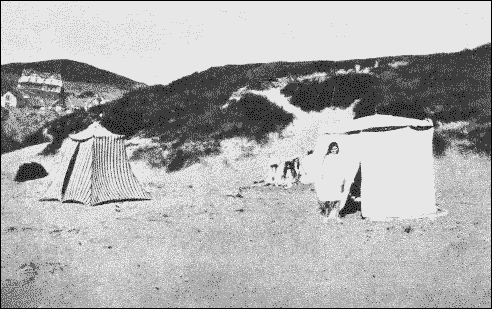
He's showing Feda a thing that looks like a canvas
house. Yes, it must be a canvas house. And
it looks to Feda as though it's on a place that
seems to be open—a wide place. Yes, no, there's
not much green showing where Feda can see.
There's a kind of a door in it, like that. (Feda
made some sign I didn't catch.) The canvas is
sort of grey, quite a light colour, but not quite
white. Oh yes, Feda feels the sound of water not
far from it—ripple, ripple. Feda sees a boy—not
Raymond—half lying, half sitting at the door of
the tent place, and he hasn't got a proper coat on;
he's got a shirt thing on here, and he's like spreaded
out. It's a browny-coloured earth, not nice green,
but sandy-coloured ground. As Feda looks at the
land, the ground rises sharp at the back. Must
have been made to rise, it sticks up in the air.
He's showing it as though it should be in some
photograph or picture. Feda got wondering about
it, what it was for. It's a funny-shaped tent, not
round, sort of lop-sided. The door isn't a
proper door, it flops. You ought to be able to
see a picture of this. [See photographs opposite.]
O. J. L.—Has it got to do with the Argonauts?
O. J. L.—Oh, it's not Coniston then?
O. J. L.—Is it by the sea?
Near the water, he says; he doesn't say the sea.
No, he won't say that; he says, near water. It
looks hot there.
O. J. L.—Will the boys know?
You will know soon about it, he says.
Feda gets a feeling that there are two or three
moving about inside that tent.
O. J. L.—Is it all one chamber in the tent?
He didn't say that. He was going to say, no,
and then he stopped to think. No, I don't think
it was, it was divided off.
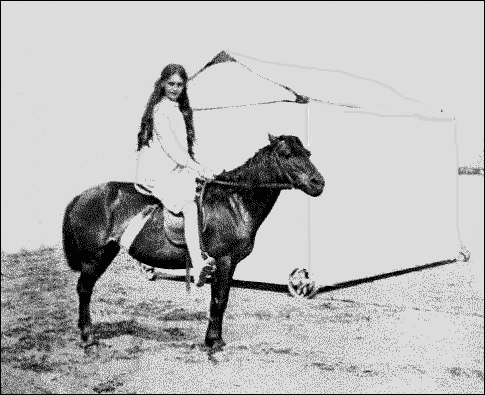
LARGE DOUBLE-COMPARTMENT TENT IN ITS
FIRST FORM (1905)
(BUILT AT MARIEMONT AND TAKEN TO WOOLACOMBE)
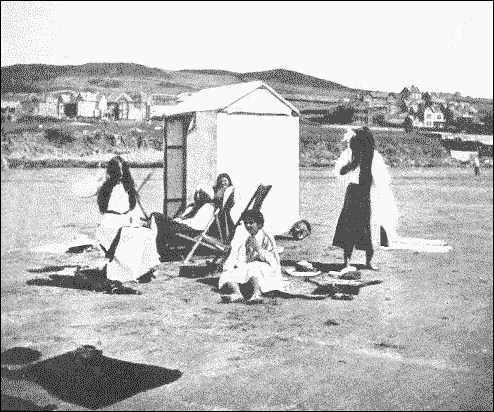
THE TENT IN ITS SECOND FORM (1906)
MADE OUT OF THE REMAINS OF THE FIRST
[See photographs of two forms of this tent.]
Now he is showing something right on top of
that. Now he is showing Feda a yacht, a boat
with white sails. Now he is going back to the tent
again. The raised up land is at the back of the tent,
well set back. It doesn't give an even sticking up,
but it goes right along, with bits up and bits lower
down.
[The description could not be completely taken
down, but it gave the impression of a raised
bank of varying height, behind an open
space, and a tent in front of it. It quite
suggested that sort of picture.]
[See photograph facing p. 252.]
Maps, what's that? Maps, maps, he says. He's
saying something about maps. This is something
that the boys will know. Poring, he says. Not
pouring anything out, but poring over maps. Ask
the boys. [See note after further reference to
maps later in the sitting.]
O. J. L.—What about that yacht with sails; did it run on
the water?
No. (Feda, sotto voce.—Oh, Raymond, don't be
silly!) He says, no. (Feda.—It must have done!)
He's showing Feda like a thing on land, yes, a
land thing. It's standing up, like edgeways. A
narrow thing. No it isn't water, but it has got
nice white sails.
O. J. L.—Did it go along?
He says it DIDN'T! He's laughing! When he
said 'didn't' he shouted it. Feda should have said,
'He laid peculiar emphasis on it.' This is for the
boys.
O. J. L.—Had they got to do with that thing?
Yes, they will know, they will understand.
Yes, he keeps on showing like a boat—a yacht, he
calls it, a yacht.
[See note below and photographs.]
Now he is showing Feda some figures. Something
flat, like a wall. Rods and things, long rods.
Some have got little round things shaking on them,
like that. And he's got strings, some have got
strings. 'Strings' isn't the right word, but it will
do. Smooth, strong, string-like. In the corner,
where it's a little bit dark, some one is standing
up and leaning against something, and a piece of
stuff is flapping round them.
Now he is saying again something about maps.
He's going to the maps again. It isn't a little map,
but it's one you can unfold and fold up small. And
they used to go with their fingers along it, like that—not
he only, but the boys. And it wasn't at home,
but when they were going somewhere—some distance
from home. And Feda gets the impression as
though they must be looking at the map when it was
moving. They seem to be moving smoothly along,
like in one of those horrible trains. Feda has never
been in a train.
[The mention of folded-up maps cannot be
considered important, but it is appropriate,
because many of the boys' common reminiscences
group round long motor drives in
Devonshire and Cornwall, when they must
frequently have been consulting the kind of
map described.]
[Note by O. J. L. on Tent and Boat.—All this
about the tent and boat is excellent, though
not outside my knowledge. The description
of the scenery showed plainly that it
was Woolacombe sands that was meant—whither
the family had gone in the summer
for several years—a wide open stretch of
sand, with ground rising at the back, as described,
and with tents along under the bank,
one of which—a big one—had been made
by the boys. It was on wheels, it had
two chambers with a double door, and was
used for bathing by both the boys and girls.
Quite a large affair, oblong in shape, like a
small cottage. One night a gale carried it
up to the top of the sand-hills and wrecked it.
We saw it from the windows in the morning.
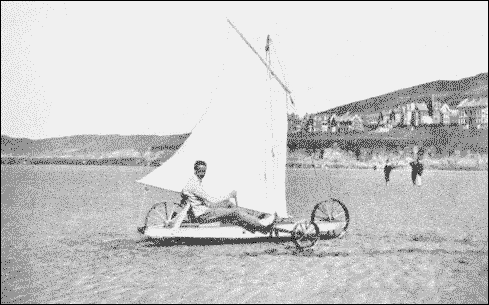
FIRST EDITION OF THE SAND-BOAT (1906)
AT WOOLACOMBE WITH ALEC ON BOARD
RISING GROUND BEHIND OLDER TENTS
ON WOOLACOMBE BEACH
The boys pulled it to pieces, and made a
smaller tent of the remains, this time with
only one chamber, and its shape was now a
bit lop-sided. I felt in listening to the description
that there was some hesitation in
Raymond's mind as to whether he was
speaking of the first or the second stage of
this tent.
As for the sand-boat, it was a thing they likewise
made at Mariemont, and carted down
to Woolacombe. A kind of long narrow
platform or plank on wheels, with a rudder
and sails. At first, when it had small sails,
it only went with a light passenger and a
strong wind behind. But in a second season
they were more ambitious, and made bigger
sails to it, and that season I believe it went
along the sands very fast occasionally; but
it still wouldn't sail at right angles to the
wind as they wanted. They finally smashed
the mast by sailing in a gale with three passengers.
There had been ingenuity in making
it, and Raymond had been particularly active
over it, as he was over all constructions. On
the whole it was regarded as a failure, the
wheels were too small; and Raymond's
'DIDN'T' is quite accepted.
References to these things were evidently some
of the tests (p. 249) which he had got together
for transmission to me. [See photographs.]
The rod and rings and strings, mentioned after
the 'boat,' I don't at present understand. So
far as I have ascertained, the boys don't
understand, either, at present.]
I don't know whether I have got anything more
that I can really call a test. You will have to take,
he says (he's laughing now)—take the information
about the old lady as a test.
O. J. L.—You mean what he began with? [i.e. about Mrs.
Clegg.]
O. J. L.—Well, it's a very good one.
He's been trying to find somebody whose name
begins with K. But it isn't Mrs. Kathie, it's a
gentleman. He's been trying to find him.
O. J. L.—What for?
He thought his mother would be interested.
There's something funny about this. One is in the
spirit world, but one they believe is still on the
earth plane. He hasn't come over yet. [One of
the two referred to is certainly dead; the other
may possibly, but very improbably, be a prisoner.]
There's a good deal of mystery about this, but
I'm sure he isn't actually come over yet. Some
people think that because we are here, we have
only to go anywhere we choose, and find out anything
we like. But that's Tommy-rot. They are
limited, but they send messages to each other, and
what he sincerely believes is, that that man has
not passed on.
O. J. L.—Mother thinks he has, and so do his people.
Yes, yes. I don't know whether it would be
advisable to tell them anything, but I have a
feeling that he isn't here. I have been looking for
him everywhere.
He keeps on building up a J. He doesn't answer
when Feda asks what that is. He says there will
be a few surprises for people later on.
O. J. L.—Well, I take it that he wants me to understand
that J. K. is on our side?
Yes, he keeps nodding his head. Yes, in the
body. Mind, he says, I've got a feeling—I can
only call it a feeling—that he has been hurt,
practically unconscious. Anyway, time will prove
if I am right.
O. J. L.—I hope he will continue to live, and come back.
I hope so too. Except for the possible doubt
about it, I would say tell them at once. But after
all they are happier in thinking that he has gone
over, than that he's in some place undergoing terrible
privations.
Now he's saying something carefully to Feda.
He says they should not go by finding a stick. He
wants you to put that down—they ought not to
go by finding a stick.
O. J. L.—Oh, they found a stick, did they?
[I clearly understood that this statement referred
to a certain Colonel, about whom
there was uncertainty for months. But a
funeral service has now been held—an impressive
one, which M. F. A. L. attended.
On inquiry from her, I find (what I didn't
know at the time of the sitting) that the
evidence of his death is a riding-whip, which
they found in the hands of an unrecognisable
corpse. From some initials on this riding-whip,
they thought it belonged to him; and
on this evidence have concluded him dead.
So far as I know, they entertain no doubt
about it. At any rate, we have heard none
expressed, either publicly or privately. Hence,
the information now given may possibly
turn out of interest, though there is always
the possibility that, if he is a prisoner in
Germany, he may not survive the treatment.
He was leading an attack on the Hohenzollern
Redoubt when he fell; he was seen
to fall, wounded; there was great slaughter,
and when at night his man returned to try
and find him, he could not be found.
This is my recollection of the details, but
of course they can be more accurately given.
At what period the whip was found, I
don't know, but can ascertain.] (See also
p. 266.)
[No further news yet—September 1916. But
I must confess that I think the information extremely unlikely.
—O. J. L.]
O. J. L.—Does he remember William, our gardener?
Yes.
Feda doesn't know what he means, but he says
something about coming over. (Feda, sotto voce.—Tell
Feda what you mean.)
He doesn't give it very clearly. Feda gets an
idea that he means coming over there. Yes, he
does mean into the spirit world. Feda asks him,
did he mean soon; but he shakes his head.
O. J. L.—Does he mean that he has come already?
He doesn't get that very clearly. He keeps
saying, coming over, coming over, and when Feda
asked 'Soon?' he shook his head, as if getting cross.
O. J. L.—If he sees him, perhaps he will help him.
Of course he will. He hasn't seen him yet.
No, he hasn't seen him.
[I may here record that William, the gardener,
died within a week before the sitting, and that
Raymond here clearly indicates a knowledge,
either of his death or of its imminence.]
It's difficult when people approach you, and say
they knew your father or your mother; you don't
quite know what to say to them!
O. J. L.—Yes, it must be a bother. Do you remember a
bird in our garden?
(Feda, sotto voce.—Yes, hopping about?)
O. J. L.—No, Feda, a big bird.
Of course, not sparrows, he says! Yes, he does.
(Feda, sotto voce.—Did he hop, Yaymond?) No,
he says you couldn't call it a hop.
O. J. L.—Well, we will go on to something else now; I
don't want to bother him about birds. Ask him
does he remember Mr. Jackson?
Yes. Going away, going away, he says. He
used to come to the door. (Feda, sotto voce.—Do
you know what he means? Anyone can come to the
door!) He used to see him every day, he says, every
day. (Sotto voce.—What did he do, Yaymond?)
He says, nothing. (I can't make out what he
says.) He's thinking. It's Feda's fault, he says.
O. J. L.—Well, never mind. Report anything he says,
whether it makes sense or not.
He says he fell down. He's sure of that. He
hurt himself. He builds up a letter T, and he
shows a gate, a small gate—looks like a foot-path;
not one in the middle of a town. Pain in hands
and arms.
O. J. L.—Was he a friend of the family?
No. No, he says, no. He gives Feda a feeling
of tumbling, again he gives a feeling as though—(Feda
thinks Yaymond's joking)—he laughed. He
was well known among us, he says; and yet, he says,
not a friend of the family. Scarcely a day passed
without his name being mentioned. He's joking,
Feda feels sure. He's making fun of Feda.
O. J. L.—No, tell me all he says.
He says, put him on a pedestal. No, that they
put him on a pedestal. He was considered very
wonderful. And he 'specs that he wouldn't have
appreciated it, if he had known; but he didn't know,
he says. Not sure if he ever will, he says. It sounds
nonsense, what he says. Feda has got an impression
that he's mixing him up with the bird,
because he said something about 'bird' in the middle
of it—just while he said something about Mr.
Jackson, and then he pulled himself up, and changed
it again. Just before he said 'pedestal' he said
'fine bird,' and then he stopped. In trying to answer
the one, he got both mixed up, Mr. Jackson and
the bird.
O. J. L.—How absurd! Perhaps he's getting tired.
He won't say he got this mixed up! But he did!
Because he said 'fine bird,' and then he started off
about Mr. Jackson.
O. J. L.—What about the pedestal?
O. J. L.—Would he like him put on a pedestal?
No, he doesn't say nothing.
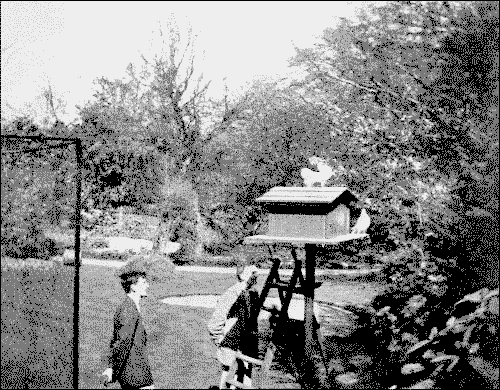
[Contemporary Note by O. J. L.—The episode of
Mr. Jackson and the bird is a good one. 'Mr.
Jackson' is the comic name of our peacock.
Within the last week he has died, partly, I
fear, by the severe weather. But his legs
have been rheumatic and troublesome for
some time; and in trying to walk he of late
has tumbled down on them. He was found
dead in a yard on a cold morning with his
neck broken. One of the last people I saw
before leaving home for this sitting was a
man whom Lady Lodge had sent to take the
bird's body and have it stuffed. She showed
him a wooden pedestal on which she thought
it might be placed, and tail feathers were
being sent with it. Hence, the reference to
the pedestal, if not telepathic from me, shows
a curious knowledge of what was going on.
And the jocular withholding from Feda of the
real meaning of Mr. Jackson, and the appropriate
remarks made concerning him which
puzzled Feda, were quite in Raymond's vein
of humour.
Perhaps it was unfortunate that I had mentioned
a bird first, but I tried afterwards, by my
manner and remarks, completely to dissociate
the name Jackson from what I had asked before
about the bird; and Raymond played
up to it.
It may be that he acquires some of these contemporary
items of family information
through sittings which are held in Mariemont,
where of course all family gossip is
told him freely, no outsider or medium being
present. But the death of Mr. Jackson, and
the idea of having him stuffed and put on a
pedestal, were very recent, and I was surprised
that he had knowledge of them. I
emphasise the episode as exceptionally
good.]
He's trying to show Feda the side of a house;
not a wall, it has got glass. He's taking Feda round
to it; it has got glass stuff. Yes, and when you
look in, it's like flowers inside and green stuff. He
used to go there a lot—be there, he says. Red-coloured
pots.
O. J. L.—Is that anything to do with Mr. Jackson?
He's shaking his head now. That's where
mother got the flowers from. Tell her, she will
know.
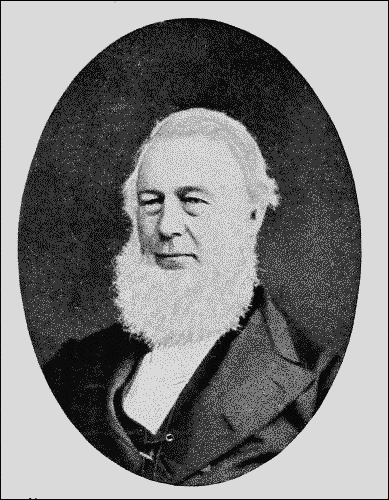
"GRANDFATHER W."
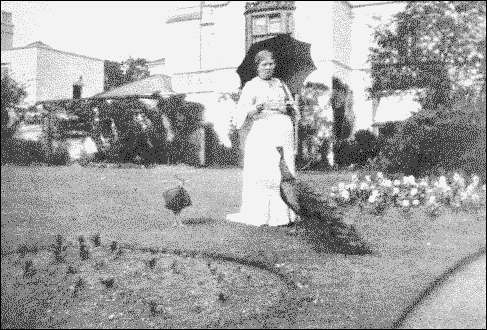
"MR. JACKSON" WITH M. F. A. L. AT MARIEMONT
[There is more than one greenhouse that might
be referred to. M. F. A. L. got the yellow
jasmine, which she thinks is the flower referred
to, from the neighbourhood of one of
them. And it is one on which the peacock
used commonly to roost; though whether the
reference to it followed on, or had any connexion
with, the peacock is uncertain, and
seems to be denied.]
Yes, he's not so clear now, Soliver. He has enjoyed
himself. Sometimes he enjoys himself so
much, he forgets to do the good things he prepared.
I could stay for hours and hours, he says.
But he's just as keen as you are in getting tests
through. I think I have got some. When I go
away, I pat myself on the back and think, That's
something for them to say, "Old Raymond does
remember something." What does aggravate him
sometimes is that when he can't get things through,
people think it's because he has forgotten. It isn't
a case of forgetting. He doesn't forget anything.
Father, do you remember what I told mother
about the place I had been to, and whom I had been
allowed to see? What did they think of it?
[See M. F. A. L. sitting with Mrs. Leonard,
4 February 1916, Chap. XX.]
O. J. L.—Well, the family thought that it wasn't like Raymond.
Ah, that's what I was afraid of. That's the
awful part of it.
O. J. L.—Well, I don't suppose they knew your serious
side.
Before he gave that to his mother, he hesitated,
and thought he wouldn't. And then he said, Never
mind what they think now, I must let mother and
father know. Some day they will know, and so,
what does it matter?
He knew that they might think it was something
out of a book, not me; but perhaps they didn't know
that side of me so well.
O. J. L.—No.
But among the things that came back, there
was a Bible with marked passages in it, and so I
saw that you had thought seriously about these
things. [page 11.]
Yes, he says. Yet there's something strange
about it somehow. We are afraid of showing that
side; we keep it to ourselves, and even hide it.
O. J. L.—It must have been a great experience for you.
I hadn't looked for it, I hadn't hoped for it, but
it was granted.
O. J. L.—Do you think you
could take some opportunity of speaking about it through some other medium,
not Feda? Because at present the boys think that Feda invented it.
Yes, that's what they do think. He says he will try very hard.
O. J. L.—Have you ever seen that Person otherwise than
at that time?
No, I have not seen Him, except as I told you;
he says, father, He doesn't come and mingle freely,
here and there and everywhere. I mean, not in that
sense; but we are always conscious, and we feel
him. We are conscious of his presence. But you
know that people think that when they go over, they
will be with him hand in hand, but of course they're
wrong.
He doesn't think he will say very much more
about that now, not until he's able to say it through
some one else. It may be that they will say it
wrong, that it won't be right; it may get twisted.
Feda does that sometimes. (Feda, sotto voce.—No,
Feda doesn't!) Yes she does, and that's why I
say, go carefully.
O. J. L.—Has he been through another medium to a friend
of mine lately?
[This was intended to refer to a sitting which
Mr. Hill was holding with Peters about that
date, and, as it turned out, on the same
day.]
He doesn't say much. No, he doesn't say nothing
about it. He hasn't got much power, and he's
afraid that he might go wrong.
Good-bye, father, now. My love to you, my love
to mother. I am nearer to you than ever before,
and I'm not so silly about [not] showing it. Love
to all of them. Lionel is a dear old chap. My
love to all.
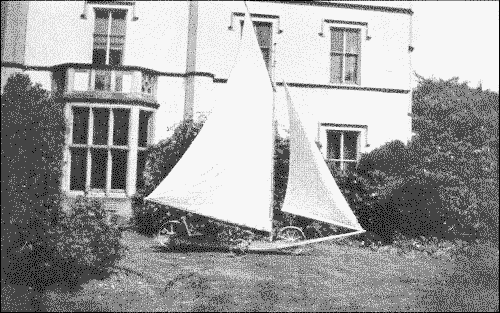
SECOND EDITION OF SAND-BOAT, AT MARIEMONT,
BEFORE BEING UNSHIPPED AND TAKEN TO WOOLACOMBE, 1907

RAYMOND WORKING AT THE SAND-BOAT IN THE BOYS'
LABORATORY AT MARIEMONT
Don't forget to tell mother about the roses I
brought her. There's nothing to understand about
them; I just wanted her to know that I brought her
some flowers.
Good night, father. I am always thinking of
you. God bless you all.
Give Feda's love to SrAlec.
O. J. L.—Yes, I will, Feda. We are all fond of you.
Yes, Feda feels it, and it lifts Feda up, and helps
her.
Mrs. Leonard speedily came-to, and seemed quite easy
and well, although the sitting had been a long one, and it
was now nearly 11.30 p.m.
[I repeat in conclusion that this was an excellent sitting,
with a good deal of evidential matter.—O. J. L.]