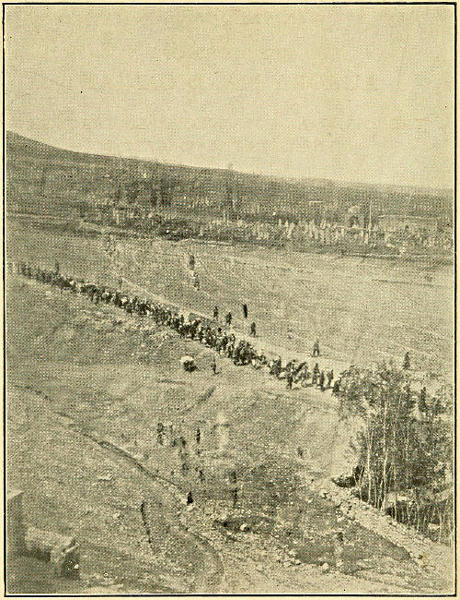
My story begins with Easter Sunday morning, in
April, 1915. In my father’s house we prepared to
observe the day with a joyous reverence, increased by
the news from Constantinople that the Turkish government
recently had expressed its gratitude for the
loyal and valuable service of the Armenian troops in
the Great War. When Turkey joined in the war,
almost six months before, a great fear spread throughout
Armenia. Without the protecting influence of
France and England, my people were anxious lest the
Turks take advantage of their opportunity and begin
again the old oppression of their Christian subjects.
The young Armenian men would have preferred to
fight with the Sultan’s enemies, but they hurried to
enlist in the Ottoman armies, to prove they were not
disloyal. And now that the Sultan had acknowledged
their sacrifices, the fear of new persecutions at the
hands of our Moslem rulers gradually had disappeared.
And in all our city, Tchemesh-Gedzak, twenty miles
north of Harpout, the capital of the district of Mamuret-ul-Aziz,
there was none more grateful for the
promise of continued peace in Armenia than my father
and mother, and Lusanne, my elder sister and I. I
was only fourteen years old, and Lusanne was not yet
seventeen, but even little girls are always afraid in
Armenia. I was quite excited that morning over my
father’s Easter gift to me—his promise that soon I
could go to an European school and finish my education
as befits a banker’s daughter. Lusanne was to be
married, and she was bent upon enjoying the last
Easter day of her maidenhood. Even the early visit
that morning of Old Vartabed, our shepherd, who
came just after daybreak, with a prophecy of trouble,
did not dampen our spirits.
Standing before my looking glass I was rearranging
for the hundredth time the blue ribbons with which
I had dressed my hair with, I must confess, a secret
hope that they would be the envy of all the other girls
at the church service. Lusanne was making use of
her elder sister’s privilege to scold me heartily for my
vanity. Lusanne was always very prim, and quiet. I
was just about to tell her that she was only jealous
because she soon would be a wife and forbidden to
wear blue ribbons any more, when my mother came
into the room. She stopped just inside the door, and
leaned against the wall. She did not say a word—just
looked at me.
“Mother, what is it?” I cried. She did not answer,
but silently pointed to the window. Lusanne and I
ran at once to look down into the street. There at the
gate to our yard stood three Turkish gendarmes, each
with a rifle, rigidly on guard. On their arms was the
band that marked them as personal attendants of
Husein Pasha, the military commandant in our district.
I turned to my mother for an explanation. She had
fallen in a heap on the floor and was weeping. She
did not speak, but pointed downward and I knew that
Husein Pasha had come to our house, and was downstairs.
Then my happiness was gone, and I, too, fell
to the floor and cried. Somehow I felt that the end
had come.
For a long time the powerful Husein Pasha, who
was very rich and a friend of the Sultan himself, had
wanted me for his harem. His big house sat in the
midst of beautiful gardens, just outside the city.
There he had gathered more than a dozen of the prettiest
Christian girls from the surrounding towns. In
Armenia the Mutassarif, or Turkish commandant, is
an official of great power. He accepts no orders, except
those that come direct from the Sultan’s ministers,
and, as a rule, he is cruel and autocratic.
It is dangerous for an Armenian father to displease
the Mutassarif. When this representative of the
Sultan sees a pretty Armenian girl he would like to
add to his harem there are many ways he may go about
getting her. The way of Husein Pasha was to bluntly
ask her father to sell or give her to him, with a veiled
threat that if the father refused he would be persecuted.
To make the sale of the girl legal and give the
Mutassarif the right to make her his concubine it was
necessary only for him to persuade or compel her to
forswear Christ and become Mohammedan.
Three times Husein Pasha had asked my father to
give me to him. Three times my father had defied his
anger and refused. The Pasha was afraid to punish
us, as my father was wealthy, and through his friendship
with the British Consul at Harpout, Mr. Stevens,
had obtained protection of the Vali, or Governor,
of the Mamuret-ul-Aziz province. But now the British
Consul was gone. The Vali was afraid of no one.
And Husein Pasha could, I knew, do as he pleased.
Instinctively I knew, too, that his visit to our house,
with his escort of armed soldiers, meant that he had
come again to ask for me.
I clung to my mother and Lusanne, with my two
younger sisters holding onto my skirt, while we listened
at the head of the stairs to my father and the
governor talking. Husein was no longer asking for
me—he was demanding. I heard him say: “Soon
orders from Constantinople will arrive; you Christian
dogs are to be sent away; not a man, woman or child
who denies Mohammed will be permitted to remain.
When that time comes there is none to save you but
me. Give me the girl Aurora, and I will take all your
family under my protection until the crisis is past.
Refuse and you know what you may expect!”
My father could not speak aloud. He was choked
with fear and horror. My mother screamed. I
begged mother to let me rush downstairs and give myself
to the Pasha. I would do anything to save her
and father and my little brothers and sisters. Then
father found his voice, and we heard him saying to
the Pasha:
“God’s will shall be done—and He would never
will that my child should sacrifice herself to save us.”
My mother held me closer. “Your father has
spoken—for you and us.”
Husein Pasha went away in anger, his escort marching
stiffly behind. Scarcely had he disappeared than
there was a great commotion in the streets. Crowds
began to assemble at the corners. Men ran to our
house to tell us news that had just been brought by a
horseman who had ridden in wild haste from Harpout.
“They are massacring at Van; men, women and
children are being hacked to pieces. The Kurds are
stealing the girls!”
Van is the greatest city in Armenia. It was once
the capital of the Vannic kingdom of Queen Semiramis.
It was the home of Xerxes, and, we are taught,
was built by the King Aram in the midst of what was
the first land uncovered after the Deluge—the Holy
Place where the ark of Noah rested. It is very dear
to Armenians, and was one of the centers of our
church and national life. It lies two hundred miles
away from Tchemesh-Gedzak, and was the home of
more than 50,000 of our people. The Vali of Van,
Djevdet Bey, was the principal Turkish ruler in Armenia—and
the most cruel. A massacre at Van
meant that soon it would spread over all Armenia.
They brought the horseman from Harpout to our
house. My father tried to question him but all he
could say was:
“Ermenleri hep kesdiler—hep gitdi bitdi!”—“The
Armenians all killed—all gone, all dead!” He
moaned it over and over. In Harpout the news had
come by telegraph, and the horseman who belonged in
our city had ridden at once to warn us.
I begged my father and mother to let me run at once
to the palace of Husein Pasha and tell him I would
do whatever he wished if he would save my family
before orders came to disturb us. But mother held
me close, while father would only say, “God’s will be
done, and that would not be it.”
Lusanne was crying. Little Aruciag and Sarah, my
younger sisters, were crying, too. My father was very
pale and his hands trembled when he put them on my
shoulders and tried to comfort me. I closed my eyes
and seemed to see my father and mother and sisters
and brothers, all lying dead in the massacre I feared
would come, sooner or later. And Husein Pasha
had said I could save them! But I couldn’t disobey
my father. Suddenly I thought of Father Rhoupen.
I broke away from my mother and ran out of the
house, through the back entrance and into the street
that led to the church where Father Rhoupen was waiting
for his congregation. No one had had the courage
to tell the holy man of the news from Van. When
I ran into the little room behind the altar he was wondering
why his people had not come.
I fell at his feet, and it was a long time before I
could stop my tears long enough to tell him why I was
there. But he knew something had happened. He
stroked my hair, and waited. When I could speak I
told him of the visit of Husein Pasha, and what he said
to us—and then I told him of the message the horseman
had brought. I pleaded with him to tell me that
it would be right for me to send word to Husein Pasha
that I would be his willing concubine if he would only
save my parents and my brothers and sisters.
Father Rhoupen made me tell it twice. When I
had finished the second time he put a hand on my head
and said, “Let us ask God, my child!”
Then Father Rhoupen prayed.
He asked God to guide me in the way I should go.
I do not remember all the prayer, for I was crying too
bitterly and was too frightened, but I know the priest
pleaded for me and my people, and that he reminded
the Father we were His first believers and had been
true to Him through many centuries of persecution.
As the priest went on I became soothed, and unconsciously
I began to listen—hoping to hear with my
own ears the answer I felt must surely come down
from up above to Father Rhoupen’s plea.
When he said “Amen” the priest knelt with me,
and together we waited. Suddenly Father Rhoupen
pressed me close to his breast and began to speak.
“The way is clear, my child. The answer has come.
Trust in Jesus Christ and He will save you as He
deems best. It were better that you should die, if
need be, or suffer even worse than death, than by your
example lead others to forswear their faith in the
Saviour. Go back to your father and mother and
comfort them, but obey them.”
All that day and the next messengers rode back and
forth between Harpout and our city, bringing the latest
scraps of news from Van. We were filled with joy
when we heard the Armenians had barricaded themselves
and were fighting back, but we dreaded the consequences.
No one slept that night in our city. All
day and all night Father Rhoupen and his assistant
priests and religious teachers in the Christian College
went from house to house to pray with family groups.
The principal men in the city waited on Husein
Pasha to ask him if we were in danger. He told them
their fears were groundless—that the trouble at Van
was merely a riot. My father and mother clutched
eagerly at this half promise of security, but Tuesday
we knew we had been deceived. That morning Husein
Pasha ordered the doors of the district jail opened, and
the criminals—bandits and murderers—who were
confined there, released and brought to his palace.
An hour later each one of these outlaws had been
dressed in the uniform of the gendarmes, given a rifle,
a bayonet and a long dagger and lined up in the public
square to await orders. That is the Turkish way when
there is bad work to do.
At noon officers of the gendarmes, or, as they are
called, zaptiehs, rode through the city posting notices
on the walls and fences at every street corner. My
father had gone to Harpout early in the morning to
confer with rich Armenian bankers there and to appeal
direct to Ismail Bey, the Vali. Mother was too weak
from worry to go to the corner and read the notices,
so Lusanne and I went at once. The paper read:
ARMENIANS.
You are hereby commanded by His Excellency, Husein
Pasha, to immediately go into your houses and remain within
doors until it is the pleasure of His Excellency to again permit
you to go about your affairs. All Armenians found upon
the streets, at their places of business or otherwise absent
from their homes, later than one hour after noon of this day
will be arrested and severely punished.
(Signed)
Ali Aghazade, Mayor.
When we reported to our mother she was greatly
worried because of our father’s absence at Harpout.
He might ride into the city at any time during the afternoon,
ignorant of the orders, and be caught in the
streets. Our brother Paul, who was fifteen years old,
was visiting at a neighbor’s. We sent him, through
narrow, back streets, out of the city and onto the plains
where he could watch the road our father must ride
along, and, should he appear before dark, warn him
of the order. We had reason later to be thankful
father was away.
We could not imagine what the order meant. We
could not bring ourselves to believe it meant a deliberate
massacre was planned, and that this means was
taken to have us all in our homes for the convenience
of the zaptiehs.
At 4 o’clock gendarmes, among them the prisoners
released from jail, marched up to the homes of the
wealthiest men, with orders for them to attend an audience
with Husein Pasha.
When mother explained to the officer who came to
our door that my father was out of town the zaptiehs
searched the house, roughly pushing my mother aside
when she got in their way. They then demanded the
keys to my father’s business place. When Lusanne
ran upstairs to get them the officer insisted upon going
with her. While she was getting the keys from my
father’s room he embraced her, tearing open her dress
as he did so. When she screamed he slapped her in
the face so hard she fell onto the floor. He left her
there and went out with his men.
From our windows we could overlook the public
square. Here the zaptiehs gathered fifty of the city’s
leading men. Among them were Father Rhoupen;
the president of the Christian College, which had been
founded by American missionaries; several professors
and physicians; bankers, the principal merchants and
other business men.
Instead of marching their prisoners toward the palace
of the Pasha, the guards turned them toward the
other part of the city. Then we knew they were being
taken, not to an audience with the commandant, but
to the jail which had been emptied by the Mutassarif
that morning.
Many women, when they realized where their husbands
were being taken, ignored the order to keep to
their homes, ran into the street and tried to rush up
to their men folk. The gendarmes knocked them
aside with rifle butts. One woman, the wife of a professor,
managed to break through the guard and reach
her husband. A gendarme tried to pull her away, but
she clung tightly, screaming. The soldier turned his
rifle about and drove his bayonet into her. Her husband
leaped at the man’s throat and was killed by
another gendarme.
The prisoners were compelled to march over the
bodies of the professor and his wife, while their children,
who had also run out of their house, stood aside,
wringing their hands and weeping, until the company
passed, when they were permitted to tug the bodies of
their parents into their home. None of us who
watched dared go to the assistance of these little ones.
The jail is a rambling stone building, built more
than seven centuries ago. Originally it was a monastery,
but the Turks took possession of it in 1580,
and have used it as a prison ever since. It is surrounded
by a high wall and has a large courtyard onto
which the great, barren dungeons open.
Throughout that afternoon mother, Lusanne and I
waited anxiously for father to come from Harpout.
Toward evening a gendarme came to the house and
asked if father had returned yet, saying that he was
missed “at the audience with the Mutassarif.”
Mother asked him why the men folk were taken to jail,
if the Mutassarif wanted to see them. The soldier
said the governor thought that would be handier, as it
was a long walk to the palace. We were comforted
a little by that explanation, but when evening came and
the men had not returned to their homes we became
worried again. And we began to fear, too, that father
and Paul had been intercepted.
At dark the wives and daughters of the men who
had been taken from their homes could not stand the
suspense any longer. Braving the order to remain indoors
they began to gather in the streets, and little
companies of women and children, and even the more
daring men, moved toward the jails. They waited
outside until well toward midnight, hoping to catch a
glimpse of their relatives or to hear what was going
on inside. At 11 o’clock the prison gates opened and
Husein Pasha, in his carriage and escorted by a heavy
guard of mounted soldiers, came out.
The women crowded around him, but the soldiers
drove them away. Scarcely had the Pasha’s carriage
disappeared than there was shouting and screaming
in the prison. Lusanne and I, who had stolen up to
the prison wall, ran home frightened. Father and
Paul were there, having reached home late in the evening.
Father looked very careworn. He took me into his
arms and kissed me in a strange way. Big tears were
in his eyes when I looked into them. I knew, without
asking, that he had not succeeded in his mission to
Harpout for protection. We sat up all that night,
listening to the cries that came from the prison. We
learned the next day what had happened, when the
one man who had escaped crept into his home to be
hidden.
When Husein Pasha arrived at the prison he told
the men who had been gathered that new word had
come from Constantinople that the Armenians were
not loyal to Turkey, and that they had been plotting to
help the Allies. He demanded that the prisoners tell
him what they knew of such plots. Every one of them
assured him there had been no such plotting, that the
Armenians wanted only to live in peace with their
Turkish neighbors, obey the Sultan and do him whatever
service was demanded of them. Husein seemed
at last convinced and went away, saying the men could
all return to their homes in the morning.
While the prisoners were congratulating each other
upon their promised release, and hoping there might
be some way to get word to their families in the meantime,
gendarmes appeared and drove the men into one
corner of the courtyard. While the others were held
back by the levelled guns and bayonets one prisoner at
a time was pulled into a ring of soldiers and ordered
to confess that he had been conspiring against the
Sultan.
As each one denied the accusation and declared he
would confess to nothing, he was stripped of his
clothes and the gendarmes fell to beating him on his
naked back with leather thongs. As fast as the men
fainted from the lashing they were thrown to one side
until they revived, when they were beaten again, until
all the soldiers had taken turns with the thongs and
were tired. Eight of the older men died under the
beatings. Their bodies were thrown into a corner of
the jail yard.
While they were beating Father Rhoupen an officer
interfered. He said it was a waste of time to beat the
priest, as all priests must be killed anyway. He then
turned to Father Rhoupen and told him he could live
only if he would forswear Christ and become Mohammedan.
If he refused, the officer said, he would be
beaten until he died.
Poor Father Rhoupen was almost too weak to answer.
When the soldiers dropped him, at the officer’s
command, he fell into a heap on the ground. When
he tried to speak his head shook and the Turk thought
he was signifying he would accept Mohammed.
“Hold him up—on his feet,” the officer ordered.
Two soldiers lifted him. The officer commanded
him to repeat the creed of Islam—“There is only one
God, and Mohammed is his prophet.”
“There is only one God”—Father Rhoupen began,
just as clearly as he could, and with his eyes turned
full upon the cruel officer. He stopped for breath,
and then went on—“and Jesus Christ, His Son, is
my Saviour!”
The officer drew his sword and cut off Father Rhoupen’s
head.
Professor Poladian, president of the College, was
next told that he might save his life if he would profess
Mohammed. Professor Poladian was one of the
most loved men in all Armenia. He had studied at
Yale University, in the United States, and had been
highly honored by England and France because of
his noble deeds. He was very old.
I loved him more than any man besides my father,
because once when I was very little I was sick and
cried when I had to stay away from a Christmas tree
at the College on which Professor Poladian had hung
bags of candy for all the little girls of Tchemesh-Gedzak.
Professor Poladian asked Lusanne, my sister,
why I was not with the other children who gathered
about the tree, and when she told him I was at
home, ill, and that I cried because I couldn’t come, he
drove all the way to our house, almost two miles,
brought me my candy bag and told me the Christmas
story of the birth of Christ. I remember after
that I always wanted to pray to Professor Poladian
after I had prayed to God, until my mother made me
understand why I shouldn’t.
Professor Poladian was not beaten, but the officer
told him he had been spared only that he might swear
faith in Islam. The Professor was almost overcome
with his suffering at having to witness the treatment of
his friends, but he told the officer he would give his
life rather than deny his religion. The soldiers then
tore out his finger nails, one by one, and his toe nails
and pulled out his hair and beard, and then stabbed
him with knives until he died.
Throughout the night the screams from the prison
yard continued, and the women waiting outside were
frantic. At dawn soldiers drove the women away,
telling them their husbands would soon be home.
As soon as the women were out of sight the soldiers
took out the men who had lived through the torture,
and, tying them together with a long rope, marched
them out of the city behind the jail toward the Murad
River, ten miles away. When they reached the river
bank the soldiers set upon the men and stabbed them
to death with bayonets. Only the one escaped by pulling
a dead body on top of him and making believe that
he, too, was dead.
The next day, Thursday, which is the day before
the Mohammedan Sunday, the soldiers went through
the streets at 9 o’clock, calling for all Armenian men
over eighteen years of age, to assemble in the public
square. In every street an officer stopped at house
doors and told the people that any man over eighteen
who was not in the square in one hour would be killed.
Mother and Lusanne and I flew to father’s arms.
We each tried to get our arms around his neck. He
was very sad and quiet. “One at a time, my dear
ones,” he said, and made us wait while he kissed and
said good-by to each of us in turn. Little Sarah, who
was seven, and Hovnan, who was six, he held in his
arms a long time. Then he kissed me on the lips, such
as he had never done before. He told mother she
must not cry, but be very brave. Then he went out.
Little Paul followed father at a distance, to be near
him as long as possible. When father got to the
square Paul tried to turn back, but a soldier saw him
and caught him by the collar, saying, “You go along,
too, then we won’t have to gather you up with the
women to-morrow.” Father protested that Paul was
only fifteen, but the soldiers wouldn’t listen. So my
brother never came back home.
I had gone upstairs to my window to watch father
crossing the street to the square. Mother had fallen
onto a divan in the reception room downstairs.
Lusanne and my little brothers and sisters stayed with
her, even the little ones trying to make believe that,
perhaps, father would return. When I saw the soldier
take Paul, too, I screamed. Mother heard and came
running upstairs, Lusanne and the others following.
I was the only one who had seen. I would have to
tell them—to tell them that not only father, but that
little Paul, who had wanted to be a priest, when he
grew up, like Father Rhoupen, was gone too. For a
moment I could not speak. Mother thought something
had happened to father in the street, and that I had
seen.
“Tell me quick—what is it? Have they killed
him?” she cried. I couldn’t answer—except to shake
my head. Suddenly mother missed Paul for the first
time. Something must have told her. She asked
Lusanne: “Where is my boy? Where is Paul?
Why isn’t he here?”
Lusanne started to run downstairs to look in the
yard. I motioned her not to go. I put my arms
around mother and said, between my sobs:
“They took Paul too—he is with our father!”
Mother sank upon the floor and buried her face.
Lusanne and I knelt beside her. But she didn’t cry.
Her eyes were dry when she gathered us to her. I
never saw my mother cry after that, even when the
Turkish soldiers, at the orders of Ahmed Bey, were
beating her to death while they made me look on before
returning me to Ahmed’s harem.
Out of my window we could see the men comforting
each other, or talking excitedly with the leaders, in
the square. By the middle of the afternoon more than
3,000 men and older boys had assembled. The soldiers
and zaptiehs searched our houses that no man over
eighteen might escape. When women clung to husbands
and fathers the soldiers said the men were summoned
only to be addressed by Ishmail Bey, the Vali,
who was coming up from his capital, Harpout. Some
of the women believed this explanation. Others knew
it was not true.
Not very far from our house was the home of
Andranik, a young man who had graduated from the
American School at Marsovan, and who had come to
our city with his parents to teach in our schools. He
was very popular in the city, and it was to him Lusanne
was to be married. When the Turks conscripted
young Armenian men they spared Andranik because
of his position as a teacher.
When his father answered the summons to the
square Andranik remained behind. He disguised himself
in a dress belonging to his sister and made his
way to the edge of the city where he bought a horse
from a Turk whom he knew he could trust. By the
Turk, Andranik sent word to Lusanne that he would
ride to Harpout, where he knew the German Consul-General,
Count Wolf von Wolfskehl, and beg of
this powerful German official to intercede for the Armenians
of Tchemesh-Gedzak.
Lusanne was much encouraged when she heard Andranik
was safe. All afternoon neighboring women,
some of them wives of wealthy men, came to our house
to look from our windows into the square, hoping to
catch a glimpse of their loved ones. The soldiers
would not let the women gather near the square, nor
communicate with the men.
One pretty woman, Mrs. Sirpouhi, who had been
married not quite a year to a son of our richest manufacturer,
was just about to become a mother. From
our window she caught sight of her husband. She
could not keep herself from running across to the
square, screaming as she went, “My Vartan—my
Vartan!” Vartan was his name.
The young husband heard his wife calling and ran
to the edge of the square, holding out his arms to her.
Just as she was about to throw herself upon him a
zaptieh struck her on the head with his gun. When
this zaptieh and his companions saw the young woman
was almost a mother they took turns running their
bayonets into her. The husband fell to the ground. I
think he fainted. The soldiers carried him off. They
left his bride’s body where it fell.
At sundown, when nearly all the Christian women
in the city must have cried their eyes dry, as did Lusanne
and I, we heard the muezzin calling the First
Prayer from the minarets of the El Hasan Mosque in
the Mohammedan quarter. It seemed to me the muezzin
was mocking us as he sang: “There is no God
but Allah; come to prayer; come to security!” Without
letting mother know I knelt by myself and asked
our God if He would not think of us—and send our
fathers back. Perhaps He heard me for as soon as
the Mohammedan prayer was over a soldier came to
our door.
He said father had paid him to bring a message;
that he would be able to speak to us if we should go
at once to the north corner of the square. To prove
his message was true the soldier showed us father’s
ring.
With my little sisters and brothers holding to our
hands, mother, Lusanne and I ran quickly to the north
corner, and there father and Paul were awaiting us.
For a time he could not speak. Then he said:
“We are to be driven into the desert!”
The officers had told them they would be taken only
to Arabkir, sixty miles away, and allowed to camp
there until the Turks were ready for them to return
home again. Father said he hoped this were true—but
he did not believe they would be allowed to return.
He told mother that since little Paul was along he
would like to have her bring him a blanket to wrap up
in at night, and money. He had with him a hundred
liras, or $440. in American money, but perhaps if he
had more, he thought he could bribe the soldiers to let
Paul ride a horse, or perhaps, escape when they began
the march.
Mother and I hurried to the house. She went into
the basement, where father had hidden a great deal
of money for us. When I went to get a blanket I
thought of my “yorgan,” a birthday blanket father had
brought me from Smyrna when I was ten years old.
It was the most beautiful thing I had. The Ten Commandments
were woven into it, and it had been made,
many people had said, a thousand years ago. I took
this to Paul and another blanket for father. Paul
cried when he saw I had given him my yorgan. We
wrapped dried fruit, and cheese in thin bread, also, to
give them. Mother took 200 liras—almost a thousand
dollars.
The soldiers would not let us talk long to father the
second time. We stood across the street just looking
at him until it was too dark to see him any more, and
then we went home. We never saw father or Paul
again.
When we reached our house we found Abdoullah
Bey, the police chief, waiting in the parlor. Abdoullah
always had been a friend of father’s, and we thought
him a kindly man. Perhaps he would have helped us
if he could, but when mother begged him to have Paul,
at least, restored to us, he showed us a written order,
signed by Ismail Bey, the Vali, which had been given
him by Husein Pasha. It read:
“During the process of deportation of the Armenians
if any Moslem resident or visitor from the surrounding
country endeavors to conceal or otherwise
protect a Christian, first his house shall be burned,
then the Christian killed before his eyes, and then the
Moslem’s family and himself shall be killed.”
“You see I cannot help you,” Abdoullah Bey said,
“even though I would. But I can advise you as a
friend. You have two daughters who are young. It
is still possible for them to renounce your religion and
accept Allah. I will take word personally, if you wish,
to Husein Pasha that your Lusanne and Aurora will
say the rek’ah (the oath to Mohammed). He is willing
to take them both, and thus spare them and you
many things, which, perhaps, are about to happen.
Soon it may be too late.”
Husein wanted us both! I remembered Father
Rhoupen’s words, “Trust in God and be true to Him.”
But it seemed as if I ought to sacrifice myself. Even
then I would have gone to the Pasha’s house, but
mother said to Abdoullah:
“Tell the Pasha we belong to God, and will accept
whatever He wills!” Abdoullah respected mother for
her courage. He bowed to her as he went out. “I
am sorry for what may come,” he said.
That evening Andranik returned from Harpout and
came at once to our house. He still wore his sister’s
dress. When he appeared at the door Lusanne ran
into his arms. I read in his face bad news.
“I begged of Count von Wolfskehl to save us. He
said the Sultan had ordered that no Christian subject
be left alive in Turkey, and that he thought the Sultan
had done right.”
Lusanne secretly had thought Andranik would be
successful. She had such confidence in him she did
not think he could fail. She was overcome when her
hope was destroyed, but she thought more of Andranik
than of herself. She begged him to try to escape.
Andranik decided he would remain in his women’s
clothes. Lusanne cut off some of her own hair and
arranged it on his head so bits of it would show under
his shawl and make him look more nearly like a girl.
They thought perhaps he might get out of the city at
night, unmolested, and hide with friendly farmers.
But, somehow, the authorities learned Andranik had
not surrendered himself. Early in the evening the
zaptiehs under command of Abdoullah, surrounded his
house and demanded that he come out. When his
mother said he was not there, the gendarme chief replied
that if he did not appear at once the house would
be burned with all who were in it.
A neighbor woman ran in to tell us. Andranik
threw off his disguise, took an old saber father had
hung on our wall, and rushed out. He cut his way
through the gendarmes and got into his home, where
he found his mother and sister and his other relatives
in a panic of fear. The gendarmes shouted to him to
come out at once. Andranik saw them bringing up
cans of oil. He kissed his mother and sister again
and stepped out into the street. They killed him with
knives on the doorstep. His sister ran out and threw
herself on his body, and they killed her, too. When a
neighbor told us what had happened, Lusanne ran out
to Andranik’s house and helped his mother carry in
the two bodies.
Father and the other men were taken away that
night. In our house we were sitting in my room trying
to pick them out from the shadows in the square
made by the torches and lanterns of the zaptiehs, when
many new soldiers appeared, and, suddenly, there was
a great shouting. Soon we saw the men, formed into
a long line, march out of the square, with zaptiehs and
soldiers all about them. It was too dark for us to
identify father and Paul, but we knew they would be
looking up at our window and hoped they could see us.
They took the men toward the Kara River, which is
a branch of the Euphrates. Many were so old and
feeble they could not walk so far, and fell to the
ground. The zaptiehs killed these with their knives
and left their bodies behind. It was daylight when
they came to the little village of Gwazim, which is on
the river bank twelve miles away. There was a large
building at Gwazim which the Turks sometimes used
as a barracks when there was war with the Kurds, and
at other times as a prison. Half the men were put
into this building and told they would have to stay
until the next day. The zaptiehs then took the others
across the river toward Arabkir.
At noon of that day the zaptiehs returned to Gwazim.
They had killed all the men they had taken
across the river just as soon as they were out of sight
of the village. When we, in Tchemesh-Gedzak, heard
that part of our men had been left in the prison, hundreds
of women walked the dusty road to Gwazim.
Lusanne and I went, hoping to get one more glimpse
of father and Paul.
In Gwazim there was an aged Armenian woman
who had lived in our city at the time of the massacre
in 1895. She was pretty then, and when the Kurds
stole her she saved her life by turning Mohammedan.
Then she was sold to a Turkish bey at Gwazim. He
kept her in his harem until she grew old. All the
time, while professing Islam, she secretly was Christian.
The bey had given her the name “Fatimeh.”
Fatimeh persuaded the guards at the prison to let
her take water to the men. When she told the prisoners
the zaptiehs had returned without the other men
they knew the same fate was in store for them.
When Fatimeh came out she told me father and Paul
were inside and had sent word to us to be hopeful.
In a little while we saw her going into the prison
again, this time with two big rocks, so heavy she could
hardly carry them, hidden in her water buckets. She
came out again and filled her buckets with coal oil.
When it was dark the younger men, who were strong
and brave, killed all the older men by hitting their
heads with the rocks Fatimeh had taken them. Father
killed Paul first, because he was so little. When
all the old and feeble men were dead, the young men
prayed that God would think they had done right in
not letting the old men suffer and then they spread the
oil, set it afire, and threw themselves in the flames.
Fatimeh told us what had happened while the prison
burned. The zaptiehs suspected her and carried her
into the burning building and left her.
It was almost dawn Saturday morning when Lusanne
and I returned to mother. “As God wills, so
be it,” was all she said when we told her what had
happened at the prison. She said there had been a
great celebration in the El Hasan mosque, in honor
of the Mohammedan Sunday, while we were at Gwazim.
A special imam, or prayer reader, had come all
the way from Trebizond to read special prayers set
aside for such great events as the beginning of a holy
war or massacre of Christians.
That morning soldiers went through the streets posting
a new paper on the walls. It was what we had
feared—an order from the Governor that all Armenian
Christian women in the city, young and old, must
be ready in three days to leave their homes and be deported—where,
the order did not say.
As soon as the Turkish residents heard of the new
order many of them began to go about the Armenian
half of the town offering to buy what the Armenian
women wanted to sell. As there were none of the
men left, the women had no one to advise them. To
our house, which was one of the best in the city, there
came many rich Turks, who told us we had better
sell them our rugs and the beautiful laces mother,
Lusanne and I had made.
Every Armenian girl is taught to make pretty laces.
No girl is happy until she can make for herself a lace
bridal veil. Always the Turks are eager to buy these,
as they sell for much money to foreign traders, but no
Armenian bride will sell her veil unless she is starving.
Lusanne and I had made our veils, and had put
them away until we should need them. We knew we
could not carry them with us when we were deported,
as they would soon be stolen. So we sold them, and
mother’s, too. The most we could get was a few
piasters. Since I have come to America I have seen
spreads and table covers, made from such bridal veils
as ours, for sale in shops for hundreds of dollars.
Father had brought us many rugs from Harpout,
Smyrna and Damascus. For these mother could get
only a few pennies.
On the second day after the proclamation, which
was our Sunday, the soldiers visited all the houses.
They walked in without knocking. They pretended to
be looking for guns and revolvers, but what they took
was our silver and gold spoons and vases.
That afternoon a company of horsemen rode past
our house. We ran to the window and saw they were
Aghja Daghi Kurds, the crudest of all the tribes.
At their head rode the famous Musa Bey, the chieftain
who, a few years before, had waylaid Dr. Raynolds
and Dr. Knapp, the famous American missionaries,
and had robbed them and left them tied together on
the road.
The Kurds rode to the palace of Husein Pasha. In
a little while they rode away again, and some of the
Pasha’s soldiers rode with them. That meant, we
knew, that the Governor had given the Kurds permission
to waylay us when we were outside the city.
All that night the women sat up in their homes.
In our house mother went from room to room, looking
at the little things on the walls and in the cupboards
that had been hers since she was a little girl.
She sat a long time over father’s clothes. I got out
my playthings and cried over them. Some of them
had been my grandmother’s toys. Lusanne did not
cry. She thought only of Andranik and the loss of
her bridal veil, and her tears had dried, like mother’s.
Little Hovnan and Mardiros, our brothers, and Sarah
and Aruciag, our sisters, cried very hard when we
told they must say good-by to their dolls and their
kites.
When morning of the last day came I slipped out
of our home to visit Mariam, my playmate, who lived
a few doors away. Mariam’s family was not very
rich, and mother had said I might give her twenty
liras from our money, that she might have it to bribe
soldiers for protection. But Mariam was not there.
During the night zaptiehs had entered her house
and taken her out of her bed, with just her nightdress
on, and had carried her away. The soldiers said
Rehim Bey had promised them money if they would
bring Mariam to his house. Mariam’s mother and
little brother were kneeling beside her empty bed when
I found them.
On my way back to our house a Turk stopped me.
He asked me to go with him. He said I might as well,
as “all the pretty Christian girls would have to give
themselves to Turks or be killed anyway.” I broke
away and ran home as fast as I could. I could not
forget the look on that Turk’s face as he spoke to me.
It was the first time I had ever seen such a look in a
man’s face. I tried to explain to mother. She put
her arms around me, but all she said was:
“My poor little girl!”
The women had been allowed until noon to assemble
in the square. Already they were arriving there,
with horse, donkey and ox carts, some with as many
of their things as they could heap on their carts, others
with just blankets and comforts, a favorite rug and
bread and fruits. In Armenia every family keeps a
year’s supply of food on hand. The women had to
leave behind all they could not carry.
When it came time for us to go I thought again of
the look in that Turk’s face. For the first time I realized
just what it would mean to be a captive in one
of the harems of the rich Turks whose big houses look
down from the hills all about the city. I had heard
of the Christian girls forced into haremliks of these
houses, but I had never really understood. Lusanne
was older. She knew more than I. “If only I could
have died with Andranik,” she said.
Mother thought of a plan she hoped might save Lusanne
and me from the harems or a worse fate among
the Kurds and soldiers. She brought out two yashmaks,
or veils, such as Turkish women wear on the
street, and made us put them on, hiding our faces.
Over these she had us put on a feradjeh, a Turkish
woman’s cloak. We looked quite as if we were Turkish
women, with all our faces hidden.
“It is only death that faces me, but for you, my
daughters, there are even greater perils,” mother said
to us. “You will be able now to walk in the streets
and the soldiers will think you are Mohammedan
women. Try to reach Miss Graham, at the orphanage.
Perhaps she can hide you until there is a way
for you to escape into the north, where the sea is.
And if you do find safety, thank God, and remember
He is always with you.” Then she kissed us and bade
us go.
Miss Graham, who was an English girl, had come to
our city from the American College at Marsovan, to
teach in our school for orphaned Armenian girls. She
was very young and pretty. The Turks had seemed
to respect her, and mother thought we would be safe
with her.
While mother went to the square with Aruciag,
Sarah, Hovnan and Mardiros, Lusanne and I mingled
with Mohammedan women who had gathered to watch
the scenes at the square and to bargain for pieces of
jewelry and other things the Armenian women knew
they must either sell or have stolen from them. We
planned to wait until dark before venturing to reach
Miss Graham’s.
Soon we saw Turks, both rich citizens and military
officers, walking about in the square roughly examining
the Christian girls. When they were pleased by a
girl’s appearance these beys and aghas tried to persuade
their mothers to let them profess Mohammedanism
and go away with them, promising to save her
relatives from deportation. When mothers refused
the Turks often struck them. Officers killed some
mothers who clung too closely to their daughters.
Many young girls gave in to the Turks and agreed
to swear faith in Allah for the sake of their mothers,
sisters and brothers. Toward evening the khateeb, or
keeper of the mosque, was brought to receive their
“conversions.”
More than fifty girls took the oath. Just as soon as
the oaths were all taken the officers signaled to the
zaptiehs and they took all these girls away from their
families and gathered them at one side of the square.
Then the richer beys began to examine the apostasized
girls. The soldiers would give a girl to the
one who paid them the most money, unless an officer
also wanted her. The higher military officers were
given first choice.
One by one the soldiers dragged the girls who had
sacrificed their religion in vain to save their mothers
and relatives out of the square and toward the homes
of the Turks. Lusanne and I had gone close to watch
our chance to speak once more to mother. We saw
everything. And while they were taking the girls
away we saw a zaptieh carrying Miss Graham in his
arms. She struggled hard, but the zaptieh was too
strong. We learned afterward the soldiers had gone
to her school to get the little Armenian girls, and when
Miss Graham tried to fight them they said her country
couldn’t help her now, and since she was a Christian
they would take her, too.
It was to Rehim Bey’s house, where Mariam already
had been carried, they took Miss Graham.
They did not even try to make her become a Mohammedan.
Rehim Bey was very powerful, and was a
cousin of Talaat Bey, the Minister of the Interior at
Constantinople.
For a time Lusanne and I debated whether we
should return to the square and join mother, since
Miss Graham had been stolen and could not help us,
or whether we should make an effort to escape since
we had so far escaped notice in our disguises. We
decided that, perhaps, if we could reach the house of
a friendly Turk, outside the city, and we knew of many
of these, we might find a way to help mother. We did
not know how this could ever be done, but we clung
to a hope that surely some one would aid us.
When it was quite dark we crept through side streets
to our deserted house and succeeded in getting into
the garden without attracting attention. We dared
not make a light, or remain on the lower floors, soldiers
might enter the house at any moment. The
safest place to hide, we thought, would be the attic.
In the attic there were a number of boxes of old
things of mother’s. We searched until we found some
old clothes, and each of us put on an old dress of
mother’s under the cloaks she had given us. If we
were discovered, the old clothes, we thought, might
deceive the Turks if we could keep our faces covered.
Neither Lusanne nor I had slept during the three
days the Turks allowed the Armenian women to prepare
for deportation. Toward morning we were both
so worn out we fell asleep. Suddenly I awoke to find
an ugly zaptieh standing over me, a sword in his hand.
He had kicked me. Three or four others, who, with
the leader, had broken in to search for valuables, were
coming up the ladder into the attic, and the one who
had found us was calling out to them:
“Mouhadjirler—anleri keselim!”—(“Here are
refugees—let’s kill them!”)
The zaptieh’s shout awakened Lusanne and she
screamed.
By this time the Turks had pulled me to my feet,
but when Lusanne screamed they dropped me.
“That’s no old one,” the chief zaptieh said, as he
turned to my sister. “Her voice is young.”
They kicked me aside while they gathered around
Lusanne, picked her up and carried her down the ladder
to the floor below, where our bedrooms were.
There they found a lamp and lighted it from the torch
one of them carried. They began to examine Lusanne,
who screamed and fought them desperately. I
followed them down the ladder and ran into the room,
but when they saw me one of them struck me with his
fists, and I fell. They thought I at least was as old
as my clothes looked. One of them said, “Stick the
old one on a bayonet if she don’t keep still.” I could
do nothing but stay on the floor, crouch tight to the
wall and look on.
A zaptieh tore off Lusanne’s veil and cloak. When
they saw her face and that she was young and good
looking they shouted and laughed. The leader
dropped his gun and laid his sword on a table and then
took Lusanne away from the others and held her in
his arms. She fought so hard the others had to help
hold her while the officer kissed her. Each time he
kissed her he laughed and all the others laughed too.
One by one the zaptiehs caressed her, each passing her
to the other, all much amused by her struggles.
When Lusanne’s dress was all torn and her screams
grew weak I could not stand it any longer. I crept
up to the men on my knees and begged them to stop.
I knew there was no longer any hope that we might
escape, so I pleaded: “Please take us to the square
to our relatives; we will get money for you if you
will only spare us.”
They allowed us to leave the house, but followed
across the street to the square. It was daylight now
and the women were stirring about, sharing with each
other the bread and meats some had brought with
them. The zaptiehs made Lusanne stay with them
while I searched for mother. She was caring for a
baby whose mother had died during the night. The
first thing she asked was, “Where is Lusanne—have
they got her?”
Mother gave me two liras. The zaptiehs took them
and shoved Lusanne away. She fainted when she
realized they had released her.
During the first day and night no one knew what
was to happen. Such of the soldiers as would answer
questions said only that the Pasha had ordered the
women deported. None knew how or when. During
the first night three of the mothers of girls who had
been taken by the Turks the day before died. One of
them killed herself while her other children were sleeping
around her. So many were crowded into the
square not all could find room to lie down and the
soldiers killed any who attempted to move into the
street.
In the center of the square there was a band-stand,
where the Mutassarif’s band often played in the summer
evenings. In this band-stand the soldiers had
put the little girls and boys taken from the Christian
Orphanage when they carried off Miss Graham.
There were thirty little girls, none of them more than
twelve years old, and almost as many boys.
The children were crying bitterly when Lusanne
and I, at mother’s suggestion, went to see if we could
not help care for them. There was no food for them
except what the women could spare from their own
stores. The Turks never give food to their prisoners.
Toward noon of that day Vahby Bey, the military
commandant of the whole vilayet, who had under
him almost an army corps, rode into the city with
his staff and a company of hamidieh, or Kurdish
cavalry. He was on his way to Harpout, from
Erzindjan, a big city in the north, where he had
attended a council of war with Enver Pasha, the
Turkish Commander-in-Chief.
Vahby Bey walked from his headquarters into the
public square, accompanied by his staff. Hundreds
of women crowded around him, but his staff officers
beat them away with swords and canes. The general
walked at once to the band-stand and looked at
the children. Abdoullah Bey, the chief of the gendarmes,
was with him, and they talked in low voices.
When Vahby Bey had gone, several officers began
to ask Armenian girls if they would like to accompany
the orphans and take care of them in the place
where the government would put them. The officers
said they would take several girls for this purpose,
and thus save them the terrors of deportation and
death, or worse, if they would first agree to become
Mohammedan.
Many mothers thought this the only way to save
their daughters from the harem. Some of the
younger women, among them brides whose husbands
had been killed, were so discouraged and frightened
they were eager to accept this chance. The officers
said only young girls would be accepted, and bade
all who wanted to take advantage of the opportunity
to gather at the band-stand. More than two hundred
assembled, with mothers and relatives hanging
onto them. I don’t think any of them really was
willing to forswear Christ, but they thought they
would be forgiven if they seemed to do so to save
themselves from being massacred, stolen in the desert
or forced to be concubines.
A hamidieh officer, looking smart and neat in his
costly uniform, went to the stand to select the girls.
He chose twelve of the very prettiest. One girl who
was tall and very handsome, and whose father had
been a rich merchant, refused to take the Mohammedan
oath unless her two sisters, both younger, also
were accepted. The officer consented. The three
girls had no mother, only some younger brothers,
and these the officers said might accompany the orphans.
The three sisters were very glad they were
to be saved. One of them was a friend of Lusanne’s,
and to her she said: “Our God will know why we
are doing this; we will always pray to Him in secret.”
Esther Magurditch, daughter of Boghos Artin, a
great Armenian author and poet, who lived in our
city, also was willing to take the oath, and was
chosen. Esther had been one of my playmates.
Her mother was an English woman, who had married
her father when he was traveling in Europe.
Esther had married Vartan Magurditch, a young
lawyer, just a week before. When both her father
and husband were taken from her she almost lost her
mind.
When all the fourteen girls had said the Mohammedan
rek’ah, soldiers took them with the orphans to
the big house in which Esther’s family had lived. It
was the largest Armenian home in the city.
As soon as the children and the apostasized girls
entered the house Esther prepared a meal for them
from the bread and other food that had been left.
While the children were eating the girls were summoned
to another part of the house, where an aged
Mohammedan woman awaited them with yashmaks,
or Turkish veils, which she told them they must put
on, as they had become Mohammedan women and
must not let their faces be seen.
The young women were then told to seat themselves
until an officer came to give further instructions.
They still were waiting in the room when childish
voices in the other part of the house were lifted up
in screams. The girls rushed to the door, only to
find it locked.
Suddenly the door opened and Vahby Bey, with
his chief of staff, Ferid Bey, and Ali Riza Effendi, the
Police Commissary, whose headquarters were in Harpout,
entered. With them were a number of other
smartly dressed officers, who had been traveling with
General Vahby. The girls fell to their knees before
the officers, and asked them, in Allah’s name, to let
them go to the children. The officers laughed. The
three sisters, who had taken their little brothers with
the other children, appealed to General Vahby to tell
them what had happened to their little ones. Vahby
Bey did not answer, but pointed to the taller one of
the three girls, the one who was so handsome, and
said to the chief of staff: “This one I will take;
guard her carefully.” Ferid Bey, the chief officer,
then called some soldiers, who picked up the girl and
carried her upstairs to a room which Vahby Bey had
occupied. Vahby Bey followed. Ferid Bey then selected
Esther, and soldiers carried her up to another
room. Ferid Bey followed and dismissed the
soldiers, with orders to place a guard outside his
door and another outside the door of Vahby Bey’s
room.
Downstairs the other officers of Vahby Bey’s staff
each selected a girl, the officers of higher rank taking
first choice. There were three girls left, one of them
the youngest sister of the girl Vahby Bey had taken,
and the soldiers took possession of these, not even
removing them from the room.
How long these three girls lived I cannot tell. It
was Esther who told us what happened that afternoon
in her house, for she was the only one of the
fourteen who escaped alive. Before she got away
from the house she looked into the room where the
soldiers had been, and saw that the three girls were
dead.
Esther tried to resist Ferid Bey, and to plead with
him; but he threatened to kill her. When she told
him she would rather die he opened the door so she
could see the men standing guard in the hall, and said
to her:
“Very well then; if you do not be quiet I will give
you to the soldiers!”
Surely God will not blame Esther for shrinking
away from the sight of those many men and allowing
Ferid Bey, who was only one man, to remain.
The officers busied themselves with the girls until
evening. When Ferid Bey left her Esther begged
him again to at least tell her where the children were,
that she might go to them. He had assured her during
the afternoon that the orphans were safe, and
that the girls could return to them later. Now he
pretended no longer. “We have no time to bother
with the children of unbelievers,” he said. “We
drowned them in the river!”
Ferid Bey told the truth. We found some of their
bodies when we passed that way later on. The soldiers
had tied the children together with ropes in
groups of ten and had driven them to Kara Su, also
a branch of the Euphrates, ten miles away. Those
who were too little to walk or keep up with the others,
the soldiers had killed with their bayonets or gun
handles. They left their bodies, still tied together,
at the roadside. On the river banks we found other
bodies that had been washed up.
As soon as Ferid Bey had gone and Esther heard
the other officers assembling on the floor below, something
warned her to try to escape immediately. Her
clothes had been nearly all torn away, but she dared
not wait even to cover herself. She climbed onto the
roof by a small stairway which the Turks were not
guarding, and hid herself there.
General Vahby and his officers went to their quarters.
The soldiers hunted out the girls they had
left behind. Esther heard them fighting among themselves
over the prettiest ones. After a time most
of the girls died. The soldiers killed the rest with
their swords when they were finished with them.
From what Esther heard them saying to each other
as they did this, she believed they had been ordered
not to leave any of the young women alive as witnesses
to Vahby Bey and his officers having done such
things openly.
Esther crept out of the house and crawled through
a back street to the square. She found my mother
and fell into her arms. When daylight came a soldier
saw her and recognized her as one of the girls
who had apostasized the day before, and the zaptiehs
carried her away.
At noon more soldiers came to the square, with
zaptiehs and hamidieh, and officers began to go among
us, saying that within one hour we were to march.
They told us we were to be taken to Harpout, but
we soon saw our destination was in the direction of
Arabkir.
That last hour in our city, which had been the home
of many of our family ancestors for centuries, and
beyond the borders of which but few of our neighbors
ever had traveled, was spent by most of the
mothers and their children in prayer. There was
almost no more weeping or wailing. The strong,
young women gathered close to them the aged ones
or frail mothers with very young babies. Each of
us who had more strength than for our own needs
tried to find some one who needed a share of it.
We were encouraged a little when the time came
for us to move by the apparent kindness of some of
the new Turkish soldiers, who seemed to want to make
us as comfortable as possible. It was at the suggestion
of these that many aged grandmothers whose
daughters had more than one baby were placed together
in a group of ox carts, each with a grandchild
that had been weaned. The soldiers said this plan
would relieve the young mothers of so many children
to watch over, and would let the old women have
company, while, being together, the soldiers could
keep them comfortable.

THIS MAP SHOWS AURORA’S WANDERINGS
The black line indicates the route covered by Miss Mardiganian, who
during two years walked fourteen hundred miles.
When we were three hours out from town these ox
carts fell behind. Presently the soldiers that had
been detailed to stay with them joined the rest of the
party ahead. When we asked where the grandmothers
and the babies were, the soldiers replied:
“They were too much trouble. We killed them!”
It was very hot, and the roads were dusty, with no
shade. Many women and children soon fell to the
ground exhausted. The zaptiehs beat these with their
clubs. Those who couldn’t get up and walk as fast
as the rest were beaten till they died, or they were
killed outright.
Our first intimation of what might happen to us
at any time came when we had been on the road four
hours. We came then to a little spot where there
were trees and a spring. The soldiers who marched
afoot were themselves tired, and gave us permission
to rest a while, and get water.
A woman pointed onto the plain, where, a little
ways from the road, we saw what seemed to be a
human being, sitting on the ground. Some of us
walked that way and saw it was an Armenian woman.
On the ground beside her were six bundles of different
sizes, from a very little one to one as large as I
would be, each wrapped in spotless white that
glistened in the sun.
We did not need to ask to know that in each of the
bundles was the body of a child. The mother’s face
was partially covered with a veil, which told us she
had given up God in the hope of saving her little ones—but
in vain!
She did not speak or move, only looked at us with
a great sadness in her eyes. Her face seemed familiar
and one of us knelt beside her and gently lifted
her veil. Then we recognized her—Margarid, wife
of the pastor, Badvelli Moses, of Kamakh, a little city
thirty miles to the north. Badvelli Moses once had
been a teacher in our school at Tchemesh-Gedzak.
He was a graduate of the college at Harpout, and
Margarid had graduated from a Seminary at Mezre.
They were much beloved by all who knew them.
Often Badvelli Moses had returned, with his wife and
Sherin, their oldest daughter, who was my age, to
Tchemesh-Gedzak to visit and speak in our churches.
Besides Sherin, there were five smaller girls and
boys. All were there, by Margarid’s side, wrapped
in the sheets she had carried with her when the people
of her city were deported.
“There were a thousand of us,” Margarid said
when we had brought her out of the stupor of grief
which had overcome her. “They took us away with
only an hour’s notice. The first night Kurdish bandits
rode down upon us and took all the men a little
ways off and killed them. We saw our husbands die,
one by one. They stripped all the women and children—even
the littlest ones—so they could search
our bodies for money. They took all the pretty girls
and violated them before our eyes.
“I pleaded with the commander of our soldier
guards to protect my Sherin. He had been our
friend in Kamakh. He promised to save us if I
would become a Moslem, and for Sherin’s sake, I did.
He made the bandits allow us to put on our clothes
again, and Sherin and I veiled our faces.
“The commander detailed soldiers to escort us to
Harpout and take me to the governor there. When
we left the Kurds and soldiers who were tired of
the girls were killing them, and the others as well.
When we reached here the soldiers killed my little
ones by mashing their heads together. They violated
Sherin while they held me, and then cut off her
breasts, so that she died. They left me alive, they
said, because I had become Moslem.”
We tried to take Margarid into our party, but she
would not come. “I must go to God with my children,”
she said. “I will stay here until He takes
me.” So we left her sitting there with her loved
ones.
It was late at night and the stars were out when we
arrived at the banks of the Kara Su. Here we were
told by the soldiers we could camp for the night. In
the distance we could see the light on the minaret in
the village of Gwazim, where father and Paul had
died in the burning prison.
All along the road zaptiehs killed women and children
who could not keep up with the party, and
many of the pretty girls had been dragged to the
side of the road, to be sent back to the party later
with tears and shame in their faces. Lusanne and
I had daubed our faces with mud to make us ugly, and
I still wore my cloak and veil.
For a time it seemed as if we were not to be molested,
as the guards remained in little groups, away
from us. Only the scream now and then of a girl
who had attracted some soldier’s attention reminded
us we must not sleep.
During the night Turkish residents from cities
near by came to our camp and sought to buy whatever
the women had brought with them of value.
Many had brought a piece of treasured lace; others
had carried their jewelry; some even had brought
articles of silver, and rugs. There were many horse
and donkey carts along, as the Turks encouraged all
the women to carry as much of their belongings as
they could. This we soon learned was done to swell
the booty for the soldiers when the party was completely
at their mercy.
As the civilian Turks went through the camp that
night, they bargained also for girls and young
women. One of them urged mother to let him take
Lusanne. When mother refused he said to her:
“You might as well let me have her. I will treat
her kindly and she can work with my other servants.
She will be sold or stolen anyway, if she is not killed.
None of you will live very long.” Several children
were stolen early in the night by these Turks. One
little girl of nine years was picked up a few feet
away from me and carried screaming away. When
her relatives complained to the soldiers, they were
told to be glad she had escaped the long walk to the
Syrian desert, where the rest of the party was to be
taken.
Dawn was just breaking, and we were thankful
that the sleepless, horrible first night was so nearly
over, when, in a great cloud of sand and dust, the
Aghja Daghi Kurds, with Musa Bey at their head,
rode down upon us. The soldiers must have known
they were coming, for they had gathered quite a way
from the camp, and were not surprised. Perhaps it
was arranged when Musa Bey visited Husein Pasha,
in Tchemesh-Gedzak, just before we were taken away.
The horses of the Kurds galloped down all who
were in their way, their hoofs sinking into the heads
and bodies of scores of frightened women. The
riders quickly gathered up all the donkeys and horses
belonging to the families, and when these had been
driven off they dismounted and began to walk among
us and pick out young women to steal. Lusanne and
I clung close to mother, who tried to hide us, but
one of three Kurds who walked near us saw me.
He stopped and tore my veil away. When he saw
the mud and dirt on my face he roughly rubbed it
off with his hands, jerking me to my feet, to look
closer. When he saw I really was young, despite my
disguise, he shouted. One of the other Kurds turned
quickly and came up. When I looked up into his
face I saw it was Musa Bey himself!
The bey clutched at me roughly, tore open my
dress and threw back my hair. Then he gave a short
command, and, so quickly, I had hardly screamed, he
threw me across his horse and leaped up behind. In
another instant he was carrying me in a wild gallop
across the plains. His band rode close behind, each
Kurd holding a girl across his horse. I struggled
with all my strength to get free. I wanted to throw
myself under the horse’s hoofs and be trampled to
death. But the bey held me across his horse’s shoulder
with a grip of iron, as he galloped to the west,
skirting the banks of the river.
I screamed for my mother. The other girls’
screams joined with mine. Behind us I could hear
the shouts and cries of our party. I thought I heard
my mother’s voice among them. Then the shouts
died away in the distance. Soon I lost consciousness.
When I came to I was lying on the ground, with
the other girls who had been stolen. The Kurds had
dismounted. Some were busy making camp, while
others were in groups amusing themselves with such
of the girls as were not exhausted. Musa Bey was
absent.
My clothes were torn and my body ached from
the jolting of the horse. My shoes and stockings
were off when the Kurds came down upon us, so my
feet were bare. For a long time I lay quietly, fearing
to move lest I attract attention and suffer as
some of the girls already were suffering. When I
could look around I saw that among the girls were
several whom I had known, and some I recognized as
young married women. Some I knew were mothers
who had left babies behind.
On the ground near me was quite a little girl,
Maritza, whose mother had been killed by the zaptiehs
just after we left Tchemesh-Gedzak. She had carried
a baby brother in her arms during all the long
walk of the first day on the road. She was weeping
silently. I crawled over to her.
“When they picked me up I was holding little
Marcar,” she sobbed. “The Kurds tore him out of
my arms and threw him out on the ground. It killed
him. I can’t see anything else but his little body
when it fell.”
It was several hours before Musa Bey came back.
A party of Turks on horseback rode up with him.
They came from the West where there were many
little villages along the river banks, some of them the
homes of rich Moslems.
When they dismounted, Musa Bey began to exhibit
the girls he had stolen to the Turks. Some of the
Turks, I could tell, were wealthy farmers. Others
seemed to be rich beys or aghas (influential citizens).
Musa Bey made us all stand up. Those who didn’t
obey him quick enough he struck with his whip.
When I got up off the ground he caught me by the
shoulder and threw me down again. “You lie still,”
he said. I saw that he did the same thing to two
or three other girls.
The Turks brutally examined the girls Musa Bey
showed them, and began to pick them out. Those
who were farmers chose the older ones, who seemed
stronger than the rest. The others wanted the prettiest
of the girls, and argued among themselves over
a choice.
The farmers wanted the girls to work as slaves in
the field. The others wanted girls for a different
purpose—for their harems or as household slaves,
or for the concubine markets of Smyrna and Constantinople.
Musa Bey demanded ten medjidiehs, or
about eight dollars, American money, apiece. I
thought, as I lay trembling on the ground, what a
little bit of money that was for a Christian soul.
Little Maritza, who stood close to me, was taken by
a Turk who seemed to be very old. Another man
wanted her, but the old one offered Musa Bey four
medjidiehs more, and the other turned away to pick
out another girl. The Turk who bought Maritza
was afraid to take her away on his horse, so he bargained
with Musa Bey until he had promised two
extra medjidiehs if a Kurd would carry her to his
house. Musa Bey gave an order and a Kurd climbed
onto his horse, lifted Maritza in front of him and
rode away by the side of the man who had bought
her. She did not cry any more, but just held her
hands in front of her eyes.
After a while all the girls were gone but me and
the few others whom Musa Bey had not offered for
sale. The ones who were bought by the farmers
were destined to work in the fields, and they were
the most fortunate, for sometimes the Turkish farmer
is kind and gentle. Those who were bought for the
harem faced the untold heartache of the girl to whom
some things are worse than death.
When the last of the Turks had gone with their
human property, Musa Bey spoke to his followers
and some of them came toward us. We thought we
had been reserved for Musa Bey himself, and we
began to scream and plead. They picked us up
despite our cries and mounted horses with us. Musa
Bey leaped onto his horse and we were again carried
away, with Musa Bey leading.
I begged the Kurd who carried me to tell me where
we were going. He would not answer. We had ridden
for two hours, until late in the afternoon, when
we came to the outskirts of a village. We rode into
the yard of a large stone house surrounded by a
crumbling stone wall. It was a very ancient house,
and before we had stopped in the courtyard I recognized
it from a description in our school books, as
a castle which had been built by the Saracens, and
restored a hundred years ago by a rich Turk, who
was a favorite of the Sultan who then reigned.
I remembered, as the Kurds lifted us down from
their horses, that the castle was now the home of
Kemal Effendi, a member of the Committee of Union
and Progress, the powerful organization of the Young
Turks. He was reputed throughout our district as
being very bitter toward Christians, and there were
many stories told in our country of Christian girls
who had been stolen from their homes and taken to
him, never to be heard from again.
Only a part of the castle had been repaired so it
might be lived in, and it was toward this part of the
building the Kurds took us when they had dismounted.
I tried to plead with the Kurd who had
me, but he shook me roughly. We were led into a
small room. There were servants, both men and
women, in this room, and they began to talk about
us and examine us. Musa Bey drove them to tell
their master he had arrived.
In a little while Kemal Effendi entered. He was
very tall and middle aged. His eyes made me tremble
when they looked at me. I could only shudder as I
remembered the things that were said of him.
When Kemal Effendi had looked at all of us for
minutes that seemed torturing hours he seemed satisfied.
He spoke to Musa Bey and the Kurds went out,
followed by him. I do not know how much Musa Bey
was paid for us.
Women came into the room and tried to be kind
to us. One of them put her arms around me and
asked me to not weep. She told me I was very fortunate
in falling into such good hands as Kemal
Effendi. “He will be gentle to you. You must
obey him and be affectionate and he will treat you as
he does his wife. He will not be cruel unless you are
disobedient,” the woman said. I do not know what
was her position in the house, but I think she was a
servant who had been a concubine when she was
younger.
Until then I had tried to keep myself from thinking
that I had lost my mother and sisters and
brothers. What the woman told us was to happen to
us in the house of Kemal took away my hopes of
ever seeing them again. I told her I would kill myself
if I could not go back to my relatives.
It was late in the evening before Kemal Effendi
summoned us. He had eaten and seemed to be gracious.
One of the girls, who had been a bride, threw
herself on the floor before him, weeping and begging
him to set us free. Kemal Effendi lost his good
humor at once. He called a man servant and told
him to take the girl away. “Shut her up till she
learns when to weep and when to laugh,” he ordered.
The man carried the girl out screaming.
Kemal then asked us about our families, how old
we were, and if we would renounce our religion and
say the Mohammedan oath. One girl, whose name I
do not know, but whom I had often seen in our Sunday
school at Tchemesh-Gedzak was not brave enough
to refuse. The Kurds had treated her cruelly, and the
one who had carried her away had beaten her when
she cried. She moaned, “Yes, yes, God has deserted
me. I will be true to Mohammed. Please don’t beat
me any more.”
When she had said this Kemal smiled and put his
hand on her head. “You are wise. You will not be
punished if you continue so.”
The second girl would not forsake Christ. “You
may kill me if you wish,” she said, “and then
I will go to Jesus Christ.” As soon as she had said
this a man servant dragged her out of the room. I
looked at Kemal Effendi, but he was still smiling,
as soft and smoothly as if he could not be otherwise
than very gentle. I could see that he was more cruel
even than people had said of him.
When Kemal Effendi spoke to me his voice was
very soft. I can still remember it made me feel as if
some wild animal’s tongue was caressing my face.
“And you, my girl,” he said, “are you to be wise
or foolish?”
“God save me,” I whispered to myself again, and
then something seemed to whisper back. I heard
myself saying, without thinking of the words, “I will
try to be as you wish.”
“That is very good. You will be happy,” Kemal
replied. “You will acknowledge Allah as God and
Mohammed as his prophet? Then I will be kind to
you.”
“I will do that, Effendi, and I will be obedient, if
you will save my family also,” I said.
“And if I do not?” Kemal asked.
“Then I will die,” I replied.
The Effendi looked at me a long time. Then he
asked me to tell him of my family. I told him of my
mother, my sister, Lusanne, and of my other sisters
and brothers. He made me stand close to him. He
put his hands on me. I stood very straight and
looked into his face. I promised that if he would
take my mother and sisters and brothers also I would
not only renounce my religion, but obey him in all
things. And for each thing I promised I whispered
to myself, “Please, God, forgive me.” But I could
think of no other way. I was afraid that even now,
perhaps, my mother, brothers and sisters were being
murdered. It seemed as if my body and soul were
such little things to give for them.
Kemal kept me with him more than an hour, I
think. Each time he tried to touch me I shrank
away from him. It amused him, for he would laugh
and clap his hands, as if very pleased. “I will die
first,” I said each time, “unless you save my
family.”
I had begun to lose hope; to think Kemal was but
playing with me. I could hardly keep my tears back,
yet I did not want to weep for I knew he would be
displeased. Then, suddenly, he appeared to have
made up his mind. He arose and looked down at me.
“Very well. The bargain is made. I will protect
your relatives. I prefer a willing woman to a sulky
one. We will go to-morrow and bring them.”
I would have been happy, even in my sacrifice, had
it not been that Kemal Effendi smiled as he said this—that
cruel, wicked smile. I would have believed
in him if he had not smiled. But I felt as plain as
if it were spoken to me that behind that smile was
some wicked thought.
I begged him to go with me then to bring my people
before it was too late. He said it would not be too
late in the morning; that he would go with me after
sunrise; that I need have no further fears. When
he left the room the woman who had spoken to me
earlier came in to me. She took me into the haremlik,
or women’s quarters, where there were many other
women.
I think the harem women would have been sorry
for me had they dared. They tried to cheer me.
They asked much about our religion, and why Armenians
would die rather than adopt the religion of
the Turks. I could not talk to them, because I could
think only of the morning—whether I would be in
time—and wonder what could be behind that smile
of the Effendi’s.
They put me in a small room, hardly as large as
an American closet. They told me an Imam would
come the next day to take my oath.
They did not know the Effendi had promised to
save my relatives and bring them to the house.
I had not been alone in my room very long when
a pretty odalik, a young slave girl, slipped silently
through the curtained door and took my hand in hers.
She was a Syrian, she told me, whose father had
sold her when she was very young. She had been
sent from Smyrna to the house of Kemal. She was
the favorite slave of the Effendi. She wanted to tell
me that if I needed some one to confide in when her
master had made me his slave, too, I could trust her.
She said she was supposed to have become Mohammedan,
but that secretly she was still Christian. She
did not know many prayers she explained, for she
was so young when her father had been compelled
to sell her. She wanted me to teach her new ones.
It was so comforting to have some one to whom I
could talk through the long hours of waiting until
sunrise. I told the little odalik I had promised to
be a Moslem only to save my mother and sisters and
brothers. I told her what Kemal had promised,
how he had smiled and how I feared something I could
not explain.
“When he smiles he does not mean what he says,”
the girl said, sadly. “Often when he is displeased
with me he smiles and pets me. Soon afterwards I am
whipped. When the Kurd, Musa Bey, who brought
you, came to tell the Effendi he had stolen some girls
and wished to sell the prettiest to him, the Effendi
smiled and said, ‘Be good to the best appearing
ones, and bring them here.’ I would not trust him
to keep his promise.”
Early in the morning the Effendi sent for me and
asked me to describe my relatives. I told him it
would be impossible for him to find them in so large
a party. He agreed I should go with him and we
set out, he riding his horse while I walked beside him.
I tried to convince him I was contented with the bargain
we had made—even that I was glad of the opportunity
to have his protection. Yet I knew that
behind his smile was his resolve to have my family
killed as soon as he had brought about my “conversion”
and had obtained the willing sacrifice he
desired.
Kemal knew the party in which my family was
would be taken across the river at the fording place
to the north. We went in that direction, but they
had not yet arrived and we turned back to meet them.
When we came close to the river bank, which was
high and cliff-like, I looked down at the water and
saw it was running red with blood, with here and
there a body floating on the surface. I screamed
when I saw this, and sank to the ground. I shut
my eyes, yet I seemed to see what had happened—a
company of Armenians taken to the river bank and
massacred, cut with knives and sabres before they
were thrown into the river, else they would not have
stained the river for many miles.
The Effendi reproached me.
“Christians are learning their God cannot save
their blood. It is what they deserve. Why should
you weep now, my little one, when already you have
decided to give your faith to Islam?” I could not
look at him, but somehow I could feel that in his eyes
there would be the gleam of that terrible smile.
I gathered strength and replied firmly: “I am not
used to blood, Effendi.”
We went on, close by the river, looking for the
vanguard of my people who would come from the
south. The river banks reached higher, and the river
narrowed until it was almost a solid red with the
blood. Afterwards I learned seven hundred men and
boys from Erzindjan had been convoyed to the river
and killed by zaptiehs. The zaptiehs stabbed them
one by one and then threw them into the river. And
this river was a part of the Euphrates of the Bible,
with its source in the Garden of Eden!
Kemal rode close to the high banks. I walked at
his side. Below me the river seemed to call me to
security. If I went on I knew Kemal would only
feed false hopes by promising protection to my relatives
he would soon tire of giving. And I would
have to make the sacrifice he demanded in vain. I
waited until we were at the very edge of the cliff.
Then I jumped. I heard the curse of Kemal Effendi
as I struck the red water. When I came to the
surface I saw him sitting on his horse at the top of
the cliff, looking down at me. I was glad I could
not tell if he were smiling.
I had learned to swim when I was very young.
Unconsciously I struck out for the opposite shore
and reached it safely. The banks were not so high
on that side. Soon I was free. It must have been
that Kemal did not have a revolver or he would have
shot me. I did not look back, but ran onto the plain.
I did not know if Kemal would send searchers for
me, so I hid in the sand, covering myself so Kurds
or zaptiehs could not see me if they rode near, until
I saw the long line of my people from Tchemesh-Gedzak
approaching on the other side of the river.
I remained through the rest of the day and night,
while the refugees camped at the fording place.
When they crossed the river the next morning I managed
to get in among them during the confusion. My
mother was so happy she could not speak for a long
time. Kemal Effendi had ridden up to them, she
told me, and had demanded that the leader of the
zaptiehs find my relatives and punish them for my
escape. Mother bribed the soldiers and they told
Kemal my relatives were not among the party.
The party was given no opportunity to rest after
the laborious fording of the river, but was made to
push on toward Arabkir. Little Hovnan and Mardiros,
and Aruciag and Sarah, already were almost
exhausted. Their little feet were torn and bleeding,
and mother and Lusanne kept them wrapped in cloths.
There were no more babies in the party, for just before
they forded the river the zaptiehs made the
mothers of the youngest babies leave them behind.
The mothers nursed them while they were waiting to
be taken over the river and then laid them in little
rows on the river bank and left them.
The soldiers said Mohammedan women would come
out from a nearby village to take the babies and care
for them, but none came while we still could see the
spot where they were left, and that was for several
hours. Several of the mothers, when they realized
the promise of the soldiers was just a ruse, jumped
into the river to swim back. The soldiers shot them
in the water. After that we were not allowed to go
near the river, even to drink.
Late that day we came to a khan, or travelers’ rest
house, such as are found along all the roads in Asia
Minor, maintained after an ancient custom of the
Turks as stopping places for caravans. We were
told we could rest there for the remainder of the day
and night, but when we drew near the khan a party
of soldiers came out and halted us. We could not
go to the building, our guards were told, as it was
occupied by travelers being taken north to Shabin
Kara-Hissar, a large city in the district of Trebizond
near the Black Sea.
Soon we learned who these travelers were. They
were a company of “turned” Armenians, as the
Turks call Christians who have given up their religion.
The company was from Keban-Maden, a
city thirty miles south. The company arrived at the
khan that morning, having traveled twenty miles the
day before.
The zaptiehs who guarded our party and the soldiers
who had come from Keban-Maden with the
others, soon became friends and talked earnestly with
each other. They had forbidden us to go near the
khan, and we wondered why the “turned” Christians
were not to be seen. Presently a slim young girl
crept out of the house and, unseen by the soldiers,
crawled along the ground until she came to the outskirts
of our camp. She was naked and her feet
were cut and bruised.
She was a bride, she said, who had “turned” with
her young husband. The Mutassarif of Keban-Maden
had promised all the Armenians in his city
that their lives would be saved if they accepted Islam,
the child-bride said, and more than four hundred of
them, mostly the younger married people, agreed.
Then they were told, she said, they would have to
go to Shabin Kara-Hissar. As soon as they were
outside the city the soldiers robbed them of everything
worth taking. Then most of the soldiers returned
to Keban-Maden so as not to miss the looting
there of the Armenian houses. The soldiers that
remained tied the men in groups of five and made
them march bound in this way. During their first
night on the road, the bride said, the soldiers stripped
all the women of their clothing and made them march
after that naked.
Terrible things happened during that night, the
girl said. Nearly all the women were outraged, and
when husbands who were still tied together, and were
helpless to interfere while they looked on, cried out
about it, the soldiers killed them. The little bride
had come over to us to ask if some of us would not
give her a piece of clothing to cover her body. Many
of our women offered her underskirts and other garments,
and she crawled back to the khan with as many
as she could carry, for herself and other women.
They did not know what was going to happen to
them. They did not believe the soldiers who said
they would be permitted to live at Shabin Kara-Hissar
in peace. Their guards already were grumbling,
she said, at having to take such a long march
with them just because they had “turned.”
That night a dozen or more of our youngest girls,
from eight to ten years old, were stolen by the soldiers
and taken to the khan. We didn’t know what
became of them, but we feared they were taken to be
sold to Mohammedan families, or to rich Turks.
Mother slept that night, she was so worn out, but
Lusanne and I took turns keeping guard over our
sisters and brothers, keeping them covered with dirt
and bits of clothing, so the soldiers as they prowled
among us, would not see them.
Before daylight the Armenians in the khan were
taken away. We had not been upon the road next
day but a few hours when we came upon a long row
of bodies along the roadside, we recognized them as
the men of the party of “turned” Armenians. A
little farther on we came to a well, but we found
it choked with the naked corpses of the rest of the
party—the women. The zaptiehs had killed all the
party, and to prevent Armenians deported along that
road later, from using the water, had thrown the
bodies of the women into it.
While we stood, in groups, looking with horror
into the well, I suddenly heard these words, spoken by
a woman standing near me:
“God has gone mad; we are deserted!”
I turned and saw it was the wife of Badvelli Markar,
a pastor who had been our neighbor in Tchemesh-Gedzak.
When the men of our city were massacred
the Badvelli’s wife was left to care for an aged
mother, who was then ill in bed with typhoid fever,
and three children—a baby, a little girl of three,
and a boy who was five. She had begged the Turks
to let her remain in her home to care for her mother,
but they refused. They made the aged woman leave
her bed and take to the road with the rest of us. She
died the first day.
During the first days we were on the road the Badvelli’s
wife was very courageous. Then her little boy
died. The guards had compelled her to leave her
baby at the river crossing and now her little girl, the
last of her children, was ill in her arms. When we
passed the bodies of the Armenians from the khan,
laid along the road, the Badvelli’s wife suddenly lost
her mind.
“God has gone mad, I tell you—mad—mad—mad!”
This time she shrieked it aloud and ran in among
the others in our company, crying the terrible thing
as she went. A woman tried to stop her, to take the
little girl out of her arms, but she fought fiercely
and held on to the child.
I have heard how sometimes a sickness like the
plague will spread from one person to another with
fatal quickness. That was how the madness of the
Badvelli’s wife spread through our party. It seemed
hardly more than a minute before the awful cry was
taken up by scores, even hundreds, of women whose
minds already were shaken by their inability to understand
why they should be made to suffer the things
they had to endure at the hands of the Turks.
It was the mothers of young children, mostly, who
gave in to the madness. Some of these threw their
children on the ground and ran, screaming, out of
the line and into the desert. Others ran wild with
their children hanging to their arms. Their relatives
tried to subdue them, but were powerless.
I think there were more than 200 women whose
minds gave way under this sudden impulse, stirred by
the crazed widow of the pastor.
The zaptiehs who were in charge of us could not
understand at first. They thought there was a revolt.
They charged in among us, swinging their
swords and guns right and left, even shooting point
blank. Many were killed or wounded hopelessly before
the zaptiehs understood. Then the guards were
greatly amused, and laughed. “See,” they said;
“that is what your God is—He is crazy.” We
could only bow our heads and submit to the taunt.
Some of the women recovered their senses and were
very sorry. Those who remained crazed the zaptiehs
turned onto the plains to starve to death. They
would not kill an insane person, as it is against their
religion.
We had been told we were to go to Arabkir, but
soon after leaving the khan we changed our direction.
It was apparent we were headed in the direction
of Hassan-Chelebi, a small city south of Arabkir.
None of our guards would give us any definite
information.
The zaptiehs made us march in a narrow line, but
one or two families abreast. The line of weary
stragglers stretched out as far as I could see, both
ahead and behind. We had but little water, as the
zaptiehs would not allow us to go near springs or
streams, but compelled us to purchase water from
the farmer Kurds who came out from villages along
the way. The villagers demanded sometimes a lira
(nearly $5.) a cup for water, and always the boys
we sent out to buy it were sure to receive a beating
as well as the water. We who had money with us
had to share with those who had none. Sometimes
the villagers would sell the water, collect the money,
and then tip over the cups.
After we were on the road a week we were treated
even more cruelly than during the first few days.
The old women, and those who were too ill to keep
on, were killed, one by one. The soldiers said they
could not bother with them. When children lagged
behind, or got out of the line to rest, the zaptiehs
would lift them on their bayonets and toss them
away—sometimes trying to catch them again as they
fell, on their bayonet points. Mothers who saw their
young ones killed in this way for the sport of our
guards could not protest. We had learned that any
sort of a protest was suicide. They had to watch
and wring their hands, or hold their eyes shut while
the children died.
Our family had been especially fortunate because
none of our little ones became ill. Although Hovnan
was only six years old, he seemed to realize what was
going on. My youngest aunt, Hagenoush, who was
with us, was carried off from the road by a zaptieh,
who beat her terribly when she tried to resist him.
When he had outraged her he buried his knife in her
breast and drove her back to us screaming with the
fright and pain. I think I was never so discouraged
as when we had treated Hagenoush and eased her pain.
News of the massacres and deportations had not
yet reached all the villages we passed, as the road
was little traveled. We came upon one settlement
of Armenians where the women were at their wash
tubs, in the public washing place, only partly clothed,
as is the way in country villages in Turkey. Our
guards surrounded the women at once and drove
them, just as they were, into our party. Then they
gathered the men, who did not know why they were
molested until we told them. We rested on the road
while the soldiers looted all the houses in that village.
Then they set fire to it.
We were now in a country where there were many
Turkish villages, as well as settlements of Kurds.
We camped at night in a great circle, with the
younger girls distributed for protection inside the
circle as widely as possible. Each day young women
were carried away to be sold to Turks who lived
near by, and at night the zaptiehs selected the most
attractive women and outraged them.
The night after the Armenian village had been
surprised we had hardly more than made our camp
when the captain of the soldiers ordered the men who
had been taken from the village during the day to
come before him, in a tent which had been pitched
a little way off. The captain wanted their names,
the soldiers explained. We had hoped these men
would remain with us. There were seventy-two of
them, and we felt much safer and encouraged with
them among us. But we knew what the summons
meant. The men knew, too, and so did their womenfolk.
Each man said good-by to his wife, or daughters,
or mother, and other relatives who had been gathered
in at the village. The captain’s tent was just
a white speck in the moonlight. Around it we made
out the figures of soldiers and zaptiehs. The women
clung to the men as long as they dared, then the
men marched out in a little company. Our guards
would not allow us to follow. We watched, hoping
against hope.
Soon we saw a commotion. Screams echoed across
to us. Figures ran out into the desert, with other
figures in pursuit. Only the pursuers would return.
Then it was quiet. The men were all dead.
That was the first time the officers had raised a
tent. We wondered at their doing this, as usually
they slept in the open after their nightly orgies with
our girls. After that we shuddered more than ever
whenever we saw the soldiers put up a tent for the
night.
After the massacre of the men, the soldiers who
had participated came into the camp and, with those
which had remained guarding us, went among us
selecting women whose husbands had belonged to the
more prosperous class and ordering them to go to
the tent. The captain wished to question them, the
soldiers said. They summoned my mother and many
women who had been our neighbors or friends, until
more than two hundred women whose husbands had
been rich or well-to-do were gathered. With my
mother my Aunt Mariam, whose husband had been a
banker, was taken.
As soon as the women had arrived at the tent the
captain told them they were summoned to give up the
money they had brought with them, “for safe keeping
from the Kurds,” he said. The women knew
their money would never be returned to them and
that they would suffer terribly without it. They refused
to surrender it, saying they had none. Then
the zaptiehs fell upon them. They searched them all,
first tearing off all their clothes.
One woman, who was the sister of the rich man,
Garabed Tufenkjian, of Sivas, and who had been
visiting in our city when the deportations began, was
so mercilessly beaten she confessed at last that she had
concealed some money in her person. She begged
the soldiers to cease beating her that she might give it
them. The soldiers shouted aloud with glee at this
confession and recovered the money themselves, cutting
her cruelly with their knives to make sure they
had missed none.
The soldiers then searched each woman in this way.
My Aunt Mariam was to become a mother. When
the soldiers saw this they threw her to the ground
and ripped her open with their bayonets, thinking,
in their ignorant way, she had hidden a great amount
of money. They were so disappointed they fell upon
the other women with renewed energy.
Of the two hundred or more who were subjected
to this treatment, only a little group survived. When
they crawled back into the camp and into the arms
of their relatives they had screamed so much they
could not talk—they had lost their voices. My poor
mother had given up all the money she had about
her, but had not admitted that others of her family
had more. She was bleeding from many cuts and
bruises when she reached us, and fainted as soon as
she saw Lusanne and me running to her. We carried
her into the camp and used the last of our drinking
water, which we had treasured from the day before,
to bathe her wounds.
When the soldiers and zaptiehs had divided the
money which they had taken, they came in among us
again to pick out young women to take to the officers’
tent. The moonlight was so bright none of
us could conceal ourselves. Lusanne was sitting with
the children, comforting them, while I had taken my
turn at attending mother’s wounds. A zaptieh caught
her by the hair and pulled her to her feet.
“Spare me, my mother is dying—spare me!”
Lusanne cried, but the zaptieh was merciless. He
dragged her along. I could not hold myself. I ran
to Lusanne and caught hold of her, pleading with the
zaptieh to release her. Lusanne resisted, too, and the
zaptieh became enraged. With an oath he drew his
knife and buried it in Lusanne’s breast. The blade,
as it fell, passed so close to me it cut the skin on my
cheek, leaving the scar which I still have. Lusanne
died in my arms. The zaptieh turned his attention
to another girl he had noticed.
Mother had not seen—she was still too exhausted
from her own sufferings. Aruciag and Hovnan, my
little brother and sister, saw it all, however, and had
run to where I stood dazed, with Lusanne’s limp
body in my arms. I laid her on the ground and wondered
how I could tell mother.
A woman who had been standing near took my
place at mother’s side. I led the little ones away and
asked another woman to keep them with her, then I
returned to my sister’s body. I could not make myself
believe it. I counted on my fingers—father,
mother, Paul, Lusanne, Aruciag, Sarah, Mardiros,
Hovnan and my two aunts. With me that made
eleven of us—eleven in our family. Then I counted
father, Paul, Aunt Mariam, and now Lusanne—four
already gone!
I cried over Lusanne a long time. Then I realized
I must do something. I was afraid a sudden shock
might kill mother, so I must have time, I knew, to
prepare her. With the help of some other women I
carried Lusanne to the side of the camp and with
our hands we dug her grave—just a shallow hole in
the sand. I made a little cross from bits of wood we
found after a long search, and laid it in her hands.
When morning came mother had gathered her
strength, with a tremendous effort, and was able to
stand and walk. Some strong young women, offered
to help carry her, even all day if necessary, if she
could not walk. Mother insisted upon walking some
of the time, though, leaning upon my shoulder.
She asked for Lusanne as soon as we began preparation
to take up the day’s march. I tried to make
her believe Lusanne was further back in the company—“helping
a sick lady,” I said. But mother
read my eyes—she knew I was trying to deceive her.
“Don’t be afraid, little Aurora,” she said to me,
oh, so very gently; “don’t be afraid to tell me whatever
it is—have they stolen her?”
“They tried to take her,” I said, “but—”
I stopped. Mother helped me again. “Did she
die? Did they kill her? If they did it was far better,
my Aurora.”
Then I could tell her. “They killed her—very
quickly—her last words were that God was good to
set her free.”
We saw the zaptieh who killed Lusanne, during the
day, and little Aruciag recognized him. “There is
the man who killed my sister,” she cried. Mother
put her hands over her eyes and would not look at
him.
We all were in great fear of what might happen
to us at Hassan-Chelebi. Some of the young women
who had been taken during the night to the tent of
the officers reported that the officers had told them
during the orgie that some great beys were coming
from Sivas to meet us at Hassan-Chelebi, and that
something was to be done about us there. We were
afraid that meant that all our girls were to be stolen.
When the city loomed up before us our young
women began to tremble with dread, and many of
them fell down, unable to walk, so great was their
anguish. The soldiers whipped them up, though, and
we were guided into the center of the town. Hundreds
of our women were wholly nude, especially
those who had been stripped and beaten when the
soldiers robbed them. The zaptiehs would not allow
them to cover themselves, seeming to take an especial
delight in watching that those who were without
clothes did not obtain garments from others. These
poor women were compelled to walk through the
streets of Hassan-Chelebi with their heads bowed with
shame, while the Turkish residents jeered at them
from windows and the roadside.
At the square the Turkish officials from Sivas came
out to look at us. Among them were Muamer Pasha,
the cruel governor of Sivas; Mahir Effendi, his aide
de camp; Tcherkess Kior Kassim, his chief hangman,
who, we afterward learned, had superintended the
massacre of 6,000 Armenian Christians at Tchamli-Bel
gorge, near Sivas; a captain of zaptiehs and a
Hakim, or judge. Two of these officials were noted
throughout Armenia—Muamer Pasha and his hangman,
for their characteristic cruelties toward Christians.
After the officials had walked among us, closely
surrounded by soldiers so that none could approach
them, the Mudir, or under-mayor of the city, came
with the police to get all boys over eight years of
age. The police said the mayor had provided a school
for them in a monastery, where they would be kept
until their mothers had been permanently located
somewhere and could send for them. Of course, we
knew this was a false reason.
I greatly feared for Mardiros, but he was so small
they did not take him. There must have been 500
boys with us who were between eight and fifteen, and
these all were gathered.
The little fellows were taken to the mayor’s palace.
Then soldiers marched them away, all the little ones
crying and screaming. We heard the cries a long
time. When we arrived at Arabkir we were told by
other refugees there that all the boys were killed as
soon as they had crossed the hills into the valley just
outside Hassan-Chelebi. The soldiers tied them in
groups of ten and fifteen and then slew them with
swords and bayonets. Refugees passing that way
from Sivas saw their bodies on the road.
Before we left Hassan-Chelebi, Tcherkess Kior
Kassim, the hangman, came among us, with a company
of zaptiehs and picked out twelve very young
girls—most of them between eight and twelve years
old. The hangman was going soon to Constantinople,
the soldiers said, and wanted young girls to sell to
rich Turks of powerful families, among whom it is
the custom to buy pretty girls of this age, whenever
possible, and keep them in their harems until they
mature. They are raised as Mohammedans and are
later given to sons of their owners, or to powerful
friends.
Just outside Hassan-Chelebi, which we left in the
afternoon, we were joined by a party of 3,000 refugees
from Sivas. They, too, were on their way to Arabkir,
and had encamped outside the city to wait for us.
Among them was a company of twenty Sisters of
Grace. These dear Sisters, several of whom were
Europeans, had been summoned at midnight from
their beds by the Kaimakam, or under-governor.
When the Turkish soldiers went for them they were
disrobed, sleeping. The soldiers would not permit
them to dress, but took them as they were, barefooted
and in their nightgowns.
They had managed, during the long days out of
Sivas, to borrow other garments, but none had shoes
and their feet were torn and bleeding. They were
very delicate and gentle, and all had received their
education in American or European schools. They
had demanded exemption from the deportation under
certain concessions made their convent by the Sultan,
but the soldiers ignored their pleas.
Instead of arousing some slight respect upon the
part of their guards because of their holy station,
these Sisters had been subjected to the worst possible
treatment. They told us that every night after their
party left Sivas the soldiers and zaptiehs took them
away from the party and violated them. They begged
for death, but even this was refused them. Two of
them, Sister Sarah and Sister Esther, who had come
from America, had killed themselves. They had only
their hands—no other weapons, and the torture and
agonies they endured while taking their own lives
were terrible.
The refugees from Sivas included the men. There
were more than 25,000 Armenians in that city, and all
were notified they were to be taken away. The party
which joined ours was the first to be sent out. They
had passed many groups of corpses along the road,
they reported, the reminder of deportations from other
cities.
When we arrived at Arabkir we were ordered to
encamp at the edge of the city. Parties of exiles
from many villages between Arabkir and Sivas already
were there. Some of them still had their men
and boys with them, others told us how their men had
been killed along the route.
The Armenians of Arabkir itself were awaiting
deportation, herded in a party of 8,000 or more, near
where we halted. They had been waiting five days,
and did not know what had happened to their homes
in the city.
A special official came from Sivas to take charge
of the deportations at Arabkir. With him came a
company of zaptiehs. Halil Bey, a great military
leader, with his staff, also was there, on his way to
Constantinople where he was to take command of an
army.
In the center of the city there was a large house
which had been used by the prosperous Armenian
shops. On the upper floors were large rooms which
had been gathering places. Already this house had
come to be known as the Kasab-Khana—the “butcher-house”—for
here the leading men of the city had
been assembled and slain.
Shortly after the special official’s arrival soldiers
summoned all the men still with the Sivas exiles,
to a meeting with him on the Kasab-Khana.
The men feared to go, but were told there would be
no more cruelties now that high authority was represented.
The men went, two thousand of them, and
were killed as soon as they reached the Kasab-Khana.
Soldiers were in hiding on the lower floors and as
the men gathered in the upper rooms the doors were
closed and the soldiers went about the slaughter.
Men leaped out of the windows as fast as they could,
but soldiers caught them on their bayonets.
The bodies were thrown out of the house later in
the day. The next morning they were still piled in
the streets when the official called for the girls
who had been attending the Christian colleges and
schools at Sivas, and the Mission at Kotcheseur, an
Armenian town near Sivas. There were two hundred
of these girls, all of them members of the better
families, and all between fifteen and twenty years old.
The soldiers said the official had arranged for them
to be sent under the care of missionaries to a school
near the coast, where they would be protected.
The girls were summoned to the Kasab-Khana. It
was then we learned, for the first time, what had happened
to the men the day before. They stood in line
but a few yards from the great piles of the bodies
still lying in the street.
The official received them in a room on the upper
floor of the house, which still bore the stains of
blood on the walls and floors. He asked them to
renounce Christ and accept Allah. Only a few agreed—these
were taken away, where, I do not know.
The rest were left in the room by the official and
his staff. As soon as the officers had left the building
the soldiers poured into the room, sharing the girls
among them. All day and night soldiers went into
and came out of the house. Nearly all the girls died.
Those who were alive when the soldiers were weary
were sent away under an escort of zaptiehs.
The exiles from my city were kept in a camp outside
Arabkir. On the third day the hills around us
suddenly grew white with the figures of Aghja Daghi
Kurds. They waited until nightfall then they rode
down among us. There were hundreds of them, and
when they were weary of searching the women for
money, they began to gather up girls and young
women.
I tried to conceal myself when a little party of the
Kurds came near. But I was too late. They took
me away, with a dozen other girls and young wives
this band had caught. They carried us on their horses
across the valley, over the hills and into the desert
beyond. There they stripped us of what clothes still
were on our bodies. With their long sticks they subdued
the girls who were screaming, or who resisted
them—beat them until their flesh was purple with
flowing blood. My own heart was too full—thinking
of my poor, wounded mother. I could not cry.
I was not even strong enough to fight them when they
began to take the awful toll which the Turks and
Kurds take from their women captives.
When the Kurds were tired of mistreating us they
hobbled us, still naked, to their horses. Each girl,
with her hands tied behind her back, was tied by the
feet to the end of a rope fastened around a horse’s
neck. Thus they left us—neither we nor the horses
could escape.
I have often wondered since I came to America,
where life is so different from that of my country,
if any of the good people whom I meet could imagine
the sufferings of that night while I lay in the moonlight,
my hands fastened and my feet haltered to the
restless animal.
There seems to be so little of tragedy in this country—so
little of real suffering. I can hardly believe
yet, though I have been free so many months now,
that there is a land where there is no punishment for
believing in God.
When the dawn broke the Kurds came out to untie
their horses. It is characteristic of even the fiercest
Kurds that their captives always are fed. The Kurds
will rob and terribly mistreat their victims, especially
the women of the Christians, but they will not steal
their food. When their captives have no food they
will even share with them. The Kurd is more of a
child than the Turk, and nearly all the wickedness
of these bandits of the desert is inspired by their
Turkish masters.
When we had eaten of the bread and drank the
water they brought for us, the Kurds lifted us upon
their horses and galloped toward the north. There
were more girls than Kurds, and we were shifted
frequently that double burdens might be shared among
the horses.
We did not know where we were being taken, nor
to what. After many hours of riding I was shifted
to the care of a Kurd who—either because he was
kinder or liked to talk—answered my pleading
questions. He told me a great Pasha was at Egin,
a city to the north, who had come down from Constantinople
especially to take an interest in Armenian
girls. This Pasha, the Kurd said, even paid money
to have Christian girls who were healthy and pleasing
brought before him.
Egin is on the banks of the Kara Su. From Erzindjan,
Shabin Kara-Hissar and Niksar, large northern
cities, thousands of Armenians had been brought
to Egin. Here special bands of soldiers had been
stationed to superintend the massacres of these Christians.
All around the hills and plains outside the
city huge piles of corpses were still uncovered. We
passed long ditches which had been dug by convicts
released from Turkish prisons for that purpose, and
in which an attempt had been made to bury the bodies
of the Armenians. But the convicts had been in such
a hurry to get done the work for which they were to
be given their liberty, that the legs and arms of men
and women still stuck out from the sand which had
been scraped over them.
There had been many rich Armenian families in
Egin. It was the meeting place of the rich caravans
from Samsoun, Trebizond and Marsovan, bound for
Harpout and Diyarbekir. For many years the Turkish
residents and the Armenians had been good neighbors.
When the first orders for the deportation and
massacres reached Egin the rich Armenian women ran
to their Turkish friends, the wives of rich aghas and
beys, and begged them for an intercession in their
behalf. There was at that time an American missionary
at the hospital in Egin who had been an interpreter
attached to the American Embassy at Constantinople.
He procured permission from the Kaimakam
to appeal by the telegraph to the American Ambassador,
Mr. Morgenthau, for the Christian residents
of the city.
In the meantime the rich Armenian women gave all
their jewels and household silver and other valuables
to the wives of the Turkish officials, and in this way
obtained promises that they would not be molested
until word had come from Constantinople. The
American Ambassador secured from Talaat Bey, the
Minister of the Interior, and Enver Pasha, the Minister
of War, permission for the Armenians of Egin
to remain undisturbed in their homes.
There was great rejoicing then among the Christians
of Egin. A few days later the first company
of exiles from the villages to the west reached the city
on their way to the south. They had walked for three
days and had been cruelly mistreated by the zaptiehs
guarding them. Their girls had been carried off and
their young women had been the playthings of the
soldiers. They were famished also for water and
bread, and the Turks would give them none.
The Armenians of Egin were heart-stricken at the
condition of these exiles, but they feared to help them.
The refugees were camped at night in the city square.
During the night the zaptiehs and soldiers made free
with the young women still among the exiles and their
screams deepened the pity of the residents. In the
morning the Armenian priest of the city could stand
it no longer—he went into the square with bread and
water and prayers. The Kaimakam had been watching
for just such an occurrence!
He sent soldiers to bring the priest before him.
He also sent for twenty of the principal Armenian
business men and had them brought into the room.
As soon as the Armenians arrived his soldiers set upon
the priest and began to torture him, to pull out his
hair and twist his fingers and toes with pincers, which
is a favorite Turkish torture. The soldiers kept asking
him as they twisted their pincers:
“Did you not advise them to resist? Did you not
take arms to them concealed in bread?”
The priest screamed denials. The twenty men had
been lined up at one side of the room. In his trickery
the Kaimakam had stationed his soldiers at a distance
from the Armenians. When the torture of the
priest continued and his screams died away into groans
the Armenians could stand it no longer. They threw
themselves upon the torturers—not to assault them,
but to beg mercy for the holy man. Then the soldiers
leaped upon them and killed them all.
The Kaimakam reported to Constantinople that it
was impossible longer to obey the Ministry’s orders to
allow the Armenians in Egin to remain—that they
had revolted and attacked his soldiers and that he had
been forced to kill twenty of them. Talaat Bey sent
back the famous reply which now burns in the heart
of every Armenian in the world—no matter where he
or she is—for they all have heard of it. Talaat
Bey’s reply was:
“Whatever you do with Christians is amusing.”
After this reply from Talaat Bey, the Kaimakam
issued a proclamation giving the Armenians of Egin
just two hours to prepare for deportation. The
women besieged the officers and said to them: “See,
we have given our precious stones to your wives, and
we have given them many liras to give to you. Your
wives promised us protection, and we have done nothing
to abuse your confidence. Our men did not attack
your soldiers in violence.”
But the officers would only make light of them.
“We would have gotten your jewels and your money
anyway,” they replied.
In two hours they had assembled—all the Armenians
in the city. The soldiers went among them
and seized many of the young women. These they
took to a Christian monastery just outside the city,
where there were several other Armenian girls residing
as pupils.
The Armenians had many donkeys and horse carriages.
The mayor had told them they might travel
with these. The soldiers tied the women in bunches
of five, wrapped them tightly with ropes, and threw
one bunch in each cart. Then they drove away the
donkeys and horses and forced the men to draw these
carts in which their womenfolk were bound. The
soldiers would not let husbands or brothers or sons
talk to their womenfolk, no matter how loudly they
cried as the carts were pulled along.
An hour outside the city the soldiers killed the men.
Then they untied the women and tormented them.
After many hours they killed the women who survived.
The Kaimakam sent his officers to the monastery
where the young women were imprisoned. They took
with them Turkish doctors, who examined the captives
and selected the ones who were healthy and
strong. Of these, the Turks required all who were
maidens to stand apart from those who were not.
The brides and young wives then were told they would
be sent to Constantinople, to be sold there either as
concubines or as slaves to farmer Turks. The maidens
were told they might save their lives if they would
forswear their religion and accept Mohammed. Some
of them were so discouraged they agreed. An Imam
said the rek’ah with them, and they were sent away
into the hopeless land—to be wives or worse.
One maiden, the daughter of an Armenian leader
who had been a deputy from that district to the
Turkish Parliament, was especially pretty, and one
of the officers wanted her for himself. He said to
her:
“Your father, your mother, your brother and your
two sisters have been killed. Your aunts and your
uncles and your grandfather were killed. I wish to
save you from the suffering they went through, and
the unknown fate that will befall these girls who are
Mohammedan now, and the known fate which will
befall those who have been stubborn. Now, be a good
Turkish girl and you shall be my wife—I will make
you, not a concubine, but a wife, and you will live
happily.”
What the girl replied was so well remembered by
the Turks who heard her that they told of it afterward
among themselves until it was known through
all the district. She looked quietly into the face of the
Turkish officer and said:
“My father is not dead. My mother is not dead.
My brother and sisters, and my uncle and aunt and
grandfather are not dead. It may be true you have
killed them, but they live in Heaven. I shall live
with them. I would not be worthy of them if I
proved untrue to their God and mine. Nor could
I live in Heaven with them if I should marry a man
I do not love. God would not like that. Do with
me what you wish.”
Soldiers took her away. No one knows what became
of her. The other maidens who had refused to
“turn” were given to soldiers to sell to aghas and
beys. So there was none left alive of the Christians
of Egin, except the little handful of girls in the
harems of the rich—worse than dead.
When the Kurds carried me and the other girls they
had stolen with me, into Egin they rode into the center
of the city. We begged them to avoid the crowds
of Turkish men and women on the streets because of
our nakedness. They would not listen.
We were taken into the yard of a large building,
which I think must have been a Government building.
There we found, in pitiable condition, hundreds of
other young Armenian women, who had been stolen
from bands of exiles from the Erzindjan and Sivas
districts. Some had been there several days. Many
were as unclothed as we were. Some had lost their
minds and were raving. All were being held for an
audience with the great Pasha, who had arrived at
Egin only the night before.
This Pasha, we learned soon after our arrival, was
the notorious Kiamil Pasha, of Constantinople. He
was very old now, surely not less than eighty years,
yet he carried himself very straight and firm. Once,
many years before, he had been the governor of Aleppo
and had become famous throughout the world for his
cruelties to the Christians then. It was said he was
responsible for the massacres of 1895, and that he had
been removed from office once at the request of England,
only to be honored in his retirement by appointment
to a high post at Constantinople.
With Kiamil Pasha there was Boukhar-ed-Din-Shakir
Bey, who, I afterward learned, was an emissary
of Talaat Bey and Enver Pasha.
A regiment of soldiers had come from Constantinople
with Kiamil Pasha, and had camped just outside
the city. This regiment later became known as the
“Kasab Tabouri,” the “butcher regiment,” for it participated
in the massacre of more than 50,000 of my
people, under Kiamil Pasha’s orders.
Kiamil Pasha and Boukhar-ed-Din-Shakir Bey came
to the building where we were kept and sat behind a
table in a great room. We were taken in twenty at a
time. Even those who were nude were compelled to
stand in the line which faced his table.
The pasha and the bey looked at us brutally when
we stood before them. That which happened to those
who went to the audience with me, was what happened
to all the others.
“His Majesty the Sultan, in his kindness of heart,
wishes to be merciful to you, who represent the girlhood
of treacherous Armenia,” said Boukhar-ed-Din-Shakir,
while Kiamil looked at us silently. “You
have been selected from many to receive the blessing
of His Majesty’s pity. You are to be taken to the
great cities of Islam, where you will be placed under
imperial protection in schools to be established for
you, and where you may learn of those things which
it is well for you to know, and forget the teachings
of unbelievers. You will be kindly treated and given
in marriage as opportunity arises into good Moslem
homes, where your behavior will be the only measure
of your content.”
Those were his words, as truly as I can remember
them. No girl answered him. We knew better than
to put faith in Turkish promises, and we knew what
even that promise implied—apostasy.
“Those of you who are willing to become Moslems
will state their readiness,” the bey continued.
Though I cannot understand them, I cannot blame
those who gave way now. The Pasha and the Bey
said nothing more. They just burned us with their
cold, glittering eyes, and waited. The strain was too
terrible. Almost half the girls fell upon their knees
or into the arms of stronger girls, and cried that they
would agree.
Boukhar-ed-Din-Shakir waved his hand toward the
soldiers, who escorted or carried these girls into another
room. We never heard of them again. Kiamil
still looked coldly and silently at those of us who had
refused. The Bey said not a word either, but raised
his hand again. Then soldiers began to beat us with
long, cruel whips.
We fell to the floor under the blows. The soldiers
continued to beat us with slow, measured strokes—I
can feel them now, those steady, cutting slashes with
the whips the Turks use on convicts whom they bastinado
to death. A girl screamed for mercy and
shouted the name of Allah. They carried her into the
other room. Another could not get the words out of
her throat. She held out her arms toward the Pasha
and the Bey, taking the blows from the whip on her
hands and wrists until they saw that she had given in.
Then she, too, was carried out. Others fainted, only
to revive under the blows that did not stop.
Twice I lost consciousness. The second time I did
not come to until it was over and, with others who
had remained true to our religion, had been left in
the courtyard.
I think there were more than four hundred young
women in the yard when I first was taken into it.
Not more than twenty-five were with me now—all
the rest had been beaten into apostasy. No one can
tell what became of them. It was said Kiamil and
Boukhar-ed-Din-Shakir sent more than a thousand
Armenian girls to Kiamil’s estates on the Bosphorus,
where they were cared for until their prettiness had
been recovered and their spirits completely broken,
when they were distributed among the rich beys and
pashas who were the political associates of Kiamil,
Boukhar-ed-Din-Shakir Bey, and Djevdet Bey of Van.
We were kept in the courtyard four days, with
nothing to eat but a bit of bread each day. Three of
the young women died of their wounds. Often Turkish
men and women would come to look into the yard
and mock us. Turkish boys sometimes were allowed
to throw stones at us.
On the fourth day we were taken out by zaptiehs
to join a party of a thousand or more women and
children who had arrived during the night from Baibourt.
All the women in this party were middle-aged
or very old, and the children were very small. What
girls and young women were left when the party
reached Egin, had been kept in the city for Kiamil and
Boukhar-ed-Din-Shakir Bey to dispose of. The older
boys had been stolen by Circassians. There were almost
no babies, as these either had died when their
mothers were stolen or had been killed by the soldiers.
With this party we went seven hours from the city
and were halted there to wait for larger parties of
exiles from Sivas and Erzindjan, which were to meet
at that point on the way to Diyarbekir.
Both these parties had to pass through Divrig
Gorge, which was near by. The exiles from Erzindjan
never reached us. They were met at the gorge by
the Kasab Tabouri, the butcher regiment, and all were
killed. There were four thousand in the party. Just
after this massacre was finished the exiles from Sivas
came into the gorge from the other side.
The soldiers of the Kasab Tabouri were tired from
their exertions in killing the 4,000 exiles from Erzindjan
such a short time before, so they made sport out
of the reception of those from Sivas, who numbered
more than 11,000 men, women and children.
Part of the regiment stood in line around the bend
of the gorge until the leaders of the Armenians came
into view. Panic struck the exiles at once, and they
turned to flee, despite their guards. But they found
a portion of the regiment, which had been concealed,
deploying behind them and cutting off their escape
from the trap.
As the regiment closed in, thousands of the women,
with their babies and children in their arms, scrambled
up the cliffs on either side of the narrow pass,
helped by their men folk, who remained on the road
to fight with their hands and sticks against the armed
soldiers.
But the zaptiehs who accompanied the party surrounded
the base of the cliffs and kept the women
from escaping. Then the Kasab Tabouri killed men
until there were not enough left to resist them.
Scores of men feigned death among the bodies of their
friends, and thus escaped with their lives.
Part of the soldiers then scaled the cliffs to where
the women were huddled. They took babies from the
arms of mothers and threw them over the cliffs to comrades
below, who caught as many as they could on
their bayonets. When babies and little girls were all
disposed of this way, the soldiers amused themselves
awhile making women jump over—prodding them
with bayonets, or beating them with gun barrels until
the women, in desperation, jumped to save themselves.
As they rolled down the base of the cliff soldiers below
hit them with heavy stones or held their bayonets so
they would roll onto them. Many women scrambled
to their feet after falling and these the soldiers forced
to climb the cliffs again, only to be pushed back over.
The Kasab Tabouri kept up this sport until it was
dark. They were under orders to pass the night at
Tshar-Rahya, a village three hours from the gorge,
so when darkness came and they were weary even of
this game they assembled and marched away singing,
some with babies on their bayonets, others with an
older child under their arms, greatly pleased with such
a souvenir. Some salvaged a girl from the human
débris and made her march along to unspeakable
shame at the Tshar-Rahya barracks.
Only 300 of all the 11,000 exiles lived and were able
to march under the scourging of the handful of zaptiehs
who remained to guard them. They joined us
where we had halted.
Seven days after the massacre at Divrig Gorge,
those of us who survived the cruelties of our guards
along the way, saw just ahead of us the minarets of
Malatia, one of the great converging points for the
hundreds of thousands of deported Armenians on their
way to the Syrian deserts which, by this time, I knew
to be the destination of those who were permitted to
live. When the minarets came into view, I was much
excited by the hope that perhaps my mother’s party
might have reached there and halted, and that I might
find her there.
When we drew close to the city we passed along
the road that countless other exiles had walked before.
At the side of the road, in ridicule of the Crucifixion
and as a warning to such Christian girls as lived to
reach Malatia, the Turks had crucified on rough
wooden crosses sixteen girls. I do not know how long
the bodies had been there, but vultures already had
gathered.
Each girl had been nailed alive upon her cross, great
cruel spikes through her feet and hands. Only their
hair, blown by the wind, covered their bodies.
“See,” said our guards with great satisfaction;
“see what will happen to you in Malatia if you are
not submissive.”
In the vicinity of Malatia, and in the city itself,
there were more than twenty thousand refugees waiting
to be sent on. Kurds were camped outside in little
bands, each with its “Claw chief,” waiting to waylay
and plunder the exiles. Arabs rode about the hills in
the distance—outlaw bands, who swooped down upon
the Christians in the night and stole the strongest of
the women and girls for the harvesting in the fields.
Turkish beys and aghas, with here and there a dignified
pasha, rode out along the road to inspect each
band of exiles as it approached the city, their cruel,
sensual eyes trying to pierce the veils the younger
girls wrapped about their faces to conceal their youth
and prettiness.
From Sivas, Tokat, Egin, Erzindjan, Kerasun,
Samsoun and countless smaller cities in the north,
where the Armenians had had their homes for centuries,
they had all been started toward Malatia. All
the rivers in between were running red with blood;
the valleys were great open graves in which thousands
of bodies were left unburied; mountain passes were
choked with the dead, and every rich Turk who kept a
harem between the Black Sea and the River Tigris,
had one or more, sometimes a score, of new concubines—Armenian
girls who had been stolen for them
along the road to this city.
I often wonder if the good people of America know
what the Armenians are—their character. I sometimes
fear Americans think of us as a nomad people,
or as people of a lower class. We are, indeed, different.
My people were among the first converts to
Christ. They are a noble race, and have a literature
older than that of any other peoples in the world.
Very few Armenians are peasants. Nearly all are
tradesmen, merchants, great and small, financiers,
bankers or educators. In my city alone there were
more than a score of business men or teachers who
had received their education at American colleges.
Hundreds had attended great European universities.
My own education was received partly at the American
college at Marsovan and partly from private
tutors. Many Armenians are very wealthy. Few
Turks are as fortunate in this respect as the great
Armenian merchants.
Of the twenty thousand Christians herded in Malatia,
in camps outside the city, in the public square
or in houses set apart by the Turks for that purpose,
I think much more than half were the members of
well-to-do families, girls who had been educated either
in Europe or in great Christian colleges at home, such
as that at Marsovan, Sivas or Harpout, or in schools
conducted by the Swiss, the Americans, the English
and the French. These girls had been taught music,
literature and art.
I want to tell what happened to one group of school
girls near Malatia, as it was told me by one of them.
At Kirk-Goz, a small city outside Malatia, there had
been a German school, where young Armenian women
from all over the district were sent to be taught by
German teachers. The rule of the school was that
the money received from the rich Armenian girls for
their tuition was used in paying the expenses of poor
girls. There were more than sixty pupils at this
school when the attack on the Armenians began. As
the school was under German protection, these girls
considered themselves safe, and their families were
happy to think they were protected. Aziz Bey, the
Kaimakam, sent soldiers, however, with orders to
bring all the girls into Malatia, to be deported or
worse. Mme. Roth, the principal, refused to open
the gates. She declared Eimen Effendi, the German
consular agent in that district, would demand reparation
if any attack on the school’s pupils were made.
Mme. Roth—who was a German and old—herself,
went to Malatia to consult Eimen Effendi.
He told her Turkey was an ally of Germany, that
Turkey declared Armenians to be obnoxious, and that
Germany, therefore, must support the Sultan. He
said the pupils would have to be surrendered. Then
the soldiers took them away. Each girl was permitted
to have a donkey, which the teachers bought in the
city for them. They started west, to Mezre, where,
the authorities promised, the girls would be taken care
of in a dervish monastery.
Mme. Roth went, herself, before Aziz Bey and
pleaded for the girls. She told him she was ashamed
of being a German since Eimen Effendi had allowed
such a horrible thing to be perpetrated with the consent
of Germany. She offered the Bey all her personal
possessions, all the money she had with her at
Kirk-Goz, if he would return the girl pupils and allow
her to keep them with her. Mme. Roth was very
wealthy. She had more than 1,000 liras, and jewels
worth much more. Aziz Bey accepted the bribe and
sent her, with an escort of soldiers, after the young
women.
Two days later Mme. Roth and her escort approached
the crossing of the river Tokma-Su, at the
little village Keumer-Khan. There were tracks on
the plain which showed the party they sought had
passed that way but a little while before. Suddenly
down the road toward them came an unclothed girl,
running madly and screaming in terror. When she
came near Mme. Roth and recognized her, the girl
cried, “Teacher, teacher, save me! Save me!”
The girl, whose name was Martha, and whose parents
were rich people of Zeitoun, threw herself on the
ground at her teacher’s feet and clasped them. “Save
me! Save me!” she continued to scream. Mme.
Roth gave her drops of brandy from a bottle she had
carried with her, and tried to quiet her. Two zaptiehs
from the guard which the bey had sent with the
school girls came running up. When Martha saw
them she went mad again and became unconscious.
The zaptiehs tried to take possession of her limp body,
but Mme. Roth defied them. Her escort persuaded
the zaptiehs to go away. When Mme. Roth knelt
again by the girl she was dead. Marks on her body
and bruises and wounds and her torn hair were evidences
of the struggle she had made to save herself.
Mme. Roth hurried on. She heard more screams as
she neared the river banks. She came upon two zaptiehs,
sitting on the sand, prodding with a pointed stick
the bare shoulders of a girl whom they had buried in
the earth above her elbows. This was a favorite
pastime of the zaptiehs of the Euphrates provinces.
They had commanded the girl to submit to them
quietly and she had fought them. To punish her and
break her spirit they buried her that way and tortured
her. She screamed with pain and fright, and this
amused them greatly. When they wished the zaptiehs
would take her out, and then bury her again. It was
from such torture as this Martha had escaped.
The soldiers of Mme. Roth’s escort rescued the
girl, at her command. Mme. Roth left her with three
soldiers and crossed the river. She could hear
screams from the other side. Once zaptiehs on the
raft taking them across the river broke into a loud
guffaw. The oarsmen steered the raft so as to escape
two floating objects, and it was these which amused
them. Mme. Roth saw the bodies of two of her girls
floating down the river from where the screams came.
“Look—look there,” shouted a laughing zaptieh;
“two more Christians whom their Christ forgot!”
On the other side Mme. Roth found all who were
left of her sixty or more pupils—only seventeen.
Their lives were saved only because the zaptiehs had
become weary. They were, too, the least pretty of
the original party. Mme. Roth took them all back to
Malatia, where the Kaimakam insisted that she house
them. They were living there in constant fear of
being taken away again when I was taken from the
city.
It was said by those who knew, that Mme. Roth refused
to receive Eimen Effendi when he called upon
her after her return with her surviving pupils. It is
said she sent word to him that she was no longer German,
and would ask no protection except that which
she could buy with gold liras as long as she could obtain
them from her relatives.
In every open space in the city and in every empty
building Armenian refugees were camped, hungry,
footsore and dying, with little food or water. In all
our company there were not ten loaves of bread when
we entered the city. When we asked at the wells of
Turks for water we were spat at, and if soldiers were
near the Turks would call them to drive us away.
Each day thousands of the refugees were taken away,
and each day thousands of others arrived from the
north.
Inside the city there was no attempt to care for the
arriving exiles. Some of the men in our party finally
led the way to a great building which had been a barracks,
but in which many thousands of Christians had
taken refuge. We seldom ventured out on the streets,
for Turkish boys and Kurds and Arabs thronged the
streets and threw stones or sticks at us, or, in the case
of girls as young as I, carried them into Turkish shops
or low houses, and there outraged them.
When we had passed the second day in Malatia I
could rest no longer without seeking my mother—hoping
that she and the Armenians of Tchemesh-Gedzak
might be among the other refugees. I went
into the street at night and went from place to place
where exiles were herded. Nowhere could I find
familiar faces—people from my own city.
When morning came I could not find my way back
to the building I had left. Morning comes quickly in
the midst of the plains, and soon it was light, and I
was in a part of the city where there were no exiles.
The streets of Malatia are very narrow, and there
are few byways. My bare feet were tired from walking
all night on cobblestones and pavements. I felt
very tired—not as if I really were but little over
fourteen. I knew I would soon be carried into one
of these Turkish houses and lost, perhaps forever, if
soldiers or gendarmes should catch me at large. I
hid in a little areaway.
Suddenly I realized that I was hugging the walls of
a house over which hung the American flag. A feeling
of relief came over me. The American flag is
very beautiful to the eyes of all Armenians! For
many years it has been to my people the promise of
peace and happiness. We had heard so much of the
wonderful country it represented. Armenia always
has thought of the United States as a friend ever
ready to help her.
When the street was clear I left my hiding place
and went to the door of the house. I rapped, but
Turks entered the street just then and spied me.
They were citizens, not soldiers, but they shouted and
started to run at me, recognizing me perhaps from
the bits of garments which I had managed to gather to
cover my body, as an Armenian.
I screamed and pushed at the door. It opened, and
I found myself in the arms of a woman who was
hurrying to let me in.
I was too frightened to explain. The Turks were
at the door. I thought I would be carried away.
One of them pushed himself inside the door. Another
followed, and they reached out their hands to take me.
The woman, who was not Turkish, stepped in front
of me. “What do you want?—Why are you here?”
she asked in Turkish. “The girl—we want her.
She has escaped,” they said.
The woman startled me by refusing to allow me to
be taken. She told the Turks they had no authority.
When the men motioned as if to take me by force
she stepped in front of me and told them to remember
that I was her guest. One of the men said:
“The girl is an Armenian. She has run away from
the rest of her people. She has no right to be at large
in the city. The Kaimakam has ordered citizens to
take into custody all Christians found outside quarters
set aside for them to rest in while halting on their way
past the city.”
“Your Kaimakam’s orders have nothing to do with
me. I shall protect the girl. You dare not harm an
American!” said my new friend. The Turks, grumbling
among themselves, and threatening vengeance,
went out.
The young woman told me she was Miss McLaine,
an American missionary. The house was the home
of the American consul at Malatia, but he had taken
his wife, who was ill, to Harpout. Miss McLaine
kept the flag flying while they were gone. She had
tried to persuade the officials to be less cruel to the
refugees, but could do very little. She had been a
pupil of Dr. Clarence Ussher, the noted American
missionary surgeon, of New York, and Mrs. Ussher,
both of whom were famous throughout Armenia for
their kindness to our people during the massacres at
Van. Mrs. Ussher lost her life at Van.
Late that day a squad of soldiers came from the
Kaimakam to the consul’s house and demanded that I
be given up. Miss McLaine again refused to surrender
me. The soldiers declared they had orders to
take me by force. Miss McLaine asked that they take
her to the Kaimakam that she might ask his protection
for me. To this the soldiers agreed, and I was left
alone in the house.
When Miss McLaine returned she was crying. The
soldiers returned with her. The Kaimakam had said
I must rejoin the exiles, but that I might be taken to
a house where a large company of women who had
embraced Mohammedanism were confined, with their
children. This company, the mayor said, was to be
protected until they reached a place selected by the
government.
So Miss McLaine could do nothing more. She
kissed me, and the soldiers led me away to the house
where the apostasized women with their children were
quartered.
These apostasized Armenians were nearly all women
from small cities between Malatia and Sivas. None
of them really had given up Christianity, but they
thought they were doing right, as nearly all the
women were the mothers of small children who were
with them. They wanted to save the lives of their
little ones. They did not know what was to become
of them, but the beys had promised they would be
taken care of by the government.
This party of exiles was fed by the Turks—bread,
water and coarse cakes. We were not allowed out of
the house, but the Turks did not bother us. I soon
had occasion to realize that the Kaimakam really had
given me at least some protection when he allowed me
to join this party.
In some of the companies waiting in Malatia the
men had not been killed. One day the soldiers gathered
all of these into one big party. The mayor
wanted them to register, the soldiers said, so allotments
of land could be made them at their destination
in the south. So earnest were the soldiers the
men believed them. Many went without even putting
on their coats. They were marched to the building
in which I had first been quartered, and from which
other refugees had been taken out the night before.
Almost 3,000 men were thus assembled. Outside
soldiers took up their station at the doors and windows.
Other soldiers then robbed the men of their
money and valuables—such as they had saved from
Kurds along the road, and then began killing them.
When bodies had piled so high the soldiers could not
reach survivors without stumbling in blood, then they
used their rifles, and killed the remainder with bullets.
That afternoon soldiers visited all the camps of
refugees and took children more than five years old.
I think there must have been eight or nine thousand
of these. The soldiers came even to the house in
which I was with the “turned” Armenians, and despite
the promises of the mayor took all our boys and
girls. When mothers clung to their little ones and
begged for them the soldiers beat them off. “If they
die now your God won’t be troubled by having to look
after them till they grow up,” the soldiers said—and
always with a brutal laugh.
They took the children to the edge of the city, where
a band of Aghja Daghi Kurds was waiting. Here the
soldiers gave the children into the keeping of the
Kurds, who drove them off toward the Tokma
River, just outside the city. The Kurds drove the
little ones like a flock of sheep. At the river banks
the boys were thrown into the river. The girls were
taken to Turkish cities, to be raised as Mohammedans.
After the massacre of the men all the exiles waiting
in Malatia were told to prepare for the road again.
We were assembled outside the city early one morning.
Only women and some children, with here and
there an old man, were left. We were told we were
to be taken to Diyarbekir, a hundred miles across the
country. Very few had hopes of surviving this stage
of the journey, as the country was thickly dotted with
Turkish, Circassian and Kurdish villages, and inhabited
by most fanatical Moslems. Civilians were more
cruel to the deportees along the roads between the
larger cities, than the soldiers. Some of the treatment
suffered by our people from these fanatical residents
of small towns was such that I cannot even
write of it.
When the column was formed, outside Malatia, it
was made up of fifteen thousand women, young and
old. Very few had any personal belongings. Few
had food. Many had managed to hold onto money,
however, and these were ready to share what they had
with those who had none. Money was the only surety
of enough food to sustain life on the long walk, and
the only hope of protection against a zaptieh’s lust
for killing.
The company of apostates which I had been permitted
to join was placed at the head of the column,
with a special guard of soldiers. Zaptiehs guarded
the other companies, but there were very few assigned.
Most of the zaptiehs in that district had been placed
in the Mesopotamian armies. My party of apostates,
of which there were about two hundred, was the best
guarded. The others were wholly at the mercy of
Kurds and villagers.
It was now late in June, and very hot. Scores of
aged women dropped to the ground, prostrated by heat
and famished for water, of which there was only that
which we could beg from farmers along the way.
The mother of two girls in my party, who, with her
daughters, already had walked a hundred miles into
Malatia, was beaten because she fell behind. She fell
to the ground and could not get up. The soldiers
would not let us revive her. Her two daughters could
only give her a farewell kiss and leave her by the
roadside.
One of these two girls was a bride—a widowed
bride. She had seen her husband and father killed
in the town of Kangai, on the Sivas road, and when
the Kurds were about to kill her mother because she
was old, she begged a Turkish officer, who was near
by, to save her. The officer had asked her if she
would renounce her religion to save her mother, and
she consented—she and her younger sister.
The sisters walked on with their arms about each
other. They dared not even look around to where
their mother lay upon the ground. When we could
hear the woman’s moans no longer I walked over to
them and asked them to let me stay near them. I
knew how they must feel. I wondered if my own
mother and my little brothers and sisters had lived.
A soldier in Malatia had told me exiles from Tchemesh-Gedzak
had passed through there weeks before
and had gone, as we were going, toward Diyarbekir.
Perhaps, he said, they might still be there when we
arrived—if we ever did.
A few hours outside the city we were halted. We
were much concerned by this, as such incidents usually
meant new troubles. This time was no exception.
As soon as we stopped villagers flocked down upon us
and began to rob us.
Just before sundown a loud cry went up. We
looked to the east, where there was a wide pass
through the hills, and saw a band of horsemen riding
down upon us. They were Kurds, as we could tell
from the way they rode. The villagers shouted—“It
is Kerim Bey, the friend of Djebbar. It is well
for us to scatter!” They then scrambled back into
the hills, afraid, it seemed, the Kurd chieftain would
not welcome their foraging among his prospective
victims.
To say that Kerim Bey was “a friend of Djebbar”
explained his coming with his band. Djebbar Effendi
was the military commandant of the district, sent by
the government at Constantinople to oppress Armenians
during the deportations. His word was law,
and always it was a cruel word. Kerim Bey was the
most feared of the Kurd chiefs—he and Musa Bey.
Both were of the Aghja Daghi Kurds. Kerim Bey
and his band ruled the countryside, and frequently revolted
against the Turks. To keep him as an ally
Djebbar Effendi had given into his keeping many companies
of exiled Armenians sent from Malatia to
Diyarbekir and beyond.
There were hundreds of horsemen in Kerim’s band.
They had ridden far and were tired, too tired to take
up the march in the moonlight, but not too tired to
begin at once the nightly revels which kept us terrorized
for so many days after. Scarcely had they hobbled
their horses in little groups that stretched along
the side of the column when they began to collect their
toll. Screams and cries for mercy and the groans of
mothers and sisters filled the night.
I saw terrible things that night which I cannot tell.
When I see them in my dreams now I scream, so even
though I am safe in America, my nights are not peaceful.
A group of these Kurds so cruelly tortured one
young woman that women who were near by became
crazed and rushed in a body at the men to save the
girl from more misery. For a moment the Kurds
were trampled under the feet of the maddened women,
and the girl was hurried away.
When they recovered, the Kurds drew their long,
sharp knives and set upon the brave women and
killed them all. I think there must have been fifty of
them. They piled their bodies together and set fire to
their clothes. While some fanned the blaze others
searched for the girl who had been rescued, but they
could not find her. So, baffled in this, they caught
another girl and carried her to the flaming pile and
threw her upon it. When she tried to escape they
threw her back until she was burned to death.
When the Kurds approached my party of apostates,
the soldiers with us turned them away. “You may do
as you wish with the others—these are protected,”
said the Turkish officer in charge. But this same
officer was not content to be only a spectator while
the Kurds were reveling.
Five soldiers came from his tent and sought a young
woman they thought would please their chief. They
tore aside the veils of women whose forms suggested
they might be young, until they came upon a girl from
the town of Derenda, toward Sivas. She was very
pretty, but one of the soldiers, when they were dragging
her off, recognized her.
“Kah!” he grunted to his comrades. “This one
will not do. She is no longer a maid!” They pushed
her aside and sought further. But each girl they laid
their hands on after that cried to them, “I, too, am
not a virgin!” Each one was given a blow and
thrust aside when she claimed to have been already
shamed.
Soon the soldiers saw they were being cheated of
the choicest prey. They turned upon some older
women and seized three. One of them they forced to
her knees and two of the soldiers held her head back
between their hands until her face was turned to the
stars. Another soldier pressed his thumbs upon her
eyeballs, and said:
“If there be no virgin among you, then by Allah’s
will this woman’s eyes come out!”
There was a cry of horror, then a shriek. A girl
who must have been of my own age, and whom I had
often noticed because her hair was so much lighter
than that of nearly all Armenian girls, threw herself,
screaming, upon the ground at the soldiers’ feet.
Winding her hands about the legs of the soldier whose
thumbs were pressing against the woman’s eyes, she
cried:
“My mother! my mother! Spare her—here I am—I
am still a maid!”
The soldiers seized the girl, guffawing loudly at the
success of their plan. As they lifted her between them
she flung out her hands toward the woman, who had
fallen in a heap when the soldiers released her.
“Mother,” the girl screamed, “kiss me—kiss me!”
The poor woman struggled to her feet and reached
out her arms, but her eyes were hurt and she could not
see. The girl begged the soldiers to carry her to her
mother. “I will go—I will go, and be willing—but
let me kiss my mother!” she cried. But the soldiers
hurried her away.
The mother stood, leaning on those who crowded
close to comfort her. Then, suddenly, she drooped
and sank to the ground. When we bent over her she
was dead. We sat by the body until the daughter
came back—after the moon had crossed the sky, and
it must have been midnight. The girl hid her face
when she came near, until she could bury it in her
mother’s shawl. She sat by the body until morning,
when we took up our march again.
Every night such things happened.
Other parties along that road had fared the same.
Sometimes I counted the bodies of exiles who had preceded
us until I could count no longer. They lay at
the roadside, where their guards had left them, for
miles.
On the eleventh day we came to Shiro, the Turkish
city where caravans for Damascus spend the night in
a large khan and then turn southward. There are
even more caravans now than there used to be, for
now they travel only to the Damascus railway and
then return. Shiro is the home of many Turks, who
profit from traders, or who have retired from posts of
power and profit at Constantinople. It is not a large
town, but more a settlement of wealthy aghas.
We camped outside this little city. Early the next
morning military officers came out. Kerim Bey met
them, and there was a short conference. Then the
Kurds began to gather the prettiest girls. They tore
them from their relatives and half dragged, half carried
them to where guards were placed to take charge
of them.
All morning the Kurds carried young women away
until more than a hundred had been accepted by the
officer from the city. Then the apostates were ordered
to join these weeping girls, and we were marched
into the town.
The narrow streets were crowded with Turks and
Arabs. They hooted at us, and made cruel jests as
we passed. Among the apostates were many old
women, whose daughters had sworn to be Mohammedans
to save them. When the crowds saw these they
laughed with ridicule. Once the citizens swooped
down upon the party and, unhindered by our guards,
seized four of the older women, stripped off their
clothing and carried them away on their shoulders,
shouting in great glee. We never heard what became
of these. I think they were just tossed about by the
crowd until they died.
We were taken to a house which we soon learned
was the residence of Hadji Ghafour, one of the largest
houses in the city. Only devout Moslems who have
made the pilgrimage to Mecca may be called “Hadji.”
Hadji Ghafour was looked up to as one of the most
religious of men.
In the house of Hadji Ghafour we were crowded
into a large room, with bare stone walls, where camels
and dromedaries were often quartered over night.
Hadji Ghafour came into the room, accompanied
by soldiers. We of the apostate party had been put
into one corner with Kurds to watch us. Hadji Ghafour
gave an order to his servants and they separated
the most pleasing girls and younger women from the
others. Of these, with me among them, there were
only thirty. We were taken out of the room and
into another, not so large, on another floor of the
house. The fate of those who were not satisfactory
to Hadji Ghafour I never learned. A soldier told one
of us they were allowed to rejoin the deportation
parties.
Those of us who had been chosen were taken to the
hamman, or bath chamber, and garments were brought
for those whose clothes were frayed or, as it was
with some, who had almost none at all. Turkish
women and negro slave girls watched us in the bath
and locked us up again.
At the end of an hour we heard steps. The door
was opened and a huge black slave, with other negroes
behind him, summoned us. Frightened and too cowed
to ask questions or hold back, we followed the slave
through halls and up stairways, until we came to a
huge rug-strewn chamber, brilliantly lighted with
lamps and candles. On divans heavy with cushions,
at one side of the room, sat Hadji Ghafour and a
group of other Turks who were of his class, all middle
aged or older, none with a kindly face.
Those of us who had been taken from the apostasized
party stood to one side, while a servant said,
to the others:
“It is the will of Hadji Ghafour, whose house has
given you refuge, that you repay his kindness in saving
you from the dangers that confront your people by
repenting of your unbelief and accept the grace of
Islam.”
The Turks made sounds of approval, and a turbanned
Khateeb, or priest of the mosque, entered the
chamber, with an attendant who carried the prayer
rug. Behind him was a negro servant carrying a whip
of bull’s hide. The prayer rug was spread, and the
Khateeb waited.
The Turks pointed to a shrinking girl and the servants
pulled her out “What say you?” the officer
asked. “I belong to Christ—in His keeping I must
remain,” the girl replied. The negro’s whip fell
across her shoulders. When she screamed for mercy
the Khateeb bared his feet, stepped upon the prayer
rug and turned to Mecca. “Allah is most great; there
is no God but Allah!” his voice droned. The negro
flung the girl onto the carpet. He held his cruel whip
ready to strike again if she did not quickly kneel. Her
face also turned to Mecca as she stumbled to her knees.
Her flesh already was torn and bleeding. Terror of
the whip was in her heart. To escape it she could
only say the rek’ah—“There is no God but Allah and
Mohammed is his prophet.”
When the last one had recited the sacrilegious creed
the Khateeb folded the prayer rug and left the room.
Hadji Ghafour, smiling now, ordered us all to stand
before his guests again. All were apostates now except
me, whom the Turks thought had previously taken
the oath, else I would not have been in the party
which I had joined. The law as well as Hadji Ghafour’s
piousness allowed them to do with us now as
they chose.
One by one they selected us, according to their fancies—Hadji
Ghafour first, and then his guests. How
they had arranged the order of choice I do not know,
but they had agreed among themselves. There were
five or six girls for each of the Turks. I was among
those ordered aside for Hadji Ghafour, who had also
chosen the two daughters who had been compelled to
leave their mother dying on the Sivas road.
The two sisters had been very quiet all that day.
They had spoken but little to any of the rest of us since
we were taken into the house of Hadji Ghafour. Nor
had they cried—afterwards I remembered how their
faces that day seemed to be bright with a great courage.
The girls chosen by the guests of Hadji Ghafour
were taken away in separate groups to the houses of
those who claimed their bodies. When these guests
and their captives had gone Hadji Ghafour again summoned
us. It was one of the sisters, the elder, to
whom he spoke first. His words were terrible. He
asked her, oh, so cruelly low and soft, if she were willing
to belong to him, body and soul, to live contented
in his house, to be obedient and—affectionate in her
submission.
The girl waited not an instant. “I had renounced
my God to save my mother, but it availed me nothing.
Her life was taken. I have given myself to God—and
I will not betray Him again!”
Hadji Ghafour motioned to his negro slave, who
caught the girl in his arms and carried her out of the
room. Her sister had been standing near her. Hadji
Ghafour’s eyes fell upon her next.
“And you, my little one,” he said, just as low and
soft. And he repeated the questions to her he had
spoken to her sister. She spoke softly, too—softer
than had her sister, yet just as firmly. “She was my
sister. With her I saw my mother die, and now you
have taken her. You may kill me also, but I will never
submit to you.”
Those of us who watched looked with terror at
Hadji Ghafour. This time his eyes narrowed and
glittered. “You have spoken well, my little one,” he
said, still so gently he might have been speaking to a
beloved daughter. “Perhaps I had better kill you as
a warning to my other little ones.”
The negro with the whip stood near. Hadji Ghafour
did not even speak to him—just motioned with
his hands. Two other servants sprang forward.
Quickly they stripped the girl of her clothes. And
then the whip fell upon her naked body.
I shut my eyes so I could not see, but I could not
shut out the sound of the whip cutting into the flesh,
again and again, until I lost count. Even when the
girl screamed no more and her moans died away the
whip did not stop for a long time. Then suddenly
I realized the blows had ceased. I opened my eyes
and saw one of the servants lifting the girl’s body
from the floor. He held her by the waist, and her
arms and bleeding legs hung limp. She was dead.
None of us had courage after that. We gave Hadji
Ghafour our promises. We were taken out another
door, this time to the women’s apartments, where
women of the household were waiting to receive us.
The women of the haremlik had retired, except the
three who awaited our coming. These took us through
a long, narrow corridor, lit only by a single lamp, to a
separate wing of the house. Through a curtained
doorway we entered a series of small stone-floored
rooms, in which women were sleeping. At last we
came to a wooden door, which one of the women
opened, pushing us through. One of them lit a taper.
The room was barren, with not even a window. On
the floor was a row of sleeping rugs, but there were
neither cushions nor pillows. The women told us to
remove our clothing, and took it from us as we obeyed.
Without another word the women left us, taking the
taper with them and locking the door.
Through the long night we waited—for what we
did not know. We were afraid to sleep, even if we
could.
We knew morning had come when we heard the
faint call to prayer from some neighboring minaret.
Soon the haremlik was astir. We trembled as we
waited for the door to open.
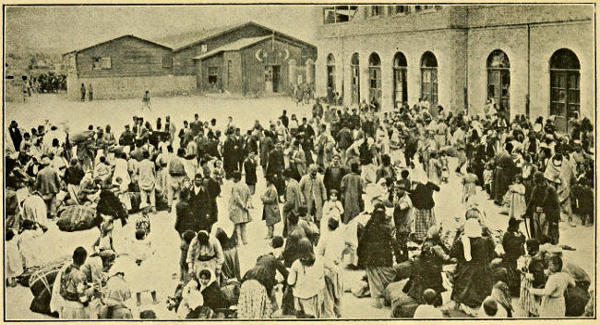
WAITING THEY KNOW NOT WHAT
The Armenians of a prosperous city assembled in front of the government building, by order of the
authorities. They are waiting to be deported. Just outside the city they were massacred.
It was a big negro who finally swung it wide, letting
into the room the light from the windows that
opened from the other rooms of the haremlik. One
of the servant women who had received us the night
before entered after him.
For each of us the woman brought an entareh,
or Turkish house dress, and slippers and stockings.
The dresses were of satin and linen, but very plain.
Though I wanted something with which to cover myself,
I could not help shrinking from the hated Turkish
dresses. The woman saw me and seemed to understand.
“You will have prettier things after a while—after
your betrothal!”
After my betrothal!
When we had dressed, with the aid of the woman,
she ordered us to follow the negro. “What you will
see now, according to the desire of Hadji Ghafour,
will serve to guide your conduct in the haremlik,” the
woman said.
The slave led us through a smaller room into a large
chamber, in which were gathered many excited women
crowded about a window.
At the window-sill the slave peered out and then
ordered us to draw nearer. The window opened upon
a wide court. Across the court were many small windows.
For a moment I saw nothing but the bleak
stone wall. Then my eyes lifted to a window higher
up. I shrieked and recoiled.
The dead body of the elder sister of the girl who had
been beaten to death, the one who had been carried
away when she defied Hadji Ghafour, was hanging by
its feet from a rope attached to the window-sill. The
girl’s arms had been tied behind her back and now
hung away from her body. Her hair was hanging
from her swaying head. A bandage, still tied over her
mouth, had muffled her screams.
One of the girls with me, Lusaper, who had cried
all night, fell to her knees and became hysterical.
The slave lifted her and tried to make her look again.
When he saw she was half mad he carried her to a
couch at the other side of the room and two little negro
slave girls immediately began to comfort her. Other
women crowded around her, too. The slave left us
then, as did the woman servant who had been with us.
The women of the haremlik seemed to want to be
very kind. The Turkish women were older than the
apostate women. Hadji Ghafour’s two wives were
not among them, as their apartments were elsewhere,
and I do not know what the relationship of the other
women to him was, whether as concubines or relatives.
Nearly all the younger women were Armenian
girls who had been stolen. They were very sorry for
us.
Food was brought in this chamber, and we ate together.
Already I had made up my mind to be as
brave as I could and to hope and pray that I might be
delivered from that house.
All the Armenian girls in the haremlik had at one
time passed through just such experiences as had been
ours the night before in the presence of Hadji Ghafour.
There were eight of them, and all had apostasized
with the hope of saving relatives, only to be
taken to Hadji Ghafour’s house upon their arrival at
Geulik. Only one of them knew what had become of
her family. This one had seen her mother killed and
her sister taken by the Kurds on the road from Malatia.
Four days I remained in the haremlik without being
summoned by Hadji Ghafour. On the third day one
of the other of the “new” girls came back to us in
the morning, quiet and ashamed, with her eyes downcast.
That same day the harem slaves took away her
plain entareh and gave her a richly embroidered dress.
Such was the sign of her having been “betrothed.”
We were not allowed outside the haremlik. Each
night we were compelled to say the Mohammedan
prayers. I learned to say them aloud and translate
them in my mind into the words of Christian prayers.
The head servant of the haremlik, an elderly Turkish
woman, who was as kind to us as she could be, took
occasion every day to warn us that if we wished to live
and be happy we must be pleasing to Hadji Ghafour.
Other women told us of girls who had come into the
harem, never to appear again after their “betrothal”
to the master. When these things were spoken of we
could not help thinking of the body we saw hanging
from the window across the court—that was Hadji
Ghafour’s way of teaching us to be submissive.
We were not put in the dark, windowless room again.
Once one of Hadji Ghafour’s wives came into the
harem to see us. She was middle-aged, and from
Bagdad. She once had been very beautiful, I think,
but seemed to be cruel and without affection. She
had us brought before her and questioned each one of
us about our experiences in the deportations. She
seemed to want to trap us into admissions that we had
not truly become Mohammedans.
Among the Armenian girls in the harem was one
who came from Perri, a village between my own city
and Harpout. During the nights she told me of the
massacres in her village, and how the Turks had
spared her because she accepted Islam, until they
reached Malatia. There she had been stolen, taken
first to the home of a bey and then sent with other
Armenian girls to Geulik. She, too, had been taken
straight to the house of Hadji Ghafour. She had gone
through with her “betrothal,” and had found some
favor in the eyes of the Turk.
This little girl was Arousiag Vartessarian, whose
father, Ohannes, had owned much land. She had been
educated at Constantinople. In Constantinople she
learned of the American, Mr. Cleveland Dodge, of
New York, who has done so much for education in
Turkey. Since I have come to America I have learned
that this same Mr. Cleveland Dodge is the best friend
the Armenians have in all the world.
Arousiag was secretly Christian still. But she did
not hope ever to escape from the harem. She told me
Hadji Ghafour kept Armenian girls only until he had
tired of them or until prettier ones were available.
Then he sent them to his friends, or to be sold to Turkish
farmers. She had tried to please him, so she would
not be sold into an even worse state, for sometimes a
girl who falls into the slave market will be sold into
a public house for soldiers and zaptiehs.
On the evening of the fifth day my heart sank and
my knees grew weak when a little negro slave girl
came to tell me Hadji Ghafour had sent for me.
The servant women gathered around me, each professing
not to understand why I was not elated. Only
when my tears fell did they cease their jesting at the
arrival—“at last,” they said, of the hour of my supreme
torture—my “good fortune” they called
it.
While I was being dressed I closed my eyes and
prayed—not to be saved, for that was too late, but
for strength and for the joy of knowing that God
would be watching over me. One of the harem women
walked with me down the narrow corridor and through
the door I had not passed since I left Hadji Ghafour’s
presence five days before.
The lights of many lamps glowed in the room. Just
inside the door the big negro was waiting. Across,
on his cushions, with his nargilleh on the floor beside
him, sat Hadji Ghafour. His eyes were full upon
me when I stopped at the sound of the door closing
behind me.
He motioned for me to approach and sit upon a
cushion at his feet. Involuntarily I shrank back and
threw my hands before my eyes. An instant later I
felt the negro’s hand gripping my arm. I tried to hold
back and I tried to gather courage to go forward—I
knew my hopes of a happier future depended upon my
submission.
The negro tightened his grip. Under his breath he
murmured, “Be a good little one. You will be the
better for it.” I could not look up, but I went and
sat upon the cushion at Hadji Ghafour’s feet!
It is needless to say more of that terrible night!
To Arousiag I confided the next day that I must,
somehow, escape from Hadji Ghafour’s house. To
remain meant more tortures and lessened such chance
as there might be that I would find my mother at
Diyarbekir, where refugees with money were allowed
by the Vali to remain just outside the city—provided
they paid liberally for the privilege. When their
money was gone they were sent away with other exiles
into the Syrian desert.
I had tried to coax Hadji Ghafour to send messengers
to Diyarbekir to rescue my family if they could
be found there, or to learn what had become of them.
He would not grant me this favor. “You are a Turkish
girl now,” he said, “and you must forget all past
associations with unbelievers.”
Arousiag feared for me the consequences of my
being caught in an attempt to escape. Captives who
had tried to run away before had been sold into the
public houses, where they soon died. When I had
made her understand, though, that I would risk anything
rather than remain in Hadji Ghafour’s house,
she promised to help me. It was then she told me,
when we were alone in our couches that night, that
to the west, across the plains, toward the Euphrates,
was a monastery, founded ages ago by Roman Catholic
Dominican Fathers, who came into Armenia as missionaries.
During all the centuries Armenian religious
refugees had been received in this monastery,
Arousiag told me, and from there many teachers were
sent into Syria and even to Kurdistan.
A man from Albustan, who really was an Armenian
Derder, or priest, but who was disguised as a Turk
and making his way to the Caucasus, where he hoped
to get aid for the exiles from the Russians, had told
Arousiag of the monastery while she was being kept
in Malatia. Many Armenian girls had found safety
there, the Derder had said, as the Fathers in the monastery
had not been molested, and their refuge was
far off the track of the companies of deported Christians.
Many years ago, the Derder told Arousiag, the
monastery Fathers had saved the life of a famous
chieftain, and there were legends about it which kept
the Kurds from attacking the monastery. For some
reasons the Turks had not molested it, either.
Arousiag confided to me that she had often planned
to escape from the house and try to go alone to the
monastery. There, she was sure, there would be
safety—for a time at least. But each time her courage
deserted her. Now she was willing to make the
effort, since I, too, would rather risk everything than
remain a victim of Hadji Ghafour.
The windows of the sleeping apartments were high,
and were not barred, as they opened only into a courtyard.
Arousiag knew of a passageway from the courtyard
into the divan-khane, or reception chamber, which
opened onto the street. Often the servants of the
haremlik went into the street through this passageway.
A night came when Hadji Ghafour sent early for
the girl he desired. It was long before the haremlik’s
retiring hour. Arousiag and I slipped away and let
ourselves down from a window into the courtyard.
We hurried through the divan-khane and into the
streets. We had veiled ourselves, and, with Turkish
slippers, we were mistaken for Turkish girls or harem
slaves hurrying home to escape a scolding.
When we came to the gates of the city we were
frightened lest we be stopped—but the Turkish soldiers
guarding the gate had stolen for themselves
some Armenian girls from refugees camped near the
city, and were too busy amusing themselves with these
girls to notice us. Soon we were beyond the city, alone
in the night. The sands cut through our thin slippers,
and we were afraid that every shadow was that of a
lurking Kurd.
It was twenty miles or more, Arousiag believed, to
the monastery. For three days we traveled, hiding
most of the days in the sand for fear of wandering
villagers or Kurds, and walking as far as we could at
night. We had no bread or other food, and only late
at night, when the dogs in the villages were asleep,
could we dare to approach a village well for water.
Arousiag suffered much from thirst on the fourth
day. She was so famished for water, of which we
had none the night before, that when I cried she moistened
her tongue with my tears. At last she could go
no further and sank to the earth. In the distance was
an Arab village. The Arabs are not like the Kurds—they
are very fierce sometimes, and do not like the Armenians,
but unless they are in the pay of Turkish
pashas they are not always cruel. To save Arousiag’s
life I left her and went into the village.
The Arab women gathered around me, and to them
I appealed for food and water, as best I could. The
women pitied me, and when the Arab men came to
inspect me they, too, felt sorry. They brought a gourd
of cool water, and bread, and some of the women went
with me to where Arousiag lay. The water revived
and strengthened her, and it gave me strength too.
Our clothes were mostly torn away, and the Arab
women gave us other garments and sandals for our
feet. The monastery, they said, was but a few miles
further on, and they showed us the nearest way. An
Arab boy went with us to tell the men of other villages
that we must not be harmed. Also the boy guided us
away from a Circassian village, where we would have
been made captives.
When the gray stone walls of the convent rose before
us in the distance Arousiag and I knelt down on
the earth and thanked our Savior. The Arab boy
turned and ran back when he saw we were praying to
the Christ of the “unbelievers.” But we were very
grateful to him.
It was almost evening, and the monks were at prayer.
We stood at the gate until some of them heard our
call, and then they let us in. The monks were very
kind. They gathered around us and listened to our
story. Then they took us into their little chapel and
knelt down around us, while the prior chanted a prayer
of thankfulness.
When the prayer was finished a monk led us to a
part of the monastery separated from the main buildings.
Here we were astonished to find more than half
a hundred Armenian girls and widowed brides, who,
like us, had found refuge among the monks. Nearly
all these girls and young women were from Van, the
largest of the Armenian cities, or from districts near
by. Some were from Bitlis, where thousands of my
people had been killed in a single hour, only the girls
and brides being left alive for the pleasure of the
Turks. Some had escaped from Diyarbekir.
All had been directed to the monastery as a refuge
by friendly Arabs or Armenian Derders. One by one
or in groups of two and three they had applied at the
monastery gates just as had Arousiag and I, and the
monks had taken them in, disregarding the great danger
to themselves.
We all were cautioned not to show ourselves outside
the smaller building which the monks had given over
to us, lest wandering Kurds or soldiers chance to see
us and thus discover that the monastery was the retreat
of escaped refugees. The monks prayed with us
twice every day and nursed back to health those who
were ill. Little Arousiag became very glad when the
prior assured her that God had understood, when she
renounced Him, that in her heart she was still loyal to
Him. When the aged prior knelt with her alone and
prayed especially that God forgive her every blasphemous
prayer she had made to Allah while under the
eyes of the watchful harem women in the house of
Hadji Ghafour, she was happy again.
For two weeks we were safe in the monastery.
Then, suddenly, our peace was ended. One night,
long after every one in the monastery had gone to
sleep, we, were awakened by a great shouting and
pounding at the gates. From our windows we could
look into the yard, but we could not see the gate itself.
While we huddled together in fright we saw the little
company of monks, hastily robed, led by their aged
prior, carrying a lighted candle, move slowly across
the yard. When they had passed out of our sight toward
the gate the shouting suddenly stopped, and we
heard voices demanding that the gate be opened.
I think the monks refused. The shouting began
again, and we saw the monks retreating across the
yard. An instant later a horde of strange figures,
which we recognized as those of Tchetchens, or Circassian
bandits, pushed across the yard to the monastery
doors. When the monks refused to open the iron
gates they had climbed the walls.
Tchetchens are even more cruel and wicked than the
Kurds. They are constantly at war, either with the
Kurds and Arabs, or the Turks themselves. During
the massacres the Turks had propitiated them by giving
them permission to prey upon the bands of Armenian
exiles in their district and to steal as many Christian
girls as they wished. Always in the past it has
been the Tchetchens who have brought to the harems
of the pashas their prettiest girls, as they do not hesitate
to steal the daughters of their own people, the
Circassians, for the slave markets of Constantinople
and Smyrna.
The monks tried to barricade themselves in their
chapel. The prior pleaded through the iron barred
windows with the Tchetchen leader, appealing to him
for the same consideration even the Kurds had always
given the monastery. But the Tchetchen chief had
learned in some manner that Armenian girls had been
concealed in the monastery, and he demanded that we
be surrendered as the price of mercy for the monks.
The monks refused to open their chapel doors or to
reveal our hiding place. But the chapel doors were of
wood—they gave way when the Tchetchens rushed
against them. We heard the shrieks of our friends,
the monks. There were cries for mercy, prayers to
God and brutal shouts from the Tchetchens. In a little
while there were no more screams, no more prayers—just
the shouting of the bandits.
There was no escape for us. The Tchetchens were
swarming about the yard below and through the chambers
of the monastery proper. The only way out of
the buildings the monks had set aside for us was
through passages or windows leading directly into the
yard. We heard one band of Tchetchens breaking in
the door that opened into the rooms on the floor below
us. We crowded into a corner and waited, trembling,
too frightened even to pray.
The Tchetchens climbed the stone stairway. They
were cursing their ill fortune at not having found us.
One of them pushed in the door of the room in which
we had gathered. The moon was shining through the
windows and the bandits saw us. Then the spell of
our silent fear was broken—we screamed. In an instant
the Tchetchen band came pouring into the room.
They called terrible jests to each other. Arousiag
and I were kneeling, with our arms around each other.
A Tchetchen caught my hair in one hand and that of
Arousiag in the other and dragged us down the stairway.
The others were either dragged out in the same
way or carried into the yard tossed across a Tchetchen’s
shoulder.
About the steps of the chapel we saw the bodies of
the monks. All had been driven out of the chapel into
the moonlight and then killed. The Tchetchens
dragged us outside the monastery gate. They then
gathered up their horses and drove them into the yard,
where they could be left for the night. Then the
Tchetchens returned to us.
Each claimed the girl or girls he had captured and
dragged through the yard. Those who were not satisfied
with their prizes, in comparing their beauty with
those who had fallen to the lot of others, quarreled.
Little Arousiag’s arm was broken when one Tchetchen,
seeing that the bandit who had captured us had two
girls, pulled her away from him. Her captor paid
no attention to her screams of pain. He subdued her
by twisting her broken arm until she was unconscious.
When daylight came and the Tchetchens could see
our faces more plainly they selected those whom they
considered the prettiest, and killed the rest. They
killed Arousiag because of her broken arm. Then they
lifted us onto their horses and took us to Diyarbekir.
From the edge of a sandy plateau I caught my first
view of Diyarbekir, once the capital of our country.
For two days we had ridden with the Tchetchens.
We knew that some new peril awaited us in this ancient
city which, centuries before, had been one of the
most glorious cities of Christ.
When the Tchetchens drew up at the edge of the
plateau, the walls of the city spread out far below us,
with here and there a minaret rising over the low
roofs. Just beyond the city was the beautiful, blue
Tigris—the River Hiddekel, of the Bible. And as
far as I could see, dotting the great plains that are
watered by the Tigris, were Christian refugees from
the north and east and west, thousands and thousands
of them. Some had walked hundreds of miles.
Nearly all the Armenians who were permitted to live
that long were brought to Diyarbekir, where those who
were not massacred in the city or outside the walls
were turned south into the Syrian and Arabian deserts,
to be deserted there.
More than one million of my people were started
toward Diyarbekir when the deportations and massacres
began. Only 100,000, I have heard, lived to reach
the ancient city on the Tigris. And of these more
than half were massacred within the city and outside
the walls. Only young women and some of the children
were saved, and these were lost in harems, or, as
with the children, placed in Dervish monasteries to be
taught Mohammedanism, so they might be sold as
slaves when they grew up.
Nail Pasha, the Vali of Diyarbekir, was very
wicked. Inside the city there are several ancient
forts, built centuries ago—one of them in the days
of Mohammed, and two great prisons. Already more
than 3,000 Russian prisoners of war had been marched
from the Caucasus to Diyarbekir for confinement in
these prisons. Nail Pasha had taken away all the
clothing of these prisoners, and had compelled them, by
refusing to give them food, to work as masons on a
large house the pasha was building for himself.
When the refugees began to arrive at Diyarbekir in
great numbers Nail Pasha crowded the Russians into
one of the fortresses so closely they had almost no
room to lie down at night. The other prisons he then
filled with the Armenian men who had been permitted
to accompany their women from some of the smaller
Armenian villages in the north. When the prisons
were full of these exiles he had his soldiers massacre
them. Outside the city their women waited on the
plains or were taken away without even being told
what had been the fate of their husbands, sons and
brothers.
When more Russian prisoners arrived Nail Pasha
crowded Armenians into the prisons in the daytime and
killed them, and then compelled the Russians to carry
out the bodies and remove the blood before they could
lie down to rest from their day’s labor in the fields or
on the stonework of his new house. The soldiers of
Nail Pasha told with great enjoyment how the bodies
of little Armenian children had been mixed in with
cement and built into the walls of the new house to
fill the spaces between the stones.
The Tchetchens who had stolen us from the monastery
decided to enter the city by its southern gate—where
the walls reach down almost to the river banks.
But when they had galloped around that way soldiers
from the gate came out and told them the Vali
had issued orders that no more refugees were to be
brought into the city until some of those already within
the walls were “cleared out”—massacred or sent
away.
Afterward I learned why the city itself was crowded
with refugees while so many others were camped
outside the walls. The Vali promised protection
from further deportation to all who had managed to
preserve enough money to bribe him. These he allowed
to go within the city and occupy deserted houses.
When their money ran out the “protection” ceased,
and they were sent out of the city in little companies—always
to be killed at the gates by Tchetchens, who had
been notified to wait for them.
When the Tchetchens saw they could not enter the
city with us at once, they lifted us from their horses
and ordered us to sit in a circle so they could guard
us easily. Of the two hundred in the monastery, only
twenty-seven of us still lived. Three of the girls were
younger than I. None was more than twenty, although
several had been brides when the massacres
came.
The bandit leader then went into the city by himself.
All that day, and the next, and most of the day after
that, we sat in the sand in the burning sun. The Tchetchens
foraged bread and berries and gave us just a
little of what they did not want themselves. Only
once each day would they let us have water. On the
second day one of the girls became hot with fever.
She cried for water, and when a Tchetchen would have
slapped her for her cries she showed him her tongue,
which had begun to swell. When the Tchetchen saw
this he called to his comrades, and they were afraid
lest the fever spread to others of us. They paid no
attention to the poor girl’s pleading for water, but
dragged her a hundred feet away and left her. Once
she got to her feet and seemed to be trying to get back
to us. A Tchetchen went out to her and struck her
down with the end of his gun. She could not get up
again, and we saw her rolling about in the sand until
she died.
On the evening of our second day of waiting outside
the walls there was a great commotion at the city’s
southern gate, and presently a stream of refugees, all
women, came pouring out onto the plain. All that
day groups of Tchetchen horsemen had been gathering
from the surrounding country and taking up positions
nearby. Now we knew why these horsemen had come—they
had been notified a company of refugees was to
be sent out of the city.
The Turks themselves seldom massacred women in
a wholesale way. Constantinople had not authorized
the killing of submissive women—the work was left
to Kurds and other bands.
I think there must have been more than 2,000 women
and some children in this company. They began to
come out of the gate before sundown, and were still
coming long after it was dark. The Tchetchens
herded them into a circle about one mile from the
walls. They were half a mile or more from us, but
when the moon came up we could plainly hear the
shouts and screams that told us the Tchetchens had
begun their evil work.
All night long we heard the screams. Sometimes
they would be very near, as if fugitives were coming
our way. Then we would hear shouts and the hoofbeats
of horses. There would be piercing shrieks and
then only the sound of hoofbeats growing fainter.
The Tchetchens who guarded us did not bother us,
they seemed to be saving us for something else. But
we could not sleep that night. Sometimes even now
I cannot sleep, although I am safe forever. Those
screams come to me in the night time, and even with
my friends all about me I cannot shut them out of
my ears.
When the first gray mist of dawn spread over the
plain the excitement was still at its height. Then, suddenly,
everything was quiet. We were too far from
the city to hear the voices on the minarets, but we knew
that silence meant that the hour for the Prayer of
Islam had arrived. Even in the midst of their awful
work the Tchetchens instinctively heard the call and
stopped to kneel toward Mecca. I remember how I
wondered that morning, while the bandits were reciting
their prayer to their Allah for his grace and commendation,
how my Christ would feel if His people
should come to Him in prayer at the sunrise after
such a night’s work as that.
More than ever before I loved Jesus Christ and
trusted Him that morning while the Mohammedan
bandits were praying to him they call Allah.
I think less than 300 of that company of Armenians
were alive when the sun came up and we could see
across the plain. One little group we saw moving
about, huddled together. All around them were the
Tchetchens searching the bodies scattered over a
great circle—making sure in the daylight they had
missed nothing of value in the massacre and robbery
during the night.
During the morning the Tchetchens busied themselves
with the young women who had been permitted
to survive the night. We could see them go up to the
little group of survivors and drag some of them away.
It was when the Tchetchens began to tire of this
that we saw them preparing, a little way from where
we were, in a flat place on the plain, for one of the
pastimes for which wild Circassian tribes are famous,
and which they frequently repeated, as I afterward
learned, as long as my people lasted.
They planted their swords, which were the long,
slender-bladed swords that came from Germany, in a
long row in the sand, so the sharp pointed blades rose
out of the ground as high as would be a very small
child. When we saw these preparations all of us knew
what was going to happen. When Armenian children
are bad their mothers sometimes tell them the Tchetchens
will come and get them if they don’t be good.
And when the children ask, “And when the Tchetchens
come, what will they do?” their mothers say:
“The Tchetchens are very wicked robber horsemen,
who like to sharpen their swords with little boys and
girls.”
Already I was trembling with sickness of heart because
of the awful night before and the things I had
seen that morning when daylight came. The other
women beside me were trembling, too, and felt as if
they would rather die than see any more. We begged
our Tchetchens to take us away—to take us where we
could not look upon those sword blades—but they
only laughed at us and told us we must watch and be
thankful to them we were under their protection.
When the long row of swords had been placed the
Tchetchens hurried back to the little band of Armenians.
We saw them crowd among them, and then
come away carrying, or dragging, all the young women
who were left—maybe fifteen or twenty—I could
not count them.
Each girl was forced to stand with a dismounted
Tchetchen holding her on her feet, half way between
two swords in the long row. The captives cried and
begged, but the cruel bandits were heedless of their
pleadings.
When the girls had been placed to please them, one
between each two sword blades, the remaining Tchetchens
mounted their horses and gathered at the end
of the line. At a shouted signal the first one galloped
down the row of swords. He seized a girl, lifted her
high in the air and flung her down upon a sword point,
without slackening his horse.
It was a game—a contest! Each Tchetchen tried
to seize as many girls as he could and fling them upon
the sword points, so that they were killed in the one
throw, in one gallop along the line. Only the most
skillful of them succeeded in impaling more than one
girl. Some lifted the second from the ground, but
missed the sword in their speed, and the girl, with
broken bones or bleeding wounds, was held up in the
line again to be used in the “game” a second time—praying
that this time the Tchetchen’s aim would be
true and the sword put an end to her torture.
In the meantime the Jews of Diyarbekir had come
out from the city, driven by gendarmes, to gather up
the bodies of the slain Armenians. They brought
carts and donkeys with bags swung across their backs.
Into the carts and bags they piled the corpses and took
them to the banks of the Tigris, where the Turks made
them throw their burdens into the water. This is one
of the persecutions the Jews were forced to bear.
The Mohammedans did not kill them, but they liked to
compel them to do such awful tasks.
Late in the afternoon the chief of our Tchetchens
came out from the city. His men drew off to one side
and talked with him excitedly. When it grew dark
they lifted us upon their horses and carried us into
the city through the south gate. At the gate the
Tchetchen chief showed to the officers of the gendarmes
a paper he had brought from the city, and the
Tchetchens were permitted to enter. We passed
through dark narrow streets until we came to a house
terraced high above the others, with an iron gate leading
into a courtyard off the street. A hammal, or
Turkish porter, was waiting at the gate and swung it
open.
The bandits dismounted outside the gate to the
house and lifted us to the ground. The leader waved
us inside. With half a dozen of his men he entered
behind us and the gate closed. Some of the Tchetchens
went into the house. In a few minutes they
came out, followed by a foreign man, whose uniform
I recognized as that of a German soldier.
Servants followed with lighted lamps, and the soldier
looked into our faces and examined us shamefully.
Only eight of the girls pleased him. I was
among these. We were pushed into the house and
the door was closed behind us. Then we heard the
Tchetchens gather up the other girls and take them
into the street. I do not know what became of them.
The soldier and the servants, all of whom were foreigners,
whom I afterward discovered were Germans,
took us into a stone floored room which had been used
as a stable for horses.
It must have been two or three hours afterward—after
midnight, I think; we could not keep track of the
time—when the soldier and the servants came for us.
Before they took us from the stable room they took
away what few clothes we had. They led us, afraid
and ashamed, into a room where were three men in the
uniforms of German officers. The soldiers saluted
them. The officers seemed very pleased when they
had looked at us. We tried to cover ourselves with
our arms and to hide behind each other, but the soldier
roughly drew us apart. The officers laughed at our
embarrassment, and then dismissed the soldier, saying
something to him in German, which I do not understand.
The officers talked among themselves, also in German.
They tried to caress us. It amused them
greatly when we pleaded with them to spare us, to let
us have clothes and to have mercy, in God’s name.
Almost two weeks I was a prisoner in this house.
The principal officer’s name was Captain August Walsenburg.
He was middle-aged, I think, and very bald.
After awhile I learned many things about him. He
had been connected with a German trading company,
the “Oriental Handelsgellschaft,” in the city of Van.
He was a reserve army officer and had been called
into service. He helped the Turkish officials at Van
mobilize an army there and had taken part in the Armenian
massacres at that city. He had been ordered
to report to a German general whose name I do not
remember at Aleppo, where the German commander
was organizing Turkish soldiers for the Mesopotamian
armies. But when he reached Diyarbekir there was
news of the Russian advance in the Caucasus, and he
had been ordered, by telegraph, to wait at Diyarbekir
for instructions. The two other officers were lieutenants,
who had accompanied him from Van, and
they, too, were awaiting instructions.
They were the only German officers at Diyarbekir
at that time. The Vali was very friendly with them.
He had set aside for them the house to which we were
taken as captives. To this house were brought many
pretty Armenian girls stolen by the Kurds and
Tchetchens. When they tired of them they sent them
away to the refugee camps outside the city or to be
sold to Turks.
The German captain asked me to be submissive. I
fought him with all my might. I told him he might
kill me. This amused him. It was while I was his
prisoner I tasted, for the first and only time in my life
that which I have learned in America is called
“whiskey”. It was bitter and terrible. The officers
had brought some of this from Van. They drank
much of it, and it made them very brutal. One night
they assembled all the girls in the house into a room
where they were eating and forced them to sit on a
table and drink this awful whiskey. They were delighted
when it made us ill.
One by one the other girls who had been stolen with
me from the monastery were sent away, after the
officers had wearied of them, and their places were
taken by new ones. I think I was kept because I
fought so hard when one of them approached me.
The captain always clapped his hands and laughed
aloud when I fought.
There was another girl, who had been a prisoner
in the house longer than others—since before I was
taken there. She had especially pleased one of the
under-officers. She told me of one night when the
officers had taken much of their whiskey and were
particularly cruel. She said they sent for some of the
girls then in the house and, standing them sideways,
shot at them with their pistols, using their breasts as
targets. Afterward I was told this thing was done
very often by the Turks in the Vilayet of Van when
they massacred our people there.
At last orders came to the officers to leave Diyarbekir.
I understood they would have to go to Harpout.
They prepared to leave immediately and set
out the next morning. They had in the house many
rugs and articles of valuable jewelry they had bought
from Kurds and Tchetchens, who had stolen them
from Armenians, and all of this booty they carefully
packed in boxes to be kept for them by the Vali until
a caravan bound for the railway at Ras-el-Ain came
through.
They were so hurried they paid little attention to
us. When they left all their servants accompanied
them, riding donkeys behind their masters’ horses.
So we were alone in the house.
We would have been happy in our deliverance had
it not been for the danger which threatened us at the
hands of the Turkish gendarmes, who would be sure
to discover us. We searched until we found where
the servants had hidden our clothes in a dark room,
into which the clothes of all Armenian girls who had
been brought to the house had been thrown. We each
took something with which to cover ourselves.
We spent a day and night in constant terror of discovery.
We were afraid to venture into the streets
and afraid to stay where we were. There were many
foreign missionaries in the city, including Americans,
but they lodged in a different quarter, and we never
could have reached them. The gendarmes came the
third day after the officers left. I do not think they
expected to find any one in the house, but came to
look for things the Germans might have left unpacked.
We saw them entering through the courtyard gate.
There was no place we could hide, as the house was
built in tiers. We could only huddle in a corner and
put off our capture till the last minute. The gendarmes
saw us from the courtyard and rushed after us
with shouts.
When I ran through the room that had been occupied
by one of the officers I saw a knife he had left
behind. I seized this and hid it in my clothes. It was
the first time I had held a knife in my hands or other
weapon since I was taken from my home in Tchemesh-Gedzak.
A gendarme cornered me in one of the rooms, just
as all the other girls were trapped. He caught me
by the arms. He was taking me into another room
when the officer of the gendarmes saw me. He halted
the man, took me from him and ordered him to “find
another one for himself.” The officer pushed me into
the room.
But when he tried to pinion my arms I turned on
him with the knife. I know God guided my hand, for
I am sure I killed him. He fell at my feet.
In other parts of the house and in the courtyard the
gendarmes were giving their attention to the girls they
had found. I reached the street without being seen.
I looked in each direction and could see no one except
a Turkish woman, who came out of her gate on the
opposite side of the street. For an instant I thought
I would be caught, and I gripped the knife, which I
still kept under my clothes.
But the Turkish woman was kind. She pitied me.
She stepped back into her gate and motioned me to
follow. I was afraid, yet I trusted her. She closed
the gate and took me in her arms. She was sorry for
me and my people, she said, and would help me. But
she dared not take me into her house. She told me
I could hide in her yard till night, when I might slip
out of the city to where the refugees were.
During the day she brought me food. At dark she
came to take leave of me, and kissed me, and gave me
three liras, which was all she could spare without
earning a scolding from her husband. “Go out by the
north gate, not by the south gate,” she said to me.
“All the refugees who are taken around by the south
gate are killed; those who are camped beyond the
north gate may live. But do not join them while it
still is night, or you may be caught in a massacre.
Hide among the rocks in the pass through the Karajah
hills, a mile from the city. If the Armenians are
allowed to pass these rocks when they are taken away,
it means they will be allowed to live through another
stage of their journey.”
I reached the north gate without being stopped, as
I was careful to keep in the shadows. Gendarmes
guarded the gate, but they were not very watchful. I
ran onto the plain and followed the directions the
friendly Turkish lady had given me until I came to
the rocks which marked the road through the low hills
that skirted the city on the north. Along this road
the refugees sent to the southern deserts from Diyarbekir
must pass.
I waited at the rocks through the night. In the
morning I thought to walk along the road to where I
would not be seen by soldiers, Kurds or Tchetchens
roving on the plains near the city, and where I could
wait until a company of my people passed.
But while I was picking my way through the narrow
pass between the rocks I saw a little group of zaptiehs
coming toward me along the road beyond. I had not
expected to meet any one. I screamed before I could
stop myself. The zaptiehs heard me and I ran back
into the shelter of the rocks and drew out my knife,
which I had kept so I might kill myself rather than
be stolen again. But I was afraid God would not
approve. While the zaptiehs searched the rocks I
knelt in a crevice and asked God to tell me what I
should do—if He would blame me if I killed myself
before the zaptiehs found me. “Dear God, tell me,
shall I come now to You or wait until You call?” I
asked of Him.
I know He heard me, and I know He answered.
For something told me to throw the knife far away—and
I did.
That was God’s will, I know, for after awhile He
was to lead me into the arms of my mother that I
might be with her once again before the Turks killed
her.
I threw the knife away and stood up. The zaptiehs
soon found me. I was resigned for whatever
was to happen, and did not run from them.
I told them I had come out from the city; that I
wanted to join some of my people; that if they would
not harm me I would not give them any trouble. I
still had the three liras, or three pounds, which the
good Turkish lady had given me, but I knew if I gave
it to them they would only search me for more and
then, perhaps, kill me. So I told them I would get
money for them from my people if they would let me
join a company that was not to be killed.
“Maybe all will be killed; maybe not all. We do
not know. Come with us. Get us money and we
will let you live,” one of them said to me.
I walked with them a little ways, until we saw coming
toward us a long line of refugees. Then the zaptiehs
halted, and from what they said to each other I
knew they had been sent from a village a little way
behind us to join the guards escorting this party.
Soon the party drew near. The zaptiehs said I
must stay near the front of the line, and that they
would come after a while and hunt for me, and that I
must have money or they would take me off and kill
me. They came to me a few hours later, and I gave
them the three liras, and they kept their promise and
did not molest me again.
The party of refugees I had joined was from Erzeroum
and the little cities in that district. My heart
leaped with joy when I saw among them a few Armenian
men. It was the first time I had seen men of
my people for so long, and I was so happy for the
women whose husbands and fathers could still be with
them. When I was led up to this party by the zaptiehs
the first women to see me held out their arms to
me. They thought I was one of the girls of their own
party who had been stolen the night before. When I
told them I had escaped from Diyarbekir they were
glad for me, and one lady who had lost her sixteen-year-old
daughter to the Turks said I might take this
daughter’s place and march with her. Another little
daughter, six years old, was with her still.
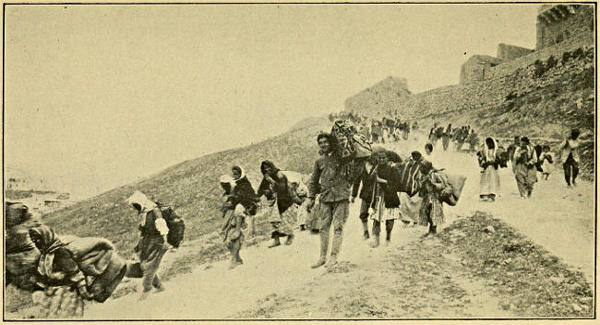
DRIVEN FORTH ON THE ROAD OF TERROR
The old and the very young just leaving their homes in an ancient city, on their way to the desert. In
the foreground is a zaptieh, who has stolen an armful of rugs from the exiles.
There were two thousand, or a few more, in this
party. They were all that were left of 40,000 Armenian
families who had been deported from Erzeroum
and nearby villages. Erzeroum is 150 miles directly
north of Diyarbekir, but the Armenians there had been
sent to Diyarbekir in two directions. Some had come
by way of Erzindjan and Malatia. These had walked
almost 300 miles. Others had come by way of
Khnuss and Bitlis, and these had walked 250 miles.
The survivors of both parties reached Diyarbekir at
almost the same time as those who came by way of
Bitlis had been kept for many days at towns along
the route.
The only friend the Armenians at Erzeroum had
when they were being assembled for deportation was
the good Badvelli, Robert Stapleton, the American
vice-consul, whose home is in New York City. Dr.
Stapleton took all the Armenian girls he could crowd
into his house at Erzeroum, and when the Turks came
for them he showed the Turks the American flag over
his door, and ordered them away. There were many
mothers in this party when I joined it who were glad
their daughters had been among those who were left
under Dr. Stapleton’s protection, and they wondered
if they still were safe.
Many months later I learned the good American
Badvelli kept them all safely until the Russians came
to Erzeroum and took them under their care.
There were almost 75,000 men, women and children
in the parties that went by way of Erzindjan. Of
these only 500 reached Diyarbekir. All the prettiest
and youngest girls had been stolen by the Kurds or
zaptiehs and given to Turks along the way. The girl
children under ten years old had all been either killed,
if they were not strong and pretty, or sold to the
Turks, who kept them to raise as Moslems for their
harems or sent them to Constantinople to be sold into
the harems of wealthy Turks there. Many of the
younger women who were not stolen had been outraged
to death. All the grandmothers and women
who were ill had been abandoned at the roadside, or
killed outright. So only the 500 remained.
Of the other parties, which had numbered 50,000
individuals, and who had mostly come from the
smaller cities near Erzeroum, with many rich families,
including teachers, bankers, merchants and professional
men from the city itself among them, only 1,500
were left—about 300 men, I think.
When the different parties recognized each other in
camp outside Diyarbekir, they rejoiced greatly, and
they were allowed to move their camps together.
They remained outside Diyarbekir eleven days, because
all of them had been robbed of their money and
all valuables, so they could not bribe the Vali to let them
stay inside the city.
Each night while they were camped outside Diyarbekir
Turks came forth from the city to steal girls, and
soldiers came out to borrow girls and young women
for a little while. They had no food except one loaf
of bread for each person, every other day, sent out by
the Vali, and occasionally something which American
missionaries in the city managed to smuggle out
to them by bribing Turkish water carriers.
During the night, while I was hiding in the rocks,
they were told they were to be taken away again in the
morning, this time to Ourfa. They had begged the
Turkish officers to let them stay a while longer, because
so many of them were suffering with swollen
feet, which had grown more painful, even to bursting,
during their eleven days of rest. They asked to be
allowed to wait until their feet were better again, but
the Turks would not grant this.
So they had started early in the morning, and now I
was with them, and before me lay the long walk to
Ourfa, 200 miles further toward the Arabian deserts—unless
I suffered the harder fate of being stolen
again along the way.
For the first time since I had been taken from my
home that Easter Sunday morning, so many weeks
before, I learned, when I joined this party on the way
to Ourfa, where my people were being taken—those
who were allowed to live. Soldiers who went out to
the refugee camps from Diyarbekir had told these
exiles that all who reached Aleppo, a large city on the
Damascus railway, were to be taken from there to the
Der-el-Zor district, on the southern Euphrates, and
there put to building military roads through the deserts.
As only a few men lived to reach there, the strong
women were to be used.
But always there was hope of deliverance. So
many Armenians had friends in America, sons and
brothers who had left our country to go to the wonderful
United States. They prayed every night that
from America would come help before all were dead.
There were rumors even then that help was coming;
that good people in the United States were sending
money and food and clothing and trying to get the
Turks to be more merciful. It was this hope that kept
thousands alive.
When I joined this party it could only move along
very slowly, because of swollen feet. When we came
to the rocks where I had been discovered it was very
painful for those whose feet were broken open to pass
between them, because the pass was very narrow and
the stones sharp. For more than a mile we had to
walk along this rocky defile—then we came into the
open again. I had a pair of sandals, with leather
bottoms, which I had saved from the house of the
Germans. These I gave to the lady who had asked
me to march with her, for her own feet were bleeding.
No one else in the party had shoes or slippers or any
covering for their feet, except rags which some could
spare from their clothing.
Outside Diyarbekir some of the refugees had traded
laces which they had saved by wrapping them around
their bodies, for donkeys and arabas (ox carts). They
had been told they might keep these until they reached
Ourfa. In the arabas they had hidden many small
pieces of bread which they had saved from their occasional
rations at Diyarbekir, hoping thus to provide
against the sufferings of starvation along the road.
But when they reached the rocks the pass was so narrow
there was great trouble getting the arabas through.
Some Turkish villagers from the other side had
come to the rocks, and when they saw the trouble the
refugees were having with their arabas they asked
the zaptiehs guarding us why they could not have the
donkeys and the carts. The zaptiehs told them if they
would give some money to be divided among the
guards they could take them.
So the villagers paid money to the zaptiehs and then
swooped down upon us and took away our animals and
carts. They would not allow us to take what few
belongings were in the carts, and the pieces of bread,
saying they had bought everything the carts contained
from the zaptiehs.
In one of the carts were two little girl twins, nine
years old, whose mother had died at Diyarbekir. They
were being taken care of by their aunt, who had three
times bribed soldiers to let them alone, until she had
nothing more to bribe with. She had hidden them in
her araba, thinking she could save them and spare
them the weary walking. The villagers who took her
cart refused to let her take them out. He said they
went with the cart.
The woman was crazed, and screamed loudly. She
attacked the villagers with her hands. An Armenian
man was near, and he and many women rushed at the
Turk, who was alone. Three zaptiehs rushed up, but
the women and the man were determined, and the
zaptiehs were afraid to help the villagers. They told
him to let the aunt have the two little girls.
Although there were about 2,000 refugees in this
party, I could count only eleven zaptiehs sent along
as guards. As many men as could be spared by the
Turks at Diyarbekir had been sent north to the army,
and the supply of guards for refugees was very short.
Had there been more zaptiehs they would not have
hindered the Turk from stealing the little girls.
At the next village the zaptiehs decided they would
have to have more help if they were to enjoy the
license customary among them along the road. At this
village they stopped us and held a long conversation
with the Mudir, or village chief. Soon after the Mudir
approached, followed by twenty or thirty of the most
evil looking Turks I ever saw. Each one of them carried
a gun and wore on his sleeve a strip of red woolen
cloth, the badge of police authority.
When we went on these Turks were distributed
among us by the zaptiehs as additional guards.
During the second day upon the road we met a party
of mounted Turkish soldiers, escorting a group of
very comfortable looking covered arabas, such as are
used by the wealthy for traveling in the interior of
Turkey. In these arabas there were forty hanums,
or Turkish wives, who were on their way with the
soldier escort to Erzeroum, to join their husbands, who
were high military officers with the army in the great
military fortress there. They had come from Damascus,
Beirut and Aleppo.
When our party approached, the arabas of the
hanums halted, and the soldiers ordered our guards
to halt us also. Then we saw that several of the
arabas were occupied by young Armenian girls, from
eight to twelve years old, all very sweet and gentle
looking, as if they were the daughters of wealthy families.
Some of them waved their little hands from
under the curtains, and that is how we discovered them.
From six to ten were crowded in each of their arabas,
and each of the hanum’s arabas hid others.
The little girls told us they were from Ourfa and
Aleppo. Their parents and relatives all had been
killed, and they had been given to the hanums, who,
they understood, intended to put a part of them in
Moslem schools at Erzeroum, so they could have them
for sale when they were a little older. The others the
hanums would keep as servants or to sell at once to
friends among rich Turks.
The hanums descended from their arabas and asked
our zaptiehs if there were any very pretty girl children
among us. The zaptiehs did not approve of losing
girl children to these Turkish wives, who, they
thought, would take them without paying for them.
So they said there were none. But one of the hanums
saw a little girl holding onto her mother, and insisted
upon having her brought to her. When she looked at
the little girl closely she saw she was pretty, and commanded
one of the soldiers to take her into her carriage.
The child’s mother held onto it desperately, and when
the hanum, with her soldier near, put her hands on
the little girl to pull it away the mother lost her reason
and struck at her.
The soldier immediately caught hold of the woman
and asked of the hanum, “What shall I do with her?”
The hanum said, “Have we any oil to burn her?”
The soldier said, “I do not think so.” Then the
hanum held out her hand and the soldier gave her his
pistol. The Turkish woman went up to the mother
and shot her with her own hands. She then caught the
little girl’s hand and led her to the arabas. The little
one wanted to kiss her mother, but the hanum jerked
her away.
With our party was the wife of Abouhayatian Agha,
the great scholar, of Van, who had escaped, when the
massacres began, to Diyarbekir. Her husband had
been a friend of Djevdet Bey. When the soldiers were
turned loose upon the Armenians at Van, so Mrs.
Abouhayatian told me, her husband went to Djevdet
Bey and remonstrated with him. His reply, now
famous all over Turkey, was:
“Ishim yok; Keifim tchok,” which means, “I have
no work to do; I have much fun!” After that,
whenever regular soldiers were sent to slaughter Armenians,
they called out to each other:
“Ishim yok; keifim tchok!”
Over this same path I walked, more than 400,000 of
my people had trod—some of them having walked a
thousand miles or more to get there. And of these,
sole survivors of the millions who were deported from
their homes, those who are alive to-day are lost in the
deserts, where there is no bread or food.
God grant that I may soon go back to this desert,
from which I escaped, with money and food for those
of my people who may still be alive!
When we camped near a village at night our zaptiehs
would invite the village gendarme and his friends
to come out, and they would sell young women to them
for the night. The mother or other relatives of these
young women dared not even object, for if they did
the zaptiehs would kill them. Sometimes there would
be better class Turks in some of these villages, and
they would pick out girl children and buy them. They
would pay our guards for the child they fancied and
take it out of its mother’s arms. These children now
are being taught to be Moslems, and, if they are old
enough, made to work in the fields. Some of them are
concubines besides.
Three babies were born during the first days of this
journey. The mothers were not allowed to rest along
the way, neither before nor after. They were made to
keep up with the party until the little ones were born.
Sometimes the men would carry the mother a little way,
but when the zaptiehs saw them doing this they would
make them put her down. They would say the woman
didn’t deserve to be carried because she was bringing
an unbeliever into the world.
These events always amused the zaptiehs greatly.
When one of them discovered a baby was about to be
born he would call his comrades, and they would walk
near the poor woman, making her keep on her feet
until the last minute. Then they would stand close
to her and laugh and jest. As soon as the baby was
born the mother would have to get upon her feet and
walk. If she could not walk the zaptiehs would leave
her on the road and make the party move on.
Almost always the zaptiehs killed the babies. The
first two born near me they took from the mothers
and threw up in the air and caught them like a ball.
They did this four or five times and then threw them
away. The mothers saw, but they had to walk on.
The third baby was not killed. It was born in the
evening, just after we had camped. The zaptiehs
were busy with their horses and did not notice. This
one was a sweet little boy. Its father was dead. Its
mother was so happy—and so sad, both together—when
she first held it in her arms. She asked God to
let it live, but there was no way. She had had so little
food herself she could not nurse it. The little thing
starved to death in her arms.
When we left the district where the villages were
we began to suffer for water. The zaptiehs carried
great water bags over their saddles, but they would
give none of it to us. For days at a time we marched
without a drop of moisture to quench our thirst. Then
we would come to a group of houses where Turks
lived around a well, or spring. The Turks always
would refuse to let us go near the wells, demanding
pay for each gourd of water. Men would stand guard
at the wells with guns and sticks to drive us off if we
went near.
But no one in our party had anything left to pay
with. Our women would go as near to the houses as
they dared, and get down on their knees and beg for
just a swallow of the precious water. Sometimes the
Turks would let us go to the wells when they were
convinced we had nothing to give them. But not always.
At one place the head man, who had been a
pilgrim and was called Hadji, demanded that if we
could not give him money or rugs, we must give him
for the community three strong men who could help
till the fields which were watered from his spring.
We appealed to our guards, but they would not take
our part. They stood by the Turks, and said if we
wanted water we should be willing to pay. At least
thirty of our party had died that day for want of drink.
Some of the women’s tongues were so swollen they
could not talk. There was talk of rushing on the
spring in a body, but we knew this would cost many
lives, for our zaptiehs stood near with their guns, and
we knew, too, it would be held against us and probably
cause a massacre.
Finally Harutoune Yegarian, who had been a student
at Erzeroum, said he would sacrifice himself. He
asked if there were two other men who would give
themselves. Two men whose wives had died, and
who had no daughters, at once said they were willing.
Many women embraced them. Harutoune was standing
near me, and I cried for him. He saw me.
“Don’t weep for me, little girl,” he said to me.
“Every Armenian in the world should be glad to give
himself for his people.” Then he kissed me, and I
think his kiss was the kiss of God.
The three men said they would stay and work in the
field for the Turks, and so they let us have water—all
we could drink and carry away.
When we reached the city of Severeg, half way to
Ourfa, we had not had water for four days. There
are three open wells on one side of Severeg, and they
feed an artificial lake, which was filled when we arrived.
Some of our women were so parched they threw
themselves into the lake and were drowned. Others
could not wait until they reached the lake, and jumped
into the wells.
So many did this they choked the wells, and the
Turks, who had come out to meet us, had to pull them
out. We who had kept our senses crowded around
those who were pulled out and moistened our tongues
from their wet clothes.
After we left Severeg a fever attacked our party.
Every day many died by the wayside. The zaptiehs
rode at a distance away from us, and when any of the
men or women dropped behind, they would shoot them.
The fever parched the throats of those who suffered
from it so badly that when we came to the next group
of houses where there was a well the men braved the
guns of the Turks and zaptiehs and rushed up to them.
After that the zaptiehs were wary of persecuting us
too much, but we paid the penalty at Sheitan Deressi,
or “Devil’s Gorge,” which we reached on the twenty-third
day out of Diyarbekir.
When all our party had entered the gorge the zaptiehs
left their horses and climbed above us and opened
fire upon us. We were trapped so we could not turn
back and could not escape. The zaptiehs picked off
all the men. From early morning until dark they
continued shooting from the walls of the gorge, and
at each shot a man fell. When evening came all had
been killed or mortally wounded.
When night fell the zaptiehs came down and began
killing women with their knives and bayonets. They
picked out the older women first, and soon all these
were dead. When the moon lighted up the gorge the
zaptiehs picked out the young married women—or
those who had been married but now were widows—and
amused themselves by mutilating them. They
would not kill them outright, but would cut off their
fingers, or their hands, or their breasts. They tore out
the eyes of some. When dawn came only those who
had succeeded in hiding behind rocks, or we who were
young and might be sold to Turks, were alive. During
the next day I counted, and there were only 160 left
of the 2,000 who left Diyarbekir with me. I have
heard it said that more than 300,000 of my people were
killed in this spot during the period of the massacres.
Now that we were so few the zaptiehs made us
march faster, and as we were nearly all young they
were more cruel to us. I was glad that morning when
I discovered that the lady who had let me march with
her had survived. She had hid during the night, and
had saved her little girl too. But my gladness for her
soon became sorrow. The little girl was taken with
the fever that day. The next day she could not walk
any more. When the zaptiehs discovered she was suffering
from the fever they commanded the mother to
leave her at the roadside. The mother laid the little
girl down, but she could not leave her when the child
held out her arms and cried. A zaptieh came up with
his bayonet pointed, ready to kill the mother, and I
pulled her away and comforted her. Every step or
two the mother would look back until we could not see
her little girl any more.
With so few of us to guard, and almost all of us
either young or not so very old, the nights were made
terrible by the zaptiehs. For many days they had
been on the road with us, and had tired of ordinary
cruelties and the mere shaming of the girls under
cover of darkness at the camping places. The Turks
who had been recruited from the villages and made
guards over us were especially brutal. It was their
first opportunity to visit upon Christians that hatred
with which Islam looks upon the “Unbeliever.”
When we drew near to Ourfa we were joined by a
party numbering, I think, four or five hundred exiles
from the Sandjak of Marash, a subdistrict north of the
Amanus, of which Zeitoun, Albustan and Marash are
the large cities. Nearly all of these were from the
city of Marash itself—some from Zeitoun. The removal
of the Armenians from the Sandjak of Marash
was begun later than in other parts of Asia Minor.
When Haidar Pasha first issued the orders for deportation
some of the Armenians who had arms resisted.
They refused to leave or submit to the zaptiehs
unless they were given guarantees they would be
allowed to return to their homes after the war.
Haidar Pasha had few soldiers at his command just
then. He sent to Aleppo for assistance to carry out
his wish to send the Armenians away. From Aleppo
came Captain Schappen, a German artillery officer,
who was stationed there with other German officers.
Captain Schappen organized large bodies of zaptiehs
and taught them the use of machine guns. He then
led them personally, and with other German officers
and their aides made a raid on the Armenian houses.
In quarters where there was resistance he turned the
machine guns on the houses.
From Marash and nearby cities fourteen thousand
of my people, men, women and children, were sent
away, guarded by the zaptiehs, under the command of
this captain. For some reason which none of the
Christians knew, these exiles were not taken directly
into the desert toward Bagdad, as were others from
that district, but they were kept many days, even
weeks at a time, in camp with almost no food or water,
then to move on only a few miles and to camp again.
They were many weeks reaching the vicinity of Ourfa.
When they joined us, of the fourteen thousand who
were torn from their homes only the three or four
hundred remained alive! No men were left—just
mothers and daughters and aunts and nieces.
Captain Schappen had returned, after three weeks
on the road, to Aleppo. He took with him a Miss
Tchilingarian, who was fifteen years old, and who had
just returned from a private school in Germany, where
her parents had sent her to be educated. She was
home on a vacation when the deportation began. She
was very pretty, those who knew her told me, and
had already won honors in music. Her family intended
she should become a singer and take to the
Christian world outside Turkey the beautiful folk
ballads of my people. Captain Schappen marked her
during the first night on the road, and had her taken to
his tent. He then designated a zaptieh to be her especial
guard until he took her away with him. He also
took with him Mrs. Sarafian, the young wife of Dr.
Dikran Sarafian, who had been educated in Switzerland,
and was one of the most prominent Armenian
physicians in central Turkey. Mrs. Sarafian was a
Swiss, and had learned to love Dr. Sarafian while he
was a student in her country. She had come to
Marash to marry him just two years before. Captain
Schappen had her taken to his tent also, soon after
they began their march, and when her husband objected
the officer ordered a zaptieh to shoot him.
When Captain Schappen and his companions decided
to return to Aleppo they sent zaptiehs scouring the
country for miles around looking for donkeys. For
these the officers traded girl children. A pretty child
was given for one donkey. Of the children who were
plain the officers gave two, or sometimes three, for a
single donkey. Thus they collected a large herd of
donkeys, which probably were needed by the army.
In another day after this remnant of the Christians
of Marash joined us, we came into sight of Ourfa.
We were ordered to camp close to an artificial lake—such
a lake as often is found outside Moslem cities.
The leaders of our zaptiehs rode into the city for instructions.
Soon Turks, in long white coats, came out
of the city to look at us. When they saw that ours was
a party of almost all younger women, with girl children
still left, they spread the news in Ourfa, and in a
little while dozens of Turks came out in little groups
of four and five.
They tried to persuade our zaptiehs to let them
carry away with them the young women and children
they wanted. The zaptiehs would not permit this,
however, unless they were paid what was then considered
high prices for Christian women. They said
they had brought us this far, and now they intended
to profit—that they had only permitted us to live
because they hoped to get “good prices” for the
choicest of us in the Ourfa market.
The Turks did not want to pay the high prices, and
the zaptiehs would not trade with them. The zaptiehs
said there was a good market in Ourfa for pretty
Armenian women, and they preferred to get the
Mutassarif’s permission to hunt purchasers there who
would bid against each other. The Turks went back
to the city disappointed.
That night, just after sundown, these same Turks
came out again and opened the sluices that held the
artificial lake, allowing the water to spread over the
plain and flood our camp. We had to run as fast as
we could to scramble to safety, and there was great
confusion. Even the zaptiehs were caught by surprise.
In this confusion the Turks rushed in among us and
helped themselves to our youngest girls—the prettiest
children they could seize. We were powerless to save
them, as each of the Turks carried a heavy stick, with
which they beat down the mothers or relatives who
tried to rescue their little ones. By the time we had
escaped the water and assembled again, and the zaptiehs
were recovered from their own panic, the Turks
were gone—and with them fifteen or twenty beautiful
little girls.
Later I learned what was the immediate fate of the
children stolen when the lake was opened on us.
Haidar Pasha had seized the ancient Catholic Armenian
monastery there, and had transformed it into a
“government school for refugee children.” Since I
have come to America I have learned that when complaints
were made to the Sultan at Constantinople by
foreign ambassadors of the stealing of children the
Sultan’s officials replied that they were taken as a
kindly deed by the government, which wished to place
them in comfort in the “government school” at Ourfa
and other cities.
But this is what the “government school” at Ourfa
was:
Haidar Pasha sent his soldiers, under command of
a bey, to take possession of the monastery, a large
stone building. They surrounded it and forced the
monks, among them Father Antone and Father Shiradjian,
two priests who were much beloved by Protestant
as well as Catholic Armenians, to walk in between two
rows of soldiers. The soldiers closed in behind them
and marched with them outside the walls of the city.
Then the soldiers halted and the Bey asked how many
there were among the monks who were willing to take
the oath of Islam and forswear Christ.
When the Bey ceased speaking Father Antone lifted
his voice with the words of an ancient song of the good
Saint Thomas Aquinas, and all the monks joined in.
While they sang the soldiers shot them down—volley
after volley—until all were dead. The last monk
to fall died with the words of the song on his lips.
Haidar Pasha then cleared out the monastery of all
its relics and religious symbols. Among these were
some things which were very dear to my people.
There was, for instance, a piece of the lance which
pierced the side of Jesus at the Crucifixion. What has
become of this and other things that were associated
with Christ, Himself, and kept by the Fathers in this
monastery I do not know. It is said they were taken
to Damascus and placed in a mosque there, to be
ridiculed by the Moslems.
When the monastery was cleared Haidar Pasha
gathered from among the Armenians who were then
being taken out of the city, a number of Armenian girls
of the best families and confined them in the monastery.
He then seized hundreds of Armenian girl children,
from 7 to 12 years old, and shut them in the monastery,
to be taught the Moslem religion and raised as Moslems.
He compelled the older girls to teach them the
beliefs of Islam, under penalty of the most awful
cruelties. To this monastery then came rich Turks
from all over Asia Minor to select as many little girls
as they wished and could buy for their harems—where
they would grow up to be submissive slaves.
While we were waiting outside the city for the zaptiehs
to dispose of us according to whatever their
plans might be I saw coming toward us, out of a city
gate, a company of hamidieh, or Kurd cavalry, with a
supply train of donkeys and arabas, which indicated
a long journey ahead. There must have been a full
regiment of the horsemen, as they filled the plain outside
the city while forming their line of march.
When they drew near, to pass us within a hundred
yards or so, I saw a little group of women and children
riding on donkeys and ponies between the lines of
horsemen. I recognized these as Armenians. This
was an unusual sight—Armenians under protection
instead of under guard. In those days my curiosity
had been stunted. So many unusual things went on
about me all the time I had lost my sense of interest
in anything that did not actually concern me. But
something seemed to hold my attention to this strange
looking company.
I got up from the ground where I was sitting and
went to the edge of our camp to watch the soldiers
passing. The first lines went by. The Armenian
women came nearer. Suddenly all the world about me
seemed lost in a haze. I rushed in between the horses,
screaming at the top of my voice:
“Mother! Mother! Mother!”
She heard, and little Hovnan, and Mardiros, and
Sarah heard. Mother slid to the ground as I ran up to
her. I tried to throw my arms around her neck, while
my little brothers and sister clung to me. But mother
caught my arms and held them. Her eyes were closed,
and she was still and silent. I cried to her to speak to
me. A terrible fear came over me. Had she gone
mad? Had she lost her speech?
I screamed—this time with anguish. Mother
opened her eyes.
“Be patient, my daughter,” she said, with the dear,
sweet gentleness for which all our friends had loved
her. “Be patient, my daughter. I was just talking
with God—thanking Him that my prayers have come
true!” When I had kissed and cried over Hovnan and
Mardiros and Sarah I looked again into mother’s face.
Little Aruciag—she was not there. Mother saw the
question in my eyes.
“Aruciag has gone. She grew tired one day and
could not keep up. A soldier threw her over a
precipice!”
An officer of the hamidieh came up to learn what was
happening, why mother and the children had dismounted
to stand in the way of the horsemen. Mother
explained to him that I was her daughter, who had
come back to her. She said she wished that I might
travel with her. The officer was kind. He gave permission
and promised to send another donkey for me
to ride.
There were four young Armenian girls with mothers
and several older women, whose faces bore the marks
of much suffering. As we rode along mother explained
to me.
When I was stolen from her and our party from
Tchemesh-Gedzak, so many weeks before, she was
lying at the roadside, cruelly wounded by the soldiers.
But the thought of the children summoned her back
to life. Friends cared for her, and the next day when
the company moved on they carried her in their arms
until she could walk again.
She passed Malatia, Geulik and Diyarbekir. At
last she reached Ourfa. By this time only eighteen
were left of the original four thousand exiles from
Tchemesh-Gedzak.
At Ourfa there lived my uncle, mother’s cousin,
Ipranos Mardiganian, who had moved from Tchemesh-Gedzak
to Ourfa many years ago—before I was
born. Uncle Ipranos had become very wealthy, and
had established a great trading business, which had
branches even in Persia and in Constantinople.
In the Abdul-Hamid massacres of 1895 Uncle
Ipranos was persuaded by his powerful Turkish friends
at Constantinople and in Ourfa to become Moslem
and thus save his life. He pretended to do so,
and was rewarded with a government position of
high trust, and rose to high estate among the Moslems.
He adopted a Turkish name, and was known as Ibrahim
Agha. Secretly, though, he still prayed to God and
was Christian.
Mother remembered him when she reached Ourfa
with the refugees. She knew he was in the favor of
the Turks, who no longer looked upon him as Armenian.
She asked one of the soldiers with her party if
he would take a letter into the city for her, promising
that if he would deliver the letter secretly he would
receive pay. The soldier took the letter to Ibrahim
Agha’s house. In it mother appealed to her cousin for
his assistance in the name of their family, and asked
him to give some money to the soldier.
Ibrahim Agha was grieved by mother’s letter. He
sent her word that he would help her. He went at
once to Haidar Pasha and procured his permission to
bring mother and her children to his house. Then
he came for her and took her to his home. In his
house mother found four Armenian girls. Their
mothers were deported from Ourfa, but before they
had left the city they had appealed to Ibrahim Agha
to take their daughters under his protection, thinking
to save them. He could not refuse, although he endangered
his own life, and had to keep the girls hidden
from his neighbors. A few older women also were
in his house, hidden in his cellar. He had taken them
in from the streets when soldiers were not looking.
For more than a month mother and the children were
safe in her cousin’s home. Then, one day, Haidar
Pasha sent him word to come to the government building.
He returned with heavy heart. Haidar Pasha
had told him it would not be safe for him to keep his
relatives in his house any longer; that many high military
officials were in Ourfa, and if some of them should
hear of refugee Armenians being thus protected all
might be killed, and both he and Ibrahim Agha suffer.
But Haidar Pasha offered to obtain from the Turkish
general at Aleppo military permission for mother and
the children and the other exiles in his house, of whom
my uncle now told him, to travel back to their homes
in the north with soldiers being sent to Moush to join
the campaign against the Russians. For this Haidar
Pasha asked one thousand liras cash—about $5,000—and
another thousand liras when mother and the
others had safely reached their homes and had received
permission from their home authorities to remain.
This permission the Pasha promised to arrange
also.
My uncle had to comply. The four girls had no
homes or relatives in the north, but they had to go,
too, or be deported and seized by Turks. Mother
agreed to take them to her home in Tchemesh-Gedzak—if
they should really reach there alive.
At Moush an army corps was assembling. The
Turks had retired before the first advance of the Russians
through the Caucasus, and Djevdet Bey, Vali of
Van, was rallying his armies here for a dash at the
Russian flanks, which already had reached Van. Soldiers
occupied all the houses in Moush, from which
the Armenians had been ejected, and the hamidieh
officers believed it would be best for us to be quartered
outside the city while arrangements were made for the
rest of our journey. Mother depended upon the
papers given her by Haidar Pasha to secure for us an
escort from Moush to Tchemesh-Gedzak—and Ibrahim
Agha had said Haidar would telegraph the authorities
at Moush to guarantee our safety.
We stopped at Kurdmeidan, a village a few miles
outside of Moush, at the foot of Mount Antok. There
had been many Armenians in the village, and there was
an Armenian church. All the Christians had been
massacred, however, and their homes were occupied
by mouhajirs—Moslem immigrants from the lost
provinces in the Balkans. We went into the deserted
church and prepared to remain there until arrangements
were made for us to leave. The hamidieh officers
called the village Mudir before them and cautioned
him that we were to be protected and fed—that we
were “especially favored by the Porte.”
The villagers treated us kindly—so great is the fear
of the population of anything “official” or governmental.
Days went by and we did not hear from the
city. We began to worry. Mother wanted so much
to see our home again at Tchemesh-Gedzak. “Were
it not for you and the children,” she would say to me,
“I would be willing to die on my doorstep—if God
would just let me see our home again!” My poor,
dear mother!
We dared not go alone into the city to inquire what
was to be done for us—we could only wait.
One night, just after the Moslem prayer, the streets
of the little city suddenly became crowded with horsemen.
Some Turkish women who were just outside the
church rushed in to get out of the way of the horses’
hoofs. “It is Sheikh Zilan,” they said. “The Sheikh
Zilan of the Belek tribe, who has been called in from
the mountains with his thousand Kurds to fight for the
Turks!”
The name of Sheikh Zilan was widely known. His
horsemen had harried the countryside for many years.
It was said he frequently made raids with his tribe
into Persia, and even into the Russian Caucasus before
the war, to steal women for the secret slave markets in
European Turkey.
The tribe was on its way into Moush. Entrance
would be denied them after dark, they knew, so they
had decided to camp for the night in Kurdmeidan.
Some followers of the Sheikh saw the Armenian
church building, and decided to use it as a stable for the
horses of the Sheikh and his chiefs. They broke in
the door while mother and the rest of us crouched in a
corner. But we could not hide—the Kurds saw us
and gave the alarm. Soon the church was full of the
wild tribesmen.
Mother showed her letters from Haidar Pasha.
This awed the Kurds for a moment, and they sent for
one of their chiefs. When the chief came he read the
letter carefully. Then he examined our party. “The
Pasha here says there is an Armenian woman and her
servants and three children, to whom immunity has
been promised and safe conduct. That we will grant,
although the word of a Pasha is not binding upon the
will of the great Sheikh Zilan. But the Pasha’s writing
says nothing of five young Armenian women, too
old to be classed as children and too young to be described
as servants. These we will take, lest the Pasha
be imposed upon.”
They would not believe that I also was mother’s
daughter. They took me and the four girls mother
had brought from the house of Ibrahim Agha, and
at the same time forced mother to leave the shelter of
the church and camp in a nearby yard. They took
us out of the village, to where their main camp was.
With halter ropes they tied our hands behind our
backs and then tied us to each other by looping a rope
through our arms. Soon Sheikh Zilan himself came
to look at us. He seemed greatly pleased when he had
looked into our faces. He gave some orders we could
not understand, but which, evidently, had to do with
our safety, and walked away. We spent the night sitting
on the ground, for we were bound in such a way
we could not lie down. The Kurds looked at us curiously
as they walked around us, and often one of them
would kick us to make us turn our faces toward him.
But otherwise they did not molest us.
Early in the morning we were taken into the city,
tied across horses which were led just behind the group
of chiefs who followed Sheikh Zilan, himself. Inside
the city four horsemen led our horses into one of the
low quarters of the city. Here we were given into
the keeping of a cruel looking Kurd, whom I was soon
to know was Bekran Agha, the notorious slave dealer
of Moush.
Ten thousand Armenian girls, delicate, refined
daughters of Christian homes, college girls, young
school teachers, daughters of the rich and the poor,
have experienced the terror of the same feeling that
came over me that day when I realized that I was a
captive in the house of this notorious slave dealer.
His slave market had been boldly operated, in the
security of his house, for many years, but never had
he enjoyed such a profitable trade as when the Armenian
girls were available to him.
Bekran left us in his donkey stable at night. In the
morning his hammal came in to feed the animals.
When he had finished this task he ordered us to follow
him.
Bekran awaited us in his selamlik. I shuddered
when I saw him—he was so old and withered and
cruel looking. A negress waited upon him. He sat
on the floor in the old fashion. The selamlik was barren
and ill-kept. Everywhere there was dirt. Bekran’s
flowing garments, once of rich texture, were
ragged and frayed. Yet I knew Bekran must be very
rich—from the profits the helplessness of Armenians
had brought him.
We fell upon our knees before him—then we bent
into the posture of the Mohammedans—we wanted
so much to make him listen to our pleading. I had
suffered so much, I thought surely I could persuade
this old man to let me go to my mother again. But
Bekran did not even speak. His eyes roved over us—I
could feel them. He signed to the hammal and
the man lifted us to our feet, one by one, that his master
might see our height, our size and judge of our
attractiveness. Then he gave another sign and we
were taken across the inside court, through a stone
doorway, and into a large room where there were a
number of other Armenian girls, with here and there
a Circassian or a Russian from the Caucasus, among
them.
Soon the hammal came into the room with figs and
bread. I could not eat, neither could any of the four
girls who had been of my mother’s party from Ourfa.
Few of the others ate, either—as all had come but
recently into the hands of Bekran and were too downcast.
When the hammal saw that we, who were late
comers, did not eat, he said, “That is well. We will
lose no time at the bath.” He then compelled us to
cleanse ourselves as well as we could of the marks of
our nights in the sand and in the donkey stable with
water from a fountain in the courtyard.
Two men servants who came into the court while we
were bathing joined the hammal. Together they made
us stand in a long line. The girls who had been in the
house when we arrived, saved us from the whips the
hammal and his men carried by telling us what to do.
We were taken into a large room at the back of the
house, barren of any furniture, save a pile of cushions
on a rug in one corner. We were allowed to sit on
the floor any place in the room, but in this corner
where the cushions were. Before long Bekran Agha
came in and sat on the cushions.
All morning purchasers came. As each one spoke
to Bekran the porter would clap his hands and we
were made to gather in a circle around the customer.
Many girls were sold—but for only a few pennies
apiece. There were too many in the market to demand
large prices! When a girl was sold she remained
until a servant came to take her away.
Late in the afternoon of the second day a customer
to whom Bekran Agha paid great deference, entered
the room. He was a servant, but from his clothes I
knew him to be the servant of a rich man. From
those of us who were left he selected three—and I
was one of the three. While we stood near he bargained
with Bekran. At last the terms were agreed
upon. I was bought for one medjidieh—85 cents!
Outside was an araba. The other two girls and I
were placed in this. We were taken outside the city,
to a country house occupied by Djevdet Bey, Vali of
Van, then commander of the Turkish army operating
against the Russians.
We were taken at once to the haremlik, where there
were a number of other young Armenian women.
Before evening the kalfa, or head servant, came in to
us and we were asked, one by one, if we were willing
to become Mohammedans. The kalfa explained that
only those could remain in the care and keeping of
Djevdet Bey, the mighty man, and have the honor of
his protection, who willingly adopted the creed of
Islam.
Though he was cruel and, as his deeds show, the
most unscrupulous of all the Turks, Djevdet Bey
desired, it was made plain to us, to keep within the
provisions of the fetva issued by Abdul Hamid and
still in effect, which pretends to prohibit the enslaving
of Armenian and other Christian girls unless they first
become Mohammedans.
I did not know what the kalfa would do with me if
I refused to accept the creed of Islam. I feared the
punishment would be death, or the public khan at
once, but I could not bring myself to deny Christ, after
having remained faithful to Him so long. I asked
Him what I should do—and His answer came, just
as clear and direct as when I was about to use my knife
outside the rocks of Diyarbekir. I seemed to see Father
Rhoupen, the priest, and I even felt his hand on
my shoulder again, just as when he said to me, “Always
trust in God and remain faithful unto Him.” I
told the kalfa I could not forswear Jesus Christ.
One of the other girls who had been brought to
Djevdet Bey’s house with me also refused to give up
her religion, even to save her life. The third girl had
suffered so much—her heart and soul were broken.
She gave way. The kalfa put her into another room.
In a little while we who had refused to apostasize were
summoned, put into separate arabas, and driven away.
What became of the other little girl I do not know.
I was taken to the house of Ahmed Bey, one of the
rich men of Moush. I was a present to him from
Djevdet Bey.
I cannot forget the depression that came over me
when I entered the courtyard of Ahmed Bey’s house.
Twice before, since the deportations began, had I been
taken a captive into the houses of Turks and left at
their mercy. Yet now I felt as if the future were
darker than ever before. Perhaps it was because the
house of Ahmed was outside the city, in the plains—as
a prison would be. And there were twenty-four
other girls in the haremlik, each with her own memory
of sufferings, more terrible even, some of them, than
had been my own.
Ahmed Bey, himself, was very old, yet some of these
twenty-four girls had been sacrificed to him. The
others had been divided between his two sons. Ahmed
was, perhaps, a truer type of the fanatical Turk than
any whose victim I had yet been. His interest seemed
not to be so much in the young women themselves, as
in the children he wanted them to bear to his sons—children
in whom the blood of the noble Armenian
race might be blended with that of the savage Turk,
and who might live to perpetuate and improve the
blood of his family.
I was summoned before Ahmed Bey the next day.
I had asked for clothing, but the haremlik attachés
would not give me any, nor would they allow me to
accept garments from other girls in the harem. “Not
until Ahmed indicates his desires,” was the answer of
the kalfa to my pleadings.
Ahmed Bey spoke to me gently, but it was with the
gentleness that hurts worse than blows. “You are to
be one of the favored of my women,” he said, “because
you have been sent to my house by His Excellency,
Djevdet Bey.” He gave a sign, and a little slave girl
appeared with the rich dress of a favored Turkish
girl. “Many of these and many ornaments, as well
as kindness and affection, shall be yours as long as you
are obedient and respectful,” Ahmed said. “First,
you shall renounce the Christ you have been taught to
worship and accept the forgiveness of Allah and Mohammed,
his prophet.”
I told him I was weary of suffering, but that I had
been given into the keeping of God by my mother, and
that I would not desert Him. At this Ahmed became
furious. All his gentleness passed away. He trembled
in his anger. He upbraided me and my people
and blasphemed my religion. I cried with shame at
hearing him, but he had no pity. I pleaded with him
to free me, that I might return to my mother’s party,
and I told him of the paper given my mother by Haidar
Pasha of Ourfa. But he would not listen.
The little slave was sent from the room to summon
one of Ahmed’s sons. The son came in almost immediately.
Ahmed called him “Nazim.” “This is the
one sent me by Djevdet Bey, himself. I have set her
aside for you, my son, because of her comeliness and
youth. But her spirit must be broken. I have sent
for you that you might look upon her and decide—what
shall be done with her.”
Ahmed’s son spoke to me, but I did not answer.
Then he took my hand, drew me up before him and
lifted my face that he might look into my eyes.
“Leave her to me, my father, that I may try to
persuade her to be happy in our house,” Nazim said.
The little slave led me to an apartment—a small
room looking out upon the inside court, with a divan.
I asked her to leave the dress with me, that I might
at least cover myself, but she said she could not do
that without permission. When she had left me
Nazim crossed the court from the selamlik and came
at once to me.
He had the same gentleness as his father—and it
hurt in the same way. He asked me to accept Mohammed
that he might make me his “bride.” He told
me my sufferings would be very hard to bear if I refused,
but that I would have many luxuries if I consented.
I knew I could not escape. My thoughts went to
my mother. I told Nazim that as long as my mother
was an exile, doomed to die a wanderer, I could not
speak of being a “bride.” I told him if he would save
her, if he would bring her to me, I would ask her if
she thought best that I sacrifice my religion in return
for my life and safety—and if she would say it would
be right, then, with her always near to comfort me, I
would let my soul die that my body and hers might live.
“You will have to learn it is not the slave’s privilege
to bargain,” he said, as he strode away.
Hours went by, and I crouched on the divan—waiting.
At every step I feared I was to be summoned
again—this time for something I could only
expect to be torture. At last a zaptieh who was one
of Ahmed Bey’s personal retainers came for me. He
lifted me roughly and dragged me with him across the
court and into the road in front of the house. A little
way from the garden wall there was a group of other
zaptiehs.
Among them I saw my mother, little Hovnan and
Mardiros and little Sarah, my brothers and sister, and
the others of my mother’s party. I had told Nazim
where they were when I pleaded with him to restore
them to me—and he had sent for them.
I tried to break away, to run toward them. The
zaptieh at my side held me. My mother was kneeling,
with her hands lifted to heaven. Sarah ran toward
me, her arms stretched out. “Aurora—Aurora—don’t
let them kill us!” Sarah cried. The zaptieh
swung the heavy handle of his whip high in the air
and brought it down on Sarah’s head so that the blow
flung her little body far out of the path. She did not
move again. I think the blow must have crushed in
my little sister’s head.
Mother saw—and so did Hovnan and Mardiros.
Mother fell to the ground, motionless. A zaptieh
lifted her and struck her with his whip.
I fell upon my knees before the chief of the zaptiehs.
“Spare my mother—spare my brothers!” I cried to
him. “I will do anything you wish—I will belong to
Allah—I will thank him only—if you will spare
them!”
“It shall be as Nazim Bey desires,” the zaptieh said.
I did not understand—I clung to him and prayed to
him. I tried to touch my mother, but the zaptieh
kicked me to the ground. Then, suddenly, I knew
why they waited. Nazim Bey had come out of the
house. When I saw him I crept to his feet and begged
him for mercy. “I will be Turkish—I will pray to
Allah—I will obey—just to save my mother,” I cried
to him.
“That is well—but you shall not only be a Moslem
but you also shall be the daughter of a Moslem—that
will be better still”—said Nazim. “What does the
old woman say?”
A zaptieh jerked mother to her feet again. He
lifted his whip. “The creed—quick!” he said to
her.
“Mother, please—God will forgive you—father
is in heaven and he will understand!” I cried to her.
Mother was too weak to speak aloud, but her lips
moved in a whisper: “God of St. Gregory, Thy will
be done!”
The zaptieh’s heavy whip descended. Mother sank
to the ground. I tried to reach her, but the zaptiehs
held me. I fought them, but they held me fast.
Again and again the whip fell. Mardiros screamed
and tried to save her with his weak little hands.
Another zaptieh caught him by the arm and killed
him with a single blow from his whip handle. When
they flung him aside Mardiros’s body fell almost at
my feet.
Hovnan wrapped his arms around the zaptieh who
was beating my mother, but his strength was too feeble.
The zaptieh did not even notice him until my
mother’s body relaxed and I knew she was dead. Then
he drew his knife and plunged it into little Hovnan.
It was only a little while—two minutes, perhaps,
or three, that I stood there, held by the zaptieh. But
in those short minutes all that belonged to me in this
world was swept away—my mother, Mardiros and
Hovnan, and Sarah. Their bodies were at my feet.
Both mother and Hovnan died with their eyes turned
to me, looking into mine! My eyes see them now,
every day and every night—every hour, almost—when
I look out into the new world about me. I must
keep them closed for hours at a time to shut the vision
out.
I heard Nazim Bey give an order to his zaptiehs.
Some of them picked up the bodies of my dear ones
and carried them away, I do not know where. The
others lifted me off the ground—I could not walk—and
carried me to the house and back to the room
where the divan was. For two days and nights no
one came near me but the slave girls. All that time
I cried; I could not keep the tears from coming. That
was when my eyes gave way; that is why I cannot see
very well now without glasses.
On the third day Nazim, accompanied by his father,
Ahmed, came to my room. Ahmed spoke with the
same cruel gentleness. “What is past is gone, little
one; it is time your thoughts should turn to the future.
Nazim desires you. You are honored. He has punished
you for your stubbornness, and he would forgive
you and take you to his heart. That is as it must be.
Your people are gone. There is none to give you
mistaken counsel. You will now accept the favor of
Allah and enter into a state of true righteousness.”
“I want to die—kill me! I will never listen to
your son nor to your Allah,” I said.
They took me into another wing of the house, to
a dungeon room, with just one iron-barred window
looking out into the courtyard. There was no divan
or cushions, just the floor and the walls. The window
was high in the wall. I could not look out at anything
but the sky—that same sky which covered so much
of tragedy in my ravished Armenia.
Day after day, night after night, went by. Each
day the alaiks came and brought me bread, berries and
milk. And each day the hodja, a teacher-priest, came
to ask me if I were ready to accept Islam. But each
day God took me closer into His heart, for I kept
up my courage by talking to Him.
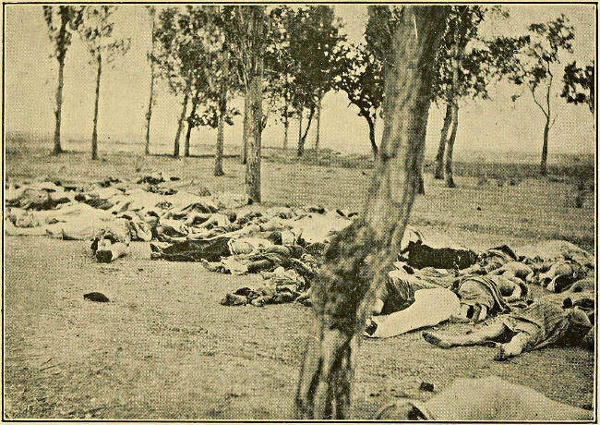
THE ROADSIDE OF AWFUL DESPAIR
First the children died, and then the parents, and uncles and aunts. The grieving
parents wrapped the little ones in the sheets they had brought along, and then lay
down beside them to starve. It was a common scene in the deserts and along the
sandy roads over which the exiles travelled.
And then one night, after so many days had passed
I had lost count of them, God reached in through my
dungeon window. I was awakened by a commotion
in the courtyard, where, on other nights, it had been
very quiet. Soon I understood what was happening—sheep
were being driven in through the gate. Ahmed’s
flock was coming in from the hill pastures, driven in,
perhaps, by military conditions.
I heard the yard gates swing shut. Then, above the
bleating of the excited, restless sheep, I heard the
shepherd whistle his call to quiet them. I jumped to
my feet, my heart throbbing. Breathlessly I listened
for the shepherd to repeat the call. Then I was sure—it
was the same peculiar call, sharp and shrill, which
my father always taught his own shepherds, the call
which he had been taught by his own father when, as
a little boy, he learned the ways of his father’s sheep
on the great pastures of Mamuret-ul-Aziz. When I
was very young our shepherds used to laugh at me
when I tried to imitate them. I had been a very happy
little girl when, one day, I succeeded so well that suddenly
the sheep in our flock turned away from their
grass and came toward me.
No other shepherds than ours or, at least, one who
had come from Tchemesh-Gedzak, would know that
call, I was certain. Ahmed’s sheep were tired and
nervous. The unknown shepherd remained among
them, every now and then repeating that same whistle,
softer and softer. I went close to the window, lifted
my face toward the iron-barred window and repeated
the call. Even the sheep seemed to sense something
unusual. They were suddenly quiet. Again I whistled,
this time with more courage. Instantly the shepherd
answered—I could almost detect his note of
wonder.
I had learned that by leaping as high as I could I
could catch the window bars with my hands and lift
myself until my face reached above the window-sill.
Often I had caught glimpses of the yard in this way.
But I was not strong enough to hold myself up more
than a few seconds at a time.
Now I tried this, hoping to catch a glimpse of the
shepherd in the moonlight. As I pulled myself up, I
whistled again. Many times I tried before I attracted
his attention to the window. When I had succeeded
and he understood that behind that window there was
a captive who was trying to signal him, he made me
understand by repeating his whistle three times in
quick succession directly under the window.
I dared not call out to him. I tore a great piece of
cloth from the dress that had been given me. I rolled
this into a ball and threw it out. He saw and answered
by whistling softly. I hoped he would understand
the torn cloth as a symbol of my imprisonment—and
of my hope that he would save me. I could
hardly believe that even an Armenian shepherd would
be left alive, yet it seemed to be so.
In the morning when the sheep were taken out the
shepherd whistled again under my window and I knew
he was trying to attract my attention. I answered as
softly as I could. All that day a new hope gave me
courage. I was sure deliverance was at hand, though
I could not explain why.
I did not even attempt to sleep that night. The
sheep came in early and the shepherd whistled. An
hour later I heard the call again—the shepherd still
was in the yard. It must have been near midnight
when I heard a rattling at the window bars. I looked,
and there, framed in the moonlight, was a face I knew—the
face of Old Vartabed, who had come to our
house that Easter morning with his prophecy of ill—the
prophecy that came true. God had sent him to me
and had made me to hear and understand that familiar,
whistled call!
Old Vartabed whispered: “Who is here who
comes from the Mamuret-ul-Aziz?”
“It is Aurora, the daughter of the Mardiganians of
Tchemesh-Gedzak. You are Old Vartabed, and I am
the Aurora you loved so much.”
Old Vartabed tried to speak, but his voice shook so
I could not understand him. I told him all that I
could, quickly. How I had come to be a captive of
Ahmed and why I was in the dungeon. Tears came
into Old Vartabed’s ancient eyes when I told him how
all my people were dead. I asked him how it was that
he had been saved. “Old Vartabed is not worth the
slaughter,” he said. “I am of much value, since I
have taught the sheep of Ahmed to behave only for
me. Ahmed has forgotten I am an Armenian, since I
bend my knees for every prayer to Allah and thus
prolong my days.” He told me to be patient. He
would find a way to save me.
Two nights went by before Old Vartabed came
again. But each night he signaled and I answered.
On the third night, his face was framed again in the
window casement.
“Be ready, little one—I shall lift you out soon,”
he whispered. He had brought a steel bar with which
to pry aside the iron bars in the window. The bars
were very old—perhaps for a hundred years or more
they had served to shut in the prisoners that once
had been confined in this same dungeon room in Ahmed
Bey’s big house. I knelt to pray, and I was on my
knees when Vartabed whispered:
“Come, little one—reach Old Vartabed your hand—he
will lift you.”
The bars were bent aside. There was room for the
shepherd to lean inward and reach down. I caught his
hands and he lifted me until I could catch hold of
the iron and help myself. In a moment I leaped down
to the stump which the shepherd had brought to stand
on, and from this to the ground. The sheep, which
were resting all about, stirred and bleated when I fell
among them, but Old Vartabed whistled and they were
quiet.
“We must go quickly; the gate is not locked. You
must be far away, to a place I will tell you of, before
morning comes and you are missed,” Old Vartabed
said as he hurried me across the yard.
When we were outside the gate, Old Vartabed
wrapped his coat around me, for it was cold. Then
we struck out across the plains, away from the town
and toward low hills in the distance.
Old Vartabed did not talk much. He was so old
he needed his strength. He was anxious that I get
far away before dawn. When we came to the hills
the shepherd showed me a path and told me to follow
it, and go on alone until I came to the hut of a friendly
Kurdish family.
“But you, Old Vartabed—are you not coming with
me? Will not Ahmed Bey suspect you if you return?”
I asked.
“Old Vartabed is too old to live in the desert, and
then, who would care for my sheep?” the old man
replied.
Poor, dear Old Vartabed! Ahmed Bey had him
killed in the morning.
I ran along the path the shepherd pointed out to me
until, after many hours, I came to the hut of the
Kurds, of whom Old Vartabed had told me. They
were shepherd Kurds, and had great respect for Old
Vartabed, who had told them I was the daughter of his
one-time master in the Mamuret-ul-Aziz. They expected
me, and were very kind.
When I thought of Old Vartabed going back to his
sheep, and to the mercy of Ahmed Bey, I cried. The
shepherd Kurd’s wife and daughters were sorry, and
the Kurd himself went down toward the plain in which
Ahmed’s house stood, to learn if Old Vartabed still
tended his sheep. That night he came back in great
distress. He had learned of Old Vartabed’s fate.
None but the shepherd could have helped me escape,
Ahmed Bey had been sure. He had summoned Old
Vartabed before him and the shepherd had confessed,
as there was no other way. Ahmed Bey sent for his
zaptiehs. Old Vartabed was led out to where his flock
was waiting to be taken to the pasture. There was a
shot, and he had paid with his life for his kindness to
the little daughter of his one-time master.
The Kurd was much alarmed for me. Ahmed Bey
had sent zaptiehs to search in the plains and hills.
Perhaps they would soon be at the hut.
They would not send me away, but I knew that I
must go. The hut was too close to the house of
Ahmed, and the zaptiehs might come when least expected.
So they gave me woolen stockings, the best
they had, a great loaf of winter bread, a jug in which
to carry water, and a blanket to wrap about me at
night. Then I went out into the hills.
Beyond these hills was the great Dersim—the highlands
of grass and sand, with hills and mountains
everywhere. For many, many miles in each direction
no one lived but Dersim Kurds, some in little villages,
some in roving bands. On each side of the Dersim
lived the Turks. Once Armenians lived in the cities
of the Turks, but now the Armenians all were gone—only
Turks were left.
The inhabitants of the Dersim deserts and wastes
are not the vicious type of Kurds who live in the south
in the regions to which we had been deported from
our homes. The Kurds in the south are nomadic
tribes, harsh and cruel. The Dersim Kurds mostly
are farmers, and often rebel against their Turkish
overlords. They are fanatical Moslems, and have
their racial hatred of all “unbelievers,” as they look
upon Christians. But they do not have the lust of
killing human beings common with the tribes of the
south. To this I owe my life.
For more than a year I was a captive or a wanderer
in the Dersim. For many days after I left my friends
at the news of Old Vartabed’s fate I hid in the daytime
and traveled at night, walking, walking, always
walking; somewhere, and yet nowhere. When a settlement
loomed up before me I turned the other way,
trudging aimlessly across the wide plains, through the
hills or over deserts.
My bread soon gave out, and water was hard to get,
for wherever there was a well or a spring a settlement
of Kurds was close. Near one well I hid throughout
one whole day, waiting my chance to slip up unobserved
and cool my parched throat. There was no
opportunity in the daylight, and when night came and
I gathered courage to creep near to the well the dogs
from the houses ran out and barked at me. I was too
exhausted to run when the villagers came out to see
what had aroused the dogs. They took me into the
settlement and shut me up in a cave for the night. In
the morning the chief of the settlement took me as his
slave and commanded me to obey the orders of his
family.
They made me do the work a man would do. I
tended the stock, carried the water and worked in the
fields. When I did not do enough work the Kurds
would beat me with their long, thick sticks and refuse
me food. When I did enough work to please them the
women would throw me a piece of bread. At night I
slept on the ground, outside the huts, with rags and
torn blankets to keep out the cold, but never was I
warm.
After weeks passed I was too weak to work any
longer. I fell down when I went to the fields, and
could not get up when a Kurd kicked me. So they
gave me half a loaf of bread and told me to go away.
I went a little way and then rested for two days. It
was so nice not to have to drag a plow made of sticks
from morning to night, I soon got my strength back.
And then I started to walk again.
Beyond Erzerum I knew there were Russians—friends
of the Armenians. I tried to keep my face
turned to where I thought Erzerum would be—a hundred
miles or more through the Dersim. I kept away
from the villages until I could walk no more for want
of food or water. Then I would give myself up to be
a work slave again. Each time the Kurds kept me
until my strength gave way. Then they gave me the
half loaf of bread and let me go away.
Although it was very cold now, I had no clothes.
The Kurds would never let me have any of the cloth
they spun. Snow in the crevices among the hills gave
me water, but all I had to eat for weeks, even months,
at a time was the bark from small trees, weeds that
grow in the winter time, and the dead blades of grass
I found under the snow.
The snow had melted when I reached the edge of
the Dersim to the west. I do not know what month
it was, as I had lost all track of time, but I knew
spring was passing because the snow disappeared. I
was now in the neighborhood of Turkish cities. Occasionally
I saw Turks, in their white coats, walking
over the plains. I saw flocks of sheep now and then,
and other signs that I was near cities. Yet I knew
I must keep away from these cities or their inhabitants.
One day from the side of a hill where I was hiding,
almost too weak from hunger to walk, I saw a great
line of people with donkeys and carts and arabas,
passing on what seemed to be a road to the south.
As far as I could see, this cavalcade stretched out.
For hours it wound its way across the plains. I wondered
what it meant. I crept down from the hill and,
crawling on the ground, drew as near as I could. I
saw the people were Turks, and that they were carrying
household goods with them. I saw, too, that they
were excited and seemed to be unhappy.
I watched the line of Turkish families go by all day.
When it was dark I determined to go the way they
had come from. Whatever it was that had sent the
Turks from their homes in the cities further east, it
could not be anything that meant ill for a girl of the
Armenians.
Already I had crossed the Kara River, the farthest
branch of the Euphrates. Along the roads over which
the Turks had passed in the daytime there were scraps
of bread, glass jars from which fruits had been
emptied, and other remnants of food. I gathered
enough to give me strength for walking.
The plains across which I made my way that night
were those which once formed the Garden of Eden,
according to the teachings of the priests and our Sunday
school books. The Kara River was one of the
Four Rivers. Nearby were the Acampis of the Bible
and the Chorok and the Aras, the other three. Among
these same rocks through which I hurried along as
fast as my strength would allow, Eve herself once had
wandered. When I sat down at times to rest I thought
of Eve, and wondered if she were some place Up
Above, looking down upon me, one of the last of the
great race of people which had been the first to accept
the teachings of Christ and which had suffered so
much in His name through all the centuries that have
passed since Eve’s gardens blossomed on the plains
and slopes about me.
The next day there were more lines of Turkish refugees.
These appeared to be belated and hurried in
great confusion. Turkish soldiers appeared among
them, and there were many zaptiehs. Far beyond I
saw the minarets of a city. I knew it must be Erzerum.
I came near to a village and saw the inhabitants
rushing about from house to house in excitement.
I was afraid to travel in the daytime. I could not
go near one of these villages, even to beg for water,
because I had no clothes, and would be ashamed, even
if I dared to trust that I would not be taken captive.
During the night I crept closer to the distant city. In
the morning I stood at the edge of a plateau, which
broke downward in a sheer drop to the plain. Clinging
close to rocks, which hid me from the view of the
refugees who still passed along the roads, I could look
down into the city.
I saw a great rushing about. Moving bodies of
soldiers came and went. Refugees were streaming
out of the city and were joined by others from villages
all around. In the distance I could hear what I knew
to be the firing of guns.
The firing came closer. Now and then big guns
spoke, shaking the ground about me. I saw explosions
in the city. Houses appeared to fall each time
the big guns sounded. Far across the city there suddenly
appeared clouds of dust. They drew nearer.
Soldiers fled out of the gates of the city nearest me,
in the wake of the civilians.
Late in the afternoon the firing ceased. The dust
clouds beyond the city had drawn closer. Out of them
suddenly emerged bands of horsemen. They rode directly
toward the far gates. Companies of Turkish
soldiers met them at the city walls. There was a
clash. The Turks were driven back. The horsemen
followed. There was rifle firing. Other bands of
horsemen rode down from every direction in the east,
in through the gates and into the city itself.
The Russians had come!
In an hour the city was almost quiet again. Far off
I saw great columns of troops moving slowly. Behind
the Cossacks the Russian army was coming. The
Turks in the city had surrendered.
When night fell I went down from the rocks and
into the town. I hoped before dawn came I could find
a garment, or a piece of shawl, which had been thrown
away and with which I could cover myself. Terror
of the Cossacks kept indoors the citizens who had been
brave enough to remain in their homes. The streets
were deserted in the outskirts, except for an occasional
zaptieh stealing along, as afraid to be seen as
I was.
Suddenly, as I turned the corner of a narrow street,
hugging close to the wall, hoping that this turn, or
the next, would bring me near one of the houses I
knew the Russians must have occupied, I saw a beautiful
sight—the American flag. The rays of a searchlight
played on it.
Lights shone from all the windows in the house
over which the flag flew. There, I knew, would be my
haven of safety. But not until after the dawn did I
have the courage to go near. Then I saw the figures
of men moving about the yard and near the doorways.
I ran out of my hiding place and fell at the feet of
a tall, kindly-looking man, who had just emerged from
the house door, and who stood talking to a Russian
officer.
I felt the tall man stoop down and put his hand upon
my head. All at once the sun seemed to break out of
the gray dawn and shine down upon me. Then I fell
asleep. When I opened my eyes again it was many
days after, they told me. I was in a warm bed, and
kindly people were all about me. When they spoke to
me, in a strange language, I tried to ask for the tall
man who had lifted me up from the street at the doorstep.
An interpreter came, and then, in a little while,
the tall man came in and smiled gently, and I knew
that everything was all right.
This man, they told me, was a famous missionary
physician, Dr. F. W. MacCallum, who was known for
his kindnesses to my people throughout the Turkish
empire. He had been compelled to leave Constantinople
when the war came, but he had come into Erzerum
with the Russians—to be among the first to give succor
to my people. The house had once been the American
mission. The missionaries had been compelled to
flee, but they had returned with the Russians.
Dr. MacCallum, who now is in New York and was
the first good friend I found after my arrival in this
country, bought thousands of Armenian girls out of
slavery in those days when the Russians were pushing
into Turkey from the Caucasus. With money supplied
by the American Committee for Armenian and Syrian
Relief he purchased these girls from their Turkish
captors for $1. apiece. The Turks, knowing the Russians
would liberate these captive Christian girls if
they found them, were glad to sell them at this price
rather than risk losing them without collecting anything.
General Andranik, the great Armenian leader, who
is our national hero, came to see me. For many years
General Andranik kept alive the courage of all Armenians.
He promised them freedom and constantly endangered
his life to keep up the spirits of my people.
The Turks put a price upon his head, and he was
hunted from one end of the empire to the other—yet
he always escaped. He led the Armenian regiments,
made up of Armenians who lived in Russia, in the vanguard
of the Russian army sent against the Turks.
When I told General Andranik how I had seen my
own dear people killed he felt very sorry for me. He
comforted and cheered me, and called me his “little
girl.” I would rather he said that to me than give me
all the riches in the world.
A Russian officer who could speak Armenian also
came to talk with me. When I had told him everything
he left, but in an hour he returned. This time
a very distinguished looking officer, very tall, with a
kind face, came with him. I knew he must be of very
high rank, for there was much excitement when he
entered the house. The officer who had talked with
me first repeated to the other many of the things I had
told him. The distinguished looking officer then spoke
to me, first in Russian, and then in French, which I
understood.
“You have been a very unhappy girl,” he said, “and
I am very happy to have arrived in time to save you.
We shall take good care of you, and all Russians will
be your friends.”
When he had gone they told me who he was—the
Grand Duke, in command of the armies in the Caucasus.
The officer who had visited me first was General
Trokin, the Grand Duke’s chief of staff.
When I was well and strong, General Andranik allowed
me to help care for hundreds of Armenian children
who had been found in the hands of the Turks
and Armenian refugees who had succeeded in hiding
in the hills and mountains and who now crept in to
ask protection of the Russians. I helped, too, to comfort
the girls who had been bought out of the harems.
When General Andranik moved on with the advancing
Russians the Grand Duke ordered that I be escorted
safely to Sari Kamish, where the railroad begins,
and sent from there to Tiflis, the capital of the
Russian Caucasus. When General Andranik bade me
good-by he said:
“The Grand Duke has indorsed arrangements for
you to be sent to America, where our poor Armenians
have many friends. When you reach that beloved land
tell its people that Armenia is prostrate, torn and
bleeding, but that it will rise again—if America will
only help us—send food for the starving, and money
to take them back to their homes when the war is
over.”
As I started away with the escort, toward Sari Kamish,
General Andranik took from his finger a beautiful
ring, which, he said, had been his father’s and his
grandfather’s, and put it on my finger. It is the ring
I wear now—all that is left to me of my country.
From Sari Kamish the Grand Duke’s soldiers sent
me to Tiflis. There I was received by representatives
of the American Committee for Armenian and Syrian
Relief, and supplied with funds sufficient to take me,
with the Grand Duke’s passport, to Petrograd, Sweden
and America.
But when I reached Petrograd all was not well
within the city. Already the Czar had been removed
and the government of Minister Kerensky was losing
control of the populace. Rioting in the streets had
begun, and the authorities to whom the Grand Duke
and the American representatives at Tiflis had sent
me had been removed or executed.
Again I was friendless and without shelter. I had
a great deal of money, but I could buy hardly any
food. For fifty rubles I could purchase only a loaf
of bread. When I became so hungry I stopped kind
looking persons in the street to ask them if they could
help me obtain something to eat, they would look at
me sorrowfully, offer me handsful of paper money,
and say they could give me that, but not food. Every
one seemed to have a great deal of money, but things
to eat were very scarce.
No one dared take me in. I found an Armenian
church, empty now and deserted. All the Armenians
who had lived in Petrograd had been frightened away.
They had been the first, because of their experiences
in their own country, to scent the coming of trouble,
and had disappeared. I remained in the deserted
church for many days, afraid to go out in the streets,
where there was much killing and robbery. Only in
the early morning, when the streets were more quiet,
would I venture to look for food.
At last I saw an American passing the church. I
ran out and begged him, in French, to help me. I
showed him my passport and he took me in a droschky
to the American Embassy. Here every one was kind
to me. My passports were changed and the next day
I was started toward Christiania.
The train on which I traveled was stopped many
times by bands of soldiers, who demanded the passports
of every one. Although they took several persons
from the train at one stop, my passport was
honored and I went on. The farther we went from
Petrograd the quieter the country became. Then we
left all trouble behind and the train speeded on in what
seemed a peaceful and happy land.
At last we reached Christiania and there I found
kind friends. They gave me the first really satisfying
food I had had in many days. In addition they gave
me kindness and the quiet of their home. While
awaiting word from the United States, I rested and
won back some measure of my strength.
More funds reached me at Christiania, and I soon
found myself aboard an ocean liner bound for Halifax,
on my way to the land of freedom. From Halifax
I came direct to New York. As the Statue of
Liberty was pointed out to me as we entered the harbor,
I rejoiced not merely because I, myself, was safe
at last, but because I had at last reached the country
where I was to deliver the message that would bring
help to my suffering people.
Here I found good friends—kindly Americans
who have made me as happy as ever I can be. And,
best of all, they are not being kind merely to one
unfortunate girl—they are sending help to those I
left behind—to those who are still alive and lost in
the sandy deserts. They have made it possible for
me to tell in this, my book, what General Andranik
said to me:
“Armenia is trusting to her friends—the people of
the United States.”
THE END
SUBSCRIBER’S PLEDGE FOR
ARMENIAN AND SYRIAN RELIEF
400,000 ORPHANS ARE STARVING
4 MILLION PEOPLE ARE DESTITUTE
M ......................................................
Street .................................................
City ...................................................
Date ........................ State ....................
To provide food for the starving Armenians, Syrians
and Greeks in western Asia, I will give EACH MONTH
the amount indicated by my (X) mark, so long as the need
lasts or until canceled by me.
| | $ |
| | $ per month ( orphans) |
| | $1000 per month (200 orphans) |
| | $ 500 per month (100 orphans) |
| | $ 250 per month ( 50 orphans) |
| | $ 100 per month ( 20 orphans) |
| | $ 50 per month ( 10 orphans) |
| | $ 25 per month ( 5 orphans) |
| | $ 10 per month ( 2 orphans) |
| | $ 5 per month ( 1 orphan) |
| | $ per month |
I herewith pay $.......... on the above pledge
Make checks or money orders payable to
Cleveland H. Dodge, Treasurer, and mail to
AMERICAN COMMITTEE FOR ARMENIAN AND SYRIAN RELIEF
1 Madison Avenue
New York City
Ambassador Morgenthau’s Story
By Henry Morgenthau
The one man in the civilized world who can tell of
what the Near East suffered during the Great War is
Henry Morgenthau. For Mr. Morgenthau was United
States Ambassador in Constantinople when Germany
was forcing Turkey to act as her tool. His narrative
is a story of unexampled political intrigue and unbelievable
absence of honor. And the authority of his
statements is unquestioned.
As a record of what Turkey did to wipe out Armenia
from among the nations, Mr. Morgenthau’s story not
only verifies the facts related by Aurora Mardiganian,
but it tells of the cold-blooded plotting of the statesmen
who ordered the crime attempted. For Mr. Morgenthau
was the representative of the United States, and
he strove in every way he could to prevent the tragedy.
In these efforts the steps that led up to the ravishing of
Armenia were made plain to him.
“Ambassador Morgenthau’s Story” is a revelation
of events that preceded the breaking off of diplomatic
relations with Turkey previous to our entrance into the
war. It tells of events of which Aurora Mardiganian
knew nothing. It makes clear why she and millions of
other Armenians were made to suffer as she has told
you in her pitiful story.
Obtainable at any book-store or from the publishers
Doubleday, Page & Co.