That same day, Lord Saltire and Lady Ascot were sitting in the
drawing-room window, in South Audley Street, alone. He had come in, as
his custom was, about eleven, and found her reading her great old Bible;
he had taken up the paper and read away for a time, saying that he would
not interrupt her; she, too, had seemed glad to avoid a tête-à-tête
conversation, and had continued; but, after a few minutes, he had
dropped the paper, and cried—
"The deuce!"
"My dear James," said she, "what is the matter?"
"Matter! why, we have lost a war-steamer, almost without a shot fired.
The Russians have got the Tiger, crew and all. It is unbearable,
Maria; if they are going to blunder like this at the beginning, where
will it end?"
Lord Saltire was disgusted with the war from the very beginning, in
consequence of the French alliance, and so the present accident was as
fuel for his wrath. Lady Ascot, as loyal a soul as lived, was possibly
rather glad that something had taken up Lord Saltire's attention just
then, for she was rather afraid of him this morning. She knew his great
dislike for Lord Welter, and expected to be scolded for her weakness
with regard to Adelaide the night before. Moreover, she had the guilty
consciousness that she had asked Adelaide to come to lunch that morning,
of which he did not yet know. So she was rather glad to have a subject
to talk of, not personal.
"And when did it happen, my dear James?" she asked.
"On the twelfth of last month, Lady Ascot. Come and sit here in the
window, and give an account of yourself, will you have the goodness?"
Now that she saw it must come, she was as cool and as careless as need
be. He could not be hard on her. Charles was to come home to them that
day. She drew her chair up, and laid her withered old hand on his, and
the two grey heads were bent together. Grey heads but green hearts.
"Look at old Daventry," said Lord Saltire, "on the other side of the
way. Don't you see him, Maria, listening to that organ? He is two years
older than I am. He looks younger."
"I don't know that he does. He ought to look older. She led him a
terrible life. Have you been to see him lately?"
"What business is that of yours? So you are going to take Welter's wife
back into your good graces, eh, my lady?"
"Yes, James."
"'Yes, James!' I have no patience with you. You are weaker than water.
Well, well, we must forgive her, I suppose. She has behaved generous
enough about Charles, has she not? I rather admire her scolding poor
William Ravenshoe. I must renew our acquaintance."
"She is coming to lunch to-day."
"I thought you looked guilty. Is Welter coming?"
Lady Ascot made no reply. Neither at that moment would Lord Saltire have
heard her if she had. He was totally absorbed in the proceedings of his
old friend Lord Daventry, before mentioned. That venerable dandy had
listened to the organ until the man had played all his tunes twice
through, when he had given him half-a-crown, and the man had departed.
Immediately afterwards, a Punch and Judy had come, which Punch and Judy
was evidently an acquaintance of his; for, on descrying him, it had
hurried on with its attendant crowd, and breathlessly pitched itself in
front of him, let down its green curtains, and plunged at once in
medias res. The back of the show was towards Lord Saltire; but, just as
he saw Punch look round the corner, to see which way the Devil was gone,
he saw two pickpockets advance on Lord Daventry from different quarters,
with fell intentions. They met at his tail-coat pocket, quarrelled, and
fought. A policeman bore down on them; Lord Daventry was still
unconscious, staring his eyes out of his head. The affair was becoming
exciting, when Lord Saltire felt a warm tear drop on his hand.
"James," said Lady Ascot, "don't be hard on Welter. I love Welter. There
is good in him; there is, indeed. I know how shamefully he has behaved;
but don't be hard on him, James."
"My dearest Maria," said Lord Saltire, "I would not give you one
moment's uneasiness for the world. I do not like Welter. I dislike him.
But I will treat him for your sake and Ascot's as though I loved
him—there. Now about Charles. He will be with us to-day, thank God.
What the deuce are we to do?"
"I cannot conceive," said Lady Ascot; "it is such a terrible puzzle. One
does not like to move, and yet it seems such a sin to stand still."
"No answer to your advertisement, of course?" said Lord Saltire.
"None whatever. It seems strange, too, with such a reward as we have
offered; but it was worded so cautiously, you see."
Lord Saltire laughed. "Cautiously, indeed. No one could possibly guess
what it was about. It was a miracle of obscurity; but it won't do to go
any further yet." After a pause, he said—"You are perfectly certain of
your facts, Maria, for the fiftieth time."
"Perfectly certain. I committed a great crime, James. I did it for
Alicia's sake. Think what my bringing up had been, how young I was, and
forgive me if you can; excuse me if you cannot."
"Nonsense about a great crime, Maria. It was a great mistake, certainly.
If you had only had the courage to have asked Petre one simple question!
Alicia never guessed the fact, of course?"
"Never."
"Do you think, Maria, that by any wild possibility James or Nora knew?"
"How could they possibly? What a foolish question."
"I don't know. These Roman Catholics do strange things," said Lord
Saltire, staring out of window at the crowd.
"If she knew, why did she change the child?"
"Eh?" said Lord Saltire, turning round.
"You have not been attending," said Lady Ascot.
"No, I have not," said Lord Saltire; "I was looking at Daventry."
"Do you still," said Lord Saltire, "since all our researches and
failures, stick to the belief that the place was in Hampshire?"
"I do indeed, and in the north of Hampshire too."
"I wonder," said Lord Saltire, turning round suddenly, "whether
Mackworth knows?"
"Of course he does," said Lady Ascot, quietly.
"Hum," said Lord Saltire, "I had a hold over that man once; but I threw
it away as being worthless. I wish I had made a bargain for my
information. But what nonsense; how can he know?"
"Know?" said Lady Ascot, scornfully; "what is there a confessor don't
know? Don't tell me that all Mackworth's power came from finding out
poor Densil's faux pas. The man had a sense of power other than that."
"Then he never used it," said Lord Saltire. "Densil, dear soul, never
knew."
"I said a sense of power," said Lady Ascot, "which gave him his
consummate impudence. Densil never dreamt of it."
At this point the policeman had succeeded in capturing the two
pickpockets, and was charging them before Lord Daventry. Lord Daventry
audibly offered them ten shillings a-piece to say nothing about it; at
which the crowd cheered.
"Would it be any use to offer money to the priest—say ten thousand
pounds or so?" said Lord Saltire. "You are a religious woman, Maria, and
as such are a better judge of a priest's conscience than I. What do you
think?"
"I don't know," said Lady Ascot. "I don't know but what the man is
high-minded, in his heathenish way. You know Cuthbert's story of his
having refused ten thousand pounds to hush up the matter about Charles.
His information would be a blow to the Popish Church in the West. He
would lose position by accepting your offer. I don't know what his
position may be worth. You can try him, if all else fails; not
otherwise, I should say. We must have a closer search."
"When you come to think, Maria, he can't know. If Densil did not know,
how could he?"
"Old Clifford might have known, and told him."
"If we are successful, and if Adelaide has no children—two improbable
things—" said Lord Saltire, "why then——"
"Why then——" said Lady Ascot. "But at the worst you are going to make
Charles a rich man. Shall you tell William?"
"Not yet. Cuthbert should never be told, I say; but that is Charles's
business. I have prepared William."
"Cuthbert will not live," said Lady Ascot.
"Not a chance of it, I believe. Marston says his heart-complaint does
not exist, but I think differently."
At this moment, Lord Daventry's offer of money having been refused, the
whole crowd moved off in procession towards the police-station. First
came three little girls with big bonnets and babies, who, trying to do
two things at once—to wit, head the procession by superior speed, and
at the same time look round at Lord Daventry and the
pickpockets—succeeded in neither, but only brought the three babies'
heads in violent collision every other step. Next came Lord Daventry,
resigned. Next the policeman, with a pickpocket in each hand, who were
giving explanations. Next the boys; after them, the Punch and Judy,
which had unfortunately seen the attempt made, and must to the station
as a witness, to the detriment of business. Bringing up the rear were
the British public, who played practical jokes with one another. The
dogs kept a parallel course in the gutter, and barked. In turning the
first corner, the procession was cut into, and for a time thrown into
confusion, by a light-hearted costermonger, who, returning from a
successful market with an empty barrow, drove it in among them with
considerable velocity. After which, they disappeared like the baseless
fabric of a dream, only to be heard of again in the police reports.
"Lord and Lady Welter."
Lord Saltire had seen them drive up to the door; so he was quite
prepared. He had been laughing intensely; but quite silently, at poor
Lord Daventry's adventures, and so, when he turned round, he had a smile
on his face. Adelaide had done kissing Lady Ascot, and was still holding
both her hands with a look of intense mournful affection. Lord Saltire
was so much amused by Adelaide's acting, and her simplicity in
performing before himself, that, when he advanced to Lord Welter, he was
perfectly radiant.
"Well, my dear scapegrace, and how do you do?" he said, giving his
hand to Lord Welter; "a more ill-mannered fellow I never saw in my life.
To go away and hide yourself with that lovely young wife of yours, and
leave all us oldsters to bore one another to death. What the deuce do
you mean by it, eh, sir?"
Lord Welter did not reply in the same strain. He said—
"It is very kind of you to receive me like this. I did not expect it.
Allow me to tell you, that I think your manner towards me would not be
quite so cordial if you knew everything; there is a great deal that you
don't know, and which I don't mean to tell you."
It is sometimes quite impossible, even for a writer of fiction, a man
with carte blanche in the way of invention, to give the cause, for a
man's actions. I have thought and thought, and I cannot for the life of
me tell you why Lord Welter answered Lord Saltire like that, whether it
was from deep cunning or merely from recklessness. If it was cunning, it
was cunning of a high order. It was genius. The mixture of respect and
kindness towards the person, and of carelessness about his favour
was—well—very creditable. Lord Saltire did not think he was acting,
and his opinion is of some value, I believe. But then, we must remember
that he was prepared to think the best of Lord Welter that day, and must
make allowances. I am not prepared with an opinion; let every man form
his own. I only know that Lord Saltire tapped his teeth with his
snuff-box and remained silent. Lord Welter, whether consciously or no,
was nearer the half of a million of money than he had ever been before.
But Adelaide's finer sense was offended at her husband's method of
proceeding. For one instant, when she heard him say what he did, she
could have killed him. "Reckless, brutal, selfish," she said fiercely
to herself, "throwing a duke's fortune to the winds by sheer obstinacy."
(At this time she had picked up Lady Ascot's spectacles, and was
playfully placing them on her venerable nose.) "I wish I had never seen
him. He is maddening. If he only had some brains, where might not we
be?" But the conversation of that morning came to her mind with a jar,
and the suspicion with it, that he had more brains of a sort than she;
that, though they were on a par in morality, there was a strength about
him, against which her finesse was worthless. She knew she could never
deceive Lord Saltire, and there was Lord Saltire tapping him on the knee
with his snuff-box, and talking earnestly and confidentially to him. She
was beginning to respect her husband. He dared face that terrible old
man with his hundreds of thousands; she trembled in his presence.
Let us leave her, fooling our dear old friend to the top of her bent,
and hear what the men were saying.
"I know you have been, as they say now, 'very fast,'" said Lord Saltire,
drawing nearer to him. "I don't want to ask any questions which don't
concern me. You have sense enough to know that it is worth your while to
stand well with me. Will you answer me a few questions which do concern
me?"
"I can make no promises, Lord Saltire. Let me hear what they are, will
you?"
"Why," said Lord Saltire, "about Charles Ravenshoe."
"About Charles!" said Lord Welter, looking up at Lord Saltire. "Oh, yes;
any number. I have nothing to conceal there. Of course you will know
everything. I had sooner you knew it from me than another."
"I don't mean about Adelaide; let that go by. Perhaps I am glad that
that is as it is. But have you known where Charles was lately? Your wife
told William to come to her this morning; that is why I ask."
"I have known a very short time. When William Ravenshoe came this
morning, I gave him every information. Charles will be with you to-day."
"I am satisfied."
"I don't care to justify myself, but if it had not been for me you would
never have seen him. And more. I am not the first man, Lord Saltire, who
has done what I have done."
"No, of course not," said Lord Saltire. "I can't fling the first stone
at you; God forgive me."
"But you must see, Lord Saltire, that I could not have guessed that
Ellen was his sister."
"Hey?" said Lord Saltire. "Say that again."
"I say that, when I took Ellen Horton away from Ravenshoe, I did not
know that she was Charles's sister."
Lord Saltire fell back in his chair, and said—
"Good God!"
"It is very terrible, looked at one way, Lord Saltire. If you come to
look at it another, it amounts to this, that she was only, as far as I
knew, a gamekeeper's daughter. Do you remember what you said to Charles
and me when we were rusticated?"
"Yes. I said that one vice was considered more venial than another vice
nowadays; and I say so still. I had sooner that you had died of delirium
tremens in a ditch than done this."
"So had not I, Lord Saltire. When I became involved with Adelaide, I
thought Ellen was provided for; I, even then, had not heard this
esclandre about Charles. She refused a splendid offer of marriage
before she left me."
"We thought she was dead. Where is she gone?"
"I have no idea. She refused everything. She stayed on as Adelaide's
maid, and left us suddenly. We have lost all trace of her."
"What a miserable, dreadful business!" said Lord Saltire.
"Very so," said Lord Welter. "Hadn't we better change the subject, my
lord?" he added, drily. "I am not at all sure that I shall submit to
much more cross-questioning. You must not push me too far, or I shall
get savage."
"I won't," said Lord Saltire. "But, Welter, for God's sake, answer me
two more questions. Not offensive ones, on my honour."
"Fifty, if you will; only consider my rascally temper."
"Yes, yes! When Ellen was with you, did she ever hint that she was in
possession of any information about the Ravenshoes?"
"Yes; or rather, when she went, she left a letter, and in it she said
that she had something to tell Charles."
"Good, good!" said Lord Saltire. "She may know. We must find her. Now,
Charles is coming here to-day. Had you better meet him, Welter?"
"We have met before. All that is past is forgiven between us."
"Met!" said Lord Saltire, eagerly. "And what did he say to you? Was
there a scene, Welter?"
Lord Welter paused before he answered, and Lord Saltire, the wise,
looked out of the window. Once Lord Welter seemed going to speak, but
there was a catch in his breath. The second attempt was more fortunate.
He said, in a low voice—
"Why, I'll tell you, my lord. Charles Ravenshoe is broken-hearted."
"Lord and Lady Hainault."
And Miss Corby, and Gus, and Flora, and Archy, the footman might have
added, but was probably afraid of spoiling his period.
It was rather awkward. They were totally unexpected, and Lord Hainault
and Lord Welter had not met since Lord Hainault had denounced Lord
Welter at Tattersall's. It was so terribly awkward that Lord Saltire
recovered his spirits, and looked at the two young men with a smile. The
young men disappointed him, however, for Lord Hainault said, "How d'ye
do, Welter?" and Lord Welter said, "How do, Hainault?" and the matter
was settled, at all events for the present.
When all salutations had been exchanged among the ladies, and Archy had
hoisted himself up into Mary's lap, and Lady Hainault had imperially
settled herself in a chair, with Flora at her knee, exactly opposite
Adelaide, there was a silence for a moment, during which it became
apparent that Gus had a question to ask of Lady Ascot. Mary trembled,
but the others were not quite sorry to have the silence broken. Gus,
having obtained leave of the house, wished to know whether or not Satan,
should he repent of his sins, would have a chance of regaining his
former position?
"That silly Scotch nursemaid has been reading Burns's poems to him, I
suppose," said Lady Hainault; "unless Mary herself has been doing so.
Mary prefers anything to Watts's hymns, Lady Ascot."
"You must not believe one word Lady Hainault says, Lady Ascot," said
Mary. "She has been shamefully worsted in an argument, and she is
resorting to all sorts of unfair means to turn the scales. I never read
a word of Burns's poems in my life."
"You will be pleased not to believe a single word Miss Corby says, Lady
Ascot," said Lady Hainault. "She has convicted herself. She sings, 'The
banks and braes of bonny Doon'—very badly, I will allow, but still she
sings it."
There was a laugh at this. Anything was better than the silence which
had gone before. It became evident that Lady Hainault would not speak to
Adelaide. It was very uncomfortable. Dear Mary would have got up another
friendly passage of arms with Lady Hainault, but she was too nervous.
She would have even drawn out Gus, but she saw that Gus, dear fellow,
was not in a humour to be trusted that morning. He evidently was aware
that the dogs of war were loose, and was champing the bit like a
war-horse. Lady Ascot was as nervous as Mary, dying to say something,
but unable. Lady Hainault was calmly inexorable, Adelaide sublimely
indifferent. If you will also consider that Lady Ascot was awaiting news
of Charles—nay, possibly Charles himself—and that, in asking Adelaide
to lunch, she had overlooked the probability that William would bring
him back with him—that Lord Welter had come without invitation, and
that the Hainaults wore totally unexpected—you will think that the dear
old lady was in about as uncomfortable a position as she could be, and
that any event, even the house catching fire, must change matters for
the better.
Not at all. They say that, when things come to the worst, they must
mend. That is undeniable. But when are they at the worst? Who can tell
that? Lady Ascot thought they were at the worst now, and was taking
comfort. And then the footman threw open the door, and announced—
"Lady Hainault and Miss Hicks."
At this point Lady Ascot lost her temper, and exclaimed aloud, "This is
too much!" They thought old Lady Hainault did not hear her; but she did,
and so did Hicks. They heard it fast enough, and remembered it too.
In great social catastrophes, minor differences are forgotten. In the
Indian mutiny, people spoke to one another, and made friends, who were
at bitterest variance before. There are crises so terrible that people
of all creeds and shades of political opinion must combine against a
common enemy. This was one. When this dreadful old woman made her
totally unexpected entrance, and when Lady Ascot showed herself so
entirely without discretion as to exclaim aloud in the way she did,
young Lady Hainault and Adelaide were so horrified, so suddenly
quickened to a sense of impending danger, that they began talking loudly
and somewhat affectionately to one another. And young Lady Hainault,
whose self-possession was scattered to the four winds by this last
misfortune, began asking Adelaide all about Lady Brittlejug's drum, in
full hearing of her mamma-in-law, who treasured up every word she said.
And, just as she became conscious of saying wildly that she was so sorry
she could not have been there—as if Lady Brittlejug would ever have had
the impudence to ask her—she saw Lord Saltire, across the room, looking
quietly at her, with the expression on his face of one of the idols at
Abou Simbel.
Turn Lady Ascot once fairly to bay, you would (if you can forgive slang)
get very little change out of her. She came of valiant blood. No
Headstall was ever yet known to refuse his fence. Even her poor brother,
showing as he did traces of worn-out blood (the men always go a
generation or two before the women), had been a desperate rider,
offered to kick Fouquier Tinville at his trial, and had kept Simon
waiting on the guillotine while he pared his nails. Her ladyship rose
and accepted battle; she advanced towards old Lady Hainault, and,
leaning on her crutched stick, began—
"And how do you do, my dear Lady Hainault?"
She thought Lady Hainault would say something very disagreeable, as she
usually did. She looked at her, and was surprised to see how altered she
was. There was something about her looks that Lady Ascot did not like.
"My dear Lady Ascot," said old Lady Hainault, "I thank you. I am a very
old woman. I never forget my friends, I assure you. Hicks, is Lord
Hainault here?—I am very blind, you will be glad to hear, Lady Ascot.
Hicks, I want Lord Hainault, instantly. Fetch him to me, you stupid
woman. Hainault! Hainault!"
Our Lady Hainault rose suddenly, and put her arm round her waist.
"Mamma," she said, "what do you want!"
"I want Hainault, you foolish girl. Is that him? Hainault, I have made
the will, my dear boy. The rogue came to me, and I told him that the
will was made, and that Britten and Sloane had witnessed it. Did I do
right or not, eh? Ha! ha! I followed you here to tell you. Don't let
that woman Ascot insult me, Hainault. She has committed a felony, that
woman. I'll have her prosecuted. And all to get that chit Alicia married
to that pale-faced papist, Petre Ravenshoe. She thinks I didn't know it,
does she? I knew she knew it well enough, and I knew it too, and I have
committed a felony too, in holding my tongue, and we'll both go to
Bridewell, and——"
Lord Saltire here came up, and quietly offered her his arm. She took it
and departed, muttering to herself.
I must mention here, that the circumstance mentioned by old Lady
Hainault, of having made a will, had nothing to do with the story. A
will had existed to the detriment of Lady Hainault and Miss Hicks, and
she had most honourably made another in their favour.
Lady Ascot would have given worlds to unsay many things she had
heretofore said to her. It was evident that poor old Lady Hainault's
mind was failing. Lady Ascot would have prayed her forgiveness on her
knees, but it was too late. Lady Hainault never appeared in public
again. She died a short time after this, and, as I mentioned before,
left poor Miss Hicks a rich woman. Very few people knew how much good
there was in the poor old soul. Let the Casterton tenantry testify.
On this occasion her appearance had, as we have seen, the effect of
reconciling Lady Hainault and Adelaide. A very few minutes after her
departure William entered the room, followed by Hornby, whom none of
them had ever seen before.
They saw from William's face that something fresh was the matter. He
introduced Hornby, who seemed concerned, and then gave an open note to
Lord Saltire. He read it over, and then said—
"This unhappy boy has disappeared again. Apparently his interview with
you determined him, my dear Lady Welter. Can you give us any clue? This
is his letter:"
"Dear Lieutenant,—I must say good-bye even to you, my last
friend. I was recognised in your service to-day by Lady
Welter, and it will not do for me to stay in it any longer.
It was a piece of madness ever taking to such a line of
life."
[Here there were three lines carefully erased. Lord Saltire
mentioned it, and Hornby quietly said, "I erased those
lines previous to showing the letter to any one; they
referred to exceedingly private matters." Lord Saltire
bowed and continued.] "A hundred thanks for your kindness;
you have been to me more like a brother than a master. We
shall meet again, when you little expect it. Pray don't
assist in any search after me; it will be quite useless.
Charles Horton."
Adelaide came forward as pale as death. "I believe I am the cause of
this. I did not dream it would have made him alter his resolution so
suddenly. When I saw him yesterday he was in a groom's livery. I told
him he was disgracing himself, and told him, if he was desperate, to go
to the war."
They looked at one another in silence.
"Then," Lady Ascot said, "he has enlisted, I suppose. I wonder in what
regiment?—could it be in yours, Mr. Hornby?"
"The very last in which he would, I should say," said Hornby, "if he
wants to conceal himself. He must know that I should find him at once."
So Lady Ascot was greatly pooh-poohed by the other wiseacres, she being
right all the time.
"I think," said Lord Saltire to Lady Ascot, "that perhaps we had better
take Mr. Hornby into our confidence." She agreed, and, after the
Hainaults and Welters were gone, Hornby remained behind with them, and
heard things which rather surprised him.
"Inquiries at the depôts of various regiments would be as good a plan as
any. Meanwhile I will give any assistance in my power. Pray, would it
not be a good plan to advertise for him, and state all the circumstances
of the case?"
"Why, no," said Lord Saltire, "we do not wish to make known all the
circumstances yet. Other interests have to be consulted, and our
information is not yet complete. Complete! we have nothing to go on but
mere surmise."
"You will think me inquisitive," said Hornby. "But you little know what
a right (I had almost said) I have to ask these questions. Does the
present Mr. Ravenshoe know of all this?"
"Not one word."
And so Hornby departed with William, and said nothing at all about
Ellen. As they left the door a little shoeblack looked inquisitively at
them, and seemed as though he would speak. They did not notice the
child. He could have told them what they wanted to know, but how were
they to guess that?
Impossible. Actually, according to the sagacious Welter, half a million
pounds, and other things, going a-begging, and a dirty little shoeblack
the only human being who knew where the heir was! A pig is an obstinate
animal, likewise a sheep; but what pig or sheep was ever so provoking in
its obstinacy as Charles in his good-natured, well-meaning, blundering
stupidity? In a very short time you will read an advertisement put into
The Times by Lady Ascot's solicitor, which will show the reason for
some of the great anxiety which she and others felt to have him on the
spot. At first Lady Ascot and Lord Saltire lamented his absence, from
the hearty goodwill they bore him; but, as time wore on, they began to
get deeply solicitous for his return for other reasons. Lady Ascot's
hands were tied. She was in a quandary, and, when the intelligence came
of his having enlisted, and there seemed nearly a certainty of his being
shipped off to foreign parts, and killed before she could get at him,
she was in a still greater quandary. Suppose, before being killed, he
was to marry some one? "Good heavens, my dear James, was ever an
unfortunate wretch punished so before for keeping a secret?"
"I should say not, Maria," said Lord Saltire, coolly. "I declare I love
the lad the better the more trouble he gives one. There never was such a
dear obstinate dog. Welter has been making his court, and has made it
well—with an air of ruffian-like simplicity, which was charming,
because novel. I, even I, can hardly tell whether it was real or not. He
has ten times the brains of his shallow-pated little wife, whose
manœuvres, my dear Maria, I should have thought even you, not
ordinarily a sagacious person, might have seen through."
"I believe the girl loves me; and don't be rude, James."
"I believe she don't care twopence for you; and I shall be as rude as I
please, Maria."
Poor Lord Ascot had a laugh at this little battle between his mother and
her old friend. So Lord Saltire turned to him and said—
"At half-past one to-morrow morning you will be awakened by three
ruffians in crape masks, with pistols, who will take you out of bed with
horrid threats, and walk you upstairs and down in your shirt, until you
have placed all your money and valuables into their hands. They will
effect an entrance by removing a pane of glass, and introducing a small
boy, disguised as a shoeblack, who will give them admittance."
"Good Gad!" said Lord Ascot, "what are you talking about?"
"Don't you see that shoeblack over the way?" said Lord Saltire. "He has
been watching the house for two hours; the burglars are going to put him
in at the back-kitchen window. There comes Daventry back from the
police-station. I bet you a sovereign he has his boots cleaned."
Poor Lord Ascot jumped at the bet like an old war-horse. "I'd have given
you three to one if you had waited."
Lord Daventry had indeed re-appeared on the scene; his sole attendant
was one of the little girls with a big bonnet and a baby, before
mentioned, who had evidently followed him to the police-station, watched
him in, and then accompanied him home, staring at him as at a man of
dark experiences, a man not to be lost sight of on any account, lest
some new and exciting thing should befall him meanwhile. This young
lady, having absented herself some two hours on this errand, and having
thereby deprived the baby of its natural nourishment, was now suddenly
encountered by an angry mother, and, knowing what she had to expect, was
forced to "dodge" her infuriated parent round and round Lord Daventry,
in a way which made that venerable nobleman giddy, and caused him to
stop, shut his eyes, and feebly offer them money not to do it any more.
Ultimately the young lady was caught and cuffed, the baby was refreshed,
and his lordship free.
Lord Saltire won his pound, to his great delight. Such an event as a
shoeblack in South Audley Street was not to be passed by. Lord Daventry
entered into conversation with our little friend, asked him if he went
to school? if he could say the Lord's Prayer? how much he made in the
day? whether his parents were alive? and ultimately had his boots
cleaned, and gave the boy half-a-crown. After which he disappeared from
the scene, and, like many of our large staff of supernumeraries, from
this history for evermore—he has served his turn with us. Let us
dismiss the kind-hearted old dandy with our best wishes.
Lord Saltire saw him give the boy the half-crown. He saw the boy pocket
it as though it were a halfpenny: and afterwards continue to watch the
house, as before. He was more sure than ever that the boy meant no good.
If he had known that he was waiting for one chance of seeing Charles
again, perhaps he would have given him half-a-crown himself. What a
difference one word from that boy would have made in our story!
When they came back from dinner, there was the boy still lying on the
pavement, leaning against his box. The little girl who had had her ears
boxed came and talked to him for a time, and went on. After a time she
came back with a quartern loaf in her hand, the crumbs of which she
picked as she went along, after the manner of children sent on an errand
to the baker's. When she had gone by, he rose and leant against the
railings, as though lingering, loth to go.
Once more, later, Lord Saltire looked out, and the boy was still there.
"I wonder what the poor little rogue wants?" said Lord Saltire; "I have
half a mind to go and ask him." But he did not. It was not to be, my
lord. You might have been with Charles the next morning at Windsor. You
might have been in time if you had; you will have a different sort of
meeting with him than that, if you meet him at all. Beyond the grave, my
lord, that meeting must be. Possibly a happier one, who knows? who dare
say?
The summer night closed in, but the boy lingered yet, to see, if
perchance he might, the only friend he ever had; to hear, if he might,
the only voice which had ever spoken gently and kindly to him of higher
things: the only voice which had told him that strange, wild tale,
scarce believed as yet, of a glorious immortality.
The streets began to get empty. The people passed him—
"Ones and twos,
And groups; the latest said the night grew chill,
And hastened; but he loitered; whilst the dews
Fell fast, he loitered still."
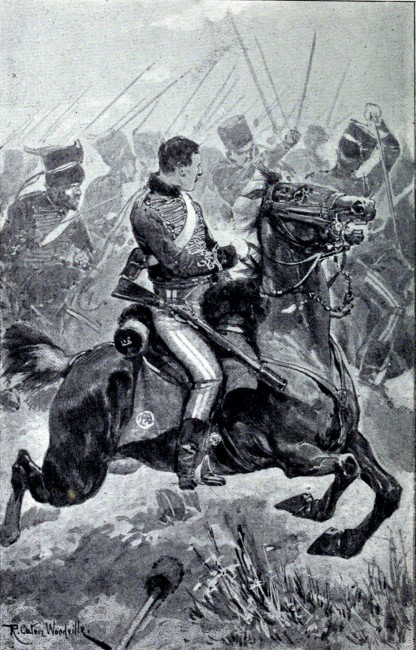 CHARLES IN THE BALACLAVA CHARGE.