Rat proofing the city is a responsibility of the city government.
The greatest force that can be exerted to-day toward the permanent
suppression of the rat pest is through the passage of practical building
ordinances that require the rat proofing of buildings and the
adoption of sanitary regulations that will insure clean premises and
adequate collection and disposed of garbage. It has been demonstrated
that such requirements not only are effective in reducing the
numbers of rats to the minimum, but also that they greatly improve
health conditions, reduce the fire hazard, and from a purely economic
standpoint are profitable. In one city in which rat proofing
has been vigorously prosecuted for a number of years and in which
more than 80 per cent of the old buildings have been made proof
against rats, the sharp decline in the number of fires resulted in
a 5 per cent reduction in the fire-insurance rates. More than
$1,000,000 was spent in the same city in rat proofing 10 miles of
docks, but even this large expenditure was found to be a profitable
investment.
Probably nothing so nearly reflects the sanitary conditions of a
city as the number of rats that it harbors, for the rat population is
usually in inverse ratio to the degree of sanitation maintained. In
1930 at least 13 cities in this country had rat-proofing laws, and more
than 30 others had fire-stopping requirements that are important in
rat proofing.
An effective rat-proofing program must be practicable and not
too drastic; otherwise it will fail from lack of popular support.
Attempts to enforce rat proofing of existing structures would probably
not be feasible unless under stress of an outbreak of bubonic
plague or other rat-borne disease epidemic. There seems to be no
good reason, however, why buildings constructed in the future or
remodeled should not be made rat proof under the requirements of
building ordinances. Had such ordinances been enacted 50 years
ago and rigidly enforced since that time the large majority of buildings
to-day would be rat proof, and rats, with their accompanying
filth and destructiveness, would have been largely eliminated. There
would also be fewer of the unsightly and insanitary shacks now
existing in most cities, and the average structure would be of a more
desirable type. As modern construction conforms so closely in principle
to the requirements of rat proofing, there should be little, if
any, opposition among builders to a rat-proofing clause in building
ordinances.
In considering the suppression of rats, at the outset city authorities
should discard all methods other than those that strike at the
source of the trouble. The actual destruction of rats is necessary
as a temporary means of stopping their depredations, but modern
construction and sanitation are the weapons that must be relied upon
to gain permanent relief. In addition to a rat-proofing ordinance,
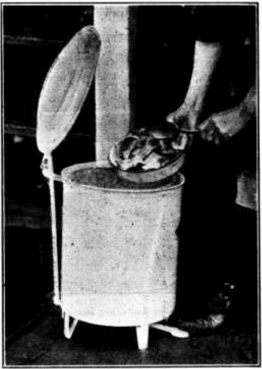
every city should have a law requiring that all garbage wherever
accumulated be kept in rat-proof containers or garbage cans until
collected or until destroyed by incineration or otherwise disposed of
in a manner that would avoid the possibility of its providing food
for rats. Containers should have covers not easily removed by dogs
and other animals. The city should also enact regulations prohibiting
the accumulation of trash, refuse, or waste matter of any kind
on either public or private premises, and should provide adequate
means for collecting and disposing of all waste.
Consideration should also be given to the sewer system. Although
most modern sewers do not offer opportunity for the unrestricted
breeding of rats, there are many still in use that furnish harbors
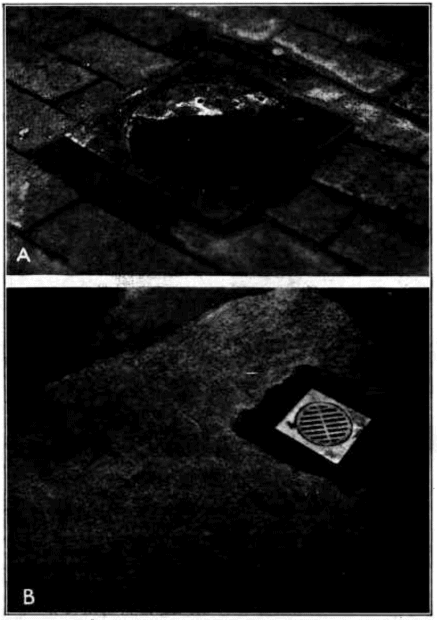
for large numbers of these pests in sections of some cities. Of most
importance is the corner catch basin, storm sewer, or street-drainage
opening, which should be effectively remodeled, if necessary, to provide
smooth interior vertical walls with a drop of at least 3 feet;
rats are unable to jump 3 feet vertically or to climb smooth surfaces.
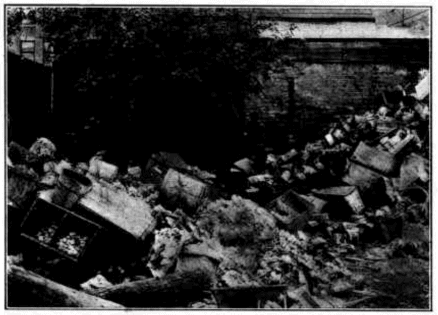
Another place that should receive attention is the city dumping
ground, which frequently serves as an incubator for rats, and these
soon overflow into near-by sections of the city. A study should be
made of methods of disposing of waste materials and a system put
into effect that will meet the requirements of the city and insure the
destruction, removal, or adequate covering of all such food for rats.
Any other conditions that may be found favorable for the breeding
of rats, whether on public or on private property, should be declared
a public nuisance and ordered corrected.
The samples or models of rat-proofing and garbage-removal ordinances
here given were prepared by the United States Public Health
Service as a result of its experience in combating bubonic plague in
several coastal cities. They have, in substance, been adopted and
put into practice by a number of cities and have been found practicable.
They should be applicable to any city after necessary
allowance and possible changes have been made to conform to local
conditions and constitutional considerations.
Section 1. Be it ordained, etc., That it shall be unlawful for any person, firm,
or corporation hereafter to construct any building, outhouse, or other superstructure,
stable, lot, open area, or other premise, sidewalk, street, or alley, or
to repair or remodel the same to an extent of ———— per cent of cost of construction
within the city of ————, unless the same shall be rat proofed in the
manner hereinafter provided for.
Sec. 2. Be it further ordained, etc., That for the purpose of rat proofing all
buildings, outhouses, and other superstructures in the city of ————, except
stables, shall be divided into two classes, to wit, class A and class B, and the
same shall be rat proofed in the manner following, to wit:
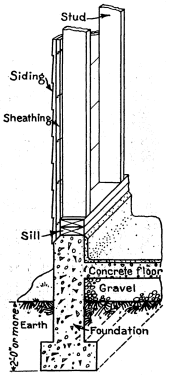
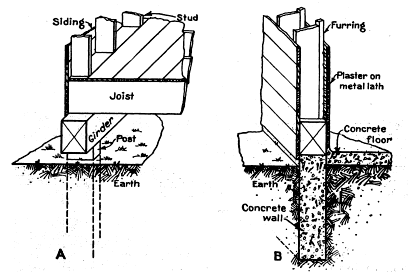
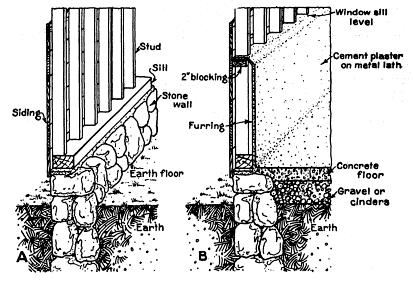
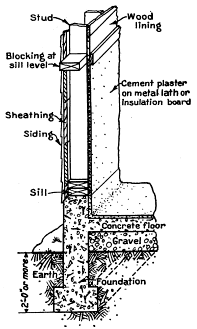
Class A.—All buildings, outhouses, and other superstructures of class A
shall have floors made of rat-proof material or of concrete, which concrete
shall be not less than 3 inches thick, and overlaid with a top dressing of cement,
mosaic, tiling, or other impermeable material laid in cement mortar, and such
floor shall rest without any intervening space between upon the ground or
upon filling of clean earth, sand, cinders, broken stone or brick, gravel, or
similar material, which filling shall be free from animal or vegetable substances;
said floor shall extend and be hermetically sealed to walls surrounding
said floor, which walls shall be made of rat-proof material or of concrete,
stone, or brick laid in cement or mortar, and each wall shall be not less than
6 inches thick and shall extend into and below the surface of the surrounding
ground at least 2 feet and shall extend not less than 1 foot above the surface
of said floor; provided that wooden removable gratings may be laid on such
concrete floors in such parts of such buildings, superstructures, and outhouses
as are used exclusively as sales departments, provided that wooden flooring
may be laid over the concrete wherever the intervening space between such
flooring and the concrete shall not exceed one-half inch; provided further
that any sleepers that are sunk into the concrete shall be creosoted.
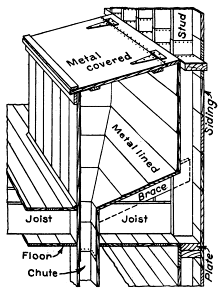
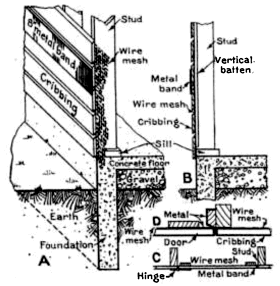
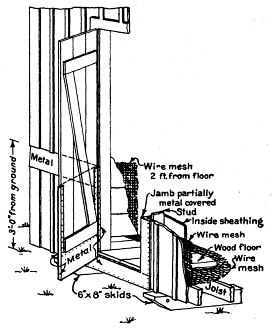
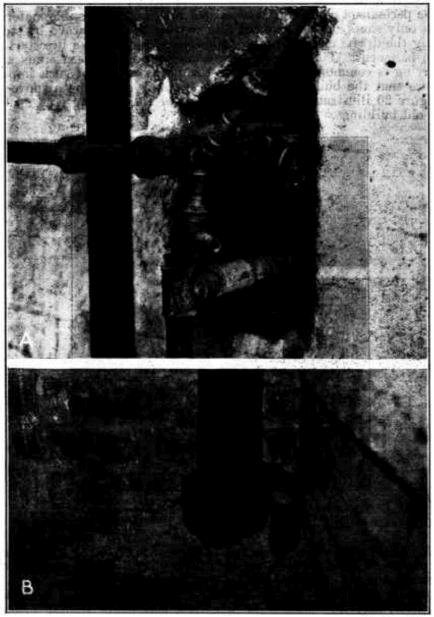
Class B.—All accidental and unnecessary spaces and holes, ventilators, and
other openings other than doors and windows in every building, outhouse or
other superstructure in the city of ————, shall be closed with cement, mortar,
or other material impervious to rats or screened with wire having not more than
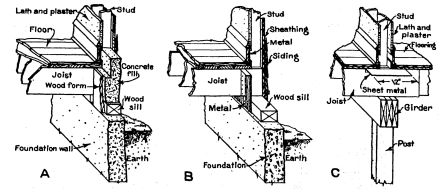
one-half inch mesh, as the case may require, and all wall spaces shall be closed
with cement, mortar, or other material impervious to rats, which closure shall
extend the full thickness of the wall and shall extend upward at least twelve
inches above the floor level, and the whole in such manner as to prevent the
ingress or egress of rats; or the ingress or egress of rats from such double
wall or space may be prevented by protecting the junction of said wall with the
floor or other wall with metal flashing of galvanized iron of 28 or 30 gauge,
provided that where such double wall is open beneath or is in communication
with foundations of the house that said opening shall be effectively closed
or said junction with foundations flashed with metal as provided above:
Provided, That in all buildings, outhouses, and other superstructures of class A
and in all stables where there are any spaces in walls between the wall proper
and the covering on same, or in ceilings between the ceiling and floor, or
other ceiling covering above, said spaces shall be eliminated by the removal
of said covering, or so closed with cement, mortar or other material impervious
to rats as to prevent the ingress or egress of rats: Provided, That all such
wall spaces shall be closed with cement, mortar, or other material impervious
to rats, which closure shall extend the full thickness of the wall and shall
extend upward at least twelve inches above the floor level.
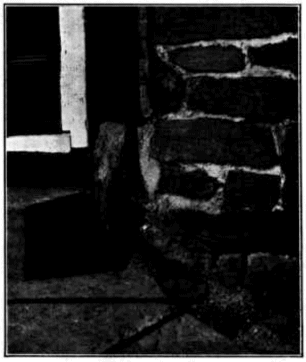
The cellar of every building hereafter erected within the building limits
shall be made rat proof by the use of masonry or metal. All openings in
foundations, cellars and basements In such buildings, except for doors and
hatchways, and except also for such windows wholly above ground as may be
exempted by the ———— in his discretion, shall be completely covered with
screens of metal having meshes of not more than one-half of an inch in least
dimension and constructed of rods or wire of not less than twelve gauge.
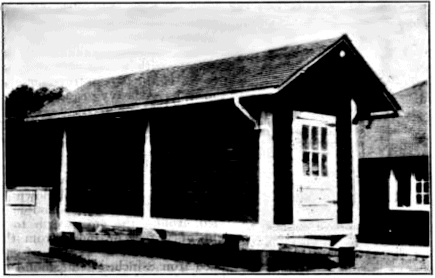
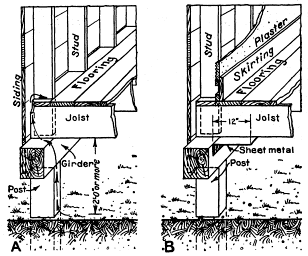
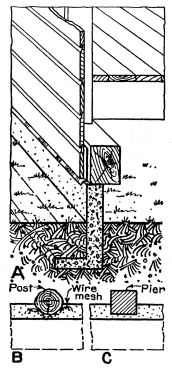
All buildings, outhouses, and other superstructures of class B separated from
any other building on three sides by at least ten feet and lacking any basement
or cellar may be rat proofed in the following manner, to wit: Said
building, outhouse, or other superstructure shall be set upon pillars or underpinning
of concrete, stone, or brick laid in cement mortar, or may be set upon
underpinning of substantial timber, such pillars or underpinning to be not less
than eighteen inches high, the height to be measured from the ground level to
the top of said pillars or underpinning; and the intervening space between
said building and the ground level to be open on three sides and to be free from
all rubbish and other rat harboring material, or may be made rat proof by
constructing at the margin of the ground area of said building a wall of
concrete or brick or stone laid in cement; such wall to extend into and below
the surface of the ground at least two feet and to meet the floor of the building
above closely and without any intervening space, to be at least four inches thick
and extend entirely around said building Provided, That said walls may be
built with openings therein for ventilation only: And provided further, That
such openings for ventilation may be all of such size as the owner may elect
and shall be securely screened with metallic gratings having openings between
the bars of said gratings of not more than one-half inch or with wire mesh of
not less than twelve gauge, having openings between the wires of said mesh
of not more than one-half inch and the whole so constructed and closed as
to prevent the entrance of rats beneath such building.
Sec. 3. Be it further ordained, etc., That every restaurant kitchen, hotel
kitchen, cabaret kitchen, dairy, dairy depot, dock, wharf, pier, elevator, store,
manufactory, and every other building, outhouse, or superstructure wherein
or whereon foodstuffs are stored, kept, handled, sold, held, or offered for sale,
manufactured, prepared for market or for sale, except stables, shall be rat
proofed in the manner provided for hereinabove as class A: Provided, That
such part of any structure hereinabove defined as of class A that shall be
entirely over a body of water may be rat proofed as of class B, as hereinafter
provided for.
"Foodstuffs," as used in this ordinance, is hereby defined to be flour and
flour products, animals and animal products, produce, groceries, cereals, grain,
and the products of cereals and grain, poultry and its products, game, birds,
fish, vegetables, fruit, milk, cream, and products from milk or cream, ice cream,
hides, and tallow, or any combination of any one or more of the foregoing.
All other buildings, outhouses, and superstructures, except stables, not hereinbefore
specified as class A, and all buildings used exclusively for residential
purposes, shall be rat proofed in the manner provided for hereinabove as class
B: Provided, That the owner of any building, residence, outhouse, or other
superstructure in class B may, if he so elects, rat proof same in the manner
provided for in class A.
Provided, That in any case where, under the foregoing provisions, any building,
outhouse, or superstructure is required to be rat proofed as of class A
and the said building or outhouse or superstructure is used in part for residential
purposes, and the part used as a residence is effectively separated from
the part falling within class A, by permanently and effectively closing all openings
above and below the ground floor, or by constructing a new wall, and in
either case the whole in such manner as to make such wall whole and continuous
in its entirety, without doorways, windows, or other openings between the
part used as a residence and that used for such purposes as makes it fall
within class A, then in such case and for rat-proofing purposes only, the said
building will, after such separation and closure of the openings, or by the construction
of such new wall, be deemed to be two buildings; and that part used
exclusively for residential purposes may be rat proofed in the manner provided
for as a class B building, and the remaining part of said building shall be rat
proofed in the manner provided for a class A building.
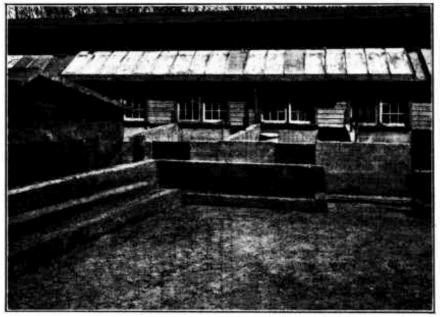
Stables.—Stables and all buildings hereafter to be constructed and used for
stabling horses, mules, cows, and other animals shall be constructed as follows:
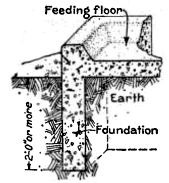
Walls: The walls of such buildings shall be constructed of concrete, brick,
or stone, laid in cement mortar, and shall be not less than four inches thick,
and shall extend into and below the surface of the surrounding ground not
less than two feet, and shall extend above the ground sufficient height as to
be not less than one foot above the floor level. All openings in such foundation
walls shall be covered with metal grating having openings not greater
than one-half inch between the gratings.
Floors: The floors of stables and stalls shall be of concrete not less than
three inches thick, upon which shall be laid a dressing not less than one-half
inch thick of cement or stone, laid in cement mortar, or shall be constructed
of floated concrete not less than four inches thick, in such way as to prevent
ingress or egress of rats, and such floors to have a slope of one-eighth inch
per foot to the gutter drain hereinafter provided for.
Stalls: The floors of stalls may be of planking, fitting either tightly to the
concrete floor or elevated not more than one-half inch from the stall floor, and
so constructed as to be easily removable. Such removable planking shall be
raised at least once a week, and the said planking and the concrete floor
beneath thoroughly cleansed.
Gutters: Semicircular or V-shaped gutters shall be constructed in such
manner that a gutter shall be placed so as to receive all liquid matter from
each stall, and each of these gutters to connect with the public sewer or with
a main gutter of the same construction, which in turn shall be connected with
the public sewer or public drain. All openings from drains into sewers shall
be protected by a metal grating having openings not more than one-half inch
between the gratings.
Mangers: Each manger shall be constructed so as to have a slope of two
inches toward the bottom, shall be covered with tin or zinc, and shall be at
least eighteen inches deep, to avoid spilling of food.
Feed bins: All feed bins shall be constructed of cement, stone, metal, or
wood, and with close-fitting doors. If constructed of wood, the bins shall be
lined or covered with metal, and the whole so constructed as to prevent the
ingress or egress of rats. All grain, malt, and other animal food, except hay,
stored or kept in any stable, must be kept in such feed bins. Said feed bins
must be kept closed at all times, except when momentarily opened, to take
food therefrom or when same are being filled. No feed shall be scattered
about such bin or stable, and all such feed found on the floor or in the stalls
of said stables shall be removed daily and placed in the manure pits. No foodstuffs
intended for or susceptible of human consumption shall be kept or
stored in any stable or any other place where animals are kept.
Sec. 4. Be it further ordained, etc., That the construction and materials
used in rat proofing shall conform to the building ordinances of the city
of ————, except and only in so far as the same may be modified herein.
Sec. 5. Be it further ordained, etc., That all premises, improved and unimproved,
and all open lots, areas, streets, sidewalks, and alleys in the city
of ———— shall be kept clean and free from all rubbish and similar loose material
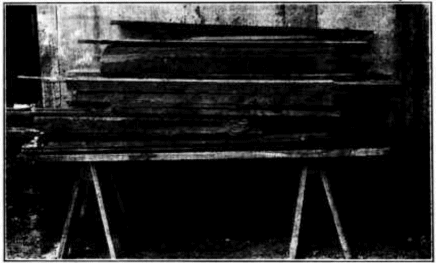
that might serve as a harborage for rats; and all lumber, boxes, barrels,
loose iron, and similar material that may be permitted to remain thereon and
that may be used as a harborage by rats shall be placed on supports and elevated
not less than two feet from the ground, with a clear intervening space
beneath, to prevent the harboring of rats.
Sec. 6. Be it further ordained, etc., That all planking and plank walks on and
in yards, alleys, alleyways, streets, sidewalks, or ether open areas shall be
removed and replaced with concrete, brick, or stone, laid in cement, gravel, or
cinders, or the ground left bare.
Sec. 7. Be it further ordained, etc., That it shall be the duty of every owner,
agent, and occupant of each building, outhouse, and other superstructure, stable,
lot, open area, and other premises, sidewalk, street, and alley in the city
of ———— to comply with all the provisions of this ordinance.
Sec. 8. Be it further ordained, etc., That it is hereby made the duty of ————,
and particularly through its health department, to enforce the provisions of
this ordinance.
Sec. 9. Be it further ordained, etc., That any law or ordinance in conflict with
the provisions of this ordinance be, and the same is hereby, repealed.
Section 1. Be it ordained ———— of the city of ————, That from and
after the promulgation of this ordinance, the owner, agent, and occupant
of every premise, improved or unimproved, in the city of ————, whereon or
wherein garbage shall be created, shall provide a metal, water-tight container
or containers, each with a tight-fitting cover, such container or containers to be
of such size as to be easily manhandled, and of such number as to receive the
garbage accumulation of five days from each such premise, and shall place or
cause to be placed such container or containers, for the purpose of having their
contents removed, on the sidewalks or open alleys in front or rear of said
premises, at the times hereinafter set forth.
Sec. 2. Be it further ordained, etc., That for the purposes of this ordinance,
the city of ———— is hereby divided into ———— garbage districts.
Sec. 3. Be it further ordained, etc., That for the purpose of this ordinance,
the word "garbage" as used in this ordinance shall be construed to mean house
and kitchen offal, and all refuse matter not excrementitious liquid, and composed
of animal or vegetable substances, including dead animals (except cows,
horses, mules, and goats) coming from public and private premises of the city,
and not destined for consumption as food.
Sec. 4. Be it further ordained, etc., That it shall be unlawful for such owner,
agent, or occupant of any such premise to have, maintain, or keep any garbage
on any premise except in such garbage containers as are provided for in section
1 of this ordinance.
Sec. 5. Be it further ordained, etc., That such garbage containers shall be
kept tightly covered at all times, except when momentarily open to receive the
garbage or to have the contents therefrom removed, as provided for hereinafter.
Sec. 6. Be it further ordained, etc., That when such garbage container is
placed on the outside of any premise it shall be unlawful for any person engaged
in the removal of garbage, or for any person to remove the cover from
such garbage container, except for the purpose of emptying its contents Into a
duly authorized garbage wagon or to throw such garbage container on the
street or sidewalk, or to injure it in any way, so as to make it leak or to bend
it or its cover, as to prevent said garbage container from being tightly covered;
and all persons engaged in the removal of garbage shall, after emptying said
container, replace the cover tightly on said container.
Sec. 7. Be it further ordained, etc., That the owner, agent, or occupant of
every premise in the city of ———— shall keep separate from their garbage and
ashes, tin cans, broken crockery, hardware, old planks, wooden matter, paper,
sweepings and other trash, and place same in a sound, substantial vessel or
container kept for that purpose, which vessel or container shall be placed on
the sidewalk or alley in front or rear of each premise of the city of ————,
as provided in section 1 of this ordinance, for garbage containers, for removal
on ————, provided that such rubbish, other than garbage, may be so placed
-------- on ————.
Sec. 8. Be it further ordained, etc., That the provisions of this ordinance
shall apply to all public and private markets, as well as all places of business,
hotels, restaurants, and all other premises, whether used for business, boarding,
or residential purposes.
Sec. 9. Be it further ordained, etc., That for the purpose of enforcing this
ordinance any person living on any premise shall be deemed an occupant, and
any person receiving the rent, in whole or in part, of any premise, shall be
deemed an agent; that on any premise where construction of any kind is in
progress, and where employees or workmen eat their dinners, or lunches, In
or about said premises, or scatter lunch or food in or about such premises, the
contractor or foreman or other person in charge of such workmen shall be
deemed an occupant; and that the person in charge of any market, or stall in
any market, shall be deemed an occupant.
Sec. 10. Be it further ordained, etc., That it shall be unlawful for any
person to pick from or disturb the contents of any garbage containers or
vessels, or other containers provided for in this ordinance.
Sec. 11. Be it further ordained, etc., That each day's violation of any of the
provisions of this ordinance shall constitute a separate and distinct offense.
Sec. 12. Be it further ordained, etc., That any person violating any provision
of this ordinance shall, on conviction, be punished by a fine of not less than ten
($10.00) dollars nor more than twenty-five ($25.00) dollars, or in default of
the payment of said fine by imprisonment ———— for not less than ten (10)
days nor more than thirty (30) days, or both, at the discretion of ————
having jurisdiction of the same.
Sec. 13. Be it further ordained, etc., That any law or ordinance in conflict
with the provisions of this ordinance, In whole or in part, be and the same
is hereby repealed.
ORGANIZATION OF THE UNITED STATES DEPARTMENT OF AGRICULTURE
WHEN THIS PUBLICATION WAS LAST PRINTED
U. S. GOVERNMENT PRINTING OFFICE: 1930
For sale by the Superintendent of Documents,
Washington, D. C. — Price 5 cents