Larger versions of most illustrations may be seen by right-clicking them
and selecting an option to view them separately, or by double-tapping and/or
stretching them.
The original book's Table of Contents only listed three "Parts", not the
chapters within them. Here are Transcriber-added links to the chapters as well as the
parts:
AUTHOR OF
“BEHIND THE VEIL AT THE RUSSIAN COURT,”
“GERMANY UNDER THREE EMPERORS,”
ETC.
ILLUSTRATED
NEW YORK: JOHN LANE COMPANY
LONDON: JOHN LANE, THE BODLEY HEAD
MCMXVIII
Copyright, 1917,
By Public Ledger Company
Copyright, 1918,
By John Lane Company
Press of
J.J. Little & Ives Company
New York, U. S. A.
TO MONSIEUR JEAN FINOT Editor of the “Revue”
My dear Mr. Finot:—
Allow me to offer you this little book, which may remind you of
the many conversations we have had together, and of the many
letters which we have exchanged. In doing so, I am fulfilling one
of the pleasantest of duties and trying to express to you all the
gratitude which I feel towards you. Without your kind help, and
without your advice, I would never have had the courage to take a
pen in my hand, and all the small success I may have had in my
literary career is entirely due to you, and to the constant encouragement
which you have always given to me, and which I shall
never forget, just as I shall always remember that it was in the
“Revue” that the first article I ever published appeared. Permit
me to-day to thank you from the bottom of my heart, and believe
me to be,
Always yours most affectionately, Catherine Radziwill (Catherine Kolb-Danvin)
PUBLISHERS FOREWORD
When the book called “Behind the Veil at the Russian
Court” was published the Romanoff’s were reigning
and, considering the fact that she was living in
Russia at the time, the author of it, had her identity
become known, would have risked being subjected
to grave annoyances, and even being sent to that distant
Siberia where Nicholas II is at present exiled.
It was therefore deemed advisable to produce that
work as a posthumous one, and “Count Paul Vassili”
was represented as having died before the publication
of “his” Memoirs. This however was not the case, because
on the contrary “he” went on collecting information
as to all that was taking place at the Russian
Court as well as in the whole of Russia, and, consigning
this information to a diary, “he” went on writing.
If one remembers, “Count Vassili” distinctly foresaw
and prophesied in “his” book most of the things that
have occurred since it was published. This fact will
perhaps give added interest to the present account
of the Russian Revolution which now sees the light
of day for the first time. Though devoid of everything
sensational or scandalous it will prove interesting
to those who have cared for the other books of
“Count Vassili,” for it contains nothing but the truth,
and has been compiled chiefly out of the narrations
of the principal personages connected in some way
or other with the Russian Revolution. The facts concerning
Rasputin, and the details of this man’s extraordinary
career, are, we believe, given out now for
the first time to the American public, which, up to the
present moment, has been fed on more or less untrue
and improbable stories or, rather, “fairy tales,” in regard
to this famous adventurer. The truth is far
simpler, but far more human, though humanity does
not shine in the best colours in its description.
This exposé, based on facts which have come to my
knowledge, though probably far from being complete,
aims at depicting the recent state of things in
Russia, and thus to explain how the great changes
which have taken place in my country have been rendered
possible. A lot of exaggerated tales have been
put into circulation concerning the Empress Alexandra,
the part she has played in the perturbations
that have shaken Russia from one end to another and
the extraordinary influence which, thanks to her and
to her efforts in his behalf, the sinister personage
called Rasputin came to acquire over public affairs
in the vast empire reigned over by Nicholas II. for
twenty-two years. A good many of these tales repose
on nothing but imagination, but nevertheless it is unfortunately
too true that it is to the conduct of the
Empress, and to the part she attempted to play in the
politics of the world, that the Romanoffs owe the loss
of their throne.
Alexandra Feodorovna has been the evil genius of
the dynasty whose head she married. Without her it
is probable that most of the disasters that have overtaken
the Russian armies would not have happened,
and it is certain that the crown which had been worn
by Peter the Great and by Catherine II. would not
have been disgraced. She was totally unfit for the
position to which chance had raised her, and she never
was able to understand the character or the needs of
the people over which she ruled.
Monstrously selfish, she never looked beyond matters
purely personal to her or to her son, whom she
idolized in an absurd manner. She, who had been
reared in principles of true liberalism, who had had in
her grandmother, the late Queen Victoria, a perfect
example of a constitutional sovereign, became from
the very first day of her arrival in Russia the enemy
of every progress, of every attempt to civilise the
nation which owned her for its Empress. She gave
her confidence to the most ferocious reactionaries the
country possessed. She tried, and in a certain degree
succeeded, in inspiring in her husband the disdain of
his people and the determination to uphold an autocratic
system of government that ought to have been
overturned and replaced by an enlightened one.
Haughty by nature and by temperament, she had an
unlimited confidence in her own abilities, and especially
after she had become the mother of the son she
had longed for during so many years, she came to believe
that everything she wished or wanted to do had
to be done and that her subjects were but her slaves.
She had a strong will and much imperiousness in her
character, and understood admirably the weak points
in her husband, who became but a puppet in her
hands.
* * * * *
She herself was but a plaything in the game of a
few unscrupulous adventurers who used her for the
furtherance of their own ambitious, money-grubbing
schemes, and who, but for the unexpected events that
led to the overthrow of the house of Romanoff, would
in time have betrayed Russia into sullying her fair
fame as well as her reputation in history.
* * * * *
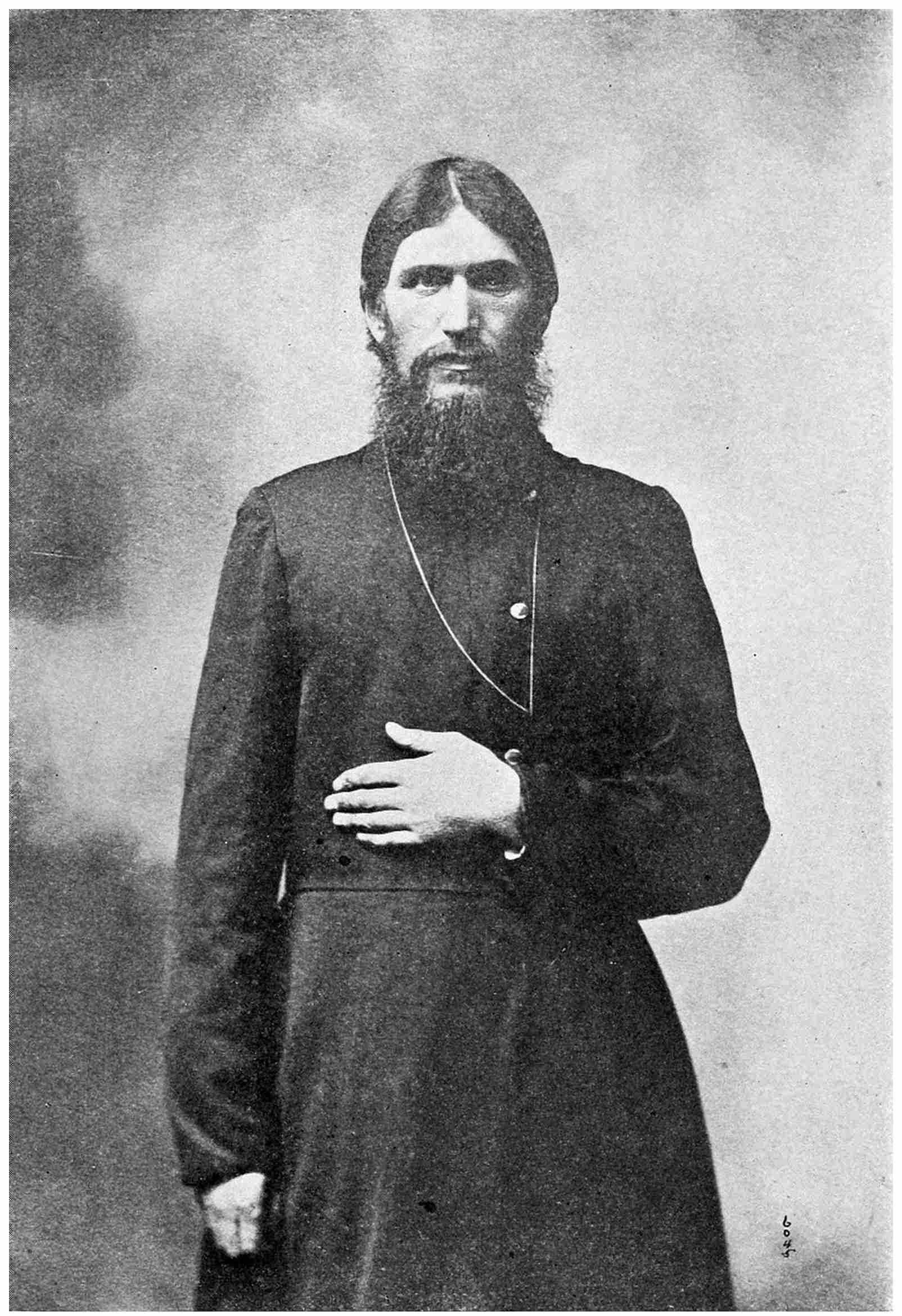
Rasputin, about whom so much has been said, was
but an incident in the course of a whole series of facts,
all of them more or less disgraceful, and none of which
had a single extenuating circumstance to put forward
as an excuse for their perpetration.
* * * * *
He himself was far from being the remarkable individual
he has been represented by some people, and
had he been left alone it is likely that even if one had
heard about him it would not have been for any length
of time.
* * * * *
Those who hated him did so chiefly because they
had not been able to obtain from him what they had
wanted, and they applied themselves to paint him as
much more dangerous than he really was. They did
not know that he was but the mouthpiece of other
people far cleverer and far more unscrupulous even
than himself, who hid themselves behind him and who
moved him as they would have done pawns in a game
of chess according to their personal aims and wants.
These people it was who nearly brought Russia to
the verge of absolute ruin, and they would never have
been able to rise to the power which they wielded had
not the Empress lent herself to their schemes. Her
absolute belief in the merits of the wandering
preacher, thanks to his undoubted magnetic influence,
contrived to get hold of her mind and to persuade
her that so long as he was at her side nothing
evil could befall her or her family.
It is not generally known outside of Russia that
Alexandra Feodorovna despised her husband, and
that she made no secret of the fact. She considered
him as a weak individual, unable to give himself an
account of what was going on around him, who had
to be guided and never left to himself. Her flatterers,
of whom she had many at a time, had persuaded
her that she possessed all the genius and most of the
qualities of Catherine II., and that she ought to follow
the example of the latter by rallying around her
a sufficient number of friends to effect a palace revolution
which would transform her into the reigning
sovereign of that Russia which she did not know and
whose character she was unable to understand. Love
for Nicholas II. she had never had, nor esteem for
him, and from the very first moment of her marriage
she had affected to treat him as a negligible quantity.
But influence over him she had taken good care to
acquire. She had jealously kept away from him all
the people from whom he could have heard the truth
or who could have signalled to him the dangers which
his dynasty was running by the furtherance of a policy
which had become loathsome to the country and
on account of which the war with Germany had taken
such an unexpected and dangerous course.
The Empress, like all stupid people, and her stupidity
has not been denied, even by her best friends,
believed that one could rule a nation by terror. She,
therefore, always interposed herself whenever Nicholas
II. was induced to adopt a more liberal system of
government and urged him to subdue by force aspirations
it would have been far better for him to have
encouraged. She had listened to all the representatives
of that detestable old bureaucratic system which
gave to the police the sole right to dispose of people’s
lives and which relied on Siberia and the knout to keep
in order an aggrieved country eager to be admitted
to the circle of civilised European nations.
Without her and without her absurd fears, it is
likely that the first Duma would not have been dissolved.
Without her entreaties, it is probable that
the troops composing the garrison at St. Petersburg
would not have been commanded to fire at the peaceful
population of the capital on that January day
when, headed by the priest Gapone, it had repaired
to the Winter Palace to lay its wrongs before the
Czar, whom it still worshipped at that time. She was
at the bottom of every tyrannical action which took
place during the reign of Nicholas II. And lately
she was the moving spirit in the campaign, engineered
by the friends of Rasputin, to conclude a separate
peace with Germany.
In the long intrigue which came to an end by the
publication of the Manifesto of Pskov, Rasputin undoubtedly
played a considerable part, but all unconsciously.
Those who used him, together with his
influence, were very careful not to initiate him into
their different schemes. But they paid him, they fed
him, they gave him champagne to drink and pretty
women to make love to in order to induce him to represent
them to the Empress as being the only men capable
of saving Russia, about which she did not care,
and her crown, to which she was so attached. With
Rasputin she never discussed politics, nor did the Emperor.
But with his friends she talked over every
political subject of importance to the welfare of the
nation, and being convinced that they were the men
best capable of upholding her interests, she forced
them upon her husband and compelled him to follow
the advice which they gave. She could not bear contradiction,
and she loved flattery. She was convinced
that no one was more clever than herself, and she
wished to impose her views everywhere and upon
every occasion.
Few sovereigns have been hated as she has been.
In every class of society her name was mentioned with
execration, and following the introduction of Rasputin
into her household this aversion which she inspired
grew to a phenomenal extent. She was openly accused
of degrading the position which she held and
the crown which she wore. In every town and village
of the empire her conduct came to be discussed
and her person to be cursed. She was held responsible
for all the mistakes that were made, for all the
blunders which were committed, for all the omissions
which had been deplored. And when the plot
against Rasputin came to be engineered it was as
much directed against the person of Alexandra Feodorovna
as against that of her favourite, and it was she
whom the people aimed to strike through him.
Had she shown some common sense after the murder
of a man whom she well knew was considered the
most dangerous enemy of the Romanoff dynasty
things might have taken a different course. Though
every one was agreed as to the necessity of a change
in the system of government of Russia, though a revolution
was considered inevitable, yet no one wished
it to happen at the moment when it did, and all political
parties were agreed as to the necessity of postponing
it until after the war. But the exasperation
of the Empress against those who had removed her
favourite led her to trust even more in those whom he
had introduced and recommended to her attention.
She threw herself with a renewed vigour into their
schemes, urging her husband to dishonour himself,
together with his signature, by turning traitor to his
allies and to his promises. She wanted him to conclude
a peace with Germany that would have allowed her a
free hand in her desires to punish all the people who
had conspired against her and against the man upon
whom she had looked as a saviour and a saint. Once
this fact was recognised the revolution became inevitable.
It is to the credit of Russia that it took place
with the dignity that has marked its development and
success.
This, in broad lines, is the summary of the causes
that have brought about the fall of the Romanoff dynasty,
and they must never be lost sight of when one
is trying to describe it. It is, however, far too early
to judge the Russian revolution in its effects because,
for one thing, it is far from being at an end, and may
yet take quite an unexpected turn. For another, the
events connected with it are still too fresh to be considered
from an objective point of view. I have,
therefore, refrained from expressing an opinion in
this narrative. My aim has been to present to my
readers a description of the personality of Rasputin,
together with the part, such as I know it, that he has
played in the development of Russian history during
the last five years or so, and afterward to describe the
course of the revolution and the reasons that have led
to its explosion in such an unexpected manner.
CHAPTER I
We live in strange times, when strange things happen
which at first sight seem unintelligible and the
reason for which we fail to grasp. Even in Russia,
where Rasputin had become the most talked-of person
in the whole empire, few people fully realised
what he was and what had been the part which he
had played in Russia’s modern history. Yet during
the last ten years his name had become a familiar one
in the palaces of the great nobles whose names were
written down in the Golden Book of the aristocracy
of the country, as well as in the huts of the poorest
peasants in the land. At a time when incredulity was
attacking the heart and the intelligence of the Russian
nation the appearance of this vagrant preacher
and adept of one of the most persecuted sects in the
empire was almost as great an event as was that of
Cagliostro during the years which preceded the fall
of the old French monarchy.
There was, however, a great difference between the
two personages. One was a courtier and a refined
man of the world, while the other was only an uncouth
peasant, with a crude cunning which made him discover
soon in what direction his bread could be buttered
and what advantages he might reap out of the
extraordinary positions to which events, together with
the ambitions of a few, had carried him. He was a
perfect impersonation of the kind of individual known
in the annals of Russian history as “Wremienschtchik,”
literally “the Man of the Day,” an appellation
which since the times of Peter the Great had clung
to all the different favourites of Russian sovereigns.
There was one difference, however, and this a most
essential one. He had never been the favourite of the
present Czar, who perhaps did not feel as sorry as
might have been expected by his sudden disappearance
from the scene of the world.
I shall say a thing which perhaps will surprise my
readers. Personally, Rasputin was never the omnipotent
man he was believed to be, and more than
once most of the things which were attributed to him
were not at all his own work. But he liked the public
to think that he had a finger in every pie that was
being baked. And he contrived to imbue Russian society
at large with such a profound conviction that he
could do absolutely everything he chose in regard to
the placing or displacing of people in high places, obtaining
money grants and government contracts for
his various “protégés,” that very often the persons
upon whom certain things depended hastened to grant
them to those who asked in the name of Rasputin, out
of sheer fright of finding this terrible being in their
way. They feared to refuse compliance with any request
preferred to them either by himself or by one
who could recommend himself on the strength of his
good offices on their behalf. But Rasputin was the
tool of a man far more clever than himself, Count
Witte. It was partly due to the latter’s influence and
directions that he tried to mix himself up in affairs
of state and to give advice to people whom he thought
to be in need of it. He was an illiterate brute, but
he had all the instincts of a domineering mind which
circumstances and the station of life in which he had
been born had prevented from developing. He had
also something else—an undoubted magnetic force,
which allowed him to add auto-suggestion to all his
words and which made even unbelieving people succumb
sometimes to the hypnotic practices which he
most undoubtedly exercised to a considerable extent
during the last years of his adventurous existence.
Amidst the discontent which, it would be idle to
deny, had existed in the Russian empire during the
period which immediately preceded the great war the
personality of Rasputin had played a great part in
giving to certain people the opportunity to exploit
his almost constant presence at the side of the sovereign
as a means to foment public opinion against
the Emperor and to throw discredit upon him by representing
him as being entirely under the influence
of the cunning peasant who, by a strange freak of
destiny, had suddenly become far more powerful than
the strongest ministers themselves. The press belonging
to the opposition parties had got into the
habit of attacking him and calling his attendance on
the imperial court an open scandal, which ought in
the interest of the dynasty to be put an end to by
every means available.
In the Duma his name had been mentioned more
than once, and always with contempt. Every kind of
reproach had been hurled at him, and others had not
been spared. He had become at last a fantastic kind
of creature, more exploited than exploiting, more destroyable
than destructive, one whose real “rôle” will
never be known to its full extent, who might in other
countries than Russia and at another time have become
the founder of some religious order or secret
association. His actions when examined in detail do
not differ very much from those of the fanatics which
in Paris under the reign of Louis XV. were called
the “Convulsionnaires,” and who gave way to all kind
of excesses under the pretext that these were acceptable
to God by reason of the personality of the people
who inspired them. In civilised, intelligent, well-educated
Europe such an apparition would have been
impossible, but in Russia, that land of mysteries and
of deep faiths, where there still exist religious sects
given to all kinds of excesses and to attacks of pious
madness (for it can hardly be called by any other
name), he acquired within a relatively short time the
affections of a whole lot of people. They were inclined
to see in him a prophet whose prayers were capable
of winning for them the Divine Paradise for
which their hungry souls were longing. There was
nothing at all phenomenal about it. It was even in
a certain sense quite a natural manifestation of this
large Russian nature, which is capable of so many
good or bad excesses and which has deeply incrusted
at the bottom of its heart a tendency to seek the supernatural
in default of the religious convictions
which, thanks to circumstances, it has come to lose.
The American public is perhaps not generally
aware of the character of certain religious sects in
Russia, which is considered to be a country of orthodoxy,
with the Czar at its head, and where people
think there is no room left for any other religion than
the official one to develop itself. In reality, things
are very different, and to this day, outside of the
recognised nonconformists, who have their own bishops
and priests, and whose faith is recognised and
acknowledged by the State, there are any number of
sects, each more superstitious and each more powerful
than the other in regard to the influence which
they exercise over their adherents. These, though
not numerous by any means, yet are actuated by such
fanaticism that they are apt at certain moments
to become subjects of considerable embarrassment to
the authorities. Some are inspired by the conviction
that the only means to escape from the clutches of the
devil consists in suicide or in the murder of other
people.
For instance, the Baby Killers, or Dietooubitsy,
as they are called, think it a duty to send to Heaven
the souls of new-born infants, which they destroy as
soon as they see the light of day, thinking thus
to render themselves agreeable to the Almighty by
snatching children away from the power of the evil
one. Another sect, which goes by the name of
Stranglers, fully believes that the doors of Heaven
are only opened before those who have died a violent
death, and whenever a relative or friend is dangerously
ill they proceed to smother him under the
weight of many pillows so as to hasten the end. The
Philipovtsy preach salvation through suicide, and the
voluntary death of several people in common is considered
by them as a most meritorious action. Sometimes
whole villages decide to unite themselves in one
immense holocaust and barricade themselves in a
house, which is afterward set on fire.
An incident that occurred during the reign of Alexander
II. is remembered to this day in Russia. A
peasant called Khodkine persuaded twenty people to
retire together with him into a grotto hidden in the
vast forests of the government of Perm, where he
compelled them to die of hunger. Two women having
contrived to escape, the fanatics, fearing that they
might be denounced, killed themselves with the first
weapons which fell under their hand. It was their
terror that they might find themselves compelled to
renounce their sinister design, and thus fall again into
the clutches of that Satan for fear of whom they had
made up their minds to encounter an awful death.
Even as late as the end of the last century such acts
of fanaticism could be met with here and there in
the east and centre of Russia. In 1883, under the
reign of the father of the last Czar, a peasant in
the government of Riazan, called Joukoff, burnt himself
to death by setting fire to his clothes, which he
had previously soaked in paraffin, and expired under
the most awful torments, singing hymns of praise to
the Lord.
Among all these heresies there are two which have
attracted more than the others the attention of the
authorities, thanks to their secret rites and to their
immoral tendencies. They are the Skoptsy, or Voluntary
Eunuchs, about which it is useless to say anything
here, and the Khlysty, or Flagellants, which
to this day has a considerable number of adepts and
to which Rasputin undoubtedly belonged, to which,
in fact, he openly owed allegiance. This sect, which
calls itself “Men of God,” has the strangest rites
which human imagination can invent. According to
its precepts, a human creature should try to raise its
soul toward the Divinity with the help of sexual excesses
of all kinds. During their assemblies they indulge
in a kind of waltz around and around the room,
which reminds one of nothing so much as the rounds
of the Dancing Dervishes in the East. They dance
and dance until their strength fails them, when they
drop to the floor in a kind of trance or ecstasy, during
which, being hardly accountable for their actions, they
imagine that they see Christ and the Virgin Mary
among them. They then threw themselves into the
embrace of the supposed divinities.
As a rule the general public knows very little concerning
these sects, but I shall quote here a passage
out of a book on Russia by Sir Donald Mackenzie
Wallace, which is considered to this day as a standard
work in regard to its subject. “Among the ‘Khlysty,’”
he writes, “there are men and women who take
upon themselves the calling of teachers and prophets,
and in this character they lead a strict, ascetic life, refrain
from the most ordinary and innocent pleasures,
exhaust themselves by long fasting and wild ecstatic
religious exercises and abhor marriage. Under the
excitement caused by their supposed holiness and inspiration,
they call themselves not only teachers and
prophets, but also Saviours, Redeemers, Christs,
Mothers of God. Generally speaking, they call themselves
simply gods and pray to each other as to real
gods and living Christs and Madonnas. When several
of these teachers come together at a meeting they
dispute with each other in a vain, boasting way as to
which of them possesses most grace and power. In
this rivalry they sometimes give each other lusty
blows on the ear, and he who bears the blows the most
patiently, turning the other cheek to the smiter, acquires
the reputation of having the most holiness.
“Another sect belonging to the same category
and which indeed claims close kindred with it is the
Jumpers, among whom the erotic element is disagreeably
prominent. Here is a description of
their religious meetings, which are held during
summer in a forest and during winter in some outhouse
or barn. After due preparation prayers are
read by the chief teacher, dressed in a white robe
and standing in the midst of the congregation. At
first he reads in an ordinary tone of voice and then
passes gradually into a merry chant. When he remarks
that the chanting has sufficiently acted on the
hearers he begins to jump. The hearers, singing
likewise, follow his example. Their ever-increasing
excitement finds expression in the highest possible
jumps. This they continue as long as they can—men
and women alike yelling like enraged savages.
When all are thoroughly exhausted the leader declares
that he hears the angels singing, and then
begins a scene which cannot be here described.”
I have quoted this passage in full because it may
give to the reader who is not versed in the details of
Russian existence and Russian psychology the key to
the circumstances that helped Rasputin to absorb for
such a considerable number of years the attention of
the public in Russia, and which, in fact, made him
possible as a great ruling, though not governing,
force in the country. In some ways he had appealed
to the two great features of the human character in
general and of the Russian character in particular—mysticism
and influence of the senses. It is not so
surprising as it might seem at first sight that he contrived
to ascend to a position which no one who knew
him at first ever supposed he would or could attain.
At the same time I must, in giving a brief sketch
of the career of this extraordinary individual, protest
against the many calumnies which have associated him
with names which I will not mention here out of respect
and feelings of patriotism. It is sufficiently
painful to have to say so, but German calumny, which
spares no one, has used its poisoned arrows also where
Rasputin came to be discussed. It has tried to travesty
maternal love and anxiety into something quite
different, and it has attempted to sully what it could
not touch. There have been many sad episodes in
this whole story of Rasputin, but some of the people
who have been mentioned in connection with them
were completely innocent of the things for which they
have been reproached. Finally, the indignation which
these vile and unfounded accusations roused in the
hearts of the true friends and servants of the people
led to the drama which removed forever from the surface
of Russian society the sectarian who unfortunately
had contrived to glide into its midst.
The one extraordinary thing about Rasputin is
that he was not murdered sooner. He was so entirely
despised and so universally detested all over
Russia that it was really a miracle that he could remain
alive so long a time after it had been found impossible
to remove him from the scene of the world
by other than violent means. It was a recognised fact
that he had had a hand in all kinds of dirty money
matters and that no business of a financial character
connected with military expenditure could be brought
to a close without his being mixed in it. About this,
however, I shall speak later on in trying to explain
how the Rasputin legend spread and how it was exploited
by all kinds of individuals of a shady character,
who used his name for purposes of their own. The
scandal connected with the shameless manner in
which he became associated with innumerable transactions
more or less disreputable was so enormous
that unfortunately it extended to people and to names
that should never have been mentioned together with
him.
* * * * *
It must never be forgotten, and I cannot repeat
this sufficiently, that Rasputin was a common peasant
of the worst class of the Russian moujiks, devoid
of every kind of education, without any manners and
in his outward appearance more disgusting than
anything else. It would be impossible to explain the
influence which he undoubtedly contrived to acquire
upon some persons belonging to the highest social
circles if one did not take into account this mysticism
and superstition which lie at the bottom of the Slav
nature and the tendency which the Russian character
has to accept as a manifestation of the power of the
divinity all things that touch upon the marvellous or
the unexplainable. Rasputin in a certain sense appeared
on the scene of Russian social life at the very
moment when his teachings could become acceptable,
at the time when Russian society had been shaken
to its deepest depths by the revolution which had
followed upon the Japanese war and when it was
looking everywhere for a safe harbour in which to
find a refuge.
* * * * *
At the beginning of his career and when he was
introduced into the most select circles of the Russian
capital, thanks to the caprices and the fancies of two
or three fanatic orthodox ladies who had imagined
that they had found in him a second Savonarola and
that his sermons and teachings could provoke a renewal
of religious fervour, people laughed at him and
at his feminine disciples, and made all kinds of jokes,
good and bad, about him and them. But this kind
of thing did not last long and Rasputin, who, though
utterly devoid of culture, had a good deal of the
cunning which is one of the distinctive features of
the Russian peasant, was the first to guess all the
possibilities which this sudden “engouement” of influential
people for his person opened out before him
and to what use it could be put for his ambition as
well as his inordinate love of money. He began by
exacting a considerable salary for all the prayers
which he was supposed to say at the request of his
worshippers, and of all the ladies, fair or unfair, who
had canonised him in their enthusiasm for all the
wonderful things which he was continually telling
them. He was eloquent in a way and at the beginning
of his extraordinary thaumaturgic existence had
not yet adopted the attitude which he was to assume
later on—of an idol, whom every one had to adore.
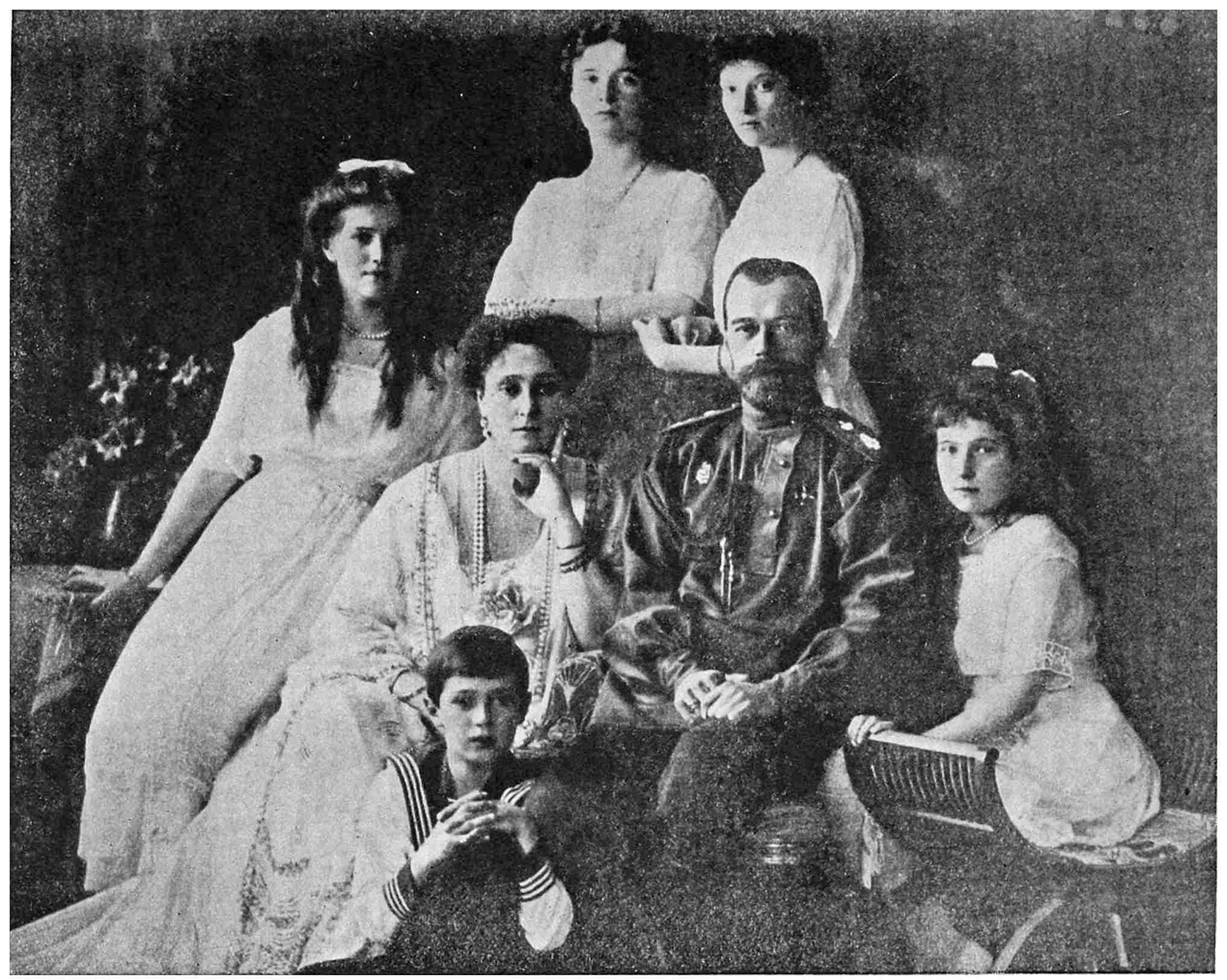
Photograph, International Film Service, Inc.
The Ex-Czar and His Family
* * * * *
He was preaching the necessity of repenting of
one’s sins, making due penance for them after a particular
manner, which he described as being the most
agreeable to God, and praying constantly and with
unusual fervour for the salvation of orthodox Russia.
He contrived most cleverly to play upon the
chord of patriotism which is always so developed in
Russians, and to speak to them of the welfare of their
beloved fatherland whenever he thought it advantageous
to his personal interests to do so. He succeeded
in inspiring in his adepts a faith in his own
person and in his power to save their souls akin to that
which is to be met with in England and in America
among the sect of the Christian Scientists, and he
very rapidly became a kind of Russian Mrs. Eddy.
A few hysterical ladies, who were addicted to neuralgia
or headaches, suddenly found themselves better
after having conversed or prayed with him, and they
spread his fame outside the small circle which had
adopted him at the beginning of his career. One
fine day a personal friend of the reigning Empress,
Madame Wyroubourg, introduced him at Tsarskoie
Selo, under the pretext of praying for the health of
the small heir to the Russian throne, who was occasioning
some anxiety to his parents. It was from
that day that he became a personage.
* * * * *
His success at court was due to the superstitious
dread with which he contrived to inspire the Empress
in regard to her son. She was constantly trembling
for him, and being very religiously inclined, with
strong leanings toward mysticism, she allowed herself
to be persuaded more by the people who surrounded
her than by Rasputin himself. She believed that the
man of whose holiness she was absolutely persuaded,
could by his prayers alone obtain the protection of the
Almighty for her beloved child. An accidental occurrence
contributed to strengthen her in this conviction.
There were persons who were of the opinion
that the presence of Rasputin at Tsarskoie Selo was
not advantageous for many reasons. Among them
was Mr. Stolypine, then Minister of the Interior, and
he it was who made such strong representations that
at last Rasputin himself deemed it advisable to return
to his native village of Pokrovskoie, in Siberia.
A few days after his departure the little Grand Duke
fell seriously ill and his mother became persuaded that
this was a punishment for her having allowed the vagrant
preacher to be sent away. Rasputin was recalled,
and after this no one ever spoke again of his
being removed anywhere. From that time all kinds
of adventurers began to lay siege to him and to do
their utmost to gain an introduction.
Russia was still the land where a court favourite
was all-powerful, and Rasputin was held as such, especially
by those who had some personal interest in
representing him as the successor to Menschikoff under
Peter the Great, Biren under the Empress Anne
and Orloff under Catherine II. He acquired a far
greater influence outside Tsarskoie Selo than he ever
enjoyed in the imperial residence itself, and he made
the best of it, boasting of a position which in reality
he did not possess. The innumerable state functionaries,
who in Russia unfortunately always have the
last word to say everywhere and in everything and
whose rapacity is proverbial, hastened to put themselves
at the service of Rasputin and to grant him
everything which he asked, in the hope that in return
he would make himself useful to them.
A kind of bargaining established itself between
people desirous of making a career and Rasputin,
eager to enrich himself no matter by what means.
He began by playing the intermediary in different
financial transactions for a substantial consideration,
and at last he thought himself entitled to give
his attention to matters of state. This was the saddest
side of his remarkable career as a pseudo-Cagliostro.
He had a good deal of natural intelligence,
and while being the first to laugh at fair ladies who
clustered around him, he understood at once that he
could make use of them. This he did not fail to do.
He adopted toward them the manners of a stern master,
and treated them like his humble slaves. At last
he ended by leading the existence of a man of pleasure,
denying himself nothing, especially his fondness
for liquor of every kind. At that time there was no
prohibition in Russia and, like all Russian peasants,
Rasputin was very fond of vodka, to which he never
missed adding a substantial quantity of champagne
whenever he found the opportunity.
I shall abstain from touching upon the delicate
point of the orgies to which it is related that Rasputin
was in the habit of addicting himself, the more so because
I do not really believe these ever took place in
those higher circles of society where it was said they
regularly occurred. That strange things may have
happened among the common people, who in far
greater numbers than it has ever been known, used to
attend the religious meetings which he held, I shall
not deny. It must always be remembered that Rasputin
belonged to the religious sect of the Khlysty, of
whose assemblies we have read the description, and it
is quite likely, and even probable, that the assemblies
of these sectarians at which he presided were not different
from the others to which these heretics crowded.
But I feel absolutely convinced that as regards the
relations of the adventurer with the numerous ladies
of society silly enough to believe in him and in his
gifts of prophecy, these consisted only of superstitious
reverence on one side and exploitation of human stupidity
on the other.
I must once more insist on the point that the apparition
of Rasputin in Russian society had nothing
wonderful about it, and that the only strange thing
is that such a fuss was made. Before his time people
belonging to the highest social circles had become afflicted
with religious manias of one kind or another
out of that natural longing for something to believe
in and to worship which lies hidden at the bottom of
the character of every Russian who has the leisure,
or the craving, to examine seriously the difficult and
complicated problems of a future life and of the faith
one ought to follow and to believe in.
In 1817 there was discovered in the very heart of
St. Petersburg, holding its meetings in an imperial
residence (the Michael Palace), a religious sect of
most pronounced mystical tendencies, presided over
by a lady belonging to the best circles of the capital—the
widow of a colonel, Madame Tatarinoff. In her
apartments used to gather officers, State functionaries,
women and girls of good family and excellent
education who, with slight variations, practised all the
religious rites of the Khlystys. One of the Ministers
of Alexander I., Prince Galitzyne, was suspected of
having honoured these assemblies with his presence.
Thanks to a letter which accidentally fell into the
hands of the police, the Government became aware
of what was going on, and Madame Tatarinoff, this
Russian Madame Guyon, expiated in exile in a distant
province of Siberia the ecstasies which she had
practised and which she had allowed others to practise
under her roof. Some of her disciples were prosecuted,
but the greater number escaped scot free. The
authorities did not care to increase the scandal which
this affair had aroused in the capital.
Much later, in 1878, after the Russo-Turkish war,
which, like the Japanese affair, had been followed by
a strong revolutionary movement in the country that
culminated in the assassination of the Czar, Alexander
II., another prophet, this time of foreign origin,
appeared on the social horizon of St. Petersburg society,
where he made a considerable number of converts.
This was the famous Lord Radstock, whose
doctrines were taken up by a gentleman who up to
that time had been known as one of the gayest among
the gay, a colonel in the Guards—Mr. Basil Paschkoff.
He was enormously rich, and put all his vast
fortune at the service of the religious craze which had
seized him. He used his best efforts to convert to
the doctrine of salvation through faith only not alone
his friends and relatives, but also the poorer classes
of the population of the capital, devoting in particular
his attention to the cab drivers. All these people
used to meet at his house, where they mingled with
persons of the highest rank and standing, such as
Count Korff, and a former Minister, Count Alexis
Bobrinsky. Later on the whole Tchertkoff family,
to which belonged the famous friend of Count Leo
Tolstoy, associated itself with them, and, indeed, displayed
the greatest fanaticism in regard to its participation
in the doctrines of the new sect.
The Paschkovites, as they came to be called, had
nothing at all in common with the Khlystys. Their
morals were absolutely unimpeachable, and what they
preached was simply the necessity to conform one’s
morals were absolutely unimpeachable, and what they
explained and commented upon, each person according
to his own light. They were Protestants in a
certain sense, inasmuch as their views were distinctly
Protestant ones. But they had much more in common
with the nonconformists than the real followers
of Luther or of Calvin. They were a kind of refined
Salvation Army, if this expression can be forgiven
me; though they never acquired the importance,
nor did the good which the latter has done, perhaps
because they could never make any practical application
of the principles and of the ideas which animated
them. But at one time the Paschkovist craze
was just as strong as the Rasputin one became later
on, and Lord Radstock and Mr. Paschkoff were considered
just as much prophets among their own particular
circle as was Rasputin among the fanatical
ladies who had taken him up.
These crises of religious mania are regular occurrences
in Russian higher social circles when unusually
grave circumstances arrive to shake their equanimity.
Seen from this particular point of view, the
apparition of Rasputin and the importance which his
personality acquired in the life of the Russian upper
classes present nothing very wonderful. Before him
other so-called prophets had kept the attention of
the public riveted upon their doings and their actions.
What distinguished his short passage was the fact
that it was made the occasion by the natural enemies
of the empire, consisting of the discontented at home,
and of the Germans outside the frontier, to discredit
the dynasty as well as those whose life was spent in
its immediate vicinity and to present this figure of
the vagrant half-monk and half-layman, who
preached a new relation to those foolish enough to
listen to him, as being one of almost gigantic importance,
who could at his will and fancy direct the course
of public affairs and lead them wherever he wanted.
My object in this study will be to show Rasputin
for what he really was, and in retracing the different
vicissitudes of his strange career, not to give way to
the many exaggerations, which, in familiarising
people abroad with his person and with his name,
have made out of him something quite wonderful,
and almost equal in power with the Czar himself.
It is time to do away with such legends and to bring
Rasputin back to his proper level—a very able and
cunning, half-cultured peasant, who owed his successes
only to the fanaticism of the few, and to the
interest which many had in dissimulating themselves
behind him, in order to bring their personal wishes to
a successful end. It is not Rasputin who performed
most of the actions put to his credit. It was those
who influenced him, who pushed him forward and
who, thanks to him, became both rich and powerful.
He has disappeared. I wish we could be as sure that
they have disappeared along with him.
CHAPTER II
The beginning of the career of Gregory Rasputin
is shrouded with a veil of deep mystery. He was a
native of Siberia, of a small village in the government
of Tobolsk, called Pokrovskoie. Some people
relate that when quite a youth he was compromised in
a crime which attracted some attention at the time—the
murder of a rich merchant who was travelling from
Omsk to Tobolsk to acquire from an inhabitant of
the latter town some gold diggings, of which he
wished to dispose. This merchant was known to
carry a large sum of money, and as he never reached
his destination inquiries were started. At last his
body was found, with the head battered by blows,
hidden in a ditch by the high road, together with that
of the coachman who had driven him. The murderers
were never discovered, but dark rumours concerning
the participation of the youth Rasputin in the deed
spread all over the village.
Whether it was the desire to put an end to them,
or remorse for an action of which he knew himself to
be guilty, it is difficult to say, but the fact remains
that suddenly Gricha, as he was called, developed
mystical tendencies and took to attending some religious
meetings at which a certain wandering pilgrim
used to preach. The latter used to go from place to
place in Siberia predicting the end of the world and
the advent of the dreaded day of Judgment when
Christ would once again appear to demand from humanity
an account of its various good or bad actions.
For something like two years Rasputin followed him,
until at last he began himself to assume the character
of a lay preacher, to apply himself to the study of the
Scriptures and to try to establish a sect of his own,
the principles of which he exposed to his followers in
these terms:
I am possessed of the Holy Spirit, and it is only
through me that one can be saved. In order to do
so, one must unite oneself with me in body and soul.
Everything which proceeds from me is holy, and
cleanses one from sin.
On the strength of this theory, Rasputin declared
that he could do whatever he liked or wished. He surrounded
himself with worshippers of both sexes, who
believed that by a close union with him they could
obtain their eternal salvation, together with divine
forgiveness for any sins they might have committed
during their previous existence.
Strange tales began to be related concerning the
religious assemblies at which the new prophet presided.
But, nevertheless, the whole village of Pokrovskoie,
whither he had returned after his few years’
wanderings, accepted his teachings and submitted to
his decrees with scarcely any exceptions. These unbelievers
were looked upon askance by the majority
of the inhabitants, who had succumbed to the
“monk’s” power of fascination and hypnotism. It
was with nothing else that Rasputin kept his “flock”
subjugated. He introduced among them the cult
of his own person, together with certain rites which
he called “sacrifice with prayer.”
According to the narratives of some people, who out
of curiosity had attended these ceremonies, this is how
they proceeded: In the night, as soon as the first
stars had become visible in the sky, Rasputin, with
the help of his disciples, dragged some wood into a
deep ditch dug for the purpose and lighted a huge
bonfire. On a tripod placed in the midst of this fire
was put a cup full of incense and different herbs,
around which people began to dance, holding themselves
by the hand all the while, and singing in a voice
which became louder and louder as the wild exercise
became more and more accelerated different hymns
which always ended with the phrase: “Forgive us our
sins, O Lord, forgive us our sins.”
* * * * *
The dance went on until people fell exhausted to
the ground and groans and tears replaced the former
singing. The fire died out slowly and, when darkness
had become complete, the voice of Rasputin was
heard calling upon his disciples to proceed to the
sacrifice which God required them to perform. Then
followed a scene of general orgy.
* * * * *
As one can see by this tale, the strange practices
introduced by the seer, about whom people were already
beginning to talk, differed in no way from
those generally in use among the Khlysty, and, indeed,
Rasputin made no secret of his allegiance to
this particular form of heresy, in which, however, he
had introduced a few alterations. For instance, he
did not admit that the souls of his followers could be
saved by a general prayer, but only thanks to one uttered
in common with him, and by a complete submission
to his will. Some persons have alleged that
during the early wanderings of Rasputin he had gone
as far as China and Thibet, and there learned some
Buddhist practices, but this is hardly probable, as
in that case his instruction would have been more developed
than it was. It is far more likely that during
his travels he had met with exiled sectarians belonging
to the different persecuted religious Russian communities,
of which there exist so many in the whole
Oural region, and that they initiated him into some
of their rites and customs. They also made him attentive
to the hypnotic powers, which he most undoubtedly
possessed, teaching him how to use them
for his own benefit and advantage.
Very soon Rasputin found that Pokrovskoie was
not a field wide enough for his energies, and he took
to travelling, together with a crowd of disciples that
followed him everywhere over the eastern and central
Russian provinces. There he contrived to win every
day new adherents to the doctrines in which free love
figured so prominently. Among the towns where
he obtained the most success can be mentioned those
of Kazan, Saratoff, Kieff and Samara.
Concerning his doings in Kazan, people became informed
through a letter which one of his victims addressed
to the bishop of that diocese, Monsignor Feofane,
who had shown at the beginning of Rasputin’s
career a considerable interest in him and who had
protected him with great success. In this letter,
which later on found its way into the press, the following
was said among other things:
“Your Reverence, I absolutely fail to understand
how it is possible that you continue to this day to
know and see Gregory Rasputin. He is Satan in
person and the things which he does are worthy of
those that the Antichrist alone is supposed to perform,
and prove that the latter’s advent is at hand.”
The writer then proceeded to explain that Rasputin
had completely subjugated the mind of her two
daughters, one of whom was aged twenty, whilst the
second had not yet attained her sixteenth year.
“One afternoon,” writes this unfortunate mother,
“I met in the street, coming out of a bathhouse,
Rasputin, together with my two girls. One must be
a mother to understand the feelings which overpowered
me at this sight. I could find no words to
say, but remained standing motionless and silent
before them. The prophet turned to me and slowly
said: ‘Now you may feel at peace, the day of salvation
has dawned for your daughters!’”
Another woman, who had also fallen under the spell
of Rasputin, wrote as follows about him:
“I left my parents, to whom I was tenderly attached,
to follow the prophet. One day when we
were travelling together in a reserved first-class
carriage, talking about the salvation of souls and
the means to become a true child of God, he suddenly
got up, approached me, and * * * proceeded
to cleanse me of all my sins. Towards
evening I became anxious and asked him: ‘Perhaps
what we have been doing to-day was a sin,
Gregory Efimitsch?’ ‘No, my daughter,’ he replied,
‘it was not a sin. Our affections are a gift
from God, which we may use as freely as we
like.’”
Bishop Feofane finally was obliged to recognise the
evil which Rasputin was constantly doing, and he bitterly
repented having been taken in by him and by
his hypocrisy. He reproached himself especially for
having given him a letter of recommendation to the
famous Father John of Cronstadt, through whom
Rasputin was to become acquainted with some of the
people who were later on to pilot him in the society of
St. Petersburg. The bishop was not a clever man
by any means, but he had been sincere in his admiration
for Rasputin, a fact which added to the consternation
that overpowered him when the truth about the
famous sectarian became known to him. He assembled
a kind of judicial court, composed of one bishop,
one monk and three well-known and highly respected
civil functionaries, and called upon the prophet to
come and explain himself before this court as to the
actions which were imputed to him. Among these
figured his general conduct in regard to the women
who had enrolled themselves in the ranks of his disciples.
But somehow the adventurer succeeded in
dispelling the suspicions that had become attached to
his name and conduct, and he explained in a more or
less plausible manner the things which had been told
about him. His leanings towards feminine society,
and his invariable custom of bathing with women, he
declared to be quite innocent things, and only a proof
of his desire to show that it was quite possible for
human beings to rise above every kind of carnal
temptation.
In spite of this episode, which would have interfered
with the career of any one but Rasputin, the
fame of the latter grew with every day that passed.
He established himself at last in the town of Tiumen
in Siberia, where he hired the whole of a large house
for himself and some of his most favoured disciples,
and he began to turn his activity into another and more
profitable channel. He established reception hours
every day, when all his followers, admirers and friends
could come to speak with him about any business they
liked. Hundreds of people used to attend those receptions,
among them some very influential persons
curious to see and speak with the modern Peter the
Hermit, who declared that he had been called by God
to save Holy Russia. In some mysterious manner
he acquired the reputation of having great influence
in high quarters, where (this must be noticed) he was
at the time still quite unknown. Governors fearing
dismissal, rapacious functionaries whose exactions
had become too flagrant, as well as business men in
quest of some good “geschaft,” to use the German expression
employed before the war among financial
circles in Russia, crowded round him, waiting sometimes
hours for an opportunity to speak with him, and
fully believing in his capacities for obtaining what
they required.
Rasputin soon became a kind of business agent and
surrounded himself with a number of secretaries of
both sexes, whose occupation consisted in attending
to his correspondence—he could himself hardly read
or write—and in receiving the numerous offerings
which were being brought to him daily. These secretaries,
among whom figured a sister of the Bishop of
Saratoff, Warnava, made an immense amount of
money themselves because no one was ever admitted
into the presence of Rasputin without having previously
paid dearly for this favour. Very soon they established
a tax in regard to the audiences granted by
their master.
Besides this sister of Bishop Warnava, Rasputin
had another female secretary, and they both accompanied
him in all his travels, calling themselves his
spiritual sisters. They constituted, so to say, his
bodyguard, and wherever he went, even in St. Petersburg,
they never left off attending him and seeing to
all his wants. They were the channel through which
everything had to go, and without their consent no
one was ever admitted into the presence of the
“Saint,” as they already had begun to call him.
Gregory Rasputin very often used to visit Tobolsk,
where he was always received with great ceremony
and pomp, as if he had been really the important personage
he believed himself. The policeman in the
streets saluted him as he passed; the carriage in which
he drove was escorted or preceded by a high police
functionary, and the governor asked him to dinner.
The same kind of thing used to take place in other
Siberian cities. In one of them the staterooms reserved
at the railway station for any high authority
on a visit to the place were thrown open to him. In
another triumphal arches were erected in his honour,
while in a third he was met by deputations in the
midst of which could be seen civil functionaries and
religious dignitaries.
How all this happened no one knew or could explain.
In what consisted the fame of Rasputin and
what he had done to deserve all these honours nobody
could tell. But fame he had acquired, honours he
had obtained, and where another person gifted with a
smaller amount of impudence than he was possessed
of, would have been put into prison or sent to a madhouse,
Gricha had it all his own way, and defied governors
and judges with an equal indifference, sure
that none among them would be daring enough to
try to put a stop to his progress or to his avidity.
Most friendly, not to say intimate, relations were
established between Rasputin and Bishop Warnava,
especially after the latter’s elevation to the Episcopal
See of Tobolsk. The first sermon which Warnava
preached in that town he dedicated to the wife of
Rasputin. One need not say that the whole clergy
of the town and of the diocese trembled before Rasputin,
who did not fail to exact from it large sums of
money, which he extorted, thanks to the promises
which he made but never meant in the least to keep.
During the course of the year 1909 complaints
about Rasputin’s behaviour increased to a considerable
extent. He was once more called before an ecclesiastical
court to give explanations in regard to his
general conduct. Among his judges figured again
Bishop Feofane. This time Rasputin could not clear
himself of the charges preferred against him, and he
was invited to retire for one year into a monastery by
way of penance. But Rasputin refused to submit
to this sentence and categorically declined to do
as he had been told. He gave as a reason for his
disobedience to the commands of his ecclesiastical superiors
that his conscience obliged him to resist because
it would be impossible for his “spiritual sisters
and daughters” to accompany him in his retreat and
live together with him in the monastery they wished
him to enter.
At the time this incident took place Rasputin was
already living in St. Petersburg, whither he had repaired
on the invitation of some of his admirers and
protectors, who had the opportunity to listen to his
preachings in Kieff and other Russian towns. Among
them figured the Countess Sophy Ignatieff, a woman
of high standing, irreproachable reputation and great
influence in some circles of the capital, where her salon
was considered the centre of the conservative orthodox
party. Bishops and priests figured among
her daily visitors, and it was among her habitués that
the most important ecclesiastical appointments in the
Empire were discussed. Often it was the candidates
whom she honoured with her protection who were
chosen for a bishop’s place or for that of a superior
to one of those rich monasteries the heads of which
are quite personages in the state.
The Countess was already an old woman, widow
of a man who had been murdered during the revolution
of 1905, and, incapable of being even suspected
of any frailties of conduct. She was the
mother of a large family, and though by no means
brilliant, was yet clever in her way, with a slight propensity
to intrigue. She was extremely devout, with
a strong tendency to exaltation where religious matters
came into question, and was continually lamenting
what she called the relaxation of modern society
in those practices of strict church discipline which
Russians belonging to the higher classes have lately
taken to forgetting. She would not have missed attending
any of the long Church services, sometimes so
tiring in the Orthodox faith, which are celebrated on
Sundays and many feast days, and she strictly fasted
at prescribed times. Indeed, her whole existence
was, as regards its daily routine, more that of a nun
than of a woman of the world. But for all that, she
liked to keep herself well informed as to all that was
going on around her, and politics was her especial
hobby.
Among those who frequented her house were Mr.
Sabler, then Procurator of the Holy Synod, together
with his future successor, Mr. Loukianoff; a good
sprinkling of ministers—she was distantly related to
Mr. Stolypine, a fact that had considerably added to
her importance during the latter’s lifetime—and a
few influential dames belonging to the immediate
circle of friends of the imperial family. All this
constituted a coterie that had gradually assumed perhaps
more importance than it really deserved, but
that brought into St. Petersburg society an element
with which it would not have been wise to trifle and
which it was impossible to overlook, for any one caring
to concern himself or herself with the course that
public affairs were taking and assuming.
A few years before the time I am referring to, that
is about 1908 or 1909, a good deal of interest was excited
not only in St. Petersburg, but in the whole of
Russia, by a monk called Illiodore, who also preached
a new gospel to those willing to listen. There was,
however, about him none of the peculiarities which
distinguished Rasputin, and no one had ever found
one word to say against his morals. But he tried also
to found a religion of his own in the sense that he attempted
to develop on a higher scale, and with certain
Protestant leanings, the feelings of fervour of the
people. At Saratoff, where he lived, he did a great
deal of good, and he had built there a large church,
Orthodox, of course, which soon became a centre of
pilgrimage to which flocked thousands and thousands
of people desirous of hearing him and of listening to
his inflamed speeches. They reminded one of those
crusades that in the Middle Ages had stirred whole
nations to rise and rush to deliver the Holy Sepulchre
from the yoke of the infidels. He was far more a
Peter the Hermit than Rasputin, and had, moreover,
education, which the other lacked.
But ecclesiastical authorities in St. Petersburg did
not approve of his teachings, and he soon came into
conflict with them, together with the Bishop of Saratoff,
who had all along supported him and who considered
him as being really a good and pious man.
This conflict led to a quarrel, the result of which was
that Illiodore was confined in a monastery, whence,
however, with the help of his disciples and adherents,
he contrived to make his escape. There was also a
whole series of lawsuits, into the details of which it is
useless to enter here. At last the monk was unfrocked
for rebellion to his superiors, by a decree issued
from the Holy Synod, and compelled to take
back his secular name of Trufanoff. He became
fearful of further annoyance and managed to get
hold of a false passport, with the help of which he
made his way into Norway, where we shall find him
presently mixed up in a most extraordinary adventure
with which Rasputin was concerned. But before
all this had occurred there was a brief period
when Illiodore was quite an important personage in
Russia, and the salons of the Countess Ignatieff and
of other ultra-devout ladies used to see a lot of him
whenever he happened to be in St. Petersburg.
These feminine listeners were very fond of him, and
did their best to spread his reputation all over the
capital.
During Rasputin’s wanderings he had come across
Illiodore at Saratoff, and the latter, like so many
others before and after him, had succumbed to the
hypnotic spell which “Gricha” was casting around
him. He had believed him to be a real servant of
God, and he had engaged him to come to St. Petersburg
and to preach there before some of the people
who had already listened to his (Illiodore’s) sermons.
He had introduced him to the celebrated Father John
of Cronstadt, this saintly priest who was so famous
for his virtues and his good deeds. And, strange
though this may appear, Father John also had been
struck by Rasputin’s eloquence and had believed him
to be really inspired by the Lord. In order to explain
the state of mind prevalent at the time among the
orthodox clergy one must say that the clergy, or at
least some of their important members, were trying to
bring about a revival of religious fervour in the Orthodox
Church, especially among persons belonging to
the upper classes, who had, during the last twenty-five
years or so, become more than indifferent in regard
to spiritual matters, and who had considered religion
more a question of “convenience” than anything else.
Since the religious censorship had been suppressed
and books to any amount treating of every conceivable
subject had been allowed to circulate freely in
the country, the former attachment to the Mother
Church had waxed fainter and fainter, until this
Church appeared in the eyes of many as simply a
question of good breeding, to which it was necessary
to conform when one belonged to good society, but
which, beyond this, was treated entirely as a matter
devoid of importance.
In view of this fact, those Prelates and Dignitaries
who lamented over this state of things were not
sorry to find that there were still in the world people
capable of arousing in the minds of others an
interest in religion and religious matters. This explains
partly why the craze which seized some persons
in regard to Illiodore at first, and to Rasputin later
on, was not viewed with the dissatisfaction one might
have expected by the Russian ecclesiastical authorities.
They argued that surely it was better for people
to pray in the way these two so-called “saints” told
them to do than not to pray at all. It was only much
later, after Illiodore’s rebellion to the orders of his
superiors, and Rasputin’s ever-growing personal influence
had begun to alarm them, that there were
found some bishops in Russia who made a stand
against both, until at last a catastrophe removed these
two men from the scene of their previous labours and
successes.
Rasputin and Illiodore were in time to become mortal
enemies, but at first a great friendship united them,
and when Rasputin was sentenced to enter a convent
in the manner already related, Illiodore took up his
cause most warmly and telegraphed to one of the former’s
admirers, an ecclesiastic of high rank in St.
Petersburg, in the following terms: “Neither Bishop
Feofane nor Archimandrite Serge has behaved fairly
in regard to the ‘Blessed Grigory.’” Illiodore’s efforts,
however, did not avail and Rasputin was ordered
to leave the capital immediately. But instead
of being compelled to enter the convent whither they
had wished to confine him at first, he was allowed to
return to his native village of Pokrovskoie. Before
doing so he bethought himself of calling on his former
patron, Bishop Feofane, but the latter met him
with the exclamation, “Don’t approach me, Satan!
Thou art not a blessed thing, but only a vulgar deceiver!”
At Pokrovskoie Rasputin surrounded himself
with twelve sisters, of whom the oldest was barely
twenty-nine years of age. They all lived in his house,
which was extremely well arranged and richly furnished.
Rasputin’s wife, together with her children,
was also there and occupied a suite of five rooms,
whilst each of the sisters had a separate room to herself.
People wondered that the woman who ought to
have been the sole mistress in the place had consented
to share her authority with all these girls, and some
even thought that she was just as bad as her husband.
In reality, the “Prophet’s” consort had done
all that she could to persuade her husband to give up
the “mission” which he declared had been imposed
upon him by the Almighty and to return to his former
life of a simple peasant. Her efforts had remained
fruitless, and Rasputin had replied to all her
entreaties that his past existence had come forever to
an end, and that he knew his star was about to shine
in a wonderful way within a short time. He commanded
his wife not to attempt to interfere in the
matter of his own personal relations with the “Sisters”
living under their roof. Though she tried to submit
to his will, yet there were occasions when terrible
scenes occurred between husband and wife. Then the
latter would attack violently the girls, whom she accused
of all kinds of dreadful things, and would then
fall on the ground in attacks of strong hysterics,
screaming so dreadfully that people heard her from
the street. But tears and submission were equally
of no avail and Rasputin did not trouble about his
wife’s rage or grief any more than he had troubled in
general with any other impediment he had found in
his way. As concerns the kind of life which the “Sisters”
were leading at Pokrovskoie this is how one of
them describes it:
It is now already six months since I am here,
living in a kind of nightmare. I do not know to
this day whether the “Blessed” Gricha is a saint
or the greatest sinner the earth has ever known.
I cannot find a quiet place in this miserable village.
I would like to run away, to return to St. Petersburg,
but I dare not do so. I am so afraid, so terribly
afraid of the “Blessed” one. His large, grey,
piercing eyes crush me, enter into my very soul and
absolutely terrify me. At a distance of 5,000 versts
I feel his presence near me. I feel that he has got
extraordinary powers, that he can do everything
that he wishes with me.
For two whole years Rasputin was not allowed to
show himself in the Russian capital, but the influential
friends he had there never left off trying to get
the decree of banishment rescinded. Among others,
the Archbishop of Saratoff, Hermogene, and Illiodore
worked most actively in his favour, and the latter
in one of his sermons did not hesitate to call Rasputin
the “greatest saint which the modern Russian
Church had ever known.” At last the efforts of his
friends proved successful and Rasputin, toward the
end of the year 1912, reappeared in St. Petersburg,
where this time his progress was far more rapid than
it had been formerly, and here his reputation of a latter-day
saint grew with every hour, until at last he
came to be looked upon as a real manifestation of the
Divinity upon earth.
It was about that time that he was seen more frequently
at Tsarskoie Selo, where the poor Empress
was eating her heart away in anxiety over the health
of her only son, the little heir to the throne, whose
days seemed to be numbered. Rasputin, who had been
introduced to her as a pious, good man, whose prayers
had already worked miracles, was very quickly able
to influence her in the sense that he persuaded her
that the small Grand Duke could only be cured if
constant prayers were said for him by people who
were agreeable to the Lord. It is not to be denied
that the pseudo-saint had cultivated to a considerable
extent the science of hypnotism and that he used it
in regard to the consort of the sovereign in the sense
that she grew really to believe that the presence of the
“Prophet” by the side of her sick child might cure the
latter. There was nothing else in their relations to
each other, which remained always, in spite of all that
has been said, purely official ones.
Rasputin was far too clever ever to say one word
capable of offending the Empress, whose proud temperament
would never have forgiven him any familiarity
had he dared to venture upon it. Whenever he
was in her presence he kept a most humble attitude,
and certainly never discussed with her any matters of
state and never dared entertain her with aught else
than religious questions. He was far less guarded
with regard to what he told the Emperor, with whom
it is unfortunately true that he sometimes allowed
himself remarks he would have done better to keep to
himself. But the Czar never looked upon him in any
other light than in that of a jester whose sayings were
absolutely devoid of any importance whatever, but
who could amuse him at times by the daring manner
in which he would touch upon things and criticise people
whose names no one else would ever have dared to
mention in a disparaging tone before Nicholas II.
But between that and the possession of any real power
and influence, there was an abyss which, unfortunately,
in view of the turn that events were to take, no
one noticed among all those who lamented over the
almost constant presence of Rasputin at Tsarskoie
Selo.
All that I have said, however, refers only to the
Emperor and Empress. In regard to some people
who surrounded them it was not quite the same. It
is certain that from the first day that the “Prophet”
was introduced at Tsarskoie Selo some intriguing
persons applied themselves to make use of him for
their own special benefit and advantage, and tried
to create around him a legend that had hardly anything
in common with the real truth. It is useless to
mention the names of these people, whose influence it
must be hoped is now at an end. But it is impossible
not to speak of their activity in regard to the spreading
of these rumours which attributed to Rasputin an
importance he was never really in possession of. This
caused no small damage to the prestige of the dynasty.
Rasputin ought to have been considered for
what he was—that is, a kind of jester, “un fou du roi,”
who, like Chicot in Dumas’ famous novels, allowed
himself to say all that he thought to his sovereign and
whose words or actions no one could take seriously
into account. Instead of this some ambitious men
and women, mostly belonging to that special class of
Tchinovnikis or civil functionaries that has always
been the curse of Russia and that, happily, is losing
every day something of its former power, profited by
the circumstance that the solitary existence led by the
Imperial Court in its various residences did not allow
any outside rumours to penetrate to the ears of the
rulers of the country. They intentionally transformed
Rasputin into a kind of deus ex machina,
whose hand could be traced in every event of importance
which occurred and who could at will remove
and appoint Ministers, generals, ladies in waiting,
court officials and at last induce the Czar himself to
deprive his uncle, the Grand Duke Nicholas, of the
supreme command of the army and to assume it himself.
These different tales were repeated and carried
about all over Russia with alacrity, and all the enemies
of the reigning house rejoiced in hearing them.
They were untrue nine times out of ten, and generally
invented for a purpose. Rasputin did not influence
the Czar, who is far too intelligent to have ever
allowed this uneducated peasant to guide or to advise
him, but unfortunately he influenced other people,
who really believed him to be all powerful. A
kind of camarilla formed itself around Rasputin that
clung to him and used him for its own purposes, and
that went about saying that he was the only man in
the whole of Russia capable of obtaining what one
wanted, provided it pleased him to do so. One declared
that he could persuade the Empress, always
trembling for the health of her only son, to discuss
with her imperial spouse any subject that he might
suggest. In reality no such thing ever took place.
Alexandra Feodorovna always kept Rasputin at
arms’ length, and for one thing had far too much faith
in his absolute disinterestedness even to imagine offering
him any reward or gratification. But it is a
fact that he was often called by her to pray at the
bedside of the little boy, who represented the best
hope of Russia. This circumstance was cleverly exploited.
No one was ever present at his interviews
with the Czar or with the Empress; it was therefore
easy for him to say what he liked about them, certain
that no one could ever contradict him, with the exception
of the interested persons themselves, and these
could never get to hear or to learn anything about the
wild tales which it pleased him, together with his
friends, to put into circulation regarding the position
which he occupied at the court. Thanks to his persuasive
powers and to the undoubted magnetic force
he was possessed of, he contrived to imbue even
earnest and serious people with the conviction that he
was at times the echo of the voices of those placed far
above him, and that they had called upon him to say
to others what it embarrassed them to mention themselves.
In Russia, as a general rule, the people in power
were all cringing before the Czar, whom they never
dared to contradict. There were at the time I am
writing about some Ministers who believed, or affected
to believe, in all the extraordinary tales which
it pleased Rasputin to repeat, and who thought it
useful to follow the indications which it pleased him
to give to them. He was only too delighted to be considered
the most powerful personage in the whole of
the Russian Empire. He helped as much as he could
to accredit all the legends going about among the public
in regard to his own person, and he imagined that
the best way to add to his reputation as a man who did
not care for the opinions of the world was to treat this
world with disdain and with contempt, and to transform
into his humble slaves ladies belonging to the
highest social ranks, just as he had transformed into
his hand-maidens the peasant girls who had fallen
under his spell.
That he magnetised most of the people with whom
he prayed seems but too true. Perhaps they did not
notice it, and perhaps this was done with the consent
of those on whom he exercised his hypnotic strength—it
is difficult to know exactly—but that his prayer
meetings were the scene of spiritist and magnetic experiences
all who have ever been present agree in saying.
He made no secret about the fact, and openly
acknowledged the use which he made of the state of
trance in which he liked to throw his disciples, especially
those belonging to the weaker sex. He practiced
to the full all the customs of the “Khlystys,” but
he added to them a cunning such as is but rarely
found in a human being, and a rough knowledge of
human nature which gave him the facility to exploit
the passions of the many vile people who thought that
he was their instrument while in reality it was they
who were playing fiddle to his tune.
After his return to St. Petersburg he applied himself
to the task of setting aside all his former patrons,
such as Illiodore, against whom he contrived to irritate
several important members of the Holy Synod
with false reports about remarks which the now disgraced
monk was supposed to have made. He contrived
also to bring about the exile of the Archbishop
of Saratoff, Hermogene, from whom he feared disagreeable
revelations concerning his own past life and
certain episodes connected with the days when he had
preached his so-called doctrine in the town and government
of Saratoff. On the other hand, he toadied
to other ecclesiastical dignitaries eager for promotion,
and in that way obtained their support in the Synod.
Very soon he turned his thoughts to more practical
subjects than religious fervour or religious reforms,
and sought the society of business and financial people.
Among these he soon obtained the opportunities
he longed for and established a kind of large shop or
concern where everything in the world could be
bought or sold, from a pound of butter to a minister’s
portfolio.
It is no exaggeration to say that there was a time
when nothing of importance ever occurred in the political,
social and administrative life of the Russian
capital that was not attributed to Rasputin, and the
result of this was that there crowded about him all
kinds of dark personalities, who hoped, thanks to his
support and influence, to obtain this or that favour.
Everything interested him, everything attracted his
attention; railway concessions, bank emissions, stock
exchange speculations, purchase of properties, acquisition
of shares in industrial concerns, arranging of
loans for persons in need of them—nothing seemed
too small or too important for his activity. He liked
to think himself necessary to all these high-born people,
whom he compelled to wait for hours in his ante-chambers,
just as if he had been a sovereign. And
for every favour he granted, for every word which he
promised to say, he exacted payment in the shape of
a pound of flesh, which consisted, according to circumstances,
in a more or less important commission.
Ministers and functionaries feared him. They
knew that he could do them an infinitude of harm by
causing to be circulated against them rumours of a
damaging character, the result of which would have
undoubtedly been their disgrace or removal to another
sphere of action very probably not at all desirable.
He was credited for an infinitude of things he had
never thought of performing, and he was supposed to
have been privy to all kinds of governmental changes
that either pleased or displeased those who criticised
them. As time went on one accused him among other
things of the dismissal of the procurator of the Holy
Synod, Mr. Loukianoff, with whom he had for a long
period been at daggers drawn and who had openly expressed
his disapproval of the “Prophet” and his disbelief
in his miraculous powers. The elevation of the
Archimandrite Warnava, one of his warmest patrons
in the past, to the Episcopal See of Tobolsk was also
said to have been Rasputin’s work, and the public persisted
so entirely in seeing his hand everywhere and
in everything that it was even rumoured that it was
he who was answerable for the decision of the censor
forbidding the representation of a drama by the celebrated
author Leonide Andreieff called, “Anathema,”
on the eve of the day when it was to be produced—a
decision which caused an immense sensation
in the society of the Russian capital.
It was natural that among the many people who
crowded around Rasputin some secret police agents
found their way. One of these who was later to become
the hero of more than one scandal, a certain Mr.
Manassevitsch Maniuloff, bethought himself of becoming
the mentor of the “Prophet.” He was in close
relation with Count Witte, always eager for his own
return to power, and desirous of overturning every individual
in possession of the posts which he had formerly
occupied himself. The two men tried to imbue
Rasputin with the idea that he had great political
talents, and that it was a pity he had not yet turned
these into account for the good and the welfare of
Holy Russia. Rasputin did not believe in the sincerity
of his newly acquired advisers, but he was shrewd
enough to see that their help would be of wonderful
value to him. He willingly entered into the plans
which they unfolded to him between two glasses of
brandy or two cups of champagne as the occasion
presented itself. Count Witte was very well aware
of all the secret influences which were paramount at
Tsarskoie Selo, and he contrived to turn them in favour
of Rasputin, suggesting at the same time to the
latter the things which he ought to say, when in presence
of certain personages. It was easy to throw in
a word now and then, either in the shape of a jest, or
of a remark uttered inadvertently and unintentionally,
but yet sure to bear fruit in the future. The
great thing was to give to Rasputin the idea that he
was a personage of importance. This was not a very
difficult matter considering the very high opinion
which he already had of his own capacities, coupled
with his set resolution to make the most hay whilst the
sun was shining, and never to miss an opportunity of
asserting his personality no matter on what occasion
or with what purpose.
The Balkan war gave Rasputin a golden opportunity
for exercising his various talents, and it is pretty
certain that he made at the time strenuous efforts in
favour of peace, repeating to whomsoever wished to
hear him that he had had visions which predicted that
the greatest calamities were awaiting Russia, if she
mixed herself up in it. This feeling was shared by
a numerous party, and the sovereign himself was the
most resolute adversary of any military intervention
in this unfortunate affair. It is likely that even without
Rasputin Russia would not have drawn her sword
either for Bulgaria or for Serbia, but nevertheless it
pleased his friends to say that without him this would
have most undoubtedly occurred. And it also pleased
him to assert that on this occasion he had proved to be
the saviour of his native land. We shall see him repeat
this legend with great relish during a conversation
which I had with him personally just before the
breaking out of the present war.
There was also another incident in which Rasputin
most certainly was implicated. This was the dismissal
of Mr. Kokovtsoff, then Prime Minister and
President of the Council, followed by the appointment
in his place of old and tottering Mr. Goremykine,
to whom no one in the whole of Russia had ever
given a thought as a possible candidate for this difficult
post. Count Witte was the personal enemy of
Mr. Kokovtsoff, whom he had never forgiven for his
so-called treason in regard to himself, and he never
missed any opportunity to attack him in the Council
of State, of which they were both members, criticising
his financial administration and making fun of the
splendid budgets which were regularly presented to
the Duma. These Witte declared to be entirely artificial,
reposing on a clever manipulation of figures.
In some ways it was easy to find fault with Mr. Kokovtsoff,
whose name had been mixed up far too
much for the good of his personal reputation in all
kind of financial transactions and Stock Exchange
operations. But, then, the same thing had been said
about Count Witte with perhaps even more reason
than about Mr. Kokovtsoff, whose wife, at least, had
never been suspected of any manipulations with her
banking account. Indeed, no finance minister in
Russia had escaped accusations of the kind from his
detractors or his adversaries, and it had never interfered
with their administrative careers nor prevented
them from sleeping soundly.
So far, so well; but then this was more the work of
events as they had unfolded themselves naturally than
the merit of Rasputin; yet he was openly congratulated
by his friends, or so-called ones, on the success
which he had obtained in driving Mr. Kokovtsoff
away. The ultra-orthodox party which hailed the
advent to power of one of its members—Mr. Goremykine
having always been considered as one of the pillars
of the conservative faction—not only cheered the
“Prophet” with enthusiasm but also started to proclaim
anew his genius and clear understanding of the
needs of the Russian people. Thus a ministerial crisis
culminated in the apotheosis of a man whose only appreciation
of the qualities and of the duties of a Minister
consisted in the knowledge of that Minister’s existence
as a public functionary.
CHAPTER III
Among Rasputin’s adversaries was Mr. Stolypine,
who, with strong common sense and great intelligence,
had objected to the importance which certain
social circles in St. Petersburg had tried to give to the
soothsayer. At first he had regarded the whole matter
as a kind of wild craze which was bound to subside
in time, as other crazes of the same sort had dwindled
into insignificance in the past. Later on, however,
some reports that had reached him concerning the persons
who frequented Rasputin’s society had given him
reason to think that there might be something more
than stupid, enthusiasm in the various tales which had
come to his ears in regard to the Prophet of Pokrovskoie.
He, therefore, expressed the wish to see him,
so as to be able to form a personal judgment of the
man, and a meeting was arranged in due course at the
house of one of the ladies who patronised Rasputin.
It is related that after he had cast his eyes upon him
Mr. Stolypine, when asked to give his opinion on the
personality of the individual about whom he had heard
so many conflicting reports, had simply replied:
“The best thing to do with him is to send him to
light the furnace; he is fit for nothing else.”
The words were repeated and circulated freely in
St. Petersburg; they reached Rasputin, and enraged
him the more, because, shortly afterwards, it was Mr.
Stolypine who had insisted on having him expelled
from the capital, and who for two whole years had refused
to allow him to enter it again. When, therefore,
in the early autumn of 1912 the “prophet” at
last was allowed to return to St. Petersburg, it was
with the feelings of the deepest enmity against the
Minister who had exiled him. He had the satisfaction
of finding that during his enforced absence the
popularity of Mr. Stolypine had decreased, and that a
considerable number were openly talking about overthrowing
him. Rasputin very soon discovered the use
which could be made of this state of things, which
surpassed by far any hopes he might have nursed of
being able to be revenged upon the President of the
Cabinet for the injury which he imagined that the latter
had done to him. He proceeded in all his sermons
to compare him with the Antichrist, and to say that
Russia would never be quiet so long as he remained
one of its rulers.
The police agent, whose name I have already mentioned,
Mr. Manassevitsch Maniuloff, who always
had his eye on Rasputin, and who had hastened to
call upon him as soon as he had seen him return to
the capital, was not slow to notice the now outspoken
animosity of the latter in regard to the Prime Minister,
who was offensive to him as well as to the whole
secret police. The latter, finding that it could no
longer do what it pleased, and that it had to respect
the private liberty and life of the peaceful Russian
citizens, or else be called to account by Mr. Stolypine,
who ever since his appointment had been working
against the occult powers of the “Okhrana,” had but
one idea; and this was to get rid by fair means or by
foul of a master determined to control the police.
It is known in Russia that Mr. Stolypine’s assassination
was the work of the secret police itself, who had
found the murderer in the person of one of its own
agents, to whom it had furnished even the revolver
with which to kill the unfortunate Stolypine. But
few people dared relate all that they suspected in regard
to this heinous crime, and fewer still were aware
of all its details, and of the manner in which it had
been planned.
The truth of the story is that Mr. Maniuloff secretly
took to Rasputin’s house two or three police
agents, to whom the latter said that God himself had
revealed to him that Russia could never be saved from
the perils of revolution until the removal of Mr. Stolypine.
He even blessed the officers, together with a
pistol with which he presented them. It turned out
afterwards that this pistol was the very weapon which
the Jew Bagroff fired at the Prime Minister in the
theatre of Kieff during the gala performance given
there in honour of the Emperor’s visit to the town.
When Stolypine had succumbed to his wounds, Rasputin
made no secret of the satisfaction which his
death had occasioned to him, and exerted himself in
favour of several people who were supposed to have
been privy to the plot that had been hatched against
the life of the Prime Minister. He told his disciples
that the fate which had overtaken the unhappy Stolypine
did not surprise him at all, and that every one
of those who would venture to oppose him would meet
with a similar one in the future.
In a certain sense, this threat had an effect on those
before whom it was uttered. People began to dread
Rasputin, not on account of any supernatural powers
he might have been endowed with, but because
they saw that he had managed to get into association
with individuals utterly unscrupulous and ready to
resort to every means, even to assassination, in order
to come to their own ends. They thought it better
and wiser, therefore, to get out of his way and not
to attempt to thwart him. He became associated in
the mind of Russian society with conspirators similar
to the Italian carbonari or Camorrists. The conviction
that, under the veil of religious fervour, he was
able to persuade his satellites to do whatever he
pleased, and to hesitate at nothing in the way of infamy
and crime, gradually established itself everywhere
until it was thought advisable to have nothing
to do with him, or else to submit to him absolutely and
in everything. It was very well known that he had
had a hand in the murder of Mr. Stolypine, but not
one single person could be found daring enough to
say so, and an atmosphere of impunity enveloped him
together with those who worshipped at his shrine or
who had put themselves under his protection.
It was during this same winter of 1912–13 that the
name of Rasputin became more and more familiar to
the ears of the general public, which until that time
had only heard about him vaguely and had not troubled
about him at all. It was also then that rumours
without number concerning the prayer meetings at
which he presided began to circulate. Innumerable
legends arose in regard to those meetings, which were
compared to the worst assemblies ever held by Khlysty
sectarians. In reality nothing unmentionable
took place during their course. Rasputin was far
too clever to apply to the fine ladies, whose help he
considered essential to the progress of his future career,
the same means by which he had subjugated the
simple peasant women and provincial girls whom he
had depraved. He remained strictly on the religious
ground with his aristocratic followers, and he tried
only to develop in them feelings of divine fervour
verging upon an exaltation which was close to hysteria
in its worst shape or form. In a word, it was
with him and them a case like that of the nuns of Loudun
in the sixteenth century. Had he lived in the
middle ages it is certain that Rasputin would have
been burnt at the first stake to be found for the purpose,
which, perhaps, would not have been such a
great misfortune.
Photograph, International Film Service, Inc.
Rasputin and His “Court”
I have seen a photograph representing the “Prophet”
drinking tea with the ladies who composed the
nucleus of the new church or sect, which he prided
himself upon having founded. It is a curious production.
Rasputin is seen sitting at a table before a
samovar or tea urn slowly sipping out of a saucer the
fragrant beverage so dear to Russian hearts. Around
him are grouped the Countess I., Madame W., Madame
T. and other of his feminine admirers, who,
with fervent eyes, are watching him. The expression
of these ladies is most curious, and makes one regret
that one could not observe it otherwise than in a picture.
Their faces are filled with an enthusiasm that
bears the distinct stamp of magnetic influence, and
it is easy to notice that they are plunged into that
kind of trance when one is no longer accountable for
one’s actions.
The method used by Rasputin was to humiliate all
the women of the higher circles whom he had subjugated,
and who had been silly enough to allow themselves
to fall under his spell. Thus he liked to compell
them to kiss his hands and feet, to lick the plates
out of which he had been eating, or to drink out of
the glass which he had just drained. He made them
say long prayers in a most fatiguing posture, compelled
them sometimes to remain for hours prostrate
on the ground before some sacred image, or to stand
for a whole day in one place without moving, as a penance
for their sins; or again to go for hours without
food. Once he commanded one of them to walk in
one night to the village of Strelna, a distance of about
twenty-five miles from St. Petersburg, and to return
immediately, without giving herself any rest at all,
with a twig from a certain tree he had designated to
her.
In a word, Doctor Charcot would have found in
him an invaluable assistant in the experiments he was
so fond of making. But he did not go further than
these eccentricities. Orgies did not take place during
the prayer meetings in which Rasputin exerted
to the utmost the magnetic powers which he undoubtedly
possessed. While he had been preaching to the
humble followers he had at the beginning of his career
of thaumaturgy the theory of free love, to his
St. Petersburg disciples he declared that sensuality
was the one great crime which the Almighty never
forgave to those who had rendered themselves guilty
of it. It was in order to subdue the flesh and the devil
that he commanded his victims to mortify themselves
together with their senses, and that he submitted them
to the most revolting practices of self-penitence before
which they would have recoiled with horror had
they been of sound mind.
There is a curious account of an interview with him
which was published in the Retsch, the organ of the
Russian Liberal party, immediately after the death
of Rasputin by Prince Lvoff, who had had the curiosity
to speak with the “Prophet.” The Prince was
one of the leaders of the progressive faction of the
Duma. This is what he wrote, which I feel certain
will interest my readers sufficiently for them to forgive
me for quoting it in extenso:
“I have had personally twice in my life occasion
to speak with Rasputin. The first time was toward
the end of the year 1915, when I was invited by Prince
I. W. Gouranoff to meet him.
When I arrived Rasputin was already there, sitting
beside a large table, with a numerous company
gathered around him, among which figured, in the
same quality as myself, as a curious stranger, the
present chief of the military censorship in Petrograd,
General M. A. Adabasch, who was the whole time attentively
watching the “Prophet” from the distant
corner whither he had retired. Rasputin was dressed
in his usual costume of a Russian peasant and
was very silent, throwing only now and then a
word or two into the general conversation or uttering
a short sentence, after which he relapsed into his
former silence. In his dress and in his manners he
was absolutely uncouth, and when, for instance, he
was offered an apple he cut a hole at its top with
his own very dirty pocket knife, after which he put
the knife aside and tore the fruit in two with his hands,
eating it, peel and all, in the most primitive manner.
After some time he got up and went to the next
room, where he sat down on a large divan with
a few ladies who had joined him, toward whom his
manner left very much to be desired.
I had kept examining him the whole time with great
attention, seeking for that extraordinary glance he
was supposed to possess, to which was attributed his
power over people, but I could not find any trace of
it or notice anything remarkable about him. The
expression of his face was that of a cunning mougik,
such as one constantly meets with in our country, perfectly
well aware of the conditions in which he
found himself, and determined to make the best
out of them. Everything in him, to begin with
his common dress and to end with his long hair and
his dirty nails, bore the character of the uncivilised
peasant he was. He seemed to realise, better perhaps
than those who surrounded him, that one of his trump
cards was precisely this uncouthness, which ought to
have been repelling, and that if he had put on different
clothes and tried to assimilate the manners of
his betters, half of the interest which he excited would
have disappeared. I did not stay a long time, and
went away thoroughly disappointed, and perhaps
even slightly disgusted at the man.
A few months later, in February of the present
year, 1916, I was asked again to meet Rasputin at
Baron Miklos’s house. There I found a numerous
and most motley company assembled. There were
two members of the Duma, Messrs. Karaouloff and
Souratchane; General Polivanoff; a great landowner
of the government of Woronege, N. P. Alexieieff;
Madame Svetchine; the Senator S. P. Bieletsky and
other people. Ladies were in a majority. Rasputin
remained talking for a long time with the Deputy
Karaouloff in another room than the one in which I
found myself. Then he came to join us in the large
drawing room, where he kept walking up and down
with a young girl on his arm—Mlle. D., a singer by
profession—who was entreating him to arrange for
her an engagement at the Russian Opera, which he
promised her to do “for certain,” as he expressed himself.
Every five or ten minutes Rasputin went up to a
table on which were standing several decanters with
red wine and other spirits, and he poured himself a
large glass out of one of them. He swallowed the
contents at one gulp, wiping his mouth afterwards
with his sleeve or with the back of his hand. During
one of these excursions he came up to where I was
sitting, and stopped before me exclaiming: “I remember
thee. Thou art a gasser, who writes, and
writes, and repeats nothing but calumnies.” I asked
the “Prophet” why he did not say “you” to me, instead
of addressing me with the vulgar appellation
of “thou.”
“I speak in this way with everybody,” he replied.
“I have got my own way in talking with people.”
I made him a remark concerning some words which
he had pronounced badly, adding, “Surely you have
learned during the ten years which you have lived in
the capital that one does not use the expressions which
you have employed. And how do you know that I
have written or repeated calumnies. You cannot read
yourself, so that everything you hear is from other
people, and you cannot feel sure whether they tell
you the truth.”
“This does not matter,” he replied. “Thou hast
written that one is stealing, and thou knowest thyself
how to do so.”
“I do not know how to steal,” I answered. “But I
have written that one is doing so at present everywhere.
This it was necessary to do for the public
good.”
“Thou hast done wrong; one must only write the
truth. Truth is everything,” he said.
The conversation was assuming an angry and sharp
tone. Rasputin became enraged at my telling him
that all he was saying was devoid of common sense,
and he began shouting at me, at the top of his voice.
“Be quiet, how darest thou say such things. Be
quiet!”
I did not wish to remain quiet, and I began in my
turn to shout at the “Prophet,” who became absolutely
furious when I assured him that I was not a woman
whom he could frighten, that I wanted nothing from
him, and that he had better leave me alone, or it might
be the worse for him.
He then howled at me, screaming as loud as he
could: “It is an evil thing for everybody that thou
art here!”
When in the following April it came to my knowledge
that Mr. Sturmer wanted to expel me from the
capital, I was surprised to have Baron Miklos come
to me one day in the name of Rasputin, who had asked
him to tell me that though I was a “proud man,” he
did not bear me any grudge, that if I wished it, he
would take steps to have the order for my expulsion
revoked, and that at all events, he begged me not
to think that he had taken any part in this whole affair.
I categorically refused to avail myself of the
help of Rasputin, and there ended the whole matter.”
I have reproduced this tale because it seems to
me that it helps one to understand the personality of
Rasputin, and because it describes to perfection the
manner in which he used to treat the people with whom
he dealt. Personally, when I interviewed the “Prophet,”
I had the opportunity to convince myself that
the impression which he had produced upon Prince
Lvoff was absolutely a correct one, and I made the
same remark which the latter had done in regard to
the total absence of this magnetic strength which Rasputin
was supposed to possess over those with whom
he entered into conversation. The man was a fraud
and nothing else. He had been deified by the group
of foolish people whom he had persuaded that he was
a messenger from Heaven, come to announce to Holy
Russia that a new Christ had arisen. But his pretended
fascination existed only in the imagination of
the persons who asserted its existence. To the impartial
observer he appeared what he was—an arrogant
and insolent peasant, who, knowing admirably well
on which side his bread was buttered, exploited with
considerable ability to his personal advantage the stupidity
of his neighbours.
I have already related that his house had become a
kind of Stock Exchange in which everything could
be bought or sold, where all kinds of shady transactions
used to take place, and where the most disgusting
bargaining for places and appointments was perpetually
going on. Gifts innumerable were showered
upon him, which he pretended he distributed
to the poor, but which in reality he carefully put into
his own pocket. This peasant, who when he had arrived
in St. Petersburg for the first time, had hardly
possessed a shirt to his back, had become a very rich
man. He had bought several houses, gambled in
stock shares and other securities, and had contrived to
accumulate a banking account which, if one is to believe
all that has been related, amounted to several
millions. From time to time, however, he used to
come out with some munificent offering to some charity
or other, with which he threw dust in people’s eyes.
They thought that it was in this manner that he employed
all the money which was showered upon him
by his numerous admirers. It was in this way that he
built in St. Petersburg, not far from the spot where,
by a strange coincidence, his murdered body was
afterwards found, a church which was called the Salvation
Church, which adjoined a school for girls.
There he used to go often. Whenever he went he
was always met by the clergy in charge with great
pomp, as if he had been a bishop or some great ecclesiastical
dignitary, and was awaited at the door with the
cross and holy water. This church was placed under
the special protection of the Metropolitan of Petrograd,
Pitirim, who often celebrated divine service in
it, at which Rasputin always made it a point to be
present. But instead of meeting the Metropolitan,
as he ought to have done, he was in the habit of arriving
after him. Mgr. Pitirim, however, awaited his
arrival just as he would have waited for the Emperor.
Indeed the submission which the official head of the
clergy of the capital affected in regard to Rasputin
is one of the most extraordinary episodes in the latter’s
wonderful career.
In fact, when one reviews all one has heard concerning
this personage, one is tempted to ask the question
whether his appearance in St. Petersburg had
not brought along with it an epidemic of madness
among all those who had come in contact with him.
It hardly seems possible that bishops, priests, ministers,
high dignitaries, statesmen, even, or at least men
having the pretension to be considered as such, should
have thought it necessary to go and seek the favour
of this vulgar, ill-bred, dirty Russian mougik, devoid
of honesty and of scruples, about whom the most disgraceful
stories were being repeated everywhere, and
whose presence in the houses where he was a daily visitor
used to give rise to the worst kind of gossip. This
gossip was of such a nature that decent persons hesitated
before repeating it, let alone believing it. Like
an insidious poison it defiled all whom it touched.
One fails to realise by what kind of magic grave men
like Mr. Sabler, for instance, who for some time had
occupied the highly responsible and delicate function
of Procurator of the Holy Synod, one of the most important
posts in the whole Russian Empire, could
be made so far to forget himself as to prostrate himself
before Rasputin in his eagerness to become entitled
to the latter’s good graces and protection.
And that he did so is at least not a matter of doubt,
if we are to believe the following letter which the
monk Illiodore wrote from his exile on the fifth of
May, 1914, to a personage very well known in the
political circles of St. Petersburg.
“I swear to you with the word of honour of an
honest man that the letter in which I called Sabler
and Damansky the instruments of ‘Gricha’
(Rasputin) contained nothing but the solemn
truth, and I repeat it once more, that according to
what Rasputin told to me on the twenty-eighth of
June, 1911, at 3 o’clock in the afternoon in my little
cell, Sabler really kissed the feet of ‘Gricha,’ who,
in relating this story to me, showed me with an expressive
pantomime in what way he had done so.
I consider as utterly false and as a barefaced lie
the declaration of Mr. Sabler that he had never
prostrated himself before any one, except before
the sacred images. Respectfully yours,
S. M. TROUFANOFF,
formerly the monk Illiodore.”
It is difficult to say, of course, how much reliance
can be placed on those assertions of Illiodore, and
whether Mr. Sabler really thought it necessary to fall
on the ground before Rasputin. But out of this letter
one can infer that the influence of the latter was
considered to be important enough for people to
trouble themselves about relating stories of the kind
to show it up. Altogether, one may safely conclude,
out of the very spare material which so far has come
to light in regard to the activity of Rasputin, that
we have not yet heard the whole truth about all the
circumstances which accompanied his sudden rise and
fall, and that there must have been in both events
things which perhaps will never come to light. But
all of them point out to some dark intrigue in which
he was but one of the pawns, whilst believing himself
to be the principal actor. One must not forget that
the Czar himself was at one time liberal in his ideas
and opinions, and that it was entirely due to his personal
initiative that the Constitution, such as it is,
which Russia possessed before his fall was promulgated.
This was not done without arousing terrible
animosities, provoking awful discontent. From the
first hour that its contents were published, there were
found persons who began to work against it, and who
by their efforts brought about the revolution of the
year 1905, with the help of which they hoped to bring
back the days of absolute government, when every
public functionary was a small Czar in his own way,
and when the caprice of the first police official could
send away to distant Siberia innocent people. This
abuse Nicholas II. had tried to put an end to, which
was not forgiven by the crew of rapacious crocodiles,
who up to that day had administered the affairs of
the Russian Empire, and they it was who determined
to take their revenge for this noble and disinterested
intention of their sovereign.
Rasputin became the instrument of the reactionary
party, which he, in his turn, contrived to make instrumental
in carrying out his own views and aims.
His head had been turned by the unexpected position
in which he had found himself placed. It is not surprising
that he lost his balance and that he ended by
considering himself as being what he had been told
by so many different people that he was—a Prophet
of the Lord, having the right to say what he liked, to
calumniate whom he liked, to make use of whatever
means he found at hand, to eliminate from his path
any obstacles he might have found intruding upon it.
His name became synonymous with that of this ultraconservative
party which was leading Russia towards
its ruin, and which always contrived to reduce to nothing
all the good intentions of the Czar. Rasputin was
a symbol and a flag at the same time; the symbol of
superstition, and the flag of dark reaction. It is
impossible to know to this day whether he was not
also what everything points to; that is, an agent of
the German Government, who had entered into German
interests, and who had during the last months
of his life been working together with Mr. Sturmer
and the latter’s private secretary, the famous Manassevitsch
Maniuloff, towards a separate peace with
the Central Powers, the conclusion of which would
have dishonoured forever the Czar, together with his
Government, and which would have provoked such
discontent in the country that the dynasty might have
collapsed under its weight.
There exist at least indications that such a thing
was within the limits of possibility, and, if so, those
who put an end to the evil career of this dangerous
man deserve well from their country, and the leniency
which has been shown to them is but the reward for
an act of daring which, though unjustifiable from the
moral point of view, is nevertheless to be condoned
by the circumstance that its patriotic aim was so great
that it was worth while risking everything, even remorse,
in order to accomplish it.
In a certain sense, Rasputin was the curse of Russia.
Thanks to him, the purest existences were subjected
to a whole series of base attacks and of vile
calumnies. Thanks to him, our enemies were given
the opportunity to pour out upon us, upon our institutions,
our statesmen and even upon our sovereign
the poison of their venom, and to represent us to those
who do not know us in a light which, thanks be rendered
to God, was an absolutely false and untrue one.
Russia was far too great for such things to touch
her. That Germany rejoiced at every tale which
reached its ears in regard to Rasputin is evident if one
reads its newspapers. That it was in understanding
and accord, if not directly with him, at least with some
of those who were his immediate friends and habitual
confidents, has been proved to the satisfaction of all
impartial persons. And that he worked continually
towards establishing an understanding between the
Czar and the Kaiser is another fact of which more
than one man in Russia is aware. Whether he did so
intentionally, or whether he was the unconscious instrument
of others cleverer and more cultivated than
he ever was or would become, is still a point that has
not been cleared up to the general satisfaction. But
that his so-called influence only existed over certain
weak people, and that the Czar himself never knowingly
allowed it to be exercised in matters of state, is
a fact about which there can exist no doubt for those
who knew the sovereign.
CHAPTER IV
I have quoted the impressions of Prince Lvoff in
regard to Rasputin, and have remarked that I have
had personally the opportunity to convince myself
that they were correct, at least in their broad lines.
The interview which I had with Rasputin in the
course of the winter of 1913–14 left me with feelings
akin to those experienced by the Prince. This interview
took place under the following circumstances:
I had been asked by a big American newspaper to
see the “Prophet,” whose renown had already spread
beyond the Russian frontiers, and who was beginning
to be considered as a factor of no mean importance
in the conduct of Russian state affairs. This, however,
was by no means an easy matter. For one thing,
he was seldom in St. Petersburg. He spent most of
his time at Tsarskoie Selo, where his headquarters
were the apartments of Mme. W. He used to make
only brief and flying visits to the capital, where he
possessed several dwellings. One never knew in
which one he could be found, as he used to go from
one to another, according to his fancy. He gave audiences
like a sovereign would have done, and before
any one was allowed to enter his presence that person
had to be subjected to a course of cross-examination
so as to make quite sure that no malicious or evil designs
were harboured by him in regard to the “Prophet.”
At last, after a succession of unavailing efforts, I
chanced to light on a certain Mr. de Bock, with whom
Rasputin had business relations, and for whom he
procured when the war broke out an important contract
connected with the supply of meat for the troops
in the field. It was this personage who finally obtained
for me the favour of being admitted into the
home of Rasputin. The latter was living at the time
in a very handsome and expensive flat, in a house situated
on the English Prospekt, a rather distant street
in St. Petersburg, whose proximity to the quarters of
the working population of the capital had appealed to
the “Prophet’s” tastes. When I arrived there at
about 4 o’clock in the afternoon, I was, first of all,
stopped by the hall porter, who wanted me to explain
to him where and to whom I was going. Upon
hearing that it was to Rasputin he insisted on my
taking off my fur coat downstairs, and then examined
me most carefully and suspiciously, surveying with
special attention the size and volume of my pockets,
so as to make sure that I was not carrying any murderous
instruments hidden in their depths.
Upstairs the door was opened by an elderly woman
with a red kerchief over her head, who, I learned
afterward, was one of the “sisters” who followed the
“Prophet” everywhere. She asked for my name, and
then ushered me into a room, sparely but richly furnished.
There some half-dozen people were waiting,
in what seemed to me to be extreme impatience, for
the door of the next room to open and admit them.
Voices were heard through the door angrily discussing
something or other. Among the people present I
recognised a lady-in-waiting on the Empress, an old
general in possession of an important command, two
parish priests, three women belonging to the lower
classes, one of whom seemed to be in great trouble,
and a typical Russian merchant in high boots and
dressed in the long caftan which is still worn by some
of those who have kept up the traditions of the old
school. Then there was a little boy about ten years
old, poorly clad, who was crying bitterly. All these
people kept silent, but the eager expression on their
faces showed that they were all labouring under an
intense agitation and emotion. When I entered the
apartment a distinct look of disappointment appeared
on all their faces. At last the old general approached
me, and asked me in more or less polite tones whether
I had a special card of admission or not.
“What do you mean?” I inquired.
“Well, you see,” he said, “we all who are in this
room have got one, but there”—and he pointed with
his finger to the adjoining door—“there sit the people
who have come here on the chance, just to try whether
Gregory Efimitsch will condescend to speak to them.
Some have been sitting there since last night,” he significantly
added. And as he spoke he slightly pushed
ajar the door he had mentioned. I could see that a
room, if anything smaller than the one we were in,
was packed full of persons of different ages and
types, all of whom looked tired. They were sitting
not only on the few chairs which the apartment contained,
but also on the floor. There were women with
children hanging at their breast, military men, priests,
monks, common peasants and two policemen. The
last named were seated by the window leisurely eating
a piece of bread and cold meat, which they were
cutting into small slices with a pocketknife. They
had evidently made themselves at home, regardless of
consequences or of the feelings of other people. Suddenly
we heard another door slam, and a strong step
resounded in the hall. A man began to speak in a
loud voice. He said: “You just go to see——” and
here the name of one of the most influential officials
in the Home Office was mentioned, “and you tell him
that Gricha has said he was to give you a place, and
a good one, too. It does not matter whether there
is none vacant, he must find one. There, take this
paper, and now go, and don’t forget to show it when
you come to the Home Office.”
The door slammed again, and all remained silent
for a few minutes. Then the elderly woman who had
admitted me, came into the apartment where we were
sitting and beckoned me to follow her. But this
proved too much for the feelings of the old general
who had accosted me on my entrance, and he pushed
himself forward in front of me, exclaiming as he did
so:
“I have been here a longer time than she has been,”
pointing at me with his finger, “and I must get in
first.”
“You cannot do so,” replied the woman; “my orders
are to let this lady in first.”
“Do you know who I am, woman?” screamed the
general at the top of his lungs; he was evidently in a
towering passion. “Go at once, and tell Gregory
Efimitsch that I must see him at once, I have been
waiting here for more than an hour.”
“I cannot do so,” replied the woman, “I must obey
the orders that have been given to me.”
“Then I shall do it myself,” exclaimed the general,
and he rushed toward the door, which he opened,
when he was stopped by a whole torrent of invectives
coming from the next room.
“How dare you disobey my orders?” cried out an
angry voice. “Thou pig and son of a pig, I have said
I wish to see this person and no one else! Thou idle
creature! Chuck him out of the room, that pig who
dares to contradict me, and you come in here!” And
the tall figure of Rasputin appeared on the threshold
of the room. He rudely pushed aside the general and,
seizing my hand, pulled me into another apartment,
which seemed to be his dining room.
It was a rather large corner room with three windows,
in which stood a quantity of flowers and green
plants. A round table occupied the middle, on which
was laid a striped white-and-red tablecloth. A samovar
was standing on it, together with glasses on blue-and-white
saucers, slices of lemon, sugar in a silver
sugar basin, and quantities of cakes and biscuits.
Chairs were placed around it, on one of which Rasputin
sat down, facing the tea urn, after having made
me a sign to do likewise. I noticed that there was a
large writing table in one corner covered with books
and papers.
The “Prophet” himself did not at all strike me as
being the remarkable individual I had been led to expect.
He must have been about forty years old, tall
and lean, with a long black beard and hair, falling
not quite down to his back, but considerably lower
than his ears. The eyes were black, singularly cunning
in their expression, but did not produce, at least
not on me, the uncanny impression I had been told
they generally made on those who saw them for the
first time. The hands were the most remarkable thing
about the man. They were long and thin, with immense
nails, as dirty as dirty could be. He kept moving
them in all directions as he spoke, sometimes folding
them on his breast and sometimes lifting them
high up in the air. He wore the ordinary dress of
the Russian peasant, high boots and the caftan, which,
however, was made of the best and finest dark-blue
cloth. What could be seen of his linen was also of
the best quality.
After having beckoned to me to sit down, Rasputin
poured out some tea in a glass and proceeded to
drink it, sipping the beverage slowly out of the saucer
into which he poured it out of the glass which he
had just filled. Suddenly he pushed the same saucer
toward me with the word:
“Drink.”
As I did not in the least feel inclined to take his
remains, I declined the tempting offer, which made
him draw together his black and bushy eyebrows with
the remark:
“Better persons than thou art have drunk out of
this saucer, but if thou wantest to make a fuss it is
no concern of mine.”
And then he called out, “Avdotia! Avdotia!” The
elderly woman who had opened the door for me hastened
to come into the room.
“There,” said Rasputin, “this person”—-pointing
toward me with his forefinger—“this person refuses
to drink out of the cup of life; take it thou instead.”
The woman instantly dropped on her knees and
Rasputin proceeded to open her mouth with his fingers
and pour down her throat the tea which I had disdained.
She then prostrated herself on the ground
before him and reverently kissed his feet, remaining
in this attitude until he pushed her aside with his
heavy boot and said, “There, now thou canst go.”
Then he turned to me once more. “Great ladies,
some of the greatest in the land, are but too happy to
do as this woman has done,” he said dryly. “Remember
that, daughter.”
Then he proceeded at once with the question, “Thou
hast wished to see me. What can I do for thee? I
am but a poor and humble man, the servant of the
Lord, but sometimes it has been my fate to do some
good for others. What dost thou require of me?”
I proceeded to explain that I wanted nothing in
the matter of worldly goods, but asked this singular
personage to be kind enough to tell me for the paper
which I represented whether it was true that but for
him Russia would have declared war upon Austria
the year before.
Photograph, International Film Service, Inc.
Gregory Rasputin
“Who has told you such a thing?” he inquired.
“It is a common saying in St. Petersburg,” I replied,
“and some people say that you have been right
in doing so.”
“Right? Of course, I was right,” he answered
with considerable irritation. “All these silly people
who surround our Czar would like to see him commit
stupidities. They only think about themselves and
about the profits which they can make. War is a
crime, a great crime, the greatest which a nation can
commit, and those who declare war are criminals. I
only spoke the truth when I told our Czar that he
would be ruined if he allowed himself to be persuaded
to go to war. This country is not ready for it. Besides,
God forbids war, and if Russia went to war the
greatest misfortunes would fall upon her. I only
spoke the truth; I always speak the truth, and people
believe me.”
“But,” I remarked, “no one can understand how it
is that your opinion always prevails in such grave matters.
People think that you must have some strange
power over men to make them do what you like.”
“And what if I have,” he exclaimed angrily. “They
are, all of them, pigs—all these people who want to
discuss me or my doings. I am but a poor peasant,
but God has spoken to me, and He has allowed me to
know what it is that He wishes. I can speak with our
Czar. I am not afraid to do so, as they all are. And
he knows that he ought to listen to me, else all kind of
evil things would befall him. I could crush them all,
all these people who want to thwart me. I could
crush them in my hand as I do this piece of bread,”
and while he was speaking he seized a biscuit out of
a plate on the table and reduced it to crumbs. “They
have tried to send me away, but they will never get
rid of me, because God is with me and Gricha shall
outlive them all. I have seen too much and I know
too much. They are obliged to do what I like, and
what I like is for the good of Russia. As for these
ministers and generals, and all these big functionaries
whom every one fears in this capital, I do not trouble
about them. I can send them all away if I like. The
spirit of God is in me and will protect me.
“Thou canst say this to those who have sent thee
to see me. Thou canst tell them that the day will
come when there will be no one worth anything in
our holy Russia except our Czar and Gricha, the servant
of God. Yes, thou canst tell them so, and be
sure that thou dost it.”
I protested that I should consider this my first
duty, but at the same time begged “the servant of
God,” as he called himself, to explain to me by what
means he had acquired the influence which he possessed.
“By telling the truth to people about themselves,”
he quickly replied. “Thou probably thinkest that all
these fine ladies about the court who come to me do
not care to be told about their failings. But there
it is that thou art mistaken. They feel so disconcerted
when they hear me call them by their proper
names and remind them that they are but b——s, and
the daughters of b——s, that they immediately fall
at my feet. A silly lot are these women, and Gricha
is not such a fool as one thinks. He knows how they
ought to be treated. Wilt thou see how I treat
them?”
I said that nothing would give me more pleasure.
Rasputin went to the door and called Avdotia.
“Go to the telephone,” he said when she came in,
“ask the Countess I—— to come at once. She must
come herself to the telephone, and if a servant replies,
say that he must call her immediately, and then tell
her that I require her presence here at 12 o’clock to-night;
not one minute earlier or later, mind.”
The woman went away, and I could hear her talking
at the telephone in the next room in an authoritative
tone. Soon she returned with the words:
“The Countess sends her humble respects to Gregory
Efimitsch, and she will be here at midnight as
she has been ordered to.”
Rasputin turned toward me with a triumphant
smile on his coarse cunning countenance.
“Thou canst see, they are losing no time to obey
me. Thou dost not know what women are, and how
they like to be handled. Wait, and thou shalt see
something better. Avdotia,” he called again. “Is
Marie Ivanovna here?” he asked, when she came in
response to his call. “Yes, since three hours,” was the
reply. “Call her here.”
A young woman of about twenty-five years of age
appeared. She was very well dressed in rich furs,
and ran up to Rasputin, kneeling before him, and kissing
with fervour his dirty hands.
“How long hast thou been here?” he asked.
“About three hours, Batiouschka,” she answered.
“This is well, thou art to remain here until midnight,
and neither to eat or to drink all that time, thou
hearest?”
“Yes, Batiouschka,” was the reply, uttered in timid,
frightened tones.
“Now go into the next room, kneel down before the
Ikon, and wait for me without moving. Thou must
not move until I come.”
She kissed his hands once more, prostrated herself
on the floor before him three times in succession, and
then retired with the look of being in a kind of trance
during which she could neither know nor understand
what was happening to her.
“If thou carest, thou canst follow her, and see
whether she obeys me or not,” said Rasputin in his
usual dry tone.
I declined the invitation, protesting that I had never
doubted but that the “Prophet” would be obeyed,
adding, however, that though I had understood he
could control the fancies and imagination of women
gifted with an exalted temperament, yet I was not
convinced that his influence could be exerted over unemotional
men, and that this was the one point which
interested my friends.
“Thou must not be curious,” shouted Rasputin. “I
am not here to tell thee the reasons for what I choose
to do. It should suffice thee to know that I would
at once return to Pokrovskoie if ever I thought my
services were useless to my country. Russia is governed
by fools. Yes, they are all of them fools, these
pigs and children of pigs,” he repeated with insistence.
“But I am not a fool. I know what I want, and if I
try to save my country, who can blame me for it?”
“But Gregory Efimitsch,” I insisted, “can you not
tell me at least whether it is true that some ministers
do all that you tell them?”
“Of course, they do,” he replied angrily. “They
know very well their chairs would not hold them long
if they didn’t. Thou shalt yet see some surprises before
thou diest, daughter,” he concluded with a certain
melancholy in his accents.
Avdotia entered the room again.
“Gregory Efimitsch,” she said, “there is Father
John of Ladoga waiting for you.”
“Ah! I had forgotten him.” Then he turned
toward me.
“Listen again,” he said; “this is a priest, very
poor, who is seeking to be transferred into another
parish somewhere in the south. Avdotia, call on the
telephone the secretary of the Synod and tell him
that I am very much surprised to hear that Father
John has not yet been appointed to another parish.
Tell him this must be done at once, and that he must
have a good one. I require an immediate answer.”
The obedient Avdotia went out again, and we could
hear her once more talk on the telephone. “The secretary
of the Synod presents his humble compliments
to you, Batiouschka,” she said when she returned.
“Who cares for his compliments?” interrupted Rasputin.
“Will the man have his parish or not? This
is all that I want to know.”
“The order for his transfer will be presented for
the Minister’s signature to-morrow,” said Avdotia.
“This is right,” sighed Rasputin with relief. And
then turning to me:
“Art thou satisfied?” he asked, “and hast thou seen
enough to tell to thy friends?”
I declared myself entirely satisfied.
“Then go,” said Rasputin. “I am busy and cannot
talk to thee any longer. I have so much to do. Everybody
comes to me for something, and people seem to
think that I am here to get them what they need or
require. They believe in Gricha, these poor people,
and he likes to help them. But as for the question
of war, this is all nonsense. We shall not have war,
and if we have, then I shall take good care it will not
be for long.”
He dismissed me with a nod of his head, and his
face assumed quite a shocked look when he found
that I was retiring without seeming to notice the hand
which he was awkwardly stretching out to me. But
I knew that he expected people, as a matter of course,
to kiss his dirty fingers, and as I was not at all inclined
to do so, I made as if I did not notice his gesture.
As I was passing into the next room, I could
perceive through a half open door leading into another
apartment the young lady whom Rasputin had
called Marie Ivanovna. She was prostrated before
a sacred image hanging in a corner, with a lamp burning
in front of it, with her eyes fixed on Heaven, and
quite an illuminated expression on her otherwise plain
features. St. Theresa might have looked like that.
But seen in the light of our incredulous Twentieth
Century, she appeared a worthy subject for Charcot,
or some such eminent nerve doctor, and her place
ought to have been the hospital of “La Salpetriere”
rather than the den of the modern Cagliostro, who
was making ducks and drakes out of the mighty Russian
Empire.
As I was going down the stairs, I met an old man
slowly climbing them, with a little girl whom he was
half carrying, half dragging along with him. He
stopped me with the question:
“Do you happen to know whether the blessed
Gregory receives visitors?”
I replied that the “Prophet” was at home, but that
I could not say whether he would receive any one
or not.
“It is for this innocent I want to see him,” moaned
the man. “She is so ill and no doctor can cure her.
If only the blessed Gregory would pray over her, I
know that she would be well at once. Do you think
that he will do so, Barinia?” the man added anxiously.
“I am sure he will,” I replied, more because I did
not know what to say rather than from the conviction
that Rasputin would receive this new visitor. I saw
the old creature continue his ascent up the staircase,
and the whole time he was repeating to the child, “You
shall get well, quite well, Mania, the Blessed One
shall make you quite well.”
On the last steps before the stairs ended on the landing,
two men were busy talking. They were both typical
Israelites, with hooked nose and crooked fingers.
They were discussing most energetically some subject
which evidently was absorbing their attention to an
uncommon degree, and discussing it in German, too.
“You are quite sure that we can offer him 20 per
cent?” one was saying.
“Quite sure, the concession is worth a million; the
whole thing is to obtain it before the others come on
the scene.”
“Who are the others?” asked the first of the two
men.
“The Russo-Asiatic Bank,” replied the second.
“You see the whole matter lies in the rapidity with
which the thing is made. The only one who can persuade
the minister to sign the paper is the old man
upstairs,” and he pointed out toward Rasputin’s
apartment. Thereupon the two in their turn started
to mount the steps.
My first interview with Rasputin, all the details of
which I wrote down in my diary when I got home,
gave me some inkling as to the different intrigues
which were going on around this remarkable personage.
It failed, however, to make me understand
by what means he had managed to acquire, if he really
acquired, a fact of which I still doubted, the strong
influence which he liked to give the impression he exercised.
It was quite possible that he had contrived
through the magnetic gifts with which he was endowed
to subdue to his will the hysterical women, whose bigotry
and mystical tendencies he had exalted to the
highest pitch possible. But how could he, a common
peasant, without any education, knowledge of the
world or of mankind, have imbued ministers and
statesmen with such a dread that they found themselves
ready to do anything at his bidding and to dispense
favours, graces and lucrative appointments to
the people whom he called to their attention. There
was evidently something absolutely abnormal in the
whole thing, and it was the reason for this abnormality
that I began to seek.
This search did not prove easy at first, but in time,
by talking with persons who saw much of Rasputin
and of the motley crew which surrounded him, I contrived
to form some opinion as to the cause of his success.
It seemed to me that he was the tool of a strong
though small party or group of men, desirous of using
him as a means to attain their own ends. There is nothing
easier in the world than to make or to mar a reputation,
and it is sufficient to say everywhere that a
person is able to do this or that thing, to instil into
the mind of the public at large the conviction that such
is the case. This was precisely what occurred with
Rasputin.
Count Witte, who was one of the cleverest political
men in his generation and perhaps the only real statesman
that Russia has known in the last twenty-five
years, ever since his downfall had been sighing for the
day when he should be recalled to power. He knew
very well all that was going on in the Imperial family,
and it was easier for him than for any one else to
resort to the right means to introduce an outsider into
that very closed circle which surrounded the Czar. So
long as he had been a minister and had under his
control the public exchequer it had been relatively
easy for him to obtain friends, or rather tools, that had
helped him in his plans and ambitions. When this faculty
for persuasion failed him he bethought himself
to look elsewhere for an instrument through which he
might still achieve the ends he had in mind. He was
not the kind of man who stopped before any moral
consideration. For him every means was good, provided
it would prove effective. When he saw that certain
ladies in the entourage of the sovereigns had become
imbued with the Rasputin mania, he was quick
to decide that this craze might, if properly managed,
prove of infinite value to him. He therefore not only
encouraged it as far as was in his power by pretending
himself to be impressed by the prophetic powers of the
“Blessed Gregory,” but he also contrived very cleverly
to let the fact of the extraordinary ascendancy which
Rasputin was rapidly acquiring over the minds of
powerful and influential persons become known. Very
soon everybody talked of the latter-day saint who had
suddenly appeared on the horizon of the social life
of St. Petersburg, and the fame of his reputation
spread abroad like the flames of some great conflagration.
Russia is essentially the land where imperial favourites
play a rôle, and soon the whole country was not
only respecting Rasputin, but was trying to make up
to him and to obtain, through him, all kinds of favours
and material advantages. Together with Count Witte
a whole political party was working, without the least
consideration for the prestige of the dynasty which
it was discrediting, to show up the rulers as associated
with the common adventurer and sectarian, who,
under other conditions, would undoubtedly have found
himself prosecuted by the police authorities for his
conduct. They had other thoughts in their heads than
the interests of the dynasty, these money-seeking,
money-grubbing, ambitious men. They represented
nothing beyond the desire to become powerful and
wealthy. What they wanted was important posts
which would give them the opportunity to indulge in
various speculations and more or less fraudulent business
undertakings they contemplated.
Russia at the time was beginning to be seized with
that frenzy for stock-exchange transactions, share
buying and selling, railway concessions and mining enterprises
which reached its culminating point before
the beginning of the war. Men without any social
standing, and with more than shady pasts, were coming
forward and acquiring the reputation of being
lucky speculators capable in case of necessity of developing
into clever statesmen. These men began to
seek their inspirations in Berlin, and through the
numerous German spies with which St. Petersburg
abounded they entered into relations with the German
Intelligence Department, whose interests they made
their own, because they believed that a war might put
an end to the industrial development of the country,
and thus interfere with their various speculations.
The French alliance was beginning to bore those who
had got out of it all that they had ever wanted; it was
time something new should crop up, and the German
and Russian Jews, in whose hands the whole industry
and commerce of the Russian Empire lay concentrated,
began to preach the necessity of an understanding
with the great state whose nearest neighbour
it was. A rapprochement between the Hohenzollerns
and the Romanoffs began to be spoken of openly as
a political necessity, and it was then that, thanks to
a whole series of intrigues, the Czar was induced to
go himself to Berlin to attend the nuptials of the only
daughter of the Kaiser, the Brunswick.
This momentous journey to Berlin was undertaken
partly on account of the representations of Rasputin
to the Empress, whose love for peace was very well
known. Europe had just gone through the anxiety
caused by the Balkan crisis, and it was repeated everywhere
in St. Petersburg that a demonstration of some
kind had to be made in favour of peace in general and
also to prove to the world that the great Powers were
determined not to allow quarrels in Serbia, Bulgaria
and Greece to trouble the security of the world. The
marriage festivities of which Berlin became the theatre
at the time seemed a fit opportunity for this demonstration.
The bureaucratic circles in the Russian
capital and the influence of Rasputin were used to
bring about this trip of the Czar.
Rasputin was thus fast becoming a personage,
simply because it suited certain people—the pro-German
party, to use the right word at last—to represent
him as being important. They pushed things so far
that many ministers and persons in high places refused
on purpose certain things which were asked of
them and which were absolutely easy for them to perform
simply because they wished Rasputin to ask for
them for those who were weary of always meeting
with a non possumus in questions for which they required
the help of the Administration.
Rasputin’s various intermediaries, through whom
one had to pass before one could approach him, sold
their help for more or less large sums of money, and
thus began a period of vulgar agiotage, to use the
French expression, of which Russia was the stage,
and Rasputin, together with the men who used him,
the moving spirits. I very nearly said the evil spirits.
But of this, more later on.
CHAPTER V
I must now make one remark which is absolutely
necessary in order to enable the foreign readers to
understand how the numerous legends which were connected
with Rasputin and the influence of the latter
on the course of public affairs could come to be accepted
by the nation at large. One can seek its principal
reason in the tendency which the Russian government
has cultivated since immemorial times to forbid
the open discussion of certain things and facts.
At the time about which I am writing present military
censorship did not exist, and there was no war which
could have justified the control by the government
of the publication by the daily press of the current
events of the day. Yet the censors did not allow any
mention of Rasputin to be made in any organ of publicity.
Thanks to this senseless interdict, it helped the
invention of the most unbelievable tales concerning
him and the attitude which he had adopted in regard
to state affairs, with which he had begun to occupy
himself, much to the dismay of those who had by that
time learned to appreciate the fact that the “Prophet”
was but the plaything of men far cleverer than himself
and 50,000 times more dangerous.
St. Petersburg has always been famed for its gossiping
propensities, and in no place in the whole world
do the most incomprehensible rumours start and flourish
with the rapidity that they do in the Russian capital.
What the newspapers are forbidden to mention
is told by one person to another, whispered from one
ear to another and discussed everywhere, in clubs,
drawing rooms, restaurants, in the houses of the
proudest aristocrats as well as in the dwellings of the
humblest citizens. Nowhere does, or rather, did, because
I believe this has become impossible nowadays,
the telephone contribute more to relate all kind of
gossip concerning both private people and public matters.
Of course, as there existed no possibility of
controlling all that was being related under the seal
of secrecy all over St. Petersburg, the most improbable
rumours were put in circulation and were carried
about not only in the town itself, but in the provinces,
where the travellers returning from St. Petersburg
were but too glad to repeat with considerable additions
all that they had heard in the capital.
The very secrecy which was enjoined by the authorities
in regard to Rasputin added to the latter’s importance
and transformed him into a kind of legendary
personage, either too holy or too bad to be mentioned.
Soon all kinds of things in which he had had
absolutely no part began to be attributed to him, and
many persons, earnestly believing him to be all-powerful,
took to asking his help not only in the matter of
their administrative careers, but also in questions
where their private life and private interests were involved.
It happened every day that a man who had
a lawsuit of a doubtful character sought out Rasputin,
hoping that he might be able to put in a word capable
of influencing the judges before whom the case was
to be tried. As it was absolutely impossible for any
one to approach him without passing through an intermediary
of some kind, it was generally this intermediary
who began the regular plundering of the
pockets of all the unfortunate petitioners who had
hoped to retrieve their fortunes by an appeal to the
“Prophet’s” protection. This plundering went on as
long as the victim had a penny to spare and a hope
to live upon.
On the other hand, the liberal parties in the country
began to be seriously alarmed at the importance
which this uncouth peasant was assuming, and they
it was who helped by the anxiety which they openly
manifested to set the general public thinking about
him more than it ought to have done. In the Duma
the name of Rasputin was mentioned with something
akin to horror, and allusions without number were
made concerning the “Dark Powers,” as they were
called, who were grasping in their hands the conduct
of public affairs. The “Prophet” began to be mentioned
as the scourge of Russia long before he had
become one. His followers, on the contrary, made
no secret of his ever-growing importance, and invented
on their side any number of tales absolutely devoid
of truth and tending to prove that nothing whatever
was done in regard to the management of state affairs
without his having been previously consulted. Who
consulted him no one knows, and no one could tell.
Certainly it was not the Emperor, who had, when the
“Prophet” once or twice had attempted to touch upon
this point in his presence, rebuked him most sharply;
certainly it was not the Empress, who at that time
had never yet cared for politics, whether foreign or
domestic. It was also not the ministers, and most
certainly it was not the leaders of any party in the
Duma, because all parties there were agreed as to
one thing, and that was a thorough detestation of
Rasputin and of the whole crew which surrounded him
and without which he could not exist. Who consulted
him, then? No one knew, and very probably no one
cared to know. But the fact that he was consulted
was an established one, most probably due to the efforts
of those persons in whose interests it lay to
represent him as the deus ex machina without whom
nothing could be done in general, and upon whom
everything more or less depended.
It was even related in St. Petersburg that one day,
during an audience which he had had with the Czar,
Mr. Rodzianko, the President of the Duma, had attempted
a remonstrance on the subject of Rasputin
for which he had been severely reproved by the Sovereign.
Personally, I do not believe for one single
instant that such an incident ever took place. For one
thing, no one, not even Mr. Rodzianko, would have
dared to talk to the Emperor about such an unsavoury
subject as that of the “Prophet,” even if he had been
endowed with a moral courage far superior to that of
the President of the Duma. Then, again, the well-informed
were, at the time I am referring to, far too
cognisant of what was going on in the way of court
intrigues not to understand that all protestations
against the constant presence of Rasputin in the vicinity
of the Imperial family would have led to nothing,
for the simple reason that those upon whom it depended
did not and could not even recognise the danger
that it presented, because they simply looked upon
him as upon a holy man. He soothed the anxieties of
the Empress in regard to her small son, promising her
that the day would come when, thanks to his prayers,
the child would outgrow his delicacy. He amused the
Emperor by talking to him in a rough but bright language,
describing bluntly all the incidents that had
reached his knowledge generally through the channel
of those interested in having them conveyed to the
Sovereign in the way that best served their own interests.
But Nicholas II. never took him seriously into
account, and therefore could hardly have been brought
to think that others were doing so, and doing it with
a vengeance into the bargain.
Rasputin, however, was of a different opinion, and
in his desire that others should share it he liked to
boast in public of the things which he had not done
and of the words which he had not spoken. He was
upon excellent terms with some of the palace servants,
in whom he had found comrades and with whom he
felt more at his ease than with any one else. He got
them to relate to him all that was going on in the
family of the Czar. He very cleverly made use of this
knowledge later on. It is well known in Russia that
the Emperor himself was watched by the secret police,
not only in view of his personal safety, but also
because it was to the interest of the police to be thoroughly
acquainted with all that he did and with the
remarks it pleased him to make. And the secret police
were working hand in hand with Rasputin. Their
provocative agents, of which there existed considerable
numbers, were everywhere talking about the
“Prophet’s” influence and ever-growing importance,
as well as relating in all the restaurants and public
places in the capital wonderful and improbable tales
concerning him and his doings. From these they were
spread among the public and penetrated to people
who otherwise would never have had the possibility
of hearing anything about them. Among those who
showed themselves the most active and the most eager
to talk about Rasputin and about the influence which
he was acquiring were persons well known for their
German sympathies and others suspected of being
German agents in disguise.
At that period the great aim of the German Foreign
Office was to bring about the collapse of the
Franco-Russian alliance, and it set itself most cleverly
to try to bring it about. Among the persons whom
it employed for the purpose was Rasputin, perhaps
unknown to himself, but led by men like Count Witte,
who had always been pro-German in sympathy and
who had almost engaged himself to bring about a
rapprochement between the St. Petersburg and the
Berlin Court. Working with Witte was Mr. Manusevitsch
Maniuloff, one of the most abominable secret
agents the world has ever known, who in his unscrupulousness
would have done anything he was
asked, provided he were paid high enough. For years
he had been in receipt of German subsidies. By dint
of blackmailing he had contrived to maintain himself
in the capacity of one of the editors of the Novoie
Vremia, where he wrote all that was asked of him
for a consideration, the extent and nature of which
depended upon circumstances. He was also on the
staff of the Russian political Intelligence Department,
to which he rendered such services as he considered
to be advantageous to himself without the least
thought of the use these might be to the State which
employed him.
Mr. Maniuloff was a spendthrift who never could
deny himself any of the good things of life. These
are always considered to be expensive ones, and consequently
he had expensive tastes. His capacity of
police agent had allowed him to blackmail to advantage
people against whom he had discovered, or
thought he had discovered, something in the way of
dangerous political opinions. One of his favourite occupations
consisted in going about among these people
and hinting to them that unless they showed themselves
willing to minister to his numerous wants they
might find themselves one day in a very tight corner.
Generally these tactics proved successful, until he was
caught red-handed in Paris, where he had been sent on
a special mission, tampering with the funds of which
he had control. This accident caused him to be dismissed.
But the man knew far too much and had
been far too advanced in the confidence of his superiors
for them to be able to do without his services,
so he was allowed to return to Russia and enroll himself
in journalism, thus to make himself useful again.
He had a wonderful intelligence and was an excellent
worker and talked fluently in most of the European
languages. He therefore made his way up the ladder
once more, until at last he became the private
secretary to Mr. Sturmer when the latter was Prime
Minister, an advancement that proved fatal to him
because it brought him to prison. But of this I shall
speak later on when touching upon the events which
culminated in the murder of Rasputin.
Such were the men who virtually controlled every
action of the “Prophet,” and it is no wonder if guided
by them he sometimes contrived to influence never the
Czar himself, but the latter’s Ministers and officials
who had been told, they did not even know by whom,
but probably by the loud voice of the public, that to
do anything to please Rasputin was to secure for
oneself the good graces of the highest people in the
land. As time went on the “Prophet” showed himself
less and less in public, remaining among a small circle
of personal friends whose interest it was to represent
him as a kind of Indian idol, unapproachable
except to his worshippers.
And in the meanwhile the ladies who had been the
first artisans of Rasputin’s favour were still holding
religious meetings under his guidance and still seeking
inspiration from his teachings. They believed
him to be a real saint, refused to admit that he could
do anything wrong and refused to accept as true the
rumours which went about and which, unfortunately
for the “Prophet’s” reputation, were but too exact,
that he was fond of every kind of riotous living, that
he spent his nights in drunken revels and that he gave
his best attention to brandy mixed with champagne.
His admirers persisted in seeing in him the prophet
of the Almighty and believed that they could never
be saved unless they conformed to all the directions
which it might please him to give them.
The Rasputin craze became more violent than ever
during the few months which immediately preceded
the war, and it very nearly verged upon complete
fanaticism for his personality. Everything that he
did was considered to be holy. His insolence and
arrogance, displayed with increasing violence every
day and hour, were almost incredible. This illiterate
peasant dared to send dirty little scraps of paper on
which he had scribbled a coarse message to ministers
and public men ordering them to do this or that according
to his pleasure, and presuming to give them
advice, which was never his own, in matters of the
utmost public importance. At first people had
laughed at him, but very soon they had discovered
that he could revenge himself on them quickly and
effectively, and this had led to the general determination
not to interfere with him any more, but to leave
him severely alone, no matter what extravagance he
might commit or say. And when it came to the extortion
of large sums of money, those who were challenged
to pay them generally did so with alacrity, as
happened in the case of several banks to which Mr.
Maniuloff applied for funds, with the help of these
illiterate scraps of paper upon which Rasputin had
scribbled his desire that the money should be put at
the disposal of his “protégé.”
What I have been writing is fact, which has been
proved publicly, and never contradicted by so much
as one single word of protestation. It accounts for
the hatred with which the “Prophet” came to be
viewed. As time went on it was felt that something
ought to be attempted against the imposter who had
contrived to break through barriers one could have believed
to be absolutely impregnable. But no one
knew how this was to be done, and at the time I am
referring to the idea of a political assassination of
Rasputin had not entered into the people’s heads. It
was a woman who was to bring it before the public in
the following circumstances:
During the spring of the year 1914, Rasputin, to
the general surprise of everybody, declared to his
friends that he intended to leave the capital and to
return for a few months to his native village of Pokrovskoie
in Siberia to rest from his labours. Strenuous
efforts were made to detain him in Petrograd,
but he remained inflexible and rudely thrust aside
those who would fain have kept him back. He declared
that he was tired and weary of the existence which
he had been leading the last year, and that the various
annoyances and difficulties that had been put in his
way by his numerous enemies had quite sickened him.
Such, at least, was the explanation which he chose to
give and to which he stuck. Others, it is true, declared
that the real reason for his departure was that he had
been given to understand that he would do better to
absent himself from St. Petersburg during the time
when the visit of the President of the French Republic
was expected, as his presence there might prove embarrassing
from more than one point of view. The
hint had enraged him, and he had determined to go
away for a much longer time than he had been told to
do. He had even declared to a few of his closest
friends that he was not going to return to the capital
any more, but that he would remain in Siberia, where,
as he graphically put it, “there was a great deal more
money to be made than anywhere else in the world.”
Whether the above is strictly true or not, I am not
in a position to say, but it does not sound improbable.
The fact remains that Rasputin left St. Petersburg
for Pokrovskoie, where he arrived in the first days of
June, 1914, accompanied by the “Sisters,” who were
his constant companions. He was received with such
honours that he might have been the Sovereign himself
instead of the simple peasant he was. A crowd
composed of several thousand men and women met
him at the gates of the village and threw themselves
at his feet imploring his blessing and calling upon him
to pray with them, and to show them the real way to
God which he was supposed to be the only one in
Russia capable of indicating. For a few days this
kind of thing continued, and Rasputin’s house was
literally besieged by crowds of people who had gathered
at Pokrovskoie from all parts of Siberia eager
to pay homage to their national hero, for such he was
considered to be. Rasputin smiled and chuckled and
rubbed his hands, as was his wont in those moments
when he allowed his satisfaction at anything to overpower
him. If in St. Petersburg he had been considered
as a prophet, here in this remote corner of
Siberia he was fast becoming a kind of small god at
whose shrine a whole nation was worshipping. This
was just the sort of thing to please him and to make
him forget any small unpleasantnesses he might have
experienced before his departure from the capital.
One morning, it was the 13th of July, 1914, Rasputin
was leaving his house on his way to church,
whither it was his custom to repair every day. On
the threshold of his dwelling a woman was awaiting
him. She had her face muffled in a shawl in spite of
the warm weather. When she saw him she threw herself
on her knees before him, as persons of her kind
invariably did when they met him. The “Prophet”
stopped and asked her what it was she wanted from
him. Her only reply was to plunge into his stomach
a large kitchen knife, which she had held the whole
time hidden under her shawl.
Rasputin uttered one cry and sank upon the ground.
The crowd which was always following him rushed
toward him and lifted him up, while two local policemen
who had been set by the authorities to protect
and guard him threw themselves upon the woman and
seized her violently by both arms. She remained perfectly
quiet, declaring that they need not hold her as
she had not the slightest intention of running away.
She knew very well what she had done, and she had
meant to do it for a long time. When asked what had
been her motives, she declared that she would speak
before the magistrates, and only asked to be protected
in the meanwhile against the fury of the mob that
was threatening to tear her to pieces in its rage. She
did not seem to be in the least disturbed by what she
had done and throughout she showed the most extraordinary
coolness and self-possession.
Very soon it was ascertained that she was a native
of the government of Saratoff, and that her name was
Gousieva. When Rasputin had been preaching in
Saratoff she was among the women who had been
taken in by his speeches, and though married she had
left her husband and family to follow the “Prophet.”
He very soon proceeded to “cleanse her from her
sins,” according to his favourite expression. We
know, of course, what this meant, and Gousieva, who
at that time was young and pretty, only shared the
fate of so many other women, deluded by the mealy
mouthed utterances of the “new Saviour,” that it was
only by means of a complete union with himself that
they could be saved and their sins forgiven them. The
unfortunate Gousieva had been only one of many.
When she had found it out an intense rage had taken
hold of her, which had been further enhanced and
strengthened by the monk Illiodore, to whom she had
related her misfortune. He had already at the time
she sought him out become the deadly enemy of his
former friend Rasputin. The miserable woman had
lost everything—home, children, husband, relatives—on
account of her mad infatuation for the deceiver
who had made her forget her duties by the fascination
which he had exercised over her weak mind. She
swore that she would revenge herself and kill the
“Prophet,” so that at least other women could be
saved from the awful fate which had befallen her.
After Rasputin had dismissed her she had been
compelled to lead a dreadful kind of existence in order
to obtain a piece of bread. At last she had become
attacked by an awful disease, which had already eaten
away a part of her nose and completely disfigured her
face. This, too, she attributed to the “Prophet.” In
her despair she decided that as she had nothing to lose
the best and only thing left for her to do was to try
and rid the world from the awful impostor who had
caused so much misery, brought about such abominable
misfortunes and occasioned so much distress
to such a number of innocent women. She had followed
Rasputin for a long time in St. Petersburg,
but had never been able to approach him near enough
to execute her design. But when it had come to her
knowledge that he was returning to Pokrovskoie she
had taken it as an indication that the Almighty would
be with her in the deed which she was contemplating,
and she, too, started for the distant Siberian village.
There she had spent three days waiting for a favourable
opportunity until the morning when she had at
last succeeded in getting close enough to him to plant
in his body the knife which she had carried about
with her for more than two years.
This whole story was related by Gousieva with the
utmost composure, and without any hesitation at all.
She considered Rasputin as the incarnation of the
devil, and she had thought it a good deed to put him
out of the way of committing any more evil. For the
rest, she did not care what was to become of her. As
it was she knew that she had not long to live, and
with the illness with which she was afflicted existence
in itself was not so sweet that she should sacrifice her
revenge in order to retain it. She had had no accomplices,
and she had consulted no one. In spite of the
efforts which were made to induce her to say that she
had acted under the directions and the inspiration of
Illiodore, she denied it absolutely, adding that had she
spoken to him about her intention she knew that he
would have dissuaded her from it and that he might
even have warned the police so as to frustrate her design.
In the meanwhile, Rasputin had been carried back
to his room and telegrams dispatched everywhere for
a doctor. The wound, though deep, was not a serious
one and it had not attacked any vital organs. The
man was in no danger, but his disciples chose to say
that it was a miracle of Providence that he had not
succumbed at once under the blow which had been
dealt at him. The “Prophet,” when he had felt himself
stabbed, had cried out that some one was to “arrest
that b——h who had hit him.” Then he caused
several telegrams to be sent to his friends in St.
Petersburg in which he described the attempt against
his life as the work of the devil, who had inspired the
woman Gousieva and induced her to commit her
abominable action. He added that at the moment
when her weapon had touched him he had seen an
angel descend from Heaven, stop her arm, and then
put a hand on his wound so as to stop it from bleeding,
and that it was only due to this direct intervention
of the Almighty that he had escaped with his
life. Of course, the story was believed by the credulous
people who accepted every one of his words as a
manifestation of the will of the Lord, and he became
more than ever a saint, to whom the people began to
raise altars, and to regard in the light of another Saviour
come to redeem mankind from the terrors of sin.
In St. Petersburg the news of the attempted assassination
of Rasputin had produced an immense impression,
and had been commented upon in different
ways. Some people saw in it an intervention of the
secret police, who had been told to get rid in some way
or other of a man who was fast becoming a public
nuisance and embarrassment for everybody, even for
those who had benefited through their acquaintance
with him. Others declared that it was a just punishment
for his evil deeds, and that the woman Gousieva
had not been badly inspired when she had tried to
revenge herself on him for the terrible wrong which
he had done to her. Every one was anxious to learn
how the news would be received in certain quarters
and among the bevy of feminine worshippers whose
existence was wrapped up in that of Rasputin. Public
curiosity, however, was not destined to be satisfied,
because nothing was heard concerning the feelings of
these adepts of his on this remarkable occasion.
The only thing which one learned in regard to the
whole affair was that two ladies who figured among
his most prominent supporters had started at once for
Pokrovskoie, and that a celebrated surgeon from
Kazan had also been requested to go to see him regardless
of what his journey might cost.
The care that was taken of Rasputin soon restored
him to his usual health, and he became at once a martyr.
When the first moment of fright—and, being a
great coward, he had been thoroughly frightened—had
passed away, he felt rather satisfied at the fuss
which was made about him, and more grateful than
anything else to the woman Gousieva for having given
him such a splendid opportunity to recover some of
his popularity, which he had feared might decrease
during his absence from St. Petersburg. The fact
that his attempted assassination had brought his name
and his person once more prominently before the public
pleased him, and his natural cunning made him at
once grasp the whole importance of the event and the
capital that might be made out of it. He was the
first to plead for indulgence for his would-be murderess,
perhaps out of fear of the scandal which a
trial might produce, a trial during which a lawyer
might be found daring enough and enterprising
enough to speak openly of the reasons which had
driven the accused woman to this act of madness, and
to disclose certain episodes in the past existence of
the “Prophet” which the latter would not have cared
at all to become the property of the public. On the
other hand, the authorities, too, felt that a public trial
would only cause a most painful sensation, by the mention
of names which it was of the highest importance
to keep outside the question. The culprit herself insisted
upon being brought before a jury, declaring
that she had sought publicity and that she would not
rest until she had it; that, moreover, she did not intend
to be cheated out of her revenge or prevented
from exposing the man in whom she saw the most flagrant
and daring impostor, a creature for whom nothing
in the world was sacred and who would not hesitate
at anything in order to come to his ends. She
insisted on the fact that she would have rendered a
public service to the country had she killed him, and
that, whatever happened to her personally, the vengeance
of God would one day overtake “Gricha” and
his wickedness, and that others would be found who
would follow the example which she had given to
them and not fail as she had failed.
Gousieva told all this to the examining magistrate
to whom had been intrusted the preliminary inquest,
and she persisted in her allegations, notwithstanding
all the efforts and even the threats which were made
to her to induce her to retract her first deposition.
The authorities found themselves in a dilemma from
which they did not know how to extricate themselves,
when Rasputin himself came to their rescue.
“The woman is mad,” he said. “All that she relates
is but the ravings of a madwoman. Lock her
up in an asylum, and let us hear nothing more about
her!”
This piece of advice was considered to be the best
possible under the circumstances, and Gousieva was
placed first in a hospital for observation and then a
few months later adjudged insane by order. She was
removed to a madhouse, no one knows exactly where,
and there she probably is locked up to this day unless
death in some shape or form has overtaken her
and removed her forever out of a world which certainly
had never proved a kind one for her.
In the meanwhile her victim was mending rapidly,
and three weeks after his accident he was removed
first to Tobolsk and then to St. Petersburg. His
disciples were preparing a great reception for him,
and he himself was openly talking of all that he would
do on his return and of the revenge which he was
going to take on the people to whose influence he attributed
the “mad” act of the woman who had attacked
him. He made the greatest efforts to connect Illiodore
with the attempt of Gousieva, and he was quite
furious to see them fail, declaring that when he was
once more in the capital he would make it his business
to find out whether it was not possible to discover
some points of association between the unfrocked
monk and the woman whose knife had been raised
against him. He further made no secret of his intention
to obtain the proofs which he needed, thanks
to the intelligence and with the help of his friend Mr.
Manassevitsch-Maniuloff. Whether he would have
succeeded or not, it is difficult to say, because when
Rasputin returned to St. Petersburg and was enabled
to visit his friends at Tsarskoie Selo once more,
there were other preoccupations which were troubling
the public more than anything connected with his individuality.
War had broken out with Germany.
CHAPTER VI
It was perhaps a fortunate thing for Rasputin
that he was not in St. Petersburg when Germany attacked
us so unexpectedly. It is quite probable that
if he had found himself in the capital at the time he
would have intrigued in so many ways that he might
have put even the Sovereign in an embarrassing position,
for any hesitations in the decisions of the Government
would have been attributed to the influence
of the “Prophet.” At this time of national crisis, it
certainly would have been a misfortune if anything
had occurred likely to endanger the prestige of the
dynasty. But in regard to Rasputin himself, it is
likely that his absence delayed the conspiracy which
resulted in his death, as he was forgotten for the
moment, so intensely was public opinion preoccupied
with the grave events that were taking place.
Later on, after the disaster of Tannenberg, the
friends of the “Prophet,” in order to win back for him
some popularity, spread the rumour that he had from
his distant Pokrovskoie written to one of his warmest
patronesses, Madame W, that he had had a vision during
which it had been revealed to him that the Russian
armies were to march immediately upon eastern
Prussia, where it would be possible to deal a decisive
blow at the enemy, and to do so with all their strength.
Now this is precisely what was not done, owing to the
military misconception of the Russian General Staff,
which for political reasons started to proceed to the
conquest of Galicia, that could have been delayed with
advantage until after the Prussian monster, if not
killed, had been at least seriously injured.
The enemies of the Grand Duke Nicholas, of whom
there were plenty, seized hold of this rumour, and
rallied themselves round Rasputin, declaring that once
more God had intervened in favour of Holy Russia,
in blessing it with a prophet whose clear glance and
visions could be relied upon far better than the strategical
combinations of the Grand Duke that had
proved such a complete failure. The Grand Duke
was accused of having despatched two army corps into
the Mazurian region without having taken sufficient
precautions to insure their safety, and it was said
that the only one who had seen clearly the disaster
which had overtaken these corps had been Rasputin,
and that it had been revealed to him direct from
Heaven even before it had taken place.
All this was great nonsense, of course, but nevertheless
it did a considerable amount of harm. One
must not lose sight of one fact when one judges the
whole history of the impostor who for so many years
contrived to occupy with his personality the attention
of the Russian public, and that is that his sermons and
utterances appealed to that mystical side of the Slav
character which in all hours of great national crises
and misfortunes asserts itself a manner which to the
Occidental mind seems quite incomprehensible. It
is sufficient to have looked upon the crowds kneeling
in the streets of St. Petersburg, and of Moscow, during
those eventful August days which saw the breaking
out of the catastrophe, to become persuaded of the
fact that they reckoned more on God’s intervention
on their behalf than on the efficacy of any guns or
soldiers to insure a victory for the Russian arms.
Rasputin, for a short period, became once more a
national hero, at least in the eyes of the select circle
that had first brought him prominently before the
public, and they began to say among this circle that
until one followed his directions and gave oneself up
entirely to the service of God in the manner it pleased
him to recommend, the campaign that had just begun
would never be won. For other people, too, the
return of the “Prophet” to Petrograd, as St. Petersburg
had been rechristened, was also a boon. All the
speculators, army purveyors and persons interested in
army contracts awaited him with an impatience which
surpassed every description, and they surrounded him
at once and laid siege, not so much to his person as to
the influence which he was supposed to possess.
There are innumerable anecdotes about this agitated
period in the career of Rasputin, each more
amusing and each more incredible than the others.
I shall here quote a few:
A Danish gentleman had arrived in Petrograd
from Copenhagen with a load of medicines and different
pharmaceutical products which he wanted to
sell to the Red Cross. He brought excellent credentials
with him, and he imagined that the business
would be a relatively easy one. But to his surprise
he found that this was not at all the case. Though
the prices which he asked for his goods were not at
all high compared with those current in the Russian
capital, he could not get rid of them, and he was always
put off until the next day. At last he became
quite discouraged and was already thinking of returning
home when he met in the lounge of the principal
hotel of Petrograd (famed for the financial transactions
which were regularly taking place under its
roof) a Jew who, seeing him looking worried and
annoyed, asked what was the matter. The Dane then
related his story, adding that he failed to understand
why at a time when the things which he had brought
with him were in great demand he could not sell them,
though he had lowered his prices to a point below
which it was quite impossible for him to go. The
Jew looked at him for some minutes, then asked
him whether he would feel inclined, if he could help
him to dispose of his wares at a profit, to give a
large commission in exchange. The Dane of course
assented, and the Jew took him the next day to Rasputin,
to whom he told a long story of which the seller
of the articles in question understood nothing at all,
but which culminated in the “Prophet” scribbling
something in pencil on a dirty scrap of paper, and
handing it to his visitors. The same afternoon the two
men went to the head offices of the Red Cross, accompanied
by another gentleman, who introduced himself
as Rasputin’s secretary. To the intense surprise of
the Dane, the medicines which he had been trying
uselessly to sell for three weeks were at once accepted
on the producing of the “Prophet’s” note, and sold
at such an enormous profit that he remained absolutely
astounded. The contract was signed there and
then, and a cheque handed to the happy seller. His
two companions then accompanied him to the bank,
where he handed over to them their share in the transaction,
Rasputin’s representative taking the lion’s
share of course, but whether for his master or for himself
has never been ascertained.
Another example is still more typical. There existed
in Petrograd a German who had lived there for
years, and who had acquired considerable property,
among other things several houses in Petrograd,
bringing him a large income. Very soon after the
breaking out of the war the properties belonging to
the enemy were sequestrated, and German subjects
sent away from the capital to live out the war in some
northern government. The same fate overtook our
friend. But he was a man of resources, and he
immediately proceeded to pay a visit to Mr. Manassevitsch-Maniuloff.
The latter was about the last
man capable of allowing such a wonderful chance to
escape him. How he managed he did not say, and the
German never cared to learn, but he was allowed not
only to remain in Petrograd, but also to sell his houses
to a personage occupying such a very important administrative
position that no one cared or dared to inquire
of him whether he paid into the bank, as he ought
to have done, the price of his acquisitions, or whether
he gave it in the shape of a cheque on a foreign bank
to the seller. And to crown the whole matter, the
German in question was allowed to leave Russia with
all due honours, and received the position of official
buyer of different military goods for the Russian
government in Scandinavia. He soon managed to
indemnify himself to the full for the loss he had incurred
in parting from his property for a mere song,
and in paying the three hundred thousand rubles commission
which Mr. Manassevitsch-Maniuloff and Rasputin
had together obtained from him.
Such things were of daily occurrence, known to the
general public, and of course commented upon in
terms which were anything but favourable to the
“Prophet.” The latter, however, did not mind and
seemed absolutely convinced of immunity in regard
to the different transactions in which he indulged and
which increased in importance every day. He began
to give his special attention to the interesting matter
of army contracts, and there he found a very rich field
to explore. All the different agents and intermediaries
who constituted such a notable element in Petrograd
crowded around him, offering him their services,
or imploring his help in all kinds of shady business,
out of which no one with the exception of Rasputin
himself got a single penny. Thanks to him, bad cartridges
were delivered to the army; rotten meat, or
meat at a fabulous price, was sold for its wants, and
not only sold once, but several times over. No matter
how strange this last assertion may sound, it is
absolutely true. If at the beginning of the war people
were afraid to indulge in that kind of sport, they became
adepts at it later on, and the only art which
was practised in regard to it consisted in bribing an
official not to put the Government stamp on the goods
which were delivered to the Red Cross or to the Commissariat
Department, an omission which allowed
them to be returned to those who had already once
disposed of them, and thus become the object of a
new transaction, perhaps even more profitable than
the first.
In regard to important matters, Rasputin did not
disdain occasionally to play the spy. I remember a
curious instance which during the first five or six
weeks of the war greatly amused those who became
aware of it. The whole incident is most characteristic
of the business methods then in vogue in Russia, which
are at present dying out fast, thanks to the co-operation
of the English and French authorities with the
Russians in all questions connected with army contracts.
When war was declared the military administration
proceeded to requisition numerous things which
it required in the way of war material. Among others
were sand bags for the trenches. Now there happened
to be a Jew in Petrograd who had about 50,000 of
them. He did not care to declare them as he ought
to have done, knowing very well that he was not in
a position to obtain from the Commissariat Department
the price which he wanted. He therefore sold
them to another Jew, who gave him a certain sum on
account, stipulating that he would take the delivery
of the goods in the course of the next week or so.
But in the meanwhile prices went down, and the unlucky
buyer found that he had indeed made about as
bad a bargain as possible. While he was thus lamenting
his bad luck, he happened to meet one of the
secretaries of Rasputin to whom he related his misfortune.
“Is this troubling you?” exclaimed the latter. “This
is nothing, and we shall soon set it all right.” He took
him to the “Prophet,” where the trio came to the following
arrangement: The Jew was to go forthwith
to the Commissariat Department and declare that
he had so many thousand sand bags to sell. Rasputin
was to speak in his favour and to do his best
to obtain the highest prices possible. Rasputin’s secretary
proceeded then to denounce the first Jew, who
was the real owner of the bags, as having neglected
to declare their existence. Immediately a requisition
was made in the latter’s store, where the bags of course
were found. Then the Jew who had given an account
of them interfered, and said that they were his property,
and that he had fulfilled all the formalities required
by the law in regard to them. He forthwith
proceeded to take possession of the bags, laughing
in the face of their real owner whom he defied to
claim the balance still due to him, well knowing that
the unfortunate victim could do nothing, because if
he had tried to complain he would inevitably have
been condemned to pay a heavy fine and to be imprisoned.
Then again there was a story of railway trucks in
which the “Prophet” also was mixed up in some unaccountable
way. Some Jews, protected no one
knows to this day by whom or in what way, had obtained
some contracts from the Government for different
goods which were to be delivered to the army,
together with the necessary numbers of railway trucks
to carry them to the front. They immediately proceeded
to sell these contracts at a fair price, though
not an exaggerated one, to other people, but with the
clause that these other people were to take upon themselves
the care of forwarding the goods to their destination.
And they kept for their own use and benefit
the trucks which had been allotted to them, hiring
them afterward to whoever wanted to have them for
as much money as they could get. One Jew, a certain
Mr. Bernstein, thus obtained control over more than
500 trucks, out of which he drew during six months
an income amounting to something like 250,000 rubles
a month. And this occurred while everybody was
complaining of the impossibility of forwarding anything
anywhere, owing to the total lack of railway
material. It is related that in this little business, too,
Rasputin was mixed up, and that without him the
military contracts which the heroes of the anecdote I
have just related obtained would never have been
granted.
These stories, scandalous though they were, are
well known. There were others of which it is hardly
possible to speak in a language fit for a drawing room.
Such, for instance, is the sad case of a young girl, the
daughter of a rich merchant in Moscow, who travelled
all the way to Petrograd, to see the “Prophet” and
implore his prayers for her fiancé who was at the
front. Rasputin received her, and forthwith proceeded
to tell her that the young man for whom she
felt so anxious was doomed and could be saved only
if she consented to unite herself with him, Rasputin,
and to be cleansed by him of all her sins. The poor
child, frightened out of her wits and fascinated by the
terror which the dreadful creature inspired in his victims,
allowed him to do what he liked with her. But
she afterward became mad, on hearing that in spite
of her sacrifices her lover had fallen at Tannenburg,
during the terrible battle which took place in that
locality.
All these things were whispered from ear to ear
with horror and disgust, but they did not harm in
the least the impostor who was pursuing his career
of wickedness, deceit and crime. As time went on, he
got more and more insolent, more and more overbearing,
so that at last even some of his former protectors
found that he was going rather too far, and he was no
longer received at Tsarskoie Selo with the same kindness
that had been shown to him previously.
He did not care for this, nor did those with whom
he was working care either. They were all unscrupulous,
daring people, determined to make hay while
the sun was shining, and careless as to what others
might think of them. Count Witte, who saw further
and understood better than most of the public the
hopeless muddle into which the administration had
fallen, felt sure that sooner or later the country would
demand an explanation for the many mistakes and
errors which had been committed, and that a change in
the Government was bound to take place. He fully
meant this change to affect his own prospects in so
far that it would put him again at the head of affairs,
and he was helping Rasputin as hard and as well as
he could to discredit the Cabinet then in power, and
to show it up as being thoroughly incapable of managing
the country at this moment of grave crisis.
It was about that time that the Massayedoff incident
took place, about which such a lot has been written,
and which deserves a passing mention in this record.
Massayedoff was a colonel who had already
given some reasons to be talked about for misdeeds
of a more or less grave nature. General Rennenkampf,
when he had received the command of the
Kovno Army Corps, had energetically protested
against his appointment on his staff, but headquarters
ignored his representations and maintained the colonel
in his functions.
After the disaster of Tannenberg and the loss of
two Russian army corps in the swamps of the Mazurian
region, it was discovered that some spying of a
grave nature had been going on and that the principal
spy was Colonel Massayedoff, who had kept the
enemy informed of the movements of the Russian
troops. He was tried and condemned to death, which
sentence was duly executed. Together with him several
individuals compromised in the same affair, mostly
Jews connected with questions of army purveyance,
were also hanged. Among these last was a man called
Friedmann, who had been one of the parasites who
were perpetually crowding around Rasputin. The
latter, however, when asked to interfere in his favour
had refused to do so, but whether this was due to the
desire to get rid of a compromising accomplice or the
dread of being mixed up himself in a dangerous story,
it is difficult to say or to guess. But others talked,
if the “Prophet” himself remained silent, and soon it
began to be whispered that he was also, if not exactly
a German agent, at least a partisan of a separate
peace with Germany.
There certainly exist indications that such was the
case. In spite of the strong character upon which
Rasputin prided himself, it is hardly possible that he
could have escaped the influence of the people who
were constantly hanging about him, and who were all
partial to Germany. This was due to the fact that
they hoped, if the latter Power triumphed and vanquished
the Russians, to obtain from the German
Government substantial rewards for their fidelity, in
the shape of some kind of army contracts, for the
time that the Prussian troops remained in occupation
of some Russian provinces. It is quite remarkable
that while the nation in general was all for the continuation
of the war, and would have considered it a
shame to listen to peace proposals without consent of
its Allies, commercial and industrial people were always
talking about peace to whomever would listen.
And Rasputin had now more to do with that class of
individuals than with the nation.
It was at that time that he suddenly imagined himself
to be endowed with perspicacity in regard to military
matters, and that he attempted to criticise the
operations at the front, and especially the leadership
of the Grand Duke Nicholas, whom he hated with all
the ferocity for which his character had become famous.
He was known to be absolutely without any
mercy for those whom he disliked. He disliked none
more than the Grand Duke, who had, on one occasion
when the “Prophet” had tried to discuss with
him the conduct of the campaign and even volunteered
to arrive at headquarters, declared that if he
ever ventured to put in an appearance there he would
have him hanged immediately from the first tree he
could find. Rasputin was prudent, and moreover he
knew that Nicolas Nicolaievitsch was a man who always
kept his word, so he thought it wise to leave a
wide berth between him and the irascible commander-in-chief.
But he applied himself with considerable
perseverance to undermine the position of the latter,
and especially to render him unpopular among the
people, accusing him openly of mismanagement in regard
to military matters and of want of foresight in
his strategical dispositions.
In the beginning this did not succeed, partly because
the staff did not allow any news of importance
to leak out from the front and partly because the
country believed so firmly in a victory over the Prussians
that it was very hard to shake its confidence in
the Grand Duke’s abilities. The early successes of
the first Galician campaign had strengthened this confidence,
and no one in Petrograd during the first
months of the year 1915 ever gave a thought to the
possibility of our troops being compelled to retreat
before the enemy, and no one foresaw the fall of Warsaw
and of the other fortresses on the western frontier.
Rasputin, however, knew more than the public
at large. He had his spies everywhere, who faithfully
reported to him everything that was occurring in the
army. He was well aware that the army was suffering
from an almost complete lack of ammunition, and
that it would never be able to hold against any offensive
combined with artillery attacks on the part of the
enemy. This knowledge, which he carefully refrained
from sharing with any one, enabled him to indulge in
prophesies of a more or less tragic nature, the sense of
which was that God was punishing Russia for its sins,
and that with an unbeliever like the commander-in-chief
at the head of its armies it was surely marching
towards a defeat which would be sent by God as a
warning never to forget the paths of Providence, and
never to disdain the advice of the one prophet that
He had sent in His mercy to save Russia from all the
calamities which were threatening her.
He used to speak in that way everywhere and to
everybody, even at Tsarskoie Selo, not to the Emperor
and Empress, of course, but to all those persons
surrounding them who were favourably inclined
toward himself and likely to spread abroad the
prophecies which he kept pouring into their ears.
But, in spite of all this, he was not quite so successful
as he had hoped, because owing to the ignorance
which prevailed as to the real state of things in
the army, few people believed him, and fewer still
would own that they did so. Once more Rasputin’s
star was beginning to wane, and even the Empress began
to think him very wearisome with his perpetual
forebodings concerning misfortunes which seemed to
be far away from the limits of possibility.
Then suddenly things changed. Mackensen began
his march forward, and the Grand Duke, with his
heart full of rage and despair, was compelled, owing
to the mistakes, the negligence and the crimes of
others, to make the best out of a very bad job, and to
try at least to save the army confided to his care.
Even if he had to sacrifice towns and fortresses, he
had declared he would never, and under no conditions
whatever, surrender to the enemy. The great retreat
began, and proved to be one of the most glorious
pages in the history of Russian warfare, a deed the
gallantry of which will live in the military annals of
the world as almost as grand a one as the famous retreat
of Xenophon and his 10,000 warriors. Russia
appreciated its importance; the world admired it; the
Czar, though he may have shed bitter tears over its
necessity, felt grateful for the talent which was displayed
in such a terrible emergency; but people in
Petrograd began looking for those upon whom they
could fix the responsibility for this awful disappointment
which had overtaken them. This was the moment
for which Rasputin had been waiting with the
patience of the serpent watching for its prey, and of
which he hastened to make use with the infernal cunning
he usually displayed in all the evil deeds with
which he was familiar.
The secret police agents, who were working with
him, and thanks to whom he had been enabled to make
the enormous profits that had added so many millions
to his fortune since the war had started, began to
spread the rumour that the Grand Duke was plotting
against the Czar, and wanted to usurp the latter’s
throne and crown, out of fear of being called
upon to render an account of his activity during the
nine months of the campaign. Though it was quite
evident that the responsibility for the lamentable want
of organisation which had culminated in the momentary
defeat of the Russian troops lay upon the War
Office and the Artillery and Commissariat Departments,
and though the War Minister, General Soukhomlinoff,
had been dismissed in disgrace before being
sent to the fortress of St. Peter and St. Paul to
await there his trial; though strenuous efforts had
been made to punish those to whose carelessness this
mass of misfortunes had been due, yet Rasputin and
his friends applied themselves to the task of representing
the Grand Duke as being more guilty than any
one else, and of having on purpose kept secret the real
state of things, out of fear that he would be called
upon, if he revealed the truth, to surrender his command.
There was not one word of truth in these accusations,
because Nicholas Nicholaievitsch had, on
the contrary, worked harder than any one to repair
the blunders of others, and had never shared the blind
confidence in victory which so many people who knew
nothing about the real condition of affairs professed
to nurse. He had done all that it was humanly possible
to do, in order to save a situation which had been
doomed from the first day that it had begun to develop.
If he had failed, this had been in no way his
fault, but that of circumstances and of fate which had
proved too strong for him.
The public, however, thought differently, and Rasputin’s
numerous supporters helped it to come to the
conclusion that the Grand Duke ought to be deprived
of his command by some means or other. This, however,
was not such an easy thing to do, because the
Emperor had a sincere esteem and respect for his
uncle, and understood better than all those who criticised
the latter the extent of the difficulties against
which he had had to fight. He refused to listen to
those who tried to shake his confidence in the commander-in-chief.
He might have gone on for a long
time doing so had not Rasputin succeeded in winning
over to his point of view several high ecclesiastical dignitaries,
who took it upon themselves to speak to the
Sovereign of the desire and wishes of the nation to
see him assume himself the supreme command over
his armies. They assured him that it was quite
certain that the armies would fight ever so much better
under the personal leadership of their Czar than under
any other commander-in-chief, no matter how high
might be his military reputation, or how elevated
might be his rank. This was quite a new point of
view, and Nicholas II. had to examine it with attention,
the more so as the Empress, too, had been won
over to the idea, and was pressing him to give to his
subjects this satisfaction for which they craved.
The military situation was then recognised, even by
the most optimistically inclined people, to be very
serious, and it was generally felt that something had
to be done to excite the enthusiasm of the troops,
which had lately begun to wane. The assumption by
the Czar of the supreme command seemed to present
itself almost in the light of an absolute necessity. Perhaps
from some points of view Rasputin was not so
very wrong to urge it, as it most certainly produced a
salutary effect on the whole situation. But it is to
be doubted whether the “Prophet” had ever looked
at it in that light. It is far more likely that his only
aim had been the displacing of the Grand Duke
Nicholas, who had begun to look too closely into all
that was going on around Rasputin, and to watch
the different intrigues in which the latter was taking
part with an attention that did not promise anything
good for him, or for the further development of his
career as an adventurer.
When the Grand Duke had been appointed Viceroy
of the Caucasus, and had left for his new residence,
Rasputin breathed freely once more. For one thing,
this incident had given him a greater confidence in
his own strength than he had even possessed before.
Now that he had been able to remove the commander-in-chief
of the Russian armies from his post, it seemed
to him that it would be a relatively easy thing to push
forward, and to appoint to the most important functions
in the State people indoctrinated with his view
and ready to help him in keeping undisturbed and
unchallenged the position into which he had glided so
naturally, and as now appeared to him, so simply—a
position which he was absolutely determined not to
lose. With a Prime Minister at his command, he
would become the real master of Russia, and the Czar
himself would be compelled to take him into account,
a thing which up to then he had refused to do, much
to the distress of the “Prophet.” Though he repeated
everywhere, and to whomsoever wished to listen to
him, that he could do all he liked at Tsarskoie Selo, he
knew very well in his inmost heart that such was not
the case, and that in the Imperial Palace Rasputin
was nothing but Rasputin, an ignorant peasant, endowed
sometimes with gifts of second sight and always
with religious fervour, but a peasant all the
same, with whom one might pray, but whom one
would never dream of appointing to any responsible
position.
The knowledge that such was the case, and that his
so-called influence existed mostly in the imagination
of the people who spoke about it, worried Rasputin.
Though he dictated to ministers his will, though he
decided together with them more than one important
matter, yet he felt that there was a flaw in the edifice
of his fortune, and that this flaw consisted in the fact
that the Sovereign did not share the feeling of reverence
with which the Russian nation, as the “Prophet”
flattered himself was the case, experienced for his person
and for his teachings. This was what tormented
him, and he spent the whole time thinking how it
might become possible to put in the place of Mr.
Goremykine another Prime Minister more ready to
enter into his views, and to follow his advice in regard
to matters of state. This the then President of Council,
in spite of his deference for Rasputin, had refused
to do, preferring to discuss the affairs of the Government
alone with the Emperor, without any interference
of the former.
Rasputin spoke of his wishes to some of his confidants,
and even mentioned the subject to several of
the high-born ladies who formed the great bulk of his
“clientele.” These entered into his views with alacrity,
the more so as he developed them in a pathetic
tone, which appealed to their feelings of “patriotism.”
They would have given much to be able to help him,
but they did not very well know how this was to be
done. This was due to the sad fact that there seemed
to be no one available. The unexpected and sudden
death of Count Witte, which had occurred in the
meanwhile, removed the only person whom they could
suggest as a candidate for the functions of Prime
Minister. All those whose names might have been
mentioned as fit individuals for the post, such as Mr.
Krivoscheine for instance, were people who would,
with a greater energy even than Mr. Goremykine had
ever displayed, oppose any interference of Rasputin
into the conduct of the Government. Their perplexity
might have lasted a long time if Providence, in
the shape of Mr. Manassevitsch-Maniuloff, had not
interfered in their favour, and had the latter not suggested
the advisability of entering into negotiations
with Mr. Sturmer.
CHAPTER VII
Mr. Sturmer was not a novice in politics and he
was known to be a reactionary of the deepest dye.
It is likely that even Rasputin’s friends would never
have given a thought to the possibility of his becoming
Prime Minister if Count Witte had still been in
the land of the living. With the latter’s death the sort
of coalition or secret society that had hoped through
the occult influence of the “Prophet” to rise to power
had lost its best head. There was no one to take his
place, officially at least, because with the best will in
the world it was impossible to suggest as a candidate
for a ministerial portfolio Mr. Manassevitsch-Maniuloff.
The past record of this man did not permit him
to play any rôle but that of the Père Joseph of a
minister who was not a Richelieu. And though the
secret position of principal adviser to a personage of
the importance of Rasputin had its advantages, it
nevertheless precluded the possibility of becoming a
candidate for the place of a statesman.
The next best thing, therefore, was to find some one
who would be willing to become consciously what the
“Prophet” was unconsciously, the instrument of the
vile crew whose ambition was to make money by all
means out of the terrible situation into which the
country was plunged. These unscrupulous people all
felt that they would never again in the whole course
of their life have another such opportunity of becoming
rich beyond the dreams of avarice, and they were
not the kind of people to allow it to escape them.
Every effort was therefore put forward to bring Mr.
Sturmer to the notice of the Emperor, and to the attention
of all those capable of suggesting to the latter
the choice of this functionary to replace Mr. Goremykine,
who had openly declared that he could not any
longer go on fighting against the subterranean forces
which were slowly but surely working against him,
and making his position more unbearable every day.
The candidate who would have been the most welcome
to public opinion was Mr. Krivoscheine, but he
was the last man whom Rasputin’s friends would have
cared to put forward.
On the other hand, Mr. Sturmer, for personal reasons
into which it is useless to enter here, when approached
by Manassevitsch-Maniuloff, had not hesitated
a single moment in promising to indorse the
purposes of the small group of persons who had made
up their minds to become the real rulers of the State.
As soon as he had declared his willingness to join with
them in the future an energetic campaign was started
in his favour, not in the press nor in the Duma, nor
even among the public, but in the immediate vicinity
of the Sovereign, a campaign in which some of the
highest authorities in the Greek Church were enrolled,
and in which the Empress herself was persuaded by
some of her personal friends to take part. The expected
then occurred. The Czar was finally persuaded
that in Mr. Sturmer he would find a faithful servant,
which in a certain sense he did, and also a minister
determined to govern according to the old principles
of autocracy with an utter disregard for the
liberal parties, as well as for the Duma. The Duma
had not spared the Government during the whole
summer, and its activity had been viewed with dismay
by certain members. Yet the country was glad to
find that at last there existed among its representatives
men courageous enough to say what they
thought, and to try to save Russia from the abyss into
which it was felt that she was falling through the influence
not so much of Rasputin himself as of those
who surrounded him and who used him for their own
ends.
This campaign succeeded and Mr. Sturmer was appointed.
His selection caused an outcry of indignation
throughout the whole country, and distressed its
best friends for more than one reason. But even
among the functionaries of the Ministry, which had
to accept him as its chief, there were found some rebellious
spirits, among whom was the then Minister
of the Interior, Mr. Chvostoff, who made up their
minds that it was at last high time to get rid of Rasputin
in some manner or other. He was also a reactionary,
like Mr. Sturmer, and even a furious one.
When he was still a deputy in the Duma he had been
one of the leaders of the faction of the right and before
that time had made for himself the reputation
of being an ultraconservative in all the different administrative
posts which he had occupied. Among
others, he had been Governor at Nijni Novgorod
for a short period. He belonged to the number of
persons who held the opinion that Rasputin ought to
be removed. But whether he was really a party to
the extraordinary story I am going to relate is a matter
about which I shall abstain from expressing an
opinion.
The fact is that about the beginning of the year
1916 people were startled by hearing of a new conspiracy
against Rasputin, in which it was rumoured
that the Minister of the Interior himself was a party.
Things stood thus: A secret agent of the Russian
police called Rgevsky, a man about as unscrupulous
as Manassevitsch-Maniuloff but not so clever, who
had already figured more than once in occasions when
the need for a provocative agent had been felt, arrived
in Christiania, in Norway, where the unfrocked
monk Illiodore was living, and sought him out. His
journey had been undertaken without the knowledge
of the chief of the secret police, Mr. Bieletsky, but on
the express orders of Mr. Chvostoff, the Minister of
the Interior. Bieletsky, however, had suspected that
some underhand game was going on, and had caused
Rgevsky to be watched. When the latter had crossed
the frontier at Torneo, he had been thoroughly
searched and examined by special orders received from
Petrograd, without, however, anything suspicious being
found on him. When he was questioned as to the
reasons for his journey abroad he had, in order to be
allowed to proceed, to own that it was undertaken by
command of the Minister of the Interior.
On his return from abroad Rgevsky was at once
arrested under the pretext of having blackmailed another
police agent. Furious at what he considered to
have been a breach of faith, he contrived to apprise
Rasputin of the position in which he found himself
placed, and revealed to him that the object of his mission
had been to see and speak with Illiodore to try
to persuade the latter to organise a conspiracy with
the help of the many followers he still had in Russia.
The object of this plot was to be the murder of the
“Prophet.” Illiodore had been considered ever since
his quarrel with Rasputin one of the latter’s worst
enemies, and it was felt that he would enter with alacrity
into the plot which it was proposed to engineer.
But to the stupefaction of the persons who had thus
applied to him in the hope of finding in him the instrument
which they required, Illiodore went over to
the enemy. On the advice of Rgevsky he telegraphed
to Rasputin, asking the latter to send some one whom
he could trust to Norway, and telling him that he
would deliver into the hands of that person the proofs
of the plot that was being hatched against his, Rasputin’s,
life.
Mr. Chvostoff, when taken to task for the affair,
of course, denied it in its entirety. He declared that
he had given quite different instructions to Rgevsky,
and that he had sent the policeman to Norway to buy
the memoirs of Illiodore, which he had heard the latter
was about to publish abroad. But at the same time
Chvostoff made no secret of his feelings of repugnance
to Rasputin, and declared that he considered
him a most dangerous and mischievous man, whose
presence at Petrograd was exceedingly harmful for
the prestige of the dynasty, as well as for the welfare
of the State in the grave circumstances in which the
country was finding itself placed.
According to Mr. Chvostoff, Rasputin was surrounded
with individuals of a most suspicious character,
who spent their time in concocting any amount
of shady affairs and transactions, and who had organised
a regular plundering of the public exchequer.
He did not dare to do anything directly against the
“Prophet,” but he tried to get at him through the arrest
of several of his adepts and friends. He caused
the houses of a considerable number of these to be
thoroughly searched for compromising documents.
Among other places searched was the flat of a Mr.
Dobrovolsky, who held the position of a school inspector.
This search gave abundant evidence by
which he might have been incriminated in more than
one dirty transaction. But he was not immediately
arrested and contrived to make his escape. Another
of the Rasputin crew, a certain Simanovitsch, was arrested
at the very moment when he returned to his
home in the private automobile of Mr. Sturmer, one
of whose familiar friends he happened to be.
At the request of the “Prophet” an inquest into the
denunciation of Rgevsky was ordered by Mr. Sturmer,
and a certain Mr. Gourland, whose name had
often been mentioned as that of a rising secret agent,
was entrusted with it. But Manassevitsch-Maniuloff
contrived to oust him and to get himself appointed in
his place. At the same time it was decided to send
some one to Norway to interview Illiodore, and to try
thus to come to the bottom of the whole business. A
certain General Spiridovitsch, who had already more
than once been entrusted with missions of a delicate
character which he had always accomplished to the
satisfaction of those who had employed him, was selected
for the task. The General had several interviews
with Mr. Chvostoff, but they all came to nothing,
and he did not go abroad as it had been rumoured
that he would do. At last both the Minster of the
Interior and the chief of the secret police, Mr. Bieletsky,
had to resign their functions, and Rasputin found
himself delivered from two of his most dangerous
enemies.
The next question which arose was that of the appointment
of Chvostoff’s successor. The post which
he had vacated was such a difficult and responsible
one that several persons who were sounded as to their
readiness to accept it refused the offer in a most categorical
manner. The story which I have just related
died at last a natural death. Rgevsky disappeared, no
one knew where, but the difficulties out of which it
had arisen were still there. They could hardly be
set aside by any minister, unless some radical measures
were adopted, such as the exile of Rasputin, a
thing which no one dared to propose, and which no
one would have dared to enforce even if some one
else had proposed it.
After the resignation, or rather the dismissal, of
Mr. Chvostoff, his post was finally offered, by the
advice of Rasputin and at the suggestion of Manassevitsch-Maniuloff,
to Mr. Protopopoff, a rich landowner
of the Government of Simbirsk, who for some
time had occupied the position of vice president of the
Duma of the Empire.
Just before his appointment to what is the most important
and responsible function in the whole Russian
Empire, there was much talk of an interview
which he had had at Stockholm with Mr. Warberg, a
representative of the German Government, during
which the conditions at which a separate peace might
come to be concluded between Russia and the Central
Empires had been discussed. Later on, when this
meeting, which had been arranged through the good
offices of a Jew, Mr. Maliniak, became the subject
of general knowledge in Stockholm, and details
concerning it had found their way into the Russian
press, Mr. Protopopoff was violently attacked by the
liberal parties in the Duma, which accused him of
treason, and refused even to listen to the clumsy explanations
which he attempted to give of the affair.
It was then generally believed that the political career
of this gentleman was at an end, and it was assumed
that he would have to resign his vice presidency
in the House. Certainly no one ever thought
that he would suddenly develop into a minister. And
yet, this is the very thing which happened, thanks to
the Rasputin crew, which persuaded Mr. Sturmer to
present Mr. Protopopoff to the Emperor as the best
candidate for the place vacated by Mr. Chvostoff. In
the meanwhile, Manassevitsch-Maniuloff, who had
been the moving spirit in this whole intrigue, had been
appointed private secretary to Mr. Sturmer, and at
his instigation there began dissipation of public funds
such as Russia had never seen before, and such as, let
us hope, she will never see again.
There are many more things than I could possibly
relate in regard to the incidents of which I have given
the outline here, but these could hardly be published
at present. The only thing which I can do is to try
to make my readers understand the general position
as it presented itself before the murder of Rasputin
by quoting some speeches which were delivered in the
Duma as far back as the year 1912. They were reproduced
in the Russian Liberal organ, the Retsch,
on the day following the assassination of the “Prophet.”
The Russian censor offered no opposition to
this republication.
The first of these speeches was made by Mr. Goutschkoff,
one of the most enlightened men in the whole
of the Russian Empire, whose liberal opinions and
sound political views had won for him the respect of
all parties, even those who were opposed to them.
The occasion upon which it was pronounced was that
of the discussion of the budget of the Holy Synod, a
discussion during which for the first time the personality
of Rasputin, together with his activity, was publicly
denounced as one of the greatest sources of danger
that had ever threatened the country as well as
the dynasty.
“You all know,” said Mr. Goutschkoff in this memorable
address, “what a terrible drama Russia is living
through at present. With sorrow in our hearts
and with terror in our souls we have followed its developments,
and we are dreading its consequences.
Standing in the very heart of this drama we see a
mysterious, enigmatical, tragi-comical figure, who
seems to have come out of the dark ages, which we believed
had passed away forever, into the full light of
the twentieth century. Perhaps this figure is that of
a sectarian of the worst kind who is trying to popularise
amongst us his mystical rites; perhaps it is that
of an adventurer seeking to hide under the cloak of
religious fanaticism and superstition his numerous
swindles. By what means has this individual succeeded
in rising to such a prominent position and in
acquiring such an influence which even the dignitaries
of our church, together with the highest functionaries
in our State, acknowledge and which they seek to
propitiate?
“If we had had to do with only this one figure
which had made its way on the field of religious superstition
and which has thriven, thanks to an exalted
spirit of mysticism, a state of mind which, though not
perhaps bordering on insanity, is yet not quite normal,
then we should have said nothing. We might
have regretted the fact; we might even have wept
over it, but we would not have spoken about it.
“But unfortunately this figure is not standing alone.
Behind it there is a whole crew, strong and varied,
unscrupulous and grasping, which is taking advantage
of its position and of the talents of persuasion
which it may possess. Amongst this crew there are
to be found journalists in want of copy, shady business
men, adventurers of every kind and sort. It is
they who are the moving spirits in all this sad history,
it is they who inspire it, they who tell it what it is to
do. They constitute a kind of commercial enterprise,
and they understand how to play their game in the
most clever manner.
“Before such a spectacle it is our duty to cry out
as loud as we can that one ought to beware of all those
people, and that the church—our church, and the
country—our country, find themselves in imminent
danger, because no revolution and no anti-Christian
propaganda have ever done them more harm than the
events which are daily taking place under our eyes for
the last twelve months.”
Two years later, in 1914, a few weeks before the
breaking out of the present war, another deputy, this
time a clergyman, Father Filonenko, spoke about
Rasputin in the Duma, and did so in the following
strong terms:
“As a faithful and devoted son of our Holy Orthodox
Church, I consider it my painful duty to mention
once more what has already been discussed here, by so
many orators better than myself, and to recur to a
subject which is at present talked of at the corner of
every street, in every town and in every village, no
matter how distant and how far from any civilised
centre in our vast Empire. We find ourselves compelled
to look upon this unexplainable influence of a
common adventurer, belonging to the worst type of
those sectarians, whom until now we have known by
the name of Khlystys, and despised accordingly. We
are obliged to reckon with this influence of a man
upon whom all the sane elements in our society look
with contempt.”
On that same day another deputy belonging to the
group of Ultra-Conservatives, Prince Mansyreff, also
spoke about Rasputin, with perhaps even more
energy than any one had ever done before in the
Duma. Said the Prince:
“The adventure of Illiodore ended in ridicule, but
we have now in his place another adventurer, with
the personality of whom are connected the most nefarious
and disgusting rumours, the most unnatural
and contemptible crimes. It is useless to mention his
name; every one knows who he is, and of whom I am
talking. He has been let loose on our society to acquire
some influence over it, by men even more shameless
than he is himself; he has been used to terrorise
all those who have dared to express their opinions
against the currents which prevail at present in our
administrative circles. This adventurer, whenever
he travels and whenever he arrives in St. Petersburg,
is met at the railway station by the highest dignitaries
of the church; before him pray, as they would do
to God, unfortunate hysterical ladies of the highest
social circles. This individual, who only seeks the
satisfaction of the lowest instinct of a low nature, has
introduced himself into the very heart of our country
and of our society, and we find and feel everywhere
his disgusting and filthy influence.”
A few days after this memorable sitting of the
Duma the Government issued instructions to the press
never to mention Rasputin’s name or to speak of any
subject connected with him in the newspapers. As
soon as this became known the Octobrists put down on
the order of the day in the Duma an interpellation on
the matter, and Mr. Goutschkoff in moving it exclaimed:
“Dark and dangerous days have arrived, and the
conscience of the Russian nation has been deeply
moved by the events of the last few months, and is
protesting against the appearance amongst us of
symptoms proving that we are returning to the darkest
periods of the middle ages. It has cried out that
things are going wrong in our State, and that danger
threatens our most holy national ideals.”
Prince Lvoff seconded the motion, and asked the
Government to explain who was this “strange personality
who had been taken under the special protection
of the administration, who was considered as
too sacred to be subjected to the criticism of the press,
and who had been put upon such a pedestal that no
one was allowed to touch or even to approach him.”
I would not have quoted these speeches but for the
fact that they all bore on the same point, the one that
I have tried to make clear to the mind of my readers.
This point is that the danger which Rasputin undoubtedly
personified in Russian society at large did
not proceed from his own personality, but from the
character of the men who surrounded him, who had
made out of him their tool and who were trying
through him to rule Russia and to push it into the
arms of Germany. There is no doubt that Germany
had been carefully following all the phases of the
drama which culminated in the assassination of the
“Prophet” and had been helping by her subsidies the
underhand and mysterious work of men like Mr.
Manassevitsch-Maniuloff and his satellites, and like
Mr. Sturmer. Sturmer believed quite earnestly that
he would secure immortality for his name and for his
work if he contrived to conclude a peace which every
one knew that Russia required, but which no one except
himself and the adventurers to whom he owed
his elevation thought of making except in concert
with Russia’s Allies, and only after Germany
had been compelled to accept the conditions of her
adversaries.
The whole Rasputin affair was nothing but a German
intrigue which aimed at discrediting the dynasty
and perhaps even at overthrowing the sovereign from
his throne.
Thanks to the infernal cunning of the people who
were its leaders, the Imperial circle and even some of
the Imperial family were represented as being entirely
under the “Prophet’s” influence. And thanks to
the solitary existence which the Emperor and Empress
were leading, and to the small number of people
who were allowed to see them, these rumours gained
ground, for the simple reason that there existed no
one capable of contradicting them or of pointing out
their absurdity. Calumnies as stupid as they were degrading
to the authors of them were set in circulation,
and the revolutionary movement which Germany had
been fomenting grew stronger and stronger every
day, until it reached the lower classes. These classes
by a kind of miracle were also kept very well informed
as to everything that was connected with Rasputin or
with the subterranean work performed by his party,
a work which tended to only make the House of Romanoff
unpopular, and to represent it as incapable
of taking to heart the interest of the country over
which it reigned.
If we consider who were the people at the side of
the “Prophet,” and who inspired all his actions as
well as his utterances we find police agents, adventurers
who had been sometimes in prison, and sometimes
in exile; functionaries eager to obtain some fat
sinecure in which they might do nothing and earn a
great deal; stock exchange speculators of doubtful
morality and still more doubtful honesty; women of
low character and army purveyors, mixed up with an
innumerable number of spies. Most of these last
were in the German service and were working for all
that they were worth to bring about some palace conspiracy
or some popular movement capable of removing
from his throne a Czar whose honesty and
straightforwardness of character precluded the possibility
of Russia betraying the trust which her Allies
had put in her.
Yet this was precisely what these people wanted,
and what they had made up their minds to force
through, thanks to the indignation which the various
stories which were being repeated every day concerning
Rasputin and the favour which he enjoyed was
arousing all over Russia. The Emperor, of course,
knew nothing of all this; the Empress even less.
There was no one to tell them the truth, and they
would have been more surprised than any one else
had they suspected the ocean of lies which had been
told concerning themselves, and concerning the kindness
with which they had treated a man whom they
considered as being half saint and half mad, but of
whom they had never thought in their wildest dreams
of making their chief adviser.
In this extraordinary history there is also another
point which must be noticed. When the first deceptions
produced by the disasters of the beginning of
the campaign had thrown public opinion into a state
of mind which was bordering well nigh upon despair,
and before it had had time to recover from the shock
of the fall of Warsaw and the line of fortresses upon
which they had relied to protect the western frontier,
people had begun to seek for the cause of the great
disillusion they had been called upon to experience.
It was very quickly discovered, partly through
the revelations that had been made in the Duma,
that the real reason for all the sad things which
had happened lay in the systematic plundering of
the public exchequer, that had been going on for
such a long time and which even the experiences of
the Japanese war had not cured. When the fierce
battle against Germany began in grim earnest, the
first thought of the Emperor had been to try to put
an end to these depredations that had compromised
the prestige and the good name of Russia abroad as
well as at home. Great severity was shown to the
many adventurers who had enriched themselves at
the expense of the nation. When it had come to the
fabrication of the necessary ammunition required by
the army, then the help of Russia’s Allies—England
and France—had been sought. Thanks to the efforts
of these two Powers, something like order was
re-established in the vast machine of the War Office.
The fabrication of shells of a size that could not fit
any gun was stopped. The army at the front got
clothes and food of which it had been in want at the
beginning of the campaign. Ammunition was despatched
where it was required, and not in the contrary
direction as often had been the case before. The
Allies helped Russia to the best of their ability, and
Russia, at least the sane and honest part of Russian
society, felt grateful to them for their co-operation in
the work of their common defence against a foe which
it had become necessary to defeat so thoroughly that
civilisation could no longer be endangered by its existence
and activity.
But the people who surrounded Rasputin and with
whom he was working were not grateful for the labour
of love which Great Britain and France had
assumed. They began to complain of the so-called
interference of foreign elements with the details of
the Russian administration. Some went even so far
as to say that Russia was becoming an English colony.
All the plunderers, all the thieves who had had their
own way for so many months, perceiving that they
would no longer have the opportunities which they
had enjoyed before to add to their ill-gotten gains,
tried by all means in their power to discredit the Sovereign
whose firmness they had found in their way.
They joined all the pro-Germans of whom, alas, there
existed but too many in the country, in an effort to
bring about a peace, the shame of which would have
been quite indifferent to them.
It is not at all wonderful if those shameless adventurers
started the conspiracy for the success of
which they required the moral influence of Rasputin
and the authority of his person. It was, after all,
such an easy matter to say that in such and such a
case he had been acting in conformity with the Imperial
will. No one could disprove the truth of the
assertion, and in that way the Emperor was made
responsible for all the unavowable things which were
going on. He was supposed to have given his sanction
to all these things simply because it had pleased,
not even Rasputin himself, but individuals like Mr.
Manassevitsch-Maniuloff, to declare that they had
been done with his knowledge and approval.
Can one feel surprised if in the presence of this
artificial atmosphere, and still more artificial position,
an intense feeling of disgust took hold of real
patriots, and made them contemplate seriously the
possibility of trying at least to unmask Rasputin and
his crew and bring to the ears of the Czar all the different
rumours which were in circulation concerning
the “Prophet” and what was going on around him?
Men of experience and of weight seriously thought
how this could be done. They made no secret of the
fact, unfortunately for themselves as well as for the
success of their plans. What was going on very
soon came to the knowledge of Manassevitsch-Maniuloff
and made him more frantic than he had ever been
to overthrow what he called “foreign influences” in
Russia. He applied himself with renewed energy to
bring about, by fair means or foul, the conclusion of
a peace on which depended his whole future destiny.
And he might perhaps have succeeded if circumstances
had not turned against him and put an end
to his machinations, at least for a time.
Mr. Sturmer was but a tool in the hands of this
artful, clever private secretary whom he had been
persuaded, or rather compelled, to take. Manassevitsch-Maniuloff
had managed to get hold of him and
to keep him securely bound to his own policy. He
was the man who had contrived to put him into
the position of authority which he enjoyed, and Mr.
Sturmer, whatever may have been his other defects,
had a grateful nature. Besides, Maniuloff amused
him, and took an immense amount of trouble off his
hands. He could rely on his never doing anything
stupid, even when he did something very dishonest.
Mr. Sturmer was absorbed in great political combinations
and was looking toward a long term of office.
He felt absolutely safe in the situation which he occupied,
where at any moment he liked he could speak
with the Czar and explain to him what he thought to
be most advantageous to the interests of his party, or
the events of the day as they followed in quick succession.
Alas for this security! An unexpected incident
was to destroy it in the most ruthless manner. Rasputin,
together with Mr. Maniuloff, went too far in
the system of blackmailing which they had been practising
with such skill for so many long months. For
once they found their master in the person of one of
the directors of a large banking establishment in
Petrograd, who, upon being threatened with all kinds
of unpleasantness unless he consented to pay a large
sum of money, did not protest as others had done before
him in similar cases, but gave it immediately,
first having taken the numbers of the banknotes which
he had handed over to Mr. Maniuloff. He went with
these numbers to the military authorities and lodged
with them a formal complaint against the blackmailers.
The result was as immediate as it was unexpected.
The General Staff had been waiting a long
time for just such an opportunity to proceed against
Rasputin and the members of his crew. That very
same night, in obedience to orders received from the
military commander of Petrograd, Mr. Manassevitsch-Maniuloff’s
house was searched from top to
bottom, and he himself conveyed to prison, without
even having been allowed to acquaint his chief, Mr.
Sturmer, with what had happened to him.
CHAPTER VIII
The arrest of the Prime Minister’s private secretary
produced, as may well be imagined, an immense
sensation in Petrograd and intense consternation
among the friends of Rasputin. They were thus deprived
of the one strong ally capable of guiding their
steps in the best direction possible under the circumstances,
and, moreover, of the one who was possessed
of information which no one else could possibly get at.
Mr. Sturmer himself was more than dismayed at this
step taken by the military authorities without consulting
him and resented it as a personal affront. He
tried to interfere in the matter and went so far as to
demand as his right the liberation of Manassevitsch-Maniuloff.
But his intervention, instead of helping
the person in whose favour it had been displayed, gave
on the contrary the signal for a series of attacks
against Mr. Sturmer himself, attacks of which the
most important was the speech made by Mr. Miliukoff
in the Duma, where he publicly accused the
Prime Minister of being in league with Germany and
of working in favour of a separate peace with that
country.
Of course, the remarks of the leader of the opposition
in the Chamber were not allowed to be published,
but so many persons had heard them and so many
others had heard of them that the contents of the address
of Mr. Miliukoff very soon became public property.
No one had ever cared for Mr. Sturmer, whose
leanings had always been for autocracy. While Governor
of Tver he had distinguished himself by the zeal
which he displayed in putting down every manifestation
of public opinion in his government. In addition
he had been connected with various matters where
bribery played a prominent part, a fact which had
not helped him to win any popularity in the province
which he had administered. His only merits lay in
his ability to speak excellent French and in his having
very pronounced English sympathies. These
sympathies, however, by some kind of unexplainable
miracle, died out immediately after his assumption of
office. He at once fell under the influence of a certain
party that clamoured for the removal of foreigners
from the administrative and political life of Russia.
He was not clever, though he had a very high
idea of his own intelligence and knowledge.
Though he had never carried his knowledge beyond
a thorough grasp of the precedence that ought
to be awarded to distinguished guests at a dinner
party (which he had acquired while he was master
of the ceremonies at the Imperial Court), yet he was
convinced of his capacity to fill the most important
offices of the Russian State. These he looked upon
with the eyes of a farmer in the presence of his best
milking cow. He was not a courtier, but a flatterer by
nature, and an essentially accommodating one, too.
There was no danger of his ever turning his back on
persons who he had reasons to think were in possession
of the favour of personages in high places. And
he had a wonderful faculty for toadying wherever he
expected that it might prove useful to his career.
For some years he had vegetated in a kind of semi-disgrace
and fretted over his inactivity. When he
found himself able once more to make a display of
his administrative talents he took himself and these
talents quite seriously and imagined that perhaps he
could become the saviour of Russia, but surely a very
rich man. This last idea had been suggested to him
by Mr. Manassevitsch-Maniuloff, who in conversations
with him had imbued Mr. Sturmer with the conviction
that it would be a proof of careless neglect on
his part if he did not make the most of the many opportunities
his important position as Prime Minister
put in his way, and did not assure the prosperity of
his old age, when he had at his disposal all possible
sources of information out of which he might make
a profit. Mr. Sturmer was no saint, and the weaknesses
of the flesh had always appealed to him. There
is nothing wonderful in the fact that he listened with
attention, and even with satisfaction, to the confidences
which were poured into his ear by his private
secretary, of whose talents he had a most exalted
opinion.
When his Fides Achates was arrested and thrown
into a more or less dark dungeon, Mr. Sturmer was so
dismayed that he allowed himself to be drawn into
the mistake of identifying himself with the prisoner
and claiming his liberty as a right. It is related that
when the object of his solicitude heard of the various
steps undertaken by the Prime Minister on his behalf
he gave vent to words of impatience at what he
considered an imprudence likely to cost a good deal to
the guilty ones.
“Sturmer ought to have known that a man like
myself does not allow himself to be arrested without
having taken the precaution to be able to impose on
those who had ventured to do so the necessity of liberating
him,” he had exclaimed.
The fact was that Manassevitsch-Maniuloff had
put to profit the months when, in his capacity as private
secretary to the Prime Minister, he had access to
all the archives and secret papers of the Ministry of
the Interior. He had taken copies of more than one
important document, the divulging of which might
have put the Russian Government in an embarrassing
position. Some persons even said that his zeal had
carried him so far as to make him appropriate to himself
the originals of these documents, leaving only a
worthless copy in their place. True or not, it is certain
that the spirit of foresight that had always distinguished
him had induced him to take certain precautions
against any possible mishap capable of interfering
with his career. He was able to regard his
imprisonment philosophically. This was more than
Mr. Sturmer could do. The latter had reason to
fear that during the police search of the flat occupied
by Mr. Manassevitsch-Maniuloff some compromising
letters had been discovered. This fear did not
add to his happiness or to his equanimity. Besides,
he was not strong enough to resist the attacks which,
dating from that day, were poured upon his head. In
spite of the assurances which Rasputin was continually
giving him that he had nothing to fear, he did not
share the confidence of the “Prophet.”
He had good reasons for this fear. In the Duma,
in the Petrograd drawing rooms, in the army and
among the public, all had grown tired of Mr. Sturmer,
and all spoke of nothing else but of the necessity
of compelling him to resign his post. Among the
different reproaches which were addressed to him was
that of being an enemy of England and of trying to
work against the Russo-English alliance. It was
very well known that his relations with Sir George
Buchanan, the British Ambassador, were not cordial.
Sir George, in spite of all that the pro-Germans liked
to say about him, was a popular personage in Russia,
that is, among the sane portion of Russian society,
which had hailed with joy the initiative that he had
taken in the great work of reorganisation of the Russian
administration.
Thanks to the English officers who had arrived in
Russia with the aim of bringing some kind of order
out of the chaos that had prevailed not only in the
War Office, but in every other branch of the Government,
the military position of the Empire had considerably
improved, and the great work of national
defence had been at last put upon a sound basis. As
a man occupying a very important position in Petrograd
wrote to me during the course of last summer:
“There are some people here who say that Russia is
fast becoming an English colony, but I reply to them
that she might certainly do worse, if by that word is
meant the introduction of the English spirit of order
and of English honesty in our country.”
This was the opinion of a sincere Russian patriot.
There is no doubt that it was shared by all the best
elements of the nation, who had recognised that in
the crisis through which their Fatherland was going
only one idea ought to dominate everything, and that
was the necessity of imposing upon Germany a peace
that would at last give to the world the assurance that
it would never be called upon again to undergo another
such catastrophe as the one under which it was
struggling. Mr. Sturmer, however, was of a quite
different opinion. This was well known everywhere,
especially in parliamentary circles. Mr. Miliukoff
made himself the echo of the popular voice when he
delivered his famous indictment of the Prime Minister.
The latter retorted by issuing against the leader
of the Opposition a writ for libel, and applied himself
with renewed energy to the task of getting out
of prison the man who had been the prime mover in
the dark and sinister intrigue of which Rasputin was
the principal figure. At last he succeeded, and Manassevitsch-Maniuloff
was released on bail. Among all
the papers which had been confiscated at his home
not one incriminating document had been found, and
the only thing against him that could be proved was
the blackmailing scheme against the Bank whose director
had had him arrested. He threatened, in case
he should be brought to trial, to make certain revelations
absolutely damaging for more than one highly
placed personage, and he contrived to inspire a great
terror even among those most eager to have him condemned
for his numerous extortions and other shameful
deeds. As soon as he was at liberty he set Rasputin
to working in his favour, and made the latter
display an activity that at last exasperated the public
against the “Prophet” to such an extent that the first
thought of organising a conspiracy to remove him was
started, and very soon became quite a familiar one
with more than one person.
To be quite exact, this thought had already existed
for some time. About a year after the beginning
of the war some enterprising individuals in Petrograd
tried to get rid of the “Prophet” by entangling
him in some disgraceful escapade which would
have made it necessary for him to leave Petrograd.
In accordance with this plan he was invited one night
to supper at some fashionable music hall, of which
there exist so many in the Russian capital. Bohemian
singers were called in and an unlimited amount of
champagne provided. Rasputin, who was rather fond
of such adventures when he was not obliged to pay
for their cost in rubles and copecs, accepted with
alacrity. He soon became quite drunk. Then, at
the invitation of one of the guests, he proceeded to
show them the manner in which the Khlistys, the
religious sect to which he belonged, danced around the
lighted fire, which was an indispensable feature of
their meetings. As he was dancing, or rather turning
round and round a table that had been put in the middle
of the room, he took off some of his clothes, just
as his followers used to do when they were holding
one of their assemblies in real earnest. Some of the
assistants seized hold of the opportunity and hid the
garments of which he had divested himself, then called
in the police, requiring them to draw up a report of
what had taken place. On the next day this report
was taken to a high authority, in the hope that it
would have a damaging effect on the reputation of
Rasputin. The result, however, was quite different
from that which had been expected, for the person
who had brought the report to the authority in question
instead of being believed was treated as a libeler
and himself compelled to retire from public life. After
this it was generally recognised that nothing in
the world would be strong enough to bring about
the downfall of the “Prophet.”
In the meanwhile the efforts of the Opposition party
in the Duma had succeeded to the extent of forcing
Mr. Sturmer to resign as Prime Minister; but he had
influence enough to secure his appointment as High
Chancellor of the Imperial Court, one of the most important
positions in Russia. He did not fall into
disgrace, but remained the power behind the throne
whose existence, though not officially recognised, yet
was everywhere acknowledged. He had not been
dismissed, he had simply gone away—a very different
thing altogether in the realm of the Czar. Though
no longer a Minister, he was still a personage to be
considered as capable of an infinitude of good or of
harm, according as it might please him to exert his
influence. His successor, Mr. Trepoff, an upright
and fairly able man, did not long retain the office he
had accepted much against his will. With him departed
one of the most popular Ministers Russia had
known for a long time, Count Paul Ignatieff, the able
son of an able father. He had for something like
two years held the portfolio of Public Instruction to
the general satisfaction of the public and had come
to the conclusion that it was useless to go on fighting
against dark powers which were getting the upper
hand everywhere.
The resignation of these two statesmen was preceded
by one of the most scandalous incidents in Russian
modern history, the trial of Mr. Manassevitsch-Maniuloff.
This had been put off from day to day
for a considerable length of time until at last it became
impossible to secure further delay. The culprit
had taken good care, as I have already indicated, to
put in safety documents of a most incriminating nature,
implicating many persons whom the authorities
could not afford to see mixed up in the dirty business
connected with the numerous sins of Mr. Sturmer’s
private secretary. When the latter was questioned by
the examining magistrate in regard to that last transaction
which had brought him into court, he declared
that he had acted in accordance with the instructions
which he had received from his chief and that it was
not he himself, but the Prime Minister who had received
the money which the bank that had lodged a
complaint against him had been induced to pay in order
to be spared certain annoyances with which it had
been threatened. He had insisted upon this version
of the affair and warned the magistrate that his counsel
would develop it in all the details before the jury.
In the meanwhile Rasputin was moving heaven and
earth to get the trial postponed and to get the charges
against the prisoner quashed by the Chamber of Cassation.
He had long conferences with several ladies
having free entrance into the Imperial Palace and he
put forward, among other arguments, the one which
had certain points in its favour: that it would be
detrimental to the public interest to have the scandal
of such a trial commented upon by the press of
the whole of Europe at a time when Russia was
struggling against a formidable foe, always ready to
catch hold of anything that would discredit it or its
institutions. For a time it seemed as if the efforts
of the “Prophet” would be crowned with success.
Then one fine day opposite currents became powerful
and Mr. Maniuloff was sent before a jury in spite of
his protestations and his threats of revenge upon those
who had taken upon themselves the responsibility of
subjecting him to that annoyance.
On the fifteenth of December, the day appointed
for the trial, the halls and corridors of the law courts
of Petrograd were filled with an inquisitive crowd
struggling to get access to the room where it was to
take place. The spectators waited a long time, watching
curiously the impassive face of the hero of the day,
who had quietly entered the hall and taken his place
in the criminal dock. About 12 o’clock the Judges,
together with the public prosecutor, made their entrance,
when to the general surprise the latter rose
and said that, owing to the absence of several important
witnesses for the prosecution, he moved an adjournment
of the proceedings until an indefinite time.
What had happened, what had brought about such
an extraordinary change? This was the question
which one could hear everywhere after the Court had
risen and the assembly dispersed. Comments without
number followed upon this decision, which no one
would have thought possible a few hours before.
In spite of the severe censorship over the press, the
principal Liberal organs of the capital published short
commentaries which revealed the feeling of intense
indignation that prevailed in every class of society.
The words “Shame, shame!” were heard on all sides.
It is not at all wonderful that they found an echo
among some determined spirits who resolved at last
to free Russia from the scourge of Rasputin, whose
hand was again seen in the whole disgraceful affair.
This, however, was not at all an easy matter, considering
the fact that the “Prophet” had become very
careful and that his followers had him watched wherever
he went for fear of an attack which they strongly
suspected was being contemplated. The house where
he lived, 64 Gorokhovaja Street, was always surrounded
by policemen and secret agents, who examined
every person who entered or went out of it. Rasputin
himself had also grown suspicious, even of
persons with whom up to that time he had been upon
friendly terms, and he avoided the numerous invitations
that began once more to be showered upon him.
He spoke again of returning to Siberia, which was
always with him a sign that he did not feel himself at
ease in the capital.
I had an opportunity to observe this restlessness
the second time that I met him at the house of that
Mr. De Bock whom I have already mentioned, when
he declared to us that he was sick of Petrograd and of
the many intrigues which were going on there. But
that was before the war, and it seems that after it
began the ideas of Rasputin changed and that he
was always saying that he considered it his duty to
remain beside his friends at this hour of national peril.
The fact that his feelings had changed on the last point
proves that he was aware of the danger in which he
stood, and of which it is likely that he had been warned
by the numerous spies who were but too ready to keep
him well informed of all that was to his interest to
know.
One thing seems certain, and that is the activity
which he began to display during the last weeks and
days of his evil life in favour of the conclusion of a
peace, which he now said Russia ought to make if she
wished to escape from further sin, as he termed it.
Why his feelings had undergone such a change it
is impossible to say, but one may make a pretty near
guess. One of the principal motives which actuated
him undoubtedly was the idea that existed among a
certain circle of persons that if peace were made with
Germany, the English and French officials working
with Russian officials in perfecting the defence of the
fatherland, and whose presence already had prevented
so many malversations, would depart. This
would leave once more a free field for the rapacity
of all the civil and military functionaries of the War
Office and Commissariat Departments, who could
make a new harvest of rubles as a result of the unavoidable
expenses which the liquidation of the war
would necessarily entail.
There were, however, some persons who, seeing the
dangers in the path in which this nefarious individual
was leading Russia, decided that, as nothing else could
bring about his removal, it had to be effected by violent
means. I do not seek to excuse them, far less
to take their part. Murder remains murder, but if
ever an assassination had an excuse, this was the slaying
of Rasputin, which also implied the destruction
of the crew of unscrupulous people of which he was
the tool. There was something of self-sacrifice in the
conspiracy to which he fell a victim, something of an
intense love of the Fatherland in the spirit that armed
the hand of the man whose pistol sent him into eternity.
One may condemn the deed and yet excuse its
motive. Though I am not trying to do so, yet I shall
not be the one to cry out for vengeance against the
over-excited young people who risked everything in
the world to deliver their country from evil.
Of the details of the murder we know very little,
and even the travellers who have gone abroad since
it was committed could only speak vaguely about the
circumstances that attended it. It is certain, however,
that there was a deeply laid and well organised
plot to kill the “Prophet,” that about a dozen persons,
some of them belonging to the best and to the highest
social circles, were concerned in it, and that at last
lots were drawn to select the man who was to execute
the victim. Among those persons were members of
the Conservative faction of the Duma, some officers
of several guard regiments, and even ladies of the
smartest set of Petrograd. That something was
known concerning this plot in governmental circles
can be seen from the fact that the Minister of the Interior,
Mr. Protopopoff, who had always been one of
the most ardent disciples of Rasputin and who had
been working with him for the conclusion of a peace
which both considered to be useful to their personal
interests, hearing that he was going to have supper
at the house of Prince Youssoupoff, sent there the
Prefect of Petrograd, General Balk, with instructions
to watch over the “Prophet.” When the Prefect appeared
upon the scene, he was politely asked by the
master of the house to withdraw, as his presence was
not required.
Young Prince Youssoupoff, who, by the way, is
well known in London, was the husband of the Princess
Irene of Russia, the first cousin of the Czar. By
virtue of his position he could be whatever he liked,
even to dismiss curtly the principal police official of
the capital. At the supper which he gave on the night
when Rasputin was killed about a dozen people belonging
to the best circle of Petrograd society were
present. What passed during the meal and how the
murder itself was committed is not known even now,
though several versions of the crime are given. Some
say that it was done during the meal, and that the
pretext for it was the conduct of Rasputin toward one
of the ladies present at the table. Other people relate
that they waited until the “Prophet” was on the point
of departing, and that as he was putting on his overcoat
the young man who had drawn the lot designating
him for the deed shot him with his revolver at the
foot of the stairs. The body was then wrapped up in
a blanket and put into the automobile of a very high
personage, which was waiting in the garden of the
house where the event took place, and driven to the
Neva, where it was dropped under the ice. It seems
that after this had been accomplished one of the conspirators
went to Tsarskoie Selo and informed the
Czar of what had taken place, as well as of his own
share in the deed.
In the meanwhile the authorities had become suspicious.
At 3 o’clock in the night screams had been
heard by a policeman on duty at the corner of the
street in which was situated the house of Prince Youssoupoff.
He also noticed several persons coming out
of the house, not by the usual entrance, but by the
garden, which had a door leading into another street.
After this, an automobile was seen driving out of that
same garden, an altogether strange circumstance.
This automobile was seen by another policeman about
one hour later in the islands which surround Petrograd,
driving close to the Neva and not on the usual
road. The next day the garden of Prince Youssoupoff
was searched by Secret Service agents, who found
some traces of blood on the snow, but the servants
of the Prince declared that it was that of a dog that
had been shot the day before. No one dared say or
do anything more against the supposed murderers,
especially as the body of their victim had not yet been
found. The river was dragged, but it was not until
twenty-four hours after the event that the dead man
was discovered under the ice in a frozen condition,
with the features so completely battered that they
could be recognised only with difficulty.
The curious thing is that, though it was known
exactly where the body had been dropped, it could
not be found at once, having been carried away by the
current further than had been expected. This gave
rise to all kind of rumours, and the friends of Rasputin
tried to spread the news that he had escaped
and was hiding away somewhere from his persecutors.
The tale, however, could not be kept up for any
length of time, as the whole capital with an unheard-of
rapidity became aware that the most detested man
in the whole of Russia had at last met with the fate
which he so richly deserved. The joy of the public
could not be suppressed, notwithstanding the fear of
the police. In all the theatres and public places the
national anthem was sung with an immense enthusiasm.
No one regretted what had happened, and the
people suspected of having had a hand in the murder
received messages of congratulation from every quarter.
In fact, they became at once national heroes.
The murder so far has remained unpunished, and it
is more than likely that no one will be brought to account
for it.
As for the body of Rasputin, it was at first kept in
the hospital where it had been taken after its recovery
from under the ice. The police received orders not to
allow it to be seen by the crowds, which it was feared
would flock in numbers to have a last look at their
“saint,” the “Blessed Gregory,” as he was called. But
to the general surprise these crowds did not manifest
any curiosity to view the mortal remains of the man
about whom so much fuss had been made in his lifetime,
but after whose death the whole Russian world
seemed to breathe more freely than it had been able to
do for the last ten years or so. Among the clergy satisfaction
was openly expressed, and it was only a few
hysterical women who were found to weep over the
end of the career of one of the wickedest men who
had ever lived.
The question most discussed in connection with the
death of this sinister adventurer was whether he was
to be allowed a Christian burial. He had been, after
all, but a sectarian, a heretic, the follower of a creed
which was not only reproved by the orthodox church,
but also prosecuted by the law of the land. The synod
was called upon to pronounce itself on the subject
when the advice of the Metropolitan Pitirim of
Petrograd, one of the personal friends of Rasputin,
at last prevailed, and he was buried with the rites of
Holy Church. Some of the ladies who had been the
first cause of his having obtained the importance
which grew to be attached to his strange figure did
not wait, however, for the permission of the ecclesiastical
authorities, and a few hours after the body had
been discovered Madame W., one of the most hysterical
among the many women followers of Rasputin,
caused solemn prayers to be celebrated in her
apartments for the repose of his soul. She went to
fetch his two daughters, girls of sixteen and fourteen
years of age, who were living with him at Petrograd,
taking them to her house and declaring that she would
henceforward consider and treat them as her own
children.
But apart from this small group of blind admirers
no one regretted him, not even the crew of parasites
that had surrounded him and exploited him. By one
of those strange anomalies, such as can only take place
in Russia, Mr. Manassevitsch-Maniuloff, who had
been the indirect cause of his death, was appointed,
together with other secret police agents, to investigate
the details connected with the murder of his former
friend and patron. Of course, the inquest led to nothing.
No one had any wish to see it end otherwise than
in oblivion. Every political party in Russia was
agreed in thinking that with the disappearance of this
dangerous man the dynasty had won a battle just as
important for the safety of its future existence as
would have been a victory on the battlefield against
a foreign foe. The names of the murderers, though
pronounced nowhere, were blessed by all sincere Russian
patriots, who cried out when they heard that
Rasputin was no more, “Thank God that this adventurer
is dead and long live the Czar!”
CHAPTER IX
Rasputin, taken individually, did not deserve any
notice. He was never in possession of the influence
which was attributed to him, and his voice was never
preponderant in the councils of the Czar. It served
the interests of those whose tool he had become to
spread the notion that he had acquired it, and that,
thanks to the religious enthusiasm which he had
contrived to arouse among a certain small circle of
influential men and women, he had installed himself
in the confidence of his Sovereign. Unfortunately
for Russia, these people not only had accomplices
in their evil deeds, but also had the means to
spread their opinions among the public and the ability
to make these opinions penetrate into all the different
classes of the nation. They discredited the Imperial
family; they discredited the Government of
the day; they discredited the monarch, until it became
at last a political, and I shall even say a national,
necessity to suppress them, together with the
adventurer whom they had put forward and thanks
to whom they had been able to play unmolested for
so many years the most nefarious of games.
Unfortunately, the slaying of Rasputin did not destroy
the persons who had used him. It did not put
an end to the many abuses which had brought Russia
to the sad state of chaos in which it found itself
at the moment of its great trial. The man himself
was but an ensign, and the loss of an ensign does not
mean that the regiment that carried it about has
shared its fate.
Rasputin was the last representative of the old
régime. His appearance on the horizon of Russian
social life was but the last flicker of a detestable past.
During his time of favour and of success the two
forces that struggled for supremacy in the land of
his birth fought their last battle, in which he was the
stake. We must rejoice that it was not the force which
he was supposed to incarnate in his enigmatical and
mysterious person that remained master of the field.
Whether he would have been killed under different
circumstances is a question to which it would be very
difficult to find a reply. Most probably the spirit
of mysticism which lies at the bottom of the Slav
character would have prevented even his worst enemies,
let alone his simple adversaries, from trying to
remove him from the position into which he had been
thrust. They would most likely have shrugged their
shoulder and waited for that intervention of St. Nicolas,
who, according to Russian traditions, always arrives
at the right moment, to put straight everything
that has gone wrong.
The peril in which Russia found herself placed
gave energy even to those to whom that quality had
hitherto been unknown, and it was felt everywhere
that, together with the Fatherland, the Czar ought to
be saved from a danger of which, perhaps, he did not
himself realise the real importance. Rasputin, and
especially Rasputin’s followers, had worked as hard
as they could to make Russia’s Allies, and especially
England, unpopular with the Russian nation. He
paid with his life for the attempt, and one can only
rejoice that such was the case. As things stand at
present, it is principally toward Great Britain and
America that Russia must look for its salvation.
What I am writing to-day has been my earnest and
deep conviction for long years, and I have preached
it not only since the beginning of this war in all the
books and articles which I have written, but also long
before any one ever thought or suspected that the
day would come when the English Union Jack and
the Stars and Stripes would float beside the Russian
flag and the French Tricolor on the same battlefields,
united against one common enemy. I have always
considered that in human life, as well as in the existence
of nations, it is essential to recognise the superiority
of others where this superiority exists, and that
true civilisation consists in assimilating to oneself with
gratitude the virtues of other nations, whose example
one ought to follow instead of trying to ridicule. Russia,
with all its vast resources and with its immense
territory, would do well to imitate England and the
United States in their immense work of culture and
to call the latter countries to her help in developing
her own national existence on proper and useful
bases. In doing so she would not abase herself; she
would only prove that she was great enough to admire
the greatness of others.
It is certain that if Anglo-Saxon influence had
been so dominant in Russia in the past as it is to be
hoped it will remain in the future, we should not have
seen occur in Petrograd incidents like those connected
with the career of Rasputin. We should not have
witnessed all these perpetual changes of Ministers,
over which Germany has rejoiced with such evident
relish. We should not have heard people defy the
authority of the Czar, as unfortunately has been the
case.
We former monarchists, who have been brought
up in the old traditions of loyalty to bygone days,
have often been accused by this crew of adventurers
of harbouring revolutionary ideas. They have reproached
us with the spirit of criticism that has sometimes
induced and prompted us to speak out what we
thought and to lay blame where blame was due; to
criticise where criticism was almost a national necessity.
Time shall prove whether we have been mistaken.
It seems to me, however, that as English
ideals and English respect for individual liberty and
individual opinions become more and more familiar
to Russians and penetrate into the Russian mind, the
public, will acknowledge that we have not been so
very wrong when we have raised our voices against
the importance which individuals such as Rasputin
have been allowed to take in our society and in our
governmental circles, and against this corrupt system
of administration, which, thanks to its crawling, flattering
propensities, caused our people to kneel at his
feet with the idea that by doing so they were pleasing
the higher authorities, who most of the time knew
nothing about the developments for which this intrigue
was responsible. Russia has still something
oriental about her, and in some respects she resembles
the Greek empire which fell under the blows dealt at
it by the power of Islam. It needs new life and new
blood in its veins. It requires the support of this
strong, earnest British civilisation, which is, perhaps,
the most beautiful the world has ever known.
I have always been accused of being too pro-English
in my ideas and opinions. If being pro-English
means the wish to see my country freed from the
abuses, the existence of which has prevented her from
developing herself on the road of a progress embodied
in the respect of the individual, together with the institutions
that rule him, such as Great Britain has
known for so many centuries, then I will willingly
confess it, I am pro-English. I feel sure that all
good Russians share my feelings. We have had
enough of the German Kultur and of German intrigues.
They it is that have brought my beloved Fatherland
to the brink of ruin. The whole sad incident
of Rasputin’s rise and fall has been the result of German
interference, and it would never have assumed
the proportions to which it rose if the German press
had not exaggerated it and German spies spoken
about it, not only abroad, but also in Russia itself.
When thinking about this story, which savours in
some of its details of superstitions of the Middle Ages,
one must always remember what I said at the beginning
of this sketch of the career of a man whom circumstances
and the hatred of our enemies transformed
into a kind of monster devouring all that it touched.
This fact is that Russia is still the land of many surprises,
because of its tendency toward mysticism, always
so strong in all the Slav races. Before Rasputin
appeared there had been other sectarians who
had drawn thousands of men and women around them
and who had inspired crowds with feelings of fanaticism
in no wise different from the ones which the modern
“Prophet,” as some called him, the modern Cagliostro,
as others had nicknamed him, had evoked in
the breasts of the simple-minded people whose confidence
he had abused and whose spirit of superstition
he had impressed. But these had remained strictly
in the field of religion and had not meddled with
any other questions. They had grouped around
them only persons convinced of the truth of their
teachings, while Rasputin had gathered about him
men determined to use him for the benefit of their
money-seeking, money-grubbing schemes; men who
saw in the misfortunes that had fallen upon their
Fatherland only the possibility to enrich themselves
at her expense. They would not have sacrificed the
smallest things for her welfare; far less would they
have given up the chance to add to the ill-gotten gains
they were daily accumulating. Without those persons
the whole story of Rasputin would have ended in
ridicule. Thanks to them and to their rapacity, it
finished in blood.
It was, after all, the aristocracy that finally got
rid of Rasputin, perhaps to the great relief of many
persons who out of weakness, or let us say kindness,
had hesitated before taking the strong measure of
sending him away where it would have been difficult
for him to do any more mischief. And it is doubtful
whether his removal anywhere than to a place
whence there existed no possibility for him to return
would have stopped the evil which the very mention
of his name alone was sufficient to cause. Credulous
persons exist everywhere and will always exist; timorous ones
also abound in the world. Even if Rasputin
had been exiled it would have been relatively easy for
those who reaped such a rich harvest out of the blood
and the tears of the whole Russian nation to attribute
to him powers which he did not possess, to threaten
with his vengeance the persons who might refuse to
lend themselves to their dirty schemes. He would
have been a perpetual menace suspended over the
heads of those who would have tried to rebel against
the directions issued by the enterprising scoundrels
who abused the prestige which his so-called holiness
had won for a man who in other times and in another
country would not have arrested for a single moment
the attention of any one, let alone the crowds.
Rasputin is dead! Let us hope that his former supporters
have lost, together with him, their audacity
and their power of doing mischief. But to say that
he was ever a paramount strength in Russian politics
is an error which I have tried to correct as far as lay
within my power. Rasputin’s story is simpler than
many persons think, and perhaps the best explanation
that can be given of it is to be found in the Book
of Esther in the Bible, a careful perusal of which is
recommended to those who are interested in the character
of Rasputin.
PART II THE GREAT REVOLUTION
CHAPTER I
On the 15th day of May, 1896, Moscow was celebrating
the Coronation of the Czar Nicholas II. of
Russia. In the large courtyard inside the Kremlin,
an immense crowd was gathered, awaiting the moment
when the Sovereign together with his Consort
would come out of the Cathedral of the Assumption,
to make the customary round of the different shrines
and churches, which according to the ancient custom,
they had to visit after they had assumed the old Crown
of the Russian Autocrats. Among this crowd, there
were persons who remembered having witnessed the
same kind of ceremony thirteen years before, when
Alexander III. had been standing in his son’s place.
What a splendid apparition it had been that of this
Czar, gigantic in stature, whose quiet and strong features
seemed in their placidity to be a true personification
of the might of that Empire at the head of
which he stood. One had hoped at that time, that he
would preside over the destinies of his Realm for long
years to come, and no one had given a thought to the
possibility that he would so soon be lying in his coffin.
Now it was with mixed feelings of pity, combined
with a sympathy which already was no longer so
strong as it had been when he had ascended the throne,
that all were awaiting the new Monarch, who had become
in his turn the chief of the old House of Romanoff,
so that when the golden gates of the Assumption
were thrown open to give passage to the procession
which was escorting Nicholas II. all the heads
of the numerous people gathered in honour of the occasion,
under the shade of the ancient belfrey of Ivan
Weliky, turned with an anxious curiosity towards
the Sovereign about to show himself for the first time
before his people, in the full pomp of his Imperial
dignity.
What did one see? A young man thin and slim,
who seemed to be entirely crushed under the weight
of the massive crown which was reposing on his
head, and of the heavy robe of cloth of gold, lined
with ermine, which was thrown upon his shoulders.
He was tottering as he walked along, and his pale,
tired face, together with his uncertain steps, bore no
resemblance whatever to the firm and superb countenance
of his father thirteen years before. As he
reached the door of the Church of the Holy Archangels,
one noticed that he suddenly stopped, as if unable
to proceed any further, completely worn out by
the fatigue of the long ceremony that had come to an
end a few moments before, and the hand which was
holding the sceptre, enriched with precious stones,
which the Metropolitan of Moscow had just handed
to him, dropped down at his side, whilst the symbol of
might and of power which it was holding, escaped
from its grasp. Chamberlains and lords in waiting
hastened to pick it up, and the crowd never noticed
what had occurred, but those who had witnessed the
incident, were deeply impressed by it, and different
rumours began to circulate in regard to it, rumours
which would have it that it was a bad omen, whilst
persons well up in the study of history, and especially
in that of foreign countries tried to find an analogy
between it, and the remark made by Louis XVI. on
the day of his Coronation at Rheims, when he had
complained that his crown was hurting him, and felt
too heavy for his head.
A few days later there happened another event,
which reminded one of a similar coincidence between
the life of the unfortunate King whose head was to
fall on the scaffold of the Champs Elysées, and that
of Nicholas II. It occurred during the popular feast
which is always given in Moscow after the Coronation
of a Czar. A crowd amounting to several thousands
of men and women, some say three hundred
thousand, had gathered together on a field known by
the name of Khodinka Plain, in the immediate neighbourhood
of the town, to be present at it, when suddenly
a panic which was never accounted for nor explained,
seized this multitude, and about twenty thousand
human creatures were crushed to death in the
short space of a few minutes. The emotion produced
by this disaster among all the different classes of
society was very deep and terrible. The only person
who accepted it with calm and even with indifference,
if the reader will forgive me for this expression, was
the Czar himself, who, however, and this is a justice
which I must render to him, only heard much later
the whole extent of the disaster, but who at the same
time, did not try to learn anything definite about it,
on the day when it took place, and who, under the
direct influence of his Consort, gave directions to
reply to the French Ambassador, the Comte de
Montebello, who had enquired whether he ought to
postpone the ball he was giving that same night, that
“he did not see any necessity for doing so.”
This answer became known at once, and it traced
between the Monarch and his subjects one of these
white lines which in a tennis ground marks the antagonistic
camps, and out of two players makes two enemies
... and this line went on getting wider and
wider as time went on. It still existed when Nicholas
II. abdicated, but it had then become an abyss.
In general there is nothing sadder in the world
than a misunderstanding between two people both
possessed of good intentions towards each other. It
is something worse than a discussion, worse than
a quarrel, and even worse than hatred, because it is
the only thing which sound reasoning cannot conquer,
and which is bound to go on aggravating itself
from day to day. How much worse therefore is a
thing of the kind when it has established itself between
a nation and those who rule it. The great, the
supreme misfortune of Nicholas II. consisted in the
fact that he never could understand his people or
their wants, whilst Russia on the other hand was,
through circumstances independent of its will,
brought to distrust the real feelings harboured by the
Czar in regard to its welfare, and to indulge in comparisons
which certainly were not to his advantage,
between him and the Sovereign to whom he had succeeded,
who had possessed the full confidence of his subjects.
This fatality which has dogged all the footsteps of
the Emperor who abdicated a year ago, from the
very first moment that he had ascended his Throne,
can be partly attributed to the defective education
which he had received, together with the deplorable
weakness of his character; and partly to the state
of absolute subjection in which he had been kept
first by his father, during the whole time of the latter’s
life, and later on by his wife, together with the
complete ignorance in which he remained in regard
to the wants, the aspirations, needs and character of
his people. He was a despot by temperament, perhaps
because he had never seen anything else but despotism
around him, and perhaps because he had got a
mistaken idea in regard to the duties which devolved
upon him. He had always been told that he ought
to uphold intact the principle of autocracy, thanks to
which his predecessors had maintained themselves upon
the throne. He had seen Alexander III. adopt
him with these principles with success, and he had
forgotten, or rather he had never known, that in order
to be a successful autocrat, one must neither prove
oneself a tyrant, nor an oppressor of people’s consciences
and opinions. His first steps as a Sovereign
had hurt all the feelings of loyalty of his subjects.
Among the many addresses of congratulation that
had been presented to him on the occasion of his marriage
and of his accession to the Throne, there had
been one from the Zemstvo or local assembly of the
government of Tver, a town which was known to be
very liberal in its opinions, in which was expressed the
hope that the Monarch would try to govern his people
with the help and with the co-operation of these same
Zemstvos or local assemblies, the aim of which was the
improvement of the local conditions of existence of
the population of the different governments or provinces
of the Russian Empire. There was absolutely
nothing that was revolutionary in this address. Unfortunately
there happened to be in the vicinity of
the young Empress a person whose influence had always
been perniciously exercised, whenever it had
manifested itself: the Princess Galitzyne, her Mistress
of the Robes. Out of a feeling of personal
dislike, or rather hatred, against one of the signatories
of this document, which, on account of the consequences
that followed upon its composition, became
historical, Princess Galitzyne explained to the Sovereign
at the head of whose household she stood, that
this appeal in favour of a liberal system of government
ought to be discouraged, if not crushed, at once.
Alexandra Feodorovna was then beginning to acquire
the absolute power over her consort’s mind,
which she was never to lose in the future, and she
spoke to him of the matter suggested by the Princess,
on the very day that different deputations, coming
from all parts of Russia to express their good wishes
to the young Imperial couple, were about to be received
by them in the Winter Palace.
Nicholas II. has never in his whole life had an opinion
of his own, but he has shown himself enthusiastic
for all those that have been suggested to him. He
promised his wife “to say something,” which would
put into their proper place the people daring enough
to dream of anything likely to diminish his own power
or prerogatives. He forgot, however, one thing, perhaps
the most important one, and that was that these
persons he was about to see, were not at all those who
had signed the unlucky address, of which it would
have been far better for everybody to forget the text
as soon as possible. The result of this first intervention
of the Empress in affairs of State which did
not concern her is but too well known. The Czar
instead of thanking the people who had come to lay
at his feet the expression of their loyalty, declared to
them that they ought never to “indulge in any senseless
‘dreams.’” The words were repeated everywhere,
and ran from mouth to mouth in the whole of
Russia. They inflicted on the young popularity of
Nicholas II. a blow from the effects of which it never
recovered.
This was the prologue of the tragedy which came
to an end, if it has done so, with the signature of the
Manifesto of Pskov. After this rise of the curtain
was to begin a drama, all the different acts of which
appear to us shrouded in bloody clouds.
One questions at present whether this drama could
have had a different end from the one which we are
witnessing, or whether the historical evolution that
has been accomplished in the course of the last few
months in Russia could have been avoided, or at
least otherwise directed. Personally I believe it to
have been unavoidable, but it could have unfurled
itself with dignity, if the Crown had consented to
concessions which would have taken nothing away
from its greatness or importance, but which would on
the contrary have lent to it a new lustre. In any case
it would have been possible for autocracy to die, or
better still, to live otherwise. No matter what reproaches
could have been addressed to the Romanoffs
in the past, no matter the injustices and the cruelties
they had committed in the course of their family
history, there is one thing which cannot be taken
away from them, and that is that they have all of
them been strong and courageous men, incapable of
trembling before the attacks of any enemies, however
powerful, or before the fury of a revolted mob.
Nicholas II. was the first one among them who proved
himself unable to inspire either love or hatred in his
subjects, and for whom they held nothing but contempt,
because they very quickly grasped the fact
that he would never be able to give to himself or to
others an account of the position he stood in, or to
realise the tragedy of his own fate.
People who knew him well have wondered whether
he ever understood what his duty really meant. I
think, however, from the personal knowledge which I
have of his character, that in a certain way he wished
to do what was right, but I doubt whether he knew
the responsibilities of his position, and the fact that
he ought to put the interests of the State before those
of his own family. For him his wife and children
held the first place, and were the first objects of his
consideration. This would have been a virtue in a private
person, but it could easily assume the proportions
of a crime in a sovereign.
Copyright, International Film Service, Inc. (Courtesy Seattle Times.)
The First Bolsheviki Cabinet
His father had left to him a splendid inheritance,
which he might have kept intact with a little care,
and very small trouble. Before the Japanese war it
might have been still possible for him to rule his
country autocratically, though not despotically; but
after Moukhden and Tschousima, and especially after
the revolution which followed upon these two catastrophes,
and which would have been hardly possible,
had they not occurred, the thing became more difficult,
if not impossible, because the Russian nation had
begun to wonder at the causes that had brought about
these terrible disasters, the consequences of which had
been the loss of Russian prestige in the Far East,
and even in Europe. It would, however, still have
been possible to save something out of the former
form of government, if a serious and honest appeal
had been made to the nation to help to consolidate
its strength, and if an attempt had been made to
modify it according to the exigencies of the times
and of the moment. But after the famous day which
saw rivers of blood flow in the streets of St. Petersburg,
and the wholesale slaying of thousands of innocent
workmen, whose only crime had consisted in wishing
to lay their grievances before their Czar, every
attempt to keep up the old order of things was bound
to fail. Something else had to be tried to save the
dynasty together with the country, but not the granting
of a so-called Constitution, which it had been determined
beforehand to leave a dead letter. If on
the occasion I have just referred to, Nicholas II. had
found sufficient courage to meet his people face to
face, and to speak with them as his great grandfather
had done on an occasion far more critical even than
the ones which prevailed in 1905, it is likely that the
divorce which finally separated him from his subjects
would never have taken place. But he went to Tsarskoie
Selo as soon as he heard there was likely to be
trouble in his capital, forgetting everything else but
his own personal safety, which, by the way, had never
been seriously threatened. He proved himself to be a
coward, and cowardice is the last thing which a nation
forgives in those who rule it. The Czar lost in consequence
of his conduct every prestige he had left.
And he also lost the respect of Russia, owing to the
shameless corruption which established itself everywhere
during his reign, when at last everything under the
sun could be bought or sold in the country, to
begin with, a Court appointment, and to end with, the
highest functions in the State. The Emperor was
unable to refuse anything to those whom he liked, and
he never grasped this essential fact, that when one
gives too easily and without discernment, it inevitably
follows that one also allows people to take what perhaps
one would never have granted, had one thought
about it.
Alexander III. had been just as generous as his son
showed himself to be later on. But his generosity was
only exercised in regard to what belonged to him personally,
whilst no one was more careful than this sovereign
of the public exchequer. He had seen what
corruption meant during his own father’s reign, when
abuses had also prevailed, which though in no way
comparable to those that established themselves towards
the close of the one which has come to an end a
year ago, were still sufficiently grave and serious
to cause anxiety to a Monarch eager and anxious for
the welfare of his State. He therefore had applied
himself to put an end to them, and knowing as he did,
admirably well the character of the Russian nation, he
took up morally the famous stick of Peter the Great,
with which he dealt at times most severe blows to those
whom he believed to be in need of them. The result
of this system made itself felt within a very short time,
and when Alexander III. died, the old custom of taking
bribes, which had been formerly so prevalent in
Russia, had nearly died out, or at least existed upon
such a small scale that it could no longer do any harm.
But under Nicholas II. the old evil was revived, and
finding no obstacle in its path, it soon assumed most
unheard of proportions, and became at last a regular
institution. Soon everything in the vast Empire of
the Czars was put up at public auction, everything
could be purchased or sold, and everything became
buyable, provided a sufficient price was offered for it.
The Emperor knew nothing, and saw nothing, and
no one dared to tell him anything, whilst many unscrupulous
persons found it to their advantage to
profit by the changes that had taken place to enrich
themselves quickly and with very little trouble. The
whole country was seized with a perfect fever of speculation,
and with the frantic desire to win millions as
rapidly as possible. When I say the whole country,
this is not quite exact, because it was not the country,
but only some people in it, who, thanks to the position
which they occupied, or to their relations in influential
circles, found themselves able to take a part in this
general plundering. The Japanese war which was to
have such a sad end, was entirely brought about
through certain concessions being granted by the Russian
government on the River Yalou which never belonged
to the Russian State, to a number of persons
who hoped to transform them into shareholders’ companies,
and to make money out of them. They had
bribed officials who persuaded the Emperor to sign
the decree which was presented to him, of which he
failed to see the importance or the meaning, or the
strange light in which it put him, to distribute thus
what he did not possess, and what had still to be
taken away from the Japanese government before it
could be disposed of. This war, one cannot sufficiently
repeat it, was brought about willingly and
knowingly, by people who saw in it an opportunity to
enrich themselves at the expense of their fatherland,
thanks to the ammunitions and provisions they would
be able to deliver for the use of the army in the field,
and which that army never got at all. The system of
an organised plundering which in the present war has
had such mournful and such tragical consequences,
was then inaugurated with a success that went far
beyond the most sanguine expectations of those who
indulged in it. Huge fortunes were made in the space
of a few months whilst our troops were in want of
everything, and enduring cold, hunger and thirst.
The Czar remained in utter ignorance of all that was
being done in his name. He never suspected anything.
But his people never forgave him for this indifference
to its fate. One sees it to-day.
One wonders what was in the mind of this Sovereign,
who having ascended the throne amidst so many
sympathies, had contrived to lose them within the
space of a few months! Did he ever realise the importance
of the ocean of unpopularity which was submerging
him slowly, and the waves of which were rising
higher and higher, with each day that passed?
One would like to know it now, when one tries to go
back to the sources of the tragedy to which he has fallen
a victim. Or was his character so shallow and so
careless, that he only looked at the outside of things,
and could not appreciate their real depth? He was
of a very reticent nature and disposition, and rarely
confided in any one, not even in his wife, whose inspiration
and advice he was nevertheless to follow
so blindly. And the tastes for solitude which he was
to develop so strongly later on soon brought him to
lead a kind of existence that can be compared only
to that of the Mikado of Japan, before the reforms
that were to change everything in that country.
That he was surrounded by flatterers goes without
saying, but he could nevertheless have manifested
some desire to learn the truth, and not have been so
continually busy with the exclusive wish to maintain
his own authority, which in spite of his efforts to the
contrary, no one in the whole of Russia either respected
or feared. All the concessions which politically
were squeezed out of him, came too late, or else
were accepted by him at the wrong time. Even when
he seemed in the eyes of the public to be following
the advice which was given to him by disinterested
and honest persons, he tried in an underhand way to
counteract the efficacy of the measures he had himself
ordered to be taken, and whenever he resigned himself
to the inevitable, he did not understand the reason
why he was so doing.
With it all he was in some respects an intelligent
man. He cared for good reading, for arts, for music,
for all the things which help to make out of life a
pleasant thing for irresponsible individuals. He was
fond of study, very painstaking, but ignorant, and
doing all that was required of him, in an almost automatic
manner; kind, it is true, but incapable of coming
to any serious resolution or determination of his
own accord; devoid of political sense, occasionally
most obstinate, and, unfortunately for him as well as
for his country and dynasty, he had the misfortune in
all the circumstances when a sacrifice of some fraction
of his Imperial prerogatives came into question, not
to be able to understand either his people or the times
he was living in, and to have no thought for anything
else but the safety of his own family, forgetting
utterly that his country and its welfare ought to have
come before them.
When he resigned himself to grant that shadow of
a constitution, the advent of which was hailed with
such enthusiasm by the whole of Russia, he might still,
had he liked, have regained some part at least, of his
lost popularity. His personal prestige, or rather that
of the position he stood in, was still so great among
the nation, that it would have felt gratitude toward
him, for every favour he would have chosen to confer
upon it, if only he had not taken back all that he had
given, almost immediately after he had awarded it.
It is quite certain that the first Duma committed
many errors, but it should have been remembered that
no human achievement can reach perfection at once;
and the excitement and effervescence that had followed
upon the opening of the first Russian Parliament
ought to have been allowed to cool down, and
been given sufficient time to make an honest trial of
its rights and privileges. At the period I am referring
to, and this notwithstanding all that was said to
the contrary, a revolution like the one which took
place the other day, would have been an impossible
thing, because the Sovereign could still rely upon the
army, and it would have been better for him had he
always leant upon it rather than upon the low crowd
of state functionaries with which he was exclusively
surrounded and out of which his wife had picked her
favourites. He might have checked the then rising
tide of radicalism with which he found himself unable
to cope later on, and in the strength of which he was
to remain to the end mistaken, because he dreaded it
when it was not dangerous, and imagined that he had
subdued it, at the very moment when it had become,
thanks to his own errors, and to his own faults, sufficiently
strong to carry him away on its waves.
Such a thorough weakness of character was bound
to bring about the most serious consequences, and
these did not fail to produce themselves. If Nicholas
II. had had beside him a wife able to lead him, to advise
him, to open his eyes which perhaps he did not
quite close, but which he was never to succeed in keeping
sufficiently open, and to show him not only the
perils which surrounded him (these she never forgot
to point out to him in an exaggerated manner), but
also to bring to his notice his duties towards his subjects,
he might have become a Sovereign like any
other, neither better nor worse, insignificant perhaps,
but never really dangerous for his country or for his
dynasty. Even if that wife he was so devoted to had
wished not to identify herself with State affairs, had
kept outside them, and not surrounded herself with
people lost to every sense of shame, he might have
come out of the numerous difficulties with which
he found himself confronted, if not exactly to his
honour and credit, at least without losing too much of
his prestige. But Alexandra Feodorovna was the
fatal and dissolving element which destroyed, thanks
to her attitude and conduct, every scrap of respect for
the Sovereign, and who inspired in the whole of the
nation the desire to get rid of an authority in which
it believed no longer, and in which it saw only an obstacle
in the way of its development and of its historical
evolution. The Empress understood even less
than her husband the state of mind of his subjects; she
raised between him and them a barrier which nothing
could destroy, because it was made out of the contempt
which they both inspired in the whole of Russia.
There is one curious thing contrasting with the
facility with which Nicholas II. accepted the opinions
of others, and with his total absence of personal initiative;
and that is the persistence with which he maintained
himself during the whole time that his reign
lasted, in one line of conduct which never varied in
regard to the determination to govern his country in
a despotic sense, and which was the more singular that
he never knew the meaning of real authority. He always
kept listening to those who represented to him
that the first duty of a Russian Emperor consisted in
keeping up the prestige of the police before the mass
of the citizens. Under no reign in Russia, if we except
the dark period of the Opritschnikys under Ivan
the Terrible, did the police play such an important
part in public life, or become guilty of more abuses
and of more malversations of every kind. I will not
mention here the horrors which took place during and
after the revolution of 1905, when no one felt secure
against an anonymous denunciation, the consequences
of which might be that one saw oneself exiled in Siberia,
simply because one had not sufficiently bribed
the police officer in charge of the district where one
lived; but later on, even after things had calmed down,
the might of what was called the Okhrana, remained
just as formidable as it had been before. Literally
no one could feel safe under this so-called liberal Czar,
whilst under the reign of his father everybody possessed
of a good and clear conscience could rest peacefully
in the certitude that neither the security of his
domicile or his personal safety would ever be threatened
or infringed upon by the caprice of this secret
power called by the vague name of “administration.”
But after all was he really liberal, this Czar who
had so little known or understood how to endear
himself to his subjects, or did he merely say that
such was the case, in order to dissimulate despotic
leanings which were the more dangerous that they exercised
themselves without any judgment or without
any justification for their explosion? A considerable
number of persons have wondered about it, and have
found themselves unable to solve this riddle. To hear
him speak, one would have thought that such was the
case, whilst it was hardly possible to talk with him
for any length of time, without finding him a sympathetic,
kind personality, curious mixture of totally
different elements in a character that was chiefly remarkable
for its weakness. One could like him, one
could even admire some of the qualities which he undoubtedly
possessed, but it was utterly impossible to
respect in him the Monarch, or to esteem the man, so
strange did his conduct sometimes appear, a conduct
which finally dragged him into an abyss, together
with his family and with his dynasty. Physically, he
had a sad and kind face, affectionate and clear blue
eyes, a charming voice, much affability in his manners;
a wonderfully bright smile, reminding one of
his mother’s, a most cordial manner of shaking hands
that went straight to the heart and made one suspect
a lot of things which in reality did not exist; a rapid
and quick walk, a certain hesitation in his speech, and
in the expression of his face at times; such was the
man. Morally, he was possessed of honesty of purpose
to such an extent that he could realise its absence
in others; he had no will of any kind, but a good
deal of obstinacy; principles which were always forgotten
when they interposed themselves between his
personal welfare and his duty; no sense of responsibility,
but a very exalted opinion of his own rights,
and especially of his might; the conviction that autocracy
ought to be maintained at any cost, and simultaneously
the sincere desire, during a short while, to
govern according to the change of system to which
he had been compelled to submit, more by the force
of things and of events, than through his personal
opinions; absolutely no consciousness of the great
events with which he found himself mixed up, or of
the wants of the country over which he ruled; no conception
of the aims he ought to have had in view; no
real sympathy for his people, but a vague wish to
help them; an unacknowledged dread of finding himself
thrown into any intimate contact with the mob,
combined with the hope that this feeling would not
be noticed by the public at large; far too much confidence
in incapable advisers; an exaggerated mistrust
of the persons courageous enough to tell him
the truth, an absolute incapacity to resist bad influences;
sometimes considerable dignity, and often useless
haughtiness; a good deal of superstition combined
with religion; a deep conviction that his own
person was something so sacred that though it might
come to be attacked and criticised, yet nobody would
be daring enough to lay a sacrilegious hand upon it;
a complete incapability of making any distinction between
his friends and his foes, and such a persuasive
manner that no one could ever contradict or resist
him, so that the Revolution in which he lost his Crown
must have surprised him to the extent of paralysing
all his faculties of realising its importance and its
extent; such was the Sovereign.
CHAPTER II
By the side of this Monarch in whom his subjects
at last lost every vestige of confidence, there stood a
sinister figure, the bad genius of a reign that would
most probably have been far more peaceful if it had
not been there: the figure of his wife, the Empress
Alexandra Feodorovna, “the German,” as she had
been called even long before the present war broke
out. It was undoubtedly to her that were due, at
least to a considerable extent, the various misfortunes
which have assailed the unfortunate Nicholas II.,
and it was also she, who, in the brief space of a few
short years, discredited him together with the throne
to which he had raised her. It was she who destroyed
all the prestige which the Monarchy had retained in
Russia, until the day when she tarnished it. She was
another Marie Antoinette, without any of the qualities,
or the courage that had distinguished the latter,
who had become the object of the hatred and furious
dislike of her subjects, more on account of the vices
which were attributed to her, than of those which she
really possessed. In regard to the Consort of the
Czar Nicholas II., it was just the contrary that occurred,
because the general public never became
aware of all the strange details concerning the private
life of this Princess, who compromised by her conduct
the inheritance of her son, together with the Crown
which she herself wore. On her arrival in Russia
she had been met with expressions of great sympathy,
and it would have been relatively easy for her
to make herself liked everywhere and by everybody,
because the peculiar circumstances which had accompanied
her marriage had won for her a sincere popularity
all over Russia. At the time she arrived there
as the bride of the future Sovereign there existed in
the country a strong current of anglomania, which
disappeared later on, to revive again during the last
year or two. The Princess who came to Livadia from
Darmstadt was the granddaughter of Queen Victoria
of Great Britain, by whom she had been partly
brought up, a fact which spoke in her favour because
it was supposed that her education would have developed
in her liberal opinions, love for freedom, and the
desire to make herself liked as well as respected by her
future subjects, who received her with the more enthusiasm
that they all hoped she would influence in the
right direction her husband, whose weakness of character
was already at that time known by those who
had had the opportunity of becoming acquainted with
him. One felt therefore inclined to forgive her any
small mistake she might be led into committing during
those first days which followed upon her arrival
in her new Fatherland. One pitied this young bride,
whose marriage was to follow so soon the funeral of
the monarch whose untimely death was lamented so
deeply by the whole of Russia, and one felt quite disposed,
at least among the upper classes of St. Petersburg
society, as well as in court circles, to show oneself
indulgent in regard to the almost inevitable errors
into which she might fall, at the beginning of her
career as an Empress. This feeling was so strong
that during the first months which followed upon her
marriage, the popularity of her mother-in-law, who
had been so sincerely loved before, suffered as a consequence
of this general wish to make an idol of Alexandra
Feodorovna. The eyes of everybody were
turned towards the new star that had arisen on the
horizon of the Russian capital.
Amidst this general concert of praise which arose
on all sides in honour of the newly wedded Empress,
there were a few persons who, having had the opportunity
to listen to some discordant notes, kept aloof
and waited for what the future would bring. At the
time of the death of Alexander III., a man belonging
to the prominent circles of Russian society, who had
been for a long period of years upon terms of personal
friendship with the German Royal Family, happened
to be in Berlin, and during a visit which he
paid to the Empress Frederick, the aunt of the future
wife of the new Czar, he told her how many hopes
were set in Russia upon her young niece. He was
very much surprised to hear the Empress express
herself with a certain scepticism in regard to the bride,
and finally say that she felt afraid the Princess
Alix, as she was still called at the time, would not
understand how to make herself beloved by her subjects,
or how to win their hearts. Seeing the astonishment
provoked by her remark, she added that the character
of the girl about to wear the crown of the Romanoffs,
was an exceptionally haughty and proud one,
and that as in addition to this defect she was possessed
of an unusual amount of vanity, she would
most probably have her head turned by the grandeur
of her position, and would put forward, in place of the
intelligence which she did not possess, an exaggerated
feeling of her own importance. The gentleman to
whom I have referred returned therefore to Russia
with fewer illusions concerning Alexandra Feodorovna
than the generality of his compatriots indulged
in.
I must give the latter their due, they did not keep
these illusions for any length of time, because from
the very beginning of her married life the new Czarina
contrived to wound the feelings and the susceptibilities
of all those with whom she was thrown into contact.
She had absolutely no tact, and she fancied
that if she allowed herself to be amiable in regard to
any one, she would do something which was below
her dignity. She applied herself to treat everybody
from the height of her unassailable position, and she
took good care never to say one word that might be
interpreted in the light of a kindness or amiability
towards the people who were being presented to her,
so that though they tried hard to attribute her utter
want of politeness to a timidity which in reality did
not exist, yet they felt offended at it. Russian society
had been used to something vastly different, and to a
certain familiarity in its relations with its Sovereigns.
The mother of Nicholas II., the Empress
Marie, had been worshipped for the incomparable
charm of her manners, and the simple kindness with
which she received all those who were introduced to
her, asking them to sit down beside her, and talking
with them in a charming chatty way, full of sweet and
unassuming dignity. Her daughter-in-law abolished
these morning receptions which had brought the Sovereign
into close intercourse with so many different
people. She received the ladies who had asked to be
presented to her, standing, surrounded by her court,
with two pages behind her holding her train, and she
merely stretched out her hand to be kissed by those
whom she condescended to admit into her august
presence, without speaking one single word to them.
Of course the people whom she treated with such
rudeness felt hurt at it, and it began to be said among
the public that the Empress was not at all amiable,
and people abstained from seeking her presence or
appearing at Court, unless it was absolutely necessary
to do so, leaving thus the field free to people
devoid of self respect, to whom one impoliteness more
or less did not matter. The balls at the Winter Palace,
which formerly had been such brilliant ones, became
dull and monotonous. The smile of the Empress
Marie was no longer there to enliven them. At
last the Czarina left off giving any, and no one missed
them, or felt the worse for their absence. One felt
rather relieved than otherwise not to be compelled any
longer to appear in the presence of the Empress.
As time went on, an abyss was formed which divided
the Consort of Nicholas II. from her subjects,
whose feelings manifested themselves quite openly on
the day of the solemn entry of the Imperial Family
into Moscow, on the eve of the Coronation of the new
Sovereigns. The golden carriage that contained the
Dowager Empress was followed all along its way by
the cheers of the population of the ancient capital,
whilst a tragic silence prevailed during the passage
of the coach in which sat her daughter-in-law. The
contrast was such a striking one that it was everywhere
noticed and commented upon.
This latent animosity, the first signs of which manifested
themselves on this memorable occasion, became
even more acute after the catastrophe of Khodinka.
Russia did not forgive its Empress for having danced
the whole of the night that had followed upon it, and
for having given no sign of regret at a disaster that
had cost the life of more than twenty thousand people,
who had perished in the most awful manner possible.
The divorce between her and her subjects was accomplished
definitely after that day, and without any hope
of a future reconciliation coming to annul its effects.
This unpopularity, and let us say the word, this
hatred of which she became the object, did not remain
unknown to the Empress, who either noticed it herself,
or else was enlightened on the point by her
German relatives, with whom she had remained upon
most intimate and affectionate terms. She attributed
it at first to the fact that she had not during many
years given a son to her husband and an heir to the
Russian Throne, but later on she was compelled to
acknowledge that the dislike which she inspired was
due to other causes which were dependant on her
own self. The discovery angered and soured her, and
made her nasty and ill natured. She tried to avenge
herself by the assumption of an authority in the exercise
of which she found a certain pleasure, because it
procured her at least the illusion of an absolute power,
allowing her, if the wish for it happened to cross her
mind, to crush all those who were bold enough to
criticise any of her actions or her general demeanour.
Her character was obstinate without being firm.
She believed herself in all earnestness to be the equal
of her husband, and did not think of herself at all as
his first subject, so that, instead of giving to others
the example of deference towards their Sovereign, she
applied herself to lower him down to her own level,
to diminish his importance, and to show quite openly
that she did not in the very least respect either him
or the throne which he occupied. One heard a number
of anecdotes on the subject, among others one to the
effect that during a regimental feast, at which the
Imperial Family was present, the Empress, who had
arrived a little in advance of the Czar, did not rise
from her seat when he entered the riding school in
which the guests were assembled to receive him. This
want of deference was commented upon in unfavourable
terms, and caused such a scandal that Alexandra
Feodorovna was taken to task for it by her mother-in-law,
with the only result that she impertinently told
the latter to mind her own business and to hold her
tongue. The Dowager Empress did not allow her to
repeat such a remark, and withdrew herself almost
entirely from the Court, much to the regret of all
her admirers. All these things were perhaps not important
ones, at least from other points of view than
the purely social one, but they constituted this drop of
water, which by its constant and continual dripping
ends in attacking the solidity of the hardest granite.
Very soon it became a subject of general knowledge
that no one cared for the Empress, and one came to
the conclusion that this initial want of sympathy
would easily become very real and implacable hatred.
The woman who had become the object of it, instead
of trying to fight against the general dislike which she
inspired, did absolutely nothing to try to persuade
her subjects that she was not the detestable being she
had been represented to be, but that she cared for their
welfare, in spite of her cold appearance. The haughty
and mistaken pride which was one of the chief features
in her strange character, led her to retire within herself
and to try to avoid seeing the people, who by that time
had grown to meet her whenever she appeared in public,
with angry and unpleasant expressions in their
faces. The Imperial Court under her rule was
quickly transformed from the brilliant assemblage it
had been into a desert—a solitude no one cared to
disturb. The Empress amused herself chiefly in
turning tables and in evoking spirits from the other
world, in company with mediums of a low kind who
abused the confidence that she so unwisely and unnecessarily
placed in them, and predicted for her (as
it was to their interest to do) a happy and prosperous
future.
Then came the war with Japan, together with the
disasters which attended it, a war that shook most
seriously the prestige of the throne of the Romanoffs.
It brought to light all the defects, the disorder, and
the inefficiency of the War Office; it enlightened the
nation as to the real worth of the people who were
standing at the head of its government, and it sounded
the first knell of the Revolution which was at last accomplished.
This war afforded another pretext to
the public for attacking the personality of the Empress,
who according to the rumours which circulated
at the time, had only looked upon it from the joyous
and glorious side, and never noticed its earnest and
sad one. It is a fact that neither disasters like those
of Moukhden and Tschousima, nor even the revolutionary
movement that broke out in consequence of
them, affected her equanimity. She remained absolutely
cold in presence of these grave events and was
absorbed in the joy of the new maternity, which just
at that time was granted to her—the birth of the long
expected and hoped for Heir to the Russian Throne,
which occurred in the very midst of the Japanese campaign.
This event certainly did not contrive to make
her more popular among her subjects, whilst on the
other hand it increased considerably her importance,
so that after the appearance in the world of the son
she had so ardently wished for, she began to display
more independence in her conduct than had been
formerly the case, and to discuss more eagerly, and
more authoritatively than she had ever been able to
do before, matters of State which her position as the
mother of the future Sovereign gave her almost a
right to know, and to interfere with. She brought
forward her own opinions and judgments, which never
once proved in accord with the real needs of the Russian
people. The Empress was neither good, kind,
nor compassionate. Her nature was cold, hard and
imperious, and she had never been accessible to the
divine feeling which is called pity for other people’s
woes. She would have signed a death warrant with
the greatest coolness and indifference, and more than
once her husband decided, thanks to her intervention,
to confirm those submitted to his consideration.
This last fact became known, and, as may be imagined,
it did not procure her any sympathy among
her subjects.
Copyright, International Film Service, Inc.
The Bolsheviki Headquarters in Petrograd
It was about that time, that is just before the birth
of the Heir to the Throne, and whilst the war with
Japan was being fought, that people began to spread
dark rumours concerning the private life of Alexandra
Feodorovna. A most extraordinary friendship which
she contracted with a lady whose reputation left very
much to be desired, and who had been divorced from
her husband under circumstances that had given rise
to much talk, Madame Wyroubieva, was severely
criticised. The Empress remained deaf to all the hints
which were conveyed to her on the subject. She kept
the lady in question beside her, gave her rooms in the
Imperial Palace, and took her about with her wherever
she went, without minding in the least the impression
which this bravado of public opinion produced
everywhere. Another friendship for a certain
Colonel Orloff, an officer in her own regiment of lancers,
also gave rise to considerable gossip, which increased
in intensity when after the death of the latter,
who committed suicide under rather mysterious
circumstances, the Empress repaired every afternoon
to the churchyard where he was buried, prayed and
laid flowers upon his grave. One wondered why she
did such strange things, and of course persons were at
once found to explain her motives in a manner which
was the reverse of charitable.
The Emperor knew and saw all that was going on,
but said nothing. His wife by that time had acquired
over his mind quite an extraordinary influence, and
either he did not dare to make any remarks as to
the originality which she displayed in her conduct,
or else he imagined that her position put her so much
above criticism that it was useless to interfere with
what she might feel inclined to do in the matter of
eccentricity. A legend soon established itself in regard
to Alexandra Feodorovna. She was said to
suffer from a nervous affection, which obliged her
at times to keep to her own apartments, and not to
appear in public. People tried, thanks to this pretext,
to explain her absence on different occasions
when her position would have required her to show
herself to her subjects. But the truth of the matter
was that the Empress did not wish to see anybody,
outside the small circle of people before whom she
need not constrain herself to be amiable or pleasant;
and that utterly forgetful of the duties entailed upon
her by her high rank and great position, she wanted
only to live according to her personal tastes, surrounded
by flatterers or by people resigned beforehand
to accept and bow down before her numerous
caprices, and to fulfil with a blind obedience all the
commands it might please her to issue to them.
She mixed openly in public affairs, and began
to play a leading part in the conduct of the State.
Her husband never dared to refuse her anything,
and the Empress attempted to lead the destinies of
Russia in the sense which she had the most at heart,
that is in one corresponding to the interests of her
own native country. She had remained entirely German
in her tastes and opinions, and her English education
had had absolutely no influence on her character.
Thanks to an active correspondence which she
kept up with her brother, the Grand Duke of Hesse,
she was able to acquaint the Emperor William II.
with a good many things that he would never have
learned without her. This is the more curious, if one
takes into account the fact that during the first years
which had followed upon her marriage, and especially
after the different journeys which she had made in
France, Alexandra Feodorovna had expressed great
sympathy and admiration for everything that was
French, perhaps on account of the great enthusiasm
with which she had been received by the French population.
But later on, thanks to the influence of the
unscrupulous people into whose hands she fell, her
ideas became transformed, and she boldly tried to fight
against the French leanings of her husband, and to
lead him towards an alliance with Germany, in which
she thought that she saw the advantage, and even the
safety of her throne, and of the son she loved above
everything else in the world.
All these facts could not long remain unknown, and
soon the public began to discuss them, together with
the story of the different intrigues of which the Palace
of Tsarskoie Selo became the centre. Thanks to
the friends whom she had chosen for herself, the ante-chamber
of the Empress was transformed into a kind
of annex to the Stock Exchange, where all sorts of
people, honest or dishonest, used to meet, in order to
obtain through her intercession more or less extravagant,
if not dangerous, favours. Thanks to Madame
Wyroubieva, there were introduced into the intimacy
of the Czarina certain members of the orthodox
clergy recommendable only by their love for money
and for lucrative employments, or rich dioceses and
monasteries. The Empress together with her sister,
the Grand Duchess Elisabeth, who after the murder
of her husband had become a nun and the superior
of a cloister which she had founded in Moscow, and
to whom one might have applied with success the remark
of Marie Antoinette in regard to her aunt Madame
Louise of France, “she is the most intriguing
little Carmelite in the whole of the kingdom,” tried to
mix themselves up in every important matter in the
State, and to lead it according to their own lights
and aims, making use of the Emperor as of an instrument
of their own private ambitions and desires. They
were both fierce reactionaries, who from the first day
that Nicholas II. had promulgated the Constitution
of the 17th of October, had tried to persuade him
to recall it. It was thanks to the initiative of the Empress
that the first Duma was dissolved, and that the
government began to exercise considerable pressure
over the elections in order to prevent the candidates
whom it believed it could not trust from being chosen
by their constituents. One Minister after another
of those whom the Czar appointed in rapid succession,
resigned their functions, until at last it was an acknowledged
fact in Russia that no honest trial of constitutional
government could or would be attempted
so long as Alexandra Feodorovna would be there to
counteract its existence. When the Revolution broke
out in the year 1905, and especially at the time of the
disturbances which took place in Moscow, it was the
Empress who excited her husband to adopt rigorous
measures in order to crush it, measures which led to
nothing, and which only made Nicholas II. a little
more unpopular than he already was among his subjects.
It was related, whether true or not I cannot
say, that when the famous Semenovsky Regiment was
sent to Moscow to reduce into submission the insurrection
which had broken out there, Alexandra Feodorovna
had desired to say good-bye to the officers
before their departure, and that the only recommendation
which she had made to them had been not to
show any mercy to the insurgents. She had read
without understanding it in the very least, the history
of the French Revolution in 1789, and one had often
heard her say that to show any weakness or compassion
in times of danger was equivalent to signing
one’s own death warrant. Her friends were nearly
all of them men and women with a bad reputation,
and amidst the circle of her own immediate family
she had only contrived to make herself enemies.
Thanks to her influence, and to her petty personal
spite, the young Grand Duke Cyril, the son of the
Grand Duke Vladimir, was deprived of his titles and
dignities and exiled from Russia for having dared to
marry his first cousin, the divorced wife of the Empress’s
brother, the Grand Duke of Hesse, the Princess
Victoria Melita of Edinburgh. This punishment,
however, was promptly cancelled, thanks to the
numerous protests which followed upon it from all
quarters, but the two people concerned never forgave
the Empress her attitude in regard to their union,
and we saw an echo of this hostility the other day
when the Grand Duke Cyril on the outbreak of the
Revolution tried to play the part of Philippe Egalité
in the Romanoff family, and went with his regiment
to put himself at the disposal of the new government
appointed by the Duma.
The only brother of Nicholas II., the Grand Duke
Michael Alexandrovitsch, saw the influence of the
Empress exercised against him in a manner which
was even more odious, because she contrived to deprive
him of the control not only of his fortune, but
also of his personal liberty to manage his estates. With
her mother-in-law, the Dowager Empress Marie,
Alexandra Feodorovna showed herself absolutely
abominable in her disdain, haughtiness and pride.
With the persons composing her court and household,
she was unpleasant and bitter. Even in regard to her
own daughters she proved herself heartless, and she
never once during the twenty-three years which followed
her arrival in Russia until the day of her downfall,
tried to do any good around her or induce her husband
to accomplish one of those actions full of generosity
and mercy which unite a nation with its Sovereign,
and make their hearts beat together for some
noble cause or other. Then again there occurred the
Rasputin incident. I have discussed it at length in the
first part of this book, and shall therefore not enter
here into a second description of the career of this
strange personage, this low Cagliostro of a reign that
did not deserve to have any great nobleman or even
gentleman for its favourite. The only thing which I
want to point out to the reader, is the responsibility
which devolves upon the Empress in this disagreeable
story, which more perhaps than anything else hastened
the fall of the old Romanoff monarchy. Whether
she was really persuaded of the holy character of the
sinister adventurer who had contrived so cleverly to
exploit her credulity, or whether there was in this
curious infatuation for an unworthy object a question
of hypnotism, combined with the extravagance of
a badly balanced mind and imagination, it is difficult
to say, especially when one has not followed otherwise
than by hearsay the different incidents of this almost
unbelievable tragedy. It is probable that the mystery,
such as it was, will never be quite explained, but one
may reasonably suppose that the perpetual invocations
to spirits of another world, which Alexandra
Feodorovna had practised for so many years, have had
a good deal to do with the obstinacy with which she insisted
upon imposing this personage upon all those
who surrounded her, and with which she allowed him
to interfere with the details of her family life, a
thing which went so far that one day the governess
of the young Grand Duchesses, Mademoiselle Toutscheff,
a most distinguished lady, went to seek the
Emperor, and told him that she could no longer be responsible
for the education of his daughters if Rasputin
was allowed to enter their apartments at every
hour of the day and night. The only reply which was
made by Nicholas II. to this communication was that
the Empress ought not to be crossed, on account of
the state of her nerves. He seemed to approve of
everything that was going on in his house, and, this
is the point which has always seemed so incomprehensible
in his character, he even appeared to view
with a certain pleasure the admittance into the intimacy
of his home life of this uncivilised and uncouth
creature called Rasputin, whose hand Alexandra Feodorovna
bent down to kiss with a reverence that she
had never before in the course of her whole life shown
to any one else, not excepting Queen Victoria of England,
whom she had tried to snub during the official
visit which she had paid to her after her marriage.
The complete indifference of the Czar as to what
was going on around him and under his own roof,
combined with his weakness of character and his unreasonable
love for his wife, did not add to the feelings
of respect that his subjects ought to have entertained
for him. In a very short time extraordinary
rumours began to circulate concerning all that was
supposed to take place at Tsarskoie Selo, rumours
which, disseminated as they were among the population
of Petrograd, contributed in no small degree
to the promptitude with which it rallied itself to the
cause of the Revolution that put an end to the reign
of Nicholas II. It was related amongst other things
that the Commander-in-Chief of the Army, the Grand
Duke Nicholas, had one day told his Imperial nephew
that if he did not lock up Alexandra Feodorovna in
a convent, he would come himself at the head of his
troops, to carry her away, and confine her within the
walls of the monastery of Novodievitvchy. True or
not, the story was repeated everywhere, and it procured
for the Grand Duke a considerable number of
friends and sympathisers.
Soon after this it was related that the Empress was
in connivance with the numerous people who had made
it their business to plunder the national exchequer,
and that she looked with indulgence upon the malversations
from which profited the partisans and the
accomplices, for one could hardly call them by another
name, of Rasputin. She began to be hated even more
ferociously than had been the case before, and at
last the police had to let Nicholas II. know that his
Consort would do better not to show herself too often
in public, because an attempt against her life might
easily come to be made, under the influence of all the
stories which one heard right and left concerning her
private conduct and her affection for a being who was
accused by the whole nation of being fatal to Russia’s
prosperity at home and good renown abroad.
The Czar listened to all this, as he was to listen later
on to the remonstrances of his own family, but he did
not act on all that he had been told. He continued
to see Rasputin, partly because, according to the
tales of those who were in the secret of what really
went on in that strange Imperial household, the
frank way of speaking of this uncouth peasant
amused him and pleased him, being something so
totally different from the language which he was accustomed
to hear. But contrary to what was generally
believed, he did not discuss with him matters
of State, any more than did the Empress. It is to
be hoped that this last assertion is correct, and that
Rasputin in regard to Nicholas II. only played the
part sustained by Chicot at the court of Henri III.
of France, that of the King’s Jester, capable occasionally
of telling some truths to his master. But during
the last months which preceded the removal of
this sinister figure from the horizon of Tsarskoie
Selo, no one in Russia would believe in such
a version, seeing that this Jester could dispose
according to his pleasure of all the high places
in the State, that he had created ministers, functionaries
of paramount importance, church dignitaries,
and that whoever addressed himself to him generally
got what he wanted, whilst it was his friends who were
controlling the government of the vast empire of the
Czars. One did not realise that this had become possible
only because all persons endowed with the slightest
independence of character, had gradually become
estranged from their Sovereign, and had come to the
decision to abandon him to his fate, disgusted as they
were by his weakness in regard to his wife, and being
moreover unwilling to accept the responsibility of duties
which they were not allowed to fulfil according
to the dictates of their conscience. One after another
the Ministers, who at the beginning of the reign of
Nicholas II. had helped him to rule Russia, had been
dismissed by him, or retired of their own accord, and
their places had been taken by simple subaltern functionaries,
preoccupied only with that one single
thought of remaining as long as possible in possession
of the places which they had been called upon by a
caprice of destiny to occupy, and for which they knew
at heart that they were not fit. Everybody who had
a sense of decency left, had fled from Tsarskoie
Selo, not caring to enter into conflict with the mysterious
and subterranean powers, which, to repeat
the words used by Professor Paul Miliukoff in his
famous speech in the Duma a few days before the
Revolution, alone decided the most important questions
in the State. The whole country was disgusted
at the conduct of those who ruled it, and this disgust
was soon to change into an absolute contempt. The
unpopularity of the Empress had extended itself to
the person of the Czar himself, whom one was beginning
to render responsible for the different things
going on under his roof and to accuse of seeing,
without any emotion, the Imperial prestige and
honour sullied, and this autocracy for which he cared
so much dishonoured. This unfortunate Emperor did
not find anywhere a support. His mother had been
estranged from him; his whole family had turned
against him, after numerous and useless attempts to
open his eyes as to the dangers which surrounded him
and the position in which he stood before his subjects.
His brother had been systematically kept away from
him by the Empress, who did not care to have in her
vicinity a man in whom she saw an eventual pretender
to the throne of her son. His sisters tried to
remove themselves as far from him as possible. He
was longing for disinterested affections, and there is
therefore nothing wonderful or surprising that he
sought them from the wife whom fate had associated
with his existence, whom in spite of everything he
continued to love tenderly, and whose nefarious influence
was to lead him to his destruction.
Copyright, Underwood & Underwood, N. Y.
The Bolsheviki General Staff
And she, this woman who alone stands responsible
for all this ruin that has overtaken her consort, and
his dynasty, did she ever understand the terrible
responsibility that she had assumed? Did she ever
try to be for her husband the faithful companion
whom he required, and on whom he might have
leant in the hour of danger and of peril? Did she
attempt to develop in him those strong and virile
qualities a sovereign conscious of his might requires
to be able to handle it wisely? Did she ever enter into
the needs of her people, or identify herself with the
interests of the nation whose Empress she happened to
be? Alas! Alas! history has already replied to those
questions, and it is history which tells us that, thanks
to Alexandra Feodorovna, the inheritance bequeathed
by Peter the Great to his posterity has been squandered
and lost. If there has ever existed a woman
who has proved fatal to all those with whom her lot
has been thrown, it is this little Hessian Princess,
whom fate or chance associated with one of the greatest
political crises of which Russian history will keep
the record and the remembrance, and for whose tears
no one will find any pity, even when her sorrows will
need it most.
CHAPTER III
In one of her letters addressed to her daughter
Marie Antoinette, the Empress Marie Therese wrote:
“I am glad to hear that you have decided to re-establish
the old etiquette and representation of
Versailles. However tiresome it may be, its inconveniences
are still far less than those which arise out
of its absence. A Court must learn to know well its
sovereigns.” These words of a woman who knew better
than any other queen had ever known how to uphold
the prestige of her crown, ought to have been
remembered by the Czar Nicholas II., because it is an
undoubted fact that the custom which was established
during his reign to keep the Emperor and his
family isolated from the nation over which he
ruled, had a good deal to do with the change that
established itself gradually in the ideas of the people,
as well as in the minds of the aristocracy, in regard to
the reigning house. One forgot that there existed
in Russia an Emperor, and one only remembered the
manifold abuses which were the consequence of the
detestable government to which the nation was subjected.
All the personal ties that might have bound
the monarch with those who could in an emergency
have defended him against danger, had been snapped
asunder by that monarch himself. St. Petersburg,
which formerly (I have now in mind only the upper
classes) had converged towards the sun represented
by the Imperial Palace and its inhabitants, learned
how to do without it, and it was no longer considered
to be an honour to have relations, no matter of what
nature, with any member of the House of Romanoff.
The Imperial Family, in imitation of the conduct pursued
by its Chief, seemed as if it wished to efface itself
and to lead the existence of common mortals,
which it did not succeed in doing, because it had been
brought up too far from the world in general, represented
by that portion of humanity which suffers and
which works in silence, to be able to enter into its interests,
and to make them its own. On the other hand
that same family gave the first signal of rebellion
against the system represented by the masters of the
Palace of Tsarskoie Selo, whom it applied itself to
discredit with an energy which was the more tenacious
that it would have liked to be in their place. The
Grand Duchess Vladimir, especially, together with her
two sons, who had never cared for the Head of their
dynasty, were the first ones to greet in their house all
the discontented people who abounded in the Russian
capital, and to deplore in their presence the scandal
occasioned by the strange conduct of the Empress.
The Revolution which was to come later on was prepared
silently in the palaces of the very persons who
ought to have fought against it, as well as in the homes
of those old servants of the monarchy, who would
have wished to save it from the disaster, which they
saw but too well, was fast overtaking it, but who
had to own themselves powerless to do so, and had to
acknowledge with sorrow and with shame that it was
discrediting itself a little more with each day that was
passing. The nation, on its side, was preparing itself
for the impending struggle. The systematic manner
in which the labour party in Russia organised itself in
view of the approaching Revolution, has never been
sufficiently known or appreciated abroad. It has
constituted for those who have followed the slow evolution
which was the consequence of the premature
revolutionary movement that had failed in 1905, one
of the most interesting political problems of the twentieth
century. I have lived in Russia during the years
which have immediately preceded the war, and I have
been in personal relations with some of the leaders
of this party. I can therefore write about it from the
point of view of a witness eager to watch the slow
transformation, which out of a party essentially violent
in its view and aspirations had produced a political
faction, sufficiently ripened and saddened by the
unsuccesses of its first fight not to seek elsewhere
than in a too rapid solution the end of the difficulties
under which it had been condemned to develop itself.
It was quite sufficient to have witnessed the manifestations
that used to take place each first of May, to
come to the conclusion that the workman who was
walking the streets, singing and carrying revolutionary
flags, in 1906, was quite a different man from the
one who indulged in manifestations of the like kind in
1913 and 1914. The general strike which preceded
the war by a few weeks upon which the Germans
founded so many useless hopes was, notwithstanding
its revolutionary character, rather an expression of
opinion on the part of a powerful and perfectly well
organised party than a rebellion against authority.
The workman had at last realised that he had got the
future for him, provided he did not allow his natural
impatience to carry him too far, and that he could
resist the temptation to proceed too quickly with the
plans which he had formed. He had also realised another
thing, and that was that neither the liberals nor
the octobrists, nor the party called that of the cadets,
nor even the revolutionary socialists, were strong
enough to constitute a government, and that all the
plans they were continually talking about, would only
end in speeches more or less empty and devoid of
practical common sense. The workman applied himself
to avoid mistakes, which perhaps he had noticed
before he had quite grasped their importance. He understood
on the other hand perfectly well the fact
that the immense industrial movement, which had developed
itself during the years that had followed immediately
upon the war with Japan, was bound to increase
still further in importance, and that the future
belonged to those who would be able to profit by it,
to guide it, and to direct it in the sense of a great and
general reform of the different abuses which had corrupted
all the higher classes of the nation. The number
of factories which suddenly arose everywhere,
the speculation that followed upon the rise in the value
of all kinds of industrial securities, and the knowledge
that the workman very quickly acquired as to the different
means thanks to which the fortunes of so many
people come, no one knew from whence, had been edified,
gave him a strength which became the more formidable
that he was compelled to remain silent in presence
of so many spectacles that revolted his sense of
integrity. In regard to this particular point, the impossibility
to hold public meetings proved a blessing
in disguise for the development of the activity of the
labour party, because it allowed it to proceed in secret
to a propaganda that became the more dangerous for
the security of the government in that there existed no
one able to point out to those among whom it flourished
its perilous, and even to a certain extent, its
disastrous sides. Under the very eyes of the police,
the mass of the workmen employed in the different
factories scattered all over Petrograd, prepared itself
for the mission which it felt but too well was
bound sooner or later to devolve upon it; so that whenever
it allowed its voice to be heard, it was always with
prudence, and even with a certain amount of cautious
wisdom that prevented the general public and the authorities
noticing how strong and powerful it was getting,
and what a wonderful instrument it would prove
later on, in the hands of those who in the meanwhile
were leading it in secret, until the day when, thanks
to their help, it would be able in its turn to lead
others.
It must here be remarked that the Russian government
of that time never understood the wants of the
labour party. It is sufficient to recall the terrible
drama which was enacted in the Lena gold fields of
Siberia, when the troops, called to the help of the owners
of the works, fired on the mass of workmen who
were simply asking for some legitimate improvements
in their conditions of existence, to come to the conclusion
that, according to the words of Hamlet, “there
was something rotten in that state of Denmark.”
Only, neither the government nor the upper classes
of society, who were all of them, or nearly all, in the
dependence of a few lucky speculators in stocks and
shares, nor these speculators themselves, whose number
was getting larger and larger every day in St.
Petersburg, cared to remember that such was the fact.
During the years which immediately preceded the
great war, the whole of Russia had become one vast
Stock Exchange, the securities of which were quoted
at every street corner, where the only things that had
any value, were those which could be turned into a
shareholder’s company. The Emperor Alexander
III. had tried, during the whole time of his reign, to
improve agriculture in his land, and he had tried to
bind together the different social classes of the nation,
by a common love for their native soil. It had been
told at that time that he had been wrong in looking
upon Russia exclusively from the agricultural point
of view, but in presence of the things which have happened
recently, one may wonder whether after all he
had not been right, because it is quite certain that the
change of system that had followed upon his death,
and the exclusive protection which to the detriment
of everything else, industry was awarded, during the
twenty-two years of Nicholas II.’s administration,
and especially during the time that Mr. Kokovtsoff
remained at the Treasury, darkened the judgment of
the people who under different circumstances, and
if they had made less money, would have probably
noticed the progress made by socialism, and the
growing influence of the labour party over its adherents,
who from the outset had been determined to
break this might of capital which was of no good to
the country, and simply added to the importance of
lucky speculators.
Copyright, Underwood & Underwood, N. Y.
Soldier and Sailor Citizens’ Duma
As for the Emperor, he had ceased to count for
anything in Russia, after the failure of the so-called
Constitutional government, which he had inaugurated
rather out of caprice than because he had become convinced
that it was indispensable to the welfare of
Russia to see it ruled by a responsible Cabinet. At
the time I am referring to, it was an acknowledged
fact in the whole of Russia that it was governed by
some mysterious and dark powers which in secret were
proceeding to any amount of malversations, most
harmful for the prosperity of the nation, as well as
for its prestige in Europe. The one general feeling
which prevailed everywhere was one of immense lassitude
at a state of things one knew but too well
could not last, but which no one yet felt strong
enough to try to ameliorate, change, or overturn. If
the war had not broken out, it is likely that this condition,
which hovered between a dream and a nightmare,
might have gone on for a long time, because
though the public realised perfectly well that the
Throne, as well as the man who occupied it, represented
only a dead thing, yet it appeared still so
immense that no one dared to touch it, but continued
looking upon it, with the same eyes one would have
done had it remained the great one it had been formerly.
The war broke out and awakened the nation out
of the state of marasm into which it had fallen. During
the first weeks which followed upon its declaration
there took place in Russia an explosion of enthusiasm
such as had never been witnessed before. It
did not, however, last any appreciable length of time,
and collapsed together with the news of the reverses
that attended the Polish campaign. Nowhere were
these reverses felt more than amidst the ranks of the
labour party, which, as a direct consequence of them,
acquired all at once an importance it had hardly
dared to hope it could win so soon. Factories became
the principal organ of the national defence, and the
word “ammunition” was transformed into the flag
under which all those who were dissatisfied with the
government then in power enrolled themselves as
well as the people who longed for the end of an order
of things the faults and mistakes of which were
known in Russia long before they came to be recognised
abroad. The workman suddenly became the
individual to whom was awarded the greatest importance,
there where the question of the salvation
of the Fatherland came to be raised. He was
the one to whom everybody said aloud what he
had been himself aware of long before, that it
was from him, and from his efforts, that depended
victory over the enemy who had audaciously invaded
Russian territory. This workman (this must
never be lost sight of) was intimately connected with
the army in which he had served, with the army that
had far more confidence in him, and in his knowledge
and efforts, than in the incapable government
that had sent it to be slaughtered without providing
it with any means to fight its foes. The workman became
thus conscious of his extreme importance, and he
aspired to be awarded the place in society which he
imagined that he had the right to pretend to. He
raised his voice, and insisted upon its being listened to.
Perhaps Nicholas II. would still be in possession of
his throne had he had sufficient common sense to
do so. There were at this juncture people who tried
to make the Sovereign understand that it was not
enough for him to have assumed the supreme command
over his troops in order to win back the popularity
he had so completely lost, and that he would do
well, in the interest of his dynasty as well as in his
own, to show himself more frequently to the population
of Petrograd, and to try to get into direct touch
with it otherwise than through his official visits to the
factories where ammunition was prepared for the
army; visits during which he was escorted with great
pomp and ceremony by his usual cortège of attendants
and in the course of which he had never found one
single word of encouragement to say to those who
were toiling for the welfare of the Fatherland. The
Emperor failed to grasp the wisdom of this piece of
advice, nor did he realise the importance of another
one, which proceeded from the few friends he had
still left to him, the advice to call together a national
and responsible Ministry, composed of men
chosen among the representatives of the country in
the Duma, and in possession of the confidence of the
latter. He understood even less the necessity, recognised
everywhere outside the gates of his Palace, to
try and raise the prestige of the Crown, by getting
rid of the compromising personalities, whose presence
at his side dishonoured him as a man, and discredited
him as a sovereign. He did not see, and perhaps no
one dared to point out to him, the shameless money
speculations which were taking place everywhere in
Russia, and even under his own roof; the bargaining
of everything that there was to sell or to buy in the
country; honours, dignities, distinctions, places, and
the Fatherland itself, by a gang of shameless adventurers,
who had found the protection which they
needed to carry on their plunder within the walls of
the Imperial residence. He believed what his wife
kept repeating to him, that once he had declared such
was not the case, no one would dare to think that he
consulted Rasputin or the metropolitan Pitirim in regard
to State affairs, and he simply laughed at those
who pretended that he was doing so. He was blind
until the end. He is perhaps blind still, and it is quite
possible that he will persist in remaining so until the
day when his revolted subjects will come and claim his
life, after having compelled him to surrender his
throne. Unconscious creature, unable to notice the
dangers amidst which he had been living, or the abyss
that was already swallowing him up.
It is when considering this point that one feels
tempted to ask what would have become of Nicholas
II. had he had beside him one of these intelligent
women, endowed with a strong character, and understanding
the nature of her duties as a wife, as a mother
and a sovereign. It is likely that if he had found such
a help he might have prevented or at least have contrived
to give a different shape to the crisis through
which Russia had to pass. The war was an unavoidable
misfortune, owing to the firm determination
of Germany to provoke it, no matter in what way, or
under what pretext, but it would have been possible
to conduct it differently than was the case. One
could also have been prepared for it, and one ought
to have realised that the old and superannuated system
of government so utterly rotten, where everything
was left in the hands of corrupt functionaries,
who had never learned anything out of the book of
history, for whom the intellectual development of nations
meant nothing at all, and who did not look beyond
their personal advantages in all the great crises
which might come to shake the equanimity of the country,
that this system had served its time, and was
bound to collapse under the weight of the universal
contempt. But Nicholas II. called together a Duma
which he had determined beforehand to deprive of
every initiative, and of the liberty to say what it
wished concerning the needs of the country that had
entrusted it with the defence of its interests. He made
many fine promises which he never intended to keep,
and when he spoke about the necessity of bringing
about a close union between the Czar and the representatives
of his people, he never wished to give to
the latter the possibility to approach him, or to lay
their grievances at his feet. Had there been in Russia
an Empress worthy of the name, and competent
to fill the position she occupied, she would have
told her husband that the duty of them both consisted
in remaining loyal towards their subjects.
She would have exposed her person, and risked her
life if necessary, in the accomplishment of the task
which had been allotted to her by Providence. She
would have spent her time otherwise than in the
practices of a piety that was nothing else but superstition
mingled with erotic tendencies.
What did Alexandra Feodorovna do during those
solemn hours of a supreme crisis? I do not wish to
be hard on her now that misfortune has overtaken
her, but the truth must be told, and it is necessary to
point out that her principal preoccupation during
the months which preceded the Revolution consisted
in defending Rasputin against the attacks directed
against him from all sides, and in isolating the Emperor
from all the people capable of enlightening
him in regard to the conduct and the character of the
sinister personage whom her imagination had transformed
into a Saint, and to whose presence at her side
she attributed a miraculous power, capable of protecting
her and her family, against every kind of
danger. Under his influence and thanks to the
impulse which he gave to her activity, she applied
herself to persuade the Czar to conclude a separate
peace with Germany, working upon the humanitarian
feelings of Nicholas II., and repeating constantly to
him that he owed it to his subjects to put an end to
a useless effusion of blood, and not to go on with a
perfectly hopeless struggle. If the Revolution had
not taken place it is most probable that a separate
peace would have been signed between Russia and
Germany during the course of the next few months,
and it is also likely that if this intention of the Empress
had not transpired outside the gates of her Palace
the Revolution would not have broken out when it
did, because all the different political parties in the
Duma were agreed as to the advisability of putting it
off so long as the enemy was in occupation of a part of
the country. But Alexandra Feodorovna poured the
last drops into a glass which was ready to overflow,
and the hatred which the Russian nation bore her
found at last its justification in the general opinion
which suddenly exploded like a barrel of powder in
the whole of the country, that she also was a traitor,
who had been won over to the German cause, and
who was ready to give up into the hands of the adversary
against whom one had been fighting for so
many long and anxious months of a struggle during
which so much blood had flown, this Russia that had
offered her the Imperial diadem, which she had found
nothing better to do than to sully with the mud of the
dirty roads whither her steps had taken her.
Here I must make a pause, and try to analyse the
real part played in the drama by the unfortunate Sovereign
on the head of whom so many curses have
been showered. I do not believe that it was in order
to hand over to her own native country, the one which
had become hers by marriage, that Alexandra Feodorovna
lent herself to the intrigue in which it is
unfortunately an uncontested fact that she took an
active share. It seems to me, so far as I can judge of
things which did not take place in my presence, that
her intentions were sincere according to her lights.
She was not an intelligent woman by any means,
and what she possessed in the way of intellect had disappeared
in a vanity and haughtiness of which it is
hardly possible to form an adequate idea. She cared
only for her crown, and for autocratic power over
her subjects, and under the influence of those who
represented to her that the least concession to the
spirit of the times was bound to further the cause of
a revolution which she abhorred, she had awarded
her protection to this reactionary party represented
by men like Sturmer, Protopopoff, and others of
the same kind. She had preached to her husband
whenever she had had the opportunity for doing so,
the necessity to stand firm, and never to sacrifice one
fraction of the principle of absolute power over his
subjects. She had pointed out to him on every possible
occasion the example of Louis XVI., who had
been beheaded, because he had not had sufficient courage
to resist to the pressure exercised over him by the
revolutionary elements in the French monarchy. She
did not grasp in the very least that times were different,
that ideas as well as men had changed, and that
a sovereign who in a moment of danger does not seek
help from his people, or try together with them to find
a solution to the difficulties of a threatening situation,
courts an inevitable ruin. The Empress has, without
any doubt being allowed as to this point, been the direct
cause of the misfortunes as well as of the fall of
her husband, and probably when history will be called
upon to judge her, it will show itself even more severe
in regard to her and to her conduct than her contemporaries
have been, because she has certainly done
more to destroy the respect of Russia for the throne to
which she had been raised than the most violent revolutionary
attacks that were ever directed against it.
Instead of trying to bring her consort nearer to the
nation at whose head he stood, she only inspired him
with suspicions and even with dislike for this nation,
or at least for the best among its representatives.
There happened circumstances when the Empress
interfered directly in the affairs of the State, and persuaded
the Czar to do what she required of him;
as, for instance, the exile in Siberia, this Siberia
whither she was to be sent herself, and the arbitrary
arrest of several leaders of the labour party, whom,
under some futile pretext or other, the government
threw into prison a few weeks before the outbreak of
the Revolution, in spite of the indignant protestations
made by the Duma on the subject. It was also
Alexandra Feodorovna, who, on the advice of the
metropolitan Pitirim, a creature of Rasputin, who
had caused him to be appointed to the See of Petrograd,
the most important one in the Empire, persuaded
the Emperor to follow the advice of the
minister Protopopoff to prorogue the Duma, and to
arm the police with machine guns, in view of a possible
revolt of the inhabitants of the capital against
the government, a fatal and most imprudent measure,
if there ever was one, which decided the fate of the
Romanoff dynasty.
In this last occurrence, it was less out of fear of
the debates that might take place in the Duma, than
because he wanted to have his hands untied in regard
to the conclusion of peace for which he had been working
ever since he had been called to the ministry of the
interior, that Protopopoff induced his Sovereign to
resort to a measure absolutely devoid of common sense,
and the only effect of which could be to add fuel to
a fire that had been smouldering for months, if not
years. It proved fatal for everybody, and it is still a
question whether it was not to be more fatal for Russia
than anything else which Nicholas II. had ever
done, because it has thrown her into an era of revolution
and of trouble, for which she was neither prepared
nor ripe.
At that time I am writing about, the members of
the Imperial family together with the aristocracy
were beginning to get more and more alarmed at the
manner in which events were unfolding themselves,
and were wondering as to what could be done to put
an end to the influence of the Empress and of her
favourites. One of the oldest, and the only surviving
personal friend of the late Czar Alexander III.,
Count Vorontzoff Dachkoff, when he visited the Emperor
to take leave of him, on his resignation of the
functions of Viceroy of the Caucasus, had tried to
remonstrate with him on the subject, and to point out
to him the necessity of getting rid of Rasputin and
of the followers of the latter. He had known Nicholas
II. as a child, and he could therefore talk with him
more familiarly than any one else in Russia: “I must
tell you the truth,” he said. “Do you know that,
thanks to your Rasputin, you are going to your ruin
and endangering the throne of your son?” The old
soldier, who had served under four sovereigns, became
quite eloquent in his speech. The Czar listened
to him in silence, and at last exclaimed almost
with a sob: “Why did God lay upon me such a
heavy burden?”
After Count Vorontzoff, the Dowager Empress
Marie Feodorovna tried to do something to save her
son. She had left Petrograd months before, not caring
to live in the vicinity of her daughter-in-law, whom
she disliked as much as did the other members of the
Imperial family. When Nicholas II. visited Kieff in
October, 1916, where his mother was residing, the latter
had a long conversation with him, in which she
pointed out to him the peril which threatened him
and the dynasty, unless he decided upon an energetic
step, and removed from her side the favourites
of his wife. But even Marie Feodorovna was powerless
in presence of the dark and occult powers that
held her son in their trammels, and nothing followed
upon her remonstrances or her adjurations that he
might consider the dangers with which he was surrounded,
and try at least to conjure them.
After this interference of the widow of Alexander
III., some of the members of the Cabinet who were
not of the same opinions as Messrs. Sturmer and
Protopopoff, attempted to reason with their Sovereign,
among others Count Ignatieff and Mr. Bark,
but they were also not listened to, and the former at
last handed in his resignation which was accepted with
alacrity, Alexandra Feodorovna not trying even to
hide the extreme satisfaction she felt at its having
taken place.
Count Ignatieff had been the most popular minister
of public instruction Russia had ever known, and
his departure was looked upon in the light of a national
misfortune, adding to the dislike with which
the Empress was viewed everywhere. Mr. Bark did
not feel himself at liberty to abandon the department
of finances of which he had the charge at the very
moment when a new loan was being floated, but he
avoided seeing the consort of his Sovereign, and only
appeared at Tsarskoie Selo, when he could not help
doing so.
Copyright, Underwood & Underwood, N. Y.
Foreign Minister Leon Trotzky
On the 1st of November, 1916, one of the cousins
of the Czar, the Grand Duke Nicholas Michaylovitsch,
who was perhaps the cleverest member of the
Imperial family, a man wonderfully well learned, and
who had acquired the reputation of an excellent historian,
thanks to the remarkable studies which he had
published on the life and times of Alexander I., and
the Napoleonic wars, made another effort to shake
the influence of Rasputin, Protopopoff and the Empress.
He asked the Czar to receive him, and during
a long and heated conversation which he had with the
latter, he read to him a letter which he had prepared
beforehand, in which were exposed not only the political,
but also the private reasons, which made it an
imperative necessity to remove Rasputin from Tsarskoie
Selo. As the Grand Duke told his friends
later on, there were in this letter some passages that
might have wounded Nicholas II. in his feelings as a
husband, not only as a sovereign. But the Czar did
not reply one single word, only went to fetch the Empress,
and in his turn read to her the incriminating
epistle. When he reached the passage in which remarks
were made concerning her, Alexandra Feodorovna
rose up in a passion, and snatching the document
out of her husband’s hands, she tore it up into a
thousand small pieces. In the course of this memorable
conversation, the Grand Duke asked the Emperor
whether he knew that the appointment of Protopopoff
was the work of Rasputin, with whom the
former had become acquainted at the house of one
of their common friends, a certain Badmaieff.
“Yes,” replied the Czar, “I know it.”
“And you find this a matter of course,” exclaimed
his cousin.
Nicholas II. replied nothing.
In spite of the angry tone which the discussion had
assumed, the Emperor remained perfectly civil
to the Grand Duke. The latter afterwards remarked
that he had been more than surprised to meet
with such utter indifference, and at the same time
such kindness, in appearance at least, from his cousin.
It seemed as if nothing that he could say could move
the Czar, who, during the most heated moments of
this interview, handed the matches to his kinsman,
when he noticed that the cigarette of the latter had
gone out. At last the Grand Duke exclaimed:
“You have got Cossacks here, and a great deal of
room in your gardens. You can have me killed and
buried without any one being the wiser for it. But
I must tell you the truth, and say to you that you are
going to your ruin.”
The Czar continued to be silent, and his cousin had
to take his leave, without having been able to obtain
one single word from him by which he might have
guessed whether he had been believed or not.
The confessor of the Imperial family, Father Schabelsky,
was induced to interfere in his turn, and to
warn the Emperor of the ever increasing unpopularity
of his consort, advising him at the same time to send
her somewhere for the benefit of her health, until the
storm had abated which everybody except the few people
who surrounded the Sovereign saw was on its way.
His advice also was disregarded. A lady belonging
to the highest social circles, whose family had always
been upon terms of intimacy with that of Nicholas II.,
the Princess Vassiltschikoff, bethought herself to
write to the Empress, and to entreat her to save the
country and the dynasty, and to induce her husband
to call together a responsible ministry, in possession
of the confidence of the Duma and of the nation.
The only reply which she received was an order commanding
her to leave the capital immediately for her
country seat, with a prohibition to return to it again.
Alexandra Feodorovna remained the only person the
Czar would listen to, and Alexandra Feodorovna was
but the mouthpiece of people like Rasputin, Sturmer,
and Protopopoff, who kept telling to her that she must
not yield, and that the only thing capable of restoring
peace to Russia was to subdue the rebellious spirits
who dared talk about the necessity of making concessions
to public opinion, coupled with the firm determination
to crush, even by force, any manifestations
which might be made in that direction. Acting upon
this advice, the Empress assumed a power which had
never belonged to any consort of a sovereign before.
In the absence of Nicholas II. at the front, it was she
who gave out orders, not only to the different ministers,
but also to the troops composing the garrison
of Petrograd; she had people arrested according to
her fancy, she caused the houses of others that had
displeased her to be searched by the numerous police
agents whom she had at her disposal, ready to execute
any of her caprices; she showed herself the absolute
master in her consort’s dominions, and she held
everybody, including himself, in a firm grasp, which
(this must be added) was more the grasp of Rasputin
and Protopopoff, than her own.
It was evident that such a state of things could not
go on indefinitely. There were still some persons left
who hoped to be able to save the dynasty by removing
its principal enemy, the unscrupulous peasant who
had tarnished its prestige. A plot, into which entered
different persons belonging to the highest aristocracy
of the land as well as some members of the
Imperial family, was arranged, and culminated, as I
have already related, in the murder of Rasputin. All
this has been told, but what has not yet been written is
the manner in which the news of the assassination of
her favourite was received by the Empress. At first
her despair was pitiable to behold, then she quickly
rallied, and getting back her energy, proceeded to
avenge her murdered friend. The Czar was at Headquarters,
and she happened to find herself alone with
her children at Tsarskoie Selo. She sent for one of her
husband’s aide de camps, General Maximovitsch, and
commanded him to proceed immediately to Petrograd,
and to arrest the Grand Duke Dmitry Pavlovitsch,
allowing him, however, to remain in his own palace,
but with strict orders not to leave it, even for a short
walk. The whole Imperial family protested, but it
was of no avail. Mr. Protopopoff was on the side of
the Czarina, and he alone was in command of the police
forces of the capital. Any thought of resistance
was out of the question. The hated minister would
not have hesitated to proceed, even against the relatives
of his Sovereign, to gratify the revengeful feelings
of Alexandra Feodorovna.
How vindictive the latter showed herself to be can
be seen out of the severity of the punishments which,
at her instigation, were showered upon all those who
had taken part in the conspiracy to which Rasputin
had fallen a victim. Prince Youssoupoff, with his
wife, was exiled in one of his properties in the government
of Koursk, and the young Grand Duke
Dmitry was ordered to proceed to the front in Persia,
which, considering his delicate state of health, was
tantamount to a death sentence. When this became
known, the whole of the Imperial family wrote to the
Czar in the following terms:
“May it please Your Majesty, we, whose signatures
you will find at the bottom of this letter, urgently
and strongly beg of you to reconsider your decision
in regard to the Grand Duke Dmitry Pavlovitsch,
and show him some leniency. We know for a fact that
he is physically ill, and morally broken down. You
have been his guardian in his youth, and you are aware
of the deep feelings of affection and of respect that
he has always entertained in regard to you, and to
our Fatherland. We implore Your Majesty in view
of his youth, and of the precarious state of his health,
to allow him to repair either to his own estate of
Oussoff, or else to Vilensky.
“Your Majesty is probably aware of the terrible
conditions in which our army finds itself placed in
Persia at the present moment, and of the many illnesses
and epidemics of all kinds that are raging
there. To expose the Grand Duke to those dangers
is simply compassing his ruin, because he can only
come out of such a trial a physical and moral wreck,
and surely the kind heart of Your Majesty will take
pity on a youth for whom you have had some affection
in the past, and in regard to whom you have always
shown yourself a kind father. We pray to God
to soften the feelings of Your Majesty, and to induce
you to alter your decision, and to show some
mercy to your own kinsman.”
To this letter was received on the next day the
following reply:
“No one has the right to commit a murder. I
am aware that many people are suffering now from
qualms of conscience, because it is not only Dmitry
Pavlovitsch who is mixed up in this business. I am
surprised at your daring to address me in such terms.
Nicholas.”
The Grand Duke had to submit. He departed for
the Persian front, accompanied by an officer who had
received strict orders to oppose any attempt that he
might feel tempted to make, in order to escape
his doom. A curious incident, very characteristic of
the state of mind prevailing in the capital at that
time, then occurred. The comrades of this officer,
upon hearing of his appointment, obliged him to resign
his commission, considering that he had disgraced
himself by accepting such a mission.
In the meanwhile the body of Rasputin was taken
at night to Tsarskoie Selo and buried in a small chapel
which had been erected some years before by the Empress,
quite close to the palace which she inhabited.
Troops surrounded it so as to prevent any one getting
near to it, whilst the ceremony lasted, and the funeral
was attended by the Emperor, the Empress, and the
intimate friend of the latter, Madame Vyroubieva.
Alexandra Feodorovna used to go every afternoon to
pray on the grave of the man whose influence had
proved her bane, until at last the Revolution imprisoned
her, and threw to the winds the ashes of the
greatest enemy that the dynasty of the Romanoff’s
had ever known. When the body was exhumed by
the angry populace, one found on its breast a sacred
image, bearing the names of the Empress, and of her
three daughters, last memento of an affection which
had proved so fatal to those who had nursed it.
The murder of Rasputin had one very clear and
definite object, that of ridding the Czar of an individual
who had sullied his honour. Those who were
courageous enough to send him into eternity had
nursed the hope that once this evil influence had disappeared,
the counsels of wisdom would prevail, and
Nicholas II. might be at last brought to understand
that his duty required of him to look bravely into the
face of the situation in which he had been thrown together
with the Empire over which he ruled. Until
that time, no one had been able to talk seriously with
him, with hopes of being listened to. The Emperor
had acquired the habit of never giving an immediate
reply to any proposition that was submitted to him,
but deferred his decisions, in order to discuss them
first with the Empress, who in her turn consulted her
favourites Sturmer and Protopopoff, who had taken
to a certain extent the place left empty by Rasputin’s
disappearance. They were all of them working together
towards the conclusion of a separate peace
with Germany, because they believed that if once this
were achieved they would be able to recall the army
from the front, and to use it against the Duma and
the nation, establishing with its help upon a sounder
and firmer base their own power and might. None
among them gave a thought to the possibility that the
troops might practise with the people, and work together
with it towards the downfall of the government
and of the dynasty.
This desire of the Empress to bring about, no matter
at what cost, the ending of the war, was suspected
by a good many people. A few officers in possession
of important commands had an inkling of it, and the
leaders of the labour party had also heard about
it. The last named, who had worked more than any
other class of the nation for the continuation of the
struggle in the material sense of the word, and who
wanted to avenge their sons fallen before the enemy,
became anxious at the possibility of such a peace
being concluded; and very distinct threats were uttered
not only in Petrograd, but all over Russia,
against the Ministers, the Emperor, and especially the
Empress. This explains, apart from other reasons,
why the murder of Rasputin was hailed with such
joy. One hoped that his removal would put an end
to a state of things out of which could only result disaster,
shame and misfortune.
Unfortunately things turned out quite differently.
Alexandra Feodorovna declared that she considered it
her duty to go on doing exactly what her dead and
gone friend had advised her to do, and the partisans
of a separate peace with Germany found in her a
more solid protection than the one they had enjoyed
before. She pursued unmercifully all those
who had tried to open the eyes of the Emperor, and
the first thing she did, after having seen the Grand
Duke Dmitry sent to Persia and Prince Youssoupoff
exiled, was to cause the Czar to write to the Grand
Duke Nicholas Michaylovitsch, who had addressed
to him the letter which had incensed her so terribly,
and command him to leave Petrograd and
repair for two months to an estate which he owned in
the South of Russia, in the government of Kherson.
This order was brought to the Grand Duke by an
Imperial messenger, on the last day of the year 1916,
at half past eleven o’clock at night. It was written
entirely in the Emperor’s hand, and was couched in
the following terms: “I command you to start at
once for Grouchevka, and to remain there two months.
Nicholas.” But there was added a postscript that had
been probably written without the Empress’s knowledge,
under the vague feeling of remorse for such an
unjustifiable action, and which said: “I beg you to do
what I ask you.” Other Grand Dukes attempted in
their turn to shake the influence of Alexandra Feodorovna,
and to point out to the Czar the peril which
it represented for the dynasty. Many angry scenes
took place at Tsarskoie Selo, between them and the
master of this Imperial place, but they all led to nothing,
and when the wife of the Grand Duke Cyril, the
Grand Duchess Victoria Feodorovna, sought the Sovereign
on her own initiative, and tried to make him
realise the great unpopularity of his consort, Nicholas
II. interrupted her with the exclamation: “What has
Alice got to do with politics? She is only a sister of
mercy, and nothing else. And in regard to her so-called
unpopularity, what you say is not exact.”
He then proceeded to show his cousin any
amount of letters emanating from wounded soldiers,
who thanked the Empress for the care which she had
taken of them, letters of which not a single one was
genuine, and which had been manufactured at the instigation
of Sturmer and Protopopoff. The truth of
the matter was that the wounded and sick in the different
hospitals visited by Alexandra Feodorovna, did
not at all harbour kind feelings in regard to her, as
they reproached her with giving all her care and attention
to the German prisoners, to the detriment of her
own soldiers. And among other stories which were
related concerning those visits of hers, there was one
which had obtained a wide circulation. It was related
that one day the Empress, talking to a wounded
officer who had been brought to her own hospital at
Tsarskoie Selo, had asked him the name of the German
regiment against which he had been fighting. The
officer had replied that it was a Hessian regiment,
upon which Alexandra Feodorovna had turned her
back upon him, and had left the room in a violent
rage which she had not even tried to control or to dissimulate.
The Grand Duchess Victoria was not discouraged
by the manner in which her disclosures had been received
by Nicholas II., and she had attempted to discuss
the subject with the Empress, but the latter, at
her first words, had stopped her with the remark:
“The people whom you advise us to take into our confidence,
are the enemies of the dynasty. I have been
for twenty-two years upon the throne, and I know
Russia well. We are beloved by the nation, and no
one will ever dare raise his hand against us. All this
opposition about which you are talking proceeds from
a few aristocratic bridge players, and is devoid of any
importance.” After this, there was nothing to be done
but to allow events to take their course, and to proceed.
Copyright, Underwood & Underwood, N. Y.
Meeting Addressed by Nikolai Lenine in Front of Winter Palace, Petrograd
They were to develop far quicker than one could
have imagined. The army had begun to discuss
the position, and to comment upon it. Every one
who had watched the march of affairs during the last
months, felt that something was going to happen, but
no one knew what it would be, or wished even to know
it, so general was the discouragement that had taken
hold of the public mind. There was, however, one
factor left, which towered over the whole of the situation;
that was the sincere desire on the part of the different
political parties to try and keep back as long
as possible a crisis which was recognised to have become
inevitable, but which no one wished to see hastened.
This feeling was such a general one that a
member of the Duma, who for family reasons had
come for a few days to Stockholm where I was residing
at the time just before the Revolution, told me
that no one had been more surprised than he when
the news had reached him that it had broken out, because,
though he had been convinced it was going
to produce itself, yet he had never believed that it
could take place so soon.
Whilst this fearful storm was brooding on the
horizon and getting nearer and nearer to him with
each day that passed, Nicholas II. refused to listen
to the thunder which was already resounding close to
his ears, and was getting more and more determined
to persist in the fatal resolution of holding his own
against the tempest, and if necessary of using force
in order to conjure and to subdue it. If ever the old
Latin proverb, “Quod Deus vult perdere, prius dementat,”
has ever been realised, it was in the case of
this unfortunate Sovereign, who had fallen into the
hands of an ambitious, cold woman, devoid of intelligence
and of scruples, and incapable of appreciating
the character of the people over whom she had been
called upon to reign, and of whom she had been unable
to conquer either the esteem, the respect or the
affection, during the quarter of a century that she
had lived in its midst.
CHAPTER IV
This discredited Monarch, and his hated and despised
Empress, by whom were they surrounded during
those eventful days which preceded their fall? Who
were the people whom they trusted, and on whom they
relied? Whom do we see advising them? Only a handful
of flatterers, of sycophants, always ready to turn
against him and to betray them at the first opportunity,
together with Ministers devoid of any political
sense, and without any knowledge or comprehension
of the position into which the country had been allowed
to drift; without any courage or energy, incapable
of imposing themselves or their opinions upon
the masses, and of convincing them of the soundness
of their views; incapable even of subduing these
masses by the use of sheer force. Apart from these
flatterers and these weak advisers, whom could Nicholas
II. and his Consort trust and believe in? Whom
had they got beside them? A discontented army, that
was too thoroughly weary of seeing itself neglected
and passed over like a negligible quantity, whilst it
was fighting for dear life on the frontiers, and who had
lost all wish to go on with what appeared to it to have
become a hopeless struggle; a few functionaries who
cared for nothing but their own advantage or advancement;
a handful of adventurers in quest of places, influence
and riches, especially of the latter; a police
always ready to listen to every kind of low denunciation;
that had abused its power, that had destroyed,
thanks to its criminal activity, every sense of personal
security in the nation, and that prosecuted only those
who did not pay it sufficiently to leave them alone.
Blackmailers, spies, and valets; this was all that was
left to the Czar of All the Russias, to watch over him.
They were the only people on whom he could rely, and
even they would only remain faithful to him as long
as the supreme power would remain, at least nominally,
in his hands. His family, as we have seen,
detested the Empress, and was ready and prepared to
side against him on the first notice of his downfall,
which it effectively did. What was left in Petrograd
of aristocracy had withdrawn itself from him, lamenting
over evils which it knew itself powerless to allay,
and had come to the sad conclusion that the further
it kept from Tsarskoie Selo the better it would be for
everybody. The Emperor stood alone, forsaken by
all those who under different circumstances would
have considered themselves but too honoured to die
for him, let alone defend him against his foes. Alexandra
Feodorovna had created a desert around her
husband, and, thanks to her, there was hardly a Russian
left in the world who did not for some reason
or other curse the Sovereign whom Providence had
destined to become in all human probability the last
of the Romanoff’s crowned in Moscow. Nicholas II.
imagined that he could rely on the devotion and the
loyalty of his army. He forgot that this army was no
longer the one that had acclaimed him with such enthusiasm
at the beginning of the war. Most of the
officers who had been in command of it at the time
had fallen on some battle field or other; the soldiers
too had disappeared, and the young recruits who had
taken their place had been reared in different ideas,
and were ignorant of the old discipline which had inspired
the former regiments whose original contingents
had been slain. The army had become a national
one from the Imperialist it had been before; it was
composed of the same elements of discontented minds
who before they had been called to the colours had
freely discussed the conditions under which the war
was being fought, and who had noticed better than it
would have been possible for them to do at the front,
the mistakes of those in command, the remorseless
dilapidation of the Public Exchequer which was
going on everywhere, together with all the faults and
the carelessness that had brought about all the disasters
which had fallen upon the nation. This army
could no longer nurse, in regard to the Czar, the veneration
and almost religious respect which had animated
it in earlier days. It had perceived at last that
he was not at the height of the duties and responsibilities
which had devolved upon him, and as a natural
consequence of the fall of the scales from its eyes it
had sided against him, together with the Duma, from
which it was hoping and expecting the salvation
which its masters of the present hour were unable to
procure for it.
But whilst the whole of Russia was aware of this
state of things, Nicholas II. alone refused to see it.
He felt afraid of appearing as the weak man that he
really was; he refused all the urgent entreaties which
were addressed to him, to appeal to his people, and to
appoint a popular and responsible Ministry, capable
once he had called it to power of requiring from him
the fulfilment of his former promises, which he had
determined beforehand never to keep. He threw
himself from right to left, and from left to right, in
quest of councillors after his own heart, or rather after
the heart of the Empress, because it was she who finally
decided everything; and he changed his Ministers
with a facility which was the more deplorable that
those of the morrow did not differ from the ones whom
he had dismissed the day before, until at last, thanks
to his irresolution and to his obstinacy, he contrived
to discredit, not only in Russia, but also abroad and
among his Allies, the government of which he was
the head, together with his own person and the great
Imperial might which he personified. At last even
the extreme conservative parties, who until then had
been on his side, joined the ranks of his enemies, and
this defection of theirs made the disaster an irremediable
one, and the fatal catastrophe inevitable.
England at this moment made an effort to save the
Czar, together with his dynasty. Lord Milner, who
had repaired to Petrograd to attend the conference of
the Allies which was being held there, tried to open
the eyes of Nicholas II. as to the dangers which surrounded
him, and to persuade him to grant at last
a constitutional government to his people, and to entrust
the interests of the country to a Cabinet in possession
of its confidence. His representations proved
absolutely useless. The Emperor replied to him that
if the troubled state of public opinion persisted, he
would establish a military dictature. He forgot in
saying so that in order to carry an attempt of the
kind it is indispensable to have at one’s hand a man
strong enough to accept the responsibility of such a
post, and an army faithful and loyal enough to back
him up. Protopopoff, whom the Empress consulted
as to the wisdom of the decision which Lord Milner
had implored the Czar to take, declared that he
thought it would be an extremely dangerous one to
adopt, and that the only thing which could and ought
to be done, in the present circumstances, was to resort
to rigorous measures; to prorogue the Duma and
the Council of State; and to repress without the least
mercy every demonstration against the government.
He added that he was quite ready to assume the responsibility
of the repression which he advised, and if
the necessity for doing so presented itself, to give
orders to the police to fire on the crowds. At the
same time he inundated the capital, and even the provinces,
with a whole army of spies, whose only occupation
consisted in denouncing to him all the people who
did not pay them sufficiently well to leave them alone.
A kind of committee of public safety, such as had
existed in France at the time of the Terror, became,
thanks to Mr. Protopopoff, the sole master of the
Russian Empire, and it disposed, according to its
fancy, of the existence as well as of the property and
liberty of the most peaceful citizens. During one
night, fifty workmen belonging to the group that was
sitting in the industrial war committee, entrusted with
the fabrication of ammunitions, as representatives of
the labour party, were arrested, without any other apparent
reason than the fact that they had allowed
themselves to discuss in public the debates which had
taken place in the Duma, and had been overheard by
some spy or other.
This Assembly had met on the 27th of February,
1917, as had already been settled before the resignation
of Mr. Sturmer, and the appointment of Prince
Galitzyne as Prime Minister in his place. It became
evident from the very first day the Session was opened
that most violent discussions were about to take place,
and that the government would never be able to command
a majority, because even the ultra Conservatives
who had backed it up before had forsaken it.
One more reason for discontent with it had arisen: the
almost total lack of food in Petrograd, where, thanks
to the mismanagement of the railways and the lack
of tracks, no provisions of any kind could arrive.
Riots of a more or less serious character took place in
different quarters of the town; the population clamoured
for bread, and broke the windows in the bakers’
and butchers’ shops, wherever it could do so. This
was one more complication added to all those already
existing. The Duma thought it indispensable
to make an energetic manifestation of its
want of confidence in the government’s power to
grapple with the difficulties of the situation. The parties
composing the moderate left, together with the
Cadets that had recently united themselves into one
group denominated the “Bloc,” declared by the mouth
of their leader, Mr. Chidlovsky, that it was indispensable
to call together a Cabinet comprising really
national elements, in possession of the confidence of
the country as well as that of the Sovereign, because
the one in existence was entirely discredited, even
among its former supporters. During the debates
which followed upon this motion, the socialist deputies,
among others Mr. Tcheidze, expressed themselves
in most violent terms, and said, among other things,
that the government then in power would never understand
the wishes or the needs of the nation, or
become reconciled with it, and that between it and
the country there existed an abyss which nothing in
the world could ever fill. It had against it the
whole of Russia, and it had done nothing and was
doing nothing to smooth over the difficulties which
it had itself created, and for which it was alone responsible.
And Mr. Tcheidze concluded his speech
by expressing his conviction that a compromise was
no longer possible, and that only a great national
movement of revolt could overturn the Cabinet and
replace it by another one better able to understand
the needs of the country and of the army.
One of the leaders of the extreme right who, up to
that time, had been famous for his reactionary opinions
and sympathies, Mr. Pourichkievitsch, went even
further than his socialist colleague, and proceeded to
sketch the character of Mr. Protopopoff, accusing
him of spending his time in suspecting everybody (the
zemstvos, the aristocracy, the Duma, and even the
Council of State) of conspiracies against his person,
and of meditating the suppression of these two institutions
within a short time. Mr. Pourichkievitsch
added that in what concerned the Duma he was personally
convinced that it would prefer a dissolution to
the alternative of a blind submission to a tyrant like
the Minister of the Interior, and of keeping silent
when it knew that the Fatherland was in danger.
Another speaker of great talent, Mr Efremoff,
said that he had come with great regret to the conclusion
that all means at the disposal of a parliamentary
assembly to fight the government had been exhausted,
and that the whole country was a prey to
deep dissatisfaction with the existing order of things.
It was high time, he added, that the system which had
ruled Russia for such a long time should give way
before a responsible cabinet, the constitution of which
was claimed imperatively by public opinion. It was
only such a cabinet that would be able to encourage
the country to go on with the struggle in which it
found itself engaged, against a foe who had obtained
so many advantages over it, thanks to the mistakes
and to the crimes of the administration represented
by Mr. Protopopoff, and by his friends.
But it was the leader of the Cadets, Mr. Miliukoff,
the greatest statesman that Russia possesses at the
present moment, who dealt the last blow to the Ministry,
thanks to the acerb criticisms which he addressed
to the Sovereign and to the latter’s advisers,
and to his indignant protest against the arbitrary
imprisonment of the delegates of the workmen of
Petrograd, who had been chosen by them to represent
their interests in the industrial war commission.
The vice president of this commission, Mr. Konovaloff,
joined him in this protest, whilst another deputy
belonging to the extreme left, whose name was to
become famous very soon, Mr. Kerensky, in language
of a violence such as had never been heard before
in the Duma, prophesied that the time would
soon come when this Duma would find itself compelled
to fight for its rights and for the liberty of the nation,
and would adopt decisive measures to put an end to
the danger which was threatening the great work of
the national defence, if it was allowed to remain in
the hands and under the control of people who had so
badly understood its claims and its necessities.
After these debates, during which had been voted
by an immense majority the immediate release of the
arrested workmen, Mr. Protopopoff rushed to Tsarskoie
Selo, the metropolitan Pitirim, and Mr.
Sturmer (who had remained a persona grata at Court,
notwithstanding the fact that he had been compelled
to resign his former functions of Prime Minister) accompanied
him. A conference took place between
them and the Empress, towards the close of which
Nicholas II. was asked to come in and to listen to the
decisions that had been arrived at, which he was requested
to sanction. This conference decided that the
negotiations already engaged with Germany in view
of the conclusion of a separate peace should be
hastened; that the Duma should be prorogued for an
indefinite period of time, and the police armed with
machine guns, in order to be able to crush at once, by
a display of its forces, every popular manifestation
that might be attempted in favour of a change of government,
should such manifestation take place in the
capital.
Here I am touching in this short sketch of the Russian
Revolution upon a point which is still dark, the
point concerning this separate peace with Germany,
about which there arose at that time so much talk in
Petrograd. The idea of a step of that kind, which
would have constituted an arrant treason in regard to
the Allies of Russia, had been conceived first in the
brain of Mr. Sturmer, to whom most probably it had
been suggested by his confidential friend and secretary,
Mr. Manassevitsch-Maniuloff, about whom I
have already spoken in the first part of this book, and
who, after the murder of Rasputin, had been finally
brought to trial and sentenced to eighteen months
hard labour for blackmail. He had always been in the
employ of Germany, and he had spoken to his patron
of the necessity for putting an end to a war which, if it
went on much longer, might endanger the very existence
of the dynasty. Mr. Sturmer had also
sympathies for the “Vaterland,” and he was but too
glad to act according to the hints which were given
to him by a man in whom he had every confidence.
He found an unexpected ally in Rasputin, who in his
turn induced the Empress through Madame Vyroubieva
to rally herself to his opinion, which was a relatively
easy thing to do, considering the fact that she
had been already, of her own accord, working towards
a reconciliation between the Romanoffs and the
Hohenzollerns, the only people whom she thought of
any consequence in the whole affair. The difficulty
consisted, however, in finding a person willing and
disposed to act as intermediary in so grave a matter.
Rasputin knew Protopopoff, discussed the subject
with him, and found him quite ready to enter into
the views which he expounded to him.
At that time Mr. Protopopoff was vice president of
the Duma. No one knew exactly how he had contrived
to secure his election as such, considering his
reputation of reactionary and especially of opportunist.
He had, however, succeeded in getting himself
appointed, and the fact that he held this position
gave him a certain weight and prestige abroad. He
was given very precise instructions as to what he was
to do, and started with several of his colleagues
of the Duma for England, under the pretext of
returning the visit which some members of the English
House of Commons had paid to Petrograd a few
months earlier. On his way back, he stopped at Stockholm
as I have already related, conferred there with
an agent of the German Foreign Office called Mr.
Warburg, and settled with him the conditions under
which an eventual peace could be concluded.
After this Protopopoff returned to Russia, where,
however, the story of his Swedish intrigues had
already become known so that he was awarded a very
poor welcome by his friends. People believed then
that his political career had come to an end, when,
just at this juncture, the most important post in the
Russian Empire, that of Minister of the Interior, became
vacant, thanks to the dismissal of Mr. Chvostoff
who had tried to get rid of Rasputin with the help of
the monk Illiodore, and, to the general stupefaction
of the world, the place was offered to Mr. Protopopoff
by the Empress herself.
By that time one had become used in Russia to
every possible surprise in regard to the appointment
of Ministers, and nothing that could happen in that
line astonished those (and they were legion) who
knew that it was a gang of adventurers that was ruling
the country. The rise of Mr. Protopopoff was not
therefore considered by them as something out of the
way, but in parliamentary circles it gave rise to deep
indignation; an indignation which eventually found
its way into the press, where, however, it was very
quickly suppressed by the censor, and also in the various
speeches uttered in the Duma, during which allusions
were made for the first time to the unhealthy
influence exercised by the Empress over her husband.
The former was triumphant. As soon as she became
aware of the conditions under which the German
government would consent to conclude peace
with Russia, she set herself, in conjunction with her
friends, to try to persuade Nicholas II. that his
duty in regard to his people required him to put an
end to a hopeless conflict during which the best blood
in Russia was being spilt for a cause doomed beforehand.
She made him observe that if the war went
on much longer, the revolutionary elements in the
country would wax stronger, in proportion to the sacrifices
entailed upon the nation, and that it was quite
possible, the latter, exasperated by their magnitude,
would attempt to get rid of a government that had
not succeeded in restoring to it the tranquillity which
it so sorely needed. It did not take her a long time
to convert the Czar to her point of view, and the negotiations
officiously inaugurated by Mr. Protopopoff
were officially continued by him together with Mr.
Sturmer, whom Alexandra Feodorovna personally
entreated to assume their direction in conjunction
with her own self.
In spite of the extreme secrecy which had presided
at these different conferences between the Empress
and her favourites, something of their purport had
transpired among the general public, and threats had
been proferred against those who had accepted to
play the sad part of Judas in regard to their country.
These threats had been whispered in the corridors of
the Duma, and Mr. Protopopoff had been informed
of their purport by his spies. It became therefore
one of his principal aims to get rid of an opposition
which, he knew but too well, would only increase in
violence as well as in importance as the sorry work he
was bent upon performing would come out in the
light of day and become known to his numerous
adversaries. Apart from this, he thought it would be
better to present himself later on before the Duma
with an accomplished fact behind him. He therefore
persuaded the Empress that whilst he would be
pressing with the utmost speed the negotiations with
the Kaiser, begun already, it would be advisable to
bring from the front a considerable number of troops
to Petrograd, so as to be able with their help to crush
any effort at resistance attempted either by the population
of the capital or by its garrison, about whose
state of mind the minister did not feel quite sure.
The Cabinet was so badly informed, in spite of its
numerous spies, of what was going on in the army
that it imagined the latter would only feel grateful
and happy to see the campaign come to an end and
be able to go back to its homes, and that in consequence
it would lend itself with the greatest pleasure
to any attempt made by the Monarch and the government
to put an end to a struggle for which it did not
feel any longer any enthusiasm at heart.
The men who reasoned thus were absolutely mistaken.
The army had made up its mind to win the
war; the workmen whose importance was increasing
with every day that went by, also wished it, because
they hoped that out of this victory they were longing
for might result a radical change in the form of the
administration they had begun to despise more and
more as its incapacity became more and more apparent.
The person of the Czar did not inspire respect
or enthusiasm any longer, but on the other hand
love for the Fatherland had made considerable progress
since the beginning of the war, and the national
sentiment which, up to that time, had only existed in
the state of an Utopia had become a reality, especially
since one had perceived the great strength which
it had communicated to Russia’s allies, to France
among others, where the Republic, which many people
were already seeing loom in the distance as a possibility
in the land of the Czars, had inspired so much
patriotism to its citizens.
Neither Mr. Sturmer, nor Mr. Protopopoff, nor
those who shared their opinions and their views, were
able to understand what was going on in the heart
and in the soul of the Russian nation. They were far
too much absorbed in their own petty, personal interests,
to be able to give a thought to such a subject.
For them the conclusion of a peace with Germany
meant the strengthening of their influence and of their
power, together with honours, dignities, and the
possibility to enrich themselves, and to have a few
more stars attached to the golden embroideries of
their uniforms. It meant also the possibility of getting
rid once for all of this spectre of a responsible
ministry, of which they stood in such dread. They
therefore threw themselves in the struggle against the
Duma with an ardour that grew as they saw the increasing
difficulties with which the accomplishment
of their designs was going to encounter in that Assembly,
and, as a first step in the course of action they
had determined to follow, they submitted to the signature
of Nicholas II. the fatal decree which prorogued
the Duma together with the Council of State,
and which was to give the signal for the conflagration
of which they were to become themselves the first
victims.
Traitors are always to be found in hours of great
national peril. Among the people who resided in
the palace of Tsarskoie Selo, there was a person who,
becoming acquainted by chance of what was going on
there, rushed to communicate the news which he had
heard to Mr. Kerensky, the leader of the extreme left
party in the Duma. The latter did not lose one moment
in communicating to his colleague the news
which had come to his knowledge, and also to the
president of the Assembly, Mr. Rodzianko.
Photograph, International Film Service, Inc.
Alexander Kerensky
Mr. Rodzianko was about the last man whom one
would have suspected of being possessed of the necessary
determination to resort to a “Coup d’Etat.” He
was a Chamberlain of the Czar; he had been brought
up in monarchical traditions, and during his whole
life he had submitted to the one which, in Russia,
placed the Sovereign in the light of something holy
and sacred before his subjects. He was respected
but did not enjoy an immense authority in the Chamber
that had never taken quite kindly to him, not
thinking him possessed of sufficient courage to fight
its battles with efficiency. It is probable that he felt
terrified rather than anything else, at the prospect
which the communication of Mr. Kerensky opened before
him, but things had advanced too far for him to
be able to withdraw. There was no alternative left
but to perish oneself, or to destroy others. Mr. Rodzianko
called together a meeting of several deputies
belonging to the moderate parties, with whom he discussed
the situation. They very quickly came to the
conclusion that if one entered into a struggle with the
government in this all important question of war and
peace, one would be backed up by the whole country,
which did not wish to see the war come to an end until
the enemy had been driven out of Russian territory.
There was also another thing which added itself to all
the different questions roused by the discovery of the
intentions of the Court. It was the determination
of the radical groups of the Duma to proceed to the
“Coup d’Etat” on their own accord, and no matter
under what conditions, with or without the help of
the moderate elements in the Assembly. This might
have become extremely dangerous, as they had behind
them the whole mass of the working population
of the capital. The question had therefore to be considered
as to whether the Revolution was to be made
with the concurrence of all the parties represented in
the Duma, or by the radical socialists alone, who, in
the latter case, would have become the absolute masters
of the situation, and might have pressed for the
immediate proclamation of a Republic which could
easily have degenerated into an anarchy, and which in
the best of cases would have lacked the necessary dignity,
capable of giving it prestige and authority at
home and abroad. Mr. Rodzianko found himself
placed in the presence of a dilemma of a most difficult
kind and nature. He took the only decision possible
under the circumstances, he boldly placed himself
at the head of the movement and constituted a provisional
government, in place of the one that had
foundered under the weight of the contempt of the
whole nation.
The first thing that was done by the Duma was to
refuse to disperse and to resist the ukaze of the Czar
that had prorogued its debates for an indefinite time.
The socialist deputies went about trying to get the
population of Petrograd to join in the vast movement
of revolt they meant to bring about. The latter was
but too willing to do so, and the want of provisions
was the pretext which the people took to organise
vast meetings, and a strike in all the factories. Great
masses of men and women paraded the streets, and
were dispersed by a formidable police force which
had been assembled by Mr. Protopopoff and armed
with machine guns that were used against the
crowds, whenever these did not obey immediately the
injunctions to disperse given to them by special constables
and Cossacks gathered together in all the principal
streets and squares of the capital. The regular
troops had been consigned in their barracks and ordered
to keep themselves ready to lend a hand to the
police. But the unexpected happened. The soldiers
had been worked upon by delegates from the
workmen, and they declared that they would not obey
orders, should any be given to them, to fire upon the
populace assembled in the streets. The latter seemed
quite sure of impunity, because notwithstanding the
preparations made by the police to quell the revolutionary
movement, the existence of which was already
recognised everywhere, it refused to disperse, and on
the contrary proceeded to commit the only acts of violence
which were performed during the course of the
mutiny. It threw itself on the prisons where political
offenders were confined, plundered and burned them,
and liberated their inmates. A few other excesses
were performed, upon which the Duma constituted
itself an executive committee, which assumed the task
of restoring order in Petrograd.
In the meanwhile, the Czar who had been kept in
total ignorance of what was going on in the capital,
had left Tsarskoie Selo for headquarters, after having
signed the prorogation of the Chambers. In his absence,
it was the Empress who was left sole mistress
of the situation, and it is to her and to Protopopoff
that were due all the attempts at repression which
happily for all parties concerned were not allowed to
be executed, at least not in their entirety.
Mr. Rodzianko telegraphed to the Czar. He informed
him that the position was getting extremely
serious, that the population of Petrograd was absolutely
without any food, that riots were taking place,
and that the troops were firing at one another. He
implored the Sovereign in the interests of the dynasty
to send away Protopopoff and his crew, and he drew
his notice to the fact that every hour was precious, and
that every delay might bring about a catastrophe.
At the same time he telegraphed to the principal commanders
at the front, asking them to uphold his request
for a responsible government capable of putting
an end to the complete anarchy that was reigning
in the capital, an anarchy which threatened to extend
itself all over the country. The commanders replied
that they would do what he asked them to perform.
Nicholas II. alone made no sign. It was related afterwards
that he had telegraphed to the Empress,
asking her what she advised him to do. But it is
more likely that the telegram of the President of the
Duma was never handed to him. Mr. Rodzianko,
however, sent another despatch to headquarters which
contained the following warning: “The position is
getting more and more alarming. It is indispensable
to take measures to put an end to it, or to-morrow
it may be too late. This is the last moment during
which may be decided the fate of the nation
and of the dynasty.” To this message also no reply
was received. The Czar seemed unable to understand
the gravity of the situation. Others did, however,
in his place, and on that same day, the 12th of
March, the troops composing the garrison of Petrograd
went over to the cause of the Revolution. They
marched to the Duma in a long procession, beginning
with the Volynsky regiment, one of the crack ones in
the army, to which joined themselves almost immediately
the famous Preobragensky Guards, and they
declared themselves ready to stand by the side of the
new government. The President of the Duma received
them, and declared to them that the executive
committee which had been constituted was going to
appoint a provisional government; of the Czar, there
was no longer any question. It had become evident
that his army would no longer support his authority
or fight for him and for his dynasty. Soon the troops
composing the garrisons of Tsarskoie Selo, Peterhof,
and Gatschina left their quarters and joined the mutineers.
The Revolution had become an accomplished
fact.
Copyright, International Film Service, Inc.
Revolutionary Crowd in Petrograd
The new executive committee displayed considerable
patriotism at this juncture. It might have provoked
enormous enthusiasm in its favour had it revealed
what it knew concerning the peace negotiations
entered into by the Empress, but this might
have given a pretext for explosions of wrath on the
part of the mob, which could easily have ended in
excesses, compromising the dignity of the Revolution.
It therefore decided to keep back from the public its
knowledge on this subject, and contented itself with
arresting the ministers, and all the persons whom it
suspected of having lent themselves to this intrigue,
and it simply empowered two members of the Duma,
Mr. Goutschkoff and Mr. Schoulguine, to proceed
to Pskov, where it was known that the Emperor had
arrived the day before, to ask the latter to abdicate
in favour of his son. Nicholas II. in the meanwhile
had arrived at headquarters which were then in Mohilev,
and where no one seemed to know anything about
what was going on in Petrograd. None of the people
about him even suspected that a storm was brewing
which would overturn in a few hours a power which
they considered far too formidable for anything to
be able to shake. The only person who was kept
informed of the course which events were taking was
the head of the Staff, General Alexieieff, who had
been won over from the very first to the cause of the
Revolution, and who, if one is to believe all that
one hears, played all the time a double game.
It was he who received all the telegrams addressed
to the Emperor, and who communicated
them to him. The latter at last was shaken out
of his equanimity, and gave orders to prepare his
train to return to Tsarskoie Selo. He took this decision
in consequence of a message from the commander
of the Palace, addressed to General Voyeikoff
the head of the Okhrana, where the latter was
advised that the presence of the Sovereign was necessary,
because the troops of the garrison in the Imperial
residence had mutineed, and the safety of the
Empress and of her children was endangered. But in
spite of the orders given to press the departure of the
Imperial train it somehow could not be got ready as
quickly as was generally the case, so that it was only
during the night from the 12th to the 13th of March,
that it started at last. It went the usual route as
far as the station of Lichoslav, where it was met with
the news that a revolutionary government had been
formed at Petrograd which had seized the railway
lines and appointed a deputy to take them in charge.
Another telegram from the military station master
of the Nicholas station in Petrograd instructed the
officials at Lichoslav to send the Imperial train to
Petrograd, and not to Tsarskoie Selo. This was communicated
to General Voyeikoff, who, however, gave
directions not to heed this warning, but to proceed to
Tsarskoie Selo, as had been arranged at first. At
twelve o’clock at night the Imperial train reached
Bologoie. There a railway official informed the persons
in charge of it that Tosno and Lioubane were in
possession of the troops which had mutineed against
the government, and that it might be dangerous to
proceed any further. General Voyeikoff would not
listen to this advice, and the train went on to the
station of Vichera, where it had perforce to stop. The
General was told that the first train which always
preceded the one in which the Sovereign was travelling
had been seized by the insurgents, and the members
of the Imperial suite who were travelling in it
had been arrested and conveyed under escort to Petrograd.
The Czar was awakened. General Voyeikoff informed
him that it was impossible to proceed to Tsarskoie
Selo, because the railway line was in the hands
of the revolutionaries. It was then decided to go to
Pskov, where commanded General Roussky, on whose
fidelity the Sovereign believed that he might rely.
But Roussky had been won over to the cause of the
Duma, notwithstanding the fact that he had been
loaded with favours by Nicholas II. When the latter
reached Pskov, where the General met him at the
railway station, the troops there had already been
sworn over by their commander in favour of the Revolution,
and were quite ready to enforce its decisions.
The Czar knew nothing about this, and after a few
moments’ conversation with Roussky, who acquainted
him superficially with the spirit reigning in the army,
he declared to him that he consented to call together
a responsible Cabinet chosen out of the principal
leaders of the different parties in the Duma. But the
General replied that he feared this concession came
too late, and that it would no longer satisfy the country
or the army.
On the 15th of March, Roussky succeeded in talking
over the telephone with Rodzianko, whom he informed
of the details of his conversation with Nicholas
II. The president of the Duma then told him that
the former must decide to abdicate in favour of
his son. They spoke for more than two hours, and
before their talk had come to an end, Roussky had
promised to do all that lay within his power, even to
resort to violence if need be, to further the views
of the new government that had taken up the supreme
authority in Russia. He went then to make his
report to the Emperor, after which the latter signified
his intention to resign his throne to his little boy. The
telegram announcing this resolution, however, was not
sent to Petrograd, because in the meanwhile there
had reached Pskov the news that the two delegates
sent by the Executive Committee, Mr. Goutschkoff,
and Mr. Schoulguine, had started on their way thither,
in order to confer personally with the Czar.
At ten o’clock in the evening of that same day, the
15th of March, they reached Pskov. Their intention
had been to confer at first with General Roussky, but
an Imperial aide de camp met them on the platform,
and asked them to follow him immediately into the
presence of Nicholas II. The latter received them in
his railway carriage. With him were old Count
Fredericks, the Minister of his household, and a
favourite aide de camp, General Narischkine. Nothing
in the appearance of the Emperor could have led
any one to suppose that something extraordinary was
happening to him. He was as impassible as was his
wont in all the important occasions of his life, and
he shook hands with the delegates as if nothing whatever
was the matter, asking them to sit down. He motioned
Goutschkoff to a chair beside him, and Schoulguine
opposite. Fredericks and Narischkine stood at
some distance from the group, and Roussky, who
came in uninvited at that moment, placed himself
next to Schoulguine.
Goutschkoff was the first one to speak. He was extremely
agitated and could only control his feelings
with difficulty, keeping his eyes riveted on the table
and not daring to lift them up to the face of the Sovereign
whose crown he had come to demand. But his
speech was perfectly correct, and contained nothing
that could have been interpreted in an offensive way.
He exposed the whole situation, such as it was, and
concluded by saying that the only possible manner to
come out of it would be the abdication of the Czar
in favour of his son under the regency of the former’s
brother, the Grand Duke Michael Alexandrovitsch.
At this juncture Roussky could not restrain his
impatience, and, bending down towards Schoulguine,
murmured in his ear: “This is already quite settled.”
When Goutschkoff had finished his speech, Nicholas
II. replied in a perfectly quiet and composed
tone of voice:
“I thought the matter over yesterday, and to-day,
and I have made up my mind to abdicate. Until
three o’clock I was ready to do so in favour of my
son, but then I came to the conclusion that I could
not part from him.”
He stopped for a few moments, then went on:
“I hope that you will understand this,” and after
another pause he continued:
“On that account, I have decided to abdicate in
favour of my brother.”
The delegates looked at each other, and Schoulguine
remarked that they were not prepared for this
complication, and that he begged permission to consult
with his colleague. But after a short conversation
they gave up the point, as Goutschkoff remarked
that he did not think they had the right to mix themselves
up in a matter where paternal feelings and
affection came into question, and that besides a regency
had also much to say against it, and was likely
to lead to complications. The Emperor seemed satisfied
that the delegates had conceded the point,
and then he asked them whether they could undertake
to guarantee that his abdication would pacify
the country and not lead to any disturbances. They
declared that they could do so. Upon this he got
up and passed into another compartment of his railway
carriage. In about half an hour he returned,
holding in his hand a folded paper, which he handed
over to Goutschkoff, saying as he did so: “Here is
my abdication, will you read it?” After which he
shook hands with the delegates and retired as if nothing
unusual had happened, perhaps not realising that
with one stroke of his pen he had changed not only
his own life, but the course of Russian history, and,
in a certain sense, destroyed the work of his glorious
ancestor, Peter the Great.
It is difficult here not to make some remark on the
part played by General Roussky in this tragedy which
without his interference would probably have taken a
different course. It is impossible not to come to the
conclusion that the unfortunate Czar whom he induced
to abdicate, might have found better and more faithful
servants than the people who forsook him in the
hour of his peril. Very probably Roussky believed
that he was acting in the interests of his country, which
in a sense he was also doing, because something
had to be attempted in order to stop the nefarious
work of Alexandra Feodorovna, and it is certain
that her husband would never willingly have consented
to be parted from her. Killing a woman would
have been disgracing oneself, together with the Revolution
which had been accomplished under such exceptional
circumstances; but still one would have preferred
that the man who was instrumental in the destruction
of the Romanoff dynasty should not have
been one who wore on his epaulettes the initials of the
Sovereign he was helping to dethrone. One would
have liked him to feel some pity for the master whose
hand he had kissed a few days before he presented to
him the pen with which he ordered him to sign his
own degradation. In spite of the impassibility preserved
by Nicholas II. during the last hours of his
reign, it is likely that the tragedy which took place
at Pskov must have been one of the most poignant
that has ever assailed a Sovereign, who, after having
reigned for twenty-two years, found himself, in the
course of a few hours, reduced to utter powerlessness
and compelled to give up of his own accord
the crown which his father had bequeathed to
him, and which he had hoped to leave in his turn to
the son, whom fate and perhaps a mistaken feeling of
affection had made him despoil. He was not a bad
man after all, although he had done many a bad action;
he was a tender father, and the thought of his
child must have added to the moral agony of his soul.
By what means he was induced to put his name at the
bottom of the document which snatched away from
him the sceptre which he had dropped on his coronation
day in Moscow, remains still a mystery. Whether
violence was used, or whether he was persuaded by
the eloquence of Roussky alone to give up the inheritance
of his race, is a thing which the future alone will
reveal to us. It is probable that he found himself compelled
to come to his decision in some way or other,
and perhaps the threat to reveal the treason against
his allies in which he had participated, and which had
been the work of the Empress, was the most powerful
argument which was used to oblige him to sign his
abdication. It was after all better to fall as a weak
man than to be covered with shame in the eyes of the
world. He was perhaps told to choose between
degradation and dishonour, and he cannot be blamed
if he refused to resign himself to the latter.
CHAPTER V
The abdication of Nicholas II. was but one of the
acts of a drama the end of which is awaited with anxiety
not only in Russia, but in the whole of the world.
Like everything else that he had ever done, it was not
performed in time, and it was badly executed. His
own selfishness, together with that of his wife, had
brought about catastrophes which it would have been
relatively easy to avoid, by displaying a small amount
of political tact, good sense, and knowledge of the real
requirements of the Russian people. If the Czar had
only been able to render to himself an account of all
that was going on around him, he would in the interest
of his dynasty have given up his son to the care
of the nation, and allowed him to take his place under
the regency of the Grand Duke Michael. This would
have left Russia with a Czar, and not allowed the people
to see that they could very well exist without one,
which, as events have proved, has not been a particularly
lucky experience for them. This would also have
ensured to Nicholas II. his own liberty, because it is
not likely that the Grand Duke Michael would have
had his brother and sister-in-law imprisoned. But
neither the dispossessed Monarch nor Alexandra Feodorovna
were characters able to rise to any heights of
unselfishness. She had not the faintest knowledge of
the duties imposed upon her by her position as Empress
of Russia, and when she was placed between the
alternative of seeing her husband dethroned, or being
compelled to give up his crown to their child, she
suggested a third one; that of substituting for the latter
his uncle, because she thought it would be easier
for her later on to overturn him than an Emperor
who owned her for a mother; and that she already
contemplated the eventuality of a protest on the part
of Nicholas II. against the abdication to which he had
been compelled is a fact that can hardly be denied.
Copyright, Underwood & Underwood, N. Y.
Bolsheviki Sailors Buried at Moscow
On the other hand the Grand Duke Michael could
not have refused to act as Regent for his nephew,
though it was, in a certain sense, natural for him to
show some hesitation in accepting over the head of his
brother, and of his brother’s son, the crown of their
common ancestors. Personally the young Grand Duke
did not care for power or for honours, and the fact
that he was married to a lady not belonging to any
royal house made it easier for him to resign himself to
go on for the rest of his existence living as a very rich
private gentleman, which he had done for a number
of years. Pressure was also brought to bear upon him,
in the sense that he was told by persons interested in
his not accepting the throne that if the Constitutive
Assembly which it was proposed to call together,
would elect him as Emperor, it would put him later
on in an easier position in regard to his nephew, the
little Grand Duke Alexis, and perhaps even allow
him to secure the possession of his empire to his own
children after him. All these considerations put together
decided him not to avail himself of the immediate
opportunity which lay before him, of becoming
the Czar of All the Russias, and his proclamation on
the subject may have been a wise one from a personal
point of view; it was, however, disastrous as regarded
the future fate of the dynasty, and it is doubtful now
whether it will ever be possible for a Romanoff to
reign again in Russia.
The men who had made the Revolution were but
too well aware of this fact, and they proceeded, immediately
after this act of Renunciation, to organise
the government of the country on the new lines which
they hoped and wished to follow in the future. Their
lead was followed by the nation with an enthusiasm
which was so intense that it is no wonder it came to
collapse so soon as was the case. Russia seemed to
have been seized with a perfect frenzy; she was like
a man who after having been unjustly imprisoned
for years does not know what to make of his newly
acquired freedom. People were literally mad with
joy, and inclined to find that everything their new
government wished to do was right. Hardly a voice
of discontent arose during these first weeks that followed
upon the abdication of Nicholas II., and this
absolution, which was granted beforehand to the Ministry
that had taken into its hands the direction of the
affairs of the country, allowed the men at the head
of it to decide the fate of the Sovereign whom they
had helped to overthrow, in a manner perhaps different
from what would have been done under other circumstances.
The Czar, after having parted from Mr. Goutschkoff
and Mr. Schoulguine at Pskov, and seen them
leave with his abdication for Petrograd, proceeded
himself in his own special train to Mohilew, where the
headquarters of the army were established. It is not
easy to understand the reasons which induced him to
do it. Perhaps he thought he would be in greater
safety among the troops that had owned him as a chief
but the day before than anywhere else. At that time
he had not the slightest inkling of the treason
of General Alexieieff, and he might have nursed the
vague thought that the latter might lend himself to
another effort to subdue the revolutionary movement
which had seized hold so rapidly of the whole country.
Others say that he wished to bid good-bye to his army
before returning to Tsarskoie Selo to join his wife and
family. The real motive of his determination has, however,
not been ascertained so far, though the rumours
going about at the time would have it that he had been
invited to repair to headquarters by Alexieieff, who
thought that it would be easier for him to keep his
former Sovereign a prisoner there than anywhere else,
until the moment when the new government should
have decided as to what was to be done with him. That
something of the kind must have been in his mind can
be deduced from the fact that from the day of the
return of Nicholas II. at Mohilew he was no longer
allowed to see any of the officers of the Staff, or those
attached to headquarters, and that the only person
who visited him twice a day, as if to assure himself
that he was still there, was General Alexieieff himself,
and this only for a few minutes. It was also the general
who insisted on both Count Fredericks, formerly
Minister of the Imperial household, and General
Voyeikoff, the head of the Okhrana, or personal police
guard of the Czar, being sent away from Mohilew.
He explained his request by saying that these two
gentlemen were looked upon with such inimical feelings
by the garrison and officers stationed at Mohilew,
that he could not answer for their safety were they
to remain near the Emperor. In consequence of this
warning both of them left for Petrograd, but on
their way thither were arrested, and conveyed under
escort to the fortress of St. Peter and St. Paul, from
whence Count Fredericks in view of his advanced age
(he is over eighty), and of the precarious state of his
health, was transferred to the Evangelical hospital.
General Voyeikoff having been invited to tear off the
initials of Nicholas II. from his epaulettes, proudly
refused to do so, and declared that he had rather take
off these epaulettes altogether. He was the only one
who did not consent to submit to the orders of the
government in that respect, all the other members of
Nicholas II.’s military household having shown themselves
but too eager to do it, General Roussky divesting
himself of his aiguillettes five minutes after the
Emperor had handed over his abdication to the Delegates
sent by the Duma to require it from him.
The unfortunate Monarch returned to Mohilew
from Pskov on the 17th of March. On the next day
arrived there by special train his mother, the Dowager
Empress Marie, who, upon hearing of the misfortunes
that had befallen her son, had hastened
to his side. Their relations had been more than
strained for a long time, thanks to the intrigues
of the Empress Alexandra, but in those moments
of agony the mother’s heart forgot aught else save
that her child was in trouble, and she rushed to him
to try at least to help him by her presence to bear
it. Nicholas II. felt the nobility of this conduct, and
the few days which he spent with Marie Feodorovna
did away with much of the bitterness that had presided
at their intercourse with each other for some
time. But what they must have been for the widowed
Empress it would be hardly possible to imagine. She
understood but too well, if he did not, the perils which
awaited her son in the future, and the contrast which
his reign had presented with that of his father must
have filled her soul with agony and distress. Fate
proved itself indeed hard for this noble woman, because
it inflicted upon her that last, supreme sorrow,
of seeing, before her train carried her back to this
town of Kieff which she had made her home for the
last two years, Nicholas II. taken away a captive to
that palace that was to know him no longer for its
master.
If one is to believe all that one hears, it seems that
it was General Alexieieff, together with General
Roussky and a few socialist leaders, who insisted on
the provisional government ordering the arrest of the
former Czar and of his Consort. They represented
to Mr. Miliukoff and to his colleagues, that it would
be the height of imprudence to allow the Empress to
remain at liberty and able to go on intriguing, as was
her wont, against the new administration. On the
other hand sending the Imperial family immediately
abroad had also its inconveniences, because their
presence in Denmark or in England would only have
been a cause of embarrassment to the Allies. Then
again, the hatred of the population of Petrograd
for Alexandra Feodorovna had reached such immense
proportions that it was feared it would give
way to excesses against her, and even attempts to
murder her, if some kind of satisfaction were not
given to its incensed feelings in respect to a woman
who was considered everywhere in the light of the
worst of traitors. For this reason or for another, it
is not quite clear, but most likely because of the representations
made by Roussky and by Alexieieff, the
Executive Committee of the Duma, which was then
the highest authority in Russia, decided to arrest
Nicholas II. together with his Consort.
Four members of the Duma, Messrs. Boublikoff,
Gribounine, Verschinine and Kalinine, were commanded
to repair to Mohilew, and to signify to the ex-Emperor
the decision of the government. It seems
that what had hastened it had been the discovery of a
correspondence between the Empress and Protopopoff,
which the latter, in abject fear for his life, had
himself given up to the Duma, hoping that he would
thus be able to drive away from his own person the
responsibility for the conspiracy which had been going
on at Tsarskoie Selo, under the plea that he had been
compelled to obey the orders which had been given
to him. Apart from this correspondence, other things
had come to light; amongst others the part that a
Thibetan doctor, who had been a friend of Rasputin,
and whom Madame Vyroubieva had introduced to the
Empress, had played in the private life of the Imperial
pair. It seems that he had given to Alexandra
Feodorovna certain drinks and drugs, which, unknown
to him, she had administered to Nicholas II.,
with the result that the latter had been completely
stupefied, and had become a tool in the hands of his
enterprising wife. The fact sounds incredible, and
I would not have mentioned it here had it not been
that young Prince Youssoupoff, one of those who
had executed Rasputin, publicly spoke about it during
an interview which after his return to Petrograd
from the exile whither he had been sent by the Czar,
he awarded to a correspondent of the Vovoie Vremia,
where the account of it was published. Both these
incidents gave a free hand to those who, from the
very first day of the Revolution, had insisted upon
the Empress being put under restraint, and once this
measure was adopted, it was hardly possible not to
extend it also to Nicholas II.
The Commissioners started on March 20th for
Mohilew. General Alexieieff had been privately informed
as to the reason of their arriving there, and,
unknown to others, gave orders for the Emperor’s
train to be prepared to carry him away at a moment’s
notice. At four o’clock of the afternoon of March
21st, the Commissioners reached their destination,
and they sent at once for the General, with whom they
held a conference of about twenty minutes. He assured
them that he had already made full preparation
for the departure of the Monarch. They asked
him for a list of the people in attendance on the latter,
and noticing thereon the name of Admiral Niloff,
who was considered to be one of the staunchest supporters
of the Empress, they said at once that he
could not travel in the Imperial train, and sent for
him to acquaint him with the fact. Niloff asked only
if he was to consider himself as being under arrest,
but the commissioners assured him that they had received
no orders to that effect.
Whilst this was going on, Nicholas II. was lunching
with his mother in the latter’s special train, which all
the time of her stay in Mohilew had remained at the
station, and which she had not left during these days.
General Alexieieff was the one who took it upon himself
to tell the Czar that he had been made a
prisoner. He boarded the train of the Empress,
pushed himself most unceremoniously into the carriage
where she was sitting with her son, and acquainted
the latter with his fate. Neither the deposed
Sovereign nor the widowed Empress said a
word. She simply got up and went to the window.
She saw a crowd of people standing around her train,
and the one that was about to carry away her son, then
she turned back, and folded him in one long embrace.
Speech was impossible to either of them and Marie
Feodorovna remained tearless all through this tragedy.
On the platform were standing several officers
who had formerly been attached to the person of the
Emperor, whilst he had been in command of the army.
They were waiting to say good-bye to their former
chief. A guard, no longer of honour alas! was also
standing at the door of the railway compartment assigned
to him, who a few days before had been the
Czar of All the Russias, together with the commissioners
of the Duma, into whose hands Alexieieff delivered
his prisoner. Nicholas II. passed on from his
mother’s train to his own. Every head was uncovered;
he spoke to no one, and no one spoke. A silence
akin to that of the grave prevailed. Standing at the
window of her carriage could be seen the figure of the
Empress Marie watching this sad departure. A few
minutes later the train started on its mournful journey.
Another act in this drama had come to an end.
Whilst this was going on at Mohilew, the officer in
command of the garrison of Petrograd, General
Korniloff, had repaired to Tsarskoie Selo. From the
station he telephoned to Count Benckendorff, the head
of the Imperial household, asking him when he could
see the Empress. The Count asked him to wait a few
minutes at the instrument, and then told him that
Alexandra Feodorovna would be ready to receive him
in half an hour. At the appointed time the General
was introduced into the presence of the Sovereign
who entered the room dressed in deep black, but as
haughty as ever, and asked him in ironical tones to
what she was indebted for the honour of his visit.
Korniloff got up, and briefly communicated to her the
decision of the government in respect to her person,
and warned her that the Palace would be strictly
watched, and all communications between her and the
outside world forbidden. The Empress then enquired
whether her personal servants and those of her
children would be left to her, and after having been
reassured as to that point, she withdrew as impassible
as ever, though strong hysterics seized her as soon as
she was once more alone in her private apartments.
The guard in charge of the Palace was changed; the
telephone and private post and telegraph office were
taken over by a staff which General Korniloff had
brought over with him from Petrograd, and the Empress
was informed that she could not leave her rooms,
even for a walk, without the permission of the officer
in charge of the troops quartered in the Imperial residence.
Though no orders had been issued in regard to
her personal attendants, yet the proud Princess was
to find that most of them had left her of their own accord.
Her children were all ill with a severe attack
of measles, but this did not prevent the salaried
domestics who up to that moment had been so happy
and eager to be allowed the privilege of serving her,
deserting her in the hour of her need. The few friends
she thought she could rely upon were in prison. She
was alone, all alone; and so she was to remain until
the end. The devotion with which Marie Antoinette
was surrounded during the tragedy of her existence
was not known by Alexandra Feodorovna in the
drama of her life. She had made far too many enemies
during the time of her splendour and prosperity
to find any one willing to cheer and comfort her in
the hour of her misfortune.
And the next day her husband was brought back
to that Palace of Tsarskoie Selo they had both liked
so much, brought back a prisoner to find her captive.
What did she think when she saw him again? Did she
realise at last all the evil which she had done, all the
misery, which, thanks to her influence, had overtaken
the Emperor whose crown she had shared? How did
she feel in presence of this catastrophe, of this wreck
of all her ambitions, plans and hopes? Outwardly
she made no sign that she understood the full significance
of the events that had swallowed her up in their
depths, together with her pride and haughtiness. She
only manifested some emotion when told that the body
of Rasputin had been exhumed and burned publicly
by exasperated crowds. Otherwise she remained
silent and if not resigned at least disdainful, even
when she was subjected to a close interrogation by
General Korniloff, who was deputed to examine her
as to certain points in the correspondence which Mr.
Protopopoff had surrendered to the Duma. She denied
to every one the right to question her; she proudly
refused to reply to the demands addressed to her,
and it was only when she was alone in her rooms that
she used to give way to terrible fits of despair at the
loss of that grandeur by which her head had been
turned. Her children were so ill that they could not
even be told of the change that had taken place in
their existences and destinies. Her husband was too
much crushed by the weight of all the calamities which
had fallen upon him to be able to comfort her in any
way. Her friends had left her, her attendants had
forsaken her, her family had abandoned her....
And it was thus, amidst the stillness of sorrow and of
anxiety, that the curtain was to fall upon the tragedy
of Nicholas II. and of Alexandra Feodorovna, or at
least upon one of its principal acts....
PART III THE RIDDLE OF THE FUTURE
CONCLUSION
More than one year has gone by since the events
narrated in this book, and it is possible now to throw
a retrospective glance on them, as well as on all the
tragedies that have followed the fall of the Romanoffs.
It has been proved beyond doubt that it is not
sufficient to destroy a political system and to overturn
a monarchy. These must be replaced by something
else, and it is this something else which Russia
has been vainly looking for during the last twelve
months. After the abdication of Nicholas II., successors
had to be found to take up the power which
had been snatched out of his hands owing to the
clamours of public indignation at his weakness of
character and want of comprehension of the needs of
his people. These successors, who were taken here
and there in the hazards of an adventure brought
about by the intrigues of a few and by the cowardice
of many, who were they? What did they represent?
And what elements of strength did they possess?
They were called upon to take the direction of the destinies
of their Fatherland in an hour of national
crisis, such as it had never known before in the whole
course of its history, and to try to save a situation
which had become already so entangled that it had
almost reached the limits of desperation. It is possible
to-day to pass judgment on the first government
that assumed authority after the fall of the unfortunate
Czar. And, much as one would like to
think well of it, it must be admitted that though it
was composed of men of great talent and integrity,
it did not possess one single character determined
enough and strong enough to deliver it from the
demagogues who had secured an entry into it, and
from the anarchist elements that had tried from the
very outset to impose themselves upon it and their
doctrines. Moreover these men were devoid of experience,
and they believed sincerely (there can be
no doubt as to this point) but absolutely erroneously,
that it was sufficient for them and their party to come
to the foreground in order to bring about in Russia
an era of bliss such as exists only in fairy tales.
Among them was found Alexander Kerensky, a Socialist,
one of the leaders of the Labour Party, an
indifferent lawyer but a most eloquent speaker, who,
better than any one else in Russia, understood the art
of stirring the souls and appealing to the passions
of the crowds upon which he relied to keep him in
power; and who by his wonderful speeches could easily
lead these crowds upon any road he wished to
have them follow, though it might not land them
where they imagined they were going. Kerensky
imposed himself upon the Revolution in the same
way he imposed himself upon a jury, and he treated
it as he would have treated a jury during a criminal
trial. Of politics he had but a hazy idea; of
the art of government he understood nothing. He
believed in the value of words, and imagined that
he could establish in Russia an ideal State, living
upon ideal principles. But at one time he was popular,
and people thought him a strong man, whilst he
was only an eloquent demagogue. With this he had
an overbearing character, would not admit contradiction,
and soon was at variance with his colleagues in
the ministry, who, unfortunately for Russia, were
as weak as he was himself but with less tyrannical
dispositions; they retired when they found that
they could not prevent him from carrying out his
plans of reforming the army and of abolishing its
military discipline, without which no troops in the
world could be expected to stand bravely in presence
of an attacking foe. It is a thousand pities
that men like Paul Milyukoff, Prince George Lvoff,
Rodzianko and others, to whose initiative was due
the success of the Revolution, allowed themselves
to be overruled by Kerensky, until he was left
alone to bear upon his shoulders the whole burden
of the government and the whole responsibility
of the war, when he collapsed like a weak
reed at the first real attack directed against
him.
Copyright, Underwood & Underwood, N. Y.
Kerensky Inspiring Troops to Support Revolutionary Government
Another misfortune connected with the government
that replaced that of Nicholas II. was that it
failed to recognise the terrible German propaganda
that was carried on with renewed energy in Russia
after the Revolution. It would not believe in its
danger, and it could not bring itself to employ violence
to put an end to the Socialist or, rather, anarchist
agitation fomented by German intrigues and
kept up by German money, which alone has rendered
possible the triumph of Bolschevikism and the seizure
of supreme power by people such as Lenine,
Trotzky, Kameneff, and other personalities of the
same kind, and the same doubtful or, rather, not
doubtful reputation.
And yet it would have been relatively easy to put
an end to the career of these men, had one only applied
oneself to do so in time and bravely faced the
criticisms of the people who were in their pay, or in
their employ. The whole story of the Lenine-Trotzky
intrigue has not yet been told, at least not
here in America; and it may not be without interest
to disclose some of its details. When Milyukoff and
Prince Lvoff proceeded to form a government after
the overthrow of the Monarchy, they offered the portfolio
of Justice to a Moscow lawyer called Karensky
(nothing to do with Alexander Kerensky) who enjoyed
the reputation of being one of the most eloquent,
and, at the same time, honest members of the
Moscow Bar. They called him to Petrograd, where
they held several consultations with him. Karensky
declared himself ready to accept the position offered
him, but only on one condition: that he would be
given an absolutely free hand to proceed with the
greatest energy and vigour against all the German
spies and agents with which the Capital was infested,
and that he would also be allowed the same free hand
in his dealings with the anarchists who were beginning
to make themselves heard. Neither Prince
Lvoff nor Milyukoff would agree to give him these
powers he demanded. They feared that if they did
so they would be reproached for doing exactly the
same as the government that had crumbled down a
few days before; and they also objected to allowing
a member of the cabinet to dispose at his will and
fancy of such grave questions as those involved in repression
exercised against any political party, no
matter of what shade or opinion. Karensky thereupon
refused the position offered to him, but accepted
the post of State Prosecutor under Alexander
Kerensky at first, and, afterwards, when the latter
had been transferred to the war office, under Mr.
Pereviazeff. This allowed him to watch the growing
German agitation, connected with anarchist conspiracies,
which was beginning to feel its way previous
to its explosion. He had heard about Lenine
and Trotzky, and was from the first convinced that
they were both in the employ of the Kaiser either
directly or indirectly, and he set himself to obtain
proof that such was the case. He had wondered at
the easiness with which Lenine had been able to obtain
a passport from the German government authorising
him to cross the dominions of William II. on his
way from Switzerland to Russia. He, therefore,
had the correspondence of both Lenine and Trotzky
watched, and very soon his attention was attracted
by the fact that they were both sending and receiving
constantly telegrams to and from Sweden and
Finland, all of which were deeply concerned with the
health of a certain “Kola” who seemed to be always
getting ill, and then better, in a sort of regular way
which appeared more than strange. This was the
first remark which led to the result that at last, it
was established, to the absolute satisfaction of Karensky
and of others, that Trotzky, Lenine, Kameneff,
a certain Zinovieff, a lawyer called Kozlovsky, a
lady going by the name of Madame Soumentay, and
the wife of Lenine, had received not less than nineteen
millions of rubles from the German government.
This money had been sent through so many
different channels that it was next to impossible to
discover its origin. It had passed through eight
banks, and, I do not now remember, through how
many private hands. But the people whose names
I have just mentioned had received it, partly in Russian
banknotes, and partly in banknotes printed in
Berlin, which were supposed to be Russian, of a new
type with which the German government was beginning
to meet its obligations so as not to make them
too heavy for its own Exchequer.
Karensky sought Prince Lvoff, who was still
Prime Minister at the time, and asked him to sign
an order for the arrest of Trotzky and Lenine. The
Prince had not the courage to do so, and the State
Prosecutor had, perforce, to wait. But in July the
first insurrectionary movement, engineered by the
Bolscheviki, broke out, and then Karensky thought
that his duty obliged him to assume the responsibilities
which the ministry did not care to face. By that
time Prince Lvoff, Milyukoff and others had resigned,
and Kerensky was virtually master of the
situation. But he was weak, weaker perhaps than
any of his colleagues had been, and he openly declared
to the State Prosecutor that he felt afraid to
arrest the two men who were ultimately to lead Russia
to her destruction. Karensky, however, was
made of sterner stuff, and he bravely decided to act
for himself, and signed alone the order for the incarceration
of both Lenine and Trotzky. But the
former had been warned, and had fled to Finland.
A thorough search was made of the flat which he occupied,
where the sum of one million and a half of
rubles was found in possession of his wife, who could
not explain whence she had this money. Trotzky
at the same time was incarcerated and brought before
the State Prosecutor. The latter, in order to
justify the course of action he had taken, had caused
to be published in all the Petrograd and Moscow
newspapers an account of the discoveries which he
had made, together with the names of the people
who had participated in the work of treason he was
determined to suppress. A curious thing in the
story is that none of the papers that printed it (and
they all did with the exception of the Bolschevik organ
Prawda), was allowed to get abroad, which accounts
for the fact of no publicity having been given
to the story. Petrograd then was exasperated
against Trotzky to such an extent that Karensky
feared he would be lynched, and caused him to be
conveyed to the prison called “Kresty” in an automobile
driven by his own son, as no chauffeur would
undertake to drive him there. What happened later
on remains to this day a mystery. The Minister of
Justice, Mr. Pereviazeff, resigned his functions two
days after the arrest of Trotzky, and his place was
taken by Nekrassoff, who, when asked by the Committees
of soldiers and peasants who had begun by
that time to be all powerful, to give the reasons which
had induced the government to resort to this measure,
became so embarrassed in his replies that these
Committees insisted on Trotzky being set at liberty,
which was done three days afterwards. Karensky
then resigned his functions, and returned to Moscow
whence, however, he was obliged to fly and seek
a refuge in Kharkov, as soon as the Bolscheviki
seized the government. The latter inaugurated a
system of terrorism that claimed more victims than
is known abroad, completed the disorganisation of
the army, and at last started the negotiations which
culminated in the shameful peace signed at Brest
Litovsk. After three and a half years’ war and a
Revolution, Russia as an independent nation ceased
to exist, and became virtually, and to all appearance,
a German province.
Copyright, International Film Service, Inc.
Peace Document of Delegates at Brest-Litovsk Conference
This is the story as it reads, and sad enough it
sounds. Germany can look triumphantly on the
success of her work and glory in it. Happily for
Russia, for the world and for the cause of civilisation,
it is only one chapter of it that has come to an
end. Russia, the great Russia of the past, is not
dead. She possesses far more vitality than she is
given credit for, and she still has sound, true, and
honest elements amidst her citizens. When attempting
to judge her, one ought to think of the great
French Revolution, and to remember that in France,
also, it took years before its work was at last consolidated
and set upon a sound basis. One must
bear in mind that in France, too, a period of terrorism
made people despair of the future and fear that
the end of their Fatherland had come. Our Russian
Revolution is hardly one year old, and though
perhaps one will be aghast at what I am going to
say, I think that she has not yet passed through that
phase of real terror which is always a symptom of
great upheavals such as Russia has undergone and
is undergoing. We may see worse things yet; we
may live to look upon the erection of a scaffold on
one of the squares of Petrograd or of Moscow. But
this will not mean that the end of Russia has come,
nor that she has become, or will remain, a German
province. The hatred of the Teuton, on the contrary,
will grow as events progress and the great disillusion
arrives. A few more months, and the peasants
whom Trotzky, Lenine and their crew have lured
with false promises will perceive that these demagogues
have been unable to fulfil all that they had
sworn to them they would do. They will realise that
their lot has become under the rule of these new masters
ten thousand times harder than was the case
before, and they will be the first to rise against these
deceivers. If we are to believe all that we hear from
people who have arrived here from Russia recently,
this movement of reaction has already started, and
it is bound to grow stronger with every day and hour
which goes by. The peace signed at Brest Litovsk
will remain verily a “scrap of paper” which will end
by being thrown into the waste-paper basket. Not
one Russian will recognise it, not one Russian will
accept it; the Germans feel it themselves, and are
preparing for a new struggle which may have a far
different conclusion from the one which they are now
trying to persuade the world has come to an end.
What has helped them, apart from the treason of
Trotzky, Lenine and their followers, who have only
had one idea in heart and brain, that of enriching
themselves at the expense of the country for which
they feel neither affection nor pity, has been the state
of confusion into which Russia was thrown by the
Revolution that broke up so unexpectedly—a confusion
which can only be compared to that which
prevails in the house of a man whom sudden ruin has
overtaken, when every servant or menial in the place
tries to steal and take something in the general disaster
or to profit out of it in some way or other. In
Petrograd, in Moscow, as well as all over the country,
looting took place, not only of private property,
but also of the Public Exchequer, especially of the
latter, and the Russian officials, who had always been
grasping, became all at once bandits after the style
of Rinaldo Rinaldino, or any other brigand illustrated
by drama or comedy. They stole; they took; they
carried away; they seized everything they could lay
their hands upon. To begin with the silver spoons
of the unfortunate Czar and as many of the Crown
Jewels as they could get hold of, down to the paper
money issued by the State Treasury, of which, as the
Kerensky government had to own before the so-called
National Assembly at Moscow, eight hundred
millions were put into circulation every month after
the Revolution, in contrast with two hundred millions
which were issued formerly. I do not think that
it is a libel on these officials to suppose that part of
this fabulous sum found its way into their pockets,
instead of being applied to the needs of the nation or
of the army.
This wholesale plundering, if I may be forgiven
for using such a word, was of course not the fault of
Kerensky and of his colleagues, under whose ministry
it began, but whereas the latter realised immediately
that it was taking place and resigned rather than
countenance it; the former, though aware of it, found
his hands tied in every attempt he made to subdue
it, by the fact that those who were principally guilty
were either his personal friends or his former partisans,
or people with whom he had associated in earlier
times, and with whom he had compromised himself
to a considerable extent. With regard to those
associates of his former life, Kerensky found himself
in the same position as Napoleon III. after his accession,
in presence of the Italian Carbonari, who
claimed from the Sovereign the fulfilment of the
promises made to them by the exiled Pretender.
Kerensky had also given certain pledges at a time
when he never expected he might be called upon to
redeem them; and when he became a Minister he had
to give way to the exigencies of all the radicals, anarchists,
and extreme socialists among whom he had
laboured, and with whom he had worked at the overthrow
of the detested and detestable government of
the Czar. He could not cast them overboard or set
them aside. He had to listen to them, and in a certain
sense to submit to their demands. For example,
in the case of the exile to Siberia of the unfortunate
Nicholas II., a measure which in the first days of the
Revolution he had declared that he would never resort
to, but which he nevertheless executed under conditions
of the most intense cruelty, simply because it
was demanded from him by persons to whom he could
not say no. People who knew him well say that the
fact of his powerlessness caused him intense suffering,
but he had neither the strength to assert himself
in presence of his former comrades, nor, perhaps, the
will to do so.
In a certain sense, he was the man of the hour,
“le maitre de l’heure,” as the Franco-Arab proverb
says. He was even to some extent the one indispensable
element without which it would have been
impossible for a Republic ever to become established
in Russia. And everybody seemed to agree, one
year ago, that a Republic was the only form of government
possible after the fall of the Romanoffs. Of
this Republic Kerensky rapidly became the symbol
and at the same time the emblem of a new Russia; a
regenerated and better one, in the opinion of his followers
of the moment; a worse one from what it had
been formerly, in that of his adversaries, but at all
events of a different Russia from the one previously
known.
But, unfortunately, Kerensky was neither a statesman
like Milyukoff nor an administrator like Prince
Lvoff, nor even a business man like Konovaloff. He
lacked experience and knowledge of the routine of
government. He had but a limited amount of education,
no idea of the feelings of people born and
reared in a different atmosphere from that in which
he had grown up. He was only a leader of men, or
rather of the passions of men; and, unfortunately for
him, what Russia required was more a ruler than a
leader, of whom she had more than she wanted,
though perhaps at that particular moment none so
powerful as Kerensky. He had emerged a Dictator
out of a complete and general chaos; and he was to
add to it the whole weight of his unripe genius and of
his exuberant personality. After having been the
Peter the Hermit of a new Crusade, he was to become
the false Prophet of a creed which he had preached
with an eloquence such as has been seldom surpassed,
but in which it is doubtful whether he himself believed.
Had he consented, or had he been able to
work in common with more experienced men than
himself towards the triumph of the Republican cause,
he would have taken in the annals of his country the
place of one of its greatest men. As it has turned
out, he will rank among its most interesting and brilliant
historical figures, but only as a figure. His
disappearance also has had something romantic about
it, which will perhaps appeal to certain people in
Russia, and which will disgust others. The world is
wondering where he has gone and what has become
of him; but everything points to the fact that he has
either done away with himself, as he often said he
would do in case of failure, or else that he has been
murdered by the Bolscheviki during those days when
the Neva and the different canals of Petrograd were
carrying away to the sea hundreds of dead bodies
every day. At least this is the opinion of persons
who were in Russia at the time Kerensky vanished
into space; and very probably this opinion will prove
to be a true one.
The moderate liberal parties in Russia, who are the
really intelligent, would, of course, wish their country’s
future government to become a Republic modelled
after that of the United States. At the same
time, if we are to believe the rare news which reaches
us from Petrograd, and especially from Moscow, one
hears people say now what they would never have
dared to mention a few months ago—i. e., that a constitutional
Monarchy, if it could be established, would
offer certain advantages. I hasten to say that, personally,
I do not see where these advantages would
come in, unless they were associated with a new dynasty.
But at the same time, together with many
others, when I look at all that has taken place recently
in my poor country, I cannot but feel sad at
the great uncertainty as to the morrow which the
Revolution of last year has opened, not only before
Russia, but before the whole world, and I would like
to see this incertitude come to an end in some way or
other.
I have but little more to add. It is difficult even
to try to guess what the future holds in store for the
former realm of the Romanoffs. The only thing
which one can say at present with any certainty is that
Russia will never honour the signature of Trotzky in
regard to the peace treaty concluded with Germany.
Any hesitation Russia might have had as to this point
in her moments of discouragement, that must have
made themselves felt at times, disappeared after the
message sent by the President of the United States
to the Soviets in Moscow. This message dispelled
any fear the Russians might have had as to whether
their allies had abandoned her. At present the country
knows that it does not stand alone, and that any
resistance it has to offer to its foes will be appreciated
and encouraged. This is much, indeed this is
the one thing which was capable of rousing the energies
of the whole of that vast land which the Teutons
imagine that they have conquered. I can but repeat:
Russia is not dead yet. Russia shall show the world
that, betrayed as she has been, she can still lift the
yoke put upon her, save herself, and help to save the
world for the great cause of Democracy.
And the conclusion of this book? I do not pretend
to offer any. I simply invite my readers to
draw the one they like best. I ask them only to do
so with kindness and an appreciation of the difficulties
of the situation. I have not tried to write a volume
of controversy; I have merely attempted to describe,
as well as I could, the Revolution and the
events which preceded it, among which the extraordinary
story of Rasputin figures so curiously.
I have given the narrative as it was related to me
by people whose veracity I have no reason to challenge.
It is certain, however, that many of its details
are still unknown, and it is doubtful whether
they will be revealed before the end of the war. At
present there are too many persons interested in dissimulating
the part which they have played in the
drama, either out of fear, or because they do not think
the time opportune. It seems sometimes as if there
exists a tacit understanding among the actors of the
tragedy to hide the details of the conspiracy which
came to an end by the signature of the Manifest of
Pskov. This signature was wrenched, no one knows
yet by just what means, out of the weakness of Nicholas
II!—that unfortunate Monarch who has never
realised the obligations and duties he owed to the nation
that dethroned him. The last crowned Romanoff
had never had, unfortunately for him, and still
more unfortunately for his subjects, a sense of appreciation
of the real value of facts or of events,
which sometimes is even more useful than a great intelligence,
to those whom destiny has entrusted with
the difficult task of ruling over nations. He believed
that his duty consisted in upholding the superannuated
traditions of autocracy, and he did not perceive
that these traditions had been maintained so
long only because there had existed strong men to
enforce them. Honest and kind of heart though he
was, at least in many respects, he had contrived in
spite of these qualities to rouse against him from the
very first days of his accession to the Throne all the
social classes of his country. He had irritated the
aristocracy, wounded the feelings of the army and of
the people, and excited against himself the passions
of the proletariat and of the peasantry, by his weakness
of character and his obstinacy in surrounding
himself with the most hated and most despised elements
in Russia. A few days before his fall he
might still have made a successful effort to save himself
and his dynasty, had he only followed the disinterested
advice which was forwarded to him by
his Allies and consented to the establishment of a responsible
Ministry. He preferred to listen to his
wife and to the people she kept around her. Instead
of trying to conciliate his subjects, he threatened
them, until the expected occurred, and he lost
not only his crown but also his liberty; and has perhaps
forfeited his life and that of his family.
But the future, the future, my readers will ask me,
What will be the future, what shall it bring forth for
Russia? The only reply possible to this eager question
is to quote the words of Victor Hugo in his wonderful
Ode to Napoleon: “The future belongs to no
one, it is controlled by God alone.”
Copyright, 1918, International Film Service, Inc.
The House at Brest-Litovsk Where Peace Negotiations Between the Russian Bolsheviki and the
Austro-Germans Were Conducted
Transcriber’s Notes
Punctuation, hyphenation, and spelling were made
consistent when a predominant preference was found
in the original book; otherwise they were not changed.
Some similarly-spelled names were left as-is, as
neither variation matches current usage.
Simple typographical errors were corrected; unbalanced
quotation marks were remedied when the change was
obvious, and otherwise left unbalanced.
Illustrations in this eBook have been positioned
between paragraphs and outside quotations. In versions
of this eBook that support hyperlinks, the page
references in the List of Illustrations lead to the
corresponding illustrations.