At the end of the fifteenth century the
rule of the Duke Federigo of Montefeltre,
an enlightened prince who devoted the best
of his energy and such time as he could
spare from his duties on the battlefield to
the patronage of the arts, to the adornment
of his noble palace, and to the collecting
of priceless manuscripts, paintings, antiques,
and works of art of every description, had
raised the old city of Urbino to one of the
centres of culture and learning, and made
the ducal court a gathering-place for the
distinguished painters, architects, poets,
and humanists who were attracted by the
wealth and liberality of this great patron.
Among the less distinguished satellites attracted
by the sun of Montefeltre was one
Giovanni Santi, who had come to Urbino
in the middle of the fifteenth century.
Though a painter of considerable skill,
trained perhaps by Fiorenzo di Lorenzo,
he found it necessary in the early days of
his sojourn at Urbino to supplement his
modest income by trading in oil and corn
and other commodities, as his father had
done before him. But his varied accomplishments
soon brought him into prominence
and secured him a position as court
painter and poet. More important than
any of the pictures that have come to us
from his brush is his famous rhyming
chronicle of 23,000 verses in Dantesque
measure, in which he glorifies the virtues
and exploits of his patron. He was a special
favourite of Elisabetta Gonzaga, the youthful
spouse of Federigo's son Guidobaldo, whose
high esteem for Giovanni is expressed in
a letter in which she informs her sister-in-law
of the court painter's death.
To this Giovanni Santi and to his wife
Magia Ciarla was born on Good Friday,
the 28th of March[1] 1483, a son who was
destined in the comparatively short span
of his life to rise to fame such as has been
the share of few mortals. An elder brother
and sister of Raphael had died in infancy,
and his mother followed them to the grave
before he had reached his eighth year. Her
place in the paternal home was taken by
Bernardina Parte, a goldsmith's daughter,
whom Giovanni wedded soon after his first
wife's death. From Giovanni Santi's great
poem it would appear that he was on terms
of friendship and intimacy with some of
the greatest masters of the time, such as
Melozzo da Forli, Mantegna, Pier dei
Franceschi, and Verrocchio; and it is
reasonable to assume that Raphael's earliest
art education under his father's guidance
tended towards the development of that
peculiar faculty which enabled him later on
to seize and assimilate the excellences in
the style of the various masters with whom
he came in contact.
The ease with which his precocious talent
absorbed the teaching of his masters became
evident when, soon after his father's death,
in 1494, from fever contracted in the malarial
air of the Mantuan marshland, whither he
had gone in the service of Elisabetta
Gonzaga, he entered the bottega of Francia's
pupil Timoteo Viti (or della Vite), who
settled at Urbino in 1495, and whose eminent
position among the painters of that city
must have suggested to Raphael's guardian—his
maternal uncle Simone Ciarla—the desirability
of placing the youth under such
competent tuition. And so thoroughly did
Raphael acquire not only his first master's
style, but even such of his mannerisms as
the broad shape of hands and feet and the
languid turn of the heads, that from such
internal evidence Morelli, the originator of
the modern method of criticism, was able
after more than three centuries of error to
disprove Vasari's assertion that Raphael
passed straight from his father's workshop
into that of Perugino. Timoteo's influence
is apparent even in works painted by
Raphael at a time when he had come under
the spell of the more powerful personality
of Perugino, like the "Sposalizio" or "Betrothal
of the Virgin," of 1504, in the Brera
Gallery in Milan; but it is unmistakably in
evidence in the three earliest pictures that
bear Raphael's name: the "Vision of a
Knight," at the National Gallery, the "St.
Michael," at the Louvre, and the "Three
Graces," at Chantilly. Not only the features
which connect this group of pictures with
the style of Timoteo Viti, but the timid
meticulous execution and the naïve stiffness
of the figures, mark them as works of
Raphael's immature youth. The turn of
the century, as we shall see, found Raphael
at Perugia, so that the three pictures mentioned
must have been painted before he
had attained the age of seventeen. The
panel of the "Three Graces," which, by the
way, was obviously inspired by an antique
cameo, was bought in 1885 by the Duc
d'Aumale from Lord Dudley's collection for
£25,000—surely a price without parallel for
a work painted by a lad of sixteen! A portrait
in chalk of the marvellously gifted,
winsome boy by the hand of his first master
is preserved at the University Galleries in
Oxford.
The records of a lawsuit between some
members of his family prove that Raphael
was still at Urbino in 1499, since in the
summer of this year he appeared as a witness
in court. When the verdict was given in
the following year, he had already left for
Perugia to continue his studies as an
assistant of Perugino. Again we find him
before long assimilating the style of his new
master so successfully and completely that,
to use Vasari's words, "His copies cannot be
distinguished from the original works of
the master, nor can the difference between
the performances of Raphael and those of
Pietro be discerned with any certainty."
Plagiarism in those days did not trouble
the artistic conscience, and it is easy to
trace in Raphael's pictures of that period
entire groups that are borrowed from the
elder master. Thus the "Crucifixion," painted
about 1501 for a church in Città di Castello,
and now in the collection of Dr. Ludwig
Mond, is obviously based on Perugino's
version of the same subject at St. Augustine's,
Siena, whilst the whole upper part
of the Vatican "Coronation of the Virgin"
is "lifted" from an "Assumption" by Pietro.
But this almost literal imitation was only
a passing phase, whilst the great lesson
of space-composition and the typically
Umbrian gift of almost religious fervour in
stating the peaceful glory of the Umbrian
hill-land, which had been imparted to
Raphael at Perugia, remained permanent
acquisitions to his art.
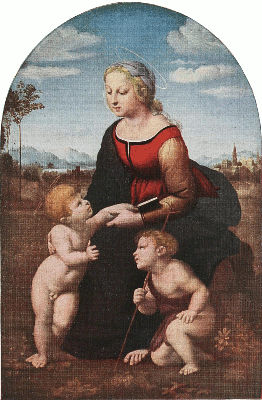
PLATE IV.—LA BELLE JARDINIÈRE
(In the Louvre)
"La Belle Jardinière" is a magnificent example of Raphael's
Florentine style, which came from his being influenced by Leonardo
da Vinci when at Florence (see the triangular composition). The
Virgin's mantle was probably finished by Ridolfo Ghirlandaio;
other parts—the hands and the feet—are hardly finished; nevertheless
it is one of the finest, most expressive, and touching Madonnas
by the Master.
In 1502 Perugino went back to Florence,
and Raphael probably joined Pinturicchio's
staff of assistants, though Vasari's statement
that he furnished the designs for the latter
master's frescoes in the Piccolomini Library
at Siena may be dismissed as a fable.
During this time Raphael painted his first
Madonna pictures, notably the "Conestabile
Madonna" (now at St. Petersburg), which is
based entirely on Perugino's "Virgin with the
Pomegranate," and two panels at the Berlin
Museum. The Milan "Sposalizio," in which
the young master's personality already
asserts itself through the very marked
Ferrarese and Peruginesque influences, was
painted in 1504 for the church of St. Francesco
at Città di Castello. His early mastery
in portraiture is illustrated by his portrait of
Perugino at the Borghese Gallery, which is
so firm in character and perfect in execution
that it could pass for many years as the
handiwork of Holbein.
Meanwhile Duke Guidobaldo had returned
to Urbino after the death of his enemy, Pope
Alexander VI., and thither Raphael proceeded
in 1504. The little "St. George" at the
Louvre is a memento of this short visit which
terminated in October of the same year,
when Raphael, armed with a letter of warmest
recommendation from Guidobaldo's sister
Giovanna della Rovere to the Gonfaloniere
Pier Soderini, left his native town for
Florence, then the centre of artistic life,
astir with the rivalry between the giants
Michelangelo and Lionardo da Vinci.
The young man must have been fairly
bewildered at the multitude of new impressions
that crowded upon him in the glorious
city on the banks of the Arno, with its imposing
palaces and churches, its seething life
and its art so much more virile and monumental
than the dreamy, almost effeminate
art engendered by the soft balmy atmosphere
of Umbria. How he must have revelled
in the contemplation of Masaccio's
noble frescoes in the Brancacci Chapel—the
training school of generations of painters—which
ten years later were echoed in his
tapestry cartoons for the Sistine Chapel!
How he must have stood in wonder and
amazement before Michelangelo's "David,"
and have resolved forthwith to devote himself
to a more intimate study of the human
form and movement! The fascination exercised
upon him by the genius of Lionardo
found expression in some of the earliest
fruits of Raphael's sojourn in Florence—the
portraits at the Pitti Palace known as
"Angelo Doni" and his wife Maddalena
Strozzi, who, however, could not possibly
have been the model for this reminiscence of
Lionardo's "Mona Lisa," since it is known
that she was baptized in 1489, whereas
Raphael's portrait of 1504 represents a
woman of ripe age.
In the workshop of the architect Baccio
d'Agnolo, which was then a favourite social
resort of the younger artists of Florence, the
youth from Urbino met on terms of equality
such masters as Ridolfo Ghirlandajo, Antonio
da Sangallo, Sansovino, and Fra Bartolommeo,
who again had a considerable share in
the formation of Raphael's style, as may be
seen from the "Madonna di Sant'Antonio,"
now lent to the National Gallery by Mr.
Pierpont Morgan who is said to have paid
for it the enormous price of £100,000. This
picture, and the "Ansidei Madonna," which
was bought for the National Gallery from
the Duke of Marlborough's collection for
£70,000, were painted during a visit to
Perugia towards the end of 1505—the former
for the nuns of St. Antony of Padua, in
Perugia, and the other for the Ansidei Chapel
in the church of San Fiorenzo of the same city.
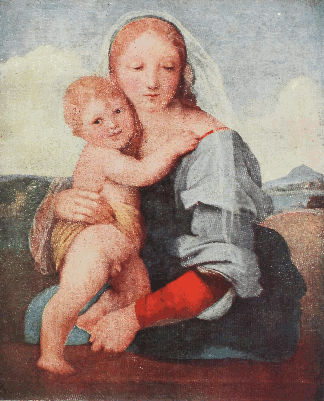
PLATE V.—THE MADONNA OF THE TOWER
(In the National Gallery, London)
This beautiful painting, which the National Gallery owes to the
generosity of Miss Eva Mackintosh, who presented it to the nation
in 1906, was at one time in the collection of the Duc d'Orléans.
The late owner was fortunate in securing this unquestionably
genuine masterpiece at the Rogers' sale in 1856 for 480 guineas.
It was painted about 1512; and a copy of it by Sassoferrato is in
the Leichtenburg collection in St. Petersburg.
The records of Raphael's movements between
1504 and 1508, when he finally left
Florence, are scanty and unreliable. Certain
it is that, besides his visit to Perugia, he
spent some time at Urbino in 1506, when
he painted for Guidobaldo the "St. George"
which figured among the gifts taken by
Castiglione to Henry VII. of England, from
whom the Duke of Urbino had received the
insignia of the Garter two years previously.
The picture is now at the Hermitage in
St. Petersburg. The majority of those
exquisite Madonna pictures, which have
contributed more than anything else to
Raphael's undying fame and popularity, date
from his Florentine period—the "Madonna
del Granduca" at the Pitti Palace, the
"Casa Tempi Madonna" at Munich, the
Chantilly "Madonna of the House of Orleans,"
the "Madonna of the Meadow" in
Vienna, the "Madonna of the Goldfinch"
at the Uffizi, the "Madonna of the Lamb"
at Madrid, Lord Cowper's famous picture at
Panshanger, and the "Belle Jardinière" at
the Louvre.
To the same period belongs the portrait
of himself, in the Painter's Hall of the Uffizi,
and the portrait of a youth in the Budapest
National Gallery. On the occasion of his
visit to Perugia, Atalanta Baglione, the
mother of Grifonetto Baglione who had
fallen a victim to the bloody family feud
that turned Perugia into a slaughter-house
in 1500, commissioned from Raphael an
altar-piece in memory of that event—the
"Entombment" which the master finished
in Florence in 1507, and which is now at
the Borghese Gallery. It was Raphael's
first attempt at dramatic composition, the
art of which he had yet to master—its
forced, unnatural emotion lays it more
open to criticism than any other work from
his own hand.
A law-case in connection with the payment
of 100 crowns due by him for a house
he had purchased from the Cervasi family,
necessitated Raphael's presence at Urbino
once again in October 1507. In April of
the following year Guidobaldo died; and a
letter from Raphael to his uncle Simone
Ciarla, who had informed him of this sad
event, proves that the master was then
back again in Florence. After expressing
his grief at the news of the Duke's death
("I could not read your letter without
tears"), Raphael appeals in this letter to
his uncle to procure him another letter of
recommendation to the Gonfaloniere of
Florence "from my Lord the Prefect," since
it was in the power of the chief magistrate
of Florence to place an important
commission for the decoration of a certain
apartment.
But a better fate was in store for the
youthful applicant, who was to be called
to a wider field of action. According to
Vasari it was Raphael's kinsman, Bramante
of Urbino, who drew Pope Julius II.'s attention
to the rare gifts of Raphael, and caused
him to be summoned to Rome. And the
voice of Bramante, who stood in high favour
with the Pope, and was engaged on the
scheme of rebuilding the Cathedral of St.
Peter, would certainly have commanded
attention. But on this, as on many other
points, Vasari is not wholly trustworthy.
First of all, Bramante was not connected
with Raphael by any family ties; and, then,
it is far more probable that the thought
of calling Raphael to Rome to assist in
the decoration of the papal apartments in
the Vatican was suggested to Julius II.
by the Prefetessa Giovanna della Rovere,
who had always been a staunch supporter
of the Urbinate, or by her son Francesco,
the nephew and successor of Duke Guidobaldo
Montefeltre. Bramante, who was on
terms of friendship with his fellow-artist and
fellow-townsman, may well have supported
the recommendation. However this may
be, Raphael received the Pope's command,
and journeyed to Rome, whither he had
already been preceded by Michelangelo.