“Randy, wake up!”
“Yes, oh yes, in a minute,” Randy
answered, drowsily.
“No, now, Randy, wake up now! I want
to talk about those tab things what we had
last night,” and two little soft arms wound
their way about sleepy Randy’s neck.
Randy rubbed her eyes, laughing as she
said, “Do call them tableaux, Prue, can’t
you remember that? Tableaux, Prue, say
so.”
“Tabby-lows!” shouted Prue. “How’s
that?”
“Better,” said Randy, still laughing.
“Well, whatever you call ’em, yours
was the prettiest, Randy dear, the very
prettiest, and Jotham said so, too, so of
147
course it’s true,” said little Prue, who had
been sitting up in bed in order to see her
sister’s face when she repeated the compliment.
“Now, Prue,” said Randy, “did he say
that because you asked him?”
“Why, no,” said the child, whose smiling
face now assumed an injured expression.
“He didn’t say it to me ’tall. He
said it to his mother; I heard him, and
she said she thought so, too, I heard her;
she sat just behind us. Now, Randy
Weston, I thought it was real nice to tell
you, and that’s what I waked you up for.”
“It’s all very nice,” Randy answered,
“that you liked my picture best; and do
you know, little sister, I would rather have
you pleased than almost any one, next to
father and mother.”
“Why?” questioned the little girl, in
genuine surprise.
“Because,” said her sister, “you’re a
little girl who means just what she says.”
“Yes, I do mean it, Randy dear; you did
148
look just the best of any one, but you’d
ought to seen Jotham,” she continued, “he
meant it, too. He meant it just tremenjous!”
“Well, Jotham’s kind, too,” said Randy;
then, with a happy little sigh, she turned
a smiling face to little Prue as she said,
“’most every one’s good, I do believe.”
“Not near as good as you, Randy,” said
Prue, thoughtfully; but, she added, brightening,
“I mean to be good all day, ’cause
why do you s’pose, Randy? ’Cause I had
such a good time last night.”
“That’s a good reason,” said Randy.
Soon Randy proposed dressing, and at the
breakfast table Prue resumed the conversation
with which she had awakened Randy.
All agreed that it had been just a lovely
evening, but the little girl was not quite
satisfied.
“Well, now, we did have a splendid time,”
said she, “but I want you to say my Randy
was just the best of all.”
“Why, of course, we say so,” said her
149
father, laughing; “but who sang a nice
little song?”
“Oh, I ’most forgot, I sang a little tune
and so did Katie Buffum.”
“So you did, so you did,” said her father,
“and your mother and I thought you little
girls did your parts well.”
“I think they all did wonderful,” said
Mrs. Weston. “I was jest proud of my girls,
and my neighbors’ children, too. I do
declare, I believe Miss Dayton can do anything.
Last evening jest did me good.
Well, this won’t do for me,” she added,
“there’s a sight to do to-day.”
“We’ll help,” said Randy and Prue together.
“I guess I’ll have to have you help me,
Randy, if you’re a mind to.”
“Me too, me too,” cried Prue.
So Randy filled a large pan with hot
water and Prue armed herself with a long
towel, and the two commenced work as if
their lives depended upon it.
Mrs. Weston was an energetic woman
150
and soon her pies were made and baked,
and standing to cool upon the table. The
children had worked bravely all the forenoon,
Randy doing a great deal to be helpful,
and Prue assisting in many small things.
Randy was just thinking that she would
surely scorch if she remained in the hot
kitchen another minute, when such an
interesting thing happened.
Up the well-trodden path to the kitchen
door came Mrs. Hodgkins, “the best woman
in town and the newsiest,” as Silas Barnes
had described her.
The children were always delighted to
see her coming, as a call from Mrs. Hodgkins
meant numberless scraps of gossip,
and in a small country town where neighbors
are few and far between, anything in
the shape of news is welcome.
Laboriously the good woman stepped
from door-stone to threshold, and voluminously
filling the wooden rocker which Mrs.
Weston offered her, she fanned herself with
her handkerchief, ejaculating between gasps
151
for breath, “Lor’ me! How hot it is! Ef
I ever get my breath again, I’ll try ter talk
a spell.” But it would have been something
greater than shortness of breath that
could have completely silenced Mrs. Hodgkins.
A few energetic movements of the
palm-leaf fan which Randy offered her, a
few moments of jerky rocking in the old
wooden rocker, and she was ready to begin.
“Well there, Mis’ Weston, I b’lieve I can
talk now,” said she. “Joel was goin’ over
to the barn raisin’, an’ I told him I didn’t
care nothin’ ’bout seein’ it; but ef he’d a
mind to drive me as fur as your house, I’d
call in an’ look at yer a spell, ’n’ I can’t
spare the time to talk ’n’ not do somethin’
at the same time,” and she drew from a
capacious bag an old woollen stocking, saying,
“I thought I’d bring my knittin’ along
and p’haps git this stockin’ footed down
while I was talkin’.”
“Why, that’s a woollen stocking,” said
little Prue.
“Lor’ yes, child, it’s one of
Joel’s winter stockin’s. I was up attic yesterday huntin’
152
over my rag bag, ’n’ I came
across a lot of his old winter stockin’s that
I’d ’bout decided to throw away, ’n’ I says
to myself, ‘Sophrony Hodgkins, that’s
downright wasteful,’ ’n’ I’ve just set myself
a task to foot ’em down ’fore winter.”
Her needles clicked furiously, and she knit
around several times before she spoke
again. With her brows contracted she
worked until she felt sure that her knitting
was “straightened out,” then she paused
for a chat.
“Did you know,” she commenced, “that
Phœbe Small was a beggin’ an’ a teasin’
her pa to send her to boardin’ school?
Well, she is, ’n’ none of the girls could find
out what put it in her head ter want ter
go ’til Jemima Babson teased it out of
her. Seems at the picnic Miss Dayton, in
some story she was tellin’ the children, let
out that she went away from home ter
school, ’n’ Phœbe got the idee that ter go
away ter school would jest be the makin’
of her. Jemima don’t care what she says,
153
an’ she up an’ told Phœbe that it ‘would
take more ’n boardin’ school to make her
as sweet as Miss Dayton,’ all of which was
true, but not ter Phœbe’s likin’.”
“Is she going to boarding school?”
asked Randy.
“Land, no! Her ma told her to wait ’til
she’d learned all there was ter learn at our
deestric’ school ’fore she talked ’bout goin’
anywhere else; and that ’bout finished it.”
Here Mrs. Hodgkins, who had said all
this without stopping, paused to take
breath. “I shouldn’t like my girls to be
away at boardin’ school,” said Mrs. Weston,
“and I think Mrs. Small would feel ’bout
as I do.”
“An’ there’s Mrs. Buffum,” continued
Mrs. Hodgkins, “with all her children, ’n’
she says they’ve got to be where she can
see ter them, an’ git their larnin’ ter home,
and now I’ll tell yer the joke. It seems
Miss Dayton laughed when she heard about
it, for she wasn’t at boardin’ school at all;
she was at school, and was boardin’ at a
154
big hotel with her aunt, ’n’ the hotel was
near the school. But there, ye know
Phœbe Small never gits anything more ’n
half right.
“But I’ll tell ye somethin’ worth tellin’.
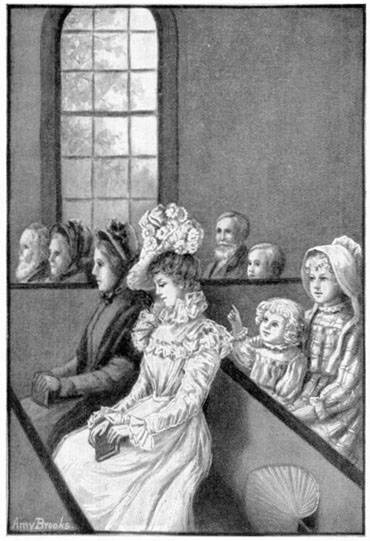
Old Sandy McLeod’s comin’ to meetin’!”
“You don’t say!” ejaculated Mrs. Weston,
lifting her hands, and letting them fall
upon her lap, thereby showing the surprise
which Mrs. Hodgkins thought this piece of
news deserved.
“Well, you see, it was this way,” continued
the bearer of this pleasant bit of
gossip; “it commenced with Miss Dayton’s
doin’ a few little things fer him. Nobody
b’lieved fer a minute that he’d come to
Mrs. Gray’s, to the entertainment; but Miss
Dayton asked him in her pretty way, and
he hadn’t the heart ter refuse ter come, ’n’
he had such a nice evenin’, and heard her
sing that Scotch song, and all, ’n’ he says
now he’s made a great mistake stayin’ off
by himself so long. An’ he’s been to Parson
Spooner and, ef you’ll believe it, hired
155
a whole pew, sayin’ he could well afford to;
en’ he says that as there’s only one in his
family, any one that wants ter can sit in
his pew, any time.
“He says he always went ter church,
though he calls it ‘kirk,’ or something like
that, when he was a young man and lived
in Scotland; an’ he says, rain or shine,
we’ll see him in his place every Sunday,
after this. When somebody asked him
what made him think of goin’ ter church
again, he drew that great rough hand of
his across his eyes, and jist said, ‘It’s all
the doin’ of that lass,’ meanin’ Miss Dayton.
And let me tell yer somethin’ queerer
than that! Did ye notice old Nathan
Lawton the other night?
“My! how his eyes twinkled when the
children were singin’. Ye know he’s dreadful
fond of children; but ye know, too,
ef ye know anything, that he’s tighter ’n
the bark of a tree. Well, Miss Dayton
heard say what a bad room fer heatin’
that schoolroom was, and how the little
156
buildin’ was kind er fer off fer most of the
children.
“Wal’, after we’d seen all the pictures,
or what yer call ’ems, and she’d sung
her song so sweetly, old Nathan spoke
ter her, an’ thanked her for the pleasant
evenin’, sayin’ he’d do most anythin’ ter
obleege her, in return, as ye might say, fer
his enjoyment; and I had ter laugh softly
ter myself when she put her little white
hand on his arm and said she thought
nothin’ would please her so much as ter
think, when she went home, that the
children here would start ter school in a
comfortable, warm room, ’specially ef it
could be one that was handy for them all;
and she asked him, as one of the see-lect-men,
ter manage it some way.
“He just took one look at the smilin’
face lookin’ up at him, and then and there
offered the use of that front room of his’n,
and promised ter keep it roastin’ warm all
winter, from his own woodpile. His house
is just about the handiest ter every one of
157
any house in town, and I do say that was
a han’some offer.
“Any other folks might have asked him
’til they got tired askin’; but he couldn’t
refuse her, ’n’ I don’t wonder. She’s just
done us a world of good this summer, ’n’ in
such an easy, pretty way that we’ve just
enjoyed it.
“And now I’ve come ter what fetched
me here ter day. Mrs. Gray said ter me
that Miss Dayton never went to an apple-bee;
and I was thinkin’ she got up that
picnic, and that splendid evenin’ with the
music,”—“and tab things,” said Prue,—“an’
I’ve been thinkin’ it’s ’bout time we
got up somethin’ fer her,” said good Mrs.
Hodgkins, and she beamed upon Mrs. Weston
and Randy as she waited for their
approval.
“I think so too,” said Randy and her
mother together; “but do you think that
she would enjoy an apple-bee?”
“Well, we couldn’t get up anything
fine,” said Mrs. Hodgkins; “but they do
158
say that our apple-bees are ’bout the best
that they have anywhere ’round here.”
Mrs. Weston thought a moment, then
said: “Our house is the biggest in the
neighborhood, an’ Miss Dayton has been
so kind to Randy and Prue that I’ll say
we’ll have the apple-bee here, and I think
we’ll try extry hard to make it a pleasant
one. I’m real glad you thought of it, Mrs.
Hodgkins. I think we’ll all enjoy it, an’ if
Miss Dayton does, that’s all we’ll ask for.”
“Well, ef here ain’t Joel,” said Mrs.
Hodgkins, “an’ I’ll have ter be goin’; but
I’ll come over an’ help ye git ready for the
apple-bee, so good-by ’til I see ye again,”
and she hastily took her departure, puffing
down the walk like a small engine, and
clambering into the wagon beside her husband.
“Good-by, I’ll be over ter help ye,”
she cried, looking back; then they jogged
off down the road.
Randy and her mother turned from the
doorway and walked back into the kitchen.
“Look at that clock, Randy!” exclaimed
159
Mrs. Weston; “I guess it’ll be a funny dinner
to-day,” and she commenced to make
hasty preparations for the noon meal.
Mr. Weston laughed good-naturedly when
he heard of the forenoon caller, and in consequence
the “picked-up dinner.” “Lots of
folks haven’t as good a dinner as this,
mother,” said he, “and I must say, I’m
glad she came in ter talk ter ye and so
make ye stop workin’ a spell. Where is
Prue?”
Sure enough, the little girl who was
always eager to tell a part of any happening
was, for once, not in evidence. So busy
had Randy and her mother been, preparing
the dinner, that Prue had not been missed.
“She went out when Mrs. Hodgkins
went, don’t you remember, mother?” said
Randy. “She ran down the path, waving
her hand and saying good-by when they
drove away.”
“Well, Randy, run out and find her, and
tell her ter come in ter dinner. Dear me!
I hope she hasn’t got inter some scrape.
160
She’s been out of sight long enough fer
anything.” Out rushed Randy, calling
loudly, “Prue! Prue! where are you?”
“I’m right here, and I’m very busy,”
came an answering shout from behind the
house.
Around the house ran Randy, and such
a funny sight she saw!
“Why, Prue Weston, you naughty girl!”
said Randy in dismay.
“I ain’t naughty,” said the child.
“You are, too,” responded Randy, “to
plague kitty like that. You just take her
out of that rain-water tub this minute! If
she wasn’t the best old cat in the world, she
would have scratched you well for ducking
her like that.”
Prue tried to lift pussy out, and Randy
ran to help her.
Poor pussy! If Randy had been a few
minutes later, she must surely have been
drowned, for, just as Randy arrived, Prue
was holding Tabby’s head under water
“to let it soak,” she said.
161
“What ever made you do such a thing?”
questioned Randy, when the cat was once
more on dry land; “don’t you know that
in a few minutes more you would have
drowned her?”
“Drowned!” said Prue in a horrified
whisper, “drowned, did you say, Randy?”
“Why, of course,” said Randy, impatiently;
“don’t you know she’d drown
with her head under water?”
“Why, Randy, that’s awful!” said Prue.
“I didn’t mean to hurt Tabby. I only
meant to help her. She comed down from
the field what’s been burned over, and she
was all smutty, and I thought I’d give her
a good washing; so I put her in the tub,
but the smut sticked awful, and I thought
I’d soak her and p’rhaps she’d wash easier;
and, Randy, whatever you say, she isn’t
drowned one mite. Just see her washing
herself dry in the sun.”
“Oh, Prue, Prue!” said Randy, “what
shall I do with you? You do the queerest
things! Go tell Tabby you’re sorry this
162
minute. If kitty had died, just think how
you’d felt.”
“Now, don’t you make me cry, Randy,”
said Prue, “’cause you know I love Tabby,
and I didn’t mean to hurt her.”
The cat was an unusually placid animal,
or she never would have permitted a little
girl to do such a thing. Prue had always
used her for a doll, dressing her up in all
sorts of things, and sometimes dragging
her about in a wooden box which she
called a “carriage.” This alleged vehicle
was an old soap box, beautifully
padded with a woollen shawl. It had
neither wheels nor springs, and as little
Prue dragged it along, it thumped over
twigs and stones with the most surprising
jolts. Pussy, however, seemed to have a
species of lethargy, for she slept through
it all; so Prue insisted that she liked the
ride. The family declared the cat to be
absolutely without vim; but that deficiency
in her make-up made her a delightful plaything
for Prue.
163
After dinner Mrs. Weston talked long
and seriously with her little daughter, telling
her that as pussy was so gentle and
willing to be played with, she ought to be
very kind to her and never do anything
that Tabby would not like.
“But I wanted Tabby to be clean in
time for the folks to see her when we
have the apple-bee,” said Prue.
“Oh, she’ll be clean as clean can be
by that time,” said her mother, smiling.
“She’ll have a whole week to wash in. I
think that when you wish to do something
to kitty different from what you’ve done
before, you’d better come and ask me
first.”
“I will,” said the little girl, promptly,
and Mrs. Weston knew that pussy was
safe from any new torment, for Prue
always kept her word, and she loved
Tabby dearly.
Early in the afternoon, as Mrs. Weston
sat by the window mending, another wagon
stopped at the door; and this time a tall,
164
angular woman came up the path with
nervous haste. The door was open, and
without waiting to knock, the caller walked
in and seated herself.
“There, I guess you’re s’prised to see
me, Mis’ Weston, but I jest had ter come.”
“Well, I am surprised,” responded Mrs.
Weston; “but I’m just as pleased ter see
ye. Take off yer bunnit.”
“I’ll take it off jest ter show it ter ye,”
said Mrs. Jenks. “I thought I’d had a
change of heart years an’ years ago, but
I guess I’ve jest got it now.”
“Do tell! Why, Mrs. Jenks, how ye
talk,” and in blank amazement Mrs.
Weston stopped mending, the stocking,
however, still drawn over her hand.
“Well, ye might as well stop mendin’
an’ listen, fer I’ve come ter tell ye quite
a story. It all began with this bunnit.
I stepped over ter Mis’ Gray’s one mornin’
of an arrant, an’ I chanced to say
something about not havin’ a decent bunnit
fer Sunday, an’ I said I had a bunnit
165
I’d bought down ter Barnses and quite a
lot of old ribbon that was plenty good
enough to trim it with; but, says I, I’ve
no more idee how to trim it than a cat.
Miss Dayton was just comin’ in the door
with a lot of wild flowers and green stuff,
and she offered, so sweetly, to call over in
the afternoon and jest tack the ribbons
on fer me that, some way, I had ter let her
do it.
“Well, she came over and I got out my
ribbon—it was that I had on a blue dress
of mine once—and she sat down to trim
it. It took some time, and to this day I
don’t know how it came about, but the first
thing I knew she was a-makin’ me see how
much better it was to give rather than
receive. Now I’ve been pretty ‘near’ and
savin’, but I never meant ter be mean; but
she led me to talk of the time when Reuben
was little, and ’fore I knew it I was tellin’
that girl how I used to leave my work jist
ter look at him in the old wooden cradle.
I told her what I’d most forgot myself:
166
how I could never let him lay there, but
jest had ter take him up and hug him jest
a minute an’ then go on with my work.
I’ve never meant ter be hard with the boy,
but p’r’aps I forgit sometimes that he’s
pretty young still.
“Well, Miss Dayton looked up from the
bows she was makin’ pretty, and says
she, ‘Reuben’s a nice little fellow, and I
think, if you were to try it, you’d find he
liked petting still. I’ve talked with him
many times since I’ve been here, and I find
that his one idea seems to be to grow up
as fast as possible so as to be able to help
father and mother.’
“I tell ye, Mis’ Weston, I was all took
back to find a sweet young girl who was
’most a stranger to us had learned my
boy’s good traits ’fore I had. Well, when
Reuben came in jist ’fore supper-time with
his jacket with a big tear in it, I was jist
ready ter say somethin’. He took the
jacket off and hung it on my chair ter be
mended; and layin’ his hand on my shoulder, he said,
167
‘I wish I didn’t get my things
tore quite so often, mother, but this time I
couldn’t help it.’
“It took lots er resolution, but I jest
kissed him on his forehead, and the s’prised
look on his face made me realize how long
it had been sence I’d kissed him before.
“‘Reuben,’ says I, ‘no matter what I
say when I speak hasty, just remember
that yer mother thinks the world of ye!’
“‘F you’ll believe me, that boy flew at
me, and puttin’ his arms round my neck he
said, ‘Why, mother, a minute ago I was
awful sorry, and now I’m almost glad I
tore my jacket.’
“‘So be I,’ says I, and then we both
laughed, but we were jest as near cryin’,
and I tell you, Mis’ Weston, I ain’t never
goin’ ter have such a distance, so to speak,
between my boy and me as there has been;
I guess we understand each other now.”
“Well, I don’t know when I’ve heard
any better news,” said Mrs. Weston, taking
off her glasses and slowly wiping them.
168
“I think pretty well of little Reuben, and
I b’lieve, properly encouraged, he’ll make
a good man.”
“Well, now, it beats all how Miss Dayton
does things,” said Mrs. Jenks. “Some folks
would have blundered about it in a way
that would have made me mad, but to this
day, I do say, I don’t know how she done
it. And look at that bunnit,” continued
enthusiastic Mrs. Jenks, “didn’t she make
them bows pretty? I declare, there ain’t a
prettier bunnit in the meetin’-house than
that.”
“’Tis pretty,” assented Mrs. Weston;
“just as pretty as it can be.”
“So I say,” said Mrs. Jenks, “and now
this mornin’ I met Mis’ Hodgkins and her
husband. ‘They’d just come from here,’
they said, ‘and,’ says Mis’ Hodgkins, ‘we’re
goin’ ter have the first apple-bee ter Mis’
Weston’s and,’ says she, sorter smilin’, ‘I
ain’t sure’s you’ll be very anxious ter help,
but we’re all goin’ ter do our part ter help
make a grand time fer Miss Dayton;’ and
169
says I, ‘If it’s fer Miss Dayton, I’ll agree
to contribute anything you like toward the
supper, and I’ll go right over now an’ tell
Mis’ Weston so.’ My, but didn’t she look
at me! I laughed ter myself, an’ I said
right out loud, as I drove off, ‘Matilda
Jenks, this is the last time any one will
have a chance ter call ye stingy.’
“I commenced this mornin’ by givin’
Reuben a lot of maple sugar to treat the
boys with, and I tell you Miss Dayton’s
’bout right, it does feel good to give.
We’ve been prospered, and from this time
forth I ain’t goin’ ter be foolish with this
world’s goods; but I vow I won’t be mean;
so I’ve come ter say that if there’s anythin’
I can offer ter help make the bee a success,
jest say the word an’ you shall have it.”
“Mrs. Jenks,” said Mrs. Weston, kindly,
“I always said ye hadn’t but one fault,
and now you’ve overcome that, seems to
me you’re pretty near perfect.”
“I guess there’s room fer improvement,”
said Mrs. Jenks, grasping her friend’s extended hand,
170
“but I’ve started in the right
direction. Now, I must be goin’, and remember
I’ll do anything ter help along
that bee.”
Mrs. Weston promised to remember, and
as rapidly as she came Matilda Jenks
strode down the path and drove away.
A few minutes later Randy came running
in at the door. “Oh, mother,” said
she, “I ran out to look for Prue again,
while Mrs. Jenks was talking, and, mother,
she’s doing the cunningest thing. She’s
playing read. She’s lying on the grass
back of the house, with the fairy book in
front of her. She’s making b’lieve read
to Tabby. Do come and see her.”
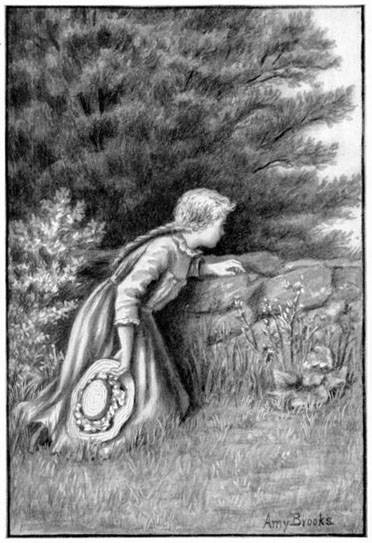
Softly they made their way around the
house and, sure enough, there lay Prue,
the wonderful fairy book before her, her
elbows on the book, and her chin in her
hands. Soon they were near enough to
hear what she was reading, and yet not to
be observed.
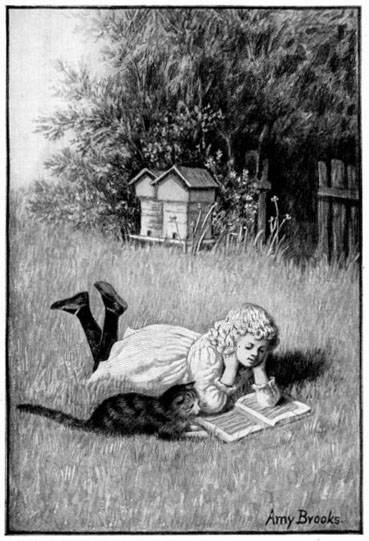 Prue and Tabby reading the Fairy Book
“Now, Tabby,” she was saying, “you
mustn’t go to sleep when I’m reading to
you. Now you listen: The princess—that’s
Miss Dayton, Tabby—is very beautiful, and
so I know there must be a prince, somewhere,
that she knows; ’cause, Tabby, in
the fairy tales the princesses always has
princes; and, Tabby, I’ll tell you truly,
Miss Dayton is prettier than any picture
in this book. And, Tabby, she loves little
girls and big girls, like my Randy, and she
loves big womens and old womens and old
mens, like Sandy McLeod; and, Tabby, I
b’lieve, I most b’lieve she loves you, and
I’m going to ask her.
“She prob’ly does love you; she seems
to love everybody. This isn’t all in the
book, Tabby, but what I tell you that isn’t
in the book is true. I’m most glad the
fairy stories ain’t true; for if things did
happen like what’s in the book, maybe
you’d turn into a frog, and then, Tabby, I
couldn’t hug you.”
Here Tabby rubbed her head against
Prue’s little arm. “There,” said the child,
172
“you knew what I said, didn’t you?” and
she sprang up, catching Tabby in her arms
to “love her,” as she called it.
“Oh, did you hear me reading to my
kitty?” shouted Prue, as she caught sight
of her smiling audience.
“We heard ye, and I guess some of it
was full as pretty as what was in the
book,” said Mrs. Weston, and together the
three wended their way back to the house,
followed by Tabby.