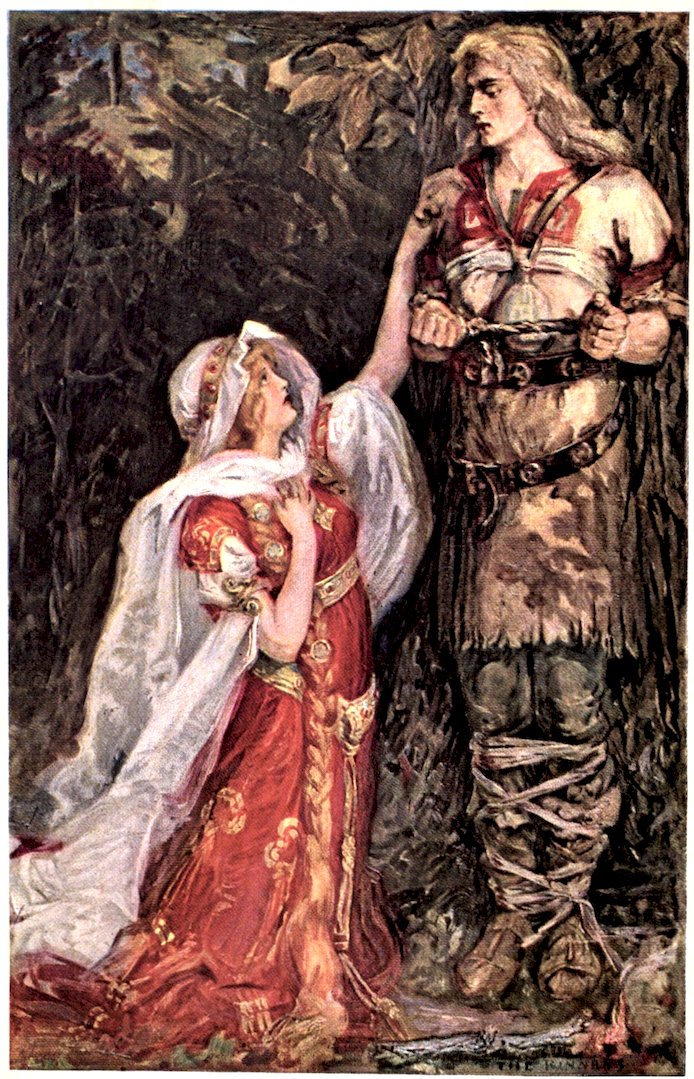
“SHE KNELT DOWN BEFORE HIM.... THE WOMAN IN HER PLEADED AS BEFORE A LAWMAN”
By
Ottilie A. Liljencrantz
Author of
“The Thrall of Leif the Lucky” etc.
New York and London
Harper & Brothers Publishers
1906
Copyright, 1906, by Harper & Brothers.
All rights reserved.
Published February, 1906.
“Yet onward still to ear and eye
The baffling marvel calls;
I fain would look before I die
On Norumbega’s walls.”
—John Greenleaf Whittier
The Skeleton in Armor
v
By
Henry Wadsworth Longfellow
“Speak! speak! thou fearful guest!
Who, with thy hollow breast
Still in rude armor drest,
Comest to daunt me!
Wrapt not in Eastern balms,
But with thy fleshless palms
Stretched, as if asking alms,
Why dost thou haunt me?”
Then, from those cavernous eyes
Pale flashes seem to rise,
As when the Northern skies
Gleam in December;
And, like the water’s flow
Under December’s snow,
Came a dull voice of woe
From the heart’s chamber.
“I was a Viking old!
My deeds, though manifold,
No Skald in song has told,
No Saga taught thee!
Take heed, that in thy verse
Thou dost the tale rehearse,
Else dread a dead man’s curse;
For this I sought thee.
vi“Far in the Northern Land,
By the wild Baltic strand,
I, with my childish hand,
Tamed the gerfalcon;
And, with my skates fast-bound,
Skimmed the half-frozen Sound,
That the poor whimpering hound
Trembled to walk on.
“Oft to his frozen lair
Tracked I the grisly bear,
While from my path the hare
Fled like a shadow;
Oft through the forest dark
Followed the were-wolf’s bark,
Until the soaring lark
Sang from the meadow.
“But when I older grew,
Joining a corsair’s crew,
O’er the dark sea I flew
With the marauders.
Wild was the life we led;
Many the souls that sped;
Many the hearts that bled,
By our stern orders.
“Many a wassail-bout
Wore the long winter out;
Often our midnight shout
Set the cocks crowing,
As we the Berserk’s tale
Measured in cups of ale,
Draining the oaken pail,
Filled to o’erflowing.
“Once as I told in glee
Tales of the stormy sea,
Soft eyes did gaze on me,
Burning yet tender;
vii And as the white stars shine
On the dark Norway pine,
On that dark heart of mine
Fell their soft splendor.
“I wooed the blue-eyed maid,
Yielding, yet half afraid,
And in the forest’s shade,
Our vows were plighted.
Under its loosened vest
Fluttered her little breast,
Like birds within their nest
By the hawk frighted.
“Bright in her father’s hall
Shield gleamed upon the wall,
Loud sang the minstrels all,
Chanting his glory;
When of old Hildebrand
I asked his daughter’s hand,
Mute did the minstrels stand
To hear my story.
“While the brown ale he quaffed,
Loud then the champion laughed,
And as the wind-gusts waft
The sea-foam brightly,
So the loud laugh of scorn,
Out of those lips unshorn,
From the deep drinking-horn
Blew the foam lightly.
“She was a Prince’s child,
I but a Viking wild,
And though she blushed and smiled,
I was discarded!
Should not the dove so white
Follow the sea-mew’s flight,
Why did they leave that night
Her nest unguarded?
viii“Scarce had I put to sea,
Bearing the maid with me,—
Fairest of all was she
Among the Norsemen!—
When on the white sea-strand,
Waving his armed hand,
Saw we old Hildebrand,
With twenty horsemen.
“Then launched they to the blast,
Bent like a reed each mast,
Yet we were gaining fast,
When the wind failed us;
And with a sudden flaw
Came round the gusty Skaw
So that our foe we saw
Laugh as he hailed us.
“And as to catch the gale
Round veered the flapping sail,
Death! was the helmsman’s hail,
Death without quarter!
’Midships with iron keel
Struck we her ribs of steel;
Down her black hulk did reel
Through the black water!
“As with his wings aslant,
Sails the fierce cormorant,
Seeking some rocky haunt,
With his prey laden,
So toward the open main,
Beating to sea again,
Through the wild hurricane,
Bore I the maiden.
“Three weeks we westward bore
And when the storm was o’er,
Cloud-like we saw the shore
Stretching to leeward;
ix There for my lady’s bower
Built I the lofty tower,
Which, to this very hour,
Stands looking seaward.
“There lived we many years;
Time dried the maiden’s tears;
She had forgot her fears,
She was a mother;
Death closed her mild blue eyes,
Under that tower she lies;
Ne’er shall the sun arise
On such another!
“Still grew my bosom then,
Still as a stagnant fen!
Hateful to me were men,
The sunlight hateful!
In the vast forest here,
Clad in my warlike gear,
Fell I upon my spear,
O, death was grateful!
“Thus, seamed with many scars
Bursting these prison bars
Up to its native stars
My soul ascended!
There from the flowing bowl
Deep drinks the warrior’s soul,
Skoal! to the Northland! SKOAL!”
Thus the tale ended.
Randvar the Songsmith
I
1
“A man’s foes are those of his own house”
—Northern saying.
In the old world over the ocean the
storm of the Norman Conquest was
raging, but no rumble of it reached
across the water to the new world
and that oasis in the wilderness
which men call now the lost city of Norumbega,
but which was known in those days as the Town
of Starkad Jarl. There in the primeval forest the
breath of October was a silver elixir in the air, and
the morning breeze carried only the notes of hunting-horns.
When half a dozen young Norsemen
came galloping down a tree-arched aisle, their talk
dealt with no greater matter than the latest freak
of their Jarl’s freakish son.
“It is seen from the hoof-marks that he has
2not turned aside. We need not wait long to overtake—”
“Suppose he should not want to turn back—”
“Heard I never of a jarl’s hunt that began by
hunting the Jarl’s son!”
“He was quiet in riding out of the Town with
us; what caused him to spur ahead?”
“Only that he had a whim to be alone, as he is
apt.”
“I remember how he broke away once last
spring.”
“It may be that this fall he has done it once too
often. Starkad is wroth.”
So the talk ran on until the tall leader drew
rein, signalling to those behind him to check their
pace.
“Slowly!” he said. “Yonder is his horse tethered.
It would ill become us to ride upon Starkad’s
son as though we were charging a boar.”
“Even though we shall be as ill-received as if
we were,” the youngest of the horsemen added
with a laugh of some uneasiness.
The leader smiled tolerantly. He wore on his
long body fine clothes of scarlet leather, and on
his thin lips the semblance of a perpetual smile.
“Everything grows big in your eyes,” he observed.
“There! I think I see gray cloth among
those green bushes. It were best to ride on until
3we come where he may see that there are too
many of us to withstand; then one of us can dismount
and approach him with the message.”
The youngest of the riders laughed again, this
time somewhat sarcastically. “No one is better
fitted to take that task on him than yourself, Olaf,
Thorgrim’s son. For what else did you spend
your fosterhood in France but to get smooth manners
to use in rough places?”
“Yes, yes! By all means, Olaf is the man!”
the others chorussed, a hint of malice in their
promptness.
If Thorgrim’s French-reared son read the sign,
it made no difference in the confidence of his bearing.
He answered that if it was their wish he
would certainly undertake the errand, and immediately
swung from his saddle as gaining the
green bushes, they came into view of the wearer
of the gray kirtle.
Prone on the earth’s broad bosom the young
noble had thrown himself and lay with his head
pillowed on his folded arms, a figure of utter abandon.
Only at the clink of spur and bridle-chain
did he turn upon his side and fling back a mass of
blood-red hair from a face of startling pallor. What
look came into it when he beheld the horsemen,
they were not near enough to tell. By the time Olaf
stood before him, his teeth were showing a snarl.
4“Well, dog, you have tracked your quarry,” he
said. “No wonder your trainers set store by you!
What is the rest of your master’s bidding?”
Olaf laughed lightly. “Certainly, Jarl’s son,
you should be a scald; you speak so glibly in figures.
Starkad sends you orders to turn back and
take your place again in the following.”
Starkad’s son drew himself slowly into a sitting
posture. Then of a sudden his body was convulsed
with laughter,—laughter mocking as the
mirth of a devil.
“Who am I that I should stand in the way of
the Jarl’s will?” he gasped between his paroxysms,
and shaking with them rose to his feet.
But when he had come where the youngest of
the riders was holding his horse in waiting, either
the young man’s ill-concealed uneasiness, or some
reminder growing out of it, caused his mood to
change. With his foot in the stirrup he lingered,
sobering until his face betrayed even the pinching
hand of dread. Vaulting into his saddle, he spoke
to his attendant without looking at him.
“I see they have turned my hound Sam into
the pack, though the wound on his foot is still unhealed.
Will you, Gunnar, do one thing for me?
Separate him from the rest and bring him to me
in a strong leash.”
“In this as in everything you have only to
5speak to have your will,” Gunnar gave the prescribed
answer absently. It was not until he felt
the foot of a friend behind him that he awoke to
the mockery of the phrase, and glanced up appalled.
But the exasperation lightning at him did not
strike. Amid silence, breathless, storm-charged,
the Jarl’s son took the reins from him, wheeled his
horse and rode back up the leafy path and out of
sight.
In a moment Olaf was spurring after Starkad’s
son, but the remainder of the escort appeared to
be in no great haste to follow. First they waited
while Gunnar examined the buckle of his girth;
then they turned to scrutinize two figures just
emerging into the open from a brush-hidden trail
a few paces on their right.
Two young stags browsing the scarlet berries
under the pines would scarcely have looked more
natural to the scene, for one was a savage of that
new-world race which the early Norse explorers
called Skraellings, with hair as black as freshly
turned leaf-mould, and a shining naked body of
the hue of an oak-leaf in November; and the other,
in the deerskin garb of a forester, with uncovered
locks reflecting the sun, was a descendant of the
Vikings themselves and showed untamed blood in
his handsome face as he raised it to look ahead at
the horsemen.
6The red man the courtiers passed over indifferently,
but on the white one they were beginning
favorable comment when the call of a distant horn
cut them short. Wheeling hastily, they gave their
horses spur and rein, and passed up the shaded
alley like a whirl of frost-tinted maple-leaves.
Upon them, the young forester made but one
remark. He and his companion had halted as at a
parting of the ways, and his hands were busy detaching
a deer’s-horn cup from his belt.
“I would travel a day’s journey to see a horse
run like that,” he said. “Often I dream of feeling
one between my knees, and waken because my
enjoyment is too real for a vision.”
The young savage’s throat gave out a sound of
comprehending, and his friend did not wait for a
longer response. He had filled the horn from a
flask of porcupine-skin that hung around his neck;
now he raised it aloft.
“To you, comrade! May your arrows and your
swallows always go the right way. Skoal!” he
toasted, then refilled the cup and handed it to the
other, who answered in the same Northern tongue,
though haltingly.
“To my brother! May he drink much of his
enemies’ blood—as much as his friends have drunk
of his wine. Skoal!”
It was not seen that the Northman made any
7grimace. While his mouth showed no bloodthirstiness,
its hard line bespoke one used to grim
ways. He said carelessly:
“My foster-mother has the gift of double sight,
but even she has never seen that I have enemies.
How came that notion into your head, brother?”
After the manner of his kind, the Skraelling was
deliberate in answering, letting the purple juice
trickle slowly down his throat; but he finished at
last, and nodded in the direction of the departed
courtmen.
“There went some of the young men who follow
the head of my brother’s people. They are more
bright than white fire-bugs with the gifts they get
for their friendship. My brother is also young—a
warrior—the son of a warrior—yet he lives apart
in the forest, with a handful of women and old
men—gets himself nothing. It must be that he
has enemies among his people.”
The young forester shrugged his broad shoulders.
“No gifts would I buy at the price Starkad Jarl
asks, comrade. My little foster-brother Eric is
page to his daughter; I know the lot of those who
follow him. When he gives the sign they go to
roost, whether they are sleepy or not. When his
priest rings a bell they say their prayers, even
though it break in at a time when cursing would
come more easily to them. It is not allowed them
8to enjoy any sports that he sets his face against;
and they drink no lower in the cup than he gives
them leave. May illness eat me if I would ever
tame myself to run with such a pack! That a man
like my father should have been willing to lie quiet
in a woman’s net is something I shall never be
able to comprehend. I understand him better
when I see how he built the Tower with the lower
part left open so that the wind could blow on him
all the year round and help him to forget that he
was under a roof.”
Once more the Skraelling’s deliberate speech was
delayed, this time by a baying of deep-voiced
hounds rumbling up out of the distance like
thunder. Following it, the pack streamed past—stragglers
bursting from the brush behind them to
skirt them with extended noses or jostle between
them, leaving froth-flecks on their sides—and hard
after the hounds rode the hunting party, led by
a band of green-clad pages winding gilded horns.
With the leisureliness of one whose pride forbids
a display of curiosity, the Skraelling set his eagle
face again over his shoulder; and his companion,
who had started to remark upon the scene, gave
up with a shrug the attempt to make himself heard
against the blaring.
The din passed at last, and on its heels came a
colorful train—stately old priests and chieftains
9gravely discussing the hunts of their youth, high-born
maidens with shining uncovered locks, and
matrons whose lace veils floated cloudily from
their moonlike faces, stocky young thralls bent
under hampers and wine-skins, and towering
leather-clad guardsmen bearing bright spears on
their shoulders. With the hoof-beat of the prancing
horses deadened by the matted leaves, they
went by as lightly as shapes in a vision, each for
an instant illumined as he passed where a shaft of
sunlight fell through a rift in the arching tree-tops.
As the first pair of the noble maidens reached
it, sitting gracefully erect in their saddles like
gilded chairs, the forester motioned towards them.
“The one with her face turned away is the Jarl’s
daughter, Brynhild the Proud. It is said that she
is worth looking at, though it has never happened
to me to do so.”
If the Skraelling looked at her, that was all the
notice he vouchsafed. It was not until the last
maiden had gone by that he was stirred to interest.
“That is the great sachem that the sun now
shines on?” he asked.
“That is Starkad Jarl,” the Northman confirmed;
and even as he said it, the old man with the jaw
like iron and the beard like steel had passed on into
the shade, and the light was playing on the comely
10group that followed, revealing foppish secrets of
gay embroidery and golden buckle.
“Here are the battle-twigs we saw a while ago,”
the young forester added. “I wish I knew if any
of them is Helvin, the Jarl’s son.”
The Skraelling answered but one word. “Blood!”
he said; and while the young men remained in
sight his eyes rested on one in garments of gray,
whose bowed head was hooded by hair of the very
shade of clotted blood.
Looking after the young courtmen, the forester
seemed to lose all who followed. When leaves had
blotted out the last guard’s broad brown back,
and the music of the horns had dwindled to a silver
speck in the gray silence, he spoke musingly:
“Take Helvin, now, if you wish to judge what
metal comes of Starkad’s forging. It is said that
he was born with the wanderlust upon him, so
that his every breath is a panting to take ship and
travel over the sea-king’s road wheresoever the
wolf of the sail might choose to drive him. But
because the sons that came before him are dead,
and the only other heir is a maiden, his sister, it
is not allowed him to risk his life. It may be they
will find out that they have cherished the scabbard
and rusted the blade,—they say that the fire
cased in his flesh has given him an unlucky disposition.”
11The savage’s black eyes gave forth a sympathetic
flash, though his training in repression kept the
feeling out of his voice. He said calmly:
“A day will come when it will be over. The
old man cannot live forever. Already he has
passed so far beyond the timber-line that nothing
grows on his scalp.”
The Northman shook his head. “Starkad’s
death will bring Helvin no nearer what lies at his
heart; he is oath-bound to take the rule after his
father,—so full of fear are they lest quarrels over
the inheritance gnaw at the root of the Jarldom.
But I will say that I think his rule will prove to
be a good thing for the Town, which is now in
danger of becoming more lifeless than a bone-heap.
From all I have heard of his dislike of making a
show of himself and his love of free ways, I have
good hopes of him. It has often been in my mind
to take service under him when he shall get the
leadership. For Starkad I have no respect whatever.
It is told that when he was young he was
called Starkad the Berserker, and had the most
hand in every Viking voyage and man-slaying; but
now that the sap has dried in him, and he has put
on Olaf the Saint’s religion, he expects all men to
live like monks.”
The Skraelling gazed reflectively in the direction
of the vanished cavalcade.
12“Truth to say, the young braves of my race do
not feel much love for the white man,” he said,
presently. “He comes among us as one who
comes among animals—driving them out to possess
himself of their feeding-ground—dealing with
them only when he wants profit out of their hides.
The grayheads give us counsel to live in peace
with the settlers of Norumbega. On the four
trading-days of the year when they let us into their
walls, they trade us useful things for our furs.
But those of us whose teeth are still firm in our
jaws do not like it to be led in as white men’s cows
are led in to be milked, then turned out to pasture,
the bars put up behind them.”
Straightening, he stood a bronze image of
wounded pride. The young forester, as he bent
to fasten one of his moccasin-strings, looked up at
him understandingly. The softening feature of
the Northman’s face was his eyes, deep blue as an
evening sky, under level brows, broad and dark.
When the thong was tied, he put out a hand and
rested it on his companion’s bare shoulder.
“Judge not, brother, all of the white race from
the behavior of one overbearing old man. It
seems to me as if your people and my people should
dwell together like sons of one father. Our hands
are equally open to a friend, and no less hard-clinched
against a foe; and you do not surpass us
13much in freedom and fearing nothing. When it
has befallen the other white men to see the wonder
of your woodcraft as I have seen it, and to be
sheltered and fed by your hospitality as I have
been, there will be much awanting if they do not
hold you as high in honor as I do.”
Unbending gravely, the born heir of the forest
laid his hand upon the breast of the forest’s adopted
son.
“I know good of you; I will try to believe good
of your people,” he said. “Come back with me
now, brother. The lodge of the sachem, my
father, is open to you. Always open to you.”
A second time the Northman shook his head.
“That cannot be, comrade, for I came up here to
learn a trap secret from an old huntsman, and
having got it, I must hasten back and put it to use
before I forget it. Do you on your side bear in
mind, when next you paddle your bark-boat near
the island, that the Tower will offer heartier welcome
to none than to you.”
His hand fell from the bronze shoulder to the
bronze palm, and with a strong clasp the two men
parted,—the red man to melt into the russet shades
beside them, the forester to go forward in the
wake of the hunting party.
Had it blazed its path with axes, the cavalcade
would scarcely have left a plainer track. Wherever
14foot and hoof had failed to print themselves
on the path of leathery leaves, there was always
the clew of a bruised lichen or a fern with a broken
spine. Swinging along easily, mile after mile, the
forester devoted his superfluous breath to humming
scraps of melody and his alert eye to reading
the fantastic runes. Here a bleeding tangle
of wild grape-vine stretched out plundered hands.
Yonder a long golden hair, floating like fairy gossamer
from a low-growing limb, showed how the
forest had exacted weregeld. Still farther on, a
patch of flattened moss and ploughed-up earth
told sly tales of a horseman brought low. When
he came at last to the place where his road branched
westward from theirs, he yielded the rune-page
with regret.
That he might overtake any of the company did
not occur to him. His attention was centred in
his song, gradually becoming articulate and rising
melodiously from under his breath. It broke
a word in two when he caught the hoarse snarl
of a hound in the thicket ahead.
As well as though he could see through the intervening
leaves he knew the hideous landmark
that lay before him,—a pond which the Skraellings
called by a word meaning “the black pool,” because
some sinister combination of soil and shadow
gave its water the appearance of being dully
15thickly black. Tradition added that rather than
enter it, a fleeing stag would let his pursuer kill
him on the brink. If any hunted thing had been
brought to bay there now, the finish might be
worth seeing. Quickening his step, the young
Northman leaped the stony channel of a dead
brook and swept aside the screening boughs.
Set amid frost-blasted bushes and leafless barkless
tree-skeletons, the Black Pool met his gaze;
but it was no four-footed creature that fought for
life at the black water’s edge. Above the brush
rose the gray-clad shoulders of the young courtman
with the blood-colored hair. Rearing as tall
as he, one of the great hunting-dogs had sprung
upon him; while one hand strove to draw his dagger,
the other was struggling to hold foaming jaws
from his throat.
To see his peril was to will to aid him; and with
the forester, to will was to act. But even as the
impulse thrilled him, a strange sensation blotted
it out. With his first forward motion, he was
seized by a sudden whirling madness as though
he had stepped within the ring of a whirlpool and
was being sucked into a black abyss of horror.
It lasted but an instant. Battling against it,
his fingers clutched instinctively at his knife-hilt,
missed it and closed instead upon the blade, and
the smart of cut flesh brought him to himself.
16But in the time that he hesitated, the courtman’s
hand had freed his weapon and plunged it into
the straining throat; there was a death howl,
the hiss of spurting blood, and the danger was
over. The great body relaxed, stiffened, sank
heavily out of sight between the bushes, and the
young man stood wiping his blood-bathed face
upon his sleeve.
Bewilderment and shame claimed the forester.
He with a lion’s strength in the girth of his chest
and in his long sinewy limbs—he whose coolness
had cheated Death a hundred times—he to falter
when a man was in jeopardy of life before him!
It was beyond belief.
He saw without caring that the courtman seemed
all at once to become aware of another presence,
and turned and espied him. He heard without
heeding a peremptory order to approach. All that
he was conscious of was a desire to get away and
fight it out with himself. Raising his hand in
apology, he stepped backward, pushed between
two tall bushes, and let the wiry brush spring to
like doors behind him.
As he drew clear of the branches a silvered arrow
sped above them, so well aimed that it severed
a lock of his hair. He caught his breath with a
short laugh.
“I forgot that high-born men do not take it well
17to be disregarded,” he muttered as he plunged
into the undergrowth.
What would he have said if the shaft could have
whispered as it whistled past that—back under the
frost-blasted bushes—Starkad Jarl lay murdered,
and that he of the guilty blood-colored hair believed
the forester had witnessed his deed!
II
18
“No tree falls at the first stroke”
—Northern saying.
“One touch of a certain three-cornered
leaf,” the forester reasoned
as he moved along the winding
trail, “is able to make a man’s
flesh change color and swell over
his eyes like a wild hog’s fat. More power lies in
the earth than simpletons think of. What would
be wonderful about it if such water should breed
a vapor befogging to the wits? Not the wits of
all men, perhaps—it was seen that the courtman
had his about him—but those of all who have not
Sigmund’s strength against poison.” Reasoning
relapsed into mortification. “It goes hard to be
taught that I am one of the weaklings. Troll take
the Pool!” For a while his track over the soft leaf-mould
showed that his heels ground deeply.
Presently he made an effort to crowd the incident
out of his thoughts by taking up the broken
thread of his song, and reeling it off with a dogged
energy that sent the words far through the silent
19forest and set its echo-heart athrob. They were
brave words, telling the brave old tale of the wooing
of Fridtjof the Bold; perhaps they would have
charmed away his ill-humor if they had not been
cut short.
Parting like gold-embroidered tapestries, two
yellow-leaved bushes a little way ahead disclosed
another courtman from the hunting train, a young
man magnificent in scarlet leather clothes of distinctly
un-Norse make. After a critical survey of
the figure in deerskin, he lifted the forefinger of
one gloved hand,—a gesture that had upon the
forester the effect which the scarlet dress would
have had upon a bull.
“Fellow,” he said blandly, “I have to tell you
that your voice has had the good luck to please a
noble maiden’s ears. Follow me that she may
gratify her curiosity.”
Akin to the motion of his finger was a perpetual
slight smile moulding his thin lips. The forester
took note of that also, and felt antagonism become
a deep satisfying force within him. Coming slowly
to a halt, he picked his answer with drawling deliberation.
“Fellow, if you had not the good luck to be foreign
to the forest, I would make you unpleasing
to a noble maiden’s eyes. As it is, I have to say
that to see me following you would be more apt
20to provoke curiosity than to gratify it,—and you
may take that as best suits you!”
The stranger took it with the utmost quietness,
observing as though to himself that it was surprising
there should still be places where a churl
thought he had the right to choose when he was
commanded; but while he was saying it he was
stepping from the bushes. Now he drew his
sword from its jewelled sheath.
The gleam which the steel sent through the glade
was reflected in the forester’s face. He made cordial
haste to pluck forth his hunting-knife.
Glancing from that short blade to his own long
one, the courtman hesitated an instant; then he
laughed softly at himself.
“It is no lie about Norse habits that they stick
to one like iron in frosty weather!” he murmured.
“Almost I was in danger of treating the matter as
a combat between equals.”
Having escaped that danger, he wasted no more
time on preliminaries, but delivered his first thrust.
If his opponent had stood upon ceremony, he would
have been disabled by a pierced right arm.
Luckily it was the school of emergency that had
given the forester his training. Though a smothered
word betokened surprise, his instant leap
backward carried him lightly out of range, and
yet not so far out of reach but that his knife was
21able to strike up the other’s point and take advantage
of the opening to land a stroke upon the
tasselled breast. A buckle turned the blade away,
but the profanity of the contact could not be denied.
The courtman lowered his weapon for the
purpose of removing his gold-stitched gloves.
“I see now that I shall have to let off more of
your hot blood than I thought,” he remarked as
he tucked the gloves under his belt. “Since you
will have it—”
Driving suddenly past the other’s guard, he
drove his sword into the deerskin shoulder,—would
have driven it through, indeed, if the bite of the
knife into his wrist had not momentarily relaxed
his grasp.
The forester recovered his balance coolly.
“It will then be a fair bargain if I let off some
of your breath,” he returned, and straightway asserted
the one advantage he had foreseen to offset
the difference in blade-lengths by leading his
adversary a round of gnarled roots and hidden
hollows and tangles of creeping things.
As a trout knows the rapids, his feet knew the
snares; but to the stranger it was like walking in
fetters. What with the distraction of watching
his footing and the difficulty of aiming, two out of
every three thrusts went astray; while for every
lunge that went home he got a wound in return.
22Twice his foot twisted on a hidden stone and he
measured his length on the ground, plastering pineneedles
and earth to every blood-stain. Twice he
tripped over a root and fell headlong and almost
into the arms of his jeering opponent. That the
combat was between equals, there could now be no
question.
That there could be any doubt of his ultimate
victory, however, did not appear to enter into the
courtman’s reckoning. After each fall he merely
became a little more quietly determined, came on
with a little more glitter in his ice-blue eyes. His
unshaken assurance exasperated the forester at
last; when he saw a chance to end it, he seized the
opportunity promptly.
At the next lunge, instead of springing aside he
took advantage of a hollow behind him to duck
suddenly, so that the blade hissed like an outleaping
flame above his head. Then, before the
other could recover, he sprang upon him. Seizing
his sword-wrist in an iron grip, he forced it aside,
tore his own right arm free from the clutching fingers,
and raised it to strike.
His arm rose,—but it did not fall. In the very
instant of aiming, a cloak flew between him and
his mark, enveloping him head and shoulders,
smothering him head and face. Muscular hands
followed the cloak, pinioning his elbows and dragging
23him backward. Through the folds he caught
a babel of exclamations; above them a girl’s anxious
voice calling, “Is he wounded?” and a man’s
rough tones answering dryly, “Only enough to
spot his clothes, Jarl’s daughter.”
Jarl’s daughter! The forester had left off struggling—he
understood that it would be foolishness
in that grasp—now his wrath gave place to disgust.
This was a pretty trick of the Fates, who had
already snatched the fruit of victory from between
his teeth, to follow it up by delivering him over
to the upbraidings of an hysterical girl! Sullenly
he gazed before him when at last they plucked off
the cloak.
The first thing he saw was his little foster-brother
in his gay page’s livery, just picking up
the courtman’s plumed cap; but the sight did
not improve his temper for he found that the
boy avoided his glance of greeting. His brows
drawing together, his gaze moved on over the
picture.
It was a maiden’s following, certainly. The rugged
men-at-arms surrounding him were far outnumbered
by the slim pages who made a green
hedge around the wounded favorite. Bright against
the dark background, groups of maids and matrons
rustled and fluttered. Only one figure in the
24scene had composure, a girl standing a few paces
ahead of the others, erect and motionless as a
stone column against tossing trees. It was her
stillness that drew the forester’s attention to her
curiously; then, looking, he forgot curiosity, forgot
his recognition of her for the Jarl’s daughter,
felt only the thrill of her beauty.
Long of limb, long of throat, she was nobly tall,
her eyes but little below the level of his own. The
habit fitting close the flowing curves of her body
trailed heavily behind her, and a velvet mantle
dragged from jewelled clasps; but her broad sloping
shoulders bore their weight as lightly as her
proudly poised head held up its great braids, hanging
far down the purple folds like cables of red
gold. No power had the sight of bared blades and
struggling men to deepen or pale the exquisite
color of her face, or shake the pride of her beautiful
mouth. In their high spirit, her clear gray
eyes were Valkyria’s eyes. Gazing at her, his
heart leaped in his breast; he understood, for the
first time, why a sea-wolf of a Viking might lie
quiet in the net of a woman.
For the first time, also, he knew envy of his foe.
Brushing aside the pages, the courtman advanced
now, the long end of his mantle drawn up gracefully
over his shoulder to hide the stains of his
tunic. It was maddening to see how fit he looked
25to bend before Brynhild the Proud and set to his
lips the hand she gave him.
“I should be glad to know, madam, that I am
pardoned for thus marring your pleasure with
alarm,” he said. “Scarcely can I be easy in my
mind until I hear that.”
To see such favor as hers squandered on such
as he was worse than maddening. She answered
most kindly:
“No man should have a better right to mar my
pleasure than you who have so often made it. And
it was bearing my message that became a misfortune
to you! Will you receive my necklace for weregeld?”
Reminded by the law-term, she glanced
for the first time towards the prisoner, her white
lids drooping coldly. “Let Visbur lay bonds on
the fellow and take him where the lawmen can
deal with him.”
It was not the tightening grip of the men that
wrung words from the forester’s silence; it was the
pang of standing ill with her that caused him to
speak earnestly.
“One thing I wish, Jarl’s daughter, and that is that
you yourself would hear how little I am to blame.”
Again she looked at him, this time squarely.
“You will have no cause to complain of the lawmen’s
justice,” she said.
“Then will they judge me innocent, and how
26shall it be made up to me that I have endured the
disgrace of bonds, and been a gazing-stock for your
followers? Be as fair in your actions as you are
fair in your face, noble one.”
The guards around gasped, but she did not belie
her Valkyria eyes. As steel answers steel with
a spark they answered the demand, even while her
proud mouth resented his boldness in every curve.
After a moment she turned back where a tree had
fallen across the glade, and seated herself upon the
mossy trunk.
“Will you lay it upon Norse custom and not
upon me, my friend Olaf, if I think it necessary to
grant the forester’s request?” she asked. “And
will you support me further by feigning that this
is a law-place and telling me here what he did that
you disliked?”
“Is it true that Norse custom is so childish?”
Olaf queried, with rising shoulders. Then as she
continued to look at him entreatingly, he yielded,
smiling, to come forward with playful ceremony
and take up his stand before her.
While he was bowing, however, one of the guards—a
burly ruddy-faced fellow—entered into the conversation,
after the off-hand manner of Northern
retainers. Hemming loudly, he held up the horn-handled
knife which he had taken from the forester’s
unresisting hold.
27“This can be told about the youth, Jarl’s
daughter,” he said, “that he is no better than a
crazy Berserker. Behold with what a cheese-cutter
he met the flail of Thorgrim’s son!”
“And not alone met, but also mastered the flail!”
a second guard chuckled; while a third, their
grizzled old leader, vented a gruff laugh and openly
patted his prisoner on the back.
“I will hang you if Starkad’s daughter decides
that way,” he declared, “but you may hang me if
I do not tell afterwards that you were a young
hawk!” Whereupon a rumble of acquiescence
came from every point where a brass helmet
gleamed amid the russet leaves.
At any other time the forester might have shown
appreciation of their friendliness, but just now it
was the favor of the purple-robed judge upon which
his heart was set. The silver-trunked birches behind
her were not more impassive than her finely
chiselled face, as she ignored all but the man she
had addressed.
When quiet was entirely restored, Olaf spoke
lightly: “Most gentle law-giver, if it is through
Norse eyes that we must look, I have to tell you
that the churl is in no way to blame. That he
should show rudeness is a result to be expected
from the barbarity in the land. That I who am
French-bred should have a wish to civilize him
28was no less to be expected. As has been pointed
out, he had no more than a hunting-knife; while
my feet are more used to paved roads than to fox-trails.
It made a merry game, altogether too
merry to fall to the ground here. But for Norse
law, fairest law-woman, there is no handle to take
hold of. Turn him loose, and forget that so unworthy
a happening ever quickened your fragrant
breath.” He ended with another bow, his last
words almost lost amid the applauding murmurs
of the women and the pages.
With an unconscious gesture of relief, the Jarl’s
daughter rose quickly.
“Now as always, your broad-mindedness puts
all other Norsemen to shame,” she said. “For
taking it in this way and making my task easy, I
thank you much.” A second time she extended
her hand to him, while over her shoulder she spoke
coldly to the prisoner: “I give you peace, woodsman.
Go your way.”
“Come behind the bushes and tell us more
news about this fight,” the burly man-at-arms
muttered in the forester’s ear as he gave him back
his hunting-knife.
Pretending to hustle him along, they accompanied
him eagerly, the gentlewomen making a
great show of getting out of his path as out of the
way of a bear unchained. But after he had made
29a dozen paces, the forester stopped, shook them off
and turned back to Brynhild the Proud.
“This I will beg of you, Jarl’s daughter,” he
said, “that you will tell me why you wanted to
see me.”
The guards gave him admonishing nudges. The
prettiest of the veil-bound matrons uttered a little
scream of derisive laughter. The Jarl’s daughter
turned haughtily.
Of her alone he seemed to be conscious as he
advanced. “You admit that I am not blameworthy,
yet I see that I have your dislike. Is it
because I appear to you no better than a savage?
I beg you to believe that I am not one. I beg you
to believe that if I had known it was you who
wanted me, I would have been as glad in coming
to you as the lark in rising to the sun.”
Her gaze moving up and down between his
moccasins and his mane of sun-burnished hair, she
studied him wonderingly; but she was bred too
high to flout him. She said, at last, with an inclination
of her head:
“I owe you thanks for good-will. I will also
confess that I was made curious by the Song of
Fridtjof you were singing. You are the forester—are
you not—whom men call the Songsmith? I
have heard my brother tell of hearing you sing once,
as he happened to be passing a hunter’s cabin. I
30wished to ask why you sang words about Fridtjof
that my father’s minstrels do not sing.”
“That, and more, I will tell you,” he answered.
“The end of the song, I made out of my own
imaginings. In the unsettled places where I live,
one hears only those verses which the old people
brought over the ocean under the hatches of memory.
I got a habit of finishing out such fragments
in the way I thought likeliest to be right. From
that my nickname sprang. My foster-father, who
had worked at a forge in his youth, said that all
the skalds he had met with were like traders, who
do no more than pass on what other men have
made; but that a singer who melts scraps together
and hammers them out in new shapes is a songsmith.”
The figure appealed to the guardsmen, drawing
forth laughter and compliment; but that to the
Songsmith was nothing beside the fact that in the
expression of their mistress curiosity had deepened
to interest.
“Why, that is no small thing to do!” she said.
“Times out of number, when I have been listening
to my father’s skald, I have wished that he could
make an ending which would be new even if it
were untrue, so that there might be something to
keep awake for.”
Calmly oblivious to maidens’ frowns and matrons’
31murmurs, she let herself sink again upon
the tree-trunk, and made him a sign to come
nearer.
“I want to know why you have not brought such
an accomplishment to market?” she inquired.
“Where is your home?”
“It is not so easy to tell that, Jarl’s daughter,
since it is unlikely that you have ever heard of
Freya’s Tower. But it stands south of here, on
an island which a bridge links to this—”
For the first time, one of the court-maidens drew
near,—a slender spray of a girl, whose face was a
pink bud peeping from a wood of brown hair.
“I have heard of it!” she cried, eagerly. “The
skalds are not so bold as to sing songs about it;
but no maiden but knows how the Swedish Viking
Rolf stole King Hildebrand’s daughter out of her
father’s court in Norway, and brought her to
these shores and built her a bower and—”
Her impulse would have carried her still further
if the Jarl’s daughter had not laid a light hand on
her arm.
“I also know of the place,” Brynhild said. “Is
it there you live? A band of Rolf’s comrades still
live there, I have been told—Yet are you too young
to have place among them! Will you tell me your
name and kin?”
As he started to reply, the Songsmith’s glance
32fell upon the handsome little page who had refused
to recognize him, and who had now taken advantage
of the delay to approach Olaf the French
and set about removing the débris of dead leaves
from his gold fringes. The forester’s dark eyes
gave out a glint of mischief.
“Willingly—and more than that—Jarl’s daughter,”
he answered. “I will have one of your
own train name me to you, so that you may know
it is well done.” Stepping aside, he touched the
boy on the shoulder. “Eric, look up here and tell
your mistress my name and kin.”
In a panic the youngster whirled, denial trembling
on his tongue. Then he met the unswerving
gaze from under the level brows; his eyes fell and
his color rose. Seemingly without his consent,
his lips formed the words:
“Randvar is his name; and he is the son of Rolf
and Freya, King Hildebrand’s daughter.”
Brynhild rose from her seat. “The son of King
Hildebrand’s daughter!” she repeated, and all her
gentlewomen breathed it after her.
But it was Rolf’s name that the guardsmen
echoed, closing in upon Rolf’s son to shake his
hand and his shoulder.
“Rolf the Viking! A well-known name have
you!”
“Now he was my shipmate for five years!”
33“My father harried England with him—”
“A better warrior never fed the ravens!”
“Small wonder his son measured a knife
against—”
“I take credit upon myself that I was the first
to clap you on the shoulder!”
But between the brass helmets Rolf’s son caught
a glimpse of the Jarl’s daughter, and made the
discovery that in turning his low rank into a high
one he had but turned the cheek of his offence.
She said, when she could make herself heard:
“There seems to me to be two sides to this matter.
For a churl to bear such a bold look beneath
his brows would be bad enough, but I find it far
worse that a man of high birth should form himself
after the manner of savages. Have you no
regard for your King’s blood?” Again her glance
took stock of his deerskin husk and his untrimmed
hair.
That she could not also take stock of the brand
of temper with which the King and the Viking had
bequested him, was shown by the fact that, even
more than her words, her look was a challenge. In
the fillip of a finger perversity possessed him, and
moved him to answer:
“If my King’s blood cannot show itself through
a layer of deerskin, daughter of jarls, I hold it for
a spring that is run dry.”
34A wrinkle of displeasure marred the satin smoothness
of her forehead. “That speech would make
your fortune with my brother. Pray keep such
word-flourishes for him. I would show you honor
if I might. This empty forest life is unbecoming
a man of your birth. You are welcome to join
my following and make new song-endings in my
household, if you like.”
His voice was more indifferent than formality
prescribed, his bow less deep.
“With all thankfulness, I should not like it,”
he answered.
Her frown was more than a wrinkle as she asked
him, “Why not?”
“I do not lack reasons. One is that I think my
life more full than yours, that is laid out in straight
lines like an old woman’s herb-garden and weeded
of all excitement. Another is that I do not think
a man adds any honor to himself by following a
woman.”
Again she was the only quiet figure amid a
hubbub, the women crying out, the guards themselves
growling remonstrance. She stood queenfully
quiet, though her face blazed.
“Even churls are apt to behave with respect
towards me,” she said, and the contempt in her
voice was keen enough to draw blood in his cheeks.
He answered in kind.
35“I behave with respect when I give you the
truth. Are lies more to your mind?”
The tumult passed into the more alarming accompaniment
of silence. The flash of her steelgray
eyes was as though they had drawn swords.
From weapon-play Rolf’s son had never turned
back; he faced her readily, his look giving back
whatever it received.
So they fronted each other until there was
kindled in Brynhild’s face a kind of fury, the rage
of a Valkyria upon encountering her match. Just
in time, the words on her lips were checked. Like
a pebble into a pool, a page’s voice fell upon the
pause.
“Ingolf comes seeking you, Jarl’s daughter.”
The spell was shattered. In less time than it
took the Songsmith to shift his weight, Brynhild
had shifted her expression, recalled to her wonted
world. Women and pages started up like a covey
of impatient birds. With his blandest smile, Olaf
stepped forward and claimed his own.
“In all likelihood, madam, the messenger brings
word that your noble father is ready to take his
meal, and seeks you at the spot where he left you.
Will you allow me so much happiness?” Baring
his head, he extended his hand.
She laid hers upon it immediately, motioning
Eric to take up the grape-purple train. All at
36once she seemed to the forester to have withdrawn
herself an immeasurable distance beyond his ken.
Across the space her voice came to him coldly.
“I would have shown you friendliness, Freya’s
son, but it may be that this way is better. The
truth grows in me that you would hardly know
how to behave in a court. It is likely you have
chosen your life wisely. I wish you good luck in
it, and bid you farewell.”
She bent her head; her women dropped him
awe-struck courtesies. Under cover of a salute,
Olaf’s hard blue eyes held him long enough to remind
him that their quarrel was by no means at
an end. Then, leaning on the courtman’s arm, the
Jarl’s daughter turned and left, nor looked back,
though Rolf’s son watched as long as he could
catch any gleam of her bright hair.
When the band had crossed the glade and gained
the trees, they met the helmeted figure; and following
the instant of meeting, it seemed to the
forester that the breeze brought him a sound of
shrieks. But whatever their cause, it did not
delay the departure. Soon the many-colored
troop had become blended with the many-colored
leaves, and forest solitude closed again around
him.
III
37
“Nose is next of kin to eyes”
—Northern saying.
With signs of the day’s ruffling influence
still visible at his mouth-corners,
Randvar, Rolf’s son, put
aside the cables of wild grape-vine
that drooped curtain-like over the end
of the home-trail, and paused to look before him.
“Poor and mean must this have seemed in my
mother’s sight,” he mused.
A few steps ahead the path broadened into an
open grassy space, in whose middle rose a low
round tower, touched by the last rays of the setting
sun. Built of gray stones held together by gray
mortar, it stood out coldly amid the green and
garnet and golden maples that walled it round;
and among branching trees and wreathing vines
its outline was as stark as the outline of an Iceland
rock. No spire sprouted from its flat top; no
balconies rounded out beneath the windows of
its upper story, and its lower part was no more
than eight gray pillars standing in a circle. On
38one of them now a tangle of fish-nets was hanging;
against another leaned a frame on which a wild-cat
skin had been stretched to dry, and before a third
stood a herring-keg and a barrel of wild-grape wine.
Between the pillars, eight wide archways gave
plain view into the round ground-room, in whose
centre a fire was burning under a kettle. A flaxen-haired
girl moved back and forth before the fire,
and under one of the arches a tall, muscular woman
stood looking out and wiping her heated face upon
her homespun apron.
Understanding that her watch was for him,
Randvar raised his hand in greeting; but his gaze
remained on the small deep-set window high up
on the Tower’s seaward side, where he had often
seen his mother’s face looking out over the green
wastes of trees and the blue wastes of water that
stretched between her and the home she had left.
It seemed to him now that he could see her again,
flower-fair and crowned with hair like winter’s pale
sunshine. The contrast between her delicacy and
the rough setting came home to him with new force.
In the bubbling caldron of his mind, awe came uppermost.
“It was a wondrous thing, my mother’s love,”
he murmured as he moved slowly forward.
The greeting of the woman in the archway
brought him back to the present. She was a
39weather-beaten woman, almost as severe in outline
as the Tower itself, and with but little more
color; yet proof remained that she had once been
as freshly blooming as her daughter, and her work-roughened
hand had a gentle touch as she laid it
on his arm. She spoke quickly, regarding him
with keen eyes.
“There is a new stain on your kirtle, foster-son,
and a cut in the middle of it. What have you
been doing to yourself?” As she talked, she was
unfastening a buckle, and now laid bare his blood-soaked
shirt.
He looked down at it with surprised recognition.
“Did the courtman do all that? I had altogether
forgotten it.”
“Courtman! Have you seen someone from the
Jarl’s Town?” The girl caught him up and left her
broth-stirring eagerly, but her mother motioned her
away.
“Go up and get one of his linen shirts out of
my chest, and fetch down the ointment,” she
ordered her; then to her foster-son: “Bring in the
water-pail and pull off those things and sit down
here. Some day your carelessness will bring it
to pass that you bleed to death, and it will not be
a brave end, but a foolish one.”
“None the less is it pleasant to realize what state
the French One’s fine clothes must be in,” Randvar
40chuckled, as he allowed himself to be pushed
down on a bench by the fire.
The girl, returning headlong down the ladder-like
stairs, repeated her entreaty for news; so while
his foster-mother washed his wound, and his foster-sister
rolled bandages for him, he related his adventure.
They listened without interruption until he
came to the appearance of Brynhild and her following,
when both stayed their hands to question
him eagerly.
“Was Eric with her?”
“How did he look?”
“What did he say?”
“Did he send us a message?”
The first warm color came into the cheeks of
Erna, the woman; her eyes shone hungrily.
Regarding her, her foster-son began deliberately
to parry. “What did he say? Snowfrid, you are
a simpleton! Do you suppose that folks gabble
like wild turkeys while a noblewoman and her
frippery are standing around? As for his looks,
I can tell you that a red-headed woodpecker would
get bashful beside him, all in green cloth from top
to toe, with his hair cut like the Jarl’s. I did not
wonder at all that the maiden wanted him for a
page only from seeing him pick up her necklace in
the road.”
41The thin lips of Eric’s mother relaxed unconsciously
into a smile, as her hands took up the last
bandage; but Eric’s sister gave her flaxen braids
a toss.
“I think he would not have been hindered from
asking about us if he had wished,” she said. “It
is my belief that the young one is puffed up with
pride. Three times has the trading-ship on which
he went up to see the wonders of the Town been
back without bringing him for so much as a visit.
It is my belief that he was ashamed to speak to
Rand—” She was startled into swallowing the
rest of the word by the sharpness with which Erna
turned upon her.
“I know that he was not,” his mother said,
sternly. “That his wits get dizzy from living with
high people may well be. I was foolish myself about
court ways when I came to be bowermaid to King
Hildebrand’s daughter; but that he should ever
fall off so much as to be ungrateful is not likely.
I know that he remembered what is due to Freya’s
son, and greeted him with respect.”
Randvar’s face was hidden by the shirt he was
drawing on, but from its linen depths he chuckled.
“Never fear but what he greeted me! And
named me to his mistress besides, else might she
have thought me some shaggy beast.”
“There!” said Erna; and Snowfrid, somewhat
42abashed, turned her attention to dishing up the
evening meal of venison broth and bread.
After the meal was under way, however, it occurred
to her to ask concerning the appearance of
Brynhild the Proud.
The power which the mere mention of that
name had to upset his peace of mind amazed
Randvar, even while he curtly denied any recollection
of her whatever. It was a relief when at
last eating was over, and Snowfrid had gone off
to carry a jug of broth to the cabinful of old men,
who were all that was left of Rolf’s lusty crew.
Erna took up her knitting, then, and retired into
her wonted silence and to her wonted seat on the
other side of the fire; and he was free to stretch
himself upon the floor of cedar boughs, and yield
unreservedly to the strange turmoil of his thoughts.
Gazing out where the moon was steering between
white cloud-reefs towards the open blue,
he spoke dreamily: “Foster-mother, you knew the
turns of Freya’s mind as a forester knows his
home-trail—tell me how she took this life here.”
Without lessening the click of her needles, Erna
glanced over at him. “I suppose you were made
curious by seeing for the first time what kind of
things a high-born maiden is accustomed to. It is
the truth, however, that Freya took it well. Out
of everything she made a jest. She used to look
43at the leaf-walls around the Tower, and say that
no queen had such an elf-woven tapestry, or
changed her hangings so often. She was always
smiling.”
“Her lips were always smiling,” Randvar said
doubtfully, “but her eyes? It may be that I do
not remember aright, since I was but a child in
age when she died, yet it seems to me now that
her eyes were always sorrowful.”
To that, Freya’s bowerwoman made no answer.
The pause lasted so long unbroken by anything
save the rattling of her wooden needles and the
chirping of the crickets under the stone hearth
that presently her foster-son threw a twig at her.
“Wake up, foster-mother! Are you going to
have a weird spell, that you drowse and do not
hear me?”
“Do your words need an answer, foster-son?”
Erna returned. “As well as I, you should know
that Freya’s nature was not such that she could
be altogether happy in a life that sprang from the
death of her kin.”
“I had forgotten that,” Randvar admitted.
She looked at him again across the fire. “This
is where you show Rolf’s breed. I think he never
even guessed it. Yet always the memory that
he was the slayer of her father lay between them
like a blade that no tenderness could sheathe. She
44loved him in spite of it, but I speak no more than
the truth when I say that it was the effort of doing
so which wore her out before half her life was lived.”
Supporting himself on his hand, Rolf’s son sat
up and gazed at her earnestly. “The strange
wonder is that she could feel any love towards him!
Until to-day, what I could not get through my
head was how my father could gentle himself to
so weak a thing as a woman; but now I regard it
as the greatest wonder that so proud and fine and
wonderful a thing as a high-born maiden should
give herself to a rough-minded brawling—”
“You need not take it upon yourself to speak
in that manner of Rolf,” Erna interrupted him
with some sternness. “All the fineness that was possible
to his nature he gave her. For Freya, he who
had never handled aught but a sword, toiled and
sweat like a thrall to build this Tower; and afterwards
he made his drinking-bouts as mild as a
woman’s, lest she be touched with fear. And when
she died, he slew himself from grief, as not many
men have done before him. It is true that your
mind is higher than his, through having her blood
in your veins; but enough of his rough temper is
in you, and his heedlessness about clothes and
polite ways, to make any girl but a forest-bred
wench like Snowfrid turn her eyes from you as
from a bear.”
45Wincing, Randvar dropped again to his elbow,
averted his crimsoning face from the firelight. It
came as a welcome diversion that at that moment
Snowfrid’s voice was heard out in the darkness.
But Snowfrid’s half-frightened giggle, as she
answered the questions of some one coming after
her, was a surprise. It was not after that fashion
that she conversed with Lame Farsek or his half-dozen
decrepit old mates. Her mother and her
foster-brother bestirred themselves to look out.
Erna’s surprise was not lessened to see her
daughter emerge from the bush-shadows followed
by a strapping fellow in the brass helmet and
leather clothes of the Jarl’s guard; and Randvar’s
astonishment increased as he recognized in the
visitor the guardsman who had first spoken up
for him in his adventure with Olaf and the Jarl’s
daughter. While Erna rose hastily, smoothing
down her apron, he leaped to his feet with a thumping
heart. If by any possibility Brynhild should
have sent him a message!
Even more than in the morning, the man-at-arms
looked the soul of bluff good-fellowship as
Snowfrid led him up to them, naming him as
Bolverk of the Jarl’s guard, and explaining stammeringly
that she had found him beating about in
a berry-tangle in search of the path. He added a
wink for her to his jovial recognition of the Songsmith,
46vowed that if the soldiers of the Jarl’s Town
had but dreamed to what that path led, it would
have been beaten broad enough to need no hunting
for. Snowfrid relapsed into a blushing examination
of her braids which struck her foster-brother
as particularly ill-timed and foolish. He
said with impatient politeness:
“It is to be regretted that the path failed your
need, Guardsman Bolverk, for it must needs be
urgent to bring you here at this hour.”
The guardsman made an effort to pull his round
face to a solemn length. “Certainly it is no light
errand that keeps me abroad, though my being
here springs from a whim of Helvin, Jarl’s son—I
should say, Helvin Jarl, for Starkad, his father,
is dead. Saints grant him as much rest as he will
accept of!”
After the manner of people hearing news, all
three cried the word after him, “Dead!” Then
Erna murmured, “Thus the old leaves drop off,
one by one!” And Snowfrid cried impulsively:
“Now will the young man take some comfort?”
And Randvar smote his knee.
“No longer ago than this morning was I talking
about Helvin, and how his father’s death would
but free him from one trap to spring another on
him.”
Bolverk’s ruddy face relaxed into its wonted
47curves. “So you all know what manner of man
he was? Then I need not pretend to shed tears
for him, though I should think it sinful to wish
any but an enemy such a death.”
Even while they drew near together, the women
questioned him with their eyes. Randvar put it
into words.
“In what manner did he come to his death? I
saw him ride past to the hunt,—I suppose it was
caused by a fall from his horse?”
The guardsman shook his head ponderously.
“No such quiet end for Starkad the Berserker.
One of the hunting-dogs sprang on him and tore
his throat to pieces. Ingolf brought the tidings
just after we parted from you. The place where
it happened was on the brink of as hideous a pond
as a bad dream ever painted. I went and looked at
it afterwards. I give you my word that the water
was as black as—”
“The Black Pool!” cried Erna and Snowfrid
together. Randvar had become as motionless as
the bench on which his foot was resting.
Bolverk nodded. “Naught else should it be
called; any dead branch sticking out of it gets the
look of a bleached bone. You may imagine what
a sight it was to come upon,—Starkad sprawling
on the brink, and Helvin leaning against a tree,
more white than a halter-corpse, except—”
48“Helvin!” This time the echo came from
Randvar.
Drawing a step nearer, Bolverk lowered his
voice.
“I will not be so mean as to draw the cup back
after you have had one swallow. Only I ask you
to forget who brought the tidings hither. The
hound was Helvin’s. He had taken it out of the
pack and kept it with him because of a wound in
its foot, and it is thought that it did not attack
the Jarl without cause. Father and son had many
words about something before they set forth this
morning. When Helvin dashed ahead by himself,
the Jarl sent men after him to fetch him back.
And when at last they came to the point where the
party broke up, and the women went aside to the
waiting-place and each man struck out for himself,
Starkad forced Helvin to ride apart with him,
though it was seen by every one that the young
man had the greatest dread of accompanying him.
What passed between them Helvin does not tell,
and no one dares ask, but it is guessed that Starkad
worked himself into a Berserk rage and fell upon
him—”
“Odin!” gasped Erna, and at the same time
crossed herself.
“And that the dog broke loose to protect its
master. And many believe that the taste of blood
49maddened it so that it went so far as to attack
Helvin when he dragged it off the Jarl, for the
claws had torn the silver lace on his sleeves, and
one of the proofs that he must have been grappling
with it when he slew it is that his kirtle is all one
gore of blood—What do you say?”
But Randvar would not repeat the curse that
had been wrung from him; and Bolverk, encountering
Snowfrid’s horrified gaze, became diverted
by the amiable desire to recall her blushing smile.
“And that,” he went on, “is the beginning of
the reason why this bright-haired maiden of victory
found me battling with thorns and led me to Valhalla.
When a move was made to go back to the
Town, Helvin seemed to come crazy out of his
black silence. He vowed that he would have one
night of freedom before the rule came on him, and
forbade any to follow, and broke from us into the
forest—It is likely you know, also, that he has
dreaded the rule more than most men dread Hel!
But old Mord, who was the first of Starkad’s advice-givers,
counselled us to follow at a distance,
that we might be within call in case danger threatened
him from Skraellings or other wild animals.
In the moonlight we kept him in sight almost to
the head of your Island, but there it happened that
we lost him. The rest declared that he had turned
aside, and I declared that he had not; so I set out
50alone, and finding so plain a path, kept on out of
adventuresomeness. It is possible that I shall have
to stand some banter, and yet I cannot find it in
my heart to be sorry about my blunder.” Again he
winked at Snowfrid over the huge fist caressing
his yellow mustache, then drew himself up with
a prodigious sigh. “My one regret is that I must
now return to my duty. Will you not guide me
back as far as the cabin, my fair one? I cannot
seem to remember the way at all between here and
there.”
Snowfrid’s eyes answered him delightedly, but
her lips waited bashfully for her mother. She ran
no risk in doing so, however, for under Erna’s apparent
sternness there lay as much Norse simplicity
as Norse kindness.
She said, “Go, child, of course,” and poured
Bolverk so excellent a stirrup-cup, and shook his
hand so warmly at parting, that he went away
without even observing that the master of the
Tower had bidden him no farewell, but still stood
with his foot on the bench and his eyes on the fire.
Erna looked at him curiously when she had resumed
her seat and her knitting. At last she spoke:
“Hard tidings are these and great to hear; yet I
cannot see, foster-son, that they touch us so nearly
as you appear to feel.”
“You will see when I tell you what spell some
51troll laid upon me,” he retorted. Straightening,
he went and threw himself down in his favorite
place upon the fragrant mat, and began to pour
out wrathfully the story of his adventure at the
Black Pool.
“There you have it all before you,” he wound up.
“I was made to behave in an unfavorable manner
before the man with whom, above all others, I
would wish to stand well. I thought, first, it was
some poison from the Pool that beset me; but since
it worked no harm to any one else, I know it was a
curse turned on me alone—Hel take the luck! Hel
take it, I say!”
When she had let her suspended breath go from
her in a yawn, murmuring, “That was a strange
happening—a strange happening,” she answered
gravely: “You throw blame undeservedly. It is
your guardian spirit that has given you power to
feel it better than others when an evil deed is in the
air. I have often heard of people who had such a
gift—”
He flung up his arms to snap the fingers sharply.
“Take my share of such white-livered gifts!
Power? I call that a weakness which makes me
a stick in the hands of something stronger than I!
If I knew what part of me it had root in, it should
not last long.”
“You will bring punishment upon yourself for
52your ungratefulness,” she said, but said it without
force, seeming to wander among her thoughts.
His scorn held the field.
“I should be glad to hear what I am to be grateful
for! Nothing could make Helvin believe now
that I am any better than a coward. It shows
what a cur he took me for that his first impulse
was to send an arrow after me. I am as much
outlawed from his following as though a lawman
had laid a ban upon me.”
She had no answer to that, or else the heat of
the fire was making her drowsy. Leaning forward,
she sat blinking at it, her arms folded on her knees.
Breaking up twigs with one hand to jerk them
into the flames with the other, he went on piling
up causes for bitterness, though he no longer spoke
them aloud,—they came from too near his heart
for that.
“I should have helped him, if I had acted out
my own nature, and he would have done me honor
in return. I should have left this emptiness of
beasts and trees to measure myself against men.
It would go hard with me if I could not prove myself
more than that grinning French-broken ape.
She showed him favor; she would have shown me
more.... She might ... in time ... she might
even.... More unlikely things happened to my
father!”
IV
53
“Where I see the ears, I expect the wolf”
—Northern saying.
Neither of them paid any attention
to Snowfrid on her return, and the
girl on her side seemed to find her
thoughts quite as interesting as conversation.
After a few minutes, she
said that she was going to bed, and lighted a splinter
at the embers. The firelight, as she bent, showed
her bashful mouth to be smiling with the memory
of kisses. She seemed to be walking in a blissful
dream as she went lightly up the stairs.
What aroused Randvar, finally, was the consciousness
that his foster-mother was moving with
unnatural deliberation. Sitting up to look at her,
he found that her gaze had become fixed upon
the space beyond the fire, and she was lifting her
arm from her knee to stretch it out in that direction.
“Look at that wolf yonder,” she said.
“A wolf?” He rose to his feet, bent to pick up
a brand. Then as his gaze followed her finger,
54he dropped the wood impatiently. “It is the fire
dazzling you. There is no wolf there.”
Yawning, Erna lifted both her arms to stretch
them above her head. “I forgot that I was seeing
with the eyes of my mind, instead of with the eyes
of my body,” she said. “It stood yonder, where
the moonlight ends and the firelight begins. There
was a goldlike glow to its fur, and its eyes were as
bright embers. It must have been the Other Shape
of Helvin Jarl.”
The voice in which he repeated the name was in
such contrast to her monotone that it startled himself;
he went on with stern restraint: “Do you intend
to tell me that Helvin Jarl’s wanderings will
lead him here, where I shall have to face him and
explain what ailed me to-day?”
She would not curtail the yawn that was stretching
her jaws, but she nodded.
Randvar made no attempt to hide his impulse,
snatching his coat down from the antler-rack for
instant flight.
“It is a good thing that you can do the honors
without me,” he said. “I shall spend the night
with the birds in Fenrir’s Jaws.”
But Erna’s mouth was again practicable for talking,
and she was using it drowsily. “Yes, I know
for certain that he will come by here. And I am
altogether too sleepy to remember anything about
55manners. I will lose no time in getting out of
your way.” Rubbing her eyes with one hand, she
gathered up her knitting with the other, as oblivious
to his position as though she had never
understood it.
It came back to her foster-son, then, that mental
numbness follows as well as precedes the use of
double sight. There was nothing to do but throw
the cloak upon the floor and himself into a sulk,
while she moved through the routine of her nightly
tasks, making sure that Snowfrid had covered the
jar of venison broth, letting down against the fresh
night wind two or three of the bearskin curtains
with which the arches were provided.
“If I should ever get so dulled by wine as she
by this,” he fumed inwardly, “I should smart for
it while her tongue could wag; yet how much better
is she than drunk?”
When she had climbed stiffly up the stairs, and
the light of her torch-splinter had been swallowed
by the upper darkness, his resentment overflowed
his lips.
“Again I declare my belief that weird powers
are an accursed hindrance. What avail is it to
warn a man of coming evil if no way is shown him
to ward it off?” He emphasized his words by a
kick at the great log just before him.
The sudden flare of flames and flight of sparks
56and jarring of charred parts asunder seemed to
afford him some relief; while regarding them, he
bethought him of a loop-hole.
“After all, I do not know how we make it out
that the visitor must be Helvin! A wolf is the
animal-spirit that runs before many a valiant man.
Nine chances to one, it will be no more than the
French Olaf in search of him.”
The possibility made his alarm seem senseless.
Snapping his fingers at the world beyond the bright
ring, he gave the log a second kick, this time of
friendly correction.
“Comes the Devil himself, he must have no
fault to find with the hospitality of Freya’s Tower,”
he said, and set to work to replenish the
fire.
Tearing the great saplings free from the pile
and breaking them resoundingly under his heel,
he worked too vigorously for a while to leave any
space for brooding, and he had no opportunity to
take it up again when the task was finished.
Even as he rose from laying on the last bough
and turned again to the outer dusk, he saw the
grape-vine thrust aside from the head of the path—saw
a man appear in the opening and stand there—a
peculiarly proportioned man whose breadth of
shoulder and length of arm suggested that he had
been formed for towering tallness, and that it was
57blasting mischance which had stopped him at
medium height.
Randvar’s panic took the form of obstinate unbelief.
Even when the apparition quitted its hold
on the vine and came slowly towards him over the
grass, he doggedly refused to believe that the Fates
would be so contrary.
But on the spot where the moonlight ended and
the firelight began, the visitor came to a stand-still;
the red glow meeting him eagerly illumined
him from head to foot. There was no mistaking
the gray garments, blood-drenched and torn; there
was no mistaking the mass of blood-red hair; and
looking at the haggard face in the sinister frame,
the Songsmith’s own figure came back to him,
“fire cased in flesh.” In the ash-gray eyes, live
embers were glowing. Suddenly something else
came to Randvar,—a consciousness that murderous
hatred was looking at him out of those eyes.
Scorn he had been prepared for, but this—this
amazed him. It was instinct that acted to stiffen
him alertly as he made salute, saying, “I give you
welcome, Helvin Jarl.”
Whatever his temper, Starkad’s son had a Jarl’s
dignity of bearing. He answered grimly:
“I hold that welcome for true which is told by
the face as well as by the tongue. I think you did
not expect to see me so soon?”
58That seemed so easy to answer that Randvar
had said “No,” before he recollected the truth,
when he amended it with “Yes,” and stopped short
in angry confusion. His embarrassment was not
lessened by the inevitable next question:
“Why did you run away when I called to
you?”
He said desperately, at last: “Jarl, I do not
know how to put it into words. You can believe
that I went mad.”
He had braced himself to meet jeering laughter,
to endure it without strangling the jeerer. It took
him a breath’s space to realize that Helvin’s mind
was no longer on him. The arm by which he had
been steadying himself against the pillar had
doubled under him like a broken reed; now he
swung forward against the stone, and would have
pitched into the fire if Randvar had not leaped
the flames and caught him.
When he had lowered him upon a bench with his
back against a support, the next move was naturally
to fill a horn at the wine-cask and bring it to
him. Remembering only his old feeling towards
the Jarl’s son, Rolf’s son performed the service
with swift good-will. He was recalled to their
present relations by Helvin’s lifting a hand in refusal
of his hospitality.
It obliged him to fall back a step and hesitate,
59balancing the rejected cup, but it emboldened him
presently to protest.
“Jarl, it does not seem to me that this matter
is going according to good sense. That I have
done nothing to earn friendship, I own; but I deny
that I have done aught to call for ill will. If you
think me a milksop, I cannot come to words with
you about that; but it is the truth that I would
have been eager in joining you.”
Leaning back with closed eyes, Helvin’s face
was yet drawn awry by mocking laughter.
“Eager!” he murmured. “Eager!” Then, “It
may be that if I had not come here to-night, your
eagerness would have urged you to seek me out
in the Town?”
“Surely not. I did not say that I had the wish
to be thrown out of your hall.”
“More likely would you have been carried out,”
Helvin answered dryly.
Despite his resentment, Randvar had a feeling
of admiration for a man who dared say such a
thing to him,—a man whose exhausted body would
have been a rag in the forester’s hands. He said,
as he turned and threw the untasted wine into the
fire:
“If you have set your heart on hating me, have
it your own way. It must be because your temper
has been tried to-day. I will only say that I
60am sorry, for I have always felt a liking towards
you.”
Though his head continued to lean heavily
against the pillar, the Jarl’s eyes opened to flash
at him. “Excepting once to-day and once last
season, when you sang in a hunter’s cabin, I do
not know that I have ever seen you.”
“I mean that I have been so told about you—”
Randvar was beginning, but was checked as much
by his own sense of intrusion as by a flame from
the smouldering eyes.
The young Jarl went on haughtily: “It had
come to my mind, before, that my affairs must be
a juicy mouthful for gabblers to chew over the
fire; but I did not know that the things they said
were the kind to attract friends to me, and there
will be much awanting before I believe it.”
Randvar gave up then; shrugging, he said only:
“Believe whatever you like about it; yet I wish
I had a chance to prove my good-will.”
Again he expected the jeering laughter, and
again he missed his foretelling. A long time Starkad’s
son sat staring out at the darkness, strange
expressions playing over his white face like flickerings
of his inner fire; then, at last, his thoughts
formed themselves into slow-spoken words:
“Never could it happen that my look encountered
you without recalling how I saw you this
61morning,—yet what else is to be done? To hold
enmity against a man who offers me good-will—This,
at least, you have never heard of me, Songsmith,
that I am low-minded! Only one way is
open to me.” He stretched out his hand for the
horn. “I will accept it from you now,” he said,
and drained gratefully the second draught his host
brought him, the rich juice imparting some of its
own warm life to his ghastly face. He drew himself
erect as he gave back the cup. “There shall
be peace between us, only I make it a condition that
you shall enter my following.”
Once or twice before the conversation had taken
turns unexpected to Randvar, but nothing to compare
with this.
“You make that a condition!” he repeated.
Helvin’s finely marked brows drew nearer together.
“You should not take it ill, if you have
as much mind to serve me as you said a while ago.
You shall have the honorable post of my song-maker,—my
father’s skald is years overdue in Valhalla.”
To imagine such an offer in his day-dreams had
seemed to the Songsmith as natural as eating; but
hearing it now in his waking ears, he wondered if
he were not asleep. He said, “I give you thanks,”
but so dazedly that like lightning playing over a
distant peak, a flash of that devil-mockery flickered
over Helvin’s face.
62“What now! Does your brisk friendship get
weak in the knees when it comes to trusting yourself
in my power?”
Flushing, Rolf’s son swallowed a boast and
answered only: “Why should I be afraid, Jarl?
You have given me your word that this happening
shall not weigh against me.”
Again it struck him as odd the way Helvin
leaned forward and scrutinized him, long and incredulously.
“I did not mean because of this matter,” he said,
at last. “I meant because you might feel some
doubts about the turn of temper I have.” The
strange mockery of the smile in which his lips
drew away from his white teeth, as he said that,
was made stranger still by the awful intentness of
his eyes.
So much strangeness began to tell upon Randvar’s
stock of patience. He said bluntly:
“Jarl, if the truth must be told, I have no
doubts whatever about your temper, for I have
seen plainly that you have a very bad one. But
neither have I been used to lamblike men. Willingly
will I strike a bargain on these terms, if I
have the choice.”
After they were out, the words struck him as
being a trifle unceremonious; he did not wonder
much that Starkad’s son should sit staring like
63one dumfounded. But that scorn should gradually
grow up in his face!
“Behold, I believe you!” the young Jarl said
with biting slowness. “I believe you have the
Devil’s boldness to match against my Devil’s nature,—and
at the back of that, the ambition of
Lucifer! Now, it is told that the closeness of a
court breeds rottenness; but what shall be said of
such foulness as this, out in the forest’s untainted
air? When such as I go before, a worse is not to
be looked for behind; and this man knows it; and
still is he willing to sell his manhood for my miserable
gifts!”
It was not only his voice and his words that bit,
but his look as well. Rolf’s son winced under the
smart, and spoke between his teeth.
“Such wrong you do me, Helvin, Jarl’s son, that
it will be hard work for you to atone for it. If
I had been willing to sell my manhood for gifts,
would I not have put on your father’s yoke? That
I want to become your man is because I expect
that you will make following you an honor. The
evil I know of you I think no more your fault than
I think it blame to an oak that a poison vine is
thrown around its branches. Now, as things stand,
I believe you will shake it off, and the oak strength
in your breast will send your mind up oak-high
and oak-broad to be a strong pillar to other men.”
64He had got his temper back by the time he finished.
From under his level brows, his eyes looked
steadfast as sunlight into the face of his lord. As
the sun draws a tree upward, so the young Jarl was
drawn upright by the look.
“All my life,” he breathed, “have I believed
that of myself, but never did I think to find another
who would believe it—who could believe it!
Does not some troll mock me?”
The Songsmith answered: “I think you know
that I speak the truth.”
Looking into his eyes, it seemed that Helvin did
know it. It seemed that he was opening his lips to
say so, when into the stillness was dropped a sound
like the distant clink of spur against stone. In the
beat of a pulse, his face had become distorted by
that hatred which springs from fear. He dropped
back upon the bench, his words slipping out disjointedly.
“Let us see who has dared to follow me—who
has dared! Mind this—that you make it appear
as if I lingered to hear you sing. Go yonder to
your harp, if that be a harp!”
Though of home-make and rude shape, it was a
harp that hung on the pillar above the bed of fox-skins.
Laying it on his breast, the Songsmith
played as he was bidden,—random chords that fell
absently from the ends of his fingers. Standing
65there in the shelter of the bearskin that had been
drawn across the arch, he could not longer see
the head of the path; but he knew when the pursuer
emerged from the bushes by Helvin’s smothered
cry:
“Olaf!”
Gripping the edge of the seat, the Jarl leaned
there gazing out with distended eyes. “He is the
likeliest man to find it out and follow.... Since the
day of my birth he has hounded me.... He followed
me into the world by an hour, but I think he will
go out of it before me.”... His voice died away in
murmur,—ceased at last so that between the harp-chords
could be heard the soft rustle of footsteps
through grass. Soon after that, the imposing form
of Olaf the French came into the range of the
Songsmith’s vision.
Not to Randvar either had it occurred that Olaf
could be seeking any but the Jarl. It amazed him,
also, that at sight of the gray-clad figure leaning
on the bench Thorgrim’s son showed unmistakable
surprise.
“Lord!” he said. Then, with the suavest gesture
in his stock of French graces: “Lord, I would
give much if I had not this appearance of having
so little regard for your orders as to come prying
upon your grief. Believe me—”
“My grief!” Helvin repeated. “My—” A quiver
66of terrible laughter undermined his voice and it fell;
then, in the drawing of a breath it rose defiantly.
“Since this matter has been spoken of, let me make
it plain to you that you may make it plain to
others, and tongue need never be laid to it again.
I have no grief. Nor to save any one’s feelings will
I make pretence of any. Let no man urge it on
me, if his ears would go unscathed!”
Olaf made no attempt to urge it, certainly. As
in toleration of some noble whim, he smiled blandly
and bowed acquiescence. After a moment the
Jarl resumed curtly:
“If it was not to seek me that you came hither,
what may it be that you want?”
That it might be to finish their interrupted duel
had already occurred to Randvar; but if he imagined
that Olaf would have any difficulty in presenting
their quarrel in a light favorable to himself,
his estimate fell short. The French One answered
without hesitation:
“It so happens that I am in this neighborhood,
Jarl, because your men have made a night-camp
near the head of the Island. And I am come to
the Tower to fulfil a task I have set myself, which
is to avenge on this fellow his insolence towards
your sister.”
“My sister!” the young noble repeated, sitting
erect.
67“In this wise will I answer you, lord, as is the
very truth. This morning the gold-adorned maiden
chanced upon him in the forest; and after the
fashion of damsels with things that are new to
them, she showed interest in his jingling accomplishments.
Word followed word until, on discovering
that there was gentle blood in him, she
had gone so far as to honor him with an invitation
to join her following. You would say that if he
had one good strain in him he would have shown
thankfulness for her favor. Instead of that, however,
he answered her even with ill-temper, jeered
at the life she offered him, ended the talk by informing
her that he did not think her service good
enough for him. If you think I am making it out
worse than it is, I shall not blame you,—only ask
him to deny it.”
It is strange how different one’s own sentiments
can seem when echoed by another’s mouth, and
after time has allayed the irritation from which
they sprang. The song-maker had enough gentle
blood to dye his face at the recollection of his
quarrel with the beautiful Brynhild; nor could he
meet the glance the Jarl bent on him, but stood
grinding the cedar twigs under his heel and wishing
that they were some portion of the French
One’s comely body.
But Helvin Jarl spoke tranquilly. With the
68passing of his belief that Olaf was in pursuit of
him, fierceness like a storm wind had passed from
his bearing and left him jarlfully poised.
“That is to be said of his fault, beausire, that
it needs mending; but hardly are you the man to
do it. This one thing is enough to hinder it, that
you are known to be the most jealous of all my
sister’s suitors. Think only how spiteful tongues
might slander you, and say that instead of resenting
rudeness you were in truth avenging it on the
Songsmith that Starkad’s daughter showed him
such great kindness! Better that you hand it over
to me, beausire, since, besides being her brother, I
am also answerable for this man. For I may as
well take this time to make it known that the
Songsmith has consented to enter my household,
and make for me the songs which, even before I
strayed here to-night, I found pleasure in. What
needs be said, I will say, beausire, and overtake
you shortly.”
Rising, he made a gesture of dismissal which,
if it lacked French grace, had at least Norse decision.
Before it Thorgrim’s bland son was forced
to bow, and, bowing, to back out of the circle of
the firelight. When he had become a dark shape
in the moonshine, the Jarl turned to where his
new follower was waiting in keen discomfort.
“Do not imagine,” he said, “that I am going
69to pretend to be surprised that you lost your temper
with my sister. So has her haughtiness grown,
that what I wonder at is that some man is not
driven to slay her. Only for your own sake do I
remind you—as so often I have been reminded—that
good manners are like a coat of mail in that
every breach of them opens a hole for the thrust
of your enemies.”
Of reproof it was the mildest. In his self-dissatisfaction,
the song-maker was even moved to
outdo it, and muttered with another kick at the
log in front of him:
“You say less than you might if you wanted to
push the matter. It is seen that your sister thinks
me no better than a boor.”
“I should be two-faced to say more,” Helvin
returned, “for to me the happening is even of service.
Now, when I no longer have before me the
honestness of your face to make me believe in you,
it will stand me in some stead to be able to tell
myself that I know you spoke the truth about
scorning court ways and preferring my service
over that of another, as has not been the case
before. Do not take it ill that I need proof. This
happens to me for the first time that I trust any
one. Yet I wish it were possible for you to fare
back with me to-night.”
Remembering the crops that must be talked
70over with Erna, the traps that must be explained
to the old Vikings, the young master of the Tower
hesitated; but the instant the Jarl read his difficulty,
he ended it courteously.
“I see, however, that you have needful business
to arrange. Take two days to attend to it, and
join me on the third day at sunset. Only assure
me that you will not fail me on that day.”
Rather an appeal than a command did it become
in the gentleness of his voice, the friendliness
of the hand he stretched out. Taking the hand in
both of his, the Songsmith answered from the sincerity
of his heart:
“May my luck fail me if I fail you either in this
or in greater things! For all it is worth you have
my loyalty, I take oath on it.”
Returning the pressure of the Songsmith’s warm
clasp, the Jarl’s gaze held him long and strangely.
“I believe you,” he said. “For whatever it is
worth, I swear you my friendship—for whatever
it is worth!”
On that they parted.
V
71
“His hands are clean who warns another”
—Northern saying.
“Wait a moment,” Erna commanded,
quickening her descent of the stairs.
Wrapped in his cloak of russet
homespun, Randvar had just come
in from his morning swim, and was
hastening where his heap of clothing waited by
the fire. He quieted the chattering of his teeth
to look at her inquiringly.
Two days and three nights had passed since the
strain of using her double sight had numbed her
wits; once more she was her capable keen-eyed
self. Yet there was a quiver of unusual emotion
in her stern face as she came up and laid her hand
upon his arm.
“I want to find out whether you are in danger
of sinking by swords,” she said with her customary
terseness, and her grasp tightened determinedly
as he started to move away.
“I have declared, foster-mother, that I will endure
no more magic though my life lies on it!”
72“What magic is it that my palms, like those of
many another witchcraft-knowing woman, have
the power to feel where steel is going to pierce a
vital part, and to strengthen that part? I tell you
to let me have my will. I dreamed last night that
I saw a wounded eagle, which may well be your
Other Shape.”
“Foster-mother, I tell you that any more of
this spell-work is going to put me into a bad temper;
and it is my wish to behave well towards you
the last morning we are together.” Involuntarily,
his voice softened.
Though usually she disdained them, she was not
without a knowledge of woman’s weapons. She
assumed them rather than lose her point.
“Maybe so, but you behave all the other way
to set your self-will against my peace of mind.
Do you think I could bear Eric’s absence if I had
not the assurance of my hands that his body is
sound?”
Wondering whether she had also tested the
soundness of Eric’s head tempted the Songsmith
to a chuckle. The discovery that half the fierce
brightness of her eyes was due to tears finished his
disarming. Half sighing, half growling, he let his
cloak slip off his shoulders.
“When did I ever get my will against you,—after
I got out of swaddling-bands? I ask, however,
73that you do not keep me feeling foolish here
longer than is necessary.”
Probably it was the same to her as though he
were still in swaddling-bands, when once she had
closed her eyes that all her forces might be concentrated
in her sense of touch. The palms she
pressed upon his firm cool flesh—polished satin-smooth
by the water, glistening satin-fair in the
firelight—moved as tenderly as though the sinewy
frame were still the soft child-body that she had
tended in its helplessness. Each time his glance
fell upon her worn face with its mouth hard-set
in anxiety for him, he swallowed his impatience
one time more; and when the waxing light made
delay no longer possible, his efforts to free himself
were begun with all gentleness.
“Foster-mother, be good enough to remember
that I cannot start later than sunrise, if I am to
reach there by sunset.”
She clutched him with one hand, while the other
pressed hard upon his left side.
“I thought I felt a place—stand still!—over your
heart. It would be a death wound, indeed. There!
Cold! A spot as cold as Hel’s mouth!” She
opened eyes dilated with excitement in a face that
had become ashen pale.
An involuntary shiver passed over him, cooling
his impatience. He watched thoughtfully while
74she began to knead his flesh with her warm and
tingling finger-balls. After a time he said:
“It cannot be gainsaid that this is a better
place to give a thrust than to take one. I admit
that I expect to meet some unexpected things in
the path I am entering. Not a little overgrowth
hides it. Although I cannot tell why, much that
the Jarl said that night came to me as a surprise.
I suppose that the strangeness of his temper is
the explanation of it.... Yet there is one thing that
I can find no answer to,—why should he act as if
it were important to him to have an unknown
man like me in his following?”
Instead of answering, she began to rub at what
she considered a vulnerable place in his discretion.
“Never make the mistake of belittling yourself
like that, and least of all where strangers can hear
you. The result might be that they would take
you at your word and believe you to be a man of
no mark.”
He stirred impatiently. “Brisk enough am I,
and many shall give place to me; but this I know
not,—why it should matter to the Jarl of New Norway
where I spend my days.”
Neither did she know, when she came to think
it over. She soon gave up the attempt to fall back
upon what she did know.
“It will be all the same in the end. I have done
75all I can in protecting your vitals. Safe into the
fray you will go; safe out of the fray you will
come,—if you do not let your flesh get cut so that
you bleed to death. Stand still that I may see
if I have brought back the life-warmth.... Yes ...
yes, the cold is entirely gone.” When she had
pulled herself up stiffly by his arm, she released
him. “Scant time will you have to jump into your
clothes. The sun is not far away when the top
of that chestnut-tree stands out so boldly.”
“That is true!” he assented, and cleared at a
bound the distance between himself and his clothing.
For a while there were no other sounds to be
heard save the simmering of the kettle and the
song of Snowfrid overhead, sweet as the lilt of a
meadow-lark in a field of golden grain.
As he rose from swallowing his last mouthful
of broth, the girl came clattering down the stairs,
waving over her head a great sword whose hilt
was of iron inlaid with silver, and whose sheath
was made from a rattlesnake-skin.
“I knew that though you should forget to say
farewell to me, you would remember to wait for
this,” she said. “I took it up-stairs last night and
polished it a long time after you were all asleep.
Does it not look well?”
“I did not remember it,” Randvar admitted,
“so little used am I to anything more than a hunting-knife.”
76Taking it from her as she unsheathed
it, he felt its edges critically, and feigned to test
them on one of her yellow braids. “The hilt
cleaves to my hand like the palm of a friend.
I shall feel more self-respecting to go among
strangers with my father’s sword at my side.
Perhaps some of his good-fortune will come from
it to me.” His brown face reddened, and he
turned it away suddenly to watch the girl’s nimble
fingers fastening at his hip the sword-belt
which she had drawn across his shoulder.
But Snowfrid jumped up with her usual liveliness,
crying, “If your luck is most good, it may
even happen that the Jarl will make you a guardsman
like Bolverk,” and he bestirred himself to
tease her as usual.
“Pooh! If he cannot do any more for me than
that, I shall come home again!”
The emphasis with which her hands planted
themselves upon her hips boded ill for him, but
Erna came between them to make sure that the
strap which held his harp to his back was also
secure. When that had been seen to, there was
no further excuse for lingering.
Stretching out his arms to his foster-mother,
he said: “Live as well as you can, and do not worry
about Eric or me. Your luck will take care of
me, and I will take care of him.”
77She clasped him around the neck, and kissed
him with passionate fierceness.
“If you owe me anything, pay it to Eric,” she
whispered in his ear, and then turned away and
began violently to stir the soup.
At that, Snowfrid took a hand from her hip to
draw the back of the wrist across her eyes, and
signified that she was going to see him off by slipping
out ahead into the gray light.
Though the darkness had melted from the air,
there lingered in it yet that chill of unreality which
makes earth and trees and even rocks seem but
phantoms of themselves. As they crossed the
grass, Randvar said, “It has the look of a dead
world that is waiting for the sun to bring it to
life,” and the girl shivered assent and drew
closer to him.
At the entrance to the path she stopped, and he
turned for a parting look at the dwelling that his
father’s gentled strength had built and his mother’s
courageous love had hallowed. In the grayness
it loomed as remote and unreal as all the
rest, the firelight that showed wanly through the
archways only adding to its shadowy strangeness.
“It seems to me that life is only just beginning
for me, too,” he said slowly as he gazed.
“You ought not to feel so,” the girl cried reproachfully.
78“You ought to feel that you are
going away from your father and mother.”
He shook his head. “I feel instead that I am
coming closer to them. It was my father’s lot
before me to leave his home and go forth to try
what the gods would grant him.” As standing
on the same spot he had lifted his hand in greeting
to Erna, so now he raised it in farewell to the
home scene. “It was a good dream while it lasted,
but I am glad to be awake at last.”
Snowfrid burst into tears on his shoulder. “It
is a wicked thing that men must grow up and go
away!”
Times there were when she would have been
shaken off with severity; even now he put her
from him hastily, though he bent and kissed her,
bantering.
“What foolishness is here! If a guardsman had
not grown up and gone away from his home, where
would your fun have come in?”
Rain clouds were not so thick in her blue eyes
but that sun shone through at that. Tiptoeing to
reach his ear, she whispered, “Remind him of me,
sometimes!” Then hiding her face, she fled back
to the Tower; and he set forth laughing.
A silvery haze veiled all but the path just before
his feet, so that he appeared to be ever advancing
from mystery to mystery. He would have
79been less than a song-maker if it had not seemed
to him a symbol of the unknown life into which
he was entering, if he had not given himself unreservedly
to musing on his hopes and fears. His
feet travelled the trails by instinct that day, and
by instinct forded the streams and threaded the
marshes; his mind was travelling the roads of the
Jarl’s Town, fording the deeps of Brynhild’s pride,
threading the maze of Helvin’s temper.
Burning its way through the grayness, the sun
came out. Like a ball of fire, it rolled up the
eastern slope of the heavens. Like a ball of fire,
it rolled down the sky’s western side. Still he
walked in a dream, conscious only of the light of
his visions. It was not until the hills showed like
nicks in the fire-ball’s rim, and he had reached the
last knoll rising between him and the sight of the
Jarl’s Town, that he was recalled to the present.
Half-way to the crest loomed a mass of cinder-hued
rusty-veined rock. Rounding this brought
him suddenly upon Eric the Page, squatted on his
heels beside a patch of the wintergreen berries
which the youth of New Norway valued next to
honey. In the process of adjusting his attention
to this abrupt demand, the Songsmith stood gazing
at him; but the youngster scrambled up with
an involuntary “Odin!” which was as much a prayer
as an exclamation. When, presently, Randvar
80put out a hand and lifted him by his embroidered
collar, he began to talk much more like a
small boy caught robbing a trap than the haughty
page of a Jarl’s daughter.
“Now, foster-brother! I have not done anything.
I did your bidding with her. I have not
done anything, foster-brother.”
“Plain enough you have it before your mind
what I ought to do,” Randvar said with his short
laugh. Then he gave him a slight shake and let
him go. “Have it even as you have chosen. It
may be that I shall not find it harder to forget
you than you found it to forget me.” While his
one hand quitted the gay collar, his other took
toll from the berry-laden cap, and he passed on.
That he should not be allowed to forget, however,
he was able to guess. It was no surprise when the
boy’s voice sounded again at his elbow, in the
wheedling tone that was as familiar as the gleam
of his curly head.
“Foster-brother, what is the need of taking it
in that way, either? I could explain it with a
mouthful of words if you would listen.”
As the Songsmith could not deny some curiosity
to hear the explanation, he allowed his pace to
slacken. Eric read the sign quickly.
“You need not think it was lack of friendliness.
As well as you, I know that because I have been
81able to get honor and fine manners for myself is
the more reason why I ought to protect and help
lesser men, and I have the intention to do so.
But the truth is that in these clothes you look so
like a dead tree that has got out of a moss-bed
and walked in from the forest, that I became too
embarrassed at the thought of any one’s remembering
that I used to be like you to be able to
think of aught else. It was not until afterwards
that it crossed my mind that you might feel hurt,
and I got ashamed of myself.”
Of a sudden, Randvar began to laugh and pulled
the boy up to him and hugged him; and then of
a sudden he frowned and held him off at arm’s-length.
“I suppose,” he said, “that is also the explanation
why you have not been home to see your kinswomen
since the Jarl’s sister picked you out for
her page three seasons ago,—not because you do
not have love towards them, but because you dislike
to be put in mind of the poor way in which
you used to live?”
Eric did not answer immediately, but walked
a while making embarrassed snatches at the flaming
sumacs they were passing.
“I have so little time,” he muttered at last.
The Songsmith looked down at him severely.
“Whether your dignity takes it well or not,” he
82said, “I am going to tell you that I think you in
a worse way than the man in the were-wolf story.
Every ninth night it happened to him to change
his man’s shape for a wolf’s body, but never did
he lose his man’s nature. Even when his appetite
forced him to prey upon cattle, his man’s eyes
looked out of the wolf’s sockets in loathing. You
have shed your forest ways for these mincing
court manners, but you have changed your manful
nature also, that used to have honesty in it,
and love of kin. I foresee that as time goes on
there will be a harder nut to crack than this which
we two have just had a hand in.”
Enough honesty remained in the boy so that
he showed himself abashed. Again his voice cajoled,
when it came after a long interval of silent
plodding.
“I have got love towards my kin. I was going
to send good gifts to them the next time a trading-ship
went that way. I will send some back by
you now, if you are willing to take them. I suppose
you fared hither to see Starkad set adrift?”
“To see what?” Randvar repeated, losing sternness
in surprise.
A change of subject appeared to be much to
Eric’s taste. He launched forth eagerly:
“They are going to set him adrift on the river,
of course. Is it possible that you have not heard
83of it? Saint Olaf was disposed of in that way, because
after the battle his foes would for no sake
allow him to be buried on Norwegian ground. His
friends put his body on a boat and sent it out to
sea; and so bound was old Starkad to follow him
in everything, he gave orders long ago that this
should be his end also. It will happen as soon
as the sun sets, and it will be a great sight to see.
I came over here myself to look at it, since Brynhild
has little need of pages while she sits mourning
in her bower.”
Randvar made no answer, for they came just
then to the top of the ridge and saw below them
the broad river, uncoiled through the land like a
Midgard serpent of glittering gold, and saw beyond
it the spreading grain-fields and vine-clad slopes
of the Jarl’s Town, its light streaks of stone walls
winding between dark tree-trunks, its clusters of
brown roofs blotting the gay autumn foliage, its
clouds of gray smoke drifting across the bright
face of the sky.
Around every group of roofs circled broad acres
of farm-land and pasture-land, for the settlement
was no straggling line of cabins, no huddle of
tented booths, but a typical Norse town almost as
prosperous as Nidaros itself. From the Jarl’s domain,
the scores upon scores of great estates radiated
like spokes from a hub, separated from it and from
84one another by stretches of wood and grassy common,
and bound together by tree-arched lanes and
broad white roads, and by the shining highway of
the river with its stone wharves and anchored ships.
Truly it was a wonderful sight to come upon in
the midst of the new-world wilderness. The two
on the ridge lingered to gaze at it, and Randvar’s
air-castles paled beside the deeper interest of
reality.
He said thoughtfully: “It is a testing-place of
men’s mettle. They alone will get fame here of
whom it can be said that they are well-tempered....
Only by many accomplished men coming to a spot
at one time, with all their wealth on their backs,
could such a stronghold be built inside the space
of two-score years. Do you know, young one, how
many people make up the Town?”
“While I cannot say for certain,” Eric answered,
“I think I have heard it reckoned that there are
two thousand, counting in women and thralls; for
it is said that every one brought all his kin and his
property with him. That was not a little to take
out of Norway at one time. Starkad was wont to
say that if Saint Olaf’s foes did get a great gain
over him in the battle in which they slew him, yet
was it some loss to them when so many of his following
preferred rather to go into exile than to
bear the new rule—”
85Randvar’s uplifted hand checked him. “Hush!
I heard a horn,” he said, and they held their
breath in listening.
For the first time they noticed that the sounds
of the day had waned with its light, which was
now almost gone, no more of the sun’s fiery ball
remaining than would have served for a signal-light
on the hill-top. Already the eastern side of
the trees was sombre with shadow; and the lazy
splash of the river seemed to fill the world until,
faint and sweet, the funeral music was brought to
them by the breeze. Growing momently stronger
with the emerging of the train of sable-garbed
horsemen from the little wood through which the
road ran, the dirge throbbed solemnly in their
ears.
Upon Eric the Page it seemed to be borne in
suddenly that he was in charge of a grand spectacle
with which to amaze and delight his forest-bred
companion. He assumed the responsibility willingly.
“Now am I well pleased,” he said, “that you
are going to get so good a chance to see something
of court ways. That is the black bearskin that
they are carrying the corpse on. Those men riding
beside it are the priests. The tall haughty
one is the Bishop. The name given him is Magnus
Fire-and-Sword, because he has the custom of
86burning and slaying all who do not believe as he
does. The clumsy one coming last men call the
Shepherd Priest, because it was his lot to herd
sheep on a Swedish dairy-farm before it came into
his head to be a holy man. The leather-clad fellows
who ride after him with bags at their saddle-bows
are guards bearing the treasures that
are to go with Starkad,—his armor and his weapons
and his jewelled ornaments, even the gold circlet
he wore on his head. The new Jarl would
have it so; he would not keep so much as a—That
is he—Helvin, Starkad’s son—with the red
hair—riding a black horse—do you see?”
Randvar nodded absently; since first the black
horse came into view, his eyes had been fixed upon
its rider.
“He bears himself as stark as the dead man,”
he muttered, then finding that he was speaking
aloud, shook himself back to attention.
Wading waist-deep into the water, the eight
bearers of the litter had placed their burden upon
the black-draped boat waiting on the darkening
waves. Now the contents of the treasure-bags
were handed to them, piece by piece, and they
built with it a glittering bulwark around the
moundlike form. Then the oldest of the advice-givers,
an old man gnarled and bald as an ancient
oak, came stiffly down the bank with a lighted
87torch in his hand, and laid the flame against the
rope of plaited straw that held the boat to the
shore.
Leaping out hungrily, the yellow tongues licked
up the morsel and reached out for the food that
lay beyond, while the loosened boat swung gently
from the land. With the rush of wind, the fire
rose crackling and hissing, and gradually the sunset
light was lost in the new glare that filled the
river valley. Rising as it rose, and quivering like
it, rose the voice of the dead Jarl’s skald, chanting
his death-song.
In the red glare the boat slipped seaward. As it
drifted past them, the man and the boy on the knoll
could see every firelit jewel sparkling and flashing
in a ring of splendor around the form under the
black pall. Then it drifted farther, and once more
the sunset glory became visible around it. By-and-by
it was no more than a star in the gathering
dusk; and the old skald’s voice—strained thin and
high in the effort to send his song after the departing
voyager—cracked and broke, and there was silence
on both sides of the river.
On the side opposite the Town it was Eric who
broke the pause, rousing-himself with a yawn and
a stretch.
“I declare this to be the best entertainment
Starkad ever gave me,” he remarked. “But one
88cannot be always enjoying himself. I suppose you
will pass the night at the hostelry before going
back?” He brushed a leaf from his tunic with
Olaf’s own elegance of gesture, then made use of
Olaf’s own oath as he glimpsed his companion’s
face. “By Saint Michael! you look as solemn as
though you were going to be buried yourself.”
Straightening from the cramped attitude of the
watcher, the Songsmith shook off the mood that
had held him and became quietly purposeful. He
said briefly:
“I go neither back to the Tower nor forward to
the hostelry, but to join the Jarl’s following. Does
it lie within your knowledge whether it is the custom
to go directly to him? Or should I speak first
to one of those around him?”
Whether or not the knowledge lay in Eric, his
mouth was blocked by amazement; only horror
could leak through.
“Go to Helvin Jarl in those clothes! He would
order his dogs set on you! You look more like a
stag than a man.”
It is likely that he went on at some length, but
Randvar gave him no further attention. Making
his way down the hill and across the bridge, he
came into the crowd just beginning to disperse.
His final decision was to submit the question of
etiquette to Bolverk, whose burly figure had come
89into sight in the throng; but before he could reach
the guardsman, his glance encountered Helvin’s.
Rigidly erect rode the young Jarl in his sable
mourning clothes, his face an ivory mask to hide
what lay beneath it; but into his eyes there leaped
now such a look as a man gnawed by torturing
fear might give the man who brought him relief.
What the look meant, the Songsmith did not ask
himself; he knew only that response to it rose in
him as rises a river in flood-time. Like a wooden
bridge before a freshet, etiquette was swept out of
his thoughts.
Pushing between the courtmen, he made his way
to the Jarl. Without speaking, Helvin put out a
hand and gripped the deerskin shoulder, and so
rode holding to it as Rolf’s son walked beside him.
VI
90
“Ill luck is the end of ill redes”
—Northern saying.
It was three weeks later. A group
of old fur-traders stood in the porch
of the Jarl’s feasting-hall, answering
in chorus the remark of one of
their number:
“A favorite so soon? Time is not allowed to
go to seed when a young man gets the rule!”
“Ah, the good old days of peace and order!”
“More than ever, now, the doubt works in me
whether it is Helvin’s good training or his bad
temper that will be uppermost.”
“It is not to be looked for that he will get tame
counsel from his new friend,” returned the man
who had spoken first. “My son, who brought the
tidings home last week, says that already the
forester has fought with Olaf, Thorgrim’s son, and
so won his way to great love with the young courtmen,
who are all jealous of Olaf’s favor with Starkad’s
daughter.”
91The chorus interrupted him, growling in their
beards.
“Though he came off with honor from the
young men, still it is not settled that he will fare
in the same way with us!”
“No man has brought back such accomplishments
as Olaf the French—”
“It is plain in everything that little good-will
come from this sea-rover’s son—”
“I am getting curious to see him.”
“You will not have to wait long—”
“As soon as this pine-mast of a hunter gets out
of the road—”
That was not very soon for a great throng was
ahead of the hunter, and no hurrying or struggling
competition marked their progress, since the course
of a river between its banks is not more fixed than
was the place of each. Dropping out or pushing
on, they settled leisurely into orderly rows upon
the long benches against the wainscot—advice-givers
and courtmen and guards along the southern
wall, priests and lawmen and land-owners along
the northern, the eastern cross-bench for women
guests, the western for the women of the court,
such small-fry as armorers and harpers and tumblers
filling the draughty corners by the doors.
The time came at last, however, when the hunter’s
tow head brushed under the lintel; and pushing
92after him, the traders came into the cheer of the
heir’s inheritance feast.
Gone was the darkness and coldness and silence
of mourning that for three Norse weeks had brooded
over the mighty pillared hall. Once more, the
light of fragrant juniper torches played upon pictured
tapestry and garlanded column. Once more,
the round gilded shields hanging above the benches
were turned into so many suns by the ruddy glow
of fires leaping on the stone hearths down the
middle of the long nave. At the white-spread
tables that formed an oblong around the fires, the
gorgeous feasting dresses of the court-folk made
streaks of rainbow color through the brightness.
Running his eye up the line of the southern wall,
the trader who had spoken last said over his
shoulder: “Yonder he is, on Helvin’s left, as was
to be expected.”
He might have done better to say, “on the left
of the high-seat,” whose towering carven posts
marked plainly its place midway the length of the
hall, for the heir was in no way conspicuous in the
line of his guests as he sat on the footstool of the
ruler’s seat, awaiting the ceremony which should
elevate him to its empty cushions. But the
traders found the spot at once where the new face
looked out over the scene, and they studied it
critically as they moved forward.
93What they saw was a superbly proportioned
young fellow of four-and-twenty, rising as erectly
tall beside the guardsmen as a pine-tree beside
oaks. Level as pine branches was the line of his
thick dark brows, and no gold but the sun’s glowing
burnish was on the mass of hair that shadowed
his sun-ripened face. Of the might of the primeval
wastes and of the wilderness’s virile beauty, he was
expressive. One of the old men spoke for them
all when he said:
“Since Helvin, Starkad’s son, has been likened to
a captive eagle, it would not be amiss to call this
fellow an eagle of the forest that has come to perch
beside him because of a kinship between their
natures. The Fates alone can tell what will come
of such a partnership!” Doubt was heavy in the
wagging of their heads as they turned away to
follow the overseer of guests to the seats appointed
them.
Following after them went the eyes of Randvar
the Songsmith. Though their words had not carried
across the fire, their scrutiny had, so that gradually
his mouth took on a satirical twist. Presently
he spoke to the heir on the footstool—spoke
without having been spoken to—to the indignation
of the old counsellors on the right of the high-seat.
“Lord, when I see how your people stare at me
94as at a black Jotun, I realize it is not a dream that
I am in your court. Other times it seems to me
as if I must be lying on the cedar branches by the
Tower fire and imagining what I should wish to
happen.”
To the added displeasure of the old chieftains,
Helvin justified the familiarity by returning it.
He had been sitting with his chin on his hand, a
figure of weary splendor in his furred and jewelled
dress of state; now he straightened and resting his
elbow on the seat-cushion, entered into conversation
with the son of the sea-rover,—it was fortunate
that the old men could not also hear his frank
remarks.
“Your luck is great, Songsmith, that you can
get interest out of this. Just before you spoke, I
was thinking that though I were blindfolded, I
should still be able to describe every tapestry on
the walls, put every man, woman, and thrall in
place, count up every dish and goblet and knife on
the table. At times, when I sat where you sit
now, I used to amuse myself by rearranging the
people in my imagination, beginning by putting
yonder fat-chopped buffoon in the proud priest’s
place. I can tell you that it came the nearest to
making sport of anything I have had in this hall.”
The song-maker’s smile came readily as he
glanced across at the high-seat of the northern
95wall, which had been held during Starkad’s time
by that warrior-bishop of Saint Olaf who was
known as Magnus Fire-and-Sword, but which now
awaited in emptiness the pleasure of the new
ruler.
“It will be rearranging them in earnest this
time, Jarl. Lord, is it possible that you do not
feel the excitement in the air as every person here
draws breath with hope or fear of your rule? The
force of their eyes upon you is like the beat of
waves upon the shore.”
As brand from brand, the face of the Jarl’s son
kindled; but before he was ready to reply, the Songsmith’s
glance had flown past him and lighted on
the eastern door.
Through the broad portal was advancing a train
of court-women, walking far apart because of the
trailing length of their silken robes, stately matrons
with towering head-dresses, and white-armed maidens
whose bright tresses fell free from golden bands,
and moving before them—the jewel for whom all
their splendor was but a setting—Brynhild the
Proud, bending now her queenly head to the greeting
of some old warrior, now yielding a smile to
some young courtman’s eager salute.
It was the first glimpse Randvar had had of her
since that day in the forest, so rigidly had mourning
custom secluded her in her bower. As a man
96who has lived long on a memory, he drank thirstily
of the wine of her beauty, felt it course hotly
through his veins. He was still leaning forward
when he felt the Jarl’s gaze upon him, and knew
that his face had betrayed him. In confusion he
dropped his eyes.
Helvin said dryly: “It is seen that you did not
reject my sister’s favor because you did not find
her good to look upon, Songsmith.”
Randvar overcame enough of his embarrassment
to mutter that no one could find her otherwise.
The Jarl’s son shook his head as he watched his
sister advance. “Here you may see how much
man differs from man. To Olaf, Thorgrim’s son,
yonder, she looks like the goddess Sif after the
dwarfs wove her hair of red gold, as no doubt he
is telling her now with his smile. To me”—he
turned wearily as her approach made rising incumbent—“to
me she looks only like a rune
standing for a life I hate.” Rising, he faced her
with cold civility.
Splendid in her feasting dress of shining gold
color, she came towards them, bent in a deep
courtesy before the high-seat, mocked the lowliness
of the salutation by the loftiness to which she rose.
“Brother,” she said, “will you grant me a boon
which I would beg of you?”
He answered: “Grant it I would before it were
97asked if I were not desirous to hear how you would
beg; but what is it you wish?”
Her white lids drooped haughtily. “It is known
far and wide, brother, how you hate formalities,
so it is not to be expected that you will hold to
them now that you can do what you like about
everything. What I want is your leave to retire
with my women as soon as the amusements begin.
I dislike brawling freedom.”
Curling like the petals of a rose, her beautiful
lips curved disdainfully. Helvin’s smoke-gray
eyes showed a spark as they rested on her.
“It is well that my face is not set against what
you ask, kinswoman,” he said, “for your way of
entreating would be unlikely to move a man to
much gentleness. This I grant you willingly, that
you may leave as soon as any brawling begins.”
She thanked him in the formal phrase, and mocking
him again with the bend of courtly submission,
made as though she would have passed on. Then,
seemingly for the first time, she saw the deerskin-clad
figure leaning on the arm of the high-seat,
and paused to look him up and down in displeasure.
“Greeting, Randvar, Rolf’s son, and welcome to
you!” she said. “Yet I think, after all, you would
have done better to take service with me, if my
brother’s generosity towards you is to be measured
by the clothes you wear.”
98Deep in the cave of his breast, Randvar felt his
temper stir like a sleeping bear; but craving a
smile from her starry eyes, he made an attempt at
conciliation.
“I had thought you would guess, gold-bright
maiden, that it is the Jarl’s forbearance which lets
me be slow in shedding my bark.”
The tilt of her chin showed how little his deprecation
had helped him.
“An economical virtue is the Jarl’s forbearance,”
she said, “and Freya’s son is more than
expectedly dull at learning what beseems him.”
The bear awoke then with a snarl. Randvar
gasped afterwards at remembering what he would
have answered if Helvin had not taken the word,
laying a hand on his shoulder.
“Do not grudge me one plain man, my kinswoman,
while you have so many gay ones at your
beck. It is at my desire he has kept on the woodland
garb; that seeing how different the outside of
him is from all around me, I may ever be reminded
how much of new interest I have found inside him.”
Too courtly was she bred to dispute a ruler’s
whim; to that she gave prompt if haughty acquiescence.
“In this as in everything, it must be done as
you wish, brother, only I take it upon me to urge
you to show us the inside of him as soon as you
99can,” she made answer. Then she passed on; and
her women went rustling by, moving to laughter
as to music.
Randvar’s bitter reflections were interrupted by
the pressure of Helvin’s hand upon his shoulder.
“If I had not taken the word out of your mouth,
my friend,” the Jarl said in his ear, “your hot
head would have got you into further difficulties;
but I like you none the worse for that. I liked it
less when I thought that after the manner of all
other men, you were going to fall on your knees
to her only because she is beautiful of face. It
would have been the first matter in which our
minds did not match as blade matches sheath.
So long as you have manfulness enough to resent
her pride, I forgive it to you that her fairness has
bewitched your eyes.”
Again embarrassment left the song-maker speechless.
Under the Jarl’s hand he stood so constrainedly
that the old men who were watching imagined
him to be cast down by some rebuke, and experienced
a sense of satisfaction. And their relief was
no greater than his when the duties of the heir’s
station put an end to further confidences.
Bearing the baton of state, two pages advanced
and took their place before the Jarl’s son. While
one received his sword from him with many flourishes,
the other delivered to him the gilded wand.
100Stretching it forth, a bar of light, he gave the signal
for the feasting to begin.
Like white-robed statues called to life, the
thralls waiting at the doors moved forward with
their burdens of gilded flagons and silver chargers.
Through the fragrance of the juniper torches and
the pine-tips of the floor-covering rose the savor
of roasted meats and the spicy aroma of mead and
wine. To the hum of blended voices was added
the clink of silver-rimmed horns. The oftener the
resounding salute rang out, the louder the hum
arose, the merrier the laughter that burst forth
where groups of young men were scattered among
the old ones like poppies among wheat.
No higher note of noisy revelry was left to strike
when at last the moment came for the old advice-giver,
Mord, to lead the heir up into his father’s
seat and put in his hands the sacred horn that he
might make his inheritance-vow. From high
mirth they passed to deep feeling, as each man
rose holding his shining horn above his head. Excitement
shook some of the young hands so that
their wine was spilled—excitement and exultation
at the spectacle of a young ruler in the high-seat!—and
to some of the old eyes tears came unconsciously,
so that they seemed to look through
a mist at the figure of their old leader’s son.
Noble in splendor was Helvin Jarl as the firelight
101caught the golden embroideries and jewelled
clasps of his sweeping robes; and noble in purpose
was his pale finely cut face under the mass of
blood-red hair when he raised the great horn and
spoke so that all could hear him.
“I drink the toast to the old gods and to the
new,” he said, “and to those who have gone before
me; but the vow I make is no vow that I shall be
great. What I promise is that I shall make no
other man small. I take oath that under my rule
every man shall live a free life in all such matters
as concern himself, nor shall any be forced into
ways against which his mind rebels. I take Heaven
and all of you as witnesses!” Putting the horn to
his lips, he drank.
Mechanically, the ranks of standing men imitated
the motion, their eyes continuing to stare
at him over their cup rims. But before the
draught was down, the call of free blood to free
blood had been heard. From young courtmen
and young guardsmen went up ringing cheers. It
counted for little that some of the lawmen murmured,
and Magnus Fire-and-Sword spoke to his
neighbor from under a frown.
Only the Jarl noticed that, and noticing, smiled
mockingly. When the tumult had sunk once
more he spoke, the smile dwindling to a droop of
his mouth-corner.
102“The first thing that I must try my hand on is
the filling of the other high-seat with the man I
hold highest in honor. That would be to take a
great deal on my hands if custom did not say that
he must be a holy man, which makes the choice
easy.”
He paused to clear his throat with a swallow of
wine, and perhaps to note how the arrogant face
of Magnus was losing some of its displeasure.
Then he went on, his voice so cool and keen that
it bit like a blade:
“As for you, priests, I know only one of you
for whom I have any honor at all. I have heard
many talk of the mercy of Christ, whose hands had
cut blood-eagles in other men only for being unable
to believe as they did. I have heard not a
few talk of Christ’s humbleness whose tempers
were so overbearing that men would have risen
up and slain them if they had not held up their
holy names for shields. I have seen many Odinmen
who put on the Christ-faith like a kirtle, but
I have seen only one who made it a part of his
nature and showed it forth in his acts. He is the
Swede whom men call the Shepherd Priest. It is
my offer and will that he shall come forward and
take the place opposite me.”
At the eastern end of the room, in the lowliest
seat by the door, a man rose hastily—an ungainly
103old man in rusty robes—and lifted a hand in protest;
and in the same instant the stately velvet-draped
form of Magnus became wrathfully erect
before his place.
“This—this is sacrilege!” he thundered. “I
call all Christian men to resist this mockery—this—”
“Sacrilege?” The young Jarl’s voice pierced like
a spear, scorn-barbed. “This I have often said,
that it was a sacrilege that you should give rein
to a devil’s nature in the name of Christ! That I
honor the cause by honoring the man who stands
most truly for it—be he king-born or thrall-born—that
is honesty. Had you any love of your faith
amid your self-love, you would see it.”
If the rage-purpled face of the Fire-and-Sword
had not been the face of a bishop, they might have
thought it the face of a Berserker. The names
which he called his godson were the names that
fighting-men use when their tempers pressed hardest
for relief. Upon the openest-minded of the
old counsellors was forced slowly a doubt whether
there really was much holiness about him; and the
young men broke loose and drowned his voice in
hisses.
But Helvin Jarl rose in his high-seat, his glance
like the outleaping of flame.
“I am all that which you call me, and more,”
104he said, “and it is because I am—because I need
only to bring forward the straits I have fallen in
to prove what kind of harvests spring from your
sowing—that I vow you shall never sow again while
my rule is in New Norway. In the spring, ships
shall take you back whence you came; meanwhile,
come you no more before my face, hypocrite that
you are to your marrow!”
Starkad’s own inexorableness in the gesture,
he levelled his baton at the door; then before the
aghast silence could give rise to any sign, he turned
where the Shepherd Priest waited and spoke to
him respectfully and yet sternly.
“You whose sincereness has won my honor,
bear in mind that cowardice no less than arrogance
is love of self. If your faith is indeed first
with you, remember that I offer you a chance
to do great work for it, and forget any lesser
thing.”
With the ceasing of his voice there was again
silence, but the Shepherd Priest made no attempt
to use it for his protests. After a time he lifted
his bent head, and his rugged face was as a
mean lantern through which a light is shining.
Amid breathless stillness, the velvet-clad form of
Magnus stalked out of the western door, and the
ungainly form in rusty black walked slowly to the
northern high-seat, walking uncertainly like a man
105in the dark, holding to his crucifix as to a guiding
hand.
Again the Jarl forestalled an outburst, speaking
once more with the graciousness of a noble heir on
his inheritance-night.
“One thing more I wish to tell you, then I will
no longer hinder you from your amusements. It
has to do with the Skraellings. Always it has
seemed to me that much good might come of
having them for partners in this business of settling
the new lands, and now I have heard that
of them which makes me want them also for
friends. So have I sent a message to their lord
which asks him to meet me ten days hence at some
middle point between our abodes, and over a
feast talk about how we can get good from each
other. That is the end of my speaking.”
It was the beginning of uproar. All at once
the half-dozen old traders, who had entered the
hall in such doubting humor, rose to their feet,
swung their horns above their heads and cried
as with one voice:
“I drink to Helvin Jarl!”
Then: “Young blood for gainfulness!”
“New ways for new—”
“Down with old boundaries—”
“Spread out! Spread out!”
“Luck to the new rule!”
106The new step being approved by such undoubted
authorities, the other old men joined for the first
time in the applause; while the young men were
brought to the point of handling their cups like
gavels, and one whose wine did not sit well upon
his wits clambered upon the seat and began to
use shields from the wall for cymbals. Even to
the women’s cross-bench it sped. Eagerly Yrsa
the Lovely spoke to her young mistress by whom
she sat.
“Jarl’s sister, do you call to mind how fair and
fine we thought that bead-embroidery we saw
last trading-day? Now we can get a Skraelling
woman to teach us how to do it,—if so be there are
women among them,” she added doubtfully.
It seemed that Brynhild spoke because she had
been addressed rather than because she heeded
what was said to her. Fingering her jewelled necklace,
she continued frowning at the fire.
“Never saw I aught to equal it,” she said.
“That Magnus should behave so boorishly—And
yet that we should have a thrall-born bishop—And
yet it seems to me that Helvin behaved well—It
must be that the earth is coming loose from its
moorings!”
From her place farther down the line, the pretty
matron who had laughed at the forester bent forward
urgently. “Jarl’s sister, is it your will that
107we should take our leave now? The amusements
are beginning. Yonder deerskin fellow has just
beckoned to the harp-bearer.” She motioned with
her lace-crowned head. Brynhild’s gaze, however,
did not follow the motion, but remained upon her,
gathering displeasure.
“Deerskin fellow!” she repeated. “Is it in that
manner, Sigrid, that you speak of Freya’s son?
However he forgets it himself, it behooves you to
remember that he has king’s blood in him.” Arranging
her gold-colored draperies about her and
settling to formal attention, she finished severely:
“Had he no blood at all, a song-maker has the
right to courteous treatment. I expect that you
will, all of you, leave off chattering and give him the
attention due a man of accomplishments.” When
she had seen her orders carried out, she fixed her
eyes calmly upon the spot where Randvar stood
beside the towering gilded harp of the court-skald.
The Songsmith’s heart leaped and tried to strangle
him as he met her gaze, yet it was not long
that his hands swept aimlessly across the strings.
In him had awakened a desire to interpret to these
folk of Norse blood the lives of the forest men,
whose creed was so like theirs in strong simplicity.
Soon he struck a chord and sang with a voice
as untaught as a bird’s, and as full of unconscious
ecstasy, the story of the Skraelling chief who gave
108his life to save his followers from the wrath of their
offended god.
Singing, he forgot that he sang among strangers.
Listening, they forgot that he told a stranger’s
story; as at the deeds of a brother, their minds
quickened with understanding. A stillness gathered
over the room that lasted even after the song
was ended, and was broken only when cries for
more rose from every direction.
But it was not their applause that was the
crown of his success. It was turning to find little
Eric standing beside him—bewildered and ruffled—holding
out an arm-ring of golden filigree, saying
as one repeating a lesson:
“Starkad’s daughter bids you cover some of the
deerskin with this.”
VII
109
“The tongue is the bane of the head”
—Northern saying.
It was a fantastic scene, the wilds of
a forest river-bank turned into a
guest-house for court-folk. Athwart
the living green of the pines, camp-fires
sent their spirals of blue smoke,
and groups of thralls made white rings around the
blaze as they roasted the game and heated the
wine with which pages skimmed to and fro. Down
by the sparkling water, knots of old chieftains and
young courtmen divided their time between eating
and gazing across the stream at the Skraellings’
encampment of the opposite shore. Back among
the trees, where the drifted leaves had been heaped
into cushions of russet and gold, groups of gentlewomen
chatted as merrily amid the great stillness
as though they were among the whirring wheels of
their own bower. Still farther up the brown slope
and deeper in the grove, Helvin Jarl, in his splendid
riding dress of gold-embroidered green, sat upon
a heap of bowlders over which red wolfskins had
110been thrown, his song-maker lounging beside him,
wild-locked and wild-garbed as a creature of the
wood, except for the harp at his back.
Randvar had finished eating and was staring
contentedly at nothing. Over the forest lay the
hush of that strange season which falls like a
breathless pause in the brisk round of the autumn.
Dropped suddenly motionless were the winds that
had been lashing the trees like mighty flails; and
as a conjuror changes knives to roses, so had the
keen cold of the morning been changed to balmy
warmth by the red noon sun. A fancy came to
him that the golden haze veiling the end of every
tree-aisle was the visible shape of a dream in the
air.
“It feels like noon-spell in harvest-time,” he
said aloud. “I think the earth has worked so
hard that it has fallen asleep and dreams now of
the summer.”
“Say the same thing later on when the day is
at an end,” Helvin answered. “To me it feels
like a devil’s fit of repentance. After his spite
has been for weeks like a rasp in the air, and his
fury has torn all within reach, he tires of his rage—for
a day or two—holds his peace and puts on a
watery smile.”
Even while the song-making part of Randvar
smiled approval of the figure, his woodsman’s
111alertness detected something odd about the voice
in which the words were uttered. Sideways he
sent a glance at his lord.
It seemed to him that there was also something
odd about Helvin’s expression; but he had no
chance to scrutinize it for on the instant it was
gone, while the Jarl caught his look and challenged
it.
“Why do you stare as if you saw a hedge-rider?”
“Lord, your voice sounded as though it came
hard for you to breathe,” Randvar answered after
a moment.
Helvin’s words leaped out like tigers from a
cage. “Why should it not? in this smothering
stillness where even the trees are holding their
breath to listen for something. Oh, for the plains!
the plains! where the wind blows, and a man can
see all around him, and not so much as a ghost
can creep on him unawares! It is a trap, this
forest of yours; and every rank of trees is a wall
to shut one tighter in with his thoughts. Had I
an axe ready to my hand, and the might in my
arm—”
Even as it seemed that his body would be wrung
by a violent gesture, he caught himself; and his
voice slackened to a mocking drawl.
“What a good thing it is that I have three wiseminded
old ravens to make sport for me! Hither
112they wing their way now to give me final advice
in this treaty-making. Odin be thanked, it will
not be long before we are on the move! Yonder
my kinswoman’s hand sends a summons to you,
Songsmith. Go, sting Olaf’s jealousy again. The
entertainment I have in torturing him, teaches me
for the first time why Starkad had delight in bear-baiting.”
In words now as well as voice, he was strange to
his song-maker. Randvar mused on it as he descended
the slope; again the feeling that he was
wakening from a dream came over him.
“Seldom have I experienced such strange things
in my sleep as I have done since that day at the
Black Pool,” he murmured; then as his wandering
gaze fell upon the group before him, he finished
contentedly: “But if it be a dream, it must be said
that it is a good one.”
Surrounded by her band of comely women, with
the elegant Olaf outstretched before her, the Jarl’s
sister sat enthroned on the slope at the foot of an
ancient oak. The masses of bronze foliage still
clinging around the base of the mighty limbs, spread
like a canopy above her. The huge trunk was as
a background for her rounded form in its kirtle
of wine-red, gold-embroidered; against the black
bark, her hair was as a spot of golden fire. The
song-maker saw neither Yrsa’s pretty smile of
113welcome nor the shrug of Thorgrim’s son when
their mistress greeted him graciously.
“Make me a song in tune with the forest, Songsmith,”
she requested. “Olaf’s French ballads
that chime so well with my bower sound in this
place like the tinkling of bells, though I would not
seem thankless in saying so.”
Olaf rose and acknowledged playfully the apologetic
gesture she made him.
“Be in no fear of hurting my feelings, madam,
by preferring his songs over mine,” he said. “I
have amusement in trifling with the singing-craft,
as becomes a high-born man; but to do such work
seriously is the portion of churls.”
She took back the conciliating hand to fold it
on the other in her lap, and spoke a trifle haughtily.
“In France, it may be so, beausire. Among Norsemen,
skaldship has always been held in honor. If
the truth must be told, I am in best tune with Norse
ways.”
“Then will I take away the discordant note of
my presence,” he said, and smiled at her quizzically
as he turned. But he was not so unscathed
that his eyes could pass the Songsmith as they
encountered him; there, with his will or without
it, they froze. “Unless,” he added, “the forester
has the wish to make some reply to me.”
Time was when the forester would have replied
114with the tongue of his snake-skin scabbard, but
he was not dull in learning new ways. Almost his
smile was a match for Olaf’s as he answered:
“To what end should I do that, courtman? It
is not for the contented moon to bark at the
jealous dog.”
It was not only Thorgrim’s son who drew breath
quickly, then; every maiden of the group caught
hers with a little scream. The Jarl’s sister rose
swiftly, standing erect as a red lily.
“This thing comes ill to pass that you forget me
as well as yourselves,” she said.
After a moment, Olaf lowered his glittering
eyes and finished his withdrawal; when Brynhild
sank again to her place among the mossy
roots, and settled herself as one preparing for a
treat.
“Sing, I pray you,” she said to the Songsmith.
For him, Olaf ceased to exist. Unslinging his
rude harp, he leaned easily against a tree before
her and sang her a Skraelling love-song, a song
made of murmuring brook-sounds, of the calls of
mating birds, of the wild note of the blast in the
tree-tops, a song that tuned well with the hush
and the haze of the autumn forest. In a silken
tangle of interlocked arms, the women made a
rapt circle around him; and the Jarl’s sister was
drawn forward on her moss-cushion. She freed a
115long breath when the last note had died away among
the leafless branches above them.
“It seems to me,” she said slowly, “that the
work which interpreters do between men of different
tongues is the work that song-makers do between
people of different ranks. When I hear you
sing, creatures who have seemed to me no more
than beasts become human like myself. If there
were enough singers to interpret people to one
another, perhaps there would be no strife in the
world.”
Pleasure so deepened the color in the Songsmith’s
face that he was glad to shake his long hair
over it by bowing low; he was saved the necessity
of answering for after a little Brynhild spoke again,
sinking back in her seat to regard him thoughtfully.
“The first time that ever it happened to me to
hear your voice was also in the forest, as you sang
the Song of Fridtjof the way you would have liked
it to happen. Ever since then I have wondered
what kind of ending you gave to it. It seems to
me that this would be a good time to sing it, if
you are willing that we should get further good
from your gift of song.”
“The best time!” cried Yrsa, clapping her hands;
while urgent murmurs came from all the rest, from
Sigrid, the haughtiest of the matrons, down to the
shyest of the maids.
116Once Randvar would have struck up without
further consideration; now he fingered the harp-strings
hesitatingly before he answered.
“Jarl’s sister, we have not quarrelled for two
weeks, and I confess that the friendliness has been
worth much to me. I beg you not to urge me to
do that which will set us against each other again.”
Her eyebrows went down with displeasure, then
up in wonder.
“I do not know what you mean,” she said.
“The ending I have made would offend your
pride, noble one; and then your scorn would tread
on the heel of my temper. When plenty of paths
open before us, why choose one that we know leads
to bad walking?”
Why, indeed? Unless because she was a woman?
Her gray Valkyria eyes lighted as at a challenge,
for all that she remained leaning against
her tree.
“You make a mistake, Songsmith,” she told him,
“to think that I would be offended with you for
doing a thing which I asked you to do. Give me
a chance, I pray, to show that I am not so without
sense.”
Randvar drew his harp up higher upon his
breast, then lowered it until it rested upon the
ground.
“My singing-mood has passed,” he said shortly,
117“but I will tell you the ending, since you will have
your way. My story branches from your skald’s
song where Fridtjof comes to ask Ingeborg of her
brother Helge. Your song has it that when Helge
refuses to make the match, because Fridtjof has
no more than a freeman’s rank while Ingeborg is
king-born, she takes it quietly and marries the old
King Ring and sees no more of the man she loves,
until Ring gets so old as to be tired of living and
gives her to the young man, with his crown and
the other things he is through with. Bah!” The
Songsmith warmed in spite of himself, flung back
his sun-burnished mane with the fierce grace of a
stallion. “A man of spirit, your Fridtjof! Mine
would have laughed in her face. My Fridtjof takes
her in the teeth of Helge’s refusal; and she comes
to him willingly, as befits a woman of brave kin;
and he wrests Ring’s kingdom from him in battle.
That is the way I end it.”
“That is the best way!” cried two little pages
who had come up with cups of hot spiced wine,
and their shrill enthusiasm changed the women’s
breathless listening into laughter.
The Jarl’s sister laughed too, turning aside to
beckon her favorite, Eric, to bring her own particular
cup.
“Have thanks for the telling, Songsmith,” she
said, and swung the horn lightly aloft in the graceful
118gesture of drinking to him. “Would it be to
your mind now to tell us some tale of forest adventure?”
No word of comment! It was in accordance
with her promise not to be offended, but Randvar
discovered of a sudden that he would rather she
had quarrelled with him. He did not answer her
question, but busied himself drinking the wine
that was offered him. When he had given the cup
back, he said abruptly:
“It is to my mind to see first how this matter
stands. Maybe you believe that because she was
king-born, Ingeborg would marry Ring even though
she had love towards Fridtjof?”
“I do not believe that she would have had love
towards Fridtjof,” Brynhild answered calmly.
He felt himself growing angry as he asked her
why not.
Her shapely shoulders rose. “For one thing,
his manners would not be at all after her taste.
He would think it big and manful to be careless
about his clothes and his hair and such matters,
and she would think it disgusting.”
A moment Rolf’s son was dumb, marvelling that
a word-arrow could sting so; then, as blood to a
wound, his temper surged into his face, till Eric
thought it an imposing thing to step in front of his
mistress. Immediately after, he was picking himself
119out of a briar-patch, a dozen steps away; and
Randvar faced the Jarl’s sister, his voice deep
with ire.
“Have you the intention to tell me,” he demanded,
“that it is a woman’s turn of mind to care only
about the cut of a man’s garments or the length
of his hair? That a great love could not lay hold
of her as a hurricane lays hold of an oak and shake
down all little matters like acorns?” He folded
his arms tightly across his breast as he waited for
her answer, conscious that if she should shrug her
shoulders at him again he would be tempted to
shake her.
But she yawned instead.
“I dare say it might befall a bondmaid to get
carried out of herself,” she assented. “Rulers’
daughters learn to rule themselves, and noblewomen
take everything coldly.”
He unfolded his arms, then, and began to laugh.
“Coldly! It were good had I a shield to show
you yourself in as you say that, Starkad’s daughter!
Through every fibre of your beauty, from the
light in your eyes to the ruddy gold of your hair,
runs the color of flame. The red of your lips is
the fiery blood of the North that no ice can cool;
and every motion of your slim hand kindles fire
in the breasts of the men who look on you. Jarl’s
sister, when that fire shall break out against your
120rule, it will blaze as much higher than a bondmaid’s
passion as your spirit is stronger than hers.
Coldly!” He laughed again, as he stepped back
to swing his harp over his shoulder.
It seemed that his laughter pressed her pride
hard; she rose suddenly, her hand crushing a
mottled eagle-feather she had picked up; but she
did not quite lose the composure she had pledged.
After a moment she tossed the feather aside,
smiling haughtily.
“Behold how you are so bent on a quarrel that
you try to make one all by yourself,” she said.
“Let us talk about something else. I wish you
would tell me whether it is because the Skraellings
cannot say the word ‘Norway’ that they call the
Town by that queer name of ‘Norumbega’—But,
listen! Is it as it seems, that I hear my kinsman
calling you?”
Randvar hoped that she did, realizing that his
humor made a change of scene advisable. He
welcomed the sound of his name shouted peremptorily
from the group around the bowlders. A
muttered word and a hasty bow, and he was in
retreat, trampling savagely every creeping green
thing he encountered.
The temper of the group into which he came
matched well his own. The three old counsellors
were growling like three dogs over a bone; and like
121a bone picked almost bare of endurance, the Jarl
held his rigid place among them. He turned
sharply as the song-maker approached, and Randvar
was startled to see how in that short time the
fleeting expression had become fixed upon him.
Fierceness unmistakable it showed now. In the
struggle to hold it under, he had bitten his lips
bloody.
“Songsmith,” he said, “you know best why
you gave me the counsel to fare across the river
with but few men, and trust myself unarmed in
the Skraelling camp. If any power lies at your
tongue-roots, make the reason clear to these
Mimir-heads. I have tried until my tongue foams
like a goaded horse, but it seems that I do not
speak their language.”
Sigvat Smooth-Speech made him a gesture that
was half deprecating, half paternal. “There is
nothing new in that, lord, that to the ears of age
the fancies of youth sound like a forgotten language.
To talk of trusting a wild man that he may trust
you—Jarl, the Fenrir-wolf will be let loose before
good-will come of that!”
“To talk of trusting wild beasts because they
have the shape of men!” snorted the adviser who
stood beside Sigvat.
And Mord the Grim frowned at the son of Rolf,
as he stroked the grizzled beard that clung to his
122chin like foliage to an oak’s lower branches after
its poll is bare.
“Jarl, it will never answer our end that you
should give yourself into the guidance of a raw
woodsman. That the youth is skilled in woodcraft,
no one gainsays,—let him rule your hunting,
then. Since he has the singing-gift, hand over
your entertainments to him. But when it comes
to a matter in which one may so act that men’s
lives hang on it—lord, leave that to us!”
“Leave that to us!” the others echoed.
Helvin made no reply. He had flung himself
back upon the wolfskins and was gazing far away
into the haze, his blood-streaked lip held between
his white teeth. It was left for Randvar to answer.
Long enough to conquer the itch to bandy words
with them, the forester stood pushing about a stalk
of orange-splotched fungus with his moccasined
foot. Then he spoke curtly:
“To this I will reply that because you are raw
in knowledge of the Skraellings, you could not follow
the track of my reasoning. But like enough
you will believe that I am not guessing if I prove
how sure of it I am. On what I have said, I will
lay down my life. Say, then, that the Jarl shall
leave me bound in your hands to suffer death for
any harm that befalls him.”
The stillness seemed to deepen around them as
123the three old chiefs drew nearer to him. It was
Mord who broke the silence.
“That you would bear yourself boldly was to be
looked for, but it will not stand to your good if
your dream-spinning has made you over-trustful.
Though there be no guile behind it, and your mistake
be the most excusable that man was ever
tricked into, you should not come off with your
life.”
“I shall make no mistake,” Randvar answered.
Again the stillness settled, as the Grim One’s
eyes probed from their beetling ambush. But he
moved at last with a curt gesture.
“So be it,” he assented, and laid a light hand
on the young Jarl’s knee. “Lord, all is in readiness.”
As though the touch were fire, Helvin started
up. “Too long have we waited as it is! Songsmith,
I forgot to listen to your pleading, but it
must have been all-powerful. Thorbiorn, be good
enough to call those whom I have chosen to accompany
me,—I have warned you openly that
no old men shall have part there. Such suspicion
as cries from your wrinkles would breed murder
in a lamb’s heart! Call Bolverk and five guardsmen,
and Gunnar and—” He broke off at the
spectacle of Randvar delivering his sword into the
keeping of Mord. “What is the meaning of this?”
124When Mord had told him in a few words, he
burst out angrily.
“That shall not be! He is my friend. The risk
is mine. How is any peace-talk to be made without
him? Who else can speak enough of the
Skraelling tongue?”
“It is no less your people’s risk,” the old counsellor
made him stern reminder; and Randvar
reassured him briefly:
“Lord, when I learned the Skraelling tongue of
the sachem’s son, as I told you, he learned Norse
of me in return.”
It would seem that all objections had been met,
but Helvin did not yield with his usual reasonableness.
Instead, he stood scowling at the tree beside
him, his hands picking and tearing at a gray
lichen plastered on the bark. Finally, while they
waited perplexed around him, he turned his head
and looked at the Songsmith.
Meeting the look, Randvar stiffened and spoke
amazedly: “Lord, what have I done?”
In words, Helvin made him no answer; but for
the space of a heart-beat murder glared from his
murky eyes. Then, flinging a sign towards the
waiting escort, he strode down to the point where
the horses waited at the fording-place, hailed eagerly
by the idling groups.
Mord’s tap on the song-maker’s shoulder reminded
125him of his share in the bargain. Going aside with
the three old men to the prison-chamber they had
selected, he submitted his body to be bound to a
tree with ropes of walrus-hide.
A wall of evergreens hid the water from his
view, but he could follow the progress of the peace
party only by interpreting the outbursts of the
throng. A farewell of cheers marked the Jarl’s
departure from this bank; a babel of comment
showed when his dark-skinned hosts had received
him on the other. Then a waning of interest betokened
that he had passed beyond the spectators’
range of vision as the Skraelling ranks closed about
him to conduct him to the council-fire.
With the suspension of the amusement, the
crowd on the shore broke up and came strolling
back; sound dwindled to the buzz of the gossips,
the occasional shouts of the dice-throwers. Out
of the lull there came again to the Songsmith the
feeling that he was wakening from a dream, and
this time the sensation remained with him.
Slowly, amid the chaos of his mind, thought
took shape like this: “When a man is asleep, a
hundred strange tokens are of no account; but too
many of them in waking life should be taken heed
of. I cannot see wherein I have done aught to
deserve anger.... Once before has he been wroth
without enough cause,—the night he came to the
126Tower.... Surely I must have been dreaming these
five weeks to have so seldom thought of the strange
things which took place that night!... Now I begin
to understand why he harped upon his temper
when he offered me to join his following. Offered?
Commanded! Here is a riddle that is
not solved yet! Why should he force the skaldship
on me as though it were the penalty for some
crime against him, instead of an honor for which
every mouth is watering? Unless, indeed, he feels
that his fretfulness makes it more a peril than
a pleasure.... Certainly to follow a chief who for
no cause whatever shifts from a friendly mood to
a murderous one—Now that is not possible! I
have ever found him the highest-minded man.
Some hidden reason must lie under this. It must
be that I have stumbled into some misdeed without
knowing it. But what?... What?”
Slowly his thoughts lost shape, resolved into
chaos again. He stood staring down abstractedly
at the billowing leaves.
VIII
127
“Courage is better than sword-strength”
—Northern saying.
Once, as time dragged by, the song-maker
had a vague impression that
Olaf was looking at him over a bush;
but he was too absorbed to care
whether it was so or not. He did
not come out of his meditations until the dark
hemlock tapestry before him was put aside by a
white hand and between the gloomy branches
there appeared the bright figure of the Jarl’s sister,
the trailing riches of her gown up-gathered on her
arm as she strolled forth to explore the recesses
of the new guest-house.
At sight of him bound to a pine and staked in
by three stark old chiefs looking like three shell-barked
hickories in their sombre robes, she came
to a stand-still, stood with shining head aloft as
one who has caught the note of a distant battle-horn.
At sight of her, the blood rose in a hot wave
to the roots of his hair, and he muttered a prayer
to the nearest of his keepers.
128“Be kind enough to tell her that I have no man’s
blame for anything,—that I put on these bonds of
my own free will.”
It chanced that the man appealed to was Mord
the Grim; the old counsellor justified the nickname
by the look he bent on Rolf’s son.
“Are you forward in this direction, also?” he
inquired. “Starkad’s daughter will not think that
news so much worth having.”
Brynhild drew a step nearer and answered for
herself: “I should think it a sad story if I did not
want news about a brave man’s fate. To come
from a circle of merrymakers into a group of such
menace—Though it were no more than a thrall
that was bound here, I should wish to know what
this betided him! I beg you to tell me as quick
as you can.”
Like a nurse who would scare away an inquisitive
child, Mord made his voice ominous. “You
guess well that we are not in play, young maiden.
The fellow has given himself as a hostage for the
Skraellings’ good faith. If he has made any false
step in truthfulness or judgment—” A motion
towards the sword at his side completed the meaning.
“I warn you that you will get sorry sport
here. Be pleased to return to your playmates.”
With peremptoriness thinly disguised as courtesy,
he stepped forward and swung back the branches
129that she might pass out of the prison-chamber.
From the other side of the hemlock wall came like
an invitation the rippling laughter of the gossips,
the shouts of the dice-throwers. For an instant it
was as though she stood on the threshold between
two worlds.
It did not take her more than an instant to
choose between them. Even disdainfully, she put
aside Mord and the merrymakers.
“Do you think me fit only to watch throws for
light stakes? I prefer to watch your game with
the Fates,” she said, and joined the sinister group
under the pine.
In his bound wrists, Randvar’s pulses leaped;
but the three advice-givers raised a chorus of protest,
of entreaty, of command. What would have
resulted is doubtful if there had not come suddenly
from the river-bank sounds that struck them
dumb,—an outburst of voices rising high above
the hum of the slope, a clangor of weapons, a
piercing cry:
“The Jarl is attacked!”
In the wink-long hush that followed the outbreak
there was discernible a distant noise of
savage whoops and yells.
Forgetting his helplessness, the Songsmith tried
to leap forward, so that the thongs that held him
strained and creaked; and at the same instant the
130three old chiefs turned upon him such faces that
Brynhild stepped in front of him as though their
knotted hands on their hilts had already drawn
their weapons.
“Make sure of it, first!” she demanded. “It
may be no more than one of their hideous dances
of entertainment. It is said that they sound as
bad as battles.”
Disputing, their voices rose shrilly; but Randvar
relaxed in his bonds, and bent his head to wipe off
on his shoulder the cold drops that had sprung to
his upper lip.
“You have a cool wit, Jarl’s sister!” he breathed.
“That is the only thing it can be.” He spoke
curtly to his keepers: “Why do you spend your
force on me? There will be time enough for that
hereafter. I advise you to see to it that your own
people do not imperil Helvin by breaking the peace
without cause.”
It seemed that that danger had already occurred
to the old chieftains, as well it might with such
uproar of voice and weapon coming from the river-bank.
Before Randvar ceased speaking, Thorbiorn
and Sigvat had plunged through the hemlocks into
the seething caldron below. Now, cursing and brandishing
his weapon, Mord flung himself after them,
his voice distinguishable above the tumult until the
din gradually sank and he occupied the air alone.
131Far removed from the turmoil of the bank seemed
the stillness of the hemlock nook where Rolf’s
son stood worshipping Starkad’s daughter. Much
as he had claimed to know of the spirit under her
pride, he gathered wonder with gazing at her now.
As Northern skies by Northern Lights, so were
her gray eyes fired; and measured constraint had
melted like ice from her motions. Swallow-swift,
she had slipped through the branches and come
back again, bearing in her white fingers a glowing
brand from one of the deserted camp-fires.
He looked at her somewhat blankly, then, asking
in wonder: “Are you going to light my funeral
pyre?”
“I am going to set you free,” she answered, “so
that you may have more chances for life than
Mord’s mercy will grant you if it should prove that
the Skraellings are not dancing.”
Her silken robes sweeping the leaves, she knelt
down before him. Almost she had the fire laid to
the ankle-thongs before he could speak.
“No, no! What is coming to me, I must abide
here, as I have sworn.”
In her upturned face, Valkyria’s honor fought
with woman’s pity. Yet though she took the
brand away, she did not rise; the woman in her
pleaded as before a lawman.
“Death is too hard an atonement for a mistake.
132Forfeit your post, your hopes of fame, but not
your life. I admit that you must pay some fine,—but
not your life!” Again she stretched forth the
burning wood, desperately, this time, as one who
dreads interference.
Strong as a hand, his voice overtook her. “No.
I should get the greatest shame.”
The purpose failed in her face before her arm
yielded; but at last she rose and cast the brand
from her, and stood with hands pressed hard upon
her breast.
He had seen in his visions that she would be
true to a friend, but he saw now for the first time
that she could suffer for one. His love fed on her
distress, even while he hastened to reassure her.
“Let it not worry you a jot, sunbright maiden.
No likelihood at all is there that I shall come to
harm. As I know the temper of my sword, I know
the trustworthiness of the men I am leaning on.”
She took her hands from her bosom to wring
them. “How can you be certain of that? Your
mind is shapen altogether like a dream-spinner’s,
that believes good of every one—of savages whom
others hold no better than beasts—of Helvin,
whom every one else thinks—Ah!” A sudden
thought seemed to arrest her. “Now is that likely?
That Helvin would be so foolish as to let them
dance when he knows what lies upon it for you?
133As easily believe that he wishes your death! I
must find out what is happening now.” Heedless
of her trailing skirts, she was gone over stubble and
stone, her step more light and free than the tread
of Odin’s shield-maidens in the high halls of his
chosen, as she climbed farther up the hill to a
ledge of rock which had pushed through the soil
and risen in a watch-tower.
When he could no longer catch any gleam of
her glowing robes, the song-maker stood with his
head leaning back against the tree as if his hope
would mount to the sky. He wandered among
singing stars until his attention was gradually
drawn earthward by a stealthy crackling of the
brush on his left.
Between the interlacing twigs, he made out presently
a patch of such blue fabric as Thorgrim’s
son’s cloak was fashioned of; but it did not
seem reasonable to him that the French One
should have strayed so far from the scene of excitement.
He could not understand it until Olaf
glided into the open and moved towards him, an
unsheathed knife glittering against his blue sleeve.
No impulse to call for help came to Randvar—that
instinct his life of solitude had blunted—but
he put forth all his strength against his bonds,
swelling out his chest, hardening the sinews of his
limbs, until the thongs that withstood him were
134as iron sawing the flesh. When he found that
they would not yield, he became as motionless as
the tree behind him; his mouth twisted sardonically
as he wondered in what way Erna’s proving
of his heart against steel was going to serve him
now.
As their eyes held each other it is unlikely that
either man realized that any but his foe was in
the world. Upon their tense nerves it vibrated
like a blow when the voice of the Jarl’s sister
rang out behind them:
“Stand!”
The surprise of it seemed to paralyze Olaf so
that for an instant he did stand, remaining poised
in the air. Then the curve of his parted lips lost
all resemblance to a smile.
“Bright Brynhild, this hand shall show you Helvin
avenged!” he said, and cleared the remaining
space at a stride, his arm uplifted.
In the draught of a breath she was before him,
her slim hands locked about his wrist in the effort
to pull it down.
“I bid you stop! Helvin is safe! Do you hear
me?”
Perhaps his mind really did not hear her. With
each word, his eyes froze faster to the Songsmith.
Without so much as glancing at her, he put up his
sinewy left hand and pried loose her grasp. The
135bound man cried out to her to give way and leave
them,—so little even he knew her Valkyria spirit.
Thunder-strong it gathered in her, lightning-swift
it struck. Swooping on the sword which
Olaf’s move left exposed at his side, she tore it free.
With its upward sweep, she struck the knife from
his hold. With its downward stroke she levelled at
his breast. He leaped back just in time to save
his life, if the rigidness of her arm told the truth.
“Do you think I am as poor-spirited as you are
dastardly?” she said.
At a bound his mind was brought back to her,
then; and once back, it would have been a dull
mind not to see that his suit was in even greater
danger than his body. In a trice he had doffed
passion, donned reproach.
“Brynhild! Is it really as it seems, that because
my loyalty runs away with my manners, you speak
so to me?”
“I know not why you will talk of manners,” she
retorted, “when what your passion ran away with
was your honor, that ought to have taught even
a thrall better than to fall upon a fettered man.”
“A thrall?” He spread out his hands in indignant
protest. “Little shall a thrall know of a
high-born man’s wrath over the slaying of his
chief! Am I not, before all else, a free Norseman?
Only this morning, maiden, did you upbraid me
136because my French rearing had underlaid my Norse
temper! Now, behold, when my Northern blood
breaks out in its native wildness you stab me with
eyes, words!—oh, use the sword! The steel would
be more kind.”
Gracefully he sank on his knee before her, making
as though he would bare his breast for the stroke.
Perhaps a maid of France would have shrunk or
swooned. Perhaps it took him by surprise that
she stood with unshaken hand, studying him as
one studies an unfamiliar object.
“I do not know that I have the wish to be kind
to you,” she said slowly. “I do not know how I
feel towards you, for you are not the man I thought
I knew. Perhaps you should not have blame, since
you believed Helvin slain, yet—”
Her voice quickened as a chorus sounding
through the trees heralded the old counsellors’
return. She shifted the sword with an imperious
gesture.
“Rise up! It will happen to you to be seen in
that foolish position! I cannot tell whether I shall
ever have liking towards you again or not. Rise
up, and go away from me until I find out.”
He had risen while she was speaking, but whether
he would obey her last command was for an instant
uncertain. Turning from her, his eyes rested again
on the Songsmith; his empty hands began to open
137and shut at his sides. Only the grim voice of Mord,
falling on the pause, seemed to catch and hold him.
Even as he gave way step by step, his vulture
eyes clung to the song-maker until the bushes rose
like walls between them.
While the branches that closed behind Olaf were
still aquiver, the hemlock boughs opened upon
Mord and his associates. Filing in stiffly, they sat
them down heavily upon bowlder and hummock.
“A man of my years,” Mord panted, “does not
take it lightly to have his heart turned over in
him because some red apes choose to hop around
in mock warfare. Get what enjoyment you can
out of it, Rolf’s son, that so far your savages have
not belied you. When their foolishness was over,
the Jarl let so much news out as to send a messenger
over to tell us that he was safe and getting all the
favors he asked for,—after we had spent that much
time in doubt and endangered as many lives as there
are bodies among us! May Hel take fools and
leave knaves, if she have not room for both! Jarl’s
sister, even you seem to have lost your wits, to
go about flourishing a sword, with cheeks as red
to look at as your kirtle. I thought you made it
your boast to take things coldly.”
Coldly! For the first time Randvar recalled
their dispute of the morning, looked at the firebreathing
Valkyria, and smiled in spite of himself.
138At the same breath, she darted him a glance that
was half startled and half menacing. The flaming
of her color was not more marked than the stiffening
of her spine as she caught his expression.
He sobered in haste. “Jarl’s sister, no faintest
intention had I of making mockery!”
She deigned him no answer whatever. With awful
precision she planted the sword in the earth
beside her, with awful deliberation gathered up
her silken skirts, without a backward glance swept
from the prison-chamber. Twice he called after
her without avail,—so disastrous may a victory be!
Like a fog, sullen rage settled upon him then.
When the old chiefs asked him what Starkad’s
daughter was doing with the sword, he clipped
his answer as close as might be:
“Olaf, Thorgrim’s son, lent it to her to cut his
luck-thread with.”
When they questioned him about her displeasure,
he conceded no more than an ungracious movement
of his shoulders. Old Mord was impelled at
last to scowl at him over the cloak-end with which
he was mopping his face.
“Olaf the French,” he observed, “was fostered
in a land where they have the good custom of
teaching manners as well as courage. Sure am I
that such a training would have bettered you,
Rolf’s son, more than you think. I have, however,
139a good hope that even as autumn thunder ripens
the grain, this tempest may have ripened your
green judgment; so that hereafter you will be
less quick to sneer at the caution of old men, and
more slow to stake your all on any belief. Though
the Skraellings keep faith with you, remember
this—that you came near losing your life through
your lord’s folly, who accepted such entertainment
without any regard to the effect it might have upon
your state. If you had offended him so that he
had the wish to murder you, he could not have
gone about it better.”
Mopping his face, he continued to speak at intervals
in praise of discretion; but Rolf’s son lost
what followed by reason of the ringing of that one
sentence in his ears—“If you had offended him so
that he had the wish to murder you, he could not
have gone about it better.” ... It seemed that
Helvin had thought himself offended ... that
murder had looked out of his eyes....
His head falling forward upon his breast, Randvar
stood as one listening to an evil voice within
him.
IX
140
“Gift always looks to recompense”
—Northern saying.
Through the dusk, the Skraelling
fires across the river made no more
showing than a cluster of glowworms
on a log; but—true to the
saying that “Famine-pinched stomachs
are the greatest gluttons”—the Norse fire-builders
had heaped wood on blaze until their
forest guest-house revelled in a brightness as of
noonday.
The peace party had been back for the space
of three candle-burnings, long enough for the first
tumult of greeting to have subsided, and yet not
so long but that the aroma of the new interest
still flavored the air. In complacent beard-stroking
groups, the old chiefs stood about the bank,
congratulating one another upon the advantages
which the alliance would secure to the fur-traffic
and the trade in massur-wood. Trying on shell
necklaces and quill-embroidered shoes, Brynhild’s
women were turning the leaf-carpeted slope into
141a bower. In the hemlock nook which had been
the prison-chamber, two guardsmen were giving
an imitation of an Indian war-dance which sent
the pages rolling on the earth in convulsions of
merriment; and near by, another gathering watched
with breathless interest while Gunnar the Merry
experimented with the trophy which he had
brought back,—a strange smoke-producing implement
made up of a long reed, a big stone thimble,
and a pinch of strangely smelling leaves.
Of none of these groups, however, was the Jarl
or his song-maker a part. Still farther up the
rising ground, on the very edge of the shadow-breeding
wood, a mighty pine had toppled over
and lay head downward, its huge clod of roots
and soil upturned like a dead giant’s feet. There,
skulking wolf-like in the shade, Helvin leaned
against the writhen mass, bending and tearing the
tough fibres with his restless hands; while along the
huge trunk below him, as a panther along a bough,
the deerskin-clad figure of Rolf’s son lay stretched
out.
Now and again, from the fireside groups came
up snatches of song or a merry outburst of voices.
But none of it moved the Jarl to speech, and for
once the Songsmith chose to remain under cover
of custom and wait until he was addressed.
Now and again, a largess of dead leaves caused
142a grateful dancing of the flames that stretched the
circle of ruddy light even to the timber’s edge.
Gazing upward, Randvar had a fleeting glimpse
of the brooding white face on which that strange,
evil expression had deepened to a stain. But always
before he had a chance to study it, the light
failed.
Convinced at last that he fronted the unknown,
he waited tense as a bowstring, alert as an arrow.
Almost he shot from his place when low laughter
burst from Starkad’s son,—laughter so devil-like
that a wave of coldness started at his neck and
rippled down to his heels.
“You think yourself a sly fox as you lie there
watching me!” Helvin said, “but you need not
take so much trouble. I have got over the wish
to kill you.”
It seemed to Randvar as if the rippling wave
must have frozen, so rigid did he become.
“Is it even so, then, that you tried to betray
me?” he asked slowly.
“I hope you did not look for anything better
from me,” Helvin returned, and laughed again.
So unbearable was the low sound that Randvar
sat up sharply, and spoke with anger: “I did
though! I expected that even if your wrath rose
like a sea-wall against me, you would vent it in
some honorable way.”
143“You know better now,” Helvin answered
grimly.
“That is certain,” Randvar assented with equal
curtness; and for a space there was silence between
them, save for the sound of Helvin’s hands tearing
the root-fibres.
In the low choked voice of one holding under a
fearful force, Helvin broke out at last. “I never
saw a greater blockhead! and I treated you better
than you deserved. It mattered not that you
were quick to mark the change in my manner,—still
you could not guess that from the time the
trees closed around me, I saw nothing but the old
troll’s twisted face in every shadow, heard nothing
but his cursed ghost gibbering vengeance in my
ear! Never did I so need that you should closely
stand by me with your fearless mind; and what
did you do, instead, but bungle it so that I had to
leave you behind! I can tell you that death was
likelier than life as you stood then. I wonder I
did not become the fiend you saw at the Pool.”
“The fiend I saw at the Pool!” Randvar repeated,
and the impulse to face standing whatever
might lie before him made him start to rise to his
feet. But at the first motion, Helvin’s hand fell
upon his shoulder with the weight of a lion’s paw
and crushed him back upon his seat.
“Now are you hot-headed,” he snarled, “and
144there is rashness in your actions, and that is foolish
in a cool-witted man like you. It is not enough
that you have made the bargain to go through
Torment with me; you have got to go quietly.
Quietly! do you understand that or not? Ah!
You are not going to be so great a fool as to struggle.—Bear
in mind what it means to thwart me!”
But it was not the gripping hand that Randvar
was struggling against, though the fingers had
sunk into his flesh like iron hooks. It was against
that awful dizzy madness that had come again
upon him at the touch of Starkad’s son. In the
same flash of time he knew two things—that his
“gift” was making him aware of a terrible presence,
and that he resented that gift with every
fibre of his forest-bred body. Doubly racked, he
battled for the space of a heart-beat, then reached
instinctively for the sharp medicine of his blade.
Even as his flesh tasted it and his disorder
passed, the fire leaped redly, revealing the blazing
eyes of rage above him, disclosing his horror-twisted
mouth to the Jarl. With a stifled cry, Starkad’s
son quitted his hold.
“Why do you look at me like that? Oh God,
do the marks show on me? I thought I should
escape—escape—”
His voice lost the semblance of a voice, became
an inarticulate wail; and to it was added the sound
145of rending cloth as he started up in his lair. In
frantic haste he strove to disentangle his cloak
and draw it up over his breast and around him in a
hood; but he only tangled it harder and pulled the
folds awry and lost the end from between his
numb fingers. Giving up the attempt, finally, he
cast it over his head and flung himself down upon
the earth, moaning a single word over and over
like a wounded bird of one note.
More like was it to a sound of bird or beast than
to human speech. Every nerve strained in the
endeavor to comprehend, every sense baffled, the
song-maker stood staring down at him. At last
he bent, speaking desperately:
“Either you are dumb or I am deaf! Make me
a sign.”
Plunging and reeling, the black shape reared
itself from the ground; though even in the shadow
it would not uncover its face. From the cloak-folds
came forth a shaking hand, which fell on the
Songsmith’s arm and groped its way to his shoulder.
Brushing his cheek, it left the skin wet,
though its touch was the touch of fire. From his
shoulder, it passed over to the harp at his back
and put all its force into smiting the strings into
one discordant cry, before it fell back into the
cloak-folds, and the cloaked form fell prone upon
the earth.
146Randvar understood then that he was to sing;
and before he was erect, the harp was off his back.
Like the voice of a night-bird pouring out its soul
to the listening forest, his voice rang from the
shadow.
Down on the firelit slope, the merry groups
ceased their sports and gave him joyous hearing;
and the echoes in the hills across the splashing
river awoke and answered him sleepily; but of
what he sang he had no consciousness, nor ever
afterwards could recall it. Like a dead thing
lay the mound at his feet; and as flies around the
dead, his thoughts buzzed around its secret.
Slowly understanding came.... The troll-temper
of the father had descended upon the son.... Denied
the vent of battle-fury, it had taken some
uglier shape, some monstrous shape that galled
the Jarl’s pride to own!... It had possessed him
that day at the Pool, and he believed that the forester
had seen its degrading marks.... Its marks!
Shrinking, Randvar’s memory groped among the
myriad tales he had heard of men accursed ...
yelping teeth-gnashing Berserkers with frothing
distorted mouths ... souls doomed to raven in
brutes’ bodies ... wits to sleep in the bestial forms
of swinish cinder-biters....
Like a strain falling from Valhalla to the World
of the Dead, the voice of Yrsa the Lovely fell presently
147on his ear, calling out a merry good-night
as she went away with the rustling train of women
to the booths that had been erected for them. A
moment his gaze wandered to follow out of sight
the head of fiery gold that moved before them, but
still he sang on.
Above the trees, presently, Night raised her
silver bow and shot bright arrows through the
leafless branches. Watching the shafts strike and
melt into pools of moonshine at his feet, his eyes
lost their alertness; his song grew dreamy, slackened
and sank low as the note of a dreaming bird.
But still he kept on.
Breathing the melody rather than singing it,
he saw unheeding how the bright beams reached
to the cloak-wrapped form and groped like hands
along it; he was slow in realizing that one of the
pale spots in the shadow was not moonlight, but
a wan face upturned. His song ended in a gasp,
when the truth did come home to him. Sometime
he stood motionless before he dared speak and ask:
“Lord, how is it with you?”
The answer came out of the shadow, “It is well
with me,” but no minor chord ever made the
song-maker’s heart swell in his breast as did the
voice in which the words were spoken. It became
nothing to him what mask the tortured face
might be wearing. Kneeling beside the prostrate
148body, he raised it up until the mass of blood-red
hair rested even on his shoulder.
As a drowned man rises out of the deeps, so the
Jarl seemed to rise out of the shadow into the
moonlight. And as the face of one who has
known the agony of buffeting waves, so was his
face blanched and drawn; but no other mark was
upon him. Only infinite weariness was on the
finely cut mouth; in the sea-gray eyes, only infinite
sadness. The swelling of the song-maker’s
heart became a sharp pain in his throat.
But the Jarl said gently: “Once when I had
fallen into such a strait as this, I would not accept
your help. See now how I lean on you! There will
ever be most help in you when there is most need
of it. My true friend, for this—this!—what shall
requite you?” He put up his hand; and because
Randvar could not speak, he wrung it in silence.
Then gradually Helvin’s strength came back to
him, so that he put out his other hand and taking
hold of a branch, drew himself to his feet, and
stood supported half by the tree, half by the
shoulder of the Songsmith.
“Soon are my powers renewed in me,” he said.
“Even as David did for Saul, you cast the devil
out; and before he had gone his length—God!
the length he goes! Can you raise before your
mind what my state was that day, when I turned
149and espied a man watching me from the bushes?
When my arrow missed him, and I knew that my
secret was loose in the world? Ah! I do not
want to remember that! Wine! Give me wine!”
Randvar’s hand unfastened the flask from his
neck without the knowledge of his wits, that were
like thunder in his ears, roaring explanation of all
that had puzzled him. Out of the tumult, he
spoke earnestly:
“Jarl, I am five weeks too slow in telling you
that a great mistake has been made. It is the
truth that horror drove me mad that day, but not
horror of you,—never of you! Listen! Even as I
stepped from the bushes and saw the Pool and saw
you—”
On the Songsmith’s lips, Helvin’s hand fell lightly.
Wincing, he had turned away.
“Let not that be put into words which in
thought alone is more than I can bear!” he said.
“Besides, to what end is it? I know that it was
not from me that you shrank, but from the devil
that uses my body; and for any hatred you feel
towards that, or harm you do it—if ever you come
together, which God avert!—you need have no remorse.
Though all your power were bent upon it,
you could never hate it—abhor—”
A shuddering fit shook him, so that words became
but bubbles of sound bursting idly on his
150lips. When he spoke again, his voice was very
low.
“Bitter is it to speak of! For love’s sake, spare
me the need. I know now that—even with that
vision before your eyes—your song-maker’s spirit
was able to separate me from the Thing which
Fate has linked me to. Had not myself experienced
it, I would not have believed any man
brave enough to make that separation. Times
there are when I cannot make it; when I loathe
myself as Satan never loathed himself, else would
his heart change and the world be sinless! I call
your help no more than it is when I tell you that
I should die of self-horror if I could not look at
you and say, ‘I am not beyond the pale, for here
is a man who gives me friendship and honor even
while knowing the worst of me!’” His voice,
which had sunk to an unsteady breath, was smothered
out as he pressed his face against the rough
bark of the tree.
The Songsmith did not use the opportunity,
however, to finish the explanation he had begun.
Instead, he stood staring down at the sleeping
camp and weighing the possibility of seeming to
have this knowledge, foreseeing the blind maze he
should enter on, the sword he should hang over
his life, the horror to which he should bind himself.
It was Helvin who ended the pause, as he had
151made it. Turning, he laid both hands on Randvar’s
shoulders, and as he spoke, looked lovingly
into his face.
“Good is your singing and your service, but your
friendship is worth still more! Such it is, that no
reward can match it,—the joy of giving must be
its own reward. Only can I tell you what it has
meant to me that never hoped to know the support
of a friend. When my dreams were brightest,
I dreamed only of getting good-will by hiding
the truth. What makeshift would that have been!
What peace is this! Greater loss to me than to
you would it have been if you had lost your life
to-day. My friend, I do not ask that this may be
forgiven me, for that would be to own that it was
I who sought to work you harm, and that fiend
was not I. Yet this I will say, that I should think
it the best gift I ever got if you could tell me with
a whole heart that this has not caused any breach
to rise in our friendship.”
After a little, the Songsmith raised his bowed
head and met the gray eyes steadily.
“My love is great, lord, towards many men,”
he said, “but towards none so much as you. Till
my death-day, I will hold to my faithfulness to
you.”
X
152
“It must be worse before it gets better”
—Northern saying.
His ruddy face thrice ruddy with
cold, Bolverk, the guardsman, came
stamping into the great trading-booth,
kicked the door shut upon
the ice-bound out-of-doors and let
go a shivering breath of appreciation at the sight
of the fur-littered weapon-hung room, down whose
middle fires were leaping, and along whose wall-benches
shaggy-maned hunters and sleek-locked
Skraellings sat consuming hot drink in the intervals
of bargaining.
“Hail, friends!” he greeted the company. “Now
does the bread of life seem to be buttered on both
sides! Here are you on the inside, as snug as fleas
on a goat; and outside, I just met a young one
merry because his breath froze in such clouds that
he had only to stick a knob-ended root between
his lips to have the appearance of smoking like a
Skraelling.”
The double row of faces that had turned towards
153him answered variously by grins or jests or grunts,
but the trader’s headman looked up from the heap
of beaver skins that thralls were sorting before
him to wave a cordial hand.
“Now this day seems to have been set for the
return of long-absent people! Welcome to you,
Bolverk the Bold! Not so much as a hair have I
seen of you for three months and more.”
“That is easily true,” the guardsman assented,
“for since Treaty Day I have camped as far south
as Freya’s Tower. And I have worn out my shoes
there, as you may see. How long would it be
before you could look me up another pair? From
the appearance of your benches, I should not say
that the lack of my custom had caused suffering
to you.”
“Nay, it is your company that we have suffered
for,” the trader’s man answered, as became a
trader’s man. “But I need not keep you waiting
if you will give to Eldir, here, one of your old shoes
for a sample.”
He beckoned a bondsman to attend on the
guard, while with his head he signed another
thrall to bring forward the smoking ale; and Bolverk
succumbed contentedly into a seat.
“Mind this, that you get me a pair that is
easy across the toes,” he admonished the slave
kneeling before him. Then he stretched out his
154hand to take the offering of the one standing beside
him, and questioned lazily as he sipped: “Who
are the rest of the long-absent people who have
arrived?”
“Some score of them you may see before you;
and in that end room yonder, among the gold
things, is Olaf, Thorgrim’s son,—the most open-handed
man! Since Treaty Day, for some reason,
he has turned his back on the court and dwelt at
the house of Mord the Grim, and only—”
Bolverk left off sipping to interrupt joyfully:
“Now I wonder if it is going to happen that there
is a fight? As I turned in here, I looked down a
lane and saw Randvar the Songsmith headed in
this direction.”
The row of hunters straightened, some of them
rolling on their tongues the word “fight”; some
raising their horns with shouts of “The Songsmith!”
but the trader’s man shook his head above
the furs to which he had turned back.
“They cannot lock horns. The lawmen have
bound them to peace, on pain of outlawry to the
one who breaks it. On the way home from the
treaty-making, it befell that the Songsmith flew
at Olaf, and would have given him a swift death
if men had not come between them. They do
not dare to do aught else than be good. It is
unlikely, moreover, that the Songsmith has the
155slightest intention of coming hither. So long as
he has that deerskin husk and that battered sword,
no use has he for a trading-booth.”
Disapproval was in the headman’s gesture as
he kicked aside the fur heap he had finished examining.
But Bolverk shook his helmed head in
disapproval of him.
“It is your traders’ thrift that talks now, comrade,
not your Norse spirit,” he said. “Some bad
habits the Fates allot every man at his birth; and
he should be considered lucky who uses up his
allowance of them on clothes, and keeps his mind
high and his courage without stain, as Randvar,
Rolf’s son, has done.”
“Yes, yes!” chorussed the fur-clad hunters, banging
the benches with their fists. And the youngest
of them brought his drink-drenched body
upright with a jerk, and tried to look severely
through sleepy eyes.
“Whosoever says aught slighting of Rolf’s son
gives offence to me,” he made announcement. “I
l-ove him because he wears clothes like mine. I
l-l-ove him because he is poor. I l-l-l—”
“Poor!” The trader’s man laughed impatiently.
“Good Bend-the-Bow, are you too drunk
to understand that I am talking about the Jarl’s
favorite, whose shabby belt-pouch is fuller of
gold than your head of wits,—even when you
156are sober and they are all at home? If he were
still a ringless forester, who would stir tongue
about his habits? It is because he has gold to
spend but is too careless to do it, that he has
my blame; and I would lay my purse on it that
this is a part of the cause why he has lost credit
with the Jarl’s sister, as gossips say he has. Yet
you need not think that I undervalue what is inside
his shell. Far and wide, it is known that he
brought this treaty to pass which is going to send
such ship-loads to Norway in the spring as never
left port before. For that, all traders lift their
horns to him; and I should dislike to have it come
to his ears that I—”
“Then hold your peace for here he comes!” the
guardsman interrupted, and stood up with a genial
bellow to pitch at the opening door one of the shoes
which a thrall had just handed him.
It was a rash act since the new-comer might
just as easily have been the Jarl as the Jarl’s song-maker—the
trading-house standing at the junction
of many paths—but it came to no bad end for the
doorway actually did frame the tall sinewy form
of Randvar, Rolf’s son, his harp occupying a cloak’s
place at his back. At sight of him, even the Skraellings
changed from bronze images into men with cordial
eyes; while the hunters swung up their horns
with a burst of cheers. Barely they gave him time
157to hand over his broken harp to the trader’s man
before they forced him into the place they had
made for him, plied him with drink, with toasts,
with questions and banter. Bolverk was obliged
to limp over in one shoe to get a seat beside him,
and get his attention for the confidences with
which he was bursting.
They seemed to be of a nature more absorbing
to the teller than to the listener for even while he
gave one ear to them, Randvar left the other open
to the hunter’s chaff, and broke out restlessly,
now and again, to gibe back or to answer in their
own tongue some inquiries from his Skraelling
friends. But he did not fail to make the required
promise to go down to the wedding-feast in the
spring, and aroused himself with proper enthusiasm
when the lover came at last to an exulting
climax.
“There! If you can anywhere see a better lookout
than that, I shall say your eyesight is keener
than Erna’s.”
“Nothing but the sun’s can equal it in brightness!
I call upon every man who hears my voice
to drink to your luck at my expense,” the Songsmith
answered promptly, and drew a handful of
silver rings from his shabby pouch.
If cup-wishes count, never was bride more richly
dowered than Snowfrid of Freya’s Tower. When
158it was over, the beaming Bolverk slapped his prospective
foster-kinsman affectionately upon the
back.
“Nowhere have I found a better comrade than
you! To talk one’s affairs over with you is a
good help. Now let me show as much friendship
and hear how matters have fared with you, these
three months. I can see one thing that you have
not done, and that is to get fat.”
An old trapper clad in bear’s fur uttered a bear-like
grunt.
“Huh! See the gainfulness of having young
eyes! As soon as the boy came into the room, I
saw that there were lines between his eyebrows
like a wagon’s ruts,—and not an empty wagon,
either! Better take to the forest again, Rolf’s
son, if it weighs so heavily upon your spirit to be
a Jarl’s favorite.”
“Better come back to the forest than bear any
harness!” the young hunter who sat next to the
Songsmith cried scornfully; and a chorus rose after
him:
“Never did I think you would stand it, who
hate rules as a bear hates a chain!”
“You are a fool to stay in it—”
“Sooner should the Troll take me than I should
follow a man who behaved overbearingly, as one
of Starkad’s breed must needs—”
159“It is not possible that you can be contented in
his service—”
“Come back—”
“What is the jest?”
“What is the cause of your grinning?”
The song-maker’s smile ended in his short laugh.
“You,” he answered. “It crossed my mind to
fancy myself listening to a pack of wild wolves
yelping at a tame one, who had found love for a
man and followed him home and broken himself to
house-ways. But I will give you a better answer
than that to your foolishness.”
He leaned forward where all could see him, the
fire showing his thin face to be unmistakably
earnest.
“For what you said about Helvin’s behavior
towards me, I will tell you the first half of a saying
the courtmen have made, which is altogether
truthful, and which is this: ‘If the Jarl’s song-maker
should want the Jarl’s crown for a dog-collar,
he would have to do no more than ask for
it.’ And now, for what you said about my liking
his service, I will give you the rest of the saying,
which is even more true than what went before:
‘And if it should happen to the Jarl to want the
Songsmith’s head for a hand-ball, he would have
to do no more than ask for that.’ Is it clear to
you now or not?”
160The hunters had no opportunity to answer.
While they were still adjusting their minds to the
amazing conviction that their one time comrade
had meant what he said, the door was flung open
with a flourish. In all his bravery of embroidered
cloak and silver-spurred riding-boots, Eric the Page
appeared and proclaimed in his young treble:
“Way for the Jarl’s sister!”
It was the first time the woodsmen had seen
this woodland sprig in his splendor. To assail him
with familiar greetings and ironical comment became
instantly their sole object in life, carried on
under their breath even after the Jarl’s sister had
entered, and they had scrambled to their feet in
rough homage. Randvar was able to step unobserved
behind a smoke-blackened pillar and gaze
with what bitterness he would upon the face that
his pride had come to curse by day while his love
starved for it in his dreams.
“I would give all I own in the world had I not
known how to smile!” his heart cried out in sudden
sharp wretchedness. Then he cursed himself
for a fool, cursed her vanity for a curse worse than
Helvin’s, and wore the rut deeper between his
heavy brows with scowling at her as she passed.
Of rich purple, fur-edged, was the mantle that
hung from her fine shoulders; and purple was the
velvet hood that lay like an evening cloud upon
161the sunset glory of her hair; but it needed not the
royal coloring to betoken the loftiness of her temper.
Even more than its wonted haughtiness
was in the carriage of her head as she moved up
the long room and passed into the inner chamber,
which was the shrine of the jewelled ornaments
and gold things.
Bolverk shut one eye expressively, when the fox-skin
curtain had fallen behind her and her page.
“Every man to his taste!” he said. “Yet I for
one feel no envy of Olaf, Thorgrim’s son, that he is
kissing her fingers at this moment. Give me Snowfrid
with the kissable mouth!” He was reaching
for his horn to seal the sentiment when Randvar’s
hand closed on his arm.
“Is Olaf, Thorgrim’s son, in there?” the Songsmith
asked in his ear.
The man-at-arms regarded him admonishingly.
“Why, I think they say he is. But they say also
that the one of you two who begins a fight will get
outlawed.”
Randvar made no answer; his gaze had gone back
to the door-curtain. If the French One should remain
there after she entered, it would be a sign
that his disfavor was at an end, that she had taken
him back into her friendship—He broke off to
watch with suspended breath.
Dashing the fox-skins aside, Mord the Grim
162stamped through the door; and after him Olaf
backed into the room, bowing ceremoniously before
the presence he was leaving. If further proof
were needed that the greeting of the Jarl’s sister
had not been cordial, that proof was furnished as
he turned on the threshold and espied his rival
watching him. Seizing his sword-hilt, regardless
of Mord’s shrill expostulations, he strode towards
the Songsmith.
They seemed for once to have changed places
for Randvar made no more motion to attack than
to evade, only stood smiling at him in unconcealed
malicious enjoyment. When Thorgrim’s son was
within a pace of him, he took off his fur cap and
swept him a salute mockingly elaborate, then
folded his arms upon his breast in the formal sign
of peace.
White on purple showed the veins of Olaf’s forehead,
as he came to a stand-still before the exasperating
figure. Perhaps even at the price of
banishment he would have purchased revenge, if
his friends had not saved him from the rash bargain.
To the utter disgust of the by-standers,
three of the traders’ men seized upon him now
and with respectful words but peremptory hands,
dragged him past temptation and out of the door.
Raising a chorus of disappointment, the loungers
closed again around the laughing Songsmith, scolding
163him, some of them, for not preferring banishment
to a life of such restraint; others chaffing him
for his decline in spirit; while the Skraellings became
almost urgent in their desire to understand
why two men should start to fight each other and
stop before either was killed.
Lingering to buckle his many mantles, old Mord
watched the group. When at last he was muffled
for his ride, he halted on his way out to look at
the jesting song-maker from under an arch of
bristling brows.
“Since I see what a man you are to get friends
behind you,” he said, “my wonder grows less at
the boldness you showed at the treaty-making.
Soon, instead of the favorite of the Jarl, you will
be calling yourself the favorite of New Norway.”
Over the ring of tow manes surrounding him,
Randvar gave back his look carelessly, wondering
what new fuel his fiery prejudice had chanced upon.
He found out when Mord had reached the door and,
opening it, flung this parting shot over his shoulder.
“A most beloved man you appear to be,—I bid
you only beware how you carry it too far. The
sagas do not lack instances of king-born men whose
bane came out of their boldness. It would be unlucky
if some one should whisper to the Jarl that
you are ambitious to get more popularity than
he has.”
164The Songsmith doffed his merry mood at that,
his eyes narrowing dangerously. Then they widened
in dismay as darting past Mord to the threshold,
they encountered the gray-clad form of the Jarl
himself, silhouetted against the white glare of the
sunlit snow.
In the pause that followed, Starkad’s son appeared
to be the only one at ease. Inclining his
head in acknowledgment of the advice-giver’s salute
and the hunters’ uncertain murmur, he came
slowly forward, drawing off his furred gloves.
“That is rightly said,” he assented, “that if such
a whisper should come to my ears it would be very
unlucky. The prophecy is wrong only in hinting
that it is for the song-maker that the bad luck
would come in.” He answered with a reproachful
look Randvar’s look of relief.
What Mord answered could not be heard for the
cheers that the hunters let forth for Helvin Jarl.
Only the slamming of the door behind the advice-giver
made a faint jar.
The Jarl thanked them graciously when the
racket was over, then addressed himself to his
friend:
“So long was your harp-string in mending that
it pleased me to come on here and look for an
arrow-ornament to take the place of the one I lost.
Let us betake ourselves now to the search. It is
165likely to be in the inner chamber among the gold
things.” Laying a hand upon Randvar’s shoulder,
he moved him forward, speaking carelessly of this
or that weapon on the wall.
But only so long as they were within ear-shot
of the groups on the benches did the Songsmith
yield to the pressure. Fire-color had flamed in
his face. By main force he came at last to a
stand-still, and spoke without looking at his companion:
“I think, lord, that I will not go in with you.
I am not used to so much heat—and the smell of
the furs—I will await you under the oak. I find
that—I am not well. By your leave!”
But the tightening of his lord’s hand upon his
shoulder showed that he did not have his leave.
“Not well? What nonsense is here! It was
on my tongue to say that not since Treaty Day
have I seen you wear such a merry face. For
more than two months have you moped like a
captive hawk, with sullen temper and feathers
adroop, but now—Why, it was the first thing
I marked when I looked through the door and
saw you bantering with your hunter friends!
Comrade, swear to me that your mind-sickness
is not homesickness. If I should think that the
fetters of my service were eating into your brave
heart—”
166“I swear I have no homesickness.”
“God is to be thanked for that! Take oath also
that I would have no power to straighten the
threads if you should tell me what the snarl is.”
The song-maker flung back his hair restlessly
from his face of fierce unhappiness. “Jarl, it
stings my pride that I have not been able to hide
from you the soreness of my mind. Let it pass
for the spring sap working in me. I take oath
that no man alive can give me aught I want. Be
pleased, lord, since it is your will!” As with one
hand he put the matter aside, with the other he
put aside the fox-skin curtain. After a moment,
Helvin yielded and entered.
It was plainly indifferent to the Jarl that Brynhild
the Proud should chance to be coming from
the iron-bound chests, preceded by a walking heap
of rainbow silks. He returned her reverence with
a courtly greeting, then turned and made a kindly
motion towards the figure drawn up rigid as a
spear-shaft in the shadow of the doorway.
“We have seen little of you, my kinswoman,
since you made the winter weather an excuse for
staying away from our feasts,” he added, “yet do
not lose us your remembrance. Will you not give
a greeting to my song-maker here? It is not unlikely
that he has felt the lack of your presence as
much as you have missed his songs.”
167Perforce, the Songsmith plucked the cap from
his head and advanced. Perforce, her gaze was
turned upon him.
“Oh, is it your song-maker?” she said indifferently.
“I thought one of the woodsmen had followed
you in to get some hunting-gear.” Deliberately
she looked him up and down, her gray
eyes more forbidding than a gray ice-waste under
Northern skies. With a shrug she turned from
him at last.
“If you please, brother, I think I would rather
not greet him,” she said. “Better that we should
look on it as though he were a woodsman after all,
who might mistake my condescension and become
forward.”
Courtesying as low as her manner was high, she
swept past the Jarl and through the door, beyond
which the silk-laden page was awaiting her.
XI
168
“A wise man’s guess is a prophecy”
—Northern saying.
Out in the long trading-hall there was
a confusion of shuffling feet, as the
company rose to show respect to
the Jarl’s kinswoman; but over the
inner chamber such silence reigned
that the rows of rich garments hanging around
the walls took on the semblance of listening figures.
Rooted where his sister had left him, the
Jarl stood gazing incredulously at his friend, and
the song-maker’s head was bowed over the cap he
was tearing in strips.
Helvin said at last: “Songsmith, you took oath
that no man could give you aught,—is it as it
would seem, that what you desire is a woman’s
help?”
The Songsmith made no other answer than a
movement of his bent shoulders, but that was
answer enough. Starkad’s son said disgustedly:
“This is how it is, then,—you have sulked and
chafed for lack of my sister’s favor, even though
169you have my friendship and every honor that
friendship can devise. There is more shame in
your falling before her than of all men else. I
wonder not that you were ashamed to own it to
me. To confess that after all your boasted wildness
you had put on her yoke as tamely as any
mincing courtman among them! Tamely? Cravenly!
How does this hang together, that you have
a man’s pride yet like any whipped hound give love
in return for abuse!”
“Trolls, lord!” the song-maker gasped, flinging
his cap on the floor.
Helvin made a change from scorn to sternness.
Placing his foot upon an iron-bound chest, he set
his elbow on his knee in an attitude of exhortation.
“Curse and stamp as much as suits you,—I
should do no friend’s part if I did not deal severely
with you. You go not hence until I have given
you such a bitter dose as shall cure your mind of
that sickness while life lasts in you. So take
breath to swallow—”
Randvar let breath go, instead, in desperate
protest. “It needs not, lord! I am cured. Could
you give me anything to equal her look in bitterness?
I am cured from this day forth. Give me
leave to go.”
But the Jarl’s outstretched arm made a bar
across the path to the door.
170“Too sudden is your recovery; it suggests that of
a child who sees the medicine-bowl coming his way.
It has come to this, that I shall be convinced only
when we have talked the matter out at length
and—What! wincing already? Is that a sign
of sound flesh? Face about, there! You may
make up your mind to one of two things: either
to answer my questions and so disgust yourself
with your folly, or else to listen while I drag your
weakness forth into such bright light as—”
“I will answer,” Randvar said between his teeth,
and set them hard.
“Begin then by telling me what I think I know
already, that she had no reason for believing her
dignity trod upon.”
“Who shall say what looks like reason to a
woman? If you must know, she had this much
cause that on Treaty Day we disputed together
about a matter and in an evil hour it happened
that I was proved to be right, and when I saw it,
I smiled,—no more than a twitching back of the
lips, lord! In the same breath I asked her to excuse
it! But she left me without a word, refused
me admittance when I went to her hall, flouted
me when I accosted her—slighted—scorned—Only
the Devil who made them knows why women
do anything!” He gave the cap a vicious kick as
he started to pace the floor.
171But Helvin added severely: “And only the Lord
who made men knows why they hanker after such
creatures! Behold how your own mouth has convicted
you of the greatest folly!”
That was all, perhaps, that the song-maker was
able to behold, even though his gaze halted here
and there upon garments and weapons as he
moved restlessly to and fro. At last he cried out
for mercy.
“I will confess myself the greatest fool alive
if it will save me from your tongue! I know now
what I have always suspected, that King Helge
in the song wasted his time in avenging it on
Fridtjof that he loved the boneless Ingeborg.
That love alone was punishment enough—” Like
one struck by a new thought, he stopped before
the Jarl.
“It occurs to me, lord,” he said, “that you are
not carrying out your share of that song! Here
am I, a man of no more than free birth—since no
one gets his rank from his mother—who have
dared to love a ruler’s daughter. Why do you
not rage against it, as is to be expected? I swear
an oath that I would rather endure your wrath for
my boldness than continue this talk about my
weakness.”
“That choice is less hero-like than it sounds,
my friend,” Helvin answered gravely. “You do
172yourself wrong if you do not know that since
Time’s morning a man whom Odin has led into
the high-seat of skaldship has been held the equal
of any blood. And you do me wrong to think
that I should forget the nobleness of your mind,
whatever your rank. Is it not even because I love
you as the very eyes in my head that I cannot
bear to see you bend your neck to a pride-crazed
woman?”
He took his foot down from the coffer to face
the song-maker fairly.
“Oh my comrade, what shall I do to ease you?”
he said. “Will you that I should grapple with
you and pluck out the barb, though your heart-roots
come with it? Or are there any kindly services
I might do to heal the flesh and let the thing
remain imbedded and forgotten? Do you prescribe
now for my love,—I swear no dose shall be
too bitter. Though that course be not so good,
I would still go to her myself on your behalf, were
there hope that she had a heart in her bosom to
answer when one knocked.”
“It is not that she has not a heart, lord. It is
that I am not high enough to reach the bolt upon
its door,” Randvar answered sadly. He wrung
the hand that had clasped his, then threw himself
down upon the chest and buried his face in his
palms. His words came disjointedly.
173“Think only what her love would be like, who
is so steadfast in her friendship! Had you seen
her that day of the Treaty when she came upon
me in my bonds—! Why do I rail at her pride,
when I would not have her bright head held one
jot lower? When Mord turned upon me, I had
her as my shield—Lord, when Olaf came against
me with his knife, she closed with him! Her slim
fingers twined vinelike around the great hole of
his wrist. And one of her long braids flew out
as she whirled and brushed like a bird’s wing
across my lips! Likely it is the last time they will
ever feel it.” He got up suddenly and resumed
his walking, too deep in wretchedness to heed the
quiver of mocking laughter to which Helvin was
stirred.
“Think only what her love of her brother must
be like, who was so cool-witted while she thought
he was being slaughtered!” Starkad’s son murmured.
As swiftly as the mood came, so swiftly it passed.
Stepping forward, he began to move beside his
friend, speaking indulgently:
“Be of good cheer, comrade,—I foresee now that
you shall even kiss her lips if you will.”
Randvar came to himself with a start, and
stopped short in anger. “Lord, there are some
remedies that even you may not try upon me.
174If this is done to deride—” His manner changed
as he met the gentleness of the gray eyes. “Bear
with me! I know you mean me only good. But
I cannot see your cheer.”
“It is not to the man down in the thick of the
fight, but to the man up in the crow’s-nest, that
it is given to see which way the battle is going.
You see only the fury of your foe. I see that she
is putting that fury forward to hide the weakness
that lies behind it.”
Again the song-maker checked his pacing, but this
time to ask wonderingly: “Lord, what mean you?”
“My meaning is that she has found out that her
breast holds love for you.”
“Love!”
“What else, my friend, would make Brynhild
the Cold forget her estate and show openly—to
Mord—to Olaf—to whomsoever chose to look—the
store she set by your safety?”
So lightning-bright grew the radiance in Randvar’s
face that it could last only lightning-long,
then flickered and died in gloom.
“Lord, how dare I believe that? It might have
been no more than friendliness, or woman’s pity.”
Through the mass of dark hair from which he
had plucked off his jewelled cap, the Jarl ran his
white hands, throwing back his head with a movement
of impatience.
175“Why is it that it comes so much easier to believe
in Hel than in Valhalla? Is it because the
earth-clods we are made of weigh us down when
we try to mount? If I cannot prove her love to
you through her gentleness, then will I prove it
through her hardness. No ball leaps up high that
has not gone down hard,—had she stooped no
lower than pity, she had never risen so high as
hate. Now I can make a guess that the most
surprised person to whom Brynhild betrayed her
love was Brynhild herself! One thing I hope,—that
it was not this moment which a bantering
fate took to make you smile?”
“What other time should it have been, lord?
It was not until the excitement was over that I
called to mind how she had boasted that nothing
could shake her coldness. When I saw her—sword
in hand—eyes ablaze—Odin himself would have
drawn back his lips!”
“Then would Odin himself have gone behind
the clouds for a while,” Helvin said; and one of
his rare smiles, faint as a glimmer of arctic sunshine,
touched the curves of his mouth. “Think
of the firebrand it hurled into her pride, when she
thought that this love which she herself had just
discovered had been betrayed to you, and that you
were triumphing—”
The Songsmith cried out the word “Triumphing!”
176with such bitterness in his voice that, to
hide a smile, the Jarl turned away and feigned to
be absorbed in a kirtle on the wall, nor looked
around again until Randvar appealed to him.
Dropped heavily upon the chest, the Songsmith
sat frowning desperately at the floor.
“If you, lord, would but do one thing which is
easy to you?” he said. “Furnish me with some
errand that will bring me into her presence, even
against her will. I mean so to act that it will
be made evident to her that she misjudged in
fearing I should become forward.”
Again the Jarl set his foot upon the coffer and
his elbow on his knee, but the look he bent on his
friend now had a hint of amiable amusement.
“True it is that much lies on that! You might
feign sickness and be taken into the guest-chamber
off the women’s hall, where it is the custom
for sick men to—But the ill luck might befall you
that unless you seemed balancing on the grave-edge,
she would leave you to her women. Better
would it be to make up some errand concerning
the dress of state which she and her maids are
covering with needlework for my wear—Yet
that is not certain, either, for I have some fear
that she might hear your message and then dismiss
you before you could get out your conciliating
words.”
177Some diffidence had come into the Songsmith’s
manner, as if he foresaw chaff for what he was
about to say. Yet now he said it:
“One plan came to me, lord, by which I could
show without words that I had a desire to please
her. You heard how she spoke of woodsmen?...
More than once has she upbraided me for wearing
clothes unbefitting the son of Freya, the king-born.
For myself, I prefer to be the son of Rolf
the Viking, but for her sake—to show that I will
do all in my power to deserve the honor she does
me—I would go so far as to change—”
He broke off in embarrassment, for even as he
had feared, the Jarl’s whimsical amusement increased.
Laying hold of the shoulder before him,
Helvin shook it banteringly.
“Let us hope it will not be with you as the
priest’s story says it was with Samson and Delilah!
And I will forbear reminding you that in
casting off your forest garb you cast off my livery,
and confess that I no longer stand first in your
allegiance— Nay, I said that I would forbear
reminding you of that, so never stir your tongue
to protest. Now that I see that you have not
thrown your dice for a worthless stake, I begin to
find interest in the game. Call the trader in to
set forth his goods. You shall go to her at once,
while her heart is still at war with her temper for
178having ill-treated you. There is no good striving
against me! I say you shall. Call Asgrim—Nay,
if you will not, I will do it myself—Ah,
that is better! Since I have staked my reputation
as a foretelling man, I am going to see that the
game is played properly.”
XII
179
“The mind rules one-half of the victory”
—Northern saying.
“Jarl, it is not fitting that you should
even seem to attend on me! Let me
accompany you to your hall as becomes
me, and afterwards go my
way alone—”
“And rob me of a chance to see the horses come
up to the post in a race I have wagered on?” the
Jarl interrupted. “Out upon your idea of fitness!
I am not sure that I shall not even go upon that
slope behind the women’s house and watch you
through a broken window I know of. Would it not
give you a sense of being supported to feel my eyes
upon you?” He walked on as one serenely unaware
that his companion had stopped short in dismay.
He did not go so far as to carry out his threat,
however. When—by snow-banked roads and snow-buried
lanes, dim in the early gloaming—they had
come to the court-yard and the looming pile of the
women’s house, Helvin halted in the shadow of a
tree.
180“I think I will go no farther,” he said. “If it
happen as I expect, they will not close the doors
after you immediately, as after one whose welcome
is certain. I shall be able to see some of the sport
from here, before the banging of them in my face
tells me that my foretelling has come true.”
“It is for you to decide,” Randvar made use of
the proper phrase. And he had made a stride
forward when—like the jerk of a cord suddenly
stretched—an impulse turned him back.
“Lord,” he said, almost with fierceness, “tell
me that you were jesting when you accused me of
forsaking my allegiance to you. Say that you
do not hold me for a deserter, or my foot shall
wither before ever it makes a move to leave
you!”
Out of the shadow in which he stood, Helvin’s
voice sounded presently like a harp strain with
one minor chord.
“We must take this, comrade, as it is. It was
a jest,—and it was the truth. You could no more
hold back than I could stay you, and I would not
keep you if I could. All that man can give to man,
you have given me,—I ask not woman’s share besides.
Go, and good go with you for your love!”
Down in the shadow, their hands met and clasped;
then the song-maker turned and once more
went forward towards the dark mass. After some
181delay the broad doors opened before him, and—as
had been foretold—did not close after him.
Through the ruddy gap, the Jarl’s gaze followed
his song-maker into a fire-bright hall whose wall-benches
were aflower with women in kirtles of deep
red and dull yellow and corn-flower blue. Like
green beads from a broken necklace, pages were
scattered over the floor playing a game of ball;
and dodging between them and stumbling over
them, swarthy thrall-men were bringing in tables
for the evening meal. A fancy came to amuse the
Jarl that it was like the arrival of a war-arrow in
a peace-camp when his messenger stepped into
the ring of the firelight. From chess-board and
bead-stringing and gossip, the women turned with
smothered exclamations; while the purple-robed
girl in the high-seat sat like one stricken motionless,
her hand still holding out the silk ball she was
winding from the skein which a page held apart
before her.
Splendid in raiment now was the son of Freya,
the king-born. As sun-burnished waves shone his
newly trimmed hair, and his garments were all of
velvet banded with fine sable, and sable lined the
cloak that fell from his mighty shoulders. Regarding
him, another fancy brought a smile to the
Jarl.
“He put on fine clothes as a man puts on armor,
182and like a flight of arrows are the glances shot
against him. I would lay down my life on it that
he would sooner go against arrows.”
If that were so, still no one could tell from the
song-maker’s bearing whether desperation or confidence
ruled in his mind. Passing between the
fires, he came before the footstool of Brynhild the
Proud. When he had made salute, he stood waiting
in the attitude of courtly submission, one hand
on his hilt and one on his breast, an attitude that
took on new meaning because proud strength spoke
from every line of his virile face and his sinewy
body.
Motionless, she sat gazing at him, whether in
speechless displeasure or speechless amazement,
no one could tell from her expression. Signing
the petrified page to withdraw out of ear-shot, she
said at last:
“This behavior seems to me so bold that I have
never seen any act so bold as this. What is your
errand with me?”
“I will speak it aloud and not mutter about it,”
he answered. “I have two. The first, which I care
the most about, is to reconcile myself to you. The
other is a message from the Jarl, which I hold as
a shield against an unfavorable reception.”
She drew back to the extreme limit of her high-seat,
her face set like a cameo against the dark
183wood. The best she could do was to observe presently,
with haughtiness:
“To me it would seem more becoming to carry
out your lord’s business first.”
“Becoming it might be, but more imprudent
than to lay aside a shield in unequal combat.”
“Unequal?” She managed to curl her flowerlike
lips. “Hear a wonder! On Treaty Day, you
claimed the victory over me.”
“Said I that I got the victory over you? Here
now I do confess that you have me at your pleasure.
If you bid me leave you, I can do nothing
against it. If you refuse me your friendship, no
power is strong enough to get it for me; though
no man on earth will lack joy more than I, if that
must be.”
One swift look she sent round to make sure that
no one else could hear the low-voiced words, then
sat tapping the chair arm with her jewelled fingers,
her bosom rising and falling like a white billow
under the lace of her kerchief. Out of the stormy
deeps, passionate words rose at last.
“I do not wish that you should value me like
that, any more than I want to feel the way you
make me feel. Do you not know that your offence
against me was heavier even than Olaf’s? He
pushed my hands away, and recked little what I
said; but you—though you stood with bound hands—you
184laid hold of my mind and moulded it to your
will! You made of me—of me—a screaming
shield-maiden, ready to slay my childhood’s friend!
And then you stood there and laughed in your
triumph!”
He said slowly: “True enough I laughed—for
one breath’s space—and that passed for an offence;
but for three months you have made me the soberest
man in the New Lands. Is not that atonement?”
A glance she flashed to challenge his sincerity,
but her eyes could not withstand his eyes’ steady
wooing. She spoke without looking at him:
“If that were all! But you have done more.
There is that which survives even that madness.
Some door you have opened in my mind through
which all my peace and pride have gone. Things
I have never wanted before, now look good to me;
and all I have seems as nothing, and the heavens
reel around me, and I do not know one day what I
am going to want the next. You have made me a
thrall-woman in my own eyes, in proving to me
that the passions that shake such base creatures
can also shake me—that I can fear like them—hate
like them—sin like them—love like them! Only
if this be love, I tell you this,—that I will never
yield to it! I will not love you!”
Her gaze was meeting his now with all a Valkyria’s
185weapon-play. It was he who lowered his
eyes, lest their fire offend her.
“Why you should love me, I know no reason at
all,” he said. “I hope for it only as a priest hopes
for a miracle. This alone I know,—that I love you,
so that to waken in the morning and look forward
to the hope of speaking with you is to sit in a
Greenland winter and look forward to the summer.
Will you not grant me the boon I beg because to
you it means so little, and to me it means so much?”
“I will not say that it meant little to hear your
songs and your adventures,” she answered presently,
with courtesy. Soon after that, in the gloaming
of her eyes a light flickered starlike. “Any
more than I can deny that Freya’s son can be a
courtman when he chooses,” she added. Then her
mouth became as grave as it was gracious. “It
may be that if you will give me your promise
never to talk to me about—miracles—”
“So shall it be that I will take banishment from
you as from a lawman, if once I break the agreement!”
After a moment she rose with queenful composure,
stretching out her hand to the group around
the entrance.
“Why do you allow the doors to remain open?”
she called. “Our guest will not leave until he has
partaken of our hospitality.”
186With a crash, the great doors swung to, startling
the Jarl where he stood in the darkness of the
court-yard. At first he smiled whimsically, and
made a gesture of drinking to his companion
within. Then, as he turned to go back alone,
the smile faded. The face he lifted to the stars
seemed to be asking a bitter question of the planet
that had stood over his birth.
XIII
187
“Mix hops with honey when thou mead wilt brew”
—Northern saying.
Stirring before the great awakening,
the southern slopes had thrown
off their coverings of snow, and
bared their brown bosoms to the
fresh wind. The pools of the muddy
road gave back unclouded blue, and blithe as the
call of the robins in the sunny meadows were the
voices of the young courtmen who had met at a
crossing of the ways. Winter maintained its hold
only on the face of Mord the Grim, as looking back
from the crest of the hill he was riding over, he
saw that the centre of the group was the Jarl’s tall
song-maker.
Some of the young nobles had set forth to shoot
ducks from the broken ice of the river, and were
unfolding their plans to the forester’s sympathetic
ear. Some were seeking ground for a horse-race,
when the sod should be firm enough, and were demanding
of the favorite that he use his influence
with the Jarl to have a feast given in honor of the
188sport. And others, who knew that Rolf’s son was
now on his way home to the Tower to take part in
the wedding-feast of his foster-sister, were chaffing
him about the effect his fine clothes of buff leather
would have upon such Skraellings as he might encounter.
The chatter came to an end only when
the hoof-beat of two horses was heard on a road
near by; and one youth surmised that it must be
the bridegroom and the priest, whom Randvar was
waiting to join; and another stepped out to look
around the curve, vowing that if Bolverk’s dress
was too fine it should be subdued by a rain of mud.
The youth stepped back, however, with a shrug.
“Only Brynhild’s pet page; and behind him,
Olaf the French. Tighten the peace-bands on your
sword, Songsmith!”
A third gave Randvar’s ribs a nudge with his
elbow.
“No better than wasted breath is that warning!”
he laughed. “As though the Songsmith had any
cause now to be jealous of Olaf, Thorgrim’s son!”
So the laughter and chaff went up boisterously.
The Songsmith who had stood quietly listening,
save for an occasional word of comment or banter,
became yet more silent, and gave his entire attention
to remedying a mistake in the lacing of
one of his high Cordovan boots.
On his bent head, half the hail of jests continued
189to fall; and the other half flew on to meet the boy
just turning into the road, fresh as a sprouting
grass blade in his green livery.
“Lucky Bolverk, to be allying himself with such
splendor!”
“Picture the cub doing the honors from the
high-seat!”
“Are you going to give the bride away, young
one?”
“Oh, why give your sister to an every-day body
like a guardsman, Eric?”
“Nobody less than the Jarl himself—”
“Ay, the Jarl, by all means! Has it not been
proved that jarls’ sisters take well to forest-bred
men?” Again a shout of laughter went up, and
the song-maker gravely addressed himself to the
relacing of his other boot.
Because Randvar remained stooping, the page on
his arrival did not notice him; disdainfully he answered
the merry group before which he had drawn
rein.
“No intention have I to break through the brush
to any wedding-feast. My errand hither is to tell
the Songsmith that my mind has changed about
going,—only I shall tell him that it is because
Brynhild cannot spare me. He is to meet Bolverk
here and go with him; but they must get along
without me. It is to be seen that he left the Tower
190too late to outgrow his fondness for moose-hump!
Much better would you save your banter for his
backwoods’ ways.”
Like the impudent red-breasted bird now strutting
on a stone wall across the road, Eric thrust
out his chest with an air. Laughing and nudging,
the young courtmen made a semicircle around
him.
“Oh, a well-bred man is what you are, that is
clear as day!”
“Small wonder you have no admiration for that
lout of a song-maker!”
“Tell us what you think of the showy clothes he
has begun to—”
“Yes, give us your opinion of his habits!” they
chorussed.
Still like the bright-eyed bird on the wall, Eric
cocked his handsome little head knowingly; but
even as they waited in laughing expectation, Olaf
the French came cantering around the bend, and
Eric’s censure gave way to eulogy as he turned
and recognized the new-comer.
“I will tell you a man I have got admiration for,
and that is the one who comes riding hither! When
I have my growth, I shall be as near like him as
possible; and I am going to France with him whenever
he goes back,—am I not, Olaf?”
“So it shall be,” Thorgrim’s son assented benignly,
191as he returned with inimitable grace the rather
careless greetings of the group.
Importance swelled in Eric’s chest until it burst
out of his lips as ecstatically as the red-breasted
bird’s song.
“That will be the finest part of my life! I shall
wipe this little town of cabins off my mind as completely
as I have wiped off that old Tower,—and
that is as much gone from remembrance as though
it had never been. Do you know, masters, it looks
to me sometimes as though I could never have
been born there? What seems likeliest is that
some great chief of Norumbega had one child too
many, so that he gave it to thralls to carry into
the forest; and then Erna came along and found it
and called it hers, so much nobler is my nature
than my moth—” He left the word unfinished as
his rapt gaze came down for the first time to the
Songsmith, where he had risen and stood beside
Gunnar the Merry. “By that I do not mean that
she is not a worthy woman,” he added hastily.
His foster-brother answered not a word. Stepping
to the head of Eric’s horse, he said briefly:
“Get down.”
It did not appear that the page liked the tone
overmuch, but neither did he seem willing to trifle
with it. He made a parade of stretching in his
saddle.
192“You need not say it as though I meant to keep
on,” he retorted. “I have been waiting until you
came, as every one here knows, to get down and
talk to you.” Slowly he dismounted, taking great
pains to keep his bright spurs out of the puddles.
“Give me now that chain off your neck, as a
gift for your sister.”
The page muttered something about meaning
to give her a better gift, when he should have had
time to visit the trading-booth; but his foster-brother’s
hand remained before him, immovable as
a stone cup. He dropped the chain into it at last,
and watched ruefully the stowing away of the
trinket in the pouch of buff leather. Then the
owner of the pouch made another demand:
“Now give me a message to go with it. Say,
‘I send therewith my hearty greeting.’”
At that, Eric so far forgot his finery as to stamp
and spatter it with mud. But after a second look
from under the heavy brows, he said the words,
rebelling only when the circle of grinning courtmen
sent up a roar of laughter at the contrast between
the sentiment and the tone in which it was uttered.
“In meddling in private affairs you show bad
manners,” he told them, and sent Rolf’s son a
glance that was half sulky, half coaxing. “Nor
do I think you have any right to scold me after I
have made atonement.”
193Far from scolding, his foster-brother turned
to one of the courtmen who had come from a
horse-fight and borrowed his riding-rod of twisted
leather.
“You have made atonement for slighting Snowfrid,”
he said, “but for the way you behaved about
Erna, you cannot redeem yourself from stripes.
Pluck off your kirtle and stand forth.”
“Foster-brother! If you will listen while I explain—”
“Already you have talked enough. Stand forth.”
“Foster-brother—”
“In a word, you will take it or run.”
“That is a good hint, young one,” laughed Gunnar
the Merry. “Pick up your heels.” Then he
laughed again at the glare that Eric turned on
him.
“Will you keep your nose out of this?” the small
Viking demanded. “If you think I am afraid to
bear a flogging—!”
The end of the sentence was that his gay tunic
lay on the ground and he stood forth in his shirt
of fine linen, his arms locked upon his sturdy
chest. From that attitude he did not flinch when
the lashes fell, though they were neither light nor
few. When it was over, the young men gave him
good-humored applause.
Gratification pulled at his mouth-corners as he
194looked at them out of the corner of his eye; but
enough vanity had been taken out of him so that
when his gaze passed on to his stern foster-kinsman,
he showed only as a shamefaced little boy,
now humbly desirous of being restored to favor.
“If you think it will give my kinswomen a great
deal of pleasure, I will go to the feast with you,”
he offered, when he was clothed again and lingered
shaping mud-balls with the toe of his boot.
“If I have my way, you will not be allowed to
go back until it will give you so much pleasure
that you cannot stay away,” the Songsmith returned
severely, rejecting utterly the blandishments
of the rosy coaxing face. The culprit gave
up the attempt, after a while. Climbing into his
saddle he rode back up the highway—his sleeve
in suspicious proximity to his eyes—and vanished
into a brush-walled lane.
Watching the dejected withdrawal seemed to
suggest to Olaf the French a welcome thought. He
moved his horse a step forward, and broke in upon
the scattered chatter.
“Surely,” he said, “if you, Rolf’s son, choose to
attack a young friend of mine, and I choose to
avenge the boy on you, that should be sufficient
to excuse me in challenging you?”
Over his shoulder, Randvar looked at him with
his short laugh,—he had stepped aside to whistle
195back his horse from the meadow in which it had
strayed to browse.
“Surely! If you, Thorgrim’s son, believe that
you could get that excuse accepted,—in case you
were alive to offer it!” he consented.
But three of the young courtmen spoke in the
same breath: “Far from it, Olaf! Unless you were
the boy’s master.”
Rolf’s son said nothing, only stood waiting with
his bridle in his hand.
But gradually Olaf settled back in his saddle,
and sat thoughtfully stroking his short mustaches.
“Ill might it be, then, since I lack a lawful claim.
I should kill you, and then if I could not save
myself from outlawry, I should get no good from
your death.”
“This I take the ring-oath on, that I would do
my best to keep you from being put in that unsatisfying
position,” Randvar retorted.
It seemed to Gunnar the Merry that the conversation
had gone as far as was advisable; and he
said so, good-naturedly, several others seconding
him. And while they debated, their cause drew
strength from another source.
Standing farthest out in the road, where he could
see around the curve, a youth named Aslak called
out that the bridegroom and the priest were coming
at last. With that announcement, all seriousness
196was put to rout; it was not even noticed that
on a sudden impulse, Thorgrim’s son wheeled and
galloped back up the highway and disappeared
into the lane whose bush-whiskered mouth had already
swallowed up the crestfallen page.
Around the bend bowled the wedding party, the
gorgeous bridegroom explaining at the top of his
lungs how mistakes in the coming home of his
marriage clothes had detained him. At sight of
him, such cheers and chaff arose that he shouted
himself hoarse with trying to repay a quarter of
it, gave it up finally and set spurs to his horse and
fled, followed by the ruddy-cheeked priest, cursing
genially at the unwonted jolting of his fat sides.
After them galloped the laughing song-maker, dividing
his gibes between the group behind and the
pair before.
What could have suited his wild blood better
than to wander through the wonder-world of
awakening forest? What could taste sweeter than
a wedding-feast to a man who was watching his
own hope grow with every day of spring shine and
spring storm?
XIV
197
“More than all winter can one spring day yield”
—Northern saying.
The third month of spring was come
upon the year when the Songsmith
rode back through the forest from
his visit at Freya’s Tower; and the
spirit of spring was come upon him,
so that his blood worked in his veins like sap in
a tree.
Sometimes the billowy clouds above him parted
over tender blue, and let through bursts of radiant
sunshine that tiled his path with gold and golden-lighted
the dim aisle stretching out before him.
Sometimes they drew together in a lowering mass
of gray, and let fall snow-flakes to lie daisy-like
upon the patches of springing green. Sometimes
it was bright streaks of rain that fell, meeting his
cheek like so many soft mouths, changing with the
returning sun into laughing eyes winking from
every leaf. Whatever came, he took as joyously
as the teeming earth.
The thrill that the earth must have known when
198it looked up at the first rainbow, the Songsmith
knew when he came at last to the cross-roads and,
through a bushy lattice, glimpsed bright-colored
mantles and divined that Brynhild had ridden out
to meet him.
Feigning that she had checked her horse only
to give her pages more time to search the sodden
thickets for flowers, she was lingering between the
budding walls of the lane, herself very like a spring
flower in her wrappings of leaf-green. When the
horseman appeared at the head of the lane, her
first impulse was plainly to wheel and ride away
from him; her second, to draw her queenful self
erect and flash such lightnings from her eyes’ gray
sky as should strike dead any presumptuous
thought.
But he had no need to tame his joy for it had
mounted to that height where it was changed into
a delicious terror. Almost was it beyond his
power to salute her, to answer becomingly the
merry welcome of her women. When at last he
had reached her side and dismounted to receive her
greeting, the touch of her white hand lighting birdlike
on his brown one made his fingers tremble so
that she could not fail to mark it.
A moment it seemed as though the blissful panic
would even fall on her, so speechless she sat before
him, the wild-rose color blowing in her cheeks.
199But even at the first hint of a surprised pause in
the women’s chatter, she recovered herself, and
spoke with gracious composure.
“The weeks have seemed long without your
songs, my friend. They say my brother has begun
to suffer in his temper through missing you and
them. Tell us if you gained enough pleasure by
the visit to make up his loss; and tell us about the
bride, and how her mother likes her strapping new
son.”
She said “us,” but after a little space of polite
pretence it became doubtful how much interest
her maidens had in the telling. As if enamoured
of the song-maker’s sleek black horse, they gathered
around it to caress its arching neck while
they listened. From that, they drew off to the side
of the path to pluck up young grass spears for its
refreshment; then still farther off to the hedge of
lilac bushes, gemmed with long green buds. The
time came at last when all who had not slipped
through the hedge had vanished around it, into
the road, whence the murmur of their voices came
back sweetly, blending softly with the tinkle of a
brook flowing somewhere through the thicket.
It did not appear that their mistress knew
whether they stayed or went, save that she seemed
to feel more freedom now in allowing her eyes to
follow their inclination to droop and rest on the
200trailing sprays of fragrant buds with which the
pages had filled her lap. Her lover neither knew
nor cared. He rambled on without even knowing
what he was saying, more than that it was something
which held her listening while his eyes drank
their fill of her exquisite face. He would have
stood there gazing at her in silence, when he had
finished telling of the feast, if she had not roused
herself hastily to end the pause.
“It has the sound of a song come true,” she
said. “I wish I had better tidings to give in return
than this which you will think bad, that your
little foster-brother has deserted my service for
Olaf’s, Thorgrim’s son.”
“For Olaf’s!” he repeated in surprise. “What
possessed the cub?”
“It surprised me also,” she assented, “for since
he came to me, we have never been apart either in
word or deed. Yet Olaf looks grand in his eyes,
and lavishes on him a great store of gifts and
privileges. I am afraid he will get spoiled by it.”
His straight brows joining, the Songsmith gazed
before him reflectively.
“I wonder if it would have been better had I
taken him with me?” he mused. “Yet would it
have been to Erna a lasting sorrow to see the
change in him.... And it would have made him
set greater store by himself to see their mean
201clothes....” His musing branched unconsciously.
“It is a poor place, the Tower, yet I would not
trade it for the Jarl’s house to be born in.”
“Tell me how it appeared to you now?” she
asked him, smiling. “The Tower that let the wind
blow in all the year around! Did it stir your wild
blood so that it became a hardship for you to
come back to walls?”
It seemed that she saw the danger of such a
question as soon as she had given it voice, for she
half put out her hand to snatch it back. But he
read the meaning of the gesture and obeyed it.
“It was no hardship to come back, Jarl’s sister.... Yet
the place had never seemed to me so fair.
When I came home to it, that day after it had
happened to me to meet you in the forest, I saw
only its bareness and its poverty. Now it was
as a song, every stone a word to tell of my father’s
love. I never knew a greater love among all
men upon earth. Night after night, while the
others slept, I walked before the gray pile and read
its runes. Great bowlders are there that must have
challenged his strength to wrest from their beds
in the earth, which yet he wrestled with rejoicingly,
since even so ingloriously he was conquering
something for his beloved one. The fragments over
the archways—— Could you but see, Jarl’s sister,
the patient labor of their fitting! Never monk
202toiled more devoutly with his brush! Night after
night, it was as though Rolf walked beside me
pouring out his mind, so could I enter into his
joy that knew his love returned. Knowing that,
what was it to fight Hildebrand and twenty—forty—horsemen!
Here I, his son, may not even
end where he began. I—”
He broke off because her hand had risen to forbid
him, and stood awhile with head bent and
turned aside, his breath coming fast. But she
did not call her women as he had feared; he had
time to master himself and begin again.
“The stones Rolf placed were the words of the
song; the memory of my mother was the music.
When I said the Tower was poverty stricken, I
was blind. More rich than an altar-shrine I think
it, now that I know what a woman’s love may
mean. Jarl’s sister, you could not even dream
such visions as my memory gave me to see in
the moonlight there!... Visions of my king-born
mother watering linen on the grass before the
Tower ... bringing drink to Rolf as he rested from
his labor ... standing waiting to bear back the
cup when he should have finished, the leaf-shadows
playing on the soft masses of her hair....
Waiting before him, Freya, the king-born! As I
live, it looks to me now as if it must have been a
dream! Here, I cannot myself believe it.”
203“I can,” the Jarl’s sister said dreamily, then
started awake as she saw passion flame up in his
face past any checking. As a straw, it burned
away the barrier she sought to raise.
“Brynhild! If you had aught to give me, it
cannot be that you would hold it back! I will
await your pleasure. I will wrestle with the
roughness in me even as Rolf wrestled with the
bowlders, till I have made my mind a place more
worthy of your dwelling. But even as Freya
cheered with her love the man who loved her,
give me some token that in time your pride will
yield! Some sign!”
“What would you?” she murmured. “My
hands—”
He seized them both, crushed them against his
lips. But he stayed not at the arm’s-length she
would have kept him. Holding her hands, he
leaned nearer; and the mystic might of spring
throbbing in his veins purpled his eyes and held
her like a spell.
“Your mouth!” he prayed. “Olaf—Gunnar—fifty
others—have had your hands. Your mouth!”
He knew not that he drew her towards him;
doubtless she knew not that she yielded. Only,
each knew that her lips were there before his, and
he had gathered their perfect flower.
XV
204
“Bare is back without brother behind it”
—Northern saying.
The waning light falling into the Jarl’s
bedchamber from its one small window
under the eaves disclosed dimly
the figures of the priest and the
counsellor and the courtman, as they
waited in the middle of the floor, but showed little
more than the mass of the high curtained bed
that stood under the window against the wall.
The old advice-giver, declaiming before it, had the
feeling that he was talking into space, even while
he knew that somewhere in the gloom beneath the
hangings the young ruler must lounge listening
to him.
“Whether you take it well or not, you shall not
keep on in a false step for want of my foresight.
Long ago I told you that the son of Freya, the
king-born, was trying to get friends behind him.
Now I tell you that he has got them. Courtmen
tag at his heels. Traders and guardsmen clink
horns at the sound of his name; while the saying
205runs that hunters show fight if they think that so
much as his cloak-hem has been trod on. In a
year more, he will have wormed his way into the
high-seat. I foretell it.”
Mord’s voice rose to a wrathful climax; and the
gesture of his knotted hands, when it looked as
though the silence of the bed was going to continue
unmoved, suggested that he would like to
use them on the sullen shoulders.
But the Jarl’s voice sounded presently in measured
accents: “Has it come to your ears that men
are speaking against my rule?”
Slightly appeased, Mord’s hands relaxed to
smooth his beard. “I do not mean that, Starkad’s
son. You mistake me if you think I mean
that the fellow has yet power enough to get you
disliked. Well spoken of over all the land is your
rule. Only—”
Measured and relentless as the boom of surf,
the Jarl’s voice sounded through his. “When it
happens that they do find fault, come and tell me
of it; and I will listen patiently. Only about aught
which belongs to my life as a free man—”
A moment it seemed as though his control
weakened, as if measure might be lost in fury; but
he recovered himself and beat it out slowly to the
end.
“Witness, priest! and Olaf as well! I know how
206well-beloved the Songsmith is; and I know also
how little loved I am. Plain as you, I see how
proud my sister is; nor do I forget that she is my
heir. Yet I have given leave to the son of Freya,
the king-born, to woo and wed her and join his
power to her ambition. Judge from that how I
trust him, and take other counsel than to slander
him to my ears again.”
Deeper than ever seemed the stillness when he
had ceased. All that stirred it was the grating
of iron hinges, as Mord jerked open the door which
led from the alcove-chamber out into the great
living-room of the body-guard.
The action let in a rush of ruddy firelight that
illumined the counsellor’s bent figure from head
to foot, made a leap at the silver rosary of the
black-robed priest behind him, a snatch at the
shining lute in the hand of Olaf the French, and
came to a halt only at the edge of the curtained
bed. Gradually, amid tumbled cushions and
blankets of fur, Helvin’s brooding recumbent figure
became visible. Frowning at it, Mord paused.
“So, I suppose, it must be; but never yet have
I thought your behavior more untoward. I think
now that it would have been good counsel if Starkad
had given you a voice in things here, so that
you might have found out the danger in it.”
As one expecting an explosion, the priest involuntarily
207shrank into himself; but what came
instead was a sly chuckle.
“It has crossed my thoughts also that Starkad
might have managed some things better,” Helvin’s
voice drawled. “I wonder how it looks to the old
troll himself now.”
The advice-giver turned on the threshold to say
with sternness: “Young lord, is it in that manner
you speak of the honored dead?”
For all answer, there came from the bed a peal
of mocking laughter.
Like one who dares trust himself no longer,
Mord made a swift stride through the door and
away; and the Shepherd Priest spoke soothingly:
“Most dear lord!”
It could be seen that the Jarl lowered one of the
fists propping his chin and turned and looked at
him. He said presently, with ominous slowness:
“Are you going to take the text now, priest,
and edify me with exhortations about honoring
the dead? If so, pray begin by explaining why a
man should be honored only because he changes
from serving the Devil on earth to serving him
in—”
The priest lifted a gentle hand. Brawny shepherd’s
hand though it was, it had no lack of dignity.
“My lord and son, turn not your good gift of
208speech to your own ill. I would in no way vex
you. That you were sorely tried under Starkad’s
rule was before all eyes. How should I who have
not felt the burden chide you that your back is
weary? Only I would beseech of you that fairness
towards him which we show to you, when in
your less worthy turns of mind we still remember
how noble is your nature. Old sayings have it that
men are wolves and bears in their Other Shapes,—it
is but a turn of the cloak to hold with the Christ-faith
that the blackest-hearted man has a better
self within him. Believe of your father that he had
a gentler spirit somewhere hid, that his life bound
him as yours binds you. Believe, and pardon.”
From resting on his elbow, Starkad’s son started
passionately upright.
“Pardon,—and give up my hate that is as meat
to my teeth! Priest, are you Northern born and
know not that such satisfaction comes from hating
a foe as makes the joy of loving a friend look like
pale moonshine by red fire? My foe was what he
was—doubly my foe in that he owed me help—and
blow shall go for blow between us. Pardon
that I may be pardoned? Rather than forgive
him one jot of his punishment would I share his
torture and count it gain! Rather would I burn
by his side until that spirit which cannot be subdued
by Norway’s rocks or Greenland’s snowwastes
209or Iceland’s belching mountains has burned
out of both of us, and left no more than two dead
cinders! Nor will I bear rebuke!”
“Nay, how should I do aught else than sorrow
for you who choose for yourself so hard a way?”
the old priest said sadly. “Methinks my heart
would break over you if I did not know that even
at the goal of that road, at the end of that torture,
One will stand waiting for you beside whose love
mine is but a taper to a star. His mercy be upon
you and save you from yourself!”
As a star through the night, shone his soul
through his swarthy face; but Starkad’s son averted
his eyes that he might not see it.
“Everything bides its time. When I feel desire
for that goal, it may be that I shall believe in it.
You are an honest man,—do what you can among
my people. For my malady, your medicine is too
mild.”
With a hand raised in dismissal, he met the hand
raised in benediction and flung himself back on his
cushions, speaking curtly to Olaf, Thorgrim’s son.
“Do you sing, until I decide whether your
jingling or my humor makes the worst discord in
my ears.”
As a man wakened out of deep abstraction, the
courtman came to himself with a start. Though
he sought to cover it with his graceful bow, and
210set his shapely fingers instantly to their task on
the lute-strings, his customary tactfulness was
lacking. In the middle of the first verse of his
ballad, the Jarl’s hand—that had come out into
the firelight and begun to pick and tear at the
gold-embroidered flowers of the bed-hangings—flew
up irritably.
“What the devil! Have you nothing but tinkling
love-tunes in stock? Do they rear their men
in the women’s house in France? Some song of
might—fire—you milksop!”
Murmuring apologies, Olaf tried plainly to regain
his wonted poise; but before he had got out
so much as the first couplet of the battle-song he
had struck into, the hand had leaped from the embroidery,
snatched his instrument from his hold
and dashed it against the opposite wall.
“Fool! I have warned you that battle-songs
are my love-songs,” Helvin’s voice rose in thunder.
“To sing them to me when I am doomed to inaction
is to heat the fever in my veins to madness!
Oh, where in the Troll’s name is the Songsmith?
The three weeks leave I gave him was up when
the candle of the sun marked noon to-day; and
here the sun is burned out, and he has not come.
What can he mean by it?”
Olaf laughed, neither mirthfully nor yet perfunctorily,
but with the frank discordance of his mind.
211“Lord, who shall take it on him to say what
any one means at this court? If it were in France,
now, I could interpret your relations well enough;
but here—here you go not by any rules I know. I
give up the riddle.” With a gesture of less than
usual grace and more than usual feeling, he went
over to pick up his lute.
But Helvin spoke with unusual softness from the
darkness of the bed-curtains: “How would you
interpret our relations if you were in France,
beausire?”
“Nay, noble one, it has no meaning here,” Thorgrim’s
son answered almost impatiently, “here
where no house reaches underground, and women
count for naught. There, men would say that
the fellow had some secret of yours in his power
and you took insolence from him because you
feared to resent it.”
That he was aiming a shaft is unlikely for he
did not look up to see if the shot told, but went
on examining the broken strings, his mouth working
like that of a man who is trying also to mend
a rift in his damaged composure. It was not
until the stillness behind the curtains had lasted
so long as to become ominous that he started as
though struck by a possibility, lowered the lute
slowly, and slowly turned his gaze towards the recumbent
figure.
212Even the restless hand had been drawn in from
the light now; crouching as for a spring, Starkad’s
son loomed in the dimness. Like vultures hovering
over their prey, Olaf’s eyes settled on him,
tearing their way in as though they would reach
the inmost places of his heart.
So they faced each other until they were startled
by an outburst of jovial voices in the guard-room
without, shouting the name of Rolf’s son with
words of noisy welcome.
Straightening, then, Olaf made a salute of studied
mockery.
“Lord,” he said, “I will give place to your—confidant.”
The Jarl stretched out an arm grown strangely
unsteady, and spoke in a voice become strangely
breathless. “Wait! You think that I am afraid
to make him smart for an offence? Wait a little.”
Surprise took some of the assurance from Olaf’s
bearing, as he resumed his place at the bed-foot;
then, in expectant malice, he folded his arms and
leaned against the carven post to watch through
the open door the song-maker’s buoyant approach.
Delayed by the questions rained on him, by
the hands thrust out to clasp his, Randvar was
long in making his passage through the hall; but
the alcove doorway framed him at last, a vision
of light and of life as the fire-glow touched his
213burnished hair and the new happiness in him rang
in his voice of greeting.
The Jarl’s grim tone sounded doubly grim by
contrast. “However wroth I was before, now I am
half as wroth again. What befits you, lazy-goer, is
humblest explanation.”
Accustoming his light-filled eyes to the gloom,
the Songsmith had lingered on the threshold; now
as he was about to advance he stopped once more,
attuning his harmony-filled ears to this discord.
“Lord!” he said in amazement. “Lord, what
should I explain?” then, incredulously, “This cannot
be because I am a half-day late! No stress
was laid upon the time—no need of haste—” He
broke off as his clearer vision separated Olaf’s
blue-and-gold figure from the blue-and-gold curtains.
“You here! Now is it likely that any lying
tale of yours could have worked this—Yet
it is not possible, lord, that you would have listened
to him! That—”
Again he broke off; but this time with a smothered
cry as, turning, he beheld the face that Helvin
thrust into the light. Gnawed and blood-streaked
lips, it showed; while bright as the ruddy light in
the dusky room flickered devil-fire in the murky
eyes. They turned to keep watch of Thorgrim’s
son, even while the tongue belonging to them addressed
the song-maker.
214“Is it not possible, boor that you are, that you
could have leaned too heavily on my favor? Olaf
says justly that one would think I feared you had
some secret knowledge of me, so forbearing have
I been. What! because out of my service I spare
you three weeks’ time—ill spare it—must you
take a half-day more? Without a word—a sign—and
then defend your fault with noisy voice and
rampant head? Let me see you tame it. Speak
me humbly if you would not push my temper to
the uttermost.”
And yet Rolf’s son did not throttle him,—only
stood looking at him with head lowered and thrust
forward like a bull moose at bay. The hand Olaf
had laid on his hilt, in the hope of being called upon
to defend his lord, fell paralyzed. He doubted the
ears that brought him Randvar’s low answer:
“Lord, I entreat you to hold down your anger.
Remember that we are not alone, and—”
“Call you that humbleness which would command
me where and before whom I shall rebuke
you?” Starkad’s son snarled. “Now do you stand
so stubborn as to think that I will hold back from
punishing you? Bend lower—low as your knee!”
Again Olaf made a hopeful move towards his
sword. Again his arm fell benumbed. Rigidly
as a man of iron, Rolf’s son had knelt, his sinewy,
brown hands gripping each other behind his back.
215Who was the stillest for a while it would have
been hard to say—the Songsmith or the gaping
courtman or the young ruler, who stood wiping
great drops from his forehead while his devil-like
eyes watched Olaf from under his palm.
“Are your French courtmen better broken?”
he sneered at last.
Out of his trance Olaf came slowly. Drawing
his shapely form erect, he laughed mellowly in his
enjoyment.
“Jarl, I make you a hundred compliments! The
proudest king in France had not dared say one-half
as much to his meanest lackey. I make you
a thousand apologies for my stupidity! I see
now that what makes the forester a comfort to
you is not his boldness but his meekness. I give
you ten thousand thanks for the merry lesson you
have taught me!”
Bowing almost at the song-maker’s side, he
laughed almost in the song-maker’s ear, and laughing
bowed himself gracefully out of the room.
Swiftly as well as gracefully it must have been,
for while the sound of the soft mirth was still in the
air, the Jarl rushed forward with the snarl of a wolf
robbed of its bone, yet Randvar had time to leap
ahead of him. On Olaf’s heels, the song-maker
shut the door with a thunderous crash, and set his
back against it.
XVI
216
“He that guesseth, often goes wrong”
—Northern saying.
In the sudden darkness that shut
down upon them, the Songsmith
felt Helvin’s body dash against his,
heard Helvin’s hiss at his ear:
“Let me after him,—do you hear?”
“Let you betray your state to all men? Lord,
I have saved your secret—”
“I will kill him only for coming so near to guessing
it!”
“Has all sense left you?”
“Off, or he will reach the hall-door before I can
catch him! Would you turn my wrath upon yourself?”
“Keep your wrath within bounds, lord, as I
kept mine. Do you suppose that after stripping
off my pride to wrap it about your cursed secret, I
shall allow your folly to undo—”
“Allow? Mother of Heaven! do you know what
you are defying?”
217“Do you forget that I am not the rabbit-hearted
thing I feigned to be—”
“Out of the way!”
“No—”
Short as the word was, it was cut in two by the
slam of the great doors at the guard-room’s farther
end. One breath Randvar let out in relief, then
drew in one in dread and braced himself for the
grapple.
But nothing came.
No use to strain his eyes, for darkness was now
so thick upon them that it carried a sense of
smothering with it. He strained his woodsman’s
ear, trained to catch the lightest bending of a twig
beneath a fox’s foot, but not so much as the sound
of a faintly drawn breath rewarded him. Delicately
as a butterfly uses its feelers, he put out a finger,
then, and found that the spot where Helvin had
stood was empty. More silent than the stealthiest
wind that tries to creep unnoted through the
forest, he had withdrawn to some quarter of the
darkness.
From his head to his feet, shuddering shook the
song-maker as his mind strove to follow that
withdrawal to its goal, to picture him who stood
hidden there. The temptation to let in the firelight
to show what thing he faced was so torture-strong
that he took his hands off the door-panels
218on which they were spread out and locked them
before him, and gave himself the relief of speaking
Helvin’s name in a low voice, entreating, soothing.
No answer came. A windless cavern in the
marrow of the earth’s bones had not been stiller.
From the living-room without came the rattle of
knife and trencher, as the evening meal wore on;
the clink of horns with the arrival of drinking-time;
by-and-by, snatches of maudlin song. Even
the shuffling patter of the thralls the Songsmith
caught through the oaken panels, but in the room
where he kept vigil, only the thundering echo of
his heart throbbing in his ears.
Perhaps its pealing was enough to blunt his
hearing. Though he detected no rustle of approach,
his cheek was touched of a sudden by a
fiery breath, which like a poisonous vapor brought
with it dizzy horror. The torture of two hands
falling stealthily upon his shoulders—tightening
swift to the grip of claws—recalled him for an instant
to himself; then again his brain whirled, as
a bushy thing that he knew for the mass of Helvin’s
blood-red hair was pressed against his face.
Back from it he strained with all his might,
fought it off with all the power of his toughened
sinews; but with a strength beyond the strength
of man, the hands drew him slowly steadily downward.
219Suddenly, to his mounting madness, it was no
longer Helvin with whom he struggled. It was
some being from another world, some nameless
Thing against which his gorge rose up in loathing
hate. Twice he gasped out warning, then loosened
his grasp on the bushy hair, wrenched out his
sword and stabbed downward.
With the sinking of blade in flesh, a sharp unhuman
scream rang out; the clutch on his shoulders
loosened. Even before he could tear off the
dragging weight and hurl it from him, it had fallen
heavily, shaking the timbered floor.
Like an echo came cries from the guard-room
without, thunder of feet, clangor of weapons.
Randvar was sent staggering across the room as
the door behind him was burst open by a dozen
brawny shoulders. On the threshold appeared
Visbur, the grizzled old leader; behind him, two-score
excited faces.
On the threshold they paused, staring at the
sight the inrushing firelight revealed,—Helvin Jarl
lying in a pool of blood; beyond him the figure of
his song-maker, bristling-haired, a bloody sword
in his hand. Half wrathful, half incredulous, their
voices rose:
“Rolf’s son a traitor!”
But no thought had the Songsmith for them.
On the face upturned from the blood pool his gaze
220was riveted. It was Helvin’s face, unmarred, unchanged;
in the gray eyes only unutterable anguish;
anguish unutterable on the finely cut mouth that
was trying vainly to form and send forth words.
It was Helvin, his friend, that his madness had
laid low. With a hoarse cry, he flung the weapon
from him, and turned and buried his head in the
bed-curtains.
As from a distance, he heard the scuffling of feet
staggering under a heavy burden, and felt the jar of
the bed as they lowered their load upon it; but he
came back to consciousness only when stern hands
laid hold of him and drew him from his shelter.
He realized, then, the consequences of his deed as
he met the awful reproach of the looks bent on
him and saw the barrier of crossed spears that had
been set before him.
Visbur said: “Chief, there is no need for us to
wait for lawmen. Say only whether he is to be
shot or hanged.”
Pushing off those who were trying to cut away
his robe and find his wound, the Jarl dragged himself
up by the bed-draperies, turning a ghastly face
upon the room.
“Free him,” his lips made out to shape.
After a bewildered pause, the old warrior said
slowly: “I suppose what you are trying to order
is, ‘Slay him,’ not understanding that I said it
221should be done before the clots on his blade were
dry. All I ask, chief, is in what manner he is to
suffer death?”
With as much force as his half-swoon left him,
the Jarl shook his head, repeating the words so
that there was no mistaking them: “Free him—and
let him to me.”
But even as the Songsmith turned, speaking his
friend’s name unsteadily, Visbur made his men
a sign; and the spear-wall remained.
“Hold him and take him forth,” the leader
commanded. “Starkad’s son has gone astray out
of his wits. I will answer for the act when he is
sane again.”
“You will answer—with your life,” the Jarl
said between gasping breaths. “While I live—I
shall have my way. And my luck is not so good
that I am dying. It is no more than a flesh-wound.
I swooned from—from my rage. Let him
to me.”
This time he stretched out a shaking hand, and
the spears fell. In a moment the Songsmith was
kneeling beside the bed, the arm that had so nearly
mastered him lying around his neck.
“Tell them—enough. Enough to clear yourself,”
Helvin murmured.
Around the circle of hard old faces that until
now had met his glance so cordially, Rolf’s son
222sent a beseeching look, then dropped his eyes in
despair.
“Jarl, I could never say so much as to make
them believe me; before them I stand proved a
traitor who has turned blade against his lord.
And how shall I speak against the truth of that
judgment? I am every man’s dastard. Lord, I
would as lief go out with them.” His voice broke,
and he did not seek to mend it.
But Helvin spoke as curtly as his faintness allowed,
“Raise me up,” and when that was done,
“Bring me wine.” From the beaker, he lifted a face
pitched to determination.
“Let all listen to my words, that I need not
speak twice. He bore from me more than any of
you would have borne. He lost his temper only
when I drove him to frenzy. He struck only to
save his life.”
“To save his life, chief? And you with bare
hands!” old Visbur said slowly.
Of a sudden, sick shuddering seized upon the
Jarl, so that his head drooped and sank. But
even as they started towards him, he raised it—raised
himself with the force of his passion.
“Now damnation take such loyalty!” he cried.
“I have told you that he is not guilty as you think,—I
will lower myself to no more explaining. He
goes free because I will it. And if any man reports
223this happening outside, so that even in people’s
thoughts my friend be held up to reproach,
that man shall be outlawed, and have my wrath
besides. Bear that in mind—and leave me now
to him—whose support I have always found best.”
Upon the song-maker’s shoulder he fell, spent;
and the guard who went last from the room heard
his moan:
“My friend, my friend, this is that one thing
that could tear us asunder! It will be your life
or mine.”
The man had passed out of hearing when Randvar
answered slowly: “If that be true, lord, then
mine is the life that will end. I know now which
would be the easier to bear.”
XVII
224
“Cold are the counsels of women”
—Northern saying.
Blinded by the change from the
hall’s unbroken shade to the court-yard’s
untempered light, Randvar
lingered on the threshold. As upon
helpless prey, the unsparing sunshine
of the spring morning fastened on him and pointed
out that his leather tunic had been dragged open
at the throat and his sleeves torn out at the shoulders,
that his face was haggard and his eyes bloodshot.
The thralls, hurrying to and from the buildings
with fresh water and clean straw, laughed
indulgently as they glanced at him, and murmured
one to another: “Behold a man who drank deep
last night!”
No more than if he had been wine-deadened was
he conscious of their comments or their presence.
He had drunk of misery as of a heady liquor, and
like a drunkard’s thirst for water was his longing
for the presence of the woman he loved. Seeking
her—conscious only of his need of her—he made
225his way across the glaring stretch of the court-yard,
through the dim length of the women’s hall,
to the shrine of her alcove bower.
Before he reached it, its open door gave him
view of tapestried walls in whose dusky east a
mirror of silver-gilt hung like a rising sun, of white-robed
tirewomen moving now and again across
it, of the girl who stood before it while they finished
dressing her, her exquisite head agleam
against the dark hangings like a jewel in its casket.
His sense of beauty stirred through his heaviness,
and quickened song-makers’ fancies in his
mind.
“The web of her hair glows as the dragon’s
treasure glowed in the gloom of his den.... As
a pearl from a setting of red gold shines her face
from her tresses.... As rare as a jewel is Brynhild
the Proud ... as unbending ... as untender....”
Into his longing crept something akin to wistfulness.
He stood gazing at her in silence as—encountering
his eyes in the mirror—she raised her
head with a motion of surprise. He wondered why
she did not turn when he advanced, but remained
regarding his reflection and spoke as to the man
in the bright oval.
“Has Freya’s son lost sight of my dignity, as
well as of his own, that he comes in disorder into
my presence?”
226“Disorder?” he repeated, looking for the first
time at his reflection.
An instant he stood abashed before it, so did
it jar upon the stately harmony; then the grim
scene that had brought him to that condition
came back and dwarfed everything else. With a
gesture of passionate scorn, he turned from the
mirror.
“Jarl’s sister, if ever it happen to you to reach
the sap of the Tree of Life, such things as clothes
will seem less important than cobwebs blowing
from its branches!” he said, and whirling on his
heel, he turned and stood in the door, staring away
with unseeing eyes.
Yrsa the Lovely, fastening a velvet pouch to
her mistress’s girdle of filigree, let it fall with a
soft thud; but that was all the sound there was in
the room until the Jarl’s sister began to speak
coldly to the other maids:
“I want to wear the silver neck-chain—No, not
that one—the one to match this girdle. Yes, that.
And, Nanna, I wish you would bring me the kerchiefs,—all
that have a silver fringe.” As light
footsteps answered her, and the rustle of silk, she
gave other low-voiced orders.
Gradually, the calm routine brought the Songsmith
back into touch with the world about him.
Staring away over the whirring wheels, he told
227himself that it must look to her as though he had
come unsobered from a night’s carousal,—that it
was even better she should think so than guess
the true reason for his dulled wits. Girding up
his patience for this new trial, he turned back
wearily.
“It is fair and right, Jarl’s sister, that I should
have blame for showing you aught but the bright
side of my manners, which are tarnished enough
at best. I will take my leave now, and come back
only when the wine-clouds have cleared from my
mind.” He was crossing the threshold when her
outstretched hand stayed him.
“I would rather you would remain, if you have
nothing against it,” she said, then spoke over her
shoulder to the kneeling tirewomen, who were making
the arrangement of her train an excuse for
lingering. “Maidens, you have done enough work
on those folds. Go out now to your spinning,—excepting
only Yrsa. Foster-sister, do you take
your quill embroidery to that stool under the window,
yonder.”
When she had seen them obey her, she turned
back to her lover a face whose expression he could
not understand.
“I will begin by saying outright that you need
not try to hide the truth under the pretence that
it is wine instead of trouble which ails you. I
228should know better than that even if Thorgrim’s
son had not taken pains to let me hear how you
were likely to pass the night.”
In his mind he repeated the name of Thorgrim’s
son, at first wonderingly, then vengefully; but
aloud he said nothing, only continued to look at
her in haggard suspense.
A moment her high pride wavered, her beautiful
mouth seeming to struggle against tenderness.
Coming up to him, she touched her fingers lightly
to his rent sleeves, his torn collar, the furrow between
his dark brows.
“It is seen that Helvin went even further, after
Olaf left! Do you think that his being my brother
holds me back from hating him?”
Two emotions the song-maker suddenly knew,—relief
that the whole truth was still unknown to
her, and a desire to delay those caressing fingers.
Capturing them, he held them against his cheek
while he asked her what had been said to make
her think the Jarl was behaving badly towards
him.
At that, her mouth surrendered to indignation.
“Enough was said—and more! I liked it well
to have Olaf fetch such news,—Olaf, whom I cast
off in your favor! And he brought it around so
artfully that I could not stop him until it was out.
He said that because you had lingered that little
229while in the lane, Helvin dared to upbraid you, to
threaten you—Now, I will not put it into words!
He said that the Jarl spoke to you as a man dare
not speak to his thrall, lest the slave turn,—and
that you did not turn!” She plucked her hands
from his hold, drew herself away from him. “He
said that you took it submissively—that when he
came away, you were on your knees!”
No longer was she pearl-pale, but crimson with
the blood of her scourged pride. An instant her
passion reacted on him, so that his face reflected
her flush. He muttered that Thorgrim’s son went
heavily into debt for a creature that had only one
life with which to pay. Then the emotion passed,
too slight really to stir his heaviness.
“Yes, I submitted to him,—” he said, “as a well
man puts up with the fretfulness of a sick one.
Would you have a whole man contend against a
cripple? For that is what Helvin is when he speaks
temper-trying words, a man crippled in his mind.
What difference does it make? since you must know
that cowardice could have nothing to do with my
behavior. I can think of much pleasanter things
to speak of.”
Again a certain wistfulness came into his eyes,
and he drew nearer to her.
“Let me feel that I have a peace land in your
heart, though all other ports are war-bound. If
230I were in a death-swoon, the sound of your voice
would trickle into my ears like cordial and spread
healing through me. Give me of its balm now—of
your smile—your love.”
Another step he made towards her—then stopped
short. For it was not as a minister of healing she
faced him, but as a Valkyria of battle, armored
in pride. Like spears she threw her words at
him.
“As soon would I that you were a coward as a
churl! Churl’s blood—Rolf’s blood—that must
be what it is! Freya’s stock would have struck
the words from his lips though he were thrice a
jarl. Now better be a coward than a clod, too
base to know it when you are insulted.”
This time the color that rose to his face remained
there, a darkling shade. From under lowering lids
he stood looking at her.
“If you would not have me show churl’s blood
by losing temper with you,” he said presently,
“I ask you to stop talking about this happening.
So soon as Helvin got himself in hand again, he
made atonement; and that is an end to the matter.
What lies on you, who say you love me, is to have
faith in my manfulness. And I ask you, moreover,
to remember that you are fretting a churl
who has already been galled to the quick.”
She greeted the warning as a Valkyria might
231greet a sign that her opponent is aroused. In her
governed voice was the thrill of a trumpet.
“Lose your temper, then, as fast as you may,—and
so find your pride! Half-way, I think it is
good-nature that makes you bend to him; and
half-way, gratefulness for the favors you have
taken from him; though you have long known
what my wish is, that you should never look to
any one else than to me when you stand in need
of anything.”
Her satin-shod foot stirred with an angry impulse.
“A fine atonement that is given in secret,
while he chose that time when you were under the
eyes of your enemy to put shame upon you! Can
you not understand, Rolf’s son, that you drag me
down in your disgrace, since I have done you the
honor to promise to wed you? If you have no
pride for yourself—for Freya’s name—make some
for me, that it be not told around that the man
I hold highest in honor is a man Starkad’s son uses
like a thrall!”
The Songsmith opened his compressed lips wide
enough to let a question through: “Is this a sample
of the honor you hold me in?”
“It is the kindest treatment you will ever receive
from me until you have wiped out this stain,”
she told him.
Then because he did not reply to her, but folding
232his arms across his breast, turned as though to
leave her, she blazed out at him:
“The end of this shall be that you take your
choice of two things! Either you go to him and
renounce his service, or else you go from me and
renounce the hope that I shall ever call you husband.”
He answered her then, his arms outflung like
stones from a volcano’s crest, though his voice only
deepened.
“May my tongue wither if ever I ask to call
myself your thrall! A bad bargain would that be
to throw off a man’s rule to be commanded by a
woman! Not though she be as fair as you, and
I love her as I love you! I have sworn an oath to
Helvin Jarl to stand by him as by a brother, and
never shall you egg me on to break it. If your
lover’s love is not enough, and you must have his
freedom also, seek out a lesser man for your favor;
for as God lives, my pride that you have scorned—be
it king-born or churl-born—will never stoop
to your rule!”
With the last word, the door closed behind him.
XVIII
233
“But a short while is hand fain of blow”
—Northern saying.
Over field and fallow, through wood
and meadow, up hill and down, on—on—on—the
song-maker strode, no
goal before him, only driving revolt
within him.
Whenever road or lane made a turn towards
the east, the glaring May sunshine struck him in
the face. Fending it off with his bended arm, he
conceived a hatred of its stare, of the garish blue
sky it fell from, of the bustling sounds it called
forth. On all sides they rose in a strident chorus,
chattering birds in the hedges, screaming cocks in
the barn-yards, racketing children on every green,
shrill-laughing women washing clothes at every
pond,—even the shouts of distant ploughmen were
added by the breeze.
In fitful gusts the warm dry wind went with
him like some romping oaf, now rushing ahead
down the road to beat up the dust with clumsy
glee, now lying in wait around some corner to
234pounce upon him with snorts of mirth and buffet
him and wind his hair across his face. Struggling
with it, his fury rose as against some boorish jester.
He shouted in its teeth:
“If you had but a body that hands could lay
hold of—!”
The craving for combat—like fire it was fanned
in him by the dry gusts. He drew breath sharply
when following a narrow wood-trail brought him
suddenly into the highway and face to face with
Gunnar and half a dozen of the young courtmen.
If they would but jostle him in their careless mood—so
much as kick up the dust about him—give him
any excuse whatsoever— His mouth watered at
the thought of what would follow! Disappointment
increased his rage when—after one look at
him—they toned their familiar hails down to punctilious
salutes, and picked their way around him
as around a fire.
His head set low, he was standing looking after
them, when another wayfarer came cantering
around the bend behind him and almost rode him
down. He had seized the horse by its bridle and
forced it back upon its haunches before he realized
that the befringed and befeathered rider in blue-and-silver
was no other than his small foster-brother.
Releasing the bronze chain, he stepped aside
with a smothered oath.
235“You elf!” he said. “Erna’s luck will not last
you long if you draw on it often in this way. Take
yourself on.”
Undeniably, the elf’s first impulse was towards
obedience. He had drawn in his chin and let his
horse carry him by, before he remembered his new
dignity and pulled rein alike on steed and inclination.
Like one adjusting new garments, he thrust
out his chest and stiffened his spine as he turned.
“I must ask you not to call me by familiar
names as though we were still on good terms,” he
said. “I find that it concerns my honor, while I
am page to the noble Olaf, to stand up for my
rights with point and edge.”
The Songsmith’s impulse towards laughter was
strong enough to send a note beyond his unmirthful
lips. Then, as the splendid personage began
solemnly to clamber to the ground, he shook himself
irritably.
“Eric, you are not wont to be a fool—with me—and
this is a bad time to begin. Stay in your
saddle and ride along.”
Either Eric’s flowery phrases felt the blight of
contempt, or else no more of them had taken root
under his curly hair. In silence he came on, his
rosy mouth screwed up to the point of his resolve,
and planted himself before his foster-brother.
“You have got to do one of two things—either
236make atonement for the blows I received at your
hand, or else cross swords with me,” he issued
his ultimatum, with a circling sweep of his arm
towards the longer of the two silver-ornamented
sheaths that were a part of his new attire.
Again the song-maker wavered between laughter
and irritation, looking down at the manful swagger
in which the small legs were spread apart.
“Be good enough to say what use you could be
put to after I had crossed swords with you?” he
inquired.
The boy pushed back his curls eagerly.
“I told Olaf that I believed you would not be
slow in understanding honorable ways!” he cried.
“It is not my meaning that we should really fight
each other. Only that you shall draw your weapon
and let me make some thrusts at you, and
then you can make some passes at me—easy ones—and
after that I will declare myself satisfied
and—”
“So that is the kind of stuff your new master is
filling your head with,” his foster-brother’s voice
crossed his. “If I were not afraid of losing my
temper with you, I would use the flat of my blade
on your back in a way that would not increase
your dignity, but rather—” Of a sudden, what
patience he had deserted him; he flung out his
arms in a gesture before which the small warrior
237scuttled involuntarily. “Trolls, am I to be plagued
by a gnat when I am in the mood to attack giants?
Keep away from me if you would not run the risk
as to how it turns out.”
Pressing his fingers to his ears to shut out another
burst of French-made eloquence, he strode
on, and stopped only to save himself from stumbling
over the youngster, who had again thrown
himself in the way, dancing gnatlike.
“You have got to fight me,” he was shrieking.
“I shall lose my credit with Olaf unless you do.
I will cut your kirtle with my knife,—do you hear?
I will cut off one of your buttons.”
Whether or not Rolf’s son heard the threats or
the grating of the steel against the gold, he felt the
sharp jerk at his sleeve, and exasperation rose in
him. Before he well knew what he was about, he
had reached out and seized the boy by a leg and
an arm and swung him high in the air. Only that
he realized what a toy the body was to his strength
saved him from dashing it head foremost against
the stones of the road-side wall, and recalled him
to himself so that he tumbled it lightly on the
grass instead.
“Well that it was no worse! Do you want to be
killed that you try me so?” he cried under his
breath, and turned to flee temptation before the
blue-and-silver heap could right itself.
238Turning, he found himself within a dozen paces
of Olaf, Thorgrim’s son, who had followed his page
round the curve and sat in his saddle awaiting the
boy’s fate with keen interest.
Not soon enough could Olaf hide the disappointment
that had convulsed him on seeing Eric
dropped unscathed. The Songsmith caught the
expression and read it and understood at last the
snare that had been set for him. Scorn brought
his rage to that point of white heat where his
voice sounded curiously still.
“You—dastard!” he said. “So that is what
you were plotting, that I should be fretted into
slaying the young one, and furnish you with the
excuse of avenging him. That is why you beguiled
him into your service—poisoned his mind
against me—set him on me when you suspected
that my temper would be raw.”
No answer came from Olaf’s parted curving
lips; only he leaped expectant from his horse and
stood looking at his enemy, the glitter of his eyes
heightened to a white glare. As metal bars under
white heat, Randvar’s prudence lost shape and
ran. In the relief from its restraint, he vented
his short laugh, plucking the cap from his head
with a fantastic flourish before he tossed it aside.
“Behold, how much needless trouble you took!”
he cried. “Here have I walked the roads all morning
239only in the hope of meeting you, caring never
a whit whether you gave me a new excuse or not!
At any price would the joy of slaying you be
a bargain. Shall I make it plain that I challenge?”
As a bolt from a bow shot his fist from his
shoulder, landing fair and square on the smiling
mouth he hated. At sight of its marred line, its
starting blood, he laughed again and drew back
and unsheathed his sword.
Olaf’s curse cut the short laugh shorter, as his
brand flashed forth. The next sound was curter
still, the jarring clash of steel on steel.
Far as sound could carry, it bore the news that
mortal enemies had met. Catching no more than
a faint echo, Gunnar and his mates—far down the
road—whirled, crying, “The Songsmith!” and,
“Thorgrim’s son!” and then, as with one voice,
“Randvar is not his match!” and after that came
loping back, their eyes agleam. Sweeter than
harp-music, it filled the ears of the men wielding
the swords.
Fierce is the thirst for water, but fiercer still
the thirst for life. Parching his veins, it spread
through Rolf’s son. Now it seemed appeased as
he felt the parting of flesh under his blade, saw red
water rise in the well he had digged. Now he knew
the fiery pang of Olaf’s point entering his own flesh,
240and the thirst consumed him anew. Kill! kill!
kill! it roared in his ears above the clashing.
Olaf’s greater skill against his charmed body—it
was a fair game. To leave his heart unguarded
that Thorgrim’s son might lunge at the opening
and in the act of lunging leave himself exposed—that
was the way to play it; and he played with
all his might, drove home each thrust with laughter.
Round the road-bend Gunnar came panting, followed
by Aslak, and behind him, the others. At
the ghastly glimpse they caught, through swirl-dust-clouds,
of the song-maker laughing like a
madman while blood oozed through every slit in
his slashed garments, they uttered cries of dismay;
but he paid them back with jests shouted hoarsely
above the clatter. How could they know what
wild joy it was, unhampered as the sweeping fury
of a storm! He would have wished never to end
it, had he not feared betrayal by that oozing blood.
If his strength were to fail before his vengeance
was complete—!
To the friends watching him, it was a welcome
relief when laughter left his face, and it set instead
in the stony lines of one rallying all his forces.
Gripping his sword in both hands, he abandoned
all pretence of defending himself, bent all his
might on beating down Olaf’s guard. Twice, they
saw the French One’s blade reach him and open
241crimson gaps; but he seemed not to feel it. Step
by step, he drove his enemy backward until he had
him at bay against a tree—until it wanted but one
thrust to pin him there—
Why he did not give that thrust, the on-lookers
knew first, who saw Eric spring forward with a
shrill cry and strike his foster-brother on the
breast, plunging into his heart a knife he held.
Then their wrath was lost in wonder that the
Songsmith did not fall, only staggered back
against the low stone wall and leaned there, passing
his hand before his eyes as a man trying to
clear mist from his vision.
“Eric! It was never you?” he said.
But even as he said it, his glance fell to the reddened
blade in the boy’s hand; while Olaf jeered
him over the heads of those who were holding him
back, telling him that the fight was finished:
“You need not to stare at him. It is even as
you see; he has betrayed you.”
No more effort the Songsmith made to maintain
his weakening hold upon his sword. Slipping,
swaying, staggering, he sank, nor struggled against
it. If friends had not been there to care for him,
his life had surely passed out through his wounds’
open gates.
XIX
242
“By bending most, the truest sword is known”
—Northern saying.
Across the court-yard came the Jarl’s
sister and her following of white-armed
maids and graceful pages,
and the evening breeze went before
her like a herald. With sleepy sighs,
the budding fruit-trees dreaming in the starlight
bestirred themselves to offer tribute of fragrant
bloom, made the earth fair for her treading, made
the air sweet for her breathing. Floating down
upon her bosom, the roseate petals blended with
it as flower with flower. Drifting down upon her
hair, they lay like unmelting flakes amid its golden
fire. So wondrous lovely was she thus crowned
that Yrsa walking beside her had an impulse of
admiring affection, and slipped a caressing hand
into hers.
Immediately after she would have withdrawn it,
making excuses for her boldness, but that Brynhild’s
gray eyes came down to her as serene as
the starlit sky. Gathering up the timid fingers
243with her own firm supple ones, she drew her foster-sister’s
arm around her; and so they moved
on together to the women’s house that awaited
with open doors their return from evening service.
Gaining the light that came through the dusk to
meet them like a golden welcome, the Jarl’s sister
paused to look back and raise a warning finger.
“Keep in mind our guest,” she cautioned.
Soft as the rippling chat and laughter had been,
it smoothed out now to waveless quiet. With
only the swish of trailing silk, the rustle of feet
through grass, they went up the bright path to
the door.
On the threshold they were met by the stately
old stewardess, who was mother to Yrsa and the
foster-mother of Brynhild the Proud. Cheerily the
Jarl’s sister accosted her:
“If he has changed by so much as the set of an
eyelash, good Thorgerda, I expect you to tell me
without delay,” she said. Then she took her
hand from Yrsa’s, took a swift step forward, as
from the lace lappings of the head-dress the old
face looked towards her somewhat soberly. “It
is not possible that you are going to tell me that
his heart-wound is serious after all! That the
saints would let it be so, when I have been daily
to their altars praising them for the miracle by
which they saved him!”
244“By no means,” Thorgerda answered hastily.
“Just after you left, I looked at it again; and it
has knit together as by a miracle during the sleep
which has held him so strangely. But as I was
putting the bandages back, he came out of his
sleep.”
“Ah!” Brynhild said softly, and put an uncertain
finger to her lips. “What was his mood?”
she asked at last.
“I wish I were altogether sure, foster-daughter.
If I tell the truth of him, I must say that there
is a squareness to his mouth which I—But you
shall hear—But, first, be pleased to come in and
take your seat. It is not fitting—”
“I will not take time to put one foot over the
threshold until I hear what lies so near my happiness,”
the Jarl’s sister interrupted her. Her foster-mother
began without preamble.
“Thus it was, then. The first thing I knew, he
had put up his eyelids like a man putting off blankets,
and was gazing at the embroideries on the bed-curtains.
Then he saw me, where I stood near
the head, and asked me slowly what place he was
in. I said it was the room in the women’s house
whither it was the Jarl’s custom to send sick
courtmen to be taken care of,—I thought it
unadvisable to be hasty in speaking your name.
And then—”
245The Jarl’s sister crossed the threshold to get
nearer to her. “And then?”
“For a while his expression told me nothing.
He lay so long staring ahead of him that I thought
he was falling asleep again, and turned to leave.
He has more strength than you would think likely
in a man so drained of blood. A rustle made me
turn back to find that he had pulled himself up
and was looking about for his clothes.”
A sound that was half a laugh and half a sob
came from Brynhild’s round throat. “His clothes!
Those slashed and slitted—blood-sponges! Yet
what said he when he saw what garments we had
prepared?”
“Nothing, foster-daughter. As yet, stained and
tattered leather and gold-embroidered fabric are
all one to him. I pointed out where they hung,
and did not even tell him that they were useless
to him. As I had expected, he was not long in
finding it out. With his first motion to rise, he
fell back on his pillows, nor even argued with me
when I proved to him how foolish he was to attempt
to move. Yet if I know anything about the
set of a man’s mouth, he will not do our bidding
long,” the old dame ended somewhat unexpectedly.
The Jarl’s sister made Yrsa a sign to help her
off with the lace scarf that lay around her shoulders,
like a mist about a rose.
246“I will go to him,” was all she said.
If Thorgerda had any thought of dissuading her,
it was abandoned upon a second glance. She spoke
only a word of admonishment as Starkad’s daughter
turned towards the foot of the hall.
“So it shall be, then. Still it is good counsel
to tread softly. It may be that he is sleeping. I
advised him to do so when I left.”
The girl nodded her bright head impatiently,
then shook it at the thralls who sprang forward
from the benches at her approach. Hushing with
her hands the rustling of her skirts, she hastened
down the hall to the western guest-chamber, and
gently pushed open the door.
The song-maker was not sleeping. Instead, he
had risen and dressed himself in the garments of
grape-purple,—as the sheen on ungathered grapes
the precious embroideries were sparkling with
every move he made in the flickering torch-light.
Under one of the fragrant juniper wall-candles,
he stood buckling the last buckle of the tunic.
From the task he did not look up as the hinges
creaked, but seemed to take for granted that it
was Thorgerda returned.
“I beg that you will come in and close the
door behind you before you make any fuss,” he
said.
She came in and closed the door behind her,
247without making any fuss; and he went on, his eyes
still aiding his fingers.
“While it is altogether unlikely that the Jarl’s
sister would raise any objections to my departure,
yet because Helvin sent me here it might be that
she would think it her duty to make some protests;
so I beg of you that you will not say anything
to her about my going.”
Again from the fountain of Brynhild’s white
throat welled up a sound that was half of laughter,
half of weeping.
“I will promise you that,” she answered.
He looked up, then; and from bloodless white,
his face went blood-red. After a moment, he
made her the most ceremonious salutation at his
command.
“I ask you to understand that I mistook you
for your stewardess,” he said. “She was with me
but a short while ago, when I came back to my
wits. It may be you know that I have been
out of them these days, or I would have gone
before.”
To grope along the walls for the weapon that was
missing from his belt, he turned away. She had a
strange feeling that his mind was so far from her
as scarcely to realize that she was there. She
offered the feeble commonplaces she might have
offered a stranger.
248“Why should you leave? It is the custom for
Jarl’s men to be taken care of here.”
From his eyes that were like dark caves in the
side of a snow-mountain came forth a flash as he
glanced round at her. “That you have a poor
opinion of me I know, but I did not know you
thought me capable of making Helvin’s order an
excuse for quartering myself upon you.”
Feeling with his hands where the sword leaned
in a corner, he brought it forth, and stood gazing
at the highly polished blade. Once more she had
the sensation of being forgotten.
“It is cleaner than it was the last time I saw it,”
he said, “but I liked it better then. What is Olaf’s
fate?”
She answered mechanically: “It is told that he
still keeps his bed at Mord’s house.”
“Is that true?” he asked wonderingly, and a
smile that had no connection with her widened
his nostrils. When he had laboriously buckled
on the sword, he came unsteadily towards her.
“All the thanks that are due to your women I pay,—or
at least I pay all I have. If you will allow me
to pass now, I will take the task off their hands.”
Some of her sense of strangeness was lost, then,
in alarm. But even before she could tell him of
his weakness, he was forced to catch at a chair’s
high back to save himself from falling.
249“And bid one of your servants give me his
shoulder across the court-yard,” he murmured.
“I will bid two of them take you by force and
put you back in bed where you belong,” she said
indignantly, and turned to throw open the door.
Though he remained leaning heavily on the
chair, he spoke slowly: “If you do—I swear to you—that
I will struggle against them—until every
wound on me starts open.”
She took her hand from the door, but only to
make of her rounded arms a bar across it, defying
him:
“You would not struggle against me.”
Holding to the chair-back he stood looking at
her, at first in surprise, then with weary patience.
“I should have remembered,” he said, “that it
would be a part of your high breeding not to let me
feel that I had been a burden on your hospitality.”
Of one color were her cheeks and her rose-red
kirtle, as she shaped her unskilled lips to pleading.
“It was not Helvin who ordered them to
bring you here. It was I who asked it.... I
shared the care of you with my women ... and
found it ... no burden.”
Lowered for the first time was the lofty banner
of her head. His gaze rested on it wistfully even
while he continued his slow progress towards the
door.
250“My wounds have made you wondrous kind,”
he said. “I have heard it told that such crimson
mouths, for all that they are tongueless, are full
of eloquence for women. But you see that they
are healing fast. It would not last much longer
anyway. Let me go while I can.”
Pain sharpened his voice, yet his hand was in
every way gentle when he put aside the living bar
that dared not tempt his weakness by overmuch
resistance.
Almost in fear she looked up at him. “Randvar!
Has it happened that this has slain your
love for me?”
He touched with his lips the wrist he had taken.
“I wish it had done so; then I should dare to stay
and sun myself, and take it easily when, to-morrow
or the day after, the skies change and you
storm me forth with hard words—”
“Never, my loved one! Never again!” Aprilfaced,
she leaned towards him. “It will always
be good weather for you now. Always! You a
song-maker, and doubt the summer because of a
storm or two!”
“It must be because I am a song-maker that
I have had faith in so many things,” he answered.
“It is mercy I am asking of you, Brynhild. You
have so much for my body,—have a little for my
mind, that since first I saw you has been a leaf in
251the wind of your moods. Let me go while I can,
before your fairness knits the net once more
around me.”
As gently as might be, he gathered her other
wrist into his clasp, and holding the two in one
hand, laid the other on the door. She dared not
struggle with him. But one way was left her.
Light as the apple-blossoms float down, she drifted
to her knees.
“My friend, you prayed me once to let you stay
because to you it meant so much and to me—you
thought—it meant so little. I beg the boon back
from you. Stay, because it will be easy to you
who are so generous in giving, and to me it would
be so hard to give you up.”
As he had done that day in the road, he passed
his hands before his eyes to clear them.
“This—and my blood on Eric’s blade—are the
two last sights that ever I thought to see,” he
murmured. “Yet since that one was true, it
may be that this other is.” Looking down at her,
a faint smile touched his mouth. “What dream-mockery
to see you so,—you who twist me between
your fingers like any willow out of the forest!
But your work will seem better to you if you have
your way in this. Until your mind changes, then!”
Releasing her, he sat down on the stool beside
the door, his elbows on his knees, his head on his
252hands. From kneeling, she sank into a sitting
posture on the rush-strewn floor beside him, glad
perhaps to hide her face against his sleeve. It
was he who kept their footing against the swaying
shimmering dream-river that seemed to rise
about them, and forded it at last to the shore of
reality.
“Yet what right have I to a place in your hall,
who have made myself an outlaw?”
Stifling a sigh, she walked on land again.
“It is unlikely that you will be banished. In
the teeth of all the lawmen, Helvin has refused it.
And while it may not turn out to your honor with
the advice-givers, I think the Jarl will push it
through by boldness. To-day, he rode out himself
to seek counsel from Flokki of Iceland, who
is the greatest man for bending the law to his
wishes. I might be tempted to reproach you for
doing this joy to your foe, my friend, if I did not
guess that I have some blame for your temper.”
Perhaps she wanted to lure him into taking her
part against herself, but he did not even see the
bait. Through the hands still supporting his head,
he spoke absently.
“You had not the most share in the matter,
Jarl’s sister. For the hardships he dragged me
under with Helvin, I should have followed up
Olaf; and on top of that, there was the trap he
253baited with Eric. Eric! Who would have believed
a false heart grew in the boy!”
Looking up through his hands, she saw how
bitter his mouth had become. Of a sudden she
rose and pressed her lips to it, as one who would
draw poison from a wound.
“The little viper! Never think of him!” she
breathed.
Whether it changed his look she did not see, for
even more quickly she dropped back and hid her
eyes upon his arm. Only she knew that he sat a
long time looking down at her.
“At least you cannot take the memory of that
from me. Give you thanks for that!” he said at
last, and for an instant she felt the touch of his
lips upon her hair. But he ventured no further
caress. When he spoke again, she knew that his
gaze had gone back to the rush-strewn floor.
“What I should do is to be grateful that I was
hindered from killing the boy. To have had that
news come to Erna’s ears—” She felt the muscles
harden in his arm with the clinching of his fist.
Then he went on somewhat anxiously: “Yet she
would like his deed little better. I hope there is
no likelihood of her hearing of it. It seems that
he has not fled to the forest, since you say he was
before the lawmen. I suppose Olaf has taken him
under his safeguard?”
254She shook her head without raising it. “You
do not know Thorgrim’s son, if you think he
troubles himself about a tool after it has served
his purpose. In the first place, he prevented the
boy from running away that he might send him
as a witness before the lawmen. Then, when that
had been accomplished, he resigned him willingly
to Helvin’s demand. Nothing has been done to
him as yet, for it was not until to-day that the
herb-woman would say how it was like to go with
your life—so has your heart-wound puzzled everyone—but
to-morrow they are to take him out and
hew off his hand—” She broke off in a gasp, as
the Songsmith’s fingers crushed her arm unknowingly.
“Ill will it be, then! Do they forget that he is
but a child?”
The eyes which she lifted to his were Valkyria’s
eyes, that would look without flinching on the
torture of a friend’s foe.
“Now you argue like the goddess Frigg when,
because it was young, she allowed the mistletoe-bush
to become the shaft which killed Balder the
Beautiful. If you had got your death from the
boy, Helvin would have had him slain,—and it
would have been rightly done!”
The song-maker’s broad shoulders shrugged as
once more he leaned forward upon his knees.
255“Though it may sound less well to your ears,
Jarl’s sister,” he said dryly, “the true reason
why Helvin is set against the boy is because the
young one was the hinderance in the way of my
killing Olaf. Is it also out of love towards me
that Eric’s friends have failed to help him? Or
is it another reason that no one dares to go against
the Jarl’s pleasure?”
“It might be that and yet be no shame to
their manhood,” she answered suddenly, and put
back the clustering masses of her hair to look
at him with earnestness. “An unheard-of thing
is his temper becoming, Randvar! The evening
after the duel, he rode out to Mord’s house
and went in where Olaf lay and stood for the
space of two candle-burnings staring down at him,
without speaking, only tearing his mantle between
his teeth. And yesterday when he was here, he
put to me the most unexpected question. He
asked me if ever I saw our father in my sleep, or
in dark corners. And when I said, ‘By no means,’
he laughed—cold trickled over me at the sound!—and
muttered that Starkad showed favoritism in
giving all the visits to him. Heard you ever anything
to equal that in strangeness?”
“Never,” the song-maker assented. But he
said no more, nor moved so much as his bent
shoulders. After a glance up at him, she began
256studying his face from the ambush of her hair, and
sank so deep in musing that she started when he
spoke.
“Where have they caged the cub?”
“In that storehouse loft, which has been thought
bad enough to be a prison since a guard killed
another one there by pushing him through the
floor-hole so that he drowned in the beer-vat below.”
She came further out of her study to slip
her hand into his, where it hung between his knees.
“Laugh if you will, my friend, still I shall hold it
for true that no one has freed the little snake because
no man will lift a finger for one who has
injured you. Only bolts keep the door—no guard
stands watch there—any could have helped him
if they had a mind.”
He did laugh, shortly and suddenly; then pressing
her hand, he released it and stood up.
“By this time, the Jarl will have returned from
Flokki’s; and I will go to him.” As she rose swiftly,
he lifted one of her silken braids and laid it
lightly across her lips. “Noble maiden, I am a
wild hawk that has been caged over-long. Let me
stretch my wings, and I shall come back all the
more gladly,—if so be your kind mood lasts until
to-morrow.”
Above the shining bar of her hair, her color
flamed so brightly that she was fain to extinguish
257it upon his breast. Her words came to him
faintly:
“Will you believe, when I tell you that I have
made this plan,—that to-morrow shall be our wedding-day?”
He stood a long time looking down at her, then
said slowly: “If—after this—you fail me, I shall
lose the wish to live.”
“If ever I fail you again, I give you leave to
die,” she answered.
Then she let him take from her mouth a kiss of
farewell; she clasped behind her the hands that
wished to hold him back, and let him go forth into
the starlit night.
XX
258
“Need proves a friend”
—Northern saying.
Steep as the way to Heaven seemed
the steps of the prison loft as Randvar
dragged himself up them; yet he
dared not pause on the unsheltered
landing, but goaded his nerveless
fingers on to their task of drawing the bolts.
Whining, the rusty bars yielded, and he staggered
into the musty gloom. Closing the door behind
him, he leaned against it to recover his breath.
Across every corner of the huge one-windowed
room, the spider Night had woven dense shadows.
Like a small blue fly in the meshes of a black web,
Eric was curled upon the straw-littered floor,—a
forlorn and crumpled fly with limp legs and gaudy
wings adroop. To stare at the opening door, he
started up; but recognizing the Songsmith in the
wink of time that the tall form was silhouetted
against the starlight, he tipped over again, hiding
his face upon the straw as though he would burrow
into it, while his voice rose in a muffled wail:
259“Oh, foster-brother, do not be angry with me!
Do not be angry with me!”
“Come here—and give me your shoulder—to
that bench yonder,” Randvar commanded between
breaths.
When it had been twice repeated, the boy obeyed
shrinkingly. As soon as he felt the weight lighten
on his shoulder, he would have drawn back into
the darkness again if the hand had not slipped
down his arm to his wrist and held him. He
curved his other arm before his face, then, and began
to wail anew.
“I beseech you not to scold me! I have had all
the blame that I can stand!”
“I am not going to scold you,” the song-maker
said wearily. His head had fallen back heavily
against the wall behind him, and his eyes were
shut. “It has happened to older people than you
to think that the man who gives them hard words
is their foe and the man who smiles on them is
their friend. If you have not found out yet that
you behaved badly, no good is to be had from talking
about it.”
The boy burrowed further into the bend of his
arm.
“I hate Olaf,” he sobbed.
“It is likely that you do now, since he has
stopped making much of you,” the Songsmith
260returned sternly, “still it should be remembered
for a while longer that you thought enough of him
once to try to take my life for his sake.”
Wriggling, the culprit tried hard to pull away.
“Now you are scolding me, though you said you
would not. You know I did not mean to stab
you.”
His foster-brother shook the arm he held.
“Never lie to me, Eric!”
“I am not lying to you,” Eric lifted up his voice
and wept. “Never did I lie to you in my life,—not
even though I had meddled with your skin-boat
and you were trimming a willow switch as
you asked me about it. If you had any sense, you
would guess that it had gone out of my mind that
I was holding a knife. I thought I was striking
you with my fist,—and for that you cannot throw
blame on me for you have told me yourself that
a man must be loyal to the lord he has chosen, and
Olaf says the Devil gets all pages who do not fight
for their masters. I thought that if I attacked
you, you would turn on me, and he would get a
chance to recover himself and—”
The Songsmith brought him nearer by the wrist
he held, and drew down with his other hand the
arm shielding the woe-begone face.
“Say that over again, Eric, while I look in your
eyes.”
261They were swollen eyes, and now resentful and
now beseeching, but clear as blue lakes to show what
lay under them. Before the explanation was half
repeated, his foster-brother showed that he accepted
it by drawing him into a close embrace
and holding him so. Feeling the encircling arm
change from a shackle to a caress, the boy subsided
on the broad shoulder and wept there unrestrainedly.
“Tell them that you do not blame me, so they
will not look at me the way they did. You cannot
imagine how they behaved! When I met
some of my best friends out of Brynhild’s house,
not a maiden of them would speak to me. And
old Visbur said that the forest bred traitors like
acorns, and that they ought to hang like acorns
on the trees; and his eyes—you could not bring
before your mind how his eyes looked!”
“I wish I could not!” the song-maker muttered,
and shook himself as though he were a baited bear
and his memories sharp-toothed hounds. But the
boy pressed harder against him.
“You must not go until you promise me your
help. The guards will act in any way you say,—tell
them to let me go back to the Tower. If you
knew how much I want to see my mother and
Snowfrid!—and Lame Farsek and the others—who
look at me as if they thought well of me. I
262cannot bear to be looked at the other way. My
heart will break if I have to see one of these hateful
court-people again. Until I get to be a man,
when I shall come back and kill Olaf and—Foster-brother,
you are not going to refuse me?”
He abandoned vengeance to press his face
coaxingly against the Songsmith’s, and try to forestall
the answer he read there.
“I beg it of you! You wanted me to go back
to see Erna,—and now I will do everything she
asks of me. Foster-brother, listen! I will not once
forget to chop the wood or fetch the water. I—Listen!
If I do, she can tell you and you can—”
“What I am trying to say,” the Songsmith
made himself heard at last, “is that my words
would have no weight at all with the guards.
Even the Jarl’s favor I dare not lean on this time—Stand
still! I am not saying it to frighten you,
only to show you that carefulness is necessary.
The worst part of your bad fortune is past, for I
have already planned it that you are to slip away
to-night. Yonder is the door with the bolts
drawn, and beyond the court lies an open road to
the forest. Some starlight is in the court-yard,
but there are also many trees; and you have
learned Skraelling tricks of skulking. The night
has only just passed its noon, so you are unlikely
to see any one,—but a beggar snoring on
263the steps of the women’s house. You can avoid
the sentinels at the gates by getting over the wall
where the Jarl’s stable shadows it. After you are
once in the road, you know what to do as well as
I. Luck go with you!”
Before the last word was out, the boy had
reached the door; but the impulse was not quite
strong enough to carry him through it. Digging
his boot-toe into the straw, he hesitated, squirming
in evident anguish of mind.
“Are you going to stay here and be their prisoner
instead of me?” he faltered.
A light that was not starlight made the Songsmith’s
white face bright as he turned it towards
him. “You show in this that you have a good
heart, little comrade; but you need not trouble
yourself. I do not intend that any one shall know
that I have been here. As soon as you have had
time to get clear of the court-yard, I shall go back
and lie down under a tree, and pretend that I have
been swooning there all night.”
Again the boy laid a hand on the door; then
again he turned,—and this time he came all the
way back and threw his arms about his foster-brother’s
neck in a strangling hug. From somewhere
under the curly mop came the broken whisper:
“Say that you think as much of me as ever.”
264Tousling the yellow head in the old familiar
caress, his foster-brother gave him the desired
assurance and tried to disengage himself; but Eric
clung burrlike.
“Never did I love Olaf one-half as well as you,—may
the Giant take me if I did! When are you
coming back to the Tower? Olaf says that the
Jarl behaves so badly towards you that one of
you will surely kill the other, if you do not run
away.”
“If I were not unwilling to pay compliments to
Olaf, I should say that truth came out of his
mouth,” the song-maker muttered; then he put
the boy from him firmly. “Do you want to linger
so long that the thralls will be waking up and
coming out to catch you?”
Eric made one dash at his foster-brother’s cheek,
flattening his face against it, and was gone through
the narrowest opening of the door.
Like the patter of spring rain, the tap of his feet
on the steps came back to the Songsmith. Smiling
faintly he followed him with his fancy, pictured
him holding himself down to creep across the court,
then letting himself out as he reached the sheltered
lane, snuffing in freedom until he broke and ran—ran—ran
like a homeward-turned horse.
“It will be some time before I shall be able to
run,” he reflected ruefully, and began to realize
265how exhausted he was now that excitement like
a prop had fallen from under him. He shook his
knees irritably.
“Troll take a man’s legs, that will go back upon
him at such a time as this!” he muttered. “If I
do not look out, I shall founder here.... He has
had time now to gain the lane.... I wish I knew
if the room is really darkening, as it seems, or if
it is only a trick of my eyes!” He tried in vain
with groping hands to sweep the shadows from
before him, then to shake off the heaviness settling
on him.
“A grim jest that would be, to be caught within
three strides of an unbarred door!” he told himself
with an impulse of anger. Again he shook
off the heaviness, desperately; summoning all his
strength, he rose to his feet.
One step he made, and part of another; then
his knees sank under him as under a crushing
weight; his body sank until his head rested on the
floor,—then it seemed that the floor began to sink!
After that, he let the Fates have their way.
XXI
266
“What must be is sure to happen”
—Northern saying.
Coming back to his senses, the Songsmith
lay awhile adjusting his memory....
Once, he had fallen asleep
on bloody grass and wakened amid
the silken fragrance of the women’s
house.... Here was another change.... Cobwebbed
rafters and bare walls and heavy air as
close as the grave. He snuffed up a resentful
breath of it—then forgot to exhale in the suddenly
added consciousness that some one was gazing
at him. Turning his head, his eyes met gray eyes
staring at him from a jungle of blood-colored hair.
On the bench to which the song-maker had been
helped the night before, Helvin Jarl was now sitting,
his elbows on his knees, his hands dropped between
to hold the sword with which he was stirring and
prodding the straw of the floor. He laid the flat
of the blade against Randvar’s breast as the Songsmith
started up, forcing him gently back.
“Lie still. No one is looking to see whether
267we go through with the foolish rules which some
simpleton has laid down. I have sent the guards
below.” He took the blade away as he felt the
song-maker yield to its pressure, sheathing it as
he went on: “Their state was laughable, between
not knowing whether they should get my wrath
because they had not at once carried you out of
here, or because they had not at once slain you.
See how they have tried to trim both sides of their
sail to the wind, by making you comfortable and
at the same time holding you prisoner.”
He nodded floorward, and Randvar noticed for
the first time that a charger of food and drink
stood within reach of his hand, that a cushion had
been put under his head and a cloak spread over
him. At another time he might have smiled.
Now his gaze came back with unrelieved gravity
to the Jarl’s face that in some way was strange to
him.
“Which kind of behavior is most to your mind,
lord?” he asked.
Clasping his hands behind his head, Helvin leaned
back against the wall and returned his look sombrely.
“I am only just getting to know surely, comrade.
When they brought me word this morning
that you had set free the brat who stepped between
Olaf and death, there was a spell when my fingers
268itched for your throat. You can see that I came
to you straight out of the hands of my shoe-boy.”
He lifted one of his legs to show that the silk bands
which should have been wound around it were still
hanging. “If the sight of your peaceful sleep had
not fallen coolingly upon my hot humor, there is
a likelihood that ... that....” Though his eyes
remained upon the song-maker, they set in a
vacant stare. “You would be lying there like an
empty wine-skin ... and I should be raving beside
you, trying to put back the wine I had spilled ... seeing it creep away towards the cracks ...
feeling it slip slimy through my fingers.... Ah!”
The hand that had gone out groping before him
he dashed against his eyes as though to break the
spell that bound them, springing to his feet with
a wild cry.
“Why do I torture myself with what is not true?
I have not slain you. You are alive, for all that
you have the color of a dead man. Speak to me!
Drive away this madness!”
White as the dead the song-maker was, as much
from increasing alarm as from the weakness of
his blood-drained body; yet he managed to lift himself
to his knees and then to his feet, to stand
steadying himself against the wall. Only his
voice failed to obey his summons, so that he was
glad to have the pause filled by the thundering
269tread of a man hurrying up the steps. In the
doorway appeared a guard, his spear gripped in
his hand.
“Jarl, was it for help you cried out?” he demanded.
A moment Starkad’s son held his breath, as
though the nethermost deeps of his mind must be
dredged for adequate words,—then all words seemed
to prove inadequate. Snatching a wine-flagon
from the tray, he hurled it at the intruder’s head.
The force with which it crashed against the doorframe
suggested what it would have done to the
mark that it missed.
How the guardsman took his leave, Randvar
did not see. Dropping down upon the bench, he
burst into high-keyed laughter.
“Help—against—me!” he gasped, and leaned
there laughing until Helvin’s hand fell upon his
shoulder and shook him with friendly severity.
“Stop! That is the end of such laughter that
weeping follows it. Stop! Drink this.”
The pressure of a cup against his lip compelled
obedience, and the draught brought some of his
strength back to him; but the Jarl’s remained the
dominating spirit.
“More of that is needed, and food in your stomach.
I will be your dish-bearer for a change,” he
said, and himself dropped down cross-legged on
270the straw beside the charger that he might pass
up its contents.
Patient as the hand of a woman, his hand that
had sped the missile ministered now to his friend.
Now and again, over crust or bone, Randvar met
in the gray eyes a brooding tenderness that tightened
the muscles around his heart.
It was a relief when Helvin’s mind began to
turn away to musing, drawing him over upon his
elbow to lie staring into the empty cup he held,
like a wizard reading fortunes in the wine-dregs.
Dreamy as the note of droning bees, his voice
sounded when presently he began to muse aloud.
“I only wish I could have found some excuse
to give drink to Olaf.... Every moment I stood by
him, I was wondering if there was not some way....
It would not have been necessary to kill him.
One drop of the right herb-juice would be enough
to addle his wits until he could pass for mad.
Whatever he betrayed, I should have only to shrug
my shoulders and tap my head. Conceive of his
rage! It would have been sport for a king!”
As a dog over a sweet bone, he put out the
tip of his tongue and noiselessly licked his lips.
Wincing, Randvar spoke hastily:
“Jarl, this is an unprofitable mood! Recall it
to your mind that Olaf knows nothing to betray.”
From the folds of strange craftiness that had
271been drawing over them, Helvin’s eyes looked up
dazedly. Then—slowly—the gaze that he met
steadied the flickering torch of his reason.
“Why, that is true,” he admitted. “I forgot
that he had not yet found the carrion which his
vulture-scent warned him of.... Still in the Fates’
hands is that happening.... Only I can see it coming ... slipping through their bony fingers....”
In a mutter his voice died away. Stretched at
full length he lay in brooding reverie, so sombre a
figure that the cup of dregs took on new suggestiveness.
The song-maker began to speak quietly, gazing
out through the open door where the rosy snow
of blossoming crab-trees was banked against the
blue sky, and sun like golden wine steeped all the
noonday world.
“It befell me once to see a place far west of
here where the earth had shaken and rent a rock
in twain, and out of the chasm had leaped a brook
of sweet water. So I think this happening with
Eric must have shaken me; for like a well of water,
a song rose in my mind while I slept,—a song
that never had place there before.”
In the black morass of his musing the Jarl turned,
lured by the will-o’-the-wisp curiosity.
“Never have I heard of a song coming in that
manner,” he said. “Even you have always hammered
272them out before. Has it risen as far as your
lips so that any of it could brim over into words?”
Though he continued to gaze out at the blowing
trees, the song-maker bent all his energies upon
his story-weaving.
“Little of it has yet got so high as that. But
it will be a song about the good which is in a man
even though his actions appear to be evil.... Perhaps
I shall say that he had Thor’s wrath for turning
to the Christ-faith; and the Thunderer cursed
him so that he had no other choice than to do
three nithing deeds, even though his mind was
noble.... He will have a friend—perhaps it will
be a maiden—who is brave enough to believe in his
honorable mind in spite of the unworthiness of
his actions.... I do not know yet what those
crimes will be ... except that the first must be
that he slays a kinsman—”
“Are—you—mad?” Starkad’s son said slowly.
With a start, Randvar turned. That the Jarl
had risen gradually from his place on the straw he
had realized, but he had taken it for interest.
Now for the first time he looked at him. Looking,
he sprang to his feet.
“What ails you?”
“Are you mad?”—Helvin repeated his slow
question—“that you dare to make my life into
a song and tell it to my face?”
273“Your life!” the Songsmith breathed. Then,
even angrily, he swept the suspicion aside with
his arm. “Lord, this is an unbecoming jest!
You must know that such a song would be true
of any man in the world.”
Futile as the dash of waves against a rock, the
words fell down unheeded. Unmoved as a rock,
Helvin stood gazing at him.
“Has your swooning so dulled your wits that
you really cannot see that to sing that song in
any one’s hearing would be to tell him that you
saw me murder my father?”
It was too late to check the words, though Randvar’s
arm had shot out in the attempt. Then he
stood with his head gripped in his hands, like a
man into whose mind a terrible truth is eating.
As though he had forgotten he was not alone, he
started when Helvin’s hand fell upon his breast
and pressed him back upon the bench.
A strange softness had come into the voice of
Starkad’s son,—a softness from which the ear recoiled
as the hand recoils from the softness of decayed
fruit.
“Now I see by your dismay at finding how near
you had come to betraying me that it was neither
madness nor treachery that prompted you, but
the awful knowledge working in you as the awful
guilt has worked in me. Of no avail to remind
274myself that he brought it on his own head—that
I tried to keep away from him when I felt it coming
but he forced me aside with him, goaded me
until I could no more keep hold of myself than
my shaking hands could keep hold of the leash—It
may well be forgiven you that you shudder! I
might have known that soon or late the horror
must work out of you. Yet am I glad that I
trusted you as long as was possible. Bear that
in mind about me, even though it must come here
to an end.”
With quick light step he went and shut the door.
The sound of its closing fell ominously on the song-maker’s
ears, even as a sense of smothering fell
on him with the passing of the glimpse of sky.
He asked slowly:
“Is it my death-warning that you give me?”
Still with gentleness, Starkad’s son shook his
head. “Only what my safety has need of I take,—your
liberty. I will give you the comforts and
amusements you may choose yourself—”
“Amusements!” Rough scorn was in the gesture
with which the Songsmith sprang up. “Why
do you talk thus, or what do you think of me?
Do you forget that I am bred to no lower roof than
the tent of the sun? Better might you cage an
eagle and bid him be content with a branch where
before he had ranged the forest! But I belie you
275in thinking it! Your sane self could never deal so
wrongfully with me,—and you must be sane! You
must be sane! No marks of the curse are on you.
If you are whole-minded, listen to me! For this
song, I take the Cross-oath that it shall never pass
my lips—even in solitude. Nay, I will dash it out
of my memory! By your love, believe me!”
To take his hand and press and stroke it, the
Jarl came all the way from the door.
“Do I not believe you?” he said caressingly.
“On your good intentions I would lay down my
life. It is luck that I dare not trust so much to.
Did I not for a dozen years hide my curse so that
not even my own kin dreamed it was there, only
to have it burst out like smouldering fire at last?
So would your uttermost effort be set at naught
with such a secret pressing for outlet—”
Almost with repulsion, Randvar freed himself
from the fondling hands, and pushed the other
away that he might front him squarely.
“Jarl, as God hears me, I would sooner that you
should rage! It is not sound, this softness! Face
me like a man—or a devil—or anything but this!
Listen, and I will lay the truth before you so that
no room shall be left for doubt to stand between
us. If it rouse you to anger, so much the better!
Lord, I never knew your secret,—only I let you
think so because in no other way would you believe
276in my love. Of that hard happening at the
Pool, I saw no more than your struggle with the
hound. That you loosed him on Starkad, I become
aware for the first time—”
He broke off because it was plain that Helvin
was no longer listening. He stood gazing at his
song-maker, his eyes retreating deeper and deeper
between crafty folds.
He said as to himself: “Love of life! How
strong it must be in a mightful man like you!...
Doubly strong since you have the love of the
maiden that is dear to you.... It is not strange
that it should be strong enough to make you lie
to me—”
“Jarl!” the Songsmith broke in fiercely,—but
stopped, conscious that his voice could not carry
across the chasm that had opened between them.
Only he could see across it the expression with
which Helvin was regarding him; and more awful
than the slyness of his half-shut eyes was the gaze
in which they were widening, the rapt gaze of one
who sees beyond the veil.
“Behold, what weird powers are allotted to me!”
he said under his breath. “As through a key-hole,
I can see through this lie into the hall of What Is
To Come. The next time fear pricked you, you
would lie again.... And then to keep off fear, you
would begin to act lies.... And after that it would
277seem so natural that you would be thinking lies ...
lies ... lies ... till, like a worm-riddled boat, only
your fair shape would be left. You who were the
most unlying and bravest-hearted of men! Rather
than you shall come to that pass, I will slay you
in your prime.” From the tangled mass of blood-colored
hair, his wide eyes turned slowly to the
song-maker, fired with crazy purpose.
Then at last Randvar understood that the torch
of his friend’s reason—so often flickering, so often
burned low—had been extinguished forever. To
shut out the sight of the ghastly ruin it left, he
hurled himself against the wall and flattened his face
against the rough boards. Unreal as the mouthing
of a vision, the caressing voice came to him.
“Does your heart speak so heavily about dying?
Try if you cannot bring your mind to the mountain-top
on which my mind stands. Then shall you
see that what looks to be a storm-sky is but a
cloud over one valley, while sun hallows all the
rest. I kill you when life holds much for you, yet
see this! I keep you from sin. I save your memory
fair for those who love you. Above all, I preserve
our friendship from the first tremble of dissolution.
A nobler tree than our friendship never
sprang from man-clay. Would you rather see it
withered and decayed than laid low in all its glory
by one axe-stroke?”
278As from a man on the rack, a cry was wrung
from the song-maker: “Oh, Powers of Might, must
it indeed end so?”
Yet softer grew the voice of Starkad’s son, till
it was hushed to the unearthly stillness of a forest-deep.
“Alas, how has the love of woman clouded your
eyes, that were once so clear to see the truth! Yet
think not I blame the weakness of your flesh. So
shrinking is my own that, plain as I see the goodness
of the deed, I could not do it as we stand. It
is the working of fate that when my Other Shape
possesses me, I know no qualms. Until I come in
that guise, then! Yet before we part, press my
hand once more in love. Friends clasp when they
separate for a day,—shall souls sunder forever and
say no farewell?”
It was a strange embrace; for in the eyes of
Starkad’s son, the doomed man was as one dead;
and to the mind of the song-maker, his friend had
ceased to live. Like the sound of a clod upon a
coffin-lid was the sound of the door closing for the
last time between them.
XXII
279
“Those live long who are slain by words alone”
—Northern saying.
In a black tide night had risen, submerging
the farther windowless end
of the great loft, blotting out the
sides and corners of this end. Like
a raft of light afloat upon a sea of
darkness was the bright square which the moon
let fall from the window under the eaves; and now
and again, like a shipwrecked mariner, the song-maker
rose out of the engulfing blackness and
stood in the light, reviving himself with the sight
of the infinite wind-swept sky. Deeper and deeper
into his spirit cut the thongs of the trap that
had caught him. Ranging his prison up and
down—up and down—his step was the ceaseless
hurried tread of a caged tiger. Higher and higher
rose the frenzy of impulse to hurl himself against
the walls and batter them with hands and feet
and head till they or he gave way.
It bent him at last to a thing he scorned, drove
280him against his will to the door, wrung from him
a hoarse appeal.
“Visbur! I cannot meet death like a fox in his
earth! Let me fight my way out against your
sword. It will come to the same in the end!”
At first it was only the clang of a spear on the
landing outside that answered, so slow was the
old guard’s voice of irony.
“Why do you talk of dying, Rolf’s son? Surely
you heard the Jarl say that you are only held here
to appease the lawmen who want your punishment
for challenging Olaf.”
Upon the cross-bar of the door, Randvar’s hand
clinched. He had forgotten that the Jarl would
cloak his purpose in that excuse. After a moment
Visbur spoke again, this time with biting contempt:
“You need not think, however, that I put more
belief than you do in that reason. A witless thing
would Helvin’s justice be, to forgive you two attacks
upon his life and then imprison you only for
challenging your foe or loosing a worthless cub.
Likely he is afraid to take open vengeance because
so many people are fooled by you as to stand your
friends; and therefore—even to me—he makes this
poor excuse, and adds an order that no others of
his household shall even know that you are here,
but believe that it is still Eric that I hold prisoner.
281He might make himself easy that no guardsman
who saw you as you stood over your chief’s wounded
body, with a bloody sword in your grip, would
lift a finger to save you from torture.”
The song-maker’s voice sounded strange to himself
as it came out of the darkness in which he
stood: “Only grant me to die a man’s death! You
can say that you looked in to see how it went
with me, and I tried to force my way out, and you
slew me. Only that, as you were Rolf’s friend!”
The force with which Visbur’s spear came down
upon the landing made up for the low key in which
he was obliged to pitch his voice.
“Do you know how I could find it in my heart
to behave because I was Rolf’s friend? Because
you have stained an honorable name with traitor’s
deeds, I could see you hanged like a dog. Never
make so bold as to speak my name again.” Suddenly
his feet went thundering down the steps,
and his spear could be heard striking against the
side of the house as he took up a new post below.
As suddenly, Randvar moved away from the
door; and with his coming into the moonlight it
could be seen that he held his sword naked in his
hand. When he had stood awhile looking down
at it, he set its point against his heart; and then he
stood for another space with musing eyes fixed on
the gleaming blade.
282To slay one’s self, to run away from the fight—how
could that be aught but the act of a coward?
And yet to die in a fit of mad terror—with shaking
limbs and blanched cheeks and reason overthrown—was
that a death for a brave man? Muscle by
muscle, his grip on his sword tightened; and then
muscle by muscle it relaxed; and he stood arguing
it over and over.
Deaf to all but that inner strife, he heard neither
voices at the foot of the steps nor the tread of feet
ascending. The sound which he had been dreading
came at last and even that he did not know.
Like the rattling of the casement in some wandering
breeze it befell at first, and then slowly it revealed
itself for the fumbling of unsteady fingers
upon a bolt. Only when a river of moonlight
streamed across the floor at his feet did he start
awake and turn his head.
On the threshold, dark against the silver night,
stood the man who had drawn the bolts. A hood
concealed his face, but massive shoulders showed
under his cloak; and over one of them could be
seen the mailed form of Visbur drawn up in respectful
salute. Though it was but a flash of time
before the door had closed behind the muffled figure,
merging its dark drapery into the darkness of
the wall, the song-maker felt no doubt of the
visitor’s identity. Indeed, almost the only thing
283he felt—amid the sudden stiffening of his muscles
and chilling of his blood—was wild relief that for
once his wits stood firm. Pitched to utter recklessness,
he flung his sword from him as at sight of
the bare blade a smothered cry came from the
other’s wrappings.
“Have no fear that that was meant for you!”
he said, and his strained voice vibrated as with
discordant laughter. “Easier were it to be slain
by you than to bear the burden of being your
slayer. Have your will with—”
Like over-strained wire his voice snapped, and
he did not gather up the ends. Only in passing
through that strip of shadow, the man had become
another man; and it was the Shepherd Priest who
stood revealed in the moonlight.
“I bring you life and not death, my son,” he
said gently. “Nor was it in my head that Helvin
meant to push the matter so far, even though his
sister told me that it had stirred his unreasoning
wrath against you that you set the boy free. God
is to be twice thanked that I can at once save my
lord a crime and you a wrong! Yet no long space
is given me to do it in.”
Moving on up the room, he bent and swept the
straw away from the middle of the floor. Across
the long cracks of the boarding showed dimly the
lines of the wooden hatch that had been set in
284the hole through which—in the days when the
prison loft had been a store-chamber—the huge
vat below had been refilled each brewing season.
Easily as one pries the head out of a barrel, he
pried up the clumsy door and laid it back from
the opening.
Like a half-hanged man whose body has been
cut down in time but whose emotions have gone
on out of the world of the living, the Songsmith
remained gazing at him.
“Even if it had happened to me to remember
that place,” he said slowly, “I should have been
so sure that it was fastened on the under side that
I would not have thought it worth while to try it.”
“It was fastened by bolts on every corner until
I drew them,” the Shepherd Priest answered.
Dusting his hands upon his cloak in an unconscious
habit from his youth, he came back to the
moonlight and began to give further directions
for the carrying out of the plan he had made, his
quiet tones as well-fitted to seem the voice of a
priest preparing a sinner for death as the voice
of a man guiding a brother man to life.
“For much talking I have now no time, but
everything lies on your understanding this much.
Listen then, my son! So soon as the door closes
upon me, let yourself down through the opening,—I
will keep the guard in talk to cover any noise
285you may make. The door at the back you will
find ajar, and an oak’s shadow screens the entrance
from without. That oak clump, and the
shadow of the wall, will make it easy for you to
reach the western gate, where a man stands guard
whose love for you has got in his eyes so that he
will not be able to see you as you pass. When
you reach the lane outside—But it will turn out
that I reach that before you do, since my road
need not be so roundabout—”
Upon his speech fell the sound of Visbur’s great
fist on the door. He broke off to lay hands upon
the song-maker’s shoulders and press him down
upon his knees. It was a benediction that he
was saying over the prisoner when the door opened
and the brass-bound head was thrust in. Its
owner said gruffly:
“Good luck go with your prayers, since for love
of my soul I let you up to him! But I love my
body also, father; and the risk to that gets greater
the longer you stay.”
“I was even now coming,” the priest answered,
turning; and Visbur lost no time in fastening up
behind him.
As one trying to rouse himself out of a stupor,
Randvar arose and stood shaking back his hair
and opening and shutting his hands. As one
in a dream, he heard the old man’s unsteady steps
286following the guard’s rapid descent, heard the
gentle voice pleading with the gruff one. Then
of a sudden his wandering glance fell upon the
black gap in the floor—the loop-hole in what had
seemed a dead wall. Like the leap of flame through
smoke leapt his blood through his dulness, parching
his throat, roaring in his ears. Now it was
to restrain frantic eagerness that he crushed his
lip between his teeth as he swung himself swiftly
through the opening.
A fur-bale that had been placed at the bottom
of the now empty vat received him without noise.
Drawing himself up to the top of the wall which
the vat’s side made, he balanced there until on
the darkness shrouding him he had found the
thread of silver light. Using hands, then, in place
of eyes, he climbed out and groped his way between
bales and boxes and barrels to the door
that had been set ajar, drew it open and stepped
through it into the moonlight, and then stepped
aside into the shadow of a giant oak that grew
there.
Lifting the damp hair on his forehead, the night
wind met him freshly. As to meet the lips of a
woman, he lifted his burning face and spread
wide his arms. For that long a space, his heart
sang a song of wild exulting.
For that long—but for no longer. Around the
287great bole of the oak, looming dark beyond a silver
sea, he glimpsed the silent mass of Brynhild’s
bower. Brynhild! And this should have been
their wedding-day!
His hands tearing at his collar to relieve the
swelling agony of his throat, he had taken a dozen
blind steps towards the silent pile before his senses
came back to him, before he thought to ask himself
what good would come of it even should he
succeed in making his way to her. She armored
in pride, and he an outlawed man! Like a sail
which the breeze has deserted, his head sank; he
stood becalmed.
When he looked up again, the lines of his white
face had hardened as iron settling in a mould.
“Once in his lifetime it is well for a man to tell
himself the truth,” he said. “To lose me will strike
as near her heart as though she had lost a jewel
from her ring—no nearer. Once she might look
for it, once frown over the loss, once speak regretfully
of it,—and that is soon over! The memory
of my arms around her, the fire of her lips on mine,
the dream of possessing her—what more could I
hope for? For the dreamer, a dream-bride! It is
well-befitting!”
A smile curled his lips that was new and ill to
see, as he looked his last upon the shrine of her he
loved. Then he turned and walked on rapidly
288over the tree-guarded path that led eventually to
the shadow of the wall and the western gate.
From a distance he glimpsed again the gray-cloaked
beggar, outstretched as if in slumber; but
he saw no other living thing until he saw the black-robed
priest move across the bright court and pass
out of the gate ahead, the sentinel making him
reverent salute. Even though it had been foretold
him, it deepened his sense of belonging no more to the
living world that when he himself reached the exit
the man remained gazing fixedly at the sky, and he
dared neither greet nor touch him as he passed.
The gate gained and left behind, his instructions
were exhausted; and he would have halted to plan
further but that out in the radiant lane he found
the Shepherd Priest awaiting him, his heavy shock
of hair turned into a silver glory around his swarthy
face. Moving down the dewy path beside him,
the old man began at once to speak:
“One thing I think needful to say, my son; and
that is that I should not be less afraid of taking
this second step than of taking the first one, if
God had not given me to see most plainly what
His will is. I want you to know that one week
ago He moved the Jarl’s heart to speak and call
me as witness that he had solemnly consented in
your espousal of his sister.”
Randvar could not have replied if he would.
289His gaze had gone ahead to a blossoming crab-tree
that leaned over the low stone wall and canopied
half the lane. Masses of snowy bloom were
its branches, and snowed over with petals was the
earth beneath it, but that white shape moving
before it—was that only another branch blowing
in the soft night wind? Coming to meet them, it
looked like a girl in a thrall’s robe of white wool;
but the queenful poise of the head—the glint of
red-gold hair as the light fell upon it—He put
out a hand and gripped the old priest’s shoulder.
“Tell me how much this means?” he demanded.
She answered for herself, the girl in the bondmaid’s
kirtle, as she stopped before them; and in voice
as well as face she was Brynhild, the Jarl’s sister.
“I should have thought there was more risk of
a man’s forgetting anything than his wedding-day,”
she said with lips that smiled through trembling.
Even then he dared not believe it, but stood gazing
from her to the pair of saddled horses tethered
in the shelter of a spreading tree. Drawing yet
nearer, she held out her hands, her gray eyes meeting
his as steadfast as the gray North star.
“It means,” she said, “that even as Freya followed
Rolf, your wife follows you into banishment—Love,
what is it?”
For he had flung himself on his knees before her
and was kissing the hem of her coarse robe.
XXIII
290
“Once must every man die”
—Northern saying.
It was a radiant earth that kindled
into color with the coming of the
light. Dipping from a hill-top into
a little valley abrim with the yellow
of hickory buds and the new green
of maples and the red-and-pink of budding oak
leaves, the girl on the roan horse spoke dreamily:
“Once you told me that trees put on their brightest
hues in the autumn as warriors go bravest clad
to battle. Now it seems to me as if the spring
world had put on its showiest garments to welcome
you and me to a new life.”
“May that become a true omen!” the man who
rode behind her responded absently.
To turn and scan from under his hand the country
they had passed over, he had drawn rein upon the
crest. On the gray anxiety of his face confidence
dawned as slowly as rosy day upon gray night.
Smiling, the girl looked around at him. “What
are you doing back there where I cannot see you,
291my friend? Since daybreak have you made me
go first, even when the path was broad enough for
two. What masterfulness is that for a man but
six hours wed!”
“It must be looked for that a man would be
tempted to make the trial of mastering you,” he
answered as lightly as he could. “What I am
doing back here is to watch the haughtiness of
your head making derision of your thrall-garb.”
“I think thorns are making derision of the fine
wedding clothes I sewed for you,” she laughed.
“It was quite another place that I expected you
would wear them in. Yet it pleases me also that
you should go fine while I go plain, for in the realm
of the forest are you not lord and I the most lowly
of followers? Saw you ever a raw man newly come
to the body-guard that bent his neck better to
orders?”
A note of laughter was silvering her voice, but
passionate earnestness was in his as he spurred
abreast of her and leaned over to murmur at her
ear:
“Never did woman so stoop to man since the
Valkyria came down to Sigurd! How ill do I deserve
such love who doubted that love!”
The smile with which she had welcomed him
deepened into laughter as tender as the murmur
of the brook flowing beside them. “My dear one,
292if you but knew how warm it lies at my heart—my
victory over your doubt! For the first time,
I feel myself worthy of your love.”
She pressed her face to his, and so they rode a
while, cheek to cheek. His arm tightened around
her with feeling how she drooped against him in
the weariness she was too proud to own. He said
under his breath:
“I would give all I hope to possess in the world
to spare you this. My one fear is that you will
come to repent the choice you have made.”
She said without lifting her drooping lids:
“Freya came to Rolf over the bodies of slaughtered
kin, yet she did not repent it; and between you
and me there is no shadow.”
He was thankful then that her eyes were closed.
Before she could open them and catch the dread
which he felt drawing at his mouth, he had made
the narrowing of the trail an excuse to draw away
and rein back to his post in the rear.
Narrowing to a thread between leaf-walls, the
trail wound through a copse of thorn-trees in blossom.
The blending of her kirtle with their woolly
branches seemed to give Brynhild’s thoughts a
new turn. Over her shoulder, she opened conversation
again:
“It would not be difficult for me to hide among
these trees. For another reason I am pleased with
293myself for thinking of this disguise. Without it,
I should never have been able to pass out of the
hall unmarked. For two days now there has been
a gray-cloaked beggar hanging around the doorstep,—a
fellow too ill-natured to speak even to the
women who gave him food, but so prying of eye
that I have felt his gaze from under his hat-brim
every time I went out or in. Why, even you could
not pass last night without arousing his curiosity!
He was staring out of the western gate after you,
as you and the good father came up the lane towards
me—”
“Staring after me?” Curt as man’s to man was
the Songsmith’s voice. “And you have not told
me of it before!”
She started at the change of tone. Then she
said gently:
“I forgot him in—in the other things we spoke
of when we met, my friend. And it did not seem
in any wise important to me. A wandering beggar
could not know you for a prisoner escaped.”
He did not tell her that a suspicion had risen in
him that the beggar was not a beggar. He did
not tell her anything for a space, but rode staring
fixedly between his horse’s ears. Her question was
twice repeated before it reached him:
“What harm could spring from it, Randvar?”
He said, slowly, then: “You saw the fellow more
294than I, though I have seen him twice. Did it ever
cross your mind that he might be Olaf, Thorgrim’s
son, lying in wait for me when I should come healed
out of your bower?”
She cried out in mingled amazement and assent:
“Olaf! Then he carried his news straight to the
Jarl! Before we had crossed the first hill, guards
were spurring after us!”
The whiteness of her face, as she peered back
between the flowery branches, brought him out of
his musing. Pressing forward, he took the hand
she had involuntarily put out.
“Never will Helvin Jarl send guards after me,
that I have reason to know for certain. Have
faith in my assurance, and no fear.”
To get his eyes away from hers, he bent over her
hand and touched it with his lips. Whether or not
she read his secret dread that Helvin himself would
be the pursuer, he could not tell. She made no
other answer than to give back his hand-clasp
firmly, then turned and urged her tired horse forward.
Falling on the velvet sod, the hoofs brought
forth no sound. With the ceasing of their voices,
silence like a great sea closed about them. Whenever
it was rippled by the splash of wind in the tops
of the pines or by the soft trill of a bird, the song-maker
knew a sense of relief. Nerve and sinew, he
295was strained forward towards the moment when
they should have won through this scented and
smothering stillness to some elevation from which
he could look back over their track.
So gradually the slope arose that he might not
have known when they reached the crest if he had
not seen the bright head before him beginning to
descend, sunlike. His nails sinking into the leather
of his saddle from the force with which he gripped
it, he turned and looked back.
Nothing to be seen amid the white drifts of the
thorn-trees. Nothing among the furry gray willows
bordering the brook. His eye leaped on down
to the bottom of the hollow, carpeted with the
white flowers of wild berry vines,—and leaping,
lost a moving dark shape even as they caught it,
a moving slinking shape. It might have been
a skulking wolf,—and it might have been a
man!
The girl riding ahead heard his voice just behind
her, speaking with chill quietness:
“As soon as ever you come to that black-budded
bush, turn to the left. I remember that a trail
begins there. It does not matter where it leads
to. It is not a beaten track; hood your head and
bend low, if twigs catch at you.”
If she wondered why he did not go first to break
the road, she did not say so. “Yes,” she answered
296as quietly as he had spoken, and obeyed him as she
answered.
Even before the leaves closed on her bravely
carried head, his eyes had lost her through the mist
that gathered in them. “For her sake!” his heart
cried out a prayer to the old gods and the new.
Then he had plunged into the thicket behind her,
his hand clinched in agony upon his empty sheath.
Riding with one ear set over his shoulder, he still
kept on telling himself that it was impossible that
it should be a man; that no man without the scent
of a beast could have followed their trail, even if
human limbs could be strong enough to overtake
them.
Because his attention was held so fast by what
lay behind them, he gave no heed to the sinister
road they were flying over, to its blasted bushes
and the bone-white trench of a dead brook that
cut again and again across it. He leaped in his
saddle at a sharp cry from Brynhild before him.
“Randvar! What place are we coming to?”
So like a bolt it fell upon him that he had pushed
into the open after her, and checked his horse beside
hers, before he himself realized to what goal
the unused trail led. Even then it was not he who
put it into words, but she, with her distended eyes
upon the pond of murky water in the ring of gray
tree-skeletons.
297“The Black Pool! Where my father got his
death! It is an omen!”
He spoke no word either of denial or of comfort.
Throwing himself from his horse, he snatched her
from her saddle, half carried, half dragged her to
where a pile of bowlders rose like a cairn amid the
dead trees. Upon the earth behind it, he pushed
her down.
“Hide there!” he told her hoarsely. “Whatever
happens, hide there,—and keep your face covered!
He comes now whom I would die sooner than that
you should see.”
The warning came too late. While he was still
speaking, he heard the horses behind him snort
and run, saw her eyes flash past him. With a
shrill cry, she staggered from her knees to her feet
and stood as one frozen there, one rigid arm thrust
out in pointing. As an echo to her cry came from
the blasted bushes of the trail a note of low laughter,
deepening suddenly to a throaty gurgle that was
of neither man nor beast.
To that whirlpool of horror, the Songsmith’s mind
was drawn in. Reeling with its madness, he plunged
forward, bruising his fists on the trees in the effort
to rouse himself out of it, dashing his hands against
his eyes to break the spell of that blind dizziness.
As through rents in a veil of blindness, he saw
Starkad’s son creeping towards them, saw wolf
298eyes glaring above a frothing mouth. With a final
despairing effort, he brought his fist down where
the jagged stump of a branch stuck out before him;
and pain broke the spell. The strength of desperation
on him, he leaped forward and closed
with the rearing form.
But even as they grappled, the curse-ridden man
sought to free himself, loosing a sudden cry that
was half a pealing laugh and half the bark of a wolf.
Hurling the song-maker from him upon the earth,
he was gone on a bound to some dearer prey beyond.
Struggling to his elbow, Randvar stared after
him. Among the trees beside the black water
had come in sight a horseman wearing the gray
cloak of a beggar but the livid face of Olaf the
French,—livid, sweating, from the haste with which
he was spurring Towerward by the only path he
knew. Now creeping, now bounding, the madman
had reached him. Springing upon him with
outflung claw-barbed hands, he had dragged him
fighting from his saddle and flung him upon the
ground. Snarling, he dropped upon him and
buried his teeth in the upturned throat. An instant
of gurgling gasping noises, and he was up
and gone into the forest, sounding his terrible cry;
and Olaf lay dead even as Starkad Jarl had died,
from the fangs of the demon wolf that was the
Other Shape of Starkad’s son.
XXIV
299
“He is happy who gets himself fame while living”
—Northern saying.
It was two Norse weeks after the
death of Olaf, and it was nearly two-score
miles south of the Black Pool.
Filtering through the dark forest, a
long ray of sun lay on Freya’s Tower
and revealed it as a sanctuary embattled. Here,
from the lengthening shadows, the bright beam
picked out a circle of shaggy deerskin-clad foresters
hammering arrow-heads at a forge made of bowlders.
There, in touching the earth, the slanting
ray touched another brawny group squatted at
knife-sharpening. Yonder, the light streaming
golden down a tree-aisle broke over a deerskin-garbed
sentinel pacing to and fro. Now the murmur
of blended heavy voices and heavier laughter
swelled like the noise of the breakers,—until some
one’s exuberance betrayed him into a burst of
over-facetious song, when he was silenced by
nudges and missiles and thumbs pointing Towerward.
Now the lull that followed was broken by
300scattered hails and chaff, as a Skraelling burdened
with a double string of glistening fish came like a
shadow up the path of sunshine.
Making his way gravely between the jovial
groups, the red man gravely evaded the jesting
hands stretched out towards his treasure, and
stalked on to the Tower. At the foot of one of
the gray columns, he lowered the silvery mass to
the earth and stood awaiting a chance for speech
with his white brother’s new wife.
In the dim ground-room there was the flutter of
a blue robe—the glint of red-gold hair—and she had
appeared in one of the rude archways. Against its
gray gloom, the glowing beauty of her face was like
a fire; while the stark pillars were a foil for her
body’s soft and flowing curves. Without speaking,
the savage stood gazing at her,—even as every
woodsman within eyeshot had stopped short in
speech or work to gaze. It was she who spoke,
composedly, giving him thanks for his gift, then
went and poured him a horn of wild-grape wine
and brought it to him.
Even while his mouth busied itself with the
drink, his eyes stared at her over the silver rim.
But as he gave the horn back, he spoke in broken
Norse:
“Say to the white chief that the men of the
stone-axe race have set up their houses around
301him. Say to him that they turn their weapons
whither he points. Say to him that they will
bring him the white sachem’s red scalp whenever
he gives the sign.”
The hand of the white sachem’s sister made a
convulsive movement that lost her the horn, but
her brave gray eyes continued to meet his steadily.
“I will tell him,” she answered. “His heart
will be thankful towards his friends.”
Though his face remained set in her direction,
the Skraelling turned the rest of him and moved
away as he had come, until his dusky shape was
lost in the dusky wood.
Gazing after him with unseeing eyes, she stayed
a moment in the archway, while—mute and motionless
as so many bowlders—the foresters stayed
gazing furtively at her. Then a curly-headed boy
in a page’s ragged dress of blue came out of the
Tower and broke in upon her thoughts, as he bent
to pick up the forgotten cup.
“How clumsy in their manners such creatures
must look to you, Jarl’s sister, it is easy for me to
understand, for in former days they went against
my taste also. But when your experience of life
has been as broad as mine has, sooner will you
choose their ugly worth than the fair falseness of
the Town-people. I say it, though I am hard to
please!”
302A note of unsteady laughter shook the long
breath with which the Jarl’s sister straightened;
but her arm lay lightly around the boy’s neck as
they went back in-doors, and he expanded under
the caress as a bantam that is about to crow.
“It is my wish that you should always lean upon
me! I told my mother this noon—when she asked
me to fetch you the fowl and the loaf—that it was
in my mind to visit you as often as I could find
time. And I told her that I meant always to
wear these fine clothes so that you should feel at
home with me, and not feel that I had grown
savage and terrible like the others around you.
And perhaps it will also help you to lose it out of
your thoughts for a while that you are poor, with
no one to wait on you.”
Though she laughed again, the sound was more
soft than a caress.
“Poor?” she repeated. “Listen, little Viking!
Once I was poor, when I thought there was no
more to the world than the few hedged roads I
knew, and my life was but an empty round that
others marked out for me, and I had nothing but
ring-bought gifts to give my friends. But now!
Now when each hour some wondrous path undreamed
of is opened to me—Now that my life is
a fabric I weave myself till from the roots of my
hair to the soles of my feet I thrill with the joy of
303the work—Now that my breast is so full of love
that ofttimes it aches with the burden and yearns
for a worldful of folk to lavish it upon—”
Her ecstasy mounted higher than her words
could follow. While it soared, she stood silent.
When, because it was of earth, it sank again earthward,
she spoke under her breath:
“Only shall I be poor, Eric, if the Fates take
from me the man who has wrought this change in
my nature. If it happen to him to meet with—with
my kin—some day—and the same overtake
him that overtook Olaf—”
Her hand gripped the boy’s shoulder so that he
would have cried out if he had not guessed from
the whitening of her lips how much harder Dread
was clutching at her heart. Gritting his teeth, he
supported her manfully.
“There is no man like Randvar in all the new
lands,” he panted, “and I would fight for none as
I would fight for him.”
Loosening their hold, the fingers rose and swept
his cheek fondly, and the Jarl’s sister moved away
and bent over the smouldering fire to stir it.
Though she did not turn again, her voice came to
him with its wonted gracious composure.
“Have thanks for your friendship, little friend!
And give my thanks to your mother for her good
gifts; and tell her that if she does not come oftener
304to visit me I shall take it as a sign that because
she has gone to live in Snowfrid’s booth, she feels
that I have crowded her out of her home. Will
you bear that in mind?”
For the fourth time since he had begun to think
of tearing himself away, Eric picked up his feathered
blue cap.
“Naught shall be forgotten, Jarl’s sister,” he
reassured her. “And now I fear that I must in
truth take leave of you. With Bolverk so often
away on hunts, I find that the wants of Snowfrid
and my mother put not a little care on my shoulders;
and my intention is that they shall never
lack for anything now that I have come home to
take care of them. Jarl’s sister, I bid you farewell
until to-morrow.”
The purpose of the plumed cap became apparent
as by its aid he added elaborate flourishes to his
bow. Then fixing the bauble upon his curly head,
he went away hurriedly, as became one weighted
with responsibility; and as became one torn between
love and fear, the Jarl’s sister went up the
ladder-like stairs with a hand pressed to her heart,
and crossing the strange little fur-hung bower,
dropped down beside Freya’s window to watch as
Freya before her had watched.
Higher and higher slanted the long rays, until
only the tree-tops knew their golden glory. The
305horizon became as a band of red fire behind the
black net-work of the woods. The lower that fire
burned, the farther the great outside world seemed
to fall away from the little world of the Tower. As
though to make a stand against impending isolation,
the foresters drew their circle closer and
beaconed it with cheery fires. Over the young
wife’s vigil crept a spell of awe, so that though she
leaned wide-eyed upon the sill she did not see the
one for whom she watched when presently he came
up a twilit trail, a spear gleaming on his shoulder,
Bolverk’s brawny bulk looming beside him.
It was he who espied her—her bright head like
a star hung low in the gloaming—and slackened
his pace to stand looking at her.
Following his friend’s gaze, Bolverk spoke with
his buoyant laugh: “Small wonder you stare, comrade,
at seeing Freya’s ghost filling Freya’s blue
kirtle!”
The song-maker roused himself with a deep
breath that was like a sigh. When he moved forward
again, the springiness was gone from his
step.
“Would that I did not see the ghost of Freya
whenever I looked at my wife!” he said. “Like
goblin-bells they start out of space and clang in
my ear, the words Erna spoke that night by the
Tower fire,—‘Freya loved Rolf in spite of all, but
306it was the effort of doing so that wore her out before
half her life was lived.’”
A second time Randvar came to a stand-still; and
as the sun from the wood, so had the light fled
from his face and left it a place of shadowy dread.
“Suppose,” he said, “that my quarrel with—the
Jarl—come to no round end one way or the other
but, as oftenest happens, drag on and on in uncertainty....
Suppose the Jarl’s sister wearing out
year after year between these walls of solitude ...
eating into her memory, the murder of her father ... burning into her eyes, the thing we saw at the
Pool ... gnawing at her heart, her fear for me....
Suppose it should not be her love that gave way—”
“Nor her life!” Bolverk finished hastily. “Nor
her life!”
But the weight did not lift from the Songsmith’s
bent shoulders. He said slowly: “When grisly
thoughts had dwelt long enough in her brother’s
mind, it was not his body that they killed, but his
reason.”
Gasping a dread word, Bolverk caught him by
the arm. In heavy silence they walked the rest
of the distance that lay between them and the
cordon of fires.
Giving them greeting and at the same time demanding
their news, a score of voices broke in upon
their reverie. In a moment, the song-maker was
307the centre of a cordial group that listened eagerly
while he told how the Skraelling chief had received
him, and approved boisterously the new trading
treaty which the chief had granted to the new
colony at the Tower.
“No better pleader than you was Njal of Iceland!”
growled the veteran in bearskin. “Next
spring we shall send to Nidaros a richer ship than
ever sailed from Norumbega; and no less a man
than you shall stand by the steering-oar.”
“Yes! Yes!” the chorus gave jovial approbation,
and made a jesting onslaught as though they
would have raised him to their shoulders. But
his expression grew in grimness as he motioned
them back.
“A ship that had a corpse on board would get
better luck than one that had me at the steering-oar,”
he said. “I have told you without deceit
that I stand so with most Northmen that my name
and the word traitor has the same meaning. Never
make the mistake of thinking that I shall let you
put me forward where I should draw down hatred
and failure on your heads. When you have lent
me your weapons to guard my wife, you have done
me as great a service as a man can do another, and
I have reaped all the good of your love that I can
bear. Never can I repay you as it is!”
He broke off abruptly. Perhaps they were glad
308that he did not wait for them to answer, but leaving
them strode on towards the Tower. Yet it
would have been no unworthy response if they had
put into words what spoke from their hard faces
as they watched him gain the firelit archway and
take his young bride in his arms. To search with
passionate anxiety the eyes she lifted to his, he
held her there, forgetful of all the world beside;
while her hands betrayed a passionate eagerness
to clasp his hands, to cling to his deerskin-sleeve,
to feel him safe and whole.
It may be that when life is at its fullest, the need
of words falls away like a husk that is shed. By-and-by
when the two had gone in to their rude
hearth, tongue-speech grew less and less frequent
between them, less and less until—like candle-light
into sunshine—it faded into the perfect communion
of silence.
Bringing the fowl from its bed in the hot ashes,
the bread from its birch basket, the wine from its
cask, the young mistress of the Tower moved to
and fro in the firelight. Resting on a fur-heaped
bench in the shadow, the young master followed
her every motion with worshipful eyes. Sometimes,
as their gaze met, the gracious gravity of her
demeanor sparkled into a moment’s playful mimicry
of some pompous servitor they had known in
the pageantry of the Jarl’s house, and their laughter,
309bass and treble, blended in a full chord. Sometimes
it was his hand that encountered hers, and
closing on it with an inarticulate cry, put it to his
lips in place of wine, and pressed it there while for
them both Time ceased to be.
And then again, a moment came when for him
all jest went out of her service, when to see her
waiting before him in Freya’s faded robe of blue
was a thing he could not bear. Rising, he took
horn and trencher from her hands and flung them
aside, and almost roughly placed her on the cushion-heaped
bench, and placed himself on the cedar
mat at her feet.
“One high-seat you shall have, and one thrall!”
he said fiercely; and drawing his harp towards him,
he played for her as he had never played for himself
nor yet for the Jarl in all the splendor of his
feast-hall.
She made but one alteration, stretching out her
hand that it might thread his hair as his head
leaned against her knee; then with eyes softly
closed and lips softly parted, she rested listening.
Floating through Paradise on the wings of the
music, she knew nothing of it when the circles of
the outlying camp-fires were thrown into commotion
as reeds by an incoming wave. Only
when Randvar plucked a twanging discord from
310the harp-strings, and then flung the instrument
from him, did she start awake.
One hand stretched behind him to grasp her
robe, and one hand thrust across him to clutch his
knife-hilt, he had risen to his knee before her. Over
his shoulder she saw what he saw—a brass helmet
glowing in the firelight where the path gave upon
the open, more brass helmets glinting like fire-flies
far up the dusk of the trail. Now four figures
separated themselves from the throng, and pushing
through the wavering rank of foresters, came
Towerward,—two figures in dark robes and one
wearing the plumed cap of a courtman and one
clad in shining mail.
“Mord—and the Shepherd Priest! Gunnar—Visbur!”
the Songsmith told them off mechanically.
The arms Brynhild had locked around his neck
tightened as she whispered at his ear: “God be
praised, Helvin is not there! Love, if they meant
us ill, they would not have fetched Gunnar and
the Priest, who are our friends.”
But Randvar’s voice was harsh as he loosened
her hands that he might rise. “If they mean us
well, why do they come with a troop of armed
men at their heels?” Never quitting his grip on
his hilt, he strode forward and stood a pace beyond
his threshold, awaiting them.
Glancing down at her poor attire, it seemed for
311an instant as though the Jarl’s sister would have
shrunk back into the shadow; and then as one
would catch up a deserter she caught herself, and
holding her head high, moved forward until she
stood at her husband’s side.
At sight of the Songsmith, the sentinel of the
path cried out earnestly: “We let them through,
Rolf’s son, only because they pledged you peace.
If they have spoken false—”
He did not finish, but it was not needful that
he should. Around the ring of hunters, like the
light of a moonbeam, sped the glint of steel. And
still beyond that, where wood encompassed the
open, there passed of a sudden a noiseless stir, as
if from every tree-shadow there had glided a lithe
and dusky body. Joining soundlessly as shadows
blend, the dark mass drew nearer, until here the
firelight was reflected in rows of glittering eyes,
there through the gloaming gleamed the pale
shapes of stone axes uplifted. It is no shame to
the courage of Gunnar the Merry that his handsome
face blanched as his glance made the circuit.
Mord spoke sternly when they came to a halt before
the young master of the Tower.
“What right have you to speak of peacefulness,
Randvar, Rolf’s son, that surround yourself with
outlaws and savages of the wood, ready to do
murder at your bidding?”
312Even in the twilight it could be seen how the
blood mounted in the Songsmith’s brown face,
but there was no wavering in his mouth’s steady
line as he answered.
“I take friendship and help where I find them
freest and truest, and I expect evil from the quarter
whence evil has risen against me before.
Though you come in the name of the Jarl, to whom
you hold me traitor, I shall not yield a whit more.
Your blood be on your heads if you heed me not!”
From the gathering circle of foresters came back
a sound like an ominous echo; and the murmur was
taken up in the wood beyond, till it rose like the
roar of the wind in the trees. But all at once Visbur
made a long stride forward and held out his
huge hand.
“Never look at me with that look on your face
comrade!” he said gruffly. “I know now that you
were no traitor to Starkad’s son, and Rolf’s self
would not be gladder of the knowledge. Take now
my hand as a token that you will accept atonement
from me.”
The Songsmith and his young wife spoke in one
breath: “You know—?”
“From him who alone had the right to tell it,”
Visbur answered briefly. “While the day was
still young, we came upon Starkad’s son in the
forest near the Town, with Olaf’s blood yet on
313him. Because his wits were not in him, he mistook
us for Shapes risen to torment him, and stood
and shouted his secret at us in defiance. And then
his strength went from him; and he fell down to
the earth; and death came to him where he fell.”
“And it was on your name that he called as he
died,” the gentle voice of the Shepherd Priest
sounded amid the stillness that had spread. “Because
I was the first to reach him and raise his
head to my breast, it is likely he thought it was
you, for he spoke your name in a tone of love; and
that was his last breath.”
No longer was there steadiness in Randvar’s
voice as he tried to speak. Of a sudden it broke,
and he turned away from the eyes upon him and
stood with his face in the shadow, his clinching
hand still holding his young wife to his side. What
she said softly in his ear—whether of grief for her
kin or gratitude for her loved one’s safety—none
could hear.
Then it was Mord the Grim who spoke with ceremony:
“Now the end of it is that Helvin Jarl has
been five days dead and five days buried, and we
have come to offer the rule to you, Starkad’s
daughter, who are the next of kin—” He lifted his
hand as, turning, Starkad’s daughter would have
interrupted him, indignantly. “To you and to
your husband, who is of all men most beloved
314by the folk of the new lands. To you two together.”
What Brynhild cried out, as she stretched her
hands towards them, could not be heard for the acclamations
that burst from the listening foresters.
Then, drowning even that, rose the clangor of the
guardsmen’s shields as they pounded on them with
their swords.
Once more the Songsmith’s lips became unsteady,
so that he dared not trust his voice to
them; but presently he turned and made the
shouting throng a gesture of acceptance of their
honor and of thankfulness for their love, and all
understood him.
THE END
TRANSCRIBER’S NOTES
Silently corrected obvious typographical errors and variations in spelling.
Retained archaic, non-standard, and uncertain spellings as printed.