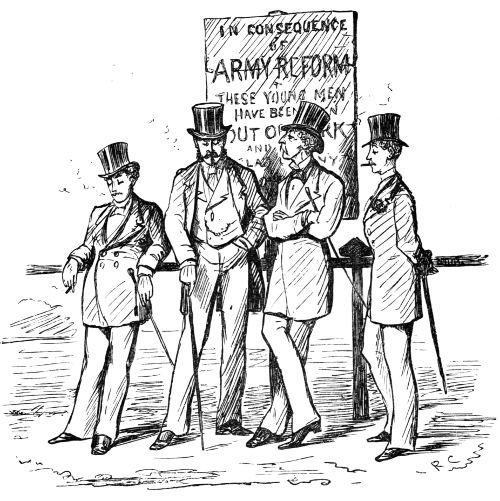
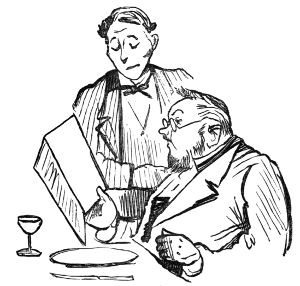
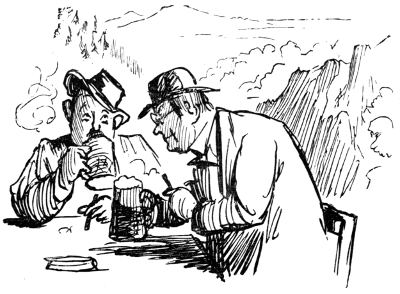
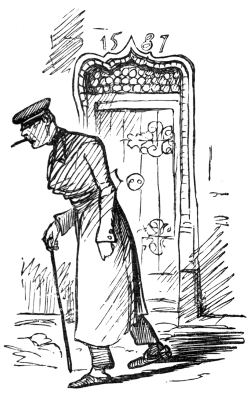
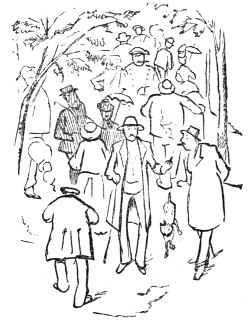
The object of this memoir is to give some information as to the early
work of Randolph Caldecott, an artist who is known to the world chiefly
by his Picture Books.
The extracts from letters have a personal charm apart from any literary
merit. The majority of the letters, and the sketches which accompanied
them, were sent to the author's family; others have been kindly lent
for this memoir by Mr. William Clough, Mr. Locker-Lampson, Mr.
Whittenbury, and other friends. Acknowledgments are also due to the
publishers who have lent engravings.
At the desire of Mr. Caldecott's representatives,—to whom the author
is indebted for extracts from diaries and other material—the
consideration of his later work is reserved for a future time.
Although the text of this book is little more than a setting for the
illustrations, it is hoped that the material collected may be found
interesting.
H. B.
103, Victoria Street, Westminster, September 1886.
Randolph Caldecott, the son of an accountant in Chester, was born in
that city on the 22nd of March, 1846, and educated at the King's
School, where he became the head boy. He was not studious in the
popular sense of the word, but spent most of his leisure time in
wandering in the country round. Thus, his love of sport and fondness
for rural pursuits, which never forsook him, were evidenced at an early
age. His artistic instincts were also early developed, and many
treasured sketches, models of animals, &c., cut out of wood, were
produced in Chester by the boy Caldecott.
Perhaps the best and most characteristic record of his early life is,
that he and his brother were "two of the best boys in the school;" the
genius that consists in "an infinite faculty for taking pains" having
much to do with his after career of success.
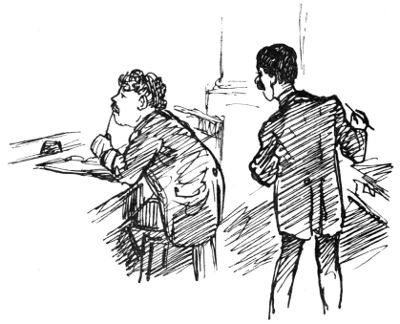
First Clerk—"Got Jones' Ledger?" Second Do. (Newly Married)—"Yes, Love!"
"Coom, then."
In 1861 Caldecott was sent to a bank at Whitchurch in Shropshire,
where, for six years, he seems to have had considerable leisure and
opportunity for indulging in his favourite pursuits. Here, living at an
old farm-house about two miles from the town, he used to go fishing
and shooting, to the meets of hounds, to markets and cattle fairs,
gathering in a store of knowledge useful to him in after years. The
practical, if half-unconscious, education that he thus obtained in his
"off-time," as he termed it, whilst clerk at the Whitchurch and
Ellesmere Bank, was often referred to afterwards with pleasure. Thus
from the earliest time it will be seen that he lived in an atmosphere
favourable to his after career. But the bank work was never neglected;
from the day he left his school in Chester in 1861 to become a clerk in
Whitchurch, until the spring of 1872 when he left Manchester finally
for London, the record of his office work was that he "did it well."
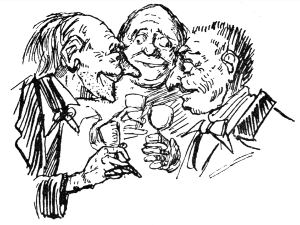
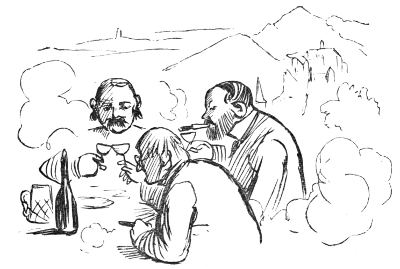
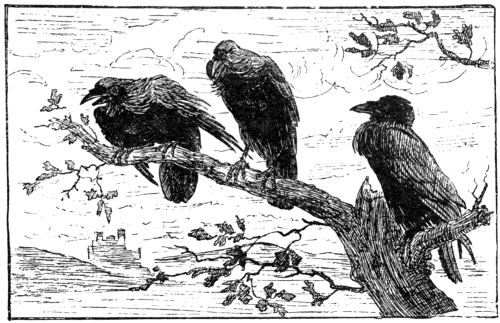
"Three Friends."
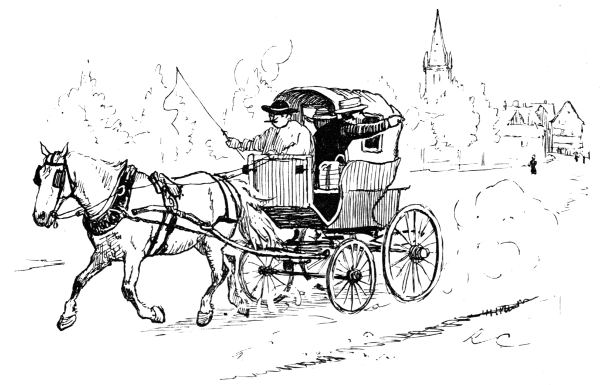
During the Whitchurch days he had, as we have indicated, unusual
advantages of leisure, and the opportunity of visiting many an old
house and farm, driving sometimes on the business of the bank, in his
favourite vehicle, a country gig, and "very eagerly," writes one of his
fellow clerks and intimate friends, "were those advantages enjoyed. We
who knew him, can well understand how welcome he must have been in many
a cottage, farm, and hall. The handsome lad carried his own
recommendation. With light brown hair falling with a ripple over his
brow, blue-grey eyes shaded by long lashes, sweet and mobile mouth,
tall and well-made, he joined to these physical advantages a gay good
humour and a charming disposition. No wonder that he was a general
favourite."
But soon he was transferred to Manchester, where a very different life
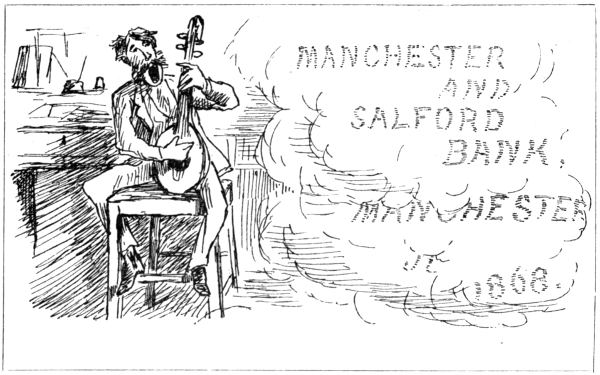
awaited him—a life of more arduous duties—in the "Manchester and
Salford Bank," but with opportunities for knowledge in other
directions, of which he was not slow to avail himself. If in his early
years his father discouraged his artistic leanings, he was now in a
city which above all others encouraged the study of art—"as far as it
was consistent with business." In the Brasenose Club, and at the houses
of hospitable and artistic friends in Manchester, Caldecott had
exceptional opportunities of seeing good work, and obtaining
information on art matters.
One who knew him well at this time, writing in the Manchester Courier
of Feb. 16th, 1886, says:—
"Caldecott used to wander about the bustling, murky streets
of Manchester, sometimes finding himself in queer
out-of-the-way quarters, often coming across an odd
character, curious bits of antiquity and the like. Whenever
the chance came, he made short excursions into the adjacent
country, and long walks which were never purposeless. Then
he joined an artists' club and made innumerable pen and ink
sketches. Whilst in this city so close was his application
to the art that he loved that on several occasions he spent
the whole night in drawing."
For five years, from 1867 to 1872, Caldecott worked steadily at the
desk in Manchester, studying from nature whenever he had the chance in
summer; and at the school of art in the long evenings, sometimes
working long and late at some water colour drawing. Caldecott owed much
to Manchester, as he often said, and he never forgot or undervalued the
good of his early training. The friends he made then he kept always,
and they were amongst his dearest and best.
In Manchester on the 3rd of July, 1868—his first drawings were
published in a serio comic paper called Will o' the Wisp; and in
1869, in another paper called The Sphinx, he had several pages of
drawings reproduced. He was painting a little at the same time, making
many hunting and other studies; they were chiefly for friends, but one
picture was exhibited at the Manchester Royal Institution in 1869.
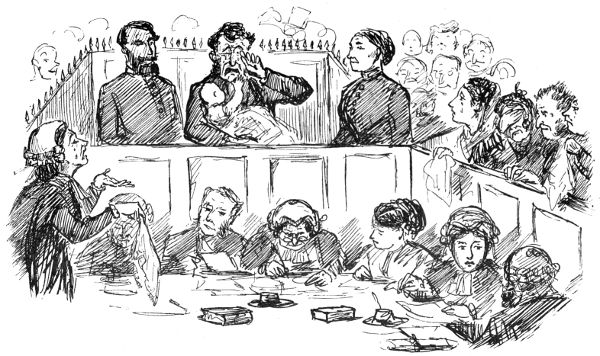
"Consider, Ladies and Gentlemen of the Jury, the sad
position in which my Client is placed—deserted by his Wife and left to
support himself and tender Infant by his own Exertions."
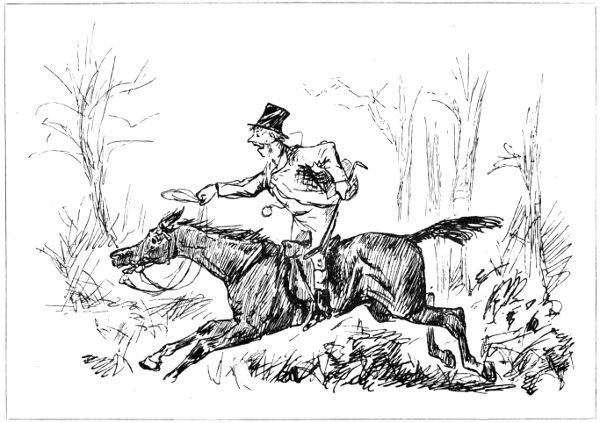
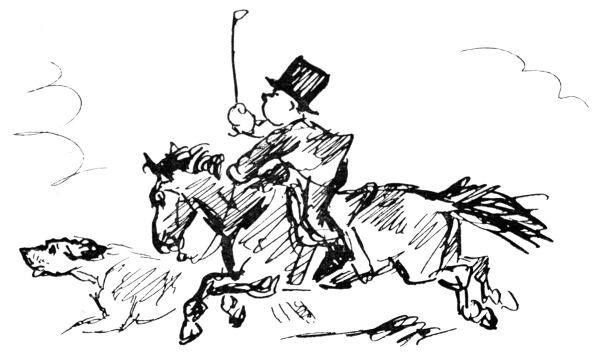
Full Cry.
"In the Hunting Field."
There was no restraining Caldecott now, his artistic bent and his
delightful humour were finding expression in sketches in odd hours and
minutes, on bits of note paper, on old envelopes, and on the blotting
paper before him at his desk, until everybody about him must have been
alive to his talent. He might no doubt have eventually attained a good
position in the bank, for, as one of his friends writes of him very
truly,
"Caldecott's ability was general, not special. It found its
natural and most agreeable outlet in art and humour, but
everybody who knew him, and those who received his letters,
saw that there were perhaps a dozen ways in which he would
have distinguished himself had he been drawn to them."
The unpublished sketches dispersed through this chapter indicate but
slightly the originality and fecundity of Caldecott's genius at this
time.
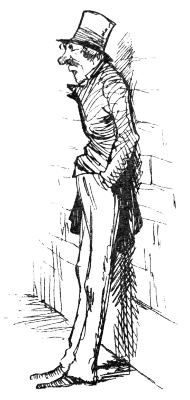
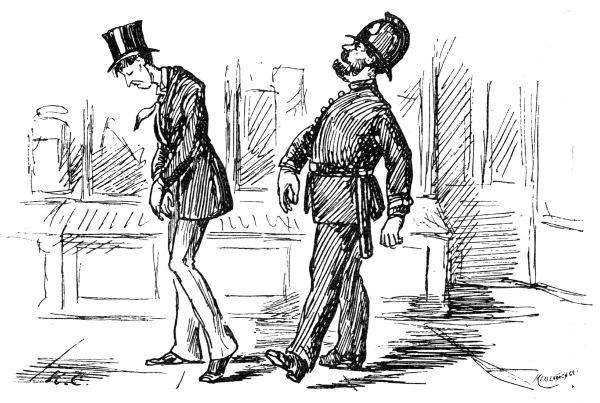
"This is not a Culprit going to gaol—it is only a
Gentleman in love who happens to be walking before a Policeman!"
There was clearly but one course to pursue—to give up commercial
pursuits and go to London—if such sketches as these were to be found
scattered amongst bank papers!
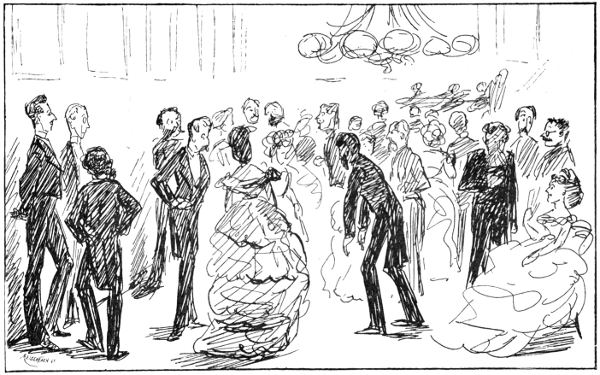
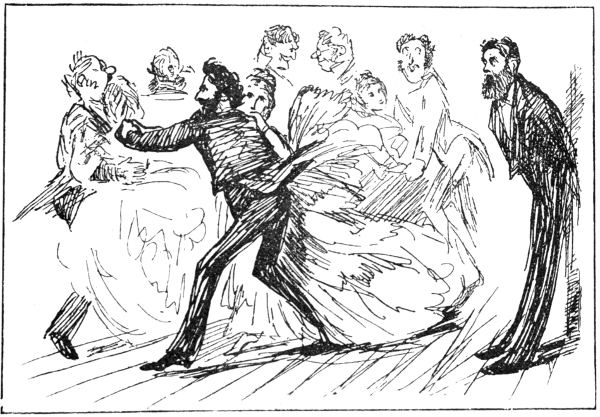
"Society in Manchester."
And so, in May, 1870, Caldecott, as his diary records, went to London
for a few days with a letter of introduction to Mr. Thomas Armstrong
from Mr. W. Slagg; and in the same year, 1870, some of his drawings
were shown to Shirley Brooks, and to Mark Lemon, then editor of
Punch. Mr. Clough thus records the event:—
"Bearing an introductory letter he went up to London on a
flying visit, carrying with him a sketch on wood and a small
book of drawings of the 'Fancies of a Wedding.' He was well
received. The sketch was accepted, and with many compliments
the book of drawings was detained.
"'From that day to this,' said Mr. Caldecott, 'I have not
seen either sketch or book.' Some time after, on meeting
Mark Lemon, the incident was recalled, when the burly,
jovial editor replied, 'My dear fellow, I am vagabondising
to-day, not Punching.' I don't think Mr. Caldecott rightly
appreciated that joke."
From this date and all through the year 1871, Caldecott was at work in
Manchester and sending to London drawings, some of which have hardly
been exceeded for humour and expression in a few lines.
"A New Contributor."
CHAPTER II. DRAWING FOR "LONDON SOCIETY."
It was in February 1871, in the pages of London Society—a magazine
which at that time included amongst its contributors J. R. Planché,
Shirley Brooks, Francis T. Palgrave, Frederick Locker, G. A. Sala,
Edmund Yates, Percy Fitzgerald, F. C. Burnand, Arthur à Beckett, Tom
Hood, Mortimer Collins, Joseph Hatton, &c.; and amongst its artists
Sir John Gilbert, Charles Keene, Linley Sambourne, G. Bowers, Mrs.
Allingham, W. Small, F. Barnard, F. W. Lawson, M.E.E., and many other
notable names—that Caldecott made his first appearance before a London
public.
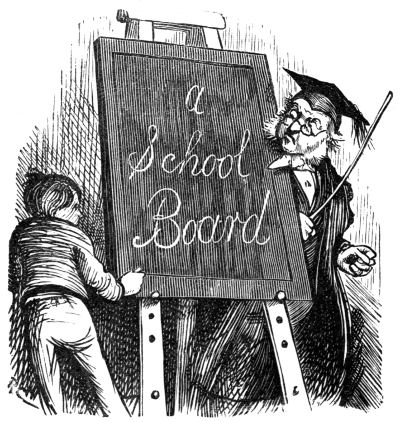
"Education under Difficulties."
On November 3rd, 1870, his diary says:—
"Some drawings which I left with A. in London have been
shown, accompanied by a letter from Du Maurier, to a man on
London Society. Must wait a bit and go on
working—especially studying horses, A. said."
From this parcel of Caldecott's drawings the present writer, being the
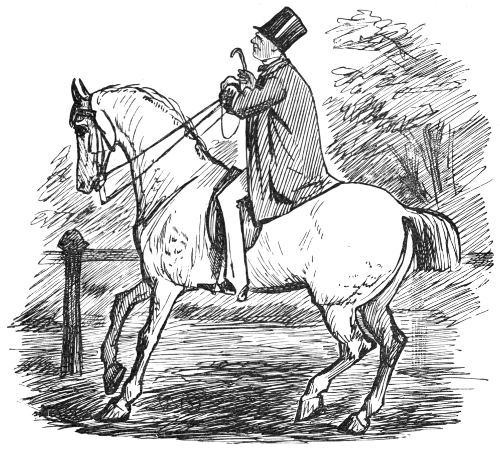
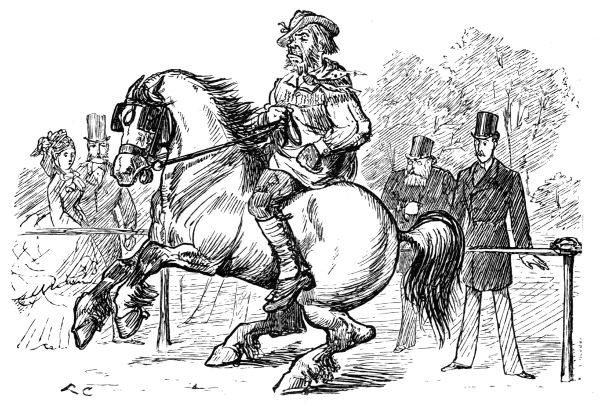
"man" referred to, selected a few to be engraved; the sketch of the Rt.
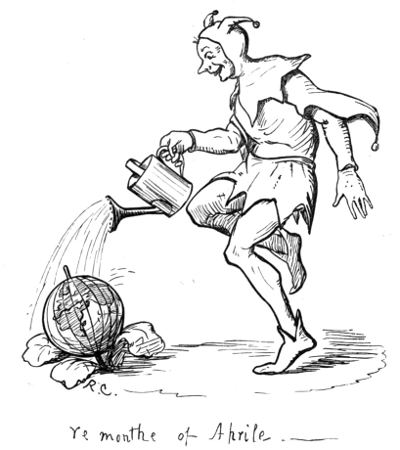
Hon. Robert Lowe on horseback in Hyde Park, on page 17, "Ye monthe
of Aprile" and "Education under Difficulties" being amongst the first
published.
Ye monthe of Aprile.
Sketch in Hyde Park—"Rotten Row."
It was suggested to him early in 1870 that he should come to London for
a short time and make sketches in Hyde Park, and it touched
Caldecott's fancy, (as he often mentioned afterwards,) that he whose
experiences were far removed from such scenes should have been chosen
as a chronicler of "Society." The sketches were made always from his
own point of view, and some were so grotesque, and hit so hard at the
aristocracy, that they were found inappropriate to a fashionable
magazine!—one especially of Hyde Park in the afternoon, called "Sons
of Toil," had to be declined by the Editor with real regret.
"A passing glimpse of a Gentleman whom I took to be the
Chancellor of the Exchequer."
The packet of original sketches lies before the writer now; the pen and
ink drawing of "The Chancellor of the Exchequer" is dated June 3rd,
1870. But the best and funniest of these early works could not be
published in a magazine.
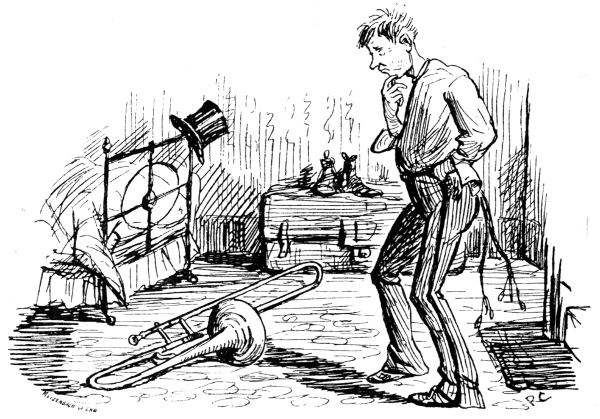
"The Trombone."
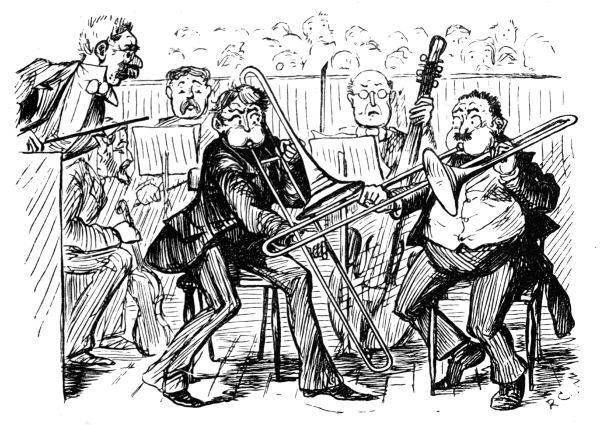
For Christmas time, 1871, Caldecott made many sketches. Two were to
illustrate a short story called "The Two Trombones," by F. Robson, the
actor. It was a ridiculous story, bordering on broad farce, depicting
the adventures of Mr. Adolphus Whiffles, a young man from the country,
who in order to get behind the scenes of a theatre undertakes to act as
a substitute for a friend as "one of the trombones," unknown to the
leader of the orchestra. His friend assures him that in a crowded
assembly "one trombone would probably make as much noise as two," and
that, if he took his place in the orchestra, he had only to "pretend to
play and all would be right."
"The Two Trombones."
In the first sketch we see him in his bedroom contemplating the
unfamiliar instrument left by his friend; in the second he is at the
theatre at the crisis when the leader of the band calls upon him to
"play in" (as it is called) one of the performers on to the stage! Mr.
Whiffles's instructions were to keep his eyes on the other trombone
and imitate his movements exactly; but unfortunately the other
trombone was a substitute also. The leader looks round, and seeing the
two trombones apparently perfectly ready to begin, gives the signal,
and the curtain rises. The dénoûment may be imagined! Other stories
were illustrated by Caldecott, about this period, in London Society;
one of Indian life, another called Crossed in Love, &c., but the
artist wished that some illustrations should not be reprinted. Several
drawings from London Society are omitted, from the same cause.
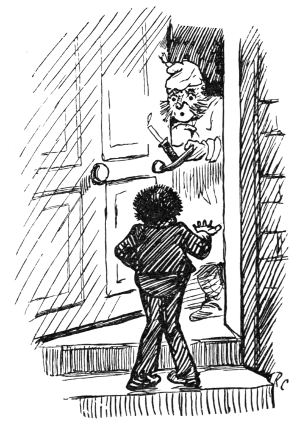
Christmas Day, 4.30 a.m.
"Please, Sir, Give me a
Christmas-box."
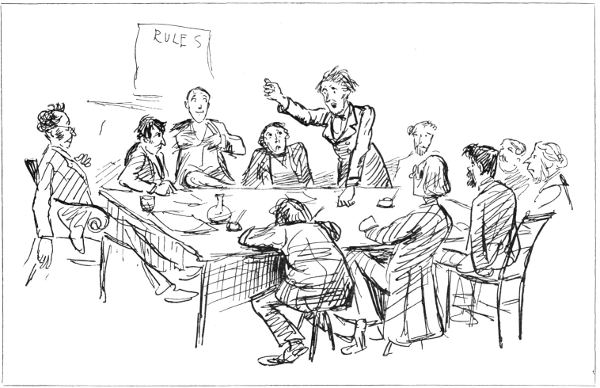
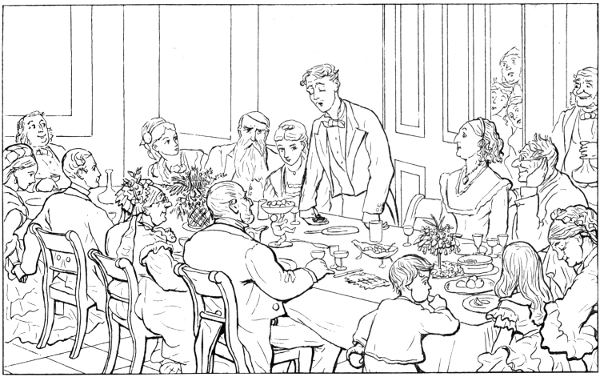
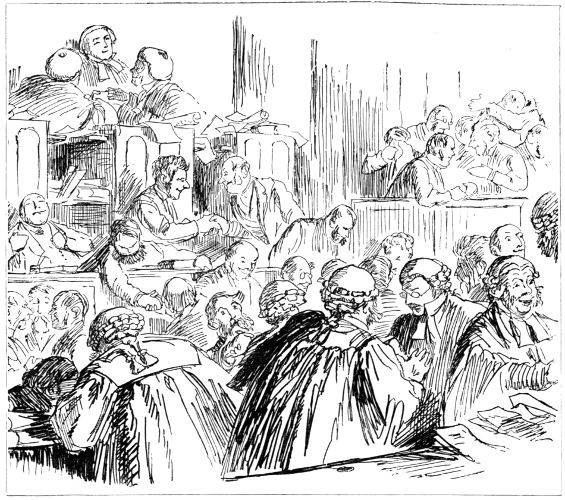
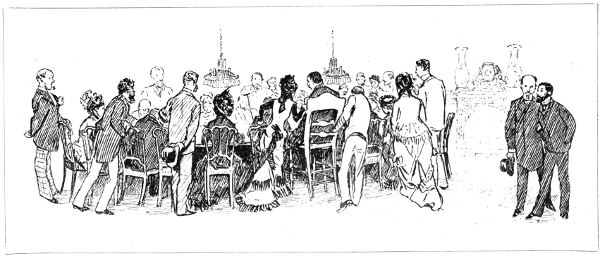
"Clinching an Argument." Sketch at a "Debating and
Mutual Improvement Society."
The freshness of fancy, not to say recklessness of style, in many of
the drawings which came by post at this time—the abundance of the flow
from a stream, the course of which was not yet clearly marked—raised
embarrassing thoughts in an editor's mind. "What to do with all the
material sent?" was the question in 1871—a question which Caldecott
was soon able to answer for himself.
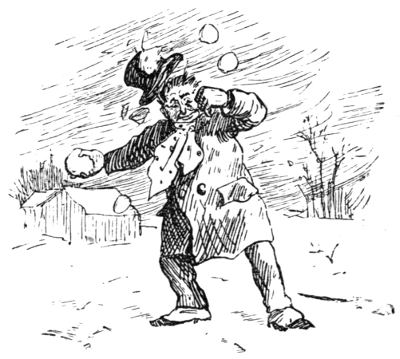
"Snowballs"
In 1871, many favourable notices appeared in the press referring to the
humorous illustrations in London Society; but the sketch of all
others which attracted attention to the work of the unknown artist was
"A Debating and Mutual Improvement Society" on page 21, a
recollection probably of some meeting or actual scene in Manchester.[1]
Here the artist was on his own ground, and the result is one of the
most rapid and spontaneous sketches in pen and ink ever achieved. It
had many of the characteristics of his later work, a lively and
searching analysis of character, without one touch of grossness or
ill-nature—fun and satire of the subtlest and the kindliest. Here was
the touch of genius unmistakable, an example of expression in line
seldom equalled.
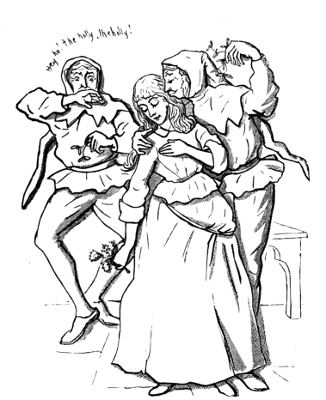
"Heigh-ho, The Holly!"
* * * * * "That's not Rosalind: oh dear no— That damsel under the misletoe, Who seems to think life jolly: And as to the gentleman there behind, He wouldn't have pluck to kiss Rosalind, Can't you fancy his 'Heigh-ho, the Holly!'" Mortimer Collins.
In an altogether different vein, drawing with pen, and a brush for the
tint,—the new artist tries his hand at illustrating one of Mortimer
Collins's madrigals called "Heigh-ho, the Holly!"
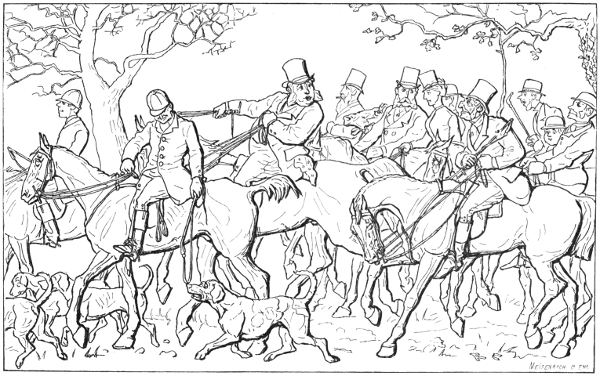
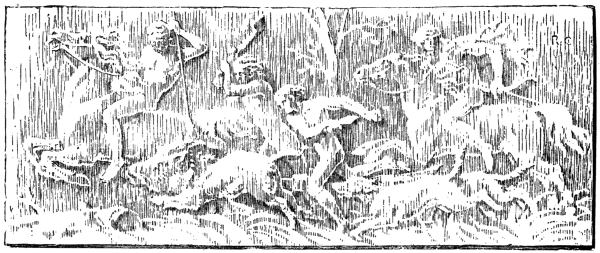
Amongst the most ambitious and interesting of Caldecott's drawings at
this time were his "hunting and shooting friezes," of which several
examples will be found in the pages of London Society for 1871 and
1872, drawn in outline with a pen; showing, thus early, much decorative
feeling and a liking for design in relief which never left him in after
years.
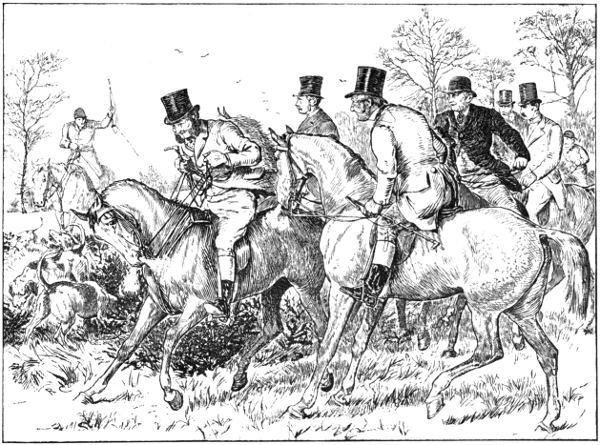
Two of the best that he did were the hunting subjects, entitled "Going
to Cover" and "Full Cry."
"Going to Cover."
"The Coming of Age of the Pride of the Family" is another example, in a
different style, of Caldecott's drawing in line at this period. It is
reproduced opposite, in exact facsimile from the pen and ink drawing in
possession of the writer.
Hyde Park—"Out of the Season."
Trivial as these things may seem now, the arrival in Manchester of the
red covers of London Society containing almost every month something
new by R. C., were among the events in the life of the young banker's
clerk which soon set the tide of his affairs towards London.
"Coming of Age of the Pride of the Family."
Referring to drawings made for the magazine after Midsummer 1872, when
Mrs. Ross Church succeeded to the editorship, Caldecott writes to a
friend:—
"Florence Marryat wants me to illustrate a novelette, very
humorous, to run through five or six numbers of London
Society, beginning in February. Engraved illustrations, no
'process.' I think I shall do them, I want coin!"
But he had soon other work in hand as will be seen in the next chapter.
"The End of all Things."
Sketch on a Post Card.
CHAPTER III. IN LONDON, THE HARZ MOUNTAINS, ETC.
Early in the year 1872 Caldecott left Manchester for London, "bearing
with him the well wishes of the Brazenose Club and of an extensive
circle of friends." This great change was not decided upon without
considerable hesitation; but, to quote again from a Manchester
letter:—
"Caldecott was greatly encouraged to take this step by the
sale of some small oil and water colour paintings at modest
prices, and by the acceptance of drawings by London
periodicals. The clinking of sovereigns and the rustling of
bank-notes became sounds of the past—the fainter the
pleasanter, so at least Caldecott thought at that time, with
energy, ardour, and the world before him."
In February and March, 1872, he was still drawing for the magazines and
illustrating short stories.
In March, 1872, he exhibited hunting sketches in oil at the Royal
Institution, Manchester.
On the 16th April he went to the Slade School to attend the Life Class
under E. J. Poynter, R.A., until the 29th June.
As this was the turning point in Caldecott's career, it should be
recorded that at this time, and ever afterwards, Mr. Armstrong, the
present Art Director at the South Kensington Museum, was his best
friend and counsellor.[2] He had also the advantage of the friendship
of George du Maurier, M. Dalou, the sculptor, Charles Keene, Albert
Moore, and others.
On the 8th June he records, "A. urged me to prepare caricatures of
people well known," probably with the view of making drawings for
periodicals.
Several drawings of Caldecott's were under consideration by the
proprietors of Punch, and on the 22nd June, 1872, the first appeared.
In the same month he exhibited a frame of four small sepia drawings at
the Black and White Exhibition, Egyptian Hall, London.
First Drawing in "Punch," 22nd June, 1872.
On the 28th June his diary records, "in the gallery of the House of
Commons attending the debate on the Ballot Bill;" and again on the 8th
July. On the 9th he is "engaged on chalk caricatures all day."
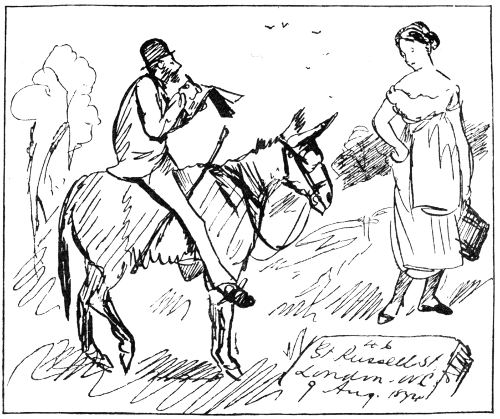
A letter dated 21st July, 1872, to one of his Manchester friends is
worth having for the ludicrous sketch accompanying it. He writes:—
"London is of course the proper place for a young man, for
seeing the manners and customs of society, and for getting a
living in some of the less frequented grooves of human
labour, but for a residence give me a rural or marine
retreat. I sigh for some 'cool sequestered spot, the world
forgetting, by the world forgot.'"
"A Cool Sequestered Spot."
About this time it was suggested to him to illustrate a book of summer
travel, and on the 20th August 1872 he enters in his diary:—
"To Rotterdam, Harzburg, &c., to join Mr. and Mrs. B. in the Harz
Mountains."
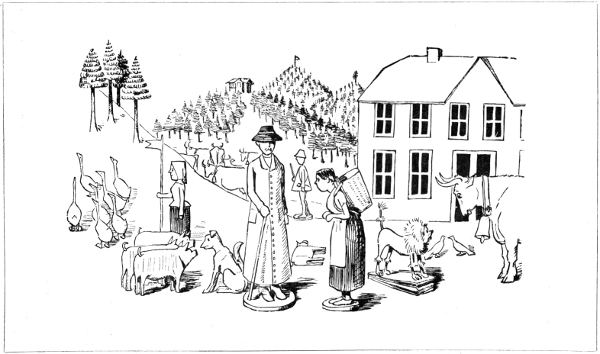
"A Tour in the Toy Country."
This was the first book that Caldecott illustrated;[3] the title
suggested was "A Tour in the Toy Country," and before leaving London
he made the drawing on the preceding page. Caldecott, being then
twenty-six, started on this journey with great readiness. The idea was
altogether delightful to him; and here, as in every country he visited
in after years, his playful fancy and facility for seizing the
grotesque side of things stood him in good stead.
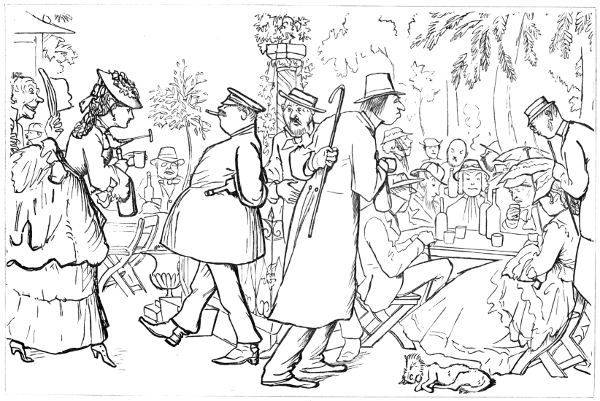
A Mountain "Beer Garden."
In a strange land, amidst unfamiliar scenes and faces, he roamed "fancy
free"; in a country so compact in size that the whole could be
traversed in a month's walking tour.
With Baedeker's Guide (English edition) in his pocket, and a dialogue
book of sentences in German and English, he used to delight to
interrogate the wondering natives; the necessary questions difficult to
find, and "the elaborate and quite unnecessary" (as he expressed it),
always turning up. Such little incidents gave opportunity to the
observant artist to study the faces of the listeners; the interviews
conducted slowly and gravely, and ending in a peal of laughter from the
natives.
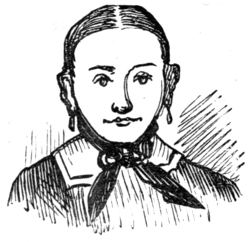
A "Fraulein."
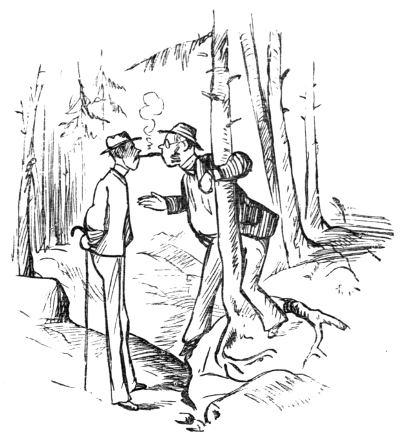
A Mountain Path.
Life at a German watering-place, as seen on a small scale in summer in
the Harz mountains, was Caldecott's first experience of scenes with
which his name afterwards became familiar in the pages of the Graphic
newspaper. In looking at these early sketches we must bear in mind that
they were made at a time when Caldecott, as an "artist," was scarcely
two years old; that although his sense of humour was overflowing, his
hand was comparatively untrained; that with his keen eye for the
grotesque he turned his back upon much that was beautiful about him,
that his sense of the fitness of things, of the requirements of
composition and the like, were in embryo, so to speak.
A Warrior of Sedan in a Beer Garden at Goslar, 1872.
Nevertheless, as indicated in the next few pages he has left us work
which, if ever a more complete life of Caldecott should be written,
would form an important chapter in his art career.
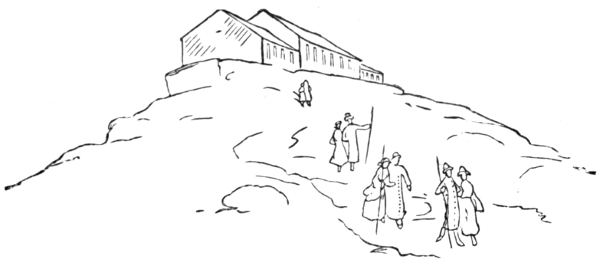
Although little fitted for a mountaineer, he could not resist
excursions to the highest points, and with a will which surmounted all
difficulties, reached one evening the summit of the famous "Brocken."
What he saw is recorded in the sketch below.
"The Ark of Refuge."
There is a legend that when the deluge blotted out man from most parts
of the earth, the waters of the northern seas penetrated far into
Germany, and that the enormous rock which forms the top of the Brocken
formed a shelter and resting-place.
There was no need of a romantic legend to suggest to the mind, at the
first sight of the primitive hostelry on the top of the Brocken, its
similitude to the "ark of refuge." The situation was delightful; we
were in the "toy country" without doubt. There was the identical form
of packing-case which the religious world has with one consent provided
as a plaything for children; there were Noah and his family, people
walking two and two, and horses sheep, pigs, and goats stowed away at
the great side door.
The resemblance was irresistible, and more attractive to Caldecott's
mind than any of the legends and mysteries with which German
imagination has peopled the district.
The Dance of Witches.
There is "no holding" Caldecott now; on the "Hexen Tanzplatz," the
sacred ground of Goethe's poetic fancy, within sound almost of the
songs of the spirit world that haunt this lonely summit, he sets to
work.
"Spectres of the Brocken."
The dance of witches, so weird and terrible, (as lately seen on the
Lyceum stage in Henry Irving's production of Faust) took a different
form in the young artist's eyes, whose fancy sketch from the Hexen
Tanzplatz is reproduced opposite. He had been properly "posted," as he
expressed it, he had read all that should be read about ghosts,
witches, and spectres, and the result is before us. The last sketch
from the dreary summit, showing the patient tourists waiting to see the
view, was all we could get from him of spectres of the Brocken.
A Sketch at Supper.
One or two sketches of the interior of his Noah's ark, when some sixty
travellers had assembled to supper, completed his subjects.
"Back to the View."
It may be noted that the feeling for landscape which Caldecott
possessed in after years in such a high degree, if it touched him
here, was not recorded in pencil. The magnificent scenery eastward
through the valley of the River Bode, the grim iron foundries and ochre
mines, and the wonderful view from the heights above Blankenberg,
familiar to all travellers in the Harz, was recorded in only two
sketches; one of a roadside inn, where we were invited to stay, the
other of two tourists en route.
The Guide at Goslar.
How, at the little wayside sheds and "drink gardens" scattered on the
mountain paths, the tourists sat persistently back to the view which
they had toiled miles to see, were depicted by the artist in pencil,
and many little incidents on the road were dotted down for future use.
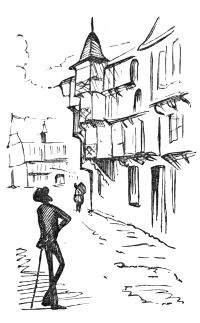
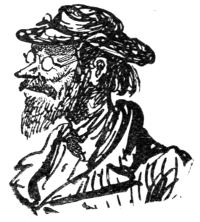
In the old tenth-century city of Goslar, Caldecott's pencil was never
at rest. Taking a guide to save time (whose portrait he gives us, with
a note of a curious sixteenth-century street door) he explores from
morning to night, choosing as subjects always "the life of the place."
Procession of the Sick.
"Drinking the waters at Goslar" in 1872 was a crude effort
artistically, which may be contrasted with his sketches of the same
scenes at Buxton in 1876, but the humour is irresistible. An extract
from our diaries is necessary here to explain the illustration.
"The figures are pilgrims, that have come from far and wide
to combine the attractions of a summer holiday with the
benefits of a wonderful 'cure' for which the city is
celebrated. The promenades and walks on the ramparts lined
with trees, are going through the routine of getting up
early, taking regular exercise and drinking daily several
pints of a dark mixture having the appearance, taste, and
effect of taraxacum or senna. The bottles are supplied at
the public gardens and cafés situated at convenient
distances in the suburbs of Goslar."
Drinking the Waters at Goslar.
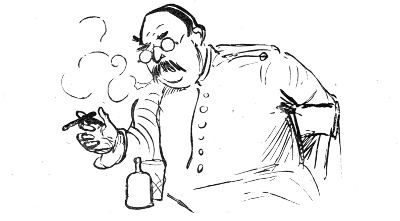
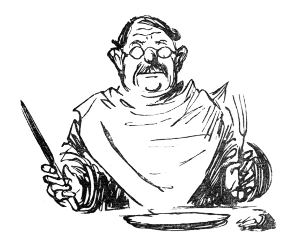
A General in the Prussian Army.
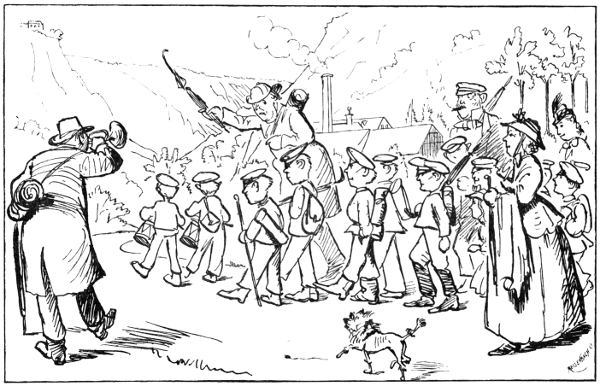
On another day he encounters a school starting for two or three days on
the mountains, the band making hideous noises as the procession passes
out of Goslar. Everything is characteristic here and full of local
colour; the order of march, the costumes and the boots of the boys, and
the general gravity of the company are given exactly—making the usual
allowance for exaggeration. In the background is seen one of the iron
factories and an indication of a bit of Harz scenery; the sketch
recalling the incident with wonderful vraisemblance. The "School on the
March" in its humour and exaggeration may remind the reader of some
drawings by Thackeray.
Here, as in Belgium, the harnessing of dogs to carts, drawing sometimes
two people over the rough cobble stones of Goslar, excited Caldecott's
pity and anger; he made several sketches of the animals and one
portrait of their master who had just got down to enjoy a pipe at the
corner of a street.
"A School on the March"—Harz Mountains, 1872.
Sketches at various table d'hôtes in hotels, public gardens and the
like, were plentiful and perpetual. But the majority were destroyed or
put away; out of fifty only one such as "A General in the Prussian
Army" (see page 44) being selected for reproduction.[4]
At Clausthal we joined a party to explore one of the iron mines, and
Caldecott gives a sketch of the preparations. A note from our diary
will best explain the situation.
"In order to descend the mines at Clausthal, visitors have to divest
themselves of their ordinary costumes and put on some cast-off suits of
ill-fitting garments left at the entrance to the mine for the purpose.
As we approach the mouth of the shaft where the miners are waiting with
lanterns to commence the descent, our party,—consisting of four
Englishmen—a professor of geology, a director of mines, an editor and
an artist—present the somewhat undignified aspect in the sketch. This
change of costume is necessary on account of the wet state of the
mines, the thick caps being a protection against loose pieces of ore
and the wet earth that falls from time to time in the galleries."
Caldecott gives the generally dismal and disreputable appearance of the
party with great verve; his own portrait is presented in a few touches
in the background, hurrying into garments much too big for him.
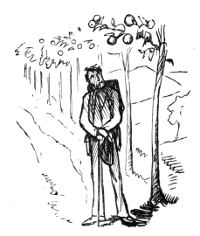
On one occasion the artist takes a solitary walk between Thale and
Clausthal, a pathway lined in some parts by rows of trees with
forbidden fruit, a novel and tempting experience. There being no
mention of this route in the guide books, he writes as he says his "own
Baedeker" in the familiar practical manner:—
"I start at 3.40 P.M. from the 'Tenpounds Hotel' at Thale to
walk up the valley of the Bode, over a wooden bridge, then
through a beer garden, round a rocky corner," &c. "The way
next through woods of beech, birch and oak; a stream can be
heard but not seen. Treseburg is reached at 5.40; a prettily
situated village by the water side; homely inn, damp beds."
"Leave Treseburg at 9.40 A.M. over a bridge on the right
bank of the Bode. Altenbrack at 10.50, Wendefurth at 11.50.
Rubeland reached at 2.30 P.M., and so on to Elbingerode,
where a halt is made for the night at the 'Blauer Engel,' a
tolerable inn. Women of burden and foresters are the only
wayfarers met with.
"The route hence south-west over high open land with fine
views to the iron works of Rothehütte in an hour. Thence up
a hill for half an hour and through dense fir woods, then
out on the high road again, resting at the 'Brauner Hirsch'
at Braunlage. From thence over hills commanding a vast
extent of country with the familiar form of the Brocken
continually in view. The road descends by easy stages
through a district full of small reservoirs and leads the
traveller in about two hours into the wide, clean, empty
streets of Clausthal."
At Clausthal.
On the 19th September, 1872, Caldecott is at work again in his rooms at
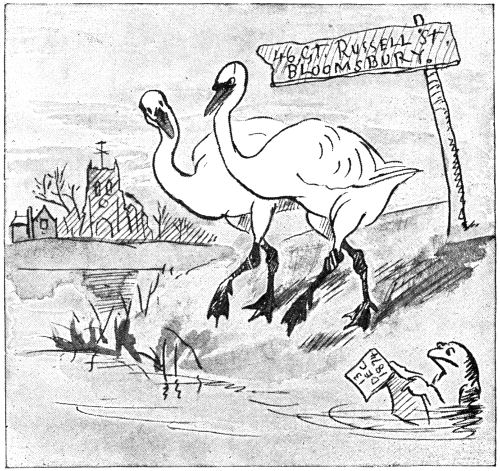
46, Great Russell Street (opposite the British Museum) arranging with
the writer for some of his Harz Mountain drawings to accompany an
article in the London Graphic newspaper. These appeared in the autumn
of 1872.
On the 18th October, the following entry appears in Caldecott's diary:
"Called at Graphic office, saw Mr. W. L. Thomas, who took my
address." This entry is interesting as the beginning of a long
connection with the Graphic newspaper which proved mutually
advantageous.
In November, 1872, the present writer went to America, taking a
scrap-book of proofs of the best of Caldecott's early drawings, a few
of which were published in an article on the Harz Mountains in
Harper's Monthly Magazine in the spring of 1873.[5] His drawings were
also shown to the conductors of the Daily Graphic, of New York, which
led to an engagement referred to in the next chapter.
During the latter part of 1872 numerous small illustrations were
produced for London Society.
Sketch in "Punch," 8th March, 1873.
CHAPTER IV. DRAWING FOR "THE DAILY GRAPHIC."
Some idea of the work on which Caldecott was engaged in 1873 and 1874,
may be gathered from extracts from his diary in those years. They are
interesting if only to show that at that early period his art studies
were varied, and that his experience was not confined to book
illustration as has generally been supposed.
In January, 1873, he made six illustrations for Frank Mildmay by
"Florence Marryatt," and on January 22nd, an "Initial for Punch."
In February—
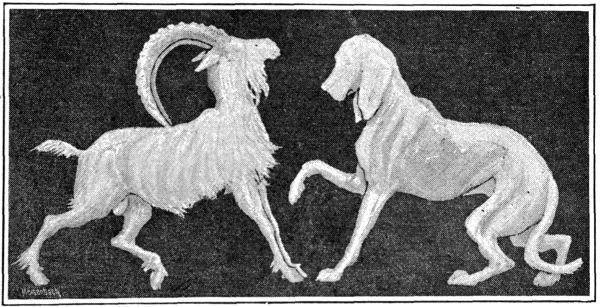
"Began wax-modelling for practice, hearing that my hunting frieze
(white on brown paper) had been successful in Manchester, and that I
should perhaps be asked to model some animals for a chimney-piece."
24th April.—"A. came to see my wax models; liked them, said I must do
something further."
Several hunting subjects were also in progress at this time. Next are
two letters to a friend in Manchester.
"46, Great Russell Street, London, W.C.,
"March 28, 1873.
"My dear ——,—The ancient Romans said, or ought to have
said, that ingratitude was the greatest of human crimes.
But, my dear fellow, I am not an ingrate. I have not
forgotten you—unless, as the poet sings, 'if to think of
thee by day and dream of thee by night, be forgetting thee,
thou art indeed forgot.' I did receive your last collected
joke, and a very good joke it was—for a Manchester joke.
I'm sorry that I have not power to use it, but it will keep,
although it will tread on some people's feelings when used.
The fact is that this same joke nearly brought me to an
untimely end. I went out hunting on the day I received it,
and at one fence and ditch I had quite enough to do to avoid
a rabbit-hole on the taking-off side and some barked boughs
of fallen timber on the landing side—not to mention some
low-hanging oak trees. Well, just when I was in the air I
thought of your joke and smiled all down one side; my
hunter—by King Tom, out of Blazeaway's dam, by
Boanerges—took the opportunity of stumbling, and, before an
adult with all his teeth could get as far as the third
syllable in 'Jack Robinson,' my nose was engaged in cutting
a furrow all across a fine grass field, some eight acres and
a half in extent, laid down after fine crops of seeds and
roots, and well boned last winter. However, in less than
half a minute (having retained possession of the reins), I
was again chasing the flying hounds.
A Check.
"About the middle of February I went down into the country
to make some studies and sketches, and remained more than a
month. Had several smart attacks on my heart, a little
wounded once, causing that machine to go up and down like a
lamb's tail when its owner is partaking of the nourishment
provided by a bounteous Nature. Further particulars in our
next—no more paper now. I hope you and —— are well, and
with kind regards, remain yours faithfully,
"R. C."
"46, Great Russell Street, London, W.C.,
"April 27, 1873.
"My dear ——,—I was delighted to receive your
letter—quite a long one for you. I hope that you had a fine
time of it at the ball. Dancing is not absolutely necessary
to a man's welfare temporally or spiritually; so if you be a
'Wobbler,' wobble away and fear not, but see that thou
wobblest with all thy might, then shall thy zeal compensate
for lack of skill. I've nearly given up gymnastics. I only
danced twenty-one times at the last ball.
"I now find that during quadrilles my mind wanders away from
the subject before it, and I am continually reminded that I
ought to be idiotically squaring away at some one instead of
cogitating with my noble back leaning against the wall. 'Sed
tempora new potater,' &c. I hope you are all well, and with
kind regards, remain yours faithfully,
"R. C."
In May he is "working in clay in low relief."
6th June.—"Began modelling mare and foal in round."
In the latter part of June, and in July, he is "at Vienna with Mr.
Blackburn," engaged on various illustrations for the Daily Graphic.
It was in the summer of 1873 that it occurred to the proprietors of the
Daily Graphic (the American illustrated newspaper referred to) that
the Gulf Stream, and the strong prevailing current of wind easterly
from the continent of America in that latitude, might be turned to
profitable account for advertising purposes. They constructed a large
balloon which hung high above the houses in Broadway for some weeks,
and announced that on a certain day the Daily Graphic balloon would
sail for Europe. The start was telegraphed to London and gravely
announced in the Times and other London papers, and every one was on
the qui vive for this new arrival in the air.
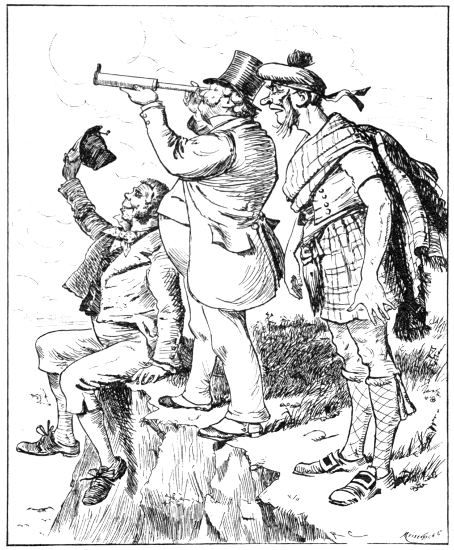
"Looking out for the 'Graphic' Balloon."
The humour and absurdity of the situation was seized at once by the
comic journals, but probably nothing that appeared at the time was more
telling than the drawing made by Caldecott at Farnham Royal for the
Daily Graphic, and published in New York as a page of that newspaper.
Other drawings followed, descriptive of various scenes in London and
England, such as a special service by Cardinal Manning at the
Pro-Cathedral in Kensington; an address by Bradlaugh at the east end of
London; a London picture exhibition; hunting in a northern county, &c.,
and Caldecott, to whom all this was a new experience, was pleased to
work for the American newspaper as "London artistic correspondent."
In this capacity Caldecott went with the writer to Vienna to the
International Exhibition of 1873, and there were sent to America
various satirical sketches, accompanying letters, notably one of the
banquet held on the 4th of July, with portraits of some well-known
American citizens. One of the most successful and life-like of the
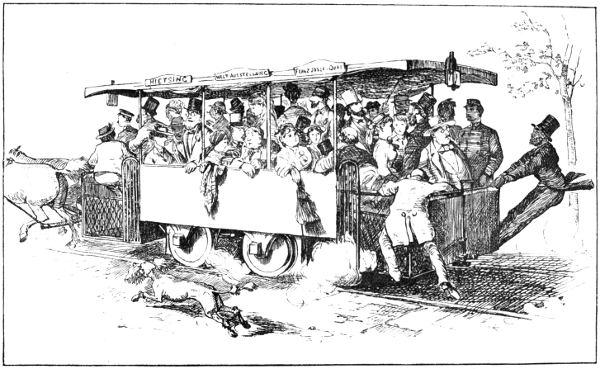
smaller sketches was a Vienna horse-car entitled—"Off to the
Exhibition," reproduced here.
Off to the Exhibition—Vienna, 1873.
The experience gained in various excursions during Caldecott's
engagement with the Daily Graphic, was most valuable to him in after
years; although as we have elsewhere said, illustrated journalism
properly so-called, was never sympathetic to him, nor would his health
have been equal to the strain of so trying an occupation. As
occasional contributor to an illustrated newspaper he was destined to
be without a rival, as the columns of the London Graphic for many
years have testified.
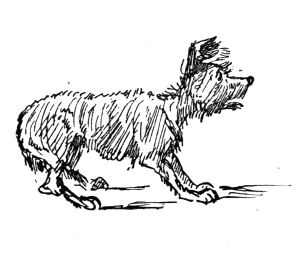
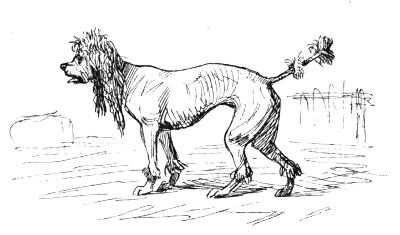
A Viennese Dog.
The humour and vivacity, the abandon, so to speak, exhibited in some
of these early drawings, form a delightful episode in his early art
career, and many will wonder, looking at the variety of movement and
expression (in the drawing of the overloaded car, for instance), that
the artist should have been amongst us so long without more
recognition. It is true that his drawings were uncertain, and that the
results of want of training were sometimes too palpable; that the
accusation made in 1872 that the editor of London Society had chosen
"an artist who could not draw a lady," could hardly be gainsaid in
1873.
The artistic interest in these drawings is great, if only from the fact
that they are amongst the few of his works drawn in pen and ink for
direct reproduction without the intervention of the wood-engraver.
Caldecott was one of the first to try, and to avail himself of, the
various methods of reproduction for the newspaper press; and in the
pages of the Daily Graphic, his facile touch and play of line was
made to appear with startling emphasis on the printed page.[6]
But after all, the humour and drollery of Caldecott's nature appears
with more unrestrained effect in the sketches on his letters to
friends, such as are scattered through this volume; the natural awe of
publication in any form having a restraining effect.
In July and August he is working "in the loose box at Farnham Royal,"
the country cottage sketched on page 90 and referred to in the
following and other letters.
"Hogarth Club, 84, Charlotte Street, Fitzroy Square, W.
"Dear ——,—The poet sings, 'Oh! have you seen her lately?'
to which I answer, 'Yes.' But, whether or no, I returned
to-day from a fortnight's sojourn in Buckinghamshire, and
the first thing I was going to do was to write to you and
say that I have no acquaintance with the happy medium who
resides in my very old rooms in Great Russell Street. I have
left those rooms, and am a wanderer and an Ishmaelite. I
dare not take those rooms when she leaves. I called at the
house just now and found another note from you. I had a good
look at Europe during my Vienna expedition. I was away a
month and saw many towns, and conversed with many peoples
and tongues. I could say much, but will defer till we meet
over the flowing bowl. Since I came back I have been staying
with a friend at Holborn Circus, and also with some friends
at Farnham Royal, near Slough, a lovely country place. There
I have been working off some sketches of Vienna and England
for the use of the neighbouring country of America. But I
could not help being interrupted. Fancy a being like this
bobbing about! Howsomedever, I am again in town at Bank
Chambers, Holborn Circus, E.C., where I may be consulted
daily. Please observe signature on the box, without which
none others are genuine, post free for thirteen stamps. So
you see that I have had a seven weeks' delightful mixture of
toil and pleasure, and ought now to have a bout of toil
only. There is a book waiting to be illustrated.
"R. C."
In the same month (August 1873), he went with a letter of introduction
to Dalou, the French sculptor, then living in Chelsea. Of this
interview he writes, "M. Dalou very kind in hints, showing me clay,
&c." A friendship followed, cemented in the first instance by a
bargain that Caldecott should come and work at the studio and teach the
sculptor to talk English, whilst Dalou helped him in his modelling!
Caldecott profited by the arrangement, and often spoke in after years
of the value of Dalou's practical teaching. Many visits were paid to
the sculptor's studio in the year 1873.
Early Decorative Design, the Property of G. Aitchison,
A.R.A.
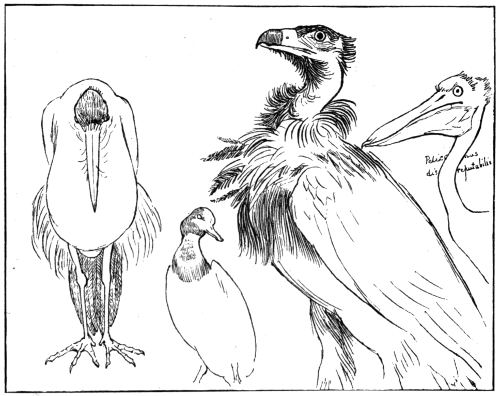
In the intervals of work Caldecott also made life studies at the
Zoological Gardens in London, and anatomical studies of birds.
In September he made a drawing of Mark Twain lecturing in London, for
the Daily Graphic, and in October records the purchase by Mr. G.
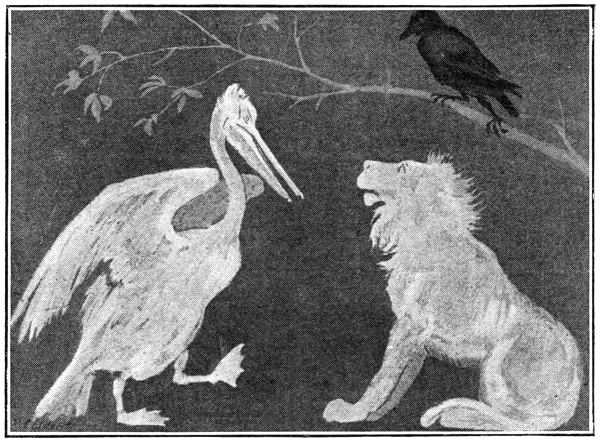
Aitchison, the architect, of a cast of his "first bas relief," a
hunting subject; also of "two brown paper pelican drawings," one
reproduced on the last page.
In November he writes the following to a friend in Manchester:—
"46, Great Russell Street, W.C.,
"November 16, 1873.
"Dear ——,—I have nothing to say to you—nothing at all.
Therefore I write. I don't like writing when I have aught to
say, because I never feel quite eloquent enough to put the
business in the proper light for all parties. Having a love
and yearning for Bowdon and Dunham, and the 'publics' which
there adjacent lie, I think of you on these calm Sunday
evenings about the hour when my errant legs used to repose
beneath the deal of the sequestered inn at Bollington. How
are you? I was pleased to see that the Athenæum gave a
long space to your book, although I presume you did not care
for the way they reviewed it. That is nothing. I have been
very busy—not coining money, oh no!—but occupied, or I
should say have descended into the country, during last
month. 'Graced with some merit, and with more effrontery;
his country's pride, he went down to the country.' My summer
rambles shall be talked of, and the wonderful works in the
regions of art shall be described when next I see you. Till
then, farewell! This short letter is like a call.—Yours, R.
C."
The last entry of interest in his diary in 1873, is on December 3rd.
"To Graphic office, saw Mr. Thomas. Fixed that I should go
down to Leicestershire next week for hunting subjects."
"This is not a First-class Cow."
Studies for a Large Decorative Design, 1874.
CHAPTER V. DRAWING FOR "THE PICTORIAL WORLD," ETC.
Let us now glance at Caldecott's diary for 1874, which, with his
letters to friends and the sketches which so often accompanied them,
give an insight into the character of his work at this time. It is
altogether an extraordinary record.
On the 14th of January, 1874, he is "working in the afternoons,
sketching swans at Armstrong's." This was part of a large decorative
design which he afterwards assisted in painting (see illustration on
page 89).
On the 23rd January, 1874, is an interesting note.
"J. Cooper, engraver, came and proposed to illustrate, with
seventy or eighty sketches, Washington Irving's Sketch
Book. Went all through it and left me to consider. I like
the idea."
In February he completed a drawing of the Quorn Hunt for the Graphic
newspaper.
On the 12th March, he enters in his diary, "Preparing sketch of choir
for W. Irving's Sketch Book;" showing that he was already at work on
the book which was to make his reputation.
At the same time he was preparing illustrations and trying new
processes of drawing for reproduction, to aid in founding a new
newspaper.
How far Mr. Caldecott was ready to conquer difficulties in his art, and
how heartily he aided his friends in any project with which he was
connected, are matters of history closely connected with his engagement
on the Pictorial World, which had a bright promise for the future in
1874.
Some of the large illustrations were produced by Dawson's "Typographic
Etching" process. The drawings were made with a point on plates covered
with a thin coating of wax, the artist's needle, as in etching,
removing the wax and exposing the surface of the plate wherever a line
was required in relief—"a fiendish process!" as Caldecott described
it, but with which he succeeded in obtaining excellent results—better
than any artist previously.
On the 7th of March, 1874, a new illustrated newspaper called the
Pictorial World was started in London, of which the present writer
was the art editor.
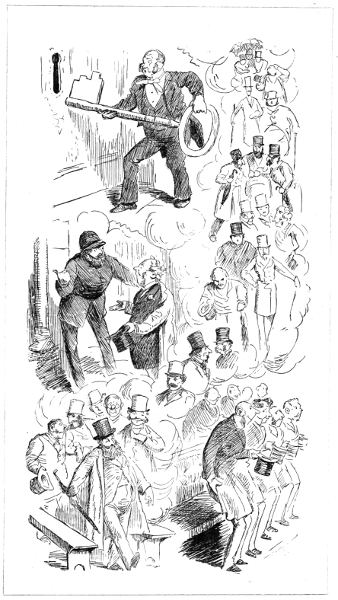
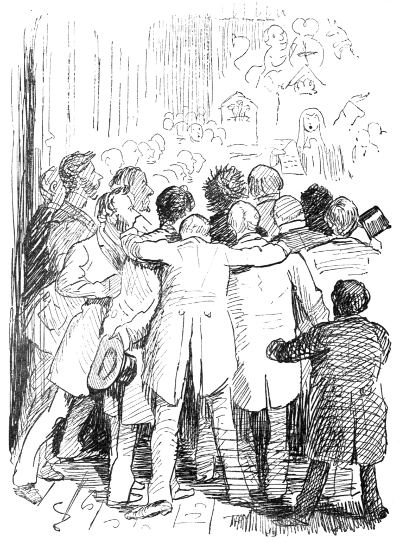
It was the time of the general election of 1874, when the defeat of Mr.
Gladstone, the question of "Home Rule," and many exciting events were
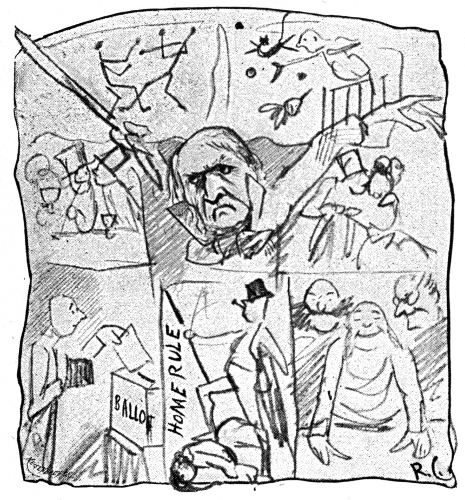
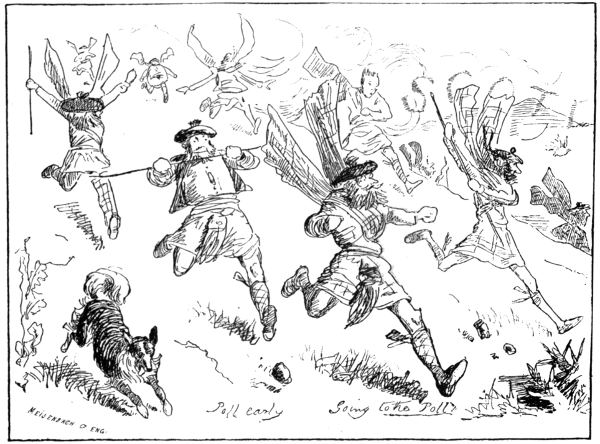
being recorded in the newspapers. Caldecott was asked to make a cartoon
of the elections, and at once sat down and made the pencil sketch
overleaf.
For some reason this drawing was not completed; but instead, a group of
various election scenes was drawn by him and appeared in the Pictorial
World.
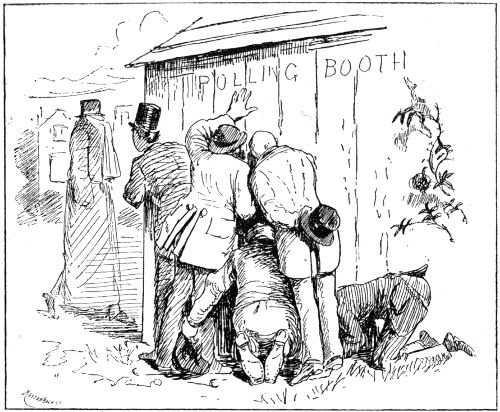
The Polling Booth.
There were numerous sketches combined on one page, three of which are
reproduced here. The illustrations on pages 70, 72, 80, 81, 82, and
84 were drawn (generally under great pressure of time) with an
etching needle on Dawson's plates. This was the beginning of what are
now familiarly known as "process" drawings in newspapers, but the
system of photographic engraving, now largely used, was not then
perfected. In 1874 it would have been impossible to reproduce rapidly
in a newspaper, either the delicate lines of a pen and ink sketch, or
such a pencil drawing as that given above.
Home Rule—March 1874.
Facsimile of pencil sketch for the Pictorial World.
Caldecott rendered valuable assistance at this time, and the early
numbers of the paper are worth having if only for the reproduction of
his work. It is not generally known how many of the large illustrations
in the Pictorial World were by his hand, or how much he was
identified with the publication in the first days of its career.
"On the Stump."
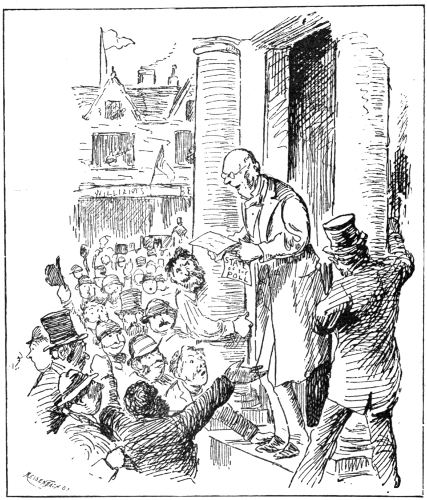
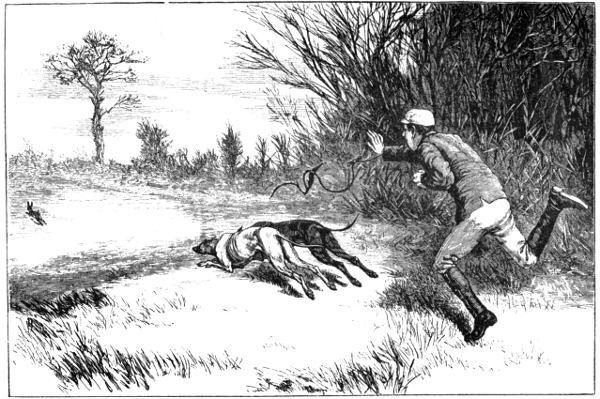
Amongst the best illustrations by Caldecott for the newspaper at that
period were sketches and studies that he had made for pictures,
selected from his studio; such for instance as "Coursing," "Somebody's
Coming," and the "Morning Walk," on pp. 75, 77, and 86. The latter
design was not drawn specially for the Pictorial World, but Caldecott
made a drawing of it for the paper, which appeared in the number for
18th July, 1874.
The Scotch Elections—"Going to the Hustings."
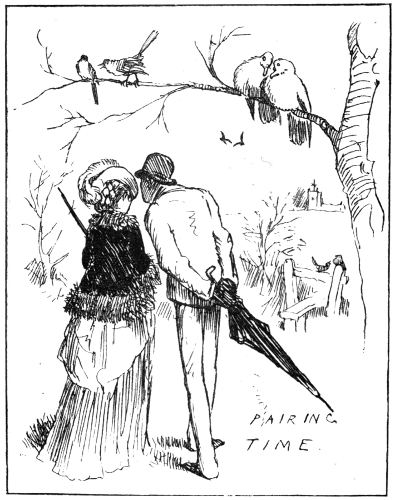
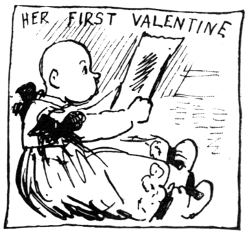
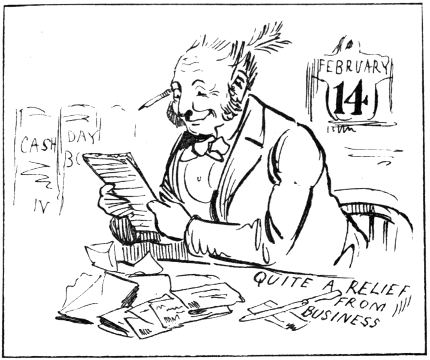
From a bundle of sketches (some very pretty) of subjects connected with
Saint Valentine, he made a page for the same paper. These again, may
seem small matters to record, but they are facts in the history of a
life teeming with interest, and show that Caldecott's talent as an
illustrator was revealed in 1874; that he was "invented," as the saying
is, long before the publication of Washington Irving's Sketch Book.
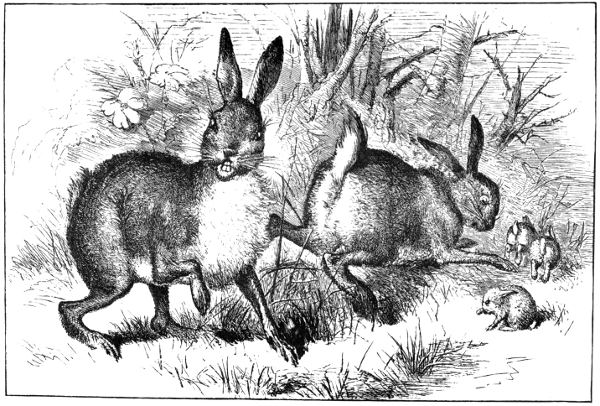
Pairing Time
Coursing.
Her First Valentine
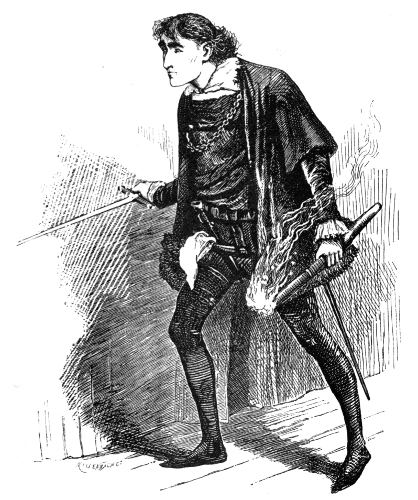
On the 31st of October, 1874, Mr. Henry Irving made his first
appearance in London as Hamlet, one of those occasions on which the
theatre was crowded with critics and well-known personages. Caldecott,
altogether inexperienced in such work, made several rough sketches,
seizing the grotesque side "as far as he dared" as he said.
A Valentine.
The trying nature of that performance, and the flitting about on the
stage of the nervous anxious figure, with the ever-present white
pocket-handkerchief in his belt—will be remembered by many. Caldecott
made the best sketch that he could from the left side of the
dress-circle, the only position in the house that could be obtained for
him.
"Somebody's Coming!"
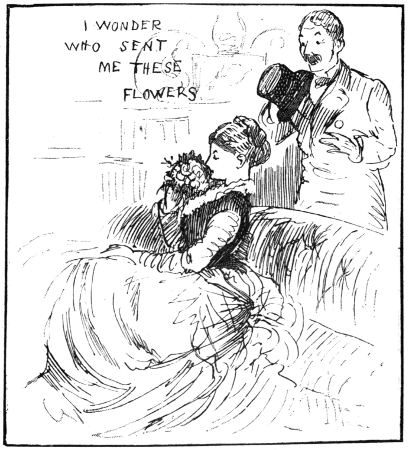
I Wonder Who Sent Me These Flowers
"The Young Hamlet."
In company with the writer, Caldecott made various sketches in the
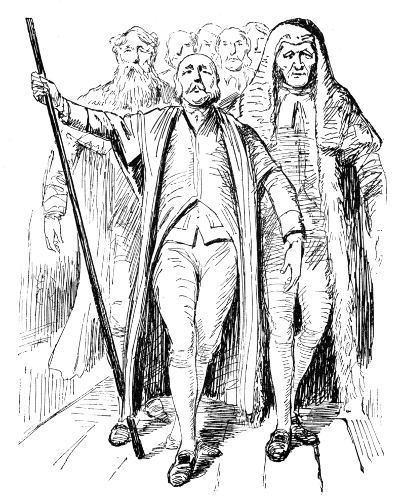
House of Commons, the Law Courts, the theatres, and the like. The first
three sketches of the House of Commons—one showing "The Arrival of the
New Members," another, "The Speaker going up to the Lords," and a
third, "At the Bar of the House of Lords"—were amongst the funniest of
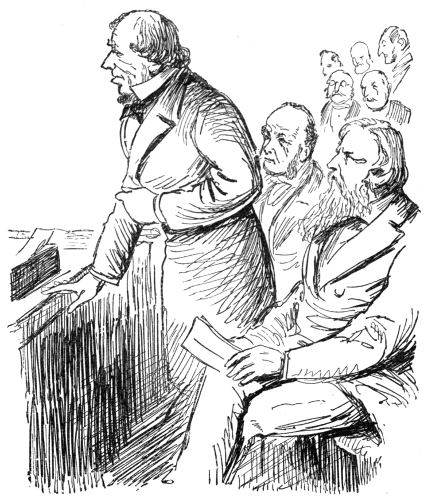
the series. Others followed from week to week, such as "The new Prime
Minister," on page 83. On one occasion he went down to Westminster
Hall to see the Rt. Hon. Benjamin D'Israeli enter the House of
Commons as the new prime minister, and to a large illustration
showing the north door of Westminster Hall (the architecture drawn by
Mr. Jellicoe), he added the figures, a grotesque group of bystanders,
presumably Conservatives, welcoming their new representative. (See the
Pictorial World, March 7th, 1874.)
House of Commons, March 1874—Arrival of New Members.
"The Speaker going up to the Lords."
"At the Bar of the House of Lords."
It was an exciting time politically and socially, and many events of
interest had to be recorded. Amongst them the conclusion, amidst
general rejoicing, of the great Tichborne Trial on March 2nd, 1874, a
trial which had lasted 188 days. This was an opportunity for the
artist. Caldecott's original sketch of this subject, if it is in
existence, should be treasured; some idea of the humour of it may be
gathered from the drawing overleaf which was crowded into the corner of
the newspaper. He also made a highly grotesque and artistic model in
terra-cotta of the Tichborne Trial, now in the possession of Mr.
Stanley Baldwin of Manchester.
"The New Prime Minister."
About this time, Caldecott went to the "farewell benefit" of the late
Benjamin Webster and sketched the actor—surrounded by members of his
company—making his final bow to the public.
The Tichborne Trial—"Breaking-up Day."
On the eighteenth birthday, the "coming of age," of the late Prince
Imperial of France, Caldecott went to Chislehurst. The drawing of the
crowd on the lawn of Camden House in a state of general
congratulation, the ceremony of presentation of enormous bouquets of
violets and the like; of Frenchmen and their wives, of diplomatists,
and others, will be found in the Pictorial World for March 21st,
1874.
Here was a comparatively unknown artist at work, revealing talent which
in after years would delight the world.
But fortunately for his health and peace of mind, and also for his
future career, the young artist, who two years before had given up a
clerkship in a Manchester bank (a "certainty" of more than £100 a
year), was advised to refuse an engagement on the Pictorial World of
£10 10s. a week, which, had it been carried out, would have done much
to raise the fortunes of that newspaper.
But the rush and hurry of journalistic work was distasteful to him; he
had many commissions at this time, work of a better kind, requiring
quiet and study. He was willing, and wishing always, to aid his
friends, and so for some time he kept up a connection with the paper
and made sketches on special occasions.
The Morning Walk.
His health was delicate, but he was not suffering as in later years;
his spirits were overflowing, and his kindliness and personal charm had
made him friends everywhere.
On the 10th of April he enters in his diary—"At Armstrong's all day.
Began to paint pigeons on canvas panel. Looking at pigeons in British
Museum quadrangle;" and on the 11th again, "painting pigeons."
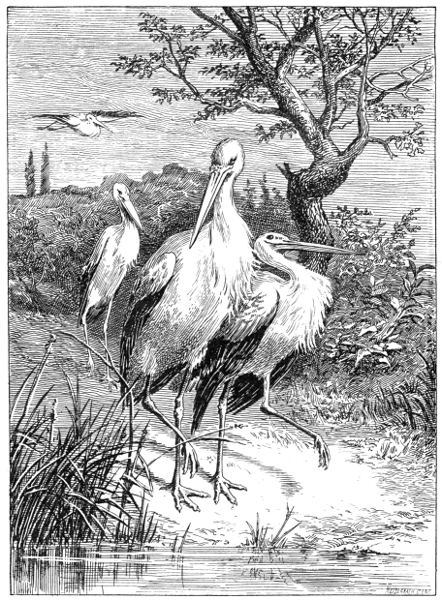
On the 15th of April he is "making a drawing of storks, &c.," and on
the 17th, 21st, and 22nd, "painting swans at Armstrong's all day."
On the 23rd of April he enters: "Bas-relief hunting scene going on,"
and on 24th, "painting storks and pigeons," and on 28th, "swans."
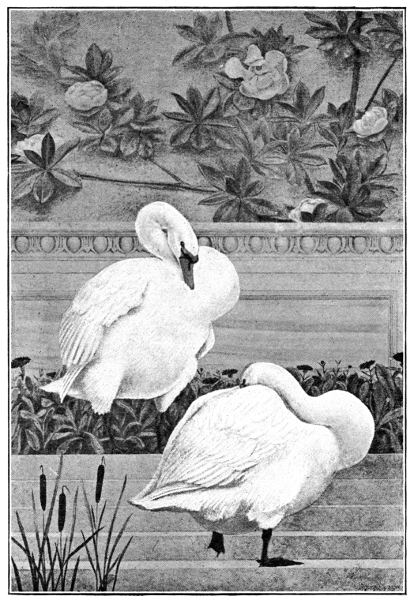
The painting of swans, storks, and pigeons, referred to above, was very
important work for Caldecott. In conjunction with his friend Mr.
Armstrong, he painted the birds in two panels, one of swans (reproduced
overleaf), and one of a stork and magpie. These panels were about six
feet high, and form part of a series of decorations in the dining-room
of Mr. Henry Renshawe's house at Bank Hall, near Buxton, Derbyshire.
The series of decorative paintings (by Thomas Armstrong) which included
these panels, was exhibited at Mr. Deschamps' Gallery in New Bond
Street in 1874, and attracted much attention at the time. The birds
showed to great advantage, and will remain in the memory of many as
amongst the most vigorous and effective of Caldecott's paintings in
oils. They showed, thus early, a mastery of bird form and a power in
reserve of an unusual kind.
"I have paid a little attention to decorative art," he writes to a
friend at this time; besides being "at work on the Sketch Book," the
results of which will be seen in the next chapter.
Decorative Painting for a Dining-room.
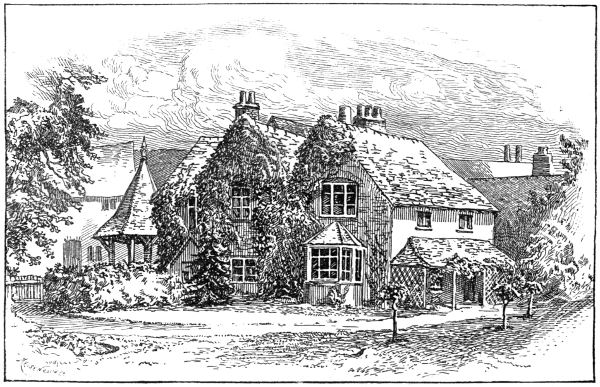
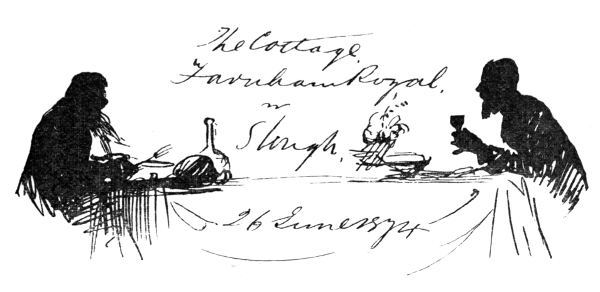
"The Cottage," Farnham Royal.
CHAPTER VI. FARNHAM ROYAL, BUCKS.
During the summers of 1872, 1873, and 1874, Caldecott stayed often at a
cottage belonging to the writer, three miles north of Slough, in
Buckinghamshire, in the picturesque neighbourhood of Stoke Pogis and
Burnham Beeches.
A "loose box" adjoining the stable—a few yards to the right of the
little verandah in the above sketch—had been fitted up for him by
friendly hands; and it was here in this temporary studio, in the quiet
of the country, looking out on woods and fields, that he made many of
the drawings for Old Christmas.
Several entries in Caldecott's diary in 1874 mention that in June and
July he was "working in the 'loose box' at Farnham Royal, on the
Sketch Book."
Those were happy, irresponsible days, before great success had tempered
his style, or brought with it many cares. Take the following letter
(one of many) written in the full enjoyment of the change from lodgings
in London:—
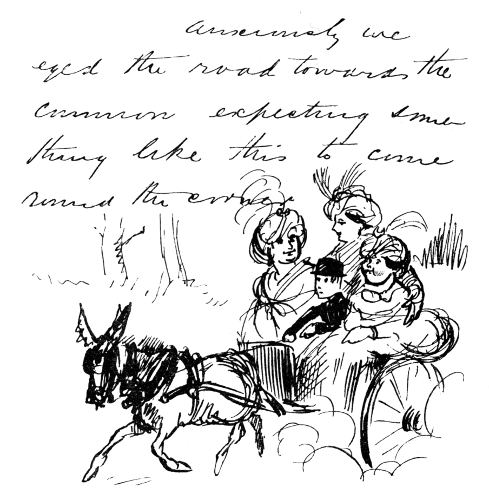
"We are passing a calm and peaceful existence here and were
therefore somewhat startled the other day, when Sharp asked
for the cart and donkey to take to the common for the
purpose of bringing us a few Sultanas. We stroked our
beards, but as Sharp seemed bent upon the affair reluctantly
consented."
[The boy Sharp attended to the wants of Caldecott and his friend L.,
and wanted to make a pudding. The end of the letter is reproduced in
facsimile.]
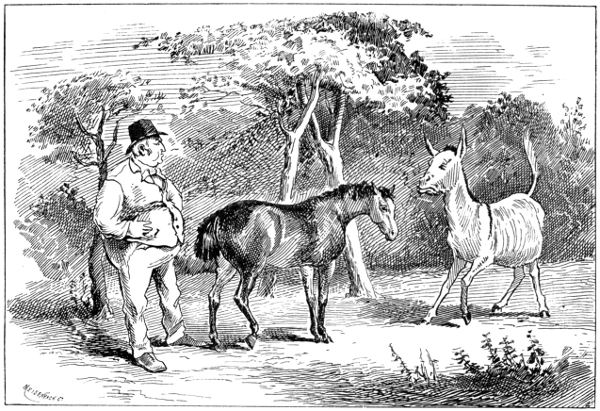
The Paddock, Farnham Royal.
The illustration on the last page is a copy of a water-colour sketch
made from "the loose box" at Farnham Royal. It depicts the arrival of a
pony at the cottage and consequent disgust of the donkey at the
intrusion. The old man—who combined the various offices of gardener,
groom, and parish clerk—stood unconsciously as a model for several
drawings in Old Christmas.
From Farnham Royal he writes at another time to a friend:—
"We are fast drifting into a vortex of dissipation—eddying
round a whirlpool of gaiety; but I hope that through all,
our heads will keep clear enough to guide the helms of our
hearts."
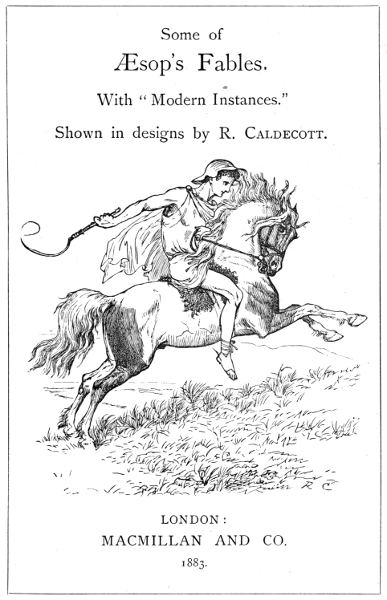
About this time it was suggested to Caldecott to make studies of
animals and birds, with a view to an illustrated edition of Æsop's
Fables, a work for which his talents seemed eminently fitted. The idea
was put aside from press of work, and when finally brought out in 1883
was not the success that had been anticipated. This was principally
owing to the plan of the book.
"Studying from Nature."
As Caldecott's Æsop was often talked over with the writer in early
days, a few words may be appropriate here. Caldecott yielded to a
suggestion of Mr. J. D. Cooper, the engraver, to attach to each fable
what were to be styled "Modern Instances," consisting of scenes, social
or political, as an "application." Humorous as these were, in the
artist's best vein of satire, the combination was felt to be an
artistic mistake. That Caldecott was aware of this, almost from the
first, is evident from a few words in a letter to an intimate friend
where he says:—
"Do not expect much from this book. When I see proofs of it
I wonder and regret that I did not approach the subject more
seriously."
Circumstances of health also in later years interfered with the
completion of what might have been his chef d'œuvre.
In the following letter to a friend in Manchester (headed with the
above sketch) he refers modestly to his drawings for Old Christmas,
on which he was now busily engaged.
Art is Long, Life is Short.
"My dear ——,—It is so long since I have heard from you
that I have concluded that you must be very flourishing in
every way. No news being good news, and no news lasting for
so long a time, you must have a quiver full of good things.
How is ——? The woods of Dunham? The gaol of
Knutsford?—the vale of Knutsford, I mean. A fortnight ago,
when all the ability were leaving town, I returned from a
six weeks' pleasant sojourn in Bucks, at Farnham Royal. I
was hard at work all the time, for I have been very much
occupied of late, you will be glad to hear, I know. In
process of time, and if successful, I will tell you upon
what. I wish I had had a severe training for my present
profession. Eating my dinners, so to speak. I have now got a
workshop, and I sometimes wish that I was a workman. Art is
long: life isn't. Perhaps you are now careering round
Schleswig or some other-where for a summer holiday. I shall
probably go to France next month for a business and pleasure
excursion. Let me hear from you about things in general or
in particular—a line, a word will be welcome. I hope you
are all well; and with kind regards remain
"Yours faithfully,
"R. C."
It is clear from the above letter that Caldecott was conscious of the
great change that was coming in his work in 1874. The suggestions of
his friends that he should draw continually from familiar objects, and
the hints he received from time to time that he "could not draw a
lady," are ludicrously illustrated in two sketches to a Manchester
friend who watched the progress of the artist with lively interest.
"Drawing from Familiar Objects."
"Could not draw a Lady!"
But in spite of his moving laughter, the period referred to in this
chapter was the most serious and eventful in Caldecott's career; when
a sense of beauty and fitness in design seemed to have been revealed to
him, as it were, in a vision, and when his serious studies seemed to be
bearing fruit for the first time; when he felt, as he never felt
before, the responsibilities of his art and the want of severe training
for his profession. Then—but not till then—did the lines of Punch
"On the late Randolph Caldecott," written in February 1886, apply
exactly:—
"Sure never pencil steeped in mirth So closely kept to grace and beauty." * * *
CHAPTER VII. "OLD CHRISTMAS."
The "new departure" which Caldecott made in the summer of 1874 will be
seen clearly marked in the next few pages, where, with the permission
of the publishers, we have reproduced some characteristic drawings from
Old Christmas.
"There was issued in 1876 by the Messrs. Macmillan" (writes
Mr. William Clough, an old and intimate friend of Caldecott)
"a book with illustrations that forcibly drew attention to
the advent of a new exponent of the pictorial art. These
pictures were of so entirely new a nature, and gave such a
meaning and emphasis to the text, as to stir even callous
bosoms by the graceful and pure creations of the artist's
genius. Washington Irving's Old Christmas was made alive
for us by a new interpreter, who brought grace of drawing
with a dainty inventive genius to the delineation of English
life in the last century."
It is not generally known that the drawings for Old Christmas, one
hundred and twelve in number, were all made in 1874; and there is a
marked alteration in style during the progress of this book, such as,
for example, between the drawing of "The Village Choir" (commenced in
March 1874), and the portrait of "Master Simon," placed opposite to
each other on pages 96 and 97 of the first edition of Old Christmas.
The humour is more robust, but never in after-work was more delightful,
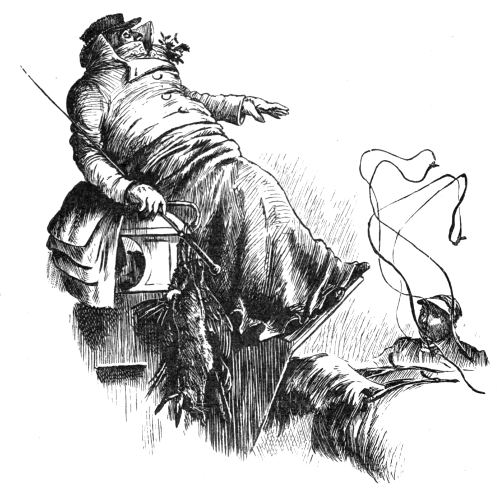
than in his rendering of the typical stage coachman. Until these
illustrations came it had been said that Washington Irving's coachman
stood out as a unique and matchless description of a character that has
passed away.
"In the course of a December tour in Yorkshire," writes
Washington Irving, "I rode for a long distance on one of the
public coaches on the day preceding Christmas."
Three schoolboys were amongst his fellow-passengers. "They
were under the particular guardianship of the coachman to
whom, whenever an opportunity presented, they addressed a
host of questions, and pronounced him one of the best
fellows in the world. Indeed I could not but notice the more
than ordinary air of bustle and importance of the coachman,
who wore his hat a little on one side and had a large bunch
of Christmas green stuck in the button-hole of his coat.
"Wherever an English stage coachman may be seen he cannot be
mistaken for one of any other craft or mystery. He has
commonly a broad full face, curiously mottled with red, as
if the blood had been forced by hard feeding into every
vessel of the skin; he is swelled into jolly dimensions by
frequent potations of malt liquors, and his bulk is still
further increased by a multiplicity of coats in which he is
buried like a cauliflower, the upper one reaching to his
heels. He wears a broad-brimmed low-crowned hat; a huge roll
of coloured handkerchief about his neck, knowingly knotted
and tucked in at the bosom, and has in summer-time a large
bouquet of flowers in his button-hole, the present most
probably of some enamoured country lass. His waistcoat is
commonly of some bright colour, striped; and his small
clothes extend far below the knees to meet a pair of
jockey-boots which reach about halfway up his legs.
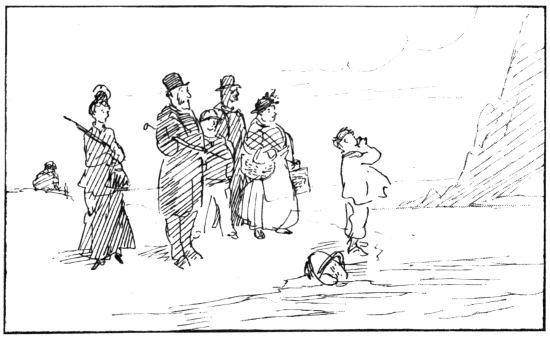
The Stage Coachman.
"All this costume is maintained with much precision; he has
a pride in having his clothes of excellent materials; and
notwithstanding the seeming grossness of his appearance,
there is still discernible that neatness and propriety of
person which is almost inherent in an Englishman. He enjoys
great consequence and consideration along the road; has
frequent conferences with the village housewives, who look
upon him as a man of great trust and dependence; and he
seems to have a good understanding with every bright-eyed
lass. The moment he arrives he throws down the reins with
something of an air, and abandons the cattle to the care of
the ostler; his duty being merely to drive from one stage to
another. When off the box his hands are thrust in the
pockets of his greatcoat, and he rolls about the inn yard
with an air of the most absolute lordliness. Here he is
generally surrounded by an admiring throng of ostlers,
stable-boys, shoe-blacks, and those nameless hangers-on that
infest inns and taverns and run errands. Every ragamuffin
that has a coat to his back thrusts his hands in his
pockets, rolls in his gait, talks slang, and is an embryo
'coachey.'"
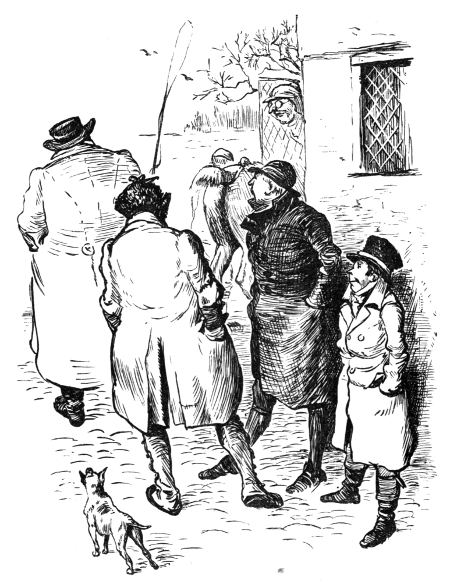
In the Stable Yard.
Surely it has seldom happened in the history of illustration that an
author should be so very closely followed—if not overtaken—by his
illustrator. No literary touch seemed to be wanting from the author to
convey a picture of English life and character passed away; but
Caldecott's coachman helps to elucidate the text; and whilst it carried
to many a reader of Old Christmas in the New World a living portrait
of a past age, it revealed also the presence of a new illustrator.
Here was a reproachful lesson. The art of illustration—an art untaught
in England and unconsidered by too many—was shown in all its strength
and usefulness by a comparatively new hand.
Of the numerous illustrations drawn by Caldecott in 1874 for Old
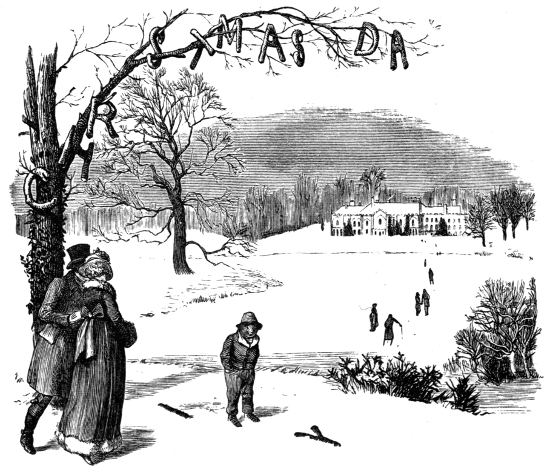
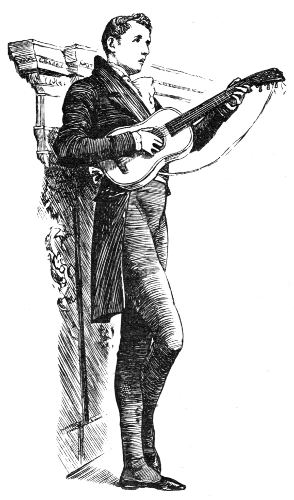
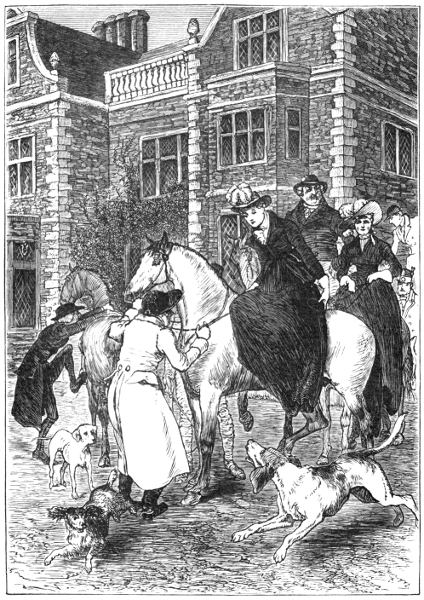
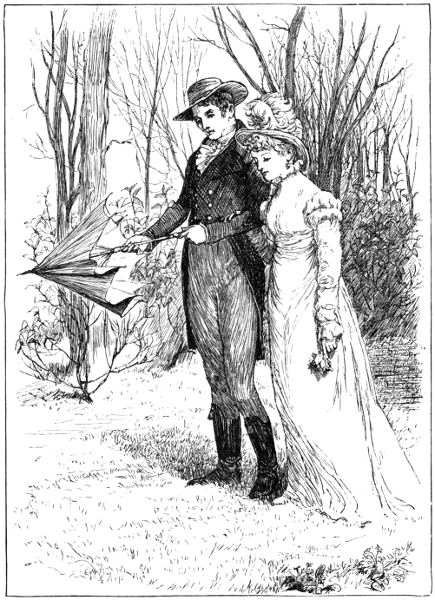
Christmas, we may select as examples the young Oxonian leading out one
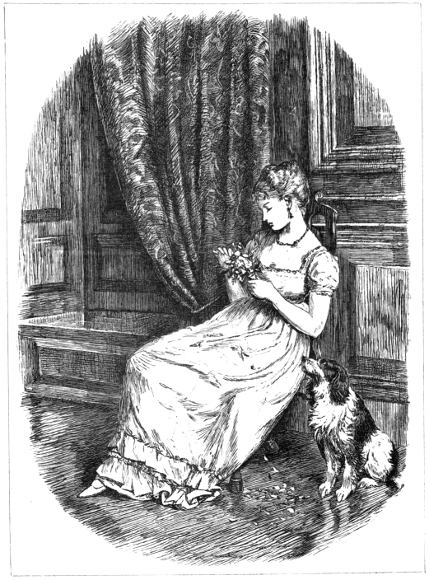
of his maiden aunts at a dance on Christmas Eve; and "the fair Julia"
in the intervals of dancing listening with apparent indifference to a
song from her admirer; amusing herself the while by plucking to pieces
a choice bouquet of hothouse flowers.
The Troubadour.
The Fair Julia.
The style and treatment of the drawing, on the opposite page, differs
from anything previously done by Caldecott, and would hardly have been
recognised as his work; the handling is less firm, and colour and
quality have been more considered in deference to what was considered
the public taste in such matters. But in a few pages he emancipates
himself again, and gives us some brilliant character sketches. In the
last example from Old Christmas he is in his element. Nothing could
be more characteristic, or in touch with the period illustrated, than
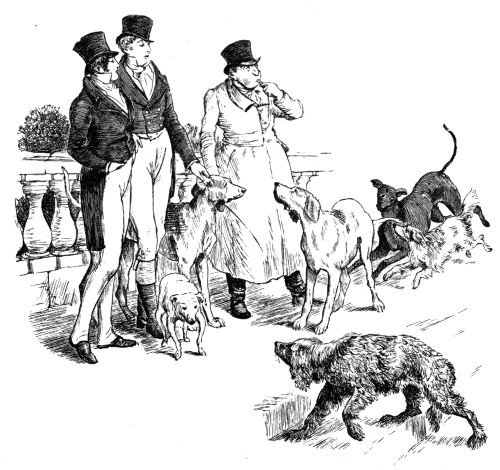
the picture of Frank Bracebridge, Master Simon, and the author of Old
Christmas, walking about the grounds of the family mansion "escorted
by a number of gentleman-like dogs, from the frisking spaniel to the
steady old staghound. The dogs were all obedient to a dog-whistle which
hung to Master Simon's button-hole, and in the midst of the gambols
would glance an eye occasionally upon a small switch he carried in his
hand."[7] Thus the minute observation of the writer is closely followed
by the illustrator, who here from his own habit of close observation of
the ways of animals, was enabled to give additional completeness to the
picture; and the effect was greatly heightened by a wise determination
on the part of Mr. Cooper the engraver, that the illustrations should
be "so mingled with the text that both united should form one picture."
This book was engraved at leisure, and not published until the end of
1875, by Messrs. Macmillan & Co., bearing date 1876.
Master Simon and his Dogs.
It is interesting to note that Old Christmas was offered to, and
declined by, one of the leading publishers in London; principally on
the ground that the illustrations were considered "inartistic,
flippant and vulgar, and unworthy of the author of Old Christmas"! It
was not until 1876 that the world discovered a new genius.
During the progress of the drawings for Old Christmas in 1874,
Caldecott went with the writer to Brittany to make sketches for a new
book; but the publication was postponed until after a more extended
tour in 1878.
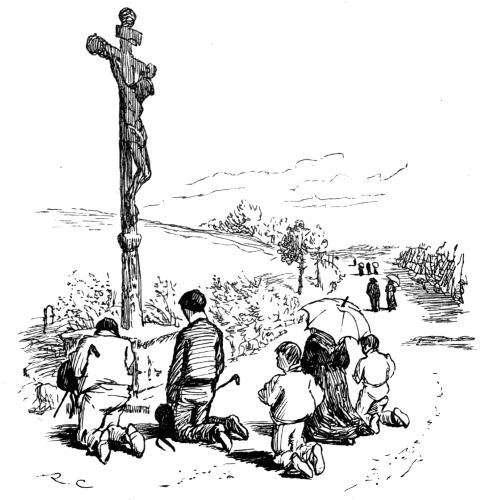
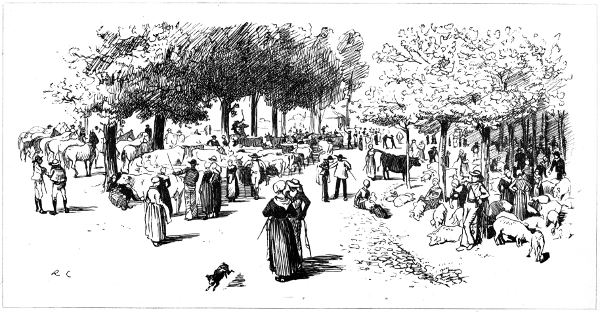
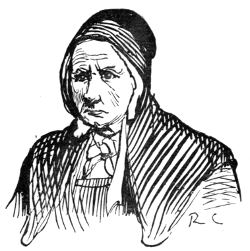
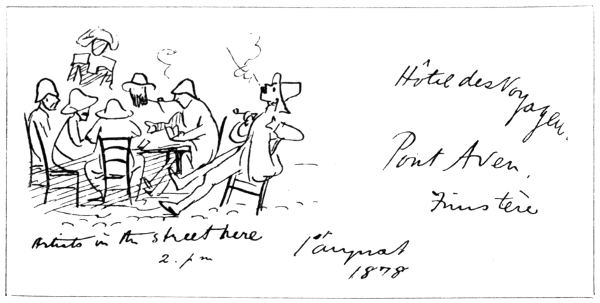
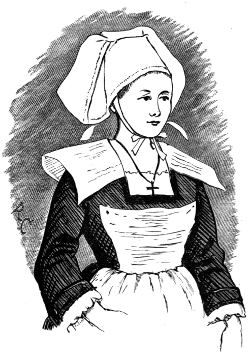
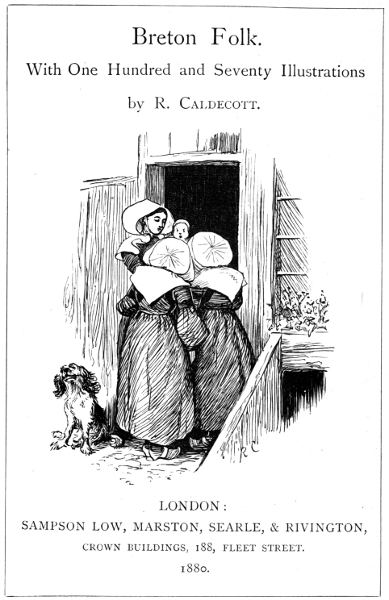
These summer wanderings of Caldecott in Brittany were prolific of work;
his pencil and notebook were never at rest, as the pages of Breton Folk
testify (see Chapter xi.). The drawings, both in 1874 and
in 1878, mark a strong artistic advance upon similar work in the Harz
Mountains. His feeling for the sentiment and beauty of landscape,
especially the open land,—generally absent from the sketches in the
Harz Mountains,—is noticeable here. The statuesque grace of the
younger women, the picturesqueness of costume, operations of husbandry,
outdoor fêtes and the like, and the open air effect of nearly every
group of figures seen in these summer journeys—all came as delightful
material for his pencil.
Caldecott's studies with M. Dalou, the sculptor, in 1874, and the great
proficiency he had already obtained in modelling in clay, enabled him
to make several successful groups from his Brittany subjects.
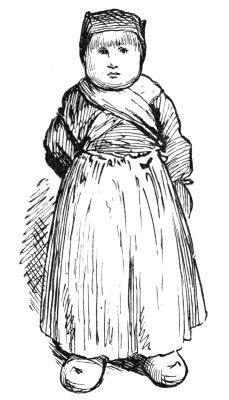
On the Road Side, Brittany.
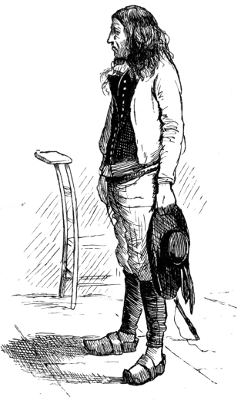
The bright-eyed stolid child in sabots at the roadside (one of the
first of the quaint little figures that attracted his attention in
Brittany) stands on the writer's table in concrete presentment in
clay; the model is not much larger than the sketch—the front, the
profile, and the back view, each forming a separate and faithful study
from life.
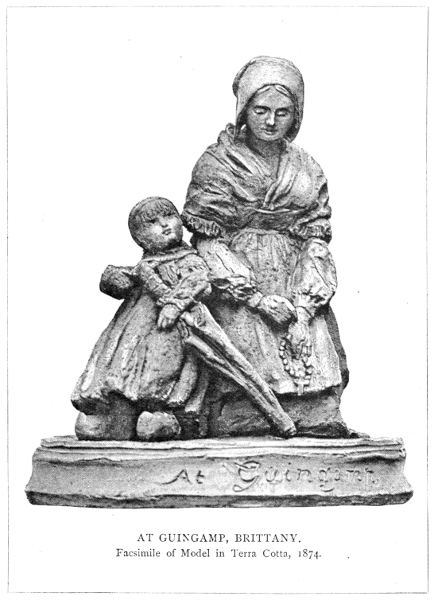
The young mother and child in the cathedral at Guingamp (reproduced
opposite) was another successful effort in modelling, but Caldecott was
not satisfied with it excepting as a rough sketch—"a recollection in
clay."
It is interesting here to note the handling of the artist in his
favourite material, French clay. The model stands but six inches high,
but it was intended to have reproduced it larger. Another sketch in the
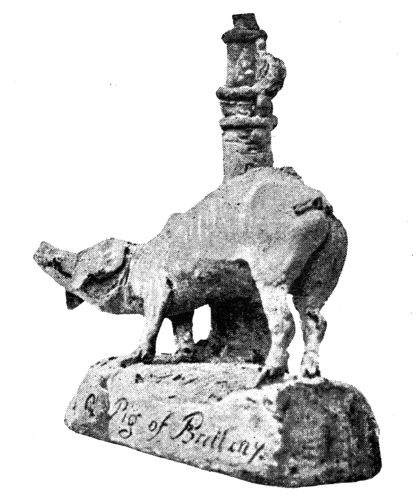
round was of "a pig of Brittany," reproduced on page 194.
"Save up," he writes about this time to a friend in
Manchester, "and be an art patron; you will soon be able to
buy some interesting terra cottas by R. C.!"
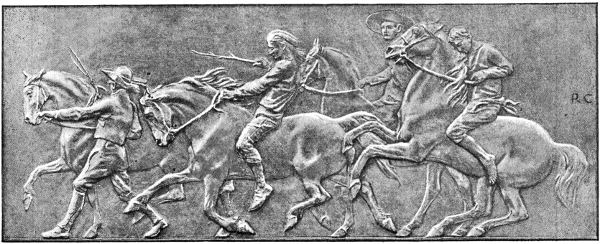
This was a heavy year, for many illustrations were produced not
mentioned in these pages; and in October he was busy on the wax
bas-relief of a "Brittany horse fair," afterwards cast in metal and
exhibited in the Royal Academy in 1876 (see page 137).
AT GUINGAMP, BRITTANY.
Facsimile of Model in Terra Cotta, 1874.
To M. H.—Christmas, 1874.
On the 19th of November and following days Caldecott was "working at
Dalou's on a cat crouching for a spring." He had a skeleton of a cat, a
dead cat, and a live cat to work from. This model in clay was finished
on the 8th December, 1874.
Christmas Eve was spent "in the caverns of the British Museum making a
drawing, and measuring skeleton of a white stork." This was a most
elaborate and careful record of measurements. On the 28th of December
he was "engaged on brown paper cartoon of storks at Armstrong's," and
on the 30th is the entry,—"at British Museum; had storks out of cases
to examine insertion of wing feathers."
Thus, all through the year 1874 Caldecott, working without much
recognition excepting from a few intimates, got through an immense
amount of work; not forgetting his friends the children, to whom he
sent many Christmas greetings with letters and coloured sketches. The
drawing on the opposite page accompanied a kindly letter to a child of
six years.
"I thank you," he says, "very much for your grand sheet of drawings,
which I think are very nice indeed. I hope you will go on trying and
learning to draw. There are many beautiful things waiting to be drawn.
Animals and flowers oh! such a many—and a few people."
The last sketch in 1874—a postscript to a private letter—tells its
own story.
CHAPTER VIII. LETTERS, DIAGRAMS, ETC.
In a letter to a friend in Manchester, on the 17th January, 1875,
Caldecott writes:—
"I stick pretty close to business, pretty much in that
admirable and attentive manner which was the delight, the
pride, the exultation of the great chiefs who strode it
through the Manchester banking halls. Yes, I have not
forsaken those gay—though perhaps, to the heart yearning to
be fetterless, irksome—scenes without finding that the
world ever requires toil from those sons of labour who would
be successful.
"However, during the last year I managed to do a lot of work
away from town, and enjoyed it. Sometimes it was expensive,
because when at the cottage in Bucks, we of course mixed
with the county families and had to 'keep a carriage' to
return calls, return from dinner, and so forth."
At Farnham Royal—Returning Visits.
Here is "a meditation for the New Year"—
"You will excuse me," he says, "talking of myself when I
tell you that amongst the resolutions for the New Year was
one only to talk of matters about which there was a
reasonable probability that I knew something. Now human
beings are a mystery to me, and taking them all round I
think we may consider them a failure. If I do not understand
anything that belongs to myself, how can I understand what
belongeth to another? This, my dear W., with your clear
intellect, you will see is sound.
"I often think of the scenes and faces and jokes of banking
days, and have amongst them many pleasant reminiscences.
Perhaps we shall all meet again in that land which lies
round the corner!"
[Here follows a grotesque sketch of a man on a winter's day,
with an umbrella, hurrying off to the "Nag and Nosebag."]
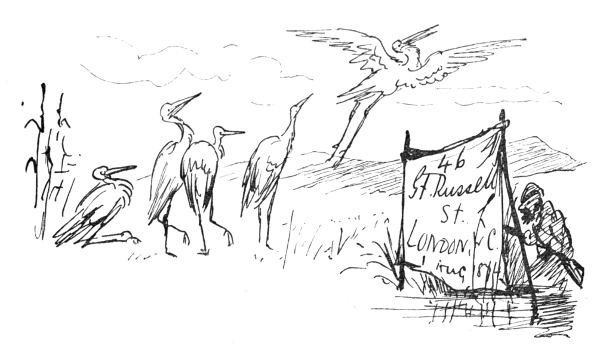
At the beginning of 1875, in the intervals of book illustration,
Caldecott was busy "working on a cartoon of storks." This was a design
for a picture in oils, painted in March and afterwards bought by Mr. F.
Pennington, late M. P. for Stockport.
Sunrise.
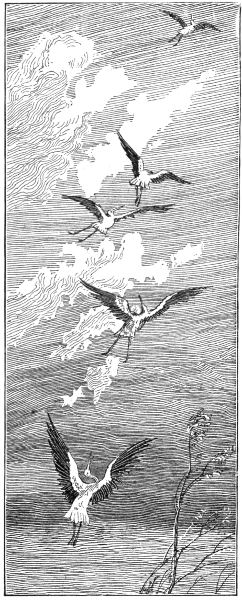
On the 7th of January he enters in his diary, "Painted some storks on
the wing for a panel for a wardrobe." The rendering of dawn on the
upmost clouds, the storks rising from the dark earth to greet the sun,
can hardly be indicated without colour, but the design is given
accurately. It was a poetic fancy which he had had in his mind for some
time; one of many half developed designs which, if his health had
permitted, the world might have seen more of.
Study in Line.
On the 25th of January he "made a dry point sketch of a Quimperlé
Brittany woman," and in February he was busy modelling as usual.
On the 5th of February, "took to Lucchesi (moulder) wax bas-relief of
horse fair, and small 'sketch of brewers' waggon."
Study in Line.
The advance of the art of reproducing drawings in facsimile in a cheap
form, suitable for printing at the type press like wood engravings, was
attracting much attention in England in 1875, and at the writer's
request Caldecott made a series of diagrams suggestive of the power of
line and of effects to be obtained by simple methods, to illustrate a
paper read before the Society of Arts in London in March, 1875, on "The
Art of Illustration."
Diagram. Design for a Picture, 1875.
With his usual kindness and enthusiasm he put aside his work—some
modelling in clay which he had been studying under his friend M. Dalou,
the French sculptor—and at once began a diagram, about seven feet by
five feet, to suggest a picture in the simplest way. Without much
consideration, without models, and in the limited area of his little
studio in Great Russell Street, Bloomsbury, he set to work with a brush
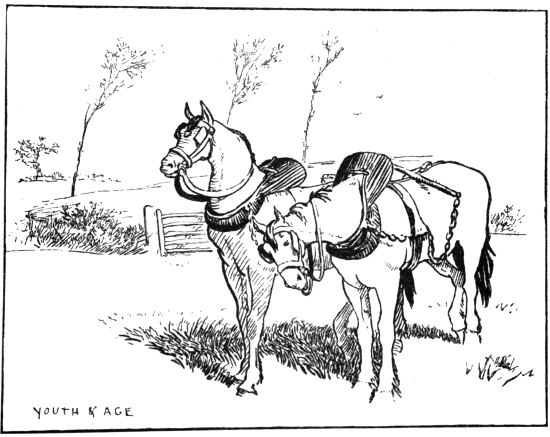
on the broad white sheet, and in about an hour produced the drawing in
line of "Youth and Age" on the last page.
Diagram.
The horses were not quite satisfactory to himself; but the sentiment of
the picture, the open air effect of early spring, the crisp grass, the
birds' nests forming in the almost leafless trees, the effect of
distance indicated in a few lines—and above all, the feeling of sky
produced by the untouched background—were skilfully suggested in the
large diagram.
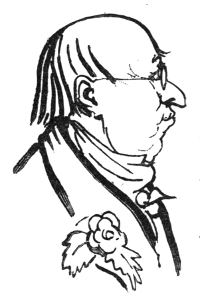
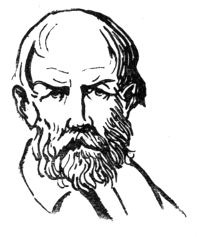
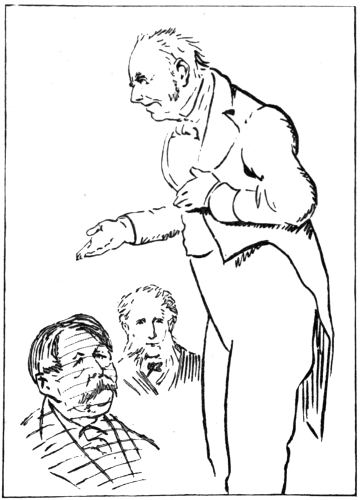
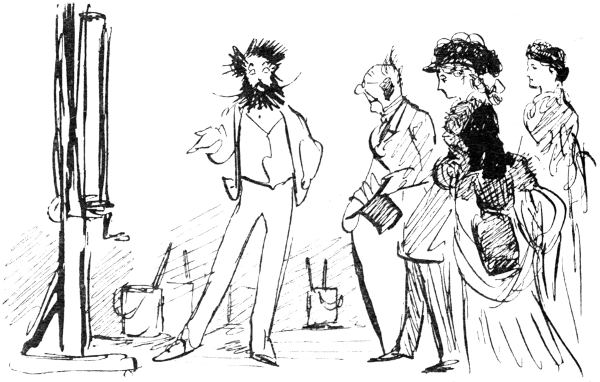
Diagram. "The Lecturer."
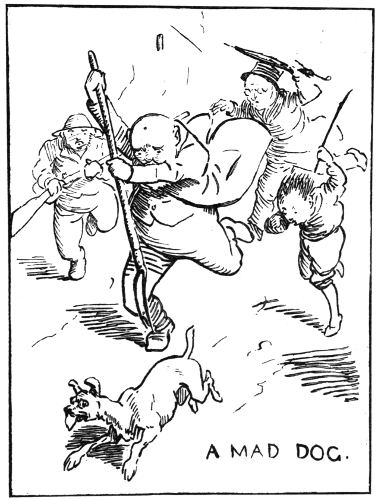
On other occasions, and for the same lecture, he made several other
diagrams, including one of the pursuit of a dog in a village, another
of a lecturer and various heads in an audience. The reproductions are
interesting to examine together as early work in a style in which he
afterwards was famous—a style, which was not outline in the strict
sense of the word, and which to a great extent was his own. It had
little in common with Flaxman, it was not in the manner of Gillray,
Cruikshank, Doyle, or Leech; nor in the more academic manner of his
friend—and predecessor in children's books—Walter Crane.
Diagram.
To these somewhat tentative drawings he afterwards added to the series
a diagram, six feet high, of the famous mad dog from one of his Picture
Books, and another of the figure of a child running, reproduced above.
The discovery of a process by which a drawing on paper in line, could
be photographed and brought into relief, like a wood-block for printing
at the type press, was not perfected in England until 1875, and did not
come into general use until 1876; had it come a year or two earlier it
would have had an important influence upon Caldecott's work.
Diagram.
Without going too far into technicalities, it may be interesting to
illustrators to mention here that all Caldecott's best drawings in his
Picture Books, John Gilpin, The House that Jack Built, &c.; in the
Graphic newspaper, and in Washington Irving's Old Christmas, &c.,
were photographed on to wood-blocks and have passed through the hands
of the engraver.
The system of photographic engraving (by which the drawings are
reproduced on pp. 124 and 125) bids fair to supersede wood-engraving
for rapid journalistic purposes. It naturally attracted Caldecott in
the first instance; but with increased knowledge and perception of
"values," and of the quality to be obtained in a good wood-engraving
above any mechanical reproduction in relief, Caldecott was glad to
avail himself of the help of the engraver. He drew with greater
freedom, as he expressed it, preferring, as so many illustrators do, to
put in tints with a brush, to be rendered in line by skilful engravers.
But at the same time he delighted in shewing the power of line in
drawing, studying "the art of leaving out as a science"; doing nothing
hastily but thinking long and seriously before putting pen to paper,
remembering, as he always said, "the fewer the lines, the less error
committed."
In the spring of 1875 he sends this lively picture of himself from
Dodington, near Whitchurch, in Shropshire, where he had been working,
staying with friends, in the full enjoyment of country life.
Writing on the 27th of April, 1875, he says:—
"I feel I owe somebody an apology for staying in the country so long,
but don't quite see to whom it is due, so I shall stay two or three
days longer, and then I shall indeed hang my harp on a willow tree. It
is difficult to screw up the proper amount of courage for leaving the
lambkins, the piglets, the foals, the goslings, the calves, and the
puppies. We want rain, and then things will grow with exceeding speed;
as it is, the earth is dry and the buds are slow to display their
hidden beauties. A little of 'something to drink' will cheer them, and
then, like some human beings, they will look pleasant and cheerful and
'come out.'"
Next, from a letter to an intimate friend, dated 5th March, 1875, on
being asked to become a trustee:—
"The event is of a pleasing nature because it shows that
somebody still believes in the continuance of that
uprightness of principle, rectitude of conduct, and general
respectability of mind and heart which for so many years
endeared me to the nobility, clergy, gentry, gasmen, and
fowl stealers of W——."
Life in the country with Caldecott was "worth living," and he chafed
much at this period if he had to be with his "nose to the grindstone,"
as he expressed it, in Bloomsbury. Whilst in the country his letters
to town were full of sketches, but in letters from London he hardly
ever pictured life out of doors.
"Shows his Terra Cottas."
In June 1875, he shows the bas-relief of "A Boar Hunt," and some small
groups in terra cotta, to his friends.[8]
Before the favourable verdict of the press was pronounced on Old
Christmas, Caldecott was commissioned to illustrate a second volume;
and, in May 1875, he was already at work making studies and drawings
for Bracebridge Hall, which did not appear until the end of 1876.
About this time the first number of Academy Notes was published, and
in a postscript to a letter to the writer (of too private a nature to
be printed) Caldecott pictures its "first appearance in a family
circle."
The First Year of Academy Notes.
In June 1875, Caldecott had "three drawings in sepia, badly hung, in
the 'black and white' exhibition at the Dudley Gallery."
On the 4th of August he was "making designs for pelican picture;" and
afterwards studying this subject at the Zoological Gardens. Two
pictures of pelicans were eventually painted; the second, in the
possession of Mr. W. Phipson Beale, is sketched below.
Three Pelicans and Tortoise (Oil Painting).
Writing on the 10th August, 1875, respecting some Cretan embroideries
just arrived in England, he sends the sketch overleaf.
"In accordance with your letter about the embroideries," he says, "I
have placed the address of the importer in the hands of Mr. N., a man
well-skilled in detecting that which is good in a crowd of works of
art. He is great in pottery, embroidery and decoration; but he has a
mind great in forgetting, and a fine talent for losing addresses."
Inspecting Embroideries.
In October, whilst at the seaside, he "made six drawings;" and, later
in the year, was "modelling panels for Lord Monteagle's chimney-piece."
In November 1875 he received the first copy of Old Christmas from the
publishers, and already favourable notices of the illustrations had
begun to appear in the newspapers.
A Christmas Card to K. E. B.
Reading "Opinions of the Press" on "Old Christmas."
CHAPTER IX. ROYAL ACADEMY, "BRACEBRIDGE HALL," ETC.
The "opinions of the press" on Washington Irving's Old Christmas,
which Mr. J. D. Cooper, the wood engraver, is depicted reading to the
artist with so much glee, were all that could be desired; and they
fully justified the second venture (Bracebridge Hall), on which
Caldecott was already engaged.
In February he was "painting a frieze for Mr. Pennington's drawing
room" at Broome Hall, Holmwood, Sussex; and, later on, was "carving
panels for a chimneypiece."
In this year, 1876, Caldecott exhibited his first painting in the Royal
Academy, entitled, "There were Three Ravens sat on a Tree." The humour
and vigour of the composition are well indicated in the sketch. It was
hung rather out of sight, above (and in somewhat grim proximity with) a
picture of "At Death's Door," by Hubert Herkomer. Both artists were
then thirty years of age.
"There were Three Ravens sat on a Tree."
(Oil Painting) Royal Academy, 1876.
Cat. No. 415. 49 × 32.
In the same room (Gallery V.) were collected that year, the works of
painters whose names are familiar—W. B. Richmond, A. Gow, H. R.
Robertson, E. H. Fahey, W. W. Ouless, Val C. Prinsep, Henry Moore, and
others.
"Private view of my first R.A. picture," April 1876.
Besides "The Three Ravens" he exhibited in 1876 the metal bas-relief of
a "Horse Fair in Brittany," reproduced opposite. This was a more
masterful production than the picture, and attracted great attention in
the Royal Academy Exhibition. It was mentioned in the Times of that
year, and in the Saturday Review, June 10th, 1876, we read:—
"Of low relief—taking the Elgin frieze as the standard—one
of the purest examples we have seen for many a day is Mr.
Caldecott's bas-relief, 'A Horse Fair in Brittany.' Here a
simple and almost rude incident in nature has been brought
within the laws and symmetry of art."
"A Horse Fair in Brittany."
Metal bas-relief exhibited in the Royal Academy, 1876.
Cat. No. 1499. Size 14 × 5-1/2 in.
In 1876 Caldecott also produced a relief in metal of "A Boar Hunt,"
which was exhibited in the Grosvenor Gallery in 1878.
To the world at large and in the opinion of many critics, there was, in
his Academy work of 1876, promise of an exceptionally successful
career. Decorative design and modelling in relief were Caldecott's
especial forte, and it is to be regretted that so few of these works
remain to us. "The Horse Fair in Brittany," in the possession of the
writer, is one of the few completed works of this character. He was not
destined to be a prolific painter, although strongly urged at this time
by members of the Royal Academy to devote his energies to painting.
Neither his health nor his previous training justified his leaving a
branch of art in which he was already becoming famous, that of book
illustration.
In 1876 the system of reproducing sketches in pen and ink by
photo-engraving became general in England, and in the pages of Academy
Notes of that year there appeared, for the first time, sketches by the
painters of their exhibited works.
Amongst well-known artists—who powerfully aided in founding a system
of illustration which was destined to spread over the world—were Sir
John Gilbert, R.A., H. Stacy Marks, R.A., Marcus Stone, A.R.A., and,
the comparatively young, Randolph Caldecott. The three first-named are
masters in line each in his own style, and their methods were studied
and imitated by many other painters in England to whom line drawing was
then a sealed book. Several sketches of pictures in the Academy
Notes, 1876, were drawn by Caldecott, including the portrait of
Captain Burton, painted by Sir Frederick Leighton, P. R. A.
Captain Burton, R.A., 1876.
In June he made a series of illustrations, entitled "Christmas
Visitors," for the Graphic newspaper; and about this time the
drawings for Bracebridge Hall were finished.
Facsimile of First Page of "Bracebridge Hall."
BRACEBRIDGE HALL.
"The success of Old Christmas has suggested
the re-publication of its sequel, Bracebridge Hall,
illustrated by the same able pencil, but condensed,
so as to bring it within reasonable size and price."
"The Chivalry of the Hall prepared to take the Field"
In Bracebridge Hall we meet the fair Julia again in one of the most
graceful illustrations Caldecott ever drew. An extract from the text is
necessary to show the subtle touch of the illustrator.
"I have derived much pleasure," says Washington Irving,
"from observing the fair Julia and her lover.... I observed
them yesterday in the garden advancing along one of the
retired walks. The sun was shining with delicious warmth,
making great masses of bright verdure and deep blue shade.
The cuckoo, that harbinger of spring, was faintly heard from
a distance; the thrush piped from the hawthorn, and the
yellow butterflies sported, and toyed and coquetted in the
air.
"The fair Julia was leaning on her lover's arm, listening to
his conversation with her eyes cast down, a soft blush on
her cheek and a quiet smile on her lips, while in the hand
which hung negligently by her side was a bunch of flowers.
In this way they were sauntering slowly along, and when I
considered them, and the scenery in which they were moving,
I could not but think it a thousand pities that the season
should ever change or that young people should ever grow
older, or that blossoms should give way to fruit or that
lovers should ever get married." The harmony here between
author and illustrator needs no comment.
The fair Julia and her Lover
There were 120 drawings made for Bracebridge Hall, remarkable for
artistic qualities and fully sustaining the reputation of the artist.
The originals were drawn about one third larger, in pen and ink,
photographed on wood and engraved in facsimile. The effect of many of
the drawings in the first editions was injured by the want of margin on
the printed page; but an édition de luxe is now printed with Old
Christmas and Bracebridge Hall in one volume.
"General Harbottle at Dinner."
As it is the object of this memoir to record facts—and as the
originator of good ideas is seldom recognised—it should be stated
here that it is owing to Mr. Cooper, the engraver, that Washington
Irving's books were ever illustrated by Caldecott. The idea, he says in
the preface, "has been delayed in execution for many years, mainly from
the difficulty of finding an artist capable of identifying himself with
the author;" modestly adding—"whether this result has now been
attained or no, must be left to the verdict of the lovers of the gifted
writer in both hemispheres."
"An Extinguisher."
The two next sketches mark with touching emphasis the serious change in
Caldecott's health which took place in the autumn of this year.
At Whitchurch.
In August he is writing from the country in high spirits as usual, and
planning out much work for the future. Bracebridge Hall was finished,
and the success of Old Christmas had brought him many commissions.
His illustrations on wood had turned out well, being fortunate in his
engravers, especially Mr. J. D. Cooper and Mr. Edmund Evans, who always
rendered his work with sympathetic care. He may also be said to have
been fortunate in his connection with the Graphic newspaper under the
direction of Mr. W. L. Thomas, the artist and wood engraver.
But alas! in the autumn of this year his health failed him, and in
October he was advised to go to Buxton in Derbyshire.
On the 2nd November, 1876, he writes:—
At Buxton
"I am as above. Walking solemnly in the gardens, or sitting
limply in the almost deserted saloon listening to an
enfeebled band."
The result of that visit was a series of delightful sketches, which
appeared in the Graphic newspaper, the originals of which are in the
possession of Mr. Samuel Pope, Q.C.
A Christmas Card.
CHAPTER X. ON THE RIVIERA. — NORTH ITALIAN FOLK.
The journey to the Riviera and North Italy, which Caldecott was
compelled to make for his health, before Christmas 1876, was as usual
prolific of work. Writing from Monaco in January, 1877, he says:—
"This is a beautiful place, and for the benefit of you stay-at-home
bodies I will describe it—in my way;" and in four original letters
published in the Graphic newspaper in March and April, 1877, there
appeared about sixty illustrations containing upwards of three hundred
figures, different studies of life and character; and these drawings do
not represent probably, one half of the sketches made.
No such pictures of Monte Carlo and its neighbourhood had been sent
home before; they were the ideal newspaper correspondent's letters—the
sketches abounding in humour and accurate detail; the letters
accompanying them being written from personal observation.
It would have been strange indeed if these letters had not attracted
general attention and amusement in a newspaper; but they did more than
this, they revealed an amount of artistic insight, and suggested
possibilities in Caldecott's future career as an artist which his
health never permitted him to put to the test.
At Monaco and at Monte Carlo, Caldecott found so much that suited his
pencil that it is a wonder that he found time for any more serious
work. With touches of satire that remind us of Thackeray, and a gaiety
all his own, these spontaneous and delightful letters form the best
picture of Caldecott that can be given in 1877.
"Round the tables," he writes, "from noon to nearly midnight—seven
days a week—the monde élégant congregates, from the Yorkshireman to
the Japanese." Then follow sketches of an Englishman in Scotch tweed,
and a young man from Japan. Next is a general sketch of the crowd at
the round table, the artist's own figure, admirably given, standing
back to us, hat in hand. It was a marvellous gathering presented on the
printed page, "all intent on gambling—editors of journals, English
justices of the peace, venerable matrons and innocent girls, beloved
sons who are 'travelling,' artistes, chevaliers of the legion of
honour, dames who are not of that legion." "Such costumes and toilettes
sweep the polished floor, such delicately-gloved fingers clutch the
glittering coins—when they happen to win, and sometimes when they
don't—such a clinking of money, as the croupiers mass the rakings."
The Gaming Tables at Monte Carlo.
From the fashionable crowd and the heated atmosphere of the Casino the
artist takes us along the cool shores of the Mediterranean, where, in
one of the best sketches in these letters, full of air and light, he
brings two figures into unexpected contrast. "Walking one afternoon
along the Mentone road, we reached a point commanding a fine view of
sea, hills, and olive trees. There was a stone seat, and on it an aged
round-backed man. On the wall and bench before him were spread out many
cards dotted with the results of numerous twirls of the roulette ball.
He was studying his chances for the future. As we turned away we met a
priest reading in a little book as he passed."
As the landscapes suffered in reproduction in the newspaper, and were
the least successful part in these letters, it may be well to mention
that some of Caldecott's landscape studies in oils and water colours,
on the shores of the Mediterranean, were the best he ever did,
attracting much attention at the sale of his works in 1886.
That he did not put a high estimate on his powers as a landscape
painter at that time may be gathered from a few words in a private
letter declining some commissions.
"The drawings that G. so kindly enquires about are not in my line. I
would rather not attempt to paint what I imagine he wants—proper
professional water-colour landscape painter's work.
"Priest and Player."
"Please say that my line is to make to smile the lunatic who has shown
no sign of mirth for many months (see the Graphic of Saturday last,
6th January, p. 7, right-hand column—I tumbled upon it in the reading
room of the Casino), and not to portray the beauties of this southern
clime—not but what I would if I could!"
It was in the same winter, during his journey in North Italy, that
Caldecott made twenty-eight illustrations for a book on North Italian
Folk.[9] Here Caldecott's studies, and his habit of sketching the
peasantry wherever he went, served him well. Take the picture of the
priest and his faithful servant Caterina; the latter, reproaching her
master for bringing home a neighbour, Maddalena, "to eat two lasagne
with us!" Caterina is "a gaunt threadbare-looking woman of some
five-and-thirty years, and the prevosto is gaunt too, and sallow;
the two match well together. Caterina's hair is smooth though scant,
and her faded print dress is neat, but the bright yellow kerchief round
her shoulders is soiled, and the cunning plaits of her grey hair are
not as well ordered as the women's are wont to be on mass days.
The Priest's Servant Administers a Reproof.
"Presently Caterina bustles into the darkened parlour, where sits the
prevosto lazily smoking his pipe and reading the country newspaper.
He has put aside even the least of his clerical garments now, and
lounges at ease in an old coat and slippers, his tonsured head covered
by a battered straw hat.
"'Listen to me,' breaks forth the faithful woman, and she is not
careful to modulate her voice even to a semblance of secrecy, 'you
don't bring another mouth for me to feed here when it is baking day
again. Per Bacco, no indeed!... It sha'n't happen again, do you hear?
And I have the holy wafers to bake besides. For shame of you! Come now
to your dinner in the kitchen!' And Caterina, the better for this free
expression, hastens to dish up the minestra.
"'Poor old priest! What a shrew he has got in his house,' says some
pitying reader. Yet he would not part with her for worlds! She is his
solace and his right hand, and loves him none the less because of her
sharp tongue and uncurbed speech. In many a lone and cheerless home of
Italian priest can I call to mind such a woman as this—such a fond and
faithful drudge, with harsh ways and a soft heart."
Another picture in North Italian Folk seems to give the character of
the peasantry and the scenery exactly. "The sun glitters on the pale
sea that is down and away a mile or more beyond the sloping fields and
gardens, and the dipping valley. Giovanni pauses to rest his burthen
upon the wall just where the way turns to the right again, leaving the
mountains and chestnut-clad hills behind it."
The Husbandman.
Gossip.
Here in the sketch we are made to feel the sunlight and the glare from
the sea on the southern slope; every detail of the pathway, to the
stones in the old wall, being accurately given.
Never, perhaps, in any book since Washington Irving's Old Christmas
and Bracebridge Hall was the illustrator more in touch with the
author than in North Italian Folk; but for some reason—probably
because Caldecott's work and style had become identified with English
people and their ways, both abroad and at home—the illustrations made
little impression. The completeness of the pictures, and the local
colour infused into them by the author, left little to be done;
moreover, Caldecott was not on his own ground, and to draw buildings
and landscape in black and white, with the finish, and what is
technically called the "colour," considered necessary for a book of
this kind, was always irksome to him.
Less characteristic, but charming as a drawing, is the group of country
girls under the cherry trees, reproduced on the opposite page. It is a
picture worth having for its own sake, whether it aid the text or not,
and one with which we may fitly leave this volume.
"Dignity and Impudence."
"Spaniels, King Charles's Breed." Sir E. Landseer, R.A.
Early in the year 1877 Caldecott made several drawings for an
illustrated catalogue of the National Gallery. Amongst the best in the
English section were the two sketches from Sir Edwin Landseer's
pictures, reproduced here. The grave portrait of an old bloodhound in
"Dignity and Impudence," and the animation and movement in the
diminutive poodle by his side, are indicated in a few expressive
lines. The bright eyes of the two little spaniels of King Charles's
breed glitter under his hand in the original pen and ink sketch.
Portrait of a Lawyer by Moroni.
For the foreign section of the book on the National Gallery he made
many sketches, notably one of the "Portrait of a Lawyer" by Moroni.
Here the touch and method of line are different; quality was more
considered, and an attempt made to give something of the effect of the
picture.
But neither he, nor those with whom he worked in those days, had
mastered the best methods of drawing for mechanical reproduction, as
they are understood now; fascinating as it seemed to him, and to many
other illustrators also, to learn that the time had come when, by
mechanical—or more properly chemical—engraving, the touch of the pen
could be printed on the page.
It may be said generally in 1877, that Caldecott disliked drawing for
"process," and that after years of experience, and having achieved most
successful results by photographic engraving, he remained faithful to
the wood engraver. The delicate little drawings in brown ink, which
were dispersed in hundreds under the auctioneer's hammer in June, 1886,
had nearly all been photographed on to wood blocks.
In June, 1877, Caldecott—staying at Shaldon, Teignmouth, South Devon,
for the benefit of his health, chafing under enforced idleness and
"debarred by the doctors from all sport," as he says—writes a letter
with the following little sketch of "Waiting for a Boat."
"Waiting for a Boat."
"The weather has been unwell for many of the days, and has much
interfered with the intellectual occupation of enticing 'dabs' on to
hooks let down into the sea by pieces of string and concealed by shreds
of mussels.
"On only one occasion have I been engaged in this exciting pursuit—all
chases and pursuits are more or less exciting—but this one on that
account can hardly be considered 'detrimental' to my health. There
were three of us in the boat when I engaged in the sport. We had a
large can of fine mussels. We threw out the lines and hauled them in
every now and then, for three good hours, being about a mile out to
sea. Two whole dabs were the result. I was quite calm as we rowed home.
"I do not boast of this exploit, although the larger dab was at least
seven inches long by four and a half wide, and fully 3/8 of an inch
thick. Still I glow a little as I recount his measurements."
Many illustrations were made in the autumn of 1877 for the Graphic
and other publications which need not be detailed. A painting of one of
his favourite hunting scenes was also in progress, in spite of dark
days and delicate health.
"Cleopatra."
CHAPTER XI. "BRETON FOLK," ETC.
For Mr. Frederick Locker-Lampson, the poet, Caldecott made in the years
1877-8, twelve drawings to illustrate Bramble Rise, A Winter
Phantasy, My Neighbour Rose, and other verses. These illustrations,
most delicately drawn in pen and ink, have not yet been published. One
was used in 1881 in a privately printed edition of the London Lyrics,
and three in 1883, in a little volume of the Lyrics printed by the
"Book Fellows Club" in New York. Caldecott afterwards made four
illustrations for Mrs. Locker-Lampson's child's book, What the
Blackbird Said, and two years afterwards, in 1882, an illustration to
her Greystoke Hall. These two books are published by Messrs.
Routledge.
In 1878 he exhibited his picture of "The Three Huntsmen" riding home in
evening light. It was hung rather high in Gallery VII. at the Royal
Academy Exhibition, and technically could hardly be pronounced a
success; but it was a distinct advance on previous exhibited work, and
drew the serious attention of critics to Caldecott as a painter. The
sketch appeared in an article on the Academy in L'Art, vol. xx. p.
211. Of this oil painting, Mr. Mundella, the late President of the
Board of Trade writes:—
"The picture was bought by me of poor Caldecott in 1878. I
think it was exhibited at the Royal Academy in that year,
but I bought it from his easel. It is an oil painting, 3 ft.
6 in. by 2 ft. 9 in., and the subject is the 'Three
Huntsmen.' I remember his bringing the song to my house
after the purchase, and reading the song with great
enjoyment, pointing out to us how he had illustrated the
verse, 'We hunted and we holloed till the setting of the
sun.' My little granddaughter (Millais' 'Dorothy Thorpe')
was his model for several of his Christmas books. She is the
little girl in Sing a Song of Sixpence and several others,
and possesses copies sent by him with little sketches and
dedications. He is indeed a national loss."
The Three Huntsmen (Oil Painting).
Royal Academy, 1878.
In the Grosvenor Gallery of the same year Caldecott exhibited a small
metal bas-relief of "A Boar Hunt," of which he made the following
sketch in Grosvenor Notes.
"A Boar Hunt" (Bas-relief). Grosvenor Gallery, 1878.
No. 232. 8 in. × 18 in.
Special interest attaches to this design, also to "The Horse Fair in
Brittany," reproduced on page 137, for the insight it gives of
Caldecott's varied artistic powers, which, by force of circumstances,
were always held in reserve. If, as a writer remarks, "The treatment of
reliefs is a test of the state of a school of sculpture," these
examples may help to "place" Caldecott amongst contemporary artists.
Early in 1878, Mr. Edmund Evans, the wood engraver, came to him with a
proposal that he should illustrate some books for children to be
printed in colours. The plan was soon decided upon, and the first of
the Picture Books was begun. In the summer of the same year,
Caldecott went with the writer for a second time to Brittany.
It was at first intended to take a gig and drive through and through,
the country, giving an account of adventures from day to day, and
Caldecott (who was more at home perhaps, in a gig than in any other
position of life) favoured the idea; but time and other circumstances
prevented.
The next proposal was to give a general description of the country and
its people, its churches and ruined castles, as they exist to-day. But
Caldecott did not take to this idea; he never in his lifetime drew
buildings with the same facility as figures, and, at that time, to
attempt to make drawings of chateaux, cathedrals and the like, would
have been unsuccessful. So the book, Brittany Picturesque, which had
already been partly written, was laid aside to give space for sketches
of Breton Folk.[10]
"The Trap."
"We obtained a trap in a few days"—not the gig, independent of a
driver, which Caldecott always sighed for. His delight and high spirits
on the first journey, in 1874, are seen in the sketch where he is
waving farewell to some astonished peasantry. To be "on the road" was
always a pleasure to Caldecott, from the "old Whitchurch days," which
he often described to his friends—driving home in the dark at reckless
speed after a late supper, in a dog-cart full of rather uproarious
company—down to 1885 at Frensham, when as host, he would drive his
friends in the lanes of Surrey.
At least 200 sketches must have been made in these journeys; besides
jottings of heads, figures and the like, and several drawings in water
colours.
Sketching under Difficulties.
The summer fêtes and "pardons," all through the country, furnished
capital material for his pencil, the women's caps of different
districts were each recorded, and here and there a solemn suggestive
landscape noted for a picture which was never to be completed.
Breton Farmer and Cattle.
The circumstances under which some of the sketches were made is
indicated on page 171.
One of the first drawings made in Brittany, both in colour and black
and white (a scene of which Caldecott was always desirous of making a
finished picture), was the buckwheat harvest, with the women at work in
the fields. Many similar scenes were put down in note-books, many were
the studies of clouds careering over the wind-blown land, which were
never engraved or published.
A Wayside Cross.
Two of the principal events in these journeys were visits to a horse
fair at Le Folgoet, and to a cattle fair at Carhaix, where Caldecott
made the following sketches:—
"Le Folgoet is in the north of Finisterre, in the north-west corner of
Brittany. The country is for the most part flat and dreary in aspect;
a few fields of buckwheat, corn, and rye are passed on the road,
protected by banked-up hedges, and skirted by pollard trees.
At the Horse Fair, Le Folgoet.
"On the road as we approach the fair, a mile and a half from the town,
is a characteristic figure, a barefooted gamin with red cap and grey
jersey trotting out an old chestnut mare." As he stops and turns to
look back, he is thus rapidly recorded in a sketch.
Trotting out Horses at Carhaix.Trotting out Horses at Carhaix.
Apart from the artistic material so abundant everywhere, Caldecott's
love for animals and knowledge of them, his interest in everything
connected with farming, markets, country life and surroundings, roused
him to exertions at Carhaix which none but the most hardy "special
artist" would have attempted.
It was an exciting time for Caldecott, both on the road and at the
fair; materials for his pencil were everywhere, and for three days
there was little rest.
Cattle Fair at Carhaix.
Carhaix being in the centre of Brittany, far remote from railways, had
special attractions in the variety of character and costume. Here, weak
in health as Caldecott then was, he stood and worked all day, being
especially interested in the trotting out and sale of horses. Turning
to our diary:—
"The horse fair was held in a large square or place. Under
the trees was a crowd of men and women in the dust and heat;
horses, cattle, pigs and dogs, in confused movement; with
much drinking and shouting at the booths which lined one
side of the enclosure."
A Typical Breton.
A Bretonne.
It was in this year (1878) that he made some extraordinarily rapid
sketches in colour with the brush direct, without a touch of the pencil
or anything to guide him on the paper. Few sketches of this kind exist,
excepting rough notes in books not intended for publication. In the
evening the figures in the streets and at the inns had to be noted
down.
The next day, which Caldecott called "a rest," was devoted to visiting
two farms in the neighbourhood, seeing as much as possible of the
interiors of the old houses near Carhaix, with their carved bedsteads,
cabinets and clocks, old brasswork and embroideries. It was a rather
anxious time for his travelling companion, for there was no restraining
Caldecott with such material before him, and he was overworked.
It was in this district that he made one of his most successful
sketches; a typical Breton (p. 177), in ancient costume with long
hair and knee breeches; a figure rarely met with in these days.
In the south-west corner of Brittany, a few miles south of Quimperlé,
at a point where the river spreads out into a narrow estuary four miles
from the sea, is the primitive little village called appropriately Pont
Aven.
Caldecott was much amused, and scandalised at the aspect of the village
on our arrival one afternoon; a scene which he thus records on a
letter, and afterwards drew for Breton Folk.
Writing from Pont Aven and recounting "the places which we have
visited, done, sketched, interviewed and memorandumed"—he adds:—
"On this journey I have seen more pleasing types of Bretons (and
Bretonnes, especially) than in my former rambles in the Côtes du Nord;
but there is generally something wrong about each hotel. This
particular inn is comfortable. Seven Americans, two or three of them
ladies, and about four French people dined with us, mostly of the
artist persuasion.
A Cap of Finisterre.
"The village and the river sides, the meadows and the valleys reek with
artists. A large gang pensions at another inn here.
"On approaching Pont Aven the traveller notices a curious noise rising
from the ground and from the woods around him. It is the flicking of
the paint brushes on the canvasses of the hardworking painters who come
into view seated in leafy nooks and shady corners. These artists go not
far from the town where is cider, billiards and tobacco."
Returning from Labour—Pont Aven, 1878.
One of the best of Caldecott's sketches here was "Returning from
Labour," a quiet spot on the banks of the Aven where he made several
studies.
"Here we feel inclined for the first time to stay and
sketch, wandering along the coast to the fishing villages,
and visiting farms and homesteads."
From another inn, in an "out of the way" part of Finisterre, he
writes:—
"The Hotel du Midi where we put up is conducted in a simple
manner; ladies would not like its arrangements. Several
inhabitants, and a visitor or two, dine at the table d'hôte,
but all are unable to carve a duck excepting the English
visitor, who is accordingly put down as a cook."
Many works, such as the frieze of a horse fair (p. 137), models in
terra cotta and paintings, were the outcome of the Brittany journeys in
1874 and 1878; but Caldecott did not give himself a chance to do what
he wished in France; other work crowded upon him in 1878, and before he
had time to finish the sketches for Breton Folk, he had to return to
London to complete drawings for his Picture Books, and other work in
hand for the Graphic newspaper.
A Breton.
In a letter from London, received at the Abbey of St. Jacut in Brittany
on the 29th August, 1878, he says:—
"I have not been able to settle well down to work yet.
Sitting about on hotel benches for a month with Mr.
Blackburn is unhinging. * * * "I fancied somehow that, after
the wild career of dissipation in other parts of Brittany,
he might find the calm of a cloister insufficiently
exciting, and consequently might drag you round to more
lively places. I am glad that I am wrong."
The drawings of the "Family Horse," (of "Cleopatra" on page 165,)
the sketch in Woburn Park, and several others, were made when on a
visit in the neighbourhood in October 1878. A letter referring to his
visit to Woburn says:—"On the last evening of Mr. Caldecott's visit
here, he was sitting at the dining-room table with the two little boys
on his knees, and the rest of the family standing round him. We asked
him to draw us each something, and he made us choose our own subjects.
The sketch of himself riding in the park is one of them; it amused him
very much to see the deer standing gazing at us."
"A Family Horse."
Sketch In Woburn Park
At another time there comes a coloured birthday card to a child in
London who was fond of flowers; a dark red carnation the size of life,
presented by a Lilliputian figure in old-fashioned green coat, with
white frill and periwig.
A Carnation.
Side by side with Caldecott's missives to little children might be
printed many a kindly letter to a young author who had sent him
manuscripts to read. These letters had to be read and answered always
in the evenings. A long letter of this kind was written to a lady at
Didsbury, near Manchester, in 1878, from which the following extracts
are taken[11]:—
"Dear Miss M.,—Your packet reached me safely, and as I call
to mind very readily my feelings in times gone by, after I
had posted a piece of literary or artistic composition to
some friend acquainted with the dread editor of some
magazine, or even to the dread editor himself, I think it
only your due that I should write to you without delay about
the sketches of country life which you have kindly allowed
me to read, and my opinion of which you flatter me by
desiring to know. You asked me for my candid opinion; in
these cases I always try to be candid.... I think that your
papers are, as they stand, hardly interesting enough for the
mass of readers, though to me they draw out pictures which
please, and also revive old associations.... Their fault,
however, if I may speak of faults, is not so much in subject
as in style. You have chosen simple subjects, in which is no
harm of course; but simple subjects in all kinds of art
require a masterly hand to delineate them. The slightest
awkwardness of execution is noticed, and mars the simplicity
of the whole. When a thrilling story is told, or a very
interesting and novel operation described, faults of style
are overlooked during the excitement of hearing or reading.
Is it not so?...
"R. C."
In another letter some remarks on the misuse of old English words (a
subject on which he says, "I am very ignorant") are worth recording.
"As regards the misuse of certain words, I consult the authorities when
a doubt crosses my mind, and I find with sorrow, in which I am joined
by other anxious spirits, that the English language is being ruined,
chiefly by journalists, English and American. Words of good old nervous
meaning, because common, are discarded for words of less force but
finer sound, borrowed from other tongues. The use of these new words is
often a difficulty to all but classical scholars, for the
pronunciation, the accent, the quantities, are varied even amongst
equally educated people.
"On the introduction of a new word there is always a halo of pedantry
about it. Some admire the halo and adopt the word. The journalists
cuddle it. The readers ask what it means, think it sounds rather
fine—perhaps genteel—throw over the humble friend who has done them
and their conservative forefathers such good service.
"The poor ill-used old fellow of a word then only finds friends amongst
the lowly and the loyal; and if in course of time the usurping word, as
he rolls by in his carriage and footmen, hears the former wearer of his
honours come out from the passing pedestrians, he curls his proud lip,
pulls up his haughty collar, distends his Grecian nose, and wonders
where vulgar people will go to—albeit this vulgar word is better born,
and has a higher instep than the carriage word."
In the late Autumn of 1878 Caldecott is again in the south of France,
sending home letters—one with a portrait of himself (back view),
seated next to a young lady, "whose father is rather deaf."
Hôtel Gray et d'Albion Cannes, 15 Nov. 1878.
"I have come here," he says, "in order that rheumatism may forget me
and not recognise me on return to Albion's shores. * * *
"I open my bag and take out your letter of 20th November, 1877, which
has been ready at hand for reply ever since I received it with a
welcome. Letters ought always to be replied to within the twelve
months."
At Mentone.
CHAPTER XII. AT MENTONE, ETC.
From the Riviera in 1879 came the following pictures in letters to
friends.
"This hotel is indeed a calm spot, but the food is good, and I have a
pleasant little room or two, where I can work comfortably. I know the
inhabitant of one villa here, an American; and I think there are two
people whom I know in an hotel, so when I feel very lonely I shall hunt
them up. There is much snow on the rocky hills near the town, and the
weather is rather cold, but the aspect of everything around (nearly) is
very fine and worth coming to see."
In another letter he sends the following sketch of himself at table in
the vast salle à manger of the hotel.[12]
"Splendide Hotel, Menton,
"11th January, 1879.
"Dear ——,—The above view will give you a more correct
idea of the splendour of this hotel than a page of
writing, I think, could possibly do. It represents our
table d'hôte last night. I fled yesterday from Cannes,
which—although called a very quiet place by most
visitors—I found to be too lively for one who has much work
to do and a desire to do it."
Much drawing was accomplished in the spring of this year, both abroad,
and on return to London. The success of his first Picture Books (on
which he writes, "I get a small, small royalty") was beyond all
expectation, and the Elegy of a Mad Dog was now in progress.
"Not such Disagreeable Weather after all—some People
Think."
From Punch, August 2nd, 1879.
Writing on the 20th June, in the wet summer of 1879, from 5, Langham
Chambers, Portland Place (a studio that he had taken temporarily from
an artist friend, Mr. W. J. Hennessy), he heads the letter with the
sketch on page 192, which is interesting as the first idea for the
drawing which appeared in Punch on the 2nd August, 1879, reproduced
on the preceding page by permission of the proprietors.
A Pig of Brittany (Terra-cotta).
The Property of Mr. Armstrong.
The illustration on the opposite page is an example of Caldecott in a
style which will be new to most readers. The book plate was drawn for
an old and intimate friend in Manchester, and it is curious to note
how closely the style of the family crest is followed in its various
details. If it were not for certain satirical touches this ingenious
design might easily pass for the work of other hands; the touch and
treatment have little in common with Caldecott as he is known; but the
artistic completeness of the little book plate is another evidence of
his power as a designer.
In September Caldecott modelled some birds, forming part of the
capitals of pillars for Sir Frederick Leighton's 'Arab Hall' in his
house at Kensington. They were done for the architect, Mr. G.
Aitchison, A.R.A. Besides these he was at work on other modelling; one
subject (the outcome of his Brittany travels) is given on page 194.
In 1879 he took a small house, with an old-fashioned garden, at
Kemsing, near Sevenoaks. This was his first country home, "an
out-of-the-way place," as he expressed it, "but exactly right for me."
Here, surrounded by his four-footed friends, he could indulge his
liking and love for the country.
Writing to a young friend on the 13th October, he sends the
following:—
"I am just now obliged to decline invitations to go and be
merry with friends at a distance, because I am now living in
this quiet, out-of-the-way village in order to make some
studies of animals—to wit, horses, dogs, and other human
beings—which I wish to use for the works that I shall be
busy with during the coming winter.
"I have a mare—dark chestnut—who goes very well in
harness, and is very pleasant to ride; and a little puppy—a
comical young dachshund. My man calls the mare 'Peri,' so I
call the puppy Lalla Rookh."
In a letter to his friend Mr. Locker-Lampson, written about this time,
in 1880, he expresses surprise at not hearing from America respecting
certain drawings by Miss Kate Greenaway and himself, which had been
sent across the Atlantic to be engraved on wood. "I wonder why?" he
says—[The rest is reproduced opposite].
Caldecott was soon found out in his country home, his wide reputation
as an illustrator bringing him ever-increasing work, some "not very
profitable."
At this time he was taxing his energies to the utmost, working a long
morning always indoors, and afterwards making studies in the garden or
in the country; the evening occupied by reading and correspondence.
But he found time always—and until the end—to remember and to write
to his old and dear friends. One more extract (the last in this book)
from a letter from Venice, to an invalid friend in Manchester in
1880:—
"I am sorry to hear that you are so lame," he says. "I wish
you had been with us in Venice—the going to and fro in
gondolas would have suited you well. Easy, smooth, and
soul-subduing—especially by moonlight and when the ear is
filled with the rich notes of a very uncommon gondolier's
voice and the twanging of a sentimental traveller's lute.
"On the 18th of March we were married at a small church in
Kent—my best man drove me in a dog-cart. I sold him my mare
on the way, and she came to sad grief with him!"
Sketch of "Wybournes," Kemsing, near Sevenoaks.
The letters after this date refer to a period in Caldecott's art which
must be considered at a future time. Only two remembrances of his later
years shall be recorded now; one of him at Kemsing, seated in his
old-fashioned garden on a fine summer's afternoon (after hard work from
nine till two) surrounded by his friends and four-footed playmates—a
garden where the birds, and even the flowers, lived unrestrained.
"Where woodbines wander, and the wallflower pushes Its way alone; And where, in wafts of fragrance, sweetbriar-bushes Make themselves known. With banks of violets for southern breezes To seek and find, And trellis'd jessamine that trembles in The summer wind. Where clove-carnations overgrow the places Where they were set, And, mist-like, in the intervening spaces Creeps mignonette."
The other and a later remembrance of Caldecott is at a gathering of
friends in Victoria Street, Westminster, in January, 1885, when—to a
good old English tune—the "lasses and lads," out of his Picture
Book, danced before him, and the fiddler, in the costume of the time,
"played it wrong."
A New Year's Greeting to a Friend.
CHAPTER XIII. CONCLUSION.
It will be seen in the preceding pages that it was the privilege of the
writer to know Caldecott intimately before he had made a name, when his
heart and hands were free, so to speak; when he was untrammelled by
much sense of responsibility, or by the necessity of keeping up a
reputation, and when every day, almost, recorded some new experiment or
achievement in his art. Let it be stated here that not at that time,
nor ever afterwards in the writer's hearing, was a word said against
Caldecott. With a somewhat wide and exceptional experience of the
personality of artists, it can be said with truth that Caldecott was "a
man of whom all spoke well." His presence then, as in later years,
seemed to dispel all jealousies, if they ever existed, and to scatter
evil spirits if they ever approached him. No wonder—for was he not the
very embodiment of sweetness, simple-mindedness, generosity, and
honour?
From the sketch on page 1 of this book, made in the smoke of
Manchester, to the "New Year's Greeting" on p. 203, the same happy,
joyous spirit is evident; and so, to those who knew him, he remained to
the end.
As this memoir has to do with Caldecott's earlier career, and
particularly with his work in black and white, the artistic value of
his illustrations in colour, especially in his Picture Books, can
only be hinted at here.
Caldecott's Picture Books are known all over the world; they have
been widely discussed and criticised, and they form undoubtedly the
best monument to his memory. But it may be found that some of the best
work he ever did (the work least open to criticism) was in 1874 and
1875, before these books were begun; and that the material here
collected will aid in forming a better estimate of Caldecott as an
artist.
In March, 1883 there appeared a little oblong Sketch Book with canvas
cover, full of original and delightful illustrations, many in colour,
engraved and printed by Edmund Evans. This book is not very widely
known, but there are drawings in it of great personal interest, now
that the artist's hand is still. The Sketch Book suggests many
thoughts and calls up many associations to those who knew him.
In 1883 he illustrated Æsop's Fables with "Modern Instances"
(referred to on page 94).
The kind of work that Caldecott liked best, and of which he would have
been an artistic and delightful exponent had circumstances permitted,
is indicated in the design at the head of the preface to this volume;
it was drawn on brown paper, probably for a wood carving in relief, for
the central panel of a mantelpiece. This sketch is selected from
several designs of a similar kind.
In purely journalistic work, for which his powers seemed eminently
fitted, he was never at home, his heart was not in it. Neither on
Punch nor on the Graphic newspaper, would he have engaged to work
regularly. He would do anything on an emergency to aid a friend—or a
foe, if he had known one—but neither health nor inclination led him in
that direction. And yet Caldecott, of all contemporary artists, owed
his wide popularity to the wood engraver, to the maker of colour
blocks, and to the printing press. No artist before him had such
chances of dispersing facsimiles of daintily coloured illustrations
over the world. All this must be considered when his place in the
century of artists is written.
Mr. Clough touches a true note in the following (from the Manchester
Quarterly):—
"If the art, tender and true as it is, be not of the
highest, yet the artist is expressed in his work as perhaps
few others have been. Nothing to be regretted—all of the
clearest—an open-air, pure life—a clean soul. Wholesome as
the England he loved so well. Manly, tolerant, and patient
under suffering. None of the friends he made did he let go.
No envy, malice, or uncharitableness spoiled him; no social
flattery or fashionable success, made him forget those he
had known in the early years."
Speaking generally of his friend Caldecott, whom he had known
intimately in later years, Mr. Locker-Lampson (to whom we are indebted
for the letters and sketches on pages 191, 192, and 199),
writes:—
"It seems to me that Caldecott's art was of a quality that
appears about once in a century. It had delightful
characteristics most happily blended. He had a delicate
fancy, and his humour was as racy as it was refined. He had
a keen sense of beauty, and, to sum up all, he had charm.
His old-world youths and maidens are perfect. The men are so
simple and so manly, the maidens are so modest and so
trustful: The latter remind one of the country girl in that
quaint old ballad,
"'He stopt and gave my cheek a pat, He told a tender tale, Then stole a kiss, but what of that? 'Twas Willie of the Dale!'
"Poor Caldecott! His friends were much attached to him. He
had feelings, and ideas, and manners, which made him welcome
in any society; but alas, all was trammelled, not obscured,
by deplorably bad health."
These two criticisms—both coming from friends of the artist, but from
different points of view—are worth setting side by side in a memoir.
A correspondent, writing from Manchester, sends the following
interesting letter respecting places sketched by Caldecott in Cheshire
and Shropshire and afterwards used in the illustrations in his books.
"During occasional rambles in this and the neighbouring
county of Chester, more especially in the neighbourhood of
Whitchurch, I have been interested in the identification of
some few of the original scenes pictured by Mr. Caldecott in
his several published drawings. Thus:—
"Malpas Church, which occupies the summit of a gentle hill
some six miles from Whitchurch, occurs frequently—as in a
full page drawing in the Graphic newspaper for Christmas,
1883; in Babes in the Wood, p. 19; in Baby Bunting, p.
20; and in The Fox Jumps over the Parson's Gate, p. 5.
"The main street of Whitchurch is fairly pictured in the
Great Panjandrum, p. 6, whilst the old porch of the Blue
Bell portrayed on p. 28 of Old Christmas is identical with
that of the Bell Inn at Lushingham, situated some two miles
from Whitchurch on the way to Malpas.
"Besides these I recognise in the 'Old Stone-house,
Lingborough Hall,' in Lob Lie-by-the-Fire, p. 5, an
accurate line-for-line sketch of Barton Hall, an ancient
moated mansion which until quite recently stood within the
parish of Eccles, four miles from Manchester.
"Lastly, a comparison of the illustration on p. 95 of Old
Christmas, with one in last year's volume of the English
Illustrated Magazine, p. 466, shows that the picturesque
nooks of Sussex, equally with those of Kent and Chester,
yielded their quota to the busy pencil we know so well."
About the year 1879 Caldecott became acquainted with Mrs. Ewing, which
led to his making many illustrations for her, such as the design for
the cover of Aunt Judy's Magazine, and notably the illustrations to
that "book of books" for boys, "Jackanapes," and to "Daddy Darwin's
Dovecot," and others.
Miss Gatty, in her memoir of Mrs. Ewing, says:—
"My sister was in London in June, 1879, and then made the
acquaintance of Mr. Caldecott, for whose illustrations she
had unbounded admiration. This introduction led us to ask
him (when Jackanapes was still simmering in Julie's brain)
if he would supply a coloured illustration for it. But as
the tale was only written a very short time before it
appeared, and as the illustration was wanted early and
colours take long to print, Julie could not send the story
to be read, but asked Caldecott to draw her a picture to fit
one of the scenes in it. The one she suggested was a
fair-haired boy on a red-haired pony, thinking of one of her
own nephews, a skilful seven-year-old rider who was
accustomed to follow the hounds."
Looking back, but a few months only, at the passing away of two such
lives—the author of "Jackanapes" and the illustrator of the
"Picture Books" (of whom it was well said lately, "they have gone to
Heaven together")—the loss seems incalculable.
In the history of the century, the best and purest books and the
brightest pages ever placed before children will be recorded between
1878 and 1885; and no words would seem more in touch with the lives
and aims of these lamented artists than a concluding sentence in
Jackanapes, that—their works are "a heritage of heroic example and
noble obligation."
The grace and beauty, and wealth of imagination in Caldecott's
work,—conspicuous to the end,—form a monument which few men in the
history of illustrative art have raised for themselves.
Here may end fittingly the memoir of his earlier work. At a future time
more may be written, and many delightful reminiscences recorded, of the
years from the time of his marriage on the 18th March, 1880, to his
lamented death at St. Augustine, in Florida, on the 12th February,
1886; when—in the sympathetic lines which appeared in Punch on the
27th February, 1886:—
"All that flow of fun, and all That fount of charm found in his fancy, Are stopped! Yet will he hold us thrall By his fine art's sweet necromancy, Children and seniors many a year; For long 'twill be ere a new-comer, Fireside or nursery holdeth dear As him whose life ceased in its summer."
APPENDIX. — FOOTNOTES:
"Try Caldecott's Picture Books."
The following is a list of Caldecott's Picture Books with the dates
of publication. Besides the ordinary shilling books, several collected
volumes of his Pictures and Songs, also Pictures collected from the
Graphic newspaper, have been issued by the same publishers.
Caldecott's Picture Books.
THE HOUSE THAT JACK BUILT JOHN GILPIN
}
1878
ELEGY ON A MAD DOG THE BABES IN THE WOOD
}
1879
THREE JOVIAL HUNTSMEN SING A SONG OF SIXPENCE
}
1880
THE QUEEN OF HEARTS THE FARMER'S BOY
}
1881
THE MILKMAID HEY-DIDDLE-DIDDLE, THE Cat and the Fiddle; and Baby Bunting
}
1882
THE FOX JUMPS OVER THE Parson's Gate A FROG HE WOULD A-Wooing Go
}
1883
COME, LASSES AND LADS RIDE A COCK HORSE TO BANBURY CROSS; and A Farmer went Trotting upon his Grey Mare
}
1884
MRS. MARY BLAIZE THE GREAT PANJANDRUM HIMSELF
}
1885
PUBLISHED BY
GEORGE ROUTLEDGE AND SONS,
LONDON AND NEW YORK
Some of Æsop's Fables.
With "Modern Instances."
Shown in designs by R. Caldecott.
LONDON:
MACMILLAN AND CO.
1883.
Price Seven Shillings and Sixpence.
A Sketch-Book,
by R. Caldecott.
Reproduced by Edmund Evans the Engraver and Printer.
LONDON:
GEORGE ROUTLEDGE AND SONS,
LONDON AND NEW YORK.
1883.
Price Three Shillings and Sixpence.
Breton Folk.
With One Hundred and Seventy Illustrations
by R. Caldecott.
[1] The drawing, A Debating Society, was very well engraved
on wood by J. D. Cooper, and appeared in London Society in 1871, v.
xx. p. 417; it is now reproduced on a larger scale by a mechanical
process of photo-engraving. Experts in drawing for book illustration
may be interested to compare results.
[2] In a private letter to the writer of this memoir, dated
2nd November, 1876, Caldecott says:—"Pen can never put down how much I
owe, in many ways, to T. A."
[3]The Harz Mountains, a Tour in the Toy Country, by Henry
Blackburn. London: Sampson Low and Co., 1872.
[4] This, and other similar sketches, caused amusement in some
circles and offence in others, at Berlin, where it was stated
erroneously that the artist had caricatured some well-known personages
who came annually to Goslar to drink the waters, and an arrangement to
publish a translation of the Harz Mountains into German fell through
in consequence.
[5] Amongst the young artists in the art department of
Harper's Magazine in 1873, was E. A. Abbey, the well-known
illustrator of old English subjects; in later years a great friend and
ally of Caldecott.
[6] The drawings in the Daily Graphic in New York were all
reproduced by photo-lithography, and printed at the lithographic
press.
[7] It was more than once suggested to Caldecott to paint this
scene. It would probably have been attempted had circumstances
permitted.
[8] The medallion at the head of this letter was designed by
Sir Frederick Burton and afterwards redrawn for the Arts Club by E. J.
Poynter, R.A.
[9]North Italian Folk, by Mrs. Comyns Carr. London: Chatto
and Windus, 1878.
[10]Breton Folk, by Henry Blackburn, with 170 illustrations
by R. Caldecott. London: Sampson Low and Co., 1880.
[11] This letter was printed in the Manchester City News, 20
February, 1886.
[12] The portrait of Caldecott at the beginning of this
volume, is from a photograph taken at Cannes in January, 1879.
Transcriber's Notes
Some illustrations were moved from their original positions to avoid
breaking up paragraphs of text. Made minor punctuation corrections and
the following change:
Page 156: Deleted duplicate "in". (Orig: "'Poor old priest! What a shrew he has got in in his house,')