AT Ancenis, the Loire, that mighty river which rises near the frontier
of Garde, a Mediterranean department, enters Brittany on its way to the
Atlantic. For more than nine hundred kilometres above this point, the
Loire has been navigable for such fresh-water craft as usually are found
upon great waterways, and, having passed Orleans, Blois, and Tours, and
broadened out into a great, wide, shallow stream, it is to be reckoned
as one of the world’s great rivers. Mostly its appearance is that of a
broad, tranquil, docile stream, with scarce enough depth of water to
make a respectable current, leaving its bed with its bars of sand and
pebbles bare to the sky. This lack of depth, except at occasional flood,
is the principal and obvious reason for the comparative absence of
water-borne traffic.
At the times of the great freshets there are twenty-three feet or more
registered on the huge black and white scale of the bridge at Ancenis,
and again it falls to less than a fourth of that height, and then there
is a mere rivulet of water trickling through the broad channel at
Chaumont, at Blois, or at Orleans.
In the olden time, as one passed from Anjou into Brittany, by way of
the valley of the Loire, he came to a great barrier across the road,—a
veritable frontier post, with a custom-house and examiners, as if
one were passing into a foreign country. The Revolution changed all
this, and now nothing but another of that vast family of great, white
departmental boundary-posts marks the dividing line between the Maine et
Loire and the Loire-Inférieure, the border departments between the old
province of the Counts of Anjou and that of the Breton dukes.
Just above Ancenis, one passes vineyard after vineyard, and château
after château follows rapidly in turn,—all very delightful, as Pepys
would have said. Not so the bridge at Ancenis, quite the ugliest
wire-rope affair to be seen on the Loire, and one is only too glad to
leave it behind, though it is with a real regret that he parts from
Ancenis itself.
Ancenis is one of those blessed spots possessing a château; it is
endowed with a wonderfully picturesque situation, and, moreover, is
capable of catering for the inner man in so satisfactory a manner that
one can but put it down in his books as one of the spots to be favoured.
The Barons of Ancenis were a long and picturesque line, and their local
fame has by no means perished. The old-time château, constructed in the
fifteenth century, was the masterwork of a famous Angevin architect,
Jean Lespine by name. To-day this fine building, or what is left of it,
has become an Ursuline boarding-house. Much is still left to tell the
story of its former greatness, but it is not so accessible as one would
like.
The most that can be remarked is a great doorway flanked by two towers,
with overpowering machicolations, another smaller tower,—a tourelle,
the French themselves would call it,—and a ruined pavilion, where, in
1468, Francis, Duke of Brittany, signed a treaty with Louis XI. On the
market-house of Ancenis is superimposed a sort of a belfry which, seen
in conjunction with the low-lying river-bank, imparts a low-country
aspect to the town. The old streets of Ancenis give shelter to many fine
mediæval houses, of which the most notable is perhaps the old “house of
the Croix de Lorraine.”
Below Ancenis, navigation is not so difficult, but the river current
is more strong. For a long distance, on the right bank, extends a
dike, carrying the roadway beside the river for a matter of a hundred
kilometres. This is one of the charms of travel by the Loire. When you
see any animation on its bosom, save an occasional fishing-punt, neither
it nor its occupant usually very animated, it is one of those great
flat-bottomed ferry-boats, with a square sail hung on a yard amidships,
such as Turner always made an accompaniment to his Loire landscapes.
Conditions of traffic thereon have not changed much since those days.
Whenever one sees a barge or a boat worthy of classification with those
on the rivers of the east or north, or of the canals, it is only about
a quarter of the usual size, so, altogether, in spite of its great
navigable length, the waterway of the Loire is more valuable as a
picturesque and healthful element of the landscape than as a commercial
artery. Below Nantes is the “section maritime,” which from Nantes to the
sea is a matter of some sixty kilometres. Here the boats increase in
number and size. They are known as lighters, barges, and tenders, and go
down with the river current and return on the incoming ebb, for here the
river is tidal.
From this one gathers that the Loire, so noble and magnificent, is the
most aristocratic river of France, and so, too, it is with respect to
its associations of the past.
It has not the grandeur of the Rhône when the spring freshets from the
Jura and the Swiss lakes have filled it to its banks; and it has not the
burning activity of the Seine, as it bears its thousands of boat-loads
of produce and merchandise to and from market; it has not the prettiness
of the Thames, or the legendary aspect of the Rhine; but, in a way, it
combines something of the features of all, and has, in addition, a tone
that is all its own, as it sweeps the horizon through its countless
miles of ample curves, and holds within its embrace all that is best
of mediæval and Renascence France, the period which built up the later
monarchy and—who shall say not?—the present prosperous nation.
The Loire is essentially a river of other days. Truly, as Mr. James has
said, “it is the very model of a generous, beneficent stream.... A wide
river which you may follow by a wide road is excellent company.” The
Frenchman himself is more flowery. “It is the noblest river of France.
Its basin is immense, magnificent.” All of which is true, too. For a
good bit of local colour of this region, one should read Chapter V. of
“The Regent’s Daughter,” by Dumas, wherein the willing Gaston, in the
midday sunshine of a winter’s day, made his way from Nantes to Paris,
“travelling slowly as far as Oudon opposite Champtoceaux.” “At Oudon he
halted and put up at the Char-Couronne, an inn with windows overlooking
the highroad.” Some stirring events took place here, but the reader is
referred to the pages of Dumas for the details.
Oudon, however, will not detain the cursory traveller of to-day, even if
he deigns to visit it at all.
Champtoceaux, on the other hand, though only a small town of thirteen
hundred inhabitants, does awaken interest. Formerly it belonged to the
Counts of Anjou, and then to the Dukes of Brittany.
Its site is most picturesque; it stands on a mound some two hundred
feet above the Loire. There are two fine mediæval churches, and an old
château, which, with the ruins of the ancient fortified castle, now
forms a part of the domain of a M. de la Touche, who will kindly permit
the visitor to inspect the details of this ancient feudal stronghold.
The dismantled old walls are covered with moss and lichens, and
their picturesqueness is of that quality that painters love to put
on canvas. The wonder is that Champtoceaux has not become a new
artists’ sketching-ground, such as are so often discovered—or
rediscovered—throughout France. Perhaps it is because of its distance
from Paris, for your artist-painter, be he French, English, or American,
dearly loves the streets of the Latin Quarter, and, as a rule, prefers
Fontainebleau and its circle of artist colonies to going farther afield.
At last one beholds what a Frenchman has called the “tumultuous vision
of Nantes.” To-day the very ancient and historic city which grew up
from the Portus Nannetum and the Condivientum of the Romans is indeed a
veritable tumult of chimneys, masts and smokestacks, and locomotives.
But all this will not detract one jot from its reputation of being
one of the most delightful of provincial capitals, and the smoke and
activity of its port only tend to accentuate the note of colour, which
in the whole itinerary of the Loire has been but pale.
The former reputation of Nantes as a little capital where gaiety and
wealth came in abundance is correct for to-day, but a comparison is
interesting. Here is a reminiscence of old stage-coaching days, when
the post took four days to make the journey from Paris:
“The neighbourhood of the theatre is magnificent, all the streets being
at right angles and of white stone. One is in doubt as to whether
the Hôtel Henri IV. is not the finest inn in Europe.” (It must have
disappeared since those days, but really its reputation still lives in
any one of the three leading hotels.) “Dessein’s” (also disappeared) “at
Calais is larger, but is not built, fitted up, or furnished like this,
which is new. It cost nearly five hundred thousand francs, and contains
sixty bedrooms. It is without comparison the first inn of France, and
very cheap withal.
“The theatre must have cost a like sum, and, when its seats are full,
holds 120 louis d’or. The ground that the inn is built upon cost nine
francs a foot, and elsewhere in the city one may pay as much as fifteen
francs. This ground value induces them to build so high as to be
destructive of beauty.” Unquestionably this last observation was quite
true then, as it is now, but Nantes nevertheless fills very nearly every
qualification of a well-laid-out and attractive city.
To some Nantes will be reminiscent of Venice, or at least some Dutch
city, for its five river branches are continually crossing and
recrossing one’s path in most bewildering fashion, and bridges confront
one at every turn.
The city’s attractions are many, from its great cathedral and its
château-fortress, enclosing a beautiful edifice wherein once lived the
Duchess Anne, to its great hotels, cafés, and shops of modern times.
Five great events of history stand forth prominent in the memory of the
very name of Nantes: the struggle of John of Montfort against Charles
of Blois for the ducal power; the affairs of the League; the famous
Edict; the Cellamare conspiracy; and the rising of the Vendeans and the
rascally Carrier’s retaliation in Revolutionary days.
Each and every one of these were vivid and bloody enough to furnish
inexhaustible material for a novelist of the Dumas school, should he
rise in the future, for the half has not yet been used. It was in
the Place of Bouffay that that execution of the Breton conspirators
took place, of which we read in the graphic pages of Dumas. Gaston,
who sought to deliver his former companions, was posting along the
road to Nantes with their reprieve safely guarded. Before the age of
steam and electricity, news travelled slowly, and Sèvres, Versailles,
Rambouillet, Chartres, Mans, and Angers were then far apart. But the
faithful Gaston travelled fast, one of the bystanders at Rambouillet
calling to him: “If you go at that pace, you will kill more than one
team between here and Nantes.”
Gradually he learned that a “courier of the minister’s” had passed
that way. This was the beginning of what Dumas called the “tragedy
of Nantes.” The event was historical, and Dumas’s account was most
dramatic, yet did not differ greatly from the facts. Gaston arrived too
late. Talhouet was dead, and the Place of Bouffay reeked with the blood
of the conspirators, who, guilty though they were, had received the
pardon of the Regent. The cry of De Conedic, as he bent his head to the
block, still echoes down through history: “See how they recompense the
services of faithful soldiers! Ye cowards of Bretagne,” he cried, as
the sword of the executioner fell upon him. Ten minutes afterward the
square was empty. One of the corpses still held a crumpled paper in his
hand,—it was the pardon of the other four, for the bearer had arrived
too late. Thus finished “the tragedy of Nantes.”
Though this part of Brittany has the reputation of being the least
illiterate of any, as late as the beginning of the last quarter of
the nineteenth century might be seen at Nantes the sign of the public
scrivener, which read:
ÉCRIVAIN PUBLIQUE
10 centimes par lettre
Below Nantes the Loire basin has turned the surrounding country into a
little Holland, where fisherfolk and their boats, with sails of red and
blue, form charming symphonies of dull colour. In the drinking-places
along its shores there is a strange medley of peasants, seafarers,
and fisher men and women. Not so cosmopolitan a crew as one sees in
the harbour-side drinking-places at Marseilles, or even at Havre, but
sufficiently strange to be a fascination to one who has just come down
from the headwaters.
Gray and green is the aspect at the Loire’s source, and green and gray
it still is, though of a decidedly different colour value, at St.
Nazaire, below Nantes, the real deep-water port of the Loire. By this
time the river has amplified itself into a broad estuary, and is lost in
the incoming and outgoing tides of the Bay of Biscay. From its source
the Loire has wound its way gently, broadly, and with placid grandeur
through rocky escarpments, fertile plains, populous and luxurious
towns, all historic ground, by stately châteaux and through vineyards
and fruit-orchards. Now it becomes more or less prosaic and matter of
fact, though, in a way, no less interesting, as it takes on some of the
attributes of the outside world.
Here one gives the last glance to the Loire, as an inland waterway,
for, by the time Nantes is passed, it is of the sea salty. Here the
Sèvre Nantaise comes from the Department Deux-Sèvres and numerous other
streams broaden the lower river until it meets the bay at St. Nazaire,
where coasters and deep-sea fishermen take the place of boat-haulers and
vineyard-workers as picturesque accessories to the landscape.
Jacobites and their sympathizers will take pleasure in noting that it
was in the early days of St. Nazaire’s importance as a port that the
Young Pretender set sail thence in 1745, in a frigate provided by a Mr.
Walsh of Nantes.
It is only now that one realizes to the full the gamut through which
run the varying moods of the Loire, from the hard, sterile lands around
Le Puy through the pleasant Nivernais, the Orleanais, the vineyards of
Saumur, to the Sardinières and the salt works of the marshes of Bourg
de Batz and Croisic.
It was from Croisic that Talhouet, one of the Breton conspirators of
“The Regent’s Daughter,” threatened to set sail if discovered in their
dastardly plot against the Regent.
“I shall be off to St. Nazaire,” said he, “and from thence to Croisic;
take my advice and come with me. I know a brig about to start for
Newfoundland, and the captain is a servant of mine. If the air on shore
become too bad, we will embark, set sail, and adieu to the galleys.”
“Well, I for one,” said his companion, “am a Breton, and Bretons trust
only in God.”
South of the Loire, in that small fragment of territory which formerly
belonged to the old province, is a wonderful collection of old-time and
gone-to-seed towns hardly ever visited by the general run of tourists.
Paimbœuf and Pornic and Clisson are the three places which appeal
most strongly, and this chiefly by their accessibility to Nantes. To
the southwest is the Lake of Grand Lieu, which, according to an ancient
Armorican legend, was the former site of a city “flourishing, but
dissolute,” which was submerged for its sins by the command of God.
This sounds apocryphal, but the moral is plain.
Anciently the Retz country, lying just southward of the Loire, formed a
part of the ancient Breton province, and, although before the Revolution
and the rearrangement of provinces and departments anew this member had
been shorn away, yet Paimbœuf, on the south bank of the Loire, just
beyond Nantes, is of Breton nomenclature, known in French as Tête de
Bœuf. To-day it is but a relic of a former great port, now deserted;
St. Nazaire, its younger relative, with much more ample commercial
resources, has drawn its trade away, and its quays and docks are now
unoccupied, except by coasters and fishing-boats.
Paimbœuf has already become depopulated, and the former little
fishing port of Pornic daily takes on more and more importance.
Pornic itself has a charm which Paimbœuf entirely lacks. It is a
lively little fishing village of perhaps two thousand inhabitants. The
port, the bay, and the canal which empties into the salt waters of the
Atlantic form a delightful setting for artists’ foregrounds, let the
backgrounds be what they may. At present, it has taken on somewhat of
the aspect of a watering-place, but it is safe to say that it will
never become popular as such, in spite of the fact that a casino has
already made its appearance.

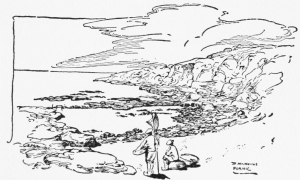
Pornic
In addition to the charm of its situation, the chief attraction of
Pornic is its thirteenth and fourteenth century château, with its fine
towers and machicolations. Its history, like that of most others of its
kind, has been romantic, and by no means has it always had the placid
aspect which it has to-day. It was taken from Gilles de Retz by the
Dukes of Brittany during the civil wars, and to-day belongs to a M. de
Bourquency, who has restored it admirably.
At the foot of the château is a great cross of stone, called the Croix
of the Huguenots, erected, it is said, by converted Calvinists. At the
foot of this cross are buried the bones of over two hundred Vendeans
killed at Pornic.
Clisson is a small town of something less than three thousand
inhabitants, whose very name will conjure up memories of the great
Constable Olivier de Clisson. There is much here of interest, but the
history of the town, the château, and of De Clisson himself are so
interwoven with the affairs of state and warfare of the nation that the
outline even may not be given here. The ruins of the old-time château
are a wonderfully impressive reminder of other days, other ways. As a
whole, it is a grand ruin only, although an architect or archaeologist
may build up somewhat of an approach to the former glorious fabric. The
great central tower has not even preserved its walls entire, but what
is left stands to-day as one of the most imposing examples of a great
feudal keep yet extant. Clisson has some right to be considered up to
date, in that some enterprising inhabitant has introduced an electric
light plant. In spite of this, however, the donjon is one of those
architectural splendours of the world which, like the Coliseum at Rome
and Melrose Abbey, should be seen by moonlight in order to be rightly
appreciated.
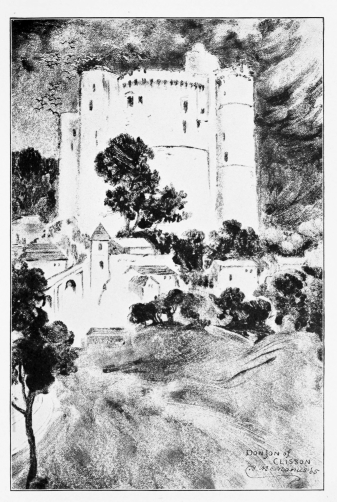
Donjon of Clisson
The chapel, in which was celebrated the marriage of Duke Francis II.
and Margaret of Foix, the keep, the dungeons, the ramparts, and the
chief apartments occupied by the constable himself have been preserved,
and make Clisson well worth the half-day it will take to go there from
Nantes.
NEXT to Marseilles, Nantes is the finest provincial capital of France.
This may be disputed, but it is the opinion of the writer.
Perhaps it is because of the glorious part that the city played in the
past to preserve its independence, and the independence of Brittany,
succumbing only with the second marriage of Queen Anne; but, for some
reason, the links that bind it with the past have never grown rusty, nor
have modern cosmopolitan characteristics destroyed the individuality of
the Breton.
The situation doubtless has much to do with the air of geniality which
pervades the city. When the Loire glistens under the caressing rays of
the setting sun, and the roof-tops of the town are all of a reddened
gold, Nantes might indeed be even now the mediæval capital that it was
before the age of steam and electricity, which sound the only modern
notes to be heard here. At night the spectacle is far more dramatic,
with the streets and quays lit by countless lamps; the subdued murmur
of the workaday world, now all but gone to rest; for an occasional
shriek from a locomotive or a wail from the siren of some great steamer
dropping down-river with the tide is all that one hears.
There is a forest of masts of shipping, scores upon scores of great
chimney-stacks, of ship-houses, of sugar and oil refineries, and along
the quay-side streets there are yet sailors and longshoremen hanging
about and smoking a finishing pipe, or drinking a last drop of spirit
or glass of beer. But all is “drawing in,” and soon all will be hushed
in silence, and only the walls and towers of the great castle and the
cathedral will keep watch, as they have for five centuries past. This
is Nantes, the great trading port. Up in the town blaze forth the great
hotels that would do credit to Paris, and yet are so different, and
coffee-rooms as splendid and brilliant as any in the capital itself,
with the prices of the portions twenty per cent. less.
They keep late hours in this part of Nantes, and night does not
actually fall until midnight, when, one by one, up go the coffee-room
shutters,—to come down again in the same order between six and seven
in the morning. This is not bad for a climate which on the Loire
approaches almost Mediterranean mildness. It is a pity that cold and
austere England does not rise a little earlier in the morning. London,
it is true, sits up late enough, but she makes up for it by dawdling
away all the morning up to half-past ten or eleven.
In spite of all its loveliness and gaiety, Nantes is a city more ancient
than modern,—this antique Namnêtes, the capital, by preference, of the
Dukes of Brittany, and the political rival of Rennes.
The old lanes and crossways of the middle ages have disappeared in
making the spacious great streets of our own time, but there is much
left to remind one of other days in the old houses and in the ever
dominant cathedral and castle.
The Cathedral of St. Pierre is not a masterpiece of itself, but it
encloses a treasure that may well be included in that category,—the
tomb of Duke Francis II. and Margaret of Foix. The great harmony of
this composition, under the half-light of the stained-glass windows,
reveals a charm that most mausoleums altogether lack. On a tablet of
white marble lie the effigies of the duke and duchess, with two angels
kneeling at their heads, and, crouched at their feet, a greyhound,
supporting the escutcheon of Brittany. Four statues, at the corners of
the pedestal, symbolize Justice, Strength, Temperance, and Prudence.
This magnificent tomb is justly counted as Michel Colombe’s finest work.
The castle of Nantes, like that of Angers, is now an arsenal, and
accordingly is less interesting than if it were even a shattered
ruin. It was the castle of the dukes, and the great lodge, a dainty
Renaissance building, with delicately sculptured window-frames and
balconies capriciously disposed, gives an idea of the comfort and luxury
with which pervasive Duchess Anne surrounded herself in the vivid days
when she lived at Nantes. Within the walls of the castle, one might yet
see—were one allowed to ramble over it at will—the chambers where the
odious Gilles of Laval, the Maréchal de Raiz, Fouquet, the Cardinal de
Retz, and the Duchess de Berri were imprisoned during the long years
that it served as a cage for the political prisoners of France. Madame
de Sévigné sojourned here in 1675, so the sombre and yet gay castle,
besides having entertained many of the Kings of France, from Louis XI.
onward, has also somewhat of the aspect of a literary shrine.
In the courtyard is a great well with an admirably worked decorative
railing in wrought iron, quite worthy to rank with Quintin Matsys’s
famous well at Antwerp. The museums of painting and of archaeology,
abounding in rare Breton antiquities, give the town prominence among the
artistic centres of provincial France. The former contains some fine
examples of the work of Philippe de Champaigne, Lancret, Watteau, and
Théodore Rousseau among others.
The environs of Nantes are wonderfully picturesque for the artist, but
offer little for the amusement of the 125,000 inhabitants of this city
of affairs.
To the north, the Erdre winds its way through flat banks, and widens out
here and there into a veritable lake.
From Nantes to the ocean the wind blows more strongly and the horizon
widens; the great waterway of the Loire has already become practically
an arm of the sea, and one breathes its salt air. The aspect of nature
now grows more and more melancholy for the seeker after gaiety and life;
only the artist will revel in these dull brown and gray riverside and
seaside towns, which follow the coast-line from St. Nazaire to Batz,
Croisic, and Guérande. It is what the French themselves call a land of
grayish twilight, with vast stretches of marsh-land and pebble-strewn
sands.
At the extremity of the north bank of the Loire, at the apex of a bend
of the coast-line, is the Bay of Croisic and the Batz country.
Like a needle pricking the horizon, the tip of the tower of Croisic
marks the location of this sleepy little port in the flat and saline
marsh-land round about. South lie the lighthouse and the tower of the
ruined church of Bourg de Batz, that little Breton village all but
isolated from the mainland itself.
It is the true borderland or frontier between the sea and the land, the
one almost imperceptibly mingling with the other. Of it Jean Richepin
sang:
“Mirage! Sahara! les Bédouins! Un Émir
Est venu planter là ses innombrables tentes
Dont les cônes dressés en blancheurs éclatantes
Resplendissent parmi les tons bariolés
De tapis d’Orient sur le sol étalés;
Ses cônes dont les tas de sel sur les ladures,
Et ses riches tapis aux brillantes bordures
Ne sont que les Gabiers, les Fares, les Œillets.
On l’évaporement laisse de gros feuillets
Métalliques, moirés flottant d’or et de soir.
Par l’étier et le tour qu’un paludier fossoil
La mer entre, s’épand, s’éparpille en circuits,
Puis arrive aux bassins....”
“The sea sells cheap” say the natives, who are mostly engaged in the
salt industry, as one would infer from the foregoing. Competition
has cut considerably into the industry of recovering salt from the
sea-water, but it is still kept up, and these little Breton coast
villages depend upon it, and on fishing, for their sustenance.
St. Nazaire, where the sea first meets the waters of the Loire, is
quite new, created but yesterday by the march of progress. Tradition
connects the site of this busy port—the seventh in rank among the ports
of France—with the ancient Gallo-Roman port of Corbilon. No trace of
its former appellation exists since the sixth century, when Gregory of
Tours, in the first history of France, mentions the settlement as having
been pillaged by a Breton chief, and refers to it as Vic-Saint-Nazaire,
which nearly approaches its present name.
In the fourteenth and fifteenth centuries the market-town was called
Port Nazaire, and was defended by a castle erected by the Dukes of
Brittany.
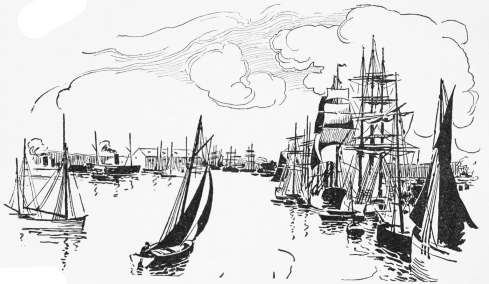
St. Nazaire
Modern navigation has replaced the old sailing-vessels, and to-day, with
its coastwise and foreign trade and its great shipyards, St. Nazaire
is a busy, bustling town. The blemish it has, in the eyes of most, will
be its general aspect of modernity and its uncompromising, right-angled,
straight streets, laid out on a plan which suggests that of Chicago,
if one make an allowance for the difference in magnitude. St. Nazaire
surpasses Chicago, however, in having a sea front, instead of a lake
front, and its hotels are better and cost less. What more should a
passing traveller want of a modern city?
Between Nantes and St. Nazaire, on the granite flank of Sillon de
Bretagne, sits Savenay, as if its houses were ranged around the steps
of an amphitheatre. It has fallen considerably from its proud position
of having been the flourishing capital of the district. It still is the
largest town, but none of the honours go with its size; decay has fallen
upon it, and the hotels are dull, sad places, and even the omnibus from
the railway has stopped its journeys.
The town was the site of a terrific conflict in the Vendean wars,
and was well-nigh destroyed, and its inhabitants were massacred. Now
vineyards grow upon the very soil that a hundred or more years ago
covered thousands of corpses. Altogether it is a gruesome memory which
Savenay conjures up, if one dare even to think of it.
Between Savenay and Guérande, at an equal distance between the two,
are the peat-bogs of Grand Brière. They are the great resources of the
country. Would you see them worked? Then come in August, when you are
making your way to some seacoast resort of Lower Brittany. For nine
days only in the year do the authorities permit the sods to be cut, but
everybody takes part therein, you will be told; and enough peat will be
gathered, and dried, and pressed into “loaves,” as the Brièrons call
them, to warm Nantes for a year.
Guérande is a capital not quite so dead and alive as Savenay; it is
the possessor of a past of a most momentous and vivid character in
its relation to the history of Brittany and of France. To-day, as in
other days, the town is avowedly Breton, as characteristically so as
any of its size in the province. Much has been sacrificed to the god
of progress, but enough of the ancient aspect of the place remains to
recall its features of the time of Duguesclin and Clisson, and the
Counts of Montfort and of Blois, who proclaimed peace here in 1365. The
enormous Saint Michael Gate is a great fortress-gateway, flanked with
two cylindrical and conical roofed towers of the time when feudalism
ruled Brittany.
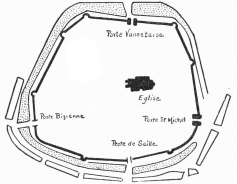
Ancient Fortifications of Guérande
“Guérande,” says a Frenchman, “has not unlaced its corselet of stone
since the fifteenth century.” To-day, even, it is surrounded by its
mediæval ramparts in a manner like no other northern city in France,
reminding one of those great walled cities of Aigues Mortes and
Carcassonne in Southern Gaul.
This proud belt of machicolated ramparts, ten towers, and four great
gates, and its deep, though now herbage-grown, moat is indeed one of
the few monuments of the middle ages that remain to us in all their
undisturbed splendour.
Guérande is not exactly a deserted village, but its streets are, at
midday, as lone and silent as though its population had not been in
residence for many months. This is a notable feature in many small
French towns during the hour and a half of the midday meal, but nowhere
else is it more to be remarked.
The old parish Church of St. Aubin of Guérande has a collection of
strangely carved capitals depicting horrible chimerical beasts, and
the Chapel of Notre Dame de la Blanche—a fine work of the thirteenth
century—is occasionally the scene of a marriage wherein the
participants dress themselves in the old-time resplendent costumes. Such
an occasion is rare, but should one be fortunate enough to meet with it,
he will carry away still another memory of the mediæval flavour still
lingering about this somnolent little Breton city.
Seaward beyond Guérande are only Bourg de Batz and Croisic, a gay
little maritime city with a fine Gothic church of the highly ornamented
species, and many old, high-gabled houses of the variety which one sees
frequently in stage settings. There are the local watering-places,
too, of the Nantais, Ste. Marguerite and Baule, which have nothing of
interest, however, for the traveller who seeks to improve his mind and
amuse himself simultaneously. They are undoubtedly of great healthful
and economic value to Nantes and St. Nazaire, however, and they do not
differ greatly from others of their class elsewhere.
Again returning to the highroad, if one be travelling by road, “Vous
prenez le chemin de Vennes” (Vannes) “par la Roche Bernard qui est aussy
celuy de Rhennes et de Rhedon,” wrote a sixteenth-century chronicler,
and the direct road to-day lies the same way. It is known as “National
Road” No. 165.
Straight as the crow flies, but now up and now down, like all Breton
roadways, this highway runs from Nantes to Quimper, 232 kilometres.
The aspect of the country changes perceptibly as one leaves Savenay on
the way to the real Brittany. One crosses the Vilaine by the suspension
bridge of La Roche-Bernard, hung so perilously high that the great
three-masted coasters may pass beneath. It is unlovely, but convenient,
and saves a round of fifty kilometres on the journey, as one goes from
Nantes to Vannes, so it may be pardoned.
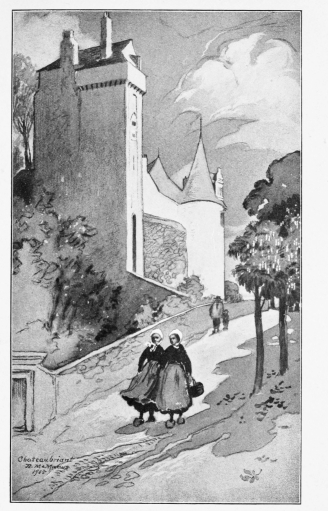
Châteaubriant
Northward lies the very ancient town of Châteaubriant, once the centre
and life of Breton warfare and political strife. It was an ancient
barony of the county of Nantes, and owes its name to the compounding
of the word château with that of its original lord, who was named Brient.
The ancient feudal fortress is now a ruin, but the castle built by
John of Laval, governor of Brittany under Francis I., still serves
the gendarmerie and the sous-préfecture offices. Above the portal of
the colonnade one reads this inscription, which gives the date of the
completion of the new castle:
DE MAL EN BIEN, DE BIEN MYCVLX
POUR LACHEVER IE DEVINS VIEVLX
1538
Each is most interesting, and so abundantly supplied with the lore of
romance and reality, that one can only get his fill of studying it on
the spot.
The Church of St. Jean de Béré is a historical monument of almost the
first rank, and the remains of the ancient Benedictine convent of St.
Saveur date originally from a foundation of Brient I.
On the thirteenth and fourteenth of September of each year, on the plain
behind the town, is held the celebrated fair of Béré, one of those
great combinations of marketing and merrymaking for which old France
was noted, and which have so largely disappeared that to be a part and
parcel of one is to have a most agreeable experience. Guibray, near
Falaise, in Normandy, the “horse-fair” at Bernay, and the Fair de Béré
are the most celebrated in these parts.
It was in the neighbouring forest, as Pontcalec recites in the pages of
“The Regent’s Daughter” of Dumas, that he met his adventure with the
“sorceress of Savenay.”
“I saw an enormous faggot walking along,” said Pontcalec to his three
Breton friends. “This did not surprise me, for our peasants carry such
enormous faggots that they quite disappear under their load, but this
faggot appeared from behind to move alone.”
A very good description this of what one may see even to-day, not only
in this particular forest, but in any other in France. French frugality
burns small sticks and twigs that in other lands would be made into
a brushwood fire, and who shall not say that this trait, along with
many others, does not contribute to the contentment of the French
peasant? for he is content, if not amply endowed with this world’s
goods; marvellously so as compared with his English, Irish, or Italian
brethren. There may be other reasons, but his thrift is the principal
one.
Any one seeking change and rest will certainly find what he is looking
for at Châteaubriant. It is somnolently dull all through the week and
doubly so on Sundays, but, in spite of all this, it is delightful, and
a romantic novelist—or even a writer of romantic novels—could hardly
find a more inspiring background than the country round about.
There is a legend, too, in connection with the old château that might be
worked up into a first-class romance, either for the stage or as a sword
and cloak novel. After all, it is not exactly legend either, though it
is almost too horrible to appear true. The reader may judge for himself,
for here it is:
In the old château lived for a time that unfortunate Frances de Foix
whom Francis I. had created Countess de Châteaubriant. To-day much of
the luxury with which this mistress of the royal lover had surrounded
herself has disappeared, though enough remains, through restoration
and preservation, to suggest the very splendid appointments of a
former time. The young Frances de Foix, herself of the house that once
possessed the crown of Navarre, married the old Count of Laval, who
soon brooded himself into a passion of jealousy over the affair of
his wife and her princely lover, particularly as it was said that she
had gone to visit Francis while he was in prison after his capture at
Pavia. “The countess found the king’s prison very dismal,” said the
chroniclers of the time. This last act proved too much for the elderly
spouse, who speedily “shut up his young wife in a darkened and padded
cell, and finally had her cut into pieces by two surgeons,” as the story
goes. After this horrible event the murderer fled the country, as might
have been expected, in order, say the chroniclers again, “to escape the
vengeance of the king.”
Redon, just to the north, is an unattractive place. Most folk know it
only as the railway official calls out: “Forty-five minutes’ stop for
luncheon, refreshments, and all the rest.”
Very amusing are these railway lunch-rooms seen throughout France. But
withal they are most excellently appointed, although the passengers,
like their kind the world over, eat as though they had not a minute
to lose, and have a good fifteen left on their hands when they have
finished their repast.
The meals are usually divided into three categories: the public table at
a set price, the table for the aristocracy at three francs, the table
with set portions, the frugal repast at half as much, and the service
“to order,” which is the most costly of all.
Nothing is of an inferior quality, however, and, as all is served
from the same kitchen, it is merely a question as to whether one will
have more or less, or whether he will eat it off linen napery, with
a napkin to tuck under his right ear,—as is the French commercial
traveller’s custom,—or whether he will be satisfied with an oilcloth
table-covering. The difference is more apparent than real, for the
“frugal repast” at a franc and a half is the three franc meal shorn of
its trimmings; you get the same dishes and the same service.
As if to ease the process, a stentorian railway hand puts his head in
the door and shouts: “Ten minutes before the Vannes express starts!”
and returns again at the end of the allotted time to give a final call:
“Into the carriages, gentlemen!” It is much the same the world over, of
course, but they are more polite in France, and the food is better of
its kind, and much better served, two very appreciable differences.
Redon itself and its great open square, on which are the railway
station, the hotels, and the gaunt, lone, dismembered tower of the
Church of St. Sauveur, is by no means attractive. The square is bare of
trees, and in the summer the sun beats down upon the frequenters of the
terrace coffee-rooms of the hotels in a manner which makes one wonder
why they do not move off and seek a shady spot elsewhere.
The indifference shown by the natives of certain localities for the
pelting sunlight, which makes some of us think of cabbage leaves for
our hats and “gin rickeys” for our stomachs, is curious. The Neapolitan
prefers to loll about in the blazing Italian sun, and says that no one
but an Englishman or a dog ever seeks the shade. The citizen of Redon is
like him, and does not care who knows it, and his sunlight, though it
comes to earth some hundreds of miles farther north, appears to be of
the same caloric value.
Redon was an old monastic foundation of St. Convoïon’s, of the Vannes
church. He built the Abbey of St. Sauveur, of which the present church
and its lone tower are later additions. The main body of the present
edifice dates in part from the time of the foundation, though its fabric
was frequently added to and restored up to the twelfth century, from
which period it may really be said to date. The central tower of this
church is said to be the only Romanesque feature of its class in all
Brittany, and is certainly one of the most sturdy anywhere to be seen.
Another remarkable feature is a chapel, the walls loopholed and
machicolated, and built by the Abbé Yves in the fifteenth century;
to-day it serves as the sacristy.
The high altar, a rich and imposing affair, was the gift of the great
Richelieu when he was in possession of the revenues of the abbey. The
city was surrounded by a fortification or wall by the Abbot John of
Treal in 1364, and in 1422 John V., Count of Brittany, established a
mint here.
Questembert, westward toward Vannes, is a town of four thousand or so
inhabitants, and has many interesting old houses, but otherwise is
devoid of attractions either for the lover of architectural monuments or
for worshippers at religious or other shrines. It is, however, the place
for holding many local fairs or markets of considerable magnitude, where
one may make practically his first acquaintance with the Breton peasant,
becoiffed and beribboned as he, or she, only is on native heath.
Rochefort-en-Terre is also a chief place; as its population numbers
less than seven hundred souls, it cannot be considered as even a
local metropolis. Its situation and its fine, though not stupendously
remarkable, architectural glories make up for what it lacks in the way
of population. It sits high on a hillside dominating the little river
Arz, a confluent of the Vilaine. Its name is due to the founder of
a château built here in the thirteenth century and destroyed by the
Catholic Leaguers in 1594, though it was afterwards rebuilt and again
destroyed, this time by Revolutionary firebrands, in 1793. The ruins of
this château are to-day very satisfactory indeed as ruins, though they
include few or none of the architectural details with which the work
must once have been endowed. The lower courses of the walls are there,
remains of five towers, and an ancient well, with a curb of sculptured
granite.
The ancient collegiate Church of Notre Dame de la Tronchaye
is an ecclesiastical monument of high rank, for a town like
Rochefort-en-Terre, and is an altogether lovable old shrine, with
admirable sculptures in stone and some curious wooden statues, in the
interior, said originally to have been those of Claude of Rieux and
Suzanne of Bourbon, Lord and Lady de Rochefort. These statues are now
converted into a St. Joseph and a Virgin. This may or may not have been
a sacrilege; it certainly was a desecration. The ancient city gates
remain, and there are numerous fifteenth and sixteenth century houses.
The country round about Rochefort-en-Terre was brought into vogue by
the landscape-painter, Pelouze, some years ago, and other artists have
followed in his wake, making an over growing artist colony in the
summer-time. Studies and sketches decorate the dining-room of the Hôtel
Lecadre in a surprising number; at least surprising to one who comes
upon this unassuming little town and its excellent, before named, little
hotel while journeying to Finistère.
Still going toward Vannes one passes Elven, near which is the Manoir of
Kerlean, the family estate of the Descartes. The birth certificate of
the Descartes is in the records in the mayor’s office.
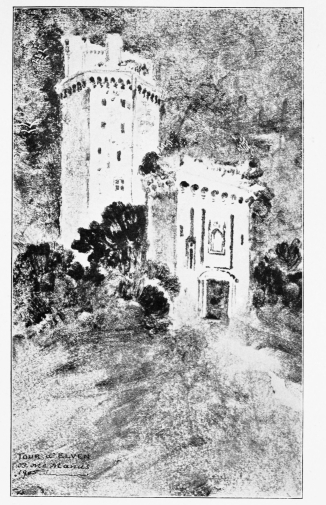
Three kilometres to the north are the remains of the ancient fortress
of Largoet, whose tower, known as the Tour d’Elven, dates from the
fifteenth century. This tower has been called the most beautiful castle
keep in all Brittany, and so it is if one take into consideration
its moss-and-ivy-grown walls and its general eerie aspect heightened
perceptibly if seen by moonlight. This high, majestic tower of a feudal
castle, whose other members have practically disappeared, is also a
literary shrine of high rank, inasmuch as Octave Feuillet has placed
here some of the most moving scenes in his “Story of a Poor Young Man.”
Perhaps this true romance is not so well known to the present generation
as to a former, but it should be, and accordingly the clue is here
given, and it should have a double significance so far as travellers in
Brittany are concerned.
Tour d’Elven
One enters Vannes, if it be a holiday or a Sunday, amid a gaiety and
uproar that is apparently inexplicable. To be sure Vannes is the
metropolis of the Morbihan, but one does not look for such continuous
gaiety on the part of a people supposed to be wholly devout and not very
rich, as possessors of this world’s goods count their gains. Devoutness
need not necessarily mean glumness, and so as it all seems, around
Vannes at least, to be for the general good, one is not sorry to have
his first introduction to a great Breton town in a way so pleasant.
Really it is a sort of small gaiety, and strictly local, which goes on
here. There is nothing of the riotous order, but it is all very gay,
nevertheless.
The simple folk of the Morbihan, who have crowded into Vannes for the
day, are as interested and amused with a hurdy-gurdy Punch and Judy
show, a travelling circus, or a merry-go-round as if they were the
latest distractions of Paris. Meanwhile one seeks his hotel, and there
comes another surprise.
THE “Golfe” or Bay of Morbihan is one of those great landlocked havens
in which the whole Breton coast abounds; its islands are as many as the
days of the year, as the natives have it.
Morbihan itself is as much sea as land. The tides rise to a great height
along this whole southern coast of Brittany, and in the Bay of Morbihan
they have full play.
The metropolis of Lower Morbihan is Vannes, which the railway porters
shout out at you, as you descend from the train, as Va-a-a-nnes.
Leaving the station, one threads his way through whole batteries of
laundresses, their gull-winged head-dress nodding in rhythm with the
beating of their paddles, a most picturesque sight, but a process which
works disaster to one’s clothes, destroying pearl buttons, and causing
mysterious small holes to appear in the most inconvenient places. An
accompaniment of song always goes with these shattering and battering
exercises. At Vannes, according to Theodore Botrel, it runs like this:
“Pan! pan! pan!
Ma Doué!
Comme la langue maudite
Marche bien au vieux lavoit.
Pan! pan! pan!
Vite! vite!
Plus vite que le battoir!”
It is the day of the local fair, the chief article of commerce being,
it would seem, pigs, as at Limerick. At any rate, there are hundreds,
if not thousands, of little porkers, who have just put foot to earth,
as their venders tell one; their own voices, too, strident and high
pitched, announce the same thing.
Vannes, truth to tell, is not much of a capital, but it is a highly
interesting and picturesque old town, with manners and customs quite
different from those of any of its neighbours.
The chief characteristics of the place seem to be pointed roofs of red
and moss-grown tiles and walls of blue granite. One can almost imagine
that Botrel chose it as the scene of the stanza:
“Qui donc chante sous nos fenêtres
Ces mystérieuses chansons?
Ce sont les âmes des ancêtres
Qui reconnaissent leurs maisons!”
Market-woman, Vannes
There is a blending of the seashore and the open country here which is
scarcely found in any other part of France. In some respects it is like
Holland, and again it is not, for it lacks the web of canals with which
that country is interwoven.
The whole bay—“Le Golfe”—forms a dooryard for Vannes, and a yacht or a
boat is as much an appendage of the Vannes household of the better class
as a dog or cat.
The Country near Vannes
Vannes, the capital of the Morbihan, is a city of 23,000 souls, and has
two great modern, up-to-date hotels. Choose one, and you will “like the
other best,” as Rubinstein said to the young pianist, who was to play
two of his compositions to the master. He said this, be it recalled,
after he had heard only the first one. Not that Vannes hotels are really
bad. Oh, no. Truth to tell, they are excellent in their way, but they
are unconvincing.
When one is here, in the midst of a new, strange set of conditions
of life, he looks for something characteristic about his inn. If he
find it, he is content; if he do not, all the smugness and propriety
of imported manners and customs in the dinner service will not make
him so. The true traveller prefers taking his chances with the native
dishes to trifling with Paris culinary fashions at the hands of a Breton
peasant-chef,—if that is the exact classification one ought to give the
cooks of Vannes.
To enter Vannes by road, one has come down a precipitous descent to
the sea-level, and accordingly rises again to an equal height when he
leaves, for Vannes is the great tidewater port for the whole of the
south coast of Brittany between Lorient and St. Nazaire. The traffic of
the bays of Morbihan and Quiberon is considerable, and the ceaseless
coming and going of many small steamers and sailing-craft is unlike
traffic elsewhere.
The great bay is an inland sea almost surrounded by the jutting
peninsulas which terminate on either side of the narrow channel in
Pointe de Kerpenhir and Port Navalo. The name is compounded of two
Breton words, mor (sea) and bihan (little). The flat tree-grown
islands of this little sea make vistas and groups of a unique character,
and to learn the bay well by a voyage among them in a flat-bottomed
skimming-dish of a craft, or by the more facile motor-launch, is a
thoroughly agreeable experience.
The chief of the islands are the Monks Isle and the Ile d’Arz, but the
enfolding shores of the mainland, with its little seaside-farmyard
villages, have the same characteristics.
On the little passenger steamers, which ply between the islands and the
mainland, one meets a queer company of peasant-folk in coifs and round
velvet or straw caps, fowls, sheep, goats, and an occasional overgrown
calf.
Such of the islands of the bay as are populated, and many of them
are, were colonized from the neighbouring country, and the women in
particular are physically admirable. They still wear the distinctive
costume of the country in a spirit uncontaminated by the electric lights
and railways of Vannes. Custom in these isles allows the young women
to demand the hand of a likely swain in marriage, and the plan seems
to work well. The population seems generally happy, prosperous, and
contented. What better is expected as the outcome of marriage?
The climate of all the Morbihan shore is mild and tranquil at all
seasons of the year, and one may sit beside the open window of his hotel
dining-room throughout the year. The mimosa flowers in winter, and
palms, rose-trees, camellias, and fig-trees prosper exceedingly in the
open air.
Vannes was the ancient capital of the Veneti, a strong coast tribe of
other days which resisted the invasion of Cæsar and triumphed against
his fleet a half-century or more before the Christian era.
When finally the Romans came, they made Vannes the centre of six
great highways which radiated to Corseul, to Angers, to Hennebont, to
Locmariaquer, to Rennes, and to Nantes. From this its importance may be
inferred.
Christianity came to Vannes in 465, when St. Perpetus, Metropolitan of
Tours, consecrated St. Patern as first bishop. By the sixth century it
had become an independent county, but was joined again to the duchy
of Brittany in 990. John IV. established his habitual residence at
Vannes, and constructed the celebrated Château de l’Hermine, with its
constable’s tower so famous in the history of Brittany as the place in
which he imprisoned Clisson, releasing him only after the payment of a
heavy ransom.
The history of Vannes and the Morbihan is too long and stormy to be even
outlined here, but there are still many remains and memories which will
serve as a foundation upon which to build the fabric anew.
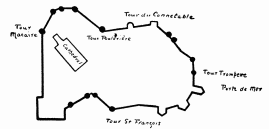
Ancient City Walls, Vannes
The port is most interesting, with its varied traffic and its great
ships of nearly a thousand tons which thread their way up through the
islands of the gulf, bringing lumber, coals, and all the small cargoes
of a great coasting port.
At Vannes one may see a huge parti-coloured handkerchief of the
bandanna variety waving before a narrow doorway. It is the “shawl,”
the sign of the hair-cutter, who will exchange its fellow for your
hair, if you be a Breton girl with dark brown tresses, or even an
elderly person whose hair is iron-gray. In Lower Brittany, on summer
fair-days, the dealer in hair makes a round exceedingly profitable to
his establishment, though at each stopping-place it leaves a hundred
or more young girls shorn of their crowning glory,—a loss which they
successfully cover with their daintily ironed head-dress.
The chief of the sights and shrines of the neighbourhood of Vannes are
St. Gildas de Rhuis and the Château of Suscino. The former is revered
for its sixth-century monastic foundation of St. Gildas, called the
wise, and for some time in the twelfth century governed by the famous
Abelard. The ancient abbatial church is now the parish church. It dates
from the twelfth to the fourteenth centuries, and is an unusual work in
many respects, and rising to a height of grandeur seldom seen outside
the larger Breton cities and towns.
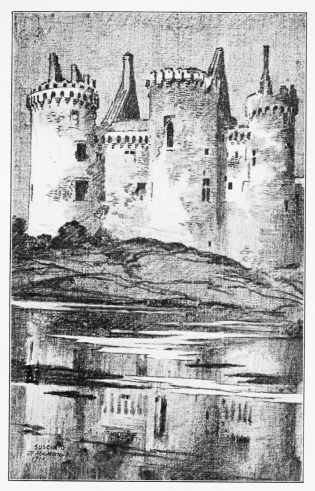
Château of Suscino
The castle of Suscino—or more properly the ruin—is a wonderful
thirteenth-century structure on the water’s edge, built by John the
Red-haired. It follows the best Gothic traditions of its time, and
its crenelated walls and towers, the latter now unroofed, are perfect
of their kind. It was captured by Charles of Blois, and retaken by his
Montfort rival in 1364. An English garrison occupied it in 1373. Finally
it was given by Anne of Brittany to John of Chalons, Prince of Orange,
from whom it was taken by Francis I., and he presented it to Frances of
Foix, Lady of Châteaubriant, as she then was. The rest of its history is
equally varied, and as important as becomes so magnificent a mediæval
fortress.
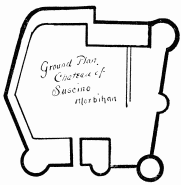
In form the château is an irregular pentagon, perhaps modified from
its original plan in 1420. Its orchid machicolations are remarkable
both for their beauty and their utility. Seven towers, of which six
remain, originally flanked its gates and walls. The new tower is a fine
cylindrical keep of the fifteenth century. Over the entrance one still
reads a tablet inscription as follows:
Ici est né
Le duc Arthur III.
le 24 Août, 1393
North of Vannes are Ploërmel and Josselin, two places which no one
should leave out of the itinerary of Brittany. Neither is easily
accessible by rail, but both are conveniently reached by road.
Ploërmel has a railway connection with the line to Brest by way of
Rennes, and another with the line to Brest by way of Vannes, but
Josselin is off the beaten track, and one makes his way from Ploërmel by
omnibus or in a carriage.
Ploërmel and its “pardon” have inspired an opera, one of Meyerbeer’s
most celebrated scores, known to English music lovers as “Dinorah,” but
in French called “The Pardon of Ploërmel.” The town owes its name to an
anchorite who, in the sixth century, retired here to a hermitage.
The history of Ploërmel during the middle ages was stormy. It was here
that the edict expelling the Jews from Brittany was issued in 1240. In
1273 the Comte de Richemont—upon his return from the Crusades—founded
at Ploërmel the first Carmelite convent known to France. This ancient
convent, situated without the walls, escaped from the disasters which
caused the city to be burned in 1347. The Calvinists came in time to
have a temple here, in which they held two synods of their church.
To-day Ploërmel is a sleepy, old-world town, with two good inns, and
not much except the fragmentary reminders of old walls and buildings to
remind one of the parts played in other days.
The Church of St. Armel, a reconstruction of 1511-1602, is in parts
highly decorated with stone sculptures and strange images, recalling,
says an ingenious, but profane, Frenchman, the “pleasantries of
Rabelais.” Of course he refers to the players on the bagpipes, the man
sewing up the mouth of his wife, and the wife tearing off her husband’s
cap. Certainly these quaint figures are not born of religious symbolism,
unless, by chance, that the symbolism of the religious builders of
Ploërmel differs greatly from that of others elsewhere.
There are still remains of Ploërmel’s old city walls dating from the
fifteenth century, and also a fragment of a tower.
Near by, on the road to Josselin, is a simple granite shaft perpetuating
the famous “Battle of the Thirty,” celebrated in history.
According to Froissart, Robert of Beaumanoir, chatelain of Josselin,
one day provoked an English captain—Bromborough—who was encamped at
Ploërmel, and challenged him to battle; thirty of his men against thirty
Frenchmen. At the first attack four Frenchmen and two English fell.
Then the combat began again with swords, battle-axes, and lances. Eight
English only finally remained, including Bromborough himself; all the
others were killed or taken prisoners and led away to the dungeons of
the Château de Josselin.
Froissart writes elsewhere of this same engagement: “Twenty-two years
after the battle of the thirty, I saw at the table of King Charles of
France one of the combatants, a knight called Yvain Charnel. His face
showed that the battle had been hot, for it was scarred all over.”
This wayside column or pyramid just off the route bears the following
inscription:
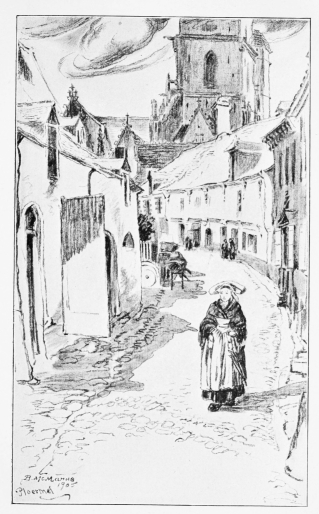
Ploërmel
À la Memoire Perpetuelle
de la Bataille des Trante
que Mgr le Maréchal de Beau Manoir
a Gaignée dans ce Lieu l’An 1530
Josselin is now chief town of a commune of 2,500 inhabitants; it has a
fine mediæval château yet inhabitable, two ecclesiastical monuments of
more than unusual excellence, and a rather shaky and ill-situated inn
(Hôtel de France), which makes up in the abundance and excellence of its
fare for what it lacks in the way of electric lights and modern sanitary
arrangements.
The first houses of Josselin were grouped around a miraculous effigy
of the Virgin, known as Notre Dame du Roncier, because it was found
beneath a blackberry-bush. To-day Notre Dame du Roncier, the church and
the chapel and its statue of the Virgin, are venerated highly by the
faithful who make the pilgrimage to the shrine on the Monday and Tuesday
of Pentecost and on the eighth of September, the birthday of the Virgin,
when the remains of her ancient statue are shown. This effigy was broken
and burned in the Revolutionary fury of 1793, but a modern replica was
crowned, in the Chapel Notre Dame du Roncier, in 1868. The settlement
which grew up around the shrine was surrounded by a protecting wall by
the Count of Guéthénoc in 1008, and in 1030 it was given the name of
Josselin, after his son.
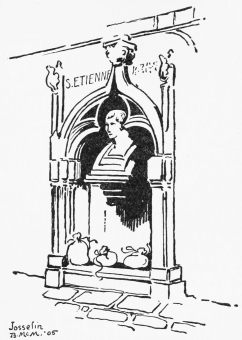
Shrine of St. Etienne, Josselin
In the thirteenth century, the county of Porhoet, in which Josselin was
situated, passed to the house of Fougères, and its affairs were varied
and involved until Peter of Valois, Count of Alençon, sold it to the
Constable Oliver of Clisson, whose daughter brought it in marriage to
the Rohans, to whose descendants it still belongs.
In the Church of Our Lady of the Blackberry-bush is a remarkable tomb
placed in the Chapel of St. Marguerite—the former oratory of the
constable—to Oliver of Clisson and Marguerite of Rohan.
The castle rests on a rocky foundation beside the river Oust, and its
front is most imposing. Three towers with conical roofs flank the
riverside, and are an expression of the best fortress-château building
of its era (twelfth century), severe and gaunt in every line, and yet
beautifully planned. The interior court takes on quite a different
aspect, that of the “architecture civile” of the third ogival period,
when Renaissance forms and details had crept in, almost destroying
Gothic lines.
The window openings of the two stories have an admirable decorative
effect, as beautiful as those of Blois and very nearly equalling those
of Chambord.
An open gallery above the windows is a charming additional
interpolation, and between each window is carved “A Plus,” the device
of the distinguished family of the Rohans, who built this part of the
structure. A keep and some later walls and parapets were added by
Clisson somewhere about the year 1400, but most of them disappeared in
1629, when the château ceased to be a stronghold of the League.
In the main it is a twelfth and thirteenth century structure which is
so admirably preserved to-day. One may visit the interior, through the
courtesy of the family in residence, and, though it may be somewhat
disconcerting to walk through these historic apartments of another
day and see such modern innovations as electric bells and other
appurtenances of a late civilization, the experience is, after all,
a peep behind the curtain, and this the up-to-date motor-car tourist
always appreciates highly.
The great hall, the library, with its magnificent chimneypiece and
its cipher, “A Plus,” carved in stone, and the dining-room ornamented
with a modern equestrian statue of Clisson, by Fremiet, are the chief
apartments shown.
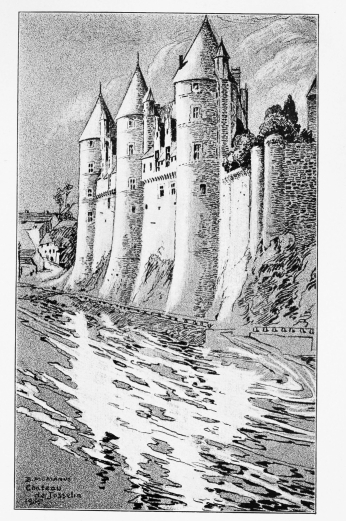
Château de Josselin
In the court within the walls is an ancient well surrounded by an
elaborate forged iron railing.
One takes the road again, by the way of Locminé and Baud, for Auray, the
most dainty and charming of all Breton market-towns, passing through a
delightfully picturesque country of rolling hills and deep valleys and
fir forests, studded here and there with lakelets.
Locminé, which derives its name from Locmenec’h (monk’s cell), was the
site of a monastery founded in the sixth century by St. Colomban. It was
burned by the Normans in the ninth century, after the pleasant custom of
these invaders, and reëstablished in 1006 by Geoffrey, Duke of Brittany,
as a priory attached to the Abbey of St. Gildas of Rhuis.
In the present church of Locminé is a chapel dedicated to St. Colomban,
containing a painting representing scenes from the life of the saint;
others are carried out in the coloured glass of the windows.
One reads the following,—a supplication on behalf of the dangerous
madmen who at one time occupied two cells beneath the pavement:
“St. Colomban, patron of Locminé, pray for us!
St. Colomban, help of idiots, pray for us!”
Behind the church is an elaborate ossuary dating from Renaissance times,
when these adjuncts to burial-grounds were so plentifully scattered
over Brittany.
Baud has an enormous parish church of the time of Louis XIV., with a
fine Gothic arcade and a great crucifix standing beside the outer wall.
Aside from this, there is not much else here to attract one, unless he
be a pilgrim affected with disease of the eye. If he be, and if he bathe
in the “Fontaine de la clarté,” and the fates be propitious, and he be
not too far gone otherwise, and everything else be as it should, he will
be cured forthwith—perhaps.
It is unkind to scoff at these miraculous fountains scattered here and
there over the world, of course, but one has seen so many individual
cases that were not benefited, and heard of so many that were, that one
may be justified in a little skepticism.
To Auray is twenty kilometres by a road which gently rolls down a matter
of 150 metres of elevation until it reaches sea-level at the little
market-town seaport known in Breton as Alre.
AURAY is the real centre from which to make the round of the vast
collection of relics of the long lost civilization of Morbihan.
Many have attempted to explain the significance of these rude stone
monuments. Some have said that the famous avenues of Carnac were the
streets of one of Cæsar’s camps, its roofs having fallen and mouldered
away, and that the famous “Merchants’ Table” at Locmariaquer was an
ancient druidical altar, to which the helpless were led to be sacrificed.
All this and much more is for the antiquary alone, and a nodding
acquaintance with the history of these curious stone formations or
erections is about all for which most travellers will care.
He who arrives at Auray on a market-day will seem to himself to come
into a region where every one speaks the Breton tongue. Not all, of
course, for French is now compulsory with the school-children, but the
frequency of it here in the booths and stalls in and around Auray’s
lovely old timbered market-house is greatly to be remarked.
It is a question if this same market-house be not quite the most
theatrical-looking thing of its kind in all France. It is for all
the world like a successful piece of stage carpentry, with a great
spectacular stairway running up into its garret above, quite in the
manner that one has seen upon the stage over and over again, when the
heroine or the villain—it does not much matter which—escapes from his,
or her, pursuers. Low built, heavily raftered, and with a leaky roof
allowing rays of sunlight to dribble through into the gloom within in a
most entrancing manner, this old market-house is the centre of the life
and activity of the place for fifty-two Mondays in each year.
Within and without the walls of the market-house is gathered the most
varied conglomeration of wares imaginable. Beside the draper’s counter
are baskets of vegetables, eggs, or fish. A poor little calf, tied by
the legs and lying at full length on the ground, keeps company with his
former farmyard neighbours, the ducks and geese, but on either side is a
second-hand collection of ironmongery and old shoes, and it should be
the envy of the provident, for two sous buy anything in the collection.
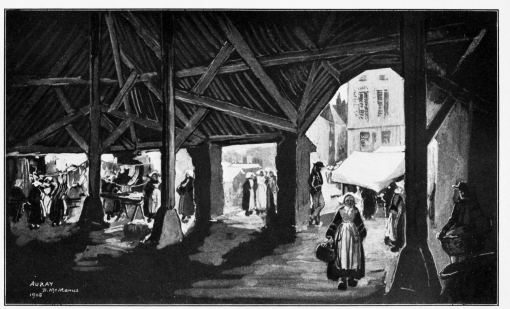
Interior of Market-house, Auray
The country-side Breton peasant who comes to Auray on a market-day is
the glass of fashion of his race, his jacket embroidered in braid of gay
colours, and velvet bands on his sleeves and collar. His shirt is high
and stiffly starched, and his felt hat or cap heavily hung with velvet
ribbons. The womenfolk are clad in equally spectacular fashion, with
high white caps and full-sleeved bodices, each with a black velvet band
around the sleeve, and full gathered skirts, spoiling all symmetry of
form as nature made it.
The history of Auray, from the days when it belonged to John of Auray,
grand huntsman of Brittany, has left its mark in the annals of the
country in no indefinite manner. John of Montfort, the Counts of Blois,
Duguesclin, and many others stalk through its pages of history until
finally, in the wars of religions, it was held by the Catholic army
and the Spaniards in turn. Its old château, whose foundations now form
the fine Promenade du Loc, dates from the eleventh century; and it was
reconstructed and enlarged two centuries later, finally to disappear,
as the result of an order for its demolition given by the castle
destroyer, Henry II., in 1558.
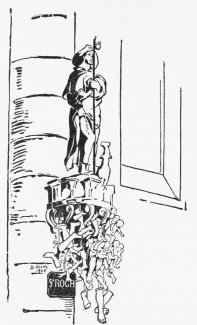
Shrine of St. Roch, Auray
The port of Auray is more daintily and charmingly environed than most
seaports. As it lies between the wooded, deep-cut banks of the little
river, its intermingling of ships and salt water, and country-side, and
sailor lads and rustic maidens, and all the motley population of the
little town, is a marvellous thing to see.
The smack of antiquity is about it all, and the historic legend of its
shrine of St. Anne—which lives as vividly to-day as ever it lived—most
touchingly connects the present with the past.
One of the most celebrated, and certainly the most largely attended,
of all the “pardons” of Brittany is that held at St. Anne of Auray,
though Auray itself is something more than a mere place of religious
pilgrimage, and a good deal more than a wayside station on the railway
line where one leaves the train and hires a carriage for Carnac and
Quiberon, though apparently not many tourists know it. In the first
place, it is one of the largest and most characteristic of all the
little Breton market-towns, is a deep-water port of a considerable size,
and has a hotel which supplies one with the most ample and delightful
meals that the traveller will find westward of Nantes.
This may be a mundane standard by which to judge of an old-world town’s
appeal to interest, but it is all-sufficient, and the most marvellous
attractions the world may have to offer will hardly be appreciated by
a travel-worn and hungry traveller, and such should plan to arrive in
town for the Monday dinner at the Golden Lion; also he should not hurry
through the town merely for the sake of visiting the shrine of St. Anne,
which is tawdry enough in its general aspect, except when it is thronged
on the great days of the “pardon,” March seventh and July twenty-fifth.
The great festival of the Pardon of St. Anne of Auray is held in July,
on the birthday of St. Anne, the mother of the Virgin Mary. Its origin
dates back to 1623, when a peasant of the country-side, one Yves
Nicolazic, was commanded by St. Anne, who appeared to him in a vision,
to found a chapel in her honour in the fields of Bocenno, where, she
said, an ancient shrine had existed nearly a thousand years earlier.
Guided by explicit directions and a mysterious star, Yves found a
precious image, which ultimately was transported and set up anew in
the church built at Auray. This miraculous statue was lost during
the Revolution, but a fragment was preserved and is included in the
present shrine, which is surrounded by a modern edifice dating from the
mid-nineteenth century.
Near by is the miraculous fountain, which, like others of its kind
elsewhere, is exceedingly erratic as to the miracles it performs. It
was beside this fountain, then but a humble little rock-gushing spring,
but now neatly set about with a concrete basin, that St. Anne first
appeared to Yves.
Each year, by train, by boat, by country cart, and on foot, pilgrims
come from miles around, many of them camping out the night by the
roadside, all, in spite of the solemn purport of their pilgrimage, in
the gayest spirits. There is always a certain amount of discord to be
encountered at all these great festivals,—beggars, deformed or ill
with incurable disease, crippled or what not, all expectant of reaping
a thriving harvest from the simple-minded frequenters of the shrine.
Whether deserving or not, all of them appear to receive liberal alms,
for the custom of giving alms is as much a component part of the
event as any of the other observances, nor is it ever frowned upon or
curtailed by the religious or civic authorities.
The order of the day includes the massing of the pilgrims at open-air
services, the placing of candles before the shrine, the inspection of
the relics of the saint, the drinking of, or bathing in, the miraculous
fountain, and sermons and admonitions uncounted, all in the Breton
tongue, incomprehensible to outsiders, but to be taken as salutary. The
great feature is the procession of priests and pilgrims, the former
in their brilliant vestments, many of the latter bearing tall, gaudily
coloured candles and gay silken banners. Grouped around each banner
will be found the Breton men and women from a particular section, each
group differently clad from those of other sections, but all gay with
brilliant colouring.
“Saint Anne, pray for us!” is the cry one would hear were it in English,
or “Sainte Anne, priez pour nous” in French; in Breton, its sadness is
indescribable, more like the wail of a banshee than anything else.
Usually the Bishop of Vannes delivers an exhortation, in the Breton
tongue, of course, from the top of the Holy Steps, after which the
throng—or, at least, such as are truly and sincerely devout—climb to
the top on their knees. According to the printed notice at the foot,
each step mounted on the bended knee, accompanied of course by a prayer,
is good for a nine years’ absolution of a soul in purgatory. In the
cloister behind the church is a great crucifix, in which the peasant
pilgrims stick pins, each recording a prayer said or a vow made.
On the night of July twenty-sixth, St. Anne’s Day, a grand torchlight
procession marches. The “Marche aux Flambeaux,” a celebrated painting
by Jules Breton, now owned in America, well shows the effect of one of
these great demonstrations, except that it lacks the weirdness of the
sombre background of night itself.
This ends the great days of the pardon, but throughout the year pilgrims
make their way to the shrine to say a prayer, or to drink or bathe in
the waters of the fountain, or perhaps to carry a jugful home to some
bedridden member of their families.
Among the offerings in fulfilment of vows made at the shrine of Ste.
Anne d’Auray are a number of very ancient inscriptions, such as the
following best illustrate:
“William Genin, bitten by a mad dog, vowed himself to St. Anne and
obtained a perfect cure in 1631.”
“Helen Sausse, abandoned by her mother, vomited a two-headed snake and
recovered her health.”
On the way from Auray to Plouharnel, Carnac, Quiberon, and Locmariaquer
are worth one day or three, accordingly as one may feel inclined. The
distance is not great; a dozen kilometres will cover the journey out,
and a little more circuitous return route will take in a half-dozen or
more old centres of a civilization of which all knowledge is lost in
the night of time.
Whatsoever the great megalithic monuments of Carnac may mean, certain it
is that they tell—or could tell if one could feel sure he understood
it correctly—a story quite out of keeping with the manners and customs
of to-day. Like the tall, gaunt windmills plentifully besprinkled
hereabouts, these great stones rear their heads skyward in fashion most
strange. Long rows of them, like files of soldiers, or like the trees of
the forest, stand to-day for the curious to marvel at, as they stood so
long ago that their origin is not to be definitely traced.
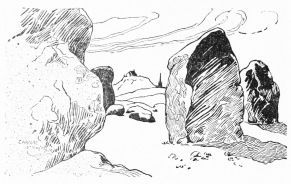
The Lines of Carnac
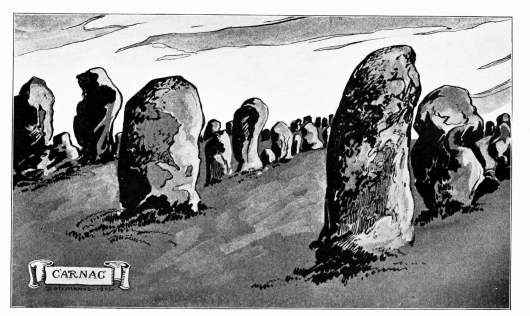
The Lines of Carnac
Of the Lines of Carnac, as the strange population of
tombstone-looking monoliths is known, much has been written by
antiquaries, archæologists, and geologists ever since the tide of travel
set this way. What these stones actually mean—some thousands of them
in all, set out in regular rows—only a vain, presumptuous person could
answer. They offer a prospect of a strange grandeur, for they really
are grand, if not stupendous, and, as they stretch away in long, silent
lines almost to the horizon, they are as phantoms looming to-day out of
the mysterious past to which they belong.
There are three great companies of these menhirs here. Those of Ménec,
composed of 1,169 members in eleven ranks; of Kermario, 1,120 members
in ten rows; and of Kerlescan, thirteen rows made up of 579 individual
stones.
Carnac has another ancient monument in the tumulus of Mont St. Michel,
which, like other elevations bearing the same name, is a sky-nearing
little peak of land which supposedly formed a firm earthly foothold for
the archangel.
The parish church of Carnac is dedicated to St. Cornély, who, according
to legend, lived in the neighbourhood and was many times saved from
an untimely death by the oxen of the region. Just how this was
accomplished no one seems to know, but enough of the tradition still
lives to inspire a grand celebration on the saint’s day, the thirteenth
of September, when many animals are offered up to him, as one learns
from the kindly, tall-coifed guardian of the church.
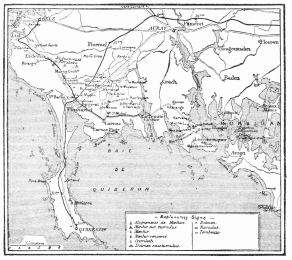
Map of Carnac and the Surrounding Country
The painted ceilings of the Church of St. Cornély are remarkable works
of art, if not for their excellence, at least for their ingenuity. The
north porch is an astonishing Renaissance addition, which, from its
curves and curls, would seem to be the precursor of “l’art nouveau.”
To the westward of Carnac, at the shore-end of the peninsula of
Quiberon, is Plouharnel, another centre around which are grouped many
curious stone monuments.
The Chapel of Our Lady of the Flowers is a singularly beautiful small
church built of the granite of the country. It contains a notable
bas-relief in alabaster in the form of what is known in ecclesiastical
art as a “Jesse Tree.”
Just why the promoters of a railway had the temerity to push it to the
very end of the snake-like peninsula of Quiberon is a problem which will
ever remain unsolved so far as the general public is concerned. Stendhal
has written some gloomy views of scenes enacted at Fort Penthièvre,
half-way down the peninsula, and Victor Hugo wrote of the same times
(now a hundred years ago):
“Mourir plus d’un soldat à son prince fidèle, un prêtre fidèle à son
Dieu.”
The aspect of this long, narrow peninsula is everywhere the same, from
its juncture with the mainland to the sandy point fifteen kilometres
away, from which one sees the flash of the twinkling light on Belle Ile.
Quiberon has what may almost be called an ideal hotel, except that it
is unworldly and not the least new. A travelling salesman, whom we met
at Auray, told us that it was kept by an old cook, one of the Vatels
of the stove. Simple and modest, but clean withal as the proverbial
door-step of Holland, it is one of those inns that the traveller loves
out of sheer inability to find fault with it.
Quiberon has two ports, Port Haliguen and Port Maria, both in danger
of becoming popular seaside resorts, for the guide-books are already
describing them as places where the sojourn will be agreeable for
persons of simple habits.
The fish-market of Quiberon is one, if not the chief, of its sights for
the student of manners and customs. “Cinq lubines pour douze francs
et deux cent quarante maquereaux pour trente-un francs” was the way
the market ran on the occasion of the visit of the author, all of which
argues that Quiberon is a good place for the fish to come.
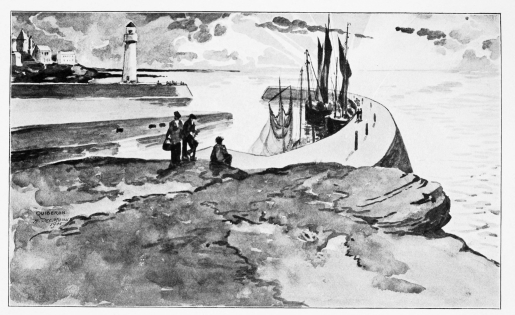
Quiberon
The lobsters, too, are a great feature of the trade here, and are sold
by their length, measuring from the eye up to the first scale of their
tails. An average price is rather over four sous, and Paris takes the
best of the lot. They travel first-class and by express, the lobsters
of Quiberon, when they take their first and last voyage to the “shining
city,” and there are plenty of friends awaiting them at the station.
They invariably arrive at the fish-market for the earliest sales, and at
noon the epicure may eat them at Marguery’s, which sounds like a French
version of the “Alice in Wonderland” tale.
One hour from Quiberon, by a tiny steamboat, and one finds himself
skirting the cliff walls surrounding and sheltering the little port and
town of Palais on Belle Ile, overlooked by the powerful citadel built by
Vauban, who, as the fortress-builder of France, stood in his profession
where Napoleon did in his.
This “plus belle île de l’ocean” has forty-eight kilometres of
coast-line, and every one of them has been so cut and serrated by
the action of the waves that the island would form a veritable ocean
graveyard were it situated on the direct line of travel by sea.
For the most part, visitors content themselves with making an excursion
to the northerly end of the island, a visit to the apothecary’s grotto,
and another to the lantern of the great lighthouse, which at night sends
its electric rays far out to sea.
What tourists may not do is to roam over the old citadel now occupied
as a national fort, and this is a pity, for there they might conjure up
a reminder of other days that would be like a chapter out of Dumas.
The citadel was built by Marshal de Retz in 1572, and was the refuge of
the cardinal of the same name when he fled from Nantes in 1653. Not far
away is the Château Fouquet. Nicholas Fouquet, Marquis of Belle Ile,
was Superintendent of Finance under the regency of Anne of Austria,
and continued the important office after the accession of Louis XIV.
The consensus of opinion is that Fouquet was insinuating, specious,
hypocritical, and sensual. It was at the great fête given by Fouquet at
Vaux that the king planned his arrest, “fearing he would escape to Belle
Ile,” then thought to be an impregnable fortress. Both in the pages of
the historians and in the romances of Dumas one may read the story.
Belle-Ile-en-Mer, also, was made the home of Aramis after Dumas had
given him episcopal rank. The minute details given in “Le Vicomte de
Bragelonne” would form an admirable supplement to any guide-book.
The great Sara Bernhardt has of recent years made her home on this
barren and desolate isle. It is not altogether desolate, however, for
there are hotels at Palais and Sauzon, and tourists, solitary and in
droves, are continually making excursions thither in the season from the
neighbouring Breton coast, from Vannes, Quiberon, or Lorient.
Although Belle Ile is only a pin-head on most maps of France, it has a
considerable population. Palais is a town of five thousand souls, and
Sauzon counts something over sixteen hundred, and so Belle Ile, being
only about 21,000 acres in extent, is a very thickly populated part of
the globe.
Returning to the mainland, a call at Locmariaquer is inevitable, if one
be a true and genuine traveller, even if it be “out of the world,” which
virtually it is, being at the tip end of another peninsula like that of
Quiberon.
The town itself owns to fifteen hundred or more souls, and all of them
look prosperous and contented. Where all of them get their livelihood,
it is difficult to see, for there is not much intercourse with the
outside world.
Locmariaquer has not even a railway, as Quiberon has, but lies twenty
kilometres or so south of Auray, almost at the mouth of Morbihan Bay.
The church of Locmariaquer is a fine twelfth-century work, but the
foundation of the little town lies much farther back in antiquity than
this. It was the ancient Doriorigum of the Romans.
The Chapel of St. Michel is built up from the Roman remains of a
structure known as er c’hastel.
The great celebrities of Locmariaquer are, however, those members
of the great family of menhirs, dolmens, and cromlechs with which
this part of Morbihan is so thickly strewn. The chief of these are
the dolmen known as Mané-Lud, Mountain of Ashes, of vast dimensions
and having a grotto beneath it. Not far off is a tumulus and another
dolmen known as Dol-er-Groh, an enormous stone table or altar. Another
is known as Mané-er-H’roeck, the stone of the fairies; it is quite
seventy feet long, or was, for it now lies full length on the ground
broken into four pieces. The finest and best preserved of all is the
Dol-ar-Marc’hadouiren, the Merchants’ Table. It is hard to see just the
significance of the name given to these three huge stones, but they form
a wonderfully impressive monument of days gone by, nevertheless.
The most beautiful dolmen known, whatever that description may really
mean (the local renter of boats calls it such: “le plus beau dolmen
connu”), can be visited only by boat. It is on an island in the gulf,
and is known as the Gavr’inis.
La Trinité, “a little village on the very edge of the sea”! This is a
description which exactly fits what the natives and the railway powers
like to think is a watering-place. It is something like one, to be sure,
but the influx of strangers during the summer months has never been so
great as to obliterate or even to deaden the local colour. Its little
harbour is lively with fishing-boats, and occasionally gay, when the
boats are “dressed” for some great festival, but nothing of blatant
bands and riotous crowds mars the quietness and sweetness of La Trinité,
and accordingly it is a place to be remembered.
Sometimes the sterility of the soil round about causes real distress
among the small farming peasants; “one cannot live on fish alone,” they
say.
There is a local benefactress who, when crops are poor and meagre, gives
the whole of her own harvest gathered from an unusually ample holding
to her more distressed neighbours. This is a true and practical charity
that does not smack of smugness or pretence as do many acts questionably
classed under that head. It is a singularly expressive exemplification
of what the French know as “good socialism,” and one hears much of it at
La Trinité and in its neighbourhood.
Taking to the road again, on the way to Auray, one passes another of
those curious granitic formations. This time it comes down more near
our own day, and is called the “St. Tiviro’s hat.” It does not look the
least like the saint’s hat, any more than the “devil’s seats” and the
“old men of the mountains,” scattered about the world, look like what
they are called—but let that pass. Legend connects this rock with a
certain St. Tiviro, who one day lost his hat, which ultimately turned to
stone. It does not seem plausible, and it is a pointless story indeed,
but it gives a small child the opportunity to point it out for a penny,
which most folk will not grudge.
THREE towns of Morbihan little known, still less visited by travellers
in Brittany, lie within a comparatively small area just north of the
coast, and their names are Lorient, Hennebont, and Pont Scorff.
The very name Lorient will appeal to many. It suggests the great
trade with the East, in full swing in the seventeenth and eighteenth
centuries, when the town grew up as a necessary part of a vast commerce.
Some of the old-time romantic picturesqueness of the shipping has
disappeared, and the Hotels “Royal Sword” and “White Horse” have given
way to the Hotels “Modern” and “of France,” with electric lights and
sheds for motor-cars, but there is still a distinguishing excellence to
be remarked which makes Lorient a place well worth visiting.
It was in the seventeenth century that an association of Breton
merchants, who were carrying on the trade with the East Indies,
first built their warehouses here. The traffic grew to proportions so
considerable that Louis XIV. ultimately gave letters patent for the
foundation of a new and grander East India Company.
The company erected ship-houses here, and the name Lorient was given to
the settlement, which was fast growing to a prime importance among the
ports of France. An English fleet, under Admiral Lestock, landed some
six or seven thousand men in the bay of Poldu, at twelve kilometres west
of Lorient, and marched upon the town as a revenge for certain attacks
upon British interests in the East.
The English met with no great triumph here, but Louis XV. was
indifferent enough to allow many of the French settlements in the Indies
to be taken, and this led to the rapid decadence of the great East India
Company and its port. Napoleon resuscitated it, as he did many another
decaying institution in France, and developed the industry of the port
to such an extent that Lorient became one of the principal maritime
towns of France. Its past history sounds romantic enough, but there is
little of romance about the life of its streets and wharves to-day;
instead, there is activity not admitting even the thought of romance.
Jangling gongs of tram-cars, the puffing of locomotives, and the
shrieks of the sirens, to say nothing of the accompaniment of belching
chimney-stacks and the sound of the riveting hammers in the great
shipyards, all testify that Lorient is living in the age of progress.
Local sights, outside this marvellous exposition of modern spirit, are
few. There is a municipal museum, containing some good modern pictures,
many of them of Breton subjects, but there are no ecclesiastical or
architectural monuments worthy of remark. The commercial harbour and the
dockyard are decidedly the most interesting features. Within the walls
of the latter is the parade-ground, which serves as a fine promenade
for the population of Lorient when the military band plays on summer
evenings.
The roadstead of Lorient is a great deep-water harbour, which can
shelter the largest ships afloat. It is guarded by six great lights,
one of them in the cupola of the Church of St. Louis. This is one of
the very few instances where a great city church is a mariner’s beacon,
besides performing its other functions on behalf of lost souls.
Opposite Lorient is Port Louis, founded a century before its bigger
sister. Anciently it was known as Blavet, but took its present name in
honour of Louis XIII. Its walls were begun in 1652.
In the immediate neighbourhood of Lorient and Port Louis are many
delightful little seaside places, hardly popular resorts in any sense
of the word, but all the better for that, where one may get such views
of sea and shore and shipping of all ranks as is hardly to be found
elsewhere on the Breton coast.
Up the little river Blavet, at the head of deep-sea navigation, is
Hennebont, a most delightfully disposed little place, which has been
called the pearl of the Blavet. Like most of the tidal rivers of France,
the Blavet, on its lower reaches, offers about the most paintable of all
landscapes imaginable. This, with the Auray, the Aven, the Scorff, and
the Elle, would prove a sketching-ground quite inexhaustible, in the
variety of its moods, to the artist of an average length of life.
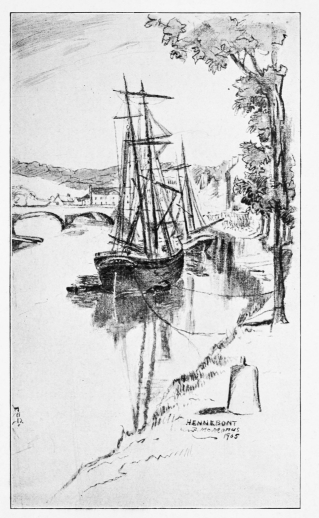
Hennebont
Hennebont, which has eight thousand or more inhabitants and a delightful
inn, electric-lighted though it be, is divided into the new town and the
fortified town. It sits beside the river’s bank, and crosses on a bridge
of three arches. Above, the river dwindles to a mere rivulet, but below
the incoming tides will bring craft of a tonnage of three hundred
or more straight to the heart of the town. A tonnage of three hundred
does not mean much to the travellers by twenty-thousand-ton steamships,
but assuredly when one sees one of these little craft, with their three
slender square-rigged masts, by the soft light of the full moon, in the
little Breton port of Hennebont, it looks like the phantom ship, whose
masts and spars “cross the moon like prison bars.”
Hennebont derives its name from the Breton words for old bridge. The
first lord of the place, Huelin of Hennebont, lived in 1037. The
fortified town was, of course, the earlier foundation, the new town only
coming into existence in the sixteenth century, when the great Church of
Our Lady of Paradise was still in the open country.
Trade follows the flag, but habitations follow the church, and so, when
this great Gothic edifice was built in 1513-30, it began to draw the
houses of the city dwellers around it, and now the fortified town is
practically non-existent except as a quarter.
This church is a wonder-work of its kind, considering its great size,
its graceful lines, and its ornamental Gothic spire, rising to a height
which must approximate three hundred feet.
The ancient ramparts of the old fortified town appear here and there
along the river-bank, in the well-preserved gateway which one passes
on the left after leaving the river on the way to the church, and in
yet another fragment—a great circular tower—in the courtyard of the
aforesaid excellent Hôtel de France.
The old castle of Hennebont, of which something more than fragments
still remain, saw the death of Comte Charles of Blois, who, escaping
from his dungeon in one of the towers of the old Louvre at Paris, came
here in 1345. One may read in Froissart of the defence of Hennebont by
Jeanne of Montfort in 1342.
There are many old gabled houses at Hennebont, most fantastic in form,
one of which, bearing the inscription, “Le Levic, 1600,” is
perhaps the most ancient of any built without the walls of the fortified
town.
The great fortified gateway, which gives access to the old citadel, is
a fine ogival work flanked by two massive machicolated towers. This old
district is quite the most curious and unworldly feature of this little
city by the Blavet.
It is a veritable town of the middle ages, yet unspoiled and quite as it
was in the olden days, when its sturdy walls gave protection against
the invader, and its great gates opened only upon the orders of the
governor.
In suburban Hennebont, scarce a kilometre away, on the left bank of
the Blavet, are to be seen the remains of the old Abbaye de la Joie,
a famous establishment of the monks of the Cistercian order. It was
founded in the thirteenth century by Blanche of Champagne, wife of John
the Red-haired. One still sees her statue in wood and bronze, but the
conventual buildings themselves have come to base uses, and are now a
horse-breeding establishment.
Pont Scorff, so far as its situation is concerned, resembles Hennebont.
It spans the tiny river Scorff, and the views along the banks are in
every way equally delightful with those on the Blavet. Pont Scorff,
however, has not the magnitude or the antiquity of Hennebont, and its
two parts are known as the upper town and the lower town.
The most ancient building here is the Chapel of St. John of the old
commandery of St. John du Faouët; it dates at least from the thirteenth
century. There is a fine Renaissance house in the little public square,
called the House of the Princes. It is richly decorated and has a fine
series of dormer windows and a row of pilasters bearing the symbols of
the Rohan family. There is another ancient house, formerly belonging,
it is believed, to the Templars. The parish Church of St. Albin dates
only from 1610, and is in no way a remarkable work.
The Chapel of Notre Dame de Kergornet, a fifteenth-century edifice near
by, is a place of pilgrimage for the Breton nurses, that great race of
foster-mothers who care for the thousands of Parisian children in the
Bois, or the gardens of the Tuileries, or the Luxembourg.
From this point, as one journeys westward, he leaves pretty much all
France behind him. The modern Department of Finistère, the “Land’s
End” of the French, is all that lies between him and the vast heaving
Atlantic.
AT Quimperlé one makes his first acquaintance with that part of
the Armorican peninsula known to-day on the maps of France as the
Department of Finistère. This charming little town is of itself of great
importance, as marking the dividing-line between the dialect of Vannes
and that of the western peninsula. There is no great difference to be
noted by the casual traveller, since all of the younger population speak
the French tongue,—sometimes exclusively,—but there is an unmistakable
modification of manners and customs toward the more theatrical aspect
which one best sees at Pont Aven, Pont l’Abbé, and the little fishing
villages around the Bay of Douarnenez.
Of the women of Quimperlé much has been remarked by all who have ever
lingered within its walls. They are “superb in type, elegant and
gracious,” we were told by a French artist who had set up his easel on
the quay. But there is no need to tell anybody; even a woman-hater would
remark it. Certainly this is as good an entrance to a new and strange
land as heart could desire.
Quimperlé lies on both sides of the little river Elle, which, like
the other streams of the South Breton coast, is a special variety of
waterway quite unlike their more pretentious brothers and sisters
elsewhere. The country round about has been called the “Arcadia of
Lower Brittany,” and so it will strike even the least observant of
travellers—after he has recovered from the effects of the glances of
those elegant and gracious females.
The most ancient part of the little city is that known as the walled
town, grouped around the ancient Abbey of Holy Cross, on that tongue of
land which separates the Isole and the Elle. The escarpment is badly
built up, but withal it is ruggedly picturesque, abounding in old
houses, some of which have stood since the thirteenth century.
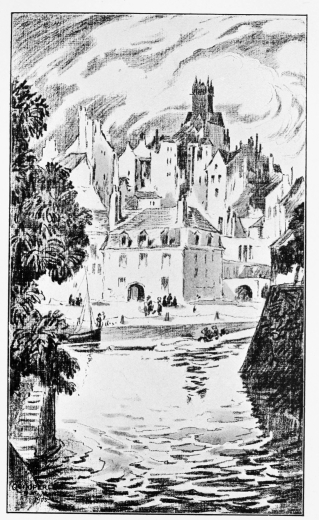
Quimperlé
The site of the old Abbey of Holy Cross was known in the sixth century
as Anaurot, and became the refuge of one of the Breton Kings of
Cambria, who, abdicating, came here and built a hermitage, which in
time was converted into an abbey of Benedictines. This old Abbey
of Holy Cross, as it exists to-day, has a ground-plan which more
nearly follows that of a four-armed cross than any other extant in
Christendom. The same motive doubtless inspired its builders as that
which induced the architects of Charlemagne to erect that famous round
church at Aix-la-Chapelle, which in reality it greatly resembles in
general features; both went back to the Church of the Holy Sepulchre at
Jerusalem for their initial idea.
This church at Quimperlé is one of the three or four in all Brittany
having a crypt, and it is more amply endowed with interior furnishings
and fitments than many a grander edifice. Altogether it is an
ecclesiastical monument of the first importance.
It has a companion, moreover, of no mean rank, either, in the Church of
St. Michael, which sits high on the hilltop and dominates nearly every
vista of the town.
After a tempestuous past extending from the monastic foundation of
the sixth century, Anaurot, or Quimperlé as it had become meantime,
surrendered to Duguesclin in 1373. Finally, when a treaty had been
signed with the League as to future neutrality, the city walls were
demolished (in 1680), and Quimperlé settled down to a peaceful
existence, which is only broken on the year’s great feast-days, or on
the days of the pardons,—that of the Passion in March, the Pardon of
the Birds on Whit-Monday, the second day of May, or the last Sunday of
July.
One or the other of these dates should be made to correspond with one’s
itinerary, when one will see the real Lower Breton as he seldom appears
outside a picture. Near Quimperlé is the little coast station of Pouldu,
where figtrees, the hydrangea, and other plants of the Midi bloom
throughout the year.
Needless to say that it may some day become a really popular and
populous seaside resort, with casinos and alleged Hungarian bands,
but that day may be far distant, and any one looking for an unspoiled
seaside resting-place need not hesitate to go out of his way to give
a glance to this altogether delightful little port of Pouldu. There
is nothing like it, nothing so unaffected and unspoiled, on the whole
Breton coast. On the way to Pouldu one passes the important ruins of the
ancient Abbey of St. Maurice, founded in 1170 by the Duke Conan IV., and
the place where Maurice—a monk of Langonnet since become sainted—was
buried in 1191. In part, this fine ruin dates from the thirteenth
century, to which period belong the chapter-room and the chapel, the
principal features still remaining intact.
Near Quimperlé is St. Fiacre, whom some unknowing person has called the
patron saint of the Paris cabman, an individual who has not much regard
for anything saintly.
There is a beautiful fifteenth-century chapel at St. Fiacre, though
to-day it is greatly marred by wind, weather, and barbarous customs.
Each year, in June, there is an important fair held at St. Fiacre, at
which the young men from round about offer themselves for employment.
Each of them carries a rod or switch. To engage one who seems a likely
person for your purpose, you, or the young man before your eyes,—after
a parley,—break the rod, and he immediately becomes a member of your
domestic establishment.
There seems something rather uncertain about all this, but surely the
“matter of form” augurs as well for good and faithful service as the
average written “character” with which one engages a servant in England.
The hair-cutter appears at St. Fiacre as at all Breton fairs. He is
known as Gerard, and since the age of ten years he has been learned in
the art of hair-cutting. For a long time he was the chief barber of a
regiment of the line, and he will tell you (or he may not) that he has
cut many hundreds of thousands of heads in his time, and has garnered
enough of a crop to carpet the whole of the village of St. Fiacre a
metre deep.
Faouët, not to be confounded with the place of the same name in the
Côtes du Nord, is a small town with a great square, and a still more
important old market-house, which, like that at Auray, strikes the
stranger as being a marvellous construction of wooden beams, and quite
impossible to duplicate to-day, whereas the construction is doubtless
far less complex than the modern market-houses that one sometimes
meets,—mere ugly sheds of brick and iron.
There is a never ceasing ebb and flow of peasant-folk at the Faouët
market, the busiest of which come the Saturday of Holy Week, the Friday
after Pentecost, the twentieth of June, and the sixth and twenty-sixth
of July.
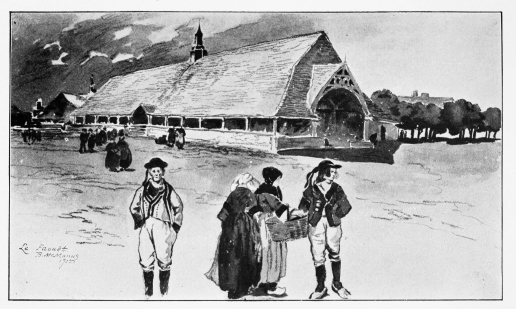
Market-house, Faouët
The scene is too dazzling to describe, and too active to snap-shot,
and one can only feel its real significance by personal participation.
The transactions are not of the stupendous order, and there is much
good-natured chaffing and bartering, and it offers a scene as lively
as if the fate of a nation were depending on the outcome.
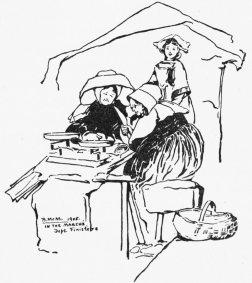
Market-day
The Breton peasant is not always the sad and superstitious individual he
has been pictured, though both men and women think nothing of embracing
the opportunity of saying a “Hail Mary” in the Chapel of St. Barbara, or
before the great cross of stone beside the main road, as they go into
town, taking to market a small calf or a brace or two of ducks, led at
the end of a cord by their sides.
The Chapel of St. Barbara occupies an extraordinary position three
hundred metres or more above the bed of the Elle, which bathes the lower
walls of the town.
After tradition, the Sieur de Toulbodon was one day hunting in the
valley of the Elle, when a terrific storm broke overhead, and a rock
falling at his feet barred the way. He made a vow to St. Barbara to
erect a chapel here, because of his merciful preservation from death.
The rock exists to-day, and is shown to the credulous,—at least, a
rock is shown which the credulous believe is the identical one, and
accordingly it is venerated; though why it is not reviled, no one seems
to know.
Near Faouët is the Abbey of Our Lady of Langonnet, founded in 1136 by
Conan III. of Brittany. Its fortunes have been various; in Revolutionary
times it served as quarters for a stud, but has since been turned over
to religious uses again, and is now occupied by a congregation of the
Fathers of the Holy Ghost.
The church, the chapter-room, and some other details still remain,
admirably preserved, to illustrate the excellence of the early Gothic
period of the buildings.
On the way to Rosporden, one passes the principal town of Bannalec,
whose original name was Balaneck, meaning the place for planting the
broom. It has not much interest for the stranger, unless perchance
he happens to pass through it on the day of some local feast or
celebration, when he will most likely see the young peasant-folk, men
and women, dancing in the middle of the roadway, as they do in the
operas. Brittany indeed is about the only place where one is likely
to see such a phenomenon, and, if by chance it happen to be a wedding
celebration, the diversion will be doubly interesting.
On the particular occasion when the builders of this book passed that
way, a wedding dance was actually in progress, and so edifying was the
ceremony that the bride and groom were invited into the tonneau of our
motor-car, and whirled away to Rosporden for a little excursion, which
was unpremeditated and unexpected to all concerned, and was probably
also a unique experience.
Rosporden, on the shore of the great lake of Rosporden, as it was
described to us, proved a disappointment. Not that so very much was
expected of it, but that so little was found in it. The lake is a
misnomer, though the water-weedy pond near the church serves the
innumerable artists who flock to the region as a highly interesting
foreground. The women of Rosporden wear the most immense bonnets and
coifs to be seen in all Brittany, and wimples like those of the Sisters
of Charity.
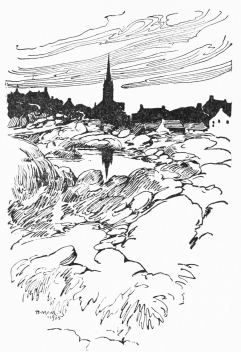
Rosporden
The church dates from the twelfth to the fifteenth centuries, and is in
every way an admirably preserved monument.
To Concarneau and the smell of the sea is a dozen or fourteen kilometres
over a gently rising and falling road, with a tendency always to descend
until finally one coasts down the long main street of the celebrated
fishing port and artists’ sketching-ground (it would be hard to tell
in which aspect it is the more famous), until one comes to that famous
Great Travellers’ Hotel, where one eats of oysters, lobster, and fresh
sardines and many other kinds of sea food to such an extent that one
feels decidedly fishy, or at least thirsty.
This should make little difference, as the coffee-room of that most
excellent hostelry is likewise excellent, and has a charming outlook
upon the wharfs and fishing-boats, thus affording as delightful a method
of accustoming oneself to strange sights as could be imagined.
The fishing-boats of Concarneau are one and all great brown-winged gulls
that flit slowly over the great bay, going in and out with the rise
and fall of the tide all through the round of the clock, depositing
their cargoes on the wharfs, shifting crews, and starting off again in
a continuous performance of coming and going which never ceases until
their timbers, from some untoward cause, fall apart.
As the boats lie at the landing, sails come down and the delicate brown
and blue nets go up for drying, for not all of the boats have so great
a supply that they can shift to another set. The most curious effect is
given by these blue and brown nets swinging masthead high, as if they
were spider-web sails.
The picturesqueness of the Concarneau fishing-boats is undeniable.
Nothing like them exists elsewhere, and when the sardine boats set out
for the west, as the sun goes down, there are as wonderful combinations
of golden yellow-browns, reds, and purples as the most imaginative
painter could possibly conjure on his canvas.
On shore, the nets, spread for drying on the wharfs and on the racks
beside the little fisherman’s chapel and the great stone crucifix
which faces seawards, are of the deepest blues and purple-browns in a
bewitching mixture.
Not a white-sailed boat is to be seen, unless it is an occasional yacht
drifting in because its owner has tired of making the fashionable
harbours where his guests can spend the night on shore dancing to the
questionable music of a red or blue coated band.
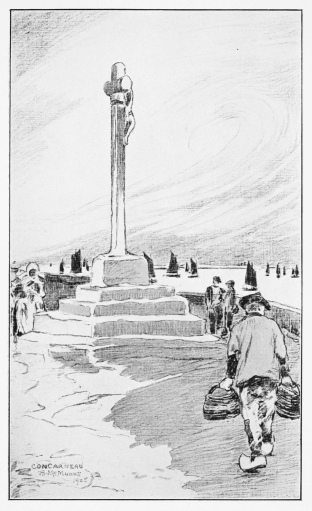
Stone Crucifix, Concarneau
It is a question as to whether Concarneau, were it not the centre of the
sardine fishery, might not be the first seaside resort of the world.
As it is, there are not a few who evidently think it far preferable to
those pseudo-society watering-places, whose chief attractions are big
casinos and little horses.
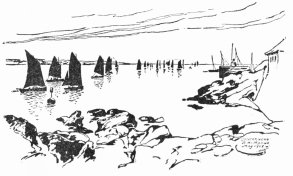
Concarneau
The hotels of the place are in no sense resort hotels, though they
are fitted with a marvellous convenience and comfort, and feed one
most bountifully and excellently on sea food, wherein fresh sardines
and lobsters predominate,—those two great delicacies of the Paris
restaurant which here are the common food of the people, for Concarneau
is one of the few fishing centres of the world which keeps some of its
products for the supply of its own table.
To-day the town is composed of two quarters, the new town, otherwise the
faubourg Ste. Croix, modern, prosperous, and animated, and the walled
town, the island fort of the middle ages.
In 1373, Concarneau was occupied by an English garrison, who fled before
Duguesclin. In 1488, the Viscount of Rohan reduced it by order of
Charles VIII., but the Marshal de Rieux retook it from the French the
following year, and repaired and strengthened the old fortifications.
The religious wars played their part here most vividly, until finally it
fell to the hands of Henry IV.
The walled town to-day is a remarkable example of an isolated fort
or citadel, the islet upon which it is situated being of a confined
area and wholly surrounded by a thick granite rampart, which, however
invulnerable it may have been in a former day, would stand no chance
against modern guns.
In part, these fortifications date from the fourteenth century, and
at high water are entirely surrounded by the sea. The great bastion
attributed to the former Duchess Anne—after she had become a queen of
France—is a stupendous work of its time. For the most part, the other
parts of the walls have been restored and built up anew in modern times.
Concarneau is the Ploudenec of Blanche Willis Howard’s charming Breton
tale of “Guenn,” and Nevin, where the great pardon dance was held, may
have been Pont Aven or Rosporden.
There is a wealth of charming colour in this sad tale, and not a little
truth with regard to some of the characters, to which Americans, before
now, have attempted to attach the names of real persons in the world of
art and literature.
Opposite Concarneau is Beg-Meil, which in more respects than one is an
anomaly. It has some pretence at being a watering-place, but there is
no town there, save such as is built up around a few country-houses and
hotels, catering only to summer folk; besides this, a few scattered
and isolated farms form the sum total of the habitations of this
little jutting point of land running out into the billowy Atlantic.
For four-fifths of the year, the population of this salt meadow is
composed only of sea-birds, which, like their fellows elsewhere, form an
interesting colony of themselves.
The sea-birds of Brittany, like those of other rock-bound shores, are
ever interesting to the traveller. Like the gulls of London Bridge,
those near the great bay of Concarneau are wonderfully tame and
singularly ravenous, and apparently eat all day. That is, when they
are not sleeping or billing and cooing, as is the sea-birds’ way, for
in this they would seem to rival the turtle-dove. When they are not
courting or sleeping, they go a-fishing, and the seaweed-strewn rocks
about Concarneau are their happy hunting-grounds. They will eat, say the
fisherfolk of the sardine fleet, five pounds or more of fish in a day,
which is considerably more than the weight of an individual bird.
From Concarneau one must perforce follow back along the coast-line to
Pont Aven, for a trip to Brittany without having known the delights of
this colony of artist-folk, in which Americans predominate, would be
like the tragedy without Hamlet, or the circus without the elephant or
the pink lemonade.
“Pont Aven, the Barbison of Bretagne! chosen home of the painters of
all nations and all schools, with Americans predominating.” This is
a faithful translation of the remark of an appreciative travelling
salesman, one “who loved art,” if the description be credible. You
will hear tales at Pont Aven of the time when artists found their
accommodation at a roadside inn outside the town—now apparently
vanished—for fifty-five francs per month, and paid a sou for a litre
of milk, and four sous for a litre of cider.
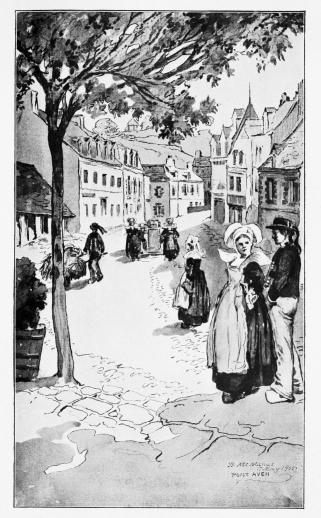
Pont Aven
These days have gone, and at Pont Aven, as elsewhere throughout the
world, the prices of all things are apparently rising. Really, Pont Aven
and its environs are delightful; its little river is busy and chattering
with many mill-wheels, and the Lovers’ Wood—as many know—is well named.
Because of its many riverside mill-wheels, Pont Aven has been named
Millers’ Town by the natives, and also “The famous town with fourteen
mills and fifteen houses.”
Unquestionably, the fame of Pont Aven has been made, or, at least,
furthered, by Mlle. Julia, the most capable landlady of the Travellers’
Hotel. The modest little country-house which formed the original hotel
has now a more magnificent neighbour, built up with a steel frame,—like
a Chicago skyscraper,—and resplendent with modern furniture, with
chairs and sofas of the saddle-bag variety, electric lights, electric
bells which actually do ring, ice-water, afternoon tea, Scotch whiskey,
and all the super-refinements of a twentieth-century civilization.
It is all very comfortable,—too comfortable the artists will tell
you,—but the eagle eye and strong will of Mlle. Julia still hover over
all, and nothing of deterioration is to be noted in the fare, which is
excellent, and served in the charmingly quaint and beautifully decorated
dining-hall of the little old inn, the precursor of the more splendid
addition.
All this is as it should be, of course, but the price has of late gone
up, though it is still thought exceedingly modest by guests who have
spent most of their time in big city or seaside hotels.
Painters are perhaps fewer here to-day than some years ago, and there
are more of the questionable pleasures of society, such as bridge and
ping-pong, which is a pity.
Another appendage to the Hotel Julia is found at the St. Nicolas Beach
on the coast. St. Nicolas is hardly more than a bathing-place, but it
is delightfully empty, and altogether Pont Aven, with its environs, is
a charming centre from which to make a week’s, a month’s, or a summer’s
excursion.
Of the young girls of Pont Aven, Anatole France has uttered many
truthful phrases. Very gracious they are indeed with their great white
quilled collars, their windmill coifs, and their black skirts plaited
like an accordion.
Here at Pont Aven—as elsewhere—fashion reigns, and the costume as it
is known to-day is quite different from that of fifty years ago, which
was not so picturesque, one would say, judging from old prints.
The metropolis of these parts and the ecclesiastical capital, for it is
a cathedral city, is Quimper, twenty odd kilometres west of Concarneau.
Quimper is a real city, though it owns to a trifle less than twenty
thousand inhabitants, and was the ancient capital of the county of
Cornouaille. From all points the marvellously beautiful spires of its
Cathedral of St. Corentin dominate the place. It is one of the most
characteristically Breton towns in the manners and customs of the
people, the general aspect of its wharfs and streets, its shops and its
markets.
The first establishment of a settlement here was in Roman times, when,
in the eleventh century, it was known as the Civitas Aquilonia. After
the expulsion of the Romans from the land, it became the capital and
the home of the kings or hereditary Counts of Cornouaille, one of whom,
Grollon, has left a legend of great vitality, telling of his emigration
here from Britain across the seas, and the founding of the first
bishopric.
The cathedral, dedicated to St. Corentin, was built between 1239 and
1515, and shows the marks of the best workmanship of its time. Its fine
spires rival those of St. Pol de Léon and Tréguier in the north. The
ground-plan of this fine church is not truly orientated, a detail which
is supposed to indicate the inclining of the head of Christ on the
cross. It is not unique, but the arrangement is so rarely found as to
warrant remark.
The town hall encloses a library of some thirty-four thousand volumes,
among them a copy of the first dictionary in the Breton tongue,
published at Tréguier in 1499.
The museum contains some interesting archæological treasures and some
good modern paintings, including examples of the work of Yan d’Argent,
Joubert Lansyer, Dagnan, and Abram Duvau, mostly depicting Breton
subjects. It also has an admirable collection of old Breton costumes,
etc.
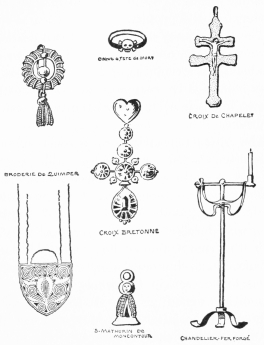
From the Museum at Quimper
The Rue Kéréon is the chief street of the town, and, like the
Kalverstraat of Amsterdam, is one of those narrow thoroughfares so
overflowing with life that to observe and study the passing throng is to
master the manners and customs of the people.
There are many quaint old houses scattered here and there, and like
those old lean-to and tumble-down structures of Rouen and Lisieux, they
continually reappear on the canvases shown in Paris each year at the two
great exhibitions.
The Allées Locmaria form a series of magnificently shaded promenades;
this is frequently a feature of French towns above a population of ten
thousand, and a feature which might be imitated in America and England
with considerable accruing advantage.
South from Quimper lie Pont l’Abbé and Penmarc’h, as characteristically
Breton as anything to be seen in the whole province; the former has
something over six thousand inhabitants, and the latter over four, and
each has its own distinct characteristics.
Pont l’Abbé is a town of embroiderers. Everywhere one finds shops whose
sole business it is to sell those fine braid embroideries—yellow on a
black ground—which have made this part of Brittany famous.
The costumes of Pont l’Abbé are famous throughout all Brittany. The
coif recalls those seen in the pictures of the ancient Gauls. It is
virtually a little black velvet hood, and the coif itself is a “pignon
de couleur,” as the hostess of the hotel described it, and then,
man-fashion, the author felt he was wallowing in a strange subject.
Locally this confection, taken entire, it is inferred, is known as a
bigouden,—a picturesque but not precisely instructive word.
The men wear a hat with three great buckles, and some of them—though
their numbers are few—may yet be seen in the culotte bouffante, that
peculiarly Breton species of breeches known in their own tongue as
“bragou-braz.”
With such an introduction, one might expect almost any fantastic costume
to step out from a doorway, but, to realize the quaintness of it all to
the full, one should see the inhabitants at the Fêtes de la Tréminou,
held on the twenty-fifth of March, Whit-Monday, the third Sunday in
July, and the fourth Sunday in September.
The dances of Pont l’Abbé are famous and are indescribable by any one
but a dancing-master. Inasmuch as they invariably take place in the open
air, they may be accepted as the free and spontaneous expression of an
emotion, which stuffy ballroom cotillons most decidedly are not.
The church of Pont l’Abbé dates from a Carmelite foundation of the
fourteenth century, and is a fine work of its era, though surmounted
by a curious and modern bell-tower in wood. Within the church are the
tombs of many of the ancient barons of Pont l’Abbé. The magnificent rose
window is of modern glass, but so admirable that one stands before it
with a certain respectful awe, as before that old thirteenth-century
glass in Chartres cathedral. The ancient cloisters are still preserved
and surround a fine garden.
Pont l’Abbé is only five kilometres from the coast, and Loctudy, also
the possessor of a fine mediæval church, and Penmarc’h form a trio of
Breton coast towns quite as worthy of one’s attention as many better
known resorts.
Penmarc’h—which for some inexplicable reason is pronounced Penmar—is
situated in the midst of a great bare peninsula terminating in the
Pointe de Penmarc’h. Instead of a high cliff sheared off at the water’s
edge, as one so frequently sees on the north coast, the point sinks
gently into the blue waters of the Atlantic until it is swallowed up,
with never so much as a line of breakers to indicate its presence from
seaward. Penmarc’h in Breton signifies the “head of a horse,” and Benzec
Capcaval, a village not far distant, means the same. An ingenious person
will have no difficulty in following the etymology of the latter word,
but the former is quite incomprehensible except to a Welshman.
Penmarc’h was for four centuries a city which kept pace with Nantes. Its
early riches came from the traffic in “lenten meat,” which is simply
codfish.
The Church of St. Nonna is a late Gothic edifice, with a great square
tower which will be remarked by all who come near it. Its interior
has two baptismal fonts, strangely decorated with stone carvings of
fantastic shapes, depicting the history of Penmarc’h.
Three kilometres away is the town of St. Guénolé, a tiny fishing port
with fine panoramic view of the Bay of Audierne. The chapel of St.
Guénolé occupies the base of a great tower, now ruinous, but looking as
though in a former day it must have belonged to some pretentious church.
“The Handle of the Torch” is one of the local sights. It is formed of a
series of great rocks at some little distance from the mainland. That
bearing the name of “The Torch” is separated from the mainland by the
Monk’s Leap, which, according to legend, was the landing-place of St.
Viaud, when he migrated from Hibernia to Brittany ages ago.
From Quimper to the Point of Raz is one long up and down hill pull of
fifty kilometres, until one finally reaches Point or Cape Sizun, known
to Ptolemy as the promontory of Gabœum. It is the extreme westerly
point of the peninsula of Cornouaille, and, reckoning from the meridian
of Paris,—for the French do not use the meridian of Greenwich,—is just
on the line of the seventh degree of west longitude. The Léon country
northward of Brest actually extends a trifle farther westward, at Point
St. Mathieu, but most maps do not show it.
North of the Point of Raz is the great Bay of Douarnenez, with its
sardine fisheries rivalling those of Concarneau, and southward lies the
shallow bay of the Audierne, whose shores, in their own way, are quite
as characteristically wild as those of any part of Northwestern France.
At the extreme end of the Point of Raz are two unpretentious hotels,
which will please only those of simple tastes and lovers of the
solitary; both are connected with more ambitious establishments at
Audierne.
The Bay of the Dead, the Hell of Plogaff, and the rocky point itself,
form the tourist attractions, but it will be enough for most lovers of
solitude to bask in the sunlight amid the gentle breezes from the Gulf
Stream, and to leave rock-climbing to those agile spirits who affect
that sort of exercise.
Near Audierne is the Church of St. Tuglan, a fine fifteenth and
sixteenth century edifice, with many a legend clinging to the name of
its patron saint. It is all very vague, but there is hidden superstition
in abundance, if one only had the patience to work it out. All that can
be learned is, that the holy man was the Abbé of Primelin, near by, and
that his feast is celebrated throughout all the Point of Raz. His statue
represents him with a key in the hand, and there is a great iron key
preserved in the church said to have once belonged to him. On the day
of the pardon great quantities of little loaves are stamped with this
key and, according to a popular belief, they will cure a mad dog of his
madness, if he be given a morsel to eat, and possess many other virtues
of a similar nature. In the sacristy of the church are preserved the
teeth of St. Tuglan. The inhabitants of Primelin are known as paotret
ar alc’houez, or servants of the key.
Audierne is a busy little Breton port of perhaps four thousand
inhabitants, and opposite is the fishing village of Poulgoazec, with
sardine factories and all the equipment of the trade. Up to the
sixteenth century, Audierne was even more flourishing than it is to-day,
for the codfish, which were its riches, had not left for other shores.
The vast Bay of Audierne has a wild and deeply embayed coast-line,
with nothing but a population of sea-birds to add to the gaiety of the
landscape.
Northward, toward Douarnenez, is Pont Croix, built in the form of an
amphitheatre on the bank of the river Goayen.
Our Lady of Roscudon is an ancient collegiate church now turned into a
little seminary. The peasant folk round about call it only the Virgin’s
church. It is in many respects a remarkable fifteenth-century work.
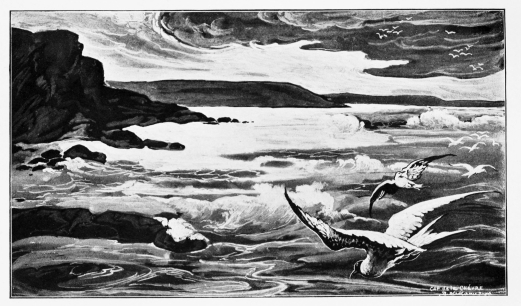
Cape de la Chèvre
From the Point of Raz in the south to Cape de la Chèvre in the north
extends the great gulf known as the Bay of Douarnenez. Along its shores
are innumerable little fishing villages, which seem almost of another
world. Certainly they have not much in common with other sections of
Brittany, to say nothing of the rest of Europe.
Douarnenez disputes with Concarneau the privilege of being considered
the centre of the sardine industry, and, like it, has all the
picturesque attributes of brown-sailed boats and of blue and brown nets
hung masthead high for drying, as the craft lie at the quayside, after
having unloaded their catch.
The delicate blues and purple-browns of these nets are irresistible
to the artist, but few have caught the real tone; indeed, more than
one painter of repute has given it up as a bad job, saying that it was
impossible to transfer it to canvas.
The beauty of the Bay of Douarnenez has a fascination for artists and
holds one spellbound under certain aspects of the westering sun, when
lights and shadows intermingle in truly heavenly fashion.
During the civil wars of the sixteenth centuries, Douarnenez was
taken by Jacques de Guengat, but was retaken by Fontenelle in 1595
and its houses for the most part demolished, and used to build up the
fortifications of the Ile Tristan.
Douarnenez signifies, literally, the land of the isle. The Ile Tristan
once contained a priory dedicated to St. Tutarn, but now the chief
sights are the lighthouse and a sardine factory. An ancient tradition
recounts that the Ile Tristan received its name from the valiant Tristan
of Léonais, one of the knights of the Round Table.
Except for the view from the gallery of the great lighthouse, the
trip to the island is hardly worth the making. The view from this
vantage-point is, however, remarkable; indeed, it is unique, the writer
is inclined to think, in all the world. Suffice to say of it that it is
unworldly, and yet gay with the workaday coming and going of the sardine
fleets, as such a paradoxical description will permit one to imagine.
All is peaceful, and yet there is a steady inflow of industry that is in
no wise detrimental to its unspoiled tranquillity. Perhaps if an artist
lived by the shores of the deep blue and purple waters of this bay for a
matter of two score of years, he might do it justice; until then—never.
Concarneau as a port is more interesting than Douarnenez, but the bay of
Concarneau, delightful as it is, has not a tithe of the variations that
are played upon the gently flowing waters of the bay of Douarnenez by
the setting sun.
The peninsula of Crozon shelters the bay of Douarnenez on the north. At
one pronged extremity is Roscanvel, jutting out into the roads of Brest,
and at the other is Cape de la Chèvre. Between the two is a wonderful
country of rock-strewn coast-line and poppy-covered inland fields.
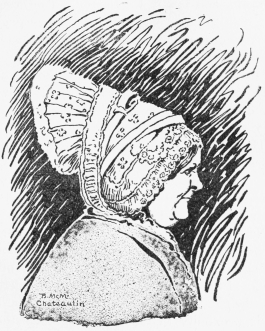
Woman of Chateaulin
Chateaulin, situated on the river Aulne, a little beyond the head of
the peninsula, is the metropolis of these parts. It owes its name to
an ancient hermitage of St. Idunet. Its present name grew from Nin or
Castel Nin, then Castelin, and finally Chateaulin. The hermitage, in
time, was succeeded by the priory of Locquidunet, and that in its turn
became the parish church of the present town.
Hoël, Count of Cornouaille, who became Duke of Brittany, incorporated
the town with the ducal domain, from which time on its history was one
of partisan strife.
The Revolution elevated it to the rank of a market-town, and changed
its name to “Cité sur Aulne” in an attempt to suppress the supposedly
aristocratic prefix of Château. Ultimately, it reverted to its former
name.
Near by are the Black Mountains, of which Mené Hom is the chief
eminence, its summit rising to a height of 330 metres, with other peaks
at the height of 299, 272, and 248 metres. The heights are not so very
considerable, but their proximity to the sea exaggerates them, and
travellers by road—bicycle riders and travellers in motor-cars—will
think the process of crossing the Black Mountains, on the way from North
to South Finistère, as formidable as the task of Hannibal.
Crozon is a much larger place than Chateaulin, isolated though it is
from all direct communication with other parts. It is situated some
250 feet above the sea, on what the French call a wild table-land, and
dominates the Bay of Douarnenez from the north. All around Crozon are
innumerable grottoes and rock-cut caves and excavations, which always
have a certain fascination for some folk, but will hardly interest the
devotee to the beauties of landscape.
Camaret, at the very tip of the peninsula, is another safe port for
artists. Here are fishing-boats and all the accessories, like those
seen at Douarnenez and Concarneau, and with a landscape background and
a foreground of blue water that many whose names are great in the world
of art have painted and many more will paint. Cottets’s “Fishing-boats
at Camaret,” in the Luxembourg Gallery, is perhaps the best known of
these pictures, but the composition is always the same. The background
never changes,—the tiny chapel with its dwindling spire, the beacon,
and the tall, gaunt stone house on the little mole running seaward and
protecting the port, group themselves willingly enough into the most
charming view in all the town.
The fishing-boats of the foreground change their positions, but
kaleidoscopically only, and one may return year after year and see
practically the same groupings, with only trifling differences.
One makes his way from Camaret to the great military port and trading
town of Brest—if one need to go there at all, which is doubtful—either
by boat across the Goulet and the roads of Brest, some sixteen
kilometres by a puffy little excursion-boat, which, on a Sunday or a
feast-day, is anything but comfortable, or by road by way of Faou, which
is a great fruit and vegetable market for Brest, and not much more.
There is a considerable display of costume here on market-days,—which
appear to be every day,—and the town is picturesque enough of itself,
though, strange to say, it smacks of suburbia,—a place where one gets
his news second-hand from some neighbouring city.
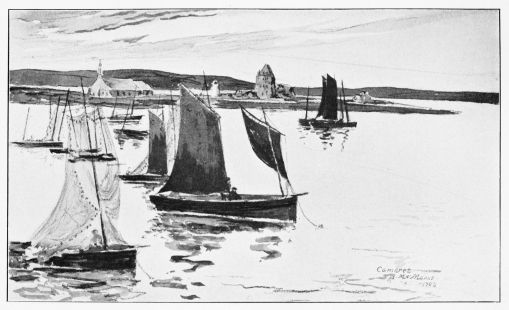
Camaret
THE northernmost part of the peninsula of Finistère has not the
abounding or varied interests of the south. Its monuments of other days
are not so many or so remarkable, and the sterner conditions of life
seem to have had a sobering effect upon manners and customs.
Brest and its wonderfully ample harbour has by no means the attractions
of Vannes or of Nantes for the bird of passage, though its commercial
and strategic value is great, and its history vivid and eventful. In
spite of all this, there is little that is interesting to-day in its
straight streets and rectangular blocks.
This fortified and exceedingly animated town owns to eighty odd thousand
inhabitants, and is so pervaded by military and naval organization that
there is very little local colour, very little atmosphere of the past
hanging about it to-day. To find this, one has to go back to Faou, to
Plougastel or Landerneau or Landivisiau, all within a radius of twenty
kilometres or so.
The great bay of Brest is a swarming waterway, upon which the little
excursion steamers, tugboats, great cruisers and battle-ships,
torpedo-boats and torpedo-boat destroyers, and yet other craft built to
catch torpedo-boat destroyers, are all apparently entangled inexplicably
each in the wakes of all the others.
The entrance to this harbour is known as the Goulet, and is lighted
by five lighthouses, which at night send out their twinkling rays of
red, green, and white in most kaleidoscopic fashion,—all Greek to a
landsman, but as clear as day to the Breton pilots who bring the great
ships in and out of this narrow waterway. In the ninth century, Brest
was already in existence, in spite of its modern aspect to-day, and
belonged to the Counts of Léon. Its future was as varied as the history
of Brittany.
It opened its ports to the army of Charles VIII. in 1489, in spite of
the efforts of Duchess Anne to prevent such a proceeding. How far she
succumbed will be recalled when one realizes that two years later her
marriage with this prince was the first step which united the province
of Brittany for ever with France. Brest from this time took on a new
importance, until Cardinal Richelieu came to designate it as one of the
principal arsenals of France, and then, in 1631, came the creation of
the great dockyards.
Of architectural monuments, Brest still has the Church of St. Louis
(1688-1778) and the twelfth and thirteenth century castle. As an
ecclesiastical monument, the church is quite unworthy of attention,
though it has some interesting tombs and monuments.
The castle is an admirable example of mediæval fortification, with some
remarkable accessory details in its construction. The isolated donjon
tower was in other days a sort of independent citadel, and formed a
last refuge for the besieged occupants of the castle, should its outer
walls give way to the invaders. The Tower of Azenor and the Tower of
Anne of Brittany, so named for the respective princesses, are admirably
preserved parts.
The local museum and library have fine collections. There are fifty-six
thousand volumes in the library, and the collection of paintings
contains many Breton subjects by modern masters.
The dockyard—navy-yard in the language of the United States, port
militaire in French—is closed to the general public, but a marvellous
detailed bird’s-eye view of the city, the docks, and the roads is
obtained from the platform of the Pont Tournant.
Nineteen kilometres from Brest is Landerneau, and the junction of the
railway lines to Kerlouan and Folgoët in the north, and to Quimper
and Concarneau in the south. Landerneau from the twelfth to sixteenth
centuries had a distinct feudal administration.
The folk of Landerneau have opinions of their own, as witness the
remark, made at Versailles under the regency by a Breton noble hailing
from this place: “The Landerneau moon is larger than that at Versailles.”
Again there is a Breton proverb which runs thus: “There will always be
something to talk about in Landerneau.” Mostly this is used when a widow
marries again, which may be taken to mean much or little, as one chooses.
Landerneau has a fine little tidal harbour, and its streets and wharfs
are busy with the hum of coastwise traffic and river life, and, with its
Church of St. Thomas of Canterbury and its “best and cleanest inn in the
bishopric” (Hôtel de l’Univers), as a traveller of a century or more ago
once wrote, it has no lack of interest for travellers.
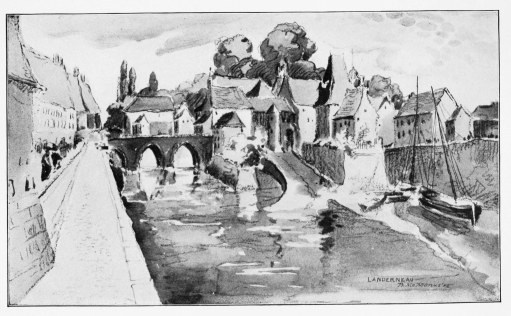
Landerneau
One is not likely to be met with a statement by his host, as was the
century-old traveller, that a respectable man begs to know if he may eat
at the same table, and accordingly one will not have to reply, “With all
my heart,” for most likely there will be twenty at the common table, and
all will sit down to a meal of all the good things of life, “sea food”
and golden cider and apple sweetmeats predominating.
It is all excellent, however, and the abundance of deliciously cooked
fish will make one think it were no hardship to make a lenten sojourn
here. A great church and a good hotel are indeed all-sufficient
attractions for a market-town of perhaps eight thousand souls.
The town borders upon a picturesque little river, the Elorn, which
finally flows into the harbour of Brest. From the fifth century until
the sixteenth, it was far and away a more important place than its now
more opulent neighbour at the river’s mouth. Then it was the chief town
of Léon, the domain of the De Rohans, one of the ancient Breton baronies.
At the entrance of one of the principal streets—Rue Plouedern—are
two curious ancient pieces of sculpture,—a lion and a man armed with
a sword, bearing the inscription “Tire Tve.” They came from an old
house which existed here in the sixteen hundreds, and are fitting
examples of that curious mediæval symbolism which so often crops out in
domestic and religious architecture. Although the chief of Landerneau’s
ecclesiastical monuments is the sixteenth-century edifice dedicated to
St. Thomas of Canterbury, the Church of St. Houardon is a contemporary
work of some pretension; its base Renaissance portico was added at a
later time. The arms and emblems of the De Rohans are conspicuous in
both edifices.
July fifteenth is the great fête-day hereabout, when the horse-races,
boat-races, and illuminations attract the peasantry from the inland
country and the workmen from the dockyards at Brest.
Five kilometres away is the Chapel of St. Eloi of the sixteenth century.
This sainted personage is represented throughout Finistère with the
attributes of a bishop and of a horseshoer. Horses are placed under his
protection, and the Pardon of St. Eloi is celebrated in various parts
with much merrymaking, and always with much firing of guns. A motor-car
is not beloved here, and if one incidentally or accidentally come upon
a festival of St. Eloi, he had best forthwith make tracks in retreat.
The actual religious ceremony consists of a mounted cavalier riding
up to the chapel door and making a sort of salute or obeisance three
times from the saddle without putting foot to the ground, after which
he deposits on the altar a packet of horse-hair, or even the tail of a
horse.
In the Forest of Landerneau, six kilometres southwest, is the Château of
“La Joyeuse Garde,” celebrated in the romance of the chivalry of King
Arthur’s time, wherein King Arthur, Lancelot of the Lake, and Tristan of
Lyonnesse played so great a part.
Landivisiau, on the main railway line from Paris to Brest, has a
remarkable church under the protection of St. Turiaff,—which in Breton
is Tivisian,—who was Archbishop of Dol in the eighth century.
This fine church is a sixteenth-century work, and exhibits all the notes
of the early period of the Renaissance, but, in spite of this, the
richness of its portal, its bell-tower, its fine spire, and its nave
and choir rebuilt in the best of late Gothic, make it a building to be
remarked among the churches of Brittany, which, as a rule, have not the
ornateness and luxuriance of ornament of those of Normandy and other
parts of France.
The cemetery of Landivisiau has a remarkable ossuary, supported by most
fantastic shapes, among them a skeleton armed with two arrows, a woman
in an unmistakably Spanish costume, and a most diabolical Satan.
The fair-day at Landivisiau is the great celebration of these parts. It
is not so ambitious as many of those held elsewhere, but it will give
the visitor the opportunity of making an intimate acquaintance with the
Bas Bretons in a manner not possible in the larger towns.
The dress of the people is peculiar, with the great baggy trousers of
the men, the coifs of the women, and the general display and love of the
finery of bright colours which seem inherent with a people living upon
the seacoast.
In general, their features are heavy and their expression more or less
sullen, although this does not often indicate bad temper. Unquestionably
their carriage indicates hard labour, and the furrows and ridges of
their countenances come only from continuous contact with the open air.
Still, their bodies are stout and broad, and men and women alike have
none of the softness and languor of the southern provinces, albeit the
Armorican climate is mild throughout the year.
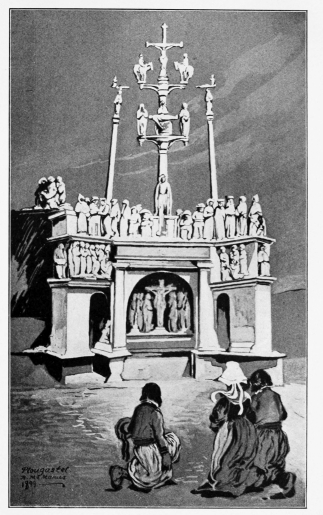
Calvary, Plougastel
Opposite Brest, just across the estuary of the Elorn, is Plougastel,
famous for its melons and its green peas, and, above all, for its
picturesque calvary.
The whole peninsula of Plougastel-Daoulas is a vast market-garden for
Brest, and, for that matter, for the hotels at Paris. The verdure and
vegetable growth is in striking contrast to the barren fringe of rocky
coast-line, and therein lies one of the charms of the whole aspect of
nature as it is seen here.
Nothing in Brittany is more picturesque than the little villages of
Kerérault, Roc’hquérezen, Roc’huivlen, and Roc’hquillion. This is a
commonplace perhaps to those who know the region well, but it will not
be to strangers, and so it is reiterated here.
The Chapel St. John of Plougastel is perhaps two kilometres away. It is
here, on the twenty-fourth of June of each year, that its pardon brings
so great a throng of visitors that they really have to bring their
eatables with them or starve, thus making a fast-day of a feast.
In the cemetery is that great calvary which has so often been pictured,
the most considerable work of its kind in existence.
It was erected 1602-04, in memory of a plague which fell upon the land
in 1598.
In recent times it has been restored. On the front is an altar
ornamented with statues of St. Sebastien, St. Pierre, and St. Roch. The
frieze shows a multitude of bas-reliefs, illustrating the life of Jesus,
and the risers of the steps are a series of quaintly carved little
people, over two hundred in number. On the plinth is a risen Christ and
a tablet bearing the date of erection of the work. It is a marvellous
expression of religious devotion, and far surpasses other wayside
shrines in Brittany, and indeed in all the world.
The inhabitants of Plougastel have preserved their ancient costumes with
little or no modern interpolation. Particularly is this to be noted
among the young girls, on a Sunday, as they come from the mass, and also
on the fifteenth of August, when there is a great religious procession.
The “Pardon of Plougastel” is known also as the “Birds’ Pardon,” for a
great bird fair is opened St. John’s Day.
On the same side of the Goulet of Brest, that narrow inlet which is the
entrance from the sea to the bay, is Le Conquet. It sits at the very tip
of Finistère, just above the Pte. St. Mathieu, and its great lighthouse,
which, with a thirty-second eclipse, sends its rays some twenty miles
out to sea.
Le Conquet has but fifteen hundred inhabitants, and its isolated
population apparently has not many friends, else the place would
be filled to overflowing in the summer months, which it is not. Its
two hotels, St. Barbara and Hôtel de Bretagne, are all that could be
expected, and more, hence the paucity of visitors to this charming bit
of “land’s end” is the more remarkable.
Anciently Le Conquet was a strong fortified place, and it underwent a
great number of sieges, and was burned by the English in 1558. Eight
houses alone of the present habitations of the town survived the flames.
The port is frequented only by the fishing-smacks, which land vast
quantities of lobsters and shrimps.
There is also an ancient pottery here, the most ancient in all
Finistère. Its pots and pans are found in all the homesteads hereabouts,
and such tourists from all parts as actually do come here carry
numberless specimens away with them.
The modern church, after the ogival manner, is far more satisfactory
than most modern ecclesiastical monuments. There is a fifteenth-century
portal, however, and some contemporary statues, which save it from being
wholly a modern work.
The coast-line round about is the rough, abrupt ending of the Léon
plateau, jagged and deeply serrated like the jaws of a shark, as the
native tells one with respect to about all of the Breton coast-line.
Fine beaches do exist here and there, but in the main it is a stern and
rock-bound shore that buffets the Atlantic’s waves in Finistère.
Three times a week one can make the journey by steamboat to Ouessant,
which English sailor-folk—those who go down to the sea in great
liners—know as Ushant. The Île Molène and the Île Ouessant are the
principal members of the group, and are even more stern and rock-bound
than the mainland.
“Very little comfort on the boat,” you will be told at the port-office,
where you make inquiry as to the hour of departure. Any but good sailors
and true vagabond travellers had best leave the journey out of their
itinerary, although it has unique interest.
There are numerous isles and islets to pass on the way, and the Chaussée
des Pierres Noires is a roughly strewn ledge which breathes danger in
the very spray continually flying over it. Molène is a kilometre long
and rather more than half as wide. If ever the population of a sea-girt
isle had to take in one another’s washing in order to make a living,
this is the place, for nearly six hundred men, women, and children make
their habitation upon the isle.
Needless to say there are some things of the twentieth-century
civilization of which they know not, such as automobiles, tram-cars, or
locomotives. There is not even a donkey engine on the island, and there
are no bicycles or perambulators, hence there is something for which to
be thankful. Considerable quantities of vegetables are exported, the
population living apparently on fish, and the “farms” are divided into
plots so small as to be almost infinitesimal.
The island is sadly remembered for the part it played in the wreck of
the great South African liner, the Drummond Castle, in recent years.
The inhabitants of the isle, poor in this world’s goods though they
were, did much to succour the survivors, an act which is writ large in
the history of life-saving.
The isle of Ouessant itself has nearly three thousand population, and
boasts a market and a hotel, besides numerous hamlets or suburbs. The
isle is eight kilometres long, and perhaps three and a half wide, and is
known to the government authorities both as a canton and as a commune.
Pliny knew of this rock-bound isle, the foremost outpost of France,
and called it Uxantos, though it was known to the ancient Bretons as
Enez Heussa. Practically, the island is a table-land with an abundance
of pure water, and the soil very productive so far as new potatoes and
an early crop of barley go. The cultivation is mostly in the hands of
the women, the men being nearly all engaged in the fisheries, or as
sailors. Ouessant is a little land of windmills, though in no way does
it resemble Holland. For the most part, they are sturdy stone buildings,
and work but lazily, many of them being dismantled, as if there were
not enough for them to do. Some years ago a fort was erected here, and
a garrison of colonial troops billeted upon the island. It is a sad job
at best to be a soldier in a colonial outpost such as this, and whether
the observation is just or not, it is made, nevertheless, that the
appearance of the garrison of Ouessant is as though it were made up,
literally, of the scum of the earth.
As for history, the Île d’Ouessant is by no means entirely lacking. It
was evangelized in the sixth century by St. Pol Aurelian, who built a
chapel here at a spot known as Portz Pol.
In 1388, the English ravaged the island, and the former seigniory was
made a marquisate in 1597, in favour of Réné de Rieux, the governor of
Brest, whose descendants sold their birthright to the king in 1764.
The glorious battle of Ouessant—at least, the French call it “la
glorieuse bataille,” and so it really was—took place in 1778 in the
neighbouring waters between a French fleet under the Comte d’Orvilliers
and the English Admiral Keppel.
As may be supposed, these far-jutting, rocky islands have been the scene
of many shipwrecks. There is a proverb known to mariners which classes
these Breton isles as follows:
“Who sights Belle Île sights his refuge,
Who sights Île Groix sights joy,
Who sights Ouessant sights blood.”
When a sailorman of Ouessant is lost at sea, his parents or friends
bring to his former dwelling a little cross of wood, which serves the
purpose of a corpse, and the clergy officiate over it, and his friends
weep over it as if it were his true body.
Finally a procession forms, and, with much solemnity, this little cross
of wood, after having been placed in a casket, is deposited at the foot
of a statue of St. Pol, a sad and glorious symbol of grief and also of
hope.
The women of Ouessant, whether in mourning or not—and they mostly are
in mourning—wear a costume of black cloth, cut their hair short and
wear a square sort of cap. For the most part, the inhabitants—all
those, in fact, who are natives, and there are but few mainlanders
here—speak only Breton.
The Lighthouse de Créac’h, a white and black painted tower, with a
magnificent light flashing its rays twenty-four miles out at sea, is a
monument to the parental French government, which neglects nothing in
the way of guarding its coasts by modern search-lights, quite the best
of their kind in all the known world. There is another light here known
as the Stiff Lighthouse, which carries eighteen miles.
Near the lighthouse is the tiny chapel of Our Lady of Farewells, a place
of pilgrimage on the day of the local pardon (1st September).
On the mainland, just north of Brest and Le Conquet, on the way to the
Channel, is St. Rénan, the site of an ancient hermitage founded by an
anchorite who came from Ireland some time in the eighth century. There
are many quaint sixteenth-century houses here, and a large market-house
of the spectacular order.
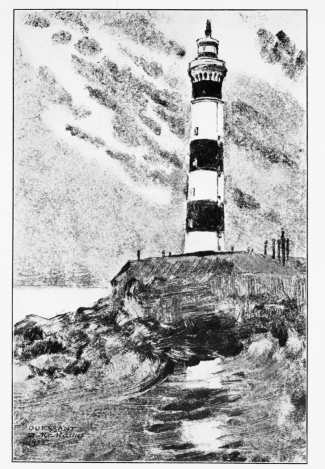
Lighthouse of Créac’h, Ouessant
Ploudalmézeau is an important town of Lower Léon with a Hôtel
Bretagne—as might be expected—also most excellent—also as might be
expected—except for its sanitary conveniences, which, to say nothing
of not being up to date, are practically non-existent. It is very
disconcerting of a rainy autumn morning to have to go down to the back
yard puits—as a pump or well is variously known—in order to perform
one’s ablutions.
The comparatively modern church is far more magnificent than one would
expect to find in so small a town. It contains a curious statue of
the Virgin with a Breton coif, and also a fine modern fresco by Yan
d’Argent. A thirteenth-century sculptured cross is to be seen in the
churchyard.
Folgoët has an important local fair, and is celebrated throughout all
Brittany for the pilgrimage to its magnificent shrine of Our Lady of
Folgoët, one of the most beautiful ecclesiastical monuments of the
province.
Toward the middle of the fourteenth century there lived in the
neighbouring forest a poor idiot named Salaun, better known as the
forest fool; in Breton, Folgoët. After his death, there appeared written
on the leaves of a great white lily, in letters of gold, the admonition
to the people to build a great church here to the glory of Our Lady, and
this was begun in 1409, and consecrated in 1419; it became a collegiate
church in 1423. It has neither transepts nor apse, but is in every
other particular a remarkably beautiful work. There are many interior
furnishings of great value.
Folgoët is at its best on the great day of the pardon, on the eighth of
September.
St. Pol de Léon, Roscoff, and Morlaix call the hurried tourist off to
the northward, though why a tourist ever should be hurried is something
the true vagabond never can understand.
Roscoff has much to endear it to any one. It has not the loneliness or
even the quaintness of some of the daintily set seacoast towns of the
South, but its unique attractions are so many and varied that one loves
it for itself alone, quite as much as if it were a celebrated artists’
sketching-ground, and far more than one would were it a really “popular”
resort.
First of all, it is celebrated for its early vegetables, due principally
to the excellence of its soil, and secondly to the mildness of its
climate.
Because of its temperate climate, Roscoff might be called the Mentone
of the North, though it is not yet overrun by invalids and bath-chairs.
Summer and winter, it is a watering-place, with fir-trees replacing the
palms of the South. The visitor should remark the enormous fig-tree in
the Capuchins’ enclosure, the grounds of an ancient convent (1621),
which is now private property, and costs the sum of twenty-five
centimes to see.
The Church of Our Lady of Croaz-Baz, with its fine domed tower dating
from 1550, is one of the chief ecclesiastical monuments of Brittany.
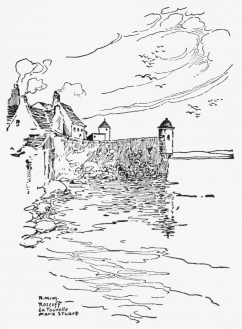
Roscoff
Among the many quaint and curious houses of the town is one known as the
house of Mary Stuart. In its interior court are seven arcades supported
by columns, quite like a convent cloister, a disposition of parts which
must be purely local, as other examples are to be seen elsewhere in the
town. Another memory of the Scottish queen, whose last, long, sad adieu
to France is one of the links that never breaks, is the Chapel of St.
Ninian, built in 1548 as a souvenir of her landing when she first came
to France as the betrothed of the Dauphin. It is a most romantically
disposed structure, though with no architectural details of worth except
a small turret at an angle jutting over the lapping waves.
Roscoff has a Chapel des Adieux, where the wives and mothers of the
fishermen go to pray as the men embark for the fishing.
Offshore, a quarter-hour distant by boat, is the Isle of Batz, separated
from Roscoff only by a narrow strait, with a current so swift that the
passage is only possible in the best of weather. It does not look so
very perilous an undertaking at other times, but the Roscoff sailorman
certainly does know how to handle a boat, and when he says “No,” it’s
best not to attempt to persuade him to the contrary. He will not mind a
wetting himself,—if you pay him a fair price for the undertaking,—but
he will probably want, and be entitled to, a good, fat fee for rescuing
his passenger from drowning.
The Isle of Batz, like most places in Brittany, has its own legend.
It is to the effect that St. Pol, coming in 530 from Britain to this
low, gray, melancholy islet, met a dragon, which, having ravaged the
neighbouring mainland country, had fled hither in order to escape the
fury of the peasant-folk.
St. Pol, as became one who had the interests of his fellow men at heart,
forthwith killed the monster, and conveyed the news to the people
awaiting his return by rapping on the ground with his baton (batz).
The rise and fall of the tide at the Isle of Batz shows remarkable
fluctuations, ten metres, something more than thirty feet, being noted
between high and low water.
Its coast-line has great banks of sand, a delight to the bather in
salt water, but the rock formations are by no means so remarkable as
those on most of the Breton isles. The soil is arid and there is not
much luxuriant vegetation. There is a population of over twelve hundred
souls, but few apparently have any ambition to migrate to the mainland,
scarce a rifle-shot distant. In the island church is preserved the
stole of St. Pol, of Byzantine silk. If genuine, it has attained a
greater age than most confections of its class. An ancient Roman chapel
or temple existed here in former times, and was succeeded by a monastery
founded by St. Pol, now in ruins and mostly buried in the sands.
St. Pol’s renown became such that a Breton king made him Archbishop
of Léon, giving him special care and control of the city bearing his
name. These rights came down to the holy man’s successors, and the
place became more religious than politic, as one reads in the old-time
chronicles. The riches which had been acquired attracted the Normans,
who devastated the cathedral church in 875. In the fourteenth century,
Duguesclin occupied the town in the name of Charles V. The religious
wars of the sixteenth century diminished the prosperity of the town, and
a bloody submission was forced upon the Revolutionary rebels here in
1793.
St. Pol is somewhat doubtfully claimed as the native place of the
celebrated sixteenth-century sculptor, Michel Colomb (1512).
The Chapel of Creizker or Creis-ker, with its astonishing bell-tower
piercing the sky at a height of nearly 250 feet, owes its origin to
a young girl of Léon, whom St. Kirec, Archdeacon of Léon in the sixth
century, had cured of paralysis. The present structure is, of course,
more modern. Albert le Grand fixes the date in the fourteenth century,
and this is probably correct. There are innumerable evidences of the
best of Gothic workmen, and there is much decorative embellishment
which, though not according to the accepted Gothic forms, is certainly
not Renaissance.
The ancient cathedral merits rank with the Chapel of Creizker, and is
perhaps even a more consistent piece of work, though it represents three
distinct epochs. The two towers are considerably less in height than
that of the Creizker, but they are beautifully spired. The interior
contains innumerable decorative accessories, making it rank with those
cathedrals of France making up that third series, of which Nantes,
Coutances, Narbonne, and Angers are the best examples.
In the choir is the tomb of St. Pol, and his skull, an arm bone, and a
finger are encased in a little coffer for the veneration of the devout.
There is a series of sixty-nine delicately sculptured choir-stalls
dating from 1512, and, although not rivalling such great works of their
kind as one sees at their best at Amiens, Albi, or Rodez, they are
sufficiently elaborate to deserve attention.
Innumerable tombs are set about the choir, many of them curiously and
characteristically sculptured.
There is also a tiny bell which passes for having belonged to St. Pol.
On the days of pardon the notes of this ancient bell still ring out over
the heads of the faithful, who believe that they will cure any malady of
the head or hearing.
In one of the chapels of the Cathedral of St. Pol de Léon is an ancient
painting. It depicts a head with three visages, with the legend in
Gothic-Breton characters, “Ma Douez” (Mon Dieu). It represents, of
course, the Trinity, but, like many religious symbols, is more grotesque
than devout.
Morlaix, the ancient Mons Relaxus of Roman times, is the metropolis of
the northwestern Breton coast. It achieved no great importance, until
it came under the sway of the Breton dukes, and became one of their
principal residences. The inhabitants of Morlaix declared for the League
in the period of the religious wars, and the castle was besieged and
carried by the troops of the king under Marshal d’Aumont, in 1594.
Being at the head of the great bay of Morlaix, or, rather, just above
it, at the juncture of the rivers Jarlot and Quefflent, the city enjoys
a novel situation, and contains many curious contrasting effects of the
old and new order of things.
The Viaduct of Morlaix, by which the railway traverses the town, is
really an imposing sight, and is reckoned as the chief of its class
in all France. The natives show an astonishing vagueness or ignorance
with regard thereto. You will be told that it was the work of the
Romans,—“very ancient, look you,”—and again that it was one of the
works of the indefatigable Vauban, who must really have worked in his
sleep, or through understudies, if all the works attributed to him
throughout France be genuine. Vauban must have been to France what
Michelangelo was to the universe,—according to the genial, though
skeptical, Mark Twain.
The Church of St. Martin in the Fields is the chief ecclesiastical
monument of Morlaix, in point of antiquity at least, as it dates from
the ancient priory foundation of 1128, by Hervé, Count of Léon.
The Church of St. Melaine originated also in the fifteenth-century
priory of the same name, founded by Guyormarc’h de Léon.
The local museum, which is an unusually splendid establishment for a
town the size of Morlaix, possesses a collection of modern paintings,
including a great number of Breton scenes, forming a wonderfully
interesting exposition of Breton manners and customs.
There are innumerable old houses in wood and stone here, and they put
Morlaix in the rank with Lisieux, in Normandy, for its picturesque and
tumble-down effects of the domestic architecture of other days.
One of the finest examples of a great house of its time is that called
Pouliguen, which has a fine carved wood staircase that no one can afford
to miss seeing.
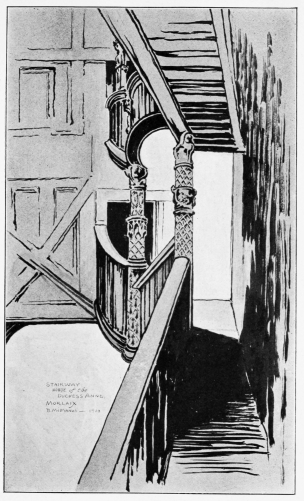
Carved Wood Staircase, Morlaix
The harbour of Morlaix opens out widely into the channel, and is
commanded by the Château du Taureau, in reality a granite fortress,
one of the military defences of the north coast. St. Jean du Doigt
and the Point of Primel lie some twenty kilometres north of Morlaix,
directly on the coast. The former is the scene of one of the most
picturesque of pardons and is celebrated throughout Brittany.
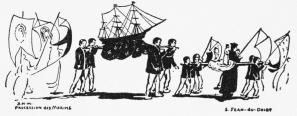
Procession of Sailors, St. Jean du Doigt
Its name comes from its church (1440-1513), in which the index finger
of the right hand of St. John the Baptist is kept. The churchyard has
a fine Gothic entrance gateway and a funeral chapel of the sixteenth
century. Within the same enclosure is also an elaborate fountain
surrounded by a Renaissance construction of much beauty. It was planned
by Anne of Brittany, who brought an artist from Italy to design the
work. The Pardon of St. Jean du Doigt takes place on the twenty-fourth
of June of each year. Decidedly it is not to be omitted from one’s
itinerary, if it be possible to include it.
It is one of the strangest survivals of the belief in an ancient holy
relique yet existing in France, and annually attracts great hordes of
the devout from all parts of Brittany and France, to say nothing of
strangers from oversea.
A good motor-car is indispensable to enable one to flee from the throng
after it is all over, for the railway lies at least a dozen miles away,
and local conveyances are scarce, poor, and expensive.
THE north coast of Brittany, the present-day Department of the Côtes
du Nord, is the great stretch of coast-line between Morlaix on the
west to the Bay of Mont St. Michel at Dol. Its large towns are few in
number, but the whole region is unusually prolific in the memory of
deeds of a historic past, and accordingly it has become the favourite
touring-ground of a great number of French and English summer visitors
who, it is regretfully stated, have become responsible for a good deal
of the claptrap and many of the catchpenny devices.
It is possible to avoid casinos, tea-rooms, and golf-links, but they are
more abundant here in the neighbourhood of Dinan, St. Malo, and Dinard
than in most other parts of Continental Europe. This is a pity, for the
region is one of the most delightfully picturesque anywhere, although
there is little of the grandeur of desolation about it.
A great national road runs northwesterly from Guingamp to Lannion and
Tréguier, two outposts of the Côtes du Nord so far off the beaten track
that they are not as yet overrun with the conventional tourists. There
is little at either place to amuse one, except the local manners and
customs, but they are quaint and interesting beyond belief, and the
wonderful combinations of sea and sky, which will make the artist’s
heart leap for joy.
Lannion boasts of six thousand inhabitants, most of whom play at bowls
on Sunday or a feast-day, and other days engage in the sundry humble
pursuits of the usual Breton large town.
The name Lannion first appeared in the twelfth century, when the
seigniory of Lannion formed a part of the domain of the house of
Penthièvre, which was united with that of Brittany in 1199.
There are three quaint and charming hotels at Lannion, at any of which
you will get the best of local fare at prices ranging from 120 to 220
francs per month—all found. One will not go wrong at any of them, and
one does not differ greatly from another, in spite of the difference in
price. There is an abundance of what is commonly known as good cheer,
by which is really meant good fare, and there are comfortable beds, a
sound roof over one’s head, and genial hosts, of course.
This estimable person is literally everywhere at once, showing the
guests to their rooms, presiding at the table, or, at least, at the
serving of it, and generally overseeing everything that goes on.
“Allons, messieurs, à table,” is called, in a melodious voice,
instead of the ringing of the usual brain-racking bell, and one by
one travelling salesmen, the permanent guests, and the mere tourists
seat themselves at the long table, which literally groans—like those
in the historical novels—with the best of country cookery. There is
nothing Parisian about it; there are no ices, no forced fruit, and no
savoury messes with mushrooms and truffles, but there is the abundant
and excellent local fare of sea food, hung mutton, new potatoes and
asparagus, and little wood strawberries in heaps, and that delightful
golden cider, which, if it be not an improvement on the Norman variety,
is just as good, and a delightful summer drink.
The fine location of Lannion, on the right bank of the estuary of the
little river Leguer, accounts for much of the local charm, and the habit
that the population has of grouping itself picturesquely about the
quay-side—without the least provocation—accounts for a good deal more.
There are many old houses in the town, and other more pretentious
architectural monuments, offering enough variety to the artist or lover
of architecture to occupy him a long time.
The port is a harbour of refuge, of which there are not many on the
north coast of Brittany, and the traffic in salmon and sardines is
considerable, though not rivalling in bulk that of the greater ports in
the southwest.
Tréguier has much the same attractions as Lannion, though its population
is but half as large. Its origin was some huts which anciently grouped
themselves around the monastery of Trecar, founded by St. Tugdal in the
sixth century. It has an imposing cathedral, a really great religious
edifice, and one which for the beauty of its parts is scarcely excelled
by that of Quimper itself.
The history of Tréguier was very lively, from the time of the Norman
invasion of Brittany down through the troublous days of the Revolution.
The men of Tréguier, one learns from history, accepted the law of
the “rights of man” but coldly, and indeed M. le Mintier, Bishop of
Tréguier, was one of those churchmen barred from the National Assembly
by the manifesto. He fled to Jersey.
Tréguier is the native place of Ernest Renan (1823-92), and his quaint,
timbered house may well be considered a literary shrine of the very
first rank.
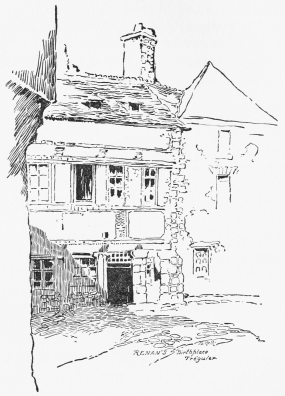
House of Ernest Renan, Tréguier
Convents, where women may find a quiet refuge away from the world, are
not so numerous as they once were in France. “Boarding-houses kept for
unprotected women by nuns, with a supposed Christian devotion and a
profound appreciation of ready money,” was the way in which an English
writer once spoke of them, and it was most unfair. Certainly, the
writer of those lines never knew—and she professed to know France—the
Convent of the Cross at Tréguier, where women can live in quiet
seclusion, “all found,” for a matter of seventy-five francs a month. To
those interested, the above may be worth investigation.
Not far off is the Manor of Kermartin, where, in 1255, St. Yves, the
patron saint of advocates, was born.
On the nineteenth of May a procession sets out from the Tréguier
cathedral for this shrine, to render homage to the patron of the men
of law. On the eve of the nineteenth all mendicants and vagabonds
presenting themselves at the manor are fed and lodged, which makes the
perpetuation of the ceremony one of real benefit to humanity, though its
endurance is brief.
St. Yves is the only canonized Breton saint. He was born on the seventh
of October, 1253, and accompanied Peter of Dreux, reigning duke, to the
seventh crusade.
In the Breton tongue his praises are sung as follows:
“N’hen eus ket en Breiz, n’hen eus ket unan,
N’hen eus ket eur Zant evel Sant Erwan.”
This in French comes to the following:
“Il n’y a pas en Bretagne, il n’y en a pas un,
Il n’y a pas un Saint comme St. Yves.”
The last will and testament of St. Yves is preserved in the sacristy
of the Church de Minihy, and also his breviary. His tomb is in the
cemetery, surmounted by an arcade through which the faithful pass,
crawling upon their knees when they seek his aid.
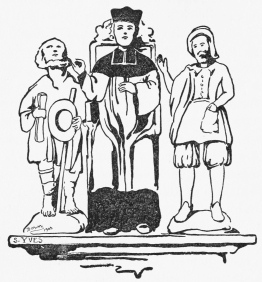
Shrine of St. Yves, Tréguier
Not many travellers in France have ever even heard of Seven Isles,
situated five kilometres or more off the coast near Tréguier. The
corsairs of Jersey and Guernsey took refuge upon this little
archipelago in the olden time, and long maintained a form of government
quite of their own making, and even erected fortifications, of which
that on the Île aux Moines has still some suggestion of strength.
Usually quite deserted, there are two seasons of the year when the
isles take on a population of residents from the mainland entirely
out of keeping with their size and number: in February for seaweed
gathering, and from June to September for the gathering of sea-mosses,
or jargot, as the natives call it. One who would experience something
out of the ordinary could not do better than make this little excursion.
The passage from the mainland does not look so very terrible to the
stranger, but not even the hardy fishermen will attempt it if the sky
is the least threatening. He says simply, “Only go out in very fine
weather,” and sits tight and prays and whistles for that same fine
weather, though he evidently does not expect it to come very soon, for
with every bit of fleecy cloud that crosses his vision, he exclaims:
“Big storm soon!”
Paimpol is situated at the head of a well-sheltered bay on the banks
of an infinitesimal little river known as Quinic. There is nothing to
mark Paimpol as a tourist resort, and accordingly it is almost an ideal
resting-place for one wearied with the onrush of the world. It is not
even a bathing-place, as it well might be. Its long Rue de l’Église is
its principal thoroughfare, and through it all the small traffic of the
town circulates at a most sedate pace.
The church dates from the thirteenth century, and is a lovely old
structure with admirable Gothic pillars and arches in its nave, and a
fine fourteenth-century rose window.
The port of Paimpol has a most interesting rise and fall of life,
particularly at the season of the setting out and the return of the
Iceland fishermen. In the trade in codfish caught off the Icelandic
coasts, this place occupies the first rank, being the home port of
those who fish in Icelandic waters, and all along the quays of the
sad little town of Paimpol (sad, because there are so many widows
there,—the lone partners of those who have lost their lives at sea)
are to be seen the Iceland schooners. Everything in the town smacks of
the memory of Iceland: the schooners, the ex-votos in the churches,
the widows, the sturdy but gloomy fisherfolk themselves, and the stones
in the churchyard. “The Iceland fog enshrouds everything,” the native
tells you, but still the work goes on, and each year, with the coming
of the spring days, the exodus begins, after a winter’s hard work at
refurbishing and refitting of the little two-masters and three-masters
of the fishers. It is here that one may hear that Breton sailor’s
prayer, which is so devout and full of faith: “Mon Dieu protège nous,
car la mer est si grand et nos bateaux si petits.”
Cod, whale, mackerel, and herring are all marketable products to the
nets of the Paimpolans.
The Isle of Bréhat is near Paimpol, lying just off the coast. If one
seek to arrange a passage, thereto, he goes by public carriage, and
not by boat, until he gets to the tip of the Pointe Arcouest, when he
transfers himself and his luggage to a sailboat, and travels as one did
before the age of steam.
The Isle of Bréhat is another of those rocky islets which dot the coast
of Brittany, and look not only as if they were barren and uncultivated,
but as if they were also uninhabited. All the same, their appearance
from a distance is misleading. There are close upon a thousand
inhabitants on the parent isle and the attendant flock of little islets
sheltered under its wing. In the olden time, the island was a strong
place of war, with batteries and fortifications against which the
English, the Leaguers, and the Royalists tried their strength in turn.
The isle is what the sailor-folk roundabout call “a good port of
refuge,” for there are divers little sheltered harbours to which ships
of all classes can run from the storms of the open sea.
The principal town is known as Bréhat, and possesses a church dating
from 1700, a tiny hotel, and an inn or two, mostly catering to local
customers. If one would leave the mainland, and its questionable
attractions of civilization behind, and live the simple life to the
full, he can do it here to the most exquisite degree,—if he does not
mind the sea-fogs of the winter.
Guingamp, lying inland in the rich valley of the Trieux, is the
market-town of the arrondissement of the same name. It is of feudal
origin, and was the ancient capital of the countship, later the duchy,
of Penthièvre, and of the ancient Goëllo land.
Guingamp Castle is a great square building, flanked by four massive
towers, of which one has been practically destroyed.
The Church of Our Lady of Good Help, of the fourteenth to sixteenth
centuries, is a magnificent work of its era, with an elaborately
furnished interior.

The Pardon of Bon Secours is Guingamp’s gayest event of all the year.
In numbers, it is one of the largest in Brittany, and is held on the
Saturday before the first Sunday in July. On this occasion the statue
of Our Lady, within the porch of the church, is clad in a silken robe,
and receives the pilgrims, who refresh themselves with water previously
consecrated at its source. With the fall of the sun commences a
continual round of national dances, inspired by the lonesome, sharp,
shrill wail of the binious, played in much the same way as are the
Scotch bagpipes, except that their music is even more shrill and
heartrending—if possible. At nine o’clock the statue of the Virgin
is brought to the public square, solemnly conveyed by an immense
procession, and three great bonfires are lighted. At midnight a high
mass terminates the celebration, and some of the pilgrims depart, and
others remain for the banquet which invariably follows.
On the eighth of September, 1857, the Madonna of Guingamp received the
crown of gold from the chapter of St. Peter’s at Rome, on behalf of the
Pope, a distinction offered to images of the Virgin uniting the three
traits of antiquity, popularity, and miracle-working.
“La Pompe,” or the Fontaine, in hammered lead, is one of the chief
artistic curiosities of Guingamp. It is a remarkable work in every way,
and dates from 1588, since which time it has only been repaired—not
reconstructed. Its preservation is wonderful, and it is an embellishment
of which even a greater town might well be proud.
Aside from the fragment of the castle, there are no mediæval gateways or
walls to remind one of the military importance of the place in former
days. A century and a quarter ago, a traveller wrote: “Enter Guingamp by
gateways, towers, and battlements of the oldest military architecture,
every part denoting antiquity, and in the best preservation.” All this,
unhappily, has disappeared, and one has to go to Vitré and Fougères to
see military architecture in Brittany.
Eastward from Guingamp toward St. Brieuc, one passes—the traveller by
road or rail seldom stops—Chatelaudren. It is a conventional Breton
small town, but it is a market-town, nevertheless. It has not much
of interest for any one unless he be a keen observer of manners and
customs, hence it is but a way station between the two larger towns.
St. Brieuc is a city, although it has no tram-cars to dodge and no
restaurants or Hôtels Étrangers, which is a good thing for the native
and the tourist alike.
In reality its half-dozen hotels rise to the distinction of being known
as “establishments,” yet they have lost none of their local flavour. St.
Brieuc is the metropolis where the summer visitors—Parisians all—of
the beaches come to buy the little necessaries and luxuries which a
mere watering-place fails to supply. Then, too, one who is rusticating,
even in a delightful spot like Val André, lacks notably the inspiration
coming from a more or less frequent contact with a large centre, and
so he hies himself to a market-town, gets the fare of the country at a
hotel for travelling salesmen, and has a bit of the transmitted gossip
of the capital over a bock at the principal café; after this—voilà!
the seaside again for a time.
This may not be the Anglo-Saxon way of treating a similar situation,
but it is exactly after the French method.
St. Brieuc is the seat of a bishopric, suffragan of the metropolitan
see of Brittany at Rennes. Its origin is due to a missionary who came
with eight disciples at the end of the fifth century to evangelize
Armorica. As a place of pilgrimage,—the tomb of St. Brieuc having
become a shrine,—it soon began to draw throngs from all parts, and the
importance of the city which grew up around the memory of the missionary
was soon assured.
The cathedral of St. Brieuc was begun by St. William Pinchon before the
middle of the thirteenth century, and was soon finished.
Its exterior presents the severe and austere, though beautiful,
Gothic of its time, but the accessories of its interior arrangements
show plainly the debasement of the later interpolations, although
there are some really excellent details hidden away amid a profusion
of mediocrities, notably the tomb of St. William, a fine Way of the
Cross by a local sculptor, and a low, hanging gallery at the base of
the choir, which is a remarkably beautiful and effective adjunct to a
great church. The exterior is more impressive, though its two principal
doorways have been badly restored or rebuilt at some time since the
completion of the edifice. The great, gaunt, donjon-like towers are the
chief features of beauty and distinction, and tell the story of the
whole fabric in quite an unassailable manner.
At the town hall is a museum which has some good modern art works,
including a fragment of Rodin’s Portes de l’Enfer and some notable
paintings of Breton subjects.
In the Rue St. Jacques and the Rue Fardel are many old houses, one of
the most notable being the hotel of the Dukes of Brittany, begun in 1572
by Yvon Collou. James II. of England lodged here when he came to St.
Brieuc in 1689.
The carved and decorated fronts of these old wooden houses lend a
quaintness and charm to the streets of St. Brieuc, in strong contrast to
the modernity of its hotels and cafés. There is considerable and varied
local industry at St. Brieuc, and this gives the city some importance as
a manufacturing centre, but the chief events of its commercial life are
the great fairs held in July and September, the latter founded in the
fifteenth century by Marguerite of Clisson.
The environs of St. Brieuc are charmingly diversified, from the wide
open stretches of farming country at the south to the wastes of rock
and sand flanking the great Bay of St. Brieuc.
Le Légué is the port of St. Brieuc, and the coastwise traffic is
considerable. The quays and docks, ship-houses and careening wharfs
lend a novel and interesting aspect to a background of thickly wooded
river-banks. The seaward entrance of the channel is protected by a
fifth-class light. The port is the first in rank in the Côtes du Nord
for the fitting out of the Newfoundland and Iceland fishing-boats.
The Tower of Cesson, three kilometres or more from St. Brieuc, is a
simple circular tower, surrounded by a double protecting fosse cut
perpendicularly into the rock. The walls are quite twelve feet in
thickness on the lower of its four floors. It was built by Duke Jean
IV. in 1395, and, after much strife and bloodshed, extending over two
centuries, was laid in ruins by Henry IV. in 1598.
On the shores of the Bay of St. Brieuc are innumerable little beaches
which are healthful breathing-spots for large numbers of Parisian folk,
who come thither between June and September of each year.
These are not exactly riotous resorts of fashion, but still there are
some evidences of the distractions of the world that make most of them
appear as little parochial Parises. There are two spots on the western
shore of the bay to which this does not apply, however, Etables and
Binic.
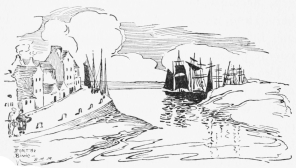
Binic
Binic, a small fishing port of Brittany, has all the attractions of
an unworldly seaside village, for it is not much more even to-day.
After Binic, Etables, and after Etables, Binic. Each is much the same
as the other. Binic has been a great-little port for the fitting out
of ships for the Newfoundland fisheries ever since the beginning of
the seventeenth century, and things go on in much the same way as of
old, except that the master of the craft now has a megaphone and a
patent log in his equipment, whereas formerly he went without these
refinements of navigation. To the Newfoundland fishermen of Binic is due
a special preparation of the codfish known as bénicasser, of which the
dictionaries will tell one nothing, but which is simply a species of
cured codfish.
The high altar of Binic church was bought with funds contributed as
a result of the Sunday fishing on the Newfoundland banks. It can,
therefore, be said to have a real reason for being, and, as it is an
unusually ornate affair, one infers that the Sunday haul must be of
goodly proportions.
From St. Brieuc eastward, until one actually comes within the confines
of that delectable land known as the Emerald Coast,—the summer rival
of that winter paradise, the Blue Coast,—is a verdant land of crops
and cultures which would quite change the opinions of any who thought
Brittany a sterile, rock-bound land, where nothing could grow but onions
and new potatoes.
Lamballe is a sort of a faint shadow of St. Brieuc. It was founded in
feudal times, and from 1134 to 1420 was the capital of the county of
Penthièvre. As late as the eighteenth century, the oldest son of the Duc
de Penthièvre bore the title of Prince of Lamballe.
The town is divided into the upper and lower towns. In the latter are
found those old settlers of ducal times, the houses of wood and stone
still standing to delight the eye of the artist and to arouse the wonder
of the general tourist.
There is a fine Gothic Church of Our Lady, its foundations cut in the
very rock itself, and bearing, from more than one point of view, the
aspect of a fortified edifice, which has a battlemented roof that is
nothing if not an indication that the church of Dol was a truly militant
edifice. As the chapel of the old château, this church grew up from a
foundation of St. William Pinchon, Bishop of St. Brieuc in 1220.
St. Martin’s is the church of an ancient priory belonging to the parent
house of Marmoutier. It was founded in 1083 by Geoffrey I., Count of
Lamballe. Its primitive nave shows a remarkable series of horseshoe
arches, and in every way, not excepting the great sixteenth-century
towers, St. Martin’s is quite the most interesting architectural
monument of Lamballe.
North of Lamballe lies Val André. A charming watering-place much
frequented by families, is the way the all-powerful Western Railway
advertises this little seaside beach and its attractions, with the added
few lines to the effect that there is a large hotel with a casino,
regattas, nautical celebrations, concerts, etc., which are supposed to
amuse the fastidious summer visitors.
It is all very delightful, particularly as the coast-line near by is
charming of itself, but Val André, with all its attractions, has not
half the charm of the little fishing port of Binic on the opposite shore
of the Bay of St. Brieuc.
THE Emerald Coast is the passion chiefly of those who come to live
during the three summer months of rustication, but the sister cities
of St. Servan, Paramé and St. Malo, Dinard and Dinan, are lovely spots
and attractive of themselves, were one forced to camp out on one of the
barren, jagged rocks with which the coast hereabouts is strewn, instead
of living at the Hotel of France and Chateaubriand, which encloses the
ancient maison of Chateaubriand, at St. Malo. Starting thence, one
explores the wonderful country round about, and nourishes himself and
makes himself comfortable with all the modern refinements. This hotel
is about the only modern thing in St. Malo, however, for, while highly
interesting to the antiquary or to the student of architecture or of
art, it is commonly thought to be a vile, dirty hole, with a few shops
convenient for the inhabitants of the more aristocratic suburbs of
Paramé and St. Servan.
St. Malo is a curious little city, with its ever apparent past not in
the least disturbed by the steamboats and electric trams, which bring
visitors to the base of its ancient fortifications and gateways. Among
its chief reminders of the past are its proud château, redolent of the
memory of the beautiful Duchess Anne, its fine cathedral, its quaint old
houses and narrow streets, and its wonderful encircling ramparts.
Not only is St. Malo a city of the past, but it is above all, to-day,
a resort, as that elastic term is known which covers any place where
tourists congregate for pleasure.
Kiosks, coffee-rooms, and bathing-cabins have taken the place of
whatever may have gone before, and to-day, truly, one may be as
comfortably up to date—if there is any real comfort in being up to
date—as if he were in Budapest, Paris, or San Francisco. St. Malo is
considerably more than this; it is the actual, if not the geographical,
centre of the whole Emerald Coast.
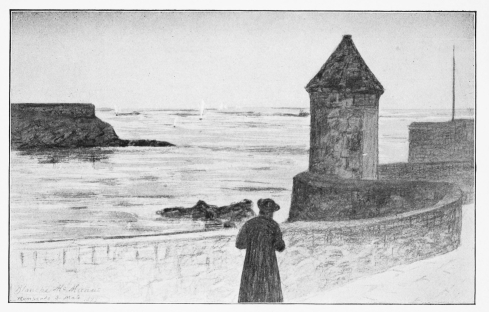
Ramparts of St. Malo
The praises of the Emerald Coast have been sung by many poets, and
pictured by many painters. Jean Richepin, that rare vagabond, comes
frequently for his inspiration to St. Jacut-de-la-Mer, and in
his “Honest Folk” there are superb descriptions of this entrancing
combination of sea and shore, which in all France is not elsewhere
equalled, unless it be on the Riviera.
The Emerald Coast must indeed be the paradise for jaded literary
workers, when work makes its inroads on their holiday, for it may enable
them to accomplish as much as Ferdinand Brunetière admitted during a
recent stay at Dinard-St. Énogat:
“What do I read?” said he. “These:
“1. The 240 pages which make up the Revue des deux Mondes every
fortnight.
“2. The manuscripts which may become future pages of the Review, and
even some which may not.
“3. Works which have not appeared in the Review, whose authors I may
find it worth while to know and cultivate.
“4. Journals in which the Review is interested.
“5. The Official Journal, from which one may always pick up something.
“6. The other papers.
“7. Works submitted for the approval of the French Academy.
“8. Proof-sheets of my own works.
“9. The books necessary for the preparation of my discourses, lectures,
and articles.”
The puzzle is what a man like M. Brunetière will find to do in the
next world. Probably he will go about to all the celebrated writers to
see what they thought of his criticisms in his dearly loved Review;
and then perhaps he will regret, as Herbert Spencer is said to have
regretted, that he had not gone fishing oftener.
The charms of St. Malo’s suburban social colony of Paramé, such as
they are, though they differ greatly from the mere attractions of
nature,—for which society folk really care for only as an accessory
to their more futile pleasures,—are best set forth in the following
stanzas of Jehan Valter:
“PARAMÉ
“IDYLLE
“Quel est de Biarritz à Calais
Le seul bain de mer, qui jamais,
Faute de baigneurs, n’a chômé?
C’est Paramé!
“Où le soleil à l’horizon
Montre-t-il en chaque saison
Son disque toujours enflammé?
A Paramé!
“Où le froid est-il inconnu,
Où peut-on se promener nu
Sans avoir peur d’être enrhumé?
A Paramé!
“Le soir, on danse au Casino,
Non aux sons d’un mauvais piano,
Mais d’un orchestre renommé
A Paramé!
“Sur la plage on rêve d’amour,
La nuit aussi bien que le jour
Que de baigneuses ont aimé!
A Paramé!
“Est-ce l’air qui porte à la peau;
Est-ce le soleil, est-ce l’eau?
Chacun sort du bain ranimé
A Paramé!
“Et c’est un miracle constant,
Le plus chétif, en un instant,
Est en athlète transformé
A Paramé!
“Du reste, miracle plus fort,
Jamais personne ici n’est mort,
On ne connaît pas d’inhumé
A Paramé!
“A vous tous, gandins rabougris
Qui dépérissez à Paris,
Venez humer l’air embaumé
De Paramé!
“Vous ne le regretterez pas:
On y fait d’excellents repas,
Et le cidre est fort estimé
A Paramé!
“Donc, sur l’honneur, je vous le dis,
A défaut du vrai paradis,
Il n’est sur terre, en résumé,
Que Paramé!”
That is about the sort of round that one gets at Paramé, with
motor-cars, golf, and bridge parties thrown in, but a wonderful aspect
of nature to be seen at every turn, and it is perhaps small wonder that
the little summer colony has now grown to huge proportions.
Americans should have a special interest in, and a fondness for, St.
Malo, “the city of the corsairs.”
St. Malo is the chief town of the province of Jacques Cartier, the
discoverer of Canada. “It is a city of great men and the chief place of
the Breton middle class,” said the Abbé Jalobert in his curious work on
St. Malo and St. Servan.
There is some truth in calling St. Malo the “corsair stronghold,” for it
was the cradle of Mahé de la Bourdonnais, Duguay-Trouin, Surcouf, and
their followers, all “sea-rovers” if they were not something more.
To-day St. Malo’s “sea-rovers” are the sailors of the Newfoundland
fishing-fleet, the humble “terre-neuvas,” as they are known, who go
in large numbers to fish for cod on the Grand Banks of Newfoundland.
“I’s sont partis de Saint-Malo,
I’s sont partis de Saint-Malo,
Tous ben portants, vaillants et biaux.
In’ troun’ dérin tra lonlaire!
In’ troun’ dérin’ tra lonla!”
sings Yann Nibor in his “Sea Songs and Stories.”
The city’s older reputation as the city of the corsairs gave quite a
different interpretation, however:
“LA CITÉ DES CORSAIRES
“Si dans son aire, aujourd’hui tombe,
Elle ouit de rudes chansons!
Dont le souvenir donne au monde
Des frissons.
“La gothique flêche de pierre
De son clocher audacieux
S’élance comme un rapière
Vers les cieux.”
—Dabouchet.
Duguay-Trouin is an almost mythical character, but many of his
legendary exploits sound plausible. He took an English ship mounting
forty guns when he owned to but sixteen years, and in a following
campaign—practically on his own account it would seem—he captured
two vessels of war and twelve merchant-ships from under the guns of
a British squadron. This, at least, is the French version, and since
all of us, in our agile days, love a daring hero,—even if he be a
bloodthirsty one,—it seems a pity to probe the assertion too deeply.
Such a man as Duguay-Trouin was, of course, popular, and his sailors
sang his praises in the street in lines which came to be taken up by
the “stay-at-homes” and incorporated into a kind of folk-lore. Indeed,
gentle mothers sang their infants to sleep with them, much as did old
Mother Goose of the nursery rhymes:
“Monsieur Duguay t’envoyé
Un tambour de l’Achille
Pour demander à ces braves guerriers
S’ils veulent capituler.
“Les dames du château
S’sont mis à la fenêtre,
Monsieur Duguay apaisez vos canons,
Avec vous je composerez.”
Not always does the stranger to St. Malo hear exactly this offhand, but
invariably he is met with a singsong of sailors’ chanteys which at once
call up memories of seafarers of other days.
One enters St. Malo, whether by boat or train, through the city walls.
The boat lands you directly under the frowning ramparts, and a worthy
porter will take your portmanteau and carry it twenty steps to the door
of your hotel, just within the gateway of the city—and charge you
twenty sous for the job. “A franc, really,” the man with the brass badge
tied on his right arm will reply to your query as to whether you have
heard aright.
“Twenty cents for twenty steps is a little high,” says the hostess of
your hotel, but it is the tariff from outside.
St. Malo is still a walled city, much as it was in the days when Francis
I., in 1518, and Charles IX., in 1570, held court here.
Charles IX., his mother Catharine, and his sister Margaret spent a part
of the month of May here in this city by the sea. The Malouins gave the
court a spectacle of an imitation naval combat, in which a galleon was
sunk; too realistically, one thinks, for its occupants were drowned.
At one time, it is said by the chronicles, St. Malo was guarded by
fierce mastiffs, the descendants, it is to be presumed, of the Gallic
dogs of war. These municipal watch-dogs were suppressed in 1770, because
of their having bitten the “calves of gentlemen.” Presumably there was a
complaint of some sort, but the only record of the incident is one in
verse sung by Désaugiers as follows:
“Bon voyage,
Cher du Mollet,
A Saint-Malo débarquez sans naufrage,
Et revenez si ce pays vous plait.”
The disappearance of the watch-dogs in 1770 made necessary the adoption
of a new coat of arms for the town, when the blazoning of argent, a dog
gules, gave way to a “portcullis surmounted by an ermine passant.”
One has heard before now the phrase, “I like St. Malo in spite of its
smell,” and, in spite of the truth of it,—and there is a very apparent
justification of the word,—the old city is one of the most lovable in
all Brittany.
The House of Duguay-Trouin at St. Malo is one of its chief romantic
shrines before which strangers are wont to linger. It is simply an old
wooden-fronted house, sombre and austere in its upper stories, but
resplendent in white paint below. A shoe-shop and a coffee-room occupy
the lower floor, and if one would conjure up the days of the past, when
pirates bold discussed their venturesome plans in the very same room,
let him enter and drink his after-dinner coffee by the pale light of
a guttering candle in this old abode of romance. There is nothing of
luxury about it; in fact, most worshippers are content to bow before the
shrine from without; but to awaken the liveliest emotions, one must
really enter and see it from the inside.
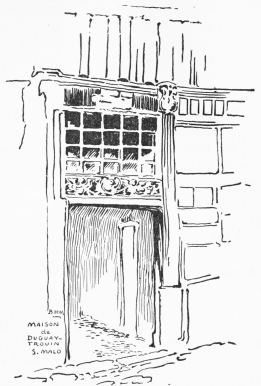
House of Duguay-Trouin, St. Malo
St. Malo, besides its stock sights of romance and history situated
within the city itself, has a literary shrine of the first rank in the
island of Grand Bé just offshore. Here is the tomb of Chateaubriand,
ambassador, minister, journalist, and author. One need not inscribe the
dates and titles of his works here; it is enough to mention his name.
Suffice to recall that, as a conclusion to his labours, he wrote the
“Mémoires d’Outre-Tomb,” which, like the simple, rough-hewn cross which
crowns the summit of Grand Bé, is a fitting monument to the genius of
the man whose theories, it is to be feared, have now become somewhat out
of date.
Chateaubriand’s verses on his native land give an ample proof of his
love for her, and, moreover, so well express the regard which nearly
every one has for the Emerald Coast, that it is certainly pardonable to
quote them here:
“MON PAYS
“Combien j’ai douce souvenance
Du joli lieu de ma naissance!
Ma sœur, qu’ils étaient beaux, les jours
De France!
O mon pays, sois mes amours,
Toujours!
“Te souvient-il que notre mère,
Au foyer de notre chaumière,
Nous pressait sur son cœur joyeux,
Ma chère,
Et nous baisions ses blancs cheveux
Tous deux?
“Ma sœur, te souvient-il encore
Du château que baignait la Dore?
Et de cette tant vieille tour
Du Maure,
Ou l’airain sonnait le retour
Du jour?
“Te souvient-il du lac tranquille
Qu’effleurait l’hirondelle agile,
Du vent qui courbait le roseau
Mobile,
Et du soleil couchant sur l’eau,
Si beau?
“Oh! qui me rendra mon Hélène,
Et ma montagne et le grand chêne?
Leur souvenir fait tous les jours
Ma peine:
Mon pays sera mes amours
Toujours!”
St. Servan, like St. Malo, is steeped in antiquity; practically they
form one town, although separated by the narrow strait which forms an
entrance to the outer harbour of St. Malo. St. Servan registers over a
hundred St. Malo craft engaged in fishing and in the coast trade. As the
ancient Gallo-Roman town of Alethum, St. Servan, from very early times
an archbishopric, was ravaged by barbarians and by floods and had a
varied career, but at last the steady growth of the comparatively modern
St. Servan made it a prosperous town of perhaps twelve thousand souls.
The chief of St. Servan’s architectural monuments is the great Tower
of Solidor, built far out upon the rocks at the mouth of the Rance. It
was built in 1384 by Duke John IV., at the epoch when he was combating
the pretensions of Josselin of Rohan, Bishop of St. Malo, for the
sovereignty of the town.
It is a great triangular hold with a cylindrical tower at each corner.
Within is a stone staircase winding spirally upward and giving access to
various vaulted chambers. It could oppose no great strength to modern
artillery, and even in the olden time could not have been very secure,
could the besiegers but get to the base of its walls. At the same time,
from its isolated position, it served admirably as an outpost which at
least offered a superior vantage against an attacking force, and it is
unlikely that it could have been taken except by siege or by the fall of
the supporting city at its back.
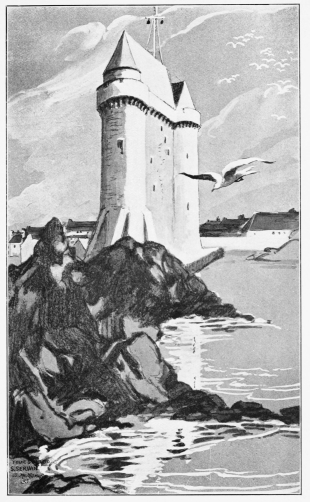
Tower of Solidor, St. Servan
The Chapel St. Peter of Aleth has built into its fabric some fragments
of the ancient ninth and tenth century cathedral of the same name.
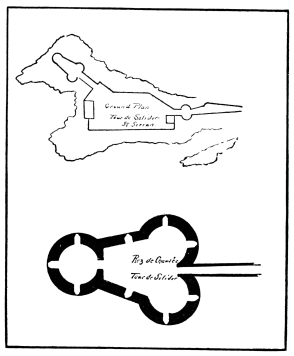
Plans of the Tower of Solidor
There are many remains of the old city walls, and St. Servan ranks with
St. Malo as a vivid reminder of other days.
There is one popular sight of Brittany near St. Malo, which cannot be
ignored,—the rock-carved tomb of St. Budoc. This holy man lived in the
days when Celtic was a living tongue, and Irish, Scots, Welshmen, and
Bretons, one and all, used the same speech.
Many a year has passed, and St. Budoc has been all but forgotten.
Besides his religious fervour, the memory of which exists but vaguely,
there is left as a reminder of his existence his tomb and a prophecy
which has come down by word of mouth through the natives.
To-day there is a modern hermit who lives near the tomb of the saint,
and carves a sort of symbolical prophecy in stone for his own amusement
and the marvel of tourists.
It is rather a cheap sort of a shrine, and one that is wholly visionary
so far as its real significance goes, but it is a very satisfying one
to most who view it, like the “Blarney Stone” and St. Patrick’s grave,
which are frauds of the first water.
One comes to Rothéneuf—a little Breton coast village—by road, tramway,
or carriage from Paramé, if he comes at all. Here just beyond the
village itself the cliffs are curiously carved into all manner of human
shapes,—the work of the aforesaid hermit, who, although he be not a
young man, certainly is not so old as to have carved all the stones
which here exist; at least they look much older, though the stress of
weather may account for that.
Evidently there is a devotion for St. Budoc, and belief in his prophecy
of the downfall of France is one day or another to become true. The old
monk or priest—for in reality this hermit of to-day is a churchman—is
evidently the chief disciple of the cult, for he perpetuates his version
of this long-lost legend in his modern carvings.
The text of this old prophecy was vague and visionary, but enough has
come down to place definitely the fact that a Napoleon was to rise and
fall in the beginning of the nineteenth century, and that the Church was
to be parted from its children,—referring presumably to the Concordat
of 1802.
No version of the prophecy exists in Celtic literature, but the monk
Olivarius published, in Luxembourg in 1544, a version which was supposed
to have been handed down from the old Celtic monk himself. Since that
time contemporary literature has had various references thereto, the
last apparently in 1904, when one appeared in Gaston Medy’s “Echo of the
Marvellous.”
This last version, or promulgation, of the Celt’s prophecy carries
us even into the future, 432 moons from the foundation of the present
French republic, i. e. thirty-six years, which would be in 1906. “Woe
to thee, great city,” is a phrase which is supposed to refer to the fall
of Paris; whether as Rome fell, from an excess of glory, or into the
hands of the invader, is not stated. At any rate, the event is to come
to pass in the year of our Lord 1906, 432 moons from the beginning of
the great Republique Française. Let all who will be mindful.
On the opposite bank of the Rance from St. Malo is Dinard-St. Énogat,
occupying a magnificent site known in part as the Bec de la Valle. The
country-houses of Dinard are famous, though they are built in that
vague architectural style accepted the world over as being something
appropriate to a species of residence less sumptuous than a palace or a
château.
It is a pity that the word is not better understood by the people,
and a pity, too, that most villas in France—and in England, for that
matter—are abominable, queer chicken-coops, with names like Villa
Napoli, Villa Saint Germain, Villa la Belle-Issue, Villa Belle-Rive, and
Villa Bric-à-Brac. All these are found at Dinard, and more, and, as may
be imagined, the summer life of this town of country-houses is in many
respects as gay and bizarre as the architecture and names of the villas
themselves.
The aspect of the waterside of the charming little place—for Dinard is
charming, in spite of it all—belies these strictures somewhat, with
the warm glow of the sinking sun gilding the roof-tops, as the emerald
waters of the great bay ebb and flow beneath their feet.
Dinard has another and more interesting side in an admirable
architectural monument,—the ruins of an ancient priory, founded in
1324 by Olivier and Geoffroy de Montfort. The fine Gothic chapel is now
ruined and moss-grown, but there are still to be seen the tombs of the
Chevaliers de Montfort, who were mighty chieftains in their day. Within
the grounds also is a curious statue of the Virgin placed beneath the
enormous fig-tree.
The beach is of course the great attraction of the summer resident,
when he is not drinking cool drinks at the casino or eating at the café
restaurant on the terrace.
St. Énogat, which is usually linked with the mention of Dinard by a
hyphen, has much the same aspect as its partner,—villas, Swiss châlets,
and cottages. St. Énogat bears the name of one of the first bishops of
Aleth, and its proximity to the great cliffs fringing the coast, and
the high rocks just offshore, make its location even more beautiful than
that of Dinard itself. Westward of St. Énogat are St. Jacut, St. Cast,
and Cap Fréhel, and nearer St. Lunaire and St. Briac.
All are very popular resorts during the summer months, and are
attractive spots—or would be but that accommodation in all is limited,
and what there is is sadly overcrowded for the three fine months of the
year.
St. Lunaire has an ancient eleventh-century church, placing it somewhat
on the plane of an artistic shrine. Practically, the edifice is
abandoned to-day, but it contains the tomb of St. Lunaire, a work of the
thirteenth or fourteenth century, made up of some fragmentary sculptures
thought to have come from the primitive church.
St. Briac has much the same characteristics, though of itself it counts
an all-the-year-round population of two thousand or more souls.
It owes its name to a Celtic hermit-saint, who came from Ireland in
the early days of the evangelizing missions of the Irish monks, and
has the ruined Château of Pontbriant for an attraction. It has not the
misfortune to have become as fashionable as Dinard-St. Énogat, and is
therefore the more enjoyable. Truly is it a delightful little corner
of the world, where those who are town-weary may take their ease and
ruminate on the futility of attempting to put order into the universe.
This whole region is a wonderful galaxy of natural beauties, to be
discovered and appreciated only by oneself. They shall be nameless here
that that pleasure may not be curtailed.
The route to Dinan from St. Malo by the tidal river Rance is one of
those enjoyable journeys which impress the mind in an indelible fashion.
It is a matter of twenty-four kilometres as the crow flies, and about
the same by the water route of the fishes.
Dinan is a real mediæval town, with a wall or rampart something over a
mile in length. It is a most interesting centre for the charming country
round about, and is in itself a typical feudal relic of the days when
cities were enclosed by walls and only entered through fortified gates.
Originally the thirteenth-century ramparts were defended by twenty-four
towers, of which a dozen, perhaps, still remain. Three great gateways,
the gates of Jerzual, of St. Malo, and St. Louis, still remain in all
their fortified splendour; the fourth, the Porte de Brest, has been
demolished.
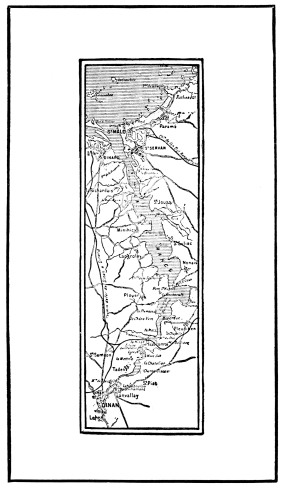
The Valley of the Rance
The old streets of the mediæval city still exist, too, much in the same
state as they were in mediæval times.
The porches or covered passages are a feature of many of the old-time
houses, and are most quaint and artistic.
The church of St. Malo dates from 1490, and that of St. Sauveur from
the twelfth to the fifteenth century. The chief historical figure of
Dinan’s past was Bertrand Duguesclin, the young Breton noble who so
distinguished himself in the fourteenth century on the side of France
against the English.
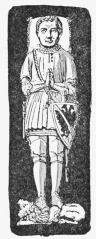
Duguesclin, from his statue in the Abbey of St. Denis.
He was born at Motte-Broons, near Dinan, toward 1320. “He had a
sunburned face, with a snub nose, and green eyes, an awkward gait, and
a rough and untractable nature,” one reads in the words of Simeon Luce;
and from the existing portraits of him, all this is true.
He was a warrior, from his earliest days, of the most thoroughgoing
type. He was the sort of small boy whom mothers find looking for
trouble. He would lead on the village lads to fight, and, when victory
had all but appeared, on one side or the other, he would throw himself
into the breach to start the fight again, just like a wolf, after which
he would lead both sides to a tavern to drink, and heal old sores.
On the ninth of July, 1812, the heart of the redoubtable Duguesclin was
brought to Dinan and placed in the north transept of the Church of St.
Sauveur amid an imposing assemblage.
The sarcophagus bears the following inscription, which shows that the
warrior who really was responsible for the banishment of the English
from France “ranked in company with kings,” as his French admirers put
it.
GY : GIST : LE CUEUR : DE
MESSIRE : BERTRAN : DU GUEAQUI
EN : SON VIVAT CONETITABLE DE
FRACE : QUI : TRESPASSA : LE XIIIe
JOUR : DE : JULLET : L’AN : MIL IIIe
IIIIxx : DONT : SON : CORPS : REPOS
AVECQUES : CEULX : DES : ROIS
A SAINCT : DENIS EN FRANCE.
The great clock-tower, a fine fifteenth-century building with a massive
spire, is found in the Rue de l’Horloge. It was given to the town by
Anne of Brittany in 1507.
The Château of Dinan was built by the Breton dukes (1382-87). Its
history was varied and vivid, as one reads in the pages of M. Gaultier
de Mottay.
Oliver Clisson, Gilles of Brittany, Viscount Rohan, Duchess Anne,
Laurent Hamon, and many others whose names are famous in the history of
Brittany have walked through these halls, of which only the hold to-day
remains as a tourist “sight.”
The Tower of Coëtquen, one of the ancient towers of the city wall,
forms practically a part of the old castle, but the keep, or the Queen
Anne’s Tower, a hundred or more feet in height and of four stories,—the
topmost reached by a spiral stairway of 148 steps,—is the most distinct
feature still standing.
In the interior are a number of obscure cells which were, and indeed are
still, terrible dungeons. The guard-room is on the second floor, with
also a little room, which served as an oratory for the Duchess Anne. The
third floor is occupied by the Constable’s Hall, and the fourth by a
Hall of Arms, a fine vaulted apartment.
To-day the castle is a prison, and the rank and file of visitors may
not enter this fine mediæval monument, but, if one have a proper
appreciation of the architectural delights of a mediæval fortress, and
be diplomatic in his request, very likely his wish to enter will be
gratified.
One of the principal industries of Dinan is the fabrication of
sail-cloth. It is an admirably placed industry, with its market close
at hand, and most of the Breton and Norman fishing-boats of these parts
sport a full suit of Dinan manufacture.
In the environs of Dinan are innumerable charming excursions mostly
neglected. One such must surely be included in one’s itinerary,—a visit
to the old Priory of Lehon, a dependency of the Abbey of Marmoutier.
It was founded in 850 by Nominoë, in honour of St. Magloire, whose
relics were brought from the Isle of Jersey to Dinan. The ruins,
as seen to-day, are most ample and beautiful, showing the best of
thirteenth-century Gothic.
Besides this, Lehon has the picturesque ruins of a twelfth and
thirteenth century castle perched high upon the summit of an eminence
overlooking the headwaters of the Rance. The castle came to the hands
of the Dukes of Brittany; Charles of Blois stayed there in 1356 after
his return from England, and Raoul Coëtquen was made captain in 1402,
since which time its history has been lost or hidden in the pages of the
untranslated chroniclers.
In 1624 the priory monks robbed the castle for material with which to
construct their beautiful cloister, but enough remains to-day, hidden
away among a mass of ivy and lichen-grown ruins, to indicate its former
prominence.
Altogether Lehon and its two romantic memories of other days is a
“sight” not to be missed.
An old custom formerly prevailed here at Pentecost, when the newly
married were supposed to present themselves before the prior of the
monastery for a sort of last blessing, as it would seem.
They sang the following refrain, and went back to their home, or to the
festival in the neighbouring village, with never a care beyond to-day:
“Si je suis mariée vous le savez bien;
Si je suis mal à l’aise vous n’en savez rien.
Ma chanson est dite, je ne vous dois plus rien.”
This seems a philosophical way of looking at things, and shows an easy
conscience and open mind on the part of all concerned.
Seated upon the western shore of the great Bay of Mont St. Michel is
Cancale, whence come the oysters. The six thousand inhabitants of this
quaintly rock-environed place have a physiognomy so distinctly their own
as to mark them for a type. Feyen-Perrin and his brother have painted
the Cancale people in a manner never to be forgotten by those who are
familiar with their work.
Anciently Cancale was known as Cancaven, and is a survival among
neighbouring settlements which have succumbed to the encroachments of
the ocean.
In 1032, it became a dependency of the Abbey of Mont St. Michel. In
1758, it was pillaged by the English under the Duke of Marlborough, and
the English fleet again bombarded it in 1779.
La Houle is the real port of Cancale, and the centre for the oyster
industry. At low tide the boats of the fishers are drawn up on the
yellow sands, there to remain until the return of the tide. At low
tide all the village comes from the town above and repairs to the
oyster-beds. The general outgoing, which seems to the stranger the
emigration of the whole population, has been described by a Frenchman
as: “Un défile, interminable, bruyant, cadencé, le bruit des pas coupé
de paroles et de rires.”
This great outpouring continues until quite all the available help of
the female persuasion has departed, leaving practically only the old and
infirm to guard the houses and shops until the return of the tide.
Cancale is one of the most celebrated oyster-rearing districts of
the world, but, if the tourist arrive there during the summer months
which lack the “R,” he will eat not of them; the natives look upon it
as downright crime even to think of serving them to you; the mussel
will have to be your substitute. It is always in season, though it
looks about as perishable in hot weather as the oyster, and probably
is so. Tradition and superstition account for the upholding of many
institutions in this world, and the oyster season appears to be one of
them.
The celebrated Rocks of Cancale lie just below the town,—a black mass
of rocks, about which the waves of the ocean fawn and growl like a
parcel of wolves.
The Point of Grouin is simply an exaggeration of the same rocky
formation as that of Cancale, and the same which unrolls itself all
around the coast up to Cape Fréhel. To the west is the Bay of St. Malo,
and to the east the Bay of Mont St. Michel.
Michelet wrote of this famous mount off the Breton coast as follows:
“The gigantic rock is an abbey, a cloister, a fortress, and a prison,
with exquisite sublimity and true dignity. It rises like a titanic
tower, rock upon rock, keep upon keep, and century upon century. Below
the monks; higher the iron cage of Louis XI. (who, it seems, left these
details rather numerously about his domain); higher yet the cell of
Louis XIV.; higher yet the prison of to-day. All is in a whirlwind;
Mont St. Michel is a very sepulchre of peace.”
Michelet’s was not wholly a cheerful view. He was rather a gloomy man,
it would seem, but it is perhaps proper enough to record his views
here, as most of us will praise this wonderful work to the limit of our
imagination.
Really Mont St. Michel is not of Brittany. To-day the changing of the
boundary westward to the little river Couesnon brings it just over the
line into Normandy, though both ramblers in Normandy and ramblers in
Brittany may properly enough include it in their itineraries, and should
do so.
To such spirits as like that sort of thing, there is a way open to the
landing, high up in the tower of the abbey, whence there is a wonderful
view. Michelet wrote of it, on the occasion of a visit, that it was
a place for fools; that he knew no spot more suitable to bring on an
attack of vertigo.
Michelet’s description of the quicksands which surround the mount is
distinctly good. The native will tell you that you must not venture upon
them, but he himself does so, and nothing happens. In spite of this,
let the visitor so much as leave the causeway a dozen yards—to focus
his camera—and a half-dozen burly fellows will hurl themselves upon
him and drag him back, declaring they have saved his life, which means
that one ultimately pays them something; a franc each is about the price
that they apparently consider a life worth. Sometimes some poor soul is
engulfed, but it is a first-class scare in most instances. Michelet says
of these quicksands (“cendre blanche”), “It is not land; it is not
sea; I myself only just escaped being engulfed.”
As a sort of side-show to the wonderful Abbey of Mont St. Michel is the
stern and barren Isle of Tombelaine.
It lies, also amid its own desert of sand or water, according to the
state of the tide, about a mile, or perhaps a little more, to the
north-east of the mount.
It is a simple islet of granite, uncultivated, and as wild as it always
has been. It rises perhaps 125 feet above the sea-level, like a giant
stepping-stone, between the mount and the neighbouring coast before
Avranches in Normandy.
Its history is intimately bound with that of the mount itself, but
to-day it has few, if any, visitors. It played a certain minor part in
the war of the Hundred Years, when it served as a sturdy buttress for
the English fleet.
From the tenth to the seventeenth century it was occupied by a religious
colony from the abbey of the mount, and held a diminutive priory
bearing the vocable of Our Lady la Gisant; “a gentle Madonna,” says an
imaginative Frenchman, “standing beside the archangel with the sword.”
In the midst of the Marsh of Dol—the great Bay of Mont St. Michel—is
a granite eminence some two hundred feet above the surrounding plain,
at the summit of which is built the little village of Mont Dol. It is
supposed to be the site of an ancient shrine consecrated to the druids.
Two kilometres from Mont Dol is the great menhir of Champ Dolent, a
relic of the stone age which was pagan, but is to-day surmounted by a
Christian cross, which seems paradoxical. It has no pretence to beauty
or architectural grandeur, and is to be regarded only as a mysterious
curiosity.
When one first comes to Dol in Brittany he is in a quandary. Which is
it, city or village? The writer does not know even yet. It has all the
quaintness and rustic picturesqueness of a mere hamlet, and again,
in its station, its hotels, and its tree-lined boulevard, it takes
on the aspect of a city. At any rate, if it belongs to the latter
classification, it is somnolent, and accordingly delightful.
“Here, my good fellow, can you direct me to the Hôtel de la Poste,” one
says to the first native he meets after leaving the station. “Certainly,
my good man,” he replies in an equally patronizing tone, “I will take
you there.” He declines all remuneration, of course, and will not be
patronized in any way. Decidedly he is a most independent individual,
but polite withal.
Stendhal, in his “Traveller’s Memories,” said of the great frowning
cathedral of the episcopal city of Dol: “It is the most beautiful
example of a Gothic edifice which I have seen.” It is not difficult to
follow his reasoning, for the grim walls of its façade, in the simplest
and severest style, are indeed magnificent examples of the undecorated
Gothic of a very early period. Most folk, however, will not call it
beautiful when Chartres, Rheims, Beauvais, or even Sées are in mind.
Dol, at any rate, forming the gateway to Brittany, from Normandy through
the Cotentin, was a most important centre of Christianity in the sixth
century.
The foundation of Dol dates from 548, when a colony of Britons coming
from Ireland settled here under the leadership of St. Samson, from
whom the present cathedral is named. This is but another of those links
which bind the history of Brittany with that of the Celts from overseas.
Legend continues the story thus: “Thou goest by the sea” (St. Samson was
told), “and where thou wilt disembark, thou shalt find a well. Over this
thou wilt build a church, and around it will group the houses forming
the city, of which thou wilt be bishop.”
All this came to pass, and for long ages the town has been known as the
episcopal city of Dol. William the Conqueror besieged Dol in 1075, but
retired after forty days, having failed to sustain his attack. Henry II.
of England invaded the city, and Jean Lackland fortified himself here in
1203, but it was retaken by Guy de Thouars in the year following.
Up to Revolutionary times the career of Dol was unceasingly riotous
and bloody, but little evidences of a part so played remain visible
to-day. All that reminds one of its antiquity is the charmingly severe
and simply outlined Cathedral of St. Samson, and the numerous timbered
houses with their street-front galleries, always a most interesting
feature of a mediæval town.
Sixteen kilometres south of Dol is Combourg, not an important town in
many ways, and yet very important, if one demands a sixteenth-century or
earlier label on all he admires.
As a French visitor to Combourg has said, “La gare de Combourg is
not Combourg; you have yet fifteen hundred metres to go.” This is
not a great distance, but, as the town is so completely hidden from
the railway, the sensation is that of alighting far from a centre of
civilization.
The Château of Combourg is one of those indescribable picturesque
fourteenth and fifteenth century structures which owe much to situation
and environment. It has a picturesquely disposed market clustered about
it, so that the cries of porkers and their venders mingle with the
stately pealing of the bell of the great clock, which rings out not only
the hour, but the “quarters” in a most sonorous note.
The costumes of both the men and women of the region around Combourg
are exceedingly picturesque and novel; the men with blouse and jacket,
and the women in black and the coifs of Becherel, Hédé, Tentêniac, and
Miniac; all somewhat resembling one another, and that of Miniac looking
more like a great white-winged bishop’s mitre than anything else.
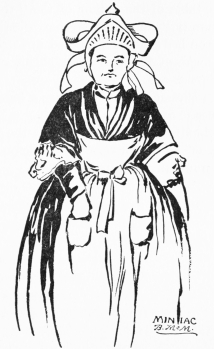
Coif of Miniac
More anciently Combourg Château was a feudal fortress, in an old
building of which, now swallowed up in the surrounding structures, the
infancy of René Chateaubriand was spent. There is also an old tower
dating from 1016, built by Gingoneus, a bishop of Dol. The present
château belongs to the Countess of Chateaubriand, and is visible to the
curious public on Wednesday afternoons.
The hall, the library, which contains the writing-table of the author of
the “Genius of Christianity,” and his bedroom, where is the little iron
bed on which he died in Paris,—all go to make of this a literary shrine
of prime importance.
The Château of Combourg has a legend, too, but since it concerns
only the skeleton of a cat, which in life was supposed to be the
reincarnation of a former Count of Combourg, it seems unworthy of
repetition here.
IN general aspect a Breton country-side differs widely from those of
Normandy. Here one comes upon hedgerows and an occasional bit of stone
wall, quite as one sees them in England.
The towns and communities of Brittany are less numerous and less
populous, too, than those of Normandy, and paving is uncommon in the
towns, and were it not for the steep ascents and descents, by which one
leaves such places as Mayenne, Fougères, Josselin, Auray, or Quimperlé,
this would prove quite a blessing to the automobilist. As it is, while
they give variety to one’s journey by road, they do not by any means
permit of “plain sailing” at all times.
The great national road from Paris to Brest crosses mid-Brittany, after
leaving Normandy, at Pré-en-Pail just beyond Alençon. It passes through
the great towns of Mayenne, Fougères, and Rennes, where it joins the
highway from Paris by way of Chartres, Le Mans, Laval, and Vitré.
From Rennes this road, No. 24, runs straight, almost as the crow
flies, to the tip of Finistère, by Montfort-sur-Meu, Loudéac, Carhaix,
Huelgoat, and Landerneau to Brest.
This takes one through the very heart of Brittany, though by no means
is it the most interesting or the most prosperous. Mayenne, Fougères,
Vitré, and Laval form a quartette of Breton towns which, taken as a
whole, have characteristics quite similar, and yet different from those
in other parts. Virtually, they are all hill-towns, and therein lies
their resemblance, though their careers have been varied indeed.
The run down into the valley of the river Mayenne, as one comes into the
town of the same name, is a wonderfully delightful and gentle descent
of perhaps a dozen kilometres. There is nothing very terrific about
it, nor is it of the frankly mountainous order, still the eminence to
the eastward is sufficiently elevated to give a singularly spacious
appearance to the landscape above the river valley itself; indeed, next
to that magnificent run down into Rouen—from the height of Bon
Secours—it is one of the most splendidly scenic roads in all North
France.
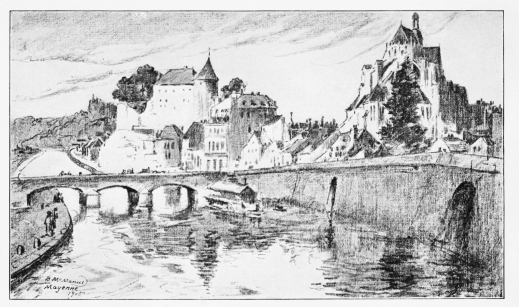
Mayenne
At the bottom flows the Mayenne, joining the Loire at Angers, and on
its banks is nestled snugly the town of Mayenne itself, with a truly
delightful riverside hotel and church.
Just below it is the ancient castle built on a rocky escarpment
overhanging the river. There are five great towers on the riverside, and
three others on the north, of which one alone has preserved its conical
roof. To-day it serves as a prison, but there are yet to be seen in its
interior some fragments of the ornamentation of the thirteenth century.
The terrace of the château forms a delightful promenade overlooking the
river.
William the Conqueror besieged Geoffrey III. here in 1064, but the most
celebrated siege which the château underwent was that by the Count of
Salisbury in 1424.
The Hôtel de Ville is an admirable relic of other days, though by no
means pretentious. It is a small, rectangular structure, its front
ornamented with two enormous solar devices, and the whole surmounted
by a graceful bell-tower. Behind the Hôtel de Ville stands a bronze
statue of Cardinal Cheverus, first Bishop of Boston. The Church of
Notre Dame is really a grand structure, with its fine showing of splayed
buttresses. Its foundation dates from 1110, and it admirably exhibits
the best traditions of its time.
Five kilometres away are the remains of the old Cistercian Abbey of
Fontaine-Daniel, founded in 1204 by Juhel III. There are some remarkable
fragments of its old foundation still remaining, but a large part of the
present edifice is of the seventeenth century. From Mayenne to Fougères,
still on the highroad to the west, one passes Ernée, whose name is not
known to many travellers and which is not marked on every map, though it
is a bustling town of five thousand inhabitants.
The origin of this place is due to the foundation of a château—on the
site of the present quaint church—by the Lords of Mayenne, who were, in
the sixteenth century, of the house of Lorraine.
Henri of Lorraine was killed by a musket-shot at the siege of Montaubon,
and was brought here to die in 1654.
Some years later the Seigneury of Mayenne and Ernée passed to the hands
of Cardinal Mazarin, who transmitted it to his niece, and gave the old
château for transformation into the present church.
Javron, also on the way to Fougères, is a small town of two thousand
inhabitants, and the former site of a monastery, founded by Clotaire for
an anchorite named Constantin. The present church is built over the tomb
of this saint.
The situation of Fougères is truly remarkable. It is, moreover, a
remarkable place in itself, and is to be reckoned as one of these
delightful spots to visit, which, if not exactly popular tourist
resorts, are at least as satisfying to the curiously inclined.
Fougères in all ways is this, and more. It is almost the best example
of a walled and fortified town of the middle ages existing in all North
France. Its situation, on a great hill, with its tower-flanked walls and
gates, is one of surpassing impressiveness, although to-day the general
aspect of the little city of twenty thousand inhabitants is modern
enough.
Fougères was one of the original nine baronies of Brittany, and owes
its origin to a château which Méen, the son of Juhel Béranger, Count of
Rennes, constructed at the beginning of the ninth century.
To-day the city walls, the remains of the château, and the gates and
watch-towers are admirably preserved. The castle itself is nothing more
than a vast ruin, whose entrance, formed by three towers, plainly shows
it to date from the twelfth century.
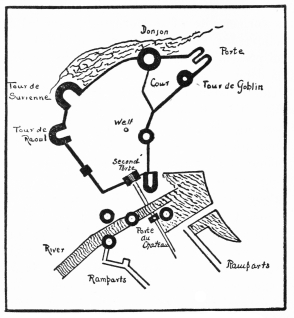
Plan of the Ancient Walls and Towers of Fougères
There is a great tower yet remaining—one of a twin pair—known as the
Tower of Coigny, from a former governor, and within this tower is an
ancient chapel.
There are three other celebrated towers, well-nigh as perfect as they
were in the middle ages as far as their general outlines are concerned.
The keep was razed in 1630, but the inner wall which surrounded it, with
its three angular towers, is still to be seen. The Tower of Melusine
encloses a museum in which are many relics and curiosities of a period
contemporary with the castle itself. The ramparts of the town are
more or less ruinous, but are still to be seen throughout its whole
circumference. No part of this feature, however, dates from before the
fifteenth century.
There are two admirable churches,—relics of the middle ages,—St.
Sulpice and St. Leonard, also the ancient convent of the Urbanists,
dating from 1689, now barracks.
There are many fine old houses in wood and stone scattered about the
city, and an octagonal tower, in which is a great clock whose bell was
cast in 1304 by Rolland Chaussière.
North of the town is the Forest of Fougères, composed principally of
great beeches. Within the forest are the ruins of an ancient convent of
the Franciscans, and near the little hamlet of Landeau are the famous
“Caverns of Landeau,” constructed, it is said, in 1173 by Raoul II. of
Fougères, to hide his riches and those of his vassals from the rapacity
of the troops of Henry II. of England.
Dropping down again to the main route from Paris, which joins with that
by the way of Mayenne and Fougères at Rennes, one enters Laval, the
first Breton town of any magnitude on this route, as one comes westward.
It is a veritable local metropolis, and, like Mayenne, farther up the
river, it spreads itself amply on both sides of the stream which flows
southward to join the Loire at Angers, just below the country.
The first Château of Laval was built by the Count Guidon or Guy to
protect the Bretons from the invasion of Charlemagne or his successors.
The second Guy received a charter from the Bishop of Mans, dated in the
fifth year of the reign of King Robert (1002), and this designates him
as the real founder of the Château of Laval. The town became the seat of
a barony, afterward a county, of which the possessors were ever famous
for their personal valour and their high lineage. Among them were the
Montmorencys, the Montforts, and the Colignys.
When, in the fifteenth century, the English had become virtual masters
of Maine, Laval alone resisted their efforts, thanks to the energy of a
certain Anne of Laval.
The historical records of the town and the château are ample and
eventful, even down to as late a day as 1871, when, after the battle of
Mans, General Chanzy retreated upon Laval.
It was in the environs of Laval that the four ancient smugglers, the
brothers Jean, François, Pierre, and René Cottereau, known as the
Chouans (because of their owl signal, as the French give it), first
rallied and organized the bands of partisans which gradually adopted the
name.
The keep of the château is a great cylindrical tower of the twelfth
century, remarkable for its height, its size, and the wonderful
carpentry of its roof. The great interior court is bordered on two sides
with a magnificent Renaissance structure attributed to Guy XVI., Count
of Laval and Governor of Brittany in 1525. The chapel has now been given
up to the prisoners sheltered within the castle. It is the masterpiece
of the whole work, and dates from the eleventh century.
The Church of the Trinity, made a cathedral in 1855, was in 1790 the
seat of the Assemblée, but in its most ancient parts dates from the
episcopate of Hildebert of Lavardin (1110).
There are some remains of the town’s ancient fortifications yet to
be seen, such as the Renaise Tower and the Spur Tower, which are in
every way as suggestive of former importance as the remains of the
castle itself. The Beucheresse Gate is another fragment of these same
fortifications.
In Laval are ten thousand workmen engaged in the production of tent
and awning cloth. Laval is a great wheat market for the prolific
wheat-growing region round about, so its commercial importance of to-day
is quite as firmly established as is its historic past.
Laval was the birthplace of Ambroise Paré, the founder of French
surgery. It was he who drew the spear-head from the cheek of Balafré,
and he who declared the malady of Francis I. to be incurable.
His statue bears the following inscription, “I dressed the wound, and
God healed it.”
One cannot say too much in praise of Vitré, though it does smack of
the popular tourist resort, with hotels whose runners tout for your
patronage, and picture post-card sellers, who seem to think that you
prefer their wares to viewing the sights themselves; but the hotels are
amply endowed with those creature comforts that most of us value highly,
and, if you wish, you will be put to sleep in a hygienic bedroom,
which is something like a prison-cell, but which must truly be hygienic,
judging from its get-up.
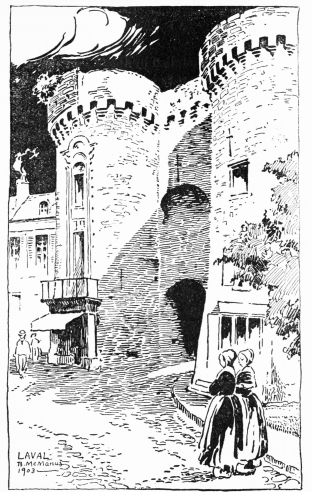
Beucheresse Gate, Laval
These rooms, installed by the “Touring Club of France,” are now to
be found sprinkled here and there throughout the land, and, if white
lacquered walls and ceilings and iron beds, and simple draperies and no
carpets,—but highly waxed floors instead,—can ensure a superlative
cleanliness and airiness, why, so much the more welcome they are;
and surely the weary tourist ought not to mind whether he sleeps
in a cubicle or not. Again, the fare of this particular hotel (the
Travellers’) is so excellent that he ought to be willing to sleep on the
proverbial plank.
Vitré, in spite of all novelty, is a true city of the past, and one
literally walks the by-paths of history when he traverses its streets.
All at once one comes to the ancient and theatrical-looking Château of
the Tremoilles, Vitré’s most noble family of other days.
The town has undergone many sieges. Charles VIII. captured it, and in
1488 sojourned in it for some days. During the wars of the League, the
Rieux and the Colignys led the revolt, and it served for some years as a
strong place of resort for the Huguenots. Within the two hundred years
following, the Breton Parliament, alternately presided over by the Dukes
of Vitré and of Rohan, met here many times, always amid a great and
joyous festival given by the town.
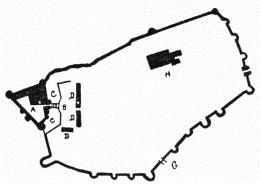
Plan of Vitré in 1811 Showing City Walls
- A—Château
- B—Place du Château
- C—Fosses
- D—Dependencies of Château (non-existent to-day)
- F—Porte d’Enhayt
- G—Porte de Gastesel
- H—Eglise Notre Dame
All the activity in the past has worked for the preservation of many
ancient memorials.
The aspect of the town is not so ruinously picturesque as Fougères, nor
again so trim and neat as Mayenne or Laval, but more than either of
these it preserves to-day its ancient outlook at every turn.
“II n’est plus que Vitré en Bretagne, Avignon dans le Midi, qui
conservent au milieu de notre époque leur intacte configuration du
moyen-âge” (Victor Hugo).
The château itself has been recently restored, and ranks as one of the
most perfectly preserved specimens of military architecture in all
Brittany. One may visit the interior of this old fortress-château in the
care of a painstaking porter.
The principal mass, known as the châtelet, is the best preserved,
and, flanking it on both sides, are series of crenelated towers and
machicolated walls. In the courtyard is the eleventh-century château,
now incorporated in the later work.
On the same side is a charming Renaissance tower, built by Guy XVI., and
known as the “Tribune of Tremoille.” The five sides of this admirable
architectural detail are charmingly decorated in sculptured stone, and
on one is the inscription taken from the Book of Job: “Post Tenebras
Spero Lucem,” the Tremoille motto.
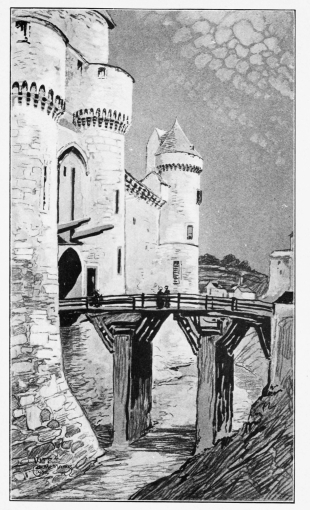
Château de Vitré
Within is a museum with divers collections of many things of an era
contemporary with the structure itself.
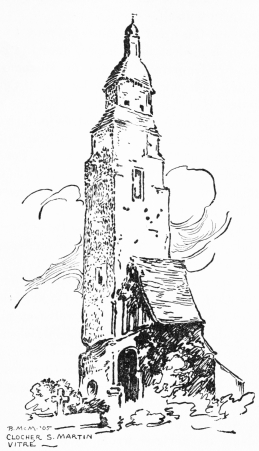
Tower of St. Martin, Vitré
Opposite the great entrance gateway to the castle is a modest little
house, once the residence (or temporary abode) of Madame de Sévigné, and
now occupied by the “Cercle Militaire.”
In the environs—five kilometres to the south—is the Château of
Rochers, better known as the domicile of Madame de Sévigné, and one of
the stock “sights.” It was from the Château of Rochers that she dated so
large a number of her letters in 1670-71.
In a letter bearing date of the twenty-second of July, 1671, she writes
thus to Madame de Grignan:
“Madame de Chaulnes arrived on Sunday, but in what manner think you? On
her beautiful feet, between eleven and twelve at night. One might think
that Vitré was in Bohemia.
“She made no ceremony of her coming.... She had come from Nantes by La
Guerche, and her carriage stuck fast between two rocks half a league
from Vitré.”
It was from the Château of Rochers that Madame de Sévigné wrote to her
daughter: “On Sunday last, just as I had sealed my former letter, I saw
enter our courtyard four chariots with six horses, with fifty mounted
guards, many led horses, and many mounted pages.”
These were gallant days at Madame de Sévigné’s Breton home, and to read
all of her letters from Rochers—mainly to her daughter—is to get a
wonderful epitome of the seventeenth-century social life in this part of
France.
On the above occasion the company included M. de Chaulnes, M. de Rohan,
M. de Lavardin, M. de Coëtlegon, and M. de Locmaria, the Baron de Guais,
the Bishops of Rennes and St. Malo, “and eight or ten I knew not,” she
continued.
Throughout the château and its dependencies, the illusion of Madame de
Sévigné’s time has been well kept up unto to-day. One learns that the
château became the property of the Sévignés upon the marriage of Anne of
Mathefelon, “Lady of Rochers,” with William of Sévigné, chamberlain to
the Duke of Brittany.
The kindly and well-meaning concierge, or cicerone, or whatever one
chooses to call him or her who conducts him over the château and its
grounds, is somewhat of a bore, though one has not the courage to cut
off the prattle for fear he may lose something which may not have been
offered to others.
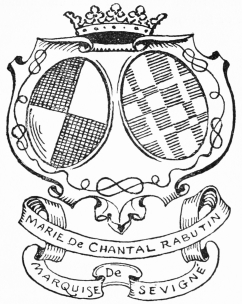
Arms of Madame de Sévigné
It is somewhat disconcerting and even annoying to be told,
however,—when about to stroll down a tree-alleyed path,—that “the
marchioness never went there.” Of course it’s pure conjecture on the
part of this twentieth-century guide, since the noble marchioness
has been dead some two hundred years or more, but, as aforesaid, the
interruption fascinates one with its coolness.
At the right of the château are the gardens traced by the famous
Lenôtre. In the “Letters” one reads frequent references to these great
gardens with their vast and ancient forests of tall timber.
RENNES was once a great provincial capital, as great politically,
perhaps, as Rouen, but it has not a tithe of the fascination or wealth
of attraction of the Norman metropolis, and never had. Its Cathedral of
St. Pierre is a cold, unfeeling thing, and its eighteenth-century town
hall, its great military barracks, and its palace of a university are in
no way great or lovable architectural monuments. As an offset against
the mediocrity, is the somewhat bare exterior of the court-house, built
in 1618 for the Breton Parliament, and furnished now, as then, in most
luxurious fashion.
The Salle des Pas-Perdus is a vast apartment, most delightfully planned
and decorated, and of the Grand Parliamentary Chamber the same may be
said. Above the floor of this chamber are still to be seen the tribunes
where the dames of other days, of the days of Madame de Sévigné,
assisted at the sessions.
The town hall contains a library of eighty thousand volumes, of which
one hundred or more are first editions, and six hundred manuscripts.
The museums of the university palace are exceedingly rich in treasure,
and are in every way worthy of a great provincial capital.
For the rest, Rennes is a most ordinary, uninteresting town, though it
does possess two mediæval monuments of remark: the Porte Mordelaise,
a historic souvenir of the military architecture of the middle
ages, and Church of Our Lady, the ancient chapel and cloister of an
eleventh-century monastery founded by the Bishop St. Mélaine.
There are many fine old Renaissance houses scattered here and there
about the town, but the general aspect is modern, and mediocre at that.
Rennes would have been called by century-ago travellers “a well-built
town,” and such it certainly is, as becomes the ancient capital of the
duchy of Brittany.
In later days it is mostly known to the general reader as the scene
of the famous Dreyfus trial, and its only liveliness comes from the
officers of the tenth army corps, who, of a summer’s night, frequent the
coffee-rooms opposite the court-house or the theatre, or promenade in
the Thabor and the flower-garden, the old gardens of the Benedictine
convent.
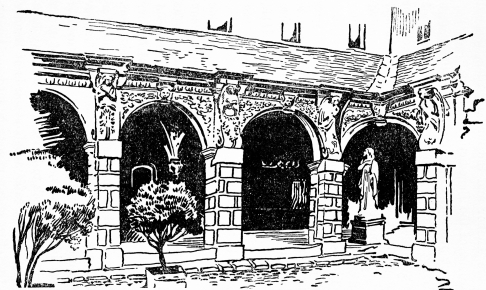
Monastery of St. Melaine, Rennes
Just previous to the Revolution, there were stirring times in Rennes,
when a marshal of France commanded the troops camped within the city.
The discontent of the people had arisen from two distinct causes, the
price of bread and the abolition of its ancient parliament. The former
seems a good enough excuse, but the latter is inexplicable, except,
perhaps, as the snuffing out of an ancient source of local pride. It was
to Rennes that Père Caussin, the father confessor of Louis XIII., was
sent by Richelieu, when he proved himself incapable of becoming the tool
of the cardinal. The prison of state at Rennes was a terrible place in
those days, but the true churchman preferred it to exile as a missionary
in the wilds.
All this and much more of political history made Rennes a famous centre
in times past, but to-day it is so much like a bad imitation of Paris,
that in desperation the stranger within the gates finally takes his
departure for more idyllic parts, with the vow that never again will he
seek to learn of present-day Brittany from the cafés and boulevards of
Rennes.
One other comment may be made on the unloveliness of Rennes as a place
of temporary sojourn; and that is on its cab-drivers. The driver of a
fiacre in the average Breton large town is like his fellows of Paris.
He drives with a loose rein, and rushes helter-skelter down narrow
streets with never a care for other traffic, or for foot-passengers,
save a shouted, “He, la-bas!” which is so sudden and unforeseen that
it is quite useless as a warning. There have been those who have said
that the hoot of an automobile’s horn would drive even the “sense of
traffic”—a new sense recently discovered by the Parisian medical
journals—from out of the brain of even the most careful of persons!
This is as naught compared to the Breton cab-driver’s stentorian “He,
la-bas!”
As one comes to the open country again, he leaves all these distractions
behind, and revels in nature, and if he be travelling by road, in the
stubbornness of cows and sheep and the aggressiveness of geese and
ducks, all road-users like himself.
Westward of Rennes, twenty kilometres by road, is Montfort-sur-Meu,
a charming small town, situated upon the banks of two tiny rivers.
Its origin dates back to an ancient eleventh-century fortress, which
remains to-day in the form of a great cylindrical machicolated tower.
The Seigneury of Montfort, since the fifteenth century, has passed
successively, by marriage or by heritage, through the houses of Laval,
Rieux, Coligny, and La Trémouille.
Next is Montauban, with a fine, moss-grown ruin of a château, dating
from the fifteenth century; the town itself numbers three thousand
inhabitants, but it does not look it.
St. Méen, a dozen kilometres farther on, was born of a monastery founded
in the tenth century by a holy man of its name. It was destroyed and
rebuilt many times in the years to follow, but its old abbatial church
still exists, one tower coifed by a dome, and another smaller and flat.
But no one comes here to see this fine old monkish relic but the farming
folk from round about, though St. Méen is a town of three thousand souls
and an idyllic artists’ sketching-ground. No colony of painters has yet
settled here, leaving it a wholly new field to exploit by any painter
looking for new worlds to conquer.
Loudéac and Pontivy, the one in the Côtes du Nord, and the other in
the Morbihan, are two characteristically Breton towns bearing no
relation whatever to the outside world. It seems doubtful indeed if the
inhabitants of these two centres are aware that there is any outside
world, so taken up are they with their own little affairs.
Loudéac has some six thousand inhabitants, but it has no apparent
industries to hold all these people together, and it seems as if they
had simply grouped themselves at the crossing of five great routes and
built a town. Its foundation does not go very far back into antiquity;
its parish church is only 150 years old, but the Chapel of Notre Dame
Vertus dates from the thirteenth century.
In October, November, and December are held great cider-apple markets,
which, from their magnitude, would seem to be the chief source of income
of the population.
The ancient slogan of Pontivy, born of Revolutionary times, was “Freedom
or Death,” which is not far different from the battle-cry of socialists
the world over to-day. The condition of the inhabitants of Pontivy,
however, does not differ from most folk elsewhere, and the frowning
walls of its old castle ironically point to the fact that the time has
not yet come when a successful social revolution can be steered through
the breakers ahead—not even in France, where indeed there are even
more advanced ideas on the subject than in Germany itself.
The memory of this event, though the “Treaty of Pontivy” was sent
broadcast through all the communes of France, has quite died out, and
the serenity of a little Breton market-town long ago settled upon
Pontivy, with nothing but a dim memory existing to neutralize the
admiration one is bound to have for the town’s wonderfully picturesque
castle. It is a grand ruin with crumbled roof and walls, but its
outlines are as clear as ever they were, and if it has not the magnitude
or magnificence of many others of its class, it looks far more imposing,
and forms an exquisite stage setting for any mediæval romance one is
able to conjure up. The history of Pontivy and its castle is this:
The town owes its origin to a monastery built here in the seventh
century by St. Ivy, an English monk. The castle, however, was a
foundation of seven hundred years later, by John of Rohan, in 1485. At
the creation of the duchy of Rohan, in 1663, Pontivy became the first
seat of this jurisdiction.
At the Revolution the famous Pontivy treaty mentioned came into
being, with the result that in 1802 a consuls’ decree prescribed the
construction of a vast barrack at Pontivy, and the canalization of the
river Blavet, upon which it sits, down to the sea.
Napoleon, however, by a decree given at Milan, sought to create a new
town south of the present city, whose name should be Napoleonville.
All this because Pontivy had declared for the rights of man. When the
Revolutionists sought power Pontivy had every chance, but with Napoleon
his desire was to efface it.
Pontivy is distinctly Breton in every aspect; its manners, customs, and
above all its costumes. Decidedly one’s itinerary in Brittany should be
made to include it.
Rostrenen is a delightful old town banked high upon a hillside some
six hundred feet above the valley. The old-time collegiate church is a
thirteenth-century foundation, which, though restored in our day, has
all the loveliness of the era of its foundation well preserved.
Like the church at Josselin it is called Our Lady of the
Blackberry-bush, from a miraculous Virgin found beneath a
blackberry-bush. The great day of pilgrimage to this shrine is the
fifteenth of August.
Carhaix is a little Breton town now all but shorn of its former
importance, though its breed of cattle is prized above all others in
Brittany,—as if that were enough to keep its memory alive. Anciently
Carhaix was the capital of the Vorganium, whose peoples took an active
part in the wars against Cæsar. Seven Roman ways centred here, and there
are yet to be seen the remains of an ancient Roman aqueduct.
Vorganium ultimately lost its rank, and was made a part of the realm
of Cornouaille founded by King Grollo, who gave Carhaix its present
name—then Ker-Ahès.
Carhaix is the birthplace of La Tour d’Auvergne, “the first Grenadier of
France.” His career was almost legendary, and after his famous infernal
column which went up against the Spaniards in the Pyrenees, he retired
to the city of his birth, and took up the study of the Celtic tongue. In
1796, when the Terror broke out, at the age of fifty-two, he took the
haversack and cartridge-box of a simple soldier, to replace the son of
an old friend who had been drawn by conscription. He would never advance
a single grade, but remained in the ranks from this time forward,
and was killed at the battle of Oberhausen in Bavaria. His heart is
enshrined in the Hôtel des Invalides at Paris, having been brought
there and buried with great pomp in 1904.
Carhaix has a real novelty in its horse-market, held before the Church
of St. Trémeur. There is nothing actually profane or sacrilegious
about this perhaps; but yet again, perhaps there is. Certainly it is
incongruous to see a long string of horses tethered to the very church
door-knob itself, with the breeders seated back against the church wall
smoking tobacco and eating and drinking.
Huelgoat is in the very heart of Finistère. It is as typical in the
manners and customs of these parts as is Pont l’Abbé in Cornouaille or
Auray in Morbihan. It has one of the finest sites given to a town in all
Brittany, and abounds in quaintness and beauty.
There are various ecclesiastical monuments and religious shrines in and
near the town, of which the guide-books tell, and all are well worth
visiting.
The market-place of Huelgoat does not differ greatly from other
market-places in Brittany. The costumes are brilliant in magpie
colours,—if white coifs flashing in the sunlight can be said to make
colour,—and the little life and the little affairs of the peasant
people scintillate and fluctuate from day to day as if they were the
most serious and momentous things in all the world.
Above, on the right, rises the quaint bell-tower of the
sixteenth-century church, not beautiful of itself, perhaps, but grouping
wonderfully with the moving foreground.
Huelgoat is a great place for ducks, evidently, for ducks big, little,
and of all colours of the rainbow are apparently the chief and staple
article of trade. What the value may be to-day, as compared with what it
was last market-day, no one can prognosticate. Two francs is certainly
not much for a nice fat duck, just waiting to be plucked and garnished
with green peas, but two francs for a brace is cheaper still, and two
francs for a whole flock or bevy, or whatever formation ducks group
themselves in, is a still better bargain, and on occasions you may
buy a whole duck and drake family—father and mother and two or three
youngsters—for a matter of une pièce, which is the Breton’s way of
counting a hundred sous or five francs.
From Huelgoat the highroad branches to Morlaix in the northwest, and
Landerneau, directly to the west, when one comes once more on the
national road, running westward from Alençon by way of Fougères and the
north to Brest.
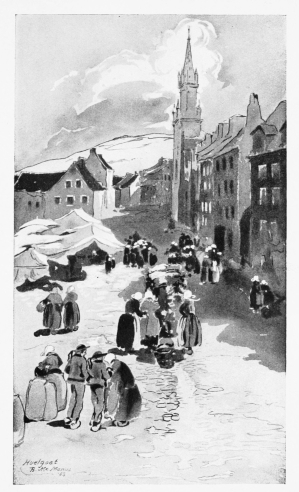
Huelgoat
BRITTANY has been called “the Land of Calvaries and Pardons.” This does
not mean much to one who has never come under the spell of these strange
sights and survivals, but it means a great deal to those who realize to
the full the real significance of the devoutness and religious motives
which inspire the Breton folk to worship God in a manner which, in the
present age of disregard for the Christian religion of our forefathers,
seems to be playing less and less a foremost part.
“Venez donc un tour au Pays de St. Yves.
. . . . . . . . . .
Au pays du Creizker finement dentelé.
Venez donc faire un tour au Pays de Calvaires,
Au Pays des Pardons mystiques et joyeux.”
So sang Theodore Botrèl in a charming series of verses written as an
invitation to his fellow Frenchmen to know more of the ancient province
of Brittany. Since Brittany is so very religious, the most devout of
all the provinces of the France of to-day, the following account of
the disposition of certain observances under the care of the state is
apropos.
France is said to be Catholic, because the majority of the people
profess Catholicism, which apparently answers their wants better than
any other. As a matter of fact, however, there is the coëstablishment
of four religions, all of which are recognized by the state and their
ministers paid by the state. So, virtually, there are four state
religions, if they can be so called. In truth, there is no religious
head in France; neither the chief of state, the Archbishop of Paris
(there are three other heads of religions, so manifestly one could not
be chosen), nor the minister of public worship can be called upon to
fill the office, hence there is no national religion, though the Roman
Catholic faith predominates to-day as in the past.
Since we are concerned herein with Brittany alone, and since the Breton
is accounted the most devoutly Catholic of all Frenchmen, it is enough
to define the organization of the Roman Catholic religion alone, leaving
the question of the Calvinists, the Lutherans, and the Israelites quite
apart, as they exist not at all in Brittany as a factor of the local
conditions of life.
The parish is the unit in the Catholic Church organization in France,
as the commune is the unit in civil administration; the parishes are
divided into curés and succursales.
The first class, which number forty-five hundred throughout France, have
for their pastor a priest who is immovable, nominated by the bishop with
the approval of the government. The second class have a pastor who is
nominated by the bishop, but who can be removed or replaced. The parish
priest may have one or more assistants. Above the parish priest in rank
is the bishop.
In general the bishoprics correspond with the departments, though there
are eighty-four dioceses and but sixty-seven bishops, the archbishops of
the “ecclesiastical provinces”—which often include several departments
and dioceses—making up the number.
In Brittany the Departments of Ille-et-Vilaine, Côtes du Nord,
Finistère, Morbihan, and Loire-Inférieure have a bishopric, with an
archbishopric at Rennes.
The bishops are nominated by the chief of the state, but are invested
canonically by the Pope. They are assisted by vicars-general, who
undertake the administrative functions of the diocese. The canonical
chapter of the cathedral, the diocesan seminary, and all other
seminaries are under the authority of the vicar-general.
Above the bishops are the archbishops, who administer to the wants of
their diocese in the same way as the bishops, and, in addition, preside
at all provincial councils, ordain the bishops, and in general have a
certain jurisdiction over the bishoprics of their sees.
The ecclesiastical provinces, as the great administrative districts of
the Church are known, correspond to-day, in a great part, to the ancient
provinces of the Roman epoch in Gaul, as the bishoprics themselves
correspond with the ancient cities and towns.
Higher up even than the archbishops are the cardinals, nominated by the
Pope with the concurrence of the head of the French nation. To-day there
are five cardinals in France, all being titularies of one of the Roman
churches and members of the Sacred College which elects the Pope.
Those who know Brittany will recognize as the foremost trait and
characteristic of the people their devotion to religious forms and
ceremonies.
It has been said that by nature the Bretons are conservative. This is
indeed true enough, but they are something more, they are superstitious,
not only with regard to certain phases of their religion, but also
with respect to many of their local customs, which have naught to do
with religion. It is said that belief in witchcraft still endures, and
certain it is that folk-lore and fairy-lore are, in some parts, quite as
much of the life of the people as is the case in the bogs of Ireland.
The Celtic imagination, which is the same in both instances, doubtless
accounts for this. What the Bretons really are, or have been, though
they have not often been accused of it, is pagan,—at least some of them
are. It was only in the seventeenth century that the pagan cult—as a
body of magnitude—was suppressed. This again was a survival, of course,
from the barbarous rites and practices of the druids, which indeed were
the same elsewhere, so it need not be laid up against the Bretons alone.
Probably those vast colonies of megalithic monuments at Carnac, and
their orphaned brothers and sisters scattered elsewhere throughout
Brittany, did much to keep the flames aglow on pagan altars, and
even to-day it is easy to perceive with what awe and veneration the
simple-minded Breton peasant regards these weird survivals of other
days. At any rate, Breton religion to-day is a devotion to many forms
and ceremonies.
Brittany has been called the land of pardons (pays des pardons). Every
one knows of these great Breton festivals and of their significance. If
one travel between May and October, scarcely a week will pass without
his falling unawares upon one or another of these great sacred fêtes.
All Bretons do not give to these rites the sacred regard with which
they were originally intended to be endowed. Decidedly they have been
profaned only too often, and at times there is a little too much
license. The Breton pardon is by no means to be thought of in the same
manner as the kermess of Flanders, which is a merrymaking pure and
simple, with not even a side-light of religion thrown upon it.
The five great pardons of Brittany are held each year as follows:
“The Pardon of the Poor,” at St. Yves; “The Pardon of the Singers,” at
Rumengol; “The Pardon of the Fire,” at St. Jean du Doigt; “The Pardon
of the Mountain,” at Troménie de St. Ronan; “The Pardon of the Sea,” at
Ste. Anne de la Palude.
It is a moot question as to just how much of romance is in the make-up
of the Breton character. Emotional the people are, but the emotion
that leads them into the enthusiasm which they exhibit at their great
religious festivals and pardons is more superstitious than romantic.
The druidism, or paganism, or whatever the religion (sic) of the
ancient peoples of the Armorican peninsula may have been, bears not the
least traditional resemblance to the fervour of the devotees of the
pardons of to-day, but one can readily believe that the same spirit, if
with a different motive, does exist even now.
The blessing of the boats, the birds, the cows, and what not, which
takes place periodically at different points along the Breton
coast,—for it is mostly along the coast that these observances take
place,—smacks not a little of something that is of more psychological
purport than mere religious devotion.
From whatever tradition these great religious observances have
descended, there is no question of the sincerity of the participants,
though there is a wide difference between the “sacred” and “profane”
elements which meet on these occasions.
Brittany, perhaps as much as any other of the ancient provinces of
France, has preserved its local customs and traditions, unblushingly
indifferent to the changing conditions round about them. Of course there
is no reason why religion and its observances should change with the
march of time, but they do, nevertheless, in France as much as in any
other land. Only in Brittany, apparently, do the congregations of men
and women—for elsewhere the congregations are mostly women—of great
churches approach to anything like the numbers that the churches were
built to contain.
Throughout this land of calvaries, too, there will be found at all times
of the day, and often at night, a tiny congregation of one, two, or
perhaps a half a dozen, peasant or fisher folk kneeling before one of
these wayside crosses, and invoking their God after the manner they have
been taught, in a truly devout and sincere fashion, which is more than
can be said of some parts, where the peasant, when on a visit to town on
the market-day, rushes in and out of a church with hardly time enough
devoted to the whole process even to have used the holy water.
Brittany may be a poor and impoverished province, and in many respects
it has not the abundance of the good things of life which one finds
in Touraine, Burgundy, or the Midi, but there is a general air of
prosperity in the gay accoutrements of the men and women who shine forth
on the occasions of the great pardons, showing a snug wardrobe stowed
away somewhere.
As one leaves Normandy, at Pontorson, he enters Brittany—the land of
calvaries. These fine monuments are not the calvaries which have made
the old province famous,—the great stone crosses of Finistère,—but are
for the most part unpretentious pieces of wood put together in the form
of a cross, or a like symbol, rudely hammered out of a piece of iron by
the local blacksmith.
One notes many of these simple crosses throughout Brittany; simple as
compared with the more elaborate calvaries, though they may have one,
two, or even more sculptured figures in the arms or branches of the
cross. One of the most ancient of these, dating from the fourteenth or
fifteenth century, is at Scaër in Finistère.
It is a question as to whether any of the great monumental calvaries of
Brittany can be considered really artistic. They are imposing,—some of
them even terrifying in their strange grandeur,—but all of them seem
theatrical, however sincere and devout the motive for their erection
may have been. The chief and most elaborate examples are those at
Plougastel, near Brest, and St. Thégonnec in Finistère (dating from
1610).
Besides these really great and celebrated functions are many others
of minor purport, such as the “Benediction of the Boats” and the
“Benediction of the Fields.” The latter occurs when the caterpillars and
earthworms fall upon and ravage the land. The local curé, with the
permission of the bishop, then blesses the fields. In the midst of the
fields the curé takes up his position on some slight eminence, clad
in a white surplice, with a violet stole, and begs God to exterminate
the noxious insects, the prayers meanwhile being accompanied with the
sprinkling of holy water and burning of incense.
The Pardon of St. Jean du Doigt, on the twenty-second of June, is
perhaps the most solemn of all its species, and for that reason is
described here.
The Pardon of St. Yves, in the Tregarris, of Rumengol and Ste. Anne de
la Palude, in Finistère, are especially religious and severe, while that
of Notre Dame de la Clarté, in the Morbihan, has the double purpose of
homage to Our Lady and the facilitating of marriage.
Here the young peasants in search of a spouse promenade around the
church, and when they have made their choice they address the young lady
and ask her if she will accept the gift; the boy having meanwhile bought
a large round cake. “Will mademoiselle break the cake with me?” says he.
If she accept, they consider themselves as engaged, after which their
families meet together and discuss the conditions of the marriage.
At Creac’higuel, near Rosporden, the pardon endures for three days, and
here one sees the wonderful ’broidered waistcoats and collarettes and
beribboned hats of the young men of Pont Aven, Quimperlé, and Scaër,
unique in all Brittany.
In July, at Guingamp, is the procession to Our Lady of Good Help, with
the inevitable salute of firearms, and a torchlight procession of ten
or twelve thousand pilgrims—and some others who are merely profane
lookers-on.
The “Benediction of the Sea” at Concarneau, Douarnenez, Trébone,
and many other seacoast villages and hamlets, is another religious
manifestation which is always attractive to the curious.
At the pardon of St. Jean du Doigt the precious relic of the saint is
guarded before the high altar of the church by an abbé clad in his
surplice and holding in his hand the precious finger enveloped in fine
linen. One by one the faithful pass before the abbé and touch, for an
instant, the sainted relic.
Near the choir, another cleric holds aloft the skull of St. Mériadec,
before which the pilgrims bow their heads as they pass. Before leaving
the church, in response to the call, “Dour ar bis! Dour ar bis!” sung
in a strident Celtic voice, the pilgrims repair to a fountain attached
to the side wall, in which the finger has previously been bathed at the
end of a gold chain. Immediately this operation is over, the devout
plunge their palms deep into the sanctified water and vehemently rub
their eyes. Then the pardon is finished, and the profane festivity
begins.
“Whence come you?” was asked of a happy family of three at St. Jean du
Doigt. “From St. Jean-Brevelay,” they replied, mentioning a village
a hundred kilometres away, in Morbihan. “We have walked three suns
and three moons,”—which sounds like the American Indian’s method of
reckoning by moons, but which in this case meant merely that they had
been on the road three days and three nights.
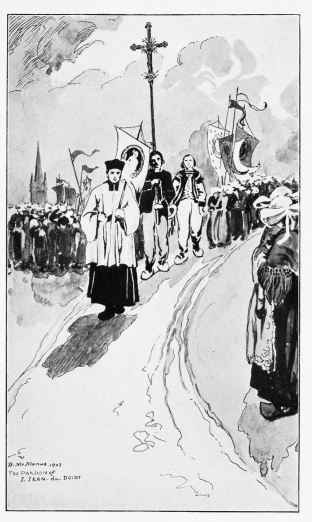
Pardon of St. Jean du Doigt
The little Church of St. Jean du Doigt offers complete and perfect
example of what a village church should be. The building itself is
surrounded by the churchyard, with its monumental portal, or triumphal
arch, as it is always called hereabouts, its sacred fountain, its
calvary, its ossuary, and its open-air oratory for the celebration of
the mass for the pilgrims.
The triumphal arch is a great fifteenth-century gateway surmounted by
two niches containing two ancient Gothic statues, one of St. John the
Baptist, and the other of St. Roch.
With the coming of twilight, when the mists roll in from the sea, the
silhouetted couples (lovers), following the ancient custom, promenade
arm in arm, or rather hand in hand, each holding the other by the little
finger, in deference to the finger of St. John.
When the darkness has actually fallen, the bonfires flame out on the
far-away sands, the light reflected in the waves in truly eerie fashion,
and so the great day of pardon and festival departs into the past.
Chant and song play a great part in all these religious festivals, not
only the officiating priests, but the public singing. These religious
chants seem to give rise to others less devout, of which the two
following are typical.
If one is in South Finistère on the occasion of the celebration of
the “Pardon of the Singers,” he will hear the following lines sung
tumultuously by the local swains:
“Entre Brest et Lorient
Leste, leste,
Entre Brest et Lorient
Lestement.
“Les gabiers de la misaine
Sont des filles de quinze ans.
Entre Brest et Lorient
Leste, leste.”
At the “Pardon of the Sea,” in the Paimpol country, one hears these
sombre words:
“Tais-toi! tais-toi! maîtresse exquise!
Je vois ma mort dans l’eau.”
The great extent to which the Breton people carry their respect and
devotion to religious ceremony of all sorts is no better exemplified
than in the observance of the Miz-dus (the black months, or the mourning
months) by those who have banded themselves together and formed a sort
of “cult of the dead.” In reality, however, it is merely a mourning for
the departed, by the widows or mothers of the fishermen and sailors.
In November, when the Miz-dus begin, widows in most picturesque, though
sombre, costumes are continually met with in the Morbihan, and such
seacoast towns as Ploubazlanec, Portz—even (where there is a “widows’
cross,” quite the most frequented shrine of all) Saint Cast, on the
coast of the Channel, or at Pontivy.
Anatole le Braz, in the “Legend of the Dead,” has written a complete
history of the funeral superstitions which obtain in Brittany at this
season.
The “Cult of the Dead,” as it is known, is unique among similar
observances in all France. Virtually it is a display of devotion and
respect for one’s ancestors. In the rural and seacoast parishes of
Morbihan, Finistère, and the Côtes du Nord the custom is found most
highly developed.
The little cemeteries of Brittany are better than mere formal gardens
with rectangular walks and well-clipt trees and hedges. Mostly, they
have winding little alleys, and are set out with apple-trees and
wild-flowers.
In downright bad taste, these cemeteries, in common with most others in
France, have an abundance of wire and bead memorial wreaths and crowns.
Why it is that the French, with their usually highly developed artistic
sense, affect these artificialities, is a question to which no one has
had the temerity to devise an answer.
At Ploubazlanec, a tiny village settled upon a cliff overlooking the Bay
of Paimpol, are the funeral monuments of many who have lost their lives
by drowning in a frozen sea, as you will be told.
In 1901, three ships from these parts disappeared, crew and cargo,
following the sinister local expression, in the cold waters off Iceland,
whither the little fleet had gone for the fishing. In the cemetery, in
the side of the mortuary chapel, is a section known as “the wall of
those who disappeared,” and here you may read, many times repeated, such
inscriptions as the following:
“En Mémoire de Gilles Brézellec, 17 ans, décédé à Islande.
En Mémoire de Jean-Marie Brézellec, 16 ans, décédé à Islande.
En Mémoire de Yves Brézellec, 37 ans, décédé à Islande.
Priez Dieu pour eux!”
A whole family shattered and broken up, leaving perhaps a wife and an
old mother dependent upon charity, or such a scanty living as can be
picked up intermittently.
At Kérity, also, is an Icelanders’ cemetery, and here one may read the
names, beginning with that of the captain, of the crew of twenty, all
hailing from the home port of Kérity, who were lost in the white fiords
of Iceland in another catastrophe.
Nowhere in the known world is there anything like the wholesale risk of
life which goes on yearly from the ports of Finistère and the Côtes du
Nord, unless it be that among the American fishermen on the Grand Banks,
hailing from Gloucester, on Massachusetts Bay.
If the visitor to Brittany has not yet made the acquaintance of the
heroes of Loti’s “Iceland Fishermen,” he should do so forthwith, for it
was at Ploubazlanec that the great Yann Gaos was interred, and near him
reposed his father and little Sylvestre.
The Celtic spirit of the modern Breton has preserved the legend or
superstition of “An-Ankou,” the spirit of death. In many villages one
may interrogate a peasant or a fisherman, who will affirm that it is
“Ankou” who leads the way for the funeral-car and who waits at the grave
to carry the soul of the departed away with him after the others have
left.
Among the superstitious signs which presage the coming of the “Ankou”
are, a ball of fire, which rests upon the tiles of the roof over the
stricken one,—a most unlikely thing, one would think,—the theft of
grain by crows, the tapping of a window-pane by the beak of a sea-bird,
the prolonged bellowing of cattle by the light of the moon, a candle
which will not light, or for a peasant to split or cleave two pairs of
wooden shoes in one week.
THE END.
UP to 1789, there were thirty-three great governments making up modern
France, the twelve governments created by Francis I. being the chief,
and seven petits gouvernements as well.
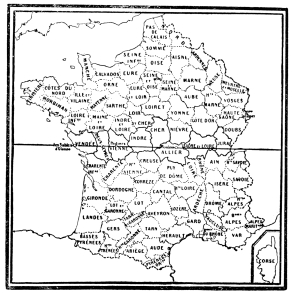
The Provinces of France
In the following table the grands gouvernements of the first
foundation are indicated in heavy-faced type, those which were taken
from the first in italics, and those which were acquired by conquest in
ordinary characters.
| NAMES OF GOVERNMENTS |
CAPITALS |
| 1. | Ile-de-France | Paris. |
| 2. | Picardie | Amiens. |
| 3. | Normandie | Rouen. |
| 4. | Bretagne | Rennes. |
| 5. | Champagne et Brie | Troyes. |
| 6. | Orléanais | Orléans. |
| 7. | Maine et Perche | Le Mans. |
| 8. | Anjou | Augers. |
| 9. | Touraine | Tours. |
| 10. | Nivernais | Nevers. |
| 11. | Berri | Bourges. |
| 12. | Poitou | Poitiers. |
| 13. | Aunis | La Rochelle. |
| 14. | Bourgogne (duché de) | Dijon. |
| 15. | Lyonnais, Forez et Beaujolais | Lyon. |
| 16. | Auvergne | Clermont. |
| 17. | Bourbonnais | Moulins. |
| 18. | Marche | Guéret. |
| 19. | Guyenne et Gascogne | Bordeaux. |
| 20. | Saintonge et Angoumois[A] | Saintes. |
| 21. | Limousin | Limoges. |
| 22. | Béarn et Basse Navarre | Pau. |
| 23. | Languedoc | Toulouse. |
| 24. | Comté de Foix | Foix. |
| 25. | Provence | Aix. |
| 26. | Dauphiné | Grenoble. |
| 27. | Flandre et Hainaut | Lille. |
| 28. | Artois | Arras. |
| 29. | Lorraine et Barrois | Nancy. |
| 30. | Alsace | Strasbourg. |
| 31. | Franche-Comté ou Comté de Bourgogne | Besançon. |
| 32. | Roussilon | Perpignan. |
| 33. | Corse | Bastia. |
[A] Under Francis I. the Angoumois was comprised in the Orléanais.
The seven petits gouvernements were:
- 1. The ville, prévôté and vicomté of Paris.
- 2. Havre de Grâce.
- 3. Boulonnais.
- 4. Principality of Sedan.
- 5. Metz and Verdun, the pays Messin and Verdunois.
- 6. Toul and Toulois.
- 7. Saumur and Saumurois.
| THE PRINCIPAL PAYS AND PAGI OF BRITTANY |
| | |
| Pays d’Alet | Ille et Vilaine |
| Pays de Briere | Loire Infr. |
| Cornouailles | Finistère. |
| Le Desert | Ille et Vilaine. |
| Dinannois | Côtes du Nord. |
| Pays de Dol | Côtes du Nord. |
| Pays de Grève | Côtes du Nord. |
| Léonais | Finistère. |
| Nantais | Loire Infr. |
| Rennois | Ille et Vilaine. |
| Pays de Vannes | Morbihan. |
| COUNTS AND DUKES OF BRITTANY |
| | |
| Nominoë | 824 |
| Erispoë | 851 |
| Salomon | 857 |
| Pasqueten and Gurvaud | 874 |
| Alain I. | 877 |
| Gurmailhon | 907 |
| Juhael Béranger | 930 |
| Alain II. (Barbe Torte) | 937 |
| Drogon | 952 |
| Hoël I. | 953 |
| Guerech | 980 |
| Conan I. | 987 |
| Geoffroy I. | 992 |
| Alain III. | 1008 |
| Conan II. | 1040 |
| Hoël II. | 1066 |
| Alain Fergent | 1084 |
| Conan III. | 1112 |
| Eudes and Hoël III. | 1148 |
| Geoffroy II. | 1156 |
| Constance and Arthur | 1171 |
| Pierre Mauclerc and Alix | 1186 |
| Jean I. | 1213 |
| Jean II. | 1237 |
| Arthur II. | 1286 |
| Jean III. | 1305 |
| Charles de Blois | 1312 |
| Jean IV. de Montfort | 1341 |
| Jean V. | 1365 |
| François I. | 1399 |
| Pierre II. | 1450 |
| Arthur III. | 1457 |
| François II. | 1458 |
Duchess Anne, who
married Charles
VIII. and afterward
Louis XI. of France, | 488-1513 |
METRICAL AND ENGLISH WEIGHTS AND MEASURES
- Mètre = 39.3708 in. = 3.231. 3 ft. 3 1-2 in. = 1.0936 yard.
- Square Mètre (mètre carré) = 1 1-5th square yards (1.196).
- Are (or 100 sq. mètres) = 119.6 square yards.
- Cubic Mètre (or Stere) = 35 1-2 cubic feet.
- Centimètre = 2-5ths inch.
- Kilomètre = 1,093 yards = 5-8 mile.
- 10 Kilomètres = 6 1-4 miles.
- 100 Kilomètres = 62 1-10th miles.
- Square Kilomètre = 2-5ths square mile.
- Hectare = 2 1-2 acres (2.471).
- 100 Hectares = 247.1 acres.
- Gramme = 15 1-2 grains (15.432).
- 10 Grammes = 1-3d oz. Avoirdupois.
- 15 Grammes = 1-2 oz. Avoirdupois.
- Kilogramme =2 1-5th lbs. (2.204) Avoirdupois.
- 10 Kilogrammes = 22 lbs. Avoirdupois.
- Metrical Quintal = 220 1-2 lbs. Avoirdupois.
- Tonneau = 2,200 lbs. Avoirdupois.
- Litre = 0.22 gal. = 1 3-4 pint.
- Hectolitre = 22 gallons.
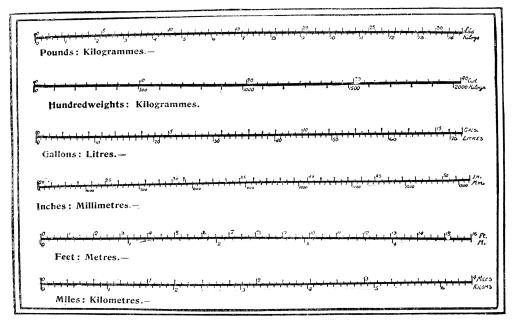
Comparative Metric Scale
ENGLISH AND METRICAL WEIGHTS AND MEASURES
- Inch = 2.539 centimètres = 25.39 millimètres.
- 2 inches = 5 centimètres nearly.
- Foot = 30.47 centimètres.
- Yard = 0.9141 mètre.
- 12 yards = 11 mètres nearly.
- Mile =1.609 kilomètre.
- Square foot = 0.093 mètre carré.
- Square yard = 0.836 mètre carré.
- Acre = 0.4046 hectare = 4,003 sq. mètres nearly.
- 2 1-2 acres = 1 hectare nearly.
- Pint = 0.5679 litre.
- 1 3-4 pint = 1 litre nearly.
- Gallon = 4.5434 litres = 4 nearly.
- Bushel = 36.347 litres.
- Oz. Troy = 31.103 grammes.
- Pound Troy (5,760 grains) = 373.121 grammes.
- Oz. Avoirdupois = 8.349 grammes.
- Pound Avoirdupois (7,000 grains) = 453.592 grammes.
- 2 lbs. 3 oz. = kilogramme nearly.
- 100 lbs. = 45.359 kilogrammes.
- Cwt. = 50.802 kilogrammes.
- Ton = 1,018.048 kilogrammes.
Sketch Map of Circular Tour in Brittany. Fares from Rennes, 65 francs,
1st class; 50 francs, 2d class.
Itinerary: Rennes, Saint-Malo-Saint-Servan, Dinard, Saint-Brieuc,
Guingamp, Lannion, Morlaix, Roscoff, Brest, Quimper, Douarnenez,
Pont-l’Abbé, Concarneau, Lorient, Auray, Quiberon, Vannes, Savenay, Le
Croisic, Guérande, Saint-Nazaire, Pont-Château, Redon, Rennes.
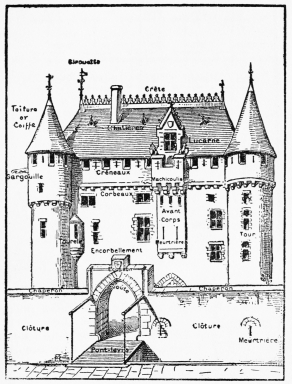
Architectural Names of the Various Parts of a Feudal
Château
Tide and Weather Signals in the Ports of
Brittany
By day the signals showing the depth of water—in mètres—at the harbour
entrance are shown by balls or small balloons; at night these are
replaced by lanterns. (See top diagram.) The flag signals of the other
diagrams explain themselves.
THE PRINCIPAL PARDONS OF BRITTANY
DEPARTMENT OF FINISTÈRE
Plougastel-Daoulas.—Easter Monday, the Monday of Pentecôte,
29th June, and 15th August.
Pont l’Abbé.—25th March, Monday of Pentecôte, 3d Sunday of
July, 4th Sunday of September.
Concarneau.—(Ste. Guénolé) First Sunday in May, (Sainte Croix)
14th September, (Pardon du Rosaire) First Sunday in October.
Bannalec.—Ascension Day.
Quimperlé.—Trinity Sunday, second Sunday of May, last Sunday
of July, third Sunday in September.
Quimperlé.—Easter Monday.
Rumengal.—Trinity Sunday.
Loctudy.—Sunday following 11th May, and 2d Sunday of August.
Pont Aven.—Second Sunday of May and third Sunday of September.
Saint Jean du Doigt.—23d and 24th June.
Roscoff.—Mid-June and 15th August.
Camaret (Fête de la Pêche et Bénédiction de la Mer).—Third
Sunday in June.
Locronan (Petite Troménie every year; Grande Troménie every six
years).—Second Sunday of July.
Rosporden.—Second Sunday in July.
Le Folgoët.—15th August, and 7th and 8th September.
Quimper.—15th, 16th, and 17th August.
Huelgoat.—Three days—first Sunday of August.
Ste. Anne de la Palude.—Saturday evening and last Sunday of
August.
Scaër.—Last Sunday of August.
Audierne.—Last Sunday of August.
Penmarc’h (Pardon du Rosaire).—First Sunday of October.
DEPARTMENT OF THE MORBIHAN
St. Gildas de Rhuis.—29th of January.
Auray.—(Ouverture du Pardon de St. Anne) 7th March, (Principal
Pardon) 25th and 26th of July.
Locminé.—Three days from the Sunday nearest 27th June.
Ste. Barbe en Faouët.—Last Sunday of June.
St. Fiacre près le Faouët.—Fourth Sunday in July.
Locmariaquer.—Second Sunday in September.
Pontivy.—Second Sunday in September.
Carnac.—Third Sunday in September, (Pardon of St. Cornely) the
Sunday nearest the 14th September.
Pont Scorff.—Third Sunday in September.
Le Faouët.—First Sunday in October.
A BRIEF LIST OF SOME OF THE MORE IMPORTANT PREFIXES OF PLACE-NAMES IN
BRITTANY, WITH THEIR DEFINITIONS
Bod, Bot.—A place surrounded by a wood. Bodilis, Botsorhel.
Bras, Bré.—High, elevated. Braspart, Brelevené.
Conc.—A harbour or bay. Concarneau, le Conquet.
Car.—A manor or château. Carhaix.
Coat.—A wood or forest. Coatascorn, Coatreven.
Crug.—Amid the rocks. Cruguel.
Faou.—A place planted with oaks. Le Faouët.
Guic.—Bourg. Guichen (old bourg).
Hen.—Old. Henvie, Henpont.
Ker or Kaer.—Manor, château. Kerlouan, Kervignac.
Lan.—Church or consecrated spot. Lannion, Lanildut.
Les, Lis.—Court or jurisdiction. Lesneven, Lezardrieux.
Loc.—Oratoire or hermitage. Locmaria.
Méné.—Mountain. Méné Bré.
Mor.—The sea. Morbihan (la petite mer).
Pen.—Promontory summit or extremity. Penmarc’h, Paimbœuf (par
corruption).
Plé, Pleu, Plo, Plou, Plu.—Parish. Pléhédel, Pleudihen, Plouha.
Poul.—Hole or basin. Pouldergat.
Ros.—Hill or slope. Roscoff, Rosporden.
Tref, Tré.—Part of a parish. Trégastel, Trémelior.
THE BRETON TONGUE IN BRITTANY TO-DAY[B]
| DÉPARTEMENT |
INDIVIDUALS
UNDERSTANDING
ONLY BRETON |
INDIVIDUALS
UNDERSTANDING
BRETON AND
FRENCH |
|
Côtes du Nord | 145,000 | 150,000 |
| Finistère | 352,000 | 302,000 |
| Morbihan | 182,700 | 190,000 |
[B] This table takes no cognizance of those speaking French only
and not Breton, whilst the three departments given are those
only in which the knowledge of the Breton tongue is in excess
of that in other parts.
It is a regrettable fact that the Morbihan has the greatest number
of illiterates of any of the departments of France. Among a hundred
conscripts for the army, often thirty or forty are classed as
illiterate, while in Finistère and the Côtes du Nord, the number falls
to thirty or less, and in Ille et Vilaine to less than twenty.
A,
B,
C,
D,
E,
F,
G,
H,
J,
K,
L,
M,
N,
O,
P,
Q,
R,
S,
T,
V.
Alre, 158.
Ancenis (and château), 99-101.
Angers (and castle), 24, 30, 108, 119, 146, 243, 311, 316.
Audierne, 89, 212, 213-214, 370.
Auray, 32, 157, 158, 159-167, 172, 175, 178, 192, 309, 370.
Bannelec, 194-195, 369.
Batz, Isle of, 121, 240-242.
Baud, 157, 158.
Baule, 127.
Becherel, 306.
Beg-Meil, 201.
Belle Ile en Mer, 27, 34, 36, 171, 173-175.
Benzec Capcaval, 211.
Béré, Fair of, 129-130.
Binic, 267-268, 270.
Black Mountains, 218.
Bourg de Batz, 111, 121, 127.
Bréhat, 43, 259-260.
Brest, 26, 32, 39, 41, 43, 44, 47, 51, 54, 56, 72, 87, 150, 212, 220, 221-224, 225, 227, 228, 229, 230, 236, 309, 310, 340, 350.
Camaret, 89, 219-220, 369.
Cancale, 298-300.
Cape de la Chèvre, 214, 217.
Cap Fréhel, 290.
Carhaix, 54, 310, 337-339.
Carnac, 159, 163, 167, 168-171, 345, 370.
Cesson, Tower of, 266.
Cezon, 44.
Champ Dolent, 303.
Champtoceaux (and château), 104-105.
Châteaubriant (and château), 128-132.
Chateaulin, 27, 217-218, 219.
Chatelaudren, 263.
Clisson (and château), 42, 111, 114-115.
Combourg (and château), 305-308.
Concarneau, 43, 89, 197-201, 202, 205, 212, 215, 216, 219, 224, 351, 369.
Corseul, 146.
Creac’higuel, 351.
Croisic, 42, 111, 121, 127.
Crozon, 217, 219.
Daoulas, 229, 369.
Dinan (and château), 24, 54, 249, 271, 291-297.
Dinard, 39, 249, 271, 273, 288-289, 290.
Dol, 19, 39, 43, 54, 249, 303-305.
Douarnenez (and bay), 32, 38, 43, 51, 89, 187, 212, 214-216, 217, 219, 351.
Elven, 138.
Ernée (and château), 312.
Etables, 267.
Falaise, 130.
Faou, 220, 221.
Faouët (Finistère), 192-194.
Folgoët, 224, 237-238, 369.
Fontaine-Daniel, Abbey of, 312.
Fougères (and forest), 54, 262, 309, 310, 312, 313-315, 316, 321, 340.
Fouquet, Château, 27, 174.
Grand Brière, 125.
Guérande, 121, 125-127.
Guibray, Fair of, 130.
Guingamp (and castle), 54, 86, 87, 250, 260-262, 351.
Hédé, 306.
Hennebont, 146, 179, 182-185.
Huelgoat, 310, 339-340, 370.
Javron, 313.
Joie, Abbaye de la, 185.
Josselin (and château), 150, 152-157, 309, 337.
Kerérault, 229.
Kérity, 357.
Kerlean, Manoir of, 138.
Kerlescan, 169.
Kerlouan, 224.
Kermario, 169.
Kermartin, Manor of, 255.
Lacroix, 44.
La Houle, 299.
“La Joyeuse Garde,” Château of, 227.
Lamballe, 268-269.
Landeau, 315-316.
Landerneau, 221, 224-227, 310, 340.
Landivisiau, 221, 227-228.
Lannion, 24, 74, 89, 250-252.
Largoet, Fortress of, 138.
La Roche-Bernard, 128.
La Trinité, 177-178.
Laval (and château), 54, 56, 310, 316-318, 322.
Le Conquet, 230-231, 236.
Lehon, 297-298.
Le Légué, 266.
Le Mans, 54, 310.
Locmariaquer, 146, 159, 167, 175-176, 370.
Locminé, 157-158, 370.
Lorient, 43, 44, 54, 89, 144, 175, 179-181, 182.
Loudéac, 310, 334-335.
Mayenne (and château), 54, 309, 310, 311-312, 316, 322.
Ménac, 169.
Minden, Fort, 44.
Miniac, 306.
Molène, Ile, 232-233.
Montauban, 334.
Mont Dol, 303.
Montfort-sur-Meu, 310, 333-334.
Mont St. Michel (and bay), 34, 39, 43, 46, 54, 60, 249, 298, 300-302, 303.
Morlaix, 43, 54, 63, 94, 238, 244-247, 249, 340.
Motte-Broons, 293.
Nantes (and castle), 4, 7, 19, 22, 24, 26, 30, 36, 38, 39, 54, 56, 57, 67, 102, 104, 105-110, 111, 112, 115, 116-121, 124, 127, 146, 174, 211, 221, 243.
Notre Dame de la Clarté, 350-351.
Oudon, 104.
Ouessant, Ile, 43, 44, 232, 233-236.
Our Lady of Langonnet, Abbey of, 194.
Paimbœuf, 42, 111, 112.
Paimpol, 257-259.
Palais, 44, 173, 175.
Paramé, 39, 271, 272, 274-276.
Penmarc’h, 31, 208, 210-211, 370.
Penthièvre, 7, 44, 171.
Pilier, 44.
Ploërmel, 54, 150-152.
Ploubazlanec, 355, 356, 357.
Ploudalmézeau, 236-237.
Plougasnou, 25, 64.
Plougastel, 221, 228-230, 350, 369.
Plouharnel, 167, 171.
Pointe de Kerpenhir, 145.
Point of Primel, 247.
Point of Raz, 212, 213, 214.
Point Sizun, 212.
Point St. Mathieu, 212.
Pont Aven, 82, 187, 201, 202-205, 351, 369.
Pont Croix, 214.
Pontivy (and castle), 54, 334-337, 355, 370.
Pont l’Abbé, 27, 82, 187, 208-210, 369.
Pont Scorff, 179, 185-186, 370.
Pornic (and château), 42, 111, 112-114.
Port Haliguen, 172.
Port Louis, 44, 181-182.
Port Maria, 172.
Port Navalo, 43, 145.
Portz, 355.
Pouldu, 190.
Poulgoazec, 214.
Pré-en-Pail, 309.
Primelin, 214.
Questembert, 136.
Quiberon, 44, 163, 167, 170, 171-173, 175.
Quimper, 19, 27, 32, 38, 41, 53, 54, 60, 72, 75, 82, 93, 128, 205-208, 212, 224, 370.
Quimperlé, 187-190, 191, 309, 351, 369.
Redon, 24, 128, 132-136.
Rennes, 19, 22, 24, 25, 41, 54, 57, 75, 118, 128, 146, 150, 310, 316, 329-333, 343.
Rimains, Fort des, 44.
Rochefort-en-Terre (and château), 27, 136-138.
Rochers, Château of, 324-328.
Roc’hquérezen, 229.
Roc’hquillion, 229.
Roc’huivlen, 229.
Roscanvel, 217.
Roscoff, 43, 75, 238-240, 369.
Rosporden, 31, 194, 195-196, 201, 351, 369.
Rostrenen, 337.
Rothéneuf, 286-287.
Rumengal, 346, 350, 369.
Sauzon, 175.
Savenay, 41, 124-125, 128, 130.
Scaër, 349, 351, 370.
Seven Isles, 256-257.
St. Briac, 27, 290-291.
St. Brieuc, 19, 29, 60, 262, 263-266, 268, 270.
St. Cast, 26, 67, 290, 355.
Ste. Anne de la Palude, 346, 350, 370.
Ste. Marguerite, 127.
St. Énogat, 273, 288, 289-290.
St. Fiacre, 26, 191-192, 370.
St. Gildas de Rhuis, 27, 148, 370.
St. Guénolé, 211.
St. Jacut, 27, 272-273, 290.
St. Jean-Brevelay, 352.
St. Jean du Doigt, 247-248, 346, 350, 352-353, 369.
St. Lunaire, 27, 290.
St. Malo (and bay), 9, 19, 27, 39, 43, 44, 54, 56, 57, 61, 63, 67, 94, 249, 271-274, 276-283, 285, 288, 291, 300.
St. Maurice, Abbey of, 190-191.
St. Méen, 334.
St. Nazaire, 39, 109-111, 112, 121, 122-124, 128, 144.
St. Nicolas, 205.
St. Pol de Léon, 19, 27, 60, 206, 238, 242-244.
St. Rénan, 236.
St. Servan, 27, 271, 272, 276, 283-285.
St. Thégonnec, 350.
St. Yves, 346, 350.
Suscino, Château of, 148-150.
Taureau, Château du, 44.
Tentêniac, 306.
Tombelaine, Isle of, 34, 302-303.
Trébone, 351.
Tréguier, 19, 24, 60, 94, 206, 250, 252-256.
Trélaze, 29.
Tristan, Ile, 215-216.
Troménie de St. Ronan, 346.
Val André, 263, 269-270.
Vannes, 19, 24, 43, 54, 60, 75, 128, 134, 136, 138, 139, 140-148, 150, 175, 187, 221.
Ville Martin, 44.
Vitré (and château), 24, 54, 262, 310, 318-324.
| Typographical errors corrected by the etext transcriber: |
|---|
| Le trente-un du mois d’aôut=> Le trente-un du mois d’août {pg 68} |
| is by no mean inexplicable=> is by no means inexplicable {pg 3} |
| must known these principal provinces by name=> must know these principal provinces by name {pg 7} |
| general eerie espect=> general eerie aspect {pg 138} |
| busy litle Breton port=> busy little Breton port {pg 214} |
| religious architecure.=> religious architecture. {pg 226} |
| in the sixth entury=> in the sixth century {pg 304} |