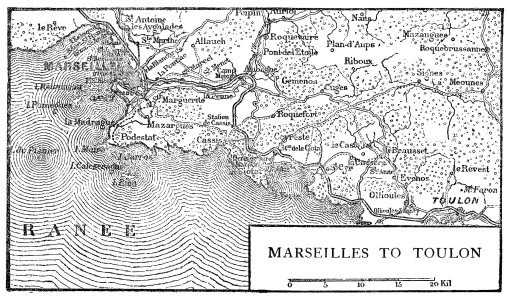
THE coast just east of Marseilles is quite unknown to the general
Riviera traveller, although it is accessible, varied, and an admirable
foretaste of the beauties of the Riviera itself.
Just over the great bald-faced peak of Mount Carpiagne lie Cassis and
the Bec de l’Aigle, the virtual beginning of the wonderful scenic
panorama of the Riviera.
One would have expected that as time went on Carsicus Portus of the
Romans, the present Cassis, would have exceeded Marseilles in magnitude,
for its situation was much in its favour. Great treasure-laden ships
from the Orient would have avoided doubling the rocky promontory which
stretches seaward between Marseilles and Cassis, and thereby saved the
worry of many ever-present dangers. This was not to be, however, and
Marseilles has grown at the expense of its better situated rival.
Cassis, however, was a port of refuge to ships coming from the East,
and on more than one occasion they put in here and landed their cargoes,
which were sent overland to the already firmly established trading
colony at Marseilles.
The origin of the name is doubtful. It seems plausible enough that it
may have come from the old Provençal classis, a filet or net, from
the use of this in the fishing which was carried on here extensively in
times past.
Some supposedly ancient quays, which may have dated from Roman times,
were discovered in the eighteenth century, but the present port and its
quays were constructed under the orders of Louis XIII.
The present fishing industry of Cassis is not very considerable, it
being far less than that of Martigues or Port de Bouc. At Cassis there
are but half a hundred men engaged, and the returns, as given in a
recent year, were scarcely over eleven hundred francs per capita, which
is not a great wage for a toiler of the sea.
Another harvest of the sea, little practised to-day, but formerly much
more remunerative, is the gathering of a variety of coral which quite
equals that of Italy or Dalmatia. This industry has of late grown less
and less important here, as elsewhere, for the Italians, Greeks, and
Maltese have so scraped over the bottom of the Mediterranean with their
great hooked tridents that but little coral is now found.
Cassis figures in a story connected with the great plague or pest which
befell Marseilles in the eighteenth century. Pope Clement XI. had sent
to the Monseigneur de Belsunce a cargo of wheat to be distributed among
the famished of Marseilles or elsewhere, “comme il le jugerait à
propos.” In December, 1720, a fleet of tartanes,—the same
lateen-rigged ships which one sees engaged to-day in the open-sea
fishing industry of Martigues,—bringing the wheat to the stricken city,
was forced to anchor in the Golfe des Lèques, just offshore from the
little port of Cassis, “par suite de la violente mistral qui balayait
la mer.” The same mistral sweeps the seas around Marseilles to-day, and
works all sorts of disaster to small craft if they do not take shelter.
When the tartanes were discovered off Cassis, the famishing
sailor-folk of the town hesitated not a moment to put off and board
them. The papal tartane attempted to parley with them, but every
vessel in the fleet was attacked in true Barbary-pirate fashion and
captured; and the entire consignment was seized and distributed among
the distressed people of Cassis and the surrounding country. The
“pirates,” however, paid the Archbishop of Marseilles the full value of
the shipment, “comme c’était justice.” Mgr. de Belsunce, “coming to
Cassis on donkey-back,” brought back the money and founded a school for
both sexes with the capital, besides giving to the poor of the town an
annual sum equal to the interest on the principal. Whether this was a
case of “heaping coals of fire” on the delinquent heads, or not, history
does not say.
Cassis is the native city of the Abbé Barthélémy, a savant who, amid the
constant study of ancient and modern Greek, Latin, Hebrew, Syriac,
Chaldean, and Arabic, found time to write the “Voyage du Jeune
Anacharsis en Grèce,” a work which has placed his name high in the roll
of writers who have produced epoch-making literature.

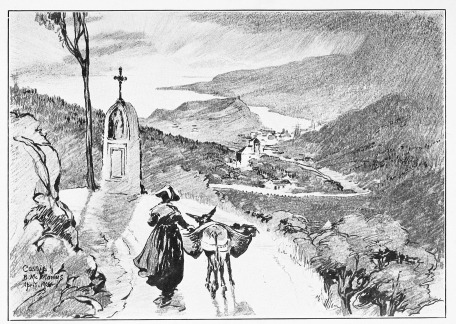
Cassis
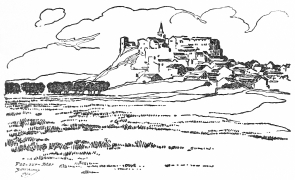
Cassis is the perfect type of the small Mediterranean port. High above
the houses of its nineteen hundred inhabitants, on the apex of a wooded,
red-rock hill, are the ruins of a château. To the east is the grim and
gray Cap, a mountain of considerable pretensions, while to the west is
Pointe Pin, a height of perhaps fifteen hundred metres sloping gently
down to the sea, and covered with scrub-pines save for occasional
granite outcrops.
Cassis is a highly industrious little town, now mostly given over to the
manufacture of cement, the coastwise shipping of which gives a perpetual
liveliness to the port. The fishing, too, though, as before said, not
very considerable, results in a constant traffic with the wharves of
Marseilles, where the product is sold.
The white wine of Cassis, a “vrai vin parfumé,” which in another day
was produced much more extensively than now, is as much the proper thing
to drink with bouillabaisse and les coquillages as in the north are
Chablis and Graves with oysters and lobsters.
The vin de Cassis is like the wine of which Keats wrote:
“So fine that it fills one’s mouth with gushing freshness,—that goes
down cool and feverless, and does not quarrel with your liver, lying as
quiet as it did in the grape.”
The sheltering headland which rises high above Cassis is known as Le
Gibel. On its highest peak the poet Mistral has placed the retreat of
the heroine Esteulle in his poem “Calandau.” Black and menacing, Cap
Canaille continues Le Gibel out toward the sea, and its sheer rise
above the Mediterranean approximates five hundred metres.
On the opposite bank of a little bay, called in Provençal a calanque,
rises the ruined towers and walls of a feudal château, of no interest
except that it forms a grim contrasting note with the blue background of
sky above and sea below.
A little farther on, sheltered at the head of a calanque, is Port
Miou, which has a legend that has made it a popular place of pilgrimage
for the Marseillais. The little port is well sheltered in the bay, with
the entrance nearly closed by a great sentinel rock, which is, at times,
wholly submerged by the waves. It is this which has given rise to the
legend that a Genoese fisherman, surprised by a tempest and being unable
to control his craft, abandoned the tiller and would have hurled himself
into the sea if his son, obeying a sudden inspiration, had not steered
the boat through the narrow strait and came to a safe harbour within.
The father at once fell upon the boy, killing him with a blow; but,
Providence taking no revenge, the boat drifted on to a safe anchorage.
The story is not a new one; the same legend, with variations, is heard
in many parts of western Europe and as far north as Norway, but it is
potent enough here to draw crowds of Sunday holiday-makers, in the
summer months, from Marseilles.
In 1377 Pope Gregory XI., who desired to reëstablish the papacy at Rome
after its seventy years at Avignon, took ship at Marseilles, but was
held back by contrary winds and seas and hovered about the little
archipelago of islands at the harbour’s mouth, until finally, when he
had at last got well started on his way, a furious tempest arose and the
vessel forced to anchor in the calanque of Port Miou, called by the
historian of the voyage Portus Milonis.
Beyond Cassis, eastward, are still to be traced the outlines of the old
Roman road which led into Gaul from Rome, via Pisa and Genoa, until it
finally passes Ceyreste, the ancient Citharista. The name was originally
given to the site because of the chain of hills at the back, which
formed a sort of a tiara (citharista signifying tiara or crown), of
which the little city formed the bright particular jewel. It must have
been one of the first health resorts of the Mediterranean shore, for
Cæsar founded here a hospital for sick soldiers. Since that day it
appears to have been neglected by the invalids (real and fancied), for
they go to Monte Carlo to live the same life of social diversion that
goes on at Paris, Vienna, or New York.
Another explanation of the origin of the city’s name is that it was
dedicated to Apollo, the god of music, and that its name came from the
cithare, or zither, which, according to those learned in mythology,
the god always bore.
Ceyreste, at all events, was of Grecian origin as to its name, and was
perhaps the patrician suburb of La Ciotat, the city of sailors and
merchants. Unlike most plutocratic towns, Ceyreste appears always to
have had a due regard for the proprieties, for a French historian has
written: “Il est de notoriété publique que jamais aucun Ceyrestéen n’a
subi de peine infamante, ni même afflictive. Jamais aucun crime n’a été
commis dans la commune!”
Ceyreste must console itself with these memories of a glorious past, for
to-day it is but a minute commune of but a few hundred souls, most of
whom have attached themselves in their daily pursuits to the busy
industrial La Ciotat.
The railway issues from the Tunnel de Cassis, through olive-groves and
great sculptured rocks, on the shores of the wonderful Baie de la
Ciotat, flanked on one side by a rocky promontory and on the other, the
west, by the Bec de l’Aigle, a queer beak-shaped projection which well
lives up to its name.
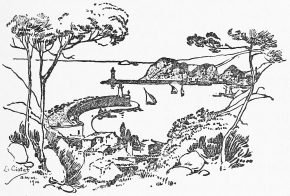
La Ciotat and the Bec de l’Aigle
The bay of La Ciotat is the first radiant vision which one has of a
Mediterranean golfe, as he comes from the north or east. Things have
changed to-day, and the considerable commerce of former times has
already shrunk to infinitesimal proportions, though to take its place
the port has become the location of the vast ship-building works of the
“Cie. des Messageries-Maritimes,” whose three or four thousand workmen
have taken away most of the local Mediterranean wealth of colour which
many a less progressive place has in abundance. Accordingly La Ciotat is
no place to tarry, though unquestionably it is a place to visit, if
only for the sake of that wonderful first impression that one gets of
its bay.
It was a fortunate day for the prosperity of La Ciotat when the
engineers and directors of the great steamship company founded its vast
workshops here. To be sure they do not add much to the romantic aspect
of this charmingly situated coast town; but men must live, and great
ocean liners must be built somewhere near salt water.
The prosperity of La Ciotat, the ville des ouvriers, has grown up
mostly from its traffic by sea, the railway stopping at an elevation of
some two hundred feet above the level of the quays. The traveller makes
his way by a little branch train, but heavy merchandise for the
ship-building yards is still brought first to Marseilles and then
transhipped by boat.
Ship-building was one of the ancient occupations of the people of La
Ciotat, hence it is natural enough to hear some old workman, who has
become incapacitated by time, say: “N’est-il pas naturel que La Ciotat
soutienne son antique réputation en construisant de bons bateaux?”
For a long time it was the grand ship-building yard of the Marseillais,
who obtained here all their ships to “faire la caravane,” as the
voyage to the Levant was called in olden times.
La Ciotat was perhaps the Burgus Civitatis of the itinerary of Antony,
but in time it came to be known—in the Catalan tongue—as Bort de
Nostre Cieuta, and it is so given in an ancient charter which conceded
certain rights to the Marseillais.
In 1365 La Ciotat passed to the monks of the Abbey of St. Victor, but
for a short time it was in the possession of the Catalans, who were the
partisans of the Antipope Pierre de Luna. Few towns of its size in all
France have had so varied a career as La Ciotat, until it finally
settled down to the more or less prosaic affairs of later years. Forty
families formed its first population, but, in the reign of François I.,
its population was twelve thousand or more, a number which has not
perceptibly increased since.
During the pest of 1720, which fell so hard upon Marseilles, and indeed
upon nearly all of the ports of maritime Provence, La Ciotat was saved
from the affection by the observance of a stringent quarantine. To a
great extent this was due to the prudence and fearlessness of the women.
All entrance to the city was rigorously refused to strangers, and, when
the troops from the garrison at Marseilles were sent here that they
might be quartered in a place of safety, the women armed themselves with
sticks and stones and formed a barrier, dehors des murs, and drove the
soldiery off as if they had been an attacking foe. This is one of those
Amazonian feats which prove the valour of the women of other days.
La Ciotat was frequently attacked by the Barbary pirates before these
vermin were swept from the seas by the intervention of the two great
republics, France and the United States. The English, too, attacked the
intrepid little town, and there are brave tales of the valour of the
inhabitants when bombarded by the guns of the Seahorse in 1818.
Directly in front of La Ciotat, at the foot of the Côte de Saint Cyr, on
the eastern shore of the bay, was an old Greek colony known to
geographers as Tauroentum. Rich and powerful in its own right,
Tauroentum rivalled its neighbour Marseilles, but the fleets of Pompey
and Cæsar had one of those old-time sea-fights off its quays, and the
city, having suffered greatly at the time, never recovered its
prosperity, and the more opulent and powerful Marseilles became the
metropolis for all time. The monumental remains to be observed to-day
are mostly covered with the sands of time, and only the antiquarian and
archæologist will get pleasure or satisfaction from any fragmentary
evidences which may be unearthed. The subject is a vast and most
interesting one, no doubt, but the enthusiast in such matters is
referred to Lentheric’s great work on “La Provence Maritime.”
La Ciotat, with its workmen’s houses and its shipyard, will not detain
one long. One will be more interested in making his way eastward along
the coast, when every kilometre will open up new splendours of
landscape.
Opposite La Ciotat is the hamlet of Les Lèques, well sheltered in the
bay of the same name. Lamartine, en route for the Orient, compared it
with enthusiasm to the Bay of Naples, a simile which has been used with
regard to many another similar spot, but hardly with as much of
appropriateness as here. Said Lamartine: “C’est un de ces nombreux
chefs-d’œuvre que Dieu a répandus partout.”
From Les Lèques it is but a step to Bandol, a place not mentioned in the
note-books of many travellers, though to the French it is already
recognized as a “station hivernale et de bains de mer.” This is a
pity, for it will soon go the way of the other resorts.
Bandol is a small town of the Var, possessed of a remarkably beautiful
and sheltered site, and, since it numbers but a trifle over two thousand
souls, and has no palace hotels as yet, it may well be accounted as one
of the places on the beaten track of Riviera travel which has not yet
become wholly spoiled.
Bandol’s principal business is the growing of immortelles and
artichokes, with enough of the fishing industry to give a liveliness and
picturesqueness to the wharves of the little port.
It is a wonderfully warm corner of the littoral, here in the immediate
environs of Bandol, and palms, banana-trees, the eucalyptus, and many
other subtropical shrubs and plants thrive exceedingly. There is nothing
of the rigour of winter to blight this warm little corner; only the
mistral—which is everywhere (Monaco perhaps excepted)—or its equally
wicked brother, le vent d’est, ever makes disagreeable a visit to this
warm-welcoming little coast town.
A clock-tower, or belfry, an old château,—the construction of
Vauban,—and a jetty, which throws out its long tentacle-like arm to
sea, make up the chief architectural monuments of the town.
Not so theatrical or stagy as Monte Carlo or even Hyères, or as overrun
with “swallows” as Nice or Menton, Bandol has much that these places
lack, and lacks a great deal that they have, but which one is glad to be
without if he wants to hibernate amid new and unruffling surroundings.
Very good wines are made from the grapes which grow on the neighbouring
hillsides; rich red wines, most of which are sold as Port to not too
inquisitive buyers. The industry is not as flourishing as it once was,
though the inhabitants—some two hundred or more—who used to be engaged
in the coopering trade, still hope that, phœnix-like, it will rise again
to prosperity. What the culture once was, and what picturesque elements
it possessed, art-lovers, and others, may judge for themselves by the
contemplation of the celebrated canvas by Joseph Vernet, now in the
Louvre at Paris.
The fishermen of Bandol find the industry more profitable than do many
others in the small towns to the eastward of Marseilles, and,
accordingly, they are more prominent in the daily life which goes on in
the markets and on the quays. Their catch runs the whole gamut of the
poissons de Mediterranée, including a unique species called the St.
Pierre, whose bones somewhat resemble the instruments of the Passion.
Three thousand cases of immortelles are gathered each year from the
hillsides and shipped to all parts, the crop having a value of more than
a hundred thousand francs.
Bandol is the centre of the manufacture of couronnes d’immortelles in
France. The little yellow flowers literally clog the narrow streets of
the town away from the waterside. The warm zone in which Bandol is
situated is most favourable to the growth of the plant, which, according
to the botanists, originally came from Crete and Malta. The natives of
Bandol say that it originated with them, or at least with their pays.
A hot, dry soil is necessary to their growth, and they are at their best
in June and July, when their golden yellow tufts literally cover the
hillsides; that is, all that are not covered by narcissi. The flora of
Bandol is most varied and abundant, but these two flowers predominate.
The culture of the immortelle is simple. In February or March the plants
are set in the ground, from small roots, and the gathering commences in
July of the second season, after which the poor, stripped stalks look
anything but immortal. Each plant grows three or four score of stems,
each stem bearing ten to twenty flowers.
Curiously enough there seems to be a diversity of opinion as to the
colour that a crown of immortelles shall take. Not all of them are sent
out in the golden colour nature gave them. Some are dyed purple and
others black, and then, indeed, all their beauty has departed. The
natives think so, too, but dealers in funeral supplies in Paris, Lyons,
and Marseilles—who have about the worst artistic sense of any class of
Frenchmen who ever lived—have got the idea that their clients like
variety, and that bright yellow is too gay for a symbol of mourning.
Bandol sits in a great amphitheatre surrounded by wooded hillsides set
out here and there with plantations of olive and mulberry trees and
vines.
Harvest loads of grapes and olives form the chief characteristics of the
traffic by the highways and byways throughout Provence, but in no
section are they more brilliant and gay with colour than along the coast
from Marseilles to Hyères.
Bandol is thought to have been one of those numerous nameless ports
referred to by the Roman historians, but it is necessary to arrive at
the end of the sixteenth century to find any mention of it by name.
Nostradamus recounts that a certain Capitaine Boyer of Ollioules, who
had rendered great service to the king during the troubles with the
League, was given “en fief et à paye-morte, à luy et à sa postérité, le
fort de Bendort (Bandol), situé au bord de la mer.”
Later this same Boyer was appointed governor of the Château de la Garde
at Marseilles, and received, in addition, certain valuable rights
connected with the tunny fishing on the Provençal coasts, which
enterprise ultimately placed him in a position of great affluence.
The old château of Bandol, built on a bed of basalt, has the following
pleasant mot connected with it:
“Le gouverneur de cette roche,
Retournant un jour par le coche,
A, depuis environ quinze ans,
Emporté la clé dans sa poche.”
Ten kilometres beyond Bandol is Ollioules, which is mentioned in the
guide-books as being the gateway to the celebrated Gorges d’Ollioules,
which, like most gorges and cañons, is of surprising spectacular beauty.
This is a classic excursion for the residents of Toulon, who on Sunday
flock to the site of this tortuous savage gorge, and breathe in some of
those same delights which a mountaineer finds in a deep-cut cañon in the
Rockies. There is nothing so very stupendous about this gorge, but it
looks well in a photograph, and satisfies the Toulonais to their highest
expectations, and altogether is a very satisfactory sort of a ravine, if
one does not care for the beauties of the coast-line itself,—which is
what most of us come to the Mediterranean for.
Ollioules itself is of far more attraction, to the lover of picturesque
old streets and houses and crumbling historical monuments, than its
gorge. The town bears still the true stamp of the middle ages, though
the inhabitants will tell you that it has great hopes of becoming some
day a popular resort like Nice, this being the future to which all the
small Riviera towns aspire.
Old vaulted streets, leaning porched houses, with enormous gables and
delicately sculptured corbels and window-frames, give quite the effect
of mediævalism to Ollioules, though a hooting tram from Toulon makes a
false note which is for ever sounding in one’s ears.
All the same, Ollioules, with the débris of its thirteenth-century
château, its very considerable remains of city wall, and its Place,
tree-shaded by high-growing palms, is a town to be loved, by one jaded
with the round of resorts, for its many and varied old-world
attractions.
Ollioules is built in the open air, at the end of the defile or gorge,
in the midst of a country glowing with all the splendour and beauty of
endless beds of hyacinths and narcissi, flowers which rank among the
most beautiful in all the world, and which here, in this corner of old
Provence, grow as luxuriantly as heather on the hills of Scotland or
tulips in Holland. Violets, poppies, the mimosa, and tuberoses are also
here in abundance.
Two hundred and fifty hectares, or more, in the immediate vicinity of
Ollioules, are devoted to the culture of bulbs, and five million bulbs
form an average crop, most of which is sent away by rail to Belgium,
Holland (tell it not to a Dutchman), and England.
The origin of the name of the town is peculiar, as indeed is the
derivation of many place-names. Savants think that it comes from
olearium, meaning a place where oil was made and stored. This may be so,
but olive-oil does not figure any more among the products of this
particular petit pays.
Not only the rock-bound gorge but the whole basin of Ollioules is a
wonderland of exotic and rare natural beauties. On one side, to the
north, rise the volcanic heights of Evenos, crowned to-day with ruins
which may be Saracenic, or gallo-romain, or prehistoric, perhaps,—it
is impossible to tell.
George Sand has written with great appreciation of the whole
neighbouring region in “Tamaris,” but even her graphic pen has not been
able to reproduce the charming and distinguished characteristics of a
region which, even to-day, is little or not at all known to the great
mass of tourists who annually rush to the Riviera resorts from all parts
of America and Europe. “Tant pis,” then, as Sterne said, but the way
is here made plain for any who would go slowly over this well-worn road
of history and cast a glance up and down the cross-roads as he comes to
them.
The distance is not great from Marseilles to Hyères, but eighty
kilometres, a little over fifty miles; but there is a wealth of interest
to be had from a silent threading of the roadways of this delightful
corner of maritime Provence which the partakers of conventional tours
know nothing of.
Here in the environs of Ollioules, on the hillsides flanking its
celebrated gorge, is found in profusion the fleur d’or, famed in the
verses of Provençal poets. François Delille, one of the followers of the
Félibres, in his “Fleur de Provence,” has sung its praises in
unapproachable fashion, and there are some other fragment verses by a
poet whose name has been forgotten, which seem worth quoting, since they
recount an incident which may happen to any one who journeys by road
along the coast of Provence:
Le Voyageur au Voiturin.
“Arrête ton cheval, saute à bas, mon vieux faune:
Et va, bon voiturin, du côte de la mer;
Sur le bord de cette anse où le flot est si clair,
Coupe, dans les rochers, coupe cette fleur jaune.”
Le Voiturin.
“C’est une fleur sauvage, O seigneur étranger.
La-bas nous trouverons des bouquets d’oranger.”
Le Voyageur.
“Non! laisse l’oranger embaumer le rivage,
Pour ces parfums si doux je suis barbare encore,
Mais sur ma terre aussi poussent les landiers d’or
Et j’aime la senteur de cette fleur sauvage!”
Such is the charm of the ajonc, “la fleur d’or de Provence.”
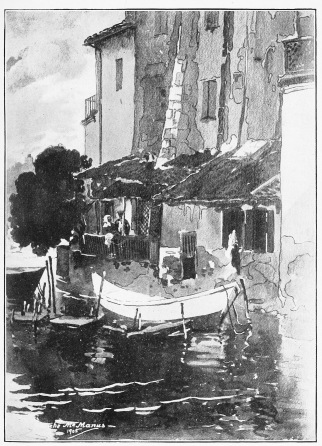
St. Nazaire-du-Var
Beyond Ollioules is St. Nazaire-du-Var, a tiny port which resembles in
many ways that of Bandol. It has some of the aspects of a station
des bains, in the summer months, for it has a fine beach. The railways
and the guide-books apparently have little knowledge of St. Nazaire for
they call it Sanary, after the old Provençal name. The present
authorities of the really attractive little town are doing their best to
keep pace with the march of progress, and there are hotels, more or less
grand, electric lights, and tram-cars.
The little port is exceedingly picturesque, and its quays are always
animated with the comings and goings of a hundred or more fishing-boats,
which of themselves smack nothing of modernity. The motor-boat has not
yet taken the picturesqueness out of the life of these hardy fishermen
of yore, though it is slowly making its way in some parts.
In reality St. Nazaire-du-Var exists no more. The development of St.
Nazaire-de-Bretagne overshadowed its less opulent namesake and took most
of the mail-matter addressed to the little Provençal port. The
inhabitants of the latter protested and addressed who ever has the
making and changing of place-names in France to be allowed to adopt its
ancient patronymic of Sanary.
Some day a “Club Privé,” and “Promenades,” and “Places,” and “Squares”
will come, and an effort will be made to stop the flood of English and
American and German tourists, who are appropriating nearly every
beauty-spot on the Riviera where there is a post-office and a telegraph
station.
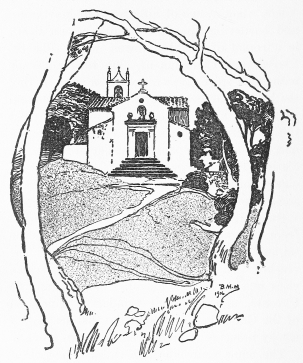
Above, on a hill to the eastward, is a chapel dedicated to Nôtre Dame de
Pitié, greatly venerated by the fishermen and sailors of the town, but
mostly remembered by travellers for the very remarkable outlook which is
to be had from the platform of its great square tower. With its
rectangular little houses glistening white in the sunlight, and red
roofs, and great towering palms and eucalyptus, St. Nazaire resembles a
great flowering bouquet, and when the simile is carried further, and the
bouquet is tied up with a waving ribbon of yellow sand, and placed in a
broad blue vase of the sea, the picture is one which, once seen, will be
unforgettable.
Toward the horizon is seen a cone which bears the enigmatical name of
Six-Fours. More majestic is Cap Sicié, which breaks the waves of the
Mediterranean into myriads of flakes, and gives a warning to the ships
lying in the basins at Marseilles that the sea is rising, and that one
of those intermittent tempests, for which the Golfe de Lyon is noted,
is due. Cap Nègre lies farther in, a black basalt wall which gives an
accent of sombreness to the otherwise gay picture.
THE great promontory of Cap Sicié is a peninsula, five kilometres across
the “neck,” and jutting seaward double that distance.
Just beyond Sanary, or St. Nazaire-du-Var, is the great Baie de Sanary,
snuggled close under the promontory height and forming a welcome shelter
from the seas which pile up on the coast from Toulon to Marseilles.
There is a little excursion offshore which one should make before he
descends on the great arsenal of Toulon, on the other side of the Cap;
but unless the traveller is forewarned he is likely to overlook it
altogether, and thereby miss what to many will be a new form of human
happiness.
Travellers to Naples make the trip to Ischia, if they are not afraid of
earthquakes; or to Capri, if they like the damp of the grottoes; but
travellers en route to Toulon may make the short trip to the Iles des
Embiez, from the little haven of Le Brusc, and have something of the
suggestion of both the former popular tourist points,—with an utter
absence of tourists.
Embiez is not much of an island in point of size, and the map-makers
scarcely know it at all. One makes his way from Le Brusc, through an
expanse of calm and limpid water, on a flat-bottomed sort of craft which
looks as though it might have degenerated from a punt.
The way is not long; it is astonishingly short for a sea voyage, and it
is only with a previous knowledge of the shallows—or, rather, the
deeps—that the craft can find its way across the scarcely hidden banks
of yellow sand. Fifteen minutes of this voyaging brings one to the isle,
and from its little jetty a douanier accosts your boat to know if you
have anything dutiable on board, as well as for your ship’s papers, and
a doctor’s certificate. He need have no fears, however, for no one would
ever take the trouble to smuggle anything into Embiez. “Nothing doing,”
and the douanier returns to his fishing off the jetty’s end.
The isle is a rock-surrounded mamelon which rises to a height of some
sixty or seventy metres, and is as wild and savage and romantic as the
most imaginative sketch ever outlined by Doré.
There is a fringe of small white houses, the dwellings of the workers in
the salt-works of the isle, and of that lonesome douanier, while
above, on an elevated plateau, is the Château de Sabran, which draws its
name from one of the illustrious and ancient families of Provence.
It is all very picturesque, but there is nothing very archaic about the
château, with the exception of one old tower. There are numerous
evidences which point to the fact that some kind of fortifications were
erected here in early times; the douanier is divided in his opinion as
to whether they were the work of Saracens or Barbary pirates, and the
reader may take his choice. At any rate, there is an unspoiled setting
right here at hand for any writer who would like to try to turn out as
good a tale as “Treasure Island” or “Monte Cristo.”
Returning to the mainland, and following the highroad as it goes
eastward to Toulon, one comes upon the curiously named little town of
Six-Fours, situated on the very apex of the heights.
The very name of Six-Fours is enigmatic. It is certain that it was a
mountain fortress in days gone by; and from that—and the intimation
that there was once six forts or six towers here—one infers that its
name was evolved from Six-Forts, which name was written in Latin Sex
Furni and finally Six Fours. Another opinion—French antiquarians, like
their brethren the world over, are prolific in opinions—is that the
bizarre name was that of one of the lieutenants of Cæsar engaged in the
blockade of Marseilles. One named Sextus Furnus, or Sextus Furnis, did
occupy a mountain stronghold in that campaign, and it may have been the
site where the village of Six-Fours now stands.
Six-Fours, so curiously named, and so little known outside its immediate
neighbourhood, has many strange manners and customs. The genuine
Six-Fourneens are six feet or more in height, and will not—or would not
for a long time—marry any étranger, by which term they designate all
outsiders.
Their speech and accent, too, are different from other Provençaux, and
they have been called wild, savage, and ridiculous. This is mostly a
libel, or else they have now outgrown these undesirable characteristics.
There is a Christmas custom at Six-Fours which is worth noting: a bon
feu (which easily enough shows the evolution of the English word
bonfire) is lighted in the street on Christmas eve before the dwelling
of the oldest inhabitant (the oldest inhabitant of last year’s
celebration may or may not have died, so there is always the element of
chance to give zest), followed by a collation paid for by public
subscription. As this repast comes off, also, in the street, the effect
is weirdly amusing. The children partake, too (which is right and
proper), and “par permission spéciale” all are allowed to eat with
their fingers, as there are seldom enough knives and forks to go round.
From the plateau height on which sits this decayed village a most
expansive view is to be had. Before one is the promontory of Cap Sicié
plunging abruptly beneath the Mediterranean waves. About and around are
rose-bushes, gripping tenaciously the rocky crevices of the hills, here
and there as thickly interwoven as chain mail, while in the valleys are
occasional little cleared orchards where the olive-trees are ranged in
rows like soldiers, though in the tree kingdom of the southland the
olive is the dwarf, and, moreover, lacks the brilliant colouring of the
fig or almond which mostly form its neighbours.
Off to the left are the roof-tops of La Seyne, and the smoky stacks of
its shipyards and factories, while still farther to the southeast is the
combination of the grime of Toulon with that luminous sky of iridescent
Mediterranean blue. It is ravishing, all this, though perhaps not more
so than similar panoramas elsewhere along the Riviera. On the whole,
their like is not to be found elsewhere in the travelled world, at least
not with such abundant contributory charms.
Six-Fours itself raises its ruins high in air, miserable, and silent,
almost, as the grave, a mere wraith of a once lively and ambitious
settlement. The decadence of man is a sad thing, but that of cities
quite as sad, and to-day this ancient domain of the seigneur-abbés of
St. Victor de Marseilles is as impressive an example as one will find.
As one proceeds eastward he opens another vista quite unlike any other
view to be had in all the world. The great Rade de Toulon, its batteries
and forts, its suburbs, and its environs, all form an impressive
ensemble of the work of nature and man.
The highroad continues on toward La Seyne, the great ship-building
suburb, and another leads to Les Sablettes and Tamaris, directly on the
water’s edge, and far enough removed from the smoke and industry of the
great arsenal to belong to the real countryside.
The Rade de Toulon is one of the joys of the Mediterranean. Its splendid
banks are cut into graceful curves, and the background of hills and
mountains makes a joyful picture indeed, whether viewed from land or
sea. The charming little bays of its outline are quite in harmony with
the brilliant blue of the sky, and not even the smoke-pouring chimneys
of the shipyards at La Seyne sound a false note, but rather they accent
the natural beauties to a still higher degree.
Away beyond the Grande Rade are the ragged isles of the archipelago of
Hyères, wave-battered and gleaming in the sunlight, while around the
whole nebulous horizon are effects of brilliant colouring of land and
sea hardly to be equalled, certainly not to be excelled. Wooded
peninsulas come down and jut out into the sea, and, despite the air of
activity which is over the whole neighbourhood, there is an idyllic
charm about the remote suburbs which is indescribable.
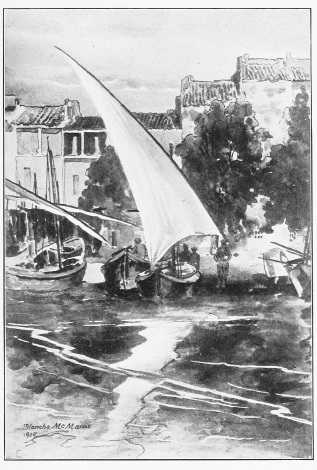
Fishing-boats at Tamaris
Guarded seaward by grim forts, and admirably sheltered from the mistral,
which blows over its head and out to sea, is Tamaris, whose fame
first started from a four months’ residence here of George Sand. Like
Alphonse Karr and Dumas, the elder, George Sand, if not the discoverer
of a new and unpatronized pied de terre, gave the first impetus to
Tamaris as a resort of not too alluring attractions, and yet
all-sufficient to one who wanted to enjoy the quietness and beauties of
nature to a superlative degree, all within a half-hour’s journey of a
great city. So pleased was the great woman of French letters that she
laid the scene of one of her last and most celebrated romances here. All
the delicate plants of a latitude five hundred miles farther south here
find a foothold, and flourish as soon as they have become acclimated and
taken root. Hence it has become a “garden-spot,” in truth, and one which
is too often neglected by Riviera tourists in general. There is small
reason for this, and when one realizes that Tamaris is a first-class
literary shrine as well—for the dwelling (the Maison Trucy) inhabited
by Madame Sand still stands—there is even less.
The magic ring of Michel Pacha, the innovator of lighthouses within the
waters of the Ottoman empire, has served to develop and enrich a little
corner of this delightful bit of the tropics, and, where the cypress and
pine once grew alone, are now found palm, orange, and lemon trees; and
hedges and walls of the laurier-rose line the alleys which lead to the
Oriental-looking château of this dignitary of the East. The effect is
just the least bit garish and out of place, but like all groupings of
nature and art on Mediterranean shores, it is undeniably effective, and
the domain all in all looks not unlike a stage setting for the “Arabian
Nights.”
Just back of Tamaris is, or was, the celebrated “Batterie des Hommes
Sans Peur,” which so awakened the interest and curiosity of George Sand
that she implored the authorities to make a memorial of the spot
forthwith, and spend less time digging for prehistoric remains.
The construction of the battery was one of the first great exploits of
the young Napoleon (1793), which, with the subsequent taking of the
Petit-Gibraltar (as the present Fort Napoleon was then known), was one
of the real history-making events of modern France.
Madame Sand marvelled that the site of this tiny battery had been so
neglected. It was due to that distinguished lady that the exact location
of the battery was made known, and, though still merely a ruined
earthwork, may be reckoned as one of the patriotic souvenirs of a lurid
page of history.
George Sand had the idea of buying these twenty metres square of ground,
surrounding them with a paling and making a path thereto which should
lead from the highway. Ultimately she intended to plant a simple stone
with the following inscription: “Ici Reposent les Hommes Sans Peur.”
This was never done, however, and so those only who have the memory of
the incident well within their grasp ever even come across the site.
There is something more than a legendary grandeur about it all, and
those who are unfamiliar with the incident had best refer to any good
life of Napoleon, and learn what really happened at the famous siege of
Toulon.
Toulon is about the best guarded arsenal in all the world. The Caps
Mouret, Notre Dame de la Garde, Sicié, and Sepet play nature’s part, and
play it well, and the hand of man has added cannons wherever he could
find a resting-place for them. “Canons! encore canons, et toujours des
canons!” said a French commercial traveller at the table d’hôte, when
the artist told him that she had been remonstrated with when making a
sketch on the summit of an exceedingly beautiful hillside to the
eastward of the city. This admonition was enough. Much better to take
good advice than to languish in prison till your consul comes and gets
you out,—which is just what has happened to inquisitive artists in
France before now.
Toulon is warlike to the very core, and, in spite of an active historic
past, there is scarcely a monument in the town to-day, except the old
cathedral of Saint Marie Majeure, which takes rank among those which
appeal for architectural worth alone. The arsenal is the chief
attraction; remove it, and Toulon might become a great commercial
centre, or even a “watering-place,” but with it the very atmosphere
smacks of powder and shot.
The city is not unlovely as great cities go. It is modern, well-kept,
and certainly well-beautified by trees and shrubs and flowers, and wide,
straight streets, and, above all, it is blessed with a charming
situation.
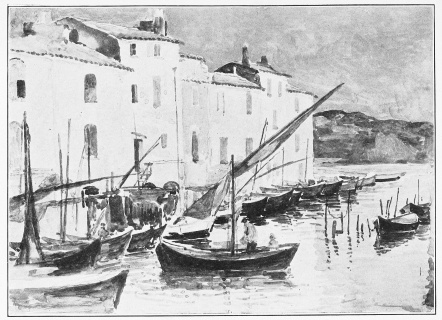
In Toulon’s Old Port
Of all the cities of the Mediterranean (always excepting Marseilles),
Toulon is the most gay. It has not the feverish commercialism of
Marseilles, but it has an up-to-dateness that is quite as much to be
remarked. There are no boulevards maritimes or great hotels, as at
Cannes or Nice, neither are there any special tourist attractions to
make Toulon a resort, but there are cafés galore and much gaiety of a
convivial kind. “Une ville régulière, d’aspect Américain,” Toulon has
been called, and it merits the appellation in some respects, with its
straight streets and tall houses of brick or stone. A large number of
great branching palms just saves the situation.
The great defect of Toulon is that the quarter where centres the life of
the city is far away from the sea. To get a satisfactory view of the
magnificent harbour, or the commercial port of the Vieille Darse, one
has to go even farther afield and climb one or the other of the
hillsides round about, when a truly great panorama spreads itself out.
La Seyne, the great ship-building suburb of Toulon, is a model of what a
manufacturing town of its class should be, though it has no real meaning
for the tourist for rest or pleasure. For the student of things and men,
the case is somewhat different. For instance, you may read, posted up on
the wall opposite the entrance to the ship-building establishment, that
the Gazetta del Popolo of Genoa has a correspondent at Toulon, this in
big, staring red and green letters surmounting a more or less rude
woodcut of an Italian soldier. From this one gathers that the Italian
workmen are numerous hereabouts, as indeed they are, and almost
everywhere else along the coast. As like as not the hotel garçon
serves your soup with an “Ecco,” instead of a “Voilà!” and sooner or
later you come to realize that the hybrid speech which you hear on
street corners is not Provençal but Franco-Italian.
Toulon, in history, makes a long and brilliant chapter, but a
cataloguing even of the events can have no place here. Its prominence as
a stronghold and bulwark of the French nation was due to Louis XII., the
second husband of Anne of Bretagne, who, it is said, inspired his
predecessor on the throne (and in her affections) to first appreciate
the advantages of Brest as a stronghold of a similar character.
Ages before this Toulon was founded by the Phœnicians, it is supposed
sometime before the tenth century. The royal purple of the East and the
desire to possess it, or make it, was the prime cause; for the ancients
found that the waters around Toulon gave birth to a mollusk which dyed
everything with which it came in contact into a most brilliant purple.
It seems a small thing to found a great city upon, and the industry is
non-existent to-day, but such is the more or less legendary account.
After the Phœnicians Toulon fell into the background, and the
possibilities of building here a great port which might rival Marseilles
were utterly neglected.
It seems probable that the original name of the town was Telo, which in
the itinerary of Antony is given as Telo-Martius, from an ancient temple
to Mars, thus distinguishing it from a similar name applied to many
other places in the Narbonnais.
Finally Toulon emerged from its semi-obscurity, and Guillaume de
Tarente, Comte de Provence, in 1055, surrounded with wall “the place
called Tholon or Tollon.”
Until the tenth century Toulon’s ecclesiastical history was more
momentous than was its civic. It had been the seat of a bishop for a
matter of six centuries, with St. Honorat, St. Gratien, and St. Cyprien
as bishops, all within the first century of its existence.
The plan to make Toulon one of the great fortified places of the world
was carried on assiduously by Richelieu, who commanded a certain Jacques
Desmarets, professor of mathematics at the university at Aix, to make a
plan which should show the Provençal coast-line in all its detail. The
instructions read, “...sur vélin, enluminé en or et representant la
côte jusqu’à deux ou trois lieues dans les terres.”
The general scheme was carried out further by Mazarin, the wily Italian
who succeeded Richelieu. In company with Louis XIV., Mazarin visited
Toulon, and then and there decided that it should take the first place
in the kingdom as a stronghold for the navy.
Toulon then became the greatest naval arsenal the world had known. In
1670 it armed forty-two ships of the line, among them many
three-deckers, which all lovers of the romance of the seas have come to
accept as the most imposing craft then afloat, whatever may have been
their additional virtues. Among those fitted for sea and armed at Toulon
was the Magnifique, a vessel which excited universal enthusiasm all
over Europe, not only because it mounted a hundred and four guns, but
because the sculptor Puget had designed her decorations, and decorations
on ships were much more ornate in those days than they are in the
present vagaries of the “art nouveau.”
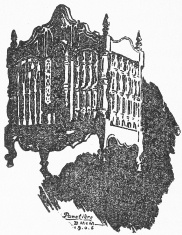
Puget lived at Toulon at the time, and had indeed already designed the
caryatides which stand out so prominently in the Toulon’s Hôtel de
Ville. His house in the Rue de la République, known by every one as the
“Maison Puget,” is one of the shrines at which art-worshippers should
not neglect to pay homage. It has some remarkably beautiful features, a
fine stairway in wrought iron, an elaborate newel-post, and many similar
decorations.
Back of Toulon is the great gray mass of the Faron, fortified, as is
every height and point of view round about. From the summit of this
great height (546 metres) one may see, on a clear day, Corsica and the
Alps of Savoie. The fortifications are too numerous to call by name
here, and, indeed, they are uninteresting enough to the lover of the
romantically picturesque, regardless of their worth from a strategic
point of view. Like the cannon, the forts are everywhere.
Formerly the port of Toulon was closed by sinking a great chain across
the harbour-mouth. It went down with the sinking of the sun and only
rose at daybreak. The guardianship of this defence was given to some
“homme de confiance” of Toulon as a sort of deserved honour or glory.
This was in the seventeenth century, and to-day, though the guard-ships
and the search-lights of the forts do the same service, the name
“Chaine Vieille” is still in the mouths of the old sailors and
fishermen as they make their way to and fro from the Grande to the
Petite Rade.
Toulon has among its great men of the past the name of the Chevalier
Paul, perhaps first and foremost of all the seafarers of France since
the day of Dougay-Trouin. He had fixed his residence in the valley of
the Dardennes, with a roof over his head “tout à fait digne d’un
prince.” In the month of February, 1660, the celebrated sailor received
Louis XIV., Anne of Austria, the Duc d’Orléans, Cardinal Mazarin, “la
grande Mademoiselle,” innumerable princes and seigneurs, four
Secrétaires d’État, the ambassador of Venice, and the papal nuncio. This
royal company was splendidly fêted, much after the manner of those
assemblies held in the previous century in the châteaux of Touraine. The
Chevalier bore until his death the title of supreme “Commandant de la
Marine,” and when his death came, at the age of seventy, he made the
poor of the city his heirs.
One memory of Toulon, which is familiar to students of history and
romance, are the prisons and galleys of other days. Dumas draws a vivid
picture of the life in the galleys in one of his little known but most
absorbing tales, “Gabriel Lambert.”
To be sure, those who were condemned “à ramer sur les galères” were
mostly culprits who deserved some sort of punishment, but the survival
of the institution was one that one marvels at in these advanced
centuries.
Really the galley, and the uses to which it was put at Toulon in the
eighteenth century, was a survival of the galley of the ancients. It was
a long slim craft, of light draught, propelled by a single, double, or
treble bank of oars, and sometimes sails.
The punishment of the galleys, that is to say, the obligation to “ramer
sur les galères,” was applied to certain classes of criminals who were
known as forçats or galériens. The crime of Gabriel Lambert, of whom
Dumas wrote with such fidelity, was that of counterfeiting.
In 1749 there were sixteen galères here, eight of them at “practice”
at one time, giving occupation to thirty-seven hundred convicts who were
quartered on old hulks moored to the quays or on shore in a convict
prison.
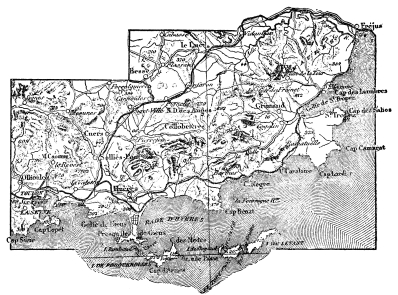
Toulon to Frejus
Between Toulon and Hyères, lying back from the coast, in the valley of
the Gapeau, is a bit of transplanted Africa, where the brilliant sun
shines with all the vigour that it does on the opposite Mediterranean
shore. The valley is perhaps the most important topographically west of
the Rhône, at least until one reaches the Var at Nice. There is a
sprinkling of small towns here and there, and more frequent country
residences and vineyards, but there is an air of solitude about it that
can but be remarked by all who travel by road.
One great highroad runs out from Toulon through Solliès-Pont, Cuers,
Puget-Ville, Pignans, and Le Luc to Fréjus. The coast road leads to the
same objective point, but the characteristics of the two are as
different as can be. A more varied and more charming combination of
scenic charms, than can be had by journeying out via one route and back
by the other, can hardly be found in this world, unless one has in mind
some imaginary blend of Switzerland and the Mediterranean.
The region is known as Les Maures, the name in reality referring to the
mountain chain whose peaks follow the coast-line at a distance of from
thirty to fifty kilometres.
The whole region known as Les Maures is in a state of semi-solitude;
twenty-three thousand souls for an area of one hundred and twenty
thousand hectares is a remarkable sparsity of population for most parts
of France.
Cuers is the metropolis of the region and boasts of some three thousand
inhabitants, and a great trade in the oil of the olive.
There is absolutely nothing of interest to the tourist in any of these
little towns between Toulon and Fréjus. There is to be sure the usual
picturesque church, which, if not grand or architecturally excellent, is
invariably what artists call “interesting,” and there is always a
picturesque grouping of roof-tops, clustered around the church in a
manner unknown outside of France.
Occasionally one does see a small town in France which reminds him of
Italy, and occasionally one that suggests Holland, but mostly they are
French and nothing but French, though they be as varied in colour as
Joseph’s coat, and as diversified in manners and customs as one would
imagine of a country whose climate runs the whole gamut from northern
snows to southern olive groves.
In reality, Cuers shares its importance with Les Solliès, whose curious
name grew up from the memory of a Temple of the Sun, upon the remains of
which is built the present church of Solliès-Ville.
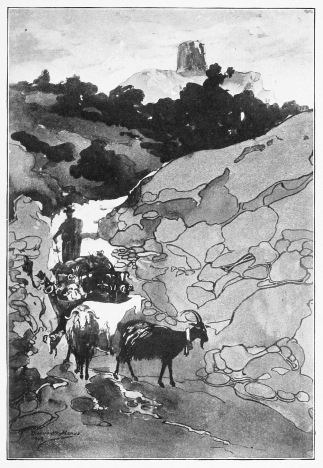
In Les Maures
Solliès-Pont owes its name to the pont, or bridge, by which the “Route
Nationale” crosses the Gapeau. It is the centre of the cherry culture in
the Var, and at the time of year when the trees are in blossom, the
aspect of the surrounding hillsides would put cherry-blossoming Japan
to shame. The crop is the first which comes into the market in France.
The lovers of early fruits, in Paris restaurants and hotels, know the
“cerises du Var” very well indeed. They buy them at the highest market
prices, delightfully put up in boxes of poplar-wood and garnished with
lace-paper. Annually Solliès-Pont despatches something like a hundred
thousand cases of these first cherries of the year, each weighing from
three to twelve kilos, and bringing—well, anything they can command,
the very first perhaps as much as eight or ten francs a kilo. This for
the first few straggling boxes which some fortunate grower has been able
to pick off a well-sunned tree. Within a fortnight the price will have
fallen to fifty centimes, and at the end of a month the traffic is all
over, so far as the export to outside markets is concerned.
“Cherries are grown everywhere,” one says. Yes, but not such cherries as
at Solliès-Pont.
Here at this little railway station in the Var one may see a whole train
loaded with a hundred thousand kilos of the most luscious cherries one
ever cast eyes upon.
The aspect of the region round about has nothing of the grayness of the
olive orchards east and west; all this has given way to a flowering
radiance and a brilliant green, as of an oasis in a desert.
The gathering of this important crop is conducted with more care than
that of any other of the Riviera. The trees are not shaken and their
fruit picked up off the ground, nor do agile lads climb in and out among
the branches. Not even a ladder is thrust between the thick leaves of
the trees, but a great straddling stepladder, like those used by the
olive pickers of the Bouches-du-Rhône, is carried about from tree to
tree, and gives a foothold to two, three, or even four lithe, young
girls, whose graces are none the less for their gymnastics at reaching
for the fruit head-high and at arm’s length.
One marvels perhaps—when he sees these boxes of luscious cherries in
the Paris market—as to how they may have been packed with such
symmetry. It is very simple, though the writer had to see it done at
Solliès-Pont before he realized it. The boxes are simply packed from the
top downwards, so to speak. The first layer is packed in close rows, the
stems all pointing upwards, then the rest of the contents are put in
without plan or design, and the cover fastened down. When the packages
are opened, it is the bottom that is lifted, and thus one sees first
the rosy-red globules, all in rows, like the little wooden balls of the
counting machines.
The south of France is destined to provision a great part of Europe, and
already it is playing its part well. The cherries of Solliès-Pont
go—after Paris has had its fill—to England, Switzerland, Belgium,
Germany, and Russia, though doubtless only the “milords” and
millionaires get a chance at them.
Besides the consumption of the fruit au naturel, the cherries of the
Var are the most preferred of all those delicacies which are preserved
in brandy, and a cocktail, of any of the many varieties that are made in
America (and one place, and one only, in Paris—which shall be
nameless), with one of the cherries of Solliès-Pont drowned therein, is
a superdelicious thing, unexcelled in all the “made drinks” the world
knows to-day.
THE real French Riviera is not the resorts of rank and fashion alone; it
is the whole ensemble of that marvellous bit of coast-line extending
eastward from Toulon to the Italian frontier. Topographically,
geographically, and climatically it abounds in salient features which,
in combination, are unknown in any similar strip of territory in all the
world, though there is very little that is strange, outré, or exotic
about any of its aspects. It is simply a combination of conditions which
are indigenous to the sunny, sheltered shores of the northern
Mediterranean, which are here blessed, owing to a variety of reasons,
with a singularly equable climate and situation.
Doubtless the region is not the peer of southern California in
topography or climate; indeed, without fear or favour, the statement is
here made that it is not; but it has what California never has had, nor
ever will, a history-strewn pathway traversing its entire length, where
the monuments left by the ancient Greeks and Romans tell a vivid story
of the past greatness of the progenitors and moulders of modern
civilization.
This in itself should be enough to make the Riviera revered, as it
justly is; but it is not this, but the gay life of those who neither
toil nor spin that makes this world’s beauty-spot (for Monaco and Monte
Carlo are assuredly the most beautiful spots in the world) so worshipped
by those who have sojourned here.
This is wrong of course, but the simple life has not yet come to be the
institution that its prophets would have us believe, and, after all, a
passion of some sort is the birthright of every man, whether it be
gambling at Monte Carlo, automobiling on sea or land, painting, or
attempting to paint, the masterpieces of nature, or studying historic
monuments. At any rate, all these diversions are here, and more, and, as
one may pursue any of them under more idyllic conditions here than
elsewhere, the Riviera is become justly famed—and notorious.
Not all Riviera visitors live in palatial hotels; some of them live en
pension, which, like the boarding-house of other lands, has its
undeniable advantage of economy, and its equally undeniable
disadvantages too numerous to mention and needless to recall.
Of course the Riviera has undeniable social attractions, since it was
developed (so far as the English—and Americans—are concerned) by that
vain man, Lord Brougham.
Lord Brougham, Lord Chancellor of England, first gave the popular fillip
to Cannes in the early years of Queen Victoria’s reign. From that time
the Riviera, east and west of Cannes, has steadily increased in
popularity and in transplanted institutions. The chief of these is
perhaps the tea-tippling craze which has struck the Riviera with full
force. It’s not as exhilarating an amusement as automobiling, which runs
it a close second here, but a “tea-fight” at a Riviera hôtel de luxe
has at least something more than the excitement of a game of golf or
croquet, which also flourish on the sand-dunes under the pines, from St.
Tropez to Menton, and even over into Italy.
It’s a pity the tea-drinking craze is so monopolizing,—really it is as
bad as the “Pernod” habit, and is no more confined to old maids than are
Bath chairs or the reading of the Morning Post. Bishop Berkeley
certainly was in error when he wrote, or spoke, about the “cup that
cheers but does not inebriate,” for the saying has come to be one of
the false truths which is so much of a platitude that few have ever
thought of denying it.
The doctors say that one should not take tea or alcohol on the Riviera,
the ozone of the climate supplying all the stimulant necessary. If one
wants anything more exciting, let him try the tables at Monte Carlo.
Riviera weather is a variable commodity. Some localities are more
subject to the mistral than others, though none admit that they have it
to the least degree, and some places are more relaxing than others.
Menton is warm, and very little rain falls; Nice is blazing hot and cold
by turn; and there are seasons at Cannes, in winter, when, but for the
date in the daily paper, you would think it was May.
Beaulieu and Cap Martin lead off for uniformity of the day and night
temperature. The reading at the former place (in that part known as
“Petite Afrique”) on a January day in 1906 being: minimum during the
night, 9° centigrade; maximum during the day, 11° centigrade; 8 A. M.,
10° centigrade; 2 P. M., 9° centigrade, and, in a particularly
well-sheltered spot in the gardens of the Hôtel Metropole, 15°
centigrade. This is a remarkable and convincing demonstration of the
claims for an equable temperature which are set forth.
In general this is not true of the Riviera. A bright, sunny, and
cloudless January day, when one is uncomfortably warm at midday, is, as
likely as not, followed at night by a sudden fall in temperature that
makes one frigid, if only by contrast.
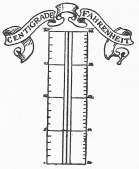
Comparative Theometric Scale
The Riviera house-agent tells you: “Do not come here unless you are
prepared to stay” (he might have added “and pay”), “for the Riviera
renders all other lands uninhabitable after once you have fallen under
its charm.”
Amid all the gorgeousness of perhaps the most exquisite beauty-spot in
all the world—that same little strip of coast between Hyères and
Menton—is a colony of parasitic dwellers who are no part of the
attractions of the place; but who unconsciously act as a loadstone which
draws countless others of their countrymen, with their never absent
diversions of golf, tennis, and croquet. One pursues these harmless
sports amid a delightful setting, but why come here for that purpose?
One cannot walk the Boulevards and Grandes Promenades all of the
time, to be sure, but he might take that rest which he professedly comes
for, or failing that, take a plunge into the giddy whirl of the life of
the “Casino” or the “Cercle.” The result will be the same, and he will
be just as tired when night comes and he has overfed himself with a
dîner Parisien at a great palace hotel where the only persons who do
not “dress” are the waiters.
This is certain,—the traveller and seeker after change and rest will
not find it here any more than in Piccadilly or on Broadway, unless he
leaves the element of big hotels far in the background, and lives simply
in some little hovering suburb such as Cagnes is to Nice or Le Cannet to
Cannes, or preferably goes farther afield. Only thus may one live the
life of the author of the following lines:
“There found he all for which he long did crave,
Beauty and solitude and simple ways,
Plain folk and primitive, made courteous by
Traditions old, and a cerulean sky.”
The rest is hubble, bubble, toil, and trouble of the same kind that one
has in the hotels of San Francisco, London, or Amsterdam; everything
cooked in the same pot and tasting of cottolene and beef extract.
There is some truth in this,—for some people,—but the ties that bind
are not taken into consideration, and, though the words are an echo of
those uttered by Alphonse Karr when he first settled at St.
Raphaël,—after having been driven from Étretat by the vulgar
throng,—they will not fit every one’s ideas or pocket-books.
Popularity has made a boulevard of the whole coast from St. Raphaël to
San Remo, and indeed to Genoa, and there is no seclusion to be had, nor
freedom from the “sirens” of automobiles, or the tin horns of trams and
whistles of locomotives; unless one leaves the beaten track and settles
in some background village, such as Les Maures or the Estérel, where the
hum of life is but the drone of yesterday and Paris papers are three
days old when they reach you.
For all that the whole Riviera, and its gay life as well, is delightful,
though it is as enervating and fatiguing as the week’s shopping and
theatre-going in Paris with which American travellers usually wind up
their tour of Europe.
The Riviera isn’t exactly as a Frenchman wrote of it: “all Americans,
English, and Germans,” and it is hardly likely you will find a hotel
where none of the attendants speak French (as this same Frenchman
declared), but nevertheless “All right” is as often the reply as “Oui,
monsieur.”
All the multifarious attractions of this strip of coast-line are doubly
enhanced by the delicious climate, and the wonders of the Baie des Anges
and the Golfe de la Napoule are more and more charming as the sun rises
higher in the heavens, and La Napoule, St. Jean, Beaulieu, Passable,
Villefranche, Cap Martin, and Cap Ferrat, the “Corniche,” La Turbie,
Monaco, and Menton are all names to conjure with when one wants to call
to mind what a modern Eden might be like.
Of course Monte Carlo dominates everything. It is the one objective
point, more or less frequently, of all Riviera dwellers. The
sumptuousness of it acts like a loadstone toward steel, or the
candle-flame to the moth, and many are the wings that are singed and
clipped within its boundaries.
Whatever may be the moral or immoral aspect of Monte Carlo, it does not
matter in the least. It has its opponents and its partisans,—and the
bank goes on winning for ever. Meantime the whole region is prosperous,
and the public certainly gets what it comes for. The Monégasques
themselves profit the most however. They are, for instance, exempt from
taxes of any sort, which is considerable of a boon in heavily taxed
continental Europe.
Monte Carlo is an enigma. Its palatial hotels, its Casino, its game, and
its concerts and theatre, its pigeon-shooting, its automobile yachting,
and all the rest contribute to a round of gaiety not elsewhere known. It
may rain “hallebardes,” as the French have it, but the most adverse
weather report which ever gets into the papers from Monte Carlo is
“ciel nuageux.”
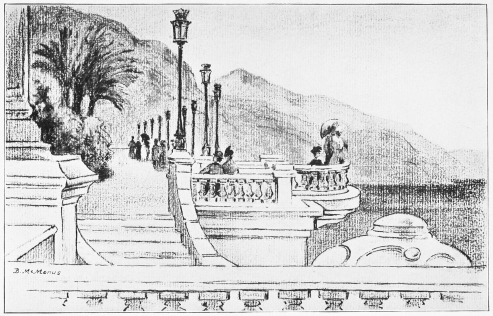
The Terrace, Monte Carlo
If Marseilles is the “Modern Babylon” of the workaday world, the
Riviera—in the season—may well be called the “Cosmopolis de luxe.”
In winter all nations under the sun are there, but in summer it is quite
another story; still, Monte Carlo’s tables run the year around, and,
as the inhabitant of the principality is not allowed to enter its
profane portals, it is certain that visitors are not entirely absent.
There are three distinct Rivieras: the French Riviera proper, from
Toulon to Menton; the Italian Riviera, from Bordighera to Alassio; and
the Levantine Riviera, from Genoa to Viareggio.
Partisans plead loudly for Cairo, Biskra, Capri, Palermo, and
Majorca,—and some for Madeira or Grand Canary,—but the comparatively
restricted bit of Mediterranean coast-line known as the three Rivieras
will undoubtedly hold its own with the mass of winter birds of passage.
Just why this is so is obvious for three reasons. The first because it
is accessible, the second, because it is moderately cheap to get to, and
to live in after one gets there, unless one really does “plunge,” which
most Anglo-Saxons do not; and the third,—whisper it gently,—because
the English or American tourist, be he semi-invalid or be he not, hopes
to find his fellows there, and as many as possible of his pet
institutions, such as afternoon tea and cocktails, marmalade and broiled
live lobsters, to say nothing of his own language, spoken in the
lisping accents of a Swiss or German waiter.
It is not necessary to struggle with French on the Riviera, and the
estimable lady of the following anecdote might have called for help in
English and got it just as quickly:
At the door of a Riviera express, stopping at the Gare de Cannes, an
elderly English lady tripped over the rug and was prostrated her
full-length on the platform.
Gallant Frenchmen rushed to her aid from all quarters: “Vous n’avez pas
de mal, madame?” “Merci, non, seulement une petite sac de voyage,” she
replied, as she limpingly and lispingly made her way through the crowd.
This ought to dispose of the language question once for all. If you are
on the Riviera, speak English, or, likely enough, you will fall into
similar errors unless you know that vague thing, idiomatic French, which
is only acquired by familiarity.
The French Riviera has from forty to fifty rainy days a year, which is
certainly not much; and it is conceivable that a stay of two months at
Nice, Cannes, or Menton will not bring a rainy day to mar the memory of
this sunny land. On the other hand, the Levantine Riviera may have ten
days of rain in a month, and the next month another ten days may
follow—or it may not. It is well, however, not to overlook the fact
that Pisa, not so very far inland from the easternmost end of the
Italian Riviera, is called the “Pozzo dell Italia”—the well of Italy.
There was a time when Cannes, Nice, and Menton were favoured as invalid
resorts, and as mere pleasant places to while away a dull period of
repose, but to-day all this is changed, and even the semi-invalid is
looked at askance by the managers of hotels and the purveyors of
amusements.
The social attractions have quite swamped the health-giving inducements
of the chief towns of the Riviera, and the automobile has taken the
place of the Bath chair; indeed, it is the world, the flesh, and the
devil which have come into the province where ministering angels
formerly held sway.
At the head of all the throng of Riviera pleasure-seekers are the
royalties and the nobility of many lands. “Au-dessous d’eux,” as one
reads in the monologue of Charles Quint, “la foule,” but here the
throng is still those who have the distinction of wealth, whatever may
be their other virtues. A “petit millionaire Français,” by which the
Frenchman means one who has perhaps thirty thousand francs a year,
stands no show here; his place is taken by the sugar and copper kings
and “milords” and millionaires from overseas.
There are others, of course, who come and go, and who have not got a
million sous, or ever will have, but the best they can do is to hire a
garden seat on the promenade and with Don Cesar de Bazan “regarder
entrer et sortir les duchesses.” It is either this (in most of the
resorts of fashion along the Riviera) or one must “manger les
haricots” for eleven months in order to be able to ape “le monde” for
the other twelfth part of the year. Most of us would not do the thing,
of course, so we are content to slip in and out, and admire, and marvel,
and deplore, and put in our time in some spot nearer to nature, where
dress clothes cease from troubling and functions are no more.
JUST off the coast road from Toulon to Hyères is the tiny town of La
Garde. The commune boasts of twenty-five hundred inhabitants, most of
whom evidently live in hillside dwellings, for the town proper has but a
few hundreds, a very few, judging from its somnolence and lack of life.
More country than town, the district abounds in lovely sweeps of
landscape. Pradet, another little village, lies toward the coast, and,
amid the dull grays of the olive-trees, gleams the white tower of a
chapel which belongs to the modern château. The chapel, which bears the
sentimental nomenclature of “La Pauline,” is filled by a wonderful lot
of sculptures from the chisel of Pradier. Decidedly it is a thing to be
seen and appreciated by lovers of sculptured art, even though its modern
château is painful in its bald, pagan architectural forms.
Beyond La Garde lies the plain of Hyères, and offshore the great Golfe
de Giens, well sheltered and surrounded by the peninsula of the same
name, one of the beauty-spots of the Mediterranean scarcely known and
still less visited by tourists. Directly off the tip end of the
peninsula of Giens is a little group of rocky isles known as the Iles
d’Hyères. They are indescribably lovely, but the seafarers of these
parts of the Mediterranean dread them in a storm as do Channel sailors
the Casquets in a fog.
The chief of these isles is Porquerolles, and it possesses a village of
the same name, which has never yet been marked down as a place of
resort. To be sure, no one, unless he were an artist attached to the
painting of marines, or an author who thought to get far from the
madding throng, would ever come here, anyway. The village is not so bad,
though, and it is as if one had entered a new world. There is an inn
where one is sure of getting a passable breakfast of fish and eggs; a
“Grande Place” which, paradoxically, is not grand at all; and a humble
little church which is not bad in its way. Two or three cafés, a
bake-shop, and a Bureau des Douanes, of course, complete the business
part of the place. Each little maisonette has a terrace overshadowed
with vines, and, all in all, it is truly an idyllic little settlement.
The isle culminates in a peak five hundred feet or so high, on the top
of which is seated a fortification called Fort de la Repentance.
The entire isle, with the exception of that portion occupied by the fort
and its batteries, belongs to a M. and Madame de Roussen, who are known
to readers of French novels under the names of Pierre Ninous and Paul
d’Aigremont. The proprietors have charmingly ensconced themselves in a
delightful residence, which, if it does not rise to the dignity of a
château, has as magnificent a stage setting as the most theatrical of
the châteaux of the Loire; only, in this case, it is a seascape which
confronts one, instead of the sweep of the broad blue river of Touraine.
Two hundred and fifty inhabitants live here, but away in the west there
was formerly a colony of a thousand or more workmen engaged in the
manufacture of soda. For more reasons than one—the principal being that
the sulphurous fumes from the works were having an ill effect on the
verdure—the establishment was purchased by the present proprietors of
the isle.
The village has somewhat of the airs of its bigger brothers and sisters
elsewhere in that its streets are lighted at night; the wharves are as
animated as those of a great world-town, particularly on the arrival of
the boat from Toulon; and the market-women sit about the street corners
with their wares picturesquely displayed before them as they do in
larger communities.
Truly, Porquerolles is unspoiled as yet, and the marvel is that it has
not become an “artist’s sketching-ground” before now. It has many claims
in this respect besides its natural beauties and attractions, one, not
unappreciated by artists, being that it is not likely to be overrun by
tourists. The reason for this is that the Courrier des Iles d’Hyères,
as the diminutive steamer which arrives three times a week is called, is
subsidized by the ministry for war, and the captain has the right to
refuse passage to civilians when his craft is overloaded with travelling
soldiers and sailors, whom the French government, presumably from
motives of economy, prefers to move in this way from point to point
among the various forts along the coast.
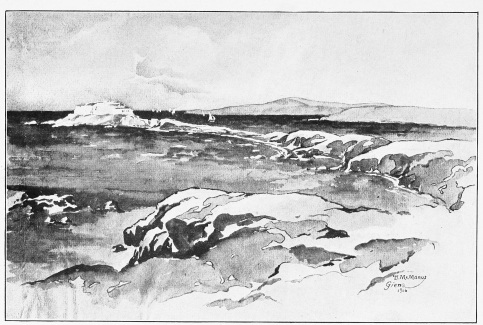
The Peninsula of Giens
Four or five other islets make up the group which geographers and
map-makers know as the Iles d’Hyères, but which the sentimental
Provençaux best like to think of as the Iles d’Or; but their
characteristics are quite the same as Porquerolles. There is here a
picturesque fort called Alicastre, derived from Castrum Ali, a souvenir,
it is said, of a Saracen chief who once entrenched himself here. Local
report has it that the Man in the Iron Mask was imprisoned here at one
time, but the nearest that history comes to this is to place his
imprisonment at Ste. Marguerite and the Château d’If.
From the sea, as one comes by boat from Toulon, the Presqu’ile de Giens
looks as though it were an island and had no connection with the land,
for the neck connecting it with the mainland is invisible, both from the
eastward and the westward, while the rocks of the tip end of the
peninsula are abruptly imposing as they rise from the sea-level to a
moderate but jagged height.
As one approaches closer he notes the capricious scallops of the
shore-line of this bizarre but beautiful jutting point, and
congratulates himself that he did not make his way overland.
A little village is in the extreme south, its whitewashed houses
shepherded by a little church and the ruins of an old fortress-château.
The town is as nothing, but the view is most soothing and tranquil in
its impressive beauty and quiet charm. Nothing is violent or
exaggerated, but the components of many ideal pictures are to be had for
the turning of the head. Giens is another “artist’s sketching-ground”
which has been wofully neglected.
The eastern shore is less savage and there are some attempts at
agriculture, but on the whole Giens and its peninsula are but a distant
echo of anything seen elsewhere. The quadrilateral walls of the old
château, a semaphore, and a coast-guard station form, collectively, a
beacon by sea and by land, and, as one makes his way to the mainland
along the narrow causeway, he is reminded of that sandy ligature which
binds Mont St. Michel with Pontorson, on the boundary of Brittany and
Normandy.
Hyères is no longer fashionable. One would not think this to read the
alluring advertisements of its palatial hotels, which, if not so grand
and palatial as those at Monte Carlo, are, at least, far more splendid
than those “board-walk “ abominations of the United States, or the
deadly brick Georgian façades which adorn many of the sea-fronts of the
south coast of England. The fact is, that society, or what passes for
it, flutters around the gaming-tables of Monte Carlo, though for
motives of economy or respectability they may sojourn at Nice, Menton,
or Cap Martin.
For this reason Hyères is all the more delightful. It is the most
southerly of all the Riviera resorts, and, while it is still a place of
villas and hotels, there is a restfulness about it all that many a
resort with more lurid attractions entirely lacks.
Built cosily on the southern slope of a hill, it is effectually
sheltered from the dread mistral, which, when it blows here, seems to
come to sea-level at some distance from the shore. The effect is curious
and may have been remarked before. The sea inshore will be of that
rippling blue that one associates with the Mediterranean of the poets
and painters, while perhaps a league distant it will roll up into those
choppy whitecaps which only the Mediterranean possesses in all their
disagreeableness. Truly the wind-broken surface of the Mediterranean in,
or near, the Golfe de Lyon is something to be dreaded, whether one is
aboard a liner bound for the Far East or on one of those abominable
little boats which make the passage to Corsica or Sardinia.
Hyères in one of its moods is almost tropical in its softness with its
famous avenue of palms which wave in the gentle breezes which spring up
mysteriously from nowhere and last for about an hour at midday. Its
avenues and promenades are delightful, and there is never a suggestion
of the snows which occasionally fall upon most of the Riviera resorts at
least once during a winter. The only snow one is likely to see at Hyères
is the white-capped Alps in the dim northeastern distance, and that will
be so far away that it will look like a soft fleecy cloud.
Hyères is beautiful from any point of view, even when one enters it by
railway from Marseilles, and even more so—indescribably more so, the
writer thinks—when approaching by the highroad, from Toulon or
Solliès-Pont, awheel or “en auto.”
Of all the historical memories of Hyères none is the equal of that
connected with St. Louis. None will be able to read without emotion the
memoirs of Joinville, giving the details of the return of Louis IX. and
his wife, Marguerite de Provence, from the Crusades. The account of
their arrival “au port d’Yeres devant le chastel” is most thrilling.
One readily enough locates the site to-day, though the outlines of the
old city walls and the château have sadly suffered from the stress of
time.
This was a great occasion for Hyères; the greatest it has ever known,
perhaps. “They saluted the returning sovereign with loud acclamations,
and the standard of France floated from the donjon of the castle as
witness to the fidelity of the inhabitants for the sovereign.”
The “good King René,” in a later century, had a great affection for
Hyères also, and was equally beloved by its inhabitants. One of his
legacies to Jeanne de Provence were the salt-works of Hyères, which were
even then in existence.
Hyères enjoyed a strenuous enough life through all these years, but the
saddest event in its whole career was when the traitorous Connétable de
Bourbon took the château and turned it over to France’s arch-enemy,
Charles V.
Charles IX. visited Hyères and remained five days within its walls, “his
progress having been made between two rows of fruit-bearing
orange-trees, freshly planted in the streets through which he was to
pass.” This flattery so pleased the monarch that he himself, so history,
or legend, states, carved the following inscription upon the trunk of
one of those same orange-trees, “Caroli Regis Amplexu Glorior.”
One of the most beautiful strips of coast-line on the whole Riviera
lies between Hyères and Fréjus. A narrow-gauge railway makes its way
almost at the water’s edge for the entire distance, and the coast road,
a great departmental highway, follows the same route. The distance is
too great—seventy-five kilometres or more—for the pedestrian, unless
he is one who keeps up old-time traditions, but nevertheless there is
but one way to enjoy this everchanging itinerary to the full, and that
is to make the journey somehow or other by highroad. The automobile, a
bicycle, or a gentle plodding burro will make the trip more enjoyable
than is otherwise conceivable, even though the striking beauties which
one sees from the slow-running little train give one a glimmer of
satisfaction. Seventy-five kilometres, scarce fifty miles! It is nothing
to an automobile, not much more to a bicycle, and only a two-days’ jaunt
for a sure-footed little donkey, which you may hire anywhere in these
parts for ten francs a day, including his keeper. No more shall be said
of this altogether delightful method of travelling this short stretch of
wonderland’s roadway, but the suggestion is thrown out for what it may
be worth to any who would taste the joys of a new experience.
Close under the frowning height of Les Maures runs the coast road, for
quite its whole length up to Fréjus, while on the opposite side, and
beneath, are the surging, restless waves of the Mediterranean.
First one passes the Salines de Hyères, one of those great governmental
salt-works which line the Mediterranean coast, and soon reaches La
Londe, famous for its lead mines and the rude gaiety of its seven or
eight hundred workmen, who on a Sunday go back to primitive conditions
and eat, drink, and make merry in rather a Gargantuan manner. This will
not have much interest for the lover of the beautiful, but up to this
point he will have regaled himself with a promenade along a beautiful
sea-bordered roadway, whose opposite side has been flanked with
rose-laurel, palms, orange-trees, and many exotic plants and shrubs of
semi-tropical lands.
From La Londe and its sordid industrialism one has twenty straight
kilometres ahead of him until he reaches Bormes, a town which has been
considered as a possible rival to Nice and Cannes, but which has never
got beyond the outlining of sumptuous streets and boulevards and the
erecting of two great hotels to which visitors do not come. It is an
exquisite little town, the old bourg parallelled with the tracery of
the new streets and avenues. Take it all in all, the site is about one
of the best in the south for a winter station, though the non-proximity
of the sea—a strong five kilometres away—may account for the slow
growth of Bormes as a popular resort.
The old town is most picturesque, its tortuous, sloping streets ever
mounting and descending and making vistas of doorways and window
balconies which would make a scene-painter green with envy, everything
is so theatrical. Like some of the little hill-towns of the country to
the westward of Aix, Bormes is a reflection of Italy, although it has
its own characteristics of manners and customs.
The country immediately around this little town of less than seven
hundred souls is of an incomparable splendour. There is nothing exactly
like it to be seen in the whole of Provence. In every direction are seen
little scattered hamlets, or a group of two or three little houses
hidden away amid groves of eucalyptus and thickets of mimosa, while the
flanking panorama of Les Maures on one side, and the Mediterranean on
the other, gives it all a setting which has a grandeur with nothing of
the pretentious or spectacular about it. It is all focussed so finely,
and it is so delicately coloured and outlined that it can only be
compared to a pastel.
The Rade de Bormes, though it really has nothing to do with Bormes, a
half a dozen kilometres distant, is another of those delightful bays
which are scattered all along the Mediterranean shore. It has all the
beauty which one’s fancy pictures, and the maker of high-coloured
pictures would find his paradise along its banks, for there is a
brilliancy about its ensemble that seems almost unnatural.
In 1482 St. François de Paule, called to France by the death of Louis
XI., landed here. At the time Bormes was stricken with a plague or pest,
and all intercourse with strangers was forbidden. But, when the saint
demanded aid and refreshment after his long voyage, it was necessary to
draw the cordon and open the gates of the town. In return for this
hospitality, it is said by tradition, the holy man cured miraculously
the sick of the town. The popular devotion to St. François de Paule
exists at Bormes even up to the present day, in remembrance of this
fortunate event.
The old town itself is built on the sloping bank of a sort of natural
amphitheatre, in spite of which it is well shaded and shadowed by
numerous great banks of trees, while in every open plot may be seen
aloes, cactus, agavas, immense geraniums, and the Barbary fig.
The ruins of the feudal château of Bormes recall the memory of the
Baroness Suzanne de Villeneuve, of Grasse and Bormes, who, in the
sixteenth century, so steadfastly sought to avenge the assassination of
her husband.
Bormes possesses one other historic monument in the Hermitage of Notre
Dame de Constance, which, on a still higher hill, dominates the town,
and everything else within the boundary of a distant horizon, in a
startling fashion.
Below, on the outskirts, is an old chapel and its surrounding cemetery,
which, more than anything else in all France, looks Italian to every
stone.
One other shrine, this time an artistic one as well as a religious one,
gives Bormes a high rank in the regard of worshippers of modern art and
artists. On the little Place de la Liberté is the Chapelle St. François
de Paule, where is interred the remains of the painter Cazin.
In spite of the fact that it is far from the sea, Bormes has its
“faubourg maritime,” a little port which has an exceedingly active
commerce for its size. In reality the word port is excessive; it is
hardly more than a beach where the fishermen’s boats are hauled up like
the dories of down-east fishermen in New England. There is an apology
for a dike or mole, but it is unusable. This will be the future ville
de bains if Bormes ever really does become a resort of note. Its
assured success is not yet in sight, and accordingly Bormes is still
tranquil, and there are no noisy trams and hooting train-loads of
excursionists breaking the stillness of its tranquil life.
FROM Bormes the route runs close to the shore-line up to the Baie de
Cavalaire, where it cuts across a ten-kilometre inland stretch and comes
to the sea again at St. Tropez.
The blue restless waves, the jutting capes, and the inlet bays and
calanques make charming combinations of land and sea and sky, and
repeat the story already told. The route crosses many vine-planted hills
and valleys, through short tunnels and around precipitous promontories,
but always under the eyes is that divinely beautiful view of the waters
of the Mediterranean. The traveller finds no villages, only little
hamlets here and there, and innumerable scattered country residences.
At Cavalaire the mountains of the Maures become less abrupt, and
surround the bay in a low semicircle of foot-hills, quite different from
the precipitous “corniches” of the Estérel or the mountains beyond
Nice.
The Baie de Cavalaire has nearly a league of fine sands; not so
extensive that they are as yet in demand as an automobile race-track,
but fine enough to rank as quite the best of their kind on the whole
Mediterranean shore of France. There will never be a resort here which
will rival Nice or Cannes; these latter have too great a start; but
whatever does grow up here in the way of a watering-place—a railway
station and a Café-Restaurant famous for its bouillabaisse have
already arrived—will surpass them in many respects.
The place has, moreover, according to medical reports, the least
contrasting day and night temperature in winter of any of the
Mediterranean stations. This would seem cause enough for the founding
here of a great resort, but there is nothing of the kind nearer than the
little village of Le Lavandou, passed on the road from Bormes, a hamlet
whose inhabitants are too few for the makers of guide-books to number,
but which already boasts of a Grand Hotel and a Hôtel des Étrangers.
At La Croix, just north of the Baie de Cavalaire, has grown up a little
winter colony, consisting almost entirely of people from Lyons. It is
here that formerly existed some of the most celebrated vineyards in
Provence, the plants, it is supposed, being originally brought hither
by the Saracens.
The sudden breaking upon one’s vision of the ravishing Golfe de St.
Tropez, with its bordering fringe of palms, agavas, and rose-laurels,
and its wonderful parasol-pines, which nowhere along the Riviera are as
beautiful as here, is an experience long to be remembered.
The lovely little town of St. Tropez sleeps its life away on the shores
of this beautiful bay, quite in idyllic fashion, though it does boast of
a Tribunal de Pêche and of a few small craft floating in the gentle
ripples of the darse, the little harbour enclosed by moles of masonry
from the open gulf.
Up and down this basin are groups of fine parti-coloured houses, all
with a certain well-kept and prosperous air, with nothing of the sordid
or base aspect about them, such as one sees on so many watersides. A
little square, or place, forms an unusual note of life and colour with
its central statue of the great sailor, Suffren.
Only on this square and on the quays are there any of the modern
attributes of twentieth-century life; the narrow but cleanly streets
away from the waterside are as calm and somnolent as they were before
the advent of electricity and automobiles; indeed, an automobile would
have a hard time of it in some of these narrow ruelles.
The near-by panorama seen from the quays, or the end of the stone
pier-head, is superb. The whole contour of the Golfe is a marvel of
graceful curves, backed up with sloping, well-wooded hills and, still
farther away, by the massive black of the Maures, the hill of St.
Raphaël, and the red and brown tints of the Estérel, while still more
distant to the northward, hanging in a soft film of vapour, are the
peaks of the snowy Alps.
By following the old side streets, crowded with overhanging porches and
projecting buttresses, with here and there a garden wall half-hiding
broad-leafed fig-trees and palms, one reaches the Promenade des Lices, a
remarkably well-placed and appointed promenade, shaded with great
plane-trees, in strong contrast to the occasional pines and laurels.
St. Tropez’s history is ancient enough to please the most blasé delver
in the things of antiquity. It may have been the Gallo-Grec Athenopolis,
or it may have been the Phœnician Heraclea Caccabaria; but, at all
events, its present growth came from a foundation which followed close
upon the death of the martyr St. Tropez in the second century.
St. Tropez, in the days when sailing-ships had the seas to themselves,
was possessed of a traffic and a commerce which, with the advent of the
building of great steamships, lapsed into inconsequential proportions.
The yards where the wooden ships were built and fitted out are deserted,
and a part of the population has gone back to the land or taken to
fishing; others—the young men—becoming garçons de café or valets de
chambre in the great tourist hotels of the coast; or, rather, they did
look upon these occupations as a bright and rosy future, until the
coming of the automobile, since when the peasant youth of France aspires
to be a chauffeur or mécanicien.
A new industry has recently sprung up at St. Tropez, the manufacture of
electric cables, but it has not the picturesqueness, nor has it as yet
reached anything like the proportions, of the old hempen cordage
industry.
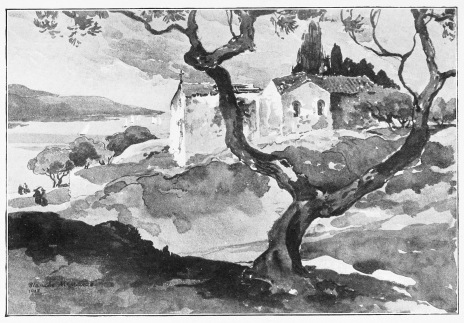
Ruined Chapel near St. Tropez
St. Tropez possesses its wonderful Golfe, its gardens, and its “Petite
Afrique,” and is more and more visited by Riviera tourists; but it
still awaits that great tide of traffic which has made more famous and
rich many other less favoured Mediterranean coast towns. There is a
reason for all this; principally that it faces the mistral’s icy breath,
for the coast-line has here taken a bend and the Golfe runs inland in a
westerly direction, which makes the town face directly north. As an
offset to this the inhabitant points out to you that you may regard the
sea without being troubled by the sun shining in your eyes.
At the head of the Golfe is La Foux. It sits in the midst of a sandy
plain, surrounded by a border of superb umbrella-pines. The chief
attraction for the visitor is the remarkable specimens of the little
horses of Les Maures to be seen here. They are known as “les Eygues,”
and have preserved all the purity of the type first brought from the
Orient by the Saracens. Six centuries and more have not wiped out the
Arab strain to anything like the extent that might be supposed, and
accordingly the little horses of Les Maures are vastly more docile and
agreeable playmates than the “petits chevaux” of the Casinos of Monte
Carlo and Nice.
The umbrella or parasol pines of La Foux are famous throughout the whole
Riviera. Elsewhere there are isolated examples, but here there are
groves of them, all branching with a wide-spreading luxuriance which is
quite at its best. It might seem as though they were planted by the
hand of man, so decorative are they to the landscape from any point of
view, but most of them are of an age that precludes all thought of this.
The giant of its race is directly on the bank of the Golfe, near the
Château de Berteaux. Its branches extend out in every direction, like
the ribs of a parasol or umbrella, and its trunk is thirty feet or more
in circumference, while the shadow from its overhanging branches makes a
great round oasis of shade in the brilliant Mediterranean sunlight. The
tree and its position cannot be mistaken by travellers by road or rail,
for the railway itself has a “halte” almost beneath its branches. All
around these parasol-pines push themselves up through the sand which has
been carried down into the headwaters of the Golfe by the Mole and the
Giscle, torrents which at certain seasons bring down a vast alluvial
deposit from the upper valleys of Les Maures.
It is not far from La Foux to the plain of Cogolin. A league or more
behind one of the first buttresses of Les Maures, one enters the rich
alluvial prairie of Cogolin. Sheep, goats, and cows, and the
Arabian-blooded horses, which are so much admired at the courses at
La Foux, find welcome pasture here in these verdant fields.
Cogolin is not the capital of the Golfe country, that honour belonging
to Grimaud, of which St. Tropez is virtually the port; still, Cogolin is
quite a little metropolis, and is the centre of the liveliest happenings
of all the region between Hyères and Fréjus. The town has two different
aspects, one banal and modern, and the other picturesque and feudal,
recalling the thirteenth-century days of the Grimaldis, who built the
château of which the present belfry formed a part.
Cogolin is uninteresting enough in its newer parts, but as one ascends
the slope of the hill on which the town is built it grows more and more
picturesque until, when the lower town is actually lost sight of, it
finally takes rank as a delightful old-world place, with scarce a note
of the twentieth century about it, where they still bring water from the
public fountain and most of the shops of the smaller kind transact their
business on the sidewalk—where there is one.
There is a peculiar odour all over Cogolin, which comes from the
manufacture of corks and queer-looking “whisk-brooms.” It’s not a bad or
unhealthful smell, but it is peculiar, and many will not like it. From
Cogolin all roads lead to the heart of the Maures, and the stream of
carts loaded with great slabs of cork is incessant.
Here, as in many other parts of Les Maures, the manufacture of corks is
an industry which furnishes a livelihood to many. The workrooms of the
cork-makers, to attract clients or amuse the populace—the writer
doesn’t know which—are often in full view from the street. Certainly it
is amusing to see a workman stamp out, or cut out, the corks and drop
them into a waiting basket, as if they were plums gathered from a tree.
In the larger establishments, where the work is done by machinery, the
process is more complicated, and less interesting, and the writer did
not see that any better results were obtained.
The whole region of Les Maures is dominated by the chêne-liège, or the
cork-oak. Usually they are great, straight-trunked trees with a heavy
foliage. Some still possess their natural brown trunks, and some are a
gray fawn colour, showing that they are already aged and have been many
times robbed of their bark for the manufacture of floats for the
fisherman’s nets and corks for bottles. The first coat which is stripped
has no mercantile value, and the trunk is left to heal itself as best
it may, the sap oozing out and forming another skin, which in due time
forms the cork-bark of commerce.
The trees are stripped only in part at one time, else they would perish.
The first marketable crop is gathered in ten or a dozen years, and it
takes another decade before the same portion can be again obtained.
This cork-bark industry means a fortune to Les Maures and its rather
scanty population. The discovery, or real development, of the industry
was due to a lonesome shepherd, who, finding how soft and compressible
the bark of the chêne-liège really was, manufactured a few corks to
pass the time while watching his flocks, taking them at the first
opportunity to town, to see if he could find a market, which, needless
to say, he did immediately. The account has something of a legendary
flavour about it, but no doubt the discovery was made in just such a
way.
Cogolin has another industry which, in its way, is considerable,—the
manufacture of briar pipes, though mostly it is the gathering of the
briar-roots which makes the industry, the actual fashioning of the pipes
themselves being carried on most extensively at St. Claude in the Jura,
to which point many train-loads of the roots are sent each year. Just
why the industry should be carried on so far from the source of supply
of the raw material is one of the problems that economists are trying
always to solve, but the traffic clings tenaciously to the customs of
old. When Les Maures goes in for the manufacture of briar pipes on a
large scale there will be a new and increased prosperity for the
inhabitants; this in spite of the growing consumption of the deadly
cigarette, which, in France, is made of something which looks amazingly
like cabbage-stalk—and a poor quality at that. The contempt for French
tobacco is of long duration. It is recalled that a certain minister
under Charles X. was invited to smoke smuggled tobacco at a friend’s
house, and was implored to use his influence to the substituting of the
same grade of tobacco for the poisonous cabbage-leaf then grown in
France. His reply was appreciative but non-committal, and so the thing
has gone on to this day, and the French public smokes uncomplainingly a
very ordinary tobacco.
Three kilometres distant sits Grimaud, snug and serene on the terrace of
a mountainside, overlooking Cogolin and the Golfe, and all its
environment. The little town has all the characteristics of its
neighbours, with perhaps a superabundance of shade-trees for a place
which has not very ample streets and squares. At the apex of the
ascending ruelles is a cone which is surmounted by the pathetic ruins
of the old château of the Grimaldi. Without grandeur and without life,
this château is in strong contrast with the palace of the present
members of the ancient house of Grimaldi, the Prince of Monaco and his
family.
The ruins of Grimaud’s château are, to be sure, a whited sepulchre, and
a dismal one, but the view from the platform is one of great beauty. Les
Maures forms an encircling cordon, through which the brilliance of the
Golfe breaks toward the south. In the twilight of an early June evening
the effect will be surprising and grateful in its quiet grandeur; a
welcome change after the refulgence of the Alpine glow of Switzerland
and the gorgeous, bloody sunsets of the Mediterranean coast towns.
After a meditation here, one will be in the proper mood for the repose
which awaits him at “Annibal’s” in the town below. It is not grand, this
little hotel of M. Annibal, but it is typical of the pays, and you, as
likely as not, ate your dinner on a little balcony overlooking a little
tree-bordered place, which has already put you in a soulful mood. When
you return from the château, you will need no sedative to make you
sleep, and you will bless the good fortune which brought you thither—if
you are a true vagabond and not a devotee of the “resorts.” The latter
class are advised to keep away; Grimaud would “bore them stiff,” as a
strenuous American, who was “doing” the Riviera on a motor-cycle, told
the writer.
La Garde-Freinet next calls one, and it must not be ignored by any who
would know what a real mountain town in France is like. It is different
from what it is in Switzerland or the Tyrol; in fact, it is not like
anything anywhere else. It is simply a distinctively French small town
nestling in the heart of the Mediterranean coast range, and cut off from
most of the distractions of civilization, except newspapers (twenty-four
hours old) and the post and telegraph.
La Garde-Freinet sits almost upon the very crest of the Chaîne des
Maures. The road from Grimaud, which is but a dozen kilometres or so,
rises constantly through rocky escarpments like a route in Corsica,
which indeed the whole region of Les Maures resembles.
All is solitude and of that quietness which one only observes on a
lonely mountain road, while all around is a girdle of tree-clad peaks,
not gigantic, perhaps, but sufficiently imposing to give one the
impression that the road is mounting steadily all of the way, which,
even in these days of hill-climbing automobiles, is something which is
bound to be remarked by the traveller by road.
Finally one comes in sight of the old Saracen fortress of Fraxinet, or
Freinet, from which the present town of something less than two thousand
souls takes its name. It stands out in the clear brilliance of the
Provençal sky, as if one might reach out his hand and touch its walls,
though it is a hundred or more metres above the town, which finally one
reaches through the usual narrow entrance possessed by most French towns
whether they are of the mountain or the plain.
It was from just such fortified heights as this that the Saracens were
able to command all Provence and the valley of the Rhône up to the Jura.
Concerning these far-away times, and the exact movements of the
Saracens, historians are not very precise, and a good deal has to be
taken on faith; but where monuments were left behind to tell the story,
albeit they were mostly fortresses, enough has come down to allow one to
build up a fabric which will give a more or less just view of the
extent of the Saracen influence which swept over southern Gaul from the
eighth to the tenth centuries.
They made one of their greatest strongholds here on the Pic du Fraxinet
(“the place planted with frênes”), and, in spite of the fact that they
were sooner or later driven from their position, as history does tell in
this case, their descendants, becoming Christians, were the ancestors of
the present growers of mulberry-trees and cork-oaks, and tenders of
silk-worms, which form the principal occupations of the inhabitants of
La Garde-Freinet to-day.
Any one, with the least eye for the fair sex, will note the fact that
the women of La Garde-Freinet—the Fraxinétaines of the
ethnologists—have a unique kind of beauty greatly to be admired. They
are not as beautiful as the women of Arles, to whom the palm must always
be given among the women of France; but they are well-formed, with
beautiful hair, great, liquid black eyes, oval faces, and plump,
well-formed arms, justifying, even to-day, the beauty which they are
supposed to have acquired from their Moorish ancestors.
There are no monuments at La Garde-Freinet except the ruined, dominant
fortress, but for all that the pilgrimage is one worth the making, if
only for glimpses of those wonderfully beautiful women, or for the
delightful journey thither.
From La Foux and Grimaud one rapidly advances toward the Estérel, that
sheltering range of reddish, rocky mountains which makes Cannes and La
Napoule what they are.
St. Tropez and its tall white houses are left behind, and the shores of
the Golfe are followed until one comes to the most ancient town of Ste.
Maxime. Unlike St. Tropez, Ste. Maxime, though only thirty minutes away
by boat, across the mouth of the Golfe, has not the penetrating mistral
for a scourge. On the other hand one does get the sun in his eyes when
he wishes to view the sea, and has not that magically coloured curtain
of the Estérel, with all its varied reds and browns, before his eyes.
One cannot have everything as he wishes, even on the Riviera. If he has
the view, he often has also the mistral; and, if he finds a place that
is really sheltered from the mistral, it has a more or less restricted
view, and a climate which the doctors and invalids call “relaxing,”
whatever that arbitrary term may mean.
Here in the Golfe de St. Tropez, at St. Tropez, at La Foux, and at Ste.
Maxime, one sees again those great tartanes and balancelles, the
great white-winged craft which fly about the Mediterranean coasts of
France with all the idyllic picturesqueness of old.
There are still twenty kilometres before one reaches Fréjus, the first
town of real latter-day importance since passing Toulon, and this, too,
in spite of its great antiquity. Other of the coast towns have risen or
degenerated into mere resorts, but Fréjus holds its own as the centre of
affairs for a very considerable region.
TWENTY kilometres beyond Ste. Maxime one comes to the Golfe de Fréjus
and its neighbouring towns of Fréjus and St. Raphaël, the former the
ville commerçant and the latter the ville d’eau.
As with Arles, on the banks of the Rhône, one may well say of Fréjus
that the town and its environs form a veritable open-air museum. It will
be true to add also, in this case, that the museum has a far greater
area than at Arles, for Fréjus, and the antiquities directly connected
with it, cover a radius of at least forty kilometres.
The Romans, the great builders of baths and aqueducts, set a great store
by water, and indeed classed it as among the greatest blessings of
mankind. No labour was too great, and expense was never thought of, when
it came to a question of building these great artificial waterways
which, even unto to-day, are known as aqueducts the world over. One of
their greatest works of the kind led to Fréjus, and two of its arches
stand gaunt and grim to-day in the midst of a fence-paled field. There
is also a sign attached to one of the fence-posts which reads as
follows:
DEFENSE ABSOLUE
DE PENETRER
DANS LA PROPRIÉTÉ
This sign-board does not look as durable as the moss-grown old arches
over which it stands sentinel; perhaps some day the stress of time (or
some other reason) will cause it to disappear.
The remains of this great aqueduct of other days prove conclusively the
great regard and hope which the Romans must have had for the Forum Julii
of Julius Cæsar, for all, without question, attribute the foundation of
Fréjus to the conqueror of the Gauls.
The evolution of the name of Fréjus is readily enough followed, though
the present name, coming down through Forojuliens and Frejules, is a sad
corruption. Of this evolution the authorities are not very certain, and
call it “une tradition et non un fait historiquement prouvé.” It is
satisfying enough to most, however, so let it stand; and anyway we have
the words of Tacitus, who said that his brother-in-law, Agricola, was
born at “the ancient and illustrious colony of Forojuliens.”
Fréjus is prolific in quaint customs and legends too numerous to
mention, though two, at least, stand out so plainly in the memory of the
writer that they are here recounted.
On a certain occasion in August,—not the usual season for tourists, but
genuine travel-lovers, having no season, go anywhere at any time,—as
the town was entered by the highroad, our automobile was abruptly
stopped at the barrière by a motley crew clad in all manner of
military costumes, like the armies of the South American republics.
Firearms, too, were there, and when a grenadier of the time of
Louis-Philippe let off a smoky charge of gunpowder under our very noses,
it was a signal for a general feu-de-joie which might have rivalled a
Fourth of July celebration in the United States, for the disaster which
it bid fair to bring in its wake. As a matter of fact, nothing happened,
and we were allowed to proceed in peace, though the sleep-destroying
cannonade was kept up throughout the night.
The occasion was nothing but the annual celebration of “Les
Bravadeurs,” a survival of the days of Louis XIV., when the town,
being left without a garrison, raised a motley army of its own to serve
in place of the troops of the king.
There is a legend, too, concerning the landing of St. François de Paule
here, which the native is fond of telling the stranger, but which needs
something more than the proverbial grain of salt to go with it, because
St. François is claimed to have first put foot on shore at various other
points along the coast.
The story is to the effect that the ship which bore the holy man from
the East having foundered, or not having been sufficiently sea-worthy to
continue the voyage, St. François stepped overboard and walked ashore on
the waves. He did not walk on the waves themselves in this case, but
laid his mantle upon them and walked on that. What he did when he came
to the edge of his mantle tradition does not state.
The ecclesiastical and political history of Fréjus is most interesting,
though it cannot be epitomized here. Two significant Napoleonic events
of the early nineteenth century stand out so strongly, however, that
they perforce must be mentioned.
In 1809 Pope Pius VII. stopped at Fréjus when he was making his way to
Fontainebleau, more or less unwillingly, as history tells. Five years
later the Holy Father again stopped at Fréjus on his return to Italy,
and Napoleon himself, on the 27th of the following April, awaiting the
moment of his departure for Elba, occupied the very apartment that had
received the pontiff.
Of the architectural and historical monuments of Fréjus one must at
least take cognizance of the Baptistery, one of the few of its class out
of Italy and dating from some period previous to the tenth century.
Architecturally it is not a great structure, neither is it such in size;
but its very existence here, well over into Gaul, marks a distinct era
in the Christianizing and church-building efforts of those early times.
The cathedral at Fréjus is by no means of equal archæological importance
to this tiny Baptistery, though the bishopric itself was founded as
early as the fourth century, and at least one of its early bishops
became a Pope (Jean XXII., 1316-34).
Here, there, and everywhere around the encircling avenues of the town
are to be seen the remains of the old city walls, which in later years,
even in the middle ages, sunk more and more into disuse, from the fact
that the city has continually dwindled in size, until to-day it covers
only about one-fifth of its former area.
The old aqueduct of Fréjus, a relic of Roman days and Roman ways, is the
chief monumental wonder of the neighbourhood. It has long been in a
ruinous state of disuse, though its decay is merely that incident to
time, for it was marvellously well built of small stones without
ornament of any kind.
At Fréjus there are also remains of a Roman theatre, now nothing more
than a mass of débris, though one easily traces its diameter as having
been something approaching two hundred feet.
The arena of Fréjus is in quite as dismantled a state as the theatre,
one of the principal roadways now passing through its centre, so that
to-day the monument is hardly more than a great open Place at the
crossing of four roads. From the grandeur of the structure, as it must
once have been, it is a monument comparable in many ways with those
better preserved and more magnificent arenas at Arles and Nîmes.
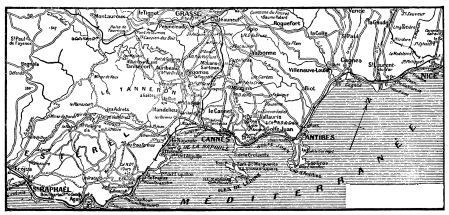
Fréjus to Nice
From this résumé of some of the chief monuments of the Roman occupation
one gathers that Fréjus was carefully planned as a great city of
residence and pleasure; and so it really was, with the added importance
which its position, both with regard to the routes by sea and land,
gave to it in a commercial sense.
From Fréjus to St. Raphaël is a bare three kilometres. St. Raphaël
boasts as many inhabitants as Fréjus, but it is mostly a city of
pleasure, and has no monuments of a past age to suggest that even a
reflected glory from Fréjus ever shone over its site. To-day the plain
which lies between the two towns is dotted here and there with palatial
residences: “C’est tout palais,” the native tells you, and he is not
far wrong, but in a former day it was a broad bay, where floated the
galleys of Cæsar and Augustus.
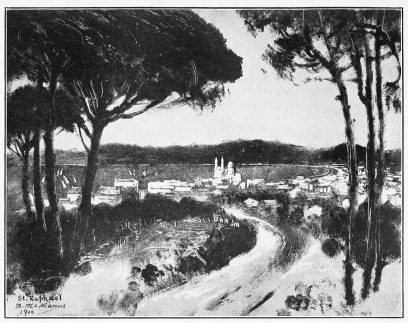
St. Raphaël
There was some sort of a feudal town here in the middle ages, but it
never grew to historical or artistic importance, and the town was little
known until the advent of Alphonse Karr and his fellows, who made of it,
or at least intimated that it could be made, what it is to-day,—a
“winter resort,” or, as the French have it, a “station hivernale.” It
is a very simple expression, but one which leads to a certain amount of
misunderstanding among the newcomers, who think that they have only to
take up their residence, from November to March, anywhere along the
shores of the Mediterranean east of Marseilles to swelter in tropical
sunshine. This they will not do, and unless they keep indoors between
five and seven in the evening on most days, they will get a chill which
will not only go to the marrow, but as like as not will carry pneumonia
with it; that is, if one dresses in what are commonly called “summer
clothes,” the kind that are pictured in the posters which decorate the
dull walls of the railway stations as being suitable for the life of the
Riviera.
St. Raphaël is not wholly given up to pleasure, for it is a notable fact
that in industrial enterprise it has already surpassed Fréjus, due
principally to a vast traffic in bauxite, a clay from which aluminium is
obtained, and there are always at its quays steamers from England,
Germany, and Holland loading the reddish earth.
Nevertheless, St. Raphaël is in the main a city of villas, less
pretentious than those of Cannes, but still villas in the general
meaning of the word. There is one called locally (in Provençal) the
“Oustalet du Capelan” (The House of the Curé), which was a long time
occupied by Gounod. Lovers of the master and his works will make of it a
musical shrine and place of pilgrimage. An inscription over the door
recalls that in this house Gounod composed “Romeo et Juliette.”
Maison Close, St. Raphaël
The Maison Close, inhabited by Alphonse Karr, is literally a maison
close, for it is surrounded by a high wall, and the most that one can
see and admire is the suggestion of the wonderful garden behind. In
Karr’s time it must have been a highly satisfactory retreat, and no
wonder he found it not difficult to let the rush of the world go by with
unconcern.
Hamon, the landscape painter, was another devotee of St. Raphaël, and
he described it as “la campagne de Rome au fond du Golfe du Naples;”
it needs not a great stretch of the imagination to follow the simile.
In spite of the expectations of a former generation of landlords and
landowners, St. Raphaël, progressive as it has been, has never grown up
on the lines upon which it was planned. The grand boulevards and avenues
came as a matter of course, and the great hotels, and, ultimately, the
inevitable casino and its attendant attractions; but, nevertheless, St.
Raphaël has remained a ville des villas, and the population has mostly
gone to the suburban hillsides, especially around Valesclure, where new
houses are springing up like mushrooms, all built of that white
sandstone which flashes so brilliantly in the sunlight against the
background of the green-clad, reddish-brown Estérel.
The Estérel is a coast range of mountains as different from Les Maures,
their neighbour to the westward, as could possibly be, in colour, in
outline, and in climatic influences, and these to no little extent have
a decided effect on the manners and customs of the people who live in
the neighbourhood.
The contrast between the mountains of Les Maures and the Estérel is
most marked. The former are more sober and less accentuated than the
latter range, and there is more of the culture of the olive to be noted
in the valleys, and of the oak on the hillsides. In the Estérel all is
brilliant, with a colouring that is more nearly a deep rosy red than
that of any other rock formation to be seen in France. Coupled with the
blue of the Mediterranean, the reddish rocks, the green hillsides, and
the delicate skies make as fantastic a colour-scheme as was ever
conceived by the artist’s brush.
The Route d’Italie passes to the north of the Estérel crest, and is one
of those remarkable series of roadways which cross and recross France,
and may be considered the direct descendants of the military roads laid
out by the Romans, and developed and perfected by Napoleon. To-day a
generously endowed department of the French government tenderly cares
for them, with the result that the roads of France have become one of
the most precious possessions of the nation.
Until very recent times the great mountain and forest tract of the
Estérel had remained unknown and untravelled, save so far as the railway
followed along the coast, and the great Route d’Italie bounded it on
the north, or at least bounded the mountain slopes.
All this has recently been changed, and, where once were only narrow
foot-paths and roads, made use of by the shepherds and peasants, there
are a broad and elegant highway flanking the indentations of the
coast-line, and many interior routes crossing and recrossing one of the
most lovely and unspoiled wildwoods still to be seen in France. There
are other parts much more wild, the Cevennes or the Vivarais, for
instance; but they have not a tithe of the grandeur and beauty of the
red porphyry rocks of the Estérel combined with the blue waters of the
Mediterranean and the forest-covered flanks of its mountain range.
From Fréjus, St. Raphaël, or La Napoule, or even Cannes, one may enter
the Estérel and lose himself to the world, if he likes, for a matter of
a week, or ten days, or a fortnight, and never so much as have a
suspicion of the conventional Riviera gaieties which are going on so
close at hand.
The “Corniche d’Or” of the Estérel, as the coast road is known, was only
completed in 1893, and as a piece of modern roadway-making is the peer
of any of its class elsewhere. The record of its building, and the
public-spirited assistance which was given the project on all sides,
would, or should, put to shame those road-building organizations of
England and America which for the most part have aided the good-roads
movement with merely an unlimited supply of talk about what was going to
be done.
As a roadway of scenic surprises the “Corniche d’Or” of the Estérel is
the peer of the better known rival beyond Nice, though it has nothing to
excel that superb half-dozen kilometres just before, and after, Monte
Carlo and Monaco.
The interior route of the Estérel, the Route d’Italie, mounts to an
altitude of three hundred metres, while the “Corniche” is practically
level, with no hills which would tire the least muscular cyclist or the
weakest-powered automobile.
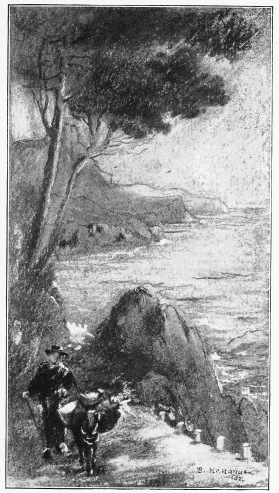
On the Corniche d’Or
Since the beginning of the transformation of the Estérel two hundred and
forty kilometres of new roadways have been laid out. After this great
work was finished came the question of erecting sign-boards along the
various routes and chemins and carrefours and bifurcations, and
the work was not treated in a parsimonious fashion. Within the first
year of the completion of the road-building over two hundred
important and legible signs were erected by the efforts of a wealthy
resident of St. Raphaël, with the result that the value of the Estérel
as a great “parc nationale” became apparent to many who had previously
never even heard of it.
This delightful tract of unspoiled wildwood is bounded on the north by
the Route d’Italie, while the ingeniously planned “Corniche” follows the
coast-line all the way to Cannes, which is really the door by which one
enters the Riviera of the guide-books and the winter tourists.
The “Corniche d’Or,” its inception and construction, was really due to
the efforts of the omnific “Touring Club de France.” Formerly the way by
the coast was but a narrow track, or a “Sentier de Douane.” To-day it
is an ample roadway along its whole length, on which one has little fear
of speeding automobiles for the simple reason that the jutting capes and
promontories of porphyry rock are death-dealing in their abruptness and
frequency, and no automobilist who is sane—let it be here
emphasized—takes such dangerous risks.
The forest and mountain region of the Estérel between those two
encircling strips of roadway is possessed of a wonderful fascination
for those who are brain-fagged or town-tired; and to roam, even on foot,
along these by-paths for a few days will give a whole new view of life
to any who are disposed to try it. If one purchases the excellent map of
the region issued by the “Touring Club de France,” or even the
five-colour map of the “Service Vicinal” of the French government, he
will have no fear of losing his way among the myriads of paths and
roadways with which the whole region is threaded.
One first enters the “Route de la Corniche” by leaving St. Raphaël by
way of the newly opened Boulevard du Touring Club, and soon passes two
great projecting rocks known as the “Lion de Terre” and the “Lion de
Mer.” They do not look in the least like lions,—natural curiosities
seldom do look like what they are named for,—but they will be
recognizable nevertheless. Throughout its length the road follows the
shore so closely that the sea is always in sight.
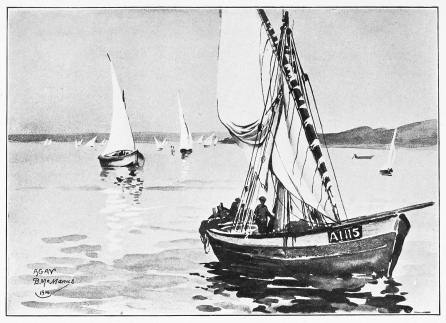
Offshore from Agay
Boulouris is a sort of unlovely but picturesque suburb of St. Raphaël,
and from its farther boundary one is in full view of the “Sémaphore
d’Agay,” perched high on a promontory a hundred and forty metres above
the sea. The Sémaphore is an ugly but utilitarian thing, and the
wireless telegraph has not as yet supplanted its functions in France.
From the same spot one sees the Tour du Dramont, a one-time refuge of
Jeanne de Provence during a revolution among her subjects.
In following the road one does not come to a town or indeed a settlement
of any notable size until he reaches Agay, on the other side of the
promontory. The town lies at the mouth of a tiny river bearing the same
name. It makes some pretence at being a resort, but it is still a
diminutive one, and, accordingly, all the more attractive to the
world-wearied traveller.
Three routes lead from Agay, one to Cannes by Les Trois Termes
(twenty-nine kilometres), another by the Col de Belle Barbe, and another
directly by the “Corniche.”
Near the Col de Belle Barbe is the Oratoire de St. Honorat and the
Grotte de Ste. Baume. The latter is a place of pilgrimage for the devout
of the region, and for those from farther abroad, but most of the time
it is a mere rendezvous for curious sightseers.
The roadway continues rising and falling through the pines until it
crosses the Col Lévêque (169 metres), when, rounding the Pic d’Aurele,
it comes again to sea-level at Le Trayas.
From Agay the “Corniche” runs also by Le Trayas, and to roll over its
smoothly made surface in a swift-moving automobile is the very poetry of
motion, or as near thereto as we are likely to get until we adopt the
flying-machine for regular travel. It is an experience that no one
should miss, even if he has to hire a seat on the automobile omnibus
which frequently runs between St. Raphaël and La Napoule and Cannes.
It is twenty kilometres from Agay to La Napoule, and is a good
afternoon’s journey by carriage, or even on donkey-back. Better yet, one
should walk, if he feels equal to it, and has the time at his disposal.
En route one passes Anthéore, which may best be described as a colony
of artistic and literary people who have settled here for the quiet and
change from the bustle of the modern life of the towns. This was the
case at least when the settlement was founded, and the poet Brieux built
himself a house and put up over the gateway the significant words: “Je
suis venu ici pour être seul.” Whether he was able to carry out this
wish is best judged by the fact that since that time many outsiders
have gained a foothold, and the Grand Hôtel de la Corniche d’Or has come
to break the solitude with balls and bridge and all the distractions of
the more celebrated Riviera towns and cities.
Between Anthéore and Le Trayas is a narrow pathway which mounts to St.
Barthélémy, but the coast road still continues its delightful course
toward La Napoule.
Le Trayas, though it figures in the railway time-tables, is hardly more
than a hamlet; but it boasts proudly of a hotel and a group of villas.
It has not yet become spoiled in spite of this, and though it lacks the
picturesque local colour of the average Mediterranean coast town, and
almost altogether the distractions of the great resorts, it is worth the
visiting, if only for its charming situation.
The Département of the Var joins that of the Alpes-Maritimes just
beyond, and, at three kilometres farther on, the coast road rises to its
greatest height, a trifle over a hundred metres.
Before one comes to La Napoule he passes the progressive, hard-pushing
little resort of Théoule, so altogether delightful from every point of
view that one can but wish that winter tourists had never heard of it.
This was not to be, however, and Théoule is doing its utmost to become
both a winter and a summer resort, with many of the qualifications of
both. It is deliciously situated on the Golfe de la Napoule, or, rather,
on a little anse or bay thereof, and consists of perhaps a hundred
houses of all classes, most of which rejoice in the name of Villa
Something-or-other. Most of these villas are well hidden by the trees,
and their coquette architecture (on the order of a Swiss châlet, but
stuccoed here and there and with bits of coloured glass stuck into the
gables,—and perhaps a plaster cat on the ridge-pole) is not so
obtrusive as it might otherwise be.
Leaving Théoule, the coast road continues to La Napoule, but, properly
speaking, the “Corniche” ends at Théoule. Throughout its whole length it
is a wonderfully varied and attractive route to the popular Riviera
towns, and one could hardly do better, if he has journeyed from the
north by train, than to leave the cars at Fréjus or St. Raphaël and make
the journey eastward via the Corniche d’Or. If he does this, as likely
as not he will find some delightful beauty-spot which will appeal to him
as far more attractive than a Cannes or Nice boarding-house, where the
gossip is the same sort of thing that one gets in Bloomsbury or on
Beacon Hill. The thing is decidedly worth the trying, and the suggestion
is here given for what it may be worth to the reader.
LA NAPOULE is known chiefly to those birds of passage who annually
hibernate at Cannes as the end of a six-mile constitutional which the
doctors advise their patients to take as an antidote to overfeeding and
“tea-fights.” In reality it is much more than this; it is one of the
most charmingly situated of all the Riviera coast towns, and has a
history which dates back to a fourteenth-century fortress, built by the
Comté de Villeneuve, a tower of which stands to-day as a part of the
more modern château which rises back of the town.
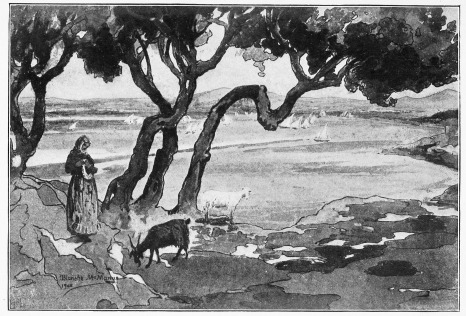
On the Golfe de la Napoule
French residents on the Riviera have a popular tradition that Lord
Brougham originally made overtures to the municipality of Fréjus when he
was seeking to found an English colony on the Riviera. Whatever his
advances may have been, they were promptly spurned by the town, and
England’s chancellor forthwith turned his steps toward Italy, whither he
had originally been bound. Suddenly he came upon the ravishing
outlook over the Golfe de la Napoule, and the charms of this lovely spot
so impressed him that he fell a prey to their winsomeness forthwith and
decided that if he could find a place where the inhabitants were at all
in favour of a peaceful English invasion, he would throw the weight of
his influence in their favour. He travelled the country up and down and
threaded the highways and byways for a distance of fifty kilometres in
every direction until finally he decided that Cannes, on the opposite
side of the Golfe, should have his approval. Thus the Riviera, as it is
known by name to countless thousands to-day, was born as a popular
English resort, and soon Cannes became the “ville élégante,” replacing
the little “bourg de pêche” of a former day.
The road eastward from Fréjus, the highroad which leads from France into
Italy, passes to the northward of the crests of the Estérel range just
at the base of Mont Vinaigre, a topographical landmark with which the
average visitor to Cannes should become better acquainted. It is far
more severe and less gracious than Cap Roux, where the Estérels slope
down to the Mediterranean; but it has many attractions which the latter
lacks. From the summit of Mont Vinaigre one may survey all this
remarkable forest and mountain region, while from Cap Roux one has as
remarkable a panorama of sea and shore and sky, but of quite a different
tonal composition.
Mont Vinaigre is the culminating peak of the Estérel, and is visible
from a great distance. Its great white observatory tower rises high
above the neighbouring peaks and, when one finally reaches the
vantage-ground of the little platform which is found at the utmost
height, he obtains a view which is far more vast in effect than many of
the “grandest views” scattered here and there about the world. In clear
weather the outlook extends from Bordighera to Sainte Baume, as if the
whole region were spread out in a great map.
Below Mont Vinaigre is Les Adrets and its inn, which in days of old was
known by all travellers to Italy by way of the south of France as a
post-house, where horses were changed and where one could get
refreshment and rest. To-day the Auberge des Adrets performs much the
same functions for the automobilist, and is put down in the automobile
route-books of France as a “poste de secours,” one of those safe
havens on land which are as necessary to the automobilist en tour as
is a life-saving station to the shipwrecked sailor.
The inn, modest and lacking in up-to-date appointments as it is, has a
delightfully wild and unspoiled situation, sheltered from the north by
numerous chestnut and plane-trees, and in summer or winter its climatic
conditions are as likely to fit the varying moods of the traveller as
any other spot on the Riviera. Truly Les Adrets is a retreat far from
the madding crowd, where an author or an artist might produce a
masterwork if what he needed was only quiet and a change of scene. There
are no distractions at Les Adrets to break the monotony of its
existence. One may chat with a passing automobile tourist, or with one
of those guardians of the peace of the countryside, the gendarmes,—who
have barracks near by,—but this is the only diversion.
At the inn itself one finds nothing of luxury. One pays two francs for
his repasts and a franc for his modest room. This is not dear, and has
the additional advantage that neither one nor the other of these
requirements of the traveller have the least resemblance to the sort of
thing that one gets in the towns.
Over the doorway of this unassuming establishment one reads the
following: “La maison este rebastie par le Sieur Laugier en 1653; elle
a été restaurée par Ed. Jourdan, 1898.”
Never is there a throng of people to be seen in these parts, and, if one
wanders abroad at night, he is likely enough to have thoughts of the
highwaymen of other days. Formerly the forests and mountains of the
Estérel were infested with a class of brigands who were by no means of
the polished villain order which one has so frequently seen upon the
stage. They were not of the Claude Duval class of society, but something
very akin to what one pictures as the Corsican bandit of tradition.
To-day, however, all is peaceful enough, with the Gendarmerie near by, a
terror to all wrong-doers, and the only reminiscences which one is
likely to have of the highwaymen of other days are such as one gets from
an old mountaineer or a review of the pages of history and romance,
where will be found the names of Robert Macaire and Gaspard de Besse,
two famous, or infamous, characters whose names and lives were closely
connected with this region. It is all tranquil enough to-day, and one is
no more likely to meet with any of these unworthies in the Estérel than
he is with the “Flying Dutchman” at sea.
As one draws near to Cannes, he realizes that he has left the
simplicity of the life of the countryside behind him. While still half a
dozen kilometres away, he sees a sign reading “Cannes Cricket Club,” and
all is over! No more freedom of dress; no more hatless and collarless
mountain climbs; but the costume of society, of London, Paris, or New
York is what is expected of one at all times.
Cannes is truly “aristocratic villadom,” or “séjour aristocratique et
recherché,” as the French have it, with all that the term implies.
Consequently Cannes is conventional, and the real lover of
nature—regardless of the town’s charming situation—will have none of
it.
It is believed that the town grew up from the ancient Ligurian city of
Aegytna, destroyed by Quintus Opimius a hundred and fifty years before
the beginning of the Christian era.
If one does not make his entry into Cannes by road, direct from the
Estérel, he will probably come by the way of Le Cannet. Le Cannet is
itself a sumptuous suburb which in every way foretells the luxury which
awaits one in the parent city by the seashore.
Three kilometres of palm and plantain bordered avenue, lined with villas
and hotels, joins Le Cannet with Cannes. Not long ago the suburb was an
humble, indifferent village, but the tide of popularity came that way,
and it has become transformed.
The Boulevard Carnot descends from Le Cannet to the sea by a long easy
slope, and again one comes to the blue water of the enchanted
Mediterranean. At times, Cannes is most lively,—always in a most
conventional and eminently respectable fashion,—and at other times it
sleeps the sleep of an emptied city, only to awake when the first fogs
of November descend upon “brumeuse Angleterre.”
To tell the truth, Cannes is far more delightful “out of season,” when
its gay, idling population of strangers has disappeared, stolen away to
the watering-places of the north, there to live the same deadly dull
existence, made up of rounds of tea-drinking and croquet-playing, with
perhaps an occasional ride in a char-à-banc. Probably the millionaire
improves somewhat upon this régime, but there are countless thousands
who live this very life in European watering-places—and think they are
enjoying themselves.
Cannes’s off season is of course summer, but, considering that it is so
delightfully and salubriously situated at the water’s edge, and has a
summer temperature of but 22° Centigrade, this is difficult to
understand. Certainly Cannes is more delightful in the winter months
than “brumeuse Angleterre,” but then it is equally so in June.
Not every one in Cannes speaks English; but for a shopkeeper to prosper
to the full he should do so, and so the local “professors” have a busy
time of it, in season and out, teaching what they call the “idiome
britannique” and the “argot Américaine.”
The shore east and west of the centre of the town is flanked with hotels
and villas, and great properties are yearly being cut up and put into
the hands of the real-estate agents in order that more of the same sort
may be erected where olive and palm trees formerly grew.
Horticulture is still a great industry at Cannes, as well as the selling
of building-lots, but the marvel is that there is any unoccupied land
upon which to raise anything. A dozen years from now how will the
horticulturalists of Cannes be able to grow those decorative little
orange and palm trees with which Paris and Ostend and London and even
Manchester hotel “palm-gardens” are embellished?
Cannes has an ecclesiastical shrine of more than ordinary rank, in spite
of the fact that it is of no great architectural splendour. It is the
old Basilique de Notre Dame d’Espérance which crowns the hill back of
the town and possesses a remarkable reliquary of the fifteenth century,
said to contain the bones of St. Honorat, the founder of the famous
monastery of the Lerin Isles.
Another monument of the middle ages is the ancient “Tour Seigneuriale,”
erected in 1080 by Adelbert II., an abbot of the Monastery of Lerins.
For three hundred years it was in constant use, serving both as a
citadelle and as a marine observatory. To-day its functions are no
more; but, with the tower of the church, it does form a sort of a
beacon, from offshore, for the Cannes boatmen.
There is a Christmas custom celebrated by the fisher-folk of Cannes
which is exceedingly interesting and which should not be missed if one
is in these parts at the time. On the eve of Christmas there is held a
popular banquet, in which the sole dish is polenta, most wonderfully
made of peas, nuts, herbs, and meal, together with boiled codfish, the
yolks of eggs, and what not, all perfumed with orange essence. It’s a
most temperate sort of an orgy, in all except quantity, and, when washed
down with a local vin blanc, bears the name, simply, of a “gros
souper.” Brillat-Savarin might have done things differently, but the
dish sounds as though it might taste good in spite of the mixture.
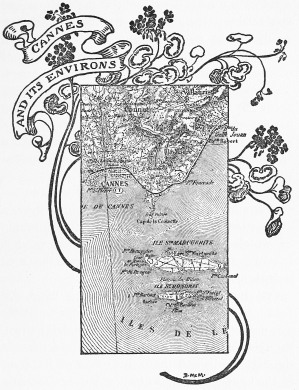
At Le Cannet is the Villa Sardou, where the great actress Rachel spent
the last days of her life and died in 1858. Near Le Cannet, too, is a
most strangely built edifice known as the “Maison du Brigand.” It is the
chief sight of the neighbourhood for the curious and speculative, though
what its uncanny design really means no one seems to know. It is a
spudgy, square tower with an overhanging roof of tiles and four queer
corbels at the corners. The entrance doorway is three metres, at least,
from the ground, and leads immediately to the second story. From this
one descends to the ground floor, not by a stairway, but through a
trap-door. This curious structure is supposed to date from the sixteenth
century.
Vallauris is what one might call a manufacturing suburb of Cannes, a
town of potteries and potters. The potteries of the Golfe Jouan, of
which Vallauris is the headquarters, are famous, and their product is
known by connoisseurs the world over.
One notes the smoke and fumes from the furnaces where the pottery is
baked, and likens the aspect to that of a great industrial town, though
Vallauris is, as a matter of fact, more daintily environed than any
other of its class in the known world. Not all of its six thousand
inhabitants are engaged at the potteries; but by far the greater portion
are; enough to make the town rank as a city of workmen, for such it
really is, though it would take but little thought or care to make of it
the ideal “garden city.”
Artist-travellers have long remarked the qualities of the plastic clay
found here, and by their suggestions and aid have enabled the
manufacturers to develop a high expression of the artistic sense among
their workmen. Most of these workers are engaged, in the first instance,
as mere moulders of ordinary pots and jugs; but, as they acquire skill
and the art sense, they are advanced to more important and lucrative
positions.
The establishment of Clément Massier is famous for the quality and
excellent design of its product. The proprietor in the early days, by
his natural taste and studies, brought his work to the attention of such
masters in art as Gérôme, Cabanal, Berne-Bellecour, and Puvis de
Chavannes, all of whom encouraged him to develop his abilities still
further.
Study of antique forms and processes threw a new light upon the art, or
at least a newly reflected light, and at last were produced those
wonderful iridescent effects and enamels which were a revelation to
lovers of modern pottery. Their success was achieved at the great Paris
Exposition of 1889, since which time they have been the vogue among the
“clientèle élégante du littoral,” as the cicerone who takes you over
the Ceramic Musée tells you.
Vallauris is noted also for its production of orange-water, or, rather,
orange-flower water, with which the French flavour all kinds of subtle
warm drinks of which they are so fond. The tisane of the French takes
the place of the tea of the English, and they make it of all sorts of
things,—a stewed concoction of verbena leaves, of mint, and even
pounded apricot stones,—and always with a dash of orange-flower water.
It is not an unpleasant drink thus made, but wofully insipid.
The orange-trees of the neighbourhood of Cannes and Vallauris prosper
exceedingly, though it is not for their fruit that they are so carefully
tended. It is the blossoming flowers that are in demand, partly for
enhancing the charms of brides, but more particularly for making orange
essence. There are numerous distilleries devoted to this at Vallauris,
and, when the season of gathering the orange-flower crop arrives, a
couple of thousand women and children engage in the pleasant task. A
million kilogrammes of the flower are gathered in a good season, from
which is produced as much as seventy-five thousand kilos of essence.
BEYOND Cannes, on the eastern shore of the Golfe Jouan, before one comes
to the peninsula’s neck, is a newly founded station known as
Jouan-les-Pins. It is little more than a hamlet, though there are villas
and hotels and a water-front with wind-shelters and all the appointments
which one expects to find in such places.
Jouan-les-Pins really is a delightful place, the rock-pines coming well
down to the shore and half-burying themselves in the yellow sands. A
boulevard, bordered by a balustrade, extends along the water’s edge and
forms that blend of artificiality and nature which, of all places on the
Riviera, is seen at its best at Monte Carlo.
Undoubtedly there is some sort of a great future awaiting
Jouan-les-Pins, for it is already regarded as a suburb of Antibes, and
it is but a few years since Antibes itself was but a narrow-alleyed,
high-walled little town, reminiscent of the mediæval fortress that it
once was. To-day the bastions of Antibes have nearly disappeared under
the picks of the industrious workmen.
Jouan-les-Pins
The chief event of historic moment in the vicinity was the landing of
Napoleon here on his return from Elba, on March 1, 1815. Every one
feared the time when the “Corsican ogre” should break loose, and when
the ambitious Napoleon set foot upon the shores of the Golfe Jouan,
there was no doubt but that his sole object was to regain the throne
which he had lost. Provence, Languedoc, and Dauphiné were supposed to be
faithful to the reigning Louis, hence there was little fear that
Napoleon’s march would extend beyond their confines. How well the
emotions of a people were to be judged in those days is best recalled by
the fact that it was but a mere promenade from Jouan-les-Pins, via
Grasse, Gap, and Sisteron, to Lyons. The opinions of the advisers of
Louis XVIII. were decidedly wrong, for, while the Provençaux remained
faithful to the Bourbon, the mountaineers of Dauphiné were only too
ready and willing to give Napoleon the aid he wished.
In the early ages the shores of the Golfe Jouan were well known and
beloved by Phœnicians, Greeks, Romans, barbarians, and Moors alike. The
name Jouan, which comes down from the Saracens, has by some geographers
been changed to Juan. Since, however, the old Provençal spelling and
pronunciation was Jouan (ou being the Provençal accent of the French
u), it is still so written by the best authorities.
Never has the word incomparable been more suitably applied than to the
Golfe Jouan and the monuments of the past civilization that surround it.
Together with the Golfe de la Napoule it forms one vast expanse of bay,
the most ample and, perhaps, the most beautiful on the whole Riviera. To
the south is the open sea, and to the north the varied background of
the Alpes-Maritimes.
Antibes has itself much charm of situation, though it is mostly known to
English-speaking people as a sort of rest-house on the way to the more
gay attractions of Monte Carlo and about there.
Antibes is, however, of great antiquity, having been the Antipolis of
the Romans. It has the usual attractions of the Riviera towns and, in
addition, the proximity of the great peninsula of Antibes, locally
called the Cap.
This peninsula is a rare combination of trees and rocks and winding
roads, almost surrounded by the pulsing Mediterranean, always cool and
comfortable, even in summer, and scarcely ever troubled by the blowing
of the mistral. Villas, almost without end, occupy the Cap, tree-hidden,
and all brilliantly stuccoed with a tint which so well harmonizes with
the surrounding subtropical flora that the effect is as of fairy-land.
The Jardin Thuret is a great botanical collection, covering an area of
over seven hectares, a gift to the nation by the sister of the great
botanist of the same name. The Villa Eilen-Roc has also wonderful
gardens, laid out with exotic plants, and open to visitors.
Offshore, to the westward, are the Iles de Lerins and the Golfe de la
Napoule, while eastward lie the Baie des Anges and the mountains back of
Nice. Northward are the snow-clad summits of the Alpine range, while to
the south is the sea, where one sees the filmy smoke of great steamers
bound for Genoa or Marseilles, while nearer at hand are the white-winged
balancelles and tartanes. Truly it is a ravishing picture which is
here spread out before one, and therein lies the great charm of Antibes.
There is a weird combination of things devout and secular at
Antibes,—Notre Dame d’Antibes, with its hermitage; the lighthouse; and
the semaphore. Of the utility of the two latter there can be no doubt,
while the tiny chapel of the hermitage forms a link which binds the
sailor-folk at sea with their friends on shore. It is a sort of
ex-voto shrine, like Notre Dame de la Garde at Marseilles, where one
may register his vows upon his departure or return from the sea.
When the river Var was the boundary between France and Piedmont, this
Chapelle de Notre Dame was a place of pilgrimage for the seafarers on
both sides of the river, and passports were freely given to permit the
Italians to worship here at this seaside shrine of Our Lady.
Antibes has much of historic reminiscence about it, though to-day its
monuments are neither very numerous nor magnificent.
The old town was, for military reasons, surrounded with walls, and thus
the sea was some distance from the centre of the town. Then, as to-day,
to get a whiff of the sea, one had to leave the narrow tortuous
picturesqueness of the old town behind and saunter on the quays of the
little port, with its narrow entrance to the open sea.
There is little traffic of importance going on in the port of Antibes;
mostly the shipping of the product of the potteries at Vallauris and
neighbouring towns. Still, by no means is it an abandoned port; it is a
popular haven for Mediterranean yachtsmen, and fishermen find it a
suitable base for their operations in the open sea; so there is a
constant going and coming such as gives a picturesque liveliness which
is lacking at a mere resort or watering-place. Antibes is, moreover, a
torpedo-boat station of the French navy, being safely sheltered by a
line of rocks which parallel the coast-line for some distance just
beyond the harbour’s mouth, and which are marked by a great iron buoy,
known locally by the name of “Cinq Cent Francs.”
In the days of the Romans Antibes was probably the military port of
Cimiez, and in a later day it came into the favour of both Henri IV. and
Richelieu as a strongly fortified place. Later, Vauban came on the scene
and surrounded its harbour with a great circular mole with considerable
architectural pretensions. To-day the place is practically ignored as a
military stronghold in favour of Villefranche and Toulon and the many
intermediate batteries which have been erected.
The origin of the name of the town comes from the colony of Massaliotes
who came here in the fifth century. Its modern name is a derivation from
its earlier nomenclature, which became successively Antibon, Antibolus,
and then Antiboul,—the Provençal name for the Antibes of the later
French.
To-day one may see the remains of two ancient towers built by the
Romans, and there are still evidences of the substructure of the antique
theatre, built into the lower courses of some modern houses. In the
walls of the Hôtel de Ville is a tablet reading as follows:
D. M.
PVERI SEPTENTRI
ONIS ANNORXI QUI
ANTIPOLI IN THEATRO
BIDVO SALTAVIT ET PLACVIT.
According to Michelet this was a memorial to “the child Septentrion,
who, at the age of twelve years, appeared two days at the theatre of
Antipolis; doubtless one of the slaves who were let out to managers of
spectacles.”
Inland from Antibes, on the banks of a little streamlet, the Brague,
lies Biot, once a settlement of the Templars, and later, in the
fourteenth century, a possession of the Genoese, or at least peopled by
a colony of them.
It is a remarkable little place, generally over-looked by travellers in
the rush to the show-places of the Riviera, and the suggestion is here
made that any who are seeking for a real exotic could not do better than
hunt it here. The manners and customs, and even the speech, of many of
the old people of the town are as Italian as those of the Genoese
themselves. The tiny bourg possesses a series of arcades surrounding a
tiny square, a product of the fourteenth century, and is as “foreign”
to these parts as would be the wigwam of an Indian. There are also
remains of the old ramparts of the town still visible, and the whole
ensemble is as a page torn from a book which had been closed for
centuries.
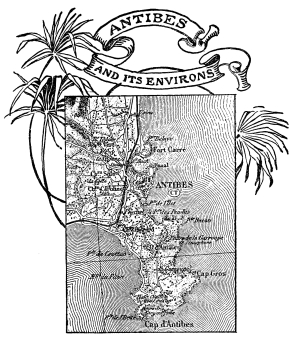
One need not fear undue discomfort here in this little old-world spot,
where things go on much the same as they have for centuries. There is
nothing of the allurements of the great hotels of the resorts about the
two modest inns at Biot, but for all that there is a bountiful and
excellent fare to be had amid entirely charming surroundings, and, if
one is minded, he can easily put in a month at the retreat, and only
descend to the super-refinements of Cannes or Nice—each perhaps a dozen
miles away—whenever he feels the pangs which prompt him to get in touch
with a daily paper and the delights of asphalt pavements and “dressy”
society.
Not all Riviera tourists know the Iles de Lerins as well as they might,
though it is a popular enough excursion from Cannes.
These isles give the distinct note which lends charm to the waters of
the Mediterranean just offshore from Cannes, forming, as they do, a sort
of a jetty, or breakwater, between the Golfe de la Napoule and the Golfe
Jouan.
There are but two islands in the group, St. Honorat and Ste. Marguerite,
the latter separated from the Pointe de la Croisette at Cannes by a
little over a kilometre. It costs a franc to cover this by boat, and
another franc to pass between Ste. Marguerite and St. Honorat.
The Ile Ste. Marguerite and its prison are redolent of much of history,
from the days of the “Iron Mask” up to those of the miserable Bazaine.
Much has been hazarded from time to time as to the real identity of the
“Man in the Iron Mask,” but the annals of Provence dealing with Ste.
Marguerite seem to point to the fact that he was Count Mattioli, the
minister of the Duke of Mantua, who had agreed to betray his master into
the hands of the French, and then for some unaccountable reason—no one
knows why—repented, with the result that he was entrapped and thrown
into prison. One sees still the walls of the dungeon where twenty-seven
years of his unhappy life were spent.
Bazaine, the unfortunate Maréchal de France who capitulated at Metz
during the Franco-Prussian war, was also confined here, from December,
1873, to August, 1874, when by some unexplained means, he was able to
escape to Italy.
The islands take their collective name from the memory of a pirate of
the heroic age, Lero by name, to whom a temple was erected on the larger
isle.
The Ile St. Honorat has perhaps a greater interest than that of Ste.
Marguerite. St. Honorat established himself here in retreat in the
fifth century, and his abode was afterward visited by Erin’s St.
Patrick.
A religious foundation, known as the Monastery of Lerins, took shape
here in the sixth century, and became one of the most celebrated in all
Christendom.
Barbarians, fanatics, and pirates attacked the isle from time to time,
but they could not disturb the faith upon which the religious
establishment was built, and it was only in 1778, when it was
desecularized by the Pope, that its influence waned.
In 1791, Mlle. Alziary de Roquefort, an actress of fame in her day,
acquired the isle and made it her residence. To-day it is in the
possession of a community of Benedictines of Citeaux, who cultivate a
great portion of its soil for the benefit of the Bishop of Fréjus.
The modern conventual buildings are on the site of the old
establishment, now completely disappeared, but the community is well
worth the visiting, if only to bring away with one a bottle of the
Liqueur Lerina, which, in the opinion of many, is the equal of the
popular “Benedictine” and “Chartreuse.”
There is a fragment of the old fortress-château still left to view,
bathing the foot of its crenelated donjon in the sea, a reminder of the
days when the monks fought valiantly against pirate invasion.
Legend accounts for the names borne by both the Iles de Lerins. Two
orphans of high degree, brother and sister, left their home in the
Vosges and came to Provence, which they adopted as their future home.
Marguerite took up her residence on the isle nearest the shore, and her
brother on the farthermost. Disconsolate at being left alone, the maid
supplicated her brother to come to her, and this he promised to do each
year when the cherry-trees were in bloom. Marguerite prayed to God that
her brother, who had become a religieux, would come more often; at
once the cherry-trees about her habitation burst into bloom, a miracle
which occurred each month thereafter, and her brother, true to his
promise, came promptly the first of each month, and thus broke the
lonely vigil of his sister.
ACCORDING to the French geographers, Grasse occupies a commanding site
on a “montagne à pic,” and this describes its situation exactly.
On the flanks of this great hill sits the town, its back yards, almost
without exception, set out with olive and orange trees, to say nothing
of the more extended plantations of the same sort seen as one reaches
the outskirts.
The whole note of Grasse is of flowers, trees, and shrubs, and the
perfume-laden air announces the fact from afar.
Above rises the “pic,” and, farther away, the northern boundary of the
horizon is circumscribed with an amphitheatre of wooded mountains severe
and imposing in outline.
Grasse is but a short eighteen kilometres from the Mediterranean, but
the whole topographical aspect of the country has changed. The panorama
seaward is the only intimation of the characteristics which have come to
be recognized as the special belongings of the French Riviera. The
foot-hills slope gently down to the blue “nappe,” which is the only
word which describes the Mediterranean when it is all of a tranquil
blue. It is an incomparable view that one has over this eighteen
kilometres of country southward, and a strong contrast to the lively
suburbs of the coast towns. Its charm and beauty are all its own, and
there is little of the modern note to be heard as one threads the
highways and byways, through the valleys and down the ravines to
sea-level. Without doubt it was a fortunate choice of the Romans when
they set their Castrum Crassense on this verdure-crowned height.
In the middle ages Grasse developed rapidly, and became the seat of a
bishop and a place dominant in the commerce of the region. The
inhabitants were reputed to be possessed of wonderful energies, and the
fact that they were twice able to repel the Moorish invaders, though
their town was practically destroyed, seems to prove this beyond a
doubt.
Richelieu gave the bishopric of this proud city to Antoine Godeau, who,
it seems, possessed hardly any qualifications for the post except family
influence and the flatteries he had showered upon the cardinal. Because
of his small stature this prelate became known as the “Nain de Julie,”
but in time he came to develop a real aptitude for his calling, and
governed his diocese with care, prudence, and judgment, and became an
Académicien through having written a history of the Church in France
during the eighteenth century.
The ecclesiastical monuments of Grasse are not many or as beautiful as
might be expected of a bishop’s seat, and at the Revolution the see was
suppressed. The old-time cathedral, as it exists to-day, is an
ungracious thing, with a perron, a sort of horseshoe staircase, before
it, built by Vauban, who, judging from this work, was far more of a
success as a fortress-builder than as a designer of churches.
Formerly Grasse was the seat of the Préfecture of the Département du
Var, but, with the inclusion of the Comté de Nice within the limits of
France, the honour was given to Draguignan, while that of the newly made
Département des Alpes-Maritimes was given to Nice, and Grasse became
simply a sous-préfecture. Shorn of its official dignities, and never
having arisen to the notoriety of being a fashionable resort, Grasse
“buckled down to business,” as one might say, and acquired a preëminence
in the manufacture of perfumes, candied fruits, and confitures
unequalled elsewhere in the south of France. The manufacture of soaps,
wax, oil products, and candles also form a considerable industry, and
the general aspect of Grasse is quite as prosperous, indeed more so,
than if it were dependent on the butterfly tourists of the coast towns.
The streets of the town rise and fall in bewildering fashion. They are
badly laid out, in many cases, and dark and gloomy, but they are
nevertheless picturesque to a high degree; a sort of négligé
picturesqueness, which does not necessarily mean dirty or squalid. There
are no remarkable architectural splendours in all the town, and there
are none of those archæological surprises such as one comes upon at Aix
or Fréjus.
Grasse has a fine library, containing numerous rare manuscripts and
deeds and the archives of the ancient Abbey of Lerins. In the Hôpital is
an early work of Rubens, which ranks as one of the world’s great art
treasures, and there is a further interest in the city for art-lovers
from the fact that it was the birthplace of Fragonard, to whom a fine
bust in marble has been erected in the Jardin Publique.
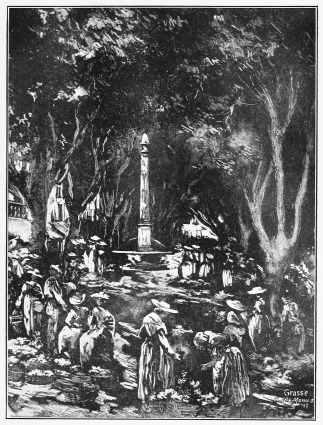
Flower Market, Grasse
As before mentioned, the height above is the chief point of interest at
Grasse. It culminates in the significantly named promenade known as
the “Jeu de Ballon.” A sea of tree-tops surges about one on all sides,
with here and there a glimpse of the red roof-tops of the town below.
Between the town and the sea is an immense rocky wall known as Les
Ribbes, with a picturesque cascade rippling down its flank. From its
apex Napoleon, escaping from Elba, arrested his flight long enough to
turn and—in the words of his best-known historian—“contemplate the
immense panorama which unrolled before his eyes, and salute for the last
time the Mediterranean and the mountains of La Corse, which he was never
again to see.”
The assertion “voir La Corse,” in the original, was not a figure of
speech, for under certain conditions of wind and weather the same is
possible to-day.
A half a dozen kilometres to the eastward of Grasse the highroad crosses
the river Loup, and one sees a semicircular town before him known as
Villeneuve-Loubet. The town has hotels and all the faint echoes of the
watering-places of the coast. This is a pity, for it is delightful, or
was, before all this up-to-dateness came. Its château, still proudly
rearing its head above the town, was built in the twelfth century by
the Comtes de Provence.
The primitive town was called Loubet, a corruption of the name of the
river which bathes its walls. Before even the days of the occupation of
the Comtes de Provence, as early as the seventh century, there was a
monastery here known by the name of Notre Dame la Dorée, of which scanty
remains are visible even to-day. Owing to various Mussulman incursions,
the occupants of the monastery were forced to flee to the protection of
the château, and soon the “Ville-neuve” was created, ultimately
forming the hyphenated name by which the place is known to-day.
Still onward, on the road to Nice, is Cagnes, a sort of economical
overflow from the more aristocratic resort, with few advantages to-day
as an abiding-place, and most of the disadvantages of the larger city.
There are tooting trams, automobile garages, and shops for the sale of
many of the minor wants of life, which in former times one had to walk
the ten or a dozen kilometres into Nice to get. The automobile is a very
good thing for touring, but, as a perambulator in which to “run down to
the village,” it is much overrated and a confirmed nuisance to every
one; and Cannes suffers from this more than any other place in France,
unless it be Giverny on the Seine, the most overautomobiled town in the
world,—one to every score of inhabitants.
Once Cagnes bid fair to become an artists’ resort, but it became overrun
with “tea and toast” tourists, and so it just missed becoming a Pont
Aven or a Barbizon. For all that, it is a picturesque enough place
to-day; indeed, it is delightful, and if it were not for the automobiles
everywhere about, and that awful tram, it would be even more so.
However, its little artists’ hotel was, and is, able to make up for a
good deal that is otherwise lacking, and the sawmills, brick-works, and
distilleries of the neighbourhood are not offensive enough to take away
all of its sylvan charm.
In earlier times Cagnes was both a place of military importance and a
sort of a city of pleasure, something after the Pompeiian order, one
fancies, from the Roman remains which have been found here.
There is an ancient château of the Grimaldi family, still very much in
evidence, though it has become the property of a German. In many
respects it is a beautiful Renaissance work and is accordingly an
architectural monument of rank.
Directly inland from Cagnes is Vence, an ancient episcopal city which
was shorn of its ecclesiastical rights at the Revolution. In spite of
this the memories and the very substantial reminders of other days,
still to be seen within the precincts of the one-time cathedral, give it
rank as an ecclesiastical shrine quite out of the ordinary. The church
itself is built upon the site, and in part out of, an ancient temple to
Cybele, and the fortifications, erected when the Saracens had possession
of the city, are still readily traced. It is a most picturesquely
disposed little city, and well worth more attention than is generally
bestowed upon it.
Between Grasse and Nice lies the valley of the Loup, a stream of some
sixty kilometres in length emptying into the Mediterranean, and which
has the reputation of being the most torrential waterway in France, in
this respect far exceeding the more important streams, such as the
Rhône, the Durance, and the Touloubre. Its course is so sinuous, as it
comes down from its source in the Alpes-Maritimes, that it is known
locally as “le serpent.” With all violence it rolls down its rapidly
sloping bed, amid rock-cut gorges and wooded ravines, in quite the
manner of the scenic waterfalls of the geographies that one scans at
school. It does not resemble Niagara in any manner, nor is it a slim,
narrow cascade at any point; but throughout its whole length it is a
series of tiny waterfalls which, in a photograph, do indeed look like
miniature Niagaras. All along its course are numerous centres of
population, though none of them reach to the dignity of a town and
hardly that of a village, if one excepts Le Bar, the chief point of
departure for excursions in the gorges.
Le Bar is reminiscent of the Saracens, who were for long masters of the
neighbouring country. The walls of the houses and barriers are of that
warm, rosy, mud-baked tint that one associates mostly with the Orient,
and no artist’s palette is too rich in colour to depict them as they
are. The Saracens called the place “Al-Bar,” which came later, by an
easy process of evolution, to Albarnum, and finally Le Bar.
It was an important place under the Roman domination, and, in time, when
the town came to be a valued possession of the Comtés de Provence, the
cross succeeded the crescent. In the tiny church of the town there is a
remarkable ancient painting picturing a “danse macabre,” supposed to
be of the fifteenth century.
Gourdon
Above Le Bar is the aerial village of Gourdon, fantastic in name,
situation, and all its elements. At its feet rushes the restless Loup,
and tears its way through one of those curious rock-walls which one only
sees in these parts. To the westward is the curious and imposing
outline of Grasse, the metropolis of the neighbourhood.
Near by the railway crosses the ravine on an imposing and really
beautiful modern viaduct of seven arches, each twelve metres in
height—nearly forty feet.
Up the ravine toward the source, or downward to the sea, the charms
multiply themselves like the glasses of the kaleidoscope until one, as a
result of a first visit to this much neglected scenic spectacle, is
quite of the mind that it resembles nothing so much as a miniature
Yellowstone.
WHEN one crosses the Var he crosses the ancient frontier between France
and the Comté de Nice. The old-time French inhabitants of the Comté ever
considered it an alien land, and invariably expressed the wish to be
buried in the Cemetery of St. Laurent du Var, just over the border in
the royal domain.
The present Pont du Var, which one crosses as he comes from the
westward, from Cagnes or Antibes, is the successor of another flung
across the same stream by Vauban, much against his will, it would seem,
for he said boldly that it was so foolish a project as never to be worth
a hundredth part of its cost. How poorly he reckoned can be judged by
the hundreds of thousands of travellers—millions doubtless—who, in
later years, have made use of it. He evidently did not foresee the tide
of tourist travel, whatever may have been his genius as a military
engineer.
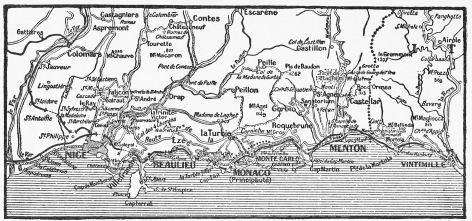
Nice to Vintimille
The Var is not a very formidable-looking river at first glance, and
has not the tempestuous flood of the Rhône and the Durance in actual
volume, but the excess of water which it carries to the sea, at certain
seasons, is proportionately very much greater. The Rhône increases its
bulk but thirty times, the Durance a hundred times, but the Var throws
into the Mediterranean, in time of flood, a hundred and forty times its
usual flow, a fact which ranks it as one of the most fickle waterways of
Europe, if not of the world.
So important a place as Nice of course has a legendary account of the
origin of its name. It is claimed by some historians, and disputed by
others, that it was a colony founded by the Massaliotes three hundred
years before the beginning of the Christian era, and, in consequence of
a signal success against the Ligurians, the place received the glorious
name of Victory,—Nicæa, a name which with but little alteration has
come down to to-day.
Long before the French came into possession of the Comté de Nice and its
capital there was a friendship, and a sort of union, between the two
peoples. When the little state became a part of modern France, it became
simply more French than it was before. This was the only change to be
remarked until the era of its great prosperity as a winter resort, for
the world’s idlers made it what it is,—the best-known winter station in
all the world.
Nice used to be called “Nizza la Bella,” but, since the arrival of the
French (1860), and the English, and the Americans, and the Germans (the
Russian grand dukes, be it recalled, have made Cannes their own), “Nizza
la Bella” has become “Nice la Belle,” for it is beautiful in spite of
its drawbacks for the lover of sylvan and unartificial charms.
There is not in Africa a spot more African in appearance than the
railway station at Nice; such at all events is the impression that it
makes upon one when he views the enormous palms that surround the
station.
Up to this time the traveller from the north, by rail, has got some
glimpses of the southland from the windows of his railway car; has seen
some palms, perhaps, and other specimens of a subtropical flora; but,
since the railway does not make its way through the palm avenues of
Hyères or Cannes, the sudden apparition of Nice is as of something new.
Many have sung the praises of “Nice la Belle” in prose and verse; in
times past, Dupatay, Lalande, and Delille; and, in our own day, Alphonse
Karr, Dumas père, De Banville, Mistral, Jacques Normand, Bourget,
Nadaud, and a host of others too numerous to mention.
Nice is a marvellous blend of the old and the new; the old quarter of
the Niçois, with narrow streets of stairs, overhanging balconies, and
all the accessories of the life of the Latins as they have been pictured
for ages past; the new, with broad boulevards, straight tree-bordered
avenues flanked with gay shops, hotels, kiosks, automobile cabs, and all
the rest of what we have come unwisely to regard as the necessities of
the age. The curtain of trees flanking these great modern thoroughfares
is the only thing that saves them from becoming monotonous; as it is,
they are as attractive as any of their kind in Paris, Lyons, or
Marseilles.
The Promenade des Anglais is the finest of these thoroughfares. With its
yuccas, and its garden, and its sea-wall, and its fringe of
white-crested, lapping waves, it is all very entrancing,—all except the
inartistic thing of glass roofs and iron struts, known the world over as
a pier, and which, in spite of its utility,—if it really is useful,—is
an abomination. Artificiality is all very well in its place, but out of
place it is as indigestible as the nougat of Montélimar.
The Nice of to-day bears little resemblance to the Nice of half a
century ago, as one learns from recorded history and a gossip with an
old inhabitant. Then it was simply a collection of maisons groupées,
with narrow, crooked streets between, huddled around the flanks of the
old château.
In those days the railway ended at Genoa on the east and at Toulon on
the west, and the space between was only covered by diligence, horse or
donkey back, or by boat. The “high life,” as the French have come
themselves to term listlessness and indolence, had not yet arrived, in
spite of the fact that its outpost had already been planted at Cannes by
England’s chancellor.
Those were parlous times for Monte Carlo. There was but one table for
“trente et quarante” and one for “roulette,” and the opening of the
game waited upon the arrival of a score of persons who came from Nice
daily by voiture publique, via La Turbie, or by the cranky little
steamer which took an hour and forty minutes in good weather, and which
in bad did not start out at all. On these occasions there was little or
nothing “doing” at Monte Carlo, but the new régime saw to it that
transportation facilities were increased and improved, and immediately
everything prospered.
However much one may deplore the advent of the railway along picturesque
travel routes, and it certainly does detract not a little from several
charming Riviera panoramas, there is no question but that it is a
necessary evil. Perhaps after all it isn’t an evil, for one can be very
comfortable in any of the great and luxurious expresses which deposit
their hordes all along the Riviera during the winter season. The new
thirteen-hour train from Paris, the “Côte d’Azur Rapide,” has already
become one of the world’s wonders for speed, taking less than
three-quarters of an hour in making the nine stops between Paris and
Nice. Then there are the “London-Riviera Express,” the “Vienne-Cannes
Express,” the “Calais-Nice Express,” and the Nord-Sud-Brenner (Cannes,
Nice, Vintimille to Berlin), with sleeping-cars and dining-cars, but not
yet with bathrooms, barber-shops, or stenographers and typewriters,
which have already arrived in America, where business is combined with
the joy of living.
From the very fact of its past history and of its geographical location,
Nice is the most cosmopolitan of all the cities of the Riviera, if we
except Monte Carlo.
To the stranger, English, French, and Italians seem to be about on a
par at Nice, with a liberal addition of Germans and Russians, though
naturally French are really in the majority. There are many
Italian-speaking people in the old town of Nice, away from the frankly
tourist quarters, but it is a strange Italian that one hears, and in
many cases is not Italian at all, but the Niçois patois, which sounds
quite as much like the real Provençal tongue as it does Italian, though
in reality it is not a very near approach to either.
Nice is the true centre of the catalogued beauties of the Riviera, and
in consequence it has become the truly popular resort of the region. In
spite of this it is not the most lovable, for garish hotels,—no matter
how fine their “rosbif” may be,—chalets coquets, and sky-scraping
apartment houses have a way of intruding themselves on one’s view in a
most distressing manner until one is well out into the foot-hills of the
Alpes-Maritimes and away from the tooting, humming electric trams.
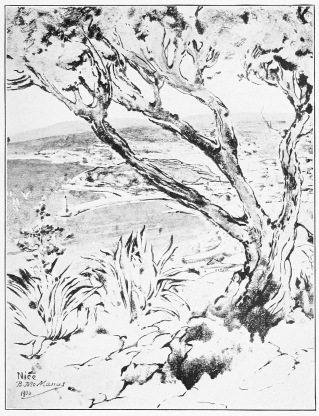
Nice
The port of Nice is not a great one, as those of the maritime world go,
but it is sufficient to the needs of the city, and there is a
considerable coastwise traffic going on. The basin is purely artificial
and was cut practically from the solid rock. With its sheltering
mountain background it is exceedingly picturesque and well disposed.
The tiny river Paillon runs into it from the north, a rivulet which in
its own small way apes the torrents of the Var in times of flood. At
other seasons it runs drily through the town and bares its pebbles to
the blazing southern sun. It serves its purpose well though, in that its
thin stream of water forms the washing-place of the washerwomen of Nice,
and, from their numbers, one might think of the whole Riviera. The
process of pounding and strangling one’s linen into a semblance of
whiteness does not differ greatly here from that of other parts of
France. There are the same energetic swoops of the paddle, the
thrashings on a flat stone, the swishings and swashings in the running
water of the stream, and finally the spreading on the ground to dry.
Here, though, the linen is spread on the smooth, clean pebbles of the
river-bed and the southern sun speedily dries it to a stiffness (and
yellowness) which grass-spread linen does not acquire. In other respects
the washing process seems quite as efficacious as elsewhere, and there
are quite as many small round holes (in the most impossible places),
which will give one hours of speculation as to how they were made. It’s
all very simple, when you come to think of it. Things are simply rolled
or twisted into a wad and pounded on the flat stone. Where nothing but
linen intervenes between the paddle and the stone, a certain flatness is
produced in the mass, and the dirt meanwhile is supposed to have sifted,
or to have been driven, through and out. Where there are buttons—well,
that is where the little round holes come from, and meanwhile the
buttons have been broken and have disappeared. The process has its
disadvantages—decidedly.
The old château of Nice and its immediate confines sound the most
dominant old-time note of the entire city, for, in spite of the old
streets and houses of the older part of the city, the quarters of the
Niçois and the Italians, there is over all a certain reflex of the
modernity which radiates from the great hotels, cafés, and shops of the
newer boulevards and avenues.
To be sure, the “château,” so called to-day, is no château at all, and
is in fact nothing more than a sort of garden, or park, wherein are some
scanty remains of the château which existed in the time of Louis XIV.
The hill on which it sat is still the dominant feature of the place,
although, according to the exaggerated draughtsmanship of the sixteenth
and seventeenth centuries, the château and its dependencies must have
been a marvellous array of spectacular architecture. The summit of this
eminence, hanging high above the port on one side and the Quai du Midi
and the valley of the Paillon on the other, is reached by a winding
road, doubling back and forth up its flank, but the only thing that
would prompt one to make the ascent would be the exercise or the
altogether surprising view which one has of the city and its immediate
surroundings.
The sea mirrors the sails of the shipping (mostly to-day it is funnels
and masts, however) and the distant promontories of Cap d’Antibes on the
one side and Cap Ferrat on the other. Beyond the former the sun sets
gloriously at night, amidst a ravishing burst of red, gold, and purple,
quite unequalled elsewhere along the Riviera. Of course it is as
glorious elsewhere, but the combination of scenic effects is not quite
the same, and here, at least, Nice leads all the other Riviera tourist
points.
To the north are the lacelike snowy peaks of the Alps, cutting the
horizon with that far-away brilliance and crispness which only a
snow-capped mountain possesses. The contrast is to be remarked in other
lands quite as emphatically, at Riverside, in California, for instance,
where you may have orange-blossoms one hour and deep snow in the next,
if you will only climb the mountain to get it; but there is a historic
atmosphere and local colour here on the Riviera whose places are not
adequately filled by anything which ever existed in California.
Nice is surrounded by a triple defence of mountains which, supporting
one another, have all but closed the route to Italy from the north. This
mountain barrier serves another purpose, and that is as a sort of
shelter from the rigours of the Alps in winter. The wind-shield is not
wholly effectual, for there is one break through which it howls in most
distressing fashion most of the time. This is at the extremity of the
port, where the wall is broken between the hill of the château and Mont
Boron. Formerly this gap bore the old Provençal nomenclature of “Raoubo
Capeou,” which, literally translated, may be called the “hat-lifter,”
and which the French themselves call “Dérobe Chapeau.”
Above all, one should see Nice in the height of the flower season, when
the stalls of the flower merchants are literally buried under a harvest
of flowers and perfumed fruits.
Nice’s distractions are too numerous to be mentioned in detail. The
Mi-Carême and Mardi Gras festivals are nowhere on the Riviera more
brilliant than here, and now that in these progressive days they have
added “Batailles de Fleurs” and “Courses d’Automobiles,” and
“Horse-Races” and “Tennis” and “Golf Tournaments,” the significance of
the merry-making is quite different from the original interpretation
given it by the Latins. Sooner or later “Baseball” and “Shoe-blacking
Contests” may be expected to be introduced, and then what will be one’s
recollections of “Nizza la Bella?”
The business of Nice consists almost entirely of the catering to her
almost inexhaustible stream of winter visitors. This, and the traffic in
garden vegetables and fruits, a trade of some proportions in olive-oil,
and the manufacture and sale of crystallized fruit, make up the chief
industrial life of the town.
One other industry may be mentioned, though it is of little real worth,
in spite of the business having reached large figures,—the trade in
olive-wood souvenirs. Every one knows the sort of thing: penholders,
napkin-rings, and card-cases. They are found at resorts all over the
world, and the manufacturers of Nice have spread their product,
throughout Europe, before the eyes of the tourists who like to buy such
“souvenirs,” whether they are at Brighton, Mont St. Michel, or Vichy.
The region between Nice and Menton seems particularly favourable to the
growth of a much grander species of olive-tree than is to be seen in the
other départements of the south, and the olive-oil of Nice, because of
its peculiar perfume, is greatly in demand among those who think they
have an exquisite taste in this sort of thing. As most of this aromatic
oil is exported, the statement need be no reflection on the product of
other parts. One hundred establishments, of all ranks, are engaged in
this traffic at Nice.
The horticultural trade plays its part, and the roses and violets of
Nice are found throughout the flower-markets of Europe. There are three
great rose-growing centres in western Europe, Lyons, Paris, and Ghent
(Belgium), and mostly their flowers are grown from plants obtained at
Nice.
The cut-flower traffic is also considerable locally, and Nice, Beaulieu,
Monaco, and Monte Carlo are themselves large consumers.
Four kilometres only separate Nice from Cimiez, the latter comparatively
as flourishing and important a town in the days of the Romans as Nice is
to-day.
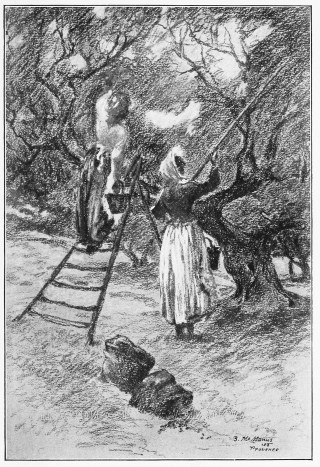
Olive Pickers in the Var
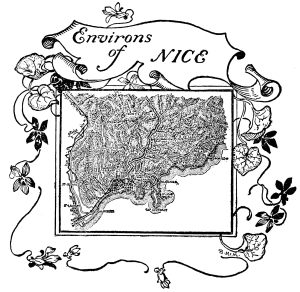
Environs of NICE
For long it played a preëminent rôle in the history of these parts.
To-day one makes his way by one of the ever-pushing electric trams
which, in France, are threading every suburban byway in the vicinities
of the cities and large towns. In other days this was the ancient Roman
way which bound Cimiez and Vence, the Via Augusta, the most ancient
communication between Italy and Gaul. Evidences of its old foundations
are not deeply hidden, and this stretch of roadway must ever remain one
of the most vivid examples of the utilitarian industry of the colonizing
Romans in Gaul.
At Cimiez there are many evidences of the old Roman builders and their
unequalled art, fragments of temples, aqueducts, baths, and
amphitheatres. Everything is very fragmentary, often but a bit of a
column, a sculptured leg or arm, or a morsel of a plate; but there is
everything to prove that Cimiez was a most important place in its time.
The most notable of these ruins is the amphitheatre, built after the
conventional manner of theatre-building invented by the Greeks before
the Romans, and which has, in truth, not been greatly changed up to
to-day, except that it has been roofed over. The theatre at Cimiez in no
way suggests those other Provençal examples at Orange or Arles, the
peers of their class in western Europe, and the stone-cutting was of a
very rude quality or has greatly crumbled in the ages. Such of the walls
and arches as are visible to-day show a hardiness and correctness of
design which, however, is not lived up to in the evidences of actual
workmanship.
There are no grandiose structures anywhere in the vicinity; everything
is fragmentary, but Cimiez was evidently an important city in embryo,
which some untoward influence prevented ever coming to its full-blown
glory.
NICE in many respects is the centre from which radiates all the life of
the Riviera; moreover its military and strategic importance attains the
same distinction; it is the base of the whole system, social and
political.
East and west the “Côte d’Azur” extends until it runs against the grime
and commercial activity of Marseilles on the one side, and Genoa on the
other.
From the heights back of Nice one sees the Ligurian coast stretch away
to infinity, with the sea and the distant isles to the right, while to
the left are the peaks of the Maritime Alps.
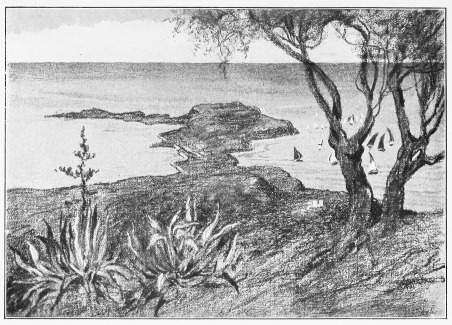
Cap Ferrat
On this pied de terre France has organized a great series of defences
by land and sea. On every height is a fort or a battery, like the
castle-crowned crags of the Rhine. The bays and harbours below the
foot-hills are all defended from the menaces of a real or imaginary foe
by a guardian fringe of batteries and defences of all ranks, and, what
with battle-ships and torpedo-boats, and destroyers and submarines,
this frontier strip is in no more danger of sudden attack by an
unfriendly power than are the interior provinces of Berry and Burgundy.
The entire country around Nice is one vast entrenched camp, constructed,
equipped, and maintained, as may be supposed, with considerable
difficulty and at enormous expense. A mountain fortress whose very
stones, to say nothing of other materials, are transported up a
trailless mountainside, is one of the wonder-works of man, and here
there is a long line of such, encircling the whole region from the
Italian frontier westward to Toulon.
Above all, the fortifications are concentrated in the country just back
of the capital of the Riviera. All the great hillsides, rocky,
moss-grown, or covered with pines or olive-trees, are a network of forts
and batteries, strategic roads, reservoirs of water, and magazines of
shot and shell.
One of the strongest of these forts is on the flanks of Mont Boron; Cap
Ferrat holds another, and the “Route de la Corniche,” the only low-level
line of communication between France and Italy, literally bristles with
the same sort of thing.
Fort de la Drette, five hundred metres in altitude, rises above that
astonishing Saracen village of Eze, while a strategic route leads to
another at Feuillerins, six hundred and forty-eight metres high, and
thence to Fort de la Revere at seven hundred and three metres, an
impregnable series of fortifications, one would think.
Between the battery-crowned heights are the reservoirs and magazines of
powder, all in full view of the automobile and coach tourists from Nice
to Monte Carlo. The route skirts La Revere and the great towering rock
back of Monte Carlo, known as the “Tête de Chien,” and the tourist may
readily enough judge for himself as to the utility and efficacy of these
distinctly modern defences.
The crowning glory, however, is on Mont Agel, the culminating peak in
the vicinity of Nice. It is situated at a height of eleven hundred and
forty-nine metres, and it would take a long siege indeed to capture this
fortress, if things ever came to an issue in its neighbourhood.
Of all the wonderful examples of road-making in France, and they are
more numerous and excellent than elsewhere, the “Route de la Grande
Corniche” is the best known, covering as it does a matter of nearly
fifty kilometres from Nice to Vintimille.
Personally conducted tourists make the trip in brakes and char-à-bancs
via Mont Gros and its observatory, the Col des Quatre Chemins, by Eze
perched on its pyramidal rock, and La Turbie with its memories of
Augustus, until they descend, either via Roquebrune to Menton, or by the
steeps of La Turbie to Monte Carlo and its “distractions de haut
goût.”
It is all very wonderful and, to the traveller who makes the trip for
the first time or the hundredth, the beauties of the panorama which
unfolds at every white kilometre stone is so totally different from that
which he has just passed that he wonders if he is not journeying on some
sort of a magic carpet which simply floats in space. Certainly there is
no more beautiful view-point in all the world than that from the height
overlooking Monaco, Monte Carlo, and Cap Martin, all bedded like jewels
amid an inconceivable brilliancy and softness, a combination which seems
paradoxical enough in print, but which in real life is quite the
reverse, although it is ravishingly beautiful enough to be unreal.
The twenty-franc excursionists from Nice are rushed out from town in the
early morning, via “La Grande Corniche,” to Menton, and back in the
early afternoon via the “Route du Bord du Mer,” at something like the
speed that the malle-poste of other days used to thread the great
national roadways of France. Really the excursion is quite worth the
money, and you do cover the ground, but you cover it much too rapidly,
and so do the speeding automobilists. By far the best way to drink in
all the beauties of this delightful promenade is to devote a week to it,
and do it on foot. Walking tours are not fashionable any more, and in
many thousands of miles of travel by road in France, the writer has
never so much as walked between neighbouring villages, but some day that
promenade au pied is going to be made on the “Corniche” between Nice
and Menton, returning, as do the “trippers,” via the lower road through
Monte Carlo, La Condamine, and Beaulieu. It is the only way to
appreciate the artistic beauties, and the strategic value, of this great
highway of a civilization of another day, whose life, if not as refined
as that of the present, could hardly have been more dissolute than that
which to-day goes on to some extent here in this playground of the
world.
One should make the journey out by the “Corniche” and back by the
waterside, lunching at the auberge at Eze off an anchovy or two, a
handful of dried figs, and a flagon of thick, red, perfumed wine. Then
he will indeed think life worth living, and regret that such things as
railway trains, automobiles, and palace hotels ever existed.
Beyond Nice the Corniche route toward Italy is ample and majestic
throughout its whole course, though, as a whole, it is no more beautiful
than that Corniche by the Estérel. It winds around Mont Gros, at the
back of Nice, and reaches its greatest height just beyond the Auberge de
la Drette. En route, at least after passing the Col des Quatre
Chemins, there is that ever-present panorama of the Mediterranean blue
which all Frenchmen, and most dwellers on its shores, and some others
besides, consider the most beautiful bit of water in the world.
To know the full charms of the road from Nice to Villefranche and
Beaulieu one should start early in the morning, say in April or even
May, when, to him who has only known the Riviera in the winter months,
the very liquidness of the atmosphere and the landscape will be a
revelation. All is impregnated with a penetrating gentle light, under
which the house walls, the roadway, the waves, the rocks, and the
foliage take on a subtle tone which is quite indescribable and quite
different from the artificiality which is more or less present all
through the Riviera towns in winter. There is a difference, too, from
the sun-baked dryness of the dead of summer. Each rock, each cliff, each
bank of sand, and each wavelet of the Mediterranean has a note which
forms the one tone needful for the gamut which is played upon one’s
emotions.
Rounding Mont Boron by the coast road, one soon comes to Villefranche,
whose very name indicates the privileges which were accorded to it by
its founder, Charles II., Comte de Provence et Roi de Naples. Built in
1295, it became at once a free trading port, and speedily drew to itself
a very considerable population. Soon, too, it came into prominence as a
military port, and the Ducs de Savoie made it their chief arsenal.
To-day Villefranche occupies a very equivocal position. It has a
population of something over five thousand souls, and its splendid
harbour gives it a prominence in naval circles which is well deserved;
but, in spite of this, the town has none of the attributes of the other
Riviera coast towns and cities.
The prevailing note of Villefranche is Oriental, with its house walls
kalsomined in red, blue, and pink, in ravishingly delicate and
picturesque tones; really a great improvement, from every point of view,
to the whitewash of Anglo-Saxon lands. The French name for this species
of decoration is the worst thing about it, and, unless one has a
considerable French vocabulary, the word “badigeonée” means nothing.
Another exotic in the way of nomenclature which one meets at
Villefranche is moucharabieh, which is not found in many dictionaries
of the French language. A moucharabieh is nothing more or less than a
unique variety of window screen or blind, behind which, taking into
account the Eastern aspect of all things in Villefranche, one needs only
to see the beautiful head of an Oriental maiden to imagine himself in
far Arabia.
It is but a step beyond Villefranche to Beaulieu and “La Petite
Afrique,” generally thought to be the most exclusive and retired of all
the Riviera resorts. To a great extent this is so, though the scorching
automobilists of the nouveau-riche variety have covered its giant
olive-trees with a powdery whiteness which has considerably paled their
already delicate gray tones.
Between Villefranche and Beaulieu is the peninsula of St. Jean, washed
by the waves on either side and as indented and jagged as the shores of
Greece. To-day it has become an annex of Nice, with opulent villas of
kings, princes, and millionaires, from Leopold, King of Belgium down.
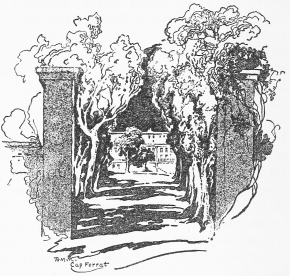
Villa of Leopold, King of Belgium
At St. Jean-sur-Mer, midway down the peninsula, is a little fishing
village, still quaint and unspoiled amid all the splendours of the
palaces of kings and villas of millionaires, which have of late grown
so plentiful in this once virgin forest tract. There are many souvenirs
here of the time when the neighbourhood was occupied by the Knights
Hospitalers of St. John of Jerusalem, and there is much history and
legend connected with them. Seaward is the Promontory or Pointe de St.
Hospice, where the Duc de Savoie, Emmanuel Philibert, built a
fortification. It was an ideal spot for a defensive work of this nature,
though it protected nothing except what was inside. It must, in a former
day, have been a very satisfactory work of its kind, as it is recorded
that this prince, coming to view the progress of the work, and fallen
upon by the Saracens, retreated within the walls of his new defence,
where he successfully repulsed all their attacks.
Many times did the pirates attack this outpost, but finally, as the
country became peaceful, a hospice came to take the place of the warlike
fortification, and from this establishment the Pointe de St. Hospice of
to-day takes its name.
Half-way up the foot-hills of the Alps the great white ribbon of the
“Corniche” rolls its solitary way until La Turbie is reached. Here is a
little village seated proudly beneath that colossal ruin, the Augustan
trophy, which has been a marvel and subject of speculation for
archæologists for ages past. One thing seems certain, however, and that
is that it was a monument commemorative of the submission of forty-five
distinct peoples of western Gaul to the power of Rome.
Westward is Roquebrune, where the “Corniche” drops to the two
hundred-metre level, and one rapidly approaches the sea beyond Cap
Martin, and thus reaches Menton, but two kilometres onward.
The coast route from Nice to Menton via Villefranche and Beaulieu
approximates the same length as the “Corniche” proper, and its charms
are as varied. It rolls along behind the old citadel of Mont Boron and
suddenly opens up the magnificent bay of Villefranche, the favourite
Mediterranean station of the Russians and Americans, and thence on
rapidly to Beaulieu, Monte Carlo, and Menton.
All the way this route by the sea follows the shore and skirts
picturesque gulfs and calanques, and now and then tunnels a hillside
only to come out into day and a vista more beautiful than that which was
left behind.
THE ancient Saracen fortress of Eze lies midway between Beaulieu and
Monte Carlo, somewhat back from the coast, and crowns a pinnacle such as
is usually devoted to the glory of St. Michel.
As one climbs the steep sides of the hill, the fantastic outlines of the
roof-tops silhouette themselves against the sky quite like a scene from
Dante’s masterpiece, or, if not that, like the fabled spectral Brocken.
The road twists and turns, and the sea and shore blend themselves into
one of those incomparable glories of the Riviera, until actually one
stands on the little plateau which moors the tiny church and its
surrounding dwellings.
The Eza of yesterday has become the Eze of to-day, but the former
spelling was vastly more euphonic, and it is a pity that it was ever
changed. Eze is ruinous to-day, as it has been for ages, and pagan and
Christian monuments are cheek by jowl.
Rising abruptly three hundred metres from the sea-level, the mountain
offered a stronghold well-nigh unassailable. First the Phœnicians
occupied it, then the Phoceans, followed by the Romans, the Saracens,
and all the warring factions and powers of mediæval times. No wonder it
is reminiscent of all, with memorials ranging all the way from the
temple dedicated to the Egyptian cult of Isis to the Christian church
seen to-day.
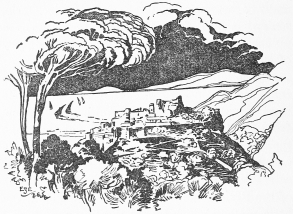
Eze
Centuries passed but slowly here, and the Moorish hordes, seeking for a
vantage-ground on the Ligurian coast, took the peak for their own. The
early founders did not need to go afield for the material for the
building of houses and their military constructions. It was all close at
hand. The rocky base sufficed for all.
What is left to-day of the old bourg, remodelled and rebuilt in many
cases, but still the original structures to no small extent, is a
veritable museum of architectural curiosities.
What an accented note it is in the whole vast expanse of green and blue!
It is literally worth coming miles to see, even if one makes the
wearisome journey on foot.
Eze is sequestered from all the world, and, like Normandy’s Mont St.
Michel, would be an ideal place in which to shut oneself up if one
wanted to escape from his enemies (and friends).
The shrine of Notre Dame de Laghet lies in the country back of Eze, but
rather nearer to La Turbie. The whole south venerated Our Lady of Laghet
in days gone by, and came to worship at her shrine. The neighbouring
country is severe and less gracious than that of most of the flowering
Riviera; but, in the early days of spring, with the hardier blossoms
well forward, it is as delightful an environment for a shrine as one can
well expect to find.
Historic souvenirs in connection with Notre Dame de Laghet are many.
The Duc de Savoie, Victor Amédée, came here to worship in 1689, and a
century and a half later, his descendant, Charles Albert, shorn of his
crown, and a fugitive, sought shelter here from the dangers which beset
him. Here he knelt devoutly before the Madonna, and prayed that his
enemies might be forgiven. A tablet to-day memorializes the event.
The little church of the establishment contains hundreds of votive
offerings left by pious pilgrims, and, though architecturally the
edifice is a poor, humble thing, it ranks high among the places of
modern pilgrimage.
A kilometre beyond the gardens which face the Casino at Monte Carlo is a
little winding road leading blindly up the hillside. “Où conduit-il?”
you ask of a straggler; “A La Turbie, m’sieu;” and forthwith you
mount, spurning the aid of the funiculaire farther down the road. When
one has progressed a hundred metres along this serpentine roadway, the
whole ensemble of beauties with which one has become familiar at the
coast are magnified and enhanced beyond belief. Nowhere is there a
gayer, livelier colouring to be seen on the Riviera; this in spite of
the conventionality of the glistening walls of the great hotels and the
artificial gardens with which the vicinity of the paradise of Monte
Carlo abounds.
As one turns another hairpin corner, another plane of the horizon opens
out until, after passing various isolated small houses, and zigzagging
upward another couple of kilometres, he enters upon the “Route
d’Italie,” and thence either turns to the left to La Turbie, or to the
right to Roquebrune, a half-dozen kilometres farther on.
La Turbie is quite as much of an exotic as Eze. It is as vivid a
reminder of a glory that is past as any monumental town still extant,
and its noble Augustan Trophy, as a memorial of a historical past, is
far greater than anything of its kind out of Rome itself. There is
something almost sublime about this great sky-piercing tower, a monument
to the vanquishing of the peoples of Gaul by the Roman legions.
Fragments of this great “trophy” have been carted away, and are to be
found all over the neighbouring country. Barbarians and Saracens, one
and all, pillaged the noble tower (“the magnificent witness to the
powers of the divine Augustus,” as the French historians call it), using
it as a quarry from which was drawn the building material for many of
their later works. Without scruple it has been shorn of its attributes
until to-day it is only a bare, gaunt skeleton of its former proud self.
Its marbles have been dispersed, some are in Nice, some in Monaco, and
some in Genoa, but the greatest of all the indignities which the edifice
underwent was that thrust upon it by Berwick, in 1706, when attempts
were actually made to pull it to the ground.
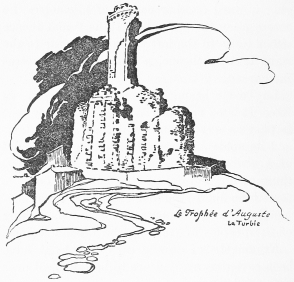
Augustan Trophy, La Turbie
What its splendours must once have been may best be imagined from the
following description:
“A massive quadrangular tower surrounded with columns of the Doric
order and ornamented with statues of the lieutenants of Augustus, and
personifications of the vanquished peoples. Surmounting all was a
colossal statue of the emperor himself.”
La Turbie has a most interesting “porte,” once fortified, but now a
mere gateway. It dates from the sixteenth century, and is an exceedingly
satisfying example of what a mediæval gateway was in feudal times.
The church of the town is of great size and well kept, but otherwise is
in no way remarkable.
As with the founders of Eze, the builders of La Turbie and its great
Augustan Trophy had their material close at hand, and there was no need
for the laborious carrying of material from a distance which accompanied
the building of many mediæval monuments and fortifications.
A quarry was to be made anywhere that one chose to dig in the hillside,
and, though no traces of the exact location whence the material was dug
is to be seen to-day, there is no question but that it was a home
product. The marbles and statues alone were brought from afar.
Roquebrune, onward toward Menton, is more individual in the character of
its people and their manners and customs than any of the other towns and
villages near the great Riviera pleasure resorts. The ground is
cultivated in small plots, and olive and fruit trees abound, and
occasionally, sheltered on a little terrace, is a tiny vineyard
struggling to make its way. The vine, curiously enough, does not prosper
well here, at least not the extent that it formerly did, and accordingly
it is a good deal of a struggle to get a satisfactory crop, no matter
how favourable the season.
Here in the vicinity of Roquebrune one sees the little donkeys so well
known throughout the mountainous parts of Italy and France. They are
sure-footed little beasts, like their brother burros of the Sierras and
the Rockies, and appear not to differ from them in the least, unless
they are smaller. All through the region to the northward of the coast
they file in cavalcades, bearing their burdens in panniers and
saddle-bags in quite century-old fashion, and as if automobiles and
railways had never been heard of. An automobile would have a hard time
of it on some of the by-roads accessible only to these tiny beasts of
burden, which often weigh but eighty kilos and cost little or nothing
for provender.
These little Savoian donkeys are gentle and good-natured, but obstinate
when it comes to pushing on at a gait which the driver may wish, but
which has not yet dawned upon the donkey as being desirable. This,
apparently, is the national trait of the whole donkey kingdom, so there
is nothing remarkable about it. He will go,—when you twist his
tail,—and if you twist it to the right he will turn to the left, and
vice versa. A sailor would be quite at home with a donkey of Roquebrune.
Roquebrune is tranquil enough to-day, though there have been times when
the rocky giant on whose bosom it sleeps awakened with a roar which
shook the very foundations of its houses. These earthquakes have not
been frequent; the last was in 1887; but the memory of it is enough to
give fear to the timid whenever a summer thunder-storm breaks forth.
Roquebrune occupies a height very much inferior to that on which sits La
Turbie; but the panorama from the town is in no way less marvellous, nor
is it greatly different, hence it is not necessary to recount its
beauties here. There is considerably more vegetation in the
neighbourhood, and there are many lemon-trees, with rich ripening fruit,
instead of the dwarfed unripe oranges which one finds at many other
places along the Riviera.
The lemon-tree is the real thermometer of the region, and the inhabitant
has no need of the appliances of Réaumur or Fahrenheit, or the more
facile Centigrade, for when three degrees of frost strikes in through
the skin of the lemon, it withers up and dies. The orange, curiously
enough, resists this first attack of cold.
Roquebrune, like La Turbie, abounds in vaulted streets and terraced
hillsides, allowing one to step from the roofs of one line of houses to
the dooryards of another in most quaint and picturesque fashion. The
people of Roquebrune are a prosperous and contented lot, and have the
reputation of being “as laborious as the bee and as economical as the
ant.”
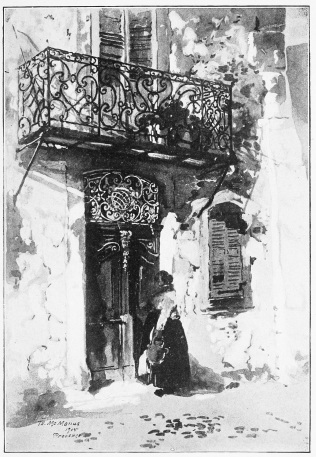
A Roquebrune Doorway
At the highest point, above most of the roof-tops of Roquebrune, are
found the ruins of its château, in turn a one-time possession of the
Lascaris and the Grimaldi, and belonging to the latter family when the
town and Menton were ceded to France. From the platform of the ancient
citadel one readily enough sees the point of the legend which
describes Roquebrune as once having occupied the very summit of the
height, and, in the course of ages, slipping down to its present
position.
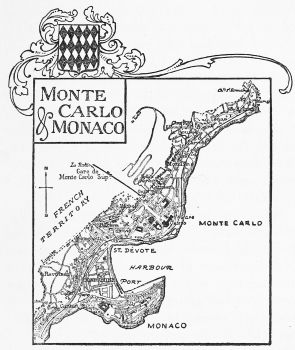
Monte Carlo & MONACO
“OLD Monaco and New Monte Carlo” might well be made the title of a book,
for their stories have never been entirely told in respect to their
relations to the world of past and present. Certainly the question of
the morality or immorality of the present institution of Monte Carlo,
called by the narrow-minded a “gambling-hell,” has never been thrashed
out in all its aspects. Instead of being a blight, it may be just a
safety-valve which works for the good of the world. It is something to
have one spot where all the “swell mobsmen” of the world congregate, or,
at least, pass, sooner or later, for, like “Shepheards” at Cairo and the
“Café de la Paix” at Paris, Monte Carlo sooner or later is visited by
all the world, the moralists to whine and deplore all its loveliness
being wasted on the evil-doer, the preacher out of curiosity (as he
invariably tells you, and probably this is so); the sentimental young
girls and their mammas to be seen and to see and (perhaps?) to play,
and the pleasure-loving and the care-worn business man—for nine years
and nine months out of ten—to play a little, and, when they have lost
all they can afford, to withdraw without a regret. There is another
class, several other classes in fact, but it is assumed that they need
not be mentioned here.
Unquestionably there are many tragedies consummated at Monte Carlo, and
all because of the tables, and it is also true that the same sort of
tragedies take place in Paris, London, and New York, but it isn’t the
gambling craze alone that has brought them about, and, anyway, one can
come to Monte Carlo and have a very good time, and not become addicted
to “the game.” To be sure not many do, but that is the fault of the
individual and not the “Administration,” that all-powerful anonymous
body which controls the whole conduct of affairs at Monte Carlo.
Some one has remarked the seemingly significant coat of arms of the
present reigning Prince of Monaco, but assuredly he had very little
knowledge of heraldry to assume that it had anything to do with the
pleasure-making suburb of the capital of the Principality. It seems well
enough to make mention of the fact here, if only to explode one of the
fabulous tales which pass current among that class of tourists who come
here, and, having hazarded a couple of coins at the tables, go home and
mouth their adventures to awed acquaintances. Their tales of fearful
adventure, and the anecdote that the blazoning of the arms of the
reigning prince represents the layout of the gaming-tables, are really
too threadbare and thin to pass current any longer.
To many the Riviera means that “beautiful, subtle, sinister place, Monte
Carlo,” and indeed it is the most idyllically situated of the whole
little paradise of coast towns from Marseilles to Genoa, and perhaps in
all the world.
Whatever the moral aspect of Monte Carlo is or is not, there is no doubt
but that it is one of the best paying enterprises in the amusement
world, else how could M. Blanc have lived in a palace which kings might
envy, and have kept the most famous string of race-horses in France.
Certainly not out of a “losing game.” He himself made a classic bon mot
when he said, “Rouge gagne quelquefois, noir souvent, mais Blanc
toujours.”
M. Blanc was a singularly astute individual. He knew his game and he
played it well, or rather his tables and his croupiers did it for him,
and he even welcomed men with systems which they fondly believed would
sooner or later break the bank, for he knew that the best of “systems”
would but add to the profits of the bank in the long run. He even
answered an inquisitive person, who wanted to know how one should
gamble in order to win: “The most sensible advice I can give you
is—‘Don’t.’”
One reads in a local guide-book that the chances between the player and
the bank, taking all the varieties of games into consideration, is as 60
to 61, and that the winnings of the bank were something like £1,000,000
sterling per year. This would seem to mean that the players of Europe
and America took £61,000,000 to Monte Carlo each year, and brought away
£60,000,000, leaving £1,000,000 behind as the price of their pleasure.
The magnitude of these figures is staggering, and so able a statistician
as Sir Hiram Maxim refuted them utterly a couple of years ago as
follows:
“If the bank actually won one million sterling a year, and its chances
were only 1 in 60 better than the players, it would seem quite evident
that sixty-one millions must have been staked. However, upon visiting
Monte Carlo and carefully studying the play, I found that instead of the
players taking £61,000,000 to Monte Carlo, and losing £1,000,000 of it,
the total amount probably did not exceed £1,000,000, of which the bank,
instead of winning, as shown in the guide-book, about 1½ per cent.,
actually won rather more than 90 per cent.; therefore, the advantages in
favour of the bank, instead of being 61 to 60, were approximately 10 to
1.”
This ought to correct any preconceived false notions of percentages and
sum totals.
The law of averages is a very simple thing in which most people, in
respect to gambling, and many other matters, have a supreme faith; but
Sir Hiram disposes of this in a very few words. He says: “Let us see
what the actual facts are.
“If red has come up twenty times in succession, it is just as likely
to come up at the twenty-first time as it would be if it had not come up
before for a week. Each particular ‘coup’ is governed altogether by the
physical conditions existing at that particular instant. The ball spins
round a great many times in a groove. When its momentum is used up, it
comes in contact with several pieces of brass, and finally tumbles into
a pocket in the wheel which is rotating in an opposite direction. It is
a pure and unadulterated question of chance, and it is not influenced in
the least by anything which has ever taken place before, or that will
take place in the future.”
Thus vanish all “systems” and note-books, and all the schemes and
devices by which the deluded punter hopes to beat M. Blanc at his own
game. It is possible to play at “Rouge et Noir” at Monte Carlo and
win,—if you don’t play too long, and luck is not against you; but if
you stick at it long enough, you are sure to lose. There was once a man
who went to Monte Carlo and played the very simple “Rouge et Noir” in
a sane and moderate fashion, and in three years was the winner by
twenty-five thousand francs. He returned the fourth year, and in three
weeks lost it all, and another ten thousand besides. He gave up the
amusement from that time forward as being too expensive for the pleasure
that one got out of it.
As a business proposition, the modestly titled “Société Anonyme des
Bains de Mer et Cercle des Étrangers” (for it is well to recall that the
inhabitants of Monte Carlo are forbidden entrance, their morals, at
least, being taken into consideration) is of the very first rank. It
earned for its shareholders in 1904-05 the magnificent sum of thirty-six
million francs, an increase within the year of some two millions. It is
steadily becoming more prosperous, and the businesslike prince who rents
out the concession has had his salary raised from 1,250,000 francs to
1,750,000 francs per annum, on an agreement to run for fifty years
longer.
By those who know it is a well-recognized fact that the bank at Monte
Carlo loses more by fraud than by any defects in its system of play.
From the pages of that unique example of modern journalism, “Rouge et
Noir—L’Organe de Défense des Joueurs de Roulette et de
Trente-et-Quarante,” are culled the two following incidents:
A certain gambler, Ardisson by name, bribed a croupier to insert a
specially shuffled pack into the “Trente-et-Quarante” game one fine
evening, during an interval when attention was diverted by a female
accomplice having dropped a roll of louis on the floor. After eight
abnormal “coups,” the bank succumbed,—“la société se retire
majestueusement” the informative sheet puts it,—180,000 francs out of
pocket. The swindler—for all gamblers are not swindlers—and his
accomplice, or accomplices, made their way safely across the frontier,
and the only echo of the event was heard when the guilty croupier was
sentenced to two months’ imprisonment,—a period of confinement for
which he was doubtless well paid.
Another incident recounted in this most interesting newspaper was that
of one Jaggers, an Englishman from Yorkshire, where all men are
singularly knowing. This individual discovered that one of the
roulette-wheels had a distinct tendency toward a certain number. His
persistency in backing that number attracted the attention of the bank’s
detectives, who marvelled at his continued run of luck. Eventually the
authorities solved the problem, and now the roulette-wheels are
interchangeable, and are moved daily from one set of bearings to
another.
Once it was planned to explode a bomb near the gas-metre in the
basement, and in the excitement, after the lights went out, to rob the
tables and players alike. This plan was conceived by a gang of ordinary
thieves, who needed no great intelligence to concoct such a scheme,
which, needless to say, was nipped in the bud.
Some years ago the game was played with counters which were bought at a
little side-table. A gang of counterfeiters made these in duplicate, and
had a considerable haul before the trick was discovered. The museum of
the Casino has many of these unstable records, but a change was
immediately made in favour of five-franc pieces, louis, and notes of the
Banque de France, which are no more likely to be counterfeited for
playing the tables at Monte Carlo than they are for general purposes of
trade.
Formerly one could wager a great “pillbox” roll of five-franc pieces
done up in paper,—twenty of them to the hundred,—but to-day the
envelope must be broken open. Some one won a lot of money once with some
similar rolls of iron, which, until the daily or weekly inventory on the
part of the bank, were not discovered to be foreign to the coin of the
realm.
There are two sides to the life and environment of Monaco and Monte
Carlo; there is the beautiful and gay side, for the lover of charming
vistas and a lovely climate; and there is the practical, dark, and
sordid side, of which “the game” is the all.
Much has been written of the moral or immoral aspect of the place, and
the discussion shall have no place here. The reader will find it all set
out again in his daily, weekly, or monthly journal sometime during the
present year, as it has appeared perennially for many years.
Monaco is old and Monte Carlo is new. The history of Monaco runs back
for many centuries. The Phœnicians built a temple to Hercules here long
before its political history began; then for a time it was a rendezvous
for pirates, and finally it fell to the Genoese Republic. Jean II.
became the seigneur, and left it to his propre frère, Lucien Grimaldi,
the ancestor of the present house of Grimaldi, to whom the princes of
to-day belong. Thus it is that the Prince of Monaco, though the
sovereign of the smallest political state of Europe, belongs to the
oldest reigning house. Monaco is a relic of the ages past, but Monte
Carlo is a thing of yesterday.
Monte Carlo is the result of the labours of M. Blanc, who, though not
the creator of the vast enterprise as it exists to-day, was the real
developer of the scheme. He attained great wealth and distinction, as is
borne out by the fact that he lived luxuriously and was able to marry
his daughters to princes of the great house of Napoleon.
Blanc showed his business acumen when he got a concession from the
Prince of Monaco to run a gambling-machine at Monte Carlo. He got the
concession first, and then bought out a weak, puny establishment which
was already in operation, after having made the proprietors a
proposition which he gave them two hours to accept or reject. The
contract closed, he arranged immediately to begin the new Casino with
Garnier, the designer of the Paris Opera, as his architect. Opposite it
he built the Hôtel de Paris, which has the deserved reputation of being
the most expensive hotel in existence. Like everything else at Monte
Carlo, you get your money’s worth, but things are not cheap. The Prince
of Monaco generously gave his name to the place, and the enterprise—for
at this time it was nothing more than a great collective enterprise—was
christened Monte Carlo.
Everything comes to him who waits, and soon the Paris, Lyons, and
Mediterranean Railway extended its line to the gay little city of
pleasure, in spite of the pressure brought to bear by other Riviera
cities and towns to the westward. Thus the place started, almost at
once, as a full-grown and lusty grabber of the people’s money, always
wanting more; and the world came on luxurious trains, whereas formerly
they made their way by a cranky little steamboat from Nice, or by the
coach-and-four of other days.
Like most successful handlers of other people’s money, Blanc was a
reader of man’s emotions. He knew his customers, and he knew that many
of them were the scum of the earth, and he guarded carefully against
allowing them too much freedom. He may have feared his life, or he may
have feared capture for ransom, like missionaries and political
suspects, and for this reason M. Blanc went about with never a penny on
his person. He carried a blank cheque, however, printed, it is said, in
red ink—for the old-stager at Monte Carlo still likes to regale the
nouveau with the tale—and good for several hundred thousand francs.
The “man in the box” had very explicit instructions never to pay this
cheque, should it turn up, unless he had previously received a telegram
ordering him to do so. It will not take the sagacity of a Dupin or a
Sherlock Holmes to evolve the reason for this, but it was a clever idea
nevertheless.
In case any of the curious really want to know how the game is played,
the following facts are given:
Blanc’s organization was well-nigh a perfect one, and, though its
founder is now dead, it remains the same. The staff is a large one. At
the head is an administrator-general, who has three collaborators, also
known as administrators, one who conducts the affairs of the outside
world, has charge of the supplies for the establishment, and the
arrangements for the pigeon-shooting, the automobile boat-races, the
care of the gardens, etc.; another holds the purse-strings and is a sort
of head cashier; and the third has charge of the tables and their
personnel.
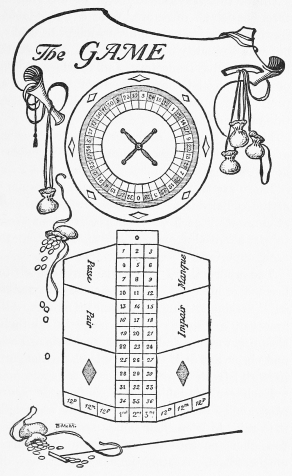
The GAME
Under this last is a director of the games, three assistant directors,
four chefs-de-table,—which sounds as though they might be cooks, but
who in reality are something far different; then come five inspectors,
and fourteen chiefs of the roulette-tables, and all of them are a pretty
high-salaried class of employee, as such things go in Europe.
The chiefs of the roulette-tables draw seven and five hundred francs a
month, for very short hours and easy work.
There are two classes of dealers,—croupiers at the roulette-tables and
tailleurs at “trente-et-quarante,” each of whom receive from four to
six hundred francs a month, according to their experience.
The apprentices, who some day expect to become croupiers,—those who do
the raking in,—receive two hundred francs a month. All, however, are
under an espionage in all their sleeping, waking, and working moments as
keen and observant as if they were bank messengers in Wall Street.
Each roulette-table has a chef and a sous-chef and seven croupiers,
who are expected, it is said, to keep their hands spread open before
them on the table between all the turns of the wheel. A story is told,
which may or may not be true, of a croupier who was inordinately fond
of taking snuff. It seemed curious that a coin should always adhere to
the bottom of his snuff-box whenever he laid it down upon the table, and
accordingly that particular croupier was banished and the practice
forbidden.
Another had built himself a nickle-in-the-slot arrangement which, with
remarkable celerity, conducted twenty-franc pieces from somewhere on the
rim of his exceedingly tall and stiff collar to an unseen money-belt.
Every time he scratched his ear, or slapped at an imaginary mosquito, it
cost the bank a gold piece. Now high collars are banished and
mosquito-netting is at every door and window.
No employee is allowed to play, nor are the Monégasques themselves. All
nations are represented in the establishment, French, Italian, Russians,
Belgians, and Swiss. Once there was a croupier who spoke English so
perfectly that he might be taken for an Englishman or an American, but
he proved to be a native of the little land of dikes and windmills,
where they teach English in the schools to the youth of a tender age.
The French language reigns and French money is used exclusively. You may
cash sovereigns and eagles at the bureau, and you may do your banking
business at the counters of the “Crédit-Lyonnais,” which discreetly
hangs out its shingle just over the border on French territory, though
not a stone’s flight from the Casino portals. You know this because
beneath their sign you read another in bold, flaring letters, as if it
were the most important of all, “On French Soil.”
The three towns of the Principality of Monaco each present a totally
different aspect; but, in spite of all its loveliness, one’s love for
Monte Carlo is a sensuous sort of a thing, and it is with a real relief
that he turns to admire Monaco itself.
Its story has often been told, but there always seems something new to
learn of it. The writer always knew that its flora was to be remarked,
even among those horticultural exotics scattered so bountifully all over
the Riviera, and that, apparently, the Monégasques had the art instinct
highly developed, as evinced by the many beautiful monuments and
buildings of the capital; but it was only recently that he realized the
excellence of the typographical art of the printers of Monaco. These
craftsmen have reached a high degree of proficiency and taste, as
evinced by that most excellent production, the “Collection de
Documents Historiques,” published by the archivist of the Principality,
and the “Résultats des Campagnes Scientifiques Accomplies sur son
Yacht, par S. A. le Prince Albert de Monaco.”
Authors the world over might well wish their works produced with so much
excellence of typography and so rich a format and impression.
Monaco, small and restricted as it is, is full of surprises and
anomalies. It has a ruling monarch, a palace, an army,—of sixty odd,
all told,—a bishop and a cathedral all its very own, though the
Principality is but three and a half kilometres in length and slightly
more than a kilometre in width, its only rival for minuteness being the
former province of Heligoland.
The reigning prince has a military staff composed of two aides-de-camp,
an ordnance officer, and a chief of staff. He has also a grand and
honorary almoner, a chaplain and a chamberlain, several state
secretaries, a librarian, and an archivist,—besides another staff
devoted to his oceanographical hobby. There are, of course, many other
functionaries, like those one reads of in swashbuckler novels, and the
list closes with an “Architect-Conservator of the Palaces of His Serene
Highness.”
After the prince comes the Principality, and it, too, has a long list of
guardians and office-holders. There is a governor-general, who is
usually a titled person, a treasurer, and, of course, an auditor, and
there is a registrar of the tobacco traffic and a registrar of the match
trade, two monopolies by which all well-regulated Latin governments set
much store.
Finally there is the municipal governmental organization, with the
regulation coterie of little-worked office-holders. They may have their
bosses and their games of “graft” here, or they may not, but they are
sure to have a never-ending supply of red tape if you want to cut a
gateway through your garden wall or sweep your chimney down.
There is also an official newspaper known as Le Journal de Monaco.
The church is better represented here than in most communities of its
size. A monseigneur is chaplain to the prince, and Monaco, through the
consideration of Leo XIII., in 1887, is the proud possessor of its own
cathedral church and its dignitary.
To arrive on the terraces of Monte Carlo at twilight, on a spring-time
or autumn evening, is one of the great episodes in one’s life. You are
surrounded by an atmosphere which is balsamic and perfumed as one
imagines the Garden of Eden might have been. All the artificiality of
the place is lost in the softening shadows, and all is as like unto
fairy-land as one will be likely to find on this earth. The lovely
gardens, the gracious architecture, the myriads of lights just twinkling
into existence, the hum of life, the moaning and plashing of the waves
on the rocky shores beneath, and, above, a canopy of palms lifting their
heads to the sky, all unite to produce this unparalleled charm.
When one considers that fifty years ago the Monte Carlo rock was as bald
and bare as Mont Blanc or Pike’s Peak, it speaks wonders for art, or
artificiality, or whatever one chooses to call it, that it could have
been made to blossom thus.
On a fine morning the effect, too, is equally entrancing,—“Onze heure,
c’est l’heure exquise.” The miracle of brilliancy of sea and sky is
nowhere excelled in the known world, and, if the raucous sounds of the
railway and the electric tram do break the harmony somewhat, there is
still left the admirable works of the hand of nature and man, who have
here planned together to give an ensemble which, in its appealing
loveliness, far outweighs the discord of mundane things.
One is astonished at it all, and, whether he approves or disapproves of
the morality of Monte Carlo, he is bound to endorse the opinion that its
loveliness and luxury is superlative.
The Principality of Monaco, like those other petty states, Andorra and
San Marino, comes very near to being a burlesque of the greater powers
that surround it. It is not France; it is not Italy; it is a power all
by itself; the most diminutive among the monarchies of the world, but,
all things considered, one of the wealthiest and best kept of all the
states of Europe. Monaco, the town, has a population of over eight
thousand per square kilometre, while its nearest rival among the states
of Europe, for density of population, is Belgium, of a population of but
two hundred to the same area.
From the heights above Monte Carlo one sees a map of it all spread out
before him in relief, the three towns, Monte Carlo, Condamine, and
Monaco, with their total of fifteen thousand souls and the most
marvellous setting which was ever given man’s habitation outside of
Eden.
Overlooking Monaco and Monte Carlo
The capital sits proudly on its sea-jutting promontory, with Condamine,
its port, where the neck joins the mainland, and Monte Carlo, the
faubourg of pleasure, immediately adjoining on the right. All is white,
green, and blue, and of the most brilliant tone throughout.
Monaco was a microcosm in size even when Roquebrune and Menton made a
part of its domain, and to-day it is much less in area. It was in the
dark days of the French Revolution that the little principality was rent
in fragments, and there were left only the rock and its two dependencies
for the present Albert de Goyon-Matignon, the descendant of the Maréchal
de Matignon, to rule over. It was this Maréchal de Matignon, then Duc de
Valentinois, who espoused the heiress of the glorious house of Grimaldi,
thus bringing the Grimaldi into alliance with the present power of this
kingdom-in-little.
What a kingdom it is, to be sure! What a highly organized monarchy!
There is a council of state; a tribunal, with its judges and advocates;
a captain of the port; a registry for loans and mortgages; an inspector
of public works, etc., etc.; and all the functionaries are as
awe-inspiring and terrible as such officers usually are. Even the
“Commandant de la Garde,” to give him his real title, is a sort of
minister of war, and he is, too, a retired French officer of high rank.
The Frenchman when he crosses the frontier into Monaco literally
journeys abroad. The frontier patrol is a gorgeous sort of an individual
by himself, a sort of a cross between the gardien de la paix of France
and the Italian customs officer who comes into the carriages of the
personally conducted tourists to Italy searching for contraband matches
and salt,—as if any civilized person would attempt to smuggle these
unwholesome things anyway.
As one enters the Principality, by the road coming from Nice, he passes
between the rock and the steep hillsides by the Boulevard Charles III.,
and, turning to the right, enters the town where is the seat of
government.
The town has some three thousand odd inhabitants, which is a good many
for the “mignonne cité,” of which one makes the round in ten minutes.
But what a round! A promenade without a rival in the world! Well-kept
houses, villas, and palaces at every turn, with a fringe of rocky
escarpment, and here and there a plot of luxuriant soil which gives a
foothold to the fig-trees of Barbary, aloes, olive and orange trees,
giant geraniums, lauriers-roses and all the flora of a subtropical
climate.
The inhabitant of the Principality of Monaco is fortunate in more ways
than one; he is not taxed by the impôt, and he does not contribute a
sou to the civil list of the prince. “The game” pays all this, and,
since its profits mostly come from those who can afford to pay, who
shall not say that it is a blessing rather than a curse. Another thing:
the Monégasques, the descendants of the original natives, are all
“gentilshommes,” by reason of the ennobling of their ancestors by
Charles Quint.
By a sinuous route one descends from Monaco to La Condamine, the most
populous centre in the Principality, built between the rock of Monaco
and the hill of Monte Carlo. Five hundred metres farther on, but upward,
and one is on the plateau of Spélugues, a name now changed to Monte
Carlo.
It is with a certain hypocrisy, of course, that the frequenters of Monte
Carlo rave about its charms and its resemblance to Florence or to
Athens; they come there for the game and the social distractions which
it offers, and that’s all there is about it. It is all very fascinating
nevertheless.
All the splendour of Monte Carlo, and it is splendid in all its
appointments without a doubt, is but a mask for the comings and goings
of the gambler’s hopes and those who live off of his passion.
A true philosopher will not cavil at this; the sea is the most
delightful blue; the background one of the most entrancing to be seen in
a world’s tour; and all the necessaries and refinements of life are here
in the most superlative degree. Who would, or could, moralize under such
conditions? It’s enough to bring a smile of contentment to the
countenance of the most confirmed and blasé dyspeptic who ever lived.
But is it needful to avow that one quits all the luxury of Monte Carlo
with a certain sigh of relief? All this splendour finally palls, and one
seeks the byways again with genuine pleasure, or, if not the byways, the
highways, and, as the road leads him onward to Menton and the Italian
frontier, he finds he is still surrounded by a succession of the same
landscape charms which he has hitherto known. Therefore it is not
altogether with regret that he leaves the Principality by the back door
and makes a mental note that Menton will be his next stopping-place.
It is to be feared that few of the mad throng of Monte Carlo
pleasure-seekers ever visit the little parish chapel of Sainte Dévote,
though it is scarce a stone’s throw off the Boulevard de la Condamine,
and in full view of the railway carriage windows coming east or west.
The chapel is an ordinary enough architectural monument, but the legend
connected with its foundation should make it a most appealing place of
pilgrimage for all who are fond of visiting religious or historic
shrines. One can visit it in the hour usually devoted to lunch,—between
games, so to say,—if one really thinks he is in the proper mood for it
under such circumstances.
Sainte Dévote was born in Corsica, under the reign of Diocletian, and
became a martyr for her faith. She was burned alive, and her remains
were taken by a faithful churchman on board a frail bark and headed for
the mainland coast. A tempest threw the craft out of its course, but an
unseen voice commanded the priest to follow the flight of a dove which
winged its way before them. They came to shore near where the present
chapel stands. The relics of the saint were greatly venerated by the
people of the surrounding country, who lavished great gifts upon the
shrine. The corsair Antinope sought to rob the chapel of its trésor,
in 1070, but was prevented by the faithful worshippers.
Each year, on January 27th, the fête-day of the saint, a procession and
rejoicing are held, amid a throng of pilgrims from all parts, and a bark
is pushed off from the sands at the water’s edge, all alight, as a
symbol of protestation against the attempted piratical seizure of the
statue and its trésor. For many centuries the Fête de Sainte Dévote
was presided over by the Abbé de St. Pons. To-day the Bishop of Monaco,
croisered and mitred, plays his part in this great symbolical
procession. It is a characteristic detail, in honour of the efforts of
the sailor-folk of olden days in rebuffing the pirate who would have
pillaged the shrine, that the bishop subordinates himself and gives the
head of the procession to the representatives of the people. Altogether
it is a ceremony of great interest and well worthy of more outside
enthusiasm than it usually commands. The princely flag flies from
Monaco’s Palais on these occasions, whether the ruler be in residence or
not. At other times it is only flown to signify the presence of the
prince.
The Ravine of Saint Dévote, Monte Carlo
With all its artificiality, with all its splendour of nature and the
works of man, and with all the historic associations of its past, one
can but take a mingled glad and sad adieu of Monaco and Mont Charles.
“Monaco est bien le rêve le plus fantastique, devenue la plus
resplendissante des réalités!”
MENTON is more tranquil than Nice or Cannes, and, in many ways, more
adorable; but it is a sort of hospital and is not conducive to gaiety to
the extent that it would be were there an utter absence of Bath chairs,
pharmacies, and shops devoted to the sale of nostrums and invalid foods.
There is none of the feverish existence of the other cities of the
Riviera here, and, in a way, this is a detraction, for it is not the
unspoiled countryside, either, but bears all the marks of the advent of
an indulgent civilization. One might think that one’s very existence in
such a delightful spot might be a panacea for most of flesh’s ills, but
apparently this is not so, at least the doctors will not allow their
“patients” to think so.
Menton’s port is quite extensive and is well sheltered from the pounding
waves which here roll up from the Ligurian sea, at times in truly
tempestuous fashion. To the rear the Maritime Alps slope abruptly down
to the sea, with scarce a warning before their plunge into the
Mediterranean. All this confines Menton within a very small area, and
there is little or no suburban background. In a way this is an
advantage; it most certainly tends toward a mildness of the winter
climate; but on the other hand there is lacking a sense of freedom and
grandeur when one takes his walk abroad.
Just before reaching Menton is the garden-spot of Cap Martin, once a
densely wooded “petite forêt,” but now threaded with broad avenues cut
through the ranks of the great trees and producing a wonderland of
scenic vistas, which, if they lack the virginity of the wild-wood as it
once was, are truly delightful and fairylike in their disposition. Great
hotels and villas have come, for the Emperor of Austria and the
ex-Empress Eugénie were early smitten by the charms of the marvellously
situated promontory, making of it a Mediterranean retreat at once
exclusive and unique.
The panorama eastward and westward from this green cape is of a varied
brilliancy unexcelled elsewhere along the Riviera. On one side is
Monaco’s rock, Monte Carlo, and the enchanting banks of “Petite
Afrique,” and on the other the white walls and red roofs of Menton.
Between Cap Martin and Menton the road skirts the very water’s edge,
crossing the Val de Gorbio and entering the town via Carnoles, where the
Princes of Monaco formerly had a palace. Modern Menton is like all the
rest of the modern Riviera; its streets bordered with luxurious
dwellings and hotels, up-to-date shop-fronts, and all the appointments
of the age. At the entrance to the city is a monument commemorative of
the voluntary union of Menton and Roquebrune with France.
Menton is a strange mixture of the old and the new. There are no
indications of a Roman occupation here, though some geographers have
traced its origin back through the night of time to the ancient Lumone.
More likely it was founded by piratical hordes from the African coast,
who, it is known, established a settlement here in the eighth century.
Furthermore, the “Maritime Itinerary” of the conquering Romans makes no
mention of any landing or harbour between Vintimille and Monaco, thus
ignoring Menton entirely, even if they ever knew of it.
The town is superbly situated in the form of an amphitheatre between two
tiny bays, and the country around is well watered by the torrents which
flow down from the highland background.
After having been a pirate stronghold, the town became a part of the
Comté of Vintimille, after the expulsion of the Saracens, and later had
for its seigneurs a Genoese family by the name of Vento. In the
fourteenth century it fell to the Grimaldi, and to this day its aspect,
except for the rather banal hotel and villa architecture, has remained
more Italian in motive than French.
Menton is not wholly an idling community like Monte Carlo and Monaco. It
has a very considerable commerce in lemons, four millions annually of
the fruit being sent out of the country. The industry has given rise to
a species of labour by women which is a striking characteristic in these
parts. Like the women who unload the Palermo and Seville orange boats at
Marseilles, the “porteïris” of Menton are most picturesque. They carry
their burdens always on the head, and one marvels at the skill with
which they carry their loads in most awkward places. The work is hard,
of course, but it does not seem to have developed any weaknesses or
maladies unknown to other peasant or labouring folk, hence there seems
no reason why it should not continue. Certainly the Mentonnaises have a
certain grace of carriage and suppleness in their walk which the dames
of fashion might well imitate.
The fishing quarter of Menton is one of the most picturesque on the
whole Riviera, with its rues-escaliers, its vaulted houses, and the
walls and escarpments of the old military fortification coming to light
here and there. It is nothing like Martigues, in the Bouches-du-Rhône,
really the most picturesque fishing-port in the world, nor is it a whit
more interesting than the old Catalan quarter of Marseilles; but it is
far more varied, with the life of those who conduct the petty affairs of
the sea, than any other of the Mediterranean resorts.
Menton is something like Hyères, a place of villas quite as much as of
hotels, though the latter are of that splendid order of things that
spell modern comfort, but which are really most undesirable to live in
for more than a few days at a time.
Not every one goes to the Riviera to live in a villa, but those who do
cannot do better than to hunt one out at Menton. Menton is almost on the
frontier of Italy and France, and that has an element of novelty in
every-day happenings which would amuse an exceedingly dull person, and,
if that were not enough, there is Monte Carlo itself, less than a dozen
kilometres away.
When one thinks of it, a villa set on some rocky shelf on a wooded
hillside overlooking the Mediterranean, with an orange-garden at the
back,—as they all seem to have here at Menton,—is not so bad, and
offers many advantages over hotel life, particularly as the cost need be
no more. You may hire a villa for anything above a thousand francs a
season, and it will be completely furnished. You will get, perhaps, five
rooms and a cellar, which you fill with wood and wine to while away the
long winter evenings, for they can be chill and drear, even here, from
December to March.
Before you is a panorama extending from Cap Martin to
Mortala-Bordighera, another palm-set haven on the Italian Riviera, which
once was bare of the conventions of fashion, but which has now become as
fashionable as Nice.
You can hire a servant to preside over the pots and pans for the
absurdly small sum of fifty francs a month, and she will cook, and shop,
and fetch and carry all day long, and will keep other robbers from
molesting you, if you will only wink at her making a little commission
on her marketing.
She will work cheerfully and never grumble if you entertain a flock of
unexpected tourist friends who have “just dropped in from the Italian
Lakes, Switzerland, or Cairo,” and will dress neatly and picturesquely,
and cook fish and chickens in a heavenly fashion.
To the eastward, toward Italy, the post-road of other days passes
through the sumptuous faubourg of Garavan and continues to Pont Saint
Louis, over the ravine of the same name. Here is the frontier station
(by road) where one leaves gendarmes behind and has his first
encounter with the carabiniers of Italy.
Anciently, as history tells, the two neighbouring peoples were one, and
even now, in spite of the change in the course of events, there is none
of that enmity between the French and Italian frontier guardians that is
to be seen on the great highroad from Paris to Metz, via Mars la Tour,
where the automobilist, if he is a Frenchman, is lucky if he gets
through at all without a most elaborate passport.
The traveller from the north, by the Rhône valley, has come, almost
imperceptibly, into the midst of a Ligurian population, very different
indeed from the inhabitants of the great watershed.
At Pont Saint Louis one first salutes Italy, coming down through France,
having left Paris by the “Route de Lyon,” and thence by the “Route
d’Antibes,” and finally into the prolongation known as the “Route
d’Italie.” It is a long trip, but not a hard one, and for variety and
excellence its like is not to be found in any other land.
The roads of France, like many another legacy left by the Romans, are
one of the nation’s proudest possessions, and their general well-kept
appearance, and the excellence of their grading makes them appeal to
automobilists above all others. There may be excellent short stretches
elsewhere, but there are none so perfect, nor so long, nor so charming
as the modern successor of the old Roman roadway into Gaul.
The Pont Saint Louis was built in 1806, and crosses at a great height
the river lying at the bottom of the ravine. Once absolutely
uncontrollable, this little stream has been diked, and now waters and
fertilizes many neighbouring gardens.
By a considerable effort one may gain the height above, known as the
“Rochers Rouges,” and see before him not only the sharp-cut rocky coast
of the French Riviera, but far away into Italy as well.
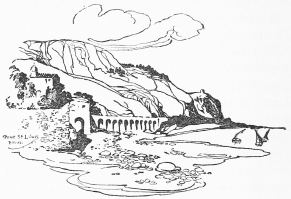
Pont Saint Louis
All this brings up the Frenchman’s dream of the time when France, Italy,
and Spain shall become one, so far as the control of the Mediterranean
lake is concerned, and shall thus prevent Europe from returning to the
barbarianism to which the “égoïsme britannique et l’avidité allemande”
is fast leading it.
Whether this change will ever come about is as questionable as the
preciseness of the accusation, but there is certainly some reason for
the suggestion. Another decade may change the map of Europe
considerably. Who knows?
THE END.
Up to 1789, there were thirty-three great governments making up modern
France, the twelve governments created by Francis I. being the chief,
and seven petits gouvernements as well.
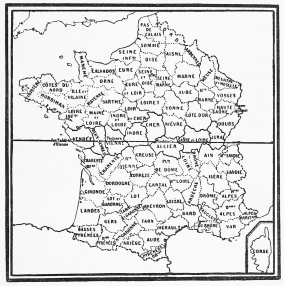
The Provinces of France
In the following table the grands gouvernements of the first
foundation are indicated in heavy-faced type, those which were taken
from the first in italics, and those which were acquired by conquest in
ordinary characters.
| NAMES OF GOVERNMENTS | CAPITALS |
| 1. | Ile-de-France | Paris. |
| 2. | Picardie | Amiens. |
| 3. | Normandie | Rouen. |
| 4. | Bretagne | Rennes. |
| 5. | Champagne et Brie | Troyes. |
| 6. | Orléanais | Orléans. |
| 7. | Maine et Perche | Le Mans. |
| 8. | Anjou | Angers. |
| 9. | Touraine | Tours. |
| 10. | Nivernais | Nevers. |
| 11. | Berri | Bourges. |
| 12. | Poitou | Poitiers. |
| 13. | Aunis | La Rochelle. |
| 14. | Bourgogne (duché de) | Dijon. |
| 15. | Lyonnais, Forez et Beaujolais | Lyon. |
| 16. | Auvergne | Clermont. |
| 17. | Bourbonnais | Moulins. |
| 18. | Marche | Guéret. |
| 19. | Guyenne et Gascogne | Bordeaux. |
| 20. | Saintonge et Angoumois[*] | Saintes. |
| 21. | Limousin | Limoges. |
| 22. | Béarn et Basse Navarre | Pau. |
| 23. | Languedoc | Toulouse. |
| 24. | Comté de Foix | Foix. |
| 25. | Provence | Aix. |
| 26. | Dauphiné | Grenoble. |
| 27. | Flandre et Hainaut | Lille. |
| 28. | Artois | Arras. |
| 29. | Lorraine et Barrois | Nancy. |
| 30. | Alsace | Strasbourg. |
| 31. | Franche-Comté ou Comté de Bourgogne | Besançon. |
| 32. | Roussilon | Perpignan. |
| 33. | Corse | Bastia. |
[*] Under Francis I. the Angoumois was comprised in the Orléanais.
The seven petits gouvernements were:
| 1. | The ville, prévôté and vicomté of Paris. |
| 2. | Havre de Grâce. |
| 3. | Boulonnais. |
| 4. | Principality of Sedan. |
| 5. | Metz and Verdun, the pays Messin and Verdunois. |
| 6. | Toul and Toulois. |
| 7. | Saumur and Saumurois. |
Being a brief résumé of the attractions of some of the chief centres of
Provence and the Riviera.
| | ABBREVIATIONS |
| C. | Chef-Lieu of Commune. |
| P. | Préfecture. |
| S. P. | Sous-Préfecture. |
| h. | Habitants (population). |
| * | Hotels at nine francs or less per day. |
| ** | Hotels nine to twelve francs per day. |
| *** | Hotels above twelve francs per day. |
AIX-EN-PROVENCE
Bouches-du-Rhône. S. P. 19,398 h.
Hotels: Nègre-Coste,** De la Mule Noire,* De France.*
The ancient capital of Provençal arts and letters, and the Cours
d’Amour of the troubadours.
Sights: Eglise de la Madeleine, Cathedral St. Sauveur, Hôtel de
Ville, Tour de Toureluco, Eglise St. Jean de Malte, Musée,
Bibliothèque, Statue of René d’Anjou, by David d’Augers. Carnival
each year in February or March.
Excursions: Ruins of Château de Puyricard, Aqueduc Roquefavour,
Ermitage de St. Honorat, Bastide du Roi René, Gardanne and Les
Pennes.
Distances in kilometres: Marseilles, 29; Arles, 80; Toulon, 75;
Roquevaire, 29.
ANTIBES
Alpes-Maritimes. C. 5,512 h.
Hotels: Grand Hotel,*** Terminus.**
Excursions: Presqu’ile and Cap d’Antibes, Fort Lavré, Villa and
Jardin Thuret, La Garonpe, Chapelle, and Phare.
Distances in kilometres: Paris, 976; Cannes, 12; Grasse, 23; Nice,
23; La Turbie, 41; Monte Carlo, 44; St. Raphaël, 51.
ARLES
S. P. 15,606 h.
Hotels: Du Forum,** Du Nord.**
Delightfully situated on the left bank of the Rhône.
Sights: Les Arènes, Roman Ramparts, Antique Theatre, Cathédrale de
St. Trophime and Cloister, Les Alyscamps and Tombs, Musée d’Arletan
and Musée de la Ville, Palais Constantin.
Excursions: Les Baux, Montmajour, Les Saintes Maries.
Distances in kilometres: Paris, 730; Tarascon, 17; Avignon, 39;
Salon, 40; Marseilles, 91; Aix, 80.
AVIGNON
Vaucluse. P. 33,891 h.
The ancient papal capital in France.
Hotels: De l’Europe,*** Du Luxembourg.**
Sights: Ancient Ramparts, Palais des Papes, Musée, Pulpit in Eglise
St. Pierre, Cathedral of Notre Dame des Doms, Ruined Pont St.
Bénézet (Pont d’Avignon).
Excursions: Villeneuve-les-Avignon, Fontaine de Vaucluse, Aqueduct
of Pont du Gard.
Distances in kilometres: Sorgues, 10; Orange, 27; Carpentras, 24;
Fontaine de Vaucluse, 28.
BANDOL-SUR-MER
Var. 1,616 h.
Winter and spring-time station, situated on a lovely bay. Small
port, and in no sense a resort as yet.
Hotel: Grand Hotel.**
Distances in kilometres: Marseilles, 51; Toulon, 21; La Ciotat, 23;
Sanary, 5.
BEAULIEU-SUR-MER
Alpes-Maritimes. 1,354 h.
Winter station. Beautiful situation on the coast, with groves of
pines, olives, etc.
Hotels: De Beaulieu,** Empress Hotel.***
Distances in kilometres: Nice, 8; Monte Carlo, 18; Grasse, 46;
Menton, 49.
CAGNES
Alpes-Maritimes. C. 2,040 h.
Winter station and town “pour les artistes-peintres” in other days;
now practically a suburb of Nice, to which it is bound by a
tram-line.
Hotels: Savournin,** De l’Univers.*
Sights: Château des Grimaldi.
Excursions: Vence, Antibes, Villeneuve-Loubet.
Distances in kilometres: Nice, 12; Vence, 10; Antibes, 20.
CANNES
Alpes-Maritimes. C. 25,350 h.
On the Golfe de la Napoule, with Nice the chief centre for Riviera
tourists.
Hotels: Gallia,*** Suisse,** Gonnet.***
Excursions: Iles de Lerins, La Napoule, The Corniche d’Or and the
Estérel, Le Cannet, Vallauris, Californie, Croix des Gardes,
Grasse, Antibes, Auberge des Adrets.
Distances in kilometres: Grasse, 17; Fréjus, 47; St. Raphaël, 43;
Nice, 35; Antibes, 12.
CASSIS
Var. 1,972 h.
A charming little Mediterranean port; near by the ancient château
of the Seigneurs of Baux.
Hotel: Lieutand.*
Distances in kilometres: Marseilles, 31; La Ciotat, 11; Bandol, 34.
CIOTAT (LA)
Bouches-du-Rhône. C. 9,895 h.
Great ship-building works, but beautifully situated on Baie de la
Ciotat.
Hotel: De l’Univers.**
Distances in kilometres: Cassis, 11; Marseilles, 43.
COGOLIN
Var. 2,102 h.
Delightfully situated in the valley of the Giscle, at the head of
the Golfe de St. Tropez.
Hotel: Cauvet.*
Sights: Butte des Moulins, Château des Grimaldi.
Excursions: Grimaud and La Garde-Freinet.
Distances in kilometres: St. Tropez, 10; Fréjus, 34; Nice, 104; St.
Raphaël, 37; Hyères, 44; Toulon, 62.
FRÉJUS
Var. C. 3,612 h.
Hotels: Du Midi.*
Sights: Roman Arena (Ruins), Old Ramparts, Citadel, Cathedral (XI.
and XII. centuries), and Bishop’s Palace.
Excursions: St. Raphaël and the Corniche d’Or, Auberge des Adrets
and Route de l’Estérel, Mont Vinaigre (616 metres).
Distances in kilometres: Cannes, 35; Nice, 78; St. Raphaël, 3; Ste.
Maxime, 21.
GRASSE
Alpes-Maritimes. S. P. 9,426 h.
More or less of a Riviera resort, though seventeen kilometres from
the coast at Cannes, situated at an altitude of 333 metres.
Hotels: Grand Hotel,*** De la Poste.**
Sights: Cathedral (XII. and XIII. centuries), Jardin Public, La
Cours, Source de la Foux, Sommet au Jeu de Ballon.
Excursions: Ste. Cezane, Dolmens, Grottes, Source de la Siagnole,
Le Bar and Gorges du Loup.
Distances in kilometres: Cannes, 17; Cagnes, 20; Le Bar, 10; Vence,
28; Draguignan, 59.
HYÈRES
Var. C. 9,949 h.
The oldest and most southerly of the French Mediterranean resorts.
Hotels: Grand Hotel,*** Hôtel des Hespérides.**
Sights: Eglise St. Louis (XII. century), Château, Place, and Ave.
des Palmiers, Jardin d’Acclimation.
Excursions: Mont des Oiseaux, Salines d’Hyères, Giens and the Iles
d’Or (Iles d’Hyères).
MARSEILLES
Bouches-du Rhône. P. 396,033 h.
The second city of France, and the first Mediterranean port.
Hotels: Du Louvre et de la Paix,*** Grand Hotel,*** De la Poste, Du
Touring (the two latter for rooms only—2 francs 50 centimes and
upwards).
Sights: Cannebière, Bourse, Vieux Port, Pointe des Catalans, N. D.
de la Garde, Palais de Longchamps, Chemin de la Corniche, Le Prado,
Cathedral Ste. Marie Majeure.
Excursions: Château d’If, Martigues, Sausset, Carry, Port de Bouc,
Aubagne, Roquevaire, Grotte de la Ste. Baume, Estaque.
Distances in kilometres: Paris, 818; Avignon, 97; Arles, 91; Salon,
51; Martigues, 40; Aix, 28; Toulon, 64.
MARTIGUES
Bouches-du-Rhône. C. 4,689 h.
“La Venise Provençale,” celebrated for “bouillabaisse.”
Hotel: Chabas.*
Sights: Canals and Bourdigues, Eglise de la Madeleine, Etang de
Berre.
Excursions: Port de Bouc, St. Mitre (Saracen hill town), Istres,
Fos-sur-Mer, Châteauneuf-les-Martigues, St. Chamas and Cap
Couronne.
MENTON
Alpes-Maritimes. C. 8,917 h.
The most conservative of all the popular Riviera resorts.
Hotels: Des Anglais,*** Grand.*
Sights: Jardin Public, Promenade du Midi, Tête de Chien.
Excursions: Cap Martin, Italian Frontier, Castillon, Gorbio,
Roquebrune.
Distances in kilometres: Monte Carlo, 8; La Turbie, 14; Roquebrune,
4; Nice, 30; Grasse, 64.
MONTE CARLO
Principality of Monaco.
Hotels: Metropole,*** De l’Europe,** Du Littoral.*
Sights: Casino and Salles de Jeu and de Fête, Palais des Beaux
Arts, Serres Blanc.
Excursions: La Turbie, Mont Agel, Cap Martin.
Distances in kilometres: Paris, 1,017; Menton, 8; Nice, 19.
NICE
Alpes-Maritimes. P. 78,480 h.
The chief Riviera resort and headquarters.
Hotels: Gallia,*** Des Palmiers,*** Des Deux Mondes.**
Sights: Casino, Promenade des Anglais, Jardin, Mont Baron, and Parc
du Château.
Excursions: Cimiez, Villefranche, St. Andre, Cap Ferrat, La Grande
Corniche, Eze.
Distances in kilometres: Paris, 998; Cannes, 35; Grasse, 38;
Cagnes, 12; Fréjus, 66; Menton, 30; Monte Carlo, 19.
SAINT RAPHAËL
Var. 2,982 h.
Hotel: Continental.***
Sights: Boulevard du Touring, Lion de Terre, and Lion de Mer,
Eglise, Maison Close (Alphonse Karr), Maison Gounod.
Excursions: La Corniche d’Or, Agay, Ste. Baume, Cap Roux,
Valescure, Anthéore, Thèoule, Forêt and Route d’Estérel.
Distances in kilometres: Nice, 60; Cannes, 43; Fréjus, 3.
SAINT TROPEZ
Var. C. 3,141 h.
Hotel: Continental.*
Excursions: La Foux, Grimaud, Cogolin, Ste. Maxime, Baie de
Cavalaire.
Distances in kilometres: Marseilles, 120; Nice, 90; Cogolin, 10;
St. Raphaël, 43.
SALON
Bouches-du-Rhône. C. 9,324 h.
Hotel: Grand Hotel.*
Sights: Eglise (XVI. century), Ramparts, Tomb of Nostradamus.
Excursions: St. Chamas, Berre, Pont Flavian, La Crau, Les Baux.
Distances in kilometres: Marseilles, 53; St. Chamas, 16; Aix, 33;
Orgon, 18.
SOLLIÈS-PONT
Var. C. 2,100 h.
Hotel: Des Voyageurs.*
Excursions: Valley of the Gapeau and Forêt des Maures, Cuers,
Montrieux.
Distances in kilometres: Marseilles, 90; Toulon, 15; Besse, 25; St.
Raphaël, 77.
ST. RÉMY
Bouches-du-Rhône. C. 3,624 h.
Hotel: Grand Hotel de Provence.*
Sights: Fontaine de Nostradamus, Temple de Constantin, Mausolée and
Arc de Triomphe.
Excursions: Tarascon, Les Alpilles, Montmajour, Les Baux, Fontaine
de Vaucluse, Pont du Gard.
Distances in kilometres: Arles, 20; Les Baux, 8; Avignon, 19;
Cavaillon, 18.
TOULON
Var. S. P. 78,833 h.
Hotel: Grand Hotel,*** Victoria.**
Sights: Cathedral Ste. Marie Majeure (XI. century), Harbour, Hôtel
de Ville, Maison Puget.
Excursion: Gorges d’Ollioules, Tamaris, Batterie des Hommes Sans
Peur, St. Mandrier, Cap Brun, Cap Sicié, La Seyne, Six-Fours,
Sanary.
Distances in kilometres: Aix, 75; Marseilles, 65; Nice, 163;
Cannes, 128.
The traveller by road or by rail in France should, if he would
appreciate all the charms and attractions of the places along his route,
provide himself with one or the other of the excellent road maps which
may be purchased at the “Libraire” in any large town.
Much will be opened up to him which otherwise might remain hidden, for,
excellent as many guide-books are in other respects (and those of Joanne
in France lead the world for conciseness and attractiveness), they are
all wofully inadequate as regards general maps. Really, one should
supplement his French guide-books with the remarkably practical
“Guide-Michelin,” which all automobilists (of all lands) know, or ought
to know, and which is distributed free to them by Michelin et Cie., of
Clermont-Ferrand. Others must exercise considerable ingenuity if they
wish to possess one of these condensed guides, with its scores and
scores of maps and plans. The Continental Gutta Percha Company does the
thing even more elaborately, but its volume is not so compact.
Both books, in addition to their numerous maps and plans, give much
information as to roads and routes which others as well as automobilists
will find most interesting reading, besides which will be found a list
of hotels, the statement as to whether or not they are affiliated with
the Automobile Club de France, or The Touring Club de France, and a
general outline of the price of their accommodation, and what, in many
cases, is of far more importance, the kind of accommodation which they
offer. It is worth something to modern travellers to know whether a
hotel which he intends to favour with his gracious presence has a “Salle
de Bains,” a “Chambre Noire,” or “Chambres Hygiéniques, genre du Touring
Club.” To the traveller of a generation ago this meant nothing, but it
means a good deal to the present age.
As for general maps of France, the Carte de l’Etat-Major (scale of
80,000, on which one measures distances of two kilometres by the
diametre of a sou) are to be bought everywhere at thirty centimes per
quarter-sheet. The Carte du Service Vicinal, on the scale of 100,000
and printed in five colours, costs eighty centimes per sheet; and that
of the Service Géographique de l’Armée (reduced by lithography from the
scale of 80,000) costs one franc fifty centimes per sheet.
There is also the newly issued Carte Touriste de la France of the
Touring Club de France (on a scale of 400,000), printed in six colours
and complete in fifteen sheets at two francs fifty centimes per sheet.
Finally there is the very beautiful Carte de l’Estérel, of special
interest to Riviera tourists, also issued by the Touring Club de France.
The Cartes “Taride” are a remarkable and useful series, covering France
in twenty-five sheets, at a franc per sheet. They are on a very large
scale and are well printed in three colours, showing all rivers,
railways, and nearly every class of road or path, together with
distances in kilometres plainly marked. They are quite the most useful
and economical maps of France for the automobilist, cyclist, and even
the traveller by rail.
The house of De Dion-Bouton also issues an attractive map on a scale of
800,000 and printed in four colours.
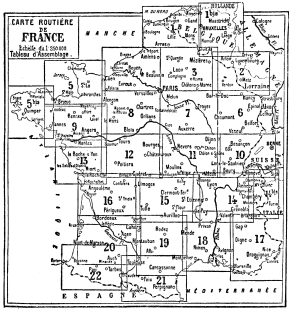
The “Taride” Maps
The four sheets are sold at eight francs per sheet, but they are better
suited for wall maps than for portable practicability.
The travel routes to and through Provence and the Riviera are in no way
involved, and on the whole are rather more pleasantly disposed than in
many parts, in that places of interest are not widely separated.
The railroad is the hurried traveller’s best aid, and the all-powerful
and really progressive P. L. M. Railway of France covers, with its main
lines and ramifications, quite all of Provence, the Midi, and the
Riviera.
Marseilles is perhaps the best gateway for the Riviera proper and the
coast towns westward to the Rhône, and Avignon or Arles for the interior
cities of Provence. Paris is in close and quick connection with both
Arles and Marseilles by train express, train rapide, or the more
leisurely train omnibus, with fares varying accordingly, and taking
from ten to twenty hours en route, there being astonishing differences
in time between the trains ordinaires and the trains rapides all
over France. Fares from Paris to Arles are 87 francs, first class; 58
francs 75 centimes, second class; and 38 francs 30 centimes, third
class; and from Paris to Marseilles, 96 francs 55 centimes, 65 francs 15
centimes, and 42 francs 50 centimes respectively. In addition, there are
all kinds of extra charges for passage on the “Calais-Nice-Ventimille
Rapide” and other trains de luxe, not overlooking the exorbitant
charge of something like 70 francs for a sleeping-car berth from Paris
to Marseilles—and always there are too few to go around even at this
price.
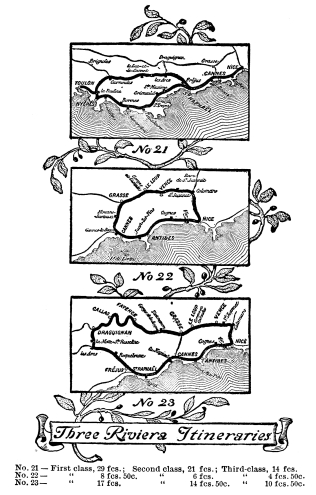
From either Arles or Marseilles one may thread the main routes of
Provence by many branches of the “P. L. M.” or its “Chemins Regionaux du
Sud de France;” can penetrate the little-known region bordering upon the
Étang de Berre and enter the Riviera proper either by Marseilles or by
the inland route, through Aix-en-Provence, Brignoles, and Draguignan,
coming to the coast through Grasse to Cannes or Nice.
The traveller from afar, from America, or England, or from Russia or
Germany, is quite as well catered for as the Frenchman who would enjoy
the charms of Provence and the Riviera, for there are through
express-trains from Calais, Boulogne, Brussels, Berlin, St. Petersburg,
Vienna, and Genoa. Now that the tide of travel from America has so
largely turned Mediterraneanward, the south of France bids fair to
become as familiar a touring ground as the Switzerland of old,—with
this difference, that it has an entrance by sea, via Genoa or
Marseilles.
For the traveller by road there are untold charms which he who goes by
rail knows not of. The magnificent roadways of France—the “Routes
Nationales” and the “Routes Départmentales”—are nowhere kept in better
condition, or are they better planned than here. East and west and
across country they run in superb alignment, always mounting gently any
topographical eminence with which they meet, in a way which makes a
journey by road through Provence one of the most enjoyable experiences
of one’s life.
The diligence has pretty generally disappeared, but an occasional
stage-coach may be found connecting two not too widely separated points,
and inquiry at any stopping-place will generally elicit information
regarding a two, three, or six hour journey which will prove a
considerable novelty to the traveller who usually is hurried through a
lovely country by rail.
For the automobilist, or even the cyclist, still greater is the pleasure
of travel by the highroads and by-roads of this lovely country, and for
them a skeleton itinerary has been included among the appendices of this
book with some useful elements which are often not shown by the
guide-books.
The “Voitures Publiques” in Provence, as elsewhere, leave much to be
desired, starting often at inconveniently early or late hours in order
to correspond with the postal arrangements of the government; but,
whenever one can be found that fits in with the time at one’s disposal,
it offers an opportunity of seeing the country at a price far below that
of the voiture particulière. Here and there, principally in the
mountainous regions lying back from the coast, the “Societies and
Syndicats d’Initiative,” which are springing up all over the popular
tourist regions in France, have inaugurated services by cars-alpins
and char-à-bancs, and even automobile omnibuses, which offer
considerably more comfort.
Concerning the hotels and restaurants of Provence and the Riviera much
could be said; but this is no place for an exhaustive discussion.
Generally speaking, the fare at the table d’hôte throughout Provence
is bountiful and excellent, with perhaps too often, and too strong, a
trace of garlic, and considerably more than a trace of olive-oil.
At Aix, Arles, Avignon, and Orange one gets an imitation of a Parisian
table d’hôte at all of the leading hotels; but in the small towns,
Cavaillon, Salon, Martigues, Grimaud, or Vence, one is nearer the soil
and meets with the real cuisine du pays, which the writer assumes is
one of the things for which one leaves the towns behind.
At Marseilles, and all the great Riviera resorts, the cuisine
française is just about what the same thing is in San Francisco, New
York, or London,—no better or no worse. As for price, the modest six or
eight francs a day in the hotels of the small towns becomes ten francs
in cities like Aix or Arles, and from fifteen francs to anything you
like to pay at Marseilles, Cannes, Nice, or Monte Carlo.
METRICAL AND ENGLISH WEIGHTS AND MEASURES
- Mètre = 39.3708 in. = 3.231. 3 ft. 3 1-2 in. = 1.0936 yard.
- Square Mètre (mètre carré) = 1 1-5th square yards (1.196).
- Are (or 100 sq. mètres) = 119.6 square yards.
- Cubic Mètre (or Stere) = 35 1-2 cubic feet.
- Centimètre = 2-5ths inch.
- Kilomètre = 1,093 yards = 5-8 mile.
- 10 Kilomètres =6 1-4 miles.
- 100 Kilomètres = 62 1-10th miles.
- Square Kilomètre = 2-5ths square mile.
- Hectare = 2 1-2 acres (2.471).
- 100 Hectares = 247.1 acres.
- Gramme = 15 1-2 grains (15.432).
- 10 Grammes = 1-3d oz. Avoirdupois.
- 15 Grammes = 1-2 oz. Avoirdupois.
- Kilogramme = 2 1-5th lbs. (2.204) Avoirdupois.
- 10 Kilogrammes = 22 lbs. Avoirdupois.
- Metrical Quintal = 220 1-2 lbs. Avoirdupois.
- Tonneau = 2,200 lbs. Avoirdupois.
- Litre = 0.22 gal. = 1 3-4 pint.
- Hectolitre = 22 gallons.
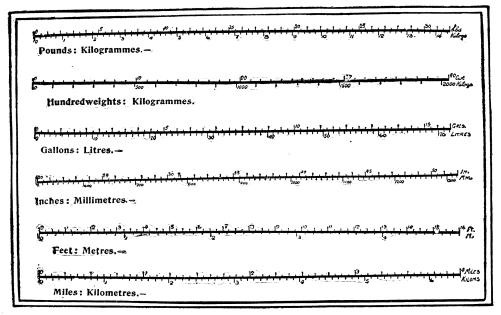
Comparative Metric Scale
ENGLISH AND METRICAL WEIGHTS AND MEASURES
- Inch = 2.539 centimètres = 25.39 millimètres.
- 2 inches = 5 centimètres nearly.
- Foot = 30.47 centimètres.
- Yard = 0.9141 mètre.
- 12 yards = 11 mètres nearly.
- Mile = 1.609 kilomètre.
- Square foot = 0.093 mètre carré.
- Square yard = 0.836 mètre carré.
- Acre = 0.4046 hectare = 4,003 sq. mètres nearly.
- 2 1-2 acres = 1 hectare nearly.
- Pint = 0.5679 litre.
- 1 3-4 pint = 1 litre nearly.
- Gallon = 4.5434 litres = 4 nearly.
- Bushel = 36.347 litres.
- Oz. Troy = 31.103 grammes.
- Pound Troy (5,760 grains) = 373.121 grammes.
- Oz. Avoirdupois = 8.349 grammes.
- Pound Avoirdupois (7,000 grains) = 453.592 grammes.
- 2 lbs. 3 oz. = kilogramme nearly.
- 100 lbs. = 45.359 kilogrammes.
- Cwt. = 50.802 kilogrammes.
- Ton = 1,018.048 kilogrammes.
A,
B,
C,
D,
E,
F,
G,
H,
I,
J,
L,
M,
N,
O,
P,
R,
S,
T,
V
Agay,
286-287,
288.
Agde,
20.
Aigues Mortes,
28,
93.
Aix,
5,
17,
18-19,
31,
101,
156-160,
161,
165,
173,
215,
250,
322,
412,
424,
425,
426,
429.
Allauch,
134.
Anthéore,
288-289.
Antibes,
101,
305-306,
308-312,
330,
412,
429.
Arles,
5,
6,
17,
22,
29,
30-38,
64,
73,
83,
99,
101,
107,
110,
160,
268,
271,
276,
346,
413,
422,
425,
426,
429.
Aubagne,
18,
129,
167-168.
Auriol,
163,
170.
Avignon,
4-5,
10,
16,
17,
22,
24,
25,
31,
56,
57,
73,
160,
183,
413,
422,
425,
429.
Baie de Cavalaire,
254-255.
Baie de la Ciotat,
184-185.
Baie de Sanary,
202.
Baie des Anges,
233,
309.
Bandol,
189-194,
413.
Beaucaire,
24,
25,
27,
28,
33,
107.
Beaudinard,
129.
Beaulieu,
229,
233,
344,
352,
353,
356,
358,
359,
413.
Bec de l’Aigle,
177,
184-185.
Bellegarde,
25,
27.
Berre,
88,
92,
97-99,
120.
Berteaux,
Château de,
260.
Biot,
312-314.
Bormes,
249-253,
254,
255.
Bouches-du-Rhône,
20,
56,
85,
107,
109,
113,
115,
224,
402.
Boulouris,
286.
Cagnes,
231,
324-326,
330,
414.
Camargue,
The,
7,
38,
57-65,
66,
107.
Cannes,
18,
22,
212,
228,
229,
231,
236,
237,
249,
255,
269,
279,
283,
285,
287,
288,
290,
292,
293,
296-302,
304,
305,
314,
333,
336,
398,
414,
424,
426,
429.
Cap Canaille,
180,
181-182.
Cap Couronne,
113-116,
131.
Cap d’Antibes,
308,
341.
Cap de l’Aigle,
131.
Cap Ferrat,
233,
341,
349.
Cap Martin,
229,
233,
245,
351,
358,
399-400,
403.
Cap Mouret,
211.
Cap Nègre,
201.
Cap Notre Dame de la Garde,
211.
Cap Roux,
293-294.
Cap Sepet,
211.
Cap Sicié,
200-201,
202,
206,
211.
Carnoles,
400.
Carpentras,
16.
Carry,
116-117.
Cassis,
177-181,
183,
414.
Cavaillon,
17,
45,
82,
83,
425.
Cavalaire,
254-255.
Ceyreste,
183-184.
Château Grignan,
12.
Chateauneuf,
114.
Cimiez,
344-347.
Ciotat (see La Ciotat).
Cogolin,
260-264,
414.
Condamine (see La Condamine).
Côte d’Azur,
72.
Crau,
The,
6,
7,
24,
38,
57,
58,
65-69,
74,
92,
93,
95.
Cuers,
221,
222.
Draguignan,
321.
Elne,
20.
Embiez (see Iles des Embiez).
Estaque,
134.
Estérel,
232.
Étang de Berre,
6,
14,
24,
63,
72-73,
78,
79,
85,
87-106,
109,
118,
120,
172,
424.
Étang de Bolmon,
105.
Étang de Caronte,
91,
113.
Étang de l’Olivier,
92.
Eze,
350,
351,
353,
359-361,
363,
365.
Feuillerins,
350.
Fos-sur-Mer,
24,
73-74,
110-112.
Freinet (see La Garde-Freinet).
Fréjus,
221,
222,
248,
249,
261,
270,
271-278,
279,
283,
290,
292,
293,
322,
415,
429.
Garavan,
404.
Gardanne,
161,
162,
168.
Giens,
243-244.
Golfe de Fos,
73,
107,
109.
Golfe de Fréjus,
271.
Golfe de Giens,
239-240.
Golfe de la Napoule,
233,
290,
293,
307,
309,
314.
Golfe des Lèques,
179.
Golfe de Lyon,
107-109,
110,
113,
144,
201,
245.
Golfe de St. Tropez,
256-261,
264,
265,
269.
Golfe Jouan,
19,
302,
305,
306,
307,
314.
Gorges d’Ollioules,
194-195,
197,
198.
Gourdon,
328.
Grasse,
307,
319-323,
326,
329,
415,
424.
Grimaud,
261,
264-266,
269,
425.
Grotte des Fées,
55.
Grotte de St. Baume,
287.
Hyères,
191,
193,
197,
208,
219,
230,
239,
240-243,
244-249,
261,
333,
402,
415,
429.
If,
Château d’,
136,
137,
150-152,
243.
Ile de Riou,
136.
Ile Pomegue,
136.
Ile Rattonneau,
136.
Iles d’Hyères (see Hyères).
Iles des Embiez,
202-204.
Istres,
88,
92-95.
Iles de Lerins,
309-318.
Jouan-les-Pins,
305-307.
La Ciotat,
184-189,
414,
429.
La Condamine,
352,
390,
391.
La Crau (see Crau,
The).
La Croix,
255.
La Foux,
259-260,
261,
269,
270.
La Garde-Freinet,
239,
266-269.
Laghet,
361-362.
La Londe,
249.
Lambesc,
24.
La Napoule,
233,
269,
283,
288,
289,
290,
292.
La Revere,
350.
La Seyne,
207,
208,
213.
La Turbie,
233,
336,
351,
357-358,
361,
362-366,
367,
368.
Le Bar,
327-328.
Le Brusc,
203.
Le Cannet,
231,
297-298,
301.
Le Gibel,
181.
Le Lavandou,
255.
Le Luc,
221.
Les Adrets,
294-296.
Les Aygalades,
134.
Les Baux,
17,
53-55,
103.
Les Lèques,
189.
Les Martigues (see Martigues).
Les Pennes,
160.
Les Sablettes,
207.
Les Saintes Maries,
24,
60-63.
Les Solliès,
222.
Le Trayes,
288,
289.
Lyons,
3,
7,
15,
16,
56,
193,
255,
307,
335,
344,
381.
Marignane,
88,
92,
103-106.
Marseilles,
5,
6,
13,
14,
15,
16,
18,
20,
25,
27,
31-32,
63,
72,
75,
82,
85,
86,
88,
89,
91,
92,
99,
101,
103,
106,
109,
110,
113,
115,
116,
117-155,
156,
157,
160,
161,
162,
163,
165,
167,
168,
169,
170,
173,
177,
178,
179,
181,
182,
183,
186,
187,
188,
191,
193,
194,
197,
200,
202,
212,
215,
234,
246,
278,
309,
335,
348,
373,
401,
402,
415,
422,
424,
426,
429.
Martigues,
15,
22,
70-72,
74-86,
87,
88,
92,
98,
104,
105,
113,
115,
120,
160,
178,
402,
416,
425,
429.
Menton,
19,
191,
228,
229,
230,
233,
235,
236,
237,
245,
344,
351,
352,
358,
366,
368,
391,
394,
398-404,
416,
429.
Miramas,
88,
95.
Monaco,
190,
227,
233,
284,
344,
351,
364,
370,
379,
380,
386-388,
390-393,
396-397,
399,
400,
401,
429.
Monte Carlo,
21,
161,
183,
191,
227,
229,
233-235,
244,
259,
284,
305,
308,
336,
337,
344,
350,
351,
352,
358,
359,
362,
363,
370-386,
388-391,
393-397,
399,
401,
403,
416,
426.
Montmajour,
Abbey of,
38-40.
Nice,
18,
20,
21,
22,
191,
195,
212,
221,
229,
231,
236,
237,
245,
249,
254,
255,
259,
284,
290,
309,
314,
321,
324,
326,
332-344,
348-353,
356,
358,
364,
381,
392,
398,
403,
417,
424,
426,
429.
Nîmes,
5,
6,
22,
31,
73,
103,
276.
Ollioules,
194-198.
Orange,
3-4,
5,
31,
35,
346,
425,
429.
Pas-de-Lanciers,
86.
Passable,
233.
Pays d’Arles,
24-41.
Pays de Cavaillon,
24.
Perpignan,
20.
Pignans,
221.
Pont du Gard,
27,
103.
Pont Flavien,
96.
Pont St. Louis,
404-406.
Porquerolles,
240-243.
Port de Bouc,
73-74,
112-113,
178.
Port Miou,
182-183.
Port St. Louis,
63-65,
121.
Pradet,
239.
Presqu’ile de Giens,
240,
243-244.
Puget-Ville,
221.
Roquebrune,
19,
351,
358,
363,
366-369,
391,
400.
Roquefavour,
102-103.
Roquevaire,
129,
165-167.
Sabran,
Château de,
204.
Sainte Baume,
169-173,
294.
Salon,
99-102,
105,
158,
417,
425.
Sanary (see St. Nazaire-du-Var).
Seon-Saint-André,
135.
Septèmes,
161-162.
Simiane,
161.
Six-Fours,
200,
204-207.
Solliès-Pont,
221,
222-225,
246,
417.
St. Chamas,
88,
92,
95-97.
Ste. Croix,
Chapelle,
40-41.
Ste. Maxime,
269-270,
271.
St. Gilles,
17,
34.
St. Jean-sur-Mer,
233,
356-357.
St. Julien,
135.
St. Mitre,
24,
88.
St. Nazaire-du-Var,
198-200,
202.
St. Pierre,
113-115.
St. Raphaël,
232,
256,
271,
278-281,
283,
285,
286,
288,
290,
417,
429.
St. Rémy,
5,
42-53,
100,
418,
429.
St. Tropez,
18,
228,
254,
256-259,
261,
269,
417,
429.
St. Zacharie,
170.
Tamaris,
207,
208-210.
Tarascon,
24,
25,
26,
27,
429.
Théoule,
289-290.
Toulon,
18,
19,
194-195,
202,
204,
207,
208,
211-221,
222,
226,
235,
239,
242,
243,
246,
270,
311,
336,
349,
418,
429.
Valence,
3,
12.
Valesclure,
281.
Vallauris,
302-304,
310.
Vaucluse,
24,
25,
43,
101.
Vence,
326,
345,
425.
Ventabren,
102-103.
Vienne,
5.
Villefranche,
233,
311,
353-356,
358.
Villeneuve-Loubet,
323-324.
Vintimille,
351,
400.

| Typographical errors corrected by the etext transcriber: |
|---|
| théátre romain=> théâtre romain {pg 35} |
| the chapel become a place=> the chapel becomes a place {pg 41} |
| toutes les menagères=> toutes les ménagères {pg 85} |
| bouillabaise=> bouillabaisse {pg 92} |
| goelette=> goélette {pg 92} |
| svelt figure=> svelte figure {pg 126} |
| little houses glistening white in the sunlight, and red hoofs=> little houses glistening white in the sunlight, and red roofs {pg 200} |
| twenty-three thousands souls=> twenty-three thousand souls {pg 221} |
| from St. Raphael to San Remo=> from St. Raphaël to San Remo {pg 232} |
| the slow-runing little train=> the slow-running little train {pg 248} |
| DANS LE PROPRIÉTÉ=> DANS LA PROPRIÉTÉ {pg 272} |
| clientèle élégant du littoral=> clientèle élégante du littoral {pg 304} |
| tortuous picturesquenesss=> tortuous picturesqueness {pg 310} |
| disaproves of=> disapproves of {pg 390} |