Archæology, which was formerly considered by the majority of persons to
be a dull and uninteresting study, abounding with dry details of small
general interest, which, when not pompously pretentious, were, in the
other extreme, of trifling insignificance, has, by a better acquaintance
with its true position as the handmaid of history, become so popular
that most English counties have societies especially devoted to its
district claims, and our large cities have their archæological
institutes also. This is due to the good sense which has divested the
study of its drier details, or has had the tact to hide them beneath
agreeable information. It is not too much to assert that archæology in
all its branches may be made pleasurable, abounding as it does in
curious and amusing details, sometimes humorously contrasting with our
modern manners.
In taking up one of these branches—the history of finger-rings—we
shall briefly show the large amount of anecdote and curious collateral
information it abounds in. Our illustrations depict the great variety of
design and ornamental detail embraced by so simple a thing as a hoop
for the finger. It would be easy to multiply the literary and the
artistic branch of this subject until a volume of no small bulk resulted
from the labour. Volumes have been devoted to the history of
rings—Gorlæus among the older, and Edwards,74-* of New York, among
the modern authors. The ancients had their Dactyliotheca, or
collection of rings; but they were luxurious varieties of rings for
wear. The modern collections are historic, illustrative of past tastes
and manners. Of these the best have been formed by the late Lord
Londesborough (whose collection was remarkable for its beauty and
value), and Edmund Waterton, Esq., F.S.A., who still lives to possess
the best chronological series of rings ever brought together. We have
had the advantage of the fullest access to each collection.
It is in the oldest of histories, the books of Moses, that we find the
earliest records of the use of the finger-ring. It originally appears to
have been a signet, used as we now use a written autograph; and it is
not a little curious that the unchanged habit of Eastern life renders
the custom as common now as it was three thousand years ago. When Tamar
desired some certain token by which she should again recognise Judah,
she made her first request for his signet, and when the time of
recognition arrived, it was duly and undoubtingly acknowledged by
all.74-† Fig. 76 exhibits the usual form assumed by these signets.
It has a somewhat clumsy movable handle, attached to a cross-bar passing
through a cube, engraved on each of its facets with symbolical devices.
Sir John Gardner Wilkinson75-* speaks of it as one of the largest and
most valuable he has seen, containing twenty pounds’ worth of gold. “It
consisted of a massive ring, half an inch in its largest diameter,
bearing an oblong plinth, on which the devices were engraved, one inch
long, six-tenths in its greatest and four-tenths in its smallest
breadth. On one face was the name of a king, the successor of Amunoph
III., who lived about B.C. 1400; on the other a lion, with the legend
‘lord of strength,’ referring to the monarch: on one side a scorpion,
and on the other a crocodile.” Judah’s signet was, of course, formed of
less valuable material, and had probably a single device only.
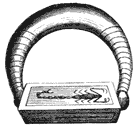
Fig. 76. |
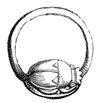
Fig. 77. |
The lighter kind of hooped signet, as generally worn at a somewhat more
recent era in Egypt, is shown in Fig. 77. The gold loop passes through a
small figure of the sacred beetle, the flat under side being engraved
with the device of a crab. It is cut in carnelian, and once formed part
of the collection of Egyptian antiquities gathered by our consul at
Cairo—Henry Salt, the friend of Burckhardt and Belzoni, who first
employed the latter in Egyptian researches, and to whom our national
museum owes many of its chief Egyptian treasures.
From a passage in Jeremiah (xxii. 24) it appears to have been customary
for the Jewish nation to wear the signet-ring on the right hand. The
words of the Lord are uttered against Zedekiah—“though Coniah, the son
of Jehoiakim, King of Judah, were the signet on my right hand, yet would
I pluck thee thence.”
The transition from such signets to the solid finger-ring was natural
and easy. The biblical record treats them as contemporaneous even at
that early era. Thus the story of Judah and Tamar is immediately
followed by that of Joseph, when we are told “Pharaoh took off the ring
from his hand and put it upon Joseph’s hand,” when he invested him with
authority as a ruler in Egypt. Dr. Abbott, of Cairo, obtained a most
curious and valuable ring, inscribed with a royal name. It is now
preserved, with his other Egyptian antiquities, at New York, and is thus
described in his catalogue:—“This remarkable piece of antiquity is in
the highest state of preservation, and was found at Ghizeh, in a tomb
near that excavation of Colonel Vyse’s called ‘Campbell’s Tomb.’ It is
of fine gold, and weighs nearly three sovereigns. The style of the
hieroglyphics is in perfect accordance with those in the tombs about the
Great Pyramid; and the hieroglyphics within the oval make the name of
that Pharaoh (Cheops) of whom the pyramid was the tomb.” Fig. 78
represents this ring, and beside it (Fig. 79) is placed the hieroglyphic
inscription upon the face of the ring, which is cut with the most minute
accuracy and beauty.
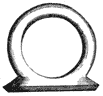
Fig. 78. |
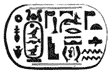
Fig. 79. |
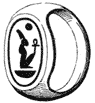
Fig. 80. |
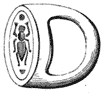
Fig. 81. |
Rings of inferior metal, bearing royal names, were worn, probably, by
officials of the king’s household. Henry Salt had one such in his
collection, which was afterwards in the remarkable collection of rings
formed by the late Lord Londesborough. It is represented in Fig. 80, and
is entirely of bronze. The name of Amunoph III. is engraved on the oval
face of the ring, exactly as it appears on the tablet of Abydus in the
British Museum. Amunoph (who reigned, according to Wilkinson, B.C.
1403-1367) is the same monarch known to the Greeks as Memnon; and the
colossal “head of Memnon,” placed in the British Museum through the
agency of Mr. Salt, has a similar group of hieroglyphics sculptured on
its shoulder. There was another kind of official ring, which we can
recognise from the description of Pliny, and of which we give an
engraving (Fig. 81) from the original in the author’s possession. It is
of bronze, and has engraved upon its face the figure of the scarabæus;
such rings were worn by the Egyptian soldiers.
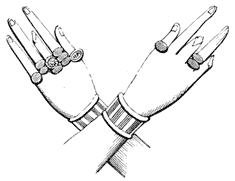 Fig. 82.
The lower classes, who could not afford rings of precious metals, but,
like their modern descendants, coveted the adornment, purchased those
made of ivory or porcelain. In the latter material they abounded, and
are found in Egyptian sepulchres in large quantities; they are very
neatly moulded, and the devices on their faces, whether depicting gods,
emblems, or hieroglyphics, are generally well and clearly rendered.
This fondness for loading the fingers with an abundance of rings is well
displayed on the crossed hands of a figure of a woman (Fig. 82) upon a
mummy case in the British Museum. Here the thumbs as well as the fingers
are encircled by them. The left hand is most loaded; upon the thumb is a
signet with hieroglyphics on its surface; three rings on the forefinger;
two on the second, one formed like a snail-shell; the same number on
the next, and one on the little finger. The right hand carries only a
thumb-ring, and two upon the third finger. These hands are cut in wood,
and the fingers are partially broken.
Wilkinson observes—“The left was considered the hand peculiarly
privileged to bear these ornaments; and it is remarkable that its third
finger was decorated with a greater number than any other, and was
considered by them, as by us, par excellence, the ring-finger; though
there is no evidence of its having been so honoured at the marriage
ceremony.”
Herodotus narrates a curious antique legend he obtained in Egypt,
concerning the ring of Polycrates. It is remarkable as having spread
into the legendary history of all countries, being still credited by the
commonality. We shall have hereafter to note its existence as an old
London tradition; but the version of the Greek historian is briefly
thus:—Amasis, King of Egypt, conceived an extraordinary friendship for
the Greek, Polycrates, and, observing that the latter was attended by
unusual success in all his adventures, reflected that such unvarying
felicity seldom lasted through life, and the end of such a career was
often calamitous. He therefore advised him to propitiate future fortune
by seeking some object whose loss would produce most regret, and
voluntarily casting it away from him where it could never be recovered.
Polycrates attached most value to a signet-ring he constantly wore; it
was of gold, set with an emerald cut by Theodorus of Samos, a famed
engraver of gems. He went out in a galley far on to the open sea, and
then cast his precious ring into its waters, returning in an excess of
grief. Some six days afterwards a fisherman came to his gate, bearing a
fish so fine and large he deemed it to be only fitted for the table of
Polycrates. The King of Samos accepted the gift, the fish was sent to
the royal kitchen, and on opening it a valuable ring was found in its
stomach. It was at once taken to Polycrates, who immediately recognised
his abandoned treasure, which he now valued the more as it seemed to be
returned by divine interposition.
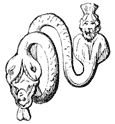
Fig. 83. |
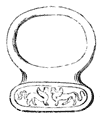
Fig. 84. |
In the comparatively modern era of Roman rule in Egypt, rings of more
fanciful construction were occasionally worn. In the British Museum is a
remarkable one (Fig. 83), having the convolutions of a serpent, the head
of Serapis at one extremity and of Isis at the other; by this
arrangement one or other of them would always be correctly posited; it
has also the further advantage of being flexible, owing to the great
sweep of its curve.
The ancient Assyrians, though remarkable for that love of jewellery
which has ever been the characteristic of the Eastern nations, appear to
have worn no finger-rings. Yet many of their bracelets are admirably
designed for the purpose if produced on a limited scale; and they were
worn by men as well as by women. Bonomi, in his “History of Nineveh and
its Palaces,” observes, “that not a single case occurs, amidst all this
display of personal jewellery, of a finger-ring; the entire absence of
this ornament in sculpture, wherein details of this nature are so
elaborately and carefully attended to, leads to the conclusion that the
finger-ring was an ornament then unknown.”
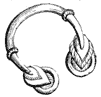
Fig. 85. |

Fig. 86. |
Among the earliest traces of western civilisation the finger-ring
appears. Fig. 84 is an Etruscan ring of gold, now in the British Museum;
upon the face are chimeræ opposing each other. The style and treatment
of this subject partake largely of the ancient character of Eastern art,
and, like that, is very decisive and conventional.
The Greeks and Romans literally revelled in rings of all styles and
sizes. Nothing can be more beautiful in design and exquisite in finish
than Greek jewellery, and the custom of decorating their dead with the
most valued of these ornaments has furnished modern museums with an
abundance of fine specimens. Figs. 85 and 86 are copied from originals
found in the more modern Etruscan sepulchres, and are probably
contemporary with the earliest days of the Roman empire. Fig. 85 is
admirably adapted to the finger; being made of the purest gold, it is
naturally slightly elastic; but the hoop is not perfected, each
extremity ending in a broad leaf-shaped ornament, most delicately banded
with threads of beaded and twisted wire, acting as a brace upon the
finger. Fig. 86 is equally meritorious; the solid half-ring is completed
by a small golden chain attached to it by a loop passing over studs; the
links of this chain are perfectly flexible, and of extreme delicacy;
they resemble the modern guard-chain, or to speak more properly, the
modern chain imitates the ancient one; and we shall meet in the course
of our researches with very many other instances of the oft-repeated
fact, that “there is nothing new under the sun.”
This ring mania was not content with considering the ring as an
ornament, or even as a talisman; a new science was revealed, the
Dactyliomancia, so named from two Greek words, signifying ring and
divination. The performance of its mysteries was in itself so simple,
that it was deemed expedient to add certain formulæ, in order to make
them more expressive. A ring was held, suspended by a fine thread, over
a round table, on the edge of which were placed counters engraved with
the letters of the alphabet. The thread was shaken until the ring,
touching the letters, had united as many as formed an answer to a
question previously put. This operation was preceded and accompanied by
certain ceremonies. The ring was consecrated with divers mysterious
forms. The person who held it was arrayed in linen only; a circle was
shaved round his head, and in his hand he held a branch of vervain.
Before commencing the gods were appeased by prayer.82-* This practice
long prevailed, and is mentioned by Gibbon as having given rise to the
persecutions for the crime of magic, in the reign of the Emperor Valens,
at Antioch.83-*

Fig. 87. |
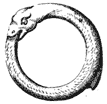
Fig. 88. |
The simplest and most useful form of ring, and that, by consequence,
adopted by the people of all early nations, was the plain elastic hoop,
as shown in Fig. 87. Cheap in construction and convenient in wear, it
may be safely said to have been generally patronised from the most
ancient to the most modern times. Fig. 88 gives us the old form of a
ring made in the shape of a coiled serpent, equally ancient, equally
far-spread in the old world, and which has had a very large sale among
ourselves revived as a “decided novelty.” In fact it has been the most
successful design our ring-makers have produced of late years. Yet this
antique ring may add another “new idea” to the modern designer. It is
“made on the principle of some of our steel rings which we use to hold
household keys, widening their circle by pressure. In this finger-ring
the part in the mouth is inserted loose, so as to draw out and increase
to the size of the circle needed.”83-†

Fig. 89. |
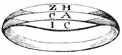
Fig. 90. |
Though a great variety of form and detail was adopted by Greek and Roman
goldsmiths for the rings they so largely manufactured, the most general
and lasting resembled Fig. 89, a Roman ring, probably of the time of
Hadrian, which is said to have been found in the Roman camp at
Silchester, Berkshire. The gold of the ring is massive at the face,
making a strong setting for the carnelian, which is engraved with the
figure of a female bearing corn and fruit. By far the greater majority
of Roman rings exhumed at home and abroad are of this fashion, which
recommends itself by a dignified simplicity, telling, by quantity and
quality of metal and stone, its true value, without any obtrusive aid.
Sometimes a single ring was constructed to appear like a group of two or
three upon the finger. Mr. Edwards has furnished us with the example,
Fig. 90. “It has the appearance of three rings united, widened in the
front and tapering within the hand. Upon the wide part of each are two
letters, the whole forming ZHCAIC, ‘Mayest thou live.’ The Romans often
preferred the Greek language in their most familiar customs.”
Among the beautiful objects of antique art collected by B. Hertz, Esq.,
and sold by auction in 1859, by Messrs. Sotheby and Wilkinson, were many
antique rings inscribed with sentences and mottoes of a remarkable kind.
Those bearing Greek inscriptions were the wordiest; such as—“I love
not lest I go astray; but I observe well, and I laugh.”—“They say what
they will; let them say, I care not.” Many were evidently memorials of
friendship; one represented a hand pulling the lobe of an ear, with the
word “Remember;” another, with a similar device, with the motto “Remind
me of the noble character.” Others were inscribed—EYTYXI—“Good luck to
you,” and “I bring luck to him who wears this ring.” Among the Latin
inscriptions were simple good wishes expressed in the words “Vivas” and
“Bene;” or sentiments expressed in few words, such as—“Love me, I will
love thee;” “Come, I will not;” “Be greeted, Fabiana.” Many were simply
inscribed with the names of the persons to whom they were presented,
such as VLP. PRISCELLÆ (“Ulpia Priscilla”); others with the names of the
owners, as Valeria Cleopatra and Hermadion Cæsaris. A massive silver
ring inscribed with the name “Sabbina” is engraved (Fig. 91) from the
original in the Londesborough collection.
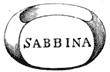
Fig. 91. |
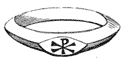
Fig. 92. |
We place beside it a ring with a very different device, but one that
cannot fail to be looked on with singular interest. It is marked with
the Labarum, the oldest sacred monogram of Christianity, which
Constantine believed he saw in a vision, and placed upon his victorious
standard and his coins, with the motto—“In hoc signo vinces!” This ring
came from the Roman sepulchre of an early Christian, and the hand for
which it was originally fashioned may have aided in the conquering war
of the first Christian emperor; or may have been convulsed in an
agonising death, “thrown to the beasts” of the circus, but reposing
after death with the first martyrs to the faith.
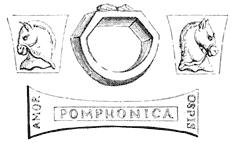 Fig. 93.
Clement of Alexandria suggests to the Christians of his era, that they
should have engraved devices of symbolic meaning allusive to their
faith, in place of the heathen deities and other subjects cut by Roman
lapidaries; such as a dove, which symbolises life eternal and the Holy
Spirit; a palm-branch, peace; an anchor, hope; a ship in full sail, the
church; and others of similar import.
Gorius has preserved a representation of a gold ring (Fig. 93) which he
believes to have been presented by a Roman lady to the victorious
charioteer in the horse-races; it is of peculiar form, but one that was
a favourite with Roman wearers. The bust of the donor appears on the
summit of the ring, and on each side are the heads of reined horses, as
shown in our cut. Her name is engraved on the lower part of the hoop,
and on each side AMOROSPIS. The latter properly being HOSPES, having the
aspirate omitted and an I for an E, induces Gorius to consider it a late
work of the Roman era.
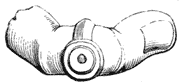 Fig. 94.
We have already spoken of the ring-hand and the ring-finger, but have
not noted the origin of the custom of placing the wedding ring on that
finger. It resulted from an inaccurate belief that a nerve went from
thence to the heart. That the ancients were indiscriminate in the use of
their fingers as recipients for rings we have already shown; Mr.
Waterton has placed in his curious Dactyliotheca the forefinger from a
bronze statue of late Roman workmanship, wearing a large ring upon the
second joint. In Germany it is still customary to wear the ring in this
fashion, a custom they evidently borrowed from their Roman subjugators,
and have retained through every century of change since then.
As the luxury of Rome increased, the wearing of rings increased also,
and the emperors relaxed the law of restraint. Thus Tiberias, in A.D.
22, gave permission for gold rings to be worn by all persons whose
fathers and grandfathers possessed property to the value of 200,000
sesterciæ. The Emperors Severus and Aurelian ultimately gave the right
of wearing gold rings to all soldiers of the empire; and the Emperor
Justinian at length gave a similar right to all who had legal claims to
Roman citizenship. Distinction once broken through, and wealth
increasing, ring-wearing became general. Seneca, describing the luxury
and ostentation of his time, says, “We adorn our fingers with rings, and
a jewel is displayed on every joint.” The ridiculous excess to which the
custom was carried may be understood from Martial’s description of
Charinus, who wore as many as sixty rings on his hands at one time, and
so fond was he of his jewellery that he kept them upon his fingers when
in bed. They were decorated with a vast variety of subjects, originally
cut in the metal of which the ring was made, whether gold, silver, or
brass; ultimately the devices were cut upon stones and gems,
occasionally representing the tutelar deity of the wearer. Thus Julius
Cæsar wore one with Venus Victrix upon it, and his partisans did the
same. Pompey’s ring was engraved with three trophies, indicating his
victories in Europe, Asia, and Africa. Many used merely fanciful or
emblematic devices; thus Mæcenas had a frog upon his ring. Others wore
the portraits of their ancestors or friends. Publius Lentulus had that
of his grandfather. Cornelius Scipio Africanus, younger son of the great
Africanus, wore the portrait of his father; but, as he was a degenerate
son of an illustrious sire, the people gave expression to their disgust
at his conduct by depriving him of his ring, saying he was unworthy to
wear the portrait of so great a man.
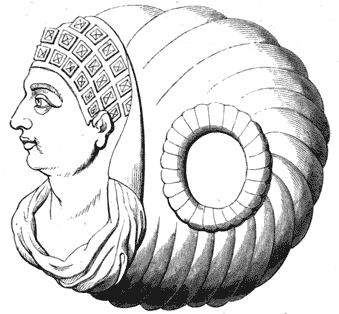 Fig. 95.
This ring-wearing became one of the troubles of the wealthy, and as the
Sybarite complained of the folded rose-leaf inconveniencing his bed, the
rich Roman was fatigued with his rings. Hence came the custom of wearing
light or heavy rings, or as they termed them, summer or winter rings,
according to the season. That there really was some reason in the
complaint, will be granted by the reader who looks on Fig. 95, copied
from Montfaucon.89-* It is a thumb-ring of unusual magnitude, and of
costly material; it has upon it a bust in high relief of the Empress
Plotina, the consort of Trajan; she wears the imperial diadem, which is
here composed of precious stones cut into facets. This bust would of
course come outside the hand, the narrower part of the wreathed ring
passing between the thumb and first finger. The gorgeous inconvenience
of the whole thing is at once apparent. It probably decorated the hand
of some member of the imperial family.
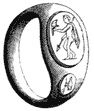
Fig. 96. |
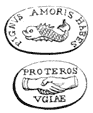
Fig. 97. |
The enormous sums expended by the wealthy on rings may be best
understood by an allusion to the recorded value of two belonging to
empresses of Rome. Thus, the ring of Faustina, we are told, cost
£40,000, and that of Domitia £60,000, reckoning the Roman sestertia at
its modern value.
Sometimes the decoration of a ring was not confined to a single gem,
though such rings were comparatively rare. Valerian speaks of the
annulus bigemmis, and Gorleus furnishes us with the specimen engraved
in Fig. 96; the larger gem has cut upon it a figure of Mars, holding
spear and helmet, but wearing only the chlamys; the smaller gem is
incised with a dove and myrtle branch. Beside it are placed two examples
of the emblematic devices and inscriptions adopted for classic rings,
when used as memorial gifts. The first is inscribed, “You have a love
pledge;” the second, “Proteros (to) Ugiæ,” between conjoined hands—a
type of concord still familiar to us.
Though the ancients seem scarcely to have thought of decorating the
circlet of the ring, they occasionally varied its form, producing
novelty at the expense of convenience. Fig. 98 is a whimsical example;
it may, however, have been principally used as a signet. The same may be
said of Fig. 99, which has a very broad face, set with an incised stone
bearing a figure of Hygeia.
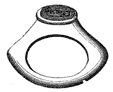
Fig. 98. |
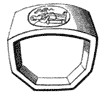
Fig. 99. |
The ancients tell us of charmed rings; such was the ring of Gyges, which
was reported to have rendered him invisible when he turned the stone
inwardly, and closed it in his palm. Execetus, tyrant of the Phocians,
carried two rings, which he was accustomed to strike together, to divine
by the sound emitted what he had to do, or what was to happen to him.
The most curious adaptation of the finger-ring to a double use was made
by the Romans. It was a combination of a ring and a key, as represented
in Figs. 100 and 101, from originals engraved by Montfaucon in his great
work on Roman antiquities. He has published many varieties, for they are
very commonly discovered in all places where the Romans located
themselves. Many have been found in London, York, Lincoln, and other old
cities, as well as in the neighbourhood of Roman camps. The use of these
rings is apparent: they opened the small cabinets or boxes in which the
most precious articles were preserved, and they were less likely to be
lost, mislaid, or improperly used by others, when thus worn night and
day on the finger.
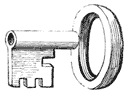
Fig. 100. |
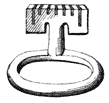
Fig. 101. |
It is recorded of the poisoning Pope Alexander VI. (Borgia), that he
caused a somewhat similar key to be used in opening a cabinet; but the
Pope’s key was poisoned in the handle, and provided with a small sharp
pin, which gave a slight puncture sufficient to allow the poison to pass
below the skin. When the Holy Father wished to rid himself of an
objectionable friend, he would request him to unlock his cabinet; as the
lock turned rather stiffly, a little pressure was necessary on the
key-handle, sufficient to give the trifling wound that ultimately proved
mortal. Poisoned rings were known to the ancients; when Hannibal, the
Carthaginian general, was overcome by Scipio Africanus, it is recorded
that he fled to Bithynia, and ended his life by poison, which for that
purpose he had reserved in a ring.
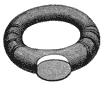
Fig. 102. |

Fig. 103. |
Rings formed of bone, amber, and glass, were provided for the poorer
classes, as was the case in ancient Egypt. They were also used as
mortuary rings, and are found on the hands of the dead in Italian
sepulchres. The Waterton collection supplies us with two specimens. Fig.
102 is of amber, cut to appear as if set with a stone. Fig. 103 is of
glass, also made as if set with a jewel. The body of this ring is dark
brown with bands of white crossing it; the jewel is yellow.
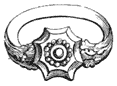
Fig. 104. |

Fig. 105. |
In the later days of the Roman empire the simplicity and purity in
decorative design that the Romans obtained from the Greeks, gave way to
the ostentatious love of gaudy decoration taught at Byzantium. Jewellery
became complicated in design; enrichment was considered before elegance.
The old simple form of finger-ring varied much. Fig. 104 is given by
Montfaucon. Fig. 105 is in the Londesborough collection, and was found
upon the hand of a lady’s skeleton, buried with her child in a
sarcophagus discovered in 1846, in a field near Amiens, called “Le Camp
de Cæsar;” on two of her fingers were rings, one of which was set with
ten round pearls, the other (here engraved) is of gold, in which is set
a red carnelian, engraved with a rude representation of Jupiter riding
on the goat Amalthea. The child also wore a ring with an engraved stone.
The whole of the decorations for the person found in this tomb proclaim
themselves late Roman work, probably of the time of Diocletian.

Fig. 106. |

Fig. 107. |
In 1841 a curious discovery was made at Lyons of the jewel case of a
Roman lady, containing a complete trousseau, including the rings here
engraved. Fig. 106 is of gold; the hoop is slightly ovular, and curves
upward to a double leaf, supporting three cup-shaped settings, one still
retaining its stone, an African emerald. Fig. 107 is also remarkable for
its general form, and still more so for its inscription, VENERI ET
TVTELE VOTVM, explained by M. Comarmond as a dedication to Venus and the
local Tutela, the guardian of the navigators of the Rhine; hence he
infers these jewels to have belonged to the wife of one of these rich
traders in the reign of Severus.
Carrying back our researches to the pre-historic era of our own island,
and searching in the tumuli of the early British chieftain and his
family, we shall discover the utmost simplicity of adornment; not
probably the result of indifference to personal decoration, but simply
to the rudeness of his position. The wild Gaelic hunter, located in the
gloomy fastnesses of wood and morass, had little or no communication
with the southern sea-margin of our isle: and when we find the south
Cymry of Britain much advanced in civilisation, owing to connection with
Belgic Gaul, and Phœnician colonists of Spain, and the Greek
colonists of the Mediterranean, we find the tribes inhabiting the
midland and northern counties still barbaric, and little advanced in the
arts that make life pleasant. Such decoration as they adopted seems to
have originated in the basket-weaving, for which the British Islands
were famous even at Rome, where noble dames coveted these works from the
far-off and mysterious Cassiteridæ. Plaited or interlaced-work,
resembling the convolutions of wicker and rush, was imitated in threads
of metal; thus circlets for the neck, bracelets for the arms, or rings
for the fingers, were but twisted strands of gold.
The simplest form of finger-ring worn by these Gaelic ancestors
consisted of a band of metal, merely twisted round to embrace the
finger, and open at either end. Fig. 108 shows one of these rings, found
in excavating at Harnham Hill, near Salisbury, a locality celebrated
from the very earliest recorded time as the true centre of ancient
Britain. This ring was found on the middle finger of the right hand of a
person of advanced age. Sometimes several rings were found on one hand.
“Among the bones of the fingers of the left hand of an adult skeleton
was found a silver ring of solid form, another of spiral form, and a
plain gold ring.”96-* Mr. Akerman, who superintended these researches,
says, “Similar rings have been found at Little Wilbraham, at Linton
Heath, at Fairford, and other localities. They are for the most part of
an uniform construction, being so contrived that they could be expanded
or contracted, and adapted to the size of the finger of the
wearer.”96-†
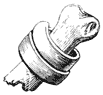
Fig. 108. |
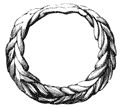
Fig. 109. |
The prevailing form of the old Celtic finger-ring is shown in Fig. 109.
It is formed of thick twisted wires of pure gold. This fashion seems to
have been in most favour with all the early Celtic tribes, such rings
being found in the grave-mounds of Gaul, Germany, Belgium, Denmark,
Ireland, and Scotland. A discovery of many similar rings was made in one
of the Western Islands of Scotland; they were formed of from three to
eight wires each, elaborately and beautifully enwreathed.

Fig. 110. |

Fig. 111. |
The south Saxons retained to the last the simple form of wire-ring,
which originated, as we have already shown, with the most ancient
people. Its comparative cheapness and ease of construction were no doubt
its great recommendations. Similar rings are still made for the poorer
classes in the East: the author has seen such worn in modern Egypt.
Specimens have been obtained in Anglo-Saxon grave-mounds in England, and
others, identical in form, in the old Saxon cemeteries of Germany.97-*
Fig. 110 represents one of the plainest of these wire-rings; it was
exhumed from a tumulus on Chartham Downs, a few miles from Canterbury,
Kent, in 1773, by the Rev. Bryan Faussett, who says, “the bones were
those of a very young person.” Upon the neck was a cross of silver, a
few coloured earthen beads, and “two silver rings with sliding knots.”
The industry of the same collector furnishes us with Fig. 111, a
specimen of a wire-ring so twisted as to resemble a seal ring, or one
set with a stone: the wire round the finger has been beaten out flat. It
was discovered in the extensive Saxon cemetery on Kingston Downs, near
Canterbury, on the Dover Road. The tumulus was evidently the last
resting-place of a person of small wealth, as this copper ring and two
small beads only were found in it; and it was customary to bury the
ornaments of the deceased, however valuable, with them.98-*
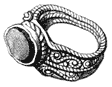
Fig. 112. |
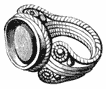
Fig. 113. |
Ireland seems to have boasted a higher civilisation at an earlier period
than the sister kingdoms, and her ancient art-works are remarkable for
their skilled and tasteful elaboration. Gold, too, appears to have been
used more commonly there, and the museum of the Royal Irish Academy can
show a more wonderful collection of personal ornaments in that precious
metal, as once worn by the native nobles, than is to be seen in the
national museums of any other country, with the exception of Denmark.
The gold is of the purest kind and richest colour, and the manner of its
working could not be excelled by a modern goldsmith. The Londesborough
collection includes two remarkable rings (Figs. 112 and 113), which
were found with other gold ornaments near the very remarkable tumulus
known as “New Grange,” a few miles from Drogheda. They were accidentally
discovered in 1842 by a labouring man, within a few yards of the
entrance to the tumulus, at the depth of two feet from the surface of
the ground, and without any covering or protection from the earth about
them. Two bracelets of thick twisted gold, and a chain, also of gold,
were found with them. Another labouring man, hearing of this discovery,
carefully searched the spot whence they were taken, and found a denarius
of Geta, which may aid us in arriving at some conclusion as to the age
of these curious works. The stone set in both rings is a cut agate.

The rings worn by the higher class of our Anglo-Saxon ancestors during
the Heptarchy were often very beautiful, and of imposing form. One of
the finest we have seen belonged to the Rev. H. B. Hutchings, of
Appleshaw, Hants,100-* and was found in a meadow at Bosington, near
Stockbridge, in the same county, by a labourer who saw it among a heap
of peat. We give a side and front view of this interesting relic; the
whole is of gold, and is of considerable weight and thickness; the gold
threads are all beautifully reeded, and the lettering and head executed
with great care. The inscription reads—NOMEN EHLLA FID IN XPO,
equivalent to its owner saying, “My name is Ella, my faith is in
Christ.”
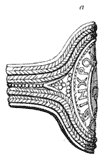
Fig. 114. |
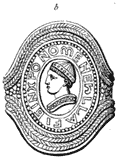
Fig. 115. |
The beautiful and remarkable collection of rings formed by Edmund
Waterton, Esq., F.S.A., to which allusion has already been made,
includes a ring of South Saxon workmanship, which was found in the
Thames at Chelsea in 1856. The face of this ring (Fig. 116) is an
elongated oval, with a circular centre. Within this circle is the
conventional figure of a dragon, surrounded by convoluted ornament,
reminding us forcibly of the prevailing enrichments so lavishly bestowed
on old Runic monuments, at home and abroad. Four quaintly-formed heads
of dragons occupy the triangular spaces, above and below this centre.
This ring is of silver. The ground between the ornament has been cut
down, probably for the insertion of niello or enamel colours.
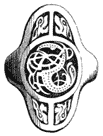
Fig. 116. |
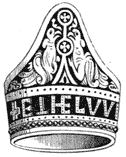
Fig. 117. |
Fig. 117 is an historic relic of singular interest, and a remarkable
work of early art. It is the ring of Ethelwulf, King of Wessex (the
father of Alfred the Great), who reigned A.D. 836-838, and bears the
royal name upon it. It was found in the parish of Laverstock, Hants, in
a cart-rut, where it had become much crushed and defaced. The form is
remarkable, the front rising pyramidally. Two birds of conventional form
face each other, a flower ornament dividing them; these decorations,
like those on Mr. Waterton’s ring just described, are relieved by a
ground of glossy bluish-black enamel, cavities having been cut between
the ornament for its infusion. This ring is of gold, weighing 11 dwts.
14 grs.; it is now preserved in the British Museum.
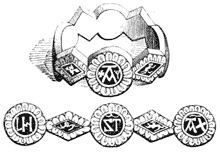 Fig. 118.
Mr. Waterton is the fortunate possessor of a ring second only in
interest and value to this royal relic. It is the ring of Ahlstan,
Bishop of Sherborne, the friend and counsellor of King Ethelwulf, who
flourished A.D. 817-867. It was discovered in Carnarvonshire, and has
the name of the bishop in divided letters distributed on the circular
rosettes of the design; they are connected by lozenge-shaped floriated
ornaments, having dragons in their centres. Our cut (Fig. 118) gives the
general form and detail of this beautiful ring, which is remarkable for
the elegance of its design. It is of gold, like the preceding ring;
both being admirable illustrations of the champ-levé process of
enamelling as practised in the ninth century.

Fig. 119. |

Fig. 120. |
A remarkable discovery of coins and treasure was made in 1840 by workmen
employed in digging at Cuerdale, near Preston, in Lancashire. It
consisted of a large mass of silver, in the form of ingots or bars of
various sizes, a few armlets and rings, and portions of other ornaments,
cut into pieces as if for remelting. With them were packed nearly seven
thousand coins of various descriptions, consisting of Anglo-Saxon
pennies, others struck by the second race of French kings, a few
Oriental coins, and others which appear to have been coined by some of
the piratical northern chieftains. This treasure was minutely examined
by E. Hawkins, F.R.S., of the British Museum, and he came to the
conclusion that it had been deposited about the year 910, and that the
ornaments must be considered such as were worn about the time of Alfred,
or perhaps somewhat earlier. The rings retain much of the primitive
British form, as will be seen on examining the two selected for
engraving here. Fig. 119 is beaten out into a broad face, which is
covered with an indented ornament produced by a chisel-shaped punch of
triangular form, the points of two conjoined in one pattern, the edge
of the ring on each side further enriched by a series of dots. Fig. 120
has a still broader face, which is decorated by groups of three circles
each, somewhat irregularly distributed over the surface, with indented
lines between them. The open end of this ring has been drawn together
and secured by a coil of wire. Such rings were probably worn by the
middle classes.
The passion for gems and jewellery was excessive among all the Gothic
nations. When Alaric pillaged Rome, his booty in this way was enormous;
and it is recorded that his princess, Placidia, received as a present
from the conqueror’s brother, fifty basins filled with precious stones
of inestimable value. Not only were the persons of these sovereigns and
nobles covered with gems, inserted in girdles, sword-scabbards, on
borders of garments or shoes; but vases, dishes, bowls, drinking-cups,
as well as portable articles of furniture, caskets, &c., were similarly
enriched. The Ostrogoth and Wisigoth kings amassed, in Tolosa and
Narbonne, immense treasures in gems and gold and silver vessels. When
Narbonne was pillaged, the number of ornaments of pure gold enriched
with gems that fell to the conquerors would scarcely be credited, were
the details recorded by less trustworthy authors, or not corroborated by
some few works of the same age which have fortunately descended to us.
The Church shared largely in this wealth; crosses, reliquaries, and
sacred vessels of all kinds, were made of the most costly material, and
encrusted with gems. One of these ancient works may still be seen in
Cologne Cathedral—the chasse, or reliquary, containing the reputed
skulls of the three Magi, of whom we shall soon have to speak more
fully. This remarkable work is studded all over with engraved intaglios
of Roman workmanship. Churchmen at this time were clever artificers; and
St. Dunstan, great statesman as he was, in the British, and St. Eloi in
the Gallic, church, both skilled working goldsmiths, have since become
the patron saints of confraternities of their followers.
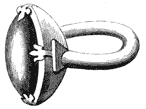
Fig. 121. |
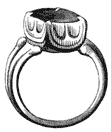
Fig. 122. |
The higher clergy on all solemn occasions displayed much personal
decoration. A jewelled ring was part of the adornment of a bishop when
arrayed in full pontificals. It indicated his rank, was made for him,
and buried with him. The treasuries of our old cathedrals still possess
a few of these rings. One of the earliest and most curious is kept by
the Dean of Winchester, and is represented in Fig. 121. It was found
during the repair of the choir under the tomb of William Rufus, and is
supposed to have been the pontifical ring of Henry de Blois, Cardinal,
and Bishop of Winchester, A.D. 1129. It is a massive ring of solid gold,
set with an oval irregularly-shaped sapphire, en cabochon, polished
only, not cut; held in its heavy socket by four fleur-de-lys, and still
further secured by drilling through its centre a passage for a gold
wire—a reckless way of treating valuable jewels, which is
characteristic of almost all these early works.
Fig. 122 is an ordinary pontifical gold ring of investiture, used in the
Anglican Church about this time. It was found at Winchester, and is
preserved with Fig. 121, described above. It has a very massive setting
for a large blue sapphire, and is very characteristic, though simple in
its design.
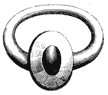
Fig. 123. |
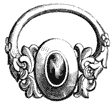
Fig. 124. |
Dignity, as exhibited by weight and simplicity, seems to have been
chiefly regarded in the design of these old episcopal insignia. In the
sacristy at York Minster is preserved a very excellent specimen, Fig.
123. This was found in the tomb of Archbishop Sewall, who died in 1256.
With it is kept another fine ring of more elaborate design (Fig. 124),
which was discovered in the tomb of Archbishop Greenfield, who died in
1315. The foliations which curl around the central stone and its
setting, take the prevailing forms adopted in architectural enrichments
of the archbishop’s age. The stones usually chosen for such rings were
ruby, emerald, or crystal, and had a significance usual with all things
connected with the Roman Catholic Church; ruby indicated its glory,
emerald its tranquillity and happiness, and crystal its simplicity and
purity. The diamond typified invulnerable faith; the sapphire, hope; the
onyx, sincerity; the amethyst, humility.
In the old romance of “Sir Degrevant,” we are told that at the marriage
of the hero there came
“Archbishops with rings
More than fifteen.”
In the romance of “King Athelstan” (also a work of the fourteenth
century), the king exclaims to an offending archbishop—
“Lay doun thy cross, and thy staff,
Thy miter, and thy ring, that I to thee gaff:
Out of my land thou flee.”
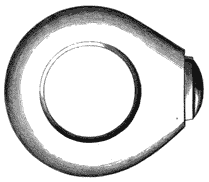 Fig. 125.
The episcopal ring, being thus necessarily a mark of rank, was worn
about this time over the gloves: sometimes as a thumb-ring, and often of
very large size. The ornaments of the clergy became more massive as the
wealth of the Church increased. As the clergy were during church service
separated from the laity, many of the latter were at a considerable
distance from them. This may be a reason for the size adopted for
episcopal rings. A late Dean of St. Patrick’s had in his collection a
very large ring of this kind, represented in Fig. 125, from a sketch
made by the author when it was in the possession of W. Huxtable,
F.S.A., in 1847. It was of bronze, thickly gilt, and set with a crystal.
This peculiar form was generally adopted for rings at this period. The
Londesborough collection furnishes us with a curious specimen (Fig.
126), formed of gilt copper, and set with a small ruby, which must have
stood forth from the finger in what would now be considered as a most
inconvenient manner. Fig. 127 exhibits the form of the plain hooped
ring, simply decorated with quatrefoils on each side of the stone (in
this instance a small irregularly-shaped sapphire), which is embedded in
a somewhat solid setting projecting from the ring.
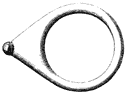
Fig. 126. |

Fig. 127. |
In the Gentleman’s Magazine for 1848 is engraved a massive ring, also
of brass, thickly gilt, the hoop chased with the arms of Pope Pius
II.108-* (the famed Æneas Sylvius), and his name, Papa Pio, between
the tiara and the cross-keys. On each of the four sides of this ring
appears one of the four beasts of the Revelation, typifying the
Evangelists: they are executed in high relief. It is set with a large
topaz. This ring has since passed into Mr. Waterton’s fine collection,
who is the fortunate possessor of others of the same class. One in the
Londesborough collection is here engraved, Fig. 128, as a good specimen
of the general design adopted for such rings. The crossed-keys surmount
a coat of arms on one side of the ring; the keys alone appear on the
opposite side; foliated ornament fills the space above the circlet on
either side. This ring is set with a large crystal.
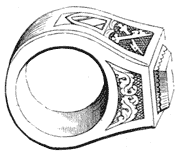
Fig. 128. |
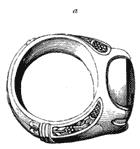
Fig. 129. |
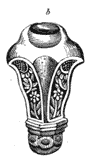
Fig. 130. |
We close our series of episcopal rings with one found in the cathedral
at Hereford during the repairs of the choir in 1843, which rendered the
removal of the beautifully carved alabaster monument of Bishop Stanbery
unavoidable. This bishop held the See from 1452 until his death in May,
1474. Upon opening the tomb a few fragments of bone were discovered,
very small portions of the mere remains of the silk of the robes in
which the body of the bishop was enveloped, and this beautiful ring, of
which views are given in Figs. 129 and 130. It is of gold, set with a
sapphire; the sides of the ring are decorated with sprays and flowers on
a ground of dark enamel; and inside is the motto “en bon an.”
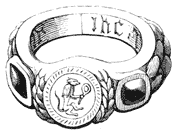
Fig. 131. |
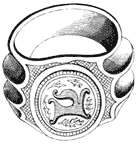
Fig. 132. |
A very large ring, bearing great general resemblance to the episcopal
ring, was occasionally worn as a thumb-ring by the laity. A specimen of
such a one is selected from the Londesborough collection in Fig. 131. It
is somewhat roughly formed of mixed metal, and has upon the circular
face a conventional representation of a monkey looking at himself in a
hand-mirror. This is surrounded by a cable moulding, and on each side is
set two large stones. The outer edge of this ring is also decorated with
a heavy cable moulding: inside, next the finger, is the cross and sacred
monogram, placed on each side of the mystic word anamzapta, which we
shall immediately have to explain more fully when speaking of the rings
commonly worn as charms.
These massive thumb-rings were indicative of wealth or importance, when
worn by the middle classes who had obtained any municipal position. When
Falstaff speaks of his slenderness in his youth, he declares that he
could then have “crept through an alderman’s thumb-ring.” Like the
massive gold chains still worn by that honourable fraternity, they told
of a trader’s wealth. The inventories of personal property belonging to
burgesses in the Middle Ages, contain frequent allusions to such rings,
without which they would have felt shorn of an important part of their
head-earned honours. Among the wills and inventories preserved at Bury
St. Edmund’s, published by the Camden Society, is one made by Edward
Lee, of that town, bearing date 1535, in which he bequeaths to a friend,
“my double wreathed ryng of gold, whych I ware on my thumbe.” From this
description it is evident that this ring must have borne great
resemblance to that given in Fig. 131, with its outer cable or double
wreathed pattern. There is a brass in Hastings Church, Sussex, with the
effigy of a gowned citizen wearing such a ring. That such rings became
in the end indicative of that class, and were retained in fashion for
this reason when they had been long discarded from general use, may be
safely inferred from the description of a character introduced in the
Lord Mayor’s Show in the year 1664, who is said to be “habited like a
grave citizen—gold girdle and gloves hung thereon, rings on his
fingers, and a seal ring on his thumb.” Such rings were evidently used
according to the most ancient mode as personal signets, by such as were
not entitled to bear arms; hence originated the quaint inventions known
as “merchant’s marks,” which were impressed on merchandise, painted on
shields instead of armorial bearings, inserted in memorial windows of
stained glass, and worn on the thumb for constant use in sealing. A very
fine ring of this kind is engraved in the Journal of the Archæological
Institute, vol. iii., and is here copied in Fig. 132. It was found in
the bed of the Severn, near Upton, and is probably a work of the
fifteenth century; it is of silver, and has been strongly gilt. The hoop
is spirally grooved, and upon the circular face is a large letter H,
surrounded by branches.
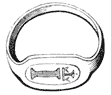
Fig. 133. |
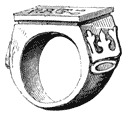
Fig. 134. |
The custom of placing initial letters on rings is a very old one, and
they are sometimes surmounted by crowns or coronets; hence they have
frequently been mistakenly appropriated to royalty. Fig. 133 is a ring
of this kind, with a crowned I upon it; hence it was once called “King
John’s ring.” It is most probably the initial of the Saviour’s name as
King of the Jews, in the same way that the crowned M may indicate the
Virgin Mary as “Queen of Heaven,” a favourite popish designation. Such
rings may have been worn from religious feeling, or from the
superstitious belief in the efficacy of holy names as preservatives from
evil. The baseness of the metal of which they are often made, and their
consequent small value, precludes the possibility of their having
belonged to royalty. The same remark will apply to a ring also engraved
in the Journal of the Archæological Institute, and now in the possession
of the Rev. Walter Sneyd. It is there described as of mixed yellow metal
gilt; on either side of the hoop there is a crown (Fig. 134), of the
form commonly seen on coins of the twelfth century, and on the signet
are the words, ROGERIVS REX, chased in high relief. In the form of the
character they correspond closely with legends upon coins of Roger,
second Duke of Apulia, of that name, crowned King of Sicily A.D. 1129;
he died A.D. 1152. This ring has every appearance of genuine character,
but it is difficult to explain for what purpose it was fabricated, the
inscription not being inverted, and the letters in relief ill suited for
producing an impression. It seems very improbable that King Roger should
have worn a ring of base metal; and the conjecture may deserve
consideration, that it was a signet not intended for the purpose of
sealing, but entrusted in lieu of credentials to some envoy. The popular
literature of the Middle Ages abundantly proves this custom to have been
in general use. The tale of Ipomydon, in Weber’s “Ancient Metrical
Romances,” notes the gift of a ring to the hero from his mother, which
is to be used as a token of recognition to his illegitimate brother, and
which is brought secretly to his notice by being dropped into his
drinking horn. In the “Romance of Florence and Blancheflor,” a ring
serves the purpose of letters of introduction when the hero is on his
travels, and ensures him hospitality when he deserves it.
Rings sometimes bore the name and title of the Saviour in full, as in
Fig. 135 from the Londesborough collection. Two hands are clasped in
front; it was, therefore, most probably a gift, or betrothal ring. It is
silver, somewhat rudely fashioned. The inscription (here engraved below
it) is in uncial characters, and shorn of its somewhat awkward
abbreviation, reads “Jesus Nazareneus Rex.”
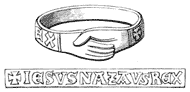
Fig. 135. |
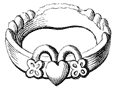
Fig. 136. |
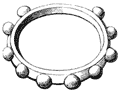
Fig. 137. |
The same collection furnishes us with the specimen of a religious ring
(Fig. 136), apparently a work of the fourteenth century. It has a heart
in the centre, from which springs a double flower. On the upper edge of
the ring are five protuberances on each side; they were used to mark a
certain number of prayers said by the wearer, who turned his ring as he
said them, and so completed the series in the darkness of the night.
Such rings are of very common occurrence, and must have been in general
use. They are sometimes furnished with more prominent knobs, as in Fig.
137. They are termed decade rings when furnished with ten bosses, which
were used to count the repetition of ten aves, but they are
occasionally seen with one or two additional bosses; when there are
eleven, they notify ten aves and a paternoster; the addition of the
twelfth marks the repetition of a creed.
Allusion has already been made to the mystic virtues attributed to
stones during the Middle Ages, and for the fondness for collecting
antique gems. They were coveted not only as works of art, but for their
supposed power over the circumstances of life, or the welfare of
individual wearers. The idea very probably originated with the Gnostics
of the East, who engraved stones with mystic figures believed to impart
good luck or to keep off evil influences. So completely had this belief
gained hold on all classes, that a Gnostic gem set as a ring was found
on the finger of the skeleton of an ecclesiastic, in the Cathedral of
Chichester, “affording indubitable evidence that these relics were
cherished in the Middle Ages by those whose express duty it was to
reprove and check such gross superstition.”115-*
This belief was ultimately reduced to a system. An old French
Lapidaire, compiled in the thirteenth century, assures us that a stone
engraved with the figure of Pegasus or Bellerophon is good for warriors,
“giving them boldness and swiftness in flight,” very contradictory
qualifications, it must be allowed. One with the figure of Andromeda had
the power of conciliating love between man and woman. “A gem bearing the
figure of Hercules slaying a lion or other monster, was a singular
defence to combatants. The figure of Mercury on a gem rendered the
possessor wise and persuasive. The figure of Jupiter with the body of a
man and the head of a ram, made the man who bore it beloved by
everybody, and he was sure to obtain anything he asked. If you find a
stone bearing the figure of a hare, it will be a defence against the
devil; if you find a dog and a lion on the same stone, it will be a
preservative against dropsy or pestilence. The figure of Orion was
believed to give victory in war. If you find a stone, in which is
Perseus holding in his right hand a sword, and in his left the Gorgon’s
head, it is a preservative against lightning and tempest and against the
assaults of devils. A stone on which is engraved a long-bearded man
sitting on a plough, with a bending in his neck, and four men lying
down, and holding in his hand a fox and a vulture, this, suspended about
the neck, enables you to find treasures. If you find a dove, with a
branch of olive in its mouth, engraved in pyrites, and mount it in a
silver ring, and carry it with you, everybody will invite you to be his
guest, and people will feast you much and frequently. The figure of a
syren, sculptured in a jacinth, rendered the bearer invisible. A fair
head, well combed, with a handsome face, engraved on a gem, gave to the
bearer joy, reverence, and honour. Such were the qualities attached to
ancient gems in the Middle Ages.”116-*
Many plain stones were also believed to have magical virtues. Thus, the
amethyst prevented drunkenness, and was consequently often set upon wine
cups. The crystal clouded if evil was about to happen to its wearer.
Amber was good against poison, hence drinking-cups were formed from it.
The topaz cured and prevented lunacy, increased riches, assuaged anger
and sorrow, and averted sudden death. Such was the faith placed in
stones until the end of the sixteenth century. Dr. Donne speaks of
“A compassionate turquoise, that doth tell,
By looking pale, the wearer is not well.”
But the most curious of all these superstitious beliefs attached itself
to the crapaudine, or toad-stone. It is most unattractive to sight, of
an opaque dirty-brown tint, and known to mineralogists as a variety of
trap-rock. It was believed to have most sovereign virtues against poison
if pounded and drank, and, like the turquoise, to give warning of its
presence by a change of colour, when simply worn in a ring. It was
believed to exist in the head of the toad. Fenton, writing in 1569,
says, “There is found in the heads of old and great toads a stone which
they call borax or stelon; it is most commonly found in the head of a
he-toad.” It was not easily attained, for the toad “envieth so much that
man should have that stone,” says old Lupton, in his “Thousand Notable
Things.” Hence came a true test for such stones, according to the same
credulous author, who thus enlightens us:—“To know whether the
toad-stone called crapaudina be the right and perfect stone or not,
holde the stone before a toad so that he may see it, and if it be a
right and true stone, the toad will leap toward it, and make as though
he would snatch it from you.” It should be obtained, says a mediæval
author, while the toad is living, and this is to be done by simply
placing him upon a piece of scarlet cloth, “wherewithal they are much
delighted, so that while they stretch out themselves as it were in sport
upon that cloth, they cast out the stone of their head, but instantly
they sup it up again, unless it be taken from them through some secret
hole in the same cloth.”117-*
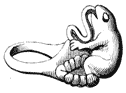
Fig. 138. |

Fig. 139. |
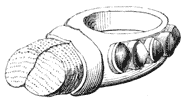
Fig. 140. |
Lupton, whom we have just quoted, tells us of “a rare good way to get
the stone out of the toad,” which has the advantage of greater
simplicity. It is to be done thus:—“Put a great or overgrown toad
(first bruised in divers places) into an earthen pot; put the same into
an ants’ hillocke, and cover the same with earth, which toad at length
the ants will eat, so that the bones of the toad and stone will be left
in the pot.” Boethius relates how he watched a whole night an old toad
he had laid on a red cloth to see him cast forth the stone, but the
tedious watch was not rewarded; the toad retained his jewel, and he had
nothing from thence to “gratify the great pangs of his whole night’s
restlessness.”
The Londesborough collection supplies us with two remarkable specimens
of rings connected with toad superstition. Fig. 138 is of mixed metal
gilt, having upon it the figure of a toad swallowing a serpent. There is
a mediæval story of a necromancer introducing himself to another
professor of magic by showing him a serpent ring, upon which the latter,
who did not desire any one to interfere with his practice, produced his
toad-stone ring, observing that the toad might swallow the serpent,
thereby intimating his power to overcome him. Fig. 139 is curious, not
only as containing the true toad-stone, but also that the stone is
embossed with the figure of a toad, according to the description of
Albertus Magnus, who describes the most valuable variety of this coveted
gem as having “the figure of the reptile imprinted upon it.”
The elder poets have, as usual with them, turned into a moralisation
this fabulous bit of natural history. Lyly, in his “Euphues,” observes,
“the foule toad hath a faire stone in his head.” Shakspere has
immortalised the superstition in the most effective and beautiful
manner, when he declares how
“Sweet are the uses of adversity,
Which, like the toad, ugly and venomous,
Yet wears a precious jewel in its head.”
Superstition did not confine its belief to a few charms; it ranged over
more than we can now record. In the Londesborough collection is the
massive thumb-ring delineated in Fig. 140, having the tooth of some
animal as its principal gem, fondly believed by its original owner to
have mystic power over his well-being. To “make assurance doubly sure,”
it is set all round with precious stones, all believed to have magical
virtues.
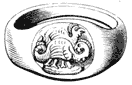
Fig. 141. |
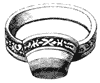
Fig. 142. |
Superstition was not confined to the real world of animal life, but
ranged over the fabulous natural history which mixed largely with the
true, in all men’s minds, at this credulous era of the world’s history,
when persons put more faith in false charms for the cure of disease or
the prevention of evil, than in the power of medicine, or the value of
proper preventives. The horn of the unicorn, the claw of the griffin,
and other relics of equal verity and value, were sought eagerly by
those rich enough to procure them, and when obtained were believed to
ensure much good fortune to the possessor. A fear of the “evil
eye”—that bugbear which still disturbs the happiness of the lower class
Italians and of the Eastern nations generally—was carefully provided
against. One great preservative was the wearing of a ring with the
figure of a cockatrice upon it. This imaginary creature was supposed to
be produced from that rarest of all rare things, a cock’s egg, foolishly
believed to be laid on certain occasions under magic influence and
planetary agencies. Sir Thomas Browne, in his “Vulgar Errors,” describes
this imaginary creature “with legs, wings, a serpentine and winding
tail, and a crest or comb somewhat like a cock.” The Londesborough
collection supplies us with a thumb-ring (Fig. 141), having two
cockatrices cut in high relief upon an agate. The eye of the living
cockatrice was believed to be so deadly as to kill by a look, to which
Shakspere alludes in Twelfth Night, and again in Romeo and Juliet:—
“Say thou but I,
And that base vowel I shall poison more
Than the death-darting eye of cockatrice.”
There was, however, a counteraction to the danger, for it was also
believed that if a person saw the creature before it saw him, then the
cockatrice died from the effect of the human eye. To this Dryden
alludes:—
“Mischiefs are like a cockatrice’s eye,
If they see first they kill, if seen they die.”
The figure of this bird merely gave security against the evil eye; it
had no other effect; and for this purpose various engraved stones were
used. Thus, Fig. 142, from the same collection, has set in its centre a
Gnostic gem with cabalistic figures, believed able to avert the dreadful
glance.
Such stones were, of course, “far sought, dear bought;” and rings
believed to possess such covetable power had a high money value. How
then were the poor, still more ignorant and superstitious, to be aided?
Craft came to the aid of faith: demand, as usual, produced supply, and
inscriptions took the place of costly jewels. Rings were fabricated in
silver and baser metals, having cabalistic words upon them, the names of
spirits or of saints. To meet the poorest ring-wearer they were even
cast in lead, and sold on the cheapest terms. They were believed to
prevent cramp and epilepsy. One in the Londesborough collection is
inscribed with the mystic word Anamzapta. In a manuscript of the
fourteenth century, in the library at Stockholm, we have this recipe
“for the falling sickness. Say the word anamzaptus in his ear when he
is fallen doun in that evyll, and also in a woman’s ear anamzapta, and
they shall never more after feel that evyll.”
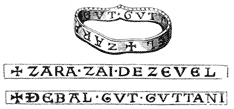 Fig. 143.
In the Journal of the Archæological Institute, vol. iii., is an
engraving of a curious magical ring, copied in Fig. 143. It was found on
the coast of Glamorganshire, near to “the Worm’s Head,” the western
extremity of the county, where numerous objects have been found at
various times on the shifting of the sand, such as firearms, an
astrolabe, and silver dollars. This ring is of gold, much bent and
defaced, and inscribed with mystic words inside and outside the hoop.
Their talismanic character seems to be sufficiently proved by the
English medical manuscript preserved at Stockholm, already alluded to,
in which, among various cabalistic prescriptions, is one “for peynes in
theth.... Boro berto briore + vulnera quinque dei sint medicina mei +
Tahebal + Ghether + + + Othman.” The last word should probably be read
Guthman, and it is succeeded by five crosses, possibly in allusion to
the five wounds of the Saviour.

Fig. 144. |
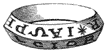
Fig. 145. |
As a preventive of peril by travel and sudden death, the names of the
three Magi, or the “Kings of Cologne,” as they were more popularly
termed, were believed to be most efficacious. Their bodies travelled
first to Constantinople, thence to Milan, and lastly to Cologne, by
various removals. The faithful may still view the skulls of the Arabian
kings who visited the Saviour in the manger (if they can believe the old
legend), in the richly-jewelled reliquary, guarded so sacredly in the
Cathedral of Cologne. Their possession brought enormous revenues to the
building, and a heavy tax is still imposed on all who would see them. It
was once (and may be still) believed that anything which had touched
these skulls had a protective virtue. Their names acted as a charm, and
were inscribed on such articles of wearing apparel as girdles or
garters, of which many specimens exist in the curious collection of Mr.
C. Roach Smith, and were found at London in excavations or in the
Thames. Upon rings they are most common; two are here selected from the
Londesborough collection. Fig. 144 is a thick gold hoop, inscribed with
their names, Jasper, Melchior, Balthazar, and the abbreviated motto, “in
· god · is · a · r.,” which the late Mr. Crofton Croker, who compiled a
descriptive catalogue of these rings, thought might probably mean “in
God is a remedy.” Fig. 145 furnishes a good example of a fashion of
hoop-ring prevalent in the fifteenth and sixteenth centuries, flat
inside and angular outside. Each face is inscribed with the same
talismanic names. It is formed of cheap mixed metal, was found in
London, and presented to the collection by Mr. Roach Smith.
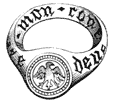
Fig. 146. |
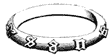
Fig. 147. |
Inscriptions on rings became at this time very common, nor were they
confined to mystic or sacred words. Mottoes of love and gallantry were
frequent, as well as moral sentences, and those strictly heraldic. In
the curious inventory of the plate and jewels of the Duke of Anjou,
compiled about 1360, mention is made of a ring with a large square
emerald, surrounded by letters in black enamel. In “Archæologia,” vol.
xxxi., is a fine example of such an engraved ring. The representation is
copied in Fig. 146. It is a weighty ring of fine gold, and was found in
1823 at Thetford, in Suffolk. The device which appears upon this ring is
an eagle displayed; on the inner side is engraved a bird, with the wings
closed, apparently a falcon, with a crown upon its head. The following
poesy, or motto, commencing on the outer side, is continued on the
interior of the ring:—deus me ouroge de bous senir a gree—com moun
couer desire—“God work for me to make suit acceptably to you, as my
heart desires.” The devices appear to be heraldic, and the motto that of
a lover, or a suitor to one in power. The eagle is the bearing of
several ancient Suffolk families; it was also a badge of the House of
Lancaster, and Thetford was one portion of the Duchy of Lancaster.
These mottoes, or “reasons,” as they were sometimes termed, were
occasionally engraved in relief. Fig. 147 represents a specimen from the
Londesborough collection. It is of gold, and was found in the Thames.
The inscription upon it is—sans bilinie—“without baseness,”—a motto
that may have been adopted by some Bayard of the Middle Ages.
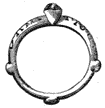
Fig. 148. |
Figs. 149 and 150. |
A very early ring, with an unusual pretty poesy, is in the collection of
J. Evans, Esq., F.S.A., and is engraved (Fig. 148). It is of gold, set
with a small sapphire, and is inscribed—IE. SVI ICI EN LI’V
D’AMI—[“I am here in place of a friend].” It was probably made at the
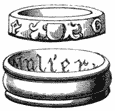
beginning of the fourteenth century. Fig. 149 is chased with the
Nortons’ motto, “God us ayde;” and Fig. 150 is inscribed withinside with
the sentence, “Mulier, viro subjecta esto.” Both are works of the
fifteenth century.
In Bromsgrove Church, Staffordshire, are the fine monumental effigies of
Sir Humphrey Stafford and his wife (1450), remarkable alike for the rich
armour of the knight and the courtly costume of the lady. She wears a
profusion of rings, every finger, except the little finger of the right
hand, being furnished with one. They exhibit great variety of design,
and are valuable as exponents of the fashion of that day. We engrave in
Fig. 151 the hands of the lady, as uplifted in prayer, with four of the
rings, the full size of the originals.
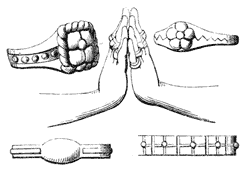 Fig. 151.
Recurring to the ancient people whose sacred records gave us the
earliest knowledge of the use of rings, we may profitably devote some
attention to the very beautiful rings, formerly used by the Hebrews for
betrothals and weddings. The Londesborough collection furnishes us with
the two fine examples engraved in Figs. 152 and 153. They are often
termed “tower rings,” from the figure of the sacred temple placed on
their summit. In the first specimen it takes the form of a sexagonal
building, with a domed roof of an Eastern character; in the second it is
square, with a deeply pitched roof, having movable vanes at the angles,
and is probably the work of some German goldsmith. Upon the roof of the
first is inscribed in enamelled letters the best wish—“joy be with
you”—that a newly-married couple would command. The same words are
inscribed in more richly-designed letters on the curve of the second
ring. Both are of gold, richly chased, enamelled, and enriched by
filigree work, and are sufficiently stately for the most imposing
ceremonial.
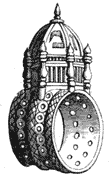
Fig. 152. |
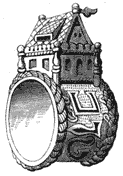
Fig. 153. |
A third Hebrew ring of less striking appearance, but of equal or greater
curiosity, is also engraved from the same rich collection, in Fig. 154.
It bears on its surface a representation (in high relief) of the
temptation of our first parents, who are surrounded by various animals,
real and imaginary, their joint residents in Paradise. The workmanship
of all these rings has been dated to the commencement of the sixteenth
century.
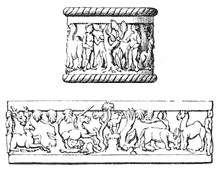 Fig. 154.
We close our series with a wedding-ring, commemorative of a marriage
which excited the marked attention of the entire Christian community, as
a vigorous protest against monkery by that “solitary monk that moved the
world”—Martin Luther. Renouncing the faith of Rome, he revoked his vow
of celibacy, and completed his total severance from its creed by
marrying a lady who had been once a nun, named Catharine Boren. The
ring, here engraved, is that used on the occasion. It is of elaborate
design and execution; a group of emblems of the Saviour’s Passion, the
pillar, the scourge, the spear, and various other objects, combine with
a representation of the Crucifixion, a small ruby being set in the
centre of the ring above the head of the Saviour. We engrave this most
interesting object of personal decoration as it appears to the eye, and
also the full design in plano; beneath it are the names and date
inscribed on the inside of the ring.
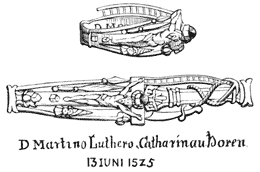 Fig. 155.
The period known as mediæval commences with the fall of ancient Rome
under the Gothic invasion, and concludes with the capture of
Constantinople by the Turks in 1453. The modern era therefore commences
in the middle of the fifteenth century, during the reign of Henry VI.
As private wealth increased, finger-rings became much more ornamental;
to the art which the goldsmith and jeweller devoted to them, was added
that of the engraver and enameller. Fig. 156, from the Londesborough
collection, is decorated with floral ornament, engraved and filled with
green and red enamel colours. The effect on the gold is extremely
pleasing, having a certain quaint sumptuousness peculiarly its own. Fig.
157 is a fine specimen, from the same collection, of a signet-ring,
bearing “a merchant’s mark” upon its face. These marks varied with every
owner, and were as peculiar to himself as is the modern autograph; they
were a combination of initials or letter-like devices, frequently
surmounted by a cross, or a conventional sign, believed to represent the
sails of a ship, in allusion to their trading vessels. The marks were
placed upon the bales of merchandize, and were constantly used where the
coat-armour or badge of persons entitled to bear arms would be placed.
The authority vested in such merchants’ rings is curiously illustrated
in one of the historical plays on the life and reign of Queen Elizabeth,
written by Thomas Heywood, and to which he gave the quaint title, “If
you know not me, you know nobody.” Sir Thomas Gresham, the great London
merchant, is one of the principal characters, and in a scene where he is
absent from home, and in sudden need of cash, he exclaims, “Here, John,
take this seal-ring; bid Timothy presently send me a hundred pound.”
John takes the ring to the trusty Timothy, saying, “Here’s his
seal-ring; I hope a sufficient warrant.” To which Timothy replies, “Upon
so good security, John, I’ll fit me to deliver it.” Another merchant, in
the same play, is made to obtain his wants by similar means:—
“—— receive thou my seal-ring:
Bear it to my factor; bid him by that token
Sort thee out forty pounds’ worth of such wares
As thou shall think most beneficial.”
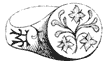
Fig. 156. |
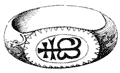
Fig. 157. |
The custom must have been common to be thus used in dramatic scenes of
real life, which the plainest audience would criticise. These plays were
produced in 1606, and serve to show that the value attached to a
seal-ring descended from very ancient to comparatively modern times.
In the Waterton collection is a massive gold signet-ring, with the rebus
of the Wylmot family quaintly designed in the taste of the fourteenth
century. In the centre is a tree; on one side of it the letters WY, and
on the other OT. Supposing the tree to be an elm, the name reads
Wy-elm-ot, or Wylmot.

Fig. 158. |
Fig. 159. |
In the fifteenth and sixteenth centuries religious figures were
frequently engraved on rings. Fig. 158 represents a ring upon which is
very delicately engraved a representation of St. Christopher bearing the
Saviour on his shoulder across an arm of the sea, in accordance with the
old legendary history of this saint. The circle is formed by ten
lozenges, each of which bears a letter of the inscription, de boen cuer.
The figure of St. Christopher was used as an amulet against sudden
death—particularly by drowning; for it was popularly believed that no
sudden or violent death could occur to any person on any day when he had
reverently looked upon this saint’s effigy. Hence it was not uncommon
for charitable individuals to place such figures outside their houses,
or paint them on the walls. There is a colossal figure (and St.
Christopher was said to have been of gigantic stature), thus painted,
beside the great gate of the ancient city of Treves, on the Moselle.
The enameller and engraver were both employed on the ring Fig. 159, also
from the Londesborough collection. The hoop is richly decorated, with
quaint floriated ornament cut upon its surface, and filled in with
niello, then extensively used by goldsmiths in enriching their works,
as it is still in Russia. This beautiful ring is inscribed withinside
with the motto mon cor plesor—“my heart’s delight”—and was doubtless a
gage d’amour.
Fig. 160. Fig. 161.
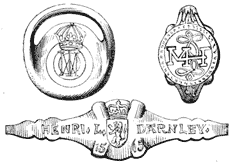
Of Elizabeth of England and Mary of Scotland, interesting mementoes are
preserved in the shape of rings. Fig. 160 represents the gold
signet-ring of Mary, now preserved in the British Museum. Upon the face
is engraved the royal arms and supporters of Scotland, with the motto IN
. DEFENS, and her initials M.R. But the most curious portion of the ring
is the inner side of the seal, as shown in the cut, where a crowned
monogram is engraved, which might have been an unsolved enigma, but for
the existence in our State Paper Office of a letter written by Mary to
Queen Elizabeth, in which she has drawn this identical monogram after
signing her name. Sir Henry Ellis, who first traced out this curious
history, says, “It is clearly formed of the letters M and A (for Mary
and Albany), and gives countenance to the opinion that the written
monogram was intended for Elizabeth and Burleigh to study; the
subsequent creation of the title of Duke of Albany in Lord Darnley
ultimately opening their eyes to the enigma.” Elizabeth’s intense
dislike to the Darnley marriage is well known, as she endeavoured to
force Mary into a match with one of her own favourites, the Earl of
Leicester.
The Waterton collection boasts a gem of no inferior interest in
connection with this unhappy marriage. It is the ring of Henry, Lord
Darnley, husband to Mary Queen of Scots. On the bezel it bears the two
initials M.H. united by a lover’s knot, and within the hoop the name
engraved of HENRI . L . DARNLEY, and the year of the marriage, 1565. The
cut, Fig. 161, shows the face of the ring with the initials; below is
engraved a fac-simile of the interior of the ring as a plane surface.
Queen Elizabeth’s history, and that of her unfortunate favourite, the
Earl of Essex, has a tragic story connected with a ring. The narrative
is popularly known, and may be briefly told. It is said that the queen,
at a time when she was most passionately attached to the earl, gave him
a ring, with the assurance that she would pardon any fault with which he
might be accused when he should return that pledge. Long after this,
when he was condemned for treason, she expected to receive this token,
and was prepared to have granted the promised pardon. It came not. The
queen was confirmed in the belief that he had ceased to care for her,
and pride and jealousy consigned him to the death of a traitor. But the
earl had, in the last extremity of despair, entrusted the ring to the
Countess of Nottingham, wife of the Lord High Admiral, an enemy to the
unfortunate Essex, who forbade his wife to take any proceedings in the
matter, but to conceal the trust entirely, and secrete the ring. When
the countess lay upon her death-bed, she sent for her royal mistress,
for the first time told her guilt, “and humbly implored mercy from God
and forgiveness from her earthly sovereign, who did not only refuse to
give it, but having shook her as she lay in bed, sent her, accompanied
with most fearful curses, to a higher tribunal.” Such is the awful
account of the scene by Francis Osborne. Dr. Birch says the words used
by Elizabeth were, “God may forgive you, but I never can.” It was the
death-blow to the proud old queen, whose regret for the death of Essex
could not be quenched by her pride and belief in his ingratitude. A
confirmed melancholy settled upon her; she died lonely and
broken-hearted.

Fig. 162. |

Fig. 163. |

Fig. 164. |
This ring is now in the possession of the Rev. Lord John Thynne, and
three views of it are given in Figs. 162, 163, and 164. It is of gold,
of extremely delicate workmanship throughout. A cameo head of the queen
is cut on hard onyx and set as its central jewel; the execution of this
head is of the highest order, and may possibly have been the work of
Valerio Vincentino, an Italian artist who visited England and cut
similar works for Elizabeth and Burleigh. It is one of the most minute
but the most striking likenesses. The hoop of the ring is enriched with
engraving, and the under surface decorated with floriated ornament,
relieved by blue enamel. It has descended from Lady Frances Devereux,
Essex’s daughter, in unbroken succession from mother and daughter, to
the present possessor. Although the entire story has met with
disbelievers, the most sceptical must allow that whether this be the
ring or not, it is valuable as a work of art of the Elizabethan era.
Fig. 165. |

Fig. 166. |
A ring possessing even greater claim to notice, but depending for its
appropriation on its own internal evidence, is the next on our list
(Figs. 165 and 166). It purports to be the seal-ring of William
Shakspere, and was found March 16, 1810, by a labourer’s wife, in the
mill close adjoining Stratford-on-Avon churchyard. It passed into the
possession of R. B. Wheler, Esq., the historian of the town; and his
sister, at his death, presented it to the museum of Shaksperian relics
formed in the birthplace of the poet. It is of gold, weighing 12 dwts.;
having the initials W.S. braced together by a tasselled cord; the only
other ornament upon the ring being a band of pellets and lines on the
outer edge of the bezel.
Is it Shakspere’s? It is evidently a gentleman’s ring, and of the poet’s
era. It is just such a ring as a man in his station would fittingly
wear—gentlemanly, but not pretentious. There was but one other person
in the small town of Stratford at that time to whom the same initials
belonged. This was one William Smith, but his seal is attached to
several documents preserved among the records of the corporation, and is
totally different.136-* Mr. Halliwell, in his “Life of Shakspere,”
observes that “little doubt can be entertained that this ring belonged
to the poet, and it is probably the one he lost before his death, and
was not to be found when his will was executed, the word hand being
substituted for seal in the original copy of that document.”136-†
In the great poet’s will, five of his friends have bequests of memorial
rings. Two are his townsmen, Hamlett Sadler and William Raynoldes, who
each have twenty-six shillings and eightpence left them “to buy them
ringes;” the other three being the actors (“my fellows,” as he
affectionately terms them) John Heminge, Richard Burbage, and Henry
Condell,137-* each of whom has a similar sum.
Rings were at this time an almost necessary part of the toilet of a
gentleman; they indicated rank and character by their style or their
devices. Hence the wills and inventories of the era abound with notices
of rings, many persons wearing them in profusion, as may be seen in the
portraits painted at this time. The Germans particularly delighted in
them, and wore them upon many fingers, and upon different joints of the
fingers, the forefinger especially; a custom still followed by their
descendants. The ladies even wreathed them in the bands of their
head-dresses. Rabelais speaks of the rings Gargantua wore because his
father desired him to “renew that ancient mark of nobility.” On the
forefinger of his left hand he had a gold ring, set with a large
carbuncle; and on the middle finger one of mixed metal, then usually
made by alchemists. On the middle finger of the right hand he had “a
ring made spire-wise, wherein was set a perfect balew ruby, a pointed
diamond, and a Physon emerald of inestimable value.”
Italy now furnished the most splendid and tasteful jewellery; the
workmen of Venice exceeding all others. The Londesborough collection
supplies us with a graceful example, Fig. 167. The claws support the
setting of a sharply-pointed pyramidal diamond, such as was then coveted
for writing on glass. It was with a similar ring Raleigh wrote the words
on the window-pane—“Fain would I rise, but that I fear to fall”—to
which Queen Elizabeth added, “If thy heart fail thee, do not rise at
all;” an implied encouragement which led him on to fortune.
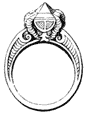
Fig. 167.
|
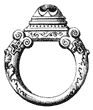
Fig. 168. |
In Burgon’s life of Sir Thomas Gresham is engraved the wedding ring of
that merchant-prince. “It opens horizontally, thus forming two rings,
which are, nevertheless, linked together, and respectively inscribed on
the inner side with a Scripture poesy. Quod Deus conjunxit is engraved
on one half, and Homo non seperet on the other.” It is here copied,
Fig. 168.
In Ben Jonson’s comedy, The Magnetic Lady, the parson compelled to
form a hasty wedding asks—
“Have you a wedding ring?”
To which he receives as answer—
“Ay, and a poesy:
Annulus hic nobis, quod sic uterque, dabit.”
He at once exclaims—
“... Good!
This ring will give you what you both desire.
I’ll make the whole house chant it, and the parish.”
Such rings were known as Gemel or Gimmal rings, the word being derived
from the Latin gemellus, twins. The two making one, and though
separate, indivisible, peculiarly fitted them for wedding rings. Their
structure will be best understood from the very fine specimen in the
Londesborough collection, Fig. 169. The ring, as closed and worn on the
finger, is shown in the uppermost figure (a). It is set with sapphire
and amethyst, the elaborate and beautiful design enriched by coloured
enamels. The lower figure shows the ring parted (b), displaying the
inscription on the flat side of each section, which is also enriched by
engraving and niello.
Dryden, in his play of Don Sebastian, describes such a ring:—
“A curious artist wrought them
With joints so close as not to be perceived;
Yet they are both each other’s counterpart.
(Her part had Juan inscribed, and his had Zaida:
You know those names were theirs), and in the midst
A heart divided in two halves was placed.
Now if the rivets of those Rings inclosed
Fit not each other, I have forged this lie:
But if they join, we must for ever part.”
A complete illustration of this passage of the poet is afforded in Fig.
170, from the same collection. It also illustrates Dr. Nares’s remark
that “Gimmal rings, though originally double, were by a further
refinement made triple, or even more complicated; yet the name remained
unchanged.” So Herrick:—
“Thou sent’st to me a true love knot; but I
Return a ring of jimmals, to imply
Thy love had one knot, mine a triple tye.”
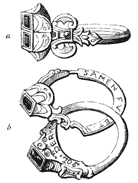
Fig. 169. |
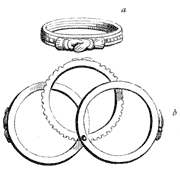
Fig. 170. |
This ring (Fig. 170) is shown (a) as it appears when closed. It parts
into three hoops, secured on a small pivot, as seen (b); the toothed
edge of the central hoop forming an ornamental centre to the hoop of the
ring, and having two hearts in the middle; a hand is affixed to the side
of the upper and lower hoop; the fingers slightly raised, so that when
the hoops are brought together, they link in each other, and close over
the hearts, securing all firmly.
A mechanical ring of still greater mystic significance is shown, Fig.
171, and is one of the most curious of the Londesborough series. The
outside of the hoop is perfectly plain, and is set with a ruby and
amethyst. Upon pressing these stones, a spring opens, and discovers the
surface covered with magical signs and names of spirits; among them
Asmodiel, Nachiel, and Zamiel occur, a similar series occupying the
interior of the hoop. Such a ring might be worn without suspicion of its
true import, looking simplicity itself, but fraught with unholy meaning.
It was probably constructed for some mystic philosopher, or student of
the occult sciences, searching for the philosopher’s stone, the elixir
of life, and the power given to man to control the unseen world of
spirits.
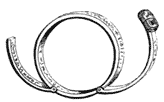
Fig. 171. |
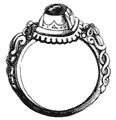
Fig. 172. |
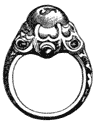
Fig. 173. |
We close our review of the art of ring-making in the sixteenth century
with two very beautiful examples. Fig. 172, from the Londesborough
collection, has a ruby in a very tall setting, enriched by enamel. The
sides of the hoop are highly decorated with flowers and scroll ornament,
also richly enamelled. The Waterton collection gives us Fig. 173, a gold
enamelled ring, set with a large turquoise in the centre, and surrounded
by six raised garnets. This ring is stated to have subsequently belonged
to Frederick the Great, King of Prussia, whose cipher is upon it.

Fig. 174. |

Fig. 175. |
We must not, however, end this portion of our history without a
reference to the simple, but most important, “plain gold ring” of
matrimony. It was at this time almost universally inscribed with a
“poesy” of one or two lines of rhyme. Two specimens are here engraved.
Fig. 174 is formed like the badge of the Order of the Garter, with the
buckle in front, and the motto of the order outside the hoop; withinside
are the words “I’ll win and wear you.” The ordinary form of ring is
shown in Fig. 175, and is inscribed “Let likinge laste.” They were
invariably inscribed withinside the hoop. Thus Lyly, in his “Euphues,”
1597, addressing the ladies, hopes they will favour his work, “writing
their judgments as you do the poesies in your rings, which are always
next to the finger, not to be seen of him that holdeth you by the hand,
and yet known by you that wear them on your hands.” Such jingling rhymes
were in great request, and exerted the ingenuity of poetasters and small
wits. In 1624 a small collection of them was printed, with the quaint
title, “Love’s Garland; or poesies for rings, handkerchiefs, and gloves,
and such pretty tokens that lovers send their loves.” They are generally
in double, seldom in triple lines of rhyme. The Rev. R. Brooke, of
Gateforth House, Selby, has presented a curious collection of such rings
to the South Kensington Museum. The six following poesies are selected
from this series, as they are good examples of the average inspirations
of ring-poets:—
“Seithe God hath wrought this choice in thee,
So frame thyselfe to comfourth mee.”
“United hearts death only parts.”
“Let us share in joy and care.”
“A faithfull wife preserveth life.”
“As God decreed, so we agreed.”
“Love and live happily.”
The custom of thus inscribing rings continued until the middle of the
last century. There is a story told of Dr. John Thomas, Bishop of
Lincoln, in 1753, that he inscribed his fourth wife’s ring with these
words:—
“If I survive
I’ll make them five.”
Horace Walpole says—“My Lady Rochford desired me t’other day to give
her a motto for a ruby ring,” so that at that time poesies were not
confined to wedding rings.
Allusion has already been made in Chapter I. to the custom of using
rings as receptacles for relics or poisons. The most famed belonged to
Cæsar Borgia, son of Pope Alexander VI., both adepts in poisoning; a
grasp from the hand wearing this ring ensured a very slow, but certain
death: it contained a virulent poison, which found vent through a small
spike, pressed out by a spring when the hand was grasped, and which was
so slight in its operation as to be scarcely felt, and not usually
noticed by the person wounded during the excitement of the hearty
friendship so well simulated. When conspiracies against the life of
William of Orange were rife under the influence of the court of Spain
[circa 1582], the unworthy son of Count Egmont “had himself undertaken
to destroy the prince at his own table by means of poison which he kept
concealed in a ring. Saint Aldegonde (his friend and counsellor) was to
have been taken off in the same way, and a hollow ring filled with
poison is said to have been found in Egmont’s lodgings.”144-*
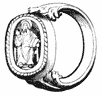
Fig. 176. |
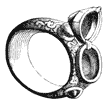
Fig. 177. |
Fig. 176 represents a curious Venetian ring, the bezel formed like a box
to contain relics. The face of the ring (in this instance the cover of
the box) has a representation of St. Mark seated, holding his gospel,
and giving the benediction. The spaces between this figure and the oval
border are perforated, so that the interior of the box is visible, and
the relic enshrined might be seen. Fig. 177 is another ring of the same
construction: it is richly engraved and set with two rubies and a
pyramidal diamond; the collet securing the latter stone opens with a
spring, and exhibits a somewhat large receptacle for such virulent
poisons as were concocted by Italian chemists in the sixteenth and
seventeenth centuries.
The elaborate character of design adopted at this time for Venetian
rings, the highly artistic taste that governed it, as well as the beauty
of the stones employed in settings, combined to perfect bijouterie
that has never been surpassed. Fig. 178 is a ring of very peculiar
design. It is set with three stones in raised bezels; to their bases are
affixed, by a swivel, gold pendent ornaments, each set with a garnet; as
the hand moves these pendants fall about the finger, the stones
glittering in the movement. This fashion was evidently borrowed from the
East, where people delight in pendent ornaments, and even affix them to
articles of utility. Fig. 179 is a ring of silver, of East Indian
workmanship, discovered in the ruins of one of their most ancient
temples; to its centre are affixed bunches of pear-shaped hollow drops
of silver, which jingle with a soft low note as the hand moves.
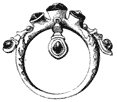
Fig. 178. |
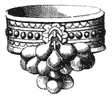
Fig. 179. |
We have already alluded to the old Eastern tale of “The Fish and the
Ring,” invented some thousands of years since. It has survived to our
own day, and is still related and believed by the commonalty to the east
of London. In the church at Stepney is a tomb to the memory of Lady
Rebecca Berry, who died 1696, in whose coat-of-arms a fish and an
annulet appear. She has hence been supposed the heroine of a once
popular ballad, the scene of which is laid in Yorkshire; it is entitled,
“The Cruel Knight, or Fortunate Farmer’s Daughter,” and narrates how one
of knightly rank in passing a village heard the cry of a woman in
travail, and was told by a witch that he was pre-doomed to marry that
girl on her arrival at womanhood. The knight in deep disgust draws a
ring from his finger, and casting it into a rapid river, vows he will
never do so unless she can produce that ring. After many years a fish is
brought to the farmer’s daughter to dress for dinner, and she finds the
ring in its stomach, enabling her to win a titled husband, who no longer
fights against his fate.
The civic arms of Glasgow exhibit a fish holding a ring in its mouth.
This alludes to an incident in the life of St. Kentigern, patron of the
See, as related in the “Acta Sanctorum.” The queen, who was his
penitent, had formed an attachment to a soldier, and had given him a
ring she had received from her husband. The king knew his ring, but
abided his revenge, until one day discovering the soldier asleep by the
banks of the Clyde, he took the ring from his finger and threw it in the
stream. He then demanded of his queen a sight of his old love gift, a
request she was utterly unable to comply with. In despair, she confessed
all to St. Kentigern, vowing a purer life in future. The saint went to
the river, caught a salmon, and took from its stomach the missing ring,
which restored peace to all parties.147-*
The occurrence of the fish and ring in the arms of Glasgow and in the
Stepney monument, is “confirmation strong as proofs of holy writ” of the
truth of these stories, in the minds of the vulgar, who would regard
scepticism in the same light as religious infidelity.
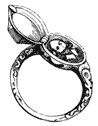
Fig. 180. |
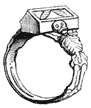
Fig. 181. |
Memorial rings were sometimes made to exhibit a small portrait, and on
some occasions to conceal one beneath the stone. Such is the ring, Fig.
180, from the Londesborough collection, which was made for some devoted
adherent of King Charles I., when such devotion was dangerous. A
table-cut diamond is set within an oval rim, acting as a lid to a small
case opening by means of a spring, and revealing a portrait of Charles
executed in enamel. The face of the ring, its back, and side portions
of the shank, are decorated with engraved scroll-work, filled in with
black enamel. “Relics” of this kind are consecrated by much higher
associations than what the mere crust of time bestows upon them; and
even were they not sufficiently old to excite the notice of the
antiquary, they are well deserving of attention from their exhibiting
“memorials of feelings which must ever command respect and admiration.”
Horace Walpole had in the Strawberry Hill collection, “one of the only
seven mourning rings given at the burial of Charles I. It has the king’s
head in miniature behind a death’s head; between the letters C. R. the
motto, ‘Prepared be to follow me.’”
A much more lugubrious memorial is presented from the same collection,
Fig. 181. Two figures of skeletons surround the finger and support a
small sarcophagus. The ring is of gold enamelled, the skeletons being
made still more hideous by a covering of white enamel. The lid of the
sarcophagus is also enamelled, with a Maltese cross in red, on a black
ground studded with gilt hearts. This lid is made to slide off, and
display a very minute skeleton lying within.
These doleful decorations first came into favour and fashion at the
court of France, when Diana of Poictiers became the mistress of Henry
II. At that time she was a widow, and in mourning; so black and white
became fashionable colours: jewels were formed like funeral memorials;
golden ornaments shaped like coffins, holding enamelled skeletons, hung
from the neck; and watches made to fit in little silver skulls were
attached to the waist.
In the Duke of Newcastle’s comedy, The Country Captain, 1649, a lady
of title is told that when she resides in the country a great show of
finger-rings will not be necessary: “Shew your white hand with but one
diamond when you carve, and be not ashamed to wear your own wedding
ringe with the old poesy.” That many rings were worn by persons of both
sexes is clear from another passage in the same play, where a fop is
described, “who makes his fingers like jewellers’ cards to set rings
upon.”
The stock of rings described in the same author’s play, The Varietie,
as the treasure of an old country lady, is amusingly indicative of past
legacies or memorials, as well as of the tastes of the yeomanry: “A
toad-stone, two Turkies (Turquoise), six thumb-rings, three alderman’s
seals, five gemels, and foure death’s head.” The enumeration concludes
with the uncomplimentary observation, “these are alehouse ornaments.”
These death’s-head rings were very commonly worn by the middle classes
in the latter part of the sixteenth and the early part of the
seventeenth centuries; particularly by such as affected a respectable
gravity. Luther used to wear a gold ring, with a small death’s head in
enamel, and these words, “Mori sæpe cogita” (Think oft on death); round
the setting was engraved “O mors, ero mors tua” (Death, I will be thy
death). This ring is preserved at Dresden. Shakspere, in his Love’s
Labour’s Lost (Act V. scene 2), makes his jesting courtier, Biron,
compare the countenance of Holophernes to “a death’s face in a ring.” We
have already adverted to a similar ring worn by one of Shakspere’s
fellow townsmen.
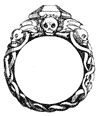
Fig. 182.
|
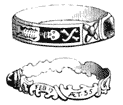
Figs. 183 and 184. |
In the “Recueil des Ouvrages d’Orfeverie,” by Gilles l’Egaré, published
in the early part of the reign of Louis XIV., is an unusually good
design for one of these rings, which we copy, Fig. 182. It is entirely
composed of mortuary emblems, on a ground of black enamel. Fig. 183 is
an English memorial ring set with stones; on the circlet is engraved an
elongated skeleton, with crossbones above the skull, and a spade and
pick-axe at the feet; the ground is black enamel. It has been converted
into a memorial by its original purchaser, who caused to be engraved
withinside the hoop, “C.R., Jan. 30, 1649, Martyr.” It is now in the
Londesborough collection, from whence we obtain Fig. 184, a very good
specimen of a mourning ring of the early part of the last century, with
which we take leave of this branch of the subject.
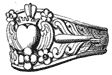
Fig. 185. |

Fig. 186. |
The jewellers of the last century do not seem to have bestowed the same
attention on design as their predecessors did. Rings appear to have
reached their highest excellence in design and execution in the
ateliers of Venice. We meet with little originality of conception, and
certainly great inferiority of execution, in the works then issued. In
southern Europe, where jewellery is deemed almost a necessary of life,
and the poorest will wear it in profusion, though only made of copper,
greater scope was given to invention. Fig. 185 is a Spanish silver ring
of the early part of the century. In its centre it has a heart, winged
and crowned; the heart is transfixed by an arrow, but surrounded by
flowers. It is possibly a religious emblem. Fig. 186 is another Spanish
ring of more modern manufacture, but of very light and elegant design.
The flowers are formed of rubies and diamonds, and the effect is
extremely pleasing.

Fig. 187. |

Fig. 188. |
Such works may have originated the “giardinetti” rings, of which a good
collection of specimens may be seen in the South Kensington Museum, two
being here copied in Figs. 187 and 188. They are there described as
English works of the seventeenth and eighteenth centuries, and appear to
have been used as guards, or “keepers,” to the wedding-ring. They are of
pleasing floriated design, and of very delicate execution. Much taste
may be exhibited in the selection of coloured stones for the flowers of
such rings, which are certainly a great ornament to the hand.
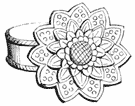
Fig. 189. |
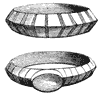
Figs. 190 and 191. |
Recurring to the Eastern nations, in whose eyes jewellery has always
found great favour, we find that the Indians prefer rings with large
floriated faces, spreading over three fingers like a shield. When made
for the wealthy in massive gold, the flower leaves are of cut jewels,
but the humbler classes, who equally love display, are content with them
in cast silver. Such a ring is engraved, Fig. 189, from an original in
the British Museum, from whence we also obtain the two specimens of
rings beside it, being such as are worn by the humblest classes. Fig.
190 is of brass, Fig. 191 of silver, the latter boasting a sort of
apology for a jewelled centre.
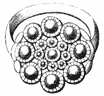
Fig. 192. |
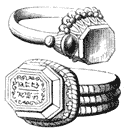
Figs. 193 and 194. |
A triplicate of Moorish rings will enable us to understand their
peculiarities. Fig. 192 has a large circular face, composed of a cluster
of small bosses, set with five circular turquoise, and four rubies; the
centre being a turquoise, with a ruby and turquoise alternating round
it. The ring is of silver. It is in the Londesborough collection, as
also is Fig. 193, another silver ring set with an octangular bloodstone,
with a circular turquoise on each side. Fig. 194 is a signet ring,
bearing the name of its original owner engraved on a carnelian. This
also is of silver.
The modern Egyptians indulge greatly in finger-rings. The wife of the
poorest peasant will cover her hands with them, though they be only cast
in pewter, decorated with gems of coloured glass, and not worth a penny
each. For ladies of the higher class very pretty rings are designed. One
of them is here engraved (Fig. 195), from an original purchased by the
author in Cairo. It is a simple hoop of twisted gold, to which is
appended a series of pendent ornaments, consisting of small beads of
coral, and thin plates of gold, cut to represent the leaves of a plant.
As the hand moves, these ornaments play about the finger, and a very
brilliant effect might be produced if diamonds were used in the
pendants. Fig. 196 is the ring commonly worn by the middle class
Egyptian men. They are usually of silver, set with mineral stones, and
are valued as the manufacture of the silversmiths of Mecca, that sacred
city being supposed to exert a holy influence on all the works it
originates.
There is also a curious ring, with a double “keeper,” worn by Egyptian
men, as shown in Fig. 197. It is composed entirely of common cast
silver, set with mineral stone. The lowermost keeper of twisted wire is
first put on the finger, then follows the ring, the second keeper is
then brought down upon it; the two being held by a brace which passes at
the back of the ring, and gives security to the whole.
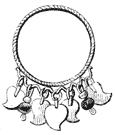
Fig. 195. |
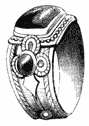
Fig. 196. |
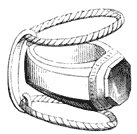
Fig. 197. |
At the commencement of the present century, “harlequin-rings” were
fashionable in England. They were so called because set round with
variously-coloured stones, in some way resembling the motley costume of
harlequin. To these succeeded “regard-rings,” the stones selected so
that the initial of the name of each spelt altogether the word regard,
thus:—
- R—Ruby.
- E—Emerald.
- G—Garnet.
- A—Amethyst.
- R—Ruby.
- D—Diamond.
These pleasing and agreeable gages d’amitie originated with the French
jewellers, and were soon made to spell proper names. Where precious
stones could not be obtained with the necessary initial, mineral stones,
such as lapis-lazuli, and verde antique, were pressed into the
service. These rings are now occasionally made. Her Royal Highness the
Princess of Wales is said to possess one having the familiar name of the
Prince, “Bertie,” spelt thus upon it.
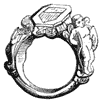
Fig. 198. |
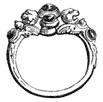
Fig. 199. |
With two specimens of modern French work we close our selection of
designs. Fig. 198 is a signet ring, the face engraved with a
coat-of-arms. At the sides two cupidons repose amid scroll-work
partaking of the taste of the Renaissance. The same peculiarity
influences the design of Fig. 199. Here a central arch of five stones,
in separate settings, is held by the heads and outstretched wings of
Chimeras, whose breasts are also jewelled. Both are excellent designs.
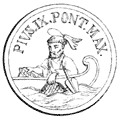 Fig. 200.
The last ring we shall bring before the reader’s notice (Fig. 200) is
the famous “Fisherman’s ring” of the Pope. It is a signet ring of steel
used for the briefs issued from the Romish Court. “When a brief is
written to any distinguished personage, or has relation to religious or
general important matter, the impression from the Fisherman’s ring is
said to be made upon a gold surface; in some other cases it appears upon
lead; and these seals are generally attached by strings of silk.
Impressions of this seal are also made in ink direct upon the substance
on which the brief is written.” Mr. Edwards calls attention to the
classic form of the boat and oar, showing direct derivation from an
antique original. The seal is also made in the fashion of a Roman
signet. A new one is made for every pope, and Mr. Edwards thus narrates
the ceremonies connected therewith:—“When a pope dies, the Cardinal
Chamberlain, or Chancellor, accompanied by a large number of the high
dignitaries of the papal court, comes into the room where the body lies,
and the principal or great notary makes an attestation of the
circumstance. Then the Cardinal Chamberlain calls out the name of the
deceased pope three times, striking the body each time with a gold
hammer, and as no response comes, the chief notary makes another
attestation. After this the Cardinal Chancellor demands the Fisherman’s
ring, and certain ceremonies are performed over it; and then he strikes
the ring with a golden hammer, and an officer destroys the figure of
Peter by the use of a file. From this moment all the authority and acts
of the late pope pass to the College or Conclave of Cardinals. When a
new pope is consecrated, it is always the Cardinal Chancellor, or
Chamberlain, who presents the renewed Fisherman’s ring, and this
presentation is accompanied by imposing ceremonies.”
The facts we have gathered about finger-rings are scattered over the
history of many ages and nations; and in the selection of illustrations
we have been guided by their historic value as well as their artistic
merits, so that they may be referred to as authorities to test the age
and country of other works of their class, if brought to them for
comparison.