The Project Gutenberg eBook, Rambles in Australia, by Edwin Sharpe Grew
and Marion Sharpe Grew
Note:
Images of the original pages are available through
Internet Archive. See
https://archive.org/details/ramblesinaustral00grewiala
Transcriber’s Note
Larger versions of most illustrations may be seen by right-clicking them
and selecting an option to view them separately, or by double-tapping and/or
stretching them.
MILLS & BOON’S RAMBLES SERIES
“The books are not designed as guides. Up to a point they may be used
as such. They are really very pleasant essays by writers who know their
subjects, and they may be read with pleasure and instruction quite apart
from their utilitarian value to the traveller.”—Liverpool Courier.
Rambles around French Châteaux.
By FRANCES M. GOSTLING, Author of “The Bretons at
Home.” With 5 Illustrations in Colour by L. Lelée and C. R.
Andreae, 33 from Photographs, and a Map. Crown 8vo, 6s.
Rambles about the Riviera.
By FRANCES M. GOSTLING. With one Illustration in Colour
and 40 from Photographs. Crown 8vo, 6s.
Rambles in the Black Forest.
By I. A. R. WYLIE, Author of “My German Year,” “Dividing
Waters.” With 5 Illustrations in Colour and 24 from Photographs.
Crown 8vo, 6s.
Rambles with an American in Great Britain.
By CHRISTIAN TEARLE, Author of “Holborn Hill.” With
21 Illustrations. Crown 8vo, 6s.
Rambles in Norway.
By HAROLD SIMPSON. With 8 Illustrations in Colour by
Paul E. Ritter, and 32 from Photographs. Crown 8vo, 6s.
Rambles in Florence.
By G. E. TROUTBECK. With 8 Illustrations in Colour by Rose
McAndrew, and 32 from Photographs. Crown 8vo, 6s.
Rambles in Ireland.
By ROBERT LYND, Author of “Home Life in Ireland.” With
5 Illustrations in Colour by Jack B. Yeats, and 25 from Photographs.
Crown 8vo, 6s.
Rambles in Holland.
By EDWIN and MARION SHARPE GREW. With one Illustration
in Colour by Douglas Macpherson, 32 from Photographs,
and a Map. Crown 8vo, 6s.
Rambles in Australia.
By EDWIN and MARION SHARPE GREW. With 32 Illustrations
from Photographs and a Map. Crown 8vo, 6s.
Rambles in the North Yorkshire Dales.
By J. E. BUCKROSE. With 4 Illustrations in Colour and 23
from Photographs. Crown 8vo, 3s. 6d. net.
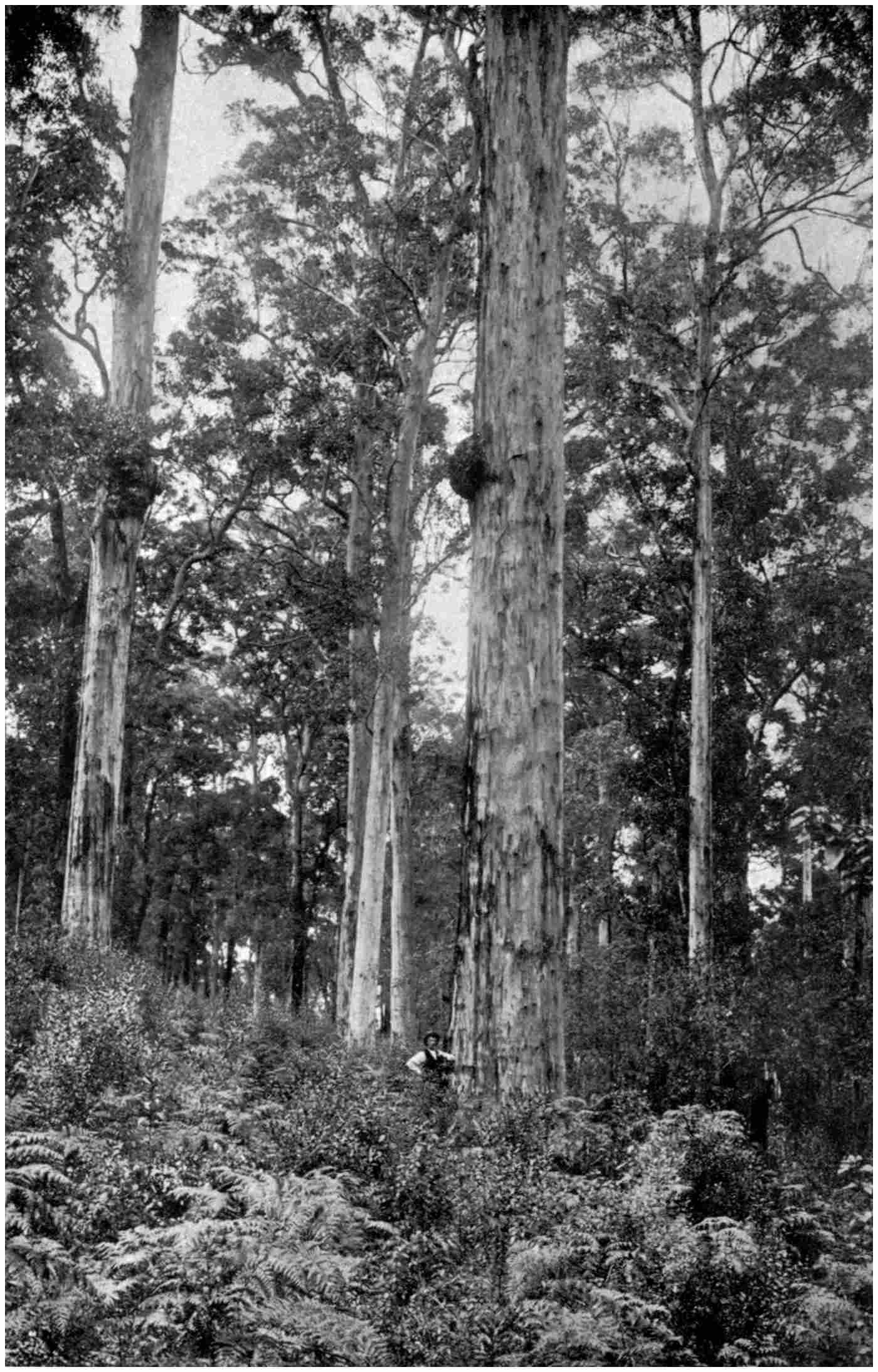
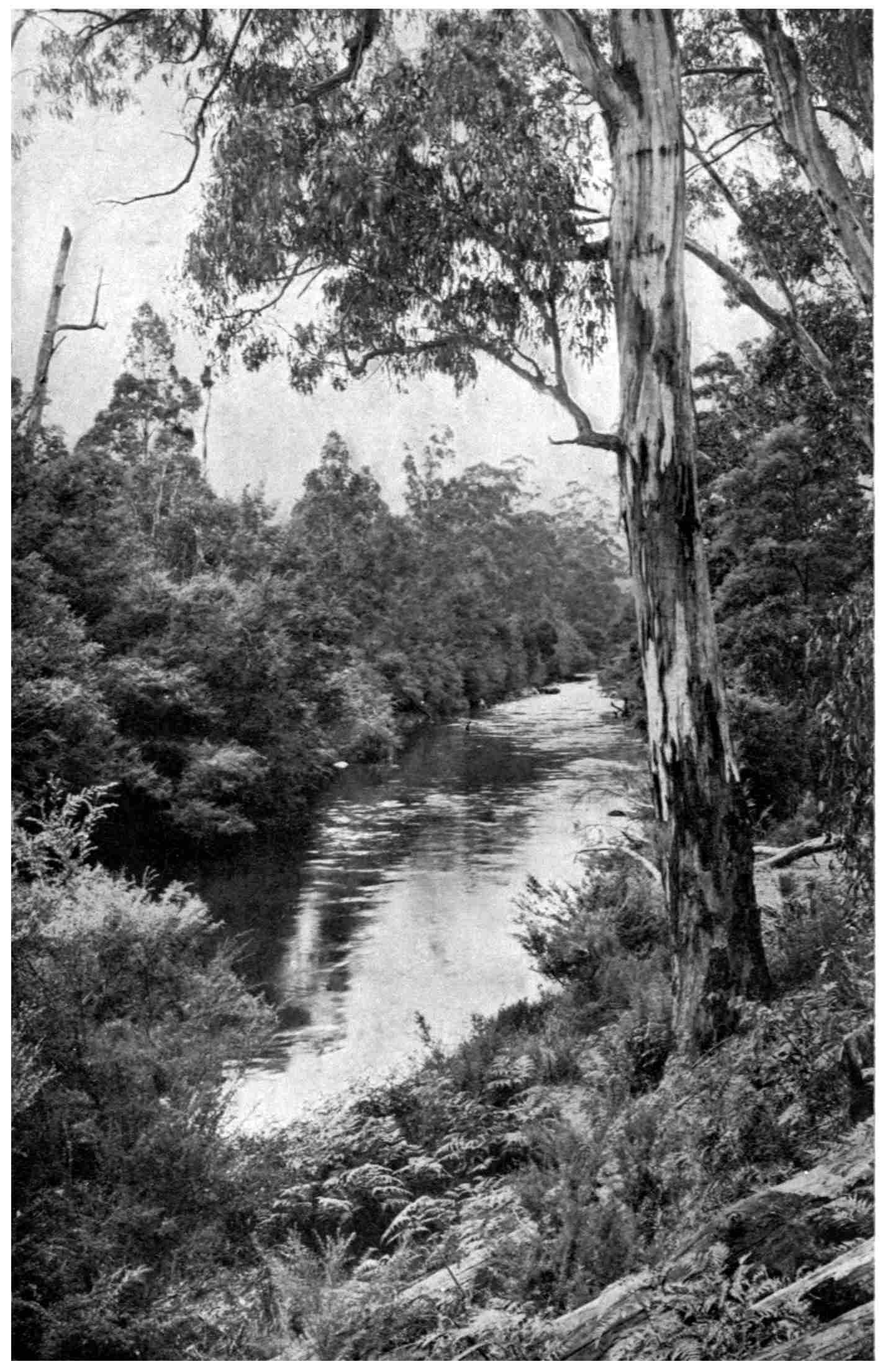
KARRI COUNTRY, WESTERN AUSTRALIA.
Frontispiece.
RAMBLES
IN AUSTRALIA
BY EDWIN & MARION SHARPE GREW AUTHORS OF “THE COURT OF WILLIAM III”
“THE ENGLISH COURT IN EXILE: JAMES II AT ST. GERMAIN”
“RAMBLES IN HOLLAND”
WITH THIRTY-TWO ILLUSTRATIONS
FROM PHOTOGRAPHS AND A MAP
MILLS & BOON, LIMITED 49 RUPERT STREET
LONDON, W.
Published 1916
TO OUR AUSTRALIAN HOSTS IN GRATEFUL REMEMBRANCE
OF MUCH KINDNESS
PREFACE
This little book aims at giving such general
impressions of Australia as could be gleaned
during a visit lasting from July into September,
and including some time spent in each state. We
have tried to convey some idea of the aspect of
the country itself, with its brilliant sunshine,
great plains and trackless forests; of the social
atmosphere of warm-hearted hospitality; of
its economic problems and democratic legislative
experiments. These last are so essentially Australian,
that it seemed impossible to omit some
reference to them, but they hardly fall within
our scope, and are only lightly touched upon.
Figures and facts quoted are taken from official
handbooks and pamphlets.
With regard to the illustrations, those of
Western Australia were provided by the kindness
of Mr. Gibbs, of the Lands Department at Perth,
and Mr. L. V. Shapcott, Premier’s Office, Perth,
who was good enough to take special photographs
for us. For those of South Australia we
have to thank Mr. Vaughan of the Lands Department.
At Melbourne the Secretary of the admirably
organised Government Tourist Bureau was kind
enough to have the views of Victoria specially
printed for reproduction. For the views of New
South Wales we have to thank the Hon. Dugald
Thomson, and for those of Brisbane the Secretary
of the Government Tourist Bureau for
Queensland. Lastly, our grateful thanks are due
to Captain Muirhead Collins, Permanent Secretary
of the Australian Commonwealth in London,
for his great kindness in reading the proofs and
for much valuable criticism.
If Rambles in Australia leads even a few readers
to wish for a closer acquaintance with, and a better
understanding of, this great country of which we
are so ignorant at home, it will not have been
written in vain.
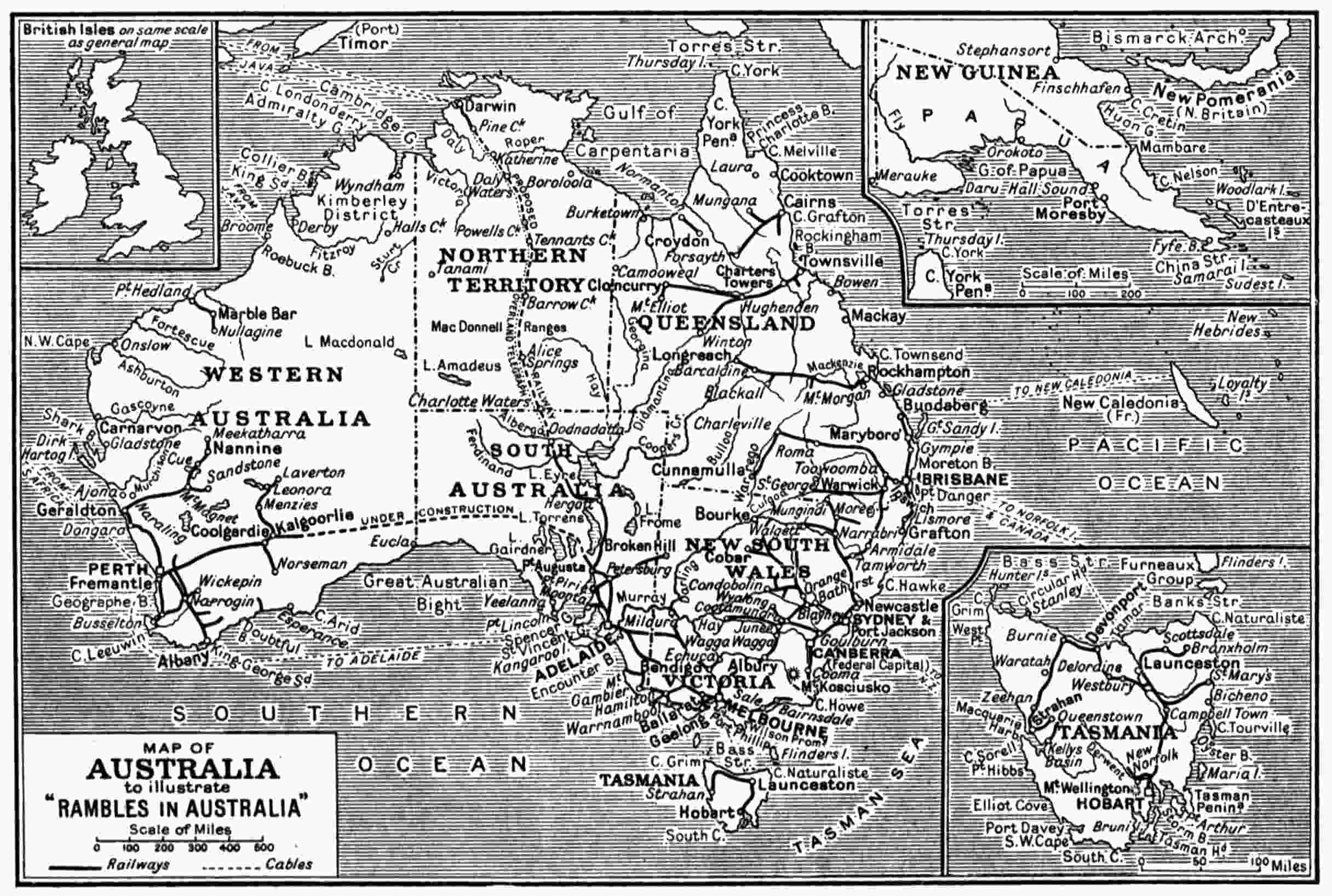
MAP OF AUSTRALIA to illustrate
“RAMBLES IN AUSTRALIA”
George Philip & Son Ltd
Mills & Boon Ltd
RAMBLES IN AUSTRALIA
CHAPTER I INTRODUCTORY: THE LAND OF THE UNLATCHED DOOR
Opposite to us was Australia. During the
long days of the voyage across the bleak
South Indian Ocean it had seemed no more than
a vague area on a map, small, as all countries and
even continents are, compared to the interminable
stretches of the sea. But the voyage was ended
now, and Australia, first no more than a blur on
the horizon, and then solidifying into a shore
with green trees, had now become resolved into
an island with a lighthouse; and now into a
harbour with wharves and quays and a background
of houses behind the sheds and derricks.
There was a train puffing in the distance; and
here fussed a launch bringing with it people
from the shore....
Quite suddenly the Blue Funnel Liner which
has had the accustomedness of a home to us for
all these weeks, shrinks to the aspect of a ship, of
no more importance to us than a passenger train;
and impatience seizes us to be off. There is the
land, alluring in a glow of sunset barred with
feathery clouds ... there’s a shore breeze calling,
let us go!
So much for the emotions of arrival. They
are quickly submerged by occurrences which are
no less stubborn in the poetic moments of
reaching a new land, than at any other time. The
Blue Funnel Liner had been behind her time,
and had not wired her subsequent gain of a
few hours; our arrival had been expected, and
was to have been made the occasion of a greeting
by the Government of Western Australia to
the members of a scientific mission on board.
Western Australia’s first greeting was to have taken
the form of a garden party at Government House,
Perth; and as the invitations had been distributed
over hundreds of miles of a wide country weeks
before, no postponement had been possible. The
garden party was being held—in our regretted
absence—and the Port Medical Authorities, not
to be done out of their festivity, had gone to it.
So there Western Australia was—at our garden
party, and there peering at the land of promise
were we.
Hours went by. Those of us who had hastened
over lunch and wrestled impatiently with trunks
and hold-alls that be they attacked ever so early
never can be packed at leisure, wandered about
the decks, finding that they had lost their friendliness
with their deck chairs, and had become as
little homelike as a railway platform. The deck-steward,
who had become merely a deck-steward
instead of philosopher and friend, recovered some
of his old standing by telling us that we were to
have an early dinner on board, after all. But it
was an empty meal. We so much desired to be
gone. And at last we were. The sunset had
faded, the swift dusk had deepened into night,
when at last we went down the gangway and
stood in Australia.... It was Australia, though
beneath our feet were the planks and rails of
a wharf. The French have a proverb that
at night all cats are grey. This wharf, might
it not have been the wharf at Liverpool or
Tilbury? Not quite. There was the Southern
Cross overhead; and in the warm darkness
there was a something—something that was
not England.
The party that had been so long companions
split up and were scattered. The writer of these
lines became for an hour or so more single than
any of them, for business took him at once into
Perth, where he had to find Reuter’s Agency. So
looking back, and sorting out his recollections, he
remembers first the friendly host that met him
and walked to the railway station at Fremantle;
and after that the Swan River shining in the
starlight as the train crossed it; and after that
nothing but the soft Australian night stealing in
through the open carriage windows and seeming
to come through whispering trees—until the
train drew up at the lighted terminus of Perth.
And Perth? In the darkness it was much like
any other town at which one should arrive at
night. Not like Paris, where, as a Frenchwoman
in Bâle once said to us, at ten o’clock “Ça
commence,” nor yet like London, where, in
times of peace, the streets are still open-eyed.
But not unlike a provincial town; with some
shops still brightly lighted, though most of them
and the office buildings, are shut; a town with
lights, but not lit; and with streets that are
kept awake only by the street lamps. Through
one such street I tracked down the office I
sought, receiving much friendly aid by the
way; and finally arriving at it in company
with the publisher’s clerk of the Perth newspaper.
That is another outstanding recollection: the
publishing office with two clerks, one rather
sleepy, the other painstakingly deciphering an
obituary notice which a small girl had brought
in. When he had at last made it out, and felt
that he could leave the office for a few minutes in
charge of his companion, he put on his hat and
said he would come with me. So he did. As a
matter of history his kindness was unavailing,
except to make me feel that Australia was filled
with friends, for the office we wanted was vacant.
So back I went through the gaunt streets and on
to the railway station, where I was too new to the
country to disregard the notice that smoking was
not allowed on the platform; and presently the
train was again taking me back to the suburb of
Cottesloe Beach.
This was a country railway station, evidently.
Just like one at home, to the two lighted shops
just outside, and the white road stretching
up a hill in the starlight. The road up which
I was directed was dotted with houses wide
apart; with shaded lamps which I could
see through the shrubs; and now and again a
piano tinkling. It was very still. At last I found
the house I sought. Very white, with trees
about it, and a windmill for its well; and
windows lighted for the stranger. No; not the
stranger, but the unknown, welcome guest. The
gate in the wooden fence was swung back;
there was a light in the hall; and the hall door
was wide open, though the hall was empty. And
that was how I thought then, and have always
thought of Australia. It is the “Land of the
Unlatched Door.”
CHAPTER II FIRST IMPRESSIONS
It behoves visitors to Australia to realise that
they will have a good many things to do for
themselves that they have never done before, and
that the conditions of travelling, for instance,
are very different from those in Europe. To
begin with, the station porter is absent, and
everyone has to carry his own hand baggage,
for in a country, where labour is very scarce and
very highly paid, there are no loafers ready to
scramble for odd jobs, even at a port. What
cannot be carried ashore by the passengers is left
to be dealt with, frequently much to its detriment,
by agencies whose representatives come
on board for the purpose and convey it, or some
of it, to its owner’s destination. Stray packages,
providentially arrive in time to go on to the
next stopping-place with their owner. This
applies not only to landing, but to railway
travelling; so that it can easily be arranged for
by those who are prepared in advance.
It was quite dark when we went ashore, and
it is the oddest sensation to land in an unknown
country after dark. We had been told on the
boat that the station was at a distance of ten
minutes’ walk, but in the absence of cabs
and porters its whereabouts was problematical.
We therefore deposited our bags and awaited
events.
Then out of the obscurity a man came up with
some hesitation and asked us our names. It was
our host, who had been guided to us in the dark
by some occult sense, for we were unknown to
each other except by name. He greeted us
heartily with the kindly solicitude of an old
friend, took possession of us and the larger share
of our hand baggage, and carried us off to the
station.
It was our first experience of an Australian
welcome and Australian hospitality; that hospitality,
which for unaffected kindness and
generosity, can surely have no counterpart on
any other continent. The hospitality that makes
a guest free of all his host’s possessions, that
grudges no time or trouble in his guests’ interest,
and that is bestowed in the spirit not of a giver,
but the receiver of a benefit. As we walked
towards the train the ground seemed curiously
soft, as if we were walking ankle-deep in dust.
It was not till next day that we found that this
part of Western Australia consists everywhere of
loose yellow sand like that by the seashore. The
night was very mild after the keen sea air, and
encumbered with bags and our heavy coats, we
arrived at the station in time to see the train go
out, and waited for the next one in a large
empty booking-hall. At last the little train
rattled in, and we started. We crossed the broad
Swan River, above which a crescent moon was
hanging, and Venus shone with the luminous
brilliancy of southern skies. One of us went on
to Perth: the other descended at Cottesloe
Beach.
Here the station fly was waiting. It was
shaped like a French diligence and drawn by two
ruminative old white horses. The driver, surprised
and startled at the apparition of a fare, climbed
down, and lit a candle inside the fly, the light of
which disclosed white lace curtains at the windows
tied up with red ribbon. A few minutes jolting
drive, and we were at our destination, and,
jumping out, plunged immediately into soft,
deep sand, before the entrance to a large one-storied
house, its corrugated iron white-painted
roof shining in the starlight as if it were covered
with snow.
Our hostess, who had waited dinner for us an
unconscionable time, had neither allowed that,
nor her welcome to get cold in the interim, and
took us to a room sweet with the scent of a great
bowl of wattle, and a bunch of very large, deep
purple violets—a room that seemed strangely
quiet after the long-heard straining and cracking
of the timbers in our cabin. Here our sleep was
lulled only by the fitful creaking of the little
windmill in the garden.
The charming house in which we stayed at
Cottesloe Beach was typical of nearly all West
Australian houses. It stood, as even the smallest
workman’s cottage stands, in its own grounds
detached from its neighbours’, a roomy bungalow
with a broad verandah running right round it.
The verandah is an essential, all-important part
of a West Australian house. The family sleep in
it all the year round, using the bedrooms merely
as dressing-rooms; they live on another side of it
during the day.
In the country suburbs the houses are built on
piles to protect them from the attacks of white
ants. White ants can eat everything except
jarrah, a hard red eucalyptus wood, which has
been tried for paving London streets. The
foundations of all the houses are formed of jarrah
piles; on the top of every pile is put an iron
saucer, and on this again is erected the superstructure
of the building. The iron saucer is
indispensable, and, “capping the pile,” takes the
place of laying the foundation-stone. The white
ants can neither penetrate it, nor run outside it,
for they won’t come into the light.
An immense corrugated galvanised iron water-tank
stands beside every house, and most of the
larger ones have their own windmill for pumping
up water.
All the gardens were gay with flowers in this
beautiful climate, even at the end of the winter.
Masses of purple kennedya,1 a showy climbing
plant with a small pealike flower, hung from a
high wooden fence surrounding our host’s house.
Geraniums grew like shrubs, and a magenta
bougainvillea was a curtain of colour.
We arrived in Australia with the wattle; the
mimosa sold in London shops can give but little
idea of its trees, shining like cloth of gold among
the grey eucalyptus, and outlining the streams.
It is comparable to our hawthorn, though it is
not in the same way a harbinger of spring, for
the mild and flowery winters have no terrors.
Australians are immensely proud of their wattle.
They never lose an opportunity of commenting
on its beauty, and just as no two Irishmen
can agree on the exact identity of the Irish
shamrock among a variety of small trefoils, so
wherever you go in Australia a different variety
of mimosa is pointed out as the “true” Australian
wattle.
One soon takes as a matter of course the
brilliant unvarying Australian sunshine, but on
our first walk the day after our arrival, it seemed
as if we were wandering in a land of limelight; its
hard dazzling white brilliance appeared artificial
and unreal. There seemed to be an absence of
chiaroscuro, and of atmosphere, the clear-cut
distance gave an illusory impression of nearness,
annihilating perspective; the eucalyptus with
their light, springing branches, sparsely covered
with long, narrow leaves, give little shade.
From pictures and photographs one is led to
suppose that Australian scenery is not unlike
that of England. It is wholly and entirely
different, not only in its atmospheric effect, and
in the more uniform and heavier colouring of its
foliage, but every individual plant is unfamiliar.
Australia, one may say, roughly speaking, is one
vast forest of eucalyptus or gum tree. The gums
have many varieties, far too numerous for the
traveller to distinguish, from the slight pale trees
that are not unlike a silver-barked birch, to the
soaring giants of the karri forest, with their
smooth white stems; but whatever the variety,
the prevailing tinge is a bluish grey. Sometimes
the forest or “bush” has been cleared away to
make room for orchards, and crops, or towns, or
grazing land; sometimes acres of trees have been
“ringbarked,” as it is called, a rapid and cheap
way of clearing land, by cutting out a ring of
bark so that the tree dies, and only a skeleton
forest remains, letting in light and air to the soil.
But the “bush” is never very far away. It
seems to be only waiting to close in again, and
swallow up once more what has been so laboriously
cleared. West, east, north, and south, the gum
tree predominates, though the bush varies in the
nature of its undergrowth, which in the tropics
becomes rich and beautiful.
The general effect of Australian landscape to
English eyes produces an impression of austerity.
It is never friendly, perhaps because of the
general absence of water, the sombre wooded
hills, the vast dun plains, have something aloof
and forbidding.
It would be difficult to find anything in life
more stimulating and delightful than the first
walk in a new country, where every sight and sound
is unfamiliar. Strolling along the soft, hot sandy
road that first morning, past the low-verandahed
houses, each with its wooden palisade, its windmill
and big grey water-tank, we came to rising
ground overlooking the Swan River. Behind
were the low deep blue hills of the Darling
Range, and the broad river lay glassy in the heat
of the sun, blue as the Lake of Geneva on a
summer’s day. Its wooded banks run out in
little spits of land with white sandy foreshores,
one or two small white-sailed boats were floating
idly on it, and some water-fowl swam on its
unruffled surface. The foliage of the gums with
which its banks are covered is dark and uniform
in colour, and had the massive effect of our trees
in autumn, before the leaves have begun to turn.
The air was heavy with the scent of some white-flowering
shrub, the stillness was unbroken
except by the note of a magpie; the place seemed
a paradise. So it must have looked to the first
settlers, the first pioneers, who stood, as we stood,
looking down on it. It left an ineffaceable impression,
and we never again saw anything more
beautiful than that view.
Western Australia is famous for its wild flowers.
We were a month too early, but even so we saw
many strange and beautiful varieties. They are
more numerous here than anywhere else in the
world, even now many have not been classified.
The most characteristic are as unlike as possible
to our delicate evanescent wild flowers at home;
strongly growing, determined, having adapted
themselves, by becoming wiry or leathery, to all
exigencies of heat or drought. The banksia, for
instance, looked as if a fir-cone had suddenly
burst into bristling pink flowers; the hard cone
of it is called by the natives a “mungite,” and is
used to kindle fire. Some unobservant person once
told the West Australians that their birds were
all songless, their flowers all scentless, and being
naturally self-depreciatory, they have quoted
it ever since. The bird-notes are very beautiful
and clear in quality of tone; the note of the magpie
will at once occur to the most casual observer,
to quote only one instance. Old Dampier, in
1699, on his first landing in Western Australia
was struck with “the small birds, all singing with
great variety of fine shrill notes.” He mentions
too, being observant, as befits an explorer, “the
small flowers growing on the ground, that were
sweet and beautiful,” and where else is there a
better description of the eucalyptus “sweet-scented
and reddish within the bark,” and
“with long narrow leaves ... on one side whitish
and on the other green.” But the “racoons”
(kangaroos) which were so numerous as to be
easily caught, and were “very good meat,” are
now but rarely to be seen, where he first sighted
them.
Cottesloe Beach, our headquarters while we
were in Western Australia, is a pleasant seaside
suburb, with, as its name suggests, an
immense beach of finest white sand, lapped by
smooth waters and protected by Rottnest Island
from ocean storms. The cliffs of Rottnest Island,
showing yellowish in the bright sunshine, with
the white needle of the lighthouse sharply defined
are the first sight of land as ships approach West
Australia.
The half an hour’s railway journey to Perth
runs through other little garden suburbs, for
all Australian towns straggle out for many miles
into the country, and cover a very large extent of
ground. Space is unlimited, and nobody’s domain
large or small, need elbow that of his neighbour.
The little train on its narrow gauge railway rattles
past roads of one-storied houses, standing on
their piles; each with its verandah, and sloping
iron roof, each surrounded by its palisaded
garden, with its purple kennedya, its pink
geranium and wattle, each with its inevitable tall
grey iron water-tank; somewhere about there is
sure to be an array of the ubiquitous kerosene tin,
utilised either as a pail, a basket, a flower-box, or
all three. We saw them used to form chimneys,
even to construct a raft. These suburbs have an
air of having loose ends left hanging out. It is
all so new; there is no time to attend to details
when time is so essentially money. So bordering
the low fences are rough undergrowth
and gum trees and banksias, and coarse wiry
grass—the beginning and the end of the bush.
CHAPTER III PERTH: A PARADISE FOR THE WORKING MAN
The city of Perth is in a transition stage.
Scattered over the low hills of the Swan
River, its situation is magnificent, and its climate
superb, but it is as yet only partly built, or rather
it is undergoing the gradual process of rebuilding.
As the municipality becomes more wealthy,
handsome houses are replacing temporary structures,
so that imposing white official buildings
alternate with makeshift affairs hurriedly run
up in earlier days, when need was urgent and
money was scarce. Perth is, then, on its way to
becoming a fine town, and its public buildings
are being constructed from simple designs in
good taste.
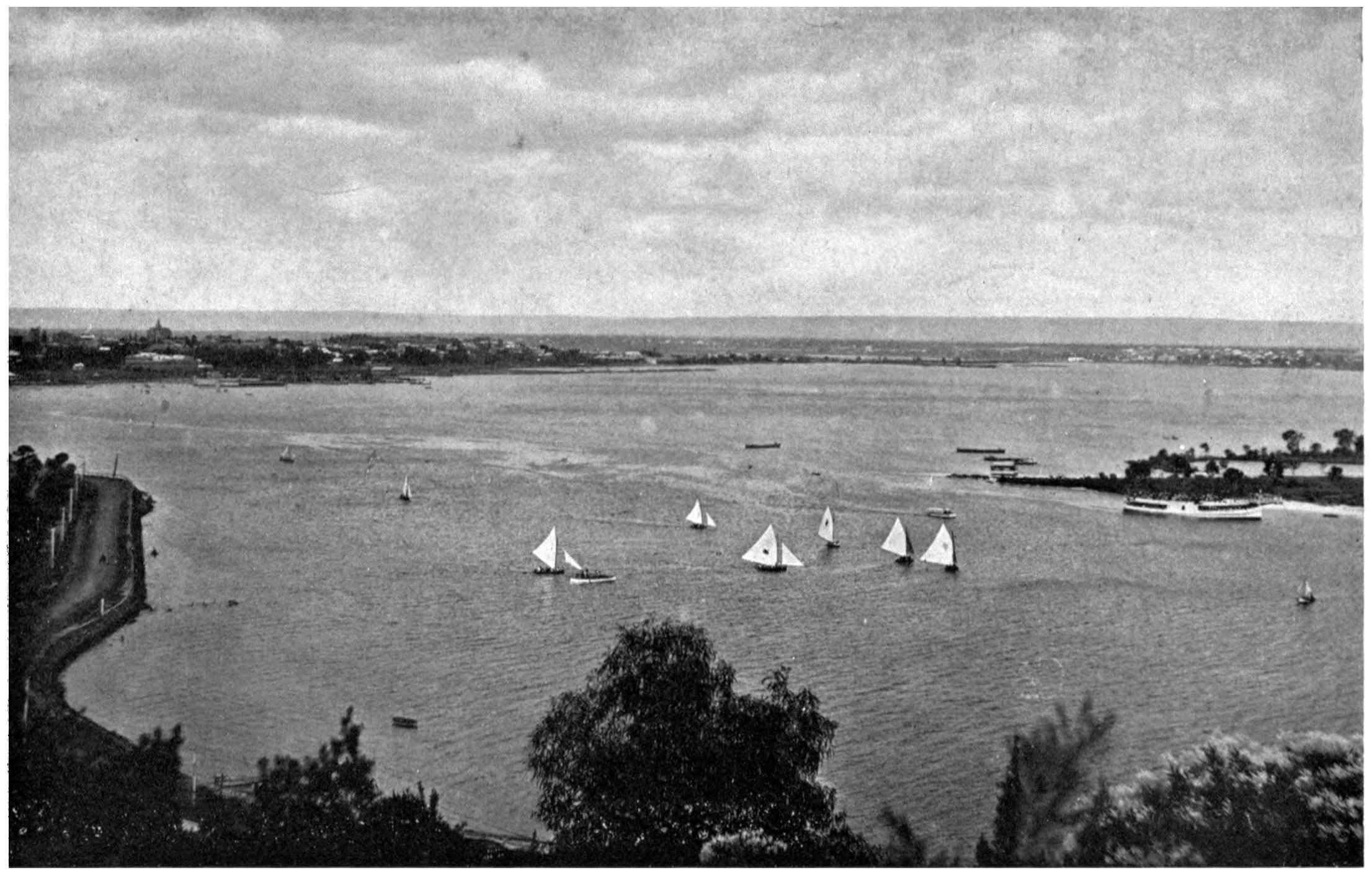
PERTH, FROM “THE NARROWS.”
But what most impresses the new-comer from
Europe in Australian towns is not the buildings,
but the people. Here is no miserable sordid
fringe of the poor and wretched. In this happy
country there is no poverty. Its people are well
fed, well clothed, well housed, well-to-do. Whatever
her problems, and they are many and difficult,
and not to be lightly pronounced upon by
the casual visitor, it is the glory of Australia that
she has no poor.
It appeared to us, especially in the West, that
a characteristic type is developing; lean, loosely
hung, wiry, with eyes deep-set from the strong
sunlight. In odd contrast to European towns,
men everywhere preponderate over women in
the streets. Perhaps because of its newness, the
attitude of the other states to Western Australia is
still a little patronising. Western Australians themselves
are fully conscious of this, they on their
part always talk about “the East” in tones of
desire: “I hope we shall go to the East next
year,” is often heard in Perth. At first we
thought they meant China or Japan, but we
soon found that in Western Australia “the East”
means Melbourne or Sydney. They stand for
London or Paris, and one lady said plaintively:
“If I have a nice dress, when I go to see my sister
in ‘the East,’ she says, ‘You didn’t get that
made in Perth.’”
Perth, however, is looking forward. She
knows the time will come when she can compete
fearlessly with her elder sister the capital of “the
East.” Meanwhile she has achieved the acquisition
of the most attractive zoological gardens
of any Australian city. They are small, but
charmingly laid out, the animals left free to
roam about in their own little grassy paddocks.
The pleasant shady walks are lined by the pretty
Cape lilac, which in July is bare of leaves, but
covered with clusters of yellow berries, very decorative
in effect. These gardens lie on the far side
of the Swan River, and a ferry-boat plies across
its shining blue waters. Numbers of black and
white water-fowl swim alongside, diving below
and bobbing up again, or settling on a row of
posts that run out from the shore, each one like
a little black and white carved ornament. The
gardens are a few minutes’ walk from the landing
stage. We found them charming, the darker
evergreens everywhere lighted up by patches of
golden wattle. The kangaroos and wallabies
feeding in their little enclosures hop up and
put gentle inquiring noses into your hand.
Perhaps it is because the little wild Australian
animals are so pathetically confiding that they
are becoming extinct. The authorities do all
they can to preserve them, but it appears to be
inevitable, though deplorable, that the native
wild animals of Australia, charming little inoffensive
creatures, are becoming rarer every
year, in spite of large reserves or national parks,
where everything is left untouched in its wild
state. Unfortunately some of the most interesting
cannot be kept in captivity. This applies, for
instance, so we were told, to the koala, or little
tree-bear, and to the curious duck-billed platypus,
a little animal covered with a wiry brown fur, with
the bill of a bird, and something of the habits of
our river otter. The gardens possessed a one-eyed
alligator that caught pigeons in its mouth with
astonishing dexterity, and swallowed them whole
in two gulps; and some fascinating cranes with
beautiful vermilion legs, that danced as gracefully
as any ballerina. Our own visit to the
gardens was pleasantly concluded by tea, which
an Australian lady was hospitably dispensing to
ourselves and some other English visitors.
Tea is a most important feature of Australian
life. Tea comes in with the maid and hot water
in the mornings, and tea is drunk at breakfast;
“Morning tea” is a settled social institution.
We were invited to it on several occasions, it is
served at eleven o’clock. Tea next appears at
or after lunch. Afternoon tea is a matter of
course everywhere; but it comes in again at or
after dinner, and is very often drunk the last
thing at night. One would think so much tea
would undermine the strongest constitution,
but it is made very weak with a great deal of
milk. Australians themselves feel that their
indulgence in tea-drinking is rather excessive
but they account for it by saying that “In the
bush you cannot get anything else to drink,” and
neither seek nor offer other explanation.
It was at this Perth tea-party that we first saw
the brown heavily scented “boronia,” for which
West Australia is famous. The tables were
decorated with that and the delicate pink Geraldstown
wax flower. Boronia has a small chocolate-coloured
flower, yellow inside, and is so sweet
that its scent is overpowering in a room or on a
dinner table. The genus was named after an
Italian botanist. There are many varieties in
Australia, which, to the uninstructed eye, do not in
the least resemble each other. Boronia megastigma,
the West Australian variety, is used for the
manufacture of scent, and is cultivated for sale;
it is one of the most characteristic spring flowers.
We were not long in discovering that Western
Australia, whatever course its future development
may take, is at present a paradise for the
working-man. Nowhere else is life made so
pleasant and easy for him in such matters as
housing and education; nowhere else are his
children given such facilities for making their
way in the world in their turn. To begin
with, education is provided free of cost,
from the primary school to the University. In
the primary schools boys are given manual
training, and girls are taught cooking and
domestic economy. Special facilities are provided
by the Government to meet the needs of
scattered settlers in the bush remote from
centres of population; wherever it is possible to
assure an average attendance of even ten children
within a radius of three miles, schools are already
established. The Education Act even takes into
consideration the case of isolated families, where
the muster of children is less than ten; the
department pays £7 a year for each child on
condition that the parents find a suitable teacher,
and will supplement this grant, so that he may
have a minimum of £30 a year over and above the
cost of his board and lodging.2 In effect the
Government pays part of the salary of a private
tutor. It can be easily imagined that the education
grant must be a very heavy one, in proportion
to the population. It amounts, in fact, to
about £1 annually for every individual in the
state.
From the primary schools children are drafted
into the secondary schools, when they are able
to profit by the advanced standard of teaching.
There are also technical schools, where trades are
taught, and a training college for teachers.
We visited one of the intermediary schools, the
Perth Modern School, as it is called, at Leederville,
a suburb between Perth and Cottesloe Beach.
We found a handsome red brick building, looking
like a Nonconformist college in one of our older
Universities. In the large, well-kept grounds
there is room for football, tennis, hockey, and a
gymnasium is provided in a detached building.
The school is admirably constructed for its
purpose, the classrooms opening out of a large
central hall. We were unexpected and unannounced.
In the course of our researches in
pursuit of the headmaster we were impressed
with the excellent discipline and tone of a
school in which the children’s attention was not
to be distracted by the presence of strangers
glancing into their classrooms in passing. The
teachers, masters, and mistresses, all wore university
gowns. The headmaster, alert and enthusiastic,
showed us over his spacious, airy school-buildings,
including the well-equipped laboratory
and the department of domestic economy. Western
Australia does not neglect the practical side
of its children’s education, and here the girls are
taught dressmaking, millinery, and cooking. The
dining-rooms of the staff, and those pupils whose
homes are at a distance, had the air of a well-appointed
restaurant, with its small tables daintily
set out with clean linen, and fresh flowers brought
by the children. We noticed among them what
looked like a small edelweiss, the Australian
“flannel flower.”
The period of education at these intermediate
schools consists of a four years’ course lasting
from 12 to 16. A “Leaving Certificate”
on the completion of the four years’ course
must be obtained by examination to enable the
student to pass into the University. Some students
are drafted into the Training College for Teachers,
or, after the four years’ course is finished, students
may stay on at the school to study special subjects.
We were impressed with the appearance of the
children. They were healthy, well-to-do, and
attractive; their manners were frank and without
self-consciousness.
One of the older girls, who was deputed by the
headmaster to show us the way to the station,
would have compared favourably with any
English schoolgirl of the same age. Her father
had visited England, “and you have no sand in
England,” she added, half incredulously, “and
father could not make them understand about the
sand here.” She came from up-country, and was
able to tell us that two handsome large grey and
black birds with a singularly limpid note were
“rain birds.” She also pointed out to us two
large castor-oil trees, and told us that the magpies,
predatory, knowing-looking birds, which are to
be seen everywhere in Australia, are called
“break o’ day boys” in the country, because,
like our cocks, they call the neighbourhood.
It is only quite recently that Western Australia
has acquired its University; it is in fact of
such new foundation, that, like some of Perth
itself, it is still housed in temporary buildings.
Its professorial staff is appointed, and it confers
degrees, but the scene of its labours is at present
in a number of classrooms beneath a corrugated
iron roof, opposite the charming gardens of
Government House—Australia is very good to its
governors in the matter of houses and gardens.
But Perth is developing with great rapidity, and
a probable permanent site for the University is
already talked of, on the banks of the Swan
River, in the National Reserve or King’s Park.3
If working-men are liberally treated by the
state as regards education for their children, they
are treated no less generously as regards housing
accommodation.
One afternoon we visited, in company with
the State Premier, some of the houses the state
builds for working-men. The bungalows were
built on the Western Australian plan on piles;
one-storied verandahed houses each in its own
palisaded plot of ground about a quarter
of an acre in extent. Outhouses, including a
washhouse, were at a little distance from the
main building. The houses were pretty and
picturesque; they were constructed of coloured
“sand” bricks, made of cement and sand, and
had corrugated iron roofs. They vary in type,
and the intending purchaser can see the plans
and make his own selection according to his
taste and means. Those we visited were situated
on the pleasant outskirts of Perth, with a view
over the Swan River. We went over several in
the course of construction, and then made our
way to a street of occupied houses. We left the
motor-car behind here, for the roads were of soft
sand like a sea beach. The sand was held together
by a low-growing plant, a kind of mesembryanthemum,
locally known as “pig’s face.”
It has very thick, succulent leaves and an attractive
flower like a large primrose-coloured thistle.
Sheep or cattle will eat it, and it is almost independent
of moisture. We visited some new-comers
who had lately taken one of the houses.
The owner was a member of the Legislative
Council, and had recently left the goldfields to
come and live in Perth; for Western Australia
holds that it pays its legislators to legislate, and
requires of them whole-hearted devotion to the
service of the state for their £300 a year salary.
He had already made his garden. The front lawn
was sown with grass and sanded over, and he
was busied in making a vegetable garden in the
sand, in which early spring flowers were showing
even then.
Inside, the rooms were large and well furnished,
the bedrooms opening on to the broad, shady
verandah that faced what would eventually be the
lawn. As we drove away the Premier pointed
out a small wooden house in a tiny plot of ground—that,
he said, is all a man can do without state
aid for the same money.
As to the financial part of the scheme, it is
regulated on no principle of extravagant philanthropy,
but is conceived on a sound commercial
basis, to repay the Government the interest of
4½% on the capital expended. The payments of
the tenants are calculated on a basis of 5%, with a
rebate of ½% on punctual payment. The land on
which their houses stand is inalienable, that is,
at the end of ninety-nine years it reverts to the
state, and in the meantime the owner cannot
dispose of it except to the Government, who will
take it back on a valuation, allowing compensation
on improvements, or making deductions from the
original cost on depreciations. To be eligible as a
tenant a man’s income must be under £400 a year,
and he pays a small deposit. The most expensive
houses vary from £600 to £700. The tenant’s
weekly payments, which may be spread over a
period of thirty years, eventually make the house
his own; but his payments may vary in accordance
with his means, and he can make his house his
own at any point by paying off the balance. No
wonder that with such inducements to linger in
the neighbourhood of a town, men should shrink
from the harder, more vigorous life up-country.
Yet it is “up-country” men that Australia wants,
to clear, sow, and till her rich, fertile soil; with
enterprise and energy to win certain fortune, and
courage to face the initial hardships and loneliness,
which bring their own reward.
With all her natural advantages Western
Australia’s development is only a matter of the
last twenty years. Like most of the rest of the
continent, she has an inhospitable and forbidding
coast. The Dutch knew of the existence of a
southern land or, “Terra Australis,” before the
end of the sixteenth century, and Dutch captains
sailing from the Cape to Java and the East Indies
not infrequently found themselves within sight
of a desolate and unknown coast, which they
gradually charted, till it was mapped in outline
from the Gulf of Carpentaria to Cape Leeuwin.
It was not, however, till nearly the end of the
century that the first Englishman landed in
Australia, when Captain Dampier, commanding
the “Roebuck,” navigated the western and
north-western coastline in 1699, and was not
encouraged by what he saw there.
Sailing from the Downs in January with fifty
men, and twenty months’ provisions, Dampier
sighted the low, even shores of Australia in
August of the same year, and entered Shark’s
Bay, as he called it. He and his men went ashore,
but sought in vain for water on that waterless
coast, digging wells, but to no purpose. A hundred
years later, in 1803, the continent was
circumnavigated by Matthew Flinders, who
suggested that “Australia” should be substituted
for the Dutch name of New Holland.
Still nearly another century passed away before
Western Australia begun to grow and prosper. In
1826 Major Lockyer was sent from Sydney, with
troops and a party of convicts, to occupy King
George’s Sound on the south coast, where the
Port of Albany stands to-day, and a few years
later the Swan River Settlement was formed in
the neighbourhood of Fremantle and Perth;
but these first beginnings of the colony were
unpropitious, and it languished till the discovery
of gold brought the first great influx of population,
and with it the consequent demand for
agricultural produce, which at last gave an
impetus to Western Australian development.
Slowly the outside world began to realise the
immense possibilities of this great territory,
which occupies about one-third of the whole
continent, and has an area eighteen times that
of England and Wales. Within its fertile and
beautiful interior, stretching from the temperate
to tropical zones, were found districts well fitted
for raising cattle and sheep, for agriculture, and
fruit-growing and the cultivation of vines. Vast
primeval forests of valuable timber cover many
square miles, while the discovery of coal and other
minerals accompanied that of gold. Western
Australia is no less fortunate in its climate
than in its natural resources: over the greater
part of the state it is equable and pleasant
without violent extremes. The dry season lasts
into April; the greater part of the rainfall, which
varies in different districts of the state from
40 to 10 inches, taking place between May and
September.
CHAPTER IV IN THE BUSH
One great source of wealth to Western
Australia are the karri forests, covering
thousands of square miles. Karri is a kind of
eucalyptus closely allied to the better-known
jarrah, one of the hardest woods in existence.
It has been used at home to pave the streets of
London. In all but one respect karri is as good
as jarrah, its only point of inferiority is that it
cannot be employed for underground purposes,
while jarrah can be left under water for twenty
years without being any the worse for it. Karri
has to be specially prepared—“powellised” is
the technical term—and that is an expensive
process. Otherwise it is almost impossible to
tell the two woods apart, except by the ash
after burning.
Western Australia asserts that its karri trees
are the tallest in the world, though Victorians
make the same claim for the giant gums of
Gippsland. So far these Gippsland trees have
been proved to be the tallest in Australia.
The official measurements are: height, 326 feet
1 inch; girth, 25 feet 7 inches; measured six
feet from the ground.4 Their dimensions are
surpassed by the Californian redwood, which
have been found attaining a height of 340 feet;
but whatever the actual measurements, the effect
of the immense height of the Australian trees
is everywhere imposing enough to warrant competitive
statements concerning it.
Remote from all habitation, the difficulties in
the way of felling and transporting the karri are
very great, and the Western Australian Government
have in consequence established some state
sawmills about two hundred miles up-country, in
the heart of the primeval, uncleared forest. It
is the nucleus of a new township called Big
Brook. Australia has not shown herself altogether
felicitous in her nomenclature, for generally it is
neither original nor descriptive, except where
native names have been adopted, which, if not
euphonious, have a meaning.
We had the good fortune to be in Perth on the
occasion of an official visit organised by the
Government. Australian trains always run at
night, and so avoid much tedium and loss of
time. After an early dinner, we started from
Perth at 7.30 for Big Brook in a special train.
The line, like all Western Australian railways,
was laid on a narrow gauge, with the result
that the carriages jolted and rocked like a small
boat in a storm. An odd little characteristic
feature of West Australian travelling is that at
the end of each carriage is suspended a canvas
water-bag, with a cup attached to it. They are
also seen hanging in verandahs, impressing on
the stranger that he is in a dry and thirsty land,
where water is always precious.
One of the advantages of the Western Australian
climate is that the nights are cool, though the
spring sunshine was intensely hot. Whoever organised
this Government visit to the sawmills had
a very high standard of comfort, for from first
to last it was most admirably arranged. We were
a small but very pleasant little party, and met
and talked in the friendly Australian way, in
each other’s compartments. About nine o’clock
a light supper was brought round, and we soon
after went to bed and fitfully to sleep under a
mountain of rugs. Whenever the train stopped
there was a loud chorus of frogs from unseen
swamps.
We were called next morning by the conductor
bringing us tea, and later, while we
were dressing, he came round with fruit.
We woke to find ourselves already in the
depths of the forest among the soaring white
trunks of the karri, the early sun tinging their
smooth trunks with red. The line had been
recently made, and the sleeping cars were very
heavy, so we proceeded slowly. There was very
little sign of life; we could almost feel the great
deep silence of the forest, moist, and fresh, and
cold, in the frost of early morning, for it lies 400
feet above the sea level, and the temperature
was very different from that of the dry sandy
plains of Perth. At long intervals solitary wooden
houses stood in little clearings, with grave-eyed
children before the doorway, shading their eyes to
watch the unfamiliar passage of a big train. More
seldom we came upon a scattered village of tents,
roughly put up like a gipsy encampment, pitched
among the damp undergrowth. There was
something pathetic in the deep isolation of these
pioneers, though the near neighbourhood of the
railway made their lives almost metropolitan,
compared with those of many Australian
settlers.
As we drew nearer to our journey’s end, we
passed an occasional small clearing, where the
yellow sandy soil had already been planted with
apple trees for the fruit growing, which is one
of the industries of the future for Western
Australia; or patches of forest had been ringbarked,5
and left to die, after the cheap but
wasteful method of clearing in use. Visitors to
Australia cannot help being impressed with the
waste of timber, which seems appalling to an inhabitant
of an over-populated northern country,
where everything grows slowly, and every inch
of wood has its economic value. They are too
ready to rush into print, or public pronouncements,
on a subject of which only prolonged
residence in the country, and a more than superficial
study of its economic problems, could enable
them to judge. In the first place the cost of
transport is prohibitive, or means of transport
may even be non-existent; and secondly, in a
new country time is money. Great tracts of
forest all over Australia are ringbarked and left
to rot. In the Government sawmills at Big
Brook, the debris of the great karri trees is
lost. There is wholesale waste, wholesale destruction
of timber going on in Australia, the
least intelligent observer cannot fail to mark it,
but time is literally money in Australia. “We
can’t afford to wait,” said one of the leading
statesmen of Western Australia, commenting on
the waste of timber at Big Brook. “We sacrifice
five pounds to gain twenty,” said one of the
shrewdest and best-informed officials of Victoria.
By the common process of ringbarking, dead
trees are left standing over great areas of forest
land, vast white skeleton armies, a strange and
desolate sight. If the land is to be used for arable
purposes, the trees have to be removed; but for pasture,
when the trees are dead, and can no longer
deprive the grass of nourishment and moisture,
they remain standing for years, till in time with the
process of the seasons, and the attacks of insects,
the hard wood decays and crumbles away.
Thus the destruction of forests goes on in
order to provide timber for building; for
fencing, mining, fuel, as well as for commercial
purposes of export, or to improve, or create, arable
or pasture land. In Western Australia besides,
green timber is cut for fuel, in the neighbourhood
of the goldfields, because of the scarcity of coal,
but natural reafforestation is usually allowed to
proceed. However, when all these necessities
are admitted, there has been a deplorable waste
of timber, the want of which is already felt in
settled districts; and it is hoped that further
wanton destruction will be prevented, and replanting
will be undertaken by all the states.
Official opinion is becoming alive to the importance
of the question to the future history
of Australia. Victoria and New South Wales are
doing some planting, but South Australia is the
only state in which forest plantation is being
carried on on a large scale.6
The railway ended abruptly in a large clearing
in the forest about fifteen miles from the coast
and two hundred miles from Perth. The air
was that of a keen autumn morning, and we
climbed down from our carriages, for there was
of course no platform, feeling stiff and chilly, to
find breakfast waiting for us in a big wooden
hall, with a great fire blazing in the kitchen, which
opened out of it, the most cheering and comfortable
sight in the wilderness. These halls are a
feature of backwood settlements in Australia;
they are utilised for all social and business purposes,
and are the common meeting ground of
the community. In this instance the landlord
leased the building from the state, and provided
meals for the men employed in the sawmills.
He invited us to inspect his pleasant kitchen, the
floor sanded with sweet-smelling, deep-red sawdust.
At the back he was putting up bedrooms
in small detached one-storied wooden
buildings. Big Brook with its keen, pure air, the
sweet, clean scent of the fresh-sawn wood, and all
round, the illimitable forest, mysterious and impenetrable,
would be an ideal resting-place, if
anyone in Australia were ever over-worked.
But meanwhile breakfast was waiting for us, a
never-to-be-forgotten breakfast of good coffee,
hot rolls, porridge, new-laid eggs, and chops the
tenderest in the world, the product of the local
sheep. Fig jam, with which it concluded, was
excellent. Figs grow readily in Western Australia,
and produce abundant crops of fruit. They
were very noticeable at this time of year, as they
were the only deciduous tree.
After breakfast we visited the whole settlement,
which of course was built entirely of wood. In
the school, in a bright, cheerful classroom, a
master was conducting the tiny classes of well-dressed,
rosy-cheeked children. Opposite the
school was a billiard-room, where the men could
meet in the evenings; there was also a bank, and a
post office. We were impressed by the splendid
physique of the men; they were as agile as cats,
muscular and supple; and these qualities were
necessary, for the work is very dangerous from
the moment the axe is laid to the root of the tree.
The logs are of immense weight, they bound and
crash down the incline to the back of the mill,
when they are unloaded from the truck, and fly
asunder with great force when they are sawn.
The log, or trunk of the tree is first sawn in two
longitudinally, and is then again cut into smaller
and smaller slices, till it becomes planks. The
saws are graduated, becoming more and more
fine. The task of keeping them true is an accomplishment
of great delicacy, it is one man’s work;
he corrects deviations in the metal with a hammer,
judging them entirely by eye.
In the neighbourhood of the sawmill all the air
is filled with flying sawdust, and the sweet scent
of the freshly sawn wood. The dust falls to the
ground in deep red masses, the flying chips look
like scraps of raw meat, but the rich colour fades
when they dry. The process of preparing the
karri wood for use is at present a very expensive
one. The planks have to be stewed in order to
preserve them. They are put for this purpose
into immense tanks of molasses, and left seething
there to harden. It is hoped that scientific experiment
may evolve a less costly method. After
going over the mills we were taken up a little
railway line into the forest to see a tree felled.
We sat on benches on trucks behind the engine,
which carried a supply of wood for its boiler, for
the cost of bringing coal up to Big Brook would
be quite prohibitive. Even the boilers that work
the mills are fed with wood. The engine was
run by a magnificent-looking old stoker with
a white beard and the air of a patriarch. When
we scrambled off the trucks on to the soft, rich
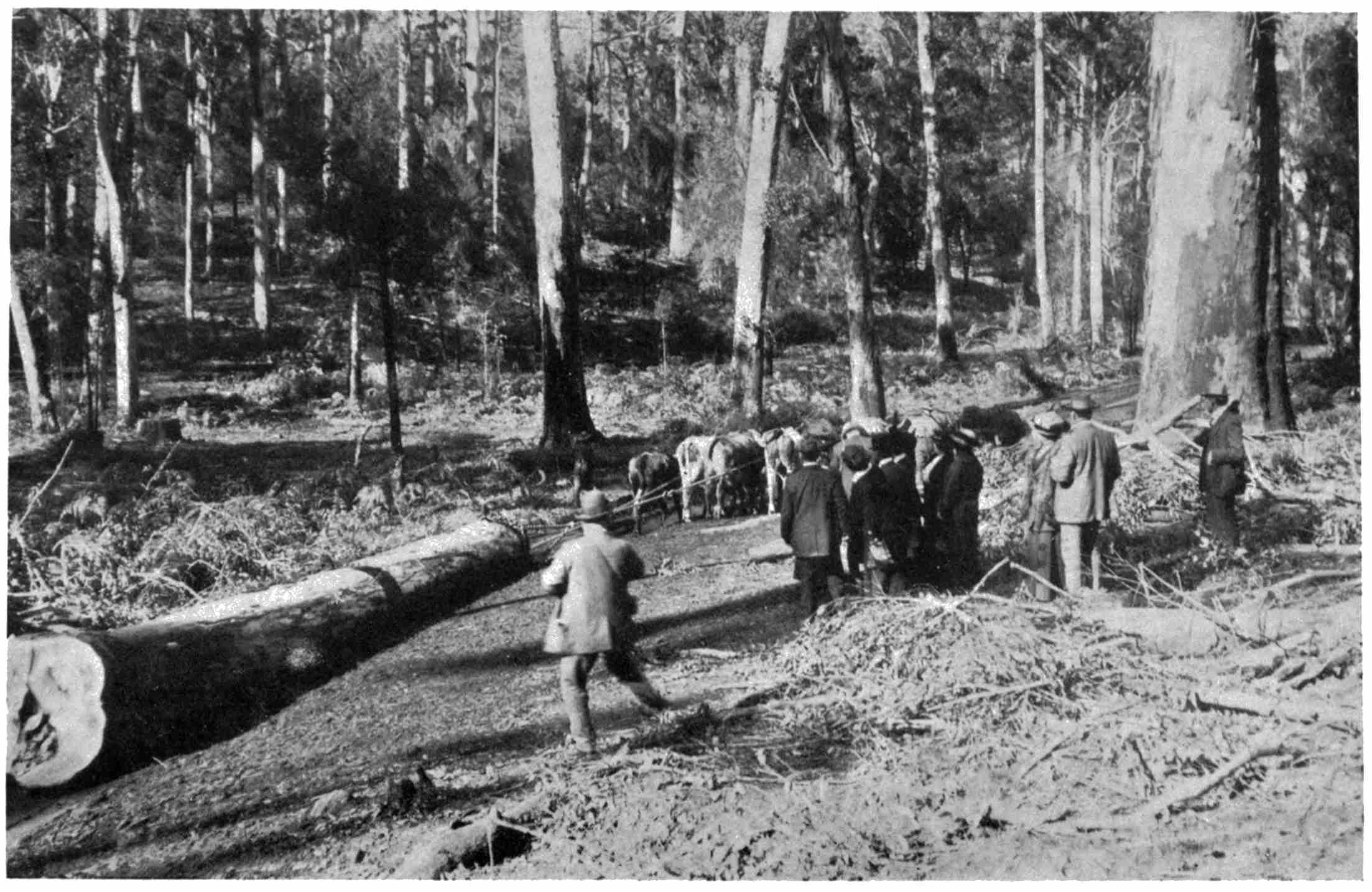
earth of the forest, we had to wait to let a bullock
team go by, twenty-four of them pulling one log
with a big metal “shoe” on the end to prevent
its digging into the ground. The passage left a
deep slide in the red earth. The bullocks are
bound together in twos by very uncomfortable-looking,
heavy wooden yokes, and their progress
is punctuated by frightful yells and cracking of
whips from the drivers.
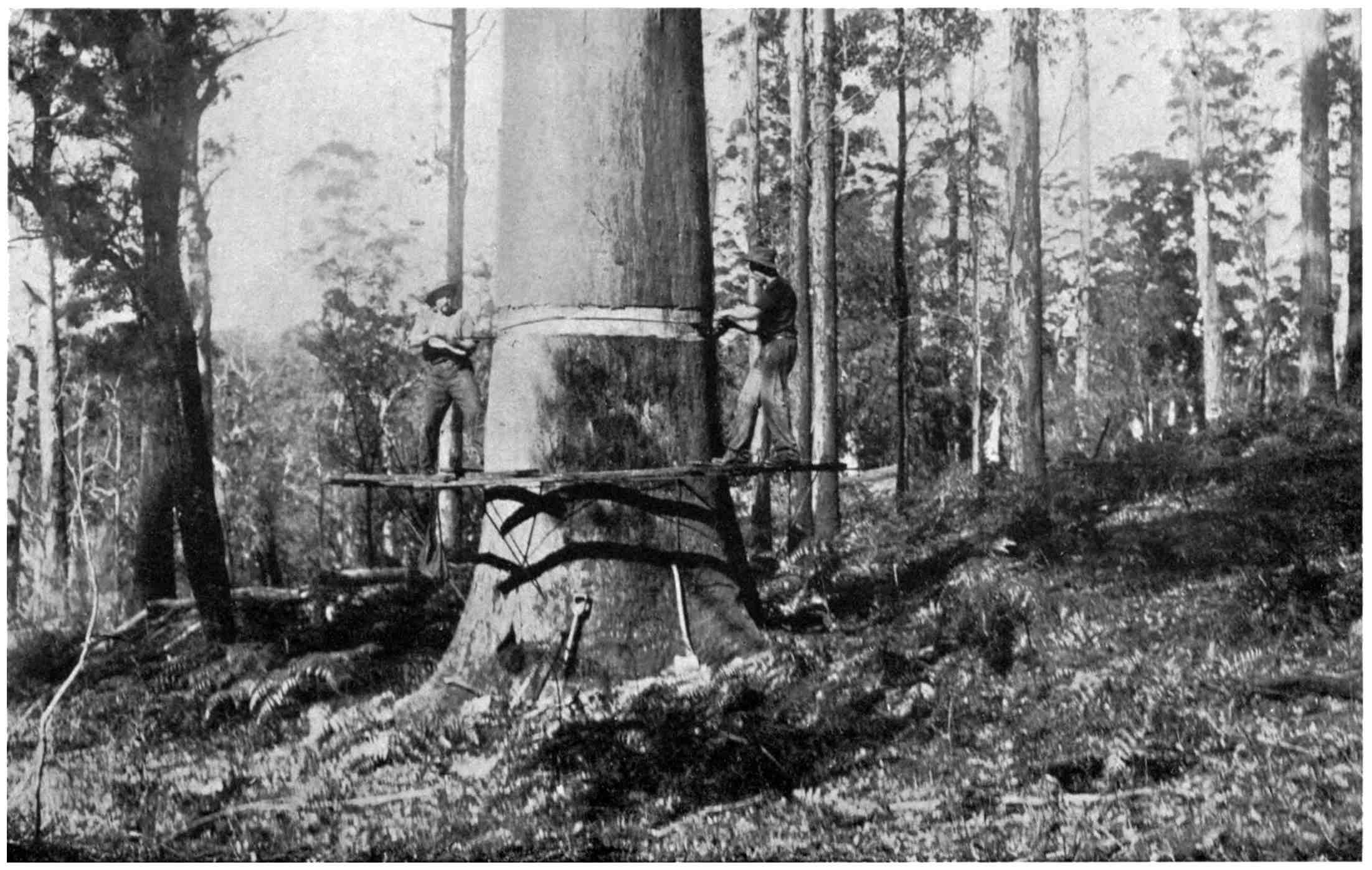
FELLING KARRI.
We had not far to walk; the sun was now
almost oppressively hot, and the steamy atmosphere
was full of the rich, moist smell of the
damp earth and the undergrowth. The woodcutters,
who fell these immense trees, are so
skilled that they can gauge the exact spot on
which they will fall to within a few inches; such
accuracy is a matter of life and death in tree-felling.
When we arrived on the scene the great
trunk of the karri was already sawn through by
two men working on a kind of little platform
erected round it. For an instant the slim, white
tree tottered, while we held our breath, then it
began to fall slowly, at first with a crackling
sound; finally it came crashing and tearing its
way among the neighbouring trees, followed by
a shower of leaves; there was a sound as of the
firing of a big gun; all the earth trembled; it
seemed, as if the whole vast silence of the forest
was shaken. A second tree that we saw felled
measured one hundred and fifty-eight feet to
the first fork.
The woodcutters are paid by the load that the
bullocks draw, the bare trunk of the tree when its
branches have been lopped off. We were told
that they can make as much as £6 a week. The
cost of living does not amount to much more
than 25s. a week for a single man, as he can
board sumptuously at the Hall for 22s., and the
price of lodgings is about 1s. 6d. This leaves a
considerable surplus, and in Big Brook there is
no means of spending money. In consequence,
men occasionally go off to the nearest town
when they have amassed a small capital, and
stay there till it is all spent, and they have nothing
to show for it. They work eight hours a day,
and everything is regulated by contract. They
are of various nationalities, but all of magnificent
physique. While we were waiting to remount
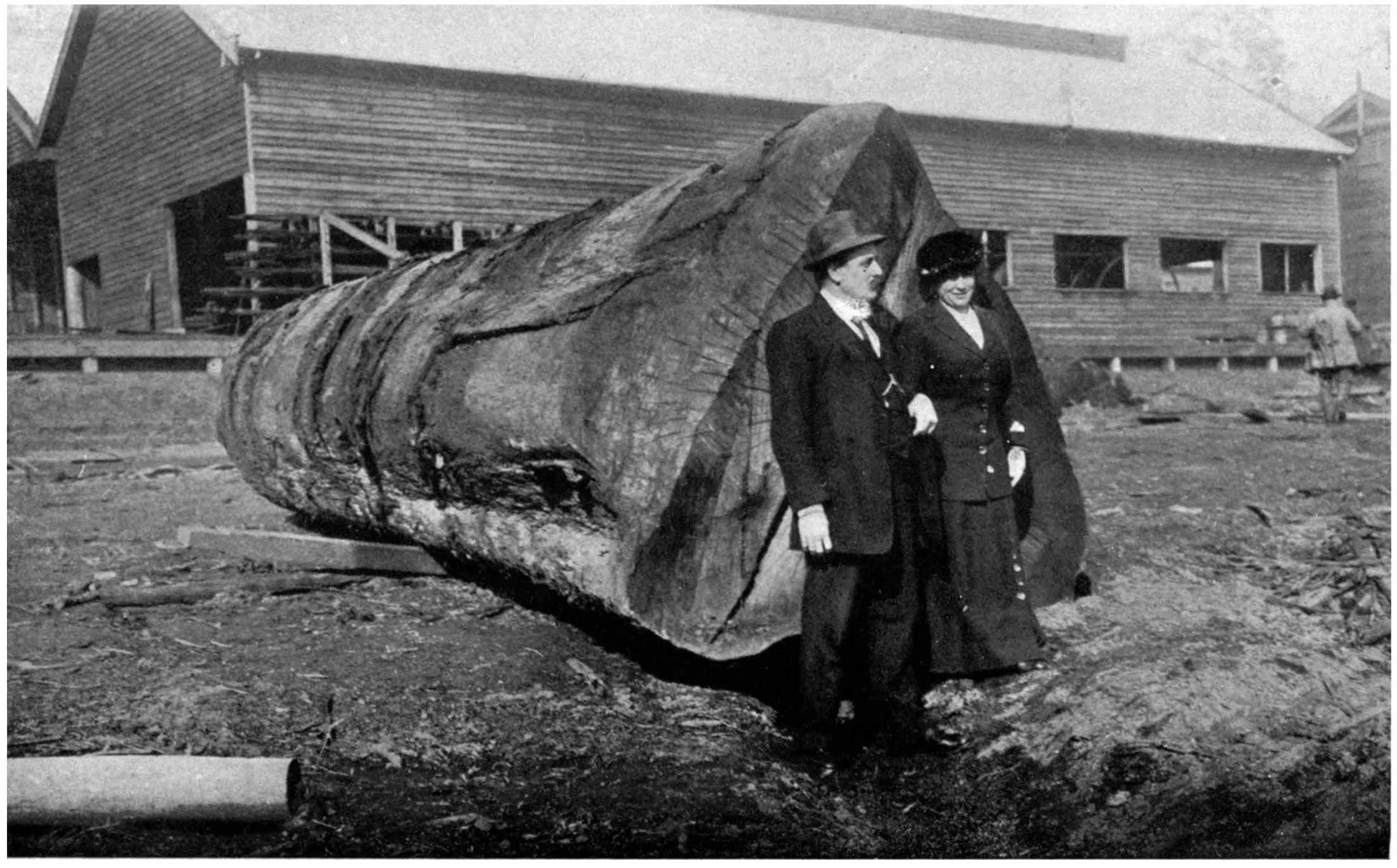
our railway trucks, a team of forty-eight bullocks
passed, dragging one enormous log of twenty tons
weight, the drivers cracking their long whips,
screaming and leaping into the air in a frenzy of
inarticulate excitement that somehow conveyed
a meaning to the bullocks. Soon after we began
the return journey we passed through a belt of
jarrah, the still harder kind of eucalyptus that
we had only seen in the form of piles; the
trunks were reddish instead of white like the
karri.
We saw also for the first time a common feature
of the Western Australian bush, the curious “Black
Boys,” called in Queensland “grass trees.” They
look like a knotted dead trunk with bulrushes
growing on the top in thick bunches. Sometimes
the trunk is forked, and there are a pair
of odd bushy heads on one black misshapen
trunk.
The bush in this part of Australia has little
diversity. The keen air of the early morning
had made us very hungry, in spite of so substantial
a breakfast, and we were not sorry to reach
Jarraduck, the settlement in the forest where
lunch was waiting in another large wooden hall.
The long tables were decorated with masses of
golden wattle and purple kennedya. Lunches of
this kind, and we sampled very many, are always
just alike, varying only with the resources of the
neighbourhoods,—lots of flowers and a warm
welcome, plates of assorted cold meats, of which
turkey is an almost inevitable ingredient; elaborate
sweets, of which one is always an excellent
trifle, and fruit of the district, in this case the
small, sweet, thick-skinned local orange.
The refined-looking, sweet-faced landlady
seemed inappropriate to the rough surroundings.
“We shall just stay here till we can better ourselves,”
she explained. A few more hours brought
us out of the forest, there were more clearings,
homesteads became more frequent, the red soil
was freshly ploughed for oats, orchards began to
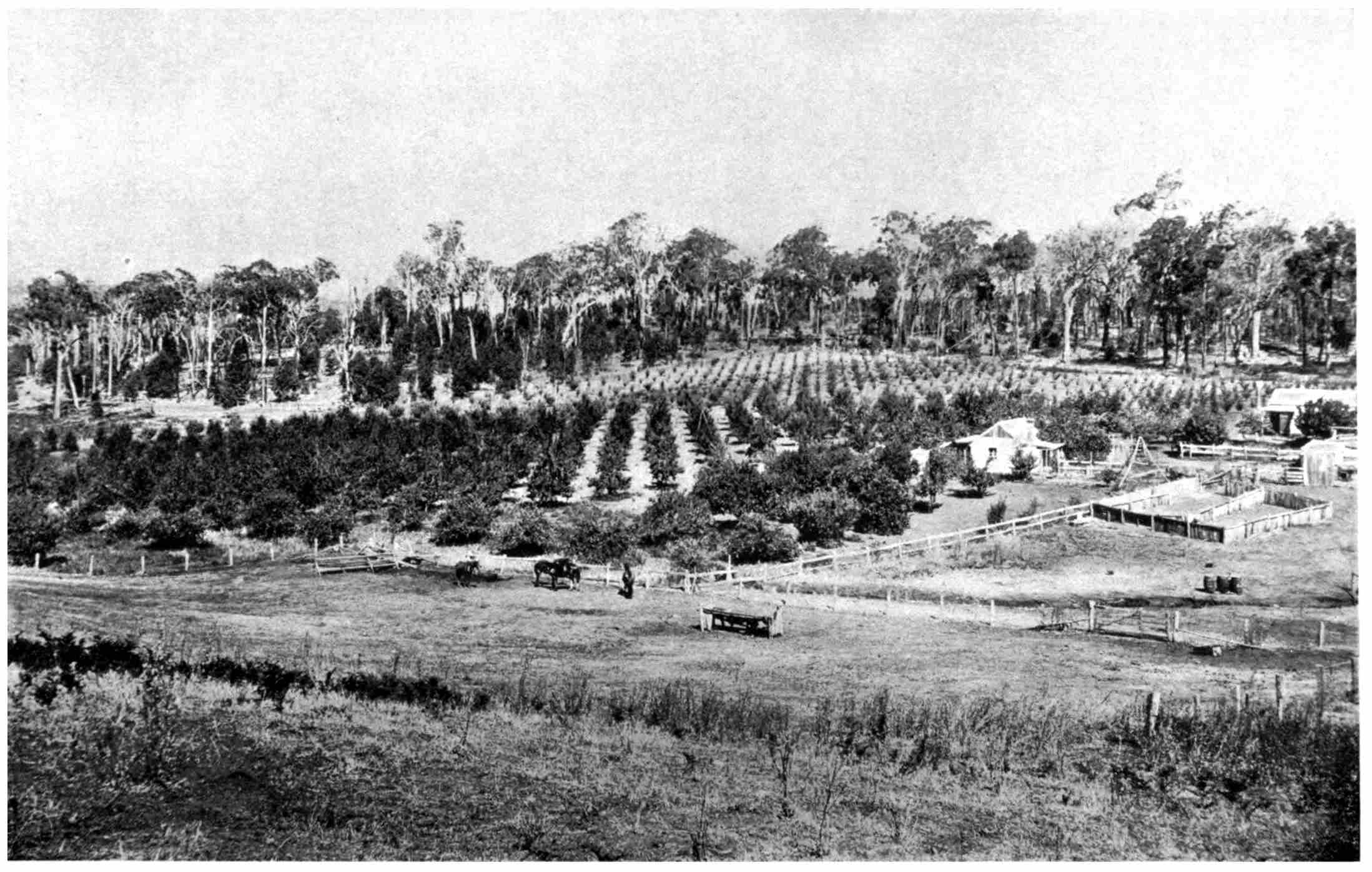
take the place of the eucalyptus, with apple trees
not yet in blossom, and orange and lemon trees
covered with fruit. The country became hilly,
and half-castes were at work in the fields, shock-headed,
and unintelligent-looking. We had left
the bush behind, and were now in the region of an
older settlement, the fruit-growing district of
Western Australia. Fruit-growing is becoming
one of the most important factors of Western
Australian industry, and it is hoped that it will
prove an even greater source of prosperity, because
a more permanent one, than the gold that cannot
last for ever. The climate, and much of the
soil in the South-West are admirably adapted
for all kinds of fruit-growing. The apples are
excellent, so are the oranges, pears, plums,
apricots, and peaches, strawberries and gooseberries,
all of which are grown successfully. Fruit-growers,
who have taken care in selecting a
holding where the soil and conditions are favourable
for their crops, have not long to wait before
reaping their profits, as six-year-old apple trees
have been known to produce from £50 to £60
an acre. It is important also to select a fruit for
growing that will travel and keep. In 1913 there
were still more than 88,000 acres suitable for the
cultivation of fruit or vine-growing, subdivided
into convenient blocks and waiting for selectors.
Bridgetown is the centre of the fruit-growing
district of Western Australia. Motor-cars were
waiting to show us the neighbourhood, and we
started in the golden light of the late afternoon
sun to see something of the country. It was
our first experience of Australian motorists. To
enjoy motoring in Australia one must have an
adventurous disposition. Except in the neighbourhood
of large towns the roads are very
rough; indeed, the long droughts make it
impossible that they should be otherwise. The
soft, dry soil crumbles away, the light dust is
stirred up by every passing vehicle, leaving deep
ruts, so that the same road is often on different
levels, and a car runs along at a sharp angle,
with one wheel poised on the edge of a rut, and
the other in a hollow. Practised drivers achieve
this difficult accomplishment with much skill and
the minimum of jolting, but even so, the car
often takes flying leaps. So we started on an
apparently breakneck career, holding tight on to
the sides of the motor, and dashed up and down
hills that an English motorist would have hesitated
to look at, red and rutty as a Devonshire
lane in winter. We never knew the name of that
kindly motorist, who so gallantly risked his own
and our lives, not to mention his machine, in
showing us as much as possible of the surrounding
country before the light faded. He was one of
the many, many unknown friends who did us
some passing kindness on our rapid journey,
leaving only a warm memory behind it. Hail and
farewell to each and all of them!
The country-side was very beautiful, more
English, and less unfamiliar-looking, than anything
we had yet seen, with steeply undulating hills and
valleys, springing young green crops, and orchards,
with apple trees whitened against some parasitical
scab, or oranges and lemons. The comfortable
homesteads had a more finished and abiding
air than anything we had yet seen; for Bridgetown,
as our host explained to us, “is a very old
settlement—sixty years old!” It even possessed a
tiny stone church, which gave it a pleasantly
homely and established air. We crossed the beautiful
Blackwood river by a picturesque wooden
bridge where the river flows through a deep gorge
up which black and white wild duck were sailing.
In the fading glow of the sunset the country
looked still more English, for the groups of gum
trees that crowned the hills were indistinguishable,
and the evening light seemed to diffuse an
atmosphere of calm contentment over the
thriving country-side, as of a day’s work well
done. We ran through the little scattered
township, to the Freemason’s Hotel, at which
our friend the motorist deposited us, and vanished
into the dusk.
OXEN HARNESSED TO A LOG AT BIG BROOK.
As we went in out of the darkness one of our
fellow-travellers brought us a specimen of the
pretty, curious “kangaroo paw,” a flower that
looks as if it had been cut out of bright red and
green moss, whose buds take the exact shape of
a kangaroo’s little foot. After dinner we strolled
along the broad, silent country road, leading
out into the deep stillness beyond, broken only
by the barking of the village dogs, and the
croaking of unseen frogs. The men of the
neighbourhood loitered in the light of the shop
windows, kindly looking and highly curious. We
met at Bridgetown a Government official at the
head of the Fruit-growing Department. He told
us that this corner of South-Western Australia, a
district as large as the state of Victoria, was the
finest soil for fruit-growing in the whole state.
The industry was of very recent growth, the first
trial shipment was only made ten years ago, but
since 1907 the trade had been established upon a
commercial basis, and the export of apples was
greatly increasing every year in quantity.
Western Australia has also successfully exported
grapes, but unfortunately the manufacture of
wine is now on the decline. A very delicate and
pleasant chablis is produced there. We tasted
two kinds, a pale, and a warmly coloured golden
chablis. They compared favourably with the
light wines of Italy, and though like them, they
would probably lose all their character and flavour
after being fortified for export, they could be
grown for home consumption. The explanation
of the decline given to us at Bridgetown was
that since Federation, and the abolition of
inter-state customs, growers cannot afford to
mature their wines sufficiently to compete with
the longer established trade of the Eastern
states. It is hoped that raisins and currants
may be produced, and the climate is also
suitable for the growth of olives; the evergreen
trees would serve the further purpose of
affording shade for the cattle. Our return
journey was made successfully and uneventfully,
and we slept soundly, only awaking occasionally,
to find ourselves being shot to and fro like shuttles
in a spinning mill; and arrived home to breakfast
at Cottesloe Beach.
CHAPTER V AGRICULTURE AND GOLD
It was the discovery of gold in West Australia
that gave the first real impetus to the
development of the state. In the earlier half of
the nineteenth century the country was urgently
in need of labour, and from 1843 onwards was
glad to supply the deficiency by the importation
of convicts. The convict system “assigned”
people, as it was called, to the settlers to live
upon their property and perform compulsory
labour for them; the residue worked in “road
gangs” or in Government penal settlements.
All the other states, as they grew and prospered,
began to resent the dumping on their shores of
the least desirable element of the population
from home. As early as 1837 a Parliamentary
Committee was appointed to inquire into the
whole question, both from the point of view of
the unhappy convicts and their Australian hosts,
and recommended that the practice should
cease. It was, however, too convenient a solution
of a difficulty to be readily relinquished by the
home authorities. It continued in a modified
form till the Eastern states protested so vigorously
and actively, that soon after 1848 the home
Government, not without reluctance, were
obliged to limit the importation of convicts to
Van Diemen’s Land, as Tasmania was then
called, and Western Australia.
The fact that Western Australia was glad to
utilise this forced labour, and continued to do
so, for many years later, provoked deep resentment
in the Eastern states; it was seriously
suggested that Western Australia should be boycotted
by the other colonies. It was not till
1868 that transportation was finally abolished,
and by that time the colony was firmly established.
So far the most important product of Western
Australia has been her mineral wealth. As early
as 1842 mining operations were begun with the
discovery of lead and copper. Minerals form
three-fourths of the value of all the exports by
the state since 1900, and nearly a third of the
whole mineral produce of the continent from
the same date. The chief mineral has of course
been gold. It was discovered in the north
at Kimberley in 1882, and the announcement of
the discovery brought many fortune seekers
whose adventure ended in disappointment, for
Kimberley has not produced any startling results.
The real history of mining in Western Australia
did not, however, begin till 1892. It was in the
early nineties that the gold rush took place to
the mining centre of Coolgardie, and it is the
East Coolgardie goldfield which includes the
mining centre of Kalgoorlie, that has produced
more than half of the whole value of the mineral
products of the state. The total produce was
calculated up to the end of 1912 at more than
£113,000,000, and of this total more than 54%
was produced by the East Coolgardie goldfield.7
The principal part of it came from the famous
group of mines which form the “Golden Mile”
at Kalgoorlie. Much has been written about
the goldfields of Western Australia, and the
gold rush of the early nineties. Now Coolgardie
has burnt itself out, is a dead city, though
mining is still carried on at Kalgoorlie. When
gold was discovered there was no water within
three hundred miles of Coolgardie, and an
engineer of rare gifts and indomitable enterprise,
conceived a scheme for conveying water from
the hills round Perth the three hundred odd
miles through the intervening almost desert
plains. His name was C. Y. O’Connor, and he is
also responsible for the artificially constructed
harbour at Fremantle.
He got his water from the Darling Range, the
low wooded hills that make such a charming
background to the Swan River, utilising a
stream in the hills to form a great dam or weir.
Mundaring Weir is one of the sights of Perth,
not merely as a triumph of engineering, but
for its beautiful scenery. We started early in
the afternoon one hot day on the pretty little
journey up to the granite slopes of the Darling
Range. The intervening country is almost
populous, and very busy. The line runs through
Midland Junction, where the rolling stock for
Western Australia is constructed, and past a
blank stretch of brickfields. The granite begins to
crop out on the grassy slopes of the hills as the
train approaches Mundaring. The neighbourhood
is very fertile, with large vineyards, and groves
of orange trees covered with fruit. The river,
which forms the weir, had the appearance of a
large lake lying between steep, wooded banks, in
the hot afternoon sun. It was faintly reminiscent
of Coniston, except that a large area of the trees on
the distant hills had been ringbarked to increase the
water supply. They stood a melancholy sentinel
company on the hills they had once clothed,
tossing twisted, white arms to Heaven in mute
appeal. The air was heavy with the scent of
wattle flashing golden among the sombre grey
of the other trees. The distant rattle of frogs in
some backwater below, and the occasional sharp
trill of a bird were the only sounds to break the
stillness. We descended the rocky bank to get a
better view of the great dam. Its concrete walls
are so sloped that the falling water does not
leave them at any point, and so an impact that
would wear out the wall is avoided.
In the course of its construction a large fissure
was discovered in the bed of the river, which
had to be filled in with cement. We visited the
power-house, where the great pumps are busy
day and night sending water to the goldfields.
It took eleven days from the time the first trickle
of water left Mundaring Weir for it to reach
Coolgardie. While the work was nearing its
completion, its successful achievement seemed
incredible to the outside world. Unfortunately
the inventor of this great experiment, Mr. C. Y.
O’Connor, died just too soon to know that
the water from Mundaring Weir had covered the
three hundred odd miles to the goldfields. A
statue of Western Australia’s famous state engineer
stands on a hill above the scene of his greatest
achievement. The execution of this scheme, as
well as that of the harbour at Fremantle, were
largely due to the influence and interest of
Sir John Forrest, first Premier of Western
Australia, to whose enlightened views and active
patriotism the state has owed much.
We had tea at a hotel, whose verandah overlooked
woods falling steeply away at the back.
It was a charming little place, and we should have
liked to stay there, forgetting that in Australia
there is no soft, lingering twilight, but dusk
follows immediately, darkness very swiftly, on
the setting of the sun. Sometimes there is an
afterglow, a luminous orange light suffuses the
darkness, and the heavy masses of gum trees
stand out inky black on the horizon. Such an
afterglow illuminated our return journey from
Mundaring Weir to Perth.
Apart from its natural beauty and engineering
achievement, Mundaring Weir, or at least its
neighbourhood, has a peculiar interest for the
zoologist. It is the home of a certain little black
animal. To the uninitiated its appearance is
something between that of a small black slug and
a caterpillar, but to the scientific man it is of
paramount importance, because its legs are not
real legs. Peripatus is its name, and it lives under
stones. Only recently, however, the secluded and
innocent life of the unfortunate peripatus has
been rudely interrupted, and he was in fact well-nigh
exterminated by the visit to Perth of a
learned society all in search of specimens. So
that henceforth the peripatus will be more
esteemed than ever in the scientific world.
We said it was the gold rush that created, or
at least accelerated the agricultural development
of Western Australia. The influx of population,
with the direct aim of gold-digging, brought in
its train a dependent and attendant crowd of
settlers to minister to its needs by the provision
of agricultural produce, meat, flour, butter, and
vegetables. Moreover, many of those who had
come out to seek gold in the mines, sought it
instead in the fruits of the earth, in grain, and in
hay, in fruit and corn-growing. In the extreme
north, known as the Kimberley country, cattle
are raised; south of that, in the south-west
pastoral district, sheep are the principal stock.
The wheat belt, as it is called, is a strip of country
stretching about five hundred miles from the
Murchison River in the north, to the south coast
east of Albany. But the limits of the wheat-growing
area cannot at present be defined, the
riverless districts of Australia are not desert in
the sense that the Sahara is a desert; strips
throughout the so-called desert are pastoral
country on which grass will grow, supporting a
more or less sparse vegetation. After rain the
desert is clothed with vegetation, and the permanent
plants depend on small local supplies of
subterranean water. But there is besides a
vast artesian storage. These so-called desert areas
are shrinking every year, and the “wheat-line” is
encroaching upon and absorbing them as improved
methods of agriculture prevail. Thus at
present farmers “are getting remunerative crops
from regions of low rainfall and light sandy
soil, which would have been looked upon as
chimerical a decade ago.”8
The land laws in Western Australia are framed
on easy terms for the settler. The holdings are
limited to two thousand acres of agricultural
land, including a homestead farm, or the equivalent
of five thousand acres in grazing land, but
the husband or wife of the holder may select an
additional thousand acres of agricultural land, or
two thousand five hundred acres of grazing land.
A homestead farm of 160 acres can be taken up
by new settlers on payment of about £9 in fees,
with an additional 30s. for a Crown grant at the
end of seven years. Larger grants may be had
at from 10s. an acre, payable in twenty years
without interest. Certain conditions attach to
land purchase. The holder of a homestead
farm of 160 acres, for instance, must reside
there for six months in each of the first five
years; he must expend four shillings an acre
within the first two years, and a total of fourteen
shillings an acre in seven years, of which total
only £30 is allowed to be deducted in value for
the cost of his house. Half the land must be
fenced within five years, the whole within seven
years. One hundred to a thousand acres of
“Conditional Purchase Land,” at from 10s. an
acre, may be taken up. It is paid for in forty
half-yearly instalments, which, during the first
three years, need not exceed 3d. an acre. Conditions
of residence, relating to improvements
and fencing are, of course, attached to these
holdings. Conditional purchase by direct payment
is made on equally easy terms.
ORCHARD AND HOMESTEAD AT BRIDGETOWN.
We spent a Sunday in Perth, which was devoted
partly to attending the cathedral service, and
partly to visiting a native compound some distance
away. Perth appeared to be a church-going
place, and its people, Prayer Book in hand, and
in their Sunday clothes, were setting off to their
various places of worship, of which the neighbourhood
affords a great variety. The service in the
cathedral was well attended, and was conducted
with that dignified simplicity characteristic of the
best traditions of English church worship; and
the familiar words of the liturgy seemed more
deeply filled with meaning in this far-off country.
The singing of the choir was an admirable performance,
and would compare favourably with
that of most English churches.
After the service we were to lunch with the
State Premier, and his car was waiting for us.
The chauffeur was not the uniformed and
correct personage, who drives our cars at home,
but, as befits a democratic country, a genial and
friendly soul, who having bade us welcome to the
car, whirled us up to Mount Lawley, throwing
occasional information at us over his shoulder.
Mount Lawley is a pleasant suburb of Perth, if
one can talk of suburbs where all is suburban;
it lies upon the slopes of the Swan River, and
commands an inspiriting view of the city,
spreading out far and wide over its hills in
vigorous new growth. This Australian household
in which we were guests had a charmingly
patriarchal atmosphere, for three generations sat
at table: a delightful, picturesque old couple,
who had come out to Australia in those hard and
grinding early days, before a colonist had his
bread buttered, and his house built for him
immediately on his arrival.
It was on this occasion that we saw for the first
time those formidable, but insignificant-looking
Australian pests, the white ant. We had gone
out to see our host’s collection of wallabies, large,
brown, rat-like creatures, with the hind legs of a
rabbit, and we expressed a wish to see also the insect
that could eat everything except iron and jarrah
wood. Australians cannot bear to disappoint a
guest. They would regard it as a breach of
hospitality, and an exhaustive search was made at
once, till some white ants were discovered under
a wooden tub of plants—tiny white specks
hurrying away from the light.
The road to the Native Compound, for which
we started after lunch, led through the King’s
Park or Government Reserve. Near all large
townships the Government has wisely set apart
a tract of country to remain public property.
These are not parks in our sense of the word, for
they are not laid out in trim lawns and flowerbeds,
or at least only a small fraction of them;
but the bush is left in its wild state, a sanctuary
for birds and animals. In the King’s Park red
carriage drives lead through the bush, at one point
giving place to lawns and flowering trees, and commanding
a fine view of the Swan River and of
Perth, whose extent we for the first time realised.
We were impressed by the prosperous air of the
crowds, whom the fine warm Sunday afternoon
had brought out; there were none among them
who did not look well-to-do. But our afternoon
was only beginning. The Native Compound lay
in the direction of Guildford, a village about ten
miles off, a settlement of some antiquity compared
to Perth. The way out into the country
was crowded with innumerable buggies taking
whole families for an airing, and a haze of red
dust hung over the road.
We passed the race-course, as indispensable to
an Australian town as the post office, and the
football ground, where we paused for a moment
to look on at a vigorous match between “the
jockeys” and the “bread-carriers.” Farther on
people were playing on a newly laid-out golf-course,
driving off from tees on which the
unfailing kerosene tin did duty for sand-boxes,
though one would hardly have thought it
necessary to collect sand in boxes in Western
Australia. Turning up a narrow, muddy road,
we passed a lot of small nursery gardens, “Chinamen’s
gardens,” with the Chinamen busy in
them, but the activity of the Chinaman in
Australia is hardly more popular than that of
the white ant. We ploughed and splashed our
ways along this side track, for the road was not
made, till it ended abruptly in a gate. Now inured
to the methods of the Australian motorist, we
almost expected the car to take the gate in its
stride, but having opened it, we ran up the side
of a grassy bank on to a sort of plateau, girdled by
the bush, with what looked like a very low-class
gipsy encampment in one corner, not aristocratic
gipsies with vans, but dirty little round tents like
those that were formerly dotted about the banks
of the Thames, near London, in haymaking time,
but which have vanished before a too inquisitorial
County Council.
THE PREMIER OF WESTERN AUSTRALIA.
This was the native camp we had come to see;
it had been a camping-ground for the blacks from
time immemorial, and the present owner of the
estate leaves it free to those, whose camping-ground
was formerly the whole vast continent.
There are not very many natives in Australia
now; it is supposed by some that they were never
very numerous, that the struggle for existence on
those arid plains and waterless hills was too
severe for these hardy nomads. Be that as it
may, they are dwindling, and in contact with the
whites they lose the primitive virtues they
possess. The natives we saw at the camping-ground
near Perth certainly did not appear to
have primitive, or any other virtues. They were,
it is true, principally half-breeds, and whether
regarded from the physiological or moral point
of view, they were a depressing spectacle. They
were provided with Government blankets, instead
of kangaroo skins, and some form of a mission was
singing hymns for their edification; but both
men and women were a miserable, degenerate,
apathetic looking crew. They talked English with
a cockney accent. The strange mob of yapping,
small dogs of indistinguishable breeds were the
only thing that evinced much vitality.
There were, however, among them a few full-blooded
blacks. One of these, a shrewd-looking
old woman with a grizzled mop of hair, told us
that when she was a baby, “the white people
took me, but I lay in the wood and listened to my
people talking till I learnt their language; then
I ran away and went back to them.” We were
anxious for an exhibition of throwing the
boomerang, or “kyle,” as they call it, that
curved stick, which, apparently missing its aim,
describes an arc and returns to the hand that
threw it. The half-castes have lost the art both
of throwing and carving the kyle, and are too
indolent to achieve either, but an old native
stepped out from among them to show us how it
was done. He had thick black hair, and his bright
dark eyes gleamed in his flat, glistening, ebony
face. It was very curious to watch him standing
there turning his head about, sniffing and feeling
the direction of the wind, and at last he threw
the kyle, spinning, circling, returning, many times,
while we watched him fascinated, and the
motley crowd of half-breeds looked on too at
the art they had no skill to practise. They have
even lost the art of making fire with the hard
fruit of the banksia, “mungite” is the native name
for it. “Never go before a black,” they say in
Western Australia; they can’t be trusted, apparently,
not so much from their malevolence as a
sort of light-hearted instinct of destruction. For
instance, seeing a man standing by the wall of a
small shed at a little distance from the camp, one
of the blacks playfully let fly at him with a
boomerang. He fortunately missed the man’s
leg, but made a hole in the building.
We left the camp, for there appeared a pretty
little English girl, who, having heard that there
were visitors to the compound, had been sent by
her mother to ask them to tea in the hospitable
Australian fashion; so following a grassy track,
we came to our great surprise upon a dignified
old country house on a wooded promontory
overlooking a higher reach of the Swan River.
The owners of this beautiful estate belonged to
one of the “Seven Families” of Western
Australia; that is, they were descended from
Australian grandparents on both sides. In
Australia one says, “My grandmother came
over in 1830,” as we should say in England,
we came over with the Conqueror; for 1830
is in the West, at all events, the beginning
of Australian civilised history, and those early
settlers had a heroic struggle, and had to face
every sort of hardship, hunger, and the want of
any kind of comfort, in a way that settlers of
to-day, even those who venture upon the strenuous
life of the backwoods, can never experience. The
details of the lives of these pioneers would form
an extraordinarily interesting chapter in Australian
history, and, as was the fashion at that time, they
beguiled their loneliness with keeping diaries, a
most valuable fashion to the historian, for even
the dullest chronicler unconsciously throws light
on manners and customs of the day, commonplaces
to him, that the next generation has forgotten.
But invaluable as these old diaries would be,
they have unfortunately been in most cases
destroyed.
Our hostess told us regretfully of several
instances she had known of this being done by
very old people. They were very small communities
in those days, the life was rough and
wild, and there was no public opinion to control
it, and, for that very reason, these intimate
records would have been all the more valuable
and curious. As we sat at tea in the charming
drawing-room, with something of an old-world
atmosphere, somebody commented to our hostess
on the extremely difficult approach. Yes, she
said, matter-of-factly, I prefer to have no road
to the house, it keeps “sundowners” away. The
sundowner is the Australian tramp; he arrives at
nightfall and demands food and lodging; if he
does not get it, the householder pays the penalty
in missing poultry, or burnt ricks. Of course he
only extorts this toll in lonely places; but what
a delightful career for a man of indolent habits,
and sufficient obtuseness of feeling, to wander
through that beautiful country, where the sun
always seems to shine, sure, if not of a welcome,
of supper, bed, and breakfast, where he would.
The golden light of the setting sun was flooding
the river and the wooded hills, when we came
away, our host and hostess pointing out to us sadly
a noble English oak tree on their lawn, that the
white ants had riddled through and through,
reducing it to touchwood. We hurried back,
entering once more, as we neared Perth among
a crowd of returning cars, buggies, and bicycles,
a haze of its soft red dust, while from its hills
the city itself was wrapped in a mysterious dull
grey twilight.
On one of our last days at Perth we paid a visit
to the Parliament House. Only the back is
finished, and is impressive in its simplicity of
white freestone columns. The designs for the
front are very effective, the interior simple and
well proportioned. While as for the Upper
House it is as luxurious as the council chamber
of a medieval Dutch town hall. We observe in
passing that they provide remarkably agreeable
hot buttered toast there.
Our host on this occasion was an ex-Minister of
Education, from whom we learned many interesting
facts about the social and economic development
of Western Australia. He was especially
enthusiastic on the importance and good results
of cadet training, which he had done much to
promote. In the case of schoolboys of twelve
to fourteen years old it consists mainly of physical
training calculated to produce better development.
This training carried out by the school teachers
is given for not less than fifteen minutes a day,
the boys learn marching, drill, and either first aid,
swimming, or miniature rifle-shooting. Teachers
are trained for the purpose of giving this special
education in Government Schools of Instruction,
where certificates of proficiency are conferred;
but the whole subject of the complete and
admirable system of Australian military training
is dealt with in another chapter.
Soon after our arrival we were overtaken by
rumours of European war, almost incredible, except
that Europe seemed so remote. Then came
the news that Germany had declared war on Russia
and France. Great Britain, it was said, would
stand aloof. Even so the news was sufficiently
serious, and telegrams on the Perth post office
were eagerly scanned. It was not till quite
the end of our visit that definite intelligence
arrived that England had joined the cause of the
Allies, and even then nobody realised it in the
least.
Our last day came all too soon, warm and
sunny, when we made the short journey from
Cottesloe Beach to Fremantle. The war news
seemed more real, when we saw a German tramp
held up in the harbour, with the guns of the forts
trained on her. The big Orient liner was lying
alongside, and we boarded her with many regrets
at what we were leaving behind, for we had to
say good-bye to many friends, and our cabin was
filled with flowers, sweet violets, and the heavy
scented boronia, of which Western Australia is so
proud. At last we started on the four days’
voyage to Adelaide, and it was not till we reached
Northern Queensland that we again encountered
that atmosphere of primitive freshness and
novelty, that we were leaving behind. So we
left Western Australia, with its warm-hearted,
generous people, its vast, almost untouched
resources of primeval forest, and rich soil, its
social problems, on which the visitor is incompetent
to pronounce, problems acute in the old
world, making themselves felt even here, especially
that seemingly irreconcilable one of the interests
of the Labour man and the Liberal. Irreconcilable
so it seemed to us, for the Labour man may be
clear-sighted, but he cannot afford to be far-sighted,
because, as he himself would put it, he
can’t afford to wait.
PART II SOUTH AUSTRALIA
CHAPTER VI A BIRD’S-EYE VIEW OF SOUTH AUSTRALIA
In a poem written long ago by Bret Harte the
opening of the Pacific Railroad which joined
East to West was commemorated in an imagined
dialogue between the engines that met midway
on the track.
What was it the Engines said,
Pilots touching—head to head,
Facing on the single track,
Half a world behind each back?
This is what the Engines said
Unreported and unread.
Then Bret Harte went on to record the puffing
phrases in which each engine described what it
brought from the land of its base: the engine
from the East, speaking of the shores where the
Atlantic beats, and the broad lands of forest
and of prairie; and the engine from the West
rejoining that it brought to the meeting the
storied East:—
All the Orient, all Cathay
Find through me the shortest way.
That parable will find a new application (will have
found, perhaps, we should say) in the meeting of
the engines on the track which is to join Western
Australia to South Australia, Perth and Albany
to Adelaide. One might speculate on what the
engine from the West would say on this occasion.
It might breathe a few words of the Orient, and
would be entitled to add others concerning
Afric’s sunwashed lands, for it is not to be
denied that the bulk of the liners coming through
Suez, and all those from the Cape, make West
Australia their headland. But East Australia
touches Cathay more nearly both in climate and
in steamer connections, and a day will dawn when
the construction of yet another railway from
Port Darwin in the Northern Territory will make
that port the nearest to Europe; and there are
yet other projects for joining Australia in shorter
and shorter links to Panama and San Francisco.
So perhaps the engines will call a truce over their
claims on the older East and West, and will
confine them to that newer West and fast-developing
East which the Australian continent
provides within itself.
The engine from the West, if it were of a
philosophic turn might say that the land it came
from was of immemorial age, a relic of the world
before the Deluge; that its strange flowers, its
bush coming as close to its towns and settlements
as grass to the trees on a lawn, were older than
mankind, and if by some accident of social
progress its towns and villages were swept away,
then in a few years Western Australia would slip
back through time till it became again a strip of
the earth as the earth was when first the mammals
began to appear on its surface. Western Australia
is as old as that; and he who looks on it now with
any spark of imagination cannot but be thrilled
at the vision afforded him of the planet as it was
millions of years ago. No tropical country,
perhaps no country at all which men inhabit,
except Patagonia, conveys this impression of the
unaltered primeval world. But one could hardly
expect a locomotive, a thing of steel and steam,
to dwell on this aspect of the land of its adoption.
Rather would it say that in Western Australia you
could see at its earliest and best, man the pioneer,
making for himself a clearing, a home, a community
in the wild, blazing out the trails, watering
the desert, laying a toll upon the elements.
Here he had built a town growing like a city of
enchantment in the bush; here he had found
gold in the wilderness; and here—you could see
him at the beginning—he was carving wheat-lands
and orchards from the forest. Now,
lastly, he was going to bring his fields and forests
and the harvest of his untapped sea-board by rail
to the markets of the East.
The locomotive from the East, with puffs
which politeness had hitherto repressed, would
yield the point about antiquity in order to show
that in the more modern period the East had done
very well with its time. On the progress of
Melbourne and Sydney it would not enlarge;
suffice it to point out the advantages of Adelaide.
It lies between the hills and the sea, a trap for
sunbeams; a garden city sweet with almond
blossom in spring, tree-shaded in summer. A
girdle of parks is about its comely waist, and
beyond them lie suburbs, where the houses all
have room to breathe. In the towns of the old
world the houses are on the top of one another,
and the people too. In Adelaide expansion takes
place laterally, stretching out always to the
encircling range of hills; and the houses are one-storied.
The city is linked with its suburbs by
radiating tramlines; and here one may pause to
interpolate an anecdote. Some years ago, when
the writer was in Naples, he was journeying by
one of the trams which runs round the rim of
Naples’ incomparable bay. On the garden seat
in front of him were two Americans, who looked
with him at the lovely vision, and said one of
them: “Well, I’ve been most everywhere, and
seen most everything, but I’ve never seen anything
to compare with——” The writer leaned
forward to catch the anticipated eulogy on the
view. “But,” concluded the American lady,
“I’ve never seen anything to compare with our
car service at Seattle!”
That is what the locomotive from the East
would say about the car service at Adelaide,
which links up the spreading homesteads of the
periphery with the nucleus of handsome buildings,
official, municipal, educational, commercial, at
the centre of the city. Adelaide is a city within
a park, surrounded by a garden suburb, and that is
as good a definition as one can find of it. It is
handsome within its city limits, taking a pride in
its big buildings, the University standing among
lawns, its handsome private houses, its broad
streets, its general air of competence; but outside
them, beyond the parks, one would rather
call it charming. The motor-car is bringing its
changes to Adelaide as to other places in the
world. Just as in London a generation ago the
merchants and the well-to-do City men built big
houses at Streatham and Dulwich, but now are
moving out to Ascot or Sunningdale, so in
Adelaide the prosperous are now building towards
Mount Lofty and the hills—though the
gradients here are trying even to the hard-driven
Australian motor-car. The fringe of suburbs is
therefore occupied by what in England we
should call the professional classes, though no
such conventions segregate the trading, the
commercial, the professional classes in the same
way as in the home country. But Adelaide is in
one respect different from other Australian cities.
It has more nearly a professional class—or may
we say a professorial class?—than Perth or
Melbourne, or Sydney, or Brisbane. An English
journalist once tried to express it by saying that
Adelaide represented “culture” in the Commonwealth;
but that is unkind both to Adelaide
and the Commonwealth, for the soil of Australia
is unfavourable to the growth of culture or any
other pretences. But Adelaide has a large
population in its trim bungalows of the suburbs,
interested in university work, in education, in
social and democratic problems, in art, in literature.
It has the most eclectic collection of pictures
of any of the states; and here perhaps one
may tell another story. In the year before the
War there was an outbreak of allegorical canvases
on the walls of the New English Art Club where
a return to primitive methods of expression in
paint reflected the activities of Post-Impressionism
and Cubism and Futurism which permeated the
studios of Europe. Among others who had a
hack at allegory was that most capable of the
younger school of painters, Mr. W. Orpen, and
he produced a representation of “The Board of
Irish Agriculture sowing the Seeds of Progress in
Ireland.” It was a picture which was full of
remarkably fine drawing, as one might expect
from one of the best two draughtsmen in Britain,
and the nude figure of the lady distributing seed
(on the left of the canvas), as well as the two
naked babies in the middle, and the black-clothed
missioner on the right, were all admirable.
But what did it mean? Most English critics
were silent on this point, and nobody seems to
have troubled Mr. Orpen to explain himself, for,
as Wilde wrote to Whistler, “to be great is to be
misunderstood.” However, the picture was
bought for the Adelaide Art Gallery, which is
rightly anxious to collect work of the younger
artists, and made no mistake in choosing Mr.
Orpen as one of the most brilliant among them.
When, however, the picture was hung at
Adelaide, the people gasped. Then they wrote
to the newspapers. Then artists wrote to the
newspapers. Some of them sympathised with
the public bewilderment. One of them, the best
of Australian water-colourists, bludgeoned the
public for their ignorance in not appreciating
the colour and drawing of the masterpiece; but
he did not insult the picture by saying what it
meant, and that was what the public wanted to
know.... Probably the discussion would be
going on yet, but the War put an end to it, and
the picture in 1915 still adorned the Art Gallery;
and we hope it may continue to do so, though it
was rumoured that Mr. Orpen had offered to
substitute something less recondite. However,
this anecdote will perhaps illustrate the vividness
of the interest which Adelaide takes in artistic
and intellectual movements. It is an interest
which may be perceived in its active University,
a University that has contributed several first-class
men to English Universities, and is no less
perceptible in its society which reproduces very
closely the social atmosphere of an English
University town such as Cambridge. The
resemblance becomes closer still if the comparison
is made between Adelaide’s flowering and tree-shaded
suburbs and the residential environs which
stretch away from the University town at home.
Such is Adelaide. Beyond and outside it, and
on the farther side of the tree-covered barrier of
hills is rural South Australia, which, if one were
to indicate on a map, one might shade off to the
northward as the population grew less dense and
the region of widely separated sheep stations
became more prevalent. As the herbage grows
more scanty and the water supply more precarious,
the sheep stations themselves become
larger and fewer, till they give place to desert.
Perhaps the greatest surprise to a European
visitor is the kind of land which in the more
distant stations, where the rainfall sinks very
close to the margin of double figures per annum,
is called pasture land. It is khaki-coloured and
scanty, and one would imagine that only a persevering
sheep could find anything on it to eat.
Industry is certainly demanded of the sheep, for
the phrase of three acres and a cow is altered in
Australia to five acres to a sheep. When the
rainfall sinks the sheep has still farther to travel
for its daily meal; when it fails, the back block
sheep farmers see their sheep die by the thousand
and ruin approaching.
Nowhere does the rainfall become a factor
that can be neglected, and South Australia was
suffering from drought in the year 1914, when
we visited the state; but though the extremity
of scarcity had not been reached, there seemed
to eyes accustomed to English well-watered
pastures, hardly any water at all. From the
summit of Mount Lofty, whence one could so
easily see the vast shield of the sea, there were
also pointed out to us nearer patches of water
shining like dull steel in the hollows of low hills.
These were the reservoirs, basins filled by streams
which we called brooks. These storage reservoirs
are the device which South Australia is developing
to counteract drought; and we visited a new
one in course of construction among the hills to
the north-west of Adelaide.
That was the day on which we visited
Mr. Murray’s sheep farm, a mere trifle of
forty miles from Adelaide. Before leaving the
subject of the reservoir, which was interesting
from the engineering design of its dam, then
being thrown across the gap of two hills—a
difficult and masterly piece of work—one may
give some idea of the size of the basin by remarking
that Mr. Murray, who lived some ten miles
away, had protested against the first plans. The
reason was that when the reservoir became filled
it would have come flooding up to his front door.
A very pleasant front door it was too, belonging
to something that was part manor-house, part
farm, and the counterpart of which might have
been found in many an English county. A long,
low house with windows meant to shade large,
cool rooms, a wide hall, with pictures and polo
sticks and photographs—photographs of famous
sheep—and a side table gleaming with silver—the
cups won as prizes. In front of the house
roses and flowering borders and a lawn—on it
playing a collie and a tame kangaroo. Beyond,
the orchard garden. And not a sheep in sight.
Far better as a picture, our host and his tall
sons on the stone steps to welcome us; and in
the pretty drawing-room—the drawing-room of
a Victorian house at home—the hostess and her
daughter. You might see them both any summer’s
day at Hurlingham, or Henley, or at Lord’s
when the Oxford and Cambridge match is being
played.
However, our purpose was to see sheep. Could
this be a sheep farm? Where were the countless
thousands which ought to have filled the landscape—as
they do in the photographs? We had
driven over rolling downs of short grass, through
clearings of trees, and by tracks which made the
car leap like a tiger as it cleared the ruts, but
where were the sheep? We had seen other
things that filled us with delight, a flock of wild
cockatoos—and though that may seem nothing
to you who read, let us add that there is an inexplicable
thrill in seeing wild anything that one
has never before beheld except captive. There
were flocks of green and red and blue parrots too,
and the laughing jackass perched on the tree-stumps.
But about the sheep?
They are there; no doubt about that. An
Anglo-Australian whom we know at home once
confessed to us that the only blot on life in that
southern continent of free air and sunshine was
that there was too much sheep in the sheep-rearing
districts—there was nothing else to talk
about. And at this point we recall an anecdote
told to us by Dr. E. S. Cunningham, the editor
of “The Melbourne Argus.” There was a
Colonial Conference in England some years ago,
and he and some of the others who came to it,
Mr. Deakin among them, went back to Australia
across the United States. One night in the Far
West their train was held up by accident, and
they stopped at the hotel of some wayside station.
After supper, as they sat round the red-hot stove
of the hotel parlour, some of the citizens of the
township blew in for their evening conversazione,
and hailed the opportunity of conversation with
strangers.
They quickly found that the strangers were
Australians, and as quickly turned the conversation
on to the comparative advantages of the
two continents.
“I suppose now,” said one of them, “that
you reckon to have a few sheep in your country.
We have sheep here too. Some. Now what
size holdings do you put up down there?”
Mr. Deakin, to whom the question was
addressed, paused reflectively and said: “Well,
I don’t know that I’m well posted about sheep;
but I believe my friend has some knowledge of
the subject. Cunningham, what was the size of
that farm that Colonel Burns got rid of last
autumn?”
“I can’t quite tell you the size,” said Dr.
Cunningham, after assumed cogitation. “It was
pretty big. There were about a quarter of a
million sheep with it.”
The American looked from one to the other,
and expectorated at the stove in a discontented
manner. After a minute or two he started in
again.
“We get a good figure for our stock hereabouts,”
he observed; “we breed for quality. I guess
wool is your strong suit. Now what about is
your figure per sheep over there?”
Again Deakin referred to Cunningham, the
authority.
“What was it Murray of Adelaide was asking
for that merino ram of his, Cunningham—it was
called Lion II, I believe?”
“I don’t know what he was asking,” returned
Cunningham swiftly, “but I can tell you what
he got for it. He took eleven hundred guineas.”
The American looked from one to the other
and swallowed hard.
“Thunder!” he said. “Give me cattle!”
* * * * *
Well, we didn’t see the quarter of a million
sheep, and Mr. Murray’s thousand-guinea ram
lives only in portraiture in the hall of his farm;
but we did see some of the famous herd of which
Lion II was the congener. They had been
rounded up for us, about fifty of them, in one of
the shearing yards; and most attractive animals
they were. Their thick merino fleece was about
five inches deep, like soft fibre, and their thick
necks were in folds—concertina folds, as they
are called. They have been bred to this type,
and their peculiar scientific interest is the information
which they afford to the explorers of
Mendelian principles of the permanence of the
so-called “factors of heredity.” But to the
practical stock-breeder their immediate interest
is the vast amount of wool they yield. Mr.
Murray said (if memory is not at fault) that they
each yielded about fifteen pounds’ weight of
wool at a shearing.
Of course the reason why we saw so few sheep
is that, though this was a comparatively small
holding of very good pasture, and the sheep on
it are all, in a sense, specimen sheep, yet here, as
elsewhere, the thousands of the flock are spread
over a very wide area of pasturage. It is only at
the shearing season that the sheep would be
brought together in great numbers. These
occasions, and the life on sheep farms—especially
in the back blocks, where the life is wilder, the
herbage scanty, the seasons precarious—are interesting
enough, though here we cannot dwell
on them. What does remain as the recollection of
Mr. Murray’s sheep farm is that of a hospitality
and a generosity which are so natural that they
are never ostentatious, but which, long after the
day and hour have gone, warm the heart with the
memory of them.
CHAPTER VII ADELAIDE
We had been warned to expect cold and
rough weather, if anywhere, in the great
Australian Bight, but like everything we had ever
been told about Australian weather, the prophecy
was fallacious. The Tuesday in August on which
we sailed from Fremantle and the four following
days of the voyage were fine, calm, and sunny.
We skirted a coast bound by gneiss rocks, rounded,
ground, and weather-worn to smoothness, with
immense breakers dashing their foam up the face
of the cliffs. Except the beautiful harbour of
Albany, it is a most inhospitable-looking coast.
On the third day out a wireless message from
Perth warned the captain to alter his course and
to moderate the ship’s lights at night so as to
disguise her. It was a significant suggestion, that
the War, the outbreak of which took place while
we were at sea, but in which we hardly yet
believed, was a matter of grim earnest. Otherwise
the voyage was uneventful. We reached
Adelaide, sliding in through glassy water, with
land on either side, and numbers of diving birds
swimming round us. After the inevitable delay
of disembarkation that seems so unnecessary to
the impatient traveller, we at last got ashore,
walked through the Customs, merely an amiable
formality, and took the train for Adelaide, which
is at some distance from its harbour. The line
runs through salt marshes, dotted with pink
mesembryanthemum in flower. Then come trim
suburbs with English names, a Cheltenham among
them; presently the train appeared to be running
through the streets of a big city, and we
had arrived at Adelaide station.
NORTH TERRACE, ADELAIDE.
The different capitals of the Australian states
are as unlike each other as possible, and Adelaide
is especially distinctive. This graceful garden
city has none of the rawness of our dear Perth.
She has, on the contrary, an established air. The
hotel at which we stayed might have been in any
large town in the world, except for a certain
friendly loquacity on the part of the staff, and
a trifling indifference to details characteristic of
Australia.
The first impression of Adelaide is a delightful
one. She is a city of space and light and air, with
broad, tree-planted streets and fine buildings;
in fact, more like the Australia we had imagined,
because less unlike England, than the West. The
cathedral with its twin spires dominates the whole
from rising ground. The city is laid out in
straight lines, separated by parks from its spreading,
growing suburbs, the whole place is green and
restful.
In the afternoon of our arrival we were
motored round the city and its suburbs, and a
closer acquaintance deepened this impression,
for we passed through avenues of plane trees and
saw English plants growing in the gardens.
Rising ground revealed the lovely situation of
Adelaide and gave a view of the city as a whole,
scattered among her trees and gardens, girdled
by green hills rising abruptly from its environs,
with the grey Pacific spread out to infinite distance
beyond. The cloudy, hazy distances, a
certain crispness in the air, as on a fine March
day at home, the grass that grows freely everywhere,
and suburbs with such names as Knightsbridge,
all deepened the sense of familiarity.
We shall always see Adelaide in imagination as
we looked down on her that early spring day,
with all her orchards a delicate pale pink mist of
almond blossom, and the soft grey distances that
felt like home.
Of course, there was a great deal that was
unfamiliar: here were hedges of olive, thick-set
and cut like box, other hedges were made of the
South African box-thorn, and everywhere the
sides of the roads were yellow with a pretty pale
oxalis, regarded by the inhabitants as a noxious
weed and called Sour Sod. There were many
vineyards, and sheep and lambs feeding, for South
Australia is largely a pastoral state. The development
of pastoral industries has been an important
element in her general prosperity. The pastoral
settler gauged the capacities of the land and
paved the way for agricultural and closer settlement.
South Australia now has a larger acreage
under cultivation in proportion to the population
than any other state, and the annual returns from
pastoral industries amount to nearly £4,000,000.
In 1912 between two and three million pounds’
worth of pastoral products were exported, including
sheep, cattle, horses, frozen meats, skins,
hides, tallow, and wool.
South Australia was declared a province under
the British Crown in 1836 by Governor Hindmarsh
in the reign of William IV, so that the
state has a history stretching back over a period
of nearly eighty years, during which time she
has progressed rapidly, and at the time of our
visit was actually enjoying great prosperity after
a series of good seasons, though we heard on all
hands in Adelaide that there had been two dry
springs and rain was badly wanted.
The climate is mild, the high temperatures
that occur in summer are mitigated by the
absence of humidity, and extreme cold in
winter is unknown. Sheep, cattle, and horses
live out of doors all the year round and thrive
on natural herbage, so that neither artificial
feeding nor housing is necessary, and the cost
of production is thus greatly reduced. It is
superfluous to enter here into figures showing the
purposes for which the area of the state is leased
or alienated, but beyond the limits of agricultural
settlement more than 143,000 square miles are
held by Crown lessees as sheep or cattle runs.
Formerly the principal part of South Australian
wool was shipped to London, and it was not till
within the last forty years that local wool auctions
attained importance.
Agriculture is determined by the rainfall,
which varies from 10 or 11 inches in northern and
inland districts to 30 or 35 inches in the south
and in the more hilly regions. Within these
widely varying conditions almost anything can
be grown from corn to grapes, nearly every
kind of cereal, fruit, or vegetable. But economically
all the conditions of agriculture are very
widely different from those at home, for it
must be taken into consideration that the wages
of farm labourers are about double those paid in
England, and the cost of plant and implements
about 50% more. Wheat predominates in the
value of all crops grown, for while it is estimated
that the total value of all crops, including fruit,
amounts to £18 per head of the population, the
value of the wheat crop for grain and hay is over
£13 per head. The production of hay in Australia
is intimately associated with the cultivation
of cereals, as the greater bulk of this fodder is
composed of wheat or oats. The Year Book
returns for 1911–12 show more than two million
acres under wheat cultivation with a total production
of over twenty million bushels, a low
average compared with other countries, but
against which must be set the exceptionally low
cost of production brought about by conditions
of soil and climate.
One peculiarly local industry is the growth of
wattle for its bark, which is utilised for tanning
leather. The industry is a lucrative one. At
from five to seven years old, when they are fit to
strip, the trees yield from one ton an acre, and
the market price of the bark is from £5 to £8 a
ton.
But we must again insist that in trying to
estimate the position of agriculture in Australia
the different labour conditions have to be taken
into consideration. In the first place it is possible
for a man owning a team of eight or ten horses
and the latest and best machinery, to do all the
work on a holding of from 200 to 240 acres of
wheat himself, with some extra help at harvest
time, so extensive is the use of labour-saving
machinery—multiple furrow ploughs, for instance,
12 or 14 furrow twin ploughs on the
lighter land, and 8 to 10 horse cultivators.
This being so, it can be easily seen that there is
no surplus of skilled labour, for under such conditions
a capable man very soon saves enough
to begin farming on his own account, especially
as he can get cheap land on easy terms. This,
of course, applies to Australia generally; at
harvest time, though the demand for labour is
great and the pay high, thoroughly efficient men
are not to be had. The same thing is true of
dairying, so that the farmers are actually reducing
their herds to numbers that can be conveniently
managed by their own families with the aid of
milking machines.
WOOL STORE, PORT ADELAIDE.
At the same time the Labourers’ Union has
drawn up a “log” of prices and hours of labour,
and requires its acceptance on the part of the
farmer, who would be willing enough if the
supply of labour were efficient. Economists
question whether, if these conditions, including
the regulation of hours, were enforced, the result
produced might not be an increased adoption of
grazing, where hardly any labour is required.
In the pastoral industry all conditions of labour
and living are fixed by the Arbitration Court,
and good accommodation is provided for shearers.
Among farmers, on the other hand, though good
food is always provided, the men often have to
sleep in machinery sheds. Here, as everywhere else,
labour is dependent not merely on supply and
demand, but on desirable conditions of employment,
and it is extraordinarily interesting to see
our tentative efforts in the direction of Wages
Boards, and the regulation of employment, reproduced
in the form of the finished article in the
Commonwealth, which had no great mass of vested
interest and tradition to oppose to a generous
system of Labour Legislation. It must be remembered,
however, that Australia can hardly yet be
considered as a manufacturing country, though
her industrial development has been so rapid in
recent years, that the total value of manufactures
already amounts to more than a quarter of the
whole production of the country. It is calculated
that the value of productions from all sources
per head of the population exceeds that of any
other country.
The Australians meanwhile, seeing the course
which the future development of their country
is likely to pursue, have taken time by the forelock,
and in order to obviate the recurrence of the
disastrous conditions in the Old World have
inaugurated an elaborate system of Labour
Legislation calculated to safeguard the interests
of working men and women in all branches of
occupation. Such measures as Wages Boards,
Conciliation and Arbitration Court Systems, a
minimum wage under the Factory Acts, an eight-hours
day, early closing, and holiday regulations,
are accomplished facts all over Australia, though
their constitution is not uniform in the different
states.
A Government Labour Exchange was established
in 1911 to bring employer and workmen
into communication. This does not, of course,
include professional and clerical labour. All the
departments of Public Service, including the railways,
apply to the Labour Exchange for workmen,
and if the work lasts for less than two
months the men’s fares are refunded to them.
Of course, not all Australians see the social
development of their country in the same rose-coloured
light. The social reformer and the
moral enthusiast are seldom business men; to
such the question appears in a wholly different
aspect—in terms of material profit and loss.
Each state has its own industrial problems, and
the question of water supply occupies the attention
of all who are concerned with the development
of South Australia, for the only area in the
Commonwealth having an average annual rainfall
of less than five inches, the Lake Eyre region,
lies within the limits of this state. Throughout
the more closely settled part of the state the
difficulty has been met by the Government by the
construction of reservoirs and the distribution
of supplies.
CHAPTER VIII COMPULSORY TRAINING AND SOCIAL LIFE IN ADELAIDE
Adelaide, when we reached it, was like the
rest of the Australian continent, celebrating
the declaration of war by a tremendous outburst
of patriotism; the whole place fluttered with
little flags, Union Jacks were on every bicycle or
cart or motor-car, loyal crowds were assembling
at street corners. We in England have no
conception of the depths of feeling that our
fellow-countrymen in Australia have for “home.”
It embraces all those who come out there on a
visit, so that instead of strangers in a strange land
they feel like a dear and welcome friend returning
to his own people. By the evening the occasion
had been felt to be so momentous that the youthful
male population, with whom the streets were
crowded, had celebrated it in some cases to excess,
and this was the sole occasion on which we saw
anything approaching to intemperance while we
were in Australia, or on which the population
forsook its habitual and universal beverage of
weak tea. That they were carried away by
enthusiasm was all to their credit. Trained to
military service from his school days every
Australian realises, as few Englishmen have yet
done, the importance of self-defence, and the
obligation of every man in the country to take
his share in it.
We have much to learn from Australia,
but in no respect more than in her admirable
system of universal military training. We have
already mentioned her cadet training in schools.
When a boy reaches the age of fourteen he becomes
a senior cadet, and a general military
training is added to the physical training that is
already part of his school curriculum. At the
beginning of the year in which he reaches his
fourteenth birthday he has to be registered, and
his registration papers are sent to the Area Officer,
under whose jurisdiction he now passes. This
officer sees that the boys go up for their medical
examination; after passing this, a boy is measured
for his uniform, and allotted to his company in
the senior cadet battalion of the area. The
average percentage of rejections after the medical
examination is only seven and a half. The senior
cadet is now subject to military discipline and
becomes part of the military system of the
country. He has to attend four whole-day drills
of at least four hours, twelve half-day drills of
two hours’ duration, and twenty-four night drills
of one hour’s minimum duration. Boys who are
still at school may be formed into special companies.
It is an important feature of the system
that all the companies in a battalion area form
one battalion independently of the numbers
involved, for the battalions are training, not
fighting, units. The training for senior cadets
consists of physical drill, company and some
battalion drill, field training and musketry. An
excellent provision secures good work on the part
of the cadets. At the end of each year’s training
an inspection takes place, and all who fail to
satisfy the regular officer responsible, lose the
value of their year’s work, as the Act requires
an additional year’s training for each failure of
the inefficient.
Ammunition and uniforms are supplied free.
In his fourth year of training the senior cadet
must satisfy the medical officer of the training
area of his fitness, those falling below the standard
are certified in their record books as “exempt.”
In the third stage of his training, from eighteen
to twenty-six years old, the young Australian
becomes a member of the Citizen Forces. This
system is gradually superseding the older militia,
which prescribed a period of three years’ training
only, and consequently attains so much the more
an efficient military standard. The training is
arranged as far as possible with a view to the
convenience of the men, who are only obliged
to be absent from home during a short period
spent in camp every year. Parades are held on
holidays, Saturday afternoons, or in the evening.
In some districts Sunday training has been
advocated and has raised considerable opposition,
but Brigadier-General J. G. Legge, C.M.G., commanding,
at the time of writing, the Division
of the Australian Forces in Egypt, in an
article on Australian Defence,9 reminds his
readers that “not so many centuries ago it was
the law of England that every able-bodied man
should practise with the bow at the village butts
on Sunday after church hours, and why not now on
Sunday afternoons? This would get over the
difficulty with employers quite well.” Pay is given
for attendance at parades in the Citizen Forces.
Under the universal training system all start
as privates, and each rank competes for promotion
to the one immediately above it. But it must be
remembered that in Australia, as in other new
countries, there are no sharply drawn class distinctions,
there hardly exists an idle class, and
to quote Brigadier-General Legge once more:
“Brains and practical proficiency alone will carry
weight with units such as we now have to lead
and discipline in Australia.” There is no room in
that happy land for the promotion of influential
incompetence.
The Australian system is working smoothly and
well, and presents the spectacle of a trained and
disciplined people, far indeed removed from
militarism, yet with a corporate sense and a deep
and zealous patriotism. Almost equally important
is the fact that the Australian Government
makes ample provision for all munitions of war
and equipment for its forces.
It is with the boys that every country must
begin. “I believe this,” wrote Lord Methuen,10
“to be the proper solution for the national
defence of this country.... It is to be noted
that each colony has adopted compulsory cadet
training as its foundation. We worked on Lord
Kitchener’s admirable Australian scheme in forming
the Citizen Army in South Africa.... The
physique and discipline of our nation will gain
enormously if the lad is trained from the age of
twelve till he reaches eighteen.... Let the
nation accept the principle and the details can
be made to fit in without any difficulty.”
With regard to Education South Australia is,
in one respect only, the least progressive of the
states, for it has fixed the minimum age at
which children may be employed in factories at
thirteen, as compared with fourteen elsewhere.
Victoria leads the way with a minimum of
fifteen for girls. On the other hand, the state
has been a pioneer in dealing with destitute and
neglected children. The Chief Secretary of the
Government appoints a State Children’s Council
composed of men and women. Its work is
conducted on the most enlightened methods.
The children, whether, as in most cases, they are
boarded out, or in institutions, are judiciously
looked after and provided for, till the boys have
reached the age of eighteen, and the girls of
twenty-one years. The work, whether paid or
unpaid, of the large staff of assistants in urban
and country districts, is given alike “ungrudgingly
and in the spirit of the volunteer,” says Mrs.
Margaret Wragge, a member of the council.
Thus the state is providing with foresight for the
useful careers of every one of its future men and
women.
In the matter of general education the system
is that in force elsewhere. Primary education is
free and compulsory, there is an elaborate system
of training for teachers, who are given every
facility for self-improvement. Technical education
is provided for by the “School of Mines and
Industries.” The Adelaide University is of
comparatively old foundation, as it dates from
1874. It has been fortunate in receiving generous
endowments from local benefactors, and has
handsome spacious buildings. The name of the
late Sir Samuel Way, the Chief Justice, and a
prominent, active citizen, will always be associated
with the progress of the University.
* * * * *
As we have said, Adelaide is girdled with hills,
of which the most important is Mount Lofty,
and part of this high ground has been set aside
as a national reserve, a park in perpetuity for
the community; a large area left in its natural
state, to show what Australia once was to the
children’s children of the first settlers.
WATERFALL GULLY, BURNSIDE, NEAR ADELAIDE.
The drive up the hills is not an easy one, for
the road ascends steeply and the ground falls
sharply away. The view over Adelaide grows
more and more beautiful with every few feet of
the ascent, as the semicircle of hills, with their
valley and city, and the illimitable expanse of
ocean are spread out below. The reserve is a
vast area of sloping green lawns, more or less
thickly covered with trees. Growing among the
gums were the curious shea-oak, and the still more
curious wild cherry, whose stone grows outside
the fruit; the wattle was here only bursting its
yellow balls into flower. We saw a clump of the
pretty drosera or sundew, and a quantity of
small purple orchids not unlike our blue squills
in shape and size.
All kinds of birds live in this retreat: especially
the Australian magpie with his odd conventual
air, and the white cowl and black frock that make
him look like a Dominican friar.
The magpies are sociable birds, friendly and
companionable. They are, besides, greedy and
carnivorous. An Australian lady, who was acting
as our hostess on this occasion, told us she had
once seen a magpie swallow three mice in succession,
and sit afterwards ruminating over their
digestion with the three tails hanging down from
his beak.
There, too, was the laughing jackass, or to call
him by his musical native name the “kookaburra,”
who resembles in shape and colour a large untidy
jay. We heard for the first time the sweet note
of the Australian thrush, and saw several redheaded
parrots. The road led into a beautiful
wooded glen, a favourite place for picnics.
Picnics are a great institution in Australia, and
to avoid the dangers of bush fires little open-air
hearths are made in such places as these, with an
iron rod across them and hooks for hanging the
“billy” to boil the water for the weak tea that
is the invariable accompaniment of all meals.
There is always plenty of dry wood in that dry
climate, and generally a little shelter is put up,
with a rough table and benches, sometimes a tank
for rain water, but this, when it is there, has a
way of being rusty. On this occasion time
demanded our return, for we were lunching with
one of the University professors, so we came back
to the city that is only less pastoral than its hills,
and were deposited at our destination by the
kind new acquaintances, who had devoted a long
morning to us.
Our hosts lived in a charming bungalow on the
side of a hill, the garden was full of early spring
flowers, jonquils and other bulbs. Their guest
house was detached, as it were, in a little garden
of its own, which seemed a particularly pleasant
way of entertaining one’s friends, giving a sense
of freedom both to visitors and hosts. In the
drawing-room was a big bowl of camellias, which
flourish in the open air in Australia. Our host
and hostess came of one of the oldest Australian
families; that is, their daughter told us her grandfather
came over in 1837 and her grandmother
three years later. Life was a hard thing in those
days. To begin with, there was the six months’
voyage in the old sailing ships. In their early
days of married life they had no food except salt
pork and damper, or a kind of bread made without
yeast, which is very nice on a picnic, but
would be trying as a staple form of food. On
Sundays they had rice boiled in water and raisins.
“My grandfather used to be so hungry that he
once shot a sitting magpie.” It must, even so,
have been a meal of bones and feathers.
There was something patriarchal about this
pleasant, cultivated household. The settlement
which the earlier generation had won from the
bush remained in the family, and the descendants
of its servants still served them. After lunch we
were taken off to tea in the hospitable Australian
way to some friends of our hosts’ who were giving
a tea-party. Their house lay at some distance
from the town, with its back to the hills. It was
approached by a park much like an English park,
with eucalyptus for oaks and magpies for rooks,
and the house itself was much like an English
country house, and an English tea-party, with great
bowls of roses and violets in the drawing-room.
It would be difficult to find anywhere a lovelier
situation than the slopes of these hills, facing the
far-distant sea. The entrance to the drive was
heavy with the scent of stocks, and gay with
masses of red geranium, a bougainvillea covered
with purple flowers hung over the flight of steps,
and below the garden lawns, on which the large,
handsome black and white Australian wagtails
were hopping about, orange trees displayed their
golden fruit and glossy leaves against a background
of almond blossom, and ripe limes and
grape fruits.
As it was only about three miles back into
Adelaide, with a good road and a fine evening,
we proposed to walk home to our hotel, as we
had had no exercise since we had left England.
The suggestion, however, was considered so
entirely impracticable as to be not worth discussing.
It was merely waved aside, and the
whole time we were in the country we were
impressed by the fact that Australians never
seem to walk. They motor, they have excellent
tram services, but except up-country they don’t
seem to ride. An older resident at Adelaide
lamented that there were actually so few young
men who could ride in the district, that their
numbers were insufficient to keep up the local
Hunt Club.
OSTRICH FARM, SOUTH AUSTRALIA.
We left Adelaide on a warm sunny August day.
The long, long railway journeys from one state
capital to another are made by night. The
trains are dusty, the scenery monotonous, so that
the tedium and discomfort are by this means
minimised as much as possible. Of course, there
are beautiful tracts of country, that the railroad
passes through, but in a land where the eucalyptus
is everywhere the prevailing form of vegetation,
and water is rare, monotony is inevitable. On
leaving Adelaide the main line towards Melbourne
runs through charming park-like country, with
green lawns and trees and deep gorges. The train
climbs the Mount Lofty range with delightful
glimpses of the sea, and an ascent punctuated by
peculiarly sulphurous little tunnels, reminiscent
of those on the Apennines.
Afterwards we crossed a spacious pastoral
country dotted sparsely with homesteads, peaceful
in the great calm of the luminous evening,
then the swift dusk fell and blotted out all.
At Murray Bridge we paused for dinner, in the
old-fashioned continental way. Dinner in railway
stations in Australia is simple and expeditious,
and in our experience invariably excellent. It
is thrown at the traveller by a miscellaneous
assortment of young women, who fall over each
other in their hospitable anxiety to get through
the menu in time. That, however, did not suffice,
for having hastily despatched our soup and the
very good turkey, which is always a standing dish
in Australia, and trifled with a sweet, we were
summoned back to the train. Here we observed
in passing along the corridor to our own carriage
a bulky-looking passenger disgorging from his
pockets large quantities of the dessert, which we
had had no time to eat, and which he had adroitly
commandeered. He was bulging with it, in fact,
and was now proudly exhibiting a selection of it
spread out on the opposite seat of the carriage—five
oranges, three apples, and some bananas.
Seeing our eye upon him he offered us a share of
the spoils, as a species of hush money in kind.
Oranges and apples and bananas are delicious in
Australia; the dry soapy things sold for bananas
in London give no idea of what a pleasant form
of food a fresh banana can be.
He is no traveller who cannot sleep on any
occasion under any circumstances, even in a
rattling and draughty train. After a good night
we woke up next morning to see an immense
grassy plain stretching away to the horizon on
either side. Cattle and sheep were feeding, and
there were patches of plough land. For the first
time the “bush” had retreated to a respectful
distance.
PART III VICTORIA
CHAPTER IX COLLINS STREET—MELBOURNE
On the day we reached Adelaide the train
that took us from Port Adelaide to the city
slipped by an encampment of tents, those of the
naval division; and on the day we left Melbourne
we saw the recruits for Australia’s first contingent
swing past us along Collins Street.
Splendid they looked: young and strong and
confident. The cars and motor omnibuses
bunched up by the pavement, and the people
hung out of the windows to cheer as they went
by. I remember I suddenly found myself
without a hat and the tears running down my
cheek, when the last of them disappeared in
the dust, the crowd closing in behind them.
There was only a fortnight or so between that
first glimpse at Adelaide that war had begun,
and the assurance that Australia had grasped
what was to be her share in it, when she sent her
boys on the way to camp through Collins Street.
Collins Street. For better or worse, for richer
or poorer, Melbourne will always be expressed to
us in terms of Collins Street. It is a wide street
of tall buildings, and it photographs well. It has
not grown up haphazard. It is rectangular; and
it exhibits Melbourne’s ideal of doing the thing
well, and of doing it in an official way. No street
in London is very like it, though Melbourne has
more in common with London than any other
city we have ever seen. There is the same
nucleus of business and trading, shopping and
luxury; the parks almost, but not quite, set in
the middle of things; and trams and suburban
lines linking up nearer suburbs (with High Streets
of their own), and more distant ones with large
houses and their gardens, and more distant ones
still where the houses are cheaper. It has an
official residence for the Governor-General, set,
as Buckingham Palace is, in a green park; and
it has a river though we will not press the point
of any resemblance in it to the Thames. In short,
if you were to name anything in London to us—Regent’s
Park or Tottenham Court Road, the
Mansion House or the Natural History Museum,
St. Pancras Railway Station or the Reform Club—we
believe we could find you something of the
kind in Melbourne. They have even a Tate
Gallery, and it has pictures which might have
been the choice of the Chantrey Bequest.
One word more about Collins Street, and then,
having served its purpose as a simile, we may
leave it. It is a London street, the artery of an
organism much smaller than London, so that it
is a composite. It has shops and clubs, hotels
and banks, and nearly all are square and solid.
It is as wide as Kingsway, but less uniform than
that thoroughfare will be; as busy as Cheapside,
but less heterogeneous; as popular as Regent
Street, but one of less specific attractions; and
the one characteristic of it which is unmistakable
is that it is the principal street of a big city.
That is what Melbourne is. It is a city, a city
where money is made, and big business goes on.
It is to Melbourne and to Collins Street that you
must come if you are to talk to the men who are
planning and financing and ordering the Australia
of the future.
There is a Melbourne of another kind, just as
there are many Londons. There is Melbourne of
the University, nestling in its gardens and secure
in the strongest foundation a University can
have, the solid research of its professors and
teachers. It would not thank us for any forced
comparison with the ineffable charm that the
years and memories have brought to our own
older Universities; but it has their air of unself-consciousness
and breeding.
There is Melbourne, too, which sets the
fashion; and which, if the word were not so
detestable, forms the “society” of the capital.
But “society,” so misused a word elsewhere, is
more vague in its application in Australia than
elsewhere. Government House is the vortex
about which it eddies; and perhaps cards for
Government House garden parties, or receptions,
or invitations to Government House
luncheons and balls may be the fount of as much
rivalry and as many heartburnings as in the
oldest capitals of Europe. Certainly Government
House maintains a ceremoniousness which is in
extraordinary contrast to every other usage in
this land of democracy. Ladies curtsey to the
Governor-General’s wife and to the Governor-General,
as if they were of Royal blood, instead
of the representatives of Great Britain. The
Governor-General goes out to lunch attended by
an aide-de-camp; nobody would go to a reception
at Government House in anything other than the
most official dress he was entitled to wear; nor
would any lady go in anything that was a stitch
less than the best of her dresses—for Government
House is the Court. And yet ... one day when
one of us was lunching at the Melbourne Club,11
the Governor-General came into the luncheon
room and sat down at our round table, with his aide
and a friend, and the other lunchers at the same
table, who all more or less impartially went on
with their own conversation or exchanged a word
or an answer with the Governor-General, were
an editor, a doctor, two business men, a lawyer
and a geologist. There was somebody else whose
profession I have forgotten, but the luncheon
party was very typical of the social life of Melbourne,
and typical, too, I think, of what is the
most vivifying and vigorous thing in Australian
intercourse and converse.
In England, not altogether as a consequence of
our social conventions, though they are the chief
thing, the people of one social circle know very
little of one another; and doctors, lawyers,
artists, or literary or scientific men, merchants,
men in commerce or finance, tend to limit their
intercourse to those of the same profession as
themselves. There are exceptions to this rule,
of course; and it grows less rigid. But in
Australia such limitations hardly exist at all. If
you have a job of any kind, in letters, or politics,
or science, or commerce, or trade, and are doing
it well; and if you are a man of intelligence—then
you stand on your merits, not on your social
position, and you are of the same standing as
anyone else. A few years ago in an English novel
written by a lady of talent and insight, a duke
is made to say, as almost his last utterance on his
death-bed, “We big-wigs have a good time.”
Such an incredible observation would appear
even more fatuous in Australia than in Eaton
Square; for there are no “big-wigs” in Australia.
It would be hard to say who or what takes their
place in such a democracy: talent perhaps;
ability in such public affairs as bring a man into
relation with European politics or with the home
country, though in politics or affairs men do
not stand apart from their fellows as they do
over here. In England, or in any European
country, the men of affairs are known to their
countrymen chiefly by their photographs. How
many people, for example, in England have
ever seen Sir Edward Grey? But in Australia
the public men are not photographed; they are
known to everybody and are spoken to by everybody.
The only exceptions are the Governors.
If they are men of great ability, a limited divinity
hedges them, but they are the only people thus
fenced in, and the fence can be seen through if
they are not first-rate. If there are no big-wigs in
Australia, the land is knee-deep in critics.
In the absence of any deeply separated social
circles in Melbourne, there is a social life of unbounding
vitality and capacity for enjoyment.
During our stay there, despite the outbreak of
war, a great deal of ceremonial festivity was
taking place, so that abundant opportunity was
given for surveying Melbourne in its ball-dress at
Government House, or in its silk hat and morning
coat at official garden parties. One impression
left on the mind and the eye was that these things
were sufficiently uncommon and sufficiently
enjoyed for no one to leave them out if they
could attend them. I have a recollection of
good-tempered struggles for hats and coats at
the City Museum and Library (where a conversazione
was held), such as obliterated every
other impression—even the impression of that
massive and graceful City Library with its
domed roof and white arcading; or of the
serried multitudes coming and going from the
supper rooms. There was the hunt for the motor-car,
too ... in a sudden night wind that brought
stinging dust from the north ... and there were
the throngs of ladies quite cheerfully sacrificing
their satin shoes as they walked along the streets
to the cars, sometimes to the street cars. For if
you go home by street car in Melbourne it makes
no difference to your social standing.
Gay, cheerful, social, hospitable Melbourne.
It is full of memories of kindnesses, of hospitality,
of dinner parties, of gay and—forgive the blighting
phrase—of that cultivated converse which
our better instructed grandfathers called “good
talk”; of houses which were luxurious and
homes which were deeply comfortable—and of
one house, to which, however long and tiring the
day, we always came back as those who come
back home.
CHAPTER X SOCIAL LIFE IN MELBOURNE
The country surrounding Melbourne was far
more populous than anything we had yet
seen. The land was very flat, and the plain
was extremely bare, even denuded; there was
hardly a tree to be seen on the great expanse;
scattered over it were innumerable little yellow
boulders, thousands of them. Sometimes they
had been laboriously collected and heaped up to
form walls. These are the recollections which
the approach to the Victorian capital by railway
from the west leaves in the mind. The entrance
to Melbourne itself is much like that to any other
great seaport. The masts of the ships showed
above the houses, the air was cool and fresh, and
invigorating after the night in the train. Melbourne
was in fact the coldest place we visited in
Australia, but even here heavy winter clothing
such as one would wear in an English winter is
unnecessary in that dry air and brilliant sunshine.
Our hosts had sent their car to meet us, and we
spun out of the station yard into a city of immensely
wide straight streets, sometimes rather
sharply ascending and descending, with handsome
tall buildings, some of which had a quite
venerable air; the cathedral of St. Paul’s, for
instance, is grimy with age. From a local station
people from the suburbs were pouring out to their
day’s business, as if it were a London terminus,
and there was little to distinguish them in
general appearance from the London morning
throng. We gleaned a rapid impression of gardens
and parks and open spaces, and after crossing
the Yarra River, arrived in the pleasant green
hilly suburb of South Yarra, where we were to
stay. The car drew up at a large bungalow in a
sloping street of bungalows each in its own
garden. A broad verandah ran round the one-storied
house; at the entrance to the garden a
pepper tree had been cut back and a rose trained
over it. These lovely trees, with their grey fern-like
foliage and strings of red berries are very
common in Australia, but they are untidy things
in a garden, with obstreperous roots. Geraniums
were in flower even here, and a pink camellia
bush.
THE RIVER YARRA, 48 MILES FROM MELBOURNE.
The door was flung open by our hostess almost
before we had had time to ring the bell. We had
arrived unseasonably early in the morning,
rather chilly, rather tired, with that uncomfortable,
unkempt sensation attendant on a hurried
toilet in a rocking train, breakfastless, very
hungry, and it is only on such an occasion that
the whole-hearted warmth of an Australian
welcome can be appreciated at its true worth, a
welcome no less generous to strangers than to
recovered friends. Our host and hostess in
Melbourne had never seen us before, yet not
only were we made to feel as if we belonged
there, as if their house was a home in which we
had the claim of longstanding friendship or
relationship, but though they were both very
busy people of many engagements, their car was
placed at our disposal during our visit, and they
themselves made use of the very efficient Melbourne
tram service. Perhaps this extraordinary
and generous kindness, which we met everywhere,
differing only in degree, not in kind,
exists in Australia as nowhere else.
It is sometimes spoken of as Colonial; and so
in the best sense it is. We had some foreshadowing
of it at the Cape. Here certain of the
passengers had a collective invitation to a motor
drive round Table Mountain by the members of
the local automobile club. A day’s entertainment
was planned by them, but owing to contrary
currents our boat was late. We only had a
few hours to spend there. It was between seven
and eight o’clock in the morning when we went
on deck, and our host for the moment, a boy of
about seventeen, came up smiling and helped us
into our fur coats. “Are you always as nice as
this to strangers?” we asked. “You’re not
strangers,” he said, with genuine surprise, and even
a little hurt. And it is that feeling that makes
colonial travelling such a delightful experience.
Even the conductor on the train will bid you
a cordial farewell and hope you will enjoy
yourself. England must seem a cold place to
Australians when they come to it on a visit.
We once heard some travelled Australians discussing
this very point. After lavishing hospitality
on his English visitors the Australian
comes to London, and perhaps meets his former
guest at a club. After some few minutes’ conversation
he says, “When are you going back?”
and adds, “Ah, I hope I shall see you again before
you go!” and that is all.
On the afternoon of our arrival in Melbourne,
we went to a tea given by the Women’s Union
at the University. Australian women are in a
very superior position to their British sisters;
they have the vote, and their share in political
life takes place quite unobtrusively and as a
matter of course. Women’s suffrage was adopted
in Victoria comparatively recently, and the state
is now governed by the vote of all those over the
age of twenty-one who have not been convicted
of felony. Consequently there is no aggressive
“Women’s Movement,” though women have
their own separate clubs in all the large towns,
and do useful and active work both in connection
with public bodies concerned with their interests,
and in political organisation. We were
frequently asked with surprised incredulity if
the newspaper reports of suffragette activities at
home were not wholly untrue or at least greatly
exaggerated. To women in peaceful possession
of the vote, the exasperated fuss on both sides
about conferring what seems to them so simple
and obvious a benefit was wholly incomprehensible.
It appears that in Australia it has had very
little effect on the balance of parties except that of
strengthening the Labour vote to some extent.
An active and experienced citizen of Melbourne
has recorded his own conviction that the measure
“has produced little or no change for better or
worse in the general course of legislation. It has
not purified public life in the sense in which the
term is generally used; it has not enabled women
to obtain adequate treatment in the subjects
they are specially interested in. It has in my
opinion made but one substantial alteration—the
capacity of women to organise political
associations has been demonstrated repeatedly,
and the interest of women in public affairs is in
conspicuous evidence.”12 Working women are,
however, already in a better position in Victoria
than in any other part of the world. As long ago
as 1873 an Act was passed forbidding the employment
of any female for more than eight hours
in any day in a factory. Nowhere is the factory
worker, whether man or woman, better looked
after as to his wages, personal safety, health, and
moral surroundings than in Victoria.13 A little
over 33% of all the women in the state are employed
in factories, earning an average wage of
17s. 4d. a week.
In any comparison of labour conditions at
home and in Australia it must be borne in mind
that though foodstuffs cost about the same,
imported manufactured goods of all kinds are
dearer. The higher wages are not therefore
proportionately greater in purchasing power.
They have, however, been much affected by the
institution of Wages Boards. These were first
established in 1896 with the definite object of
raising the wages of women employed in the clothing
trade, especially the sweated home workers.
The measure had the immediate effect of raising
wages in this trade. The Boards, which are
composed of equal numbers of employers and
employed, elect a neutral chairman, discuss all
the aspects of the trade, and fix a minimum wage
accordingly. The system has now been gradually
extended to practically all urban industries, in
which wages have in consequence steadily risen.
The Wages Board, says the Chief Inspector of
Factories, “has now come to be regarded pretty
generally as the most nearly perfect system of
fixing fair wages and conditions that has yet
been devised.”14 It is a cardinal principle of the
Victorian system that, having provided the
workers with the means of securing a fair living
wage, it takes no cognisance of strikes. It is
claimed that the Victorian method has had the
result of preventing strikes.
But to return to the Women’s Union tea at
the University. Our hostesses were representative
of Melbourne’s social activities, and it was a
pleasant and interesting festivity, as well as an
introduction to the University, the centre of
Australian intellectual life. The University has
done much to leaven Melbourne society, and has
been fortunate in securing first-rate men, not
merely in point of scholastic attainment, but in an
equally invaluable social refinement. A splendid
growing country like Australia should have only
the best we have to send, whether as teachers or
governors, nothing less is worthy of her deserts
and importance as a factor in the empire. The
University is the coping-stone of the educational
machinery of Victoria, where the whole of the
primary and secondary education is in the hands
of the state, with the exception of certain schools
owned by religious corporations. There is an
admirable system of small rural schools, and
teachers earn promotion by good work done in
them. There are also a number of technical
schools and Agricultural High Schools—an interesting
development—one of which we visited.
The University Buildings stand in tree-planted
grounds, with the imposing Wilson
Hall in the foreground. It is used principally
for social purposes and for examinations, and is
an ecclesiastical building, like a large college
chapel, spacious and well proportioned. In front
of the open doors stands an immense Moreton
Bay pine, one of the handsomest of Australian
trees, evergreen, like all the native vegetation,
large and shapely with glossy dark leaves. It is
so called from the beautiful Queensland bay on
which Brisbane stands, where it grows in great
profusion. On the lawn beyond, two great black
swans were feeding, looking oddly incongruous.
The various schools have their main lecture
rooms and laboratories grouped round an artificial
lake in the middle of the grounds. Residential
denominational colleges are erected on
grants of land within the University precincts.
One of them, the Methodist College, we visited
through the kindness of the wife of the President,
who showed us over the buildings.
It was vacation, and all was swept and garnished,
but we saw the little chapel, the dining-hall,
library, and the men’s rooms. All was very
pleasant and comfortable, with fine views over
Melbourne, and all was as unlike as possible
from the dreamy, stately old halls where our
English boys go and learn to be luxurious and
extravagant at home, and also learn other things
which after all cannot be learnt elsewhere. We
were present at the conferring of some honorary
degrees at the University. It was a gay and
picturesque scene, with the doctors’ scarlet
gowns on the platform; and what we missed in
the ancient academic atmosphere that gives to
such functions their impressiveness at home, was
compensated for by the lively interest and enthusiasm
of the visitors by whom the hall was
filled. The ceremony was incidentally memorable
from the fine enunciation and beautiful voice of
the Professor who presented the candidates to
the Chancellor.
After the degree ceremony we went on to
the Town Hall, where the Lady Mayoress was
giving a tea-party. Mayors and Mayoresses are
very important people in Australia; they are
lavish in their entertainment of strangers, and
are the centre not only of the civic life of a town,
but often of its social life as well, the two things
being usually indistinguishable. The Melbourne
Town Hall is worthy of a great city that is the
seat of government, and the rallying point of all
the different phases of life on the continent.
One sumptuous council chamber is decorated
with Australian woods, many of them very
beautiful, the central panels of black wood
especially, which were delicately variegated like
the back of an old fiddle.
The same day we went to an evening party at
Federal Government House. Melbourne is the
seat of the Federal as well as of the State Government;
and the balls or receptions at Government
House bring together what in a less democratic
country one would call the society of the
state. Society in Melbourne is very cultivated
and agreeable. It is more settled, more homogeneous,
more cosmopolitan than elsewhere in
Australia, so that here, if anywhere, one loses
the sense of a new country, which is at the same
time part of its charm. The women and girls in
Melbourne are also prettier, and more prettily
dressed than elsewhere, and it makes a cult of
charming-looking, elderly, white-haired matrons,
wearing the dignity of their years becomingly.
Not that pretty women and girls are not to be
found everywhere, but Melbourne has a colder,
more bracing climate, and is more in touch with
the outside world. Two facts that tell in complexions
and clothes.
CHAPTER XI BALLARAT
Nobody has seen Australia who has not
seen a goldfield, and though with a certain
reluctance, for the way was long and the trains
unprovided with restaurant cars, we decided to
visit one from Melbourne, whence, as one counts
distance in Australia, they were easily accessible.
The choice seemed to lie between Bendigo and
Ballarat; they were equal as far as we were
concerned, but there was something about the
name of Bendigo that expressed a smug prosperity,
while Ballarat suggested something of the unbridled
spirit of adventure and undisciplined
audacity of the pioneer. We elected in favour
of Ballarat. We started very early in the morning,
as you have to do in Australia if you want to get
anywhere, feeling full of enterprise and prepared
for any hardship. There had been a riot in
Ballarat, they told us, quite a serious affair, with
military intervention. The line to Ballarat runs
at first through the flat country that we had
already traversed, covered with the odd little
yellow boulders, which a well-informed passenger
now assured us were formed of lava. There had
been a lava flow all over the plain in some former
geological period, he said, and the lava had
gradually broken up into these little yellow
boulders. The line then crosses the Bacchus
Marsh Valley; this neighbourhood is the centre
of the milk and butter trade, and china clay is
also found in the district. Farther on we passed
through the beautiful Werribee Gorge, remarkable
for having been “eroded through glacial
conglomerate into the underlying Ordovician
sediment,” a well-informed passenger hastened
to explain to us. While we listened respectfully
an immense bird appeared hovering, lonely,
majestic, above the gorge. “Aquila audax,”
cried the too well-informed passenger eagerly;
the largest known eagle. “How do you spell
“Hordax?” inquired a lady. This tacit reflection
on his pronunciation so discomfited
him that he retired to another carriage, and we
proceeded on our way unenlightened.
No sooner were we within sight of Ballarat
than all our hopes of adventure were dashed;
instead of the mining town that we had expected
with little rows of corrugated iron huts,
and miners in wideawakes and shirt-sleeves, what
we did see was a cloud of white dust driving
along a road, and behind it a town like any other
town, containing, as a guide-book informed us, a
“Hospital, Orphan and Benevolent Asylums,
Women’s Homes, Mechanics’ Institute, with
Library, Fine Art Gallery, Banks, Commercial
Houses, two Town Halls, three theatres, forty
churches, School of Mines and Museum, Agricultural
High School, State schools, six iron-founderies,
a brewery, a flour and two woollen
mills, boot and other factories...!”
We were fifty years too late. We had come to
see Ballarat, and we were shown it by a kind and
hospitable stranger to whose care we had been
consigned for the purpose. There is a tremendous
fund of local patriotism in Australia. Everybody
is very proud of their own town, for the simple
reason that they have seen it grow and helped to
make it. They have a paternal or proprietary
interest in it. In Ballarat they are most proud,
and justly so, of their principal street, Sturt
Street, called presumably after the pioneer who
named that wonderful hanging scarlet and black
flower “Sturt’s desert pea.” Ballarat lies on
the side of a hill, and Sturt Street, very wide
and planted with trees in the centre, slopes
sharply away through and out of the city towards
a green hill that rises abruptly, and is framed,
as it were, by the street.
Ballarat, we found, was gradually relapsing into
what it had originally been, an agricultural centre.
It was in the year of Queen Victoria’s accession
that six prospectors, seeking good pastures for
their flocks, reached Mount Buninyong, and looking
westward saw a rich expanse of well-watered
country that was soon settled as sheep runs, with
its centre at Buninyong. It was not till 1851
that gold was first discovered in New South
Wales, and the Melbourne authorities, alarmed
at the consequent exodus of population, offered
a reward of two hundred guineas for the discovery
of gold in the state of Victoria. In July a man
accidentally discovered gold in felling a tree at
Buninyong, and a further search revealed the
presence of gold in immense quantities on the
site of what is now Ballarat. In those early days,
“The Roaring Fifties,” as they were called,
diggers hastened to Ballarat from all parts of the
world, including New South Wales itself, for
gold in such quantities had never been seen before.
The whole neighbourhood became a vast encampment
of tents and huts, and the peaceful sheep-farmers
were forced to migrate.
The Government sought to enforce order
among the cosmopolitan riotous crew of diggers.
Licences were issued for a fee permitting them
to work within certain specified limits, and the
violence used in enforcing this rule in 1854
produced a riot among the diggers, who opposed
armed resistance to the police and Government
soldiers at what was known as the “Eureka
Stockade.” Order was restored after some
bloodshed, but the ringleaders went unpunished,
for public opinion was on the side of the diggers.
The gold licences were withdrawn and the grant
of parliamentary representation soon brought
about more civilised conditions, or, in the words
of the local guide, “Thus these early years of
revelry and devilry have faded and dissolved into
the far-famed golden city of the south, the
garden city of Ballarat.”
That was sixty years ago. The greatest output
of gold for any one year in Victoria occurred in
1856, and amounted to nearly £12,000,000 in
value; for many years afterwards the mines yielded
annually more than five millions sterling. It can
be easily seen that the discovery of gold had a very
great influence on the prosperity and development
of the State and the disposition of its cities.
Ballarat and Bendigo, for instance, are respectively
the second and third cities in Victoria. As the
extraordinarily rich surface alluvial deposits of
gold were exhausted, mining was carried on at
lower depths, involving greater expenditure of
plant and machinery, and producing smaller profits.
But in Ballarat, both east and west, there is a
profitable field for further development. After
having been well fortified with lunch, our host
of the day took us off to see a gold mine.
We motored through the handsome main street
of Ballarat, noting with surprise the number of
very large and important drapers’ shops, with
their impressive expanse of plate glass. They
were all having what they called “clean up sales,”
and we wondered how a population of about
42,000 could possibly support them, till our
chauffeur, who was also the owner of the car,
explained that Ballarat was the metropolis for the
whole surrounding agricultural neighbourhood of
the mines. On the way we passed through old
Ballarat, the driver jumping a gutter with surprising
skill. Old Ballarat is a wonderful, ramshackle-looking
place, run up anyhow in the early
days of the gold rush, when fortunes were made
in other ways besides digging, and a “pannikin
of rum” fetched an ounce of gold. It had the
air of Earl’s Court after the season, when the
exhibition is shut; the houses were of all shapes
and sizes, and the arcades over the pavement
were the only concession to convenience.
Gold-mining, like all other forms of mining, is
an untidy process, and we presently came to
rough, shapeless patches of irregular yellow
ground, all holes and hillocks, and now partly
overgrown, where mining had formerly been
carried on. Our destination was a hill of grey
heaps and smoking chimneys. Even an Australian
motor-car looked askance at the approach to it,
so we walked up, for this was the mine we were
asked to visit. We were shown into an office out
of which opened two dressing-rooms. A litter of
old boots was on the floor, the walls were hung
with derelict felt hats and clean suits of butchers’
blue overalls. Here we were asked to attire ourselves
suitably for the occasion. It is an odd
feeling that of walking out into the light of day
for the first time untrammelled by skirts, but this
agreeable sensation was detracted from by
carrying several pounds’ weight on either foot
and by the difficulty of keeping on a large alien
hat. Some other visitors were going down the
mine, and one of the ladies’ hats blew off. Retrieving
it from the mud, a man politely offered
her his own, a quite clean one, in exchange. It
belonged to somebody else, but he had had the
foresight to select it in the dressing-room in
preference to those provided for visitors. We
were each furnished with a tallow candle.
Going down a gold mine feels exactly like
being one of a new box of Bryant and May’s
matches. A little two-storied platform takes
down eight adventurous souls at a time. There
is a bar across to hold on to; two people stand on
either side squeezed close together. Then the
platform is lowered so that four more can get on
to its upper story. With stringent warnings to
inexperienced passengers to keep their free arm
pressed close to their side, the platform descends
the shaft just like a box of matches being pushed
into its case. It is quite dark in the shaft. A
sound of running water accompanied us, and we
could hear it swishing far below. As we got lower
it got hotter and hotter, till it felt as if we were
suspended above the steam of some immense
kettle, producing a curious feeling of suffocation,
which, however, wears off. We had a general
impression that the bottom of a gold mine would
be a beautiful, glittering thing, with shining
white walls of quartz and glimmering threads
and patches of gold shining in it like the small
samples given as mementoes to visitors. Nothing
of the kind. It might as well have been a coal
mine. On scrambling rather breathless out of the
little cage, we found ourselves in a low, small,
open space, with walls of some dun-coloured
reddish stone, and narrow tunnels running off
it with wooden supports for the roof. That was
the gold mine, and except that in this Turkish
bath of grotto and passage men were “picking”
walls like rock-salt or alabaster, nothing more is
to be said.
Coming up the shaft we were on the top of
the platform, and the water we had heard going
down now splashed on to us, as if somebody
with a primitive sense of humour was watering
us from above with a large watering-can. Altogether,
we were very grateful for the blue overalls
and the hats. Apropos of these, when we had
recovered our own clothes and were waiting to
inspect the machinery above ground, a distraught
gentleman was passionately inquiring for his hat.
The lady who had exchanged hats observed innocently
that there was quite a nice hat hanging up
in her dressing-room. He hurried off to look, and
emerged ruefully with the hat in which she had
been down the mine. It had been well watered
with muddy water, and was now almost indistinguishable
from the hats provided for the purpose.
The machinery was to the uninitiated much
like other machinery. There were enormous
pumps, fascinating like all such powerful, ruthless
looking things. We saw the slim-looking cable that
draws the cage up the shaft—(“Looks thin, don’t
it?” said the workman in charge of it)—and
the stamper for breaking up the quartz, and the
sifters, which sift the mineral when it is crushed.
But there was much more to see. We were
taken to see the Agricultural High School. These
schools are an interesting feature in the Australian
system of education, and play an important
part in it. The Ballarat Agricultural
High School is a large, well-lighted building
standing in its own grounds, where students
can learn the practical arts of agriculture, at
the same time that they attend classes, they
learn to test milk and to understand the properties
of soils. As it was Saturday we were unfortunately
unable to see any classes at work. The art
room had a south light, which is the aspect
corresponding here to our north. The afternoon
was now far advanced, so we paid a rapid visit
to the Botanical Gardens, very large and handsome
ones, adorned by statuary that is the great
pride of Ballarat, the work of a local artist.
Finally, skirting Lake Wendouree, a piece of
ornamental water on which pleasure steamers
run in the summer, our host took us to his house,
where we had a high tea, with one of those
sumptuous cakes that only Australian housewives
can produce. The journey back seemed very
long, and we were very tired. There were
innumerable stations, all quite dark, so someone
ran along the train, inquiring at each
carriage, “Anyone for ...?” whatever the
name of the place happened to be. There
never seemed to be anyone, and he then said in
disappointed tones, “Right Oh! Jerry,” and we
slowly creaked under way again.
We were very glad when we at last steamed into
the brightly lighted Melbourne station, and
found our kind host and hostess waiting there for
us with their car, in spite of the lateness of the
hour. Afterwards, in talking over the development
of Australia with the people who lived there,
we learned how great a part had been played by
the discoveries of gold in populating the state.
The first permanent settlement in Victoria, the
smallest of the five states of Australia, was made
by some immigrants from Van Diemen’s Land,
as Tasmania was then called, in Portland Bay in
1834. This is an open bay which lies at some
distance from Melbourne to the south-west; it
was found to be unsafe for shipping, and there
was a lack of good land in its immediate neighbourhood.
Melbourne was founded the next
year at the head of the deep inlet called Port
Phillip Bay by parties of settlers from Van
Diemen’s Land. Other settlers came from
Sydney, and beginning to explore the interior
were struck with its great capabilities. Immigration
rapidly progressed, regular government
was established under Captain William Lonsdale
in 1836, and the capital was named Melbourne.
THE AUSTRALIAN ALPS, NORTH-EAST VICTORIA. MOUNT FEATHERTOP 6,300 FEET.
By the end of 1850 the population already
numbered more than 76,000 people. The next
year gold was discovered, and in 1851 the population
had risen to over 400,000, and was six
times that it had been before. The gold boom
brought in its train cultivators, and pastoral
settlers, for the staple of Australia is still wool.
The state has an area of 56 million acres, less than
6 millions of which are under cultivation. The
climate varies greatly according to rainfall and
elevation, and there are even snow-bound districts
during the winter months. Part of the country
with a low rainfall is excellent for the cultivation
of wheat, and one of the principal problems in
Victoria is to guard against an uncertain rainfall
by the conservation of water. For the north-east
and north extensive irrigation works have
already been undertaken, but the whole question
awaits further investigation.
At present it is not known whether drought
cycles can be predicted; how far the large
quantities of water which flow through the
Murray River and its tributaries could be utilised
for irrigation; how far improved methods of
farming will increase the extent to which the
rainfall can be utilised. “No country in the
world,” says Dr. T. W. Barrett, whom we
have already quoted, “is more dependent than
Australia on such knowledge as can be afforded
by meteorology; and perhaps no country in the
world is more disadvantageously placed, since at
present there is no means of obtaining information
from the waste of ocean which lies to the south.”
This brings us to a problem of very great
interest in the land question in Victoria, a
tendency to convert agricultural into grazing
land. Returns show that the very large holdings
of 10,000 acres are decreasing in number, and
that an aggregation of holdings of from 500 to
800 acres constitutes the present problem. The
successful farmer tries to increase his holding,
but when he begins to grow old, and is confronted
with the disorganisation and high wages of
agricultural labour, he relinquishes cultivation and
resorts to grazing stock on his larger area, which
will provide him with a comfortable living.
Consequently less labour is employed, the local
schools decline, the trade of the neighbourhood
languishes. So it comes about that many of the
richest districts of the state are the least progressive.
“The land around these centres,”
says Professor Cherry of Melbourne University,
“is probably as rich as that in any part of the
world. But instead of the farm areas being
reduced by subdivision they are steadily growing
larger by aggregation.... The evil is intensified,
because as the land goes out of cultivation, the
workmen leave the district and general stagnation
ensues.... Not one-tenth of the available land
is under cultivation.”15 And it must be borne in
mind that agriculture is the basis of existence in
Victoria.
The Government realise this. There are the
Agricultural High Schools, an Agricultural
College, a School of Agriculture at the University,
and every primary school has its experimental plot
of ground for gardening. Australia has its own
peculiar problems to solve here as in other districts,
especially that of breeding wheat which will
be “drought-resistant and capable of growing
outside the existing rainfall margin of profitable
cultivation.” It is believed that vast areas of
pastoral country in the interior of the continent,
which now support a few sheep, might be successfully
brought under cultivation, if a kind of
wheat could be evolved that would grow, as
many native grasses grow, under a low rainfall.
As yet the average of wheat grown per acre is
very low, only amounting in ten seasons up to
1911–12 to 10·58 bushels an acre, due, it is believed,
partly to imperfect methods of cultivation, as
well as to the growth of wheats that are not well
adapted to local conditions.
CHAPTER XII THE BLACK SPUR
The Victorian bush is very beautiful owing
to the immense tree-ferns that grow among
the gums, and during our stay in Melbourne we
were motored out to Black Spur, a favourite
objective of Melbourne picnic and week-end
parties, and a point of the “Great Divide,” as
the Dividing Range of Australia is familiarly
called. From Melbourne, which lies at the edge
of a plain, the country rises to the great Dividing
Range. This belt of highlands starts from
Queensland, and separates the coastal drainage
from that flowing westward. An early rain had
laid the dust, so that we had ideal conditions for
motoring, as we left the city behind us, and passed
through a region of trim villas or bungalows in
gardens, each one of which showed its patch of
wattle gleaming among the grey gum trees. At
one point the road was bordered by fir trees, often
planted by early Scotch settlers to remind them
of home. Presently we had left all traces of the
suburbs behind and were crossing “Kangaroo
Ground,” where, alas! kangaroos have long
ceased to browse and skip. The distant mountain
range loomed up before us gloomy and threatening.
Every stream we crossed had its course marked
by a ribbon of wattle flashing among the sombre
eucalyptus. Boys were going out rabbiting this
spring morning with bags of ferrets; the whole
country-side lay open to these infant patriots
intent on slaying their country’s enemies. The
day was like a showery April morning at home,
with heavy drifting clouds, that threw deep
shadows on the dark mass of the mountains
rising on our left. Sometimes we ran through
cleared open country with pale patches of early
crops, oats or barley, springing here and there,
or lean store cattle, brought from up-country to
be fattened for sale, and feeding on the richer
pastures. Sometimes our way led through the
bush, sometimes through occasional villages.
THE DIVIDING RANGE.
At last we had climbed Christmas Hill, and
stopped to survey the famous view from its
summit. Here the road runs between banks with
the dark shining gum trees stretching away on
either side. We climbed through a fence, where
a little cleared space enabled us to look over the
tops of the trees to the valley of the Yarra spread
out beneath; a wide, wide plain with the stern-looking
ranges in the background. Below us the
Yarra meandered like a yellow ribbon threaded
through the green, for its course was outlined by
flowering wattle. Beyond, the gloomy and forbidding
wall of the Great Divide went up to
meet the low-hanging clouds.
At the foot of the Black Spur there is a
sort of pleasure place, with villas, hotels, and
a golf course. Immediately afterwards we began
to ascend a very steep gradient. Here the
Government have taken over a reserve large
enough to provide a sufficient water supply for
Melbourne. From time to time we had seen the
aqueducts on our way. In the early part of the
year there had been a great bush fire; it had raged
for three weeks, and the smoke had hung about
distant Melbourne like a fog. The after effects
of the fire were curious and very interesting.
In some places a whole gully had been burnt out,
leaving only the immense white poles of the gums
upstanding like the masts of ships. So wonderful
is their vitality that in many cases the gum trees
had begun to reclothe themselves with young
green shoots as if with ivy. Great tree-ferns shot
up too in the cleared spaces, repairing the havoc
that the fire had wrought; bracken covered
the ground, and some kind of pink heath was
coming into flower. The fire had been curiously
partial, sometimes leaping the road, sometimes
leaving a small area untouched. Nothing can be
done to stem the torrent of these fires or to arrest
their course, for they travel at sixty miles an
hour.
Descending from Black Spur, we stopped to
lunch at one of the characteristic Australian
picnic places, above a tumbling mountain stream
close to a place called Fernshaw. A fine rain was
falling, and it was pleasant to find the shelter of
a roof, and dry benches and tables. The place
was a bird sanctuary; beautiful, and to us, unknown
varieties came and watched us from a
wooden fence that bordered the little clearing,
or hopped about on the grass. The gorgeous
Australian robin flaunted his brilliant vermilion
and black plumage, here was the fabled “blue
bird” in the life, a kind of wren; green finches,
a large crow, the ever-present magpie, of course,
and pretty fawn-coloured honey birds, said to cull
honey from the flowers like bees, and the peewit,
black and white, like a smaller magpie, and so
called from his shrill, insistent note.
On the slopes of the Black Spur the eucalyptus
attain to an unusual height, even for their
soaring growth, and some of the tallest trees in
Australia are to be seen here. It is impossible to be
long in the country without hearing much discussion
on questions of forestry. A great part of
Victoria is still forest, about 4,000,000 acres of
which are reserved by the state. But though there
is much valuable timber—in the mountain ranges
in the north-east especially—it is impossible to
transport it. Much forest country is let for
grazing at nominal rents, and forest let for grazing
is inevitably burned. The timber is cleared out
by fire to obtain pasture. The fires are generally
lighted on purpose, with the consequent enormous
destruction of valuable timber. On the
other hand, there are few cases in which the
timber could be profitably sent to any market,
and a land covered with forest cannot be used
for grazing. Australian public opinion is becoming
alive to the importance of this question,
and there is a Department of Forests in the state
of Victoria, but it is not considered that its
powers are sufficiently drastic and untrammelled,
or its supply of expert opinion adequate.16
The return journey was an exhilarating experience,
for it was downhill most of the way,
and we spun through the sweet invigorating air,
with one wheel generally poised on a higher level
than the other, bumping and plunging, dodging
the deep broad ruts, holding on tight with that
pleasant sense of adventure and hairbreadth
escapes that only an expert Australian motorist
can give. At one point we stopped to take a
photograph of the Yarra, where its swift green
stream took a sharp bend in a low-lying meadow.
Its opposite bank was one brilliant blaze of wattle;
through a gate in the hedge the mountains
showed blue and distant. While we were adjusting
the lens a kookaburra somewhere out of
sight burst into his peals of derisive laughter; the
shrill chorus of unseen frogs, an ever-present
accompaniment to the stillness of the Australian
country, was the only other sound. It was so
typical, so arresting, so unlike anything to be
seen elsewhere, that we wished we could have
transferred the whole scene with its intensity of
colour and freshness to these pages. While we
were busy on the bank a boatload of rough boys
swung into sight, shouting, barging, and splashing,
disturbing the peaceful charm of the little
picture, breaking up and destroying the reflected
wattle on the smooth water by the bank. We
called to them to put ashore. They immediately
did so, and, landing, came up to us and asked
some technical question about the photographic
process—it was a colour photograph on glass—with
perfect civility and friendliness. The little
incident was such a marked contrast to the
relationship of different classes of the community
at home that it impressed us as being equally
characteristic with the scene in which it took
place.
As we neared Melbourne the wet roads of the
morning had already dried and we were swept
home in a cloud of dust. We arrived in time for
a very late tea, and went on to dine at one of those
pleasant colonial houses, whose warm friendliness
and lavish hospitality is so homelike and
yet so un-English.
The next day, after lunching at Government
House, we visited the zoological gardens. This
was the first unpleasant example of Australian
weather; it was like a nasty March day, with
gusts of cold wind sweeping up swirling clouds of
blinding, stinging dust. It only lasted one day
as a weather sample, but it was a singularly
objectionable day, with a kind of parching
quality in the air.
On this occasion we pursued a fruitless quest
on which we had already exercised considerable
energies since our arrival in Australia. We were
very anxious to see a live platypus, that curious
little hairy animal, with the bill of a duck, which
burrows, or used to burrow, for it is becoming
very rare, in Australian river-banks. We were told
that if we wanted to see a platypus we must go
to Tasmania, there were plenty there, but this was
not part of our programme; however, there was
actually at the moment a live platypus in Melbourne.
They do not survive in captivity, but
this hapless platypus had been sacrificed in the
interests of science, and was on exhibition at the
zoological gardens. We therefore made our way
thither, our hearts beating high with hope and
excitement. The porter at the gate was calm,
not to say indifferent; it was also approaching
closing time. We entered vaguely, none of the
animals could help us in our quest for the platypus,
neither the mild and browsing kangaroos, the
haughty eagles on their perch, or the slim cranes,
like the answer of the winds brought by ‘sage
Hippotades,’ “they knew not of his story.”
We were at last directed to a large wire enclosure,
in the midst of which lay a little muddy
pool, it was planted with tall bamboos, amid
which fluttered innumerable small birds. Here,
said a passing official, the platypus was incarcerated.
We eagerly watched and watched in
vain the unruffled and opaque surface of the
pond. The platypus had effectually concealed
his outraged feelings in the mud. He is a shy
animal and resents observation. By this time,
however, we felt that our journey to Australia
was vain unless we saw that platypus. Night
was drawing on, it was long past closing time.
In these desperate straits we penetrated with
sacrilegious feet a threshold inscribed “private”
and unearthed the daughter of the keeper. She
was very sympathetic, but not encouraging.
Her high authority, however, produced a man
with a key, and we squeezed in among the bamboos,
which we found sharp and aggressive plants,
and with ruthless cruelty warmly applauded the
efforts to stir up the platypus out of the mud
with a stick; but the despairing platypus had
buried itself beyond the reach of human intervention.
We were forced to give up and retreat,
and it seemed to us, as we went out of the gates,
that the large blue parrot, who sits sentinel on his
perch at the entrance, winked at us derisively.
The same evening we were at least gratified by
the sight of a stuffed platypus. It was at the
museum, where there was a civic reception. The
municipal buildings at Melbourne are on a most
imposing scale. The museum, picture galleries,
and free library are all under one roof. The
museum is beautifully arranged. Most interesting
to English visitors are the complete collections
of native animals of all kinds. Every sort of
kangaroo and wallaby is represented. From
immense creatures sitting up with that air of
surprise peculiar to them, as if they were wondering
what had happened to their forelegs, to little
things of the same species no bigger than a cat.
We saw the curious sharp-nosed bandicoot, and
at last our search was rewarded by a sight of
the platypus. All these smaller animals were
exhibited under their life conditions, with sandy
burrows, or whatever they might be, carefully
reproduced.
TREE-FERNS IN THE BUSH NEAR MELBOURNE.
The picture gallery consists principally of
modern paintings, many of them by Australian
painters or of Australian scenes.
It seemed to us that the painter has yet to
arise who will really capture the spirit of Australian
scenery. It is so wholly individual a
thing in colour and chiaroscuro. In a photograph
it shows not unlike Europe, but the heavy opaque
look of the gums seen massed together at a little
distance does not resemble anything on this
continent, nor does the rather sad, almost dun-coloured
effect of the grey eucalyptus, near at
hand, nor the translucent atmosphere, the clarity
of light, the brilliancy of sun, that makes a
London winter seem a thing of abysmal gloom
following on those illumined days.
Leaving the picture gallery, a long corridor
leads to the free library, and Melbourne is justly
proud of its beautiful and luxurious reading-room,
in every way worthy of the chief city of a
great democratic country. Circular in shape,
it is surmounted by a dome so high that it rather
dwarfs its proportions. But looked down upon
from an upper gallery the effect of space and the
soft radiance of the electric light falling on the
white walls combine to give a charming architectural
effect to the whole. Every member of
the public over fourteen years of age has the right
of free access to the library. The trustees have
evolved an admirable system of a “travelling
library,” for circulation among country residents
of the state.
It was a very pleasant evening. Every section
of Victorian social and official life was represented,
for in an Australian town if there is an
evening party everyone goes to it, because there
are not dozens of other things going on at the
same time as in London. So that everyone goes
to everything, and thus in the smaller societies
of colonial towns a few days in a place suffice to
make many acquaintances, and a visitor can never
feel a stranger.
The authorities, however, always hopefully provide
an amount of cloakroom accommodation,
which is to the needs of the guests in the proportion
of a sentry-box to an army. Having
already experienced this idiosyncrasy at Adelaide,
we prudently deposited our wraps behind a large
stuffed kangaroo and asked him to keep an eye on
them. He faithfully fulfilled his charge.
We lunched next day with one of the leading
citizens of Melbourne, one of those active,
public-spirited men that colonial life produces,
whose patriotism has grown with the growth of
the town he has done his part in building. It was
interesting, because in the colonies everyone is
doing something and is ready to talk about his
business, whatever it is. One of the guests, for
instance, had a thousand acres of dairy farm
in the neighbourhood of Bacchus Marsh. He
could grow seven or eight crops of lucerne a year,
but it cost him 30s. an acre for irrigation. Our
host had a fascinating hobby of keeping a small
private menagerie. In a sloping paddock beyond
the garden a number of kangaroos were nibbling
the grass; they were quite tame, but their pace
if they are startled is incredible; they don’t
appear to touch the ground, but seem to fly with
their long hind-legs stretched out like a bird, skimming
the ground with a curious effect of great speed.
This was the only occasion during our stay in
Australia on which we saw a wombat. He is a
thick-set, squat animal, about three feet long,
and not unlike a large guinea-pig in build. He
lives on grass and roots, and in his native state
burrows a home for himself with his sharp claws.
He is such an inveterate burrower that in captivity
he can only be kept in an enclosure with
a concrete floor and corrugated iron sides without
a door; in fact, his pen resembled those in
which pigs are incarcerated for life at Las Palmas,
except that it was quite clean. He seemed not
unfriendly in a molluscous way; he lifted his flat
head to take grass from our hands, and his odd
bristly fur felt like the spines of a porcupine to
the touch.
But the most engaging denizens of the garden
were the little opossums. The opossum bears a
rough sort of resemblance to a squirrel with a
long prehensile tail, and, like squirrels, lives in
trees. When we went to look at them only the
little pink inside of an ear was showing through
the open door of their hutch. Then one brown
eye appeared, a little hand-like claw was cautiously
advanced towards the biscuit held out to
it, a bushy whisker emerged, and slowly the whole
opossum came into the open. They are most
charming little things, very gentle and well-mannered;
they gingerly hold your hand in
their tiny white claws while they delicately
nibble at your biscuit, and if they inadvertently
bite your finger by mistake they immediately
draw back with an air of distressed apology.
Little Australian animals have an exquisite
urbanity that makes them the most endearing
acquaintances.
VIEW OF THE AUSTRALIAN ALPS FROM THE MURRAY RIVER FLATS.
It was a bright afternoon of sunshine, and the
Botanical Gardens to which we went on the way
to an At Home were looking their best after an
earlier rain. They are laid out on rising ground,
with ornamental water, sloping lawns, and graceful
groups of trees.
In the evening we dined very pleasantly with
a university professor, when a fellow-guest at
dinner described his experiences in shooting the
rapids of an Australian river. He and the friend
who went with him had to keep their food in
watertight bags, as the canoes continually upset.
The one thing, he said, was whatever happened
never to let go of the canoe, or you would find
yourself two hundred miles from anywhere, bereft
of all means of existence. “Was it dangerous?”
somebody asked. “You are never out of danger,”
was the reply. And it is this sense of the possibility
of adventure that constitutes part of the
charm of colonial life, where men come into
contact and into conflict with a nature not yet
all sleek and combed.
Our last day at Melbourne we spent in driving
round the city and such of its environs as we had
not already seen. We visited St. Kilda’s, the
watering-place of Melbourne. A low, grey,
cloudy sky threw a pale light on the waters of
the great inland sea, with its pretty opposite
shore. This is Melbourne’s pleasure-place, with
hotels along the front.
Returning through the older part of Melbourne
we saw the old road along which men went out
to the diggings, with some of its original galvanised
iron buildings still standing. We passed
by the cemetery, where the first settlers were
buried, closed long ago. As we returned into the
everyday busy streets of the great city we met
the newly formed Australian contingent of
troops marching out to their camping-ground.
There can be few people so invertebrate
that they can watch levies on the march
without a responsive thrill, even in time of
peace, and these men were going to fight not
for their homes and families and country, but
were relinquishing all for their distant kindred
in a life-and-death struggle miles away. This
great unpeopled country, where men are so
urgently needed, was gladly sending of its best
to “the Old Country”—“home,” as they
tenderly call it, with a depth of sentiment incomprehensible
here, and incomprehensible to
anyone who does not know and feel his own
patriotism awake and flourish on alien soil.
Our last visit was to the Tourist Bureau, which
in general management and organisation is incomparably
the best in Australia. Here we were
given our choice of the admirable views of Victoria
and small handbooks of local interest.
That afternoon our visit concluded.
We left Melbourne feeling more Australian
than the Australians. The afternoon sun was
gilding the level plain as we sped across it, passing
scattered villages, often little more than clusters
of iron-roofed shanties, with a horse, its bridle
hitched to a post, and children and dogs playing
in the road. After the swift darkness had
come, there was a clear night of stars lighting up
the dim country, the great spreading empty
plain with its scattered gum trees, while the
lamps of the carriages sent out shafts of light, like
searchlights, across brilliantly illuminated patches,
momentarily visible in the darkness.
PART IV NEW SOUTH WALES
CHAPTER XIII SYDNEY HARBOUR
When we were sailing from Batavia in Java
to Colombo there was a New Yorker on
board, who was buying rubber in anticipation of
the needs of belligerents, and who knew most of
the places in the world where rubber was to be
raised or bought. His views on Australia we have
forgotten, and his denunciation of the Indies, as
places where the white resident must deteriorate,
do not matter here. What we do recall is the dislike
he expressed, as an Eastern American, for the
pretensions of the West, especially of California.
“There’s nothing they’ve got,” he would say,
“that they don’t want to tell you about. Why,
you take a Californian, and he’ll stand there and
blow out his chest, and talk to you about his
climate and climate! There’s Los Angeles....
I want to tell you right now, that Los Angeles
is the one place on God’s earth, where you can
get a sunstroke and a frozen foot at the same
time.”
Other Americans, Californians, to whom we
have repeated this description, attempt to palliate
it, but they admit its force; and the fact is
that being a people with a sense of humour, they
recognise the exaggeration as the recoil which we
all experience when anything is over-praised to
us. It is very hard for a young country not to
praise its possessions, not out of conceit, but
from a human desire to elicit praise from a
superior critic. We “know you’ve got some
great things,” they say by inference to the
visitor, “but you’ll admit that this thing of ours
is not so bad.” Thus when the citizen of Ballarat
points out to you the glories of his main street, he
does not ask you to compare it with Piccadilly
or the Champs Elysées, but he would like you to
think that it is something for a mining community
to have cut out of the Bush.
So now to Sydney Harbour. Long before we
ever saw it we had heard of it. They think no end
of Sydney Harbour, we had been told. They say
it’s better than the Bay of Naples. “If ever you
meet an Australian, and tell him you’re going to
Australia,” Phil May once said to the writer,
“he’ll be sure to say, ‘Well, you look out for
Sydney Harbour.’ It’s a fine place,” added May
reflectively; “but, you know, if you tell an
Australian that the only thing you have to complain
of in Australia is the toughness of its beef,
he’ll say, ‘Tough? Well, what of it? You have
to have it tough to sole boots with it.’” With
which cryptic observation he left the subject of
Sydney Harbour, of which he was quite incapable
of giving any further description.
We are in not much better case. But let us
say at once that whatever one might expect of
Sydney Harbour, whether having heard so much
of its beauties, one came to it prepared to deny
them, or whether merely eager to confirm one’s
expectations, Sydney Harbour would always be
ready with its surprise. It reminds one of that
Street in Tours to which Balzac paid so affectionate
a tribute, the Street where there was always sunshine
and shadow and a fountain playing, the
Street that was like a coquette ... in brief, the
Street where he was born. For Sydney Harbour,
too, is everchanging; the Pacific is at its gates;
and it has a beauty which captures affection; in
brief, it has charm. But it is quite unlike what
one expects of it. Our first glimpse of it was from
a heavy vehicle ferry, and when we rubbed the
rain from the windows of our car, we looked
through rain on a prospect that might have been
Portsmouth, so little could we see. But if anyone
should come to Sydney Harbour by sea, he might
arrive at the right first impression. If you will
lay your hand on the table with the fingers spread,
you will have some sort of a notion of the shape of
this noble inlet. From the sea you would come
into it at the wrist between Sydney Heads, which
are jutting cliffs of sandstone, with the sea
breaking at their base. Then far away inland,
the fingers of the harbour stretch for miles,
fingers very uneven in length and thickness and
formation. On one of them stands Sydney and
the suburb melodiously named Wooloomooloo,
which was once a swamp, and is now as valuable
as Brixton. On other fingers are springing
up Dulwich’s and Wimbledon’s and Surbiton’s;
some fingers dig so far into the continent that
their headwaters are lost among tree-clothed hills
miles and miles away ... and all this, town and
suburb, and garden city and seaside and country
village—all is Sydney Harbour. We saw it a bit
at a time, as this or that excursion took us along
its ramifications, now in a motor drive to Sydney
Heads, or in a taxi through the park that runs to
the edge of its waters. But it was most familiar
to us, as to anyone who lives in Sydney, by its
ferry-boats, which run to and from its many
promontories and its growing suburbs, and find
their terminus at the Charing Cross of the
harbour—Circular Quay. At night with their
lighted saloons and incessant movement, coming
and going, the ferry-boats make Sydney Harbour
into a feast of lanterns. In the daytime no one
could describe it and convey any impression of
it; for it changes so, and has so many aspects:
The haze on the hills northward and westward.
The large and small steamers in motion....
The white wake left by the passage, the quick tremulous whirl of the wheels.
The flags of all nations, the falling of them at sunset.
The scallop-edged waves in the twilight.
The stretch afar growing dimmer and dimmer, the grey walls of the houses by the quays.
On the neighbouring shore the fires from the foundry chimneys burning high in the night.
Or again:
I too, many and many a time crossed the harbour of old.
Watched the seagulls....
Saw the slow-wheeling circles and the gradual edging in towards the south.
Saw the reflection of the summer sky in the water.
Had my eyes dazzled by the shimmering track of beams.
Looked towards the lower bay to notice the vessels arriving.
Saw their approach, saw aboard those that were near me.
Saw the white sails of schooners and sloops, saw the ships at anchor....
That was written by a poet of another harbour,
but it catches better than any description I can
give, the life, the humanity of Sydney Harbour.
It will be the same, perhaps not less beautiful,
fifty years hence. But people who have lived
there long, look at the encroaching villas of
Mosman’s Bay, and all the suburbs on that side,
and say rather sadly, “I can remember the time—ten
years ago, twenty ... when there wasn’t a
house there.” And one cannot help an apprehension
lest in years to come, the tree-clothed
heights and headlands may not all be whity-brown
with the houses of citizens. Doubtless on
the side of the harbour opposite to Circular Quay
another Sydney will spring up which will be to the
old one what Brooklyn is to New York, and will
have its own factories and its own Mayor. One
can hope only that it will grow up maintaining
some idea of public parks—which ought all to
come down to the water, and fend off the encroachments
of houses—and of town-planning. There
is plenty of room now. Room will be dearer
later on.
Sydney itself is an object-lesson. It is a fine
town in parts. It has a fine park. Macquarie
Street is fine; so is the enclosure of the University;
and there are the Botanic Gardens, and
the Domain. You cannot ask for better than
that. At least I cannot, who am a Cockney, and
found in Sydney a town which had grown up
haphazard very much like London. Its best
streets rather narrow and far from straight, just
like London’s; its Circular Quay bearing signs
of reform that must have been very much needed;
its plebeian insertion of Wooloomooloo dropped
in the middle of the town much as Clare Market
and Drury Lane were, or are, left in between the
Strand and Holborn. To a Londoner Sydney will
always be a homelike place. Those who live there
will seem to him like lifelong friends, and it
will be his fault if they are any less.
The Glasgow Scot, it will be remembered, said
that Glasgow was a gran’ place to get out from;
and New South Wales is very accessible from
Sydney. During most of the year the inhabitants
do not live very far from the city; for it is so
much more easy to reach the spring woodlands,
the summer and the sun than it is from London.
Manly Beach and surf-bathing are just over the
road; Broken Bay, where the simple life presents
itself without affectation, is round the corner;
Pitt Water and sounds and creeks and broads,
where in September the wild swans come, are a
cycle ride away. In the background hover the
Blue Mountains; rather mysterious heights,
because the light reflected from the glossy leaves
of the trees which wrap these hills as closely as
fur, gives always to them a bluish sheen. Even
Melbourne admits the Blue Mountains, and says
without grudging that nowhere is there anything
quite like them. In the hot days of
summer ... it can be hot in Australia—once on
a scorching day at Lord’s I remember that Jim
Phillips, the umpire in many Test matches, responded
to a remark on the heat: “Hot? Why,
in Australia they’d call this ‘a break in the heatwave!’”
... in the hot days of summer people
take bungalows in the Blue Mountains and come
by morning train to town. It is worth it. In
the winter, by way of contrast, the holidaymakers
can go still farther up-country, and obtain
ski-ing.
CHAPTER XIV SYDNEY AND ITS NEIGHBOURHOOD
The approach to Sydney by rail lies through
wooded hills with beautiful views of dark
ranges in the distance. It had been raining
overnight, and everything was glistening in the
early morning sun that lighted up the red shoots
of the gum trees. Along the line were small
encampments of workmen, who have to live
under canvas to be within reach of their employment
on the railway.
We had been told that Sydney would be very
hot, but our first impression was one of all-pervading
moisture, for after the long spell of
dusty, dry weather, the rain had caught us up at
last; a fine driving rain that made everything
sodden. Our host met us at the station, and took
us to identify our luggage, which was lying in the
mud on another platform. Our first view of
Sydney was of tall houses crowded together in
narrow streets, more like those of a European
town; for the city has grown up anyhow,
instead of being schemed on the rectangular,
spacious plan of the newer capitals. We caught
passing glimpses of fine buildings and open spaces,
“Hyde Park,” and Macquarie Street, the Harley
Street of Sydney, where all the doctors live,
advertising their whereabouts with immense
brass plates on the railings of their houses.
Descending this broad street, we were on the
famous Sydney Harbour, the most beautiful in
the world, Valparaiso its only rival. One always
thinks of a harbour as a round place full of
shipping, with crowded, dirty wharfs. Sydney
Harbour is quite different from this; it is a series
of creeks running up into the land, its different
arms separated by wooded hills, whose trees are
rapidly disappearing in a tide of villas. Wherever
you are in Sydney, you are never far away from
some fresh aspect of the harbour.
Our car ran on to a steam-ferry, already
crowded with cars and carts, climbed the bank
on the other side, and passing a terrace of houses,
like an old-fashioned London suburb, drew up at
a garden gate. We never saw anything prettier
in Australia than that garden. A sloping tree-shaded
lawn, bordered by grey, close-clipped salt
bush, led down to an old house, chocolate-coloured,
two-storied, gabled. On the right of
the path was a large tree, still bare of leaves, but
covered with long, scarlet blossoms. It was the
coral-tree (erythrina), common in the warm
north-eastern latitudes of Australia. The house
itself had an old-world charm, and a certain
exquisite freshness that caused us some anxiety
as to the effect of our very travel-stained luggage
on its spotless interior; but the wise Australian
hostess, whom long experience has acquainted
with the treatment her guests’ trunks will have
received at the hands of railway officials, sets an
uncarpeted room apart for their reception.
Here the muddy, battered things are deposited,
and their owner can gingerly approach them
there, for it is not usual in Australian households
for the maids to unpack visitors’ luggage, and,
generally speaking, one may say this is fortunate
for the visitor.
The front of this charming old house was no
less beautiful than the back. It had been built
long ago by convict labour, and was heavily barred
and shuttered against their possible depredations.
The bedrooms looked out over the harbour, a
beautiful view of never-ending kaleidoscopic
fascination. Beneath the trees under the window
large steamers came, and the busy traffic of smaller
craft slipped soundlessly to and fro. It was a
scene of continual colour, movement, and life,
with its silent background of wooded hills.
Sydney, with the exception of two days of
heavenly blue skies, was unpropitious in its
weather during our stay; when it wasn’t raining,
which it did intermittently with great violence,
it was blowing up clouds of dust, in preparation
for the next shower, and no amount of rain
seemed really effective in laying its stinging,
swirling clouds. However, we set off after lunch
to visit the University, and walked down a steep
lane to the little pier where the steamers call for
the Circular Quay, whence the different boats
run to one and another point in the harbour.
It is a charming little journey from Kirribilli
Point, by which musical native name, with
its characteristic reduplications of the vowel
sounds, our temporary home was called; Old
Admiralty House lies picturesquely among its
high gardens, and on the opposite shore, on a
green mound with two sentinel trees stands
the little fortress-like building where the first
governors of the colony lived.
A tram from the Circular Quay runs up the
principal street of Sydney, past the Town Hall
and the Cathedral to the University grounds.
We made a dash through the pouring rain to the
University buildings, which stand on high ground,
overlooking the town. The University was
founded in 1850, though its scope has since been
greatly enlarged. It comprises faculties of arts,
law, medicine, and science. As at Melbourne,
denominational colleges, of which the principal
ones are Church of England and Presbyterian,
have been established and incorporated with it.
A woman’s college, undenominational, has also
been built within the University grounds, as well
as a hospital, where medical students and nurses
are trained. The fees for tuition are fifteen
guineas a year in the Faculty of Arts, and twenty-seven
guineas a year in the professorial schools;
but though these fees are hardly more than
nominal, pupils from the Government High
Schools or Registered Schools, can be awarded
exhibitions on the result of the Leaving Certificate
Examination of the Department of Public
Instruction, which give the privilege of free
education during the University course. These
exhibitions are, however, limited in number.
The handsome University main building will
eventually form the front of a proposed quadrangle.
There is a large hall for examinations
and public meetings, and lecture-rooms for
general subjects; but the Science and Medical
Schools are separately housed. The general
educational system of New South Wales,
primary and secondary, is established on much
the same lines as that already described in
Western Australia. Only those children are
admitted to the secondary schools who have
obtained a qualifying certificate. Every precaution
has been taken to render the technical
education of the colony as efficient as possible.
Conferences, attended by both employers and
workpeople, discussed and drew up a course of
instruction. Trades schools were established that
should lead up to the technical colleges, and by
a wise provision, without which the whole fabric
of technical education is rendered nugatory, an
“entrance qualification” for the trades schools
was made compulsory. In some trades, by
arrangement with the employers, apprentices
attend a trades school during working hours.
Every precaution is taken that the children in
scattered, outlying districts shall not elude the
benefits the state provides. Wherever central
schools are possible, children are taken to them
free by coach, or in the coastal districts by launch.
“Bush” children have “Provisional” or “Half-time”
schools,17 provided for them. “Caravan”
schools visit scattered families. “Flying Camp”
schools accompany railway construction.
CIRCULAR QUAY, SYDNEY.
It is claimed that New South Wales exhibits
the most perfect existing system of centralised
educational administration. All state education
is controlled by the Public Instruction Department,
and the whole cost is paid out of consolidated
revenue. There is no educational tax
or local rate.
It seemed to us, as we assimilated all these facts,
that first day in Sydney, that our colonies were
doing things while we talk about them; but it
must be remembered that they have to form,
while we have to reform, and the first is much
the easier task.
We got back to Kirribilli Point, eluding the
heavy showers as far as possible, but Sydney
looked as miserable as all towns on a thoroughly
wet day, producing a confused impression of
chilly damp, streaming shop windows, jostling
umbrellas, and liquid mud. The next day was
better, fortunately, as the Governor of New
South Wales was giving a garden party.
Government House, itself an unimportant
structure, is charmingly placed on a point of the
harbour, with gardens sloping down to the water.
Towards evening the sun shone out, and gave us
the first impression of the real Sydney, and our
host seized the opportunity to show us something
of the place as it ought to look. We motored to
South Head along a road, where verandahed and
balconied houses clustered in gardens on the hills
above the harbour, clinging, as it were, to the
rocks, which crop out everywhere among the
short grass, smoothed and weathered by time.
Graceful grey pepper trees grow in many of the
gardens, drooping over the fences. The road,
which ran up and down hill, ended abruptly in
a boulder. We got out, and walked along to the
edge of the South Head, the southern extremity
of the entrance to the harbour, where the purple
Pacific booms in the cavities of the high sandstone
cliffs. This view from the South Head is one of
the most beautiful in Australia. The blue waters
of the harbour are guarded by sentinel cliffs, and
misty range on range of low hills stretch away
inland.
Here we saw growing for the first time the
lantana, a hardy shrub, not unlike the “meal tree”
of our hedges at home, but with pink and yellow
flowers. It is a very decorative thing, but is
regarded in Australia, and especially in Queensland,
as a noxious weed.
We returned home by way of the Domain, or
public park, adjoining the Botanical Gardens,
along a road lined by the stately Morton Bay
Pine.
SOUTH COAST, NEW SOUTH WALES.
One day in Sydney was devoted to an
excursion by boat round the harbour. It is
a curious fact that Captain Cook, in his
careful survey of the east coast of Australia,
should have missed Sydney Harbour. When
exploring the east coast of Australia in the
“Endeavour,” a ship of 368 tons, he spent some
time in Botany Bay in the spring of 1770, where
he buried one of his men, took in wood and
water, and made some ineffectual attempts at
friendly negotiation with the natives. He gave
the bay the name by which it was afterwards
known because of the “great quantity of plants,
that Mr. Banks and Dr. Solander collected in this
place.” He then sailed away to the North, passing
Sydney Harbour at two or three miles’ distance;
merely noting that “there was there a good bay
or harbour, in which there appeared to be good
anchorage,” which he called Port Jackson. Here,
years later, after the revolt of the American
colonies; when the English Government was
faced with the difficulty of disposing of the
convicts, who had been formerly shipped to
America; a scheme was set on foot, partly through
the initiation of Lord Sydney, for shipping them
to Botany Bay, and founding a colony there. An
expedition was sent out under Captain Philip,
the first governor of the colony. The fleet sailed
in May, seventeen years after Captain Cook’s
exploration of the coast of New South Wales, as
he had named it, and took thirty-six weeks to
reach Botany Bay by way of the Cape and Brazil;
but on his arrival Governor Philip came to the
conclusion that Botany Bay was not suitable for
a settlement, and, coasting north, entered the
opening between the north and south heads of
Port Jackson, and discovered the magnificent
harbour inside.
He selected as a landing-place a bay four miles
from the opening of the harbour, where there
was a good spring of fresh water, and excellent
anchorage for many of the largest ships of that
day. He therefore made this his landing-place,
and called it Sydney Cove, after the then Secretary
of State for the Colonies. On January 26th,
1788, the date now commemorated as the anniversary
day of the Foundation of the Colony, the
rest of Captain Philip’s fleet sailed round from
Botany Bay, and anchored in Sydney Cove, near
what is now known as the Circular Quay, though
at that time the cove ran a good deal farther
inland. It was Governor Philip who planned the
principal streets of the new township of Sydney
with a width of 200 feet, which was instead
unfortunately, reduced to sixty feet by his
successors, producing a narrow, crowded effect,
instead of the generous sense of space characteristic
of cities in the new world.
The quay was a process of slow development.
As late as 1803 Governor King issued a general
order which stated that “The framing,
lengthening, and planking of the wharf on the
eastern side is complete, and the inhabitants
are expected to cart material to fill it up and to
make a way to it.” An admirably simple method
of accomplishing public works; equally salutary
with the measures then in vogue for dealing with
loafers: “All persons loitering about the
wharves will be put to hard labour for the rest
of the day.” The wharves grew up, like the city,
in gradual response to the needs of the increasing
population.
But in 1900 an outbreak of plague produced
stringent reforms. In order to prevent its recurrence
the Government took over the whole
of the wharves, regardless of cost, placing the
business of their reconstruction in the hands of
a Harbour Trust, who have swept away old
wharves, provided new ones, and had the foreshores
made rat-proof.
Sydney Harbour baffles description; pages
would give no idea of its varied charm and
beauty. It is difficult even to realise that its
shores occupy a length of 188 miles, made up of
innumerable bays and creeks running up among
its wooded hills. Some of these, in the neighbourhood
of the main centres of traffic, are
fringed with busy wharves and lined with shipping.
On the opposite side from them the hills are
thickly dotted with villas, but in the more remote
arms of the harbour the bush remains still untouched
and primeval, hiding quiet sandy beaches
in its recesses.
Roughly speaking, one may say the harbour
divides itself into two main sections; that on the
northern side of the entrance called Middle
Harbour, and the more extensive southern portion
which, with all its many ramifications, runs west
and ends in the Parramatta River. It is on the
southern shores of this side of the harbour that
the commercial life of Sydney is centred, the great
and busy city with all its thronging wharves. On
the northern shores are the picturesque houses of
the well-to-do residents; for Sydney is also a
pleasure city, and the land-locked waters of the
upper reaches of the harbour are delightful for
sailing, rowing, fishing, and bathing, while in the
immediate neighbourhood are the popular surf-bathing
beaches of Manly and Coogee.
We had already visited some of the northern
shores of the harbour, but we had not penetrated
to the west. The day was fine, the weather
propitious. Our steamer started from Fort
Macquarie, and we sailed first to the outer
harbour, gaining varied impressions of the
serrated, undulating shores; past the old Federal
Government House, and the beautiful Botanic
Gardens, which adjoin the public park, known as
the Domain, and run down to the shore; past
Macquarie Point and Wooloomooloo; past Rushcutter’s
Bay, and past the charming Rose Bay, to the
steep escarpment of the North and South Heads,
where the Pacific comes rolling up its breakers. On
the return journey we went as far as Cockatoo
Island in the Parramatta River, one of the most
westerly of the many picturesque islands scattered
within the harbour. Here are the Government
docks, originally constructed by convicts; for
Cockatoo Island was formerly a penal settlement.
In the last year or two the docks have been very
much extended, and shipbuilding is now carried
on on a large scale.
At the colliery of Balmain coal-mining is
carried on at a great depth below the harbour.
It was growing late when we returned to our
starting-point, but the evening light was loveliest
of all on Kirribilli Point above which a crescent
moon was hanging.
CHAPTER XV THE BLUE MOUNTAINS AND A BUSH PICNIC
We had heard much of the famous Blue
Mountains during our progress from
West Australia to New South Wales and were
anxious to visit them. In the early days they
formed an impenetrable barrier between Sydney
and the rich country beyond. Many vain and
unsuccessful attempts were made to cross these
labyrinthine ranges. Each successive line of
heights is so like another, its eucalyptus-covered
shoulders with the deep, blind gorges between,
for long baffled and defied all attempts at exploration.
The first of these efforts was undertaken
as early as 1793–4 by three naval officers; but it
was not till 1813, in the time of Governor
Macquarie, that some settlers interested in stock-breeding
won their way through. For a time,
like all their predecessors, they got entangled
in the bewildering network of gorges that make
travelling here so difficult, but at last, chancing
upon a dividing spur that ran westward, they
pursued its ridge till, arriving at the summit, they
saw below them a fairly open valley with a running
stream and good pasture.
Governor Macquarie at once followed up the
important discovery by sending out another
expedition, which led to the discovery of a
river flowing westward, the “Macquarie River,”
and subsequently opened up the country beyond.
A road was constructed across the mountain in
1815. Early inland exploration in Australia
forms an interesting and often tragic chapter in
the history of the continent. Its story has been
told in detail in Favenc’s “Australian Exploration.”
We got up very early in the morning. How
delightful it was to throw open the shutters on to
the green trees and lawns of the garden with the
busy blue waters of the harbour below, the big
ships lading and unlading their cargo on to
tenders, the little local steamers bustling to and
fro, looking as if there was not room for them all.
Breakfast, including a very agreeable kind of
marmalade jelly, made of sweet oranges, was
brought to us at seven o’clock, and we started
shortly afterwards. It was a still morning with
a threat of rain, and heavy, drifting clouds. The
water round the little wooden landing-stage of
Kirribilli Point is so clear that small shoals of
fish can be seen distinctly swimming about the
piles, and we watched for some time a little
speckled thing that looked like a mouse in shape.
NATIONAL PASS, BLUE MOUNTAINS.
We passed out of the suburbs of Sydney,
through the outlying red wooden houses, with
corrugated iron roofs, surrounded by greenery
and standing in cleared spaces. Then came green
fields, sometimes with the dead trees or their
stumps still remaining. We noticed numerous
orange trees before we left the populated district.
The hour was still very early; we slept peacefully
for the greater part of the journey. Unless
the faculty of sleeping in a train is cultivated,
there is no enjoyment for the Australian traveller,
for he must always journey scores of miles to get
anywhere, and the country, generally speaking,
varies little in character. On this occasion we
awoke to find ourselves in a sort of Swiss scenery,
with range on range of blue hills. This endless
vista of gum-covered hill after gum-covered hill
made it easy to see why for years the Blue
Mountains were the despair of pioneers, who,
surmounting one range, found another in front
of them exactly the same. The view was only
varied by red escarpments in places. The
stopping-places, as we slowly mounted higher,
were entirely conventional. We might have been
looking out on a suburb of London—Sydenham,
for instance, as far as the aspect of the neat suburban
houses was concerned. The illusion was
deepened by the appearance of “Springfield
Ladies’ College,” very trim and sedate among its
neighbours, only the gardens bore camellia
bushes for roses.
Leura, on the other hand, gives the illusion of
a Swiss village, with its background of high dark
hills, large flourishing hotels, and rows of fir
trees. Our destination was Katoomba. These
hill settlements are on the way to becoming
thriving towns. A large and excellent hotel
already dominated the one main street of shops.
The Blue Mountains are a popular week-end, or
holiday resort for Sydney, whose residents can
easily attain the pure mountain air, after the
steamy heat which is said to be the normal
condition of the city in summer. Katoomba could
only boast of one modest street, but it supported
two chemists’ shops, and a furnishing company,
conducted by a man of unsurpassed initiative
and a sense of the dramatic. One would not have
supposed that there was scope for such a faculty in
the furnishing trade. But in his shop window was
represented not mere specimens of his wares, not
merely pillow-slips and dining-tables to tempt the
hardy pioneer from the backwoods, but that hardy
pioneer himself. The whole shop front had been
converted into a scene representing a sumptuously
furnished hotel bedroom, in which a young
man, a wax figure, had retired for the night. His
clothes were thrown carelessly about the room, his
boots and socks kicked off by the bedside, his gun
leant in one corner, the contents of his small tin
trunk were neatly arranged on the dressing-table.
A small table, on which were a pack of cards and an
empty champagne bottle, bore testimony to his
gay bachelor habits, but before he went to bed
his last thought had been otherwise, for open
upon the writing-table was a letter written in a
large bold hand to his “Dearest Henriette,”
lamenting his loneliness, and asking when the
happy day would come on which they should set
up house together. The whole scene was so
realistic that the youth of Katoomba could not
linger long unmoved in contemplation of it.
We lunched at the large hotel of the little
settlement, its verandah overlooking a fine vista
of misty hills that must have been superb on a
sunny day, but the rain clouds hung heavily over
them, diffusing an exquisitely soft light under the
low grey sky. After lunch we started on the top
of a coach drawn by five horses to see some of the
falls for which the neighbourhood is famous.
It took skilled driving over the rough tracks that
did duty for roads. We bumped up and down
steep ascents and descents, swung round impossible
corners with glimpses between the trees of
range on range of misty blue mountains stretching
away illimitable, mysterious, aloof, with no sign
of life on their soft gum-clad slopes.
Occasionally the coach stopped, and we got
down, while the guide who accompanied us
pointed out some famous views or some especially
beautiful fir-clad gully, with a little trickle of
water falling from the rocks and tinkling away
unseen. There seemed to be no birds or animals.
The guide said that the foxes were killing off the
small native animals in these gorges, and that of
the koala bears, which were once numerous, there
were very few left. A price is given for foxes’
skins in the hope of exterminating them. We
were told in Melbourne that they fetched 10s.
On one of these occasions we heard a curious
noise, something like the gobbling of a turkey,
made by a large brown bird, which the guide
affirmed to be a lyre bird.
The Katoomba Falls, which we visited last,
were on a much more imposing scale. The water
comes down from a great height in a succession
of falls. As a matter of fact an extra supply of
water was turned on for the benefit of ourselves
and some other visitors, so that altogether our
impression of Katoomba was that of a very
sophisticated spot. The excellent hotel and the
soft sweet air, even in winter, though it is 3000
feet above sea level, would certainly make it an
ideal place for rest, with an endless variety of
delightful walks, which would reveal in their
season all kinds of plants, animals, and insects, as
well as the magnificent mountain views. It was
dark when we started on the return journey,
which seemed so interminable that we marvelled
at the hardihood of the people who actually live
at such places as Katoomba and go into Sydney
for business, for such we were told there are.
The lights of Sydney and a very belated dinner
were more than welcome.
It is difficult in a new country to think in large
enough terms—to realise, for instance, that New
South Wales is more than two and a half times
as large as the whole British Isles. In this vast
expanse of country the climate varies greatly,
from that of Mount Kosciusko in the south,
where ski-ing and other Alpine sports are carried
on in the winter, to the warm and humid districts
of the north. There is thus a correspondingly
great variety of products; from wheat, barley,
and maize to sugar-canes and tobacco, cotton, and
olives; from strawberries to that much over-rated
tropical fruit, the mango.
SHEARING TIME, BURRAWONG STATION, NEW SOUTH WALES.
The state of New South Wales may be roughly
divided, geographically, into three areas. A coastal
district; plateaux or tablelands, of which the
Blue Mountains form part; and the western or
inland plains. Agricultural and pastoral production
varies according to the character of these
different areas.
Dairying is making rapid progress in the
coastal districts of the north; the tablelands
afford admirable conditions for mixed farming,
in which the raising of sheep and cattle is combined
with the growth of cereals; the western
slopes are the centre of the wheat industry;
while the vast area of level grass land in the
far west give pasturage to 40,000,000 merino
sheep.
For the chief contributing factor to the pastoral
wealth of Australia has been wool. By far the
greater part is exported, for though local woollen
mills have been started they do not absorb much
more than 1¼% of the whole clip. It was the
introduction of the merino sheep from South
Africa, through the agency of a Captain MacArthur
in 1797, that laid the foundation of the
Australian wool trade, for the merino unites the
faculty of producing the finest wool with the
capacity of seeking its food over the most extended
areas, and of resisting drought.
New South Wales is now the most important
wool producing state in Australia, and exported
in 1912 44·4% of the total export of wool from
the continent. The Commonwealth Returns
for 1911 show that Australia exported 44% of
the total value of all wool imported into the
United Kingdom alone, in round numbers more
than fourteen million pounds’ worth, as compared
with seven millions from New Zealand, and two
from Cape Colony.
By far the most important product after wool
is wheat. In 1911–12 a little over 65% of the
whole area under cultivation was devoted to
wheat. At present less than 2% of the land in
the state is under cultivation, though over 92%
is occupied. “In the past New South Wales has
filled a most important place as the premier wool-producing
country in the world. But during
later years the production of wheat and other
cereals has been steadily increasing.... The
land is the great source of wealth, and we cannot
continue to let the great part of such wealth lie
idle.... Australia, and more particularly New
South Wales, may confidently accept “mixed
farming” as the solution of the land problem.”
The days of enormous runs, at all events on
land suitable for agriculture, are numbered ...
the big run, having served its turn, is fated to
undergo subdivision and closer settlement.18
Under the Closer Settlement Act large areas of
good land have been repurchased by the Government
and disposed of at from 25s. to £5 an acre.
The terms are very easy; a small deposit has
to be made, and the remainder is paid off over a
term of years. Many large private estates are
being periodically cut up, and under the Closer
Settlement Promotion Act three or more persons
having agreed with the owners of land as to price
and area, may apply to the Crown to purchase the
lands.19 The system of “Shares Farming” is
being worked with great success in New South
Wales at present. The landowner supplies the
land, the tenant the labour, the produce of the
combination is equally divided. By this means
the farm labourer without capital soon acquires
land of his own.20
“A FLOCK OF SHEEP,” KINROSS STATION, NEW SOUTH WALES.
Among the many charms of Sydney and its
neighbourhood are the flat sandy beaches that
have made surf bathing popular. Our host had
planned a delightful expedition by motor and
motor-launch that was to culminate in a real
Australian picnic in the bush with “billy” tea
and damper, showing us on the way Manly Beach.
The morning was drizzling and heavy, but
Australian weather at its worst always has lucid
intervals, and soon after our early start the rain
had cleared off. Our way led through the extensive
suburbs of Mosman, past many arms of the
harbour, like lovely inland lakes with wooded
banks, down to a narrow point called the Spit,
from which a ferry crosses to the eastern side.
Here we met many other motor-cars, all converging
on the same point, and after crossing on the
ferry and climbing a steep hill, we had left
Sydney and its harbour behind, and presently
began to have glimpses of the Pacific. The drive
was one of endless charm and novelty: sometimes
we passed what looked like a rushy inland lake,
sometimes we were close to the shore. Several
miles of the coast land here have been bequeathed
to the Salvation Army, which has erected various
buildings on this beautiful site. At one point a
sandy bar separated a reach of still water from
the great sunlit breakers beyond, and within it
hundreds of black swans were swimming.
There were numerous week-end cottages among
the gum trees. The road ended under a steep
hill, its hedges covered with a sweet-scented
yellow flower. We had reached our destination
of Pittwater, an arm of Broken Bay, so named by
Captain Cook. It looks like a great lake, the
low hilly shores covered with trees down to the
water’s edge. Our motor-boat was waiting at
the end of a little jetty. The tide was low, and
in the mud alongside were myriads of little crabs
that disappeared with astonishing rapidity, scuttling
into their holes. It was a pretty little voyage
across this smooth arm of the sea, in which big
yellowish-green jelly-fish floated beside us. At
the landing on the opposite side of the creek the
shore was fringed with small oysters.
In the bush spring flowers were already beginning
to appear. Ferns and cotton palms grew
among the gums, a yellow clematis was coming
into flower, and the lovely pink starlike Queensland
rose, that is not really a rose, but a kind of
boronia. We lunched at one of the picnic places
provided by the forethought of a paternal government,
with a place to boil the billy all ready, and
a wooden shelter with rough benches and table.
There is always plenty of dry wood in Australia;
a soft-water tank was part of the equipment,
and the billy was soon boiling; so we had
our billy tea and damper, a kind of unleavened
bread that is very agreeable, and it was great
fun, though the pioneer effect of it was rather
diminished by such accessories as hock and salmon
sandwiches. Then we gathered a bunch of
the lovely unfamiliar flowers and started on our
return journey, which was varied by our running
along Manly Beach, crowded with Sunday
pleasure-seekers even in these early spring days.
Sydney is so split up and scattered over its
hills that it takes some time for a stranger to
realise its extent. All these Australian towns are
so extraordinarily well-to-do; there is never
anything like our working-class suburbs. “Where
do the poor people live?” we used to ask. The
obvious answer being that there are no poor.
SURF BATHING, MANLY, NEAR SYDNEY, NEW SOUTH WALES.
For us Sydney will always mean Kirribilli
Point, and the old house, whose owner called it
by the pretty native name of Wyreepi—“Come
and stay”—a name eloquent of the unfailing
kindness and hospitality within its portals—an
old house shuttered and barred against the
depredations of the early lawless convict settlers
who had helped to build it. The name evokes
a mental picture of its red gables and chocolate-coloured
walls, with the gravel paths to match;
its hedge of grey, closely clipped salt bush, its
sloping lawns and tall trees, its beds of sweet
peas and stocks, sweetest of spring flowers, the
coral-tree its bare boughs hanging with scarlet
flowers; and in front the grass sloping to the
water’s edge, and the endless panorama of the
harbour.
* * * * *
Those who have unlimited time at their
disposal can choose between taking ship at
Sydney and coasting up to Brisbane in preference
to the very long and exhausting railway journey
of about thirty hours; though by so doing they
would miss the magnificent scenery of the
Hawkesbury River, and the smiling suburban
country-side that the train passes through after
leaving Sydney, with the red iron-roofed houses
scattered among the gum trees. The Hawkesbury
River runs into the northern extremity of
Broken Bay, bordered here by a national reserve
of great beauty called Kuring-gai-Chase.
Formerly trains from Sydney were met on the
shores of the river by a steamer, which took
passengers across to the other side to continue
their journey; a delightful experience on a fine
day, for every traveller on its shores must long
to make a closer acquaintance with this noble and
mighty river. Now, however, it is spanned by a
bridge, which crosses to Long Island, where it
resembles an Italian lake. Along the shore the
water showed through a fringe of coral-trees.
Farther north the country grew more tropical;
we noticed a tiny house flanked on either side
by two tall brugmancias in flower. And the undergrowth
of the bush became more varied. We saw
for the first time a curious kind of white bulrush,
growing like the “black boys” of Western Australia.
They looked just like very tall church
candles, their black spikes forming the wick. The
bush is always the same, that is, it is always a
forest of gums; but it has nevertheless an individual
character from the undergrowth in the
different states and latitudes.
We stopped for some time at Newcastle, an
inferno of smoking chimneys and coal-dust.
The coal deposits of New South Wales are its
most important source of mineral wealth, and
her coalfields are greater in area, and produce a
better quality of coal than those of any other
state; it is hoped for that reason that New South
Wales may become the principal centre of
manufacture in the continent. Coal was first
discovered in 1797 in the coalfield south of
Sydney, and soon after coal was found in the
cliffs at Newcastle, which has become an important
centre of export.
After leaving Newcastle the line turns westward
from the coast and crosses the fertile
Hunter River valley, where the soil is so rich that
it yields as many as eight crops in one year,
averaging between three and four tons to the
acre. We stopped for dinner at what we supposed
to be in the dark a small wayside station called
Singleton. It is actually a town of considerable
importance, with a population of 10,000, and
the neighbourhood is famous for its breed of
horses. We dined in the characteristic wooden,
iron-roofed hall. An immense advertisement of
the local hairdresser at one end inquired, “Is
your hair ringbarked?” A selection of the
population, boys in front and men behind, a
serious, rough-looking group, watched us at our
meal with silent and rapt attention from the
open doorway.
Soon after passing Singleton the line ascends
steeply, crosses the Liverpool Range and runs
through the Liverpool Plains, where some of the
best wheat is grown. We awoke next morning
to find ourselves passing through forest, and
changed trains at Wallangarra, the border station
where the gauge changes from four feet eight and
a half inches to three feet six, so that all passengers
and luggage must be transferred.
PART V QUEENSLAND
CHAPTER XVI BANANA-LAND
Oh Land of Ours, hear the song we make for you—
Land of yellow wattle bloom, land of smiling Spring—
Hearken to the after words, land of pleasant memories.
Shea-oaks of the shady creeks, hear the song we sing.
Those lines were written by an Australian
in exile, for he was with the Australian
contingent in the war in South Africa. He is
dead now, and he did not long survive the brave
soldiers whose epitaph he wrote beginning with
those words, which seem, to one who has known
Australia only a little, to sum up in a wonderful
way the clinging memories of the land. He
spoke too of the “blue skies clear beyond the
mountain-tops,” and “the dear dun plains where
we were bred,” and there are no two sentences
which more simply or clearly bring back Australia
to the mind. But it is the Australia of the west
and the south. When the Hawkesbury River is
crossed eastwards, and the flats where the first
Cornstalks were raised have been left behind, a
new country comes into vision. It is tropic
Queensland, whose inhabitants are called Banana-landers,
because the banana finds the climate
very suitable to its growth.21
Naturally the change is not immediately
apparent in the long, long journey by rail. The
enchanting cool stretches of the Hawkesbury give
place to the ascending grades of the hills; then
there are interminable stretches of the dun plains,
broken by lengths almost as long of gaunt forest,
sometimes dead wood. Then the plateau of fine
pasture of the Darling Downs, and the descent
warmer and moister and greener as you go into
the land of the banana and the pine. It is also,
if you strike far enough north, the land of the
prickly pear.
Railway journeying is not a bad way of seeing
a country if you have no better. One can gain
an impression of China such as nothing can obliterate
by taking the North China Railway up
to Harbin; and people have written books of
impressions of Java on the strength of the five
days’ journey which can be made from the port
of Sourabaya, through crumbling Djokjokarta
and the wondrous Javanese highlands to Batavia.
So something of the nature of Queensland can be
arrived at by that long night and half-a-day journey
by rail, though if we were asked what was the
chief impression which, at this distance of time,
is left on our minds, we should answer that it
was one of wood and pasture lying waiting for
men and money—vast resources which need the
spade and the axe and the drill—and more
railway.
Side by side would be quite another impression,
one quite without significance. It was that of
the little township, one of many, where we stopped
for supper—a meal engulfed in all possible haste,
and yet in the midst of it there suddenly appeared
on the platform of the hall, which on ordinary
occasions is probably used as a cinema theatre, the
Mayor. We were, as we should again explain,
members of a large travelling party, and the
opportunity was one which the Mayor could not
resist. He bade us welcome to —— (the name is
forgotten), and added what delight it was to see
among us so many happy faces.... Then having
had our meal cut short by the oration, we hastened
back to the waiting special.
Queensland is full of townships like that—townships
which are springing into towns. Sometimes
they seem to consist of a few boards
knocked together with telegraph wire; at a later
stage they have added a handsome Town Hall,
a Catholic cathedral in red brick, a humbler
Church of England one ... but most of them
retain the suburb of wooden-frame houses.
They do not spring out of the bush in the same
way that the towns of Western Australia do;
perhaps because the clearings have been made
larger. But everywhere you seem to see right
back to the beginnings of the place, when a
few people settled there and lived there; and
gradually added this and that to it, till Townsville,
or Maryborough, became to them the finest
place in the world—because they called it home.
Even Brisbane, with its broad bank-building-fronted
Queen Street, retains something of the
same aspect.
But Queensland is not its towns. Queensland,
if you go but the smallest distance away from
them, is the unconquered wild; the land where
the blacks still signal with fires; where the forests
smoulder and blaze for days in the burning sun;
a land where it is possible still to be an explorer.
Only a few days ago we were speaking to a
professor in a laboratory in London, who lived
ten years in Australia, and mentioned Queensland.
His face lit up in a reminiscent gleam. “I once
went for a holiday on the Queensland coast,”
said he, “and we had rare sport. We used to go
shark-spearing. It can only be done on a few
nights in the year. The season is when the
sharks come in to the coast; and it must be
moonlight ... and you race along the beach
with nothing on, and you can see the sharks in
the under curve of the big rollers as they break
on the beach. And if you are quick and have the
knack you can stab at them from underneath,
and they can’t get you. I got two or three,
though I was only a learner ... the finest
sport ...” His voice trailed away into silence.
Our friend the distinguished physiologist had
gone from dusty London to a place in a tropic
land eleven thousand miles away.
That is Queensland as it seemed to us: a
place in which the towns were still additions
rather than a part of a land where enchantment
and adventure still linger. There is an island on
the coast which is quite near a thriving town of
meat-packing warehouses, streets full of sun and
dust and flies, and it is called Magnetic Island.
You can reach the island by a steam launch, and
the people of the town often make the trip, and
when they get there presumably they have lunch
at the boarding-house hotel. It is a wooden building
with washing hanging out in the backyard
and a dissipated emu stalking among the fowls.
A melancholy bird which seems to have come
unstuffed. So there is nothing romantic at the
outset of a journey to Magnetic Island.
But wait. Twenty paces away from the hotel
is a stony path, and the trees have closed in
behind you. A hundred yards, and if you strayed
away from the path the way would be lost.
Dense trees, rock cropping out at times, and no
way out. A strange bird calls somewhere in the
distance, but it is otherwise very still and stifling.
There is a tree covered with yellow flowers, but
it has a poisonous look; and if you venture to
pluck it a regiment of stinging ants sallies out at
you. So you drop it and go on. And here is a
tree covered with butterflies, thousands upon
thousands of them. And now you come to a
mangrove swamp, and if you look down at the
roots of the mangroves you will find the rare fish
that live half in and half out of the water, and
can hop about in the mud. So suddenly you
realise that this is an island such as all the adventurers
and pirates and wrecked sailors have been
cast upon in the romances. Here they would
have sought long for water, and perhaps have
sought in vain. Here they would have had
painful experiences with poisonous berries, and
would for many days have had to live on shellfish.
Perhaps one day they would have seen
ascending smoke behind that rocky ridge, and
realised that hostile natives were waiting to fall
on them. Long, long they would have waited
for help and rescue, and perhaps have left only
their whitening bones to tell other mariners in
other years that rescue came too late....
If you would add verisimilitude to these
fancies you can find it, for on a secluded beach of
Magnetic Island lies the skeleton of a ship that
was wrecked there. It will lie there for many
years to come, for it is worth no one’s while to
salve it. But to one who saw it a year ago it was
a priceless relic, for it proved to him that even
now in Queensland the old romance, the old
adventure, and the spirit of them still linger in
the lands that lie within our reach beyond the
seas.
CHAPTER XVII THE BEGINNING OF THE TROPICS
Soon after crossing the Queensland border
we entered a stony country in which intrepid
settlers had built themselves houses among granite
boulders. In spite of this the soil of the surrounding
district is very rich, and consists largely of
decomposed granite, which stretches for eight
hundred miles round the township of Stanthorpe,
and is specially good for fruit-growing and vineyards.
“There,” observes the guide-book poetically,
“roses bloom all the year round on the cheek
of the young, and vigour characterises the movements
of the old.”
The line then crossed open country cleared of
gums; on the pastures numbers of horses were
feeding. Mountain ranges stretched away to the
far distance with deep grassy gorges. At one
point we passed a large patch of prickly pear, one
of the most terrible of Queensland pests which has
had to be dealt with by special legislation, both in
Queensland and new South Wales. Botanically it is
known as a form of Opuntia inermis. It resembles
the cactus hedges common in Southern Italy,
and was introduced by Governor Philip in 1789,
who brought it from Rio de Janeiro as food for
the cochineal insect. It is said that the first
plant was regarded as so great a curiosity that a
gardener was dismissed for neglecting to water it.
This may be an apocryphal story, but at any rate
the prickly pear took so kindly to the Australian
soil, and climate, that vast areas have been overrun
by it to an entirely disastrous extent. No
entirely successful measures have been evolved
for coping with its devastating increase. It is a
most serious anxiety to agriculturists, for it is
estimated that in Queensland alone thirty million
acres have been affected by it, and that it spreads
at the rate of one million acres a year. It has
found its opportunity in the fact that the districts
best suited to it are sparsely populated. No
economical means of eradication have been
devised. In New South Wales the cost of
destroying this pest was calculated a year or two
ago at ten or twelve million pounds. Its barbed
spinules produce severe irritation in men and
animals, and besides its habit of entrenching
itself in gullies, on hilltops, and places difficult
of access, it is propagated by birds and stock,
which eat the seeds; and every joint, or piece
of one, forms a new plant.
The township of Warwick lies in the foot hills
of the Darling Downs, which the line now
crosses. This is one of the most fertile areas in
the state. There are over four million acres of
rich black soil, formed of decomposed basalt and
many feet in depth. It is well watered, has a
plentiful rainfall and a temperate climate. Toowoomba
is the capital of the district. It is a
thriving, growing town, an important centre of
agricultural, and especially dairy, produce. The
line now turns sharply east, and descends again
to the plains, where we saw fields of Indian corn
or maize, the stalks left standing after the crops
had been gathered.
Long before we arrived at Brisbane it was
dark. The less said about Brisbane hotels the
better—in all respects. There seemed to be a
billiard-room somewhere below our uninviting
quarters, for we heard the click of balls, and a
man’s voice thickly reproached a comrade for
having “given his girl a rosary and made her a
Roman Catholic”—an interesting sidelight on
the ease with which conversion may be effected.
It was so pleasant to be out of the train, that
after dinner we strolled about the brightly
lighted arcaded streets of the town, and found
our way to a broad, swiftly flowing river that
reflected the lights of the city.
THE BRISBANE RIVER.
We had now left the mild Australian winter
behind us, and were in the height of an English
summer, wearing the thinnest summer clothes,
though Brisbane counted it as early spring.
Brisbane is a most beautifully situated town, set
among hills washed by the river, which runs
into the sea eighteen miles away. Its many
handsome public buildings are fronted by
gardens full of tropical vegetation, its broad
arcaded streets, filled with people, prosperous-looking
like all Australians. In the charming
suburbs on the slopes of the green hills, the
houses are all built high on piles, each capped by
its inverted saucer to ward off the depredations
of white ants. The deep, verandahed houses are
screened from the sun by straw blinds.
Politically, Queensland is the youngest of all the
Colonies. A convict settlement was founded at
Moreton Bay by Governor Brisbane in 1824, but
it languished and was soon afterwards abandoned.
In 1842 Moreton Bay was proclaimed a free
settlement. Not till 1859 was state separated
from New South Wales by Letters Patent establishing
Moreton Bay as a new colony under the
name of Queensland. The constitution of the
colony is modelled on that of New South Wales;
that is to say, there is an Assembly or Lower
House, whose members are salaried and elected
by manhood and womanhood suffrage. The
Legislative Council or Upper Chamber has a
continuous existence. It is interesting to note
to what extent the Australian Second Chambers
have acted as a retarding influence on the democratic
legislation of the Assemblies. A well-known
Australian writer observes that: “Designed
as Conservative bodies, the Councils have
certainly fulfilled the retarding function of a
Second Chamber. Nearly every measure which
is claimed as democratic and progressive has had
to pass the ordeal of several rejections.... The
resistance of the Councils to drastic schemes for
breaking up the large pastoral holdings, and to
land taxation, and the brake they apply to
‘Socialistic legislation,’ have driven many if not
into the ranks, at any rate to the support of the
Labour Party, and have been the main cause of
the zeal of that Party for enlarging the powers of
the Commonwealth Government, in whose constitution
a forward policy has to encounter no
such obstacle.”22
The promoters of the Colony in these early
days had little idea how rapid would be its
growth or how great its material prosperity.
Very little was known of that vast area, and its
resources were practically undiscovered. As for
the coastal waters, little more was known of
them than had been described by Captain Cook
and Lieutenant Flinders. The stretch of smooth
water that forms a natural harbour for a thousand
miles inside the great barrier reef was unimagined.
The northern coast land was believed to be uninhabitable
by white men; the interior was
supposed to be an almost waterless area of intolerable
heat, while experts affirmed that if
sheep survived at all beneath the tropical suns of
Queensland, they would grow hair instead of
wool.
Meanwhile the young Colony throve and
prospered, and in 1909 held an exhibition of her
products to celebrate the completion of the first
half-century of her separate existence. Besides
live stock, raised on the rich, indigenous grass
crops, which cost nothing except wire fencing,
Queensland products include cotton, sugar,
butter, cheese, bacon, wheat, maize, potatoes,
oranges, pineapples, and other tropical fruits.
Her minerals consist of gold, copper, tin, coal,
besides gems.
It is, however, Queensland’s pastoral industries
that are the main source of her wealth, and which
form more than half the total value of her
exports. The great sheep district is in the
“Western Interior,” which occupies about half
the area of the state. Here undulating downs
extend to the horizon, almost treeless, except
above the watercourses. In the summer season
many of these become a mere series of water
holes, but the discovery of the great supply of
underground water, over a district reaching from
the extreme north of Queensland into New South
Wales and South Australia, has made it possible
to transform them into running streams by
means of artesian bores. It is a melancholy fact
that many of the pioneers in the industry got
poor returns for their hard and strenuous enterprise.
In the early days labour was scarce and
dear, and in the absence of railways or good roads
it took from six to nine months to convey the
wool to the coastal district by means of bullock
drays. It was many years before the great
agricultural possibilities of the Darling Downs
were discovered and utilised, though this rich
district supplies more than 70% of all the oats,
wheat, and barley grown in Queensland. The
Queensland farmer is at present in a most fortunate
position; he has good stock, cheap land, first-rate
pastures, and a climate which allows production
to go on all the year round. As immigrants
from Great Britain are under normal conditions
admitted on payment of a nominal fee as
passage money, there is an unlimited scope for
agricultural enterprise.
CHARLEVILLE BORE.
The morning after our arrival at Brisbane we
went out to gain our first impression of the city
and its immediate neighbourhood. The air was
soft and humid, as it is all along the north-eastern
Australian coast line, and our first walk
left upon us a mingled impression of brilliant
sunshine, dust, and palm trees. In Brisbane there
is tropical vegetation everywhere; the charm of
the tropics, their glorious never-failing sunshine,
and the picturesque and profuse vegetation is
first felt here. If it were not for the fine, all-pervading
dust, it would be Paradise. Here, too,
we first encountered tropical fruits. The pawpaw
looks like a dark green elongated melon. Its
firm yellow fruit is rather tasteless, but eatable
with sugar. On the whole, we came to the conclusion
that it was not worth while, and the
same may be said generally of all tropical fruits.
The smell of a ripe mango is sufficient to deter all
but the hardiest vegetarian. The pawpaw plant is
handsome, tall, and palm-like in growth, closely
resembling the small greenhouse auralia. It is
common in the gardens of Brisbane suburbs.
All the public buildings are dignified and
handsome, with white stone fronts. The University
buildings are adapted from a former Government
House, and stand in beautiful grounds which
run down to the river.
The Botanical Gardens, which flank the drive,
are also washed by the broad, swiftly flowing
river. They are enchanting to linger in more so
even than the world-famous tropical gardens of
Buitenzorg in Java. Perhaps it was the moisture
and greenness after the arid look of most of the
rest of Australia at the end of the dry season,
that seemed to us so refreshing and delightful.
At any rate, we never tired of wandering in these
gardens, where hedges of sweet peas and stocks
alternated with every kind of gorgeous tropical
flowering shrub, now just coming into bloom.
Here were palms and sloping lawns; by the
river grew the curious bunya bunya trees, with
their bare arms and mop-like ends; here were
greenery and quiet; and, most blessed of all,
freedom from dust. Above the river two large
kingfishers often glanced to and fro; they must
have had a nest close at hand.
CHAPTER XVIII A DAY IN THE QUEENSLAND BUSH
This was one of the most delightful of all
the many crowded days we spent in
Australia, for it revealed to us the wonder and
the beauty of the Queensland Bush.
We started early for the station through the
streets that leave on one’s mind, looking back,
an impression of sharply defined black and
white, from the contrasting sunlight and shadow
in that brilliant atmosphere. The three hours’
journey to Nambour, where we were to see a
sugar manufactory, was full of interest. The line
passes quite near the curious peaks, which Captain
Cook called the Glass House mountains. The
origin of the name is conjectural, but it is
supposed that the conical shape of some of them
resembled the glass-blowing factories in the
England of his boyish days. These bare, isolated
peaks push themselves up sharply and precipitately
from the plain. They are formed of trachyte or
some kindred igneous rock, and geologists are not
agreed as to their origin among the surrounding
sandstone. We saw again many of the grass trees,
as they call the Queensland variety of the West
Australian “black boy.” The tropical bush
begins about fifty miles from Brisbane, where
a Government Reserve has been created on
either side of the line, which passes through a
belt of forest with palms and ferns and richly
varied undergrowth. Now and then a little
party of men at work on the line would shout
clamorously for “papers.” Their only chance of
getting news of the outside world is to attract
the attention of passengers in the passing trains,
and get them to throw out newspapers. The
country round here is very rich and fertile, and
for the first time we saw pineapple farms. In a
good year pineapples can be bought in some parts
of Queensland for threepence a dozen, so we
were told. They are very good and juicy, and
they make a very pleasant form of jam. The
plants look like rows of low-growing rushes or
very coarse grass.
Towards twelve o’clock the train pulled up
between a field of sugar-canes and the Moreton
Central Sugar Mill. Sugar is a very handsome
crop, when the canes are bearing their tall,
feathery flowers. The canes themselves are dark
red, jointed like bamboo; the plant is not unlike
a very large maize in general effect. Nambour is
a centre of the sugar-growing industry, and there
are plantations on the slopes of the hills and the
banks of the rivers. Two hundred and eighty
tons a day are crushed at the Moreton Sugar
Mills just outside the town. Its neighbourhood
is pervaded by the peculiar sweet, thick, cloying
smell of the canes, a smell that can never be
forgotten; we recognised cargoes of raw sugar
afar off on every wharf and landing-stage and
railway station on which we encountered it,
during the remainder of our stay in Australia.
The history of sugar-growing here is very
interesting. It was started originally on the
system of large plantations worked by coloured
labour. No other system of working sugar
plantations in the tropics was known. Natives
were imported from the Pacific Islands. Planters
erected their own mills, and conducted their
business through managers and overseers. In
the early seventies the industry was rapidly
developing, but two circumstances intervened to
hamper it. The price of cane sugar fell owing
to the great increase in the manufacture of beet
sugar in Europe; the Government prohibited
the employment of coloured labour. These
circumstances revolutionised the industry. The
large plantations gave place to smaller farms
worked by white labour; the farmers received
Government grants to enable them to erect
co-operative factories; further, a Government
bounty was imposed as a compensation for the
withdrawal of coloured labour; this was subsequently
abolished. The Central Mill System by
which groups of farmers control the factories
continues. The canes are crushed and the sugar
sent to the refiners. The work of manufacture
is carried out under scientific supervision, and
state sugar experimental stations test the various
species of cane, and determine which are most
productive, and most immune from disease. Thus
the Queensland Sugar Industry is specially interesting,
because it has solved the problem of
carrying on a tropical manufacture with white
labour.
The Moreton Central Sugar Mill, which we
visited, is close to the main line of railway, but
light railways run in all directions through the
district to bring the canes up on trucks to the
mill. Masses of dark red cane were lying about
round the mill, and coming in on little trucks.
The raw cane tastes faintly sour. The sugar mill
itself was filled with the all-pervading sickly,
thick, sweet smell of the raw sugar, and streaming
with moisture. The temperature is very high.
We climbed under and over moving machinery,
were asphyxiated with steam, nauseated with
sweetness, and covered with molasses, all in the
pursuit of knowledge.
Still it was a very interesting experience. All
processes of manufacture are interesting. The
canes are shot in from outside, and crushed by a
series of heavy rollers till a thick juice pours out.
When this is all extracted the exhausted fibre is
burnt in the furnaces. The juice of the cane is
boiled in great vats. In its final stages of boiling
it is thick and black as tar. It is then run into
revolving cylinders, called centrifugalisers. These
rotate at a very great rate, and are fascinating to
watch, for in a few minutes the dark, sticky mass
has disappeared, and the sides of the cylinder are
coated with a coarse yellow sugar very much
sweeter than that which appears on our tea
tables.
We at last emerged from the mill, instructed,
but very sticky, and cast about for some spot in
which it would be possible to obtain soap and
water. There were buildings of some kind close
by, warehouses or something of the sort, connected
with the station, with two men sitting on
the verandah. We asked them if they could tell
us the nearest way to soap and water. One of
them indicated with his pipe a large galvanised
iron tank with a tap in the bottom, and a broken
tumbler, but they shook their heads over the
problem of soap. We turned on the tap hopefully,
but the Australian rainfall was quite
inadequate to remove molasses. So we went in
search of the Nambour hotel. However new
an Australian town may be, it always has an
hotel or two, and a sort of communal hall.
Nambour has in addition a few shops and some
stray cows and horses. We watched a cow eating
sugar cane with every manifestation of pleasure.
It was not till we got to Queensland, by the way,
that we began to see horses everywhere, just as
we had imagined them in Australia, hitched up
to gates by the bridle.
We made our way to the hotel, where everyone
was very busy preparing lunch. There was no
hot water upstairs, but, penetrating into the
kitchen, where there was a great bustle, and
anything extraneous was very much in the way,
we succeeded in getting a pudding basin full of
hot water and a teacloth, and attacked the
molasses in the yard outside, before an audience
of poultry. Molasses, however, appears to yield
to nothing, not even chemical cleaning. It always
re-emerges. So relinquishing the vain attempt,
we repaired to lunch.
NAMBOUR.
Whatever you don’t have for lunch in Australia,
you always seem to have turkey. It is like the
inevitable poulet in Continental hotels. There
must be enormous quantities of wild turkeys
there; at any rate, they are always succulent.
We also always had very good and elaborate
trifles, and very weak tea, and, on this occasion,
strawberries and cream and pineapple. After
lunch there was a long interval, while we sat on
a fence, and watched another ruminative cow
eating sugar cane. We were waiting for the
“loco.” We were not very clear what it was, and
when it arrived, it turned out to be a little engine
drawing some trucks, across which rough planks
had been thrown for seats, like those at Big Brook;
but whereas the engine on that occasion was
stoked with logs, and gave out a fragrant aromatic
smoke, this dilatory “loco” burnt some kind of
soft coal, and had a very short chimney, so that
we were deluged with large and solid smuts, in
comparison with which the molasses were the
merest trifle. However, the country through
which it took us was so beautiful and enchanting
that nothing else mattered. It was our first
experience of tropical bush. Elsewhere there
had been little undergrowth, the tall gums soared
upwards unimpeded. Here the vast white
eucalyptus trees were festooned with thickly interlacing
creepers hanging in great ropes. High up
on the trees grew masses of staghorn ferns and
orchids. Far out of reach the graceful, delicate
“rock lily” hung its pendulum of pale chablis-coloured
bells, and still more exquisite were the
fragile white blooms of another orchid. In
places were stretches of sugar plantation, and
banana fields, always with their background of
hill and forest. The fresh greenness of everything
was delightful, for the district is well
watered.
The line, which was sometimes laid across
rough logs thrown over a small gorge, with a
stream running through it, ended abruptly in
the Maroochy River, swift-flowing between low
banks, with the tall trees of the forest on one
side, and a sugar plantation waving feathery
heads of bloom on the other. We walked back
with two friends. It was much more silent than
an English forest. There was no pattering of the
small feet of birds on the dry, dead carpet of
leaves, and no continual twitter. A profusion of
ferns grew along the track, and a quantity of
large scarlet raspberries. The gum trees were
putting out their red spring shoots. Sometimes
the clear, sharp call of the peewit sounded, or
the infectious peal on peal of mocking giggles
from the kookooburra, sometimes the frogs were
crying all together, as they cried in Aristophanes’
time, “Breckkek kek kek—koax koax,” and now
for the first time we heard the Australian
bull frog that clucks like a hen. Here and there
was a clearing with a homestead with high
verandahs. They made one long to spend a
month in that lovely place, and feel day by day
the great peace of the forest, with only the frogs
and the trickle of a stream over its smooth,
brown rocks to break the stillness.
We passed occasionally a little camp with a
rough cooking place, but there was never anyone
in them. As we emerged from that charmed
country into the more prosaic, cultivated land,
where pineapples were growing, and bananas with
their great purple bells, we saw a beautiful brown
bird with a long tail, silent and stately as the bush
itself. It looked down on us from the high fork
of a gum tree, but did not condescend to fly
away. Hospitable Nambour had prepared tea for
us on our return; not what we mean by tea at
home, but the Australian tea, a meal calculated
to stand a traveller in good stead till breakfast
next morning. Of all our sunny Australian days
that walk in the bush was one of the most charming
episodes.
CHAPTER XIX IN AND ABOUT BRISBANE
The Brisbane River, flowing gently between
its green banks, is a favourite resort of
picnic parties, one of the most popular forms of
entertainment in Australia, where dry wood is
abundant and the weather can be depended
upon; and the party pride themselves on their
skill in producing “billy” tea in the shortest
possible space of time. One sunny afternoon we
started up the river in a motor launch. On either
shore were pretty suburban houses, each with
its shady verandah, and palm trees in the gardens.
The river does not, however, always flow softly
and invite pleasure-seekers to embark upon it.
Brisbane people often allude in awestruck tones
to “the Flood,” when the river rose and swept
away the peaceful bungalows on its banks and
wrought much havoc. After a pleasant little
voyage we landed with some difficulty on a
rickety wooden pier, on the banks of an immense
meadow of coarse rough grass stretching away
for many acres, with other scattered picnic
parties in the far distance; evidently a favourite
spot. Our billy was soon boiling, and when tea,
which is on these occasions a sort of sacrificial rite,
reminiscent of the early settlers, was over, we
went up the bank to prospect, and heard for the
first time the sound which so many Australians
had described to us, “the moaning” of the shea-oak
in a rising wind. We had heard it described
as “weird” and “depressing,” and it is certainly
extraordinarily uncanny. The foliage of the
shea-oak is like a lot of knotted whip-cord, and
when all its strings are swept together by the wind
it gives rise to a strange cry that seems to come
from far and near, shrill, insistent, and full of
foreboding. It is impossible to compare it to
any other sound.
Among Queensland products are its precious
stones, and Brisbane at first seems to support a
quite disproportionate number of jewellers’ shops.
It is specially famous for its black opals, which
are not black, but a sort of peacock blue, with
wonderful high green lights. These beautiful
stones are of infinite variety in depths of colouring,
and their very novelty makes them attractive,
but all the same the visitor should only make
purchases in the presence of an expert adviser,
for, even in the case of jewellers of high repute,
he will find that what he pays for his stones in
Brisbane may bear no relation to the value
attributed to them by a London firm. Almost
every known precious stone is found in Queensland,
including diamonds. Opals occur in the
upper cretaceous rocks in the western districts
of Queensland, and sapphire mining is carried
on to a considerable extent in the Anakie district
west of Rockhampton. The stones are blue,
green, or yellow in colour. They occur in an
alluvial lead, and their original matrix is a basalt
found near the source of the alluvial deposit, the
gems having been set free by the weathering of
the rock.
We saw some opal cutting in Brisbane. It is
done in the jewellers’ workshops. They buy the
rough-looking brown lumps from the miners,
and they are cut open and polished with emery
to test their value.
One characteristic Australian sight we were
unable to see, the “wool sales.” The trade in
this principal source of the continent’s wealth
was at the time practically at a standstill. Owing
to the war the annual wool sales could not be held.
Before the war, the buyers, chiefly German and
French, attended the wool sales in the principal
Australian towns, so there was practically no
market for the fine merino wools. September
ought to have been a busy month in Brisbane,
for that is the season of the wool sales. But if
we could not see the sales, we thought it would
at least be interesting to see the wool, and as in
Australia you need only express a wish to have
it gratified, an acquaintance of our river picnic
of the day before volunteered to show us the
principal Brisbane wool store.
It was a morning of dazzling Queensland sunshine,
with a light breeze off the sea, when we
motored down to the wharf where the big store-houses
are built. Here the wool comes in on
trucks in bales of jute, and at first the visitor
sees only endless rows of shelves stacked with
brown bales. These bales, or jute sacks, which
are made in India, are all marked with the name
of the grower and the district and quality of the
wool, in a kind of shorthand unintelligible to the
layman. The “clips,” as they are called, are
separated into the fleeces proper and the other
parts, packed in the jute sacks, labelled, and sent
straight to the storehouse. Our expert friend
could tell, by taking a handful of the wool out
of any sack at random, the district from which
it came, explaining to us that this handful was
stained with the red earth peculiar to certain
plains, while another contained the characteristic
“trefoil burr,” a little seed-vessel, which curls
itself tightly among the wool. In the sales
samples of the wools of different growers are
taken from the bales and spread upon tables in
an immense upper room. The walls were
painted a light blue, to soften the glare of the
light and throw a becoming tinge on the wool,
as pink lamp-shades are used for the complexion.
Here the dealers inspect it, and it is afterwards
sold by auction, though the seller puts a reserve
price upon it. From the warehouse the bales
can be run down a sort of shaft directly on to the
cargo boats for Europe; but the wool packs, as
they are called, are first squeezed in a press and
bound with iron bands to facilitate their shipment
and storage. Some deterioration takes place
in the colour if it is kept longer than two years.
The most remarkable thing about the presence
of this immense quantity of wool was that, though
the sheep are not washed before they are sheared,
the fleeces had none of the oily unpleasant smell
of a flock of sheep, but the warehouse only smelt
of the jute bales. As we were coming away we
were shown some merino rams in a little pen yet
in possession of their deep silky fleeces. The breed
of merinos has been so greatly improved since its
introduction in 1797 that merino rams fetch as
much as five hundred guineas, while in 1913 two
rams actually were sold for 1600 and 1700 guineas
respectively. Merino sheep did not, however,
thrive on the coastal districts, and British sheep
were therefore imported for breeding purposes.
It was later the same day that to escape from
the dust, which is Brisbane’s besetting curse, we
went by tram out into the suburbs. Brisbane
itself is on the sea level, but its suburbs climb the
hills behind it. The suburbs are only scattered
bungalows dotted among the green, with their
flowers and paw-paw trees and palms. Patches
of eucalyptus scrub remain here and there, and
rough roads connect them with the main road,
up which the tram climbs steeply. After its
terminus the road still climbs the hill and we
climbed with it, till we came to a green lane,
where was a rare butterfly with wonderful
metallic blue wings fluttering above a yellow-berried
duranta bush, and where we heard a
laughing jackass, and watched some untidy-looking
magpies. All Australian birds are rather
untidy-looking, as if they had lived so long in the
bush by themselves, that their toilets could not
be regarded as of consequence.
From these innocent diversions we were
driven by a smart shower to take refuge in the
nearest bungalow, which had an inviting verandah.
The house belonged to a Scotch settler,
who welcomed us like old friends, brought out
cushions for the wicker chairs, and when the
shower was over begged us to prolong our visit—it
was “so nice to see someone from home.”
Last summer, she told us, had been the hottest
for thirty years, but with that exception she had
not felt the tropical heat excessive. When we
came away she gave us the handgrip of the exile.
The most beautiful point within easy reach
of Brisbane, commanding a magnificent bird’s-eye
view of the city, the bay, and surrounding
country, is Mount Coot-tha Reserve, or One
Tree Hill. It is only a few miles out of the town,
and a friend motored us up there one afternoon.
On the way we stopped to have tea at her house.
In the drawing-room was a heavily carved massive
upright piano. We commented on its unusual
case, and our hostess told us it had been in “the
Flood,” and the works were ruined, but it was
impossible to get them replaced in Australia.
Going on to talk of the drawbacks to life in
Brisbane, she said that before a storm the house
would be filled with flying cockroaches and other
insects, and she showed us photograph frames
and book bindings riddled with small holes by
the ravages of silver fish. Under her carpets
were quantities of crushed naphthaline to prevent
their being eaten, and a winter coat that was left
hanging up by some oversight, she said, was
immediately ruined. We were considerably
perturbed after this on coming across a large
whiskered silver fish among our clothes, when we
were packing, but his wicked intentions were
frustrated prematurely, and there were no ill-effects
from his presence, though we actually
brought a silver fish home to London, where he
was found between a trunk and its cover, and
instantly slaughtered as something exotic and
uncanny by the maids who were unpacking. He
probably, however, came from Java.
After tea we continued our journey to One
Tree Hill, our hostess actually was wearing a
stole made of the skin of a platypus. The fur
was curiously wiry to the touch. Mount Coot-tha,
like all reserves, is the original untouched
gum forest with carriage drives running through
it. At one point the trees had been cleared away
to give a view of Lake Enoggera, the reservoir of
Brisbane, cradled in green hills some miles away.
From the western extremity of the hill the
view is very extensive and extremely beautiful.
Brisbane is spread out below nestling in greenery,
with its winding river, and Moreton Bay far off
lying placid in the sunshine. The view is bounded
by distant hills.
There is generally some one feature of a town
that stands out afterwards more distinctly than
the rest. In the mental picture that the name of
Brisbane evokes it will always be the Botanical
Gardens, cool and quiet with their banks sloping
to the river, that wake the pleasanter memories.
Here we came often to escape from the all-pervading
dust, and here we came on our last
evening in the brief twilight that intervenes for
some few minutes between sunset and the fading
of the afterglow. The level rays of the sun
silhouetted the grotesque bunya-bunya trees on
the river-banks so that they looked like bunches
of crooked housemaids’ mops. The peace and
calm of the quiet place were intensified by the
rapidly falling dusk. Except for the scolding and
chattering of a party of white Australian cockatoos
in an aviary, there was no sound but the
swishing of the wind in a grove of dry bamboos,
and the little cropping noise of some kangaroos
feeding and skittering about in a paddock. In a
small round pond fringed by Cape lilies a bull-frog
was beginning to cluck. Already the palm
trees were black against the fading orange afterglow.
A too peremptory custodian cut short
the enchanting moment; it was closing time he
said. So we made our way back through the busy
clangour of the crowded streets, and for the last
time sat out on the balcony after dinner in the
dusty half-light of the street lamps and the stars,
and watched the Southern Cross above the palms,
and Venus shining with a lustre and a brilliancy
unknown to northern skies.
PALM AVENUE, BOTANIC GARDENS, BRISBANE.
Our last morning came filled with the bustle
of packing and departure. And for the last time
let us urge upon travellers to Australia to take
far less luggage than they can possibly imagine
they will want. Let them bear in mind, in the
first place, the great inconvenience of transferring
small luggage, when there are no porters, the
hideous nuisance of packing and unpacking if
they have to do it for themselves; the very much
simpler standard of dress that prevails in a new
country, where even in the capital people are
contented to go out to dinners and theatres by
tram; well-to-do people dressed in elaborate
cloaks and satin shoes. The variation of climate
compels a fairly large assortment of clothes of
different weight. But cut it down rigorously.
This digression is inspired by the recollection of
the exhausting nature of our packing in the heat.
When it was done we had to charter a cart and
a man, and freightage in Australia is far from
cheap, to take it the half-mile to the station, where
its mountainous bulk was with difficulty packed
into the very dusty little train that runs from
Brisbane to Pinkenbar, lower down the river,
whence the steamers sail for the Northern
Territory.
We had already paid one visit to Pinkenbar to
engage a porter, a lean, tall, weather-beaten
old man, selected on the wharf, to bring a truck
to the station and convey our luggage to the boat.
When we arrived and got out of the train with
a litter of small baggage, the first thing we saw
was a large American trunk tightly jammed half
in and half out of the window of the guard’s van,
the guard having got so much of our luggage
between himself and the door that he could not
get it open. Fortunately, however, our porter
from the wharf was on the spot in every sense
of the word. He first shouted encouraging
directions to the guard, and then by the exercise
of brute force thrust the trunk back through the
window without doing any serious damage to
that perturbed official. Eventually, with the
help of another man, we got under way and
proceeded to the landing-stage. The rough
intervening ground was overgrown with tall blue
thistles with flowers like pale yellow anemones;
they looked as incongruous as if someone had
stuck them on. After seeing our luggage over
the ship’s side and consigning it to the steward,
we returned to Brisbane in search of lunch and
recovered our calm, for the boat did not sail
till towards evening.
It was after lunch on this last day that we saw
a thing we had always wanted very much to see
and despaired of doing so. It was the little
Australian tree bear, or koala bear, once very
common, now becoming rare. We heard from
a French waiter that there was one in the hotel,
and presuming on our experience of Australian
good nature, sent a message to its unknown owner
to ask if we might see it before we left. He
brought it down immediately, carried in the arms
of his little girl, and it really was an adorable
little thing. It was about the same size as the
very largest child’s “Teddy Bear,” grey in
colour. Its little hand-like fore paws were holding
on to the lace of the little girl’s pinafore, one on
each side of her neck, and it turned its head and
fixed a pair of wistful eyes upon us. She said it
slept all day and woke up at night, when it cried
for milk like a cat. It only ate gum leaves.
“When we were boys,” said its owner, “we used
to hunt them. It took thirty or forty shots to
bring one down, and then it would take eight
or ten dogs to finish one, they are so tough.”
Even so, these charming and harmless little
animals, which live in the gum trees and feed on
their leaves, are becoming exterminated.
It was late afternoon when we made our third
and last visit to Pinkenbar. The scene in the
neighbourhood of the station was so typically
Australian that we lingered regretfully to take a
last look at it. The rough dusty road that led
away inland, the drove of horses in an enclosure
waiting to be entrained for the War, with another
horse hitched on to the fence by its bridle, the
clear strong stereoscopic light, a paddock of burnt
grass, the scattered row of houses beyond, with
flat grey roofs, built high on piles, and beyond
again gum trees and more gum trees. We turned
away towards the wharf with a certain sadness,
for this spacious country with its austere beauty
and its handful of warm-hearted inhabitants is
wonderfully endearing in spite of, or perhaps
because of, all its crudeness. We distributed our
newspapers among the men loafing and smoking
on the wharf, who took them with that frank
friendliness of a country, where class distinctions
are almost unfelt; and went on board the boat
that lay alongside, still busy with the bustle of
departure.
PART VI TO THE NORTHERN TERRITORY
CHAPTER XX THE GREAT BARRIER REEF
We had already made acquaintance with
the “Montoro” when she was unlading
in Sydney Harbour, her final port of call, and we
now spent on board three of the pleasantest
weeks of our journey. There is a great sense of
peace and cleanliness on a ship after long dusty
travels. The “Montoro” was a small boat, less
than 6000 tons, but remarkably well-appointed and
arranged, our airy bedstead cabin was positively
spacious, with the luxury of a large wardrobe and a
full length looking-glass in its door. The staff were
Chinese, efficient, ubiquitous, noiseless, and their
gentle soft-voiced ways were particularly restful
after the rough and ready Australian servant. On
board we found awaiting us letters from home,
the last we were to get for two long months, for
our Java mail, delayed by the war, followed us to
England. Presently we were slipping down to the
sea between the low banks of the green river, with
a light breeze. Venus was rising and the moon,
and the shore lights began to glimmer.
Our first day out was choppy and rough, but
a heavy shower smoothed out the sea like oil, and
the next day saw us inside the Barrier Reef, in
the Coral Sea that stretches away to the extreme
north coast. Captain Cook had made the same
voyage that we were making in the summer of
1770 in a boat of 368 tons, and we thought our
boat small! He noted and named every headland
and bay along “this dangerous coast, where the
sea in all parts conceals shoals that suddenly
project from the shore, and rocks that rise
abruptly like a pyramid from the bottom, for
more than 1300 miles.” Even now, when every
inch of the course has been charted, the voyage
is dangerous for the same reason, the low flat
islands are nearly indiscernible at night. The
mountainous coast is almost uninhabited, except
by natives, unfriendly now as then; and is almost
entirely unlighted, as hitherto the Government
has not been able to incur the expense of erecting
and maintaining lighthouses, except in the neighbourhood
of the few existing townships. No
ship’s library on this course should be without a
copy of “Captain Cook’s Voyages,” or, at any
rate, no traveller should fail to provide himself
with one, as the record of this early navigator
in these seas adds immensely to the interest of the
journey to-day.
The voyage within the Barrier Reef will
always be one of the most beautiful in the world.
Once inside the Coral Sea, to awake in the morning
and go on deck is to dream an exquisite dream.
Here is halcyon weather, the heat of the sun
tempered by light airs off the water, and seas of
an indescribable translucent turquoise green
rippling past among innumerable islands. One
after another they appear in the distance,
shadowy and vague as clouds; slowly they take
shape like brown uncut opals; a nearer view
discloses sandy coves, grassy slopes, pine trees and
forest. They grew more and more numerous,
and, as the day closed in beneath plum-coloured
clouds, the soft light lay gently and hazily upon
them, till the sun sank in a sky of vivid orange.
The charm of this wonderful passage never palls,
for its variety is endless. Sometimes the austere,
dark mountainous shore is visible, with columns
of smoke upon it, native fires as Captain Cook
saw them two hundred years ago, for they are
still used as signals.
The sea is rich in all kinds of life for those who
care to look for it, and we were fortunate in
having on board an accomplished naturalist, who,
in shirt-sleeves for coolness, and a large-brimmed
hat, looking like a sort of drawing-room pirate,
sat all day in the bows searching the clear blue
water with a pair of field-glasses, and shouting
to all, who were interested, to come and see what
he had found. It was he who taught us how and
where to look for, and what to call, the unfamiliar
birds and sea beasts that we saw.
On the June days two hundred years ago on
which Captain Cook cautiously essayed his
dangerous journey in a rickety boat on uncharted
seas, he often named the islands and headlands
after days of the week or month. So it happens
that one of the loveliest points on the voyage is
known as “Whit-Sunday Passage,” because it
was on that day that Captain Cook navigated it.
TOWNSVILLE.
Our fourth day out we reached Townsville
early in the morning. Its absurd name is said
to be due to the fact that the inhabitants wished
to commemorate the benefactions of a fellow-citizen
called Town, and did not know how to
achieve their end less tautologically. We woke
early to find ourselves in a beautiful land-locked
bay, called Cleveland Bay by Captain Cook, who
recorded that “the east point I named Cape
Cleveland, and the west, which had the appearance
of an island, Magnetical Isle, as we perceived
that the compass did not traverse well when we
were near it.” “They are both high, and so is the
mainland within them, the whole forming a
surface the most rugged, rocky, and barren of
any we had seen upon the coast.” He also notes
that they saw “several large smokes upon the
main.” To-day a picturesque little township
lies under a sharply escarped granite hill, with
stately, misty coastal ranges in the background.
Probably Captain Cook, like ourselves, saw the
beautiful yellow “white-headed eagles” flying
across the harbour. We took some time getting
in because the pilot ran on to a mud-bank, for
the bay is very shallow. At last we came alongside
a wharf, and at once went on shore and started
on the long walk to the town. It was very, very
hot on shore, and clouds of grey dust met us all
along the road from the landing-stage. We hoped
to reach the church on the hill, at all events before
the Sunday service was quite over.
Townsville is a picturesque little place, a
mining port growing continually in importance;
and in that transitional stage, when rough wooden
corrugated iron buildings are giving place to
brick. There were some very showy hotels
calculated to attract the miner with his pockets
full of money, when he comes to town to taste
the sweets of such civilisation as it affords, to
spend all he has gained, and to live riotously as
long as it lasts. This at least is the popular conception
of the habits of miners, which was continually
impressed upon us. We were never able
to verify these statements, because though we
occasionally conversed with miners, they looked
anything but dare-devils and spendthrifts, and
it seemed scarcely delicate to ask them if it was
true that they periodically repaired to the nearest
town to paint it red as long as their money lasted.
As for the shops on either side of the broad,
dusty, empty streets over which the heat brooded,
they seemed to consist principally of lettering.
Every minute shanty had above it vast boards
proclaiming in letters as large as itself the name
of its owner and the superiority of its stock,
whether bicycles or tents, both essential articles
of merchandise in an outlying Australian town.
The more ambitious shops had placards inside.
One enterprising draper called on the passer-by
to observe the rebuilding of his “palatial
premises,” while another drew attention to
“Dame Fashion’s latest caprices.”
We passed a cotton tree with ripe pods, growing
in a garden, and several coco palms, the coconuts
hanging in yellow bunches like a cluster of
immense bananas. After crossing a river bordered
by mangrove swamps, and passing through the
main street, we struck off up a steep hill in quest
of the church. On climbing a granite mound
we found ourselves at its doors, with a beautiful
view of the bay and its green shores, but no service,
for probably to suit the habits of the people
in a hot climate, it had ended about the time our
churches at home are beginning. Following an
admirable plan, pursued elsewhere in Australia,
only a section of the church had been completed.
There was an apse, and enough space beyond it
to seat a fairly large congregation. It was very
simply constructed, and had the dignity that
simplicity gives to a building. It was of red
brick with an ambulatory and a kingbeam roof,
and had an air of being carefully tended. We
lingered there a little wistfully, for in a country
very far from home there is a sense of intimate
nearness in hearing read that familiar liturgy,
which contains the noblest prose in the English
language. Leaving the church behind we wandered
down towards the shore, and came to a
wonderful tangled garden. Tall palms grew
there, and masses of feathery crimson grasses;
bananas drooped their immense purple bells, and
the frangipani tree was bursting into bloom,
holding out to us over the fence bunches of its
dazzling, scented, creamy blossoms at the end
of its bare, blunt boughs. Returning, we faced
the strong breeze off the sea, which had been at
our backs on the way up. We knew all about the
dust on that walk, and were very glad to attain
once more the haven of the ship.
In the afternoon the whole population came
down to the wharf in cars and buggies to inspect
the Australian hospital ship, which was lying
alongside ready to sail. We strolled on the shore,
where a large convolvulus with very succulent
leaves grew profusely among the stones; and
watched a forest fire on a mountain at the
farther end of the bay; since the morning it
had gradually worked its way right round the
crest and was crawling down one side. Our stay
at Townsville should have been a very brief one,
but we were delayed there for three or four days
by the Customs officials, as we were carrying a
contraband cargo of meat. Nobody wanted to
stay in Townsville, as there was nothing to be seen
in the neighbourhood, and it would mean cutting
short the duration of the ship’s visit to the
Northern Territory.
The second day of our stay there, we climbed
the granite peak that rises behind the town,
going across by a little ferry-boat that plies
between the wharf and the opposite side of the
harbour. A strong wind was blowing in from
the sea, as we steamed across to Townsville, lying
deep in dust in the hot sun. We made our way
up to the Castle Hill, the red granite peak that
dominates the town. A very steep path leads
up to it, and on the rocks above some goats and
kids were silhouetted against the clear blue sky
like a scrap of Swiss scenery. The town from this
side is scattered along the shore, and the slopes
above it half hidden in tropical foliage. Below
us were the Botanical Gardens, the hospital
embowered in trees, with the patients lying out
on a shady balcony. Everywhere was the heavy
scent and glorious bouquets of gold and white
frangipani. We had been sent in the wrong
direction, and missed the path, so that the ascent
was very steep and rough, but we went on,
slipping and scrambling up among falling stones,
clinging on where we could, among big butterflies
and lizards, and large brown grasshoppers
with black spots. As we climbed higher Townsville
spread itself out beneath us charmingly.
Bungalows nestled among vivid green foliage,
beyond were the blue bay, and its boats, ours
amongst them, riding gaily at anchor, with the
dark green wooded mass of “Magnetic Island”
rising behind. Higher still we rested, while a
fish hawk soared far above in the clear blue, and
on the southern side Townsville looked like
nothing but a vast mud flat with the river
winding through it, and houses dotted among
the mangrove swamps. One fancied that one
big wave might submerge the whole.
On Wednesday we sailed early, keeping fairly
near the coast, and reaching Cairns the same
night. Cairns is the port of Trinity Bay—“a
large and deep bay which I called Trinity Bay
after the day on which it was discovered,” says
Captain Cook, who had spent the intervening
days in coasting up here from Whit-Sunday
Passage. At Cairns we wished profoundly that
the stringent Australian labour laws would
prohibit night work, for our boat was lading or
unlading with all the clangour and shouting
incidental to these operations till 3 a.m. We had
to be called early, because we were only to wait
long enough in port to give the passengers an
opportunity of making the return journey to the
famous Barron Falls, about twenty miles inland
from the coast, among some of the most celebrated
Australian scenery. From the porthole
of the ship’s corridor we looked straight into a
mangrove swamp, beyond was a background of
misty dark hills with heavy clouds rolling down
them.
BARRON FALLS SCENERY AT CAIRNS.
Cairns, apart from its fame for the beauty of
its falls and mountain scenery, is already an
important place, and will become much more so,
for it is the port for the rich inland districts, with
which it is connected by railway. This fertile
country is suitable for bananas, maize, for dairying,
as well as for the timber trade. In the
neighbourhood of Herberton, south-west of
Cairns, fruit-growing is carried on, and apples,
plums, pears, peaches, and vines are all successfully
cultivated. The sugar industry is, besides,
a most important factor in the prosperity of
Cairns. Not far from the railway station of
Redlynch, at the foot of the Barron Range, are
the Kamerunga State Nurseries for growing
coffee, bread-fruit, coconut, and rubber, and
carrying out all kinds of experiments designed to
solve the problems of tropical agriculture.
The country is also rich in minerals. Herberton
is the principal centre for the production of tin,
and the Herberton and Chillagoe districts contain
deposits of tin, copper, silver, lead, bismuth,
gold, and coal.
Our time, however, did not admit of our penetrating
far enough into the interior to inspect the
development of all these agricultural and mineral
sources of wealth, which have so great a future
before them; nor did it admit of our extending
our journey far enough for even a glimpse of the
curious and beautiful volcanic Lake Eacham.
We had to content ourselves with the Barron
Falls. We went ashore early, but the boat was
late, and the train had got tired of waiting and
gone away, so there was a long interval while it
was fetched back and put together again. We sat
about on sacks on a high covered platform, and
conversed with some of the lean, long-limbed
Australian workmen about the Australian labour
question.
Immediately in front three ibises were feeding
on a sort of salt marsh. The range of hills
behind was half hidden in cloud. There was an
all-pervading smell of raw sugar from bales
awaiting shipment, and though it was not yet
very warm the atmosphere was heavy with
moisture like that of a hothouse. There did not
seem to be very much of Cairns—one or two
hotels and boarding-houses, a few wide grassy
streets. The scattered houses on high piles had
a more than usually unfinished air, with washing
hanging out, kerosene tins lying about, and bare-legged
children playing among them. There
were a great many goats; two of them had discovered
a bag of maize on the wharf and were
having a happy time. At last our train arrived,
consisting of one or two carriages, so arranged
that the backs of the seats could be reversed, and
as they all turned sideways you faced the whole
length of the carriage, like a Pullman car, and we
got the whole of the view during the journey,
for most of the time the train has one side against
the hill.
The line from the wharf runs among the houses
to the station, where the school children were just
arriving from up country settlements. After
passing some tea gardens, which looked oddly
sophisticated in the bush, we found ourselves
among banana fields and pineapples, but everything
was more or less obscured by fine driving
rain. There was still a fair number of scattered
houses, built of wood and iron, with a deplorably
drenched air, and handfuls of draggled English
flowers in their little gardens among tropical
fruits, paw-paws, and lemons. When the ascent
begins the line soon enters the wonderful tropical
forest—indescribable, unimaginable in the
abounding luxuriance and the variety of its
tangled, matted growth. The stately soaring
eucalyptus is always the staple factor in Australian
scenery, but here they are linked together
and festooned with heavy ropes of giant creeper,
“vines” they call them in the tropics.
In the thick undergrowth are ferns, paw-paw
trees, bananas, mango trees, with dark
glossy leaves and feathery flowers, and the
poisonous “nettle tree,” or “stinging tree”
(Laportea gigas). The leaves are very large, of
delicate pale green in colour, and covered with
soft hairs. The stinging hairs, though not large,
are so virulent that cattle have been known to
die from the poison. An Australian botanist,
Mr. A. G. Hamilton, “once saw a cow which
had rushed through a lot of small plants. She had
lost all her hair and looked like an india-rubber
cow.”23
BARRON, RIVER CAIRNS.
The construction of the line must have involved
a considerable feat of engineering, for it
winds up the hills like an Alpine railway. Presently
we began to have glimpses of deep dark gorges
with a broad green river flowing beneath us, then
we crossed a waterfall slipping down an almost
perpendicular rock, and in flood covering the
railroad. The rain had ceased, and now the
rolling clouds, soft loose masses resting gently
on the tops of the tallest gums, suddenly drifted
away and revealed a vast landscape of rare
loveliness. Looking down the opening gorge, we
saw the valley of the Barron River, for almost its
whole course, winding to the sea, a pale streak
below the dark slopes of the mountains. The train
stopped within sound of the thunder of the
Barron Falls. The swirling water takes its magnificent
plunge in tumultuous clouds of white
froth to the gorge below, where rare butterflies
hover, and white cockatoos flutter among the
tops of the gum trees. Above all the tumult two
swallows were darting to and fro, they carried
one’s thoughts home. Higher up the river there
were silent green backwaters, and soft sandy foreshores,
where little pink bivalve shells were lying.
A big hotel dominated the neighbourhood of the
little station, and a young man and woman,
faultlessly attired in bathing costumes that would
have done credit to a French watering-place,
were picking their way daintily down the steep
slopes to the river, giving the oddest note of
incongruity to the wildness of the place. We
weighed anchor as soon as the tourist train
brought us back to the wharf.
We now entered on what proved to be the most
interesting part of our journey, for we kept
farther inshore, and the coast became continually
more enchantingly beautiful and more full of
interest. It was a time of halcyon days and balmy
nights. The ship’s company were very young and
gay and musical. In the starlit darkness of the
tropical evenings they sang and played charmingly.
The Marconi-man was a violinist, the supercargo
had a fine baritone,—the very name of supercargo
suggests the atmosphere of Captain Marryat’s
novels, an atmosphere of adventure. The night
we left Cairns the captain had some of the deck
lights turned out, because they made steering
more difficult. He said that on a rainy night he
was obliged to anchor, for the coral sea is here often
only six or seven fathoms deep; but that on a clear
night, even when there was no moon, the officer
on the watch could still “pick up the islands with
glasses.” The small coral islands are innumerable,
and often quite flat, so that only a practised eye
could discern their neighbourhood at night, even
with glasses.
A great charm of travelling by sea is that it
brings one into intimate relationship with all sorts
and conditions of men. People who stay at home
have a tendency to get into sets, to associate too
exclusively with people of their own kind, whose
points of view, standards of life and habits are all
more or less the same as their own, and so they
settle into grooves and get dull, and their minds
become inelastic. On a ship, at sea, especially a
small ship, the society may be as varied as the
world. One of the most interesting people we met
on our travels was a passenger on the “Montoro.”
His business was shipping. He knew all the islands
that are scattered in enticing little groups from
the Torres Straits to beyond New Guinea. He
could distinguish at a glance the different types
of natives—Kanaka boys from the Torres Straits
islands, pale-skinned, shock-headed Papuans,
yellow Melanesians, or sooty Cingalese. He knew
every inch of the route we were travelling, having
often made the journey. Formerly boats of this
line had gone across to Port Moresby, in New
Guinea; and our original intention had been to
visit the island and gain at least a passing glimpse
of the curious native life there. But the boats
had been taken off, because, as our fellow-passenger
explained, the route was too dangerous
and expensive in ships and lives. Outside the
Barrier Reef there is always a swell, in which the
small boats rolled heavily, and the passengers
grumbled proportionately. On the return journey
the prevailing strong winds heap up heavy seas,
and are apt to drive a ship past the narrow opening
in the Reef. Small boats of about 800 tons
now run directly from Thursday Island to Port
Moresby. But though we had all the inclination,
we had no time to make this most interesting
journey.
Our fellow-passenger had an interest in the
Pearl-fishing Industry carried on in the neighbourhood
of Thursday Island, by the “Island boys.”
These natives of the Torres Straits Islands, for
that is what the term means, have a Government
inspector to look after them, and see that they
get a fair proportion of the profits of the trade.
Whatever those profits may be, they are sometimes
hardly earned, for there are many sharks.
On one occasion a boy was diving and a shark
seized his head in its mouth. The boy dug his
knees and nails into its throat, forcing it to let
go, and was rescued by his friends, his whole chest
horribly lacerated. He was taken ashore as quickly
as possible, and eventually recovered; but the
doctor, who was summoned to his aid, was so
impressed with his marvellous escape from death,
that in the interests of science rather than of his
patient, he sent for a photographer and had the
boy photographed as he was, before applying his
medical ministrations. One photographer had
the photographs made into picture post-cards. We
could buy them, our informant said, when we
reached Thursday Island. The proofs of this
story are, unfortunately, incomplete. We
hurried to the post-card shop, when we landed a
few days later, but the photographer, who also
sold stamps and string, sword-fish’s fins, coral,
and newspapers, said the post-cards were sold
out. We asked to see the negative, but being
busy with other customers, he excused himself
from finding it. We were unable to inform the
narrator of this missing link in his story, for he
had left us to embark for New Guinea on a
little boat, in which he would sleep on deck, and
have his meals in the one cabin by the light of a
swinging lamp. We were sorry to lose his amusing
company.
It was during the passage between Cairns and
Thursday Island, that Captain Cook, after having
so far successfully navigated these dangerous seas
in his small sailing ship, “became,” by running
on to the Barrier Reef, “acquainted with misfortune.”
The name Cape Tribulation marks the
headland to the north of the scene of his disaster.
His boat had passed safely over a shoal, while the
ship’s company was at dinner, though the sudden
shallowing of the water to eight fathoms had
caused some temporary alarm. Nevertheless,
all seeming once more safe, “the gentlemen left
the deck in great tranquillity, and went to bed.”
A few minutes before eleven, however, they
had struck upon the Barrier Reef, and remained
immovable, except by the heaving of the surge
that beat her against the edges of the rock upon
which she lay. In a few minutes everyone was
upon the deck, “with countenances which sufficiently
expressed the horrors of the situation,”
for “we had too much reason to conclude that
we were upon a rock of coral, which is more fatal
than any other, because the points of it are
sharp, and every part of the surface so rough as
to grind away whatever is rubbed against it,
even with the gentlest motion.” It was not till
a week after this disaster, a week of continual
labour and acute anxiety, that they succeeded in
getting the ship ashore at Endeavour Harbour.
The place of Captain Cook’s landing is marked by
a low brownish green mound jutting out from the
coast, which along here has a most inhospitable
air, the coastal ranges coming down to the water’s
edge. The days passed into weeks before the
damage could be sufficiently repaired to set
sail again. As we passed near inshore these same
coastal ranges were deeply purple, with clouds
rolling down their sides. There was no sign of
life, not even the smoke of a native fire, the scene
had great breadth and solemnity.
THURSDAY ISLAND. VIEW OF THE HARBOUR.
It was on the same day that we too saw the
Barrier Reef, at first looking like a long sandy
bar. Presently the coral itself showed with some
pelicans on it. Here, too, were the blue lagoons
of fiction, small coral islands, with little sandy
coves, and pelicans, the only inhabitants, walking
under the trees. The warm water of the sea was
full of life. Yellow-banded snakes swam by, from
two to four feet long. We counted twenty of them
in one day. Dampier, exploring the west coast
of Australia in 1699, notes these curious water
snakes, which are said to be very poisonous. He
was sailing out of Shark’s Bay when he observed
some “serpents swimming about in the sea, of a
yellow colour spotted with dark brown spots.
They were each about four feet long, and about
the bigness of a man’s wrist.” On several
occasions we saw turtles swimming just below
the surface of the water. Sometimes the sea
was covered with a thick floating yellow substance
not unlike the brown “scum” which coats
stagnant pools at home. Some of it was collected
by letting down a bath sponge on a string. The
microscope revealed it as a low form of animal
life.
Frigate birds were not uncommon, and one
night there came on board two lovely bright
green “bee-eaters.”
So the long sunny days slipped away, and towards
sunset the misty coastal ranges became
dim and unsubstantial in the dove-coloured
evening light, while inshore one little white
sail could be seen, that might have been the
ghostly vessel of Captain Cook himself. Wednesday
Island was passed the next morning. The
islands here mark the days on which Captain
Cook sighted and named them, and we entered
the narrow Thursday Island Passage.
Thursday Island lies at the extreme northerly
point of Australia, Cape York Peninsula, that
juts out, and narrows into a point forming the
eastern side of the Gulf of Carpentaria. To the
north of it are the Torres Straits, to the south
Prince of Wales and other islands, among them
that Possession Island on which Captain Cook
landed, and formally took possession of the whole
eastern coast in the name of George III, calling
it “New South Wales.”24 It is a centre for
pearl-fishing, and a Naval Base. It is a sort
of native cosmopolis. Every shade and tone
of colour can be seen here, Chinese, Island
boys, Papuans, and Malays. We entered the
harbour, where the water was again that wonderful
greenish blue turquoise, and the little fleet
of pearling boats rode at anchor, for the War
had put a stop to the industry. Thursday Island
itself was a gay-looking little place, its shores
covered with scattered bungalows, and a tropical
forest covering the hills beyond. Moored near
to our own boat was the little New Guinea
steamer, manned by native Papuans. They
wore nothing, down to their waists any way,
which was as much as we could see of them, and
were a pale chocolate-au-lait colour, with great
mops of black hair. They returned our enraptured
staring by grinning at us with all their
white teeth, aware that they were objects of
interest and beauty. This was the first time we had
seen all kinds of natives, of different shades. They
manned the boats round the steamer, that brought
on board plenipotentiaries of the official visits
which always precede and delay a landing. At last
we drew up alongside the jetty, and were allowed
to go ashore.
On the shore were innumerable empty coconut
shells, also all the derelict kerosene tins that
had not been utilised by Australia were washed
up on the beach. Many of the little shops sell
pearls, but the uninitiated will find that they will
do a better bargain with their own jeweller at
home, though the blister pearls are extremely
pretty, and can be bought for a few shillings.
We also bought for threepence a copy of the
Thursday Island daily paper, which measured a
few inches, and was only printed on one side. It
contained war news of a bewildering nature. All
the shops had large printed notices up in the
windows, warning the inhabitants what to do in
case of a raid by a German cruiser, for the “Emden”
and the “Scharnhorst” were then at
large. At the ringing of a bell the women and
children were at once to repair to certain specified
places of refuge. The little native children are
extraordinarily tough, and must be nearly as
difficult to finish off as a koala bear. We saw a
small black naked baby of about two years old
fall off a verandah. It rolled down a steep flight
of steps like a football. We were hurrying forward
to pick it up, but it immediately scrambled
to its feet, whimpered a little, and trotted off,
none the worse.
The post office to which we went to see if
there were any telegrams, with news from home,
had rows of private letter boxes with glass
windows, as it was the custom for people to
fetch their own letters. A notice warned the
owners that they must do their own repairs to
these boxes, as their messengers were in the habit
of smashing the glass to extract the letters.
Another notice proclaimed that a murderer was
wanted. He was eighteen years old, the son of a
half-caste Chinese mother and a Kanaka father,
a parental combination which one could imagine
was fraught with dire possibilities. We walked
about the island in an almost intolerably hot sun,
on loose cobbles, alternating with deep, soft
sand. It is an arid, stony place, and bristled with
khaki-clad men. Inside the provision stores, which
stood wide open, Japanese were mending sails.
Following the path above the little town through
a sort of rough scrub, the ground was overgrown
with some strongly smelling aromatic herb,
burnt brown in the sun. We saw here one of the
rare ornithoptera, a gorgeous blue velvet butterfly,
and numbers of grasshoppers with yellow
wings that made an odd noise like little castanets
as they came out of the dead herbage. There
did not seem to be many living things except
coconut palms and the beautiful heavily scented
blooms of the frangipani. We met the gorgeous
nuns belonging to some Roman Catholic sisterhood,
dressed in dazzling blue raiment, which
would have put the “lilies of the field” quite
out of countenance; and we avoided the tropical
forest that clothed the farther side of the island,
tempting as it looked at a distance, and were glad
that we had done so. Several of the passengers,
who had made an expedition to it in search of
entomological specimens, brought back more
than they intended, as they got badly stung by
green ants and ticks. The green ants are very
pretty and interesting at a safe distance; they are
green with bright red legs, and make their nests
by sewing together the leaves of a tree, so as to
form a sort of large bag, but their sting is very
gainful. The ticks are much more seriously
unpleasant, as they burrow in the skin to lay
their eggs there, leaving their legs sticking out,
and if the victim fails to extract all portions of
them they produce a sore and painful scar.
Thursday Island has an interesting church—the
“Quetta” Memorial Church. It stands in
a green enclosure, with a blooming frangipani
tree, and commemorates the loss of the S.S.
“Quetta” of Glasgow, which some years ago
sank on an uncharted rock one moonlight night,
with the loss of nearly all hands. We went into
the quiet and airy place. Just inside the door
hangs in a frame, what seems to be a collection
of coral and shells, but closer inspection showed
it to be a porthole, that sixteen years later had
been recovered, after having “suffered a sea
change,” and become so encrusted with the
beautiful growth of the sea floor that it was
hardly any longer recognisable.
Returning to the ship, glad to escape from the
blinding heat, we found an oil boat moored
alongside. On her some Japanese were eating
their rice with chop sticks, while a brown boy of
unknown nationality, and a picturesque absence
of clothes, cleaned cooking pots.
We now had to cross the wide mouth of the
Gulf of Carpentaria, and round the westerly
headland, behind which is the bay, that shelters
Port Darwin in the Northern Territory, our last
port of call in Australia. We sighted two frigate
birds and quantities of large white jelly-fish.
We often saw, too, bones of the cuttle-fish
floating on the water, like bits of white paper.
They were noted also by Dampier on approaching
the Australian coast: “We began to see some
scuttle bones floating on the water,” he remarks,
“and drawing still nearer we saw quantities of
them.” The voyage after getting free of the
Barrier Reef was less entirely pleasant, as all deck
and cabin lights had to be darkened, or left
unlighted at night, to disguise or conceal the
ship from prowling German cruisers. The portholes
were blackened and kept shut, the windows
of the dining saloon boarded up each evening,
so that dinner was a stifling affair, and our pleasant
informal musical evenings came to an end, for
no one could endure the atmosphere of the music-room.
There was, however, compensation, for
the darkened decks were very restful in the
evening, and the stars were brilliant as they had
never seemed before, Venus making a path along
the water like moonshine.
CHAPTER XXI THE NORTHERN TERRITORY
The Northern Territory is one of Australia’s
many problems. How can the immense
tract of rich and fertile country with its tropical
northern area be cultivated, and its great
resources developed, without the importation of
coloured labour? The native black population,
though they are useful and efficient with stock,
are found to be unadapted for agriculture, and
incapable of the steady methodical work essential
to its success. The immigration of Chinese, who
formerly were the market gardeners of the
neighbourhood of Port Darwin, supplying the
small resident white population with fruit and
vegetables, has now been discouraged, and we saw
the plantations they had cultivated falling back
into, and becoming merged with the wilderness
of the bush. It is still an open question
whether white men can perform manual labour
under the tropical suns of the coastal belt.
Yet the future of Port Darwin must be assured
if it is eventually to become our nearest and most
direct port of call in Australia. It will in time be
connected by railroad with the southern states,
as it now is by the telegraph service. In the
interior nomadic tribes of blacks hunt and fish
and wander; hardy settlers have pitched their
homesteads in a clearing in the forest, and raise
cattle there, with the nearest neighbour a hundred
miles away; the lonely buffalo hunter plies his
lucrative trade with the help of native hunters.
The Australians themselves do not seem to
know very much more about the Northern Territory
than the average Englishman. They speak
of it as an arid wilderness, much in the same
way as they regard Western Australia; yet, to
the visitor from home, it is the beauty and the
wildness of Western and Northern Australia, that
make an appeal far more profound than that of
the busy, civilised, and comparatively populous
southern and eastern states. With all their
differences they are still too much like home to
stir the imagination. What is popularly known
about the Northern Territory is largely learned
from the writings of a clever Australian woman,25
who has lived the isolated yet stimulating life
of the settler’s wife in the interior. The part
to be played by women in the future of the
Northern Territory is a very important one. It
is a hard thing for a man to go into exile with his
cattle and his black retainers, but if Australian
or European women will consent to share the
hardships, and the rough life, and the loneliness, in
order to make a home for their men; bringing to it,
as opportunity offers, the atmosphere and the comforts
of civilisation, the problem of opening up
the inland country is helped considerably on its
way. That there are compensations in the life
no one can doubt, who has talked with those who
know it, or seen the lonely homesteads in the
bush, that wonderful primeval forest with its
manifold beauty and mystery.
For those who stay at home, no better idea of
it can be derived than from reading Mrs. Gunn’s
“We of the Never Never,” in which she describes
the daily life of a cattle station up-country, and
all her odd adventures with the native servants,
honest warm-hearted creatures, with the artless
cunning, and the caprices of children.
The residents of Port Darwin talked of the
light-hearted gaiety of their native servants, and
their happy irresponsibility. Yet they seem to
work well in their own erratic way; but from time
to time they find the call of the wild irresistible,
then they obey it, and steal away to their native
island, or forest tribe, till the conditions of life there
weary them, and the whim seizes them to return.
VIEW NEAR DARWIN.
Approaching Port Darwin from the east the
navigation is difficult and dangerous. All the
day before, we had steamed very slowly in order
to avoid reaching the passage of the Vernon Isles
after nightfall. The islands are inhabited, and
the smoke of bush fires was frequently to be seen,
either signal fires lighted by the natives, or by
Europeans, to burn off the dead grass at the end
of the winter.
The approach to Port Darwin is charmingly
pretty. The tropical vegetation that comes down
nearly to the water’s edge is a vivid green, and
the cliffs that fringe the shore a warm red. The
tops of quite important-looking houses were
showing among the trees.
This was Port Darwin, where we had been told
there was “nothing to see,” for it was only “an
arid wilderness.” There is no sensation quite
like that of steaming slowly into an unknown
port, the future is so fraught with delightful and
unusual possibilities. The shores take shape and
colour, houses just descried with glasses become
clear and distinct, people are seen on the beach,
the vegetation can now be identified, and finally
the ship draws up alongside of the wharf, or the
tender has come to fetch us, and we set foot on
a strange shore in quest of new adventure.
At Port Darwin adventure had come to us.
It was the prettiest scene imaginable. The
coming in of a boat is a gala day for Port Darwin.
It brings letters, and newspapers, and butter,
and contact with the outside world. So the
rough wooden pier wore an air of some gay
festival, for most of the European inhabitants had
come down to welcome us on our arrival, and to
claim those among us, who had had introductions
to them from friends in the other states. The
men were all in sun helmets and white ducks,
the women in white linen, and the little pier,
crowded with its throng of white figures in the
strong sunshine, had for background the brilliant
red and green of the shore. We were fortunate
in falling to the share of an official who knew and
cared for the district, and could tell us all we
wanted to know about it. His wife was with him,
and another lady, to whom we had had an introduction,
and whose husband was kept busy by
the incoming mail.
They are great organisers at Port Darwin.
We were to be taken to a tea-party in the
Botanical Gardens, and received there by the
Administrator, as the Governor of the Northern
Territory is called, and his wife; and an evening
lecture was to be given by one of the passengers.
With Australians you become friends in a very
short space of time in their own country. Of
their generous kindness and hospitality too much
cannot be said, and the very fact that you are
ignorant of all they know is a bond. At home it
is different. They are often a little on the defensive,
because they have an idea that we shall
assume superior airs and consider them “colonial”—a
vague term of opprobrium. Then, too, our
ways chill them; their open-handed, open-hearted
hospitality is the natural thing there. In a
country, where there is a perennial shortage of
servants, nobody minds or regards it, if the hostess
and daughter of the house change the plates,
except in the richest and most sophisticated
circles. We should put off a dinner-party if
our servants were ill, because we are so hampered
by hard-and-fast conventions, not so much
because we are inhospitable, but because we must
maintain an accepted standard—it must be
impossible for an Australian quite to understand
this.
A little stuffy lumbering train takes passengers
and merchandise from the wharf to the foot of
a steep hill that leads up to Darwin. But it was
too beautiful to immure ourselves in it, so we
walked to the shore, where a Government horse
and cart had been commandeered on our behalf.
Its reins were held by “Tommy,” also in white
ducks and all smiles. Tommy was the native
servant who, with his “lubra” and a Chinese cook,
ran our friend’s house. We got in and began
the ascent of the steep red hill. The Government
horse was tough but deliberate, and crawled
leisurely through the thick red dust. The air
was heavy with the sweet strong scent of a
curiously twisted Japanese-looking tree, not unlike
an olive. It was covered with small white
flowers, and was called a milkwood tree. The
natives say that the milky juice of the wood
produces blindness.
At the entrance to Darwin is the Chinese
quarter, all tumble-down tin shanties, unsightly
and comfortless, and very poverty-stricken looking,
with shrill children screaming and playing
in the dust. Its appearance gave one an inkling
why Australians would rather dispense with
the cheap and efficient Chinese labour than
leaven the population of their great clean land
with people who could thrive contentedly in a
little colony of pigsties. Here suddenly was a
bullock cart laden with wood, the little Chinese
driver in his immense flat hat, looking exactly
as if he had just stepped off a valuable old tea-tray.
It was the very soul of all Oriental picturesqueness.
Leaving behind the comfortable
verandahed houses of the European residents,
we struck into a soft red road that led through
the bush to the Botanical Gardens. It seems
incongruous to talk of Botanical Gardens in a
place that is yet hardly a town, but in a new
country foresight is essential, and the Government
has set apart here as elsewhere a reserve
for the future, when Port Darwin shall be a great
busy port crowded with shipping, and its lonely
shores thronged with houses.
COCONUT GROVE, DARWIN.
It was just at the end of the dry season when
we were there, and as we drove along between
eucalyptus and coco palms, and all kinds of unfamiliar
tropical plants, their vivid green contrasted
oddly with the absolutely bare red soil—there
was not a blade of grass or green upon it.
This is its normal condition in the dry season,
which occurs with perfect regularity from May
to October. The rains are ushered in by violent
thunderstorms and hurricanes, increasing in frequency
till the end of November, when about
an inch of rain falls nearly every day. In January
the wet season has penetrated to the heart of the
continent.
Of course, these climatic conditions do not
exactly apply to the whole of a tract of country,
which covers more than 500,000 square miles.
From north to south the Territory extends for
about 900 miles, and it is roughly divided into
three areas, according to its climatic conditions.
The northern coastal belt is well watered by
numerous rivers, many of them navigable for
some distance inland; the district is very fertile,
especially in the neighbourhood of the rivers.
It is described as “luxuriantly grassed” and well
adapted for dairying, for intensive farming,
which is, however, at present non-existent, and
for the growth of many subtropical products.
Farther from the rivers the land is held to be
suitable for agriculture and grazing. This tract of
country stretches inland to the tablelands, where
different conditions prevail, and which form the
second climatic zone. The rainfall here is less than
half that of the coastal area. The land rises to
some fifteen hundred feet above the sea, and the
sharp distinction between the wet and dry seasons
is less strongly marked. In these tablelands,
though there is a poor supply of surface water,
subartesian water is available by shallow boring.
The conditions here are admirable for stock
raising. The third area stretches into the
temperate latitudes of the South Australian
border, where the rainfall is variable, but on the
average low. Here are the McDonell Ranges,
including fine tracts of country that compare
favourably with any part of Southern Australia.
But when all this has been said there remains at
present the question of transport. The great
transcontinental railway has now been extended
from Pine Creek to Katherine River, and the
Government has decided to construct another
section from Katherine to Bitter Springs.
Till lately, settlement has not progressed rapidly
on the land in the immediate neighbourhood of
the railway. It is hoped that the Northern
Territory lands will be better developed as the
trade in frozen beef develops. At present the
mainstay of the state is beef-production. In an
article on the Northern Territory in “Australia
To-day,” December, 1914, Mr. W. H. Clarke,
late Director of Agriculture, states it as his
opinion that: “The possibilities in this direction
are not far behind those of Queensland,
where the meat export industry is taxing already
to the utmost the output of cattle.” He goes on
to say, however, “That many holdings have been
stocked and abandoned, hundreds of leases have
been taken up and forfeited. Men of sound
experience and substantial means have tried the
industry in different parts of the Territory, and
given it up in despair. To-day some of the foremost
cattlemen condemn the country outright,
yet there are many stations carrying between
them about half a million head of cattle.” He
explains the causes of this anomalous state of
affairs by the distance from markets, “the waste
and anxiety of inadequately watered stock routes,
an industry in most cases on lines of crudest
pioneering,” a lack of fences or musterers, and,
in the dry season, drinking-places that become
“boggy death-traps,” which hundreds, sometimes
thousands of cattle frequent, “till their
numbers are decimated.” The opening of the
Freezing Works at Darwin, and the extension of
the railway are the first steps towards making it
worth the while of the Territory pastoralist to
remedy these defects. Freezing Works are being
erected.
Agricultural lands are granted in the Territory
on perpetual leases as long as the holder complies
with certain conditions, such as the erection of a
house within two years on his lands, and residence
there for a certain number of months in each year.
Pastoral leases are granted on still more easy
terms, and advances are made to settlers for the
purchase of building materials, plant, fencing,
and stock.
The mineral wealth of the Northern Territory
is as yet unexplored, and is still awaiting a more
complete geological survey, before it can be
estimated accurately. Gold, tin, and copper have
been found in considerable quantities, but have
not as yet been adequately worked.
When we visited Port Darwin the rains were
expected. In about another week, said our host,
they would begin, and in less than a week from
that time the bare red soil would be covered with
springing vegetation, three or four feet high.
Here the mango trees, that we had seen in flower
at Cairns, were already bearing the yellow globes
of their fruit. Among a grove of coco palms we
saw the picturesque corkscrew palm, with its odd
spiral stem, but we saw no animal life, except a
few peeweets of the smaller kind, though our host
said the flocks of wild geese, that herald the coming
of the rain, had already begun to pass overhead.
He also pointed out a spot on the road, in which
a short time before, a large kangaroo had run out
of the bush and, startled at seeing him, cleared his
horse’s head at one bound.
At the entrance to the Botanical Gardens we
saw our first banyan tree, bare of leaves, and
showing the curious formation of the branches.
Later we passed one that had already burst into
leaf. The drive afforded lovely glimpses of the
harbour, its bright blue waters lapping the green,
wooded shores. In the Botanical Gardens there
were as yet few flowers. The scarlet coral-tree
was there, and another scarlet flowering tree, and
some waxy, red hibiscus. The Administrator and
his wife received their guests upon a lawn, that
had somehow retained its grass, and we then sat
about at little tables, and were waited on by the
young daughters of the residents; and anyone
seeing their pretty bright faces and healthy colour,
would feel that the much-abused climate of Port
Darwin had been greatly vilified. The scent of
a wood fire was wafted over to us, from where
the billy tea was boiling on some logs. The air
was delicious; but we had not started till the
heat of the day was over, for, owing to the unfortunate
detention at Townsville, our stay at
Darwin, a place of a hundredfold its interest, had
been lamentably curtailed. We had hoped to see
something of the native life. Here the native
population has retained its primitive simplicity.
The natives of the interior do not come into contact
with other races. They are, unfortunately,
dying out, like the native Australian animals,
for what reason is not definitely known. The
Commonwealth Year Book for 1912 gives the
total number of the native population of the
Northern Territory as 20,000, and adds that it is
believed they are rapidly dying out. Of these,
1223 were semi-civilised, through coming into
contact with, or being in the employment of,
European residents.
The Australian native has always been in a
different position from other primitive peoples.
He has not had to contend either with races
superior to himself in intelligence, or with savage
wild animals. Consequently he has had nothing
to sharpen his wits, and remains the most backward
race now existing. Professor Baldwin
Spencer, the most recent authority on this
subject, points out that though the natives make
use habitually of numerous kinds of grass seed,
which they grind, and make into cakes, it has
never occurred to them to sow these seeds and
secure a regular crop. And he adds: “In many
tribes, at least, this is because he knows nothing
of the relation between the seed and the adult
plant, and thinks that the latter grows because he
makes it so do by magic.” The habits and character,
the strange customs and ingenious superstitions
of these interesting people have been
charmingly delineated in a series of unpretending
sketches called “The Little Black Princess,” by
Mrs. Gunn. It is a sort of popular Fraser’s
“Golden Bough,” and is valuable as preserving
a record of the everyday life of the Europeans in
the Northern Territory under conditions that
must of necessity soon pass away.
We could not hope to see the “myals,” or wild
blacks, and it was already drawing towards nightfall.
Our host, with delightful resourcefulness,
proposed to take us to the local gaol, as it afforded
the only opportunity of our making acquaintance
with the natives. It was a question whether we
could get there before it was dark. A Government
motor-car had just driven up, arrived back from
the Daly River. Its driver was having a hurried
sandwich, which he must have badly wanted,
but he at once consented to take us. It was a
powerfully built car, covered with dust, and with
no doors, so that we had to scramble in over the
sides, which we did with great alacrity. As we
were starting one of the ladies who had taken
charge of us said, “Of course you will dine with
us to-night. Our servants have gone off, and we
have got workmen in the house, but that will
make no difference, if you will come.” There
was the typical Australian hospitality, which is so
unlike what we mean by the word. If we had
accepted, we should no doubt have had an excellent
dinner served on the verandah; but we
declined, as we had to dress for the evening
lecture, and accepted instead an invitation to
supper afterwards.
This point satisfactorily settled, we proceeded
to the gaol. The gaol looked very clean and new
and official. Its gates were closed, and some
scarlet hibiscus was in flower by the fence. On
a look-out station a sooty black man was keeping
watch with a telescope for incoming vessels.
The prisoners had all gone to bed for the night,
but they were fetched out to make our acquaintance,
and lined up in the grounds. Inside it was
cool and airy, with black cement floors, to match
the inmates. Out they came, the poor gaol-birds,
wild things of the woods, with the limitless
forest to roam over, cooped up in a cell for
following the natural bent of any wild animal to
fight and kill. They have little sense of time, and
their sentences are not for long; they spend
nearly all their day in the open air. They stood
in a pathetic little row in their dark blue prison
dress, with their sooty, shaven heads. One was in
chains, as being held to be dangerous and likely
to give trouble. There seemed to be different
types, some of them were much flatter-nosed
than others. Most of them were in for murder;
in two cases it had been provoked by cruelty.
In one of these a white man had justly earned
the hatred of his black neighbours. The case,
said our friend, had been very well got up.26 It
was proved that the dead man was fishing for
bêche-de-mer27 one moonlight night; the natives
whom he had injured lay in wait for him, and
speared him to death. Morally they were
justified by their own code, but the forces of
order were obliged to assert themselves.
Life sentences are imposed for murder, but the
prisoners are always released, the period of their
detention depending on their good behaviour,
for often they pine away in captivity.
Looking at these simple, childlike, confiding
creatures, who play marbles for amusement, one
felt that any white who could treat them cruelly
deserved all he got. Only one of them looked at
us with the gloomy, smouldering eyes of a caged
animal. The others all greeted our host with
beaming confidence. One man’s skull was deeply
cleft horizontally for about two inches. “By
a black fellow,” he remarked without resentment.
Another from Pine Creek was asked what
he was in for. “Longa fight Chinaman,” he
responded with a reminiscent chuckle of satisfaction.
It was the last amusing thing the poor
fellow had done. Another was in “longa kill
Chinaman,” as he unconcernedly explained. Our
friend with the cleft skull had committed a very
cruel murder. After acting as guide to a white
man in the bush, he followed him secretly for
days, and finally murdered him in his sleep for
the little food he had got left, and he was almost
starving at the time. We had come from England
and must return, our host told them. “No
savvy,” they replied vaguely. So we said good-bye
to our poor little dusky brothers, and
turned back to the Botanical Gardens to recover
the Government cart and horse. At parting, our
driver took out of a native basket a little collar of
coloured beads made by the natives up the Daly
River, and gave it to us as a memento of our brief
acquaintance.
ANT-HILLS.
There were only three cars in Darwin, and the
snorting noise made by the one in which we
returned awoke our horse to such terrified and
mettlesome curvetting, that we could only
remount the seat with considerable difficulty.
We drove back through the gathering dusk with
flying foxes soundlessly flitting across our path.
By the time we reached the jetty darkness had
come on. We had to make a hasty change, and
after a hurried dinner, we started back again in
the heavy, moist, scented darkness to find the
hall in which the evening’s lecture was to be
delivered. It was very funny to find that early
closing was compulsory in Darwin. Chinatown
must hate it. The little shops were half lighted,
and in the dusk seated figures like small Buddhas
were dimly discernible outside. A strong,
Oriental smell hung over it all.
We shall always remember the scene of the
lecture in the Town Hall. The moist heat, the
little red ants that swarmed on the floor, above
the voice of the lecturer, the frail rattle of the
grasshoppers outside insistent and unceasing; and
the white-clad rows of men, gravely, unwaveringly
attentive.
After the lecture the kindly lady, who is the
wife of the Administrator, proposed a delightful
scheme of giving us an early breakfast at seven,
and driving us out to the nearest native compound.
How exquisite the freshness of morning would
have been in that tropical country, and how full
of interest and novelty the whole expedition.
We were only too eager to go, but there were
depressing rumours of our departure at dawn.
We were now to visit our hostess of the afternoon,
and, guided by our host, we stumbled
across what they called a paddock, which seemed
to be full of tussocks of some dead weed that
smelt like horehound.
The stars were brilliant, the Southern Cross
pointing our way as it hung just above the dark
roof of the house. At the entrance to the garden
was a banyan tree, and there were green ants’
nests among the leaves of the other trees, neatly
sewn up like long, narrow bags, and green ants
with red legs were running about everywhere,
even on the window-sills. We sat on the verandah,
and were given buffalo tongue sandwiches, which
have an agreeable, esoteric flavour, quite incomparable
to anything else. It was all very
pretty and comfortable, despite the absence of
servants. The Port Darwin housewife has to
wage an active and unceasing warfare against
insect pests. Food cannot be left on the table
for a short time without ants swarming on it.
Large cockroaches three or four inches long lurk
behind furniture; the destructive silver fish
conceal themselves in unopened drawers, and
mosquitoes make life a continual irritation, unless
ceaseless precautions are taken. Still, active
vigilance will reduce all these pests to a
minimum.
The pleasant evening slipped away too soon.
It was time to return to the port. We strolled
back through the mysterious night, moist and
warm and scented by flowering frangipani in
the gardens of the dimly seen bungalows. Our
boat lying below in the harbour was a blazing
patch of light; the glow of a distant bush fire
lit up the opposite coast; and that was all—all
that we saw of the Northern Territory, mysterious
fascinating, and beautiful, with its vast and intricate
problems of labour and climate waiting
solution. For with early morning we slipped
away from its red and green shores, just as the
rising sun had crimsoned all the glassy sea. That
is our last memory of Australia, and of all the
places we visited it was Port Darwin that
we were most loth to leave, for we somehow
felt that Australia had kept her best till
last.
PRINTED BY
WM. BRENDON AND SON, LTD.
PLYMOUTH, ENGLAND
FOOTNOTES
1 A genus named after a nurseryman who introduced these
Australian plants into London.
2 On the goldfields the grant is £8 10s. per each child and
the teacher’s income £40.
3 A summary of the history of Western Australian Educational
Development will be found in the State Handbook, contributed
by the Hon. Walter Kingsmill, formerly Minister for Education.
17 In the “Half-time” school the teacher divides his time
between two centres.
18 See “Sheep and Wool for the Farmer,” Part I., J. Wrenford
Matthews. Published by the Department of Agriculture,
N.S. Wales.
19 For details of this system see “Wheat in New South
Wales,” by G. L. Sutton, Tourist Bureau, Sydney.
20 “Farming on the Shares System,” Government Tourist
Bureau, Sydney.
21 In reference to the vast amount of sand in West
Australia, the West Australians are called “Sand-gropers.”
Life was hard in early South Australia, and hence the South
Australians remain “Crow-eaters”: Victorians, proud of
their giant gum trees in Gippsland, are called “Gum-suckers,”
and only the New South Wales people are genuine “Cornstalks.”
22 W. Harrison Moore, Professor of Law at the University
of Melbourne.
23 “Flora of the South Coast,” “Handbook to New South
Wales,” p. 395.
24 There has been considerable difference of opinion among
writers on the early history of Australia, as to whether Captain
Cook did or did not name the whole of this district New South
Wales. It is true that the name New South Wales does not
appear in Cook’s journals, and Bladen, editor of the “Historical
Record of New South Wales,” says that “the name appears to
have originated with Hawkesworth,” who edited “Cook’s
Voyages.” Kitson, however, cites a letter written by Cook,
1771 (“Life of Cook,” p. 149), in which the words occur,
“The east coast of New Holland, or what I call ‘New South
Wales.’” Hawkesworth therefore did obtain the name from
Cook.
Punctuation, hyphenation, and spelling were made
consistent when a predominant preference was found
in the original book; otherwise they were not changed.
Simple typographical errors were corrected; unpaired
quotation marks were remedied when the change was
obvious, and otherwise left unpaired.
Illustrations in this eBook have been positioned
between paragraphs and outside quotations. In versions
of this eBook that support hyperlinks, the page
references in the List of Illustrations lead to the
corresponding illustrations.
The List of Illustrations refers to an illustration on the
cover, but the source of this eBook did not include that
illustration.
Footnotes originally were at the bottoms of pages;
in this eBook, they have been sequentially
renumbered and placed at the end of the book.