THE GENTLE READER, THE PARDONER’S WALLET
OLIVER WENDEL HOLMES AND HIS FELLOW BOARDERS
ETC., ETC.
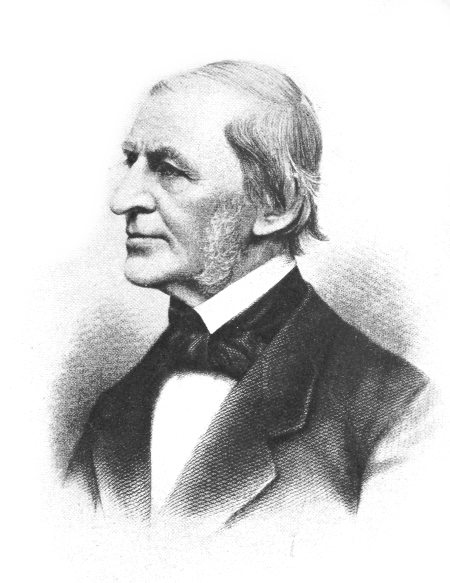
WITH PORTRAIT
INDIANAPOLIS
THE BOBBS-MERRILL COMPANY
PUBLISHERS
Copyright 1921 The Bobbs-Merrill Company
Printed in the United States of America
PRESS OF
BRAUNWORTH & CO.
BOOK MANUFACTURERS
BROOKLYN, N. Y.
INTRODUCTORY
The mind of Emerson was a searchlight revealing
not itself but the various objects on which
it successively turned. An intense and narrow
beam of light would shoot through the darkness
and reveal some object. Then it would pick up
another object which would have its brief moment
of visibility. The landscape was never revealed
in any one view.
The only way to know Emerson is to join him
in his intellectual exercises. In spite of his personal
aloofness I know of no one with whom we
can more readily come to a feeling of intellectual
intimacy. He had no pretensions and no reserves.
In clear sentences he told us what from time to
time he thought. He made no attempt to connect
these thoughts into a coherent system. For any
one else to attempt to do this would be to misrepresent
him.
In the short chapters which follow I have
treated Emerson as a contemporary rather than
as a writer of the last generation. His thought
is as pertinent to the twentieth century as to the
nineteenth. Indeed I think that in many respects
we may be nearer to him than were those
who first listened to him. The prejudices which
he encountered have largely died away. The problems
over which he was meditating remain.
I wish to make grateful acknowledgment to
Houghton Mifflin Company for special permission
to make extracts from their authorized and
copyright editions of Emerson’s works. Also to
Doctor Edward Emerson for the use of his edition
of his father’s journals.
SO Emerson writes of the Persian poet Saadi
who “sat in the sun” and with smiling lips
uttered his thoughts to whosoever chose to listen.
He had nothing to prove, nothing to apologize
for, nothing to lament.
“Denounce who will, who will deny,
And pile the hills to scale the sky;
Let theist, atheist, pantheist,
Define and wrangle how they list,
Fierce conserver, fierce destroyer,—
But thou, joy-giver and enjoyer.”
We are so used to wrangling and defining, to
building systems of thought, and with odious subtlety
criticizing other men’s systems, that we
hardly know how to get along without these intellectual
exercises. What is there to say about
a literary man or a philosopher who cares for
none of these things?
To become acquainted with Emerson we must
discard any conventional idea of the literary man
or the philosopher. We must not become too
much interested in his works. We must be genuinely
interested in the things he was thinking
about, so as to find joy in comparing notes. He
was not a man of letters in the sense of a maker
of books, and he was careless about the articulation
of his thought, and so he is the despair of
those who try to “place” him.
There are those who think they can explain a
man of genius by means of painstaking investigation
of the town he lived in, the folks he knew,
the books he read, the party to which he belonged,
and the family into which he was born. A great
deal can be explained in this way, in fact all those
things in which he was like the thousands of other
persons who were subjected to similar influences.
But what about his genius, which is the one thing
in which he differed from those who were about
him? It happens that it is this difference which
is the matter of vital moment.
There are indeed great men whose difference
from their contemporaries is in the quantity of
their endowment rather than in its essential quality.
They think and feel as does the average
man, they share his opinions and habits of
thought, only they have everything in greater
abundance. They are representative of the time
in which they lived and we can not think of them
as belonging to any other place or period. This
is perhaps what we mean by a great man. The
term is quantitative.
But there are others whose genius is essentially
timeless. They owe very little to their immediate
environment. They might have lived anywhere
or at any time, and the substance and manner
of their thinking would have been very much
the same. Ralph Waldo Emerson was of this
order. In one sense he was a typical American,
more than that he was a New Englander, and his
thought was colored by the experience of the
passing day. But it was only colored. The texture
was not peculiar to America. That he was
born at the beginning of the nineteenth century,
the descendant of a long line of Puritan preachers,
that he was educated at Harvard College, and
became for a time the minister of a Unitarian
Church, that he was interested in what was called
the Transcendental Movement, that he traveled
about the country delivering lyceum lectures, that
he took a worthy part in all sorts of reform movements,
and that he lived in Concord to a good old
age—all these are interesting facts. If we happen
to be interested in Emerson, we like to know
about them. But they do not enable us to know
what manner of man he was, or what gift he may
have for us.
Indeed, if we take such facts too seriously, we
may obscure the real Emerson, for he certainly
did not take them very seriously, and was rather
absent-minded in regard to them. It was one of
his whimsies to profess a great contempt for foreign
travel. Concord was good enough for him
and he could see all that was most worth seeing
without wandering from the vicinity of the town
house. But this was not because he had any unusual
prejudice for a particular locality, but that
he had means of getting away from it that his
neighbors did not possess. One place is as good
as another to one whose mind is free of the
universe.
Emerson’s mind was in the most literal sense
cosmopolitan; he was a citizen of the world, as no
mere traveler can become. The globe trotter is
lured on by the expectation of coming to foreign
parts. Emerson did not think of any portion of
the world as foreign. It was all of a piece.
Wherever he happened to be, he was confronted
by the marvel of the whole which manifested itself
in every part. He was like the citizen in a
great metropolis, who leaves to strangers the transitory
joys of sightseeing. He goes about his
own business, and yet he is gladly conscious all
the time that he belongs to the mighty aggregation.
In dealing with such a person, the biographer
is always more or less of an intruder. To Emerson
the inner life was much more important than
the events and circumstances of the outer life.
To the inner life as disclosed by himself, we may
go directly. Thus only we know what manner of
man he was. He was describing himself when he
wrote:
“There is an external life, which is educated at
school, taught to read, write, cipher, and trade;
taught to grasp all the boy can get, urging him to
put himself forward, to make himself useful and
agreeable in the world, to ride, run, argue, and
contend, unfold his talents, shine, conquer, and
possess.
“But the inner life sits at home, and does not
learn to do things, nor value these feats at all.
’Tis a quiet, wise perception. It loves truth, because
it is itself real; it loves right, it knows nothing
else; but it makes no progress; was as wise
in our first memory of it as now; is just the same
now in maturity, and hereafter in age, as it was in
youth. We have grown to manhood and womanhood;
we have powers, connection, children, reputations,
professions: this makes no account of
them all. It lives in the great present; it makes
the present great. This tranquil, well-founded,
wide-seeing soul is no express-rider, no attorney,
no magistrate: it lies in the sun, and broods on the
world. A person of this temper once said to a
man of much activity, ‘I will pardon you that
you do so much, and you me that I do nothing.’
And Euripides says that ‘Zeus hates busybodies
and those who do too much.’”
All this is quite foreign to the mind of the
typical American. It was not characteristic of
the nineteenth century. It is not easy to explain
why Emerson should have turned up when he did.
If, however, it is necessary for us to “place”
Emerson, and to classify him, it might be as well
to ignore the accident of his birth, and put him
among those with whom his ways of thinking and
speaking would have been most congenial.
He was a philosopher, not in the modern sense,
but in the simpler ancient sense of a lover of
wisdom. He belonged in a way with the men
who in Athens liked to walk about in the gardens
discoursing about the nature of the good, the
true, and the beautiful. Perhaps the Greek dialectic
might have wearied his more direct mind.
It would have seemed a too roundabout way of
getting at moral truths.
I rather think that he would have been more
at home with less sophisticated thinkers, let us
say with the lovers of wisdom in the land of Uz,
who gathered around Job, in his happier days before
Satan mingled with his affairs. It is in the
cool of the evening, and they gather at the gate,
and Job discourses on the pleasant mysteries of
life. And people who had been bearing the heat
and burden of the day, and whose souls were
parched, came for refreshment. In their arid
lives, it was wonderful to meet a man who was
thinking aloud. “My speech dropped upon them,
and they waited for me as for the rain.”
Such speech comes in sentences that are easily
remembered. In the land of Uz people do not
get their ideas from books, but from the lips of
a man who has the gift of direct address.
In process of time scribes gather these scattered
sentences into volumes, and we have collections
of what the Hebrew scholars call Wisdom Literature.
So we have the Proverbs, The Wisdom of
Solomon, and the Wisdom of the Son of Sirach.
They contain the observations and the meditations
of men who had found time for such things.
They are enjoyed by those of kindred temper.
Emerson’s essays belong to this Wisdom Literature.
They are gnomic, that is to say, they
consist of pregnant sentences. Their arrangement
is a matter largely of accident.
Had he lived in the land of Uz, Emerson would
have uttered these sentences to a little group at
the city gate, and trusted to their memories for
the preservation of what was of value. Being an
American in the nineteenth century, he jotted
them down in his note-book when they occurred
to him, and then as opportunity offered presented
them to groups of his fellow-citizens, gathered on
winter evenings in poorly ventilated halls. All
the way from Massachusetts to Iowa he found his
audience, and gave them freely of his best. Then
acting as his own scribe, he gathered the sentences
together into the form familiar to us.
To get his general point of view, read the ninth
chapter of Proverbs:
“Wisdom hath builded her house, she hath
hewn out her seven pillars; she hath killed her
beasts; she hath mingled her wine; she hath also
furnished her table. She hath sent forth her
maidens: she crieth upon the highest places of
the city.... Come, eat of my bread, and
drink of the wine which I have mingled.”
It is all very simple and natural. Wisdom is
the builder. She builds according to her own
plan, and when the house is furnished, she makes
her feast and sends forth her maidens with the
invitation to her table.
And the thinker, who is he? He is not the
architect, he did not plan the building. Nor is
he the high priest ordering the sacrifice. He does
not take himself so solemnly. He is only one of
the invited guests, who has not lost the sense of
wondering curiosity. He can not churlishly sit
down to the feast without being introduced to the
hostess. He wanders about among all the marvels,
seeking her. For, says the son of Sirach,
“It is the chief point of Wisdom to know whose
gift it is.”
In the nineteenth century Ralph Waldo Emerson
lived a life that was as simple as that of the
antique philosophers. He practised an art which
has been thought to be lost—the art of meditation.
The fruit of his meditations he offered to
all those whom it might concern.
Emerson was a man thinking. There is no
Emersonian system of philosophy, only an Emersonian
way of looking at things, and that is perfectly
simple. There is a legal phrase, “without
prejudice,” which is used of parties to a controversy,
implying that should the negotiations fail,
nothing that has passed shall be taken advantage
of thereafter. Thus should the defendant offer
without prejudice to pay half the claim, the plaintiff
can not consider this offer as an admission of
his having the right to some payment.
To read the words of Emerson in the spirit in
which they were written, we must remember to
take what he says without prejudice. Each sentence
makes its own appeal, and it is for us to
determine whether it rings true or false. But we
must not hold him responsible for the inferences
which we may draw. He was not uttering
oracles, though the form might sometimes seem
oracular. He aimed to challenge us rather than
to secure docile acceptance of his ideas. He did
not attempt at any one time to state the whole
truth. He preferred to state a half truth in such
a manner that we should be ready to supply the
other half. Instead of avoiding extreme opinions,
he wished to have them confront each other
in the same mind.
“This is true, that other is true. But our geometry
cannot span the extreme points and reconcile
them. What to do? By obeying each thought
frankly, by harping, or if you will, pounding on
each string, we learn at last its power. By the
same obedience to others’ thoughts, we learn
theirs and then comes some reasonable hope of
harmonizing them.”
The method which he recommended and which
he followed was in the highest degree unsystematic.
It was “the method of taking up in turn
each of the leading topics which belong to our
scheme of human life, and by stating all that is
agreeable to experience on one hand, and doing
the same justice to the opposing facts, the true
limitations will appear. Any excess of emphasis
on one part would be corrected and a just balance
made.”
In other words, Emerson would never assume
the cool judicial attitude in regard to any vital
question. He would speak as an advocate of the
side which for the moment seemed to him most
important. But he would always reserve the
right to state the other side just as strongly. Not
only did he claim the right to take both sides, but
also to change the subject as often as he liked.
He believed that there were certain general principles
which were applicable to all the various professions
and callings. One who was in Milton’s
phrase “a skillful considerer of human things”
had a right to express his opinions, for in spite
of all the modern division of labor, life is still
made up of a few simple elements.
In the following chapters I have made no attempt
to harmonize the views of Emerson. That
would only obscure the sharp outlines of each
separate view. One who would know Emerson
must not read his word with the docility of a
mere disciple. He must rather take it as a game
and match his wits against a quick antagonist.
It is the mental attitude which that unconventional
sixteenth-century preacher, Bishop Hugh
Latimer, sought to inspire in his congregation. In
his famous Sermon on the Cards, he challenged
his congregation to play a game of cards, which
in those days was called “Triumph.”
Quoth Latimer: “Whereas, ye are wont to celebrate
Christmas in playing at cards, I intend by
God’s grace to deal unto you Christ’s cards. The
game we shall play at shall be called the triumph
(trump) which if it be well played, he that dealeth
shall win, the players shall likewise win, and
the standers and lookers on shall do the same, inasmuch
that there is no man that is willing to
play at this Triumph with these cards but that
they shall all be winners, and no losers. Let
therefore every Christian man and woman play
at these cards, that they may have and obtain the
triumph; you must mark also that the triumph
must apply to fetch home with him all the other
cards whatsoever suit they be of. Now then
take ye this first card which must appear and be
shewed to you as followeth.”
In some such way Emerson invites us to join
in his favorite recreation. It is the free play of
thought in which “he that dealeth shall win, the
players shall likewise win and the standers and
lookers on shall do the same.”
CHAPTER II
A DISCRIMINATING OPTIMIST
“I am a willow of the wilderness,
Loving the wind that bent me.”
ONE of the most familiar terms of reproach
in these days is “Victorian.” It is used by
clever literary persons who have rebelled against
the standards of their immediate predecessors.
It implies a certain smugness and self-satisfaction
which is very irritating to persons who are conscious
of the cruel realities of this unfinished
world. The Victorians are supposed to have been
incorrigible optimists who mistook the Fool’s
Paradise in which they lived for the final resting
place of humanity. They were worshipers of the
respectabilities, and were content with the cant of
liberalism as their fathers had been content with
the cant of Toryism.
To-day, however, we are taught that it is our
duty to face the grimmest realities, and not to
flinch when we see something that is ugly and
threatening. We must see how the other half
lives, and we must free ourselves from amiable
delusions.
In turning from the work of our painfully sincere
realists to Emerson, the first impression is
that we are going back to that discredited state
of mind, the early Victorian optimism. For
Emerson faces the existing world with a smiling
face. He takes for granted that there is a friendliness
in its laws, and that the ultimate reality is
not to be feared. He has a frank predilection for
beauty and does not feel it his duty to feed his
imagination on what is ugly and unwholesome.
He is always glad to be alive, and glad to find so
many other creatures alive at the same time.
Sometimes he has a too debonair way of making
light of the evils that are encountered by earnest
people.
But those who look upon the optimism of
Emerson as a part of the conventionalism of his
time are, I think, superficial in their judgments.
In the first place, he was not a Victorian, but an
American, who was not under the spell of the
good queen and her court. No one was less disposed
to imitate the literary conventions then
dominant in England. He was no more a Victorian
than was Abraham Lincoln. There was
nothing smug in his optimism. He was not an
apologist for the existing state of things, nor interested
in proving that this is the best of all
possible worlds. He did not try to make himself
agreeable by calling evil good. He recognized the
existence of an enormous number of bad and
cruel things. “Nature as we know her is no
saint.”
He taught that nature does not coddle us, nor
provide ready-made houses or clothes. She leaves
us to make these things for ourselves. And the
process of experiment is never an easy one. It is
a long and tedious way by which we travel toward
truth. Nature does not tell us what is good for
us; to discover this is part of our experience.
“I compared notes with one of my friends who
expects everything of the Universe and is disappointed,
and I found that I began at the other
extreme, expecting nothing, and am always full
of thanks for moderate blessings.”
So far from denying or seeking to hide the
darker and more painful aspects of the world, he
admitted them and placed them where they belong,
at the beginning. They belong to the realm
of chaos and night.
But the outstanding fact is that there has been
a gradual emergence from chaos. The existence
of man as a reasoning creature becomes more
wonderful as we think of the odds against it. No
good thing can be had without effort.
But the real question is, “Is the effort worth
while?” You may say that it is not. You do not
know whether or not you shall succeed, and therefore
you will not try.
Emerson declares that the effort is most gloriously
worth while. It reveals the joy of creation.
“A man is a golden impossibility. Power keeps
quite another road than the turnpike of choice
and will, namely, the subterranean and invisible
tunnels and channels of life. Life is a series of
surprises and would not be worth taking and
keeping if it were not.... Nature hates calculators,
her methods are saltatory and impulsive....
The mind goes antagonizing on, and never
prospers but by fits. We thrive on casualties....
Every man is an impossibility till he is
born, everything is impossible till we see it a
success.”
At this point it would be well to lay down
Emerson’s essay on Experience and do a little
meditating on the words, “the mind goes antagonizing
on.”
Here is a philosophy that goes behind the old
dispute between the optimist and the pessimist.
The ordinary optimist tries to prove that there is
no real antagonism between the facts of nature
and the ideals of the human soul. Everything is
exquisitely fitted to produce happiness. The pessimist
denies this and insists on the flagrant opposition
between what is and what ought to be. He
arranges a deadly parallel between the world of
the ideals and the world of hard reality.
Emerson answers that there is an antagonism.
The human spirit must not be bullied by that
which lies beneath it. It must assert its sovereignty,
and in its resistance it makes the discovery
of its power. It goes “antagonizing on.”
That is the way of the conqueror.
“The essence of tragedy does not seem to me
to lie in any list of particular evils. After we
have enumerated famine, fever, inaptitude, mutilation,
rack, madness and loss of friends, we have
not yet included the proper tragic element, which
is Terror, and which does not respect definite
evils but indefinite; an ominous spirit which
haunts the afternoon and night, idleness and solitude.”
A low haggard spirit sits by our side, “casting
the fashion of uncertain evils, a sinister presentiment,
a power of the imagination to disclose
things orderly and cheerful and show them in
startling array. Hark, what sounds on the night
wind? the cry of murder in that friendly house,
see those marks of stamping feet, of hidden riot.
The whisper overhead, the detected glance, the
glare of malignity, ungrounded fears, suspicions,
half knowledge and mistakes, darken the brow
and chill the heart of man. And accordingly it
is natures not clear, nor of quick and steady perceptions,
but imperfect characters from which
something is hidden that all others see, that suffer
most from these causes. In those persons who
move the profoundest pity, tragedy seems to consist
in temperament, not in events. There are
people who have an appetite for grief; pleasure
is not strong enough, and they crave pain, Mithridatic
stomachs which must be fed on poisoned
bread, natures so downed that no prosperity
can soothe their ragged and dishevelled desolation.
They mishear and misbelieve, they suspect
and dread. They handle every nettle, and tread
on every snake in the meadow.”
It is here that Emerson made his stand. It is
not necessary for us to apologize for facts or to
attempt to vindicate Eternal Providence. Events
come and we must face them. But the Terror
we must not yield to, this we can overcome.
There is a health of the spirit which may be cultivated
and which makes us immune to evil influences.
The optimism of Emerson was not to be expressed
in the phrase, “looking at the bright side
of things.” That is the lazy man’s optimism.
There is a homelier phrase, “making the best of
it.” Let the circumstances be what they may, the
brave man accepts them resolved to make the best
of them. And the surprise is that when he puts
all his strength into the task, the result is something
better than he had planned. Even when
worst has come to worst, the hero turns upon the
hostile powers and finds the Best which he has
worshiped afar now realized in his own will.
“Trembler, do not whine and chide,
Art thou not also real?
Why shouldst thou stoop to poor excuse;
Turn on the accuser roundly, say,
‘Here am I, here will I abide
Forever to myself soothfast.
Go thou, sweet Heaven, or at thy pleasure stay!’
Already Heaven with thee its lot has cast.”
The most complete expression of Emerson’s
discriminating optimism can be found in his essay
on Fate. Here he states the argument of the
pessimist in the strongest terms. There are forces
at work which bring pain and loss. There are
laws which we can not control. There are tragedies
which are inevitable. But the good man
confronts the evil fate. Emerson believed that
the result of that conflict was the creation of a
higher good than had before been perceived. The
struggle with Fate produced power.
“Thus we trace Fate, in matter, mind, and
morals—in race, in retardations of strata, and in
thought and character as well. It is everywhere
bound or limitation. But Fate has its lord; limitation
its limits; is different seen from above and
from below; from within and from without. For,
though Fate is immense, so is power, which is the
other fact in the dual world, immense. If Fate
follows and limits power, power attends and antagonizes
Fate. We must respect Fate as natural
history, but there is more than natural history.
For who and what is this criticism that pries into
the matter? Man is not order of nature, sack
and sack, belly and members, link in a chain, nor
any ignominious baggage, but a stupendous antagonism,
a dragging together of the poles of
the universe. He betrays his relation to what is
below him—thick-skulled, small-brained, fishy,
quadrumanous—quadruped ill-disguised, hardly
escaped into biped, and has paid for the new
powers by loss of some of the old ones. But the
lightning which explodes and fashions planets,
maker of planet and suns, is in him. On one side,
elemental order, sandstone and granite, rock-ledges,
peat-bog, forest, sea and shore; and, on
the other part, thought, the spirit which composes
and decomposes nature—here they are, side by
side, God and devil, mind and matter, king and
conspirator, belt and spasm, riding peacefully together
in the eye and brain of every man.
“Nor can he blink the free-will. To hazard
the contradiction—freedom is necessary. If you
please to plant yourself on the side of Fate, and
say, Fate is all; then we say, a part of Fate is the
freedom of man. For ever wells up the impulse
of choosing and acting in the soul. Intellect annuls
Fate. So far as a man thinks, he is free.
And though nothing is more disgusting than the
crowing about liberty by slaves, as most men are,
and the flippant mistaking for freedom of some
paper preamble like a ‘Declaration of Independence,’
or the statute right to vote, by those who
have never dared to think or to act, yet it is
wholesome to man to look not at Fate, but the
other way: the practical view is the other. His
sound relation to these facts is to use and command,
not to cringe to them. ‘Look not on Nature,
for her name is fatal,’ said the oracle. The
too much contemplation of these limits induces
meanness. They who talk much of destiny, their
birth-star, etc., are in a lower dangerous plane,
and invite the evils they fear.
“I cited the instinctive and heroic races as
proud believers in Destiny. They conspire with
it; a loving resignation is with the event. But
the dogma makes a different impression, when
it is held by the weak and lazy. ’Tis weak and
vicious people who cast the blame on Fate. The
right use of Fate is to bring up our conduct to
the loftiness of nature. Rude and invincible except
by themselves are the elements. So let man
be. Let him empty his breast of his windy conceits,
and show his lordship by manners and deeds
on the scale of nature. Let him hold his purpose
as with the tug of gravitation. No power, no
persuasion, no bribe, shall make him give up his
point. A man ought to compare advantageously
with a river, an oak, or a mountain. He shall
have not less the flow, the expansion, and the resistance
of these.
“’Tis the best use of Fate to teach a fatal courage.
Go face the fire at sea, or the cholera in
your friend’s house, or the burglar in your own,
or what danger lies in the way of duty, knowing
you are guarded by the cherubim of Destiny. If
you believe in Fate to your harm, believe it, at
least, for your good.
“For, if Fate is so prevailing, man also is part
of it, and can confront Fate with Fate.”
CHAPTER III
THE OPENER OF DOORS
“Be an opener of doors for such as come after
thee and do not try to make the Universe a blind
alley.”—Emerson’s Journal (1841).
THERE are certain minds which have exercised
a vast influence over the thought of
the world, as constructors of intellectual systems.
Their ambition has been to reduce all things to
a formula. They become masters of existing
knowledge and arrange it in orderly fashion. Thus
Thomas Aquinas summed up the thought of the
middle ages in a solid theology to be received by
all who came after him. John Calvin, with lawyer-like
logic, did the same thing for sixteenth-century
Protestantism. Herbert Spencer, with
prodigious industry, gathered an immense number
of facts and attempted to bring them all into
an agreement with his own scientific formula.
Up to a certain point the system-maker is a
helper to all those who would live a reasonable
intellectual life. He shows us where to put our
facts and to a certain degree how to use them.
The difficulty comes when new facts are discovered
which do not fit into the system, or when in
the course of our intellectual development we
come upon a fresh point of view.
Then the system becomes a blind alley. We
are led into it by a perfectly logical process, but
there is no logical way out of it. The mind goes
round and round and is conscious of the futility
of its own effort. The universe is narrowed to
the dimensions of a rigid creed. The system now
shuts out more of reality than it explains.
It is when we become conscious of the dangers
of making the universe a blind alley and becoming
entrapped in rigid forms that we appreciate
the function of philosophers like William James
and Bergson. They are emancipators of the intellect.
In their keen criticism of dogmatic systems
they show us a way out. Reality, they assure
us, is something vaster than any definition
of it.
Emerson belonged to this little company of
emancipators, and he went about his business in
a very simple and yet effective way. He attacked
the assumption that what is usually called consistency
is a virtue. No saying of his is more
often quoted, and more generally misunderstood:
“A foolish consistency is the hobgoblin of little
minds, adored by little statesmen and philosophers
and divines. With consistency a great
soul has nothing to do. He may as well concern
himself with his shadow on the wall. Speak
what you think now in hard words, and to-morrow
speak what to-morrow thinks in hard
words again, though it contradict everything you
said to-day.”
That may be made to seem like a plea for careless
and irresponsible ways of thinking and speaking.
What standard are we to have by which
to test our mental processes? I have heard the
words quoted as if they offered an excuse for intellectual
lawlessness.
We approach Emerson’s serious meaning only
when we emphasize the adjective. It is a foolish
consistency which is the hobgoblin of little minds.
The fundamental question is “consistency with
what?” The little mind is thinking not of reality
but of its own previous utterances. When an
opinion is to be expressed, it says, “This must
be made consistent with what I said yesterday.
Let me see! What did I say yesterday?” Then,
with solemn conscientiousness, yesterday’s statement
is repeated and there is felt the satisfaction
which comes with duty done.
But what if to-day’s fact is really different
from that of yesterday, and can not be expressed
accurately by the same phrase? This possibility
the little mind does not entertain. It will not
allow itself to be contradicted, and so the process
goes on which St. Paul describes, “they measuring
themselves by themselves, and comparing
themselves among themselves, are not wise.”
Emerson’s real plea is for consistency. But
we must be consistent not with a form of words
which we have adopted, but with a living reality
which we encounter day by day.
What have you seen to-day? What have you
done? What new aspect of the universe has become
clear to you? What are the facts revealed
in your present consciousness? These are the
questions that are asked of a person who is using
his mind. And his answers are valuable only as
they are simple and direct.
In a court of justice this simplicity is required.
The witness who is trying to make his answers
consistent with one another and with a preconceived
theory is sure to come to grief. The cross-questioner
will discover flaws in the evidence.
The only safe course is to tell the facts as they occurred.
Most of our intellectual confusion comes from
the attempts to arrange our opinions according
to an artificial order. The catechism is arranged
in advance of experience. The questions follow
one another in logical order, and each question
has its appropriate answer. It is all very
satisfactory until the answers are sharply challenged.
How do we happen to know so much?
How are we able to answer so glibly?
To Emerson the chief value of a catechism lay
in the questions, not in the answers. That the
deepest and most persistent questions have no satisfactory
answers did not depress him. It only
proved that both the mind that asks and the universe
which delays the answer are greater than we
thought. Their meaning can not be expressed in
any form of words. He hears the Sphinx saying
to the Soul:
“Thou art the unanswered question;
Couldst see thy proper eye,
Alway it asketh, asketh;
And each answer is a lie.
So take thy quest through nature,
It through thousand natures ply;
Ask on, thou clothed eternity;
Time is the false reply.”
The joy of the follower of Truth and Beauty
is wonderfully expressed in the little poem called
“Forerunners.” We are out-of-doors, and the
air is bracing, and the distant hills are alluring.
What does it matter that we do not catch up with
our “happy guides”? It is enough that we are
free to follow. Let others sing of the satisfactions
of achievement. Emerson is satisfied with
a life that is a continual quest.
“Long I followed happy guides,
I could never reach their sides;
Their step is forth, and, ere the day
Breaks up their leaguer, and away.
Keen my sense, my heart was young,
Right good-will my sinews strung,
But no speed of mine avails
To hunt upon their shining trails.
On and away, their hasting feet
Make the morning proud and sweet;
Flowers they strew—I catch the scent;
Or tone of silver instrument
Leaves on the wind melodious trace;
Yet I could never see their face.
On eastern hills I see their smokes,
Mixed with mist by distant lochs.
I met many travellers
Who the road had surely kept;
They saw not my fine revellers,—
These had crossed them while they slept.
Some had heard their fair report,
In the country or the court.
Fleetest couriers alive
Never yet could once arrive,
As they went or they returned,
At the house where these sojourned.
Sometimes their strong speed they slacken,
Though they are not overtaken;
In sleep their jubilant troop is near,—
I tuneful voices overhear;
It may be in wood or waste,—
At unawares ’tis come and past.
Their near camp my spirit knows
By signs gracious as rainbows.
I thenceforward, and long after,
Listen for their harp-like laughter,
And carry in my heart, for days,
Peace that hallows rudest ways.”
It is not merely the poetic imagination which
opens the doors into an enchanted country where
one may wander endlessly. The sober reason has
also an emancipatory power. There are realities
which lie beyond the limits which the dogmatist
defines. They may not be logically justified but
they are nevertheless a part of the order of the
universe. When we cease to dogmatize we become
conscious of an order more wonderful than
that which we had imagined possible. Things
exist side by side which we had supposed to be
absolutely incompatible. We can not logically
reconcile them, but there they are.
“The world refuses to be analyzed by addition
and subtraction. When we are young, we spend
much time and pains in filling our note-books
with all definitions of Religion, Love, Poetry,
Politics, Art, in the hope that, in the course of
a few years, we shall have condensed into our
encyclopedia the net value of all the theories at
which the world has yet arrived. But year after
year our tables get no completeness, and at last
we discover that our curve is a parabola, whose
arcs will never meet.
“Neither by detachment, neither by aggregation,
is the integrity of the intellect transmitted
to its works, but by a vigilance which brings the
intellect in its greatness and best state to operate
every moment. It must have the same wholeness
which nature has. Although no diligence can rebuild
the universe in a model, by the best accumulation
or disposition of details, yet does the world
reappear in miniature in every event, so that all
the laws of nature may be read in the smallest
fact. The intellect must have the like perfection
in its apprehension and in its works.”
Along with Emerson’s insistence on an absolute
freedom in thinking we must remember his emphasis
on the principle of identity which he discovers
everywhere. The universe, he continually
tells us is not a blind alley, neither is it a mere
welter of conflicting forces. It is marvelously
complicated, but touch it at any point and you will
find it consistent with itself. Could we understand
one part of it we would have the key to all
mysteries.
“The universe is represented in every one of
its particles. Everything in nature contains all
the powers of nature. Everything is made of one
hidden stuff; as the naturalist sees one type under
every metamorphosis, and regards a horse as a
running man, a fish as a swimming man, a bird
as a flying man, a tree as a rooted man. Each
new form repeats not only the main character of
the type, but part for part all the details, all the
aims, furtherances, hindrances, energies, and
whole system of every other. Every occupation,
trade, art, transaction, is a compend of the world
and a correlative of every other. Each one is an
entire emblem of human life; of its good and ill,
its trials, its enemies, its course, and its end. And
each one must somehow accommodate the whole
man, and recite all his destiny.
“The world globes itself in a drop of dew. The
microscope cannot find the animalcule which is
less perfect for being little. Eyes, ears, taste,
smell, motion, resistance, appetite, and organs of
reproduction that take hold on eternity—all find
room to consist in the small creature. So do we
put our life into every act. The true doctrine of
omnipresence is, that God reappears with all his
parts in every moss and cobweb. The value of
the universe contrives to throw itself into every
point. If the good is there, so is the evil; if the
affinity, so the repulsion; if the force, so the limitation.”
CHAPTER IV
THE PARISH OF YOUNG MEN
“My parish is young men inquiring their way.”
EMERSON’S parish did not include all
young men. Indeed he was very ill at ease
with the typical “young person.” And there
are many anecdotes which indicate that the young
person shared the embarrassment. The gregariousness
of youth with its tumultuous mass movements
were rather appalling to one of his temperament.
Nor was he fitted for the difficult rôle
of spiritual adviser.
Emerson’s widely scattered parish was made
up of another kind of young men. They were
young men who were not seeking to find out his
way, but their own. He encouraged them in it.
That made them his debtors for life.
These parishioners of his could not possibly be
gathered into one congregation. They formed no
cult or party. Each was so absorbed in his own
special endeavor that he had little time to make
the acquaintance of his fellow parishioner, but
each in the formative period of his life had received
the stimulus he most needed. He had been
bewildered by the conflicting counsels of his elders.
Each counsellor had said, “Be like me.”
Then one clear voice had suggested, “Why not be
yourself?”
The suggestion was so unexpected and yet so
reasonable that it was acted upon. The young
man found himself, which is the one discovery
that counts.
America prides itself on being the land of the
free. We have had many political emancipators,
but the roll of intellectual emancipators is short.
Having dethroned kings, we live under the fear
of public opinion. The aggregate mind tyrannizes
over the individual intellect. There is a deadly
average which it is not considered safe for one
to pass.
To his parish of young men Emerson was always
preaching that the world is in dire need of
men with fresh insight who are not satisfied with
things as they are. The “average man” should
not be content with the average attainment. He
has within him powers which rightly used could
lift him far above his present condition. He is,
and of right ought to be, a free and independent
soul. A decent respect for the opinion of the
world demands that he should declare his independence
in unmistakable terms.
“What strikes us in the fine genius is that
which belongs of right to every one. A man
should know himself for a necessary actor. A
link was wanting between two craving parts of
nature, and he was hurled into being as the bridge
over that yawning need, the mediator betwixt two
else unmarriageable facts. His two parents held
each of one of the wants, and the union of foreign
constitutions in him enables him to do gladly
and gracefully what the assembled human race
could not have sufficed to do. He knows his materials;
he applies himself to his work; he can not
read, or think, or look, but he unites the hitherto
separated strands—into a perfect cord. The
thoughts he delights to utter are the reason of his
incarnation. Is it for him to account himself
cheap and superfluous, or to linger by the wayside
for opportunities? Did he not come into being
because something must be done which he and
no other is and does? If only he sees, the world
will be visible enough. He need not study where
to stand, nor to put things in favorable lights; in
him is the light, from him all things are illuminated
to their centre. What patron shall he ask
for employment and reward? Hereto was he
born, to deliver the thought of his heart from the
universe to the universe, to do an office which
nature could not forego, nor he be discharged
from rendering, and then immerge again into
the holy silence and eternity out of which as a
man he arose. God is rich, and many more men
than one he harbours in his bosom, biding their
time and the needs and the beauty of all. Is not
this the theory of every man’s genius or faculty?
Why then goest thou as some Boswell or listening
worshipper to this saint or to that? That is the
only lese-majesty. Here art thou with whom so
long the universe travailed in labor; darest thou
think meanly of thyself whom the stalwart Fate
brought forth to unite his ragged sides, to shoot
the gulf, to reconcile the irreconcilable?”
As for the chill wisdom of age with its timid
counsels, let the young man defy it. Length of
days does not bring wisdom unless it is accompanied
by a power of spiritual rejuvenation, and
then it becomes the wisdom of perpetual youthfulness.
“Why should we import rags and relics into
the new hour? Nature abhors the old, and old
age seems the only disease; all others run into
this one. We call it by many names—fever, intemperance,
insanity, stupidity, and crime; they
are all forms of old age; they are rest, conservatism,
appropriation, inertia, not newness, not
the way onward. We grizzle every day. I see
no need of it. Whilst we converse with what is
above us, we do not grow old, but grow young.
Infancy, youth, receptive, aspiring, with religious
eye looking upward, counts itself nothing, and
abandons itself to the instruction flowing from
all sides. But the man and woman of seventy
assume to know all, they have outlived their hope,
they renounce aspiration, accept the actual for the
necessary, and talk down to the young. Let them,
then, become organs of the Holy Ghost; let them
be lovers; let them behold truth; and their eyes
are uplifted, their wrinkles smoothed, they are
perfumed again with hope and power. This old
age ought not to creep on a human mind. In
nature every moment is new; the past is always
swallowed and forgotten; the coming only is sacred.
Nothing is secure but life, transition, the
energizing spirit. No love can be bound by oath
or covenant to secure it against a higher love.
No truth so sublime but it may be trivial to-morrow
in the light of new thoughts. People
wish to be settled; only as far as they are unsettled
is there any hope for them.”
The reader will observe that Emerson in the
midst of his praise of the spirit of youth gives a
sly dig at one of the foibles of his parishioners.
There is a quality of bumptiousness which is
often found in early life. Emerson treats it as
a kind of premature senility. “Whilst we converse
with what is above us we do not grow old.”
Conversely the person who cannot look up religiously
to something above his present attainments
had aged rapidly. A person may be a dotard while
yet in the twenties. This was a sobering thought
not unfrequently presented to the parish of young
men.
CHAPTER V
SPENT THE DAY AT ESSEX JUNCTION
“August 16, 1868. Came home last night from
Vermont with Ellen. Stopped at Middlebury on the
11th, Tuesday, and read my discourse on Greatness,
and the good work and influence of heroic scholars.
On Wednesday spent the day at Essex Junction,
and traversed the banks and much of the bed of the
Winooski river, much admiring the falls, and the
noble mountain peaks of Mansfield and Camel’s
Hump (which there appears to be the highest), and
the view of the Adirondacks across the lake.”
ONE intent on becoming intimate with Emerson
might well postpone reading the
Oversoul, till he had meditated on the text,
“Spent the Day at Essex Junction.” Perhaps no
junction point in all New England has been the
innocent cause of more vituperation than Essex
Junction. Here, for more than a generation, impatient
people have alighted and waited for trains
which were not arranged for their convenience.
To the commercial traveler, Essex Junction represents
a sheer waste of time. To the summer
tourist it means a postponement of enjoyment.
It is a place on the way to somewhere else.
But to Emerson, Essex Junction was not conceived
of as a point of departure until the hour
came when he must actually depart. This was
not till evening. In the meantime, he was living
in Essex Junction rather than merely passing
through it. There was no hurry, so that he had
ample time to enjoy the banks of the Winooski
river and the view of the distant mountains.
Emerson was on the way to Mount Mansfield,
at which he arrived in due time. The next morning
at the Mountain Hotel “a man went through
the house ringing a loud bell and shouting ‘Sunrise,’
and everybody dressed in haste and went
down to the piazza.” Emerson joined the eager
procession and had his look with the rest of them.
“After many sharp looks at the heavens and
earth, we descended to breakfast. I found in this
company many agreeable people.”
In this recital you have a glimpse of his philosophy
of life. Essex Junction, Mount Mansfield
and the troop of fellow-boarders who
snatched a hasty sunrise on the way to breakfast
were not all alike. In fact, they were quite
different. But they were all equally real. The
contemplation of them absorbed successive moments
of his conscious life. Each for a little
while occupied the foreground of his mind and
became the representative of the cosmos. Each
in its place and in its time was interesting. When
it came to the question which was the most interesting,
he would let them fight it out among
themselves.
This was the philosophy of the Mountain and
the Squirrel.
“I am not so large as you,
You are not so small as I
And not half so spry.”
That talents differ is the fact on which we must
agree before there can be any toleration or appreciation.
Most of us have a bad habit of taking
a personal preference and elevating it into a universal
standard of value. Each new object is
weighed in the balance and found wanting. We
say, this is not that, and therefore it is not worth
our attention. The word “discrimination” takes
on a hostile meaning. We are likely to say “discriminate
against.” The word “criticize” has
also a suggestion of unfriendliness, for it is concerned
with the perception of differences.
Emerson’s habitual point of view was that of
appreciative discrimination. This is not that, of
course not; it is quite different—that is what
makes it interesting. Even where the tubs look
alike, it is pleasant to consider that each stands on
its own bottom.
What is the most important place in all the
world? For you it is the place where you actually
are at this moment. This is the only point
from which at this particular time the universe
is visible to you. If you are truly alive, you do
not need a man with a bell to summon you to the
sunrise. The day has its clear call.
“The inevitable morning
Finds them who in cellars be
And be sure that all-loving Nature
Will smile in a factory.
Yon ridge of purple landscape,
Yon sky beneath the walls,
Hold all the hidden wonders
In their scanty intervals.”
There is a curious restlessness which is often
mistaken for idealism. Not finding satisfaction
in our real environment, we are filled with the
desire to be somewhere else. When this restlessness
becomes chronic, there is “that driven feeling”
which transforms the pursuit of happiness
into a hurried flight from unhappiness. Even
our holidays become nerve-destroying tasks, as
with jaded minds we are carried about to the
places where we wait for sensations that do not
come. And with our eyes on our watches, we
know that we must hurry if we are not to miss
the next sight that we have paid for.
Palestine was not a tourist country in the days
when the author of Ecclesiastes wrote of the various
vanities he had seen under the sun; else he
might have added a lamentation over the futility
of an empty mind going about in search of culture.
This is a vanity I have seen. I have seen
a rich, foolish man who came to a city strange
and old, and that had a great history. Yet did
he not seek to know what that history was, nor
did he save an hour for quiet meditation on what
he saw. He spent much gold to come to the
place where the city was, and when he was there
he worried over the delay in getting away. And
that foolish rich man remembered nothing of the
city except a dinner which was not so good as he
might have had at home.
Because he found so much to interest him at
home Emerson takes a whimsical pleasure in
speaking against foreign travel as a means of culture.
But he evidently had in mind the excessive
value that was in his day put upon Europe
and its traditions.
His disparagement of travel did not arise from
any incuriosity. He had an eager desire to see all
the world. But he was like a small boy who, having
learned that the procession is to pass by his
own house, takes his position on his own door
step. Why should he go away when by staying
at home he is sure to see the show?
“It is for want of self-culture that the superstition
of Travelling, whose idols are Italy, England,
Egypt, retains its fascination for all educated
Americans. They who made England, Italy,
or Greece venerable in the imagination did so by
sticking fast where they were, like an axis of the
earth. In manly hours, we feel that duty is our
place. The soul is no traveller; the wise man
stays at home, and when his necessities, his duties,
on any occasion, call him from his house, or into
foreign lands, he is at home still, and shall make
men sensible by the expression of his countenance,
that he goes the missionary of wisdom and
virtue, and visits cities and men like a sovereign,
and not like an interloper or a valet.
“I have no churlish objection to the circumnavigation
of the globe, for the purposes of art,
of study, and benevolence, so that the man is first
domesticated, or does not go abroad with the
hope of finding somewhat greater than he knows.
He who travels to be amused, or to get somewhat
which he does not carry, travels away from himself,
and grows old even in youth among old
things. In Thebes, in Palmyra, his will and mind
have become old and dilapidated as they. He
carries ruins to ruins.
“Travelling is a fool’s paradise. Our first journeys
discover to us the indifference of places. At
home I dream that at Naples, at Rome, I can be
intoxicated with beauty, and lose my sadness. I
pack my trunk, embrace my friends, embark on
the sea, and at last wake up in Naples, and there
beside me is the stern fact, the sad self, unrelenting,
identical, that I fled from. I seek the Vatican,
and the palaces. I affect to be intoxicated
with sights and suggestions, but I am not intoxicated.
My giant goes with me wherever I go.”
There are times when the medium at a seance excuses
herself for her inability to put the sitter in
communication with departed spirits. She does
not know what is the matter, but “the conditions
are not right.”
Every traveler has experienced a similar difficulty.
He has spent time and money to go to a
famous spot; his body has been transported
but not his soul. There are inhibitions that prevent
imaginative communion with the mighty
past.
Emerson preferred to be in Essex Junction
when the spiritual conditions were right rather
than in Rome when his mind was not properly
functioning. Essex Junction is a wonderful place
if one happens to be in the mood for seeing it.
CHAPTER VI
FRIENDSHIP WITHOUT INTIMACY
“There is a strange face in the Freshman class
whom I should like to know very much. He has a
great deal of character in his features and should
be a fast friend or a bitter enemy. His name is
——. I shall endeavor to become better acquainted
with him and wish, if possible, to recall at
a future period the singular sensations which his
presence produced in me.”—Journal, 1820.
EMERSON was an upper classman, albeit
only seventeen years of age, when he wrote
thus of Martin Gay of Hingham, afterward a
distinguished analytical chemist living in Boston.
Emerson’s son, commenting on this passage, says
that there is no evidence that his father, either in
college or afterward, ever made any advances toward
further acquaintance. It does not appear
that he ever really knew him, yet he was always
interested to hear of him, and was grieved at his
untimely death in 1850. The two men were entirely
different in their temperaments and interests,
Gay being known by his classmates as “cool
Gay.”
This capacity for shy admirations for his opposites,
and for friendly interests in people with
whom he would find it difficult to keep up a conversation,
was characteristic of Emerson. He
was sometimes painfully conscious of it as a barrier
which prevented him from really “getting at”
people whom he wished to know. At other times
he defended the attitude that was natural to him,
and so made a virtue of his necessity.
To most persons, Emerson’s essay on Friendship
is unsatisfactory as an exposition of the subject,
though it is very revealing of the author’s
state of mind. “Friendship,” says Emerson, “like
the immortality of the soul, is too good to be believed.”
And his account of friendship has a fine
aloofness that befits the love for a disembodied
spirit rather than a warm attachment to an imperfect
creature of flesh and blood.
One of the conditions that Emerson would
make in a treaty of friendship would be that
neither party should trespass on the personality
of others. It was friendship by “absent treatment.”
“Why should we desecrate noble and beautiful
souls by intruding on them? Why insist on rash
personal relations with your friend? Why go to
his house, and know his mother and brother and
sisters? Why be visited by him at your own?
Are these things material to our covenant? Leave
this touching and clawing. Let him be to me a
spirit.
“To my friend I write a letter, and from him
I receive a letter. That seems to you little. It
suffices me.
“You shall not come nearer to a man by getting
into his house. We see the noble afar off, why
should we intrude?”
In all this we feel that Emerson was riding his
high horse. It is a shy man’s way of comforting
himself for something that he unfortunately lacks,
but which he would give anything to possess. He
was, to use Paul’s phrase, glorying in his infirmities.
That which he was praising was not friendship
but sublimated hero-worship, which is quite
a different thing.
In the privacy of his note-books he treats his
infirmity in quite a different spirit. He laments
the fact that he was not a good mixer. Like so
many New Englanders, it was difficult for him to
establish personal relations.
At the age of twenty, when looking forward
to the ministry, he makes this self-criticism:
“Every comparison of myself with my mates
that six or seven, perhaps sixteen or seventeen,
years have made has convinced me that there
exists a signal defect of character which neutralizes
in great part the just influence my talents
ought to have.” He expresses it as the “absence
of common sympathies.” By this he seems to
mean the absence of the material for “small talk.”
“Its bitter fruits are a sore uneasiness in the company
of most men and women, a frigid fear of
offending and jealousy of disrespect, an inability
to lead and an unwillingness to follow the current
conversation.... In my frequent humiliation
I am compelled to remember the poor boy
who cried, ‘I told you, father, they would find
me out.’” He sums up his youthful confession,
“What is called a warm heart, I have it not.”
When he was sixty, he was conscious of the
same limitation. He jotted down in his note-book:
“Barriers of man impassable. They who
should be friends cannot pass into each other.
Friends are fictitious, founded on some momentary
experience. But what we want is consecutiveness.”
All this is not evidence of lack of a warm heart.
It was rather a lack of an easy way of expressing
what he felt. The chill was not in himself, but
in the atmosphere that was about him. But there
was evidently a personal experience behind this
generalization about society.
“Society, like wealth, is good for those who understand
it. It is a foolish waste of time for
those who do not. It seems impossible for any
one to expand in a crowd to his natural dimensions.
All character seems to fade away from all
the accomplices. Every woman seems suffering
for a chair, and you accuse yourself and commiserate
those you talk to.”
There is something delightfully amusing in
Emerson’s analysis of his own failure as a conversationalist.
“It seemed, as I mused in the streets of Boston
on the unpropitious effect of the town on my
humor, that there needs a certain deliberation and
tenacity in the entertainment of a thought—a certain
longanimity to make that confidence and stability
which can meet the demands others make
on us. I am too quick-eyed and unstable. My
thoughts are too short, as they say my sentences
are. I step along from stone to stone over the
Lethe which gurgles around my path, but the
odds are that my companion encounters me just
as I leave one stone, and before my foot has well
reached the other, and down I tumble into Lethe
water. But the man of long wind who receives
his thought with a certain phlegmatic entertainment,
and unites himself to it for the time, as a
sailor to a boat, has a better principle of poise
and is not easily moved from the perpendicular.”
With the remarkable group of men who made
Concord famous, Emerson was on terms of familiar
friendship. For Bronson Alcott he cherished
an admiration which seems extravagant.
He loved to walk and talk with the shy poet,
Ellery Channing. Thoreau was for two years an
inmate of Emerson’s house, and the two men
worked in the garden together. In Boston Emerson
was a member of the Saturday Club, where
he continually met Longfellow, Holmes, Agassiz
and the rest.
Yet he was not a man to shine in such society.
His mind was contemplative, rather than conversational.
He did not care to “hold his own” in
a controversy. Why should he? “Emerson was
a good citizen and a good neighbor with his neighbors,
always went to town meeting and listened
intently to the strong spirits who ruled the discussions,
without taking any part in them himself.”
The most notable of his friendships was with
Thomas Carlyle. The correspondence between
them continued for many years, and there were
many expressions of esteem. The friendship was
a real one, but the fact that the broad Atlantic
lay between them was a great aid to their good
fellowship. For though the two men liked each
other, they did not like the same things.
Carlyle threatened to visit America, and we
may be sure that he would not have enjoyed the
visit. Emerson’s cheery faith in the common
man seemed to the testy Scotchman a bit of sentimentalism.
They both believed in hero-worship,
but they did not worship the same heroes. New
England Transcendentalism did not agree with
Carlyle’s temper.
Emerson sent a copy of the Dial to his friend.
Carlyle writes, “The Dial No. 1 came duly. Of
course I read it with interest; it is the utterance
of what is youngest in your land, pure, etherial
as the voices of the morning! And yet—you
know me—for me it is too etherial, speculative,
theoretic; all theory becomes more and more confessedly
inadequate, untrue, unsatisfactory, almost
a kind of mocking to me.”
“Faithful are the wounds of a friend.” And
these tokens of friendship were seldom absent
from the letters that passed between the two.
Carlyle writes of the impression Emerson’s essays
made upon him:
“It is a sermon to me as all your deliberate utterances
are; a real word which I feel to be such—alas,
almost or altogether the one such, in a
world all full of jargons, hearsays, echoes and
vain noises which cannot pass with me for words.
This is a praise far beyond any ‘literary’ one;
literary praises are not worth repeating in comparison.
For the rest I have to object still (what
you will call objecting to the Law of Nature) that
we find you a speaker indeed, but as it were a
soliloquizer on the eternal mountain tops only, in
vast solitudes where men and their affairs lie all
hushed in a dim remoteness; and only the man
and the stars are visible, whom so fine a fellow
seems he, we could perpetually punch into and say,
‘Why won’t you come and help us then? We
have terrible need of one man like you down
among us! It is cold and vacant up there; nothing
paintable but rainbows and emotions; come
down and you shall do life pictures, passions,
facts—which transcend all thought, and leave it
stuttering and stammering!’ To which he answers
that he won’t, can’t and doesn’t want to (as
the cockneys have it): so I leave him and say,
‘You Western Gymnosophist! Well, we can afford
one man for that, too.’”
This is all very well for a friendship carried on
by correspondence. Carlyle thinks of himself as
a man who is dealing with concrete realities, while
Emerson is dealing in remote abstractions.
But had they lived in the same town with
opportunity to discuss the practical questions of
politics and social welfare, they would have come
into collision. The fact was that Emerson was as
much interested in concrete realities as Carlyle,
but he came to different conclusions in regard to
them. Carlyle believed in government by strong
men, like Frederick the Great and Cromwell.
Democracy was an abomination to him. A statesman
like Lincoln, who thought of himself as an
interpreter of the popular will, was altogether
outside his sympathy. Liberalism of the modern
sort seemed to him utter weakness and muddleheadedness.
Emerson, though he preferred to write about
principles rather than their immediate applications,
was never in doubt as to which side he was
on. The principles which he preached were the
ones which were being applied by the democratic
reformers of his own day. He believed in the
movements at which Carlyle scoffed. Answering
his friend’s criticism, he says:
“What you say now and heretofore respecting
the remoteness of my writing and thinking from
real life, though I hear substantially the same
criticism made by my countrymen, I do not know
what it means.”
Indeed, Emerson’s idea of real life differed so
profoundly from Carlyle’s that their minds seldom
met. To him the laws of the universe were
not only the great realities, but the most intimate
realities. Every person and every action illustrated
them. He believed in the principles of
democracy which Carlyle scorned. These fundamental
differences would have been accentuated
in daily intercourse. The visit of the Scotchman
to New England never took place, and it was well
that it did not; “for,” says Emerson, “the higher
the style we demand of friendship the less easy to
establish it in flesh and blood.”
CHAPTER VII
I HATE THIS SHALLOW AMERICANISM
“I hate this shallow Americanism which hopes to
get rich by credits, to get knowledge by raps on midnight
tables, to learn the economy of mind by phrenology,
or skill without study, or mastery without
apprenticeship, or sale of goods through pretending
they will sell, or power through making believe you
are powerful. They think they have got it, but they
have got something else.”
A CONTEMPORARY of Emerson was Judge
Haliburton of Nova Scotia, the creator of
Sam Slick. Mr. Slick of Slickville, Connecticut,
was a typical Yankee as seen by neighbors across
the northern border. He was shrewd, enterprising,
inquisitive, good-humored, and in his way religious.
He was an ardent patriot, with his eye on
the main chance. He was good at a bargain, and
still better at an argument in defense of his rectitude
in the transaction. He was no hypocrite, for
he saw no reason to pretend to be something
which he was not. He was simply a plain American
citizen and he didn’t care who knew it. There
were thousands in Connecticut just as good as he
was. He felt it a privilege to represent the Great
Republic.
The blatant Americanism of Sam Slick must
be compared with the solid English complacency
of Mr. Podsnap. Both were caricatures of national
failings which were easily recognizable.
Emerson was enough of an American to understand
Sam Slick and to laugh with him as well
as to laugh at him, but he recognized that this
shallow Americanism had its dangers.
The very ease with which the American could
make a living made him overestimate his own
powers. He took the gifts of nature in a new
continent for rewards for his own merit. Bold
as he was and self-assertive in little things, he
lacked in any standard by which to judge himself.
He was gregarious in his mental habits,
and curiously averse to strenuous intellectual
effort.
“The timidity of our public opinion is our disease,
or shall I say the publicness of our opinion,
the absence of private opinion. Good nature is
plentiful but we want justice with heart of steel to
fight down the proud.” America has not produced
a sufficient number of men who will instinctively
throw themselves “on the side of weakness,
of youth, of hope; on the liberal, on the
expansive side, never on the defensive, the conserving,
the timorous, the lock-and-bolt system.”
“I find no expression in our State papers or
legislative debate in our lyceums or churches,
especially in our newspapers, of a high national
feeling, no lofty counsels that rightfully stir the
blood. I speak of those organs which can be presumed
to speak a popular sense. They recommend
conventional virtues, whatever will earn
and preserve property; always the capitalist, the
college, the church, the hospital, the theater, the
hotel, the road, the ship, the capitalist, whatever
goes to secure, adorn, enlarge these is good; whatever
jeopardizes any of these is damnable.”
This description of a familiar kind of Americanism
in 1844 is easily recognizable in 1920.
The shallow reformers are equally familiar.
“Many a reformer perishes in the removal of
rubbish, and that makes the offensiveness of this
class. They are partial, they are not equal to the
work they pretend. They lose their way in the
assault on the kingdom of darkness; they expend
all their energy on some accidental evil, and lose
their sanity and power of benefit. It is of little
moment that one or two or twenty errors in our
social system be corrected, but of much that the
man be in his senses.”
No foreign critic has ever pointed out more
clearly the faults of the American temperament.
But shallow Americanism, with its boastfulness
and its conventionality, can not blind him to the
ideal America that lies far deeper. It is yet in the
making.
“We cannot look on the freedom of this country,
in connection with its youth, without a presentiment
that here shall laws and institutions
exist on some scale of proportion to the majesty
of nature. To men legislating for the area betwixt
the two oceans, betwixt the snows and the
tropics, somewhat of the grandeur of nature will
infuse itself into the code. A heterogeneous
population crowding on all ships from all corners
of the world to the great gates of North America,
namely, Boston, New York, and New Orleans,
and thence proceeding inward to the prairie and
the mountains, and quickly contributing their
private thought to the public opinion, their toll
to the treasury, and their vote to the election, it
cannot be doubted that the legislation of this
country should become more catholic and cosmopolitan
than that of any other. It seems so
easy for America to inspire and express the most
expansive and humane spirit; new-born, free,
healthful, strong, the land of the labourer, of the
democrat, of the philanthropist, of the believer,
of the saint, she should speak for the human race.
It is the country of the future. Like Washington,
proverbially ‘the city of magnificent distances,’
through all its cities, States, and Territories, it is
a country of beginnings, of projects, of designs,
and expectations.
“Gentlemen, there is a sublime and friendly
Destiny by which the human race is guided—the
race never dying, the individual never spared—to
results affecting masses and ages. Men are
narrow and selfish, but the Genius or Destiny is
not narrow, but beneficent. It is not discovered
in their calculated and voluntary activity, but in
what befalls, with or without their design.”
Emerson believed as much as the politicians of
his day in Manifest Destiny. But he hoped for
the country a destiny greater than that which the
politicians planned. The commercial progress of
the day was something to rejoice in as a part of
a great onward movement. But commercialism
was not the end toward which the nation was
moving.
“Our part is plainly not to throw ourselves
across the track, to block improvement, and sit
till we are stone, but to watch the uprise of successive
mornings, and to conspire with the work
of new days. Government has been a fossil; it
should be a plant. I conceive that the office of
statute law should be to express, and not to impede
the mind of mankind. New thoughts, new
things. Trade was one instrument, but Trade
is also for a time, and must give way to something
broader and better, whose signs are already
dawning in the sky.”
CHAPTER VIII
THE POET
“I am born a poet—of a low class without doubt,
but a poet. That is my nature and vocation. My
singing, to be sure, is very husky and is for the most
part in prose. Still I am a poet in the sense of a perceiver
and dear lover of the harmonies that are in
the soul and in matter, and specially of the correspondence
between them.”
EMERSON’S estimate of his poetical gifts
was given in a letter to his future wife.
When he so clearly points out his limitations, it
seems ungracious to agree with his critical judgment,
but one must do so. He was not a poet
in the sense of a maker of mighty harmonies. He
did not walk like Milton, with his “singing robes”
about him. But he was a poet in the sense of
being a perceiver and dear lover of natural harmonies,
and he made us sharers of his perception.
His singing voice was certainly very husky.
Only a few of his poems stand the test of being
read aloud with perfect pleasure. Frequently we
are conscious of a metrical jolt. Not only is the
ear pained by dissonance, but there is a sense that
the poetical inspiration has suddenly given out.
I am inclined to think that Emerson would
have been happier if he had frankly adopted “free
verse.” For though he was a poet, he was not a
natural rhymster. In “Merlin” he makes a declaration
of independence which would please our
new poets.
“Great is the art
Great be the manners, of the bard.
He shall not his brain encumber
With the coil of rhythm and number.”
And then he weakens his declaration by adding:
“But, leaving rule and pale forethought,
He shall aye climb
For his rhyme.”
The critic is tempted to ask, Why not let the
rhyme go rather than climb for it? Emerson’s
rhymes were often most unhappy, and had the
air of being forced into service.
Read his “May Day.” You will find jingling
rhymes like
“Not for a regiment’s parade,
Nor evil laws or rulers made,
Blue Walden rolls its cannonade.”
We have such lines as these:
“Every tree and stem and chink
Gushed with syrup to the brink.
The air stole into the streets of towns,
Refreshed the wise, reformed the clowns.”
After these rhymes that are easy to a fault, we
have others that are difficult: as almanac and
coming-back, Superior Lake and Mackinac, cavaliers
and travelers. Sometimes an obsolete word
is introduced for the sake of an imperfect rhyme:
“They shook the snow from hats and shoon,
They put their April raiment on.”
All this needs to be said at the beginning. It
is when full allowance is made for his poetical
lapses that we are prepared to appreciate Emerson’s
real poetical gifts. While he had no power
of sustained verbal melody, he has given an unusual
number of perfect lines.
In “Voluntaries” we have a succession of commonplace
verses, and then come upon the lines
that seemed chiseled by some great artist, austerely
beautiful and true:
“So nigh is grandeur to our dust,
So near is God to man,
When Duty whispers low, Thou must,
The Youth replies, I can.”
In “Forerunners” one would not change a
word. There is a gladness of adventure.
“Each and All,” “The Problem,” “Days,” are
sources of endless delight. In “Two Rivers,”
Emerson expresses melodiously his poetical creed.
He is a perceiver and dear lover of the correspondence
between the outer and the inner worlds.
The little river that runs through Concord is the
symbol of the eternities.
“Thy summer voice, Musketaquit,
Repeats the music of the rain,
But sweeter rivers pulsing flit
Through thee, as thou through Concord plain.
“Thou in thy narrow bed art pent,
The stream I love unbounded goes
Through flood and sea and firmament,
Through light, through life, it forward flows.”
In the longer poems, like “Monadnock” and
“Woodnotes,” there is nothing consecutive. One
might read them as Emerson himself was accustomed
to read, beginning at the last page and
turning back the leaves in search of a rewarding
sentence. But there is a sparkling atmosphere
and a sense of the New England woods and hills.
“’Twas one of the charmed days
When the genius of God doth flow,
The wind may alter twenty ways,
A tempest cannot blow.”
Emerson is the poet of nature, and it is nature
as revealed in New England. We see the “twilight
parks of beech and pine,” and the purple
berries, the upland pastures, the delicate mosses,
the granite ledges, over which the brooks go tumbling,
the mountain lakes “edged with sand and
grass,” the “damp fields known to bird and fox.”
Nowhere is it far to the primitive granite, yet the
land is not bare. Even on the ledges “the ropelike
pine roots crosswise grown” give a homelike
invitation. Nature is everywhere friendly,
though there is a trace of austerity about her
welcome.
But to the poet the outward forms of nature
are but symbols.
“Give me truths,
For I am weary of surfaces,
And die of inanition.”
Flashing through woods and mountains and
sky, he sees truths that strengthen and inspire.
What he seeks to express in his poetry is
“... the sweet affluence of love and song,
The rich results of the divine consents
Of man and earth, of world beloved and lover.”
Every poet who has any distinctive quality and
is not merely an imitator of other poets sees
something which he wants to express. This insight
is his real contribution. The skill with
which he is able to communicate what he sees is
another matter.
The poets of the most universal appeal are
those who see what everybody else sees, only
more intensely, and who can tell their story in
words which every one understands. Robert
Burns, Whittier, James Whitcomb Riley, need no
interpreters. They themselves are interpreting
what we have already experienced.
There are other poets whose endeavor is to
make us see something which, without their help,
we might miss, or at least treat as something unpoetical.
Browning saw a greater complexity in
human conduct and character than we usually recognize,
and he sought to present this complexity
to the imagination as well as to the reason. This
involved a good deal of explanation on his part,
and explanatory remarks are always prose. But
the true Browning lover knows what his poet is
driving at and helps him out when he gets into
difficulties.
Walt Whitman saw the poetry which is in mere
bulk and the sublimity that is in great bare spaces.
Let others sing of the finished products of art and
nature; he would celebrate the glory of the imperfect,
the romance of the raw material. To his
mind a catalogue of the most ordinary things was
suggestive. It was the stuff poems are made of.
It was an inventory of the wealth we hold in common.
He repeats the names of American states
and cities as Milton repeated the names of the
places old in story, which in his imagination stood
for all sorts of vague sublimities. If we catch
something of this imaginative enthusiasm for
crude bulk and wide spaces and overflowing vitality,
then we greet Whitman as a great poet.
Otherwise, we make nothing of him. “There are
in the world,” says Paul, “many kinds of voices,
and no voice is without its significance.” But he
adds, if we do not understand the person who
is talking, he is a barbarian to us and we are as
barbarians to him.
The poetry of Emerson has a quality growing
out of a peculiar way of looking at things. Whitman
saw things in the rough. “Here is what
moves in magnificent masses, careless of particulars.”
Emerson saw the motion of masses, but
he was not careless of particulars. His attention
was fixed not upon the mass but on the particles
of which it was composed. And his quick eye
perceived that these particles had each a motion
of its own, and that the motion was bewilderingly
rapid.
Our dull eyes see results but not processes. We
talk of the quickness of thought, but we are really
very slow-witted creatures and seldom see what
is going on. The things which we watch and talk
about are really the things which have already
happened, just as we may be looking at a star by
light, which only tells us that it was shining some
centuries ago. Our judgment on what we call
current events is apt to be misleading because it
is not strictly contemporaneous.
The great illusion is that of arrested motion.
Things seem to us to stand still, which in reality
are whirling about with inconceivable velocity.
Our sciences have demonstrated what our senses
can not perceive, and that which staggers our
imagination.
The astronomer tells us of the way this earthen
ball on which we live goes hurtling through space.
But even the astronomer does not feel the motion.
The chemist tells us of the wild dances of the
molecules. We in a dull way perceive the fact of
growth and decay and attraction and repulsion,
but we do not perceive them as incessantly happening.
When a powder mill is destroyed, we
are startled by the explosion. But of the multitude
of tiny explosions, which result in the opening
of a rose, or the scattering of thistledown,
we are unconscious.
Now Emerson was profoundly stirred by
thought of the explosive power of nature. Indeed
his world was always exploding. He attempts
to express the sense of these sudden happenings
in his poetry. He is preeminently the
poet of swift motion.
“Hearken! Hearken!
If thou wouldst know the mystic song
Chanted when the sphere was young.
Aloft, abroad, the pæan swells;
O wise man! hear’st thou half it tells?
O wise man! hear’st thou the least part?
’Tis the chronicle of art.
To the open air it sings
Sweet the genesis of things,
Of tendency through endless ages,
Of star dust, and star-pilgrimages,
Of rounded worlds, of space and time,
Of the old flood’s subsiding slime,
Of chemic matter, force and form,
Of poles and powers, cold, wet and warm:
The rushing metamorphosis
Dissolving all that fixture is,
Melts things that be to things that seem,
And solid nature to a dream.
O, listen to the undersong,
The ever old, the ever young;
And, far within the cadent pauses,
The chorus of the ancient Causes!”
This was the theme of Emerson’s poetry. It
was the genesis of things as revealed by modern
science and interpreted by the poetic imagination.
He was the poet of the “rushing metamorphosis.”
It was a world in which there was persistent
force and ever-changing form. The world soul
cries,
“Hearken once more!
I will tell thee the mundane lore.
Older am I than thy numbers wot,
Change I may, but I pass not.
Hitherto all things fast abide,
And anchored in the tempest ride.
Trenchant Time behooves to hurry
All to yean and all to bury:
All the forms are fugitive,
But the substances survive.”
And that calm for which philosophers have
always yearned, how shall we attain it? Not by
standing still, seeking refuge in some venerable
form, but by flinging ourselves into the swift current,
and yielding ourselves to the eternal power.
It is possible for a man’s thought to keep step
with nature “with triumphant piercing sight,”
seeing the end toward which all things move.
“On him the light of star and moon
Shall fall with purer radiance down;
All constellations of the sky
Shed their virtue through his eye,
Him Nature giveth for defence
His formidable innocence;
The mounting sap, the shells, the sea,
All spheres, all stones his helpers be.
He shall never be old
Nor his fate shall be foretold;
He shall meet the speeding year
Without wailing, without fear.”
The Actual is swift, but the Ideal is swifter.
“Thee gliding through a sea of form,
Like the lightning through a storm,
Somewhat not to be possessed,
Somewhat not to be caressed,
No feet so fleet could ever find,
No perfect form could ever bind,
Thou eternal fugitive,
Hovering over all that live,
Quick and skilful to inspire
Sweet, extravagant desire.”
There are poems of Emerson which we can
make nothing of unless we have happened to
brood over the same problems. There is “Initial,
Dæmonic and Celestial Love.” It is unreadable,
unless one reads between the lines.
When we ask what it is all about? the answer is
that it is an attempt to follow that “rushing
metamorphosis” that we call love. Under one
name we speak of the attraction of sex which
man shares with all the animal world, and the
highest and most disinterested affections. Here
is a passion in its beginning sensuous and selfish,
capable of infinite refinement till it becomes
purely spiritual. Between love as a natural impulse
and love as a religious experience there are
innumerable subtle gradations. Emerson’s lines
suggest the swiftness of the transitions.
At first love is unmoral.
“He is wilful, mutable,
Shy, untamed, inscrutable,
Swifter-fashioned than the fairies.
* * *
For Cupid goes behind all law.
“There are impulses that are
Restless, predatory, hasting;
And they pounce on other eyes
As lions on their prey.
And round their circles is writ
Plainer than the day,
Underneath, within, above,—
Love—love—love—love.”
Out of these primitive instincts arise the higher
kinds of love. They do not develop in logical
order. They are rather fierce and sudden passions
which, however, tend toward nobleness.
“Man was made of social earth,
Child and brother from his birth,
Tethered by a liquid cord
Of blood through veins of kindred poured.”
There is developed a loyalty to family and
tribe. There come “throbs of a wild religion.”
There is
“Beauty of a richer vein
Graces of a subtler strain.”
After a time love is drawn to its object, not by
a blind urgency, but a conscious choice. The
lover is open-eyed.
“He doth elect
The beautiful and fortunate,
And the sons of intellect,
And the souls of ample fate,
Who the Future’s gate unbar.”
But this love with all its possibilities of
chivalry and romance is at heart selfish. It seeks
its own, and scorns all else.
“The Dæmons are self-seeking,
Their fierce and limitary will
Draws men to their likeness still.”
There is a love that “delights to build a road,”
but “the Dæmon ever builds a wall.” That impulse
which unites is met by an impulse which
divides. So it happens that
“Ever the Dæmonic love
Is the ancestor of wars.”
But these partial preferences and passions do
not exhaust the meaning of love. There is a
celestial love.
“But God said,
‘I will have a purer gift,
There is smoke in the flame.’”
There is a love that is one with justice and
truth. It is a passion still, but it is a passion for
perfection. It comes with insight of a swifter
kind.
“Thou must mount for love
Into vision where all form
In one only form dissolves.
* * *
“Pray for a beam
Out of that sphere,
Thee to guide and to redeem.
O, what a load of care and toil,
By lying use bestowed,
From his shoulders falls who sees
The true astronomy.”
The love of the one becomes the symbol of
good-will to all.
“Not glad, as the low-loving herd,
Of self in other still preferred,
But they have heartily designed
The benefit of broad mankind.
And they serve men austerely,
After their own genius, clearly,
Without a false humility;
For this is Love’s nobility,—
Not to scatter bread and gold,
Goods and raiment bought and sold:
But to hold fast his simple sense,
And speak the speech of innocence,
And with hand, and body, and blood,
To make his bosom-counsel good.
For he that feeds men serveth few;
He serves all who dares be true.”
In all this Emerson is expressing his philosophy.
But he does it not as a formal teacher,
but as a poet.
In the “Threnody,” in which he sought comfort
after the death of a dearly loved child, there
is the same sense of the quick transitions between
the physical and the spiritual. He summons his
faltering thought to follow his boy into the vast
regions of the unknown. It is not a void but full
of possibilities of life.
“When frail Nature can no more,
Then the Spirit strikes the hour:
My servant Death, with solving rite,
Pours finite into infinite.”
The loved form disappears, but the love goes on
in search of its object. Change there must be, but
change does not mean destruction of real values.
Emerson finds strength in the thought that what
is “excellent is permanent.” And that permanence
is not of form but of force.
“Wilt thou freeze love’s tidal flow,
Whose streams through nature circling go?
Nail the wild star to its track
On the half-climbed zodiac?
Light is light which radiates,
Blood is blood which circulates,
Life is life which generates,
And many-seeming life is one,—
Wilt thou transfix and make it none?
Its onward force too starkly pent
In figure, bone, and lineament?
Wilt thou, uncalled, interrogate,
Talker! the unreplying Fate?
Nor see the genius of the whole
Ascendant in the private soul,
Beckon it when to go and come,
Self-announced its hour of doom?
Fair the soul’s recess and shrine,
Magic-built to last a season;
Masterpiece of love benign
Fairer that expansive reason
Whose omen ’tis, and sign.
Wilt thou not ope thy heart to know
What rainbows teach, and sunsets show?
Verdict which accumulates
From lengthening scroll of human fates,
Voice of earth to earth returned,
Prayers of saints that inly burned,—
Saying, What is excellent,
As God lives, is permanent;
Hearts are dust, hearts’ loves remain,
Heart’s love will meet thee again
Revere the Maker; fetch thine eye
Up to his style, and manners of the sky.
Not of adamant and gold
Built he heaven stark and cold;
No, but a nest of bending reeds,
Flowering grass, and scented weeds;
Or like a traveller’s fleeing tent,
Or bow above the tempest bent;
Built of tears and sacred flames,
And virtue reaching to its aims;
Built of furtherance and pursuing,
Not of spent deeds, but of doing.
Silent rushes the swift Lord
Through ruined systems still restored,
Broadsowing, bleak and void to bless,
Plants with worlds the wilderness;
Waters with tears of ancient sorrow
Apples of Eden ripe to-morrow.
House and tenant go to ground,
Lost in God, in Godhead found.”
CHAPTER IX
THE POETRY OF SCIENCE
“Science always goes abreast with the just elevation
of the man keeping step with religion and metaphysics;
or the state of science is an index of self-knowledge.
Since everything in Nature answers to
a moral power, if any phenomenon remains brute
and dark it is because the corresponding faculty in
the observer is not yet active.”
EMERSON’S idea of the scientific intelligence
keeping step with the moral and spiritual
faculties is an illuminating one. It suggests
to us what happened in the nineteenth century,
and gave rise to so much confusion.
The orderly progress of the human mind was
broken up by the sudden and unprecedented advance
of the physical sciences. In a single generation
knowledge advanced with great leaps, which
carried it into regions which had never before
been entered. There was a penetrating power in
the scientific method which amazed those who
used it. The geologist, the chemist, the biologist,
were daily enlarging the sphere of knowledge.
Political economists were claiming the whole
sphere of morals as their own.
But all this progress was one-sided. Was the
advance of scientific knowledge only another
name for disenchantment? Was the bloom of
the world to be brushed off, never more to return?
The poets and the artists and idealistic
moralists were panic-stricken. Those who picture
the mood of the so-called Victorian Age as one
of smug complacency forget the predominant
feeling of its men of literary and artistic genius.
Ruskin, Tennyson, Matthew Arnold agree in lamenting
the fact that “knowledge comes but wisdom
lingers.” A glory had departed from the
world. We are in danger, they thought, of knowing
too much.
Matthew Arnold voiced this despondent mood
in his poem, “The Future.” Man was born in a
boat that floats upon the River of Time. At the
beginning it was a clear flowing mountain stream,
and looking out upon the romantic mountains the
voyager’s heart was full of joy.
“As is the world on the banks
So is the mind of the man.”
Our fathers lived in a world of poetry. Life to
them was simple but full of mystery. It was easy
to believe and wonder and enjoy. But the tract
which the River of Time now flows through is
the level plain, bordered by cities, crowded with
traffic. Our world is prosaic, and we must adapt
ourselves to it as best we may. All that remains
is a melancholy resignation.
It was against this mood of depression that
Emerson always protested. The man of science,
he says, does not divest the world of mystery. He
does not “explain away” anything. His explanations
are but the translating one mystery into
another. His knowledge is never final. It reveals
deep behind deep.
The trouble is with ourselves. We allow our
imagination to grow torpid. In the processes of
nature are the materials not only for scientific
investigation, but for poetry also. An evolving
universe is a theme that can never be exhausted.
Emerson had not the equipment of the man of
science, but he had the imagination which sympathized
with the tendencies of scientific investigation.
It seemed to him that they were confirmations
of the intuition of the poets. That matter
is not dead but thrilling with energy; that space
is not empty but is the medium through which
forces operate; that all things are related; that
lower forms of life are always reaching out toward
that which is higher; that there is a tendency
for the organism to grow more complex
and therefore more wonderful,—these were discoveries
that ought to kindle the poetic imagination.
Emerson did not flatter himself that he had the
ability to express the new view of the universe.
The new poetry he believed would be realistic
without losing its charm.
“For it is dislocation and detachment from the
life of God that makes things ugly. The poet
who reattaches things to nature and the whole—reattaching
even artificial things and violations of
nature to nature by a deeper insight—disposes
very easily of the most disagreeable facts.”
That to the true poet all things are poetical was
a teaching that he repeats continually. It was
this belief that made him greet Walt Whitman
with such effusion. When in 1855 the “Leaves
of Grass” appeared, the literary world was affronted.
Whittier, it is said, threw his presentation
copy into the fire. Emerson, almost alone in
his recognition of the new note, wrote,
“I give you joy of your free and brave thought.
I have great joy in it. I find incomparable things,
said incomparably well, as they must be. I find
the courage of treatment which so delights us,
and which large perception only can give. I greet
you at the beginning of a great career.”
But when Walt, in the exuberance of joy over
the appreciation, published a new edition with
Emerson’s commendation printed on the cover,
the Concord poet was displeased. There were
later interviews, but each man became conscious
of the limitations of the other. “I was simmering,
simmering, simmering,” said Whitman, “and
Emerson brought me to boil.” Emerson approved
the ideas which were simmering in the
younger poet’s mind, but when they actually
boiled over he was inclined to get out of the way.
This was not mere fastidiousness. It indicated a
different conclusion drawn from what lawyers
call “agreed facts.” Walt Whitman expresses
the creed of Emerson in his “Song of the Universal:”
“Come, said the Muse,
Sing me a song no poet yet has chanted,
Sing me the Universal.
“In this broad earth of ours
Amid the measureless grossness and the slag,
Enclosed and safe within its central heart
Nestles the seed perfection.
“By every life a share or more or less,
None born but it is born concealed or
Unconcealed the seed is waiting.
“Over the mountain growths, disease and sorrow,
An uncaught bird is ever hovering, hovering,
High in the purer happier air.
“From imperfection’s murkiest cloud
Darts always forth one ray of perfect light,
One flash of heaven’s glory.
“To fashion’s, custom’s discords,
To the mad Babel din, the deafening orgies,
Soothing each lull a strain is heard, just heard,
From some far shore the final chorus sounding.
“O the blest eyes, the happy hearts,
That see, that know the guiding thread so fine
Along the mighty labyrinth.”
That spiritual realities are wrapped up in the
material world, and that the seed of perfection
may be found amid the apparent grossness of the
earth, was a creed, which both poets fervently believed.
But what had it to do with the poet’s art?
Whitman, in his robust faith that goodness
was universal, felt relieved from the responsibility
of choice. Nature had invited him to a
feast of good things. He would take pot luck,
and enjoy the rude plenty. This he conceived
to be the very essence of democracy. He would
take good things in the bulk.
Emerson also chanted the praise of the universal,
but with a somewhat different emphasis.
He was interested in the grossness and the slag
only for the sake of the seed perfection that lay
hidden in it. It is the uncaught bird that flies
above the mountain, it is the ray of perfect light
that now and then flashes through the murky
clouds, that must be the theme of poetry. The
poet must follow the guiding thread or he is lost
in the labyrinth. There must be discrimination.
Nature has something more than fecundity.
There is an austere rejection of the lower forms
of life in favor of the higher. There is a continual
refinement going on. To interpret this side
of nature is the function of art. In this discrimination
he was in harmony with the scientific attitude.
The man of science does not yield to an idle
curiosity. He selects the objects of his study and
the method to be used. The laboratory is not
cluttered up with all the objects which a naturalist
might encounter in his walks. Only such objects
as are fitted for the purpose are selected. Should
not the poet exercise the same kind of discrimination?
Whitman tells us how on Beacon Street in
Boston he walked with Emerson for two hours,
discussing their agreements and differences.
“During these two hours he was the talker and
I the listener. It was an argument,—statement,
reconnoitering, review, attack and pressing home
against all that could be said against my poems,—Children
of Adam. Emerson’s statement was
unanswerable, no judge’s charge ever more complete
or convincing. I could never hear the points
better put,—and then I felt down in my soul the
clear and unmistakable conviction to disobey all,
and pursue my own way.”
As between Emerson and Whitman as poets,
it is not necessary for us to decide. Both stood
in the presence of nature. Whitman delighted
in its obvious aspects, its sheer bulk, its prodigality,
its endless variety. Emerson was more
interested in the laws which it illustrated and
the unseen forces which move it. He was listening
to the “chorus of the ancient causes.” This
is what made his words so precious to the men of
science who in the nineteenth century were waging
a battle against ancient formulas which obscured
the meaning of their researches.
Professor Tyndall, in his famous address to
the British Association in 1870, took his text
from Emerson, to whom in many other places
he acknowledged his indebtedness. His theme
was “The Scientific Use of the Imagination,”
and he began by repeating Emerson’s lines which
I have already quoted, beginning:
“If thou wouldst know the mystic song
Chanted when the sphere was young.”
Here, he said, is the poetic expression of the
spirit of modern science.
In another essay, Professor Tyndall denies the
common notion that advances in science are made
simply by the patient pushing out of boundaries
of knowledge according to a prosaic system. Beyond
the region of actual light where facts are
clearly seen, there is a penumbral region. Here
is a field where intuition goes in advance of
knowledge. “Here the investigator proceeds by
combining intuition and verification. He ponders
the knowledge he possesses and tries to push it
further; he guesses and checks his guess, he conjectures
and confirms or rejects his conjecture....
Thus the vocation of the true experimentalist
may be defined as the continued use of spiritual
insight, and its incessant correction and
realization. His experiments constitute a body
of which his purified intuitions are as it were the
soul.”
Those “purified intuitions,” which Tyndall declares
constituted the very soul of science, were
to Emerson the essence of poetry. What the
scientist discovered to be true, the poet saw to be
beautiful. Both recognized the fact that nature
was not fixed but fluid. We see the successive
phases of an endless genesis.
“The lover of nature is he whose inward and
outward senses are still truly adjusted to each
other; who has retained the spirit of infancy
even into the era of manhood. His intercourse
with heaven and earth becomes part of his daily
food. In the presence of nature, a wild delight
runs through the man, in spite of real sorrows.
Nature says,—he is my creature, and maugre
all his imperfect griefs, he shall be glad with me.
Not the sun of the summer alone, but every hour
and season yields its tribute of delight; for every
hour and change corresponds to and authorizes
a different state of the mind, from breathless
noon to grimmest midnight. Nature is a setting
that fits equally well a comic or a mourning piece.
In good health, the air is a cordial of incredible
virtue. Crossing a bare common, in snow-puddles,
at twilight, under a clouded sky, without
having in my thoughts any occurrence of special
good fortune, I have enjoyed a perfect exhilaration.
I am glad to the brink of fear. In the
woods, too, a man casts off his years, as the snake
his slough, and at what period soever of life, is
always a child. In the woods is perpetual youth.
Within these plantations of God a decorum and
sanctity reign, a perennial festival is dressed, and
the guest sees not how he should tire of them in a
thousand years. In the woods we return to
reason and faith. There I feel that nothing can
befall me in life,—no disgrace, no calamity (leaving
me my eyes), which nature cannot repair.
Standing on the bare ground,—my head bathed
by the blithe air, and uplifted into infinite space,—all
mean egotism vanishes. I become a transparent
eyeball; I am nothing; I see all; the currents
of the Universal Being circulate through
me; I am part or particle of God. The name of
the nearest friend sounds then foreign and accidental;
to be brothers, to be acquaintances,—master
or servant is then a trifle and a disturbance.
I am a lover of uncontained and immortal
beauty.”
CHAPTER X
PIETY
“We love the venerable house
Our fathers built to God;—
In heaven are kept their grateful vows,
Their dust endears the sod.
“Here holy thoughts a light have shed
From many a radiant face,
And prayers of humble virtue made
The perfume of the place.
“And anxious hearts have pondered here
The mystery of life,
And prayed the eternal Light to clear
Their doubts, and aid their strife.
“From humble tenements around
Came up the pensive train,
And in the church a blessing found
That filled their homes again;
“For faith and peace and mighty love
That from the Godhead flow,
Showed them the life of Heaven above
Springs from the life below.
“They live with God; their homes are dust;
Yet here their children pray,
And in this fleeting lifetime trust
To find the narrow way.
“On him who by the altar stands,
On him thy blessing fall,
Speak through his lips thy pure commands,
Thou heart that lovest all.”
AMONG the strange adventures of words,
which are continually losing their original
meanings and taking up with new associations,
there is none stranger than that of the word
Piety. To the Romans it was preeminently a
manly virtue. There was no suggestion of weakness
about it. It represented the behavior of the
strong man toward his parents, kinsmen, country
or benefactors. It implied a fine courtesy and a
sense of the fitness of things. There was a sober
affection for all that was permanent in human relations.
Antoninus Pius represented the kind of
loyalty which the Romans most admired.
It is this piety in the ancient sense which Emerson’s
hymn represents. It is the very opposite of
conventional pietism. To him the New England
meeting-house was venerable, because of its associations
with what was most sacred and enduring
in the life of his own people. Whittier himself
has not expressed more tenderly his appreciation
of the personal influences which have bound the
generations together in common worship.
The same note is sounded in the hymn sung at
the completion of the Concord Monument, April
19, 1836.
“By the rude bridge that arched the flood,
Their flag to April’s breeze unfurled,
Here once the embattled farmers stood,
And fired the shot heard round the world.
“The foe long since in silence slept;
Alike the conqueror silent sleeps;
And Time the ruined bridge has swept
Down the dark stream which seaward creeps.
“On this green bank, by this soft stream,
We set to-day a votive stone;
That memory may their deed redeem,
When, like our sires, our sons are gone.
“Spirit, that made those heroes dare
To die, and leave their children free,
Bid Time and Nature gently spare
The shaft we raise to them and Thee.”
In the lines entitled “Grace” there is a recognition
of the debt which the individual owes to the
society of which he is a part, and by which he is
protected.
“How much, preventing God how much I owe
To the defences thou hast round me set;
Example, custom, fear, occasion slow,—
These scorned bondmen were my parapet.
I dare not peep over this parapet
To gauge which glance the roaring gulf below,
The depth of sin to which I had descended
Had not these me against myself defended.”
In considering the individualism of Emerson
we have to take account of the fact that he never
really broke with the past, nor did he consider it
necessary to do so in order to achieve freedom.
He acknowledged his indebtedness to those who
had gone before him. But his reverence for their
example led him not to stand perpetually where
they stood; but rather to go on in the same direction
in which they were going.
All who heard Emerson in the pulpit bear witness
to the atmosphere of reverence which pervaded
his utterances. One who listened to him
writes:
“One day there came into our pulpit the most
gracious of mortals with a face all benignity who
gave out the first hymn and made the first prayer
as an angel might have read or prayed. Our
choir was a pretty good one, but its best was
coarse and discordant after Emerson’s voice. I
remember the sermon only that it had an indefinite
charm of simplicity and wisdom, with occasional
illustrations from Nature, which were
about the most delicate and dainty things of the
kind I had ever heard. I could understand them,
if not the fresh philosophical novelties of the discourse.”
Emerson was remarkably incurious in regard
to the problems propounded by formal theologians,
but he was a profound believer in the religion
of experience. Piety, whether manifest
toward God or man, was something altogether
natural.
“Ineffable is the union of man and God in
every act of the soul. The simplest person, who
in his integrity worships God, becomes God; yet
for ever and ever the influx of this better and
universal self is new and unsearchable. It inspires
awe and astonishment. How dear, how
soothing to man, arises the idea of God, peopling
the lonely place, effacing the scars of our mistakes
and disappointments! When we have broken
our god of tradition, and ceased from our god
of rhetoric, then may God fire the heart with His
presence. It is the doubling of the heart itself,
nay, the infinite enlargement of the heart with a
power of growth to a new infinity on every side.
It inspires in man an infallible trust. He has not
the conviction, but the sight, that the best is the
true, and may in that thought easily dismiss all
particular uncertainties and fears, and adjourn
to the sure revelation of time, the solution of his
private riddles. He is sure that his welfare is
dear to the heart of being. In the presence of
law to his mind, he is overflowed with a reliance
so universal that it sweeps away all cherished
hopes and the most stable projects of mortal condition
in its flood. He believes that he cannot
escape from his good. The things that are really
for thee gravitate to thee. You are running to
seek your friend. Let your feet run, but your
mind need not. If you do not find him, will you
not acquiesce that it is best that you should not
find him? for there is a power, which, as it is in
you, is in him also, and could therefore very well
bring you together, if it were for the best. You
are preparing with eagerness to go and render
a service to which your talent and your taste invite
you, the love of men and the hope of fame.
Has it not occurred to you that you have no right
to go unless you are equally willing to be prevented
from going? O, believe, as thou livest,
that every sound that is spoken over the round
world, which thou ought to hear, will vibrate on
thine ear! Every proverb, every book, every byword
that belongs to thee for aid or comfort,
shall surely come home through open or winding
passages. Every friend whom not thy fantastic
will, but the great and tender heart in thee craveth,
shall lock thee in his embrace. And this,
because the heart in thee is the heart of all; not
a valve, not a wall, not an intersection is there
anywhere in nature, but one blood rolls uninterruptedly
an endless circulation through all men,
as the water of the globe is all one sea, and, truly
seen, its tide is one.”
CHAPTER XI
THOU SHALT NOT PREACH
“‘A new commandment,’ said the smiling Muse,
‘I give my darling son, Thou shalt not preach.’”
IN one sense Emerson was always a preacher.
His main interest was in the moral law and in
the development of character. When he left the
pulpit for the lecture platform he was only changing
one congregation for another. In the Unitarian
ministry to which he belonged, the sermon
and the essay were not always clearly differentiated.
But in another sense Emerson obeyed the prohibition
of the smiling muse. He had no genius
for exhortation, nor had he any desire to enforce
his precepts upon unwilling minds. He lacked
the fervor of the true evangelist, and could not
cry, “Turn ye! turn ye! why will ye die?” He
could not enforce the gospel of liberalism as did
his friend, Theodore Parker. His attitude was
like that of the man of science to the subject of
his investigation. “Here is the truth as I see it.
Now investigate it for yourselves and see what
you think of it.”
In the Divinity School address, Emerson
startled his hearers by a bold prophecy.
“I look for the hour when that supreme Beauty
which ravished the soul of these Eastern men,
and chiefly of those Hebrews, and through their
lips spake oracles to all time, shall speak in the
West also. The Hebrew and the Greek scriptures
contain immortal sentences that have been the
bread of life to millions. But they have no epical
integrity, are fragmentary, are not shown in
their order to the intellect. I look for the new
Teacher that shall follow so far these shining
laws that he shall see them come round full circle;
shall see the world to be the mirror of the soul,
shall see the identity of the law of gravitation
with purity of heart; and shall show that the
Ought, that Duty is one thing with Science, with
Beauty and Joy.”
“Virtue is vitiated,” said Emerson, “by too
much will. He who aims at progress should aim
at an infinite not at a special benefit. The reforms
whose fame now fills the land with Temperance,
Anti-slavery, Non-Resistance, no Government,
Equal Labor, fair and generous as each
appears, are poor, bitter things when prosecuted
for themselves as an end.... The soul can
be appeased not by a deed, but by a tendency.”
The born preacher appeals to the will and seeks
to change its direction. He pleads and threatens.
He is instant in season and out of season. Only
on a few great occasions did Emerson adopt that
tone. The greatest truths seemed to him to be
self-evidencing. In their presence all minds were
equal. “The weight of the universe is pressed
down on the shoulders of each moral agent to
hold him to his task.”
“Let us have nothing now but what is its own
evidence. There is surely enough for the heart
in the religion itself. Let us not be pestered with
half-truths and assertion and snuffle.
“There will be a new church founded on moral
science, at first cold and naked, a babe in a
manger again, the algebra and mathematics of
ethical law, the church of men to come, without
shawms, or psaltery, or sackbut; but it will have
heaven and earth for its beams and rafters; science
for symbol and illustration; it will fast
enough gather beauty, music, picture, poetry.
Was never stoicism so stern and exigent as this
shall be. It shall send man home to his central
solitude, shame these social, supplicating manners,
and make him know that much of the time he
must have himself to his friend. He shall expect
no cooperation, he shall walk with no companion.
The nameless Thought, the nameless Power, the
super-personal Heart,—he shall repose alone on
that. He needs only his own verdict. No good
fame can help, no bad fame can hurt him. The
Laws are his consolers, the good Laws themselves
are alive, they know if we have kept them, they
animate him with the leading of great duty and
an endless horizon. Honor and fortune exist to
him who always recognizes the neighborhood of
the great, always feels himself in the presence of
high causes.”
To all this the preacher might answer, “You
have left out of your account something which is
very important in human nature, namely, its
weakness. The ordinary man lives amid the
wonders of nature, but he may be very little
affected by them. He needs some strong voice to
urge him to open his eyes to what is around him.
If it is so with the most obvious sights, is it not
more so with moral and spiritual beauty? Is not
the preacher needed as well as the philosopher
and poet?”
No one would be more willing to acknowledge
this than Emerson. His criticism of Plato would
be equally true of himself.
“Plato, lover of limits, loved the illimitable,
saw the enlargement and nobility that came from
truth itself and good itself, and attempted as if
on the part of the human intellect to do it adequate
homage.... It remains to say that the
defect of Plato in power is only that which results
inevitably from his quality. He is intellectual
in his aim, and therefore in expression
literary. Mounting into heaven, diving into the
pit, expounding the laws of the state, the passion
of love, the remorse of crime, the hope of the
parting soul, he is literary and never otherwise.
It is almost the sole deduction from Plato that
his writings have not—what is no doubt incident
to this regnancy of intellect in his work—the
vital authority which the screams of the prophets
and the sermons of unlettered Arabs and Jews
possess. There is an interval; and to cohesion
contact is necessary.... I know not what
can be said in reply to this criticism but that we
have come to a fact in the nature of things; an
oak is not an orange. The qualities of sugar remain
with sugar, and those of salt with salt.”
CHAPTER XII
THE LURE OF THE WEST
“If I had a pocket full of money I think I should
go down the Ohio and up and down the Mississippi
by way of antidote to what small remains of Orientalism
(so endemic in these parts) there may still be
in me—to cast out, I mean, the passion for Europe,
by the passion for America; and our reverence for
Cambridge, which is only a part of our reverence
for London, must be transferred across the Alleghany
ridge.”—Emerson to Margaret Fuller.
NEW England has always been the home of
an intense patriotism. The spirit of
Bunker Hill and Lexington has never been
quenched. Nor can it be said that any part of
the country has sent out more men who have
taken part in an effective way in large national
enterprises.
Yet in the days before the Civil War, when
Boston became conscious of itself as a literary
center, it was open to the charge of not having
yet discovered America. It belonged to a New
England that still looked to Old England for its
models. This, I take it, was always true more of
the literary circles than of the mass of the people,
but it was that which determined the admiration
of those who aspired to “culture.” As Daniel in
Babylon prayed with his windows opened toward
Jerusalem, so the Boston literati, when they took
pen in hand, wrote with their study windows
open toward London. As to what was happening
in the great hinterland beyond the Hudson, they
cared little. And the people in the hinterland,
who were so busy opening up the resources of
the continent that they hadn’t time to be
literary, resented in a good-natured way the Bostonian
attitude. It had that “certain condescension”
which Lowell resented on the part of Europeans,
but from which he and his friends were not
altogether free when they encountered the representative
men of the West.
I think if is fair to say that Emerson did more
than any one else to redeem the New England
group of authors from the kind of provincialism
which was their darling sin. He did it in a twofold
way: first, by attacking their imitation of
things English, and then by inculcating a hearty
admiration for the America that was growing up
in the West.
In “English Traits” he pays tribute to the
sturdy virtues of the English character and the
wealth of English talent. But he insists on treating
England not as the Mother Country, but as a
different country,—as different as France or Italy.
He admires it, but it is with a critical detachment.
Hawthorne wrote of England as The Old Home.
Emerson had very little of the Old Home idea.
There were ties of deep friendship, but he recognized
that the genius of Britain and the genius of
America were different. He admired the differences.
“The wealth of the source is seen in the plenitude
of English nature. What variety of power
and talent, what facility and plenteousness of
knighthood, lordship, ladyship, royalty, loyalty;
what a proud chivalry is indicated in ‘Collin’s
peerage’ through eight hundred years. What
dignity resting on what reality and stoutness.
What courage in war, what sinew in labor, what
cunning unknown, what inventors and engineers,
what seamen and pilots, what clerks and
scholars.”
But this admiration has nothing in it of the
provincial’s attitude to the greatness and privilege
of those who belong to the capital. Had one said,
“Go thou and do and be likewise,” Emerson
would not have budged an inch. His attitude
toward the sturdy Englishman would be like his
attitude toward the Churchman:
“I like a church, I like a cowl,
I love a prophet of the soul,
. . . . . . . . . . . . . . . . . . . . . . . . .
Yet not for all his faith can see
Would I that cowlèd churchman be.”
Emerson had an admiration for the true-born
Englishman, but not for the anglicized American.
He believed in culture, but there must be
an American culture that must grow out of the
conditions of our own life. In his lines entitled
“Culture” he defined the cultivated man as one
who
“To his native center fast,
Shall into Future fuse the Past,
And the world’s flowing fates in his own mould recast.”
And when he thought of the world’s flowing
fates, his mind turned westward. There great
things were happening. A new civilization was being
created. There was nothing condescending in
the attitude of the thinker to these men of action,
who on an unparalleled stage were beginning a
new act.
Against the fastidious critics of Boston, Emerson
defends the rough and ready men of the
West, who were already making their influences
felt in politics.
“As long as our people quote English standards,
they dwarf their own proportions. A Western
lawyer of eminence said to me he wished it were
a penal offence to bring an English lawbook into
court in this country, so pernicious had he found
in his experience our deference to English precedent.
The very word commerce has only an
English meaning and is pinched to the cramp
exigencies of English experience. The commerce
of rivers, the commerce of railroads, and who
knows but the commerce of air balloons must
give an American extension to the pond-hole of
admiralty. As long as our people quote English
standards, they will miss the sovereignty of
power.”
Even before the Civil War Emerson discerned
clearly the significance of the Middle West
and the great part it was destined to play in the
development of civilization. The old thirteen
states had a tradition that was essentially British.
The great states which had been established in
the Mississippi valley were in their origin purely
American. There was no colonial background to
their history. Here the pioneer spirit had developed
freely. It was the spirit of Daniel Boone
and Davy Crockett and Peter Cartwright.
Emerson reminds his fastidious friends that
there is an explosive energy in young America.
“Men of this surcharge of arterial blood cannot
live on nuts and herb tea and elegies, cannot
read novels and play whist, cannot satisfy all
their wants at the Thursday lecture or the Boston
Athenæum. They pine for adventure, and must
go to Pikes Peak, had rather die of the hatchet of
a Pawnee than sit all day and every day at a
counting-room desk. They are made for war,
for the sea, for mining, hunting and clearing,
for hairbreadth adventures, huge risks and adventurous
living.... Their friends and
governors must see that some vent for their explosive
complexion is provided. The roisterers
who are destined for infamy at home will cover
you with glory and come back heroes and generals.
There are Oregons, Californias and exploring
expeditions enough appertaining to America
to find them in files to gnaw and crocodiles to
eat.”
Emerson could not satisfy all his wants in the
Boston Athenæum or the Saturday Club. Every
year he escaped from his neighbors for a lecture
tour in the West. It was before the days of the
Pullman car, and traveling in interior America
meant roughing it.
He did not put on any airs as a missionary of
culture. He could not make a living as a writer
of books. He must earn something as an itinerant
lecturer.
“It comes to this. I’ll bet you fifty dollars a
day for three weeks that you will not leave your
library and wade and freeze and ride and run,
and suffer all manner of indignities, and stand up
for an hour every night reading in a hall! I bet
I will. I do it and win the nine hundred dollars.”
The ways of the lecturer were not always
pleasant. “Two nights in a rail car and a third
on the floor of a canal boat, where the cushion
allowed me for a bed was crossed at the knees
by another tier of sleepers as long-limbed as I,
so that the air was a wreath of legs.”
In 1853 he writes from Springfield, Illinois,
“Here I am in the deep mud of the prairies. It
rains and thaws incessantly and if we step off a
short street we go up to the shoulders perhaps in
mud. My chamber is a cabin, my fellow-boarders
are legislators. Two or three governors
or ex-governors live in the house. But in the
prairie we are all new men, and must not stand
on trifles.”
In mid-winter he makes this entry in his
journal: “My chief adventure was the necessity
of riding in a buggy forty-eight miles to Grand
Rapids; then after lecture twenty more in return,
and the next morning back to Kalamazoo in time
for the train hither at twelve.” This was at a
time when Kalamazoo was a name strange to
Bostonian ears.
It was not comfortable traveling through blizzards
to discourse to audiences which gathered
in chilly or stuffy halls, but it was interesting.
“Here is America in the making, America in the
raw. But it does not want much to go to lecture,
and ’tis a pity to drive it.”
It is only fair to add that Emerson’s appreciation
of the new West was intellectual rather than
intimately social. He saw it in the large, and
treated it in a symbolic way. He saw the significance
of the western man’s boastfulness over
the growth of the country. He liked to watch
towns grow. He would have delighted in the
Chicago man’s remark that when Chicago turned
to culture it would make culture hum. That was
after Emerson’s own heart, and it was that spirit
which he wished to infuse into his well-beloved
Boston.
In 1839 he writes, “It is a sort of maxim with
me never to harp on the omnipotence of limitations.
Least of all do we need any suggestion
of checks and measures, as if New England were
anything else.... Our virtue runs in a narrow
rill, we have never a freshet. One would
like to see Boston and Massachusetts agitated
like a wave with some generosity, mad for learning,
for music, for philanthropy, for freedom,
for art. We have insight and sensibility enough
if we had constitution enough.”
The old Puritan capital of Massachusetts has
become a great cosmopolitan city, and what were
then raw towns of the West are to-day making
culture hum, but it is interesting to read Emerson’s
judgments. He insisted that the rough
work which the pioneers were doing, clearing the
forest, building railroads, laying out cities and
incidentally speculating in corner lots did not
indicate that they were materialistic. They were
idealists of an heroic sort. They were big men
doing big things. The amenities would come in
time. The fierce energy with which they did
their work would be turned at length to the finer
arts. He greeted them as the makers of a new
civilization. The men of the West knew all this
before. But they were glad to have Mr. Emerson
come out and confirm them in their splendid anticipations.
CHAPTER XIII
EMERSON’S ELUSIVE SMILE
“Uprose the merry Sphinx
And crouched no more in stone.”
IT was only the accident of local contiguity that
made Doctor Holmes attempt a biography of
Emerson. The men were altogether unlike, and
their minds seldom met. Emerson’s mysticism
was to Holmes an intellectual frailty to be
covered over by a friendly apology. But the
doctor, though averse to transcendentalism, was
a good judge of wit and humor. He tells us that
no one can fully appreciate Emerson who has
not seen the quick smile with which he read passages
which his sober-minded disciples took as
oracles to be pondered, while to him they were
flashes of wit.
Emerson certainly had wit, but he was not
witty in the ordinary sense, nor did he really
enjoy the broader kinds of humor. He tells us
how he went with little Waldo to the circus and
they enjoyed themselves hugely till the clown
came out to perform his antics. Waldo whispered,
“The funny man makes me want to go
home.” His father adds that he was of his
opinion. It was a sore trial to him, therefore,
when in his lectures he was sometimes expected
to play the funny man. In preparing them for
the press he, to the disappointment of some of
his friends, cut out the enlivening anecdotes which
his more austere taste disapproved.
Play of wit there was, but it was a game of
solitaire. The great wits like Sidney Smith need
antagonists and spectators for their play. Theirs
is the quick give and take, or the unexpected
word that sets the table in a roar. Emerson, as
we have seen, was strangely deficient in conversational
aptitude, and had no power of repartee.
He complains of the way in which he was put
down by clever talkers. “A snipper snapper eats
me whole.”
Many of those who had been attracted by his
writings were disappointed when they came to
him to talk over the subjects which he had suggested.
They found it hard to get at him. Henry
James, the elder, declares that he knew of no one
“whose conversation was less remunerative.”
Emerson’s wit was, to use William Penn’s
phrase, “the fruit of solitude.” It was produced
by collisions of thought that took place in his
own mind, these happenings having no particular
relation to time or place. They are “the smile
of reason” over the incongruities developed in
the course of human reasoning.
It was a part of Emerson’s philosophy. To
him the man thinking was like a schoolboy with
lexicon and grammar trying to read a Latin
classic. It is hard work, and the schoolboy
frowns as he bends to the task. The frown indicates
his grim determination, which is a good
sign. He is making hard work of it, will learn
the lesson in time. But his serious demeanor indicates
also that he does not yet know the meaning
of the words he is painfully puzzling over. For
they were written in lighter vein and contain a
merry jest. When the meaning flashes forth, the
words are forgotten, and the boy smiles understandingly.
Emerson’s quick but illusive smile came when
he perceived the meaning of something which had
seemed to be meaningless. The riddle of existence
seems to most men the cause of futile
effort to understand. The sphinx is a very
solemn character indeed. To Emerson the
mystery was not a cause of complaint. He suspected
the sphinx of practical jokes. She was
concealing something from us.
“I heard a poet answer
Aloud and cheerfully,
‘Say on, sweet Sphinx! thy dirges
Are pleasant songs to me.
Deep love lieth under
These pictures of time;
That fade in the light of
Their meaning sublime.’”
When thus challenged
“The old Sphinx bit her thick lip,—
Said, ‘Who taught thee me to name?
I am thy spirit, yoke-fellow,
Of thine eye I am eyebeam.’”
Then the frowning face gave way to a smile,
and “up rose the merry sphinx and crouched no
more in stone.”
The conception of a “merry sphinx” is deliciously
Emersonian. The tables are turned upon
the bitter satirist. The satirist smiles when he
sees the incongruity between what men expect
and what they actually receive, between what
they profess to be and what they are. In all this
it is assumed that the reality is worse than the
expectation. Things are not what they seem.
Quite so, says Emerson, but they are not always
worse than they seem. They are often
infinitely better than they seem. We are all the
time entertaining angels unawares. We are dull
creatures, and are slow to recognize our betters.
If it is amusing to unmask a hypocrite, is it not
still more amusing to discover that the commonplace
individual whom we have been patronizing
is really a king in disguise?
“Seek not beyond thy cottage wall
Redeemers that can yield thee all,
While thou sittest at the door
On the desert’s yellow floor,
Listening to the grey-haired crones,
Saadi, see! they rise in stature
To the height of mighty Nature,
And the secret stands revealed.
Fraudulent Time in vain concealed,—
The blessed gods in servile masks
Plied for thee thy household tasks.”
And when the performance does not come up
to the expectation, the sudden discovery is not
always unpleasant.
“The essence of all jokes, of all comedy seems
to be an honest and well-intentioned half-ness, a
non-performance of what is intended to be performed.
The balking of the intellect, the frustrated
expectation, the break of the continuity
in the intellect is comedy.”
Emerson was very seldom known to laugh
outright, and indeed rather disliked that explosion.
But he was exceedingly sensitive to “breaks
in the continuity of the intellect.” His mind was
naturally logical. If this be so, that will follow,
he argued. But he was quick-witted to see that
sometimes the thing which he expected did not
follow. He could not help but smile at the contradiction
to his logic.
“This is the radical joke of life and then of
literature. The presence of the ideal of right
and truth in all action makes the yawning delinquencies
of practice remorseful to the conscience,
tragic to the interest, but droll to the intellect.”
This intellectual perception is necessary for
our sanity.
“We have no deeper interest than our integrity,
and that we should be aware by joke and by stroke
of any lie we entertain. Besides, a perception of
the comic seems a balance wheel in our metaphysical
structure. It appears to be an essential
element in a fine character. Wherever the intellect
is constructive it will be found. We feel the
absence of it as a defect in the noblest and most
oracular soul. The perception of the comic is a
tie of sympathy with other men, and a protection
from those perverse tendencies and gloomy insanities
in which fine intellects sometimes lose
themselves. A rogue alive to the ludicrous is still
convertible. If that sense is lost, his fellow men
can do little for him.”
The rogue who can laugh at himself may be
converted. But the sentimentalist who takes himself
too seriously is in an unsalvable condition.
“Society is infested by persons who, seeing that
the sentiments please, counterfeit the expression
of them. These we call sentimentalists—talkers
who mistake the description for the thing, saying
for having. They have, they tell us, an intense
love of nature; poetry; O they adore poetry and
roses and the moon, and the cavalry regiment,
and the governor; they “dear liberty;” they worship
virtue—“dear virtue.” Yes, they adopt
whatever merit is in good repute, and almost
make it hateful with their praise. The warmer
their expressions, the colder we feel; we shiver
with cold. A little experience acquaints us with
the inconvertibility of the sentimentalist, the soul
that is lost by mimicking soul. Cure the drunkard,
heal the insane, mollify the homicide, civilize
the Pawnee, but what lessons can be devised for
the debauchee of sentiment? Was ever one converted?”
It happened that Emerson attracted many of
these sentimentalists and he was not unconscious
of the humor of the situation.
CHAPTER XIV
THE QUIET REVOLUTIONIST
“The Past has baked my loaf, and in the strength
of its bread I break up the old oven.”
—Emerson’s Journal.
It is not easy for some people to understand
Emerson’s attitude toward the revolutionary
forces that are all the time threatening the stability
of society. One can appreciate the fierce
energy of the revolutionist who, believing that
the social structure is altogether bad, seeks to
destroy it. On the other hand, there are those
who look with alarm at every project that involves
radical change.
But here was a quiet householder who habitually
uttered the most revolutionary sentiments
as if they were the most natural thoughts in the
world. Of course the institutions which we see
around us are not permanent. They are not the
real things with which we have to do. They are
the results of what took place yesterday; they are
yielding to what is taking place to-day. The only
reality is the force which makes and unmakes
them. Laws, customs, constitutions, churches,
are the results of the revolutionary impulse in
man. They are the temporary embodiments of
restless thought. Everything follows thought.
You think of armies, and priesthoods, and courts
of justice, as necessities. Yes, they are necessities
of thought. Change the thought and they
change their form. The temple that seems to
have grown out of the solid earth has in reality
grown out of the vague aspirations of the worshipper.
It grew as the tree grows, through a
power of working from within. It was built as
the bird builds its nest, through an instinct which
was irresistible.
“Know’st thou what wove yon woodbird’s nest
Of leaves, and feathers from her breast?
Or how the fish outbuilt her shell,
Painting with morn each annual cell?
Or how the sacred pine tree adds
To her old leaves new myriads?
Such and so grew these holy piles,
Whilst love and terror laid the tiles.
Earth proudly wears the Parthenon,
As the best gem upon her zone,
And morning opes with haste her lids
To gaze upon the Pyramids;
O’er England’s abbeys bends the sky,
As on its friends, with kindred eye;
For out of Thought’s interior sphere
There wonders rose to upper air.”
One might watch the face of a man in the act
of thinking. As one thought follows another,
the mobile features change. Nerves and muscles
respond to the impulses from within. The lips
curve now downward, now upward, the cheeks
quiver, the eyes dilate and then close, tell-tale
wrinkles appear upon the forehead, the chin
grows firm and then is relaxed, the pose of the
head is now defiant and again it droops. The
man is lost in thought, and unconscious of how
he appears. To him the thought is all.
Two painters may be watching him. One is a
literalist. To him the pose and features are everything.
He imagines himself to be a realist, and
his ambition is to portray the man as he actually
is. Now it is obviously impossible literally to put
all the changing expressions on a single canvas.
So what the painter does is to seize one attitude
and treat it as if it were permanent. The result
is something hard and unyielding. We recognize
the likeness, but there is no suggestion of the
possibility of a change of mood. It is not, as we
say, a speaking likeness.
The other painter is a real artist. To him the
features are quivering with expression, and the
expression changes at every instant. He sees his
subject as alive. The smile, the frown, the tense
muscles all mean something. They indicate what
the man is thinking about. The shape and poise
of the head tell whether nature has endowed him
with the capacity to have thoughts that are significant.
The aim of the artist is first to get inside
the man’s mind and then to interpret that mind
through the outward features.
If he succeeds, we say his picture is alive. The
limitation of his art demands that he shall present
only the attitude of a single moment, but we perceive
that attitude is about to change. He is in
the act of doing something, and there is on our
part a feeling of expectancy. The orator’s lips
are mobile, he is about to speak. The soldier’s
hand is on his sword, he is about to grasp it
firmly and wield it with all his might. It is always
the suggestion of something that is coming
that marks the work of genius.
Now there are two ways of looking at human
institutions,—from without or from within. We
may look at laws and customs as if they were
fixed and final. They are the features of a giant
carved in stone. We may be idolaters of the
existing order, worshipping the carved image.
Or we may be iconoclasts, ready to give it a
smashing blow.
But to one who seeks to look at it all from
within, the institutions represent but the transitory
glory of features of the Great Being. The
Great Being is thinking, he is dreaming of things
to come, he is planning his dwelling place upon
earth. The thoughts come thick and fast, and
the acts follow each after its kind.
Humanity, conceived of as a great composite
being, of which we are parts, is all alive and
quivering with aspiration. It is never satisfied
with the work of its own hands, and it never
gives up working. Thousands of human beings
are at a given time impelled by one spirit, and cooperate
to one end. Their actions are not rational
in the sense that each individual is able to give a
reason, or least the right reason, for what he
does. And yet the process, looked at as a whole,
is not irrational. There is some big thought behind
it all, of which all the action is expressive. Give
us time and we can see the outlines of the thought.
Humanity is thinking. It is storing up experience.
It is a creative force. Even what we
call matinalistic progress, is itself but the following
of an idea.
“And what if Trade sow cities
Like shells along the shore,
And thatch with towns the prairie broad
With railways ironed o’er?
They are but sailing foam bells
Along Thought’s causing stream,
And take their shape and sun color
From him that sends the dream.”
The historian tells of the Roman Empire, Feudalism,
the Crusades, the French Revolution.
These are tremendous facts. But the facts mean
nothing till we see them as the expression of successive
states of mind. Royalty as an institution
is incredible to the born democrat who is without
imagination, and who does not take the trouble to
ask how the loyal subject feels toward his
anointed king. And democracy is an empty
name to one who has never felt the thrill of the
idea that lies behind it.
In looking back from the vantage ground of
several centuries, it is possible to see how a generation
of men may be obsessed by an idea that
determines all their achievements. We may see
that idea lose hold upon the mind of the next
generation, and lo all the mighty works lose all
interest. It is as if one moment we saw the face
of the Great Being all aquiver with interest. Then
suddenly the light fades and he turns away from
the work of his own hands.
But it is not so easy to realize that the mighty
works of our own day owe their existence, and
depend for their security on the same transitory
support of thought. They represent our present
thinking, and when we come to think differently
they will disappear.
“Ah,” but we say, “we go down to hard facts.
We build upon the granite of actuality, not on
anything so unsubstantial as mere thought.”
Emerson would answer. “You think of the
granite mountain peak as unchanging. Ask the
geologist to tell you what he knows about Monadnock.
To him the mountain does not seem very
old. Its present form is but a transitory thing.
It is but a bubble upon the earth that is sailing
through stars with all its history.”
The poet who has learned the lesson of geology
hears the mountain confess its own instability.
“Let him heed who can and will;
Enchantment fixed me here
To stand the hurts of time, until
In loftier chant I disappear.
If thou trowest
How the chemic eddies play,
Pole to pole, and what they say;
And that these gray crags
Not on crags are hung,
But beads are of a rosary
On prayer and music strung;
And, credulous, through the granite seeming,
Seest the smile of Reason beaming;—
···
“Knowest thou this?
O pilgrim, wandering not amiss!
Already my rocks lie light,
And soon my cone will spin.”
Older than the mountain is the power from
which it sprang. And that power is only interpreted
by Thought.
“Monadnock is a mountain strong,
Tall and good my kind among;
But well I know, no mountain can,
Zion or Meru, measure with man.
For it is on zodiacs writ
Adamant is soft to wit:
And when the greater comes again
With my secret in his brain,
I shall pass, as glides my shadow
Daily over hill and meadow.”
“When the greater comes again.” That was
what Emerson was always murmuring to himself.
The greatness that he recognized was the greatness
of thought.
He was therefore always eager to meet men
who were dissatisfied with existing things and
making plans for betterment. He received them
hospitably, he listened sympathetically. That
their schemes involved radical changes did not
frighten him. It seemed to be in the order of
nature.
But he always applied the same test. It was
not enough that their proposal should be for
something different. It must also be something
greater, and the greater includes the less. When
the greater thought comes, it shall make us understand
and appreciate the good that already exists.
It will make universal what is now partial. The
“song of Human progress” he expresses in the
song of nature.
“I wrote the past in characters
Of rock and fire the scroll,
The building of the coral sea,
The planting of the coal.
“Let war and trade and creeds and song
Blend, ripen race on race,
The sunburnt world a man shall breed
Of all the zones and countless days.
“No ray is dimmed, no atom worn,
My oldest force is good as new,
And the fresh rose on yonder thorn
Gives back the bending heavens in dew.”
Notice the way in which the view of nature
and the hopes for human nature are blended. Out
of a few ancient elements, nature is continually
making new and amazing combinations. Nothing
is destroyed, everything is transformed. The
same conservation of energy he discerns in humanity.
The elements of character are old as
the race, but no one can prophesy what new perfection
can be obtained from them.
One may see Emerson’s thought best by contrasting
it with that of a poet whose mind turned
toward the same subject. Wordsworth and
Emerson both loved to personify nature, and in
communion with nature they found refreshment
of spirit. But Emerson, who was not accustomed
to use terms of disparagement, sometimes spoke
more harshly of Wordsworth than of any other
modern English poet.
The fact was that the two men looked at nature
with quite different eyes. To Wordsworth, nature
was the arch conservative. Over against
the vain commotion of humankind was the great
brooding presence of a power that could be relied
upon because it was ever the same. And after
his first fever of revolutionary ardor, Wordsworth
returned to nature as to a refuge from all
innovations. Here was the calm of an established
order, and the more nearly human institutions
conformed to this stability, the better for them.
To Emerson, nature was not the symbol of
what is unchanging; it was eager, flashing, evanescent,
infinitely suggestive. It was never the
same. When it seemed the same it was only
because our eyes are so dull that we can not catch
all the transitions.
And that which helps us in our contact with
the natural world is not its soothing lullabys. It
is the challenge which comes to join in the quick
and rude play of the forces which are creating
and recreating the world. Come out-of-doors,
the voice cries, and know what it is to live.
“‘Bookworm, leave thy sloth urbane,
A greater spirit bids thee forth
Than the gray dreams that thee detain.
Mark how the climbing Oreads
Beckon thee to their arcades,
Youth, for a moment free as they,
Teach thy feet to feel the ground
Ere yet arrives the wintry day
When Time thy feet has bound.
Take the bounty of thy birth
Taste the Lordship of the earth.’
“I heard, and I obeyed,—
Assured that he who made the claim
Well known, but loving not a name,
Was not to be gainsaid.”
Nature does not rebuke our impatience when
we break up old forms in order to make better.
She is our accomplice, and conspires with us.
We misrepresent her when we try to imitate her.
Only in some stroke of originality do we accept
her challenge. To see only repetition in nature
is not to see at all.
“Alas, thine is the bankruptcy,
Blessed nature so to see.
“Behind thee leave thy merchandise,
Thy churches and thy charities,
And leave thy peacock wit behind.
Enough for thee the primal mind
That flows in streams, that breathes in wind.
Leave all thy pedant lore apart;
God hid the whole world in thy heart.
Love shuns the sage, the child it crowns,
Gives all to them who all renounce.
The rain comes when the wind calls,
The river knows the way to the sea,
Without a pilot it runs and falls,
Blessing all lands with its charity.
The sea tosses and foams to find
Its way up to the cloud and wind.
The shadow sits close to the flying ball,
The date fails not on the palm tree tall,
And thou,—go burn thy wormy pages,—
Shalt outsee seers and outwit sages.”
That which he saw in nature he saw in every
human effort that was free and spontaneous. He
loved to call it the Newness. The Newness is that
“which reconciles impossibilities, atones for shortcomings,
expiates sins or makes them virtues,
buries in oblivion the crowded historical past,
sinks religions, philosophies, persons to legends,
reverses the score of opinion of fame, reduces
science to opinion, and makes the thought of the
moment the key to the universe and the egg of
history to come.”
“The Divine Newness. Hoe and spade, sword
and pen, pictures, gardens, laws, bibles and prizes,
only they were means He sometimes used. So
with astronomy, music, arithmetic, castes, feudalism—we
kiss with devotion these hems of His
garment. We mistake them for Him, they
crumble in ashes on our lips.”
To the worshipper of the Divine Newness, there
was nothing terrible in the voices of eager innovators,
for innovation is in the order of nature,
and “the good human race outlives them all, and
forever in the heart abides the old sovereign sentiment
requiring justice and good-will to all, and
rebuilds the decayed temples, and with new names
chants again the praises of Eternal Right.”
“The idea which now begins to agitate society
has a wider scope than our daily employments,
our households and the institutions of property.
We are to revise the whole of our social structure,
the state, the school, religion, marriage, trade,
science, and explore their foundations in our own
nature; we are to see that the world not only fitted
the former men, but fits us, and to clear ourselves
of every usage which has not its roots in our own
mind. What is a man born for but to be a Reformer,
a Re-maker of what man has made; a renouncer
of lies; a restorer of truth and good,
imitating that great Nature which embosoms us
all, and which sleeps no moment on an old past,
but every hour repairs herself, yielding us every
morning a new day, and with every pulsation a
new life? Let him renounce everything which
is not true to him, and put all his practices back
on their first thoughts, and do nothing for which
he has not the whole world for his reason. If
there are inconveniences, and what is called ruin
in the way, because we have so enervated and
maimed ourselves, yet it would be like dying of
perfumes to sink in the effort to re-attach the
deeds of every day to the holy and mysterious recesses
of life.”
CHAPTER XV
MEDITATIONS ON POLITICS
“In dealing with the State, we ought to remember
that its institutions are not aboriginal, though they
existed before we were born; that they are not superior
to the citizen, that every one of them was the
act of a single man, every law and usage was a
man’s expedient to meet a particular case.”
WHAT has been said of Emerson’s faith
in the “Divine Newness” must be taken
into account when we read his essay on politics.
Like the Epistles of St. Paul, it contains some
things hard to be understood, “which they that are
unlearned and unstable wrest to their own destruction.”
I have seen an anarchistic pamphlet which
was made up almost entirely of quotations from
Emerson.
Indeed, on the face of it, it appears to be an
argument not only against political parties, but
against government in general. This is because
doubt is thrown upon what we usually call the
foundations of organized society. Emerson did
not believe that government had any foundations.
He did not think of it as a building solidly resting
upon a rock, and where one stone is fitted upon
another. He thought of the state as a living body
perpetually being renewed and having a power of
motion. This organism so long as it is healthy
can adapt itself to all kinds of conditions. The
aim of politics is not to prevent change, but to
prevent stagnation, which is death.
Before reading Emerson on Politics, read
Burke’s wonderful tributes to the British Constitution
and diatribes on the French Revolution.
To Burke the British Constitution was a stately
English mansion. It was the home of ordered
Liberty. Generations have worked upon this
mighty edifice. It was founded by the fathers;
the new generations could add to it. But let no
vandal attempt to dislodge one stone. It must be
preserved in all its original beauty. The institution
once formed became itself the object of pious
solicitude. It was not a tool to be used, but a
sacred symbol of the nation’s life.
Emerson did not feel that any political institution
had such sanctity as that. “To the young
citizen,” he says, “organized society lies in rigid
repose, men and institutions rooted like oak trees
to the center around which all arrange themselves
as best they can. But the old statesman knows
that society is fluid; there are no such roots and
centers, but any particle may suddenly become
the center of the movement and compel the system
to gyrate around it.”
“That kind of government which prevails is
the expression of what cultivation exists in the
society which permits it. The law is only a
memorandum. We are superstitious and esteem
the statute somewhat. So much life as it has in
the character of living men is its force.”
He then considers the two objects for which
governments exist—persons and property. He
shows how it is the tendency of the propertied
classes to get control of the government and make
the laws. This is so even in a democracy. The
protection of property then becomes the business
of governments rather than the welfare of persons.
“Ordinarily our parties are parties of circumstances
and not of principle, as the planting interest
in conflict with the commercial, parties which
are identical in their moral character, and which
can easily change ground with each other in many
of their measures.”
The conservative party may be composed of
kind-hearted and excellent people, but it can never
be trusted when property interests conflict with
personal rights. “The conservative party, composed
of the most moderate, able and cultivated
part of the community, is timid and merely defensive
of property. It vindicates no right, it
aspires to no real good, it brands no crime, it
proposes no generous policy, it does not build, nor
cherish the arts, nor foster religion, nor establish
schools, nor encourage science, nor emancipate
the slave, nor befriend the poor, or the Indian,
or the immigrant.”
We Americans boast of our political institutions.
“But our institutions, though in coincidence
with the spirit of the age, have not any exemption
from the practical defects which have discredited
other forms. Every actual state is corrupt. Good
men must not obey the laws too well. What satire
on government can equal the severity of censure
conveyed in the word ‘politic,’ which for ages has
signified cunning, intimating that the state is a
trick.
“We live in a very low state of the world and
pay unwilling tribute to governments founded on
force.”
The essay ends with a glowing picture of a
society of perfect freedom, in which reliance
would be put on moral forces alone, and “the private
citizen might be reasonable and a good neighbor
without the hint of a jail or confiscation.”
As we come to this conclusion, we say with a
start, “This mild-spoken gentleman has been
saying something which sounds very much like
what the revolutionary radicals have been preaching
with lamentable results. He has brought us
to the edge of the precipice of philosophic anarchy.”
Perhaps so, but the mild-mannered gentleman
is not an anarchist, and it has never entered his
head to jump off the precipice. He has come to
look at the view and he intends to return home by
way of the turnpike.
What Emerson has been saying is that political
institutions are not ends in themselves, and that
it is a superstition to regard them as such. They
are expedients that are always capable of improvement.
The resort to physical coercion would not
be necessary in a perfect society. But in the
meantime, what are we to do? Emerson’s common
sense makes answer.
“Let not the most conservative and timid fear
anything from the premature surrender of the
bayonet and the system of force. For according
to the order of Nature, which is quite superior
to our will, it stands thus: there will always be a
government of force where men are selfish; and
when they are pure enough to abjure the code of
force, they will be wise enough to see how the
public ends of the post-office, of the highway, of
commerce, and the exchange of property, of museums,
libraries, institutions of art and science
can be answered.”
Emerson would agree with the philosophical
anarchist in saying that a society is possible in
which men and women can regulate their affairs
without the consciousness of any coercive governmental
force. He would agree also that we ought
to strive after such a free society. But when it
came to the practical question as to how to attain
this ideal, they would part company. The anarchist
would say, “Let us abolish government,
and then we shall have a community of individuals
each one of whom will be a law unto himself.”
Emerson would say, “I can not follow you.
You put the cart before the horse. You have
fallen into the political superstition against which
I have been protesting. You attribute to the
absence of government power which the legalists
attribute to governmental control. They think
that law can make men virtuous; you think that
the lack of it can perform the miracle. My attitude
is that of Paul in regard to the observance
of the Jewish ceremonial law. ‘Circumcision
availeth nothing, and uncircumcision but the new
creature.’”
“Yes,” the practical man would say, “that is all
very well, but how are you going to get the new
creature? If we had better men, wise, temperate,
just, tolerant, we should not need so many laws;
but how are we to produce such personalities?”
At this point, the philosophy of the twentieth
century would take issue with the liberalism of
the nineteenth century. We have more faith in
the power of institutions than had Emerson and
his contemporaries. We are trying the experiment
of free government under much more difficult
conditions, The study of the social sciences
has made us emphasize cooperation. May not
society through wise laws and well-conceived
institutions direct its own destinies?
To which Emerson would answer: “Yes, if
society is composed of enough wise and self-reliant
individuals. But social progress depends
on individual progress. A man must be able to
stand alone before he is able to cooperate to any
advantage.”
His faith in the destiny of America was
founded on the belief that the people were better
than their politics. There was a power there to
be invoked in time of need. We are as yet only
incompletely organized, but the power is there.
Little by little there will be created institutions
that will more adequately represent the aspirations
of multitudes of private persons.
“When I look at the constellations of cities
which animate and illustrate the land, and see
how little the government has to do with their
daily life, how self-helped and self-directed all
families are—knots of people in purely natural
societies—societies of trade, of kindred blood,
of habitual hospitality, house and house, man acting
on man by weight of opinion, of longer or
better directed industry, the refining influence of
women, the invitation which experience and permanent
causes open to youth and labors—when I
see how much each virtuous and gifted person,
whom all men consider, lives affectionately with
scores of excellent people who are not known far
from home, and perhaps with great reason reckons
these people his superiors in virtue and in the
symmetry and force of their qualities, I see what
cubic values America has, and in these a better
certificate of civilization than great cities or enormous
wealth.”
In regard to the definite political issues of
the time, Emerson’s sympathies were clearly
expressed. Slavery was always an abomination
to him, but he was slow to identify himself with
the abolitionists. Their narrowness and intolerance
offended his sense of fair play, while their
courage attracted him. When the issue became
one of the right to free speech, he stood squarely
with them. Against the extension of slavery he
protested vigorously. When the Civil War came,
Emerson threw himself heartily into the side of
the Union. Toward Lincoln himself his attitude
was one of doubt till the proclamation of emancipation
came. After that there was no one who
did more to interpret the soul of Lincoln to the
people.
But in one thing Emerson differed from most
of the New England idealists. He did not put his
trust in the respectable classes alone. He delighted
in the crude strength of the people. His
conception of American politics was that which
Theodore Roosevelt so admirably illustrated in
the generation following. It was the magnificent
challenge to the reformer who was virile enough
to meet all men on their own ground and overcome
them there.
“A timid man,” Emerson says, “listening to
the alarmist in Congress and in the newspapers
and observing the profligacy of party—sectional
interests urged with a fury which shuts its eyes
to consequences, with a mind made up to desperate
extremities, ballot in one hand and rifle in the
other, might easily believe that he and his country
had seen their best days and harden himself the
best he can against the coming ruin.”
But he believed that there were elements of
strength which the timid man did not take into
account. The rough and ready politician was
likely to be more nearly right than the fastidious
person who despairs of the republic.
“Let these rough riders,—legislators in shirtsleeves,—Hoosier,
Sucker, Wolverine, Badger,—or
whatever hard head Arkansas, Oregon, or
Utah sends, half orator, half assassin, to represent
its wrath and cupidity at Washington,—let these
drive as they may; and the disposition of territories
and public lands, the necessity of balancing
and keeping at bay the snarling majorities of
German, Irish, and of native millions, will bestow
promptness, address, and reason, at last, on our
buffalo-hunter, and authority and majesty of
manners. The instinct of the people is right. Men
expect from good Whigs put into offices by the
respectability of the country, much less skill to
deal with Mexico, Spain, Britain, or with our own
malcontent members, than from some strong
transgressor, like Jefferson, or Jackson, who first
conquers his own government, and then uses the
same genius to conquer the foreigner. The senators
who dissented from Mr. Polk’s Mexican
war were not those who knew better, but those
who, from political position, could afford it; not
Webster, but Benton and Calhoun.
“These Hoosiers and Suckers are really better
than the snivelling opposition. Their wrath is at
least of a bold and manly cast. They see, against
the unanimous declarations of the people, how
much crime the people will bear; they proceed
from step to step, and they have calculated but
too justly upon their Excellencies, the New England
governors, and upon their Honours, the New
England legislators. The messages of the governors
and the resolutions of the legislatures are a
proverb for expressing a sham virtuous indignation,
which, in the course of events, is sure to
be belied.”
Wisdom is justified of her children and Emerson’s
political teachings bore fruit in a man of
the next generation,—Theodore Roosevelt.
Roosevelt’s “strenuous life” was a popular exposition
of the Emersonian doctrine. The strong
man is needed in a democracy. He must understand
the snarling majorities and the obstinate
minorities. He must enjoy the conflict. He must
play the game. But he must at the same time
have a moral ideal of his own, simple and commanding.
He must be not a statuesque statesman
but a rough and ready idealist.
CHAPTER XVI
THE CANDID FRIEND OF ENGLAND
“A wise traveller will naturally choose to visit the
best of actual nations, and an American has more
reasons than another to visit Britain.”
WHEN in 1833 Emerson first visited England,
his chief interest was in a few great
men whose writings had inspired him with a desire
to see their faces. He met Coleridge, Wordsworth,
Landor and Carlyle; but he had few opportunities
to become acquainted with the English people.
In 1847 he was invited to give a course of lectures
before various Mechanics’ Institutes in
different parts of England. This visit gave him
an opportunity to compare the Englishman at
home with his own countrymen. The results of
his observations were embodied in a volume entitled
“English Traits.” This book differs from
the other works of Emerson in that it follows a
distinct method. The writer gives us a picture
of England and the English as he saw them in the
middle years of the nineteenth century. The book
gives the impressions of a philosophic traveler
who was anxious to get beneath the surface and
get at the secrets of power. He treats of wealth,
race, literature, journalism, aristocracies, religion,
education.
Emerson differs from his contemporary Americans
in treating England not as “the mother
country,” but as a foreign country. The result
of this is a detachment of mind which enables him
to give judgments which are free from prejudice.
The thing which impressed Emerson the most
was the robustness of the people. There was a
rude vigor which had not been impaired by centuries
of civilization. The Englishman seemed a
better animal than the American. In common
sense, in practical sagacity, in the adoption of
means to ends the English manifested themselves
to be a masterful race.
“Their self-respect, their faith in causation,
and their realistic logic or coupling of means
to ends have given them the leadership of the
modern world. Montesquieu said, ‘No people
have true common sense but those who were born
in England.’ This common sense is a perception
of all the conditions of our earthly existence, of
laws that can be stated, and of laws that cannot
be stated, or that are learned only by practice, in
which allowance for friction is made. They are
impious in their skepticism of theory, and in
high departments they are cramped and sterile.
But the unconditional surrender to facts, and the
choice of means to reach their ends, are as admirable
as with ants and bees.
“The bias of the nation is a passion for utility.
They love the lever, the screw and pulley, the
Flanders draught-horse, the waterfall, windmills,
tide mills, the sea and the wind to bear
their freight-ships. More than the diamond Koh-i-noor,
which glitters among their crown-jewels,
they prize that dull pebble which is wiser than a
man, whose poles turn themselves to the poles of
the world, and whose axis is parallel to the axis
of the world. Now, their toys are steam and
galvanism. They are heavy at the fine arts, but
adroit at the coarse; not good in jewelry or
mosaics, but the best iron-masters, colliers, wood-combers,
and tanners in Europe. They apply
themselves to agriculture, to draining, to resisting
encroachment of sea, wind, travelling sands, cold
and wet subsoil; to fishery, to manufacture of
indispensable staples,—salt, plumbago, leather,
wool, glass, pottery and brick,—to bees and silkworms;
and by their steady combinations they
succeed. A manufacturer sits down to dinner
in a suit of clothes which was wool on a sheep’s
back at sunrise. You dine with a gentleman on
venison, pheasant, quail, pigeons, poultry, mushrooms
and pineapples, all the growth of his estate.
They are neat husbands for ordering all their
tools pertaining to house and field. All are well
kept. There is no want and no waste. They
study use and fitness in their building, in the order
of their dwellings and in their dress. The Frenchman
invented the ruffle, the Englishman added the
shirt. The Englishman wears a sensible coat
buttoned to the chin, of rough but solid and lasting
texture. If he is a lord he dresses a little worse
than a commoner. They have diffused the taste
for plain substantial hats, shoes and coats through
Europe. They think him the best dressed man,
whose dress is so fit for his use that you cannot
notice or remember to describe it.”
There is a delightful chapter on English manners.
“The Englishman is very petulant and precise
about his accommodation at inns and on the
roads; a quiddle about his toast and his chop, and
every species of convenience, and loud and pungent
in his expressions of impatience at any neglect.
His vivacity betrays itself at all points, in
his manners, in his respiration and the inarticulate
noises he makes in clearing the throat,—all significant
of burly strength. He has stamina; he can
take the initiative in emergencies. He has that
aplomb which results from a good adjustment
of the moral and physical nature and the obedience
of all the powers to the will; as if the axes
of his eyes were united to his backbone and only
moved with the trunk.
“This vigour appears in the incuriosity and
stony neglect, each of every other. Each man
walks, eats, drinks, shaves, dresses, gesticulates,
and, in every manner, acts and suffers without
reference to the bystanders, in his own fashion,
only careful not to interfere with them or annoy
them; not that he is trained to neglect the eyes
of his neighbours,—he is really occupied with
his own affair, and does not think of them. Every
man in this polished country consults only his
convenience, as much as a solitary pioneer in
Wisconsin. I know not where any personal eccentricity
is so freely allowed, and no man gives
himself any concern with it. An Englishman
walks in a pouring rain, swinging his closed umbrella
like a walking stick; wears a wig, or a
shawl, or a saddle, or stands on his head, and no
remark is made. And as he has been doing this
for several generations it is now in the blood.
“In short, every one of these islanders is an
island himself, safe, tranquil, incommunicable.
In a company of strangers you would think him
deaf; his eyes never wander from his table and
newspaper. He is never betrayed into any curiosity
or unbecoming emotion. They have all been
trained in one severe school of manners, and
never put off the harness. He does not give his
hand. He does not let you meet his eye. It is
almost an affront to look a man in the face without
being introduced. In mixed or in select companies
they do not introduce persons; so that a
presentation is a circumstance as valid as a contract.
Introductions are sacraments. He withholds
his name. At the hotel he is hardly willing
to whisper it to the clerk at the book-office. If
he gives you his private address on a card, it is
like an avowal of friendship; and his bearing on
being introduced is cold, even though he is seeking
your acquaintance and is studying how he
shall serve you.”
In regard to America the Englishman was in
those days apt to be condescending.
“The English dislike the American structure of
society, whilst yet trade, mills, public education
and chartism are doing what they can to create
in England the same social condition. America
is the paradise of the economists; is the favourable
exception invariably quoted to the rules of ruin;
but when he speaks directly of the Americans,
the islander forgets his philosophy and remembers
his disparaging anecdotes.”
Emerson’s criticism of the England which he
saw is of interest to-day because most Englishmen
would agree with it. It is a penetrating study
of a period that has now passed away. From the
consideration of defects he turns to the wealth
and plenitude of the English nature, and the essential
soundness of character.
“I feel in regard to this aged England with the
possessions, honours and trophies, and also with
the infirmities of a thousand years gathering
around her, inevitably committed to many old
customs which cannot be suddenly changed;
pressed upon by the transitions of trade, and new
and all incalculable modes, fabrics, arts and competing
populations,—I see her not dispirited, not
weak but well remembering that she has seen dark
days before; indeed with a kind of instinct that
she sees rather better in a cloudy day, and that in
the storm of battle and calamity she has a secret
vigor and a pulse like a cannon. I see her in her
old age not decrepit but young and still daring to
believe in her power of endurance and expansion.”
CHAPTER XVII
AMONG HIS BOOKS
“I put the duty of being read invariably on the
author. If he is not read, whose fault is it?”
—Emerson’s Journal, 1854.
LIVING as he did in the midst of the New England
colleges, one may wonder why Emerson
did not find a place in some chair of literature.
Longfellow, Lowell and Holmes were professors.
Why was not Emerson sought for as a teacher of
youth?
The question occurred to him more than once,
but he answers it in a characteristic fashion. The
reason why he was not asked, he says, was because
those in authority thought he was not fitted for
such a position, and he had a suspicion that they
were right.
I am ready to concur in this judgment. Professor
Emerson, I am sure, would have been
embarrassed by a row of students conscientiously
taking notes and giving docile assent to his
challenging sentences with a keen eye to the marks
that were to be the reward of their attention.
Emerson’s attempts to be didactic were uniformly
unfortunate. He could not command his
moods for any systematic exposition. He confesses
that the ways of the academic scholar were
always an astonishment to him. His thoughts
would not “stay put.” In the course of a year
he managed to get through with a respectable
amount of work, but it came occasionally. When
he knew that he ought to write a lecture, it quickened
his wits to write a poem for the Dial, and
when the editor of the Dial demanded a poem,
it stirred his mind to a new effort at prose composition.
Having found that this method answered
best for his own constitution, he became
reconciled to it, but it could not be recommended
by a professor to his students. Neither could his
favorite method of reading, beginning at the end
of the book and reading backward, with wide
intervals between the acts, be recommended, although
it has its advantages as a method of testing.
If there is a suspicion that the apples in a
basket have been “deaconed,” the skeptical buyer
will reverse the order in which they appear. The
fruit looks different bottom side up.
But the chief disability of Emerson as a formal
teacher of literature takes us back to the consideration
to which attention was drawn in the first
chapter. His mind has its real affinity to the
thinkers of antiquity, to whom books were not an
object of special interest. The proper study of
mankind was man and nature. The book was only
the record of some fellow-student, useful as stimulating
his own thought.
“It seems meritorious to read; but from every
thing but history or the works of the old commanding
authors I come back with the conviction
that the slightest wood thought, the least significant
native emotion of my own, is more to me.”
Bibliolatry, in the wide sense of book worship,
had no more uncompromising enemy. “We are
too civil to books. For a few golden sentences
we will turn over and actually read a volume of
four or five hundred pages.”
One can imagine Emerson’s intonation as he
expressed his wonder that we would actually read
four or five hundred pages for the sake of a
golden sentence which might be concealed in
them. The great art of the reader was to pass
quickly over the desert place in order to linger
long in the green oasis.
“The colleges, whilst they provide us with libraries,
furnish no professor of books; and, I
think, no chair is so much wanted. In a library
we are surrounded by many hundreds of dear
friends, but they are imprisoned by an enchanter
in these paper and leathern boxes; and, though
they know us, and have been waiting two, ten, or
twenty centuries for us,—some of them,—and
are eager to give us a sign, and unbosom themselves,
it is the law of their limbo that they must
not speak until spoken to; and as the enchanter
has dressed them, like battalions of infantry, in
coat and jacket of one cut, by the thousand and
ten thousand, your chance of hitting on the right
one is to be computed by the arithmetical rule of
Permutation and Combination,—not a choice out
of three caskets, but out of half a million caskets
all alike. But it happens in our experience, that
in this lottery there are at least fifty or a hundred
blanks to a prize. It seems, then, as if some charitable
soul, after losing a great deal of time among
the false books, and alighting upon a few true
ones which made him happy and wise, would do
a right act in naming those which have been
bridges or ships to carry him safely over dark
morasses and barren oceans, into the heart of
sacred cities, into palaces and temples. This
would be best done by those great masters of
books who from time to time appear,—the Fabricii,
the Seldens, Magliabechis, Scaligers, Mirandolas,
Bayles, Johnsons, whose eyes sweep the
whole horizon of learning. But private readers,
reading purely for love of the book, would serve
us by leaving each the shortest note of what he
found.
“There are books; and it is practicable to read
them, because they are so few. We look over
with a sigh the monumental libraries of Paris, of
the Vatican and the British Museum. In 1858
the number of printed books in the Imperial
Library at Paris was estimated at eight hundred
thousand volumes, with an annual increase of
twelve thousand volumes; so that the number of
printed books extant to-day may easily exceed a
million. It is easy to count the number of pages
which a diligent man can read in a day, and the
number of years which human life in favourable
circumstances allows to reading; and to demonstrate
that, though he should read from dawn till
dark, for sixty years, he must die in the first
alcoves. But nothing can be more deceptive than
this arithmetic, where none but a natural method
is really pertinent. I visit occasionally the Cambridge
Library, and I can seldom go there without
renewing the conviction that the best of it all
is already within the four walls of my study at
home. The inspection of the catalogue brings me
continually back to the few standard writers who
are on every private shelf; and to these it can
afford only the most slight and casual additions.
The crowds and centuries of books are only commentary
and elucidation, echoes and weakeners
of these few great voices of Time.”
For the mere book worm he had little respect.
“And yet—and yet—I hesitate to denounce
reading as aught inferior and mean. When visions
of my books come over me, as I sit writing,
when the remembrance of some poet comes, I
accept it with pure joy, and quit my thinking as
sad, lumbering work, and hasten to my little
heaven.”
There were not many authors who were admitted
to his little heaven. They were so congenial
to his own mind that there was no question
of mine and thine. It did not matter what the
subject was so that it was treated in a suggestive
way. The great purpose of literature is to stimulate
the faculty of thinking.
“You say, ‘Your reading is irrelevant.’ Yes,
for you, not for me. It makes no difference what
I read. If it is irrelevant, I read it deeper. I
read it till it is pertinent to Nature and the hour
that now passes. A good scholar will find Aristophanes
and Hafiz and Rabelais full of American
history.”
His ambition for his own books was that they
might be treated in the same fashion. “I would
have my books read as I read my favorite books,
not with explosion and astonishment, a marvel
and a rocket, but as a friendly and agreeable influence.”
In his incursions into Book-land he followed
the same method, or lack of method. He read
what pleased him. The best guide to such books
he thought was common fame. Certain books had
pleased generations of readers. This proved that
they were readable.
“The best rule of reading will be a method
from nature, and not a mechanical one of hours
and pages. It holds each student to a pursuit of
his native aim, instead of a desultory miscellany.
Let him read what is proper to him, and not waste
his memory on a crowd of mediocrities. As
whole nations have derived their culture from a
single book,—as the Bible has been the literature
as well as the religion of large portions of Europe,—as
Hafiz was the eminent genius of the Persians,
Confucius of the Chinese, Cervantes of the
Spaniards; so, perhaps, the human mind would
be a gainer if all the secondary writers were lost,—say,
in England, all but Shakespeare, Milton
and Bacon,—through the profounder study so
drawn to those wonderful minds. With this pilot
of his own genius, let the student read one, or
let him read many, he will read advantageously.
Doctor Johnson said: ‘Whilst you stand deliberating
which book your son shall read first, another
boy has read both; read anything five hours a day
and you will soon be learned.’
“Nature is much our friend in this matter.
Nature is always clarifying her water and her
wine. No filtration can be so perfect. She does
the same thing by books as by her gases and
plants. There is always a selection in writers,
and then a selection from the selection. All books
that get fairly into the vital air of the world were
written by the successful class, by the affirming
and advancing class, who utter what tens of
thousands feel though they cannot say.”
Emerson’s advice is that we should read famous
books, but that we should not approach them as
“classics,” but with the same familiarity with
which we read the daily newspaper. Plato’s
Socrates was not a dignified literary person. We
can know him just as we know a shrewd Yankee
farmer. He may be to the reader a character
whose oddity delights us.
“He was plain as a Quaker in habit and speech,
affected low phrases and illustrations from cocks
and quails, soup-pans, and sycamore-spoons,
grooms and farriers, and unnamable offices,—especially
if he talked with any superfine person.
He had a Franklin-like wisdom. Thus, he showed
one who was afraid to go on foot to Olympia,
that it was no more than his daily walk within
doors, if continuously extended would easily
reach.
“Plain old uncle as he was, with his great ears,—an
immense talker,—the rumour ran, that on
one or two occasions, in the war with Bœotia, he
had shown a determination which had covered the
retreat of a troupe; and there was some story that,
under cover of folly, he had, in the city government,
when one day he chanced to hold a seat
there, evinced a courage in opposing singly the
popular voice, which had well-nigh ruined him.
He is very poor, but then he is hardy as a soldier,
and can live on a few olives; usually, in the
strictest sense, on bread and water, except when
entertained by his friends. His necessary expenses
were exceedingly small, and no one else
could live as he did. He wore no under garment;
his upper garment was the same for summer and
winter; and he went barefooted; and it is said
that, to procure the pleasure, which he loves, of
talking at his ease all day with the most elegant
and cultivated young men, he will now and then
return to his shop and carve statues, good or bad,
for sale. However that be, it is certain that he
had grown to delight in nothing else than this
conversation; and that, under his hypocritical pretense
of knowing nothing, he attacks and brings
down all the fine speakers, all the fine philosophers
of Athens, whether natives, or strangers from
Asia Minor and the islands. Nobody can refuse
to talk with him, he is so honest, and really curious
to know; a man who was willingly confuted
if he did not speak the truth, and who willingly
confuted others asserting what was false; and
not less pleased when confuted than when confuting;
for he thought not any evil happened to
men of such magnitude as false opinion respecting
the just and unjust. A pitiless disputant, who
knows nothing, but the bounds of whose conquering
intelligence no man had ever reached; whose
temper was imperturbable; whose dreadful logic
was always leisurely and sportive; so careless and
ignorant as to disarm the wariest and draw them
in the pleasantest manner into horrible doubts
and confusion. But he always knew the way out;
knew it, yet would not tell it. No escape; he
drives them to terrible choices by his dilemmas,
and tosses the Hippiases and Gorgiases, with
their grand reputations, as a boy tosses his balls.
The tyrannous realist!—Meno has discoursed a
thousand times at length on virtue before many
companies and very well, as it appeared to him;
but, at this moment, he cannot even tell what it
is,—this cramp-fish of a Socrates has so bewitched
him.
“This hard-headed humourist, whose strange
conceits, drollery and bonhommie diverted the
young patricians, whilst the rumour of his sayings
and quibbles gets abroad every day, turns
out, in the sequel, to have a probity as invincible
as his logic, and to be either insane, or, at least,
under cover of this play, enthusiastic in his religion.”
In like manner Shakespeare is not to be thought
of in terms of mere literature. We forget the
technicalities of his art. “He was a full man
who liked to talk.”
“Some able and appreciating critics think no
criticism on Shakespeare valuable that does not
rest purely on the dramatic merit; that he is
falsely judged as poet and philosopher. I think
as highly as these critics of his dramatic merit,
but still think it secondary. He was a full man
who liked to talk; a brain exhaling thoughts and
images, which, seeking vent, found the drama
next at hand. Had he been less we should have
had to consider how well he filled his place, how
good a dramatist he was,—and he is the best in
the world. But it turns out that what he has to
say is of that weight as to withdraw some attention
from the vehicle; and he is like some saint
whose history is to be rendered into all languages,
into verse and prose, into songs and pictures, and
cut up into proverbs, so that the occasion which
gave the saint’s meaning the form of a conversation,
or of a prayer, or of a code of laws, is immaterial
compared with the universality of its
application. So it fares with the wise Shakespeare
and his book of life. He wrote the airs for
all our modern music; he wrote the text of modern
life; the text of manners; he drew the man of
England and Europe; the father of the man in
America; he drew the man, and described the
day, and what is done in it; he read the hearts of
men and women, their probity and their second
thought and wiles; the wiles of innocence, and
the transitions by which virtues and vices slide
into their contraries; he could divide the mother’s
part from the father’s part in the face of the
child, or draw the fine demarcations of freedom
and of fate; he knew the laws of repression
which make the police of nature; and all the
sweets and all the terrors of human lot lay in his
mind as truly but as softly as the landscape lies
on the eye. And the importance of this wisdom
of life sinks the form, as of Drama or Epic,
out of notice. ’Tis like making a question concerning
the paper on which a king’s message is
written.
“Shakespeare is as much out of the category
of eminent authors, as he is out of the crowd.”
With this conception of literature Emerson did
not accept the doctrine of those realists who think
that the highest praise of a literary work is that
it gives an exact transcript of actual life. We all
are surrounded by actuality, we do not need to
have some one reproduce for us what we have
every day an opportunity to see for ourselves.
What the man of genius does is to allow us to
become acquainted with the working of his own
mind. And the reader must make sure that it is
the kind of mind that is worth knowing.
CHAPTER XVIII
EMERSON’S HISTORIC SENSE
“I feel time passing away as an ebbing sea. I feel
the eternity of man, the identity of his thought. The
Greek had, it seems, the same fellow beings as I.
The sun and moon, water and fire, met his heart
precisely as they meet mine. Then the vaunted distinction
between Greek and English, between Classic
and Romantic schools become superficial and pedantic.
When a thought of Plato becomes a thought
to me, when a truth that fired the soul of Pindar
fires me, time is no more.”
A CRITIC has declared that Emerson was
lacking in the “historic sense.” By this he
means that Emerson had no aptitude for historical
investigation as it has been developed by
modern scholars. He could never have been an
historian like Lord Acton, seeking to get at
the exact truth in regard to all the events of past
periods of time. He was incapable of the fierce
industry with which Thomas Carlyle investigated
the records of long dead Hohenzollerns. One
Hohenzollern would have been enough for Emerson.
He had no taste for antiquarian research.
But to say that a man is without the historic
sense is like accusing him of a lack of the sense
of humor. This latter accusation usually means
little more than there is a difference in the taste
for jokes.
Instead of saying that Emerson lacked the historic
sense, it would be better to inquire as to that
which was characteristic in his attitude to history.
Only when we sympathize with that can we obtain
any benefit from him.
There are two ways of looking at human history.
One may fix his mind on the differences
between one period and another, or he may be
more profoundly interested in the identities which
he recognizes.
In the former case, what is seen is a succession
of events and personages each having its little
day and passing away forever. Each is different
from the other, and it is the business of the historian
to note those differences. He is the stage
manager careful about the entrances and the exits
of the actors, and about the way the lights are
arranged for each scene. There are distinctly
marked periods of time, each with its beginning,
middle and end. This is one way of looking at
history.
Another way is that of the philosopher who is
interested primarily not in persons or events, but
in the forces of which they are the temporary
manifestations. He perceives not so much the
differences as the identities. This was Emerson’s
habitual point of view. He did not care for the
dead past. So much of it as was really dead he
would decently bury. But that part of it which
was alive he would incorporate into the living
present and treat as of contemporary interest. It
was here that Emerson’s historic sense manifested
itself.
In the volume called “Representative Men”
Emerson illustrates his conception of History.
“The search after the great men,” he says, “is the
dream of youth, and the most serious occupation
of manhood.” And yet when we have found the
great man, we find a person very much like ourselves.
We agree with him, which means that he
expresses thoughts that are very like our own.
We are conscious of the fact that he reveals what
is in us as well as in him. Plato, Shakespeare,
Montaigne, Napoleon, were representative men.
There were millions of persons who had the same
qualities, but in less degree. The fact that they
have been appreciated proves their kinship to the
multitude.
“The genius of humanity is the right point of
view in history. The qualities abide; the men
who exhibit them have no more nor less, and pass
away; the qualities remain in another brow. No
experience is more familiar. Once you saw
phœnixes, now they are gone; the world is not
therefore disenchanted. The vessels on which
you read sacred emblems turn out to be common
pottery; but the sense of the picture is sacred,
and you may still read them, transferred to the
walls of the world. For a time our teachers
serve us personally, as meters or milestones of
progress. Once they were angels of knowledge
and their figures touched the sky. Then we drew
near, saw their means, culture and limits and they
yielded their place to other geniuses. Happy if a
few names remain so high that we have not been
able to read them nearer, and age and comparison
have not robbed them of a ray. But at last we
shall cease to look in men for completeness and
shall content ourselves with their social and delegated
quality. All that respects the individual
is temporary and prospective like the individual
himself, who is ascending out of his limits into a
catholic existence. We have never come at the
true and best benefit of any genius so long as we
believe him an original force.”
Here Emerson differed radically from his
friend Carlyle. To Carlyle the hero was an original
force; Luther was more than the Reformation
of the sixteenth century. Cromwell and
Frederick the Great were treated as if they were
creatures who were unlike the Englishmen and
the Prussians whom they governed. To Emerson
they were men who best represented the ideals of
their countrymen.
To my mind Emerson’s most brilliant bit of
historical criticism is contained in his Essay on
Napoleon. Many have been the descriptions of
the life and character of the great Corsican adventurer.
Emerson makes us see the kind of man
Napoleon was. “Bonaparte was the idol of common
men because he had in transcendent degree
the qualities and powers of common men.”
He was “a man of stone and iron, capable of
sitting on horseback sixteen or seventeen hours,
of going many days together without rest or
food, except by snatches, and with the speed and
spring of a tiger in action; a man not embarrassed
by any scruples; compact, instant, selfish,
prudent, and of a perception which did not suffer
itself to be balked or misled by any pretences of
others, or any superstition or any heat or haste
of his own.
“I call Napoleon the agent or attorney of the
middle classes of modern society; of the throng
who filled the markets, shops, counting houses,
manufactories, ships of the modern world, aiming
to be rich. He was the agitator, the destroyer of
prescription, the internal improver, the liberal,
the radical, the inventor of means, the opener of
doors and markets, the subverter of monopoly
and abuse.”
Napoleon’s change from the young revolutionist
to the Emperor was nothing strange. “The
democrat is the young conservative. The aristocrat
is the democrat, ripe and gone to seed—because
both parties stand on the one ground of the
supreme value of property, which one endeavors
to get and the other to keep. Bonaparte may be
said to represent the whole history of this party,
its youth and its age, yes and with poetic justice
its fate in his own.”
Turn from the Essay on Napoleon to that on
Power. In the description of the village tavern
keeper you will recognize a poor relation of the
great Napoleon. There is the same combination
of force and unscrupulousness.
“I knew a burly Bonaface who for many years
kept a public house in one of our rural capitals.
He was a knave whom the town could ill spare.
He was a social vascular creature, grasping and
selfish. There is no crime which he did not or
could not commit. But he made good friends of
the selectmen, served them with his best chop
when they supped at his house, and also with his
honor the Judge he was very cordial, grasping
his hand. He introduced all the fiends, male and
female, into the town, and united in his person
the functions of bully, incendiary, swindler, barkeeper
and burglar. He girdled the trees, and
cut off the horses’ tails of the temperance people
in the night. He led the ‘rummies’ and radicals
in the town meeting. Meanwhile, he was civil,
fat and easy in his house, and precisely the most
public-spirited citizen. He was active in getting
the roads repaired and planted with shade trees;
he subscribed for the fountains, the gas and the
telegraph, he introduced the new horse rake, the
new scraper, the baby-jumper and what not that
Connecticut sends to the admiring citizens.”
Schoolboys dispute the question—Was the
career of Napoleon Bonaparte beneficial to
Europe? The same question arises in regard to
the public-spirited and disreputable tavern keeper.
Emerson as an historian would not attempt to
give a final verdict. He would insist on having
the facts on both sides presented. And then he
would judge the value of the facts by their correspondence
with his own experience.
“The fact narrated must correspond to something
in me to be credible or intelligible. We as
we read must become Greeks, Romans, Turks,
priest and king, martyr and executioner, must
fasten the image to some reality in our secret experience,
or we shall learn nothing rightly.”
One experiences history as he experiences religion.
There are a few passions that are common
to all men. They are the keys to all story
of the past. It is mere pedantry to explain the
worship and the achievements of other ages as
if they were mysteries. After all they are nothing
strange. We have felt the same impulses.
“How easily these old worships of Moses, of
Zoroaster, of Menu, of Socrates, domesticate
themselves in the mind. I cannot find any antiquity
in them. They are mine as much as theirs.
“I have seen the first monks and anchorets
without crossing seas or centuries. More than
once some individual has appeared to me with
such negligence of labour and such commanding
contemplation, a haughty beneficiary, begging in
the name of God, as made good to the nineteenth
century Simeon the Stylite, the Thebais, and the
first Capuchins.
“The priestcraft of the East and West, of the
Magian, Brahmin, Druid, and Inca, is expounded
in the individual’s private life. The cramping
influence of a hard formalist on a young child in
repressing his spirits and courage, paralyzing the
understanding, and that without producing indignation,
but only fear and obedience, and even
much sympathy with tyranny,—is a familiar fact
explained to the child when he becomes a man,
only by seeing that the oppressor of his youth is
himself a child tyrannized over by those names
and words and forms, of whose influence he was
merely the organ to the youth. The fact teaches
him how Belus was worshipped, and how the
Pyramids were built, better than the discovery
by Champollion of the names of all the workmen
and the cost of every tile. He finds Assyria and
the Mounds of Cholula at his door, and himself
has laid the courses.
“Again, in that protest which each considerate
person makes against the superstition of his times,
he repeats step for step the part of old reformers,
and in the search after truth finds like them new
perils to virtue. He learns again what moral
vigour is needed to supply the girdle of a superstition.
A great licentiousness treads on the heels
of a reformation. How many times in the history
of the world has the Luther of the day had to
lament the decay of piety in his own household!
‘Doctor,’ said his wife to Martin Luther, one day,
‘how is it that, whilst subject to papacy, we prayed
so often and with such fervour, whilst now we
pray with the utmost coldness and very seldom?’
“The advancing man discovers how deep a
property he has in literature,—in all fable as well
as in all history. He finds that the poet was no
odd fellow who described strange and impossible
situations, but that universal man wrote by his
pen a confession true for one and true for all.
His own secret biography he finds in lines wonderfully
intelligible to him, dotted down before he
was born. One after another he comes up in his
private adventures with every fable of Æsop, of
Homer, of Hafiz, of Ariosto, of Chaucer, of
Scott, and verifies them with his own head and
hands.”
CHAPTER XIX
PEACE AND WAR
“I do not like to speak to the Peace Society, if so
I am to restrain myself in so extreme a privilege as
the use of sword and bullet. For the peace of a man
who has forsworn the use of the bullet seems to me
not peace, but a canting impotence; but with knife
and bullet in my hands, if I from greater bravery
and honor cast them aside, then I know the glory of
peace.”
IN 1838 Emerson delivered a lecture on War
which has furnished many excellent texts for
thoroughgoing pacifists. And yet in the war for
the preservation of the Union, he threw himself
unreservedly into the conflict. At first sight, it
might seem that under the stress of circumstances
he had given up his earlier convictions.
Yet the words which I have placed at the head
of this chapter were written at the time he was
making his plea for universal peace. Emerson’s
position was practically unchanged by the events
of his time. He was a believer in peace, but it
was the peace of the strong man armed. It was
peace established and maintained by men who
were not to be coerced. Having demonstrated
that they were able to take care of themselves
they could lay aside their arms and trust to moral
force. His lecture was in praise of the glory of
peace which he believed in the end would supersede
the meretricious glories of war.
“War educates the senses, calls into action the
will, perfects the physical constitution, brings
men into such swift and close collision at critical
moments that man measures man. On its own
scale, on the virtues it lives, it endures no counterfeit,
but shakes the whole society until every atom
falls into the place its specific gravity assigns it.
What does war, beginning from the lowest races
and reaching up to man, signify? Is it not manifest
that it covers a great and beneficent principle
which nature has deeply at heart? What is that
principle? It is self help. Nature implants with
life the instinct of self help, perpetual struggle
to be, to resist opposition, to attain to freedom
and the security of a permanent, self-defended
being, and to each creature these objects are made
so dear that it risks its life continually in the
struggles for these ends.”
But because war has had such uses in the past,
does it follow that it must continue indefinitely?
“At a certain stage of his progress a man fights
if he be of sound mind and body. At a higher
stage he makes no offensive demonstration, but
he is alert to repel injury and of an unconquerable
heart. At a still higher he comes into the region
of holiness, passion has passed from him, his warlike
nature is all converted into an active medicinal
principle, he sacrifices himself, and accepts with
alacrity wearisome tasks of denial and charity;
but being attacked he bears it and turns the other
cheek, as one engaged throughout his being, no
longer to the service of the individual but to the
common soul of man.”
There are passages in praise of non-resistance
which sound very much like the words of doctrinaire
pacifists. But it is the non-resistance of
the soldier who with arms in his hand will not
use them to revenge a private wrong.
“The cause of peace is not the cause of
cowardice. If peace is sought to be defended
or preserved for the safety of the luxurious and
the timid, it is a shame and the peace will be base.
War is better and the peace will be broken. If
peace is to be maintained, it must be by brave men
who have come up to the same height of the hero,
namely the will to carry their life in their hands,
and have gone a step beyond the hero and will not
seek another man’s life—men who by their intellectual
insight or else by their moral education attained
such perception of their own intrinsic
worth that they do not think property or their
own body a sufficient good to be saved by such
dereliction of principle as treating a man like a
sheep.”
War is barbarous, peace has possibilities of
heroic achievement, but are these not circumstances
under which the good man must fight?
In 1838 Emerson answered, “A wise man will
never impawn his future being and action, and
decide before-hand what he shall do in a given
extreme event. Nature and God will instruct
him what to do.”
When the extreme event came he had no hesitancy.
In 1862 he wrote, “It is wonderful to see
the unseasonable senility of the Peace Party
through all its masks, blinding their eyes to the
main feature of the war, namely its inevitableness.”
Heroism is after all the same whether in peace
or in war. It is the deliberate choice of the
highest service possible under the circumstances.
He thinks of the soldier who when war is inevitable
obeys the call of duty as one who is
sacrificed to make peace possible.
“But best befriended of the God
He who, in evil times,
Warned by an inward voice,
Heeds not the darkness and the dread,
Biding by his rule and choice,
Feeling only the fiery thread
Leading over heroic ground,
Walled with mortal terror round,
To the aim which him allures,
And the sweet heaven his deed secures.
Peril around, all else appalling,
Cannon in front and leaden rain,
Him duty through the clarion calling
To the van called not in vain.
“Stainless soldier on the walls,
Knowing this,—and knows no more,—
Whoso fights, and whoso falls,
Justice triumphs ever more.”
CHAPTER XX
THE FORTUNES OF THE POOR
“The whole interest of history lies in the fortunes
of the poor.”
TO the present-day reader Emerson is least
satisfactory when he touches upon what
we call the problem of poverty. We have in
mind the condition of thousands of persons who
through no fault of their own are condemned to
live in city slums. They are, we believe, victims
of social misadjustment. They can be redeemed
only by social effort.
When we hear Emerson saying that the whole
interest of history lies in the fortunes of the poor,
we expect to hear him say something bearing
upon our problem. How does he propose to
abolish poverty? We are disappointed. Poverty,
he tells us, is not so bad after all. Indeed
it has many advantages. Sometimes he rises into
a strain that reminds us of Saint Francis of
Assisi.
We can only understand Emerson and Saint
Francis when we define the terms they used.
When Francis sang the praises of my lady Poverty
he was not thinking of the condition of those
who lived in the hideous slums of great cities.
He had in mind the poverty of the Italian peasants
whose fortunes he was glad to share. They
were poor in this world’s goods, but rich in spiritual
resources. They lived in the open air, they
listened to the song of birds, and they were happy
in human companionship.
The poverty which Emerson praised was the
poverty of the well-born New England youth.
It was a life without luxury, but with endless
opportunity. There was a stimulating of necessity
acting upon natural ambition. The poor
man’s son could aspire to any station in society.
The way was open to him. If he had health he
was to be congratulated as one of the children of
good fortune. This was a theme of which he
never tired.
“The poor man’s son is educated. There is
many a humble house in every city, in every
town, where talent and taste, and sometimes
genius, dwell with poverty and labour. Who has
not seen, and who can see unmoved, under a low
roof, the eager, blushing boys discharging as they
can their household chores, and hastening into
the sitting-room to the study of to-morrow’s
merciless lesson, yet stealing time to read one
chapter more of the novel hardly smuggled into
the tolerance of father and mother,—atoning for
the same by some pages of Plutarch or Goldsmith;
the warm sympathy with which they kindle
each other in school-yard, or in barn or woodshed,
with scraps of poetry or song, with phrases
of the last oration, or mimicry of the orator; the
youthful criticism, on Sunday, of the sermons;
the school declamation faithfully rehearsed at
home, sometimes to the fatigue, sometimes to the
admiration of sisters; the first solitary joys of
literary vanity, when the translation or the theme
has been completed, sitting alone near the top of
the house; the cautious comparison of the attractive
advertisement of the arrival of Macready,
Booth, or Kemble, or of the discourse of a well-known
speaker, with the expense of the entertainment;
the affectionate delight with which
they greet the return of each one after the early
separations which school or business require; the
foresight with which, during such absences, they
hive the honey which opportunity offers, for the
ear and imagination of the others; and the unrestrained
glee with which they disburden themselves
of their early mental treasures when the
holidays bring them again together? What is
the hoop that holds them staunch? It is the iron
band of poverty, of necessity, of austerity, which,
excluding them from the sensual enjoyments
which make other boys too early old, has directed
their activity in safe and right channels, and
made them, despite themselves, reverers of the
grand, the beautiful, and the good. Ah! short-sighted
students of books, of Nature, and of
man! too happy, could they know their advantages.
They pine for freedom from that mild
parental yoke; they sigh for fine clothes, for
rides, for the theater, and premature freedom and
dissipation, which others possess. Woe to them,
if their wishes were crowned! The angels that
dwell with them, and are weaving laurels of life
for their youthful brows, are Toil, and Want,
and Truth, and Mutual Faith.”
In the last fifty years there have been vast
social changes. Even in America we have begun
to feel the pressure of population on the means of
subsistence. The young man can not obtain a
farm by the simple device of going West. And
yet America is still a land of opportunity. It is
still “a poor man’s country” even though the poor
man has to be more alert than formerly in order
to win success.
It is still true that inherited wealth is not necessary
for the attainment of the most desirable
things. One may be born poor and yet be a child
of good fortune.
“In America, the necessity of clearing the forest,
laying out town and street, and building
every house and barn and fence, then church and
town-house, exhausted such means as the Pilgrims
brought, and made the whole population
poor; and the like necessity is still found in each
new settlement in the Territories. These needs
gave their character to the public debates in every
village and state. I have been often impressed at
our country town-meetings with the accumulated
virility, in each village, of five or six or eight or
ten men, who speak so well, and so easily handle
the affairs of the town. I often hear the business
of a little town (with which I am most familiar)
discussed with a clearness and thoroughness,
and with a generosity, too, that would have satisfied
me had it been in one of the larger capitals.
I am sure each one of my readers has a
parallel experience. And every one knows that
in every town or city is always to be found a certain
number of public-spirited men, who perform,
unpaid, a great amount of hard work in the interest
of the churches, of schools, of public grounds,
works of taste and refinement. And as in civil
duties, so in social power and duties. Our gentlemen
of the old school, that is, of the school of
Washington, Adams, and Hamilton, were bred
after English types, and that style of breeding
furnished fine examples in the last generation;
but, though some of us have seen such, I doubt
they are all gone. But nature is not poorer to-day.
With all our haste, and slipshod ways, and
flippant self-assertion, I have seen examples of
new grace and power in address that honour the
country. It was my fortune not long ago, with
my eyes directed on this subject, to fall in with
an American to be proud of. I said never was
such force, good meaning, good sense, good action,
combined with such domestic lovely behaviour,
such modesty and persistent preference
for others. Wherever he moved he was the benefactor.
It is of course that he should ride well,
shoot well, sail well, keep house well, administer
affairs well, but he was the best talker, also, in
the company; what with a perpetual practical wisdom,
with an eye always to the working of the
thing, what with the multitude and distinction of
his facts (and one detected continually that he
had a hand in everything that has been done),
and in the temperance with which he parried all
offence, and opened the eyes of the person he
talked with without contradicting him. Yet I
said to myself, How little this man suspects, with
his sympathy for men and his respect for lettered
and scientific people, that he is not likely, in any
company, to meet a man superior to himself. And
I think this is a good country, that can bear such
a creature as he is.”
CHAPTER XXI
THE CUTTING EDGE
“It (courage) gives the cutting edge to every profession.”
THE virtue which Emerson insisted upon
as essential was courage. In the ruder
contacts of life it is common enough, but it is
needed equally in time of peace.
“There is a courage of the cabinet as well as
a courage of the field, a courage of manners in
private assemblies that enables one man to speak
masterly to a hostile company whilst another man
who can easily face a cannon’s mouth does not
open his own.
“There is the courage of the merchant in dealing
with his trade, by which dangerous turns of
affairs are met and prevailed over. Merchants
recognize as much gallantry, well judged too, in
the conduct of a wise and upright man of business
in difficult times, as soldiers in a soldier.
“There is a courage in the treatment of every
art by a master in architecture, in sculpture, in
painting and in poetry, cheering the mind of spectator
or receiver as by true strokes of genius,
which yet no wise implies the presence of physical
valor in the artist. This is the courage of
genius in every kind. A certain quantity of
power belongs to a certain quantity of faculty.
The beautiful voice in church goes sounding on,
and covers up in its volume, as in a cloak, all the
defects in the choir. The singers I observe all
yield to it, and so the fair singer indulges her instinct,
and dares and dares because she knows she
can.”
There could not be a more perfect illustration
of the kind of courage which Emerson admired
than the voice of the singer directed by a sure
sense of power. It does not domineer and yet it
dominates.
Emerson felt that the America of his day
exhibited courage in many directions. It faced
the material problems with an indomitable energy.
But he felt a lack of the cutting edge in dealing
with intellectual problems. The American scholars
seemed to him tame-spirited. They were not
sure of themselves, and were followers rather
than leaders.
In his oration before the Phi Beta Kappa
Society of Harvard in 1837, he made a bold
attack on the education of the day and ended with
a plea for the courage of the intellect. The
scholar must develop a heroism of his own.
“In self trust are all the virtues comprehended.
Free should the scholar be,—free and brave.
Free even to the definition of freedom—without
any hindrance which does not arise from his own
constitution. Brave; for fear is a thing which a
scholar by his very function puts behind him.
Fear always springs from ignorance.”
He does not belong to a protected class.
“If he seeks a temporary peace by the diversion
of his thoughts from politics or vexed questions,
hiding his head like an ostrich in the flowering
bushes, peeping into microscopes and turning
rhymes, as a boy whistles to keep his courage up.
So is the danger a danger still; so is the fear
worse. Manlike let him turn and face it. Let
him look into its eye, and search its nature, inspect
its origin—see the whelping of this lion—which
lies no great way back; he will then find in
himself a perfect comprehension of its nature and
extent; he will have made his hands meet on the
other side, and can henceforth defy it and pass
on superior. The world is his who can see
through its pretension. What deafness, what
stone-blind custom, what overgrown error you
behold is there only by sufferance,—by your sufferance.
See it to be a lie and you have already
dealt it a mortal blow.”
In 1876, in an address at the University of
Virginia, Emerson returns to the same theme.
“The scholar is the right hero. He is brave
because he sees the omnipotence of that which
inspires him. Is there only one courage and one
warfare? I cannot manage sword and rifle: can
I not therefore be brave? I thought there were
as many courages as men. Is an armed man the
only hero? Is a man only the breach of a gun or
the haft of a bowie knife? Men of thought fail
in fighting down malignity, because they wear
other armor than their own. Let them decline
henceforward foreign methods and foreign courages.
Let them do that which they can do. Let
them fight by their strength and not by their
weakness....
“We have many revivals of religion. We have
had once what was called a revival of Letters. I
wish to see a revival of the human mind. To see
men’s sense of duty extend to the cherishing and
use of their intellectual powers: their religion
should go with their thought and hallow it.”
In his celebrated address to the Cambridge
Divinity School, Emerson insisted on a spiritual
courage which makes of religion an independent
force.
“Let me admonish you, first of all, to go alone,
to refuse the good models, even those which are
sacred to the imagination of men, and dare to
love God without mediator or veil. Friends
enough you will find who will hold up to your
emulation, Wesleys and Oberlins, saints and
prophets. Thank God for these good men, but
say, ‘I also am a man.’...
“Yourself a new-born bard of the Holy Ghost,—cast
behind you all conformity, and acquaint
men at first hand with Deity. Look to it first
only, that fashion, custom, authority, pleasure
and money are nothing to you,—are not bandages
over your eyes, that you cannot see,—but live
with the privilege of the immeasurable mind.
“Let us study the grand strokes of rectitude;
a bold benevolence, an independence of friends,
so that not the unjust wishes of those who love
us shall impair our freedom, but we shall resist
for truth’s sake the freest flow of kindness, and
appeal to sympathies far in advance; and what is
the highest form in which we know this beautiful
element, that it is taken for granted, that the
right, the brave, the generous step will be taken
by it, and nobody thinks of commending it.”
In the lines entitled “Worship” he returns to
the same theme. The essence of real worship is
spiritual courage. It is the “sword of the spirit,”
and it has a cutting edge.
“This is he, who, felled by foes,
Sprung harmless up, refreshed by blows:
He to captivity was sold,
But him no prison-bars would hold:
Though they sealed him in a rock,
Mountain chains he can unlock:
Thrown to lions for their meat,
The crouching lion kissed his feet:
Bound to the stake, no flames appalled,
But arched o’er him an honouring vault.
This is he men miscall Fate,
Threading dark ways, arriving late,
But ever coming in time to crown
The truth, and hurl wrong-doers down.
He is the oldest, and best known,
More near than aught thou call’st thy own,
Yet, greeted in another’s eyes,
Disconcerts with glad surprise.
This is Jove, who, deaf to prayers,
Floods with blessings unawares.
Draw, if thou canst, the mystic line
Severing rightly his from thine,
Which is human, which divine.”
CHAPTER XXII
TERMINUS
“It is time to be old,
To take in sail:—
The god of bounds,
Who sets to seas a shore,
Came to me in his fatal rounds,
And said: ‘No more!
No farther shoot
Thy broad ambitious branches, and thy root,
Fancy departs: no more invent;
Contract thy firmament
To compass of a tent.
There’s not enough for this and that,
Make thy option which of two;
Economize the failing river,
Not the less revere the Giver,
Leave the many and hold the few.
Timely wise accept the terms,
Soften the fall with wary foot;
A little while
Still plan and smile,
And, fault of novel germs,
Mature the unfallen fruit.
Curse, if thou wilt, thy sires,
Bad husbands of their fires,
Who, when they gave thee breath,
Failed to bequeath
The needful sinew stark as once,
The Baresark marrow to thy bones,
But left a legacy of ebbing veins,
Inconstant heat and nerveless reins,—
Amid the Muses, left thee deaf and dumb,
Amid the gladiators, halt and numb.’
“As the bird trims her to the gale,
I trim myself to the storm of time,
I man the rudder, reef the sail,
Obey the voice at eve obeyed at prime:
‘Lowly faithful, banish fear,
Right onward drive unharmed;
The port, well worth the cruise, is near,
And every wave is charmed.’”
TO the man of action the approach of age
is dreaded because it means defeat. The
strong man conscious of failing powers yields to
one stronger than himself because younger.
To Emerson, as a man thinking, the great
weakness of age was to be found in its lack of
faith in ideals. He saw old men who accepted
the actual and denied the possibility of what they
had not been able to achieve. They praised the
past time and looked askance at the threatening
future. From the timidities of age which are
often mistaken for wisdom, he asked to be delivered,
and his prayer was granted.
He had lived through a transition period in
thought. Almost all his contemporaries, including
those who were younger than himself, have
left in their later utterances a record of disillusion.
Carlyle, Ruskin, Matthew Arnold and Tennyson
were inclined to sing dirges over a beautiful
age of faith which had vanished before the
advance of science. James Russell Lowell, with
all his sturdy Americanism yielded to the same
impulse. There was an acknowledgment of
spiritual defeat. It might be expressed in gallant
language, but the meaning was none the less
clear.
To Emerson this so-called disillusion was only
another illusion. He speaks of the man “who
during all his years of health has planted himself
on the side of progress, but who as soon as he
begins to die, checks his forward play, calls in
his troops, and becomes conservative. All conservatives
are such from personal defects. They
can only, like invalids, act on the defensive.”
One thing he resolved to do, to “obey the voice
at eve obeyed at prime.” In this he was eminently
successful.
Doctor Holmes speaks delicately and discriminatingly
of “the decline of Emerson’s working
faculties.” That exactly describes what happened.
The working faculties gradually failed,
memory became less clear, but spiritual insight
and loyalty to youthful ideals remained to the
last.
While yet a young man, he had written down
certain resolutions by which he wished to guide
his life. Seldom has any one been more consistent
in following his principles.
“Thou shalt not profess that which thou dost
not believe.
“Thou shalt not heed the voice of man when it
agrees not with the voice of God in thine own
soul.
“Thou shalt study and obey the laws of the
Universe, and they will be thy fellow servants.
“Nature shall be to thee as a symbol. The
life of the soul in conscious union with the Infinite
shall be for thee the only real existence.
“Teach men that each generation begins the
world afresh, in perfect freedom; that the present
is not the prisoner of the past, but that to-day
holds captive all the yesterdays, to judge, to accept,
to reject their teachings, as they are shown
by its own morning sun.
“To thy fellow countrymen thou shalt preach
the gospel of the New World, that here, here in
America, is the home of man, that here is the
promise of a new and more excellent social state
than history has recorded.”
As to death, he had always been unafraid.
When it came at the end of his seventy-ninth
year, it found him in the mood that was habitual
to him. He had long ago learned the lesson.
“Teach me your mood, O patient stars!
Who climb each night the ancient sky,
Leaving on space no shade, no scars,
No trace of age, no fear to die.”
THE END
BOOKS BY
RALPH WALDO EMERSON
From the list of HOUGHTON MIFFLIN COMPANY
His Authorized Publishers
EMERSON’S JOURNALS:
Edited by Edward W. Emerson and Waldo Emerson
Forbes. A chronological record of Emerson’s life from
1820 to 1876, published in a style uniform with the Centenary
Edition of his Works. Complete in ten volumes,
which are sold either separately or as a set.
“No more remarkable history of the human intellect in
its untrammeled development has ever been written,”
said the Literary Digest of this intimate record of
Emerson’s spiritual and intellectual development. All
Emerson’s nobility of thought and felicity of expression
appear at their best in these volumes, while beyond
this they have a deep human interest as a fresh
and living picture of the man and his period. From
every point of view the Journals rank with the best of
Emerson’s writings, and without them his Works are
incomplete.
EMERSON’S WORKS:
New Centenary Edition with portraits, biographical
sketch, notes and index. Also published in the Riverside
Pocket Edition. Flexible leather bindings:
Nature, Addresses, and Lectures Essays: First Series Essays: Second Series Representative Men English Traits Conduct of Life Society and Solitude Letters and Social Aims Poems Lectures and Biographical Sketches Miscellanies Natural History of Intellect and Other Papers
For information regarding the format and price of these
and of the many other editions of Emerson’s separate and
collected writings, write to
———————————————————————————
4 Park Street Houghton Mifflin Boston, Mass.
Transcriber’s Notes:
Repetitive heading before page 1 has been removed.
Variations in spelling and hyphenation are retained.