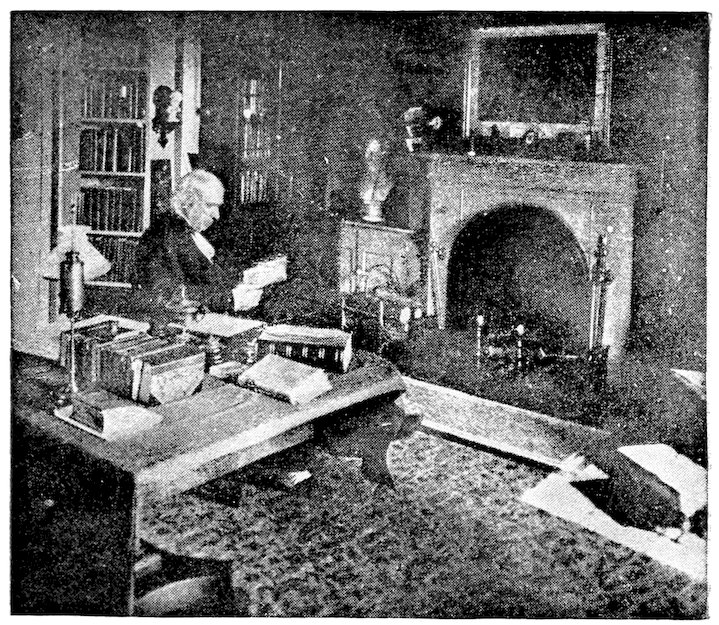
ESSAY.
1
The ancients entertained noble notions
of the poet. He was an enthusiast
and a rhapsodist. His work was done in
2surprise and delight. And all good epic
poets were thought to compose, not by
choice, but by inspiration; and so, too, the
good lyric poets drew, they tell us, “from
fountains flowing with nectar, and gathered
flowers from the gardens and glades of
the Muses; they, like bees, being ever on
the wing. For the poet was a thing
light-winged and sacred, unable to compose
until he became inspired, and the
imagination was no longer under his control.
For as long as he was in complete
possession of it, he was unable
to compose verses or to speak oracularly.”
And hence all noble numbers were credited
by them, not to the poet whom they knew,
but to the Power working in and through
3him, and making him the most delighted of
auditors whenever he chanted his verses,
because he did not conceive them to be
his. He was the Voice, the favored of
the Nine. Hence the value they set
upon discipline as the means of poetic
divination. The poet, they conceived,
must be most virtuous. It was essential
to his accomplishment that he be chaste,
that he be gentle, that he be noble in his
generation, that his endowment be older
than himself; that he descend from a
race of pure souls,—bring centuries of
culture in his descent among men,
ideas of ages in his brain,—enabling
him to conceive by instinct, and speak
his experiences unconsciously, as a child
4opens his lips, in his most rapturous
accents. Therefore, any pretence of ownership
in the gift was esteemed an impiety.
For a prayer, a song, a tender
tone, a glance of the eye, all those
magnetic attractions known to friendship,
had a like ancestry; were ours personally,
primarily, as we became worthy of being
their organs.
Is it an egotism in us to claim for New
England and for a contemporary of ours
parts and antecedents like these? or shall
such endowments, admirable always, and
awakening enthusiasm, be the less prized
when represented in a countryman of ours,
and when we have so frequently partaken
of the pleasure which his books, his
5lectures especially, excite? I allude, of
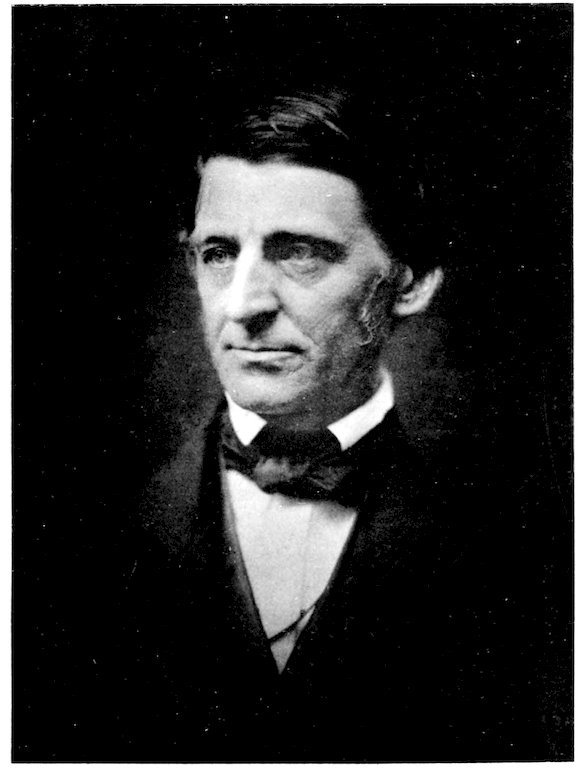
course, to Emerson. A rhapsodist by
genius, and the chief of his class, his
utterances are ever a surprise as they are
a delight to his audiences; select though
these are, and not all unworthy of him.
Hear how Goethe describes him, where
in his letters to Schiller, he calls the
rhapsodist—
“A wise man, who, in calm thoughtfulness,
shows what has happened; his
discourse aiming less to excite than to
calm his auditors, in order that they shall
listen to him with contentment and long.
He apportions the interest equally, because
it is not in his power to balance a
too lively impression. He grasps backwards
6and forwards at pleasure. He is
followed, because he has only to do with
the imagination, which of itself produces
images, and up to a certain degree, it
is indifferent what kind he calls up. He
does not appear to his auditors, but recites,
as it were behind a curtain; so there
is a total abstraction from himself, and it
seems to them as though they heard only
the voice of the Muses.”
See our Ion standing there,—his audience,
his manuscript, before him,—himself
an auditor, as he reads, of the
Genius sitting behind him, and to whom
he defers, eagerly catching the words,—the
words,—as if the accents were first
reaching his ears too, and entrancing
7alike oracle and auditor. We admire the
stately sense, the splendor of diction, and
are surprised as we listen. Even his
hesitancy between the delivery of his
periods, his perilous passages from paragraph
to paragraph of manuscript, we
have almost learned to like, as if he were
but sorting his keys meanwhile for opening
his cabinets; the spring of locks following,
himself seeming as eager as any
of us to get sight of his specimens, as
they come forth from their proper drawers;
and we wait willingly till his gem is
out glittering; admire the setting, too,
scarcely less than the jewel itself. The
magic minstrel and speaker! whose rhetoric,
voiced as by organ-stops, delivers
8the sentiment from his breast in cadences
peculiar to himself; now hurling
it forth on the ear, echoing; then,
as his mood and matter invite it, dying
like
“Music of mild lutes
Or silver coated flutes,
Or the concealing winds that can convey
Never their tone to the rude ear of day.”
He works his miracles with it, as
Hermes did, his voice conducting; the
sense alike to eye and ear by its lyrical
movement and refraining melody. So his
compositions affect us, not as logic linked
in syllogisms, but as voluntaries rather,
or preludes, in which one is not tied to
any design of air, but may vary his key
or note at pleasure, as if improvised without
9any particular scope of argument; each
period, each paragraph, being a perfect
note in itself, however it may chance
chime with its accompaniments in the
piece; as a waltz of wandering stars, a
dance of Hesperus with Orion. His rhetoric
dazzles by circuits, contrasts, antitheses;
Imagination, as in all sprightly
minds, being his wand of power. He
comes along his own paths, too, and always
in his own fashion. What though
he build his piers downwards from the
firmament to the tumbling tides, and so
throw his radiant span across the fissures
of his argument, and himself pass over
the frolic arches,—Ariel-wise,—is the skill
less admirable, the masonry less secure
10for its singularity? So his books are
best read as irregular writings, in which
the sentiment is, by his enthusiasm, transfused
throughout the piece, telling on the
mind in cadences of a current under-song,
and giving the impression of a connected
whole—which it seldom is,—such is the
rhapsodist’s cunning in its structure and
delivery.
The highest compliment we can pay to
the scholar is that of having edified and
instructed us, we know not how, unless by
the pleasure his words have given us.
Conceive how much the Lyceum owes to
his presence and teachings; how great the
debt of many to him for their hour’s
11entertainment. His, if any one’s, let the
institution pass into history,—since his art,
more than another’s, has clothed it with
beauty, and made it the place of popular
resort, our purest organ of intellectual
entertainment for New England and the
Western cities. And, besides this, its immediate
value to his auditors everywhere,
it has been serviceable in ways they least
suspect; most of his works, having had
their first readings on its platform, were
here fashioned and polished in good part,
like Plutarch’s Morals, to become the more
acceptable to readers of his published
books.
And is not the omen auspicious, that
just now, during these winter evenings, at
12the opening of this victorious year, his
Sundays have come round again; the metropolis,
eager, as of old, to hear his
words. Does it matter what topic he
touches? He adorns all with a severe
sententious beauty, a freshness and sanction
next to that of godliness, if not that
in spirit and effect.
“The princely mind, that can
Teach man to keep a God in man;
And when wise poets would search out to see
Good men, behold them all in thee.”
’Tis near thirty years since his first book,
entitled “Nature,” was printed. Then followed
volumes of Essays, Poems, Orations,
Addresses and during all the intervening
period down to the present, he has read
13briefs of his lectures through a wide range,
from Canada to the Capitol; in most of
the Free States; in the large cities, East
and West, before large audiences; in the
smallest towns and to the humblest companies.
Such has been his appeal to the
mind of his countrymen, such his acceptance
by them. He has read lectures in
the principal cities of England also. A
poet, speaking to individuals as few others
can speak, and to persons in their privileged
moments, he must be heard as none
others are. The more personal he is, the
more prevailing, if not the more popular.
Because the poet, accosting the heart
of man, speaks to him personally, he is
one with all mankind. And if he speak
14eloquent words, these words must be cherished
by mankind,—belonging as they do
to the essence of man’s personality, and,
partaking of the qualities of his Creator,
they are of spiritual significance. While, in
so far as he is individual only,—unlike any
other man,—his verses address special
aptitudes in separate persons; and he will
belong, not to all times, but to one time
only, and will pass away,—except to
those who delight in that special manifestation
of his gifts.
Now were Emerson less individual, according
to our distinction, that is, more
personal and national,—as American as
America,—then were his influence so
much the more diffusive, and he the Priest
15of the Faith earnest hearts are seeking.
Not that religion is wanting here in New
England; but that its seekers are, for the
most part, too exclusive to seek it independent
of some human leader,—religion
being a personal oneness with the Person
of Persons; a partaking of Him by putting
off the individualism which distracts
and separates man from man. Hence
differing sects, persuasions, creeds, bibles,
for separate peoples, prevail all over the
earth; religions, being still many, not one
and universal, not personal; similar only
as yet in their differences. Still the religious
sentiment, in binding all souls to
the Personal One, makes the many partake
of him in degrees lesser or greater.
16Thus far, the poets in largest measure;
mankind receiving through them its purest
revelations, they having been its inspired
oracles and teachers from the beginning
till now. The Sacred Books,—are not
these Poems in spirit, if not in form?
their authors inspired bards of divinity?
Meant for all men in all ages and states,
they appeal forever to the springing faiths
of every age, and so are permanent and
perennial, as the heart itself and its everlasting
hopes.
See how the Christian Theism, for instance,
has held itself high above most
men’s heads till now; its tender truths
above all cavil and debate by their transcendent
purity and ideal beauty! how
17these truths still survive in all their
freshness, keeping verdant the Founder’s
memory! and shall to distant generations;
churches, peoples, persons, a widening
Christendom, flourishing or fading as they
spring forth, or fall away from this living
stem.
“The Sun of Man, at last the son of woman,
Brother of all men, and the Prince of Peace,
Grafts, on the solemn valor of the Roman,
Fresh Saxon service, and the wit of Greece.”
Now, am I saying that our poet is inspiring
this fresher Faith? Certainly I
mean to be so understood; he, the chiefest
of its bards and heralds. Not spoken
always, ’tis implied, nevertheless, in his
teachings; defective, it is admitted, as colored
18by his temperament, which trenches
on Personal Theism not a little by the
stress he lays on Nature, on Fate; yet more
nearly complementing the New England
Puritanism than aught we have, and coming
nearest to satisfying the aspirations of
our time.
But it were the last thought of his,
this conceiving himself the oracle of any
Faith, the leader of any school, any sect
of religionists. His genius is ethical,
literary; he speaks to the moral sentiments
through the imagination, insinuating
the virtues so, as poets and moralists
of his class are wont. The Sacred Class,
the Priests, differ in this,—they address
the moral sentiment directly, thus enforcing
19the sanctions of personal righteousness,
and celebrating moral excellence
in prophetic strain.
’Tis everything to have a true believer
in the world, dealing with men and matters
as if they were divine in idea and
real in fact; meeting persons and events
at a glance directly, not at a million removes,
and so passing fair and fresh into
life and literature, the delight and ornament
of the race.
Pure literatures are personal inspirations,
springing fresh from the Genius of
a people. They are original; their first
fruits being verses, essays, tales, biographies—productions
as often of obscure as
of illustrious persons. And such, so far as
20we have a literature, is ours. Of the rest,
how much is foreign both in substance
and style, and might have been produced
elsewhere! His, I consider original and
American; the earliest, purest our country
has produced,—best answering the
needs of the American mind. Consider
how largely our letters have been enriched
by his contributions. Consider, too, the
change his views have wrought in our
methods of thinking; how he has won
over the bigot, the unbeliever, at least to
tolerance and moderation, if not to acknowledgment,
by his circumspection and
candor of statement.
“His shining armor
A perfect charmer;
21Even the hornets of divinity
Allow him a brief space,
And his thought has a place
Upon the well-bound library’s chaste shelves,
Where man of various wisdom rarely delves.”
Am I extravagant in believing that our
people are more indebted to his teachings
than to any other person who has
spoken or written on his themes during
the last twenty years,—are more indebted
than they know, becoming still more so?
and that, as his thoughts pass into the
brain of the coming generation, it will be
seen that we have had at least one mind of
home growth, if not independent of the
old country? I consider his genius the
measure and present expansion of the
American mind. And it is plain that he
22is to be read and prized for years to
come. Poet and moralist, he has beauty
and truth for all men’s edification and delight.
His works are studies. And any
youth of free senses and fresh affections
shall be spared years of tedious toil,—in
which wisdom and fair learning are, for
the most part, held at arm’s length,
planet’s width, from his grasp,—by graduating
from this college. His books are
surcharged with vigorous thoughts, a
sprightly wit. They abound in strong
sense, happy humor, keen criticisms, subtile
insights, noble morals, clothed in a
chaste and manly diction, and fresh with
the breath of health and progress.
We characterize and class him with the
23moralists who surprise us with an accidental
wisdom, strokes of wit, felicities of
phrase,—as Plutarch, Seneca, Epictetus,
Marcus Antoninus, Saadi, Montaigne,
Bacon, Sir Thomas Browne, Goethe, Coleridge,—with
whose delightful essays, notwithstanding
all the pleasure they give
us, we still plead our disappointment at
not having been admitted to the closer
intimacy which these loyal leaves had with
their owner’s mind before torn from his
notebook; jealous, even, at not having
been taken into his confidence in the
editing itself.
We read, never as if he were the dogmatist,
but a fair-speaking mind, frankly
declaring his convictions, and committing
24these to our consideration, hoping we may
have thought like things ourselves; oftenest,
indeed, taking this for granted as he
wrote. There is nothing of the spirit of
proselyting, but the delightful deference
ever to our free sense and right of opinion.
He might take for his motto the
sentiment of Henry More, where, speaking
of himself, he says: “Exquisite disquisition
begets diffidence; diffidence in
knowledge, humility; humility, good manners
and meek conversation. For my
part, I desire no man to take anything I
write or speak upon trust without canvassing,
and would be thought rather to
propound than to assert what I have here
or elsewhere written or spoken. But
25continually to have expressed my diffidence
in the very tractates and colloquies
themselves, had been languid and ridiculous.”
Then he has chosen a proper time and
manner for saying his good things; has
spoken to almost every great interest as
it rose. Nor has he let the good opportunities
pass unheeded, or failed to make
them for himself. He has taken discretion
along as his constant attendant and
ally; has shown how the gentlest temper
ever deals the surest blows. His method
is that of the sun against his rival for the
cloak, and so he is free from any madness
of those, who, forgetting the strength of
the solar ray, go blustering against men’s
26prejudices, as if the wearers would run
at once against these winds of opposition
into their arms for shelter. What higher
praise can we bestow on any one than
to say of him, that he harbors another’s
prejudices with a hospitality so cordial as
to give him, for the time, the sympathy
next best to, if, indeed, it be not edification
in, charity itself? For what disturbs
and distracts mankind more than the uncivil
manners that cleave man from man?
Yet for his amendment letters, love, Christianity,
were all given!
How different is he in temper and manners
from Carlyle, with whom he is popularly
associated! but who, for the most
part, is the polemic, the sophist, the
27scorner: whose books, opened anywhere,
show him berating the wrong he sees,
but seeing, shows never the means of
removing. Ever the same melancholy
advocacy of work to be done under the
dread master; force of stroke, the right
to rule and be ruled, ever the dismal
burden. Doomsday books are all save
his earliest—Rhadamanthus sitting and
the arbiter. He rides his Leviathan as
fiercely as did his countryman, Hobbes,
and can be as truculent and abusive; the
British Taurus, and a mad one. Were
he not thus possessed and fearfully in
earnest, we should take him for the harlequin
he seems, nor see the sorrowing
sadness playing off its load in this grotesque
28mirth, this scornful irony of his;
he painting in spite of himself his portraits
in the warmth of admiration, the
fire of wrath, and giving mythology for
history; all the while distorting the facts
into grimace in his grim moods. Yet,
what breadth of perspective, strength of
outline! the realism how appalling, the
egotism how enormous,—all history showing
in the background of the one figure,
Carlyle. Burns, Goethe, Richter, Mirabeau,
Luther, Cromwell, Frederick,—all
dashed from his flashing pen, heads of
himself, alike in their unlikeness, prodigiously
individual, willful, some of them
monstrous; all Englishmen with their
egregious prejudices and pride; no patience,
29no repose in any. He still brandishes
his truncheon through his pages
with an adroitness that renders it unsafe
for any, save the few that wield weapons
of celestial temper, to do battle against
this Abaddon. Silenced he will not be;
talking terribly against all talking but his
own; agreeing, disagreeing, all the same;
he, the Jove, permitting none, none to
mount Olympus, till the god deigns silence
and invites. Curious to see him,
his chin aloft, the pent thunders rolling,
lightnings darting from under the bold
brows, words that tell of the wail within,
accents not meant for music, yet made
lyrical in the cadences of his Caledonian
refrain; his mirth mad as Lear’s, his humor
30as willful as the wind’s. Not himself
is approachable by himself even. And
Emerson is the one only American deserving
a moment’s consideration in his
eyes. Him he honors and owns the better,
giving him the precedence and the
manners:
“Had wolves and lions seen but thee,
They must have paused to learn civility.”
Of Emerson’s books I am not here
designing to speak critically, but of his
genius and personal influence rather.
Yet, in passing, I may say, that his book
of “Traits” deserves to be honored as
one in which England, Old and New,
may take honest pride, as being the liveliest
31portraiture of British genius and
accomplishments,—a book, like Tacitus,
to be quoted as a masterpiece of historical
painting, and perpetuating the New
Englander’s fame with that of his race.
’Tis a victory of eyes over hands, a
triumph of ideas. Nor, in my judgment,
has there been for some time any criticism
of a people so characteristic and
complete. It remains for him to do like
justice to New England. Not a metaphysician,
and rightly discarding any claims
to systematic thinking; a poet in spirit,
if not always in form; the consistent idealist,
yet the realist none the less, he has
illustrated the learning and thought of
former times on the noblest themes, and
32come nearest of any to emancipating the
mind of his own time from the errors and
dreams of past ages.
Why nibble longer there,
Where nothing fresh ye find,
Upon those rocks?
Lo! meadows green and fair;
Come pasture here your mind,
Ye bleating flocks.
There is a virtuous curiosity felt by
readers of remarkable books to learn
something more of their author’s literary
tastes, habits and dispositions than these
ordinarily furnish. Yet, to gratify this
is a task as difficult as delicate, requiring
a diffidency akin to that with which one
33would accost the author himself, and without
which graceful armor it were impertinent
for a friend even to undertake it.
We may venture but a stroke or two
here.
All men love the country who love
mankind with a wholesome love, and have
poetry and company in them. Our essayist
makes good this preference. If city
bred, he has been for the best part of his
life a villager and countryman. Only a
traveller at times professionally, he prefers
home-keeping; is a student of the landscape;
is no recluse misanthrope, but a
lover of his neighborhood, of mankind, of
rugged strength wherever found; liking
plain persons, plain ways, plain clothes;
34prefers earnest people, hates egotists,
shuns publicity, likes solitude, and knows
its uses. He courts society as a spectacle
not less than a pleasure, and so
carries off the spoils. Delighting in the
broadest views of men and things, he
seeks all accessible displays of both for
draping his thoughts and works. And
how is his page produced? Is it imaginable
that he conceives his piece as a
whole, and then sits down to execute
his task at a heat? Is not this imaginable
rather, and the key to the comprehension
of his works? Living for composition
as few authors can, and holding
company, studies, sleep, exercise, affairs,
subservient to thought, his products are
35gathered as they ripen, and stored in his
commonplaces; the contents transcribed
at intervals, and classified. The order
of ideas, of imagination, is observed in
the arrangement, not that of logical sequence.
You may begin at the last paragraph
and read backwards. ’Tis Iris-built.
Each period is self-poised; there may be
a chasm of years between the opening
passage and the last written, and there
is endless time in the composition.
Jewels all! separate stars. You may
have them in a galaxy, if you like, or
view them separate and apart. But every
one knows that, if he take an essay or
verses, however the writer may have
pleased himself with the cunning workmanship,
36’tis all cloud-fashioned, and
there is no pathway for any one else.
Cross as you can, or not cross, it matters
not; you may climb or leap, move in
circles, turn somersaults;
“In sympathetic sorrow sweep the ground,”
like his swallow in Merlin. Dissolving
views, projects, vistas open wide and
far,—yet earth, sky, realities all, not illusions.
Here is substance, sod, sun; much
fair weather in the seer as in his leaves.
The whole quarternion of the seasons,
the sidereal year, has been poured into
these periods. Afternoon walks furnished
the perspectives, rounded and melodized
them. These good things have all been
37talked and slept over, meditated standing
and sitting, read and polished in the utterance,
submitted to all various tests,
and, so accepted, they pass into print.
Light fancies, dreams, moods, refrains,
were set on foot, and sent jaunting about
the fields, along woodpaths, by Walden
shores, by hill and brook-sides,—to come
home and claim their rank and honors too
in his pages. Composed of surrounding
matters, populous with thoughts, brisk
with images, these books are wholesome,
homelike, and could have been written
only in New England, in Concord, and by
our poet.
“Because I was content with these poor fields,
Low, open meads, slender and sluggish streams,
38And found a home in haunts which others scorned,
The partial wood-gods overpaid my love,
And granted me the freedom of their state;
And in their secret senate have prevailed
With the dear, dangerous lords that rule our life,
Made moon and planets parties to their bond,
And through my rock-like, solitary wont
Shot million rays of thought and tenderness.
For me, in showers, in sweeping showers, the spring,
Visits the valley;—break away the clouds,—
I bathe in the morn’s soft and silvered air,
And loiter willing by yon loitering stream.
Sparrows far off, and nearer, April’s bird,
Blue-coated, flying before from tree to tree,
Courageous, sing a delicate overture
To lead the tardy concert of the year.
Onward and nearer rides the sun of May;
And wide around, the marriage of the plants
Is sweetly solemnized. Then flows amain
The surge of summer’s beauty; dell and crag,
39Hollow and lake, hillside, and pine arcade,
Are touched with Genius. Yonder ragged cliff
Has thousand faces in a thousand hours.
... The gentle deities
Showed me the lore of colors and of sounds,
The innumerable tenements of beauty,
The miracle of generative force,
Far-reaching concords of astronomy
Felt in the plants and in the punctual birds;
Better, the linked purpose of the whole,
And, chiefest prize, found I true liberty
In the glad home plain-dealing nature gave.
The polite found me impolite; the great
Would mortify me, but in vain; for still
I am a willow of the wilderness,
Loving the wind that bent me. All my hurts
My garden spade can heal. A woodland walk,
A quest of river-grapes, a mocking thrush,
A wild rose, or rock-loving columbine,
Salve my worst wounds.
40For thus the wood-gods murmured in my ear:
‘Dost love our manners? Canst thou silent lie?
Canst thou, thy pride forgot, like nature pass
Into the winter night’s extinguished mood?
Canst thou shine now, then darkle,
And being latent feel thyself no less?
As, when the all-worshipped moon attracts the eye,
The river, hill, stems, foliage, are obscure;
Yet envies none, none are unenviable.’”
I know of but one subtraction from
the pleasure the reading of his books—shall
I say his conversation?—gives me,
his pains to be impersonal or discrete, as
if he feared any the least intrusion of himself
were an offence offered to self-respect
the courtesy due to intercourse and authorship;
thus depriving his page, his
company, of attractions the great masters
41of both knew how to insinuate into their
text and talk, without overstepping the
bounds of social or literary decorum.
What is more delightful than personal
magnetism? ’Tis the charm of good fellowship
as of good writing. To get and
to give the largest measures of satisfaction,
to fill ourselves with the nectar of
select experiences, not without some intertinctures
of egotism so charming in a
companion, is what we seek in books of
the class of his, as in their authors. We
associate diffidence properly with learning,
frankness with fellowship, and owe a certain
blushing reverence to both. For
though our companion be a bashful man,—and
he is the worse if wanting this
42grace,—we yet wish him to be an enthusiast
behind all reserves, and capable of
abandonment sometimes in his books. I
know how rare this genial humor is, this
frankness of the blood, and how surpassing
is the gift of good spirits, especially
here in cold New England, where,
for the most part,
“Our virtues grow
Beneath our humors, and at seasons show.”
And yet, under our east winds of reserve,
there hides an obscure courtesy in
the best natures, which neither temperament
nor breeding can spoil. Sometimes
manners the most distant are friendly foils
for holding eager dispositions subject to
43the measure of right behavior. ’Tis not
every New Englander that dares venture
upon the frankness, the plain speaking,
commended by the Greek poet.
“Caress me not with words, while far away
Thy heart is absent, and thy feelings stray;
But if thou love me with a faithful breast,
Be that pure love with zeal sincere exprest;
And if thou hate, the bold aversion show
With open face avowed, and known my foe.”
Fortunate the visitor who is admitted
of a morning for the high discourse, or
permitted to join the poet in his afternoon
walks to Walden, the Cliffs, or elsewhere,—hours
likely to be remembered,
as unlike any others in his calendar of
experiences. I may say, for me they have
44made ideas possible, by hospitalities given
to a fellowship so enjoyable. Shall I describe
them as sallies oftenest into the
cloud-lands, into scenes and intimacies
ever new? none the less novel nor remote
than when first experienced; colloquies, in
favored moments, on themes, perchance
“Of fate, free-will, foreknowledge absolute;”
nor yet
“In wand’ring mazes lost,”
as in Milton’s page;
But pathways plain through starry alcoves high,
Or thence descending to the level plains.
Interviews, however, bringing their
trail of perplexing thoughts, costing
45some days’ duties, several nights’ sleep
oftentimes, to restore one to his place and
poise for customary employment; half a
dozen annually being full as many as the
stoutest heads may well undertake without
detriment.
Certainly safer not to venture without
the sure credentials, unless one will have
his pretensions pricked, his conceits reduced
in their vague dimensions.
“Fools have no means to meet
But by their feet.”
But to the modest, the ingenuous, the
gifted, welcome! Nor can any bearing
be more poetic and polite than his to all
such, to youth and accomplished women
46especially. I may not intrude farther than
to say, that, beyond any I have known,
his is a faith approaching to superstition
concerning admirable persons; the divinity
of friendship come down from childhood,
and surviving yet in memory if not in
expectation; the rumor of excellence of
any sort, being like the arrival of a new
gift to mankind, and he the first to proffer
his recognition and hope. His affection
for conversation, for clubs, is a lively intimation
of the religion of fellowship.
He, shall we say? if any, must have taken
the census of the admirable people of his
time, numbering as many among his
friends, perhaps, as most living Americans;
while he is already recognized as
47the representative mind of his country,
to whom distinguished foreigners are
especially commended on visiting us.
Extraordinary persons may be forgiven
some querulousness about their company,
when we remember that ordinary people
often complain of theirs. Impossible for
such to comprehend the scholar’s code of
civilities,—disposed as men are to hold all
persons to their special standard. Yet
dedicated to high labors, so much the
more strict is the scholar with himself, as
his hindrances are the less appreciable,
and he has, besides, his own moods to
humor.
“Askest how long thou shalt stay,
Devastator of the day?”
48“Heartily know,
When half-gods go,
The Gods arrive.”
Companionableness comes by nature.
We meet magically, and pass with sounding
manners; else we encounter repulses,
strokes of fate; temperament telling
against temperament, precipitating us
into vortices from which the nimblest
finds no escape. We pity the person who
shows himself unequal to such occasions;
the scholar, for example, whose intellect
is so exacting, so precise, that he cannot
meet his company otherwise than critically;
cannot descend through the senses
or the sentiments to that common level
where intercourse is possible with men;
49but we pity him the more, who, from
caprice or confusion, can meet through
these only. Still worse the case of him
who can meet men neither as sentimentalist
nor idealist, or, rather not at all in
a human way. Intellect interblends with
sentiment in the companionable mind,
and wit with humor. We detain the
flowing tide at the cost of lapsing out
of perception into memory, into the
limbo of fools. Excellent people wonder
why they cannot meet and converse.
They cannot,—no—their wits have ebbed
away, and left them helpless. Why, but
because of hostile temperaments, different
states of animation? The personal
magnetism finds no conductor, when one
50is individual, and the other individual no
less. Individuals repel; persons meet;
and only as one’s personality is sufficiently
overpowering to dissolve the
other’s individualism, can the parties flow
together and become one. But individuals
have no power of this sort. They
are two, not one, perhaps many. Prisoned
within themselves by reason of
their egotism, like animals, they stand
aloof; are separate even when they
touch; are solitary in any company, having
no company in themselves. But the
free personal mind meets all, is apprehended
by all; by the least cultivated,
the most gifted; magnetizes all; is the
spell-binder, the liberator of every one.
51We speak of sympathies, antipathies,
fascinations, fates, for this reason.
Here we have the key to literary composition,
to eloquence, to fellowship. Let
us apply it, for the moment, to Emerson’s
genius. We forbear entering into the
precincts of genesis, and complexions,
wherein sleep the secrets of character and
manners. Eloquent in trope and utterance
when his vaulting intelligence frees
itself for the instant, yet see his loaded
eye, his volleyed period; jets of wit, sallies
of sense, breaks, inconsequences, all betraying
the pent personality from which
his rare accomplishments have not yet
liberated his gifts, nor given him unreservedly
to the Muse and mankind.
52Take his own account of the matter.
“When I was born,
From all the seas of strength Fate filled a chalice,
Saying: ‘This be thy portion, child: this chalice,
Less than a lily’s, thou shalt daily draw
From my great arteries,—not less nor more.’
All substances the cunning chemist, Time,
Melts down into the liquor of my life,—
Friends, foes, joys, fortunes, beauty and disgust;
And whether I am angry or content,
Indebted or insulted, loved or hurt,
All he distils into sidereal wine,
And brims my little cup, heedless, alas!
Of all he sheds, how little it will hold,
How much runs over on the desert sands.
If a new Muse draw me with splendid ray,
And I uplift myself into its heaven,
The needs of the first sight absorb my blood;
And all the following hours of the day
Drag a ridiculous age.
To-day, when friends approach, and every hour
53Brings book, or star-bright scroll of Genius,
The little cup will hold not a bead more,
And all the costly liquor runs to waste;
Nor gives the jealous lord one diamond drop
So to be husbanded for poorer days.
Why need I volumes, if one word suffice?
Why need I galleries, when a pupil’s draught,
After the master’s sketch, fills and o’erfills
My apprehension? Why seek Italy,
Who cannot circumnavigate the sea
Of thoughts and things at home, but still adjourn
The nearest matter for a thousand days?”
Plutarch tells us that of old they were
wont to call men Φῶτα, which imports
light, not only for the vehement desire
man has to know, but to communicate
also. And the Platonists fancied that
the gods, being above men, had something
whereof man did not partake, pure
54intellect and knowledge, and thus kept
on their way quietly. The beasts, being
below men, had something whereof man
had less, sense and growth, so they lived
quietly in their way. While man had
something in him whereof neither gods
nor beasts had any trace, which gave him
all the trouble, and made all the confusion
in the world,—and that was egotism and
opinion.
A finer discrimination of gifts might
show that Genius ranges through this
threefold dominion, partaking in turn of
each essence and degree.
Was our poet planted so fast in intellect,
so firmly rooted in the mind, so
dazzled with light, yet so cleft withal by
55duplicity of gifts, that, thus forced to
traverse the mid-world of contrast and
contrariety, he was ever glancing forth
from his coverts at life as reflected through
his dividing prism,—resident never long
in the tracts he surveyed, yet their
persistent Muse nevertheless? And so,
housed in the Mind, and thence sallying
forth in quest of his game, whether of
persons or things, he was the Mercury,
the merchantman of ideas to his century.
Nor was he left alone in life and thinking.
Beside him stood his townsman,[1] whose
sylvan intelligence, fast rooted in sense
and Nature, was yet armed with a sagacity,
a subtlety and strength, that penetrated
56while divining the essences of
the creatures and things he studied, and
of which he seemed both Atlas and Head.
Forcible protestants against the materialism
of their own, as of preceding
times, these masterly Idealists substantiated
beyond all question their right to
the empires they swayed,—the rich estates
of an original genius.
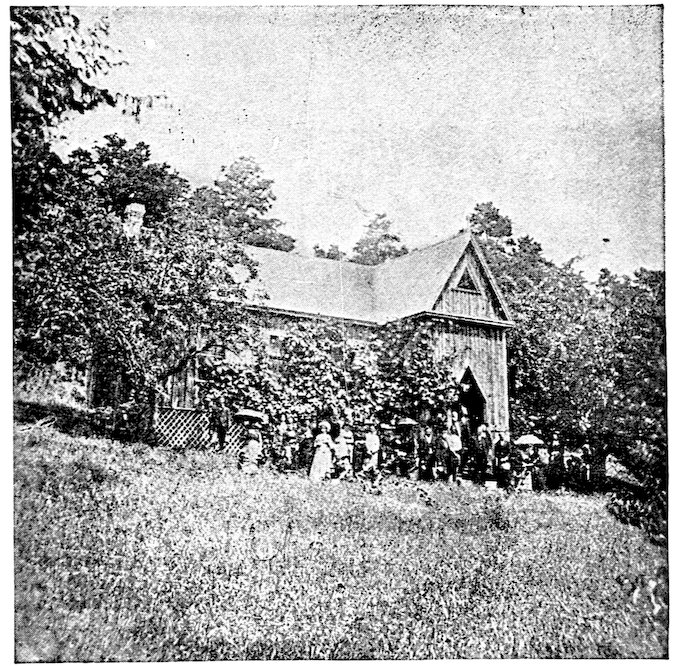
The Summer School of Philosophy, Concord, Mass.
THE POET’S COUNTERSIGN.
71
An Ode read by F. B. Sanborn, at the opening of the Concord School, July 17, 1882.
“I grant, sweet soul, thy lovely argument
Deserves the travail of a worthier pen;
Yet what of thee thy poet doth invent,
He robs thee of, and pays it thee again;
He lends thee virtue,—and he stole that word
From thy behavior; beauty doth he give,
And found it on thy cheek; he can afford
No praise to thee but what in thee doth live.”
Across these meadows, o’er the hills,
Beside our sleeping waters, hurrying rills,
Through many a woodland dark, and many a bright arcade,
72Where out and in the shifting sunbeams braid
An Indian mat of checquered light and shade,—
The sister seasons in their maze,
Since last we wakened here
From hot siesta the still drowsy year,
Have led the fourfold dance along our quiet ways,—
Autumn apparelled sadly gay,
Winter’s white furs and shortened day,
Spring’s loitering footstep, quickened at the last,
And half the affluent summer went and came,
As for uncounted years the same—
Ah me! another unreturning spring hath passed.
“When the young die,” the Grecian mourner said,
“The springtime from the year hath vanished;”
The gray-haired poet, in unfailing youth,
Sits by the shrine of Truth,
Her oracles to spell,
And their deep meaning tell;
Or else he chants a bird-like note
73From that thick-bearded throat
Which warbled forth the songs of smooth-cheeked May
Beside Youth’s sunny fountain all the day;
Sweetly the echoes ring
As in the flush of spring;
At last the poet dies,
The sunny fountain dries,—
The oracles are dumb, no more the wood-birds sing.
Homer forsakes the billowy round
Of sailors circling o’er the island-sea;
Pindar, from Theban fountains and the mound
Builded in love and woe by doomed Antigone,
Must pass beneath the ground;
Stout Æschylus that slew the deep-haired Mede
At Marathon, at Salamis, and freed
Athens from Persian thrall,
Then sung the battle call,—
Must yield to that one foe he could not quell;
74In Gela’s flowery plain he slumbers well.
[2]
Sicilian roses bloom
Above his nameless tomb;
And there the nightingale doth mourn in vain
For Bion, too, who sung the Dorian strain;
By Arethusa’s tide,
His brother swains might flute in Dorian mood,—
The bird of love in thickets of the wood
Sing for a thousand years his grave beside—
Yet Bion still was mute—the Dorian lay had died.
IV.
The Attic poet at approach of age
Laid by his garland, took the staff and scrip,
For singing robes the mantle of the sage,—
And taught gray wisdom with the same grave lip
That once had carolled gay
Where silver flutes breathed soft and festal harps did play;
75Young Plato sang of love and beauty’s charm,
While he that from Stagira came to hear
In lyric measures bade his princely pupil arm,
And strike the Persian tyrant mute with fear.
High thought doth well accord with melody,
Brave deed with Poesy,
And song is prelude fair to sweet Philosophy.
But wiser English Shakspeare’s noble choice,
Poet and sage at once, whose varied voice
Taught beyond Plato’s ken, yet charming every ear;—
A kindred choice was his, whose spirit hovers here.
Now Avon glides through Severn to the sea,
And murmurs that her Shakspeare sings no more;
Thames bears the freight of many a tribute shore,
But on those banks her poet bold and free,
That stooped in blindness at his humble door,
Yet never bowed to priest or prince the knee,
Wanders no more by those sad sisters led;
76Herbert and Spenser dead
Have left their names alone to him whose scheme
Stiffly endeavors to supplant the dream
Of seer and poet, with mechanic rule
Learned from the chemist’s closet, from the surgeon’s tool.
With us Philosophy still spreads her wing,
And soars to seek Heaven’s King—
Nor creeps through charnels, prying with the glass
That makes the little big,—while gods unseen may pass.
Along the marge of these slow-gliding streams,
Our winding Concord and the wider flow
Of Charles by Cambridge, walks and dreams
A throng of poets,—tearfully they go;
For each bright river misses from its band
The keenest eye, the truest heart, the surest minstrel hand,—
They sleep each on his wooded hill above the sorrowing land.
77Duly each mound with garlands we adorn
Of violet, lily, laurel, and the flowering thorn,—
Sadly above them wave
The wailing pine-trees of their native strand;
Sadly the distant billows smite the shore,
Plash in the sunlight, or at midnight roar;
All sounds of melody, all things sweet and fair,
On earth, in sea or air,
Droop and grow silent by the poet’s grave.
Yet wherefore weep? Old age is but a tomb,
A living hearse, slow creeping to the gloom
And utter silence. He from age is freed
Who meets the stroke of Death and rises thence
Victor o’er every woe; his sure defence
Is swift defeat; by that he doth succeed.
Death is the poet’s friend—I speak it sooth;
Death shall restore him to his golden youth,
Unlock for him the portal of renown,
And on Fame’s tablet write his verses down,
78For every age in endless time to read.
With us Death’s quarrel is: he takes away
Joy from our eyes—from this dark world the day—
When other skies he opens to the poet’s ray.
Lonely these meadows green,
Silent these warbling woodlands must appear
To us, by whom our poet-sage was seen
Wandering among their beauties, year by year,—
Listening with delicate ear
To each fine note that fell from tree or sky,
Or rose from earth on high:
Glancing that falcon eye,
In kindly radiance as of some young star,
At all the shows of Nature near and far,
Or on the tame procession plodding by,
Of daily toil and care,—and all life’s pageantry;
Then darting forth warm beams of wit and love,
Wide as the sun’s great orbit, and as high above
These paths wherein our lowly tasks we ply.
His was the task and his the lordly gift
Our eyes, our hearts, bent earthward, to uplift;
He found us chained in Plato’s fabled cave,
Our faces long averted from the blaze
Of Heaven’s broad light, and idly turned to gaze
On shadows, flitting ceaseless as the wave
That dashes ever idly on some isle enchanted;
By shadows haunted
We sat,—amused in youth, in manhood daunted,
In vacant age forlorn,—then slipped within the grave,
The same dull chain still clasped around our shroud;
These captives, bound and bowed,
He from their dungeon like that angel led
Who softly to imprisoned Peter said,
“Arise up quickly! gird thyself and flee!”
We wist not whose the thrilling voice, we knew our souls were free.
Ah! blest those years of youthful hope,
When every breeze was Zephyr, every morning May!
80Then as we bravely climbed the slope
Of life’s steep mount, we gained a wider scope
At every stair, and could with joy survey
The track beneath us, and the upward way;
Both lay in light—round both the breath of love
Fragrant and warm from Heaven’s own tropic blew;
Beside us what glad comrades smiled and strove!
Beyond us what dim visions rose to view!
With thee, dear Master! through that morning land
We journeyed happy: thine the guiding hand,
Thine the far-looking eye, the dauntless smile;
Thy lofty song of hope did the long march beguile.
Now scattered wide and lost to loving sight
The gallant train
That heard thy strain;
’Tis May no longer,—shadows of the night
Beset the downward pathway; thou art gone,
And with thee vanished that perpetual dawn
Of which thou wert the harbinger and seer.
Yet courage! comrades,—though no more we hear
Each other’s voices, lost within this cloud
That time and chance about our way have cast,
Still his brave music haunts the hearkening ear,
As ’mid bold cliffs and dewy passes of the Past.
Be that our countersign! for chanting loud
His magic song, though far apart we go,
Best shall we thus discern both friend and foe.
Recent Publications
OF
Cupples & Hurd,
PUBLISHERS, GENERAL BOOKSELLERS, AND LIBRARY AGENTS,
94 Boylston Street, Boston, Mass.
⁂ Note.—In order to insure the correct delivery of the actual works, or
particular Editions specified in this List, the name of the Publishers should be
distinctly given. These books can be had from any local bookseller; but should
any difficulty be experienced in procuring them, Messrs. Cupples & Hurd will
be happy to forward them direct, postage paid, on receipt of cheque, stamps,
or Postal order for the amount, with a copy of their complete catalogue.
THE AMERICAN TAUCHNITZ SERIES.
Square 16mo. Paper covers, 50 cents. Cloth, $1.00.
I.
Miss Frances Merley:
A Novel. By John Elliot Curran. 420 pages.
The first important work of an author familiar to American readers by his
remarkable sketches to Scribner’s and other magazines.
II.
Autobiography of a New England Farm House:
A Romance of the Cape Cod Lands. By N. H. Chamberlain. 380 pages.
A novel of singular power and beauty, great originality and rugged force.
Born and bred on Cape Cod, the author, at the winter firesides of country
people, very conservative of ancient English customs now gone, heard curious
talk of kings, Puritan ministers, the war and precedent struggle of our Revolution,
and touched a race of men and women now passed away. He also heard,
chiefly from ancient women, the traditions of ghosts, witches and Indians, as
they are preserved, and to a degree believed, by honest Christian folk, in the
very teeth of modern progress. These things are embodied in this book.
OTHER VOLUMES OF THIS SERIES IN PREPARATION.
A SUMMER CRUISE ON THE COAST OF NEW ENGLAND.
By Robert Carter. With an Introduction by Rossiter
Johnson. 12mo. Cloth, with Map. $1.50.
A new edition of one of the most fascinating of salt-water yarns, full of
genial humor, vivid word-painting, accurate information, and practical “wrinkles.”
A classic by reason of the esteem in which it is held by yachtsmen, and
as a literary production equal to anything of the kind in the Anglo-Saxon
tongue.
A New Book by W. H. H. Murray.
DAYLIGHT LAND. The experiences, incidents, and adventures, humorous
and otherwise, which befell Judge John Doe, Tourist, of San Francisco;
Mr. Cephas Pepperell, Capitalist, of Boston; Colonel Goffe, the Man
from New Hampshire, and divers others, in their Parlor-Car Excursion over
Prairie and Mountain; as recorded and set forth by W. H. H. Murray.
Superbly illustrated with 150 cuts in various colors by the best artists.
Contents:—Introduction—The Meeting—A Breakfast—A Very Hopeful
Man—The Big Nepigon Trout—The Man in the Velveteen Jacket—The
Capitalist—Camp at Rush Lake—Big Game—A Strange Midnight Ride—Banff—Sunday
among the Mountains—Nameless Mountains—The Great
Glacier—The Hermit of Frazer Cañon—Fish and Fishing in British Columbia—Vancouver
City—Parting at Victoria.
8vo. 350 pages. Unique paper covers, $2.50; half leather binding, $3.50.
Mr. Murray has chosen the north-western side of the continent for the scene
of this book; a region of country which is little known by the average reader,
but which in its scenery, its game, and its vast material and undeveloped
resources, supplies the author with a subject which has not been trenched upon
even by the magazines, and which he has treated in that lively and spirited
manner for which he is especially gifted. The result is a volume full of novel
information of the country, humorous and pathetic incidents, vivid descriptions
of its magnificent scenery, shrewd forecasts of its future wealth and greatness
when developed, illustrated and embellished with such lavishness and artistic
elegance as has never before been attempted in any similar work in this country.
ADIRONDACK TALES. By W. H. H. Murray. Illustrated. 12mo.
300 pages. $1.25.
Containing John Norton’s Christmas—Henry Herbert’s Thanksgiving—A
Strange Visitor—Lost in the Woods—A Jolly Camp—Was it Suicide?—The
Gambler’s Death—The Old Beggar’s Dog—The Ball—Who was he?
Short stories in Mr. Murray’s best vein—humorous; pathetic; full of the
spirit of the woods.
HOW DEACON TUBMAN AND PARSON WHITNEY KEPT
NEW YEARS, and other Stories. By W. H. H. Murray. 16mo.
Illustrated. $1.25.
A HEART REGAINED. By Carmen Sylva (Queen of Roumania).
Translated by Mary A. Mitchell. Fcap. 8vo. Cloth. $1.00.
A charming story by this talented authoress, told in her vivid, picturesque
manner, and showing how patient waiting attains to ultimate reward.
JOHN BROWN. By Hermann Von Holst, author of “Constitutional
History of the United States,” &c., together with an introduction and appendix
by Frank P. Stearns, a poem by Mr. Wason, and a letter describing
John Brown’s grave. Illustrated. 16mo, gilt top. $1.50.
This book, the author of which is so well known by his “Constitutional History,”
and by his biography of John C. Calhoun, cannot fail to be of interest to
all students of American history, who appreciate a calm, impartial criticism of
a man and an episode which have been universally and powerfully discussed.
MARGARET; and THE SINGER’S STORY. By Effie Douglass
Putnam. Daintily bound in white, stamped in gold and color, gilt
edges. 16mo. $1.25.
A collection of charming poems, many of which are familiar through the
medium of the magazines and newspaper press, with some more ambitious
flights, amply fulfilling the promise of the shorter efforts. Tender and pastoral,
breathing the simple atmosphere of the fields and woods.
AROUND THE GOLDEN DEEP. A Romance of the Sierras.
By A. P. Reeder. 500 pages. 12mo. Cloth. $1.50.
A novel of incident and adventure, depicting with a strong hand the virile life
of the mine that gives its name to the story, and contrasting it with the more
refined touches of society in the larger cities; well written and interesting.
SIGNOR I. By Salvatore Farina. Translated by the Baroness Langenau.
12mo. Cloth. $1.25.
A dainty story by an Italian author, recalling in the unique handling of its
incidents, and in the development of its plot, the delicate charm of “Marjorie
Daw.”
MIDNIGHT SUNBEAMS, OR BITS OF TRAVEL THROUGH
THE LAND OF THE NORSEMAN. By Edwin Coolidge Kimball.
On fine paper, foolscap 8vo, tastefully and strongly bound, with
vignette. Cloth. $1.25.
Pronounced by Scandinavians to be accurate in its facts and descriptions,
and of great interest to all who intend to travel in or have come from Norway
or Sweden.
WOODNOTES IN THE GLOAMING. Poems and Translations by
Mary Morgan. Square 16mo. Cloth, full gilt. $1.25.
A collection of poems and sonnets showing great talent, and valuable translations
from Gautier, Heine, Uhland, Sully-Prudhomme, Gottschalk, Michael
Angelo, and others. Also prose translations from the German, edited and
prefaced by Max Müller.
RALPH WALDO EMERSON, Philosopher and Seer. An Estimate
of his Character and Genius. By A. Bronson Alcott.
With portraits and other illustrations. Foolscap octavo. Gilt top. $1.50.
One hundred copies will be printed on larger and finer paper, 8vo, suitable
for the insertion of extra illustrations. Bound in Roxburgh, gilt top. Price
to Subscribers, $3.00.
A book about Emerson, written by the one man who stood nearest to him of
all men. It is an original and vital contribution to Emersonia; like a portrait
of one of the old masters painted by his own brush.
[In Press.
THE LIFE OF RAPHAEL as shown in his principal works. From the
German of Herman Grimm, author of “The Life of Michael Angelo,”
etc. With frontispiece, after Braun, of the recently discovered portrait,
outlined by Raphael in chalk. Cr. 8vo. Cloth. $2.00.
[Nearly ready.
ESSAYS ON LITERATURE. From the German of Herman Grimm,
uniform with “The Life of Raphael.” New and enlarged edition carefully
corrected. Cr. 8vo. Cloth. $2.00.
ANTIQUE VIEWS OF YE TOWNE OF BOSTON. By James H.
Stark, Assisted by Dr. Samuel A. Green, Ex-Mayor of Boston, Librarian
of the Massachusetts Historical Society; John Ward Dean, Librarian
of the New England Historic Genealogical Society; and Judge
Mellen Chamberlain, of the Public Library. An extensive and exhaustive
work in 378 pages. Large quarto. Illustrated with nearly 200 full
size reproductions of all known rare maps, old prints, etc. 1 vol. 4to.
Cloth. $6.00.
BERMUDA GUIDE. A description of everything on or about the Bermuda
Islands, concerning which the visitor or resident may desire information,
including its history, inhabitants, climate, agriculture, geology,
government, military and naval establishments. By James H. Stark.
With Maps, Engravings and 16 photo-prints. 1 vol. 12mo, cloth,
157 pp. $2.00.
PAUL REVERE: Historical and Legendary. By Elbridge H. Goss.
With reproductions of many of Revere’s engravings, etc.
[In press.
A DIRECTORY OF THE CHARITABLE AND BENEFICENT
ORGANIZATIONS OF BOSTON, ETC. Prepared for the Associated
Charities. 1 vol., 196 pp. 16mo. Cloth, $1.00.
PROF. CLARK MURRAY’S WORKS.
SOLOMON MAIMON: An Autobiography. Translated from the German,
with Additions and Notes, by Prof. J. Clark Murray. 1 vol.
Cr. 8vo. Cloth. 307 pp. $2.00.
A life which forms one of the most extraordinary biographies in the history
of literature.
The London Spectator says: “Dr. Clark Murray has had the rare good
fortune of first presenting this singularly vivid book in an English translation
as pure and lively as if it were an original, and an original by a classic
English writer.”
George Eliot, in “Daniel Deronda,” mentions it as “that wonderful bit of
autobiography—the life of the Polish Jew, Solomon Maimon”; and Milman,
in his “History of the Jews,” refers to it as a curious and rare book.
HANDBOOK OF PSYCHOLOGY. By Prof. J. Clark Murray,
LL.D., Professor of Mental and Moral Philosophy, M’Gill College,
Montreal. Cr. 8vo. 2d edition, enlarged and improved. $1.75.
Clearly and simply written, with illustrations so well chosen that the dullest
student can scarcely fail to take an interest in the subject.
ADOPTED FOR USE IN COLLEGES IN SCOTLAND, ENGLAND, CANADA, AND THE UNITED STATES.
Prof. Murray’s good fortune in bringing to light the “Maimon Memoirs,”
together with the increasing popularity of his “Handbook of Psychology,” has
attracted the attention of the intellectual world, giving him a position
with the leaders of thought of the present age. His writings are at once
original and suggestive.
AALESUND TO TETUAN. By Chas. R. Corning. A Volume of
Travel. 12mo, 400 pp. Cloth. $2.00.
[Ready in September.
Table of Contents.—Portsmouth—Isle of Wight—Channel Islands—Normandy—Nice—Monte
Carlo—Genoa—Naples and its Environments—Rome—Verona—Venice—Norway—Sweden—St.
Petersburg—Moscow—Warsaw—Berlin—Up
the Rhine—Barcelona—Valencia—Seville—Cadiz—Morocco—Gibraltar—Granada—Madrid
and the Royal Wedding—Bull
Fights—Escurial—Biarritz—Bordeaux—Paris.
TAPPY’S CHICKS: or, Links Between Nature and Human Nature.
By Mrs. George Cupples. Illustrated. 16mo. Cloth. $1.25.
The tenderness and humor of this volume are simply exquisite.—E. P.
Whipple.
The title is altogether too insignificant for so delightful and valuable a work.—Spectator
(London).
It is not merely a work of talent, but has repeated strokes of undeniable
genius.—George Macdonald.
[In preparation.
THOMAS CARLYLE’S COUNSELS TO A LITERARY ASPIRANT
(a Hitherto Unpublished Letter of 1842), and What Came of
Them. With a brief estimate of the man. By James Hutchinson Stirling,
LL. D. 12mo, boards, 50 cents.
Gives a side of the rugged old Scotchman which will be new to most readers.
It shows that he was not always gruff and bearish, and that he could at times
think of somebody besides himself. The letter is one which every young man
who has a leaning towards literary work will read and ponder over.
SOCIAL LIFE AND LITERATURE FIFTY YEARS AGO.
16mo, cloth, white paper labels, gilt top. $1.00.
By a well-known litterateur. It will take a high place among the literature
treating of the period. A quaint and delightful book, exquisitely printed in the
Pickering style.
CIVILIZATION IN THE UNITED STATES. By Matthew
Arnold. And Other Essays concerning America. 16mo, unique paper
boards. 75 cents. Cloth, uncut, $1.25. The cloth binding matches the
uniform edition of his collected works.
Comprises the critical essays, which created so much discussion, namely,
“General Grant, an Estimate.” “A Word about America,” “A Word more
about America,” and “Civilization in the United States.”
⁂ This collection gathers in the great critic’s last contributions to literature.
LEGENDS OF THE RHINE. From the German of Prof. Bernard.
Translated by Fr. Arnold. Finely Illustrated. Small 4to. Cloth.
An admirable collection of the popular historical traditions of the Rhine, told
with taste and picturesque simplicity.
[In press.
A SELECTION FROM THE POEMS OF PUSHKIN.
Translated, with Critical Notes and a Bibliography. By Ivan Panin,
author of “Thoughts.” Foolscap 8vo. Unique binding. $2.00.
The first published translation by the brilliant young Russian, Ivan Panin,
whose lectures in Boston on the literature of Russia, during the autumn of last
year, attracted crowded houses.
WIT, WISDOM, AND PATHOS, from the prose of Heinrich Heine,
with a few pieces from the “Book of Songs.” Selected and translated by
J. Snodgrass. Second edition, thoroughly revised. Cr. 8vo, 338 pp.
Cloth, $2.00.
“A treasure of almost priceless thought and criticism.”—Contemporary
Review.
Cupples and Hurd, Publishers, Booksellers, Library Agents, BOSTON.
- Typos fixed; non-standard spelling and dialect retained.