It was of little use for Captain Rogers to trouble himself in
the hope of avoiding jealousy of Ralph on the part of the
other apprentices, for the feeling was already rife on the part
of Kirke.
That ill-conditioned young man despised everyone on
board for not being men of good family, as he himself
was, though he was more conscious of his good birth than
careful to prove himself a gentleman by his conduct. He
could not see why he should be made to work, and the son
of a merchant's book-keeper, a lad whose mother let lodgings
for her support, should be cockered up in the captain's
cabin, reading and writing at his ease, practically exempt
from hard toil.
Ralph had not enjoyed a tenth part of the educational
advantages which Kirke had thrown away, and was anxious
to improve himself now that a chance of doing so was
presented.
Mr. Gilchrist was teaching him mathematics and French,
lending him books upon botany and natural history,
especially such as treated of the country for which he was
bound, and also a few volumes of history and travels. He
taught him much by conversation upon these subjects; and
Ralph, feeling that he had one foot planted upon the
social ladder, earnestly desiring to rise higher, flung
himself enthusiastically into these studies as a means for so
doing. His uncle did not demand much manual labour
from him; he performed that cheerfully, but saw no reason
why, his allotted task being done, he should occupy his own
time in saving Kirke from doing his share of duty.
There was no great good-feeling between these lads; and
Harry Jackson, the third apprentice, was a weak, ordinary
sort of boy, who admired Kirke for his adventitious graces,
and had become completely his tool.
The three boys all slept in part of a deckhouse amidships,
a place divided between the galley and the apprentices'
cabin. The ship being an old one, there were no berths
for the youngsters, who slept in hammocks slung up at night,
and taken down in the morning, rolled up, and stowed
away to make room for their meals and accommodation
through the day.
Ralph breakfasted with the other two apprentices, their
hours being earlier than those of his uncle's cabin. After
this meal, he did what work was expected from him, and
liked to be clean and ready by the time when Mr. Gilchrist
could attend to him in the poop, where chiefly he spent the
remainder of the day.
One morning Ralph awoke suddenly, experiencing a very
disagreeable shock. The time-honoured joke of letting
his hammock down at the head had been played upon him,
and Kirke lay comfortably on his own bed squirting water
all over him.
"Have done, Kirke!" he cried angrily. "How would
you like to be served so?"
"Try it on if you dare," retorted Kirke, aiming a stream
of water right into his face. "I only wish you would try it
on, just once, and you would see. Get up! You must
swab the decks to-day, I did it yesterday."
"Drop that squirt, I tell you!" roared Ralph, as his shirt
was made dripping wet, and a fresh supply of water was
drawn into the tube from the basin which Kirke held
between his knees.
Kirke's only reply was another jet, which streamed down
Ralph's back.
Ralph sprang upon his tormentor, and a struggle took
place for possession of the squirt. The tin basin was upset
all over the bedclothes, but Denham flung it away and
seized hold of the squirt.
Indignation gave him superior strength, he wrenched
the instrument out of Kirke's hands, and Kirke drove his
clenched fist, straight from his shoulder, into Ralph's face
and hit him in the eye.
Fireworks flashed before his vision, and he proceeded to
revenge himself in a fair fight; but Jackson ran screaming
out of the cabin upon seeing Ralph pitch Kirke out of his
hammock as a preliminary, and called to the mate on the
watch.
"Mr. Denham is fighting Mr. Kirke," cried he, "and has
upset a basin of water all over him in his hammock."
The mate came in.
"Now, my lads," commanded he, "just you understand
that I'll allow no rowdy work of that sort. Shut up at
once, both of you."
It was the voice of authority, and Ralph scorned to tell
tales, so he desisted, pulled a dry shirt out of his chest, and
went on deck as soon as he could.
Being a good-natured lad, his anger had then cooled
down, and he began to swab the deck, thinking that it
would act as a peace-offering to give Kirke the help
voluntarily.
Kirke came out slowly and moodily, but did not begin to
work on his part. He stood with his hands in his pockets,
a sneer conquering the lowering gloom on his face.
"I am glad you know your place at last," said he, as
Ralph came near him. "I'll teach you a little more before
I have done with you."
Ralph bit his lip to force down an angry reply. He
did not want to quarrel with anyone, as that might give his
uncle trouble, but it was as much as he could do to keep
silence.
At this moment the captain himself stepped out.
"Ralph!" shouted he. "Have you seen my three-foot
rule? I can't find it."
"I know where it is," replied he. "I'll fetch it."
"What are you swabbing the deck for?" asked his uncle.
"Why are you not doing your own work, Kirke? I'll have
no shirking. Set to at once! Ralph, I want you in my
cabin."
Kirke had no option but to take up the bucket and
begin the menial work which he hated so fiercely.
"Mr. Gilchrist is not well," said the captain. "I hope he
is not in for an attack of dysentery, but he is certainly very
poorly. I have persuaded him to lie still, and I wish you
would put yourself tidy and come and attend to him. Go
to the storehouse and get out some brandy for him. Here
are the keys. I am wanted on deck to see about twenty
things all at once."
Ralph hastened to obey. The ship was victualled upon
teetotal principles, but a little spirit was kept for cases of
emergency or illness. None had been used hitherto upon
this voyage, and the decanters were empty.
Ralph opened the locker where the bottles were stored,
took out some brandy, filled one of the little decanters
which stood in a silver case, and hurried with it to the
invalid's cabin, leaving everything open in the storeroom,
for the moment, from his haste to relieve his friend.
Mr. Gilchrist was very unwell indeed. He said that he
was subject to these attacks at times; he did not believe
that this was dysentery, he had taken a chill and should be
better soon.
Ralph procured some hot water and prepared the cordial
for him, but he was sick at once after taking it; he shivered
violently, his teeth chattering in his head. This frightened
his young nurse very much, for they were now in latitudes
where the heat was great; no doctor was on board, and he
knew little about illness.
However, the patient was better after a time, the sickness
ceased, the headache was lessened, a gentle perspiration
broke out, and he fell asleep.
Ralph ventured to steal softly away, and went to lock
up the spirit bottles in the storeroom. There he found, to
his surprise, that not only the one which he had opened
was quite empty, but one of brandy and one of rum were
missing.
He called his uncle, who, holding strong opinions upon
the subject of temperance, was very angry. He made a
strict investigation into the matter, but failed to discover
the culprit. The bottles were gone—vanished; nobody
would confess to knowing anything about them.
Captain Rogers was very uneasy in his secret mind, for
appearances were against Ralph. No one else had been
trusted with the keys, and the spirit could not have gone
without hands. He knew very little personally about his
nephew, being so much at sea himself. He only saw him
at long intervals, and in the presence of others; he seemed
a steady boy then, and Rogers liked him, but this was the
first chance he had met with upon which he could have
gone wrong, in this manner, to his uncle's knowledge.
With this doubt about him, the captain spoke very sharply
to Ralph as to his carelessness in leaving the locker
open.
Mr. Gilchrist took Ralph's part. He said that he must
have smelt the liquor upon the boy's breath had he drunk
it, but the captain knew that about Ralph's family history
which he did not choose to talk about.
Ralph called himself a strict teetotaler, which the captain
was not; but the elder Denham had been a drunkard, and
had died from the consequence of his excesses. Had the
madness broken out in his son? Did he inherit it in his
blood? Had it taken that worst of all forms—secret drinking?
He knew what his sister had suffered from her husband's
conduct; was the same thing to begin all over again in the
person of her son?
For two days the captain was miserable from this
unspoken fear. Ralph had all the appearance of truth
and honesty; Mr. Gilchrist was strongly in favour of his
innocence; but the mate remarked that nobody but Mr.
Denham had been trusted with the keys of the locker, not
even the cook or the cook's mate, who, between them,
discharged the functions of steward.
For two wretched, suspicious, anxious days did this doubt
cark at the captain's heart. Then was little Harry Jackson
found drunk—drunk as a lord—late one evening when off
his watch.
Fresh investigations were set on foot, and it appeared
that Kirke had given the boy some liquor as a bribe for
silence regarding his own potations, of which Jackson could
not fail to know as they shared the same cabin. Denham
had not slept there since Mr. Gilchrist's illness, for he was
still unwell, though better; and Ralph had begged to be
allowed a bed upon the floor of his cabin, so as to attend
upon him if necessary through the night.
Taking advantage of his absence, Kirke had been enjoying
himself, after his own fashion, with the stolen spirits,
and inducing Harry to join him so as to ensure his silence.
The elder lad's head could already stand copious libations,
but that of the younger one could not, and the very means
adopted to secure safety led to detection.
The captain, deeply annoyed with himself for suspecting
his own nephew, highly wrathful for the trouble thus caused
to him, punished Kirke all the more severely, to give him,
as he said, "a lesson which he would not forget in a hurry."
Ralph tried to beg him off, but his uncle was in a rage
and refused to listen to him.
Kirke might have had all the blood of all the Howards
running in his veins so great was his anger at his punishment,
and he vowed to himself to abscond from the ship
as soon as it touched shore, nor ever to run the risk of such
ignominy again.
Things were very uncomfortable after this event for
Denham. His annoyance while it was pending had been
great, it had made him positively unhappy. He felt himself
to blame for carelessness in leaving the locker open; he
was indignant that the real culprit should cast the onus
upon him, knowing him to be perfectly innocent; and he
thought that his uncle should have trusted him better.
At least he should have spared his own nephew from the
charge of dishonesty.
He could not be as friendly as before with either Kirke
or Jackson, and felt very lonely.
Mr. Gilchrist continued to be very unwell, unable to talk
to him as usual. He had to pursue his studies without
help; difficulties beset him; and the other apprentices
made themselves extremely disagreeable, keeping up a
constant system of petty persecution which rendered life in
their cabin almost unendurable, yet of which he scorned to
complain to the captain, each separate annoyance being so
trivial.
Besides this, the wind increased in strength, and so severe
a gale from the westward set in that the Pelican had to
scud before it under bare poles.
For two days there was cause for considerable anxiety,
then the mercury rose, a calm clear night succeeded, followed
by a bright sunny morning.
"I hope the gale is over," said Ralph, coming into the
deckhouse and greeting the other lads cheerfully.
"I daresay you do," growled Kirke. "Counter-jumpers
and land-lubbers funk a capful of wind mightily."
"I think we have had rather more than a capful these
last two days," replied Ralph, ignoring the insulting
language.
"You manage to shirk all the trouble it causes, anyway.
I don't see that you need complain," said Kirke with a
sneer.
Ralph was silent. He finished his breakfast quickly
and went out.
The men were letting all the reefs out of the topsails,
and getting the top-gallant yards across, in hopes of a fine
day in which to make the most of the favourable gale.
It was a bright, bustling scene, and Ralph was amused
by looking on.
The old carpenter stood by him. This man and the
sailmaker both came from the same country village in
Cornwall where Captain Rogers and Ralph's mother had
been born. They always sailed with the captain, if possible,
from clannish attachment to him; and loved a chat with
Ralph from the same feeling.
"Nice day, Wills," said the boy.
"'Ees, zur, but it won't last," said the carpenter.
"'Lamb's wool skies, and filley's tails,
Make lofty ships carry low sails,'"
and he pointed to the drifting clouds.
"That is it, is it?" said Ralph. "Are we not having
rather a bad voyage, Wills? Do ships always have so much
bad weather as we are meeting with?"
"No, zur, but uz sailed on a Vriday."
"What could that have to do with it, Wills? Why
should that bring bad luck?"
"Can't zay, zur, but it du."
"You Cornishmen are always superstitious, aren't you?"
"Doan't knaw, your honour, as we'm more so than others.
'Tis no use to fly in the face of Providence ef He've given
we the gumption to zee more'n other volks."
"Did you ever see the Flying Dutchman in these latitudes,
Wills?"
"No, zur, I can't zay as I have zeed 'un, but 'tain't given
to every chield to do so. I've zeed Jack Harry's Lights,
though, and we wor wrecked then, too."
"Where was that?" asked Ralph with interest.
"Close to home, it wor. We heerd the bells of the old
church-tower a-calling the volks to evening service all the
time we was clinging to the maintop, and the gear flying in
ribbons about our faces, a-lashing uz like whips, and all of
uz as worn't fast tied to the mast swept away by the sea
that awful Sunday night. Jim Pascoe wor lashed aside of
me, and 'Sam,' zays he, 'I wonder whether my old mawther
be a-praying for me at this minute, up to church.' It didn't
save he even ef she wor, for a big sea rose up, and came
thundering down on uz, and he got the full heft of it right
upon him, so that it beat the last spunk of life out of him
then and there. There wor but six of uz, out of twenty-one,
brought ashore that time alive; and there wor but life,
and that wor all, among some of we."
"How dreadful!" cried Ralph. "What did you think
about while you stood there all that time?"
"I doan't knaw as I did think much, at all. Zemmed as
ef all thought wor beat out of uz. But they there seamen
as wor drownded then answer to their names still on a
stormy night when the wind blows strong from the west
upon thiccee rocks."
"Answer to their names?"
"Ay. You may hear the roll called out, and they men
answer 'Here' as plain as you can wish, at midnight, in the
heft of a storm."
"Do you really believe that? Did you ever hear it,
Wills?"
"Well I can't zay as ever I actually heerd 'un call them,
but I knaws they as has; and why for no', Maister Ralph.
Perhaps 'ee'll believe I, and find that I speak truth, when I
tell 'ee this voyage is doomed to be unfortunate because we
set sail on a Vriday. I telled captain it would be, but he
wouldn't wait for Sunday though I did beg and pray 'un
to do so."
"I can't see what difference two days could make. It
would not have saved us the weather we had two days
since, nor will it make any difference in whatever may come
two days hence."
"Theer's a-many things as 'ee be too young to onnerstand
yet, Maister Denham."
"But 'ee did ought to pay heed to 'un, maister," put in
Osborn, "because 'ee be Cornish the same as we."
"I have never been in Cornwall, though, Osborn."
"No, I du knaw thiccee, more's the pity," replied the
man. "But uz du mind your ma, when hur wor a mighty
pretty little maid, a-dancing and a-singing about 'long shore,
and a-chattering so gay. Uz du all come from the same
place, zur, and we'm proud to knaw 'ee, and to have 'ee on
board, ef it be but for the trip. 'Tis one and all to home,
'ee knaweth, zur."
"Yes," laughed Ralph. "I am proud enough of my
Cornish blood, and would like to know more of the good
old county, though I fear it will be long before I shall
have the chance. You know I am going to Rangoon, to
push my way and try to help my mother. She does not
dance nor sing much in these days. She has a lot of
trouble."
"So we've heerd, zur. Poor little Miss Amy, we be
main sorry to think of it. Ef Wills or me can ever be of
any service to 'ee, zur, 'ee must look out for uz when the
Pelican comes to Rangoon. We shall always stick to cap'n,
zur, as we've done for many a day. Uz b'ain't likely to
leave 'un to be sarved by any old trade picked up out of
the slums."
"That is well; and if I can help either of you at any
time, you may depend upon me. It is a bargain between
us," said Ralph, laughing.
The appearance of fine weather was delusive, for the
bright sunshine changed within a few hours to fog and
rain. The wind sprang up again, and the captain was
forced to order the mainsail to be hauled in, the topsails
close reefed, and the top-gallant yards struck.
The mercury fell, the gale increased in force, and the sea
ran extremely high. There was a sharp frost in the night,
with snow, and the storm was as furious as ever next
morning.
The hatches had to be battened down, and it was dreadful
for Mr. Gilchrist and Ralph, wholly inexperienced in
nautical matters, unable to see or understand what was
going on, or what degree of danger there was, to hear the
raging of the elements, while they were in the dark with
nothing to distract their thoughts.
There they were, Mr. Gilchrist in his berth, coughing
incessantly, and Ralph sitting beside him, listening to
the tramp of hurried feet and the shouting voices overhead.
The great sea would strike the poor labouring vessel with a
force that caused it to shudder in every straining timber;
it would seem to be tossed on high, and then plunge into
fathomless deeps, as if sinking to the very bottom of the
sea. Tons of water came, ever and anon, rushing overhead.
Did this mean that their last hour had arrived?
Were they to be drowned in this awful darkness, like
rats in a hole? Were they never to see God's light of
day again, or look once more over the fair expanse of sea
and sky?
They grasped each other's hands at these times, for
touch was the only comfort which companionship could
give. They could not talk,—awe paralysed speech.
Then the volumes of water seemed to drain off in descending
streams through the scupper-holes, and voices
would be heard again, and a few sentences of prayer would
break from Mr. Gilchrist's lips.
This lasted for two days, awful days for these poor
prisoners; but the wind was in their favour, and blew them
on their way, though a little too far southwards, and it
moderated in course of time.
The captain had the dead-lights removed, the hatches
raised, and came down to see how his passengers had
fared.
"I never could have believed that light and air would be
so welcome," said Ralph; "and it is but a Scotch mist yet,
no pleasant sunshine."
"No," replied the captain, "but you will soon have
enough of sunshine now. Perhaps you may even have too
much of it one of these days. We have lost poor little
Jackson," continued he, turning to Mr. Gilchrist.
"What! the boy apprentice?" asked he.
"Ay, poor child! Washed overboard in the night, and
one of the seamen yesterday morning. We could not help
either of them, the sea was running so high. Would you
like to come up for a bit and see the waves for yourself
now?"
But Mr. Gilchrist declined. He dreaded bringing on
one of his paroxysms of cough more than the closeness and
confinement of the cabin; but Ralph, shocked by his uncle's
announcement, was eager to go on deck.
He was not used to death, and it was very awful to him
to think that, while he sat in comparative safety below, yet
fearing for his own death every moment, this boy, so much
younger than himself, had passed suddenly through a watery
grave to the portals of that unknown world where he must
meet his God.
Where was he now? What could he be doing? He
seemed as unfit for a spiritual life as anyone whom Ralph
had ever met. A mere troublesome naughty boy, of the
most ordinary type; rough, dirty, hungry,—a boy who
could laugh at a coarse joke, use bad words, shirk his work
whenever he had the chance, and who did nothing except
idle play in his leisure time.
What could he be doing among white-robed angels,
among the spirits of good men made perfect, among
cherubim and seraphim, with their pure eyes, around the
Father's throne? Yet had God taken him.
The mysteries of life and death came home, in a vivid
light, to Ralph's soul, as he stood holding on to a rope,
and gazing down on that boiling sea, whence he dreaded,
every moment, to see his young companion's white face
looking up at him.
Kirke came by, and Denham's good heart prompted him
to turn round and offer him his hand. Little Jackson had
run after Kirke like a dog, admired, followed, idolised him,
and Ralph thought he must be as much impressed as
himself by this awful event.
So he put out his hand, saying—
"Oh, Kirke, I am so sorry to hear about Jackson!"
"Bother you and your sorrow! I wish it had been you,"
replied Kirke rudely.
Ralph turned away in silence. He, too, almost wished
it had been himself, not that he felt more fit to go, but that
the heartlessness of this fellow struck a chill to his heart.
But Kirke was not so heedless of the event as he tried to
seem, nor so wholly ungrateful for Ralph's sympathy as he
chose to appear. This was the first blow which had struck
home to him, and in his pride and sullen humour he was
trying to resist its softening influence. Not for the world
would he have displayed any better feeling at that time,
though it was not altogether absent from his heart.
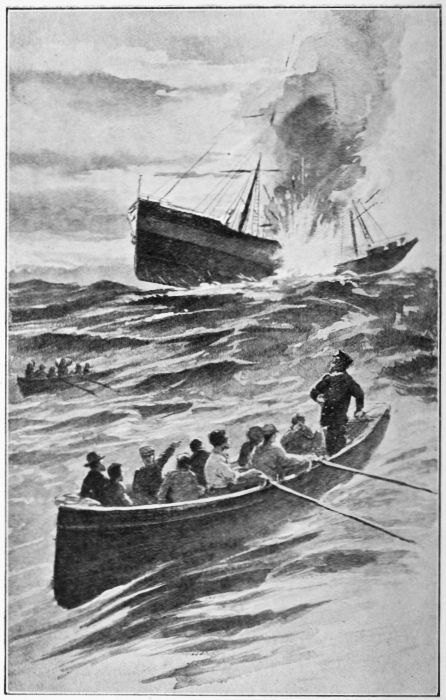 A groan burst from the white lips of the men as the seething
ruin that had been their home for so many weeks disappeared slowly
from view (p. 43).
A groan burst from the white lips of the men as the seething
ruin that had been their home for so many weeks disappeared slowly
from view (p. 43).